Twin City Star
Saturday, October 12, 1918
Minneapolis, Minnesota
Page text (machine-generated)
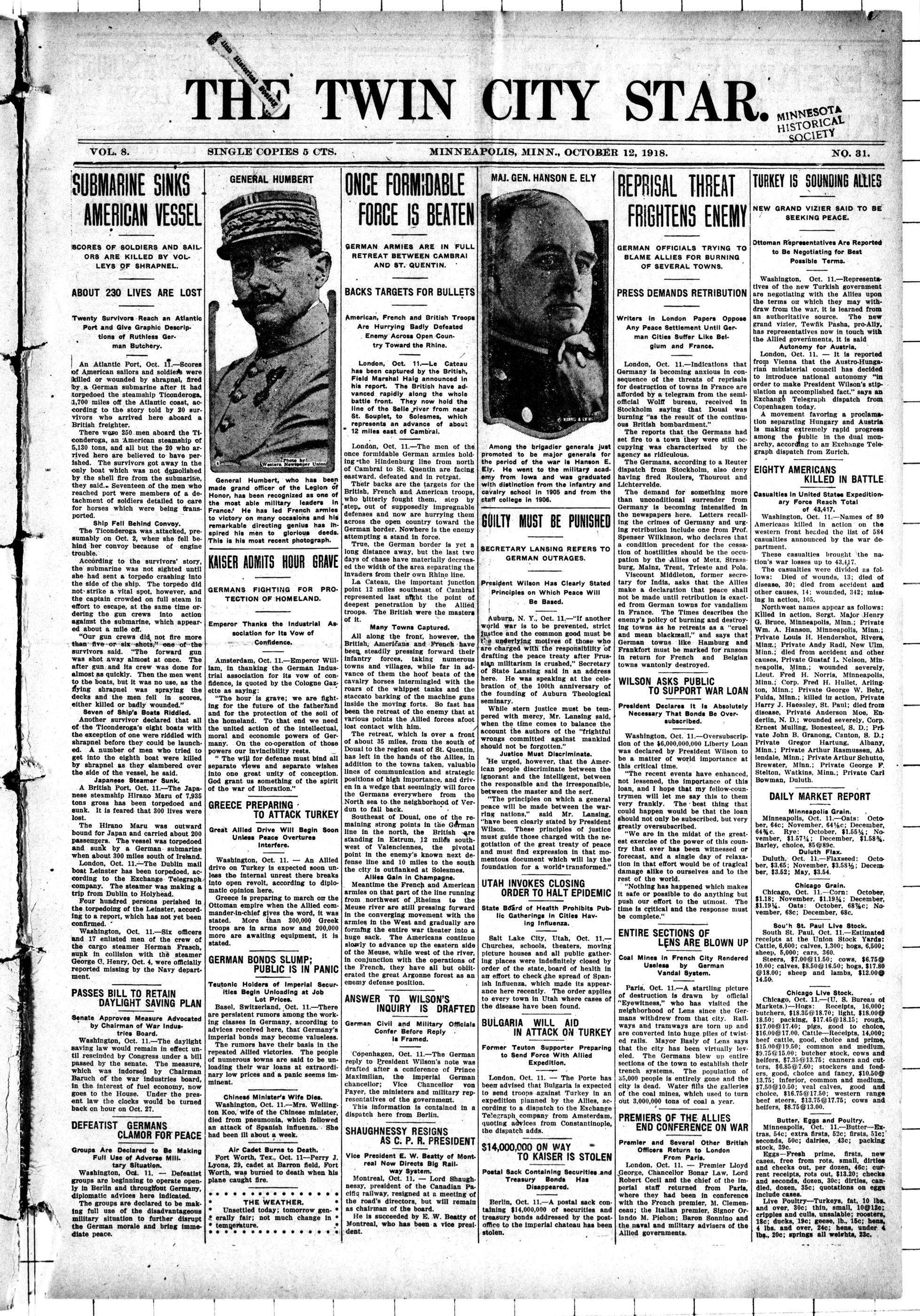
SUBMARINE SINKS AMERICAN VESSEL
SUBMARINE SINKS AMERICAN VESSEL
SCORES OF SOLDIERS AND SAILORS ARE KILLED BY VOLLEYS OF SHRAPNEL.
ABOUT 230 LIVES ARE LOST
Twenty Survivors Reach an Atlantic Port and Give Graphic Descriptions of Ruthless German Butchery.
An Atlantic Port, Oct. 11.—Scores of American sailors and soldiers were killed or wounded by shrapnel, fired by a German submarine after it had torpeded the steamship Ticonderoga, 1,700 miles off the Atlantic coast, according to the story told by 20 survivors who arrived here aboard a British freighter.
There were 250 men aboard the Ticonderoga, an American steamship of 5,130 tons, and all but the 20 who arrived here are believed to have perished. The survivors got away in the only boat which was not demolished by the shell fire from the submarine, they said. Seventeen of the men who reached port were members of a detachment of soldiers detailed to care for horses which were being transported.
Ship Fell Behind Convey.
The Ticonderoga was attacked, presumably on Oct. 2, when she fell behind her convoy because of engine trouble.
According to the survivors' story, the submarine was not sighted until she had sent a torpedo crashing into the side of the ship. The torpedo did not strike a vital spot, however, and the captain crowded on full steam in effort to escape, at the same time ordering the gun crews into action against the submarine, which appeared about a mile off.
"Our gun crews did not fire more than five or six shots," one of the survivors said. "The forward gun was shot away almost at once. The after gun and its crew was done for almost as quickly. Then the men went to the boats, but it was no use, as the flying shrapnel was spraying the decks and the men fell in scores, either killed or badly wounded."
Seven of Ship's Boats Riddled.
Another survivor declared that all of the Ticonderoga's eight boats with the exception of one were riddled with shrapnel before they could be launched. A number of men who tried to get into the eighth boat were killed by shrapnel as they clambered over the side of the vessel, he said.
Japanese Steamer Sunk.
A British Port, Oct. 11.—The Japanese steamship Hirano Maru of 7,935 tons gross has been torpedoed and sunk. It is feared that 300 lives were lost.
The Hirano Maru was outward bound for Japan and carried about 200 passengers. The vessel was torpedoed and sunk by a German submarine when about 300 miles south of Ireland. London, Oct. 11.—The Dublin mall boat Leinster has been torpedoed, according to the Exchange Telegraph company. The steamer was making a trip from Dublin to Holyhead. Four hundred persons perished in the torpedoing of the Leinster, according to a report, which has not yet been confirmed. Washington, Oct. 11.—Six officers and 17 enlisted men of the crew of the cargo steamer Herman Frasch, sunk in collision with the steamer George C. Henry, Oct. 4, were officially reported missing by the Navy department.
PASSES BILL TO RETAIN
DAYLIGHT SAVING PLAN
Senate Approves Measure Advocated by Chairman of War Industries Board. Washington, Oct. 11.—The daylight saving law would remain in effect until rescinded by Congress under a bill passed by the senate. The measure, which was indorsed by Chairman Baruch of the war industries board, in the interest of fuel economy, now goes to the House. Under the present law the clocks would be turned back on hour on Oct. 27.
DEFEATIST GERMANS
CLAMOR FOR PEACE
Groups Are Declared to Be Making Full Use of Adverse Military Situation. Washington, Oct. 11. — Defeatist groups are beginning to operate openly in Berlin and throughout Germany, diplomatic advices here indicated. The groups are declared to be making full use of the disadvantageous military situation to further disrupt the German morale and bring immediate peace.
THE TWIN CITY STAR.
SINGLE COPIES 5 CTS.
GENERAL HUMBERT
Photo by:
Western Newspaper Union
General Humbert, who has been made grand officer of the Legion of Honor, has been recognized as one of the most able military leaders in France. He has led French armies to victory on many occasions and his remarkable directing genius has inspired his men to glorious deeds. This is his most recent photograph.
KAISER ADMITS HOUR GRAVE
GERMANS FIGHTING FOR PROTECTION OF HOMELAND.
Emperor Thanks the Industrial Association for its Vow of
Amsterdam, Oct. 11.—Emperor William, in thanking the German Industrial association for its vow of confidence, is quoted by the Cologne Gazette as saying: "The hour is grave; we are fighting for the future of the fatherland and for the protection of the soil of the homeland. To that end we need the united action of the intellectual, moral and economic powers of Germany. On the co-operation of those powers our invincibility rests. "The will for defense must bind all separate views and separate wishes into one great unity of conception. God grant us something of the spirit of the war of liberation."
GREECE PREPARING
TO ATTACK TURKEY
Great Allied Drive Will Begin Soon Unless Peace Overtures Interfere.
Washington, Oct. 11. — An Allied drive on Turkey is expected soon unless the internal unrest there breaks into open revolt, according to diplomatic opinion here.
Greece is preparing to march on the Ottoman empire when the Allied commander-in-chief gives the word, it was stated. More than 300,000 Greek troops are in arms now and 200,000 more are awaiting equipment, it is stated.
GERMAN BONDS SLUMP;
PUBLIC IS IN PANIC
Teutonic Holders of Imperial Securities Begin Unloading at Job Lot Prices.
Basel, Switzerland, Oct. 11.—There are persistent rumors among the working classes in Germany, according to advices received here, that Germany's imperial bonds may become valueless.
The rumors have their basis in the repeated Allied victories. The people of numerous towns are said to be unloading their war loans at extraordinary low prices and a panic seems imminent.
Washington, Oct. 11.—Mrs. Wellington Koo, wife of the Chinese minister, died from pneumonia, which followed an attack of Spanish influenza. She had been ill about a week.
---
MINNEAPOLIS, MINN., OCTOBER 12, 1918.
ONGE FORMIDABLE FORCE IS BEATEN
ONGE FORMIDABLE FORCE IS BEATEN
GERMAN ARMIES ARE IN FULL RETREAT BETWEEN CAMBRAI AND ST. QUENTIN.
BACKS TARGETS FOR BULLETS
American, French and British Troops Are Hurrying Badly Defeated Enemy Across Open Country Toward the Rhine.
London, Oct. 11.—Le Catcau has been captured by the British, Field Marshal Haig announced in his report. The British have advanced rapidly along the whole battle front. They now hold the line of the Selle river from near St. Souplet, to Solesmes, which represents an advance of about 12 miles east of Cambrai.
London, Oct. 11.—The men of the once formidable German armies holding the Hindenburg line from north of Cambrai to St. Quentin are facing eastward, defeated and in retreat.
Their backs are the targets for the British, French and American troops, who bitterly fought them, step by step, out of supposedly impregnable defenses and now are hurrying them across the open country toward the German border. Nowhere is the enemy attempting a stand in force.
True, the German border is yet a long distance away, but the last two days of chase have materially decreased the width of the area separating the invaders from their own Rhine line.
La Cateau, the important junction point 12 miles southeast of Cambrai represented last night the point of deepest penetration by the Allied troops. The British were the masters of it.
Many Towns Captured.
All along the front, however, the British, Americans and French have been steadily pressing forward their infantry forces, taking numerous towns and villages, while far in advance of them the hoof beats of the cavalry horses intermingled with the roars of the whippet tanks and the staccato barking of the machine guns inside the moving forts. So fast has been the retreat of the enemy that at various points the Allied forces afoot lost contact with him.
The retreat, which is over a front of about 35 miles, from the south of Duval to the region east of St. Quentin, has left in the hands of the Allies, in addition to the towns taken, valuable lines of communication and strategic positions of high importance, and driven in a wedge that seemingly will force the Germans everywhere from the North sea to the neighborhood of Verdun to fall back.
Southeast of Duval, one of the remaining strong points in the German line in the north, the British are standing in Estrum, 12 miles southwest of Valenciennes, the pivotal point in the enemy's known next defense line and 10 miles to the south the city is outflanked at Solesmes.
Almeine Gain in Champagne.
Meantime the French and American armies on that part of the line running from northwest of Rheims to the Meuse river are still pressing forward in the converging movement with the armies in the West and gradually are forming the entire war theater into a huge sack. The Americans continue slowly to advance up the eastern side of the Meuse, while west of the river, in conjunction with the operations of the French, they have all but obliterated the great Argonne forest as an enemy defense position.
ANSWER TO WILSON'S INQUIRY IS DRAFTED
German Civil and Military Officials
Confer Before Reply
Is Framed.
Copenhagen, Oct. 11.—The German
reply to President Wilson's note was
drafted after a conference of Prince
Maximilian, the imperial German
chancellor; Vice Chancellor von
Payer, the ministers and military
representatives of the government.
This information is contained in a
dispatch here from Berlin.
Vice President E. W. Beatty of Montreal Now Directs Big Railway System.
Montreal, Oct. 11. — Lord Shaughnessy, president of the Canadian Pacific railway, resigned at a meeting of the road's directors, but will remain as chairman of the board.
He is succeeded by E. W. Beatty of Montreal, who has been a vice president.
MAJ. GEN. HANSON E. ELY
C. MARSH & CO.
Among the brigadier generals just promoted to be major generals for the period of the war is Hanson E. Ely. He went to the military academy from Iowa and was graduated with distinction from the infantry and cavalry school in 1905 and from the staff college in 1906.
GUILTY MUST BE PUNISHED
SECRETARY LANSING REFERS TO
German OUTRAGES.
President Wilson Has Clearly Stated Principles on Which Peace Will Be Based.
Auburn, N. Y., Oct. 11.—"If another world war is to be prevented, strict justice and the common good must be the underlying motives of those who are charged with the responsibility of drafting the peace treaty after Prussian militarism is crushed," Secretary of State Lansing said in an address here. He was speaking at the celebration of the 100th anniversary of the founding of Auburn Theological seminary.
While stern justice must be tempered with mercy, Mr. Lansing said, when the time comes to balance the account the authors of the "frightful wrongs committed against mankind should not be forgotten."
Justice Must Discriminate.
JUSTICE Must Discriminate.
"He urged, however, that the American people discriminate between the ignorant and the intelligent, between the responsible and the irresponsible, between the master and the serf.
"The principles on which a general peace will be made between the warring nations," said Mr. Lansing, "have been clearly stated by President Wilson. These principles of justice must guide those charged with the negotiation of the great treaty of peace and must find expression in that momentous document which will lay the foundation for a world-transformed."
UTAH INVOKES CLOSING
ORDER TO HALT EPIDEMIC
State Board of Health Prohibits Public Gatherings in Cities Having Influenza.
Salt Lake City, Utah, Oct. 11. Churches, schools, theaters, moving picture houses and all public gathering places were indefinitely closed by order of the state, board of health in an effort to check the spread of Spanish influenza, which made its appearance here recently. The order applies to every town in Utah where cases of the disease have been found.
BULGARIA WILL AID
IN ATTACK ON TURKEY
Former Teuton Supporter Preparing to Send Force With Allied Expedition.
London, Oct. 11. — The Porte has been advised that Bulgaria is expected to send troops against Turkey in an expedition planned by the Allies, according to a dispatch to the Exchange Telegraph company from Amsterdam, quoting advices from Constantinople, the dispatch adds.
$14,000,000 ON WAY
TO KAISER IS STOLEN
Postal Sack Containing Securities.and Treasury Bonds Has Disappeared.
Berlin, Oct. 11.—A postal sack containing $14,000,000 of securities and treasury bonds addressed by the post-office to the imperial chateau has been stolen.
REPRISAL THREAT FRIGHTENS ENEMY
REPRISAL THREAT FRIGHTENS ENEMY
GERMAN OFFICIALS TRYING TO
BLAME ALLIES FOR BURNING
OF SEVERAL TOWNS.
Writers in London Papers Oppose Any Peace Settlement Until German Cities Suffer Like Belgium and France.
London, Oct. 11.—Indications that Germany is becoming anxious in consequence of the threats of reprisals for destruction of towns in France are afforded by a telegram from the semi-official Wolff bureau, received in Stockholm saying that Douai was burning "as the result of the continuous British bombardment."
The reports that the Germans had set fire to a town they were still occupying was characterized by the agency as ridiculous.
The Germans, according to a Reuter dispatch from Stockholm, also deny having fired Roulers, Thourout and Lichtervelde.
The demand for something more than unconditional surrender from Germany is becoming intensified in the newspapers here. Letters recalling the crimes of Germany and urging retribution include one from Prof. Spenser Wilkinson, who declares that a condition precedent for the cessation of hostilities should be the occupation by the Allies of Metz, Strassburg, Maln, Trent, Triste and Pola.
Viscount Middleton, former secretary for India, asks that the Allies make a declaration that peace shall not be made until retribution is exacted from German towns for vandalism in France. The Times describes the enemy's policy of burning and destroying towns as he retreats as a "cruel and mean blackmail," and says that German towns like Hamburg and Frankfort must be marked for ransom in return for French and Belgian towns wantonly destroyed.
WILSON ASKS PUBLIC
TO SUPPORT WAR LOAN
President Declares It Is Absolutely Necessary That Bonds Be Oversubscribed.
Washington, Oct. 11.—Oversubscription of the $6,000,000,000 Liberty Loan was declared by President Wilson to be a matter of world importance at this critical time.
"The recent events have enhanced, not lessened, the importance of this loan, and I hope that my fellow-countrymen will let me say this to them very frankly. The best thing that could happen would be that the loan should not only be subscribed, but very greatly oversubscribed.
"We are in the midst of the greatest exercise of the power of this country that ever has been witnessed or forecast, and a single day of relaxation in that effort would be of tragical damage alike to ourselves and to the rest of the world.
"Nothing has happened which makes it safe or possible to do anything but push our effort to the utmost. The time is critical and the response must be complete."
ENTIRE SECTIONS OF
LENS ARE BLOWN UP
Coal Mines in French City Rendered Useless by German Vandal System.
Paris, Oct. 11.—A startling picture of destruction is drawn by official "Eyewitness," who has visited the neighborhood of Lens since the Germans withdrew from that city. Railways and tramways are torn up and are converted into huge piles of twisted rails. Mayor Basly of Lens says that the city has been virtually leveled. The Germans blew up entire sections of the town to establish their trench systems. The population of 35,000 people is entirely gone and the city is dead. Water fills the galleries of the coal mines, which used to turn out 3,000,000 tons of coal a year.
PREMIERS OF THE ALLIES
END CONFERENCE ON WAR
Premier and Several Other British Officers Return to London From Paris. London, Oct. 11. — Premier Lloyd George, Chancellor Bonar Law, Lord Robert Cecil and the chief of the imperial staff returned from Paris, where they had been in conference with the French premier, M. Clemenceau; the Italian premier, Signor Orlando M. Piehon; Baron Sonnino and the naval and military advisers of the Allied governments.
MINNESOTA
HISTORICAL
SOCIETY
NO. 81.
TURKEY IS SOUNDING ALLIES
NEW GRAND VIZIER SAID TO BE
SEEKING PEACE.
Ottoman Representatives Are Reported to Be Negotiating for Best Possible Terms.
Washington, Oct. 11.—Representatives of the new Turkish government are negotiating with the Allies upon the terms or which they may withdraw from the war, it is learned from an authoritative source. The new grand vizier, Tewfik Pasha, pro-Ally, has representatives now in touch with the Allied governments, it is said Autonomy for Austria.
London, Oct. 11. — It is reported from Vienna that the Austro-Hungarian ministerial council has decided to introduce national autonomy "in order to make President Wilson's stipulation an accomplished fact," says an Exchange Telegraph dispatch from Copenhagen today.
A movement favoring a proclamation separating Hungary and Austria is making extremely rapid progress among the public in the dual monarchy, according to an Exchange Telegraph dispatch from Zurich.
Casualties in United States Expeditionary Force Reach Total of 43,417.
Washington, Oct. 11.—Names of 80 Americans killed in action on the western front headed the list of 584 casualties announced by the war department.
These casualties brought the nation's war losses up to 43,417.
The casualties were divided as follows: Died of wounds, 13; died of disease, 30; died from accident and other causes, 14; wounded, 342; missing in action, 105.
Northwest names appear as follows: Killed in action, Sorgt. Major Henry G. Bruce, Minneapolis, Minn.; Private Wm. A. Hanson, Minneapolis, Minn.; Private Louis H. Hendershot, Rivers, Minn.; Private Andy Radi, New Ulm, Minn.; died from accident and other causes, Private Gustaf L. Nelson, Minneapolis, Minn.; wounded severely, Lleut. Fred H. Norris, Minneapolis, Minn.; Corp. Fred H. Hullet, Arlington, Minn.; Private George W. Behr, Fulda, Minn.; killed in action, Private Harry J. Haessley, St. Paul; died from disease, Private Anderson Moe, Enderlin, N. D.; wounded severely, Corp. Ernst Mulling, Bonestee, S. D.; Private John B. Granong, Canton, S. D.; Private Gregor Hartung, Albany, Minn.; Private Arthur Rasmussen, Allendale, Minn.; Private Arthur Schutte, Brewster, Minn.; Private George F. Stelton, Watkins, Minn.; Private Carl Bowman, Duluth.
DAILY MARKET REPORT
Minneapolis Grain.
Minneapolis, Oct. 11—Oats: October, 64c; November, 64½c; December, 64½c. Rye: October, $1.55½c; November, $1.57½c; December, $1.58½c. Barley, choice, 85@89c.
Duluth Flax.
Duluth, Oct. 11—Flaxseed: October, $3.65; November, $3.58½; December, $3.52; May, $3.54.
Chicago Grain.
Chicago, Oct. 11—Corn: October, $1.18; November, $1.19½; December, $1.19½c. Oats: October, 68½c; November, 68c; December, 68c.
Souh St. Paul Live Stock.
South St. Paul, Oct. 11—Estimated receipts at the Union Stock Yards: Cattle, 6,600; calves, 1,300; hogs, 6,500; sheep, 5,000; cars, 360.
Steers, $7.00@11.50; cows, $6.75@10.00; calves, $8.50@16.50; hogs, $17.80@18.00; sheep and lambs, $12.00@14.50.
Chicago Live Stock.
Chicago, Oct. 11.—U. S. Bureau of
Markets.)—Hogs. Receipts, 16,000;
butchers, $18.35@18.70; light, $18.00@
18.50; packing, $17.45@18.15; rough,
$17.00@17.40; pigs, good to choice,
$16.00@17.00. Cattle—Receipts, 14,000;
beef cattle, good, choice and prime,
$15.00@19.50; common and medium,
$9.75@15.00; butcher stock, cows and
heifers, $7.35@13.75; canners and cutters,
$6.85@7.60; stockers and feeders,
good, choice and fancy, $10.50@
13.75; inferior, common and medium,
$7.50@10.50; calve calves, good and
choice, $16.75@17.50; western range
beef steers, $13.75@17.75; cows and
heifers, $8.75@13.00.
Butter, Eggs and Poultry.
Minneapolis, Oct. 11—Butter—Extras, 45c; extra firsts, 52c; firsts, 51c; seconds, 50c; dairies, 43c; packing stock, 39c.
Eggs—Fresh prime, firsts, new cases, free from rots, small, dirties and checks out, per dozen, 46c; current receipts, rots out, $13.20; checks and seconds, dozen, 30c; dirties, candled, dozen, 35c; quotations on eggs include cases.
Live Poultry—Turkeys, fat, 10 lbs and over, 30c; thin, small, 10@12c; cripples and culls, unsalable; roosters, 18c; ducks, 19c; geese, lb., 16c; hens, 4 lbs. and over, 24c; hens, under 4 lbs., 20c; springs all weights, 23c.
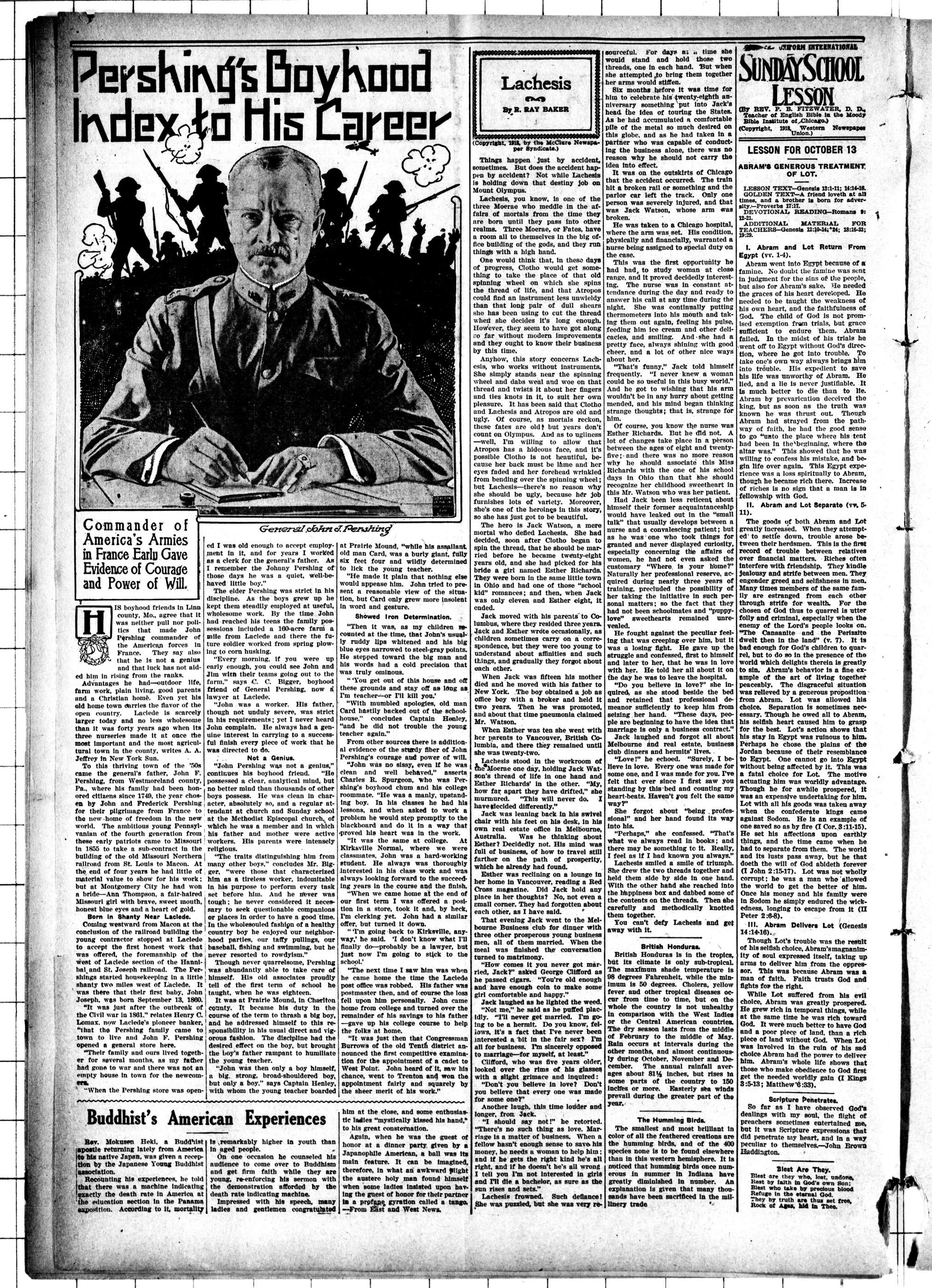
Pershing's Boyhood Index to His Career
Buddhist's American Experiences
Commander of America's Armies in France Early Gave Evidence of Courage and Power of Will.
IS boyhood friends in Linn county, Mo., agree that it was neither pull nor politics that made John Pershing commander of the American forces in France. They say also that he is not a genius and that luck has not aid-
IS boyhood friends in Linn county, Mo., agree that it was neither pull nor politics that made John Pershing commander of the American forces in France. They say also that he is not a genius and that luck has not aided him in rising from the ranks.
Advantages he had—outdoor life, farm work, plain living, good parents and a Christian home. Even yet his old home town carries the flavor of the open country. Laclede is scarcely larger today and no less wholesome than it was forty years ago when its three nurseries made it at once the most important and the most agricultural town in the county, writes A. A. Jeffrey in New York Sun.
To this thriving town of the '50s came the general's father, John F. Pershing, from Westmoreland county, Pa., where his family had been honored citizens since 1740, the year chosen by John and Frederick Pershing for their pilgrimage from France to the new-home of freedom in the new world. The ambitious young Pennsylvania of the fourth generation from these early patriots came to Missouri in 1855 to take a sub-contract in the building of the old Missouri Northern railroad from St. Louis to Macon. At the end of four years he had little of material value to show for his work; but at Montgomery City he had won a bride—Ann Thompson, a fair-haired Missouri girl with brave, sweet mouth, honest blue eyes and a heart of gold.
Born in Shanty Near Laclede.
Coming westward from Macon at the conclusion of the railroad building the young contractor stopped at Laclede to accept the first honest work that was offered, the foremanship of the west of Laclede section of the Hannibal and St. Joseph railroad. The Pershings started housekeeping in a little shanty two miles west of Laclede. It was there that their first baby, John Joseph, was born September 13, 1860.
"It was just after the outbreak of the Civil war in 1861." relates Henry C. Lomax, now Laclede's pioneer banker,
"that the Pershing family came to town to live and John F. Pershing opened a general store here.
"Their family and ours lived together for several months, as my father had gone to war and there was not an empty house in town for the newcomer.
"When the Pershing store was open-
Rev. Mokusen Heki, a Buddhist apostle returning lately from America to his native Japan, was given a reception by the Japanese Young Buddhist association.
Recounting his experiences, he told that there was a machine indicating exactly the death rate in America at the education section in the Panama exposition. According to it, mortality
ed I was old enough to accept employment in it, and for years I worked as a clerk for the general's father. As I remember the Johnny Pershing of those days he was a quiet, well-behaved little boy."
The elder Pershing was strict in his discipline. As the boys grew up he kept them steadily employed at useful, wholesome work. By the time John had reached his teens the family possessions included a 160-acre farm a mile from Laclede and there the future soldier worked from spring plowing to corn husking.
"Every morning, if you were up early enough, you could see John and Jim wtn their teams going out to the farm," says C. C. Bigger, boyhood friend of General Pershing, now a lawyer at Laclede.
at Prairie Mount, old man Card, wi six feet four aft to sick four aft to the "He made it he would appease his sent a reasonaion, but Card or in word and ges
Showed Iro
"Then it was counted at the tly ruddy lips w blue eyes narrow He stepped tow his words had was truly omine
"You get out these grounds at I'm teacher—or
"John was a worker. His father, though not unduly severe, was strict in his requirements; yet I never heard John complain. He always had a genuine interest in carrying to a successful finish every piece of work that he was directed to do.
Not a Genius.
"John Pershing was not a genius," continues his boyhood friend. "He possessed a clear, analytical mind, but no better mind than thousands of other boys possess. He was clean in character, absolutely so, and a regular attendant at church and Sunday school at the Methodist Episcopal church, of which he was a member and in which his father and mother were active workers. His parents were intensely religious.
"The traits distinguishing him from many other boys," concludes Mr. Bigger, "were those that characterized him as a tireless worker, indomitable in his purpose to perform every task set before him. And he never was tough; he never considered it necessary to seek questionable companions or places in order to have a good time. In the wholesouled fashion of a healthy country boy he enjoyed our neighborhood parties, our taffy pullings, our baseball, fishing and swimming, but he never resorted to rowdyism."
Though never quarrelsome, Pershing was abundantly able to take care of himself. His old associates proudly tell of the first term of school he taught, when he was eighteen.
It was at Prairie Mound, in Charlton county. It became his duty in the course of the term to thrash a big boy, and he addressed himself to this responsibility in his usual direct and vigorous fashion. The discipline had the desired effect on the boy, but brought the boy's father rampant to humiliate the young teacher. "John was then only a boy himself, a big, strong, broad-shouldered boy, but only a boy," says Captain Henley, with whom the young teacher boarded
is remarkably higher in youth than in aged people. On one occasion he counseled his audience to come over to Buddhism and get firm faith while they are young, re-enforcing his sermon with the demonstration afforded by the death rate indicating machine. Impressed with his speech, many ladies and gentlemen congratulated
at Prelature Mound, "while his assailant, old man Card, was a burly giant, fully six feet four and wildly determined to lick the young teacher.
"He made it plain that nothing else would appease him. John tried to present a reasonable view of the situation, but Card only grew more insolent in word and gesture.
Showed Iron Determination.
"Then it was, as my children counted at the time, that John's usually ruddy lips whitened and his big blue eyes narrowed to steel-gray points. He stepped toward the big man and his words had a cold precision that was truly ominous.
"You get out of this house and off these grounds and stay off as long as I'm teacher—or I'll kill you."
"With mumbled apologies, old man Card hastily backed out of the schoolhouse," concludes Captain Henley, "and he did not trouble the young teacher again."
From other sources there is additional evidence of the sturdy fiber of John Pershing's courage and power of will.
"John was no sissy, even if he was clean and well behaved," asserts Charles R. Spurgeon, who was Pershing's boyhood chum and his college roommate. "He was a manly, upstanding boy. In his classes he had his lessons, and when asked to work a problem he would step promptly to the blackboard and do it in a way that proved his heart was in the work.
"It was the same at college. At Kirksville Normal, where we were classmates. John was a hard-working student. He always was thoroughly interested in his class work and was always looking forward to the succeeding years in the course and the finish.
"When we came home at the end of our first term I was offered a position in a store, took it and, by heck, I'm clerking yet. John had a similar offer, but turned it down.
"I'm going back to Kirksville, anyway," he said. "I don't know what I'll finally do—probably be a lawyer, but just now I'm going to stick to the school."
"The next time I saw him was when he came home the time the Laclede post office was robbed. His father was postmaster then, and of course the loss fell upon him personally. John came home from college and turned over the remainder of his savings to his father—gave up his college course to help the folks at home.
"It was just then that Congressman Burrows of the old Tenth district announced the first competitive examination for the appointment of a cadet to West Point. John heard of it, saw his chance, went to Trenton and won the appointment fairly and squarely by the sheer merit of his work."
him at the close, and some enthusiastic ladies "mystically kissed his hand," to his great consternation.
Again, when he was the guest of honor at a dinner party, given by a Japanophile American, a ball was its main feature. It can be imagined, therefore, in what an awkward light the austere holy man found himself when some ladies insisted upon having the guest of honor for their partner in a profane gyration called a tango.—From East and West News.
Lachesis
By R. RAY BAKER
(Copyright, 1918, by the McClure Newspaper Syndicate.)
Things happen just by accident, sometimes. But does the accident happen by accident? Not while Lachesis is holding down that destiny job on Mount Olympus.
Lachesis, you know, is one of the three Moerae who meddle in the affairs of mortals from the time they are born until they pass into other realms. Three Moerae, or Fates, have a room all to themselves in the big office building of the gods, and they run things with a high hand.
One would think that, in these days of progress, Clotho would get something to take the place of that old spinning wheel on which she spins the thread of life, and that Atropos could find an instrument less unwieldy than that long pair of dull shears she has been using to cut the thread when she decides it's long enough. However, they seem to have got along so far without modern improvements and they ought to know their business by this time.
Anyhow, this story concerns Lachesis, who works without instruments. She simply stands near the spinning wheel and dabs weal and woe on that thread and twists it about her fingers and ties knots in it, to suit her own pleasure. It has been said that Clotho and Lachesis and Atropos are old and ugly. Of course, as mortals reckon, these fates are old! but years don't count on Olympus. And as to ugliness—well, I'm willing to allow that Atropos has a hideous face, and it's possible Clotho is not beautiful, because her back must be lame and her eyes faded and her forehead wrinkled from bending over the spinning wheel; but Lachesis—there's no reason why she should be ugly, because her job furnishes lots of variety. Moreover, she's one of the heroes in this story, so she has just got to be beautiful.
The hero is Jack Watson, a mere mortal who defied Lachesis. She had decided, soon after Clotho began to spin the thread, that he should be married before he became twenty-eight years old, and she had picked for his bride a girl named Esther Richards. They were born in the same little town in Ohio and had one of those "school kid" romances; and then, when Jack was only eleven and Esther eight, it ended.
Jack moved with his parents to Columbus, where they resided three years. Jack and Esther wrote occasionally, as children sometimes carry on a correspondence, but they were too young to understand about affinities and such things, and gradually they forgot about each other.
When Jack was fifteen his mother died and he moved with his father to New York. The boy obtained a job as office boy with a broker and held it two years. Then he was promoted, and about that time pneumonia claimed Mr. Watson.
When Esther was ten she went with her parents to Vancouver, British Columbia, and there they remained until she was twenty-two.
Lachesis stood in the workroom of the Moerne one day, holding Jack Watson's thread of life in one hand and Esther Richards' in the other. "My, how far apart they have drifted," she murmured. "This will never do. I have decided differently."
Jack was leaning back in his swivel chair with his feet on his desk, in his own real estate office in Melbourne, Australia. Was he thinking about Esther? Decidedly not. His mind was full of business, of how to travel still farther on the path of prosperity, which he already had found. Esther was reclining on a lounge in her home in Vancouver, reading a Red Cross magazine. Did Jack hold any place in her thoughts? No, not even a small corner. They had forgotten about each other, as I have said. That evening Jack went to the Melbourne Business club for dinner with three other prosperous young business men, all of them married. When the meal was finished the conversation turned to matrimony.
"How comes it you never got married, Jack?" asked George Clifford as he passed cigars. "You're old enough and have enough coin to make some girl comfortable and happy."
Jack laughed as he lighted the weed. "Not me," he said as he puffed placidly. "I'll never get married. I'm going to be a hermit. Do you know, fellows, it's a fact that I've never been interested a bit in the fair sex? I'm all for business. I'm sincerely opposed to marriage—for myself, at least."
Clifford, who was five years older, looked over the rims of his glasses with a slight grime and inquired: "Don't you believe in love? Don't you believe that every one was made for some one?"
Another laugh, this time louder and longer, from Jack.
"I should say not!" he retorted.
"There's no such thing as love. Marriage is a matter of business. When a fellow hasn't enough sense to save his money, he needs a woman to help him; and if he gets the right kind he's all right, and if he doesn't he's all wrong. I tell you I'm not interested in girls and I'll die a bachelor, as sure as the sun rises and sets." Lachies frowned. Such defiance! She was puzzled, but she was very re-
sourceful. For days at a time she would stand and hold those two threads, one in each hand. But when she attempted to bring them together her arms would stiffen.
Six months before it was time for him to celebrate his twenty-eighth anniversary something put into Jack's head the idea of touring the States. As he had accumulated a comfortable pile of the metal so much desired on this globe, and as he had taken in a partner who was capable of conducting the business alone, there was no reason why he should not carry the idea into effect.
It was on the outskirts of Chicago that the accident occurred. The train hit a broken rail or something and the parlor car left the track. Only one person was severely injured, and that was Jack Watson, whose arm was broken.
He was taken to a Chicago hospital, where the arm was set. His condition, physically and financially, warranted a nurse being assigned to special duty on the case. This was the first opportunity he had had, to study woman at close range, and it proved decidedly interesting. The nurse was in constant attendance during the day and ready to answer his call at any time during the night. She was continually putting thermometers into his mouth and taking them out again, feeling his pulse, feeding him ice cream and other delicacies, and smiling. And she had a pretty face, always shining with good cheer, and a lot of other nice ways about her.
"That's funny." Jack told himself frequently. "I never knew a woman could be so useful in this busy world." And he got to wishing that his arm wouldn't be in any hurry about getting mended, and his mind began thinking strange thoughts; that is, strange for him.
Of course, you know the nurse was Esther Richards. But he did not. A lot of changes take place in a person between the ages of eight and twenty-five; and there was no more reason why he should associate this Miss Richards with the one of his school days in Ohio than that she should recognize her childhood sweetheart in this Mr. Watson who was her patient.
Had Jack been less reticent about himself their former acquaintanceship would have leaked out in the "small talk" that usually develops between a nurse and a convalescing patient; but as he was one who took things for granted and never displayed curiosity, especially concerning the affairs of women, he had not even asked the customary "Where is your home?" Naturally her professional reserve, acquired during nearly three years of training, precluded the possibility of her taking the initiative in such personal matters; so the fact that they had not been schoolmates and "puppylove" sweethearts remained unrevealed.
He fought against the peculiar feeling that was creeping over him, but it was a losing fight. He gave up the struggle and confessed, first to himself and later to her, that he was in love with her. He told her all about it on the day he was to leave the hospital.
"Do you believe in love?" she inquired, as she stood beside the bed and retained that professional demeanor sufficiently to keep him from seizing her hand. "These days, people are beginning to have the idea that marriage is only a business contract."
Jack laughed and forgot all about Melbourne and real estate, business club dinners and hermits' lives.
"Love!" he echoed. "Surely, I believe in love. Every one was made for some one, and I was made for you. I've felt that ever since I first saw you standing by this bed and counting my heart-beats. Haven't you felt the same way?"
She forgot about "being professional" and her hand found its way into his.
"Perhaps," she confessed. "That's what we always read in books; and there may be something to it. Really, I feel as if I had known you always."
Lachesis smiled a smile of triumph. She drew the two threads together and held them side by side in one hand. With the other hand she reached into the happiness box and dabbed some of the contents on the threads. Then she carefully and methodically knotted them together.
You can't defy Lachesis and get away with it.
British Honduras
British Honduras is in the tropics, but its climate is only sub-tropical. The maximum shade temperature is 98 degrees Fahrenheit, while the minimum is 50 degrees. Cholera, yellow fever and other tropical diseases occur from time to time, but on the whole the country is not unhealthy in comparison with the West Indies or the Central American countries. The dry season lasts from the middle of February to the middle of May. Rain occurs at intervals during the other months, and almost continuously during October, November and December. The annual rainfall averages about $81\frac{1}{2}$ inches, but rises in some parts of the country to 150 inches or more. Easterly sea winds prevail during the greater part of the year.
The Humming Birds
The smallest and most brilliant in color of all the feathered creations are the humming birds, and of the 400 species none is to be found elsewhere than in this western hemisphere. It is noticed that humming birds once numerous in summer in Indiana have greatly diminished in number. An explanation is given that many thousands have been sacrificed in the millinery trade
LESSON FOR OCTOBER 13
ABRAM'S GENEROUS TREATMENT
OF LOT.
LESSON TEXT—Genesis 13:1-11; 14:14-16.
GOLDEN TEXT—A friend loveth at all
times, and a brother is born for adver-
sorship. Proverbs 11:1-11.
DEVOTIONAL. READING—Romans 8:
DEVOTIONAL READING—Romans 8:
12-21.
12:21
DDITIONAL MATERIAL FOR
TEACHERS—Genesis 12:10-14;*24; 18:16-33;
19:29.
I. Abram and Lot Return From
Egypt (vy. 1-4).
Abram went into Egypt because of a famine. No doubt the famine was sent in judgment for the sins of the people, but also for Abram's sake. He needed the graces of his heart developed. He needed to be taught the weakness of his own heart, and the faithfulness of God. The child of God is not promised exemption from trials, but grace sufficient to endure them. Abram failed. In the midst of his trials he went off to Egypt without God's direction, where he got into trouble. To take one's own way always brings him into trouble. His expedition to save his life was unworthy of Abram. He lied, and a lie is never justifiable. It is much better to die than to lie. Abram by prevarication deceived the king, but as soon as the truth was known he was thrust out. Though Abram had strayed from the pathway of faith, he had the good sense to go "unto the place where his tent had been in the beginning, where the altar was." This showed that he was willing to confess his mistake, and begin life over again. This Egypt experience was a loss spiritually to Abram, though he became rich there. Increase of riches is no sign that a man is in fellowship with God.
II. Abram and Lot Separate (vv. 5-11).
The goods of both Abram and Lot greatly increased. When they attempted to settle down, trouble arose between their herdsmen. This is the first record of trouble between relatives over financial matters. Riches often interfere with friendship. They kindle jealousy and strife between men. They engender greed and selfishness in men. Many times members of the same family are estranged from each other through strife for wealth. For the chosen of God thus to quarrel is utter folly and criminal, especially when the enemy of the Lord's people looks on. "The Canaanite and the Perizzite dwelt then in the land" (v. 7). It is bad enough for God's children to quarrel, but to do so in the presence of the world which delights therein is greatly to sin. Abram's behavior is a fine example of the art of living together peaceably. The disgraceful situation was relieved by a generous proposition from Abram. Lot was allowed his choice. Separation is sometimes necessary. Though he owed all to Abram, his selfish heart caused him to grasp for the best. Lot's action shows that his stay in Egypt was ruinous to him. Perhaps he chose the plains of the Jordan because of their resemblance to Egypt. One cannot go into Egypt without being affected by it. This was a fatal choice for Lot. The motive actuating him was worldly advantage. Though he for awhile prospered, it was an expensive undertaking for him. Lot with all his goods was taken away when the confederate kings came against Sodom. He is an example of one saved so as by fire (I Cor. 3:11-15). He set his affections upon earthly things, and the time came when he had to separate from them. The world and its lusts pass away, but he that doeth the will of God abldeth forever (I John 2:15-17). Lot was not wholly corrupt; he was a man who allowed the world to get the better of him. Once his money and his family were in Sodom he simply endured the wickedness, longing to escape from it (II Peter 2:6-8).
III. Abram Delivers Lot (Genesis 14:14-16).
Though Lot's trouble was the result of his selfish choice, Abram's magnanimity of soul expressed itself, taking up arms to deliver him from the oppressor. This was because Abram was a man of faith. Faith trusts God and fights for the right.
While Lot suffered from his evil choice, Abram was greatly prospered. He grew rich in temporal things, while at the same time he was rich toward God. It were much better to have God and a poor piece of land, than a rich piece of land without God. When Lot was involved in the ruin of his sad choice Abram had the power to deliver him. Abram's whole life shows that those who make obedience to God first get the needed worldly gain (I Kings 3:5-13; Matthew 6:33).
Scripture Penetrates
So far as I have observed God's dealings with my soul, the flight of preachers sometimes entertained me, but it was Scripture expressions that did penetrate my heart, and in a way peculiar to themselves.—John Brown Haddington.
Blest Are They.
Blest Are They.
Blest are they who, lost, undone,
Blest by faith in God's own son;
Blest take by precious blood
Refuge in the earth;
They by truth are thus set free,
Rock of Ages, hid in Thee.
The Haters
By R. RAY BAKER
(Copyright, 1913, by the McClure Newspaper Syndicate.)
Maybelle St. Clare sat in her dressing room, smeared grease paint on her face, recited sotto voce her great song hit and hated men.
"Here's some more gorgeous flowers — from a Mr. Kendricks," announced Geraldine Alberton, her maid, entering the room and holding a bouquet of red roses at arm's length, so she could survey it with the eye of a critic.
And why shouldn't Geraldine Alberton be considered a connoisseur on matters of flowers? Hadn't she personally received 519 bouquets addressed to her mistress in the year and half since Maybelle had made her debut as a singer and dancer on the vaudeville stage?
And hadn't each and every one of those offerings from admiring men been crushed deliberately under the same small foot or else dumped unceremoniously into a convenient waste basket?
"Well, don't bother me about them," grumbled Maybelle, as she pencilled little black crosses at the corners of her eyes, adding luster to her already vapacious countenance. "Drop them out the window. I noticed there's an alley there."
Not that Maybelle St. Clare, "dalnty, diminutive, dancing damsel," had an aversion for flowers. To the contrary, she possessed a normal girl's fondness for them. It was the fact that men sent them to her that caused her to spurn these particular bouquets that were delivered to her room on the average of four a night.
When she lived in Ludington, Mich., Mabel Clare (the extra "y" and "ie" and the "St." had been acquired since the aforementioned debut) had not been a man-hater. In fact—impossible as it now seemed—she had been in love, tremendously in love, at one time. That was before she decided on a career instead of a dishrag and carpet sweeper.
It was her only love affair. The young man had wooed her for three years and won her, when along came this question of women's rights. The wedding bells were about due to ring, when study of suffrage and sunny other subjects put that career idea into Mabel's head. Her fiance objected seriously to the stage, although she insisted that he should accompany her and utilize his musical ability to help make her famous. She had just about won him over to her way of thinking when the suffrage question came up to have its fate decided by the electors of the state. Mabel took a prominent part in the campaign, and when the
amendment was defeated she was heartbroken. In the midst of her tears of disappointment, while her husband-to-be was attempting to comfort her, she ceased sobbing sufficiently to remark that she supposed, of course, he had voted to enfranchise women. Being an honest but undiplomatic young man, he confessed that he had marked his cross in the "No" square. And from that moment he stopped being a prospective benedict.
"You're just a lowbrow, with backwoods ideas, and you'll never make any progress," she had cried as she showed him the door. "I never want to see you again—or any other man. I'll never get married—never! I'll carve a career on the vaudeville stage, as I have planned; but I'll do it without your assistance or any other man's. I'll show that men are not necessary, and you can stay here and rust into a grave."
She gave up her position in a dry goods store and went to Chicago, where she had an aunt whose husband exercised some influence in the theatrical world and who had taken considerable sympathetic interest in Mabel's footlight ambitions. The other aunt, with whom Mabel lived in Ludington, tried to dissuade her; but the objections were overruled; and as both the young lady's parents were dead, there was no one to interfere with her working out a future in her chosen course.
She sent no letters to her erstwhile sweetheart—not even a post card picture of Lincoln park. "He's too narrow-minded and we have nothing in common," she repeatedly assured herself to assuge the pain that was bound to be felt after such a long and serious affair of the heart.
While Maybelle St. Clare "made up" for her first appearance in the Detroit vaudeville theater, Philip Warner sat in the orchestra pit doing his bit in the making of melody for the first act on the bill. As he puffed out his cheeks and performed gyrations with the trombone slide, he kept his eyes averted from the slackwire artist, principally because the artist was a woman—and he hated women. His one disastrous love affair had embittered his heart against the sex.
Maybelle St. Clare's act was third on the bill. She was electric-lighted out in front as the headliner; consequently the audience was in an expectant mood. The orchestra rendered a dashing, soul-thrilling selection, and when the crescendo had reached its climax the girl who had carved a career tripped daintily out on the stage and bowed and blew kisses in response to the generous applause.
She was feeling especially full of the artistic spirit this evening; possibly because she was paying her first professional visit to her home state and
some one from "up home" might be an observer of her effort. The audience was with her from the start, and anybody who ever had doubted her vocal or terpsichorean ability would have been forced to amend his opinion upon witnessing her offering that evening. Near the close of the act was when she always made the "big hit." She did it by rendering a song that she had stumbled on by accident in a music store in the West. It was not a popular song; she had never heard of it before, but it had seemed to fit the one void in her repertoire, so she had annexed it. Shortly after that she got recognition on the "big time" circuits and she had been told her "landing" there was due largely to that one selection.
The orchestra became silent and the audience hushed as she stepped close to the footlights and waited for darkness and the spotlight. Evidently there was a misunderstanding at the switchboard, for there was a vexatious delay about darkening the house. It was only a moment that she stood waiting, but that moment was enough for her gaze to meet that of the trombone player—and that settled it!
The lights went out and the spotlight found her, but she stood in a trance. She opened her mouth, but no sound came forth—for the simple reason that every word and note of that very necessary song had fled from her brain when she recognized that face in the orchestra.
She concentrated with all her will, but those eyes in the pit, which she could not see but could feel piercing her through and through so disconcerted her that she was unable to apprehend the elusive words and notes.
Horrors! she thought. What if some one from home were a witness of her plight! A woman tittered foolishly and a man's guffaw followed.
"Sounds like Jeff Sullivan and Kittle Frickles," she told herself. "This is terrible!"
She shifted her weight from her right to her left foot, as perspiration streaked a canal through her artificial complexion. She had stood in that one pose at least a week—so it seemed—when it suddenly dawned on her that a whisper was floating up from the orchestra pit. A husky voice was repeating over and over:
"Back on the old plantation lives a white-haired negro man."
Maybelle St. Clare suddenly came to herself. Those were the first words of her song. Her mind pounced upon them and with them the tune. She smiled and opened her mouth once more, and her "great hit" scored another success.
After the show there was a little party in a nearby cafe. The participants were Maybelle St. Clare and Philip Warner. On her bosom she wore a bouquet of red roses which he had sent an usher to get when he received the note telling him she wished to see him and "thank" him.
As she nibbled a chicken sandwich she remarked casually:
"Do you know, Philip, I've changed my mind about woman suffrage. I agree with you that woman's place is in the home, I've carved my career, but I'm sick and tired of it all."
He dipped a spoon in his coffee and slipped testily.
"Ive changed my mind, too," he announced. "I'm in favor of giving women the vote or anything else they want."
She laughed, hesitated somewhat confusedly and held a menu card before her eyes.
"If that's the case," she said simply, "you'll give me back that ring I returned to you two years ago."
He nearly choked on the hot coffee, but he managed to swallow it, and reached into a vest pocket.
"Ive always kept it with me," he declared.
In defiance of curious eyes at nearby tables, she allowed him to reach across and place the thin gold, diamond-set band on a finger which it had graced once before.
"Now, will you explain how you happened to be acquainted with the words of 'Where the Cotton Grows?' she asked, "and how you knew I needed that song to make my act go?" He signaled the waiter to bring the check.
"Certainly," he replied amiably. "The program told me you were supposed to sing that song, although it didn't inform me that Maybelle St. Clare was Mabel Clare. I knew the words of the piece because I wrote them—and the music, too. If you'll dig up your copy you'll see printed on it, 'Words and Music by Philpe de Warnaire.'"
Starling Haa Multiplied.
The starling is about as tough and hardy as the sparrow and, like the latter, is able to subsist on a variety of food, being none too particular what he eats. The starling was brought here from England in 1890 by a naturalist, who turned several score of them loose in Central park, New York. Although the starling is not migratory, he is often something of a wanderer. After being turned loose here it was not until eight years later that he made his appearance in Plainfield, N. J. He is now to be found from Maine to Washington, and his number runs into the millions.
Nature's Masterpieces.
The tree-top leaves turn to silver in the light breezes which have no transmuting effect on the heavier foliage below. Of course the leaf simply turns and catches the silver light; but the effect is sterling. Grace lives in the tree tops. Nature has a way of giving her products a rare finish. Her cap-pieces are the best of her workmanship in form and in color.
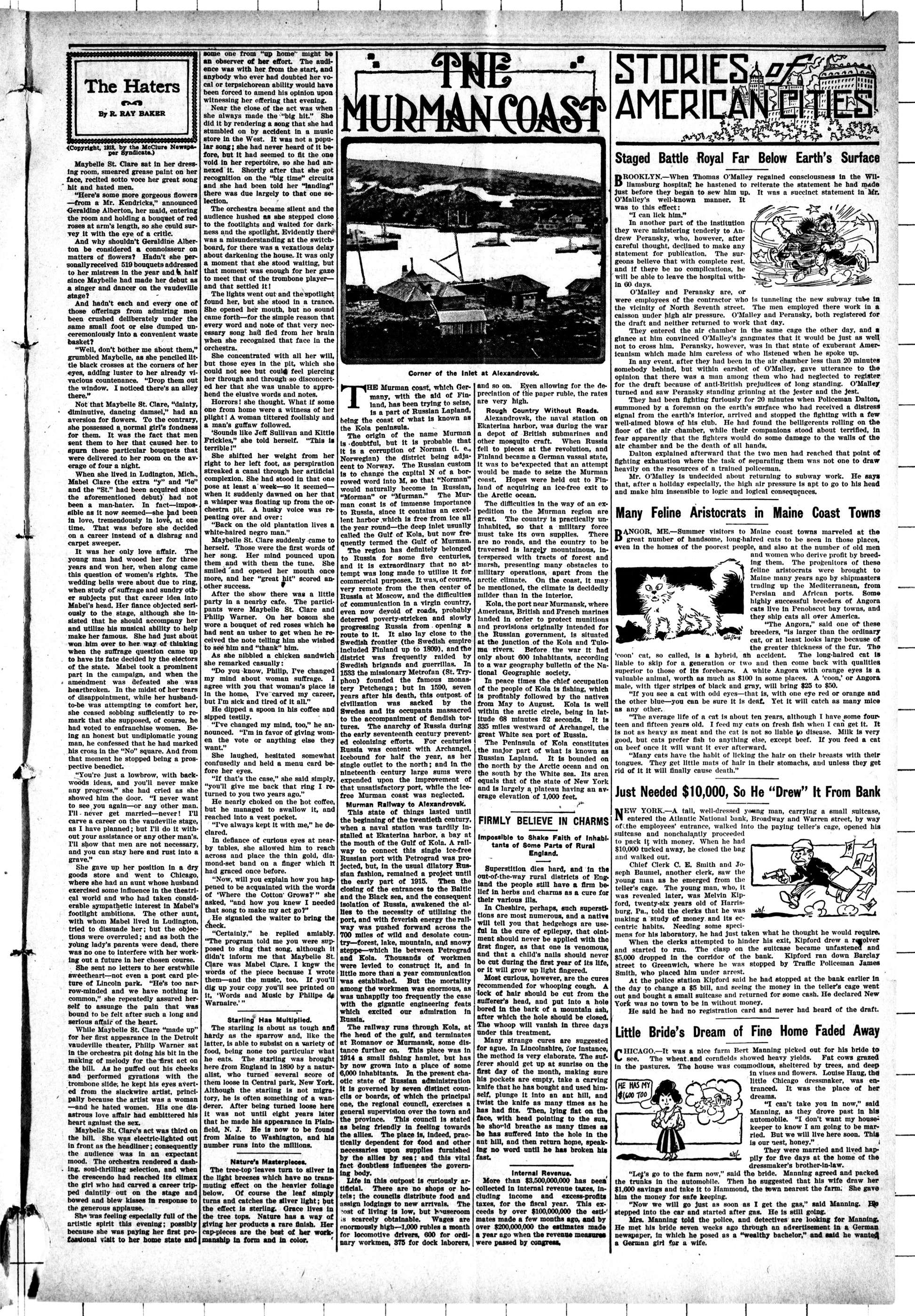
THE MURMAN COAST
Corner of the Inlet at Alexandrovsk.
being the coast of what is known as the Kola peninsula. The origin of the name Murman is doubtful, but it is probable that it is a corruption of Norman (l. e. Norwegian) the district being adjacent to Norway. The Russian custom is to change the capital N of a borrowed word into M, so that "Norman" would naturally become in Russian, "Morman" or "Murman." The Murman coast is of immense importance to Russia, since it contains an excellent harbor. which is free from ice all the year round—the deep inlet usually called the Gulf of Kola, but now frequently termed the Gulf of Murman.
The region has definitely belonged to Russia for some five centuries, and it is extraordinary that no attempt was long made to utilize it for commercial purposes. It was, of course, very remote from the then center of Russia at Moscow, and the difficulties of communication in a virgin country, even now devoid of roads, probably deterred poverty-stricken and slowly progressing Russia from opening a route to it. It also lay close to the Swedish frontier (the Swedish empire included Finland up to 1809), and the district was frequently raided by Swedish brigands and guerrillas. In 1533 the missionary Metrofan (St. Tryphon) founded the famous monastery Petchenga; but in 1590, seven years after his death, this outpost of civilization was sacked by the Swedes and its occupants massacred to the accompaniment of flandish tortures. The anarchy of Russia during the early seventeenth century prevented colonizing efforts. For centuries Russia was content with Archangel, icebound for half the year, as her single outlet to the north; and in the nineteenth century large sums were expended upon the improvement of that unsatisfactory port, while the ice-free Murman coast was neglected.
Murman Railway to Alexandrovsk.
This state of things lasted until the beginning of the twentieth century, when a naval station was tardily installed at Ekaterina harbor, a bay at the mouth of the Gulf of Kola. A railway to connect this single ice-free Russian port with Petrograd was projected, but, in the usual dilatory Russian fashion, remained a project until the early part of 1915. Then the closing of the entrances to the Baltic and the Black sea, and the consequent isolation of Russia, awakened the allies to the necessity of utilizing the port, and with feverish energy the railway was pushed forward across the 700 miles of wild and desolate country—forest, lake, mountain, and snowy steppe—which lie between Petrograd and Kola. Thousands of workmen were levied to construct it, and in little more than a year communication was established. But the mortality among the workmen was enormous, as was unhappily too frequently the case with the gigantic engineering feats which excited our admiration in Russia.
The railway runs through Kola, at the head of the gulf, and terminates at Romanov or Murmansk, some distance further on. This place was in 1914 a small fishing hamlet, but has by now grown into a place of some 6,000 inhabitants. In the present chaotic state of Russian administration it is governed by seven distinct councils or boards, of which the principal one, the regional council, exercises a general supervision over the town and the province. This council is stated as being friendly in feeling towards the allies. The place is, indeed, practically dependent for food and other necessaries upon supplies furnished by the allies by sea; and this vital fact doubtless influences the governing body.
Life in this outpost is curiously artificial. There are no shops or hotels; the councils distribute food and assign lodgings to new arrivals. The cost of living is low, but houseroom is scarcely obtainable. Wages are enormously high—1,000 rubles a month for locomotive drivers, 600 for ordinary workmen, 375 for dock laborers.
and so on. Even allowing for the depreciation of the paper ruble, the rates are very high. Rough Country Without Roads.
Rough Country Without Roads.
Alexandrovsk, the naval station on Ekaterina harbor, was during the war a depot of British submarines and other mosquito craft. When Russia fell to pieces at the revolution, and Finland became a German vassal state, it was to be expected that an attempt would be made to seize the Murman coast. Hopes were held out to Finland of acquiring an ice-free exit to the Arctic ocean.
The difficulties in the way of an expedition to the Murman region are great. The country is practically uninhabited, so that a military force must take its own supplies. There are no roads, and the country to be traversed is largely mountainous, interspersed with tracts of forest and marsh, presenting many obstacles to military operations, apart from the arctic climate. On the coast, it may be mentioned, the climate is decidedly milder than in the interior. Kola, the port near Murmansk, where Americans, British and French marines landed in order to protect munitions and provisions originally intended for the Russian government, is situated at the junction of the Kola and Tulomai rivers. Before the war it had only about 600 inhabitants, according to a war geography bulletin of the National Geographic society.
In peace times the chief occupation of the people of Kola is fishing, which is profitably followed by the natives from May to August. Kola is well within the arctic circle, being in latitude 68 minutes 52 seconds. It is 335 miles westward of Archangel, the great White sea port of Russia. The Peninsula of Kola constitutes the major part of what is known as Russian Lapland. It is bounded on the north by the Arctic ocean and on the south by the White sea. Its area equals that of the state of New York and is largely a plateau having an average elevation of 1,000 feet.
FIRMLY BELIEVE IN CHARMS
Impossible to Shake Faith of Inhabitants of Some Parts of Rural England.
Superstition dies hard, and in the out-of-the-way rural districts of England the people still have a firm belief in herbs and charms as a cure for their various ills. In Cheshire, perhaps, such superstitions are most numerous, and a native will tell you that hedgehogs are useful in the cure of epilepsy, that outlament should never be applied with the first finger, as that one is venomous, and that a child's nails should never be cut during the first year of its life, or it will grow up light fingered. Most curious, however, are the cures recommended for whooping cough. A lock of hair should be cut from the sufferer's head, and put into a hole bored in the bark of a mountain ash, after which the hole should be closed. The whoop will vanish in three days under this treatment.
Many strange cures are suggested for ague. In Lincolnshire, for instance, the method is very elaborate. The sufferer should get up at sunrise on the first day of the month, making sure his pockets are empty, take a carving knife that he has bought and used himself, plunge it into an ant hill, and twist the knife as many times as he has had fits. Then, lying flat on the face, with head pointing to the sun, he should breathe as many times as he has suffered into the hole in the ant hill, and then return home, speaking no word until he has broken his fast.
Internal Revenue.
More than $3,500,000,000 has been collected in internal revenue taxes, including income and excess-profits taxes, for the fiscal year. This exceeds by over $100,000,000 the estimates made a few months ago, and by over $200,000,000 the estimates made a year ago when the revenue measures were passed by congress.
STORIES of AMERICAN CITIES
Staged Battle Royal Far Below Earth's Surface
BROOKLYN.—When Thomas O'Malley regained consciousness in the Williamsburg hospital, he hastened to reiterate the statement he had made just before they began to sew him up. It was a succinct statement in Mr. O'Malley's well-known manner. It
O'Malley and Peransky are, or were employees of the contractor who is tunneling the new subway tube in the vicinity of North Seventh street. The men employed there work in a caisson under high air pressure. O'Malley and Peransky, both registered for the draft and neither returned to work that day.
They entered the air chamber in the same cage the other day, and a glance at him convinced O'Malley's gangmates that it would be just as well not to cross him. Peransky, however, was in that state of exuberant Americanism which made him careless of who listened when he spoke up.
In any event, after they had been in the air chamber less than 20 minutes somebody behind, but within earshot of O'Malley, gave utterance to the opinion that there was a man among them who had neglected to register for the draft because of anti-British prejudices of long standing. O'Malley turned and saw Peransky standing grinning at the jester and the jest.
They had been fighting furiously for 20 minutes when Policeman Dalton, summoned by a foreman on the earth's surface who had received a distress signal from the earth's interior, arrived and stopped the fighting with a few well-aimed blows of his club. He had found the belligerents rolling on the floor of the air chamber, while their companions stood about terrified, in fear apparently that the fighters would do some damage to the walls of the air chamber and be the death of all hands.
Dalton explained afterward that the two men had reached that point of fighting exhaustion where the task of separating them was not one to draw heavily on the resources of a trained policeman.
Mr. O'Malley is undecided about returning to subway work. He says that, after a holiday especially, the high air pressure is apt to go to his head and make him insensible to logic and logical consequences.
Many Feline Aristocrats in Maine Coast Towns
Many Feline Aristocrats in Maine Coast Towns
BANGOR, ME.—Summer visitors to Muline coast towns marveled at the great number of handsome, long-haired cats to be seen in those places, even in the homes of the poorest people, and also at the number of old men
'coon' cat, so called, is a hybrid, an accident. The long-haired cat is liable to skip for a generation or two and then come back with qualities superior to those of its forebears. A white Angora with orange eyes is a valuable animal, worth as much as $100 in some places. A 'coon', or Angora male, with tiger stripes of black and gray, will bring $25 to $50.
"If you see a cat with old eyes—that is, with one eye red or orange and the other blue—you can be sure it is deaf. Yet it will catch as many mice as any other.
"The average life of a cat is about ten years, although I have some fourteen and fifteen years old. I feed my cats on fresh fish when I can get it. It is not as heavy as meat and the cat is not so liable to disease. Milk is very good, but cats prefer fish to anything else, except beef. If you feed a cat on beef once it will want it ever afterward.
"Many cats have the habit of licking the hair on their breasts with their tongues. They get little mats of hair in their stomachs, and unless they get rid of it it will finally cause death."
Just Needed $10,000, So He "Drew" It From Bank
Just Needed $10,000, So He "Drew" It From Bank
NEW YORK.—A tall, well-dressed young man, carrying a small suitcase, entered the Atlantic National bank, Broadway and Warren street, by way of the employees' entrance, walked into the paying teller's cage, opened his suitcase, and conspicuously proceeded.
mens for his laboratory, he had just taken what he thought he would require. When the clerks attempted to hinder his exit, Kipford drew a resolver and started to run. The clasp on the suitcase became unfastened and $5,000 dropped in the corridor of the bank. Kipford ran down Barclay street to Greenwich, where he was stopped by Traffic Policeman James Smith, who placed him under arrest.
At the police station Kipford said he had stopped at the bank earlier in the day to change a $5 bill, and seeing the money in the teller's cage went out and bought a small suitcase and returned for some cash. He declared New York was no town to be in without money.
He said he had no registration card and never heard of the draft.
Little Bride's Dream of Fine Home Faded Away
Little Bride's Dream of Fine Home Faded Away
CHICAGO.—It was a nice farm Bert Manning picked out for his bride to see. The wheat and cornfields showed heavy yields. Fat cows grazed in the pastures. The house was commodious, sheltered by trees, and deep
"Let's go to the farm now," said the bride. Manning agreed and packed the trunks in the automobile. Then he suggested that his wife draw her $1,600 savings and take it to Hammond, the town nearest the farm. She gave him the money for safe keeping.
"Now we will go just as soon as I get the gas," said Manning. He stepped into the car and started after gas. He is still going.
Mrs. Manning told the police, and detectives are looking for Manning. He met his bride seven weeks ago through an advertisement in a German newspaper, in which he posed as a "wealthy bachelor," and said he wanted a German girl for a wife.
"I can lick him."
In another part of the institution they were ministering tenderly to Andrew Peransky, who, however, after careful thought, declined to make any statement for publication. The surgeons believe that with complete rest, and if there be no complications, he will be able to leave the hospital within 60 days.
O'Malley and Peransky are, or
were employees of the contractor who the vicinity of North Seventh street. calsson under high air pressure. O'Maile the draft and neither returned to work. They entered the air chamber in glance at him convinced O'Malley's gaze not to cross him. Peransky, however, icanism which made him careless of it. In any event, after they had been in somebody behind, within earshot opinion that there was a man among for the draft because of anti-British turned and saw Peransky standing grief. They had been fighting furiously for summoned by a foreman on the earth's signal from the earth's interior, arrive well-aimed blows of his club. He had floor of the air chamber, while their fear apparently that the fighters would air chamber and be the death of all I Dalton explained afterward that the fighting exhaustion where the task of heavily on the resources of a trained Mr. O'Malley is undecided about that, after a holiday especially, the high and make him insensible to logic and many Feline Aristocrats. BANGOR, ME.—Summer visitors to the great number of handsome, long-heven in the homes of the poorest people
Eddie Fargo
'coon' cat, so called, is a hybrid, a liable to skip for a generation or two superior to those of its forebears. A valuable animal, worth as much as $10 male, with tiger stripes of black and gn "If you see a cat with old eyes—you can be sure it is as any other.
"The average life of a cat is about teen and fifteen years old. I feed my y is not as heavy as meat and the cat is good, but cats prefer fish to anything on beef once it will want it ever after "Many cats have the habit of lick tongues. They get little mats of hair rid of it it will finally cause death."
Just Needed $10,000, So
NEW YORK.—A tall, well-dressed y entered the Atlantic National bank, of the employees' entrance, walked in
suitcase and nonchalantly proceeded to pack it with money. When he had $10,000 tucked away, he closed the bag and walked out.
Chief Clerk C. E. Smith and Joseph Baumel, another clerk, saw the young man as he emerged from the teller's cage. The young man, who, it was revealed later, was Melvin Kippford, twenty-six years old of Harrisburg, Pa., told the clerks that he was making a study of money and its eccentric habits. Needing some speci-
mens for his laboratory, he had just to
When the clerks attempted to him
and started to run. The clasp on
$5,000 dropped in the corridor of the
street to Greenwich, where he was
Smith, who placed him under arrest.
At the police station Klipford said
the day to change a $5 bill, and seein
out and bought a small suitcase and ret
York was no town to be in without me
He said he had no registration ca
Little Bride's Dream of
CHICAGO.—It was a nice farm Bert
see. The wheat and cornfields sh
in the pastures. The house was com
HE HAS MY
$1,600 700
"Let's go to the farm now," said t the trunks in the automobile. Then $1,600 savings and take it to Hammond him the money for safe keeping.
"Now we will go just as soon as stepped into the car and started after Mrs. Manning told the police, and He met his bride seven weeks ago the newspaper, in which he posed as a "w a German girl for a wife.
A
o is tunneling the new subway tube in
The men employed there work in a
valley and Peransky, both registered for
work that day.
In the same cage the other day, and
angnames that it would be just as well
was in that state of exuberant Amer-
er who listened when he spoke up.
In the air chamber less than 20 minutes
at of O'Malley, gave utterance to the
greg them who had neglected to register
prejudices of long standing. O'Malley
running at the jester and the jest.
For 20 minutes when Policeman Dalton,
's surface who had received a distress
and stopped the fighting with a few
found the belligerents rolling on the
companions stood about terrified, in
do some damage to the walls of the
hands.
The two men had reached that point of
separating them was not one to draw
policeman.
returning to subway work. He says
high air pressure is apt to go to his head
logical consequences.
in Maine Coast Towns
Maine coast towns marveled at the
alfred cats to be seen in those places,
pole, and also at the number of old men
and women who derive profit by breeding them. The progenitors of these feline aristocrats were brought to Maine many years ago by shipmasters trading up the Mediterranean, from Persian and African ports. Some highly successful breeders of Angora cats live in Penobscot bay towns, and they ship cats all over America.
"The Angora," said one of these breeders, "is larger than the ordinary cat, or at least looks large because of the greater thickness of the fur. The
with accident. The long-haired cat is two and then come back with qualities of a white Angora with orange eyes is a 100 in some places. A 'coon,' or Angora gray, will bring $25 to $50. What is, with one eye red or orange and deaf. Yet it will catch as many mice ten years, although I have some four cats on fresh fish when I can get it. It is not so liable to disease. Milk is very else, except beef. If you feed a cat toward. ing the hair on their breasts with their in their stomachs, and unless they get
He "Drew" It From Bank
young man, carrying a small suitcase, Broadway and Warren street, by way into the paying teller's cage, opened his
waf
taken what he thought he would require. Under his exit, Kipford drew a resolver of the suitcase became unfastened and the bank. Kipford ran down Barclay stopped by Traffic Policeman James. He had stopped at the bank earlier in the money in the teller's cage went turned for some cash. He declared New money. Hard and never had heard of the draft.
Fine Home Faded Away
It Manning picked out for his bride to bow heavy yields. Fat cows grazed modlous, sheltered by trees, and deep in vines and flowers. Louise Haug, the little Chicago dressmaker, was entranced. It was the place of her dreams.
"I can't take you in now," said Manning, as they drove past in his automobile. "I don't want my housekeeper to know I am going to be married. But we will live here soon. This is our nest, honey." They were married and lived happily for five days at the home of the dressmaker's brother-in-law.
the bride. Manning agreed and packed
he suggested that his wife draw her
the town nearest the farm. She gave
as I get the gas," said Manning. He
gas. He is still going.
And detectives are looking for Manning.
through an advertisement in a German
wealthy bachelor," and said he wanted
ila cere cel I cl beeen
THE TWIN CITY STAR
a =>
PUBLSHED EVERY FRIDAY BY
' CHARLES SUMNER SMITH,
Minneapolis, Minnesota.
‘Batered tn the Post Office at Min
Geapolis as second class matter.
[msriendicBets,raene
‘NATIONAL NEGRO PRESS
ly ASSOCIATION
‘Subscription by Mail, Postpaid.
ONE YEAR ........ece seer 0082.00
SIX MONTHS $125
THREE MONTHS ..........-. 68
ADVERTISING RATES.
Liberal discount given on 3, 6, 9,
Months, or 1 year contracts.
We do not run free ads, or over-run
the time contracted for by our ad:
vertisers We respect their right tc
advertise at intervals, and rather have
them do so, than to run continuously
‘an “adv.” and an increasing account.
Write all Checks payable to
THE TWIN CITY STAR
1317 North Sixth Ave.
MINNEAPOLIS -.- MINNESOTA
Call at 1317 6th Ave. N, on Wednes-
day to insure matter for publication.
‘Thé Star’s Phone, Hyland 1205.
Send your subscription. Our prices
ave not changed because of the war.
Let your dollar do its duty and The
Star will reach a higher standard of
service and better circulation.
A DEPOSIT 18 REQUIRED ON ALL
POLITICAL ADVERTISEMENTS.
NOTICE TO EXCHANGES.
The War Industries Board requests
that we discontinue “sending FREE
copies in exchange for other publica
tions.” In order to comply with their
request—we will send a check for s
yearly subscription to any weekly pub
lication sending a check for a yearly
‘subscription to The Twin City Star.—
(Baitor.)
Let us not draw the color line,
Reciprocity between the races will
be the salvation of the Negro.
UNCLE SAM IS CALLING
® FOR YOUR
FOURTH LIBERTY LOAN
ANSWER WITH CASH AND
CONFIDENCE. HERE IT 18.
“BUM” POLITICS.
‘We know no word better fitted for
the colored politician in Oregon than
“pum politics.” For years and yeara
the colored politician has voted for
the Republican party and handed out
political cards, orated, expostulated
and spilt oceans of printer's ink to
help elect some office-seeker and like
the “bum” who is out of work, the
colored politician {s still “splitting
wood” for a livelihood and tramping
on in the same old rut. “Bum pol-
itics,” to say the least. And it will
ever be thus just so loyg as the col-
ored politician and voters continue to
support parties and not men. Now
the best way to change the whole
“bum' local machine, which has dom-
{nated politics in the interest of a
favored few (and the colored brother
completely excluded) is to pick out
men for whom to vote at the coming
election and let the “party” go to the
“pow-wow.” And if this doesn’t bring
political leaders to their senses wheré
will they recognize a man by his
worth and not his color, nothing else
will, @hink it over—The Portland
(Ore.) Advocate, Sept. 21, 1918.
OUR UNCHANGED POLICIES.
Now that the candidates for of.
fice are entering the race in the com-
ing primaries, and The Twin City
Star has always taken an active part
im discussing the political situation
and presenting the issues of the cam-
paign; it will try to maintain its for-
™er policies of giving a fair expres-
sion of the attitude of all office-seek-
‘ers, @ far as the Negro is concerned.
Tt does not (for revenue only) write
Up every candidate as “a friend of
our race” or “the right man in the
Fight place.” It gives each the ad-
vantage of the columns under “paid
advertisements.”
‘The Twin City Star intends to ex-
Pose any candidate whose record has
‘een against the Negro. Its editor
hhas a fair knowledge of the history
‘of several campaigns and has made
@ study of the value of the Negro
‘vote. He 1s not bound by any indt-
vidual or party, and has stood, at
all times, for the political recognt-
tion of Negro voters. The Twin City
‘Star ts a paper with a worthy pur
Pose, recognized by its readers as
‘@ rellable source of information, an
intelligent and fearless advocate for
‘equal rights for all men.
It you wish to add to your income,
you can do so by accepting an agency
for The Twin City Star. Good com-
mission to competent agents. Use
Your spare time in soliciting ads and
Bubscriptions. Only honest and intel-
pect ‘agents wanted. Call Hyland
i
| Some people think an editor should
; ‘about their business without
sing told and it should appear in the
paper. The editor knows the things,
do not want in the paper. If you
‘sonething you want published—
ft im. ‘The other will find its
WITH THE SAGES
‘Judge not thy neighbor until thon
eomest into his place.—Rabbi Hillel.
Solid love, whose root {s virtue, can
no more die than virtue itself—
Erasmus.
He that wrestles with us strength-
ens our nerves and sharpens our skill.
‘Our antagonist ts our helper—Burke,
We judge ourselves by what we
feel capable of doing, while others
judge us by what we have already
done—Longfellow.
Misery and ignorance are always
the cause of great evils. Misery is
easily exelted to anger, and ignor-
ance soon yields to perfidious coun-
sels.—Addison,
As small letters hurt the sight, so
do small matters him that 1s too much
intent upon them; they vex and
stir up anger, which begets an evil
habit In him in reference to greater
affairs.—Plutarch.
Love one human being purely and
warmly, and you will love all. The
heart in this heaven, like the wander-
Ing sun, sees nothing, from the dew
drop to the ocean, but a mirror which
{t warms and fills.—Richter.
Do not be troubled because you
have not great virtues. Only have
enough of little virtues and common
fidelities and you need not mourn be-
cause you are neither a hero or a
saint—Henry Ward Beecher.
: ABOUT PERSONS
Mayor Hodgson orders noon victory
prayers in St. Paul.
‘Mrs. M. E. Chaman‘of Vienna, Ill,
has 12 grandsons in the war.
Olive Rhodes, sixteen, 1s an engineer
fn @ flouring mill in Atwell, Ind.
J. A. House of Clinton, Mont., al-
though a grandfather, has joined the
army.
Dr. H. W. Hicks of New York wants
to mobilize Sunday schools of the na-
tion in war work.
Jacob Van Vain, farmer of near
Montgomery, Mo., caught in a stall
fought a bull two hours before es-
caping.
James Hyland, twenty-five, who al-
most single-handed held Sergy, France,
against Germans, was formerly a New
York bank clerk.
Charles Sutherland, seventy, Micht-
gan man in Washington, has never
been in a saloon or theater in his life,
and never had a sweetheart.
SAYS THE OFFICE OWL
With the kaiser it seems to bet
Kill the women and children first.
The only way you tan get along
with some men is to walk the other
way.
‘We have never known a truly wise
man to brag nor a braggart who was
truly wise,
Money may be the root of all evil
but most people would like to have
a lot of it to plant.
Unfortunately when people find it
necessary to economize charity 1s
the first thing to get it in the neck.
‘We hold no brief for ingratitude but
neither do we think that. the doer
of a kindness has a right to demand
abject servitude in return,
‘The reason some men don't get cred-
It for what they can do is because they
nevér do the things they are afraid
someone else will get the credit for.
FROM COMMERCE REPORTS
In Paraguay’s, furniture factories
most of the work is done by hand.
‘The Netherlands government has
requisitioned the entire Dutch flax,
flax @faw and linseed crops for the
year 1918,
One result of the restriction upon
the importation of graphite crucibles
has been to develop an adequate sup-
ply of graphite within this country.
Germany Is making plans to secure
easy access to raw materials of trade
and industry in order to secure its eco-
nomle recovery after the conclusion of
Peace.
Japan's government is taking steps
to lower the price of rice in that coun-
try, appointing several firms to act a8
importers, It will require the rice
to be sold at a fixed price,
_ Until six months after the end of
the war all persons in Italy who carry
on the exchange of moneys or deal in
gold must keep a special register for
transactions in the yellow metal.
SAYINGS OF THE GREAT
‘The mattock will make a deeper
hole in the ground than lightning.—
Horace Mann.
Men are judged not by their inten-
tions, but by the results of their ac
tlon.—-Chesterfieid.
PENCIL THRUSTS
- Pattence is the most €esential tm
-gredient of genius.
| 2
Count the day completely lost if
you have not laughed.
To the gentleman every woman Is &
lady, by right of her sex.
A woman with a three-inch tongue
can make a giant feel like a midget.
All the world’s a stage and all the
supers imagine that they are stars,
We believe that opportunity raps
more than once, but we don't belleve
‘that {t camps on a man’s doorstep.
| The man who thinks a good deal of
I¥s wife should not attempt to conceal
his thoughts when he is alone witb
) her.
Many a man’s failure is due to his
having wasted his time in envying the
success of his neighbor's strenuous ef-
forts.
Yes, Luke, nine wives out-of a pos-
sible ten can see where they made a
mistake by not marrying the other
fellow. \
‘The individual who sits next to a
fat man in a crowded street car Knows
what it is to have greatness thrust
upon him,
If a man has plenty of change in his
Pockets when he goes to bed his wife
may not have occasion to ask him
for pin money. %
POINTED PARAGRAPHS
Theorles cause more worry than
facts, -
A filrt ts a girl who is afraid she wil
be left at the post.
There is no end of trouble in a fam
lly that has two heads.
‘The more women see of men tht
more they see to admire in mirrors,
All women follow the fashions, but
some are a long distance behind.
A soft answer may turn away
wrath, but it isn’t always best to cal
a man soft.
‘The trouble with many a young
man fs that he spends his fortune be-
fore he gets it.
Many a timid man gives another
credit for his own ideas because he
isn't quite sure of thelr merit—Chi-
ago Dally News.
Heteneterexenrorerererotes
€ STATISTICAL NOTES 3%
‘The Mormon church in Utah
_ has turned over to the govern-
ment its wheat reserve of 250,000
bushels, collected from tithes,
Frank H. Buhl, the millionaire
steel magnate, who died recent-
ly, left $2,000,000 to war suffer-
ers in northern France and Bel-
gtum,
‘Thirty thousand women and
girls of Austria have been driven
by hunger to join the labor bat-
tallons working near the Aus-
trian front,
Every company of American
soldiers abroad is allowed to
adopt ond war orphan. The to-
tal cost to each soldier is 25
cents a month.
enenerererewerererexere
AVERSIONS OF THE GREAT
Hannibal did not use tobacco in any
form,
Gollath absolutely declined to don
BV. D's.
Genghis Khan preferred the steps to
the elevator.
Moses had an unconquerable aver
sion to motorcycles.
Doctor Johnson would not put bis
foot in an automobile. :
Old Colonel Eve positively refused
to wear corset-covers,
Peter the Hermit never spent a cent
for phonograph records.
Gustavus Adolphus would not pe
tronize the parcel post.
Nero couldn't be persuaded to buy
an electric fan.—Columbia State,
SPLINTERS
A profiteer is without honor even in
his own land.
‘The fellow with the shallow mind
1s not the one who has the clearest
thinks,
Politics is an instrament which pro-
duces discord when played. It is al-
ways out of harmony with the other
party.
‘What mystifies most people is where
there lazy, overfed restaurant files
get the pep.to be eo disgustingly pley-
ful at timea
PROPOSED
AMENDMENT
OTHE ;
“SNSTITUTION
OFTHE
STATEOF MANESUTA
PURPOSE
AND EFFECT
PREPARED BY
CLIFFORD L. HILTON
JWUUS A SCHMARL
As required by Section 46, General
Statutes of the State of Minnesota for
the year 1913, I have the honor to fur-
nish you herewith a statement of the
purpose and effect of the amendment
Proposed to the Constitution of the
State of Minnesota by the Legislature
of 1917, and which is to be submitted
to the electors of sald State at the
General Election in 1918.
PROPOSED AMENDMENT.
Coapter S15 of the. Besson Laws of
Minnesota for the year 1917, proposes
an amendment of Article 15 of the Con-
stitution of said State by adding there-
to a new section to read as follows:
“Section 6, The manufacture,
sale, barter, gitt, disposition, or the
furnishing,” or ‘transportation, or
keeping or having in possession for
sale, barter, gift, disposition, or the
farnishing, or transportation of in-
toxleating liquor of any kind, in any
quantity whatever, except for sac-
Famental, mechanical, scientific, or
medicinal purposes, shall be forever
prohibited within this state from
and after the first day of July, 1920,
and this amendment shail be selt-
executing. ‘The legislature shall
enact laws for the enforcement of
this section and shall provide sult~
able penajties for the violation
thereof.”
THE PURPOSE of the proponed
amendment in to forever prohibit with-
im the State of Minnesota after July 1,
1920, the manufacture, sale, barter, gift,
disponition or the furnishing or trans-
portation, or the keeping or having in
Pousenston for any of much purposes,
of intoxicating Hauer of any kind in
any quantity whatever, except for anc-
ramental, mechanical, sctentific or me-
@icinal purposes.
‘THE EFFECT of the proposed amend-
ment, if adopted, will be to make un-
Igwfal and forever prohibit the manu-
facture, sale, baxter, sift, disposition o7
‘the furnishing or transportation or the
Keeping or having in possension for any
of auch purposes, of intoxicating Hquor
of any kind in any quantity whatever,
except for sncramental, mechanical,
sclentide or medicinal purposes, within
this state after July 1, 1020, and to
Place it beyond the power of any legis-
Intive authority to permit the doing of
any such acts. If adopted, the doing
Of any of the prohibited acts automati-
eally becomes unlawful atter July 1,
1920, without any action om the part of
the legislature or other legislative body.
‘The amendment is made nelf-exccuting.
A duty Is, however, imposed upon the
legislature to enact laws for the ‘en-
forcement of this nection, if adopted,
and to provide penalties for the viola-
then thereot.
Yours respectfully,
CLIPYORD 1. HILTON,
‘Atterncy General.
WILSON REPLIES:
TO GERMAN NOTE
President’s Answer Will Develo}
Whether Berlin Officials
Are Sincere.
QUESTIONS ARE ASKED
United States Declines to Propose on
Armistice While the Armies of
the Central Powers Remain
on Invaded Soil.
deace note has been met by President
‘Wilson with a reply which will at one
stroke develop whether her proposal
is sincere or merely a pretention, and
if a pretention it be, fully justify for
all time before the world the prolong-
ing of the war with “a force to the
utmost, force without stint or limit.”
At the same time the President has
left the door to peace wide open.
Declining to propose an armistice
while the armies of the Central powers
remain on invaded soil, the President
called on the German chancellor to
state, as an absolutely necessary pre-
Mminary to a reply from the Allies
and the Tul States, whether Ger-
many accepts’ the principles of peace
as repeatedly laid down or merely pro-
Poses to accept them “as the basis of
negotiation,” and whether the chan-
cellor merely speaks for the military
masters conducting the war or the
whole German people.
‘The text of the President's communi-
cation was made public by Secretary
Lansing, together with the official text
of Prince Maximilian's note now pub-
lished in America for the first time.
At the same time officials let it be
known that there would be no reply
at present to the Austrian note sim-
far to that of the German chancellor.
It is not considered necessary to deal
with Austria until the time comes for
a reply to her dominating ally.
‘The text of the communication
handed to the charge of Switzerland
here follows:
President Wilson’s Note.
“Sir:—I have the honor to acknowl
edge, on behalf of the President, your
note of Oct. 6, enclosing the communi-
cation from the German government
to the Presidegt; and I am instructed
by the President to request you to
make the following communication to
the imperial chancellor:
“Before making reply to the request
of the imperial German government,
and in order that that reply shall be
candid and straightforward as the
momentous interests involved require,
the President of the Unfted States
deems it, necessary to assure himself
of the exact meaning of the note of the
Imperial chancellor. Does the imperial
chance!lor mean that the imperial
German government accepts the terms
laid down by the President in his ad-
dress to the Congress of the United
States on the 8th of January last, and
In subsequent addresses, and that its
object in entering into discussions
would be only to agree upon the prac-
tical details of their application?’ ”
“The President feels bound to say
with regard to the suggestion of an
armistice that he would not feel at
Uberty to propose a cessation of arms
to the governments with which the
government of the United: States is
associated against the Teutonic pow-
ers, so long as the armies of those
powers are upon their soil. The good
faith of any discussion would mant-
testly depend upon the consent of the
Teutonic powers immediately to with-
draw their forces everywhere from in-
vaded territory.
“The President also feels that he is
Justified in asking whether the imper-
fal chancellor ts speaking merely for
the constituted authorities of the
empire who have so far conducted the
war. He deems the answer to these
questions vital from every point of
view.
“Accept, sit, the renewed assurances
of my high consideration.
“ROBERT LANSING.”
ITALIAN SOLDIERS WARNED
SEO aa oon Se
Washington, Oct. 9.—General Diaz,
commanderin-chief of the Italian
armies, has issued a general order re-
‘minding his soldiers that the enemy
still is on Italian, French amd Belgium
soil and calling on them not to be
weakened by figttering hopes of peace,
but to hold themselves in. readiness
to completely crush the enemy if his
peace offers prove to be “a fresh form
of the old guile.”
Jealousy Causes Four Deaths.
Ephrata, Pa. Oct, 9. — Evidently
riven insane through Jealousy, Robert
Beacham, 30, murdered his young wife
‘and their two children. He ended his
own life. ,
‘On Special Mission to Vatican.
Rome, Oct. 9.—Alfongo de Navarre
of New York has arrived here on a
special mission to the Vatican, He
thas been appointed by Cardinal Gib-
‘Dons as special commissioner of the
‘American National Catholic War Coun-
¢fl to investigate and report on Cath-
olic war activities in Italy, France
‘amd England. He will be received by
‘Cardinal Gasparrl, papal secretary of
‘state. Pope Benedict is much grati-
fied by the sending of this mission tc
‘the theaters of war.
Nothing Changed
But the Price
Sight Drafts Still the Same Fine Old Cigar,
You've Always Liked
To: yous old tiged Bight Deck
Bite eg
don’t get the ides that bp is trying to put.
something over om you.
‘The plain truth of the matter is that
eur labor and other manufacturing costs.
have increaséd so much that we had the,
choice of cutting down the size of the |
Bight Dra cle seing lnderiortohasen
Bes el dee eg ae
We rte would rather have
the same old Sight Draft quality, the
same old size, even if it cost you a penny
more. So, from now on Bight Drafts will
be six cents. * ,
Try a Sight Draft todey. It’s worth |
six centa, and you experienced smokers:
KNOW it is. W. K. Gresh & Sons,
makers. W. 8. Conrad Co, St Paal, |
wholesale distributors. —Advertisement.
CHOICE CITY AND SUB
BAN PROPERTY FOR SA!
DN SMALL MONTHLY PAY.
MENTS.
Houses and Flats for Rent. 7
B. M. McDew
802 Sykes Block:
N. W. Nic. 621 Minneapolig
|
Offica Hours: Sundays:
3to6 p.m. 10 tol p. my
9:30 a. m. to 12:30 p. m.
R.S. BROWN, M.D.
~ Office 408-9 Tribune Annex
67 Fourth Street Soutr,
N. W. Main 2040, T. 8. 38199
Res. 608 E. 14th St.
N. W. Main 2388 Minnespoli¢
WORKING-MEN’S.
FOR MEN ONLY
244 3RDAVE.S.
MINNEAPOLIS:
SYLVESTER W. OLIVER & P.
BENJAMIN JONES
Managers
at
Peterson, The Druggist
1501 Weshingion Ave. So.
TOILET ARTICLES, DRUGS)
PRESCRIPTIONS. °
He Solicits Your Patronage.
T. 8. Center 4639.
WALFRID WESTMAN
Photographer
1425 Washington Ave. Se. Minn,
THE KEYSTONE BUFFET
(Formerly “Kid” Mitchells)
‘Now under new management of
JIMMY SMITH
1313 Washington Ave So.
Main 2259 Minneapolis.
7 Noe i
PLB 27
Bate he Bete
Tha Minpeapolis
Are you a delinquent subscriber?
If s0, why not send your subscrip-
tion?
SMOKE THE RELIABLE
SIGHT DRAFT CIGAR
THAT'S ALLE
xe RON ae
png RRR RE er re One Or ae
Brie a ie TY st POLIS, MINN, rE nae rnin eae
4 POR ee eT SS ae JIN CITY STAR, POL NO :
‘ Bene a cae Rr ate eee t
PRE igen ges SN hla eS na
gi || SRR AO nan eB RE To AE rs okie RR al ee la
+
LOCAL NEWS
IMPORTANT NOTICE
Unless ‘notes are written plainly
and properly arranged they will not
be inserted. Many people send in
notes regardless of names, initials or
composition. Arrangement by the
publisher will be charged for. Free
notices must be correctly written.
CLAIMED TO BE AN
s ARMY OFFICER
Now Driving Coal Wagon. ~
A young man arrived a few weeks
age, woering. en. offcers uniform
(which had seen sevete service) and
the gold bar of a sedond lieutenant.
He claimed to be Lieut. Robt. G. Smith
of the Tenth Cavalry. After receiving
every couftesy within the gift of sev-
eral friends, who had become inter-
ested in him, he proved to be an {m-
poster. An investigation by the. mili
tary authorities was asked for by Capt.
Chas. Sumner Smith. The young man
was found to be a mysterious char-
acter. He would give no information
as to his former whereabouts. He was
treated as an army officer while under
investigation, receiving every due
courtesy and privilege, also while at
Ft. Snelling, until it was decided that
‘Mr. Smith was a man without honor.
He was stripped of his offictal insignia
and put in command of a team of
mules hitched to a coal wagon. Now
he is regarded as a deserter or slacker
and held by military authorities.
’A GENERAL MEETING.
A general meeting of the Minneapo-
lis branch of the N. A. A. C. P. will
be held on Sunday, October 18th at
Bethesda Baptist church, at 3:00 p. m.
Rev. Anderson to Speak.
Rev. Anderson, the new pastor of
St. James A. M. E. church of St. Paul
will be the principal speaker. All
members are requested to be present
as matters of importance are to be
discussed, and reports made.
B. 8. SMITH,
President.
R. AUGUSTINE SKINNER,
Secretary.
Atty, B.S. Smith reports a profit-
able interview with The New Eng-
land management on discrintination
againgt Negroes as to employment.
MOTORED TO CAMP DODGE.
Mrs, G. D. Smith and daughter, Miss
L. O. Smth, Mr. and Mrs. B. S. Smth,
and Mr. B, M. McDew motored to Des
Moines and Camp Dodge last week.
They had a pleasant trip.
‘Mr. John Bright went last week to
his home, Mexico, Mo., on account of
the death of his sister, Mrs. Eliza
Nichols.
Several laborers from the harvest
fields have returned after @ good gea-
son. They-received high prices for
their work and reported a special de-
mand for Negro laborers under most
favorable conditions.
Mr. Edward Bishop, 3651 Snelling
Ave. has sent his subscription in ad-
vanee and best wishes to The Twin
City Star. He is among our loyal sup-
porters and is interested in every ad-
vancement of our race. The Star
needs such friends now. Many thanks.
St. Geo. L. Hoage, of the Major's
Staff of the 16th Battalion, M. H. G.,
has been appointed acting Adjutant.
HOME GUARDS TO PARADE.
The 16th Battalion Band and Com-
panies C and D will take part in the
Liberty parade on Saturday, Oct. 12,
commemorating the anniversary of the
discovery of America by Christopher
Columbus,
SUPPER AND BAZAAR.
Queen Esther Temple No, 2, 8. M.
., will hold their Annual Bazaar and
Supper at Masonic hall, 24th St. and
5th Ave. S. Minneapolis, on Monday
evening, October 2ist. Admission
Free. Everybody welcome.
ST. PAUL HOME GUARDS.
Companies A and B of the 16th
Battalion, M. Hy G., will hereafter
meet every Wednesday night in the
‘old Capitol on Wabasha street. The
Armory is used for the National
Guard.
Mrs. Robt, Hill, 623 Sixth Ave N., is
very ill.
Mr. P. F, Jones, employed on the
Soo Railway, arrived home Tuesday
evening suffering with influenza.
Mr. Geo. Neale, a waiter for many
years in this city, was buried on Mon-
day. Funeral at Lawrence's Chapel.
Manager John A. Dickerson and Sec-
retary Hamlét B. Rowe, of the Dick-
erson’s Combination Shows, have
ended their summer season. They ar-
rived home this week.
“Uncle Jim” Branch, one of the
oldest members of Ames Lodge of
Eiks, was confined to his home, 3511
E. 89th St. on account.of fliness, but
is able to be out again.
ODD ‘FELLOWS ELECT OFFICERS.
‘St. Anthony Lodge No. 2877, G. U.
0. of Odd Fellows, elected the follow.
ing officers: W. W. Williams, N. G.;
J, W. Whitely, V. @.; M. L. Brown,
P. N. Gj George Peale, E. 8.; Wm.
R. Morris, P. $.; Noah C. Stone, W.
‘.; J. J. Turner, N, F.; 1. 8. Bogie, P.
N. F.; 0. 8. Lee, Chaplain; 0. A. Law-
tenes, Advocate; Was: Jenkins, War
COLORED APPLICANTS REJECTED
‘The Bee desires to emphasize its
protest against the wholesale discrim-
ination in the Government, depart-
ments against colored applicants who
have successfully passed the civil
service examination. What does it
mean? The Bee again asks, The col-
ored Americans are loyal to this Gov-
ernment and they are doing every-
thing in their power to afd the Ad-
ministration in the successful prose-
cution of this war. What offense can
be charged against colored Ameri-
cans? The Bee asks again. The bars
have been lifted so that 2 certair fa-
vored class can pass muster without
an examination, while another class
is compelled to enter examination and
atter passing successfully is rejected.
What does it mean? A declaration
has been reported to this office'to the
effect’ that no colored people will be
appointed by this particular official.
4n response to the -request made by
The Bee last week, many persons
have anmoynced that they. have been
rejected by the departments. It is
necessary that every colored. person
who has been rejected send in his or
her name at once. These names will
be presented to the proper heads at
‘once.
Advertisements are being published
daily that the Government is in need
of clerks and other employees for war
work. Hundreds of colored Americans
have applied and been rejected, and
white ones cannot be obtained. Mes-
senger boys have been advertised for
‘and colored people have applied, only
to be refused. Is the assistance of
colored Americans needed? If s0,
they are willing and ready to respond
to their country’s call.
If they are needed, and the Govern-
ment is in need of help, why reject
colored applicants? Show one black
traitor in the ranks of colored Amer-
feans and The Bee will show you one
million loyal colored Americans to one
black traitor. The Bee appeals to the
President of the United States to di-
rect the heads of his departments to
Uft the bars of discrimination against
the colored Americans. They are
competent and loyal. Then why re-
ject them?
Every Southern railroad discrimi-
nates against the colored people with-
out @ just cause. They are treated as
cattle when riding South. They ay
directed to a box car with no con-
veniences. Does the colored Amer-
fean deserve such treatment? Mr.
President, we are with you, and, in
the name of God, see that we are
given a fair deal—The Washington
(D. C.) Bee.
Statement of the Ownership, Manage-
\ Ment, Circulation, Etc., of
THE TWIN CITY STAR
Published Weekly at Minneapolis,
Minn, Required ,by ‘the rr
“Congress August 24, 1912:
Editor, Manager, Publisher and
Owner: Charles Sumner Smith, Min-
neapolis, Minn. #
oq known bondholders, mortgagees and
other security holders, holding 1 per
‘cent or more of total amount of bonds,
mortgages, or other securities—None.
- Signed,
CHAS, SUMNER SMITH.
Subscribed and sworn to before me
this 8rd day of October, 1918.
GALE P, HILYER,
Notary Public, Hennepin County,
Minn.
My commission expires March 24,
1922.
(Notarial Seal.)
PASTOR CONDEMNS ACCUSERS,
Rev. T. B. Stovall in a recent ser-
mon at St. Peters A. M. E. church ad-
dressed himself in no uncertain tones
to persons who wrote letters to the
Bishop about his service as pastor.
Rey. Stovall has not poured oil on
troubled waters but has added fuel to
flames. Now, that letters have proved
effective, more may follow. Who
wrote the letters?
Maj. Jose H. Sherwood spoke to an
appreciative audience at the Sunday
Forum last Sunday on “‘The Negro in
‘This War.” Mrs. Lewis of St. Paul
rendered a beautiful solo. Miss
Frances Duncan read very instructive
“Current Events.” Mis. 1. 8. Bogie
made a splendid report on results of
‘social service work. Miss Whiteside
read the minutes of previous meeting.
Dr. Beorton presided.
Mrs, Clarence Cunningham has
opened a millinery department in con.
nection with Mrs. Van Hook's, the
dressmaker at 1006 Sixth Ave. N., Min.
neapolis. She offers special bargains
te millinery,
Mr. Ira S. Ashe has been appointed
clerk im the county auditor's office in
St. Paul, to succeed Mr. Ori C. Hall,
who .entered the Y. M. C. A. work.
Mr. Ashe is thoroughly competent and
his appointment meets the approval
of our best citizens and the public
in general.
FOR RENT—Three nice rooms for
light housekeeping; newly papered;
modern; near car lines. Apply to Car-
roll, 3102 Blaisdell ave., city.
. For Rent—One furnished room, for
‘one or a couple. Modern except heat,
near car line, desirable location. Mrs.
W. W. Williams, 2900 Eleventh Ave.
8, Phone Drexel 4728.
N. W. Nicollet 1534
( JOSEPH YOUNG
Loans on Real Estate
818 Metropolitan Life Bidg.
Minneapolis, Minn,
== Brief Items of ==
State News
Sownship farmer, was arrested on a
charge of hiding his 37-year-old son
on registration day, September 12, and
telling officials that he was in Minne-
apolis,
Pine City.—Most of the potatoes in
the Pine City locality have been: har-
vested and the same condition pre
vails generally over the county. There
are only scattering fields left unhar-
vested.
Crookston.— Passengers on early
morning trains coming into this place
were forced to walk more than two
‘miles into town because of an accident
to a car loaded with wheat, which tied
up trafic,
Lakefield.—Following adoption of
resolutions by the Commercial ¢lub
and Loyalty legion, signs haye been
posted in all business places and for
miles around reading, “Please Speak
American.”
Pipestone.—The Pipestone Grand
Army post has received notification of
the death of George W. Bettesworth at
the soldiers’ home at Marshalltown,
Iowa. Mr. Bettesworth was e”ploneer
resident of Pipestone.
Crookston.—All potatoes shipped for
commercial purposes must be graded
and A. P. Rehl, inspector for the Fed-
eral food administration in Minnesota,
has been in Polk county to arrange for
the enforcement of the rule.
Winona.—James MeConnon, for thir-
ty-two years identified with the lum-
dering industry here and a conspicu-
ous figure during the palmy days of
the business along the Mississippi
river, died in this city, aged 84.
St. Cloud.—For the third time an in-
cendiary fire was discovered in the
Fourth avenue apartment house here
and extinguished before gaining head-
way. Each time a pile of shavings
have been neatly pfled alongside the
building and set on fire.
Hibbing—The Hibbing police are
holding a 9year-old boy who entered
the Lippman apartments and stole
$180 belonging to a roomer while the
latter wap absent. The police located
the youth in Duluth, where he had
gone after the theft, and brought him
back’ to Hibbing.
Pipestone—That too much sweet
corn is disastrous to cattle has been
proven by the experience of John
Birkeland, farmer living across the
county line south of here.* Birkeland
turned a herd of 26 of his milch cows
into a field of the corn and five of the
animals are dead as a result.
Pine City.—In a fit of despondency,
Mrs. Ben Miller shot and killed her-
velf at the family farm, about three
and a half miles southwest of Bruno,
with a rifle, the first shot plercing har
heart. Her husband was at work in
the field at the time She leaves three
children, the oldest 8 years and the
youngest a baby of 3 months.
Hinckley.—A ‘fire that has been
burning for the last six weeks in a
Peat bog on land owned by James Mc-
Nett, west of Friesland, became fanned
into flames in the high wind and
spread over the surrounding country,
threatening several haystacks and
burning,a big stack of: good hay owned
by Albert Carlson and Nels Oakland.
McGregor—Thousands of dollars
worth of hay and timber and several
homes and other buildings have been
destroyed in this locality in the past
few days by fires that are now being
fought by Ironton, Aitkin and Moose
Lako Home Guards. This town has
been nearly afire several times and
residents are all prepared to move out.
‘Winona.—The distriet convention of
the Church of Christ of Southern Min-
nesota has closed a two-day session
here. Officers elected were: Presi-
dent, N. K. Flint, Winona; vice presi-
dent, John Hall, Austin; secretary-
treasurer, H. J. Hill, Plainview; C. E.
superintendent, F. D. Smith, Roches-
ter; S. S. superintendent, Margaret
Stran, West Concord.
East Grand Forks.—Alice Amond-
son, 16, daughter of Mr. and, Mrs.
Christ Amondson, residing near here,
disappeared a few evenings ago and
has not been heard from since. She
was reported to have been seen on the
Great Northern railroad bridge around
10 o'clock p. m. Whether she took
passage on one of the outgoing trains
at that time is not yet known.
Bemidji-—A’Woint meeting of the
clergy of the Episcopal deaneries of
the Red River valley and the Missis-
sippi valley will be held in St. Bar-
tholomew’s church, Bemidji, Oct. 23
and 24. About twenty-clergymen will
be present with Bishop Morrison of
Duluth. Rev. Mr. Hudson of Paynes-
ville, Minn,, will preside as dean of
the Mississippi valley convocation.
‘Minneapolis. — George Brambilla,
who died in the City hospital forty
hours after the point of a long steel
pin had been driven into his heart,
was murdered, Coroner Gilbert Sea-
shore believes. It 1s believed by the
police that statements accredited to
Brambilla to the effect that he re-
celved the pin thrust while hugging a
| wirhepage Gs aoe es: dak he quae
Guard has been ordered disbanted.
Winona.—Local Poles raised $16,000
in @ oneday drive for the benefit of
the Polish army which is being organ.
ized in Russia.
- Genoa—Dennis Sullivan, formerly
of Ironwood, Mich,, committed suicide
by shooting himself. He was supply
clerk at the Genoa niine.
Baudette—There were sixteen cases
before the Liberty bond board of re
view. Many of these were raised and
two refused to take their allotment.
Virginia—The body of Mike Sitka,
the last victim of the Silver mine dis-
aster, has been recovered. He was 35
and has a cousin living on the range.
Fairmont—Members of the Martin
County Motor corps are standing guard
over two saloons and a wholesale
Mquor house at Ceylon, closed by the
safety commission.
Willow River.—Steve Foster of this
place, who murdered hig common law
wife here last summer, was convicted
of first degree murder at Pine City
and given life in the state peniten-
tiary.
Rochester.—Attacked by an enraged
dull, John Feil, a farmer residing near
Rochester, is in a critical condition.
Feil was knocked to the ground and
trampled on, and was unconscious
when found.
Waterville—Mahlon R. Everett, for-
mer state senator from Le Sueur coun-
ty, died at his home in Waterville.
He served nine years as county school
superintendent, and at the time of his
death was village attorney.
Brainerd —Dick Sagli, @ farmer Iiv-
ing five miles east of Brainerd, has
had a lghting plant instslled to illu-
minate his house, milk douse, barn
and garage. A water pressure system
gives running water in his home and
barn and milk house.
Barnum.—Ray Barber, sald to have
sulle from Pequet, Minn, who per
ated a near-beer stand during thé fair
here, passed a number of worthless
checks, gaining thereby $50 or $60.
Ray Barber, it is said, is the same
man who bought fron and junk at
‘Moose Lake several weeks ago.
Brainerd.—Operating under the di-
rection of County Attorney 8. F. Al-
derman, Sheriff Claus A. Theorin and
deputies with Federal officers, arresté
ed nine Austrians on the Cuyuna iron
range charged with selling liquor with-
out a license. There are five women
and four men in the party, and they
were brought to Brainerd, where they
were arraigned.
‘Winona.—F, R. Stevenson, slayer of
Himer Mead, May 21 last, was found
guilty by a jury in district court of
manslaughter of the first degree. The
Jury deliberated thirteen hours. The
verdict carries an indeterminate sen-
tence from five to twenty years. Stev-
engon shot and killed Mead and at-
tempted to kill his own wife. He
pleaded “temporary insanity” during
the trial.
St. Cloud. — Abatement. proceedings
have been started against a “sanutor-
jum"yeonducted by Dr. and Mrs. W. A,
Bach: of East St. Cloud. The place,
which has been conducted by Dr. and
Mrs. Bach as a medical institution and
rest cure for the past year, was raided
recently by the police and evidence
found that it was being conducted a3 a
disorderly house. Dr. Bach was fined
$100 in the justice court.
_ St. Paul—John H. Quackenbush, ar-
rested in Montana several weeks ago
on the charge of stealing ten head of
horses from Barrett & Zimmerman,
Unriversity avenue horse dealers, and
brought back to St. Paul, pleaded
guilty to grand larceny in the second
degree before Judge F. N. Dickson in
district court. He was sentenced to
an indeterminate term at Stillwater
prison.
Crookston.—About 75 per cent of the
money required to construct a live-
stock pavilion to cost about $20,000 to
be used in connection with the farm
crop show next year has been pledged
and the’enterprise is assured. The
amount pledged includes $10,000 by
Polk county, covering onehalf of the
cost of the building; $2,000 by Mar-
shall county, $1,500 by Norman coun-
ty, $1,000 by Red Lake county, $1,000
by Kitson county, $200 by Mahnomen
county.
St. Paul—A record movement of po-
tatoes by railroads in Minnesota and
Wisconsin is disclosed by an inquiry
into the car supply situation. Up to
Oct. 1 the four principal potato haul-
ing lines had transported 10,884 cars,
more than twice as many as last year,
when 4;756 cars were handled. The
Soo line had hauled 1,883 cars, North-
ern Pacific 3,076, Great Northern 3,642
and the Omaha 1,463, State officials
find there is an adequate supply of
cars for immediate needs.
Brainerd —Six ministers are about
to leave Brainerd for new pastorates
ee are considering calls. Rev. G. v.
‘Sheridan of the First Congregational
has accepted the pastorate at Farl-
Sang yn alge sh hte tc eS
eee ee ee ot a eee
Soo line had hauled 1,883 cars, North-
ern Pacific 3,076, Great Northern 3,642
and the Omaha 1,463, State officials
find there is an adequate supply of
cars for immediate needs.
Brainerd —Six ministers are about
to leave Brainerd for new pastorates
or are considering calls. Rev. G. ¥.
Sheridan of the First Congregational
has accepted the pastorate at Farl-
bault, Rev. Theodore Clemens of the
Bethany Mission church has gone to
Stillwater, Rev. F. W. Hill of the First
Methodist church may leave the city,
Rev. William Lloyd Crist of the Peo-
ple’s Congregational church has re-
ceived several calls, Rev. M. L. Hos-
tager of the Bethlehem Norwegian
Lutheran received a eall to Battle
Lake, Rev. Elof G. Carlson of the
Swedish Lutheran received @ call to
Milaca.
Crookston.—Maj. Paul L. Spooner of
Mankato will be here shortly to mus
ter in the new National Guard com-
pany which was recently organized.
Maj, Spooner is commander of the
‘Third battalion of the Fifth Minnesota
regiment and the new Crookston com-
pany will be Company I of that bat-
talion,
Rochester.—Spanish influenza claim-
ed its first Rochester victim when word
was received here that Private Ver
non Witherstine, son of Dr. H. H.
Witherstine, had died at Camp Gordon,
Atlanta, Ga, after a brief illness with
influenza.
Grand Military Ball
AT ARCADIA HALL ;
Monday Evening, October 14, 1918
Given by
COMPANY “D”
16th Battalion
MINNESOTA HOME GUARDS
You are invited; come, bring your friends with you and
see Company “D” in action. Music by the Home Guard Or-
chestra the latest, best and most inspiring. .
i ADMISSION 50c
BEN MARIENHOFF
For 28 Years at 318 Hennepin Avenue.
Tailor to Men
IMPORTED AND DOMESTIC WOOLENS
AT POPULAR PRICES
Your Patronage Desired.
Orex 1269 Automatic 61609
J. & H. Wet Wash Laundry
3753-55-57 Cedar Avenue
High Grade Specialists in Wet Wash
Dry Wash and Family Laundering
OUR WORK IS OUR BEST ADVERTISEMENT
POPULAR PRICED SHOE REPAIRING. Gi
SPECIAL SAMPLE SHOES a y)
WE FIX 'EM WHILE YOU WAIT. ite : |
Men’s Sewed S018 cernerencenennennennene $1.00 | ea
Ladies" Sewed S008 teccwesscnwencnsnnsennenenenrnenenne 85 |i
Men's Nailed Soles 2 S i ria |
Rubber Heels nccccccncnnencnnnnnnennnnennne 40 \ Reg
Ladies’ and Boy's Nailed S013 .ecccccnne—- 65
SEVEN CORNERS’ SHOE REPAIR SHOP. ggg
1424 Washington Ave. So., Minneapolis. josepH DAHL, Prop.
———
LN
Hare! ,
The Waiters’ and Porters’ Club
GLOVER SHULL, PRES.
311 HENNEPIN AVE. MINNEAPOLIS
1 EDDIE BOYD, Sroy' LEE WHEELER, Manaccn
South Side Barber Shop
’ 212 Eleventh Ave. S., Minneapolis
EXPERT BARBERS; UP TO THE MINUTE.
CIGARS, POOL AND BILLIARD TABLES IN CONNECTION.
RACE PAPERS—SHOES SHINED.
THOMPSON & CARVER, Props.
| Practical Tailor
| ‘ EEE SERENE
| _MEN’s SUITS AND OVERCOATS MADE TO ORDER,
"Dey Cleaning and Fancy Dyeing of Ladies’ and Gent's Garments,
| Phone N. W. Hyland 2875 1317 No. 6th Ave. Minneapolis.
| = eae ———
‘FRENCH DEMAND VENGEANCE|BALTIMORE RANKS HIGHES
taal Upon Retaliation for German| Heads High Cost of Living Cities |
| Vandalism, United States,
—— Washington, Oct. 4.— Baltimor
Washington, Oct. 4.—The French | heads the high cost of living cities |
national committee in charge of the| which investigations so far have bee
reparation and restoration of war dam-| made by the government, with Phil
‘age, a dispatch from France says, | delphia second. A report showed th:
bas issued a declaration demanding | in the Baltimore district costs, hat
that the Allied governments invoke | increased 80.18 per cent since Decer
the law of retaliation against Ger-| ber, 1914, and 24.62 per cent since la:
many. March. The increase in Philadelphi
‘The declaration says while the law | was 67.17 per cent since 1914.
is repugnant to the nations fighting eqmepsteerenession:
for the triumph of justice and liberty | Lieutenant Governor: Enters O. T. |
ft is the only one that will make an Syracuse, N. Y., Oct..4.—Lieut. Go
impregsion on the German mind. All| Edward Schoeneck has made applic
governments which participate in the | tion, which has been accepted by th
erusade are asked to resolve to destroy | local authorities, for admission
town for town, village for village,|Camp Zachary Taylor, Kentucky, !
church for church, castle for castle, |the training school for field artilie
‘and property for property, officers. He is 42 years old.
BALTIMORE RANKS HIGHEST
‘Heads High Cost of Living Cities In
| United States.
Washington, Oct. 4,— Baltimore
heads the high cost of living cities in
which investigations so far have been
made by the government, with Phila-
delphia second. A report showed that
in the Baltimore district costs, have
increased 80.18 per cent since Decem-
‘ber, 1914, and 24.62 per cent since last
‘March, The increase in Philadelphia
was 67.17 per cent since 1914.
Lieutenant Governor: Enters 0. T. C.
Syracuse, N. Y., Oct..4.—Lieut. Gov.
Edward Schoeneck has made applica-
tion, which has been accepted by the
local authorities, for admission to
Camp Zachary Taylor, Kentucky, in
the training school for field artillery
officers. He is 42 years old
JUST HOLDING DOWN HIS JOB
Copyright
Indianwood &
Roderwood
When the first American troops appeared in Italy the entire country went wild with enthusiasm. Here at the railroad station an Italian official and girl are distributing delicacies in the form of cigarettes and other dainties to the boys.
AIR GUNNERS EXCEL
That's What Y. M. C. A. Man Says of His Work, but See How He Does It.
STILL "DELIVERSTHE GOODS"
Former Salesman, Now Canteen Worker at Front, Totes Pack With Chocolate, Cigarettes and Candy Through First Line
By A. H. GURNEY.
Paris.—Tom Barber says he isn't doing anything but holding down his job. He was a salesman for twenty years, back in Utica, N. Y., before he went into this war game, and he always "delivered the goods." That's what he's doing now.
He "delivers the goods" under a Y. M. C. A. sign that is dented and pierced by shrapnel. Sometimes he "delivers the goods" by carrying his stock up and down the crooked line of the trenches, themselves. The shells may whistle over his head, but Tom Barber is perfectly matter-of-fact, as he doles out sweet chocolate, and Paris papers, and friendly grins to the men who are so glad to see him. He's just holding down his job.
The Y. M. C. A. hut that is his job is right up near the line of action. The soldiers in it wear their gas masks always at alert. Gas alarms are frequent, and shells explode nightly in the ruins of the village. Within an hour's walk are the trenches that stretch across France. There are many graves, both French and German, along the road that leads to the hut. Some of the crosses are already gray and weather-beaten. By day you may not pass along the road, for the enemy might see, and then there would only be another grave to dig.
Village in Ruina.
For four years the village has been in ruins, only one family remaining of its former population. The church spire, once a landmark for miles, fell long ago, and the rain pours in upon the altar. Rats infest the half-destroyed houses.
Over Tom Barber's door is a notice forbidding entrance by it in the daytime. Across the road in the shadow of a sentry box, an armed soldier stands to see that the sign is obeyed. If you want to get into the hut between sunup and sunset you walk through an orchard, go in a small back door, and feel your way along a tiny, black corridor. Suddenly there is a turn to the right, and you come into the sunshine of Tom Barber's canteen.
It's as cozy as the home kitchen, and as tidy as if a New England housewife had it in charge. Next to
YANKEES ARE WE
When the first American troops ap wild with enthusiasm. Here at the rail are distributing delicacies in the form boys.
AIR GUNN
Allies' Flyers Outdo Foe With Machine Guns.
Skill In Use of Weapons Gives Victory in Combats With Huns.
Somewhere in France. — Accurate machine-gun fire is the chief requirement of the successful combat aviator, allied aviation experts agree. Fortunately for the allies, that is one department in which their aviators excel.
It is interesting to note the progress made in the weapons used by aviators. At the opening of hostilities airplanes were used mainly for observation work. Their pilots were armed generally with carbines, and sometimes only with a revolver. Then came the fighting airplanes and the single and double machine gun.
But these newer and more deadly
---
HOSPITAL MOVES LIKE A BIG CIRCUS
the door is a counter shut in by a frame just large enough for a soldier to stick his head and shoulders through comfortably. Next to the counter are rows of shelves, divided into compartments, and reaching to the rafters. Here Tom Barber displays his wares, which range from canned peaches to the latest magazines that he has been able to get, weeks old, most of them.
On the side of the room where the light is best, are empty packing boxes, which serve as chairs, where the boys sit, while they eat their cakes of chocolate, and read the latest news from home. Upstairs is a little room, dim of light, but austerely clean, where the men gather for Sunday services—when there's a preacher to be had—and for whatever entertainment Tom Barber has been able to get for them. It's a part of his job to keep the soldiers entertained, he thinks.
"Delivers the Goods."
Tom Barber has a striker, Joe, by name, a big upstanding chap, a fine specimen of the draft army, from New York. Sometimes Joe is the whole show in the canteen. For every few days Tom Barber takes his musette (that's French for haversack) and a stout canvas bag, fills both with chocolate, cigarettes, biscuits, soap, smoking tobacco, and a bundle of papers from Paris, and sets off for the trenches.
He walks across fields, through the
HOSPITAL LIKE A B
Red Cross Adopts Methods of the Old-Time Traveling Show.
HUGE TENTS HOUSE WOUNDED
Carry Full Equipment of Modern Hospital—Strike Tents at Hour's Notice and Move Forward With Precision of Circus.
Paris.—The methods of the old-time American circus that enabled hundreds of thousands of young and old to enjoy themselves have been conscripted and put to war service on the western front. But instead of being used for amusement, the circuses are aiding in the saving of human life. The American Red Cross bought the huge tents belonging to Ringling Brothers and shipped them to France, where they are now with the American army. They no longer shelter a
WELCOMED IN ITALY
peared in Italy the entire country went broad station an Italian official and girl of cigarettes and other dainties to the
ERS EXCEL
weapons are useless unless properly almed, and this is no small task, as the pilot must aim not his gun, but his whole machine. He must use his airplane as a gun mount. It is easy to conjure some of the pilot's difficulties when the gun mount is maneuvering and traveling twice as fast as any express train, while its target is in similar action. Nor is that all the difference between aerial and ground gunnery. On the ground ammunition is practically unlimited. In an airplane every ounce of weight counts, and ammunition is therefore strictly limited. The greater, consequently, is the need for accuracy in shooting.
It is important that no ammunition shall be carried which is not absolutely reliable, and all is selected and tested. Guns are rigorously inspected, for a jam at a critical moment might prove fatal. In training, on the other hand, ammunition is carefully selected for its badness, the object being, by
SAYS ONLY GOOD BOCHE
ARE THOSE UNDER SOD
Pittsburgh. Pa.—"The only good Boche is a dead one, with an extra bayonet thrust to make sure," writes home Dr. J. W. McGregor of Wilkinsburg, who lost both his legs in France. "I don't believe in taking them prisoners for some silly man or woman to fuss over. It is great sport to mow the Boches down with a machine gun. If they were good sports and played the game one would not feel so toward them."
"Hello, Dad!" call the men when they see him coming, and they jump to help him with his supplies. Who is going to appraise the worth of an orange or of a cake of chocolate when it comes in the middle of a long day in the trenches? Tom Barber grins at the men, and deals out his stores as casually as if he were back in Utica, N. Y. After all, this is only his job. He turns away regretfully when the things are all gone.
"Good-by, Dad!" call the men after him. "When you comin' again? Make it soon, Dad!"
"Sure!" answers Tom Barber comfortably.
And then—because he has "delivered the goods"—he gets out of the trenches, goes through the wood, across the field, crosses the road that it is not well to travel in the daytime, comes safely at last to the orchard, enters the tiny black corridor, and hurries through to his work in the canteen.
menagerie, acrobats and clowns, but house hundreds of cots, wounded soldiers and Red Cross nurses.
All that reminds one of the circus days of old are the methods and organization of the people connected with this tent city. For they, like the circus people at home, are here today and gone tomorrow. And every vestige of their equipment is gone with them.
On an hour's notice they strike their tents, and within twenty-four hours they are putting them up again—probably twenty miles away.
Carry Complete Equipment
Their equipment and methods are interesting. They carry every sort of sanitary, surgical and electrical pharaphernalia to be found in the most modern of hospitals. They have X-ray outfits, sterilizing outfits, radiators with steam heat, several operating tables with full equipment, electric light plant and accommodations for the care of more than two hundred and fifty wounded—and all with a personnel of less than one hundred men and women.
But where they have the advantage over the modern circuses is that they supply their own transportation. Three huge motortrucks are the keystone of the outfit. One is used as a sterilizing machine and electric light plant. Another carries an emergency light plant and central system for supplying steam heat in the operating tents. The third serves as a laundry and surgical instruments carriage.
The tents, cots, bedclothing and other equipment are stowed in three or four trucks which are requisitioned from the transportation department of the army.
Like a regular circus, this mobile hospital organization back of the lines in France operates when the order comes to move. The patients are evacuated first by ambulance. Then the tents are struck and packed. Each member of the hospital staff has a specified duty to perform.
The personnel, nurses, army surgeons and orderlies are the last to leave the ground, riding in ambulances and trucks. When they mount to their places the grounds are cleared of everything, just like the abandoned circus grounds in America.
The commanding officer, with his staff, jumps into a touring car and moves to the head of the column which has formed in a road near by. The order is given to move and the hospital is gone—where no one knows except the "C. O." who leads the procession.
means of frequent gun jams to make the clearing of a stoppage automatically simple to the pilot.
The successful air fighter must be a good pilot, but even the most brilliant trick flyer, the "stunter" who can throw his machine about in the air and make it a supremely difficult target for his adversary, is nevertheless incompletely equipped as a fighter unless he can combine brilliant flying with brilliant gunnery. Foch's rule that "offense is the best defense" applies even more in the air than on land, and it is by following that rule that the allied fighters have won their ascendancy over the Germans.
Pays Fine to Red Cross
Hutchinson, Kan.—Fred Burns, general manager of the Consolidated Flour mills here, must pay $1,000 to the Red Cross because he violated the food laws. The fine, which is the largest assessed as yet in Kansas, was announced by Food Administrator Walter P. Innes.
Baltimore policewomen are paid $1,000 a year.
I
New Style Notes in Blouses
There is so much variety in the styles of fur garments that every shopper may go forth to buy with the happy assurance of being pleased. There are short coats and coattees, scarf and ruff sets, some long coats and several capes that are part scarf and scarfs that are part girdle. The short fur coat shows signs of being the best liked of all the assortment, by women who expect to spend the winter in the North, but it must admit rivals when there is likelihood of a southern sojourn. There are several fetching garments that intrigue the favor of those who have an eye for novelty and grace. Especially when furs are to be worn more for their beauty and becomingness than for actual warmth.
Some of the new capes are extended at the front, suggesting the union of a cape and scarf, and these betray pockets when you least expect them—in the scarf ends. They will keep the hands warm. The cape shown in two views in the picture has a collar formed of a band of martin which decides to be generous and to perform the duty of a girdle. This is just one more example of the two-in-one-garment idea which fur designers have enjoyed working with this season. The cape
New Style No
Until something in textiles more beautiful and more becoming than crepe georgette and crepe-de-chine, is invented, we may expect them to remain the theme of the story of blouses. The delicacy of georgette and the suppleness and sheen of crepe-de-chine are unlived and with this they are as durable as heavier fabrics. No blouses wear better or wash and clean so easily. The new blouses for fall and winter are still of these lovely crepes—they are still silk and bead-embroidered, but there are a few new style notes that place them as belonging to this particular season.
Among these are new methods of shaping and finishing neck openings, the use of batiste for collars, cuffs, vestes and frills. The introduction of two contrasting colors in georgette is an idea carried over from last season. It was too good to be discarded and appears in the blouse pictured with an emplacement of old blue crepe over flesh-colored body on a blouse with round neck-opening. The white frill about the neck is of batiste and it edges the band of blue georgette that forms the cuff, making the daintest sort of finish.
Small beads in a tendril pattern serve to border the dark chiffon and little buttons find a place for themselves as an ornamental finish, having nothing to do with the fastening of the blouse.
Another blouse of flesh-colored
is lengthened at the front and the extensions of the collar are brought about the figure and fastened at the back, some distance below the waist line, like a sash. A cape of this kind would be effective in some of the rich fur-fabrics having the collar made of genuine fur, with a muff to match it. Of course the scarf and muff sets remain the greatest favorites, the most practical of all furs. Muffs are found and not very large, and in scarfs there is a great diversity in styles and lengths.
"War Service" Blouses
The woman who would look spick and span even to the end of the day as she goes about her war work chooses these strictly tailored blouses of white silk, linen, madras or even a dark radium silk, provided it has the high turnover collar, long sleeves and perhaps a pin tucked or box plaited front with pearl buttons that really button. One girl caught up her enlisted brother's cuff links and slipped them into the sleeves of her linen blouse. Before she could finish telling it another girl displayed a brand new pair of cuff links with a military insignia thereon.
tes in Blouses
georgette is simple in design with a silk embroidery in color and a cape collar to redeem it from plainness. But one looks at it twice because of a little eccentricity in this collar. It is slashed in a "V" at each side and the edge of the "V" joined by little straps of georgette. This simple little decoration proved so good in the collar that it was introduced in the cuffs. There are some very trim high-necked blouses among new arrivals with deeper shoulder yokes than those of the past season. They have long sleeves and hint of mannish styles—just a mere whisper of the mannish line in cut and finish—and they are made of the same sheer materials as their more-trimmed comrades.
Julia Bottomley
A new shade of brown is Cordova brown—a reddish shade, supposed to be like old Cordova leather. It is a rich, warm tone that inadequately lives up to the Spanish note suggested by the name. Great popularity is predicted for it this autumn.
Metal Brocade Girdles
On dresses of plain colors girdles of embroidery and metal brocades or woven in brilliant silks add a smart color note.
DADDY'S EVENING
FAIRY TALE
BY MARY GRAHAM BONNER
WASTED MOMENTS.
"I wonder," said the gold watch, "if you find it the same as I do."
"Of course," replied the silver watch, "I would be delighted to answer your question, but I don't know how to answer it because I don't really know what it was."
"I don't understand it either," said the gun-metal watch.
Now the three watches were beside each other in the watch-maker's shop. They were all there to be mended, though the chief trouble with the gold watch was that it had failed to keep the right time. It had jumped ahead and then lost time in the most astonishing fashion.
"Yes, pray explain yourself," sald the silver watch.
"I will," sald the gold watch.
"Hurry" said the gun-metal watch, "for we'ye no time to loss."
"I was made to look expensive. I cost a lot of money—that is I cost a good deal of money. The creature who made me, and the one who had me made were more anxious to make me look well than to have me act well.
"They didn't care what happened to me once I was sold and they sold me for less than they usually would sell a gold watch for because I was so cheaply made inside.
"Of course I was expensive and in truth I was very expensive, for I wasn't worth my price and that makes an object most tremendously expensive.
"Well, you see, my works were very poor. I was nervous and not well and strong and so I couldn't go steadily. One day I'd feel very fine and I'd go
"Wasted Moments Are Such a Pity."
dashing ahead, trying to make up for lost time. That of course, a poor watch can never do. It's never been expected of a watch and so a watch shouldn't try to do it.
"Time goes right on no matter what we may do. But you see I would be so silly. I would go ahead so fast that it was as bad as though I lost time.
"Many were the times when I felt so down-hearted that I just dragged the hours away—and lost lots of time. The whole trouble was that I was trying to pretend that I was something I wasn't. And that never does. If a creature is what it is and isn't trying to be something else, then it is all right.
"I was trying to act like a fine gold watch and I was really a poor gold watch. I was a humbug, but it wasn't my fault. It was the fault of the people who made me. Anyway now I am here to be fixed up so I can be what I pretend to be—a timekeeper.
"But I was going to ask a question when we began this talk. I was wondering if you both found it the same way as I did. By it, I meant I wondered if you both found people and their ways the same as I did."
"There are people who don't appreciate moments! Fancy that. They think they can make up for moments which have been lost. They don't seem to realize that the moments go marching on, marching on, and that they won't come back and that they won't lose step. No, a watch may often behave badly through its owner's fault or the watchmaker's fault, but the moments march on into hours and they never turn back. People don't seem to realize that they can't make the moments come back, even if they coax them, beg them and implore them. "They don't make the most of those moments always and if they don't it's all their own fault. Oh wasted moments are such a ply when people can have them to make use of. Yes, they can play or work or sleep or eat—but to waste a moment is a dreadful thing." And the other two watches agreed.
Trying to Shift Responsibility. No girl can grow strong who is a the time trying to hand her responsibility over to someone else.
Path of the Stars and Stripes
Where the American Flag Has Been and When, Since Congress "Created" It One Hundred and Forty-One Years Ago
1777, June 14.—Created by the Continental congress, in these terms: "Resolved, That the flag of the United States be 13 stripes, alternate red and white; that the union be 13 stars, white in a blue field, representing a new constellation."
1777, July 4.—First thrown to the breeze on a vessel of war, the Ranger, by John Paul Jones at Portsmouth.
1778. Feb. 14.—First official salute received by a foreign country, France.
1783.—First displayed in an English port by the schooner, Bedford of Massachusetts.
1790.—First carried around the world by American ship Columbia.
1790.—First carried around the world by American ship Columbia.
1824.—First carried through the Straits of Magellan by the merchant ship Endeavor of Salem, Mass.
1829.—First raised in California by Capt. James P. Arthur, a seafarer from Plymouth, Mass.
1839.—First carried far beyond the Antarctic circle by the pilot boat Flying Fish of the Wilkes expedition.
1844.—First carried around the world by an American steamship.
1848.—First displayed upon the Sea of Gallilee by the expedition of Lieutenant Lynch.
1853.—First displayed in Japan at the landing of Perry's party in the bay of Yeddo.
1861.—First raised and kept flying on a public school by the high school of New Bedford, Mass.
1867.—First raised in Alaska on the transfer of that territory from Russia to the United States.
1868.—Raised over the Midway islands, in the Pacific ocean, the first acquisition ever made by our government in this way.
1868.—Planted on the summit of Mount Baker, 10,613 feet above sea level, on the occasion of the first ascent of the peak by man.
1871.—Carried into the interior of Africa by the Henry M. Stanley expedition.
1873.—First raised on the summit of the Andes by a party of American engineers engaged in railway surveying.
1877.—Unfurled for the first time in the far interior of China. 1917.—Displayed on an European battlefield for the first time by the American expeditionary forces in France.
Superstitions and Beliefs.
If pigs be killed when the moon is in the wane superstitious people believe that the bacon when cooked will waste away.
To dream of a funeral is a sign of a wedding.
If your lips itch it is a sign some one will kiss you.
If you drop a dish cloth someone is coming hungry.
Not drinking the whole contents of a cup means disappointment.
Whirling an empty chair indicates that a whipping is in store for the transgressor.
OF INTEREST TO POULTRY GROWERS
Chickens will "pick up" a good part of their living from waste that otherwise would never become of any value. They will feed themselves to an extent from grass, weeds, insects and crumbs and small scraps that if not eaten by chickens would not become of food value to man. They will eat the eggs and larvae from which various destructive insects, particularly orchard pests. In some orchards where chickens range the brown-tail moth has almost disappeared, while near-by orchards where chickens do not run are damaged by the pest.
Most of the attention required by farm flocks can be given by the women and children of the household. The question of labor is not a puzzling and uncertain problem in the poultry production program.' If the farmer increases his flock to a size suitable to fit in as a by-product of his general farming he will find that it will not require extra help. Because of these facts—that poultry as a by-product of general farming find much of their feed in waste and require no extra labor—the farmer will produce meat food at the very lowest cost. Home consumption of this will cut down his living expenses and enable him to sell more of the animal meat he produces. He will be making more money himself, and at the same time he will be helping Uncle Sam win the biggest war the world has ever known.
Japanese Women Are Taking Places of Men Joining Army
A notable sign of preparation for the return of large numbers of men to the Japanese army is the voluntary enrollment of women in various kinds of work heretofore performed by men. A keen demand for women laborers has arisen and most of the employees have proved efficient. Women have joined the fire companies in the villages of Kyushu and have rendered excellent service. They are serving as conductors on the tramways and as booking clerks for the railways.—East and West News.
It Kills Weeds Successfully.
An expeditious method of killing dandelions, ragweed and other troublesome lawn weeds is by the use of a tube filled with gasoline or, for ragweed and pig weed, iron sulphite. The tube is so arranged that pushing the point of it into the ground releases a small amount of the liquid with which it is filled.
Mother's Cook Book
We are not here to play, to dream, to drift;
We have hard work to do, and loads to lift;
Shun not the struggle; face it. 'Tis God's gift.
Some Cream Soups.
A cream soup is sufficiently sustaining for a large part of the meal. All cream soups have for a foundation the binding and milk which gives them their food value. A cupful of vegetable pulp to a pint of milk bound with a tablespoonful each of flour and fat, the seasonings will vary to suit the taste. A larger proportion of flour and fat is used in some recipes; but that, too, is a matter of taste.
Cream of Celery Soup.
This is a soup rather too expensive for the average housewife. Take one-fourth of a cupful of butter and one-fourth of a cupful of flour (four tablespoonspoons), cook until well blended, then add two cupfuls of cold milk and cook until thick. Cook a large bunch of celery, cut fine, in boiling water until tender, then rub through a sieve, saving the liquid and pulp, using two cupfuls. Add the thickened milk, season with salt and white pepper, and if too thick add more milk. For clam soup use the above recipe, adding in place of the celery two cupfuls of minced clams, with the liquor.
Cream of Tomato Soup.
Scald a quart of milk with a slice of onion, remove and thicken with four tablespoonfuls of flour diluted with cold milk until thin enough to pour. Cook twenty minutes, stirring constantly at first. Cook two cupfuls of tomatoes with two teaspoonfuls of sugar; add a fourth of a teaspoonful of soda and rub through a sieve after cooking 15 minutes; combine mixtures and strain into a tureen over a third of a cupful of butter, a teaspoonful of salt and pepper to taste.
Veal and Sago Soup.
Take 2½ pounds of veal finely chopped, cover with three quartes of water and simmer for two hours. Strain and reheat. Soak one-fourth of a pound or sago a half hour in water to cover, add to the stock and cook a half-hour, then add two cupfuls of scalded milk and pour the mixture slowly over four egg yolks slightly beaten. Season with salt and pepper. This is a soup especially delicious; as it is made of stock it is not a regular cream soup, but is very nourishing. Good to give an invalid who needs sustaining food.
Men of Alsace-Lorraine.
The French armies are full of natives of Alsace-Lorraine. At least 15,000 of them are technically deserters from the German army, because on the declaration of war they at once enrolled themselves in the ranks of their French fellow citizens. Hundreds of thousands have been imprisoned in order to obviate any such transference of service.
Served Longest.
The longest service as chief justice of the United States Supreme court was 34 years, by John Marshall of Virginia. Associate Justices Stephen J. Field of California and John M. Harlan of Kentucky served an equal length of time.
Rats Destroy Quantities of Food; Government Has Plan to Destroy Rodents
It frequently happens that losses of young chickens attributed to the depredations of hawks and to other causes are due to rats. There is no more destructive pest about the poultry yard than these. Coming like the thief in the night and usually leaving no visible marks of their ravages, they escape, in large measure, the relentless hunting down that they deserve. Not only are they destructive to young chickens, but they prey upon the egg supply throughout the year.
The United States department of agriculture points out that anyone, by care and industry, may free his own premises of these rodents, but that he is helpless to prevent an early recurrence of the trouble unless he can secure the active co-operation of his neighbors. The department urges, therefore, that wherever possible the destruction of these pests be a community undertaking.
The same effort, it is pointed out, that is made by individuals working independently, if organized on a community basis would be many times more effective. The department has worked out and tested definite plans for the destruction of rats, in common with other rodents, and information concerning the matter can be had by writing the department.
Little Housing Is Needed For the Raising of Sheep; Fenced Pastures Important
Equipment for raising sheep on farms need not be expensive. In mild latitudes, writes an expert, little housein' is needed, and the main need is for fencing and pastures of sufficient number and size to allow frequent changing of flocks to fresh ground to insure health. Where winters are longer and more severe buildings and sheds are necessary to furnish protection from storms, though no special provisions are needed for warmth. Dryness, good ventilation and freedom from drafts are the first requisites of buildings for sheep. Convenience in feeding and shepherding must also be held in mind in locating and planning such buildings or sheds.
Small flocks can be cared for in sections of barns having stabling or feed storage for other stock, but with a flock of, say, 100 ewes separate buildings are desirable. The interior arrangement of these buildings should be such as to require a minimum of labor and the least possible moving of the ewes in doing the feeding and caring for them during the lambing season. A building of this type can also be utilized for fattening purchased lambs to be disposed of before lambing begins in the regular farm flock. A good supply of feed racks, grain troughs, etc., can be provided at small expense and will save labor and prevent waste of feed.
IT IS TO LAUGH
Being Perfectly Polite About it.
"I am so glad
see you," said
hostess, who w
so flurried t
she hardly kn
what she was s
ing.
"I'm delight
to be here," said
man replied, j
to be polite,
he really cons
ered the thing
awful bore.
"It was awful
"I am so glad to see you," said the hostess, who was so furried that she hardly knew what she was saying.
"I'm delighted to be here," the man replied, just to be polite, for he really considered the thing an awful bore.
"It was awfully good of you to come. I didn't at all expect you would when I sent you the invitation."
"It was fine of you to remember me, but of course I shouldn't have minded it at all if you hadn't."
Unnecessary Fears.
Of course the eloping couple's roller skate of a car had no chance against the old man's high-powered roadster. He soon came up with them.
"Do not take her back," pleaded the young man with tears in his eyes.
"Take her back!" echoed the stern parent.
"Why. I have come to bring her knitting outfit and chewing gum so she would never have an excuse to come back."
A woman is talking to a man in a black coat.
"Necurasthenia," said Mrs. Beggums to her cook, "I think we will have some chicken croquettes today out of that leftover pork and calves' liver. "Yes'm," said N e u r a s t h e nia, called Teeny for short. "An' we got a little bread dressin' wha t went wid' the pork, mum. Shall I make some apple sauce out'n hit, mum?"
Very Much So.
"There have been some swell doings in the house across the way."
"What kind?"
"All the kids there have the mumps."
MARQUARD AND KAUFF PLAY THEIR LAST BALL GAME BEFORE GETTING IN WAR GAME
Copyright
Underwood &
Underwood
Rube Marquard and Benny Kauff of the Dodgers and New York Giants, respectively, in this picture from left to right, played their last game at the Polo grounds, New York, before taking up their duties with Uncle Sam. Marquard is a member of the mine sweeper division, U. S. N., while Kauff is a corporal in the National army. The Giant-Dodger game at the Polo grounds was the last that the two will participate in for some time.
WILL COACH CORNELL TEAMS
Dr, Al Sharpe Takes Up Task of Preparing Men for Various Branches of Athletics.
Dr. Al Sharpe has returned to Ithaca. He has been engaged throughout the summer as a physical director in an army camp, but the athletic authorities at Cornell were unwilling to part with him even for the duration
C
Dr. Al Sharpe. of the war, because they believe he will be of quite as much service to the nation as coach of the Cornell football, basket ball and baseball teams as he would be if engaged in a similar capacity in the army or the navy.
JACKIES GIVEN BELT
Jess Willard, heavyweight boxing champion of the world, has donated a championship belt to the Great Lakes, for which the sailor boxers will compete. Just what plans will be made by Dr. John B. Kaufman, athletic director, for the competition, have not been announced as yet, but it is believed a tournament will be staged, the winner to receive the emblem. Jess wired from Denver that he would come to referee the final contest if it is the wish of the Great Lakes boys.
GOLFERS ARE MADE WELCOME
English Courses Thrown Open to Players Now in Army From This Side of Atlantic.
Practically every course in Great Britain has been thrown open to golfers now in the army service, from this side of the Atlantic. The Stoke Pogis club, in the London district, has gone ever further than this, and has arranged a special tournament for visitors from across the seas for the President's cup.
CAGE BALL IS LATEST GAME PLAYED IN ARMY
Cage ball, one of the latest additions to the long list of training camp sports conducted by the war department commission on training camp activities, bids fair to become one of the most popular athletic diversions among the soldiers and sailors. Cage ball combines the play value of several games. It has the rush and drive of football, the exciting moments of basketball and the rough hustle and tussle of the class rush.
The game can be played by a dozen, a hundred or a thousand men; there is no limit to the number of players. Thus the weak and undeveloped may have the same experience, pleasure and profit that is given to the skilled athlete who plays on a team whose players are limited. And the aggressive fighting spirit, so invaluable on the battlefield, is stimulated.
NO FOOTBALL AT HAVERFORD
Fears That Pastime Would Interfere With Military Course Cause Abandonment of Game.
After a tenure of almost forty years the great American game of football will be abolished at Haverford college this season. It was believed that the pastime would materially interfere with the students' army training course. Wednesdays and Saturdays, both big days for football, will be devoted to military work. Interclass games alone will struggle for existence. An entirely different program has been adopted by Swarthmore, which was approached on the subject. Here the schedule will be played out as planned, unless government regulations forbid such procedure, which is unlikely. According to Dean Alexander of Swarthmore, "the students need recreation and as football provides the necessary sport the institution will, if possible, continue competition."
The annual struggle with Haverford, which must now be abandoned, came as a rather severe blow to the Garnet, but failed in any way to alter its determination to see it through. Dr. Roy Mercer will be retained and the sport run on the best basis possible.
JOCKEY VICTOR ON BOY'S TIP
Woodthrush's Owner Gets Surprise
Thanks to Little Son—Colt
Was Underrated.
Woodthrush, winner of an important race at Belmont Park, was the surprise of the year. His trainer, Tom Healey, thought so little of the colt's chances that he turned Jockey Precee over to his little son Jack for his riding instructions. "Steal a march on the other fellows at the post," said Jack, "and then don't let them catch you." Little Precee followed instructions to the letter and Woodthrush came home on the bit. Now little Jack thinks his father always had the wrong idea about the colt.
Walter Griggs, the famous flat racing jockey, has been forced owing to increasing weight to give up the saddle, and intends to engage as a trainer.
Boxing Club's Electric Fans.
The Olympic A. C. boxing club of Philadelphia has four electric fans on top of four ring posts.
CAREER ON TURF OF CAMPFIRE IS ENDED
Wilson's Great Two-Year-Old Will Long Be Remembered.
Son of Olambala and Nightfall Never Speedler Than When He Broke Down—Colt Was Sufferer of Autointoxication.
No breeder in the United States, taking the number of mares in his string into comparison, can show a greater measure of success than Richard T. Wilson, the president of the Saratoga Association for the Improvement of the Breed of Horses. While Wilson had until recently only about half a dozen mares, he always had a horse of more than ordinary quality racing under his colors that was the outcomes of his own theories in mating, while in Campfire and Hannibal he secured two first-class horses.
"The general public will never know how good a horse Campfire was," said Wilson a few days ago in discussing the possibilities of the son of Ombala and Nightfall as a sire. "He was never greater than when he broke down, and the morning he went wrong I think he could have worked faster over Belmont Park than any horse that was ever trained there. While he did great things as a two-year-old when he topped the list of winners in this country, he was, in my opinion, destined to accomplish still greater things later in his career.
"I have always had my own opinion concerning Campfire, and nothing will make me believe that he was not a sufferer from what we would call autotoxication in the human family. It was this which interfered with his training and kept him from taking the same pride of place as a three-year-old which he occupied at two. This season he appeared to be himself again; but now his racing career is ended and the public will have to remember him as a very great two-year-old.
"There are breeders in this country who have been prone to overlook the greatness of some of our American families while unduly exploiting the merits of others. We are all ready to concede the potency of the Bonnie Scotland and Hanover families, but back of Hanover and Hindoo there was a mighty horse—a horse of great individuality—whose qualities have come down through generations of good horses. I refer to Virgil, son of Vandal and grandson of the immortal Glencoe. This horse's blood, to my way of thinking, had as much to do with making Hanover great as did his Bonnie Scotland dam.
"Virgil spent many of his best years in obscurity; was used as a hack horse, being driven about the streets of New Orleans by the late Col. R. W. Simmons, who frequently told me that the horse could show a three-minute gait on the trot. He could jump and he could run far and fast."
ATHLETICS AT PENN STATE
Bezdek Plans to Train Every Student at College in Some Kind of Outdoor Sport.
When Hugo Bezdek, the Pittsburgh Pirates' manager and former Pacific coast athletic director, arrived at the Penn State college as the head of physical education he announced that he will foster above all other sports activities recreational athletics for the entire student body. He will not specialize as the coach of Penn State's intercollegiate teams.
His chief task will be that of a director and organizer of massed athletics, in which the physical develop-
P
P
International Film Service
Hugo Bezdek.
ment of the individual student will be emphasized rather than the production of teams of highly specialized athletes. Every student in the institution—and there will be about 1,800 of them next year—will be required to participate in some form of outdoor sport, with Bezdek personally supervising his activities.
Under Bezdek's guiding hnd all of Penn State's intercollegiate athletic teams will be continued and encouraged. They will continue to meet opponents from representative colleges and universities.
Rockford $35,000 Motor Home.
The Rockford (Ill.) Motor club has just opened a new $35,000 clubhouse.
How Millions of Men In War are Moved,Fed
Work of S. O. S. in France Excels All History of Military Feats.
Army Uses 1,500,000 Pounds of Refrigerated and Fresh Beef Each Day —Immense Supplies Needed to Feed Yanks—Works Like a Machine.
In the S. O. S. Sector, France.—The matter of feeding the army in France is an epic story. It is truly of heroic proportions.
Just now it requires about 1,500,000 pounds of refrigerated and fresh beef to feed the army in France each day, besides the hundreds of thousands of pounds of bacon, mutton, ham, corned beef, canned salmon, and dried and pickled meats and fish. More than 200,000 cans of tomatoes, corn and peas help to make up one day's rations.
Something like 230,000 cans of jam, 8,000 cans of peaches, 5,000 jars of pickles, 3,000 bottles of catup, carloads of canned lobster and other sea foods, more than 2,000 boxes of chocolate, fresh white bread made of American flour and all the boys want, even the good old corn bread served hot, besides the immense quantities of potatoes, beans, prunes, coffee, sugar, milk, pepper, salt, vinegar, cinnamon, sirup, and about everything found in a well-stocked farmer's pantry in the United States are laid before the American army in France every day—and it is all there right on the dot.
Works Like a Machine.
WORKS LIKE A MACHINE.
It is there in every section of France, from Soissons and Toul to Marselles and from the Swiss border to the Bay of Biscay. All France is a great industrial place and there is hardly a spot in the whole country, including the sections under heavy shell fire, where the S. O. S. is not standing at attention when the dinner bell rings.
Meantime, men and munitions, and all manner of supplies are moving up to the front continuously, and the fighters are coming back for a little rest. The Lachinery works smoothly—and efficiently. There are side lines of great interest. One of these is the traveling bathroom. An outfit that requires only three trucks is now sent up to the lines to greet the boys as they come out of the trenches and give them a fine scrubbing. Each outfit will wash 500 boys an hour.
Meantime the S. O. S. is filling orders from the front. It may be a few thousand infantry, an artillery regiment or several such regiments, machine gun companies, and so on through the list. They are delivered immediately. The wounded have to be brought back to the hospitals. The trains and ambulances are ready and they move like clockwork—except that getting back from the first-alid stations at times is not quite as slow as a clock. The wounded are sent to all corners of France and the big machine works on almost faultlessly. Whole armies of the mobile sections now are transported quickly from sector to sector. It is up to the S. O. S. to see that all this equipment is provided.
Salvage Work Important.
The S. O. S. besides doing an enormous business in the manufacturing line, conducts a large salvage plant, or plants, into which flows a steady stream of battlefield wreckage. In the clothing branch of the work alone they are saving the taxpayers back home $3,500,000 a month. More important than the money saving is the saving of tonnage. At one station mammoth American locomotives are assembled "while you wait." Six of these levlathans are put together every day and are doing their bit the next day.
It was found advisable to operate a special train for American military men between two widely separated points in France. As soon as the necessity presented itself the train was installed. It is called the "American Special." It is manned by Pullman car porters—negro boys who have had long training on the de luxe trains back home. They are rated as first class wagon men here. American railway conductors have been assigned to this train, or trains, one running each way every 24 hours.
Of one thing the mothers back home may be thoroughly assured, and that is that not one of their,boys wants for a single thing in the way of subsistence and medical and surgical attention. No army ever took the field better provided. And while the appreciations are being passed around it is not out of place to observe that the subsistence division of the war department at Washington is entitled to a decoration for the efficiency it has achieved.
Something over 300,000 enlisted men and about 25,000 women comprise the "help" in the S. O. S. organization. A large number of officers, of course, are required for the supervising positions, but practically all of the workers are men in khaki who have been termed the "ammunition passers."
Employs Army of Women. Of the 25,000 women in the work most of them are French women. A two-fold aim is achieved in the utilization of these women. A large percentage of them would be charges
CITY OF NEW YORK
BROOKLYN
In this, one of the first pictures to arrive in this country of the actual landing of American troops in Italy, is seen a long trainload of automobiles trucks belonging to the American forces.
against the state unless afforded this means of sustaining themselves. Not the least serious of the problems confronting the war department was the question of distribution of supplies in France. A million men might be landed in French ports, together with the necessary equipment, but how under the heavens was this vast storehouse to be transported to the interior and on up to the lines, with the manifold exactions that would have to be met in doing it speedily and orderly and with the French transportation facilities already groaning under the home load? The German staff agreed it could not be done.
Right here seems a good place to introduce Brig. Gen. Johnson Hagood. He is chief of staff of the S. O. S. He has served in the war department with every chief of staff of the army since the general staff was created by congress. He is a native of South Carolina, a nephew of the late Brig. Gen. Johnson Hagood of the Confederate army and one time governor of South Carolina.
The present chief of staff attended the university of his home state from 1888 to 1891 and graduated from West Point in 1896. He has served as personal alie to Generals Bell and Wood. General Hagood is one of the younger generals of the army. He is small of stature, quick of action, and a human dynamo. His mind works like chain lightning.
"How did you do it?" I asked him.
A flicker of a smile flitted across the face of the West Pointer.
"Well, we had to do it—and we did it. That's all.
It was a mere statement of fact. There was no philosophy to it. Just had to be done, and—was done!
"It would be impossible for me to tell you how this plan has been worked out," he added. "Moreover, I am not permitted to give out interviews to newspaper men. But in this case I understand you have been authorized by General Pershing's headquarters to get an interview from me, so I will try to tell you something about it.
Undecelving Themselves.
"In the first place, it is the biggest military undertaking in the history of the world. No military authority ever laid so bold a plan on this earth; nothing that Alexander the Great, Julius Caesar or Napoleon ever planned compares with it in scope or daring. The Germans laughed at us when we proposed it, and even those of us of the old army who sat around the war college wondering what we would do in a great war, never dreamed the United States, the most unmilitary nation on earth, could put 4,000,000 men in France. To supply such a body of men from a base 4,000 miles away, to organize them, to fight 'em, and to fight 'em as well as the best soldiers in Europe today—is the greatest military accomplishment of all times.
"So far as my end of it is concerned it is all a matter of team work. The work is that of the bureau chiefs. You might compare me to the quarterback of the team. I give the signals and pass the ball, but they really do the work, and they have done it exceedingly well. We are way ahead on our program. We supply twice as many men in France as the most optimistic of us had expected. And at the present rate it will not be long before we will be supplying in France an army four times as large as that we had originally contemplated.
"As to the character of the work, we have had to build and repair railroads. We have built permanent docks and wharves at the ports, and some of these ports are more prosperous now than they ever have been in their history. We have constructed aviation fields, repair shops, salvage plants, supply depots, hospitals, cold storage plants, water supply, etc.
Rushing a New City.
"It is rather difficult for one to visualize the proposition of going into an open field and constructing a 10,000 bed hospital. It means in reality a
THE TWIN CITY STAR, MINNEAPOLIS, MINN.
ASTRIDE PLANE UPSIDE
DOWN; RIDES TO EARTH
London.—A British alman, while flying at a height of 1,600 feet, had the tail of his machine shot off by a direct hit from a shell. The machine turned upside down and the pilot was thrown from his seat, but he managed to clamber onto the bottom of the fuslage, on which he remained astride.
Although the machine was out of control, he managed, by moving forward and backward, to balance it and glide steadily downward. Under a strong anti-aircraft fire he crossed the C lines successfully a few inches feet from the ground. His machine came down with a crash and he received some injuries, but will recover.
city of 15,000 inhabitants, with all the necessary appliances in the way of water, sewerage, stores, fire protection, lighting system, etc. Imagine all the retail stores in Chicago consolidated into one, and you get an idea of what it means when we say a depot containing ninety days' supply for 1,000,000. Think of a cold storage plant where 20,000 head of cattle, or 80,000 quarters of beef, can be provided for under one roof. "Of course, we only handle this end of it. Our job over here is to get the stuff off the ships, get it on the trains, and pass it on up to the front. It comes in a never-ending stream. The problem of the staff departments is divided into four grand groups—transportation, construction, supply, and hospitalization.
"Under transportation," continued General Hagood, "we group ocean transport and inland waterways, all railways, including standard gauge and narrow gauge; all horse and mule transportation, including wagons and pack animals, and all forms of motor transportation. No possible form of transportation has been overlooked.
"Under construction we have to consider the building of railroads, the erection and assembling of cars and locomotives, the building of wharves, docks and storehouses; the construction and repair of barges and other vessels for use on the canals and navigable streams, bridges, and, in fact, everything from the cutting of the timber in the forests to its final assemblage for practical use.
Their Own Manufacturers.
Their Own Manufacturers
"Under supplies we include water, food, clothing, fuel, animals, forage, guns and ammunition, airplanes, etc.
We have taken over a great many manufactures. We make our own chocolate, and manufacture hard bread, and a number of such commodities.
There is one bakery in the center of France from which we send out every day fresh bread for 500,000 men.
"Under hospitalization we include receiving and caring for the sick and wounded evacuated from the front.
"In order to decentralize this industrial institution the zone of operations is divided into nine sections—the advance section in which the armies are actually engaged, the intermediate section, containing the great central portion of France and seven base sections which include the ports.
"The whole thing is like a great network. General Pershing has placed the responsibility for its operation upon General Harbord, the commanding general of the S. O. S. I am his chief of staff. Associated with me are about fifty general staff officers, through whom all the activities of the S. O. S. are co-ordinated. The balance of the staff here consists of about 1,000 officers and 2,000 enlisted men and clerks.
"One of the most important agencies we have is the general purchasing board, presided over by Col. Charles Gates Dawes, formerly of Chicago. This board is charged with the purchase of all supplies that are obtained in Europe, and also represents us in co-ordinating the supplies of the allies in such a way that there is no duplication among the great nations concerned.
Stewart Heaters
STEWART
Stewart Combination
Stewart
If you want the most date cooking apparal Combination will make It will fill your home no matter what the tions are you'll m either the heat or co Sold on easy terms stove taken as part
BOUT MARC
ROOT
403-5
Smart S
WOMEN'
You will certainly want t decided upon for the Season's are in a dozen different styles, acter; beautifully designed, fa in all the favored fabrics and
$19.50. $25, $ and up
A Distinctive
WOMEN'S N
The most elaborate collection we have ever offered. They n ducts of leading manufact models—wanted fabrics and tempting.
$15, $19.50, and up
vart O
the most moo
apparatus
will meet y
home with
at the wea
will not s
at or cold.
terms, and
is part pay
MARQUE
NOT &
03-5-7 N
art Styles
IEN'S S
want to know
Season's Tailor
ant styles, distin
igned, faultless
rics and coloring
25, $29.
and up to $75
active Sh
IS NEW
the collection of
They represen
manufacturers-
rics and colors
50, $25
If you want the most modern, up-to-date cooking apparatus the Stewart Combination will meet your desire. It will fill your home with cheer and no matter what the weather conditions are you'll not suffer with either the heat or cold. Sold on easy terms, and your old stove taken as part payment.
BOUTELL BROS.
MARQUETTE AT FIFTH
ROOT & HAGEMAN
403-5-7 NICOLLET AVENUE
You will certainly want to know what Fashion has decided upon for the Season's Tailored Suits. Here they are in a dozen different styles, distinctly youthful in character, beautifully designed, faultlessly tailored and shown in all the favored fabrics and colorings.
The most elaborate collection of fall and winter coats we have ever offered. They represent the choicest products of leading manufacturers—exclusive, graceful models—wanted fabrics and colors—at prices that are tempting.
and up to $85
or any and dis is a every bear com-truc-ences bettercker detri-ts to MO
Any person, who seeks honor or personal gain in connection with any war activities is a war profiteer, and is guilty of the worst form of disloyalty. Every personal sacrifice is a patriotic effort. It is the duty of every honest citizen to do his best to bear the Nation's burden without complaint. This is no time for obstructionists. Those who have grievances may complain, in order that better progress may be made. The slacker and chronic kicker is always a detriment. While petitions of redress to proper authorities will always command respect and investigation, let us not forget that every one is asked to do his share to win this war. There is a satisfaction in having done our duty. There is honor enough for us all, if we do that which is expected of us. The patrol knows no self-preservation, the profiteer no self-sacrifice.
---
Wanted—Subscribers to Pay.
For almost a century they have stood the test and made good. For over forty years they have occupied a prominent place on our sample floor. With a Stewart in your home your fuel bill will be one-fourth less. Your old stove taken as part payment and liberal terms granted.
MONDAY EVENING, OCTOBER 28
ARCADIA HALL Fifth Street and Fourth Avenue South, Minneapolis MUSIC BY SIXTEENTH BATTALION ORCHESTRA
Stainless
ROYAL
STAINLESS
SWAN
LL BROS.
TE AT FIFTH
HAGEMAN
ENUE
DON'T MISS the
EIGHTH ANNUAL HALLOWE'EN BALL
Under the Auspices of
PRIDE OF MINNESOTA LODGE NO. 5,
KNIGHTS OF PYTHIAS
DAY EVENING, OCTOBER 28
ARCADIA HALL
Street and Fourth Avenue South, Minneapolis
C BY SIXTEENTH BATTALION ORCHESTRA
J. F. Stevens, Director