Twin City Star
Saturday, October 19, 1918
Minneapolis, Minnesota
Page text (machine-generated)
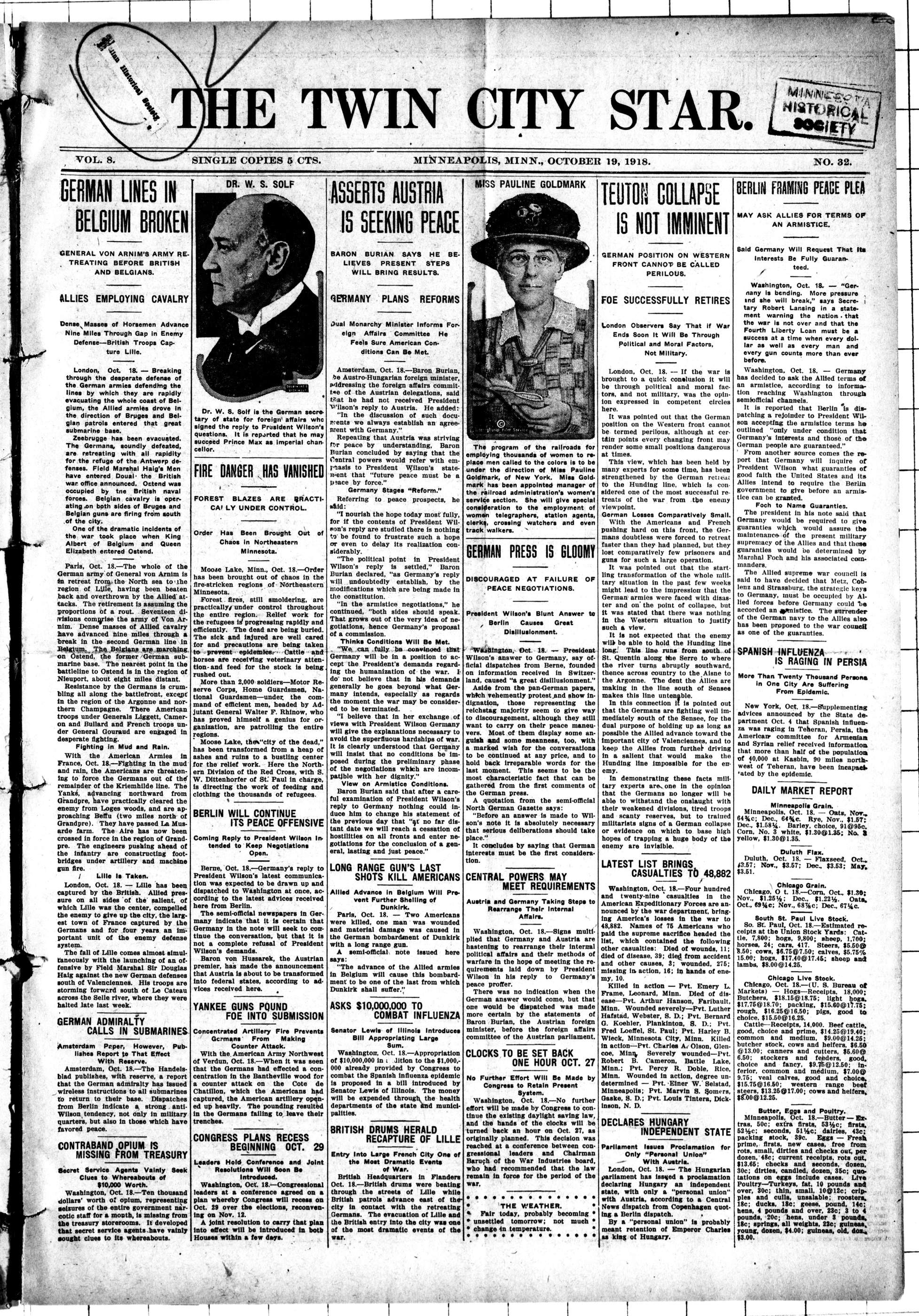
GERMAN LINES IN BELGIUM BROKEN
GENERAL VON ARNIM'S ARMY RE TREATING BEFORE BRITISH AND BELGIANS.
Dense, Masses of Horsemen Advance Nine Miles Through Gap in Enemy Defense—British Troops Capture Lille.
London, Oct. 18. — Breaking through the desperate defense of the German armies defending the lines by which they are rapidly evacuating the whole coast of Belgium, the Allied armies drove in the direction of Bruges and Belgian patrols entered that great submarine base.
Zeebrugge has been evacuated. The Germans, soundly defeated, are retreating with all rapidity for the refuge of the Antwerp defenses. Field Marshal Haig's Men have entered Doual·the British war office announced. Ostend was occupied by the British naval forces. Belgian cavalry is operating on both sides of Bruges and Belgian guns are firing from south of the city.
One of the dramatic incidents of the war took place when King Albert of Belgium and Queen Elizabeth entered Ostend.
Paris, Oct. 18.—The whole of the German army of General von Arnim is in retreat from the North sea to the region of Lille, having been beaten back and overthrown by the Allied attacks. The retirement is assuming the proportions of a rout. Seventeen divisions comprise the army of Von Arnim. Dense masses of Allied cavalry have advanced hine miles through a break in the second German line in Belgium. The Belgians are marching on Ostend, the former German submarine base. The nearest point in the battleline to Ostend is in the region of Nieuport, about eight miles distant. Resistance by the Germans is crumbling all along the battlefront, except in the region of the Argonne and northern Champagne. There American troops under Generals Liggett, Cameron and Bullard and French troops under General Gouraud are engaged in desperate fighting.
Fighting in Mud and Rain.
With the American Armies in France, Oct. 18.—Fighting in the mud and rain, the Americans are threatening to force the Germans out of the remainder of the Kriemhlilde line. The Yanké, advancing northward from Grandpre, have practically cleared the enemy from Loges woods, and are approaching Beffu (two miles north of Grandpre). They have passed La Musarde farm. The Aire has now been crossed in force in the region of Grandpre. The engineers pushing ahead of the infantry are constructing footbridges under artillery and machine gun fire.
/ Lille Is Taken.
London, Oct. 18. — Lille has been captured by the British. Allied pressure on all sides of the salient, of which Lille was the center, compelled the enemy to give up the city, the largest town of France captured by the Germans and for four years an important unit of the enemy defense system.
The fall of Lille comes almost simultaneously with the launching of an offensive by Field Marshal Sir Douglas Halg against the new German defenses south of Valenciennes. His troops are storming forward south of Le Cateau across the Selle river, where they were halted late last week.
GERMAN ADMIRALTY CALLS IN SUBMARINES
Amsterdam Paper. However, Publishes Report to That Effect With Reserve. Amsterdam, Oct. 18.—The Handelsblad publishes, with reserve, a report that the German admiralty has issued wireless instructions to all submarines to return to their base. Dispatches from Berlin indicate a strong anti-Wilson tendency, not only in military quarters, but also in those which have favored peace.
CONTRABAND OPIUM IS
MISSING FROM TREASURY
Secret Service Agents Valinity Seek Clues to Whereabouts of $10,000 Worth. Washington, Oct. 18.—Ten thousand dollars' worth of opium, representing seizures of the entire government narcotic staff for a month, is missing from the treasury storerooms. It developed that secret service agents have vainly sought clues to its whereabouts.
THE TWIN CITY STAR.
SINGLE COPIES 5 CTS.
Dr. W. S. Solf is the German secretary of state for foreign affairs who signed the reply to President Wilson's questions. It is reported that he may succeed Prince Max as imperial chancellor.
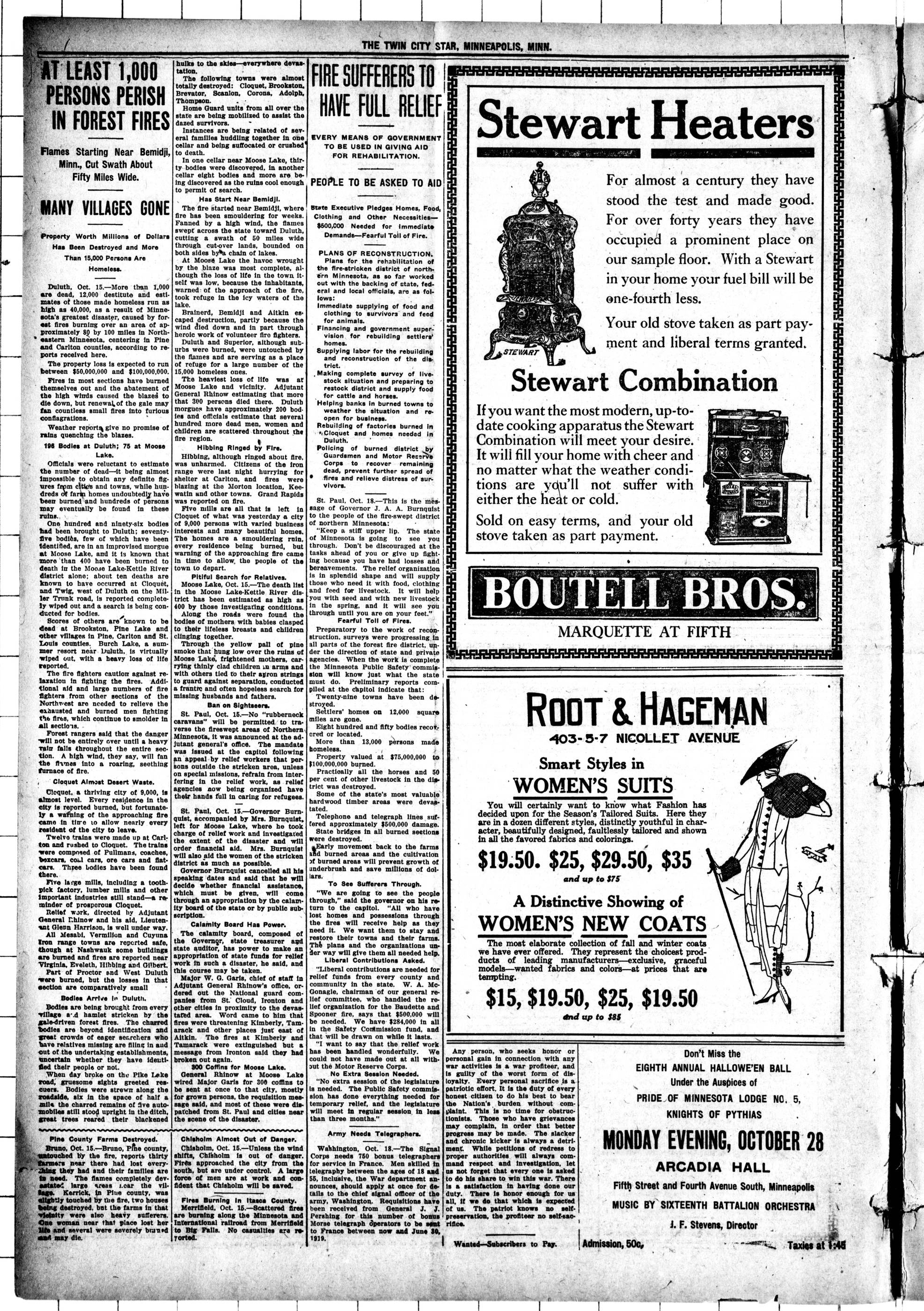
FOREST BLAZES ARE BRACTI
CALY UNDER CONTROL
Order Has Been Brought Out of Chaos in Northeastern Minnesota.
Moose Lake, Minn., Oct. 18.—Order has been brought out of chaos in the fire-stricken regions of Northeastern Minnesota.
Forest fires, still smoldering, are practically under control throughout the entire region. Relief work for the refugees is progressing rapidly and efficiently. The dead are being buried. The sick and injured are well cared for and precautions are being taken to prevent epidemics. Cattle and horses are receiving veterinary attention and feed for the stock is being rushed out.
More than 2,000 soldiers—Motor Reserve Corps, Home Guardsmen, National Guardsmen—under the command of efficient men, headed by Adjutant General Walter F. Rhinow, who has proved himself a genius for organization, are patrolling the entire regions.
Moose Lake, the "city of the dead," has been transformed from a heap of ashes and ruins to a bustling center for the relief work. Here the Northern Division of the Red Cross, with S. W. Dittenhorfer of St. Paul in charge, is directing the work of feeding and clothing the thousands of refugees.
BERLIN WILL CONTINUE ITS PEACE OFFENSIVE
Coming Reply to President Wilson Intended to Keep Negotiations Open.
Berne, Oct. 18.—Germany's reply to President Wilson's latest communication was expected to be drawn up and dispatched to Washington at once, according to the latest advices received here from Berlin.
The semi-official newspapers in Germany indicate that it is certain that Germany in the note will seek to continue the conversation, but that it is not a complete refusal of President Wilson's demands.
Baron von Hussarek, the Austrian premier, has made the announcement that Austria is about to be transformed into federal states, according to advices received here.
YANKEE GUNS PQUND
FOE INTO SUBMISSION
Concentrated Artillery Fire Prevents Germans From Making Counter Attack. With the American Army Northwest of Verdun, Oct. 18.—When it was seen that the Germans had effected a concentration in the Bantheville wood for a counter attack on the Cote de Chatillon, which the Americans had captured, the American artillery opened up heavily. The pounding resulted in the Germans failing to leave their trenches.
CONGRESS PLANS RECESS BEGINNING OCT.
Leaders Hold Conference and Joint Resolutions Will Soon Be Introduced.
Washington, Oct. 18.—Congressional leaders at a conference agreed on a plan whereby Congress will recess on Oct. 29 over the elections, reconvening on Nov. 12.
A joint resolution to carry that plan into effect will be introduced in both Houses within a few days.
MINNEAPOLIS, MINN., OCTOBER 19, 1918.
ASSERTS AUSTRIA IS SEEKING PEACE
BARON BURIAN SAYS HE BE
LIEVES PRESENT STEPS
WILL BRING RESULTS.
Dual Monarchy Minister Informs Foreign Affairs Committee He Feels Sure American Conditions Can Be Met.
Amsterdam, Oct. 18.—Baron Burlan, the Austro-Hungarian foreign minister, addressing the foreign affairs committee of the Austrian delegations, said that he had not received President Wilson's reply to Austria. He added: "In the discussion of such documents we always establish an agreement with Germany."
Repeating that Austria was striving for peace by understanding, Baron Burlan concluded by saying that the Central powers would refer with emasps to President Wilson's statement that "future peace must be a peace by force."
Germany Stages "Reform."
Referring to peace prospects, he said: "I nourish the hope today most fully, for if the contents of President Wilson's reply are studied there is nothing to be found to frustrate such a hope or even to delay its realization considerably.
"The political point in President Wilson's reply is settled," Baron Burlan declared, "as Germany's reply will undoubtedly establish, by the modifications which are being made in the constitution."
"In the armistice negotiations," he continued, "both sides should speak. That grows out of the very idea of negotiations, hence Germany's proposal of a commission.
Thinks Conditions Will Be Met.
"We can fully be convinced that Germany will be in a position to accept the President's demands regarding the humanization of the war. I do not believe that in his demands generally he goes beyond what Germany intends, especially as regards the moment the war may be considered to be terminated.
"I believe that in her exchange of views with President Wilson Germany will give the explanations necessary to avoid the superfluous hardships of war. It is clearly understood that Germany will insist that no conditions be imposed during the preliminary phase of the negotiations which are incompatible with her dignity."
View on Armistice Conditions.
Baron Burian said that after a careful examination of President Wilson's reply to Germany nothing could induce him to change his statement of the previous day that "at no far distant date we will reach a cessation of hostilities on all fronts and enter negotiations for the conclusion of a general, lasting and just peace."
LONG RANGE GUN'S LAST
SHOTS KILL AMERICANS
Allied Advance in Belgium Will Prevent Further Shelling of Dunkirk.
Paris, Oct. 18. — Two Americans were killed, one man was wounded and material damage was caused in the German bombardment of Dunkirk with a long range gun.
A semi-official note issued here says:
"The advance of the Allied armies in Belgium will cause this bombardment to be one of the last from which Dunkirk shall suffer."
ASKS $10,000,000 TO
COMBAT INFLUENZA
Senator Lewis of Illinois Introduces Bill Appropriating Large Sum.
Washington, Oct. 18.—Appropriation of $1,000,000 in citation to the $1,000,000 already provided by Congress to combat the Spanish influenza epidemic is proposed in a bill introduced by Senator Lewis of Illinois. The money will be expended through the health departments of the state and municipalities.
BRITISH DRUMS HERALD RECAPTURE OF LILLE
Entry Into Large French City One of the Most Dramatic Events of War. British Headquarters in Flanders Oct. 18.-British drums were beating through the streets of Lille while British patrols advance east of the city in contact with the retreating Germans. The evacuation of Lille and the British entry into the city was one of the most dramatic events of the war.
International Film Service
The program of the railroads for employing thousands of women to replace men called to the colors is to be under the direction of Miss Pauline Goldmark, of New York. Miss Goldmark has been appointed manager of the railroad administration's women's service section. She will give special consideration to the employment of women telegraphers, station agents, clerks, crossing watchers and even track walkers.
GERMAN PRESS IS GLOOMY
DISCOURAGED AT FAILURE OF PEACE NEGOTIATIONS.
President Wilson's Blunt Answer to Berlin Causes Great Disillusionment.
Washington, Oct. 18. — President Wilson's answer to Germany, say official dispatches from Berne, founded on information received in Switzerland, caused "a great disillusionment."
Aside from the pan-German papers, which vehemently protest and show indignation, those representing the rechagst majority seem to give way to discouragement, although they still want to carry on their peace maneuvers. Most of them display some anguish and some meanness, too, with a marked wish for the conversations to be continued at any price, and to hold back irreparable words for the last moment. This seems to be the most characteristic fact that can be gathered from the first comments of the German press.
A quotation from the semi-official North German Gazette says:
"Before an answer is made to Wilson's note it is absolutely necessary that serious deliberations should take place."
It concludes by saying that German interests must be the first consideration.
CENTRAL POWERS MAY MEET REQUIREMENTS
Austria and Germany Taking Steps to Rearrange Their Internal Affairs.
Washington, Oct. 18.—Signs multiplied that Germany and Austria are hastening to rearrange their internal political affairs and their methods of warfare in the hope of meeting the requirements laid down by President Wilson in his reply to Germany's peace proffer.
There was no indication when the German answer would come, but that one would be dispatched was made more certain by the statements of Baron Burian, the Austrian foreign minister, before the foreign affairs committee of the Austrian parliament.
CLOCKS TO BE SET BACK
ONE HOUR OCT. 27
No Further Effort Will Be Made by Congress to Retain Present System.
Washington, Oct. 18.—No further effort will be made by Congress to continue the existing daylight saving law, and the hands of the clocks will be turned back an hour on Oct. 27, as originally planned. This decision was reached at a conference between congressional leaders and Chairman Baruch of the War Industries board, who had recommended that the law remain in force for the period of the war.
THE WEATHER.
Fair today, probably becoming unsettled tomorrow; not much change in temperature.
.....
TEUTON COLLAPSE IS NOT IMMINENT
TEUTON COLLAPSE IS NOT IMMINENT
GERMAN POSITION ON WESTERN
FRONT CANNOT BE CALLED
PERILOUS.
FOE SUCCESSFULLY RETIRES
London Observers Say That if War Ends Soon It Will Be Through Political and Moral Factors, Not Military.
London, Oct. 18. -- If the war is brought to a quick conclusion it will be through political and moral factors, and not military, was the opinion expressed in competent circles here.
It was pointed out that the German position on the Western front cannot be termed perilous, although at certain points every changing front may render some small positions dangerous at times.
This view, which has been held by many experts for some time, has been strengthened by the German retreat to the Hunding line, which is considered one of the most successful retreats of the war from the enemy viewpoint.
German Losses Comparatively Small. With the Americans and French pushing hard on this front, the Germans doubtless were forced to retreat faster than they had planned, but they lost comparatively few prisoners and guns for such a large operation.
It was pointed out that the startling transformation of the whole military situation in the past few weeks might lead to the impression that the German armies were faced with disaster and on the point of collapse, but it was stated that there was nothing in the Western situation to justify such a view.
It is not expected that the enemy will be able to hold the Hunding line long. This line runs from south of St. Quentin along the Serre to where the river turns abruptly southward, thence across country to the Aisne to the Argonne. The dent the Allies are making in the line south of Sensee makes this line untenable.
In this connection it is pointed out that the Germans are fighting well immediately south of the Sensee, for the dual purpose of holding up as long as possible the Allied advance toward the important city of Valenciennes, and to keep the Allies from further driving in a salient that would make the Hunding line impossible for the enemy.
In demonstrating these facts military experts are one in the opinion that the Germans no longer will be able to withstand the onslaught with their weakened divisions, tired troops and scanty reserves, but to trained militarists signs of a German collapse or evidence on which to base high hopes of trapping a huge body of the enemy are invisible.
LATEST LIST BRINGS CASUALTIES TO 48,882
Washington, Oct. 18.—Four hundred and twenty-nine casualties in the American Expeditionary Forces are announced by the war department, bringing America's losses in the war to 48,882. Names of 75 Americans who paid the supreme sacrifice headed the list, which contained the following other casualties: Died of wounds, 11; died of disease, 39; died from accident and other causes, 3; wounded, 275; missing in action, 16; in hands of enemy, 10.
Killed in action — Pvt. Emery L. Frame, Leonard, Minn. Died of disease—Pvt. Arthur Hanson, Fartbault, Minn. Wounded severely—Pvt. Luther Hafstad, Webster, S. D.; Pvt. Bernard G. Koehler, Plankinton, S. D.; Pvt. Fred Loeffel, St. Paul; Pvt. Harley B. Wieck, Minnesota City, Minn. Killed in action—Pvt. Charles A. Olson, Glencoe, Minn. Severely wounded, Pvt. Robert B. Cameron, Battle Lake, Minn.; Pvt. Percy R. Doble, Rice, Minn. Wounded in action, degree undetermined — Pvt. Einer W. Selstad, Minneapolis; Pvt. Marvin S. Somers, Gaske, S. D.; Pvt. Louis Tintera, Dickinson, N. D.
DECLARES HUNGARY INDEPENDENT STATE
Parliament Issues Proclamation for Only "Personal Union" With Austria. London, Oct. 18. — The Hungarian parliament has issued a proclamation declaring Hungary an independent state, with only a "personal union" with Austria, according to a Central News dispatch from Copenhagen quoting a Berlin dispatch. By a "personal union" is probably meant retention of Emperor Charles as king of Hungary.
MINNESOTA
HISTORICAL
SOCIETY
BERLIN FRAMING PEACE PLEA
MAY ASK ALLIES FOR TERMS OF AN ARMISTICE.
Said Germany Will Request That Its Interests Be Fully Guaran-
Washington, Oct. 18. — "Germany is bending. More pressure and she will break," says Secretary Robert Lansing in a statement warning the nation that the war is not over and that the Fourth Liberty Loan must be a success at a time when every dollar as well as every man and every gun counts more than ever before.
Washington, Oct. 18. — Germany has decided to ask the Allied terms of an armistice, according to information reaching Washington through semiofficial channels.
It is reported that Berlin is dispatching a rejoinder to President Wilson accepting the armistice terms he outlined "only under condition that Germany's interests and those of the German people are guaranteed."
From another source comes the report that Germany will inquire of President Wilson what guarantees of good faith the United States and its Allies intend to require the Berlin government to give before an armistice can be granted.
Fleet to Name Guarantees.
The president in his note said that Germany would be required to give guaranties which would assure the maintenance of the present military supremacy of the Allies and that these guaranties would be determined by Marshal Foch and his associated commanders.
The Allied supreme war council is said to have decided that Metz, Coblenz and Strassburg, the strategic keys to Germany, must be occupied by Allied forces before Germany could be accorded an insistence. The surrender of the German navy to the Allies also has been proposed to the war council as one of the guaranties.
SPANISH INFLUENZA IS RAGING IN PERSIA
More Than Twenty Thousand Persons in One City Are Suffering From Epidemic.
New York, Oct. 18.—Supplementing advice announced by the State department Oct. 4 that Spanish influenza was raging in Teheran, Persia, the American committee for Armenian and Syrian relief received information that more than half of the population of 40,000 at Kasbin, 90 miles northwest of Teheran, have been incapacitated by the epidemic.
DAILY MARKET REPORT
Minneapolis, Oct. 18. — Oats, Nov.
64%c; Dec. 64%c. Rye, Nov. $1.57;
Dec. $1.58%c. Barley, choice, 91@95%
Corn, No. 3 white, $1.30@1.35; No. 3
yellow, $1.30@1.35.
Duluth Flax.
Duluth, Oct. 18. — Flaxseed, Oct.,
$3.57; Nov., $3.57; Dec., $3.53; May.
$3.51.
Chicago Grain.
Chicago, O t. 18.—Corn, Oct., $1.30;
Nov., $1.25½; Dec., $1.22½; Oats,
Oct., 69½¢; Nov., 68½¢; Dec., 67½¢.
South St. St Paul Live Stock.
So. St. Paul, Oct. 18.—Estimated re-
ceipts at the Union Stock Yards: Cattle,
7,800; hogs, 9,800; sheep, 1,700;
horses, 24; cars, 415; Steers, $5.50@
8.50; cows, $6.75@ 7.50; calves, $5.75@
15.00; hogs, $17.40@ 17.45; sheep and
lambs, $8.00@ 14.25.
Chicago Live Stock.
Chicago, Oct. 18.—(U. S. Bureau of
Markets) — Hogs—Receipts, 18.000;
Butchers, $18.15@18.75, light hogs,
$17.75@18.70; packing, $15.60@17.5
rough, $16.25@16.50; pigs, good to
choice, $15.50@16.25.
Cattle—Receipts, 14.000. Beef cattle,
good, choice and prime, $14.25@19.40;
common and medium, $9.00@14.25;
butcher stock, cows and heifers, $6.50
@13.00; canners and cutters, $5.60@
6.50; stockers and feeders, good, choice
and fancy, $9.75@12.50; inferior,
common and medium, $7.00@
9.75; veal calves, good and choice,
$15.75@16.50; western range beef
steers, $13.25@17.00; cows and heifers,
$8.00@12.25.
Butter, Eggs and Poultry.
Minneapolis, Oct. 18.—Butter—Extras,
50c; extra firsts, 53½c; firsts,
52½c; seconds, 51½c; dries, 43c;
packing stock, 39c. Eggs — Fresh
prime, firsts, new cases, free from
rots, small, dirties and checks out, per
dozen, 48c; current receipts, rots out,
13.65; checks and seconds, dozen,
30c; dirties, candied, dozen, 35c;
quotations on eggs include cases. Live
Poultry—Turkeys, fat, 10 pounds and
over, 30c; thin, small, 10@12c; cripples
and culls, unsalable; roosters,
18c; ducks, 18c; geese, pound, 14c;
hens, 4 pounds and over, 23c; 3 to 4
pounds, 20c; hens, under 3 pounds,
18c; springs, all weights, 22c; guinea,
young, dozen, $4.00; guinea, old, doz.
$3.00.
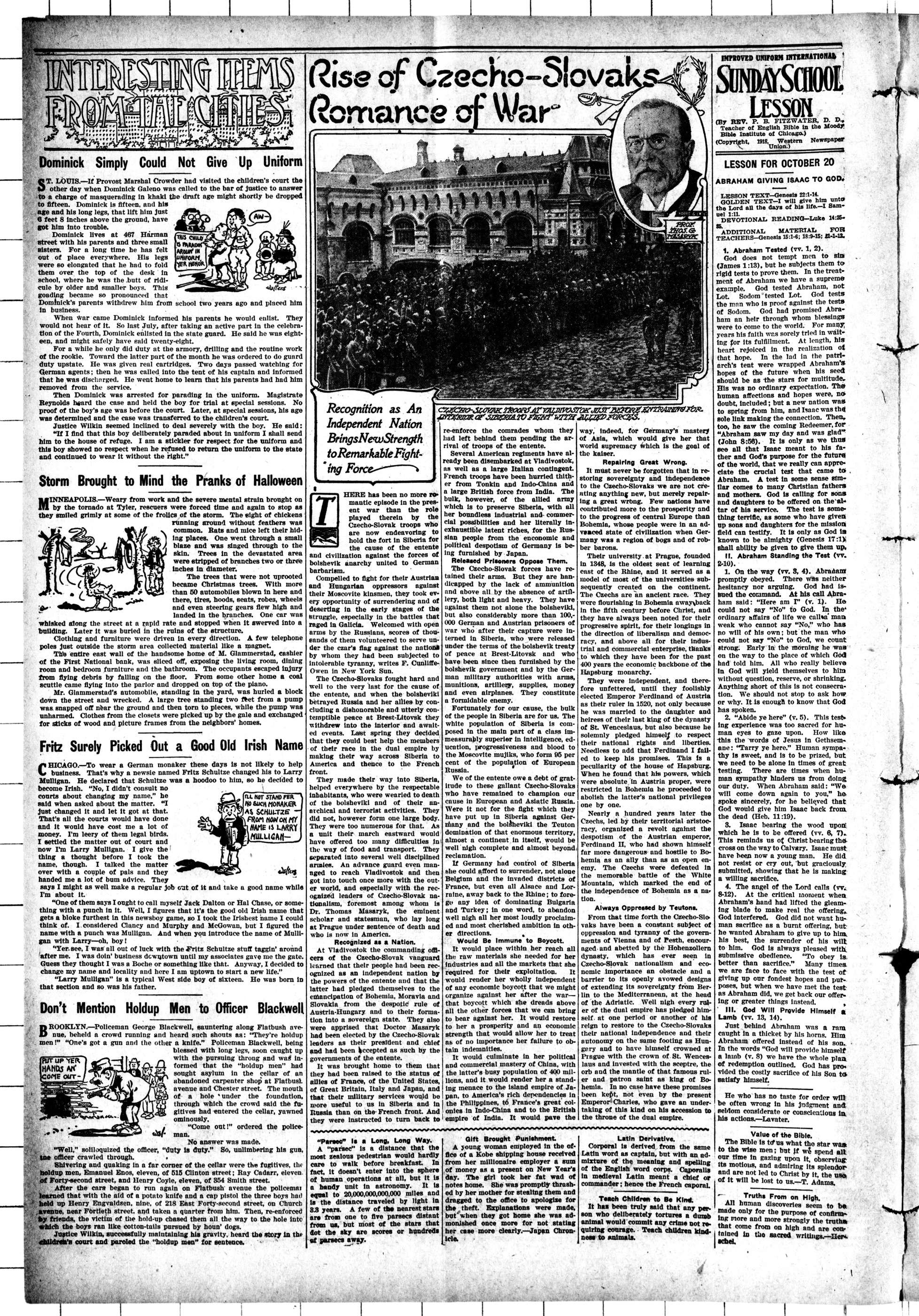
INTERESTING ITEMS FROM THE CITIES
Dominick Simply Could Not Give Up Uniform
ST. LOUIS.—If Provost Marshal Crowder had visited the children's court the other day when Dominick Galeno was called to the bar of justice to answer to a charge of masquerading in khakl the drift age might shortly be dropped
Domnick's parents withdrew him from school two years ago and placed him in business.
When war came Dominick informed his parents he would enlist. They would not hear of it. So last July, after taking an active part in the celebration of the Fourth, Dominick enlisted in the state guard. He said he was eighteen, and might safely have said twenty-eight.
For a while he only did duty at the armory, drilling and the routine work of the rookie. Toward the latter part of the month he was ordered to do guard duty upstate. He was given real cartridges. Two days passed watching for German agents; then he was called into the tent of his captain and informed that he was discharged. He went home to learn that his parents had had him removed from the service.
Then Dominick was arrested for parading in the uniform. Magistrate Reynolds heard the case and held the boy for trial at special sessions. No proof of the boy's age was before the court. Later, at special sessions, his age was determined and the case was transferred to the children's court.
Justice Wilkin seemed inclined to deal severely with the boy. He said:
"If I find that this boy deliberately paraded about in uniform I shall send him to the house of refuge. I am a stickler for respect for the uniform and this boy showed no respect when he refused to return the uniform to the state and continued to wear it without the right."
Storm Brought to Mind the Pranks of Halloween
Storm Brought to Mind the Pranks of Halloween
MINNEAPOLIS—Weary from work and the severe mental strain brought on by the tornado at Tyler, rescuers were forced time and again to stop as they smiled grimly at some of the frolics of the storm. The eight of chickens
whisked along the street at a raid rate and stopped when it swerved into a building. Later it was buried in the ruins of the structure.
Clothing and furniture were driven in every direction. A few telephone poles just outside the storm area collected material like a magnet.
The entire east wall of the handsome home of M. Glammerstad, cashier of the First National bank, was sliced off, exposing the living room, dining room and bedroom furniture and the bathroom. The occupants escaped injury from flying debris by falling on the floor. From some other home a coal scuttle came flying into the parlor and dropped on top of the piano.
Mr. Glammerstad's automobile, standing in the yard, was hurled a block down the street and wrecked. A large tree standing two feet from a pump was snapped off near the ground and then torn to pieces, while the pump was unharmed. Clothes from the closets were picked up by the gale and exchanged for sticks of wood and picture frames from the neighbors' homes.
Fritz Surely Picked Out a Good Old Irish Name
Fritz Surely Picked Out a Good Old Irish Name
CHICAGO—To wear a German monaker these days is not likely to help business. That's why a newsie named Fritz Schultze changed his to Larry Mulligan. He declared that Schultze was a hoodoo to him, so he decided to
says I might as well make a regular job out of it and take a good name while I'm about it.
"One of them says I ought to call myself Jack Dalton or Hal Chase, or something with a punch in it. Well, I figures that it's the good old Irish name that gets a bloke furthest in this newsboy game, so I took the Irishest name I could think of. I considered Clancy and Murphy and McGowan, but I figured the name with a punch was Mulligan. And when you introduce the name of Mulligan with Larry—oh, boy!
"Yer-see, I was all out of luck with the Fritz Schultze stuff taggin' around after me. I was doin' business downtown until my associates gave me the gate. Guess they thought I was a Boche or something like that. Anyway, I decided to change my name and locality and here I am uptown to start a new life."
"Larry Mulligan" is a typical West side boy of sixteen. He was born in that section and so was his father.
Don't Mention Holdup Men to Officer Blackwell
Don't Mention Holdup Men to Officer Blackwell
BROOKLYN—Policeman George Blackwell, sauntering along Flatbush avenue, beheld a crowd running and heard such shouts as: "They're holdup men!" "One's got a gun and the other a knife." Policeman Blackwell, being
"Well," soiloliquized the officer, "duty is duty." So, unlimbering his gun, the officer crawled through. Shivering and quaking in a far corner of the cellar were the fugitives, the holdup men, Emanuel Enos, eleven, of 515 Clinton street; Ray Cadarr, eleven of Forty-second street, and Henry Coyle, eleven, of 854 Smith street.
After the cars began to run again on Flatbush avenue the policeman learned that with the aid of a potato knife and a cap pistol the three boys had held up Henry Engvaldsen, nine, of 218 East Forty-second street, on Church avenue, near Fortieth street, and taken a quarter from him. Then, re-enforced by friends, the victim of the hold-up chased them all the way to the hole into which the boys ran like cotton-tails pursued by houn' dogs.
Justice Wilkin, successfully maintaining his gravity, heard the story in the children's court and paroled the "holdup men" for sentence.
to fifteen. Dominick is fifteen, and his age and his long legs, that lift him just 6 feet 8 inches above the ground, have got him into trouble.
Dominick lives at 467 Harman street with his parents and three small sisters. For a long time he has felt out of place everywhere. His legs were so elongated that he had to fold them over the top of the desk in school, where he was the butt of ridicule by older and smaller boys. This goading became so pronounced that
Domnick's parents withdrew him from in business.
When war came Dominick inform would not hear of it. So last July, affection of the Fourth, Dominick enlisted in een, and might safely have sailed twent For a while he only did duty at the of the rookie. Toward the latter part of duty upstate. He was given real cart German agents; then he was called in that he was discharged. He went home removed from the service.
Then Dominick was arrested for Reynolds heard the case and held the proof of the boy's age was before the c was determined and the case was trans Justice Wilkin seemed inclined to "If I find that this boy deliberately him to the house of refuge. I am a s this boy showed no respect when he re and continued to wear it without the i
Storm Brought to Mind
MINNEAPOLIS.—Weary from work by the tornado at Tyler, rescuers they smiled grimly at some of the frol
whisked along the street at a rapid raid building. Later it was buried in the r. Clothing and furniture were driven poles just outside the storm area coll. The entire east wall of the hands of the First National bank, was sliced room and bedroom furniture and the b. from flying debris by falling on the scuttle came flying into the parlor and Mr. Glammerstad's automobile, str. down the street and wrecked. A large was snapped off near the ground and t. unharmed. Clothes from the closets we for sticks of wood and picture frames.
Fritz Surely Picked Out
CHICAGO.—To wear a German m. business. That's why a newsle nane Mulligan. He declared that Schultze
become Irish. "No, I didn't consult no courts about changing my name," he said when asked about the matter. "I just changed it and let it got at that. That's all the courts have done and it would have cost me a lot of money. I'm leery of them legal birds. I settled the matter out of court and now I'm Larry Mulligan. I give the thing a thought before I took the name, though. I talked the matter over with a couple of pals and they handed me a lot of bum advice. They says I might as well make a regular jo I'm about it.
"One of them says I ought to call my thing with a punch in it. Well, I figure gets a bloke furthest in this newsboy girl think of. I considered Clancy and M name with a punch was Mulligan. And gan with Larry—oh, boy!
"Yer see, I was all out of luck with after me. I was doin' business downto Guess they thought I was a Boche or so change my name and locality and here "Larry Mulligan" is a typical We that section and so was his father.
Don't Mention Holdup
BROOKLYN—Policeman George Blanue, beheld a crowd running and men!" "One's got a gun and the other
PIT UP YER HANDS AN' COME OUT
"Well," soliloquized the officer, "d the officer crawled through.
Shivering and quaking in a far co holdup men, Emanuel Enos, eleven, off of Forty-second street, and Henry Coy.
After the cars began to run age learned that with the aid of a potato k held up Henry Engvaldsen, nine, of 2 avenue, near Fortieth street, and taken by friends, the victim of the hold-up c which the boys ran like cotton-tails p Justice Wilkin, successfully maintains children's court and paroled the "hold
had his parents he would enlist. They
ever taking an active part in the celebra-
the state guard. He said he was eight-
y-eight.
the armory, drilling and the routine work
of the month he was ordered to do guard
bridges. Two days passed watching for
to the tent of his captain and informed
he to learn that his parents had had him
parading in the uniform. Magistrate
boy for trial at special sessions. No
court. Later, at special sessions, his age
referred to the children's court.
deal severely with the boy. He said:
paraded about in uniform I shall send
cklicker for respect for the uniform and
fused to return the uniform to the state
eight."
the Pranks of Halloween
and the severe mental strain brought on
were forced time and again to stop as
sces of the storm. The eight of chickens
ate and stopped when it swerved into a ruins of the structure.
on in every direction. A few telephone
ected material like a magnet.
home of M. Glammerstad, cashier
off, exposing the living room, dining
hroom. The occupants escaped injury
floor. From some other home a coal
dropped on top of the plano.
landing in the yard, was hurled a block
tree standing two feet from a pump
then torn to pieces, while the pump was
ere picked up by the gale and exchanged
from the neighbors' homes.
a Good Old Irish Name
maker these days is not likely to help
need Fritz Schultze changed his to Larry
was a hoodoo to him, so he decided to
struggle,
raged in
arms by
sands of the
der the
by whom
intolerable
Owen in
The Cz
well to the
the enter
betrayed
cluding a
temptible
withdrew
event that they
of their
making
America
front.
They n
helped e
Job out of it and take a good name while
self Jack Dalton or Hal Chase, or some-
that it's the good old Irish name that
name, so I took the Irishest name I could
murphy and McGowan, but I figured the
when you introduce the name of Mulli-
in the Fritz Schultze stuff taggin' around
until my associates gave me the gate.
something like that. Anyway, I decided to
I am uptown to start a new life."
st side boy of sixteen. He was born in
Men to Officer Blackwell
Blackwell, sauntering along Flatbush ave-
cheard such shouts as: "They're holdup
or a knife." Policeman Blackwell, being
got into a world,
ognized a
tionalism.
Dr. Thor-
scholar a
at Prague
who is n
At Vlacers of
learned t
ognized t
the power
latter ha
emancipa-
Slovakia
Austria-K
tion into
were ap-
had been
leaders
duty is duty." So, unlimbering his gun, corner of the cellar were the fugitives, the 515 Clinton street; Ray Cadarr, eleven, eleven, of 854 Smith street. Bain on Flatbush' avenue the policeman wife and a cap pistol the three boys had 18 East Forty-second street, on Church a quarter from him. Then, re-enforced based them all the way to the hole into cursed by houn' dogs. Bain his gravity, heard the story in the up men" for sentence.
A "paran most zealous care to the fact, it of human a handy equal to the 33 years are from us, dot the of parsec
AW-
THIS CHILD
IS PARADISE
AROUND IN
UNIFORM
YER HONOR
walters
running around without feathers was common. Rats and mice left their hiding places. One went through a small blaze and was singed through to the skin. Trees in the devastated area were stripped of branches two or three inches in diameter. The trees that were not uprooted became Christmas trees. With more than 50 automobiles blown in here and there, tires, hoods, seats, robes, wheels and even steering gears flew high and landed in the branches. One car was
I'LL NOT STAND PER
NO SUCH MONAKER
AS SCHULTZE
FROM NOW ON MY
NAME IS LARRY
MULLIGAN—
blessed with long legs, soon caught up with the pursuing throng and was informed that the "holdup men" had sought asylum in the cellar of an unbanded carpenter shop at Flatbust. avenue and Chester street. The mouth of a hole 'under the foundation, through which the crowd said the fugitives had entered the cellar, yawned ominously. "Come out!" ordered the policeman. No answer was made.
Rise of Czecho-Slovaks Romance of War
Romance of War
FROM
TROS &
MASARYK
Recognition as An Independent Nation BringsNewStrength to Remarkable Fighting Force
T
HERE has been no more romantic episode in the present war than the role played therein by the Czecho-Slovak troops who are now endeavoring to hold the fort in Siberia for the cause of the entente and civilization against the forces of bolshevik anarchy united to German barbarism. Compelled to fight for their Austrian and Hungarian oppressors against their Moscow kitesmen, they took every opportunity of surrendering and of deserting in the early stages of the struggle, especially in the battles that raged in Galicia. Welcome with open arms by the Russians, scores of thousands of them volunteered to serve under the czar's flag against the nation by whom they had been subjected to intolerable tyranny, writes F. Cunliffe-Owen in New York Sun.
The Czecho-Slovaks fought hard and well to the very last for the cause of the entente, and when the bolshevik betrayed Russia and her allies by concluding a dishonorable and utterly contemptible peace at Brest-Littovsk they withdrew into the interior and awaited events. Last spring they decided that they could best help the members of their race in the dual empire by making their way across Siberin to America and thence to the French front.
They made their way into Siberia, helped everywhere by the respectable inhabitants, who were wearied to death of the bolshevik and of their anarchical and terrorist activities. They did not, however form one large body. They were too numerous for that. As a unit their march eastward would have offered too many difficulties in the way of food and transport. They separated into several well disciplined armies. An advance guard even managed to reach Vladivostok and then got into touch once more with the outer world, and especially with the recognized leaders of Czecho-Slovak nationalism, foremost among whom is Dr. Thomas Masaryk, the eminent scholar and statesman, who lay long at Prague under sentence of death and who is now in America.
Recognized as a Nation.
At Vladivostok the commanding officers of the Czecho-Slovak vanguard learned that their people had been recognized as an independent nation by the powers of the entente and that the latter had pledged themselves to the emancipation of Bohemia, Moravia and Slovakia from the despotic rule of Austria-Hungary and to their formation into a sovereign state. They also were apprised that Doctor Masaryk had been elected by the Czecho-Slovak leaders as their president and chief and had been accepted as such by the governments of the entente.
It was brought home to them that they had been raised to the status of allies of France, of the United States, of Great Britain, Italy and Japan, and that their military services would be more useful to us in Siberia and in Russia than on the French front. And they were instructed to turn back to
"Parsec" is a Long, Long Way. A "parsec" is a distance that the most zealous pedestrian would hardly care to walk before breakfast. In fact, it doesn't enter into the sphere of human operations at all, but it is a handy unit in astronomy. It is equal to 20,000,000,000 miles and is the distance traveled by light in 8.3 years. A few of the nearest stars are from one to five parsecs distant from us, but most of the stars that dot the sky are scores or hundreds of parsecs away.
re-enforce the comrades whom they had left behind them pending the arrival of troops of the entente. Several American regiments have already been disembarked at Vladivostok, as well as a large Italian contingent. French troops have been hurried thither from Tonkin and Indo-China and a large British force from India. The bulk, however, of the allied army which is to preserve Siberia, with all her boundless industrial and commercial possibilities and her literally inexhaustible latent riches, for the Russian people from the economic and political despotism of Germany is being furnished by Japan.
way, indeed, for Germany's master of Asia, which would give her the world supremacy which is the goal to the kaiser.
Repairing Great Wrong.
It must never be forgotten that in m storing sovereignty and independence to the Czecho-Slovaks we are not creating anything new, but merely repairing a great wrong. Few nations have contributed more to the prosperity and to the progress of central Europe the Bohemia, whose people were in an advanced state of civilization when Germany was a region of bogs and of rober barons.
Their university at Prague found
Released Prisoners Oppose Them.
The Czecho-Slovak forces have retained their arms. But they are handicapped by the lack of ammunition and above all by the absence of artillery, both light and heavy. They have against them not alone the bolshevik, but also considerably more than 100,000 German and Austrian prisoners of war who after their capture were interned in Siberia, who were released under the terms of the bolshevik treaty of peace at Brest-Litovsk and who have been since then furnished by the bolshevik government and by the German military authorities with arms, munitions, artillery, supplies, money and even airplanes. They constitute a formidable enemy.
Fortunately for our cause, the bulk of the people in Siberia are for us. The white population of Siberia is composed in the main part of a class immeasurably superior in intelligence, education, progressiveness and blood to the Moscovte mujiks, who form 95 per cent of the population of European Russia.
We of the entente owe a debt of gratitude to these gallant Czecho-Slovaks who have remained to champion our cause in European and Asiatic Russia. Were it not for the fight which they have put up in Siberia against Germany and the bolsheviki the Teuton domination of that enormous territory, almost a continent in itself, would be well nigh complete and almost beyond reclamation.
If Germany had control of Siberia she could afford to surrender, not alone Belgium and the invaded districts of France, but even all Alsace and Lorraine, away back to the Rhine; to forego any idea of dominating Bulgaria and Turkey; in one word, to abandon well nigh all her most loudly proclaimed and most cherished ambition in other directions.
Would Be Immune to Bexcott
Would Be Immune to Boycott.
It would place within her reach all the raw materials she needed for her industries and all the markets that she required for their exploitation. It would render her wholly independent of any economic boycott that we might organize against her after the war—that boycott which she dreads above all the other forces that we can bring to bear against her. It would restore to her a prosperity and an economic strength that would allow her to treat as of no importance her failure to obtain indemnities.
It would culminate in her political and commercial mastery of China, with the latter's busy population of 400 millions, and it would render her a standing menace to the island empire of Japan, to America's rich dependencies in the Philippines, to France's great colonies in Indo-China and to the British empire of India. It would pave the
Gift. Brought. Punishment.
A young woman employed in the office of a Kobe shipping house received from her millionaire employer a sum of money as a present on New Year's day. The girl took her fat wad of notes home. She was promptly thrashed by her mother for stealing them and dragged to the office to apologize for the theft. Explanations were made, but when they got home she was admonished once more for not stating her case more clearly.—Japan Chronicle.
way, indeed, for Germany's mastery of Asia, which would give her that world supremacy which is the goal of the kaiser.
Repairing Great Wrong.
It must never be forgotten that in restoring sovereignty and independence to the Czecho-Slovaks we are not creating anything new, but merely repairing a great wrong. Few nations have contributed more to the prosperity and to the progress of central Europe than Bohemia, whose people were in an advanced state of civilization when Germany was a region of bogs and of robber barons. Their university at Prague, founded in 1348, is the oldest seat of learning east of the Rhine, and it served as a model of most of the universities subsequently created on the continent. The Czechs are an ancient race. They were flourishing in Bohemia away back in the fifth century before Christ, and they have always been noted for their progressive spirit, for their longings in the direction of liberalism and democracy, and above all for their industrial and commercial enterprise, thanks to which they have been for the past 400 years the economic backbone of the Hapsburg monarchy.
They were independent, and therefore unfettered, until they foolishly elected Emperor Ferdinand of Austria as their ruler in 1520, not only because he was married to the daughter and heiress of their last king of the dynasty of St. Wenceslaus, but also because he solemnly pledged himself to respect their national rights and liberties. Needless to add that Ferdinand I failed to keep his promises. This is a peculiarity of the house of Hapsburg. When he found that his powers, which were absolute in Austria proper, were restricted in Bohemia he proceeded to abolish the latter's national privileges one by one.
Nearly a hundred years later the Czechs, led by their territorial aristocracy, organized a revolt against the despotism of the Austrian emperor, Ferdinand II, who had shown himself far more dangerous and hostile to Bohemia as an ally than as an open enemy. The Czechs were defeated in the memorable battle of the White Mountain, which marked the end of the independence of Bohemia as a nation.
Always Oppressed by Teutons.
From that time forth the Czecho-Slovaks have been a constant subject of oppression and tyranny of the governments of Vienna and of Pesth, encouraged and abetted by the Hohencolllern dynasty, which has ever seen in Czecho-Slovak nationalism and economic importance an obstacle and a barrier to its openly avowed designs of extending its sovereignty from Berlin to the Mediterranean, at the head of the Adriatic. Well nigh every ruler of the dual empire has pledged himself at one period or another of his reign to restore to the Czecho-Slovaks their national independence and their autonomy on the same footing as Hungary and to have himself crowned at Prague with the crown of St. Wenceslaus and invested with the sceptre, the orb and the mantle of that famous ruler and patron saint as king of Bohemia. In no case have these promises been kept, not even by the present Emperor Charles, who gave an undertaking of this kind on his accession to the throne of the dual empire.
Latin Derivative.
Corporal is derived from the same Latin word as captain, but with an admixture of the meaning and spelling of the English word corps. Caporalis in medieval Latin meant a chief or commander; hence the French caporal.
Teach Children to Be Kind.
It has been truly said that any person who deliberately tortures a dumb animal would commit any crime not requiring courage. Teach children kindness to animals.
(By REV. P. B. FITZWATER, D. D.
Teacher of English Bible in the Moody
Bible Institute of Chicago).
(Copyright, 1919 Eastern Newspaper
Union.)
LESSON FOR OCTOBER 20
ABRAHAM GIVING ISAAC TO GOD.
LESSON TEXT-Genesis 22:1-14.
GOLDEN TEXT-I will give him unto
the lord all the days of his life.-I
Samuel 1:11.
DEVOTIONAL READING-Luke 14:25-
88.
ADDITIONAL MATERIAL FOR
TEACHERS-Genesis 15:1:6; 18:9:15; 21:1-12.
1. Abraham Tested (Vv. 1, 2).
God does not tempt men to sin (James 1:13), but he subjects them to rigid tests to prove them. In the treatment of Abraham we have a supreme example. God tested Abraham, not Lot. Sodom tested Lot. God tests the man who is proof against the tests of Sodom. God had promised Abraham an heir through whom blessings were to come to the world. For many years his faith was sorely tried in waiting for its fulfillment. At length, his heart rejoiced in the realization of that hope. In the lad in the patriarch's tent were wrapped Abraham's hopes of the future when his seed should be as the stars for multitude. His was no ordinary expectation. The human affections and hopes were, no doubt, included; but a new nation was to spring from him, and Isaac was the sole link making the connection. Then, too, he saw the coming Redeemer, for "Abraham saw my day and was glad" (John 8:56). It is only as we thus see all that Isaac meant to his father and God's purpose for the future of the world, that we really can appreciate the crucial test that came to Abraham. A test in some sense similar comes to many Christian fathers and mothers. God is calling for sons and daughters to be offered on the altar of his service. The test is something terrific, as some who have given up sons and daughters for the mission field can testify. It is only as God is known to be almighty (Genesis 17:1) shall ability be given to give them up. II. Abraham Standing the Test (vv. 2-10).
1. On the way (vv. 3, 4). Abraham promptly obeyed. There was neither hesitancy nor arguing. God had issued the command. At his call Abraham said: "Here am I" (v. 1). He could not say "No" to God. In the ordinary affairs of life we call man weak who cannot say "No," who has no will of his own; but the man who could not say "No" to God, we count strong. Early in the morning he was on the way to the place of which God had told him. All who really believe in God will yield themselves to him without question, reserve, or shrinking. Anything short of this is not consecration. We should not stop to ask how or why. It is enough to know that God has spoken.
2. "Abide ye here" (v. 5). This testing experience was too sacred for human eyes to gaze upon. How like this the words of Jesus in Gethsemane: "Tarry ye here." Human sympathy is sweet, and is to be prized, but we need to be alone in times of great testing. There are times when human sympathy hinders us from doing our duty. When Abraham said: "We will come down again to you," he spoke sincerely, for he believed that God would give him Isaac back from the dead (Heb. 11:19).
3. Isaac bearing the wood upon which he is to be offered (vv. 6, 7). This reminds us of Christ bearing the cross on the way to Calvary. Isaac must have been now a young man. He did not resist or cry out, but graciously submitted, showing that he is making a willing sacrifice.
4. The angel of the Lord calls (vv. 8-12). At the critical moment when Abraham's hand had lifted the gleaming blade to make real the offering, God interfered. God did not want human sacrifice as a burnt offering, but he wanted Abraham to give up to him his best, the surrender of his will to him. God is always pleased with submissive obedience. "To obey is better than sacrifice." Many times we are face to face with the test of giving up our fondest hopes and purposes, but when we have met the test as Abraham did, we get back our offering or greater things instead.
III. God Will Provide Himself a Lamb (vv. 13, 14).
Just behind Abraham was a ram caught in a thicket by his horns. Him Abraham offered instead of his son. In the words "God will provide himself a lamb (v. 8) we have the whole plan of redemption outlined. God has provided the costly sacrifice of his Son to satisfy himself.
He who has no taste for order will be often wrong in his judgment and seldom considerate or conscientious in his actions.—Lavater.
Value of the Bible
The Bible is to us what the star was to the wise men; but if we spend all our time in gazing upon it, observing its motions, and admiring its splendor and are not led to Christ by it, the use of it will be lost to us.—T. Adams.
Truths From on High.
All human discoveries seem to be made only for the purpose of confirming more and more strongly the truths that come from on high and are contained in the sacred writings.—Herschel.
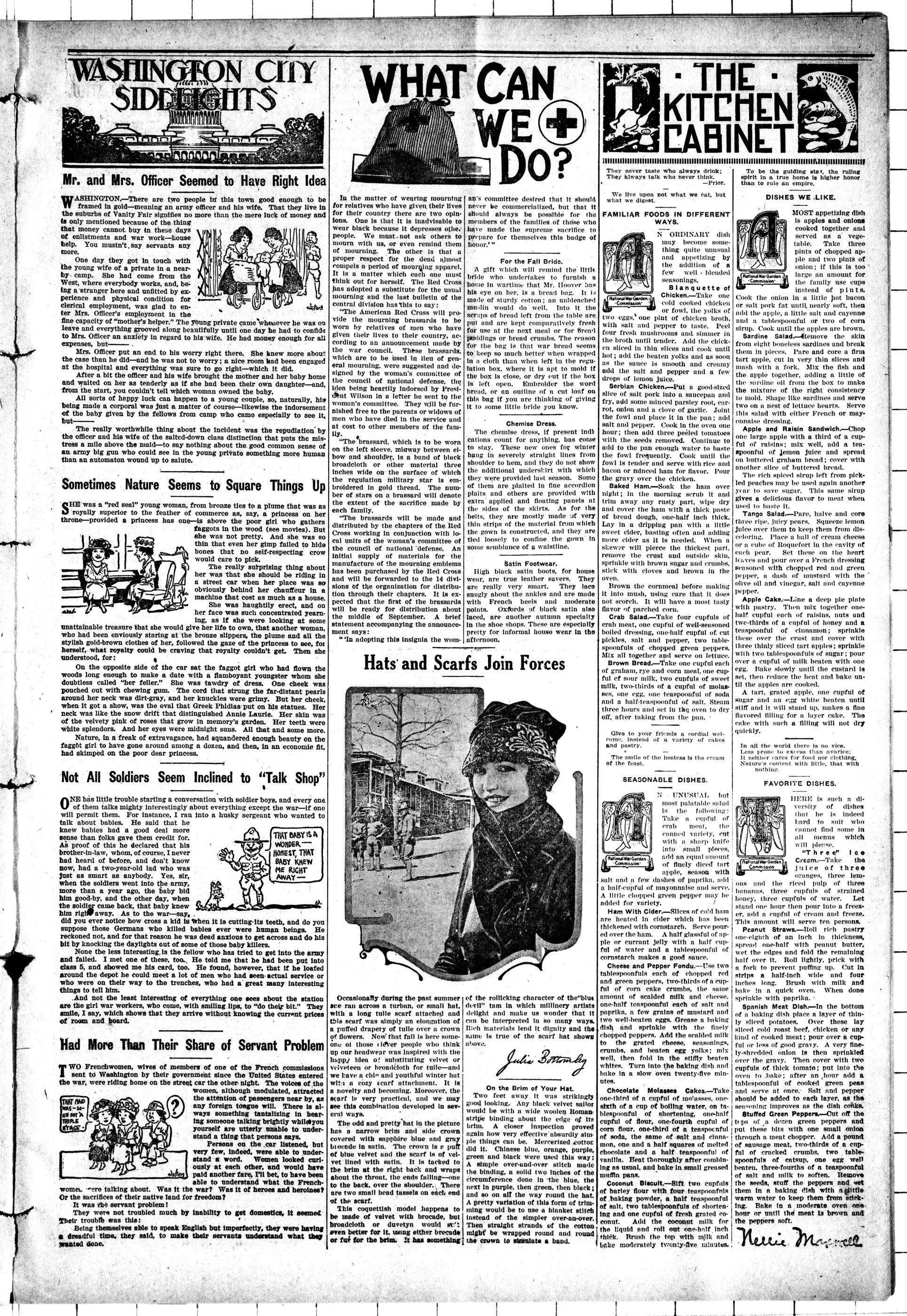
WASHINGTON CITY
SIDELIGHTS
Mr. and Mrs. Officer Seemed to Have Right Idea
WASHINGTON.—There are two people in this town good enough to be framed in gold—meaning an army officer and his wife. That they live in the suburbs of Vanity Fair signifies no more than the mere luck of money and
fine capacity of "mother's helper." The young private came whauever he was owe and leaving everything grooved along beautifully until one day he had to confide to Mrs. Officer an anxiety in regard to his wife. He had money enough for all expenses, but——
Mrs. Officer put an end to his worry right there. She knew more about the case than he did—and he was not to worry; a nice room had been engaged at the hospital and everything was sure to go right—which it did.
After a bit the officer and his wife brought the mother and her baby home and waited on her as tenderly as if she had been their own daughter—and, from the start, you couldn't tell which woman owned the baby.
All sorts of happy luck can happen to a young couple, so, naturally, his being made a corporal was just a matter of course—likewise the indorsement of the baby given by the fellows from camp who came especially to see it, but——
The really worthwhile thing about the incident was the repudiation by the officer and his wife of the salted-down class distinction that puts the mistress a mile above the maid—to say nothing about the good common sense of an army big gun who could see in the young private something more human than an automaton wound up to salute.
Sometimes Nature Seems to Square Things Up
SHE was a "red seal" young woman, from bronze ties to a plume that was as royally superior to the feather of commerce as, say, a princess on her throne—provided a princess has one—is above the poor girl who gathers
unattainable treasure that she would give her life to own, that another woman, who had been envolly staring at the bronze slippers, the plume and all the stylish gold-brown clothes of her, followed the gaze of the princess to see, for herself, what royalty could be craving that royalty couldn't get. Then she understood, for:
On the opposite side of the car sat the faggot girl who had flown the woods long enough to make a date with a flamboyant youngster whom she doubtless called "her feller." She was tawdry of dress. One cheek was pouched out with chewing gum. The cord that strung the far-distant pearls around her neck was dirt-gray, and her knuckles were grimy. But her cheek, when it got a show, was the oval that Greek Philias put on his statues. Her neck was like the snow drift that distinguished Annie Laurie. Her skin was of the velvety pink of roses that grow in memory's garden. Her teeth were white splendors. And her eyes were midnight suns. All that and some more.
Nature, in a freak of extravagance, had squandered enough beauty on the faggot girl to have around among a dozen, and then, in an economie fit, had skimped on the poor dear princess.
Not All Soldiers Seem Inclined to "Talk Shop"
Not All Soldiers Seem Inclined to "Talk Shop"
ONE has little trouble starting a conversation with soldier boys, and every one of them talks mightly interestingly about everything except the war—if one will permit them. For instance, I ran into a husky sergeant who wanted to
did you ever notice how cross a kid is when it is cutting its teeth, and do you suppose those Germans who killed babies ever were human beings. He reckoned not, and for that reason he was dead anxious to get across and do his bit by knocking the daylights out of some of those baby killers.
None the less interesting, is the fellow who has tried to get into the army and failed. I met one of these, too. He told me that he had been put into class 5, and showed me his card, too. He found, however, that if he loafed around the depot he could meet a lot of men who had seen actual service or who were on their way to the trenches, who had a great many interesting things to tell him.
And not the least interesting of everything one sees about the station are the girl war workers, who come, with smiling lips, to "do their bit." They smile, I say, which shows that they arrive without knowing the current prices of room and board.
Had More Than Their Share of Servant Problem
Had More Than Their Share of Servant Problem
TWO Frenchwomen, wives of members of one of the French commissions sent to Washington by their government since the United States entered the war, were riding home on the street car the other night. The voices of the
women were talking about. Was it the war? Was it of heroes and heroines? Or the sacrifices of their native land for freedom?
It was the servant problem!
They were not troubled much by inability to get domestics, it seemed. Their trouble was this:
Being themselves able to speak English but imperfectly, they were having a dreadful time, they said, to make their servants understand what they wanted done.
One day they got in touch with the young wife of a private in a nearby camp. She had come from the West, where everybody works, and, being a stranger here and unified by experience and physical condition for clerical employment, was glad to enter Mrs. Officer's employment in the
fine capacity of "mother's helper." The leave and everything grooved along be to Mrs. Officer an anxiety in regard to expenses, but——
Mrs. Officer put an end to his woe the case than he did—and he was not a at the hospital and everything was su After a bit the officer and his wife and waited on her as tenderly as if from the start, you couldn't tell which All sorts of happy luck can happen being made a corporal was just a mat of the baby given by the fellows from but——
The really worthwhile thing about the officer and his wife of the salted-dress a mile above the naid—to say no an army big gun who could see in the than an automaton wound up to salute.
Sometimes Nature Seem
SHE was a "red seal" young woman, royally superior to the feather of throne—provided a princess has one-
A
unattainable treasure that she would glo
who had been enviously staring at the
stylish gold-brown clothes of her, follo
herself, what royalty could be craving
understood, for:
On the opposite side of the car w
woods long enough to make a date w
doubtless called "her feller." She w
poured out with chewing gum. The
around her neck was dirt-gray, and her
when it got a show, was the oval that
neck was like the snow drift that dist
of the velvety pink of roses that grow
white splendors. And her eyes were n
Nature, in a freak of extravagance
faggot girl to have gone around among
had skimped on the poor dear princes
Not All Soldiers Seem
ONE has little trouble starting a conve
of them talks mighty interestingly a
will permit them. For instance, I ran
talk about babies. He said that he knew babies had a good deal more sense than folks gave them credit for. As proof of this he declared that his brother-in-law, whom, of course, I never had heard of before, and don't know now, had a two-year-old lad who was just as smart as anybody. Yes, sir, when the soldiers went into the army, more than a year ago, the baby bid him good-by, and the other day, when the soldier came back, that baby knew him right away. As to the war—say,
did you ever notice how cross a kid is suppose those Germans who killed he reckoned not, and for that reason he was bit by knocking the daylights out of some. None the less interesting, is the felt and failed. I met one of these, too, class 5, and showed me his card, too. around the depot he could meet a lot of who were on their way to the trench things to tell him. And not the least interesting of are the girl war workers, who come, smile, I say, which shows that they arr of room and board.
Had More Than Their S
TWO Frenchwomen, wives of members sent to Washington by their govors the war, were riding home on the street
THAT MAD WAS--SO-- UN SOT A TRIple ETAGE.
women were talking about. Was it the Or the sacrifices of their native land for It was the servant problem! They were not troubled much by Their trouble was this: Being themselves able to speak En a dreadful time, they said, to make wanted done.
M. P.
young private came whenever he was ou-
bautifully until one day he had to confide
his wife. He had money enough for all
morry right there. She knew more about
to worry; a nice room had been engaged
uure to go right—which it did.
brought the mother and her baby home
she had been their own daughter—and,
woman owned the baby.
en to a young couple, so, naturally, his
letter of course—likewise the indorsement
m camp who came especially to see it,
but the incident was the repudiation by
bown class distinction that puts the mis-
othing about the good common sense of
young private something more human.
ans to Square Things Up
from bronze ties to a plume that was as
commerce as, say, a princess on her
is above the poor girl who gathers
faggots in the wood (see movies). But she was not pretty. And she was so thin that even her gimp failed to hide bones that no self-respecting crow would care to pick.
The really surprising thing about her was that she should be riding in a street car when her place was so obviously behind her chauffeur in a machine that cost as much as a house.
She was haughtily erect, and on her face was such concentrated yearning, as if she were looking at some
live her life to own, that another woman,
be bronze slippers, the plume and all the
bowed the gaze of the princess to see, for
that royalty couldn't get. Then she
sat the faggot girl who had flown the
with a flamboyant youngster whom she
was tawdry of dress. One cheek was
cord that strung the far-distant pearls
her knuckles were grimy. But her cheek,
Greek Phidias put on his statues. Her
inguished Annie Laurie. Her skin was
in memory's garden. Her teeth were
midnight suns. All that and some more.
he had squandered enough beauty on the
a dozen, and then, in an economic fit,
less.
Inclined to "Talk Shop"
Perspersion with soldier boys, and every one
about everything except the war—if one
in a husky sergeant who wanted to
THAT BABY IS A WONDER
HONEST, THAT
BABY KNEW
ME RIGHT
AWAY
when it is cutting its teeth, and do you babies ever were human beings. He has dead anxious to get across and do his me of those baby killers. allow who has tried to get into the army He told me that he had been put into He found, however, that if he loafed of men who had seen actual service or es, who had a great many interesting everything one sees about the station with smiling lips, to "do their bit." They drive without knowing the current prices
Share of Servant Problem
ers of one of the French commissions ment since the United States entered a car the other night. The voices of the
women, although modulated, attracted the attention of passengers near by, as any foreign tongue will. There is always something tantalizing in hearing someone talking brightly while you yourself are utterly unable to understand a thing that persons says.
Persons on the car listened, but very few, indeed, were able to understand a word. Women looked curiously at each other, and would have paid another fare, I'll bet, to have been able to understand what the French war? Was it of heroes and heroines? freedom?
inability to get domestics, it seemed english but imperfectly, they were having their servants understand what they
WHAT CAN WE DO?
Hats and Scarfs Join Forces
THE FASHION WEEKLY
In the matter of wearing mourning for relatives who have given their lives for their country there are two opinions. One is that it is inadvisable to wear black because it depresses other people. We must not ask others to mourn with us, or even remind them of mourning. The other is that a proper respect for the dead almost compels a period of mourning apparel. It is a matter which each one must think out for herself. The Red Cross has adopted a substitute for the usual mourning and the last bulletin of the central division has this to say:
"The American Red Cross will provide the mourning brassards to be worn by relatives of men who have given their lives to their country, according to an announcement made by the war council. These brassards, which are to be used in lieu of general mourning, were suggested and designed by the woman's committee of the council of national defense, the idea being heartily indorsed by President Wilson in a letter he sent to the woman's committee. They will be furnished free to the parents or widows of men who have died in the service and at cost to other members of the family.
"The brassard, which is to be worn on the left sleeve, midway between elbow and shoulder, is a band of black broadcloth or other material three inches wide on the surface of which the regulation military star is embroidered in gold thread. The number of stars on a brassard will denote the extent of the sacrifice made by each family.
"The brassards will be made and distributed by the chapters of the Red Cross working in conjunction with local units of the woman's committee of the council of national defense. An initial supply of materials for the manufacture of the mourning emblems has been purchased by the Red Cross and will be forwarded to the 14 divisions of the organization for distribution through their chapters. It is expected that the first of the brassards will be ready for distribution about the middle of September. A brief statement accompanying the announcement says: "In adopting this insignia the wom-
Hats and Scar
Occasionally during the past summer one ran across a turban, or small hat, with a long tulle scarf attached and this scarf was simply an elongation of a puffed drapery of tulle over a crown of flowers. Now that fall is here someone of those clever people who think up our headwear was inspired with the happy idea of substituting velvet or velveten or broadcloth for tulle—and we have a chic and youthful winter hat with a cozy scarf attachment. It is a novelty and becoming. Moreover, the scarf is very practical, and we may see this combination developed in several ways.
The odd and pretty hat in the picture has a narrow brim and side crown covered with sapphire blue and gray biocade in satin. The crown is a puff of blue velvet and the scarf is of velvet lined with satin. It is tacked to the brim at the right back and wraps about the throat, the ends falling—one to the back, over the shoulder. There are two small bead tassels on each end of the scarf.
This coquettish model happens to be made of velvet with brocade, but broadcloth or duvetyn would suit even better for it, using either brocade or fur for the brim. It has something
---
an's committee desired that it should never be commercialized, but that it should always be possible for the members of the families of those who have made the supreme sacrifice to prepare for themselves this badge of honor."
National War Garden
Commission
For the Fall Bride
A gift which will remind the little bride who undertakes to furnish a house in wartime that Mr. Hoover has his eye on her, is a bread bag. It is made of sturdy cotton; an unblenched muslin would do well. Into it the scraps of bread left from the table are put and are kept comparatively fresh for use at the next meal or for bread puddings or bread crumbs. The reason for the bag is that war bread seems to keep so much better when wrapped in a cloth than when left in the regulation box, where it is apt to mold if the box is close, or dry cut if the box is left open. Embroider the word bread, or an outline of a cut loaf on this bag if you are thinking of giving it to some little bride you know.
Chemise Dress.
The chemise dress, if present indications count for anything, has come to stay. These new ones for winter hang in severely straight lines from shoulder to hem, and they do not show the additional underskirt with which they were provided last season. Some of them are plaited in fine accordion plaits and others are provided with extra applied and floating panels at the sides of the skirts. As for the belts, they are mostly made of very thin strips of the material from which the gown is constructed, and they are tied loosely to confine the gown in somesemblance of a waistline.
Satin Footwear.
High black satin boots, for house wear, are true leather savers. They are really very smart. They lace sungly about the ankles and are made with French heels and moderate points. Oxfords of black satin also laced, are another autumn specialty in the shoe shops. These are especially pretty for informal house wear in the afternoon.
fs Join Forces
of the rolllicking character of the"blue devil" tam in which millinery artists delight and make us wonder that it can be interpreted in so many ways. Rich materials lend it dignity and the same is true of the scarf hat shown above.
Julia Bottomley
Two feet away it was strikingly good looking. Any black velvet sailor would be with a wide woolen Roman-stripe binding about the edge of its brim. A closer inspection proved again how very effective absurdly simple things can be. Mercerized cotton did it. Chinese blue, orange, purple, green and black were used this way. A simple over-and-over stitch made the binding, a solid two inches of the circumference done in the blue, the next in purple, then green, then black and so on all the way round the hat. A pretty variation of this form of trimming would be to use a blanket stitch instead of the simpler over-an-over. Then straight strands of the cotton might be wrapped round and round the crown to simulate a band.
---
THE KITCHEN CABINET
They never tastet who always drink;
They always talk who never thinks.
Third
To be the guiding star, the ruling
honor is higher than to rule an empire.
We live upon not what we eat, but what we digest.
DISHES WE LIKE.
National Nur Garden
Commission
MOST appetizing dish is apples and onions cooked together and served as a vegetable. Take three pints of chopped apple and two pints of onion; if this is too large an amount for the family use cups instead of pints.
FAMILIAR FOODS IN DIFFERENT WAYS.
N ORDINARY dish may become something quite unusual and appetizing by the addition of a few well - blended seasonings.
Blanquette of Chicken.—Take one cold cooked chicken or fowl, the volks of
Cook the onion in a little pot bacon or salt pork fat until, nearly soft, then add the apple, a little salt and cayenne and a tablespoonful or two of corn sirup. Cook until the apples are brown.
two eggs, one pint of chicken broth, with salt and pepper to taste. Peek four fresh mushrooms and simmer in the broth until tender. Add the chicken sliced in thin slices and cook until hot; add the beaten yolks and as soon as the sauce is smooth and creamy add the salt and pepper and a few drops of lemon juice.
Sardine Salad—itemove the skin from eight boneless sardines and break them in pieces. Pare and core a firm tart apple, cut in very thin slices and mash with a fork. Mix the fish and the apple together, adding a little of the sardine oil from the box to make the mixture of the right consistency to mold. Shape like sardines and serve two on a nest of lettuce hearts. Serve this salad with either French or mayonnaise dressing.
Serbian Chicken—Put a good-sized slice of salt pork into a saucepan and fry, add some minced parsley root, carrot, onion and a clove of garlic. Joint the fowl and place it in the pan; add salt and pepper. Cook in the oven one hour; then add three peeled tomatoes with the seeds removed. Continue to add to the pan enough water to baste the fowl frequently. Cook until the fowl is tender and serve with rice and bacon or minced ham for flavor. Pour the gravy over the chicken.
Apple and Raisin Sandwich—Chop one large apple with a third of a cupful of raisins; mix well, add a teaspoonful of lemon juice and spread on buttered graham bread; cover with another slice of buttered bread.
The rich spleed sirup left from pickled peaches may be used again another year to save sugar. This same sirup gives a delicious flavor to ment when used to hastie it.
Baked Ham.—Soak the ham over night; in the morning scrub it and trim away any rusty part, wipe dry and cover the ham with a thick paste of bread dough, one-half inch thick. Lay in a dripping pan with a little sweet elder, basting often and adding more cider as it is needed. When a skewer will pierce the thickest part, remove the crust and outside skin, sprinkle with brown sugar and crumbs, stick with cloves and brown in the oven.
Tango Salad—Pare, halve and core three ripe, juicy pears. Squeeze lemon juice over them to keep them from discoloring. Place a ball of cream cheese or a cube of Roquefort in the cavity of each pear. Set these on the heart leaves and pour over a French dressing seasoned with chopped red and green pepper, a dash of mustard with the olive oil and vinegar, salt and cayenne pepper.
Brown the cornmeal before making it into mush, using care that it does not scorch. It will have a most tasty flavor of parched corn.
Apple Cake.—Line a deep pie plate with pastry. Then mix together one-half cupful each of raisins, nuts and two-thirds of a cupful of honey and a teaspoonful of cinnamon; sprinkle these over the crust and cover with three thinly sliced tart apples; sprinkle with two tablespoonfuls of sugar; pour over a cupful of milk beaten with one egg. Bake slowly until the custard is set, then reduce the heat and bake until the apples are cooked.
Crab Salad.—Take four cupfuls of crab meat, one cupful of well-seasoned boiled dressing, one-half cupful of cut pickles, salt and pepper, two tablespoonfuls of chopped green peppers. Mix all together and serve on lettuce. Brown Bread.—Take one cupful each of graham, rye and corn meal, one cupful of sour milk, two cupfuls of sweet milk, two-thirds of a cupful of molasses, one egg, one teaspoonful of soda and a half-teaspoonful of salt. Steam three hours and set in the oven to dry off, after taking from the pan.
A tart, grated apple, one cupful of sugar and an egg white beaten until stiff and it will stand up, makes a fine flavored filling for a layer cake. The cake with such a filling will not dry quickly.
Give to your friends a cordial wel-
come and of a variety of cakes
and pans.
In all the world there is no vice.
Less prone to excess than avarice;
it neither cares for food nor clothing.
Nature's content with little, that with
The smile of the hostess is the cream of the feast.
SEASONABLE DISHES.
FAVORITE DISHES.
N UNUSUAL but most palatable salad is the following: Take a cupful of crab meat, the canned variety, cut with a sharp knife into small pieces, add an equal amount of finely diced tart apple, season with
National War Garden
Commission
HERE is such a diversity of dishes that he is indeed hard to suit who cannot find some in all menus which will please.
National Water Garden
Commission
"Three" Ice
Cream—Take the
juice of three
oranges, three lem-
salt and a few dashes of paprika, add
a half-cupful of mayonnaise and serve.
A little chopped green pepper may be
added for variety.
ons and the riced pulp of three
bunnas, three cupfuls of strained
honey, three cupfuls of water. Let
stand one hour then pour into a freezer,
add a cupful of cream and freeze.
This amount will serve ten persons.
Ham With Cider.—Slices of cold ham are heated in cider which has been thickened with cornstarch. Serve poured over the ham. A half glassful of apple or currant jelly with a half cupful of water and a tablespoonful of cornstarch makes a good sauce.
Peanut Straws.—Roll rich pastry one-eighth of an inch in thickness, spread one-half with peanut butter, wet the edges and fold the remaining half over it. Roll lightly, prick with a fork to prevent puffing up. Cut in strips a half-inch wide and four inches long. Brush with milk and bake in a quick oven. When done sprinkle with paprika.
Cheese and Pepper Fondu.—Use two tablespoonfuls each of chopped red and green peppers, two-thirds of a cupful of corn cake crumbs, the same amount of scalded milk and cheese, one-half teaspoonful each of salt and paprika, a few grains of mustard and two well-beaten eggs. Grease a baking dish and sprinkle with the finely chopped peppers. Add the scalded milk to the grated cheese, seasonings, crumbs, and beaten egg yolks; mix well, then fold in the stiffly beaten whites. Turn into the baking dish and bake in a slow oven twenty-five minutes.
Spanish Meat Dish—In the bottom of a baking dish place a layer of thinly sliced potatoes. Over these lay sliced cold roast meat, chicken or any kind of cooked meat; pour over a cupul or less of good gravy. A very finely-shredded onion is then sprinkled over the gravy. Then cover with two cupuls of thick tomato; put into the oven to bake; after an hour add a tablespoonful of cooked green peas and serve at once. Salt and pepper should be added to each layer, as the seasoning improves as the dish cooks.
Chocolate Molasses Cakes.—Take one-third of a cupful of molasses, one-sixth of a cup of boiling water, on tablespoonful of shortening, one-half cupful of flour, one-fourth cupful of corn flour, one-third of a teaspoonful of soda, the same of salt and cinnamon, one and a half squares of melted chocolate and a half teaspoonful of vanilla. Heat thoroughly after combining as usual, and bake in small greased muffin pans.
Stuffed Green Peppers—Cut off the tops of a dozen green peppers and put these bits with one small onion through a meat chopper. Add a pound of sausage meat, two-thirds of a cupful of cracked crumbs, two tablespoonfuls of catsup, one egg well beaten, three-fourths of a teaspoonful of salt and milk to soften. Remove the seeds, stuff the peppers and set them in a baking dish with a little warm water to keep them from sticking. Bake in a moderate oven one hour or until the meat is brown and the peppers soft.
Coconut Biscuit—Sift two cupfuls of barley flour with four teaspoonfuls of baking powder, a half teaspoonful of salt, two tablespoonfuls of shortening and one cupful of fresh grated coconut. Add the coconut milk for the liquid and roll out one-half inch thick. Brush the top with milk and bake moderately twenty-five minutes.
Nellie Macnee
PUBLISHED EVERY FRIDAY BY
CHARLES SUMNER SMITH,
Minneapolis, Minnesota.
Entered in the Post Office at Minneapolis as second class matter.
MEMBER
NATIONAL NEGRO PRESS
ASSOCIATION
Subscription by Mail, Postpaid.
ONE YEAR ..... $2.00
SIX MONTHS ..... $125
THREE MONTHS ..... .65
We do not run free ads, or over-run the time contracted for by our advertisers We respect their right to advertise at intervals, and rather have them do so, than to run continuously an "adv." and an increasing account. Write all Checks payable to
Call at 1317 6th Ave. N. on Wednesday to insure matter for publication. The Star's Phone, Hyland 1205. Send your subscription. Our prices have not changed because of the war. Let your dollar do its duty and The Star will reach a higher standard of service and better circulation. A DEPOSIT IS REQUIRED ON ALL POLITICAL ADVERTISEMENTS.
NOTICE TO EXCHANGES.
The War Industries Board, requests that we discontinue "sending FREE copies in exchange for other publications." In order to comply with their request—we will send a check for a yearly subscription to any weekly publication sending a check for a yearly subscription to The Twin City Star.—(Editor.)
Let us not draw the color line. Reciprocity between the races will be the salvation of the Negro.
UNCLE SAM IS CALLING
FOR YOUR
FOURTH LIBERTY LOAN
ANSWER WITH CASH AND
CONFIDENCE. HERE IT IS.
COLORED APPLICANTS REJECTED
The Bee desires to emphasize its protest against the wholesale discrimination in the Government departments against colored applicants who have successfully passed the civil service examination. What does it mean? The Bee again asks. The colored Americans are loyal to this Government and they are doing everything in their power to aid the Administration in the successful prosecution of this war. What offense can be charged against colored Americans? The Bee asks again. The bars have been lifted so that a certain favored class can pass muster without an examination, while another class is compelled to enter examination and after passing successfully is rejected. What does it mean? A declaration has been reported to this office to the effect that no colored people will be appointed by this particular official. In response to the request made by The Bee last week, many persons have announced that they have been rejected by the departments. It is necessary that every colored person who has been rejected send in his or her name at once. These names will be presented to the proper heads at once.
Advertisements are being published daily that the Government is in need of clerks and other employees for war work. Hundreds of colored Americans have applied and been rejected, and white ones cannot be obtained. Messenger boys have been advertised for and colored people have applied, only to be refused. Is the assistance of colored Americans needed? If so, they are willing and ready to respond to their country's call.
If they are needed, and the Government is in need of help, why reject colored applicants? Show one black traitor in the ranks of colored Americans and The Bee will show you one million loyal colored Americans to one black traitor. The Bee appeals to the President of the United States to direct the heads of his departments to lift the bars of discrimination against the colored Americans. They are competent and loyal. Then why reject them?
Every Southern railroad discriminates against the colored people without a just cause. They are treated as cattle when riding South. They are directed to a box car with no conveniences. Does the colored American deserve such treatment? Mr. President, we are with you, and, in the name of God, see that we are given a fair deal.-The Washington (D. C.) Bee.
If you wish to add to your income, you can do so by accepting an agency for The Twin City Star. Good commission to competent agents. Use your spare time in soliciting ads and subscriptions. Only honest and intelligent agents wanted. Call Hyland 1205.
Wanted—Subscribers to Pay.
Shelbyville, Ky., Oct. 11.—Mrs. Daisy M. Saffell, the wife of Prof. George W. Saffell, Jr., principal of Shelbyville colored school, died at her residence in Shelbyville, Ky., Thursday night, October 3, 1918. At the time of her death she was engaged in business with her husband in undertaking. She held the position of secretary of the Undertakers' and Embalmers' Association of Kentucky at the time of her death. She has been the Grand Recorder of the Grand Household of Ruth, G. U. O. O. F., of Kentucky ever since its organization. Much of its splendid success is due to her efforts. She was graduated from the State Normal School of Kentucky and for awhile was a teacher in the Clinton Street High School at Frankfort. In the death of Mrs. Saffell, the race loses a very earnest and hard worker and a valuable woman. A short funeral service was held in Shelbyville, on Sunday, October 6th, and her remains were brought by auto service to the State Cemetery at Frankfort, Ky., and buried in a steel vault with her mother, who died some fifteen years ago. A large number of friends from Shelbyville with the officers of the Grand Household and many other friends from other places composed the funeral party, which was awaited by a very large mass of white and colored citizens of Frankfort. The body was laid to rest with simple ceremonies. Rev. Ward and Brown, of Shelbyville, and Rev. Lanler, of Frankfort, participated in the same. The Household of Ruth of Shelbyville and Frankfort and the Frankfort Chapter of Eastern Star were in attendance at the grave. An abundance of handsome floral designs were given by friends and covered the grave.
MILITARY TRAINING
Meharry Medical and Dental College, at Nashville, Tenn., one of the military training schools, opened last week. The commanding officers are 1st Lieut. Joseph H. Cooper, U. S. Inf., and 2nd Lieut. Lawrence E. Boyd, U. S. Inf. (Adjutant). Lieut. Cooper administered the oath to the students.
NEW YORK SOLDIER
New York, Oct. 9.-Jacob Tinson, Jr., Company C, of the old 15th Regiment, was killed in action in the latter part of August, somewhere in France. His father, Jacob Tinson, expressman, 347 West 59th St., former trustee of St. Mark's Methodist Episcopal church and for a score of years successful in the moving van business, received word only last Wednesday from the War Department. The young man, who formerly lived on Columbus Hill, was among the first to join the 15th Regiment. While standing in a barn during an advance against the Huns a German shell struck Tinson and he was blown to atoms.
MINNESOTA BILLIARDIST WINS IN
NEW YORK CITY.
Will Porter (Old Folks) of St. Paul
Retains Championship.
Although the billiard fans were slightly disappointed in the championship 18.2 balk line match game of 500 points, Manager Willis, finding out at a very late date the conditions, got busy and secured Boston's amateur champion, Mr. LeRoy Holland, who gave an excellent account of himself. Although Mr. Holland did not win, he kept Mr. Porter "Old Folks" busy. Mr. Holland secured the high run of the game while Mr. Porter was the winner. Score, 200 to 183.
The members and friends feel highly indebted to both interstate champions for their services. The contest was so close and interesting that steps were taken immediately for a return match of 500 points for the B. B. champion cup, to take place in November.
The proceeds from this game are for the benefit of the Room Owners' Fund to install tables in Canteens and Clubs for the free use of soldiers and sailors. Mr. Holland donated his end of the expense to the fund. Mr. Porter still claims the championship of many states.—New York News.
Our Red Cross workers here are "not doing very much," according to reports. Now is the time for actual service and sacrifice. Let us do our part for comfort for the boys.
"BUM" POLITICS
We know no word better fitted for the colored politician in Oregon than "bum politics." For years and years the colored politician has voted for the Republican party and handed out political cards, orated, exposulated and split oceans of printer's ink to help elect some office-seeker and like the "bum" who is out of work, the colored politician is still "splitting wood" for a livelihood and tramping on in the same old rut. "Bum politics," to say the least. And it will ever be thus just so long as the colored politician and voters continue to support parties and not men. Now the best way to change the whole "bum" local machine, which has dominated politics in the interest of a favored few (and the colored brother completely excluded) is to pick out men for whom to vote at the coming election and let the "party" go to the "pow-wow." And if this doesn't bring political leaders to their senses where will they recognize a man by his worth and not his color, nothing else will. Think it over.—The Portland (Ore.) Advocate, Sept. 21, 1918.
The Twin City Star stands for equal rights for all American citizens.
THE TWIN CITY STAR, MINNEAPOLIS, MINN
EVERGREEN QUOTATIONS
A very charming book of its kind is "Sayings That Never Grow Old," by Marshall Brown. Here are some little samples of the work:
Laugh and grow fat.
Laugh and be fat, sir.—Ben Jonson.
Laughter, holding both his sides—Milton.
A penny's worth of ninth is worth a pound of sorrow.
And unextinguished laughter shakes the skies.—Alexander Pope.
And if I laugh at a mortal thing, "Tis that I may not weep.
—Byroa.
Every time a man laughs he takes a kink out of the chain of life.—Josh Billings.
I live in the crowd of jollity, not so much to enjoy company as to shun myself.—Samuel Johnson.
Laughter is the magic lens through which we ever see the brightest and best side of life.—Detroit Free Press.
The rlotous tumult of a laugh is the mob-law of the features, and propriety the magistrate who reads the rlot act.—Holmes.
Here is a motto just your fit,
Laugh a little, laugh a bit,
When you think you've trouble hit.
Laugh a little bit,
Look misfortune in the face,
Brave the bedlam's rude grimace;
Ten to one 'twill yield its place
If you have the wit and grit
Just to laugh a little bit.
AROUND THE WORLD
Japan is now printing textbooks for California schools and making bats for American baseball teams.
A cargo of peanuts saved a ship from sinking recently when submarined off the Atlantic coast. The peanuts swelled.
An appeal to "lend a fishing rod for a soldier's holiday" has been sent out by the Y. M. C. A. at Camp Dix, Wrightstown, N. J.
To prevent heavy emigration after the war, Germany has passed a law taxing all those leaving Germany 20 per cent of their capital or property holdings.
FOUR EXPLANATIONS
Her best friend's explanation: "She never was asked—that's the reason."
Aunt Fanny's explanation: "Young men are not. what they were in my days."
Her father's explanation: "She could not find a man her intellectual equal."
Her mother's explanation why Betty never married: "She was always hard to suit."
A. E. F. SIMILES
As noisy as a barracks on payday night.
As lonesome as a guardhouse without a rat.
As ignorant as a war news editor back home.
As futile as the major's attempts to speak French.
As cheerful as a wounded captain going home to "instruct."
MONTAIGNE'S REFLECTIONS
Men are most apt to believe what they least understand—Of Cripples.
Let us a little permit nature to take her own way; she better understands her own affairs than we.—Of Experience.
I am further of opinion that it would be better for us to have (no laws) at all than to have them in so prodigious numbers as we have.—Of Experience.
JUST THOUGHTS
One of the privileges of man is to live and learn.
People who blame others are likely to praise themselves.
A fussy person quickly sours the milk of human kindness.
Sometimes the proof of the pudding is in the unkertaker's bill.
It isn't always safe to tell a girl that you admire her blooming cheek.
If a woman admits that she snores you can safely believe anything she says.
---
A man has to tell only one lie to be branded as a first-class liar.
The Hun is finally waking up to the fact that it is the last victories which count.
A true friend knows that a slander about you isn't true, and if it is true he knows there was a good reason for it.
One man's opinion is just as good as another's, but that doesn't keep both men from thinking theirs is better.
Some, men are hustlers, and others rush through a job to find out how fast they can do it, not how well.
The reason there are so many failures is because there are so many men who think they can succeed without doing any of the hard work required.
It takes some men a long time to discover that their rights and the rights of others frequently clash, and when that happens courtesy not justice has to rule.
Parents who leave their children to be taught by strangers shouldn't complain afterwards if they discover that they've learned things they didn't want them to know.
POPULAR SCIENCE
The telephone operator in Egypt is required to speak five languages: English, French, Italian, Greek and Arabic.
Tallors in some sections of the country are making a specialty of turning men's suits inside out, as a war economy measure.
The newest type of tank assigned for use in warfare is steam-driven and weighs 4 tons. It is of American design and manufacture.
President Faune of Brown university says that the cruelties of Babylon were nothing compared with the scientific "synthetic hellishness" of German warfare.
The principal sugar substitutes recommended by government chemists are corn sirup, maltose (sirup made from potatoes), honey and high-grade refiners' sirup.
All washable tablecloths and napkins remaining unsold in shops throughout Germany have been commandeered by the imperial clothing officer for army use.
Kettles of paper are carried by the Japanese soldiers. When hot water is wanted the kettle is filled and the outside doused with water when it is hung over the fire and in ten minutes the water is boiling.
JOTTINGS
Pluck is the stepfather of success.
Men spend a lot of money for things they don't want.
Some men spoil a good story by sticking to the facts.
About the safest "get-rich-quick" scheme is to marry an heiress.
Some stocks recover from a fall faster than the small operators do.
Those who offer bargains get rich quicker than those who seek them.
Girls make almost as much fusa about graduating as they do about getting married.
Brevity may be the soul of wit, but just the same if doesn't tickle a man when he finds himself short.
Some one said that wealth does not beget contentment. We are positive that poverty doesn't. And there you are!
Almost any married man will freely admit that in the choice of a partner his wife's judgment was superior to his own.
EPICTETUS, JR.
In war it is never too early to mend.
Politics do not make as strange bed-fellows as war.
The race is always to the swift—providing the swift are sure.
This year's midsummer madness is centered in Germany's war office.
And now the whirr of the Liberty motor is mingled with the scream of the American Eagle over in France.—Lewis Allen in the August Forum.
PHILOSOPHICAL
The stay at home must work or fight. The boys "over there" have to do both.
We've never known a man to get very far up the ladder of success by being a lady-killer.
Now and then you run across a fat woman who would rather eat all she wants of all she likes than be thin.
STATE OF MINNESOTA
By the Legislature at Its General Session, 1917, to be Submitted to the People of Said State at the General 1918 Election, Together with a Statement of Its
PURPOSE
AND EFFECT
PREPARED BY
CLIFFORD L. HILTON
Attorney General
of Minnesota.
Addressed to
JULIUS A. SCHMAHL
Secretary of State
OFFICE OF THE ATTORNEY
ST. PAUL, MINNESOTA.
April 29, 1918.
As required by Section 46, General Statutes of the State of Minnesota for the year 1913, I have the honor to furnish you herewith a statement of the purpose and effect of the amendment proposed to the Constitution of the State of Minnesota by the Legislature of 1917, and which is to be submitted to the electors of said State at the General Election in 1918.
PROPOSED AMENDMENT.
Chapter 515 of the Session Laws of Minnesota for the year 1917, proposes an amendment of Article 15 of the Constitution of said State by adding thereto a new section to read as follows;
"Section 6. The manufacture, sale, barter, gift, disposition, or the furnishing, or transportation, or keeping or having in possession for sale, barter, gift, disposition, or the fettering, the transportation of intoxicating liquor of any kind, in any quantity whatever, except for sacramental, mechanical, scientific, or medicinal purposes, shall be forever prohibited within this state, from and after the first day of July, 1920, and this amendment shall be self-executing. The signature shall enact laws for the enforcement of this section and shall provide suitable penalties for the violation thereof."
THE PURPOSE of the proposed amendment is to forever prohibit within the State of Minnesota after July 1, 1920, the manufacture, sale, barter, gift, disposition or the furnishing or transportation, or the keeping or having in possession for any of such purposes, of intoxicating liquor of any kind in any quantity whatever, except for sacramental, mechanical, scientific or medicinal purposes.
THE EFFECT of the proposed amendment, if adopted, will be, to make unlawful and forever prohibit the manufacture, sale, barter, gift, disposition or the furnishing or transportation or the keeping or having in possession for any of such purposes, of indicting liquor of any kind in any quantity whatever, except for sacramental, mechanical, scientific or medicinal purposes, within this state after July 1, 1920, and to place it beyond the power of any legislative authority to permit the doing of any such acts. If adopted, the doing of any of the prohibited acts automatically becomes unlawful after July 1, 1920, without any action on the part of the legislature or other legislative body. The legislature is made self-executing. A duty is, however, imposed upon the legislature to enact laws for the enforcement of this section, if adopted, and to provide penalties for the violation thereof.
Yours respectfully,
CLIFFORD L. HILTON,
Attorney General.
---
Nothing Changed But the Price
Sight Drafts Still the Same Fine Old Cigar You've Always Liked
When your dealer asks you six cents apiece for your old friend Sight Draft, don't get the idea that he is trying to put something over on you.
The plain truth of the matter is that our labor and other manufacturing costs have increased so much that we had the choice of cutting down the size of the Sight Draft cigar, using inferior tobacco, or raising the price one cent.
We believed you would rather have the same old Sight Draft quality, the same old size, even if it cost you a penny more. So, from now on Sight Drafts will be six cents.
Try a Sight Draft today. It's worth six cents and you experienced smokers KNOW it is. W. K. Gresh & Sons, makers. W. S. Conrad Co., St. Paul, wholesale distributors. — Advertisement.
CHOICE CITY AND SUBURBAN PROPERTY FOR SALE ON SMALL MONTHLY PAYMENTS.
Houses and Flats for Rent.
B. M. McDew
802 Sykes Block.
N. W. Nic. 621 Minneapolis
Office Hours: Sundays:
2 to 6 p. m. 10 to 1 p. m.
9:30 a. m. to 12:30 p. m.
R. S. BROWN, M. D.
Office 408-9 Tribune Annex
67 Fourth Street Soutr.
N. W. Main 2040. T. S. 3819
Res. 608 E. 14th St.
N. W. Main 2388 Minneapolis
WORKING-MEN'S
SOCIAL CLUB
FOR MEN ONLY
244 3RD AVE. S.
MINNEAPOLIS
SYLV&STER W. OLIVER &
BENJAMIN JONES
Managers
Peterson, The Druggist
1501 Washington Ave. So.
TOILET ARTICLES, DRUGS)
PRESCRIPTIONS.
He Solicits Your Patronage.
T. S. Center 4639.
WALFRID WESTMAN
Photographer
1425 Washington Ave. So. Minn.
THE KEYSTONE BUFFET
(Formerly "Kid" Mitchell's)
Now under new management of
JIMMY SMITH
1313 Washington Ave So.
Main 2259 Minneapolis
NO HOT WATER
"Let's move into a modern house."
A Gas Water Heater
Solves the Problem.
Sold by
The Minneapolis
Gas Light Go.
Are you a delinquent subscriber?
If so, why not send your subscription?
SMOKE THE RELIABLE
SIGHT DRAFT CIGAR
THAT'S ALL!
IMPORTANT NOTICE
Unless notes are written plainly and properly arranged they will not be inserted. Many people send in notes regardless of names, initials or composition. Arrangement by the publisher will be charged for. Free notices must be correctly written.
LIBERTY DAY OBSERVED.
The anniversary of the discovery of America was celebrated Oct. 12 with appropriate ceremonies in honor of Christopher Columbus. The Italians took the leading part. Among the notable features of the parade was the Sixteenth Battalion band and an escort of Companies C and D of the 16th Battalion, Maj. J. H.-Sherwood commanding. The band received continuous applause, and Lt. W. H. Howard, bandmaster, received many compliments. The music was good and many declared it the best of all the bands. Congressman Thos. Schall, Mayor Thos. Van Lear, Rev. Fr. Augustino Kern and Mr. C. E. Vassaly spoke to the Italian societies at the Adjutantorum. Capt. Brioschi of the Adjutant General's staff had charge of the program and marshaled the parade, which was reviewed by Adjt. Gen. Rhinow. Gov. Burnquist spoke at the evening banquet.
REPUBLICAN CLUB ORGANIZED.
The Hennepin County Republican club held its organization meeting on Thursday, October 10. Atty. Gale P. Hilyer was elected president, and J. D. Hardin, secretary. Editor R. B. Montgomery arranged the meeting. Atty. John L. Ervin was the principal speaker. About 25 members were present.
BAN ON PUBLIC GATHERINGS.
During the epidemic of Spanish influenza, no public gatherings are allowed. Churches, schools and theatres are closed and all political meetings stopped.
Mrs. J. H. Guilbert is seriously ill at St. Barnabas' hospital.
Mrs. W. R. Donovan left Wednesday to spend a week at Chisago Lake, Minn.
NEGRO CAPTAIN SERVES ON STAFF OF ADJUTANT-GENERAL DURING FIRE TROUBLE
Capt. Chas. Sumner Smith, publicity and intelligence officer on staff of Maj. Sherwood, 16th Battallion, is assigned to duty in the office of General Rhinow as aid to Maj. W. C. Garls, chief of staff. Capt. Smith has very important work on communications from the fire zone, and he is receiving every consideration as other officers.
16TH BATTALION IN RESERVE.
It is probable that the 16th Battalion, Maj. J. H. Sherwood commanding, will be called for duty in the Duluth district. Orders have been sent to all men to prepare for immediate call for duty. Maj. Garis is anxious to have the men of the 16th Battalion take part in this relief work, which is an honor to be envised. The work of relieving the troops now on duty will begin at once.
Atty. Gale P. Hillyer is residing with Mr. and Mrs. W. R. Donovan, 215 Bedford St. S. E., during the absence of his wife and baby, who are visiting relatives in Montgomery, Ala.
GOVERNMENT EMPLOYE
VISITS RELATIVES
Mr. Gillespie Plummer, former resident of this city, is visiting his mother, Mrs. Minnie Plummer, and his sister, Mildred, while en route to Camp Pike, Ark., to enter the Officers' Training camp. He has been employed in the war department several years as stenographer, was stationed in St. Paul and has been in New York several years. Many of the older residents were glad to see Mr. Plummer. He has been promised an important assignment on receiving his commission and has the best wishes of a host of friends.
G. U. O. OF O. F
St. Anthony Lodge No. 2877, G. U.
Q. of Odd Fellows, elected the following officers: W. W. Williams, N. G;
J. W. Whitely, V. G.; M. L. Brown,
P. N. G.; George Peale, E. S.; Wm.
R. Morris, P. S.; Noah C. Stone, W.
T.; J. J. Turner, N. F.; I. S. Bogie, P. N.
F.; O. S. Lee, Chaplain; O. A. Lawrence, Advocate; Wm. Jenkins, Warden.
Statement of the Ownership, Management, Circulation, Etc., of THE TWIN CITY STAR
Published Weekly at Minneapolis, Minn., Required by the Act of Congress August 24, 1912.
Editor, Manager, Publisher and Owner: Charles Sumner Smith, Minneapolis, Minn.
Known bondholders, mortgagees and other security holders, holding 1 per cent or more of total amount of bonds, mortgages, or other securities—None. Signed,
CHAS. SUMNER SMITH.
Subscribed and sworn to before me this 3rd day of October, 1918.
GALE P. HILYER,
Notary Public, Hennepin County, Minn.
My commission expires March 24, 1922.
(Notarial Seal.)
Are you a delinquent subscriber? If so, why not send your subscription?
IPEU
6
We present to the readers of The National Advocate J. T. Dahl, candidate for Alderman of the Sixth Ward, who needs no introduction. He has been a resident of this Ward since '76, and he is loved by all who know him. He says, "There is no question superior to the question of loyalty," and he is one hundred per cent American. Vote for him, and you will make no mistake.
Paid advertisement for which $1.00 per inch has been paid to the National Advocate.
Advertisement.
M.
JUDGE C. L. SMITH.
Candidate for Re-election as Judge of the Municipal Court.
Judge Smith was appointed Judge of the Municipal Court in 1905 and was elected in 1906 and again in 1912. He has served with credit and distinction in this important position for more than thirteen years. He is a kindly Christian gentleman and a good judge, sympathetic and patient. He has many friends among all classes who desire to see him remain upon the bench as long as he will serve the people. The voters of Minneapolis will make no mistake in re-electing him and we believe they will. His ability, fairness, fine service, keen judicial insight and right thinking entitle him to, and ought to make sure his re-election. -Pald Advertisement.
CLASSIFIED ADVERTISEMENTS
SEE McDFW! for real estate.
HOUSE FOR RENT.
FOR RENT—Five rooms, modern except heat, on car line. $11.00 per month. Call Main 2040.
NICE FRONT ROOM For Rent—Suitable for two; gentlemen preferred. Snelling and 4th Ave. car lines pass the door; good location; walking distance. Call So. 117 before noon. Mrs. E. A. Mitchell, 1828 4th Ave. So.
FOR RENT—Eight-room house; modern, furnace heat; reasonable rent. Apply Walter Smith, 2812 Elliot Ave. Tel. South 3113.
FOR RENT—Three nice rooms for light housekeeping; newly papered; modern; near car lines. Apply to Carroll, 3102 Blairsdell ave., city.
For Rent—One furnished room, for one or a couple. Modern except heat, near car line, desirable location. Mrs. W. W. Williams, 2900 Eleventh Ave. S. Phone Drexel 4728.
Mrs. Clarence Cunningham has opened a millinery department in connection with Mrs. Van Hook's, the dressmaker at 1006 Sixth Ave. N. Minneapolis. She offers special bargains in millinery.
EVERY DAY is BARGAIN DAY at the ROOT & HAGEMAN STORE, 407 Nicollet Ave.
ST. PAUL HOME GUARDS. Companies A and B of the 16th Battalion, M. H. G., will hereafter meet every Wednesday night in the old Capitol on Wabasah street.
SUBSCRIBERS WANTED - Make the Twin City Star a live and dependable weekly Negro newspaper by sending your subscription.
THE TWIN CITY STAR. MINNEAPOLIS. MINN.
PRESIDENT WILL NOT DEAL WITH FOE AUTOCRACY
Wilson Refuses to Concede German Government's Request for Armistice.
Cessation of Hostilities Impossible While Acts of Inhumanity, Spoilation and Desolation Shock Civilized World.
Washington, Oct. 16. — President Wilson answered Germany's peace proffer with a note declaring anew that there can be no peace with a German government controlled by a military autocracy and no thought of an armistice while German atrocities continue on land and sea.
This statement was made at the White House: "The government will continue to send over 250,000 men with their supplies every month and there will be no relaxation."
President Wilson's Answer.
The text of the President's answer follows:
"The unqualified acceptance by the present German government, and by a large majority of the reichstag, of the terms laid down by the President of the United States of America in his address to the Congress of the United States on the 8th of January, 1918, and his subsequent addresses, justifies the President in making a frank and direct statement of his decision with regard to the communications of the German government of the 8th and 12th of October, 1918.
"He feels confident that he can safely assume that this will also be the judgment and decision of the Allied governments."
"The President feels that it is also his duty to add that neither the government of the United States nor, he is quite sure, the governments with which the government of the United States is associated as a blerigent, will consent to consider an armistice so long as the armed forces of Germany continue the illegal and inhuman practices which they still persist in.
"At the very time that the German government approaches the government of the United States with proposals of peace its submarines are engaged in sinking passenger ships at sea and not the ships alone, but the very boats in which their passengers and crews seek to make their way to safety; and in their present enforced withdrawal from France and Flanders the German armies are pursuing a course of wanton destruction which has always been regarded as in direct violation of the rules and practices of civilized warfare. Cities and villages, if not destroyed, are being stripped not only of all they contain, but often of their very inhabitants.
"The nations associated against Germany cannot be expected to agree to a cessation of arms while acts of inhumanity, spoliation and desolation are being continued which they justly look upon with horror and with burning hearts.
"It is necessary, also, in order that there may be no possibility of misunderstanding, that the President should very solemnly call the attention of the government of Germany to the language and plain intent of one of the terms of peace which the German government now has accepted. It is contained in the address of the President, delivered at Mount Vernon, on the Fourth of July last. It is as follows:
"The destruction of every arbitrary power everywhere that can separately, secretly and of its single choice disturb the peace of the world; or if it cannot be presently destroyed, at least its reduction to virtual impotency."
"The power which has hitherto controlled the German nation is of the sort here described. It is within the choice of the German nation to alter it. The President's words just quoted naturally constitute a condition precedent to peace, if peace is to come by the action of the German people themselves.
"The President feels bound to say that the whole process of peace will in his judgment depend upon the definiteness and satisfactory character of the guarantees which can be given in this fundamental matter. It is indispensable that the governments associated against Germany should know beyond a peradventure with whom they are dealing.
"The President will make a separate reply to the royal and imperial government of Austria-Hungary.
"Accept, sir, the renewed assurance of my high consideration.
"ROBERT LANSING."
Task of Completing Loan.
Washington. Oct. 16.—Unaffected by proposals of peace by Germany, the American people set themselves to subscribe at least $3,000,000,000 in the next six days to the Fourth Liberty Loan—the greatest financial task ever placed before the nation. Reports to the Treasury department based on information received from each of the 12 federal reserve districts showed that total subscriptions received through banks and through trust companies to date amount to only $2,500,000,000.
Proper Treatment of Mild Cases of Spanish Influenza.
Use of Gauze Masks Is Recommended for Those Nursing Sick—Ilandkerchiefs Are Out of Place— Rest Is Important.
Washington.—In an effort to reduce unnecessary calls on the over-worked physicians throughout the country because of the present epidemic of influenza, Surgeon General Blue of the United States public health service calls upon the people of the country to learn something about the home care of patients ill with influenza. Physicians everywhere have complained about the large number of unnecessary calls they have had to make because of the inability of many people to distinguish between the cases requiring expert medical care and those which could readily be cared for without a physician. With influenza continuing to spread in many parts of the country, and with an acute shortage of doctors and nurses everywhere, every unnecessary call on either physician or nurses makes it so much harder to meet the urgent needs of the patients who are seriously ill.
Present Generation Spoiled.
"The present generation," said the surgeon general, "has been spilled by having had expert medical and nursing care readily available. It was not so in the days of our grandmothers, when every good housewife was expected to know a good deal about the care of the sick.
"Every person who feels sick and appears to be developing an attack of influenza should at once be put to bed in a well-ventilated room. If his bowels have moved regularly, it is not necessary to give a physic; where a physic is needed, a dose of castor oil or Rochelle salts should be given.
"The room should be cleared of all unnecessary furniture, bric-a-brac, and rugs. A wash basin, pitcher, and slop bowl, soap and towel should be at hand, preferably in the room or just outside the door."
"If the patient is feverish a doctor should be called, and this should be done in any case if the patient appears very sick, or coughs up pinkish (blood-stained) sputum, or breathes rapidly and painfully.
"Most of the patients cough up considerable mucus; in some, there is much mucus discharged from the nose and throat. This material should not be collected in handkerchiefs, but rather in bits of old rags, or toilet paper, or on paper napkins. As soon as used, these rags or papers should be placed in a paper bag kept beside the bed. Pocket handkerchiefs are out of place in the sick room and should not be used by patients. The rags or papers in the paper bag should be burned.
"The patients will not be hungry, and the diet should therefore be light. Milk, a soft-bolled egg, some toast or crackers, a bit of jelly or jam, stewed fruit, some cooked cereal like oatmeal, hominy or rice—these will suffice in most cases.
Comfort of Patient.
"The comfort of the patient depends on a number of little things, and these should not be overlooked. Among these may be mentioned a well-ventilated room; a thoroughly clean bed with, fresh, smooth sheets and pillowcases; quiet, so that refreshing sleep may be had; cool drinking water conveniently placed; a cool compress to the forehead if there is headache; keeping the patient's hands and face the forehead if there is headache; clean, and the hair combed; keeping his mouth clean, preferably with some pleasant mouth wash; letting the patient know that someone is within call, but not annoying him with too much fussing; giving the patient plenty of opportunity to rest and sleep.
"It is advisable to give the sick room a good airing several times a day. "So much for the patient. It is equally important to consider the person who is caring for him. It is important to remember that the disease is spread by breathing germ-laden matter sprayed into the air by the patient in coughing or even in ordinary breathing. The attendant should therefore wear a gauze mask over her mouth and nose while she is in the sick room. Such a mask is easily made by folding a piece of gauze four fold, sewing a piece of tape at the four corners.
Observe Cleanliness.
"The attendant should, if possible wear a washable gown or an apron which covers the dress. This will make it much simpler to avoid infection.
"It is desirable that all attendants learn how to use a fever thermometer. This is not at all a difficult matter, and the use of such a thermometer is a great help in caring for the patients The druggist who sells these thermometers will be glad to show how they are used.
"In closing, and lest I be misunderstood, I wish to leave one word of caution: If in doubt, call the doctor."
His Sincere Hope.
She—I trust, Jack, dear, that our marriage will not be against your father's will.
He—I'm sure I hope not; it would be mighty hard for us if he should change it.—Boston Evening Transcript.
Intricate Reasoning.
"Aunt Belle, if you had your life to live over again what would you do?"
"I'd get married before I had sense enough to be an old maid."—Boston Evening Transcript.
Don't Miss the
EIGHTH ANNUAL HALLOWE'EN BALL
Under the Auspices of
PRIDE OF MINNESOTA LODGE NO. 5,
KNIGHTS OF PYTHIAS
MONDAY EVENING, OCTOBER
ARCADIA HALL
Fifth Street and Fourth Avenue South, Minneap
MUSIC BY SIXTEENTH BATTALION ORCHEST
J. F. Stevens, Director
SUNDAY EVENING, OCTOBER
ARCADIA HALL
In Street and Fourth Avenue South, Minneap
MUSIC BY SIXTEENTH BATTALION ORCHEST
J. F. Stevens, Director
50c Tax
AUTO FOR HIRE
AS. E. BUTL
Formerly of Pence Auto Co.
W. Main 2869 Auto. 367
EN MARIENHOP
For 28 Years at 318 Hennepin Avenue.
Tailor to Men
MONDAY EVENING, OCTOBER 28
ARCADIA HALL Fifth Street and Fourth Avenue South, Minneapolis MUSIC BY SIXTEENTH BATTALION ORCHESTRA J. F. Stevens, Director
AUTO F
CHAS. E.
Formerly of I
N. W. Main 2869
BEN MAR
For 28 Years at 3
Tailor
```markdown
```
Formerly of Pence Auto Co.
N. W. Main 2869 Auto. 36774
IMPORTED AND DOMESTIC WOOLEN'S AT POPULAR PRICES Your Patronage Desired. HARRY LEVIT
RRY LEVITO
HARRY LEVITON
Practical Tailor
MEN'S SUITS AND OVER
Dry Cleaning and Fancy Dyeing
Phone N. W. Hyland 2875
POPULAR PRICED SHOE
SPECIAL SAMPLE SH
WE FIX 'EM WHILE YOU
Men's Sewed Soles
Ladies' Sewed Soles
Men's Nailed Soles
Rubber Heels
Ladies' and Boy's Nailed Soles
SEVEN CORNERS' SHOE RE
1424 Washington Ave. So., N
South Side
212 Eleventh Ave
EXPERT BARBERS
CIGARS, POOL AND BILLIAR
RACE PAPERS-
THOMPSON &
The Waiters'
BLS SUITS AND OVERCOATS MADE TO ORDER
Cleaning and Fancy Dyeing of Ladies' and Gent's Gau-
N. Hyland 2875 1317 No. 6th Ave., M
ER PRICED SHOE REPAIRING.
SPECIAL SAMPLE SHOES
WE FIX 'EM WHILE YOU WAIT.
1d Soles ..... $1.00
2d Soles ..... .85
3d Soles ..... .85
4s ..... .40
Boy's Nailed Soles ..... .65
BORNERS' SHOE REPAIR SHOP.
Washington Ave. So., Minneapolis. JOSEPH D
North Side Barber SH
212 Eleventh Ave. S., Minneapolis
EXPERT BARBERS; UP TO THE MINUTE
POOL AND BILLIARD TABLES IN CONNE
RACE PAPERS—SHOES SHINED.
THOMPSON & CARVER, Props.
The Waiters' and Porters' Club
MEN'S SUITS AND OVERCOATS MADE TO ORDER.
Dry Cleaning and Fancy Dyeing of Ladies' and Gent's Garments.
Phone N. W. Hyland 2875 1317 No. 6th Ave., Minneapolis.
POPULAR PRICED SHOE REPAIRING SPECIAL SAMPLE SHOES
South Side Barber Shop
212 Eleventh Ave. S., Minneapolis
EXPERT BARBERS; UP TO THE MINUTE.
CIGARS, POOL AND BILLIARD TABLES IN CONNECTION.
RACE PAPERS—SHOES SHINED.
THOMPSON & CARVER, Props.
GLOVER SHULL, PRES.
311 HENNEPIN AVE. MINNEAPOLIS
EDDIE BOYD, SECY' LEE WHEELER, MANAGER
& H. Wet Wash Laun
3753-55-57 Cedar Avenue
Grade Specialists in Wet W
Wash and Family Launder
WORK IS OUR BEST ADVERTISEMENT
J. & H. Wet
3753-55-57
High Grade Special
Dry Wash and F
OUR WORK IS OUR B
High Grade Specialists in Wet Wash Dry Wash and Family Laundering OUR WORK IS OUR BEST ADVERTISEMENT
Do not waste your time making promises to our agents. Send your money by Express or Post Office Order or in cash or postage stamps.
Read the Negro Papera.
Several laborers from the harrow fields have returned after a good son. They received high prices their work and reported a special mand for Negro laborers under favorable conditions.
---
Admission, 50c
9rex 1269
NG, OCTOBER 28
A HALL
Avenue South, Minneapolis
BATTALION ORCHESTRA
ms, Director
OR HIRE
BUTLER
Pence Auto Co.
Auto. 36774
RIENHOFF
8 Hennepin Avenue.
Auto Men
LEVITON
al Tailor
COATS MADE TO ORDER.
of Ladies' and Gent's Garments.
1317 No. 6th Ave., Minneapolis.
Minneapolis. JOSEPH DAHL, Props.
Barber Shop
e. S., Minneapolis
UP TO THE MINUTE.
AND TABLES IN CONNECTION.
SHOES SHINED.
CARVER, Props.
and Porters' Club
Wash Laundry
Cedar Avenue
Pullists in Wet Wash
Family Laundering
BEST ADVERTISEMENT
Several laborers from the harvest
fields have returned after a good season. They received high prices for
their work and reported a special demand for Negro laborers under most
favorable conditions.
---
Taxies at 1:45
[Picture of a man]
A
Automatic 61809
All Men Must Do War Work U. S. Employment Service Serves Notice That Able Bodied Citizens May Not Continue Working at Unnecessary Jobs.
The United States employment service is "getting down to cases" in finding unskilled labor for essential war work. It has served notice that employment that is simply personal service or for personal pleasure will not be regarded as war work.
Also the employment service makes an appeal to automobile owners to release chauffeurs, whenever possible, and to consider well before they buy accessories for their machines, whether they need the work required to produce them as much as the country needs it to help win the war.
In an authorized interview, Nathan M. Smyth, assistant director general of the United States employment service, gives the program and purpose of that department as follows:
"The community labor boards are charged with the responsibility of determining the methods which shall govern the employment service in attempting to recruit for war work men from industries which are not directly connected with the prosecution of the war. The power to determine priority among industries and to close up nonessential industries by shutting off supplies rests with the war industries board.
"The United States employment service will follow the priorities determined by the priorities board of the war industries board, and the employment service through all its agencies will keep in systematic and constant co-operation with the man power and material program.
"It is within the province of each community labor board to list those nonwar industries in its community which will first be called upon to contribute men to war work.
"This does not mean that such industries will be compelled to close up or to discharge their male employees at once, but that with as much speed as may be necessary to meet the national emergency, they will release male workers.
"We may as well face the facts. Much work essential to our program is being seriously retarded by lack of unskilled labor. In this situation it is obviously wrong to have able-bodied men continuing to sell candy, cigars and like articles, to be doing work in shops and stores which might with reasonable effort on the part of the employers be intrusted to women, and to be dancing attendance in clubs, barber shops, soft-drink establishments, bowling alleys, dancing academies and elsewhere.
"Our war industries are suffering severely for lack of skilled mechanics. It therefore becomes a burden upon the conscience of every person who employs a chauffeur to determine whether such employment is necessary or merely for the gratification of personal pleasure.
"Moreover, every owner of an automobile should realize that every time he spends five dollars for automobile accessories, supplies or repairs, he is in effect determining whether the working energies of the country shall be devoted to winning the war or to his own personal uses.
"The time has come when, from the standpoint of conservation of labor, we must all of us limit our expenses to those things which are essential."
CHEAPER RATIONS FOR THE HENS
CHEAPER RATIONS FOR THE HENS
(Prepared by the United States Department of Agriculture.)
Beef scraps or some other animal protein feed has been shown by a number of experiments to be essential to good and economical egg-production, especially during winter. In the 18 months preceding January, 1918, the price of meat or beef scrap has increased 100 per cent, while, in some places, it has been difficult to secure it at all, making it advisable to use something in place of this feed. To find satisfactory substitutes was the object of experiments conducted by the poultry specialists of the department. Rations for laying hens containing peanut meal, soy-bean meal and velvet-bean meal have been used with good results since the first of November on the government poultry farm.
Half of the beef scrap normally fed in the mash has been replaced by these feeds, making the ration as follows: A scratch mixture of two parts cracked corn and one part oats, and a mash of nine parts cornmeal, five parts middlings, four parts bran, two parts beef scrap, and two parts of either peanut meal, soy-bean meal, or velvet-vetch meal. All of these parts are by weight. A similar ration containing cottonseed meal has been fed with good results for over one year. The percentage of protein in these feeds was as follows: Beef scrap, 50 to 55; soy-bean meal, 44; cottonseed meal, 38; peanut meal, 28; and velvet-bean meal, 10.
The egg yield for the first three months has been fairly good with all of these feeds, but not quite as good as has been secured from the use of a normal amount of beef scrap. The highest egg yield was secured from the pennant meal; nearly as good results from the soy-bean meal, but only a fair egg yield from the velvet-bean meal. It would appear that all of these feeds are worthy of a trial, used with beef scrap, in sections where they are easily secured. These tests will have to be carried through a considerable period of time to accurately determine the relative value of these feeds.
Winston-Salem, N. C., Great for Tobacco Manufacturing
Although 200 miles from the seaboard in North Carolina, Winston-Salem, a dual city of 17,000 inhabitants, has been designated as a port of entry by the custom officials, because its imports of sugar, licorice and tobacco are enormous. Since 1910, according to Popular Science Monthly, the manufacture of tobacco products has increased more than 370 per cent. Indeed, it is believed that Winston-Salem now leads St. Louis as the chief tobacco manufacturing city in the United States. Eight days after the government had given Winston-Salem a $250,000 post office building the city had paid for it in tobacco revenue.
Force of Niagara River.
The enormous force of Niagara river in its descent from Lake Erie to Lake Ontario represents a descent of 384 feet in 36 miles, while the average height of the falls is between 154 and 162 feet, representing, according to different estimates, from 1,750,000 to 7,000,000 horsepower.
New Faces, Including Cheeks, Noses, Lips, Jaws, Provided In Great Hospitals of Paris
Some miracles of modern surgery are being performed at a hospital in Paris. The surgeons here, writes a correspondent, have become sculptors in human flesh. They reconstruct a man who otherwise would have to go through life hideously ugly, but who is able to leave the hospital practically a normal man. A man whose face had been blown away by a shell has a new nose and lips grown for him; new chins are no longer a matter of comment.
The simplest method is that of removing a scar. An incision is made and the arteries bound up; then a piece of skin is cut from another part of the body and the surgeon's scissors clip it to the desired shape, and very speedily the scar disappears.
To construct a nose a piece of gristle is removed from the region of the ribs and "put out to nurse," as the surgeon describes it, under the skin of the forehead. The gristle continues to live, and when all is ready the surgeon removes it and the protective skin and skillfully manipulates knife and scissors until a new nose is put in its place. The lower portion of the organ is sewn to the upper lip and skin removed from the thigh is used to cover up the scar on the forehead.
A man who could not eat because he had no lower jaw was given a new one constructed from his hip bone. New lips are provided with flesh removed from the neck; broken bones in the cranium are removed and fresh bones put in their place and kept there by a few metal supports. A soldier who had lost his upper jaw, lips, cheeks, palate, nose and mouth came to a hospital to ask for a new face because he wished to visit his mother. He was accommodated with new cheeks and lips, and in a comparatively short time he had the rest of his new face.
French Soldier Wrote Song "Won't Go Home Till Morning"
That most celebrated of drinking songs, "We Won't Go Home Till Morning," found its inspiration in war. The air was composed by an unknown French soldier after the battle of Malplaquet, which was fought in 1709. The French troops suffered severely in the battle, and when night came a cold, drizzling rain and a shortage of food added to their discomfort. The trooper-composer wrote the song on a drumhead, and it was designed to cheer his unhappy comrades. It immediately attained popularity and spread all over France, and thence to England and America.
Tricks ih the Kitchen.
Add apples to the rhubarb pie;
it will be less sharp.
Food should look attractive as
well as taste well.
One pint of milk makes two and one-half ounces of fat soft cheese. Pastry and fried foods are both expensive and indigestible. The best cheese is made from milk before it has soured. Cheese should always be served with corn bread. Frankfurter sausage are good to boll with cabbage.
Stocks of fats and oils in commercial channels, other than retail stocks, as reported to the United States department of agriculture in the comprehensive food survey for July 1, 1918, were as follows: Lard, 114,693,782 pounds; lard compounds (including substitutes other than purely vegetable substitutes), 50,410,780 pounds; solid vegetable cooking fats, 42,636,551 pounds; oleo stock, oleo oil and edible tallow, 30,770,747 pounds; cottonseed oil, 41,718,674 gallons; olive oil, 901,955 gallons; peanut oil, 4,839,931 gallons; corn oil, 2,891,457 gallons
The figures given above include stocks actually reported as on hand by manufacturers, storage houses and wholesale dealers, and also quantities reported as in transit from these stores. The stocks of retail dealers, as reported for July 1, 1918, are not included, since these reports are still in process of being tabulated. In a similar survey made by the department for January 1, 1918, the retail stocks constituted the following percentages of the total commercial stocks of the commodities here considered: Lard, 29.5 per cent; lard compounds, 38.3 per cent; solid vegetable cooking fats, 28.9 per cent; oleo stock, oleo oil and edible tallow, 2.2 per cent; cottonseed oil, 2.5 per cent; olive oil, 44.8 per cent; peanut oil, 4.8 per cent.
In the case of lard and lard compounds, the stocks reported as on hand on July 1, 1918, were slightly less than the corresponding stocks for July 1, 1917, the percentages being 96.3 and 98.4, respectively. The holdings of oleo stock, oleo oil and edible tallow were 87.3 per cent of those reported a year earlier. The greatest decrease is noted in the case of olive oil, where the holdings on July 1, 1918, were only 35.8 per cent of the holdings for July 1, 1917. In the case of the four remaining commodities, the stocks reported represent an increase over the corresponding stocks of a year earlier, the percentage of increase being as follows: 'Solid vegetable cooking fats, 14.5 per cent; cottonseed oil, 8.2 per cent; peanut oil, 194.8 per cent; corn oil, 56.6 per cent.
LAUGHS FOR ALL
No thought of men.
"Josh writes that he's fighting hard for a speedy victory," remarked Farmer Corntossel.
"Yes," commented his wife, "that boy's got the right spirit. He's going to do his duty and wind up the war, although he knows perfectly well that as soon as it's over he'll have to go right back to school."
Wanta Credit
A man in a suit and hat.
Bacon — What's
old Closefist hol-
lering for?
Egbert — Someone
told him he
must give until it
hurts.
Bacon — Well?
Egbert — He just
gave up a dollar
for charity.
Bacon — Well, $1
doesn't hurt.
the people the impression that it does.
The Death Rate.
Statistically Inclined Tourist—What
is the death rate here?
Native—Same as it is everywhere
one—one death for every inhabitant
"I am afraid not, Henry. You see, father is a conscientious objector."
Close Fisted.
A
Edith — That dreadful looking old man her husband? I don't see what she married him for.
Marie — I don't think she sees much of what she married him for, either.
How True!
She—Will you love me as much in December as you do in June, dear? He—More, darling. There's one more day in December.
Worse.
She—Are you sure that we are living beyond our means?
He—Worse than that, we are living beyond our credit.
Jealously Guarded Secret
Cologne's toilet water industry was established at the beginning of the seventeenth century. At that time the city numbered about 50,000 inhabitants, while the present population is 450,000. The inventors of eau de Cologne were Paul Femins and Maria Clementine, Catholic nun. They began on a small scale with few persons employed, whom they did not initiate into their secret of the whole process, the last and most important mixture being made by the inventors themselves. Paul Femins left the secret with the Farina family, while the nun bequeathed the secret to one Peter Schaeben, who had been her assistant for many years.
Vegetables Save Staple Foods Use Products of the Garden and Orchard in Place of Wheat, Meat, Fats and Sugar.
"What am I doing to feed the world?" This question is being asked and answered by every true American. Some have the privilege and responsibility of producing food from the fields or the home garden, while others have the less picturesque but no less responsible part of standing guard over this food supply, to see that every ounce possible of the wheat, meat, fats and sugar needed by our soldiers and allies is saved for their use. There are many substitutes for these things, but "there is no substitute for freedom."
One way to save important staple foods, according to the United States department of agriculture, is to use fresh fruits and vegetables in as large quantities as possible while they are abundant. Potatoes may be used to
THE MUSICIAN
save cereals, and shelled green beans and peas to save meat. All ripe fruits contain sugar, so that melons and other fruits may be used for "desserts" or a fruit salad may replace this course entirely.
Vegetables are savers or conservers of other staple foods, and also have their own particular part to play in the diet which neither meats nor cereals nor sweets can play. Besides being appetizers and furnishing fuel, protein and mineral matter to the body, they supply other important substances of which we know but little as yet, but which play an important part in promoting growth in the young and bodily wellbeing for everyone. All kinds of vegetables should be used. They are at their best when fresh, and may be prepared in a variety of ways.
TO SAVE FUEL IN HOT AIR FURNACE
Rules Given Out by U. S. Fuel Administrator for Illinois.
Joseph Harrington, United States fuel administrator for Illinois, has issued the following rules for handling hot-air furnaces, steam and hot water plants in the interest of fuel economy:
1. Check draft in stovepipe near the turn damper, as this controls largely the rate at which the fire burns, depending not at all upon the opening and closing of the coaling door.
2. The turn damper should fit loosely within the pipe, same to be kept partly closed in all mild periods—opened wide in the cold.
3. Use slide damper in coaling door only for elimination of gases from soft or bituminous coal after the addition of fresh fuel.
4. Turn extra air into pipe for checking of general draft, same furnishing necessary oxygen for the consumption of gases. Open only draft in asphit door for more rapid burning.
5. Heat pipes in cellar thoroughly wrapped to prevent loss by radiation.
6. With grates flat a short, quick stroke of shaker for sifting of ashes, with glow only to be shown in most severe weather.
7. Avoid poking of fire bed to save the causing of draft holes.
8. Additional coal to low fire before shaking.
9. Storm windows and storm doors for economy.
10. Temperature generally at 68 degrees or less, except for invalids or children. Unoccupied rooms cooler, with use of thermometers recommended.
11. Wasteful to allow unusual drop of temperature at night.
12. Bedrooms should carry lower temperatures than ones used for general living.
13. Two pans or jars of water at registers or radiators for moisture in home.
14. Study system for your home, fuel economy serving to warm the shivering boys in France.
What It Costs Uncle Sam to Draft Men Into Army
Figures compiled from the records of the last draft show that it cost the government almost exactly $5 for each man drafted. All but seven cents of this amount represents the expense of the draft boards. In comparison with this it is interesting to learn that the volunteer system of recruiting cost $24.48 per man in 1914; $19.14 in 1915, and $28.95 between July, 1916, and April, 1917. These latter figures, however, included the recruit's traveling expenses and the cost of his subsistence prior to acceptance.
Highest Radio Aerial
The highest radio aerial in the world, the cables of a captive balloon, is in use at the New York navy yard. It was announced that the yard had been in communication with the wireless station at Arcadia, Cal.
TAKE IT FROM FATHER
Son, I haven't much to tell you. I have learned that good advice is A prescription which but few of us will take.
And my long and windy arguments might forsake you in a crisis—
And besides you've got your own career to make;
I have just this bit of counsel which may help you go the distance
With no useless or unnecessary stop,
As you mingle with me, mlee of the strug-
gles or existence
Don't you ever try to argue with a cop!
less from the start;
You may find a whirring buzz-saw is a
thing to play with.
And at times a Bengal tiger has a
heart;
Youth is always doing wonders and for-evermore achieving
While the sages sneer and prophesy a flop;
But there are some final limits, it's a fact that's worth believing,
So don't ever try to argue with a cop!
You might swim the Whirlpool Rapids, you might butt your way through granite.
You might set the Mississippi all afame;
But debating with policemen—take a tip
from dad, and can it—
For the issue is infallibly the same;
You are licked before you've started
with your futile protestations,
So just do the way he tells you, on
the hop,
And unless you have a fancy for a jall's
adventures.
accommodations Don't you ever try to argue with a cop! -Berton Braley, in Saturday Evening Post.
Great, but Not Up to Date.
Old Colonel Eve positively refused to wear corset-covers.
Hannibal did not use tobacco in any form.
Peter the Hermit never spent a cent for phonograph records.
Gustavus Adolphus would not patronize the parcel post.
Goliath absolutely declined to don B. V. D's.
Genghis Khan preferred the steps to the elevator.
Doctor Johnson would not put his foot in an automobile.
Moses had an unconquerable aversion to motorcycles.
aversion to motorcycles. Nero couldn't be persuaded to buy an electric fan.
Pay of Y. M. C. A. Men.
The pay of Y. M. C. A. men in the cantonment service depends on their previous earnings. It is not greater than they have previously been receiving and does not exceed $2,100, even though they have been earning more than that. There is an allowance of $75 for their own expenses and an additional allowance for their families depending on their previous pay, but not exceeding $100 a month.
Searchlight Penetrates Fog.
Great fog penetrating power is claimed for a searchlight that has been invented in France with a greenish yellow glass in front and backed by a reflector that also prevents moisture collecting on the glass.
Stellite, Metal That Will Not Rust—Hardness and Other Qualities of Steel
Everybody knows that metals undergo changes through the influence of oxygen and moisture from the air—these two bodies being always ready for chemical business. Therefore, as everybody also knows, steel knives and other familiar utensils require continual cleaning because they rust so easily. Steel is even more susceptible to rust than iron. The chemists' problem in this case has been to make a metal which is permanent and will not rust, having, at the same time, the hardness and other qualities of steel. That is, a metal as "noble" or permanent as gold and as herd and strong as steel.
Elwood Haynes, a member of the American Chemical society, relates in Metallurgical and Chemical Engineering of a long series of experiments which he made during a period of many years, especially in alloys of cobalt, chromium, tungsten and molybdenum. He finally succeeded in making some of these metals so hard that they can scratch any steel in existence. He has given the name stellite to the series. Stellite may be indefinitely heated without showing oxidation, except for the fact that the surface takes on a permanent blue color. Lathe tools, milling cutters, saws, drawing dies, boring tools, drills, etc., have been made from stellite as well as surgical and dental instruments which have been placed on the market. Table-spoons and small spoons of stellite have been in use for six years and they may last, it appears, for a thousand years more without tarnishing.
Mother's Cook Book.
Age is another opportunity no less
Than youth itself, though in another
dress;
And as the twilight fades away
The sky is filled with stars invisible by
day.
What to Eat
If a cupful or more of noodles are left from dinner save them and in a day or two prepare
Ham and Noodles
Butter an earthen dish, put into the bottom a layer of cold boiled noodles, add a layer of cold boiled ham, cut in bits, then another layer of noodles and so on until the dish is full. Beat an egg with one cupful of milk and pour into the dish. Cover with crumbs, dot with butter and bake in a moderate oven.
Deviled Chicken.
Make a sauce of salt, pepper, dry mustard, paprika, grated lemon peel, lemon juice, Worcestershire sauce and a few drops of tabasco sauce. Add a tablespoonful of butter and cook all together. When the sauce bolls add cubes of cooked chicken; serve when well cooked.
Oysters a la Creole
Chop fine one clove of garlic, a green pepper and a small onion. Season with salt and paprika and cook in two tablespoonfuls of butter. Add a cupful of tomatoes and a cupful of parboiled oysters. Serve very hot on toast, or cover with buttered crumbs and bake.
Clam Cutlets.
Take a quart of clams, chopped fine and a cupful of dried breadcrumbs. Season with salt and pepper, a teaspoonful of tomato catsup and a teaspoonful of minced parsley. Bind with raw egg or with a very little cream sauce. Shape into cutlets, dip in egg and crumbs and fry in deep fat.
Deviled Crabs.
Take one can of minced crab meat add the yolks of two hard cooked eggs, mashed fine, a teaspoonful of Worcestershire sauce, silt and paprika, the juice of half a lemon, a teaspoonful of dry mustard, and a few drops of tabasco sauce. Add enough dried breadcrumbs to make a paste. Fill crab shells with the mixture, cover brown. Ramekins may be used if the shells are not at hand.
Panned Oysters.
Cover the bottom of a baking dish with oysters and with enough of the liquor to steam them well. Cover tightly and bake from five to ten minutes in a hot oven. Serve on buttered toast and pour the hot juice over the toast.
Sour Cream Pie
Take one cupful each of sour cream,
raisins, and honey, one egg, a table-
spoonful of vinegar, a half teaspoon-
ful each of salt, cinnamon, and nut-
meg, with a fourth of a teaspoonful of
cloves. Bake in two crusts.
Nellie Maxwell
They Run on Peat
A Norway firm is advertising engines that can be operated with peat gas instead of benzine or gasoline. The alterations have been made in accordance with a Danish invention, which makes it possible to use this fuel. It is claimed several thousand engines are being used in Denmark successfully. The new system is stated to consume from one to two kilos of peat, 2.2 to 4.4 pounds per horse power, according to the quality of the peat.
(Copyright, 1918, by the McClure Newspaper Syndicate.)
"I shall shriek—I certainly shall shriek if I come to another khaki hero." H. B. Shanley mumbled this rather to herself than aloud as she sat before her high piled desk in the editorial offices of "The Purple Book; all-story, five-cent weekly." H. P. Truman, the remainder of the editorial staff, laid a gentle hand on his bald head and looked over his shell-rimmed spectacles at his colleague on the other side of the room.
He looked just in time to see Miss Shanley dash off her own shell-rimmed spectacles, lean supinely back in her swivel chair and at the same time emit a stifled vell.
"There, I said I'd do it, and I did.
The very next manuscript I turned to began right in the first paragraph with 'Her head dropped on his khaki shoulder. Good-by, she whispered and pushed him away,' and at the end: 'If I thought you were there waiting for me I could fight a thousand Huns.' They are all like that. If the hero isn't in khaki he is in sailor blue and half the heroes are nurses."
"Was that what made you make that funny little shriek noise?" asked Mr. Truman, obviously relieved.
"Certainly, why shouldn't I? Every blessed story that comes in is the same. How I am going to get enough possible stories for you to make up the magazine out of here I am sure I don't know. They are all alike. The contribs have lost their balance. They think that all they have to do is bring in a little trench slang, a lot of mush and twaddle about broad khaki shoulders, clinking spurs and that sort of thing and their story is sold."
Mr. Truman suggested that possibly the readers of the Purple Book liked clinking spurs and khaki shoulders; there were a good many men in the camps who read the magazine and they should be catered to.
"To be sure," agreed Miss Shanley, slitting the next large envelope that lay before her and unfolding the manuscript mechanically. "But I've found it out. There are only about seven days a soldier can fall in love, and we've used each one of those plots at least five times over. It's monotonous. There is the man who doesn't know he loves the plain little girl at home till he gets away in the trenches, and there is the girl who doesn't know she loves the awkward, frank-eyed, broad-shouldered hero till he gets away. Then there is the girl who wants to be a suffragette or something and won't marry the man till he's gone and then she gets an idea that she ought to 'keep the fire burning' and she sends for him or something and—"
"Yes, I know," said Truman, who was rather bored than otherwise at his assistant's analyzing tendencies. There were times when she was delightful, really too delightful for his own peace of mind. But in this mood she was trying. "Well, please don't shriek about it next time—you gave me quite a scare. I thought you were having a fit or something."
"I told you I was going to," argued Miss Shanley.
"I thought you were jesting. Suppose instead of doing that you whistle joyously when you come to a hero out of khaki? Really I quite agree with you that we do need some really gripping stories of a nonmilitary nature." Then Mr. Truman went back to his editorial work, and gradually there began to creep over him a pleasurable consciousness. He had had an undercurrent of conviction that his colleague disapproved of him because he had not enlisted; he had feared that it would be necessary as a means of winning her permanent esteem for him to don the khaki or sailor blue. But apparently he had been mistaken. She could not have spoken as she had about broad khaki shoulders if she had admired them as much as most young women were reputed to do.
Suddenly Mr. Truman started in his chair so violently that his spectacles fell off from his nose. Miss Shanley had emitted a whistle so piercing and sharp that it had violently agitated his delicately strung nervous organism.
"That," she announced, "was to let you know I'd found the gripping story you were wishing for. It's a thriller and the hero is an Argentine cowboy, and there isn't one reference to war. I'm going to accept it without waiting for you to read it, I'm so sure it is what you are looking for."
"You might tell the young woman that wrote it that we appreciate not having the hero in khaki and would like more in the same vein," smiled Mr. Truman as Miss Shanley halled the diminutive stenographer from the next room so that she might at once write her letter of acceptance.
"It isn't a young woman—it's one Patrick Henry Madison." "You never can tell," commented the superior editor. "That's just the sort of name a girl writer would choose. The letter notifying "Patrick Henry Madison" of the acceptance of his story and the announcement that he would receive his check "on date of publication" was brief but encouraging. It was signed H. B. Shanley, and
left little suspicion in us abrupt businesslike wording that H. stood for Helen and B. for Beatrice. Perhaps Patrick Henry Madison had seldom received editorial letters so encouraging, perhaps he read between the lines—at all events he wrote a letter of considerable length sending in his next nonmilitary story—the hero this time was a South Sea island planter, without a suspicion of khaki—and of so friendly a character that H. B. Shanley was constrained to write an equally friendly letter in reply. Again that editor congratulated him on his rare discernment in keeping his heroes out of the war game. "Unless you can tell your story like a genius and have an entirely new twist, any war story now would be deadwood. They have all been written except the really great ones." The correspondence continued for several months and the stories appeared at close intervals. Then "Patrick Henry" asked permission to meet H. B. Shanley and the interview was carefully arranged to take place in the Purple Book editorial office on the afternoon in the week when Mr. Truman played golf. He had quite set himself at ease on the matter of enlisting now, so sure was he of Helen's attitude on that score, and it was only because he had not definitely decided whether when he did ask this colleague of his to become Mrs. Truman he should stipulate that she should continue her post in the office—he dreaded the presence of anyone else—or whether he should arrange to have her do the housekeeping in some conveniently arranged little flat, that he had not as yet taken her into his full confidence as to his intentions. He was planning to settle this question for himself that afternoon on the golf course. Perhaps the next day he would make his declaration.
But the next day he was in no hurry. Helen was in a wonderfully joyous mood and this seemed decidedly auspicious. It would be time enough at five o'clock to ask her.
"Patrick Henry turned out to be of the feminine gender, I dare say!" he asked, as he glanced over proofs on his desk of that writer's latest contribution.
"Miss nothing," laughed Helen, "and the funny thing was he—"
"So it was a man after all?" Mr. Truman felt an irritation that he could not account for.
"It was so funny. He is really perfectly wonderful. I hadn't told you, but we had got very well acquainted with each other through the letters we have written. I knew I liked him, but I imagined he was going to be some quiet, studious little man of about your build."
"Well?" Mr. Truman was distinctly irritated at that remark.
"Well, he wasn't at all. You see he had discovered in the third letter that I wasn't a man, and—well, I don't know how it happened, but we got awfully fond of each other, and—well, he asked me to marry him, and I said I couldn't say yes till I'd seen him. And he said there was something about him that I might dislike very much. He thought I would, he said, from something I said in one of my first letters. You see I told him I was glad his heroes didn't have broad shoulders, or something like that, and—well, you see he has, and he turned out to be Capt. Patrick Henry Madison. Isn't that wonderful? I explained, of course, that what I said about stories had nothing to do w'th the way I felt as a girl. So I just said 'yes' right away, and I thought I'd tell you first because you and I have always been such good chums, and—Patrick and I will be married in a week or so. I thought you ought to have time to find some one else to fill this chair."
Mr. Truman was signing letters with an air of considerable preoccupation. He gently stroked his bald patch and straightened his blue serge shoulders.
"It's very funny that a man in the service would be content to leave all patriotic flavor out of his stories. I should think he would be so enthusiastic he would want to." Mr. Truman had definitely decided he wouldn't like Captain Patrick.
"Oh, he's enthusiastic, all right, and he's going to write one great big thrilling war story. He's just been waiting till he could write a really great one. You'll take it, won't you, Mr. Truman?"
"Yes—unless I'm not here either, You see, I've been thinking of getting into the war myself. There is a mighty strong appeal about khaki and all that sort of thing," and the associate editor assured him that there was.
Why Buttoned Shoes Have Passed.
Every woman with her eyes open must have noticed that button shoes are little worn, and no doubt the fact that lace shoes are as a general thing neater and trimmer and more easily kept in condition has a good deal to do with this.
The fact that button shoes use more leather than lace shoes is the big reason behind their disappearance from fashion, say those who know. It does seem a very little leather to save, doesn't it? But then this is the day when we appreciate the importance of very small things; the saving of a slice of bread a day, a lump of sugar or a half pound of meat—trifles that we are assured amount to enormous proportions in the aggregate.
Gas Meter and Guitars.
The gas meters of the houses in New York city are now recorded by camera, which yields a permanent record of each of the regular readings. The guitar was introduced into Europe by the Spanials, who copied the instrument from the Moors.
OUT-OF-ORDINARY PEOPLE
Sergt. Pilot E. T. Buckley of Chicago whose parents live in Kilbourne, Ill., is back in America after some 20 months of service in the great war, topped off with capture by the Huns and a remarkable escape from their prison camps.
It was on January 2, 1916, that Buckley, then fresh from the University of Illinois, joined the Foreign Legion of France with the intention of qualifying as a fighter. After a thorough course in a French aviation school he was assigned to Nungesser's traveling squadron, known as Escadrille Spad, which corresponded to the German traveling circus headed by the late Baron Richthofen. He and his French comrades, while attached to the Lafayette flying corps, had a roving commission which took them along the western front, but it was in the Verdun region that the American volunteer was to meet the biggest experi-
ence of his life. On September 6 last year he was brought down in a fight with three German planes, one of which he crashed. He was taken to a German prison camp wounded. He was fed badly and treated with studied cruelty because he was an American volunteer in the French army. He made three efforts to escape, but each time was caught on the Swiss frontier or before he reached it. On the fourth occasion he also was stopped by a German sentry, but he gave battle with a pocket knife which a German had given him in the prison camp, laid out the sentry, and made his way back to his squadron in France.
ence of his life. On September 6 last yr three German planes, one of which he prison camp wounded. He was fed because he was an American volunteer efforts to escape, but each time was reached it. On the fourth occasion he but he gave battle with a pocket knife prison camp, laid out the sentry, and France.
LORD MILNE
BENNETT & BENNETT
worker, although his own tastes are it was pre-eminently the first scholar of men, including Mr. Asquith, were in o The passion of his life is to see the coherent, unalterably cohesive, so ed individual impulse that all great natu public good. The public good! Those mean defeat of Germany, the rights of NEW AMBASSA
worker, although his own tastes are indicated by the fact that at Oxford he was pre-eminently the first scholar of his class, despite the fact that brilliant men, including Mr. Asquith, were in opposition. The passion of his life is to see the British empire knit in true democracy, coherent, unalterably cohesive, so equipped with governmental power and individual impulse that all great natural resources will be developed for the public good. The public good! Those three words are his creed. Now they mean defeat of Germany, the rights of all the allies.
NEW AMBASSADOR TO BRITAIN
When President Wilson selected John W. Davis of West Virginia to succeed Walter Hines Page as ambassador to Great Britain there was considerable surprise but not a single adverse criticism of the appointment. The announcement was made just as Mr. Davis, who was then solicitor general of the United States, arrived in Switzerland to serve as the head of the American delegation at the Berne conference between American and German missions on the treatment and exchange of prisoners of war.
Since he went to Washington seven years ago as a member of congress from the First West Virginia district, Mr. Davis has been an active figure in the capital. He was elected to succeed himself in the house, but hardly had begun his second term when President Wilson appointed him solicitor general in August, 1913.
Mr. Davis is forty-five years old.
Beginning life as a lawyer in his home town of Clarksburg, W. Va., after graduating at the Washington and Lee university and the University of Virginia, he became prominent in Democratic politics and served in the West Virginia legislature before going to congress and was a delegate to the Democratic national convention of 1904.
Beginning life as a lawyer in his home at the Washington and Lee university became prominent in Democratic politics lature before going to congress and was convention of 1904.
ITALY'S WARRIOR PRINCE
ITALY'S WARRIOR PRINCE
1930
down in submarines, steered warships
ridden cavalry horses. But the things
front, for he has been there not once,
At the front young Humbert wen
with the soldiers, was petted by them
down in submarines, steered warships, sailed boats, shot at wild boars and hidden cavalry horses. But the things he is proudest of are his trips at the front, for he has been there not once, but many times.
At the front young Humbert went practically everywhere, made friends with the soldiers, was petted by them in return and all in all had a fine time.
P.
he was brought down in a fight with
he crashed. He was taken to a German
badly and treated with studied cruelty
in the French army. He made three
brought on the Swiss frontier or before he
also was stopped by a German sentry,
which a German had given him in the
made his way back to his squadron in
ER, WORKER
On the one occasion—it was but a few weeks ago—when Lord Milner has submitted to an interview, I had gone to him greatly impressed by the high privilege granted me, and, somehow, expected something rather formidable, Edward Marshall writes in London Answers. I found nothing of the sort, but a tall man, very approachable, very human, ready to answer "leading questions" if he thought replies to them would further international understanding.
That is the impression which he makes—that of the very highest type of public servant. In the best sense of the word, his governmental work all has been service—that of a man caring very little, if anything at all, for place and power, but above all things to be of value to the empire. He never has conceded anything to ease; his close associates declare he never thinks about himself. His heart is with the
indicated by the fact that at Oxford he his class, despite the fact that brilliant opposition. The British empire knit in true democracy, equipped with governmental power and vital resources will be developed for the three words are his creed. Now they of all the allies.
DOR TO BRITAIN
C. L. L.
town of Clarksburg, W. Va., after gradu- erity and the University of Virginia, he es and served in the West Virginia legis- is a delegate to the Democratic national
The youngest boy officially fighting at the front with the allies is the fourteen-year-old Prince Umberto of Italy.
As long ago as 1916, when he was only twelve, the principe di Piedmont was a familiar figure at the Italian army headquarters, but he was there then only as a privileged visitor. When Italy was invaded, however, the desire of the heir to the throne to join the colors could no longer be refused.
While he has not been permitted to run into great danger, he is seeing actual military service and is experiencing many phases of the war at first hand.
Humbert Nicholas Thomas Jean Marie—to give him his full name in English—is the only son of King Victor Emmanuel. He is head of the Young Explorers of Italy, a body that corresponds to the boy scouts in America. He has gone up in airplanes,
sailed boats, shot at wild boars and he is proudest of are his trips at the but many times. It practically everywhere, made friends in return and all in all had a fine time.
NO DIARY FOR HIM
One Experience Enough for Mr. Wilbur.
In Common With Most People, That "Bug" Had Bitten Him Once, and With Emphasis He Declares "Never Again."
As the 7:15 neared the station Billers reached into his pocket and drew forth a little leather-covered book. He shook down his fountain pen and wrote:
"Day sunny. Had apple pie and cheese for breakfast. Feeling fine. Baby fell and skinned his lil' nose. Wife wants a new dress like sample in vest pocket. Rent due next week. Not feeling as well as I did."
"I see," said Billers' friend Wilbur, glancing over his shoulder, "that you keep a diary."
"Don't you keep a diary?" asked Billers, placing his daily record back in its resting place.
"If I keep a diary I lose it," replied Wilbur paradoxically, "and to keep a diary that you'd eventually lose is bad business.
"Iused to keep a diary. At one time it was my pet hobby. I'd buy the fanciest gilt-edged little book I could find, make a few entries and lose it immediately. It was very annoying.
"Iused to make my entries too intimate. You know how it is. All dariists do the same thing. While a diary is in close communion with one's soul for a time, the day comes when it faces the world.
"Iimagine the foolishness of a man who writes the following in a diary that he knows he'll eventually lose:
"Called on Mary Jane last night. That she will accept me for better or worse I have no doubt. Carrie will rave when she hears of my engagement to Mary Jane!" I wrote it.
"Another entry read: 'What a day! I haven't a cent to my credit at the bank. And yet the world looks upon me as an example of prosperity. I hope I can keep up the bluff until the tailor has my wedding outfit delivered. I should worry when Mary Jane's dad has a cool million. Oh, boy!"
The last notation I made was on a Friday, the 13th, and, while not 'of a superstitious nature, a strange feeling permeated my soul as I penned the following:
"For a wedding present I believe Mary Jane's pa will give her at least $100,000 in cash or collateral. While the old man could easily afford more to begin with, I feel that more will come later. I think he likes me. Why shouldn't he?"
"I dropped the diary on Mary Jane's sun porch as I went away that night, and when I discovered my loss you can imagine my feelings."
"Awful to contemplate!" exclaimed Billers. "Mary Jane found it and all was off, I'll venture." "No," said Wilbur. "Mary Jane's little brother found it, and being a businesslike little chap held it up for a $10 ransom."
Good Yield on Sod Land.
An instructive and practically useful account of how a third of an acre of pasture land two miles from the center of Leeds, Yorkshire, England, was made to provide food sufficient fully to maintain three men for a year is published by the board of agriculture from the pen of A. G. Ruston of the University of Leeds. The land had been under grass for at least 50 years, when last year it was divided into plots and planted with potatoes by Mr. Bedford, former lord mayor of the city, and some of his friends. The crop aggregated three tons sixteen hundredweight, which is at the rate of 11.4 per acre, as compared with 6.7 tons per acre, which was the average for the farm crops of Great Britain last year.
A Massif.
The war continues to enrich our vocabulary. News from France that the allies have captured the entire "massif" of Lassigny will cause another searching of dictionaries, by which it will be revealed that a massif is a mountainous group of connecting heights, sometimes isolated and sometimes forming part of a larger mountain system, more or less clearly marked off by valleys. The word is French in origin, but has been adopted without change by English and American geologists and physical geographers.-Oregonian.
Engineering Pays.
Basing conclusions upon the income-tax returns, the best-paying profession in the United States is that of engineering. It excels even that of law, which long held the record, and is far ahead of those of theology and medicine. The reason for this is not difficult to find. This is a constructive age, even though the war would seem to contradict such an assertion. After the war, when reconstruction generally sets in, the engineers bid fair to become a class of plutocrats.—Christian Science Monitor.
East Construction.
A record for hospital building that is likely to last for a long time was made recently on work for the war department at Staten Island, N. Y. The building, a one-story frame structure with every modern convenience, was put up in just 10 hours and 28 minutes from the time work started, at seven o'clock in the morning. The hospital is 150 feet long and 24 feet wide, with a 10½-foot porch the entire length of the building on one side.
STRONG FOR CIVILIZED GARB
Sartorial Variety Seems to Be Chief Aim of Natives of Villages of Rhodesia.
Although we have not thought the people of Africa to be much concerned about clothes and fashions, yet styles, such as they are, have entered the villages of the dark continent and are beginning to cause the people much anxiety. Miss Pearl Mulliken, Methodist missionary to Rhodesia, writes of the African dress as seen in a day school, according to the Centenary Bulletin.
"Many of the pupils, who range from the kindergarten age to grandparents, are dressed in store clothes. Their store clothes, however, have largely lost their identity beneath a covering of many colored patches. Weather has nothing to do with clothes in this part of Africa. It may be a real summer day and you are wondering how you can keep cool, but not so these boys who have been to town to work and have clothes to exhibit to their less fortunate brothers. If these riches consist of somebody's castoff overcoat he is sure to have it on and perhaps a bath towel around his neck, while most of the small boys are content with a yard of unbleached cotton for their entire outfit. But sometimes the big boys are quite generous with their little brothers and divide with them; such is the case of one little fellow who is the proud possessor of a vest which about covers him. Two or three others wear their big brother's shirts, which is quite sufficient for all purposes.
"Some of the girls are dressed principally in beads, brass bracelets and anklets; while others have cloth draped around them forming a skirt and they are without a waist. One girl wears a pink silk waist with a dirty calico skirt. They often appear in evening dresses, the cast-off finery of the town women, and they may be seen digging in their gardens with these on. One came to school draped in a white bedspread."
Styles in names changing as well as in clothing. The following are some of the names which the African mothers have given their children: Spoon, Saucepan, Hotel, Pumpkin, Gingerbeer, cigarette, Shilling, Sixpence, Penny, Coffee, Sweet Pudding, Very Nice, Office, Tomato, Fifteen, Vinegar, Sugar.
Uncle Sam Beneficiary
Members of the American Flint Glass Workers' union, assembled in Memorial hall, Toledo, were told an inspiring story of patriotic devotion by a member of their union at the unfurling of a service flag, with 866 stars, representing union men in the army.
After an introductory speech, in which John J. Quinliivan, business agent of the Toledo Central Labor union, told of the determination of the unions to back the government, President William P. Clarke described the heroic death of Charles H. McCarthy, who sacrificed his own life in France for the sake of a friend.
Not only had McCarthy, a former member of the Glass Workers' union, died heroically, but he had lived patriotically, Mr. Clarke said, for in taking out $10,000 insurance when he entered the army, he asked that the sum be made payable to the United States government.
Saving Man-Power.
One of the recent devices designed to save man labor is the slab-handling storage battery truck, which is employed at the plant of a steel company in Cleveland to haul heavy pieces of steel from the storage yard to the heating furnaces, says Popular Science Monthly. The distance approximates 500 feet. Before electricity was substituted for man-power the slabs were loaded on hand trucks. The new truck is similar to the elevating platform truck, except that for its elevating mechanism a tilting platform is provided. This platform is secured to the rear axle by a pivot, being operated by a horizontal ram. By manipulating the ram the platform is moved toward a vertical position and its front edges are lowered.
Gentle Germans Quite Insulted.
Mr. E. J. Riggs writes this short but pointed letter to the New York Sun about German squealling: "On reading in the Sun that German newspapers, are indignant because American soldiers are using shotguns, I was reminded of a 'card shark' in Leadville in '79. He had held out a big hand for a killing and had it stuck in the top of his boot. Finally he got his bank roll into a big pot and reached for his holdout to switch in, but found it gone. 'Hold on!' he yelled; 'I can't going to play in this game—there's cheating going on.'"
Looking Far Ahead.
A wife, whose husband is on active service, recently presented him with a bouncing baby boy. She wrote to ask him when he should get leave, and also when the war would be over. His reply was as follows:
"Dear Lucy—I don't know when I shall get leave or when the war will be over, but if the baby should be called up before I get leave, give him a parcel to bring out to me—Your loving husband, Bill."—London Tit-Bits.
Giving Booster Its Due
On my way to the railroad station with Victor, with whose parents I was spending my vacation, I remarked that he had lovely hair. Whereupon he said: "Yes, but our rooster has a better comb than I have hair."—Chicago Tribune.
AT LEAST 1,000 PERSONS PERISH IN FOREST FIRES
Flames Starting Near Bemidji Minn., Cut Swath About Fifty Miles Wide.
MANY VILLAGES GONE
Property Worth Millions of Dollars Has Been Destroyed and More Than 15,000 Persons Are
Duluth, Oct. 15—More than 1,000 are dead, 12,000 destitute and estimates of those made homeless run as high as 40,000, as a result of Minnesota's greatest disaster, caused by forest fires burning over an area of approximately $8 by 100 miles in Northeastern Minnesota, centering in Pine and Carlton counties, according to reports received here.
The property loss is expected to run between $50,000,000 and $100,000,000.
Fires in most sections have burned themselves out and the abatement of the high winds caused the blazes to die down, but renewal of the gale may fan countless small fires into various conflagrations.
Weather reports give no promise of rains quenching the blazes.
198 Bodies at Duluth; 75 at Moose Lake.
Officials were reluctant to estimate the number of dead—it being almost impossible to obtain any definite figures from cities and towns, while hundreds of farm homes undoubtedly have been burned and hundreds of persons may eventually be found in these ruins.
One hundred and ninety-six bodies had been brought to Duluth; seventy-five bodies, few of which have been identified, are in an improvised morgue at Moose Lake, and it is known that more than 400 have been burned to death in the Moose Lake-Kettle River district alone; about ten deaths are known to have occurred at Cloquet, and Twig, west of Duluth on the Miller Trunk road, is reported completely wiped out and a search is being conducted for bodies.
Scores of others are known to be dead at Brookston, Pine Lake and other villages in Pine, Carlton and St. Louis counties. Burch Lake, a summer resort near Duluth, is virtually wiped out, with a heavy loss of life reported.
The fire fighters caution against relaxation in fighting the fires. Additional aid and large numbers of fire fighters from other sections of the Northwest are needed to relieve the exhausted and burned men fighting the fires, which continue to smolder in all sections.
Forest rangers said that the danger will not be entirely over until a heavy rain falls throughout the entire section. A high wind, they say, will fan the flames into a roaring, seething furnace of fire.
Cloquet Almost Desert Waste.
Cloquet, a thriving city of 9,000, is almost level. Every residence in the city is reported burned, but fortunately a warning of the approaching fire came in time to allow nearly every resident of the city to leave.
Twelve trains were made up at Carlton and rushed to Cloquet. The trains were composed of Pullmans, coaches, boxcars, coal cars, ore cars and flatcars. Three bodies have been found there.
Five large mills, including a toothpick factory, lumber mills and other important industries still stand—a reminder of prosperous Cloquet.
Relief work, directed by Adjutant General Rhinow and his alid, Lieutenant Glenn Harrison, is well under way.
Part of Proctor and West Duluth were burned, but the losses in that section are comparatively small
Bodies Arrive In Duluth.
Bodies are being brought from every village a.d hamlet stricken by the gale-driven forest fires. The charred bodies are beyond identification and great crowds of eager searchers who have relatives missing are filing in and out of the undertaking establishments, uncertain whether they have identified their people or not. When day broke on the Pike Lake road, gruesome sights greeted rescuers. Bodies were strewn along the roadside, six in the space of half a mile the charred remains of five automobiles still stood upright in the ditch, great trees reared their blackened
Pine County Farms Destroyed.
Bruno, Oct. 15.—Bruno, Pine county,
out touched by the fire, reports thirty
farmers near there had lost every-
thing they had and their families are
in need. The flames completely deva-
stated large areas near the village.
Kerrick, in Pine county, was
alightly touched by the fire, two houses
being destroyed, but the farms in that
victim were also heavy sufferers.
One woman near that place lost her
life and several were severely burned
and may die.
hulks to the skies—everywhere devastation.
The following towns were almost totally destroyed: Cloquet, Brookston, Brevator, Scanlon, Corona, Adolph, Thompson.
Home Guard units from all over the state are being mobilized to assist the dazed survivors.
Instances are being related of several families huddling together in one cellar and being suffocated or crushed to death.
In one cellar near Moose Lake, thirty bodies were discovered, in another cellar eight bodies and more are being discovered as the ruins cool enough to permit of search.
Has Start Near Bemidji.
The fire started near Bemldjj, where fire has been smouldering for weeks. Fanned by a high wind, the flames swept across the state toward Duluth, cutting a swath of 50 miles wide through cut-over lands, bounded on both sides by a chain of lakes. At Moose Lake the havoc wrought by the blaze was most complete, although the loss of life in the town itself was low, because the inhabitants, warned of the approach of the fire, took refuge in the icy waters of the lake. Brainerd, Bemldjj and Aitkin escaped destruction, partly because the wind died down and in part through heroic work of volunteer fire fighters. Duluth and Superior, although suburbs were burned, were untouched by the flames and are serving as a place of refuge for a large number of the 15,000 homeless ones.
The heaviest loss of life was at Moose Lake and vicinity. Adjutant General Rhinow estimating that more that 300 persons died there. Duluth morgues have approximately 200 bodies and officials estimate that several hundred more dead men, women and children are scattered throughout the fire region.
Hibbing Ringed by Fire.
Hibbing, although ringed about fire, was unharmed. Citizens of the iron range were last night hurrying for shelter at Carlton, and fires were blazing at the Morton location, Keewatin and other towns. Grand Rapids was reported on fire.
Five mills are all that is left in Cloquet of what was yesterday a city of 9,000 persons with varied business interests and many beautiful homes. The homes are a smouldering ruin, every residence being burned, but warning of the approaching fire came in time to allow, the people of the town to depart.
Pitiful Search for Relatives.
Moose Lake, Oct. 15.—The death list in the Moose Lake-Kettle River district has been estimated as high as 400 by those investigating conditions
Along the roads were found the bodies of mothers with babies clasped to their lifeless breasts and children clinging together. Through the yellow pall of pine smoke that hung low over the ruins of Moose Lake, frightened mothers, carrying thinly clad children in arms and with others tied to their agron strings to guard against separation, conducted a frantic and often hopeless search for missing husbands and fathers.
Ban on Sightseers.
St. Paul, Oct. 15.—No "rubberneck caravans" will be permitted to traverse the fireswept areas of Northern Minnesota, it was announced at the adjutant general's office. The mandate was issued at the capitol following an appeal by relief workers that persons outside the stricken area, unless on special missions, refrain from interfering in the relief work, as relief agencies now being organized have their hands full in caring for refugees.
St. Paul, Oct. 15.—Governor Burnquist, accompanied by Mrs. Burnquist, left for Moose Lake, where he took charge of relief work and investigated the extent of the disaster and will order financial aid. Mrs. Burnquist will also aid the women of the stricken district as much as possible.
Governor Burnquist cancelled all his speaking dates and said that he will decide whether financial assistance, which must be given, will come through an appropriation by the calamity board of the state or by public subscription.
Calamity Board Has Power.
The calamity board, composed of the Governor, state treasurer and state auditor, has power to make an appropriation of state funds for relief work in such a disaster, he said, and this course may be taken.
Major W. G. Garis, chief of staff in Adjutant General Rhinow's office, ordered out the National guard companies from St. Cloud, Ironton and other cities in proximity to the devastated area. Word came to him that fires were threatening Kimberly, Tamarack and other places just east of Altkin. The fires at Kimberly and Tamarack were extinguished but a message from Ironton said they had broken out again.
General Rhinow at Moose Lake wired Major Garis for 300 coffins to be sent at once to that city, mostly for grown persons, the requisition message said, and most of these were dispatched from St. Paul and cities near the scene of the disaster.
Chisholm Almost Out of Danger.
Chisholm, Oct. 15.—Unless the wind shifts, Chisholm is out of danger. Fires approached the city from the south, but are under control. A large force of men are at work and confident that Chisholm will be saved.
Fires Burning in Itasca County. Merrifield, Oct. 15.—Scattered fires are burning along the Minnesota and International railroad from Merrifield to Big Falls. No casualties are reported.
THE TWIN CITY STAR, MINNEAPOLIS, MINN.
FIRE SUFFERERS TO HAVE FULL RELIEF
EVERY MEANS OF GOVERNMENT TO BE USED IN GIVING AID FOR REHABILITATION.
PEOPLE TO BE ASKED TO AID
State Executive Pledges Homes, Food
Clothing and Other Necessities—
$500,000 Needed for Immediate
Demands—Fearful Toil of Fire.
PLANS OF RECONSTRUCTION.
Plans for the rehabilitation of the fire-striken district of northern Minnesota, as so far worked out with the backing of state, federal and local officials, are as follows:
Immediate supplying of food and clothing to survivors and feed for animals.
Financing and government supervision for rebuilding settlers' homes.
Supplying labor for the rebuilding and reconstruction of the district.
Making complete survey of livestock situation and preparing to restock district and supply food for cattle and horses.
Helping banks in burned towns to weather the situation and re-open for business.
Rebuilding of factories burned in Cloquet and homes needed in Duluth.
Policing of burned district by Guardsmen and Motor Reserve Corps to recover remaining dead, prevent further spread of fires and relieve distress of survivors.
St. Paul, Oct. 18.—This is the message of Governor J. A. A. Burnquist to the people of the fire-swept district of northern Minnesota:
"Keep a stiff upper lip. The state of Minnesota is going to see you through. Don't be discouraged at the tasks ahead of you or give up fighting because you have had losses and beravements. The relief organization is in splendid shape and will supply those who need it with food, clothing and feed for livestock. It will help you with seed and with new livestock in the spring, and it will see you through until you are on your feet."
Preparatory to the work of reconstruction, surveys were progressing in all parts of the forest fire district, under the direction of state and private agencies. When the work is complete the Minnesota Public Safety commission will know just what the state must do. Preliminary reports compiled at the capitol indicate that: Twenty-nine towns have been destroyed. Settlers' homes on 12,000 square miles are gone.
Eight hundred and fifty bodies recovered or located. More than 13,000 persons made homeless.
Property valued at $75,000,000 to $100,000,000 burned.
Practically all the horses and 50 per cent of other livestock in the district was destroyed.
Some of the state's most valuable hardwood timber areas were devastated.
Telephone and telegraph lines suffered approximately $500,000 damage.
Early movement back to the farms and burned areas and the cultivation of burned areas will prevent growth of underbrush and save millions of dollars.
To See Sufferers Through.
"We are going to see the people through," said the governor on his return to the capitol. "All who have lost homes and possessions through the fires will receive help as they need it. We want them to stay and restore their towns and their farms. The plans and the organizations under way will give them all needed help. Liberal Contributions Asked.
"Liberal contributions are needed for relief funds from every county and community in the state. W. A. McGonagle, chairman of our general relief committee, who handled the relief organization for the Baudette and Spooner fire, says that $500,000 will be needed. We have $284,000 in all in the Safety Commission fund, and that will be drawn on while it lasts.
"I want to say that the relief work has been handled wonderfully. We could not have made out at all without the Motor Reserve Corps."
"No extra session of the legislature is needed. The Public Safety commission has done everything needed for temporary relief, and the legislature will meet in regular session in less than three months."
Army Needs Telegraphers.
Washington, Oct. 18.—The Signal Corps needs 750 bonus telegraphers for service in France. Men skilled in telegraphy between the ages of 18 and 55, inclusive, the War department announces, should apply at once for details to the chief signal officer of the army, Washington. Requests have been received from General J. J. Pershing for this number of bonus Morse telegraph operators to be sent to France between now and June 30, 1919.
Stewart Heaters
Stewart Combination
If you want the most modern, up-to-date cooking apparatus the Stewart Combination will meet your desire. It will fill your home with cheer and no matter what the weather conditions are you'll not suffer with either the heat or cold. Sold on easy terms, and your old stove taken as part payment.
BOUTELL BROS.
MARQUETTE AT FIFTH
ROOT & HAGEMAN
You will certainly want to know what Fashion has decided upon for the Season's Tailored Suits. Here they are in a dozen different styles, distinctly youthful in character, beautifully designed, faultlessly tailored and shown in all the favored fabrics and colorings.
The most elaborate collection of fall and winter coats we have ever offered. They represent the choicest products of leading manufacturers—exclusive, graceful models—wanted fabrics and colors—at prices that are tempting. $15, $19.50, $25, $19.50
STEWART
Stewar
If you want the most date cooking appara Combination will m It will fill your home no matter what the tions are you'll n either the heat or co Sold on easy terms, stove taken as part
BOUT MARC
ROOT
403-5-
Smart St
WOMEN'
You will certainly want to decided upon for the Season's are in a dozen different styles, acter, beautifully designed, fau in all the favored fabrics and d
$19.50. $25, $ and up t
A Distinctive
WOMEN'S N
The most elaborate collection we have ever offered. They re ducts of leading manufact models—wanted fabrics and tempting.
$15, $19.50, and up t
Any person, who seeks honor or personal gain in connection with any war activities is a war profiteer, and is guilty of the worst form of disloyalty. Every personal sacrifice is a patriotic effort. It is the duty of every honest citizen to do his best to bear the Nation's burden without complaint. This is no time for obstructionists. Those who have grievances may complain, in order that better progress may be made. The slacker and chronic kicker is always a detriment. While petitions of redress to proper authorities will always command respect and investigation, let us not forget that every one is asked to do his share to win this war. There is a satisfaction in having done our duty. There is honor enough for us all, if we do that which is expected of us. The patriot knows no self-preservation, the profiteer no self-sacrifice.
Wanted—Subscribers to Pay.
For almost a century they have stood the test and made good. For over forty years they have occupied a prominent place on our sample floor. With a Stewart in your home your fuel bill will be one-fourth less. Your old stove taken as part payment and liberal terms granted.
STEWART
ROYAL
STEWART
STEWART
LL BROS.
TE AT FIFTH
HAGEMAN
BROS.
FTH
EMAN
ENUE
Don't Miss the
EIGHTH ANNUAL HALLOWE'EN BALL
Under the Auspices of
PRIDE OF MINNESOTA LODGE NO. 5,
KNIGHTS OF PYTHIAS
FIDAY EVENING, OCTOBER
ARCADIA HALL
Street and Fourth Avenue South, Minneapolis
C BY SIXTEENTH BATTALION ORCHEST
J. F. Stevens, Director
ING, OCTOBER 28
DIA HALL
North Avenue South, Minneapolis
BATTALION ORCHESTRA
avens, Director
MONDAY EVENING, OCTOBER 28
ARCADIA HALL Fifth Street and Fourth Avenue South, Minneapolis MUSIC BY SIXTEENTH BATTALION ORCHESTRA