Twin City Star
Saturday, October 26, 1918
Minneapolis, Minnesota
Page text (machine-generated)
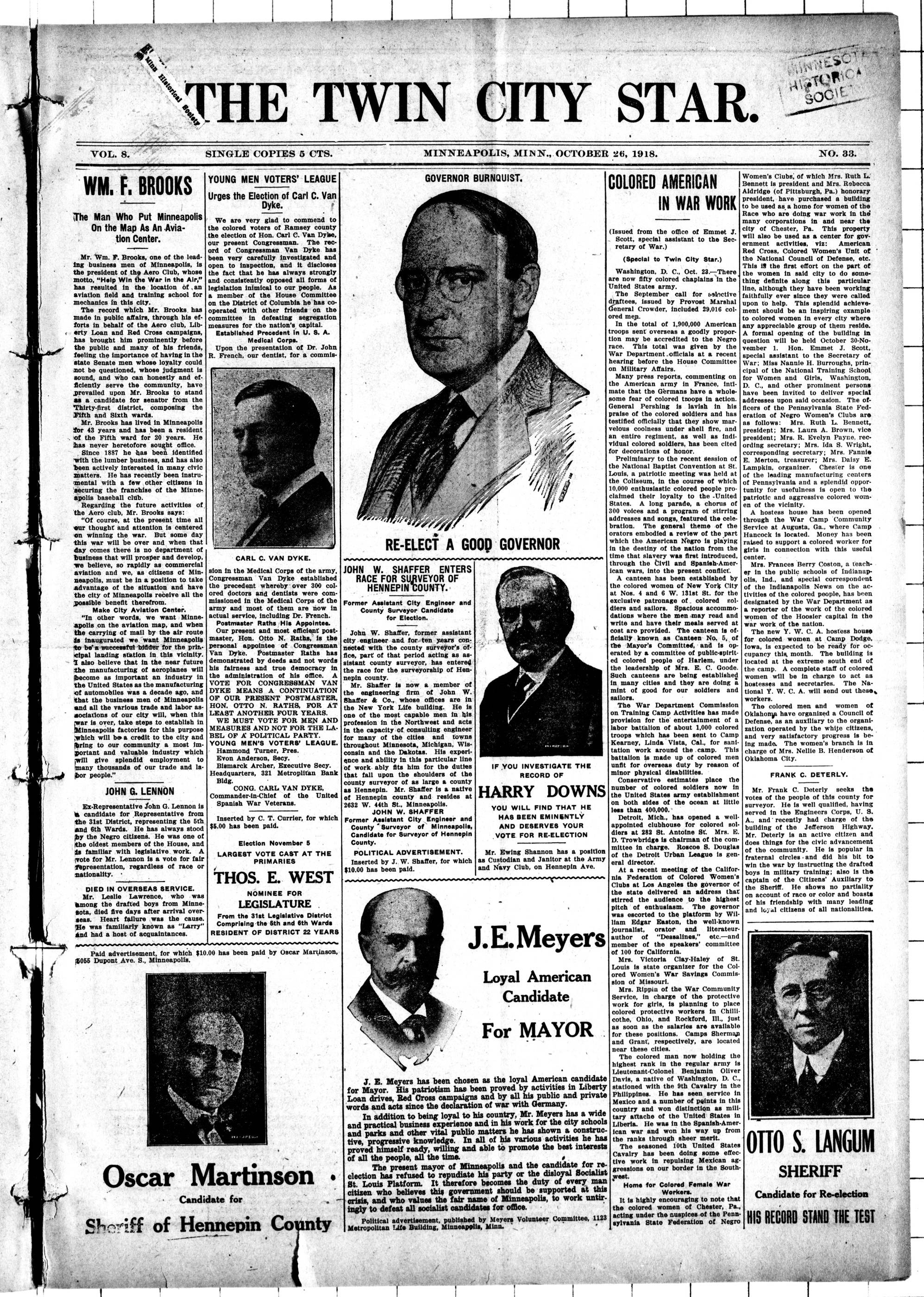
WM. F. BROOKS
Mr. Wm. F. Brooks, one of the leading business men of Minneapolis, is the president of the Aero Club, whose motto, "Help Win the War in the Air," has resulted in the location of, an aviation field and training school for mechanics in this city. The record which Mr. Brooks has made in public affairs, through his efforts in behalf of the Aero club, Liberty Loan and Red Cross campaigns, has brought him prominently before the public and many of his friends, feeling the importance of having in the state Senate men whose loyalty could not be questioned, whose judgment is sound, and who can honestly and efficiently serve the community, have prevailed upon Mr. Brooks to stand as a candidate for senator from the Thirty-first district, composing the Fifth and Sixth wards.
Mr. Brooks has lived in Minneapolis for 43 years and has been a resident of the Fifth ward for 20 years. He has never heretofore sought office. Since 1887 he has been identified with the lumber business, and has also been actively interested in many civic matters. He has recently been instrumental with a few other citizens in securing the franchise of the Minneapolis baseball club.
Regarding the future activities of the Aero club, Mr. Brooks says:
"Of course, at the present time all our thought and attention is centered on winning the war. But some day this war will be over and when that day comes there is no department of business that will prosper and develop, we believe, so rapidly as commercial aviation and we, as citizens of Minneapolis, must be in a position to take advantage of the situation and have the city of Minneapolis receive all the possible benefit therefrom.
Make City Aviation Center.
"In other words, we want Minneapolis on the aviation map, and when the carrying of mail by the air route is inaugurated we want Minneapolis to be a successful bidder for the principal landing station in this vicinity. I also believe that in the near future the manufacturing of aeroplanes will become as important an industry in the United States as the manufacturing of automobiles was a decade ago, and that the business men of Minneapolis and all the various trade and labor associations of our city will, when this war is over, take steps to establish in Minneapolis factories for this purpose which will be a credit to the city and bring to our community a most important and valuable industry which will give splendid employment to many thousands of our trade and labor people."
JOHN G. LENNON
Ex-Representative John G. Lennon is candidate for Representative from the 31st District, representing the 5th and 6th Wards. He has always stood by the Negro citizens. He was one of the oldest members of the House, and is familiar with legislative work. A vote for Mr. Lennon is a vote for fair representation, regardless of race or nationality.
DIED IN OVERSEAS SERVICE.
Mr. Leslie Lawrence, who was among the drafted boys from Minnesota, died five days after arrival overseas. Heart failure was the cause. He was familiarly known as "Larry" and had a host of acquaintances.
Paid advertisement, for which $10.00 has been paid by Oscar Martinson, 5055 Dupont Ave. S., Minneapolis.
Spanish War Veterans.
Inserted by C. T. Currier, for which $5.00 has been paid.
Election November 5
LARGEST VOTE CAST AT THE PRIMARIES
THOS. E. WEST
NOMINEE FOR LEGISLATURE
From the 31st Legislative District Comprising the 5th and 6th Wards RESIDENT OF DISTRICT 22 YEARS
M. J. PELLE
---
THE TWIN CITY STAR.
SINGLE COPIES 5 CTS.
YOUNG MEN VOTERS' LEAGUE
Urges the Election of Carl C. Van
Dyke.
We are very glad to commend to the colored voters of Ramsey county the election of Hon. Carl C. Van Dyke, our present Congressman. The record of Congressman Van Dyke has been very carefully investigated and open to inspection, and it discloses the fact that he has always strongly and consistently opposed all forms of legislation inimical to our people. As a member of the House Committee on the District of Columbia he has cooperated with other friends on the committee in defeating segregation measures for the nation's capital.
Established Precedent in U. S. A. Medical Corps.
Upon the presentation of Dr. John R. French, our dentist, for a commis-
CARL C. VAN DYKE.
ston in the Medical Corps of the army,
Congressman Van Dyke established the precedent whereby over 300 colored doctors and dentists were commissioned in the Medical Corps of the army and most of them are now in actual service, including Dr. French.
Postmaster Raths His Appointee.
Our present and most efficient postmaster, Hon. Otto N. Raths, is the personal appointee of Congressman Van Dyke. Postmaster Raths has demonstrated by deeds and not words his fairness and true democracy in the administration of his office. A VOTE FOR CONGRESSMAN VAN DYKE MEANS A CONTINUATION OF OUR PRESENT POSTMASTER, HON, OTTO N. RATHS, FOR AT LEAST ANOTHER FOUR YEARS.
WE MUST VOTE FOR MEN AND MEASURES AND NOT FOR THE LABEL OF A POLITICAL PARTY.
YOUNG MEN'S VOTERS' LEAGUE.
YOUNG MEN'S VOTERS' LEAGUE.
Hammond Turner, Pres.
Evon Anderson, Secy.
Bismarck Archer, Executive Secy.
Headquarters, 321 Metroplitan Bank
Bldg.
CONG. CARL VAN DYKE,
Commander-in-Chief of the United
Spanish War Veterans.
Inserted by C. T. Currier, for which
$5.00 has been paid.
Election November 5
LARGEST VOTE CAST AT THE
PRIMARIES
THOS. E. WEST
NOMINEE FOR LEGISLATURE From the 31st Legislative District Comprising the 5th and 6th Wards RESIDENT OF DISTRICT 22 YEARS
MINNEAPOLIS, MINN., OCTOBER 26, 1918.
GOVERNOR BURNQUIST.
J. E. Meyers has been chosen as the loyal American candidate for Mayor. His patriotism has been proved by activities in Liberty Loan drives, Red Cross campaigns and by all his public and private words and acts since the declaration of war with Germany.
In addition to being loyal to his country, Mr. Meyers has a wide and practical business experience and in his work for the city schools and parks and other vital public matters he has shown a constructive, progressive knowledge. In all of his various activities he has proved himself ready, willing and able to promote the best interests of all the people, all the time.
The present mayor of Minneapolis and the candidate for reelection has refused to repudiate his party or the disloyal Socialist St. Louis Platform. It therefore becomes the duty of every man citizen who believes this government should be supported at this crisis, and who values the fair name of Minneapolis, to work untimingly to defeat all socialist candidates for office.
Political advertisement, published by Meyers Volunteer Committee, 1123 Metropolitan Life Building, Minneapolis, Minn.
JOHN W. SHAFFER ENTERS RACE FOR SURVEYOR OF HENNEPIN COUNTY.
Former Assistant City Engineer and County Surveyor Candidate for Election.
John W. Shaffer, former assistant city engineer and for ten years connected with the county surveyor's office, part of that period acting as assistant county surveyor, has entered the race for the surveyorship of Hennepin county.
Mr. Shaffer is now a member of the engineering firm of John W. Shaffer & Co., whose offices are in the New York Life building. He is one of the most capable men in his profession in the Northwest and acts in the capacity of consulting engineer for many of the cities and towns throughout Minnesota, Michigan, Wisconsin and the Dakotas. His experience and ability in this particular line of work able fits him for the duties that fall upon the shoulders of the county surveyor of as large a county as Hennepin. Mr. Shaffer is a native of Hennepin county and resides at 2632 W. 44th St., Minneapolis.
JOHN W. SHAFFER
Former Assistant City Engineer and County Surveyor of Minneapolis, Candidate for Surveyor of Hennepin County.
POLITICAL ADVERTISEMENT.
Inserted by J. W. Shaffer, for which $10.00 has been paid.
6 FO4
IF YOU INVESTIGATE THE RECORD OF
HARRY DOWNS
YOU WILL FIND THAT HE HAS BEEN EMINENTLY AND DESERVES YOUR VOTE FOR RE-ELECTION
Mr. Ewing Shannon has a position as Custodian and Janitor at the Army and Navy Club, on Hennepin Ave.
J.E.Meyers Loyal American Candidate For MAYOR
seen as the loyal American candidate been proved by activities in Liberty signs and by all his public and privateation of war with Germany. his country. Mr. Meyers has a wide
COLORED AMERICAN IN WAR WORK
(Issued from the office of Emmet J. Scott, special assistant to the Secretary of War.)
(Special to Twin City Star.)
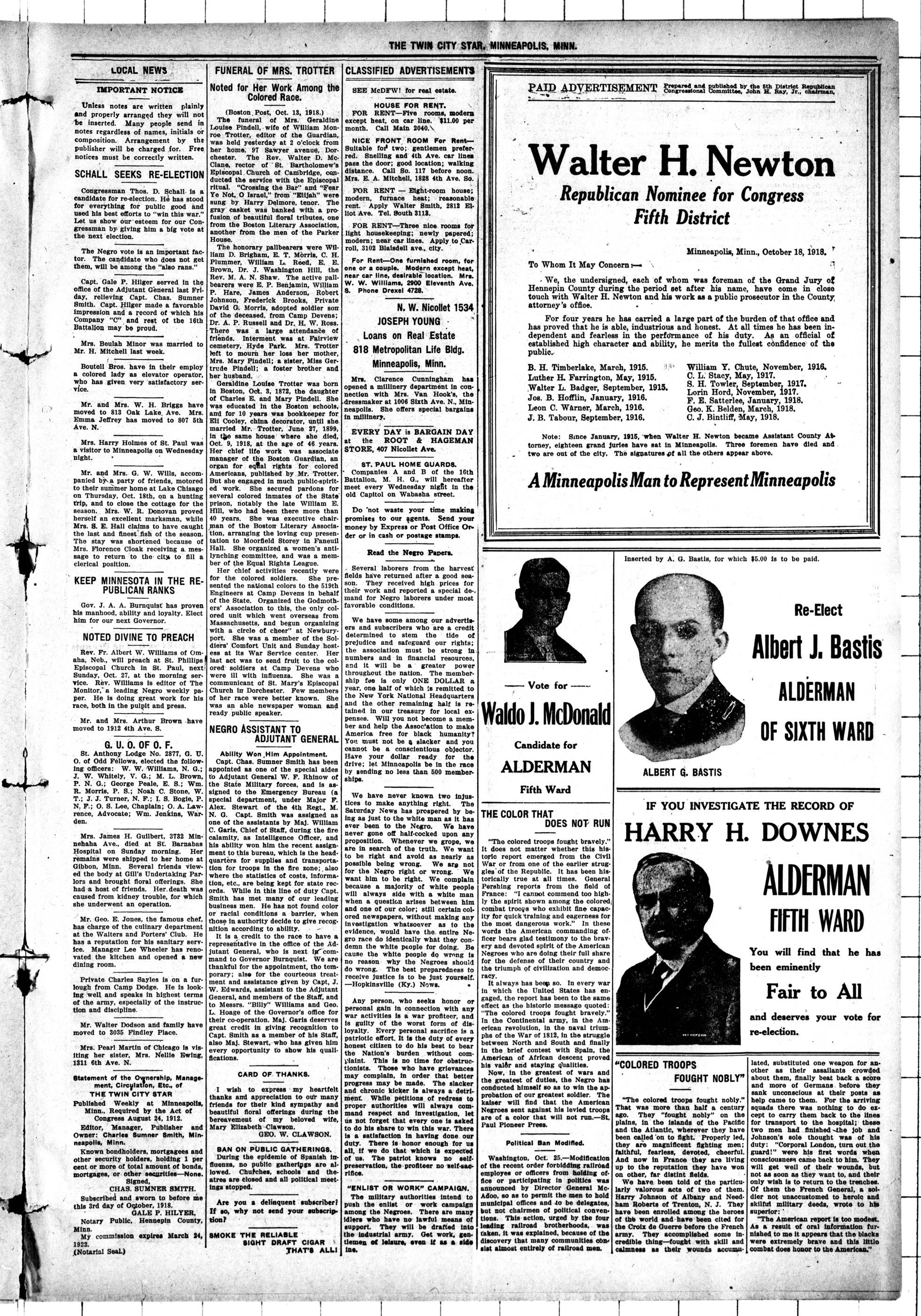
Washington, D. C., Oct. 23.—There are now fifty colored chaplains in the United States army.
The September call for selective draftees, issued by Provost Marshal General Crowder, included 29,016 colored men.
In the total of 1,900,000 American troops sent overseas a goodly proportion may be accredited to the Negro race. This total was given by the War Department. officials at a recent hearing before the House Committee on Military Affairs.
Many press reports, commenting on the American army in France, intimate that the Germans have a wholesome fear of colored troops in action. General Pershing is lavish in his praise of the colored soldiers and has testified officially that they show marvelous coolness under shell fire, and an entire regiment, as well as individual colored soldiers, has been cited for decorations of honor.
Preliminary to the recent session of the National Baptist Convention at St. Louis, a patriotic meeting was held at the Coliseum, in the course of which 10,000 enthusiastic colored people proclaimed their loyalty to the United States. A long parade, a chorus of 300 voices and a program of stirring addresses and songs, featured the celebration. The general theme of the orators embodied a review of the part which the American Negro is playing in the destiny of the nation from the time that slavery was first introduced, through the Civil and Spanish-American wars, into the present conflict.
A canteen has been established by the colored women of New York City at Nos. 4 and 6 W. 131st St. for the exclusive patronage of colored soldiers and sailors. Spacious accommodations where the men may read and write and have their meals served at cost are provided. The canteen is officially known as Canteen No. 5, of the Mayor's Committee, and is operated by a committee of public-spirited colored people of Harlem, under the leadership of Mrs. E. C. Goode. Such canteens are being established in many cities and they are doing a mint of good for our soldiers and sailors.
The War Department Commission on Training Camp Activities has made provision for the entertainment of a labor battalion of about 1,000 colored troops which has been sent to Camp Kearney, Linda Vista, Cal., for sanitation work around the camp. This battalion is made up of colored men unit for overseas duty by reason of minor physical disabilities. Conservative estimates place the number of colored soldiers now in the United States army establishment on both sides of the ocean at little less than 400,000. Detroit, Mich., has opened a well-appointed clubhouse for colored soldiers at 282 St. Antoine St. Mrs. E. D. Trowbridge is chairman of the committee in charge. Roscoe S. Douglas of the Detroit Urban League is general director. At a recent meeting of the California Federation of Colored Women's Clubs at Los Angeles the governor of the state delivered an address that stirred the audience to the highest pitch of enthusiasm. The governor was escorted to the platform by William Edgar Easton, the well-known journalist, orator and literate-author of "Dessalines," etc.-and member of the speakers' committee of 100 for California.
Mrs. Victoria Clay-Haley of St. Louis is state organizer for the Colored Women's War Savings Commission of Missouri.
Mrs. Rippin of the War Community Service, in charge of the protective work for girls, is planning to place colored protective workers in Chillicothe, Ohio, and Rockford, Ill., just as soon as the salaries are available for these positions. Camps Sherman and Grant, respectively, are located near these cities.
The colored man now holding the highest rank in the regular army is Leutenant-Colonel Benjamin Oliver Davis, a native of Washington, D.C., stationed with the 9th Cavalry in the Philippines. He has seen service in Mexico and a number of points in this country and won distinction as military attache of the United States in Liberia. He was in the Spanish-American war and won his way up from the ranks through sheer merit.
The seasoned 10th United States Cavalry has been doing some effective work in repelling Mexican aggressions on our border in the Southwest.
Home for Colored Female War Workers.
It is highly encouraging to note that the highly organized women of Chester, Pa., acting under the auspices of the Pennsylvania State Federation of Negro
NO. 33.
Women's Clubs, of which Mrs. Ruth L. Bennett is president and Mrs. Rebecca Aldridge (of Pittsburgh, Pa.) honorary president, have purchased a building to be used as a home for women of the Race who are doing war work in the many corporations in and near the city of Chester, Pa. This property will also be used as a center for government activities, viz: American Red Cross, Colored Women's Unit of the National Council of Defense, etc. This is the first effort on the part of the women in said city to do something definite along this particular line, although they have been working faithfully ever since they were called upon to help. This splendid achievement should be an inspiring example to colored women in every city where any appreciable group of them reside. A formal opening of the building in question will be held October 30-November 1. Hon. Emmet J. Scott, special assistant to the Secretary of War; Miss Nannie H. Burrell, principal of the National Training School for Women and Girls, Washington, D.C., and other prominent persons have been invited to deliver special addresses upon said occasion. The officers of the Pennsylvania State Federation of Negro Women's Clubs are as follows: Mrs. Ruth L. Bennett, president; Mrs. Laura A. Brown, vice president; Mrs. R. Evelyn Payne, recording secretary; Mrs. Ida S. Wright, corresponding secretary; Mrs. Fannie E. Merton, treasurer; Mrs. Dalsy E. Lampkin, organizer. Chester is one of the leading manufacturing centers of Pennsylvania and a splendid opportunity for usefulness is open to the patriotic and aggressive colored women of the vicinity.
A hostess house has been opened through the War Camp Community Service at Augusta, Ga., where Camp Hancock is located. Money has been raised to support a colored worker for girls in connection with this useful center.
Mrs. Frances Berry Coston, a teacher in the public schools of Indianapolis, Ind., and special correspondent of the Indianapolis News on the activities of the colored people, has been designated by the War Department as a reporter of the work of the colored women of the Hoosier capital in the war work of the nation.
The new Y. W. C. A. hostess house for colored women at Camp Dodge, Iowa, is expected to be ready for occupancy this month. The building is located at the extreme south end of the camp. A complete staff of colored women will be in charge to act as hostesses and secretaries. The National Y. W. C. A. will send out these workers.
The colored men and women of Oklahoma have organized a Council of Defense, as an auxiliary to the organization operated by the white citizens, and very satisfactory progress is being made. The women's branch is in charge of Mrs. Nellie B. Henderson of Oklahoma City.
FRANK C. DETERLY.
Mr. Frank C. Deterly seeks the votes of the people of this county for surveyor. He is well qualified, having served in the Engineers Corps, U. S. A., and recently had charge of the building of the Jefferson Highway. Mr. Deterly is an active citizen and does things for the civic advancement of the community. He is popular in fraternal circles and did his bit to win the war by instructing the drafted boys in military training; also is the captain of the Citizens' Auxiliary to the Sheriff. He shows no partiality on account of race or color and boasts of his friendship with many leading and local citizens of all nationalities.
J. H.
OTTO S. LANGUM
SHERIFF
Candidate for Re-election
HIS RECORD STAND THE TEST
IN THE CITIES
Might Tempt Fortune Again
obs hasn't had enough of women yet. And he's
o Jesse's answer to the query: "Do you think
re's the answer:
e if the
ST. LOUIS.—Jesse Otley Gibbs hasn't had enough of women yet. And he's had six wives! Hearken to Jesse's answer to the query: "Do you think you might marry again?" Here's the answer:
between Jesse's matrimonial alliances. But Jesse affections that he is in his statements. For a stated that he might "fall" for "a country girl who went to the following expression in his cell at the Men their creation mar in profiting by them!" he and anit' it the truth? good. If I ever get out of this I'm going to monastery—somewhere in Tibet and put a sign at even then I suppose they'll find out where I kissed Rose Lynn the best. She was No. 5, you are never legally married. All the rest have got know anything about now is Helma Swanberg, she trouble. Tags in the world to get—and the hardest to get chuck her under the chin and she thinks you're hidden!" she cries, and the first thing you know changeable.
Purchaser All Kinds of Trouble
ing police court tale concerns the chameleon-ens that turned black in the ice box of their caused the purchaser all kinds of trouble and looks like when your pity is that of the seri round country w German p of silence" near, for t for public side of the knocker an lence, turn snake in dog. But enemy will The pots
there was a lack of divorces between Jesse's matrimonial alliances. But Jesse is no more changeable in his affections that he is in his statements. For a short time before he had admitted that he might "fall" for "a country girl who can make ples," he had given vent to the following expression in his cell at the police station:
"Women! Help, heaven! Men their creation mar in profiting by them!"
"I read that in Shakespeare and ain't it the truth?"
"Yes, sir. I'm off 'em for good. If I ever get out of this I'm going to build me a nunery—I mean a monastery—somewhere in Tibet and put a sign up: 'No Women Allowed!' But even then I suppose they'll find out where I am and want to marry me.
"Of all of my wives, I liked Rose Lynn the best. She was No. 5, you know. To tell the truth, we were never legally married. All the rest have got divorces and the only wife I know anything about now is Helma Swanberg, the last one, who caused all the trouble.
"Wives are the easiest things in the world to get—and the hardest to get rid of. Wink at a woman or chuck her under the chin and she thinks you're proposing. 'Oh, this is so sudden!' she cries, and the first thing you know you're nailed."
Chickens Caused Purchaser All Kinds of Trouble
Chickens Caused Purchaser All Kinds of Trouble
NEW YORK.—This interesting police court tale concerns the chameleon-like tactics of three chickens that turned black in the ice box of their purchaser overnight and which caused the purchaser all kinds of trouble and
ook them home and put them in the ice box and stated that early next morning a peculiar odor and his wife traced the smell to the refrigerator. at the chickens had turned black, and that he chicken that day. He stated all became violently dishes had been cleared away. He said he sumafter putting the family to bed, had contracted that Heilhaus should face trial for both charges for possessing a pistol without a permit and felonious assault complaint.
Final Ending to Youthful Dreams
Al Ernest Marmorstein, the twelve-year-old boys world with an air gun, will eat off the mantelway, after a memorable night in an Elgin police over to
Lee ferry. Heithaus entered the store and told Schoenbach to wrap up the fowl.
The billiard man said he took them home and put them in the ice box and then the trouble started. He stated that early next morning a peculiar odor permeated the house and he and his wife traced the smell to the refrigerator. Heithaus told Judge Nolan that the chickens had turned black, and that he and his family had dined on chicken that day. He stated all became violently ill less than an hour after the dishes had been cleared away. He said he summoned the family doctor, and after putting the family to bed, had contracted a large physician's bill.
Magistrate Nolan decided that Heithaus should face trial for both charges and held him under $500 ball for possessing a pistol without a permit and under $1,000 on the attempted felonious assault complaint.
Sad but Not Unusual Ending to Youthful Dreams
Sad but Not Unusual Ending to Youthful Dreams
CHICAGO—George Slove and Ernest Marmorstein, the twelve-year-old boys who set out to conquer the world with an air gun, will eat off the mantel-piece for a week. For yesterday, after a memorable night in an Elgin police station, the boys were turned over to their respective parents for further treatment.
head and
that the storekeeper, suspicious of their large roll
purchased, were returned to the dealer for $4,
lease price.
I bought boy scout blouses and hats, a hunting
e escapade and smiled at the memory of the ice
rator of the scheme, must bear the heavier pun-
confinement by an indignant mother, who can't
first of her 11 children to break the law.
It Keep a Good Man Down
The Sam gave up that early idea of organizing a
device in France, there wasn't an unhappier young
Mills. Already he had picked out a boy scout
other essentials of camping that the storekeeper, suspicious of their large roll of bills, notified the police.
The air guns, previously purchased, were returned to the dealer for $4, something less than the purchase price.
Besides these the boys had bought boy scout blouses and hats, a hunting knife and innumerable sodas.
Ernest spoke lightly of the escapade and smiled at the memory of the ice cream he had consumed.
But George, the real instigator of the scheme, must bear the heavier punishment. He is held in solitary confinement by an indignant mother, who can't quite forgive him for being the first of her 11 children to break the law.
Proving You Can't Keep a Good Man Down
Proving You Can't Keep a Good Man Down
KANSAS CITY.—When Uncle Sam gave up that early idea of organizing a "regiment of runts" for service in France, there wasn't an unhappier young man in the world than Frank Mills. Already he had picked out a boy scout
registered for the draft from 3028 West Sixty-third place and he began pestering local board 68. He became a daily visitor at the board's offices and each visit saw him with a brand new reason why that little matter of an inch or two shouldn't be permitted to make any difference in his case. Finally the board stationed a guard at the window and all doors were locked at Frank's approach. One day he slipped past the lookout. The threshold passed, he made a most disrespectful sign at the exemplors.
1928 West Sixty-third place and he began pester-
e a daily visitor at the board's offices and each
reason why that little matter of an inch or two
ne any difference in his case. Finally the board
w and all doors were locked at Frank's approach.
lookout. The threshold passed, he made a most
aptors.
made 31 tries I'd made for France. You can't
r, Today I made t32 and the Red Cross took me.
"The last time I was here made 31 tries I'd made for France. You can't keep a good man out of this war, Today I made it 32 and the Red Cross took me. "Hee-ay!"
"Well, I don't know. Maybe if the right kind of a girl came along—a country girl who could make pies—you know the kind of pies, with faky crusts—and if she owned a farm and had no ear for music—and didn't object to a man's going out nights—well—maybe; who can tell?" But chances are against any more wedding bells for Jesse for some time. Y'see, he's under $5,000 bond pending a hearing because two of the previous six wives got together and ascertained
there was a lack of divorces between Jesse is no more changeable in his affections the short time before he had admitted that he can make ples," he had given vent to the for police station:
"Women! Help, heaven! Men their!
"I read that in Shakespeare and ain't!
"Yes, sir. I'm off 'em for good. If I build me a nunnery—I mean a monastery—up: 'No Women Allowed!' But even then am and want to marry me.
"Of all of my wives, I liked Rose Ly know. To tell the truth, we were never leg divorces and the only wife I know anythi the last one, who caused all the trouble.
"Wives are the easiest things in the w rid of. Wink at a woman or chuck her un proposing. 'Oh, this is so sudden!' she o you're nalled."
Yes, Jesse is considerably changeable.
Chickens Caused Purchaser
NEW YORK.—This interesting police c
like tactics of three chickens that tun
purchaser overnight and which caused the
SWITCH
SWITCH
Lee ferry. Heithaus entered the store and fowl.
The billiard man said he took them home then the trouble started. He stated that a permeated the house and he and his wife to Heithaus told Judge Nolan that the chick and his family had dined on chicken that did ill less than an hour after the dishes had been moned the family doctor, and after putting a large physician's bill.
Magistrate Nolan decided that Heithaus and held him under $500 ball for possess under $1,000 on the attempted felonious as
Sad but Not Unusual Ending
CHICAGO.—George Slove and Ernest Man who set out to conquer the world with piece for a week. For yesterday, after a station, the boys were turned over to their respective parents for further treatment.
The boys left Chicago two days ago, taking an electric train, which happened to be going to Elgin.
Simultaneous with their departure, $100 that George Slove's father had put away for the winter coal disappeared.
It was while they were stocking up for their long trip with cans of sardines, sausage, matches, bread and
other essentials of camping that the store of bills, notified the police.
The air guns, previously purchased, w something less than the purchase price.
Besides these the boys had bought hot knife and innumerable sodas.
Ernest spoke lightly of the escapade a cream he had consumed.
But George, the real instigator of theishment. He is held in solitary confinement quite forgive him for being the first of her
Proving You Can't Keep
KANSAS CITY.—When Uncle Sam gave "regiment of runts" for service in Fran man in the world than Frank Mills. Alre
I WANT TO JOIN TH
ARMY SO I CAN
SLAM TH' NUNS
registered for the draft from 3028 West Shing local board 68. He became a daily visit saw him with a brand new reason why shouldn't be permitted to make any different stationed a guard at the window and all door. One day he slipped past the lookout. The disrespectful sign at the exemptors.
"The last time I was here made 31 tr keep a good man out of this war, Today I m "Hoe-ray!"
WIMEN SURE DO
FALL FER A
HANSOME MAN
LIKE ME
distress and finally resulted in his appearance in the Heights police court on charges of attempted felonious assault and carrying a weapon.
The principal actors in the feathery drama are August Heithaus, a resident of Hackensack, N. J., and Julius Schoenbach, a poultry dealer with an establishment in New York.
The testimony showed that Heithaus, who is the proprietor of a pool and billiard parlor, was passing the complainant's store on his way to Fort
LUCKY
uniform to wear to war, and he had a notion that nowhere else in the service awaited a welcome for a man who'd fit into it.
But Frank did his best, anyhow, Army, navy, marine corps, tanks; aviation, signalers, intelligence; cavalry, infantry, artillery—Civilian Mills tried 'em all.
But even when he stood on tiptoe he rose to no grander height than 4 feet 11 and the recruiting officers would have none of him. Frank had
By RUSSELL T. EDWARDS, Director, Educational Section, National War Garden Commission.
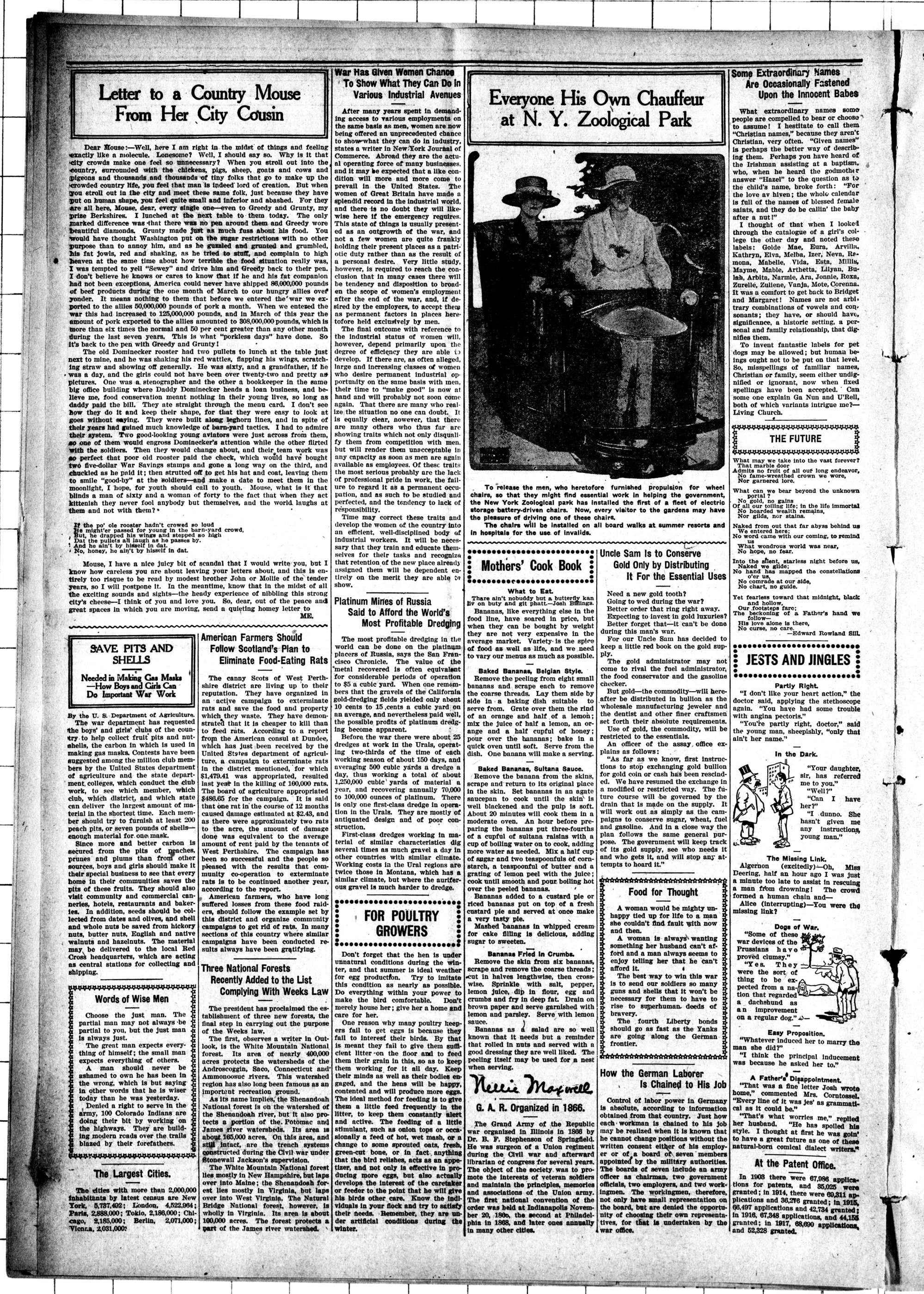
F TEN million war gardeners will set their minds resolutely to refusing to listen to German propaganda or vicious knocks against our government the most powerful arm of the German war machine will be paralyzed. That
J
looks like a big order but it is not when you come to analyze it. The pity is that women will repeat so much of the senseless rumor that is going the rounds. If the women of this country will inoculate the peddler of German propaganda with the "serum of silence" they will bring victory very near, for the big battle of this war is for public opinion right here on this side of the ocean. Turn from the knocker and the propagandist in silence, turn as you would from the snake in the grass or the snapping dog. But turn in silence for then the enemy will know you mean business.
The potato bug is a great success until you separate it from the leaf; the electric light bulb is a great success until you turn off the current; the prairie fire is a great success until it hits the back fire strip and has nothing to feed upon. So with German propaganda, it is a great success as long as you listen to it. Why cannot this supposed wonder of women keep silent be brought about? Twenty years ago the Wright Brothers were considered insane; today I can see from my office the airplane mail start for Philadelphia, New York and Boston and the world's greatest war hinges upon the airplane. Twenty years ago Mr. Marcosi was unknown; today the business of the world's war is conducted by wireless.
Some German Propaganda.
German propaganda is constantly shooting at the war gardeners and all questions pertaining to food. There is the old story about the potato pens and how you can get three or four bushels by simply planting as many potatoes in a three story boxlike arrangement. The leading potato experts of the world denounce this. It is but a sample of German propaganda which hopes to cause a big wastage in potatoes. The there is the other yarn that the food administration will seize all the catched stuff of the housewife and all her hard work will go for naught. This is a lie but the national war garden commission used to get a hundred letters a week asking about this. Constant publicity, thanks to the magazines and the newspapers, has nailed this story.
There is the one about the soldier telling his parents he had two legs cut off in a battle at the front. Mrs. Blank hears it from Mrs. Blank up the street. Johnny had got the word to them by writing it under a stamp. In the first place there are no stamps on soldiers' letters. The campaign of letter-writing to newspapers is a favorite form of German propaganda, but the editors do not "fall" for this and the "patriots" might better save their stamps and stop cluttering up the malls.
The war gardeners of the United States have certainly shown they mean business. The war gardens are the finest offsets to German propaganda I know of, for the garden makes no noise, but goes right on about its business. It is this point I want to bring home—the terrible power of silence if applied to German propaganda. This war is a battle of publicity. The junker has prepared the German mind for this war for forty years and only as long as he can control the German state of mind can he continue this war. When the German helmet and then the German skull is penetrated with the X-ray of civilization, kept alive by the white hot flame from
One of the unpleasant aftermaths of swimming is the uncomfortable and oftentimes dangerous presence of water in the ears. To prevent this, this simple precaution may be used: Rub a little cocoa butter on a piece of lamb's wool and put in each ear. The lamb's wool is not absorbent, keeps out all water, and yet at the same time is so constructed that one can hear plainly through it. Never use cotton, as that holds the water and is worse than nothing. Good Housekeeping.
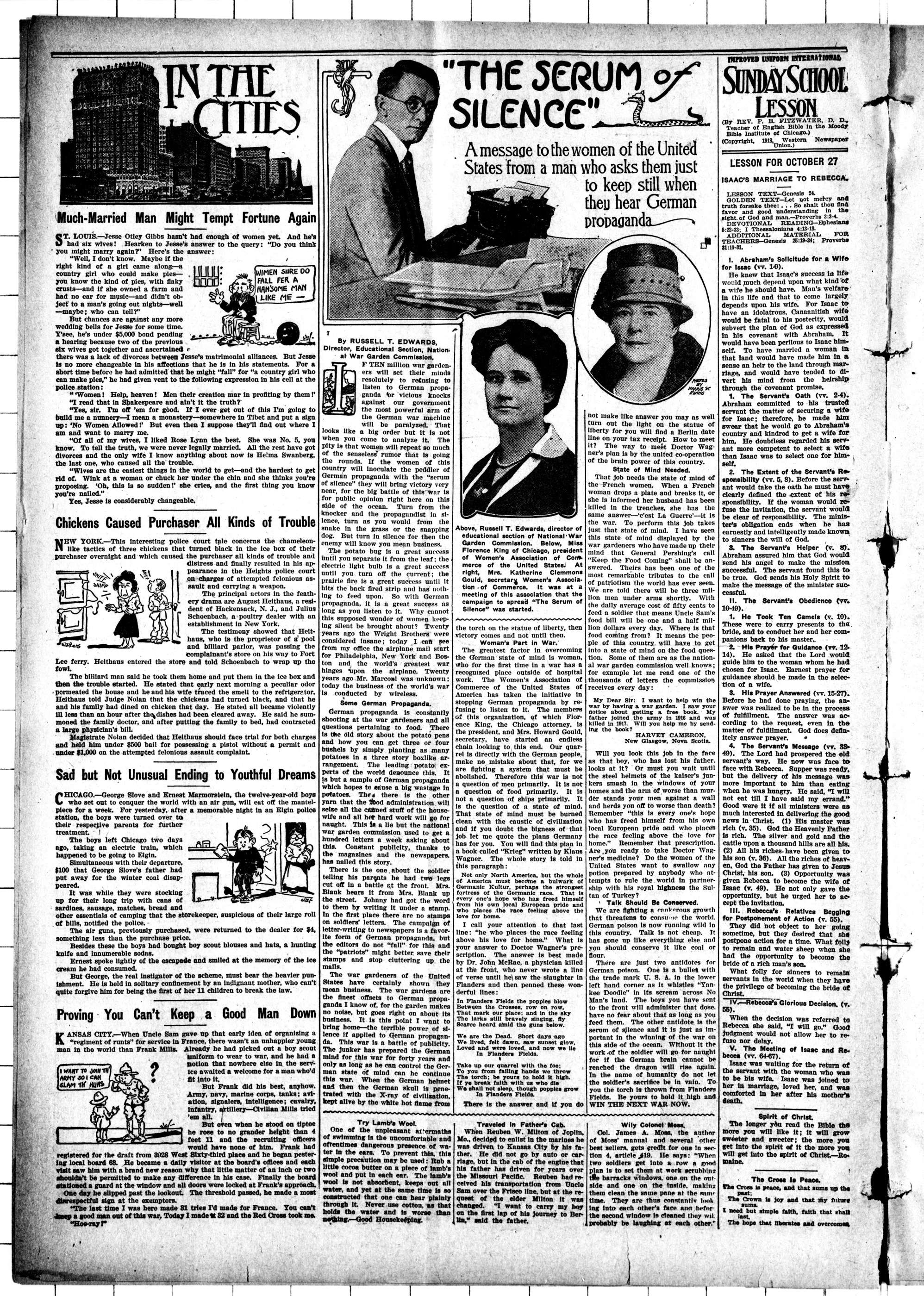
"THE SERUM of SILENCE"
A message to the women of the United States from a man who asks them just
Mrs.
Above, Russell T. Edwards, director of educational section of National War Garden Commission. Below, Miss Florence King of Chicago, president of Women's Association of Commerce of the United States. At right, Mrs. Katherine Clemmaws Gould, secretary Women's Association of Commerce. It was at a meeting of this association that the campaign to spread "The Serum of Silence" was started.
the torch on the statue of liberty, then victory comes and not until then.
The greatest factor in overcoming the German state of mind is woman, who for the first time in a war has a recognized place outside of hospital work. The Women's Association of Commerce of the United States of America has taken the initiative in stopping German propaganda by refusing to listen to it. The members of this organization, of which Florence King, the Chicago attorney, is the president, and Mrs. Howard Gould, secretary, have started an endless chain looking to this end. Our quarrel is directly with the German people, who make mistake about that, for we are fighting a system that must be abolished. Therefore this war is not a question of men primarily. It is not a question of food primarily. It is not a question of ships primarily. It is the question of a state of mind. That state of mind must be burned clean with the caustic of civilization and if you doubt the bigness of that job let me quote the plans Germany has for you. You will find this plan in a book called "Krieg" written by Klaus Wagner. The whole story is told in this paragraph:
Not only North America, but the whole of America must become a bulwark of Germanic Kultur, perhaps the strongest fortress of the Germanic race. That is every one's hope who has freed himself from his own local European pride and who places the race feeling above the love for home.
I call your attention to that last line: "he who places the race feeling above his love for home." What is your answer to Doctor Wagner's prescription. The answer is best made by Dr. John McRae, a physician killed at the front, who never wrote a line of verse until he saw the slaughter in Flanders and then penned these wonderful lines:
In Flanders Fields the popples blow Between the Crosses, row on row,
That mark our place; and in the sky
The larks still bravely singing, fly
Scarce heard amid the guns below.
We are the Dead. Short days ago
We lived, felt dawn, saw sunset glow,
Loved and were loved, and now we lie
In Flanders Fields.
Take up our quarrel with the foe;
To you from falling hands we throw
the torch; be yours to hold it high.
If ye break faith with us who die
We shall not sleep, though poppies grow
In Flanders Fields.
There is the answer and if you do
Traveled in Father's Cab.
When Reuben W. Milton of Joplin, Mo., decided to enlist in the marines he was driven to Kansas City by his father. He did not go by auto or carriage, but in the cab of the engine that his father has driven for years over the Missouri Pacific. Reuben had received his transportation from Uncle Sam over the Frisco line, but at the request of the elder Milton it was changed. "I want to carry my boy on the first lap of his journey to Berlin," said the father.
PHOTOS
BY
MARIS S.
EWING
not make like answer you may as well turn out the light on the statue of liberty for you will find a Berlin date line on your tax receipt. How to meet it? The way to meet Doctor Wagner's plan is by the united co-operation of the brain power of this country.
State of Mind Needed.
That job needs the state of mind of the 'French women. When a French woman drops a plate and breaks it, or she is informed her husband has been killed in the trenches, she has the same answer—'c'est La Guerre'—it is the war. To perform this job takes just that state of mind. I have seen this state of mind displayed by the war gardeners who have made up their mind that General Pershing's call "Keep the Food Coming" shall be answered. Theirs has been one of the most remarkable tributes to the call of patriotism the world has ever seen. We are told there will be three million men under arms shortly. With the daily average cost of fifty cents to feed a soldier that means Uncle Sam's food bill will be one and a half million dollars every day. Where is that food coming from? It means the people of this country will have to get into a state of mind on the food question. Some of them are as the national war garden commission well knows; for example let me read one of the thousands of letters the commission receives every day:
My Dear Sir: I want to help win the war by having a war garden. I saw your notice about getting a free book. My father joined the army in 1916 and was killed in 1917. Will you help me by sending the book?
HARVEY CAMERON,
New Glasgow, Nova Scotia.
Will you look this job in the face as that boy, who has lost his father, looks at it? Or must you wait until the steel helmets of the kalser's junkers smash in the windows of your homes and the arm of worse than murder stands your men against a wall and herds you off to worse than death? Remember "this is every one's hope who has freed himself from his own local European pride and who places the race feeling above the love for home." Remember that prescription. Are you ready to take Doctor Wagner's medicine? Do the women of the United States want to swallow any potion prepared by anybody who attempts to rule the world in partnership with his royal highness the Sultan of Turkey?
Talk Should Be Conserved.
We are fighting a cankerous growth that threatens to consume the world. German poison is now running wild in this country. Talk is not cheap. It has gone up like everything else and you should conserve it like coal or flour.
There are just two antidotes for German poison. One is a bullet with the trade mark U. S. A. in the lower left hand corner as it whistles "Tankee Doodle" in its scream across No Man's land. The boys you have sent to the front will administer that dose, have no fear about that as long as you feed them. The other antidote is the serum of silence and it is just as important in the winning of the war on this side of the ocean. Without it the work of the soldier will go for naught for the German brain cannot be reached the dragon will rise again. In the name of humanity do not let the soldier's sacrifice be in vain. To you the torch is thrown from Flanders Fields. Be yours to hold it high and WIN THE NEXT WAR NOW.
Wily Colonel Moss.
Col. James A. Moss, the author of Moss' manual and several other best sellers, gets credit for one in section 4, article 19. He says: "When two soldiers get into a row a good plan is to set them at work scrubbing the barracks windows, one on the outside and one on the inside, making them clean the same pane at the same time. They are thus constantly looking into each other's face and before the second window is cleaned they will probably be laughing at each other."
(BY REV. P. B. FITZWATER, D. D. Teacher of English Bible in the Moody Bible Institute of Chicago). (Copyright, 1918 Western Newspapers Union.)
LESSON FOR OCTOBER 27
ISAAC'S MARRIAGE TO REBECCA
LESSON TEXT—Genesis 24.
GOLDEN TEXT—Let not metyc and truth forsake thee . . . So shalt thou find favor and good understanding in the sight of God and man.—Proverbs 3:3-4.
DEVOTIONAL READING—Ephesians 5:22-33; I Thessalonians 4:13-18.
ADDITIONAL MATERIAL FOR TEACHERS—Genesis 25:19-34; Proverbs 31:10-31.
1. Abraham's Solitude for a Wife for Issue (vv. 1-9).
He knew that Isaac's success in life would much depend upon what kind of a wife he should have. Man's welfare in this life and that to come largely depends upon his wife. For Isaac to have an idolatrous, Canaanitish wife would be fatal to his posterity, would subvert the plan of God as expressed in his covenant with Abraham. It would have been perilous to Isaac himself. To have married a woman in that land would have made him in a sense an heir to the land through marriage, and would have tended to divert his mind from the helenship through the covenant promise.
1. The Servant's Oath (vv. 2-4). Abraham committed to his trusted servant the matter of securing a wife for Isaac; therefore, he made him swear that he would go to Abraham's country and kindred to get a wife for him. He doubtless regarded his servant more competent to select a wife than Isaac was to select one for himself.
2. The Extent of the Servant's Responsibility (vv. 5, 8). Before the servant would take the oath he must have clearly defined the extent of his responsibility. If the woman would refuse the invitation, the servant would be clear of responsibility. The minister's obligation ends when he has earnestly and intelligently made known to sinners the will of God.
3. The Servant's Helper (v. 19). Abraham assured him that God would send his angel to make the mission successful. The servant found this to be true. God sends his Holy Spirit to make the message of the minister successful.
11. The Servant's Obedience (vv. 10-49).
1. He Took Ten Camels (v. 10). These were to carry presents to the bride, and to conduct her and her companions back to his master.
2. His Prayer for Guidance (vv. 12-14). He asked that the Lord would guide him to the woman whom he had chosen for Isaac. Earnest prayer for guidance should be made in the selection of a wife.
3. His Prayer Answered (vv. 15-27).
Before he had done praying, the answer was realized to be in the process of fulfillment. The answer was according to the request, even in the matter of fulfillment. God does definitely answer prayer.
4. The Servant's Message (vv. 33-40). The Lord had prospered the old servant's way. He now was face to face with Rebecca. Supper was ready, but the delivery of his message was more important to him than eating when he was hungry. He said, "I will not eat till I have said my errand." Good were it if all ministers were as much interested in delivering the good news in Christ. (1) His master was rich (v. 35). God the Heavenly Father is rich. The silver and gold and the cattle upon a thousand hills are all his. (2) All his riches have been given to his son (v. 36). All the riches of heaven, God the Father has given to Jesus Christ, his son. (3) Opportunity was given Rebecca to become the wife of Isaac (v. 49). He not only gave the opportunity, but he urged her to accept the invitation.
III. Rebecca's Relatives Begging for Postponement of Action (vv. 55)
They did not object to her going sometime, but they desired that she postpone action for a time. What folly to remain and water sheep when she had the opportunity to become the bride of a rich man's son.
What folly for sinners to remain servants in the world when they have the privilege of becoming the bride of Christ.
IV—Rebecca's Glorious Decision. (v. 55).
When the decision was referred to Rebecca she said, "I will go." Good judgment would not allow her to refuse nor delay.
V. The Meeting of Isaac and Rebecca (vv. 64-67).
Isaac was waiting for the return of the servant with the woman who was to be his wife. Isaac was joined to her in marriage, loved her, and was comforted in her after his mother's death.
Spirit of Christ
The longer you read the Bible the more you will like it; it will grow sweeter and sweeter; the more you get into the spirit of it the more you will get into the spirit of Christ—Romaine.
The Cross is peace, and that sums up the past;
The Crown is joy and that my future
I need but simple faith, faith that shall last,
the hope that liberates and overcomes
The KITCHEN CABINET
The hero we love in this land today
Is the man who sometimes fell
newman's load
A FEW SNACKS.
OR a small company when supplies are limited, a salad is the dish upon which we all rely. A most tasty and attractive one is this that was the invention of necessity, for one cucumber, one tomato, and one large apple
National Law Garden
Commission
served a happy salad. The apple was peeled and cored, then cut in thin rings and dropped in cold water with a little vinegar; this keeps the apple from turning brown. The cucumber was chopped or cut in fine cubes; and one small onion was also cut in the same manner. The slices of apple was heaped with the onion and cucumber mixture, which had been well seasoned and mixed with salad dressing and garnished with a strip or two of red pepper. The tomato was heaped with a teaspoonful of the salad dressing and garnished with two or three strips of green pepper.
Cheese Dreams.—With a biscuit cutter cut circles from slices of close-textured bread. Lay on thinly sliced cheese, place another circle on it in the form of a sandwich, and brown lightly in a little olive oil in a hot frying pan.
Hot Cheese Sandwiches. — Break open hot baking powder biscuit, butter, and lay in a thin slice of cheese. Cover with a hot cloth and serve quickly as the cheese should be melted at once. These make a most dainty lunch with a cupful of tea and a dish of fruit.
Tomatoes With Eggs.—Peel small firm tomatoes, scoop out the centers which may be used as a soup or in sauces, season well inside and out with salt and paprika and put in the oven, cook until boiling hot, then remove. Drop in a piece of butter and an egg, using care not to break the yolk. When the egg is firm, remove from the oven and serve on buttered rounds of toast. Leftover greens of any kind that are cooked and seasoned may be molded in small cups and served as a salad with a good dressing. Small balls of cottage cheese are good with these.
The white-fleshed fishes, such as cod, whitefish, haddock and hallibut, make most acceptable dishes served in a white sauce.
Age is an opportunity no less
Than youth itself, though in another dress.
And is the evening twilight fades away.
The sky is filled with stars invisible by day.
A FEW PUREES.
National War Garden
Commission
UREE is commonly known as a thickened soup. The kinds of purees are without limit. Puree of Cucumber. —Peel, slice and parboli six cucumbers. Drain and fry in butter, season with salt, pepper and nutmeg. Dredge with four table-spoonsful of flour, add two quarts of milk and one quart of veal stock; cook 15 minutes, stirring constantly. Rub through a sieve, reheat, add one cupful of scalding hot cream, season with sugar and butter and serve with croutons.
Puree of Beans and Rice.—Put a quart of beans into a soup pan with a little salt, a small onion, a slice of carrot, a tablespoonful of fat, a sprig of parsley and boiling water to cover. Cook until the beans are soft, rub through a sleeve and add sufficient veal stock to make the desired quantity of soap. Season to taste, add two tablespoonfuls of butter substitute and a cupful of boiled rice. Reheat and serve at once.
Puree a la Croissy.—Put into a saucepan a carrot, a turnip and an onion cut fine, two cupfuls of beans, two leeks, a stalk of celery and a small bunch of parsley. Fry in butter, dredge with flour, add a can of tomatoes and two quarts of veal stock. Simmer for two hours, rub through a sleeve, reheat, season with salt, pepper, sugar and butter. Add one cupful of cooked green peas and one cupful of boiling cream. Serve with croutons.
Pures of Celery.—Cut two bunches of celery into small pieces, parboll and drain, then fry in butter. Add salt,
Giri Students in Economic Course Will Save Foodstuffs Ordinarily Thrown Away.
Wooster, O.—All articles of food that might go to waste in Wayne county are to be gathered up and sold by the girls of the home economics course in Wooster high school. Miss Edna Endley, the teacher, will have her givi students preserve windfall apples, stir pumping and such other food-
pepper and nutmeg to season; cover with veal stock and simmer one hour. Blend two tablespoonfuls of butter with two of flour, add a quart of veal stock and the celery and cook until thick. Rub through a sieve, reheat, add two cupfuls of hot milk, a pinch of sugar and a tablespoonful of butter. Serve with croutons.
The ones who mean to win their stars
For the deeds they shall have wrought
Won't have too many sleeping cars
Attached to their train of thought.
—Nixon Waterman.
WHAT TO HAVE FOR BREAKFAST.
O MONTH is known
even in the summer
time, when griddle
cakes are not wel-
comed in the aver-
age family. In a
large majority of hotels
hot griddle cakes
are always on the
bill of fare, summer
or winter, and in
O MONTH is known, even in the summer time, when griddle cakes are not welcomed in the average family. In a large majority of hotels hot griddle cakes are always on the bill of fare, summer or winter, and in many, the cake is a favorite finish for the night meal.
Corn Flour Griddle Cakes—Bent one egg very light, add a cupful of good rich buttermilk or sour milk, a half-teaspoonful of salt and a half-teaspoonful of soda, a quarter of a teaspoonful of baking powder; then add enough corn flour to make a thin batter. Cook on a hot griddle. The secret of a good tender cake is the materials used, sour or buttermilk making most tender and fluffy cakes, then the care with which they are baked.
A breakfast, which is quite satisfactory, is the following: Either a dish of sliced peaches or a canteloupe or muskmelon, a dish of well-cooked oatmeal, and if the peaches are served, they may be eaten with the cereal, cream and sugar, an egg on toast and a cupful of coffee.
Pears, plums, quinces and grapes are all in the market and furnish a good variety. The quinces are to be stewed or baked to make them palatable.
Rice With Eggs—Brown a third of a cupful of rice in a little sweet fat, season and add broth or water, cook until the rice is tender, then stir in three eggs and serve hot at once.
We search the world for truth; we cull the good, the pure, the beautiful, From graven stone and written scroll, From all old flower-fields of the soul; And, weyear seekers of the best We come back linden from our quest To find that all the sages said Is in the book our mothers read.
—John G. Whittier.
COMMONPLACE LUNCHEONS.
A
National War Garden
Commission
MOST tasty dish to serve hot for a main dish is a combination of fish, potato and white sauce.
Escalled Fish and Potato. — Prepare creamed salmon by melting one tablespoonful of butter, adding two of flour, stirring until the mixture is smooth. Then add a cupful of milk, salt and pepper to taste; add the can of drained fish after the sauce is well cooked. Put a layer of the creamed fish into a baking dish, cover with a layer of cold mashed potato, then another layer of fish until all is used. Have the potato for a finish to the top. Dot with bits of butter, sprinkle with salt and paprika and bake in moderate oven.
Salmon Rice—Line a buttered mold with cold boiled rice left from breakfast, fill the center with creamed salmon and cover with more rice. Cover mold and steam half an hour or more. Serve with a cream sauce, which may be seasoned with curry, lemon juice or chopped sour pickle.
**Fruit Popovers—Take one cupful of flour, one egg, unbeaten, one cupful of milk and half a teaspoonful of salt, a teaspoonful of baking powder; mix all together and beat well. When the gem pans are sizzling hot and well greased drop in the batter, filling each pan half-full; add a piece of banana, a spoonful of blackberries or any fruit. Bake in a hot oven until a golden brown. These may be served with a simple fruit sirup for dessert.**
Tongue and Potato Salad.—Cut cold cooked pickled lambs' tongues into dice; mix with double the quantity of cold bolled potatoes; cut in dice and add hard-cooked egg, finely chopped. Pour over a French dressing and serve.
Nellie Maxwell
stuffs and fruits as would ordinarily be neglected by growers and buyers. A squad of automobiles has been organized by the local council the women's council of national defense, and they will scour the country for contributions from farmers.
What's a Feller to Do?
"It's a funny thing," observed the facetious philosopher, "my friend Jones says he isn't married because he can't afford a wife, and I can't afford a wife because I am married."
T
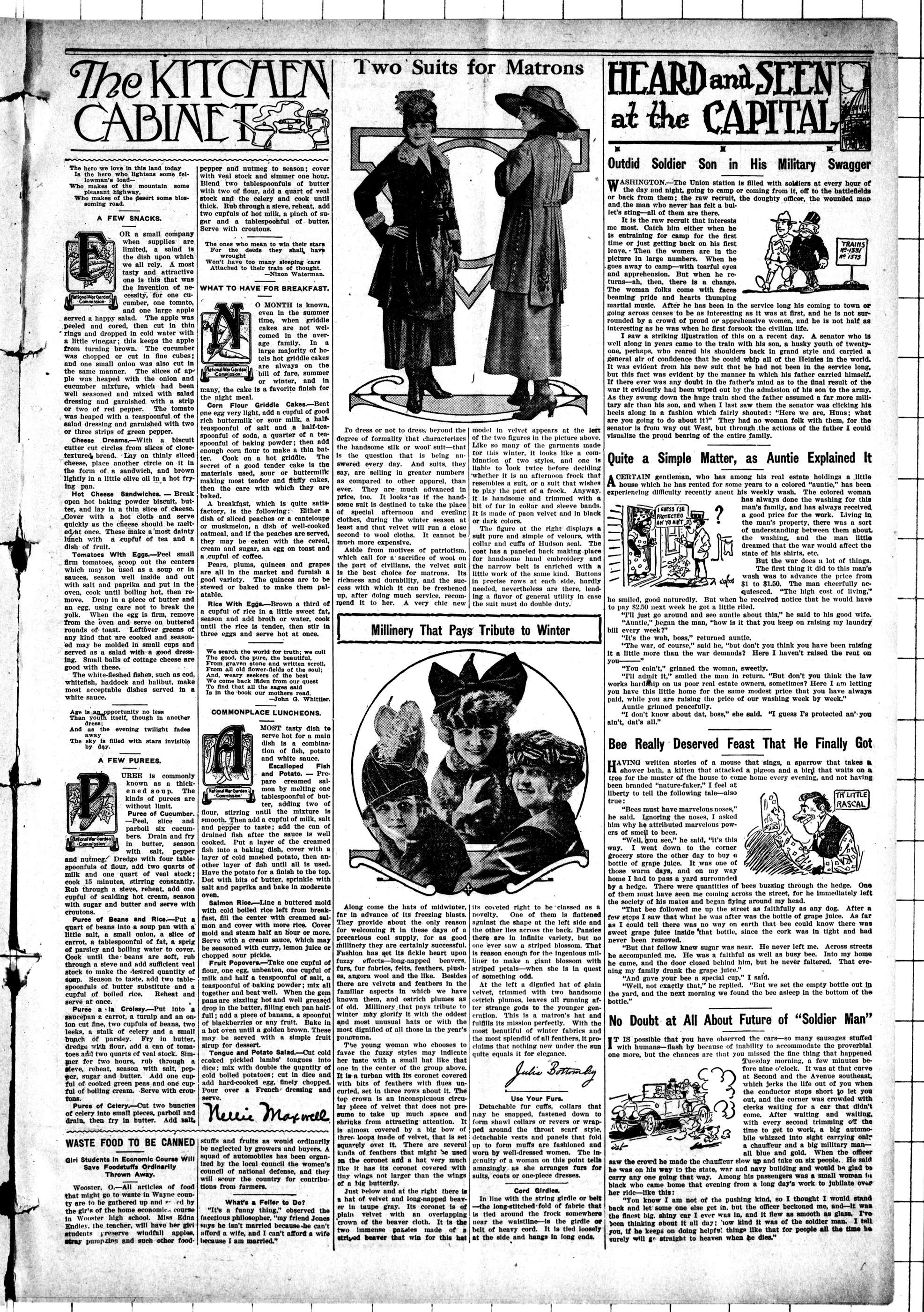
Millinery That Pays Tribute to Winter
THE FASHION STORY
Do dress or not to dress, beyond the degree of formality that characterizes the handsome silk or wool suit—that is the question that is being answered every day. And suits, they say, are selling in greater numbers as compared to other apparel, than ever. They are much advanced in price, too. It looks as if the handsome suit is destined to take the place of special afternoon and evening clothes, during the winter season at least and that velvet will run a close second to wool cloths. It cannot be much more expensive.
Aside from motives of patriotism, which call for a sacrifice of wool on the part of civilians, the velvet suit is the best choice for matrons. Its richness and durability, and the success with which it can be freshened up, after doing much service, recommend it to her. A very chic new
Millinery That Pay
Along come the hats of midwinter, far in advance of its freezing blasts. They provide about the only reason for welcoming it in these days of a precarious coal supply, for as good millinery they are certainly successful. Fashion has set its fickle heart upon fuzzy effects—long-napped beavers, furs, fur fabrics, felts, feathers, plushes, angora wool and the like. Besides there are velvets and feathers in the familiar aspects in which we have known them, and ostrich plumes as of old. Millinery, that pays tribute to winter may glorify it with the oddest and most unusual hats or with the most dignified of all those in the year's parquama.
The young woman who chooses to favor the fuzzy styles may indicate her taste with a small hat like that one in the center of the group above. It is a turban with its cornet covered with bits of feathers and flues uncurled, set in three rows about it. The top crown is an inconspicuous circular piece of velvet that does not presume to take up much space and shrinks from attracting attention. It is almost covered by a big bow of three loops made of velvet, that is set squarely over it. There are several kinds of feathers that might be used on the coronet and a hat very much like it has its coronet covered with tiny wings not larger than the wings of a big butterfly.
Just below and at the right there is a hat of velvet and long-napped beaver in taupe gray. Its coronet is of plain velvet with an overlapping crown of the beaver cloth. It is the two immense pazales made of a striped beaver that win for this hat
model in velvet appears at the left of the two figures in the picture above. Like so many of the garments made for this winter, it looks like a combination of two styles, and one is liable to look twice before deciding whether it is an afternoon frock that resembles a suit, or a suit that wishes to play the part of a frock. Anyway, it is handsome and trimmed with a bit of fur in collar and sleeve bands. It is made of paon velvet and in black or dark colors.
The figure at the right displays a suit pure and simple of velours, with collar and cuffs of Hudson seal. The coat has a paneled back making place for handsome hand embroidery and the narrow belt is enriched with a little work of the same kind. Buttons in precise rows at each side, hardly needed, nevertheless are there, lending a flavor of general utility in case the suit must do double duty.
s Tribute to Winter
its coveted right to be classed as a novelty. One of them is flattened against the shape at the left side and the other lies across the back. Pansies there are in infinite variety, but no one ever saw a striped blossom. That is reason enough for the ingenious milliner to make a giant blossom with striped petals—when she is in quest of something odd.
At the left a dignified hat of plain velvet, trimmed with two handsome ostrich plumes, leaves all running after strange gods to the younger generation. This is a matron's hat and fulfills its mission perfectly. With the most beautiful of winter fabrics and the most splendid of all feathers, it proclaims that nothing new under the sun quite equals it for elegance.
Julia Bottomly
Use Your Furs.
Detachable fur cuffs, collars that may be snapped, fastened down to form shawl collars or revers or wrapped around the throat scarf style, detachable vests and panels that fold up to form muffs are fashioned and worn by well-dressed women. The ingenuity of a woman on this point tells amazingly as she arranges furs for suits, coats or one-piece dresses.
Cord Girdles.
In line with the string girdle or belt the long-stitched-fold of fabric that is tied around the frock somewhere near the waistline—is the girdle or belt of heavy cord. It is tied loosely at the side and hangs in long ends.
HEARD and SEEN at the CAPITAL
WASHINGTON.—The Union station is filled with soldiers at every hour of the day and night, going to camp or coming from it, off to the battlefields or back from them; the raw recruit, the doughty officer, the wounded man and the man who never has felt a bullet's sting-all of them are there
martial music. After he has been in the service going across ceases to be as interesting as it was rounded by a crowd of proud or apprehensive as interesting as he was when he first forsook the one, perhaps, who reared his shoulders back in general air of confidence that he could whip all. It was evident from his new suit that he had but this fact was evident by the manner in which if there ever was any doubt in the father's mini war it evidently had been wiped out by the adm. As they swung down the huge train shed the farty air than his son, and when I last saw them heels along in a fashion which fairly shouted: are you going to do about it? They had no w senator is from way out West, but through the visualize the proud bearing of the entire family.
Quite a Simple Matter, as A
ACERTAIN gentleman, who has among his house which he has rented for some years to experiencing difficulty recently anent his weekly has alw
martial music. After he has been in the service long his coming to town or going across ceases to be as interesting as it was at first, and he is not surrounded by a crowd of proud or apprehensive women, and he is not half as interesting as he was when he first forsook the civilian life.
I saw a striking illustration of this on a recent day. A senator who is well along in years came to the train with his son, a husky youth of twenty-one, perhaps, who reared his shoulders back in grand style and carried a general air of confidence that he could whip all of the Heinles in the world. It was evident from his new suit that he had not been in the service long, but this fact was evident by the manner in which his father carried himself. If there ever was any doubt in the father's mind as to the final result of the war it evidently had been wiped out by the admission of his son to the army. As they swung down the huge train shed the father assumed a far more military air than his son, and when I last saw them the senator was clicking his heels along in a fashion which fairly shouted: "Here we are, Huns; what are you going to do about it?" They had no woman folk with them, for the senator is from way out West, but through the actions of the father I could visualize the proud bearing of the entire family.
Quite a Simple Matter, as Auntie Explained It
Quite a Simple Matter, as Auntie Explained It
ACERTAIN gentleman, who has among his real estate holdings a little house which he has rented for some years to a colored "auntie," has been experiencing difficulty recently anent his weekly wash. The colored woman
he smiled, good naturedly. But when he receives to pay $2.50 next week he got a little riled. "I'll just go around and see auntie about the "Auntie," began the man, "how is it that you bill every week?"
he smiled, good naturedly. But when he received notice that he would have to pay $2.50 next week he got a little riled.
"I'll just go around and see auntie about this," he said to his good wife.
"Auntie," began the man, "how is it that you keep on raising my laundry bill every week?
"It's the wah, boss," returned auntie.
"The war, of course," said he, "but don't you think you have been raising it a little more than the war demands? Here I haven't raised the rent on you——"
"You cain't," grinned the woman, sweetly.
"I'll admit it," smiled the man in return. "But don't you think the law works hardship on us poor real estate owners, sometimes? Here I am letting you have this little home for the same modest price that you have always paid, while you are raising the price of our washing week by week."
Auntie grinned peacefully.
"I don't know about dat, boss," she said. "I guess I'm protected an' you ain't, dat's all."
"I don't know about dat, boss," she said. "ain't, dat's all."
Bee Really Deserved Feast T
HAVING written stories of a mouse that she shower bath, a kitten that attacked a pigeon tree for the master of the house to come home been branded "nature-faker." I feel at
Bee Really Deserved Feast That He Finally Got
Bee Really Deserved Feast That He Finally Got
HAVING written stories of a mouse that sings, a sparrow that takes a shower bath, a kitten that attacked a pigeon and a bird that waits on a tree for the master of the house to come home every evening, and not having been branded "nature-faker." I feel at
by a hedge. There were quantities of bees buzzing through the hedge. One of them must have seen me coming across the street, for he immediately left the society of his mates and began flying around my head.
by a hedge. There were quantities of bees buzz of them must have seen me coming across the society of his mates and began flying around "That bee followed me up the street as far few steps I saw what that he was after was the as I could tell there was no way on earth the sweet grape juice inside that bottle, since the never been removed.
"But that fellow knew sugar was near. He he accompanied me. He was a faithful as well he came, and the door closed behind him, but ning my family drank the grape juice."
"That bee followed me up the street as faithfully as any dog. After a few steps I saw that what he was after was the bottle of grape juice. As far as I could tell there was no way on earth that bee could know there was sweet grape juice inside that bottle, since the cork was in tight and had never been removed.
"But that fellow knew sugar was near. He never left me. Across streets he accompanied me. He was a faithful as well as busy bee. Into my home he came, and the door closed behind him, but he never faltered. That evening my family drank the grape juice."
"And gave your bee a special cup," I sald.
"Well, not exactly that," he replied. "But we set the empty bottle out in the yard, and the next morning we found the bee asleep in the bottom of the bottle."
"Well, not exactly that," he replied. "But in the yard, and the next morning we found the bottle."
No Doubt at All About Future
IT IS possible that you have observed the car with humans—flash by because of inability to one more, but the chances are that you missed Tuesday.
No Doubt at All About Future of "Soldier Man"
IT IS possible that you have observed the cars—so many sausages stuffed with humans—flash by because of inability to accommodate the proverbial one more, but the chances are that you missed the fine thing that happened
saw the crowd he made the chauffeur slow up and he was on his way to the state, war and navy to carry any one going that way. Among his pass black who came home that evening from a loner ride—like this:
"You know I am not of the pushing kind, back and let some one else get in, but the off the finest big, shiny car I ever was in, and it been thinking about it all day; how kind it was you, if he keeps on doing helpfu' things like the surely will go straight to heaven when he dies.
saw the crowd he made the chauffeur slow up and take on six people. He said he was on his way to the state, war and navy building and would be glad to carry any one going that way. Among his passengers was a small woman in black who came home that evening from a long day's work to jubilate over her ride—like this:
"You know I am not of the pushing kind, so I thought I would stand back and let some one else get in, but the officer beckoned me, and—it was the finest big, shiny car I ever was in, and it flew as smooth as glass. I've been thinking about it all day; how kind it was of the soldier man. I tell you, if he keeps on doing helps! things like that for people all the time he surely will go straight to heaven when he dies."
It is the raw recruit that interests me most. Catch him either when he is entraining for camp for the first time or just getting back on his first leave. Then the women are in the picture in large numbers. When he goes away to camp—with tearful eyes and apprehension. But when he returns—ah, then, there is a change. The woman folks come with faces beaming pride and hearts thumping
I GUESS I'SE
PROTECTED
AM YO AINT
"It's the wah. boss." returned auntie.
Auntie grinned peacefully.
been blinded "hate-matter," I feel his liberty to tell the following tale—also true:
"Bees must have marvelous noses," he said. Ignoring the noses, I asked him why he attributed marvelous powers of smell to bees.
"Well, you see," he said, "it's this way. I went down to the corner grocery store the other day to buy a bottle of grape juice. It was one of those warm days, and on my way home I had to pass a yard surrounded
24
TRAINS
NO.1331
NO.1573
the service his coming to town or
ing as it was at first, and he is not sur-
sensitive women, and he is not half as
sook the civilian life.
is on a recent day. A senator who is
with his son, a husky youth of twenty-
ers back in grand style and carried a
whip all of the Heinles in the world.
it he had not been in the service long,
er in which his father carried himself,
her mind as to the final result of the
by the admission of his son to the army.
ed the father assumed a far more mill-
saw them the senator was clicking his
shouted: "Here we are, Huns; what
had no woman folk with them, for the
rough the actions of the father I could
are family.
as Auntie Explained It
long his real estate holdings a little
e years to a colored "auntie," has been
this weekly wash. The colored woman
has always done the washing for this man's family, and has always received a good price for the work. Living in the man's property, there was a sort of understanding between them about the washing, and the man little dreamed that the war would affect the state of his shirts, etc.
But the war does a lot of things.
The first thing it did to this man's wash was to advance the price from $1 to $1.50. The man cheerfully acquiesced. "The high cost of living."
he received notice that he would have
helled.
he about this," he said to his good wife.
it that you keep on raising my laundry
tittle.
don't you think you have been raising
sus? Here I haven't raised the rent on
sweetly.
return. "But don't you think the law
owners, sometimes? Here I am letting
the modest price that you have always
of our washing week by week."
he said. "I guess I'm protected an' you
fast That He Finally Got
e that sings, a sparrow that takes
a pigeon and a bird that waits on a
me home every evening, and not having
TH LITTLE
RASCAL
bees buzzing through the hedge. One across the street, for he immediately left around my head. Street as faithfully as any dog. After a war was the bottle of grape juice. As far earth that bee could know there was since the cork was in tight and had near. He never left me. Across streetsoul as well as busy bee. Into my home him, but he never faltered. That ever." I said. 1. "But we set the empty bottle out in and the bee asleep in the bottom of the
Future of "Soldier Man"
led the cars—so many sausages stuffed inability to accommodate the proverbal you missed the fine thing that happened
Tuesday morning, a few minutes before nine o'clock. It was at that curve at Second and the Avenue southeast, which jerks the life out of you when the conductor stops short to let you out, and the corner was crowded with clerks waiting for a car that didn't come. After waiting and waiting, with every second trimming off the time to get to work, a big automobile whizzed into sight carrying only a chauffeur and a big military man—all blue and gold. When the officer
blow up and take on six people. He said and navy building and would be glad to bring his passengers was a small woman him from a long day's work to jubilate over being kind, so I thought I would stand at the officer beckoned me, and—it was a, and it flew as smooth as glass. I've kind it was of the soldier man. I tell guys like that for people all the time he can die."
PUBLSHED EVERY FRIDAY BY
CHARLES SUMNER SMITH,
Minneapolis, Minnesota.
Entered in the Post Office at Minneapolis as second class matter.
MEMBER
NATIONAL NEGRO PRESS
ASSOCIATION
ONE YEAR .....$2.00
SIX MONTHS .....$125
THREE MONTHS ......65
ADVERTISING RATES.
One Inch—1 Insertion—One Dollar.
Liberal discount given on 3, 6, 9,
Months, or 1 year contracts.
We do not run free ads, or over-run
the time contracted for by our ad-
vertisers. We respect their right to
advertise at intervals, and rather have
them do so, than to run continuously
an "adv." and an increasing account.
Write all Checks payable to
1317 North Sixth Ave.
MINNEAPOLIS . . . MINNESOTA
Call at 1317 6th Ave. N. on Wednesday to insure matter for publication.
The Star's Phone, Hyland 1205.
Send your subscription. Our prices have not changed because of the war. Let your dollar do its duty and The Star will reach a higher standard of service* and better circulation.
A DEPOSIT IS REQUIRED ON ALL POLITICAL ADVERTISEMENTS.
NOTICE TO EXCHANGES.
The War Industries Board requests that we discontinue "sending FREE copies in exchange for other publications." In order to comply with their request—we will send a check for a yearly subscription to any weekly publication sending a check for a yearly subscription to The Twin City Star.—(Editor.)
Let us not draw the color line. Reciprocity between the races will be the salvation of the Negro.
UNCLE SAM IS CALLING
FOR YOUR
FOURTH LIBERTY LOAN
ANSWER WITH CASH AND
CONFIDENCE. HERE IT IS.
COLORED APPLICANTS REJECTED
The Bee desires to emphasize its protest against the wholesale discrimination in the Government departments against colored applicants who have successfully passed the civil service examination. What does it mean? The Bee again asks. The colored Americans are loyal to this Government and they are doing everything in their power to aid the Administration in the successful prosecution of this war. What offense can be charged against colored Americans? The Bee asks again. The bars have been lifted so that a certain favored class can pass muster without an examination, while another class is compelled to enter examination and after passing successfully is rejected. What does it mean? A declaration has been reported to this office to the effect that no colored people will be appointed by this particular official. In response to the request made by The Bee last week, many persons have announced that they have been rejected by the departments. It is necessary that every colored person who has been rejected send in his or her name at once. These names will be presented to the proper heads at once.
Advertisements are being published daily that the Government is in need of clerks and other employees for war work. Hundreds of colored Americans have applied and been rejected, and white ones cannot be obtained. Messenger boys have been advertised for and colored people have applied, only to be refused. Is the assistance of colored Americans needed? If so, they are willing and ready to respond to their country's call.
If they are needed, and the Government is in need of help, why reject colored applicants? Show one black traitor in the ranks of colored Americans and The Bee will show you one million loyal colored Americans to one black traitor. The Bee appeals to the President of the United States to direct the heads of his departments to lift the bars of discrimination against the colored Americans. They are competent and loyal. Then why reject them?
Every, Southern railroad discriminates against the colored people without a just cause. They are treated as cattle when riding South. They are directed to a box car with no conveniences. Does the colored American deserve such treatment? Mr. President, we are with you, and, in the name of God, see that we are given a fair deal—The Washington (D. C.) Bee.
If you wish to add to your income,
you can do so by accepting an agency
for The Twin City Star. Good commission to competent agents. Use
your spare time in soliciting ads and
subscriptions. Only honest and intelligent agents wanted. Call Hyland
1905.
Wanted—Subscribers to Pay.
HON. FRANK M. NYE,
Candidate for Judge of the District
Court.
Hon. Frank M. Nye is a candidate for Judge of the District Court. He has served as county attorney of Hennepin county and member of Congress from the 5th district (Minneapolis). He stood loyally by the Negroes while in Congress and can be depended on to give all people their rights according to law. Mr. Nye is one of the favorite speakers among those asked to address colored people. He is an orator of ability and is familiar with the conditions that confront our people. Let us show our gratitude by assisting in his election for Judge of the District Court.
PAID ADVERTISEMENT.
Inserted by. C. S. Smith for Hon.
Frank M. Nye.
M. B.
JUDGE C. L. SMITH.
Candidate for Re-election as Judge of the Municipal Court.
Judge Smith was appointed Judge of the Municipal Court in 1905 and was elected in 1906 and again in 1912. He has served with credit and distinction in this important position for more than thirteen years. He is a kindly Christian gentleman and a good judge, sympathetic and patient. He has many friends among all classes who desire to see him remain upon the bench as long as he will serve the people. The voters of Minneapolis will make no mistake in re-electing him and we believe they will. His ability, fairness, fine service, keen judicial insight and right thinking entitle him to, and ought to make sure his re-election. -Paid Advertisement.
DR. HENRY WUERZINGER.
Candidate for Representative 31st District (5th and 6th Wards).
Dr. Wuerzinger was born in the State of Virginia of German-Scotch-Irish ancestry. As a Southerner he understands the needs and requirements of the Negro race, and he has proven on numerous occasions in his professional capacity as well as otherwise that he is free of race prejudice and a friend of the colored man. He is educationally, intellectually and by his clear understanding of public questions best equipped to represent the people in the legislature and asks for the support of the decent and intelligent element of the colored voters of his district.
For Representative
* HENRY WUERZINGER.....| X *
Political Advertisement, for which $7.50 has been paid to the Twin City Star.
A COMPETENT REPRESENTATIVE. The editor of the Star has not found Dr. Wuerzinger wanting in the requirements necessary to qualify as a fair and competent representative of the people. His candidacy is endorsed after a careful investigation. Vote for him.
THE TWIN CITY STAR, MINNEAPOLIS, MINN.
OF A. BECOMBOTY
C. A. Bloomquist, present City Treasurer of Minneapolis, has the confidence of all of its citizens. He has served many years as City Treasurer, and the voters have proven and will prove their consent to have him continue in charge of the City's finances.
J. T. DAHL
IPEU
6
We present to the readers of The Twin City Star, J. T. Dahl, Candidate for Alderman of the Sixth Ward, who needs no introduction. He has been a resident of this Ward since 76, and he is loved by all who know him. He says, "There is no question superior to the question of loyalty," and he is one hundred per cent American. Vote for him, and you will make no mistake.
JUDGE W. W. BARDWELL.
It is a privilege and an honor for every Negro to vote for Judge Bardwell of the Municipal Court for election to the District bench. He is an exceptionally good judge, and has given more than the ordinary consideration to our people. He has been merciful in several cases, where offenders have benefited by his leniency.
And the Negro Elks.
Judge Bardwell was a delegate to the Grand Lodge of the white Elks, when the question of "rights of Negroes to form lodges and use emblems of the white Elks" was an important issue. He had an interview with the Star, which was published long ago, and was active in bringing about the present harmony between the Grand Lodges, and the matter is—after certain adjustments—a closed incident. We need judges who are merciful, just, intelligent and impartial. Winnifred W. Bardwell measures up to this standard. Remember, "Bardwell for District Judge."
A REAL FRIEND
Mr. Albert E. Edwards, veteran of the Spanish-American war, is a true friend of our race, and has demonstrated his interest in us in many ways. He has accorded them every privilege and courtesy as comrades; also shown his respect for them in civil life. It is Commander Edwards who attends the wants and funerals of the Negro veterans. He was instrumental in placing a headstone at the grave of one of the heroes of San Juan Hill, the late David F. Buckner. We are forced to mention this to many, who will know nothing about this man, who is a candidate for Court Commissioner. If elected he will have to pass on the sanity of many persons of our race. Let us have a man who feels kindly toward our people. Vote for EDWARDS for COURT COMMISSIONER.
Vote for
FRANK C. DETERLY
For County Surveyor.
Prepared and issued by A. C. Egstein, 504 New York Life Bldg., Minneapolis, Minn., for which the sum of $5.00 is to be paid.
SUBSCRIBERS WANTED — Make the Twin City Star a live and dependable weekly Negro newspaper by sending your subscription.
I loved a thin girl, but she was too thin.
I loved a fat girl, but she was awfully fat.
I loved a tall girl, but she was a baby giraffe.
I loved a short girl, but I could only see the top of her hat.
I loved a religious girl, but she was always at a meeting.
I loved a free-thinker, but she insisted on living in Greenwich village.
I loved a good fellow, but she was, well, just a little free in her cups.
I loved an outdoor girl, but she always wore a middy blouse.
I loved a cabaret queen, but she painted her cheeks red.
I loved a girl with a brain, but she looked like Banquo's ghost.
I loved a simple lass, but she stuttered.
I loved an athletic girl, but she had a disagreeable habit of slapping me on the back.
I loved a girl with beautiful eyes, but she kalsomined her nose.
I loved a Red Cross nurse, but she went away.
I loved a minister's daughter, but she was too gay for me.
I loved a debutante, but she couldn't get up an appetite for breakfast without three cocktails.
And then, all of a sudden, just like that—
I loved a girl who wasn't too thin nor too fat, neither too tall nor too short, not unduly sanctimonious and yet who had decent scruples, taking her glass of port, but no more; dancing as well as she played tennis, serious at times and not addicted to foolish remarks; pretty of course, with eyes, hair, nose, lips, shoulders and all that sort of thing—merciful heavens, how I loved her—
But she existed only in my imagination—Franklyn Everett Fitch, in Judge.
JOTTINGS
A man's temper improves with disuse.
Prudence is merely well trained common sense.
Never make friends of fools nor fools of your friends.
Some women worry about the worries they have missed.
A circus can pull a sick boy out of bed after three doctors have failed.
Idle curiosity is an unknown factor in the fair sex. It works overtime.
Charity may cover a multitude of sins, but there are a number of multitudes still uncovered.
Time is money, according to the adage, yet some men spend a great deal of time trying to borrow money.
SEEMINGLY IMPOSSIBLE
To get the last word with a life insurance agent.
To keep a woman from writing on both sides of the paper.
To look dressed up when you have a ready tied four-in-hand on.
To refrain from turning to the sporting page of a newspaper first.
To make a player plano play as well at home as it did in the store.
To understand the telephone conversation of a stenographer who is chewing gum.
PROPOSED AMENDMENT
TO THE CONSTITUTION OF THE
STATE OF MINNESOTA
By the Legislature at Its General Session, 1917,to be Submitted to the People of Said State at the General 1918 Election, Together with a Statement of Its
PURPOSE AND EFFECT
PREPARED BY CLIFFORD L. HILTON Attorney General of Minnesota.
Addressed to
JULIUS A. SCHMAHL
Secretary of State
OFFICE OF THE ATTORNEY
GENERAL,
ST. PAUL, MINNESOTA.
April 29, 1918.
HON. JULIUS A. SCHMAHL,
Secretary of State.
SIR:
As required by Section 46, General Statutes of the State of Minnesota for the year 1913, I have the honor to furnish you herewith a statement of the purpose and effect of the amendment proposed to the Constitution of the State of Minnesota by the Legislature of 1917, and which is to be submitted to the electors of said State at the General Election in 1918.
PROPOSED AMENDMENT.
Chapter 515 of the Session Laws of Minnesota for the year 1917, proposes an amendment of Article 15 of the Constitution of said State by adding there to a new section to read as follows:
"Section 6. The manufacture, sale, barter, gift, disposition, or the furnishing, or transportation, or keeping or having in possession for sale, barter, gift, disposition, or the firing or the impersonation of intoxicating liquor of any kind, in any quantity whatever, except for sacramental, mechanical, scientific, or medicinal purposes, shall be forever prohibited within this state from and after the first day of July, 1920, and, this amendment shall be self-executing. The legislature shall enew laws for the enforcement of this section and shall provide suitable penalties for the violation thereof."
THE PURPOSE of the proposed amendment is to forever prohibit within the State of Minnesota after July 1, 1920, the manufacture, sale, barter, gift, disposition or the furnishing or transportation, or the keeping or having in possession for any of such purposes, of intoxicating liquor of any kind in any quantity whatever, except for sacramental, mechanical, scientific or medicinal purposes.
THE EFFECT of the proposed amendment, if adopted, will be to make unlawful and forever prohibit the manufacture, sale, barter, gift, disposition or the furnishing or transportation or the keeping or having in possession for any of such purposes, of intoxicating liquor of any kind in any quantity, whatever, except for sacramental, mechanical, scientific or medicinal purposes, within this state after July 1, 1920, and to place it beyond the power of any legislative authority to permit the doing of any such acts. If adopted, the doing of any of the prohibited acts automatically becomes unlawful after July 1, 1920, without any action on the part of the legislature or other legislative body. The amendment is made self-executing. A duty is, however, imposed upon the legislature to enact laws for the enforcement of this section, if adopted, and to provide penalties for the violation thereof.
Yours respectfully,
CLIFFORD L. HILTON,
Attorney General.
---
Nothing Changed But the Price
Sight Drafts Still the Same Fine Old Cigar You've Always Liked
When your dealer asks you six cents apiece for your old friend Sight Draft, don't get the idea that he is trying to put something over on you.
The plain truth of the matter is that our labor and other manufacturing costs have increased so much that we had the choice of cutting down the size of the Sight Draft cigar, using inferior tobacco, or raising the price one cent.
We believed you would rather have the same old Sight Draft quality, the same old size, even if it cost you a penny more. So, from now on Sight Drafts will be six cents.
Try a Sight Draft today. It's worth six cents, and you experienced smokers KNOW it is. W. K. Greah & Sons, makers. W. S. Conrad Co., St. Paul, wholesale distributors. — Advertisement.
CHOICE CITY AND SUBUR BAN PROPERTY FOR SALE ON SMALL MONTHLY PAYMENTS.
B. M. McDew
802 Sykes Block.
N. W. Nic. 621 Minneapolis
Office Hours: Sundays:
2 to 6 p. m. 10 to 1 p. m.
9:30 a. m. to 12:30 p. m.
R. S. BROWN, M. D.
Office 408-9 Tribune Annex
67 Fourth Street Spur.
N. W. Main 2040. T. S. 38199
Res. 608 E. 14th St.
N. W. Main 2388 Minneapolis
WORKING-MEN'S
SOCIAL CLUB
FOR MEN ONLY
244 3RD AVE. S.
MINNEAPOLIS
SYLV&STER. W. OLIVER &
BENJAMIN JONES
Managers
Peterson, The Druggist
1501 Washington Ave. So.
TOILET ARTICLES, DRUGS
PRESCRIPTIONS.
He Solicits Your Patronage.
T. S. Center 4639.
WALFRID WESTMAN
Photographer
1425 Washington Ave. So. Minn.
THE KEYSTONE BUFFET
(Formerly "Kid" Mitchell's)
Now under new management of
JIMMY SMITH
1313 Washington Ave So.
Main 2259 Minneapolis
NO
HOT
WATER
"Let's move into a modern house."
A Gas Water Heater
Solves the Problem.
Sold by
The Minneapolis
Gas Light Go.
Are you a delinquent subscriber?
If so, why not send your subscription?
SMOKE 'THE RELIABLE
SIGHT DRAFT CIGAR
THAT'S ALL
IMPORTANT NOTICE
Unless notes are written plainly and properly arranged they will not be inserted. Many people send in notes regardless of names, initials or composition. Arrangement by the publisher will be charged for. Free notices must be correctly written.
SCHALL SEEKS RE-ELECTION
Congressman Thos. D. Schall is a candidate for re-election. He has stood for everything for public good and used his best efforts to "win this war." Let us show our esteem for our Congressman by giving him a big vote at the next election.
The Negro vote is an important factor. The candidate who does not get them, will be among the "also rans."
Capt. Gale P. Hilger served in the office of the Adjutant General last Friday, relieving Capt. Chas. Sumner Smith. Capt. Hilger made a favorable impression and a record of which his Company "C" and rest of the 16th Battalion may be proud.
Mrs. Beulah Minor was married to Mr. H. Mitchell last week.
Boutell Bros. have in their employ a colored lady as elevator operator, who has given very satisfactory service.
Mr. and Mrs. W. H. Briggs have moved to 813 Oak Lake Ave. Mrs. Emma Jeffrey has moved to 807 5th Ave. N.
Mrs. Harry Holmes of St. Paul was a visitor to Minneapolis on Wednesday night.
Mr. and Mrs. G. W. Wills, accompanied by a party of friends, motored to their summer home at Lake Chisago on Thursday, Oct. 18th, on a hunting trip, and to close the cottage for the season. Mrs. W. R. Donovan proved herself an excellent marksman, while Mrs. S. E. Hall claims to have caught the last and finest fish of the season. The stay was shortened because of Mrs. Florence Cloak receiving a message to return to the city to fill a clerical position.
KEEP MINNESOTA IN THE REPUBLICAN RANKS
Gov. J. A. A. Burnquist has proven his manhood, ability and loyalty. Elect him for our next Governor.
NOTED DIVINE TO PREACH
Rev. Fr. Albert W. Williams of Omaha, Neb., will preach at St. Phillips Episcopal Church in St. Paul, next Sunday, Oct. 27, at the morning service. Rev. Williams is editor of The Monitor, a leading Negro weekly paper. He is doing great work for his race, both in the pulpit and press.
Mr. and Mrs. Arthur Brown have moved to 1912 4th Ave. S.
G. U. O. OF O. F.
St. Anthony Lodge No. 2877, G. U. O. of Odd Fellows, elected the following officers: W. W. Williams, N. G.; J. W. Whitely, V. G.; M. L. Brown, P. N. G.; George Peale, E. S.; Wm. R. Morris, P. S.; Noah C. Stone, W. T.; J. J. Turner, N. F.; I. S. Bogie, P. N, F.; O. S. Lee, Chaplain; O. A. Lawrence, Advocate; Wm. Jenkins, Warden.
Mrs. James H. Gullbert, 3732 Minnehaha Ave., died at St. Barnabas Hospital on Sunday morning. Her remains were shipped to her home at Gibbon, Minn. Several friends viewed the body at Gill's Undertaking Parors and brought floral offerings. She had a host of friends. Her death was caused from kidney trouble, for which she underwent an operation.
Mr. Geo. E. Jones, the famous chef, has charge of the culinary department at the Waiters and Porters' Club. He has a reputation for his sanitary service. Manager Lee Wheeler has renovated the kitchen and opened a new dining room.
Private Charles Sayles is on a furlough from Camp Dodge. He is looking well and speaks in highest terms of the army, especially of the instruction and discipline.
Mr. Walter Dodson and family have moved to 3035 Findley Place.
Mrs. Pearl Martin of Chicago is visiting her sister, Mrs. Nellie Ewing, 1311 6th Ave. N.
Statement of the Ownership, Management, Circulation, Etc., of THE TWIN CITY STAR
Published Weekly at Minneapolis, Minn., Required by the Act of Congress August 24, 1912. Editor, Manager, Publisher and Owner: Charles Sumner Smith, Minneapolis, Minn. Known bondholders, mortgagees and other security holders, holding 1 per cent or more of total amount of bonds, mortgages, or other securities—None. Signed, CHAS. SUMNER SMITH. Subscribed and sworn to before me this 3rd day of October, 1918.
FUNERAL OF MRS. TROTTER Noted for Her Work Among the Colored Race.
(Boston, Post, Oct. 13, 1918.) The funeral of Mrs. Geraldine Louise Pindell, wife of William Monroe Trotter, editor of the Guardian, was held yesterday at 2 o'clock from her home, 97 Sawyer avenue, Dorchester. The Rev. Walter D. McClane, rector of St. Bartholomew's Episcopal Church of Cambridge, conducted the service with the Episcopal ritual. "Crossing the Bar" and "Fear Ye Not, O Israel," from "Elijah" were sung by Harry Delmore, tenor. The gray casket was banked with a profusion of beautiful floral tributes, one from the Boston Literary Association, another from the men of the Parker House.
The honorary pall bearers were William D. Brigham, E. T. Morris, C. H. Plummer, William L. Reed, E. E. Brown, Dr. J. Washington Hill, the Rev. M. A. N. Shaw. The active pall bearers were E. P. Benjamin, William P. Hare, James Anderson, Robert Johnson, Frederick Brooks, Private David G. Morris, adopted soldier son of the deceased, from Camp Devens; Dr. A. P. Russell and Dr. H. W. Ross. There was a large attendance of friends. Interment was at Fairview cemetery, Hyde Park. Mrs. Trotter left to mourn her loss her mother, Mrs. Mary Pindell; a sister, Miss Gertrude Pindell; a foster brother and her husband.
Geraldine Louise Trotter was born in Boston, Oct. 3, 1872, the daughter of Charles E. and Mary Pindell. She was educated in the Boston schools, and for 10 years was bookkeeper for Ell Cooley, china decorator, until she married Mr. Trotter, June 27, 1899, in the same house where she died, Oct. 9, 1918, at the age of 46 years. Her chief life work was associate manager of the Boston Guardian, an organ for equal rights for colored Americans, published by Mr. Trotter. But she engaged in much public-spirited work. She secured pardons for several colored inmates of the State prison, notably the late William E. Hill, who had been there more than 40 years. She was executive chairman of the Boston Literary Association, arranging the loving cup presentation to Moorfield Storey in Faneuil Hall. She organized a women's antilynching committee, and was a member of the Equal Rights League.
Her chief activities recently were for the colored soldiers. She presented the national colors to the 519th Engineers at Camp Devens in behalf of the State. Organized the Godmothers' Association to this, the only colored unit which went overseas from Massachusetts, and begun organizing with a circle of cheer" at Newburyport. She was a member of the Soldiers' Comfort Unit and Sunday hostess at its War Service center. Her last act was to send fruit to the colored soldiers at Camp Devens who were ill with influenza. She was a communicant of St. Mary's Episcopal Church in Dorchester. Few members of her race were better known. She was an able newspaper woman and ready public speaker.
NEGRO ASSISTANT TO
ADJUTANT GENERAL
Ability Won, Him Appointment.
Capt. Chas. Sumner Smith has been appointed as one of the special aides to Adjutant General W. F. Rhinow of the State Military forces, and is assigned to the Emergency Bureau (a special department, under Major F. Alex. Stewart of the 4th Regt., M. N. G. Capt. Smith was assigned as one of the assistants by Maj. William C. Garis, Chief of Staff, during the fire calamity, as Intelligence Officer, and his ability won him the recent assignment to this bureau, which is the headquarters for supplies and transportation for troops in the fire zone; also where the statistics of costs, information, etc., are being kept for state records. While in this line of duty Capt. Smith has met many of our leading business men. He has not found color or racial conditions a barrier, when those in authority decide to give recognition according to ability.
It is a credit to the race to have a representative in the office of the Adjutant General, who is next in command to Governor Burnquist. We are thankful for the appointment, the temporary; also for the courteous treatment and assistance given by Capt, J. W. Edwards, assistant to the Adjutant General, and members of the Staff, and to Messrs. "Billy" Williams and Geo. L. Hoage of the Governor's office for their co-operation. Maj. Garis deserves great credit in giving recognition to Capt. Smith as a member of his Staff, also Maj. Stewart, who has given him every opportunity to show his qualifications.
CARD OF THANKS.
I wish to express my heartfelt thanks and appreciation to our many friends for their kind sympathy and beautiful floral offerings during the bereavement of my beloved wife, Mary Elizabeth Clawson.
GEO. W. CLAWSON.
BAN ON PUBLIC GATHERINGS.
During the epidemic of Spanish influenza, no public gatherings are allowed. Churches, schools and theatres are closed and all political meetings stopped.
Are you a delinquent subscriber?
If so, why not send your subscription?
SMOKE THE RELIABLE
SIGHT DRAFT CIGAR
THAT'S ALL!
THE TWIN CITY STAR. MINNEAPOLIS. MINN.
CLASSIFIED ADVERTISEMENTS
SEE McDFW! for real estate
HOUSE FOR RENT.
FOR RENT—Five rooms, modern except heat, on car line. $11.00 per month. Call Main 2040.
NICE FRONT ROOM For Rent—Suitable for two; gentlemen preferred. Snelling and 4th Ave. car lines pass the door; good location; walking distance. Call So. 117 before noon. Mrs. E. A. Mitchell, 1828 4th Ave. So.
FOR RENT — Eight-room house; modern, furnace heat; reasonable rent. Apply Walter Smith, 2812 Elliot Ave. Tel. South 3118.
FOR RENT—Three nice rooms for light housekeeping; newly papered; modern; near car lines. Apply to Carroll, 3102 Blairdale ave., city.
For Rent—One furnished room, for one or a couple. Modern except heat, near car line, desirable location. Mrs. W. W. Williams, 2900 Eleventh Ave. S. Phone Drexel 4728.
N. W. Nicollet 1534
JOSEPH YOUNG
Loans on Real Estate
818 Metropolitan Life Bldg.
Minneapolis, Minn.
Mrs. Clarence Cunningham has opened a millinery department in connection with Mrs. Van Hook's, the dressmaker at 1006 Sixth Ave. N., Minneapolis. She offers special bargains in millinery.
EVERY DAY is BARGAIN DAY
at the ROOT & HAGEMAN
STORE, 407 Nicollet Ave.
ST. PAUL HOME GUARDS.
Companies A and B of the 16th
Battallon, M. H. G., will hereafter
meet every Wednesday night in the
old Capitol on Wabasha street.
Do not waste your time making
promises to our agents. Send your
money by Express or Post Office Or-
der or in cash or postage stamps.
Read the Negro Papers.
Several laborers from the harvest fields have returned after a good season. They received high prices for their work and reported a special demand for Negro laborers under most favorable conditions.
We have some among our advertisers and subscribers who are a credit determined to stem the tide of prejudice and safeguard our rights; the association must be strong in numbers and in financial resources, and it will be a greater power throughout the nation. The membership fee is only ONE DOLLAR a year, one half of which is remitted to the New York National Headquarters and the other remaining half is retained in our treasury for local expenses. Will you not become a member and help the Association to make America free for black humanity? You must not be a slacker and you cannot be a conscientious objector. Have your dollar ready for the drive; let Minnesota be in the race by sending no less than 500 memberships.
We have never known two injustices to make anything right. The Saturday News has prospered by being as just to the white man as it has ever been to the Negro. We have never gone off half-cocked upon any proposition. Whenever we grope, we are in search of the truth. We want to be right and avoid as nearly as possible being wrong. We are not for the Negro right or wrong. We want him to be right. We complain because a majority of white people will always side with a white man when a question arises between him and one of our color; still certain colored newspapers, without making any investigation whatsoever as to the evidence, would have the entire Negro race do identically what they condemn the white people for doing. Be cause the white people do wrong is no reason why the Negroes should do wrong. The best preparedness to receive justice is to be just yourself. —Hopkinsville (Ky.) Nows.
Any person, who seeks honor or personal gain in connection with any war activities is a war profiteer, and is guilty of the worst form of disloyalty. Every personal sacrifice is a patriotic effort. It is the duty of every honest citizen to do his best to bear the Nation's burden without complaint. This is no time for obstructionists. Those who have grievances may complain, in order that better progress may be made. The slacker and chronic kicker is always a detriment. While petitions of redress to proper authorities will always command respect and investigation, let us not forget that every one is asked to do his share to win this war. There is a satisfaction in having done our duty. There is honor enough for us all, if we do that which is expected of us. The patriot knows no self-preservation, the profiteer no self-sacrifice.
"ENLIST OR WORK" CAMPAIGN.
The military authorities intend to push the enlist or work campaign among the Negroes. There are many idlers who have no lawful means of support. They will be drafted into the industrial army. Get work, gentlemen of leisure, even if as a side ine.
PAID ADVERTISEMENT Prepared and published by the 5th District Republican Congressional Committee, John H. Ray, Jr., chairman,
Walter H. Newton Republican Nominee for Congress Fifth District
To Whom It May Concern
We, the undersigned, each Hennepin County during the p'touch with Walter H. Newton a attorney's office.
For four years he has can has proved that he is able, indi dependent and fearless in the established high character and public.
We, the undersigned, each of whom was foreman of the Grand Jury of Hennepin County during the period set after his name, have come in close touch with Walter H. Newton and his work as a public prosecutor in the County attorney's office.
For four years he has carried a large part of the burden of that office and has proved that he is able, industrious and honest. At all times he has been independent and fearless in the performance of his duty. As an official of established high character and ability, he merits the fullest confidence of the public.
B. H. Timberlake, March, 1915.
Luther H. Farrington, May, 1915.
Walter L. Badger, September, 1915.
Jos. B. Hofflin, January, 1916.
Leon C. Warner, March, 1916.
J. B. Tabour, September, 1916.
William Y. Chute, November, 1916.
C. L. Stacy, May, 1917.
S. H. Towler, September, 1917.
Lorin Hord, November, 1917.
F. E. Satterlee, January, 1918.
Geo. K. Bellee, March, 1918.
C. J. Bintliff, May, 1918.
Note: Since Janua torney, eighteen grand two are out of the city.
A Minneapo
Note: Since January, 1915, when Walter H. Newton became Assistant County Attorney, eighteen grand juries have sat in Minneapolis. Three foremen have died and two are out of the city. The signatures of all the others appear above.
A Minneapolis Man to Represent Minneapolis
JOHN H. BURKE
Vote for
Waldo J. McDonald
Candidate for
ALDERMAN
Fifth Ward
THE COLOR THAT
DOES NOT RUN
"The colored troops fought bravely." It does not matter whether this historic report emerged from the Civil War or from one of the earlier struggles of the Republic. It has been historically true at all times. General Pershing reports from the field of France: "I cannot commend too highly the spirit shown among the colored combat troops who exhibit fine capacity for quick training and eagerness for the most dangerous work." In these words the American commanding officer bears glad testimony to the bravery and devoted spirit of the American Negroes who are doing their full share for the defense of their country and the triumph of civilization and democracy.
It always has been so. In every war in which the United States has engaged, the report has been to the same effect as the historic message quoted: "The colored troops fought bravely." In the Continental army, in the American revolution, in the naval triumphs of the War of 1812, in the struggle between North and South and finally in the brief contest with Spain, the American of African descent proved his valor and staying qualities. Now, in the greatest of wars and the greatest of duties, the Negro has conducted himself so as to win the approbation of our greatest soldier. The kaiser will find that the American Negroes sent against his levied troops are of a color that will not run—St. Paul Pioneer Press.
Political Ban Modified.
Washington, Oct. 25.—Modification of the recent order forbidding railroad employees or officers from holding office or participating in politics was announced by Director General McAdoo, so as to permit the men to hold municipal offices and to be delegates, but not chairmen of political conventions. This action, urged by the four leading railroad brotherhoods, was taken, it was explained, because of the discovery that many communities consist almost entirely of railroad men.
cern —
named, each of whom was foreman of the period set after his name, Newton and his work as a public pro-
fessor has carried a large part of the bu-
tle, industrious and honest. At all
pass in the performance of his dut-
tor and ability, he merits the fur-
ay, 1915, when Walter H. Newton became
curries have sat in Minneapolis. Three
The signatures of all the others appear
lis Man to Represent
Inserted by A. G. Bastis, for which
Inserted by A. G. Bastis, for which $5.00 is to be paid.
[Name]
ALBERT G. BASTIS
IF YOU INVESTIGATE
HARRY H.
IF YOU INVESTIGATE THE RECORD OF
WILLIAM H. HARRIS
"COLORED TROOPS
FOUGHT NOBLY"
"The colored troops fought nobly." That was more than half a century ago. They "fought nobly" on the plains, in the islands of the Pacific and the Atlantic, wherever they have been called 'on to fight. Properly led, they are magnificent fighting men; faithful, fearless, devoted, cheerful. And now in France they are living up to the reputation they have won on other, far distinct fields. We have been told of the particularly valorous acts of two of them. Harry Johnson of Albany and Needham Roberts of Trenton, N. J. They have been enrolled among the heroes of the world and have been cited for the Croix de Guerre before the French army. They accomplished some incredible thing—fought with skill and calmness as their wounds accumu-
---
Minneapolis, Minn., October 18, 1918.
William Y. Chute, November, 1916.
C. L. Stacy, May, 1917.
S. H. Towler, September, 1917.
Lorin Hord, November, 1917.
F. E. Satterlee, January, 1918.
Geo. K. Belden, March, 1918.
C. J. Bintliff, May, 1918.
of the Grand Jury of
have come in close
prosecutor in the County,
burden of that office and
all times he has been in-
y. As an official of
lest confidence of the
$5.00 is to be paid.
Re-Elect
Albert J. Bastis
ALDERMAN
OF SIXTH WARD
TE THE RECORD OF
DOWNES
ALDERMAN
FIFTH WARD
You will find that he has been eminently Fair to All and deserves your vote for re-election.
lated, substituted one weapon for another as their assailants crowded about them, finally beat back a score and more of Germans before they sank unconscious at their posts as help came to them. For the arriving squads there was nothing to do except to carry them back to the lines for transport to the hospital; these two men had finished the job and Johnson's sole thought was of his duty: "Corporal London, out the guard!" were his first words when consciousness came back to him. They will get well of their wounds, but not as soon as they want to, and their only wish is to return to the trenches. Of them the French General, a soldier not unaccustomed to heroic and skilful military deeds, wrote to his superior:
"The American report is too modest. As a result of oral information furnished to me it appears that the blacks were extremely brave and this little combat does honor to the American."
Letter to a Country Mouse From Her City Cousin
Dear Mouse:—Well, here I am right in the midst of things and feeling exactly like a molecule. Lonesome? Well, I should say so. Why is it that city crowds make one feel so unnecessary? When you stroll out into the country, surrounded with the chickens, pigs, sheep, goats and cows and pigeons and thousands of tiny folks that go to make up the crowded country life, you feel that man is indeed lord of creation. But when you stroll out in the city and meet these same folk, just because they have put on human shape, you feel quite small and inferior and abashed. For they are all here, Mouse, dear, every single one—even to Greedy and Grunty, my prize Berkshires. I lunched at the next table to them today. The only marked difference was that there was no pen around them and Greedy wore beautiful diamonds. Grunty made just as much fuss about his food. You would have thought Washington put on the sugar restrictions with no other purpose than to annoy him, and as he guzzled and grunted and grumbled, his fat jowls, red and shaking, as he tried to stuff, and complain to high heaven at the same time about how terrible the food situation really was, I was tempted to yell "Sewey" and drive him and Greedy back to their pen. I don't believe he knows or cares to know that if he and his fat companion had not been exceptions, America could never have shipped 86,000,000 pounds of beef products during the one month of March to our hungry allies over yonder. It means nothing to them that before we entered the war we exported to the allies 50,000,000 pounds of pork a month. When we entered the war this had increased to 125,000,000 pounds, and in March of this year the amount of pork exported to the allies amounted to 308,000,000 pounds, which is more than six times the normal and 50 per cent greater than any other month during the last seven years. This is what "porkless days" have done. So it's back to the pen with Greedy and Grunty!
The old Dominecker rooster had two pulllets to lunch at the table just next to mine, and he was shaking his red wattles, flapping his wings, scratching straw and showing off generally. He was sixty, and a grandfather, if he was a day, and the girls could not have been over twenty-two and pretty as pictures. One was a stenographer and the other a bookkeeper in the same big office building where Daddy Dominecker heads a loan business, and believe me, food conservation meant nothing in their young lives, so long as daddy paid the bill. They ate straight through the menu card. I don't see how they do it and keep their shape, for that they were easy to look at goes without saying. They were built along leghorn lines, and in spite of their years had gained much knowledge of barn-yard tactics. I had to admire their system. Two good-looking young aviators were just across from them, so one of them would engross Dominecker's attention while the other flirted with the soldiers. Then they would change about, and their team work was so perfect that poor old rooster paid the check, which would have bought two five-dollar War Savings stamps and gone a long way on the third, and chuckled as he paid it; then strutted off to get his hat and coat, leaving them to smile "good-by" at the soldiers—and make a date to meet them in the moonlight. I hope, for youth should call to youth. Mouse, what is it that blinds a man of sixty and a woman of forty to the fact that when they act kittishen they never fool anybody but themselves, and the world laughs at them and not with them?
If the po' ole rooster hadn't crowed so loud
He might'er passed for young in the barn-yard crowd,
But, he drapped his wings and stepped so high
Dut the pullets all laugh as he passes by.
And he ain't by himself in dat.
No, honey, he ain't by himself in dat.
Mouse, I have a nice juicy bit of scandal that I would write you, but I know how careless you are about leaving your letters about, and this is entirely too risque to be read by modest brother John or Mollie of the tender years, so I will postpone it. In the meantime, know that in the midst of all the exciting sounds and sights—the heady experience of nibbling this strong city's cheese—I think of you and love you. So, dear, out of the peace and great spaces in which you are moving, send a quieting honey letter to ME.
By the U. S. Department of Agriculture. The war department has requested the boys' and girls' clubs of the country to help collect fruit' pits and nutshells, the carbon in which is used in making gas masks. Contests have been suggested among the million club members by the United States department of agriculture and the state department, colleges, which conduct the club work, to see which member, which club, which district, and which state can deliver the largest amount of material in the shortest time. Each member should try to furnish at least 200 peach pits, or seven pounds of shells—enough material for one mask.
Since more and better carbon is secured from the pits of peaches, prunes and plums than from other sources, boys and girls should make it their special business to see that every home in their communities saves the pits of these fruits. They should also visit community and commercial canneries, hotels, restaurants and bakeries. In addition, seeds should be collected from dates and olives, and shell and whole nuts be saved from hickory nuts, butter nuts, English and native walnuts and hazelnuts. The material may be delivered to the local Red Cross headquarters, which are acting as central stations for collecting and shipping.
Words of Wise Men
Choose the just man. The partial man may not always be partial to you, but the just man is always just.
The great man expects everything of himself; the small man expects everything of others.
A man should never be ashamed to own he has been in the wrong, which is but saying in other words that he is wiser today than he was yesterday.
Denied a right to serve in the army, 100 Colorado Indians are doing their bit by working on the highways. They are building modern roads over the trails blazed by their forefathers.
The Largest Cities.
The cities with more than 2,000,000 inhabitants by latest census are New York, 5,737,402; London, 4,522,964; Paris, 2,888,000; Tokio, 2,186,000; Chicago, 2,185,000; Berlin, 2,071,000; Victoria, 2,031,000;
American Farmers Should Follow Scotland's Plan to Eliminate Food-Eating Rats
The canny Scots of West Perthshire district are living up to their reputation. They have organized in an active campaign to exterminate rats and save the food and property which they waste. They have demonstrated that it is cheaper to kill than to feed rats. According to a report from the American consul at Dundee, which has just been received by the United States department of agriculture, a campaign to exterminate rats in the district mentioned, for which $1,479.41 was appropriated, resulted last year in the killing of 100,000 rats. The board of agriculture appropriated $486.65 for the campaign. It is said that one rat in the course of 12 months caused damage estimated at $2.43, and as there were approximately two rats to the acre, the amount of damage done was equivalent to the average amount of rent paid by the tenants of West Perthshire. The campaign has been so successful and the people so pleased with the results that community co-operation to exterminate rats is to be continued another year, according to the report.
American farmers, who have long suffered losses from these food raiders, should follow the example set by this district and organize community campaigns to get rid of rats. In many sections of this country where similar campaigns have been conducted results always have been gratifying.
Three National Forests Recently Added to the List Complying With Weeks Law
The president has proclaimed the establishment of three new forests, the final step in carrying out the purpose of the Weeks law.
The first, observes a writer in Outlook, is the White Mountain National forest. Its area of nearly 400,000 acres protects the watersheds of the Androscoggin, Saco, Connecticut and Ammonoosuc rivers. This watershed region has also long been famous as an important recreation ground.
As its name implies, the Shenandoah National forest is on the watershed of the Shenandoah river, but it also protects a portion of the Potomac and James river watersheds. Its area is about 163,000 acres. On this area, and still intact, are therench systems constructed during the Civil war under Stonewall Jackson's supervision.
The White Mountain National forest lies mostly in New Hampshire, but laps over into Maine; the Shenandoah forest lies mostly in Virginia, but laps over into West Virginia. The Natural Bridge National forest, however, is wholly in Virginia. Its area is about 100,000 acres. The forest protects a part of the James river watershed.
War Has Given Women Chance To Show What They Can Do In Various Industrial Avenues
After many years spent in demanding access to various employments on the same basis as men, women are now being offered an unprecedented chance to show what they can do in industry, states a writer in New York Journal of Commerce. Abroad they are the actual operating force of many businesses, and it may be expected that a like condition will more and more come to prevail in the United States. The women of Great Britain have made a splendid record in the industrial world, and there is no doubt they will likewise here if the emergency requires. This state of things is usually presented as an outgrowth of the war, and not a few women are quite frankly holding their present places as a patriotic duty rather than as the result of a personal desire. Very little study, however, is required to reach the conclusion that in many cases there will be tendency and disposition to broaden the scope of women's employment after the end of the war, and, if desired by the employers, to accept them as permanent factors in places heretofore held exclusively by men.
The final outcome with reference to the industrial status of women will, however, depend primarily upon the degree of efficiency they are able to develop. If there are, as often alleged, large and increasing classes of women who desire permanent industrial opportunity on the same basis with men, their time to "make good" is now at hand and will probably not soon come again. That there are many who realize the situation no one can doubt. It is equally clear, however, that there are many others who thus far are showing traits which not only disqualify them from competition with men, but will render them unacceptable in any capacity as soon as men are again available as employees. Of these traits the most serious probably are the lack of professional pride in work, the failure to regard it as a permanent occupation, and as such to be studied and perfected, and the tendency to lack of responsibility.
Time may correct these traits and develop the women of the country into an efficient, well-disciplined body of industrial workers. It will be necessary that they train and educate themselves for their tasks and recognize that retention of the new place already assigned them will be dependent entirely on the merit they are able to show.
Platinum Mirres of Russia Said to Afford the World's Most Profitable Dredging
The most profitable dredging in the world can be done on the platinum placers of Russia, says the San Francisco Chronicle. The value of the metal recovered is often equivalent for considerable periods of operation to $5 a cubic yard. When one members that the gravels of the California gold-dredging fields yielded only about 10 cents to 15, cents a cubic yard on an average, and nevertheless paid well, the possible profits of platinum dredging become apparent.
Before the war there were about 25 dredges at work in the Urals, operating two-thirds of the time of each working season of about 150 days, and averaging 500 cubic yards a dredge a day, thus working a total of about 1,250,000 cubic yards of material a year, and recovering annually 70,000 to 100,000 ounces of platinum. There is only one first-class dredge in operation in the Urals. They are mostly of antiquated design and of poor construction.
First-class dredges working in material of similar characteristics dig several times as much gravel a day in other countries with similar climate. Working costs in the Ural regions are twice those in Montana, which has a similar climate, but where the auriferous gravel is much harder to dredge.
FOR POULTRY GROWERS
Don't forget that the hen is under unnatural conditions during the winter, and that summer is ideal weather for egg producton. Try to imitate this condition as nearly as possible. Do everything within your power to make the bird comfortable. Don't merely house her; give her a home and care for her.
One reason why many poultry keepers fail to get eggs is because they fail to interest their birds. By that is meant they fail to give them sufficient litter on the floor and to feed them grain in this, so as to keep them working for it all day. Keep their minds as well as their bodies engaged, and the hens will be happy, contented and will produce more eggs. The ideal method for feeding is to give them a little feed frequently in the litter, to keep them constantly alert and active. The feeding of a little stimulant, such as onion tops or occasionally a feed of hot, wet mash, or a change to some sprouted oats, fresh, green-cut bone, or in fact, anything that the bird relishes, acts as an appetizer, and not only is effective in producing more eggs, but also actually develops the interest of the caretaker or feeder to the point that he will give his birds other care. Know the individuals in your flock and try to satisfy their needs. Remember, they are under artificial conditions during the winter.
Everyone His Own Chauffeur at N. Y. Zoological Park
THE WEEKLY PRESS
To release the men, who heretofore furnished propulsion for wheel chairs, so that they might find essential work in helping the government, the New York Zoological park has installed the first of a fleet of electric storage battery-driven chairs. Now, every visitor to the gardens may have the pleasure of driving one of these chairs. The chairs will be installed on all board walks at summer resorts and in hospitals for the use of invalids.
Mothers' Cook Book
What to Eat.
There ain't nobody but a butterfly kan liv on buty and git phatt-Josh Biflings.
Bananas, like everything else in the food line, have soared in price, but when they can be bought by weight they are not very expensive in the average market. Variety is the spice of food as well as life, and we need to vary our menus as much as possible.
Baked Bananas, Belgian Style.
Remove the peeling from eight small bananas and scrape each to remove the coarse threads. Lay them side by side in a baking dish suitable to serve from. Grate over them the rind of an orange and half of a lemon; mix the juice of half a lemon, an orange and a half cupful of honey; pour over the bananas; bake in a quick oven until soft. Serve from the dish. One banana will make a serving.
Baked Bananas, Sorgha Sauce
Remove the banana from the skins, scrape and return to its original place in the skin. Set bananas in an agate saucepan to cook until the skin is well blackened and the pulp is soft. About 20 minutes will cook them in a moderate oven. An hour before preparing the bananas put three-fourths of a cupful of sultana raisins with a cup of boiling water on to cook, adding more water as needed. Mix a half cup of sugar and two teaspoonfuls of cornstarch, a teaspoonful of butter and a grating of lemon peel with the juice; cook until smooth and pour boiling hot over the peeled bananas.
Bananas added to a custard ple or riced bananas put on top of a fresh custard ple and served at once make a very tasty ple.
Mashed bananas in whipped cream for cake filling is delicous, adding sugar to sweeten.
Bananas Fried In Crumbs.
Remove the skin from six bananas, scrape and remove the coarse threads; cut in halves lengthwise, then crosswise. Sprinkle with salt, pepper, lemon juice, dip in flour, egg and crumbs and fry in deep fat. Drain on brown paper and serve garnished with lemon and parsley. Serve with lemon sauce.
Bananas as a salad are so well known that it needs but a reminder that rolled in nuts and served with a good dressing they are well liked. The peeling itself may be used for a nest when serving.
The Grand Army of the Republic war organized in Illinois in 1866 by Dr. B. F. Stephenson of Springfield. He was surgeon of a Union regiment during the Civil war and afterward librarian of congress for several years. The object of the society was to promote the interests of veteran soldiers and maintain the principles, memories and associations of the Union army. The first national convention of the order was held at Indianapolis November 20, 1860, the second at Philadelphia in 1868, and later ones annually in many other cities.
Uncle Sam Is to Conserve Gold Only by Distributing It For the Essential Uses
Need a new gold tooth?
Going to wed during the war?
Better order that ring right away.
Expecting to invest in gold luxuries?
Better forget that—it can't be done during this man's war.
For our Uncle Sam has decided to keep a little red book on the gold supply.
The gold administrator may not come to rival the fuel administrator, the food conservator and the gasoline checker.
But gold—the commodity—will hereafter be distributed in bullion as the wholesale manufacturing jeweler and the dentist and other finer craftsmen set forth their absolute requirements.
Use of gold, the commodity, will be
Use of gold, the commodity, will be restricted to the essentials.
An officer of the assay office explains as follows:
"As far as we know, first instructions to stop exchanging gold bullion for gold coin or cash has been rescinded. We have resumed the exchange in a modified or restricted way. The future course will be governed by the drain that is made on the supply. It work out as simply as the campaigns to conserve sugar, wheat, fuel and gasoline. And in a close way the plan follows the same general purpose. The government will keep track of its gold supply, see who needs it and who gets it, and will stop any attempts to hoard it."
Food for Thought
A woman would be mighty unhappy tied up for life to a man she couldn't find fault with now and then.
A woman is always wanting something her husband can't afford and a man always seems to enjoy telling her that he can't afford it.
The best way to win this war is to send our soldiers so many guns and shells that it won't be necessary for them to have to rise to superhuman deeds of bravery.
The fourth Liberty bonds should go as fast as the Yanks are going along the German frontier.
How the German Laborer Is Chained to His Job
Control of labor power in Germany is absolute, according to information obtained from that country. Just how each workman is chained to his job may be realized when it is known that he cannot change positions without the written consent either of his employer or of a board of seven members appointed by the military authorities. The boards of seven include an army officer as chairman, two government officials, two employers, and two workingmen. The workingmen, therefore, not only have small representation on the board, but are denied the opportunity of choosing their own representatives, for that is undertaken by the war office.
Some Extraordinary Names Are Occasionally Fastened Upon the Innocent Babes
What extraordinary names some people are compelled to bear or choose to assume! I hesitate to call them "Christian names," because they aren't Christian, very often. "Given names" is perhaps the better way of describing them. Perhaps you have heard of the Irishman assisting at a baptism, who, when he heard the godmother answer "Hazel" to the question as to the child's name, broke forth: "For the love av hiven; the whole calendar is full of the names of blessed female saints, and they do be callin' the baby after a nut!"
I thought of that when I looked through the catalogue of a girl's college the other day and noted these labels: Golde Mae, Eura, Arvilla, Kathryn, Elva, Melba, Izer, Neva, Remona, Mabelle, Vida, Esta, Millis, Mayme, Mable, Artheta, Lilyan, Bulah, Arbita, Narmle, Ara, Jonnie, Roxa, Zurelle, Zulille, Vanja, Mote, Corenna. It was a comfort to get back to Bridget and Margaret! Names are not arbitrary combinations of vowels and consonants; they have, or should have, significance, a historic setting, a personal and family relationship, that dignifies them.
To invent fantastic labels for pet dogs may be allowed; but human beings ought not to be put on that level. So, misspellings of familiar names, Christian or family, seem either undignified or ignorant, now when fixed spellings have been accepted. Can some one explain Ga Nun and U'Rell, both of which variants intrigue me?—Living Church.
THE FUTURE
What may we take into the vast forever?
That marble door
Admits no fruit of all our long endeavor,
No fame-wreathed crown we wore,
Nor garnered lore.
What can we bear beyond the unknown
canal,
No gold, no gains
Of all our toiling life; in the life immortal
No hoarded wealth remains,
Nor gilds, nor stains.
Naked from out that far abyss behind us
We entered here;
No word came with our coming, to remind
us,
What wondrous world was near,
No hope, no fear.
Into the silent, starless night before us,
Naked we glide;
No hand has mapped the constellations
us,
No comrade at our side.
No comrade at our side,
No chart, no guide.
Yet fearless toward that midnight, black
and hollow,
Our footsteps fare:
The mocking of a Father's hand we
follow—
His love alone is there,
No curse, no care.
—Edward Rowland Sill.
JESTS AND JINGLES
"I don't like your heart action," the doctor said, applying the stethoscope again. "You have had some trouble with angina pectoris." "You're partly right, doctor," said the young man, sheepishly, "only that ain't her name."
In the Dark.
C.
"Your daughter, sir, has referred me to you."
"I dunno. She hasn't given me any instructions, young man."
Algernon (excitedly)—Oh, Miss Deering, half an hour ago I was just a minute too late to assist in rescuing a man from drowning! The crowd formed a human chain and—
Alice (interrupting)—You were the missing link?
Dogs of War.
"Some of these war devices of the Prussians have proved clumsy."
"Yes. They were the sort of thing to be expected from a nation that regarded a dachshund as an improvement on a regular dog."
"Some of these war devices of the Prussians have proved clumsy." "Yes. They were the sort of thing to be expected from a nation that regarded a dachshund as an improvement on a regular dog."
"Whatever induced her to marry the man she did?"
"I think the principal inducement was because he asked her to."
"That was a fine letter Josh wrote home," commented Mrs. Corntossel. "Every line of it was jes' as grammatical as it could be." "That's what worries me," replied her husband. "He has spoiled his style. I thought at first he was goin' to have a great future as one of these natural-born comical dialect writers."
At the Patent Office.
In 1903 there were 67,986 applications for patents, and 35,025 were granted; in 1914, there were 69,311 applications and 36,276 granted; in 1915, 66,497 applications and 42,734 granted; in 1916, 67,348 applications, and 44,155 granted; in 1917, 68,690 applications, and 52,328 granted.
CLOTHES OF OUR SAILOR LADDIES
Apparel Is Supplied to Face All Kinds of Weather.
CLING TO BLACK KERCHIEFS
Jackies Must Know How to Care for Their Clothing and Do Their Own Laundry Work if Nec-
From the Committee on Public Information, Washington, D. C.) Shifting seas and changing climes have made the sailor man familiar with every aspect of the combat with weather. Trained to face nature in the open, he is ready for her vagaries, whether they be of the inlandlike peacefulness or the storm-tossed waves of an ocean in all its fury. He knows how to dress to meet every condition, and the navy not only has him sufficiently clad, but has the clothes in his sea bag and ready for use when he needs them.
The "gob" likes the cut of his clothes and he has a roll and jaundiness about him at all times that proclaims his calling. Fashions come and go and orders may change the habiliments of the soldier, but not so with the man of the sea. His are eternally blue, the pattern never varies and tradition still holds her own in their making. Years ago in the days of wooden sailing ships when seamen had to climb masts and dangle from the stretched-out ends of yardarm to do their rudest reefing, convenience and custom made necessary the bell-shaped lower ends of the trousers. And time and manner of construction of ships have never wrought a change.
The sailor, too, clings to his black silk handkerchief, draped around his low-necked blouse tied across his breast. Latter days have made obsolete the white lanyard that went about his neck, but the silken 'kerchief still remains. Tradition tells that this handkerchief, thus worn, originated with the British tar, for the blacks once worn in this fashion by men of the English navy as a mark of mourning for Lord Nelson have never been removed.
And the sailor has to give a good deal of attention to this part of his costume. The handkerchief is square and four times the usual size. Early morning or just before the call for shore leave is sounded there is heard on shipboard a flapping that sounds like waves striking the sides of the ship. This happens when Jack is getting the wrinkles out of his neckwear. The handkerchief is stretched out and, a man taking a good hold on either side, it is given an up-and-down shaking until it is smooth and glossy. He then folds it in a three-cornered way and, putting it about his neck, ties the ends in a knot that only a real sailorman knows.
Fussy About His Hats.
The sailor is also just a trifle fussy about his hats, and he has three of them. No one has exactly understood the balance a seaman can get with one of the circular pancake caps he perches at almost any angle on his head. This cap is ornamented with the band bearing the name of his ship or station or simply the gilded inscription "U. S. Navy," and he is always buying a new one, for the Jack who is alleged to have a sweetheart in every port must have a band for every one of them as a souvenir and a sentimental reminder for the girl he leaves behind him.
The sailor also has a knitted cap for winter wear, one that can be pulled down over his ears to cover nearly all of his face—something he needs for deck work, for the continuous watch from the ship's rail for the sneaking submarine or to shield him from the crow's nest. But of them all it is his little hat that he loves the most. With the same skill and equal non-chalance he can perch this on his head at any angle, always with the appearance of just about to tumble off but never falling. This hat he can wash and from the top there is a little string, he calls a "stop" so that he can hang it out on wash day.
When a boy tosses off his home clothes for the last time he is given a complete outfit by the navy. Every bit of it is "regulation." He must know just how to fold and store away each bit according to set and immovable rules, and each piece must have his name marked on it with indelible ink. It must always be scrupulously clean and neat. Some of the ships have a laundry, and if not he must wash it himself. There are also ship's tailors, but he must, nevertheless, know how to sew, to darn and to mend. Here is just what a sailor's wardrobe includes: Overshirt, two undress jumper, dress jumper, three white undress jumper, blue trousers, four white trousers, dungarees (overalls), jersey overcoat, rain clothes, two flannel shirts, two each light and heavy undershirts, two each light and heavy drawers, one blue cap, two white hats, watch cap, two suits of pajamas, jackknife, leggings, neckerchief, gloves, four pair socks, two pairs shoes, rubber boots, mattress, two mattress covers, shoe brush and blacking, pair blankets, towels, pair gymnasium shoes.
Quite a trousseau for the young man now wedded to the sen. Once a week he put back his sea bag, unlash
his mammock and open up his ditty bag and, spreading all his dress possessions out on deck, submit to a scrutinizing inspection. Jack gets his clothes from the navy storekeeper, whether in port or at sea. The service maintains factories where are made the blue and white uniforms and the close-fitting and warm peacock overcoat which he wears in winter. At this season of the year he also wears a jersey or sweater, which is sometimes gotten from the storekeeper and just as often is a gift from some organization or the handiwork of some dear girl.
More Clothes Were Provided.
War has made necessary additions to the dress of the sailor. Duty in the open ocean or in the ice waters of the North sea or in the storm surfs of the coast patrol has called for additional and heavier protection. All of this has been supplied to every man in active service, and what is more, the garments were ready and had been issued to the men before they were needed. Recently on a very cold day every station, training camp and every ship was asked if their men were clothed to meet the severe weather, and the answer brought back the cheering word that all were supplied.
All of the men of the navy operating during the war under conditions where there will be more than ordinary exposure have been supplied with specially designed winter clothing in addition to that which every man is required to have. The additional articles in this special outfit are two heavy woolen undershirts, two extra-heavy woolen underdrawers, two pairs of heavy woolen socks, one blanket overshirt with hood, one pair woolen mittens, one pair of heavy arctics, one pair of heavy leather sea boots.
These outfits have been supplied to the entire deck forces of battleships and large cruisers, collars and other vessels of train and to transports and to the entire crews of destroyers, mine sweepers, patrol boats, and submarine chasers. It is interesting to note that these outfits, complete and ready for use, were on hand for issue long before needed.
The blanket overshirt is a remarkable piece of protective wearing apparel. Made of heavy wool, it completely covers the body and is worn over the other clothing, while an attached hood of the same material goes over the head. These suits are made especially for the men on submarines. Over all of this is worn a weatherproof suit which also has a hood. The heavy arctics are issued to men on all ships other than destroyers, and these are worn over ordinary shoes. For men on destroyers heavy sea boots are issued. The clothing is inspected at least once each quarter. The men of the navy, it will be seen, have every protection against the cold and the ice of the sea and land. As Admiral Samuel McGowan, chief of the bureau of supplies and accounts, remarked, in regard to the winter outfit worn by deck crews on exposed duty:
"If a sailor had on any more clothes than he is now wearing he couldn't walk."
Historic St. Margaret's.
St. Margaret's, Westminster, where the British house of commons attended service on the anniversary of the declaration of the war, has the misfortune of being reduced to relative insignificance as a building by its mighty neighbors. St. Stephen's and Westminster abbey, says Christian Science Monitor. It would look immense in a country town and something approaching a cathedral in a village. St. Margaret's in the days when Cromwell ruled at Whitehall was patronized by a number of devout members of the Long parlament, who used regularly to attend service at six o'clock, in the morning to hear the seven preachers who officiated in rotation for salaries of £300 each. The west window was presented by a number of Americans in memory of Raleigh.
Man's Creative Force.
Man's highest virtue is always as much as possible to rule external circumstances, and as little as possible to let himself be ruled by them. Life lies before us, as a huge quarry before the architect; he deserves not the name of architect except, out of this fortuitous mass, he can combine, with the greatest economy, mutability, and durability, some form, the pattern of which originated in his own soul. All things without us — nay, I may add, all things within us — are mere elements; but deep in the inmost shrine of our nature lies the creative force, which out of these can produce what they were meant to be, and which leaves us neither sleep nor rest, till in one way or another, without us or within us, this product has taken shape. -Goethe.
Saved by Collar Stud.
An American artillery officer was trying his new gun on live Hun, when a large, spent shell-splinter caught him in the back of the neck.
He coolly extracted his collar stud from his shirt and grzed on it reflectively.
"I guess that shell was one of Krupps," he muttered. "Gee, but it's a good thing you were made in Connecticut, you beaut!"
My Word!
A by-product of the world war in England has been an enormous demand for baseball paraphernalia. London and other English cities have been unable to supply the balls, bats, gloves, masks, etc., urgently called for by the American and Canadian troops stationed in the British isles and nearby France.
INTERNATIONAL
FILM
SERVICE
AMERICAN BOYS PLAYING BASEBALL IN FRANCE.
(By E. A. BATCHELOR.)
American athletic sports are serving a double purpose among French soldiers. Primarily introduced for the amusement of the Pollus, the Yankee games have resulted in improving the performances of the men in purely military duties. Naturally the Y. M. C. A. Foyer du Soldat, which has charge of this work, is feeling proud.
as the plainsmen used to say Indians, the Frenchman says only good German is a dead The men, in addition to farther, are also throwing rately. Some of them were "off the target" before they produced to baseball.
Interest in Other Spo In addition to baseball, b
Throwing Hand Grenades
As a result of playing baseball, the soldiers at a camp where J. A. Nelson represents the Red Triangle athletic department are throwing hand grenades 40 meters, instead of the average of 30 that prevailed before the Yankee national game was introduced. An increase of ten meters in the range of one of these deadly missiles means more "good Boches," because,
Anxious to Compete in America and Canada When Sport Is Resumed After End of War.
Joe Wright of Toronto, the famous stroke oar and former captain of the Argonaut R. C., has returned to the Canadian city after coaching the members of a Havana club for the races for the championship of Cuba. The crews instructed by Wright won the four-oared race, and a single sculler also won, while his eight-oared crew finished second. The Cubans are anxious to compete in America and Canada when rowing is resumed after the Juns are beaten.
JOE SHUGRUE TURNED DOWN
Lightweight Boxer Rejected by Surgeons at Camp Devens on Account of Poor Eyesight.
Joe Shugrue, the lightweight boxer, who was rapidly approaching the championship five years ago when stricken with temporary blindness, has been turned down by the surgeons at Camp Devens, Ayer, Mass., for defective vision. Shugrue knocked out
INTERNATIONAL
NEWS SERVICE
Benny Leonard in four rounds, while the present lightweight champion was on his way to the top.
World-Famous Bicycle Rider Receiving Ground Schooling as a Seaplane Pilot.
Alf Goulett, world famous bicycle rider, who has been stationed at the naval aeronautic base at Pensacola, Fla., for the last eight months, has been appointed to the Massachusetts institute of Technology, at Boston.
He will receive a ground schooling preliminary to instruction as a seaplane pilot.
as the plainsmen used to say about the Indians, the Frenchman says that the only good German is a dead one. The men, in addition to throwing farther, are also throwing more accurately. Some of them were many feet "off the target" before they were introduced to baseball.
Interest In Other Sports.
In addition to baseball, basket ball, volley ball, association football, croquet and tennis are flourishing. The French fighters are taking such interest in these sports that some days more soldiers will appear than can be accommodated with the facilities at hand. Only when the day's artillery program has been of such an exhausting character that it has taken all the men's "pep" is there any lack of attendance on the playground.
Big First Baseman of Boston Braves Declares Intention of Joining Uncle Sam's Game.
Another big league baseball star has announced his retirement from the game until the Boches are whipped and
1
Eddie Konetchy.
his intention of becoming one of Uncle
Sam's 4,000,000 "over there." He is
Eddie Konetchy, first baseman of the
Boston Braves.
JACKSON IS AN INSTRUCTOR
Will Have Charge at Pelham Bay, Where Jackies Are Quartered—To Succeed Leonard.
Willie Jackson is the latest one of the topnotch battlers to be appointed a civilian boxing instructor for Uncle Sam's men. Willie received word from Washington to the effect that he had been appointed boxing instructor at Pelham Bay park, where the jackies are quartered. Jackson takes the place of Mike Leonard, the old-time fighter, who filled the position there for some time.
NEW PASTIME FOR SOLDIERS
Now Planned to Equip Training Camps With Pool and Billiard Tables and Paraphernalla.
The New York Association of Billiard Room Owners has started to raise money to equip army camps and naval stations with pool and billiard tables and paraphernalla.
Contribution boxes have been placed in all the rooms in Greater New York. Contributions will not be solicited, but it is expected that patrons of the rooms will be generous in their donations.
COACH AND WIFE IN SERVICE
Grant Ward Is at Great Lakes Station
—Mrs. Ward as Third Class
Yeowoman.
Grant Ward, formerly assistant football coach at Ohio State and later head of the Columbia department of recreation has a family 100 per cent in the war service. Grant himself is at Great Lakes in the naval training school and Mrs. Ward a few days ago left for Norfolk, Va., to join the navy as a third-class yeowoman. Her clerical services will relieve a man for active duty on the sea.
INTHELIMELIGHT
HELPED KILL RASPUTIN
Col. Stanislas Lazavert, who came to America to report to President Wilson on present conditions in Russia, says he is one of a party of six that fired from the colonel's automobile the shots that killed the notorious monk, Rasputin. The machine was standing outside the residence of Grand Duke Dimitri Pavlowski. In the party were the colonel, Grand Duke Pavlowski, another grand duke whose he would not mention, M. Tuchotone, M. Purishkoch and Captain of the Guards Prince Yusoff.
The monk was killed because he was considered to be employed by German money to influence the czarina in bringing about peace between Russia and Germany, and it was from patriotic motives that he was removed.
Colonel Lazavert is a Pole, but held a commission in the medical service of the Russian army. After the killing of Rasputin, the flight of
the colonel and his wife from Russia, was so hurried that they were obliged to leave their baby only four months old, with relatives in Russia. His wife is now seeing service as a nurse in France.
the colonel and his wife from Russia, to leave their baby only four months is now seeing service as a nurse in I
PREFERS WIFE TO THRONE
2
leave her. The present case has a b King Perdinand in his youth had a b mother's lady of honor. Should Crown Prince Charles r brother, Nicholas, would become the h old and physically weak.
Should Crown Prince Charles renounce his rights of succession his brother, Nicholas, would become the heir apparent. Nicholas is fifteen years old and physically weak.
CROWDER A MISSOURI BOY
CROWDER A MISSOURI BOY
Five miles west of Trenton, Grunty county, Missouri, stands a village called Edinburgh, which was once a flourishing town, but is now rapidly passing away. Here Enoch Herbert Crowder, now provost marshal general of the United States army, was born April 11, 1850. His birthplace was a log cabin similar to the two or three still standing in a more or less dilapidated condition just to the west of the village. His parents, John H. and Mary C. Crowder, were in humble circumstances at that time, but they were of strong and sturdy stock and they instilled into their son those qualities of manhood that have enabled him to rise to one of the most responsible positions in the army of the nation.
General Crowder's early education was received at an institution at Edinburgh called Grand River college, at that time the most prominent educational institution in north central
Missouri. Completing the course at Grand River college, young Crowder entered the United States Military academy at West Point in September, 1877, having been appointed to a cadetship in that institution by Henry M. Pollard, congressman from Missouri. In his examination for West Point he came out second, the appointment being won by J. Q. Brown of Harrison county, Brown resigned his appointment and Crowder was chosen in his stead. He successfully passed all the various tests for admission into the military academy at West Point and continued his studies there until 1881, graduating with honor and distinction.
Missouri. Completing the course at entered the United States Military aca having been appointed to a cadetship congressnman from Missouri. In his ex second, the appointment being won Brown resigned his appointment and successfully passed all the various academy at West Point and continued with honor and distinction.
OUR MINISTER TO HONDURAS
C. BARREL S. OF XI
was judge of the inferior criminal court 1912 to 1915 he was commissioner at local exposition at San Francisco, and since ana general assembly. At the time of and manager of the speaker's bureau c and director of the Red Cross for the S He is widely known for his marked speaker.
was judge of the inferior criminal court of the city of Baton Rouge. From 1912 to 1915 he was commissioner at large for the Panama-Pacific International exposition at San Francisco, and since 1912 has been a member of the Louisiana general assembly. At the time of his appointment he was also chairman and manager of the speaker's bureau of the Louisiana state council of defense and director of the Red Cross for the Sixth congressional district of Louisiana. He is widely known for his marked ability as an editor, lawyer and public speaker.
175
was so hurried that they were obliged old, with relatives in Russia. His wife France.
In answer to pleas that he deserts his bride of humble birth, Crown Prince Charles of Roumania replied that thrones are so unstable nowadays that he preferred the certainty of having the wife he wanted to the chance of losing the succession.
The escapade of the crown prince in going to Odessa and marrying Cecilia Lambring, the daughter of a major in the Roumanian army, reopens the question of the Roumanian dynastic succession. When King Ferdinand heard of the marriage he ordered that the crown prince be given 75 days' solitary confinement for absenting himself without leave from his garrison.
The king sent an emissary to Bender, Bessarabia, where the young couple were spending their honeymoon, with instructions to try to undo the nuptial knot, but to no avail. The bride refused to part with her wedding ring and the crown prince declined to
plquant feature in that it recalls that love affair with Helene Vacaresco, his renounce his rights of succession his their apparent. Nicholas is fifteen years
CLINEDIN
at Grand River college, young Crowder academy at West Point in September, 1877, in that institution by Henry M. Pollard, examination for West Point he came out by J. Q. Brown of Harrison county. Crowder was chosen in his stead. He tests for admission into the military his studies there until 1881, graduating
Thomas Sambola Jones, appointed envoy extraordinary and minister plenipotentiary of the United States to the Republic of Honduras in July, 1918, was born at Jackson, La., October 15, 1859. He was educated at Centenary college, holding the degrees of A. B. and A. M. from that institution, and took his degree in law at Tulane university, New Orleans, La.
Two years after leaving college he became superintendent of public schools at Baton Rouge; entering journalism a little later, he was editor of the Louisiana State Journal, and also was the founder and editor of the Louisiana Educator. He served as secretary to Governor Foster of Louisiana, and as coconeel on the staffs of various successive governors of the state.
In 1904 he was appointed the Southern commissioner for the St. Louis exposition, and from 1902 to 1912
Court of the city of Baton Rouge. From large for the Panama-Pacific Internatione 1912 has been a member of the Louisif his appointment he was also chairman of the Louisiana state council of defense Sixth congressional district of Louisiana. Ability as an editor, lawyer and public
AMERICAN ARMY STEAM LAUNDRY W ↑ D
An American steam laundry going close to the lines to clean and sterilize the underwear and uniforms of our soldiers. The big drums behind the engine filled with boiling water are needed to give the Yanks a decent appearance again after their battles.
IMPORTED AND DOMESTIC WOOLENS AT POPULAR PRICES Your Patronage Desired.
HARRY LEVITO
Practical Tailor
SUS SUITS AND OVERCOATS MADE TO ORIGINATE and Fancy Dyeing of Ladies' and Gent's Gauze.
N. Hyland 2875
1317 No. 6th Ave., M
R PRICED SHOE REPAIRING.
SPECIAL SAMPLE SHOES
E FIX 'EM WHILE YOU WAIT.
Soles ..... $1.00
D Soles ..... .85
I Soles ..... .85
Soles ..... .40
Soy's Nailed Soles ..... .65
ORNERS' SHOE REPAIR SHOP.
Washington Ave. So., Minneapolis.
JOSEPH D
North Side Barber S
212 Eleventh Ave. S., Minneapolis
EXPERT BARBERS; UP TO THE MINUTE POOL AND BILLIARD TABLES IN CONNECTION
RACE PAPERS—SHOES SHINED.
THOMPSON & CARVER, Props.
The Waiters' and Porters' Club
MEN'S SUITS AND OVERCOATS MADE TO ORDER.
Dry Cleaning and Fancy Dyeing of Ladies' and Gent's Garments.
Phone N. W. Hyland 2875 1317 No. 6th Ave., Minneapolis.
South Side Barber Shop
EXPERT BARBERS; UP TO THE MINUTE. CIGARS, POOL AND BILLIARD TABLES IN CONNECTION. RACE PAPERS—SHOES SHINED. THOMPSON & CARVER, Props.
GLOVER SHULL, PRES.
311 HENNEPIN AVE. MINNEAPOLIS
EDDIE BOYD, SECY' LEE WHEELER, MANAGER
& H. Wet Wash Laun
High Grade Specialists in Wet Wash Dry Wash and Family Laundering OUR WORK IS OUR BEST ADVERTISEMENT
POPULAR PRICED SHOE REPAIRING.
SPECIAL SAMPLE SHOES
WE FIX 'EM WHILE YOU WAIT.
Men's Sewed Soles ..... $1.00
Ladies' Sewed Soles ..... .85
Men's Nailed Soles ..... .85
Rubber Heels ..... .40
Ladies' and Boy's Nailed Soles ..... .65
SEVEN CORNERS' SHOE REPAIR SHOP.
1424 Washington Ave. So., Minneapolis.
```markdown
```
SEPH DAHL, Prop.
Shop
apolis
MINUTE.
CONNECTION.
Club
Automatic 61809
THE TWIN CITY STAR, MINNEAPOLIS, MINN.
ARMISTICE IS LEFT TO FOCH
Wilson Replies to Germany That No Peace Can Be Made With House of Hohenzollern.
SURRENDER DEMANDED
If Armistice Is Deemed Advisable by
Allied Commanders Its Terms
Must Be Left Entirely
Them—Text of Reply.
Washington, Oct. 24. — President
Wilson has submitted the German plea
for an armistice and peace to the Allies
and at the same time has informed
Berlin that there can be no armistice
except upon terms that would make it
impossible for Germany to renew hostilities.
The text of the reply follows:
From the Secretary of State to the
charge d'affaires ad interim, in charge
of German interests in the United
States:
Department of State, Oct. 23, 1918. Sir: I have the honor to acknowledge the receipt of your note of the 22d transmitting a communication under date of the 20th from the German government and to advise you that the President has instructed me to reply thereto as follows:
Having received the solemn and explicit assurance of the German government that it unreservedly accepts the terms of peace laid down in his address to the Congress of the United States on the 8th of January, 1918, and the principles of settlement enunciated in his subsequent addresses, particularly the address of the 27th of September, and that it desires to discuss the details of their application, and that this wish and purpose emanated, not from those who have hitherto dictated German policy and conducted the present war on Germany's behalf, but from ministers who speak for the majority of the Reichstag and for an overwhelming majority of the German peoples; and having received also the explicit promise of the present German government that the humane rules of civilized warfare will be observed both on land and sea by the German armed forces, the President of the United States feels that he cannot decline to take up with the governments with which the government of the United States is associated the question of an armistice.
He deems it his duty to say again, however, that the only armistice he would feel justified in submitting for consideration would be one which should leave the United States and the powers associated with her in a position to enforce any arrangements that may be entered into, and to make a renewal of hostilities on the part of Germany impossible.
The President has, therefore, transmitted his correspondence with the present German authorities to the governments with which the government of the United States is associated as a belligerent, with the suggestion that, if those governments are disposed to effect peace upon the terms and principles indicated, their military advisers and the military advisers of the United States be asked to submit to the governments associated against Germany the necessary terms of such an armistice as will fully protect the interests of the people involved, and ensure to the associated governments the unrestricted power to safeguard and enforce the details of the peace to which the German government has agreed, provided they deem such an armistice possible from the military point of view.
Should such terms of, armistice be suggested, their acceptance by Germany will afford the best concrete evidence of her unequivocal acceptance of the terms and principles of peace from which the whole action proceeds.
The President would deem himself lacking in candor did he not point in the frankest possible terms the reason why extraordinary safeguards must be demanded. Significant and important as the constitutional changes seem to be which are spoken of by the German foreign secretary in his note of the 20th of October, it does not appear that the principle of a government responsible to the German people has yet been fully worked out, or that any guarantees either exist or are in contemplation that the alterations of principle and practice now partially agreed upon will be permanent.
Moreover, it does not appear that the heart of the present difficulty has been reached. It may be that future wars have been brought under the control of the German people, but the present war has not been, and it is with the present war that we are dealing. It is evident that the German people have no means of commanding the acquiescence of the military authori-
Hindenburg Approves Peace Move. With the French Army in France, Oct. 24.—Field Marshal von Hindenburg, in an order to German officers in the field, refers to negotiations for an armistice. He declares he approves the peace moves and supports the government. He asks that the confidence reposed in him be continued. The German crown prince in an order to the group of armies under his command, reminds the officers of the responsibility they incur when they lose a position.
ties of the empire in the popular will; that the power of the king of Prussia to control the policy of the empire is unimpaired; that the determining initiative still remains with those who hitherto have been the masters of Germany.
Feeling that the whole peace of the world depends now on plain speaking and straightforward action, the President deems it his duty to say, without any attempt to soften what may seem harsh words, that the nitions of the world do not and cannot trust the word of those who have hitherto been the masters of German policy, and to point out once more that in concluding peace and attempting to undo the infinite injuries and injustices of this war, the government of the United States cannot deal with any but veritable representatives of the German people who have been assured of a genuine constitutional standing as the real rulers of Germany.
As it must deal with the military masters and the monarchical autocrats of Germany now, or if it is likely to have to deal with them later in regard to the international obligations of the German empire, it must demand, not peace negotiations, but surrender. Nothing can be gained by leaving this essential thing unsaid.
Accept, sir, the renewed assurances of my high consideration.
(Signed) "ROBERT MANSING."
"Mr. Frederick Oederilin,
"Charge d'affaires of Switzerland,
"Charge d'affaires of Switzerland,
Ad Interim.
"In charge of German interests in
the United States."
FOE · ATROCITIES CONTINUE
Germans Drive Civilians Into Territory Under Shell Fire.
Washington, Oct. 25.—While President Wilson considered his reply to the Teuton peace moves, additional proof of German atrocities in territory being evacuated by the kaiser's troops reached here.
One of these was a tale of horror dispatched from the British front telling how the Germans drove civilians into territory under Allied shell fire, many being killed and maimed.
This and other outrages reported are regarded here as giving the lie to the latest German cry that such crimes were not being committed by their soldiers and that orders had gone out to prevent them and punish those guilty.
DIRECTS ATROCITY INQUIRY
Slayer of Edith Cavell Heads German Civilian Board.
London, Oct. 25.—The Daily News says that the commission of neutral residents of Brussels which is to investigate charges of unnecessary devastation and destruction in the German retreat in Belgium will be under the direction of Baron von der Lancken, civil governor of Brussels.
"The selection of von der Lancken is extraordinary," says the News, "when it is recalled that he played a leading role in the murder of Edith Cavell. It was von der Lancken who ignored the representations of the American minister, and refused to allow Miss Cavell to receive a visit from a Belgian lawyer."
SEND TELEGRAM TO WILSON
Mine Workers Demand Foe Surrender Unconditionally.
Indianapolis, Ind., Oct. 25.—Nothing but the unconditional surrender of Germany ought to be considered, the United Mine Workers of America said in a telegram to President Wilson, made public here. The message was signed by William Green, secretary and treasurer of the organization.
The message said that the Germany now denying guilt of cruelty and wanton destruction is the same Germany which destroyed hospital ships, and, in bombing raids on London and Paris, killed innocent women and children.
OBJECT TO FORMER STATUS
Belgian Officials Desire Independence of Nation.
Washington, Oct. 25.—Efforts of German statesmen to create the impression in neutral countries that Belgium will revert to its former status as a "neutralized" nation after the war drew from the Belgian official information service here the statement that Belgium will not consider a return to that state of guaranteed neutrality which, violated by Germany, brought England and indirectly the United States into the war and will be satisfied only with its complete independence.
ROBS GRAND TRUNK TRAIN
Lone Bandit Secures $20,000 From the Express Car.
Toronto, Ont., Oct. 25.—A lone armed bandit held up George Williamson and William Williamson, two Canadian express messengers, in an express car of the Grand Trunk-Buffalo-Niagara express somewhere between the union station and Humber, seven miles out, stole $20,000 in money, jumped from the fast moving train and got away.
Philadelphia, Oct. 23.—Thomas Masaryk, president of the newly formed organized Czecho-Slovak republic and head of the delegation from the executive committee of Serbs, Croatians and Solvenes at Agram, told the international conference of small nations here that there could be no actual federation of Czecho-Slovaks for a long time, because of the number and divergency of dialects spoken by the individual units of the new nation.
PROUD RECORD OF RED CROSS
War Council Tells Chapters of Wonderful Work Done in the Past Year.
LARGE SUMS WELL EXPENDED
In the Eighteen Months Since This Country Entered the War the immense Amount of $325,000,000 Has Been Accounted For.
Annual meetings of the 3,854 chapters of the Red Cross were held October 23. The War Council of the organization sent the following message, covering the work for the past year: To the Chapters of the American Red Cross:
The War Council sends greetings to the chapters of the American Red Cross on the occasion of their annual meetings for 1918.
With these greetings go congratulations on the great work of the chapters during the past year and, above all things, on the wonderful spirit of sacrifice and patriotism which has pervaded that work.
The strength of the Red Cross rests upon its chapters. They are its bone and sinew. They supply its funds, they supply its men and women, they supply its enthusiasm. Let us, then, review together the Red Cross story of the past year. Some idea of the size to which your Red Cross family has grown may be gathered from the following facts: On May 1, 1917, just before the appointment of the War Council, the American Red Cross had 480,194 members working through 562 chapters. On July 31, 1918, the organization numbered 20,648,103 annual members, besides 8,000,000 members of the Junior Red Cross—a total enrollment of over one-fourth the population of the United States.
Since the beginning of the war you of the chapters have co-operated with the War Council in conducting two war fund drives and one membership drive, in addition to the campaign on behalf of the Junior Red Cross.
The total actual collections to date from the first war fund have amounted to more than $115,000,000. The subscriptions to the second war fund amounted to upwards of $176,000,000.
From membership dues the collections have amounted to approximately $24,500,000.
Splendid Work Done by Women.
To the foregoing must be added that very large contribution of materials and time given by the millions of women throughout the country in surgical dressings, in knitted articles, in hospital and refugee garments, in canteen work, and the other activities the chapters have been called upon to perform.
It is estimated that approximately 8,000,000 women are engaged in canteen work and the production of relief supplies through the chapters. For the period up to July 1, 1918, American Red Cross chapters, through their workrooms, had produced:
A total of 221,282,838 articles—of an estimated aggregate value of at least $44,000,000.
These articles were largely the product of women's hands, and, by the same token, infinitely more precious than could have been the output of factories or machines. These articles going to the operating room of the hospitals, to homeless or needy refugees, and carrying comfort to our own boys in the field, convey a message of love from the women of this country entirely distinct. from the great money value attaching to their handwork.
By the terms under which the first Red Cross war fund was raised, the chapters were entitled to retain 25 percent of the amount collected, in order defray local expenses, to carry on their home service work, to purchase materials to be utilized in chapter production and otherwise to meet the numerous calls made upon them. The chapters were thus entitled to retain nearly $29,000,000. As a matter of fact, their actual retentions amounted to only about $22,000,000.
Out of collections from annual memberships, the chapters have retained about $11,000,000.
From this total sum, therefore, of $38,000,000 retained by the chapters, they have met all the oftentimes very heavy local demands upon them, and in addition have provided for use by national headquarters products valued, as stated above, at upwards of $44,000,000.
The chapters have in effect returned to the War Council, not alone the $33,000,000 retained out of the war fund membership dues but, in value of actual product, an additional contribu-
Warm Tribute From Italian Soldier
Whose Wife the Red Cross Or
ganization Had Befriended.
His wife had been very ill, and was
sent by the American Red Cross to
recuperate in one of its country summer
homes, unknown to "Glgi," who
was doing his country's work in
the trenches. This is the way he
expresses himself when he learns what
has been done
flon of at least $13,000,000.
It will thus been seen that during the eighteen months which have elapsed since the United States entered the war, the American people will have either paid in or pledged to the American Red Cross for its work of relief throughout the world, in money or in material values, a net total of at least $325,000,000.
Revealed America's Heart.
It has been because of this spirit which has pervaded all American Red Cross effort in this war that the aged governor of one of the stricken and battered provinces of France stated not long since that, though France had long known of America's greatness, strength and enterprise, it remained for the American Red Cross in this war to reveal America's heart.
In this country, at this moment, the workers of the Red Cross, through its chapters, are helping to add to the comfort and health of the millions of our soldiers in 102 camps and cantonments, as well as of those traveling on railroad trains or embarking on ships for duty overseas.
The home service of the Red Cross, with its now more than 40,000 workers, is extending its ministrations of sympathy and counsel each month to upwards of 100,000 families left behind by soldiers at the front—a number ever growing with the increase of our men under arms.
But, of course, the heart of the Red Cross and its money and attention always move toward and focus themselves in Europe where the American Red Cross, as truly "the greatest mother in the world," is seeking to draw "a vast net of mercy through an ocean of unspeakable pain."
Red Cross Worth Recognized.
Nothing is withheld that can be given over there to supplement the efforts of our army and navy in caring for our own boys. The Red Cross does not pretend to do the work of the medical corps of the army or the navy; its purpose is to help and to supplement.
Nor does the Red Cross seek to glorify what it does or those who do it; our satisfaction is in the result, which, we are assured by Secretary Baker, General Pershing, General Ireland and all our leaders, is of inestimable value and of indispensable importance.
By the first of January your Red Cross will have working in France upwards of 5,000 Americans—a vivid contrast to the little group of eighteen men and women which, as the first Red Cross commission to France, sailed about June 1, 1917, to initiate our efforts in Europe.
Your Red Cross now has active, operating commissions in France, in England, in Italy, in Belgium, in Switzerland, in Palestine and in Greece. You have sent a shipload of relief supplies and a group of devoted workers to northern Russia; you have dispatched a commission to work behind our armies in eastern Sibia; you have sent special representatives to Denmark, to Serbia and to the island of Madeira.
Your Red Cross is thus extending relief to the armies and navies of our allies; and you are carrying a practical message of hope and relief to the friendly peoples of afflicted Europe and Asia.
Indeed, we are told by those best informed in the countries of our allies that the efforts of your Red Cross to aid the soldiers and to sustain the morale of the civilian populations left at home, especially in France and Italy, have constituted a very real factor in winning the war.
The veil has already begun to lift.
What the Red Cross may be called upon to do in the further course of the war, or with the coming of victory, peace and reconstruction, it would be idle to attempt to prophesy.
But your great organization, in very truth "the mobilized heart and spirit of the whole American people," has shown itself equal to any call, ready to respond to any emergency. Spirit of All Best and Highest.
The American Red Cross has become not so much an organization as a great movement, seeking to embody in organized form the spirit of service, the spirit of sacrifice—in short, all that is best and highest in the ideals and aspirations of our country.
Indeed we cannot but believe that this wonderful spirit which service in and for the Red Cross has evoked in this war, is destined to become in our national life an element of permanent value.
At Christmas time, we shall ask the whole American people to answer the Red Cross Christmas roll call. It will constitute a unique appeal to every man, woman and child in this great land of ours to become enrolled in our army of mercy.
It is the hope of the War Council that this Christmas membership roll call shall constitute a reconsecration of the whole American people, an inspiring reassertion to mankind that in this hour of world tragedy, not to conquer but to serve is America's supreme aim.
THE WAR COUNCIL OF THE AMERICAN RED CROSS.
Henry P. Davisen, Chairman.
Washington, D. C., Oct. 10, 1918.
"Most illustrious officers of the Red Cross:
"I feel that it is my duty to tell you how thankful I feel for your kindness to my wife. - When I got a letter from her, in her own handwriting, telling me how your good people had picked her up and carried her, off to a most comfortable home in the mountains, where she is feeling better every day, well—I just cried tears of joy, and am not a bit ashamed of them! We Italiana have a good friend in America."