Twin City Star
Saturday, November 2, 1918
Minneapolis, Minnesota
Page text (machine-generated)
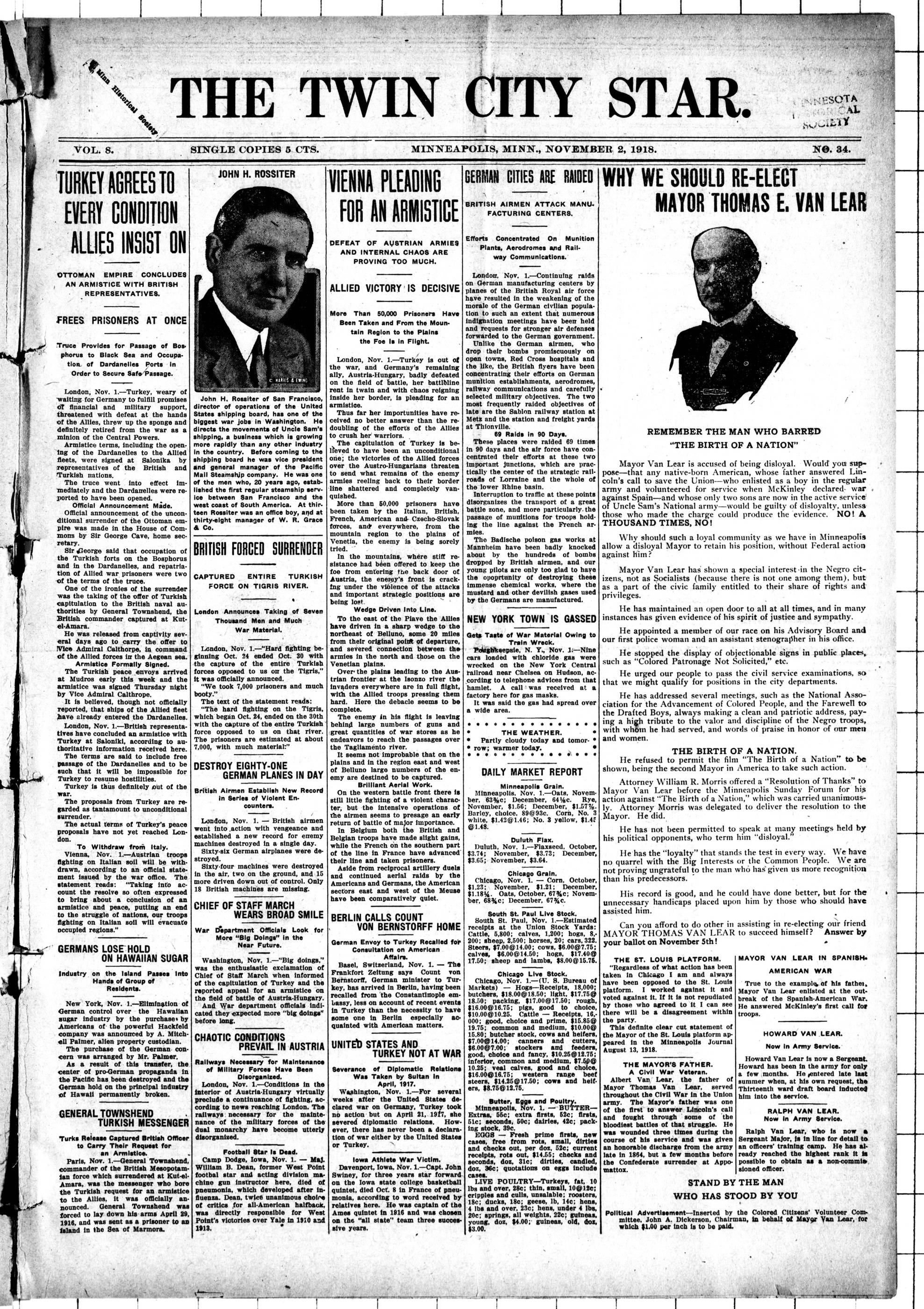
TURKEY AGREES TO EVERY CONDITION ALLIES INSIST ON
OTTOMAN EMPIRE CONCLUDES AN ARMISTICE WITH BRITISH REPRESENTATIVES.
FREES PRISONERS AT ONCE
Truce Provides for Passage of Bosphorus to Black Sea and Occupation of Dardanelles Ports in Order to Secure Safe Passage.
London, Nov. 1.—Turkey, weary of waiting for Germany to fulfill promises of financial and military support, threatened with defeat at the hands of the Allies, threw up the sponge and definitely retired from the war as a member of the Central Powers.
Armistice terms, including the opening of the Dardanelles to the Allied fleets, were signed at Salonika by representatives of the British and Turkish nations.
The truce went into effect immediately and the Dardanelles were reported to have been opened.
Official Announcement Made.
Official announcement of the unconditional surrender of the Ottoman empire was made in the House of Commons by Sir George Cave, home secretary.
Sir George said that occupation of the Turkish forts on the Bosphorus and in the Dardanelles, and repatriation of Allied war prisoners were two of the terms of the truce.
One of the ironies of the surrender was the taking of the offer of Turkish capitulation to the British naval authorities by General Townshend, the British commander captured at Kutel-Amara.
He was released from captivity several days ago to carry the offer to Vice Admiral Calthorpe, in command of the Allied forces in the Aegean sea. Armistice Formally Signed.
The Turkish peace envoyes arrived at Mudros early this week and the armistice was signed Thursday night by Vice Admiral Calthrope.
It is believed, though not officially reported, that ships of the Allied fleet have already entered the Dardanelles.
London, Nov. 1.—British representatives have concluded an armistice with Turkey at Saloniki, according to authoritative information received here.
The terms are said to include free passage of the Dardanelles and to be such that it will be impossible for Turkey to resume hostilities.
Turkey is thus definitely out of the war.
The proposals from Turkey are regarded as tantamount to unconditional surrender.
The actual terms of Turkey's peace proposals have not yet reached London.
Vienna, Nov. 1.—Austrian troops fighting on Italian soil will be withdrawn, according to an official statement issued by the war office. The statement reads: "Taking into account the resolve so often expressed to bring about a conclusion of an armistice and peace, putting an end to the struggle of nations, our troops fighting on Italian soil will evacuate occupied regions."
GERMANS LOSE HOLD
ON HAWAIIAN SUGAR
Industry on the Island Passes Into Hands of Group of Residents.
New York, Nov. 1.—Elimination of German control over the Hawaiian sugar industry by the purchase by Americans of the powerful Hackfeld company was announced by A. Mitchell Palmer, alien property custodian. The purchase of the German concern was arranged by Mr. Palmer.
As a result of this transfer, the center of pro-German propaganda in the Pacific has been destroyed and the German hold on the principal industry of Hawaii permanently broken.
GENERAL TOWNSHEND
TURKISH MESSENGER
Turks Release Captured British Officer to Carry Their Request for an Armlistice.
Paris, Nov. 1.—General Townshend, commander of the British Mesopotamian force which surrendered at Kut-el Amara, was the messenger who bore the Turkish request for an armistice to the Allies, it was officially announced. General Townshend was forced to lay down his arms April 29, 1916, and was sent as a prisoner to an island in the Sea of Marmora.
THE TWIN CITY STAR.
SINGLE COPIES 5 CTS.
JOHN H. ROSSITER
C. WARDIS & EWING
John H. Rossiter of San Francisco, director of operations of the United States shipping board, has one of the biggest war jobs in Washington. He directs the movements of Uncle Sam's shipping, a business which is growing more rapidly than any other industry in the country. Before coming to the shipping board he was vice president and general manager of the Pacific Mail Steamship company. He was one of the men who, 20 years ago, established the first regular steamship service between San Francisco and the west coast of South America. At thirteen Rossiter was an office boy, and at thirty-eight manager of W. R. Grace & Co.
BRITISH FORCED SURRENDER
CAPTURED ENTIRE TURKISH
FORCE ON TIGRIS RIVER.
London Announces Taking of Seven Thousand Men and Much War Material.
London, Nov. 1.—"Hard fighting beginning Oct. 24 ended Oct. 30 with the capture of the entire Turkish forces opposed to us on the Tigris," it was officially announced.
"We took 7,000 prisoners and much booty."
The text of the statement reads:
The text of the statement reads:
"The hard fighting on the Tigris, which began Oct. 24, ended on the 30th with the capture of the entire Turkish force opposed to us on that river. The prisoners are estimated at about 7,000, with much material:"
DESTROY EIGHTY-ONE
GERMAN PLANES IN DAY
British Airmen Establish New Record in Series of Violent Encounters.
London, Nov. 1. — British airmen went into action with vengeance and established a new record for enemy machines destroyed in a single day.
Sixty-six German airplanes were destroyed.
Sixty-four machines were destroyed in the air, two on the ground, and 15 more driven down out of control. Only 18 British machines are missing.
CHIEF OF STAFF MARCH
WEARS BROAD SMILE
War Department Officials Look for More "Big Doings" in the Near Future.
Washington, Nov. 1.—"Big doings," was the enthusiastic exclamation of Chief of Staff March when informed of the capitulation of Turkey and the reported appeal for an armistice on the field of battle of Austria-Hungary.
And War department officials indicated they expected more "big doings" before long.
CHAOTIC CONDITIONS
PREVAIL IN AUSTRIA
Railways Necessary for Maintenance of Military Forces Have Been Disorganized.
London, Nov. 1.—Conditions in the interior of Austria-Hungary virtually preclude a continuance of fighting, according to news reaching London. The railways necessary for the maintenance of the military forces of the dual monarchy have become utterly disorganized.
Football Star Is Dead.
Camp Dodge, Iowa, Nov. 1. — MaJ. William B. Dean, former West Point football star and acting division machine gun instructor here, died of pneumonia, which developed after influenza. Dean, twice unanimous choice of critics for all-American halfback, was directly responsible for West Point's victories over Yale in 1910 and 1913.
MINNEAPOLIS, MINN., NOVEMBER 2, 1918.
VIENNA PLEADING FOR AN ARMISTICE
VIENNA PLEADING FOR AN ARMISTICE
DEFEAT OF AUSTRIAN ARMIES AND INTERNAL CHAOS ARE PROVING TOO MUCH.
ALLIED VICTORY IS DECISIVE
More Than 50,000 Prisoners Have Been Taken and From the Mountain Region to the Plains the Foe is in Flight.
London, Nov. 1.—Turkey is out of the war, and Germany's remaining ally, Austria-Hungary, badly defeated on the field of battle, her battlline rent in twain and with chaos reigning inside her border, is pleading for an armistice.
Thus far her importunities have received no better answer than the redoubling of the efforts of the Allies to crush her warriors.
The capitulation of Turkey is believed to have been an unconditional one; the victories of the Allied forces over the Austro-Hungarians threaten to send what remains of the enemy armies reeling back to their border line shattered and completely vanquished.
More than 50,000 prisoners have been taken by the Italian, British, French, American and Czecho-Slovak forces, and everywhere, from the mountain region to the plains of Venetia, the enemy is being sorely tried.
In the mountains, where stiff resistance had been offered to keep the foe from entering the back door of Austria, the enemy's front is cracking under the violence of the attacks and important strategic positions are being lost.
Wedge Driven Into Line.
To the east of the Plave the Allies have driven in a sharp wedge to the northeast of Belluno, some 20 miles from their original point of departure, and severed connection between the armies in the north and those on the Venetian plains.
Over the plains leading to the Austrian frontier at the Isonzo river the invaders everywhere are in full flight, with the Allied troops pressing them hard. Here the debacle seems to be complete.
The enemy in his flight is leaving behind large numbers of guns and great quantities of war stores as he endeavors to reach the passages over the Tagliamento river.
It seems not improbable that on the plains and in the region east and west of Belluno large numbers of the enemy are destined to be captured.
Brilliant Aerial Work.
On the western battle front there is still little fighting of a violent character, but the intensive operations of the airmen seems to presage an early return of battle of major importance.
In Belgium both the British and Belgian troops have made slight gains, while the French on the southern part of the line in France have advanced their line and taken prisoners.
Aside from reciprocal artillery duels and continued aerial raids by the Americans and Germans, the American sectors east and west of the Meuse have been comparatively quiet.
BERLIN CALLS COUNT
VON BERNSTORFF HOME
German Envoy to Turkey Recalled for Consultation on American Affairs.
Basel, Switzerland, Nov. 1. — The Frankfort Zeitung says Count von Bernstorf, German minister to Turkey, has arrived in Berlin, having been recalled from the Constantinople embassy, less on account of recent events in Turkey than the necessity to have some one in Berlin especially acquainted with American matters.
UNITED STATES AND TURKEY NOT AT WAR
Severance of Diplomatic Relations Was Taken by Sultan in April, 1917. Washington, Nov. 1.—For several weeks after the United States declared war on Germany, Turkey took no action but on April 21, 1917, she severed diplomatic relations. However, there has never been a declaration of war either by the United States or Turkey.
Iowa Athlete War Victim.
Davenport, Iowa, Nov. 1.—Capt John Swiney, for three years star forward on the Iowa state college basketball quintet, died Oct. 8 in France of pneumonia, according to word received by relatives here. He was captain of the Ames quintet in 1916 and was chosen on the "all state" team three successive years.
GERMAN CITIES ARE RAIDED
BRITISH AIRMEN ATTACK MANU-
FACTURING CENTERS.
Efforts Concentrated On Munition Plants, Aerodromes and Railway Communications.
London, Nov. 1.—Continuing raids on German manufacturing centers by planes of the British Royal air force have resulted in the weakening of the morale of the German civilian population to such an extent that numerous indignation meetings have been held and requests for stronger air defenses forwarded to the German government.
Unlike the German airmen, who drop their bombs promiscuously on open towns, Red Cross hospitals and the like, the British flyers have been concentrating their efforts on German munition establishments, aerodromes, railway communications and carefully selected military objectives. The two most frequently raided objectives of late are the Sablon railway station at Metz and the station and freight yards at Thionville.
69 Raids in 90 Days.
These places were raided 69 times in 90 days and the air force have concentrated their efforts at these two important junctions, which are practically the center of the strategic railroads of Lorraine and the whole of the lower Rhine basin.
Interruption to traffic at these points disorganizes the transport of a great battle zone, and more particularly the passage of munitions for troops holding the line against the French armies.
The Badische poison gas works at Mannheim have been badly knocked about by the hundreds of bombs dropped by British airmen, and our young pilots are only too glad to have the opportunity of destroying these immense chemical works, where the mustard and other devilish gases used by the Germans are manufactured.
NEW YORK TOWN IS GASSED
DAILY MARKET REPORT
Minneapolis Grain
Minneapolis. Nov. 1.—Oats, November,
ber. 63%; December, 64%; %Rye
November, $1.56; December, $1.57%
Barley, choice, 89@93c. Corn, No. 3
white, $1.42@1.46; No. 3 yellow, $1.45
@1.48.
Duluth Flax.
Duluth, Nov. 1.—Flaxseed, October,
$3.74; November, $3.73; December,
$3.65; November, $3.64.
Chicago Grain.
Chicago, Nov. 1. — Corn, October,
$1.23; November, $1.21; December,
$1.18‰. Oats, October, 67‰; November,
68‰; December, 67‰.
South St. Paul Live Stock.
South St. Paul, Nov. 1.—Estimated receipts at the Union Stock Yards: Cattle, 5,800; calves, 1,200; hogs, 8,200; sheep, 2,500; horses, 20; cars, 322 Steers, $7.00@14.00; cows, $6.00@7.75; calves, $6.00@14.50; hogs, $17.40@17.50; sheep and lambs, $8.00@15.75.
Chicago Live Stock.
Chicago, Nov. 1.—(U. S. Bureau of Markets), — Hogs — Receipts, 18.000; butchers, $18.00@18.50; light, $17.75@18.50; packing, $17.00@17.50; rough, $16.00@16.75; pigs, good to choice, $10.00@10.25. Cattle — Receipts, 16.000; good, choice and prime, $15.85@19.75; common and medium, $10.00@15.80; butcher stock, cows and heifers, $7.00@14.00; canners and cutters, $6.00@7.00; stockers and feeders, good, choice and fancy, $10.25@12.75; inferior, common and medium, $7.50@10.25; veal calves, good and choice, $16.00@16.75; western range beef steers, $14.25@17.50; cows and heifers, $8.75@12.75.
Butter, Eggs and Poultry.
Minneapolis, Nov. 1. — BUTTER— Extras, 55c; extra firsts, 52c; firsts, 51c; seconds, 50c; dairies, 42c; packing stock, 39c.
EGGS — Fresh prime firsts, new cases, free from rots, small, dirties and checks out, per doz, 52c; current receipts, rots out, $14.55; checks and receipts, doz, 31c; dirties, candled, doz, 36c; quotations on eggs include cases.
LIVE POULTRY—Turkeys, fat, 10 lbs and over, 28c; thin, small, 10@12c; cripples and culls, unsalable; roosters, 18c; ducks, 18c; geese, lb, 14c; hens, 4 lbs and over, 23c; hens, under 4 lbs, 20c; springs, all weights, 22c; gueenas, young, doz, $4.00; guineas, old, doz, $3.00.
WHY WE SHOULD RE-ELECT MAYOR THOMAS E. VAN LEAR
21
REMEMBER THE M
"THE BIRTH C
Mayor Van Lear is accused of pose—that any native-born American coln's call to save the Union—who army and volunteered for service against Spain—and whose only two of Uncle Sam's National army—wrote those who made the charge could THOUSAND TIMES, NO!
Why should such a loyal comrade allow a disloyal Mayor to retain his against him?
Mayor Van Lear has shown itszens, not as Socialists (because they as a part of the civic family entitlements.
He has maintained an open de instances has given evidence of his
He appointed a member of our first police woman and an assis
He stopped the display of ob such as "Colored Patronage Not
He urged our people to pass that we might qualify for position
He has addressed several medi ciation for the Advancement of Co the Drafted Boys, always making ing a high tribute to the valor as with whom he had served, and we and women.
MEMBER THE MAN WHO BARRED
"THE BIRTH OF A NATION"
In Lear is accused of being disloyal. In a native-born American, whose father have the Union—who enlisted as a beatenered for service when McKinley and whose only two sons are now in the National army—would be guilty of one the charge could produce the evils TIMES, NO!
And such a loyal community as we have Mayor to retain his position, without Lear has shown a special interest in socialists (because there is not one and the civic family entitled to their share) maintained an open door to all at all time given evidence of his spirit of justice and a member of our race on his Advocate woman and an assistant stenographer and the display of objectionable signs and Patronage Not Solicited," etc.
Our people to pass the civil service qualify for positions in the city depressed several meetings, such as the Advancement of Colored People, and days, always making a clean and patriotic to the valor and discipline of the had served, and words of praise in h
REMEMBER THE MAN WHO BARRED "THE BIRTH OF A NATION"
Mayor Van Lear is accused of being disloyal. Would you suppose—that any native-born American, whose father answered Lincoln's call to save the Union—who enlisted as a boy in the regular army and volunteered for service when McKinley declared war against Spain—and whose only two sons are now in the active service of Uncle Sam's National army—would be guilty of disloyalty, unless those who made the charge could produce the evidence. NO! A THOUSAND TIMES, NO!
Why should such a loyal community as we have in Minneapolis allow a disloyal Mayor to retain his position, without Federal action against him?
Mayor Van Lear has shown a special interest in the Negro citizens, not as Socialists (because there is not one among them), but as a part of the civic family entitled to their share of rights and privileges.
He has maintained an open door to all at all times, and in many instances has given evidence of his spirit of justice and sympathy.
He appointed a member of our race on his Advisory Board and our first police woman and an assistant stenographer in his office.
He stopped the display of objectionable signs in public places, such as "Colored Patronage Not Solicited," etc.
He urged our people to pass the civil service examinations, so that we might qualify for positions in the city departments.
He has addressed several meetings, such as the National Association for the Advancement of Colored People, and the Farewell to the Drafted Boys, always making a clean and patriotic address, paying a high tribute to the valor and discipline of the Negro troops, with whom he had served, and words of praise in honor of our men and women.
THE BIRTH OF A NATION.
He refused to permit the film shown, being the second Mayor in
Attorney William R. Morris of Mayor Van Lear before the Mi action against "The Birth of a Natlly. Attorney Morris was delegate Mayor. He did.
He has not been permitted to his political opponents, who term
He has the "loyalty" that stam no quarrel with the Big Interests, not proving ungrateful to the man than his predecessors.
His record is good, and he c unnecessary handicaps placed up assisted him.
Can you afford to do other in MAYOR THOMAS VAN LEAR your ballot on November 5th!
THE ST. LOUIS PLATFORM.
I will permit the film "The Birth of
the second Mayor in America to take
William R. Morris offered a "Resolution
ear before the Minneapolis Sunday
The Birth of a Nation," which was ca-
Morris was delegated to deliver the
I.
It been permitted to speak at many re-
ponents, who term him "disloyal."
"loyalty" that stands the test in every
in the Big Interests or the Common
grateful to the man who has given us
accessors.
It is good, and he could have done be-
indicaps placed upon him by those
I would to do other in assisting in re-e-
CMAS VAN LEAR to succeed himself
November 5th!
LUIS PLATFORM. | MAYOR VAN LEAR
He refused to permit the film "The Birth of a Nation" to be shown, being the second Mayor in America to take such action.
Attorney William R. Morris offered a "Resolution of Thanks" to Mayor Van Lear before the Minneapolis Sunday Forum for his action against "The Birth of a Nation," which was carried unanimously. Attorney Morris was delegated to deliver the resolution to the Mayor. He did.
He has not been permitted to speak at many meetings held by his political opponents, who term him "disloyal."
He has the "loyalty" that stands the test in every way. We have no quarrel with the Big Interests or the Common People. We are not proving ungrateful to the man who has given us more recognition than his predecessors.
His record is good, and he could have done better, but for the unnecessary handicaps placed upon him by those who should have assisted him.
Can you afford to do other in assisting in re-electing our friend MAYOR THOMAS VAN LEAR to succeed himself? Answer by your ballot on November 5th!
"Regardless of what action has been taken in Chicago I am and always have been opposed to the St. Louis platform. I worked against it and voted against it. If it is not repudiated by those who agreed to it I can see there will be a disagreement within the party.
This definite clear cut statement of the Mayor of the St. Louis platform appeared in the Minneapolis Journal August 13, 1918.
THE MAYOR'S FATHER. A Civil War Veteran.
Albert Van Lear, the father of Mayor Thomas Van Lear, served throughout the Civil War in the Union army. The Mayor's father was one of the first to answer Lincoln's call and fought through some of the bloodiest battles of that struggle. He was wounded three times during the course of his service and was given an honorable discharge from the army late in 1864, but a few months before the Confederate surrender at Appomattox.
STAND BY THE MAN
WHO HAS STOOD BY YOU
Political Advertisement-Inserted by mittee, John A. Dickerson, Chair which $1.00 per inch is to be paid.
Inspection—Inserted by the Colored Citizen
A. Dickerson, Chairman, in behalf of M
per inch is to be paid.
Political Advertisement—Inserted by the Colored Citizens' Volunteer Committee. John A. Dickerson, Chairman, in behalf of Mayor Van Lear, for which $1.00 per inch is to be paid.
RE-ELECT
THOMAS E. VAN LEAR
MAN WHO BARRED
OF A NATION"
of being disloyal. Would you sup-
can, whose father answered Lin-
co enlisted as a boy in the regular
force when McKinley declared war,
sons are now in the active service
should be guilty of disloyalty, unless
produce the evidence. NO! A
community as we have in Minneapolis
is position, without Federal action
a special interest in the Negro citi-
here is not one among them), but
tled to their share of rights and
or to all at all times, and in many
spirit of justice and sympathy.
or race on his Advisory Board and
instant stenographer in his office.
jectionable signs in public places,
bolicited," etc.
the civil service examinations, so
s in the city departments.
settings, such as the National Asso-
colored People, and the Farewell to
a clean and patriotic address, pay-
d discipline of the Negro troops,
words of praise in honor of our men
"The Birth of a Nation" to be America to take such action.
offered a "Resolution of Thanks" to Minneapolis Sunday Forum for his on," which was carried unanimously to deliver the resolution to the speak at many meetings held by him "disloyal."
Is the test in every way. We have for the Common People. We are who has given us more recognition
could have done better, but for the him by those who should have assisting in re-electing our friend to succeed himself? Answer by
MAYOR VAN LEAR IN SPANISH AMERICAN WAR
True to the example of his father, Mayor Van Lear enlisted at the outbreak of the Spanish-American War. He answered McKinley's first call for troops.
HOWARD VAN LEAR
Howard Van Lear is now a Sergeant. Howard has been in the army for only a few months. He entered last summer when, at his own request, the Thirteenth ward draft board inducted him into the service.
RALPH VAN LEAR.
Now in Army Service
Ralph Van Lear, who is now a Sergeant Major, is in line for detail to an officers' training camp. He has already reached the highest rank it is possible to obtain as a non-commissioned officer.
the Colored Citizens' Volunteer Comman, in behalf of Mayor Van Lear, for
INNESOTA
STORICAL
SOCIETY
NO. 34.
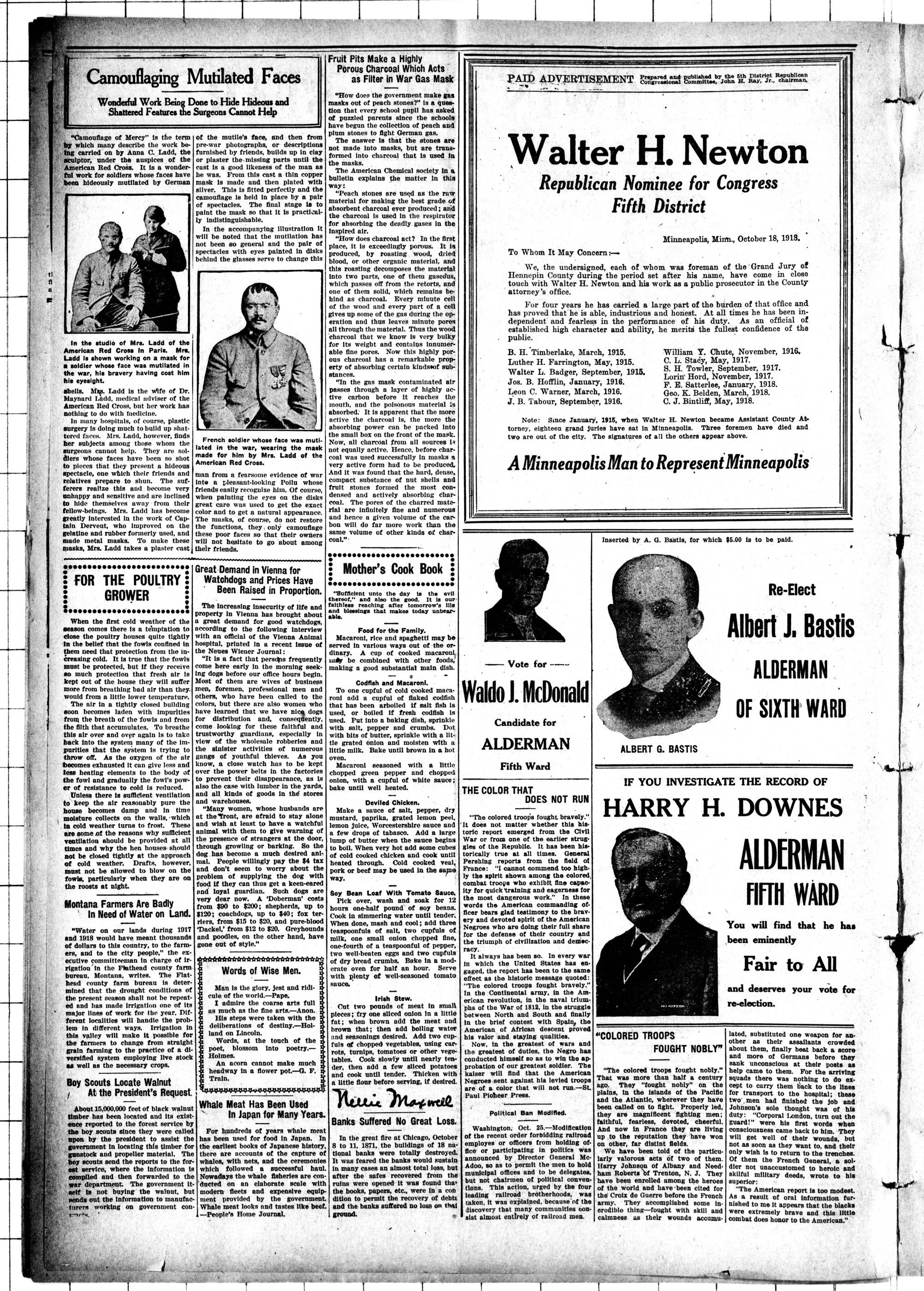
- Camouflaging Mutilated F
P ‘Wonderful Work Bein Pee to Hide Hideous and
Shattered Features the Surgeons Cannot Help
) “Gamouflage of Mercy” 1s the term)of the mutile’s face, and then
by which many describe the work be-| pre-war photographs, or descr
ing carried on by Anna C. Ladd, the | furnished by friends, builds up Ir
Sculptor, under the auspices of the|or plaster the.missing parts unt
American Red Cross. It is a wonder-| cast 1s a good likeness of the m
fol work for soldiers whose faces have |he was, From this cast a thin c
been hideously mutilated by German| mask 1s made and then plated
E sllyer. ‘This is fitted perfectly an
camouflage 14 held in place by ¢
1 7 of spectacles. ‘The final stage
ae paint the mask so that it is pra
- ly indistinguishable.
(9 ‘J In the accompanying Illustrati
os » oe will be noted that the mutilatio
(af £27 not been go general and the pe
Ke * «> spectacles with eyes painted In
os behind the glasses serve to chang
2. (ts
bat KG Ta
ol ae my
ko 4 i) .o
In the studio of Mrs. Ladd of the
American Red Cross In Paris. Mrs.
Ladd Is shown working on a mask for
@ soldier whose face was mutilated in
the war, his bravery having cost him
his eyesight.
shells, Mxg. Ladd is the wife of Dr.
Maynard Ladd, medical adviser of the
‘American Red Cross, but her work has
nothing to do with medicine.
In many hospitals, of course, plastic
eurgery 1s doing much to build up shat-
tered faces. Mrs. Ladd, however, finds
her subjects among those whom the
surgeons cannot help. They are sol-
@iers whose faces have been so shot
to pieces that they present a hideous
spectacle, one which their friends and
relatives prepare to shun. The suf-
ferers realize this and become very
unhappy and sensitive and are inclined
to hide themselves away from thelr
fellow-beings. Mrs, Ladd has become
greatly interested in the work of Cap-
tain Derveut, who improved on the
gelatine and rubber formerly used, and
made metal masks. To make these
masks, Mrs. Ladd takes a plaster cast
FOR THE POULTRY |
GROWER iC
When the first cold weather of the
feason comes there 1s a temptation to
close the poultry houses quite tightly
in the bellef that the fowls confined in
them need that protection from the in-
Greasing cold. It is true that the fowls
must be protected, but if they receive
80 much protection that fresh afr 1s
kept out of the house they will suffer
more from breathing bad alr than they.
would from a little lower temperature.
The air in a tightly closed building
oon becomes laden with impurities
from the breath of the fowls and from
the filth that accumulates. ‘To breathe
this alr over and over again Is to take
back into the system many of the Im-
purities that the system Is trying to
throw off. As the oxygen of the alr
becomes exhausted It can give less and
Jess heating elements to the body of
the fowl and gradually the fow!'s pow-
er of resistance to cold is reduced.
Unless there 1s sufficient ventilation
to keep the alr reasonably pure the
house becomes damp and in time
moisture collects on the walls, which
in cold weather turns to frost. These
‘are some of the reasons why suffictent
ventilation should be provided at all
times and why the hen houses: should
not be closed tightly at the approach
of cold weather. Drafts, however,
must not be allowed to blow on the
fowls, particularly when they are on
the roosts at night.
Montana Farmers Are Badly
‘In Need of Water on Land.
“Water on our lands during 1917
and 1918 would have meant thousands
of dollars to this country, to the farm-
ers, and to the city people,” the ex-
‘ecutive committeeman in charge of Ir-
rigation in the Fiathend county farm
bureau, Montana, writes. The Flat-
head county farm bureau is deter-
mined that the drought conditions of
‘the present season shall not be repeat-
ed and has made irrigation one of its
major lines of work for the year. Dif-
ferent localities will handle the prob-
Jem in different ways. Irrigation in
this valley will make it possible for
the farmers to change from straight
grain farming to the practice of a dl.
versified system employing live stock
‘as well as the necessary crops.
Boy Scouts Locate Walnut
, Atthe President’s Request
About 15,000,000 feet of black walnut
timber has been located and its exist-
ence reported to the forest service by
the boy scouts since they were called
upon by the president to assist the
government in locating this timber for
as and propeller material. The
oy scouts send the reports to the for-
et service, where the information {s
compiled and then forwarded to the
wer department. ‘The government it-
self ts not buying the walnut, but
‘sends out the information to manufac-
nrens working on government con-
ie
of the mutile’s face, and then from
pre-war photographs, or descriptions
furnished by friends, builds up in clay
or plaster the-missing parts until the
cast 1s a good Ukeness of the man as
he was, From this cast a thin copper
mask {s made and then plated with
silver. ‘This ts fitted perfectly and the
camouflage is held in place by a pair
of spectacles. ‘The final stage 1s to
paint the mask so that It is practical-
ly indistinguishable.
In the accompanying Illustration It
will be noted that the mutilation has
not been so general and the pair of
spectacles with eyes painted in disks
behind the glasses serve to change this
ry
SA
Po LOWER.
4 oe
French soldier whose face was muti-
lated in the war, wearing the mask
made for him by Mrs. Ladd of the
American Red Cross.
man from a fearsome evidence of war
inte a pleasant-looking Poilu whose
friends easily recognize him. Of course,
when painting the eyes on the disks
great care was used to get the exact
color and to get a natural appearance.
The masks, of course, do not restore
the functions, they, only camouflage
these poor faces so that their owners
will not hesitate to go about among
thelr friends,
wnnnnnnnnnnnnnreennnnnnnnnannanes
Great Demand in Vienna for
Watchdogs and Prices Have
Been Raised in Proportion.
‘The incrensing insecurity of life and
property in Vienna has brought about
a great demand for good watchdogs,
according to the following interview
with an official of the Vienna Animal
hospital, printed in a recent issue of
the Neues Wiener Journal:
“It is a fact that persdps frequently
come here early in the morning seek-
ing dogs before our office hours begin.
Most of them are wives of business
men, foremen, professional men and
others, who have been called to the
colors, but there are also women who
have learned that we have nicg dogs
for distribution and, - conseqdently,
come looking for these faithful and
trustworthy guardians, especially in
view of the wholesale robberies and
the sinister activities of numerous
gangs of youthful thieves. As you
know, a close watch has to be kept
over the power belts in the factories
to prevent thelr disappearance, as is
also the case with lumber in the yards,
and all kinds of goods in thé stores
and warehouses.
“Many women, whose husbands are
at the Yront, are afraid to stay alone
and wish at least to have a watchful
animal with them to give warning of
the presence of strangers at the door,
through growling or barking. So the
dog has become a much desired an!-
mal, People willingly pay the $4 tax
and don’t seem to worry about the
problem of supplying the dog with
food if they can thus get a keen-eared
and loyal guardian, Such dogs are
very dear now. A ‘Doberman’ costs
from $90 to $200; shepherds, up to
$120; coachdogs, up to $40; fox ter-
riers, from $15 to $20, and pure-blood
‘Dackel,’ from $12 to $20. Greyhounds
and poodles, on the other hand, have
gone out of style.”
: Words of Wise Men.
Man Is the glory, jest and ridi-
% cule of the world.—Pape.
I admire the coarse arts full
% as much as the fine arts—Anon.
z His steps were taken with the
£ deliberations of destiny—Hol-
# land on Lincoln.
ky Words, at the touch of the
poet, blossom into poetry.—
Holmes.
¥ An acorn cannot make much
% headway in a flower pot—G. F.
& Train, i
Whale Meat Has Been Used
* In Japan for Many Years.
For hundreds of years whale meat
has been used for food in Japan. In
the earliest books of Japanese history,
there are accounts of the capture of
whales, with nets, and the ceremonies
which followed a successful haul.
Nowadays the whale fisheries are con-
‘ducted on an elaborate scale with
modern fleets and expensive equip-
ment provided by the government.
‘Whale meat looks and tastes Itke beef.
—People’s Home Journal,
Fruit Pits Make a Highly
Porous Charcoal Which Acts
as Filter in War Gas Mask
“How does the government make gas
masks out of peach stones?” Is a quee-
tion that every school pupil has asked
of puzzled parents since the schools
have begun the collection of peach and
plum stones to fight German gas.
‘The answer is that the stones are
not made into masks, but are trans-
formed into charcoal that 1s used in
the masks.
‘The American Chemical soclety in a
bulletin explains the matter in this
way?
“Peach stones are used as the raw
material for making the best grade of
absorbent chareoal ever produced; and
the charcoal is used in the respirator
for absorbing the deadly gases in the
Inspired air.
“How does charcoal act? In the first
place, it is exceedingly porous. It is
produced, by roasting wood, dried
blood, or other organic material, and
this roasting decomposes the material
into two parts, one of them gasedus,
which passes off from the retorts, and
one of them solld, which remains be-
hind as charcoal. Every minute cell
of the wood and every part of a cell
gives up some of the gas during the op-
eration and thus leaves minute pores
all through the material. ‘Thus the wood
charcoal that we know is very bulky
for Its weight and contains innumer-
able fine pores, Now this highly por-
ous charcoal has a remarkable prop-
erty of absorbing certain kindseof sub-
stances.
“In the gas mask contaminated alr
passes through a layer of highly ac-
tive carbon before it reaches the
mouth, and the poisonous material is
absorbed: It is apparent that the more
active the charcoal Is, the more the
absorbing power can be packed into
the small box on the front of the mask.
Now, all charcoal from all sources {3
not equally active. Hence, before char-
coal was used successfully In masks a
very active form had to be produced,
And it was found that the hard, dense,
compact substance of nut shells and
fruit stones formed the most con-
densed and actively absorbing char-
coal. The pores of the charred mate-
rlal'are infinitely fine and numerous
and hence a given volume of the car
bon will do far more work than the
same volume of other kinds of char
coal.”*
e e
e , °
$ Mother’s Cook Book :
“Sufficient unto the day is the evil
thereot" and also the goods Ils ut
iiibiete reacnley ater otorsews ii
tnd. Ncneag tnst ‘salen today’ Uabeas
able.
Food for the Family.
Macaroni, rice and spaghetti may be
served in various ways out of the or-
dinary. A cup of cooked macaron|
aay be combined with other foods,
making a good substantial main dish.
oo i.
Codfish and Macaroni.
To one cupful of cold cooked maca-
roni add a cupful of flaked codfish
that has been arboiled if salt fish is
used, or boiled if fresh codfish is
used. Put into a baking dish, sprinkle
with salt, pepper and crumbs. Dot
with bits of butter, sprinkle with a lit-
tle grated onion and moisten with a
little milk. Bake until brown in a hot
ores
Macaroni seasoned with a lHittle
chopped green pepper and chopped
onion, with a cupful of white sauce;
bake until well heated.
Make a sauce of salt, pepper, dry
mustard, paprika, grated lemon peel,
lemon juice, Worcestershire sauce and
a few drops of tabasco, Add a large
lump of butter when the sauce begins
to boll. When very hot add some cubes
of cold cooked chicken and cook until
heated through. Cold cooked veal,
pork or beef may be used in the eae
way.
Soy Bean Loaf With Tomato Sauce,
Pick over, wash and soak for 12
hours one-half pound of soy beans.
Cook in simmering water until tender.
‘When done, mash and cool; add three
teaspoonfuls of salt, two cupfuls of
milk, one small onion chopped fine,
one-fourth of a teaspoonful of pepper,
two well-beaten eggs and two cupfuls
of dry bread crumbs. Bake in a mod-
erate oven for half an hour. Serve
with plenty of well-seasoned tomato
sauce,
Cut two pounds of meat In small
pleces; fry one sliced onion in a little
fat; when brown add the meat and
brown that; then add boiling water
and seasonings desired. Add two cup-
fuls of choppeé vegetables, using car-
rots, turnips, tomatoes or other vege-
tables. Cook slowly until nearly ten-
der, then add a few sliced potatoes
‘and cook until tender. Thicken with
a little flour before serving, if desired.
Banks Suffered No Great Loss.
In the great fire at Chicago, October
8 to 11, 1871, the buildings of 18 na-
tlonal banks were totally destroyed.
‘It was feared the banks would sustain
in many cases an almost total loss, but
after the safes recovered from the
ruins were opened it was found tha
the books, papers, etc., were in a con
dition to permit the recovery of debts
ae the banks suffered no loss on thai
ground. py
1 7 |,
Food for the Family.
Codfish and Macaroni.
Deviled Chicken.
Irish Stew.
PSN Gr gee eae) Pe ee ee te ee ee a ee eu es
PAID ADVERTISEMENT Sigriisad Eomatfiee“schn Battie, Sateman,
: 0 he We ae 1
\ V alter H. Newton
3 é
Republican Nominee for Congress
2 erase
Fifth District
: Minneapolis, Minm., October 18, 1918, ”
To Whom It May Concern:— "
We, the undersigned, each of whom was foreman of the’Grand Jury of
Hennepin County during the period set after his name, have come in close
touch with Walter H. Newton and his work as a public prosecutor in the County
attorney's office. ;
For four years he has carried a large part of tho burden of that office and
has proved that he is able, industrious and honest, At all times he has been in-
dependent and fearless in the performance of his duty. As an official of
established high character and ability, he merits the fllest confidence of the
. public.
B, H. Timberlake, March, 1915, William Y. Chute, November, 1916,
Luther H. Farrington, May, 1915. c u Biaey, Bay, dente init
"HL Towler, September, 1917.
War n pee Sepeee 1915. Tori Hord, November, 1917.
Oe Oe ae SSDURTY: . F. E. Satterlee, January, 1918.
Leon C. Warner, March, 1916, Geo. K. Belden, March, 1918. :
J. B. Tabour, September, 1916. C.J. Bintlift, May, 1918.
Note: Since January, 1915, when Walter H. Newton became Assistant County At
torney, eighteen grand juries have sat in Minneapolis. Three foremen have died and
two are out of the city. The signatures of all the others appear above.
° ° - re 7 °
A Minneapolis Man to Represent Minneapolis
ee ne
— Vote for -—-
Waldo J. McDonald
Candidate for 7
ALDERMAN
Fifth Ward
THE coLOR TH es NOT RUN
“The colored troops fought bravely.”
It does not matter whether this his-
torfe report emerged from the Civil
War or from one of the earlier strug-
gles of the Republic. It has been his-
torically true at all times. General
Pershing reports from the field of
France: “I cannot commend too high.
ly the spirit shown among the colored
combat troops who exhibit fine capac:
ity for quick training and eagerness for
the most dangerous work.” In these
words the American commanding of-
ficer bears glad testimony to the brav-
ery and devoted spirit of the American
Negroes who are doing their full share
for the defense of their country and
the triumph of civilization and deniec-
racy.
It always has been so. In every war
in which the United States has en-
gaged, the report has been to the same
effect as the historic message quoted:
“The colored troops fought bravely.”
In the Continental army, in the Am
erican revolution, in the naval trium:
phs of the War of 1812, in the struggle
between North and South and finally
in the brief contest with Spain, the
American of African descent proved
his valor and staying qualities.
Now, in the greatest of wars and
the greatest of duties, the Negro has
conducted himself so as to win the ap
probation of our greatest soldier. The
kaiser will find that the American
Negroes sent against his levied troops
are of a color that will not run.—St
Paul Pioheer Press.
Political Ban Modified.
Washington; Oct. 25.—Modification
of the recent order forbidding rafiroad
employes or officers from holding of.
fice or participating in politics was
announced by Director General Mc
‘Adoo, 80 as to permit the men to hold
municipal offices and to be delegates,
but not chairmen of political conven
flons. This action, urged by the four
leading railroad brotherhoods, was
taken, it was explained, because of the
discovery that many communities con-
sist almost entirely of railroad men.
"Inserted by A. G. Bastis, for. which $5.00 is to be paid.
eon
i ee
po
4 Reflect
oe
pee S|
A ALDERMAN
— ae
Le Bee am
ee oF SIXTH WARD
AIRERT 2 RACTIC
"IF YOU INVESTIGATE THE RECORD OF
HARRY H. DOWNES |
Say ALDERMAN
air WARD
‘a FAM You will find that he has
rg Ma] been eminently
ve Fair to All
and deserves your vote for
ae re-election.
“COLORED TROOPS
FOUGHT NOBLY”
“The colored troops fought nobly.”
‘That was more than half a century
ago. They “fought nobly” on the
plains, in the islands of the Pacific
‘and the Atlantic, wherever they have
been called on to fight. Properly led,
they are magnificent fighting men;
faithful, fearless, devoted, cheerful.
And now in France they are living
up to the reputation they have won
on other, far distint fields,
‘We have been told of the particu:
larly valorous acts of two of them.
Harry Johasga of Albany and Need.
ham Roberts bf Trenton, N. J. They
have been enrolled among the heroes
of the world and have been cited for
the Croix de Guerre before the French
army. They accomplished some in-
erediblo thing—fought with skill and
calmness as thelr wounds accumu-
lated, substituted one weapon for an-
other as their assailants crowded
about them, finally best back a score
and more of Germans before they
sank unconscious at thelr posts as
help came to them. For the arriving
squads there was nothing to do ex-
cept to carry them Back to the lines
for transport to the hospital; these
two',men had finished the job and
Johnson's sole thought was of his
duty: “Corporal London, turn out the
guard!” were his first words when
consciousness came back to him. They
will get well of thelr wounds, but
Rot as soon as they want to, and their
only wish is to return to the trenches.
Of them the French General, a sol-
dier not unaccustomed to heroic and
skilful military deeds, wrote to his
superior:
“The American report is too modest.
As a result of oral information fur-
nished to me it appears that the blacks
were extremely brave and this little
combat does honor to the American.”
The Medical Diplomat
By IMES MAC DONALD
(Copyright, 1918, by McClure Newspaper Syndicate.)
In consternation Holister sat back in his chair and polished his eyeglasses impatiently.
"Not the country, Doc! For heaven's sake, not the country."
"The country for yours," said Dr. Dubbs, positively.
"Why not the seashore, Doc? Some nice place on the seashore?"
"No seashore for yours, Hollister. I know that seashore stuff! Ragging around all day and eating and drinking all sorts of junk, and dancing half the night, drinking and eating more sorts of junk. You've got to go to a place where there's nothing to do after dark but go to bed so early that by the time the sun rises you're so tired of being in bed you want to get up. You're going to a place where you'll get enough physical labor to get your muscles and digestive apparatus into normal condition—where the food will be wholesome and plentiful enough to build up your degenerated tissues and make you keen for your work and your rest. And absolutely you're not to have an idea in your head for the whole six months. No man can keep up the mental pace and no-sleep strain that you have in the last ten years and last another ten. It can't be done."
"I'm not all in yet, Doc. I can still do more work than seven men." "I'll make a little bet you can't plow more corn than seven men! And as far
A man fishing in a stream with a woman sitting beside him. In the background, a man and a woman are sitting on a fence.
She Leaned Forward.
as your rotten paper is concerned, it can get along without its talented editor for a few months," added the doctor, sarcastically. "If you dled this very minute, they'd keep on getting out their morning editions just the same, you know."
And so it happened that Hollist found himself on the Allison farm, some two miles' from Glenville, and forty miles from a town of any size at all on a certain morning in the middle of May. His status as a "paying-working guest" was somewhat of a puzzle to Pa Allison, who came in for a moment when Hollist ate his 9 o'clock breakfast and wondered if he ought to call him down for not getting up at 4 o'clock to help with the chores before the family breakfast at 5:30.
But there were no more 9 o'clock breakfasts for Holister for some time to come. By the middle of July he was writing Dr. Dubbs that he was "strong as a horse—had gained twenty pounds—and guessed he was cured."
The belligerent Doctor Dubbs headed him off imperatively, but two weeks later Holister wrote that he was "going bugs." He couldn't stand it any longer. He was feeling fine, but would soon be dead from the neck up. The mental inaction was unbearable—sweep that in another month his last brain would have departed. Couldn't he have a typewriter? Maybe he could start that novel he had in his head. But Dr. Dubbs sat on that proposition with decision and dispatch. A typewriter would mean too little sleep. Did he want to lose all he had so far gained by sticking to orders?
However, for fear that Hollister would eventually kick over the traces, throw over the cure in its most critical stage, the wily Dr. Dubbs decided to call for assistance, and to that end sought out his favorite niece.
"What do you say to a month in the country, Milly?" he asked that young woman, pinching her round arm.
"Really?" she asked. "Do you mean
it. Uncle Doc?"
"Provided," said the doctor, judiciously. "Provided what?" she demanded curiously. "Provided you go where I send you—and do as you're told when you get there." And then the doctor explained about Holister.
"And all I've got to do is to enter
rain this nice man until you think he's ready to come back to his work?" she asked.
"All you've got to do is to interest him and keep him interested. You must meet him in such a way that he can't help noticing you. He needs something to occupy his mind."
"I'll feel like a vampire," she mused But she went.
So a few days later Mildred Morrison was established as the star boarder on the Jackson farm on the other side of the road and a quarter of a mile below the Allison place. Holister heard of it at breakfast the next morning. Mr. Allison said that a right pretty looking city girl had come to board with the Jacksonons for a while, but he didn't think much about it until some time later in the week—the day he went fishing to be exact
The weather was perfect and work had slackened enough so that Hollster felt that he could, take a day off with a clear conscience, so he walked through the woods and the fields to the Horton pond some three miles away. There at the grassy foot of a steep bank some ten or twelve feet high he made himself comfortable and set out a couple of lines.
He was all unaware that Mildred had been stalking him for the past several days. She had seen him several times, but there had been no opportunity to meet him in any other than an ordinary way, and Mildred meant to obey Uncle Doc's orders if it was possible to do so. That afternoon in her wanderings she came to a fence that ran along the top of an unexpectedly high bank, and peering down discovered to her surprise the unsuspecting Hollster tending his lines.
She leaned forward against the fence to get a better look at her victim. The old rotten posts gave way, and Mildred suddenly found herself describing a beautiful somersault that landed her most jolingly on her hands and knee at Hollister's side.
He stared in startled surprise.
"I-I just dropped in—to see if—if you were having any luck," she said dizzily, as soon as she could catch her breath.
"I think," he said, relieved to see that she wasn't hurt, "I'm not sure but I think this is going to be the luckiest day of my life." He looked back up at the top of the bank from which she had descended upon him. "What circus were you graduated from?" he grinned.
Mildred looked up at him from under her tumbled hair and Holister looked deep down into the offering of her glance—and from that instant neither he nor she nor the orders of Dr. Dubbs had anything more to do with it.
In less than a week the neighbors had noticed it. In ten days Holister had succeeded in kissing Mildred after several false starts—and in three weeks Dr. Dubbs received a letter from Holister that made him snort.
"Dear Doc.—You needn't think you've put anything over on me. You haven't. I put it over all by myself.
As a matter of fact I don't care if I never come back to town. You see there was a wedding in these parts yesterday and your fair ambassador-ette has confessed all to yours truly.
"HER HUSBAND."
Battle Field Meeting.
A New York woman attached to the American Red Cross happened to be in Paris and volunteered to help in taking care of the wounded coming in from the battlefield. She was working busily when startled by a loud cry of "Mother!" Turning, she saw her son, a young lieutenant in the United States army. He had been wounded in the leg by shrapnel. The first news she had had that her son was engaged in the battle was when she heard his cry. She obtained permission to accompany him to a hospital. After seeing that he was attended to she went back to the station to cheer, as she said, the boys who had no hope of finding a mother to welcome them. The mother is a prominent social worker in New York and has been doing Red Cross relief work among the refugees in France. Her work usually keeps her in the south of France.
In the Sailor's Cap.
A young sailor was evidently explaining things in the navy to his sweetheart, because as an illustration he removed his cap and turning it over disclosed inside a muslin lining drawn together by an elastic band. Then he demonstrated how a cap may be used as a pocket.
He inserted his hand and drew out the following articles: A few letters, two packages of cigaret papers, a pocket comb, nail file, fountain pen, a dozen photographs and a bunch of cigaret coupons.
It might be supposed his cap would be bulky and ill fitting with all these things in it, but it was not. The elastic band tightly drew the lining together so that on taking off the hat nothing fell out. It seemed comfortable on the sailor's head and he appeared highly satisfied.
All He Wanted
Frederick Harkness of Los Angeles was annoyed so much by flies in a room which he occupied in an up-state city hotel during the past summer that he summoned a boy to make a complaint.
"Want your room changed, sir?" inquired the boy.
"Room changed, no!" said Mr. Harkness. "It's the files I find fault with, nothing else."
The boy reported to the proprietor of the hotel that Mr. Harkness was satisfied with his room, but that he wanted the files changed.
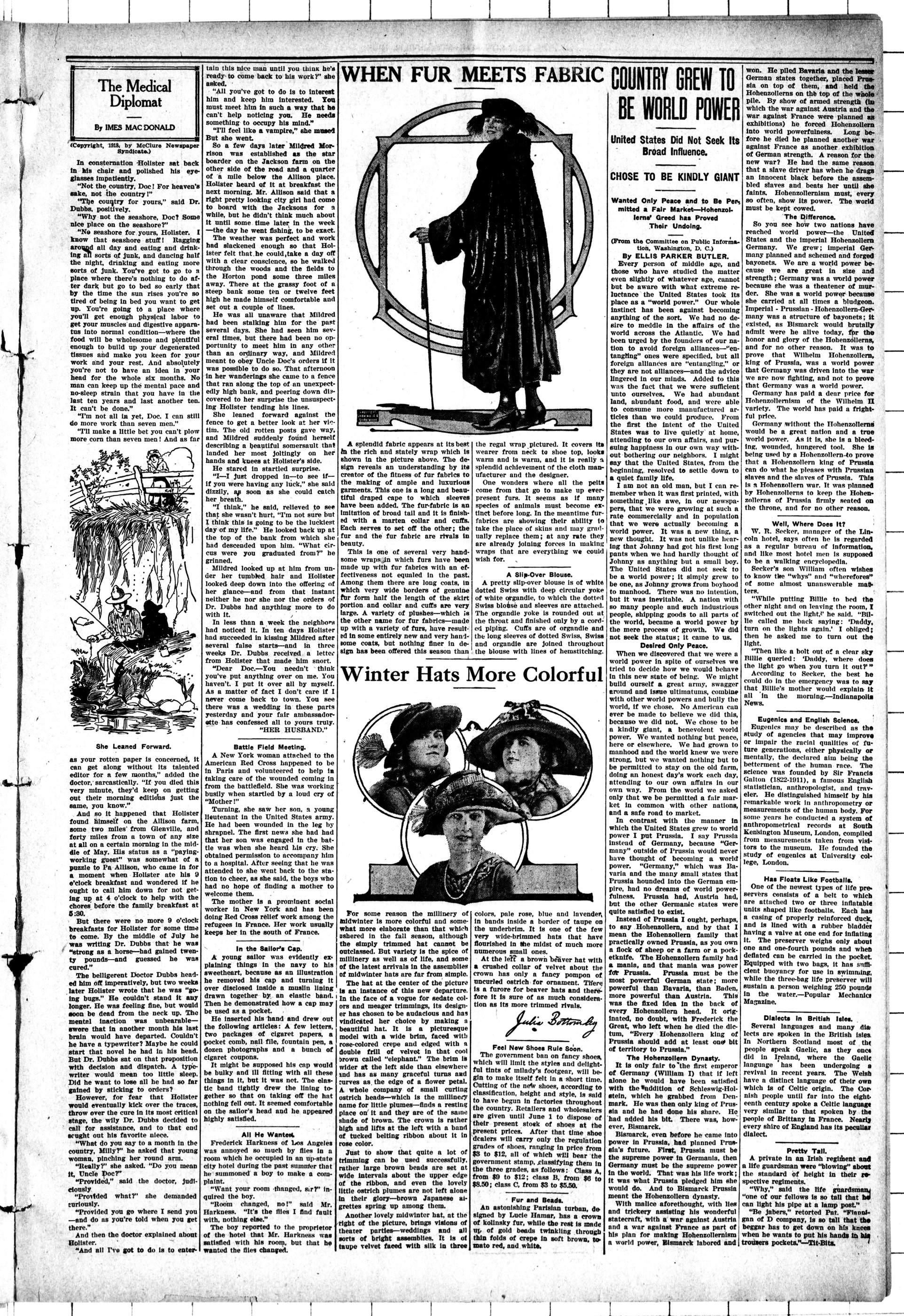
WHEN FUR MEETS FABRIC
I
Winter Hats More Colorful
T
A splendid fabric appears at its best in the rich and stately wrap which is shown in the picture above. The design reveals an understanding by its creator of the fitness of fur fabrics to the making of ample and luxurious garments. This one is a long and beautiful draped cape to which sleeves have been added. The fur-fabric is an imitation of broad tail and it is finished with a marten collar and cuffs. Each serves to set off the other; the fur and the fur fabric are rivals in beauty.
This is one of several very handsome wraps in which furs have been made up with fur fabrics with an effectiveness not equaled in the past. Among them there are long coats, in which very wide borders of genuine fur form half the length of the skirt portion and collar and cuffs are very large. A variety of plushes—which is the other name for fur fabrics—made up with a variety of furs, have resulted in some entirely new and very handsome coats, but nothing finer in design has been offered this season than
Winter Hats
For some reason the millinery of midwinter is more colorful and somewhat more elaborate than that which ushered in the fall season, although the simply trimmed hat cannot be outclassed. But variety is the spice of millinery as well as of life, and some of the latest arrivals in the assemblies of midwinter hats are far from simple.
The hat at the center of the picture is an instance of this new departure. In the face of a vogue for sedate colors and meager trimming, its designer has chosen to be audacious and has vindicated her choice by making a beautiful hat. It is a picturesque model with a wide brim, faced with rose-colored crepe and edged with a double drill of velvet in that cool brown called "elephant." The brim is wider at the left side than elsewhere and has as the many graceful turns and curves as the edge of a flower petal. A whole company of small curling ostrich heads—which is the millinery name for little plumes—finds a resting place on it and they are of the same shade of brown. The crown is rather high and lifts at the left with a band of tucked belting ribbon about it in rose color.
Just to show that quite a lot of trimming can be used successfully, rather large brown beads are set at wide intervals about the upper edge of the ribbon, and even the lovely little ostrich plumes are not left alone in their glory—brown Japanese aigrettes spring up among them.
Another lovely midwinter hat, at the right of the picture, brings visions of theater parties—weddings and all sorts of bright assemblies. It is of taupe velvet faced with silk in three
the regal wrap pictured. It covers its wearer from neck to shoe top, looks warm and is warm, and it is really a splendid achievement of the cloth manufacturer and the designer.
One wonders where all the pelts come from that go to make up everpresent furs. It seems as if many species of animals must become extinct before long. In the meantime furfabrics are showing their ability to take the place of skins and may gradually replace them; at any rate they are already joining forces in making wraps that are everything we could wish for.
A Slim-Over Blouse.
A pretty slip-over blouse is of white dotted Swiss with deep circular yoke of white organdle, to which the dotted Swiss blouse and sleeves are attached. The organdle yoke is rounded out at the throat and finished only by a corded piping. Cuffs are of organdle and the long sleeves of dotted Swiss, Swiss and organdle are joined throughout the blouse with lines of hemstitching.
More Colorful
colors, pale rose, blue and lavender, in bands inside a border of taupe on the underbrim. It is one of the few very wide-brimmed hats that have flourished in the midst of much more numerous small ones.
At the left a brown beaver hat with a crushed collar of velvet about the crown has only a fancy pompon of uncurled ostrich for ornament. Thief is a furore for beaver hats and therefore it is sure of as much consideration as its more trimmed rivals.
Julia Bottomly
Feel New Shoes Rule Soon
The government ban on fancy shoes, which will limit the styles and delightful tints of milady's footwear, will begin to make itself felt in a short time. Cutting of the new shoes, according to classification, height and style, is said to have begun in factories throughout the country. Retailers and wholesalers are given until June 1 to dispose of their present stock of shoes at the present prices. After that time shoe dealers will carry only the regulation grades of shoes, ranging in price from $3 to $12, all of which will bear the government stamp, classifying them in the three grades, as follows: Class A, from $9 to $12; class B, from $6 to $8.50; class C, from $3 to $5.50.
Fur and Beads.
An astonishing Parisian turban, designed by Lucie Hamar, has a crown of kollinsky fur, while the rest is made up of gold beads twinkling through thin folds of crepe in soft brown, tomato red, and white.
United States Did Not Seek Its Broad Influence.
CHOSE TO BE KINDLY GIANT
Wanted Only Peace and to Be Permitted a Fair Market—Hohenzol- lerns' Greed has Proved Their Undoing.
(From the Committee on Public Informa tion, Washington, D. C.)
BY ELLIS PARKER BUTLER.
Every person of middle age, and those who have studied the matter even slightly of whatever age, cannot but be aware with what extreme reluctance the United States took its place as a "world power." Our whole instinct has been against becoming anything of the sort. We had no desire to meddle in the affairs of the world across the Atlantic. We had been urged by the founders of our nation to avoid foreign alliances—"entangling" ones were specified, but all foreign alliances are "entangling," or they are not alliances—and the advice lingered in our minds. Added to this was the fact that we were sufficient unto ourselves. We had abundant land, abundant food, and were able to consume more manufactured articles than we could produce. From the first the intent of the United States was to live quietly at home, attending to our own affairs, and pursuing happiness in our own way without bothering our neighbors. I might say that the United States, from the beginning, resolved to settle down to a quiet family life.
I am not an old man, but I can remember when it was first printed, with something, like awe, in our newspapers, that we were growing at such a rate commercially and in population that we were actually becoming a world power. It was a new thing, a new thought. It was not unlike hearing that Johnny had got his first long pants when we had hardly thought of Johnny as anything but a small boy. The United States did not seek to be a world power; it simply grew to be one, as Johnny grows from boyhood to manhood. There was no intention, but it was inevitable. A nation with so many people and such industrious people, shipping goods to all parts of the world, became a world power by the mere process of growth. We did not seek the status; it came to us.
Desired Only Peace.
When we discovered that we were a world power in spite of ourselves we tried to decide how we would behave in this new state of being. We might build ourself a great army, swagger around and issue ultimatums, combine with other world powers and bully the world, if we chose. No American can ever be made to believe we did this, because we did not. We chose to be a kindly giant, a benevolent world power. We wanted nothing but peace, here or elsewhere. We had grown to manhood and the world knew we were strong, but we wanted nothing but to be permitted to stay on the old farm, doing an honest day's work each day, attending to our own affairs in our own way. From the world we asked only that we be permitted a fair market in common with other nations, and a safe road to market.
In contrast with the manner in which the United States grew to world power I put Prussia. I say Prussia instead of Germany, because "Germany" outside of Prussia would never have thought of becoming a world power. "Germany," which was Bavaria and the many small states that Prussia hounded into the German empire, had no dreams of world powerfulness. Prussia had, Austria had, but the other Germanic states were quite satisfied to exist.
Instead of Prussia I ought, perhaps, to say Hohenzollern, and by that I mean the Hohenzollern family that practically owned Prussia, as you own a flock of sheep or a farm or a pocketknife. The Hohenzollern family had a mania, and that mania was power for Prussia. Prussia must be the most powerful German state; more powerful than Bavaria, than Baden, more powerful than Austria. This was the fixed idea in the back of every Hohenzollern head. It originated, no doubt, with Frederick the Great, who left when he died the dictum, "Every Hohenzollern king of Prussia should add at least one bit of territory to Prussia."
The Hohenzollern Dynasty.
It is only fair to the first emperor of Germany (William I) that if left alone he would have been satisfied with the addition of Schleswig-Holstein, which he grabbed from Denmark. He was then only king of Prussia and he had done his share. He had added his bit. There was, however, Bismarck.
Bismarck, even before he came into power in Prussia, had planned Prussia's future. First, Prussia must be the supreme power in Germania, then Germany must be the supreme power in the world. That was his life work; it was what Prussia pledged him she would do. And to Bismarck Prussia meant the Hohenzollern dynasty.
With malice aforethought, with lies and trickery assisting his wonderful statecraft, with a war against Austria and a war against France as part of his plan for making Hohenzollernism a world power, Bismarck labored and
won. He piled Bavaria and the lesser German states together, placed Prussia on top of them, and held the Hohenzollerns on the top of the whole pile. By show of armed strength (in which the war against Austria and the war against France were planned as exhibitions) he forced Hohenzollern into world powerfulness. Long before he died he planned another war against France as another exhibition of German strength. A reason for the new war? He had the same reason that a slave driver has when he drags an innocent black before the assembled slaves and beats her until she faints. Hohenzollernism must, every so often, show its power. The world must be kept cowed.
The Difference.
So you see how two nations have reached world power—the United States and the imperial Hohenzollern Germany. We grew; imperial Germany planned and schemed and forged bayonets. We are a world power because we are great in size and strength; Germany was a world power because she was a theater of murder. She was a world power because she carried at all times a bludgeon. Imperial - Prussian - Hohenzollern-Germany was a structure of bayonets; it existed, as Bismarck would brutally admit were he alive today, for the honor and glory of the Hohenzollerns, and for no other reason. It was to prove that Wilhelm Hohenzollern, king of Prussia, was a world power that Germany was driven into the war we are now fighting, and not to prove that Germany was a world power.
Germany has paid a dear price for Hohenzollernism of the Wilhelm II variety. The world has paid a frightful price.
Germany without the Hohenzollerns would be a great nation and a true world power. As it is, she is a bleeding, wounded, hungered tool. She is being used by a Hohenzollern-to prove that a Hohenzollern king of Prussia can do what he pleases with Prussian slaves and the slaves of Prussia. This is a Hohenzollern war. It was planned by Hohenzollerns to keep the Hohenzollerns of Prussia firmly seated on the throne, and for no other reason.
Well. Where Does It?
W. R. Secker, manager of the Lincoln hotel, says often he is regarded as a regular bureau of information, and like most hotel men is supposed to be a walking encyclopedia. Secker's son William often wishes to know the "whys" and "wherefores" of some almost unanswerable matters.
"While putting Billie to bed the other night and on leaving the room, I switched out the light," he said. "Billie called me back saying: 'Daddy, turn on the lights again.' I obliged; then he asked me to turn out the light.
"Then like a bolt out of a clear sky Billie queried: 'Daddy, where does the light go when you turn it out?'"
According to Secker, the best he could do in the emergency was to say that Billie's mother would explain it all in the morning.—Indianapolis News.
Eugenica and English Science
Eugenics and English Science. Eugenics may be described as the study of agencies that may improve or impair the racial qualities of future generations, either physically or mentally, the declared aim being the betterment of the human race. The science was founded by Sir Francis Galton (1822-1911), a famous English statistician, anthropologist, and traveler. He distinguished himself by his remarkable work in anthropometry or measurements of the human body. For some years he conducted a system of anthropometrical records at South Kensington Museum, London, compiled from measurements taken from visitors to the museum. He founded the study of eugenics at University college, London.
Has Floats Like Footballs.
One of the newest types of life preservers consists of a belt to which are attached two or three inflatable units shaped like footballs. Each has a casing of properly reinforced duck, and is lined with a rubber bladder having a valve at one end for inflating it. The preserver weighs only about one and one-fourth pounds and when deflated can be carried in the pocket. Equipped with two bags, it has sufficient buoyancy for use in swimming, while the three-bag life preserver will sustain a person weighing 250 pounds in the water—Popular Mechanics Magazine.
Dialects In British Isles
Several languages and many dialects are spoken in the British isles. In Northern Scotland most of the people speak Gaelic, as they once did in Ireland, where the Gaelic language has been undergoing a revival in recent years. The Welsh have a distinct language of their own which is of Celtic origin. The Cornish people until far into the eighteenth century spoke a Celtic language very similar to that spoken by the people of Brittany in France. Nearly every shire of England has its peculiar dialect.
Pretty Tall.
A private in an Irish regiment and a life guardsman were "blowing" about the standard of height in their respective regiments.
"Why," said the life guardsman, "one of our fellows is so tall that he can light his pipe at a lamp post."
"Be jabers," retorted Pat. "Finnigan of D company, is so tall that the beggar has to get down on his knees when he wants to put his hands in his trousers pockets."—TitBits.
PUBLISHED EVERY FRIDAY BY
CHARLES SUMNER SMITH,
Minneapolis, Minnesota.
Entered in the Post Office at Minneapolis as second class matter.
MEMBER
NATIONAL NEGRO PRESS
ASSOCIATION
MEMBER
ORGANIZED
Subscription by Mail, Postpaid.
ONE YEAR ..... $2.00
SIX MONTHS ..... $125
THREE MONTHS ..... .65
ADVERTISING RATES.
One Inch—1 Insertion—One Dollar.
Liberal discount given on 3, 6, 9,
Months, or 1 year contracts.
We do not run free ads, or over-run
the time contracted for by our ad-
vertisers. We respect their right to
advertise at intervals, and rather have
them do so, than to run continuously
an "adv." and an increasing account.
Write all Checks payable to
M:NNEAPOLIS . . . MINNESOTA
Call at 1317 6th Ave. N. on Wednesday to insure matter for publication.
The Star's Phone, Hyland 1205.
Send your subscription. Our prices have not changed because of the war.
Let your dollar do its duty and The Star will reach a higher standard of service and better circulation.
NOTICE TO EXCHANGES.
The War Industries Board requests that we discontinue "sending FREE copies in exchange for other publications." In order to comply with their request—we will send a check for a yearly subscription to any weekly publication sending a check for a yearly subscription to The Twin City Star.—(Editor.)
KEEP MINNESOTA IN THE REPUBLICAN RANKS
Gov. J. A. A. Burnquist has proven
his manhood, ability and loyalty. Elect
him for our next Governor.
REMEMBER FRANKSON! AND
VOTE FOR
CHARLES H. HELWEG
For Lieutenant Governor!
Down With Discrimination and Class
Hatred.
Let us not draw the color line.
Reciprocity between the races will
be the salvation of the Negro.
REPUBLICANS RAISE CRY
There is the usual old alibi of "no money for political advertising," being raised by the Republican campaign managers. To hear their pleas of poverty would appeal to the sympathy and charity of the average listener, who did not know that it was an old game.
The present campaign has been an expensive one, and the Negro papers have received very little consideration, while the dallies and white press in general have been flooded with advertising. No effort has been made along decent lines to interest the Negro voters, and the carpet-baggers, who manage things, have not even paid due respect to such Republican leaders as William T. Francis of St. Paul, and W. R. Morris of Minneapolis,"who is who" so far as the interest of the Negroes is concerned, than our new arrivals, many of whom are anxious to vote for their best interests, not having had such an opportunity before.
There is no head or tail to the makeup of the campaign committee. Minnesota has been called the "battleground of the party" in the Congressional campaign, but it is really the garbage barrel. When it is considered that a few hundred votes of Negro citizens, kept Minnesota in the Republican ranks, it appears that they would be worth something to the winner.
It would be advisable for Chairman Will M. Hays to organize the Republicans in Minnesota and not have a set of personal profiteers, who seem to represent the printers and bill posters more than the candidates.
Many of these embryo managers undertake to tell Negro publishers why they should not publish advertising for other than Republican candidates, and attempt to claim possession of the Negro press, because of "what the Republican party has done for the Negro race," while every Negro editor in Minnesota was familiar with the principles and policies of loyal Republicians long before many of the forbears of these managers (?) had passed through the gates at Ellis Island.
When the Republicans shall employ men and women of our race about their headquarters; appoint them to positions for political patronage; give them fair recognition as other citizens, not claiming their votes as personal property of the party, but realizing it is an important factor and a valuable asset, then they can depend on the Negro to stand by the Republican party. Until then, he will be an unknown quantity.
J. A. B.
SCHALL SEEKS RE-ELECTION
Congressman Thos. D. Schall is a candidate for re-election. He has stood for everything for public good and used his best efforts to "win this war." Let us show our esteem for our Congressman by giving him a big vote at the next election.
RE-ELECT SCHALL and VAN DYKE.
Congressman Thos. D. Schall and Carl Van Dyke are candidates for re-election. They have proved faithful friends of our people and stand as ardent supporters of a winning-the-war policy and an adjustment afterwards, which will grant all men equal rights, privileges and opportunities.
The Negro vote is an important factor. The candidate who does not get them, will be among the "also rans."
CALDERWOOD IS ALL RIGHT.
Atty. B. S. Smith speaks in highest terms of W. G. Calderwood, the candidate for Senator. They have been close friends since Mr. Smith has been in the Sykes block. Mr. Calderwood had no objections to "colored people occupying offices in that building," when others objected, and was the cause of Atty. Smith securing more desirable offices near him. He is an unprejudiced American and draws no color line. He is an advocate for the uplift of all humanity and would well represent us as our Senator.
ASSISTANT CITY
ATTORNEY MADE GOOD
Argued. Against "The Birth of a Nation."
Atty. R. S. Wiggins, assistant city attorney, who is a candidate for the Municipal Bench, will be remembered as the people's representative, who so successfully argued against the "Birth of a Nation," in the Dlstrict Court. He made such a strong showing before the State Supreme Court, that the opinions in the decision against the film from Minnesota, were used effectively to prevent its being shown in many other cities. Mr. Wiggins is able to boast of an ancestry whose identification with leading abolitionists, is a record, he can point to with pride. His father was one of the first teachers of Negro slaves in the days of the "Underground Railroad." He is congenial, conservative and well qualified to be a Municipal Judge.
We notice that many of the newcomers from the South are becoming paid subscribers to the Twin City Star. They have been accustomed to patronizing their own newspapers, where the real news of the Negro is published.
If you wish to add to your income, you can do so by accepting an agency for The Twin City Star. Good commission to competent agents. Use your spare time in soliciting ads and subscriptions. Only honest and intelligent agents wanted. Call Hyland 1205.
Vote for
FRANK C. DETERLY
Mr. Frank C. Deterly seeks the votes of the people of this county for surveyor. He is well qualified, having served in the Engineers Corps, U. S. A., and recently had charge of the building of the Jefferson Highway. Mr. Deterly is an active citizen and does things for the civic advancement of the community. He is popular in fraternal circles and did his bit to win the war by instructing the drafted boys in military training; also is the captain of the Citizens' Auxiliary to the Sheriff. He shows no partiality on account of race or color and boasts of his friendship with many leading and loyal citizens of all nationalities.
We are living in an age and an epoch which is characterized by a growing and insistent demand for justice and democracy. The United States is sending men, money and munitions to the battle fields of Europe as its demand for justice, freedom and equality of opportunity for all peoples, and it would be well for the Americans at this time to remember that here in our own country for the past fifty years since the abolition of slavery, is a race loyal, patriotic people who are not enjoying at the hands of this government here at home the principles of that democracy for which we are fighting to make the world safe, and in which fight God helping us, we will be victorious.
BAN ON PUBLIC GATHERINGS. During the epidemic of Spanish influenza, no public gatherings are allowed. Churches, schools and the atres are closed and all political meetings stopped.
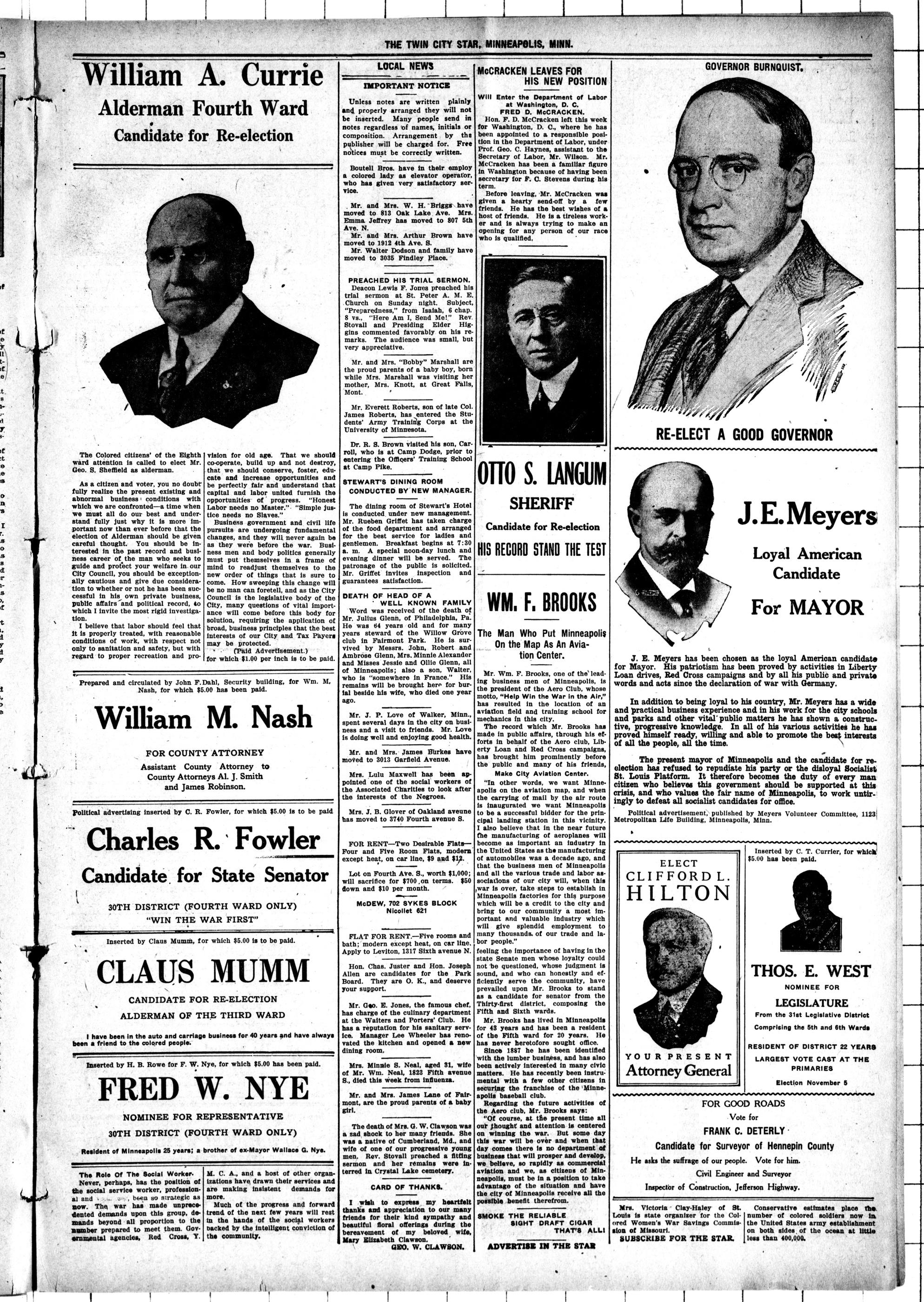
THE TWIN CITY STAR, MINNEAPOLIS, MINN.
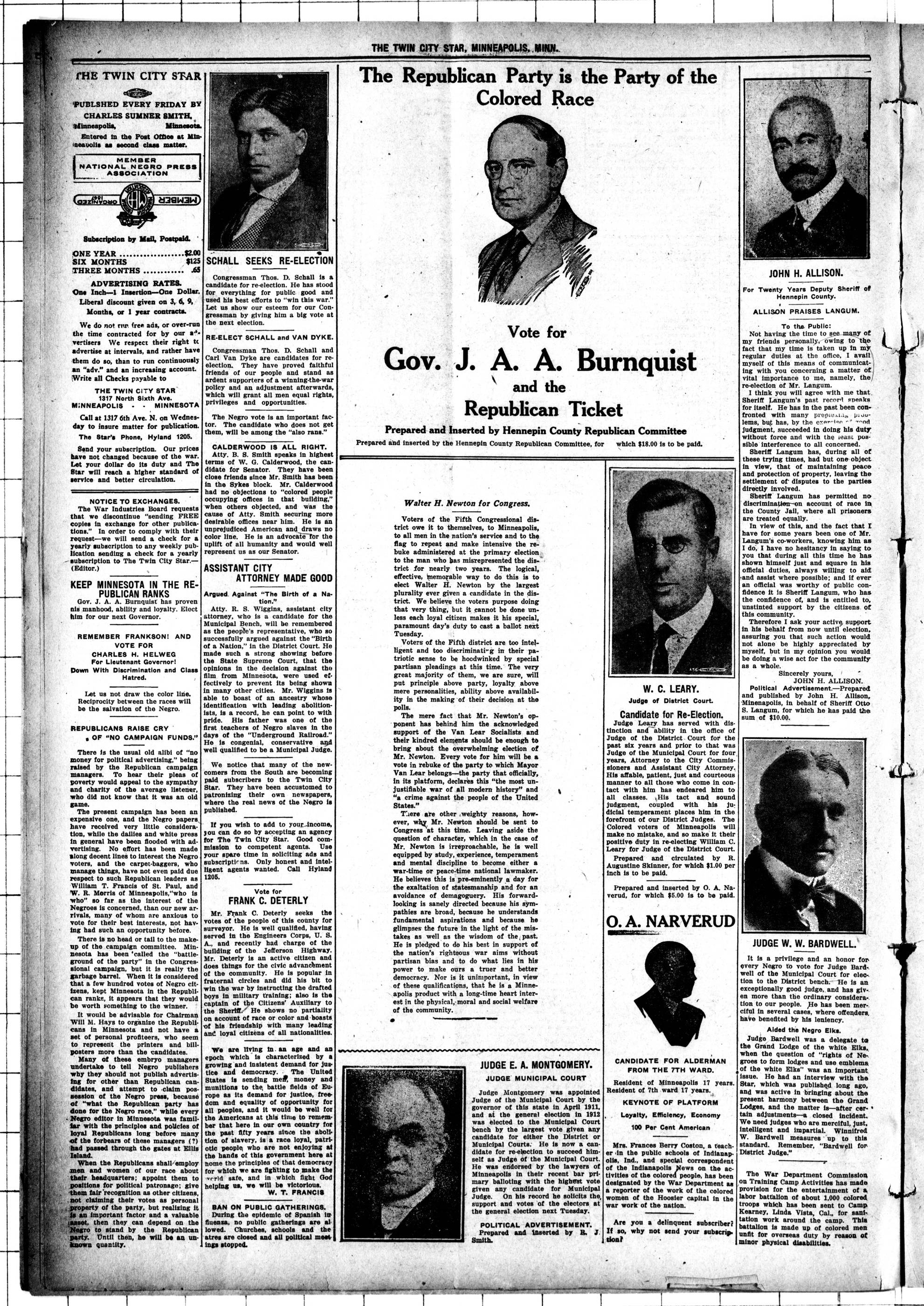
The Republican Party is the Party of the Colored Race
Vote for Gov. J. A. A. Burnquist and the Republican Ticket
Prepared and Inserted by Hennepin County Republican Committee Prepared and inserted by the Hennepin County Republican Committee, for which $18.00 is to be paid.
Walter H. Newton for Congress.
Voters of the Fifth Congressional district owe it to themselves, to Minneapolis, to all men in the nation's service and to the flag to repeat and make intensive the rebuke administered at the primary election to the man who has misrepresented the district for nearly two years. The logical, effective, memorable way to do this is to elect Walter H. Newton by the largest plurality ever given a candidate in the district. We believe the voters purpose doing that very thing, but it cannot be done unless each loyal citizen makes it his special, paramount day's duty to cast a ballot next Tuesday.
Voters of the Fifth district are too intelligent and too discriminati-g in their patriotic sense to be hoodwinked by special partisan pleadings at this time. The very great majority of them, we are sure, will put principle above party, loyalty above mere personalities, ability above availability in the making of their decision at the polls.
The mere fact that Mr. Newton's opponent has behind him the acknowledged support of the Van Lear Socialists and their kindred elements should be enough to bring about the overwhelming election of Mr. Newton. Every vote for him will be a vote in rebuke of the party to which Mayor Van Lear belongs—the party that officially, in its platform, declares this "the most unjustifiable war of all modern history" and "a crime against the people of the United States."
There are other weighty reasons, however, why Mr. Newton should be sent to Congress at this time. Leaving aside the question of character, which in the case of Mr. Newton is irreproachable, he is well equipped by study, experience, temperament and mental discipline to become either a war-time or peace-time national lawmaker. He believes this is pre-eminently a day for the exaltation of statesmanship and for an avoidance of demagoguery. His forward-looking is sanely directed because his sympathies are broad, because he understands fundamental aspirations and because he glimpses the future in the light of the mistakes as well as the wisdom of the past. He is pledged to do his best in support of the nation's righteous war aims without partisan bias and to do what lies in his power to make ours a truer and better democracy. Nor is it unimportant, in view of these qualifications, that he is a Minneapolis product with a long-time heart interest in the physical, moral and social welfare of the community.
J. B.
E. B. B.
Vote for
I. A. A. Bu
and the
Republican Tick
ported by Hennepin County Rep
Hennepin County Republican Committee, for
---
JUDGE E. A. MONTGOMERY.
JUDGE MUNICIPAL COURT
Judge Montgomery was appointed Judge of the Municipal Court by the governor of this state in April 1911, and at the general election in 1912 was elected to the Municipal Court bench by the largest vote given any candidate for either the District or Municipal Courts: He is now a candidate for re-election to succeed himself as Judge of the Municipal Court. He was endorsed by the lawyers of Minneapolis in their recent bar primary balloting with the highest vote given any candidate for Municipal Judge. On his record he solicits the support and votes of the electors at the general election next Tuesday.
POLITICAL ADVERTISEMENT. Prepared and inserted by R. J. Smith.
---
156
Candidate for Re-Election.
Judge Leary has with distinction and ability in the office of Judge of the District Court for the past six years and prior to that was Judge of the Municipal Court for four years, Attorney to the City Commissioners and Assistant City Attorney, His affable, patient, just and courteous manner to all those who come in contact with him has endeared him to all classes. His tact and sound judgment, coupled with his judicial temperament places him in the forefront of our District Judges. The Colored voters of Minneapolis will make no mistake, and so make it their positive duty in re-electing William C. Leary for Judge of the District Court.
Prepared and circulated by R. Augustine Skinner, for which $1.00 per inch is to be paid.
Prepared and inserted by O. A. Naverud, for which $5.00 is to be paid.
O. A. NARVERUD
CANDIDATE FOR ALDERMAN FROM THE 7TH WARD.
Resident of Minneapolis 17 years.
Resident of 7th ward 17 years.
KEYNOTE OF PLATFORM
Loyalty, Efficiency, Economy
100 Per Cent American
Mrs. Frances Berry Coston, a teacher in the public schools of Indianapolis, Ind., and special correspondent of the Indianapolis News on the activities of the colored people, has been designated by the War Department as a reporter of the work of the colored women of the Hoosier capital in the war work of the nation.
Are you a delinquent subscriber?
If so, why not send your subscription?
---
M.
For Twenty Years Deputy Sheriff of Hennepin County.
ALLISON PRAISES LANGUM.
To the Public:
Not having the time to see many of my friends personally, owing to the fact that my time is taken up in my regular duties at the office, I avail myself of this means of communicating with you concerning a matter of vital importance to me, namely, the re-election of Mr. Langum.
I think you will agree with me that Sheriff Langum's past record speaks for itself. He has in the past been confronted with many preposing problems, but has, by the exercise of good judgment, succeeded in doing his duty without force and with the least possible interference to all concerned.
Sherif Langum has, during all of these trying times, had but one object in view, that of maintaining peace and protection of property, leaving the settlement of disputes to the parties directly involved.
Sherif Langum has permitted no discrimination on account of race in the County Jail, where all prisoners are treated equally.
In view of this, and the fact that I have for some years been one of Mr. Langum's co-workers, knowing him as I do, I have no hesitancy in saying to you that during all this time he has shown himself just and square in his official duties, always willing to aid and assist where possible; and if ever an official was worthy of public confidence it is Sherif Langum, who has the confidence of, and is entitled to, unstinted support by the citizens of this community.
Therefore I ask your active support in his behalf from now until election, assuring you that such action would not alone be highly appreciated by myself, but in my opinion you would be doing a wise act for the community as a whole.
Sincerely yours,
JOHN H. ALLISON.
Political Advertisement—Prepared and published by John H. Allison, Minenapolis, in behalf of Sheriff Otto S. Langum, for which he has paid the sum of $10.00.
PETER H.
JUDGE W. W. BARDWELL.
It is a privilege and an honor for every Negro to vote for Judge Bardwell of the Municipal Court for election to the District bench. He is an exceptionally good judge, and has given more than the ordinary consideration to our people. He has been merciful in several cases, where offenders, have benefited by his lenency.
Aided the Negro Elks.
Judge Bardwell was a delegate to the Grand Lodge of the white Elks, when the question of "rights of Negroes to form lodges and use emblems of the white Elks" was an important issue. He had an interview with the Star, which was published long ago, and was active in bringing about the present harmony between the Grand Lodges, and the matter is—after certain adjustments—a closed incident. We need judges who are merciful, just, intelligent and impartial. Winnifred W. Bardwell measures up to this standard. Remember, "Bardwell for District Judge."
The War Department Commission on Training Camp Activities has made provision for the entertainment of a labor battalion of about 1,000 colored troops which has been sent to Camp Kearney, Linda Vista, Cal., for sanitation work around the camp. This battalion is made up of colored men unfit for overseas duty by reason of minor physical disabilities.
rs es
William A. Currie
Alderman Fourth Ward
Candidate for Re-election
ea 4 cs
/ ,
m Prepared and circulated by John F.Dahl, Security building, for Wm. M,
Nash, for which $5.00 has been paid.
William M. Nash
i linam ° as.
FOR COUNTY ATTORNEY
i Assistant County Attorney to r
County Attorneys Al. J. Smith -
and James Robinson.
Seni ig nN ee
ich
Political advertising inserted by C. R. Fowler, for which $5.00 is to be paid
;
Charles R.: Fowler |
;
Candidate for State Senator
1 .
‘
30TH DISTRICT (FOURTH WARD ONLY)
“WIN THE WAR FIRST”
FSR SN cat ck
i Inserted by Claus Mumm, for which $5.00 is to be paid. .
CLAUS MUMM —
CANDIDATE FOR RE-ELECTION |
ALDERMAN OF THE THIRD WARD
4
Ihave been in the auto and carriage business for 40 years and have always |
been a friend to the colored people. .
ett its aie AMEE he
Inserted by H. B. Rowe for F. W. Nye, for which $5.00 has been paid.
FRED W. NYE
NOMINEE FOR REPRESENTATIVE
30TH DISTRICT (FOURTH WARD ONLY)
Resident of Minneapolis 25 years; a brother of ex-Mayor Wallace G. Nye.
The Colored citizens’ of the Eighth
ward attention is called to elect Mr.
Geo. 8, Sheffield as alderman.
Asa citizen and voter, you no doubt
fully realize the present existing and
abnormal business! conditions with
which we are confronted—a time when
‘we must all do our best and under-
stand fully just why it is more im-
portant now than ever before that the
election of Alderman should be given
careful thought. You should be in-
terested in the past record and bust-
ness career of the man who seeks to
guide and protect your welfare in our
City Council, you should be exception-
ally cautious and give due considera-
tion to whether or not he has been suc-
cessful in his own private business,
public affairs “and political record, ¢0
which I invite the most rigid investiga-
tion.
I believe that labor should feel that
it {s properly treated, with reasonable
conditions of work, with respect not
only to sanitation and safety, but with
regard to proper recreation and pro-
‘The Role Of The Social Worker.
Never, perhaps, has the position of
the social service worker, profession-
al and +... eo, been so strategic as
mow. Tha war has made unprece-
dented demands upon this group, de-
mands beyond ‘all proportion to the
number prepared to meet them. Gov-
@romental agencies, Red Cross, Y.
vision for old age. That we should
co-operate, build up and not destroy,
that we should conserve, foster, edu-
cate and increase opportunities and
be perfectly fair and understand that
capital and labor united furnish the
opportunities of progress. “Honest
Labor needs no Master.” “Simple jus-
tice needs no Slaves.”
Business government and civil life
pursuits are undergoing fundamental
changes, and they will never again be
as they were before the war. Bust-
ness men and body politics generally
must put themselves in a frame of
mind to readjust themselves to the
new order of things that is sure to
come. How sweeping this change will
be no man can foretell, and as the City
Council is the legislative body of the
City, many questions of vital import-
ance will come before this body for
solution, requiring the application of
broad, business principles that the best
interests of our City and Tax Payers
may be protected.
. (Paid Advertisement.)
for which $1.00 per inch is to be paid.
M. C. A., and @ host of other organ-
izations have drawn their services and
are making insistent demands for
more.
Much of the progress and forward
trend of the next few years will rest
in tha hands of the socigl workers
backed by the intelligent conviction of
the community.
j
$e 2
“THE TWIN CITY STAR, MINNEAPOLIS, MINN.
a ene
LOCAL NEWS
OCAL NEWS = _[ McCRACKEN LEAVES FO
IMPORTANT NOTICE His NEW P(
Unless notes are written plainly | Wl" Enter jhe Department,
and properly arranged they will not FRED D. MeCRACKE
be inserted. Many people send in| Hon. F. D. McCracken left
notes regardless of names, initials or |for Washington, D.C, wher
composition. Arrangement by the | Been appolnted to a respon
publisher will be charged for. Free tion in the Department o
ey 7 Prof. Geo. C. Haynes, assista
fog Aen ge Magy gry eg
Boutell Bros. have in their employ | MCyrackon has been & femit
@ colored lady as elevator operator, | im Weshington because of ha
who has given very satisfactory ser-| ferry for ® ©.
ee .| Before leaving, Mr. McCra
Mr. and Mrs, W. H.-Briggs\have | Sve" * hearty sendoff by
moved to 818 Oak Lake Ave. Mrs. tmend®» He has the best w!
Emma Jeffrey has moved to 807 5th
aM N. er and is always trying to
Me ded te: Adie “Reawas nave oem
moved to 1912 4th Ave, 8. ete ee
Mr. Walter Dodson and family have ;
moved to 3035 Findley Place.
PREACHED HIS TRIAL SERMON.
Deacon Lewis F. Jones preached his
trial sermon at St. Peter A. M. E.
Church on Sunday night, Subject,
“Preparedness,” from Isalah, 6 chap.
8 vs. “Here Am I, Send Me!” Rev.
Stovall and Presiding Elder Hig-
gins commented favorably on his re-
marks. The audience was small, but
very appreciative.
‘Mr. and Mrs, “Bobby” Marshall are
the proud parents of a baby boy, born
while Mrs. Marshall was visiting her
mother, Mrs. Knott, at Great Falls,
Mont. e
Mr, Everett Roberts, son of late Col.
James Roberts, has entered the Stu-
dents’ Army Training Corps at the
University of Minnesota.
Dr. R. 8, Brown visited his son, Car-
roll, who is at Camp Dodge, prior to
entering the Officers’ Training School
at Camp Pike.
STEWART’S DINING ROOM
CONDUCTED BY NEW MANAGER.
| The dining room of Stewart's Hotel
is conducted. under new management.
Mr. Rueben Griffet has taken charge
of the food department and arranged
for the best service for ladies and
gentlemen. Breakfast begins at 7:30
a.m. A special noon-day lunch and
evening dinner will be served. The
patronage of the public is solicited.
Mr. Griffet invites inspection and
guarantees satisfaction.
DEATH OF HEAD OF A
* WELL KNOWN FAMILY
‘Word was received of the death of
Mr, Julius Glenn, of Philadelphia, Pa.
He was ¢4 years old and for many
years steward of the Willow Grove
club in Fairmont Park. He is sur-
vived by Messrs. John, Robert and
Ambrose Glenn, Mrs. Minnie Alexander
‘and Misses Jess{e and Ollie Glenn, all
of Minneapolis; also a son, Walter,
who is “somewhere in France.” His
remains will be brought here for bur-
fal beside his wife, who died one year
ago.
Mr. J. P. Love of Walker, Minn.,
spent several days in the city on busi-
ness and a visit to friends. Mr. Love
4s doing woll and enjoying good health.
Mr. and Mrs. James Burkes have
moved to 3013 Garfield Avenue.
Mrs. Lulu Maxwell has been ap
pointed one of the social workers o:
the Associated Charities to look after
the interests of the Negroes.
Mrs. J. B. Glover of Oakland aveunt
has moved to 3740 Fourth avenue S.
FOR RENT—Two Desirable Flats—
Four and Five Room Flats, moders
except heat, on car line, $9 and $12.
Lot on Fourth Ave. S., worth $1,000;
will sacrifice for $700,on terms. $5
down and $10 per month.
—
McDEW, 702 SYKES BLOCK
Nicollet 621
FLAT FOR RENT.—Five rooms and
bath; modern except heat, on car line,
Apply to Leviton, 1317 Sixth avenue N.
Hon. Chas. Juster and Hon. Joseph
Allen are candidates for the Park
Board. They are O. K., and deserve
your support.
Mr. Geo. E. Jones, the famous chef,
has charge of the culinary department
at the Waiters and Porters’ Club. He
has a reputation for his sanitary serv-
ice. Manager Lee Wheeler has reno-
vated the kitchen and opened @ new
dining room.
Mrs. Minnie S. Neal, aged 31, wife
of Mr. Wm. Neal, 1823 Fifth avenue
8, died this week from influenza.
Mr. and Mrs. James Lane of Fair-
mont, are the proud parents of a baby
irl,
‘The death of Mrs. G. W. Clawson was
@ sad shock to her many friends. She
was a native of Cumberland, Md., and
wife of one of our progressive young
men, Rev. Stovall preached a fitting
sermon and her remains were in-
terred in Crystal Lake cemetery.
CARD OF THANKS.
I wish to express my heartfelt | possible ben
thanks amd appreciation to our many is
friends for their kind sympathy and| SMOKE TH
beautiful floral offerings during the si
bereavement of my beloved wife,
‘Mary Blizabeth Clawson. .
GBO, W. CLAWSON, ADVER’
. 2 ‘
| ! |
McCRACKEN LEAVES FOR
HIS NEW POSITION
Will Enter the Department of Labor
at Washington, D. C,
FRED D. McCRACKEN.
Hon. F. D. McCracken left this week
for Washington, D. C., where he has
been appointed to a responsible posi-
tion in the Department of Labor, under
Prof. Geo. C. Haynes, assistant to the
Secretary of Labor, Mr. Wilson. Mr.
McCracken has been a familiar figure
in Washington because of having been
secretary for F. C. Stevens during his
term.
Before leaving, ‘Mr. McCracken was
given a hearty sendoff by a few
friends. He has the best wishes of a
host of friends. He is a tireless work.
er and is always trying to make an
opening for any person of our race
who fs qualified. *
: “ val :
.
OTTO S. LANGUM
SHERIFF
Candidate for Re-election
HS RECORD STAND THE TEST
WM. F. BROOKS
The Man Who Put Minneapolis
On the Map As An Avia-
tion Center.
Mr. Wm. F. Brooks, one of the’ lead-
ing business men of Minneapolis, is
the president of the Aero Club, whose
motto, “Help Win the War in the Air,”
has resulted in the location of an
aviation field and training school for
mechanics fn this city.
The record which Mr. Brooks has
made in public affairs, through his ef-
forts in behalf of the Aero club, Lib-
erty Loan and Red Cross campaigns,
has brought him prominently before
the public and many of his friends,
Make City Aviation Center.
“In other words, we want Minne-
apolis on the aviation map, and when
the carrying of mail by the air route
4s {naugurated we want Minneapolis
to be a successful bidder for the prin-
‘cipal landing station in this vicinity.
T also believe that in the near future
the manufacturing of aeroplanes will
become as important an industry in
the United States as the manufacturing
of automobiles was a decade ago, and
that the business men of Minneapolis
and all the various trade and labor as-
soctations of our city will, when this
war 1s over, take steps to establish in
‘Minneapolis factories for thig purpose
which will be a credit to the city and
bring to our community a most {m-
portant and valuable industry which
will give splendid employment to
many thousands, of our trade and la-
bor people.”
feeling the importance of having in the
state Senate men whose loyalty could
not ‘be questioned, whose judgment is
sound, and who can honestly and ef-
ficlently serve the community, have
prevailed upon Mr. Brooks to stand
as a candidate for senator from the
‘Thirty-first district, composing the
Fifth and Sixth wards.
Mr. Brooks has lived in Minneapolis
for 48 years and has been a resident
of the Fifth ward for 20 years. He
has never heretofore sought office.
Since 1887 he has been identified
with the lumber business, and has also
been actively interested in many civic
matters. He has recently been instru-
mental with a few other citizens in
securing the franchise of the ‘Minne-
apolis baseball club.
Regarding the future activities of
the Aero club, Mr. Brooks says:
“Of course, at the present time all
our thought and attention is centered
on winning the war. But some day
this war will be over and when that
day comes there is no department of
business that will prosper and develop,
we believe, so rapidly as commercial
aviation and we, as citizens of Min-
neapolis, must be in a position to take
advantage of the situation and have
the city of Minneapolis receive all the
possible benefit therefrom,
@MOKE THE RELIABLE
SMOKE THE RELIABLE
SIGHT DRAFT CIGAR
THAT'S ALL!
ADVERTISE IN THE STAR
| 1 |
GOVERNOR BURNQUIST,.
[_
—
ee o]
~“— ce
= = 4 «| FM
Se PSD
Mia a 7
Yiu f \. &
Vee ff YG
(Empey «| Ne
ay gf Nig,
fer ae ee ip
77 1 . ;
RE-ELECT A GOOD GOVERNOR
Coy J.E.Meyers
WY . : Loyal American
a a Coscintai
For MAYOR
J. E. Meyers has been chosen as the loyal American candidate
for Mayor. His patriotism has been proved by activities in Liberty
Loan drives, Red Cross campaigns and by all his public and private
words and acts since the declaration of war with Germany.
In addition to being loyal to his country, Mr. Meyers has a wide
and practical business experience and in his work for the city schools
and parks and other vital’ public matters he has shown a construc-
tive, progressive knowledge. In all of his various activities he has
proved himself ready, willing and able to promote the beat interests
of all the people, all the time.
The present mayor of Minneapolis and the candidate for re-
election has refused to repudiate his party or the disloyal Socialist
St. Louis Platform. It therefore becomes the duty of every man
citizen who believes this government should be supported at this
crisis, and who values the fair name of Minneapolis, to work untir-
ingly to defeat all socialist candidates for office.
Political advertisement, published by Meyers Volunteer Committee, 1123|
Metropolitan Life Building, Minneapolis, Minn.
ELECT |
CLIFFORDL.
HILTON
oa
ea ra
er ad
hod |
wv |
3 |
YOUR PRESENT.
Attorney General |
FOR GOOD ROADS
Vote for
FRANK C. DETERLY -
Candidate for Surveyor of Hennepin County
He asks the suffrage of our people. Vote for him.
Civil Engineer and Surveyor
Inspector of Construction, Jefferson Highway.
ooo
Mrs. Victoria Clay-Haley of St. Conservative estimates place
Louis is state organizer for the Col-|number of colored soldiers nov
ored Women's War Savings Commis-|the United States army establish:
sion of Missouri. on both sides. of the ocean at |
SUBSCRIBE FOR THE STAR, | Jess than 400,000,
mM (iad ills 2 Dia: ot ae ali
THOS. E. WEST
NOMINEE FOR
LEGISLATURE
From the 31st Legislative District
‘Comprising the 5th and 6th Wards
RESIDENT OF DISTRICT 22 YEARS
LARGEST VOTE CAST AT THE
PRIMARIES
Election November &
Renn
D ROADS
for
DETERLY -
r of Hennepin County
. Vote for him.
and Surveyor
ferson Highway.
see lerieersemicesmnnseipaicaeietiaelaal
Conservative estimates place the.
number of colored soldiers now in
the United States army establishment
on both sides of the ocean at little
‘legs than 400,000,
WASHINGTON SIDELIGHTS
WASHINGTON.—Back from the Maine woods with the latest thing in draft stories came a Washingtonian recently. He and a friend were paddling up the Magalloway river one day shortly after September 12, that big day when 18,000,000 men went quietly to registration places throughout the United
13,000,000 men went quietly to registration places throughout the United States to sign up for Uncle Sam.
2014
Buck, a backwoods guide, constituted the third occupant of the canoe. Was he backwoods? He was so far backwoods, it is declared, that beyond him was nothin'. They don't come any more backwoodsy than Buck. A young old fellow, gray-haired, tanned, quiet, determined, there is only one Buck in the world, friends say.
They were going through the "big eddy," when all of a sudden, out of the clear sky, came the sounds of firing. "What's that?" said one camper.
Buck took a few paddles before he answered. "Couple o' Bangor sports," he replied.
A "Bangor sport," by the way, is the backwoods term for some sportsmen who frequent the big woods. They usually are blustery fellows, who affect to make comrades of the guides, who, in their turn, secretly despise the sports.
Sure enough, there on a promontory could be seen the sports. One was fishing for trout, while the other, with a .32 rifle, was popping away at a target. The "Bangor sports" could not as yet see the canoe and its occupants.
Then the canoe rounded into sight of the men. The man with the rifle lowered his piece and looked across the eddy.
"Well, well, well!" he shouted, familiarly. "If there ain't old Buck! How are you, Buck? Have you registered in the draft, Buck?"
If the question was meant as a slur on Buck's age, it didn't work. The guide shot the canoe forward. "You bet I'm registered," he called across the water. "An' I ain't wastin' no ammunition on this side, either." Those "Bangor sports" haven't thought up a reply yet.
Small Girl, Japanese Tooter and the Conductor
Small Girl, Japanese Tooter and the Conductor
THERE is a new toy—made in Japan—which looks like a lead pencil and sounds like a horn. Everybody—leaving out old man Scrooge—accepts a Christmas horn as a forgivable crime, but it was perfectly obvious that every passenger on the car wanted to choke off a small girl who tooted her way from Capitol hill to Center market the other forenoon. Her presumable mother bore the affliction with a chronic patience characteristic of parents who are too mistakenly fond to make their youngsters behave, but the passengers around were not so placidly resigned. Two jolly, commonplace women, each loaded with empty baskets and cord bags, had things to say on the subject, and they said them good and loud:
off a small girl who tooted her way from Capitol hill to Center market the other forenoon. Her presumable mother bore the affliction with a chronic patience characteristic of parents who are too mistakenly fond to make their youngsters behave, but the passengers around were not so placidly resigned. Two jolly, commonplace women, each loaded with empty baskets and cord bags, had things to say on the subject, and they said them good and loud:
"I like kids all right, but if that young one belonged to me I'd spank her so hard that——"
"What can you expect with a mother like that?"
The two marketers got out at Seventh street and the horn virtuoso slipped into a window seat one of them had vacated and sounded a farewell to jubilation. It was also what you might call her swan song, for the conductor, goaded to intervention, politely invited the young miss to consider her recital at an end.
To the gasp astonishment of everybody around—and just to show that it takes all sorts of people to make up a car crowd—a fat, little old body in badly laundered white, topped with a rose pink sweater, charged a lance in behalf of the breaker of the peace.
"Let the child play if she wanster! Don't you know that the angels in heaven play horns? If you don't, I can show you a picture of little winged cherubs a-blowing gold——"
"That's all right, lady. I haven't got a thing to do with running heaven, but I'm expected to look after this car."
"Young man, you think you're mighty smart, don't you? But let me tell you something.. If you was to see that picture——"
"I know all about 'em, lady. Little angels, all heads and wings, and not a lung in the lot to blow with."
Somebody chuckled and the small girl discarded the horn thing to consider the conductor with lavish smiles—of the teeth-shedding variety. And all was peace.
Little Incident in a Washington Antique Shop
Little Incident in a Washington Antique Shop
MOST people are honest, but it is the exception that gives pungency to the rule. One man, for one instance, keeps medieval junk. Among his customers the other afternoon was a woman who wanted a table, something in Chimpendale to match a whatnot. The
Chippendale to match a whatnot. The proprietor was starting off to bring forth Chippendale when the woman, seeing a chair convenient, sat down.
BREAKIN THIS
WILL COST
YOU $20
I'LL NOT
PAY IT!
Spindle-legged furniture is artistic but treacherous, as the lady should have remembered before she weighted her overstock of too, too solid etcetera, on spidery legs that cracked the instant she let herself go.
The tag price of the chair was something awful—though as the proprietor protested what could you expect of a treasure that had had its honored place in an Italian palace for over two hundred years, but if the lady would pay $20 for the damage she had done——
And then another customer who had been looking the chair over stepped into the situation.
"I happen to be in the business myself and know the exact value of this chair. Without going into embarrassing particulars, let me suggest, madam, that you pay this man 15 cents for his time and trouble in mending it; and if you hear any more from him let me know and I'll go into court myself with a charge of false pretenses. It is fraud of this sort, sir, that ruins any trade. Better come out with me, madam, and the next time you want antiques take an expert along."
Psychological Study of Sweet Potato in Capital
Psychological Study of Sweet Potato in Capital
ADVENTURES of a Sweet Potato in Washington." Sounds as if it might be the title of a novel about a war worker, but it isn't. It merely has to do with the flight and landing of a sweet potato thrown by an urchin at a street car conductor on the Eleventh street line.
A
The car was going gaily downtown when, all of a sudden, a hefty sweet potato came whirling through an open window, missed an elderly lady by an inch and landed squarely on the shoulder of the conductor.
There you have all the elements for a psychological study. Given the sweet potato, the small boy, the ability to throw and the mark—to wit, the conductor—what more would a psychologist ask? "Ah, ha!" sayeth the psychologist. "I will proceed to study the effect of said sweet potato and its integral flight upon the various personalities of this novel—or, street car."
TALES FROM BIG CITIES
Finds a Five Hundred Dollar Ring in a Giant Codfish
SAN FRANCISCO—Seafaring men, friends of H. C. Dally, a fisherman who has just returned from Bering Sea, contend along the waterfront here that Dally is entitled to a medal with a palm or two on it, and for two reasons. Either he is the luckiest man that ever
Either he is the luckiest man that ever went fishing, or he is the biggest fishing trip Ananias in or out of captivity. But let Daily tell his own story.
OH LOOK!
"See this ring?" he asked the other day of a small group of friends, at the same time exhibiting a solitaire diamond in platinum setting that had evidently been worn by a woman, and which was inscribed "From C. to J." upon the inside.
"It's a daisy, isn't it?" was Dally's next question, which he answered himself by saying: "It sure is, and I'll tell ye how I got it. I was up in the Bering sea cleaning codfish at the rate of three a minute and paying no particular attention to anything else, when suddenly I picked up the biggest codfish I'd ever seen in me lifetime. He was a beauty, too. Fat? The fattest I'd ever handled.
"All right, mates. I plumped by knife into him and was just about to pass him along when something shiny in his 'inards' caught my eye. It was this ring. Yes, sir; this same sparkler that I'm a-showin' you.
"Now, lads; how'd that ring get in that fish's stomach? Whose ring is it, or whose was it, anyway? I'm willing to return the ring to the owner, but ownership must be satisfactorily established, as the stone alone is worth $500, a jeweler tells me. Yes, sir, 500 beans—simoleons—plasters."
"I'm going to look up a brainy newspaper feller—if there are any brainy ones left, now that the smart guys are all at the front or getting ready to go there—and have him write a story about it, and mebbe I'll get a nice reward, anway, if the owner is found."
Akron Deaf-Mute's Experience in an Army Camp
AKRON, OHIO.—One of the most interesting army experiences that has come from any training camp is the one that has just been reported of Hinton Wilson, a rubber worker employed by a local tire company, who for a month was detained at Camp Sherman, suspected of shamming deafness to avoid conscription. WHEN I SAY
WHEN I SAY
HALT I MEAN
IT. YA HEAR
ME! DON'T
TALK BACK
EITHER-
Wilson is one of about 500 deaf-mutes doing their bit in a factory, working on war materials that are helping to equip our armies in France.
"I was registered in Atlanta," Wilson said after his release, using sign language, "but requested a transfer where I was working. One night I found a squad of husky khaki-clad lads awaiting my return from work, who became incensed at my inability to answer their questions, and unceremoniously hauled me before the examining surgeon. I was pronounced physically sound and the next morning was hustled off to camp, where the boys, taking their cue from the officers, regarded me as a contemptible slacker.
"Fortunately a deaf brother of one of the boys paid a visit to the camp, and, after talking with me in sign language, assured my comrades that I was deaf. Their attitude toward me immediately changed and they treated me royally thereafter, doing everything possible to make things pleasant for me.
"They waked me at reverille and usually connived to get me in the second rank at drills, so that my mistakes would not be so readily observed by the officer, and that I might have the advantage of imitating the movement of the men in the front rank. But occasionally I landed in the front rank, and I suppose I am fortunate that I could not hear the bawlings out I received from the officer when I marched blithely forward while the rest of the company executed a 'right about face.'"
"Ernie, the Bug Shooter," Now Eleven-Year-Old Thug
KANSAS CITY.—The glare of the arc light at Twelfth and Charlotte streets four years ago disclosed a small boy seated on the curbing. His chubby fists grasped a revolver, his fingers tugging at the trigger. The officers heard a childish cry "Up hands—beetles!"
The boy smiled as a patrolman jerked him to his feet. Ernest Hardwick, seven years old, living at 620 East Twelfth street, with his "mamma and step-papa," said he "wanted to be a hold-up mans." Since then the boy has been known as "Ernie, the Bug Shooter."
In 1914 he stole a coat belonging to a woman neighbor. In 1915 Ernest was peroled from the McCune Home.
The boy smiled as a patrolman jerked him to his feet. Ernest Hardwick, seven years old, living at 620 East Twelfth street, with his "mamma and step-papa," sald he "wanted to be a hold-up mans." Since then the boy has been known as "Ernie, the Bug Shooter."
In 1914 he stole a coat belonging to a woman neighbor. In 1915 Ernest was paroled from the McCune Home. Then Ernest was arrested for stealing a box of candy. A month later he took three packages of tea from a grocer. And in another month he robbed a creamy company of several butter packages. His parole was revoked, but he escaped from the home.
Ernest pleaded guilty the other day to robbing a jewelry store, a saleon and a cigar store. He was assisted by two other boys, Paul E. Buck, nine years old, 1016 Locust street, and James Swearingen, nine years old, 4342 West Prospect place. In a "play house" in the back yard of 816 Locust street the police recovered most of the stolen articles.
"I'm the oldest—eleven years," Ernest told the judge. "I've got more sense than they. Send me to jail, judge, but don't be hard on Jimmie and Paul—they ain't to blame."
Judge Southern sentenced Ernest to the McCune Home for four years. Jimmie and Paul were paroled to their mothers.
"Ernest," said Mrs. Swearingen, "Mrs. Buck and I want to thank you——"
"Gwan," said "Ernie."
Milwaukee Has Young Amateur Probation Officer
MILWAUKEE—To be a probation officer, one should start very young. At least that was the information revealed in Judge Karel's juvenile court when Jimmie, fourteen years old, faced the tribunal on a charge of exercising
"a little too much authority." It was charged he had punished Billy, a ten-year-old boy.
WOW
However, had Jimmie not repeated the process of punishing Billy the case might never have been brought to light.
While playing near North avenue and Fortieth street Billy spied a pile of cement blocks and not seeing any one near he proceeded to smash up one of the blocks. That was his sin.
Jimmie, the ardent protector of property holders' rights, the amateur slenth and probation officer, was leaning against a post with his bicycle by his side. When Billy surterted down the street, Jimmie rode after him.
"My father's a detective," Jimmie said when he reached Billy. "I saw you breaking those blocks. You must either go with me to the detention home or take a licking."
But Billy was in fear of the detention home, so choosing the lesser of two evils he decided to take the "licking." He was to meet Jimmie the next day to receive his punishment. At the appointed time Billy was there and accompanied Jimmie to Washington park, where in a clump of bushes he felt the blaws of the "law."
He was then made to report with his reader. This time he was taken to a pond on the West side where, after removing his clothes, he sat, according to orders, and read to Jimmie. However, his reading was not quite "up to scratch." Jimmie said, and as a result Billy was tied to a tree and left alone. He was found by a schoolteacher and a complaint was filed against Jimmie. Jimmie was released on probation after he promised to behave and not
W ↑ D
An American steam laundry going close to the lines to clean and sterilize the underwear and uniforms of our soldiers. The big drums behind the engine filled with boiling water are needed to give the Yanks a decent appearance again after their battles.
AUTO FOR HIRE
CHAS. E. BUTLER
Formerly of Pence Auto Co.
N. W. Main 2869 Auto. 36774
BEN MARIENHOFF
For 28 Years at 318 Hennepin Avenue.
Tailor to Men
IMPORTED AND DOMESTIC WOOLENS AT POPULAR PRICES Your Patronage Desired.
HARRY LEVITON
Practical Tailor
MEN'S SUITS AND OVERCOATS MADE TO ORDER.
Dry Cleaning and Fancy Dyeing of Ladies' and Gent's Garments.
Phone N. W. Hyland 2875 1317 No. 6th Ave., Minneapolis.
POPULAR PRICED SHOE REPAIRING.
SPECIAL SAMPLE SHOES
WE FIX 'EM WHILE YOU WAIT.
[Name]
Men's Sewed Soles ..... $1.00
Ladies' Sewed Soles ..... .85
Men's Nailed Soles ..... .85
Rubber Heels ..... .40
Ladies' and Boy's Nailed Soles ..... .65
SEVEN CORNERS' SHOE REPAIR SHOP.
1424 Washington Ave. So., Minneapolis. JOSEPH DAHL, Prop.
South Side Barber Shop
212 Eleventh Ave. S., Minneapolis
EXPERT BARBERS; UP TO THE MINUTE.
CIGARS, POOL AND BILLIARD TABLES IN CONNECTION.
RACE PAPERS—SHOES SHINED.
THOMPSON & CARVER, Props.
The Waiters' and Porters' Club
GLOVER SHULL, PRES.
311 HENNEPIN AVE. MINNEAPOLIS
EDDIE BOYD, SECV. LEE WHEELER, MANAGER
Drex 1269 Automatic 61809 J. & H. Wet Wash Laundry 3753-55-57 Cedar Avenue
Drex 1269
Automatic.61809
High Grade Specialists in Wet Wash Dry Wash and Family Laundering OUR WORK IS OUR BEST ADVERTISEMENT
Uncle Sam's Sailors Well Fed
Sea Cooks of the New Merchant Marine Are Trained for the Difficult Task
WORKING-MEN'S SOCIAL CLUB
OOKING at sea is not what it used to be in the "good old days" that we read about. "A hard biscuit and a slice of cold salt beef," which Dana mentions in "Two Years Before the Mast" as his usual meal after a long, hard watch off Cape Horn, is no longer the diet of the American merchant sailor.
OOKING at sea is not what it used to be in the "good old days" that we read about. "A hard biscuit and a slice of cold salt beef," which Dana mentions in "Two Years Before the Mast" as his usual meal after a long, hard watch off Cape Horn, is no longer the diet of the American merchant sailor.
The modern sailor man is well fed, with plenty of fresh meat, vegetables and soft bread, no matter what the voyage he may be on. Modern refrigerating plants and modern cooking methods are to be thanked for that.
On the hundreds of new ships which are being built for the merchant marine by the United States shipping board careful attention is paid to the equipment for storing, cooking and serving food. The government is fully aware that sailors, like soldiers, work best on well-filled stomachs.
Care is taken also that efficient men are employed as cooks on the nation's new merchant fleets. Good sea cooks are not numerous, even in normal times. Having that fact in mind, the United States shipping board, with the thoroughness that marks all its efforts to create an unequal merchant marine, is engaged in training an adequate number of cooks to man the galleys of its new ships. Young men of character and intelligence are chosen for instruction.
The training of cooks is part of the work done by the shipping board's recruiting service. This service has a fleet of training ships, based at Atlantic and Pacific ports, on all of which young Americans are taught by experienced cooks the serious business of preparing good food at sea. Besides that, the board has special cooking schools on two of the ships—the Meade, a former Atlantic liner stationed at Boston, and the steamer Dorothy Bradford, stationed at New York.
Cooking at sea is by no means the same thing as cooking on land. The sea cook has several things to bear in mind that the land cook, in hotel, restaurant or home kitchen never has to think about.
Take for instance some of the precautions he must observe as illustrated by the following "Don'ts for Sea Cooks."
Don't fill a kettle full of liquid. The rolling of the ship will cause the contents to stop over and with fats may start a fire.
Don't allow pots and pans to get adrift. As a guard against this, the galley range has an iron, rail around it.
Don't permit dishes to be left on dresser or pantry shelf as on land. If you do they will slide off and be smashed. There are little pigeon holes for each kind, into which the dishes fit, there being a high bar across the front, with a space cut out through which a dish may be reached and lifted out.
On modern ships the serving is done by men in the steward's department, called stewards, so the sea cook of today needs none of that dexterity of foot that one-legged John Silver showed as he pegged his way aft with dinner along the slippery deck in the brig of "Treasure Island."
It is a trulism aboard ship that only a cook who likes his job is worth his salt. A discontented cook will spot good food. This psychology is recognized by the shipping board in choosing young men for training as cooks. Only those who volunteer for the job are wanted. There are plenty who do. Out of 3,000 apprentices always on the training ships a certain percentage may be counted on to ask for training as cooks.
These young men are serving on the nation's "bridge of ships" from patriotic motives. Some may go back to their home towns when the war is over; but others will remain in the merchant marine, and will take a part in the country's peace expansion at sea as dignified as that taken by captain, mate or engineer on the ship on which they serve. Nor will they suffer in a financial way, for a chief cook gets $90 a month wages, be-
---
Nothing Changed But the Price
Sight Drafts Still the Same Fine Old Cigar You're Always Liked
When your dealer asks you six cents apiece for your old friend Sight Draft, don't get the idea that he is trying to put something over on you.
The plain truth of the matter is that our labor and other manufacturing costs have increased so much that we had the choice of cutting down the size of the Sight Draft cigar, using inferior tobacco, or raising the price one cent.
We believed you would rather have the same old Sight Draft quality, the same old size, even if it cost you a penny more. So, from now on Sight Drafts will be six cents.
Try a Sight Draft today. It's worth six cents, and you experienced smokers KNOW it is. W. K. Grash & Song, makers. W. S. Conrad Co. & Pam, wholesale distributors. — Advertisered
CHOICE CITY AND SUBURBAN PROPERTY FOR SALE ON SMALL MONTHLY PAYMENTS.
802 Sykes Block.
N. W. Nic. 621 Minneapolis
Office Hours: Sundays:
9 to 6 p. m. 10 to 1 p. m.
9:30 a. m. to 12:30 p. m.
R. S. BROWN, M. D.
Office 408-9 Tribune Annex
67 Fourth Street Soutr.
N. W. Main 2040. T. S. 38194
Res. 608 W. 14th St.
N. W. Main 2388 Minneapolis
FOR MEN ONLY
244 3RD AVE. S.
MINNEAPOLIS
SYLVESTER W. OLIVER &
BENJAMIN JONES
Managers
Peterson, The Druggist
1501 Washington Ave. So.
TOILET ARTICLES, DRUGS
PRESCRIPTIONS.
He Solicits Your Patronage.
T. S. Center 4639.
WALFRID WESTMAN
Photographer
1425 Washington Ave. So. Minn.
THE KEYSTONE BUFFET
(Fermerly "Kid" Mitchell's)
New under new management of
JIMMY SMITH
1313 Washington Ave So.
Main 2259 Minneapolis
NO HOT WATER
"Let's move into a modern house."
A Gas Water Heater Solves the Problem. Sold by The Minneapolis Gas Light Go.
Are you a delinquent subscriber? If so, why not send your subscription?
SMOKE THE RELIABLE
SIGHT DRAFT CIGAR
THAT'S ALL
The modern sailor man is well fed, with plenty of fresh meat, vegete
n't expect the stove to remain in a perpendicular position, nor the cook. You are on a moving platform, namely, the ship's deck, which often rotates sways with the motion of the ship in the sea.
sides his board and quarters—a net income of $1,080 a year.
When the young law student, or bank teller, or blacksmith's helper who has decided to become a sea cook reports for instruction on the Mende or the Bradford he is taken in hand by a wise old chef who proceeds to teach him the A, B, C's of sea cooking.
These embrace some general rules as to cleanliness and general galley practice, neatly typewritten, under the head "Advice to the Cook."
The most particular housewife will find these rules sound. Here are a few of them:
Great cleanliness, as well as care and attention, are required from a cook.
Keep your hands very clean. Try to prevent your nails from getting black or discolored.
Don't scatter in your galley; clean up as you go; put scalding water into each saucepan or stewpan as you finish using it. Dry your saucepans before you put them on the shelf.
It is the ambition of most sea cooks to get on big ship. In wartime, cooking on the small vessel is an essential calling, but the big vessel with its modern equipment and efficiency organization appeals strongly to the type of young man now taking up sea cooking for Uncle Sam.
The large vessels carry several cooks. A 5-ton freighter has a chief cook, a second cook, is also baker, and a third cook, or cook's mate.
The chief cook is usually the meat cutter and in these times scientific meat cutting, as is cooking, is required on the merchant fleet taught in the shipping board's floating cook schools.
WOMEN ARE GOOD MECHANICS.
According to a report of the national industry conference board, women in wartime employment are showing a remarkable adaptability for china shipbuilding.
Never scrub inside of a frying pan; rub it with wet silver-sand, rinse it out well with hot water afterwards.
Wash your pudding elths, and hang them to dry directly after using them; air them before you put them away, or they must be musty. Keep in a dry place.
Be careful not to use a knife that has cut onions until it has been cleaned.
Keep sink and sink-brush very clean; be careful never to throw anything but water down sink. Do not throw cabbage water down it; throw it away, as its small is very bad.
Never have sticky plates or dishes. Use very hot water for washing them; when greasy change it. Clean coppers with turpentine and fine brickdust, rubbed on with fannel; polish them with chamois and a little dry brickdust.
Clean your tins with soap and whiting mixed, made into a thick cream with hot water. Rub it on with fannel; when dry, whisk it off with clean chamois and dry whiting.
Take care that you look at the meat the butcher brings, to see if it is good.
Let there be no waste in the kitchen.
In Uncle Sam's school for sea cooks instruction begins, logically, with cereals for breakfast. It happens that the instruction chef on the Bradford is a Scot, and when Jamie Nicol gets through teaching a new hand the art of cooking oatmeal there is nothing further to be said.
The novice is next shown how to fry eggs and bacon, how to make hash and how to prepare hamburg steak. These are his first steps.
He next gets a chance at dinner, with making soups and roasting and boiling meats and cooking various kinds of vegetables. In this work he learns the mysteries of the big galley range — a mighty stove, near seven feet long—of the steam kettle that will cook soup for 100 men and of the steam-oven cooker for vegetables.
If he is ambitious, the beginner takes a special course in baking and pudding making, for real puddings take the place of the traditional soggy duff of old times on Uncle Sam's merchant ships.
Rice pudding is a favorite. Lucky is the young man who learns to cook rice from a veteran who acquired the art on a trader out of Rangoon or a clipper from Calcutta.
"Never put your rice into the kettle until the water is boiling, then scatter it in." That is the standard rule for rice.
"Then we tell 'em to be sure never to put in the sugar until the rice is done," says the chef.
It has been found that six weeks of intensive training will make a very good sea cook of a beginner if he shows proper aptitude.
"We can tell the natural cook," says Jamie Nicol, "by the questions he asks. The good beginners ask all about everything and make notes. We have a number who put everything they want to remember down in a book. They will make good."
It is the ambition of most sea cooks to get on a big ship. In wartime, cooking on the smallest vessel is an essential calling, but the big vessel with its modern equipment and efficiency organization appeals strongly to the type of young man now taking up sea cooking for Uncle Sam. The large vessels carry several cooks. A 5,000-ton freighter has a chief cook, a second cook, who is also baker, and a third cook, or cook's mate. The chief cook is usually the meat cutter also, and in these times scientific meat cutting, as well as cooking, is required on the merchant fleet and taught in the shipping board's floating cooking schools.
WOMEN ARE GOOD MECHANICS
According to a report of the national industrial conference board, women in wartime employment are showing a remarkable adaptability for machine shop work. The report summarizes information obtained from 131 establishments employing 335,015 men and 49,823 women and including 10,657 women engaged in work formerly performed exclusively by men. Their labor, says the Christian Herald, has ranged from the operation of drill presses and lathes to coremaking, inspecting and assembling mechanical products and performing many precise machine operations. In the main it has been confined to the lighter processes requiring rapidity and dexterity, and in such work their output has proved equal to and frequently greater than that of male employees. This was notably true of women's work in automobile manufacture and in a munition plant manufacturing fuses, where women operatives on drill presses and milling machines were from 25 to 50 per cent more rapid than men.
SINGLE SHOES NOW SOLD IN LONDON.
One of the many pathetic side lights on our war is reflected in advertisements published by British shoe merchants, which vividly impress upon one's mind the sacrifices that many of our sons and their comrades are gallantly making. Owing to the large number of crippled veterans of the western front, London dealers in men's footwear now sell single shoes for one-half the prices of pairs. To quote an advertisement that recently appeared in a fashionable illustrated magazine: "Wartime boots at 26/3 a pair or 13/2 a boot. The single boots, rights or lefts, are for those men who have been so unfortunate as to lose a leg."—Popular Mechanics Magazine.
AMERICANS BUYING DIAMONDS.
Among facts disclosed in the investigation conducted by the council of national defense to learn the buying trend in civilian trade during the war are a decided increase in sales of small diamonds and a falling off in sales of sizes from one-half curat upward. This is attributed to the great increase in price and the tendency of people to buy diamonds by price alone; that is, they have, perhaps, $75 or $100 to put in a stone, and it brings them a much smaller jewel than the same amount would procure a year or two ago. Watches are in great demand, especially wrist watches, which have been enormously popularized by the war.
CALLING A HALT.
"Senator Fudge relates an amusing anecdote—" "If it's new, all right. But I don't care to listen to a stale story just because it is tacked onto a United States senator."—Kansas City Journal.
IMPROVED UNIFORM INTERNATIONAL SUNDAY SCHOOL LESSON
(By REV. P. B. FITZWATER, D. D.
Teacher of English in the Moody
Bible Institute of Chicago).
(Copyright, BILB. W. WERNER
Newspaper
Union.)
LESSON FOR NOVEMBER 3
LESSON TEXT—Genesis 25:27-34.
GOLDEN TEXT—Every man that striveth for the mastery is temperate in all things. Now they do it to obtain a cor- intrigue. Now you have no incorruptible.—I Corinthians 9:25.
DEVOTIONAL READING—Romans 14:13-23.
ADDITIONAL MATERIAL FOR TEACHERS—I Corinthians 8:1-13; 10:23-33; Hebrews 12:15-17.
1. Boys With a Difference (v. 27).
Esau and Jacob were in decided contrast. They differed in appearance and disposition. Esau was a cunning hunter, a man of the field. Jacob was a plain man, dwelling in tents. They were born that way. Every child born into the world possesses a peculiar bent which we call individuality. No two are exactly alike, even twins like Esau and Jacob. The wise parent, the wide-awake teacher, the educator, seeks diligently to discover that peculiar individuality, and to give it direction according to the laws of its own being. This bent is the basis of character. Neither Esau nor Jacob is an ideal personality. Both are selfish.
II. Parental Favoritism (v. 28). Isaac loved Esau because he did eat of his venison. He ought to have loved him because he was his son; but it is a sad commentary upon a father that his love for his son had such a sordid basis as that of his stomach. Isaac, however, was like many today whose love is secured through their appetites. Rebecca loved Jacob, though we are not told why. Perhaps it was because of his cunning. In this respect he was like his mother, who practiced craftsmith to a finish on her husband. Cleverness is a bond which strongly binds together many people. Many hold the respect of their friends because of their shrewdness, irrespective of their moral qualities. Parents should treat their children alike. To show partiality is both unwise and unjust. Even when children possess peculiar qualities which call forth parental affection, it should never be made manifest that preference is made.
III. A Birthright Sold (vv. 29-34).
1. Essau's profanity (Heb. 12:16-17).
He sold his birthright for a bowl of potriage. The birthright was the right of being at the head of the patriarchal family, a position of honor and influence, as well as being the inheritor of a double portion of the father's estate. This being a gift of God should not be despised. He came from hunting physically exhausted. In this moment of distress, he thought only of that which promised immediate satisfaction. He was willing to rellinquish all claim upon the future, if only his present desire could be gratified. A profane person is one who for the enjoyment of the present will forfeit all claim upon the future. He would gladly gain both worlds, but seeing that mess of potriage he lets go of the future for the present. Swearing is profanity, but not the most common. To be under the sway of appetite is to be profane. What profanity about us! For a moment's sinful pleasure men and women are throwing away innocence, happiness, and their souls eternally. This is most serious, for acts are irreverable.
2. Jacob's cunning. It was right that Jacob should have the birthright, for it was according to God's plan which had been pronounced (v. 23), but his scheme to get it is to be condemned. He took advantage of his brother's weakness to drive a sharp bargain. The same thing is practiced when under the force of necessity unlawful interest is exacted, or property is bought under price because one is obliged to sell.
To get rich at the expense of another is to practice Jacob's sin. Modern competitive business methods to a decided extent are of this type. Let each one ask: "Is my name Jacob?" The end never justifies the means. God said that the elder should serve the younger. It was his plan that Jacob should be at the head, but God was able to bring his own plans to pass. He did not need the scheming of Jacob and his mother to further his plans. To do evil that good may come is always wrong.
Understanding the Bible
I believe that the Bible is to be understood in the plain and obvious meaning of its passages; for I cannot persuade myself that a book intended for the instruction and conversion of the whole world should cover its true meaning in any such mystery and doubt that none but critics and philosophers can discover it.—Daniel Webster.
Public Good.
There never was found in any age of the world, either religion or law that did so highly exalt the public good as the Bible.—Bacon.
With Christ's Aid.
With the power of Christ perfected in my weakness, I am equal to every temptation, competent for every duty, equipped for every struggle, the master of every fear.—W. L. Watkinson.
Theory is a vine from which facts are sometimes gathered.
M. B.
Honesty and Absolute Fairness to All.
C. H. HELWEG.
Democratic Candidate for LIEUTENANT-GOVERNOR.
Prepared and inserted by Mathias Baldwin, 1411 Seventeenth avenue N., for which $5.00 is to be paid.
JUDGE MUNICIPAL COURT
Hon. Mathias Baldwin, candidate for Judge of the Municipal Court, is a very pleasant gentleman to meet and is good timber for the position he is aspiring for. The following is a brief sketch of his life: Has lived in the city for 18 years—practised law for 15 years—four years (1911-1914)—First Assistant County Attorney—Spanish-American war veteran. Look up his record. Is a married man and father of four children. He asks the suffrage of the Negro.
J. H. H.
Residence, 1100 Adams St., N. E. Office, 1119 Metropolitan Bank Bldg Vote for Dr. Gilbert Seashore and you'll make no mistake.
A REAL FRIEND
Mr. Albert E. Edwards, veteran of the Spanish-American war, is a true friend of our race, and has demonstrated his interest in us in many ways. He has accorded them every privilege and courtesy as comrades; also shown his respect for them in civil life. It is Commander Edwards who attends the wants and funerals of the Negro veterans. He was instrumental in placing a headstone at the grave of one of the heroes of San Juan Hill, the late David F. Buckner. We are forced to mention this to many, who will know nothing about this man, who is a candidate for Court Commissioner. If elected he will have to pass on the sanity of many persons of our race. Let us have a man who feels kindly toward our people. Vote for EDWARDS for COURT COMMISSIONER
JOHN G. LENNON
Ex-Representative John G. Lennon is a candidate for Representative from the 31st District, representing the 5th and 6th Wards. He has always stood by the Negro citizens. He was one of the oldest members of the House, and is familiar with legislative work. A vote for Mr. Lennon is a vote for fair representation, regardless of race or nationality.
Urges the Election of Carl C. Van Dyke.
We are very glad to commend to the colored voters of Ramsey county the election of Hon. Carl C. Van Dyke, our present Congressman. The record of Congressman Van Dyke has been very carefully investigated and open to inspection, and it discloses the fact that he has always strongly and consistently opposed all forms of legislation antimical to our people. As a member of the House Committee on the District of Columbia he has cooperated with other friends on the committee in defeating segregation measures for the nation's capital.
Established Precedent in U. S. A. Medical Corps.
Upon the presentation of Dr. John R. French, our dentist, for a commis-
CARL C. VAN DYKE.
sion in the Medical Corps of the army, Congressman Van Dyke established the precedent whereby over 300 colored doctors and dentists were commissioned in the Medical Corps of the army and most of them are now in actual service, including Dr. French.
Postmaster Raths His Appointee.
Our present and most efficient postmaster, Hon. Otto N. Raths, is the personal appointee of Congressman Van Dyke. Postmaster Raths has demonstrated by deeds and not words his fairness and true democracy in the administration of his office. A VOTE FOR CONGRESSMAN VAN DYKE MEANS A CONTINUATION OF OUR PRESENT POSTMASTER, HON. OTTO N. RATHS, FOR AT LEAST ANOTHER FOUR YEARS.
WE MUST VOTE FOR MEN AND MEASURES AND NOT FOR THE LABEL OF A POLITICAL PARTY.
YOUNG MEN'S VOTES! LEAGUE
Bismarck Archer, Executive Secy. Headquarters, 321 Metropolitan Bank Bldg.
LETHERT, DEMOCRAT,
LOYALTY CANDIDATE,
INDORSED BY G. O. P.
CHARLES A. LETHERT.
Charles A. Lethert of St. Paul, although Democratic nominee for clerk of the Supreme court, has been indorsed by the Republican state committee and is the loyalty candidate, opposing Herman Mueller, Townley candidate, who is on the ballot as "Republican." Mr. Lethert is 38 years old and was born at Jordan, Minn. He worked on a farm, then learned the printer's trade, working his way through school. He became a mail clerk and went to Washington, D. C., where he worked his way through Georgetown university and then served five years as a counsel in the department of justice and the department of agriculture. He has been practising law in St. Paul seven years. Though of German ancestry, he has been an earnest supporter of all war activities from the beginning.
Our present Governor says "Your present Republican administration believes that all Americans should stand back of the Federal government, and to do every thing possible to hold Minnesota as a record state."
There is no question as to the Negro stand. They were with him in his past campaigns and are with him now, and the whole state ticket, and Mr. Chas. A. Lethert, candidate for the Clerk of the Supreme Court, who has been endorsed by the grand old party, to which we belong.
THE TWIN CITY STAR, MINNEAPOLIS, MINN.
JUDGE EDWARD F. WAITE
Hon. Judge Edward F. Waite is nominated to succeed himself. His seven years' service as a District Judge has been invaluable. He is an able, upright, just, fair, impartial, kindly, considerate, conscientious judge, and Hennepin County can ill afford to lose his services. Be sure to cast your vote for him on the 5th of November.
Prepared by Wm. R. Morris, attorney-at-law, 818 Metropolitan Life Bldg., Minneapolis, Minn.
J. T. DAHL
IFEU
6
We present to the readers of The Twin City Star, J. T. Dahl, Candidate for Alderman of the Sixth Ward, who needs no introduction. He has been a resident of this Ward since 76, and he is loved by all who know him. He says, "There is no question superior to the question of loyalty," and he is one hundred per cent American. Vote for him, and you will make no mistake.
Inserted and prepared by John S. Johnson, 1722 Portland avenue, for which $6.00 has been paid.
PHOTO BY
LEE BROS
W. C. ROBERTSON FOR CONGRESS
PRES. WILSON WANTS HIM.
Have You a Boy at the Front?
JOHN W. SHAFFER ENTERS
RACE FOR SURVEYOR OF
HENNEPIN COUNTY.
Former Assistant City. Engineer and County Surveyor of Minneapolis, Candidate for Surveyor of Hennepin County.
John W. Shaffer, former assistant city engineer and for ten years connected with the county surveyor's office, part of that period acting as assistant county surveyor, has entered the race for the surveyorship of Hennepin county.
Mr. Shaffer is now a member of the engineering firm of John W. Shaffer & Co., whose offices are in the New York Life building. He is one of the most capable men in his profession in the Northwest and acts in the capacity of consulting engineer for many of the cities and towns throughout Minnesota, Michigan, Wisconsin and the Dakotas. His experience and ability in this particular line of work ably fits him for the duties that fall upon the shoulders of the county surveyor of as large a county as Hennepin. Mr. Shaffer is a native of Hennepin county and resides at 2632 W. 44th St., Minneapolis.
Inserted by J. W. Shaffer, for which $10.00 has been paid.
Copenhagen, Nov. 1.—Count Andrassy, new Austro-Hungarian foreign minister, has decided to begin direct negotiations with Italy, according to advices received here.
C. W.
Hon. Frank M. Nye is a candidate for Judge of the District Court. He has served as county attorney of Hennepin county and member of Congress from the 5th district (Minneapolis). He stood loyally by the Negroes while in Congress and can be depended on to give all people their rights according to law. Mr. Nye is one of the favorite speakers among those asked to address colored people. He is an orator of ability and is familiar with the conditions that confront our people. Let us show our gratitude by assisting in his election for Judge of the District Court.
PAID ADVERTISEMENT.
Inserted by C. S. Smith for Hon. Frank M. Nye.
JUDGE C. L. SMITH.
Candidate for Re-election as Judge of
the Mun'clipai Court.
JUDGE C. L. SMITH.
Candidate for Re-election as Judge of the Municipal Court.
Judge Smith was appointed Judge of the Municipal Court in 1905 and was elected in 1906 and again in 1912. He has served with credit and distinction in this important position for more than thirteen years. He is a kindly Christian gentleman and a good judge, sympathetic and patient. He has many friends among all classes who desire to see him remain upon the bench as long as he will serve the people. The voters of Minneapolis will make no mistake in re-electing him and we believe they will. His ability, fairness, fine service, keen judicial insight and right thinking entitle him to, and ought to make sure his re-election. -Paid Advertisement.
DR. HENRY WUERZINGER.
Candidate for Representative 31st District (5th and 6th Wards).
Paid advertisement, for which $10.00 has been paid by Oscar Martinsen.
5055 Dupont Ave. S., Minneapolis.
H. S. PEW
Oscar M
Candi
Sheriff of Her
PRESIDENT W
ar Martinson
Candidate for
of Hennepin County
DENT WILSON WANTS
W. G. Calderwood
for U. S. Senator
PRESIDENT WILSON WANTS
W. G. Calderwood for U. S. Senator
Endorsed by Progressive, Thinking Men Everywhere.
LABOR
RECORD CALDERWOOD'S PLATFORM
Endorsed by Progressive, Thinking Men Everywhere.
Voted against the Adamson 8-hour bill, Sept. 2, 1918.
Voted against Clayton bill, called "Labor's Magna Charta," Sept. 2, 1914.
Voted for child labor bill (a progressive and commendable vote).
Voted against exempting labor and farm organizations from "combination-in-restraint-of-trade" prosecutions, May 7, 1913, and July 8, 1914.
Opposed employers' liability bill and tried to amend the bill unfavorably to labor.
Voted against confirmation of the appointment of Brandeis, labor's friend, to Supreme Court.
Voted against anti-trust bill, September 2, and Oct. 5, 1914.
Voted against extension of parcel post.
Voted against Federal Trade Commission.
Voted against the government railroad in Alaska.
Voted against limiting railroad dividends.
CONSERVATION
Voted for the Shields waterpower grab, which would give the hydroelectric monopoly control of 50,000-000 water horse power.
Voted to sell coal deposits to monopolies at $10 per acre.
Helped whitewash Ballinger, in his attempt to give Morgan-Guggenheim group millions of coal and timber wealth.
Voted against equitably high tax on war profits.
Has voted for pork barrel legislation and supported the spoils and patronage system.
AGRIC
Let it be understood that there is Nelson. He and his friends both beld of votes. He is honestly proud of his will vote the same way every time the instance will be satisfied with and pro
While we believe in Senator Nels that he is much mistaken. His votes of the highest public good, and they progressive attitude.
These policies of reconstruction
good that there is no intention of any criticism of Senator friends both believe that these votes were the right kind, proud of his record and if he is returned to congress may every time the same questions come up and in every kind with and proud of his record on these issues.
in Senator Nelson's honesty and patriotism, we believe taken. His votes were votes that were not in the interest of good, and they represented a reactionary instead of a reconstruction are to come before congress during the war will probably be ended in the next twelve months. king of the new world from the wreckage of the old, and the senate from the state of Minnesota this fall for a six-five years of that term to be devoted to reconstructive political label or from habit or prejudice. Make your vote a reconstruction of the nation and the world.
published in the interest of W. G. Calderwood, by the committee, 256 Hennepin avenue, Minneapolis, for which
Let it be understood that there is no intention of any criticism of Senator Nelson. He and his friends both believe that these votes were the right kind of votes. He is honestly proud of his record and if he is returned to congress will vote the same way every time the same questions come up and in every instance will be satisfied with and proud of his record on these issues.
While we believe in Senator Nelson's honesty and patriotism, we believe that he is much mistaken. His votes were votes that were not in the interest of the highest public good, and they represented a reactionary instead of a progressive attitude.
These policies of reconstruction are to come before congress during the next six years. This war will probably be ended in the next twelve months. Then comes the building of the new world from the wreckage of the old, and the man elected to the senate from the state of Minnesota this fall for a six-year term will have five years of that term to be devoted to reconstructive measures.
Don't vote for a political label or from habit or prejudice. Make your vote count for progressive reconstruction of the nation and the world.
Prepared and published in the interest of W. G. Calderwood, by the Citizens Campaign Committee, 256 Hennepin avenue, Minneapolis, for which
W. G. Calderwood
NELSON'S RECORD
A Clean Man, Equipped for the Job. Endorsed by Organized Labor.
LABOR
For maximum 8-hour day, with one day's rest each week.
For equal economic and industrial opportunity.
For prohibition of child labor in mines, workshops and factories.
For laws promoting just division of wealth, which labor and capital jointly produce.
Extension of labor bureau system.
BIG BUSINESS
For anti-trust legislation.
For postalization of telephones and telegraphs.
For public ownership of railroads.
Conservation of natural resources for all the people.
For public ownership of mines.
For conservation for all the people.
For laying the burdens of taxation in proportion to the ability of each to pay; against the exemption of special classes of private wealth; stocks, bonds and corporate excess to pay same rate as other productive property.
ECONOMY
For an executive budget, with pork, spoils and patronage eliminated.
AGRICULTURE
Abolition of gambling in grain and farm produce. Agricultural development through loans to actual settlers; legislation making it unprofitable for speculators to hold "slacker land" out of cultivation.