Twin City Star
Saturday, November 9, 1918
Minneapolis, Minnesota
Page text (machine-generated)
VOL. 8.
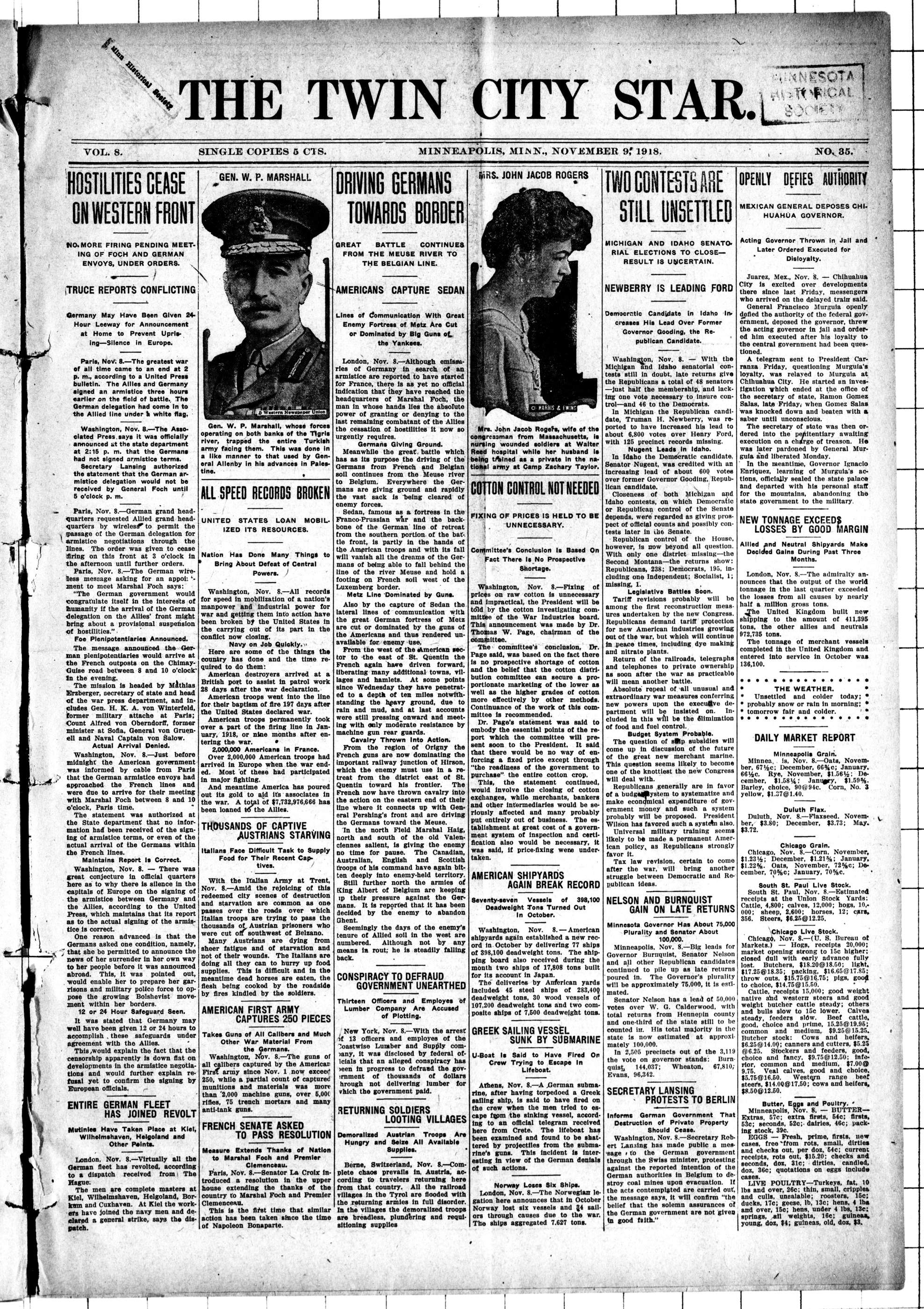
HOSTILITIES CEASE ON WESTERN FRONT
HOSTILITIES CEASE ON WESTERN FRONT
NO. MORE FIRING PENDING MEETING OF FOCH AND GERMAN ENVOYS, UNDER ORDERS.
TRUCE REPORTS CONFLICTING
Germany May Have Been Given 24-Hour Leeway for Announcement at Home to Prevent Uprising—Silence in Europe.
Paris, Nov. 8.—The greatest war of all time came to an end at 2 p. m., according to a United Press bulletin. The Allies and Germany signed an armistice three hours earlier on the field of battle. The German delegation had come in to the Allied line under a white flag.
Washington, Nov. 8.—The Associated Press says it was officially announced at the state department at 2:15 p. m. that the Germans had not signed armistice terms.
Secretary Lansing authorized the statement that the German armistice delegation would not be received by General Foch until 5 o'clock p. m.
Paris, Nov. 8.—German grand headquarters requested Allied grand headquarters by wireless to permit the passage of the German delegation for armistice negotiations through the lines. The order was given to cease firing on this front at 3 o'clock in the afternoon until further orders.
Paris, Nov. 8.—The German wireless message asking for an appointment to meet Marshal Foch says:
"The German government would congratulate itself in the interests of humanity if the arrival of the German delegation on the Allies' front might bring about a provisional suspension of hostilities."
Foe Plenipotentiaries Announced.
The message announced the German plenipotentiaries would arrive at the French outposts on the Chimay-Guise road between 8 and 10 o'clock in the evening.
The mission is headed by Mathias Erzberger, secretary of state and head of the war press department, and includes Gen. H. K. A. von Winterfeld, former military attack at Paris; Count Alfred von Oberndorff, former minister at Sofia, General von Gruenell and Naval Captain von Salow.
Actual Arrival Denied.
Washington, Nov. 8.—Just before midnight the American government was informed by cable from Paris that the German armistice envoyhs had approached the French lines and were due to arrive for their meeting with Marshal Foch between 8 and 10 o'clock, Paris time.
The statement was authorized at the State department that no information had been received of the signing of armistice terms, or even of the actual arrival of the Germans within the French lines.
Maintains Report is Correct.
Washington, Nov. 8.—There was great conjecture in official quarters here as to why there is silence in the capitals of Europe on the signing of the armistice between Germany and the Allies, according to the United Press, which maintains that its report as to the actual signing of the armistice is correct.
One reason advanced is that the Germans asked one condition, namely, that she be permitted to announce the news of her surrender in her own way to her people before it was announced abroad. This, it was pointed out, would enable her to prepare her garrisons and military police force to oppose the growing Bolshevist movement within her borders.
12 or 24 Hour Safeguard Seen.
It was stated that Germany may well have been given 12 or 24 hours to accomplish these safeguards under agreement with the Allies. This,would explain the fact that the censorship apparently is down flat on developments in the armistice negotiations and would further explain refusal yet to confirm the signing by European officials.
ENTIRE GERMAN FLEET
HAS JOINED REVOLT
Mutinies Have Taken Place at Kiel, Wilhelmshaven, Helgoland and Other Points.
London, Nov. 8.—Virtually all the German fleet has revolted, according to a dispatch received from The Mague.
The men are complete masters at Kiel, Wilhelmshaven, Helgoland, Borkum and Cuxhaven. At Kiel the workers have joined the navy men and declared a general strike, says the dispatch.
THE TWIN CITY STAR.
SINGLE COPIES 5 CTS.
Western Newspaper Union
Gen. W. P. Marshall, whose forces operating on both banks of the Tigris river, trapped the entire Turkish army facing them. This was done in a like manner to that used by General Allenby in his advances in Palestine.
ALL SPEED RECORDS BROKEN
UNITED STATES LOAN MOBIL-
IZED ITS RESOURCES.
Nation Has Done Many Things to Bring About Defeat of Central Powers.
Washington, Nov. 8.—All records for speed in mobilization of a nation's manpower and industrial power for war and getting them into action have been broken by the United States in the carrying out of its part in the conflict now closing.
Navy on Job Quickly.
Here are some of the things the country has done and the time required to do them:
American destroyers arrived at a British port to assist in patrol work 28 days after the war declaration.
American troops went into the line for their baptism of fire 197 days after the United States declared war.
American troops permanently took over a part of the firing line in January, 1918, or nine months after entering the war.
2,000,000 Americans in France.
Over 2,000,000 American troops had arrived in Europe when the war ended. Most of these had participated in major fighting.
And meantime America has poured out its gold to aid its associates in the war. A total of $7,732,976,666 has been loaned to the Allies.
THOUSANDS OF CAPTIVE AUSTRIANS STARVING
Italians Face Difficult Task to Supply Food for Their Recent Captives.
With the Italian Army at Trent, Nov. 8.—Amid the rejoicing of this redeemed city scenes of destruction and starvation are common as one passes over the roads over which Italian troops are trying to pass the thousands of Austrian prisoners who were cut off southwest of Belzano.
Many Austrians are dying from sheer fatigue and of starvation and not of their wounds. The Italians are doing all they can to hurry up food supplies. This is difficult and in the meantime dead horses are eaten, the flesh being cooked by the roadside by fires kindled by the soldiers.
AMERICAN FIRST ARMY CAPTURES 250 PIECES
Takes Guns of All Calibers and Much Other War Material From the Germans.
Washington, Nov. 8.—The guns of all calibers captured by the American First army since Nov. 1 now exceed 250, while a partial count of captured munitions and materials was more than 2,000 machine guns, over 5,000 rifles, 75 trench mortars and many anti-tank guns.
FRENCH SENATE ASKED
TO PASS RESOLUTION
Measure Extends Thanks of Nation to Marshal Foch and Premier Clemenceau.
Paris, Nov. 8.—Senator La Crolix introduced a resolution in the upper house extending the thanks of the country to Marshal Foch and Premier Clemenceau.
This is the first time that similar action has been taken since the time of Napoleon Bonaparte.
MINNEAPOLIS, MINN., NOVEMBER 9, 1918.
DRIVING GERMANS TOWARDS BORDER
GREAT BATTLE CONTINUES FROM THE MEUSE RIVER TO THE BELGIAN LINE.
Lines of Communication With Great Enemy Fortress of Metz Are Guns or Dominated by Big Guns of
London, Nov. 8.—Although emissaries of Germany in search of an armistice are reported to have started for France, there is as yet no official indication that they have reached the headquarters of Marshal Foch, the man in whose hands lies the absolute power of granting or denying to the last remaining combatant of the Allies the cessation of hostilities it now so urgently requires.
Germans Giving Ground.
Meanwhile the great battle which has as its purpose the driving of the Germans from French and Belgian soil continues from the Meuse river to Belgium. Everywhere the Germans are giving ground and rapidly the vast sack is being cleared of enemy forces.
Sedan, famous as a fortress in the Franco-Prussian war and the backbone of the German line of retreat from the southern portion of the battle front, is partly in the hands of the American troops and with its fall will vanish all the dreams of the Germans of being able to fall behind the line of the river Meuse and hold a footing on French soil west of the Luxembourg border.
Metz Line Dominated by Guns.
Also by the capture of Sedan the lateral lines of communication with the great German fortress of Metz are cut or dominated by the guns of the Americans and thus rendered unavailable for enemy use.
From the west of the American sector to the east of St. Quentin the French again have driven forward, liberating many additional towns, villages and hamlets. At some points since Wednesday they have penetrated to a depth of ten miles notwithstanding the heavy ground, due to rain and mud, and at last accounts were still pressing onward and meeting with only moderate resistance by machine gun rear guards.
Cavalry Thrown Into Action.
From the region of Origny the French guns are now dominating the important railway junction of Hirson, which the enemy must use in a retreat from the district east of St. Quentin toward his frontier. The French now have thrown cavalry into the action on the eastern end of their line where it connects up with General Pershing's front and are driving the Germans toward the Meuse.
In the north Field Marshal Haig, north and south of the old Valenciennes salient, is giving the enemy no time for pause. The Canadian, Australian, English and Scottish troops of his command have again bolted tenely into enemy-held territory.
Still further north the armies of King Albert of Belgium are keeping up their pressure against the Germans. It is reported that it has been decided by the enemy to abandon Ghent. Seemingly the days of the enemy's tenure of Allied soil in the west are numbered. Although not by any means in rout; he is steadily falling back.
CONSPIRACY TO DEFRAUD
GOVERNMENT UNEARTHED
Thirteen Officers and Employees of Lumber Company Are Accused of Plotting.
New York, Nov. 8.—With the arrest of 13 officers and employees of the Coastwise Lumber and Supply company, it was disclosed by federal officials that an alleged conspiracy has been in progress to defraud the government of thousands of dollars through not delivering lumber for which the government paid.
RETURNING SOLDIERS
LOOTING VILLAGES
Demoralized Austrian Troops Are Hungry and Seize All Available Supplies.
Berne, Switzerland, Nov. 8.—Complete chaos prevails in, Austria, according to travelers returning here from that country. All the railroad villages in the Tyrol are flooded with the returning armies in full disorder. In the villages the demoralized troops are breadless, plundering and requisitioning supplies
© MARAIS & EWING
Mrs. John Jacob Rogers, wife of the congressman from Massachusetts, is nursing wounded soldiers at Walter Reed hospital while her husband is being trained as a private in the national army at Camp Zachary Taylor.
FIXING OF PRICES IS HELD TO BE UNNECESSARY.
Committee's Conclusion Is Based On Fact There Is No Prospective Shortage.
Washington, Nov. 8.—Fixing of prices on raw cotton is unnecessary and impractical, the President will be told by the cotton investigating committee of the War Industries board. This announcement was made by Dr. Thomas W. Page, chairman of the committee.
The committee's conclusion, Dr. Page said, was based on the fact there is no prospective shortage of cotton and the belief that the cotton distribution committee can secure a proportionate marketing of the lower as well as the higher grades of cotton more effectively by other methods. Continuance of the work of this committee is recommended.
Dr. Page's statement was said to embody the essential points of the report which the committee will present soon to the President. It said that there would be no way of enforcing a fixed price except through "the readiness of the government to purchase" the cotton crop.
This, the statement continued, would involve the closing of cotton exchanges, while merchants, bankers and other intermediaries would be seriously affected and many probably put entirely out of business. The establishment at great cost of a government system of inspection and certification also would be necessary, it was said, if price-fixing were undertaken.
AMERICAN SHIPYARDS AGAIN BREAK RECORD
Seventy-seven Vessels of 398,100 Deadweight Tons Turned Out In October.
Washington, Nov. 8. — American shipyards again established a new record in October by delivering 77 ships of 398,100 deadweight tons. The shipping board also received during the month two ships of 17,808 tons built for its account in Japan.
The deliveries by American yards included 45 steel ships of 283,400 deadweight tons, 30 wood vessels of 107,200 deadweight tons and two composite ships of 7,500 deadweight tons.
GREEK SAILING VESSEL
SUNK BY SUBMARINE
U-Boat Is Said to Have Fired On Crew Trying to Escape In Lifeboat.
Athens, Nov. 8.—A German submarine, after having torpedoed a Greek sailing ship, is said to have fired on the crew when the men tried to escape from the sinking vessel, according to an official telegram received here from Crete. The lifeboat has been examined and found to be shattered by projectiles from the submarine's guns. This incident is interesting in view of the German denials of such actions.
Norway Loses Six Ships.
London, Nov. 8.—The Norwegian legation here announces that in October Norway lost six vessels and 34 sailors through causes due to the war. The ships aggregated 7,627 tons.
TWO CONTESTS ARE STILL UNSETTLED
MICHIGAN AND IDAHO SENATORIAL ELECTIONS TO CLOSE-RESULT IS UNCERTAIN.
NEWBERRY IS LEADING FORD
Democratic Candidate in Idaho Increases His Lead Over Former Governor Gooding, the Republican Candidate.
Washington, Nov. 8. — With the Michigan and Idaho senatorial contests still in doubt, late returns give the Republicans a total of 48 senators — just half the membership, and lacking one vote necessary to insure control—and 46 to the Democrats.
In Michigan the Republican candidate, Truman H. Newberry, was reported to have increased his lead to about 6,800 votes over Henry Ford, with 125 precinct records missing.
Nugent Leads in Idaho.
In Idaho the Democratic candidate, Senator Nugent, was credited with an increasing lead of about 600 votes over former Governor Gooding, Republican candidate.
Closeness of both Michigan and Idaho contests, on which Democratic or Republican control of the Senate depends, were regarded as giving prospect of official counts and possibly contests later in the Senate.
Republican control of the House, however, is now beyond all question. With only one district missing—the Second Montana—the returns show: Republicans, 238; Democrats, 195, including one Independent; Socialist, 1; missing, 1.
Tariff revisions probably will be among the first reconstruction measures undertaken by the new Congress. Republicans demand tariff protection for new American industries growing out of the war, but which will continue in peace times, including dye making and nitrate plants. Return of the railroads, telegraphs and telephones to private ownership as soon after the war as practicable will mean another battle. Absolute repeal of all unusual and extraordinary war measures conferring new powers upon the executive department will be insisted on. Included in this will be the elimination of food and fuel control. Budget System Probable. The question of ship subsidies will come up in discussion of the future of the great new merchant marine. This question seems likely to become one of the knottiest the new Congress will deal with. Republicans generally are in favor of a budget system to systematize and make economical expenditure of government money and such a system probably will be proposed. President Wilson has favored such a system also. Universal military training seems likely to be made a permanent American policy, as Republicans strongly favor it.
Tax law revision, certain to come after the war, will bring another struggle between Democratic and Republican ideas.
NELSON AND BURNQUIST
GAIN ON LATE RETURNS
Minnesota Governor Has About 75,000
Plurality and Senator About
100,000.
Minneapolis, Nov. 8.—Big leads for
Governor Burnquist, Senator Nelson
and all other Republican candidates
continued to pile up as late returns
poured in. The Governor's plurality
will be approximately 75,000, it is estimated.
Senator Nelson has a lead of 50,000
votes over W. G. Calderwood, with
total returns from Hennepin county
and one-third of the state still to be
counted in. His total majority in the
state is now estimated at approximately 100,000.
In 2,505 precincts out of the 3,119
the vote on governor stands: Burnquist
144,037; Wheaton, 67,810;
Evans, 96,342.
SECRETARY LANSING PROTESTS TO BERLIN
Informs German Government That Destruction of Private Property Should Cease.
Washington, Nov. 8.—Secretary Robert Lansing has made public a message to the German government through the Swiss minister, protesting against the reported intention of the German authorities in Belgium to destroy coal mines upon evacuation. If the acts contemplated are carried out, the message says, it will confirm "the belief that the solemn assurances of the German government are not given in good faith."
MINNESOTA
HISTORICAL
SOCIETY
NO. 35.
OPENLY DEFIES AUTHORITY
MEXICAN GENERAL DEPOSES CHI
HUAHUA GOVERNOR.
Acting Governor Thrown in Jail and Later Ordered Executed for Disloyalty.
Juarez, Mex. Nov. 8. — Chihuahua City is excited over developments there since last Friday, messengers who arrived on the delayed train said. General Francisco Murgula openly defied the authority of the federal government, deposed the governor, threw the acting governor in jail and ordered him executed after his loyalty to the central government had been questioned.
A telegram sent to President Carranza Friday, questioning Murgula's loyalty, was relayed to Murgula at Chihuahua City. He started an investigation which ended at the office of the secretary of state, Ramon Gomez Salas, late Friday, when Gomez Salas was knocked down and beaten with a saber until unconscious.
The secretary of state was then ordered into the penitentiary awaiting execution on a charge of treason. He was later pardoned by General Murgula and liberated Monday.
In the meantime, Governor Ignacio Enriquez, learning of Murgula's actions, officially sealed the state palace and departed with his personal staff for the mountains, abandoning the state government to the military.
NEW TONNAGE EXCEEDS
LOSSES BY GOOD MARGIN
Allied and Neutral Shipyards Make Decided Gains During Past Three Months.
London, Nov. 8.—The admiralty announces that the output of the world tonnage in the last quarter exceeded the losses from all causes by nearly half a million gross tons.
The United Kingdom built new shipping to the amount of 411,395 tons, the other allies and neutrals 972,735 tons.
The tonnage of merchant vessels completed in the United Kingdom and entered into service in October was 136,100.
THE WEATHER.
* Unsettled and colder today;
* probably snow or rain in morning;
* tomorrow fair and colder.
DAILY MARKET REPORT
Minneapolis Grain.
Minnea, is, Nov. 8—Oats, November, 67½%; December, 66½%; January, 66½%; Rye, November, 1.56½%; December, 1.58½%; January, 1.59%. Barley, choice, 90@94c. Corn, No. 3 yellow, 1.37@1.40.
Duluth, Nov. 8.—Flaxseed, November, $3.80; December, $3.73; May. $3.72.
Chicago Grain.
Chicago, Nov. 8.—Corn, November,
$1.23½%; December, $1.21½%; January,
$1.22½%. Oats, November, 72%c; December,
70%c; January, 70%c.
South St. Paul Live Stock.
South St. Paul, Nov. 8.—Estimated receipts at the Union Stock Yards:
Cattle, 4,800; calves, 12,000; hogs, 10,
000; sheep, 2,600; horses, 12; cars,
356. Steers, $6.25@12.25.
Chicago Live Stock.
Chicago, Nov. 8.—(U. S. Bureau of
Markets.) — Hogs, receipts 20,000;
market opening strong to 15c higher;
closed dull with early advance fully
lost. Butchers, $18.20@18.50; light,
$17.25@18.35; packing, $16.55@17.55;
throw outs, $15.75@16.75; pigs, good
to choice, $14.75@15.50.
Cattle, receipts 15,000; good weight
native and western steers and good
weight butcher cattle steady; others
and bulls slow to 15c lower. Calves
steady, feeders slow. Beef cattle,
good, choice and prime, 15.25@19.95;
common and medium, $9.25@15.25.
Butcher stock: Cows and heifers,
$6.25@14.00; canners and cutters, $5.25@6.25. Stockers and feeders, good,
choice and fancy, $9.75@15.20; inferior, common and medium, $7.00@9.75. Veal calves, good and choice,
$5.75@16.50. Westqrn range beef
steers, $14.00@17.50; cows and heifers,
$8.50@12.50.
Butter, Eggs and Poultry.
Minneapolis, Nov. 8. — BUTTER—
Extras, 57c; extra firsts, 54c; firsts,
53c; seconds, 52c; dairies, 46c; packing stock, 39c.
EGGS — Fresh, prime, firsts, new
cases, free from rots, small, dirties
and checks out, per doz, 54c; current
receipts, rots out, $15.20; checks and
seconds, doz, 31c; dirties, candled,
doz, 36c; quotations on eggs include
cases.
LIVE POULTRY—Turkeys, fat, 10
lbs and over, 26c; thin, small, cripples
and culls, unsalable; roosters, 15c;
ducks, 17c; geese, lb, 13c; hens, 4 lba
and over, 15c; hens, under 4 lbs, 13c;
springs, all weights, 16c; guineas,
young, doz, $4; guineas, old, doz, $3.
SCHOOL
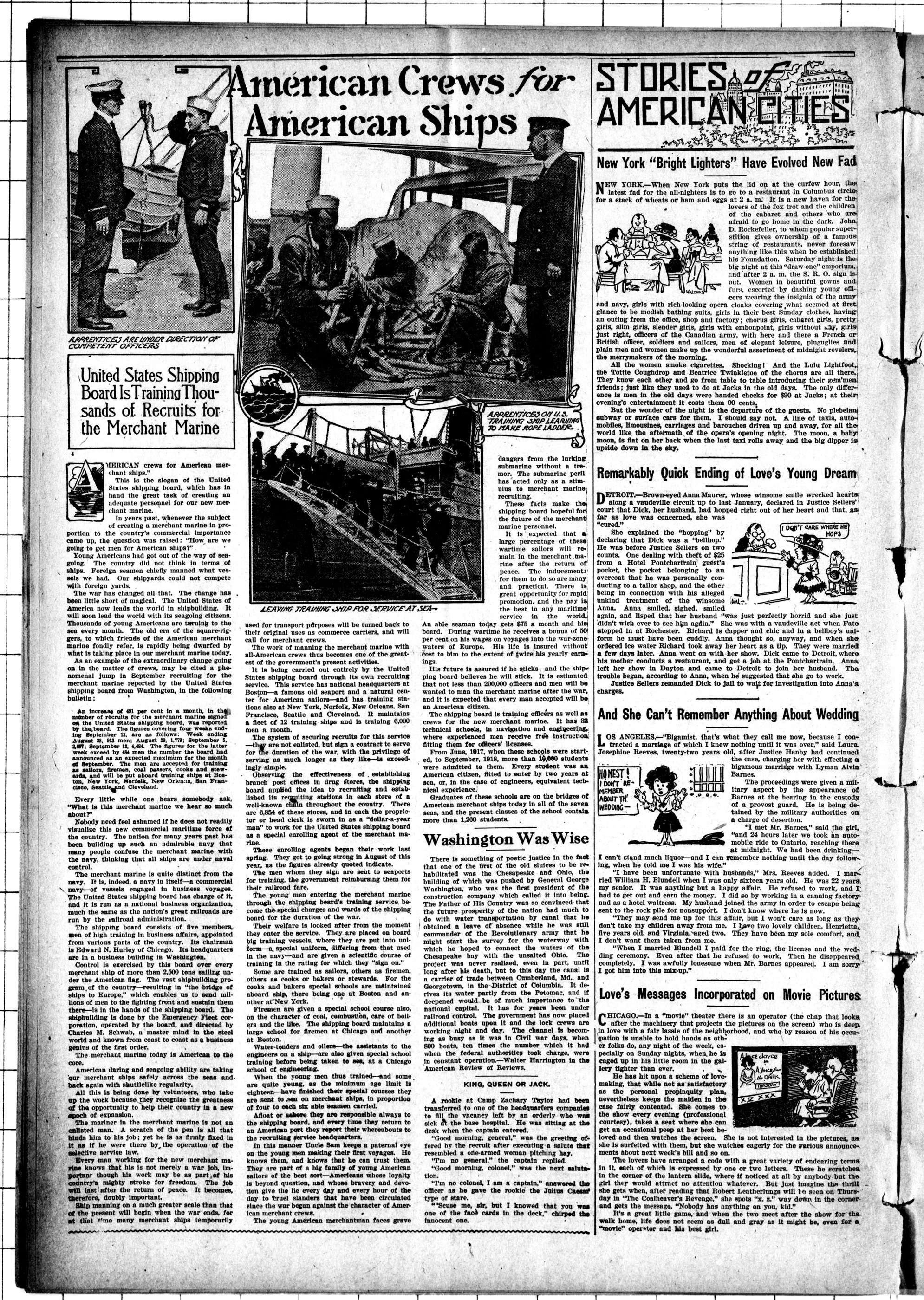
APPRENTICES ARE UNDER DIRECTION OF COMPETENT OFFICERS
United States Shipping Board Is Training Thousands of Recruits for the Merchant Marine
A
MERICAN crews for American merchant ships."
This is the slogan of the United States shipping board, which has in hand the great task of creating an adequate personnel for our new merchant marine.
In years past, whenever the subject of creating a merchant marine in proportion to the country's commercial importance came up, the question was raised: "How are we going to get men for American ships?"
Young Americans had got out of the way of seagoing. The country did not think in terms of ships. Foreign seamen chiefly manned what vessels we had. Our shipyards could not compete with foreign yards.
The war has changed all that. The change has been little short of magical. The United States of America now leads the world in shipbuilding. It will soon lead the world with its seagoing citizens. Thousands of young Americans are turning to the sea every month. The old era of the square-riggers, to which friends of the American merchant marine fondly refer, is rapidly being dwarfed by what is taking place in our merchant marine today. As an example of the extraordinary change going on in the matter of crews, may be cited a phenomenal jump in September recruiting for the merchant marine reported by the United States shipping board from Washington, in the following bulletin:
An increase of 491 per cent in a month, in the number of recruits for the merchant marine signed on the United States shipping board, was reported by the board. The figures covering four weeks ending September 12, are as follows: Week ending August 22, 93 men; August 20, 1,177; September 2, 4,67; September 12, 4,484. The figures for the latter week exceed by 644 men the number the board had announced as an expected maximum for the month of September. The men are accepted for training as sailors, firemen, coal passers, cooks and stewards, and will be put aboard training ships at Boston, New York, Norfolk, New Orleans, San Francisco, Seattle and Cleveland.
Every little while one hears somebody ask, "What is this merchant marine we hear so much about?"
Nobody need feel ashamed if he does not readily visualize this new commercial maritime force of the country. The nation for many years past has been building up such an admirable navy that many people confuse the merchant marine with the navy, thinking that all ships are under naval control.
The merchant marine is quite distinct from the navy. It is, indeed, a navy in itself—a commercial navy—of vessels engaged in business voyages. The United States shipping board has charge of it, and it is run as a national business organization, much the same as the nation's great railroads are run by the railroad administration.
The shipping board consists of five members, men of high training in business affairs, appointed from various parts of the country. Its chairman is Edward N. Hurley of Chicago. Its headquarters are in a business building in Washington.
Control is exercised by this board over every merchant ship of more than 2,500 tons sailing under the American flag. The vast shipbuilding program of the country—resulting in "the bridge of ships to Europe," which enables us to send millions of men to the fighting front and sustain them there—is in the hands of the shipping board. The shipbuilding is done by the Emergency Fleet corporation, operated by the board, and directed by Charles M. Schwab, a master mind in the steel world and known from coast to coast as a business genius of the first order.
The merchant marine today is American to the core.
American daring and seagoing ability are taking our merchant ships safely across the seas and back again with shuttielike regularity.
All this is being done by volunteers, who take up the work because they recognize the greatness of the opportunity to help their country in a new epoch of expansion.
The mariner in the merchant marine is not an enlisted man. A scratch of the pen is all that binds him to his job; yet he is as firmly fixed in it as if he were there by the operation of the selective service law.
Every man working for the new merchant marine knows that his is not merely a war job, important though his work may be as part of his country's mighty stroke for freedom. The job will last after the return of peace. It becomes, therefore, doubly important.
Ship manning on a much greater scale than that of the present will begin when the war ends, for at that time many merchant ships temporarily
American Crews for American Ships
THE SHIP'S SAILING TEAM
THE STAIRS
used for transport purposes will be turned back to their original uses as commerce carriers, and will call for merchant crews.
The work of manning the merchant marine with all-American crews thus becomes one of the greatest of the government's present activities.
It is being carried out entirely by the United States shipping board through its own recruiting service. This service has national headquarters at Boston—a famous old seaport and a natural center for American sailors—and has training stations also at New York, Norfolk, New Orleans, San Francisco, Seattle and Cleveland. It maintains a fleet of 12 training ships and is training 6,000 men a month.
The system of securing recruits for this service—they are not enlisted, but sign a contract to serve for the duration of the war, with the privilege of serving as much longer as they like—is exceedingly simple.
Observing the effectiveness of establishing branch post offices in drug stores, the shipping board applied the idea to recruiting and established its recruiting stations in each store of a well-known chain throughout the country. There are 6,854 of these stores, and in each the proprietor or head clerk is sworn in as a "dollar-a-year man" to work for the United States shipping board as a special enrolling agent of the merchant marine.
These enrolling agents began their work last spring. They got to going strong in August of this year, as the figures already quoted indicate.
The men whom they sign are sent to seaports for training, the government reimbursing them for their railroad fare.
The young men entering the merchant marine through the shipping board's training service, become the special charges and wards of the shipping board for the duration of the war.
Their welfare is looked after from the moment they enter the service. They are placed on board big training vessels, where they are put into uniform—a special uniform, differing from that used in the navy—and are given a scientific course of training in the rating for which they "sign on."
Some are trained as sailors, others as firemen, others as cooks or bakers or stewards. For the cooks and bakers special schools are maintained aboard ship, there being one at Boston and another at New York.
Firemen are given a special school course also, on the character of coal, combustion, care of boilers and the like. The shipping board maintains a large school for firemen at Chicago and another at Boston.
Water-tenders and oilers—the assistants to the engineers on a ship—are also given special school training before being taken to sea, at a Chicago school of engineering.
When the young men thus trained—and some are quite young, as the minimum age limit is eighteen—have finished their special courses they are sent to, sea on merchant ships, in proportion of four to each six able seamen carried. Afloat or ashore they are responsible always to the shipping board, and every time they return to an American port they report their whereabouts to the recruiting service headquarters. In this manner Uncle Sam keeps a paternal eye on the young men making their first voyages. He knows them, and knows that he can trust them. They are part of a big family of young American sailors of the best sort—Americans whose loyalty is beyond question, and whose bravery and devotion give the lie every day and every hour of the day to cruel slanders that have been circulated since the war began against the character of American merchant crews. The young American merchantman faces grave
dangers from the lurking submarine without a tremor. The submarine peril has acted only as a stimulus to merchant marine recruiting. These facts make the shipping board hopeful for the future of the merchant marine personnel. It is expected that a large percentage of these wartime sailors will remain in the merchant, marine after the return of peace. The inducements for them to do so are many and practical. There is great opportunity for rapid promotion, and the pay is the best in any maritime service in the world.
An able seaman today gets $75 a month and his board. During wartime he receives a bonus of 50 per cent on his wages on voyages into the war-zone waters of Europe. His life is insured without cost to him to the extent of twice his yearly earnings.
His future is assured if he sticks—and the shipping board believes he will stick. It is estimated that not less than 200,000 officers and men will be wanted to man the merchant marine after the war, and it is expected that every man accepted will be an American citizen.
The shipping board is training officers as well as crews for the new merchant marine. It has 32 technical schools, in navigation and engineering, where experienced men receive free instruction fitting them for officers' licenses.
From June, 1917, when these schools were started, to September, 1918, more than 19,000 students were admitted to them. Every student was an American citizen, fitted to enter by two years at sea, or, in the case of engineers, equivalent technical experience.
Graduates of these schools are on the bridges of American merchant ships today in all of the seven seas, and the present classes of the school contain more than 1,200 students.
Washington Was Wise
There is something of poetic justice in the fact that one of the first of the old sluices to be rehabilitated was the Chesapeake and Ohio, the building of which was pushed by General George Washington, who was the first president of the construction company which called it into being. The Father of His Country was so convinced that the future prosperity of the nation had much to do with water transportation by canal that he obtained a leave of absence while he was still commander of the Revolutionary army that he might start the survey for the waterway with which he hoped to connect the waters of the Chesapeake bay with the unsalted Ohio. The project was never realized, even in part, until long after his death, but to this day the canal is a carrier of trade between Cumberland, Md., and Georgetown, in the District of Columbia. It derives its water partly from the Potomac, and if deepened would be of much importance to the national capital. It has for years been under railroad control. The government has now placed additional boats upon it and the lock crews are working night and day. The channel is becoming as busy as it was in Civil war days, when 800 boats, ten times the number which it had when the federal authorities took charge, were in constant operation. Walter Harrington in the American Review of Reviews.
KING, QUEEN OR JACK.
A rookie at Camp Zachary Taylor had been transferred to one of the headquarters companies to fill the vacancy left by an orderly who was sick at the base hospital. He was sitting at the desk when the captain entered.
"Good morning, general," was the greeting offered by the recruit after executing a salute that resembled a one-armed weman pitching hay.
"I'm no general," the captain replied.
"Good morning, colonel," was the next salutation.
"I'm no colonel, I am a captain," answered the officer as he gave the rookie the Julius Caesar type of stare.
"Scuse me, sir, but I knowed that you was one of the face cards in the deck," chirped the innocent one.
STORIES of AMERICAN CITIES
New York "Bright Lighters" Have Evolved New Fad
NEW YORK.—When New York puts the lid on at the curfew hour, the latest fad for the all-nighters is to go to a restaurant in Columbus circle for a stack of wheats or ham and eggs at 2 a. m. It is a new haven for the
and navy, girls with rich-looking opera cloaks covering, what seemed at first glance to be modish bathing suits, girls in their best Sunday clothes, having an outing from the office, shop and factory; chorus girls, cabaret girls, pretty girls, slim girls, slender girls, girls with embonpoint, girls without any, girls just right, officers of the Canadian army, with here and there a French or British officer, soldiers and sailors, men of elegant leisure, pluggiles and plain men and women make up the wonderful assortment of midnight revelers, the merrymakers of the morning.
All the women smoke cigarettes. Shocking! And the Lulu Lightfoot, the Tottle Coughdrop and Beatrice Twinkletoe of the chorus are all there. They know each other and go from table to table introducing their gem'men friends; just like they used to do at Jacks in the old days. The only difference is men in the old days were handed checks for $90 at Jacks; at their evening's entertainment it costs them 90 cents.
But the wonder of the night is the departure of the guests. No plebeian subway or surface cars for them. I should say not. A line of taxis, automobiles, limousines, carriages and barouches driven up and away, for all the world like the aftermath of the opera's opening night. The moon, a baby moon, is flat on her back when the last taxi rolls away and the big dipper is upside down in the sky.
Remarkably Quick Ending of Love's Young Dreams
Remarkably Quick Ending of Love's Young Dreams
DETROIT.—Brown-eyed Anna Maurer, whose winsome smile wrecked hearts along a vaudeville circuit up to last January, declared in Justice Sellers' court that Dick, her husband, had hopped right out of her heart and that, as far as love was concerned, she was
again, and lisped that her husband "was just perfectly horrid and she just didn't wish ever to see him agin." She was with a vaudeville act when Fate stopped in at Rochester. Richard is dapper and chic and in a bellboy's uniform he must have been cuddly. Anna thought so, anyway, and when she ordered ice water Richard took away her heart as a tip. They were married a few days later. Anna went on with her show. Dick came to Detroit, where his mother conducts a restaurant, and got a job at the Pontchartrain. Anna left her show in Dayton and came to Detroit to join her husband. The trouble began, according to Anna, when he suggested that she go to work.
Justice Sellers remanded Dick to jail to wait for investigation into Anna's charges.
And She Can't Remember Anything About Wedding
And She Can't Remember Anything About Wedding
OS ANGELES.—"Bigamist, that's what they call me now, because I contracted a marriage of which I knew nothing until it was over," said Laura. Josephine Reeves, twenty-two years old, after Justice Hanby had continued
I can't stand much liquor—and I can remember nothing until the day following, when he told me I was his wife.
"I have been unfortunate with husbands," Mrs. Reeves added. I married William H. Blundell when I was only sixteen years old. He was 22 years my senior. It was anything but a happy affair. He refused to work, and I had to get out and earn the money. I did so by working in a canning factory and as a hotel waitress. My husband joined the army in order to escape being sent to the rock pile for nonsupport. I don't know where he is now.
"They may send me up for this affair, but I won't care as long as they don't take my children away from me. I have two lovely children, Henrietta, five years old, and Virginia, aged two. They have been my sole comfort, and I don't want them taken from me.
"When I married Blundell I paid for the ring, the license and the wedding ceremony. Even after that he refused to work, Then he disappeared completely. This was awfully lonesome when Mr. Barnes appeared. I am sorry, I got him into this mix-up."
Love's Messages Incorporated on Movie Pictures
Love's Messages Incorporated on Movie Pictures
CHICAGO—In a "movie" theater there is an operator (the chap that looks after the machinery that projects the pictures on the screen) who is deep in love with a fair lassie of the neighborhood, and who by reason of his occupation is unable to hold hands as oth-
loved and then watches the screen. She is not interested in the pictures, as she is surffted with them, but she watches eagerly for the various announcements about next week's bill and so on.
The lovers have arranged a code with a great variety of endearing terms in it, each of which is expressed by one or two letters. These he scratches in the corner of the lantern slide, where if noticed at all by anybody but the girl they would attract no attention whatever. But just imagine the thrill she gets when, after reading that Robert Leatherlungs will be seen on Thursday in "The Coalheaver's Revenge," she spots "x. z." way down in the corner and gets the message, "Nobody has anything on you, kid."
It's a great little game, and when the two meet after the show for the walk home, life does not seem as dull and gray as it might be, even for a "movie" operator and his best girl.
WALTERS
and navy, girls with rich-looking opera glance to be modish bathing suits, girls an outing from the office, shop and fact girls, slim girls, slender girls, girls with just right, officers of the Canadian army British officer, soldiers and sailors, mplain men and women make up the wont the merrymakers of the morning.
All the women smoke cigarettes, the Tottie Coughdrop and Beatrice Tw They know each other and go from tail friends; just like they used to do at Jaence is men in the old days were hard evening's entertainment it costs them But the wonder of the night is the subway or surface cars for them. I s mobiles, limousines, carriages and baro world like the aftermath of the opera moon, is flat on her back when the last upside down in the sky.
Remarkably Quick Ending
DETROIT.—Brown-eyed Anna Maurer, along a vaudeville circuit up to las court that Dick, her husband, had hop far as love was concerned, she was "cured."
She explained the "hopping" by declaring that Dick was a "bellhop." He was before Justice Sellers on two counts. One dealing with theft of $25 from a Hotel Pontchartrain guest's pocket, the pocket belonging to an overcoat that he was personally conducting to a tailor shop, and the other being in connection with his alleged unkind treatment of the winsome Anna. Anna smiled, sighed, smiled
again, and lisped that her husband "we
didn't wish ever to see him agin." She
stepped in at Rochester. Richard is of
form he must have been cuddly. Ann
ordered ice water Richard took away I
a few days later. Anna went on with h
his mother conducts a restaurant, and
left her show in Dayton and came to
trouble began, according to Anna, when
Justice Sellers remanded Dick to ja
charges.
And She Can't Remember
LOS ANGELES.—"Bigamist, that's w
tracted a marriage of which I knew
Josephine Reeves, twenty-two years o
HONEST!
I DON'T RE-
MEMBER
ABOUT TH'
WEDDING—
I can't stand much liquor—and I can not ling, when he told me I was his wife."
"I have been unfortunate with his hried William H. Blundell when I was on my senior. It was anything but a hat had to get out and earn the money. I and as a hotel waitress. My husband j sent to the rock pile for nonsupport. I
"They may send me up for this a don't take my children away from me. five years old, and Virginia, aged two. I don't want them taken from me.
"When I married Blundell I paid ding ceremony. Even after that he r completely. I was awfully lonesome w I got him into this mix-up."
Love's Messages Incorporated
CHICAGO.—In a "movie" theater the after the machinery that projects in love with a fair lassie of the neighbor
patron is unable to hold hands as other folks do, any night of the week, especially on Sunday nights, when he is caged up in his little room in the gallery tighter than ever.
He has hit upon a scheme of lovemaking, that while not as satisfactory as the personal propinquity plan, nevertheless keeps the malden in the case fairly contented. She comes to the show every evening (professional courtesy), takes a seat where she can get an occasional peep at her best be-
loved and then watches the screen. She is surfeited with them, but she waits about next week's bill and so on.
The lovers have arranged a code w in it, each of which is expressed by o in the corner of the lantern slide, when girl they would attract no attention she gets when, after reading that Robe day in "The Coalheaver's Revenge," she and gets the message, "Nobody has an It's a great little game; and when walk home, life does not seem as dul "movie" operator and his best girl.
lovers of the rox trot and the children of the cabaret and others who are afraid to go home in the dark. John D. Rockefeller, to whom popular superstition gives ownership of a famous string of restaurants, never foresaw anything like this when he established his Foundation. Saturday night is the big night at this "draw-one" emporium, and after 2 a. m. the S. R. O. sign is out. Women in beautiful gowns and furs, escorted by dashing young officers wearing the insignia of the army
cloaks covering, what seemed at first
cloaks in their best Sunday clothes, having
history; chorus girls, cabaret girls, pretty
with embonpoint, girls without say, girls
army, with here and there a French or
men of elegant leisure, pluggings and
durable assortment of midnight revelers,
Shocking! And the Lulu Lightfoot,
winkletoe of the chorus are all there,
able to table introducing their gem'men
hacks in the old days. The only differ-
ed checks for $90 at Jacks; at their
90 cents,
the departure of the guests. No plebeian
should say not. A line of taxis, auto-
couches driven up and away, for all the
a's opening night. The moon, a baby
at taxi rolls away and the big dipper is
of Love's Young Dream
a whose winsome smile wrecked hearts
last January, declared in Wrecked Sellers'
aped right out of her heart and that, as
I DON'T CARE WHERE HE HOPS
was just perfectly horrid and she just
she was with a vaudeville act when Fate
draper and chic and in a bellboy's uni-
na thought so, anyway, and when she
her heart as a tip. They were married
her show. Dick came to Detroit, where
got a job at the Pontchartrain. Anna
to Detroit to join her husband. The
he suggested that she go to work.
all to wait for investigation into Anna's.
For Anything About Wedding
what they call me now, because I con-
nothing until it was over," said Laura
old, after Justice Hanby had continued
the case, charging her with effecting a
bigamous marriage with Lyman Alvin
Barnes.
The proceedings were given a military aspect by the appearance of Barnes at the hearing in the custody of a provost guard. He is being detained by the military authorities on a charge of desertion.
"I met Mr. Barnes," said the girl, "and 24 hours later we took an automobile ride to Ontario, reaching there at midnight. We had been drinking—
remember nothing until the day follow-
rusbands," Mrs. Reeves added. I mar-
nly sixteen years old. He was 22 years
appy affair. He refused to work, and I
did so by working in a canning factory
joined the army in order to escape being
I don't know where he is now.
affair, but I won't care as long as they
I have two lovely children, Henrietta,
They have been my sole comfort, and
for the ring, the license and the wed-
refused to work. Then he disappeared
when Mr. Barnes appeared. I am sorry.
Oprated on Movie Pictures
There is an operator (the chap that looks
the pictures on the screen) who is deep
worhood, and who by reason of his occu-
A LICE CLOYCE
IN
A VOICE FROM
THE DARK
TUESDAY
XZ XXX
She is not interested in the pictures, as
atches eagerly for the various announce-
l. with a great variety of endearing terms
one or two letters. These he scratches
are if noticed at all by anybody but the
whatever. But just imagine the thrill
ert Leatherlungs will be seen on Thurs-
se spots "x. z." way down in the corner
anything on you, kid."
In the two meet after the show for the
all and gray as it might be, even for a
WASHINGTON SIDELIGHTS
WASHINGTON—Lou Hall, the young woodcutter in the Fairfax county jail, accused of the murder of fourteen-year-old Eva Roy, near Burke Station, Va., has never read a dime novel and is indifferent to the methods employed by the detectives that figure in fiction.
It was near midnight when Hall had a caller. He saw his cell door opened and the officers were roughly handling a man who appeared to be a prisoner.
"Now get in there," the officers told the prisoner, giving him a push. A quilt for him to sleep on was thrown into the cell, the door was locked and the officers went away.
"What treatment?" the prisoner asked Hall after the offence. "What have you done?" Hall inquired. "Oh, I just murdered a negro down the road," you in here for? "I'm charged with killing a white girl, but I sit, because I didn't do it," Hall told him. Shortly afterward the prisoner went into a trays eyes open wide, and suddenly he gripped the bead and began in a frightened whisper to say: "Look, man, look. I see a ghost. What is it? Ing in here. Don't you see it? It looks like a w Now look, quick; it's the ghost of a young girl." Hall calmly lighted a cigarette and said: "No, don't believe you do, either." Outside the cell, within earshot, a Washing county officials were listening. In fact, they stit o'clock in the morning, when they turned in, man Hall later told his counsel: "I lost a night's rest, but I was mighty glad I get awful lonesome in that jail. I wish they would kill time."
Has All Sorts of Scientific Laws
AMONG a city full of government officials noted the best sense of that term, Dr. William Consistent in the United States bureau of fisheries, he
"What do you think of this sort of after the officers retired. required. in the road," was the reply. "What are you girl, but I don't know anything about him. at into a trance; he stared at Hall with helped the bed springs with both hands say: What is it? See, there it is. It's combs like a woman. It's getting nearer. young girl." said: "No, I don't see anything, and I a Washington private detective and act, they strained their ears until five met in, marveling at Hall's composure. Nightly glad to have company, because I they would send in others to help me
Intific Lore Packed Away
officials noted for being "many-sided," in William Converse Kendall, scientific as fisheries, holds a secure place. Ichthy-
treatment?" the prisoner asked Hall after the officers retired.
"What have you done?" Hall inquired.
"Oh, I just murdered a negro down the road," was the reply. "What are you in here for?"
"I'm charged with killing a white girl, but I don't know anything about it, because I didn't do it." Hall told him.
Shortly afterward the prisoner went into a trance; he stared at Hall with eyes open wide, and suddenly he gripped the bed springs with both hands and began in a frightened whisper to say:
"Look, man, look. I see a ghost. What is it? See, there it is. It's coming in here. Don't you see it? It looks like a woman. It's getting nearer. Now look, quick; it's the ghost of a young girl."
Hall calmly lighted a cigarette and said: "No, I don't see anything, and I don't believe you do, either."
Outside, the cell, within carshot, a Washington private detective and county officials were listening. In fact, they strained their ears until five o'clock in the morning, when they turned in, marveling at Hall's composure. Hall later told his counsel:
"I lost a night's rest, but I was mighty glad to have company, because I get awful lonesome in that jail. I wish they would send in others to help me kill time."
Has All Sorts of Scientific Lore Packed Away
AMONG a city full of government officials noted for being "many-sided," in the best sense of that term, Dr. William Converse Kendall, scientific assistant in the United States bureau of fisheries, holds a secure place. Ichthyologist is, of course, his regular job.
ply on ichthyology, and considered of D. He started out as a schoolteacher, beside line to his scientific researches, a Lake, Me. And Maine guilde." You've got to know a that title. Sort of post-graduate boy to the woods to hunt out some new fish with us, Doctor Kendall?" a young The party was all ready to start out. many miles is it?" replied, the doctor. "And anything below five sunny," asked him gravely what he did gravity: old china."
tering So Much, After All
a load of hay. Midway of Thirteenth stepped from the pavement and calledave heard her, for the horses kept on
author of books and pamphlets, mostly on ichtit great value by scientists. He is an M. D. He star and used to run, I am told, a sort of side line to big summer camp for boys at Sebago Lake, Me. He is proud of his title of "licensed Maine gut good deal about the big woods to get that title, scout. When Doctor Kendall goes into the woods he can do his own guiding. "Won't you come and take a hike with us, woman friend asked him one morning. The party "Hike?" replied the doctor. "How many rolls
author of books and pamphlets, mostly on ichthyology, and considered of great value by scientists. He is an M. D. He started out as a schoolteacher, and used to run, I am told, a sort of side line to his scientific researches, a big summer camp for boys at Sebago Lake, Me.
He is proud of his title of "licensed Maine guide." You've got to know a good deal about the big woods to get that title. Sort of post-graduate boy scout. When Doctor Kendall goes into the woods to hunt out some new fish he can do his own guilding.
"Won't you come and take a hike with us, Doctor Kendall?" a young woman friend asked him one morning. The party was all ready to start out. "Hike?" replied the doctor. "How many miles is it?"
"Between five and ten miles," she replied.
"Oh, you mean a ramble," replied the doctor. "And anything below five miles is a stroll."
A friend of mine, wishing to be "funny," asked him gravely what he did for "relaxation."
Doctor Kendall replied with equal gravity:
"I study modern Greek and collect old china."
Stout Lady Wasn't Interfering So Much, After All
A COUNTRIFIED team was hauling a load of hay. Midway of Thirteenth street a comfortably stout woman stepped from the pavement and called on the driver to stop. He couldn't have heard her, for the horses kept on
Stout Lady Wasn't Interfering So Much, After All
ACOUNTRIFIED team was hauling a load of hay. Midway of Thirteenth street a comfortably stout woman stepped from the pavement and called on the driver to stop. He couldn't have heard her, for the horses kept on jogging. Then the woman ran in front of the team with both hands and voice raised high and shouted to the hay man:
"Stop, there! Stop, I tell you! I want to speak to you."
The driver and his horses doubtless had conscientious scruples about running down stout ladies, for the wheels stopped and the lean and somewhat stiff-jointed farmer man climbed down and stood politely, hat in hand, to take the lady's orders. And while
to take the
the two were at their interview a couple of men
put in a few comments:
"Td like to know what right that woman has
He is treating his horses all right. There ought
meddling."
"That's what I tell my wife, but it's no use
they take a notion to do what their clubs call civ
While they jabbered another passer-by, who
the woman and listen to her critics, felt such a
that she waited until the stout woman returned to
driver had been bucking into the rules of the S. P.
with a joyous humor that was good to hear:
"My soul and body, no! That's old man Jim
as ever lived, only you have to holler at him now-
buys hay from him for his horse, and I wanted him
Then the passer-by went her way, feeling ash
of those ill-judging men.
Proof That Some Statesmen Can
IT IS a good wide jump from a Maryland ox car
throw of the capitol, but a woman made the I
telling another woman about it—in a street car
the two were at their interview a couple of men on the sidewalk stopped to
tout in a few comments:
ople of men on the sidewalk stopped to woman has to interfere with that man. There ought to be a law to stop such it's no use trying to stop them, onceubs call civic work."er-by, who had also lingered to watch felt such a vital yearning for details returned to the bricks to ask if the old of the S. P. C. A. The woman laughed hear: old man Jimpson, as fine an old fellow at him now—he's so deaf. My brother wanted him to know our new address,"feeling ashamed of the rude curiosity
men Can't Write Speeches
land ox cart to a flat within a stone's made the leap a week ago. She was street car: "I was rounding up my
"Id like to know what right that woman has to interfere with that man. He is treating his horses all right. There ought to be a law to stop such meddling."
"That's what I tell my wife, but it's no use trying to stop them, once they take a notion to do what their clubs call civic work."
While they jabbered another passer-by, who had also lingered to watch the woman and listen to her critics, felt such a vital yearning for details that she waited until the stout woman returned to the bricks to ask if the old driver had been bucking into the rules of the S. P. C. A. The woman laughed with a joyous humor that was good to hear:
"My soul and body, no! That's old man Jimpson, as fine an old fellow as ever lived, only you have to holler at him now—he's so deaf. My brother buys hay from him for his horse, and I wanted him to know our new address."
Then the passer-by went her way, feeling ashamed of the rude curiosity of those ill-hudging men.
Proof That Some Statesmen Can't Write Speeches
Proof That Some Statesmen Can't Write Speeches
IT IS a good wide jump from a Maryland ox cart to a flat within a stone's throw of the capitol, but a woman made the leap a week ago. She was telling another woman about it—in a street car: "I was rounding up my turkeys that had strayed out on the main road, when Uncle Tip, our farm-hand, came along with the empty ox cart, after hauling a hoghead of tobacco to the boat. The post office is up that way and, for a wonder, he had a letter for me. I don't get many letters and, as for invitations, I reckon this one was about my first. It took my cousin just one page to let me know that his wife was down with the influenza and that, being head over
curse her in consideration of my board—and it's a good thing I came, right or poor Jack, I don't see how he gets on, which makes his work awfully hard, the other a Republican, and he has to representatives, it stands to reason that a and possesses inside information which of representatives should their names to peck at.
as he would like to, and if I would nurse her in consideration of my board and the sights he could show me, why—and it's a good thing I came right away. Henry's awful sick, and as for poor Jack, I don't see how he gets through-secretary for two congressmen, which makes his work awfully hard, especially as one is a Democrat and the other a Republican, and he has to write speeches for both.
as he would like to, and if I would nurse her in and the sights he could show me, why—and it's away. Henny's awful sick, and as for poor Jack through—secretary for two congressmen, which me especially as one is a Democrat and the other a write speeches for both."
And as she named the two representatives, certain passenger in the seat behind possesses might prove embarrassing to a couple of represen be held up for those traditional daws to peck at
And as she named the two representatives, it stands to reason that a certain passenger in the seat behind possesses inside information which might prove embarrassing to a couple of representatives should their names be held up for those traditional daws to peck at.
Which they won't be.
ON LOOKT
IN GHOST
!!
ologist is, or course, his regular job, and what he knows about fishes, large and small, would fill the ocean and rivers, friends declare.
He also is a botanist. Flowers are a sort of hobby with him. He knows and loves them all, violet, rose, lily, etc., along with those that haven't such pretty names. Friends who tell me about Doctor Kendall say that although he doesn't pretend to be a flower expert, he really knows more about botany than many experts. He is the
STOP!
turkeys that had strayed out on the main road, when Uncle Tip, our farmhand, came along with the empty ox cart, after hauling a hogshead of tobacco to the boat. The post office is up that way and, for a wonder, he had a letter for me. I don't get many letters and, as for invitations, I reckon this one was about my first. It took my cousin just one page to let me know that his wife was down with the influenza and that, being head over ears in work, he couldn't wait on her
Which they won't be.
PUBLIC SCHOOL
MAL
WHAT CAN WE DO?
Ultra Smart Cape of Mink Fur
M
Women who live near the cantonments have found several ways of making themselves very helpful to the boys stationed in their vicinity. So many of the boys have left home for the first time and so many of them miss the homemade bread, pies, cookies and things that mother used to make. Women who cannot give time away from home to canteen work are making themselves popular with the soldier lads) by baking for them. They make sandwiches of homemade bread and boiled ham or other meats, and all sorts of ples. Of course it is necessary to charge enough for them to cover the expense both of the materials and the fuel and those who have tried the experiment have sold the sandwiches for ten cents each and a generous piece of ple for the same price. The boys will spend their money for things to eat and consider good, substantial homemade things a special dispensation of Providence. Women who have tried this have won their way into the hearts of many a
Ultra Smart Cap
Among the high-priced furs that may be regarded as a really safe and good investment, Russian sable and mink have placed themselves firmly in the minds of women, as unquestioned. They are about as secure as a government bond and must inevitably increase in price, since the increase in wealth and in demand for fine furs outstrips that in available pelts. Even in these times women do not regard the finest furs as a luxury and do not anticipate that their price will be lowered after the war. Furriers sell readily all the skins they have bought and made up and wish there were more of them.
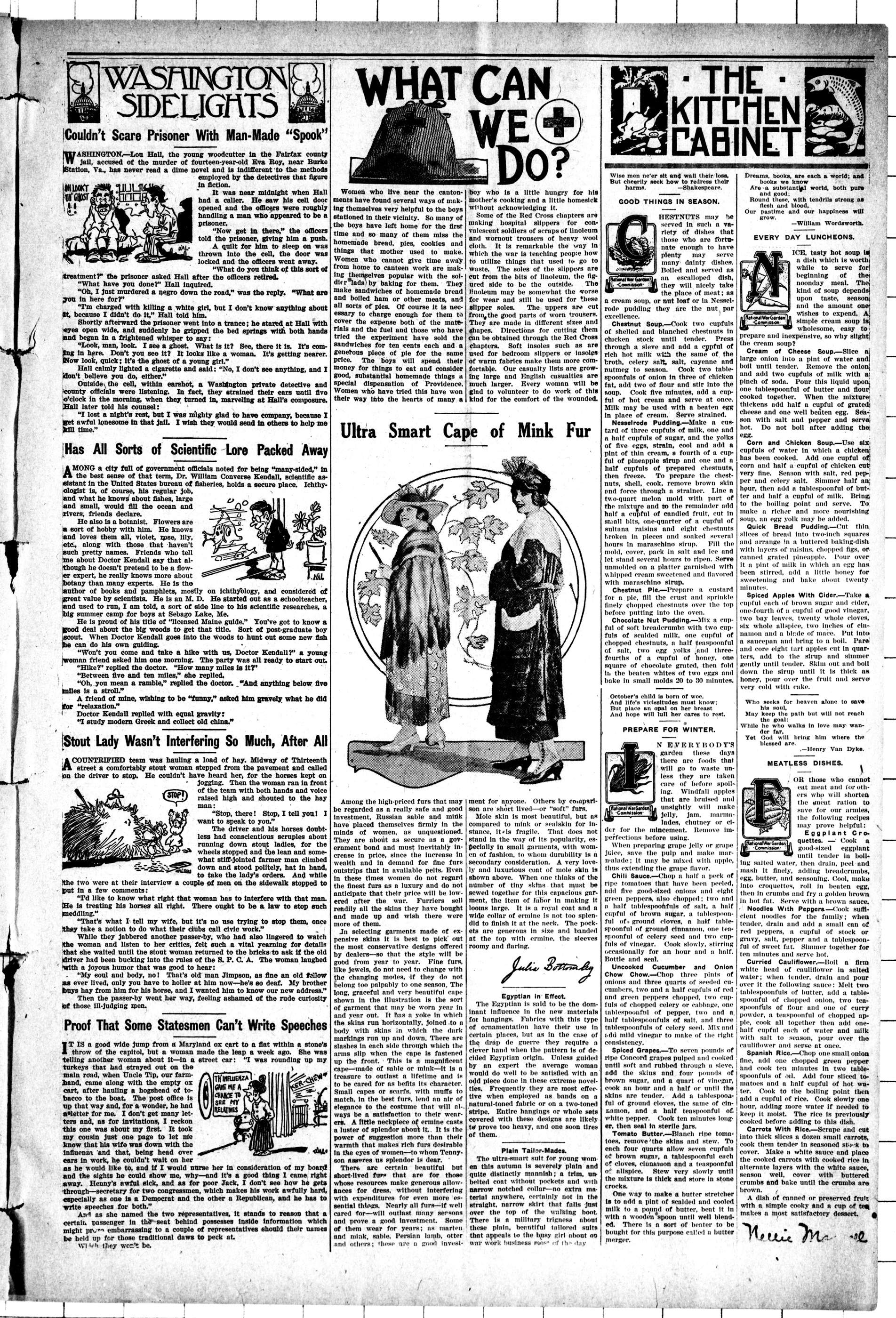
In selecting garments made of expensive skins it is best to pick out the most conservative designs offered by dealers—so that the style will be good from year to year. Fine furs, like jewels, do not need to change with the changing modes, if they do not belong too palpably to one season. The long, graceful and very beautiful cape shown in the illustration is the sort of garment that may be worn year in and year out. It has a hoke in which the skins run horizontally, joined to a body with skins in which the dark markings run up and down. There are slashes in each side through which the arms slip when the cape is fastened up the front. This is a magnificent cape—made of sable or mlnk—it is a treasure to outlast a lifetime and is to be cared for as befits its character. Small capes or scarfs, with muffs to match, in the best furs, lend an air of elegance to the costume that will always be a satisfaction to their wearers. A little neckpiece of ermine casts a luster of splendor about it. It is the power of suggestion more than their warmth that makes rich furs desirable in the eyes of women—to whom Tennyson assures us splendor is dear.
There are certain beautiful but short-lived furs that are for those whose resources make generous allowances for dress, without interfering with expenditures for even more essential thiegs. Nearly all furs—if well cared for—will outlast many seasons and prove a good investment. Some of them wear for years; as marten and mink, sable, Persian lamb, otter and others; these are a good invest-
boy who is a little hungry for his mother's cooking and a little homesick without acknowledging it.
Some of the Red Cross chapters are making hospital slippers for convalescent soldiers of scraps of linoleum and wornout trousers of heavy wool cloth. It is remarkable the way in which the war is teaching people how to utilize things that used to go to waste. The soles of the slippers are cut from the blits of linoleum, the figured side to be the outside. The linoleum may be somewhat the worse for wear and still be used for these slipper soles. The uppers are cut from the good parts of worn trousers. They are made in different sizes and shapes. Directions for cutting them can be obtained through the Red Cross chapters. Soft insoles such as are used for bedroom slippers or insoles of warm fabrics make them more comfortable. Our casualty lists are growing large and English casualties are much larger. Every woman will be glad to volunteer to do work of this kind for the comfort of the wounded.
oe of Mink Fur
ment for anyone. Others by coaparlson are short lived—or "soft" furs. Mole skin is most beautiful, but as compared to mink or sealskin for instance, it is fragile. That does not stand in the way of its popularity, especially in small garments, with women of fashion, to whom durability is a secondary consideration. A very lovely and luxurious coat of mole skin is shown above. When one thinks of the number of tiny skins that must be sewed together for this capacious garment, the item of labor in making it looms large. It is a royal coat and a wide collar of ermine is not too splendid to finish it at the neck. The pockets are generous in size and banded at the top with ermine, the sleeves roomy and flaring.
Julie Bottomly
Egyptian in Effect
The Egyptian is said to be the dominant influence in the new materials for hangings. Fabrics with this type of ornamentation have their use in certain places, but as in the case of the drape de guerre they require a clever hand when the pattern is of decided Egyptian origin. Unless guided by an expert the average woman would do well to be satisfied with an odd piece done in these extreme novelties. Frequently they are most effective when employed as bands on a natural-toned fabric or on a two-toned stripe. Entire hangings or whole sets covered with these designs are likely to prove too heavy, and one soon tones of them.
Plain Tailor-Mades.
The ultra-smart suit for young women this autumn is severely plain and quite distinctly mannish; a trim, unbelted coat without pockets and with narrow notched collar—no extra material anywhere, certainly not in the straight, narrow skirt that falls just over the top of the walking boot. There is a military trigness about these plain, beautiful tailored suits that appeals to the busy girl about on war work business most of the day
THE KITCHEN CABINET
Wise men ne'er sit and lift their loss,
But butterly seek how to shake their
hair.
GOOD THINGS IN SEASON.
HESTNUTS may be served in such a variety of dishes that those who are fortunate enough to have plenty may serve many dalty dishes. Bolled and served as an escalloped dish, they will nicely take the place of meat; as a cream soup, or nut loaf or in Nesselrode pudding they are the nut par excellence.
Chestnut Soup—Cook two cupfuls of shelled and blanched chestnuts in chicken stock until tender. Press through a sleeve and add a cupful of rich hot milk with the same of the broth, celery salt, salt, cayenne and nutmeg to season. Cook two tablespoonfuls of onion in three of chicken fat, add two of flour and stir into the soup. Cook five minutes, add a cupful of hot cream and serve at once. Milk may be used with a beaten egg in place of cream. Serve strained.
Nesselrode Pudding.—Make a custard of three cupfuls of milk, one and a half cupfuls of sugar, and the yolks of five eggs, strain, cool and add a plint of thin cream, a fourth of a cupful of pineapple sirup and one and a half cupfuls of prepared chestnuts, then freeze. To prepare the chestnuts, shell, cook, remove brown skin and force through a strainer. Line a two-quart melon mold with part of the mixture and to the remainder add half a cupful of candied fruit, cut in small bits, one-quarter of a cupful of sultana raisins and eight chestnuts broken in pieces and soaked several hours in maraschino sirup. Fill the mold, cover, pack in salt and ice and let stand several hours to ripen. Serve unmolded on a platter garnished with whipped cream sweetened and flavored with maraschino sirup.
Chestnut Ple.—Prepare a custard for a pie, fill the crust and sprinkle finely chopped chestnuts over the top before putting into the oven.
Chocolate Nut Pudding.—Mix a cupful of soft breadcrumbs with two cupfuls of scaled milk, one cupful of chopped chestnuts, a half teaspoonful of salt, two egg yolks and three-fourths of a cupful of honey, one square of chocolate grated, then fold in the beaten whites of two eggs and bake in small molds 20 to 30 minutes.
October's child is born of woe.
And life's viciastitudes must know;
But place an opal on her breast
And hope will lull her cares to rest.
PREPARE FOR WINTER.
N EVERYBODY'S garden these days there are foods that will go to waste unless they are taken care of before spoiling. Windfall apples that are bruised and unsightly will make jelly, jam, marmalades, chutney or cider for the mincement. Remove imperfections before using. When preparing grape jelly or grape juice, save the pulp and make marmalade; it may be mixed with apple, thus extending the grape flavor.
Chili Sauce.—Chop a half a peck of ripe tomatoes that have been peeled, add five good-sized onions and eight green peppers, also chopped; two and a half tablespoonfuls of salt, a half cupful of brown sugar, a tablespoonful of ground cloves, a half tablespoonful of ground cinnamon, one tablespoonful of celery seed and two cupfuls of vinegar. Cook slowly, stirring occasionally for an hour and a half. Bottle and seal.
Uncooked Cucumber and Onion Chow Chow.—Chop three pints of onions and three quarts of seeded cucumbers, two and a half cupfuls of red and green peppers chopped, two cupfuls of chopped celery or cabbage, one tablespoonful of pepper, two and a half tablespoonfuls of salt, and three tablespoonfuls of celery seed. Mix and add mild vinegar to make of the right consistency.
Spiced Grapes.—To seven pounds of ripe Concord grapes pulped and cooked until soft and rubbed through a sieve, add the skins and four pounds of brown sugar, and a quart of vinegar, cook an hour and a half or until the skins are tender. Add a tablespoonful of ground cloves, the same of cinnamon, and a half teaspoonful of white pepper. Cook ten minutes longer, then seal in sterile jars.
Tomato Butter.—Blanch ripe tomatoes, remove/the skins and stew. To each four quarts allow seven cupfuls of brown sugar, a tablespoonful each of cloves, clinnamon and a teaspoonful of all spice. Stew very slowly until the mixture is thick and store in stone crocks.
One way to make a butter stretcher is to add a pint of scalded and cooled milk to a pound of butter, beat it in with a wooden spoon until well blended. There is a sort of beater to be bought for this purpose called a butter merger.
C
National War Gardens
- Commission-
National War Garden
Commission
E HEN NET
Dreams, books, are each a world; and books we know
Are a substantial world, both pure and good;
Round these, with tendrils strong as flesh and blood.
Our pastime and our happiness will grow.
-William Wordsworth.
EVERY DAY LUNCHEONS.
CEE, tasty hot soup is a dish which is worth while to serve for beginning of the noonday meal. The kind of soup depends upon taste, season and the amount one wishes to expend. A simple cream soup is wholesome, easy to
N
prepare and inexpensive, so why slight the cream soup?
Cream of Cheese Soup.—Slice a large onion into a pint of water and boil until tender. Remove the onion and add two cupfuls of milk with a pinch of soda. Pour this liquid upon one tablespoonful of butter and flour cooked together. When the mixture thickens add half a cupful of grated cheese and one well beaten egg. Season with salt and pepper and serve hot. Do not boil after adding the egg.
Corn and Chicken Soup.—Use six cupfuls of water in which a chicken has been cooked. Add one cupful of corn and half a cupful of chicken cut very fine. Season with salt, red pepper and celery salt. Simmer half an hour, then add a tablespoonful of butter and half a cupful of milk. Bring to the boiling point and serve. To make a richer and more nourishing soup, an egg yolk may be added.
Quick Bread Pudding.—Cut thin slices of bread into two-inch squares and arrange in a buttered baking-dish with layers of raisins, chopped figs, or canned grated pineapple. Pour over it a pint of milk in which an egg has been stirred, add a little honey for sweetening and bake about twenty minutes.
Spiced Apples With Cider—Take a cupful each of brown sugar and cider, one-fourth of a cupful of good vinegar, two bay leaves, twenty whole cloves, six whole allspice, two inches of cinnamon and a blade of mace. Put into a saucepan and bring to a boil. Pare and core eight tart apples cut in quarters, add to the shrup and simmer gently until tender. Skim out and boil down the shrup until it is thick as honey, pour over the fruit and serve very cold with cuke.
Who seeks for heaven alone to save his soul,
May keep the path but will not reach the goal:
While he who walks in love may wander far,
Yet God will bring him where the blessed are. — Henry Van Dyke
MEATLESS DISHES.
OR those who cannot eat meat and for others who will shorten the meat ration to save for our armies, the following recipes may prove helpful:
F
National Miller Garden
Commission.
Eggplant Croquettes. — Cook a good-sized eggplant until tender in boiling salted water, then drain, peel and mash it finely, adding breadcrumbs, egg, butter, and seasoning. Cool, make into croquettes, roll in beaten egg, then in crumbs and fry a golden brown in hot fat. Serve with a brown sauce. Noodles With Peppers—Cook sufficient noodles for the family; when tender, drain and add a small can of red peppers, a cupful of stock or gravy, salt, pepper and a tablespoonful of sweet fat. Simmer together for ten minutes and serve hot.
Curried Cauliflower.—Boil a firm white head of cauliflower in salted water; when tender, drain and pour over it the following sauce: Melt two tablespoonfuls of butter, add a tablespoonful of chopped onion, two tablespoonfuls of flour and one of curry powder, a teaspoonful of chopped apple, cook all together then add one-half cupful each of water and milk with salt to season, pour over the cauliflower and serve at once.
Spanish Rice.—Chop one small onion fine, add one chopped green pepper and cook ten minutes in two tablespoonfuls of oil. Add four sliced tomatoes and a half cupful of hot water. Cook to the boiling point then add a cupful of rice. Cook slowly one hour, adding more water if needed to keep it moist. The rice is previously cooked before adding to this dish.
Carrots With Rice.—Scrape and cut into thick slices a dozen small carrots, cook them tender in seasoned stock to cover. Make a white sauce and place the cooked carrots with cooked rice in alternate layers with the white sauce, season well, cover with buttered crumbs and bake until the crumbs are brown.
A dish of canned or preserved fruit with a simple cooky and a cup of tea makes a most satisfactory dessert.
PUBLISHED EVERY FRIDAY BY
CHARLES SUMNER SMITH.
Minneapolis, Minnesota.
Entered in the Post Office at Minneapolis as second class matter.
MEMBER
NATIONAL NEGRO PRESS
ASSOCIATION
MEMBER
MED
ASSOCIATION
ORGANIZED
1867
ONE YEAR .....$2.00
SIX MONTHS .....$125
THREE MONTHS ......65
ADVERTISING RATES.
One Inch—1 Insertion—One Dollar.
Liberal discount given on 3, 6, 9,
Months, or 1 year contracts.
We do not run free ads, or over-run
the time contracted for by our ad-
vertisers. We respect their right to
advertise at intervals, and rather have
them do so, than to run continuously
an "adv." and an increasing account.
Write all Checks payable to
M:NNEAPOLIS . . . MINNESOTA
Call at 1317-6th Ave. N. on Wednesday to insure matter for publication.
The Star's Phone, Hyland 1205.
Send your subscription. Our prices have not changed because of the war.
Let your dollar do its duty and The Star will reach a higher standard of service and better circulation.
NOTICE TO EXCHANGES.
The War Industries Board requests that we discontinue "sending FREE copies in exchange for other publications." In order to comply with their request—we will send a check for a yearly subscription to any weekly publication sending a check for a yearly subscription to The Twin City Star.—(Editor.)
Let us not draw the color line. Reciprocity between the races will be the salvation of the Negro.
When the Republicans shall employ men and women of our race about their headquarters; appoint them to positions for political patronage; give them fair recognition as other citizens, not claiming their votes as personal property of the party, but realizing it is an important factor and a valuable asset, then they can depend on the Negro to stand by the Republican party. Until then, he will be an unknown quantity.
There will be three congressmen from the Twin Cities who will stand as a stone wall for equal justice for all men—Thos. D. Schall and Walter Newton of Minneapolis and C. C. Van Dyke of St. Paul.
Mr. J. E. Meyers is to be our next mayor. If he is as loyal to the Negro citizens as Mayor Van Lear is to them, he will find them faithful to the end.
The War Department Commission on Training Camp Activities has made provision for the entertainment of a labor battalion of about 1,000 colored troops which has been sent to Camp Kearney, Linda Vista, Cal., for sanitation work around the camp. This battalion is made up of colored men unfit for overseas duty by reason of minor physical disabilities.
BAN ON PUBLIC GATHERINGS.
During the epidemic of Spanish influenza, no public gatherings are allowed. Churches, schools and theatres are closed and all political meetings stopped.
We notice that many of the newcomers from the South are becoming paid subscribers to the Twin City Star. They have been accustomed to patronizing their own newspapers, where the real news of the Negro is published.
If you wish to add to your income, you can do so by accepting an agency for The Twin City Star. Good commission to competent agents. Use your spare time in soliciting ads and subscriptions. Only honest and intelligent agents wanted. Call Hyland 1205.
We have never known two injustices to make anything right. The Saturday News has prepered by being as just to the white man as it has ever been to the Negro. We have never gone off half-cocked upon any proposition. Whenever we grope, we are in search of the truth. We want to be right and avoid as nearly as possible being wrong. We are not for the Negro right or wrong. We want him to be right. We complain because a majority of white people will always side with a white man when a question arises between him and one of our color; still certain colored newspapers, without making any investigation whatsoever as to the evidence, would have the entire Negro race do identically what they condemn the white people for doing. Be cause the white people do wrong is no reason why the Negroes should do wrong. The best preparedness to receive justice is to be just yourself. Hopkinsville (KY.) News.
FIRST COLORED WAR CORRESPONDENT ARRIVES IN FRANCE.
Ralph W. Tyler Off to the Front for News of Our Gallant Soldier Boys and to Tell of Their Valiant
Some Striking Incidents of the Voyage Over.
(By Ralph W. Tyler, Accredited Representative of the Committee on Public Information.)
(Special to The Twin City Star.)
PARIS, France, Sept. 28.—I have just reached this city, after a ten days' voyage, which was, for the most part, uneventful. We experienced delightful weather from the time we steamed out of New York's harbor until we cast anchor in a port over here. Had it not been for the democratic spirit prevailing aboard the big liner, and which gave me a most
JOHN BALDRA V. TURNER
satisfactory taste of this "world democracy" for which the allies are fighting, I might have considered the voyage monotonous. Aboard the ship was quite a galaxy of notable writers for the big dallies and magazines; feature and fiction writers who were taking a respite from that occupation to write "straight stuff" for dallies they are to represent. Among them were celebrities like Will Irwin, Robert W. Ritchie, Damon Runyon, H. J. Foreman, erstwhile managing editor of Collier's, and Applegarth, usually known as "Appy" by the pencil pushers and readers, of the Pittsburgh Post. Each and every one of these notable writers—former newspaper reporters, seemed to have made an especial effort to make me forget—which I did—that my skin was several shades darker than theirs, and by so doing to convince me that this "world democracy" for which the allies are fighting is neither a barren ideality nor a rainbow vision, but an actual probability whose anew courier is discernible with the naked eye. The treatment accorded me by the newspaper men aboard was but typical of the treatment accorded me by all the other passengers. Among the nearly two thousand souls making up the ship's passenger list were many Red Cross, Y. M. C. A., Y. W. C. A., Knights of Columbus and Salvation Army workers. These all displayed a most notable evidence of a healthy spirit of democracy by their fraternizing as if they were all members of the one and same organization. Among the Y. M. C. A. workers aboard were five colored secretaries: Fritz P. Cansier, of Knoxville, Tenn.; Thomas M. Clayton, of Plqua, Ohio; F. L. Clark, of Leavenworth, Kans.; D. D. Mattocks, of Philadelphia, G. W. Jackson, of Louisville, Ky. The Y. M. C. A. certainly made no mistake in selecting these five men for overseas duty, for they represent the highest type in the race, and by their bearing won the respect, and even admiration of all on board the ship.
Diversions by Service Battalion Aboard Ship.
Aboard the ship, also, was a colored service battalion belonging to an engineer regiment. They were stout, husky fellows, whose good humor was effervescent, even contagious, and their rollicking songs and plantation melodies cheered all, making them, those whose thoughts had involuntarily turned to submarines—Germany's acme of kultur, forget them, and banish all fear from their minds. One of the songs which they frequently sang, and with a gusto which gave further evidence of their 100 per cent Americanism, and which never failed to elicit rapturous applause from the white passengers, was "Three Months From Now We Will Be In Germany".
I had heard it said that the big waters frightened Colored soldiers, but these Colored soldiers aboard the ship I sailed appeared as contented, self-centered and care-bereft on the big ship at night, when lights were out as they were down in Alabama, Virginia, Mississippi and other Southern states, from whence most of them came.
Their contentment at sea, and when in the submarine zone, constituted another disillusion. Among these troops were some clever boxers, and the monotony of "just sky and water" was frequently broken by some rattling boxing matches between these troopers for pretty substantial purses, which the white passengers contributed merely out of admiration and respect of these big, brave black boys, who did not fear to come over here to fight for world democracy.
An amusing incident took place the second day out. Forty or fifty of the Colored soldiers had formed a circle and were singing to their hearts' delight, and the delight of the passengers. One of them, seemingly, changed his voice with each song or hymn. "What d> you sing?" called down,
from the upper deck, a good-natured son of the Emerald Isle. Quick as a flash came the answer: "Sometimes I sing bass and sometimes I sing soprano." And it was true, for in the chorus he adapted himself to the type of the song he was singing, to the circumstances, to the other singers, and above all, perhaps, to his mood. Because they were light-hearted—cheerful when going across the big waters, it must not be accepted they were merely light-hearted because of lack of brain development, for many among them were bright, intelligent men, graduates of Howard University and other accredited schools.
FLASHLIGHT
A success is a man to one job long enough
The fellow who traded for new usually gets the bargain.
Any youth who will best will never finish v in the race of life.
It is not nearly so bad on a fool's errand as it fool on a man's errand.
Off to the Front for News of "Our Boys."
I shall tarry but a day or two here in Paris; only until I get my itinerary tentatively made out, and then I shall be off to the front where our Colored soldiers are stationed, and I go to the front with the same absence of fear that characterized the Colored troopers who sailed for France on the ship with me. In my next letter I hope to have been able to secure some real, permissible news about what the Colored soldiers—our boys—have done, and are doing to maintain the race's traditional reputation for bravery, endurance and patriotism, and to help "make the world safe for democracy."
If this world democracy we are fighting for is like the sample I have been made acquainted with, from New York to Paris, I have no doubt that they are putting up a whaling good fight to land the democracy pennant for the United States—our own, and only country.
COLORED APPLICANTS REJECTED
The Bee desires to emphasize its protest against the wholesale discrimination in the Government departments against colored applicants who have successfully passed the civil service examination. What does it mean? The Bee again asks. The colored Americans are loyal to this Government and they are doing everything in their power to aid the Administration in the successful prosecution of this war. What offense can be charged against colored Americans? The Bee asks again. The bars have been lifted so that a certain favored class can pass muster without an examination, while another class is compelled to enter examination and after passing successfully is rejected. What does it mean? A declaration has been reported to this office to the effect that no colored people will be appointed by this particular official. In response to the request made by The Bee last week, many persons have announced that they have been rejected by the departments. It is necessary that every colored person who has been rejected send in his or her name at once. These names will be presented to the proper heads at once.
Advertisements are being published daily that the Government is in need of clerks and other employees for war work. Hundreds of colored Americans have applied and been rejected, and white ones cannot be obtained. Messenger boys have been advertised for and colored people have applied, only to be refused. Is the assistance of colored Americans needed? If so, they are willing and ready to respond to their country's call. If they are needed, and the Government is in need of help, why reject colored applicants? Show one black traitor in the ranks of colored Americans and The Bee will show you one million loyal colored Americans to one black traitor. The Bee appeals to the President of the United States to direct the heads of his departments to lift the bars of discrimination against the colored Americans. They are competent and loyal. Then why reject them?
Every Southern railroad discriminates against the colored people without a just cause. They are treated as cattle when riding South. They are directed to a box car with no conveniences. Does the colored American deserve such treatment? Mr. President, we are with you, and, in the name of God, see that we are given a fair deal.—The Washington (D. C.) Bee.
A Cash Deposit Required on All Advertisements. Notices of Entertainment, etc. Must Be Accompanied by Cash.
Let Your Dollar Do its Duty!
READ THIS CAREFULLY.
If you receive a newspaper by mail and do not wish to pay for it, just refuse it by informing your postman. Then it will be returned to the publisher and he will be notified to discontinue sending it. There is no reason why a person should pay for a paper forced on them, but every reason why it should be paid for when ordered and accepted.
We are living in an age and an epoch which is characterized by a growing and insistent demand for justice and democracy. The United States is sending men, money and munitions to the battle fields of Europe as its demand for justice, freedom and equality of opportunity for all peoples, and it would be well for the Americans at this time to remember that here in our own country for the past fifty years since the abolition of slavery, is a race loyal, patriotic people who are not enjoying at the hands of this government here at home the principles of that democracy for which we are fighting to make the world safe, and in which fight God helping us, we will be victorious.
W. T. FRANCIS
Are you a delinquent subscriber? If so, why not send your subscription?
A success is a man who has stuck to one job long enough to do it well.
The fellow who trades old friends for new usually gets the worst of the bargain.
Any youth who will always do his best will never finish very far behind in the race of life.
It is not nearly so bad to send a man on a fool's errand as it is to send a fool on a man's errand.
The way the allies are charging it from day to day that Hindenburg line has developed into a live wire.
If people believed the good that is said of others as readily as they do the bad it would be a better world.
The man who tries to get satisfaction out of his work usually finds satisfaction in his pay envelope, too.
Men can say all they want to against fattery, but we've never known one who didn't like his full share of it.
There's a lot of fun in spending money but after all the surest way to be happy is always to have money to spend.
Now and then we wonder if the people who run the telephone company have any better luck than we do when they try to use the phone.
The trouble with some folks is that they are always looking for an opportunity to get and missing the greater opportunities to give.
These are days when a woman doesn't dare quarrel with her own husband for fear the servant girl will object to the racket and quit.—Detroit Free Press.
IN OTHER CITIES
Cleveland is employing women park laborers.
Atlantic City insists on stockings for batheys.
New York will build no schools during wartime.
New Orleans finds its climate becoming warmer.
Philadelphia is increasing its force of policewomen.
San Francisco hotels now employ Chinese bellhops.
St. Louis is fighting street car fare raise in the courts.
New York in August recorded 47 fatalities in auto accidents.
Long Branch, N. J., has unveiled a statue of former President Garfield.
Eighty-three women are working in the Philadelphia rapid transit repair shops at Kensington.
Trenton, N. J., church which has for 125 years conducted a morning and afternoon Sunday school has merged the two sessions.
AROUND THE WORLD
Siberia summers are hot.
Siberia has one university.
Philippines have 7,370 bridges.
French factories are planning rebuilding.
Ohio doctors will label their autos Sundays.
Siberia was conquered in 1580 by Russian Cossacks.
American federation of manufacturers is being planned.
FROM THE PENCIL'S POINT
A man who is fearless is never a liar.
Milk is often another name for a white lie.
A jolly good fellow is one who foots the bills.
Many women are single because they are singular.
Some men take an hour to make a ten-minute speech.
A hotel clerk's smile is as meaning-
A South Hot Springs woman is so jealous she makes her husband leave his false teeth at home when he goes out at night.
The Germans are forced to wear paper underwear and eat mullen-leaf soup.—Memphis Commercial-Appeal. Well, this is their war.
Notice! Anyone bringing in three paid-up subscriptions to the Thomas Cat one year will get a free ride out to the cemetery and back.
In a Hot Springs restaurant the other day three of the patrons knocked the coffee, but we don't believe we ever heard a complaint on tea.
How should one address that new woman judge the president has appointed in Washington—"your honoress," "your honorine," or "your honorette?"
To Bessie Fluzzle: If you are a "jealous woman," why employ a "private detective?" You can imagine as much in a minute as he can discover in a year.
There are not many divorces in the homes in which mother spends more time over the cook book than she does over "The Passionate Pups" or some other best seller.
Cheer up! Maybe if you had Jawn Dee Rockefeller's millions and his stomach you would be glad to be poor again and be equipped with the old reliable hash digester you now possess.
When a married woman congratulates a bride, she says: "I hope you will be as happy as I am." A married woman always makes a bold front and hopes no one will suspect the real truth.
In the Snagtown circuit court the other day old John Ruddy, who was up for a divorce case, was asked by the judge what he wanted. John replied that "some six months ago he embarked on the sea of matrimony and now wishes he had missed the boat."
HOME-MADE PHILOSOPHY
If you are troubled with insomnia, join a chess club.
Those who find youth a burden will find old age a curse.
Young birds, like hungry corporations, hold their mouths open for profit.
The people have always crucified their saviors at the bidding of their masters.
To be absolutely free a man must be cut loose from all the so-called facts that cannot be proved true.
If there were 'no heterodoxical cranks to bust the monotony, the established theories would rust for the want of practice.
The man who marries a woman because she is worth $50,000 will soon find out that it was worth more than double the amount.
The thinking men and women who think independent of the thoughts forced upon them are the discoverers of truth and wisdom.
POINTED PARAGRAPHS
We all have our trials—and the lawyer is glad of it.
There is no better mirror than a tried and true friend.
Of all the practices of love, praise is the most dangerous.
Occasional silence would improve some persons' conversation.
Real estate dealers wax fat at the expense of folks who want the earth.
It's a pity that we cannot drop pennies into a slot machine and get a package of joy.
A woman can stand a lot until she gets into a crowded street car where all the seats are occupied by men.
TRADE BRIEFS
Rubber goods are wanted in Switzerland.
Tubs for washing machines are wanted in Canada.
Agencies for the sale of American steel and asbestos are wanted in France.
Belting is now manufactured in Japan in quantities large enough to supply local needs. The low prices of domestically made belting will discourage all foreign competition for this trade.
As a means of establishing the dye industry on a sound basis, the British government plans to advance funds for the benefit of manufacturers. The first installment, a sum of $4,866,500, has been agreed upon.
---
Nothing Changed But the Price
Sight Drafts Still the Same Fine Old Cigar You've Always Liked
When your dealer asks you six cents apiece for your old friend Sight Draft, don't get the idea that he is trying to put something over on you.
The plain truth of the matter is that our labor and other manufacturing costs have increased so much that we had the choice of cutting down the size of the Sight Draft diger, using inferior tobacco, or raising the price one cent.
We believed you would rather have the same old Sight Draft quality, the same old size, even if it cost you a penny more. So, from now on Sight Drafts will be six cents.
Try a Sight Draft today. It's worth six cents, and you experienced smokers KNOW it is. W. K. Greah & Sons, makers. W. S. Conrad Co., St. Paul, wholesale distributors. — Advertisement.
CHOICE CITY AND SUBURBAN PROPERTY FOR SALE ON SMALL MONTHLY PAYMENTS.
802 Sykes Block.
N. W. Nic. 621 Minneapolis
Office Hours: Sundays
9 to 6 p. m. 10 to 1 p. m.
9:30 a. m. to 12:30 p. m.
R. S. BROWN, M. D.
Office 408-9 Tribune Annex
67 Fourth Street Soutr.
N. W. Main 2040. T. S. 38192
Res. 608 E. 14th St.
N. W. Main 2388 Minneapolis
WORKING-MEN'S
SOCIAL CLUB
FOR MEN ONLY
244 3RD AVE. S.
MINNEAPOLIS
SYLVESTER W. OLIVER &
BENJAMIN JONES
Managers
Peterson, The Druggist
1501 Washington Ave. So.
TOILET ARTICLES, DRUGS
PRESCRIPTIONS.
He Solicits Your Patronage.
T. S. Center 4639.
WALFRID WESTMAN
Photographer
1425 Washington Ave. So. Minn.
THE KEYSTONE BUFFET
(Fermerly "Kid" Mitchell's)
Now under new management of
JIMMY SMITH
1313' Washington Ave. So.
Main 2259 Minneapolis
NO
HOT
WATER
"Let's move into a modern house."
A Gas Water Heater
Solves the Problem.
Sold by
The Minneapolis
Gas Light Go.
Are you a delinquent subscriber?
If so, why not send your subscription?
SMOKE THE RELIABLE
SIGHT DRAFT CIGAR
THAT'S ALL
---
IMPORTANT NOTICE
Unless notes are written plainly and properly arranged they will not be inserted. Many people send in notes regardless of names, initials or composition. Arrangement by the publisher will be charged for. Free notices must be correctly written.
A GENERAL MEETING
Crispus Attucks Home Assn.
There will be a special meeting of the Crispus Attucks Home association on Sunday, Nov. 10th, at St. Peter A. M. E. church, at 3 o'clock p. m. Let every church, lodge and women's club send three (3) delegates to represent them at this meeting. All of the pastors of the Twin Cities are asked to be present, as there will be BUSINESS OF IMPORTANCE. If you are a lover of your people, please be present and hear what is being done. Mrs. Geo. Duckett, Pres.
Rev. W. S. Cooper made a great hit in a speech at a political meeting when he did not speak for any candidate, saying that he did not know them. It is the first time that a negro in these parts has held such a pastorate without having a candidate to land, whom he was personally acquainted with, and stood sponsor for his future. Rev. Cooper appealed for the organization of the negro voters to demand square deal from the candidates. His forceful remarks made him many admirers and showed his hearers the causes and effects of the organization of the negro voters.
CARD OF THANKS.
We wish to extend our sincere thanks to relatives, friends and neighbors for the kindness and sympathy shown us at the death of our beloved, the late Mrs. Minnie Neal, also for the beautiful flowers.
William S. Neal and Children.
Mrs. Mattie S. Neal.
COMMISSIONED AS CHAPLAIN.
Rev. O. A. Lawrence, the undertaker, has received a commission as chaplain in the national army and expects to leave Nov. 15 for New York city for oversea duty. Mr. William S. Neal, who has been associated with him, will take charge of the undertaking business at its present location.
FOR RENT—Two Desirable Flats—
Four and Five Room Flats, modern
except heat, on car line, $9 and $12.
Lot on Fourth Ave. S., worth $1,000;
will sacrifice for $700 on terms. $50
down and $10 per month.
McDEW, 702 SYKES BLOCK
Nicollet 621
FLAT FOR RENT—Five rooms and bath; modern except heat, on car line. Apply to Leviton, 1317 Sixth avenue N.
Hon. Chas. Juster and Hon. Joseph Allen are candidates for the Park Board. They are O. K., and deserve your support.
Mr. Geo. E. Jones, the famous chef, has charge of the culinary department at the Waiters and Porters' Club. He has a reputation for his sanitary service. Manager Lee Wheeler has renovated the kitchen and opened a new dining room.
CONDUCTED BY NEW MANAGER.
The dining room of Stewart's Hotel is conducted under new management. Mr. Rueben Griffet has taken charge of the food department and arranged for the best service for ladies and gentlemen. Breakfast begins at 7:30 a. m. A special noon-day lunch and evening dinner will be served. The patronage of the public is solicited. Mr. Griffet invites inspection and guarantees satisfaction.
Boutell Bros. have in their employ a colored lady as elevator operator, who has given very satisfactory service.
Mr. and Mrs. W. H. Briggs have moved to 813 Oak Lake Ave. Mrs. Emma Jeffrey has moved to 807 5th Ave. N.
Mr. and Mrs. Arthur Brown have moved to 1912 4th Ave. S.
Mr. and Mrs. James Burkes have moved to 3013 Garfield Avenue.
Mrs. J. B. Glover of Oakland avenue has moved to 3740 Fourth avenue S.
Mrs. Lulu Maxwell has been appointed one of the social workers of the Associated Charities to look after the interests of the Negroes.
Mr. Everett Roberts, son of late Col. James Roberts, has entered the Students' Army Training Corps, at the University of Minnesota.
Deacon Lewis F. Jones preached his trial sermon at St. Peter A. M. E. Church on Sunday night. Subject, "Preparedness," from Isaiah, 6 chap. 8 vs., "Here Am I, Send Me!" Rev. Stovall and Presiding Elder Higgins commented favorably on his remarks. The audience was small, but very appreciative.
SMOXE THE RELIABLE
BIGHT DRAFT CIGAR
THAT'S ALLI
The members of the Sixteenth Battalion-band, Minnesota Home Guards, gave a smoker at the band headquarters on the evening of Nov. 6th, which was one of the most pleasant gatherings of recent date. A delicious lunch was served. Oyster stew, ham sandwiches, potato salad, ice cream and coffee was especially prepared by Clint Davis. Fred W. Parkinson acted as toastmaster and called on every person for some remarks on the band. Every one expressed himself as being proud of the success and pledged his loyal support for its progress. The toastmaster introduced every speaker in a peculiar way and lent much humor to the occasion. Lleut. W. H. Howard, bandmaster, and Sergt. Wm. Moden spoke briefly. Eddie Davis led a chorus. He was full of fun and congeniality. Prof. Wm. Moore, the pianist, rendered a jazz selection. "Art" Bladseer favored with a guitar selection and song. Violin selections (obligatos, if you please) were rendered by Professors J. O. La Fond and Otis C. Murray. The guest of honor, Capt. Chas. Sumner Smith, delivered the principal address. He received prolonged applause on a fitting introduction by the toastmaster. Capt. Smith told of the organization of the band and its present worth to our race and the community. He paid a high compliment to the men, who were having a merry evening to keep together, instead of one to get together, and advised the continuance of the spirit displayed by every man present. Before the supper, checkers and whist games were played. Others present were J. M. Robinson, Jas. Wallace, C. D. Monroe, Clyde Walker, Andrew Quinn, James H. Burkes, F. W. Brown, J. F. Stevens, Everett Jackson, Howard Curry, C. Guess, Jacob Collins, Jacob H. Giles, Frank Bonaparte, Lincoln J. Allen, Mr. Grever, Wm. Goodins, Morton Lark, Clifford Wilkerson and Asst. Bandmaster Chas. Minor. There are over 40 players in the Sixteenth Battalion band, many of whom are professional musicians. Many of them, who have responsible positions in the munition plant of the Minneapolis Steel Machinery Co., and some who live in St. Paul, were unable to be present. The smoker is to be a regular affair. Only members of the band or battalion staff were present. Maj. J. H. Sherwood and Adjt. Geo. L. Hoage were unable to attend.
Mrs. Fuller Thompson, who has been very ill with influenza, is improving.
The funeral services over the remains of Mr. Julius Glenn were held on Tuesday at Bethesda Baptist church.
Mrs. Chas. W. Sexton is very ill.
Atty. H. L. Scott was defeated for representative in the Fourth ward. He did not get the support of his people because of his badly managed campaign, and made a poor showing.
There is trouble among the members of St. Peters A. M. E. church. The choir has failed to keep up its good record. What is the trouble? Let us hope that Rev. "Get-Together" Stovall will harmonize the contending forces.
N. A. A. C. P. BUTTONS.
Every Member Should Wear One.
It is the express wish of the Central Branch of the N. A. A. C. P. that all members should wear a button showing their connection with this organization, that stands for the rights of our race. I have therefore in conformity with that desire received 100 buttons which will be sold to members at the small figure of thirty-five cents (35c) each. The button is very beautifully and artistically made and one which every member should be proud to wear. The Secretary will always have a number of these buttons with him and will take no offense if stopped on the street or anywhere else to purchase one. Let each member have a button. Wear it in a conspicuous place, be prepared to tell what it stands for when questioned and thus advertise the Association for the advancement of colored people.
A general meeting will take place as early as is convenient and members are kindly asked to watch the Twin City Star for announcement.
DR. BROWN'S MODERN METHODS.
New Scientific Treatment.
Dr. R. S. Brown has returned from Chicago where he finished a postgraduate course in auto-hemic therapy under Dr. D. V. Ireland of Columbus, O., also studied the treatment of all rectal diseases, caused by constipation, piles, etc., by electrical appliances.
Dr. Brown has added to his office equipment about $500.00 worth of electrical apparatus for special treatment of blood diseases, such as dropsy, rheumatism, hardening of the arteries and general improvement of the blood. He has spared no money to provide his patients with the most modern methods of medical science.
Any person wishing to consult him on these new treatments, may do so, without being under obligation to secure his services. He wishes to explain the advantages of scientific treatment by electricity in many cases where surgical operations have heretofore been the only cure. Several of his patients are relieved from chronic complaints and speak in praise of the new treatment.
THE TWIN CITY STAR. MINNEAPOLIS. MINN.
CLASSIFIED ADVERTISEMENTS
SEE McDFW! for real estate.
HOUSE FOR RENT.
FOR RENT—Five rooms, modern except heat, on car line. $11.00 per month. Call Main 2040.
NICE FRONT ROOM For Rent—Suitable for two; gentlemen preferred. Spelling and 4th Ave. car lines pass the door; good location; walking distance. Call So. 117 before noon. Mrs. E. A. Mitchell, 1828 4th Ave. So.
FOR RENT — Eight-room house; modern, furnace heat; reasonable rent. Apply Walter Smith, 2812 Elliot Ave. Tel. South 3113.
FOR RENT—Three nice rooms for light housekeeping; newly papered; modern; near car lines. Apply to Carroll, 3102 Blaisdell ave., city.
For Rent—One furnished room, for one or a couple. Modern except heat, near car line, desirable location. Mrs. W. W. Williams, 2900 Eleventh Ave. S. Phone Drexel 4728.
N. W. Nicollet 1534
JOSEPH YOUNG
Loans on Real Estate
818 Metropolitan Life Bldg.
Minneapolis, Minn.
Mrs. Clarence Cunningham has opened a millinery department in connection with Mrs. Van Hook's, the dressmaker at 1006 Sixth Ave. N., Minneapolis. She offers special bargains in millinery.
EVERY DAY is BARGAIN DAY at the ROOT & HAGEMAN STORE, 407 Nicollet Ave.
ST. PAUL HOME QUARDS. Company A and B of the 16th Battailon, M. H. G., will hereafter meet every Wednesday night in the old Capitol on Wabasha street.
Do not waste your time making promises to our agents. Send your money by Express or Post Office Order or in cash or postage stamps.
Read the Negro Papers.
Several laborers from the harvest fields have returned after a good season. They received high prices for their work and reported a special demand for Negro laborers under most favorable conditions.
Some people think an editor should know about their business without being told and it should appear in the paper. The editor knows the things, you do not want in the paper. If you have something you want published—send it in. The other will find its way.
The Twin City Star stands for equal rights for all American citizens.
Secretaries of Lodges may send notices of their newly elected officers for free publication and office information.
Do not forget to send the money to the Star which you owe for subscriptions.
Wanted—A live, honest, correspondent and agent. Apply to Twin City Star.
Detroit, Mich., has opened a well-appointed clubhouse for colored soldiers at 282 St. Antoine St. Mrs. E. D. Trowbridge is chairman of the committee in charge. Roscoe S. Douglas of the Detroit Urban League is general director.
At a recent meeting of the California Federation of Colored Women's Clubs at Los Angeles the governor of the state delivered an address that stirred the audience to the highest pitch of enthusiasm. The governor was escorted to the platform by William Edgar Easton, the well-known journalist, orator and literate-author of "Dessalines," etc.-and member of the speakers' committee of 100 for California.
Mrs. Victoria Clay-Haley of St. Louis is state organizer for the Colored Women's War Savings Commission of Missouri.
Conservative estimates place the number of colored soldiers now in the United States army establishment on both sides of the ocean at little less than 400,000.
Mrs. Frances Berry Coston, a teacher in the public schools of Indianapolis, Ind., and special correspondent of the Indianapolis News on the activities of the colored people, has been designated by the War Department as a reporter of the work of the colored women of the Hoosier capital in the war work of the nation. A hostess house has been opened through the War Camp Community Service at Augusta, Ga., where Camp Hancock is located. Money has been raised to support a colored worker for girls in connection with this useful center.
The new Y. W. C. A. hostess house for colored women at Camp Dodge, Iowa, is expected to be ready for occupancy this month. The building is located at the extreme south end of the camp. A complete staff of colored women will be in charge to act as hostesses and secretaries. The National Y. W. C. A. will send out these workers. ADVERTISE IN THE STAR
DEMOCRATS LOSE CONTROL OF HOUSE
REPUBLICANS HAVE MAJORITY OF SIXTEEN, WHICH MAY BE INCREASED.
SENATE REMAINS IN DOUBT
Close Contests in Michigan, Idaho and New Mexico Will Determine Which Party Secures Control of Upper House.
Washington, Nov. 7.—With control of the House of Representatives placed in the hands of the Republicans by a majority of 16, and probably more, the attention of the country was centered on contests in three states—Michigan, Idaho and New Mexico, which will decide whether the Democrats shall lose control of the Senate as well.
Returns from five congressional districts were missing—in Montana, New Mexico and South Dakota.
Without them, however, the Republicans have won 234 seats in the House of Representatives—16 more than the 218 votes necessary for a majority.
Democrats Lack 18 Votes.
The Democrats, on the face of these returns, had 195 seats, and if the five missing districts were to be conceded to them they still would lack 18 votes of the number necessary to control the House.
Returns show plainly that Speaker Clark, instead of being defeated, as was reported likely, has been elected by a substantial majority.
The contests which will decide the political complexion of the Senate were very close. As the Senate stands, without a decision in these contests, there are 46 Democrats and 47 Republicans.
Michigan Race Close.
In Michigan the race between Henry Ford and Truman H. Newberry was so close that it was said an official count might be required to decide the winner. Both parties were claiming the seat.
In New Mexico, where Republicans are claiming the election of Senator Fall by a majority of 1,000 at least, not a single county had reported complete returns.
In Idaho, where 74,000 votes out of an estimated total of 95,000 had been counted, Senator Nugent, the Democratic candidate for re-election, was leading Frank R. Gooding, the Republican candidate, by a little more than 300 votes. The result is in doubt.
Senate Loss a Blow.
With the House firmly in the hands of the Republicans, the control of the Senate is more important than ever to the Democratic administration. If the administration can retain control of the Senate it can in a large measure check the activities of a Republican House. It is doubly important to the national administration because of the part the constitution assigns to the Senate in the ratification of the peace treaties which will lend the world war. In the Senate reposes the prerogative of ratifying any treaties which the President may make. Republicans made one of their campaign arguments on the contention that a Republican Senate should be elected to participate in the work of making peace.
Must Ratify Treaty.
The Democratic administration on the other hand contends that the negotiation of treaties is wholly the function of the executive branch and that the Senate's part is to ratify them.
With the Senatorial returns still missing from Michigan, Idaho and New Mexico, the figures showed that the Republicans had lost one—Senator Weeks of Massachusetts—while the Democrats had lost six. The senators who will be retired are Shafroth of Colorado, Saulsbury of Delaware, Lewis of Illinois, Thompson of Kansas, Wilfley of Missouri and Hollis of New Hampshire.
WEALTH HEAVILY MORTGAGED
Germany Nearing the End of Her Financial Resources.
London, Nov. 7.—Germany's financial position is desperate and rapidly approaching the breaking point.
After she raised her eighth war loan her national debt, it is estimated, approached $30,000,000,000. It is assumed that since then it has reached $35,000,000,000.
Assuming that the debt stands now at $28,400,000,000, Germany has mortgaged, therefore, more than two-fifths of her national wealth, estimated at $80,000,000,000.
That this figure is approaching Germany's limitation in the war is indicated by remarks made from time to time by authorities in Germany.
Heat Clothing by Electricity
Washington, Nov. 7. — The first touch of winter flying conditions in the air mall service between New York and Washington was encountered by Ed Gardner, who left New York in a cold rain and later flew 40 miles through a snowstorm. The snow was so dense that he could not see the wings of his machine. Arrangements to combat conditions are being made by the Postoffice department, in obtaining electrically heated clothing and the installation of individual heating plants for each mail plane motor.
T
IMPORTED AND DOMESTIC WOOLENS AT POPULAR PRICES Your Patronage Desired.
HARRY LEVITO
Practical Tailor
SUITS SUITS AND OVERCOATS MADE TO ORIGINATE and Fancy Dyeing of Ladies' and Gent's Gauges.
W. Hyland '2875 1317 No. 6th Ave., M
R PRICED SHOE REPAIRING.
SPECIAL SAMPLE SHOES
THE FIX 'EM WHILE YOU WAIT.
Soles ..... $1.00
1 Soles ..... .85
Soles ..... .85
Soles ..... .40
Boy's Nailed Soles ..... .65
DORNERS' SHOE REPAIR SHOP.
Washington Ave. So., Minneapolis.
JOSEPH H
North Side Barber Shop
212 Eleventh Ave. S., Minneapolis.
EXPERT BARBERS; UP TO THE MINUTE POOL AND BILLIARD TABLES IN CONNEL RACE PAPERS—SHOES SHINED.
THOMPSON & CARVER, Props.
The Waiters' and Porters' Club
MEN'S SUITS AND OVERCOATS MADE TO ORDER.
Dry Cleaning and Fancy Dyeing of Ladies' and Gent's Garments.
Phone N. W. Hyland'2875 1317 No. 6th Ave., Minneapolis.
South Side Barber Shop
212 Eleventh Ave. S., Minneapolis
EXPERT BARBERS; UP TO THE MINUTE.
CIGARS, POOL AND BILLIARD TABLES IN CONNECTION.
RACE PAPERS—SHOES SHINED.
THOMPSON & CARVER, Props.
GLOVER SHULL, PRES.
311 HENNEPIN AVE. MINNEAPOLIS
EDDIE BOYD, SECY' LEE WHEELER, MANAGER
Autor
& H. Wet Wash Laun
3753 55 57 Codar Avenue
High Grade Specialists in Wet Wash Dry Wash and Family Laundering OUR WORK IS OUR BEST ADVERTISEMENT
W ↑ D
An American steam laundry going close to the lines to clean and sterilize the underwear and uniforms of our soldiers. The big drums behind the engine filled with boiling water are needed to give the Yanks a decent appearance again after their battles.
PETER H. BURKE
SEPH DAHL, Prop.
Shop
apolis
MINUTE.
CONNECTION.
Club
Automatic 61809
What the War is Costing
"United States—$11,760,000,000; increase since war began, $10,552,000,000.
"The figures for the United States do not include the subscriptions for the fourth Liberty loan. Those for France show that nation's debt at the beginning of 1918, since which it is has been greatly increased.
"Central Powers—
"Germany—$28,922,000,000; increase since war began $27,757,000,000.
"Austria—$15,422,000,000; increase since war began, $12,782,000,000.
"Hungary—$6,316,000,000; increase since war began, $4,971,000,000.
"What Bulgaria and Turkey have spent is not known, as the finances of those countries are peculiar to themselves.
"Debts, even when they are national debts, are not cheerful things to consider, but it is just as well to remember these against Germany when she comes asking for peace before she is thoroughly whipped. It is well to remember that Germany caused this pile of debt to be laid on the shoulders of the world, and to keep thinking that it will be worth while for America to spend a few more billions, now, to make it impossible for the Hun ever to do such a thing again."
HANG THESE UP TO READ DAILY
How to Help Win the War by Conserving Coal
Before fixing the fire look at the temperature of the house and the weather probabilities and be governed accordingly.
Keep fuel bed moderately thick. Except in emergency, do not check fire by opening fire door. While this causes the fire to burn at a slower rate the larger quantity of cold air passing over the fire chills the heater and carries the heat up the chimney. Avoid overheating by regulation of dampers. Never leave drafts on full except when absolutely necessary and then only for a short time.
In mild weather do not shake all the ashes off the grate, but leave a layer of ashes between the grate and the active fuel bed as an effective check on the draft.
Keep the soot cleaned off from all heating surfaces and flues.
Close the ash pit door when you shake the fire. This prevents the fine ashes from being carried up through the fire by the draft and settling on the heating surfaces and clogging the flues.
Do not shake down burning coal. Keep the ash pit cleaned out. A pile of ashes in the ash pit may result in burning out the grate.
Sift your ashes if there is unburned coal in them. But a well-run furnace should burn the coal completely.
Wireless Vastly Improved; Great Progress Is Made in Sending Aircraft Messages.
The efficiency of wireless telegraphy has been enormously increased during the war, a semiofficial statement issued by the British air force says. In particular great progress has been made in sending wireless messages from aircraft. In 1914 various difficulties restricted the use of wireless in conjunction with airplanes. Most of these have been overcome and the use of wireless communications from the air has been of great assistance to the allied forces in all military operations. Without the assistance of wireless the use of airplanes could never have been developed so fully as it now is. "Artillery observation" by airplane is among the most profitable of all the uses of aircraft.
The extended range of aircraft wireless leads to its use from airplanes on long reconnaissance, and the operator in the hut on the airdrome, miles behind the lines, is the first to learn, perhaps, of a new German howitzer emplacement, perhaps of the massing of troops intended to effect a surprise—a vain hope, thanks to the wireless.
Over 100,000 Alaska Reindeer; Their Meat Will Be Marketed
Sixty tons of dressed reindeer meat were recently marketed in the States. This meat is quite tender and, although it has the taste of wild game, it is as good as beef, says the San Francisco Chronicle. The reindeer weighs, on an average, about 150 pounds, dressed. Carl Albertson of Nome estimates that there are over 100,000 reindeer in Alaska and that herds aggregating 18,000 have been purchased and will be marketed. The government imports reindeer from Siberia. Of the large herds now in the territory, some 2,000 are owned by natives, representing a money value of approximately $1,600,000. The reindeer live on lichens which would otherwise be valueless, and there are no expenses attached to their maintenance beyond the labor of herding and the cost of sheltering and butchering.
HINTS FOR THE POULTRY GROWER
The laying hens must be kept busy and exercise is absolutely necessary and one way to provide this exercise is to have a litter on the poultry house floor. Poultry are organisms of a very active nature and require a great deal of exercise.
The best way to supply this exercise to fowls that are in rather restricted quarters is to feed whole or cracked grains, in a litter of straw, leaves or other similar material, from which they can get it only by working for it.
This litter of whatever nature it is must be renewed from time to time as it will soon become fouled with the droppings and the litter will become so heavy by this flith and dust that it will be difficult for the fowls to work it over readily.
Straw containing large amounts of chaff is good; it contains more or less weed seeds and sometimes a little wheat. It is wonderful to see how the fowls will work this over time after time.
It is a good plan to hang up a few sheaves of oats or wheat in the poultry house and allow the hens to thresh this out. They will work very hard and long to get the last grain of wheat or oats.
Some farmers have the erroneous idea that because a hen can get by on a ration of corn alone that she ought to lay a few eggs.
Words of Wise Men.
It is only those who are despicable who fear being despised. —La Rochefoucault.
Don't talk about it; one feels the best things without speaking of them.—"On the Heights," Auerbach.
Of all the dispositions and habits which lead to political prosperity, religion and morality are indispensable supports.—Washington.
Friendship which flows from the heart cannot be frozen by adversity, as the water which flows from the spring does not congeal in winter.—Cooper.
Consumption of Oranges Is Increased by Juice Stands.
Attributing the large orange consumption this season to the increased demands made on the crop by the thousands of orange juice stands that have sprung up throughout the United States in the last year, the Fruit World says: "The world-wide shortage of sugar, estimated at approximately 2,000,000 tons annually since the war began, has caused the restriction of sugar consumption in the manufacture of many of the popular drinks. This has increased the consumption of oranges this year and has created a greater market activity in spite of the abnormally high prices caused by the crop shortage following the heat wave one year ago last June. And so the orange drink stands have alleviated the demand on the sugar supply but also have increased the demands on a shortened orange crop."
War Forces Hun Papers and Magazines Out of Business
Since the beginning of the war 3,582 German newspapers and magazines have discontinued publication either permanently or temporarily. This is officially announced by the German postal authorities, says the Berlin Tageblatt. In the same period 1,765 new publications were begun. The total number of newspapers and magazines in Germany was estimated at 6,000.
In Less Than Five Months Hog Island, World's Largest Shipyard, Was Half Completed
A year or so ago Hog island was a dismal morass of mud, stagnant water and tangled weeds. Not many months ago it was a national scandal. Today, says Popular Mechanics Magazine, it is the world's greatest shipyard. Labeled a "phantasmagoria of patriotic pretense" in the halls of congress, it became in the poisoned public mind, a national cancer fed by greed and corruption. Thus did German propaganda, their tools and puppets, for a time hinder the growth of one of the most powerful enemies of the Hun's u-boats.
In wartime, a day or an hour may shape a nation's destiny. The builders at Hog Island have realized this. Speed has been the watchword. Nothing but a world crisis could have produced in a few short months a single shipyard with a capacity one-fourth as great as the combined capacity of all the shipyards in Great Britain—until now the foremost shipbuilding nation of the world.
From the moment the first shovel of earth was excavated, September 22, 1917, until the present time, work has progressed in almost magic manner. In blinding snowstorms and in the teeth of zero winds, men thawed frozen ground with live steam and drove tens of thousands of wooden and concrete piles. They laid a maze of railway tracks, built pliers, erected a forest of towers, constructed massive shops and supply depots, and in less than five months had the world's largest shipyard half completed and the keel of the first ship laid!
Hog island has training schools where unskilled men and boys are given intensive instruction and in a few days or weeks made valuable workmen. It has its own hospitals, its recreation fields and buildings. It operates restaurants that serve thousands of meals daily without profit. It has an armed guard of 600 men, and a large, well-trained fire department. - It goes in for welfare work. In short, it is a complete city without an unemployed man within its confines.
Merchantmen aggregating 8,000,000 tons are now flying the American flag. Think, then, what it means for the Hog island shipyard to turn out between now and the close of 1919, ships totaling approximately 1,500,000 tons.
JUST SMILES
Economy.
"Paper is getting scarcer," exclaimed Doctor Dumkopf.
"Have you any suggestions?" inquired the Berlin official.
"Yes. In making agreements we should write our agreements with a slate pencil. We could clean off the slate as much as we like without wastefulness."
"How did your war garden turn out?"
A man talking to a man in a house.
"Fine," answered Mr. Crosslots. "I raised enough weeds to prove that the soil would be simply wonderful for something else if I could make it grow."
He Can't Be Reached.
"What do they mean by poe to justice?"
"There's no such thing. You can't try a poet for writing what he calls poetry."
"When the waiter at the club was arrested as a spy, where did they take him to question him?"
"They took him to the grill room."
"Now I hear you can get a man to go on your bond for ten."
"You wanted a good bond, didn't you? One that would hold?"
"I guess so."
"And that's what I got you."
Defendant — I acknowledge, your honor, I punched this man in a moment of indignation.
A man is talking to a woman.
Plaintiff—I
wouldn't have
minded that if he
hadn't also
punched me in the
face.
"From the way that man talks of the best way of controlling a woman, I suppose he browbeats his own wife."
"Oh, no, he doesn't."
"Then how does he manage it?"
"He isn't married."
A Joker to the Last.
Warden—What did the prisoner say when you told him he would be hanged at midnight?
Chaplain—He said he didn't mind, only he didn't like to sit up so late.
Keep Home Expense Accounts
Simple Household Arithmetic Has Become Essential to Thrift and Economy
(Prepared by the United States Department of Agriculture.)
Household expenses on the farm are very intimately associated with the business of the farm itself. The farm normally supplies much material which otherwise would become a household expense. The household, in turn, very often furnishes board for farm labor, which would otherwise be a farm expense. Merely from the standpoint of keeping track of household expenses as related to the farm business, household accounts are desirable and should serve to supplement and round out farm accounts.
There are two methods of keeping a record of household expenditures. One is to record the purchases or money paid out without classifying the expenditures. The other is to classify when the record is made.
The first method is very simple, requires no special form and gives all necessary information regarding expenditures. At the end of the month or at the end of the year the total expenditures readily may be determined. In
order, however, to know the totals for each kind or class it will be necessary to make up a monthly summary in which the items will be distributed in different columns, by classes. This extra work at the end of each month (or at the end of the year), may cause discouragement and neglect of classification, with the result that the greatest good that could be derived from the records is not realized.
Under the second method, in addition to being entered all together in one column, the items are classified in separate columns. This method has the same advantages as the first method and the additional advantage of allowing for the distribution of the items of expenditure to the proper classes without the inconvenience of turning to some other page. The distribution may be left to moments of leisure if the farmer is busy at the time the entry is made. When the page is filled the next page is begun, the top line next to the heading being reserved for the total carried forward from preceding page. The items may be totaled at the end of the month and these totals carried to the summary page at the end of the book.
---
Yes, walk on the sunny side of the street
Whatever happens, keep sweet, keep
Timely Dishes.
Those who are fortunate enough to live near the chestnut market may have many delicious dishes with them as a base.
Chestnut Dessert.
Shell and boil a pint or more of chestnuts. Remove the skins and rub the cooked nuts through a colander. Sweeten to taste, flavor with a bit of orange extract and heap the paste in the center of a well-chilled platter. Garnish with sweetened whipped cream and a few maraschino cherries.
Banana Snow.
Take two large bananas that have been well chilled, peel and mash fine with a potato masher or put through a fruit press. Over the banana pulp squeeze the juice of a lemon and add a tablespoonful of grape or orange juice if desired. Over this break one egg white and beat until fluffy; add gradually a half cupful of confectioners' sugar and continue beating. After a few minutes beating the snow will be firm enough to stand up. Pile it in a pretty glass dish and serve with a thin chilled custard or with sweetened whipped cream.
A most dalny and appetizing combination salad which was the result of necessity, will now be a cherished one. Cut fresh, ripe tomatoes into fifths, not cutting way through, so they stand like the petals of a flower. Heap over these thin strips of ripe, fresh pears, serve with French dressing with a dash of onion juice and tabasco. The combination is especially appetizing.
Pickled Peppers.
For pepper lovers this will be worth while using before the succulent green vegetable is gone, from our markets in the North. For one-half peck of peppers scald two quarts of vinegar and a scant cupful of salt. Pour the hot vinegar over the peppers three mornings in succession, using care that the vinegar is not too hot or it softens the peppers. Then seal in glass jars. One quart of peppers will make a pint when pickled.
If a carrot or two is left and will wither before being used, slice thinly and put to dry in the warming oven. A pinch of dry carrot will be a great addition to many soups or sauces and so easy to use in a hurry.
To enable automobiles to be run on railroad tracks flanged steel rims have been invented that are attached by deflating the tires and then inflating them until they grip the rims.
Hand Organs Here Again; Stirring War Tunes Are Favorites With Players
"I note with mingled feeling the return of the hand organ in our streets," said an observer in the New York Times, "and I think that the coming back of this 'umpty-umptys' musicless disturber of serenity can also be laid to the war. At any rate, it's only war songs and ballads they grind out.
"About six years ago the streets used to be full of these hand organs. Sometimes the organists would play the instruments' full capacity of six rolls—the 'Marsellalse' always being one of them—and then again, if coins failed to be thrown, you'd get, perhaps, only a bit of one tune. I always thought the owners of the hand organs used to keep tab on houses where they usually got something, and pass the word to the fraternity, because I've known six organs to begin 'umpty-umptys' before the same house in an afternoon.
"The piano bought on the instalment plan, however, which put music into everyone's reach, and the arrival in inexpensive form of the phonograph, proved too much for the hand organists, and for the last five years they have been in retirement. Where they went and what they did in their retirement is not so interesting to me as to where they stored their hand organs. I fancy, though, that many Mulberry street or Carmine street cellars could have disclosed much on the subject.
"Possibly the war also has had something to do with the changed dress of the women proprietors. I remember that they were remarkable for gaudy colors, rainbow scarfs and vivid handkerchiefs. The returning ones, however, are more sober in raiment, most of them running to severe black. There is nothing subdued in the music, though, for the hand organs are all for the stirring tunes of the army. Incidentally, I've noticed that whenever the war music is started in front of a house where a service flag files, the street musicians are seldom unrewarded."
Heels of Women's Shoes Are Now Limited to 21-8 Inches
Button shoes for men may be manufactured only in patent leather and heels on women's shoes must not exceed 2% inches in height, according to a new conservation program laid down by the war industries board. The new rulings eliminate the use of pullstraps, top bands, fancy labels and the manufacture of accessories for window decorations. The restrictions made are in addition to those dealing with colors and fancy leathers in shoe manufacture previously laid down by the board.
Population of France.
In 1914 the population of France was 80,500,000, and at the beginning of the war the excess of births over deaths was about 50,000 annually. In 1916 the deaths in the civilian population totaled 700,000, and in the military forces 400,000, a total of 1,100,000.
Poppies in the wheat fields on the pleasant hills of France.
Poppies in the wheat fields, and all the world in June.
Poppies in the wheat fields, on the road to Monthiers
Hark the spittleful rattle where the moused machine guns play!
Over them the shrapnel's song greets the summer morh—
Poppies in the wheat fields—but, ah, the fields are torn.
See the stalwart Yankee lads, never ones to blanch.
Poppies in their helmets as they clear the shallow trench.
Leaping down the furrows with eager, boyish tread.
Through the popped wheat fields to the flaming woods ahead.
Poppies in the wheat fields as sinks the summer sun.
With their poppies in their helmets, the front files hold the line.
Poppies in the wheat fields; how still beside them lie.
- John Mills Hauson, Captain F. A., to Stars and Stripes.
American Language Is Very Rich in Words and Phrases; Slang Adopted by British
The American language, as distinguished from that of England, is rich in words and phrases for the most part tense and expressive and that are racy of the soil. Not without cause, notes the New York Herald, has our slang become so famous that our British cousins have not been ashamed to welcome it to their more carefully guarded preserves of English speech. The academic mind contributes nothing to this gradual development of the language. It is from the lower orders of society that slang is derived. Many of the phrases long since incorporated in the mother tongue came from the gaming table, the race track and even the underworld of crime, and it is interesting to trace them to their source. The word "dope" and its derivations, now in common use, sprang from the onion fount.
Nicknames, which are a species of slang, are thrown in helter-skeller fashion at our public men, but it is only when apt in their characterization that they stick. The crown prince of Germany has been called many names, for the most part uncomplimentary, but it remained for a colored soldier to fasten upon him a name that will not rub off—"Mister Rattface." Not only in features but in character does this heir to a dishonored throne resemble the rodent, and he is held in equal detestation. But he is lacking the rat's single noble quality—he will not fight when driven into a corner.
Dehydration Plant Has a Capacity of One Ton of Potato Flour Per Hour
All potatoes for the United States army in Europe are shipped dried or dehydrated. A newly installed dehydration plant at Idaho Falls, Idaho, has passed a successful run in potato flour making. It has a possible capacity of a ton of very fine potato flour per hour. Previous to the war, says the San Francisco Chronicle, this country imported 30,000,000 pounds of potato flour and meal each year, principally from Germany and Holland. There will be no more "Made in Germany" potato flour in America for many years to come. This opens up a manufacturing industry for American potato growers. The slogan of the Potato Association of America is for a billion bushels of potatoes in 1919.
The forecast of the bureau of crop estimates indicated for the United States this year 384,453,000 bushels. The yield in the United States for 1917 was 443,000,000 bushels. If potato flour in the United States only replaced 1 per cent of the wheat flour, it would take 32,450 carloads of potatoes to furnish this supply. Instead of 1 per cent, why not furnish 10 per cent of the potato flour substitute for wheat? A large amount of potato starch is used in the textile industry.
Timely Sayings.
Politeness often makes liars of honest men.
Too many so-called gems of thought turn out to be paste.
He is a strong man who can overcome his smallest weakness.
If fish could talk, anglers would have to revise their yarns.
Don't expect your friends to be stuck on your jokes if they are pointless.
Doubtless some people go around looking for charity because of what it is supposed to cover.
Ancient Mosaic.
The largest ancient mosaic known, covering more than 4,500 square yards, has been unearthed on the site of Aquileia, a Roman city that was destroyed in 425
Madge Lester had won her crown of laurels with comparative ease. From a slip of a country girl, playing in amateur theatricals, she had ascended to the heights of dramatic art. Not only had she won the hearts of the American people, but London too, had fallen a ready victim to her charm. Yet, Madge was still the wholesome, big-souled girl of the country.
When Sir John Giltroy was presented to her at the home of Lord Danvers, at whose home a house party was given in her honor, he knew that the one woman had entered his life. The onslaught was sudden and compelling. So great was the havoc wrought that his male friends rallied him that evening in the smoking room, but Sir John only accepted the banter with his slow, easy smile.
During the fortnight following he courted Madge with British determination. There was no outward demonstration of his purpose to win her for his own, yet there was not a soul among the jolly house party that failed to read Sir John's eyes when they rested on Madge.
Before accepting Lord Danvers' invitation Madge had asked the privilege of solitude for an hour or two a day that she might study up her part for the forthcoming production of her new play.
"You see, I am a slave to my dear public, even when on a holiday," she had told her host. "I must work when you are all shooting grouse and landing salmon."
Thus it happened that there were many moments of the day when Sir
alfred
Lauged With Delight.
John Giltroy was not happy. He was not jealous of Madge's art, but he regretted the slipping by of precious hours when she could have been at his side. The time allotted him for courtship was scant at best. He knew that the return to London meant rehearsals and fatigue that would assuredly remove him at least temporarily from her horizon.
As for Madge, she felt almost sorry that Sir John Giltroy had appeared upon that horizon at all. Her reason told her that she could not be happy as the mistress of a London mansion even though the very best people in the land would be her friends. Her heart, in turn, seemed determined to make her acknowledge that neither could she be happy amid the apple blossoms and simplicity of the country were not Sir John beside her. He was so detached from her ideals of life. Now that she had won a heavy laurel wreath, Madge had only one desire, and that was to retire from the footlights to some quiet country spot and there steep her soul in nature even as she had steeped her life with the artificial moods of the stage.
"I want a brood of kiddies brought up under the scent of fruit blossoms and having for toys a lamb, some chickens, rabbits and even a wee piggy," she had once told a friend who had been astonished at her refusal to marry an eminent politician. "I think I am still a farmer at heart," she laughingly added.
Perhaps it was because her character for the new play was that of a simple country girl that Madge spent long hours in study of it, or it might have been that cold reason told her that in escaping Sir John she was fortifying her heart against the attack. She knew by the look in his eyes that he would ask her to marry him before returning to the city.
Even so, Madge found it difficult to withstand his pleading when he poured forth his love for her with an ardor that only a deeply affected man possesses. She had not dreamed that a reserved, easy-going British could fall so completely and so gloriously love. It quite took her breath away and left her weaker than she had anticipated.
"You know so little of me," she said when finally her heart quieted its beating. "I am deeply honored by your love, but I feel that our paths are so different; they are so widely separated that it would be difficult to get the best out of life under those conditions."
Without knowing it, Madge swayed slightly toward him. His arms went swiftly about her and his lips covered her own before she could stir.
"I will give you another fortnight to think 'it over,' he said, making an effort to speak with control while his breath was coming jerkly. "You will know then if you love me."
He let her go then, and Madge went quickly to her room. Her cheeks were a deep scarlet and her wonderful eyes were shining.
"I will not have to wait a fortnight to find out whether or not I love him," she told herself and laughed weakly as she compared her emotions now with her emotionless receptions of stage lovers.
Madge did not, however, deceive herself into the belief that she would marry Sir John Giltroy. Her dreams of a life in the country and away from all cares of social activity were too deeply rooted in her being. Her laurel wreath and her standing in society were as naught when compared to the old sunbonnet days of her youth.
Having returned to her apartment in town Madge became entirely occupied with her new production. She had decided when she first saw her part that the little trunk full of clothes with which she had come to Broadway from the country would costume the role as no other clothes would. The trunk was always with her. It was the closest link with the past and a treasured possession.
When Madge opened it to look over its contents she had not realized that a tumult of emotion would sweep over her. The longing to get back to the old farm brought tears to her eyes, and when she picked up the old pink sunbonnet that had clung to her curly head through rain and through shine Madge wept softly into its faded depths.
"No, no!" she told herself vehemently, "I could not marry a titled personage and tie myself down to conventional city life." She gazed fondly at her gingham and quiet little frilled petticoats and her Sunday hat with the pond lilies on it. They were admirably suited to her part in the new play and Madge decided that if the play was a success she would play her season in London and a farewell in New York, then retire from the stage.
She pulled down her masses of auburn hair, dressed it in ringlets, put the pink sunbonnet on and her Sunday gingham and viewed herself in the mirror. Madge laughed with delight. Assuredly she had gone back to nature and she drew in a deep breath, in imagination scenting the apple blossoms. So engrossed was she that she had not heard the bell ring nor did she know that her maid had admitted Sir John Giltroy.
She turned suddenly and looked into his laughing eyes. He took both of her hands in his own and surveyed her from head to foot.
"Well, if I had known you when you were a wee girl like that you would never have been crowned with theatrical laurels and I would never have been a baronet. I would have married you and kept you out on the farm with me."
"You—not a baronet? How could you help it?" Madge questioned, the while she realized that she must give this man his way whether that way led through town mansions or country lanes.
"I won my title," he said simply.
"It is a degree of honor and not hereditary. At heart I long for the vastness of country life. I am a farmer by birth and a baronet by endeavor." He drew Madge nearer to him and looked fondly beneath the sunbonnet. "I have come for my answer, dear," he said.
"My answer," whispered Madge softly, "is-yes."
Frogs Find Ready Market.
French farmers find a frog pond even more profitable than a snail bed. Good, plump frogs realize in the Paris markets from 20 to 50 cents a dozen, wholesale rate. Some people cook them whole, but as a rule only the frogs' saddles—that is, their thighs and underparts—are eaten, these being meaty and delicate in flavor. England is one of the few countries where these delicacies are not appreciated. Frogs are gladly eaten in the United States and Canada, as well as all over the continent. One American firm does an annual turnover of $50,000 in frogs, while, according to a report of the United States consul, the province of Quebec benefits to the tune of $100,000 per annum by this commodity. One hotel in Toronto alone is said to consume about 1,500 pounds of frogs' saddles each season.
More Girl Graduate Nurses.
The first Moro girls ever graduated as nurses received their diplomas as member of the class of 1018 from the Philippine General hospital. The three young women, Miss Usna Mustafa, Miss Matilda Schuck and Miss Fatima Mustafa, passed their examinations "brilliantly," according to the Philippine Review, which says: "The administration of the department of Mindanao and Sulu is to be congratulated on this most significant achievement in the assimilation of modern civilization in the department after so many centuries of forced intellectual darkness. There should, indeed, be no limit to Moro possibilities, if only given due chance—and chances are given them plentifully today."
BOXING BEHIND THE FIRING LINE IN FRANCE.
Special boxing tournaments among the American soldiers now in France, many of whom had noted pugilistic records to their credit before joining the colors, are fully as popular with the French as to the overseas forces serving under the Stars and Stripes.
At a recent series of contests, the principal feature of which was a glove battle between Frankie Burns and Battling Mantell, every available inch of space was occupied, and many were forced to gather outside to 'awalt the returns. Seats were at a premium two weeks before the show.
Eddie Roush of Cincinnati Loses Claim to Batting Championship by Making Great Catch.
Eddie Roush of Cincinnati, still uncertain of his official batting average, has just discovered that he is the only man in baseball history who knocked himself out of an undisputed claim to the batting championship by making a great catch. Impossible, you say? Not at all. Usually, great catches knock the hostile batsman out of base hits, but Roush knocked himself out of the leading honors.
He made a desperate stumbling catch on a fly in a protested St. Louis game—and the game, in which he had made two hits, was thrown out of the records, entirely because of the doubt whether Roush's catch constituted a "momentarily held" play, as he had jugged the ball before he gripped it. Had he muffed it cold, he would have preserved his two hits and the unquestioned leadership of the league.
DOUGHBOYS IN FINE FETTLE
Physical Director Eller Says Soldiers in France Are in Splendid Shape Physically.
John Eller, the champion hurdler, has just returned from France, where he has for seven months been physical director with the Y. M. C. A. Eller received a leave of absence from the New York police department, and having performed his services in France, 19 to return to the force immediately.
Eller said the doughboys were in splendid shape physically and that a game of handball, followed by a hot and cold bath, was the best cure for shell shock. The American soldiers are a "great bunch of kidders, even when wounded," Eller said.
GAMES AT STAMFORD BRIDGE
Remarkable Picture Shown of Australian, Lieutenant Pellew, as He Was Making Broad Jump.
Here is a truly remarkable picture, taken during the athletic games at Stamford Bridge, England, in which
© Western Newspaper Union
Lieutenant Pellew of Australia.
the foremost athletes of the allied armies took part. Lleut. Cle. Pellew of Australia is the man shown here and he won the broad jump with a sensational leap. The photographer snapped him at the instart he was clear of the ground and flying through space.
Ministry of War Orders Systematic Instruction in Army—French Instructors Training.
Systematic training of men to play baseball will be organized throughout the French army by the Young Men's Christian association, following the formal request of General Cotze of the ministry of war. Eight centers already have been established to train French instructors, and these centers are expected to furnish enough teachers to cover the entire French army.
Baseball instruction in the French army has been placed under P. R. Carpenter of Worcester, Mass. The rules of the game have been translated and will be distributed among the pollus.
"I consider this game constitutes excellent exercise, develops precision and quickness of eye and is an attractive
General Vidal, One of Pupils of Johnny Evers. Throwing the Ball.
General Vidal, One of Pupils of Johnny Evers, Throwing the Ball. pastime," said General Cotz in his request that the game be adopted. Johnny Evers, the former National league second baseman, recently visited General Vidal's headquarters at Besanon, where he demonstrated the game to the officers' school. After nine days of instruction the young cadets played a five-inning game. "They were particularly impressed with our manner of throwing a baseball, for it is more efficient than the present French method of throwing grenades, which is done straight arm," said Evers.
"DRIVE" IN BASEBALL LINGO
Bayonet, Camp Paper, Tells Soldiers All About Big Battle—Went In Standing Up.
The Bayonet, the publication issued by the soldier boys at Camp Lee, takes the following view of the first American drive, describing it entirely in baseball lingo.
"The first American drive was like going to first base. Didn't have to hit the dirt; just went into the bag standing up. The delivery was too fast for the Huns, and there was promiscuous use of the bean ball. Although it was like trying out new pitchers, they showed promise and are backed by any number of veterans to take up the work if any wavering symptoms should show. Only the top of the batting order was used, and there will be some slugging before the game gets much older. From the way the batteries are going it looks as if the Hun side will be retired on strikes."
Membership of New York Club.
New York A. C., which recently celebrated the golden jubilee of its organization, has a membership of over 5,000.
By THOMAS ADDISON of The Vigilantes
"I like the stuff you fellows are getting out. It's bang up. But how about the Man-in-the-Street? Aren't you shooting over his head?"
The speaker was referring to the Vigilantes. He was a bit smug, perhaps—what you might term, in the social sense, classified—but at that a good, earnest, aggressive American. I answered his question with another.
"Do you mean yourself or me? We are here in the street, well met, and talking."
He laughed comfortably.
"Oh, pshaw! You know whom I mean. The man on the street corner. The chap who isn't posted; who only reads the headlines; doesn't think beyond them."
"I don't get you," I replied. "If you mean the 1914 corner loafer there are precious few of them left. Work or sight has sounded the knell of the species. But perhaps you mean the workingman, the digger of ditches, the mechanic, the street sweeper, that policeman over there; or, in a generic way, the shop girl, washerwoman, janitor, ashman, charwoman; in short, the everlasting proletariat. What?"
"Well, if you put it that way, yes," he confessed. "You've got to use primer English, primer facts, primer sentiment if you want to reach that class. You Vigilantes fly too high for them—'Get Into the Attitude of the War,' 'The Body or the Soul,' 'Pro-Patria,' things like that. First rate, all of them, to the thoughtful man; but how about Bill Jones, Kittie Curlicue, Sarah Scrubbs, Izzy Einstein and that sort? They don't see your stuff, it isn't likely, but if they do—eh? Think they sense it?"
Man With Dinner Pail Knew.
"If they don't—though I'm not conceding it, mind you—then for their benefit you'd have us treat the great moral issues of the war in vaudeville vein: Snappy stuff, slapstick argument, give and take, with a grand hurrah for the finish. Is it that you are driving at?"
"Oh, come. You know what—"
But I stopped him. A man with a dinner pail swinging from a gnarled and dingy hand was plodding toward us, an oldish man. An evening newspaper was stuck in his pocket.
I made a rapid proposition to my friend.
"Here's one of these Men-in-the-Street now. Bet you the cigars he feels the war, in his own way, as much
By ISOBEL FIELD
of The Vigilantes
The busy enemy-alien propagandist is having a hard-row to hoe these days. So many of his plans have slipped up and so many of him are filling the concentration camps. Uncle Sam is very quiet about it, but he has a keen eye and a long arm. Quite unexpectedly, out of the blue, the poor spy feels a heavy hand on his collar, and his usual haunts know him no more. In his confinement behind the bars, or while he is harvesting the corn for better men to eat, he hasn't the satisfaction of gloating over his misdeeds. Too many of them have failed.
With that boasted German efficiency of which we once heard so much the propagandist tackled the American nego. Here were a people ready to his hand, simple, kindly, unsuspicious, with so many grievances against the government that it would be easy to incite them to riot and disorder, thereby seriously hampering war work.
They tried it. They tried it again. They took another angle and tried it. Gott in himmel! These people were loyal! They might complain among themselves, or to the powers that be, against their wrongs and oppressions, but America was their home, and the Stars and Stripes their flag, and God help the person who dared suggest that they act as traitors to either!
Then the busy little bee began another flight, and worked up feeling among the ignorant whites against the negro. Here he was more successful, as the riots in St. Louis proved. But they drew the attention of thoughtful people and it was asked: "Why, if the negro were at fault were there more colored men killed than white?" If, as propagandists were shouting, the colored people were a "problem" and a "menace to civilization," how came it that the troubles were invariably started by white men attacking blacks? The German propagandists discovered to their dismay that their tactics were having the effect of drawing general attention to the wrongs of the negro and arousing interest and sympathy for him on all sides. The mute protest of the colored women and children, all in black, marching down Fifth avenue, with no bands, no orators, no disturbances, simply carrying banners appealing for protection and justice, created a deep and lasting impression.
Finally, in a sort of desperation, the
as either of us, and I don't know him from Adam. Done?"
"Done!"
I hailed the man as he came up.
"Neighbor, we are having a dispute, my friend and I, about the war. The question is, do the people at large see anything in it beyond the mere grapple to the death of opposing armies, or do they realize the vital issues at stake? I mean by that the spiritual issues, the things you can't measure with your eye or weigh in your hand, and yet are as the breath of life to all above the brute beasts of the fields. What do you say?"
I saw a secret smile curve my friend's lips. Here I was talking, as I wrote, over the head of the Man-in-the-Street. But the tired, worn face suddenly had become keenly alive. He looked from one to the other of us with what seemed almost a pitying glance.
"I have two boys in this war, in France now," he said simply.
"Well," he went on, "if I thought they was fightin' just to lick them Huns—nothin' but that—I'd curse the day they was born. But it's what the Huns represent they're fightin' against, an' we all know what that is—to crush into one mold of their own makin' the free peoples of the earth, to make 'em slaves to a murderin' ambition to glorify a state and not the souls of the millions on which it rests.
It Is Easy to Understand.
"Do you think it takes a college man to reason this thing out, mister? Well, it don't. Who's behind this war? Who's goin' to put it through? The statesman? The millionaires? The gentlemen an' scholars? No, sir! It's what them fellers there in Washington call the Plain People. That's me an' my boys, an' a long, long line like us. We've got to do the heft of the fightin', an' we're in it with our minds, an' hearts, an' souls wide open. Maybe we can't express ourselves—just how we feel—but there's them that can do it for us, an' we read what they say, an' talk it over in the shops an' in our homes. An' we think on it, an'—an'—sorter grow inside, as you might say."
The man was silent a thoughtful moment. Then he said:
"Maybe that's not the answer you're lookin' for, mister, but it's the best I can make you. We know the horror of this war, but there's more'n that in it. There's beauty in it—for if there's anything more beautiful, more—what I read somewhere—'splendidly sublime', that a boy—mine, yours, anybody's—offerin' up his dear young life that the spirit of liberty may be preserved in the world, God hasn't given me the grace to see it."
He smiled mistily, but his head was high, and his step now as the march of soldiers as he went his way. I turned to my friend.
Germans spread the lies far and wide that negro soldiers were being sacrificed at the front; they were put in the most dangerous places, and when wounded were left to suffer and die unattended on the battlefield. Here again the boomerang turned and hit the conspirators. If they hadn't startled the treacherous propaganda the American public would not have heard General Pershing's opinion of the colored troops. After denying the truth of "the stories, probably invented by German agents," he adds: "I cannot commend too highly the spirit shown among the colored combat troops, who exhibit fine capacity for quick training and eagerness for the most dangerous work."
Proud of Colored Troops.
The head of the Red Cross came forward to testify that the same care and attention was given by the society to the colored men as to the white.
Returning travelers and soldiers add a few details. They say the negro troops are tremendously popular in all the French villages where they are billeted, that their smart appearance—every puttee polished, every button shining—their unfailing good humor—their glorious bands and mellow singing voices, and above all, the high spirits and eagerness for the fight that they are bringing to war-weary France is arousing enthusiasm wherever they go.
"Complaining that they are given dangerous jobs?" The officers commanding colored troops report that the only complains their men make are against being held back. They beg for the first line; they glory in the danger.
Thank you, Mr. German Propagandist, you have helped the people all over this country, East and West, North and South, to realize that our negro troops are men to be proud of; loyal Americans every one of them!
TO THE QUICK
By AMELIA JOSEPHINE BURR
of the Vigilantes.
"Working again? "Why not? I'm well
and strong."
"But-your two boys?" She showed her
service pln;
Two stars. Her neighbor frowned.
You think it's wrong
For both to go? But listen-don't begin
To blame them till you know ...
One was to stay with me. "It's up to
you,
Mother, to choose," they said. And shin-
ing through
Their faces, I could see their spirits
slow ...
I loved and understood. What could I
do
But bless them both-my boys!-and bid
them go?
Value of Experience.
The inexperienced maid wants to be
a man's first love, but the wise widow
prefers to be his last-Chicago News
GIVES BURNQUIST LARGE PLURALITY
MINNESOTA RETURNS GOVERNOR
TO OFFICE OVER HIS
TWO OPPONENTS.
NELSON'S MAJORITY 100,000
Senator Runs Away From W. G. Calderwood of Minneapolis—Clarence B. Miller of Duluth is Beaten for Congress.
Minneapolis, Nov. 7.—Senator Knute Nelson, Minnesota's grand old man, is running far in the lead of W. G. Calderwood of Minneapolis, who was backed by the Nationalist party and a few Democrats. It is estimated that the Nelson majority will run far in excess of 100,000 votes.
Burnquist Leads by 40,000.
Governor Burnquist has a lead of 40,000 votes over David H. Evans, in 1,776 out of 3,119 precincts in the state. The vote in those precincts follows: Burnquist, 113,067; Wheaton, 52,777; Evans, 71,139.
In 188 out of 204 precincts in Hennepin county the vote on governor was: Burnquist, 28,555; Wheaton, 14,193; Evans, 12,865. Burnquist's lead in Hennepin county will run approximately 16,000 votes. All of the other Republican candidates on the state ticket have apparently been elected by heavy majorities or pluralities. For some time there was doubt about Herman Mueller, Republican nominee for clerk of the supreme court. Mueller was repudiated by the Republican state central committee, but the repudiation came too late. In 793 precincts out of the 3,119 in the state Mueller polled 45,677 votes and Charles A. Letheart, Democrat, indorsed by the Republican committee, polled 33,668. Returns from 816 out of 3,119 precincts in the state indicated the reelection of sitting members of the state supreme court.
Chief Justice Calvin L. Brown received 43,042 votes against 25,884 for his opponent, Benjamin Drake, in the available figures.
Associate Justice Oscar Hallam and Andrew Holt received in the same precinct 29,227 and 34,534, respectively, for re-election, while W. H. Vanderburgh received 13,247 and Thomas Frazer received 25,226.
Returns for attorney general from 1,112 precincts out of 3,119 in the state give Hilton 64,575; Davis, 36,114; Glisason, 17,916; and Haugh, 3,924.
Returns for lieutenant governor from 709 precincts increased Frankson's lead. The lieutenant governor received 39,666; Helweg got 17,912, and Haggard polled 9,552.
The secretary of state, 652 precincts, gave Schmahl 65,165 and Indrehus 27,425.
Minnesota will send eight Republicans and two Democrats to the national House of Representatives for the next session.
The big feature of the election was the defeat in the Eighth district of Clarence B. Miller of Duluth, Republican, generally regarded as one of the strong men of the House. W. L. Carrs of Proctor, who was filed at the last minute, defeated Miller.
In the First district Sydney A. Anderson, Republican, was elected without opposition. In the Second, Franklin F. Ellsworth defeated his Democratic opponent by an overwhelming majority. In the Third, Charles R. Davis, Republican, was returned, although he was pushed hard.
In the Fourth district Carl C. Van Dyke, Democrat, was returned by a large vote.
In the Fifth district Walter H. Newton, Republican, was elected over W. C. Robertson, Democrat.
In the Sixth, Harold Knutson of St. Cloud was re-elected by a smashing majority.
Andrew J. Volstead, Republican, defeated his National opponent, E. E. Lobeck, by a large vote in the Seventh district.
In the Ninth district Halvor Steererson, Republican, was re-elected by a heavy majority, as was Thomas D. Schall, Republican, in the Tenth district.
With the drys leading by approximately 1,000 votes on the prohibition amendment to the state constitution in one-third of the precincts in the state, the fate of the amendment will remain in doubt for several days.
In 998 precincts out of the 3,119, the vote stands—yes, 72,735; no, 71,905.
Mexican Minister Resigns.
Mexico City, Nov. 7.—General Carbido Aguilar has resigned as Mexican minister of foreign affairs, according to an official announcement made, and will resume his post as governor of the province of Vera Cruz.
War Board Disciplines Firm.
Washington, Nov. 7. — Reorganization of the Machinery & Metals Sales company and its subsidiaries as a result of an investigation into methods by which the company obtained licenses for the export of caustic soda was announced by the War Trade board. In the reorganization of the concern, the announcement said, G. T. Blard, the president, who was accused of making misrepresentations to the board to secure licenses, and all persons connected with the transactions eliminated from the company.
BRITISH OFFICIAL PHOTO
© Western Newspaper Union
This British official photograph shows one of the repair stations for damaged airplanes behind the British lines in France.
BRITISH NAVAL CHIEF LAUDS WORK OF AMERICAN SAILORS AND SHIPS
Keenness, Technical Skill and Organization of the Personnel Truly Remarkable—Ships and Equipment All of Highest Efficiency and Latest Design—Close, Co-operation Between Allies Minimizes Menace of U-Boat.
First Lord of the British Admiralty.
In speaking of the United States naval forces, I do so with the great advantage of having seen most of them personally in the course of the last 18 months, and I can assure the public that the morale and effulchecy are absolutely on the top line. Not only is the keenness, technical skill and organization of the personnel truly remarkable, but, further, the material of all ships and their equipment are of the highest efficiency and latest design. What applies to your fighting ships applies also to your depot and parent ships, and I think I may say, without giving offense to the great naval services of the two countries, that the intermingling and co-operative working is giving opportunities, which both services are taking, of picking out examples of the best for adoption in and by the other service.
I am, of course, unable to disclose any details of the numbers of your vessels operating abroad, but with the permission of your navy department I may say that they comprise some of the largest capital ships as well as cruisers, destroyers, submarines, chasers, and many types of aircraft.
Taking these various classes in turn, I would like first of all to show you that your battleships are working with our own grand fleet with the most perfect co-ordination and efficiency, and I had the very great pleasure of witnessing their arrival when they first joined up with our own grand fleet, and was able to make a signal of welcome to them on that occasion.
As regards your cruisers, they are working with us in the White sea, North sea, Atlantic and Mediterranean, and I have seen them and admired their efficiency in all these places. It is to them, as well as to the gallant little destroyers, working with the corresponding forces of all the alifes, that the success of the convoy system is due. It is the convoy system which balked Germany when she adopted avowedly the inhuman and ruthless method of submarine warfare, considered inconceivable and contrary to all noble traditions of the sea before the war, but which we now accept as one of the outward signs of the devil which has to be exorcised before Germany is fit to take her place as an honorable member of the League of Nations, in whatever form that oft-discussed organization may finally shape itself.
Germany reckoned to end the war last year by cutting the sea communications of the alliance and by the reduction in tonnage; the dissatisfaction of the German nation with the result of their criminal effort is due in very great measure to the convoy system, but it is due also to the allied efforts to trap and hunt the submarine on passage and to harass it on station, and those two functions in submarine warfare must not be confused.
Enciable Naval Protection. The ocean convoy is primarily a defense organization, and secondarily only, an offensive organization. Its complement in this new form of naval warfare is the hunting flotilla and the mine field. These two measures must be carefully balanced and the relative urgency of the demands of one or the other must receive, and does receive, the most urgent consideration and ceaseless care and adjustment of the great naval officers who are charged with that responsibility. At the present moment the United States and Great Britain have become the main bases of supply for the armies in Europe, and in order to insure these lines of communication being safeguarded and kept open, every efficient naval protection is required. The large proportion of merchant shipping which brings these supplies must necessarily be American and British, and consequently the Anglo-American zone of naval operations—which may
By SIR ERIC GEDDES.
Convoy Balks Germany.
be considered to include the Atlantic, North sen, and British coastal waters—is the area with which we are most vitally concerned at the present moment, though of course the American and British forces are helping police, the trade routes of the Mediterranean also, in conjunction with our French, Italian, Japanese and Greek allies, whose work and co-operation are altogether admirable.
Turning now to your destroyers, I know that you all appreciate what demands the present conditions of sea warfare impose upon this type of craft. Day and night, winter and summer, they scour the seas, either hunting the submarine or keeping a careful watch over the valuable human lives, equipment and transports intrusted to their care to escort. I have both traveled in and been escorted by American destroyers, and I know their high standard. They are an essential part of the fighting strength of the fleet, and, together with the cruisers, they are the watchdogs of the allied trade and the terror of the U-boat.
It will convey some idea of the strain imposed upon the vessels and their crews when I tell you that each American destroyer in European waters steams between 4,000 and 5,000 miles a month. For hard work, constant vigilance, and perpetual discomfort this record is hard to beat even in this great war of universal strain and hardship.
What I have said of the destroyers applies in no less degree to your submarines and your chasers. Their untring and constant harassing of the enemy has helped to bring the enemy submarine to its present position in which we can confidently say that it is now held, though not yet mastered. I lay great stress on these words. A great renewed effort on Germany's
TO KEEP FLYERS' FEET WARM
Copyright
Hammond & Jenkins
That woman is the lesser man, quoting from Tennyson, hardly seems probable in the case of the allied women of today. In this, a British official photograph, is seen a woman engaged in another industry which has been mastered by women. She is wiring the connectors in the soles of electrically heated boots for use of airmen. Not only do they manufacture electrically heated boots, but gloves, headgear, coats and every wearable part of an aviator's equipment, and all electrically heated so that his limbs may not become numbed by the cold while flying at high altitudes.
THE TWIN CITY STAR, MINNEAPOLIS, MINN.
Work of Destroyer.
part is impending. We know it and of its extent. We face it with that knowledge, and with the steadfast courage of our seamen it will be met. Praise for Aircraft. What your ships of all classes are doing on and under the surface your aircraft in no less degree are accomplishing in their own element, and, among all the instruments of war which are combining to make the life of the undersea pirates intolerable, there is none which causes them great anxiety and discomfiture than the constantly vigilant aircraft.
So far I have given a very brief outline of what your various units are engaged upon, but in order to gauge the fruits of their labors just bear this fact in mind: During the last three months seven American soldiers and their equipment have arrived in Europe every minute of the day and night, and their maintenance on top of that! That is the formidable fact which the enemy has to face, and that is the result of the exercise of sea power by the alliance, to which the American naval forces are so ably contributing.
It is a great tribute to American shipbuilding and to your enterprise that you are now able to carry more than half of these troops in your own vessels, built in your own country, and manned by your own men. Thanks to the mercantile marine of the allies, with their skill, unfinching courage and pertinacity which we cannot adequately extol, we have, been able to maintain those sea communications without which our man power, our munitions and our food supplies would have been disintegrated and paralyzed.
The record of the seaborne traffic of the alliance is the clearest proof of the value of sea power about which your great naval historian, Rear Admiral Mahan, wrote so emphatically and prophetically, but this result has only been attained by the splendid heroism and endurance of the seafaring men, whether of the fighting forces or of the mercantile marine.
To have had the opportunity of visiting your country in the great war is the very greatest honor and pleasure to Vice Admiral Duff and myself, as representing the British board of admiralty, and it is an added pleasure to us that we have come at a time when the allied forces are winning all along the line, and when we are reaping the fruits of the sound naval strategy, and the overwhelming sea power of the allied nations.
I cannot close this very brief appreciation of the magnificent work which is being undertaken by the United States naval forces operating in European waters without expressing on behalf of the board of admiralty and the royal navy our affection, in many cases personal, and our admiration for your officers and men, who, side by side with us and the other allies, are keeping open the sea communications of the alliance; are reducing the enemy's fleets to impotence, and have driven his commerce from the seas.
U. S. Navy Plays Big Part.
None of the navies do much talking, but among themselves they talk the same language. They share the same dangers, they undertake indiscriminately the same responsibilities, according to the whole power behind the controlling chief of staff in each country. Since the beginning of the war the British navy has escorted overseas to and from all theaters of war some 16,000,000 men belonging to the armies of the British empire, and the loss has been one-thousandth part of a man per hundred carried from all causes—marine risks or enemy action—and it is our purpose and our pride to maintain and reduce that percentage in the great flow of young manhood across the Atlantic.
I venture the opinion that when the history of this war is written there will be no more glorious page in that history than the one which tells much that today cannot be told of the work done, the dangers faced, and the privations endured by your navy, in common with the navies of your co-belligerents, and there will be no greater manifestation of the overwhelming importance of sea power in a fight such as this has been. In that manifestation the great American navy—the third largest in the world—has played a highly honorable, an increasingly important, part, and it has been to myself and Admiral Duff a great honor to confer in person with the great chiefs of your navy department.
STATE BREVITIES
Stillwater.-Nine men will entrain from Stillwater and Washington county during the five-day period beginning Nov. 11.
Hawley.-Mrs. Lina M. Thysell of Hawley was ordered committed to the hospital for the insane at Fergus Falls by the Clay county insanity board.
Brainerd.-Brainerd had more rain in the seven days commencing Oct. 22 than in any like period in the year. The total fall was 2.08 inches.
Hibbing.-Local merchants at a meeting decided to close their stores at 6 o'clock week days and 10 o'clock Saturdays in order to save fuel.
Virginia.-On order of Victor Power of Hibbing, chairman of the St. Louis county fuel administration, outside of Duluth, the order reducing electric lighting in range cities is in effect here.
Bemidil.—A. A. Lee has left for Camp Cody, having enlisted in the aviation service. Mr. Lee went as aviation photographer, being an expert in that line for which there is a strong demand.
Big Falls.—Among the men who have received commissions as second lieutenants, field artillery, at Camp Zachary Taylor, Louisville, Ky., is John Jacob Hadler, a former attorney of Big Falls.
Detroit.—Rev. J. Wilbert Lillico and family have arrived from Duluth and have taken up their residence at the Methodist parsonage, Rev. Mr. Lillico being the new pastor succeeding Rev. O. D. Cannon.
Minneapolis.—War Saving Stamp sales in Minneapolis have reached the amount of $3,400,356.82, it was announced at the Federal building. This puts Minneapolis near the head of the list of larger citites in the sale of war stamps.
East Grand Forks.—The East Grand Forks Commercial club has appealed to Governor J. A. A. Burnquist for immediate additions to the small hard coal supply here as a means of insuring successful combat of the influenza epidemic.
Big Lake.—H. E. Craig died at his home in Orrock, at the age of 85. He had been a prominent figure in Sherburne county politics and was a member of the state legislature several years. His wife, one son and four daughters survive.
Hibbing.—The jury in the case of John Berg vs. the village of Chisholm returned a verdict in favor of the plaintiff for $607. The plaintiff sued to recover for losses he alleged he sustained when the village changed a grade on the street his property fronted.
Virginia.—The fire relief fund is now $16,666. Five hundred dollars from the Interstate Iron Mining company, the first corporation to subscribe, came through Mark Elliott. Like amounts were donated by the Interstate company through Buhl, Hibbing, Keewatin and Calumet.
St. Paul.—The state began November business with a cash balance of $9,215,123, the largest item being $6,098,850, representing the revenue fund. The state prison twine and machinery plant increased the total by $2,700,000 of earnings. The state trust fund loans to Minnesota schools and towns now approximate $24,000,000, having increased $2,000,000 during the last year.
St. Paul.—Minnesota has been asked to recruit 100 more carpenters and 200 unskilled laborers for the United States Housing corporation. Difficulty will be experienced in answering the call, according to J. C. Batten, state superintendent of the United States Employment service. Recent demands occasioned by reconstruction work in the forest fire zone and need for men to handle coal from the docks, at the Head of the Lakes, has aggravated the shortage already existent, said Mr. Batten.
St. Paul—Livestock shipments from the fire-swept district around Moose Lake were practically embargoed when the Minnesota Public Safety commission issued a formal order prohibiting the exportation of cattle without a permit. Representatives of the commission were instructed to make it clear to the settlers in this devastated district that these steps were found necessary and important to the general rehabilitation scheme now being carried out under the direction of the safety commission.
Grand Rapids.—At the winter meeting of the Northern Minnesota Development association here Nov. 20 and 21, the question of providing permanent relief for victims of the late forest fires will be discussed. Secretary Fred T. Lincoln is arranging for discussions on this question, with an aim to bring about action calculated to afford permanent relief and encouragement. The slogan of the N. M. D. A. is "We must keep our settlers with us," and it is expected that the organization will co-operate in placing before the legislature definite information and an urgent request for legislation which will permit of liberal financial aid from the state as a whole.
Moorhead.—Mayor N. N. Melvey has received news of the safe arrival in France of his two oldest sons. Jay and Elart. Ernest, another son, is also in France. He is in the navy and sustained a dislocated hip, due to a fall while erecting electric cables. Crookston.—Announcement has been received of the appointment of Joseph H. Ball of this city by the United States department of agriculture as a member of the new Fifth district exemption board which was recently formed. Mr. Ball will act as agricultural adviser to the board which now meets daily.
Crookston.—About $12,000 has been raised here for fire sufferers.
Ortonville.—A 3-year-old son of Gus Anderson died after being in bed a few hours while suffering from the effects of a fall.
Luverne.—J. W. Corbar, pioneer hardware merchant of this city, dropped dead at his store. He was about 65.
Little Falls. — Morrison county schools will receive $17,735.25 as their share of state aid this year. There are 5,457 pupils who receive state aid of $3.25 each.
Minneapolis.—Dr. Alfred J. Pearson, lecturer in romance languages at the University of Minnesota, has left for France, where he will undertake work as a Y. M. C. A. secretary.
Anoka.—L. O. Jacob, Anoka county agricultural agent, resigned and enlisted in an officers' training camp for the heavy artillery service. He will leave Nov. 9 for Camp Taylor, Ky. Minneapolis.—Rev. James E. Freeman, rector of St. Mark's church since 1909, has received a call from Trinity church, Chicago, one of the oldest and most prominent Episcopal churches' of the city. Dr. Freeman has not yet made a decision. Minneapolis.—The Leamington family hotel will be used as a reconstruction hospital for wounded soldiers of Minnesota and Western Wisconsin. This was definitely announced following a meeting at the Minneapolis Civic & Commerce association.
Pipestone. A. E. Meyer came to grief when he was caught trying to dispose of 150 pounds of fine plike which he had caught with a net in Lake Benton. Meyer's net, gun, dog and fish were confiscated by the game warden and Meyer was fined $100. St. Paul.—Roland R. Miner, 39, a grain dealer of St. Paul, was killed when his automobile plunged over an embankment on the East River road near Marshall avenue. The car lodged in the trees. Miner was thrown clear of the foliage and fell on the rocks below. East Grand Forks.—Eight boxes of clothing for the Northern Minnesota fire sufferers which was contributed largely by rural schools in the vicinity of East Grand Forks, was shipped from the Central school. This was in addition to that which was sent by the relief committee a few days ago.
Belle Plaine.—D. W. Sullivan, 47, a farmer living four miles south of here, has been missing for four days. He returned from St. Paul on a night train, after taking his daughter to a hospital for treatment. He did not return to his home after leaving the station and nothing has been seen or heard of him since.
Virginia.—Although the schools are closed, the teachers will not remain idle, as most of them are to assist the draft board or do special work at the schools. Of the 126 teachers in the faculty, 120 will work at the courthouse, sixty in the morning and sixty in the afternoon. They have been divided into groups with a supervisor for each group.
Altkin.-Rev. C. H. Holmberg, the former pastor of the Swedish M. E. church here, and who was assigned to the church at Cloquet, is here with Mrs. Holmberg visiting friends. The family had been settled in Cloquet less than a month when the fire occurred and they lost their household goods, clothing and a sum of money. Rev. Holmberg has been assigned to a church in Wisconsin.
Stillwater.-Two weeks' experiment with a charge, for delivery system has not proved entirely satisfactory to Stillwater merchants and they are debating a change. The plan has been especially disappointing to the downtown grocers and butchers, as housewives have preferred to trade at neighborhood stores on the hills, where they could carry their packages without inconvenience.
St. Cloud.—Miss Harriet Ahlers, daughter of Mr. and Mrs. H. C. Ahlers, and Miss Mildred Smith, daughter of Mr. and Mrs. W. W. Smith, have been notified by the Northern division of the Red Cross that they have been recommended to Washington for canteen service overseas. They were directed to be in readiness to leave for New York as soon as the appointment is confirmed at the national capital. Winona.—With five sons serving the colors, four of whom were born in Germany, Mr. and Mrs. T. Bohks of St. Charles boast a "100 per cent" fighting family. Three of the sons are in the United States army and the other two in the navy. The parents in addition have supported every war work drive. Two of the sons are with the army in France, one training as an aviation mechanic, another on board a battleship, while the fifth is serving on a submarine chaser.
Thief River-Falls.—There will be seven peat demonstration plots located in Pennington county next year as the result of the experiments carried out at the Golden Valley station northeast of the city last summer. Prof. Geo. H. Neson of the soil department of the university farm, in co-operation with County Agent Ross P. White, spent the greater part of the week interviewing farmers in the eastern part of the county to get their assistance in farming the peat lands to the east of the city. Rochester.—The Olmsted county war,council has adopted resolutions declaring opposition to the teaching of foreign languages in any of the elementary schools of the state and forwarded them to state and national educational authorities.
Renville.—The local schools have offered to take fifteen returned soldiers of high school education for the purpose of giving them the training necessary to qualify them for first grade common school certificates. They can be absorbed in the immediate neighborhood, so acute is the teacher shortage.