Twin City Star
Saturday, November 23, 1918
Minneapolis, Minnesota
Page text (machine-generated)
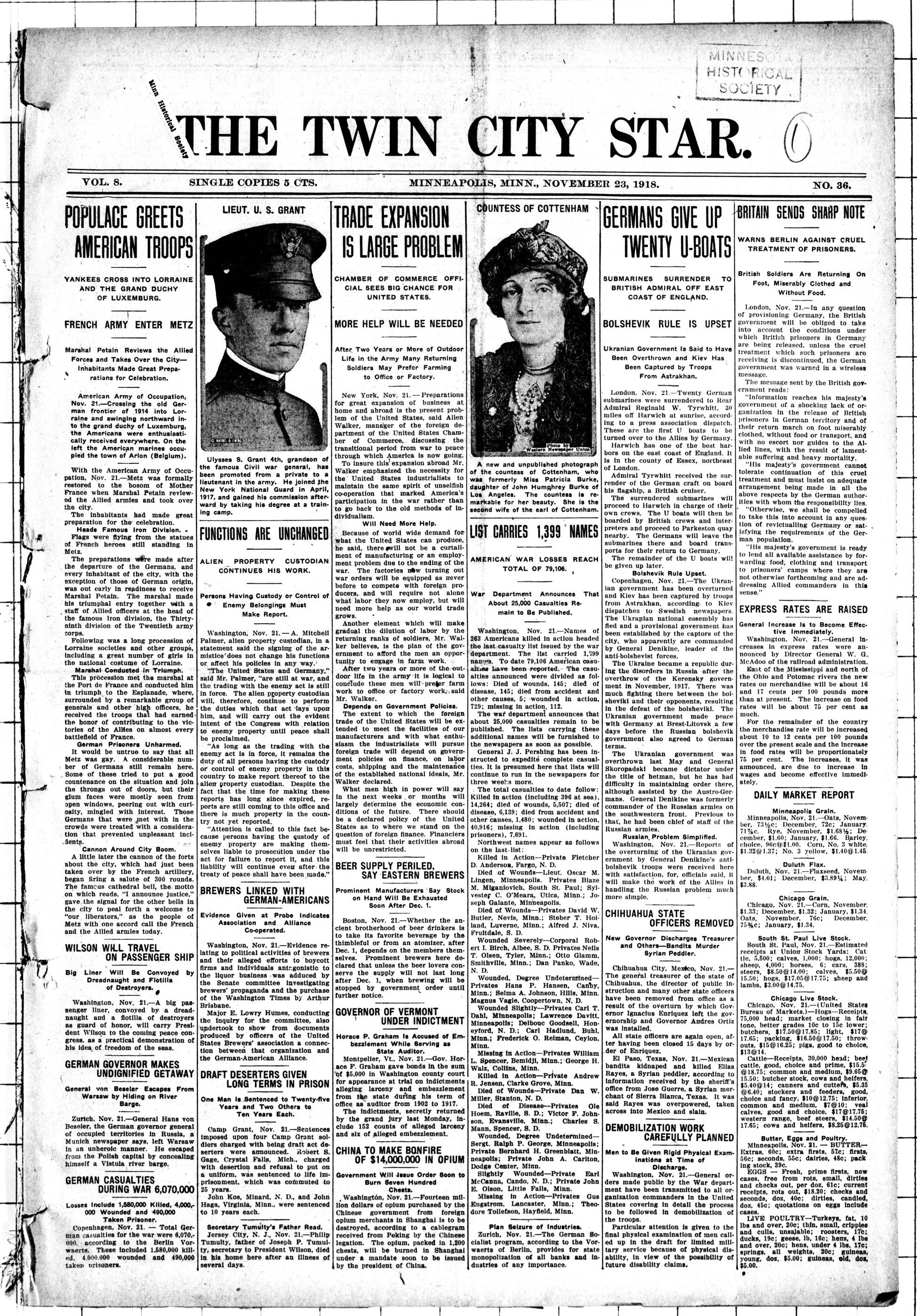
THE TWIN CITY STAR.
POPULACE GREETS AMERICAN TROOPS
YANKEES CROSS INTO LORRAINE AND THE GRAND DUCHY OF LUXEMBURG.
Marshal Petain Reviews the Allied Forces and Takes Over the City—Inhabitants Made Great Preparations for Celebration.
American Army of Occupation, Nov. 21.—Crossing the old German frontier of 1914 into Lorraine and swinging northward into the grand duchy of Luxemburg, the Americans were enthusiastically received everywhere. On the left the American marines occupied the town of Arlon (Belgium).
With the American Army of Occupation, Nov. 21.—Metz was formally restored to the bosom of Mother France when Marshal Petain reviewed the Allied armies and took over the city.
The inhabitants had made great preparation for the celebration.
Heads Famous Iron Division.
Flags were flying from the statues of French heroes still standing in Metz.
The preparations were made after the departure of the Germans, and every inhabitant of the city, with the exception of those of German origin, was out early in readiness to receive Marshal Petain. The marshal made his triumphal entry together with a staff of Allied officers at the head of the famous Iron division, the Thirty-ninth division of the Twentieth army corps.
Following was a long procession of Lorraine societies and other groups, including a great number of girls in the national costume of Lorraine.
Marshal Conducted in Triumph.
This procession met the marshal at the Port de France and conducted him in triumph to the Esplanade, where, surrounded by a remarkable group of generals and other high officers, he received the troops that had earned the honor of contributing to the victories of the Allies on almost every battlefield of France.
German Prisoners Unharmed.
It would be untrue to say that all Metz was gay. A considerable number of Germans still remain here. Some of these tried to put a good countenance on the situation and join the throngs out of doors, but their glum faces were mostly seen from open windows, peering out with curiosity, mingled with interest. Those Germans that were met with in the crowds were treated with a consideration that prevented unpleasant incidents.
Cannon Around City Boom.
A little later the cannon of the forts about the city, which had just been taken over by the French artillery, began firing a salute of 300 rounds. The famous cathedral bell, the motto on which reads, "I announce justice," gave the signal for the other bells in the city to peal forth a welcome to "our liberators," as the people of Metz with one accord call the French and the Allied armies today.
WILSON WILL TRAVEL ON PASSENGER SHIP
Big Liner Will Be Convoyed by Dreadnaught and Flotilla of Destroyers.
Washington, Nov. 21.—A big passenger liner, convoiued by a dreadnaught and a flotilla of destroyers as guard of honor, will carry President Wilson to the coming peace congress, as a practical demonstration of his idea of freedom of the seas.
GERMAN GOVERNOR MAKES
UNDIGNIFIED GETAWAY
General von Beseler Escapes From Warsaw by Hiding on River Barge.
Zurich, Nov. 21.—General Hans von Beseler, the German governor general of occupied territories in Russia, a Munich newspaper says, left Warsaw in an unheroic manner. He escaped from the Polish capital by concealing himself a Vistula river barge.
GERMAN CASUALTIES
DURING WAR 6.070.000
Losses Include 1,580,000 Killed, 4,000,
000 Wounded and 490,000
Taken Prisoner.
Copenhagen, Nov. 21. — Total German
casualties for the war were 6,070,
000, according to the Berlin Vorwaerts.
These included 1,580,000 killed.
4,000,000 wounded and 490,000
taken prisoners.
SINGLE COPIES 5 CTS.
LIEUT. U. S. GRANT
C. H. H. A. 1925
Ulysses S. Grant 4th, grandson of the famous Civil war general, has been promoted from a private to a lieutenant in the army. He joined the New York National Guard in April, 1917, and gained his commission afterward by taking his degree at a training camp.
FUNCTIONS ARE UNCHANGED
ALIEN PROPERTY CUSTODIAN
CONTINUES HIS WORK.
Persons Having Custody or Control of Enemy Belongings Must
Washington, Nov. 21. — A. Mitchell Palmer, alien property custodian, in a statement said the signing of the armistice'does not change his functions or affect his policies in any way. "The United States and Germany," said Mr. Palmer, "are still at war, and the trading with the enemy act is still in force. The alien property custodian will, therefore, continue to perform the duties which that act lays upon him, and will carry out the evident intent of the Congress with relation to enemy property until peace shall be proclaimed. "As long as the trading with the enemy act is in force, it remains the duty of all persons having the custody or control of enemy property in this country to make report thereof to the alien property custodian. Despite the fact that the time for making these reports has long since expired, reports are still coming to this office and there is much property in the country not yet reported. "Attention is called to this fact because persons having the custody of enemy property are making themselves liable to prosecution under the act for failure to report it, and this liability will continue even after the treaty of peace shall have been made."
BREWERS LINKED WITH GERMAN-AMERICANS
Evidence Given at Probe Indicates Association and Alliance Co-operated.
Washington, Nov. 21.—Evidence relating to political activities of brewers and their alleged efforts to boycott firms and individuals ant-gonistic to the liquor business was adduced by the Senate committee investigating brewers' propaganda and the purchase of the Washington Times by Arthur Brisbane.
Major E. Lowry Humes, conducting the inquiry for the committee, also undertook to show from documents produced by officers of the United States Brewers' association a connection between that organization and the German-American Alliance.
DRAFT DESERTERS GIVEN
LONG TERMS IN PRISON
One Man Is Sentenced to Twenty-five Years and Two Others to Ten Years Each.
Camp Grant, Nov. 21.—Sentences imposed upon four Camp Grant soldiers charged with being draft act deserters were announced. Robert S. Gage, Crystal Falls, Mich., charged with desertion and refusal to put on a uniform, was sentenced to life imprisonment, which was commuted to 25 years.
John Kos, Minard, N. D., and John Haga, Virginia, Minn., were sentenced to 10 years each.
Secretary Tumulty's Father Read.
Jersey City, N. J., Nov. 21.—Phillip Tumulty, father of Joseph P. Tumulty, secretary to President Wilson, died in his home here after an illness of several days.
MINNEAPOLIS, MINN., NOVEMBER 23, 1918.
TRADE EXPANSION IS LARGE PROBLEM
CHAMBER OF COMMERCE OFFI CIAL SEES BIG CHANCE FOR UNITED STATES.
MORE HELP WILL BE NEEDED
After, Two Years or More of Outdoor Life in the Army Many Returning Soldiers May Prefer Farming to Office or Factory.
New York, Nov. 21. — Preparations for great expansion of business at home and abroad is the present problem of the United States, said Allen Walker, manager of the foreign department of the United States Chamber of Commerce, discussing the transitional period from war to peace through which America is now going. To insure this' expansion abroad Mr. Walker emphasized the necessity for the United States industrialists to maintain the same spirit of unselfish co-operation that marked America's participation in the war rather than to go back to the old methods of individualism.
Will Need More Help.
Because of world wide demand for what the United States can produce, he said, there will not be a curtailment of manufacturing or an employment problem due to the ending of the war. The factories now turning out war orders will be equipped as never before to compete with foreign producers, and will require not alone what labor they now employ, but will need more help as our world trade grows.
Another element which will make gradual the dilution of labor by the returning ranks of soldiers, Mr. Walker believes, is the plan of the government to afford the men an opportunity to engage in farm work.
After two years or more of the outdoor life in the army it is logical to conclude these men will prefer farm work to office or factory work, said Mr. Walker.
Depends on Government Policies.
The extent to which the foreign trade of the United States will be extended to meet the facilities of our manufacturers and with what enthusiasm the industrialists will pursue foreign trade will depend on government policies on finance, on labor costs, shipping and the maintenance of the established national ideals, Mr. Walker declared.
What men high in power will say in the next weeks or months will largely determine the economic conditions of the future. There should be a declared policy of the United States as to where we stand on the question of foreign finance. Financiers must feel that their activities abroad will be unrestricted.
BEER SUPPLY PERILED,
SAY EASTERN BREWERS
Prominent Manufacturers Say Stock on Hand Will Be Exhausted Soon After Dec. 1.
Boston, Nov. 21.—Whether the ancient brotherhood of beer drinkers is to take its favorite beverage by the thimbleful or from an atomizer, after Dec. 1, depends on the members themselves. Prominent brewers here declared that unless the beer lovers conserve the supply will not last long after Dec. 1, when brewing will be stopped by government order until further notice.
GOVERNOR OF VERMONT UNDER INDICTMENT
Horace P. Graham Is Accused of Embezzlement While Serving as State Auditor.
Montpelier, Vt., Nov. 21.—Gov. Horace F. Graham gave bonds in the sum of $5,000 in Washington county court for appearance at trial on indictments alleging larceny and embezzlement from the state during his term of office as auditor from 1902 to 1917.
The indictments, secretly returned by the grand jury last Monday, include 152 counts of alleged larceny and six of alleged embezzlement.
CHINA TO MAKE BQNFIRE
OF $14,000,000 IN OPIUM
Government Will Issue Order Soon to Burn Seven Hundred Chests.
Washington, Nov. 21.—Fourteen million dollars of opium purchased by the Chinese government from foreign opium merchants in Shanghai is to be destroyed, according to a cablegram received from Peking by the Chinese legation. The opium, packed in 1,200 chests, will be burned in Shanghai under a mandate soon to be issued by the president of China.
COUNTESS OF COTTENHAM
Photo by
Western Newspaper Union
A new and unpublished photograph of the countess of Cottenham, who was formerly Miss Patricia Burke, daughter of John Humphrey Burke of Los Angeles. The countess is remarkable for her beauty. She is the second wife of the earl of Cottenham.
LIST CARRIES 1,399 NAMES
AMERICAN WAR LOSSES REACH
TOTAL OF 79,106
War Department Announces That About 25,000 Casualties Remain to Be Published.
Washington, Nov. 21.—Names of 263 Americans killed in action headed the last casualty list issued by the war department. The list carried 1,399 names. To date 79,106 American casualties have been reported. The casualties announced were divided as follows: Died of wounds, 145; died of disease, 145; died from accident and other causes, 5; wounded in action, 729; missing in action, 112.
The war department announces that about 25,000 casualties remain to be published. The lists carrying these additional names will be furnished to the newspapers as soon as possible.
General J. J. Pershing has been instructed to expedite complete casualties. It is presumed here that lists will continue to run in the newspapers for three weeks' more.
The total casualties to date follow: Killed in action (including 396 at sea), 14,264; died of wounds, 5,507; died of disease, 6,139; died from accident and other causes, 1,480; wounded in action, 40,916; missing in action (including prisoners), 7,691.
Northwest names appear as follows on the last list:
Killed in Action—Private Fletcher D. Anderson, Fargo, N. D.
Died of Wounds—Lieut. Oscar M. Lingen, Minneapolis. Privates Blaze M. Miganlovich, South St. Paul; Sylvester C. O'Meara, Minneapolis. Joseph Galante, Minneapolis.
Died of Wounds—Privates David W. Butler, Nevis, Minn.; Steber T. Holland, Luverne, Minn.; Alfred J. Niva, Fruitdale, S. D.
Wounded Severely—Corporal Robert I. Birch, S. D. Privates Nells T. Olsen, Tyler, Minn.; Otto Glamm, Smithville, Minn.; Dan Panko, Wade, N. D.
Wounded, Degree Undetermined—Privates Hans P. Hansen, Canby, Minn.; Selma A. Johnson, Hills, Minn. Magnus Vagle, Coopertown, N. D.
Wounded Slightly—Privates Carl T. Dahl, Minneapolis; Lawrence Davitt, Minneapolis; Delbouc Goodsell, Honeyford, N. D.; Carl Hadlund, Buhl, Minn.; Frederick O. Reiman, Ceylon, Minn.
Missing in Action—Privates William L. Spencer, Bemidil, Minn.; George H. Walz, Collins, Minn.
Killed in Action—Private Andrew R. Jensen, Clarke Grove, Minn.
Died of Wounds—Private Dan W. Miller, Stanton, N. D.
Died of Disease—Privates Ole Hoem, Raville, S. D.; Victor F. Johnson, Evansville, Minn.; Charles S. Mann, Spencer, S. D.
Wounded, Degree Undetermined—Sergt, Ralph P. George, Minneapolis; Private Bernhard H. Greenblatt, Minneapolis; Private John A. Carlton, Dodge Center, Minn.
Slightly Wounded—Private Earl McCanna, Cando, N. D.; Private John E. Olson, Little Falls, Minn.
Missing in Action—Privates Gus Engstrom, Lancaster, Minn.; Theodore Tolleison, Hayfield, Minn.
Plan Selzure of Industries
Zurich, Nov. 21.—The German Socialist program, according to the Vorwaerts of Berlin, provides for state monopolization of all banks and industries of any importance.
MINNESOTA HISTORICAL SOCIETY
GERMANS GIVE UP TWENTY U-BOATS
SUBMARINES SURRENDER TO BRITISH ADMIRAL OFF EAST COAST OF ENGLAND.
BOLSHEVIK RULE IS UPSET
Ukranian Government Is Said to Have Been Overthrown and Kiev Has Been Captured by Troops From Astrakhan.
London, Nov. 21. Twenty German submarines were surrendered to Rear Admiral Reginald W. Tyrwhitt, 30 miles off Harwich at sunrise, according to a press association dispatch. These are the first U boats to be turned over to the Allies by Germany. Harwich has one of the best harbors on the east coast of England. It is in the county of Essex, northeast of London.
Admiral Tyrwhitt received the surrender of the German craft on board his flagship, a British cruiser.
The surrendered submarines will proceed to Harwich in charge of their crews. The U boats will then be boarded by British crews and interpreters and proceed to Parkeston quay nearby. The Germans will leave the submarines there and board transports for their return to Germany.
The remainder of the U boats will be given up later.
Copenhagen, Nov. 21.—The Ukrainian government has been overturned and Kiev has been captured by troops from Astrakhan, according to Kiev dispatches to Swedish newspapers. The Ukrainian national assembly has fled and a provisional government has been established by the captors of the city, who apparently are commanded by General Denikine, leader of the anti-bolshevist forces.
The Ukraine became a republic during the disorders in Russia after the overthrow of the Kerensky government in November, 1917. There was much fighting there between the bolshevik and their opponents, resulting in the defeat of the bolshevik1. The Ukrainian government made peace with Germany at Brest-Litovsk a few days before the Russian bolshevik government also agreed to German terms.
The Ukrainian government was overthrown last May and General Skoropadski became dictator under the title of hetman, but he has had difficulty in maintaining order there, although assisted by the Austro-Germans. General Denikine was formerly commander of the Russian armies on the southwestern front. Previous to that, he had been chief of staff of the Russian armies.
Washington, Nov. 21.—Reports of the overturning of the Ukrainian government by General Denikine's antibolshevik troops were received here with satisfaction, for, officials said, it will make the work of the Allies in handling the Russian problem much more simple.
CHIHUAHUA STATE OFFICERS REMOVED
New Governor Discharges Treasurer and Others—Bandits Murder Syrian Peddler.
Chihuahua City, Mexico, Nov. 21.—The general treasurer of the state of Chihuahua, the director of public instruction and many other state officers have been removed from office as a result of the overturn by which Governor Igniacus Enriquez left the governorship and Governor Andres Ortiz was installed.
All state officers are again open, after having been closed 15 days by order of Enriquez.
El Paso, Texas, Nov. 21.—Mexican bandits kidnaped and killed Elias Rayes, a Syrian peddler, according to information received by the sheriff's office from Jose Guerre, a Syrian merchant of Sierra Blanca, Texas. It was said Rayes was overpowered, taken across into Mexico and slain.
DEMOBILIZATION WORK
CAREFULLY PLANNED
Men to Be Given Rigid Physical Examinations at Time of Discharge.
Washington, Nov. 21.—General orders made public by the War department have been transmitted to all organization commanders in the United States covering in detail the process to be followed in demobilization of the troops.
Particular attention is given to the final physical examination of men called up in the draft for limited military service because of physical disability, in view of the possibility of future disability claims.
NO. 36.
BRITAIN SENDS SHARP NOTE
WARNS BERLIN AGAINST CRUEL
TREATMENT OF PRISONERS.
British Soldiers Are Returning On Foot, Miserably Clothed and Without Food.
London, Nov. 21.—In any question of provisioning Germany, the British government will be obliged to take into account the conditions under which British prisoners in Germany are being released, unless the cruel treatment which such prisoners are receiving is discontinued, the German government was warned in a wireless message.
The message sent by the British government reads:
"Information reaches his majesty's government of a shocking lack of organization in the release of British prisoners in German territory and of their return march on foot miserably clothed, without food or transport, and with no escort nor guides to the Allied lines, with the result of lamentable suffering and heavy mortality.
"His majesty's government cannot tolerate continuation of this cruel treatment and must insist on adequate arrangement being made in all the above respects by the German authorities with whom the responsibility lies.
"Otherwise, we shall be compelled to take this into account in any question of revictualling Germany or satisfying the requirements of the German population."
"His majesty's government is ready to lend all available assistance by forwarding food, clothing and transport to prisoners' camps where they are not otherwise forthcoming and are addressing Allied commanders in this sense."
EXPRESS RATES ARE RAISED
General Increase Is to Become Effective Immediately.
Washington, Nov. 21.—General increases in express rates were announced by Director General W. G. McAdoo of the railroad administration.
East of the Mississippi and north of the Ohio and Potomac rivers the new rates on merchandise will be about 16 and 17 cents per 100 pounds more than at present. The increase on food rates will be about 75 per cent as much.
For the remainder of the country the merchandise rate will be increased about 10 to 12 cents per 100 pounds over the present scale and the increase in food rates will be proportionately 75 per cent. The increases, it was announced, are due to increase in wages and become effective immediately.
DAILY MARKET REPORT
Minneapolis Grain.
Minneapolis, Nov. 21—Oats, November, 71½c; December, 72c; January, 71%c. Rye, November, $1.68½c; December, $1.60; January, $1.66. Barley, choice, 96c@$1.00. Corn, No. 3 white, $1.32@1.37; No. 3 yellow, $1.40@1.45.
Duluth Flax.
Duluth, Nov. 21.—Flaxseed, November, $4.01; December, $3.89¼; May, $3.88.
Chicago Grain.
Chicago, Nov. 21—Corn, November, $1.33; December, $1.32; January, $1.34 Oats, November, 76c; December, 75½c; January, $1.34.
South St. Paul Live Stock.
South St. Paul, Nov. 21.—Estimated receipts at Union Stock Yards: Cattle, 5,500; calves, 1,000; hogs, 12,000; sheep, 4,000; horses, 6; cars, 388; steers, $8.50@14.00; calves, $5.50@15.50; hogs, $17.05@17.75; sheep and lambs, $3.00@17.05
Chicago Live Stock
Chicago, Nov. 21.—(United States Bureau of Markets.)—Hogs—Receipts, 75,000 head; market closing in fair tone, better grades 10c to 15c lower; butchers, $17.50@17.85; light, $17@17.65; packing, $16.50@17.50; throwouts, $15@16.25; pigs, good to choice, $13@14.
Cattle—Receipts, 30,000 head; beef cattle, good, choice and prime, $15.5@18.75; common and medium, $9.65@15.50; butcher stock, cows and heifers, $5.40@14; canners and cutters, $5.35@6.40; stockers and feeders, good, choice and fancy, $10@12.75; inferior, common and medium, $7@10; veal calves, good and choice, $17@17.75; western range, beef steers, $14.50@17.65; cows and heifers, $8.25@12.75
Butter, Eggs and Poultry
Minneapolis, Nov. 21. — BUTTER—
Extras, 60c; extra firsts, 57c; firsts,
56c; seconds, 55c; dairies, 48c; pack
ing stock, 39c.
EGGS — Fresh, prime firsts, new
cases, free from rots, small, dirties
and checks out, per doz, 61c; current
receipts, rots out, $18.20; checks and
seconds, doz, 40c; dirties, candled,
doz, 45c; quotations on eggs include
cases.
LIVE POULTRY—Turkeys, fat, 10
lbs and over, 20c; thin, small, cripples
and culls, unsalable; roosters, 17c;
ducks, 19c; geese, 16c; hems, 4 lbs
and over, 20c; hems, under 4 lbs, 17c;
springs, all weights, 20c; guineas,
young, doz, $5.00; guineas, old, doz,
$5.00.
NO. 36.
Duluth Elax.
Chicago Grain
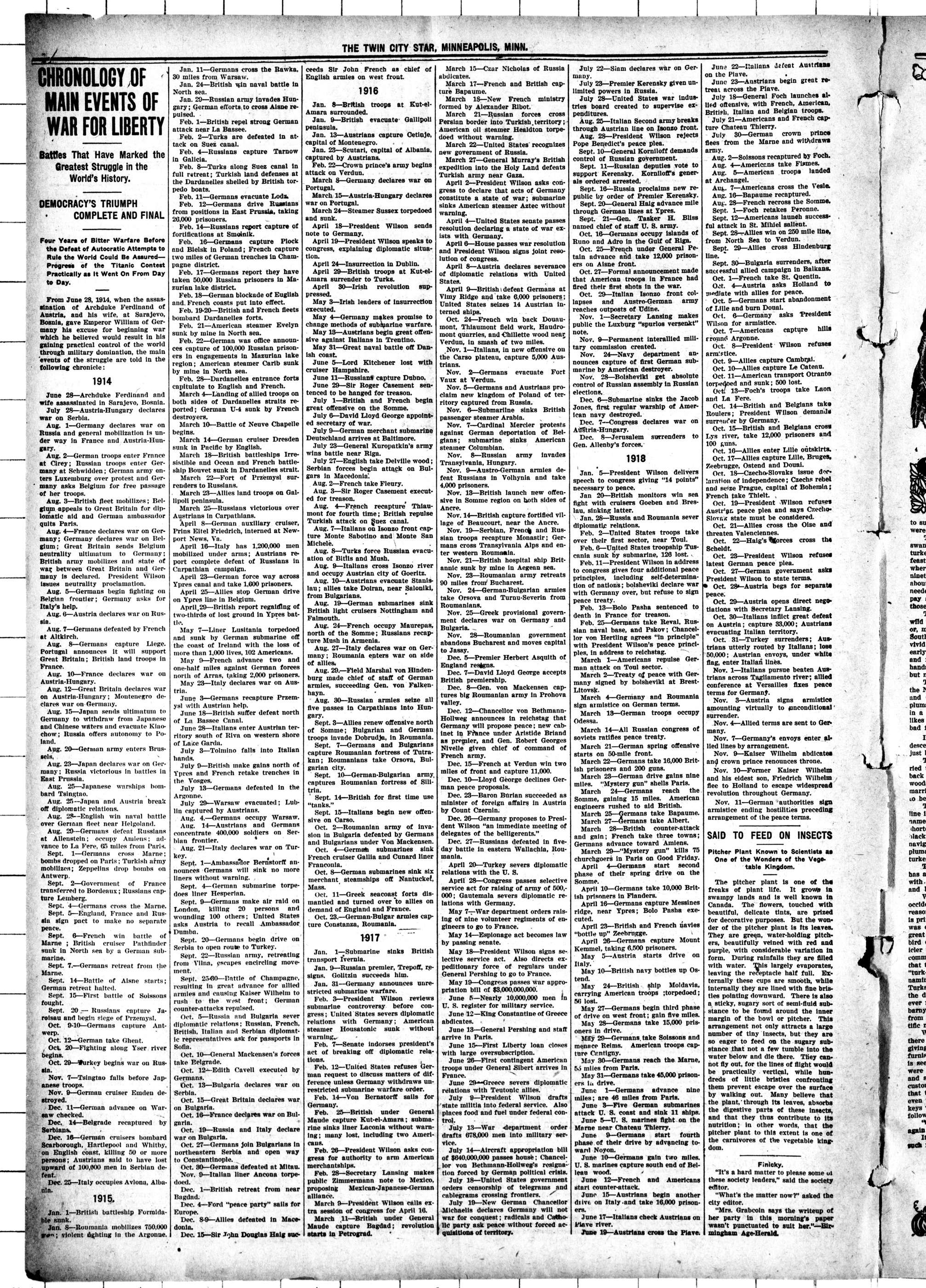
CHRONOLOGY OF MAIN EVENTS OF WAR FOR LIBERTY
Battles That Have Marked the Greatest Struggle in the World's History.
DEMOCRACY'S TRIUMPH
COMPLETE AND FINAL
Four Years of Bitter Warfare Before the Defeat of Autocratic Attempts to Rule the World Could Be Assured—Progress of the Titanic Contest Practically as It Went On From Day to Day.
From June 28, 1914, when the assassination of Archduke Ferdinand of Austria, and his wife, at Sarajevo, Bosnia, gave Emperor William of Germany his excuse for beginning war which he believed would result in his gaining practical control of the world through military domination, the main events of the struggle are told in the following chronicle:
1914
June 28—Archduke Ferdinand and wife assassinated in Sarajevo, Bosnia.
July 28—Austria-Hungary declares war on Serbia.
Aug. 1—Germany declares war on Russia and general mobilization is under way in France and Austria-Hungary.
Aug. 2—German troops enter France at Cirey; Russian troops enter Germany at Schwidden; German army enters Luxemburg over protest and Germany asks Belgium for free passage of her troops.
Aug. 3—British fleet mobilizes; Belgium appeals to Great Britain for diplomatic aid and German ambassador quits Paris.
Aug. 4—France declares war on Germany; Germany declares war on Belgium; Great Britain sends Belgium neutrality ultimatum to Germany; British army mobilizes and state of war between Great Britain and Germany is declared. President Wilson issues neutrality proclamation.
Aug. 5—Germans begin fighting on Belgian frontier; Germany asks for Italy's help.
Aug. 6—Austria declares war on Russia.
Aug. 7—Germans defeated by French at Altkirch.
Aug. 8—Germans capture Liege. Portugal announces it will support Great Britain; British land troops in France.
Aug. 10—France declares war on Austria-Hungary.
Aug. 12—Great Britain declares war on Austria-Hungary; Montenegro declares war on Germany.
Aug. 15—Japan sends ultimatum to Germany to withdraw from Japanese and Chinese waters and evacuate Kinochow; Russia offers autonomy to Poland.
Aug. 20—German army enters Brussels.
Aug. 23—Japan declares war on Germany; Russia victorious in battles in East Prussia.
Aug. 25—Japanese warships bombard Tsingtao.
Aug. 25—Japan and Austria break off diplomatic relations.
Aug. 20—Germans defeat Russians at Allenstein; occupy Amiens; advance to La Fere, 65 miles from Paris.
Sept. 1—Germans cross Marne; bombs dropped on Paris; Turkish army mobilizes; Zeppelins drop bombs on Antwerp.
Sept. 2—Government of France transferred to Bordeaux; Russians capture Lemberg.
Sept. 4—Germans cross the Marne.
Sept. 5—England, France and Russia sign pact to make no separate peace.
Sept. 6—French win battle of Marne; British cruiser Pathfinder sunk in North sea by a German submarine.
Sept. 7—Germans retreat from the Marne.
Sept. 14—Battle of Alsne starts; German retreat halted.
Sept. 15—First battle of Soissons fought.
Oct. 12—German take Ghent.
Oct. 20—Fighting along Yser river begins.
Oct. 29—*Turkey begins war on Russia.*
Nov. 7—*Tsingtao falls before Japanese troops.*
Nov. 9—*German cruiser Emden destroyed.*
Dec. 16—German cruisers bombard Scarborough, Hartlepool and Whitby, on English coast, killing 50 or more persons; Austrians said to have lost upward of 100,000 men in Serbian defeat.
Dec. 25—Italy occupies Avlona, Albania.
1915.
Jan. 1—British battleship Formidable sunk.
Jan. 8—Roumania mobilizes 750,000 men; violent fighting in the Argonne.
Jan. 11—Germans cross the Rawka, 30 miles from Warsaw.
Jan. 24—British win naval battle in North sea.
Jan. 20—Russian army invades Hungary; German efforts to cross Aisne repulsed.
Feb. 1—British repel strong German attack near La Bassee.
Feb. 2—Turks are defeated in attack on Suez canal.
Feb. 4—Russians capture Tarnow in Galicia.
Feb. 8—Turks along Suez canal in full retreat; Turkish land defenses at the Dardanelles shelled by British torpedo boats.
Feb. 11—Germans evacuate Lodz.
Feb. 12—Germans drive Russians from positions in East Prussia, taking 20,000 prisoners.
Feb. 14—Russians report capture of fortifications at Smolnik.
Feb. 16—Germans capture Plock and Bielsk in Poland; French capture two miles of German trenches in Champagne district.
Feb. 17—Germans report they have taken 50,000 Russian prisoners in Mazurian lake district.
Feb. 18—German blockade of Euglish and French coasts put into effect.
Feb. 19-20—British and French fleets bombard Dardanelles forts.
Feb. 21—American steamer Evelyn sunk by mine in North sea.
Feb. 22—German was office announces capture of 100,000 Russian prisoners in engagements in Mazurian lake region; American steamer Carlb sunk by mine in North sea.
Feb. 28—Dardanelles entrance forts capitulate to English and French.
March 4—Landing of allied troops on both sides of Dardanelles straits reported; German U-4 sunk by French destroyers.
March 10—Battle of Neuve Chapelle begins.
March 14—German cruiser Dresden sunk in Pacific by English.
March 22—Fort of Przemysl surrenders to Russians.
March 23—Allies land troops on Gallipoll peninsula.
March 25—Russians victorious over Austrians in Carpathians.
April 8—German auxiliary cruiser, Prins Eitel Friedrich, interned at Newport News, Va.
April 16—Italy has 1,200,000 men mobilized under arms; Austrians report complete defeat of Russians in Carpathian campaign.
April 23—German force way across Ypres canal and take 1,600 prisoners.
April 25—Allies stop German drive on Ypres line in Belgium.
May 7—Liner Lusitania torpeded and sunk by German submarine off the coast of Ireland with the loss of more than 1,000 lives, 102 Americans.
May 9—French advance two and one-half miles against German forces north of Arras, taking 2,000 prisoners.
May 23—Italy declares war on Austria.
June 3—Germans recapture Przemysl with Austrian help.
June 18—British suffer defeat north of La Bassee Canal.
June 28—Italians enter Austrian territory south of Rlva on western shore of Lake Garda.
July 3—Tolimino falls into Italian hands.
July 13—Germans defeated in the Argonne.
July 29—Warsaw evacuated; Lublin captured by Austrians.
Aug. 4—Germans occupy Warsaw.
Aug. 14—Austrians and Germans concentrate 400,000 soldiers on Serbian frontier.
Sept. 1—Ambassador Bernstorff announces Germans will sink no more liners without warning.
Sept. 4—German submarine torpedoes liner Hesperian.
Sept. 9—Germans make air raid on London, killing 20 persons and wounding 100 others; United States asks Austria to recall Ambassador Dumba.
Sept. 20—Germans begin drive on Serbia to open route to Turkey.
Sept. 22—Russian army, retreating from Vilna, escapes encircling movement.
Sept. 25-40—Battle of Champagne, resulting in great advance for allied armies and causing Kaiser Wilhelm to rush to the west front; German counter-attacks repulsed.
Oct. 5—Russia and Bulgaria sever diplomatic relations; Russian, French, British, Italian and Serbian diplomatic representatives ask for passports in Sofia.
Oct. 12—Edith Cavell executed by Germans.
Oct. 13—Bulgaria declares war on Serbia.
Oct. 10—France declares war on Bulgaria.
Oct. 19—Russia and Italy declare war on Bulgaria.
Oct. 27—Germans join Bulgarians in northeastern Serbia and open way to Constantinople.
Oct. 30—Germans defeated at Mitau.
Nov. 9—Italian liner Ancona torpedoed.
Dec. 1—British retreat from near Baghdad.
Dec. 15—Sir John Douglas Halg suc
THE TWIN CITY STAR, MINNEAPOLIS, MINN.
ceeds Sir John French as chief of English armies on west front.
March 15—Czar Nicholas abdicates.
1916
Jan. 8—British troops at Kut-el-Amara surrounded.
Jan. 9—British evacuate Gallipoli peninsula.
Jan. 13—Austrians capture Cetinje, capital of Montenegro.
Jan. 23—Scutari, capital of Albania, captured by Austrians.
Feb. 22—Crown prince's army begins attack on Verdun.
March 8—Germany declares war on Portugal.
March 15—Austria-Hungary declares war on Portugal.
March 24—Steamer Sussex torpedoed and sunk.
April 18—President Wilson sends note to Germany.
April 19—President Wilson speaks to congress, explaining diplomatic situation.
April 30—Irish revolution suppressed.
May 3—Irish leaders of insurrection executed.
May 31—Great naval battle off Danish coast.
June 5—Lord Kitchener lost with cruiser Hamshire.
July 1—British and French begin great offensive on the Somme.
July 6—David Lloyd George appointed secretary of war.
July 9—German merchant submarine Deutschland arrives at Baltimore.
July 23—General Kuropatkin's army wins battle near Riga.
July 27—English take Delville wood; Serbian forces begin attack on Bulgars in Macedonia.
Aug. 2—French take Fleury.
Aug. 8—Sir Roger Casement executed for treason.
Aug. 4—French recapture Thlaumont for fourth time; British repulse Turkish attack on suez canal.
Aug. 7—Italians on Isonzo front capture Monte Sabotino and Monte San Michele.
Aug. 8—Turks force Russian evacuation of Bitils and Mush.
Aug. 9—Italians cross Isonzo river and occupy Austrian city of Goeritz.
Aug. 10—Austrians evacuate Stanislau; alles take Doiran, near Saloniki, from Bulgarians.
Aug. 19—German submarines sink British light cruisers Nottingham and Falmouth.
Aug. 24—French occupy Maurepas, north of the Somme; Russians recapture Mush in Armenia.
Aug. 27—Italy declares war on Germany; Roumania enters war on side of allies.
Aug. 29—Field Marshal von Hindenburg made chief of staff of German armies, succeeding Gen. von Falkenhayn.
Aug. 30—Russian armies seize all five passes in Carpathians into Hungary.
Sept. 3—Allies renew offensive north of Somme; Bulgarian and German troops invade Dobrudja, in Roumania.
Sept. 7—Germans and Bulgarians capture Roumanian fortress of Tutrakan; Roumanians take Orsova, Bulgarian city.
Sept. 10—German-Bulgarian army captures Roumanian fortress of Sillitria.
Sept. 15-Itallans begin new offensive on Carso.
Oct. 2-Roumanian army of invasion in Bulgaria defeated by Germans and Bulgarians under Von Mackensen.
Oct. 4-German submarines sink French cruiser Gallia and Cunard liner Franconia.
Oct. 8-German submarines sink six merchant steamships off Nantucket, Mass.
Oct. 23.—German-Bulgar armies capture Constanza, Roumania.
1917
Jan. 1—Submarine sinks British transport Ivernia.
Jan. 9—Russian premier, Trepoff, resigns. Golitzin succeeds him.
Jan. 31—Germany announces unrestricted submarine warfare.
Feb. 3—President Wilson reviews submarine controversy before congress; United States severs diplomatic relations with Germany; American steamer Housatonic sunk without warning.
Feb. 7—Senate indorses president's act of breaking off diplomatic relations.
Feb. 12—United States refuses German request to discuss matters of difference unless Germany withdraws unrestricted submarine warfare order.
Feb. 14—Von Bernstorff sails for Germany.
Feb. 25—British under General Maude capture Kut-al-Amara; submarine sinks liner Laconia without warning; many lost, including two Americans.
Feb. 26—President Wilson asks congress for authority to arm American merchantships.
Feb. 28—Secretary Lansing makes public Zimmermann note to Mexico, proposing Mexican-Japanese-German alliance.
March 11—British under General Maude capture Bagdad; revolution starts in Petrograd.
March 15—Czar Nicholas of Russia abdicates.
March 17—French and British capture Bapaume.
March 21—Russian forces cross Persian border into Turkish territory; American oil steamer Healdton torpedoed without warning.
March 22—United States recognizes new government of Russia.
March 27—General Murray's British expedition into the Holy Land defeats Turkish army near Gaza.
April 2—President Wilson asks congress to declare that acts of Germany constitute a state of war; submarine sinks American steamer Aztec without warning.
April 4—United States senate passes resolution declaring a state of war exists with Germany.
April 6—House passes war resolution and President Wilson signs joint resolution of congress.
April 8—Austria declares severance of diplomatic relations with United States.
April 9—British defeat Germans at Vimy Ridge and take 6,000 prisoners; United States seizes 14 Austrian interned ships.
Oct. 24—French win back Douaumont, Thlaumont field work, Haudrom quarries, and Chillette wood near Verdun, in smash of two miles.
Nov. 1—Italians, in new offensive on the Carso plateau, capture 5,000 Austrians.
Nov. 2—Germans evacuate Fort Vaux at Verdun.
Nov. 5—Germans and Austrians proclaim new kingdom of Poland of territory captured from Russia.
Nov. 6—Submarine sinks British passenger steamer Arabia.
Nov. 8—Russian army invades Transylvania, Hungary.
Nov. 9—Austro-German armies defeat Russians in Volhynia and take 4,000 prisoners.
Nov. 13—British launch new offensive in Somme region on both sides of Ancre.
Nov. 14—British capture fortified village of Beaucourt, near the Ancre.
Nov. 19—Serbian, French and Russian troops recapture Monastir; Germans cross Transylvania Alps and enter western Roumania.
Nov. 21—British hospital ship Britannic sunk by mine in Aegean sea.
Nov. 23—Roumanian army retreats 90 miles from Bucharest.
Nov. 24—German-Bulgarian armies take Orsova and Turnu-Severin from Roumanians.
Nov. 25—Greek provisional government declares war on Germany and Bulgaria.
Dec. 5—Premier Herbert Asquith of England resigns.
Dec. 7—David Lloyd George accepts British premiership.
Dec. 8—Gen. von Mackensen captures big Roumanian army in Prohova valley.
Dec. 12—Chancellor von Bethmann-Hollweg announces in reichstag that Germany will propose peace; new cabinet in France under Aristide Briand as premier, and Gen. Robert Georges Nivelle given chief of command of French army.
Dec. 15—French at Verdun win two miles of front and capture 11,000.
Dec. 10—Lloyd George declines German peace proposals.
Dec. 23—Baron Burian succeeded as minister of foreign affairs in Austria by Count Czernin.
Dec. 26—Germany proposes to President Wilson "an immediate meeting of delegates of the belligerents."
April 20—Turkey severs diplomatic relations with the U. S.
April 28—Congress passes selective service act for raising of army of 500,000; Gautemala severs diplomatic relations with Germany.
May 7—War department orders raising of nine volunteer regiments of engineers to go to France.
May 14—Esplonage act becomes law by passing senate.
May 18—President Wilson signs selective service act. Also directs expeditionary force of regulars under General Pershing to go to France.
May 19—Congress passes war appropriation bill of $3,000,000,000.
June 5—Nearly 10,000,000 men in U. S. register for military service.
June 12—King Constantine of Greece abdicates.
June 18—General Pershing and staff arrive in Paris.
June 26—First contingent American troops under General Silbert arrives in France.
June 29—Greece severs diplomatic relations with Teutonic allies.
July 9—President Wilson drafts state militia into federal service. Also places food and fuel under federal control.
July 13—War department order drafts 678,000 men into military service.
July 14—Aircraft appropriation bill of $640,000,000 passes house; Chancellor von Bethmann-Hollweg's resignation forced by German political crisis.
July 18—United States government orders censorship of telegrams and cablegrams crossing frontiers.
July 19—New German Chancellor Michaels declares Germany will not war for conquest; radicals and Catholic party ask peace without forced acquisitions of territory.
July 22—Siam declares war on Germany.
July 23—Premier Kerensky given unlimited powers in Russia.
July 28—United States war industries board created to supervise expenditures.
Aug. 25—Italian Second army breaks through Austrian line on Isonzo front.
Aug. 28—President Wilson rejects Pope Benedict's peace plea.
Sept. 10—General Korniloff demands control of Russian government.
Sept. 11—Russian deputies vote to support Kerensky. Korniloff's generals ordered arrested.
Sept. 16—Russia proclaims new republic by order of Premier Kerensky.
Sept. 20—General Halg advance mile through German lines at Ypres.
Sept. 21—Gen. Tasker H. Bliss named chief of staff U. S. army.
Oct. 25—French under General Petain advance and take 12,000 prisoners on Alsne front.
Oct. 27—Formal announcement made that American troops in France had fired their first shots in the war.
Oct. 29—Italian Isonzo front collapses and Austro-German army reaches outposts of Udine.
Nov. 1—Secretary Lansing makes public the Luxburg "spurlos versenkt" note.
Nov. 9—Permanent interallied military commission created.
Nov. 24—Navy department announces capture of first German submarine by American destroyer.
Dec. 6—Submarine sinks the Jacob Jones, first regular warship of American navy destroyed.
Dec. 7—Congress declares war on Austria-Hungary.
Dec. 8—Jerusalem surrenders to Gen. Allenby's forces.
1918
Jan. 5—President Wilson delivers speech to congress giving "14 points" necessary to peace.
Jan 20—British monitors win sea fight with cruisers Goeben and Breslau, sinking latter.
Jan 28—Russia and Roumania sever diplomatic relations.
Feb. 2—United States troops take over their first sector, near Toul.
Feb. 11—President Wilson in address to congress gives four additional peace principles, including self-determination of nations; bolshevik declare war with Germany over, but refuse to sign peace treaty.
Feb. 13—Bolo Pasha sentenced to death in France for treason.
Feb. 25—Germans take Reval, Russian naval base, and Pskov; Chancellor von Hertling agrees "in principle" with President Wilson's peace principles, in address to rechstag.
March 1—Americans repulse German attack on Toul sector.
March 2—Treaty of peace with Germany signed by bolshevik at Brest-Litovsk.
March 4—Germany and Roumania sign armistice on German terms.
March 14—All Russian congress of soviets ratifies peace treaty.
March 22—Germans take 16,000 British prisoners and 200 guns.
March 23—German drive gains nine miles. "Mystery gun" shells Paris.
March 24—Germans reach the Somme, gaining 15 miles. American engineers rushed to aid British.
March 28—British counter-attack and gain; French take three towns; Germans advance toward Amlens.
March 29—"Mystery gun" kills 75 churchgoers in Paris on Good Friday.
April 4—Germans start second phase of their spring drive on the Somme.
April 10—Germans take 10,000 British prisoners in Flanders.
April 16—Germans capture Messines ridge, near Ypres; Bolo Pasha executed.
May 5—Austria starts drive on Italy.
May 10—British navy bottles up Ostend.
May 24—British ship Moldavia, carrying American troops ;torpedoed ; 56 lost.
May 29—Germans, take Solissons and menace Reims. American troops capture Centigny.
May 30—Germans reach the Marne, 55 miles from Paris.
May 31—Germans take 45,000 prisoners in drive.
June 1—Germans advance nine miles; are 46 miles from Paris.
June 3—Five German submarines attack U. S. coast and sink 11 ships.
June 5—U. S. marines fight on the Marne near Chateau Thierry.
June 9—Germans start fourth phase of their drive by advancing toward Noyon.
June 10—Germans gain two miles. U. S. marines capture south end of Belleau wood.
June 12—French and Americans start counter-attack.
June 15—Austrians begin another drive on Italy and take 16,000 prisoners.
June 17—Italians check Austrians on Plave river.
June 19—Austrians cross the Plave.
June 22—Italians defeat Austrians on the Plave.
July 21—Americans and French capture Chateau Thierry.
July 30—German crown prince flees from the Marne and withdraws army.
Aug. 2—Solissons recaptured by Foch.
Aug. 4—Americans take Fismes.
Aug. 5—American troops landed at Archangel.
Aug. 7—Americans cross the Vesle.
Aug. 10—Bapaume recaptured.
Aug. 28—French recross the Somme.
Sept. 1—Foch retakes Peronne.
Sept. 12—Americans launch success-
Sept. 29—Alles cross Hindenburg line.
Sept. 30—Bulgaria surrenders, after successful allied campaign in Balkans.
Oct. 1—French take St. Quentin.
Oct. 4—Austria asks Holland to mediate with allies for peace.
Oct. 5—Germans start abandonment of Lille and burn Doual.
Oct. 6—Germany asks President Wilson for armistice.
Oct. 7—Americans capture hills around Argonne.
Oct. 8—President Wilson refuses armistice.
Oct. 13—Foch's troops take Laon and La Fere.
Oct. 14—British and Belgians take Roulers; President Wilson demands surrender by Germany.
Oct. 16—Allies enter Lille outskirts.
Oct. 17—Allies capture Lille, Bruges,
Zeebrugge, Ostend and Doual.
Oct. 18—Czecho-Slovaks issue declaration of independence; Czechs rebel and seize Prague, capital of Bohemia; French take Thlelt.
Oct. 19—President Wilson refuses Austrian peace plea and says Czecho-Slovak state must be considered.
Oct. 21—Allies cross the Oise and threaten Valenciennes.
Oct. 22—Halg's Forces cross the Scheldt.
Oct. 27-German government asks President Wilson to state terms.
Oct. 29—Austria opens direct negotiations with Secretary Lansing.
Oct. 30—Italians inflict great defeat on Austria; capture 33,000; Austrians evacuating Italian territory.
Oct. 31—Turkey surrenders; Austrians utterly routed by Italians; lose 50,000; Austrian envoys, under white flag, enter Italian lines.
Nov. 1—Italians pursue beaten Austrians across Tagliamento river; allied conference at Versailles fixes peace terms for Germany.
Nov. 3—Austria signs armistice amounting virtually to unconditional surrender.
Nov. 4—Allied terms are sent to Germany.
Nov. 9—Kaiser Wilhelm abdicates and crown prince renounces throne.
Nov. 10—Former Kaiser Wilhelm and his eldest son, Friedrich Wilhelm flee to Holland to escape widespread revolution throughout Germany.
Nov. 11—German authorities sign armistice ending hostilities preceding arrangement of the peace terms.
SAID TO FEED ON INSECTS
Pitcher Plant Known to Scientists as One of the Wonders of the Vegetable Kingdom.
The pitcher plant is one of the freaks of plant life. It grows in swampy lands and is well known in Canada. The flowers, touched with beautiful, delicate tints, are prized for decorative purposes. But the wonder of the pitcher plant is its leaves. They are green, water-holding pitchers, beautifully veined with red and purple, with considerable variation in form. During rainfalls they are filled with water. This largely evaporates, leaving the receptacle half full. Externally these cups are smooth, while internally they are lined with fine bristles pointing downward. There is also a sticky, sugary sort of semi-fluid substance to be found around the inner margin of the bowl or pitcher. This arrangement not only attracts a large number of tiny insects, but they are so eager to feed on the sugary substance that not a few tumble into the water below and die there. They cannot fly out, for the lines of flight would be practically vertical, while hundreds of little bristles confronting them prevent escape over the surface by walking out. Many believe that the plant, through its leaves, absorbs the digestive parts of these insects, and that they thus contribute to its nutrition; in other words, that the pitcher plant to this extent is one of the carnivores of the vegetable kingdom.
Finicky.
"It's a hard matter to please some of these society leaders," said the society editor.
"What's the matter now?" asked the city editor.
"Mrs. Grabcoln says the writeup of her party in this morning's paper wasn't punctuated to suit her."—Birmingham Age-Herald.
rye FAT ems ee ee eI ns ee Re IO Eee ee aes fi TES aes mi
ee aT) ee iia ila oaths Ni Pad iia a Di a Re eS ee ae PR RT UR RRA ere Cerne ne oe : / a
, a Pe ee ee VERE RO aR re aeRO AEST, fee 3 ‘i
ee et eae PUI te ye TY SAG an trae, | eM eat oe a an
THE TWIN CITY STAR, MINNEAPOLIS, MINN.
PARIS GOES MAD
WITH JOY WHEN
PERSHING APPEARS
( 1 He XN
Na
yw fae i,
! i we a) bo uy 9 ]
, Wee pea
p SSS og
re |
x wwe ‘NS 3 Bia!
(col NS iy PG
Half a Million Persons Struggle
to Get Glimpse of Amer-
ican Leader.
Streets Resound With Cheers for
Yanke’ Commander When Girl °
Discovers Him in Pass.
ing Auto.
ate to Gen. John J. Pershing when the
crowds in the streets espled the Amer-
fean commander passing in his auto-
mobile. It is estimated that at least
fifty thousand persons crowded about
the general's car, while half a mil-
‘Hon more jammed the Place de la Con-
corde and adjacent streets in a mad
effort to get a glinipse of the Ameri-
can leader,
‘The general was out for a_ short
drive and had come up the Rue Rivoll.
His car was proceeding at a snail's
pace before It was recognized by the
frenzied street crowds.
As General Kershing’s face, with the
famous smile, showed through the
door, a French girl with the flags of
half a dozen nations twined about her
head sereamed, “General Pershing !”
‘The cry was taken up instantly and
passed over the seething multitudes. If
there were any gendarmes about they
were swallowed up in the enormous
mob, In an instant men and women
went mad and screamed his namie, and
all trled to reach the car,
‘Men picked up women and held them
on thelr shoulders that they might get
a look at the general, The mob surged
toward the car In another, wave.
Shakes Hands of Children.
General Pershing amidst the danger
was enjoying it greatly. Instead of clos-
ing the window and urging the driver
to get out before they were crushed to
death, he let the window down full
length, laughed heartily, and thrust his
hand out of the door to shake the hand
of a little French child whose proud
father lifted her above the heads of
the mob.
Children climbed on the tonneau and
shinned up the back of the limousine
and frantically ieaped over the strug-
ling mass and shot their hands tn at
ihe window. General Pershing. con-
tinued laughing and tried to shake as
many hands as equkt be thrust through
the window.
“Pershing! Pershing!” bellowed the
mob, and the name rang from the
Belne to the Rue Royale, up the
Champs Elysees, and through the
‘Tuileries gardens,
Efforts to Clear Way Fail.
French officers who had been caught
op in the human maelstrom saluted
and thei endeavored to have the mob
give way. As if by common Impulse
the masses seemed to understand that
the great American general was in
danger, and with a craning of heads
and the screams of women and chil-
dren a slight rift was made directly
ahead of the car. Then by less than
a snail's pace the car with frantic
snorts edged along, Inch by inch.
The cheering was indescribable.
Along the boulevards the name of Per-
shing was taken up by thousands who
probably did not know that Pershing
‘was in thelr midst, and at one moment
{t seemed that all Paris was shouting.
By this time the inside of Pershing’s
car resembled a flag shop. The chil-
dren who were raised over the heads
of the frantic populace tossed small
fings and flowers through the window
and the grownups tore the Insignia
from thelr conts and tossed it in, Gen-
eral Pershing was laughing hard and
waving his hand back at the children,
but still the flag and floral offerings
poured in until he was half buried be-
neath the bunting, flags, buttons, in-
signia, and crushed blossoms,
Moves Inch by Inch.
Inch by inch the car moved and then
halted several minutes as the mob
surged back against it. It was the car
he had- used over the battlefield of
France and was bullt for rough usage,
else It seems it must have crushed like
an egg shell,
Finally the car edged out of the
‘Place de ta Concorde Into the Champs
‘Elysees, but still the mob, with hats
‘off, arms in air, and mouths wide open,
shouting like mad, surged about him.
It was several minutes more before the
‘ear could be extrieated and a sem-
‘lance of a road made. ~
Even then, as the car got away up
‘the great avenue toyard the Arc de
‘Triomph, thousands ran after it. All
‘Paris seemed to be rumbling with a
mighty nolse and over the mighty
noise sounded, clear and strong, “Vive
Pershing !”
‘Troops in England First Home.
London.—The first American troops
to depart homeward as a result of the
signing of the armistice will be 18,000
‘men stationed in England. ‘The Amer-
jean army expects to start the first
shipload of these soldiere homeward
the trukey and details the method of hunting them in the New Netherlands:
“There are also very large turkeys running wild. They have very long
legs and run so extraordinarily fast that generally we take savages when we
go to hunt them, far when one has deprived them of the power of flying they
yet run so fast that we cannot catch them unless their legs-are hurt also.”
Turkeys have been called the greatest game bird of this country, and the
methods of taking them have been many. John Hunter, who was captured
by the Indians and spent some time in captivity, In his memoirs, written. in
1824, tells how the Indians made a decoy bird from the skin of a turkey, fol-
lowed the turkey tracks until they came upon a flock and then partially
displaying thelr decoy and Imitating the gobbling noise mude by the cock,
drew off first one and then another of the flock, who being socially inclined,
came along to investigate the newcomers,
Among the Indians the children were expected to kill turkeys with thelr
blow guns. These were hollow reeds, in which arrows were placed and blown
le such force that, belng directed at the eye of the creature,
they often brought him ‘down. Children as young as eight years
Were successful at this sort of shooting. Adrian Van der Donck says
that turkeys were sometimes caught by dogs In the snow during the
seventeenth century, but generally they were shot at night from
trees. They slept in the trees in large flocks and often selected the same spot
many nights in succession, At other times the Indians would lay roots of
which the turkeys were fond in small streams and takg the birds as they
were in the act of getting these roots.
In Virginia the trap or pen was much used. This trap was built In the
forest and leading to it was a long train of corn. The trap was a simple
affalr built of logs laid one upon another and having rough rails Intd across
the top. There was a trench dug under the lowest logs which fenced in the
Den. In this trench corn was scattered and the turkey following the trall of
this delicacy for some distance oft would finally come to the trench, which
seemed to be quite providentially strewn with an unusually rich supply. He
folloyred the great bright path of rich food to his destruction. The turkey's
lack of Intelligence, when it comes to penning him up, fs one of the reasons
why a great many Americans have not been in accord with Benjamin Frank-
Iin's Idea that the turkey and not the eagle should he the bird of our country.
A writer, describing the shooting of turkeys in the latter half of the nine-
teenth century in Michigan, speaks of the use of the hollow bone of the
turkey's wing, which in the mouth of an expert can be made to reproduce per-
fectly the piping sound of the turkey hen. Sometimes also turkeys were
hunted on horseback. In Virginia, according to an old writer, this was not
uncommon. He says:
“Though we galloped our horses we ¢ould not overtake them [the
turkeys], although they run nenzly two hundred and twenty yards before
they took flight.” ‘The constant practice of our forefathers in shooting game
developed a great many fine turkey shots, and it is recorded that in the Inter
half of the severeenth century “a man was thought a bad shot if he missed
the very head of a wild turkey on top of the highest tree with a single ball.”
To “pot hunting” and to the practice’ of luring the turkeys by imitating
the call of the hen in the spring, Sylvester D. Judd of the biological survey
of the United States department of agriculture largely attributes the ex-
termination of the wild turkey In many parts of the United States where
formerly it was especially abundant. ‘Trapping the turkeys in pens also
helped along the extermination:
~~ Although the turkey fs, generally speaking, not a particularly hardy bird,
being subject to various forms of indigestion, etc., he is varied in his diet
and usually has a good appetite. Some of the things which the wild turkey
likes best ind which the domesticated bird will by no means scorn are grass-
hopperg, crickets, locusts, tadpoles, small lizards, garden seeds and snails.
One turkey which was examined by a scientist was found to have partaken
of a meal including the following viands:
One harvest spider, one centipede, one thousand-legs, one ichneuman
fly, two yellowjackets, one grasshopper, three katydids, wild cherries, grapes,
berries of dogwood and the sorghum, two chestnuts, twenty-five whole acorns,
a few alder calkins and five hundred seeds of tick trefoil. The domestic tur-
key’s habit of hunting grasshoppers and worming tobacco shows that his
delight in the primitive pleasures of the table has not altered in his more
carefully provided for existence.
The chicks both of the wild and the domestic turkey are delleate and
especially must they be protected during the damp weather. Audubon says
that the mother bird among the wild turkeys thoroughly understands the
delicacy of her offspring and that when it 1s wet she feeds the chicks buds
from the spice bush with medicinal intent exactly as the mother of a brood
of youngsters prescribes doses of quinine when influenza has taken the family
In Its clutches. As soon as the young birds can fly well enough to take thelr
place on the roost with thelr mothers the most delicate period of childhood,
what might be called the teething stage, s thought to be over.
But, uccording to a successful turkey farmer, the poults are three months
old before they can he taught anything. ‘They are then taught that they
should roost high so as to Keep out of the way of night prowlers, ‘Turkeys
retain go much of tiyir wild nature that they do not like roosting inside a
house, and, indeed, they do not care even for artificial perches. When pos-
sible they greatly prefer tall trees as a roosting place to any roost that has
been especially constructed for them. ‘This characteristic renders them espe-
clally easy victims for night raiders, In addition to the human desperadoes of
this description there are the coyotes and hawks always tq be guarded
against in some parts of the country. :
In addition to illnesses which come from ‘digestive disorders, colds, the
terrible scourge of blackheads, etc., and the depredations of the night raider,
the turkey farmer always has to consider also the feuds among the members
af his flock, which frequently rnge high. Nevertheless, the careful turkey
rancher has found it possible to conserve his birds and make a large profit
from them, A woman turkey rancher, who has had good experience in the
business, lost in one senson only twelve birds out of a flock of 1,500.
‘At first the young turkeys are fed on bread and milk, hard-boiled yolk
of egg and perhaps some chopped alfalfa. Later they are fed cracked grain,
but as soon as they ure able to take to the range {t {s no longer necessary
to feed them. ‘The range supplies all that they need, both green and dry, and
happy 1s the householder who 1s able to purchase for his table turkeys whose
habitat has been an oak forest. Nothing 1s more delicious than a turkey
which has fed freely-on acorns.
‘Although there are many great turkey ranches and whole communities
which live prineipally upon the raising of turkeys for market, such ak Cuera,
‘Tex. whose annual turkey trade preceding Thanksgiving includes thousands
of turkeys bound for the New York markets, as a rule turkeys are raised in
small groups on farms which are fnterested in other commodities. ‘They are
often the sole dependence of the farmer's wife for pocket money throughout
the year, and many a farmer’s daughter also has been able to make a shining
appearance in her world of fashion principally through the successful market-
ing of the turkey brood. f :
‘On the 5,000,000 farms of the United States there were, according to
careful statistics taken some years ago, only 6,500,000 turkeys, ‘Texas led
among the states, producing 650,000, The other states which were large pro-
ducers were Missoyri, Illinois, Iowa, Ohlo and Indiana. The state of Rhode
Island, noted as it'is for its turkeys, produced ‘only 5,000. But the quality
of the Rhode Island turkeys always has been excellent and they usually bring
prices vastly in excess of those from other parts of the country.
‘And that ought to be enough about turkeys to get up a pretty good ap-
petite for Thursday's dinner!
Po Re NR a
LIN YZ.
BU SAP SFE a oN
‘
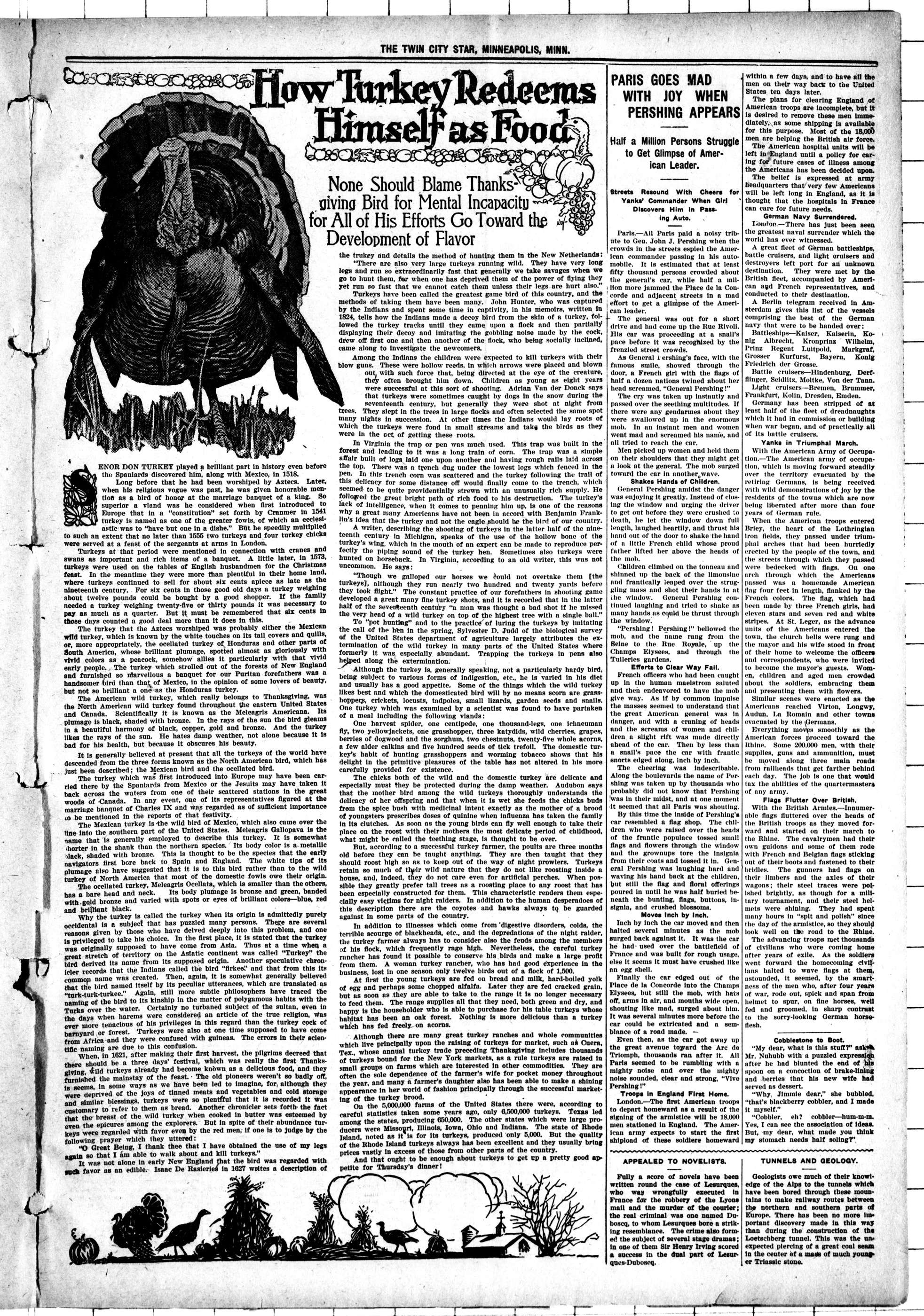
2 ENOR DON TURKEY played a brilliant part in history even before
My the Spaniards discovered him, along with Mexico, in 1518,
ee Long before that he had been worshiped by Aztecs. Later,
SNE when his religious vogue was past, he was given honorable men
HYAMS tion as a bird of honor at the marriage banquet of a king. So
RQ YSEy mwerlor a viand was ho considered when frst introduced to
PSG Borepe that in a “constitution” set forth by Cranmer in 1541
SAKA) turkey is named as one of the greater fowls, of which an ecclest-
astie was to “have but one in a dishe.” But he speedily multiplied
to such an extent that no later than 1555 two turkeys and four turkey chicks
were served at a feast of the sergeants at arms in London.
‘Turkeys at that period were mentioned in connection with cranes and
swans as important and rich items of a banquet. A little later, in 1573,
turkeys were used on the tables of English husbandmen for the Christmas
feast. In the meantime they were more than plentiful in thelr home land,
where turkeys continued to sell for about six cents aplece as Inte as the
nineteenth century. For six cents in those good old days a turkey weighing
about twelve pounds could be bought by a good shopper. If the family
needed a turkey weighing twenty-five or thirty pounds it was necessary to
pay as much as a quarter. But it must be remembered that six cents in
those duys counted a good deal more than {t does in this.
‘The turkey that the Aztecs worshiped was probably either the Mexican
wild turkey, which {s known by the white touches on its tail covers and quills,
oF, more appropriately, the ocellated turkey of Honduras and other parts of
South America, whose brilliant plumage, spotted almost as gloriously with
vivid colors as a peacock, somehow allies it particularly with that vivid
early people. , The turkey which strolled out of the forests of New England
and furnished so marvellous a banquet for our Puritan forefathers was a
handsomer fird than that of Mexico, in the opinion of some lovers of beauty,
but not so brilliant a oné-as the Honduras turkey.
‘The American wild turkey, which really belongs to ‘Thanksgiving, was
the North American wild turkey found throughout the eastern United States
and Canada, Sclentifically it is known as the Meleagris Americana, Its
plumage is black, shaded with bronze. In the rays of the sun the bird gleams
in a beautiful harmony of black, copper, gold and bronze. And the turkey
likes the rays of the sun. He hates damp weather, not alone because it 1s
bad for his health, but because it obscures his beauty.
It is generally belleved at present that all the turkeys of the world have
descended from the three forms known as the North American bird, which has
Just been described; the Mexican bird and the ocellated bird.
‘The turkey which was first introduced into Europe may have been car-
ried there by the Spantards from Mexico or the Jesuits may have taken it
back across the waters from one of thelr seattered stations in the great
woods of Canada. In any event, one of {ts representatives figured at the
mnarriuge banquet of Charles IX and was regarded as of sufficient Importance
to be mentioned in the reports of that festivity.
‘The Mexican turkey 1s the wild bird of Mexico, which also came over the
ine into the southern part of the United States. Meleagris Gallopava is the
‘name that Is generally employed to describe this turkey. It is somewhat
‘horter in the shank than the northern species. Its body color is a-metallle
slack, shaded with bronze. ‘This is thought to be the species that the early
navigators first bore back to Spain and England. The white tips of its
plumage elso have suggested that {t {s to this bird rather than to the wild
turkey of North America that most of the domestic fowls owe thelr origin.
‘The ocellated turkey, Meleagris Ocellata, which is smaller than the others,
has a bare head and neck. —_Its body plumage is bronze and green, banded
with-gald bronze and varied with spots or eyes of brilliant colors—blue, red
and brifiant black.
‘Why the turkey 1s called the turkey when its origin 1s admittedly purely
ocetdental is a subject that has puzzled many persons. There are several
feasons given by those who have delved deeply into this problem, and one
Is privileged to take his cholce. In the first place, it fs stated that the turkey
wes originally supposed to have come from Asia. Thus at a time when a
great stretch of territory on the Astatic continent was called “Turkey” the
fia derived its name from its supposed origin. Another speculative chron-
eter records that the Indians called the bird “‘firkee” and that from this its
commop name was created. ‘Then, again, it 1s somewhat generally beloved
that the bird named itself by its peculiar utterances, which are translated as
Sturk-turk-turkee.” Again, still more subtle philosophers have traced the
naming of the bird to its kinship In the matter of polygamous habits with the
Tarks over the water. Certainly no turbaned subject of the sultan, even in
the days when harems were considered an article of the true religion, was
ever more tenacious of his privileges in this regard than the turkey cock of
paryard or forest, Turkeys were also at one tlie supposed to have come
from Afrien-and they were confused with guineas. ‘The errors in thelr sclen-
tifle naming are due to this confusion.
When, in 1621, after making thelr first harvest, the pilgrims decreed that
there should be a three days’ festival, which was really the first Thanks-
giving, ¥ild turkeys already had become known as a delicious food, and they
rnished the mainstay of the feast. The old pioneers weren't so badly off,
fs seems, in some ways as we have been led to imagine, for, although they
‘ere deprived of the Joys of tinned ments and vegetables and cold storage
and similar blessings, turkeys were so plentfful that it 1s recorded it was
Sustomary to refer to them as bread. Another. chronicler sets forth the fact
{hat the breast of the wild turkey when cooked In butter was esteemed by
even the epicures among the explorers. But in spite of their abundance tur-
keys were regarded with favor even by the red men; if one fs to Judge by the
following prayer which they uttered:
“Q Great Being, I thank thee that I have obtained the use of my legs
again so that I Am able to walk about and kill turkeys.”
Tt was nat alone in early New England fat the bird was regarded with
uch favor as an edible. Isaac De Rasieried in 1627 woltes a description of
Fully a score of novels have been
written round the case of Lesurques
who way wrongfully executed in
France for the robbery of the Lyons
mail and the murder of the courier;
the real criminal was one named Du-
boseq, to whom Lesurques bore a strik-
ing resemblance. The crime also form
ed the subject of several stage dramas;
in one of them Sir Henry Irving scored
@ success in the dual part of Lesur
‘ques-Dubosca.
eo ern: 2
a J
aden | }
} ,
oe Ff
=" Be
i aM, ;
% i
iy
i , —,
TE}
heat
4
Ae :
t Si Hy
: 4 if
: es ye
a ie ee ee et es
States ten days later,
The plans for clearing England ot
American troops are incomplete, but tt
is desired to remove these men imme-
dlately).28 some shipping 1s available
for this purpose. Most of the 18000
men are helping the British air force,
The American hospital units will be
left inyEngland until a policy for car
Ing fo future cases of illness among
the Americans has been decided upon.
The belief is expressed at army
Headquarters that/ very few Americans
will be left long in England, as it ts
thought that the hospitals In France
can care for future needs.
German Navy Surrendered,
London.—There has just been seen
the greatest naval surrender which the
world has ever witnessed,
A great fleet of German battleships,
battle cruisers, and light erulsers and
destroyers left port for an unknown
dextinution. ‘They were met by the
British fleet, accompanied by Amert-
can ayd French representatives, and
conducted to their destination,
A Berlin telegram received in Am-
sterdam gives this list of the vessels
comprising the best of the German
avy that were to be handed over:
Battleships—Kalser, Kalserin, Ko-
nig Albrecht, Kronprinz Wilhelm,
Pring Regent Lultpold, — Markgrat,
Grosser Kurfurst, Bayern, Konig
Friedrich der Grosse,
Battle cruisers—Hindenburg, Derf-
finger, Seldiltz, Moltke, Von der Tana,
Light crulsers—Bremen, Brummer,
Frankfurt, Kolin, Dresden, Emden.
Germany has been stripped of at
least half of the fleet of dreadnaughts
which tt had in commission or building
when war began, and of practically all
of its battle cruisers,
Yanks in Triumphal March,
With the American Army of Occupa-
tion.—The American army of occupa-
tlon, which is moving forward steadily
over the territory evacuated by the
retiring Germans, is being received
with wild demonstrations of Joy by the
residents of the towns which are now
being Hberated after more than four
years of German rule.
When the American troops entered
Briey, the heart of the Lothringian
Iron fields, they passed under trium-
phal arches that had been hurriedly
erected by the people of the town, and
the streets through which they passed
were bedecked with flags. On one
arch through which the Americans
passed was a homemade American
fing four feet in length, flanked by the
French colors. ‘The flag, which had
been made by three French girls, had
eleven stars and xeven red and white
stripes. At St. Leger, as the advance
units of the Americans entered the
town, the church bells were rung and
the mayor and his wife stood in front
ot their home to welcome the officers
and correspondents, who were Invited
to become the mayor's guests. Wom-
en, children and aged men crowded
about the soldiers, embracing them
and presenting them with flowers,
Similar scenes were enacted as the
Americans reached Virton, Longwy,
Audun, La Romain and other towns
evacuated by the Germans.
Everything moves smoothly as the
American forces proceed toward the
Rhine, Some 200,000 men, with their
supplies, guns and ammunition, must
be moved along three main roads
from railheads that get farther behind
each day. The job is one that would
{ax the abilities of the quartermasters
of any army.
Flags Flutter Over British,
With the British Armtes.—Innumer-
able flags fluttered over the heads of
the British troops as they moved for-
ward and started on their march to
the Rhine. ‘The cavalrymen had thelr
own guidons and some of them rode
with French and Belgian flags sticking
out of their boots and fastened to their
bridies. ‘The gunners had flags on
their limbers and the axles of their
wagons; their steel traces were pol-
Ished brightly, as though for a mill-
tary tournament, and their steel hel-
mets were shining, ‘They had spent
many hours In “spit and polish” since
the day of the armistice, so they should
look well on the road to the Rhine.
‘The advancing troops met thousands
of clvillans who were coming home
after years of exile. As the soldiers
went forward the homecoming clvi}-
fans halted to wave flags at them,
astounded, it seemed, by the smart-
ness of the men who, after four years
of war, rode out, spick and span from
helmet to spur, on fine horses, well
fed and groomed, in sharp contrast
to the sorry-looking German horse
flesh.
Cobblestone to Boot.
“My dear, what Is this stuff?” aske&
Mr. Nuhubb with a puzzled exp
after he had blunted the end of
spoon on a concoction of brake-lining
and berries that his new wife had
served as dessert.
“Why, Jimmie dear,” she bubbled,
“that’s blackberry cobbler, and I made
it myself.”
“Cobbler, eh? cobbler—hum-m-m.
Yes, I can see the association of ideas.
But, my dear, what made you think
my stomach needs half soling?”,
Rann
TUNNELS AND GEOLOGY.
Geologists owe much of their know!-
‘edge of the Alps to the tunnels which
have been bored through these moun-
talns to make railway routes between
& northern and southern parts of
rope. There has been no more {tm
portant discovery made in this way
than during the construction of the
Loetschberg tunnel. This was the une
expected plercing of a great coal seam
in the center of a mags of much young
er Triassic stone.
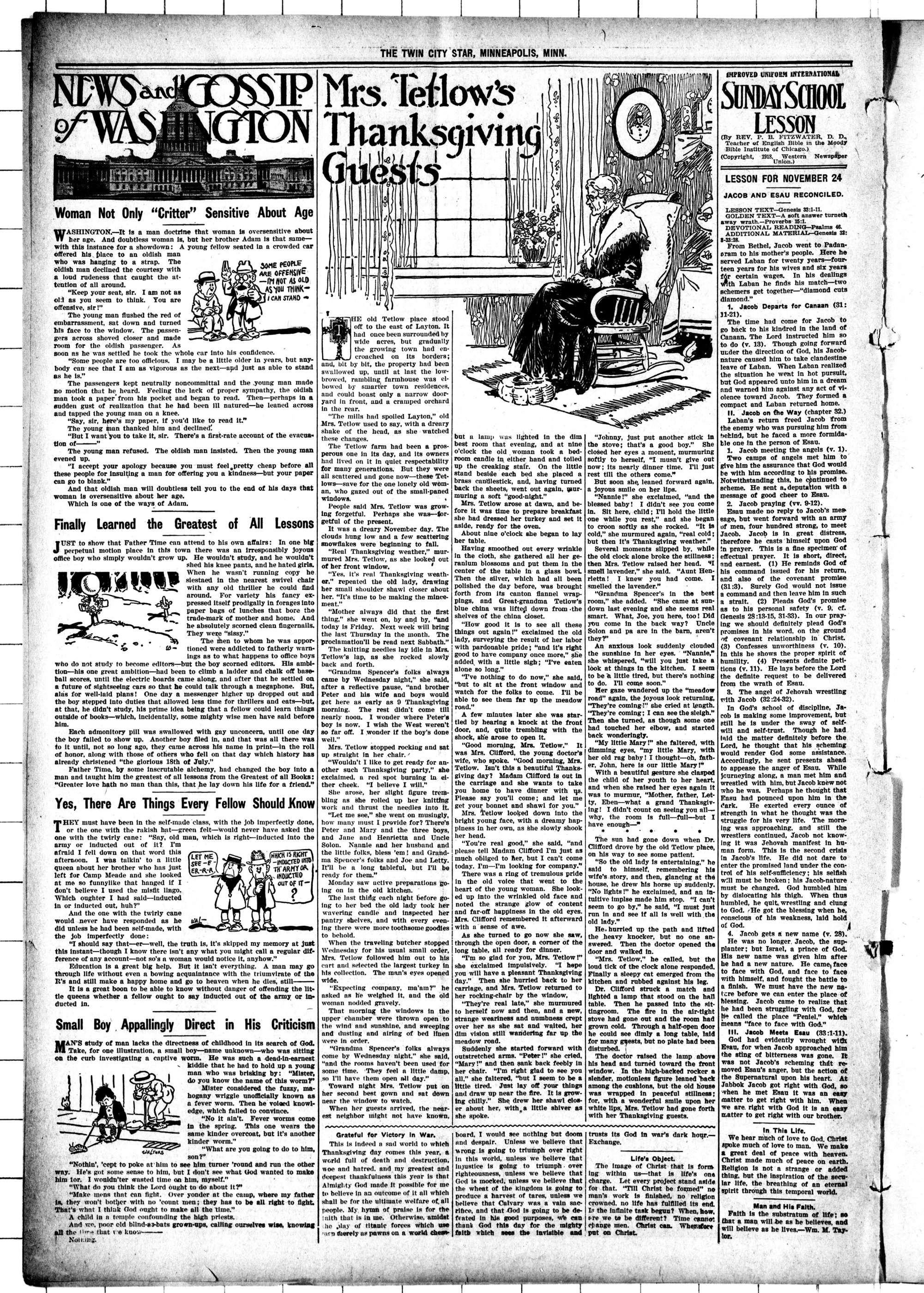
NEWS and GOSSIP OF WASHINGTON
Woman Not Only "Critter" Sensitive About Age
WASHINGTON.—It is a man doctrine that woman is oversensitive about her age. And doubtless woman is, but her brother Adam is that same—with this instance for a showdown: A young fellow seated in a crowded car offered his place to an oldish man
soon as he was settled he took the whole car in
"Some people are too officious. I may be a body can see that I am as vigorous as the next as he is."
The passengers kept neutrally noncommitted no motion that he heard. Feeling the lack of man took a paper from his pocket and began to sudden gust of realization that he had been l and tapped the young man on a knee.
"Say, sir, here's my paper, if you'd like to
"Some people are too officious. I may be a little older in years, but anybody can see that I am as vigorous as the next—and just as able to stand as he is."
The passengers kept neutrally noncommittal and the young man made no motion that he heard. Feeling the lack of proper sympathy, the oldish man took a paper from his pocket and began to read. Then—perhaps in a sudden gust of realization that he had been ill natured—he leaned across and tapped the young man on a knee.
"Say, sir, here's my paper, if you'd like to read it."
The young man thanked him and declined.
"But I want you to take it, sir. There's a first-rate account of the evacuation of——"
"But I want you to take it, sir. There's a fir-
tion of——"
The young man refused. The oldish man in
evened up.
"I accept your apology because you must
these people for insulting a man for offering you
can go to blank."
And that oldish man will doubtless tell you
woman is oversensitive about her age.
The young man refused. The oldish man insisted. Then the young man evened up.
"I accept your apology because you must feel pretty cheap before all these people for insulting a man for offering you a kindness—but your paper can go to blank."
And that oldish man will doubtless tell you to the end of his days that woman is oversensitive about her age.
Which is one of the ways of Adam.
Finally Learned the Greatest of All Lessons
JUST to show that Father Time can attend to his own affairs: In one big perpetual motion place in this town there was an irresponsibly joyous office boy who simply wouldn't grow up. He wouldn't study, and he wouldn't shed his knee pants, and he hated girls.
Finally Learned the Greatest of All Lessons
JUST to show that Father Time can attend to his own affairs: In one big perpetual motion place in this town there was an irresponsibly joyous office boy who simply wouldn't grow up. He wouldn't study, and he wouldn't
who do not study to become editors—but the position—his one great ambition—had been to climb ball scores, until the electric boards came along a future of sightseeing cars so that he could talus for well-laid plans! One day a messenger the boy stepped into duties that allowed less time at that, he didn't study, his prime idea being the outside of books—which, incidentally, some might him.
Each monitorial pill was swallowed with the boy failed to show up. Another boy filed in to it until, not so long ago, they came across h of honor, along with those of others who fell o already christened "the glorious 18th of July."
Father Time, by some inscrutable alchemy, man and taught him the greatest of all lessons fr "Greater love hath no man than this, that he la
Yes, There Are Things Every
THEY must have been in the self-made class, or the one with the rakish hat—green felt—one with the twirly cane: "Say, old man, whi
who do not study to become editors—but the boy scorned editors. His ambition—his one great ambition—had been to climb a ladder and chalk off baseball scores, until the electric boards came along, and after that he settled on a future of sightseeing cars so that he could talk through a megaphone. But, alas for well-laid plans! One day a messenger higher up dropped out and the boy stepped into duties that allowed less time for thrillers and eats—but, at that, he didn't study, his prime idea being that a fellow could learn things outside of books—which, incidentally, some mighty wise men have said before him.
Each admonitory pill was swallowed with gay unconcern, until one day the boy failed to show up. Another boy filed in, and that was all there was to it until, not so long ago, they came across his name in print—in the roll of honor, along with those of others who fell on that day which history has already christened "the glorious 18th of July."
Father Time, by some inscrutable alchemy, had changed the boy into a man and taught him the greatest of all lessons from the Greatest of All Books: "Greater love hath no man than this, that he lay down his life for a friend."
Yes, There Are Things Every Fellow Should Know
Yes, There Are Things Every Fellow Should Know
THEY must have been in the self-made class, with the job imperfectly done, or the one with the rakish hat—green felt—would never have asked the one with the twirly cane: "Say, old man, which is right—inducted into the
"I should say that—er—well, the truth is, it this instant—though I know there isn't any wha ference of any account—not so's a woman would. Education is a great big help. But it isn't through life without even a bowing acquaintance R's and still make a happy home and go to he. It is a great boon to be able to know without te queens whether a fellow ought to say ind ducted in.
Small Boy Appallingly Direct
MAN'S study of man lacks the directness of c Take, for one illustration, a small boy—nan on the curb investigating a captive worm. H kiddle t
"I should say that—er—well, the truth is, it's skipped my memory at just this instant—though I know there isn't any what you might call a regular difference of any account—not so's a woman would notice it, anyhow."
Education is a great big help. But it isn't everything. A man may go through life without even a bowing acquaintance with the triumvirate of the R's and still make a happy home and go to heaven when he dies, still——
It is a great boon to be able to know without danger of offending the little queens whether a fellow ought to say inducted out of the army or inducted in.
Small Boy Appallingly Direct in His Criticism
MAN'S study of man lacks the directness of childhood in its search of God. Take, for one illustration, a small boy—name unknown—who was sitting on the curb investigating a captive worm. He was such a dead-in-earnest
"Nothin', 'cept to poke at him to see him tu way. He's got some sense to him, but I don't s him tor. I wouldn't wasted time on him, mysis
"What do you think the Lord ought to do al
"Make mens that can fight. Over yonder a is, they won't bother with no 'count men; they That's what I think God ought to make all the a
A child in a temple confounding the high p And we, poor old blind-as-bats grown-ups, ca all the time that we know——
Nothing.
"Nothin', 'cept to poke at him to see him turner 'round and run the other way. He's got some sense to him, but I don't see what God wanted to make him 1or. I wouldn't wasted time on him, myself."
"What do you think the Lord ought to do about it?"
"Make mens that can fight. Over yonder at the camp, where my father is, they won't bother with no 'count men; they has to be all right to fight. That's what I think God ought to make all the time."
A child in a temple confounding the high priests.
And we, poor old blind-a-bats grown-ups, calling ourselves wise, knowing all the time that we know——
offered his place to an oldish man who was hanging to a strap. The oldish man declined the courtesy with a loud rudeness that caught the attention of all around.
"Keep your seat, sir. I am not as old as you seem to think. You are offensive, sir!"
The young man flushed the red of embarrassment, sat down and turned his face to the window. The passengers across shoved closer and made room for the oldish passenger. As
Which is one of the ways of Adam.
A
army or inducted out of it? I'm afraid I fell down on that word this afternoon. I was talkin' to a little queen about her brother who has just left for Camp Meade and she looked at me so funnylike that hanged if I don't believe I used the misfit lingo. Which ougher I had said—inducted in or inducted out, huh?"
And the one with the twirly cane would never have responded as he did unless he had been self-made, with the job imperfectly done:
WALTERS
SOME PEOPLE ARE OFFENSIVE
—I'M NOT AS OLD
AS YOU THINK
I CAN STAND
whole car into his confidence. may be a little older in years, but any as the next—and just as able to stand uncommittal and the young man made the lack of proper sympathy, the oldish began to read. Then—perhaps in a had been ill natured—he leaned across I'd like to read it." declined'
here's a first-rate account of the evacuash man insisted. Then the young man you must feel pretty cheap before all offering you a kindness—but your paper as tell you to the end of his days that in.
greatest of All Lessons
attend to his own affairs: In one big own there was an irresponsibly joyous p. He wouldn't study, and he wouldn't
shed his knee pants, and he hated girls. When he wasn't running copy he siestaed in the nearest swivel chair with any old thriller he could find around. For variety his fancy expressed itself prodigally in forages into paper bags of lunches that bore the trade-mark of mother and home. And he absolutely scorned clean fingernails. They were "sissy."
The men to whom he was apportioned were addicted to fatherly warnings as to what happens to office boys
but the boy scorned editors. His ambition to climb a ladder and chalk off base-name along, and after that he settled on could talk through a megaphone. But, messenger higher up dropped out and less time for thrillers and eats—but, a being that a fellow could learn things some mighty wise men have said before lived with gay unconcern, until one day boy filed in, and that was all there was e across his name in print—in the roll who fell on that day which history has of July." Alchemy, had changed the boy into a lessons from the Greatest of all Books: that he lay down his life for a friend."
Every Fellow Should Know
ide class, with the job imperfectly done, green felt—would never have asked the man, which is right—inducted into the
LET ME
SEE - E-
ER - R - R
WHICH IS RIGHT
- INDUCTED INTO
TH' ARMY OR
INDUCTED
OUT OF IT -
wm! -
truth is, it's skipped my memory at just
it any what you might call a regular dif-
man would notice it, anyhow."
but it isn't anything. A man may go
equaintance with the triumvirate of the
go to heaven when he dies, still—
now without danger of offending the lit-
tle say inducted out of the army or in-
Direct in His Criticism
itness of childhood in its search of God.
boy—name unknown—who was sitting
worm. He was such a dead-in-earnest
kidney that he had to hold up a young
man who was briskling by: "Mister,
do you know the name of this worm?"
Mister considered the fuzzy, ma-
hogany wriggle unofficially known as
a fever worm. Then he voiced knowledge,
which failed to convince.
"No it ain't. Fever worms come in the spring. This one wears the same kinder overcoat, but it's another kinder worm."
"What are you going to do to him, son?"
see him turner 'round and run the other I don't see what God wanted to make him, myself."
at to do about it?"
yonder at the camp, where my father men; they has to be all right to fight, be all the time."
the high priests.
own-ups, calling ourselves wise, knowing
THE TWIN CITY STAR, MINNEAPOLIS, MINN.
Mrs. Tetlow's Thanksgiving Guests
HE old Tetlow place stood off to the east of Layton. It had once been surrounded by wide acres, but gradually the growing town had encroached on its borders; and, bit by bit, the property had been swallowed up, until at last the low-browed, rambling farmhouse was elbowed by smarter town residences, and could boast only a narrow door-yard in front, and a cramped orchard in the rear.
"The mills had spoiled Layton," old
"The mills had spilled Layton," old Mrs. Tetlow used to say, with a dreary shake of the head, as she watched these changes.
The Tetlow farm had been a prosperous one in its day, and its owners had lived on it in quiet respectability for many generations. But they were all scattered and gone now—these Tetlows—save for the one lonely old woman, who gazed out of the small-paned windows.
People said Mrs. Tetlow was growing forgetful. Perhaps she was—forgetful of the present.
It was a dreary November day. The clouds hung low and a few scattering snowflakes were beginning to fall.
"Real Thanksgiving weather," murmured Mrs. Tetlow, as she looked out of her front window.
"Yes, it's real Thanksgiving weather," repeated the old lady, drawing her small shoulder shawl closer about her. "It's time to be making the mincement."
"Mother always did that the first thing," she went on, by and by, "and today is Friday. Next week will bring the last Thursday in the month. The proclamation'll be read next Sabbath."
The knitting needles lay idle in Mrs. Tetlow's lap, as she rocked slowly back and forth.
"Grandma Spencer's folks always came by Wednesday night," she said, after a reflective pause, "and brother Peter and his wife and boys would get here as early as 9 Thanksgiving morning. The rest didn't come till nearly noon. I wonder where Peter's boy is now. I wish the West weren't so far off. I wonder if the boy's done well."
Mrs. Tetlow stopped rocking and sat up straight in her chair. "Wouldn't I like to get ready for another such Thanksgiving party," she exclaimed, a red spot burning in either cheek. "I believe I will."
She arose, her slight figure trembling as she rolled up her knitting work and thrust the needles into it. "Let me see," she went on musingly, how many must I provide for? There's Peter and Mary and the three boys, and Jane and Henrietta and Uncle Solon. Nannie and her husband and the little folks, bless 'em! and Grandma Spencer's folks and Joe and Letty. It'll be a long tableful, but I'll be ready for them."
Monday saw active preparations going on in the old kitchen.
The last thidg each night before going to her bed the old lady took her wavering candle and inspected her pantry shelves, and with every evening there were more toothsome goodies to behold.
When the traveling butcher stopped Wednesday for his usual small order, Mrs. Tetlow followed him out to his cart and selected the largest turkey in his collection. The man's eyes opened wide.
"Expecting company, ma'am?" he asked as he welged it, and the old woman nodded gravely.
That morning the windows in the upper chamber were thrown open to the wind and sunshine, and sweeping and dusting and airing of bed linen were in order.
"Grandma Spencer's folks always come by Wednesday night," she said, "and the rooms haven't been used for some time. They feel a little damp, so I'll have them open all day." Toward night Mrs. Tetlow put on her second best gown and sat down near the window to watch. When her guests arrived, the nearest neighbor might not have known,
Grateful for Victory in War.
This is indeed a sad world to which Thanksgiving day comes this year, a world full of death and destruction, woe and hatred, and my greatest and deepest thankfulness this year is that Almighty God made it possible for me to believe in an outcome of it all which shall be for the ultimate welfare of all people. My hymn of praise is for the truth that is in me. Otherwise, amidst the play of titanic forces which use men merely as pawns on the world chest
but a lamp was lighted in the dim best room that evening, and at nine o'clock the old woman took a bedroom candle in either hand and toiled up the creaking stair. On the little stand beside each bed she placed a brass candlestick, and, having turned back the sheets, went out again, purmuring a soft "good-night." Mrs. Tetlow arose at dawn, and before it was time to prepare breakfast she had dressed her turkey and set it aside, ready for the oven. About nine o'clock she began to lay her table.
Having smoothed out every wrinkle in the cloth, she gathered all her geranium blossoms and put them in the center of the table in a glass bowl. Then the silver, which had all been polished the day before, was brought forth from its canton fannel wrappings, and Great-grandma Tetlow's blue china was lifted down from the shelves of the china closet.
"How good it is to see all these things out again!" exclaimed the old lady, surveying the result of her labor with pardonable pride; "and it's right good to have company once more," she added with a little sigh; "I've eaten alone so long."
"Ive nothing to do now," she said, "but to sit at the front window and watch for the folks to come. I'll be able to see them far up the meadow road."
A few minutes later she was startled by hearing a knock at the front door, and, quite trembling with the shock, she arose to open it.
"Good morning, Mrs. Tetlow." It was Mrs. Clifford, the young doctor's wife, who spoke. "Good morning, Mrs. Tetlow. Isn't this a beautiful Thanksgiving day? Madam Clifford is out in the carriage and she wants to take you home to have dinner with us. Please say you'll come; and let me get your bonnet and shawl for you."
Mrs. Tetlow looked down into the bright young face, with a dreamy happiness in her own, as she slowly shook her head.
"You're real good," she said, "and please tell Madam Clifford I'm just as much obliged to her, but I can't come today. I'm—I'm looking for company."
There was a ring of tremulous pride in the old voice that went to the heart of the young woman. She looked up into the wrinkled old face and noted the strange glow of content and far-off happiness in the old eyes. Mrs. Clifford remembered it afterward with a sense of awe.
As she turned to go now she saw, through the open door, a corner of the long table, all ready for dinner.
"Tm so glad for you, Mrs. Tetlow!" she exclaimed impulsively. "I hope you will have a pleasant Thanksgiving day." Then she hurried back to her carriage, and Mrs. Tetlow returned to her rocking-chair by the window.
"They're real late," she murmured to herself now and then, and a new, strange weariness and numbness crept over her as she sat and waited, her dim vision still wandering far up the meadow road.
Suddenly she started forward with outstretched arms. "Peter!" she cried, "Mary!" and then sank back feebly in her chair. "I'm right glad to see you all," she faltered, "but I seem to be a little tired. Just lay off your things and draw up near the fire. It is growing chilly." She drew her shawl closer about her, with a little shiver as she spoke.
"Johnny, just put another stick in the stove; that's a good boy." She closed her eyes a moment, murmuring softly to herself, "I must give out now; its nearly dinner time. I'll just rest till the others come."
But soon she leaned forward again, a joyous smile on her lips.
"Nannie!" she exclaimed, "and the blessed baby! I didn't see you come in. Sit here, child; I'll hold the little one while you rest," and she began to croon softly as she rocked. "It is cold," she murmured again, "real cold; but then it's Thanksgiving weather."
Several moments slipped by, while the old clock alone broke the stillness; then Mrs. Tetlow raised her head. "I smell lavender," she said. "Aunt Henrietta! I knew you had come. I smelled the lavender."
"Grandma Spencer's in the best room," she added. "She came at sun-down last evening and she seems real smart. What, Joe, you here, too! Did you come in the back way? Uncle Solon and pa are in the barn, aren't they?" An anxious look suddenly clouded the sunshine in her eyes. "Nannle," she whispered, "will you just take a look at things in the kitchen. I seem to be a little tred, but there's nothing to do. I'll come soon." Her gaze wandered up the "meadow road" again, the joyous look returning, "They're coming!" she cried at length, "They're coming; I can see the sleigh." Then she turned, as though some one had touched her elbow, and started back wonderingly. "My little Mary!" she faltered, with dimming eyes, "my little Mary, with her old rag baby! I thought—oh, father. John, here is our little Mary!"
With a beautiful gesture she clasped the child of her youth to her heart, and when she raised her eyes again it was to murmur, "Mother, father, Letty, Eben—what a grand Thanksgiving! I didn't count on seeing you all—why, the room is full—full—but I have enough—"
The sun had gone down when Dr. Clifford drove by the old Tetlow place, on his way to see some patient.
"So the old lady is entertaining," he said to himself, remembering his wife's story, and then, glancing at the house, he drew his horse up suddenly.
"No lights!" he exclaimed, and an intuitive impulse made him stop. "I can't seem to go by," he said, "I must just run in and see if all is well with the old lady."
He hurried up the path and lifted the heavy knocker, but no one answered. Then the doctor opened the door and walked in.
"Mrs. Tetlow," he called, but the loud tick of the clock alone responded. Finally a sleepy cat emerged from the kitchen and rubbed against his leg.
Dr. Clifford struck a match and lighted a lamp that stood on the hall table. Then he passed into the sittingroom. The fire in the air-tight stove had gone out and the room had grown cold. Through a half-open door he could see dimly a long table, laid for many guests, but no plate had been disturbed.
The doctor raised the lamp above his head and turned toward the front window. In the high-backed rocker a slender, motionless figure leaned back among the cushions, but the old house was wrapped in peaceful stillness; for, with a wonderful smile upon her white lips, Mrs. Tetlow had gone forth with her Thanksgiving guests.
trusts its God in war's dark hour.—Exchange.
Life'a Object.
The image of Christ that is forming within us—that is life's one charge. Let every project stand aside for that. "Till Christ be formed" no man's work is finished, no religion crowned, no life has fulfilled its end. Is the infinite task begun? When, how, are we to be different? Time cannot change men. Christ can. When force put on Christ.
IMPROVED UNIFORM INTERNATIONAL SUNDAY SCHOOL LESSON
(By REV. P. B. FITZWATER. D. D. Teacher of English Bible in the Moody Bible Institute of Chicago.) (Copyright, 1913 Eastern Newspaper Union.)
LESSON FOR NOVEMBER 24
JACOB AND ESAU RECONCILED.
LESSON TEXT—Genesis 33:1-11.
GOLDEN TEXT—A soft answer turneth away wrath—Proverbs 41:1.
DIDDITIONAL READING—Psalms 46.
ADDITIONAL MATERIAL—Genesis 33:8-33:28.
From Bethel, Jacob went to Padarram to his mother's people. Here he served Laban for twenty years—fourteen years for his wives and six years for certain wages. In his dealings with Laban he finds his match—two schemers get together—"diamond cuts diamond."
1. Jacob Departs for Canaan (31:11-21).
The time had come for Jacob to go back to his kindred in the land of Canaan. The Lord instructed him so to do (v. 13). Though going forward under the direction of God, his Jacobnature caused him to take clandestine leave of Laban. When Laban realized the situation he went in hot pursuit, but God appeared unto him in a dream and warned him against any act of violence toward Jacob. They formed a compact and Laban returned home.
II. Jacob on the Way (chapter 32.) Laban's return freed Jacob from the enemy who was pursuing him from bekind, but he faced a more formidable one in the person of Esau.
1. Jacob meeting the angels (v. 1).
Two camps of angels met him to give him the assurance that God would be with him according to his promise. Notwithstanding this, he continued to scheme. He sent a, deputation with a message of good cheer to Esau.
2. Jacob praying (vv. 9-12).
2. Jacob praying (v. 9).
Esau made no reply to Jacob's message, but went forward with an army of men, four hundred strong, to meet Jacob. Jacob is in great distress, therefore he casts himself upon God in prayer. This is a fine specimen of effectual prayer. It is short, direct, and earnest. (1) He reminds God of his command issued for his return, and also of the covenant promise (31:3). Surely God would not issue a command and then leave him in such a strait. (2) Pleads God's promise as to his personal safety (v. 9, cf. Genesis 28:13-15, 31-33). In our praying we should definitely plead God's promises in his word, on the ground of covenant relationship in Christ. (3) Confesses unworthiness (v. 10). In this he shows the proper spirit of humility. (4) Presents definite petitions (v. 11). He lays before the Lord the definite request to be delivered from the wrath of Esau.
3. The angel of Jehovah wrestling with Jacob (32:24-32).
In God's school of discipline, Jacob is making some improvement, but still he is under the sway of self-will and self-trust. Though he had laid the matter definitely before the Lord, he thought that his scheming would render God some assistance. Accordingly, he sent presents ahead to appease the anger of Esau. While Journeying along, a man met him and wrestled with him, but Jacob knew not who he was. Perhaps he thought that Esau had pounced upon him in the dark. He exerted every ounce of strength in what he thought was the struggle for his very life. The morning was approaching, and still the wrestlers continued, Jacob not knowing it was Jehovah manifest in human form. This is the second crisis in Jacob's life. He did not dare to enter the promised land under the control of his self-sufficiency; his selffish will must be broken; his Jacob-nature must be changed. God humbled him by dislocating his thigh. When thus humbled, he quit, wrestling and clung to God. He got the blessing when he, conscious of his weakness, laid hold of God.
4. Jacob gets a new name (v. 28).
He was no longer. Jacob, the supplanter; but Israel, a prince of God.
His new name was given him after he had a new nature. He came face to face with God, and face to face with himself, and fought the battle to a finish. We must have the new nature before we can enter the place of blessing. Jacob came to realize that he had been struggling with God, for he called the place "Peniel," which means "face to face with God."
III. Jacob Meeta Esau (33:1-11).
God had evidently wrought with Esau, for when Jacob approached him the sting of bitterness was gone. It was not Jacob's scheming that removed Esau's anger, but the action of the Supernatural upon his heart. At Jabbok Jacob got right with God, so when he met Esau it was an easy matter to get right with him. When we are right with God it is an easy matter to get right with our brother.
In This Life.
We hear much of love to God. Christ spoke much of love to man. We make a great deal of peace with heaven. Christ made much of peace on earth. Religion is not a strange or added thing, but the inspiration of the secular life, the breathing of an eternal spirit through this temporal world.
Man and His Faith.
Faith is the substratum of life; so that a man will be as he believes, and will believe as he lives.—Wm. M. Taylor.
M.
Col. Charles Young.
COLONEL YOUNG ON ACTIVE LIST
(Special to The Twin City Star.)
Washington, Nov. 14.—Announcement is made by Emmett J. Scott, special assistant, that the Secretary of War has directed as necessary in the military service, that Colonel Charles Young proceed to Camp Grant, Rockford, Illinois, and report in person to the commanding general at that camp for assignment to duty in connection with the Colored Development Battalions at Camp Grant.
7544
Many press reports, commenting on the American army in France, intimate that the Germans have a wholesome fear of colored troops in action. General Pershing is lavish in his praise of the colored soldiers and has testified officially that they show marvelous coolness under shell fire, and an entire regiment, as well as individual colored soldiers, has been cited for decorations of honor.
A Cash Deposit Required on All Advertisements. Notices of Entertainments, etc. Must Be Accompanied by Cash.
There will be three congressmen from the Twin Cities who will stand as a stone wall for equal justice for all men—Thos. D. Schall and Walter Newton of Minneapolis and C. C. Van Dyke of St. Paul.
Mr. J. E. Meyers is to be our next mayor. If he is as loyal to the citizens as Mayor Van Lear is to them, he will find them faithful to the end.
We notice that many of the newcomers from the South are becoming paid subscribers to the Twin City Star. They have been accustomed to patronizing their own newspapers, where the real news of the Negro is published.
The War Department Commission on Training Camp Activities has made provision for the entertainment of a labor battalion of about 1,000 colored troops which has been sent to Camp Kearney, Linda-Vista, Cal., for sanitation work around the camp. This battalion is made up of colored men unfit for overseas duty by reason of minor physical disabilities.
Atty. H. L. Scott was defeated for representative in the Fourth ward. He did not get the support of his people because of his badly managed campaign, and made a poor showing.
N. A. A. C. P. BUTTONS.
Every Member Should Wear One.
It is the express wish of the Central Branch of the N. A. A. C. P. that all members should wear a button showing their connection with this organization, that stands for the rights of our race. I have therefore in conformity with that desire received 100 buttons which will be sold to members at the small figure of thirty-five cents (35c) each. The button is very beautifully and artistically made and one which every member should be proud to wear. The Secretary will always have a number of these buttons with him and will take no offense if stopped on the street or anywhere else to purchase one. Let each member have a button. Wear it in a conspicuous place, be prepared to tell what it stands for when questioned and thus advertise the Association for
the advancement of colored people.
A general meeting will take place as early as is convenient and members are kindly asked to watch the Twin City Star for announcement.
R. AUGUSTINE SKINNER,
Secretary.
The Purpose of an Advertisement
is to serve your needs. It will help sell your goods—talk to the people you want to reach. An advertisement in this paper is a reference guide to those whose wants are worth supplying.
LIEUT. EUROPE'S COLORED BAND
THE MUSIC OF THE MUSICIAN'S ORCHESTRA
Lieut. Europe's colored band entertaining the convalescent American soldiers on the old race track at Auteuil, where the AMERICAN RED CROSS put up a tent hospital (American Military Hospital No. 5). Those who were able danced in the tent in the background. September, 1918.
Stewart Heaters
Stewart Combination
If you want the most modern, up-to-date cooking apparatus the Stewart Combination will meet your desire. It will fill your home with cheer and no matter what the weather conditions are you'll not suffer with either the heat or cold. Sold on easy terms, and your old stove taken as part payment.
---
STEWART
THE TWIN CITY STAR, MINNEAPOLIS, MINN. Nov. 23, 1918
For almost a century they have stood the test and made good. For over forty years they have occupied a prominent place on our sample floor. With a Stewart in your home your fuel bill will be one-fourth less. Your old stove taken as part payment and liberal terms granted.
Easy Payments
CHEF'S HOUSE
Man is fond of calling himself the "Proudest work of nature," and yet—
The birds can sing more sweetly.
Nearly all the world creatures provide for their families.
Many other creatures possess protective coloration.
And the rooster—
No, we'll take that back—
---
MAN THE MASTER
Many bugs can see better.
Most other animals have a much better developed sense of smell.
Many other creatures have the sense of direction, which he lacks entirely.
The flea can jump farther in proportion to its size.
The spider can teach him things about rope making.
The wasps showed him how to make paper.
Dumb beasts eat and drink only
what is good for them.
The rooster cannot beat him at crowing—Youngstown Telegram.
FLASHLIGHTS
Nothing pleases the average person more than to be called a "real busy man."
One can't help wondering just what school of life a man goes to to learn to boast.
The man who is loyal to his country would never be disloyal to his wife and children.
The man who has spent his money to make others happy need never have any regrets over dying poor.
Any pretty girl can get admirers, but there's something to the plain young woman who wins admiration.
If it weren't for the neighbors what would some folks do when they needed a hammer or a screwdriver?
The world owes no man a living; what it does owe every man is a chance to make a living, and it usually pays him that.
Beauty may be only skin deep, but any peach can tell you that it doesn't have to be any thicker to fool the men. —Detroit Free Press.
"The coat is cheap enough, miss, but it doesn't look well on you."
"No, our two-for-a-quarter cigars are no better than our straight tens."
"Really, I don't care to ride downtown in your car. It's the bumpiest rattletrap I ever entered."
"The fact is, doctor, I quit going to church when you commenced that new series of deadly dull sermons."
"No, my dear, even if you did make it yourself, this isn't a delicious strawberry shortcake. I had a better one today at the serveself."
FOOLS YOU HAVE KNOWN
Yourself.—Life.
Your rival in love.
Your wife's first husband.
The actress who refuses to return your smile.
The man who returns the smile of the actress on the stage.
Your uncle who tries to advise you about the stock market.
Your other uncle who refuses to take your advice about the stock market.
WORTH KNOWING
A form holder for concrete work has been invented that can be left in the concrete to re-enforce it or to provide a socket for attachments.
Gold is being mined at a depth of more than 3,000 feet in South Africa and it is believed that the shafts can be sunk 3,000 feet deeper.
An inventor has patented a tool by which live electric wires can be tapped and other wires attached without danger to a person using it.
Chinese are estimated to destroy $10,-000,000 worth of gold annually by their custom of burning small pieces of gold leaf on certain anniversaries.
Gasoline motor cars on one European railroad have radiators on their roofs to cool water that is used to prevent the motors overheating.
SOCIETY
Chicago Sends Three, West Virgil Three and New York One—Ass blyman Johnson Defeated for Election in New York City.
ONE IN CALIFORNIA
(From Our Exchanges.)
'New York City.—Two Negroes wnandidates for the State Legislature in two Harlem districts. E. A. J. Jonson, present assemblyman from the Nineteenth district, was defeated John J. Healy, white. Mr. John claims that he was beaten by the Negro Democrats. He was the first Negro elected to the New York Legislature and made an excellent reco John Clifford Hawkins was elect from the Twenty-first district. The wmen voters took an active part in the election. The absence of many m in war service had much to do with the results.
Chicago, Ill.—Hon. Adelbert Roberts, Warren G. Douglass and Editor S. B. Turner have been elected members from the Chicago district as members of the Illinois Legislature. Mr. Roberts is a widely known orator and clerk in the Municipal Court Warren Douglass is a lawyer of splendid literary attainments and S. B. Turner is editor of the Illinois Ide this being his second time to be elected to the Illinois Legislature.
Three in West Virginia.
Charleston, W. Va., Nov. 9.—Resulting from Tuesday's election three coed men will have seats in the low house when West Virginia's legislature convenes next January, rivaling the record of any state since the day of reconstruction.
The successful candidates, nominated in primaries and elected on the Republican ticket, are: J. V. Colemar of Fayette county, formerly postmaster at Kimberly, now engaged in the production of coal; H. J. Capehart of McDowell county, an attorney-at-law, and T. G. Nutter, former grand exalted ruler of the Elks, at present grand chancellor of the Knights of Pythias Mr. Nutter is also an attorney.
Both Fayette and McDowell counties have had colored legislators before the former three and the latter one but at no time has there been more than one colored representative in the legislature.
the nomination and election of these men is considered remarkable for the fact that in none of the counties which they represent is there a majority of colored voters, the percent in McDowell county being 34 Fayette 22 and Kanawha 10.
Turpin Elected, Riley and Phillips
Defeated.
Charles H. Turpin was elected constable in the Fourth district by 992 over O'Donnel and 1229 over O'Brien, the Democratic candidates. Homer G. Phillips, independent candidate for justice of the peace in the Fourth district, was defeated. Phillips received 664 votes. This is considered laudable in as much as it was necessary to scratch one of the candidates and write his name in. The vote for him by ward was: Sixth 108, Sixteenth 91, Seventeenth 465. Total 664. Dr. Riley was evidently counted out, judging by the narrow margin by which he was defeated. It is significant that of 16 men elected to the state legislature, 15 were Republican, and the only Negro Republicans on the ticket was defeated by a white Democrat—St. Louis Argus.
(Special to Twin City Star)
Race Prejudice Gets Knocked Out.
In Los Angeles, Cal., November 5, Mr. Frederick M. Roberts, a welltrained young business man, a Republican candidate, was elected to the state legislature from the 74th Assembly District. Mr. Roberts is the first Colored man in California to be so honored.
Notwithstanding the fact that Roberts won the Republican nomination at the August primaries in a field of five aspirants, and which nomination is always equivalent to an election, strong efforts were made to* defeat him, on no issue other than race prejudice. His independent opponent gumshoe around the district passing out his cards. Written on the back thereof of was the inscription, "My Opponent is a Nigger." All fair-minded people resented this attack. Mr. Gahart, the man who put it in vogue, was buried under an avalanche of votes. The final count was Roberts, 2,556; Gahart, 1,794, a majority for Roberts of 726.
And thus the 74th Assembly District of the great State of California presents a practical demonstration of real democracy, for be it known, without the support of a very considerable part of the white voters in this district the election of Mr. Roberts would have been impossible. While in this district there is a great big Colored population, the same does not by any means excel that of the white people. Therefore the victory for democracy is cleancut and unquestioned.—The California Eagle.
Secretaries of Lodges may send notices of their newly elected officers for free publication and office information.
Do not forget to send the money to the Star which you owe for subscriptions.
SUBSCRIBE FOR THE STAR.
Three in Chicago.
LOCAL NEWS
IMPORTANT NOTICE
Unless notes are written plainly
and properly arranged they will not
‘be inserted. Many people send in
notes regardless of names, initials or
composition. Arrangement by the
publisher will be charged for. Free
‘notices must be correctly written.
Boutell Bros. have in their employ
a colored lady as elevator operator,
‘who has given very satisfactory ser-
ice.
Mr. and Mrs. W. H. Briggs have
moved to 813 Oak Lake Ave. Mrs.
Emma Jeffrey has moved to 807 5th
Ave. N.
Mr. and Mrs, Arthur Brown have
‘moved to 1912 4th Ave. S.
‘Mr. Walter Dodson and family have
moved to 3035 Findley Place.
“Mr. and Mrs. James Burkes have
‘moved to 3013 Garfleld Avenue.
Mrs, J. B. Glover of Oakland aveune
thas moved to 3740 Fourth avenue S.
Mrs. Lulu Maxwell has been ap
‘pointed one of the social workers of
the Associated Charities to look after
the interests of the Negroes.
Mr. Everett Roberts, son of late Col.
James Roberts, has entered the Stu-
dents’ Army Training Corps at the
‘University of Minmesota.
Mr. Geo. E. Jones, the famous chef,
‘has charge of the culinary department
at the Waiters and Porters’ Club. He
‘has a reputation for his sanitary serv-
ice. Manager Lee Wheeler has reno-
‘vated the kitchen and opened a new
dining room.
SUBSCRIBERS WANTED — Make
the Twin City Star a live and depend-
able weekly Negro newspaper by
sending your subscription.
Mr. Robert Singer and family have
moved to 1534 East Thirty-second
street. s
Mr. Phillip Scott, after a summer in
‘Canada, has returned to reside at 519
Humboldt avenue north. He was very
4M while there with influenza, but has
recovered.
“Mr. Gillespie Plummer has returned
from Camp Pike, Ark. He is on a
furlough from the Officers’ Training
camp. Mr. Plummer expects to be dis-
charged and will return to his former
position as stenographer in the War
Department at New York City. He
was for many years attached to the
Department of Dakota at St. Paul.
Mrs. John W. Harper, Jr., returned
Monday from’ Lloyd, Wis., where she
spent a month visiting her sister, Mrs.
Lincoln Revels.
Mr. John (Brock) Webster came
oyer from New Duluth Monday on a
business trip. He is looking well and
says that there is plenty of work and
good wages for our people.
Earl D, Stewart was back home from
Camp Dodge, having been honorably
discharged. Earl is much improved in
every way after his life in an army
camp. He left for Chicago to visit his
wife. ~
Mr. Drew Simms of the C. P. R., en-
foyed a vacation in the Twin Cities.
He is located in Winnipeg.- During his
stay he was the dinner guest of Mr.
and Mrs. H. 8. Winston of 2217 River-
side avenue, and entertained by sev-
eral of his old friends. He is enjoy-
ing good health and pleased by his
visit.
Clarence W: Bell's billiard parlor is
open since the flu ban was lifted. The
players are out of practice and are
trying to get back to form. Business
$8 good, but Bell will remember the
flu some time yet.
Mr. Arthur O. Thomas of Interna-
tional Falls, Minn, and Mrs. Maud
Maryweather returned last week from
visiting his sister, Mrs. Mamie E.
Montgomery, in Chicago. They had
a pleasant trip, but received the sad
news of the death of Lieut. Mary-
weather on their return home.
A SPECIAL NOTICE.
‘We need every cent due us to keep
up this publication. The Star asks
no charity. If you want to help a
paper for your race, get us @ sub-
scriber.
Mie
.
OME. 2a
ey << 3 ;
Sua a eal me
Part hath Ser aoe
seen oa a ait
Goss: ie = et
aie ‘J
ei: a
{
{
A True Likeness of
Mr. Phil. F. Hale.
VAN HOOK’S DINING ROOM
SPECIAL SERVICE FOR LADIES
Mr. A. B. Van Hook, the well known
chef, has taken over the management
of the dining room of Stewart’s Hotel,
246 Fourth ave. S. He has arranged
for the evenings for entertainment of
his lady patrons. Mrs. Mildred Jones
has charge of the dining room, female
waitresses will serve. The Ladies’
Entertainment nights are Tuesday,
Thursday and Sunday evenings. Break-
fast will be ready at 7 a. m. Special
25c noon lunch and a la carte dinner.
Chop Suey served. The patronage of
the public is cordially solicited. The
management guarantees excellent .ser-
vice and a respectable entertainment,
which will meet the approval of the
most particular patrons.
Mr, and Mrs. A. B. Van Hook have
moved into the new house, 4,000 42nd
‘Ave. So. They suffered a loss of their
house by fire in September, which was
partly covered by insurance. During
their misfortune they received many
courtesies and much assistance by
their white neighbors.
Death of Miss Beasley.
Miss Ruth Beasley, daughter of Rev.
and Mrs. D. C. Beasley, died Novem-
ber 10th, of influenza. She had been
for many years a sufferer from asth-
ma. She was loved by all who knew
her. Despite her continued suffering,
she was always pleasant and ambi-
tious and a gifted student, and Chris-
tion young woman. Mrs. Beasley was
sick at the time of her daughter's
death. They have the sympathy of a
host of friends in their bereavement.
Mr. George Winston of Fargo, N. D.,
is on a visit to his mother, Mrs.
Amanda Winston, 3630 39th ave. S. He
is a brother of Mr. Carey Winston,
who died recently.
Southern Editor a Visitor.
Hon. Roscoe Dungee, editor of the
Black Dispatch of Oklahoma City,
Okla., was a recent visitor in this city.
He was sent to Camp Dodge as one of
the election officials from his state.
‘While here he was the guest of Deputy
Sheriff John H. Allison and Mrs. Ione
E. Gibbs. He inspected the plant of
the J. and H. Wet Wash laundry,
owned by Mrs. Gibbs’ sons, three of
whom are in the National Army. This
is the largest wet-wash concern in
the northwest. Editor Dungee spent
a short time here and expressed his
high opinion of the opportunities of
the Negroes in this section.
‘Mr. and Mrs. Thomas Carroll have
taken apartments for the winter at
620 East Lake street. They have one
of the best farms located near Par-
‘shall, N. D., where he is one of the
: suecessful farmers,
- NOTICE TO SUBSCRIBERS
All subscriptions are promptly dis-
continued when they expire. Watch
your label and renew at least one
week before date of expiration in or-
der not to miss any copy. The first
number on the label indicates the
month, the second, the year. Thus,
1-14 indicates that the subscription ex-
pires January, 1914.
CARD OF THANKS
‘We wish to extend our heartfelt
thanks to our friends for the kindness
shown us during our bereavement in
the death of our father, Julius C.
Glenn, and also for the beautiful floral
offerings. ‘The Family.
‘Mr. William Lyons, who has been
residing in Duluth, has returned to
this city for an indefinite stay.
Miss Francis Mask left for Wash-
ington, D. C., last week to take a posi-
tion in the War Department. Miss
Mask {s one of our expert stenograph-
ers and a leader among the social ele-
ment. She has many friends in Wash:
ington and her future in her new field
is very promising.
Rev. Osa A. Lawrence left for Camp
Zachary Taylor at Louisville, Ky., to
enter the Training School for Army
Chaplains. Rev. Lawrence is leaving
with the best wishes of host of
friends, who wish him all success, He
thas for many years conducted the
Lawrence Undertaking Establishment
in this city and has been an active
worker for civic and religious uplift.
Mr. George Lark, 2408 17th avenue
south, has been seriously ill with the
influenza, which later developed into
pneumonia. He has nearly recovered.
Mr. Lark is a student at the Univer-
sity of Minnesota.
Printing at Popular Prices.
Let us do your printing. Good work
at popular prices. All kinds of job
work. Call Hyland 1205.
.
THE WAY TO MAKE MONEY.
A SPLENDID OPPORTUNITY—
DON'T MISS IT.
It you wish to add to your income,
you can do so by accepting an agency
for The Twin City Star. Good com-
mission to competent agents. Use
your spare time in soliciting ads and
subscriptions. Only honest and intel-
ligent agents wanted. Call Hyland
1205.
SEND IN YOUR NEWS
Do not waste your time making
Promises to our agents, Send your
money by Express or Post Office Or
der or in cash of postage stamps.
THE TWIN CITY STAR, MINNEAPOLIS, MINN.
ee Pee eS fb
eae ie
- oe
pens
| Pe
| a
> wy
i fa ats Pas
] re ot.
Hl fae
| aoe
d |
Miss Clarist Lucas.
Miss Clarist Lucas has returned
home after an absence of over a year
NEWS FROM “OVER THERE.”
SERGT. COMLEY WRITES
LETTER TO HIS UNCLE
‘Mr. Grant Ramey, who has been
for many years employed as head
Janitor of the Minneapolis Gas Light
Building, received the following let
ter from his nephew, Sergt. Earl H.
Comley, who is in France:
33327—Twin City STAR—One Colt-
Co. I, 809 Pion. Int.,
Am. Exp. Forces.
Dear Aunt and Unele:
This is Sunday and has been one of
the nicest daya ‘we have had since we
have been here. The weather in this
country seems to be very damp at this
time’ of ‘the year, ‘and: as ‘been’ Fain;
most of the tlme since we came.” I hac
a'Very pleasant voyage, have been en-
foying, the beat of health and getting
along Just fine. ‘The people-of France
area very friendly people. They treat
colored people with the most respect
The town we are hear is of a. pretty
fair size. Ihave seen some of those
Negro French soldiers from Africa and
Algeria, ‘They speak nothing but the
Brench language and. are fine looking
soldiers and very muscular, T also have
Been some of the colored natives ol
France, but there are not so many 0
them.” They. are ‘typical ‘Frenchmer
Invevery way ‘but color. All accom-
modations are given soldiers that can
be had, This ia a new camp; Y, M
C Aclwas installed "yenterday whict
Tin Very glad of as 1 am just about ou
Of stationery.” inthis” vicinity. the
men’ of thie country ‘are very few, “it
Seems aa though ail T'nee’are the very
oid ones or the very young ones. Al
are away to the front.
I suppose you get the news over
there as soon as we do. There isnt
lich Uso, in my telling "you about the
Kaiser's dickering for peace. ‘The bul:
Ietin board says, “Peace has been de:
clared.”
‘We were doing interior guard duty
last night and haven't had faueh, seen
and this afternoon I played ball, so
press, I'll sleep pretty sound tonight,
im still ‘corporal, but working hard
for advancement. ‘There are to be a
number of sergeants made In our com:
pany and as we havent made ali of
eur non-come, "yet i may ve made one
All of the boys from the ‘Twin. Cities
have made © good showing.” Most of
them are In'Co. 5.
‘Well, while on the water T never got
seasick. Every day “the boys would
tell me that it was my. turn. to’ feed
the flah, but 1'vegot_to feed them Yet
You ‘must give ‘Mr. and Mrs. Connors
my rexaras and all of my friends at th
ee ome, | Vou lean tell them if the
faiser gets peace or asks for It
was because ‘he heard Twas coming
over. “I feel better and harder. that
ever before, and have just challenged
any man in’ my company regardless. of
aise fora, wrestling match. There are
Some’ o¢ them weighing 225 pounds and
Very near seven feet tall, ‘The tallest
man in the regiment is In’ my company.
Tt is now about time. for taps, 80 tel
everybody, I'm getting, alons fine and
dandy and will'be back and see them
soon.
Lovingly,
EARL.
When writing, this Is my address:
CORP. EARL H. COMLEY,
Co. I, 809 Pion. Int.,
‘Via New York, N. Y., A. E. F.
P. S—I was just made right guide
of the 4th Platoon, a sergeant,
Earl is one of the popular young
men and his many friends will be gla¢
to hear about him.
LIEUT. MARYWEATHER
KILLED IN ACTION
Lieut. M. W. Maryweather was kill-
ed in action while fighting on the
French sector. He had engaged in
several battles and had a record for
bravery. Lieut. Maryweather went to
France from the Philippines when the
war first began. He leaves a wife,
Mrs. Maud Maryweather, in Kansas
City, who received the news last week
of his death, and many friends regret
his departure. He died for a great
country and for a great cause.
BISHOP HOOD IS DEAD
Nestor of the Zion A. M. E. Connec-
tion Dies at 87 Years at Fay-
etteville, N.C.
Fayetteville, N. C.—Bishop J. W.
Hood, said to be the oldest bishop in
the A. M. E, Zion church, died here
some days ago at the age of 87 years.
He had served as bishop for forty-
two years.
Buffalo, N. Y., Has Weekly.
Buffalo, N. Y., Nov. 10.—The Buffalo
Enterprise, published by A. J. Wil-
Hams, made its appearance in this city
yesterday. There are said to be ten
thousand Negroes in Buffalo.
READ THIS CAREFULLY.
If you receive a newspaper by mai
and do. not wish to pay for it, jus
refuse {t by informing your postman
Then it will be returned to the pub
Usher and he wil be notified to dis
continue sending it. There is no
reason why a person should pay for
& paper forced on them, but every
reason why {t should be paid for wier
ordered and accepted.
Wanted—Subscribers to Pay.
NEGRO SINGERS
MOVE EVANGELIST
SUNDAY TO TEARS
N, W. Phone Hyland 3606 Hour 9 to i2 a. m. and 1 to 6 p.m.
‘Sundays and Eveninngs by Appointments.
Dentist Surgeon
716 6th Ave. No. Minneapolis Minn,
Room No. 2
He is strictly first class and uptodate in his business.
Give him a call and you will make no mistake.
Providence, R. 1, Nov. 12.—Billy
Sunday wept last Sunday night at the
tabernacle where he is conducting ser-
vices here, after hearing a chorus of
1,200 colored folk sing folk-songs.
Paying a tribute to the race he said:
“It the Negro is good enough to
fight in the trenches and to buy Lib-
erty Bonds, his girl is good enough to
work along side of any white girl in
the munitions factories.”
FORTUNE TELLER AMASSES
‘A COMFORTABLE FORTUNE
Newport, Ark., Nov. 7.—At her rest
dence in this city passed away Aunt
Caroline Dye, one of the most noted
“fortune tellers” of her race, or the
races for that matter, in this country.
“Aunt Caroline” as she was styled at
her death was more than 100 years
old. She was the owner of an estate
valued at more than $100,000, consist.
ing of both city and farm property.
There was found in the home at her
death 3,500 silver dollars and to her
credit in the bank she had $8,000. She
was the possesor of several Liberty
Bonds.
14335) ESE,
K JOH |
. Lay 7)
j ry |_| —@)
AUTO FOR HIRE
CHAS. E. BUTLER.
Formerly of Pence Auto Co.
N. W. Main 2869 Auto. 36774
Nl
South Side Barber Shop”
212 Eleventh Ave. S., Minneapolis
EXPERT BARBERS; UP TO THE MINUTE.
CIGARS, POOL AND BILLIARD TABLES IN CONNECTION.
RACE PAPERS—SHOES SHINED. -
THOMPSON & CARVER, Props.
a
Orex 1269 Automatic 6180
J. & H. Wet Wash Laundry .
3753-55-57 Cedar Avenue
High Grade Specialists in Wet Wash
Dry Wash and Family Laundering
OUR WORK IS OUR BEST ADVERTISEMENT
— SSS EE es
nei)
POPULAR PRICED SHOE’ REPAIRING.
SPECIAL SAMPLE SHOES t
Men's Sewed Soles eceeceneveneenerenenennannenesene $1.00 i
Ladies’ Sewed Soles ..cccccccescrccenseeneeeneeneeseenernne BS ,
Mens Nolled Boles sissies SS
Rubber Heels ...sccecccccccsonessemnensnenseeresenneenneenerieeenee AO.
Ladies’ and Boy's Nailed Soles ccccwcceecevvenrneen 65 .
SEVEN CORNERS’ SHOE REPAIR SHOP.
1424 Washington Ave. So, Minneapolis, josepH DAHL, Prem
CLASSIFIED ADVERTISEMENTS
SEE-McDFW! for real estate.
FOR RENT — Eightroom house;
modern, furnace heat; - reasonable
rent. Apply Walter Smith, 2812 El
Mot Ave. Tel. South 3113.
NICE FRONT ROOM For Rent—
Suitable for two; gentlemen prefer.
red. Snelling and 4th Ave. car lines
pass the door; good location; walking
distance. Call So. 117 before noon.
‘Mrs. E. A. Mitchell, 1828 4th Ave. So.
For Rent—One furnished room, for
fone or a couple. Modern except heat,
near car line, desirable location. Mrs.
W. W. Williams, 2900 Eleventh Ave.
8. Phone Drexel 4728,
| Sy
| FOR RENT—Two Desirable Flats—
Four and Five Room Flats, modern
except heat, on car line, $9 and $12.
Lot on Fourth Ave. S., worth $1,000;
‘will sacrifice for $700 on terms. $50
down and $10 per month.
McDEW, 702 SYKES BLOCK
Nicollet 621
FLAT FOR RENT.—Five rooms and
bath; modern except heat, on car line.
Apply to Leviton, 1317 Sixth avenue N.
N. W. Nicollet 1534
JOSEPH YOUNG
Loans on Real Estate
818 Metropolitan Life Bldg.
Minneapolis, Minn.
EVERY DAY is BARGAIN DAY
atthe ROOT & -HAGEMAN
STORE, 407 Nicollet Ave.
DR. BROWN’S MODERN METHODS.
New Scientific Treatment.
Dr. R. 8. Brown finished a post-
graduate course in auto-hemic therapy
under Dr, D. V. Ireland of Columbus,
©., also studied the treatment of all
rectal diseases, caused by constipa-
tion, piles, etc., by electrical appli-
ances.
Dr. Brown has added to his office
equipment about $500.00 worth of elec-
trical apparatus for special treatment
of blood diseases, such as dropsy,
rheumatism, hardening of the arteries
and general improvement of the
blood. He has spared no money to
provide his patients with the most
modern methods of medical science.
Any person wishing to consult him
on these new treatments, may do so,
without being under obligation to se-
cure his services. He wishes to ex-
plain the advantages of scientific
treatment by electricity in many cases
where surgical operations have here-
tofore been the only cure. Several of
his patients are relleved from chronic
complaints and speak in praise of the
‘new treatment.
HARRY LEVITON
Practical Tailor
MEN’S SUITS AND OVERCOATS MADE TO ORDER.
Dry Cleaning and Fancy Dyeing of Ladies’ and Gent’s Garments,
Phone N. W. Hyland 2875 1317 No. 6th Ave., Minneapolis.
NN Ea
| < The Waiters’ and Porters’ Club 4
GLOVER SHULL, Pres.
311 HENNEPIN AVE. MINNEAPOLIS
BEN MARIENHOFF
For 28 Years at 318 Hennepin Avenue.
Tailor to Men
IMPORTED AND DOMESTIC WOOLENS
AT POPULAR PRICES
Your Patronage Desired.
Tm med ince £
eo ey
Buy your
Jewelry on
the BL-EF
Credit Plan.
91.00 » week is
‘all you pay.
L. FEIGELMAN @& CO.
622 NICOLLET AVE.
| Office Phones—Main 2860; Auto 36774, Dining Room—Main 2831.
renee ie ie th ae
J. Ed. Stewart, Prop. Chas, Brody, Mgr.
246-250 FOURTH AVE. S., MINNEAPOLIS, MINN.
eottgt ee ar eae, toe! Tort
Peoples Christian Assembly.
ELDER G, W. MITCHELL, Pastor.
Assisted by Mrs. G. W. Mitchell.
Come! and Serve the Lord.
1204 Washington Ave. 80.
Services Sunday—Il A. M.
Sunday School—1:30 P. M,
Praise Meetitg—3 P. M.
Preaching—8 P. M.
Read the Negro Papers.
The Twin City Star stands tot
equal rights for all American citizens
what have you done to encourage patriotism among our people? What part
have you taken to assist in the organization of our war activities? Did you
write a letter to the Chief of Staff of the Adjutant General which severely con-
manded Captain Charles Sumner Smith, and did not this letter contain some
ACTS about his throwing your attorney out of his (The Star) office, also an
account of an assault he made upon you? Do you know that Captain Smith
did not suffer, but was benefited, by this drop-letter correspondence?
Have you generally opposed applicants for public and private positions
giving some suggestions, which reflected on the character or ability of the
applicant? Have you proven yourself so far as public welfare is concerned,
uplifter or an undertaker? Are you a criminal by inheritance? Do you
now the police record of your brother? Have you ever lived in Davenport,
va? Do you consider the picture of yourself accompanying this article a
good picture? Are you a judge of human nature, if so, let us have your de-
ion? Why did you leave the employ of the Northwestern Telephone Com-
many, where you held a position as traveling booth-cleaner, while you posed
an inspector? Have you not been a constant candidate for public position?
In you state why you could not succeed yourself as one of the legislative
employees? What is your present position? Did you represent and promote
THE HELPING HAND CLUB" at your residence? Was it not supposed to
a philanthropic proposition for deserving purposes? Whose hand did you
help other than thine own, unless you were dividing the spoils? Why did
a threaten to bring suit against Detective Hardin?
Now Mr. Hale, let us have the facts! You can answer all these questions:
you are supposed to be intelligent. I do not know by what authority you
im this distinction, excepting that you have been employed at the University of Minnesota and was especially desirious of having the honor of
earning President Vincent's old clothes. Probably you received your greatest
ed at that time—the old clothes. Your record while at the other university
am forced to remind you that you were headwaiter at the University Club),
laws too much political knowledge and activities, in connection with other
dies, and because of undue familiarity, you were summarily dismissed. We
are no information that you brought suit against the management.
You are not at the Bar of Judgment or under cross examination under statutes, but judging from your charges against Editor Smith, one would leve that you lost your reputation by his statement of a few facts. Now, it you are a public citizen and have assumed the right to advise and criticize, sumably for public good, your suspicious connection with many events, we necessarily caused the foregoing questions, which you may answer by as" or "No." Should you by explanation prefer to affirm or deny the facts, even offer your accustomed evasion, you have my permission. You may it at the Forum, in public press, on bill boards or by hand bills. The den and method of publicity is cheerfully given to you.
It appears to be a loss of type and time to devote this space to Phil. Hale, as it evidently appears that he tried to shake-down the Western Newser Union and annoy the wife of Editor Smith, also "to put the Star out of illness," it is a fair exchange that he be given a shake-up as to his standing the community and made to prove himself either a public benefactor or a fial highwayman.
Newspaper publishers are responsible by law for the matter inserted in ir columns. If you had suffered so unjustly as you claimed in your comment, I would have been indicted for criminal libel. But did not you require your stipulation to Mr. Meyst that you would settle if he signed an agreement never to print the Twin City Star? Why do you always "contribute" rmalicious articles to another's paper? It appears that you would own a ser and come out in the open. Should you organize your Y. M. C. A. proposition, try and you may change your ways.
Mr. Phillip F. Hale you have been indicted and will be given a fair trial. you are found guilty, the penalty that you are not fit for decent companion-p will be imposed. Public opinion will enforce it. Under the laws of comsation you have no right to appeal and "may the Lord have mercy on soul." You have been labeled, not labeled.
Do you wish to be committed to the Attucks Home, State Insane Asylum cremated?
THE FLU BAN RAISED. Now you lovers of a Good Time may get ready to attend the monster
16th Battalion Band and Mars Lodge, G. U. O. O. O. F. AT UNION HALL,
THURSDAY EVENING, NOVEMBER 28.
FUN GALORE. MUSIC AT 8:30. DON'T MISS IT.
TICKETS 50 CENTS.
EVERYBODY INVITED.
COMMITTEE.
WM. MODEN, HOWARD CURRY, ED. BROWN, JACOB GILES, JAMES RKES, J. C. TREVAN, ANDREW QUINN, J. B. BURT, CHARLES MILLER, V. HALL, MORTON LARK, FRANK BONAPARTE, THOMAS MORGAN, GUSTUS JONES, ARTHUR HEDGE.
GRAND MILITARY BALL
AT ARCADIA HALL,
5th Street South, Opposite Court House, Minneapolis,
MONDAY EVENING, NOVEMBER 25, 1918.
Postponed from October 14.
GIVEN BY
Company "D," 16th Battalion, Minnesota Home Guards.
You are invited. Come and bring your friends with you. Music by
the 16th Battalion Orchestra the latest, best and most inspiring.
SPECIAL FEATURED ATTRACTION!
Several of our wounded soldiers just returned from France
and now located at Fort Snelling have been invited and are
expected to be present. Come early to meet and greet them.
Victory Grand March Militaire at 12 M. Carry a Flag.
COMMITTEE.
Officers—Wm. R. Morris, captain; A. W. Collier, first lieutenant; P. H.
hall, second lieutenant. Sergeants—Stewart, Robinson, Simmons, Rhodes,
Dullough, Newton, MoHie. Corporals—Turner, Stone, Burrell, Bryant, Mc-
cy, Southall. Privates—Dunlap, Harris, Hines, Sellers, Thompson, Turner,
edward, Young.
27—T C STAR—
(Signed) CHAS. SUMNER SMITH.
A THANKSGIVING BALL
will be given by
THE TWIN CITY ENTERTAINERS
at UNION TEMPLE HALL,
28 WASHINGTON AVE. SO.
HURSDAY EVENING, NOVEMBER 28TH.
ADMISSION 50C.
THE FLU BAN RAISED.
ers of a Good Time may get ready to attend the monster
A THANKSGIVING BALL
will be given by
THE TWIN CITY ENTERTAINERS
at UNION TEMPLE HALL,
28 WASHINGTON AVE. SO.
HURSDAY EVENING, NOVEMBER 28TH.
ADMISSION 50C.
THE FLU BAN RAISED.
ers of a Good Time may get ready to attend the monster
THANKSGIVING ENTERTAINMENT
Under the joint auspices of the
ALION Band and Mars Lodge, G. U. C.
AT UNION HALL,
Corner Kent St. and Aurora Ave.
HURSDAY EVENING, NOVEMBER 28.
ORE. MUSIC AT 8:30. DON'T
TICKETS 50 CENTS.
EVERYBODY INVITED.
COMMITTEE.
HOWARD CURRY, ED. BROWN, JACO
EVAN, ANDREW QUINN, J. B. BURT, CHE
BERTON LARK, FRANK BONAPARTE, TH
ES, ARTHUR HEDGE.
ALION Band and Mars Lodge, G. U. O. O. F.
AT UNION HALL,
Corner Kent St. and Aurora Ave.
CURSDAY EVENING, NOVEMBER 28.
MORE. MUSIC AT 8:30. DON'T MISS IT.
TICKETS 50 CENTS.
EVERYBODY INVITED.
COMMITTEE.
HOWARD CURRY, ED. BROWN, JACOB GILES, JAMES EVAN, ANDREW QUINN, J. B. BURT, CHARLES MILLER, BERTON LARK, FRANK BONAPARTE, THOMAS MORGAN, JES, ARTHUR HEDGE.
ADMISSION 50 CENTS
DOORS OPEN 7:30.
VICTORY! VICTORY!
GRAND MILITARY BALL
AT ARCADIA HALL,
VICTORY!
MITTARY BALL
DIA HALL,
THE TWIN CITY STAR, MINNEAPOLIS, MINN.
BOOKER T. WA$HINGTON
DIED NOV. 15, 1915.
WORDS OF WISE MEN
The greatest homage we can pay to truth is to use it.—Emerson.
Let a broken man cling to his work. If it saves nothing else it will save him.—Beecher.
The great secret of success in life is for a man to be ready when his opportunity comes.—Disraeli.
The truest style of eloquence, secular or sacred, is practical reasoning animated by strong emotion.—Anon.
Things that never happen are often as much realities to us in their effects as those that are accomplished.—Dickens.
Eloquence is the transference of thought and emotion from one heart to another, no matter how it is done.—Gough.
There are men whose independence of principle consists in having no principle on which to depend—whose free thinking consists not in thinking freely, but in being free from thinking, and whose common sense is nothing more than the sense that is most common.—Dr. M. W. Jacobu.
There is a broad distinction between character and reputation, for one may be destroyed by slander, while the other can never be harmed save by its possessor. Reputation is in no man's keeping. You and I cannot determine what other men shall think and say about us. We can only determine what they ought to think of us and say about us, and we can only do this by acting squarely up to our convictions. —Holland—Chicago Post.
We are living in an age and an epoch which is characterized by a growing and insistent demand for justice and democracy. The United States is sending men, money and munitions to the battle fields of Europe as its demand for justice, freedom and equality of opportunity for all peoples, and it would be well for the Americans at this time to remember that here in our own country for the past fifty years since the abolition of slavery, is a race loyal, patriotic people who are not enjoying at the hands of this government here at home the principles of that democracy for which we are fighting to make the world safe, and in which fight God helping us, we will be victorious.
If the truth could be discovered, probably it would be found that it makes a horsefly pretty sore to try to get blood out of a filver.
Of course we have other troubles, but we don't have to press our hair down with one hand while we put our hat on with the other.—Dallas News.
NEW READINGS
A coaled cellar makes a warm house.
It's a short lane that hears no gossip.
Truth is not stranger than good fiction.
Second thoughts are best, but not second-hand thoughts.
The proverb about the pen being mightier than the sword is temporarily canned.
STATISTICAL NOTES
New York has more than 679,000 registered women voters.
United States in 1917 used 5,100 tons of peat in stock foods.
United States last year produced 1,216,816 pounds of sheet mica.
Pennsylvania railroad now employs 9,854 women to replace men.
Wanted—A live, honest, correspondent and agent. Apply to Twin City Star.
ROOT & HAGEMAN
You will certainly want to know what Fashion has decided upon for the Season's Tailored Suits. Here they are in a dozen different styles, distinctly youthful in character, beautifully designed, faultlessly tailored and shown in all the favored fabrics and colorings.
$19.50. $25, $29.50, $35
A Distinctive Showing of WOMEN'S NEW COATS
The most elaborate collection of fall and winter coats we have ever offered. They represent the choicest products of leading manufacturers—exclusive, graceful models—wanted fabrics and colors—at prices that are tempting.
THE KEYSTONE BUFFET
(Formerly "Kid" Mitchell's)
Now under new management of
JIMMY SMITH
1313 Washington Ave So.
Main 2259 Minneapolis
Peterson, The Druggist
1501 Washington Ave. So.
TOILET ARTICLES, DRUGS
PRESCRIPTIONS.
He Sollicits Your Patronage.
T. S. Center 4639.
WALFRID WESTMAN
Photographer
1425 Washington Ave. So. Minna
Nothing Changed But the Price
Nothing Changed But the Price
Sight Drafts Still the Same Fine Old Cigar You've Always Liked
When your dealer asks you six cents apiece for your old friend Sight Draft, don't get the idea that he is trying to put something over on you.
The plain truth of the matter is that our labor and other manufacturing costs have increased so much that we had the choice of cutting down the size of the Sight Draft cigar, using inferior tobacco, or raising the price one cent.
We believed you would rather have the same old Sight Draft quality, the same old size, even if it cost you a penny more. So, from now on Sight Drafts will be six cents.
Try a Sight Draft today. It's worth six cents and you experienced smokers KNOW it is. W. K. Gresh & Sons makers. W. S. Conrad Co., St. Paul, wholesale distributors. —Advertisement.
CHOICE CITY AND SUBURBAN PROPERTY FOR SALE ON SMALL MONTHLY PAYMENTS.
B. M. McDew
Office Hours: Sundays:
2 to 6 p. m. 10 to 1 p. m.
9:30 a. m. to 12:30 p. m.
R. S. BROWN, M. D.
Office 408-9 Tribune Annex
67 Fourth Street Soutr.
N. W. Main 2040. T. S. 38191
Res. 608 E. 14th St.
N. W. Main 2388 Minneapolis
WORKING-MEN'S SOCIAL CLUB
FOR MEN ONLY
244 3RD AVE. S.
MINNEAPOLIS
SYLVESTER W. OLIVER &
BENJAMIN JONES
Managers
Are you a delinquent subscriber? If so, why not send your subscription?
MINNESOTA
Wholesale and
Makers of Home
of All K
40 So. Third St.
725 HENNEP
Hennepin L
INESOTA MEAT CO.
Wholesale and Retail
Packers of Home Made Sausages
of All Kinds
d St. 1409 Nicollet Avenue
725 HENNEPIN AVE.
nepin Lumber Co.
MINNESOTA MEAT CO.
Wholesale and Retail
Makers of Home Made Sausages
of All Kinds
40 So. Third St. 1409 Nicollet Avenue
725 HENNERIN AVE
Hennepin Lumber Co.
226 Plymouth Building.
RETAIL LUMBER AND MILL WORK
We Finance Buildings.
Also all Kinds of Insurance through
ARTHUR P. SMITH CO.
Spirella CORSETS
will give you lithe, uncorseted grace and constant comfort, yet mould your figure to the present fashion. They are fitted to your measure in your own home by a trained corsetiere—the Spirella way. A telephone call or post-card will bring an expert to your home to explain the Spirella service and boning in detail.
---
BELL'S BAR
CLARENCE W. B
BATHS, BARBER SHOP
POOL AND BILL
CIGARS, RACE PAPER
244 THIRD AVE. SOUTH
Phone Northwestern
REX C
Miles Ethridge
Sanitary in Every Department
ness. Give Th
BELL'S BARBER SHOP
CLARENCE W. BELL, Proprietor.
INS, BARBER SHOP, POLITE BARBERS
POOL AND BILLIARD HALL
ARS, RACE PAPERS, SHOE SHINING
D AVE. SOUTH ...MINNEAPOLIS, MINN.
Phone Northwestern, Main 2511.
REX CAFE
Miles Ethridge, Prop.
In Every Department. Up-to-date in Business. Give Them a Call.
BELL'S BARBER SHOP
CLARENCE W. BELL, Proprietor.
BATHS, BARBER SHOP, POLITE BARBERS
POOL AND BILLIARD HALL
CIGARS, RACE PAPERS, SHOE SHINING
244 THIRD AVE. SOUTH . MINNEAPOLIS, MINN.
Phone Northwestern, Main 2811.
Sanitary in Every Department. Up-to-date in Business. Give Them a Call.
Thann's Buffet
R. N. TRAVIS, Prop.
East Third Street,
ST. PAUL, MINN.
Headquarters
Walters, Porters and Theatrical Folk
ELEGANT FURNISHED ROOMS
CAFE OPEN AT ALL HOURS
et, Cedar 6245
Tri-State 2262
Hotel and Cafe Phone, Cedar9088
Phones: Buffet, Cedar 6245
Tri-State 2262
and up to $85
322 $ \frac{1}{2} $ So. Third St.
100
ENOE
Spirella Corset Shop
CORA E. CARR
808 Aurora Ave.
St. Paul, Mn.
Minneapolis, Minn.