Washington Bee
Saturday, February 24, 1906
Washington, D.C.
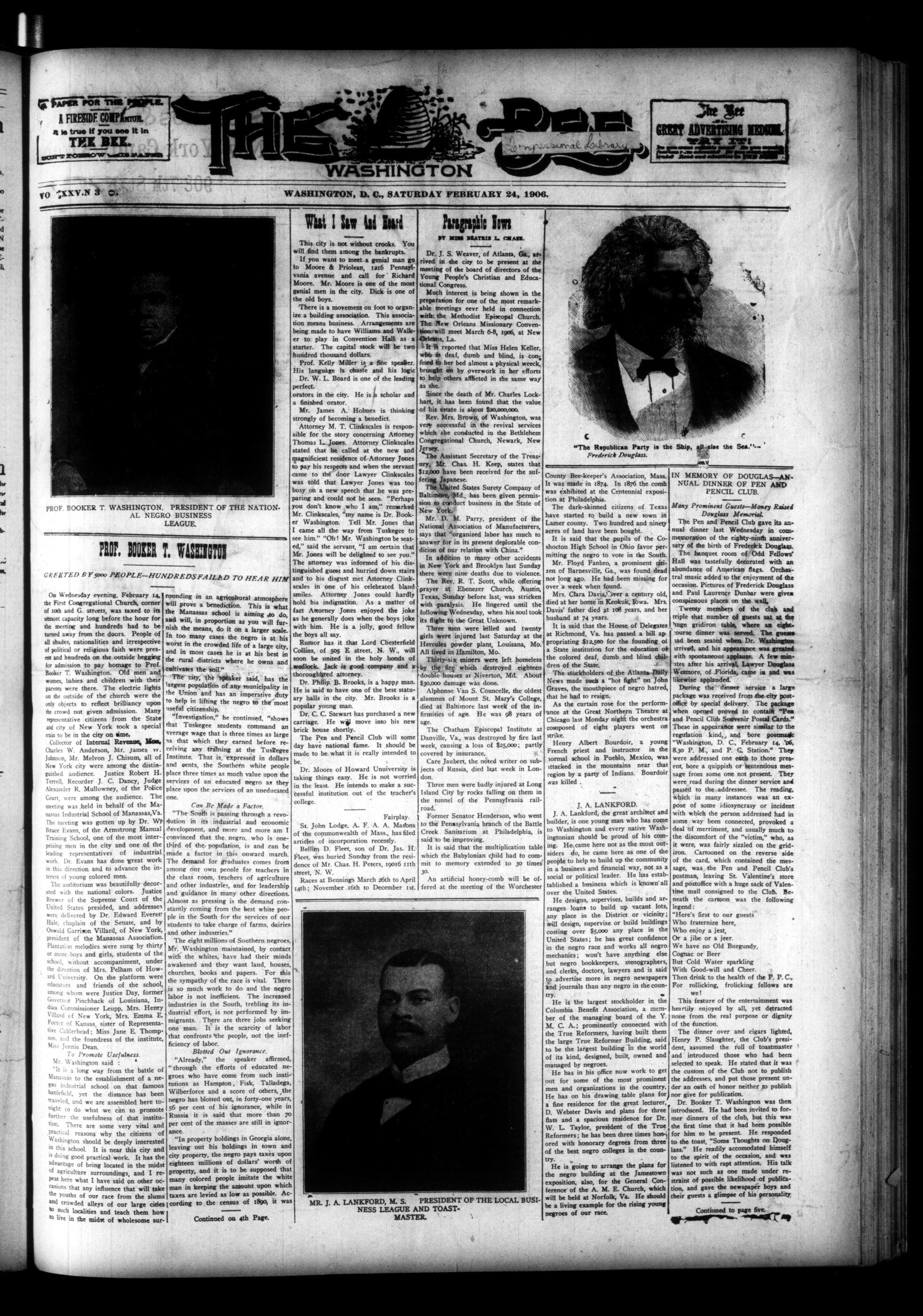
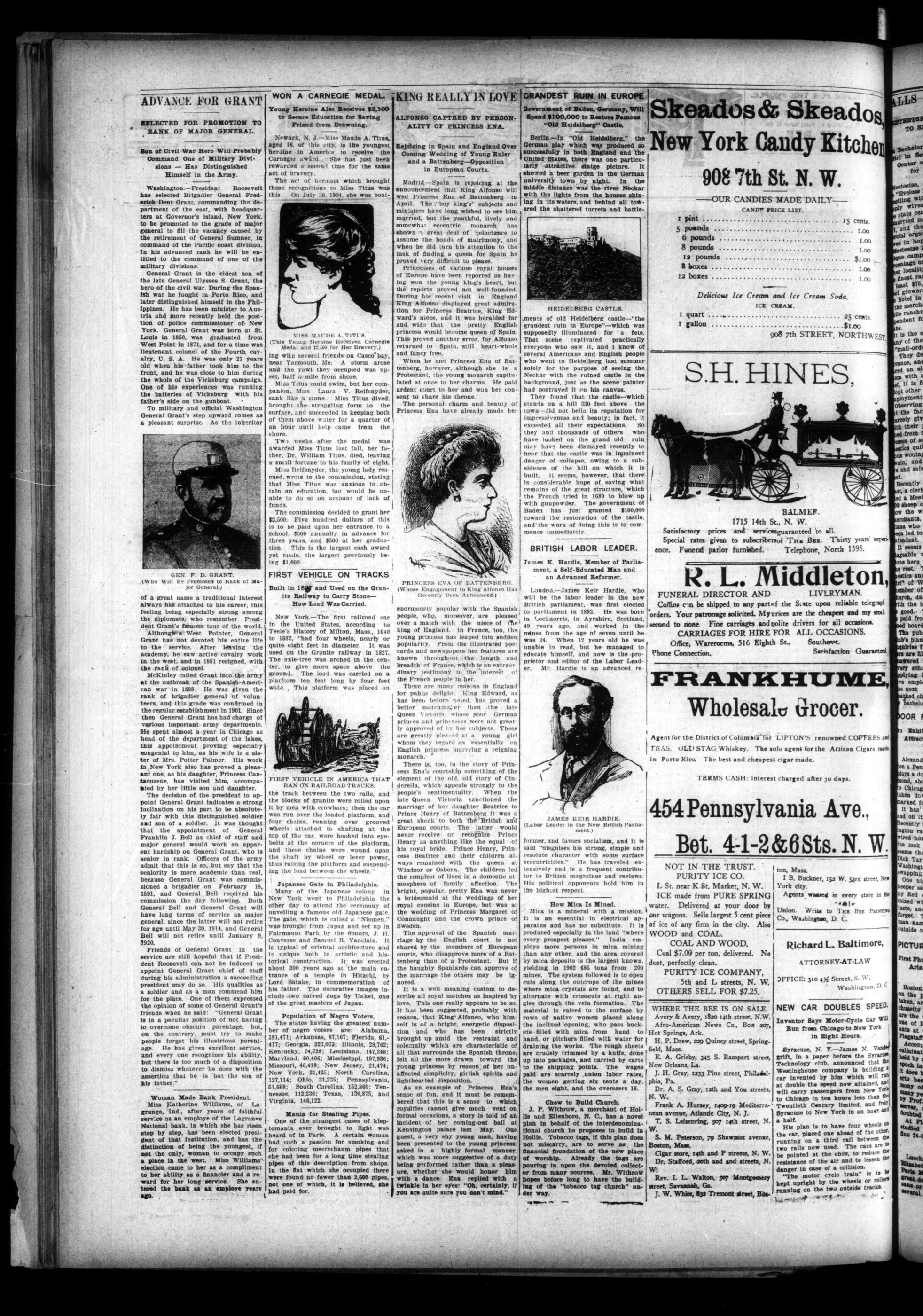
Page text (machine-generated)
[Picture of a man in a dark coat and hat, looking directly at the viewer. The background is black, and the man's face is clearly visible.]
PROF. BOOKER T. WASHINGTON. PRESIDENT OF THE NATIONAL NEGRO BUSINESS LEAGUE
PROF. BOOKER T. WASHINGTON. PRESIDENT OF THE NATIONAL NEGRO BUSINESS LEAGUE
PROF. BOOKER T. WASHINGTON
PROF. BOOKER T. WASHINGTON
On Wednesday evening, February 14, the First Congregational Church, corner of 10th and G. streets, was taxed to its utmost capacity long before the hour for the meeting and hundreds had to be turned away from the doors. People of all shades, nationalities and irrespective of political or religious faith were present and hundreds on the outside begging for admission to pay homage to Prof. Booker T. Washington. Old men and women, babies and children with their parents were there. The electric lights on the outside of the church were the only objects to reflect brilliancy upon the crowd not given admission. Many representative citizens from the State and city of New York took a special train to be in the city on time.
rounding in an agricultural atmosphere will prove a benediction. This is what the Manassas school is aiming at do, and will, in proportion as you will furnish the means, do it on a larger scale. In too many cases the negro is at his worst in the crowded life of a large city, and in most cases he is at his best in the rural districts where he owns and cultivates the soil."
The city, the speaker said, has the largest population of any municipality in the Union and has an imperative duty to help in lifting the negro to the most useful citizenship.
"Investigation," he continued, "shows that Tuskegee students command an average wage that is three times as large
Collector of Internal Revenue. Hon.
Charles W. Anderson, Mr. James w.
Johnson, Mr. Melvon J. Chisum, all of
New York city were among the disting-
uished audience. Justice Robert H.
Terrell, Recorder J. C. Dancy, Judge
Alexander R. Mullowney, of the Police
Court, were among the audience. The
meeting was held in behalf of the Mamasas Industrial School of Manassas, Va.
The meeting was gotten up by Dr. Wy
Bruce Evans, of the Armstrong Manual
Training School, one of the most inter-
prising men in the city and one of the
leading representatives of industrial
work. Dr. Evans has done great work
in this direction and to advance the
interest of young colored men.
The auditorium was beautifully decorated with the national colors. Justice Brewer of the Supreme Court of the United States presided, and addresses were delivered by Dr. Edward Everett Hale, chaplain of the Senate, and by Oswald Garrison Villard, of New York, president of the Manassas Association Plantation melodies were sung by thirty or more boys and girls, students of the school, without accompaniment, under the direction of Mrs. Pelham of Howard University. On the platform were educators and friends of the school, among whom were Justice Day, former Governor Pinchback of Louisiana, Indian Commission Leupp, Mrs. Henry Villard of New York, Mrs. Emma E. Forter of Kansas, sister of Representative Calderhead; Miss Jane E. Thompson, and the foundress of the institute, Miss Jennie Dean.
To Promote Usefulness.
Mr. Washington said:
"It is a long way from the battle of Manassas to the establishment of a nego industrial school on that famous battlefield, yet the distance has been traveled, and we are assembled here tonight to do what we can to promote further the usefulness of that institution. There are some very vital and practical reasons why the citizens of Washington should be deeply interested in this school. It is near this city and is doing good practical work. It has the advantage of being located in the midst of agriculture surroundings, and I repeat here what I have said on other occasions that any influence that will take the youths of our race from the slums and crowded alleys of our large cities to such localities and teach them how to live in the midst of wholesome sur-
rounding in an agricultural atmosphere will prove a benediction. This is what the Manassas school is aiming to do, and will, in proportion as you will furnish the means, do it on a larger scale. In too many cases the negro is at his worst in the crowded life of a large city, and in most cases he is at his best in the rural districts where he owns and cultivates the soil.
The city, the speaker said, has the largest population of any municipality in the Union and has an imperative duty to help in lifting the negro to the most useful citizenship.
"IInvestigation," he continued, "shows that Tuskegee students command an average wage that is three times as large as that which they earned before receiving any training at the Tuskegee Institute. That is, expressed in dollars and cents, the Southern white people place three times as much value upon the services of an educated negro as they place upon the services of an uneducated one.
"The South is passing through a revolution in its industrial and economic development, and more and more am I convinced that the negro, who is one-third of the population, is and can be made a factor in this onward march. The demand for graduates comes from among our own people for teachers in the class room, teachers of agriculture and other industries, and for leadership and guidance in many other directions. Almost as pressing is the demand constantly coming from the best white people in the South for the services of our students to take charge of farms, dairies and other industries."
The eight millions of Southern negroes, Mr. Washington maintained, by contact with the whites, have had their minds awakened and they want land, houses, churches, books and papers. For this sympathy of the race is vital. There is so much work to do and the negro labor is not inefficient. The increased industries in the South, trebling its industrial effort, is not performed by immigrants. There are three jobs seeking one man. It is the scarcity of labor that confronts the people, not the inefficiency of labor.
Already," the speaker affirmed, "through the efforts of educated negroes who have come from such institutions as Hampton, Fisk, Talladega, Wilberforce and a score of others, the negro has blotted out, in forty-one years, 56 per cent of his ignorance, while in Russia it is said that more than 70 per cent of the masses are still in ignorance.
"In property holdings in Georgia alone, leaving out his holdings in town and city property, the negro pays taxes upon eighteen millions of dollars' worth of property, and it is to be supposed that many colored people imitate the white man in keeping the amount upon which taxes are levied as low as possible. According to the census of 1890, it was
Continued on 4th Page.
WASHINGTON, D. C., SATURDAY FEBRUARY 24, 1906.
M. B.
MR. J. A. LANKFORD, M. S. PRESIDENT OF THE LOCAL BUSINESS LEAGUE AND TOAST- MASTER
What I Saw and Heard
This city is not without crooks. You will find them among the bankrupts. If you want to meet a genial man go to Moore & Priolean, 1216 Pennsylvania avenue and call for Richard Moore. Mr. Moore is one of the most genial men in the city. Dick is one of the old boys. There is a movement on foot to organize a building association. This association means business. Arrangements are being made to have Williams and Walker to play in Convention Hall as a starter. The capital stock will be two hundred thousand dollars. Prof. Kelly Miller is a fine speaker. His language is chaste and his logic Dr. W. L. Board is one of the leading perfect. orators in the city. He is a scholar and a finished orator. Mr. James A. Holmes is thinking strongly of becoming a benedict.
Attorney M. T. Clinkscales is responsible for the story concerning Attorney Thomas L. Jones. Attorney Clinkscales stated that he called at the new and magnificent residence of Attorney Jones to pay his respects and when the servant came to the door Lawyer Clinkscales was told that Lawyer Jones was too busy on a new speech that he was preparing and could not be seen. "Perhaps you don't know who I am," remarked Mr. Clinkscales, "my name is Dr. Booker Washington. Tell Mr. Jones that I came all the way from Tuskegee to see him." "Oh! Mr. Washington be seated," said the servant, "I am certain that Mr. Jones will be delighted to see you." The attorney was informed of his distinguished guest and hurried down stairs and to his disgust met Attorney Clinkscales in one of his celebrated bland smiles. Attorney Jones could hardly hold his indignation. As a matter of fact Attorney Jones enjoyed the joke as he generally does when the boys joke with him. He is a jolly, good fellow the boys all say.
Rumor has it that Lord Chesterfield Collins, of 505 E street, N. W., will soon be united in the holy bonds of wedlock. Jack is good company and a thoroughbred attorney.
Dr. Philip. B. Brooks, is a happy man. He is said to have one of the best statuary halls in the city. Mr. Brooks is a popular young man.
Dr. C. C. Stewart has purchased a new carriage. He will move into his new brick house shortly.
The Pen and Pencil Club will some day have national fame. It should be made to be what it is really intended to be.
Dr. Moore of Howard University is taking things easy. He is not worried in the least. He intends to make a successful institution out of the teacher's college.
Fairplay.
St. John Lodge, A. F. A. A. Masons of the commonwealth of Mass., has filed articles of incorporation recently.
Bellim D. Fleet, son of Dr. Jas. H. Fleet, was buried Sunday from the residence of Mr. Chas. H. Peters, 19016 11th street, N. W.
Races at Bennings March 26th to April 14th; November 16th to December 1st.
Paragraphic News
Dr. J. S. Weaver, of Atlanta, Ga., arrived in the city to be present at the meeting of the board of directors of the Young People's Christian and Educational Congress.
Much interest is being shown in the preparation for one of the most remarkable meetings eevr held in connection with the Methodist Episcopal Church. The New Orleans Missionary Convention will meet March 6-8, 1906, at New Orleans, La.
It is reported that Miss Helen Keller, who is deaf, dumb and blind, is confined to her bed almost a physical wreck, brought on by overwork in her efforts to help others afflicted in the same way as she.
Since the death of Mr. Charles Lockhart, it has been found that the value of his estate is about $20,000,000.
Rev. Mrs. Brown, of Washington, was very successful in the revival services which she conducted in the Bethlehem Congregational Church, Newark, New Jersey.
The Assistant Secretary of the Treasury, Mr. Chas. H. Keep, states that $12,000 have been received for the suffering Japanese.
The United States Surety Company of Baltimore, Md., has been given permission to conduct business in the State of New York.
Mr. D. M. Parry, president of the National Association of Manufacturers, says that "organized labor has much to answer for in its present deplorable condition of our relation with China." In addition to many other accidents in New York and Brooklyn last Sunday there were nine deaths due to violence. The Rev. R. T. Scott, while offering prayer at Ebenezer Church, Austin, Texas, Sunday before last, was stricken with paralysis. He lingered until the following Wednesday, when his soul took its flight to the Great Unknown. Three men were killed and twenty girls were injured last Saturday at the Hercules powder plant, Louisiana, Mo. All lived in Hamilton, Mo. Thirty-six miners were left homeless by the fire which destroyed eighteen double houses at Niverton, Md. About $30,000 damage was done. Alphonse Van S. Councelle, the oldest alumnus of Mount St. Mary's College, died at Baltimore last week of the infirmities of age. He was 88 years of age. The Chatham Episcopal Institute at Danville, Va., was destroyed by fire last week, causing a loss of $25,000; partly covered by insurance. Care Jaubert, the noted writer on subjects of Russia, died last week in London.
Three men were badly injured at Long Island City by rocks falling on them in the tunnel of the Pennsylvania railroad.
Former Senator Henderson, who went to the Pennsylvania branch of the Battle Creek Sanitarium at Philadelphia, is said to be improving.
It is said that the multiplication table which the Babylonian child had to commit to memory extended to 30 times 30.
An artificial honey-comb will be offered at the meeting of the Worchester
"The Republican Party is the Ship, all else the Sea."—Frederick Douglass.
County Bee-keeper's Association, Mass. It was made in 1874. In 1876 the comb was exhibited at the Centennial exposition at Philadelphia. The dark-skinned citizens of Texas have started to build a new town in Lamer county. Two hundred and ninety acres of land have been bought. It is said that the pupils of the Coshooton High School in Ohio favor permitting the negro to vote in the South. Mr. Floyd Fanbro, a prominent citizen of Barnesville, Ga., was found dead not long ago. He had been missing for over a week when found. Mrs. Clara Davis, over a century old, died at her home in Kookuk, Iowa. Mrs. Davis' father died at 108 years, and her husband at 74 years. It is said that the House of Delegates at Richmond, Va. has passed a bill appropriating $12,500 for the founding of a State institution for the education of the colored deaf, dumb and blind children of the State. The stockholders of the Atlanta Daily News made such a "hot fight" on John Graves, the mouthpiece of negro hatred, that he had to resign. As the curtain rose for the performance at the Great Northern Theatre at Chicago last Monday night the orchestra composed of eight players went on strike.
Henry Albert Bourdoir, a young French priest and instructor in the normal school in Pueblo, Mexico, was attacked in the mountains near that region by a party of Indians. Bourdoir was killed
L A LANKFORD.
J. A. Lankford, the great architect and builder, is one young man who has come to Washington and every native Washingtonian should be proud of his coming. He came here not as the most outsiders do, he came here as one of the people to help to build up the community in a business and financial way, not as a social or political leader. He has estabablished a business which is known all over the United States. He designs, supervise, builds and arranges loans to build up vacant lots, any place in the District or vicinity; will design, supervise or build buildings costing over $5,000 any place in the United States; he has great confidence in the negro race and works all negro mechanics; won't have anything else but negro bookkeepers, stenographers, and clerks, doctors, lawyers and is said to advertise more in negro newspapers and journals than any negro in the country. He is the largest stockholder in the Columbia Benefit Association, a member of the managing board of the Y. M. C. A.; prominently connected with the True Reformers, having built them the large True Reformer Building, said to be the largest building in the world of its kind, designed, built, owned and managed by negroes.
He has in his office now work to get out for some of the most prominent men and organizations in the country. He has on his drawing table plans for a fine residence for the great lecturer, D. Webster Davis and plans for three flats and a spacious residence for Dr. W. L. Taylor, president of the True Reformers; he has been three times honored with honorary degrees from three of the best negro colleges in the country. He is going to arrange the plans for the negro building at the Jamestown exposition, also, for the General Conference of the A. M. E. Church, which will be held at Norfolk, Va. He should be a living example for the rising young negroes of our race.
IN MEMORY OF DOUGLAS—AN
NUAL DINNER OF PEN AND
PENCIL CLUB.
Many Prominent Guests—Money Raised
Douglass Memorial.
Douglas memorial.
The Pen and Pencil Club gave its annual dinner last Wednesday in commemoration of the eighty-ninth anniversary of the birth of Frederick Douglas.
Twenty members of the club and triple that number of guests sat at the huge gridiron table, where an eight-course dinner was served. The guess had been seated when Dr. Washington arrived, and his appearance was greated with spontaneous applause. A few minutes after his arrival, Lawyer Douglass Wetmore, of Florida, came in and was likewise applauded.
During the dinner service a large package was received from the city post-office by special delivery. The package when opened proved to contain "Pen and Pencil Club Souvenir Post Card." These in appearance were similar to the regulation kind, and bore postmark "Washington, D. C., February 14, 166, 8.30 P. M., and P. C. Station." They were addressed one each to those present, bore a quipiish or sententious message from some one not present. They were read during the dinner service and passed to the addressee. The reading, which in many instances was an expose of some idiosyncrasy or incident with which the person addressed had in some way been connected, provoked a deal of merriment, and usually much to the discomfort of the "victim," who, as it were, was fairly sizzled on the gridiron. Cartooned on the reverse side of the card, which contained the message, was the Pen and Pencil Club's postman, leaving St. Valentine's store and postoffice with a huge sack of Valentine mail consigned to the Club. Below the cartoon was the following legend:
"Here's first to our guests Who fraternize here, Who enjoy a jest, Or a jibe or a jeer. We have no Old Burgundy,
Cognac or Beer But Cold Water sparkling
With Good-will and Cheer.
Then drink to the health of the P. P. C.
For rollicking, frolicking fellows are we!
This feature of the entertainment was heartily enjoyed by all, yet detracted none from the real purpose or dignity of the function.
The dinner over and cigars lighted, Henry P. Slaughter, the Club's president, assumed the roll of toastmaster and introduced those who had been selected to speak. He stated that it was the custom of the Club not to publish the addresses, and put those present under an oath of honor neither to publish nor give for publication.
Dr. Booker T. Washington was then introduced. He had been invited to former dinners of the club, but this was the first time that it had been possible for him to be present. He responded to the toast, "Some Thoughts on Douglass." He readily accomodated himself to the spirit of the occasion, and was listened to with rapt attention. His talk was not such as one made under restraint of possible likelihood of publication, and gave the newspaper boys and their guests a glimpse of his personality.
Continued to page five.
SELECTED FOR PROMOTION TO BANK OF MAJOR GENERAL
Son of Civil War Hero Will Probably Command One of Military Divisions — Has Distinguished Himself in the Army.
Washington.—President Roosevelt has selected Brigadier General Frederick Dent Grant, commanding the department of the east, with headquarters at Governor's island, New York, to be promoted to the grade of major general to fill the vacancy caused by the retirement of General Sumner, in command of the Pacific coast division. In his advanced rank he will be entitled to the command of one of the military divisions.
General Grant is the eldest son of the late General Ulysses S. Grant, the hero of the civil war. During the Spanish war he fought in Porto Rico, and later distinguished himself in the Philippines. He has been minister to Austria and more recently held the position of police commissioner of New York. General Grant was born at St. Louis in 1850, was graduated from West Point in 1871, and for a time was lieutenant colonel of the Fourth cavalry. U. S. A. He was only 21 years old when his father took him to the front, and he was close to him during the whole of the Vicksburg campaign. One of his experiences was running the batteries of Vicksburg with his father's side on the gunboat.
To military and official Washington General Grant's step upward comes as a pleasant surprise. As the inheritor
H
of a great name a traditional interest always has attached to his career, this feeling being especially strong among the diplomats, who remember President Grant's famous tour of the world. Although a West Pointer, General Grant has not devoted his entire life to the service. After leaving the academy, he saw active cavalry work in the west, and in 1861 resigned, with the rank of colonel.
McKinley called Grant into the army at the outbreak of the Spanish-American war in 1898. He was given the rank of brigadier general of volunteers, and this grade was confirmed in the regular establishment in 1901. Since then General Grant has had charge of various important army departments. He spent almost a year in Chicago as head of the department of the lakes, this appointment proving especially congenial to him, as his wife is a sister of Mrs. Potter Palmer. His work in New York also has proved a pleasant one, as his daughter, Princess Cantacuzene, has visited him, accompanied by her little son and daughter.
The decision of the president to appoint General Grant indicates a strong inclination on his part to be absolutely fair with this distinguished soldier and son of a soldier. It was thought that the appointment of General Franklin J. Bell as chief of staff and major general would work an apparent hardship on General Grant, who is senior in rank. Officers of the army admit that this is so, but say that the seniority is more academic than real, because General Grant was commissioned a brigadier on February 18, 1891, and General Bell received his commission the day following. Both General Bell and General Grant will have long terms of service as major general, since the latter will not retire for age until May 30, 1914, and General Bell will not retire until January 9, 1920.
Friends of General Grant in the service are still hopeful that if President Roosevelt can not be induced to appoint General Grant chief of staff during his administration a succeeding president may do so. His qualities as a soldier and as a man commend him for the place. One of them expressed the opinion of some of General Grant's friends when he said: "General Grant is in a peculiar position of not having to overcome obscure parentage, but, on the contrary, must try to make people forget his illustrious parentage. He has given excellent service, and every one recognizes his ability, but there is too much of a disposition to dismiss whatever he does with the assertion that he is but the son of his father."
Woman Made Bank President
Miss Katherine Williams, of Lagrange, Ind., after years of faithful service as an employee of the Lagrange National bank, in which she has risen step by step, has been elected president of that institution, and has the distinction of being the youngest, if not the only, woman to occupy such a place in the west. Miss Williams' election came to her as a compliment to her ability as a financier and a reward for her long service. She entered the bank as an employee years ago.
Young Heroine Also Receives $2,500 to Secure Education for Saving Friend from Drowning.
Newark, N. J.—Miss Maude A. Titus, aged 16, of this city, is the youngest heroine in America to receive the Carnegie award. She has just been rewarded a second time for the same act of bravery.
The act of heroism which brought these recognitions to Miss Titus was this On July 10 1904 she was boat-
```markdown
```
Medal and $250 for Her Bravery.) ing with several friends on Casco bay, near Yarmouth, Me. A storm arose and the jawl they occupied was upset, half a mile from shore.
Miss Titus could swim, but her companion, Miss Laura V. Refleynder, sank like a stone Miss Titus dived, brought the struggling form to the surface, and succeeded in keeping both of them above water for a quarter of an hour until help came from the shore.
Two weeks after the medal was awarded Miss Titus last fall, her father, Dr. William Titus, died, leaving a small fortune to his family of eight
Miss Reifsnyer, the young lady rescued, wrote to the commission, stating that Miss Titus was anxious to obtain an education, but would be unable to do so on account of lack of funds.
The commission decided to grant her $2,500. Five hundred dollars of this is to be paid upon her entrance to a school, $500 annually in advance for three years; and $500 at her graduation. This is the largest cash award yet made, the largest previously being $1,000.
FIRST VEHICLE ON TRACKS
Built in 1895 and Used on the Granite Railway to Carry Stone—How Load Was Carried.
New York.—The first railroad car in the United States, according to Teele's History of Milton, Mass., 1640 to 1837, "had four wheels, nearly or quite eight feet in diameter. It was used on the Granite railway in 1837. The axle-tree was arched in the center, to give more space above the ground. The load was carried on a platform ten feet long by four feet wide. This platform was placed on
FIRST VEHICLE IN AMERICA THAT RAN ON RAILROAD TRACKS.
the track between the two rails, and the blocks of granite were rolled upon it by men with crowbars; then the car was run over the loaded platform, and four chains, running over grooved wheels attached to shafting at the top of the car, were hooked into eyebolts at the corners of the platform, and these chains were wound upon the shaft by wheel or lever power, thus raising the platform and suspending the load between the wheels.
Japanese Gate in Philadelphia
Many of the Japanese colony in New York went to Philadelphia the other day to attend the ceremony of unveiling a famous old Japanese gate The gate, which is called a "Niomen," was brought from Japan and set up in Fairmount Park by the donors, J H. Converse and Samuel R. Vanclain. It is typical of oriental architecture and is unique both in artistic and historical construction. It was erected about 300 years ago at the main entrance of a temple in Hitachi, by Lord Satake, in commemoration of his father. The decorative images Include two sacred dogs by Unkei, one of the great masters of Japan.
Population of Negro Voters
The states having the greatest number of negro voters are: Alabama, 351,471; Arkansas, 57,167; Florida, 61,417; Georgia, 223,073; Illinois, 29,762; Kentucky, 74,728; Louisiana, 147,348; Maryland, 60,406; Mississippi, 197,936; Missouri, 46,418; New Jersey, 21,474; New York, 31,425; North Carolina, 127,114; Ohio, 31,235; Pennsylvania, 61,688; South Carolina, 152,860; Tennessee, 112,236; Texas, 136,875, and Virginia, 146,122.
Mania for Steeling Pine
Mania for Stealing Pipes. One of the strangest cases of kleptomania ever brought to light was heard of in Paris. A certain woman had such a passion for smoking and for coloring meerschaum pipes that she had been for a long time stealing pipes of this description from shops. In the flat which she occupied there were found no fewer than 2,600 pipes, not one of which, it is believed, she had paid for.
ALFONSO CAPTRED BY PERSONALITY OF PRINCESS ENA.
Rejoicing in Spain and England Over Coming Wedding of Young Ruler and a Battenberg—Opposition in European Courts.
Madrid--Spain is rejoicing at the announcement that King Alfonso will wed Princess Ena of Battenberg in April. The "boy king's" subjects and ministers have long wished to see him married, but the youthful, lively and somewhat eccentric monarch has shown a great deal of reluctance to assume the bonds of matrimony, and when he did turn his attention to the task of finding a queen for Spain he proved very difficult to please.
Princesses of various royal houses of Europe have been reported as having won the young king's heart, but the reports proved not well-founded During his recent visit in England King Alfonso displayed great admiration for Princess Beatrice, King Edward's niece, and it was heralded far and wide that the pretty English princess would become queen of Spain This proved another error, for Alfonso returned to Spain, still heart-whole and fancy free. When he met Princess Ena of Battenberg, however, although she is a Protestant, the young monarch capitulated at once to her charms. He paid ardent court to her and won her consent to share his throne. The personal charm and beauty of Princess Ena have already made hei
M.
PRINCESS EVA OF BATTLNJJEG
(Whose Engagement to King Alfonso Has
Revenu) Been Announced
PRINCESS EVA OF BATTENLEERG
(Whose Engagement to King Alfonso Has
Recently Been Announced.)
enormously popular with the Spanish
people, whp, moreover, are pleased
over a match with the niece of the
king of England. In France, too, the
young princess has leaped into sudden
popularity. From the illustrated post
cards and newspapers her features are
known throughout the length and
breath of France, which is an extraordi-
nary testimony to the interest of
the French people in her.
There are many reasons in England for public delight. King Edward, as has been before noted, has proved a better matchmaker than the late Queen Victoria, whose poor German princes and princesses were not greatly approved of by her subjects. These are greatly pleased at a young girl whom they regard as essentially an English princess marrying a religning monarch.
There is, too, in the story of Princess Ena's courtship something of the element of the old, old story of Cinderella, which appeals strongly to the people's sentimentality. When the late Queen Victoria sanctioned the marriage of her daughter Beatrice to Prince Henry of Battenberg it was a great shock to both the British and European courts. The latter would never receive or recognize Prince Henry as anything like the equal of his royal bride. Prince Henry, Princess Beatrice and their children always remained with the queen at Windsor or Osborn. The children led the simplest of lives in a domestic atmosphere of family affection. The bright, popular, pretty Ena was never a bridesmaid at the weddings of her royal cousins in Europe, but was at the wedding of Princess Margaret of Connaught and the crown prince of Sweden.
The approval of the Spanish marriage by the English court is not shared by the members of European courts, who disapprove more of a Battenberg than of a Protestant. But if the haughty Spanlards can approve of the marriage the others may be ignored.
It is a well meaning custom to describe ad royal matches as inspired by love. This one really appears to be so. It has been suggested, probably with reason, that King Alfonso, who himself is of a bright, energetic disposition and who has been strictly brought up amid the restraint and solemnity which are characteristic of all that surrounds the Spanish throne, felt all the more drawn toward the young princess by reason of her unaffected simplicity, girlish spirits and lighthearted disposition.
As an example of Princess Epa's sense of fun, and it must be remembered that this is a sense to which royalties cannot give much vent on formal occasions, a story is told of an incident of her coming-out ball at Kensington palace last May. One guest, a very shy young man, having been presented to the young princess, asked in a highly formal manner, which was more suggestive of a duty being performed rather than a pleasure, whether she would honor him with a dance. Epa replied with a twinkle in her eyes: "Oh, certainly, if you are quite sure you don't mind."
GRANDEST RUIN IN EUROPE
Government of Baden, Germany, Will Spend $100,000 to Restore Famous "Old Heidelberg" Castle.
Berlin.—In "Old Heidelberg," the German play which was produced so successfully in both England and the United States, there was one particularly attractive statue picture. It showed a beer garden in the German university town by night. In the middle distance was the river Neckar with the lights from the houses shining in its waters, and behind all towered the shattered turrets and battle-
HEIDELBERG CASTLE.
men's of old Heldelberg castle—"the grandest ruin in Europe"—which was supposedly illuminated for a fete. That scene captivated practically everyone who saw it, and I know of several Americans and English people who went to Heldelberg last summer solely for the purpose of seeing the Neckar with the ruined castle in the background, just as the scene painter had portrayed it on his canvas.
They found that the castle—which stands on a hill 330 feet above the town—did not belle its reputation for impressiveness and beauty; in fact, it exceeded all their expectations. So they and thousands of others who have looked on the grand old ruin may have been dismayed recently to hear that the castle was in imminent danger of collapse, owing to a subsidence of the hill on which it is built. It seems, however, that there is considerable hope of saving what remains of the great structure, which the French tried in 1639 to blow up with gunpowder. The government of Baden has just granted $100,000 toward the restoration of the castle, and the work of doing this is to commence immediately.
BRITISH LABOR LEADER.
James K. Hardie, Member of Parliament, a Self-Educated Man and an Advanced Reformer.
London.-James Keir Hardie, who will be the labor leader in the new British parliament, was first elected to parliament in 1892. He was born in Locanorris, in Ayrshire, Scotland, 49 years ago, and worked in the mines from the age of seven until he was 24. When 12 years old he was unable to read, but he managed to educate himself, and now is the proprietor and editor of the Labor Leader. Mr. Hardie is an advanced re
A.
JAMES KEIR HARQIE. (Labor Leader in the New British Parliament) former, and favors socialism, and it is said "disguises his strong, simple and resolute character with some surface eccentricities." He has traveled extensively and is a frequent contributor to British magazines and reviews His political opponents hold him in the highest respect.
How Mica. Is Mined.
Mica is a mineral with a mission. It is an essential in electrical apparatus and has no substitute. It is produced especially in the land "where every prospect pleases". India employs more persons in mica mining than any other, and the area covered by mica deposits is the largest known, yielding in 1902 685 tons from 200 mines. The system followed is to open cuts along the outcrops of the mines where mica crystals are found, and to alternate with crosscuts at right angles through the vein formation. The material is raised to the surface by rows of native women placed along the inclined opening, who pass buckets filled with mica from hand to hand, or pitchers filled with water for draining the works. The rough sheets are crudely trimmed by a knife, done up into packages, and carried by carts to the shipping points. The wages paid are scarcely union labor rates, the women getting six cents a day, the men eight, and the overseers 16.
Chew to Build Church
J. P. Withrow, a merchant of Hollis and Ellenboro, N. C., has a novel plan in behalf of the interdenominational church he proposes to build in Hollis. Tobacco tags, if this plan does not miscarry, are to serve as the financial foundation of the new place of worship. Already the tags are pouring in upon the devoted collector from many sources. Mr. Withrow hopes before long to have the building of the "tobacco tag church" under way.
Skeados& Skeados New York Candy Kitchen 908 7th St. N. W.
S.H. HINES,
Satisfactory prices and servicesguaranteed to all. Special rates given to subscribers of THB BEE. Thirty years evenence. Funeral parlor furnished. Telephone, North 1595
R. L. Middleton
FUNERAL DIRECTOR AND LIVLRYMAN.
Coffins can be shipped to any part of the State upon reliable telegraph orders. Your patronage solicited. My orices are the cheapest and my stock second to none. Fine carriages and polite drivers for all occasions.
CARRIAGES FOR HIRE-FOR ALL OCCASIONS.
FRANKHUME Wholesale Grocer.
Agent for the District of Columbia for LIPTON'S renowned COFTEF and TEAS. OLD STAG Whiskey. The sole agent for the Artisan Cigar made in Porto Rica. The best and cheapest cigar made.
TERMS CASH: Interest charged after 30 days.
454 Pennsylvania Ave.,
Bet. 4-1-2&6Sts. N. W.
NOT IN THE TRUST.
PURITY ICE CO.
454 Pennsylvania Ave. Bet. 4-1-2&6Sts. N. W.
L St. near K St. Market, N. W. ICE made from PURE SPRING water. Delivered at your door by sur wagons. Sells largest 5 cent piece of ice of any firm in the city. Also WOOD and COAL. COAL AND WOOD. Coal $7.00 per ton, delivered. No dust, perfectly clean. PURITY ICE COMPANY, 5th and L streets, N. W. OTHERS SELL FOR $7.25.
WHERE THE BEE IS ON SALE
Avery & Avery, 1820 14th street, N.W.
Afro-American News Co., Box 207,
Hot Springs, Ark.
H. P. Drew, 229 Quincy street, Springfield, Mass.
E. A. Grisby, 345 S. Rampart street,
New Orleans, La.
J. H. Gray, 1233 Pine street, Philadelphia, Pa.
Dr. A. S. Gray, 12th and You streets,
N. W.
Frank A. Hursey, 1409-19 Mediterranean avenue, Atlantic City, N. J.
T. S. Leisenring, 507 14th street, N. W.
S. M. Peterson, 79 Shawmut avenue, Boston, Mass.
Cigar store, 14th and P streets, N. W.
Dr. Stafford, 20th and and streets, N. W.
Rev. I. L. Walton, 507 Montgomery street, Savannah, Ga.
J. W. White, 832 Tremont street, Bca-
rania Ave.,
&6Sts. N. W.
ton, Mass.
I B. Buckner, 152 W. Sard
York city.
Agents wanted in every
Union. Write to THE P. L.
Co, Washington, D. C.
Richard L. Baltimore,
ATTORNEY-AT-LAW
OFFICE: 310 4½ Street.
Wash :
NEW CAR DOUBLES SPEED.
Inventor Says Motor-Cycle Car Will
Run from Chicago to New York
in Eight Hours.
Syracuse, N. Y.—James N. Vandergriff, in a paper before the Syracuse Technology club, announced at the Westinghouse company is building a car invented by him which will at double the speed now attained, will carry passengers from New York to Chicago in ten hours less than the Twenteth Century limited, and from Syracuse to New York in an hour and a half.
His plan is to have four wheeled on the car, placed one ahead of the other running on a third rail between the two rails now used. The car is to be pointed at the ends, to reduce the resistance of the air and to reduce the danger in case of a collision.
The motor cycle train to be kept upright by the wheels or rover running on the two outside tracks.
INTEETSE. WYO., ASKS WORLD
TO SEND MAIDENS.
Bachards to Every Marriageable
Child in Settlement—Town Storm
Center of Unique Campaign
for More Fair Ones.
Big Horn county,
of the west," is now
the question of how to
for its 1,642 bachelors,
more than ten in
one marriageable
Gray Bull club, a com-
mission, issued a call for
of changing the ratio.
the storm center of this
and has a greater
married men than any
the owners of two of
are bachelors worth
three of the largest
the west live here at
the blessedness; many
are similarly situated,
and stocked with in-
fants live single and in
sessed determination of
helicors not to marry
wife," as they express
They are to see the goods in
as the club had pre-
sented scheme to supply
list of eligibles from the
by this objection to
It will conduct an
on a large scale.
members of the club point
it school mats are
time to get acquainted
before they are en-
titles to become mis-
cumb to the stren-
accumb to the stren-
wing of some Big Horn county
and photographers, bookkeep-
win homes just as
Been a long widow from the
market in a dry goods store, ma-
rriage a Maid in a woolgrower with 40-
sheep in the range, a domestic is
awarded one of the leading
managers. A young lady from fa-
mily who visited a married sister has
needed to sit at her by a mine super-
market. It seems certain that if the ma-
rriageable woman can be found posi-
tions here the bachelors will attend to
her. The greatest need is for do-
nies and housekeepers. The "hired
of Wyoming is to all intents a
member of the family and attends
with dances and social functions
with the best people if her character
is good. The average domestic here
spends from $1 to $20 a month, with
widow and room.
The publication of the Gray Bull
and its plans has already brought many
agricultures from the east, and these let-
ters are filed and given a number and
involved in their order. Thus far
very school teacher and housekeeper
applying has been offered remunerate-
ment, and it is expected
the next census will show a
right change in the number of lone-
DOOR FROM LIBBY PRISON.
On Exhibition in Washington, It Attracts Many Whom It Shut in from Liberty.
Over in Washington, Pennsylvania avenue saloon dis-
tracts a old Libby prison, Rich-
don, about only thing not taken
in when the old pile was
raised by piece, properly
added to connection there.
A great lock attached to it
soldiers' names are cut.
A New Yorker visiting Wash-
ton is the old relic and
in old key. It fitted
properly, and since then it
the survivors of Hotel
Limond, around about
the gathered there for
collections.
enterprising saloon-
stack and old John-
made of bad whisky
pretty sharp to the
results that few soon
belongs to a gentle-
name M. Monte, who lives just
made in Wellington.
PICTURES OF MARS CANALS
First Photographs Taken at Flagstaff,
Ariz. on Exhibition—Marks
on Feet
Boston—Photographs of the canals in the park Mars, the first ever taken are exhibition at the Massachusetts Institute of Technology. They are the work Carl Otto Lampland, of Prof Petrual Lowell's assistance at the observatory at Flagstaff. An accomplishment of the feat, which stimulated May at Flagstaff, is held by astronomers to mark a distinct epoch in the study of Mars, placing as it does beyond a doubt what has hitherto been known only on the testimony of very expert observers. For many years after they were first noted by Prof Schaparelli, the Italian observer, a great many astronomers socribed their existence. At Flagstaff the canals have been studied now for two decades with a face 21 inch telescope.
Jailers Trouble.
Lincoln, the assassin of Empress
Elizabeth of Austria, according to the
Puris Matia is giving his jailers a
great deal of trouble. He is either in-
side or pretends to be; and has made
several attempts to kill his guards.
Professor Believes Something Akin to Human Being Will Eventually Be Produced.
New York—Man, through his advanced science, may develop into a treator himself, is the opinion of Professor Wilhelm Ostwald of the University of Lelpse, in a lecture at Columbia university in the results of the attempt to create life through chemical processes.
Professor Ostwald has given careful attention to the experiments of Professor Jacques Loeb of the University of California and announces with confidence his belief that by slow development science may even create a type of life as high as that of our domestic animals.
The steps will be slow; one form of life will be produced after another and eventually the professor expects something almost akin to man in its physical being may be produced.
"There is practically no limit to what man can do in this direction," he said. "Of course, at first he will be able to produce only a piece of proteplasm, something like the water hydra or the resemblance of the sea urchin that Professor Loeb has evolved, but it will be instinct with real life and will be a step in the new evolution. This evolution can only result in the creation of something the equal of our higher animals, but what it will be who shall say?
"It seems to me that the scientist who does this will be able to determine the physical form of his creation after the development has started, and he will have created a new order of life, for this being will multiply indefinitely just the same as all our modern animals.
"I cannot say whether this creation of man will be crutacean, amphibian, mammalian or whether biped, quadruped, fish, fowl or reptile. I can only say that after careful study of what has been accomplished I am overwhelmed at the inevitable probabilities. Who knows but a new order of humanity may be created?"
BOY TOSSED LIKE A BALL.
Thrown High Into the Air and Is Cleverly Caught by Po-
New York—There are accidents and accidents, but the accident which happened to five-year-old Frankie Flank is about the rarest on the records.
Frankie is the son of a wealthy lace importer, and is much given to riding in the family automobile. He was out with his mother and sisters and occupied a very comfortable position on the rear seat of the tonneau. The Flank family was being piloted south on Sixth avenue, and as the chauffeur turned east on Thirty-second street he allowed the machine to collide with an "L" pillar. At the moment Frankie was standing up in his seat and he was promptly and emphatically catapulted into the air and over the rear of the vehicle.
As he shot into the other, he turned a complete somersault. Standing near the corner was Policeman Thomas Flannagan, of the traffic squad. Flanagan used to be a crack baseball player, and when he saw the youngster doing acrobatics in midair he put his old-time training into a most useful and picturesque purpose. He stepped forward just before the lad was due on the asphalt and caught him gracefully in his arms, 'exactly as a football player catches a punt. Frankle was not hurt in the least, although he and the policeman got a reasonably severe jolt, apiece. That was all that happened to Frankle, but the automobile lamp and water tank were smashed completely.
NAILS IN A CLASS EATER.
They Hurt Him and He Goes to a Doctor and Has Them Cut Out.
Montgomery, Ala.-Robert Lee, a fire and glass eater, who has been doing the human ostrich act here for some time for the entertainment of sundry small boys and barron frequenters, is at a hospital with a hole in his stomach. He got an overdose of the nail diet and had a pain, which he took to a local physician. It was discovered that something was there that had to come out.
Accordingly he was laid upon a table, given a good swig of the fumes of the cornucopia and operated upon. The result was astonishing. Nail after nail was taken out. They had been there so long they were rusty, and some had stuck into the walls of the stomach. Most of them were of small size, but one was several inches long, the one making the most trouble, no doubt.
After removing the surplus iron in the system of the victim, he was allowed to return to knowing things again. He is little the worse for the wear and tear of his profession.
Blocks Campaign.
An outbreak of rinderpest has brought the German campaign against the Hottentots in southwest Africa to a standstill. The German government has asked the rechstag to provide for the dispatch of 700 more men, 2,600 horses and 1,000 dromedaries to the scene of war.
Newspaper "Tips" Sacred.
The court of appeals in London rendered the interesting decision that newspapers cannot be compelled by the courts to divulge their sources of information, under special circumstances. The point was raised in a libel suit against a trade paper.
DOUBLE IN 7 YEARS.
RECORD OF IMPORTS INTO THE
UNITED STATES.
Value in 1905 Reached $1,179,000,
000 Against $635,000,000 in
1898—Raw Silk Increased
by 100 Per Cent.
Washington.—The imports into the United States have practically doubled in value in the last seven years, according to a bulletin issued by the bureau of statistics of the department of commerce and labor.
In the calendar year 1905 the imports aggregated in value $1,179,000,000, as against $635,000,000 in the calendar year 1898. The figures of 1898 included merchandise from Porto Rico, and Hawaii, now customs districts of the United States. If, the bulletin says, the value of the merchandise brought from these islands in 1905 be added to the bureau's statement of imports from foreign countries, the grand total for 1905 would be $1,234,000,000.
The increase in importations is distributed through all classes and practically all articles of merchandise. Food stuffs increased $84,000,000, a gain of 45 per cent.; manufactures increased $81,000,000, or 77 per cent.; luxuries increased $76,000,000, or 90 per cent. and manufacturers' materials increased $303,000,000, or 117 per cent. These figures do not include merchandise from Hawaii and Porto Rico during 1905. If these were included, the increase in food stuffs would be about $134,600,000, or 70 per cent.
Raw silk importations increase about 100 per cent; tin imports an increase of 200 per cent; hides and skins, 90 per cent; crude rubber, 90 per cent; copper from $4,300,000 to $28,000,000, sugar from $78,000,000 to $151,000,000 (including $50,000,000 brought from Porto Rico and Hawaii), cotton manufactures of all kinds from $29,000,000 to $54,000,000, silk manufactures $25,000,000 to $33,500,000; cigars and cigarettes from $1,750,000 to about $4,000,000. In addition to this $2,666,000 worth of cigars and cigarettes were received from Porto Rico last year. Wines, spirits and malt liquors increased from $10,000,000 to about $18,000,000, and diamonds from $3,333,000 to $30,500,000.
$3,000,000,000 IS RECORD
Government Announces That American Commerce Gained Over $100,-
000,000 in the Year 1905.
Washington.—The foreign commerce of the United States approaches surprisingly near to the $3,000,000,000 point in the calendar year 1905, according to a report issued by the bureau of statistics, department of commerce and labor.
"The total imports and exports of merchandise," the report says, "is $2,806,000,000, against $2,307,000,000 in 1900, an average increase of $100,-
000,000 a year.
"If the $2,900,000,00 of foreign commerce in 1905 were added to the figures of trade with Hawaii and Porto Rico, formerly foreign territory, and included in our statements of foreign trade prior to 1801, the total would approximate $2,900,000,00 or about $660,000,000 more than five years ago, and $1,200,000,000 more than ten years ago.
"Another notable characteristic of the year's foreign trade is the fact that the exports in December were practically $200,000,00, the largest month's exportation in any year prior to that time being that of December, 1904, when the total was $174,819,566.
"The import record for 1905 is also in excess of that of any preceding year, being for the 12 months ended with December $1,179,358,846, against $1,035,999,190 in 1904. The growth of imports, while not rapid, has been steady, and continues to be so, keeping pace, approximately, with the growth of population.
"The commerce with the noncontiguous territory of the United States also makes a new high record for 1905. It will amount to about $130,000,000 in value, against a little less than $100,000,000 last year."
FIREMAN GRABS AN EAGLE
While Engine Is Speeding Along at Rapid Bate Bird Is Snatched Into Captivity.
Denver, Col.-The fireman and engineer who took the Rocky Mountain limited out of here the other morning captured an immense American eagle as it was flying in the air. The experience is probably unique in railroading.
The unfortunate king of birds will spend the remalder of his days in satiating the wondering gaze of the crowds at City park. The eagle measures seven feet and four inches from tip to tip.
When nearing Limon they engine crew noticed the bird flying low and straight ahead of the train. The train was then traveling at from 60 to 65 miles an hour, and if it did not change its course it was evident that the eagle would be overtaken. The bird was on the left side and as the engine flashed by the fireman reached out and grabbed the bird by a leg and pulled it into the cab. With the aid of the engineer the big fellow was downed and tied, but it took quite a fight.
Kypnotism in Paying Bills.
Dr. Quackenbos, of New York, saves his patients by hypnotic suggestion. Doubtless he is able to make them pay his bills by the same process.
Omaha, Nob.—To be cutting a third set of teeth while the second set is fairly well preserved is a record of which but few men can boast. This is what is happening to J. H. Fox, who boards at the old people's home.
"Grandpa" Fox is 4 years of age. All his life he has been hale and hearty and blessed with exceptionally good teeth, double though they were.
"I have never had no dentist workin' in my mouth," he says. "I mind havin' the toothache pretty had many years ago. A man I knew gave me some stuff to put in 'em and finally the ache quit and they never bothered me again."
There are five new teeth and they are all incisors. They are coming in between the old double anterior and peer forth like rice grains among the older teeth. The cutting of them does not seem to affect him in any way. For two years they have been coming, one at a time.
"Well, I guess I'm cutting another tooth. I expect to have a full set of nice home grown teeth soon," he says to the other boarders cheerfully when they guy him and call him the "baby" of the establishment on account of his new teeth. "You don't catch me fooling around with any of these boughten teeth like the rest of you wear."
Every indication would tend to show that "Grandpa" Fox will continue to grow new teeth as fast as the old ones drop out. They push through the gums wherever they can find a place to grow.
Dentists who have seen Mr. Fox and his third set of teeth declare it a rare case. The double teeth they explain by saying that the anteriors are frequently brittle and easily worn away. In this case nature keeps throwing out accumulations and incrustations, which build up the teeth into the semblance of double teeth. Mr. Fox, however, insists that every one of his teeth came in double.
HOLDS COUNTRY'S RECORD
Menomonie, Wis., Claims. Banner as an Exponent of Anti-Bace Subtitle Idea
Washington, D. C.—Menomonie, Wis., has more children in proportion to its population attending its public schools than any other city in the United States, according to State Senator James H. Stout, who told the president of the wonderful record of his home, while calling upon him in company with Senator Spooner.
Senator Stout, is a multi-millionaire who believes in giving his money to help primary education institutions instead of colleges and universities. He has established 500 circulating libraries throughout Wisconsin in connection with public schools, and has also assisted them in other ways.
He said that out of a population of 5,800 the town of Menomonie had 2,200 children attending the public schools, a record he claimed was not equaled anywhere else in the country.
"Much money," he said, "is being left in endowments to the great educational institutions of the country, but the students of these schools are, as a rule, able to pay their own way, and what they pay ought to maintain them. The question of educating the masses is by far more important, to my mind, as the bone and sinew of the nation comes from those classes who are not able to go to college. They crave the advantages of education and should be encouraged and men with money could find no better way of spending it than in encouraging these aspirations."
PATTED HAAKON ON BACK.
The New Norwegian King Finds His Subjects Very Democratic in Treatment of Him.
Christiania.—The bluff treatment that King Haakon has received at the hands of Bjornson, the famous Norwegian dramatist, illustrates the strong democratic spirit in which royalty is viewed in the kingdom of Norway. At the end of a play by Bjornson in the National theater, at which the king was present, the king invited the venerable dramatist into the royal box and received him with the remark:
"It is a very beautiful play, my dear Bjornson."
Bjornson walked up to the king and patting him paternally on the shoulder, sald:
"Do not say 'majet' (very), your majesty, but 'megel.' That is how we pronounce it here. A man in your position must take care of these little things, you know."
King Haakon replied with as good grace as he could that he would be careful to follow his friend's advice.
"That is right," replied Bjornson, "if you take care to remember what I say you will find you will have good cause to thank me."
Quita Pulpit to Run Quarry.
To serve a pastorate and operate a slate quarry at the same time have proved too arduous a task for Rev. D. E. Richards, pastor of the Baptist church at Slatington, Pa., and he has resigned, to devote his attention solely to his quarry. Dr. Richards' congregation is astounded by his decision. Only recently some of his wealthy parishioners paid the expenses of the pastor for a tour through Wales.
Needs More "Copa."
The population of New York city is 4,014,564, and there are 7,964 policemen and 19,537 saloons. The population of Chicago is 1,990,750 and there are 2,875 policemen and 7,017 saloons.
FIGURES SHOW LIFE AND PROPERTY DESTRUCTION.
An Average of Eighteen Fatalities Through Flames Every Day in Year—Total Gold Production One-Third of Loss.
New York.—The enforced economy of our grandparents and the folly of our own generation are now coating us enormously in the loss of life and of property by fire. In 1904, 6,672 people were burned, an average of 18 fatalities through fire every day in the year! We improve our fire department and increase our water supply, yet the losses are ever augmented. Our present ratio is nine lives lost by fire every year for every 100,000 of population; in 1900 the ratio was eight, and in 1890 only five per 100,000 people burned. Nearly as many people are burned to death every year as are killed by the railroads, generally be believed to be the most fruitful source of fatal accidents.
We have burned up $1.0,0,000,000 worth of property in six years. Our fire losses are equivalent to a tax of $25 per year per family. Our total gold production would only pay one-third of those losses. The total output of all our splendid iron mines would just about pay for our fires. Most losses are really but exchanges, one product turned into some other form, a loss perhaps to many, but a gain to someone. Not so with fire; that money goes up in smoke; $230,000,000 worth of smoke last year. That included the Baltimore fire, but then that total was only $15,000,000 more than the 1903 loss. This year bids fair to equal if not exceed that figure. The average daily loss for the year 1904 was $630,000.
At a most liberal estimate we erect about $1,000,000 worth of buildings a day, the country over. Note how these figures compare with our fire losses; great as is the building boom everywhere, we are scarce replacing property destroyed by fire. If the record of February last is kept up, and we have no guarantee that it will not be, the destruction of property equals half as much again as we build.
New York averages 8,700 fires a year, Chicago 4,100. We burn up three theaters, three public halls, 12 churches, ten schools, two hospitals, two asylums, two colleges, six apartment houses, three department stores, two jails, 26 hotels, 140 flat houses and nearly 1,600 homes every week in the year.
WIRELESS UNDER GROUND.
Priest Is to Send Messages to Europe Through the Earth, by New System.
Wilkesbarre, Pa.—Earth instead of air will be used to transmit wireless telegraph messages, between this country and Europe, if the apparatus invented by Father Joseph Murgas, of the Slavonic Catholic church of this city, fulfills his expectations. Also musical tones, instead of the Morse code of dots and dashes, are to be used, and as a result messages may be sent many times as fast as at present.
Father Murgs, entirely independent of other inventors, after 17 years of work has perfected a system of aerial wireless telegraphy which is in use between here and 'Scranton, but he is not satisfied. He desires a system which will not be affected by storms or weather conditions, and which will be much more rapid than the method now in vogue. His plan for an underground system is the result.
An attempt to put it in operation between here and Scranton will be made first. Shafts 300 feet deep are being sunk at both places, and wires will be run to the bottom of them and connected with the work. Later the connection with Europe is to be made. Shafts 3,000 feet in depth will have to be constructed, and considerable electrical power will have to be used to transmit the messages. It will take $20,000 to install the apparatus.
BILL WITHSTANDS WEATHER
Lost in a Farm Pasture in 1902,
Greenback Found Faded and in
Pieces Is Redeemed.
Rumford Falls, Me.—A torn greenback, which had been bleached by the sun and frozen by the snows of three years in a West Newfield pasture, has just been redeemed by the treasury, and Frank Goodridge, a Newfield lumberman, is once more on receipt of his wages for a week's work in April of 1902.
Newfield has just been paid the bill, and in going home through the pasture he lost it. Three years after a piece of the bill was found, and Ralph Stevens, the finder, requested Postmaster G. O. Hannaford, of West Newfield, to send it to the United States treasury for redemption. The fragment found was not sufficient to secure redemption, but about a month ago Mr. Stevens found the remaining half, and the other day the postmaster handed him an order on the United States treasury for $10 in redemption of the torn and faded pieces. Stevens returned the money to Goodridge, the loser, and he divided the bill with Mr. Stevens.
Call It "Wolz."
There is now some dispute as to whether the last syllable of Illinois should be pronounced "not" or "notz." Inasmuch as it is the state in which Chicago is located, we vote that it be spelled "nolse," and pronounced loud.
Jefferson City, Mo.—The supreme court has decided what is known as the "chicken law" to be valid. This law was passed at the instance of the Poultry Raisers' association of the state last winter, to protect their hen coops from nightly raids by chicken thieves. It makes chicken stealing a felony. A test case was brought before the court from Audrain county, where Jack McGuire had been convicted of stealing chickens and sentenced to three years' imprisonment in the penitentiary. The supreme court has confirmed the sentence.
Presumably, chicken stealing will become something of a lost art in Missouri in the future, particularly in localities where there is a poultry association. And the number of poultry associations that are now being organized all over the state suggests that it is going to be a pretty hard matter for a chicken thief to select a locality where it will be safe for an individual to be found in another man's henhouse.
The fact that the surplus poultry products of Missouri last year amounted to more than $31,000,000—several times greater, than the surplus wheat crop—shows that the protection of poultry has passed the stage of merriment.
The Missouri legislature has placed its disapproval on the predatory, browler who goes about nights looking for "fat pullets," and the supreme court says that the law does not violate any of the provisions of the constitution, and, therefore, it must be enforced.
Greenwood, Wis.—Citizens here are much excited over the fact that this city has been practically without a governing body. The council is composed of the mayor, four aldermen and one supervisor and it requires two-thirds of the membership to constitute a quorum. Two aldermen and the supervisor have filed their written resignations with the city clerk, alleging as a reason that they are tired of continual criticism on the part of those opposed, to them, and that they felt offended at the recent action of the council in allowing a bill for $14 during the absence of two of the members who opposed it.
In consequence of their resignation it is impossible to secure a quorum of the council, even for this purpose of accepting the resignations of the aldermen and supervisor. All that the remaining members can do is to meet and adjourn from day to day. The city is in the midst of public improvements, water power and electric lighting plants being partly completed, and the finishing of a concrete dam on Black river. Although these improvements were indorsed at three elections by a popular vote of four to one, there has been opposition and efforts are said to have been made to find fault and hinder the work.
DOG TRAMPS FAR IN SNOW
Walks from Ogden, Utah, to Butte,
Mont., to Find Master He
Had Lost.
Butte, Mont.—"Prince," a fine Great
Dane dog belonging to "Uncle Dick"
Sutton, a well-known theatrical man
of this city, has reached home after
walking all the way from Ogden, Utah,
most of the way over deep snow and
through mountain defiles in the dead
of winter. The dog was thin and worn
when he reached home, and his feet
were torn and bleeding.
Mr. Sutton and his company were in Ogden several weeks ago and took the dog along. When the time came to return the dog could not be found and was given up for lost. The company returned to Butte to fill an engagement at the Grand Opera house, and all but the grieved owner had forgotten all about Prince when he turned up at the door and scratched for admittance.
The dog's return is considered more remarkable because he was taken to Ogden on a train and could not have been familiar with the land. The only parallel to his exploit is the case of the dog thrown out of the express car by robbers who held up the North Coast Limited at Bearmonth, Mont., some time ago. The dog walked 400 miles to his master's home in Billings.
TOMBSTONE 86 FEET HIGH
McCutcheon Spent His Fortune of $35,000 on It to Bar Greed of Relatives.
Connellsville, Pa.—In a cemetery 100 years old, belonging to Taylor M. E. church at Centerville, Washington county, stands the most imposing monument in Pennsylvania. It was erected for the late James S. McCutcheon, a farmer and bachelor, to gratify his ambition to outdo all his neighbors and prevent his relatives from getting any of his $35,000 estate. It is a towering shaft of granite $6½ feet high, which is visible for miles, the cemetery being on an eminence and the monument standing near the old national pike.
McCutcheon's will ordered that $20,000 be applied to complete his monument and the balance spent on a granite wall around it to be built as high as the money would permit.
He complimented Miss Dean, Principal Washington and Dr. Hale, and did not neglect making a thrust at the very excellent charitable people in the country who "tend to forget at times that the ony charity that does permanent good is that kind of charity which is not a charity at all, that teaches some one how to help himself or herself." Well, it costs a great deal of charitable money to establish and maintain schools to give this kind of instruction. We are disposed to think that in any fair analysis the people who support this kind of education may justly be regarded as charitable, and there are other charitable works that not even President Roosevelt has warrant to sneer at. It would be a good thing if he could overcome the habit of praising the virtues to which he is inclined by lowering those which other people have and practice. A little more magnanimity would be becoming in one who so loftily patronizes goodness.
BAD STORIES.
Jno. T. C. Newsom.
Counteract Drift From Farm. "We wish to steadily increase the number of our District of Columbia pupils so that we may counteract; if possible, even in a very slight way, the drift from the farms to the city. We want within a year to run our school during the summer months as a summer school for the benefit of the colored children of the District. Not that we hope in this way to give them in a session or two of four months each a thorough industrial training, but we should like to take them off the streets at the time of their greatest temptation, when the schools are closed and the streets are their only playgrounds. Finally, we feel that we have a claim upon the sympathies of the District because some of our graduates, particularly those trained in housework, should come to this city for employment. We expect that they will prove, as in the past, respectful, self-respecting and respectable members of society, imbued with an understanding of the dignity of labor, no matter how humble."
"No republic can endure, Mr. Villard maintained, "or endure happily, with a
AT HOME
Hon. James J. Parker, returne la Sunday night from Washington, D.C. where he spent more than a month looking after matters of a political nature. Mr. Parker is an aspirant for the position of U. S. Marshall for the Western district of Arkansas and his failure appear at the State Committee meeting in December, 1905, gives rise to the belief that he has made application to the President. Mr. Parker expresses himself as being well pleased with his task to Washington, but declined to give any information as to the political situation. He is a young man of rare attainment and presents such qualities as will some day place him among the leaders of the Grand Old Party.
The
Dr. Brooks is not guilty, Full pari-
cul is next week.
Dr. Foreman, of Newport News, ar-
rived in the city last week.
Miss Alice Jackson, of Virginia, expe-
tors remain in the city a few weeks.
Business of importance accounts for
the presence of Rev. A. M. Johnson,
of Vicksburg, Miss.
Miss Amy Daniels, of Newport News,
expects to spend the remaining part of
winter here.
The Whist Circule was well attended
Tuesday evening. The dancing and
other amusements were good.
PROVIDENCE, R. L. NOTES.
One of the greatest revivals that has ever swept the old St. Paul Baptist Church and the city of Boston was that conducted by the famous Dr. S. W. Smith. For two weeks Dr. Smith poured the Gospel into the hearts of the large audiences which met in the old historic St. Paul Church with such power amuled the devil's kingdom was weakened to the extent that 50 souls took a decided stand for God and the Church. Dr Smith was powerful in his exposition of God's Word, convincing in his hope and persuasive in his arguments.
Dr. Farris, pastor of the church, said that no one had ever been of so much help to him since his passorate of St. Paul. The deacon board all testified publically to the worth of such a man. Dr. Smith was invited to continue his services another week and he was also invited to run meetings in a Methodist church, but because of pastoral duties in his own church, he had to refuse the invitation. Dr. 'Farris' is a strong man and is doing a good work in Boston. The National Benefit Association of Washington, D. C., with branch office in Arcade, this city, is doing a great business and Dr. Smith says it is the thing for our people.
There are quite a number of our people on the sick list this week. A memorial meeting in honor of the memory of Paul Laurence Dunbar was held at Pond Street Free Baptist Church Sunday afternoon. Lawyer Wilson of Bostra, Mass. was the speaker. The Art Club, of which Miss Fannie Brooks is president, held a valentine vocal at Mrs. Pondexter's, 3 N. Court street. Hon Charles W. Anderson and Mr. James W. Johnson, of New Kork, were in the city last week. Anonory W. L. Pollard left the city Thursday for Pennsylvania, where he will remain some time on legal business.
Rev. J Harvey Anderson, D. D., of Newbern, N. C., passed through the city Tuesday. He is a candidate for the editorship of the Star of Zion. Miss Nannie H. Burroughs, of Louisville, Ky., is in the city on a visit. Miss Borroughs is one of the best writers in the United States and an orator of no mean ability. Register J. W. Lyons, of Augusta, Georgia, who left a few days ago to visit his home and at the same time to attend the colored conference, has returned to the city.
SECOND BAPTIST LYCEUM. A very unique and interesting paper recalling the crude times of ante-bellum days, when the poor whites of the South carried their "timber" to market on "wagons" whose wheels consisted of section of logs sawed cross-wise, and drawn by "oxen," was read by Hon. Jon P. Green, at the Lyceum of the Second Baptist Church last Sunday afternoon. The scene was laid in one of the poor countries of South Carolina. In the ancient times, the chief articles of subsistence were persimmons, "perter," berries and "goober peas" (for the soil was too poor to grow anything else); and these they could raise without much extra physical effort. A "chaw of tubacker" was usually valued at a peck of "pertaters" or two pecks of "gwine peas." Their habits were unstable; hence migration in search of a better locality was the order of the day. This year they could be seen "gwine ter Hackenback." and next year, "gwine racken back."
Mr. Green thought the militant spirit of those whites and the inordinate prejudice manifested by them against their colored neighbors, who were not the inferiors of the whites in intelligence and natural well-bearing, was due to the enervating influence of climatic condi-
tions.
This idea was combatted by Lieut. Thos. H. R. Clark; also, by Mr. Mobrey. Other speakers who spoke favorably of the paper were: Prof. Lawson, Lieut. Toomey, Mr. A. H. Matthews and Register J. W. Lyons. Next Sunday afternoon, at 3:30, memorial exercises will be held in honor of the late Paul Laurence Dunbar in the main auditorium of the church. Invited speakers are as follows: Lieut. Toomey, principal address; Recorder Dancy, Lieut. Clarke, Mrs. Terrell and Prof. Hershaw.
Mrs. Lulu Joy Brooks will sing a solo and Miss Emma Patterson will recite. The Amphion Glee Club and 19th Street choir will render some selections. The public is cordially invited.
IN MEMORY OF DOUGLASS
that won their admiration in a way that could not have been possible under different circumstances. The set toasts which followed were: "Douglass, a Hero," by Dr. William L. Board; "Douglass as a Reformer," by Prof. Kelly Miller; and "Cedar Hill (the Douglass Homestead)," by Archibald H. Grimke, of Boston, who is president of the Douglass Historical and Memorial Association. The speeches were all of a very high order, and were generously applauded.
At the conclusion of Mr. Grimke's toast, it was suggested by him that it would be a good thing to start a subscription list for funds to be used in preserving to posterity as a memorial to Douglass the Douglass homestead in Anacostia. The suggestion was acted upon and in fifteen minutes the sum of $650 was subscribed, and much of it paid. Mr. W. L. Houston proposed a toast to the memory of the late Paul Laurence Dunbar, who at one time was chairman of the Club's governing board. He deferred to the Hon. Chas. W. Anderson, of New York, who eloquently paid tribute to the memory of the dead poet.
The combination program and menu souvenir was a facsimile postal card, made into a folder, bearing on the address side the same matter as on the obverse, side of the message card here before mentioned, except that instead of the cancelled stamp, there was a miniature photograph of Grederick Douglass. The six-leaflet insert of the folder contained the announcement, an excerpt from the poem, "Our Douglass," by Prof. Wm. A. Joiner, the list of toasts, menu, names of club members, and names of guests. On the back of the flap was the Club emblem—a crossed pen and pencil and the initials P. and P. C. The card was tied with a narrow red ribbon, forming a bow in the upper left-tenable in this case, for we regard the hand corner. Held in place by this ribbon was a real quill pen, something rarely seen nowadays. One of these cards was placed at the plate of each guest whose name was written on the address side. The cards, together with the illuminated valentine napkins (a reminder of the day)' and the flag doilies made a pleasing decorative effect.
The roster of the Club is as follows: Henry P. Slaughter, president; J. C. Burrls, vice-president; A. S. Gray, secretary; T. A. Johnson, corresponding secretary; James A. Cobb, treasurer; Paul H. Brady, A. U. Craig, J. N. Goines, W. L. Houston, William A. Joiner, S. E. Lacy, F. D. McCracken, Daniel Murray, L. G. Gregory, J. H. Paynter, Wm. I. Pollard, F. M. Simms, Joseph H. Stewart, W. L. Board, L. M. Hershaw, Robert Pelham.
Prominent among the guests were: Anderson, W. Chas, New York; Blagburn, J. Frank, Brooks, Dr. P. B. Brown, Albertus, Browne, C. F. M., Burrill, Dr. Edmund A., Chas. W. Calvin, Christian, Dr. W. B. Chisholm, J. Melvin, Clark, J. B., Cuncy, N. W., Curtis, Dr. A. M., Davidson, Shelby, J., Decatur, Wm., Douglass, Chas. R., Duffield, W. S., Dyson, Wm., Dr. W. Bruce Fearing, Chas. H., Francis, Dr. J. R., Gray, Dr. S. N., Green, Hon. J. P., Grimke, Archibald H., Johnson, James W., New York; Johnson, Dr. John H., Lankford, J. A., Lorton, Dr. W. S., McKinlay, Whitefield, Miller, Kelly, Montgomery, W. S., Moorland, J. E., Pendleton, R. L., Price, Dr. P. W., Shadd, Dr. F. J., Singleton, Walter J., Terrell, Robert H. Tyler, Dr. Robert B, Waller, John L., Jr, Walton, George, Washington, Booker T., West, Dr. Chas. L, Williston, Dr. E. D., Baily, Dr. Henry J. Brown, Dr. R. W., Cardozo, F. L., Tuskegee, Ala.; Cox, Julius R., Dancy, John C., Moore, Rev. L. B., Murray, F. H. M., Raleigh, N. C.; Vass, Rev. Samuel N., Jacksonville, Fla.; Wetmore, J. Douglass, White, Hon. Geo. H.
THE WAY OUT.
Miss Nannie H. Burroughs, formerly of this city, but now of Louisville, Ky., was the essayist at the Bethel Literary and Historical Association last Tuesday evening. Miss Borroughs is one of the most gifted and bravest speakers in the negro race. Her language is most piercing and eloquent. Miss Boroughs asked the question: "Does the American negro know where he is going?" She doesn't agree with the methods of Prof. Dubois, Prof. Washington or Bishop H. M. Turner. While she compliments them all, she asserts that their methods will not liberate the negro and
give him that which will tend to make him an American citizen. The negro should have the ballot and without it he is not a citizen and he who advocates otherwise is not a man but a traitor to his race.
Miss N. H. Burroughs, of Louisville, Ky., is in the city the guest of her mother.
Attorney Alfred B. Casey, Master in Chancery in Newark, N. J., was in the city this week. He had a special engagement with the Department of Justice. After he had concluded his business he left for his home.
Mr. Shelby J. Davidson presided with dignity and decision. Miss Borroughs' paper was discussed by Mesirs. Melvin J. Chisum, of New York; Pref. Thomas M. Dent, Mathews, Gordon, Sutton, W. Calvin Chase and others.
BUSINESS LEAGUE BANQUET. The greatest innovation in this city is the organization of the Business League, of which Mr. J. A. Lankford is president. This league is composed of men in all kinds of business and professions never known before in this city. There is a community of interest existing between the business and professional men in this city, and indeed throughout the country, wherever there is an organization. The president of the national organization is Prof. Booker T. Washington, who visited the city last week and was tendered a banquet Thursday evening at True Reformer's Hall by the local league.
The officers, are: J. A. Lankford, president; W. L. Griffin, first vice-president; Mrs. Mary Mosselle, second vice-president; George F. Collins, financial secretary; Dr. William H. Davis, corresponding secretary; Arthur S. Gray, recording secretary; Joseph Manning, treasurer; Daniel Freeman, sergeant-at-arms. The hall was beautifully decorated by the committee and the banquet table was exquisitely arranged. President Lankford, of the local league, was the master of ceremonies and he is a man who has won a large circle of friends since he has been in this city.
At eight o'clock the members and invited guests, numbering over two hundred people, were seated at the finely decorated and arranged tables and discovered the following menu: Orange a la delicatessen, celery, olives, boiled rock with oyster sauce, potatoes Hollandaise, beef croquetes, French peas, Roman punch, chicken salad, Neapolitan ice cream, assorted cakes, cheese, crackers, black coffee.
Music was furnished by the Lyric Orchestra, Prof. C. E. Giles, Director.
At the conclusion of the well-prepared repast, President and Toastmaster Lankford said in part:
"Honored guests, members of the league, ladics and gentlemen; we are here tonight without any pretext as to a great social, professional, or political function. We all feel proud and honored that we have with us as our honored guest and orator of the evening, the greatest living negro orator, statesman, organizer and financier. The league up to the present has endeavored to harness and bring together some of the worthy men and women of this city who are trying to accomplish something along business and financial lines.
We start with the belief and we have great faith in the ability of the negro race, and we sincerely believe that we have enough lawyers, doctors, merchants mechanics and newspaper men; in fact men and women competent and capable along all lines in the District of Columbia to form and maintain a strong business organization, one which will stand for something in the financial world and be a mutual help to the community.
"If we can in any way help to unify, edify, elevate and stimulate a feeling of confidence among ourselves that we have the ability, common sense and judgment to do business in an up-to-date and business like way and manner as other races and nations have done and are doing, we sincerely believe that one of our greatest obstacles will be overcome.
"We need not study ancient, medieval or modern history, or take a trip around the world to be convinced that any city with over 90,000 people of any race should have, patronize and support their own workshops, groceries, banks, dry goods and department stores of the best and largest kind."
"We are not a material, but we honestly believe that no race, no nation, no city, or community can and will receive the respect from other races and nations, which they should receive, without they show themselves worthy and competent of managing, controlling and directing business, finance and financial schemes.
"But my friends, I am not here to discuss the object and purpose of the league in full, for our time is limited, we must stick to our program to the letter, as Dr. Washington is compelled to leave the city at an early hour. The members on the program in their own way without formality or past custom will tell you what we are endeavoring to do."
The toasts and speakers were as follows
"The Local Business It's Mis-
sion," Dr. W. H. Davis; "Photography," Daniel Freeman, "Industrial Insurance," George F. Collins; "Dry Goods and Notions," Mrs. M. T. Mosselle; "Our Drug Stores," Dr. Amanda V. Gray; "Contracting and Building," Joseph Manning; "Introduction of Our Guest," James A. Cobb; "Address," Dr. Booker T. Washington.
The address of Dr. Washington was on "Economic Lives." He was frequently applauded throughout its delivery He advised the negroes to stick together and produce something and lease attempting to destroy what others are endeavoring to build up.
Among the guests and subscribers were the following:
Adams, C. F., Anderson, C. W., Anderson, J. P., Anderson, Mrs. J. P., Anderson, E. K., Bailey, L. C., Baltimore, R. L., Baker, B. H., Boyd, Dr. I. A., Budd, J. A., Burrell, Dr. Edmond, Burt, Mrs. R. R., Browne, C. F. M., Badker, J. W., Brooks, Eugene, Braxton, C. B. Barnes, Jesse, Brooks, Maj. Arthur, Benjamin, George H., Black, Mrs. Leonora, Brown, Rev. S. N., Brooks, Dr. F. B., Collins, Geo. F., Curtis, Dr. A. M., Cook, Geo. W., Campbell, S., Chase, W. C., Coleman, Mrs.-Georgia, Clarke, Mrs. L. R., Collins, Jno. E., Cabaniss, I. N., Conn, W. H., Calloway, T. J., Cunningham, E., Clark, J. B., Cox, Julius R., Coleman, Robt. E., Cardoso, Geo. H., Carter, Miss Jeanette, Cunningham, Mrs. Campbell, Stewart, Dudley, Y, Dorsey, Clement, Dixin, Jno. Davis, W. H. Dabney, W. H. Dabney, James Daniels, Dr. U. J., Dancy, Jno. C., Dickson, P. A., Dorsey, Mrs. E. R., Evans, W. B., Francis, Dr. Jno. R., Freeman, Dr. H. W. Freeman, Daniel, Foster, W. M., Foster, H. Gray, Arthur S., Gray, Dr. Amanda V., Gaskins, A. J., Griffin, W. R., Green, J. W., Holmes, J. O., Hughes, A. B., Howard, A. S., Hamer, C. H., Harris, L. B., Howard, Miss B. G., Hawkins, H. C., Jackson, J. L., Jackson, Anderson, James, Arthur, Jones, T. L., Johnson J. S., Johnson, Mrs. Augustus, Jackson, Mrs. A., Jenifer, William, Jackson, Giles B., Kaelan, Jno. C., King, L. M., Lampton, Dr. E. W., Lankford, J. A., Lankford, Mrs. J. A., Lankford, A. E., Lawson, Jesse, Lawson, Mrs. R. E., Lassiter, H., Leatherwood, T. L., Lewis, H. A., Lee, F. D., Lewis, W. T., Lee, Miss Therese, Madden, Jesse J., Many, H. T., Manning, Joseph, Marshall, Dr. C. H., Miller, Kelly, Moore, U. D., Minor, T., Moreland, J. E., Morris, O. D., Mosely, J. E., Mosselle, Mrs. M. T., Middleton, Miss S., Merrill, Samuel T., Mitchell, Dr. J. W., Morse, Dr. J. W., Middleton, R. L., Peters, Mrs., Pitmann, W. S., Pittman, W. S., Peters, H. W., Pierce, A., Pierce, Dr. S. M., Pendleton, R. L., Philips, L., Pollard, W. L., Ridley, Mrs. Cora, Robinson, A. E., Robinson, Geo., Robinson, George W, Scales, H., Scott, Dr. E. D., Smith, J. J. Slade, Mrs. J. W., Scott, Dr. W. K, Stewart, J. H., Scott, Rev. O. J. W, Stewart, D. L, Slade, J. W, Slaughter, H. P., Swann, H. T., Turner, Dr. J. P, Thompson, W. J., Thompson, H. N., Terrell, R. H., Taylor, Rev. J. A., Thomas, W. H., Thompson, Dr. S. T., Taylor, Miss E. C., Taylor, W., Sr., Tibbs, Wm., Tibbs, William, Tompkins R. W., Turner, G. A., Underdown, A. H., Underdown, Mrs. M. L. Vawter, David, Vawter, Mrs. D., Walker, Thomas, Washington, Benjamin, Watts, R. W, Watts, Mrs. W, H, Waters, J. C., Wesley, A. B., Watts, R., Witherspoon, T. H, Watson, C. H, Wood, E. H, Wilder, Dr. J. R., Williams, Dr. Mary B., Williams, Miss I. E., Washington, B. T., Wetmore, J. Douglass.
A WORTHY CAUSE.
Quite a notable gathering of the Colored Woman's Christian Association was present at the opening of its home in the old Miner Institute at 432 and Maryland Ave., S. W., on Friday evening, February 16, 1906.
The occasion was that of a housewarming. The name was particularly appropriate, as the large number present and the spirit prevading the assembly was exceptionally arduous.
A very interesting musical and literary program was rendered, over which the president, Mrs. H. G. Francis, presided.
The program was as follows: A recitation by Miss McGwin, a solo by Miss Lottie Wallace, an address by Mr. Bond, secretary of the Miner Board; an address by Dr. W. S. Montgomery, one of the trustees of the Miner Board.
The Aeolian Mandolin Club rendered music for the occasion.
The C. W. C. Association has leased a portion of the Miner Institute as its quarters.
You cannot get any true enjoyment out of life unless you are happily married and have a home of your own. We are ready to furnish a home for you whenever you give us the word, and you can pay the bills in small weekly or monthly amounts that you will never miss. There is much truth in the saying that two can live cheaper than one, for you are not nearly so apt to go "out with the boys" at night when you have a pretty wife and an inviting home of your own. We have furnished homes for hundreds of newly married couples, and gladly give you the benefit of our experience.
The immigration from all countries during January was 51,127, a decrease of more than 5,000 as compared with January, 1905.
Get Married.
Nothing shows more in a room than the floor coverings and draperies, and a comparatively smallamount of money judiciously spent is a good investment for every one. We show a handsome line of Rugs and Carpets of all good-wearing makes, and a big assortment of Lace Curtains and Draperies. The patterns are new and well chosen, and the qualities are the kind that
give good service. We shall beg
stock on credit and arrange bet
without interest or extra charge
PETER U
817-819-821-823 Seventh Street,
James F
We shall beglad to have you and arrange terms of payment for extra charge
PETER UROGAN.
Seventh Street, Between
James F. Oys
give good service. We shall beglad to have you choose from our stock on credit and arrange terms of payment to suit yourself without interest or extra charge
James F. Oyster
The Leading Place in the City for EGGS. est in the market. His Cheese is then Square Stands, Center Market, Riggs Market. Wholesale Dealer and Salesman,9 Northwest. Sales agents for the Commended and equal. HOUSE &
His Cheese is the purest and Eggs the Center Market, 5th and K street Market. OFF er and Salesman,900 and 902 Penn agents for theCelebrated Cow B equal.
HOUSE & HERRMANN,
Wholesale Dealer and Salesman,900 and 902 Pennsylvania avenue. Northwest. Sales agents for theCelebrated Cow Brand Butter, recommended and equal.
CREDIT FOR EVERY ONE Complete Homefurn Our establishment contains everything necessary tish every room in the house and offers a wide selection and patterns.
ete Homefurniture contains everything necessary to the house and offers a wide selection
Complete Homefurnishers
Our establishment contains everything necessary to completely furnish every room in the house and offers a wide selection of different styles and patterns.
WHEN IN DOUBT, BUY OF
HOUSE & HERRMANN,
Seventh and I (Eye) Sts., N. W.
W.SidneyPittman
Architect
idneyPitt Architect
W.SidneyPittman Architect
RENDERING IN
MONOTONE, WATER COLOR
AND PEN & INK
STEEL CONSTRUCT
Phone: Main 6059-M. Office
STRAIGHTEN
OX-MARROW POMADEE
CURLY HAIR AND MAKESI
STRAIGHT.
CONSTRUCTION A SPECI M. Office 494 Louisiana STRAIGHTEN YOUR HAIR. POMADEHAS A MAGIC AND MAKESIT GROW L
OX-MARROW POMADEHAS A MAGIC EFFECT ON CURLY HAIR AND MAKES IT GROW LONG AND STRAIGHT.
SPECIAL OFFER.
Present this coupon and ten cents and we will give you one full sized bottle of Ox-Marrow Pomade.
AGENTS FOR MADINOLA COMPLEXION CREAM.
People's Pharmacy
SEVENTH AND EYE STREETS, NORTHWEST
MADINOLA COMPLEXION
le's Pharm
NTH AND EYE STREETS, NORTHW
AGENTS FOR MADINOLA COMPLEXION CREAM.
People's Pharmacy
SEVENTH AND EYE STREETS, NORTHWEST
PURE DRUGS POPULAR
Established 1866.
BURNSTINE LOAN OFFICE.
Gold and silver watches, diamonds,
jewelry, guns, mechanical tools.
ladies' and gent's wearing apparel.
Old gold and silver bought.
Unredeemed pledges for sale.
361 Pennsylvania Ave, N. W.
LOANS
From $10 up to $20
furniture, pianos, horses,
tures, etc.
COURTEO
treatment guaranteed to
we have the largest b
city. Why? Because
A Square Deal FOR EVERYBODY
On FURNITURE, PIANOS, TEAMS, ETC. without removal, at a low rate of interest.
WHEN YOU BUY MERCHANDISE you go to a reliable house. Why not do the same thing when you borrow money? We are an old-established company, and treat everybody alike.
Isn't it worth your while to see us before dealing elsewhere? We pay off other companies and advance you more money.
We also loan on plain note to salaried employees, and make a specialty of loans to TEACHERS.
POTOMAC GUARANTEE LOAN GO
928 F Street, Northwest.
ATLAN ' ' ING. ROOMS 23 and 24
Seco. 1.5a. - c airway or elevator
PURE DRUGS
---
$10 to $300
mefurnishers anything necessary to completely furts a wide selection of different styles
My Pittman
nitect
PATENT DRAWINGS
DRAFTING, DETAILING, TRACING
BLUE PRINTING
TION A SPECIALTY.
494 Louisiana Ave., N.W.
YOUR HAIR.
HAS A MAGIC EFFECT ON
IT GROW LONG AND
COMPLEXION CREAM. Pharmacy STREETS, NORTHWEST
LOANS.
From $10 up, to $200 loaned or
furniture, pianos, horses, wagons, fi
tures, etc.
COURTEOUS
treatment guaranteed to all.
we have the largest business in the city. Why? Because we grant extensions in case of sickness and give you the benefit of our liberal rebate system if you pay up in advance.
We carry thousands of satisfied customers on our books. Call and investigate.
SURETY LOAN COMPANY,
Room 1, Warder Bldg., Cor. 9th and
F Sts., N. W.
MONEY
For everybody at rates lower than the lowest Don't be deceived; come to us and investigate. Business strictly confidential. No one knows of your transaction with us. We lend on furniture, pianos, or salary. If you have a loan now anywhere and need more money, come to us. Nothing deducted from loan. You get full amount. Extension in case of sickness without extra charge.
METROPOLITAN LOAN AND
TRUST CO.
POPULAR PRICES.
MONEY
Not I The Trust PURITY ICE CO. L St. near K St. Market N.W.
ICE made from PURE SPRING water. Delivered at your door by our wagons. Sells largest 5 ceut piece of ice of any firm in the city. Also WOOD and Coal.
PuritylceCompany-cor5th andL
PARKER,BRIDGET&CO.
Among friends and acquaintances the question is often asked, "Who made your suit?" that is, of course, when the suit is meritorious enough to call for comment.
One of the best advertisements we have is when our patrons answer the question and tell the cost of the suit.
"Peculiar People" is a new book for the millions. By Mrs. Arabella Virginia Chase.
NEW SUBJECTS.
Every division, which are twelve (12) is discussed in a new way. The book will tell who the peculiar people are:
1. THEIR ORIGIN.
2. HE BECOMES A PECUL IAR.
3. A MISAPPLICATION.
4. USELESS LEGISLATION.
5. NO LONGER BEGGARS.
6. HIS ABODE.
7. BUSINESS AND SOCIAL CONDITIONS.
8. IMITATIVENESS AND RESULTS.
9. THE POLITICAL ATMOSPHERE.
10. GOOD CITIZENSHIP.
11. UNWHOLESOME PRAC TICES.
12. EXCERPTS AND COM-
MRS. ARABELLA V. CHASE
KNOW YOURSELF.
To know yourself you will have to
read this book.
library of every citizen.
It is a book that should be in the
is per copy, postage pre-
paid, sent to any part of the world
Send money order or registered letter.
212
200
198
196
194
192
190
188
186
184
182
180
178
176
174
172
170
168
166
164
162
160
158
156
154
152
150
148
146
144
142
140
138
136
134
132
130
128
126
124
122
120
118
116
114
112
110
108
106
104
102
100
98
96
94
92
90
88
86
84
82
80
78
76
74
72
70
68
66
64
62
60
58
56
54
52
50
48
46
44
42
40
38
36
34
32
30
28
26
24
22
20
18
16
14
12
10
8
6
4
2
0
M. Arabella Virginia Chase
1212 Florida, avenue north
west, or THE WASHINGTON
BEE, 1109 Eye street north
west, Washington, D.
CURIOUS LEGAL POINT.
Skall Cremated Corpse Pay Same Rate for Carriage as Body in Coffin?
Paris.—A curious case now before a French tribunal invokes a point which has not yet come up for legal settlement: A certain New York doctor, whose name thus far is withheld recently accompanied a wealthy western American to Italy, where his patient after a lingering illness died.
In order to avoid the trouble and formalities of carrying the body to the United States in a coffin the doctor on his own authority had the corpse cremated. The ashes were placed in a small urn, which was then packed carefully and shipped as ordinary freight on which he paid the usual tariff according to weight.
The doctor landed on the American side all right, but the steamship company discovered his secret and demanded the price of carrying a dead body in a coffin, which amounts to nearly $150 more than the doctor paid for the urn's transportation. This he refuzed and the case must be decided at Paris, since it was at a French port. That the urn was shipped. The impression here is that the company will lose the case.
TO DUPLICATE EVERY GUN.
Precaution That Is Desemed Necessary by the Naval General Board.
Washington.—Every gun in the navy have its duplicate to guard against any emergency and accident, if the recommendation of the naval chief or ordnance is carried out.
The naval general board, it is believed, thoroughly approves of it, and consequently the naval estimates to go before the next congress may contain a formidable item to cover the cost of producing the new guns.
* Such accidents as have happened in recent years, particularly to the big turret guns of the battleships, would compel the ship to go into action in disabled condition or be laid up for months in a navy yard. The idea is to keep spare guns in stock at convenient points to immediately replace the damaged ones.
Growth of Things Out West
A correspondent of the Checotah (L. T.) Times, and for whose veracity that paper vouchers, tells the following: The terrible news comes from the western part of the Cherokee Nation that a boy climbed a cornstalk to see how the corn was getting along, and now the corn is growing up faster than the boy can climb down. The boy is clear out of sight. Three men have undertaken to cut the stalk down with axes and save the boy from starvation, but it grows so fast that they can't back twice in the same place. The boy is living on nothing but raw corn and already has grown down over four bushels of cobs."
Decorated Chef.
Klag Edward's chef, M. Menager, was among those to receive birthday honor on the occasion of his majesty's recent birthday. He is believed to be among the most accomplished shefs in the world. He was decorated with the Victorian medal. Other recipients of that distinction are understood to feel that in conferring the medal on a 'meat King Edward has rather shamed the horse.
THE FEDERAL NATIONAL HISTORY SOCIETY
PURE SPRING water. Delivered by Sells largest 5 cent piece of ice of a FOOD and Coal.
eCompany-cor50
HIGH·DEGRE
of satisfaction is a rare the $2.50 shoes. Shoes at the really lack style or comfort or The style of more expensi good solid value are found in
Signet $2.50
because of the exceptional stowed on the making. The press in it anywhere is the pr A Goodyear-welted shoe, most of the season's handsom the most popular leathers. Looks first rate and wear every time.
It's worth your while to come the Signet over, even if you buy Always welcome.
m. Morela
11 Penna A
N'S OLD STAND. SIGN OF TE
K AND ACCIDENT FENCE UP TO $25.00 PER HOLE LIFE INSURANCE VERY LIBERAL TERMAYABLE ONE HOUR AFTER DE
ER, BRIDGE
and acquaintances the question is that is, of course, when the suit is n advertisements we have is when our the cost of the suit.
y-cor5th and L
DEGREE
is a rare thing in most shoes at this price usu- comfort or both. Are expensive shoes and are found in our
$2.50 Shoe
exceptional attention be-aking. The only cheap- ore is the price. Used shoe, made on seve- ler's handsomest lasts, in leather. e and wears that way
while to come in and look even if you're not ready
oreland, na Ave
SIGN OF THE BIG BOOT
IDENT INSUR- 1.00 PER WEEK
INSURANCE ON
NORMAL TERMS
OR AFTER DEATH.
STATE INSURANCE CO.,
Washington, D. C.
IDGET & CO.
The question is often asked, "Who when the suit is meritorious enough to live is when our patrons answer the
of satisfaction is a rare thing in most $2.50 shoes. Shoes at this price usually lack style or comfort or both. The style of more expensive shoes and good solid value are found in our
Signet $2.50 Shoe
because of the exceptional attention bestowed on the making. The only cheapness in it anywhere is the price. A Coodyear-welted shoe, made on several of the season's handsomest lasts, in the most popular leathers. Looks first rate and wears that way every time. It's worth your while to come in and look the Signet over, even if you're not ready to buy
Wm.Moreland, 491Penna Ave
HOLTMAN'S OLD STAND. SIGN OF THE BIG BOOT
SICK AND ACCIDENT INSURANCE UP TO $25.00 PER WEEK WHOLE LIFE INSURANCE ON VERY LIBERAL TERMS PAYABLE ONE HOUR AFTER DEATH. AMERICAN HOME LIFE INSURANCE CO., FIFTH and G Streets N. W. Washington, D. C.
Men's Top Coats, $12 to $35.
Men's Spring Suits, $12 to $30.
Youths' Clothing, $10 to $25.
Boys' Cloth Suits, $3.95 to $10.
Boys' Wash Suits, $1.50 to $6.
(The Better Kind of Clothing.)
rker, Bridget & AND PENNTYLVANIA AVENUE READ-TO-FOOT OUTFITTER
Budget & Co:
NICHIA AVENUE, NORTHWEST
OUTFITTERS
AND PENNTYLVANIA AVENUE, NORTHWEST EAD-TO-FOOT OUTFITTERS
IF YOU WANT A MAKES
To Board
ADVERTISE
HOLME'S Hotel
333 Vz. Ave., S. W. For The Best Afro-American Accommodation
Bar stooled with five Wines, Imported Brand and pure old Rye Whiskey
Best Line Cigars Good Room
5 & 10c and
Lodging 50. 75 & $1.00 Comfortably
heated bysteam.
Give us a Call
JAMES OTTOWAY HOLMES Prop
Washington, D; C
Louis J. Kessel
Importer of and Wholesale Dealer in WINES AND whiskies Sole Owner of the..... Following Brands: Private Stock, Old Reserve, Hermit Oxford, Tremont 425 TENTH SREET, N. W. Telephone—Main—160
FRATERNAL
I. O. N, I. C. of A., fraternal, meets at Lecompte, La., the second and third Tuesday nights in each month. R. E. Pickens, W. P. P. J. E. Dailey W. C. S.
I. O. I. N. I C. of A. F., No. 127 meets at its office, 603 Bolton street, east, the first and third Monday nights in each month. Rev. S. T. Shephard, worthy president. T. P Haywood, W. C. S. Ocue Weathers W. P. P.
Golden Star Department of the I O. N. I C. of A. F., No. 248 meets at St. James, La., the first and third Saturdays in each month. J. W Walker; W. P. P. Alex. Anoisan W. C. S.
Eastern Star Department, No. 243 of the I. O. N. I. C. of A. F., meets at Darrow, La., the second and fourth Saturdays in each month. Leon Batyise, W. P. P: M. Baptise, W. C. S Dempsey Wilson, W. R. S.
Lippman Department of the I. O. N. I. C. of A. F., No. 154, meets at Kings Ferry, Fla., the fourth Friday in each month. Jack Lippman, W. P. P. Loula Underwood, W. C. S.
Western Star Department, No. 231, meets at Ennis, Tex., first and third Saturdays in each month. Spencer Gary, W. P. P. C. C. Carlies, W. R. S. A. Cattle, W. C. S.
Eagle's Wing Department, No. 27, meets at Ashville, Fla., the second and fourth Sundays in each month G. B. Brown, W. P. L. D. Dixon, W. C. S.
Elizabeth Department, I. O. N. of A. F., No. 53, meets at Chauncey, Ga., on the first Saturday in each month. Rev. E. Adams, W. P. P.; Peter Stanley, W. C. S.
Department No. 136 meets at Baton Rouge, La., first and third Wednesday nights in each month. Jos. Newton, W. P. P. M. B. Stewart, W. C. S.
Fraternal Sunrise Department, No. 17, meets at Fort Worth, Tex., the first and third Wednesdays in each month. R. R. Sloan, W. P. P.; Henry Henderson, W. P. P.; M. Mathew, W. F. V. P.; I. B. Balenger, W. C. S.
Sunrise Department, No. 31, meets at Dallas, Tex., second and fourth Thursday nights in each month. A. R. Brown, W. P. P. S. A. N. Hamilton, W. P. Rebecca Carpenter, W. R. S. Savannah Slaughter, W. C. S. Department No. 13 meets at Lake City, Fla., first and second Monday nights in each month. Joe Dorsey W. P. P. W. M. Pasco, W. F. V. P. Giles Duncan, W. C. C. B Bartley, W. C. S.
To all Departments of the I. O. N.
I. C. of A. Fraternal, the semi-annual
pass word is ready for all Depart-
ments. Send for it at once. See
Ritual, page 13.
I. L. Walton
Evergreen Department, No. 249, most
at Red Flak, La, the 1st and 3rd Friday
in each month. A. T. Finley, W. P.
P.; Chas. Dugar, F. V. P.; A. T. Finley,
W. C. S.
Hermanny Department, No. 71, most
ELECTRICITY MAKES EGGS DURING ALL SEASONS.
Eggometer Is New Device Which Pittsburg Man Has Invented—Studies Fowls While on Vacation and Patent Is Result.
Chicago. — Farmers and chicken raises for years have cogitated over some means by which they could induce the hen to lay every day during the year. What they have failed to accomplish an electrician of Pittsburg, who was a guest at the Auditorium hotel, claims to have invented. His name is Harry Howse and he has entitled his invention the eggometer.
Mr. Howse asserts by the use of his electrical nest instrument a hen can be forced to lay an egg every day during the year. Mr. Howse says there are more than 1,000,000 hens in the country and when he gets his invention patented he can secure a royalty of *two cents for every chicken on which the profit-making device is used. That will bring him an income of $20,000, he estimates. He has engaged the services of an attorney and will try to have his invention patented at the earliest possible date.
Mr. Howse conceived the idea of inventing a hen-laying machine last summer while spending his vacation on a farm near Petoskey, Mich. While there he overheard the farmer's wife with whom he was stopping complain about her hens not laying when she thought they should. He began a mental review of his electrical knowledge, with the hope that he might arrive at conclusions that would be profitable. He conceived the idea that the chief reason for the hen's inability to lay more often was due to the fact that she was not supplied with sufficient electrical nourishment to induce a vigor of the tissues and functions that cause her to deposit eggs.
He began working on a battery and apparatus which, attached to the hens' roost at night and turned on to the proper degree, would circulate an electrical current through the hens' bodies which would build up and strengthen their egg-bearing functions to such an extent that they would as a matter of course each lay an egg regularly each day. He experimented largely and found that his device produced the anticipated results.
LO GOES INTO BANKRUPTCY
Sloux Falls, S. D.-Felix Rondell, a full-blood Sisseton-Wahpeton Sloux Indian who lives on the shores of Pickerel lake in Day county, is the first full-blooded Indian in the United States to take advantage of the provisions of the national bankruptcy law.
Rondell has just filed a petition in voluntary bankruptcy in the United States court in this city. In the schedule accompanying his petition he places his liabilities at $2,674 and his assets at $2,190. Of his assets property to the value of $2,140 is claimed to be exempt, leaving-but $50 to be distributed among his creditors. Rondell is a farmer and $2,000 of the scheduled assets which are claimed to be exempt is represented by his homeeast, which under the law he is entitled to hold.
If other Indian creditors should follow the example set by Roadell the business men who have large standing accounts with the Indians would receive only a small per cent. of the sums due them. Should the Indians generally adopt the bankruptcy route in the effort to be relieved from their indebtedness it would mean ruin to many business men.
WILL WED AT EIGHTY-EIGHT
Bridegroom Says "Better Late Than Never," Bride Is 75 and Inmate of Home.
Nashua, N. H.—"Batter late than never," exclaimed Deacon Stephen L. G. French when he announced his marriage engagement to Mrs. Julia Kimball. "The one great mistake of my life is that I was never spliced," added the deacon.
He is 88 years old and his prospective bride is 75. He is an inmate of the Hunt home for aged couples, but which also accepts single men.
Mrs. Kimball is an inmate of the home for aged women. The trustees of both institutions are said to favor the match and after the marriage, which will take place at the old ladies' home, has been performed, the couple will reside at the other institution. Deacon French was the market gardener for many years and a pillar of the Congregational church, but has of late been accompanying Mrs. Kimball to the Methodist church. He previously asked Miss Sladock, a 93-year old inmate of the home for women, to espouse him, but she declined. It is now said she has declared Mrs. Kimball to be a giddy widow and that the home will be better off without her.
Carves Boosevelt in Rock.
Barney Phillips, of Jeddo, Pa., has just completed an excellent portrait of President Hoosevelt, which he carved upon a piece of solid rock, taken from the Jeddo mine, with a file and an old knife. Phillips' novel was a newspaper portrait of the president, and he has faithfully reproduced the features, even to the delicate lines of the president's "speaking faces," as shown in the illustration.
Philadelphia, Pa.—A marriage ceremony will take place in this city which will make Frank Kraus, a youth of 18 years old, the stepfather of his own cousin, Peter Kraus, a labe of hine months. Frank is to marry his aunt, Mrs. Mary Kraus, who is 23 years old. Mrs. Kraus is a sister-in-law of Frank's father, whose name also happens to be Frank.
There never was a happier bride to be than Mrs. Kraus despite the fact that her husband is young enough to be her own son. She thinks the world and all of him. As she talked of her coming marriage she stood by the bridegroom to be with her around his neck.
The parties are Austrians and speak little English. Through an interpreter Mrs. Kraus said her former husband, whose name was also Frank, died December 5, 1905. They had been married 16 years. Two weeks later Frank, her nephew, snailed asked her to marry him and as she was about to ask him to marry her she said the match was quickly made. The ceremony will take place in a Polish church at Fifth and South streets The new Mr. and Mrs. Kraus and little Peter, the son and cousin of his own father, will continue to live at the Cayuga street address. Frank works in a manufacturing establishment.
Mrs. Kraus says she is not wealthy. It was reported that she was worth $1,000, but she says the person who circulated the report multiplied the actual amount of her wealth by two
THREE DAYS TO LONDON.
New York Inventor Plans Novel Motor to Drive Vessels Across Atlantic at High Speed.
New York.—Three day excursions to London and return are the dream of an inventor who is now perfecting a motor which, he believes, will drive steamships at the rate of 100 to 150 miles an hour. This motor is a simple affair. It consists of a pipe which runs through the hold of a vessel way below the water line. The pipe is open at both ends. Attached to this pipe about one-third from the after end, is a cylinder which is just the diameter of the pipe, and in length about three times its diameter. At the bottom of this cylinder is a pipe that attaches it to the main pipe curves aft.
The rest of the motor is simply the application of a gas engine. The cylinder when working is charged with gas, which has been vaporized from kerosene oil. The electric sparker explodes this gas and forces it out through a pipe at the stern of the boat. This gives the boat a kick which drives it ahead and at the same time the gas driving through the pipe in the stern of the vessel creates vacuum in the forward end, Lite which the water rushes, so that, as the inventor says, it is drawing the boat ahead at the same time it is driving it forward from the kick in the stern of the ship.
Herbert E. Ryder, who devised the system of underground trolleys in use in this city, and who invented other things, is the inventor of the new motor.
SWIFT IN TOWN-BUILDING.
Population Increases from Twenty to 4,000 in One Week at Manhattan. Nev.
Goldfield, Nev.—Within one week a mountain valley with 20 inhabitants has become a mining camp of 4,000 persons, who have dignified the place with the name Manhattan. Manhattan is 80 miles northeast of Goldfield. A low estimate places the exodus to the new place from Goldfield alone at 2,000 persons. Two hundred dollars a day has been bid for automobiles by those anxious to reach the camp in a hurry. Hundreds of teams line the two roads to the latest camp. The other day the crowded stage tipped over and killed the driver and slightly wounded other passengers.
Life at the new camp is strenuous. There is no law or order. Lots have jumped in price from $25 to $3,500. Meats are very high. A bath in a round tin sold the other day for three dollars. Saloons are making hundreds of dollars a day, and at night space is sold on the floors for sleeping room.
WOODEN - LEGGED CHICKEN.
St. Paul Boy Has Fowl with Make-shift Props That Can Whip Any Feathered Opponent.
St. Paul, Minn.—Young John Farley, who lives with his father near the east end of the Third street bridge in this city, is the proud possessor of a bantam rooster that has the distinction of being, probably, the only chicken in St. Paul that owns and uses a wooden leg.
The rooster got caught in a cold snap this winter and froze off the lower portion of one of its legs. Young Farley sorrowed over his pet for awhile, but later, when the leg healed, he.bathout himself of a wooden leg.
He cut out an artificial limb and put it on the rooster. The result was that now he can whip any chicken in the barnyard.
Gould Action Blasts Hopes.
Count Castellane announced some time ago his candidacy for a seat in the French senate as a stepping stone to the presidency. We fear the count, by her action for divorce, has obstructed the path to the stepping stone.
ALtt Se Oe aA 0M
Brv RAILROAD.
Leave station, New Jersey ave &Cst.
(ROYAL BLUE LINE, -
grams VECTY ‘other hour on the odd
hour."”
qo | niladelphia and New York.
spova m. Diner. Pullman Parlor.
goa Buffet, Parlor 5 Ur. Train
008 ™ Diner and Pul man Parlor
Car q i
guna, ov Diner and [Pullman Par-
jor Car
«Ohm. Diner and Pullman Par-
jor Ca-
wpm. “Reval Limited.” All
+ Palla Coaches to Phil
payam Coaches to Philadelphi.
feo ty. Dever and Pullman Parlor
‘EOpp ea Coaches to Philadelphia.
ajo pm. Sleepers.
ti cam ‘Sieepers.
Avan 1 CU, 47.00, t9.00 #11.07a.m
t99 £3.00 PAM
}. ers Hour on the Hour.
qe boumere with: Pallman Service.
werk days? Ste $:00,6.3¢ 7-00, 7-20. 8.0
eS ee, Meied tse 8 a, 13.00 ROOr
584. 3,005 4:00, 43, $00. 5:63 gust
ag ie Feo bak, 16s Tegra 3s
eajans <7," OFF B10 6.00,10:00 11.008.
joe tf AO. AEs $3, 6.30, 6.00, 100
*VESTWARD.
eHi.aGO AND NOKTHWEST, 11.00 #6
yen
VSGah ATs ST.LOUIS AND LOUISVILLY
digegam 0 Pry 1245 night.
PITT-BURG AND *it.ev «a. °9 199 m.,and
arte ‘
CLEVELAND 9.15.31
COLYMBLS %5- 0 f+ Me
WHEELING °19.05 a.m. *5 30 p.m,
wACHESTER #8 35am 44.05 {5.00 p.m
m 2
qwnarutts,are k days 720, &m.,
42 05 NOUN, $ 45, 6.00P.m1, o
Sundav+S yo a.m, ands.j0 p.m
{kay ELKTON "40 § .m Th ghpastor
FRIDES MC K, 8-35, 59.18 BO ES Tit.0o a.m,
ge ceerg tm, .
HAGEK TOWN, 1t0.05 a.m and "$8 op
Phe ee ORIG 1335 BTS a ae
Feces tog lot tinge, pm,
GAITHERSBURG and way points ths
Rise a Mage Hts, T3390
nag he Fras Hoy tt.39p. m,
WASIENGTON JUNCTION and way poiat
Hn 5 0m FEES 2§.00.5 18.50, BE
sya: Except Sunday §Su day oniv.
Rugeree¢alled forand checzed from -hote!
arf rey fencesby Uniem Transfer Company 0
eters: t at ticket offces, 619 Pennsylvania av
-ntharst, New York avenue and Fifteenth
caret and «*StatlOMne
~ + Hem Dist Pass Agt
BAL-IMORE AND OHIO TERMI-
RAL AT — TWENTY-THIRD
STaEI T. NEW YORK CITY.
4. possenger trains of the Baltimore
S110 Railroad to and from New York
Crow have direct ferry connection
237d Street Terminal, in addition
terty Street; the South Ferry Ter-
» having been discontinued.
swen's third Street is the most popa-
«t tern sal of the great metropolis be-
aux cf its convenience to the hotel,
ete end shopping district. In the
rcv ~emodehing of the terminal build-
42 in¢s roofed canopy was construct
ess tect wide, under which the
san cars of the 14th, 23rd, 28th
¢ wa, Street lines pass, so that pass-
wa protected from the weather
+ 2 ‘te terry house, and also avoid
"+s nee of street traffic.
* “ugage destined to New York
“sw Whe delivered to 23rd Street un-
“>< tcaly marked “Liberty Street,”
ce eee
“plete electric cab service has
* (++ cstablished for the transporta-
"+: ssengers and baggage at very
rates.
* teortance of 23rd Street is most
*-p 4 Lrought to attention in the
+2. ‘amber of the Book of the
4. bo piblished by the passenger
‘te ct of the Baltimore & Ohio,
“** « utle “Into the Heart of
' ~The iaterest centers within
i> + 198 of 23rd street, Fifth ave-
Vis Yroadway. Full page photo-
“seer +-tsual detail present a most
‘+ 7. ef this most interesting
<3 >« ds cents for copy to D. B.
<> Mur ager Pessenger- Traffic, B.
4.8 RE ‘timore, Mad.
! 60 YEARS’
p EXPERIENCE
nape Marks
ice Coprnicnrs £c.
oe epamhentaecinageess
wi) AES of og Bus
Scientific Fitericat,
ne + ontrated weekly, Tanrest ctr
~ OTL GAQoy ah noses,
rl w 7 all newsdealers.
HN 2 Garon New Fork
CLir YORK
'8 THE GREATEST
THEATRICAL 2 SHOW PAPER
uur aur WORLD,
“Ol Per Year, Sh
se nase Sopg, 10 Gi
AMPLE Copy FREE.
. QUEEN PUB. CO. (Lt3)
“SELES gy DEINE
. '. Ff eieloia
When looking for good shoes, don’t
leave out Richardson's fine shoe store
at 1229 Penna. ave, N. W. He is car-
tymg one of the finest line of men’s
shoes that ever was put upon 3 counter
in this city. Mr. Ruhards is a Wash-
smgise voy, 2nd if your shoes aie aot
what Jr e5,5 they axe, take them tack
You don't have tu wait to hear from
the firm out of the city. The firm &
ths city, at 1229 Penmsylvania averne,
NW, .
ae
EN rs oer
R)
Qe wg
= «* a
. may
Les te
seasons . aoe
9 igs
‘
Bae
Sees meant
a Sanee ee
THE BEE AND McCALL'S GREAT
FASHION MAGAZINE
: for one year for $2.00.
COUPON.
Editor Bee:—
Find enclosed two dollars. Send tc
my address below The Bee ind McCall’s
Fashion Magazine for one year. -
Street. sees. ese nes
| Town See eeeecens
BUY THE
ona |
Faunt' || in
Ay
oie
-
oe ie
re snes
; 8 Se
Pee toe 7 7
Re So
SS al
A Re
TERING ALINE
Before You Purchase any Other Write
THE MEW HOME SEW.NG MACHINE COMPANY
Tene aa
Many Sewing Machines are madeto sell regrrd-
Tess of quality, but the ** New Home’ .s made
towea:, Our guaranty never runs out,
‘Wemake Semng Machines to suit all conditions
efthetrade, The “New Home” stands atthe
bead of al] Migh-gradefamily sewing machines
Sold by anthorixzed dealers only.
ronene ey
OFIEDUFIMIRADSD BRO.
CHRISTMAS AT JAY GOULD.
A little girl can make Christmas Tree
Ornaments. with Tinsel, Pictures, Fav-
ors, Toys and Wonders for Children’s
Christmas.
J, JAY GOULD, 421 oth Street.
A JEWELRY STORE IS THE BEST
PLACE TO GET XMAS GIFT
. Se ease 5 eee.
Ana Voight's, 725 7th street, is the bes
jewelry store at which to make your pur-
chases, Our stock and prices are sc
varied that every pocketbook is sure tc
be suited. We have many inexpensive
[but dainty little novelties here whict
will make -excellent gifts. We do all
engraving free, and will lay aside yous
purchase upon payment of a small de-
posit, Every price below has the ring
of a true bargain.
Gentlemen’s 20-year, gold-filled Ameri-
on stem winders, $11.
_ Gentlemen's solid gold signet rings,
$3.50 up. : 4
Ladies’ solid gold rings, $= up.
Babies’ solid gold rings, 75c, up.
Ladies’ diamond rings, $5 to $150.
Ladies’ diamond brooches, $5.50 to $1,-
000, .
Diamond earrings, $15 to $500.
Solid gold sacred hearts, 75¢.
Rosaries in emerald, ruby, pearl, gar-
net, sapphire, opal, topaz, bloodstone, and
jade, $2 up. a
High-grade prayer-books, $1 up.
We are showing an artistic line of gilt
clocks, cut glass, silverware, umbrellas,
&c.- Also a large line of china, imported
from Austria, Prussia, Limoges, Wurt-
temburg and Bohemia.
We make a specialty of prize cups,
$5 up. »
FUNERAL DIRECTOR.
Hirixe, Livery ano Save See ere.
Carriages hired for funerals, var.
ties, balls, receptions, etc.
Horses and carriages kept in first:
class style. Satisfaction yuaranteed
Business at 1132 Third street, N. W
Main Office Branch at 222 SI'ref
street, Alexandria, Va.
Telephone for Office, Mait, 1727
Telephone Call for Stable, Main
1482-5,
OUR STABLES IN
FREEMAN'S ALLEY.
Where I can accommodate SC hot.te
Call and inspect our new and moden
ate caskets and investigate our meth
ods @f doing first-class work.
1132 Third street, N. W.
J. HK. DABNEY, Pup.
:
— SESARIDER AGENTS WANTED
! y =
G ¥ No Money Required
vy X walll, you receive and approve of your bicycle.
€ Bhi; 10 “ z,
/\| if anyoneon Te Days Free Trial
Finest teed
Wi 1805 Models $10 to $24
il ] & iK\ with Coaster- Brakes and Punctureless Tires.
ANS 1903 & 1804 Models
B Ve BG Bastien": $7 to $12
\ aT \ ae Any make or model you want at one-third usual
ee “at price, | Choice of any standard tires and beat
Pian ni UA auiateat on all our bloycles. * Strongest guarantee.
ANNI WUD cos skits O4 ARCROVAL 0.0, >- cag
i mi epostt and allow
fin v bee pita TRIAL eora puree is binding.
i % ‘00 hee:
PENG 222 Seer Hand Wheels $3 $8
JU DO NOT BUY sccgee eat sou bice erties iat our FAOTORY
LQy esuionent. eanéries ana sporting coodsot al hinds a bat reaaise price, in out
big free Suadry Catalogue, Contains « world of useful information. Writs for st
PUNGTURE-PROOF TIRES *4;75
F PER PAR
Regular price $8.80 per pair. AS,
Te Introduce fg patel rence ,
vo will Sol f+ © eames a
Youa Sample Ai i: (eeenaaa
Pale far Only ES otihe Qe
WO MORE TROUBLE from PUNCTURES is —
Result of 15 years exparienoa in trgmalcing. EASY RIDING, STRONG,
Mo semper, fram corns ONOTUS, ME buns, seLF WEALNG
punctures, like intentional knife cuts, can bo @@ FULLY COVERED by PATENTS
vulcanized like any other tire. BEWARE OF IMITATIONS
Send for Catslorue “T." showing all kinés and makes of tires at $200 per pair snd up—
also OossterBrakes, Bullt-ap Wheels and Bicycies—Sundrics at Half the wecal prices.
Dee caas cee he te 222 RSPRMia Wo wil ship 0, D, ON APPROVAL
sot fd Sch wantin Tees RS es
a ”
MEAD CYGLE C0., Dept. J... CHICAGO, ILL.
ROAD ; HAS WOMAN HEAD.
Widow of Millionaire to Be President
of Line Between Les Angeles
and Ban Francisco.
Santa Monica, Cal,—Work has been
commenced on an electric raflroad from
Santa Monica to Hueneme. Thepame of
the new rodd Is he Hueneme, Malibu &
Port Los Angeles, of which corporation
Mrs. May Rindge ipresident and H. W.
Lomcke general manager. Thecompany
4g capitalized at $1,000,600, and will have
its offices In Santa Monica. The road
follows the beach, and In Ventura coun-
ty will connect with the Burson road for,
Ventura, and thence to Santa Barbara.
Rails, rolling stock an¢ equipment have
been ordered to the east. Several hun-
dred yards of track have already been.
laid and a force of 200 men will soon be
at work.
The line will be extended from Santa
Monica to Los Angeles, and at the other
end, after reaching Santa Barbara, it is
expected it will be ultimately pushed on
to San Francisco. The section of the
road now building is the first part of
what is proposed to be a beach trolley
line from Los Angeles to San Francisco,
*Mrs. Rindge, whose name appears.as
the president of the company, is the
widow of the late mutti-mfillonaire
Frederich H. Rindge. who initiated the
enterprise. Rindge left an estate of
$35,000,000. which fact guarantees the
‘financial stability of the present under-
‘tahing.
WILL MOVE THE TOWN.
Bteel Corporation Likely to Change
- Site of Sparta, Where Drills
Have Been Working.
Duluth’ Minn — .t is probable that the
village of Spatia, two and a half miles
cast of Eveleth Mesaba Range, will have
to be removed to a new location near the
present site. :
The town, which bas a population of
1.000 people, has met wilh the experience
of Eveleth in its earlier days. Iron ore
has been found beneath the town site.
and to mine it [t will be necessary to
remove the buildings.
Diamond drilling has been tn progress
in the village. or close to it, for the last
two years. and. while there is no official
information as to the eatent of the ore
discoveries, it is the general under-
standing that the existence of large
bodies of mineral hay been proved.
The exploratory work has been done
by a steel corporation, which contrals
the mineral rights in the town site. The
village was established elght or nine
years ago, when the Genoa mine was
opened. This property is still {x com-
mission, as are the Malta. Sparta and
Pettit, in the same field. The Hobart
‘mine isa new property-being opened up
pear Sparta. .
DESIRE SANE LOVEMAKING,
Indiana Girls Oppose Late “Spoon.
ing” and More Than Two
Nights a Week.
Logansport. Ind ~-For the purpose of
discouraging swains with a disposition
to monopolizs all their time and to en-
courage the habit of “breaking away”
aarly, the Cupid Ten O'Clock club is
waging a reform tor sanity m_ love-
making. -
+ Miss Florence Moore, the founder, Is
the president She declared that two
evenings a week was abundant appor-
tunity for the prosecutian of the most
ardent sult, and believes that “no two
young people can have anyth.ng so im-
fortant to say that it cannot fully be
discussed in a three hour call."
Announcing tn newspapers her In-
tention to combat evils arising from
too great familiarity before marriage,
she called fof enrolments in the new
ciub, and declares it will revolutionize
Jovemahing in Logansport. She hopes
to extend the idea throughout the
state. Miss Moore is enlv tS years otd
ana fs of a prominent old family.
OUe thf
RAILROAD.
ANEW TERMINAL AT FOOT OF
.
New York City
HAS BEEN ESTABLISHED
Affording a most conevnient
sptrance near the ‘centre _
of the shopping and
* hotel district.
The Down town terminal-at foot of
- LIBERTY STREET. -
will be continuéd as heretofore.
Ferty Service to and from
South Ferry-Whitehall Terminal!
+" has been discontinued |
B.N. AUSTIN, C.W. BASSETT,
Gen'l Pass-Agt. Chicago.tl «, Gepttrass. Agi
D.B.MARTIN, Mau. Pass. Traffic,
Baltimore, Md.
THE ARCTIC ICE CREAM CO
AND
OYSTER HOUSE.
> 1723 Seventh St. Northwest.
French and American [te Grcams
Ices an! Sherbets.
Fine Line of Oysters and Sea food
Always in Stock’
Cafe for Gentlemen ant Ladies
Prices always consistent with the ex
cellence of the good. Special rata
offered to dealers, to churches and
religious bodies, I. E. Williamson
Proprictor and Manager.
Telephoue Connection.
THROUGH STREET CAR SERVICE
BETWEEN THE NEW TERMIN-
AL OF THE BALTIMORE & OHIO
LR. R. AT 23D STREET, NEW
YORK, AND GRAND CENTRAL
STATION,
On October 23rd the Metropolitan
Street Railway Co, of New York inau-
gurated a new line of through street cars
between West 23rd Street Station and
Grand Central Station of the New York
Central and New York, New Haven &
Harthd Raihezds, en a fear nanute
headway between 7.30 A. M, and 7.00
P.M, making the distance between the
twa Stations in about twenty minutes,
without transfer, on a five-cent fare.
In addiiton to this excellent arrange-
ment is the splendid electric cab service
at reasonable rates,
Mil trains of the Baltimore & Ohio R.
R. have direct connection to and from
the New Terminal at West 23rd Street,
New York. .
AWE DO BUSINESS AT ONE PRICK
*
Misfit Cloth-
ing Parl
_ ing Parlor,
Tine Garments (Slightly Worn) Made
by Our Leading Tailors.
JUSTI’S OLD STAND,
Established 1865. 619 D St. N. W"
THE LATEST IN AIRSHIPS.
New Sky Craft Invented by x Call-
fornian Propelled by Means
of Wing-Like Oars.
Los Augeles, Cal.—The very latest
departure in airships is an aerial
skiff, which owes its Jnvention to
Alva L. Reynolds, of this city.
The airship consists of a gas-bas,
whose center of gravity is much near-
er the front of the bag than Is usually
the case, and a light framework, which
supports the occupant of the vessel.
The whole contrivance fs raised, and
lowered. and pulled backwards and
—_- b
CE a
PAN esetesee sy
ba ect a
a2)
52 OBESE ia
=Bee ee a
eee ee.
Say. eZ
4 LITTLE RUWING EXERCISE UP IN
© THE SKIES:
forwards by means of a pair of wing-
like oars.
| The gas-bag can, by employing
welghts, be made to ralse just half a
Pound less than the weight of the
weronaut.
Gravity is then overcome by the use
of the oars, anyoae who can Scull be-
ing able to handle the serial skiff
with ease.
At present several hundreds of peo-
pie have tried their ‘prentice hands at
rowing the airship up and down the
park where it is belng tested, al-
though no experienced aeronaut has
yet experimented with it
The bag is 37 feet long, and 15
feet In diameter at the center of
Gravity.
To raise the car and a passenger
weighing 150 pounds, 2,600 cublc feet
of eas ere sufficient,
Aa Interesting fact about this new
sky-craft is that the entire cost of
building a car and bag large and
strong enough to carry one person is
litle more than $100.
From four to six miles an hour can
be covered by a good oarsman, but
ther2 ts always the drawback, as In the
case of the ordinary rowing-boat, that
ft ts aitteuly to row against a cur-
rent. : :
In the case of an alrsbip the cur-
rent is, of course, an unfavorable
ureeze. :
it seems certain that, having regard
to the numerous attempts made nowa-
days to solve its problem, aerial navi-
gation will before long become not
only practicable, but popular.
Tue well-known drawings in comic
papers of families departing in alr-
ships for their holidays may some day
find realization, and $t does not seem
as if that day Is now far distant. The
introduction of airships would be very
welcome.
WILL REPRESENT AMERICA.
Three Prominent Men Named as Del-
egates to Peace Conference at
The Hague.
Washirgton.—The American repre-
sentatives at the peace conference to
be held at The Hague will be Gen.
| Horace Porter, former ambassador to
ER x
| FR @ j
%, t
D
Sse
E Eh | Zee
| Se eee
—_ LV 2
Per gs eS
ee 4 5
Pee
(Vf ,
oh
| Np ee
LLLEGATES JO THE HAGtE PEACE
; CONFERENCE.
France; Joseph H. Choate, former am-
bassador to England, and Judge U. M.
Rose, of Arkansas, former president
of the Araerican Bar association. The
first two named will be known to
most of the European delegates. Judge
Rose is 2 fine French ‘scholar, a fact
of consilerable importance .and use-
fulness to the delegation, as much of
the conferences will be conducted in
French.
* Lucky Discovery of a Will,
In order to secure some token by
which to remember a great-aunt to
whom sbe had,been much attached.
Mile. Bertha Chevanne, a young
French woman, of Paris, attended a
sale of the old lady's effects. The giz!
was poor and most of the articles were
beyond her purse. A ehabby old book
—a book of derotions—was, however,
put up. Nobody bid for St except Mile.
Cheranne, and she bought {t for next
to nothing. In turning over the leaves
she came across a folded paper. It
was a will bequeathing her the whole
of her great-aunt's estate, valued at
$80,000. 7
Smallest Coin Used.
The natives of the Malay peninsula
have in use the smallest current coin
in the world. It 4s a sort of Wafer,
mada from the resinous juice of a
tree, and is worth about one-twenty-
thousandth of a cent. The smallest
metal coin In circulation at the pres-
ent day is the Portuguese three-rels
piece, worth six one-hundredths of a
cent. :
A TERRIBLE WEAPON.
TURBINE TORPEDO NEW NAVAL
ENGINE OF DESTRUCTION. ~
Death-Dealing Morster Adjusted with
Delicate Mechanisa: by Which It
Is Absolutely Controlled —
Goes & Mile o Minute. —
Washington.—Imazine a steel Osh
16 feet long and 1S inches in diameter,
with wheels in its tail, going at the
speed of a mile a minute through the
sea, hurling its load of guncotton
against g ship, and you have the new
turbine torpedo just accepted by the
government.
According to accounts jt Is the most
terrible weapon of’ naval warfare yet
Invented. It fs called the Bliss-Leavitt
torpedo and is described as a lean,
long, perfectly harmlessJooking cyl-
Inder with round ends and four-blad-
ed propellers In its stern Here also
{S located its wonderful machinery
and a mechanical brain, a Jittle gyro-
scope that one could hold in his
hand, as delicately adjusted as a
chronometer. It is the soul and heart
of the death-dealing monster When
properly adjusted and set It absolute-
Jy controls the ponderous shell of
steel. Compressed alr Is used to ex-
pel it from the tube on shipboard.
When expelled into tke water it sinks
to the required depth. tive or six feet,
then shoots forward straight as an ar-
row to the polnt of attack, and there
it fires itself into the heart of the
yaightlest battlestin ard scnds it to
jthe bottom.
| “The new weapon.” sail the Sclen-
tifle American. “conform- In its ex-
ternal apepatarce and? in the leadiug
\features of its interral eubdiviston
and method of contro! to the Whites
‘head, but ir size power speed, range
land accuracy it tar «uz: = IE The
uf
A ners
fog ee Cae
\S “‘-
TSE }
ar
“Whitebead of the standard type used
in the United States navy has a speed
jot 28 knots at a range of about 1,200
yards and about 22 knots at 2,000
yards. The new torpedo has a range.
guaranteed by contract, of 3,500
yards, and {ts sprees! ty 2S knots at this
range and 36 knets at 1,200 yards’
range.”
So well satisfied is the government
with this omnipotent destroyer that
contracts amounting to several mil-
Hons of dollars have heen awarded
for the construction of these subma-
rine engines and this trpe of torpedo
4s to supersede all others in the navy.
Two sizes are being manufactured, one
18 inebes in diameter, which can be
fired from the .existinz 18-inch tubex
ef our warships and torpedo boats.
The other is much larger and more
powerful torpedo, bein 21 Inches in
diameter “The 1-Inch torpedo of tho
‘new type has an effective range of
2,000 yards and a speed of 33 knots.
Here {s how the mechanism works-
When the torpedo Is fired from the
ship's tube and enters the water the
revolution of the propellers releases a
“sleeve” which uncovers the firing
Pin, putting it in positicn to strike
‘the detonating primer at the Instant
the torpedo finds its mark The cen-
tral body or shell of the torpedo oc+
cupier a Httle more than one-half Sts
total length. The mighty weapon is
made of a special forged tert of an
elastic Mmit of at Jeast 19900 pounds.
The “flask.” as thé ceutral_ portion, or
alr chamber, {s called, ts ‘to the tuz
bine engine of the torpeda what the
boiler is to the recipreenting engine
of a European steamship It is
charged at an initial pressure | of
2,225 pounds to the equare inch. ”
The active porton of the torpedo—
the tail—contains in its forward end
the wonderful little torpedo engine
that drives the propeller It fs of the
Curtls compound’ type and onelsts
of a central row of fixed blades and
two wheels one 11 and one-eighth
inches and the other nearly 12 inches
in diaméter. There are tuo propell-
ers running in opposite directions.
It ig almost inconceivable the com-
pressed’ power or energy which {3
generated for the emergency when
this terror of the sea is ready to ba
hurled against the enemy. The tur-
‘bine runs at.a speed of 10,000 revolu-
tions a minute, but is reduced by
gears to a speed of 990 revolutions
for the propeller This develops 100
horsepower, giving a speed of 40
knots. an hour, although the contsact
speed required by the government Is
only 36 knots
To describe just how the wonderful
apparatus for regulating the ‘lepth of
Immersion and for steering is effected
would require a scientific detalled de-
scription.
_ By previous adjustmgnt the torpedo
ran be set to run at any desired
‘depth, say five feet below the surface.
‘and keep that depth steadily main-
tained until the enemy bas been struck
and destroyed.
' Each torpedo costs about $5,160,
which fs but a bagatelle in case a
$5,000,000 battleship 1s blown into
‘Kindling wood and scrap Iron at a mo-
ment’s notice.
eS : a i es Fee Ul ee eee —
GEORGE W. PATTERSON DEAD
A few minutes past 8 o'clock Monda}
moming, George W. Patterson, engineer
of the Police Court, dropped dead ir
Judge Mullowney’s courtroom, The bod)
was removed 6 the Emergency Hospital
and the Corofer notified,
Mr. Patterson had been engineer of
the Police Court building for the pas!
eleven years. He arrived at work this
morning at half-past 7 o'clock, appar-
watly feeling in the best of spirits and
“health. He talked’ with the officers and
others around the building and wen!
about his work as usual.
At Work When He Died.
While in Judge Mullowney's court:
room fixing the fire he fell to the floor,
and Matron Penn called for assistance.
Several officers of the court, including
Bailif West, rushed up the stairs.
When Bailiff West reached the stricken
man life was extinct. Death had been
almost instantaneous, The body wa:
then removed to the Emergency Hos-
Hitat and Detective Parham notified the
sons of the deceased. George W. Pat:
terson, Jr, and Edgar E. Patterson ar-
rived at the hospital shortly after the
body had been removed, but on the sug-
gestion of the doctor they did not view
the remains. Charles R. Patterson, an-
other ‘son, arrived later.
Civil War Veteran, .
The late Mr. Paterson was fifty-
eight years old, and a veteran of the
Civil War. He was a member of Lin-
coln Post, No. 3, G. A. R, and of the
Regular Army and Navy Union. He
-came here from Baltimore seventeen
years ago. His funcral will take place
from his late residence, 414 Sixth street.
northwest, *
Three sons survive Mr. Patterson,
DEATH OF FRANK JACKSON.
Mr. Frank A. Jackson, formerly of
this city, and who went to New York
several years age, died in that city
February 3d. Mr. Jackson was the
proprictor of a barher chop at 503% D
street, N. W.. previous to his gong t
New York, whitn he agam opened basi-
ness and was duiag well at the time of
his death. His wife, Mrs, Julia R. J
Jackson, and her two children, Imogen
and Rosalind, survive him. Mrs. Jack
son has always been a faithful and help
ful helpmate to her husband. They bot),
lived in New York for a number of
sears, but at the time of his death Mrs
Jackson had returned to the city anc
subsequently was summoned to New
York, but Mr. Jackson was dead on her
arrival. Mr. Jackson was a member of
the Masons and Odd’ Fellows and popu
hor among his friends in this city, i
: THE BEE TALKS COMMON
SENSE. 2
From the Atlanta Independent.
We publish in another column ot
“this page an cditorial from the Wash-
ington Beg, edited, by Hon. W. ¢.
Chase. The article iy both sane anc
sound arid goes to the very root of the
cause lying at the foundation of gu:
racial troubles.- Brother Chase has size:
up the situation and suggested the rem-
edy in no uncertain way. The Inde
pendent is in hearty accord with th:
spirit and sentiment expressed in the
editorial. In fact it is the most sensibl.
article we have seen in a negro paper for
years. It tells us in plain language that
a faithful performance of our civic dutie-
niust necessarily precede a full enjoy-
ment of our political and civic rights.
‘This fundamental carries a truth we al’
may wake up too late-to recognize, but
it is the none the less tric. Brothe.
Chase asks the question, “Do the meet
ings held in the North denouncing the
Southern white men for disfranchising
the negro do any good?” We answer,
Verily, no, None of these meetings held
a thousand -miles away will do us any
good. But as suggested by Brother
Chase, if the agitators would come
South in person and begin the civil an,
Political uplift of the race, the enjoyment
of our rights would be hastened. After
all, the reformation must begin in self;
yes, in the individual! Our hope is as
“The Bee has so ably pointed out:
1. Qualify ourselves. « .
2 Educate.
3. Study good government by tiving
it
4. After qualification present our.
selves before the*bar of public opiniot
for examination and the enjoyment o
every other right upon an equality witl
every other man. t
KEEP RIGHT. .
From The Nashville Clarion,
+ In contending for our rights as citi-
zens there should be neither arrogance
nor bigotry. We have the right of pro-
test and petition, both of which we may
enjoy in the proper spirit. Mad agita-
tors and fierce belligerents can not serve
the race any good purpose; they are only
calculated to aggravate matters worse:
Let us keep our hearts right, our heads
level and pursue our rights in an oxder-
ly way. s 1“
ATROCITIES OF THE COLORED
SUPPLEMENT.
From The Literary Digest.
Mr. Lindsay Swift calls attention to
a curious anomaly when he points out
that while the illustrating of books and
magazines has been steadily advancing
in artistic excellence, the illustrating of
the daily papers—especially as it relates
to the comic element—grows constantly
worse in every particular. “And the col-
ored Sunday supplement,” be adds, “de
Notes its low-water mark.” What the
American public seems to Accept as
comic journalism is characterized by
Mr, Swift as “a shameless travesty of
art and humor." The retort of the edi:
tors, he says, is that they give the pub-
lic only what the public demands, Mfr.
Swift, whose indictmeat of the colored
supplement appears in the Printing Ar
(Cambridge, Mass.) for February, is not
satisfied with this answer.
WHY NOT THE PULPIT?
From The Hornet.
In his closing remark at Asbury
Church last Sunday night among other
‘things the presiding elder, Dr, E.- W
S. Peck, snid that he thought that color-
ed people should stop using the word
“negro” and that our press should set
the example by ignoring the use of it
entirely. He backed up his. statement
‘by quoting a white Bishop of hig church
The+Hishop referred to said that “II
the colored people stop calling them
selves negrocs, the white man will stop
calling them nigger.” Who will second
the motion?”
BEES, ‘INSECTS AND FLOWERS
From The Scientific American,
Tt is a much contested question
whether insects in general and bees ir
particular are attracted by the brightness
of flowers, or by their perfume. A few
weeks ago M. Felix Plateau described a
the Brussels Royal Academy the following
case: If we place 2 mirror with a con.
venient inclination twenty or forty cen:
timeters (from about seven to fourteen
fect) from natural flowers, the insects
that come and Place themselyes upon
these flowars seem ‘to pay no attention
to the reilected images. The Belgian
‘scientist thought himself authorized to
conclude that it is not the sight of the
flowers that attracts the insects,
M, Gaston Bonnier, who shares this
opinion, has just communicated to the
Academie des Sciences the result of
observations showing, especially, how
difficult it is 10 give a decision in so
delicate a matter. When bees are busy
in the afternoon collecting water upon
the leaves of the aquatic plants, they do
not touch the honey that we offer them
upon those leaves, or upon floats of
various colors. If, on the contrary, we
make the experiment in the morning,
the drops of honey are quickly carried
away. The learned professor explains
the mutter by the “habitual” strictness
with which bees obey their orders,
When they are “commanded” to go for
water, they would not allow themselves
to gather honey. In the morning, on the
contrary, it is quite natural that the “ex-
plorer™ bees sent reconnoitering to find
a field of plunder hasten to describe to
the swarms the honcy which they find
What we know of the habits of bees
renders pretty probable this ingenious in-
terpretation,
BAD SPELLING.
From The Transcript.
Back to ‘the spelling book as Noat
Webster made it will have to be the
Maticval ery if those fifty school teach:
ers ina hunch of 300 wo went down or
“beefst.k” are ty picsl yi the fratermty
Think of it! One teacher in every sever
at a spelling ‘bee ungble to “spell wha:
they had or hrped to have for break:
fast.
NO PRAYER FOR IUDGES.
From the Bechuana Gazette, Mafeking
Africa.
Bishop Tumer, the principal Bishop
of the A, M. E. Church, speaking at 2
necting in the United States said in
part as follows:
| “When I go to say my prayers I have
1 struggle to get to the place where I
am willing for God to allow the United
States Supreme Court to have part in my
prayers. That damnable institution, which
rohbed the negro of every, vestige of hu-
man or manhood’s right—the men who
compose that body may get to heaven
the best way they can, but very littl
help Godswill grant them from any re:
quest that I make.” .
‘Thank God no man can say the same
of the Cape Supreme Court, of High
Court of the O. R. C, or of the Palac;
of Justice in Pretoria —Ed.
The following, however, by the same
Bishop, is singularly applicable to th
South African Negro in view of his
apathy in matters concerning his futur
welfare. Put “London” for “Washing:
ton” and “Transvaal” for “South” and
the point goes home.
“We could organize and agitate; pa
men to stay at Washington and plead foi
the cutting down of the Southern repre
sentation, while the South is pleading
for our disfranchisement, and mucl
ood could be accomplised. But the ne
§te is a miserable coward. He just stay:
here and preaches, ‘Heaven up yonder
and ‘Hell down yonder’ and says, ‘Wai
on the Lord.’ Why wait on the Lord t
do for you what you can do for your
self?”
“THE ANTI-SLAVERY CAUSE OF
TODAY.”
+ The Bee extends jts thanks to Hon.
A. E. Piloway for the speeches in pam-
phlet form delivered in Faneuil Hall
at the William Lloyd Garrison celebra-
tion, under the auspices of the Boston
Suffrage League. .
WHERE THE BEE IS ON SALE
Avery and Avery, 1820 13th street,
N.W.
Afro-American News Office, 1304
CHRISTIAN XANDER'S
elliston
Mild Cherry Cordial
A wonderfully effica-
cious remedy “for
colds, grip and malaria,
75¢. Lot.; soc. full gint,
Only at 909 7th St,
The Quality tHouse, prone af. a7.
we
WILLIAM?’s
* 7 :
Prussian Syrup.
’ —OF—
“TAR, WILD CHERRY &c,
The most certain and speedy remedy
keown for Coughs, Colds, and
Consumption, _,
And all Pulmonary Complaints.
. For Sale by
F.S. WILLIAMS & CO,
; Masonic Temple, '
Corner F and oth Streets, N. We
Mme Davis
BORN CLAIRVOYANT
AND
CARD READFR.
— TEL'S ALOUT PUSINESS,
Removes Spells aed Evil Intluences
Re-unites the Separated and
Gives Luck to MI.
1228 agth St. NW., Wa tent n,D.C,
tH-No betters a ewer du bss com:
paned hy «tame,
09060900:
FORD’S
Formerly known as !
; “OZONIZED OX MARROW”
STERAIGHTENS
KINEY or CURLY HAIR thet 3 can depat
Bg a any style desired consistent with ite
eagth..
Ye, Hair seas _former!
ib gii tenet arse
. fe preparation, knows to ee
Bakes kinky “or curly “bait Siralgie a
shown abore. Its use makes the moss stub>
born, harsh, kinky or early, balr soft,
Dilable snd easy t comb. ‘These Feneits
Baar be obtained trom one ireatseate 3 ok
Botlten are usualiy suciciens fora peat the
By ghForsia Halr Pomade ("dzoxteas
OX NARROW") tomoves ane srovers eee
dud, roligres Utching."lovigorates the ectip.
slope the hale froon:Aiutneousorbreasing ok:
peer rant, snag, Belay deesethy
> Gerfumed and harmless, itis 4 iit
p necessity for iadies, gtatlemen and esd
> Ford's Hair Fotuade ("OZONIEED O:
y MATHS er Raa Seay seats ana rs conan
y Baan eince abouts, and labels GZOMTEE
Oe ALEREO WS an seqisterat in the Uaioe
> States Patent Otic, in its. In all that long
) period of time there hee never been a bottle
» Fatarned trom the hundreds of tioueanaa ee.
y Rave sold: FORD'S HAIR POMADE toaaies
Swett and efoctive, 20 matter how tote You
y Keep it. Bo etre to. ges Word's: as its ave.
> santos “the hair STRAIGHT. SOFT. asd
) PLIABLE, Beware of imitations. jampmber
» that Ford's, Hair Pomade ("OZONIZED
» SE MARROW 4s Pat fp only In BO ot es,
Aza liando golr in Gaicags and Wy un, TNS
y Evoulne has the signature, Charles Ford, Prost.
y Om each package. Refuse all others. Full di:
) Feaitons with avary bottle. Price osly i chs,
> Bold by draggiete and dealers. If your drag-
y Eioe oF dealer tan nat eunply ye he ces
y Srowars tk from hie toboer orwetolscate desiy
Sr send us 39 cts. for one bottle postald, SF
aT for Shree Belen or BH for ais bouien,
} Sbarges to ali poinas iu UBS When colaee
ing saad portel or expzesn mousy order, and
» mention this paper. Weite your name and
4 addrese plainly to
> The Ozonized Ox Marrow Co.
» (None genxine without my signature)
3 Cheb, Fk Bak 0 |
) TE Wabash Ave, Shicage, Itt,
: Axents wanted everywhere,
$000 09-9066600006000000608
state treet, Clivago, I. * :
i. A. Uray, 12th and You streets, N.
M,
Dr, ALS. Gray, 1233 Pine street,
Philadelphia, Pa.”
Hursey Brothers, 1217 Commerce
avenpe, Atlantic City, Ny J.
V. S. Leisenger, 307 14th street, Ne
W:- 7
Standard News Company, 323 W. 37th
street, New York, N.Y.
C. Brannn, 607 Shawmut avenue, Bos-
ton, Mass.
R. T. Crusenherry, 113 Hammond
strect, Boston, Mabs.
A. E White, 402 Massachusetts ave-
nue, Cahbridge, Mass.
E, J. Derncotte, 305 Main street, Mal-
dom, Mass.
A. Johnson, 1230 Wylie street, Pitts-
burg, Pa.
R, J. Howell, 62 W. i3sth street, New
York, NOY. 7,
R. Plummer, 124 W. 134th street, New
York, N.Y.
RC. Turner, 67 W. 134th street, New
York, N.Y.
W. H. Warrington, 15 W. ogth street,
M. B. Wineglass, 318 W, soth street,
New York, N. Y. 3
1. B. Buckner, 152 W. s3rd street, New
York, N.Y.
C, Croft, 332 W. sand street, New
York, N. Y.
W. W. Johnson, 255 W. 47th street,
New York,-N. Y.
M. W. Slaughter, 312 W. goth street,
York, 'N. Y.
M. B, Walker, 309. W. 37th street,
New York, N. ¥. =
- J. T. Watkins, 439 W. 3sth street,
Mew York, N. Y. !
Tumer and Gwathmey, rrr W. 30th
street, New York, N. Y.
E. -H. Mitchell, 152 W. 27th street,
Mew York, N.Y.
), T. B. Robinson, 12 6th avenue, New
York, N.Y. is
_ BASE BALL HOUSE.
_ 1§28 7th street, N. W.
The Base Ball House, 1528 7th
stréet, is ome of the most popular
places of business in the city. There
are places that claim to surpass this
house for pure whiskey, but the
concensus of opinion is among
those who have good tastes that
the BASE BALL HOUSE under
the inanagement of W. J. Donovan
. "
ee
. < sy
A
oy SE x
SD MAREE. 28S NOUSS IS Known
to have the purest and best whis-
kies in the market. His excellen
selections are made with care. The
patron’s health is more important
than anything else, hence W, J.
Donovan makes it a business to
purchase the purest and the best
wines and liquors the market af-
fords.
HIS COLUMBIA CLUB,
Whiskey is a household article.
The very name tells you that Dono-
van is the only man who handles
. al
rss
TEARS
TOSS
EOUMBIA ciyZ
Te Lys Ad
|
& Fe SHh
= seeaiees
= 2 J
the goods,
The Old Glory Cigars
is something new. He has recently
purchased several thousand of these
cigars. He had them meade es-
pecially for the trade. They are
cigars that smoke appreciable
and are equal to any cigar on the
market. Smokers like a good cigar
and this you can find at Donovan's.
Night Cap «
‘ The Baseball House. :
THE COLUMBIA CLUB
is especially distilled for this house.
It is Donovan's own brand,
* 1528 Seventh street, N. W.
COLUMBIA ICE, COMPANY.
Jolin E. McGaw, President anc
General Manager.
Joseph T. Peake, Secretary-Treas
urer, e
This ice is made from distilled wa
ter drawn from artesian wells. It i
from the same water veins that fur
nish the famous Columbia Springs?
Also retail dealers in wood anc
coal,
Corner Fifth and L streets, N. W.
Washington, D, C.
Telephone Main 272. ‘
eee
LA RODRICKER,
I153 loth Street, N. W.
Frénch Dressmaking, Ladies’ Tail.
oring, Gentlemei’s Repair Work
neatly done. *
Fine Laces Carefully Done. Old
garments cleaned so’ that they look
like new,
Muz. R. E. Bet
This is another step upward for
the race, the opesing of such an es-
tablishment; therefore we ask those
who have race pride to join us in help-
ing this lady to make her business 2
success_
Smith and Milos, 232 W. 41st street,
New York, N. Y.
W. Winter, 239 Wy 124th street, New
York, N.Y. ‘
R. Brown, 366 Hudion avenue, Brook.
lyn, N.-Y.
Wr. Pope, 174 Myftle avenue, Brook.
yn, NY.
Lee Ricks, 7 Fulton sweet, Brook.
lyn. *
J. E, Myer, 792 Fulton street, Brook-
a, N.Y,
J. Ray, 19 Green street, Newark. N.
INSURANCE COMPAN IZ,
Sera Te Ee ee ee ONE:
We insure any person from 3 to 60 years of age if in good health,
without regard to sex.
We pay sick and accident benefits varying from 75 cents to $to.09
per week, and a death benefit fund varying from $7.50 to $125.00,
This Association has been and will continue to be under the
CONSTANT INSPECTION OF THE INSURANCE DEPaRy.
MENT OF THE DISTRICT OF COLUMBIA, and we are Tequired
to keep a certian RESERVE FUND on hand for the PROTECTION
OF THE INSURED, thus putting it out of our power to fender the
Association other than LEGITIMATE, SAFE, SOUND AND RE.
LIABLE. You can deal with us with the firm aesurance that we wit]
do whatever promised if you do your part, :
WANTED AT ONCE}.
Twenty Good Agents to represent the
PROTECTIVE BENEFIT ASSOCIATION.
——GOOD PAy—_ ——-STEADY EMPLOYMENT
Call early and secure territory.
Orricc: 609 F Srreer, N. W. (First roora front).
from 1 to 3 o'clock P. M, .
DIRECTORS AND OFFICERS FOR THE FIRST YEAR,
Dr. W. Bruce Evans, presides
O. T. Taylor, rst vice-president, “"
Aaron J. Gaskins, and vice-president,
L. Melendez King, secretay, . * ee
Dr, I. A. Boyd, treasurer, : _ *
Dr. Harry J. Williams, musical direc-- -%
Dr. M. O. Dumas, medical direc, a :
. s s s
Columbia Benefit Association
The Columbia Benefit Association & an Insurance @ompany for the
tases. One which pays promptly;on: whose terms are liberal; em
whose officers are men of ability, hon-esty and integrity; one whose api
stock is paid up in full, and is in-corporated and licensed under .
new law of the District of Columbia; ,
We want AGENTS of ability forall sections of the city; we ray
eral salaries and commission to agents, .
° OFTicrns.
Wa. J. Howard, president; HearyHs Wariag, vicepresecat; Edoual
Hill, Jr., secretary and manager;p, Blair, physician; Geo. F, Cellhe;
attorney. Main office, 494 Louisians avenue, N. W., Washingwa, D.C.
foo, A. Lankford, treasurer; Dr. Jos.
_ A Special Announcement
‘NEED OF THE HOUR ~ |
. The attention ofthe public is cordially invited to the =
Browne-Fasterfralalng School For Domestic Scenee
Office: 226 1th Street MW, + Phone Conuectter
Trained aad Reliable Servants Furnished,
Best Situations for the ee —_
J. A, Lankford,
ra.”
| BEM. AP pet
Architect And Builder
j Expert builder, examiner andjestimaater, Plans gotten out atshort aotict,
ra rough sketches, pencil drawings, or from written or verbal description’,
jd mailed to any section of the country.In the past|[thirty-two (32) 1. 0:8
je have designed, everhauled, repaired and buils over Five Hundred Thust"
d Dollars ($500,000.00) worth of workin Wes‘ington, D._C., andvic 057
e class of work being of every description and character. ©
We make x specialty of church and hall designs, and arranging vac
2 also specialize the building up of vacant lots in the District ef Colunsis
ny une anticipating having plans gotten out, buildings overbauled oe Te
‘paired, wetweuld be glad to have you call or write us. No charges for 0707
@iven in any of the above named lines.
Office 6th and La, ave Northwest ;
Residence 1210 V_ St. Northwest 5
J.
C. L. Pratt, 58 South street, Orange,
N. J. . =
J. B. Bradley, soot S, 12th street,
Philadelphia, Pa.
J. A. Stokes, 1411 Fitewater Street,
Philadelphia, Pa.
M. Clay, 1801 Fitzwater street, Phila-
delphia, Pa.
J. J. Gary, 327 Beale street, Memphis,
Tenn.
Miss Nettie Smith, 89 Cushing street,
Providence, R. L.
H. P. Drew, 229 Quincey: street,
Springfield, Mass.
| J. B. Mobley, 25 Main street, Hatt
hill, Mass,
| A. Evans, 382 Essex street, Lawrescs
Nass.
; S. M. Petersqn, 79 Shawmut aveaus,
Boston, Mass,
J. W. White, 832 Tremont strech
Boston, Sass.
J. B. Stokes, 169 Cambridge surety
Boston, Mass.
Agents wanted im every state in the
Union, Write to The Bee Priatié
Company, Washington, D. C