Washington Bee
Saturday, October 1, 1910
Washington, D.C.
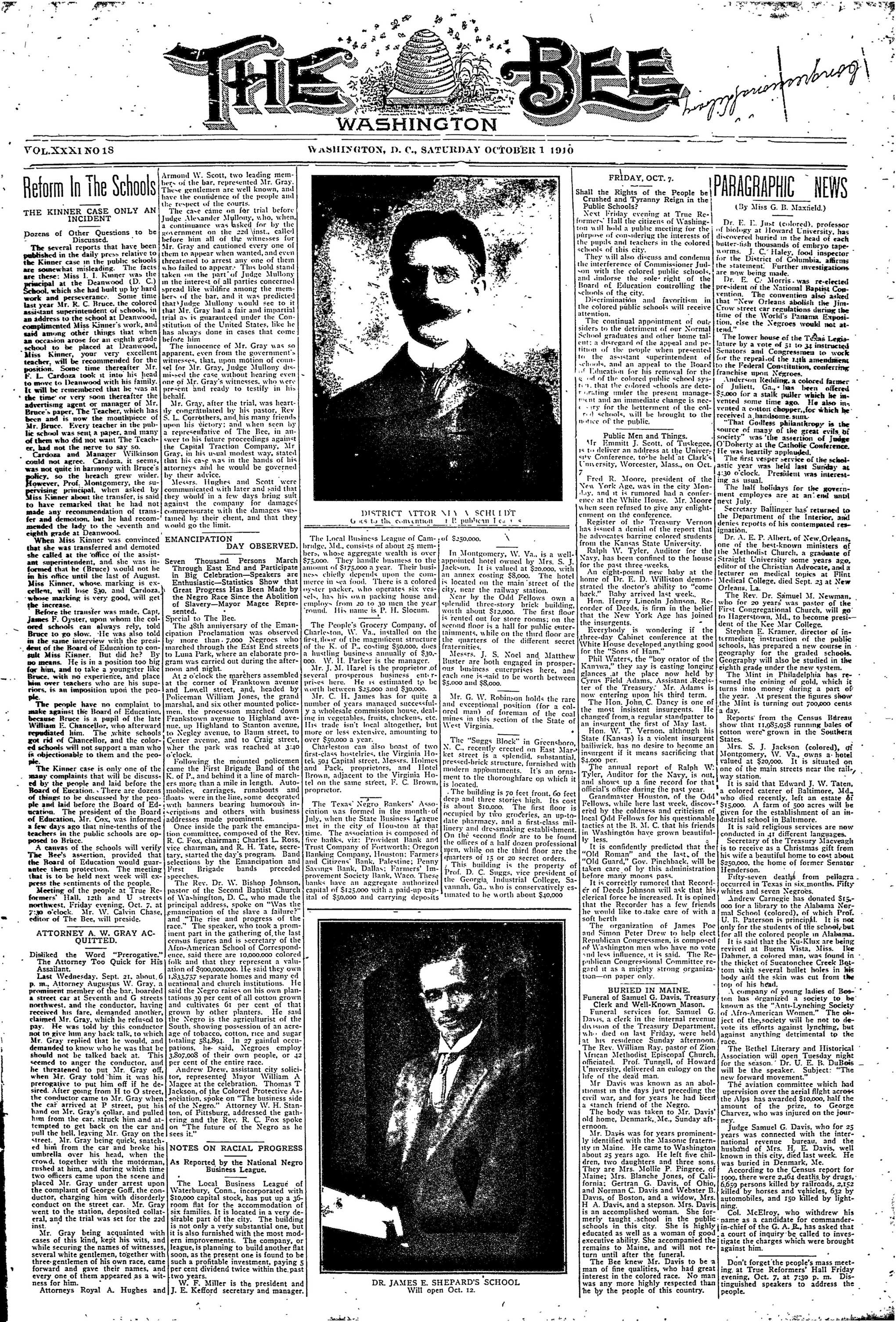
Page text (machine-generated)
THE BEE WASHINGTON
Reform In The Schools
THE KINNER CASE ONLY AN INCIDENT
Dozens of Other Questions to be Discussed.
The several reports that have been published in the daily press relative to the Kinner case in the public schools are somewhat misleading. The facts are these: Miss I. I. Kinner was the principal at the Deanwood (D. C.) School, which she had built up by hard work and perseverance. Some time last year Mr. R. C. Bruce, the colored assistant superintendent of schools, in an address to the school at Deanwood, complimented Miss Kinner's work, and said among other things that when an occasion arose for an eight grade school to be placed at Deanwood, Miss Kinner, your very excellent teacher, will be recommended for the position. Some time thereafter Mr. F. L. Cardoza took it into his head to move to Deanwood with his family. It will be remembered that he was at the time or very soon thereafter the advertising agent or manager of Mr. Bruce's paper. The Teacher, which has been and is now the mouthpiece of Mr. Bruce. Every teacher in the public school was sent a paper, and many of them did not want The Teacher, had not the nerve to say so.
Cardoza and Manager Wilkinson could not agree. Cardoza, it seems, was not quite in harmony with Bruce's policy, so the breach grew wider. However, Prof. Montgomery, the supervising principal, when asked by Miss Kinner about the transfer, is said to have remarked that he had not made any recommendation of transfer and demotion, but he had recommended the lady to the seventh and eighth grade at Deanwood. When Miss Kinner was convinced that she was transferred and demoted she called at the office of the assistant superintendent, and she was informed that he (Bruce) would not he in his office until the last of August. Miss Kinner, whose marking is excellent, will lose $30, and Cardoza, whose marking is very good, will get the increase. Before the transfer was made, Capt. James F. Oyster, upon whom the colored schools can always rely, told Bruce to go slow. He was also told in the same interview with the president of the Board of Education to consult Miss Kinner. But did he? By no means. He is in a position too big for him, and to take a youngster like Bruce, with no experience, and place him over teachers who are his superiors, is an imposition upon the people.
ATTORNEY A. W. GRAY ACQUITTED.
Disliked the Word "Prerogative." The Attorney Too Quick for His Assailant.
Last Wednesday, Sept. 21, about 6 p. m., Attorney Augustus W. Gray, a prominent member of the bar, boarded a street car at Seventh and G streets northwest, and the conductor, having received his fare, demanded another, claimed Mr. Gray, which he refused to pay. He was told by this conductor not to give him any back talk, to which Mr. Gray replied that he would, and demanded to know who he was that he should not be talked back at. This seemed to anger the conductor, and he threatened to put Mr. Gray off, when Mr. Gray told him it was his prerogative to put him off if he desired. After going from H to O street, the conductor came to Mr. Gray when the car arrived at P street, put his hand on Mr. Gray's collar, and pulled him from the car, struck him and attempted to get back on the car and pull the bell, leaving Mr. Gray on the street. Mr. Gray being quick, snatched him from the car and broke his umbrella over his head, when the crowd, together with the motorman, rushed at him, and during which time two officers came upon the scene and placed Mr. Gray under arrest upon the complaint of George Goff, the conductor, charging him with disorderly conduct on the street car. Mr. Gray went to the station, deposited collateral, and the trial was set for the 22d inst.
Mr. Gray being acquainted with cases of this kind, kept his wits, and while securing the names of witnesses, several white gentlemen, together with three gentlemen of his own race, came forward and gave their names, and every one of them appeared as a witness for him.
Attorneys Royal A. Hughes and
Armond W. Scott, two leading members of the bar, represented Mr. Gray. These gentlemen are well known, and have the confidence of the people and the respect of the courts.
The case came on for trial before Judge Alexander Mullony, who, when a continuance was asked for by the government on the 22d inst., called before him all of the witnesses for Mr. Gray and cautioned every one of them to appear when wanted, and even threatened to arrest any one of them who failed to appear. This bold stand taken on the part of Judge Mullony in the interest of all parties concerned spread like wildfire among the members of the bar, and it was predicted that Judge Mullony would see to it that Mr. Gray had a fair and impartial trial as is guaranteed under the Constitution of the United States, like he has always done in cases that come before him.
The innocence of Mr. Gray was so apparent, even from the government's witnesses, that, upon motion of counsel for Mr. Gray, Judge Mullony dismissed the case without hearing even one of Mr. Gray's witnesses, who were present and ready to testify in his behalf.
Mr. Gray, after the trial, was heartily congratulated by his pastor, Rev S. L. Corrothers, and his many friends upon his victory; and when seen by a representative of The Bee, in answer to his future proceedings against the Capital Traction Company, Mr Gray, in his usual modest way, stated that his case was in the hands of his attorneys and he would be governed by their advice.
Messers, Hughes and Scott were communicated with later and said that they would in a few days bring suit against the company for damages commensurate with the damages sustained by their client, and that they would go the limit.
EMANCIPATION
DAY OBSERVED.
Seven Thousand Persons March Through East End and Participate in Big Celebration—Speakers are Enthusiastic—Statistics Show that Great Progress Has Been Made by the Negro Race Since the Abolition of Slavery—Mayor Magee Represented.
Special to The Bee.
The 48th anniversary of the Emancipation Proclamation was observed by more than 7,000 Negroes who marched through the East End streets to Luna Park, where an elaborate program was carried out during the afternoon and night. At 2 o'clock the marchers assembled at the corner of Franktown avenue and Lowell street, and, headed by Policeman William Jones, the grand marshal, and six other mounted policemen, the procession marched down Frankstown avenue to Highland avenue, up Highland to Stanton avenue, to Negley avenue, to Baum street, to Center avenue, and to Craig street, where the park was reached at 3:40 o'clock. Following the mounted policemen came the First Brigade Band of the K. of P., and behind it a line of marchers more than a mile in length. Automobiles, carriages, runabouts and boats were in the line, some decorated with banners bearing humorous inscriptions and others with business addresses made prominent.
Once inside the park the emancipation committee, composed of the Rev. R. C. Fox, chairman; Charles L. Ross, vice chairman, and R. H. Tate, secretary, started the day's program. Band selections by the Emancipation and First Brigade bands preceded speeches.
The Rev. Dr. W. Bishop Johnson, pastor of the Second Baptist Church of Washington, D. C., who made the principal address, spoke on "Was the emancipation of the slave a failure?" and "The rise and progress of the race." The speaker, who took a prominent part in the gathering of the last census figures and is secretary of the Afro-American School of Correspondence, said there are 10,000,000 colored folk and that they represent a valuation of $000,000,000. He said they own 1,833,757 separate homes and many educational and church institutions. He said the Negro raises on his own plantations 39 per cent of all cotton grown and cultivates 61 per cent of that grown by other planters. He said the Negro is the agriculturist of the South, showing possession of an acreage of tobacco, cotton, rice and sugar totaling 584,894. In 27 gainful occupations, he said, Negroes employ 3,807,008 of their own people, or 42 per cent of the entire race.
Andrew Drew, assistant city solicitor, represented Mayor William A Magge at the celebration. Thomas T Jackson, of the Colored Protective Association, spoke on "The business side of the Negro." Attorney W. H. Stanton, of Pittsburg, addressed the gathering and the Rev. R. C. Fox spoke on "The future of the Negro as he sees it."
NOTES ON RACIAL PROGRESS
As Reported by the National Negro Business League.
The Local Business League of Waterbury, Conn., incorporated with $10,000 capital stock, has put up a 36-room flat for the accommodation of six families. It is located in a very desirable part of the city. The building is not only a very substantial one, but it is also furnished with the most modern improvements. The company, or league, is planning to build another flat soon, as the present one is found to be such a profitable investment, paying 5 per cent dividend twice within the past two years. W. F. Miller is the president and J. E. Keford secretary and manager.
M. B.
The Local Business League of Cambridge, Md., consists of about 25 members, whose aggregate wealth is over $75,000. They handle business to the amount of $175,000 a year. Their business chiefly depends upon the commerce in sea food. There is a colored oyster packer, who operates six vessels, has his own packing house and employs from 20 to 30 men the year round. His name is P. H. Slocum.
The People's Grocery Company, of Charleston, W. Va., installed on the first floor of the magnificent structure of the K. of P., costing $50,000, does a hustling business annually of $30,000. W. H. Parker is the manager.
Mr. J. M. Hazel is the proprietor of several prosperous business enterprises here. He is estimated to be worth between $25,000 and $30,000.
Mr. C. H. James has for quite a number of years managed successfully a wholesale commission house, dealing in vegetables, fruits, chickens, etc. His trade isn't local altogether, but more or less extensive, amounting to over $50,000 a year.
of $250,000.
In Montgomery, W. appointed hotel owner Jackson. It is valued at an annex costing $8,000 is located on the main city, near the railway.
Near by the Odd P. splendid three-story worth about $12,000 is rented out for store second floor is a hall for tainments, while on the quarters of the fraternities.
Messers, J. S. Noel Buster are both engraved business enterprises each one is said to be $5,000 and $8,000.
Mr. G. W. Robinson and exceptional position man) of foremines in this section West Virginia.
The "Suggs Block"
Charleston can also boast of two first-class hostelries, the Virginia Hotel, 501 Capital street, Messrs. Holmes and Pack, proprietors, and Hotel Brown, adjacent to the Virginia Hotel on the same street, F. C. Brown, proprietor.
The Texas' Negro Bankers' Association was formed in the month of July, when the State Business Iague met in the city of Houston at that time. The association is composed of five banks, viz: Provident Bank and Trust Company of Fortworth; Oregon Banking Company, Houston; Farmers and Citizens' Bank, Palestine; Penny Savings Bank, Dallas; Farmers' Improvement Society Bank, Waco. These banks have an aggregate authorized capital of $125,000 with a paid-up capital of $30,000 and carrying deposits.
[Image of a man in a suit with a tie, looking slightly to the right.]
M. H.
DR. JAMES E. SHEPARD'S SCHOOL Will open Oct. 12.
In Montgomery, W. Va., is a well-appointed hotel owned by Mrs. S. J. Jackson. It is valued at $20,000, with an annex costing $8,000. The hotel is located on the main street of the city, near the railway station.
Near by the Odd Fellows own a splendid three-story brick building, worth about $12,000. The first floor is rented out for store rooms; on the second floor is a hall for public entertainments, while on the third floor are the quarters of the different secret fraternities.
Messrs. J. S. Noel and Matthew Buster are both engaged in prosperous business enterprises here, and each one is said to be worth between $5,000 and $8,000.
Mr. G. W. Robinson holds the rare and exceptional position (for a colored man) of foreman of the coal mines in this section of the State of West Virginia.
The "Suggs Block" in Greensboro, N. C., recently erected on East Market street is a splendid, substantial, pressed-brick structure, furnished with modern appointments. It's an ornament to the thoroughfare on which it is located.
The building is 70 feet front, 60 feet deep and three stories high. Its cost is about $10,000. The first floor is occupied by two groceries, an up-to-date pharmacy, and a first-class millinery and dressmaking establishment. On the second floor are to be found the offices of a half dozen professional men, while on the third floor are the quarters of 15 or 20 secret orders. This building is the property of Prof. D. C. Suggs, vice president of the Georgia, Industrial College, Savannah, Ga., who is conservatively estimated to be worth $10,000
1914
FRIDAY, OCT. 7.
Shall the Rights of the People be Crushed and Tyranny Reign in the Public Schools?
Next Friday evening at True Reformers' Hall the citizens of Washington will hold a public meeting for the purpose of considering the interests of the pupils and teachers in the colored schools of this city.
They will also discuss and condemn the interference of Commissioner Judson with the colored public schools, and indorse the sole right of the Board of Education controlling the schools of the city.
Discrimination and favoritism in the colored public schools will receive attention.
The continual appointment of outsiders to the detriment of our Normal School graduates and other home talents; a disregard of the appeal and petition of the people when presented to the assistant superintendent of schools, and an appeal to the Board of Education for his removal for the good of the colored public school system, that the colored schools are deteriorating under the present management and an immediate change is necessary for the betterment of the colored schools, will be brought to the notice of the public.
Public Men and Things.
Mr Emmitt J. Scott, of Tuskegee, is to deliver an address at the University Conference, to be held at Clark's University, Worcester, Mass., on Oct. 7
Fred R. Moore, president of the New York Age, was in the city Monday, and it is rumored had a conference at the White House. Mr. Moore when seen refused to give any enlightenment on the conference.
Register of the Treasury Vernon has issued a denial of the report that he advocates barring colored students from the Kansas State University.
Ralph W. Tyler, Auditor for the Navy, has been confined to the house for the past three-weeks.
An eight-pound new baby at the home of Dr. E. D. Williston demonstrated the doctor's ability to "come back." Baby arrived last week.
Hon. Henry Lincoln Johnson. Recorder of Deeds, is firm in the belief that the New York Age has joined the insurgents.
Everybody is wondering if the three-day Cabinet conference at the White House developed anything good for the "Sons of Ham."
Phil Waters, the "boy orator of the Kanawa," they say is casting longing glances at the place now held by Cyrus Field Adams, Assistant Register of the Treasury. Mr. Adams is now entering upon his third term.
The Hon. John C. Dancy is one of the most insistent insurgents. He changed from a regular standpatter to an insurgent the first of May last. Hon. W. T. Vernon, although his State (Kansas) is a violent insurgent bailiwick, has no desire to become an insurgent if it means sacrificing that $4,000 per. The annual report of Ralph W. Tyler, Auditor for the Navy, is out, and shows up a fine record for that official's office during the past year. Grandmaster Houston, of the Odd Fellows, while here last week, discovered by the coldness and criticism of local Odd Fellows for his questionable tactics at the B. M. C. that his friends in Washington have grown beautifully less. It is confidently predicted that the "Old Roman" and the last of the "Old Guard," Gov. Pinchback, will be taken care of by this administration before many moons pass. It is correctly rumored that Recorder of Deeds Johnson will ask that his clerical force he increased. It is opined that the Recorder has a few friends he would like to take care of with a soft berth
The organization of James Poe and Simon Peter Drew to help elect Republican Congressmen, is composed of Washington men who have no vote and less influence, it is said. The Republican Congressional Committee regard it as a mighty strong organization—on paper only.
BURIED IN MAINE.
Clerk and Well-Known Mason.
Funeral services for. Samuel G. Davis, a clerk in the internal revenue division of the Treasury Department, who died on last Friday, were held at his residence Sunday afternoon. The Rev. William Ray, pastor of Zion African Methodist Episcopal Church, officiated. Prof. Tunnell, of Howard University, delivered an eulogy on the life of the dead man.
Mr. Davis was known as an abolitionist in the days just preceding the civil war, and for years he had beert a stanch friend of the Negro.
The body was taken to Mr. Davis' old home, Denmark, Me., Sunday afternoon.
Mr. Davis was for years prominently identified with the Masonic fraternity in Maine. He came to Washington about 25 years ago. He left five children, two daughters and three sons. They are Mrs. Mollie P. Pingree, of Maine; Mrs. Blanche Jones, of California; Gertran G. Davis, of Ohio, and Norman C. Davis and Webster B. Davis, of Boston, and a widow, Mrs. H A. Davis, and a stepson. Mrs. Davis is an accomplished woman. She formerly taught school in the public schools in this city. She is highly educated as well as a woman of good executive ability. She accompanied the remains to Maine, and will not return until after the funeral.
The Bee knew Mr. Davis to be a man of fine qualities, who had great interest in the colored race. No man was any more highly respected than he by the people of this country.
PARAGRAPHIC NEWS
PARAGRAPHIC NEWS
Dr. E. E. Just (colored), professor of biology at Howard University, has discovered buried in the head of each butter-fish thousands of embryo tapeworms. J. C. Haley, food inspector for the District of Columbia, affirms the statement. Further investigations are now being made.
Dr. E. C. Morris was re-elected president of the National Baptist Convention. The convention also asked that "New Orleans abolish the Jim-Crow street car regulations during the time of the World's Panama Exposition, else the Negroes would not attend."
The lower house of the Texas Legislature by a vote of 51 to 34 instructed Senators and Congressmen to work for the repeal of the 14th amendment to the Federal Constitution, conferring franchise upon Negroes.
Anderson Reedling, a colored farmer of Juliette, Ga., has been offered $5,000 for a stalk puller which he invented some time ago. He also invented a cotton chopper, for which he received a handsome sum.
"That Godless philanthropy is the source of many of the great evils of society" was the assertion of Judge O'Doherty at the Catholic Conference. He was heartily applauded.
The first vesper service of the scholastic year was held last Sunday at 4:30 o'clock. President was interesting as usual.
The half holidays for the government employees are at an end until next July.
Secretary Ballinger has returned to the Department of the Interior, and denies reports of his contempated resignation.
Dr. A. E. P. Albert, of New, Orleans, one of the best-known ministers of the Methodist Church, a graduate of Straight University some years ago, editor of the Christian Advocate, and a lecturer on medical topics at Flint Medical College, died Sept. 23 at New Orleans, La.
The Rev. Dr. Samuel M. Newman, who for 20 years was pastor of the First Congregational Church, will go to Hagerstown, Md., to become president of the Kee Mar College.
Stephen E. Kramer, director of intermediate instruction of the public schools, has prepared a new course in geography for the graded schools. Geography will also be studied in the eighth grade under the new system.
The Mint in Philadelphia has resumed the coining of gold, which it turns into money during a part of the year. At present the figures show the Mint is turning out 700,000 cents a day.
Reports from the Census Bdurea show that 11,985,958 running bales of cotton were grown in the Southern States. Mrs. S. J. Jackson (colored), of Montgomery, W. Va., owns a hotel valued at $20,000. It is situated on one of the main streets near the railway station. It is said that Edward J. W. Taten, a colored caterer of Baltimore, Md., who died recently, left an estate of $15,000. A farm of 500 acres will be given for the establishment of an industrial school in Baltimore. It is said religious services are now conducted in 41 different languages. Secretary of the Treasury Macveigh is to receive as a Christmas gift from his wife a beautiful home to cost about $250,000, the home of former Senator Henderson. Fifty-seven deaths from pellagra occurred in Texas in six months. Fifty whites and seven Negroes. Andrew Carnegie has donated $15,000 for a library to the Alabama Normal School (colored), of which Prof. U. B. Paterson is principal. It is not only for the students of the school, but for all the colored people in Alabama.
It is said that the Ku-Klux are being revived at Buena Vista, Miss. Ike Dahmer, a colored man, was found in the thicket of Sucatonche Creek Bottom with several bullet holes in his body and the skin was cut from the top of his head.
A company of young ladies of Boston has organized a society to be known as the "Anti-Lynching Society of Afro-American Women." The object of the society will be not to devote its efforts against lynching, but against anything detrimental to the race.
The Bethel Literary and Historical Association will open Tuesday night for the season. Dr. U. E. B. DuBois will be the speaker. Subject: "The new forward movement."
The aviation committee which had supervision over the aerial flight across the Alps has awarded $10,000, half the amount of the prize, to George Charvez, who was injured on the journey.
Judge Samuel G. Davis, who for 25 years was connected with the international revenue bureau, and the husband of Mrs. H. E. Davis, well known in this city, died last week. He was buried in Denmark, Me.
According to the Census report for 1909, there were 2,464 deaths by drugs, 6,659 persons killed by railroads, 2,152 killed by horses and vehicles, 632 by automobiles, and 150 killed by lightning.
Col. McElroy, who withdrew his name as a candidate for commander-in-chief of the G. A. R., has asked that a court of inquiry be called to investigate the charges which were brought against him.
Don't forget the people's mass meeting. at True Reformers' Hall Friday evening. Oct. 7, at 7:30 p. m. Distinguished speakers to address the people.
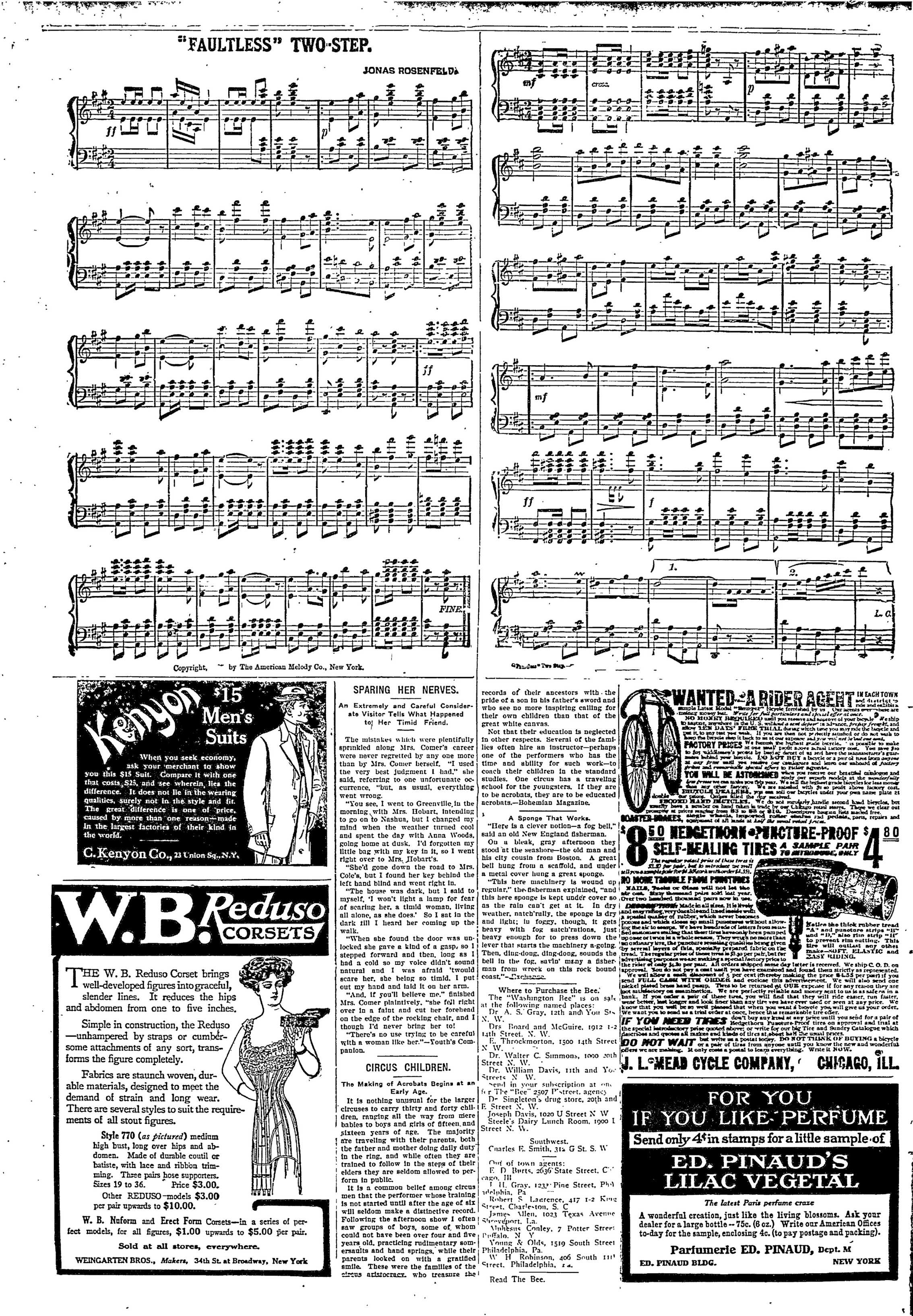
JONAS ROSENFELD
```markdown
```
ff
```markdown
```
Copyright, by The American Melody Co., New York.
Kenyon $15 Men's Suits
When you seek economy, ask your merchant to show you this $15 Suit. Compare it with one that costs $25, and see wherein lies the difference. It does not lie in the wearing qualities, surely not in the style and fit. The great difference is one of price, caused by more than one reason—made in the largest factories of their kind in the world.
C. Kenyon Co., 23 Union Sq., N.Y.
W.B. Reduso CORSETS
Fabrics are staunch woven, durable materials, designed to meet the demand of strain and long wear. There are several styles to suit the requirements of all stout figures.
W. B. Nuform and Erect Form Corsets—in a series of perfect models, for all figures, $1.00 upwards to $5.00 per pair.
---
THE W. B. Reduso Corset brings well-developed figures into graceful, slender lines. It reduces the hips and abdomen from one to five inches. Simple in construction, the Reduso unhampered by straps or cumbersome attachments of any sort, transforms the figure completely.
Fabrics are staunch woven, durable materials, designed to meet the demand of strain and long wear. There are several styles to suit the requirements of all stout figures.
Style 770 (as pictured) medium high bust, long over hips and abdomen. Made of durable coutil or batiste, with lace and ribbon trimming. Three pairs hose supporters. Sizes 19 to 36. Price $3.00.
Other REDUSO-models $3.00 per pair upwards to $10.00.
W. B. Nuform and Erect Form Corsetsfect models, for all figures, $1.00 upwards
gs
ful,
hips
nes.
so
quire-
SPARING HER NERVES.
An Extremely and Careful Considerate Visitor Tells What Happened
The mistakes which were plentifully sprinkled along Mrs. Comer's career were never regretted by any one more than by Mrs. Comer herself. "I used the very best judgment I had," she said, referring to one unfortunate occurrence, "but, as usual, everything went wrong.
"You see, I went to Greenville, in the morning, with Mrs. Hobart, intending to go on to Nashun, but I changed my mind when the weather turned cool and spent the day with Anna Woods, going home at dusk. I'd forgotten my little bag with my key in it, so I went right over to Mrs. Hobart's.
"She'd gone down the road to Mrs. Cole's, but I found her key behind the left hand blind and went right in.
"The house was dark, but I sald to myself, 'I won't light a lamp for fear of scaring her, a timid woman, living all alone, as she does.' So I sat in the dark till I heard her coming up the walk.
"When she found the door was unlocked she gave a kind of a gasp, so I stepped forward and then, long as I had a cold so my voice didn't sound natural and I was afraid 'twould scare her, she being so timid, I put out my hand and laid it on her arm.
"And, if you'll believe me," finished Mrs. Comer plaintively, "she fell right over in a faint and cut her forehead on the edge of the rocking chair, and I though I'd never bring her to!
"There's no use trying to be careful with a woman like her."-Youth's Companion.
CIRCUS CHILDREN.
The Making of Acrobats Begins at an Early Age. It is nothing unusual for the larger circuses to carry thirty and forty children, ranging all the way from mere babies to boys and girls of fifteen, and sixteen years of age. The majority are travelling with their parents, both the father and mother doing daily duty in the ring, and while often they are trained to follow in the steps of their elders they are seldom allowed to perform in public.
It is a common belief among circus men that the performer whose training is not started until after the age of six will seldom make a distinctive record. Following the afternoon show I often saw groups of boys, some of whom could not have been over four and five years old, practicing rudimentary somersaults and hand springs, while their parents looked on with a gratified smile. These were the families of the circus aristocracy, who treasure the
1.
records of their ancestors with the pride of a son in his father's sword and who see no more inspiring calling for their own children than that of the great white canvas. Not that their education is neglected in other respects. Several of the families often hire an instructor—perhaps one of the performers who has the time and ability for such work—to coach their children in the standard studies. One circus has a travelling school for the youngsters. If they are to be acrobats, they are to be educated acrobats.—Bohemian Magazine.
"Here is a clever notion—a fog bell," said an old New England fisherman. On a bleak, gray afternoon they stood at the seashore—the old man and his city cousin from Boston. A great bell hung from a scaffold, and under a metal cover hung a great sponge. "This here machinery is wound up regular," the fisherman explained, "and this here sponge is kept under cover so as the rain can't get at it. In dry weather, match'rally, the sponge is dry and light; in foggy, though, it gets heavy with fog satch'rations, just heavy enough for to press down the lever that starts the machinery a-going. Then, ding-dong, ding-dong, sounds the bell in the fog, savin' many a fisherman from wreck on this rock bound const."—Exchange
Where to Purchase the Bee:
The "Washington Bee" is on sale
at the following named places:
Dr. A. S.' Gray, 12th and You St. N. W.
Drs. Board and McGuire, 1912 1-2
14th Street. N. W.
E. Throckmorton, 1500 14th Street
N. W.
Dr. Walter C. Simmons, 1000 20th Street N. W.
Dr. William Davis, 11th and Yor Streets N. W.
Send in your subscription at one for The "Bee" 2507 P Street, agency
Dr. Singleton's drug store, 20th and E Street N. W.
Joseph Davis, 1020 U Street N W
Steele's Dairy Lunch Room, 1900 I Street N. W.
Southwest.
Charles E. Smith, 312 G St. S. W
Out of town agents:
E. D Burts, 2636 State Street, C cage, Ill
H. Gray, 1232 Pine Street, Philadelphia, Pa
Robert S. Lawrence, 417 1-2 King Street, Charleston, S. C
James Allen, 1023 Texas Avenue Shreveport, La.
Young & Olds, 1519 South Street Philadelphia, Pa.
W H Robinson, 406 South 110
Street. Philadelphia, 14.
Read The Bee.
YOU WILL BE ASTONISHED when you receive our beautiful catalogues and study our superb models at the wonderfully low prices we can make you this year. We sell the highest grade bicycles for less money than any other factory. We are satisfied with $3 so profit above factory cost. BRUTULA REALISES you can sell our bicycles under your own name plate 28 double tire filled the day received. SECOND HAND BICYCLES. We do not regularly handle second hand bicycles, but mostly a number on hand bikes in your Chicago retail stores. There we clear out promptly at prices ranging from $3 to $8 or $10. Do not dispose bikes left marked free. SINGLE WHEELS, imported roster leather pedals, parts, repairs and component of all kinds at half the usual price.
```markdown
```
a spansular quantity of fabric, we would be better boundless for purposes other than to seams. We have hundreds of letters from mass-faced customers smiling that their first hand only been pumped up once or twice in a whole season. They weigh no more than an ordinary tire, the puncture-resistant question being given by several layers of film, specially prepared fabric on the tread. The regular price of those tires is $30 per pair, but for advertising purposes we are making a special factory price to
the riser of only $4.00 per pair. All orders shipped same day letter is received. We ship C.O.D. on approval. You do not pay a cash until you have examined and found them strictly as represented. We will allow a cash discount of 5 per cent (thereby making the price $4.55 per pair) if you send FULL CASH WITH ORDERS and euchose this advertisement. We will also send one nickel plated brass hand pump. Tires to be returned at OUE expense if for any reason they are not satisfactory on maintenance. We are perfectly reliable and money sent to us is as safe in a bank. If you order a pair of these tires, you will find that they will ride easier, run faster, wear better, last longer and look finer than any the ve you have ever used or seen at any price. We know that you will be so well planned that when you want a bicycle you will give us your order. We want you to send us a trial order at once, hence this remarkable tire offer.
IF YOU NEED TIRES don't buy any kind at any price until you send for a pair of the special introductory price quoted above; or write for our big Tire and Sundry Catalogue which describes and quotes all marks and kinds of tires at about half the usual prices.
DO NOT WAIT but write us a postal body. DO NOT THINK OF BUYING a bicycle on or past of three from anyone you know. You are new and wonderful after your first ride.
FOR YOU
IF YOU LIKE PERFUME
Send only 4¢ in stamps for a little sample of
ED. PINAUD'S
LILAC VEGETAL
The latest Paris perfume craze
A wonderful creation, just like the living blossoms. Ask your
dealer for a large bottle -- 75c. (6 oz.) Write our American Offices
to-day for the sample, enclosing 4c. (to pay postage and packing).
Parfumerie ED. PINAUD, Dept. M
ED. PINAUD BLDG.
NEW YORK
DO MORE TROUBLE FROM POURTURES
NAILS, Towels or Gloss will not let the
air out. Ninety thousand pairs sold last year.
Over two hundred thousand pairs now in use.
DEBENEZ FROM Made in all sizes. It is lively
and engraving, very durable and lined with vel
Matter the thick rubber tread
"A" and puncture strips "I"
and "D," also rim strip "I"
to prevent rim cutting. This
makes it easier to other
make-NOFT, ELASTIC and
EASY UDING.
1
A DARING BUCCANEER
Edward Thatch, Who Was Known as the Blackbeard Pirate.
HIS BATTLE WITH MAYNARD.
After the Hand to Hand Conflict the Desperado's Head Hung at the Bowsprit End of the Lieutenant's Sloop as She Sailed Back to Virginia.
It is almost 200 years since Edward Thatch, better known as the pirate Blackbeard, was a name with which to terrorize the Atlantic coast of the then new country of America. As a buccaneer whose deeds of desperate daring made him feared wherever his name was known he stands a close rival of the famous Captain Kidd, if indeed in some respects he did not surpass that notorious freebooter.
The date of Thatch's birth is lost in history, and his native place is variably given as Bristol and Jamaica. He first appears as a foremast hand to Major Stede Bonnet, a gentleman of Barbados, who, although a man of property and having small knowledge of the sea, thought proper to fit out a sloop and take to a life of piracy, the explanation of his being "a little distracted" being charitably given by one biographer. However that may be, his crew missed in the major qualities of a successful commander. They deposed him and elected Thatch in his place. Bonnet was tried and executed in 1711.
Thatch's first independent exploit of which we have a detailed account took place in June, 1718, when he captured two French ships near the Bermudas, one laden with sugar, the other empty. Transferring to the latter the crew of the laden vessel and letting them go their way, he sailed with his prize of vessel and sugar for Bathtown, N. C., with the governor of which place, Charles Eden, he had previously arrived at a pleasant understanding.
Thatch gave out that he had found the French ship deserted. Governor Eden received sixty hogsheads of sugar as his share. Tobias Knight, his secretary, took twenty, and the remainder fell to Thatch and his crew. Thatch lingered there for some months, plundering and insulting the merchants of the place. These, understanding at length the futility of expecting redress from Eden, applied to the governor of Virginia to rid them of the pest.
The governor, after consultation with the captains of the Pearl and Lime, then lying in the James river, agreed to provide two sloops, the warships to furnish a complement of men, Lieutenant Maynard of the Pearl was placed in command, and the punitive expedition sailed on Nov. 17, 1718. On the 21st the pirates were sighted in an inlet about sixty miles from Bathtown, and Maynard anchored for the night.
On the following morning Thatch, maneuvering to elude attack, ran his vessel aground, but Maynard's sloop, drawing more water, though she had no guns on board, failed to get to close quarters. The lieutenant, however, threw out his ballast and in answer to a truculent defence from Thatch promised to be "soon aboard him with his sloop." Coming at-last within close range, a broadside from the pirate killed or wounded twenty of Maynard's crew and nine on board his consort.
Maynard now ran alongside the pirate, when, under cover of a discharge of grenades. Thatch and fourteen followers boarded the king's ship Maynard and Thatch, pistol and sword in hand, engaged in a desperate personal encounter. The lieutenant's sword broke, and more than once he narrowly escaped a fatal injury. But at last Thatch, having received sixteen wounds, fell dead in the act of cocking a pistol. His followers jumped overboard and crieled for quarter Maynard hung. Thatch's head at the bowsprit end, sailed for Bathtown, where he seized the governor's storehouse, and then, still with his grisly sign of triumph swinging in the wind, rejoined his ship in Virginia, where thirteen of the captured pirates were hanged.
One of the Blackbeard's crew who obtained pardon was Israel Hands, who makes his appearance in "Treasure Island." Shortly before Thatch met his death Hands had been lamed for life by a pistol shot in the knee fired by Thatch from under the cabin table, at which he, with Hands and others, was carousing, just to remind his crew in general "who he was." Such an act was only one of the many eccentric brutalities of Thatch's career.
When he felt himself in the vein or was going into action his appearance was somewhat startling—his bushy black beard tied up with ribbons, the ends of which were thrown over his ears; a fur cap on his head, with a lighted match on either side, and three brace of pistols slung across his shoulder. Of the usual condition of himself and his crew much may be gathered from the fact that "our company somewhat sober" was a circumstance deemed worthy of note in the diary found after his death—London Globe.
Npt Yet.
"Do you desire a room with a bath?" asked the affable clerk. "Gee whiz, no!" replied the gentleman with the canvas telescope. "This is only Tuesday, ain't it?"—Chicago Record-Herald.
Children have more need of models than of critics.—Jonbert.
MEAT IN AFRICA.
When the Native Butcher Purposes Killing an Ox He Sends Around Notice to the White People.
Travelers in Africa find the standard of living somewhat different from what they are accustomed to at home. Mary, Hall in her book, "A Wqman's Trek From the Cape to Calro," throws a strong light upon the condition of market and kitchen in British Central Africa:
When the native butcher proposes to kill an ox, notice to that effect is sent round to the white people on the previous day. Once they were apprised of the fact by the following startling announcement: "A bule will be murdered tomorrow morning at 6 a. m."
This cold blooded crime, so carefully premeditated, even to the exact hour, was, however, not committed, as the next morning a second notice was issued as follows: "The bule ran away this morning, so was not murdered." But this was an exceptional case.
I heard one story which is so characteristic of the native that I repeat it. The man who related it told me that the incident occurred when he was on a journey and was suffering from a bad attack of fever. One evening he fancied he would like some eggs and told his boy to get two and boll them lightly.
After a time they were brought to him as hard as bullets. He told the boy he must get some more and boll them less; but, alas, these were brought to him in the same condition, and the poor fellow wished he had never ordered them at all.
Belong unwilling to give in, he made another attempt and told his boy, "Come to me when the water bolls." The boy did so.
"Now," said his master, "put the eggs in, and when you have counted fifty take them out."
The native method of reckoning is to count up to ten and then begin again, arriving at the total by the number of the tens counted. The sick man heard the boy start fair and get as far as four tens, when a second boy interfered and questioned whether it were the third or fourth ten.
This started a discussion, and as they could not agree it was decided to begin all over again. Meanwhile the eggs were still boiling and getting harder and harder. This was about the last straw, and, ill as the man felt, he was compelled to get out of bed and put a summary end to the cooking operations.
SOME SURE THINGS.
Do Not Bet on Your Ability to Perform These Feats.
Bets to be avoided by those who are cocksure they can do all things are those relating to athletic feats. It would seem that a good runner could easily give a start of fifty yards in a hundred to a man who was doing the fifty yards by hopping on one leg. But few runners. If any, can afford to give that amount of start to any man who is at all strong on his legs. For the first five yards or so they go at practically the same pace, so that to run ninety-five yards while his opponent is hopping forty-five be has to go more than twice as fast, and it is a weak man indeed who cannot hop fifty yards in ten seconds.
An ordinary wooden match is easily broken in the fingers, but, although there are many who will bet they can do it, none succeed in accomplishing the task if the match is laid across the nail of the middle finger of either hand and pressed upon by the first and third fingers of that hand, despite its seeming so easy at first sight. No one can crush an egg placed lengthwise between his clasped hands—that is, if the egg be sound and has the ordinary shell of a hen's egg. It is safe to bet a man that he cannot get out of a chair without bending his body forward or putting his feet under it if he is sitting on it, not at the edge of it. Another equally certain wager is that a man cannot stand at the side of a room with both of his feet touching the wainscotting lengthwise.
It is safe to bet any man, save one who is blind, that he cannot stand for five minutes without moving if he is blindfolded.
Very Different.
It is never embarrassing in a novel for a rich man to find a lot of poor kin. There is always a vacancy in a bank, where the rich man finds a good position for the oldest son, who soon becomes the bank's president. Another child shows a genius for painting, and the rich man sends him to study. In a month or two the child returns a great artist. But how different in real life! Ah, how vastly different!-Atchison Globe.
She Had Often Studied It.
Little Marle had returned from her first visit to Sunday school. "And what lesson are you to study for next Sunday?" her mother asked "Nuslin' much," said the four-year-old rather scornfully. "Her jest said to learn all about the catakissin', and me knowed that already."—Lippincott's.
Like the Bee.
"I, sir," said Mr. Dustin Stax, "am like the busy bee I have industriously stored the good things of life."
"Yes. And anybody who tried to stop you was very likely to get stung."
—Washington Star.
Force of Habit
Captain of Signalers—G—G—G, what the deuce does the fellow mean? There's no word with three G's running. Corporal—Beg pardon, sir, but Signaler Hlggins he stutters!—London Punch
A LEGEND OF MEXICO
The Mermaid Malinche and Her Haunted Springs.
LURE OF THE WATER SPRITE.
To See This Fabled Custodian of the Royal Jewels of the Ancient Axtees Is to Die and Help the Siren Guard the Hidden Treasures.
Mallinche, or Malintze, as some of the old Mexican writers spell it, is the water sprite, the mermaid, who lives in two famous springs in Mexico that are said to be connected by natural underground waterways.
She is invisible to all except those who never return to tell the tale, yet it is easy to see her, they say.
In the daytime Mallinche lives in the little spring bed pool just within the iron gates of Chapultepec. Here she is a sweet spirit, always wooing the passerby with the music of her gentle voice.
At nighttime she is miles away, and her voice is wicked and mournful. It will add interest to this legend of the Mallinche if the traveler when he starts out to visit Chapultepec for the first time will pause at the Cuahtemoc statue in the second glorieta of the Paseo and take a long look at it, not only because it is a noble work of art, but because this Indian hero was the last ruler of his race, the Aztecs, and in the final struggle called Mallinche to his aid.
A bronze relief in the base of the pedestal on which the statue stands shows the chief being tortured to compel him to reveal the hiding place of the wealth of his kingdom. Cuauhtemoc's stolcal bearing rebukes the complainings of his comrade, whose feet are also roasting over the slow fire in the brasero beneath them, and when he at last cries out in angulish Cuauhtemoc reproves him. "For shame, faint heart. Do you think I am taking my pleasure in my bath that you appeal to me?"
The magnificent old cypress trees that surround the rock of Chapultepec on a slightly lower level than the spring were old before the conquest, and among them Cuauhtemoc and his plumed and painted warriors gulded their canoes to the enchanted spring when they came to quench their battle thirst. Protected by these brave old trees, Cuauhtemoc climbed the rocks and from the heights watched the maneuvers of his enemies on the lakes. Close by the storied spring stands the monarch of them all, Montezuma's tree. It is awe inspiring to follow with the eye its rugged bole up over the growth of centuries and try to measure with the mind the history that has been enacted beneath its waving boughs. Perhaps the magic spring at its feet caused it to grow higher and more majestic than its fellows. Here in its shade Montezuma sat and wept when he foresaw his downfall. Here Cuauhtemoc vowed that if he could not overcome the Spanlard he would give the Aztec treasure to Mallihe.
She overheard him make this vow and whispered from the fringed brink of the mirroring water that she would receive the trust at the spring of Atzcapotzalco, three or four miles away. This town, whose name looks so unpronounceable to the strangers, but sounds so smooth when uttered by a Mexican, has a little suburb. Zancoplinca, that has been made famous by Mallinche's spring. It is here that Mallinche loses the sweet nature by which she is known at Chapultepec and becomes a wicked spirit. The legend relates that she grew savage because she was set to guard the treasure that Cuauhtemoc secretly conveyed to her when the hour of despair had arrived for his people, though another tradition says that he selected that hiding place because of her wild and brave spirit.
However that may be. It was there that he carried the royal jewels of the Aztecs and much gold and silver when he knew that he was about to be defeated by Cortes Calling up the Mallinche, he gave all into her keeping and then went to his doom Down deep into the hidden grottoes of her home Mallinche dragged the hoarded treasures.
Long passageways connect these chambers and by many tortuous windings reach either spring. The walls of rock crystal and chalcedony have been polished and worn into fartastic shapes by the running water. There are long, narrow shelves on which the treasure is strewn and glittering stalactites that catch long strings of pearls and emeralds and hold them swaying in the winds of the caves.
Glowworms and electric fishes light the fairy scene, and the water makes constant music, but the Mallinche is not happy. If you go near the pool at Zancopinca you will hear her voice lamenting, and often in the nighttime it may be heard afar off. If the unwary traveler pauses to listen he will hear cries of distress and anger and sad moanings that attract him to their relief. He will come nearer and nearer to the spring and, bending down that his ear may be close, he will hear troubled waters rushing among hidden rocks. When his face is above the pool a pair of white arms will rise up out of the water and clasp him about the-neck. He is never seen again. He has gone to help the strenge the treasure of Cunauhtemoc—Mary Worral Hudson in Mexican Herald.
Nature is lavish in the production of everything but great men. - Hubbard
McCALL PATTERNS
10
AND
15
MORE HIGHER
McCALL'S MAGAZINE
50
YEAR
INCLUDING A FREE PATTERN
McCALL PATTERNS
Celebrated for style, perfect fit, simplicity and
elegance by a 40 year old based in nearly
every city and town in the United States and
Canada, or by direct mail. More so than
any other make. Send for free catalogue.
McCALL'S MAGAZINE
More subscriptions in any other fashion magazine—million a month. Invaluable. Latest styles, patterns, dressmaking, uniformity, plain sewing, fancy needlework, hairdressing, etiquette, good stitching, etc. On to cents a year (north double), including a free pattern. Subscript today or send for sample copy.
WONDERFUL INDUCEMENTS
1) Assets, Postal brings pro c t ologue
and new cash prize offer. Ads.
HCCALL CO. 238 to 238 W. 27th St. NEW YORK
HE BEE AND McCALL'S GREAT
FASHION MAGAZINE
for one year for place
COUPON.
Senior Bee:—
Find enclosed two dollars. Send to
my address below The Bee and McCall's
fashion Magazine for one year.
Vo.....
street.....
town or City....
The President has signed several proclamations eliminating nearly half a million acres of land from the national forests, adding a little more than 100,000 acres to the reserves.
The fourteenth annual meeting of the Hampton Negro Conference will take place at Hampton Institute, Va., July 13th and 14th.
The twenty-fifth anniversary services of the establishment of the Salvation Army in this city were held in the various churches last Sunday.
KREAD THR BEA
BUY THE
NEW HOME
LIGHT RUNNING
SEWING MACHINE
Before You Purchase Any Other Write
THE NEW HOME SEWING MACHINE COMPANY
ORANGE, MASS.
Many Sewing Machines are made to sell or
of quality, but the "New Home" made
wear. Our guaranty never runs out.
We make Sewing Machines to suit all conditions
at the trade. The "New Home" stands at
end of all High-grade family sewing machines
FOR SALE BY
GO TO
HOLMES' HOTEL,
No. 533 Virginia Ave., S.W.
Afro-American Accommodation in the District.
EUROPEAN AND AMERICAN
Good Looms and Lodging, so.
73c. and $1.00. Comfortably
Heated by Steam. Give
us a Call.
James Otoway Holmes, Prop.
Washington, D. C.
Phone 2314
DOM
There are many colored families who are living in crowded houses on small plots of land in towns or cities who want real freedom and real opportunity for themselves and for their children. It is very difficult to rear children in a crowded town or city. The place to rear children is in the country.
In Macon County, Alabama, the colored people have a rare and exceptional opportunity. This is the county in which The Tuskegee Normal and Industrial Institute is located. There is plenty of good land for sale on easy terms. There is a good schoolhouse, and the school term lasting from seven to eight months in every part of the county. The white people in Macon County are of the very best class. There is no disorder or racial trouble. We advise colored people who are now living in crowded towns or cities, in the North or in the South, and especially those who have children to raise to come to Macon County and buy a home where they can get plenty of land to cultivate and rear their families in the county free from the emptations of the cities and towns. For further information write oree:
Clinton I. Calloway. Real Estate
AMERICAN NAME MUSEUM BUILDING
SICK AND ACCIDENT INSURANCE UP TO $25.00 PER WEEK WHOLE LIFE INSURANCE ON VERY LIBERAL TERMS PAYABLE ONE HOUR AFTER DEATH AMERICAN HOME LIFE INSURANCE CO., FIFTH and G Streets N. W. Washington, D. C
WORTH ADVERTISING FOR
There are 5,499 Negroes employed here in the Government alone, and these 5,499 Negroes are registering $3,044,404. These more than three men spent right here in Washington, but scattered hundreds of tradesmen. Is this amount of money for? It certainly is, and not even the larger would refuse to get the big end of it did. How much money the Negroes are really spending? Now The Bee is the only Negro publication kids without a rival or competitor, and cover of the merchants in this city will patronize the sales of The Bee, presenting the attractive bargain the Negroes — these 5,499 Negroes who draw government over three millions of dollars — will assist a publication edited and operated by one firm farms desire and deserve their patronage. And drive the bulk of these over three millions of dollars out by the Negroes of Washington.
What clothing stores, what furniture stores, what other lines of business will now make and themselves these over three millions of dollars spend by advertising in The Bee? Place your advertising in The Bee and watch them. Negroes spend their over three millions of dollars now is the time to advertise in The Bee, the new every Negro home in Washington. Remember Washington, it's what advertising pays you, not what MORE MONEY — RACE PROGRESS.
If colored people groom themselves daintly, with odors, remove grease shine from the face, coveries for improving the skin and dressing, be better received in the business world, money, and advance faster.
The Chemical Wonder Company of New York business friend colored people have. It improves Dr. Booker Washington improves their mines by manufacturers nine Chemical Wonders, widened people as attractive as individual peculiar. Colored men in New York who use these their situations in banks, clubs and business have better positions, marry better, get aloof.
(1) Complexion WonderCream will lighten (black or brown) every time it is used. In trial, we send demonstration sample for 100-50 cents postpaid.
(2) Magneto-Metallic Comb, called Wondermeated before using, to help straighten and holds 50 cents, and will last a lifetime.
(3) Wonder Uncurl. When this pomade dries the kinks can be uncurled and the hair be heated into the scalp and through the hair Comb, any stiff, knotty hair will dress well.
(4) Wonder Hair Grow fertilizes the hair grow long, just as fertilizers in the soil grow. 50 cents postpaid.
(5) Odor Wonder Powder instantly destroys. People who neglect such chemical cleanses. 50 cents postpaid.
(6) Odor Wonder Liquid. This fine toilet body with delicate perfume. When used with Wonder Powder the conditions of the hair. If you can spare 50 cents extra, order this postpaid.
(7) Wonder Foot Powder keeps the feet clean.
(8) Wonder Wash. A shampoo to clean and insure the health of the hair and scalp. 50 cents.
(9) Shell Pink Creme will give light brown cheeks without made-up appearance. 50 cents.
We guarantee all these Wonders as represensible. We give advice free about hair, skin and s
There are 5,499 Negroes employed here in Washington by the Government alone, and these 5,499 Negroes draw salaries aggregating $3,044,404. These more than three millions of dollars are spent right here in Washington, but scattered among the hundreds of tradesmen. Is this amount of money worth bidding for? It certainly is, and not even the largest stores in this city would refuse to get the big end of it did they but realize how much money the Negroes are really spending.
Now The Bee is the only Negro publication in this city. It stands without a rival or competitor, and covers the field like a few of the merchants in this city will patronize the advertising columns of The Bee, presenting the attractive bargains they may have these Negroes — these 5,499 Negroes who draw annually from the Government over three millions of dollars — will assume that by patronizing a publication edited and operated by one of their race that such farms desire and deserve their patronage. And such firms will receive the bulk of these over three millions of dollars received and spent by the Negroes of Washington.
What clothing stores, what furniture stores, what dry goods stores and what other lines of business will now make an effort to divert to themselves these over three millions of dollars spent by Washington Negroes by advertising in The Bee?
Place your advertising in The Bee and watch these 5,499 appreciative Negroes spend their over three millions of dollars with you.
Now is the time to advertise in The Bee, the newspaper that goes into every Negro home in Washington. Remember, merchants of Washington, it's what advertising pays you, not what it costs
MORE MONEY—RACE PROGRESS.
If colored people groom themselves daintly, destroy perspiration odors, remove grease shine from the face, and use our new discoveries for improving the skin and dressing the hair, they will be better received in the business world, make more money, and advance faster.
The Chemical Wonder Company of New York is the best business friend colored people have. It improves their bodies as Dr. Booker Washington improves their minds. That Company manufacturers nine Chemical Wonders, which will make colored people as attractive as individual peculiarities will permit. Colored men in New York who use these Wonders hold better situations in banks, clubs and business houses, and women have better positions, marry better, get along better.
(1,) Complexion WonderCream will light up any colored face (black or brown) every time it is used. To prove this on one trial, we send demonstration sample for 10 cents. Regular jar, 50 cents postpaid.
(2) Magneto-Metallic Comb, called Wonder Comb. Can be neated before using, to help straighten and dress the hair. Costs 50 cents, and will last a lifetime.
(3) Wonder Uncurl. When this pomade dressing is in the hair the kinks can be uncurled and the hair becomes flexible. When heated into the scalp and through the hair with a Wonder Comb, any stiff, knotty hair will dress well. 50 cents postpaid.
(4) Wonder Hair Grow fertilizes the scalp and makes hair grow long, just as fertilizers in the soil make cornstalks grow. 50 cents postpaid.
(5) Odor Wonder Powder instantly destroys perspiration odor. People who neglect such chemical cleansing are obnoxious. 50 cents postpaid.
(6) Odor Wonder Liquid. This fine toilet water surrounds the body with delicate perfume. When used with used with Odor Wonder Powder the conditions of the body become perfect. If you can spare 50 cents extra, order this luxury. 50 cents postpaid.
(7) Wonder Foot Powder keeps the feet dainty. 50 cents postpaid.
(8) Wonder Wash. A shampoo to clean from dandruff and insure the health of the hair and scalp. 50 cents postpaid
(9) Shell Pink Creme will give light brown girls beautiful pink cheeks without made-up appearance. 50 cents postpaid. We guarantee all these Wonders as represented. We give advice free about hair, skin and scalp. Will send book an attractiveness free. We will prove we are true business friends of colored people. We require one agent for every locality and guarantee you against loss. Only $2 capital required. Always write to M. B. Berger & Co., 2 Rector Street, New York. We market all the Chemical Wonder Company preparations.
We will prove we are true business friends of colored people. We require one agent for every locality and guarantee you against loss. Only $2 capital required.
Always write to M. B. Berger & Co., a Rector Street, New York. We market all the Chemical Wonder Company preparations.
Richardson's Pure Drug Store
316 41/2 Street, S. W. Just received a large assignment of fresh section of very fine toilet preparations. Eastern fun articles, just the thing you desire for East Richardson's Old Reliable Pure Dr 316 41/2 Street, S. W. and 14th and RStreets, N. W.
Just received a large assignment of fresh drugs and a large collection of very fine toilet preparations. Easter goods, and many useful articles, just the thing you desire for Easter offering. Richardson's Old Reliable Pure Drug Store, 316 41/2 Street, S.W. and 14th and RStreets, N.W.
: , PURCISSED
: _at
“4109 Eye St, N. W., Washingtos,
aa D.C
W. CALVIN CHASE, EDITOR
Entered at the Post Office at” Wash-
ington, D. C., as second-class
: mail matter, ~
. +, ESTABLISHED 1880,
| TERMS OF SUBSCRIPTION. .
One copy per year in advance__$2.00
Six months_____ _ 1.00
Three months_________.s0
Suscriation monthly. 20
WILAT IS TUE USE?
‘This is what the washer-woman
tells her daughter after she has
struggled for years to educate her
in our public schools. “What is
the use, daughter, of griiduating
from our normal schools, because
the interlopers and the favorites
are appointed and you are ig-
nored.” The child is now inocu-
Inted with the belief that it is
useless to zo to school, because it
sees nothing in sight. Why is
there so much falling of? Why
is the attendance so small? The
conditions’ stated above are the
causes of the falling off in our col-
ored schols, and conditions will
never be any better until there is
u change in the management of
the colored schools. The colored
schools have been threatened to
be closed if the school rooms fail
to contain a certain stipulated
. number of pupils. The Engineer
Commissioner, Mr. Judson, would
no doubt, be pleased ta see less
tenchers in our colored schools.
It is his interference that has
caused the colored assistant super-
intendent to tell the colored teach-
ers to go out and gather in those
who are amenable to our school
Inws. If a new head of the col-
ored schools were appointed, The
Bee is, confident that our teachers
would not be the victims of sucli
orders .Are the teachers in the
white schools given such orders?
Tey no mieans docs Mr. Stuart in-
flict such hardship upon his teach-
ers. What do we find next?
More baby orders to attend meet-
ings before a teacher has time to
go home and get his dinner. He
must be subjected to a long har-
angue on the beauties of nature or
on elephant’s tusks. Just think
of it! The poor teacher does not
utter a complaint. He must not
suy that he is tired. He must fo
away uring the hot summer
months and throw away _his
money on some imaginary studies.
These are some of the complaints
that come to The Bee. The Kinner
case is only an incident of the
_ wrongs inflicted upon the teacher,
It is impossible for the Board of
Education to know these things.
They are not brought to its at-
tention by colored school officials.
The president of the Board of Ed-
ucation knows nothing about those
complaints until they are brought
to him. It is said, in the Kinner
ease, that Mr. Cardoza is a mar-
ried man and that Miss Kinner car
better afford to lose thirty dollars
than he... If this kind of rot i:
philosophy, we suppose if a
tencher marked excellent and an:
other marked very good. ns in th
- Kinner and Carodza case, bécaus
excellent has no children and is
entitled to a prpmotion, the very
«good teacher, who has a family
should be promoted to the place te
which the excellent teacher is en
titled. It is now a question witl
the Board what man can be founc
to appoint in Mr. Bruce's place
and What shall be given Bruce
The Bee suggested several name:
Inst week, any one of whom wil
Ve satisfactory to the people. anc
we are certain would add to th
colored school system. The col
ored schools will be in a turmoi
as long as Bruce is superintend
ent. He is a disappointment. anc
his usefulness in the schools is at
an end,
DANGER AHEAD.
What colored American will, be
fool enuogh to advocate a division
of the colored vote after the dec-
laration of the Democratic plat-
form of tho State of Delaware?
Tust listen, colored independents:
“We favor a law iring all
steam railroads and electric rail
ways in Delaware to provide sep-
arate accommodations for, white
and negro passengers, and forbid-
ding negro passengers from in-
trading in cars or parts of cars
intended for the accommodation
of white people.”
This is the kind of rot the Dem-
cratic party-is handing to colored
Americans. This is becoming the
sentiment in the North in Demo-
cratic circles. The colored Ameri-
cans are losing their hold in the
Lody politic, and if they are not
very careful they will lose all.
The Democratic party is offering
no inducements to the colored
man. What is the colored man
thinking about when he advocates
a division of his vote in the face
of such Democratic doctrine?
Tho Bee maintains that the
Democratic party as a whole is a
menace to - good government.
There are a few individual Dem-
ocrats who believe in fair play for
all Americans. Many of those
men belong to the old-school Dem-
ocracy. ‘The new-school Democ-
racy is like, toa great extent, the
new-school colored Americans.
There is something: radically
wrong with the new-school Demo-
crats, as there’ is with the new-
school colored Americans. There
are a few young colored men and
women who=need training in
everything. This class of individe
uals are as dangerous to society as|
the new-school Democrats are to
the American government. |
* There are a few Republicans
who are just as mean-toward the
colored man as some Democrats
are, but_a majority of the Repub-
licans favor civil and political
equality and_ protection’ of the
rights of all good Americans,
while a majority of Deihocrats fa-
yor destruction of the political
rights of colored Americans.
Which will the independents,
choose? ’
‘The Bee means no abuse to the
independent colored man, but the:
issue and the question are before:
you. Which will you choose?
Revs. Corrothers, Waldron, Neal
and other gentleman who are sup-
porting the independent, should
give somo strong reason, They
claim that neither party will re-
ceive their support. Will they
please state where they stand!
There is danger ahead, gentle-
men, so be careful.
WHAT WE COULD AFFORD,
Vin cilarel cokers eoull «fied
eS a
to support the Democratic party
if there were such men at. its
head like ex-Gov. Glenn, of North
Carolina: Henry I. West, of the
District_of Columbia; ex-Auditor
James Petty, Mr. W. V. Cox and
Capt. James F. Oyster. ‘The only
time that the colored man can be
an independent in polities is when
conditions change as above. .\t the
time the late President McKinley
appointed Mr. West as one of the
Commissioners of the District of
Columbia the entire colored press,
with the exception of The Bee, de-
nounced the appaintment ‘and
charged Mr. West as being a “Ne-
gro hater,” The Bee maintained
then, as it has all along, that a
better friend to colored Americans
could not be found. What was
finally the result? The entire time
that Mr. West was Commissioner
of the District of Columbia all cit-
izens; irrespective of color or con-
dition, received the same consider-
ation and respect.’ The credit. of
the appointment of so many color-
ed men on the police force is due
to Mr. West.
Tho Bee is correctly informed
that no colored man_has been ap-
pointed upon the police force since
Mr. West resigned, and very little
is expected from his successor sd
far as the colored people are con
cerned. Tho Beo doesn't expect
any consideration from the En
gincer Commissioner, but it doe
from Mr. Rudolph as soon as ar
Japportunity presents itself.
Colored men as policemen hav
{made good officers, especially thos
|who were appointed through Mr
West; and until there is a. mar
at the head like Mr. West it is no’
likely that colored men will be ap:
| pointed on the police force.
THE BLUE AND THE GRAY.
The colored Americans are just
as willing and ready to forgive
and forget those who kept them in
bondage as the blue and the gray
are to forgive and forget the late
conflict. There are some hundred
men among the gray who are bet-
ter to colored Americans than
some of the pretended blue. At
the recent meeting of the Grand
Army of the Republic that met in
Atlantic City last week, there was
one of the principal speakers who
declared that he did not join the
army to free the “niggers.” A
similar sentiment prevails among
many of the members of. the
Grand Army of the Republic to-
ay. 5
Whatever may have been the
motives of the gray, who left their
homes, their children and, their
wives to fight for a cause which
they thought was just, The Bee
has found many and knows many
who are willing to shake the hands
of the once enslaved, and will do
and have done for him what many
of our so-called patriotic members
of the Grand Acny of the Re-
public haye not and will not do.
‘The late President McKinley ex-
tended the olive branch of peace,
ex-Pregident Roosevelt did like-
wise, and President Taft has sur-
rendered all to the gray, even to
the detriment of his faithful allies
to pacify the enmity that seems to
remain in the hearts of the South
against the North. With all this
the South is restless and ungov-
ernable, and will continue to be
so, no matter what may be done
for the great “lost cause.”
There are a few noble men
among the gray, and The Bee
hopes that the day will soon come
when. all nations will recognize
equality of citizenship.
A BUSINESS HIGII SCIIOOL.
| What 1s there for onr girls and
boys to do? ‘This is the question
that is agitating the minds and
hearts of our mothers and fathers.
after a girl or boy comes out of
the Normal School there is noth-
ing for her or him to do except to
push some white person’s baby
carriage or to apply to some de-
partment store for a keeper of the
doilet. It is, heartrending,
Now that many. of our colored
citizens throughout the country
sue erecting stores for business,
there will soon be a need for busi-
ness clerks, stenographers and
typewriters, ‘Lo meet the demand
we should have a first-class Busi-
ness High School similar to the
white Business High School of this
city. We want this high school to
be divorced from the Armstrong
Manual Training School and
placed under a_ separate head.
Such aman like Mr. W, II, Davis
would be just the person for prin-
cipal. “He is an up-to-date Dust
ness man, an educator, and just
ithe map to place at the head of
our new Business High School.
President Cox, Capt. Oyster,
Mrs, Terrell and Mr. Horner:
Will you suggest to the Board a
colored Business High School?
The boy and girl who graduates
from our Manual Training School
to-day has no place to go. He or
she doesn’t realize or get the merit
of diadem of his or her gradua-
tion, Some outsider steps in and
gets his place. Any person is more
welcome to places in our schools
than our own graduates. The
time has come for the people to
ack, Give us a colored Business
Jlieh School.
“THE MAN i
FARTILEST DOWN.”
«\s has been generally an-
nounced, Dr. Booker T. Washing-
ton, of the ‘Tuskegee Institute, has
gone to Europe for the purpose
of studying social and labor con-
ditions. He will compare “the
man farthest down” in Europe
with “the man farthest down” in
America.
_In_the interest of his studies,
Dr. Washington has visited, or
will visit successively, London,
England: Edinburgh, ’ Scotland:
Berlin, Germany; Prague, Bo-
hemia; Vienna, Austria; Buda-
pest, Hungary: Belgrade. Servia:
Sofia, Bulgaria; Constantinople.
Turkey; Catania, Italy; Naples
Italy; Rouen, France, and Copen:
higen, Sweden. .
Dr. Washington spoke i
Prague, Bohemia, the week o}
Sept. 4, and will speak in the
Palace of Arts, Berlin, Sept. 30
On his return to London, Oct. 6
he is to be tho special guest o!
honor at a dinner to be given by
the National Liberal Club, antl or
Friday evening, Oct. 7, the even
ing before he sails for America
he will speak in Liverpool be
fore one of the important busines
organizations.
Although Dr, Washington wen
to Europe to secure a much-need
ed vacation, the foregoing itiner
ary shows that he has been anc
will be unusually busy. A sum
mary of his trip will appear in :
series of articles in the Outlool
Magazine, of New York City
under the general title, “Phe Mar
tFarthest Down.”
HIS TRADUCERS.
The sensational article publish-
ed in an Eastern and Western pa-
per to tho effect that Dr. W. T.
Vernon favored separate schools
in his State is in keeping with
other sensational lies published
against this distinguished citizen.
The Bee has always found this
one thing in the career of Register
Vernon: He has never, so far as
The Bee knows, attempted to de-
stroy or ruin the reputation of his
fellow-man. He is one man whom
we have never heard to abuse his
fellow-man, but, on the contrary,
Be has asked a defense for those
who have abused him. He has
discarded his friends to appease
his enemies, only to be abused by
them.
The Bee has always found to its
advantage to support its friends
under all gonditions and cireum-
stances. Mr. Vernon has endeay-
ored to please and satisfy his en-
emies as well as his friends. . The
policy of The Bee has been, and
always shall be, to defend and
help its friends and destroy its
enemies,
Grant was strong because he
never betrayed or turned down a
friend, Your friends wha have
elevated and defended you against
the attacks of your enemies are
the first to be given‘consideration.
Mr. Vernon’s enemies cannot harm
him; his friends will not; but Mr.
Vernon may harm himself by ca-
tering to his enemies. Destroy
them. -
RECORDER JOHNSON.
Tho recent attack of the New
York Age on Recorder of Deeds
Henry Lincoln Johnson avas cow-
ardly as well as vicious. Recorder
Johnson is an unassuming man
and a gentlemanly public official.
Ilis participation in the recent B,
Mz C. in Baltimore and the de-
feat of those who endeavored to
defeat him showed that the Age
cannot look beyond petty things.
The editor of the Age, The Bee
is informed, presented himself at
the door of the B. M. C. as a dele-
gate from a lodge that was un-
financial; that the editor at the
time didn’t know the name_of
his lodge. and Grandmaster Mor-
ris and his followers informed
the editor of the Ago that he was
not’ a Welegate ‘and could not be
recognized. Why, then, should
this cowardly _and vicious attack
be mado on Recorder Johnson?
There is something behind this
dark secret that will not work, and
the editor of the Age will see be.
fore he is many more suns and
moons old, ‘The recorder is a gen-
tleman, and throughout his life he
has so conducted himself, the Age
to the contrary notwithstanding,
PRESS CLUB.
Here he is again. The Indian-
apolis Face Seraper, alias the Ton-
sorial Artist'of the West, would
have his readers to believe that
his correspondent will organize a
press club in, this city. His cor-
respondent, like himself, has been
pressing it’for a number of years,
and everything that the great (2)
correspondent of the Face Seraper
van lay his hands to is a laborer’s
job in'the government department
in this city. ‘This is a great occu-
pation for a great (2) writer and
would be president of a press club.
‘Thompsott knows how to pass it.
| Tho editor of The Bee cannot
ie made sore. It is the other
fellow who gets sore. If talking
and publishing rot and sending it
out to the journal of the Face
Scraper, than there will be a press
club and pressing Thompson with
his Face Scraper manager will
be in charge, and no one else
THE RIGHTS OF
MIK PEOPLE
Ever since the right of suffrage
was taken from the-people of this
city they have had a burden. The
colored people at one time could
dictate as to what should and
what should not be. For some rea-
son the appointive power, which
hee mote or Jess been Tonal, fakes
lelight in placing over the people
a lass of individuals who have
no more interest in their welfare
than someone away from their
jurisdiction.
‘The moment you place one of
these interlopers in office then he
begins to exercise arbitrary au-
thority. Ifa local man is placed
in authority he, too, soons gets
the distemper. What are the rights
of the people? Will someone
state?
PRESIDENT ROOSEVELT
WIXS.
| The successful_fight that was
waged in New York by Presi-
dent Roosevelt. against bossisin
demonstrated tho power ‘of the
man. The Bee was confident that
President Roosevelt, would win.
No matter what may be said of
him, it is evident that the world
is with him, and he cin be Presi-
dent if he so desires. With the
entire press of the State against
him, with th€ united effort of the
Dosses and their machine, he dem-
onstrated the fact that he is the
master. The bosses went to the
Saratoga convention with the sole
purpose of putting Mr. Roosevelt
out of business, and because he
won, the defeated bosses ought to
shake his hand and congratulate
him. ota ihetanding the dis-
gruntled faction his ticket will be
elected. This is the prediction of
The Bee.
MR. GUS. A. SCHULDT.
Mr. Gus. A. Schuldt, the dele-
gate to the Convention of Repub-
lican Clubs, goes to the convention
with the united support of the Re-
publicans from this city. He is
one of the most populay Republi-
cans irythis city, and a man with a
level Head.
What Will Happen
If ex-President Roosevelt‘is return-
ed to the White House? ‘
If Ralph W. Tyler is made the po-
litical leader of his people?
If Charles W. Anderson comes to
Washington? .
if J.C. Asbury fails to win his
fight? :
If Commissioner Johnston appoints
a few colored men on the police
force? °
If Judge R. H. Terrell is appointed
one of the judges of the police court?
If John C. Dancy refuses a Federal
appointment?
lf, Register W. T. Vernon kicks
out his enemies? os
If Miles C. Maxfield finishes and
publishes his latest book on the Negro
race?
If William L. Pollard is made Na-
tional Grandmaster of Odd Fellows in
1912?
If Cy Adams gets a fourth term?
If Whitfield McKinlay is confirmed?
If Roscoe C. Bruce is succeeded by
James E. Walker?
If Nelson E. Weatherless is made
principal of the High School?
-If another head 1s appointed’ at the
Armstrong Manual Training School?
Tf W. & Montgomery. receives: the
indorsement of the people? =
If Capt. James F. Oyster is made
District Commissioner?
If The Bee is made a daily?
The world will be wiser, and noth-
ing else, if thd above happen.
The Name of Washington
(From the Philadelphia Tribune.)
__"What’s ina name!” sputtered Will-
iam. Shakspeare in a fit of disgust; to
which “Henry W. Longfellow an-
swered, after thinking it aver some
centuries after, somewhat in this fash-
ion: os
“Names” of yreat men all remind us
We may make our “names” sub-
lime,
And, departing, leave behind us
Footprints on the sands of time.
This is poetically vague, as “foot-
prints on the sands of time” have been
washed out so diligently as to Ieave
but one or two for cach century of
the Christian era. Perhaps that ac-
counts for the fact that the stars of
earth, which are the rats of heaven,
delight in appropriating to themselves
the names not made to dic, ‘The prac-
tice is common among colored people.
We have known among them_ such
names as Arthur Wellington Smith,
Ulysses Simpson Grant, Jones, Abra-
ham Lincoln Jackson, Cleopatta Hel-
ene Johnson, Victoria Candace
Thompson and Phyllis Wheatley
Ricketts.
The colored people are rich in the
name of Washington, the father of -his
country, a slave owner until he ap-
proached near to the grave. Some of
these Washingtons are covered over
by some common name like William,
hut they cannot deceive nor concea
themselves. First of our Washing-
tons is Booker Taliferro (pro-
nounced Tolliver); then Bishop Geo.
Washington Clinton, ex-Congressman
George Washington White, ex-Con-
gressman George Washington Mur-
ray, Collector of Internal Revenue of
New York Charles Washington An-
derson, Librarian George Washington
Forbés, of Boston; ex-Register of the
Treasuty Judson Washington Lyons
of Georgia: Fourth Auditor of the
Treasury Ralph Washington Tyler;
Washington Calvin Chase, of | The
Washington Bee; Richard Washington
Thompson, ex-president of the Pres:
Association; George Washington Har.
ris, of the New York Age; Washing.
ton Monroe Trotter, of the Boston
Guardian; John Washington Thomp:
son, of ‘Rochester, who built the
Douglass monument, and last, but no
least, Washington Tecumseh’ Vernon
Register of the Treasury, who sign:
all of the Federal money
All these Washingtons serve Book
er Tahaferro by supporting him direct
ly or opposing him indirectly, an
make a pretty good thing out of it.
LIBRARY FOR NEGROES.
Andrew Carnegie Makes Handsome
Gift to Montgomery—Plans Will be
Drawn Immediately for Structure
Which is to Cost Not Less Than
$15,000.
MONTGOMERY, Ala: — Andrew
Carnegie, builder of libraries, has do-
nated a $15,000 library to the Atlanta
Normal School for Negroes at Mont-
gomery, of which Prof. W. B. Pater-
son is principal. The building, the
plans of which are now being drawn,
13 to cost $15,000, and is to be main-
tained both for the students of the
school and for the Negroes of Mont-
gomery. :
The plans are being drawn by W.
Sidney Pittman, who is said by mem-
hers of his race to be the leading Ne-
‘gro architect in the country. Pitt-
man is a son-in-law of Booker T.
Washington, having riarried the only
daughter of the principal of the Tus-
kegee Institute. He was born in
Montgomery, and as a boy worked
with his uncle, a well-known carpen-
ter named Watkins. He went North
for his education and took a thorough
cource in architecture. He now lives
in Washington.
The new library building will be
erected on the grounds of the Normal
Schgol in the southeastern suburbs of
the city. As it is intended to serve
both the students of the school and
the Negroes of Montgomery, it will be
conveniently located to a large part
of the Negro population of Montgom-
po Reg Ste het Anco radienk Jer aig sega
striving for several years to secure
a library building, and after several
disappointments has secured -one
which will harmonize, and pethaps im-
prove upon the large brick building
of the school, to which Prof. Paterson
has given the name of Tulliboddy Hall
in commemoration of the Scotch town
i which he first saw the light.
Mr. Pittman Here.
(From the Durham, N. C., Reformer.)
“Mr. W. Sidney Pittman, architect
and builder, of Washington, D.C,
who drew the plans and specifications
of the new White Rock Baptist
Church, is in the city looking after
the work which is now: being pushed
‘rapidly to completion. From here Mr.
Pittman goes to Montgomery, Ala., to
close a contract for the erection’ of
the new $13,000 library at the Col-
ored State Normal School there.
While in the South he will also make
professional visits to Atlanta, Ga,
Tuskegee and Birmingham, Als.
Mr. Pittman, who 1s. a ‘son-in-law
of Dr. Booker T. Washington, is one
of the most successfuk architects of
the race. Aside from the lucrative lo-
cal patronage which he receives in
the city of Washington, ke does an
extensive business throughout | the
country. .
EPWORTH LEAGUE.
Program for Sunday Evening, Sept. 25,
1910.
1. Singing, “My soul be on thy
guard,”—League. :
2. The Apostles’ Creed.—League.
3. Prayer—Rev. W. H. Howard,
PC. .
4- Singing, “Walk in the light.
League. z
5. Scripture lessons, Hab. ii, 1-4;
¥, $-10—Miss Ethel Howard.
"6. Singing, “True-hearted, whole-
hearted."—League. oe
7. Scripture-quotations, “Waiting for
God."—League. -
8. Paper, "Self-reliance."—Miss El-
nora Barnes. :
9. Solo—Mrs. L. E. Crouse.
to. Select reading, “Faith."—James
A. Armstrong.
11. Quartet. — Mrs. Rebecca Slater
and Company.
12, Collection.
13. Topic, “Waiting for God.”"—Miss
M. F. Quanda.
"14. Discussion —Leagwe.
|_ 13. Closing song, “Rescue the per-
ishing."—League. :
‘Ne Tim Crow. _
(Eom the Dayton, Olio, Observer.)
‘The Washington Bee’ should be
proud of her. people, and we congratu-
fate Editor Chase on his great race
pride and spirit im telling the world
the race has a large Negro theater,
the Howard. It is pleasing to note
from The Bee that such high-class
actors and shows’ as S. H. Dudley.
‘Ada Overton Walker and the Smart
Set give tone and color to the theater
by playing there. Success to Howard
Theater, and we hope the 100,000 Ne-
grocs in Washington will patronize the
playhouse, where they won't be “Jim
Crowed.”” *
‘The Face Scraper.
(From the Freeman.)
The Washington Bee, sore because
it is not to be considered in connec-
tion with the proposed Washington
Prevs Club, which 1s being fostered
by Mr. R. W. Thompson. throws out
the insinuation that Mr. Thompson is
“an editor without a paper.” If that
be true, the only difference we can
see is that The Washington Bee 1s
2 paper without an editor. Let the
Washington Press Club go on, and let
the “bonehead” who essays to publish
"The Bee go and gnaw a file. This 1s
too busy an age to stop and explain
‘iings to the kickers.
i Eeidav Evenine. Oct. 7.
- The citizens of Washington will
assemble im public meeting at
True Reformers’ Hall Friday evening,
Oct. 7, at 7:30 o'clock. Ladies are in-
vited. The following questions are to
be discussed:
“Shall the Board of Education con-
trol our schools or the Engineer Com-
missioner?”
“Shall favoritism control, merit or
merit supercedé favoritism?”
*“Are not immediate reforms needed
in the colored public schools and the
removal of Mr. Roscoe C. Bruct nec-
essary for the better government and
good of the colored public school sys-
tem?” .
“Shall outsiders be appointed in our
colored schools to the exclusion of our
own citizens, who pay taxes to support
the schools?”
The National Religious Training
chook Durham, N. C. offers the fol-
lowng special courses:
_ I. Religious Training. ‘This course
is especially adapted to those who de-
sire training as Settlement Workers,
Deaconesses, Y. M. C A. and Y. W.
C A. Secretaries, Evangelists and
Home Visitors.
I. Training for the Christian Min-
istry. This Department will train
young men especially in practical
Theology, the art of reaching and sav-
ing men. This course will be very
thorough. . The teachers have been se-
lected, with great care. :
Til! Department of Music, vocal
and instrumental.
1V,. Literary Branches, Academic
and Collegiate. a
‘V. Commercial Depaftment.
|. Vi. Department of Industry.
Young men and women to 2. lim-
ited number, who are worthy, will be
helped. All’ applications for .admis-
sion must be made by September 15,
1910. .
Regular school termi begins Octo-
ber. 12, 1910. ‘
For’ further information address
President, National Religious Train-
ing School, Durham, N.C.
Republican League Convention.
‘Mr. Gus A. Schuldt, assistant cor-
poration counsel of the District of Co-
lumbia, one of ‘the most progressive
and active Republicans in the city, is
a delegate to the National Republican
League Convention. Mr. Schuldt is
popular with the Republicans through-
out the city and will no doubt be a
strong factor in the next Republican
contest in this city.
Read The Bee. : s
The Week in Society
ngeie, Pa.
Miss Adia Morris, of Lincoln, Del., is attending school here.
Miss Elinor Curtis has returned to this city from Chicago, Ill., where she spent a most delightful vacation.
Mr. Alva Bates and Mr. Morgan, of Mobile, Ala., are students at Howard University this year.
Dr. and Mrs. Charles West have returned from Orange, N. J., where they spent a very pleasant stay.
Mrs. Jeanette E. Brown has returned to her home in Cambridge, Mass., after a pleasant trip to Richmond, Va., this city, Philadelphia and Chester, Pa., and Atlantic City.
Mr. and Mrs. Erskine Roberts, of Boston, Mass., are in the city.
Mrs. Cora Bruce, of 83 Windsor street, Boston, Mass., is visiting friends here.
Mr. Walter Bacon has returned to his studies at Syracuse University after spending a pleasant summer here.
Mrs. Alice Wheeler McNeille, who has been spending the summer at Hartford, Conn., is residing here.
Mr. and Mrs. Thomas, of 18th street, are having a delightful stay in Brooklyn and New York City. Mr. and Mrs. Thomas shall be gone three months or more.
After the 5 and 10 cent theatre, between the acts, and at all hours, ice cream soda is now all the rage, especially that snappy, cold, pure, delicious kind that is served at the drug store of-Board & McGuire, 1912 12 19th St. N. W. It is made right, served right, tastes right, and is right.
Mrs. Hilton and Mrs. Harder, of Baltimore, Md., are visiting friends here for ten days, after which they will visit Virginia and North Carolina
Mrs. Bettie Washington, who spent a pleasant vacation in this city, has returned to her home in Milford, Ohio.
Mr. U. R. Griffin was in Richmond last week attending a special session of the Board of Directors, Grand Fountain.
Miss Daisey Cross is the guest 6f Mr. L. Peterson, 2049 Redmer street, Philadelphia, Pa.
Mrs. Mary Wears has returned to her home in Philadelphia, Pa., after spending a pleasant summer with relatives here.
Mr. and Mrs. William Green were the recent guests of Mrs. Lelia Hubbard, 1911 Wilder street, Philadelphia, Pa.
Miss Vanola Ballard, who spent the summer in Philadelphia, Pa., with her grandmother, Mrs. Annie Jackson, has returned home.
Miss Blanche Brown was the guest of Mrs. William Ransey last week in Philadelphia. Miss Brown was en route home from Atlantic City. A social was given by Miss Mame Bordley in her honor during her stay in Philadelphia.
Mr. and Mrs. Shannon King have returned to their home in Philadelphia, Pa., after a pleasant trip to Harrisburg, Winchester and this city.
Mr. John Britchett was the guest of Mr. and Mrs. Sidney Purnell, 1005 South 17th street, Philadelphia. Mr. Pritchett also visited friends in Philadelphia, Atlantic City, Asbury Park and New York City.
Mr. Wallace L. Sudler has returned to this city after spending a very pleasant vacation in East Providence, R. I., and Cambridge, Md.
Mrs. Henry Conner, of Brooklyn, N. Y., is visiting her cousin, Mrs.
Richard Ellis, of 1514 Pierce place northwest.
Get your drugs, medicines and toilet articles at the Board & McGuire Pharmacy 1912 1-2 14th St. N. W. "The place where everybody meets everybody else."
Miss Minnie Burroughs has returned to the city after an extensive trip North, East and South.
Col Stewart M. Lewis, who has been afflicted with the rheumatism for some time, is almost himself again.
Col James M. Lewis, of New Orleans, La., was in the city last week.
Mrs Ethel Johnson, who has been out of the city for some time, has returned
Mr and Mrs. J. F. Bundy are having a most delightful stay at Toronto, Ontario
Miss Jeanette Wilson, of Cairo, Ill., has resumed her studies at Howard University.
Mr Thomas Warrick, of Harrisburg Pa., has resumed his studies at Howard University.
Miss Jessie C. Mason has returned home after a delightful trip to New York City. While there she was the guest of her cousin, Mrs. J. D. Younger. Miss Mason also visited relatives in Jersey City, and friends in Brooklyn Yonkers, Mount Vernon and Larchmont, N. Y. Many social functions were given in her honor.
Mr John B. Walker returned to this city on Wednesday evening of last week from New York City. Mr. Walker spent a few hours with relatives in Philadelphia, Pa. He resumed his studies at Howard University on Monday
Mrs Isadora Letcher returned home Monday from Detroit, Mich., where she visited relatives. Mrs. Letcher was the recipient of many social affairs. She also visited relatives and friends in Niagara Falls, Pittsburg and Harrisburg, Pa., and Canada
Mrs Henry D. Mason gave a tea in Thursday evening of last week at her residence, 1253 Wylie street northeast in honor of her cousin, Mrs. Maria C Roberts, of Jersey City, N. J. Those present were: Mrs. Rozetta Letcher, Mr. and Mrs. George Webb, Mrs. Tilla Fitzhugh, of Boston, Mass.; Mrs. Marie Johnson, Mrs. Louise Montgomery, Miss Mary Mason, Mrs. Alberta Alexander, Mr. Henry D. Mason Mr. William H. Mason and Miss Jessie C. Mason. The evening was very pleasantly spent.
Mrs Ella Fitzhugh has returned to her home in Boston, Mass., after spending a month in this city with her brother and sister-in-law, Mr. and Mrs. Frank Johnson, of 2120 Florida avenue northwest, and in Rockville, Md. with her mother. Mrs. Fitzhugh was the recepient of many "at homes and teas."
Mrs D W. Hays, 2902 O street northwest, left Tuesday for Nashville, Tenn., to visit relatives.
Rev S S. Corrothers returned to the city from the East this week, where he has been on political business
Miss Annie Rose, of Lexington, Ky., is the guest of Mr. and Mrs. Liverpool, if Anacostia, while visiting relatives and friends in the National Capital.
Mrs Roszetta Letcher gave a supper at her residence, 1835 Fifth street northwest, Friday evening, Sept. 23, in honor of Mrs. Ella Fitzhugh, of Boston, Mass., and Mrs. Maria Roberts of Jersey City. Those present were Mrs. Henry D. Mason, Miss Jessie C Mason, Mrs. Lucinder Webb, Mrs Wade, Miss Thomas, Miss Moxy Mrs Marie Johnson, Mrs. Alberta Alexander and Mrs. Marie Letcher. The evening was joyously spent.
Mr and Mrs. Joseph Thomas have returned home after a delightful stay of three weeks in Lynchburg, Va., and training cities.
Mr Fleetwood attended the G. A. R. Atlantic City last week.
Mrs L. Elizabeth Jackson, a recent graduate of Freedmen's Hospital Training School, is now at her home in Steelton, Pa.
Mrs Laura Harris and daughter Inez have returned home after spending a pleasant summer at Nantucket, Please.
Mr Amolier B. Gillison has returned after spending a pleasant vacation at Atlantic City.
Mr Samuel Hall, of Harrisburg, Pa. was the guest of Bishop Smith lasr week
Miss Anna Grinage is the guest of r sister, Mrs. J. Lovette, in Car-
Mrs. T. J. Monroe, of Cincinnati, Ohio, is visiting friends here. Mrs. Emma Fern is visiting friends in Atlanta, Ga. J. E. Wood, D. D., pastor of the First Baptist Church and editor of the Torchlight, Danville, Ky., is the guest of Rev. L. D. Best, 1820 12th street northwest.
Mrs. Irene Butler, of Media, Pa., is spending a pleasant vacation at her brother's residence. Mr. J. W. Berry, of Anacostia, D. C.
Miss Madeline Scott, who has been visiting her aunt in Newark, N. J., has returned to this city.
[Image of a black woman with a white shirt and black pants, standing with her hands on her hips.]
MISS NANNIE H BURROUGHS. Her school will open Oct. 4 at 2 p.m. A brilliant array of speakers selected.
Dr. and Mrs. W. J. Daniels and Miss R. A. Boston have returned home after a pleasant stay in Philadelphia, Pa.
Mr. and Mrs. Brook Thompson have returned from Asbury Park, where they spent a most delightful vacation.
Miss Thompson, who spent most of her vacation in Asbury Park, while en route home stopped off in New York City and Philadelphia, Pa., to visit friends.
Mrs. H. T. Johnson and Mrs. Thomas Parker, of Auburn, N. Y., are spending a few days here. They will visit Baltimore also.
Mrs. Alonzo Hill has returned to her home in Atlanta, Ga., from a very pleasant trip to her old home in this city.
Dr. James E. Shepard, of Durham, N. C., passed through the city for New York Wednesday.
Rev. W. Bishop Johnson has returned from New Orleans, La, where he attended the National Baptist Convention.
Mesdames Estelle Jordan and Henrietta Boom are the guests of Mrs. C. N. Jordan on Pine street, Suffolk, Va.
Mr. George Scott is the guest of his mother, Mrs. Amelia Gordon, in Wilson avenue, Norfolk, Va.
Miss Mand Jackson, of Jersey City, is visiting friends here.
Miss Cora Hawkins is spending a pleasant stay at Niagara Falls, Toronto, Detroit and Pittsburg.
Mr. and Mrs. Joseph Thomas have returned from a very pleasant trip to Virginia.
Mrs. Mary L. Anderson is visiting relatives in Front Royal, Va.
Mrs. Adeline Nichols announces the marriage of her daughter, Miss Ruby Z. Nichols, to Mr. Leon Smith, of Providence, R. I., on Sept. 10 at Asbury Park.
Mr. W. E. Lewis, 706 Howard avenue, Anacostia, D. C., has returned from a charming trip through the North and West. He is one of Anacostia's smart young men of his age.
Miss Helen Martin, 1410 N street northwest, has returned from Richmond, where she has been visiting her cousin for the past two months.
Mrs. M. Lewis Roper has been spending two weeks in Cincinnati, Ohio, with relatives.
Miss Rosa Day, of the South, is spending the winter with her cousin, Mrs. Roper, and is attending school here.
Mrs. Maud Eberhardt, of Atlanta, Ga., is spending a few weeks with relatives in this city.
Mrs. Jennie Shelton, of 218 G street southwest, who spent the summer at Asbury Park, has returned much benefited by her stay at the seashore.
Mrs. Emma Lewis, of Pittsburg, Pa., is visiting old friends here. She is the guest of her niece, Miss Mary Booker, 1125 First street northwest.
Miss Mary Louise Greene and her brother, Mr. Theodore Greene, have returned after a pleasant stap of two weeks in Camden, N J., and Philadelphia, Pa. While in Philadelphia they were the guests of their cousin, Mrs. E. A. La Saine.
The choir of the Metropolitan Wesley A. M. E. Zion Church will open their regular sacred song service tomorrow afternoon at 4 p.m. The Elks Glee Club will render a program. Prof. J. T. Newman, choir director, has completed his plans for the occasion.
Peter C
and So
817-23 7th S
REH'S PH
Pure Drugs
PRESCRIPTIONS CARE
CIGARS
CAN
Methodist Episcopal Church, the First Presbyterian Church and the First Baptist Church. We hope to have something in detail to say of the Presbyterian and Baptist churches later. The Methodist Episcopal Movement is making wonderful progress. During the month of May they raised $200 and paid the same on church property. During September we hope to raise the balance on the church lots. 'It is the hope of the Board of Trustees to commence building in the early spring. The following is the program rendered at the Epworth League
Ford Dabney's Theatre
9th and You Sts., N. W.
FIRST CLASS AND
POLITE VAUDEVILLE
THE THEATRE THE PEOPLE
ATTEND
New Pictures Every Evening and
Special Attractions
Ford Dadney NINTH AND YOU STS.
NORTHWEST
THE HOTEL LINCOLN Nos.22 and 24 Lincoln Avenue LONG ISLAND
The ideal place to spend your vacation holidays, or Saturday and Sunday. Delightfully located, one block from ocean, thoroughly up-to-date in equipments and operations, also cruising, boating, bathing and fishing. Write for description, booklets and full information. Address all mail to, E. I. DOBSEY
Also: 24 Lincoln Ave. Rockaway Beach, Long Island.
How to reach the hotel: Take any Rockaway Beach train to Hanniels Station. Will open June 15 to Sept. 15. (Telephone Connection.)
Crystal Springs, Maryland. WEST BERWYN.
New subdivision for colored or white. Lots cheap and on easy terms. One year's residence gives the right to vote. Take Maryland car to Berwyn on Sundays only. Our team will meet every car. Free tickets given at office. CAPITAL VIEW LAND CO., Inc. 520 6th Street N. W.
Ferguson-Smith.
A pretty home wedding was solemnized on Wednesday, Sept. 21, at 7 o'clock at the home of the bride on Fifth street southeast, when Miss Sara B. Ferguson, youngest daughter of Mrs. Harriet A. Ferguson, was married to Rev. William S. Smith, of Jersey City, N. J., Rev. William J. Howard, of Zion Baptist Church, officiating. The bride was given in marriage by her oldest brother, and the wedding music played by Miss Louise Howard. The bride's gown was of cream messaline with lace trimmings, and her veil of tulle was held with orange blossoms. A reception to her many friends followed the ceremony. Mr. and Mrs. Smith left the same evening for their future home in Jersey City, N. J. Many handsome and useful presents were received.
Fairmont Heights, D. C.
The community of Fairmont Heights is on the upward march. A great many buildings are being erected this season. The street lights are being reinstalled. The cinder walk along 58th street is being replaced with gravel. New walk is being placed on Addison from the District Boulevard to Chapple road, and other streets are being repaired.
Much credit for the present activity in the community is due to the Ladies' Improvement Club of Fairmont Heights. This club was organized a few months ago for the purpose of raising money to build sidewalks and place street lamps. By their untiring efforts during the summer they have raised and placed in bank more than $85. This money is now in bank subject to the order of the Ladies' Improvement Club. Along with the vast improvement on other lines in the community, the improvement along religious lines has not been overlooked. We have three lignous movements in our village, the
The Theatre for the People
TNear 7th St.N.W.
COMING
Stetson's Great
Uncle Tom's Cabin
COMPANY
Week of Oct. 10
Full particulars next week
If it's a Refrigerator or Porch Furniture, an Iron Bed or Matting, come to us and buy whatever is needed, on an open account. We arrange terms for each individual customer according to what can be afforded.
It's a convenient and satisfactory way of dealing. and you'll find our prices no higher than the best offers of cash stores.
817-23 7th St. N W
New Jersey Ave & M Sts. n. w. WASHINGTON, D. C.
The National Religious Training School, Durham, N. C., offers an unusually strong course for young men who are preparing to enter the Christian ministry. There is always an inviting field for the trained minister. Lectures by distinguished men will be delivered throughout the entire course. It will be thorough in every particular. It will seek to combine the cardinal principles of religion and work. One huhdred young men are desired to enter this particular department. The regular school term opens October 12, 1910.
All applications for admission must be made by September 15, 1910.
All applications for admission must be made by September 15, 1910. For further information address the President, National Religious Training School, Durham, N. C.
CIGARS
E ready to keep every one having the make a home
Grogan
ns Co.
St. N W
ARMACY
Chemicals FULLY COMPOUNDED IDIES PERFUMES Conference and Mass Meeting.
A great conference and mass meeting of independent Negroes, under the auspices of the National Independent Political League, will be held at Galbraith Church, this city, on Oct. 6. The conference is called to meet at 2 p.m., to which all lovers of equal rights, irrespective of race, and believers in civil and political liberty are invited to be present. Invitations are by card. The speakers will be Bishop Walters and Dr. Waller, of New York; Johnson, of Ohio; Warren, of Michigan; Trotter, of Boston, and others. The subjects for discussion will be some phase of the political outlook as it affects the Negro, and his status therein.
Certainly the situation is full of menace and anxiety for the Negro and calls for the wisest counsel and the greatest courage of our independent thinkers. Far-reaching effects are expected to result from this movement, which will be watched with interest.—Advertisement.
Training School for Women. The National Training School for Women and Girls, Miss Nannie H. Burroughs, president, will open Tuesday, Oct. 4, at 2 p.m. Several distinguished men and women of the race will be present and speak.
1 2 3 4 5
* ance i EE Te Eee gree ee
peers ann ronecye | WOMEN ARE WOMEN.)
i | HORSES AND D S. ; THE SHIPWRECKER.
; HOWARD UNIVERSITY. | AND DONKEYS. , hata neta Way we ove HIP { HoLy GROAN.
a ee Early Instructive Habits That Centuries i ts reap a ea in His le a Hard Life, as Ha Muet Al. ee
WASHINGTON, D.C.
Wilbur P. Thirkield, LL.D. President.
vantages unsurpassed. wuodern scientinc and gencrat equipment. sew Wats
negie Library. New Science Hall. Faculty of over one hundred. 1,252 stu-
dents from 35 States and 11 other countries. Unusual opportunities for
selissupport. No young man or woman of energy or capacity need be de-
prived of its advantages.
THE COLLEGE OF ARTS AND SCIENCES. |
Devoted to liberal studies. Courses in English, Mathematics, Latin,
Greck, French, German, Physics, Chemistry, Biology, History, Philosophy,
and’ the Social Sciences, such as are given in the best approved colleges. 16
. professors. Kelly Miller, A.M., Dean. i
THE TEACHERS’ COLLEGE,
Special opportunities for teachers. Regular college courses in Psychol-
ogy, Pedagogy, Education, etc, withdegree of A.B.; Pedagogical courses
reading to Ph.B. degree. High-grade courses in Normal Train‘ng, Music,
Manual Arts, and Domestic Sciences. Graduates helped to positions. Lewis
B. Moore, A: M., Ph.D., Dean,
THE ACADEMY. : :
Faculty of 13. Three courses of four years each. High-grade prepara-
sory school. George J. Cummings, A.M., Dean. 7
‘ _ ,PHE COMMERCIAL COLLEGE. .
_.. Courses in Bookkeeping, Stenography, Commercial Law, History, Civ-
Yes, ete. Business and English high school education combined. George W.
Cook, A.M., Dean. ‘
SCHOOL OF MgNUAL ARTS AN'D APPLIED SCIENCES.
Furnishes thorough courses. Six istructors. Offers two-year limited
courses in Mechamteal and Civil Engincering.
PROFESSIONAL SCHOOLS. :
THE SCHOOL OF THEOLOGY. =~
Interdenominational. Five professors. Broad and thorough courses.
Advantages of connection witha great University. Students’ Aid. Low ex-
penses. Isaac Clark, D.D., Dean.
THE SCHOOL OF MEDICINE.—Nedical, Dental and Pharmaceutical Col-
+ . ‘ leges. «en shas Webs fiebe
Forty-nine professors. Modern laboratories and equipment. Connected
with new Freedmen’s Hospital, costing half million dollars. Clinical, fa-
cilitics not surpassed in America, Po t-graduate School and “Polyclinic.
Buward A. Balloch, M.D., Dean, sth and W Streets, No W. W. C. McNeill,
_M.D., Secretary, gor R Street, N. W.
THE. SCHOOL OF LAW. on
Faculty of eight. Courses of thre + 1 xwimg a thorough knowledge
of theory and practice of law. Occunies awn building opposite the court-
house. Benjamin F. Leighton, LL.B,Dean, 420 sth Street, N. W.
For catalogue and special information, address Dean of Departmen*
PURCHASE A HOME AT ONCE,
: _¢
Far sale, twelve new, «well-built, completed 4 to T-room houses
. st St. John Station, on Falls Church Line, near Fort Myer and
Arlington: right on car ting: | beantifully located; built in a very
fashionable seightiorhoad for ais best class of colored people.
Splendid well” with ‘each ‘honse: Come quick: get your choice;
ten minutes’ ride from Washington. Write me a card.- Will meet
you at St. John any hour named’ by you, to show you the houses;
also, Sunday. Terms as easy as rental. ‘Take car at 12th street
. aud Pennsylvania Avenue, opposite Postoffice. -Address
°
N. A. REES,
. Rosslyn Va.
et Mugen fo fyi el
{ Columbia lee Zompany P
_ + ° Wholesale and Retail Ice Dealers
Families a specialty 5
22 5‘ cent ice tickets sold in $500 lots: 2t 5 cent ice tickets
mild $1.00. Delivered at your house. i .
~ Office roth Street Wharf, ~
Phone Main 272. =
John E. McGau, . Joseph Peake,
President and Gen'l Manager. Secretary and Treas.
x = moa
.
A 10,000 Automobile
Corporation
. CONDUCTING A
. Garage and Training School
: At jist and M Sis,, N. W.
Why not becomea sto. k-holder? Shares $5 each. Gasoline
oil for sale, special cire given to storing and cleaning cars.
No joy riding al owed. Come and inspect our place and send your car to us,
Cars for kire from 2 to $3 fer kuur. Call phones West agt, 1549, North 2423
Al paying investment. Lhe Sight seeing Automobile and Investment C:.
2 W.R GRIFFIN,
A movement is on foot, headed by
Baron Wilkins, of New York, with
other sporting men, to secure by pub-
lic subscription amounting to $25,000,
a diamond studded gold belt for
heavyweight champion John Arthur
Johnson. 7
After a delay off 83 years, the $800
estate of Timothy Caldwell, a_resi-
dent of Wilmington, Del., who died in
1827, was divided last week. Owing
to the case being involved the estate
could not be settled before.
In London, England, wireless tele-
phoning from a moving train has been
accomplished with complete success
ona stretch of railway line four miles
in length hetween Horley and Three
Bridges. on the Brighton railway.
Charleston, S. C., plans a $250,000
race track to be ready next year.
Auention is called to the adver
Usement of Schwartz, jeweler and
optician, 824 Seventh street north-
west, in this issue of The Bee, This
1s one of the best and most thorough
jewelry store in this sity. Every-
thing in this store is first class iv
every detail. Your eyeglasses are
Fitted, your eyes examined, and the
verv best material is-used in the
construction of your glasses, Sat-
‘sfaction is guaranteed in everythine
A new silk mill has started in Read-
ine, Pa with Jansen & Pretzfpld, of
New Vork, as managers, with twenty
employees.
HORSES AND DONKEYS.
Early Instructive Habits That Centuries
of Domestication Have Not Suc-
ceeded In Eradicatina.
A curions question tu evolution was
“once put to a scleutist prominent to the
service of the goveronient. “Why 4s
it," some’ one asked, “that horses sby
ard donkeys do not?"
‘The answer was to the following ef-
fect: .
The ancestors of the horse were nc-
customed to roam over the plains.
where every tuft of grass or bush
might conceal an enemy walting ir
ambush. In these circumstances the
must have time and again saved the
lives by quickly starting back or else
suddenly Jumplag to cae side whe
without warning some strange obje
appeared to them. The hablt mu
have indeed been a strong one, seein
that so many years of domestication
have not eradicated it.
On the other hand, the donkey ts de-
acended from animals that lived amonz
the bills, with the usual precipices atid
dangerous declivities, and from these
conditions, It would appear, there re
sulted its slowness and sure footedness
‘The donkey's ancestors were not, then.
so Mable to sudden attacks from wild
beasts and snakes. -Moreover, suddeu
and wild starts would bare been pos
Itlvely dangerous to the donkey's for-
bears, Consequently they learned to
avold the characteristic trick of the
horse, The habit of eating thistles, pe-
cullar to the donkey, seems also to
‘bave been inherited from its ancestors
In the dry, barren localities they in-
hablted there was often very Uttle
food: therefore they learned to eat the
hard, dry and even prickly plants and
undergrowth when nothing else pre
sented Itself—New York Tribune.
THE MONTEREY CYPRESS.
Found In Its Wild State In Only Two
Spots In the World.
One of the most interesting and ple-
turesque trees in the world, as well as
one of the most anclent, Is the Cupres-
sus macracarps, or Monterey cypress.
Its native habitat is extremely restrict-
ed, for it ts found in Its wild state In
only two spots in the whole wide world
on the edge of a grove of conifers
stretching for a few miles between
the bay of Monterey and the bay of
Carmel (the latter of which bears a
striking resemblance tn ‘ontline and
color to Its prototype in the Holy Land)
and In a smllar spot near Pescadero, 2
Uttle town lying on the coast between
Monterey and San Francisco, The
Monterey grove consists of only a doz-
en or two cypresses of large size and
most striking appearance. Thelr trunks
are massive and wrinkled with hoary
age, while thelr boughs, gnarled and
twisted, grow chiefly on one side away
from the stormy winds that have buf
feted them for thousands of years, The
noble trees are Imited to the rocky
wind beaten shore, on which some of
them haves but a precarious bold
Hemmed between the slowly encroach
ing ocean on one band and x pine for-
est on’ the other, thelr future ts ex
posed to great hazard. It is therefore
gratifying to observe that 2 falr num-
ber of thrifty young cspresses are
holding thelr own against the pines for
a short distance inland.—Sclentise
Amertean
A Queen's Will.
Queen Adelaide, the wife of William
1V., was a woman of great plety and
exceptional humility, which was shown
{on the directions for her funeral
“I dle in all bumitity,” she wrote,
“knowing well we are all alike before
the throne of God, and I request, there-
fore, that niy mortal remains be con-
veyed t the grave without any pomp
or ceremony. They are to be moved to
St. George’s chapel, Windsor, where I
request to have a quiet funeral.
“I particularly desire not to be laid
out In state, and ‘the funeral to take
place by daslizht: no procession, the
coffin to be carried by salfors to the
chapel. I di¢ in peace and wisb to be
carrled to the tomb tn peace und free
from the vanities and pomp of this
world.”"—Loudon Loine Notes.
Ancient Eoyntian Stones.
Stones were formed into the shapes
of beetles by the ancient Esyptians.
They regarded the beetle ay an em-
blem of Immortality, und hence it was
the most popular of all forms of or-
nament. Counterfeit beetles of com-
mon stones were comwonly burled
with dead persons, and It was custom-
ary to engrave upon them the expres-
ston of wishes for future repose and
happiness, dedications of tte soul to
God and various hieroglyphs One of
the latter was a hawk with a buman
head, symbolizing resurrection. An-
other, the vulture, meant maternity, A
Goose was the son of x king.
ij The Proper Instinct.
“Birdset seems to have the proper in-
stiuets for a married man.”
“You mean that he can tell a grace-
ful lle, bas developed a keen sense of
cunning and bas tearned to conceal his
real Income from his wife.” ~
“Yes, and also to know that she real-
ly knows just how he Is deceiving
her."—New York Herald.
Blak Sisk ante.
Sbe—They eay that there ts a fool 10
every family. Do sou belleve that?
He-Er—well, I hardly lke to say.
I'm the only member of my tamlly.—
Chicago News, :
—___—.
owitea.
Maud—Belle doesn't wear French
heels any more. fer husband won't
let her Ethel~I said she would lower
berself vy marrying. — Boston Tran-
script.
Consciousness of tznorance {s no
awall part of knowledge.—Jerome.
WOMEN ARE WOMEN. ,
A Rather Rotindabout Way to Prove |
the Proposition—But Does
This Prove It?
| Men say women ure angels; women
say women are cats. Let us pause a
moment and reason upon this thing.
If women are angels—however, that
does not seem to be the proper start-
ing point. Let us try again. °
if angels are cats—hut, no; that ts
hardly reasonable, for~ angels have
wings, and cats do not fy. Woe must
begin again.
If women are cats—but that {sn't
Possible, for cats do not talk, and how
could a dumb anfmal express an opin-
fon in words of a woman? Whatever
eats may think, they never say a word
about 2 woman, while women—well.
women are not cats,
Now let us return to the first propo-
sition, =
It women are angels, they “wouldn't
say women are cats. Angels don't
talk that way.
Once upon a time a man married a
woman. He sald she was an angel;
the women sald she wasacat. Happy
man, not to know the difference be-
tween an angel and a cat!
Men say women are angels, and by
this token women say angels are cats.
Therefore, angels being cats, cats
must be angels, and, both being the
game, women are women.
Which {3 precisely what they are—
W. J. Lampton tn Lippincott’s.
-NEW MEXICO.
How That Portion of Northern New
Spain Got tts Name.
‘The country now called Mexico was
aot so called till 1810, when the revolt
against Spain began. Up to independ.
‘ence the country was called New Spain
and was divided into the same number
of provinces as Spain, each with a
name of a province in Spain, with the
Prefix of “new,” but New Mexico was
not included in this division. It got its
name in this way:
In 1561 Francisco Ibarra was in
charge of an expedition of exploration
into what {s now northern Durango
ahd southern Chihuahua and discoy-
ered an Indian village near where San-
ta Barbara now stands in which the
houses were whitewashed and the peo-
ple made and wore cotton cloth, rals-
ing the cotton in the nelghborhood.
He wrote an account of his discovery
to his brother in the City of Mexico,
telling him he had discovered “una
nueva Mexico,” a new Mexico, another
Mexico, meaning that he had found
another town like the City vf Mexico,
and thereafter all this portion of north-
ern New Spain was known as “Nueva
Mezxico”—that 1s, New Mexico—which
name it bas retained, though now
much reduced tn extent —Las Vegas
Optic. Fs
Muskrats For Meat.
Of all animals that supply meat to
man the muskrat has been the most
abused and the least understood, says
the Baltimore Star. its name had bred
in the public mind a prejudice that
has been almost unconquerable, but
truth will prevail in spite of fate. As
a fact the muskrat 1s one of the neat-
est and most delightful of animals. It
is a crank in cleanliness. It dines witb
the care of an epicure. It eats only
the whitest and tenderest morsels
And its fesh has qualities that can be
compared only to terrapin. Indeed.
there are good people along the Chesa-
peake, where all the best things live
and grow, who find {n the well served
muskrat satisfaction that fs equal to
the dlamondback. Only the ignorant
and the prejudiced think differently,
and they may be educated.
Rivonia Gansnes:
It is a familiar fact that bananas
are imported green, but it came as a
new thing to a visitor to the banana
district in Colombia to find that ,ba-
bauas are not permitted to ripen on
the plant even down there. They are
cut and set to hang somewhere until
they wither ripe, as the phrase 1s
Bananas do not have to be yellow to
‘be ripe. That 1s only the color of the
skin when it bas dried up., To the
Person who {s accustomed to. eating
bananas only when they are yellow It
seems odd to peel them when they are
green and find that they are perfectly
ripe within and ft to eat—New York
San.
The Prisoners Meter.
It ts a prison chaplain’s duty to give
a departing prisoner good advice and
to exhort him to be a decent and hon-
crable man in the future. In the
course of one of these interviews a
chaplain said, “Now, my friend, 1 hope
you'll never have to come back to a
place like this.”
‘The prisoner looked at him thought-
fully and then asked, “I say, chaplain,
you draw a salary here, don’t you?”
When the chaplain replied in the at-
firmative the prisoner remarked, “Well,
say, if me and the other fellows didn’t
keep coming back you'd be out of a
Jo."
Didn't Need » Doctor.
“Let me kiss those tears away!” he
begged tenderly. She fell in his arms,
and he was busy for the next few min-
utes. And yet the tears flowed on.
“Are you suffering? Can nothing stop
them?” he asked. breathlessly sad.
“No,” she murmured. “It’s only a
cold, you know. But go on with the
treatment.”—Ladies’ Home Journal,
Cheering Her.
Macdougal (to bis new fourth wife)—
The meenlster doesua approve o' my
marryin’ again, an’ sae young a wife
too! But, as I tell't bém, 1 canna be
ave buyin’, buryin’~Punch.
In this world it is not what we take
up, but what we give up, that makes
es rich.—Beecher.
“THE SHIPWRECKER.
His |e a Hard Life, as He Must Al-
ways Bo Prepared to Meet Ad-
ventures and Accidents,
‘The career of the shipwrecker con-
sists of a series of hardships and ad-
ventures and accidents and narrow es-
capes from the frst day he enlists
with a big wrecking company up to
the time be ts brought ashore from
the grim ship he calls “home” erlppled
or fatally injured. Of all the profes-
stons that demand heavy toll of bu-
man life none, not even mining or
powder making, ts as dangerous as
the one of these wreckers. Every year
these daring men, who brave storm and
wave and tempest to save the stranded
Uner, to raise the sunken ocean ‘grey-
hound, to rescue the ship !mpaled upon
rocks*and, if nothing’ else, to salve
what valuable cargo may be removed
from helpless wrecks, meet death by
the score. Many of them, exposed of-
ten for days and nights to the Icy
blasts of winter seas, to driving bilz-
zards and to. drenching storms that
bite to the marrow, succumb to pneu-
monia. Others at work on the pitch-
ing, tossing barges have legs or arms
shattered during the risky operations
of removing masts or of slinging
wrecking pumps or other castings that
welgh tons. Others: have hands or
feet so dreadfully frozen that theee
must be amputated, and still others
are wiped out of existence after suf-
fering hours of untold agony and ex-
posure before the eyes of their helpless
comrades.—Appleton’s Magazine.
HICCOUGHS.
A Simple Treatment by Which They
May Be Cured.
Did you ever take nine swallows of
water to cure the hiccoughs? Do you
remember the time some one’ scared
the hiccoughs away by telling you of
a whipping due for some meanness?
Well, science has been studying bic-
coughs and caught the hiccoughs by
the “nape of the neck.” The nine
swallows of water bad a little sclence
in it, and go did the scare cure. The
sclentific bfecough cure consists in
pressing down to numbness the nerve
that connects thé stomach, heart, lungs
and brain, the pueumogastric nerve.
The pressure partially and locally
paralyzes this nerve and of necessity
the biecoughing must cease.
Have the hiccoughing patient sit
down and be at ease, with the muscles
of the neck relaxed as much as poss!-
ble. Grasp both sides of the neck
somewhat toward the back part and
Presa down steadily and as hard as the
subject may permit for about one min-
ute, having the patieat work the head
from side to side. Within about one
minute the nerve will be numbed and
rested, and the spasmodic motion will
cease. It may require longer pressure
in some cases, but the result ts sure if
patience 1s matntained.—Ohio State
Shnae
A Thirteenth Century Drink.
‘Thirteenth century tastes in food
had few I!mitations. Besides the “fowt
of Africa and the rare gadwit of
Ionla” mentioned by Bltzstephen,
gourmets in the time of King Jobn
used to regale themselves on herons,
eranes, crows, storks, cormorants and
bittens. Some would wash thelr
meals down with wine, but the ma-
Jority drank mead or metheglin. Mead,
according to Holinshed, was only the
washing of the combs after the honey
had been taken from them and so poor
a beverage that it bad to be splced,
Peppered or made palatable with
sweetbrier or thyme. But metheglin
contained one bundredweight of honey
to twenty-four gallons of water and
must bave been much more intoxicat-
ing than ‘the strongest old ule of the
present day.—London Chronicle.
7 CGalitee tha teat:
“To waken 2 deaf person who wishes
to be called at a certain ume In the
morning Is about the hardest propost-
ton & hotel clerk runs up against,”
said a member of that fraternity. ~To
ring the telephone 1s useless, because
the man can't bear. Knocking, for the
same reason, {s futlle. Now and then
@ guest who bas lost bis hearing sug-
gests that he leave bis door open so
we can walk right in and shake him,
but even If he does appear to be dead
game there are so many chances of
somebody-less gulleless than ourselves
walking in abead of us that we can't
consent to that simple expedient. It
seems to me the man who can patent
a device for waklog the deaf 1s sure
of fame and fortune, not to mention the
gratitude of the brotherhood of hotel
clerks."—Exchange. .
‘To Save the Tablecloth.
Nothing ts more provoking to the
careful housewife than to have a per-
fectly clean tablecloth Itberally be-
spattered with gravy the first thme it
fs used. Get a large table napkin—one
to match the tablecloth tf possible—
and a plece of white olfcloth cut an
fneh shorter and an inch narrower
than the napkin. Place the olicloth
where the meat dish will stand and
spread the napkin over it. The gravy
cannot penetrate through the ollcloth.
Thus there 1s a considerable saving in
the washing bil : :
—
How It Looked.
“I think you ought to turn the lights
up a lttle when your beau comes,”
said the boy who fs beginning to use
big words to bis ‘older sister. -1
wouldo’t ait {0 the dim Icht if I were
you. It looks too conspicaous."—New
York Press.
The Real Reasen.
“Why don't you go down Mill
street?”
“Well, you see, on one stde of It lives
my tailor and on the other side my
shoemaker, while a canal rons through
the middle.”"—Meggendorfer Blatter.
HOLY GROANING.
The Sins of Worldly Pleasures In the
Seventeanth Century Included
Gagahing and Even Saihuc.
Buckle gives a graphic picture of the
attitude of the kirk of Scotland to
worldly pleasures during the seven-
teenth century, Cheerfulness, espectal-
ly when it rose to laughter, was to be
guarded against. Smiling might occa-
stonally be allowed; still, being a car-
nal pastime, {t was 2 sin to smile on
Sunday. No husband should kiss his
wife and no mother her child on the
Sabbath day. Jesting was incompatt-
ble with a holy and serious life. The,
ministers were given much to weep
(ng, groaning and lamentations. One,
the Rev. Alexander Dunlop, was noted
for his “holy groan.” To engage in the
frivolous art of writing poems was
condemned: Men should not disport
themselves with music; dancing was a
“serlous sin;* joyousness even at a
christening was a scandal. One should
speak and walk with gravity and so-
lJemnity; he should not enjoy bis din
ner; oly the ungodly relished food.
The great object of life was to be tn'a
state of affliction. Whatever pleased
the senses was to suspected. Whatever
Was natural was wrong. The church-
men grew sour in countenance, harsh
in voice. ‘Joy and love disappeared or
were foreed to hide in obscure corners.
. MAN MONEY.
The Old Teutonic Law on Killing or
\ \njuring Others.
The system of atoning for death or
bodily injuries inflicted on others by
paying damages is as old as the eari!-
est Teutontc laws, pralsed by Tacitus.
‘The trespasser was always required to
make peace with the aggrieved family
of the victim by “Wer-Geld.”
“Wer" ts the ancient German for
man. “Geld.” now, as in the days of
Wotan, means money.
Damages were assessed tn accord-
ance with the rank and wealth of the
Injured party, and the money was
pald over in the presence of the whole
community, its acceptance forestalling
feuds. Indeed, the recognition of Wer-
Geld (“money for the man” killed) by
law precluded further bloodshed or
other forms of revenge.
If the slayer was not rich enough to
pay the required sum, he turned over
to the Injured parties bis sons as
slaves. If bis sons were not suffictent
guarantee for the payment of the
debt, the slayer himself had to tun
bondsman, both the letter and the
spirit of the law requiring that the
full amount of damage {nffcted be
Tecovered by the aggtieved parties—
New York World.
Fulfilling His Agreement.
Having become tired of living in rent-
ed houses, Mr. Gwimple had bought
a home of bis own. Not having
enough money to pay for it outright.
he had made a cash payment of $1,00%
and given a trust deed on the property
for the remainder. One night, not tong
after he had taken poss <slon of hfe
Bew home, Mrs. Gwimple roused him
from a deep sleep.
“Gerald,” she said. “somebody ts try-
ing to get into the house!”
Mr. Gwimple crawled out of bed and
started downstatrs.
“What are you golng to do?’ she
asked him.
“fm golng to let bim in” he an-
swered, half awake.
“To let bim int Who?"
“The man that holds the trust deed
on this property.” be mumbled “The
document I signed binds mo to admit
him to the premises at any hour of the
day.”—Youth's Companion.
Too Much For His Mind.
“My first {mpulses,” walled the sad
eyed individual, “are invariably good.
Tn fact, I think that I may venture
without fear of undue exaggeration to
say that they are very good. But I
never act on them. I always act on
second thoughts. This trait In my char-
acter bas rulned my career, because
my second thoughts are always bad.
In fact, I thiok I may say without fear
of aisrepresentation that they're
punk.” ‘
“Well” suggested be who was ls-
tening, “why don't you walt until
third thoughts and act on them?”
Mournfally, despondently the sad
eyed individual shook his head. =,
“My dear sir,” he groaned, “I never
had three successive thoughts about
anything in my Iife.”"—Exchange.
Be Mfe Quan Bick
Caller (ou crutches and with a band
age over one eye)—I bave come, sir, to
make application for the amount due
on my accident fnsurance policy t felt
down a long fight of stairs the other
evening and sustained damages that
wll disable me for a month to come.
Manager of Company—Young man, f
have taken the trouble to Investigate
Your case, and I find you are not enti-
Ued te anything. It could not be called
an accident. You certainly knew, the
young lady's father was at home.
An Old Saw Strikes = Nail.
Mr. Scrappington (mustngly)—As
Lincoln sald, a man may fool some of
the people all the time and all the peo-
ple some of the time— Mrs, Scrap-
Pington (briskly)—But you can't fool
me any of the time!—Puck.
Didn't Take the Bait.
Miss Anctente (Instnuatingly}—I dis-
Uke my name; {t's horrid Mr Fly
(absently)—I fear {t's too late tochange
it now.
Thick silence. —Pittsburg Press.
Pretty Unoocculer.
Wigs—Bjones doesn’t seem to be
very popular Wagz-I sbould say not.
Why, that fellow {s so aopopular We
coulda’t ever get a fob as a bill col
lector.—Philadelpbia Record
SCHWARTZ'S JEWELRY STORE
JEWELRY REMADE
BRING YOUR OLD RINGS
WATCHES AND OTHER JELF
WE MAKE OTHER JEWELRY,
AIR WORK AND CHARGE T
IRST CLASS WORKMANSHIP
YOUR OLD RINGS, BROOCHES, I
AND OTHER JELRY HERE FOR RI
OTHER JEWELRY, DO ALL KINDS
K AND CHARGE THE LOWEST PRICE
SS WORKMANSHIP.
BRING YOUR OLD RINGS, BROOCHES, PINS, WATCHES AND OTHER JELRY HERE FOR REPAIRS. WE MAKE OTHER JEWELRY, DO ALL KINDS OF REPAIR WORK AND CHARGE THE LOWEST PRICES FOR FIRST CLASS WORKMANSHIP.
YOUR EYES NEED GLASSES
IF YOU HAVE HEADACHES, PAIN IN THE EYES OR IF YOU CAN'T SEE TO READ WELL.
OUR OPTICIAN WILL EXAMINE YOUR EYES FREE AND TELL YOU WHAT'S THE TROUBLE.
SPECTACLES AND EYEGLASSES FROM SI UP.
JEWELRY—DIAMONDS—SILVERWARE
ANNOUNOUNCEMENT
HAVE HEADACHES, PAIN IN THE CAN'T SEE TO READ WELL. TICIAN WILL EXAMINE YOUR EYE YOU WHAT'S THE TROUBLE. CLES AND EYEGLASSES FROM St U EWELRY—DIAMONDS—SILVERWARD ANNOUNOUNCEMENT
IF YOU HAVE HEADACHES, PAIN IN THE EYES OR IF YOU CAN'T SEE TO READ WELL.
OUR OPTICIAN WILL EXAMINE YOUR EYES FREE AND TELL YOU WHAT'S THE TROUBLE.
SPECTACLES AND EYEGLASSES FROM SL UP.
LIBERAL CREDIT TO ALL.
IN ORDER TO ASSIST OUR
WAY, SCHWARTZ, "THE PON
WE PLEASED TO SELL YOU A
SELECT ON CREDIT TERMS TO
APPROVAL.
WE WANT YOU TO FEEL
STORE AND BUY WHAT YOU
INSURANCE THAT YOU WILL G
THE SMALLEST PRICES ON LA
EXPERT WATCH REPAIRI
ENCE. OUR WATCH-INSURA
TURE, SET-INS EXPLAIN THE
AN OPTICAL DEPARTMENT TO
SFACTION. EYES EXAMINED
824 7th St.
James H V
FERER TO ASSIST OUR CUSTOMERS IN
SWARTZ, "THE POPULAR JEWELER,
AND TO SELL YOU ANY ARTICLES YOU
CREDIT TERMS THAT WILL MEET.
NNT YOU TO FEEL FREE TO COME T
BUY WHAT YOU WANT LWITH T
WHAT YOU WILL GET THE BEST VAL
LEST PRICES ON A LIBERAL BASIS.
NNT WATCH REPAIRING, 30 YEARS' E
ER WATCH-INSURANCE IS A GREAT
WINS EXPLAIN THE PLAN. WE ALSO
DEPARTMENT THAT GUARANTEE
EYES EXAMINED FREE.
24 7th St. Northwest
James H Winslo
IN ORDER TO ASSIST OUR CUSTOMERS IN EVERY WAY, SCHWARTZ, "THE POPULAR JEWELER" WILL BE PLEASED TO SELL YOU ANY ARTICLES YOU MAY SELECT ON CREDIT TERMS THAT WILL MEET YOUR APPROVAL. WE WANT YOU TO FEEL FREE TO COME TO OUR STORE AND BUY WHAT YOU WANT LWITH THE ASSURANCE THAT YOU WILL GET THE BEST VALUES AT THE SMALLEST PRICES ON A LIBERAL BASIS. EXPERT WATCH REPAIRING, 30 YEARS' EXPERIENCE. OUR WATCH-INSURANCE IS A GREAT FEATURE, SET-INS EXPLAIN THE PLAN. WE ALSO HAVE AN OPTICAL DEPARTMENT THAT GUARANTEES SATISFACTION. EYES EXAMINED FREE. 824 7th St. Northwest
James H Winslow
UNDERTAKER AND EMBLAMER,
ALL WORK FIRST CLASS. TERMS MOST REASONABLE
TWELFTH AND R STREETS. N. W.
James H. Dabney
FUNERAL DIRECTOR..
Hiring, Livery and Sale Stable.
Carriages hired for funerals, parties, balls, receptions, etc.
Horses and carriages kept in first-class style. Satisfaction guaranteed. Business at 1132 Third street northwest. Main office branch at 222 More street, Alexandria, Va.
mes H. Dabn
FUNERAL DIRECTOR..
Hiring, Livery and Sale Stable.
hired for funerals, parties, balls, receptions,
carriages kept in first-class style. Satisf
Business at 1132 Third street northwest.
at 222 More street, Alexandria, Va.
James H. Dabney
Carriages hired for funerals, parties, balls, receptions, etc. Horses and carriages kept in first-class style. Satisfaction guaranteed. Business at 1132 Third street northwest. Main office branch at 222 More street, Alexandria, Va.
Telephone for Office, Main 1727.
Telephone call for Stable, Main
OUR STABLES IN FREED
Where I can accommodate 50 Hon
Call and inspect our new and mode
J. H. DABNEY, Prop., 1132
phone, Main 3200.
Call for Stable, Main 1428-5. ",
STABLES IN FREEMAN'S ALLEY,
accommodate 50 Horses.
ect our new and modern stable.
DABNEY, Prop., 1132 Third Street N. W.
3200. Carriages for
J. H. DABNEY, Prop., 1132 Third Street N. W.
Phone, Main 3200. Carriages for Hire.
W.SidneyPittman Architect
LADIES LOOK! Every lady can have a beautiful and luxurious head of hair if she uses a MAGIC. After a shampoo or bath the Magic dries the hair, removing the dandruff; and it will straighten the earliest head of hair.
The Magic Heater is also suitable for curing irons, has a cover and can be carried in a hand bag. Magic Shampoo Drier $1.00. Magic Alcohol Heater $0.10. Liberal terms to agents. Write for literature today.
YOUR BRAIN.
You Must See That It Is Kept Plastic by Not Overeating as You Grow Old.
Up to a certain age the brain remains plastic enough so that if an injury occurs to the thought brain the person can begin over again and create new knowledge centers in the other hemisphere.
This has happened in many cases where young people have lost certain powers or faculties by cerebral lesions and have afterward recovered these faculties by developing new centers in the other brain. It rarely happens after the age of forty-five, and the reason is because most persons after passing that age soon clog their brains with calcareous matter by overeating and destroy the plasticity of their brains by filling them with food waste.
If all people past the age of forty-five would live on twelve ounces or less of solid food per day we should soon find that one may receive new ideas as readily at seventy-five as at fifteen. You cannot do it, however, if your brain is a hardened mass of waste matter. If you overeat you will be "sot" in your ways and a has-been at fifty. Keep your phonograph records soft and receptive—Nautilus.
A STAGE VILLAIN.
His Reputation Clung to Him Outside the Theater.
An actor in a small company was unable one night to get accommodation at the only hotel in an English town, it is said, because its proprietor, a remarkably slow going person for such a place, recognized him as the villain in the melodrama who had stolen a cash box, set fire to a house, killed a detective, damaged a race horse and betrayed the hero's sister.
But something like this really did happen to George Scott, manager of the Alhambra in London. In his younger days Mr. Scott was a stage villain of the deepest dye, and one of his favorite parts was that of the wicked Lelvson in "East Lynne."
After playing the character a few nights in Blackpool he had occasion for wishing to change his lodgings and, knocking at the door of a house in the next street, was greeted by the good lady who opened it with a shriek and the subsequent exclamation:
"W嘿! It's Levison, the dirty villain. Ye can't 'ave rooms in my 'ouse! Get out or I'll call the perlice!" —London M. A. P.
Steel Pen Helps Forgers.
The crime of forgery has been facilitated and increased by the modern introduction of metallic pens, gold and steel, says a writer in the Indianapolis News. The old fashioned quill pen was smooth and pleasant to write with, though it sometimes balked and sputtered, but it did not lend itself to skillful imitations as easily as the metallic pen does. The crime of forgery doubtless has been promoted by the almost universal education of modern times. In an age when everybody writes and when many are skillful penmen forgeries are much more frequent than they were centuries ago, when the person who could handle a pen was an exception. Many modern criminals make a living by committing forgeries, victimizing hotels, banks, capitalists and business men generally.
Domestic Economy.
"Hey, mon," exclaimed the braw, bonnie north countryman, "thrift is a wunnerful thing."
"Yes," replied his English traveling companion. "You're right there. Now, I gave my wife a ten pound note to manage on last time I was away, and—would you believe it?—instead of exceeding it she saved nearly a sovereign out of it to buy herself a hat!"
"That's nowt." replied the Scotsman.
"My wife gives the kids ha'pennies aplice to go to bed supplicies; when they're asleep she takes the ha'pennies off on 'em ageen, and then she makes 'em do 'wl'out ony breakfasts for losin' 'em! Hey, mon, that's thrift!"—London Scraps.
One of England's Picturesque and Historic Mansions, Pleasantly Situated In London.
Few mansions in or near London are more picturesque in their surroundings or more interesting from their associations with the past than Holland House. The domain in which it stands is a perfect rus in urbe—a green oasis in a wilderness of bricks and mortar. When you pass from the noisy traffic of Kensington road and enter the great gates there is a transformation scene. In a few paces London has disappeared, and you find yourself all at once in the heart of the country. You might be in the forest of Arden, a hundred miles from Piccadilly—lawns shaded by noble cedar trees, woodland glades, a green lane with over arching boughs, and farther on terraced walks, the stone balustrades and the formal parterre of the Dutch garden. The house itself has a long, irregular frontage, a fantastic medley of turrets, gables, arcades and oriel windows. The series of sitting rooms on the first floor are warm, comfortable and homelike and filled with a priceless collection of family portraits and heirlooms. No wonder that Charles Fox was devoted to the place where he had passed a careless and happy boyhood and in his last illness drove over from Chiswick to view once more the familiar scenes, which he regarded with a special tenderness and affection. Naturally his memory is cherished here, and he is still to some extent the tutelary genius of the place. There is a statue of him at the end of the avenue in the park; there is a bust of him by Nollekens in the entrance hall; there is a characteristic note in his handwriting on the back of a miniature of Robespierre—un scelerat, un lache, et un fou (a rascal, a coward and a fool—and there is a picture of him by Sir Joshua as a youth with two charming damselfs, one of whom made a romantic marriage with an actor, while the other refused the hand of a king and lived to become the mother of the heroic Naplers. Almost every room has its tradition. In fact, wherever you tread "a history is beneath your feet."—Blackwood's.
DUELING IN ITALY.
How the Count of Turin Came to Fight Prince Henry of Orleans.
The greatest duel of modern days in Italy was that between the Count of Turin and Prince Henry of Orleans. It came about in a curious manner. Prince Henry had insulted the Italian army after the battle of Adowa and one day received a telegraphic challenge to a duel signed "Victor Emmanuel." The challenge was accepted, and thus Crispl, who was prime minister, came to know of the crown prince's impulsive action and interfered. "But," said King Humbert, his father, "how can it be stopped? Our honor is now involved." Crispl thought a moment and then exclaimed: "I have it! The Count of Turin is Victor Emmanuel also!" And thus he was the one who fought.
This was followed by one of those genial practical jokes which convulsed Europe. France at that time hated Italy and never lost an opportunity to sneer at her. It must be explained that in Rome there was always at carnival time a characteristic figure of a little old man with an immense sword riding a donkey, who was a caricature of the age of chivalry and was called "General Mannaggia la Rocca."
One day in the French papers appeared an imposing announcement that General Mannaggio in Rocca threw his glove at the feet of the entire French nation and cast their base insinuations in their teeth, inviting any or all to mortal fight. Replies were not long in coming, one of which was from a noted fencer and duelist of his day, M. Tomegueux, appointing his seconds and announcing their arrival in Rome. France was on the quivive, from government personages to the humble bargee, and when the trick played upon them was discovered all Europe shrieked with laughter, and France the loudest of all—Pall Mall Gazette.
England's National Anthem
There is a fourth verse of the national anthem with which very few Englishmen indeed are familiar. But it was given, apparently in all good faith, in an old Hanoverian musical work, and the daring of the last rhyme almost reconciles one to the shocking character of the sentiment:
God save great George, our king!
Long live our noble king!
God save the king!
—London Chronicle.
Bright Pupils.
"You have two very bright pupils, Miss Winsome," remarked Mr. Sweetly to the schoolma'am.
"Which ones do you mean, Mr. Sweetly?"
"Why, those in your' eyes, to be sure."-Pathfinder.
A. Righteous Judge.
One Sunday morning a minister's wife saw her son chasing the hens with a stick. She went to the door to investigate and heard him say, "I'll teach you to lay eggs in a minister's family on Sunday morning!"—Delineator.
The Growlers.
Stage Manager—I wish we could work in a few more realistic touches in this woodland scene. Now, how would it be to have some one growl like a bear? Author—The very thing! We'll call in the critics.—Kansas City Independent.
Insane Persons Frequently Have One of Their Faculties Developed to Extraordinary Extent.
One of the most peculiar features of insanity is that occasionally one faculty, either sight, hearing, smell, taste or touch, is extraordinarily acute. Certain insane persons, insensible to every other impression, have a pronounced taste for music and can repeat with accuracy an air which they may have heard but once. Others have a recollection of form and color and display an aptitude for drawing, while more frequently one may meet with an inmate of an asylum who has a special memory for figures, dates, proper names and words generally.
There is a case on record, for instance, of an imbecile who at twenty-seven had such an extraordinary memory that he could solve the most difficult problems in arithmetic and algebra and repeat word for word long poems after once hearing them. In another case a boy of fourteen, with a defective brain, who had the greatest difficulty in learning to read, could, if allowed two or three minutes to run over a page printed in a foreign language or treating of questions of which he was ignorant, repeat the words from memory as correctly as if the book had been lying before him.
Very curious was the case of another man, a devout churchgoer, who could remember the day when every person had been buried in the parish for thirty-five years and could repeat, with unvarying accuracy, the name and age of the deceased and mourners at the funeral. And yet he was a complete fool, and outside of the line of burials he had not one idea and could not give an intelligent reply to a single question or even be trusted to feed himself.
At Earlswood asylum, England, they have records of limbeclies who could not only repeat accurately a page or more of any book which had been read years before, even though it was a book they did not understand in the least, but also of an insane person who could repeat backward what he had just read.
Another curious case is that of an imbecile who, in the first place, never failed to go to church and who on reaching home could repeat the sermon word by word, saying, "Here the minister coughed; here he stopped to blow his nose," and so on.
In another case an imbecile knew the Bible so perfectly that if you asked him where such and such a verse was to be found he could tell without hesitation and repeat the chapter.
All these instances are well authenticated, and others equally amazing and true could be added. And just as there is one sense which is sometimes wonderfully acute in persons of weak intellect, so in the case of blind people the sense of smell or hearing is often very keen.
One of the most remarkable cases on record was that of Julin Brace, a female deaf and blind mute who could distinguish brothers- and sisters by smell and who recognized anybody she had met before by the same means. Philadelphia Inquirer.
A Rhymed Task Master
In the studio of an artist on Madison avenue there is a sign that would seem suited, for almost any place where there is work to do. Of course it is exceptionally well adapted to the needs of dreaming artists. It reads:
Where'eer a task is put to you
Don't idly sit and view it
Nor be content and wish it done—
Begin at once and do it.
In this studio it was of course artistically printed and framed. Within view of the motto every one was hard at work, and the man who sat nearest said it never gave him a moment's rest. He could not look at an unfinished job without seeing or hearing the jingle of the rhyme.—New York Press.
Why He Didn't Rise.
It was married men's night at the revival meeting. "Let all you husbands who have troubles on your minds stand up!" shouted the emotional preacher at the height of his spasm. Instantly every man in the church rose to his feet except one. "Aha!" exclaimed the preacher, peering out at this lone sitter, who occupied a chair near the door and apart from the others. "You are the one in a million."
"It ain't t...at," piped back this one helplessly as the rest of the congregation turned to gaze suspiciously at him. "I can't get up. I'm paralyzed!"
How Erastus Found Light.
Voting is something of a hazard at times if we do not happen to have the plain guidance of the old darky janitor in Princeton. Erastus, being asked how he had voted, replied: "In the mahnin', sah, I was inclined to de Republican cause, for they gave me $3 but in the afternoon de Democrats gave me $2. So, sah, I voted de Democrat ticket straight, because dey was de leas' corrup', sah-de leas' corrup' sah!—Success Magazine.
The Real Reason
"De po' child died fum eatin' too much m乌拉million."
"Huh! Dar ain't no sieb-uh thing as too much watahmillion."
"Well, den, dar wasn't enough boy —Puck."
"That old tightwad uncle of mine is dead."
"Has his will been read yet?"
"Did you near what I called him?"—Cleveland Leader.
To be proud of learning is the greatest ignorance.—Taylor
African Natives Who Were Lavish In Their Use of Soap Belonging to Their White Visitors.
Miss Mary Kingsley, who made many journeys in the wilds of Africa, used to relate how once, finding it necessary to cleanse a much solled and stained blouse, she carried it, with a cake of soap, to a neighboring spring, where an interested group of native women watched her wash it. They were much impressed by the way in which the spots disappeared, and it emerged as good as new.
The next morning when it came time to break camp Miss Kingsley missed her soap—a precious commodity in the wilderness. Suspicion soon pointed to a certain, woman, who, on being accused, confessed boldly that she had taken it and cast it into the spring that its extraordinary powers of renewing old garments might be permanently imparted to the waters. She was deeply mortified to learn that her effort had been in vain.
The Rev. Peter McQueen of Charlestown, Mass., tells a kindred story. His soap, however, was not lost, although misused. He still had it with him.
"I told our native servants to be sure to lay in a supply of clean water when we crossed the Taru desert, a scorched belt of sand stretching some seventy-six miles," he relates. "Tildings had reached us that an English explorer who had attempted to cross that desert shortly before us had perished from thirst, so we wanted to be careful.
"You can imagine my surprise when, upon taking my first draft of water, I discovered that it tasted strongly of soap. All the casks were similarly infated, and we rounded up the natives and held a hasty-court martial."
"It was a tough predicament, but I couldn't refrain from smiling within when the leader of them meekly confessed that as the master had instructed him to lay in a supply of clean water he had seen to it that bars of soap were added, for soap, he said, was used to clean things."
They did not perish of thirst, but after sixteen days of drinking soapsuds, which agreed with neither palate nor stomach, no native of that particular gang was again likely to try to purify water with soap.—Youth's Companion.
ON THE DEAD RUSH.
An Experience In Getting Acquainted
In New York.
Getting acquainted in New York is
thus described by a man from Atlanta.
He brought a letter of introduction to
the person he was to meet at the latter's office in Nassau street.
This is the Atlantan's report to his house:
"Called at 2 p. m. Boy on the gate
asked my name and business. Gave
him the letter of introduction. Boy returned and told me to sit down.
"Sat down twenty-five minutes. Saw
a man come out of his office and break
through the gate as if he was chased
by hornets.
"Who's the man from Atlanta who
wants to see me?" asked the hurried
individual.
"I am the man," I replied, trying to
act as if I was also hurried.
"Come along with me," said the man as he grabbed me by the arm. He dragged me through the main door into the hallway. He caught sight of a descending elevator and shrieked to the man in the car to stop.
"The door of the car slid ajar, and the man who had me by the arm said, 'Come along; let's get acquainted as we go down.'"
"By that time the car had reached the landing on the main floor. As the door of the car was pushed back the man who had my letter in his hand said:
"I haven't had time to read this letter, but we know each other. Come in day after tomorrow. I've got to make a train. I'll know you when we meet again. Goodby."
"Before I could say goodbye he had turned the corner and was out of sight. That's business in New York."—Success Magazine.
Had Two Faults
Uncle Remus, besides being an inveterate horse trader, was something of a wag. One day, after swapping a rather disreputable looking nag, he said:
"Now, stranger, I'll tell yer fair—dat hoss hab got two faults."
"And more, too. I guess," assented the other "But what are they?"
"Waal, ef he gits out in de field he's de hahdes' hoss ter ketch he ever seed, an' when yer ketch 'im he ain't wuth a cusa."—Judge.
A Versatile Fellow
A young man wants situation as odd man or pair of horses.—Kirkcudbrightshire Advertiser.
We have an old revolving cage, if he would care to come as three white mice.—London Punch.
Trials of the Road.
Mrs. Farmer—Say, mister, don't you never do no work? Dewey Eve—Well, if youse knew how hard it wuz fer a college bred man to answer questions asked by ungrammatical females yer wouldn't ask dat—Judge.
Warm.
Mrs. Buggins—Before we were married, you used to say I was the sunshine of your life. Mr. Buggins—Well, I admit that you still do your best to make things hot for me.—Philadelphia Record.
Lady Wortley Montngu used to say that her only objection to being a man was that she would have to marry a woman.
Irreverent Writer Pokes Fun at One of the Most Cherished of British Institutions.
Everyone knows about the tradition of the cold morning bath. All English men mention the fact in a casual manner that they have had one at least once each day, but I have wondered, if they did not protest too much. How can anyone prove that they actually get into this aforesaid cold bath? That a 200-pound man can get into a zino pan 18 inches in diameter at the bottom, or prance about the great bilge keel which surrounds it, does not seem reasonable.
After getting out of a fairly warm bed many times, and trying to do acrobatic acts in tepid water with a damp atmosphere of about 40 degrees, in a stone-walled room with the concentrated cold of 400 or more long years' hermetically sealed in a musty old castle, I decided to fake the cold bath, as I now believe all Englishmen do.
It's an easy game, and this is the way to do it. Jump from the bed and land, if possible, clear of the stone floor, on any old stray rug or piece of carpet. Dress hurriedly and completely, and draw a razor over your blue chop, called a chin, stanch the blood with your own handkerchief—don't use the bath towel; then drag the zinc bathtub to the center of the floor, lay a bath towel or two spread out beside it, then throw the soap as hard as possible into the water six or seven times (this gives the effect of a natural English bath splash), slap the ends of another towel in the water, wet your hands (no matter if it does make 'em ache—you must do this) and slap them on the towels to represent wet footprints. This done, you can look the world in the eye with a bright and shining morning face—the kind R. L. Stevenson refers to—American Magazine.
Sent Vipers to Supposed Rival.
A wealthy Italian count and his wife recently visited Paris, where by chance they met the daughter of an old family friend. After a while madame the countess became jealous of the count's little attentions to the young lady, and she conceived a diabolical plan to revenge herself on the girl she considered her rival. The count arranged to give their young friend a pearl necklace, and the countess seized this opportunity for her own nefarious end. She obtained a couple of vipers in a state of torpidity, and placed them in a handsome box bearing the count's crest. This dangerous parcel was dispatched with a note to the unsuspecting girl. The gift reached her while she was still in bed. Scarcely had she undone the covering than she let it fall with a cry, and half dead with fright took refuge under the bedclothes. The warmth had aroused the reptiles, and with raised heads they lay on the bed hissing omniously. But for the promptitude of a male servant, who dispatched them with a whip, the vengeful gift would doubtless have resulted as its author intended it should.
Rediscovering the Bible
A few years ago a professor at Yale set an examination paper to some of his undergraduate pupils and was astounded at the utter ignorance of the simplest Biblical toques displayed in their answers. Considerable publicity was given to this failure, which was taken to heart by the university men throughout the United States, and with characteristic American promptitude a movement was set on foot for the encouragement of Bible study among university men.
The movement has certainly caught on, says the American Hebrew. For the session 1908-09 no less than 539 academic institutions of the United States and Canada have Bible classes, attended by 32,259 college men. But besides this the movement has spread into 18 other countries, where the classes are attended by 80,000 university men. If one could judge by numbers the Bible is again coming to its own among the rising generation. The Bible is being rediscovered.
Pecullar Legacier
Not long ago a Berlin manufacturer left $2,500, the interest of which is to be spent on the free distribution of beer weekly to the frequenters of his favorite bierhaus. More recently a testator at Tunbridge Wells, England, loft eleven friends $500 apiece "to invest in port wine or anything else they like." John Redman, a friend of Charles James Fox, who died in 1798, by a codicill in his will enjoined his executors to keep his house on for at least a year after his decease, and to visit it frequently, taking friends with them, "that each corner may be filled to help drink out the wine in the vault." He added that, "holding my executors in such esteem, I desire them to pay all the legacies without the wicked swindling and base imposition of stamps that smell of blood and carnage."
Albanian Friendships.
There is no country in the world where friendship is deeper or more lasting than in Albania. Every man, almost without exception, has a friend who will stand by him in all circumstances, and against a legion of enemies, if need be. The usual form of cementing a friendship is for the two men to cut their arms and mix the blood, taking an oath at the same time that nothing but death shall break the bonds. Instances are common where a man has suffered death at the hands of the Turks rather than betray his friend.
TOO MUCH IN FEAR
SAD HAPPENING THAT HAS SOURED MRS. STOREY.
Avoidance of Publicity in This Case Was Costly—And, of Course, Mr. Storey Says "I Told You So."
Mrs. Storey's life had been haunted for years by the fear that some day she might be called upon to serve as a witness in court. Her grandmother was a witness 'once', and when Mrs. Storey was a little girl she used to hear all about it. Grandma, it appears, had been so scared she couldn't tell the judge her own name.
"And," said Mrs. Storey to her husband, "if there is anything more disgraceful than to be unable to tell your own name, I'd like to know what it is."
In order to reduce the possibility of such a calamity to a minimum, Mrs. Storey would walk on with deafened ears and averted head whenever she happened to be near a fight or the scene of an accident. Only the other day she had occasion to shut her eyes and ears to the seething crowd around her. She was waiting in the south terminal station for Mr. Storey, who had gone around to the baggage room to check a trunk.
Presently she became aware that something exciting was happening close beside her. Hasttily she shut her eyes and stuck her fingers into her ears, but before those protective measures could be accomplished she learned that a female thief had snatched a handbag which she had found lying on the floor and was being pursued by an excited crowd. Not being entirely devoid of the curiosity of her sex, Mrs. Storey would have liked to know more, but the old fear of being detained as a witness held her inert until her husband's return. Then she ventured to ask if they had caught the thief.
"Yes," said Mr. Storey, "but they couldn't do anything with her. Every one was confident the bag didn't belong to her, but as nobody appeared to claim it they had to let her go." At that Mrs. Storey opened her eyes. "I am so glad," she said, "that it is all over. I am ready to go now. But—oh, dear me! Where are my purse and handbag? I had them here a moment ago. They must have dropped—ah, I wonder—" "No use to wonder now," said Mr. Storey heartlessly; "of course, the stolen bag was yours."
Closed Door an Aid to Harmony.
Closed Door an Aid to Harmony.
Among the tribes where families live in one-roomed huts with never a door or division, dispositions must be of uncommon sweetness. As civilization increases the need of doors to increase, too, until finally our dispositions, or in it our effete dislike of violence! makes doors primal necessities. A closed door is the greatest aid to harmony known. Those people who are groping toward it desire for harmony, but are not yet wholly emancipated from the savage-one-room-hot-row period of civilization, slam their door on closing it and thus manage to leave a little ruction outside, though their supposed desire is to take it in the room with them and dissolve it into nothingness before appearing again in public. Sometimes one's gratitude for doors, doors in general and one's own door in particular, is so keen that one wonders if in the lares et penates there was not one especially devoted to doors. It would be to this little god that modern thanks would be most devoutly offered up.
New Remedy for Strong Poison.
Experiments at the Rockefeller Institute of Medical Research are said to have developed a surgical expedient by which the effects of the most virulent poisons may be rendered relatively harmless. So long as there is the falnest heartbeat, it is possible to save anyone who has taken what has been heretofore regarded as a fatal dose of strychnine, morphine, illuminating gas, and kindred poisons
The basis of the treatment is the forcing a steady supply of air through the windpipe into the lungs. It differs from other artificial means of respiration in that the lungs themselves are not called upon to give aid. A small tube forced through the windpipe to the openings of the lungs conveys the fresh air, while the foul air returns by pressure through the windpipe outside the tube, which may be inserted through the mouth, or an aperture cut in the windpipe.
"A Lady and a Lawyer."
Practically all the members of District Attorney Whitman's staff were in Judge Crane's court when Lawyer Freda Thomas made an eloquent appeal in behalf of George Davis, a youth on trial for burglary. Assistant District Attorney Wilmot, somewhat abashed by the situation, cautioned the jury not to be influenced because the defendant's counsel was a "lady." "I object to that remark," said Miss Thomas. "The district attorney has no right to refer to my sex. I am a lawyer."
"That is right," said the ever-gallant Judge Crane. "You are both a lady and a lawyer."—Pittsburg Dispatch.
A Sense of Superiority.
"How many times have you been arrested?" asked the court.
"A good many," replied Plodding Pete, "but only for small offenses. I never git pinched for violatin' de speed laws or failin' to blow a horn."
LEGAL NOTICES
Augustus W. Gray, Attorney. In the Supreme Court of the District of Columbia, Lucy Pollard, plaintiff, vs. William Pollard, defendant, Eva Clark, co-respondent. No. 26119, Equity Doc. 58. The object of this suit is to obtain an absolute divorce on the ground of "adultery."
On motion of the plaintiff, it is this 31st day of August, 1910, ordered that the defendant, William Pollard, and the co-respondent, Eva Clark, cause their appearance to be entered herein on or before the fortieth day, exclusive of Sundays and legal holidays, occurring after the first publication of this order; otherwise the cause will be proceeded with as in case of default. Provided, a copy of this order be published once a week for three successive weeks in the Washington Law Reporter and The Washington Tree before said day. Ashley M. Gould, Justice. A true copy. Test: J. R. Young, clerk, by S. McC. Hawkins, assistant clerk.
Augustus W. Gray Attn
In the Supreme Court of the District of Columbia. Fannie Waters, plaintiff, vs. Linnie Waters, defendant, Emma Waters, co-respondent No. 26827. Equity Doc. 59. The object of this suit is to obtain an absolute divorce on the ground of 'adultery.'
On motion of the plaintiff, it is this
first day of August, 1910, ordered that
the defendant, Linne Waters, and the
co-respondent, Emma Waters, cause
their appearance to be entered hereu
on or before the fortieth day, exclu-
sure of Sundays and legal holidays,
occurring after the day of the first pub-
lication of this order; otherwise the
cause will be proceeded with as in
case of default. Provided, a copy of
this order be published once a week
for three successive weeks in the
Washington Law Reporter and The
Washington Bee before said day
Ashley M. Gould, Justice. A true
copy. Test: J. H. Young, clerk,
by S. McC. Hawkins, assistant clerk.
Attorney Scott's New Houses.
Attorney A. W. Scott has purchased
five new houses on 11th street north-
west, and here is the congratulations
of The Bee.
Subject: "The Cucumber."
Subject. The Custumer.
Rev. L. C. Moore, the National Sunday school mission worker and counselor, ex-member of the Mississippi Legislature, ex-town marshal, ex-deputy-sheriff, ex-U. S. enumerator, ex-constable, ex-U. S. watchman, ex-U. S. messenger, ex-jailor, orator and post, will give a grand lecture and poetical entertainment at Mount Carmel Baptist Church, Fourth and L streets northwest, Sunday, Oct. 2, 1910, at 3 p.m. All Sunday schools invited to hear their friend. Rev. W. P. Gibbons, pastor.
The Mendicant.
There are those who ascribe the word "mendleant" to the silly appellation put forth as a conundrum, meaning a poor wretch beyond the power of mending. But something very close to the term was in use as long ago as when Chaucer wrote his "Canterbury Tales." In the "Sompnoure's Tale" this occurs:
Therefore we "mendlants," we sely freres, Ben wedded to poverte and continence. To charites, humblesse and abstinence, etc.
The "sompnoure" of Chaucer was, of course, a summoner, or apparitor, and a person of low estate, and here we have, it is believed, the origin of the word, which came into common employment later.
How About a Good Back View?
"Auntle Kiz had a hard time having her picture taken today," said her nephew, who had just opened a photographic studio and had very courteously asked his aunt to come and pose for a new picture.
"Why, what was the trouble?" asked his brother.
"Well, you see, when I told her to look pleasant she didn't look natural, and when I told her to look natural she didn't look pleasant." — Ladles' Home Journal.
Not a Romance.
"Dear heart," she murmured. "Only 20 cents a pound." explained the butcher. "I think I'll take some liver."—Louisville Courler-Journal.
Let no man presume to give advice to others who has not first given good counsel to himself.—Seneca.
VALUE OF PROPERTY RIGHTS
How One Small Boy Was Cured of Destructive Propensities by a Lasting Lesson.
Small boys are very apt to fall to recognize the value of others' property. My small son, in company with a playmate, in a game used the lights in a neighbor's henhouse for a target. The owner of the damaged property visited both homes, where the culprits hid in dismay, and collected damages.
Here was a valuable opportunity for a lasting lesson. I called my boy to me, and we talked the matter over, he having full chance to explain his side of the case. Then the mischief he had wrought and the reputation it might give him were gravely discussed.
He voluntarily offered to refund the amount of his part of the damage out of his small savings until full restitution was made. This was finally agreed upon, and here came the hard part for the boy. His pocket money allowance was 25 cents a week, which was frequently reduced by fines for ill-temper or other sundry breaches of etiquette or duty. It took him seven weeks to get out of debt.
Get a House.
If you want a well-erected house in Virginia at a rent purchase, look elsewhere in The Bee. Don't miss the opportunity. Purchase at once.
I
THE OLD RELIABLE DRESSING FOR KINKY OR CURLY HAIR, IT'S USE MAKES STUBBORN, HARSH HAIR SOFTER, MORE PLIABLE AND GLOSSY, EASY TO COMB AND PUT UP IN ANY STYLE THE LENGTH WILL PERMIT, WRITE FOR TESTIMONIES, TELLING HOW THIS REMARKABLE REMEDY MAKES SHORT, KINKY HAIR GROW LONG AND WAVY. BEST POADE ON THE MARKET FOR DANDRUFF, ITCHING OF THE SCALP AND FALLING OUT OF THE HAIR. BEWARE OF IMITATIONS, GET THE GENUINE, PUT UP IN 25* AND 50* BOTTLES WITH CHARLES FORD'S NAME ON EVERY PACKAGE.
SOLD BY DRUGGISTS.
IF YOUR DRUGGIST CANNOT SUPPLY
YOU, WE WILL SEND IT TO YOU DIRECT
AT THE FOLLOWING PRICES, SMALL SIZED
BOTTLE, 25¢ LARGE SIZED BOTTLE, 50¢
THE OZONIZED OX MARROW CO.
216 LAKE ST. DEPT. 15 CHICAGO, ILL.
AGENTS WANTED.
Once Enough.
"I am not an inquisitive man," said the minister, "but there is one thing I would like to know. Why do people who marry more than once never get the minister who tied the first knot to tie the second or third or fourth? "I have married enough couples to earn for me the title of marrying parson. Many of those people were prominent enough socially to get their doings recorded in the newspapers and I learn through that medium that a fairly large percentage of them marry again. But they never ask me to officiate. "Why don't they? Didn't I bring them good luck the first time? Has their experience prejudiced them against me personally, or is there a superstition that prevents a man being married twice by the same minister?
"Even members of my own congregation who marry again seek a strange minister. Why?"
Memorial to Aviators
At Louveclenches there is a memorial which commemorates the ascent of the first Montgolfier balloon. The brothers Montgolfier were on friendly terms with the celebrated statesman Boissy d'Anglas, and they offered to make their first experiment in his park. After the famous ascent, Francois Antoine Boissy d'Anglas erected a little column to commemorate the event, simply bearing the date. The ravages of time are seen on the column, and the date is almost obliterated. To the casual observer this famous landmark is only a mystery, but Boissy d'Anglas evidently saw the possibility of aerial flight by erecting this modest memorial.
Thickest Skin of Any Animal
The skin of a hippopotamus is about the thickest covering worn by any animal on earth. That of the whale is only slightly thicker, but then the whale lives in the sea and not upon the earth. By reason of this thick hide the hippopotamus can laugh at ordinary bullets, which merely tickle him unless they strike him in the eye, the nostrils or the ears. Therefore, when shooting hippopotami, the sportsman uses explosive bullets with sharp steel points.
The Conservatory of Music
The Washington Conservatory of Music and School of Expression opened last Saturday with a piano recital by Mr. Carl Diton, who leaves next month for further study abroad. This talented and sympathetic musician is already becoming well known in this country and has bright prospects before him.
The audience was highly appreciative of the fine program so beautifully rendered.
The financial secretary, Mr. Gregory, made a brief address, in which he spoke of the work and efforts of the institution, the intention to keep up the high standards of the past, and build slowly but surely.
The outlook for the fall term is encouraging.
National Religious Training School. The National Religious Training School, Dr. James E. Shepard, of Durham, N. C., president, will open Oct. 12. This is one of the greatest schools in the South.
If In Doubt
This is a house for the masses
An entire house furnished for
those who are beginning to keep
house It is the place where you
can get everything in household
goods
Seventh 'and Eye Sts N W
J. A. PIERRE
Orders Delivered Promptly
J A. PIERRE
Wholesale and Retail
Dealer in
COAL, WOOD AND ICE
454 New York Avenue, N. W.
OLD MADE NEW
If you want your clothing cleaned, altered or repaired, you should send a card or call at the up-to-date repair establishment All work guaranteed or money refunded.
Mrs. D. Smith, Proprietor,
614 D Street, Northwest.
ROBERT ALLEN
Buffet and Family Liquor Store
Phone North 2340
1917 4th Street, N. W.
Washington, D. C.
There was a man. "—a poet, he went wandering through the streets of the city, and he met a disciple. "Come out with me," said the poet, "for a walk in the sand dunes." And they went. But ere they had progressed many stages, said the disciple. "There is nothing here but sand." "To what did I invite you?" asked the poet. "To walk in the sand dunes." "Then do not complain," said the poet. "Yet even so your words are untrue. There is heaven above. Do you not see it? The fault is not heaven's; nor the sand's."—Maarten Maartens.
World's Oldest Tree.
The recent rose show given in Paris by the French Horticultural society recalled the fact that the oldest rose tree in the world is believed to be one which grows on a wall of the cathedral at Hildesheim, Germany. Eleventh-century records make mention of expenses incurred by caretakers of the cathedral in maintaining this tree, which covers the wall to a height of twenty-five feet and is twenty inches thick at the root
"You never say a man more delighted than Flutterby is!"
"What's the cause?"
"He's going to get a public hearing for his poems at last."
"In print?"
"Not exactly he's been sued for breach of promise, and all his poems are to be read in open court."
A Persistent Hen.
Ever hear about our little red hen? Well, sir she was on the set for keeps. Couldn't keep her off. Old doorknobs, odd bottles, lamp chimneys, match safes—anything was good enough for her. Finally I put her on three mud turtles, and I hope to die if she didn't hatch out alligators—yes, sir, three of 'em! One of 'em ate her up, and when we opened him there was the hen settin' on his back teeth, and they'd swelled up so they choked him to death—Exchange.
"My husband is so very unreasonable."
"Most husbands are. What did yours do?"
"He fixed a fishhook in one of his pockets because he pretended to suppose that I robbed him at night, and then he blamed me because he forgot it was there."—Cleveland Plain Dealer.
Coarsely Defined.
"What is the distinguishing quality of the problem play?"
"It makes you think. The first half keeps you wondering what the question is, and the second half keeps you guessing what's the answer."—Washington Star.
The Mean Thing!
Mrs. Oldham—Why are you so down on that lively Mr. Bachelor? Mrs. Youngling—Oh, he snubbed our precious Alfred! He said he thought baby might some day become vice president—Exchange.
In order to love mankind we must not expect too much of them.—Helvetius.
It is the hope and wish of the friends of Attorney P. W. Frisby that he may receive a favorable decision from the Court of Appeals. Mr. Frisby has been more sinned against than sinning
His Opportunity
Unreasonable
Attorney Frishy
The Bee is on sale in this city at the following places:
In this City.
Dr. A. S. Gray, 12th and U streets,
N. W.
Drs. Board and McGuire, 1912 14th
Street, N. W.
Dr. Walter C. Simmons, 1000 20th
Street, N. W.
Dr. W. S. Singleton, 20th and E
streets, N. W.
Mr. Joseph E. Davis, 1020 U Street,
N. W.
Mr. E. Throckmorton, 1500 14th
Street, N. W.
Mr. George Steele, 1900 L Street,
N. W.
Mr. D. S. Reed, 1013 New York
Avenue, N. W.
Mr. Charles E. Smith, 312 G-Street,
S. W.
Out of Town Agents.
E. D. Burts, 2636 State Street, Chicago, Ill.
J. H. Gray, 1233 Pine Street, Philadelphia, Pa.
Robert S. Lawrence, 417½ King
Street, Charleston, S. C.
James Allen, 1023 Texas Avenue,
Shreveport, La.
Alphesus Conlye, 7 Potter Street,
Buffalo, N. Y.
Young & Ilds, 1519 South Street,
Philadelphia, Pa.
W. H. Robinson, 406 South 11th
Street, Philadelphia, Pa.
M. A. Edwards, 1008 Arctic Avenue,
Atlantic City, N. J.
A. HINTON GREGORY
A. HINTON GREGORY
TAILOR AND GENT'S
FURNISHINGS
2242 7th Street, Northwest
CLEANING, DYEING, ALTERING
REPAIRING
SUITS MADE TO ORDER
Work called for and delivered
CALENDARS
Come-and see our assort ment for next year, 1911
QUICKEST BEST CHEAPEST P INTING
of every description
Jobs brought before y A. M., finished same day. Read our offers
FIVE HUNDRED ENVLEOPES $1.50
TWO OFFICES:
UPTOWN: 1321 Fla.Ave., N.W. Phone N 2642-Y
DOWNTOWN: 1109 EyeSt., N.W. Phone M 4098
W. CALVIN CHASE, JR., MOR.
Wanted—Private Nursing
By Graduate Nurses Several year
experience
Daisy Spears
Phone N. 2175 Y 1108 S St., N.W.
H. K. FULTON'S LOAN OFFICE
No. 314 Ninth Street, N. W.
Loans made on Watches, Diamonds, Jewelry, Silverware, Etc.
If you want to buy a good watch, diamond ring, or jewelry of any kind, look at our stock
Why pay 10 per cent, when you can get it for 3 per cent.
first. You!
H. K. FULTON
BURNSTINE LOAN OFFICE
GOLD AND SILVER WATCHES, DIAMONDS, JEWELRY, GUNS, MECHANICAL TOOLS LADIES' AND GENTS' WEARING APPAREL.
OLD GOLD AND SILVER BOUGHT.
UNREDEEMED PLEDGES FOR SALE.
361 Pennsylvania Avenue, N. W.
; HOLTMAN'S
FINE BOOTS AND SHOES
491 Penn. ave., N. W.
OUR $250 AND $35 SHOES ARE
THE BEST MADE.
SIGN OF THE BIG BOOT.
WM. MORELAND. PROP.