Washington Bee
Saturday, October 8, 1910
Washington, D.C.
Page text (machine-generated)
THE BL
WASHINGTON
VOL.XXXI X019 COLORED AMERIC
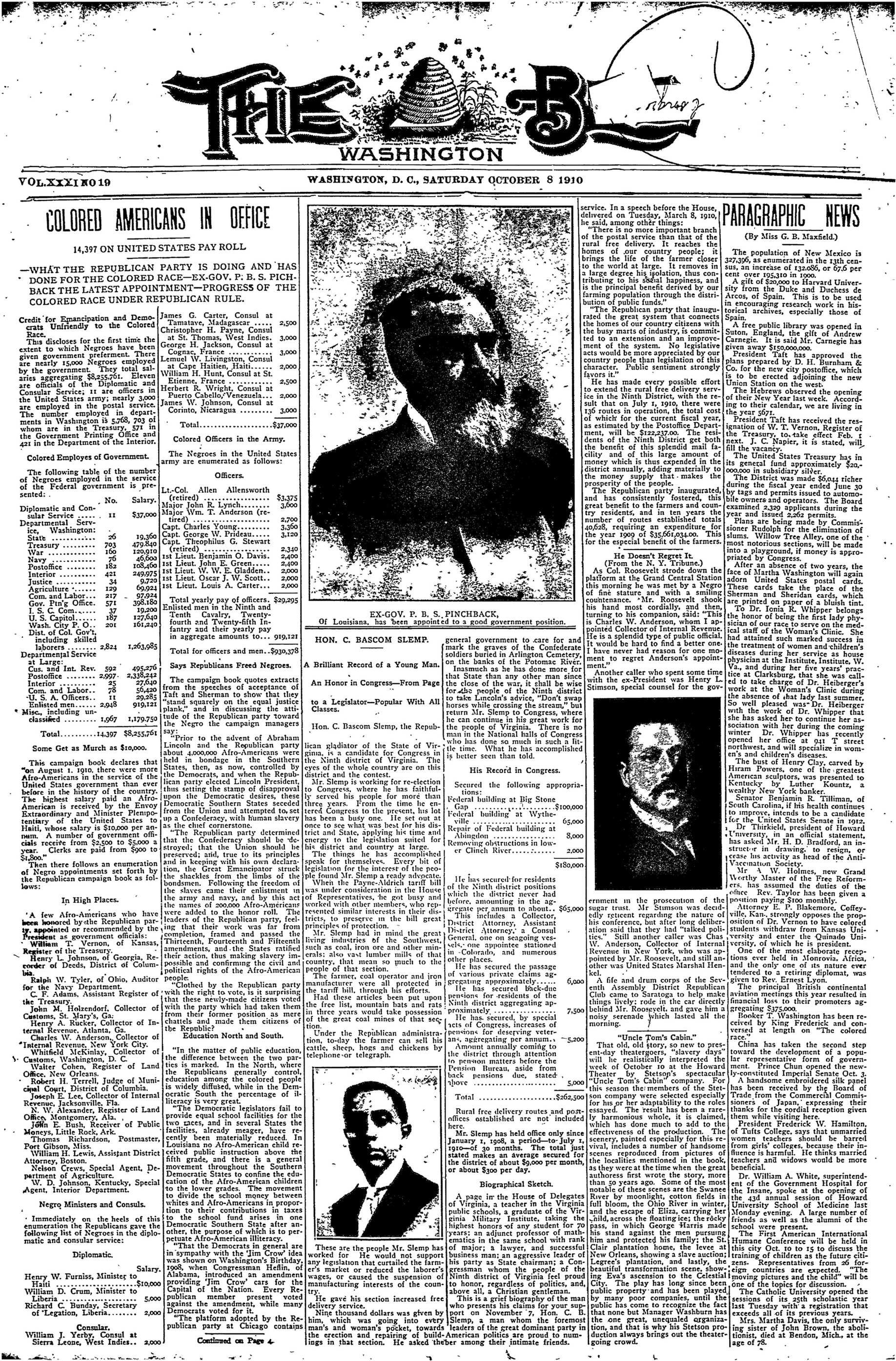
COLORED AMERICANS IN OFFICE
14,397 ON UNITED STATES PAY ROLL WHAT THE REPUBLICAN PARTY IS DOING DONE FOR THE COLORED RACE—EX-GOV. P: BACK THE LATEST APPOINTMENT—PROGRES COLORED RACE UNDER REPUBLICAN RULE.
WHAT THE REPUBLICAN PARTY IS DOING AND HAS DONE FOR THE COLORED RACE—EX-GOV. P. B. S. PICHBACK THE LATEST APPOINTMENT—PROGRESS OF THE COLORED RACE UNDER REPUBLICAN RULE.
Credit for Emancipation and Democrats Unfriendly to the Colored Race.
This discloses for the first time the extent to which Negroes have been given government preferment. There are nearly 15,000 Negroes employed by the government. They total salaries aggregating $8,255,761. Eleven are officials of the Diplomatic and Consular Service; 11 are officers in the United States army; nearly 3,000 are employed in the postal service. The number employed in departments in Washington is 5,768,703 of whom are in the Treasury, 571 in the Government Printing Office and 421 in the Department of the Interior.
James G. Carter, Consul at Tamatave, Madagascar ... 2,500
Christopher H. Payne, Consul at St. Thomas, West Indies. ... 3,000
George H. Jackson, Consul at Cognac, France ... 3,000
Lemuel W. Livingston, Consul at Cape Haitien, Haiti ... 2,000
William H. Hunt, Consul at St. Etienne, France ... 2,500
Herbert R. Wright, Consul at Puerto Cabello, Venezuela ... 2,000
James W. Johnson, Consul at Corinto, Nicaragua ... 3,000
Total ... $37,000
Colored Officers in the Army.
Colored Emploves of Government.
The following table of the number of Negroes employed in the service of the Federal government is presented:
sited.
Diplomatic and Consular Service ..... 11 $37,000
Departmental Service, Washington:
State ..... 26 19,360
Treasury ..... 703 479,840
War ..... 160 120,910
Navy ..... 76 46,600
Postoffice ..... 182 108,460
Interior ..... 421 249,975
Justice ..... 34 9,720
Agriculture ..... 129 69,924
Com. and Labor ..... 217 97,924
Gov. Pit'n g Office ..... 571 398,180
I. S. C. Com. ..... 37 19,200
U. S. Capitol ..... 187 127,640
Wash. City P. O. ..... 201 161,240
Dist. of Col. Gov't, including skilled laborers ..... 2,824 1,263,985
Departmental Service at Large:
Cus. and Int. Rev. ..... 592 495,276
Postoffice ..... 2,997 2,338,242
Interior ..... 25 27,640
Com. and Labor ..... 78 56,420
U. S. A. Officers ..... 11 29,285
Enlisted men ..... 2,948 919,121
Misc. including unclassified ..... 1,967 1,179,750
Total ..... 14,307 $8,255,761
Some Get as Murch as $10,000.
This campaign book declares that "on August 1, 1910, there were more Afro-Americans in the service of the United States government than ever before in the history of the country. The highest salary paid an Afro-American is received by the Envoy Extraordinary and Minister Plenipotentiary of the United States to Haiti, whose salary is $10,000 per annum. A number of government officials receive from $2,500 to $5,000 a year. Clerks are paid from $900 to $1,800." Then there follows an enumeration of Negro appointments set forth by the Republican campaign book as follows:
In High Places.
'A few Afro-Americans who have been honored by the Republican party, appointed or recommended by the President as government officials: William T. Vernon, of Kansas, Register of the Treasury. Henry L. Johnson, of Georgia, Recorder of Deeds, District of Columbia.
Ralph W. Tyler, of Ohio, Auditor for the Navy Department.
C. F. Adams, Assistant Register of the Treasury.
John M. Holzendorf, Collector of Customs, St. Mary's, Ga.
Henry A. Rucker, Collector of Internal Revenue, Atlanta, Ga.
Charles W. Anderson, Collector of Internal Revenue, New York City.
Whitfield McKinlay, Collector of Customs, Washington, D. C.
Walter Cohen, Register of Land Office, New Orleans.
Robert H. Terrell, Judge of Municipal Court, District of Columbia.
Joseph E. Lee, Collector of Internal Revenue, Jacksonville, Fla.
N. W. Alexander, Register of Land Office, Montgomery, Ala.
John E. Bush, Receiver of Public Money, Little Rock, Ark.
Thomas Richardson, Postmaster, Port Gibson, Miss.
William H. Lewis, Assistant District Attorney, Boston.
Nelson Crews, Special Agent, Department of Agriculture.
W. D. Johnson, Kentucky, Special Agent, Interior Department.
Negro Ministers and Consuls.
Immediately on the heels of this enumeration the Republicans gave the following list of Negroes in the diplomatic and consular service:
Diplomatic
Henry W. Furniss, Minister to
Haiti.....$10,000
William D. Crum, Minister to
Liberia.....5,000
Richard C. Bunday, Secretary
of Legation, Liberia.....2,000
Consular.
William J. Yerby, Consul at
Sierra Leone, West Indies.....2,000
James G. Carter, Consul at
Tamatave, Madagascar ..... 2,500
Christopher H. Payne, Consul
at St. Thomas, West Indies. ..... 3,000
George H. Jackson, Consul at
Cognac, France ..... 3,000
Lemuel W. Livingston, Consul
at Cape Haitien, Haiti ..... 2,000
William H. Hunt, Consul at St.
Etienne, France ..... 2,500
Herbert R. Wright, Consul at
Puerto Cabello,'Venezuela. ..... 2,000
James W. Johnson, Consul at
Corinto, Nicaragua ..... 3,000
Colored Officers in the Army.
The Negroes in the United States army are enumerated as follows:
Lt.-Col. Allen Allensworth
(retired) ..... $3,375
Major John R. Lynch ..... 3,600
Major Wm. T. Anderson (retired) ..... 2,700
Capt. Charles Young ..... 3,360
Capt. George W. Prideau ..... 3,120
Capt. Theophilus G. Stewart
(retired) ..... 2,340
1st Lieut. Benjamin O. Davis ..... 2,400
1st Lieut. John E. Green ..... 2,400
1st Lieut. W. W. E. Gladden ..... 2,000
1st Lieut. Oscar J. W. Scott ..... 2,000
1st Lieut. Louis A. Carter ..... 2,000
Total yearly pay of officers. $29,295
Enlisted men in the Ninth and
Tenth Cavalry, Twenty-
fourth and Twenty-fifth Infantry and their yearly pay in
aggregate amounts to... 919,121
Total for officers and men. $930,378
Says Republicans Freed Negroes.
The campaign book quotes extracts from the speeches of acceptance of Taft and Sherman to show that they "stand squarely on the equal justice plank," and in discussing the attitude of the Republican party toward the Negro the campaign managers say:
"Prior to the advent of Abraham Lincoln and the Republican party about 4,000,000 Afro-Americans were held in bondage in the Southern States, then, as now, controlled by the Democrats, and when the Republican party elected Lincoln President, thus setting the stamp of disapproval upon the Democratic desires, these Democratic Southern States seceded from the Union and attempted to set up a Confederacy, with human slavery as the chief cornerstone.
"The Republican party determined that the Confederacy should be destroyed; that the Union should be preserved; aid, true to its principles and in keeping with his own declaration, the Great Emancipator struck the shackles from the limbs of the bondsmen. Following the freedom of the slaves came their enlistment in the army and navy, and by this act the names of 200,000 Afro-American were added to the honor roll. The leaders of the Republican party, feeling that their work was far from completion, framed and passed the Thirteenth, Fourteenth and Fifteenth amendments, and the States ratified their action, thus making slavery impossible and confirming the civil and political rights of the Afro-American people." "Clothed by the Republican party with the right to vote, is it surprising that these newly-made citizens voted with the party which had taken them from their former position as mere chattels and made them citizens of the Republic?
Education North and South.
"In the matter of public education, the difference between the two parties is marked. In the North, where the Republicans generally control, education among the colored people is widely diffused, while in the Democratic South the percentage of illiteracy is very great.
"The Democratic legislators fail to provide equal school facilities for the two races, and in several States the facilities, already meager, have recently been materially reduced. In Louisiana no Afro-American child received public instruction above the fifth grade, and there is a general movement throughout the Southern Democratic States to confine the education of the Afro-American children to the lower grades. The movement to divide the school money between whites and Afro-Americans in proportion to their contributions in taxes to the school fund arises in one Democratic Southern State after another, the purpose of which is to perpetuate Afro-American illiteracy.
"That the Democrats in general are in sympathy with the 'Jim Crow' idea was shown on Washington's Birthday, 1908, when Congressman Heflin, of Alabama, introduced an amendment providing 'Jim Crow' cars for the Capital of the Nation. Every Republican member present voted against the amendment, while many Democrats voted for it.
"The platform adopted by the Republican party at Chicago contains
Officers.
[Image of a man with a long beard and mustache, wearing a suit and tie. The background is plain white.]
[The text is not clearly visible in the image. It appears to be a heading or title.]
EX-GOV. P. B. S., PINCHBACK,
Of Louisiana, has been appointed to a good government position.
HON. C. BASCOM SLEMP. general government to care for
An Honor in Congress—From Page to a Legislator—Popular With All Classes.
Hon. C. Bascom Slemp, the Republican gladiator of the State of Virginia, is a candidate for Congress in the Ninth district of Virginia. The eyes of the whole country are on this district and the contest.
Mr. Slemp is working for re-election to Congress, where he has faithfully served his people for more than three years. From the time he entered Congress to the present, his lot has been a busy one. He set out at once to see what was best for his district and State, applying his time and energy to the legislation suited for his district and country at large.
The things he has accomplished speak for themselves. Every bit of legislation for the interest of the people found Mr. Slemp a ready advocate.
When the Payne-Aldrich tariff bill was under consideration in the House of Representatives, he got busy and worked with other members, who represented similar interests in their districts, to preserve in the bill great principles of protection.
Mr. Slemp had in mind the great living industries of the Southwest, such as iron, coal ore and other minerals; also vast lumber mills of that country, that mean so much to the people of that section. The farmer, coal operator and iron manufacturer were all protected in the tariff bill, through his efforts. Had these articles been put upon the free tree, mountain hats and rats in three years would take possession of the great coal mines of that section. Under the Republican administration, to-day the farmer can sell his cattle, sheep, hogs and chickens by telephone or telegraph.
These are the people Mr. Slemp has worked for. He would not support any legislation that curtailed the farmer's market or reduced the laborer's wages, or caused the suspension of manufacturing interests of the country.
He gave his section increased free delivery service.
Nine thousand dollars was given by him, which was going into every man's and woman's pocket, towards the erection and repairing of buildings in that section. He asked the
general government to care for and mark the graves of the Confederate soldiers buried in Arlington Cemetery, on the banks of the Potomac River. Inasmuch as he has done more for that State than any other man since the close of the war, it shall be wise for the people of the Ninth district to take Lincoln's advice, "Don't swap horses while crossing the stream," but return Mr. Slemp to Congress, where he can continue in his great work for the people of Virginia. There is no man in the National halls of Congress who has done so much in such a little time. What he has accomplished is better seen than told.
His Record in Congress.
Secured the following appropriations:
Federal building at Big Stone Gap.....$100,000
Federal building at Wytheville.....65,000
Repair of Federal building at Abingdon.....8,000
Removing obstructions in lower Clinch River.....2,000
$180,000
He has secured for residents of the Ninth district positions which the district never had before, amounting in the aggregate per annum to about...$65,000
This includes a Collector, District Attorney, Assistant District Attorney, a Consul General, one on seagoing vessels, one appointee stationed in Colorado, and numerous other places.
He has secured the passage of various private claims aggregating approximately.....6,000
He has secured back-due pensions for residents of the Ninth district aggregating approximately.....7,500
He has secured, by special acts of Congress, increases of pensions for deserving veterans, aggregating per annum.....5,200
Amount annually coming to
the district through attention
to pension matters before the
Pension Bureau, aside from
back pensions due, stated
above ..... 5,000
Total ..... $262,500
Rural free delivery routes and post-
offices established are not included
here.
Mr. Slemp has held office only since
January 1, 1908, a period—to July 1,
1910—of 30 months. The total just
stated makes an average secured for
the district of about $9,000 per month,
or about $100 per day.
Biographical Sketch.
A page in the House of Delegates of Virginia, a teacher in the Virginia public schools, a graduate of the Virginia Military Institute, taking the highest honors of any student for 70 years; an adjunct professor of mathematics in the same school with rank of major; a lawyer, and successful business man; an aggressive leader of his party as State chairman; a Congressman whom the people of the Ninth district of Virginia feel proud to honor, regardless of politics, and, above all, a Christian gentleman. This is a grief biography of the man who presents his claims for your support on November 7, Hon. C. B. Slemp, a man whom the foremost leaders of the great dominant party in American politics are proud to number among their intimate friends.
service. In a speech before the House, delivered on Tuesday, March 8, 1910, he said, among other things: "There is no more important branch of the postal service than that of the rural free delivery. It reaches the homes of our country people; it brings the life of the farmer closer to the world at large. It removes in a large degree his isolation, thus contributing to his social happiness, and is the principal benefit derived by our farming population through the distribution of public funds."
"The Republican party that inaugurated the great system that connects the homes of our country citizens with the busy marts of industry, is committed to an extension and an improvement of the system. No legislative acts would be more appreciated by our country people than legislation of this character. Public sentiment strongly favors it."
He has made every possible effort to extend the rural free delivery service in the Ninth District, with the result that on July 1, 1910, there were 136 routes in operation, the total cost of which for the current fiscal year, as estimated by the Postoffice Department, will be $122,237.00. The residents of the Ninth District get both the benefit of this splendid mail facility and of this large amount of money which is thus expended in the district annually, adding materially to the money supply that makes the prosperity of the people.
The Republican party inaugurated, and has consistently fostered, this great benefit to the farmers and country residents, and in ten years the number of routes established totals 40,628, requiring an expenditure for the year 1909 of $35,661,034.00. This for the especial benefit of the farmers.
He Doesn't Regret It.
(From the N. Y. Tribune)
As Col. Roosevelt strode down the platform at the Grand Central Station this morning he was met by a Negro of fine stature and with a smiling countenance. *Mr. Roosevelt shook his hand most cordially, and then, turning to his companion, said: "This is Charles W. Anderson, whom I appointed Collector of Internal Revenue. He is a splendid type of public official. It would be hard to find a better one. I have never had reason for one moment to regret Anderson's appointment."
Another caller who spent some time with the ex-President was Henry L Stimson, special counsel for the gov-
ernment in the prosecution of the sugar trust. Mr Stimson was decidedly reticent regarding the nature of his conference, but after long deliberation said that they had "talked politics." Still another caller was Chas W. Anderson, Collector of Internal Revenue in New York, who was appointed by Mr. Roosevelt, and still another was United States Marshal Henkel.
A fife and drum corps of the Seventh Assembly District Republican Club came to Saratoga to help make things lively; rode in the car directly behind Mr. Rooseyelt, and gave him a noisy serenade which lasted all the morning.
"Uncle Tom's Cabin"
That old, old story, so new to present-day theatergoers, "slavery days" will be realistically interpreted the week of October to at the Howard Theater by Stetson's spectacular "Ucle Tom's Cabin" company. For this season the members of the Stetson company were selected especially for his or her adaptability to the roles essayed. The result has been a rarely harmonious whole, it is claimed, which has done much to add to the effectiveness of the production. The scenery, painted especially for this revival, includes a number of handsome scenes reproduced from pictures of the localities mentioned in the book, as they were at the time when the great authoress first wrote the story, more than 50 years ago. Some of the most notable of these scenes are the Swance River by moonlight, cotton fields in full bloom, the Ohio River in winter, and the escape of Eliza, carrying her child, across the floating ice; the rocky pass, in which George Harris made his stand against the men pursuing him and protected his family; the St. Clair plantation home, the levee at New Orleans, showing a slave auction; Legree's plantation, and lastly, the beautiful transformation scene, showing Eva's ascension to the Celestial City. The play has long since been public property and has been played by many poor companies, until the public has come to recognize the fact that none but Manager Washburn has the one great, unequaled organization, and that is why his Stetson production always brings out the theater-going crowd.
PARAGRAPHIC NEWS
(By Miss G. B. Maxfield.)
The population of New Mexico is 327,396, as enumerated in the 13th census, an increase of 132,086, or 67.6 percent over 195,310 in 1900.
A gift of $20,000 to Harvard University from the Duke and Duchess de Arcos, of Spain. This is to be used in encouraging research work in historical archives, especially those of Spain.
A free public library was opened in Suton, England, the gift of Andrew Carnegie. It is said Mr. Carnegie has given away $150,000,000.
President Taft has approved the plans prepared by D. H. Burnham & Co. for the new city postoffice, which is to be erected adjoining the new Union Station on the west.
The Hebrews observed the opening of their New Year last week. According to their calendar, we are living in the year 5671.
President Taft has received the resignation of W. T. Vernon, Register of the Treasury, to take effect Feb. 7 next. J. C. Napier, it is stated, will fill the vacancy.
The United States Treasury has in its general fund approximately $20,000,000 in subsidiary silver.
The District was made $6,014 richer during the fiscal year ended June 30 by tags and permits issued to automobile owners and operators. The Board examined 2,329 applicants during the year and issued 2,262 permits.
Plans are being made by Commissioner Rudolph for the elimination of slums. Willow Tree Alley, one of the most notorious sections, will be made into a playground, if money is appropriated by Congress.
After an absence of two years, the face of Martha Washington will again adorn United States postal cards. These cards take the place of the Sherman and Sheridan cards, which are printed on paper of a bluish tint.
To Dr. Ionia R. Whipper belongs the honor of being the first lady physician of our race to serve on the medical staff of the Woman's Clinic. She had attained such marked success in the treatment of women and children's diseases during her service as house physician at the Institute, Institute, W. Va., and during her five years' practice at Clarksburg, that she was called to take charge of Dr. Heiberger's work at the Woman's Clinic during the absence of that lady last summer. So well pleased was Dr. Heiberger with the work of Dr. Whipper that she has asked her to continue her association with her during the coming winter Dr. Whipper has recently opened her office at 941 T street northwest, and will specialize in women's and children's diseases.
The bust of Henry Clay, carved by Hiram Powers, one of the greatest American sculptors, was presented to Kentucky by Luther Kountz, a wealthy New York banker
Senator Benjamin R. Tilliman, of South Carolina, if his health continues to improve, intends to be a candidate for the United States Senate in vote
Dr Thirkield, president of Howard University, in an official statement, has asked Mr. H. D. Bradford, an instructor in drawing, to resign, or cease his activity as head of the Anti-Vaccination Society.
Mr A W. Holmes, new Grand Worthy Master of the Free Reformers, has assumed the duties of the office. Rev. Taylor has been given a position paying $100 monthly.
Attorney E. P. Blakemore, Coffeyville, Kan., strongly opposes the proposition of Dr. Vernon to have colored students withdraw from Kansas University and enter the Quinado University, of which he is president.
One of the most elaborate receptions ever held in Monrovia, Africa, and the only one of its nature ever tendered to a retiring diplomat, was given to Rev. Ernest Lyon.
The principal British continental aviation meetings this year resulted in financial loss to their promoters aggregating $755,000.
Booker T. Washington has been received by King Frederick and conversed at length on "The colored race."
China has taken the second step toward the development of a popular representative form of government. Prince Chun opened the newly-constituted Imperial Senate Oct. 3. A handsome embroidered silk panel has been received by the Board of Trade from the Commercial Commissioners of Japan, expressing their thanks for the cordial reception given them while visiting here. President Frederick W. Hamilton, of Tufts College, says that unmarried women teachers should be barred from girls' colleges, because their influence is harmful. He thinks married teachers and widows would be more beneficial. Dr. William A. White, superintendent of the Government Hospital for the Insane, spoke at the opening of the 43d annual session of Howard University School of Medicine last Monday evening. A large number of friends as well as the alumni of the school were present. The First American International Humane Conference will be held in this city Oct. 10 to 15 to discuss the training of children as the future citizens. Representatives from 26 foreign countries are expected. "The moving pictures and the child" will be one of the topics for discussion. The Catholic University opened the sessions of its 25th scholastic year last Tuesday with a registration that exceeds all of its previous years.
Mrs. Martha Davis, the only surviving sister of John Brown, the abolitionist, died at Bendon, Mich., at the age of 78.
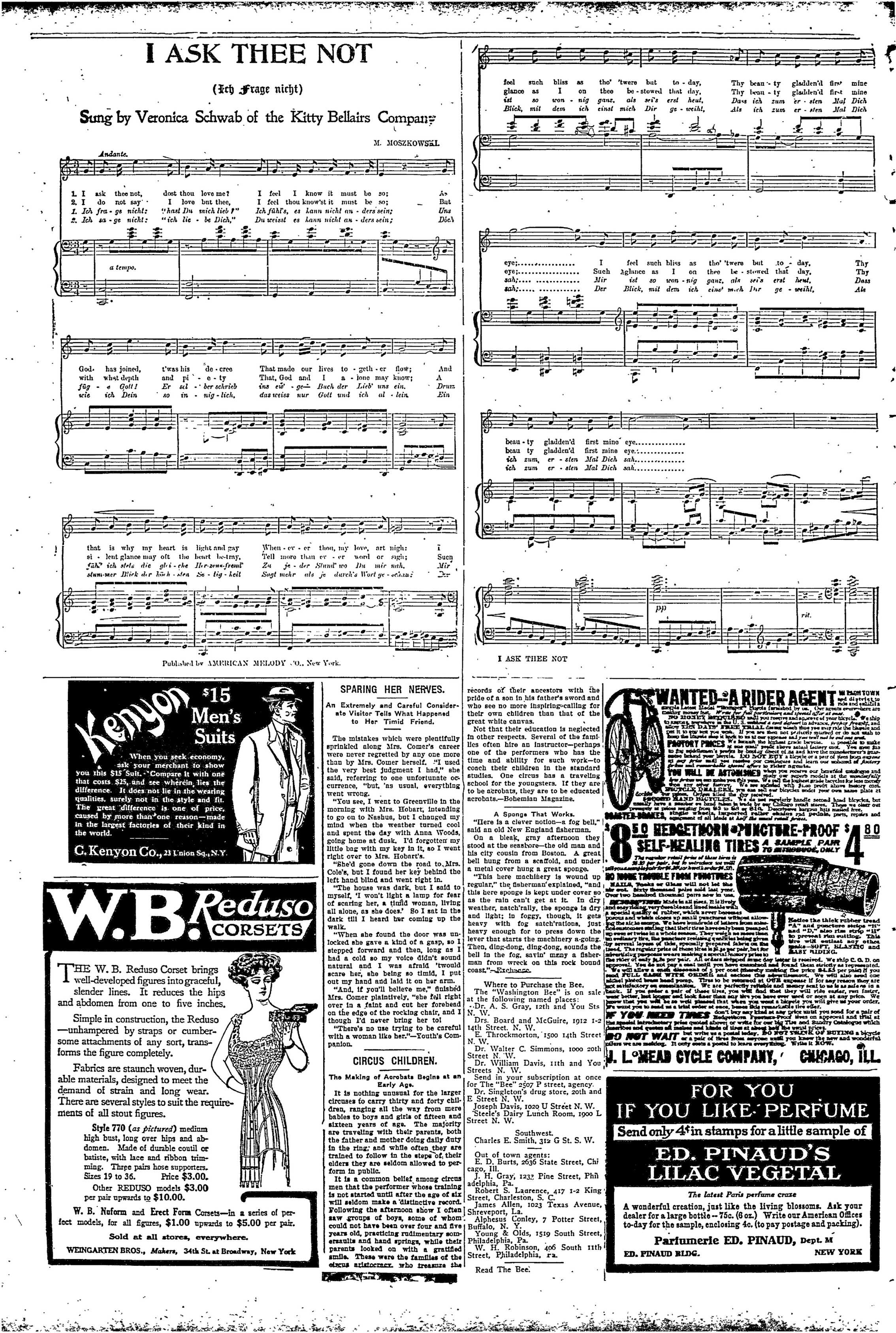
I ASK THEE NOT
Sung by Veronica Schwab of the Kitty Bellairs Company
Andante.
1. I ask thee not, dost thou love me?
2. I do not say I love but thee,
1. Ich frage nicht: "hasst Du mich lieb?"
2. Ich sage nicht: "ich liebe Dich,"
I feel I know it must be so;
I feel thou know'st it must be so;
Ich fühl's, es kann nicht an-ders sein;
Du weisst es kann nicht an-ders sein;
And
with what depth and pi'e-ty
füg-e Goll!
wie ich Dein so in-nig-lich,
That made our lives to-gether flow;
That, God and I a-lone may know;
ins euh'-ge-Buch der Lieb' uns ein.
das weiss nur Goll und ich al-lein
Ein
that is why my heart is light and gay
si-lent glance may oft the heart be-tray,
füh' ich stels die glie-che Her-zenn-freud
slum-mer Blick der hüch-sten Se-tig-keil
When ev-er thou, my love, art nigh:
Tell more than ev-er word or sigh;
Zu je-der Shund' wo Du mir nath.
Sagt mehr als je durch's Wort ge-schau:
Published by AMERICAN MELODY CO., New York
Kenyon $15 Men's Suits
When you seek economy, ask your merchant to show you this $15 Suit. Compare it with one that costs $25, and see wherein lies the difference. It does not lie in the wearing qualities, surely not in the style and fit. The great difference is one of price, caused by more than one reason—made in the largest factories of their kind in the world.
G. Kenyon Co., 23 Union Sq., N.Y.
W.B. Reduso CORSETS
W. B. Nuform and Erect Form Corsets—in a series of perfect models, for all figures, $1.00 upwards to $5.00 per pair.
Sold at all stores, everywhere.
WEINGARTEN BROS., Makers, 34th St. at Broadway, New York
THE W. B. Reduso Corset brings well-developed figures into graceful, slender lines. It reduces the hips and abdomen from one to five inches.
Simple in construction, the Reduso unhampered by straps or cumbersome attachments of any sort, transforms the figure completely.
Fabrics are staunch woven, durable materials, designed to meet the demand of strain and long wear. There are several styles to suit the requirments of all stout figures.
Fabrics are staunch woven, durable materials, designed to meet the demand of strain and long wear. There are several styles to suit the requirements of all stout figures.
Style 770 (as pictured) medium high bust, long over hips and abdomen. Made of durable coutil or batiste, with lace and ribbon trimming. Three pairs hose supporters. Sizes 19 to 36. Price $3.00.
Other REDUSO models $3.00 per pair upwards to $10.00.
W. B. Nuform and Erect Form Corsetsfect models, for all figures, $1.00 upwards
s
l,
ps
es.
o
uire-
SPARING HER NERVES.
An Extremely and Careful Considerate Visitor Tells What Happened to Her Timid Friend.
The mistakes which were plentifully sprinkled along Mrs. Comer's career were never regretted by any one more than by Mrs. Comer herself. "I used the very best judgment I had," she said, referring to one unfortunate occurrence, "but, 'as usual, everything went wrong.
"You see, I went to Greenville in the morning with Mrs. Hobart, intending to go on to Nashua, but I changed my mind when the weather turned cool and spent the day with Anna Woods, going home at dusk. I'd forgotten my little bag with my key in it, so I went right over to Mrs. Hobart's.
"She'd gone down the road to Mrs. Cole's, but I found her key behind the left hand blind and went right in.
"The house was dark, but I said to myself, 'I won't light a lamp for fear of scaring her, a timid woman, living all alone, as she does.' So I sat in the dark till I heard her coming up the walk.
"When she found the door was unlocked she gave a kind of a gasp, so I stepped forward and then, long as I had a cold so my voice didn't sound natural and I was afraid 'twould scare her, she being so timid, I put out my hand and laid it on her arm.
"And, if you'll believe me," finished Mrs. Comer plaintively, "she fell right over in a faint and cut her forehead on the edge of the rocking chair, and I though I'd never bring her tol
"There's no use trying to be careful with a woman like her."—Youth's Companion.
CIRCUS CHILDREN.
The Making of Acrobats Begins at an Early Age.
It is nothing unusual for the larger circuses to carry thirty and forty children, ranging all the way from mere babies to boys and girls of fifteen and sixteen years of age. The majority are travelling with their parents, both the father and mother doing daily duty in the ring; and while often they are trained to follow in the steps of their elders they are seldom allowed to perform in public.
It is a common belief among circus men that the performer whose training is not started until after the age of six will seldom make a distinctive record. Following the afternoon show I often saw groups of boys, some of whom could not have been over four and five years old, practicing rudimentary somersaults and hand springs, while their parents looked on with a gratified smile. These were the families of the circus aristocracy, who treasura the
feel such bliss as tho' 'twere but today,
glance as I on thee be-stowed that day,
ist so won-nig ganz, als se's erst heut,
Blick, mit dem ich einst mich Dir ge-weiht,
Thy beauty gladden'd first mine
Thy beauty gladden'd first mine
Dass ich zum er-sten Mal Dich
Als ich zum er-sten Mal Dich
eye; I feel such bliss as tho' 'twere but today,
eye; Such glance as I on thee be-stowed that day,
sah; Mir ist so won-nig ganz, als se's erst heut,
sah; Der Blick, mit dem ich einst mich Dir ge-weiht,
beau-ty gladden'd first mino eye...
beau-ty gladden'd first mine eye...
ich zum, er-sten Mal Dich sah...
ich zum er-sten Mal Dich sah...
I ASK THEE NOT
records of their ancestors with the pride of a son in his father's sword and who see no more inspiring-calling for their own children than that of the great white canvas. Not that their education is neglected in other respects. Several of the families often hire an instructor—perhaps one of the performers who has the time and ability for such work—to coach their children in the standard studies. One circus has a travelling school for the youngsters. If they are to be acrobats, they are to be educated acrobats.—Bohemian Magazine.
A Sponge That Works
"Here is a clever notion—a fog bell," said an old New England fisherman. On a bleak, gray afternoon they stood at the seashore—the old man and his city cousin from Boston. A great bell hung from a scaffold, and under a metal cover hung a great sponge. "This here machinery is wound up regular," the fisherman explained, "and this here sponge is kept under cover so as the rain can't get at it. In dry weather, natch'rally, the sponge is dry and light; in foggy, though, it gets heavy with fog satch'rations, just heavy enough for to press down the lever that starts the machinery a-going. Then, ding-dong, ding-dong, sounds the bell in the fog, savin' many a fisherman from wreck on this rock bound coast." Exchange
Where to Purchase the Bee.
The "Washington Bee" is on sale
at the following named places:
Dr. A. S. Gray, 12th and You Sts
N. W.
Drs. Board and McGuire, 1912 1-2
14th Street. N. W.
E. Throckmorton, 1500 14th Street
N. W.
Dr. Walter C. Simmons, 1000 20th
Street N. W.
Dr. William Davis, 11th and You
Streets N. W.
Send in your subscription at once
for The "Bee" 2507 P street, agency.
Dr. Singleton's drug store, 20th and
E Street N. W.
Joseph Davis, 1020 U Street N. W.
Steele's Dairy Lunch Room, 1900 L
Street N. W.
Southwest.
Charles E. Smith, 312 G St. S. W.
Out of town agents:
E. D. Burts, 2636 State Street, Chicago, Ill.
J. H. Gray, 123? Pine Street, Philadelphia, Pa.
PROCEDURE HAND BICYCLES. We do not regularly handle second hand bicycles, but usually have a number hand in hand in trade by our Chicago retail stores. These we clean out properly at presale prices for 45 to 50 or 811 Decorative bargain hits marked free. Single bicycle, single wheel, pair, pair, pair, parts, repairs and component at all prices, plus the usual retail cost.
The renter of only one pair. All orders shipped same day later is received. We ship C.O.D. on approval. You do not pay a rent until you have examined and found that strictly as represented. We will allow a cash discount of 5 per cost directly marking the price $4.55 per pair if you send FULL CASH WITH ORDERS and enclose this advertisement. We will also send one michelled brass head pump. Thus to be returned at OVE expense if for any reason they are not satisfactory on examination. We are perfectly reliable and money sent to us as safe as in a bank. If you order a pair of these tires, you will find that they will ride easier, run faster, wear better, last longer and look faster than any tire you have ever used or seen at any price. We know that you will be so well planned that when you want a bikepack you will give us your order. We want you to send us a trial order at once, because bikepack is a live offer.
FOR YOU
IF YOU LIKE PERFUME
Send only 4¢ in stamps for a little sample of
ED. PINAUD'S
LILAC VEGETAL
The latest Paris perfume craze
A wonderful creation, just like the living blossoms. Ask your
dealer for a large bottle -- 75c. (8 oz.) Write our American Offices
to-day for the sample, enclosing 4c. (to pay postage and packing).
Parfumerie ED. PINAUD, Dept. M
ED. PINAUD BLDG. NEW YORK
porous and white closes up small punctures without allowing the air to escape. We have bundles of letters from satisfied customers smiling that their tires have only been pruned up or twice in a whole season. They weave no seams then an ordinary tire, the puncture reeling quietly being given tip several laps of this, especially prepared fabric on the tread. The regular price of these tires is $15 per pair, but for advertising purposes we are making a special price to reserve
Notice the thick rubber tread
"A" and puncture strips "H"
and "D," also rim strip "H"
to prevent run cutting. This
speak is often other
speaks—SOFT, ELASTIC
and BABY RIDING.
_ = = : . so: Sy Te (Lt Eee? Mg
. 7 * é . .
BLIND MAN CLIMBS STATUE HAD TO MAKE .CONFESSION(A CAT AND DOG SKIRMISH a - = ee
: Not Only That But I —_ aor . .
ows Ton ty wanament Gynt Bt ce ty 2m wae he Genie and nomen | (ETN (AEN a lea
Cannot See. * Himself, Strategical Ability. : « cwissetara 4 3
ack — _ ee ee fn ae | . 3
* Ooming over from the Status of
‘Liberty in New York harbor, a pas:
senger fell into conversation with a
Ditad man who boasted that he had
climbed to the top of the statue.
“It was a pretty good pull,”-he sald,
“but I have done Detter. Bunker Hill
monument tired me a lot more, and
the Washington monument in Baltl,
more was something of a‘clip; but the
climb that pretty near tuckered me
out was coming down the monument
in Washington. Maybe you can't call
that climbing, since it was walking
down Instead of up, but for a man
who can't see the coming down from
these high places is always harder
‘than going up.
“Everybody you meet on top of a
tower is mighty good to a blind man.
‘They polnt out the bay on this side,
the river up yonder, the Islands to
‘the front and the tip end of the’ city
over there. While I was doing Liberty
statue a shipload of immigrants
“passed within hailing distance. I
couldn’t see them, but a woman told
me all about them, how they were
‘all packed together in the bow of the
ship for their first glimpse of the city
‘gad everything. I suppose some folk&
‘wonder why a man without eyes {8 80
anxious to climb 400 or 500 feet to the
top of a place that is noted for its
view, but the charm {s not all lost,
and anyhow I've got the satisfaction
of saying I've been there.”
WHERE THEY LEFT MARGARET
Reckless Chauffeur Who Was Tardlly
Informed of the Loss of One of
His Passengers.
“Speaking of automobile speeding,”
‘said a man who drives his own car, “T
heard a good one the other day. A
young Irishman who, having left
home and made a lot of money, waa
visited by his two married sisters,
neither. of whom had ever ridden in
an automobile. So, he planned for
them a trip in his automobile, think-
ing they would enjoy both the novelty
of the ride and the city sights. With
a view to g little fun at his sisters’
expense, he told the chauffeur to ‘let
‘er out’ as much as was consistent
with safety, at the same time warn-
ing the sisters that they shouldn't
speak to the chauffeur as he was a
very nervous man and mustn't be
isturbed when he was driving a car.
“Everything was quiet In the ton-
neau while the driver went rushing
out Into the suburbs and through the
parks, Sometimes {t was on four
‘wheels and sometimes on two, but
there was no protest. He had en-
tered into the spirit of the affair, and
he made up his mind he would make
those women cry ‘enough.’ So he
picked out some rough going and
humped the bumps for a half hour.
Finally the younger sister leaned for-
ward and touched him timidly on the
shoulder.
“Excuse me,’ she sald trembling,
‘I know I ought not to speak to you,
Dut I thought I ought to say that we
left Margaret some ten minutes
back.'"—Columbus Dispatch,
Feminine Nature of Crowds. :
Crowds are everywhere distin-
Bulshed by feminine characteristics,
not always revealing the best in-
stincts which are associated with the
nature of woman but this crowd was
remarkable for Its kindly tolerance,
womanly tenderness and consideration
for the woman and children and for
those who were overcome by the long
hours of waiting and tho sufferings
of the heat and thirst. So much at-
tentfon has been pald to the criminal
actions of crowds that the influence
they exert has come to be looked upon
as necessarily demoralizing. History
has many instances of the heroism of
cTowds; it is by witnessing the dis-
Interested unselfishness of such a
crowd as this that ore can hopo to
realize In some measure the devotion
and eelf-sacrifice of which collectiv-
ities are capable,
Remarkable Tyrolese Dance.
A student of the Tyrol and Tyrolese
people describes a remarkable dance
in which the male dancers beat time
on the celling with their feet.
“In Brandenburg and one or two
other Tyrolese valleys which boast of
e~particularly muscular fair sex,” says
the writer, “the girl at the conclusion
of her swain’s fantastical jumps
catches hold of him by his braces and
holsts him up in the alr, He of course
helps by Jerking himself upward when
she lifts, and then, balancing with
his hands on her shoulders, he treads
the ceiling of the low room to the tune
of the music and she continues to,
dance around on the floor of the room.
Buch dances are rapidly falling into
disuse, and it {s almost impossible for
the ordinary tourist to witness one
powadays””
‘
: Use of the Hardy Ferns. ;
Graceful effects may be developed
{m foregrounds, in drives through
giades, and in many other positfons,
‘by the bold use of the larger hardy
ferns. Few people seem to give much
attention to hardy ferns, and in most
gardens, if there are any at all, they
are usually planted in some out of the
‘way spot where no one sees them.
Rarely do we find them well grown
or an important item in the garden
picture. The bold and handsome ferns
pf ourown and other countries de-
serve something better than to be con-
demned to a miserable existence
among a lot of decaying roots, which
the conventional idea always associa.
ted with them—Garden Mlustrated.
HAD TO MAKE _ CONFESSION
Not Only That But It Cost Hubby a
Good Many Dollars to Square
‘Sileatt.
“George,” she asked, “why did you
tell that man you were talking to over
the telephone a moment ago that you
‘envied him?” .
* “I don’t remember. Did I say I en
‘vied him?”
“Yes, you did, and you sald it as if
‘you meant it, Who was he?”
“Oh, it was a fellow I met at the
‘athletic club the .other night His
‘ame is Robinson.”
“What were you talking about so
Jong?”
“Nothing very important. He mere-
‘ly wanted to see me at lunch time to-
morrow.”
“And he didn’t say why he wanted
‘to see you?”
" “No; I think he wants'me to sup-
‘port him for some office.”
“Oh, he is a politician?” ~
* “No, no; I believe he intends torun
for some office in the club.”
“Was that why you said you envied
ihim?”
: “Certatnly not. I don't want to ruh
for any office, I haven't time for that
sort of thing.”
“Well, how can he take the time for
ate" Y
, “You see, he has no family, Ho tsn't
married.”
“How long have you known him?”
“Just met him yesterday.”
“And did you ask him then if he had
a wife?”
“No; he told me just now when we
were talking over the wire that he was
not married.”
“And you sald you envied him!”
“Yes—I mean no, no, Josephine—
honestly I never—come, dearest, you
don’t think I’4—o, well confound it, if
you !nsist on quarreling, what's the
use of denying 1t?” -
Nevertheless she received permis
sion the next day to buy the $38 leg:
horn nat that had pleased her fancy.—
Chicago Record-Herald.
AN AMBUSH FOR WASPS
Speclal Fondness of the Queens for
Rhododendrons Leads to Thelr
Death:
A curiosity in natural history that
must surpass all records has been ob-
served in a garden not far from Alder
shot, says the London Dally Mail. A
number of wasps were heard buzzing
about a particular rhododendron, bush.
The gardener summoned the owner of
the garden, and the two proceeded to
slaughter. Within half an hour fifty
queen wasps had been killed.
The next day a number more were
buzzing about the bush under the
same fatal but obscure attraction. It
was noticed that the wasps were
only attracted to this single bush,
which 1s one of many. A suggested
reason {s that the flowers were a lit-
tle further advanced and so more
full of-honey, but as a rule color is al-
most as strong an allurement as
scent or the honey sense.
It is not unusual for a few queen
wasps to be killed at this season,
when the time for nest making is
approaching, but this quantity 1s un-
paralleled. The experience suggests
that the wasp might be exterminated,
supposing this to be desirable, if we
all grew specimens of this favored
flower. The special fondness of queen
wasps for white flowers of particular
sorts has been observed before, and
some gardeners grow such on purpose,
but fifty in half an hour fs a new rec
ord of slaughter.
The queens were killed by pinching
the flowers Into which they dived and
which served as a shroud to the quan-
uty of bodies lying around the deadly
ambush of the rhododendron. al
‘The World’s Best Runners.
‘The best runners in the world are
sald to be~a race of Indians living
near the Gulf of Callfornla. They are
known as Serls, and number only
some 400. In the open country the
women and children catch hares by
hand without any artificial aid what-
ever. The men, however, look upon
this as child's play, and themselves at-
tack and capture antelopes, deer and
wild buffalo, The swiftest horse can-
not outrun these ficet-footed Indians,
who perform on foot the same feats
as the cowboy on his broncho.
A boy can’ be seen driving horses
round and round in an inclosed track,
and when they have got up a good
speed one of the barriers 1s removed
and a horse dashes into the prairie at
‘full speed, It has not gone 120 yards
‘before the Indian bas caught up with
‘At; another 60 yards and he hes bound-
ed on its back, selzed Its mane with
one hand and {ts nostrils with the
| other and thrown it to the ground.
In Demand. «
“I am opposed to social distinctions
of every sort!” said the emphatic
woman,
“But,” protested Mrs. Crosslots. “A
Une must be drawn. Suppose you suc-
ceeded in getting a good cook. You
couldn’t keep her a week If you intro.
duced her to your friends.”
A Great Obstacle.
- Land Agent—Water, you know, {5
king of the desert.
Alcohol Al—Then, podner, thar ain’t
no use 0" my buyin’ that lot to put up
@ boose j'int t’ benefit th’ boys,
His Revenge.
“You shouldn't have proposed to
me,” she sald gently. “You might
have known Id refuse you.”
“I did know,” he sald savagely, “or
T wouldn't have proposed."—Baltimore
American. :
A CAT AND DOG SKIRMISH
In Which the Cunning and Resource-
ful Cat Won by Superior
Strateglcal Ability.
“I never fancied cats very much,”
sald a ljmited lover of nature, “but
certainly the cat is a fairly courage-
ous animal and more than ordinarily
shifty and resourceful, and so it's
quite likely to be able to hold its own
against an enemy much larger and
more powerful than itself,
“Here was a yellow cat moving at
a walk leisurely across the street
while at the same time there was
coming along this block a dog. When
the dog saw the cat it started for it
as fast as it could go, and when the
cat saw the dog it turned on full
power st once and fairly jumped to
clear the remaining’ space to thé other
side of the street, where it halted
with ite back against a tall fron picket
fence and faced the dog.
“Instantly the dog jumped for the
cat, but even more quickly up went
the cat’s paw to sweep the alr down-
ward, and a cat's claws are very
sharp and a dog’s nose {ts very tender
and delicate, and the dog didn’t close.
‘In a moment he jumped for the cat
again, but again the cat clawed him
off, or the fear of the claws was
enough to make the dog shy again,
“But the next time evidently the
dog was going to close In and rough
house things and take the chances;
and do you know what the cat did
now? The cat is a very compressible
creature; it can get through a very
small space; and now this particular
yellow cat backed In between two of
those {ron pickets to the inner side
of the fence; but it didn’t run away.
It stayed right there, close to the In-
}ner stde of the fence, which the dog
couldn't get through, and when the
dog came up for that last time the
cat struck at it again through the
fence with that swift, silent sweep of
its paw, swung this time, as it
seemed, with a sort of savagely cool
contemptuousness. Then the foolish
dog ran away.
“We may not fancy the cat, but we
should err if we failed to give it at
Teast some measure of admiration for
.the sbifty ability with which It holds
‘its own against its natural enemy.”
“HAPPY THOUSH MARRIED”
Wives No Longer Mope at Home
White Husband Spends His Time
at the Club.
If wives continue to grow sensible
at the present rate, the time will
come when everybody will know
“how td be happy, though . married.”
Time was when the picture of the
wite moping at home, while the hus-
band took his night off at the club,
was a true one. It isn't so these days,
a writer declares.
When the modern husband says to
the modern wife, “My dear, I'm go-
ing to dine at the club Thursday
night; I may be rather late,” the mod-
ern wife says cheerfully, “Very well,
dear,” and sits down to indite invi-
tations’ to a dozen or so of hér friends
for a nice little hen party for Thurs-
day night.
| And there's just-as good a time at
‘the hen party as the husband is
having at the club, too. There fs a
perfect little dinner of the most ex.
‘pensive delicacies of the season, and
then there Is bridge. And who wor.
ries about what her husband is doing
‘at the club when there Is bridge to be
played? Not the modern wife.
| They play for stakes at these hen
‘parties, too. In fact, all the comforts
of the club, to change an old saying
a little, are fast being appropriated
‘ these poor deserted wives.
Chrysanthemums,
Chrysanthemums stand fourth in
commerciaf tmportance among flow-
ers. Only the rose, the violet and the
carnation surpass them, and that
chlefly because the chrysanthemum
season is so short, while the others
can be had from the florist nearly the
whole year round. Greece gave us the
name. Chrysanthemum means “gold-
en flower.” But the namo was Invent-
ed long before the big butter yellow
globes were known In the occldent. It
referred to the prevailing gold in the
small varieties that were known.
Strangely enough, the first chrysan-
themum brought into Europe was not
gold, but’ purple. It was a small flow-
er about two inches across, shaped
Uke an, aster. Somebody took It to
Europe from China in 1790—and, pres-
to, the modern history of chrysanthe-
‘mums was begun.—Argonaut.
Real Resdinc.
In anything fit to be called by the
mame of reading, the process itself
should be absorbing and voluptuous;
we should gloat over a book, be rapt
clean out of ourselves, and rise from
the persual, our mind filled with the
busiest, kaleldoscopic dance of im-
ages, incapable of sleep, or of contin-
uous thought. The words, if the book
de eloquent, should run thenceforward
In our ears like the nofse of breakers,
and the story, if it be a story, repeat
steele ‘im a thousand colored pictures
to the eye—Robert Loutls Steven-
son,
Training Speaking Volce.
Listen to your own volce and try to
hear how it sounds. Say a few words
and Hsten. If you are not pleased,
try again. Take the most melodious
volce you know for a model and try to
imitate the Intonation or manner of
speaking. It {s the intonation that be-
trays the cultivated person more than
the beauty of the volce Itself, but
quality will follow when the volce is
Properly supported by the breath and
not forced.
Mee Atte tor aig petty simplicity and
Sati seats Pyeere: sbagtin sear,
vary city aud town in the United States a
Canada, or by mull direct. More sold thas
aay other make, Send for free catalogers,
MeCALL'S MAGAZINE
‘More subscribers than any other fashion
| BAIS puuicny areuemeSiog. siioery,
| Se ate Pi acy’ asaciemsris baisdeeesias
| Ta trel devte) aelding s Ire peters
jouble), including a Tree
| BRS Saas ean Sop rare:
ray Porat brngt proniam cotaler
Sod Foweuh prstoneee Auares
RD MCCALL CO., 299 bo 348 W. 9th SL, KEW YORE
(HE BEE AND MeCALL'S GREAT
FASHION MAGAZIY®
for ens year for face,
COUPOR.
Bdbor Beer— .
Find eacioeed two dears Send to
ry adéssea below The Bee nnd MrCalt's
Farhlon Megazine for cme year,
NO. seecevee
HTC. coe eesececccerecercver~
Lown OF CHY.....csscccesseeseeenene
The President has-signed several
proclamations eliminating nearly half
a million acres of land from the na-
tional forests, adding a little more
than 100,000 acres to the reserves.
The fourteenth annual meeting of
the Hampton Negro Conference will
take place at Hampton Institute, Va,
July 13th and 14th. >
: The twenty-fifth anniversary ser-
vices of the establishment of the Sal-
vation Army in this city were held in
the various churches last Sunday.
READ THE BEE.
BUY THE
ane (rd eRe a
Woe an
Pare ens « Ap aa eK
Phy Samp aa ae
Reena
errmeer i
SC AINO ALINE
Before You Puschage Any Other Write
THE WcW BOME SEWATO MACH COMPANY
some A
Many Serfing Moshtees sve marie to sail regard
30! qualty, but the “ Meow Flore” # made
weer, Our gusseaty ewr rens cut.
‘Re make Bowing Mostiess > sR al) conditions
at tachsada, The “Bow Eboue” ctexis atthe
dead of obi UEleh-gavecte tnenliy evatag mech ines
‘$014 by suthortect donbers only.
none
Gow -
HOLMES’ HOTEL,
No. 333 Virginia Ave, SW
Pest Afro-American Accommods:
tier im the District. °
FUROPEAN AND AMERI-
-AN PLAN,
Good =I.coms and Lodging, 50.
73°. and $1.00. Comfortably
Heated by Steam. Give
. us a Gall
Jemes Otoway Holmes, Prop.
Washingtes, D. C
“Mam Phone 2378.
DOM
There are many colored families
who are living in crowded houses
on small plots of land in towns or
cities who want real freedom and
real opportunity for themselves and
for their children. It is very difficult
to rear children in a crowded town
or city, The place to rear children
is in the country. . a
In Macon County, Alabama, the
colored people have a rare and ex-
ceptional opportunity. This is the
county in which The Tuskegee Nor-
mal and Industrial Institute is lo-
cated. There is plenty of good land
for sale on easy terms, There is a
good schoolhouse, and the school
term lasting from seven to eight
ipattes in every part of the county.
The white people in Macon County
are of the very best class, There is
no disorder or racial trouble. We
advise colored people who are now
living in crowded towns or cities,
in the North or in the South, and es-
pecially those who have children to
raise to come to Macon County and
Suy a home where they can get plen-
ty of land. to cultivate and rear theis
families in the county free from the
temptations of the cities and towns.
For further information write ©
Clinton J. Calloway, Real Estate
a Pa :
vat a - ent Se
eT ema
a ar ia
Bat Bae ee
we oo 3 x a
ee
SnenneDinasngilemaelcanncl 2
SICK AND ACCIDENT INSUB-
ANCE UP TO $25.00 PER WEEK
WHOLE LIFE INSURANCE O28
VERY LIBERAL TERMS
PAYABLE ONE HOUR AFTER DEATH.
AMERICAN HOME LIFE INSURANCE CO,,
FIFTH and G Stroets ¥. W. Washlagton, D. C
WORTH ADVERTISING FOR
There are 5,499 Negroes employed here in Waashingtes by
the Government alone, and these 5,499 Negroes draw selaries ag-
gregating $3,044,404. These more than three millons of delfurs
are spent right here in Washington, but scattered among ‘#e
hundreds of tradesmen. Ig this amount of money worth Ba-
ding for? It certainly is, and not even the largest atoree ia this
city would refuse to get the big end of it did they but reattee
how much money the Nojroes are really spending.
Now The Bee is th: only Negro publication fa thie alty, 38
stands without » rival or competitor, and covers the field Whe
a few ef the merchants in this cy will patronize the advertising esl.
trans of The Boo, presenting the attractive bargains they may beve,
these Negroes — these 5,499 Negroes who draw answally freee the
{Gevernement over: these selllons, of Cotlers == sil ansame shan by: pst
resi & publication edited and cperated by one of thelr, race fii
poor niea bales oul Ceres ont eawente Asd such five will
‘woeelve the bulk of these over thre miions ef dollars recelved enc
| Negroes of Washington.
os ane stores, what furniture stores, what dry goods stores
and whet ether nes of besiness will sow make 22 cfort te divert to
themectres these ever three millions tf doers spent-by Washingica
Negroes by advertising in The Bee? .
Fiace your edvettioing in The Bee and watch these 5.499 approcia-
tive Negrecs spend their ever three millions pf dollars with you.
Now fa tha time to advertise im The Bee, the newspaper thet gocs
inte every Negro home in Washington. Remember, merebents of
| Washiegten, it’s what advertising pays you, not what Reet. ,
MORE MONEY— RACE PROGRESS.
people groom themselves daintly, destroy
emove grease shine from the face, and wa
or improving the ‘skin and dressing the
er received in the business world, mes!
If colored people groom themselves daintly, destroy perspira-
tion odors, remove grease shine from the face, and wae oar 2ew
discoveries for improving the ‘skin and dressing the hats, they
will be better received in the business world, mske mere
money, and advance aster.
| The Chemical Wonder Company of New York ia the best
business friend colored people have. It improves thelr bodies
‘as Dr. Booker Washington improves their minds. That Com-
pany manufacturers nine Chemical Wonders, which will make
colored people as attractive as individual peculiarities will per-
mit, Colored men in New York who use these Wonders kold
better situations in banks, clubs and business houses, amd wo-
men have better positions, marry better, get along bettes.
(1,) Complexion WonderCream will light up any eotored
face (black or brown) every time it is used. To prove this on
one trial, we send demonstration sample for 10 cents. Regula.
jar, so cents postpaid.
(2) Magneto-Metallic Comb, called Wonder Comb. Can
be heated before using, to help straighten and dress the hair.
Costs so cents, and will last a lifetime.
(3) Wonder Uncurl. When this pomade dressing is im the
hair the kinks can be uncurled and the hair becomes ffexible.
When heated into the sealp and through the hair with a Wor
der Comb, any stiff, knotty hair will dress well. 50 cents post-
paid.
(4) Wonder Hair Grow fertilizes the scalp and makes
hair grow long, just as fertilizers in the soil make ecornatalks
grow. 50 cents postpaid. ,
(5) Odor Wonder Powder instantly destroys perspiration
odor: People who neglect such chemical cleansing are obnox-
jous, 50 cents postpaid. .
(6) Odor Wonder Liquid. This fine toilet water surrounds
the body with delicate perfume. When used with used with
Odor Wonder Powder the conditions of the body beeome per-
fect. If you can spare 50 cents extra, order this luxury. 50
cents postpaid. 7
(7). Wonder Foot Powder keeps the feet dainty. 0 cents,
postpaid. >
(8) Wonder Wash. A shampoo to clean from dandruff
and insure the health of the hair and scalp. 50 cents postpaid.
(g) Shell Pink Creme will give light brown girls beautiful
pink cheeks without made-up appearance. 50 cents postpaid.
We guarantee all these Wonders as represented.
We give advice free about hair, skim and seelp.
‘Will send book an attractivesess free. )
‘We will prove we are true business friends of colored poo-
Ie. :
P ‘We require one agent for every locality and gzusrantes you
against loss, Only $3 capital required. ~
Always write to M. B, Berger @ Co, 1 Rector Street, Mew
York. We market all the Chemiaal Woader Company peepase-.
tices
s = 9 Pu y § .
Richa’dson’s Pure Drug Store
316 4% Street, S. W.
Just received a large assignment of fresh drugs and a large
collection of very fine toilet preparations, Easter goods, and many
useful articles, just the thing you desire for Easter offering.
Richardson’s Old. Reliable Pure Drug Store,
. 316 4% Street, S.W. * :
; and 14th and RStreets, N. W. .
THE BEE
PUBLISHED
at
1109 Eye St., N. W., Washington,
D. C.
W. CALVIN CHASE, EDITOR
Entered at the Post Office at Washington, D. C., as second-class mail matter.
ESTABLISHED 188a
TERMS OF SUBSCRIPTION.
One copy per year in advance $2.00
Six months 1.00
Three months .50
Subscription monthly .20
PASSING OF THE BLACK ROSSIUS.
Mr. W. T. Vernon, Register of the Treasury, will retire from office sometime in February. His resignation has been tendered and accepted by the President. Mr. Vernon has made some mistakes, no doubt, but who is perfect in this life? The Bee will be fair towards him as it is towards all persons in public or private life. Does his retirement and the appointment of another colored man add anything to the colored race? Mr. Vernon would be a greater man than he is today, had he stood by his friends instead of putting the enemy upon the back, to the detriment of his friends who stood by him when it was an unpopular proposition. Who is to do him honor today? Those who have feasted at his table we know will not give him a reciprocal farewell. There was a jealous feeling against Mr. Vernon. Men in his own State, who have feasted at his table, and prayed in silence with him. That jealousy was personal, and to appease that thrust of revenge no opportunity passed his enemies to satisfy what has been accomplished—his removal from office. You may call it a resignation if you please, but it was a forced one. The school that he organized in Kansas is gone also. He held on to the registership too long. His retirement from public office may be regretted, so it may not be by those who have been seeking his scalp for a number of years or ever since his appointment. Mr. Vernon is not revengeful. He was more liberal toward those who fought him than they were toward him. He was always willing to forget and forgive. It is true that he opposed the present Governor of Kansas and Senator Bristo for his friend Senator Long. All men are honored and will receive their reward when they stand by their friends. It is ingratitude to betray or to oppose those who have stood by you. The success of treachery and of traitors are only momentary. His enemies may laugh and say at last Vernon, you go and your place will be filled by another.
If his removal is unjust, time alone will vindicate him. If his removal be just and proper, the passing of the black Rossius will be ancient history to posterity and his name will never again be seen upon the money that makes America the greatest country in the world.
Mr. Napier, of Tennessee, will succeed him, it is claimed. He is the son-in-law of the late John M. Langston. He has the reputation of being a banker and lawyer, and a polished gentleman. The Bee knows him well, and while it regrets the passing of the black Rossius, it tenders its congratulations to Mr. Napier, and wishes him success and perpetual happiness in his new field of labor.
WE HAVE FRIENDS.
Why should the colored American despair? There are thousands of white people in this country who are forever willing and ready to give the colored man equal justice. All that the colored man has to do is to behave himself and let the more fortunate colored man—the preachers, especially—talk to the young colored man and woman of this generation and teach them to behave themselves. It is the young colored man of the rowdy and disorderly class that
is doing all the harm to those who believe in good government and in conducting themselves properly. Is it not shameful and disgusting to many when they board a street car to see the rowdy element misbehave? This class doesn't seem to realize the predicament they are putting the well-behaved colored people in. It is embarrassing to see this class, right out of the ditch, the gutter and other filthy places get upon a street car and make for the very best seats in the car, with filthy and dirty clothing on. These are the conditions the well-behaved and respectable people of all races must confront. What do we see? Men and women intoxicated; with arms around each other. Some of them asleep, drunk and disorderly. We have friends when we know how to act in the presence of our friends, and when our friends hear our enemies speak well of us. For these reasons we have "Jim Crow" cars, theaters and other "Jim Crow" institutions. The way to succeed is to deport ourselves in an orderly manner. No white man—or high-class cultured white man—or woman will attempt to disgrace respectability. The day will come when this class of people will discriminate between the good and bad. When we enter a car or a public place, see to it that you act like human beings and not like heathens. We have friends and can hold them if we will.
Our children in our schools should be taught good manners. This can only be done when we have a proper head. The white man knows the weakness of the race, and it is necessary to have a strong head to force discipline. Let there be a change in our school head and conditions will be better. The colored schools need a friend at their head.
NEGRO LEADER AND POLITICIAN.
The Negro politician is no more. At the Executive Mansion he is "persona non grata." His advice is not asked by the counsels of the party to which he is identified. In States where he claims to hold the balance of power he is a political nonity. Where, then, does the Negro politician stand? The white man selects the Negro he wants to fill a public office, whether he is acceptable to the masses or not. That is what makes so many Negro office holders objectionable to the masses. The time has now come in the ranks of the masses for them to select their own representatives and honest men to represent them. Negro politicians, like so-called Negro leaders, are beings of the past. The masses have had enough of this so-called Negro leadership and quasi politician. They know that they have never accomplished anything but to betray them to the white man and have themselves cared for. To-day there seems to be a new select kind of leadership springing up. Men are being appointed to office who neither represent themselves nor anybody else. The Negro politician has not enough influence to secure a spitton washer's place for his alleged constituent. Why does the white man think that the Negro he appoints to office has power or force enough to lead the masses? The Bee believes that a new leadership composed of men with force, and influence will do more to unite the masses than those who are appointed by the white man. It is a mistaken idea the white man has that offices make leaders. There are thousands of colored men today who don't want office; and there are thousands who have been walking the streets from administration to administration starving to death, waiting and wishing for an office. Today the Negro politician is a back number. Give us a new leadership of men and not pigmies and politicians indeed and in fact.
NEGRO SEGREGATION.
Is the colored American growing too fast for the poor white man? The West branch of the City Council of Baltimore, Md., wants the colored people in that city to be segregated. The white opened his new moving picture shows and gave orders for the colored man to remain out. To some extent the colored man obeyed, and opened moving picture shows and theaters of his own. There are a few back number colored people who are not happy or contented if they are not walking behind the white man or pushing his wife's baby carriage. The white man got his automobiles and sight-seeing cars, and forbid the colored man from riding in them. The colored people
have their own automobiles and sight-seeing cars. The white not being satisfied, he said that he will fly in the air. The colored man is getting ready to fly in the air also. To get even with the colored man, the white man now declares that the colored man shall live in another section of the city. The colored man doesn't care what part of the city you send him as long as you will let him live, and there is one thing certain: when this class of white people die and go to hades they will go where they will find no automobiles, air ships, or separate sections, but if they can find a cooling place in the stomach of a colored thug, bum, of thief there they will certainly make for it.
The Bee is always happy and contented, because it knows the day is not far off when the white man will be convinced that he has been a fool.
HON. C. B. SLEMP.
One of the best friends to all classes of American citizens in the United States is the Hon. C. B. Slemp, of the Ninth Congressional district of the State of Virginia. This young man, although he may not have such a lengthy record as many statesmen in this country and the State of Virginia, has secured for the people of his district and State more than any Representative from the State of Virginia. In the appointment of men to office, Mr. Slemp has always considered the fitness of the applicant and his fidelity to the government and the party he represents.
He is not vindicative towards his enemies, because he is a Christian man. He has risen from a page in the House of Delegates of Virginia, in which capacity he soon learned the rules and laws of government.
While pursuing his work as a page he never lost an opportunity to study, as his record will show. He graduated from the Virginia Military Institute, taking the highest honors, which is an evidence of his fitness.
Virginia is proud of him, the Nation honors him, and certainly such a valuable man, if not elected, would be a loss to our National Congress. Virginia would lose much if he is not returned, and it is the firm belief of The Bee that the Ninth Congressional district of the State of Virginia will honor the State by returning to the National House of Congress this Christian, patriot, scholar and, indeed, one of the noblest Romans of them all.
ASSESSOR RICHARDS
ASSESSOR RICHARDS.
Mr. W. P. Richards, the Assessor for the District of Columbia, is no doubt one of the fairest and most honest men in our local government. He is the Chairman exofficio of the Excise Board, and the men connected with that Board are well-known business men, against whom nothing can be said, and no honest man will say anything derogatory of them.
Mr. Richards is a business man of high moral character. He does not believe in doing a wrong to his fellow-citizens. He, as well as other members of the Excise Board, would rather help a citizen than to injure him.
The people know Mr. Richards. The Commissioners know him to be a man above reproach. The Bee is confident that the people have faith in him, and they are also confident that the assessor's office is placed upon a higher basis than it has ever been. There is a uniform system of handling the business. His assistant, Mr. Adams, is an able and bright young man who has the respect of the Commissioners and all who know him. He is an affable gentleman and very businesslike. Mr. Richards has in Mr. Adams a strong and able assistant.
SUBTERFUGE
Because a few persons in Deanwood, D. C., want, as it is reported, Mr. Cardoza retained, does that justify the transfer and demotion of Miss Kinner? Because a few irresponsible people say let Miss Kinner remain where she is, does that justify her demotion when her marking is away above? The citizens of Deanwood, that is, the reliable and responsible citizens, mean what they say. There are irresponsible people who will indorse anything that is wrong, and no matter who is affected by it. Miss Kinner is from poor but respectable parentage. She may not have the influence behind her as the assistant colored superintendent of schools, but she has the respect and confidence of the people, who intend to see that she is righted and Roscoe C. Bruce is removed from the superintenden-
cy of the colored schools. It is said that the undertaking is a job, but The Bee has never seen a job too big for it to perform. The Bee is confident that Congress will not tolerate an injustice to the people, and when the investigation by that body is ordered there will be something doing.
THE BEE'S NEW FEATURE
The Bee, in its last issue, began a new feature, a department under the head of "Public Men and Things." The Bee is not responsible for what will be written for this department. The writer will be a free lance. He may and may not be in harmony with The Bee's editorials. He will criticize and praise according to his particular view of persons or things. The Bee guarantees that the department will always be interesting and readable, both to men and women. One of the briglitest Washingtonians will conduct this department. While occasionally he may be inclined to criticize, he will never roast or defame. The Bee will introduce other features soon, thus maintaining its reputation as Washington's only real colored newspaper.
THE PEOPLE MEET.
Full particulars of the mass meeting that was held last evening at True Reformers Hall will appear in The Bee next week. In the meantime another meeting will be held in West Washington next Friday night.
PASSED.
The Teacher, edited by Mr. R. C. Bruce, has passed in its checks and will be no more. The teachers refused to support his personal organ. Now let Bruce pass with his magazine.
The Republican administration has added one more appointment to its list of colored men.
14,397 ON U. S. PAY ROLL.
(Continued from page 1.)
a plank which stands squarely and unequivocally for all the civil and political rights of the Afro-American people." The campaign book then cites the various resolutions introduced in recent sessions of Congress providing for the repeal of the Fourteenth and Fifteenth amendments.
Where They are Employed.
The Republicans, in an effort to emphasize their employment of the Negro, say: "The Library of Congress is one of the great libraries of the world. One of the assistants, Daniel Murray, has spent several years in research among the books of the library, and has been able to identify approximately 6,000 titles of work by colored authors. To many who are wont to belittle the literary capacity of the race, this will prove astounding information. Colored composers have written more than 3,000 musical compositions. There are 48 Afro-American employees, 23 of whom are employed under the direct supervision of the Librarian of Congress, and 25 are under the superintendent of the building. The aggregate paid them is $34,000.
"One of the most expert examiners of the Patent Office is an Afro-American, Henry E. Baker, of Mississippi, who draws $2,100 a year. He has been an examiner 22 years. He has recently made a research of the office and has been able to trace more than 1,000 patents granted to Afro-Americans. There are a number of high-grade Afro-American clerks in the office.
300 Negro Postmasters.
"There are 2,998 Afro-Americans serving the government under the Postoffice Department, and their annual salaries aggregate $2,348,424. Among these are included postmasters, assistant postmasters, clerks, letter carriers, rural mail carriers, and railway mail clerks. There are nearly 300 Afro-American postmasters, some of whom have charge of Presidential offices."
There are 512 Negroes in the Chicago *postoffice*, 21 in the Houston (Texas) office, 43 in the Jacksonville (Fla.) postoffice, 30 colored in the postoffice in Montgomery, Ala., and 12 in the St. Paul (Minn.) office.
"All of the letter carriers at the Muskogee (Okla.) postoffice are colored men. They draw salaries amounting to $10,260 annually," says the campaign book. "Fourteen are employed in Kansas City, 15 in Columbus, Ohio."
"The total force of the Mobile (Ala.) postoffice consists of 33 clerks, 16 Afro-Americans and 17 whites," says the report. "The 32 carriers are all colored. The Afro-American employees receive annually $42,400." "James A. Cobb, appointed Assistant District Attorney for the District of Columbia, prepares cases for prosecution under the pure food law and has charge of forfeited bond cases." "There are 15 Negroes in the Internal Revenue Service at Louisville, Ky.
"S. L. Williams, Special Assistant District Attorney at Chicago, has charge of the naturalization cases. Mr. Williams is a colored man," says the campaign book.
One more extract will be quoted from this remarkable chapter. It follows
"There are 243 Afro-American officials and employees in the employ of the Federal government in the State of Louisiana, and their annual salaries aggregate $228,662. They are
employed in the Customs Service, United States Mint, Postoffice Service, United States Land Office, United States Sub-Treasury, Internal Revenue Office, Railway Mail Service, Department of Justice and United States Immigration Bureau.
October 1, 1910—Ex-Gov. P. B. F.
Pinback, the latest appointment for
New York, $2,000.
DR. WASHINGTON
Mr. John Burns Acts as Guide—What Impressed Him. (From the Daily Chronicle, London, England.) "It was the happiest and most interesting day I have ever spent in my life."
In these words Dr. Booker T. Washington described his experiences in the company of Mr. John Burns yesterday. The mission which has brought Mr. Washington to Europe is one in which the President of the Local Government Board can afford him valuable assistance, so far as London is concerned. The condition of the people, problems of housing, wages and hours of work come within the scope of his inquiry, and it was with alacrity that Mr. Washington accepted the invitation to meet Mr. Burns at the offices of the Local Government Board.
"I was gratified to receive Mr. Burns' invitation," said Mr. Washington to a Daily Chronicle representative, because, in the first place, I was intensely interested in the man. I had read about him, but he is a bigger man than I thought. He is big in his simplicity. He took me to the place where he worked as a lad for a dollar a week, Price's Candle Factory. It is a big jump from that to President of the Local Government Board, at $25,000 a year, and sometimes, when a man rises from the class he was born into, and gets into a high and important position, there is a feeling of jealousy amongst the people he lived and worked amongst in his days of struggle.
"I was intensely interested to note, however, that nothing of that feeling was shown wherever we went. We got to the candle factory just as the men were leaving for the day, and several of them cheered him, and called out, 'Hullo, Johnnie.' I was glad to see that, and Mr. Burns was pleased; it showed a good spirit." Battersea Park was visited, and Mr. Washington was much impressed with the rural charm of that great pleasure in the heart of London. Then he saw some of the poorer parts of Battersea, and also some model dwellings of the County Council.
"I wanted to see some of the work of housing reform, in which I understand Mr. Burns has been a leader," said Mr. Washington. "What I saw was a revelation to me. I saw how the people were living in the poorer quarters, and how they lived under the new conditions. The change is marvelous. It is not only a change in the kind of houses the people live in, but in the lives of the people. You can see it in their faces, in their general appearance. They seem a different class of people altogether; it is a wonderful instance of the effect of environment upon the lives of people. I could hardly have believed that housing reform could accomplish so much."
Before making his instructive trip with the President of the Local Government Board, Mr. Washington visited the Thames Police Court in company with Dr. Park and Mr. J. Harris, secretary of the Anti-Slavery and Aborigines Protection Society. Here again he learned much that was useful and interesting. Most of the prisoners were seafaring men, and the charges against them were those of the usual, "drunk and disorderly" kind.
"What impressed me most," he said, "was the leniency of the magistrate. He was much more lenient than any judge would have been either in the North or in the Southern States in dealing with the same cases of offences. In a great many cases he simply gave the offenders a little lecture and told them not to come before him again, or he would have to be more severe. In America they would have been fined or imprisoned." In the evening Mr. Washington dined with the Hayytian Minister. Today he will make another trip of investigation, and will leave for Scotland in the evening.
"Uncle Tom's Cabin"
The announcement that this famous play is to appear is always welcome by the people of any community, be it a great city or a cross-roads town, for the story of Uncle Tom and little Eva is one that has perhaps never been equaled in a pathos and heart interest in the history of American literature. Since the great story that is admitted to have been one of the most potent causes of the civil war and the consequent liberation of the Southern slaves was first produced as a drama, it has been seen at one time or another by practically every American citizen, rich or poor, young or old, and yet to-day it is as popular, as largely patronized, and as interesting as it was when it made its first appearance. It is one of the very few plays that have appeared on the American stage that can be seen over and over again, and each time with increasing interest, for it is a drama that has its foundation in the heartstrings of suffering and appeals to the great and kindly heart of this mighty commonwealth of America.
THE TEACHER.
The Teachers Will Boycott It.
The teachers in the public schools will no longer be subscribers to the Teacher, a school magazine known as the personal organ of Mr. R. C. Bruce. Only three teachers have renewed their subscription. If there is any attempt on the part of any one to coerce teachers to subscribe for the paper they will do The Bee a favor by sending their name to this office.
Charles W. Anderson
Mr. Charles W. Anderson, of New York, the Collector of the Port, is one man who stands high with ex-President Roosevelt.
Public Men And Things
(By the Sage of the Potomac.)
Col. Jim Lewis, he of the "touchflesh" and "let's-kill-a-snake" fame, is still a familiar sight on our streets.
The Colonel is here looking up a claim he has against the government, and which, in dollars and cents, would purchase several hogsheads of snake-killer.
Principal E. C. Williams, of M Street High School, is one of the hardest-working school officials who ever located in this city of magnificent distances. He is a regular glutton for work, and is simply wrapped up in his duties. His eminent fairness and "no-favorite" method of performing his duties have made him a valued accession to our schools.
Hon. Emmett J. Scott, the secretary to the "Wizard of Tuskegee," spent Monday in the city en route East. He is still the modest, mild-mannered man of old. And there never was a more loyal man to his chief than this same Emmett Scott. Everybody likes Emmett, even those who differ with him on industrial education.
Dr. John R. Francis, the nestor of colored physicians in Washington, is one of the most retiring as well as one of the most capable of professional men. Dr. Francis' name is one to conjure with when you have in mind principle.
The passing of Dr. Vernon from the office of Register of the Treasury is to be regretted by his friends. Relinquishment of official preferment, however, is a debt that all officeholders must pay sooner or later. The Doctor came, saw and conquered, and will retire with the well wishes of all. He will catch on later to something "equally as good," though no doubt outside of politics, and again ride the crest of the wave of popularity.
In saying farewell to Dr. Vernon, all Washingtonians will, in the next breath, say, "Welcome, Napier." It is pleasing to know, if Dr. Vernon had to go, that he is to be succeeded by such a high-class, splendid gentleman as J. C. Napier is. Mr. Napier's succeeding to this place is an exemplification of the old adage, "All things come to him who waits." Mr. Napier has desired this office for many years, and the only one he has wanted, and in the meantime has refused several "just as good," preferring to wait for the real article.
A splendidly-equipped man succeeds a splendidly-equipped man in the office of Register.
3-BEE
They say no Recorder of Deeds ever more readily and more thoroughly grasped the duties of that office than Henry Lincoln Johnson, the present Recorder.
Mr. Johnson, being a lawyer, to start, had an advantage. All who have come in contact with "Mr. Johnson in his office have joined in the chorus, "He will do."
However, if Mr. Johnson fails to land a few Negroes in minor positions, no matter what a splendid official he makes, why, watch for the anvil chorus—those little two-by-twice vermin who infest Washington and prey on their superiors. However, let Mr. Johnson remember that knocks is the penalty one pays for greatness, but the knocks of the little honeybunches avail nothing.
Ex-Gov. Pinchback Appointed
Announcement was made Monday that ex-Gov. P. B. P. Pinchback had been selected by President Taft for a position in the internal revenue branch of the government service, at a salary of $2,000 per annum. His duties will be in connection with the collecting of corporation taxes, and his headquarters will be in New York City. The selection of Gov. Pinchback will give general satisfaction.
"The Cucumber."
A large and appreciative audience listened to Rev. L. C. Moore at the Mount Carmel Baptist Church last Sunday evening. His subject was "The Cucumber." Rev. Moore is certainly master of his subject, and is a speaker of rare ability. He will deliver the same address at the Alexandria Memorial Baptist Church, Georgetown, D. C., Sunday evening, Oct. 16, at 3 o'clock. Rev. Moore has written several poems, some of which are read by Mrs. Moore at their different lectures. If you wish to enjoy an evening, go and hear Rev. Moore.
The National Religious Training School, Durham, N. C., offers the following special courses:
I. Religious Training. This course is especially adapted to those who desire training as Settlement Workers, Deaconesses, Y. M. C. A. and Y. W. C. A. Secretaries, Evangelists and Home Visitors.
II. Training for the Christian Ministry. This Department will train young men especially in practical Theology, the art of reaching and saving men. This course will be very thorough. The teachers have been selected with great care.
III. Department of Music, vocal and instrumental.
IV. Literary Branches. Academic and Collegiate.
V. Commercial Department.
VI. Department of Industry.
Young men and women to a limited number, who are worthy, will be helped. All applications for admission must be made by September 15, 1910.
Regular school term begins October 12, 1910.
For further information address President, National Religious Training School, Durham, N. C.
Laugh and the world laughs with you; weep and you will laugh with hundreds of others, in spite of yourself, if you witness the funny antics of Topsy and the side-splitting comicalities of Marks, the lawyer, in Stetson's double spectacular production of "Ucle Tom's Cabin" at the Howard Theater Monday, October 10.
The Week in Society
Get your drugs, medicines and toilet articles' at the Board & McGuire Pharmacy 1912 1-2 14th St. N. W. "The place where everybody meets everybody else."
Mr. Joseph H. Jones, who has been ill for several months, is able to be up and out again.
Mr. Robert A. Braxton wishes to announce the engagement of his daughter, Miss Theresa Bernardine Braxton, to Mr. Edward Hubbard, formerly of this city, but now of New York City, N. Y.
Mr. Paul Williams, of Hampton, Va., expects to spend the winter here.
Dr. William L. Tignor and wife were the guests of Mr. and Mrs. A. H. Henderson in Indianapolis, Ind.
Miss Helena Simonds has returned to her home in Bridgeport, Conn., after spending a very pleasant vacation here.
Miss Josephine Lee, who was the guest of Miss Bertha Jarvis, has returned to her home in Newport, R. L., much delighted with her visit.
On Friday evening, Sept. 30, delegates from 37 Councils of the Independent Order of St. Luke assembled at Plymouth Congregational Church to elect a district deputy and associate.
Mrs. Bessie B. Anderson, who had served so faithfully during the past year as district deputy, and Rev. A. C. Garner, through his faithful service as associate, were elected by unanimous vote.
The district deputy read her annual report before the election and was highly applauded. Rev. Garner, the associate, delivered many interesting remarks.
Mrs. Anderson was the receipient of many beautiful boquets, a silver parasol with silver handle, and a brooch given by Patience Council, No. 564. Rev. Garner was the recipient of many flowers.
Mr. and Mrs. William Hawkins have returned to their home in Milwaukee, Wis. While in this city they were the guests of their son, Attorney William Hawkins.
Mr. George Rencher, of this city, was the guest of Mr. A. Chauman, of 161 Ira street, Atlanta, Ga.
Miss Ethel Edwards, of Atlantic City, N. J., is spending her vacation here.
Miss Bessie Quarles was the recent guest of Miss Alice Dorsey in Germantown, Pa.
Mrs. Mabel Madden and Mrs. Bertha Collins were the guests of Mr. and Mrs. Frank Williams in Philadelphia last week.
Mrs. George Jackson has returned to her home in Philadelphia after a pleasant visit to relatives and friends in this city and in Baltimore.
Mr. Edward Williams and sister and daughter, of this city, are visiting their brother, Mr. Armstead Williams, in Denton, Md.
Mrs. L. Peterson, of 2116 F street northwest, is visiting relatives and friends in New York City and Mont Clair, N. Y.
Miss Ida M. Jackson has returned to her home in Baltimore, Md., after a pleasant visit to this city.
Mr. Isaac Hathaway was the guest of Mr. and Mrs. Clarke L. Smith, of 511 West Paul street, in Baltimore, last week.
Mr. William Beamer, of Darby, Pa., arrived here Saturday to take a teacher's professional course.
Mrs. Julia A. Smith has returned to her home in Providence, R. I., after spending a delightful summer-in this city with her daughter, Miss Ethel T. Robinson.
Messrs. Ballou, Snow, Dunlap, Le Count and Gross, of Providence, R. I., are students at Howard University.
Mr. Edward Chew, while en route to this city, stopped over in Providence, R. I., and was the guest of his aunt, Mrs. Ida LeCount.
Miss Irene Clarke, who has been visiting her sister, Miss St. Clair, in Reading, Pa., has returned to this city.
Miss A. J. Brown is visiting friends in Charleston, S. C.
Mrs. Nannie C. Goode, who has been visiting friends in Boydton, Va., is home again much delighted with her trip.
Read The Bee.
Mr. C. H. Lassiter, of Norfolk, Va., came to this city Thursday.
Mr. and Mrs. John Diggs, of Norfolk, Va., are visiting friends here.
Mrs. Loomey has returned to this city, in company with Miss Mabel Christian, of Littleton, N. C. They spent a few days in Norfolk, Va.
Mr. George T. Mallory, of Indianapolis, Ind., is spending the winter here.
Misses Mary and Josephine Hunter, of Springfield, Ohio, are students in the pedagogical department at Howard University.
Mrs. Helen Stovall is the guest of her parents, Mr. and Mrs. Daniel Lee, 129½ West Walnut street, Indianapolis, Ind.
Mrs. Celia Maxey has returned to her home in Indianapolis, Ind., after a pleasant stay in Richmond, Va., and this city.
Miss Ruth Logan, of Tuskegee, Ala., is visiting friends here.
Mrs. Henry Lewis is visiting her niece, Mrs. Mollie B. Keelan, in Boston. Miss Lois Nelson has returned to Mr. J. C. Waters is visiting friends in New York City. Before returning home he will visit Dr. Watts in Plainfield, N. J.
Richmond, Va., after spending a delightful stay in Philadelphia, Jersey City., New York and in this city.
Messrs. Earl Parks and Albert Lafayette, of Savannah, Ga., are students at Howard University.
Miss Nettie R. Bisard and Miss Lucile Lucas have returned to their home in Savannah, Ga., after spending a pleasant vacation in this city and Clayton, Ky.
Mrs. Eliza J. Mason is visiting Mrs. Lustrena Stephenson in Keysville, Va. On her return she will visit her brother, Mr. W. I. Johnson, at 207 North Fonshee street, Richmond, Va.
Mr. Samuel Hall has returned to his home in Harrisburg, Pa., after spending a delightful stay in this city as the guest of Bishop and Mrs. J. W. Smith.
Mrs. Jennie Elliott spent a fortnight in Baltimore last week.
Mrs. Jennie Conner has enjoyed a delightful stay in Indianapolis, Ind., with relatives.
Mme. O. M. Mitchell and daughter are visiting friends in New York City. Mrs. Ada E. Brooks and Miss Gertrude Brooks were recent guests of Mr. Cabel Robinson, 543 West Lafayette street, Baltimore, Md.
Miss Daisy Critcheon returned to the city Monday morning from New York City, where she has been visiting friends for a month.
Miss Josephine Sims has returned to this city after visiting relatives in Luray, Va.
Mrs. Sarah Trebno is visiting her daughter, Mrs. Martha Tutt, in Luray, Va.
Mr. C. S. Washington, of Chicago, Ill., is visiting his parents here for ten days.
Dr. J. Francis Dyer returned to the city last Saturday from Buffalo, N. Y., where he spent a very pleasant summer.
Mrs. J. H. Burnly, of Newport, R. I., is much pleased with her visit to this city.
Mrs. Cora Hawkins, who has been spending her vacation at Niagara Falls and other points, shall return home within a few days.
Miss Maud Stewart is visiting relatives in Cincinnati, Ohio.
After the 5 and 10 cent theatre, between the acts, and at all hours, ice cream soda is now all the rage, especially that snappy, cold, pure, delicious kind that is served at the drug store of Board & McGuire, 1912 1-2 14th St. N. W. It is made right, served right, tastes right, and is right.
The Beehive Club, No. 9 of Ebenezer A. M. E. Church, gave a very delightful and successful entertainment Friday, Sept. 23, 1910, at the residence of Mrs. Aranna Furgerson, who is "Queen of the Hives." The annual rally of the stewards of Mount Zion M. E. Church Sunday, Sept. 25, was very successful. Two hundred and fifty dollars was realized. Rev. D. W. Hayes preached a special
Company
SUCCESSORS TO
WM. GRAYSON AND COMPANY
Funeral Directors and Embalmers
CONTRACT FUNERALS COMPLETE AND FIRST CLASS
CONSULT US ABOUT THEM
645 Florida Ave., D. W.
sermon to the class at the evening services.
Mrs. Eleon McDaniels, of 2616 P street, was the recipient of triplets Monday. Mother, daughter and the two boys are doing well. Mrs. Norah Porter Dingnid, of 718 23d street, and Miss. Vivian Myers, of 521 21st street, left Saturday, Sept. 23, for an extended trip in Newburgh, N. Y.; New York City, and New Haven, Comm. They are the guests of Mr. and Mrs. George Hawkins in Newburgh, Mrs. Hawkins being the twin sister of Mrs. Dingnid. In New Haven they will be the guests of Mr. and Mrs. Cowers, Mrs. Cowers being a daughter of Rev. William Johnson, of Alexandria, Va. These two ladies are employees of the Bureau of Engraving and Printing, and are exceptionally popular in social circles. Other places of interest and beauty taken an by them during their sojourn are Fishkill-on-the-Hudson and West Point. Misses Celetine Folk, Amanda Smoot and Fletcher Howell, Messrs. Furham Brooke, Ernest L. Pinn and Dr. C. F. T. Porter, spent last Sunday at Harper's Ferry, W. Va. They seemed very much impressed with the historic town. They visited Storer's College and John Brown's cave.
The Sunday school of the Mount Zion M. E. Church on Sunday, October 2, 1910, at 3 p. m., held their annual rally and song services, and a large number of the parents and friends of the school were entertained with an excellent program, and a large fund was raised for the Sunday school treasury.
The Senior Epworth League of the Mount Zion M. E. Church will resume its regular Sabbath afternoon meetings Sunday with a very interesting program.
The funeral of Mrs. Luretta N. Betters took place Monday from Mt. Zion M. E. Church, and was largely attended. Rev. D. W. Hayes officiated.
The death and burial of the Rev. Wright, of St. John's Episcopal Mission, on last Saturday, was a severe shock to the parishioners and friends of the deceased, who had recently built up a flourishing congregation. The services were conducted by the Right Bishop Harding and were largely attended.
The sudden death of Mr. Leon Wheeler, a very promising young man of this place, occurred last Tuesday morning. An account of his funeral will appear in our next issue.
Miss Mabel Turner, has been assigned as substitute teacher in the kindergarten of the public schools, and it is the hope that this energetic and deserving young lady received a permanent appointment. Subscriptions can be given for The Bee at our agent of the West End, 2507 P street northwest.
Fairmount Heights.
Last Friday evening there was a musicale given at the home of Mr. and Mrs. James F. Armstrong by the Misses Griffin and Mr.' A. E. Briscoe, of Baltimore. Mr. Briscoe is a violinist of note. The Misses Griffin are daughters of the late Rev. John H. Griffin, D. D., one time pastor of Ebenezer M. E. Church, Washington. Miss Carrie Griffin is a pianist of rare ability and Misses Dora and Mary Griffin most pleasing singers. Mrs. L. E. Crouse and Miss Ethel Howard appeared on the program as soloists. Other guests present were Mr. and Mrs. J. F. Armstrong, Mr. W. S. Crouse, Mr. and Mrs. Fonville, Mr. M. King, Mr. Alfred Lewis and Miss Fauver, of Washington, D. C. Refreshments were served by Mrs. L. E. Crouse.
Rev. Grimpie, the pastor of the 13th Street Presbyterian Church, Washington, D. C., preached an instructive sermon at the First Presbyterian Church of Fairmount Heights Sunday, Oct. 2, at 4 o'clock. The choir, under the leadership of Mrs. I. C. Coles and Mr. Marshall, sang beautifully.
The First Baptist Church realized a handsome sum as the proceeds from an entertainment given at the home of Mr. and Mrs. Keasley. The Sunday school of the M. E. Church donated the sum of $8.50 to the trustees of the M. E. Church. Miss Dora Griffin left last night for Atlanta, Ga., where she will resume her studies at Clark University.
At the New Howard Theater. Stetson's "Uncle Tom's Cabin" is the mammoth double production of "Uncle Tom's Cabin," which will appear on Monday afternoon, October 10, at the daily matinees.
The rendition of Uncle Tom by this well-known and well-liked company will never grow old. This management evidently believes in the maxim, "What is worth doing is worth doing well." There runs through this grand story a pathos particularly touching and sweet. It speaks the universal story of the heart. It reflects like a mirror of the innermost phases of the human emotions. It is more than a play—it is a moral classic. It argues for two of the greatest themes that can engage the mind—human liberty and immortality of the soul. Notwithstanding the frequent production of this play, it is never produced in the sumptuous manner by other companies as it is in Stetson's. It is like meeting an old friend after a year's absence. In his theatrical offering Manager Washburn has brought together all the requisites that go to make up a really great production, and one it will be a real loss to miss.
ALEXANDER HENSON, JR., MANAGER
Ford Dabney's Theatre
9th and You Sts., N. W.
FIRST CLASS AND
POLITE VAUDEVILLE
THE THEATRE THE PEOPLE
ATTEND
New Pictures Every Evening and
Special Attractions
Ford Dadney NINTH AND YOU STS.
NORTHWEST
THE HOTEL LINCOLN Nos.22 and 24 Lincoln Avenue LONG ISLAND
The ideal place to spend your vacation holidays, or Saturday and Sunday. Delightfully located, one block from ocean, thoroughly up-to-date in equipments and operations, also cruising, boating, bathing and fishing. Write for description, booklets and full information. Address all mail to, E. I. DORSEY, or R. C. PARKER, props., 138 West 53rd St., New York City. Also: 24 Lincoln Ave., Rockaway Beach, Long Island. How to reach the hotel: Take any Rockaway Beach train to Hanniels Station. Will open June 15 to Sept. 15. (Telephone Connection.)
Crystal Springs, Maryland. WEST BERWYN.
New subdivision for colored or white. Lots cheap and on easy terms. One year's residence gives the right to vote. Take Maryland car to Berwyn on Sundays only. Our team will meet every car. Free tickets given at office.
CAPITAL VIEW LAND CO., Inc., 520 6th Street N. W.
Phone Good Things to Eat
Special Attention open to Theater
W. J. REEVES
CAFE FOR LADIES AND
GENTLEMEN
Ladies' Dining Room Second Floor
626 T St. N. W.
Second Door From Howard Theater.
Quick Service
Carriages for Hire
UNDER NEW NAME AND
The Northwest Undertakers' Company of 645 Florida Ave., N. W., is the successor to Wm. Grayson and Co., and is doing business at the same place under new name and management.
Mr. Alexander Henson, Jr., of Philadelphia, a well known embalmer and funeral director, with the latest Philadelphia methods has been secured as manager.
Mr. Henson has had an honorable and successful career in his profession and will introduce to the Washington the latest eastern methods of directing funerals and restoring life - like appearance, through the delicate of embalming, to departed friends. We bespeak for him large success in our city.
Music.
Miss Bessie Gibson, one of Washington's most talented and accomplished singers and musicians, is making a specialty of church and concert work. Private instructions in piano, voice and harmony, voice culture. Private studio, 2234 Sixth street northwest. For engagements call at 2234 Sixth street northwest.
On the Sick List.
Mr. Joseph H. Anderson was taken suddenly ill last Sunday morning at his residence on L street northwest. Dr. Edward Williston was called in and rendered relief. Mr. James H. Hudnell is at his home quite ill.
Mr. and Mrs. D. E. Self and their son, H. D. Self, and Mr., A. J. Gaskins entertained Mrs. Zedrick, of Chicago, Ill., at breakfast Sunday morning at 11 o'clock at their residence, 1921 17th street northwest. The hostess is a cousin of Mr. A. J. Gaskins and Mrs. D. E. Self. Among those present were Mrs. Harry E. Gray, Mrs. Hattie Johnson and sister. After breakfast Mrs. Zedrick stopped at Buffalo, N. Y., en.route to her home, Chicago, Ill.
Ford Dabney.
If you want a first-class vaudeville and moving picture show, don't fail to go to Ford Dabney, 9th and U streets northwest. It is an up-to-date theater where everybody goes and where you meet everybody. If you want to see them, go to Ford Dabney, 9th and U streets northwest; it is the place to visit. Polite ushers, first-class show, and the finest orchestra in the city. Music first-class.
CIGARS
---
The Theatre for the People
TNear7thSt.N.W.
COMING
Stetson's Great
Uncle Tom's C bin
COMPANY
Week of Oct. 10
Balcony Admission 15 Cents Upper Box Seats. 75 Cts.
Balcon Reserved 25 Cents Lower Box Seats $1.00
Orchestra Res. 35 & 50 Cents Entire Boxes,
Secure A Home Now
The People's Co-operative Building and Loan Association
Incorporated under the Laws of the District of Columbia. Capital Stock $50,000. Par value of Each Share, $25.00 Payable $1.50 Per Month
things to make a home comfortable.
If it's a Refrigerator or Porch Furniture, an Iron Bed or Matting, come to us and buy whatever is needed, on an open account.
We arrange terms for each individual customer according to what can be afforded.
It's a convenient and satisfactory way of dealing; and you'll find our prices no higher than the best offers of cash stores.
Peter Grogan
A Home
BY SUBSCRIBING FOR STOCK
People's Co-op
ing and Loan
ation
OF WASHINGTON, D. C.
under the Laws of the District
$50,000. Par value of Each
Payable $1.50 Per Month
REET, N. W. WA
to 5 P. M. PL
1 Treas. L
WASHINGTON, D.C.
Phone Main 1776
J. Louis Taylor, Presi
HOWARD UNIVERSITY. WASHINGTON, D. C.
Wilbur P. Thirkield, LL.D., President.
Located in Capital of the Nation
vantages unsurpassed. Modern scien-
negie Library. New Science Hall.
dents from 35 States and 11 other o
self-support. No young man or wor-
prived of its advantages.
THE COLLEGE OF ARTS
Devoted to liberal studies. Cou-
Greek, French, German, Physics, Ch
and the Social Sciences, such as are
professors. Kelly Miller, A.M., Dea
Capital of the Nation. Campus of over 12
passed. Modern scientific and general equi-
nial New Science Hall. Faculty of over one h
atates and 11 other countries. Unusual
to young man or woman of energy or cap-
antages.
LLEGE OF ARTS AND SCIENCES.
Liberal studies. Courses in English, M.
German, Physics, Chemistry, Biology, His
sciences, such as are given in the best appr
y Miller, A.M., Dean.
Located in Capital of the Nation. Campus of over twenty acres. Advantages unsurpassed. Modern scientific and general equipment. New Carnegie Library. New Science Hall. Faculty of over one hundred. 1,252 students from 35 States and 11 other countries. Unusual opportunities for self-support. No young man or woman of energy or capacity need be deprived of its advantages. THE COLLEGE OF ARTS AND SCIENCES.
Devoted to liberal studies. Courses in English, Mathematics, Latin, Greek, French, German, Physics, Chemistry, Biology, History, Philosophy, and the Social Sciences, such as are given in the best approved colleges. 16 professors. Kelly Miller, A.M., Dean.
THE TEACHERS' COLLEGE.
Special opportunities for teacher
ogy, Pedagogy, Education etc., with
reading to Ph.B. degree. High-grade
Manual Arts, and Domestic Sciences.
B. Moore, A. M., Ph.D., Dean.
THE A
Faculty of 13. Three courses of
tory school. George J. Cummings,
A.
THE COMMER
Courses in Bookkeeping, Stenog
ics, etc. Business and English high
Cook, A.M. Dean.
SCHOOL OF MANUAL ARTS
Furnishes thorough courses. SI
courses in Mechanical and Civil Eng
portunities for teachers. Regular college co
Education, etc., with degree of A.B.; Per-
degree. High-grade courses in Normal
and Domestic Sciences. Graduates helped to
, Ph.D., Dean.
Special opportunities for teachers. Regular college courses in Psychology, Pedagogy, Education, etc., with degree of A.B.; Pedagogical courses reading to Ph.B. degree. High-grade courses in Normal Training, Music, Manual Arts, and Domestic Sciences. Graduates helped to positions. Lewis B. Moore, A.M., Ph.D., Dean.
THE ACADEMY.
Faculty of 13. Three courses of four years each. High-grade preparatory school. George J. Cummings, A.M., Dean.
3. Three courses of four years each. His George J. Cummings, A.M., Dean.
THE COMMERCIAL COLLEGE
Bookkeeping, Stenography, Commercial Laws and English high school education com-
m.
MANUAL ARTS AND APPLIED SCIENCE
borough courses. Six instructors. Offers technical and Civil Engineering.
Courses in Bookkeeping, Stenography, Commercial Law, History, Civics, etc. Business and English high school education combined. George W. Cook, A.M., Dean. SCHOOL OF MANUAL ARTS AND APPLIED SCIENCES.
SCHOOL OF MANUAL ARTS AND APPLIED SCIENCES. Furnishes thorough courses. Six instructors. Offers two-year limited courses in Mechanical and Civil Engineering.
PROFESSIONAL SCHOOLS.
THE SCHOOL OF THEOLOGY.
Interdenominational. Five professors. Broad and thorough courses. Advantages of connection with a great University. Students' Aid. Low expenses. Isaac Clark, D.D., Dean.
Interdenominational. Five prof. Advantages of connection with a great expenses. Isaac Clark, D.D., Dean.
THE SCHOOL OF MEDICINE.—Lee Forty-nine professors. Modern with new Freedmen's Hospital, facilities not surpassed in America. Edward A. Balloch, M.D., Dean, 5th M. D., Secretary, 901 R Street, N. W.
THE SCHOOL Faculty of eight. Courses of the of theory and practice of law. Office house. Benjamin F. Leighton, LL.E. For catalogue and special inform
PURCHASE A H
For sale, twelve new, well-at St. John Station, on Falls C. Arlington; right on car line; fashionable neighborhood for the Splendid well with each house ten minutes' ride from Washington you at St. John any hour name also, Sunday. Terms as easy and Pennsylvania Avenue, opp.
N. A.
Columbia lo
Wholesale and Retail Families
22 5 cent ice tickets sold in sold $1.00. Delivered at your Office 10th
Phone Main 272.
John E. McGau, President and Gen'l Manager
A 10,000
Corporation
CONDUCTION
Garage and T
At 31st and A
Why not become a stock-holder oil for sale, special care given. No joy riding allowed. Come and in Cars for hire from $2 to $3 per hour. A paying investment. The Sight
INTERNATIONAL. Five professors. Broad and the connection with a great University. Student Mark, D.D., Dean.
OF MEDICINE.—Medical, Dental and Physicians.
Professors. Modern laboratories and equipmen's Hospital, costing half million dollars in America. Post-graduate School, M.D., Dean, 5th and W Streets, N. W., 901 R Street, N. W.
THE SCHOOL OF LAW.
Right. Courses of three years, giving a the practice of law. Occunies own building on F. Leighton, LL.B, Dean, 420 5th Street and special information, address Dean onania Avenue, opposite Postoffice.
N. A. REES, Rosslyn
Columbia Ice Company. Desale and Retail Ice Dealers. Families a specialty ice tickets sold in $5.00 lots; 21 50 Delivered at your house.
Office 10th Street Wharf.
72.
Josie Gen'l Manager.
Secret
0,000 Automobile Corporation.
CONDUCTING A Age and Training Service. At 31st and M Sts., N. W.
Some a stock-holder? Shares $5 each special care given to storing and allowed. Come and inspect our place and see from $2 to $3 per hour. Call phones West 291st Street. The Sight Seeing Automobile and W. R.
THE SCHOOL OF MEDICINE.—Medical, Dental and Pharmaceutical Colleges.
Forty-nine professors. Modern laboratories and equipment. Connected with new Freedmen's Hospital, costing half million dollars. Clinical facilities not surpassed in America. Post-graduate School and Polyclinic. Edward A. Balloch, M.D., Dean, 5th and W Streets, N. W. W. C. McNeill, M. D., Secretary, 901 R Street, N. W.
THE SCHOOL OF LAW.
Faculty of eight. Courses of three years, giving a thorough knowledge of theory and practice of law. Occupies own building opposite the courthouse. Benjamin F. Leighton, LL.B, Dean, 420 5th Street, N. W.
Notice of special information address Dean of Department
For catalogue and special information, address Dean of Department.
PURCHASE A HOME AT ONCE.
PURCHASE A HOME AT ONCE.
For sale, twelve new, well-built, completed 4 to 7-room houses at St. John Station, on Falls Church Line, near Fort Myer and Arlington; right on car line; beautifully located; built in a very fashionable neighborhood for the best class of colored people. Splendid well with each house. Come quick; get your choice;
and Pennsylvania Avenue, opposite Postoffice. Address
22 5 cent ice tickets sold in $5.00 lots; 21 5 cent ice tickets sold $1.00. Delivered at your house.
Office 10th Street Wharf.
A 10,000 Automobile Corporation
CONDUCTING A
Garage and Training School
At 31st and M Sts., N. W.
Why not become a stock-holder? Shares $5 each. Gasoline oil for sale, special care given to storing and cleaning cars.
No joy riding allowed. Come and inspect our place and send your car to us.
Cars for hire from $2 to $3 per hour. Call phones West 291, 1549, North 2423
A paying investment. The Sight Seeing Automobile and Investment Co.
Reports from the Census Bureau show that 11,985,958 running bales of cotton were grown in the Southern States. The aviation committee which had supervision over the aerial flight across the Alps has awarded $10,000, half the amount of the prize, to George Charvez, who was injured on the journey. The Mint in Philadelphia has resumed the coining of gold, which it turns into money during a part of the year. At present the figures show the Mint is turning out 700,000 cents a day. The Rev. Dr. Samuel M. Newman, who for 20 years was pastor of the First Congregational Church, will go to Hagerstown, Md., to become president of the Kee Mar College.
Campus of over twenty acres. Adultific and general equipment. New Car- faculty of over one hundred. 1,252 stu- tountries. Unusual opportunities for man of energy or capacity need be de- AND SCIENCES. Arses in English, Mathematics, Latin, Chemistry, Biology, History, Philosophy, given in the best approved colleges. 16
Regular college courses in Psychol-
degree of A.B.; Pedagogical courses
courses in Normal Training, Music,
Graduates helped to postitions. Lewis
ADEMY.
four years each. High-grade prepara-
M., Dean.
NATIONAL COLLEGE.
Graphy, Commercial Law, History, Civ-
school education combined. George W.
AND APPLIED SCIENCES.
x instructors. Offers two-year limited
engineering.
MISSORS, Broad and thorough courses.
At University. Students' Aid. Low ex-
Medical, Dental and Pharmaceutical Col-
gues.
Laboratories and equipment. Connected
being half million dollars. Clinical fa-
ost-graduate School and Polyclinic.
and W Streets, N. W. W. C. McNeill,
COL OF LAW.
Three years, giving a thorough knowledge
panies own building opposite the court-
Dean, 420 5th Street, N. W.
ation, address Dean of Department.
HOME AT ONCE,
built, completed 4 to 7-room houses
Church Line, near Fort Myer and
beautifully located; built in a very
best class of colored people.
Come quick; get your choice;
Boston. Write me a card. Will meet
by you, to show you the houses;
is rental. Take car at 12th street
Postoffice. Address
REES,
Crosslyn Va.
Ice Dealers
a specialty
$5.00 lots; 21 5 cent ice tickets
house.
Street Wharf.
Automobile
Operation
TING A
Training School
M Sts., N. W.
? Shares $5 each. Gasoline
to storing and cleaning cars.
Expect our place and send your car to us.
Call phones West 291, 1549, North 2423
Seeing Automobile and Investment Co.
Attention is called to the advertisement of Schwartz, jeweler and optician, 824 Seventh street northwest, in this issue of The Bee. This is one of the best and most thorough jewelry store in this city. Everything in this store is first class in every detail. Your eyeglasses are fitted, your eyes examined, and the very best material is used in the construction of your glasses. Satisfaction is guaranteed in everything
A new silk mill has started in Reading, Pa., with Jansen & Pretzfeld, of New York, as managers, with twenty employees.
Joseph Peake, Secretary and Treas.
W. R. GRIFFIN
THE KEY OF TEBALDO
Curlous Messenger of Death Invented by an Italian.
Unlque Weapon With Which the Man of Mystery and Murder Sought to Slay His Way to the Hand of the Woman He Loved.
The chronicles of Venice tell that in the earlier part of the seventeenth century a certain stranger, a man of dark and shister aspect, arrived in the city. His name was Tebaldo. He appears to have been a man of unruly passions, of great intellectual power, but one whose talents, found their chief outlet in crime.
One day he observed a beautiful girl leaving church, attended in a manner which showed she belonged to a family of high degree. She was, in fact, the daughter of an ancient and noble house. He fell violently in love with her. Though far removed from him in station, his blind passion took no count of this fact, and he determined to sue for her hand.
There proved to be, however, a more insuperable obstacle to his suit. The girl was already betrothed to another, a young nobleman of almost equal rank and fortune. The knowledge did not deter Tebaldo, who boldly presented himself before the girl's parents in the capacity of a sultor for her hand. As might have been expected, he met with a curt and unceremonious robuff
The repulse rankled in his mind. Enraged beyond measure, he shut himself up in his own house and there secretly studied a means of revenge. Profoundly skilled in the mechanical arts, he allowed himself no rest until he had invented a most formidable and death fleeting weapon. This was a large key, the handle of which was so constructed that it could be turned at will. When it was thus turned a secret spring was disclosed, which, on being pressed, launched from the key head a fine needle or lancet. The latter was of such delicate construction that it penetrated the body of the victim and buried itself deep in the flesh without leaving any external trace.
The marriage of the betrothed couple was fixed to take place in the principal church in Venice on a certain day. Before the ceremony Tebaldo, runningly disgulsed, stationed himself at the church door armed with his diabolical weapon. As the bridegroom was about to enter the building the concealed watcher pressed the spring and sent the deadly steel lancet into the breast of his victim. The young nobleman had no suspicion of injury at the moment. In the midst of the ceremony, however, he was seized with a sharp spasm of pain and sank fainting on the steps of the altar. He was hurriedly conveyed to his home, where the leading Venice physicians were summoned to attend him. In spite of their unremitting efforts he sank and died, nor were they able to discover the nature of the mysterious and fatal seizure.
With the removal of his rival, Tebaldo once more presented himself before the girl's parents and renewed his request for her hand. Their refusal to listen to him sealed their doom. In what manner he accomplished it is not known, but within a few days both had been done to death in the same sudden and mysterious fashion. The exalted rank of the victims created a profound sensation, and when, on examination of the bodies, a fine steel instrument was found in the flesh terror became universal. The citizens feared for their lives. The utmost vigilance was exercised on the part of the authorities, but as yet no suspicion fell upon Tebaldo.
The bereaved girl retired to a consent, where she passed the first months of mourning in sorrowful seclusion. Tebaldo, however, sought her out in her retreat and begged to speak to her through the grating.
His dark, evil face had always been displeasing to her, but since the death of her betrothed and parents it had become repulsive. When, therefore, in the course of the interview he pressed her to fly with him he met with an instant and indignant refusal. Her scorn stung him to the quick. Beside himself with rage, he brought his deadly weapon once more into play and succeeded in wounding the girl through the grating, the obscurity of the place preventing his action from being observed.
On her return to her room the girl felt a sharp pain in her breast. Examination of the spot showed that it was dotted with a single drop of blood. Physicians were hastily summoned. Taught by past experience, they wasted no time in vain conjecture, but cut into the flesh and extracted the slender steel, thus saving the girl's life. The dastardly attempt occasioned a public outcry. The visit of Tebaldo to the convent became known and caused suspicion to turn upon him. The emissaries of the law descended suddenly upon him, his house was searched, and there the abominable invention was discovered. Swift justice followed, and he ended his days upon the scaffold. The key is still preserved in the arsenal at Venice.—Chambers' Journal
Lovers' Quarrels
Nell—A lovers' quarrel always reminds me of a crazy quilt. Belle—How's that? Nell—Always patched up.—Philadelphia Record.
Fortune is ever seen accompanying industry.—Goldsmith.
THE BEY'S GUEST.
Admiral Dupetit-Thouars Was Ready For the Emergency and Conquered the African.
A show of force is often the best kind of diplomacy. A writer in the Paris Temps tells a story of the French admiral Dupetit-Thouars, who had been intrusted with the mission of exacting reparation from an African bey who had insulted a French consul. As Dupetit-Thouars' demands were supported by the forcible argument of loaded cannon, the bey acknowledged that he had been too hasty and profered profuse apologies. He even invited the admiral to his table and had a sumptuous repast prepared for his guest.
The consul warned the admiral to be on his guard.
"The bey is inclined to be malicious," said he, "and when he strokes his beard and smiles you may be sure that he is concocting some mischief."
"We shall see," was Dupetit-Thouars' reply.
He reached the bey's palace, in good time. Profuse compliments and salutations were exchanged. All at once the admiral's foot met some soft, hairy substance lying on the carpet under the table. He bent down and saw a huge lion showing his formidable teeth. The bey smiled and stroked his beard.
Dupetit-Thouars did not wince, but called his dragoman.
"My pistols," was all he said.
The servant saluted, retired and brought back a pair of pistols on a silver tray. The admiral took them and placed them on the table before him. But the bey, still smiling, continued to stroke his patriarchal beard.
"Tell the commander," he said to the dragoman, "that if those pistols are for the purpose of blowing out my lion's brains they are quite insufficient and perfectly useless."
Then, like a skilled fencer countering his opponent's thrust, after the bey's ironical advice had been translated Dupeitil-Thouars replied:
"Tell his highness that my pistols are not there to kill his lion, but to blow his own brains out at the first movement of this objectionable carpet."
Gravely, but a little pale, the man interpreted.
The smile died away on the bey's lips, and he no longer stroked his beard.
"My lion," said he, "is too well trained even to scratch one of my guests, but since he is not wanted he shall be sent away."
At a word from the bey the lion slowly and heavily left the room, like an obedient dog.
No More Cradles.
"A cradle?" said the salesman. "Oh, no! You don't want a cradle."
He smiled.
"First kid, ain't it?"
"Yes," admitted the young father, frowning.
"I knew you weren't experienced, or you wouldn't ask for a cradle," said the salesman. "You see, they've gone altogether out. We don't sell two a year."
"Why did they go out?"
"Because they're unhealthy, bad for the kid. They lower the temperature, hurt the heart and bring on nausea, colic, regular seasickness. It stands to reason that the violent rocking of a cradle can't be good for frail little baby any more than the violent rocking of a ship in a storm is good for the passengers. Moreover, they keep somebody busy rocking the baby to sleep. Now the baby goes to sleep of its own accord."—Philadelphia Bulletin.
Won With Whins.
According to Herodotus, while the Scythians were away on a long campaign their slaves took the opportunity to rebel and seize all their masters' property. The latter on their return promptly attacked them, but were continually defeated until at last one of them hit on the brilliant idea of attacking the slaves with whips only. That, he said, would remind them of their origin and so cow them that they would never dare to stand. The Scythians followed his counsel, and it fell out as he had predicted. When the slaves behold their masters riding down upon them flourishing the terrible knotted thongs they knew so well they threw down their arms and fled.
Roused Hla Susplcions.
A naval officer was speaking of the extortions of innkeepers in out of the way parts of the globe.
"In Montenegro once," he said, "I asked for my bill after having slept overnight at a certain inn, and as soon as the document was handed to me I took out my purse to settle it. I did not bother to verify the various items. What would have been the use?
"But my readiness to pay amazed the landlord. He thought a moment, and then he said uneasily:
"Will you let me have another look at that bill, sir? I think I have omitted something."
Her Mouth Was Closed.
Jack—Miss Peachy started to say something about the impropriety of kissing the other evening, but she didn't finish. Tom—Why not? Jack—Because I took the words right out of her mouth.—Chicago News.
The Forecast.
Husband—Well, what did the phrenologist say about Willie's head? Wife—Nothing. He simply sighed and handed me my money back. Husband—Just as I expected. He's going to be a poet—Exchange.
A man that hath not virtue in himself ever enviiht virtue in others—Bacon.
THE CONCIERGE
Absolute Monarch of the Parisian Flathouse, Who Rules With Iron Hand.
The "conclerge" is considered to be the bane of the Parisian flat dweller's existence. His functions are supposed to be the following:
The first and most important is to collect the rent on quarter day; after that he must see that the tenants do not surreptitiously remove. The latter precaution seems to be somewhat unnecessary, as rents in Paris are always paid in advance.
He should also bring up your letters at least twice a day, but as the conclerge is generally a stout, middle aged woman who has a decided objection to climbing stairs the latter regulation remains somewhat of a dead letter.
In Paris the front door of most houses is generally closed at 10 o'clock. After that time admittance can only be obtained by ringing a bell. The conclerge is obliged to open the door, and she does this, as soon as she is awake, by pulling a rope which hangs by her bedside. If she is a sound sleeper and you are accustomed to come home late at night, the best thing to do is to look for another flat, as the conclerge will put you down as a "bad tenant". and make things as unpleasant for you as possible. If you never stop out at night, receive very few friends and see her heavily at Christmas, the conclerge will consider you as a "good tenant" until you give notice to leave, when her interest in you suddenly vanishes.
As there is nothing more to be expected from you and the incoming tenant is obliged to give a substantial tip, called a "denier a Dieu," she is anxious to "speed the parting guest" as much as possible.
The concierge does sometimes make a final effort to extract something more from you by attempting to make you pay a franc for every nail knocked in the walls of your flat, but this has been decided to be illegal and may be safely resisted.
But the Parisian concierge is really unpopular because she represents a landlord—London Mall.
A DELAYED LETTER.
And What Happened When the Missive Was Finally Recovered.
The vagaries of the postal service are sometimes beyond the understanding of the layman. In March of last year a man in New York received a letter from a friend in England, written when on the point of sailing for Philadelphia, urgently requesting him to return a loan of $10. The man who wrote the letter needed funds and would the debtor kindly send the money to him, care of the steamship line at Philadelphia? The man in New York saw that his friend would reach Philadelphia within a day or two, so he promptly clapped a ten dollar bill in an envelope and addressed and mailed it. A week later he was apprised by mail that the money had not arrived. Both men made a diligent search for the missing letter. But it could not be found. So the debtor gave his friend a check and forgot about his $10, setting down its loss to the dishonesty of some intermediary who had handled the envelope.
Imagine his surprise when one day eight months later he received his letter from the dead letter office in Washington. It was covered with postmarks and much battered, for it had traveled many thousands of miles, back to England, around the United Kingdom and to America again, but the money was safe inside. Chuckling, he met his friend a few minutes later and showed him the ten dollar bill.
"How's that for luck?" he queried.
"Great," replied his friend. "Say, old man, you couldn't lend me that for a day or two, could you? It's like picking money up in the street for you, and I could make use of it just now."
Sad! the bill was handed over.
"What's the use of such wonderful occurrences?" ruminated the "lucky" man—New York Post.
The Best Laid Plan.
Husband (who is going to the theater with his wife)—There; I took time by the forelock tonight. Here I am an hour beforehand, with my evening clothes all on and everything ready. Now I'll go downstairs and have a quiet smoke while you get ready.
Wife—Oh, darling! Can you ever forgive me?
"What's the matter now?"
"Why, the cook tells me the furnace fire went out this afternoon, as the furnace man failed to come. The baby has a cold, you know. Would you mind going down in the cellar and making it over? You've just got time, love."—New York Herald.
Successful Ulys Women.
Successful women were not always of irreproachable beauty or modelling. Thus the Princess d'Evoll of Louis XV.'s time was one eyed; the silt of Montespan's mouth reached her ears; Mme. de Maintenon was thin, meager, yellowish; La Valliere lame, Gabrielle d'Estrees one armed, Anne Boleyn six fingered.-Hindustan Review.
Ha Dodged.
Mr. Meek—Did you trump my ace? Mrs. M.-Yes. What of it? Mr. M.-Nothing, my dear. I'm glad it was you. If one of our opponents had done it we'd have lost the trick—Cleveland Leader.
The Smart One
"Do you believe that the world owes us all a living?"
"Yes, but the smarter fellows are collecting the debt for us on an 80 per cent commission."—Boston Transcript.
THE PARAGUAYANS.
A Lazy, Happy-go-lucky, Uncultured People That Live In a Bankrupt Republic.
The infusion of Spanish blood and customs into the Guaraní has produced a people with the faults and good qualities of both in about equal parts. Dark of complexion, with strongly marked Indian features, essentially gentle when unrestrained or not unduly excited, careless of the morrow, poor and honest, hospitable and generous, indolent and uncultured, strongly Catholic in theory, but generally lax in religious performances as to dogmas—this is a rough sketch of the native people of Paraguay. Asunction, the capital, and even the smaller places—Villa Rica, San Pedro, Villa del Pilar, Villa Concepción—have their aristocratic families, of which the daughters and sons are sent to Europe to be educated and which maintain an exclusiveness that must be almost isolation. But in general the people mingle readily.
In the early morning in the streets of Asunción the women gather in their long white dresses and barefooted to sell their wares. The younger women, judged by our standard, are beautiful and from carrying baskets and water jars on their heads have attained an erect and graceful carriage which our young women could well imitate. Besides, when they laugh they show two rows of pearls, and their speech in soft Guaranani patels is worth going far to hear.
When you see Asunción you see Paraguay, for it is the most advanced city in the republic. Its streets are poorly paved, it has mule cars which run at long intervals and low speed, and the hotel accommodations are not exceptional, but there is a kind of lazy, happy-go-lucky gayety about the city that represents the national feeling. Paraguay is hard up—yes, almost stone broke. The currency is paper and the value so small that for a hundred dollars one receives a basketful of ragged stuff, printed in Germany, to represent some nebulous indebtedness of the republic. Gold does not stay long in Paraguay, nor does it often enter the country.—Van Norden Magazine.
EXPLOSIVES.
Best Way to Destroy Gunpowder and Nitroglucerin.
The best way to destroy ordinary black gunpowder is to throw it into a stream under conditions that prevent any harm coming to human beings or animals through the dissolving of the saltpeter. If no suitable stream is available, the gunpowder may be stirred with water in tubs, or the dry gunpowder may be poured out on the ground in a long thin line and ignited with a fuse at one end.
To destroy dynamite cartridges the paper wrappings should be carefully removed, the bare cartridges laid in a row with their ends in contact and the first cartridge ignited with a fuse without a cap. Even with these precautions a simultaneous explosion of the entire mass may occur, so that it is wise to retire to a safe distance. The row of cartridges should be laid parallel with the wind and ignited at the leeward end, so that the flame will be driven away from the mass.
Frozen dynamite should be handled with special care, as its combustion is peculiarly liable to assume an explosive character. A small quantity of dynamite may be destroyed by throwing it in very small bits into an open fire, or the cartridges may be exploded one by one in the open air with fuses and caps.
Dynamite should never be thrown into water, as the nitroglycerin which it contains remains undissolved and capable of doing mischief. Other explosives which contain nitroglycerin should be treated in the same way as dynamite. Ammonium nitrate explosives may be thrown in small fragments into an open fire or if they do not contain nitroglycerin may be destroyed by means of water. Explosive caps should be exploded singly with pieces of fuse.—Scientific American.
His Vocabulary.
He was an only child. They were very particular about his manner of speech, constantly correcting him so that he would use beautiful English. He, however, was allowed now and then to associate with other children. He played with a neighbor boy a long while one day, and when he came home there was an ecstatic smile on his face.
"I like that boy, mother," he said.
"I like him very much. He swears beautifully. He knows every word."—New York Press.
Getting In Deeper
"Who is that singing so dreadfully out of tune?"
"It is my wife."
"Perhaps the accompanist plays out of tune."
"She is accompanying herself." — Meggendorfer Blatter.
One Recompense
"That sheet iron clothing a chap had to wear during the middle ages must have been far from comfortable."
"Still, a fellow could have a permanent crease put in his trousers."—Louville Courier-Journal.
Not a Bark.
"Then you don't have any dogwatch on this craft?" inquired the anxious passenger, according to a writer in Life.
"No. This is a catboat."
For artificial evils, for evils that spring from want of thought, thought must find a remedy somewhere.—Lowall.
CHWALKS JEWELRY STORE
JEWELRY REMADE
YOUR OLD RINGS, BROOCHES, AND OTHER JELRY HERE FOR R OTHER JEWELRY, DO ALL KINDS X AND CHARGE THE LOWEST PRICES WORKMANSHIP.
BRING YOUR OLD RINGS, BROOCHES, PINS, WATCHES AND OTHER JELRY HERE FOR REPAIRS. WE MAKE OTHER JEWELRY, DO ALL KINDS OF REPAIR WORK AND CHARGE THE LOWEST PRICES FOR FIRST CLASS WORKMANSHIP. YOUR EYES NEED GLASSES IF YOU HAVE HEADACHES, PAIN IN THE EYES OR IF YOU CAN'T SEE TO READ WELL. OUR OPTICIAN WILL EXAMINE YOUR EYES FREE AND TELL YOU WHAT'S THE TROUBLE. SPECTACLES AND EYEGLASSES FROM $1 UP. JEWELRY-DIAMONDS-SILVERWARE ANNOUNOUNCEMENT
IF YOU HAVE HEADACHES, PAIN IN THE EYES OR IF YOU CAN'T SEE TO READ WELL. OUR OPTICIAN WILL EXAMINE YOUR EYES FREE AND TELL YOU WHAT'S THE TROUBLE. SPECTACLES AND EYEGLASSES FROM $1 UP. JEWELRY—DIAMONDS—SILVERWARE ANNOUNOUNCEMENT LIBERAL CREDIT TO ALL.
ER TO ASSIST OUR CUSTOMERS IN
WARTZ, "THE POPULAR JEWELER
AND TO SELL YOU ANY ARTICLES YOU
CREDIT TERMS THAT WILL MEET
NENT YOU TO FEEL FREE TO COME T
BUY WHAT YOU WANT LWITH T
WHAT YOU WILL GET THE BEST VAL
BEST PRICES ON A LIBERAL BASIS.
WATCH REPAIRING, 30 YEARS' E
WATCH-INSURANCE IS A GREAT
INS EXPLAIN THE PLAN. WE ALSO
DEPARTMENT THAT GUARANTEE
KEYES EXAMINED FREE.
24 7th St. Northwest
es H Winslo
UNDERTAKER AND EMBLAMER,
FIRST CLASS. TERMS MOST REASON
IN ORDER TO ASSIST OUR CUSTOMERS IN EVERY WAY, SCHWARTZ, "THE POPULAR JEWELER" WILL BE PLEASED TO SELL YOU ANY ARTICLES YOU MAY SELECT ON CREDIT TERMS THAT WILL MEET YOUR APPROVAL.
WE WANT YOU TO FEEL FREE TO COME TO OUR STORE AND BUY WHAT YOU WANT LWITH THE ASSURANCE THAT YOU WILL GET THE BEST VALUES AT THE SMALLEST PRICES ON A LIBERAL BASIS.
EXPERT WATCH REPAIRING, 30 YEARS' EXPERIENCE. OUR WATCH-INSURANCE IS A GREAT FEATURE. SET-INS EXPLAIN THE PLAN. WE ALSO HAVE AN OPTICAL DEPARTMENT THAT GUARANTEES SATISFACTION. EYES EXAMINED FREE.
James H Winslow
UNDERTAKER AND EMBLAMER ALL WORK FIRST CLASS. TERMS MOST REASONABLE TWELFTH AND R STREETS. N. W. James H. Dabney FUNERAL DIRECTOR.
James H. Dabney
Carriages hired for funerals, parties, balls, receptions, etc. Horses and carriages kept in first-class style. Satisfaction guaranteed. Business at 1132 Third street northwest. Main office branch at 222 More street, Alexandria, Va. Telephone for Office, Main 1727.
J. H. DABNEY, Prop., 1132 Third Street N. W.
Phone, Main 3200. Carriages for Hire.
W.SidneyPittman Architect
SCHWARTZ.
YOUR BRAIN.
You Must See That It Is Kept Plastic by Not Overeating as You Grow Old.
Up to a certain age the brain remains plastic enough so that if an injury occurs to the thought brain the person can begin over again and create new knowledge centers in the other hemisphere.
This has happened in many cases where young people have lost certain powers or faculties by cerebral lesions and have afterward recovered these faculties by developing new centers in the other brain. It rarely happens after the age of forty-five, and the reason is because most persons after passing that age soon clog their brains with calcareous matter by overeating and destroy the plasticity of their brains by filling them with food waste.
If all people past the age of forty-five would live on twelve ounces or less of solid food per day we should soon find that one may receive new ideas as readily at seventy-five as at fifteen. You cannot do it, however, if your brain is a hardened mass of waste matter. If you overeat you will be "sot" in your ways and a has-been at fifty. Keep your phonograph records soft and receptive. Nautilus.
A STAGE VILLAIN.
His Reputation Clung to Him Outside the Theater.
An actor in a small company was unable one night to get accommodation at the only hotel in an English town, it is said, because its proprietor, a remarkably slow going person for such a place, recognized him as the villain in the melodrama who had stoken a cash box, set fire to a house, killed a detective, damaged a race horse and betrayed the hero's sister.
But something like this really did happen to George Scott, manager of the Alhambra in London. In his younger days Mr. Scott was a stage villain of the deepest dye, and one of his favorite parts was that of the wicked Levison in "East Lynne."
After playing the character a few nights in Blackpool he had occasion for wishing to change his lodgings and, knocking at the door of a house in the next street, was greeted by the good lady who opened it with a shriek and the subsequent exclamation:
"What! It's Levison, the dirty villain. Ye can't 'ave rooms in my 'ouse! Get out or I'll call the perlice!" —London M. A. P.
Steel Pen Helps Forgers.
Steel Pen Helps Forgers.
The crime of forgery has been facilitated and increased by the modern introduction of metallic pens, gold and steel, says a writer in the Indianapolis News. The old fashioned quill pen was smooth and pleasant to write with, though it sometimes balked and sputtered, but it did not land itself to skillful limitations as easily as the metallic pen does. The crime of forgery doubtless has been promoted by the almost universal education of modern times. In an age when everybody writes and when many are skillful penmen forgeries are much more frequent than they were centuries ago, when the person who could handle a pen was an exception. Many modern criminals make a living by committing forgeries, victimizing hotels, banks, capitalists and business men generally.
Domestic Economy
"Hey, mon," exclaimed the braw, bonnie north countryman, "thrift is a winnerful thing!"
"Yes," replied his English traveling companion. "You're right! Lera. Now, I gave my wife a ten pound note to manage on last time I was away, and—would you believe it—instead of exceeding it she saved nearly a sovereign out of it to buy herself a bet!"
"That's nowt," replied the Scotman.
"My wife gives the kids his pennies aplce to go to bed suppleless; when they're asleep she takes the hapennies off on 'em ageean, and then she makes 'em do wi'ont any breakfasts for losin' 'em! Hey, mon, that's thrift!"—London Scrape.
American Women, According to a Magazine Writer, Find the Customs Law Peculiarly Oppressive.
We American women find the customs law peculiarly oppressive because it is almost the only law with which most of us ever come into contact, says a writer in the Century. We go about our task at home, live out our days and die, without a thought of legal obligations. We are proud of our freedom, too, when we travel, glorying in it, boasting of personal liberty as the very breath of our national existence, demanding, because of it, the overthrow of so many social traditions abroad that our less-favored sisters on the other side regard us with awe and envy. Then we start for home. One day a steamship steward knocks at our stateroom door, hands us the government's printed form of declaration, and the "Notice to Passengers." Suddenly, for the first time in our lives, we find ourselves "hump up against" the law. Some of us cannot understand it. We tremble; our hearts beat. We have consultations with friends and strangers. Blood-curdling stories are told. We can think of nothing else, talk of nothing else. Where have we packed our new things, where our old? Will they dig out everything? Will they believe us? Those little presents we have brought in—are they presents until we have declared them? And so on, and so on, until our last days become a nightmare compared with which seasickness is a paradise. Neither is there any man to protect us with any of those liberal "interpretations" which stand most of us in stead. We must go through the ordeal as we go through death—alone!
UNEARTHED WHALE'S BONES
Dredgers Lay Bare Skeleton of a Twenty-Footer—One Dredge Brings Up a Diamond.
In cutting away the bank of the creek a mile from the ocean on Hewletts Bay, the New York Sun says, workmen employed on the dredger Florida came across the skeleton of the 20-foot whale 12 feet below the surface of the mudadows. The men had secured the vertebrae and head and were digging for the rest of the frame when the storm put an end to operations.
The large suction pipe of the dredger has brought to light many articles, some of them valuable. Two weeks ago a diamond ring worth $100 was brought up. Just inside the suction pipe is a box which contains a magnet and all metal substances drop into the box, while the mud and dirt pass over it.
Lightning Doesn't Strike In Sleep. Doctor Brewer should have advised those who are nervous in a thunderstorm to go not merely to bed but to sleep. There is a popular tradition that lightning will not kill anyone who is asleep.
The folk lore of lightning is extensive and peculiar. According to one school, the splinters of a tree struck by lightning are an infallible specific for the toothache. But the most pleasing superstition is that which used to be cherished by the boys of a Yorkshire village who believed that if they mentioned the lightning immediately after a flash the seat of their trousers would be torn out. No boy could be induced to make the experiment.—London Chronicle.
History of Three-Dollar Gold Pieces. Beginning with the year 1854 and ending with the year 1859, there were 539,792 of three-dollar gold coins sent out from the United States mints, a total value of $1,619,376. A few were made in the early years of the mints at Dahlonega and New Orleans and quite a number at the San Francisco mint up to 1860, but the bulk of these coins were turned out by the mint at Philadelphia. They were never coloned in sufficient numbers, these figures show, to become really familiar, to the people outside of banks, and it is hardly, strange that the existence of the coin should be now largely forgotten.—Housekeeper Magazine.
Good Disinfectant.
Everyone knows the value of burning coffee as a disinfectant, but it is so identified with this use that one sets to wondering when sniffing its odor, about the smell which it may be covering up. Equally pleasant and effective is lavender, which may be used not only in the sick room, but through the house, to disguse the small of food from the kitchen. To make the lavender disinfectant, soak sheets of common brown wrapping paper in salt-peter and water, then set them away to dry till wanted. When ready to use throw on one of these leaves of paper some flowers of lavender and burn them on a shovel, as in the case of the coffee.
An Obedient Patient.
When the chickens came home to roost they were astounded at finding an owl occupying the best perch in the house.
"Doctor's advice," replied the owl, without ruffling a feather.
"Hurry up with the further partlouars!" harshly commanded the rooster.
"Keep your comb on, old chap!" said the owl; "you see, the terrily late hours I've been keeping began to affect my health and the doctor ordered me to go to bed with the hens!"
Courteous Welcome That a Traveler Received From a Farmer and His Family.
All travelers know that the Portuguese are a courteous people. No better example of delicate and generous hospitality could be given than the experience of John Labouche, told in his "Travels in Portugal." The author was taking a horseback trip in that country, and riding toward VIanna the nightfall overtook him at quite a distance from the city.
I entered into a friendly conversation with a farmer who was riding my way, and asked him if he could tell me where I could get shelter for the night. He good humoredly laughed at the idea of my putting up at any place short of Vianna. I told him that I was not very particular and that my guide's horse was too tired for further traveling. He looked hard at me and then said:
"There is a house about one mile from here. You will get poor fare and poor shelter, but there is none better. I think, this side of Vianna. I will show you the way."
So we trotted on, and soon turning aside from the main road he gulped us along a vile ox cart path, the worst of all roads to ride on in a bad night! We went about a mile up the valley. Presently the narrow way opened out into a square walled enclosure, embowered with vines running over rafters of wood supported by the walls and stone pillars. It was like a huge room, the ceiling of-which was vines. It was the courtyard of a good sized farmhouse. The farmer stopped.
"Why," said I, "this is a private house."
"It is the house of your excellency," replied the farmer, standing uncovered, with the true courteous hospitality of all old-fashioned Portuguese. It was, in truth, this man's house, and he and his wife, children and dog stood to welcome us. "Cea! Cea!" called out the farmer, cheerly, which, being interpreted, is "Supper!" "Here is one who has not eaten since he was in Spain!"
THIS COLET WAS A FAMILY PET
Old Lady Mourned the Loss of a Frisky Young Thing Twenty- Two Years Old.
Mrs. U. S. Grant was spending one summer in the New England hills and she happened to be at hand when a native woman walked into the yard to deliver some eggs. "It's a long walk to town," the woman volunteered. "Don't you own a horse?" asked Mrs. Grant. The woman snivelled. "We had a colt, but it died last week." She suddenly began to weep. Mrs. Grant sympathetically remarked that the family must have been very fond of the colt, whereupon the woman dried her eyes. "Fond of him? Well, I should say. It was like seeln' one of the family took, to see that colt go as he did. We all loved every inch of him." Mrs. Grant inquired how they came to love the colt so dearly. "Why," indignantly sobbed the woman, "we've had the colt now for goln' on to twenty-two years!" Circle Magazine.
A Trial by Rice.
They have peculiar methods of trying suspects in Bengal. One of these is called "trial by rice." Every person suspected was ordered to be present, and all turned up. First the people were made to sit in a semicircle and a "plate" (a square of plantain leaf) was set before each. Then a priest walked up and down chanting and scattering flowers. The ceremony over one of the clerks went to each man and gave him raw rice and told him to chew it to a pulp. After about ten minutes they were told to stop and eject it into the plantain leaf. All did so easily with the exception of three men. One of these three promptly commenced to cry and begged for mercy, confessing everything and saying that another of the three was the chief instigator. It is a curious fact that fear, arising from an evil conscience, prevents saliva coming to the mouth, with the result described.
A Sixteenth Century Corean Book. Of several chronicles on the Corean side, of the Japanese invasion of Corea at the end of the sixteenth century a book entitled "Ching Pi Nok" is considered to be most trustworthy. The author of the book, Yu Song-yong, was one of the ministers at that time and actually witnessed the progress of the disastrous war. Not many copies of the original edition are now in existence and they are consequently highly valued by historians and booklovers. The blocks used in printing the book were long known to exist in Corea, but their wherebouts was unknown. Many will be interested to hear that they were recently discovered in their entirety by a Japanese official at a certain remote place and that they will be brought back before long.—Seoul Press.
The Hat and Royalty.
The hat plays a considerable part in civilization as a sign and a symbol quite apart from its purpose as a shelter against the weather. In the mother of parliaments the etiquette regarding it is so elaborate that new members frequently find themselves involved in difficulties. There are two peers who to this day possess the right of remaining covered in the presence of royalty, if they care to exercise it. And the king always puts on his field marshal's hat before he reads the speech to the assembled lords and commons.
Great Difficulty Is Frequently Experienced In Pronouncing a Certain Succession of Words.
Whether a certain succession words is difficult to pronounce or not, largely depends upon the rate at which they are uttered. A lecturer recently had great difficulty with a sentence in which he described how two savages who had been converted fell tooth and nail upon images of their ancient heathen gods, "thus totally repudiating their two tutelary delties." If he had spoken more deliberately, he would not have had so much trouble, getting past the concluding words. A poet once went and stood by the seashore, and imagined that in the quiet hush of the twilight hour the sea bade him a lingering farewell. But the line in which he expressed his poetic imagination is practically impossible to read aloud rapidly:
"The sea ceaseth and dismisseth us with his blessing."
This line, as Lowell said of a line of Matthew Arnold's about Shakespeare, hisses like an angry gander. It makes such an awkward collocation of words as "Shave a cedar shingle thin" seem comparatively easy to say.
It is not always a "hard saying" that involves the speaker in confusion. He may trip up on comparatively simple, easy words. The story is told of the young actor who was promoted from a "my-lord-the-carrage-walts" part to impersonate a nobleman. He was very nervous over his new dignity. When he was asked as he appeared on the stage whether he had brought any luggage, he was supposed to answer: "Only two bags and a rug." What he said was: "Only two rags and a bug."
A clergyman intending to refer to the Diety in the course of his prayer as a "loving shepherd" said a "showing leopard" instead. The worst offender was perhaps a politician who addressed a woman suffrage convention, and intended to be excruciatingly polite. He meant after a somewhat lengthy oration to indicate that he hoped he was not adressing "weary benches." But what he said was "beery wenches."
LEFT HIS SPEECH AT HOME
Embryo Orator Loses Out Because of an Accident to Messenger Bearing His Manuscript.
"Mr. Toastmaster and Gentlemen," said the young man who was facing a crowd of listeners for the first time, "impressed by the—ah—importance of this occasion, I prepared a speech to—ah—be delivered here this evening and—ah—I would be very glad to—to—ah—give it to you, but I have forgotten it. (Loud applause). I would read it to you from the manuscript if it had not—ah—unfortunately left it in my room at the hotel. (Cries of "Good! Good!") But I have telephoned for it and—ah—a messenger is on his way here with it. I expect him at any minute. In the—ah—meantime I will say that it—ah—gives me great pleasure to be with you tonight. I am—ah—highly honored and—ah—I assure you that—"
"If the gentleman will pardon me for a moment," interrupted the toastmaster, "I have an announcement to make that will be of interest to him. Word has just come by telephone that the messenger who was bringing his speech was run over by an automobile and the manuscript has been lost."
After the tumultuous applause had been stilled a resolution of sympathy for the chauffeur was offered and passed with a whoop.—Chicago Record-Herald.
Money and Happiness
It is not the mere accumulation of money that hurts men. It is the sacrifices they are willing to make for money. It is the desire to abandon themselves to unwholesome self-gratification; to become walking appetites; to lose all obligation for self-restraint, all obligation for laborious days and temperate nights—this is what persuades philosophers that the root of evil is money. For without labor and self-"mortification" and the acquirement of that strength, both moral and physical, which comes to him who has learned to say "No" to his own appetites and his own desires, there is no truer greatness, no advance to those higher levels of character and spiritual discernment which marks men off from one another as they mark men off from the beasts of the field.—Pittsburg Press.
A Composite Wedding
At a recent wedding the bride's cake contained besides its own special component parts, small portions of the wedding cakes of the bride's father and mother, her sisters and brothers, as well as the silver and golden wedding cakes of the grandparents.
In the wedding cake which the bride cuts, there are usually hidden a gold ring, a thimble, a dime, a ralsin and other tokens desired. These are wrapped in paramin paper, and the one receiving the ring is properly expected to be the next bride. The thimble foretells spinsterhood, the dime, wealth in prospect, and the ralsin an unannounced engagement.
Works Both Ways.
Works Both Ways.
"There's a proverb that fits every man."
"What one fits me?"
"To whom God gives office, he also gives brains."
"But I have no office."
"Well, don't you see how it fits?"
Cleveland Leader.
ROSCOE C. BRUCE. |
His Usefulness at an End.
(From the East Tennessee News.)
_ Washington affords the best public
school facilities for the education of
colored children of any city in the
world. Yet you cannot find in this
broad land a city or town where the
management of colored public schools
is more discredited by its citizens than
right here under the shadow of the
Capitol. An acrimonious fight has
been gomg on for more than a year
by a civic organization known as the
Citizens Association, attacking the
suethods of Ascmiant Susetiaventes
i 39 ee
2 j
|
Bh
<5 oe
ASSIST, SUPT. ROSCOE
BRUCE
Roscoe C. Bruce. who has entire
charge of the colored schools. The
Citizens’ Association and newspapers
have created such a public sentiment
against the present regime that the
usefulness and efficiency of Assistant
Superintendent Bruce is practically at
an end. If the Board of Education
does not take cognizance of the pro-
tests from citizens and patrons of the
colored schools, Congress this winter
will cettainly,take the management of
the public schools-out of the hands
of a Board of Education and place 3
director in its stead in control of this
system. ” *
A BRILLIANT OPENING OF THE
‘LITERARY.
Eicon Wa Rae RAeNE OT Eee
dress—President Wilkinson Makes a
Good Presiding Officer — Office
Holders Attacked—Prof, Layton and
His Choir.
One of the most brilliant openings
in the history. of the Bethel Literary
took place in the main auditorium of
the Metropolitan Methodist Church
last Tuesday evening.
+ Seated on the platform were Dr.
DuBois, Misses Madine and Mattie
Bowen, ex-President, Louis J. Gregory
and President Wilkinson. ‘The choir
.of the Metropolitan Church, under the
leadership of that distinguishtd and
talented director, Prof. J.T. Layton,
rendered the music. There were about
thirty voices in the choir, and the
singing was excellent. President Wil-
kingon introduced Dr. DuBois in a
well delivered address. He makes a
fie presiding officer. _
Dr. DuBois in a scholarly address
Pointed out the’ wrongs against
the race, and demanded universal in-
dependence on their part. He dis-
cussed the different kinds of education,
Negro leadership and its hypocrisy
and inefficiency. He spoke of the lack
of manhood in the colored press and
the. senile characteristics of the col-
osed race. He criticised Register
Venton for his alleged Kansas inter-
view on Negro segregation. The of-
fice holders came in for their share of
criticism, and Dr. Washington was
wot forgotten.
At the conclusion of his address he
received an ovation.
President Wilkinson . introduced
Prof. Keliy Miller, of Howard Uni-
versity, who made the opening dis-
cussion, | Trof. Miller is always elo-
quent and entertaining.
‘The next speaker introduced was
Prof. W. H. Richards, af the law de-
Partmeat of Howard University. He
didn’t think that the colored race was
a senile race. He spoke of the valor
and bravery .of the colored soldiers,
and what others had done to uphold
manhood sights. :
“Lieut. “Thamas Ti. R. Glark de-
fended Register Vernon. He denied
that Register Vernon ever had such
an interview as was.credited to him.
He had sent a denial to the paper in
which it was published, and thought
that Dr. DuBois might have been
misinformed. *
Ex-Judge E. M. Hewlett was the
Rext speaker, and he declared that he
indorsed everything that Dr. DuBois
had said. That the Negroes in the
ty of Washington were greater cows
ards than the Negroes were farther
South. That the Negroes in this city
would not protest against anything.
(Laughter and applause.)
Attorney Napoleon P. Marshall was
the next speaker. He denounced ex-
President Roosevelt, and declared fur-
ther, that when the colored soldiers
were dismissed in disgrace, not a col-
ored citizen raised his voice against
the outrage.
Mr. Ewing, of the Treasury De-
Partment, made a vehement speech.
He defended the office holders in mos!
eloquent and pointed terms.
Attorney W. Calvin Chase, was the
Yet speaker recognized, and he sai¢
Zmong other things that he didn’
agree with the paper in toto; that he
would take exceptions to two matter:
in’particular, and they were the ref.
erence the speaker made to the col-
ored press and office holders. The
speaker himself had been a candidate
for office, to wit, the superintendency
of the colored schools of this city, but
he was prevented from securing. the
place by my most distinguished friend
Mrs. Mary Church-Terrell; and sc
far as my fellow citizen, ex-Judge E
" W. Hewlett is concerned, I want te
say that the entire time he held office
he saw many wrongs inflicted upon the
colored race and he never uttered a
protest until after he was relieved of
his office. (Loud. laughter and ap-
plause.) 3
Mr. “Hewlett jumped up excitedly
and attempted to speak, but his voice
was lost in the midst of laughter and
ridicule. =
Mrs. M. C. Terrell said that she was
the first and only person who had
called to sce President Taft in the in-
terest of the colored soldiers; that she
was with the President three hours
begging him to withhold the order of
dismissal. She was loudly applauded.
She also took-exceptions to the speech
of Dr. DuBois, and concluded by say-
ling that this was no senile race.
Prof. L. M. Henshaw, as usual,
made a very pointed address, and said
that he didn’t agree with all that Dr.
DuBois had said. :
Prof. Jesse Lawson was the last
speaker His address was calm and
deliberate.
President Wilkinson made an an-
nouncement, after which the meeting
adjourned.
“" Race Uplift.
«Dr W. E, Berghardt DuBois advo-
cates a national association for the
uplift of the Negro.
“It_1s now time,” he continued, “af-
ter fifteen years ‘of experiment. that
we should step forward in three defi-
mite directions. First, we should seek
to get a systematic and definite klowl.
edge of ourselves. Second, we should
seek to make a systematic and con.
tunued protest against injustice, and
third, we should in every direction in-
crease our organized endeavor. It doe:
seem to me that this program is not
one of frightful or forbidding radi-
calism, nor does it exclude anything
for which an honest opportunist right-
ly strives.
Have National Association.
“Today we have for this purpose
in New York a National_Association
for the Advancement of Colored Peo-
ple, And this association differen:
tiates itself from other organizations
in this one unusual respect; that is, it
is organized in conunction with those
|who are working in similar ways along
other lines of social uplift. We com-
prise among us social workers and re-
formers interested in nearly every linc
of social uplift. Hitherto, the Negro
in the United States has had little in-
terest in the work of these people.
Strange to say, he has rather sided
with the great capitalists and philan-
thropists, and is even found speaking
against social reform, against races
like the Jews and against all people
who are fighting for a cause. The
time for this foolishness has passed.
These are the people who are revo-
lutionizing the world. We must rec-
ognize that the cause of the Negro is
one with every cause of world uplift,
and one which employs the same
methods and uses the same arguments,
and we must therefore join hands with
all ‘people throughout the world who
are fighting for the world’s good.”
TYLER GARDEN PRIZE COMPE.
TITION
Of the Howard Park Citizens’ Asso-
ciation,
A number of prizes for the best
kept lawns and gardens by boys and
girls under eighteen years of age liv-
ing within the territory bounded on
the north by Park Road, on the cast,
Second street N, W., on the south,
Rhode Island and Florida avenues; on
the west, Ninth street and Sherman
avenue, will be awarded at the next
meeting of the Howard Park Citizens’
Association, at the Church of the Re-
deemer, Eighth street near Barry
Place, Monday evening, October ‘10,
8P. i.
The prize garden competition move-
ment is but one of the many efforts
made by this association for the civic
betterment within their territory, and
marked improvement in the condition
of the streets, sidewalks, lights and
sanitary conditions is to be noted.
* Mrs. Robert A. Pelham, the chair-
man of the garden competition com-
mittee, gives notice in behalf of the
association that the judges will an-
nounce their decisions as to the prize
winners, and Mr, R. W. Tyler, Fourth
Auditor of the Treasury, the donor of
the fund for the prizes,’ will be pres-
ent at this mecting and make the
awards. ;
Rev. J. M. Walden, president of the
Alley Improvement Association; Mrs.
Mary Church-Terrell, member of the
Board of Education, ‘and Mrs. Roset-
ta Lawson, national organizer of the
W. C.'T. U, the judges, made a tour
of the district and viewed the compet-
itors’ grounds on Tuesday, October 4.
A representative of the National
Flower Guild will be present in recog-
nition of the association's effort along
their lines. All the competitors and
their friends are requested to be pres
ent and a cordial invitation is also
extended to the public to join the 2s-
sociation in its efforts for better civic
conditions and surroundings through-
‘out the District. :
The First Great Social Event of the
Season
Will be the recital by Prof. Joseph
Shelton Pollen, a graduate of the New
England Conservatory of Music, to be
given at the Metropolitan A. M. E,
Churcti, M street between 15th and
16th streets northwest on Monday
evening, October 17, 1910, at 8 o'clock.
Prof.’ Pollen will be assisted by
Mme. E: V. Prioleau-Jackson, Miss
Lottie Wallace, Mr. Felix F, Weir and
Mrs. Eva Bell Height.
| Reserved seats, only 35 cents, to be
secured at the Board and McGuire
Pharmacy, 1912% 14th street north-
west, after October 10.
| Proceeds for the benefit of the Me-
morial Hall for Catherine Ferguson,
the colored woman who established
the first Sunday school in New York.
This will be Prof. Polien’s first ap-
pearance in Washington in recital
work, and, as he is a Washington boy,
his friends intend to give him a rous-
ing welcome at his home coming.
Help to make it unanimous,
A Fine House.
This is what The Bee should have
said last week when it spoke of the
fine house that was recently purchased
by Attorney A. W. Scott and not
five houses.
LEGAL NOTICES.
Augustus W. Gray, Attorney.
In the Supreme Court of the Dis-
trict of Columbia, Lucy Pollard, plain-
tiff, vs. William Pollard, defendant,
Eva Clark, co-respondent.’ No. 26119,
Equity Doc. 58.
The object of this suit is to obtain
an absolute divorce on the ground of
“adultery.”
On motion of the plaintiff, it is this
gist day of August, 1910, ordered that
the defendant, William Pollard, and the
co-respondent, Eva Clark, cause their
appearance to’be entered herein on of
before the fortieth day, exclusive. of
Sundays and legal holidays, occurring
after the first publication of this or-
der; otherwise the cause will be pro-
ceeded with as in case of default. Pro-
vided, a copy of ‘this order be pub-
lished once a week for three succes-
sive weeks in the Washington Law
Reporter and The Washington Bee
before said day. Ashley M. Gould
Justice. A true copy. Test: J. R.
Young, clerk, by S. McC. Hawkins, as
sistant’ clerk.
ile et Kee
ae ae Cohan ase ieee
trict of Columbia. Fannie Waters,
plaintiff, vs. Linnie Waters, defend-
ant, Emma_ Waters, co-respondent.
No. 26827, Equity Doc. 59.
‘The object of this suit is to obtain
an absolute divorce on the ground of
“adultery.”
On motion of the plaintiff, it is this
gust day of August, 1910, ordered that
the defendant, Linnie Waters, and the
co-respondent, Emma Waters, cause
their appearance to be entered herein
on or before the fortieth day, exclu-
sive of Sundays and legal holidays, oc-
curring after the day of the first pub-
lication of, this order; otherwise the
cause will’ be proceeded with as in
case of default.” Provided, a copy of
this order be published once a week
for three successive weeks in the
Washington Law Reporter and The
Washington Bee before said day.
Ashley M. Gould, Justice. A true
copy. Test: J. H. Young, clerk, by
S. McC. Hawkins, assistant clerk.
oe
‘Ae the Howard. * 4
‘The next attraction at the Howard
Theater will be the Howard Stock
Company in the new musical com-
edy entitled “My Friend From Dixie,”
an original comedy, written by J. Lubin
Hill, who has been a producer with
Williams and Walker shows for the
past three years. He has also com-
posed many song hits for the late
‘onest Hogan. ‘The music for this
pfoduction was written especially by
Mr. Hill, All members of the How-
ard Stock Company have been with
the big shows.
In Fairness to the acth.
(From the Cleveland Plain Dealer.)
Many readers: will recall that the
National Forestry Department the
other day sent a letter to the officer
in command of the 25th regiment of
infantry, complimenting him upon the
“most excellent and gallant service”
of Co. G in “fighting the recent fires
in the Northwest. But how many con-
nected the incident in any way with
the once famous Brownsville affair or
appreciated the fact these heroes of a
trying ordeal are Negro soldiers?
It was the 25th regiment that was
involved'in the Brownsville shooting.
It was & battalion from this same
25th which Theodore Roosevelt, sus-
pended peremptorily for its supposed
Participation in the Texas town's
night of terror. :
— When it was in trouble the 25th
was heralded everywhere as a Negro
regiment; there was allowed no
chance for doubt on that point. Why,
then, should not the fact of the regi-
ment’s color be-given equal emphasis,
now that one of its companies has
achieved a merited reputation for
bravery? :
The Negro makes a brave, patriotic
soldier, as he makes a capable busi-
ness of professional man, and a good
citizen. “He is too often denied’ the
credit that is his due.
Blue Lodeee,
The grand visitations this year have
been the most successful and largely
attended. The reports of the exam-
ining committees have shown a:
healthy condition in all lodges. Each
lodge was highly complimented by
the Grand officers. Tonic Lodge, No.
17, initiated nine, candidates Wednes-
day night. Several other lodges have
worked on small numbers during Sep-
tember.
Royal Arch.
The Most Excellent High Priest
Companion A. W, Sears begun his
grand visitation Tuesday night, visit-
ing Datcher Court, No. 3, H. of J.
A royal reception was tendered him
after a lengthy program, The visita-
tion was very impressive. All the
ladies were handsomely. gowned and
crowned, which added to the scenic
beauty. ,
A. S. S. Rite.
All of the Masonic departments
have accepted invitations to escort the
Supreme Council from their rendez-
vous, 19th Street Hall, to Metropoli-
tan A. M. E. Church, on Oct. 17, where
they willbe met by the honorable
ladies of the grand and subordinate
chapters; also Ladies of R. Hi, Gleaves
Golden Circle and Daughters of Isis.
= Dr. Smith.
Dr. Smith, the popular druggist at
the corner of Fourth and Elm streets,
LeDroit Park, has added a new stock
of first-class drugs ad toilet articles
to his store, He has purchased the
entire stock of Miss Clara Smith and
placed’ it in his store. Dr. Smith is
an up-to-date pharmacist.
Mr. W,_H. Smith, manager of the
Howard Stock Company and theater,
has just returned from New York,
where he has been for some time.
| _& Conference on Africa.
A University Conference on Africa
and the Near East was held at Clark
University, Worcester, Mass, begin-
ning Oct, 4 to 8 1910, inclusive. At
the opening session, Oct. 4, Dr. G.
Stanley Hall, president of the univer-
sity, will preside and make an address
of welcome. The program. has been
| Pedro Domecq’s
| ALIDO SHERRY
| —One of nineteen. 60c
| full qt. Surpasses ll!
trade sherries at double|
the price. Only at
| Christian Xander’s
The Family Quality House
| 909 7th St ReareM me
(ae
NI
a )
3 y
) ee
THE OLD RPO DRESSING FOR
KINKY OR CURLY HAIR,IT'S USE MAKES
‘STUBBORN, HARSH HAIR SOFTER, MORE
PLIABLE AND GLOSSY,EASY TO COMB AND |
PUT UPIM ANY STYLE THE LENGTH WILL
PERMIT. WRITE FOR TESTIMONIES, TELUNG
‘HOW THIS REMARKABLE REMEDY MAKES
‘SHORT, KINKY HAIR GROW LONG AND
WAXY, BEST POMADE OM THE MARKET
FOR DANDRUFF, ITCHING OF THE SCALP
AND FALLING OUT OF THE HAIR.
BEWARE OF IMITATIONS,GET THE
(GUMUIME,PUT UP IM 25¢AND SO¢ BOTTLES
witt CHARLES FORD'S
NAME ON EVERY PACKAGE.,
SOLD BY DRUGGISTS. |
AF YOUR DRUGGIST CANNOT SUPPLY
‘YOUWE WILL SEND IT TO YOU DIRECT
AT THE FOLLOWING PRICES, SHALL SIZED
BOTTLE 25¢ LARGE SIZED BOTTLESO+
THE OZOMIZED OX MARNOW CO,
ZIG UNEST.DET. 15 CRAG,LL
AGENTS WANTED.
arranged so as to give a pretty good
insight into conditions in various parts
of Africa and the Near East, and ex-
perts of one kind and another have
been asked to discuss various phases
of the questions,to be brought before
the conference. me
Dr. George H. Blakeslee, Professor
of History, Clark University, who ar-
ranged the program, has become very
much interested in the Liberian and
African situation.
_ The program, of the conference, as
published, calls for the following sub-
jects and'discussions: +
“The contribution of the Negro to
human civilization.” — Alexander F.
Chamberlainy Ph. D., Assistant Pro-
fessor of Anthropology in Clark Uni-
versity, Worcester.
Address, “Dynamic factors in_ the
Liberian situation."—George W. Ellis,
F, R. G.S,, for cight years Secretary
of the American Legation in Mon-
rovja, Liberia.
Address, “The United States and
Liberia."—Emmett J. Scott, of Tus-
kegee Institute, Alabama, a member
of the commission recently sent by
the United States government to in-
vestigate conditions in Liberia. =
“Address, “Economic progress | in
tropical Africa since exploration.”—
Cyrus C. «Adams, recently President
of the Association of American Geog-
raphers: author of “David Living-
stone” and “African Development.”
Address, illustrated by the stereop-
ticon, “The geographical factors in
the development, of South Africa.”—
W. Morris Davis, Se. D., Professor
of Geology in Harvard University;
traveler in South Africa; recently
President of the Association of Amer-
ican Geographers. *
Address, “The Hinterland of Libe-
ria."—Rev. Lewis P. Clinton, born
in the ‘Liberian “bush;” the son of a
Bassa chief; now for ten years a mis-
sionary to his native people.
"Address, “The Congo Free State and
Conga Belge."”—Frederick Starr, Ph.
D. Se D., Associate Professor of
Anthropology in the University. of
Chicago; explorer in the Congo Free
Statez author of “The Truth About
the Congo.” . .
Address, “France's African Empire.”
Edgar Allen Forbes, managing cd-
itor of the World's Work; African
traveler and explorer.
6—BEE —
Among some of the-other subjects
and the persons to discuss them are
the following: +
Address, “Extraterritoriality in Tur-
key."—Albert Bushnell Hart, LL. D.,
Litt. D., Professor of.the Science ol
Government, Harvard University:
President of the American Historical
Association,
‘Address, “Physical environment as a
factor in the present condition of
Turkey."—Ellsworth Huntington, Ph,
D., instructor in Yale University;
author of “Explorations in Turkestan’
and “The Pulse of Asia;” awarded the
Memoir Medal by the Geographical
Society of Paris.
Address, “American education -in
Turkey.”—Samuel T. Dutton, Ph. D.,
Superintendent of Teachers’ College
Schools, Columbia University; lectur-
er at Universities of Copenhagen,
Christiania and Upsala: trustee of
Robert College, Constantinople.
Address, “Education in the Turkish
Empire.”"—Howatd S. Bliss, D. D.
President_of the Syrian Protestant
College, Beirut, Turkey.
Address, “American interests in the
Near East.”—Hon. Evan E. Young
Chief of the. Division of Near East-
ern Affairs, Department of State
Washington, D. C., formerly United
States consul at Harput and Saloniki
Turkey. 7
The conference last year dealt with
a discussion of the problems of the
oubt
. GOTO
“This tsa house for the masses
An entire house furnished for
those who are beginuing to keep
house It isthe place {where you -
can get everything in household . .
goods
Seventh and Eye Bs NW
— |
J. A. PIERRE
Otders Delivered “Promptly
J A PIERRE
* Wholesale and Retail
Dealer in
COAL, WOOD AND ICE
454 New York Avenue, N. W.
“OLD MADE NEW
If you want your clothing
cleared, altered or repaired, you
should send ‘a card or call at the
up-to-date repair establishment.
All work guaranteed or money
refunded.
Mrs. D, Smith, Proprietor,
614 D Street, Northwest.
ROBERT ALLEN
Buffet and Family Liquor Store
Phone North 2340
1917 4th Street, N. W.
Washington, D. C.
an, Korea, the Philippines, and China
to discuss the various subjects.
Co-operative and Building Associa-
tion, :
Mr. J. Louis Taylor, a prominent
member of the bar; George W. Felton,
W. H. Farmer, J. A. Davis and others
have organized the People’s Co-opera-
tive Building and Loan Association.
It bids fair to be the leading asso-
ciation of its character in the city.
Men connected with this new enter-
prise are reliable and men.of property.
See advertisement elsewhere.
Coming to the New Howard Theater.
Manager W. H. Smith has booked
Stetson’s “Uncle Tom's Cabin” for the
week of October 10, and this popular
cdémpany will open there on Monday
afternoon for daily matinees. This
should be a welcome announcement to
patrons of that popular playhouse as
well as to the general public, that
love this charming old drama. It is
a well-known fact that the Stetson
company is one of the best that has
ever presented this great play, and
this season will but add to its popu-
latity with young and_old, for it is
even better than what it has been, if
such a thing could. be possible to so
good a company. New features have
been added, the old ones given bet-
ter interpretation. The musical part
of the program has been greatly in-
creased: It is said to have the heay-
iest scenic equipment of any company
traveling. A monster street parade
will be given at noon.
The National Religious Training
School, Durham, N. C., offers an un-
usually strong course for young men
who are preparing to enter the Chris-
tian ministry. There is always an in-
viting field for the trained minister.
Lectures by distinguishd men will
be delivered throughout the entire
course. It will be thorough id every
particular. It will seek to combine
the cardinal principles of religion and
work, -
One hundred young men are de-
sired to enter this particular depart-
ment.
‘The regular school term opens Oc-
tober 12, 1910. 7
All application’ for admission inust
be made by September 15, 1910.
For further information address the
President, National Religious Training
School, Durham, N. C.
National Religious Training School.
The National Religious "Training
School, Dr. James E. Shepard, of
Durham, N.C, president, will. open
Oct. 12._ This is one of the greatest
aphacts tn ihe Siete
May Ling Soong, a young Chinese
girl, has been barred from the High
School in Macon, Ga., because she is
not of the Caucasian race: She is the
niece of Ging Chun Wan, who is con-
nected with the Chinese Embassy
here.
The number of students in the Har-
yard freshman class is 668; last year,
657—an increase of 11. There is a
decrease, it is said, in the total num-
hea of new students. -
Subject: “The Cucumber.” -
Rev. L. C. Moore, the National Sun-
day school mission worker and coun-
selor, ex-member of the Mississippi
Legistature, ex-town marshal, ex-dep-
uty-sheriff, ex-U, S. enumerator, ex-
constable, ex-U. $. watchman, ex-U. S.
messenger, ex-jailor, orator and poet,
will give a grand lecture and poetical
entertainment at Mount Carmel Bap-
tist Church, Fourth and L streets
northwest, Sunday, Oct. 2, 1910, at 3
p.m. All Sunday schools invited to
hear their friend. Rev. W. P. Gib-
ie pastor. .
a Geko Sine
| If you want 2 well-erected house in
Virginia at 2 rent purchase, look else-
where in The Bee. Don't miss the op-
‘portunity. Purchase at once.-
The Bee is on sale in this city at the
following places:
In this City.
Dr. A. S. Gray, 12th and U streets,
NLW.
Drs. Board and McGuire, 1912 14th
Street, N. W. :
Dr. Walter C, Simmons, 1000 20th
Street, N. W.
Dr. W. S. Singleton, 20th and E
streets, N. W.
wig Joseph E. Davis, 1020 U Street,
Mr, E. Throckmorton, 1500 14th
Street, N. W.
noe George Steele, 1900 L Street,
Mr. D. S. Reed, rorz New York
Avenue, N. W.
s Re Charles E. Smith, 312 G Street,
Out of Town Agents.~
E. D, Burts, 2636 State Street, Chi-
cago, Tit, .
j. H. Gray, 1233 Pine Street, Phila-
delphia, Pa. *
|, Robert S, Lawrence, 41746 King
Street, Charleston, S. C
James Allen, 1023 Texas Avenue,
Shreveport, La.
Alphesus Conlye, 7 Potter Street,
Buffalo, N. Y.
Young & Ilds, 1519 South Street,
Philadelphia, Pa.
W. H. Robinson, 406 South mth
Street, Philadelphia, Pa.
M. A. Edwards, 1908 Arctic Avenue,
Atlantic City, N. J.
. A, HINTON GREGORY
TAILOR AND GENT'S
FURNISHINGS
a2y2 7th Strect, Northwest
CLEANING, DYEING, ALTERING
REPAIRING _
SUITS MADE TO ORDER
| Work cated for and delivered”
Come-and see our assort
ment for next year, 1911
QUICKEST__BEST CHEAPEST
P INTING
of : every : description
bs brought before g A. M., finiskea
Jee ets necdemmedion
FIVE HUNDRED ENVLEOPES $1.50
TRIANGLE PRINTING CO
TWO OFFICES:
Urtown: 1212 Fla-Ave-, N.W. Phoae M 2647-¥
Dowsrows: 199 EyeSt..N.W. Phowe M 4078
W. Catvin CHAse, Ja, Bion.
Wanted— Private Nursing
By Graduate Nurses Several year
experience
Daisy Spears
Phone N.2175-y 1108 S St., N. Wh.
H. K. FULTON’S LOAN
OFFICE
No. 314 Ninth Street, N. W.
Loans made on Watches, Dia-
monds, Jewelry, Silverware, Etc.
. If you want to ‘buy a good
watch, diamond ring, or jewelry
of any kind, look at our stock
Why pay 10 per cent. when you
can get it for 3 per cent,
first. -You!
: ‘Bf EK. FULTON
BGRNSIINE LOAN OFFICE
GOLD AND SILVER WATCH-
| ES, DIAMONDS, JEWEL-
RY, GUNS, MECHANICAL
TOOLS LADIES’ AND
GENTS’ WEARING APPAR-
EL,
OLD GOLD AND SILVER
BOUGHT, |
UNREDEEMED PLEDGES
| FOR SALE.
36 Pennsylvania Avenue, N. W.
‘ HOLTMAN’S
OLD*[STANE
49% Penn. ave. N. W."
OUR gas2 Anv*s3 SHOES ARR
#TRE BEST MADE.
SIGM OF THE BIG BOOT.
WM. MOREI.AND, PROP.