Washington Bee
Saturday, October 22, 1910
Washington, D.C.
Page text (machine-generated)
THE BEE WASHINGTON
VOL.XXXI NO21
Uplift Of The Negro
REPRESENTATIVE WHITES LEND ABILITY TO GREAT INSTITUTION.
Pritchard Full of Cheer—Great Jurist
Describes Religious School as Most Important Ever Organized for Negroes—Other Addresses.
(By George F. King.)
DURHAM, N. C., Oct. 13.—With Judge Jeter C. Pritchard presiding, the greatest mass meeting in the interest of educating the Negro was held in this city last night in St. Joseph's A. M. E. Church.
This mass meeting was in the interest of the National Religious Training School for Negroes. This was the most representative audience ever gathered for the fostering of an institution that will become a mighty leaven in the lives of the Negroes in this country.
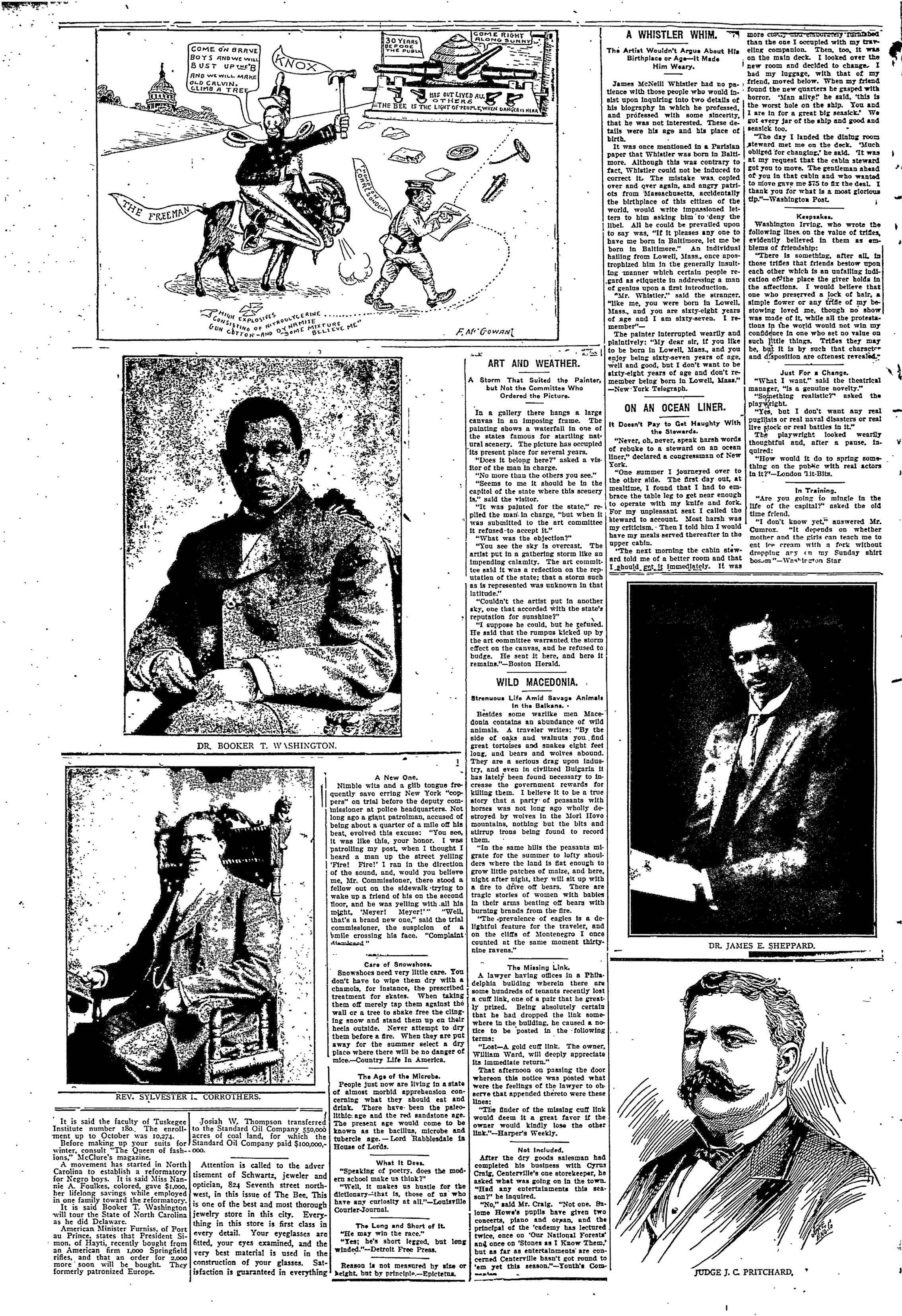
After the musical program, Dr. Jas. E. Shepard, president of the school, introduced Judge Pritchard and pald a tribute to his life. In delivering a short address full of optimism, he, in part, said: "This is one of the most important institutions ever organized for the uplift of the Negro."
He showed his audience in a logical and eloquent manner that good citizenship was an important factor in the development of any race, and that the spirit of the institution was founded for such a purpose.
Dr. Massee's Address.
Dr. J. C. Massee, pastor of the First Baptist Church of Chattanooga, Tenn., was introduced to the audience and under the caption, "The by-products of Christianity," he delivered an address that was significant, because of many frank statements made by him.
"Politics is a dirty game," was among the strong utterances made by this gifted speaker. Continuing, he said: "But if the men who are politicians were as clean and moral as this man, pointing to Judge Pritchard) politics would not be a dirty game."
Referring to the recent upheaval in the political realm of his State, he said: "The corrupt politicians of Tennessee have been buried out of sight by 50,000 clean voters." He said that he was going to vote for the Republican nominee, who is a Baptist minister. His abhorrence for Andrew Carnegie was expressed in the following words: "No man in this generation has done greater harm to Christian education than Andrew Carnegie. Religious institutions have changed their charters in order to meet the whims of this man.
"I believe that this institution is one of the moral by-products of Jesus Christ, and Dr. Shepard need make no apology for making the school a religious institution."
Mrs. Hahn's Talk
Mrs. Emma Erskine Hahn, a granddaughter of Lord Erskine, of England, famed as one of the greatest men of English history, was introduced to her first Negro audience. The music by the gifted singers evidently had inspired her, as she made an exceptional comment about the singers. Mrs. Hahn is president of the Woman's Town and Country Club of New York, and a native of Connecticut. She possesses a rich vocabulary and has the ability to hold her audience. She eulogized Dr. Shepard and said that he and Dr. Washington are on example of the class of leaders that the Negro needed most. Brodie L. Duke, who gave the school $3,000 when the plans were in embryonic state, spoke, and he was given quite an ovation by his Negro friends. He gave $50 in the collection during the evening. Among the prominent educators present was Dr. James B. Dudley, president of the trustee board.
Dudley to Students.
The most inspiring scene was not enacted last night altogether. This morning in the chapel of the school the student body, faculty and a number of citizens assembled and were addressed by President Dudley, of the State A. and M. College for Negroes in Greensboro. He gave a practical talk, which revealed his ability to mold sentiment for his race.
Follow a Leader.
"Follow a leader" was the subject of Mrs. Hahn's address to her intelligent hearers. She ably showed where the Negro must have such leaders as Dr. Shepard if the Negro is to survive the onslaughts of a strenuous age.
Judge Pritchard, in laying stress upon obedience in the home, showed where it was essential for the Negro to have the kind of leaders as this school is capable of preparing for a life of usefulness.
Dr. Masse eloquently made a plea for his hearers to help their leaders, and cause the masses to obey those who are especially to lead them aright.
"This institution impresses me more and more of its wonderful possibilities," were salient utterances of Hon. N. B. Broughton, of Raleigh. Brodie Duke followed the speaker in a timely and concise address.
The other speakers were Col. James H. Young, who said that Dr. Shepard had brought to pass something stupendous for the development of his race, and that only a man of Dr. Shepard's character could command the respect and support of various races in all sections of the country; Prof. S. G. At-
kins, educational secretary of the A. M. E. Church, in his speech, said he stood for racial purity and the perpetuation of racial identity; Rev. Dr. Adams, pastor of Trinity M. E. Church, this city, said: "I interpret that this institution has for its basis the making and developing of Christian manhood and womanhood." Attending the meeting of the advisory board were Judge Jeter C. Pritchard, Dr. Masssee, Dr. James B. Dudley, Dr. Dellinger, Prof. R. B. McCrary, Dr. Gilbert, Col. James H. Young, Dr. A. M. Moore, C. C. Spauling, Jno: Merrick, Hon. N. B. Broughton, Rev. Dr. Shannon, of Newark, N. J.; Rev. Dr. Leggett, of Ohio; Dr. J. E. Shepard and Prof. W. G. Pearson. The suggestions by Dr. Shepard were discussed and favorably acted upon
EX-JUDGE SAMUEL G. DAVIS.
A Man, a Citizen, and a Scholar. Born of Eminent and Distinguished Parentage—Knew No Man by the Color of His Skin—Married to a Talented and Accomplished Colored American.
The subject of this sketch is ex-Judge Samuel G. Davis, who came to this city 24 years ago from Maine, the State of many illustrious men, such as Blaine, Hale, Frey, Reed and others. He was the son of William Farrington and Pamelia Goodwin (Traverse) Davis, and was born July 30, 1842, in Denmark, Me. His father was an agent of the underground railroad, and was an abolitionist in principle.
Judge Davis received his early education in the common school of his native town. He was an ambitious youth, as he prepared himself for college at Bridgton Academy, in North Bridgton, Me., and graduated from Bodowin College in the class of 1865. He was a member of the Bodowin Alumni Association of this city, of which Chief Justice Melville W. Fuller was president. Mr. Davis studied law in the offices of Charles F. Holt, of Denmark, Me., and of Fessenden and Butler in Portland, and was admitted to the bar of his State in September, 1867. He practiced his profession for some time, diversified by teaching school, except when in government employ. He served as auditor of his native town, assessor and overseer of the poor, and superintendent of schools, holding each of these offices several years. He was Justice of the Peace and Quorum from January, 1868, until he left the State to accept a government position at Washington in September, 1882. He was appointed Dedimus Justice of the
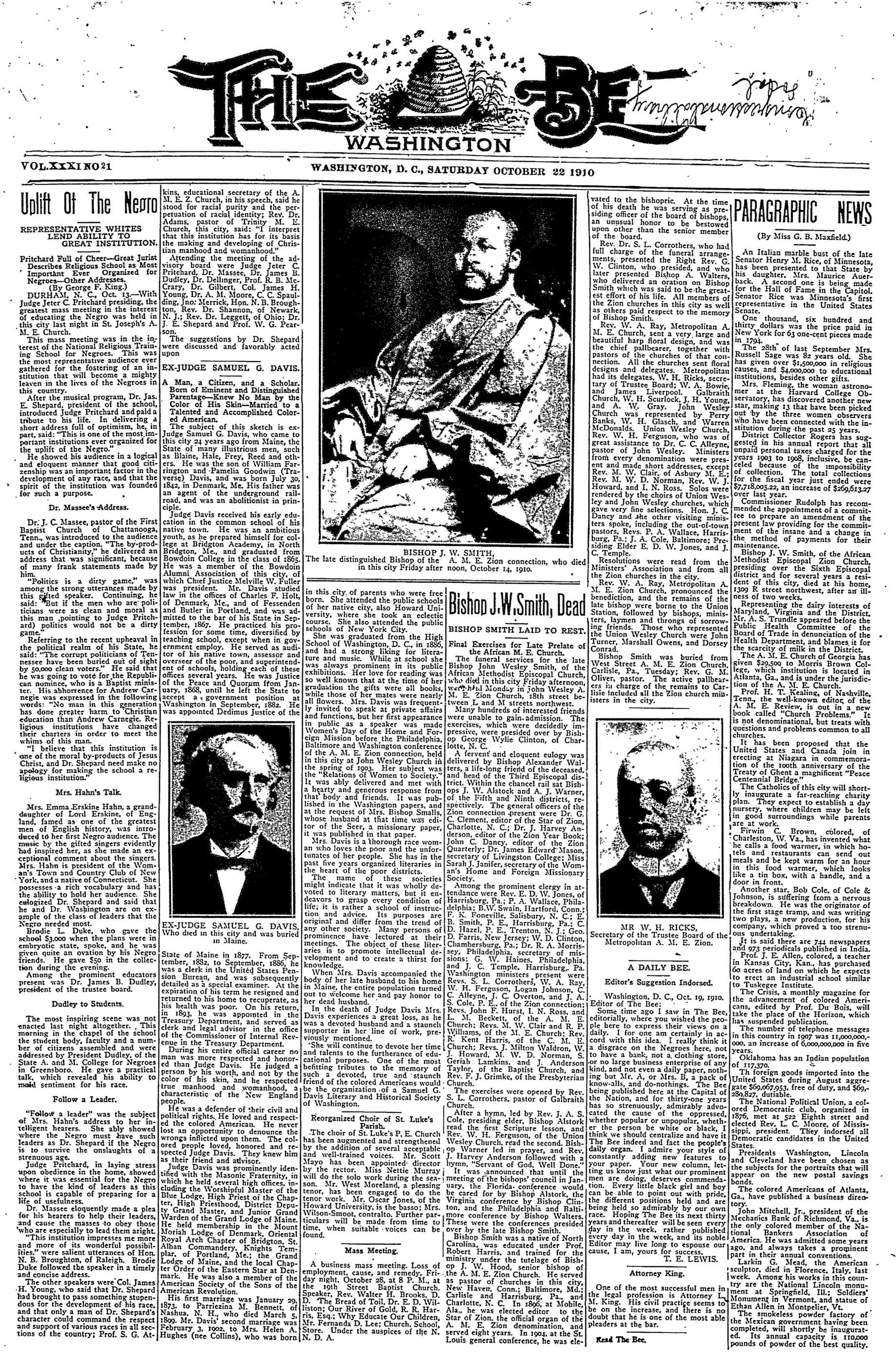
EX-JUDGE SAMUEL G. DAVIS
Who died in this city and was buried
in Maine.
State of Maine in 1877. From September, 1882, to September, 1886, he was a clerk in the United States Pension Bureau, and was subsequently detailed as a special examiner. At the expiration of his term he resigned and returned to his home to recuperate, as his health was poor. On his return, in 1893, he was appointed in the Treasury Department, and served as clerk and legal advisor in the office of the Commissioner of Internal Revenue in the Treasury Department. During his entire official career no man was more respected and honored than Judge Davis. He judged a person by his worth, and not by the color of his skin, and he respected true manhood and womanhood, a characteristic of the New England people. He was a defender of their civil and political rights. He loved and respected the colored American. He never lost an opportunity to denounce the wrongs inflicted upon them. The colored people loved, honored and respected Judge Davis. They knew him as their friend and advisor.
Judge Davis was prominently identified with the Masonic Fraternity, in which he held several high offices, including the Worshipful Master of the Blue Lodge, High Priest of the Chapter, High Priesthood, District Deputy Grand Master, and Junior Grand Warden of the Grand Lodge of Maine. He held membership in the Mount Moriah Lodge of Denmark, Oriental Royal Arch Chapter of Bridgton, St. Alban Commandery, Knights Templar, of Portland, Me.; the Grand Lodge of Maine, and the local Chapter Order of the Eastern Star at Denmark. He was also a member of the American Society of the Sons of the American Revolution. He first marriage was January 29, 1873, to Parriezina M. Bennett, of Nashua, N. H., who died March 5, 1899. Mr. Davis' second marriage was February 3, 1902, to Helen A. Hughes (Collins), who was horn
WASHINGTON, D. C., SATURDAY OCTOBER 22 1910
[Image of a seated man in traditional robes, with a serene expression.]
The late distinguished Bishop of the A. M. E. Zion connection, who died in this city Friday after noon, October 14, 1989.
in this city, of parents who were free born. She attended the public schools of her native city, also Howard University, where she took an ecteic course. She also attended the public schools of New York City.
She was graduated from the High School of Washington, D. C., in 1886, and had a strong liking for literature and music. While at school she was always prominent in its public exhibitions. Her love for reading was so well known that at the time of her graduation the gifts were all books, while those of her mates were nearly all flowers. Mrs. Davis was frequently invited to speak at private affairs and functions, but her first appearance in public as a speaker was made Women's Day of the Home and Foreign Mission before the Philadelphia, Baltimore and Washington conference of the A. M. E. Zion connection, held in this city at John Wesley Church in the spring of 1903. Her subject was the "Relations of Women to Society." It was ably delivered and met with a hearty and generous response from that body and friends. It was published in the Washington papers, and at the request of Mrs. Bishop Smalls, whose husband at that time was editor of the Seer, a missionary paper, it was published in that paper. Mrs. Davis is a thorough race woman who loves the poor and the unfortunates of her people. She has in the past five years organized literaries in the heart of the poor districts.
The name of these societies might indicate that it was wholly devoted to literary matters, but it endeavors to grasp every condition of life; it is rather a school of instruction and advice. Its purposes are original and differ from the trend of any other society. Many persons of prominence have lectured at their meetings. The object of these literaries is to promote intellectual development and to create a thirst for knowledge.
When Mrs. Davis accompanied the body of her late husband to his home in Maine, the entire population turned out to welcome her and pay honor to her dead husband.
In the death of Judge Davis Mrs. Davis experiences a great loss, as he was a devoted husband and a staunch supporter in her line of work, previously mentioned.
'She will continue to devote her time and talents to the furtherance of educational purposes. One of the most befitting tributes to the memory of such a devoted, true and staunch friend of the colored Americans would be the organization of a Samuel G. Davis Literary and Historical Society of Washington.
Reorganized Choir of St. Luke's Parish
The choir of St. Luke's P, E. Church has been augmented and strengthened by the addition of several acceptable and well-trained voices. Mr. Scott Mayo has been appointed director by the rector. Miss Nettie Murray will do the solo work during the season. Mr. West Moreland, a pleasing tenor, has been engaged to do the tenor work. Mr. Oscar Jones, of the Howard University, is the basso; Mrs. Wilson-Smoot, contralto. Further particulars will be made from time to time, when suitable voices can be found
Mass Meeting.
A business mass meeting. Loss of employment, cause, and remedy, Friday night, October 28, at 8 P. M., at the 19th Street Baptist Church. Speaker, Rev. Walter H. Brooks, D. D. The Bread of Toil, Dr. E. D. Williston; Our River of Gold, R. R. Harris, Esq; Why Educate Our Children, Mr. Fernanda D. Lee; Church, School, Store. Under the auspices of the N. N. D. A.
Bishop J.W.Smith, Dead
BISHOP SMITH LAID TO REST.
Final Exercises for Late Prelate of the African M. E. Church.
The funeral services for the late Bishop John Wesley Smith, of the African Methodist Episcopal Church, who died in this city Friday afternoon, wore a Monday in John Wesley A. M. E. Zion Church, 18th street between L and M streets northwest. Many hundreds of interested friends were unable to gain admission. The exercises, which were decidedly impressive, were presided over by Bishop George Wylie Clinton, of Charlotte, N. C.
A fervent and eloquent eulogy was delivered by Bishop Alexander Walters, a life-long friend of the deceased, and head of the Third Episcopal district. Within the chancel rail sat Bishops J. W. Alstock and A. J. Warner, of the Fifth and Ninth districts, respectively. The general officers of the Zion connection present were Dr. G. C. Clement, editor of the Star of Zion, Charlotte, N. C.; Dr. J. Harvey Anderson, editor of the Zion Year Book; John C. Dancy, editor of the Zion Quarterly; Dr. James Edward Mason, secretary of Livingston College; Miss Sarah J. Janifer, secretary of the Woman's Home and Foreign Missionary Society.
Among the prominent clergy in attendance were Rev. E. D. W. Jones, of Harrisburg, Pa.; P. A. Wallace, Philadelphia; B.W. Swain, Hartford, Conn.; F. K. Foneville, Salisbury, N. C.; E. B. Smith, P. E. Harrisburg, Pa.; C. D. Hazel, P. E. Trenton, N. J. Geo. D. Farris, New Jersey; W. D. Clinton, Chambersburg, Pa.; Dr. R. A. Morrissey, Philadelphia, secretary of missions; G. W. Haines, Philadelphia, and J. C. Temple, Harrisburg, Pa. Washington ministers present were Revs. S. L. Corrothers, W. A. Ray, W. H. Ferguson, Logan Johnson, C. Alleyne, J. C. Overton, and J. A. S. Cole, P. E. of the Zion connection; Revs. John F. Hurst, I. N. Ross, and L. M. Beckett, of the A. M. E. Church; Revs. M. W. Clair and R. P. Williams, of the M. E. Church; Rev. R. Kent Harris, of the C. M. E. Church; Revs. J. Milton Waldron, W. J. Howard, M. W. D. Norman, S. Geriah Lamkins, and J. Anderson Taylor, of the Baptist Church, and Rev. F. J. Grimke, of the Presbyterian Church.
The exercises were opened by Rev. S. L. Corrothers, pastor of Galbraith Church.
After a hymn, led by Rev. J. A. S. Cole, presiding elder, Bishop Alstork read the first Scripture lesson, and Rev. W. H. Ferguson, of the Union Wesley Church, read the second. Bishop Warner led in prayer, and Rev. J. Harvey Anderson followed with a hymn, "Servant of God, Well Done."
It was announced that until the meeting of the bishops' council in January, the Florida conference would be cared for by Bishop Alstork, the Virginia conference by Bishop Clinton, and the Philadelphia and Baltimore conference by Bishop Walters. These were the conferences presided over by the late Bishop Smith. Bishop Smith was a native of North Carolina, was educated under Prof. Robert Harris, and trained for the ministry under the tutelage of Bishop J. W. Hood, senior bishop of the A. M. E. Zion Church. He served as pastor of churches in this city, New Haven, Conn.; Baltimore, Md.; Carlisle and Harrisburg, Pa., and Charlotte, N. C. In 1896, at Mobile, Ala., he was elected editor to the Star of Zion, the official organ of the A. M. E. Zion denomination, and served eight years. In 1904, at the St. Louis general conference, he was ele-
vated to the bishopric. At the time of his death he was serving as presiding officer of the board of bishops, an unusual honor to be bestowed upon other than the senior member of the board.
Rev. Dr. S. L. Corrothers, who had full charge of the funeral arrangements, presented the Right Rev. G. W. Clinton, who presided, and who later presented Bishop A. Walters, who delivered an oration on Bishop Smith which was said to be the greatest effort of his life. All members of the Zion churches in this city as well as others paid respect to the memory of Bishop Smith.
Rev. W. A. Ray, Metropolitan A. M. E. Church, sent a very large and beautiful harp floral design, and was the chief pallbearer, together with pastors of the churches of that connection. All the churches sent floral designs and delegates. Metropolitan had its delegates, W. H. Ricks, secretary of Trustee Board; W. A. Bowie, and James Liverpool. Galbraith Church, W. H. Scurlock, J. H. Young, and A. W. Gray. John Wesley Church was represented by Perry Banks, W. H. Glass, and Warren McDonalds. Union Wesley Church, Rev. W. H. Ferguson, who was of great assistance to Dr. C. C. Alleyne, pastor of John Wesley. Ministers from every denomination were present and made short addresses, except Rev. M. W. Clair, of Asbury M. E.; Rev. M. W. D. Norman, Rev. W. J. Howard, and I. N. Ross. Solos were rendered by the choirs of Union Wesley and John Wesley churches, which gave very fine selections. Hon. J. C. Dancy and the other visiting ministers spoke, including the out-of-town pastors, Revs. P. A. Wallace, Harrisburg, Pa.; J. A. Cole, Baltimore; Presiding Elder E. D. W. Jones, and J. C. Temple.
Resolutions were read from the Ministers' Association and from all the Zion churches in the city.
Rev. W. A. Ray, Metropolitan A. M. E. Zion Church, pronounced the benediction, and the remains of the late bishop were borne to the Union Station, followed by bishops, ministers, laymen and throngs of sorrowing friends. Those who represented the Union Wesley Church were John Turner, Marshall Owens, and Dorsey Conrad.
Bishop Smith was buried from West Street A. M. E. Zion Church, Carlisle, Pa., Tuesday; Rev. G. M. Oliver, pastor. The active pallbearers in charge of the remains to Carlisle included all the Zion church ministers in the city.
MR W. H. RICKS,
Secretary of the Trustee Board of the
Metropolitan A. M. E. Zion.
A DAILY BEE.
Editor's Suggestion Indorsed.
Washington, D. C., Oct. 19, 1910.
Editor of The Bee:
Some time ago I saw in The Bee, editorially, where you wished the people here to express their views on a daily. I for one am certainly in accord with this idea. I really think it a disgrace on the Negroes here, not to have a bank, not a clothing store, or no large business enterprise of any kind, and not even a daily paper, nothing but Mr. A, or Mrs. B, a pack of know-alls, and do-nothings. The Bee being published here at the Capital of the Nation, and for thirty-one years has so strenuously, admirably advocated the cause of the oppressed, whether popular or unpopular, whether the person be white or black, I think we should centralize and have it The Bee indeed and fact the people's daily organ. I admire your style of constantly adding new features to your paper. Your new column, letting us know just what our prominent men are doing, deserves commendation. Every little black girl and boy can be able to point out with pride, the different positions held and are being held so admirably by our own race. Hoping The Bee its next thirty years and thereafter will be seen every day in the week, rather published every day in the week, and its noble Editor may live long to espouse our cause, I am, yours for success.
Attorney King.
One of the most successful men in the legal profession is Attorney L. M. King. His civil practice seems to be on the increase, and there is no doubt that he is one of the most able pleaders at the bar.
Read The Bee
PARAGRAPHIC NEWS
(By Miss G. B. Maxfield.)
An Italian marble bust of the late Senator Henry M. Rice, of Minnesota, has been presented to that State by his daughter, Mrs. Maurice Auerback. A second one is being made for the Hall of Fame in the Capitol. Senator Rice was Minnesota's first representative in the United States Senate. One thousand, six hundred and thirty dollars was the price paid in New York for 63 one-cent pieces made in 1794.
The 28th of last September Mrs. Russell Sage was 82 years old. She has given over $1,500,000 in religious causes, and $4,000,000 to educational institutions, besides other gifts.
Mrs. Fleming, the woman astronomer at the Harvard College Observatory, has discovered another new star, making 13 that have been picked out by the three women observers who have been connected with the institution during the past 25 years.
District Collector Rogers has suggested in his annual report that all unpaid personal taxes charged for the years 1903 to 1908, inclusive, be canceled because of the impossibility of collection. The total collections for the fiscal year just ended were $7,718,005.22, an increase of $269,613.27 over last year. Commissioner Rudolph has recommended the appointment of a committee to prepare an amendment of the present law providing for the commitment of the insane and a change in the method of payments for their maintenance. Bishop J. W. Smith, of the African Methodist Episcopal Zion Church, presiding over the Sixth Episcopal district and for several years a resident of this city, died at his home, 1309 R street northwest, after an illness of two weeks. Representing the dairy interests of Maryland, Virginia and the District, Mr. A. S. Trundle appeared before the Public Health Committee of the Board of Trade in denunciation of the Health Department, and blames it for the scarcity of milk in the District. The A. M. E. Church of Georgia has given $29,500 to Morris Brown College, which institution is located in Atlanta, Ga., and is under the jurisdiction of the A. M. E. Church.
Prof. H. T. Kealing, of Nashville, Tenn., the well-known editor of the A. M. E. Review, is out in a new book called "Church Problems." It is not denominational, but treats with questions and problems common to all churches.
It has been proposed that the United States and Canada join in erecting at Niagara in commemoration of the tooth anniversary of the Treaty of Ghent a magnificent "Peace Centennial Bridge."
The Catholics of this city will shortly inaugurate a far-reaching charity plan. They expect to establish a day nursery, where children may be left in good surroundings while parents are at work.
Firwin C. Brown, colored, of Charleston, W. Va., has invented what he calls a food warmer, in which hotels and restaurants can send out meals and be kept warm for an hour in this food warmer, which looks like a tin box, with a handle, and a door in front.
Another star, Bob Cole, of Cole & Johnson, is suffering from a nervous breakdown. He was the originator of the first stage tramp, and was writing two plays, a new production, for his company, which proved a too strenuous undertaking.
It is said there are 744 newspapers and 973 periodicals published in India. Prof. J. E. Allen, colored, a teacher in Kansas City, Kan., has purchased 60 acres of land on which he expects to erect an industrial school similar to Tuskegee Institute.
The Crisis, a monthly magazine for the advancement of colored Americans, edited by Prof. Du Bois, will take the place of the Horizon, which has suspended publication.
The number of telephone messages in this country in 1907 was 11,000,000,000, an increase of 6,000,000,000 in five years.
Oklahoma has an Indian population of 117,370.
Th foreign goods imported into the United States during August aggregate $69,667,953, free of duty, and $69,289,827, durable.
The National Political Union, a colored Democratic club, organized in 1876, met at 522 Eighth street and elected Rev. L. C. Moore, of Mississippi, president. They indorsed all Democratic candidates in the United States.
Presidents Washington, Lincoln and Cleveland have been chosen as the subjects for the portraits that will appear on the new postal savings bonds.
The colored Americans of Atlanta, Ga., have published a business directory.
John Mitchell, Jr., president of the Mechanics Bank of Richmond, Va., is the only colored member of the National Bankers Association of America. He was admitted some years ago, and always takes a prominent part in their annual conventions. Larkin G. Mead, the American sculptor, died in Florence, Italy, last week. Among his works in this country are the National Lincoln monument at Springfield, Ill.; Soldiers' Monument in Vermont, and statue of Ethan Allen in Montpelier, Vt. The smokeless powder factory of the Mexican government having been completed, will shortly be inaugurated. Its annual capacity is 110,000 pounds of powder of the best quality.
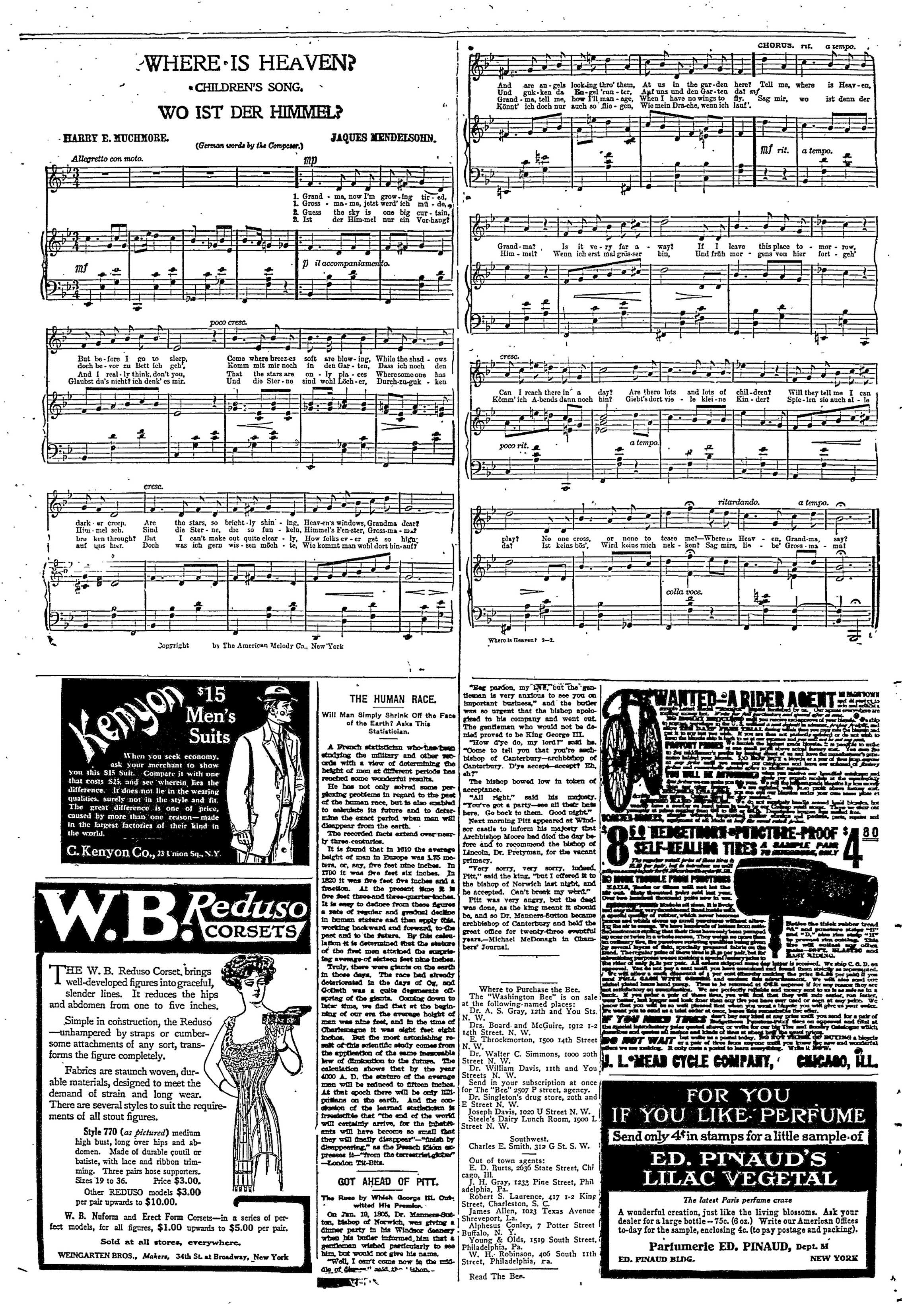
ae “WHEREIS HEAVEN?
. * . CHILDREN’S SONG. ~ ‘
. - WO IST DER HIMMEL? °
. > HABRY E. MUCHMORE. JAQUES MENDELSOHN.
(German words by the Composer.) q
. | fllegretto con moto. . Mp . 8
a ee ee ern tet tees
Ap
v epee Se doin shyrenssa _ at
Se eee ee ee
1. Grand - ma, now I'm grow-ing tir=«
- . , 1. Gross - ma- ma, jetst werd” ick an oe
Fe 2 Guess tho sky is one big cur- tain,
3B. Ist der Him-mel nur ein Vor-hang?
A er Pensa 3
Cy ae Ge 2 ee eet | eee
hp Es 9 a eh a canes csc ceric de end ns Renee creeped agen
(Gos reer oes ee Or ee ee eee
9 Dp ilaccompania: o
i e's } . z : Zz
3 | SS
ee
ae aoe eters eee aren Ploen feel [eesti dnssnstcesemnnstieniaiahinpnnacangeesiimisttans |-icemesea!
poco crese.
eee ee ee ee
Z 5 mr a ee ee re Hh ar Reena
a? a oa as a a
sae ee ae
But be-fore I fo to sleep, Come where breezes soft are blow- ing, While the shad - ows
doch be- vor zu Bett ich geh’, Komm mit mirnoch in denGar-ten, Dass ichnoch den
é And I real-ly think, don’t you, That the starsare on - I; la - ces Wheresomoone has
. Glaubst du's nicht? ich denk’ es mir. Und dio Ster-no sind ‘wohl Eeeh-er, Dureb-zu-guk - ken
, * we
Gee pease ee
. - .
=
\ «_# | at “ :
y= ‘- Lonel Leientt an ogmaile i 8 a
Fst = [—-——§ i
:
oe * cresc.
a. Desa h rteeeeeeseeiniernieas Rig cemenetencen mie igiennati ania Seinen! oe
eS Se Se OS ere
Ss Lets | o_o ete =
dark - er creep. Are the stars, so bricht-ly shin’ - ing, Heav-en'’s windows, Grandma dear? |
Him-mel sch. Sind die Ster-ne, dic so fan - keln, Himmel’s Fen-ster, Gross-ma- wa?
) bro ken through? But I can’t make out quiteclear - ly, How folksev-er get so hign:
j auf uns her. Doch was ich gero wis-sen méch - te, Wic kommt man wohl dort hin-auf?
. ° > * : ‘
‘ sy — ee —
: os oe St] SS — a
‘ — > te 3 —} 1 He OF 2
va» 9 ‘
a a
6) 4 z {gp ee ee ee
pg ot i
s r st
X Sopsright by The American Melody Co., NewYork
» =,
15 =.
<S Men’s
é ie
Suits Wy
When you seek economy, .
- rcs ae Me LT ohed a
you this S15 Suit. Compare it with one 1
that cosis $25, and'-see ‘wherein, Hes the t
CICS Aan ee le Caen ttt iH 2
qualities, surely -not-in the style and fit. i bai} +h
Be Cire wera OM Mc Tae A ft Dy
caused by more than’ one ‘reason— made i] yy
PEC as CCM etree he er K
the work, ay
i SS bef
G. Kenyon Co,, 23 union sa..¥.¥. rs
THE HUMAN RACE.
Will Man Simply Shrink Off the Face
of the Earth? Asks This
Statistician.
A Vreoch statistich who-has teen
stodying the military and otber sec
mds with 2 view of determining the
betght of mon at ifferent periods tas
Feoched some wonderful results.
He has not only sotved some per
ylexing problems tn regard to the pest
of the human race, but ts also enabted
to ealeuiate {ts futere and to deter
mine the exact perfod when man will
ieappear from the earth. -
‘The recorded facts extend over-nsar
ly three.centurtes,
‘Tt ts found that fn 1610 the average
beight of man tn Europe was 175 me-
tera, or, say, five feet nine inches. In
T7DO it was five feet six inches. In
1820 it was fire fect five toches and a
fraction. At the present time & is
Dre fest threeand three-quarter-foches.
Tt ts eaay to Gedoee from these figures
@ pete of regular nod gradual decline
in bomen ststere aad then apply ils,
‘working backward end forwan, tothe
past ami to the future, Ry thts ealeu-
lation 4 48 Getermine( thst the st=ture
of the firet men atizined the surpris-
ing avemge-of sixteen feet nine inches.
‘Truly, tbore wore ginnts on the earth
in those Gays, The race bed stready
Geteriorated in the days of Og, snot
Goltmth was a quite degenerate off-
spring cf the gimnta. Coming Gown to
Inter the, we find that at tho begin-
ning of cur era the average height of
men wes nine feet, and in the time of
Chertemagne it was oight feet cight
inches, Dut the most astonishing re-
watt of this scientific study comes from
the epptiention of the same tnesoreble
lew of @imioction to the futur, The
catoutation shows that by the year
4000 A. D, the etatcro of the average
ten will be rednced to fifteen fnohes.
At that epoch there will be onty Mill
Dditans on the earth, And the con
Gtosion of the learned statinticien fs
irresintible that “the endl of the world
wl! certainty arrive, for the Mbebtt-
ants wil have become #0 small that
they will fmefly disappear"—“fintsh by
disappearing,” as the Preach Silom ex-
Presses it—“from the tecrestriai gitar”
—Loadon Tit-Bits.
Gs >)
. pe
"THE WB. Reduso Corset brings SSC
well-developed figures intograceful, ayo @
slender lines. It reduces the hips
and abdomen from one to five inches, ‘ a3
Simple in construction, the Reduso X45 Caters j
—unhampered by straps or cumber- / 4 A
some attachments of any sort, trans- fons CrattS
forms the figure completely. RS Rasa cracs )
Fabrics are staunch woven, dur- a i ,
able materials, designed to meet the SS i
demand of strain and long wear. lt AS .
There are several styles to suit the require- Ki \ Y
& ments of all stout figures. | iN \
Style 770 (as pictured) medium H f\
high bust, long over hips and ab- F / i i
domen. Made of durable coutil or Ht La
batiste, with lace and ribbon tim- cee tH
i ming. Three pairs hose supporters. passes f
Sizes 19 t0 36. ‘Price $3.00, WA !
Other REDUSO models $3.00 meee :
per pair upwards to $10.00.
W. B. Noform and Erect Form Corsets—in 2 series of per
fect models, for all figures, $1.00 upwards to $5.00 per pair.
Sold at all stores, everywhere.
‘WEINGARTEN BROS., Makers, 34th St. at Broadway, New York
GOT AHEAD OF PITT.
‘The Rueo by Which George HL. Oxt-
7 witted Hie Premier. -
On Jen. 10, 1805, Dr. MannersSut-
ton, Bishop of Norwich, wes gtring a
dinner party in his Windsor deanery
when his botier informed him that 2
gentleman wished partieciarly to sed
him, dat wouk! not give his name.
“Well, I can't come now tg the mid.
Ole of Gham” anid 1e~ *tehon
e 7 “ CHURUS. mh. Giempo . ~
TN ee oN
At tt) er _———__,—_| £- = ——_g—__—_a_!
“ayy $1. —a—2——_] Ei foal SS ces leer tell aa cieneal Cee
Rey oe Fs tH +" 3-5 = Fy
And are an-gels lookdngthro’them, At us in the gar-den here? Tell me, where is Heay-
Und guk-ken da Bo-gel ran - ter, Aptups und dea Garten dat mf =
Grand -‘na, tell me, Low filman-age, WhenT have nowingsto fy. Seg mir, wo ist denn der
Kénnt’ ich doch nur auch so flic- gen, Wiemein Drache, wennich laut’.
. a a
Be 1 —— 7 =:
ao} eg ere eo
a = [-—— 9 3
‘ 1
as mf rit. @ tempo.
« a
aie £ #3 =
= Sead ceed ateeenienien, F Aceeeneeneerh eel ool |_—_—__s—___ ..—__—__} 1 9 J
2
* 7 , ;
g 5 p
ee 3 are
ies }-+}-—_—-\—N | 6. — 6, a
epee ee et
Grand-ma? , Is it ve-ry for a + way? If 1 leave thisplace to - mor - row,
Him melt?’ Wenn icherst mal grisser bin, Und {rh mor - gens von hier fort - geht
48 ae ta oa pee
as? —t — — [o-.—e—; iy
Ce reeeeeeeceenteenennemea | ae fC heal
(| ' —
= £ 2s =
Si er a
ry a Le ceeanaicol 5 ees Silicon Aramaic Cel
wig cl : ~
‘ orese. “4 é ‘ -
fp — Nhe p het 7
Ab — a §9- yi —— — ta 2
qt et ry 2 is
' Can I reach theroin* a day? Are there lots and lots of chil-dren? Will they tellme I can
Kémm’ ich A-bendsdann noch hin? Giebt’sdortvie - le klei-ne Kin - der? Spie-len sie auch al - le
pe ee
bab = rr [p—e
esa eae — se
—
= a | | = |
o- - = =
‘o———_ | .—
| ee — +9
Eo Fe
| =
. * ao ritardando. atempo. “~~
oo > ___* a =]
lA ———! a
Cy” EL EY —
—_——— Se ee
plart No one cross, _or none to teaco me?—Wherers Hesv - en, Grand-ms, say?
iat Ist keins bis’, Wird keins mich nek - ken? Sag mirs, lie ~ be’ Gross-ma - mal
: cS aN om
(PS = eee
- ea J <I
— <I a wd a
i : :
Where ls Heaven? 2-2. . a t
"Beg pardon, my IN®, but the“ gen-
tlewan is very anxious to see you on
t‘mportant business,” and’ the botier
was so urgent that the bishop apolo-
gived to bis company and went out.
The gentleman who would not be de
nied proved to be King George II.
“How d'ye do, my lord?” pati he.
“Come to tell you that you're ssob-
bishop of Canterbury—archbishop of
Soseens: D'ye necept—aceopt? Eh,
‘The bishop bowed low tn token of
acceptance.
| “AN right,” said bis magesty.
“You've got a party—eee ell thefr bets
bere. Go beek to them. Good night”
ert morning Pitt appeared at Wind-
sor castle to Inform his majesty that
Archbishop Moore had died the day be-
fore and to recommend the bishop of
Idncoln, Dr. Pretyman, for the vacant
primacy,
“Very sorry, very sorry, indeed,
Pitt,” sald the king, “but I offered ft to
the bishop of Norwich last night, and
he accepted. Can't break my wert.”
Pitt was very angry, bat the dee
was done, as the king meant tt ebould
de, and so Dr, MannereBatton became
archbishop of Canterbury and bel the
great office for twenty-three eventful
years—Michnel McDonagh tn Cham
bers* Journal.
Pg, WANTED=A RIDER AGENT 22x:
‘ See
(ARN cteezecheseeseeaeeeees
NEURO eneronr rames ¥:=2 = So 2 tamgi pes:
HAS ;} Hie peat ee a hers Steer ee
Mee so
Pu ut Wl Mi MPM SF = = aed at
TNE WR Stars ee aa
Magee eet Foe sen
Vee Se ee
5.0 HEDGETHONE SPURCTERE-PROOF ¢g 50
SELF-EALING TIRES % Scoscen'cmrs
e ee ene Ee 5
a 2 fo Se eS oon oe oe a
a een eee eee eat oe
Som, Siem a ee
Estee Retest
7 oe Sea em, or ragecs en = pect oe
ieee nieee aes
ay tat eh peop tat pay pry ae
aria Se ee
iin sea eae Eee ates
NE ae ye eg
precsaweataacupe pene maaan
vou ms Tuas Soares feast Exopeec!
So re art ror aeea
ROT WAN Fee Decay eee ee ee
Lowen CYCLE COMPANY,’ CHICAGO, ILL
Where to Purchase the Bee.
The “Washington Bee” is on sale
at the following-named places:
Dr. A. S. Gray, 12th and You Sts
N.W.
Drs. Board. and McGuire, 1912 1-2
1gth Street. N. W.
E. Throckmorton, 1500 14th Stree:
| NLW.
Dr. Walter C. Simmons, 1000 zott
Street N. W.
Dr. William Davis, 11th and You
Streets N. W. 7
Send in your subscription at once
for The “Bee” 2507 P strect, agency.
|_ Dr. Singleton’s drug store, zoth and
-E Street N. W.
| Joseph Davis, 1020 U Street N. W.
Steele’s Dairy Lunch Room, 1900 L
‘Street N. W.
Southwest.
| Charles E. Smith, 312 G St. S. W.
Out of town agents: s
E. D. Burts, 2636 State Street, Chi
cago, Ill.
J. H, Gray, 1232 Pine Street, Phil
adelphia, Pa. .
Robert S. Laurence, 417 1-2 King
Street, Charleston, S. C.
James Allen, 1023 Texas Avenue
Shreveport, La.
Alphesus Conley, 7 Potter Street
‘Buffalo, N. Y.
Young & Olds, 1519 South Street,
Philadelphia, Pa.
W. H.- Robinson, 406 South 11th
Street, Philadelphia, ra.
_. FOR YOU |.
IF YOU LIKE’ PERFUME
Send only 4*in stamps for alittle sample-of
ED. PINAUD’S |
LILAC VEGETAL _
The latest Paris perfame craze
A wonderful creation, just like the living blossoms. Ask your
dealer for a large bottle--75c. (60z.) Write our American Offices
to-day for the sample, enclosing 4c. (to pay postage and packing),
Parfumerie ED. PINAUD, vept.
ED. PINAUD BLDG. NEW YORK
Read The Bee.
AN AFRICAN TITBIT.
Hippopotamus Meat Has a Strong Odor and Flavor of Musk—Is Liked by the Natives.
To the African traveler the hippopotamus is a species of game particularly desirable, for its ivory and its hide are both valuable, while the not inconsiderable danger involved in its pursuit provides the delicious emotion without which every kind of hunting is tame and insipid. Moreover, the obligation under which the leader of the expedition lies to feed his servants and carriers adequately makes one of these enormous beasts, twelve feet long or so and disproportionately wide, a perfect godsend. Not only does the hippopotamus furnish a formidable amount of meat, but that meat has the inestimable merit of keeping fresh much longer than any other, principally owing to the fact that files seem to have an insurmountable horror of it. I must admit that for a long time I thoroughly sympathized with the files. Alive, the hippopotamus has a peculiar odor, somewhat resembling musk, which discloses the presence of the animal from afar when he happens to be to windward of one. In the flesh of the dead animal this odor—or the taste of it, rather—persists and is much appreciated by the natives, though foreigners take a long time to get accustomed to it; some are never able to support it; Wide World Magazine.
FIVE SENSES NOT ENOUGH.
Our Limited Scale* of Consciousness Shuta Out Many Vibrations.
Between the vibrations that we call electricity and the vibrations that we call heat we imagine there must be other vibrations filling up the gap, but we do not know, simply because we have no senses that can comprehend them. The spectrum is just such a little scale. Below the darkest red at the lower end we cannot see; at the other end as the vibrations get faster and faster through the orange, the blue and the violet is another unknown gap—that is, we cannot see it. But surely the vibrations are there. Some of them, for instance, that we have never seen and never can see mark their presence on a photographic plate. And this same spectrum may be used as an analogy to describe spiritualistic phenomena. Just as there are limits at either end of the scale of vibrations beyond which our own senses can tell us nothing so may there be psychic forces at work beyond the limits of our consciousness. These are seemingly supernatural to us when we witness their effect, but they really are no more supernatural than the X ray that pierces the solid body or the invisible ultra violet ray that marks the photographic plate—From "Are the Dead Allive?" by Fremont Rider in Dellnator.
When the Waiter Wins.
Two men were wrangling as to who should settle with the waiter for the luncheon. When the question had been finally decided and the contestants had gone the waiter said to one of his regular customers who was a witness of the scene: "That's what we like, for every time it happens we come in for an extra tip. The man who couldn't get the check has only one way to get even, and that is by giving the waiter something, and nine times out of ten he does it and makes the amount more than he would have given if he had paid the check. This one ordered extra cigars and left the change for me. We like the 'give me the check' quarrels." -New York Tribune.
Quick Wit.
In the days when Rowley Hill was bishop of the Isle of Man one of his clergymen, bearing the name of Tears, came to say adieu to his bishop on getting preferment.
The parson said: "Goodby, my lord! I hope we may meet again, but if not here in some better place."
The bishop replied, "I fear the latter is unlikely, as there are no Tears in heaven."
"No doubt," wittily answered the parson, "you are right that our chance of meeting is small, as one reads of the plains of paradise, but never of any Hills there."
Overfeeding.
"Men drunk from liquor and men drunk from overeating are most susceptible to pneumonia and die of it," said a Chicago health commissioner in an address. "The majority of cases of pneumonia are of patients who contracted the disease after a drunken debauch or who were drunk from overfeeding," the commissioner continued. "People drunk from overfeeding. I think, are almost as immoral as those who stupefy themselves with liquors. The effects of pneumonia in such patients are much the same."
Champagne Corks
The manufacture of the best kind of corks, those made for champagne bottles, are never intrusted to machines. The ordinary common cork is made by machinery, but the best work invariably is done by human hands, and the champagne cork cannot be trusted to a machine. All the blemishes in the cork have to be taken into consideration, so this work is done by hand labor.
Unexpected.
Bessie—Yes; he held me on his knee,
and I rested my head on his shoulder,
and just as his mustache brushed my
cheek he said— Jessie (expectantly)—
Yes; he said— Bessie—"Isn't it beastly
weather for this time of year"—
Philadelphia Ledger.
No man can produce great things
who is not thoroughly sincere 'with
himself—Lowell.
DEATH OF THE WORLD.
When Water Disappears and Air Gets Too Thin to Breathe Then Will Come Dissolution.
The age of the earth is placed by some at 500,000,000 years, by others 100,000,000 years, and still others of later time place it at 10,000,000 years. None place it lower than 10,000,000, knowing what processes have been gone through.
Other planets go through the same process. The reason that other planets differ so much from the earth is that they are in so much earlier or later stages of existence. The earth must become old.
Newton surmised, although he could give no reason for it, that the earth would lose all its water and become perfectly dry. Since then it has been found that Newton was correct.
As the earth keeps cooling it will become porous, and great cavities will be formed in the interior, which will take in the water. It is estimated that this process is now in progress, so far that the water diminishes at the rate of the thickness of a sheet of paper each year.
At this rate in 6,000,000 years the water will have sunk a mile, and in 15,000,000 the water will have disappeared from the face of the globe.
The nitrogen and oxygen in the atmosphere are also diminishing all the time. It is in an inappreciable degree, but the time will come when the afr will be so thin that no creature we know could breathe it and live. The time will come when the world cannot support life. That will be the period of old age, and then will come death. Richard A. Proctor.
"CREASING" A WILD HORSE.
For One Captured by That Method Fifty Were Killed.
Will C. Barnes, writing in McClure's of the various methods of capturing wild horses in the old days on the plains, says:
'Creasing' was one of their devices. This consisted in shooting a bullet so that it struck the animal on the top of the neck just in front of the withers and about an inch or so deep close to the spinal column. The shock temporarily stunned the horse, and the hunter ran up and tied the animal's feet together before he recovered. A rope halter was slipped on his head. A gentle horse or sometimes a work ox was led up alongside the prostrate beast, and he was securely necked up to the gentle animal and thus could be handled easily. Old mustangers say, however, that for one horse caught this way fifty were killed and that as a matter of fact the method was not used very much except in an emergency, when a hunter, after days of attempts to capture, finally took the risk of successfully creasing an unusually fine animal rather than see him escape altogether.
"One of the best cow ponies I ever owned I bought from a mustanger who had creased him on the plains east of the Pecos river in New Mexico. There was a hole in his neck fully two inches deep and wide, where the ball from the heavy buffalo gun had plowed its way through the flesh just high enough above the spine not to kill and low enough to stun effectually."
India Ink.
In both India and China there are thousands of people who manufacture India ink as a side line to their regular business, working at it in the winter at night and on days when they are not otherwise employed. It is made by burning, some kind of oil in a lamp with a very long chimney, usually made in joints which can be taken apart for greater convenience in cleaning out the soot which makes the ink. Almost any kind of vegetable oil will answer, and in districts where petroleum is found even coal oil is used in making the cheaper grades. The best kind is made from sesame oil.—Argonaut.
His Hand.
Tom Reed was playing whist on one occasion in his club in Portland. One of the party whom the "czar" did not like extravagantly had a habit of carrying a good deal of black realty under his finger nails, and the rest of his hands never looked clean. But the fellow had good luck, which nettled Tom. Finally, almost unable to conceal his impatience, the giant speaker of the house of representatives remarked in his metallic nasal tone of voice, "Blank, if dirt was trumps, what a hand you'd have!"
A Terrible Threat
"You say your titled son-in-law holds threats over you?"
"Yes," answered Mr. Cumrox. "He has us where we can't give him any argument at all. Mother and the girls say we must yield for the sake of the family honor."
"Is there—er—a skeleton in the closet?"
"Not at all. He simply announces that unless he has his own way he'll get naturalized and be a plain American citizen." - Washington Star.
Highly Esteemed.
"Do you think that most people nowadays worship money?"
"No; I won't go as far as that," answered the home grown philosopher, "but I will say that the love of money is seldom platonic."—Washington Herald.
Limited Love.
"When your parents first refused me your hand, I was so wretched that I wanted to throw myself out of the window."
"And why didn't you?"
"It was so high!"—Lustige Blatter.
LEE AT APPOMATTOX.
One of the Most Notable Scenes In the History of the War—The Parting of Comrades.
Men who saw the defeated general when he came forth from the chamber where he had signed the articles of capitulation say that he paused a moment as his eyes rested once more on the Virginia hills, smote his hands together as though in some excess of inward agony, then mounted his gray horse, Traveler, and rode calmly away.
If that was the very Gethsemane of his trials, yet he must have had one one moment of supreme, if chastened, joy, As he rode quietly down the lane leading from the scene of capitulation he passed into view of his men—of such as remained of them. The news of the surrender had got abroad, and they were waiting, grief stricken and dejected, upon the hillsides when they caught sight of their old commander on the gray horse. Then occurred one of the most notable scenes in the history of the war. In an instant they were about him, bareheaded, with tear wet, faces, thronging him, kissing his hand, his boots, his saddle; weeping, cheering him amid their tears, shouting his name to the very skies. He said: "Men, we have fought through the war together. I have done my best for you. My heart is too full to say more."—From "Robert E. Lee, the Southern."
ERROR MEANT DEATH.
Typesetters and Proofreaders on Chinese Paper Careful. China, with all its vast population, boasts not quite two dozen daily papers, but among them are the two oldest papers in the world. The Kin Pan used to be considered by Europeans the oldest paper, but it has been issued a mere thousand years. The Tsing Pao, or Pekin News, was first published 580 years before the Norman conquest and has been issued without intermission for nearly 1,400 years. The Tsing Pao has the appearance of a yellow backed magazine of twenty-four octavo pages, each page containing seven columns, consisting of seven "characters."
Two editions are published—an edition de luxe for the court and the upper classes at a cost of 24 cents a month, and an edition inferior in paper and printing, costing 10 cents a month. It has a circulation of about 10,000 and is really the principal paper of China, chronicling the movements of the emperor and of the court and printing the ministerial reports. It is probably the most exact newspaper in the world. The punishment for an error in printing was until recently, at least, instant death.-New York Times.
Old London Cookshops.
Mediaeval London, besides being a "city of taverns," was famous for its cookshops, such as the place on the river bank described by Fitzstephen in the thirteenth century: "There every day ye may call for any dish of meat, roast, fried or sodden, fish both small and great, venison and fowl. If friends come upon a sudden wearied with travel to a citizen's house and they be loath to wait for curious preparations and dressings of fresh meat let the servant run to the water side, where all things that can be desired are at hand." This particular place of public cookery apparently did an indoor as well as an outdoor trade, for Fitzstephen further described it as being used both day and night by "multitudes of soldlers or other strangers who refresh themselves to their content on roast goose, the fowl of Aflica and the rare gadwit of Ionia." But what were the two last mentioned vlands?-London Chronicle.
Sickroom Mirrors.
"Only a hand mirror should find place in a sickroom," said a doctor, "and it should be one flattering to the patient—the kind, for instance, which if the face is too broad will lengthen it a little. And the patient should only be allowed to look in the mirror at propitious times. Many a patient has been frightened literally to death by his haggard reflection—has looked, sighed and renounced hope. But many another patient in a really bad way—really desperate, too—being given a look at himself just after he has taken a stimulant has bucked up wonderfully. In fact, a sickroom mirror wisely handled is a curative agent, while recklessly handled it may kill."
His Usual Way.
The new waitress sidled up to a dapper young man at the breakfast table, who, after glancing at the bill, opened his mouth, and a noise issued forth that sounded like the ripping off of all of the cogs on one of the wheels in the power house. The new waitress made her escape to the kitchen. "Fellow out there insulted me," she said. The head waiter looked at him. "I'll get it," he said. "That's just the train caller ordering his breakfast."—Argonant
"The spirit of your husband wishes to speak with you, madam."
"What does he say?"
"He says that he doesn't have to dress in a cold room." - Bohemian.
Crushed Again.
Mrs. Denham—Do you think that I shall be a good looking old woman? Denham—I don't know why you should expect any such radical change. New York Press.
McCALL PATTERNS
10
15
MORE BOOKS
McCALL MAGAZINE
50
YEAR
MAGAZINE AT THE MUSEUM
McCALL PATTERNS
Celebrated for style, perfect fit, simplicity and reliability nearly 60 years. Sold in nearly every city and town in the United States and Canada, or by mail direct. Makes good than any other make. Send for free catalogue.
McCALL MAGAZINE
More subscribers than any other fashion magazine—million a month. Invariable. Latest styles, patterns, dressmaking, millinery, plain sewing, fancy needlework, hairdressing, etiquette, good stories, etc. Only 60 cents a year (worth $0.01), including a free pattern. Subscribe today, or send, for sample copy.
WONDERFUL INDUCEMENTS
To Agnita. Postal brings premium catalogue and new cash price offers. Address
THE BEE AND MCCALL'S GREAT FASHION MAGAZINE
for one year for face.
COUPON.
Editor Bee—
Find enclosed two dollars. Send to my address below. The Bee and McCall's Fashion Magazine for one year.
No.....
Street.....
Town or City.....
.....
BUY THE
NEW HOME
SLING MACHINE
Before You Purchase Any Other Write
THE NEW HOME Sewing Machine COMPANY
OR RANGER, BASE.
Many Sewing Machines are made to self-servi-
ces of quality, but the "New HOME" in most
wears. Our generally same cut.
We make Sewing Machines to self-servi-
ces of the kinds. The "New HOME" stands out
head of all Knight's specialty sewing machines
fuelled by good quality diapers and
FOR SALE 87
Go to HOLMES' HOTEL No. 333 Virginia Ave., S.W. Rest Afro-American Accommodation in the District.
EUROPEAN AND AMERI-
N PLAN.
Good Looms and Lodging, 50,
73c. and $1.00. Comfortably
Heated by Steam. Give
us a Call
James Oteway Holmes, Prep.
Washington, D. C.
Mata Phone 833c.
MAN'S RESPECT FOR ANIMALS
We Must Recognize That We Are Overseers of Other Forms of Life on Earth.
If we have any belief at all in a difference of moral faculty between ourselves and the animals we must recognize that we are, so far as our powers over nature will permit, overseers of other forms of life upon the earth, not merely for our own advantage but for the good of the universe. We cannot deny that the struggle for life exists and that we must take part in it and do our best to destroy those forms of life which are hostile to ourselves. We cannot go so far in respect for life as to found a society for the prevention of cruelty to bacilli. But at the same time our respect for life is a sign of our triumph, however imperfect, over the struggle for life; and the greater this respect becomes the more we are men conscious of the promise and significance of all life and the less we are beasts involved in the blind waste of nature.
Very slowly and imperfectly this sense of the promise and significance of all life grows in us. It is not only an intellectual, but rather a religious and emotional idea. It appears first in men like St. Francis with a prophetic sense of a nobler state of being. From them it is communicated by the beauty of their example rather than by argument, to other men; and perhaps when it has become a matter of course in all civilized human beings we shall find that it is of practical value and it will attain to a scientific justification.
A. Persistent Hen:
Ever learn about our little red hen?
Well, all she was on the set for
keeps. Couldn't keep her off. Old
dorkknobs, unda hortles, lamp chim-
neys, match safes—anything was good
enough for her. Finally I put her on
three mud turtles, and I hope to die
if she didn't hatch out alligators—yes,
sir, three of 'em! One of 'em ate her
up, and when we opened him there
was the hen settin' on his back teeth,
and they'd swelled up so they choked
him to death—Exchance.
There are 5,499 Negroes employed here in Washington by the Government alone, and these 5,499 Negroes draw salaries aggregating $3,044,404. These more than three millions of dollars are spent right here in Washington, but scattered among the hundreds of tradesmen. Is this amount of money worth building for? It certainly is, and not even the largest stores in this city would refuse to get the big end of it did they but realize how much money the Negroes are really spending.
Now The Bee is the only Negro publication in this city. It stands without a rival or competitor, and covers the field like a few of the merchants in this city will patronize the advertising columns of The Bee, presenting the attractive bargains they may have, these Negroes — those 5,499 Negroes who draw annually from the Government over three millions of dollars — will assume that by patronizing a publication edited and operated by one of their mans that such firms desire and deserve their patronage. And such firms will receive the bulk of those over three millions of dollars received and spent by the Negroes of Washington.
What clothing stores, what furniture stores, what dry goods stores and what other lines of business will now make an effort to divers to themselves those over three millions of dollars spent by Washington Negroes by advertising in The Bee?
Place your advertising in The Bee and watch those 5,499 appositive Negroes spend their over three millions of dollars while you.
give Negroes spend those over three millions of dollars with you. Now is the time to advertise in The Boc, the newspaper that goes into every Negro home in Washington. Remember, merchants of Washington, it's what advertising pays you, not what it costs.
MORE MONEY—RACE PROGRESS
If colored people groom themselves daily odors, remove grease shine from the discoveries for improving the skin and it will be better received in the business money, and advance faster.
The Chemical Wonder Company of H business friend colored people have. It as Dr. Booker Washington improves the pany manufacturers nine Chemical Wonder colored people as attractive as individual mit. Colored men in New York who use better situations in banks, clubs and business men have better positions, marry better, get
(1,) Complexion WonderCream will face (black or brown) every time it is used one trial, we send demonstration sample jar, 50 cents postpaid.
(2) Magneto-Metallic Comb, called be heated before using, to help straighten Costs 50 cents, and will last a lifetime.
(3) Wonder Uncurl. When this pom hair the kinks can be uncurled and the hair when heated into the scalp and through the Comb, any stiff, knotty hair will dress paid.
(4) Wonder Hair Grow fertilizes hair grow long, just as fertilizers in the hair. 50 cents postpaid.
(5) Odor Wonder Powder instantly odor. People who neglect such chemicalious. 50 cents postpaid.
(6) Odor Wonder Liquid. This finds the body with delicate perfume. When Odor Wonder Powder the conditions of feet. If you can spare 50 cents extra, ordents postpaid.
(7) Wonder Foot Powder keeps the postpaid.
(8) Wonder Wash. A shampoo to and insure the health of the hair and scalp.
(9) Shell Pink Creme will give light pink cheeks without made-up appearance. We guarantee all these Wonders as We give advice free about hair, skin
people groom themselves daintly, destroy remove grease shine from the face, and use for improving the skin and dressing the latter received in the business world, more advance faster.
Chemical Wonder Company of New York is and colored people have. It improves the skin Washington improves their minds. Structurers nine Chemical Wonders, which make as attractive as individual peculiarity men in New York who use these Wonders in banks, clubs and business houses better positions, marry better, get along better. Complexion WonderCream will light up skin (or brown) every time it is used. To prepare send demonstration sample for 10 centesimal postpaid.
Magneto-Metallic Comb, called Wonder Cone, before using, to help straighten and dress hair, and will last a lifetime.
Wonder Uneurl. When this pomade dreaming hair can be uncurled and the hair becomes into the scalp and through the hair will any stiff, knotty hair will dress well. 50 centesimal postpaid.
Wonder Hair Grow fertilizes the scalp long, just as fertilizers in the soil make hairs postpaid.
Color Wonder Powder instantly destroys hair who neglect such chemical cleansing hairs postpaid.
Color Wonder Liquid. This fine toilet water with delicate perfume. When used with Color Powder the conditions of the body hair can spare 50 cents extra, order this liquid.
Wonder Foot Powder keeps the feet dainty.
Wonder Wash. A shampoo to clean from the health of the hair and scalp. 50 centesimal Pink Creme will give light brown hair without made-up appearance. 50 cents guarantee all these Wonders as represented. The advice free about hair, skin and scalp.
delves daintly, destroy peruphrasm from the face, and use our new skin and dressing the hair, they business world, make more
many of New York in the best have. It improves their bodies proves their minds. That Central Wonders, which will make individual peculiarities will per-who use these Wonders hold and business houses, and wobetter, get along better.
Cream will light up any colored one it is used. To prove this on sample for 10 cents. Regula.
called Wonder Comb. Can straighten and dress the hair. lifetime.
this pomade dressing is in the and the hair becomes flexible through the hair with a Wonder will dress well. 50 cents post-
fertilizes the scalp and makes skin in the soil make cornetalks
instantly destroys peruphrasm chemical cleansing are obsox-
This fine toilet water surrounds When used with used with variations of the body become peruxtra, order this luxury. 50
keeps the feet dainty. 50 cents,
shampoo to clean from dandruff and scalp. 50 cents postpaid-ive light brown girls beautiful appearance. 50 cents postpaid. unders as represented.
hair, skin and scalp.
less free.
business friends of colored peo-
very locality and guarantee you required.
Ger & Co., 2 Rector Street, Newal Wonder Company peruphrasm-
If colored people groom themselves daintly, destroy persecution odors, remove grease shine from the face, and use new discoveries for improving the skin and dressing the hair, they will be better received in the business world, make more money, and advance faster.
The Chemical Wonder Company of New York in the best business friend colored people have. It improves their bodies as Dr. Booker Washington improves their minds. That Company manufacturers nine Chemical Wonders, which will make colored people as attractive as individual peculiarities will permit. Colored men in New York who use these Wonders hold better situations in banks, clubs and business houses, and women have better positions, marry better, get along better.
(1.) Complexion WonderCream will light up any colored face (black or brown) every time it is used. To prove this one trial, we send demonstration sample for 10 cents. Magna jar, 50 cents postpaid.
(2) Magneto-Metallic Comb, called Wonder Comb. Can be heated before using, to help straighten and dress the hair. Costs 50 cents, and will last a lifetime.
(3) Wonder Uneurl. When this pomade dressing is in the hair the kinks can be uncurled and the hair becomes flexible. When heated into the scalp and through the hair with a Wonder Comb, any stiff, knotty hair will dress well. 50 cents postpaid.
(4) Wonder Hair Grow fertilizes the scalp and makes hair grow long, just as fertilizers in the soil make cornstalks brow. 50 cents postpaid.
(5) Odor Wonder Powder instantly destroys perspiration odor. People who neglect such chemical cleansing are obnoxious. 50 cents postpaid.
(6) Odor Wonder Liquid. This fine toilet water surrounds the body with delicate perfume. When used with used with Odor Wonder Powder the conditions of the body become perfect. If you can spare 50 cents extra, order this luxury. 50 cents postpaid.
(7) Wonder Foot Powder keeps the feet dainty. 50 cents, postpaid.
(8) Wonder Wash. A shampoo to clean from dandruff and insure the health of the hair and scalp. 50 cents postpaid.
We give advice about hair, skin and scalp. Will send book an attractiveness free. We will prove we are true business friends of people. We require one agent for every locality and give against loss. Only $2 capital required. Always write to M. B. Berger & Co., a Rector York. We market all the Chemical Wonder Companions.
prove we are true business friends of o
fire one agent for every locality and guar
Only $2 capital required.
write to M. B. Berger & Co., a Rector
market all the Chemical Wonder Compa
dson's Pure Drug
We will prove we are true business friends of colored people.
We require one agent for every locality and guarantee you against loss. Only $2 capital required.
Always write to M. B. Berger & Co., 2 Rector Street, New York. We market all the Chemical Wonder Company perceptions.
Richardson's Pure Drug Store
316 4½ Street, S. W.
Just received a large assignment of fresh collection of very fine toilet preparations, Easy useiui articles, just the thing you desire for B
Richardson's Old Reliable Pure
316 4½ Street, S. W.
and 14th and RStreets, N.
received a large assignment of fresh drugs. Every fine toilet preparations, Easter goods, just the thing you desire for Easter off Richardson's Old Reliable Pure Drug St. 316 4½ Street, S. W. and 14th and RStreets, N. W.
ment of fresh drugs and a large
varations, Easter goods, and many
desire for Easter offering.
reliable Pure Drug Store,
Street, S. W.
Streets, N. W.
Just received a large assignment of fresh drugs and a large collection of very fine toilet preparations, Easter goods, and many useful articles, just the thing you desire for Easter offering.
The commission in charge of the Illinois Hall of Fame, at Champaign, has decided that the late Philip D. Armour is entitled to recognition, owing to his services in promoting the livestock industry in the United States.
ceptional opportunity. This is the county in which The Tuskegee Normal and Industrial Institute is located. There is plenty of good land for sale on easy terms. There is a good schoolhouse, and the school term lasting from seven to eight months in every part of the county. The white people in Macon County are of the very best class. There is no disorder or racial trouble. We advise colored people who are now living in crowded towns or cities, in the North or in the South, and especially those who have children to raise to come to Macon County and buy a home where they can get plenty of land to cultivate and rear their families in the county free from the temptations of the cities and towns.
Cardinal Logue, the prelate of Ireland, who is in Durham, N. C., to attend the consecration service of St. Patrick's Cathedral, said: "The colored people should have been educated first, then gradually emancipated. It was a mistake to set them free, untutored and helpless.
There are many colored families who are living in crowded houses on small plots of land in towns or cities who want real freedom and real opportunity for themselves and for their children. It is very difficult to rear children in a crowded town or city. The place to rear children is in the country.
In Macon County, Alabama, the colored people have a rare and ex-
For further information write or see: Clinton J. Calloway. Real Estate
THE BEE
at
1169 Eye St., N. W., Washington,
D. C.
W. CALVIN CHASE, EDITOR
Entered at the Post Office at Washington, D.C. as second-class mail matter.
ESTABLISHED 1834
TERMS OF SUBSCRIPTION.
One copy per year in advance $2.00
Six months 1.00
Three months .50
Subscription monthly .20
THE DYSON CASE
It is only necessary for the readers of The Bee to read the Dyson case to ascertain just how our colored normal school graduates are treated. The Dyson case is mild to what will appear in this paper and what will be presented to both the Senate and House Committees of Congress. The colored people have the same right to protest against the retention of an official in their schools who is objectionable to them as the white people had to demand the removal of Dr. Wm. E. Chancellor. The manner in which young Dyson was removed from the schools will be seen to have been unjust and unfair to him. With a young wife and baby, a recent graduate of the colored normal school, are evidences of the necessity of a change in the head of the colored schools. Mr. Dyson was reared in this city and educated in the colored public schools in this city. He was permitted to teach one year, and because he failed to tend babies successfully the supervising principal marked him "poor," and the assistant superintendent recommended his dismissal. His letter, stating his reasons, is sympathetic. His appeals, however, failed to reach the heart and college ability of the assistant superintendent, who has gone weak on college graduates, whether they can successfully manage a school or not. The Bee has seen but few college graduates in our public schools, except those from Howard University, who amounted to very much. The most successful college graduates come from this institution, with but few exceptions, as the record will show.
These so-called Yale, Harvard, Amherst and other colleges have graduated dozens of colored Americans; compare them with the Howard graduates, and even those from our normal school. Take the records of these graduates, and you will find that our public schools are overrun with these graduates from outside colleges, and the Howard graduates are becoming famous as lawyers, doctors, teachers and writers and journalists. Prof. Kelly Miller is a Howard graduate, and he is today the king and master of mathematics. Mr. J. C. Napier, a Howard graduate, a banker, and soon will be register of the Treasury; ex-Recorder of Deeds J. C. Dancy was a Howard graduate; Prof. Hugh M. Brown was a Howard graduate. Read the history of these men and compare them with Amherst, Yale, Harvard graduates who are to-day teaching classes in our High and the Armstrong Normal Training Schools. Young Dyson was about to make his mark as a teacher, but right in the bloom of his youth, and about the time he was to make a man of himself and rear a family, he was separated from the schools of childhood. Such injustice, The Bee knows, Congress will not tolerate.
The next will be the history of the Patterson case—two of the most competent teachers in the colored schools, and what Chancellor said.
DR WASHINGTON
The London Standard, in speaking of the reception tendered Dr. Booker T. Washington by the English people, said that the reception tendered him was attended by the representatives of the British Empire. How the prediction the Editor of The Bee made twenty years ago has come to pass. The Editor said then,
and the files of The Bee will show, that the South would produce a colored man who would be honored by the entire civilized world. The Bee dubbed him as the "Black Cardinal." His trip abroad is an evidence of The Bee's predictions. The esteem in which he is held by the American people, and the manner in which he is, and has been, honored by them, show that he is a man of force and character. That The Bee has approved him, it has no regrets or apologies. His doctrine is sound to-day, and he is doing what few colored Americans are doing. His return from abroad is greeted with a rousing reception by his fellow-citizens of the State of New York. The Bee will give him credit for what he does, and that is a great deal. That he is a benefit to his people and his country that cannot be denied. The Bee finds in this "Black Cardinal" from the South elements of manhood. The attention of the readers of The Bee is called to the excerpt from the London (Eng.) Standard.
DR. SHEPARD.
In another column of The Bee will be read with interest a special to The Bee from North Carolina concerning the opening of the National Religious Training School. It was a brilliant opening. Judge J. C. Pritchard presided, and gave the people of the country to undertsand that North Carolina was doing what could be done for the uplift of colored Americans along educational lines. There is none in the United States who is fairer in the execution of his office than he is. The Bee knows him well. When he was a member of the Supreme Court of the District of Columbia he was a man highly honored by the people and the bar. The Bee congratulates Dr. James E. Shepard and the National Training School on being honored with such an able presiding officer as Judge Jeter C. Pritchard. The success of the school is assured. The people of this country believe in it. Dr. Shepard is doing something for humanity. He is being supported by the people, as is evidenced by the attendance at the opening. Dr. Shepard is today in the North in behalf of his school. The white people in the North believe in him. He has their respect and confidence. May this school be a monument to posterity.
THE ELECTION
Next month will decide the fate of the next Congress. There are all kinds of political prophets in this country who have declared one way or the other. If the House goes Republican, those who predicted that it would go that way will say, "I told you so." On the other hand, the prophets who predicted Democratic success will say, "I knew it." No one but the voter knows how the election will go. The voters are the best prophets in the world, so far as the elections are concerned. The eyes of the country are centered on the State of New York. The enemies of Mr. Roosevelt declare that he wants the nomination for the presidency in 1012, and for that reason his candidate must be defeated in New York. The Bee is no prophet, but it feels confident that the Republican ticket will win. Ex-President Roosevelt has nominated his man. He himself is a man of destiny. He never fails. God has put him in this world for a purpose. If he is the instrument to accomplish a purpose for good or evil, he will succeed. The question of human rights is not an issue in this campaign. The question of human rights with political parties is an issue of the past. In North Carolina Democratic campaigners are waving the bloody shirt. The Democrats are in power; what more do they want? They are holding the colored Americans up to ridicule and contempt with the poor whites. The colored man in North Carolina is as much an issue to-day as he was soon after the war. This is the only issue that can be successfully handled by the Democratic party in the State.
DON'T FORGET.
Sometimes we forget those who made it possible for us to live. We should stop and ask ourselves the question, Who made it possible for the colored Americans to enjoy their freedom? An independent movement may be the right thing for the white man, but what is always good for the white man it not always suitable for the colored man. A white man has license; but a colored man is only permitted to act by sufferance. The white man makes the
laws and tells the colored man he can go so far and no further. We should be grateful to those who have done everything for us. Let us not forget, because some day our acts may react against us. The record of the Republican party, so far as the colored man is concerned, will stand the light of day. Any colored man who supports the principles of the Democratic party is digging his own pit and will eventually fall into it. Let us not froget.
BOLTED THE PARTY.
The colored Republicans of Tennessee have bolted the party because President Taft nominated Mr. J. C. Napier as the successor of Register W. T. Vernon. What the colored Republicans expect to gain The Bee would be pleased to know. President Taft could not appoint every colored man in the State of Tennessee to the registership. Mr. Napier, having had the strongest pull, was, therefore, appointed. Mr. Napier is a gentleman and a scholar. What other imperfections has he? Now, if the colored Republicans in the State of Tennessee could elect a man to office there, they would be counted factors. Mr. Napier is appointed now; what are you going to do about it?
BISHOP J. W. SMITH
The death of Bishop J. W. Smith was, indeed, a shock to the African Methodist Zion Church. Bishop Smith was a man of large and broad experience. He was a faithful churchman and a devout Christian. He was quiet and dignified in his deportment, and one the most logical speakers in his connection. The connection has lost a worthy man; who will be his successor is a question of conjecture among the denomination.
WARNER'S DEFEAT.
The colored Republicans in the 6th Maryland Congressional District will defeat the candidacy of Mr. B. H. Warner, Jr., who was nominated by one county in the entire district. The defeat of Mr. Warner will be a rebuke to him for the unwarrantable charge he made against the colored Republican friends in the district—ex-United States Attorney D. W. Baker. Mr. Warner's defeat is predicted. He will be defeated by from three to four thousand votes. Mr. Gist Blair would have been elected if the Democrats in Frederick County had remained away from the primaries. Mr. Warner's charge against Mr. Baker will be resented at the polls. Watch The Bee's prediction.
SENATOR DOLLIVER.
The death of Senator Dolliver, of Iowa, takes from the Senate and the State of Iowa one of the strongest and best men in the country. His death was a surprise, and it will be keenly felt by the Nation.
THE DYSON CASE
THE DYSON CASE
THE "SQUARE DEAL."
A. R. Dyson, Normal School Graduate, Dismissed—Bruce's Promise to Reinstate if Made Good.
One of the most flagrant acts of injustice to a Normal School graduate was the one perpetrated upon Mr. A. R. Dyson, a graduate of the colored Normal School and a resident of this city. This young man graduated with high honors and taught for one year. He was told, so it is stated, that he was not giving satisfaction. He wrote a letter to the colored assistant superintendent, Mr. Bruce, and asked to be given a grade that he could teach. Mr. Dyson states that a certain lady principal didn't seem to like him, and she reported him to the supervising principal, Mr. John C. Nalle, who recommended his dismissal. At the time of the complaint against Mr. Dyson by Mr. Nalle, Mr. Bruce sent the following letter:
June 4, 1909.
June 4, 1909.
Mr. A. R. Dyson, Phillips School,
Washington, D. C.
My Dear Mr. Dyson: In accordance
with my instructions to all supervisory
officials, they have just reported to
me for the month of May the names
of all teachers whose teaching was
on the whole not satisfactory. I
deeply regret to say that your name
has thus been reported.
The reporting official—Mr. John C.
Nalle.
Special deficiency—"This teacher lacks energy, interest and preparation. His work is unsatisfactory." I am confident you will give immediate attention to this criticism and suggestion and that in consequence of your effort your work will improve notably. With sincere good wishes, I am, Faithfully yours.
R. C. BROCE,
Assistant Superintendent
After the receipt of the foregoing letter Mr. Dyson received His Dismissal from the secretary of the Board of Education, Mr. Hine:
439 First street southwest,
Washington, D. C.
Dear Sir: At the meeting of the
Board of Education held July 1, you
were dismissed from teacher of the
first grade, Wendell Phillips School,
Tenth division, to take effect on and
after September 1, 1999.
After the reception of the above letter Mr. Dyson secured counsel, and the matter was taken up with the president of the Board of Education, who carefully investigated the matter and treated Mr. Dyson with marked consideration and fairness, as he always does when the rights of a teacher are involved. The other matter was explained to the president, as will be seen in the following letter to his counsel:
Sept. 25, 1909.
Mr. W. Calvin Chase.
Dear Sir: I, Albert R. Dyson, was appointed to the public schools May I, 1907, as a teacher of the first grade at Bruce School, Dr. Edgar Beckley, principal.
I received no rating at the end of the school term, as I only taught two months.
In the following September I resumed my position as teacher of the first grade under Mr. M. Grant Lucas, principal; Henry Bailey, supervisor.
There I remained until February, the close of the first half term. I was transferred to the Phillips School, first grade, under Miss G. F. Smith, principal; Dr. Montgomery, supervisor.
At the end of this school term I was rated poor. In the following September I went back to the Phillips under Miss G. F. Smith, principal; J. C. Nalle, supervisor.
During this last term I realized that I could give better credit both to myself and also to the system by having a second grade, as the children are larger and not as difficult as those in the first grade for a young man to handle.
With these points in view, I spoke with Mr. Bruce and also Miss E. F. G. Merritt in February last asking for this change. They both gave me their promise to change me at the first available opportunity. Opportunities occurred, but they failed to keep their promise in changing me. Thus I was allowed to continue to the close of last year, and was again rated poor.
I have since learned that these marks were due to Miss E. F. G. Merritt, Miss I. Wormley, Miss G. F. G. Smith and Mr. J. C. Nalle.
I was dismissed July 1 by the board. I went to Mr. Bruce and was told that my inefficiency was the cause of it.
During this last year I received three letters from Mr. Bruce, one through Mr. Nalle's criticism of my work, which was entirely unwarranted, for he did not visit me that month and could not have possibly made the criticism. The other two were through Miss Merritts and Miss Wormley's criticism of my work, claiming lack of interest and energy as the criticism. These letters are the only communication I have ever received from Mr. Bruce.
I was never summoned by the board or any other supervisory officer to answer to charges of any kind.
Mr. Nalle visited my school room to observe my work but once during the entire year; Miss Merritt twice; Miss Wormell twice, and Mr. Bruce not at all.
I am a graduate of the Normal School, class of 1906. Was rated No. 11 in a class of 25, which was in the excellent group.
ALBERT R. DYSON,
120 D street S. W
Frequent visits were made to Mr. Bruce both by Rev. Jarvis, the father-in-law of young Dyson, and his counsel. Mr. Bruce assured both that he would reinstate Mr. Dyson. Rev. Jarvis was somewhat skeptical, and demanded that Bruce put the promise in writing. In the meantime, Mr. Bruce tendered young Dyson a janitor's place, and sent him a blank to fill out; was to hold this janitor's place until he (Bruce) thought a sufficient time had elapsed before he could reappoint him. After consultation, it was decided that the acceptance of a janitor's place was a humiliation; hence the position was declined.
Mr. Bruce then made another suggestion; to the effect that if Mr. Dyson would substitute and make good, he would reinstate him, as will be seen by the following letter from Mr. Bruce to Rev. W. D. Jarvis:
Washington, D. C., Oct. 20, 1909.
Rev. W. D. Jarvis, 120 D St. S. W.
Washington, D. C.
My Dear Doctor Jarvis: In response to your inquiries, I have the honor to state that if Mr. Albert R. Dyson spends the school year 1909-10 in such a way as to enrich and strengthen his professional equipment and to indicate that he apply himself with genuine diligence to the work of classroom teaching. I should be perfectly willing to give his application for reinstatement due and proper consideration after the close of that school year.
Personally, I believe that the best thing for Mr. Dyson to do would be to teach school during this year. In case he cannot secure a position that it is possible for him to accept, he might engage in other responsible work and at the same time pursue serious professional studies under appropriate aupices.
Very respectfully yours,
(Signed.) R. C. BRUCE.
Did He Make Good?
Mr. Dyson did make good. He substituted in several schools for several months, and here are a few of the letters that Mr. Dyson secured from the different teachers who declared that he gave entire satisfaction. It is quite evident from these letters that he was fully capable to teach in any grade above the first.
Abraham Lincoln School,
Nov. 24, 1909.
To Whom It May Concern:
This is to certify that Mr. A. R. Dyson substituted a half day in a 4-A
school in this building on the above date. His work was satisfactory in every particular.
Very truly,
(Signed) A. O. STAFFORD,
Principal.
Anthony Bowen School,
To Whom It May Concern:
This is to certify that Mr. A. R. Dyson substituted a half day in a 5-B grade November 22, and a whole day in the same grade November 29; also in the 7-B grade two days, December 1 and 2. His work was entirely satisfactory, showing that he had the schools under good control.
To Whom It May Concern:
This is to certify that the bearer,
A. R. Dyson, substituted in grade I-A
this day in a manner entirely satisfactory.
Didn't Keep Promise.
Frequent demands were made to Mr. Bruce to keep his promise that he made to young Dyson by Rev. Jarvis and Mr. Chase, and up to the present time he has ever declined to answer letters from Rev. Jarvis. He declared that he noted Rev. Jarvis and directed counsel to inform him.
Mr. Dyson is a graduate of the colored Normal School, and who is reputed to be a bright, intelligent and highly-educated young man. He has a wife and a young baby. So it can be seen how the Normal School graduates and teachers have been treated. This is only one of the many cases that will appear in The Bee and submitted to Congress when it convenes.
Public Men And Things
(By the Sage of the Potomac.) Hon. Henry Lincoln Johnson, the efficient Recorder of Deeds, has been sojourning in Atlanta, his home, for a brief spell. It is surmised that the Honorable Recorder is looking after his fences.
\*\*\*
We Washingtonians have been seeing public men come and go for these many years. Some we are glad to say to, "Here's your hat; what's your hurry?" and to some we say, most regretfully, "Sorry' you have to go so soon."
\*\*\*
Speaking about the passing of colored office holders, we must admit their going is almost tragical. They come here, and at once are National figures. Enjoy the easy life, and munificent salary, as they do for a few brief moons, the going is hard, for the real reason that a colored man never steps out of a public office, but steps down, and to most of them visions of the whitewash brush or some kindred tool of manual labor is present on the last day they sign the government pay roll.
***
Thomas L. Jones, the attorney, is perhaps one of the wisest old owls about these parts. Always neat as a pin, dapper as a college boy, sociable, complaining always about hard times, yet this minion of the law, who hales from "Ole Virginny," is making money and enjoys a most lucrative practice. He goes to the bank as regular as the ordinary man goes to his meals, and he always makes a deposit. They do say that Tom Jones, he who throws away his cuff when he orates, has a mighty snug bank account. And he ain't no miser, either.
Hon. W. T. Vernon, who will soon write the prefix "Ex" before his erstwhile title of Register of the Treasury, has matriculated at the Howard Law School, and proposes to be a lawyer. In those days when in pleading before a jury lawyers scaled the mountains of oratory, what a great pleader Mr. Vernon would have been. To tackle law now, at his age, shows nerve, and I heartily praise him for the nerve he shows, and sincerely wish that he will make a success at law. In the language of Jack Bunsby, "If anybody kin, he kin."
\*\*\*
I see my old college chum, Armond Scott, the attorney, has bought a fine residence on 17th street, right in the famous "quality row." When we first caught a glimpse of this North Carolinian racing through the village in his chu-chu wagon, we began to surmise that things were coming pretty nice for him. Now that he has purchased a residence that looks like a real house we are prone to exclaim, "That fellow's some bumpkin." I can recall when Armond came to Washington, a little verdant but bright, a trifle erratic and insurgent, but bright and clever as they make them. He is not near so erratic now. An estimable wife and a cherub of a boy to brighten the household has a tendency to make any of us more conservative. But, getting back to the main question—Armond is breakfasting and dining on prosperity now, and, we none of us, would deny it to him, either.
Bethel Literary has some fine things, or rather treats, in store for us this winter. We all can remember when old Bethel was the forum to which we repaired weekly with alacrity. It then "Split up" and deteriorated. It promises to again become as famous as in years gone by, and to give us a real treat once a week. I was much impressed with the attendance and interest on the opening night. It reminded me of those years that have ben sent drift on the sea of time.
\*\*\*
There's an awful contest on for the position of probationary officer, and most every man whose income is less than $1,200 a year is after it. Nearly every minister is an applicant, and a few physicians are not averse to drawing the pay. Judge Mullowney and Judge Pugh, who have the making of the appointment, have heavy mails these days, the bulk of which are "indorsements" for this and that applicant. We have a sneaking suspicion that when the appointment is made
there will be no less than one, big round, one hundred disappointed gentlemen of color who felt they were called for this particular place. There is no reason, however, why one colored man should not land it. It would be injustice if the race was not recognized, since there are three to be appointed.
20
Y. M. C. A.
The Colored Men's Y. M. C. A. opened their series of Sunday afternoon men's meetings on Sunday, 16th instant, under very flattering auspices. The gathering place in True Reformers' Hall was crowded with about 500 men. Tom Farmer, the evangelist, spoke to the men very effectively, stating that he had a very varied career; that he had served a number of sentences in prisons for his unlawful behavior. He told how the handshake of a Christian worker in a mission in New York was responsible for his change in life. He also told the men, "You must be on the square and work on the dead level; you cannot monkey with God and the devil, because they don't mix." He stated that he had great sympathy with the men and women of the under world, and he was happy over the fact that God, in His mercy, was no respector of persons, but that His power will save all mankind to the uttermost.
His address was very enthusiastically received and made a deep impression upon the men present. The Dabney Orchestra, under the leadership of Mr. Carroll, rendered several appropriate selections, and Mr. J. W. Parker sang a tenor solo entitled "One Solemn Thought." On Tuesday night the members will meet and make reports of the subscriptions they have collected in their effort to wipe out the balance of $3,000 remaining unpaid from the $10,000 subscribed in the campaign last spring.
M. R. S.
REV C C ALLAIR,
Pastor John Wesley A M E Zion.
Prof. Kelly Miller.
This well-known scholar and writer of Howard University has just issued a new pamphlet entitled "The Political Capacity of the Negro." It is a reprint from the 19th Century of England. It is a pamphlet that should be read by every colored American.
M.
REV WM H FERGUSON.
Pastor Union Wesley A. M. E. Zion
For the Lecture Field.
For the Lecture Field.
Madam M. J. Richardson, well known in this community, is qualifying for the lecture platform. Her talks will be upon the activities, virtues and achievements of the Negro, both male and female. Her lecture at Trinity Baptist Church last Friday night showed what she could do. They are accompanied with stereopticon views, which made them doubly interesting. It will be repeated at an early day, so don't miss the opportunity of hearing her.
COME ON BRAVE BOYS AND WE WILL BUST UP THE B AND WE WILL MAKE OLD CALVIN, CLIMB A TREE
KNOX
30 YEARS BEFORE THE PUBLIC
COME RIGHT ALONG SUNNY
HAS OUT LIVED ALL OTHERS
THE BEE IS THE LIGHT OF PEOPLE WHEN DANGER IS NEAR
THE FREEMAN
THOMPSON CORRESPONDENT
HIGH EXPLOSIVES
CONSISTING OF NITROULYCERINE
GUN COTTON-AND "SOME MIXTURE BELIEVE ME"
F. M. GOWAN
M.
THE LORD OF THE WEST
THE LORD OF THE RING
It is said the faculty of Tuskegee Institute number 180. The enrollment up to October was 10,274. Before making up your suits for winter, consult "The Queen of fashions," McClure's magazine. A movement has started in North Carolina to establish a reformatory for Negro boys. It is said Miss Nannie A. Foulkes, colored, gave $1,000, her lifelong savings while employed in one family toward the reformatory. It is said Booker T. Washington will tour the State of North Carolina as he did Delaware.
Josiah W. Thornton to the Standard Oil acres of coal land Standard Oil Company." McClure's magazine.
Attention is callisement of Schwab optician, 824 Seventh west, in this issue is one of the best jewelry store in this store.
American Minister Furniss, of Port au Prince, states that President Simon, of Hayti, recently bought from an American firm 1,000 Springfield rifles, and that an order for 2,000 more soon will be bought. They formerly patronized Europe.
DR. BOOKER T. W\SHINGTON.
qu
pe
mi
lo
be
be
it
pa
he
'F
of
fe
w
fl
m
th
co
kn
du
Josiah W. Thompson transferred to the Standard Oil Company, 550,000 acres of coal land, for which the Standard Oil Company paid $100,000,000.
Attention is called to the advertisement of Schwartz, jeweler and optician, 824 Seventh street northwest, in this issue of The Bee. This is one of the best and most thorough jewelry store in this city. Everything in this store is first class in every detail. Your eyeglasses are fitted, your eyes examined, and the very best material is used in the construction of your glasses. Satisfaction is guaranteed in everything
A New One.
Nimble wits and a gibb tongue frequently save erring New York "coppers" on trial before the deputy commissioner at police headquarters. Not long ago a giant patrolman, accused of being about a quarter of a mile off his beat, evolved this excuse: "You see, it was like this, your honor. I was patrolling my post, when I thought I heard a man up the street yelling 'Fire! Fire!' I ran in the direction of the sound, and, would you believe me, Mr. Commissioner, there stood a fellow out on the sidewalk trying to wake up a friend of his on the second floor, and he was yelling with all his might, 'Meyer! Meyer!' "Well, that's a brand new one," said the trial commissioner, the suspicion of a smile crossing his face. "Complaint dislapsed."
---
Care of Snowshoes.
Snowshoes need very little care. You don't have to wipe them dry with a chamols, for instance, the prescribed treatment for skates. When taking them off merely tap them against the wall or a tree to shake free the clinging snow and stand them up on their heels outside. Never attempt to dry them before a fire. When they are put away for the summer select a dry place where there will be no danger of mice.-Country Life In America.
The Age of the Microbe
People just now are living in a state of almost morbid apprehension concerning what they should eat and drink. There have been the paleolithic age and the red sandstone age. The present age would come to be known as the bacillus, microbe and tubercle age. — Lord Rabblesdale in House of Lords.
What It Does.
"Speaking of poetry, does the modern school make us think?"
"Well, it makes us hustle for the dictionary—that is, those of us who have any curiosity at all."—Louisville Courier-Journal.
The Long and Short of it.
"He may win the race."
"Yes; he's short legged, but long winded."—Detroit Free Press.
Reason is not measured by size or height, but by principle.—Epictetus.
ART AND WEATHER.
A Storm That Suited the Painter, but Not the Committee Who Ordered the Picture.
In a gallery there hangs a large canvas in an imposing frame. The painting shows a waterfall in one of the states famous for startling natural scenery. The picture has occupied its present place for several years.
"Does it belong here?" asked a visitor of the man in charge.
"No more than the others you see." "Seems to me it should be in the capitol of the state where this scenery is," said the visitor. "It was painted for the state," replied the man in charge, "but when it was submitted to the art committee it refused to accept it."
"What was the objection?"
"You see the sky is overcast. The artist put in a gathering storm like an impending calamity. The art committee said it was a reflection on the reputation of the state; that a storm such as is represented was unknown in that latitude."
"Couldn't the artist put in another sky, one that accorded with the state's reputation for sunshine?"
"I suppose he could, but he refused. He said that the rumpus kicked up by the art committee warranted the storm effect on the canvas, and he refused to budge. He sent it here, and here it remains."—Boston Herald.
WILD MACEDONIA.
Strenuous Life Amid Savage Animals In the Balkans..
Besides some warlike men Macedonia contains an abundance of wild animals. A traveler writes: "By the side of oaks and walnuts you, find great tortoises and snakes eight feet long, and bears and wolves abound. They are a serious drag upon industry, and even in civilized Bulgaria it has lately been found necessary to increase the government rewards for killing them. I believe it to be a true story that a party of peasants with horses was not long ago wholly destroyed by wolves in the Mori Iovo mountains, nothing but the bits and stirrup irons being found to record them.
"In the same hills the peasants migrate for the summer to lofty shoulders where the land is flat enough to grow little patches of malze, and here, night after night, they will sit up with a fire to drive off bears. There are tragic stories of women with babies in their arms beating off bears with burning brands from the fire.
"The prevalence of eagles is a delightful feature for the traveler, and on the cliffs of Montenegro I once counted at the same moment thirty-nine ravens."
The Missing Link
A lawyer having offices in a Philadelphia building wherein there are some hundreds of tenants recently lost a cuff link, one of a pair that he greatly prized. Being absolutely certain that he had dropped the link somewhere in the building, he caused a notice to be posted in the following terms:
"Lost—A gold cuff link. The owner, William Ward, will deeply appreciate its immediate return."
That afternoon on passing the door whereon this notice was posted what were the feelings of the lawyer to observe that appended thereto were these lines:
"The finder of the missing cuff link would deem it a great favor if the owner would kindly lose the other link."—Harper's Weekly.
Not Included.
After the dry goods salesman had completed his business with Cyrus Craig, Centerville's one storekeeper, he asked what was going on in the town. "Had any entertainments this season?" he inquired.
"No," said Mr. Craig. "Not one. Salome Howe's pupils have given two concerts, piano and organ, and the principal of the 'cademy has lectured twice, once on 'Our National Forests' and once on 'Stones as I Know Them,' but as far as entertainments' are concerned Centerville hasn't got round to 'em yet this season."—Youth's Com-
The Artist Wouldn't Argue About His Birthplace or Age—it Made Him Weary.
James McNelll Whistler had no patience with those people who would insist upon inquiring into two details of his biography in which he professed, and professed with some sincerity, that he was not interested. These details were his age and his place of birth.
It was once mentioned in a Parisian paper that Whistler was born in Baltimore. Although this was contrary to fact, Whistler could not be induced to correct it. The mistake was, copied over and over again, and angry patriots from Massachusetts, accidentally the birthplace of this citizen of the world, would write impassioned letters to him asking him to deny the libel. All he could be prevailed upon to say was, "If it pleases any one to have me born in Baltimore, let me be born in Baltimore." An individual hailing from Lowell, Mass., once apostrophized him in the generally insulting manner which certain people regard as etiquette in addressing a man of genius upon a first introduction.
"Mr. Whistler." said the stranger, "like me, you were born in Lowell, Mass., and you are sixty-eight years of age and I am sixty-seven. I remember"— The painter interrupted wearily and plaintively: "My dear sir, if you like to be born in Lowell, Mass., and you enjoy being sixty-seven years of age, well and good, but I don't want to be sixty-eight years of age and don't remember being born in Lowell, Mass."—New York Telegraph.
It Doesn't Pay to Get Haughty With the Stewards.
"Never, oh, never, speak harsh words of rebuke to a steward on an ocean liner," declared a congressman of New York.
"One summer I journeyed over to the other side. The first day out, at mealtime, I found that I had to embrace the table leg to get near enough to operate with my knife and fork. For my unpleasant seat I called the steward to account. Most harsh was my criticism. Then I told him I would have my meals served thereafter in the upper cabin.
"The next morning the cabin steward told me of a better room and that I should get it immediately. It was
THE EDITOR
DR. JAMES E. SHEPPARD.
JUDGE J. C. PRITCHARD
A WHISTLER WHIM.
ON AN OCEAN LINER.
more costly and elaborately furnished than the one I occupied with my traveling companion. Then, too, it was on the main deck. I looked over the new room and decided to change. I had my luggage, with that of my friend, moved below. When my friend found the new quarters he gasped with horror. 'Man alive!' he said, 'this is the worst hole on the ship. You and I are in for a great big seasick.' We got every jar of the ship and good and seasick too.
"The day I landed the dining room steward met me on the deck. 'Much obliged for changing,' he said. 'It was at my request that the cabin steward got you to move. The gentleman ahead of you in that cabin and who wanted to move gave me $75 to fix the deal. I thank you for what is a most glorious tip."—Washington Post.
Washington Irving, who wrote the following lines, on the value of trifles, evidently believed in them as emblems of friendship:
"There is something, after all, in those trifles that friends bestow upon each other which is an unfailing indication of the place the giver holds in the affections. I would believe that one who preserved a lock of hair, a simple flower or any trifle of my bestowing loved me, though no show was made of it, while all the protestations in the world would not win my confidence in one who set no value on such little things. Trifles they may be, but it is by such character and disposition are oftenest revealed."
Just For a Change
"What I want." said the theatrical manager, "is a genuine novelty."
"Something realistic?" asked the playwright.
"Yes, but I don't want any real pugilists or real naval disasters or real live stock or real battles in it."
The playwright looked wearily thoughtful and, after a pause, inquired:
"How would it do to spring something on the public with real actors in it?" - London Lit-Bits.
In Training.
"Are you going to mingle in the life of the capital?" asked the old time friend.
"I don't know yet," answered Mr. Cumrox. "It depends on whether mother and the girls can teach me to eat ice cream with a fork without dropping any on my Sunday shirt bosom."—Washington Star
THE NEW YORK TIMES
```markdown
```
Keepsakez.
Ae ee
-m fae em . me hy Bence
in prahaeS SEW ELRSSTORE|
Be OT RR A pes 7 ee 2
ee ae
5 remem et dl Pam eee)
; 4 e ss és a ae x ¢
ge cae cea ee eta
; [Shot oe pe me eee ee ae |
eg eee TE Se ge ey a
4 ar P| Poy 5 : eran Pg eared Ey
Agios | (gE RIOIGE
Beso er ies Sais Wee. Wi Yess
Ser ES Sed a
1 j ; 7 ; i P ne a a f
i ee ised ct ee
6S eer ee RS er Serer rey Ee
pal oan Mae MI ee leit eae ees aptimcen PTET oe ay
ae Cae ee re
fre ger POR i Ae BP TORE GEIS
Oo OS TS ORR NSE rs Met bere A Cres
Pag ARERR Es ck so MR OT CST eH pera gah See
SCHWARTZ.
© € Capen ha a eek sd cel
BRING YOUR QLD RINGS, BROOCHES, PINS,
WATCHES AND OTHER JELRY HERE FOR REPAIRS.
WE MAKE OTHER JEWELRY, DO ALL KINDS OF RE-
PAIR WORK AND. CHARGE THE LOWEST PRICES’ FOR
FIRST CLASS WORKMANSHIP.
. YOUR EYES NEED GLASSES
IF ‘YOU HAVE HEADACHES, PAININ THE EYES
_ OR IF YOU CAN’T SEE TO READ WELL.
“., OUR OPTICIAN WILL EXAMINE YOUR EYES FREE
AND TELL YOU WHAT'S THE TROUBLE.
SPECTACLES AND EYEGLASSES FROM $1 UP.
JEWELRY—DIAMONDS—SILVERWARE
ANNOUNOUNCEMENT .
LIBERAL CREDIT TO ALL
IN ORDER TO ASSIST OUR CUSTOMERS IN EVERY
WAY, SCHWARTZ, “THE POPULAR JEWELER” WILL
BE PLEASED TO SELL YOU ANY ARTICLES YOU MAY
SELECT ON CREDIT TERMS THAT WILL MEET YOUR
APPROVAL.
WE WANT YOU TO FEEL FREE TO COME TO OUR
STORE AND BUY WHAT YOU WANT LWITH THE AS-
SURANCE THAT YOU WILL GET THE BEST VALUES AT
THE SMALLEST PRICES ONLA LIBERAL BASIS.
EXPERT WATCH REPAIRING, 30 YEARS’ EXPERI-
ENCE. OUR WATCH-INSURANCE IS A GREAT FEA-
TURE, SET-INS EXPLAIN THE PLAN, WE ALSO HAVE
AN OPTICAL DEPARTMENT THAT GUARANTEES SAT-
~ISFACTION. EYES EXAMINED FREE.
824 7th St. Northwest
SARDOU AND THE SPIRIT.
The Famous French Dramatist Wrote
and Drew Pictures While
“Under Control.”
Before he made his reputation by
writing plays Victorien Bardou, the
French dramatist, who was deeply to
terested in spiritualism, bad a remark
able experience in taking dictation.
He had been toterested in occult pho-
nomena, and by chance he came into
communication with a spirit person-
ality who aslgned himecif “Bernard
Pellssy." M. Sardou told the story of
his experiments in an article entitled
“Only the Blindly Ignorant Scoff” in
‘the Delineator. He said:
One day in my room with two
friends I thought I would make the
Uttle table where we had takea ocr
coffee run about the room, as I hed
often done when alone. Without say-
ing anything I pot my hand on the
table, but {¢ would not bodge. I tried
in vain all the time thay were there
to make tt move, but to no arefl, As
poon sa they wore gone I could make
it do what I pleased, even jump cheer
Off the floor. So I tock up my pencil
and asked, “But why would you not
make the table move while my friends
were here?’ The band which beld the
Pencil wrote, “Thay were too stupid.”
Bhortty after this I was sitting. by
my table one day id!ing, dreaming, not
making any effort to do anything in
particular. Al! of 2 sudden my hand
began to work on the paper before, ms
with a rapidity and precision which
astonished me. And ft kept thts up
for close to two hours, The result was
& fantastic plece of work drawn in
Gelicate ines, fine almost as a spider's
wob, and at the bottom a signeture—
“Bernard Paltesy.” “What is itr” I
aaked, :
And my automatic band wrote, “The
house of Swedenborg, on the planet
Japlter.” ‘This was considered as most
curious by all my friends, who knew
that personally I bad no aptitude for
drawing. A plate was prepared, and
I was given an etching tool. The re-
sult, in the same order of design, was
& more elaborate ploce of work, this
time curtously combined out of all
sorts of musteal, terms, clefs, notes,
bara, and soon, and the whole was des-
ignated as the house of Morart, also
on Jupiter, and the whole was again
signed “Pallasy.” In fact; Bernard
Palissy became my almost constant
companion from this on, Ike my se
ond self.
°
James H Winslow
. UNDERTAKER AND EMBLAMER,
ALL WORK FIRST CLASS. TERMS MOST REASONABLE
. | TWELFTH AND & STREETS, N. W.
James H: Dabney
.
. FUNERAL DIRECTOR.
Hiring, Livery and Sale Stable.
- Carriages hired for funerals, patties, balls, receptions, etc.
Horses and carriages kept in first-class style. Satisfaction
guaranteed. Business at 1132 Third street northwest. Main
.. Office branch at 222 More street, Alexandria, Va. .
Telephone for Office, Main 1727.
Telephone call for Stable, Main 14285. ,, »
OUR STABLES IN FREEMAN’S ALLEY,
Where I can accommodate 50 Horses. 4
,Call and inspect cur new and modern stable.
J. H. DABNEY, Prop., 1132 Third Street N. W.
Phone, Main 3200. Carriages for Hire.
AN UNWASHED PRINCE.
(Oe So: eos eae, See: Seem,
‘About Morning Baths. :
When Emperor Willam IL was @
small boy be had a strong objection to
betng washed in the morning, and bis
governess, baving had some unplees-
ent experisnces with him and being in
some doubt as to what she had better
Go, appealed to his father, the then
Crown Prince Frederick. Proderick an-
swered, “The next tline he gtvea any
trouble on this score leave him alone
to bis own plessure and report to me.”
Natarnlly tt was not long before the
‘young petnce refused to go through
the purification process, and the gor-
emness followed the orders received,
| Mow, the boy had a little carriage
and wes very fond of driving out in
the morntng, and he gencralty ordered
the eonchman to go by way of the
Brendenbarg gate, as tt anrosed and
flattered him to seo the soldiers in the
barvesk, fost inside the gate, turn cut
end present arms as the hetr to the
emptre passed their quarters, Aceord-
ingly on the morning of his disobe-
Gience the order was, a usual, “To
the ‘Brandenburg geste.” and the car-
riage rolled rapidly thither. Bat what
waa the amazement and the rage of
the princeling on arrtving there to see
no soldiers except those on quant, and
they took not the sitghtest notice of
him, In a towering passion he order
ed the coachmen to return to the pal-
ace, where, rushing into his father’s
room, he compinined of the indecent
behavior of the guard and ‘demanded
thetr condign punishment.
But his father onty amfled and said
nm the gentlest. voice: “Fuer_ unge-
‘waschener pring wird niemals praceen-
tirt” (‘An unwasbed prince is never
| entnted Harper's Weekly,
—v-@ e
W.Sidney Pittman
z :
e
Architect
RENDERING 18 PATENT, DRAWHIES
BONOTONE, WATER COLOR GRAFTING, DETAILING, TRACY
5 AND PEN & INK BLUE PRINTING
STEEL CONSTRUCTION A SPECIALTY.
Prove: Main 605g—M. Office 494 Louisiana Ave., N.W-
TRA ae ee T ARE
| Lee ee ee ee DR ee ee
Gini rE pias SS FH, SHOR
¢ ae [CG baier:}
8 ie Sperernnetrtrir ME sas Haue- STRAMGHTERER
aU mee aase|
WOME LVL) MARLED omer ses 9fc,
= . Sa CED MOSEY OF PSSICRECE CONE GCS
LADIES LOOK! paid che sea Basie “atnara mawene Sh baat
Magic dries tbe bair, removing the Gandroff: aexl it wil
8 streiphtnn the certlent bead ef bar.
‘The Magic will sot bers of Injere the bale, bocanse the camb is sever heated. The steal hext-
tag Dar whieh oes the bale, 6 alone. put into the fla-ne of the sloobol or gas beater.
‘The Atmaincm Combe caaly detached trom the beating Dar, than, after the bar fe bas
ed the oom? roes back into place and is held by a turn of the handle.
‘\ The Magic Heater is also guitaNe for curing irons bas a cover and cen be cartte@ Ine
handbag. Macio Shampoo Drier $1.00. Macic Aloobol Heater $034. Libera! terms 0 agexis.
YP Write for Uiersture today. e
Magic Shampoo Drier Co, Minueapolle, Minnesote.
nee
A FIRE IN JAPAN.
The Victim Hes Other Troubles Be-
sides Loss of Goods, Says
Amerioan Missionary,
An American misstocary living in Ja-
pen recentty ‘lost his dwelling by fire.
He Geseribed tn nn amusing way the
poltte condolences which his neighbors
sbowered upon him. “We wore del
ged with visiting cards” he says.
“They wore forced into car bands by
syenpathetic inquirers, friends offering
aid and tradsspeopie soliciting orders.
Me conversation with each comer was
somewhat 88 follows: ‘You have tn-
deed had an honorable disaster,’ says
tbe friend. ‘T have humbly caused 2
great disturbance,’ I reply, ‘Please
onorably excuse me.’ ‘Indeed, it is
honorably sed for you,’ the friend an-
gwers, ‘I bave done an unheard of
tidog’ I say. ‘Tom overcome that you
sbould bave come to call on me on
Perposa, =Theok you very much
“Please honorabiy excuse me for being
fo late in coming,’ says the friend.
Bhe energy required for pach a conver-
sation cen be tmagined by accompany:
feg each sentence with 2 low bow
ead repeating the process about fifty
thes.
“About 10 o’ctock we two foreigners
eeaped to face our next duty, which
consisted in apologicing to all the
houses in our section—about fifty. It
wea neatly 12 c’elook at night wheo
our apology tour was completed, but
var last visitor called at 2 o'clook in
the morntrig. Callers began coming
again at 6 o'clock and kept on coming
steadily, Daring the day we recetved
many visitors end paid twenty-eight oF
more calls, The strata of all this, to
| gether with our other tasks, including
the recetving of the stream of visitors
which lasted a whole week, ts bette:
tmagtned than described,
“AN day after the fire and for three
Gays more people from all over Gift
end from ocatetations.kept bringing
sympathy from thelr families and pres
ents of cakes end froit end other arti
eles, We cen never repay all the kind
oss we reostved."—Chicago News.
THE ELBE RIVER.
Mow the Stream Wee Brought to an
Even Stope and Current.
Tn the beginning the Elbe, ike any
other river, wandered at its will, now
spreading out among a multitude of is-
landa, now narrowing into a sbort and
erooked turn, now widening over a
shoal As @ proper beginning for the
correction of this sort of thing the
Proasiana, in true Gormen style, pre-
pered a map of the stream as it was,
Aeekted by a stmple mathematical cal-
elation how wide a channel 1.50 me-
ters doop at middle water ecu’ be
with the existing flow and thea upon
the map in red ink, eliminating all
aharp torna, drew in graceful curves
and long straight reaches regardless of
the existing banks two nearly parallel
lines, indicating the banks as they
‘wore intended to ba.
‘The engineers began at the head of
the stream and built out from the old
shore to the location of the red line
transverse dikes, ground stlls—ordl-
‘Bary contraction works. Sometimes
“where they seemod to be needed they
batit long parallel dikes exactly on the
new rod line. Sometimes they wove
hurdles and revetment mattresses of
‘willow brash, much: as we do at home,
and sunk them on bars between the
tips of the transverse dikes, and then
on the top of them set up upright
sticks and wove “wattle” or basket
fences of willow through them to make
pens, and into,these piled sand dredg-
ed from the stream, to build up the
shore. Mile by mile they advanced,
dredging the rivet or lotting it dredge
{tmelf, leaving no ends loose to ravel
out, gradually reducing the river to an
even slope and current.—Boston Tran.
scrivt. 4
Hie Dinner Guests.
In a volame published in London,
“Piccadilly to Pall Mall,” there is this
queer anecdote of the vagaries of so-
cfal Iife in the capital; Bome yearsago
an eminent personage accepted or sug-
gested a dinner with a certain million-
aire, at that time comparatively un-
known. The first guest to arrive, bav-
ing explained to the butler tbat, being
unacquainted with his host, he would
‘walt till some one elae came who could
introduce bim, Mngered in the
The eecood was ta the samme predic:
ment, as were the third, fourth, fifth
and other guests up to the ninth, who
chanced to be “the eminent personage”
himself, Upon the dflemma being ex-
plained to him he cheerfully said: “Ob,
come along with me! I will introduce
youall, I know him”
Clown Doce in Domend.
‘There are dogs and dogs, but not ail
dogs are fitted for clown work in the
eirens or a Gog and pony show, Clown
dogs are # source of great amusement
with the children, and when a. pup is
found which has a keen sense of the
ridteions he.is the one for the saw-
Gust ring. Sometimes paps of no par-
ticular breed are found which fll the
bil for harlequin roles, and the circus
men fe gisd to get them. When a bo-
mocous dog !s small and agile he tf in
greet Gemand.—Chicago News.
Practical Proof.
“Yea, my son, I want you to make
qpomentt exctilecteons: I want you to
‘edle to use one band just as stil
fcTty as you do the other.”
_ “That's me, ded. I can lick any boy
th my class with either hand”—New
York Wortd.
The Dear Friends.
‘VouderiMe Dancer—When-do you
goon? Vanderille Binger—Right after
the trained cata, Vanderille Dancer—
Goodness mo! Why don’t the manager
try to vary the monotony of his acta?
Cleveland Leader,
| —
) By the Way He Does It He Gives
an Index to His Character.
THE POTENCY OF LAUGHTER.
Bhown by the Effective Way In Which
Corvantes Smiled Spain's Vain and
Foolish Chivalry Awsy—Men Who
Nover Laughed and Rarely Smiled.
‘What an Index to character is man’s
laugh! What surer clew can we have
to both his intellect and his temper un-
tess it be that be seldom or never
laughs? “Nothing,” saye Goethe, “1s
more algnificant of men’s character
than what they find laughable.” “You
know no man," says Tieck, “till you
have heard him langh—till you know |
when and how he will laugh.” “The |
perception of the ludicrous,” says Em-
erson, "la a pledge of sanity. A rogue
alive to the ludicrous is atill convert!-
ble. If that sense is lost bis fellow
men can do little for him.”
Lavater, the groat physlognomist,
lays bls great stress on the very un-
equivocal and derisive nature of a
laugh as an Index of character. If it
be free and hearty and occasion a gen- |
era and light movement in all the
features and dimple the cheek and
chin, it 1s an almost infallible evi-
dence of the absence of any grent ma-"
terial wickedness of disposition, Cac-
sar mistrusted Cassius because that
Jean and hungry conspirator rarely, if
ever, indulged in laughter. When Hor-
ace Walpole was In Paris in 1765 be
found that laughing was out of fasb-
fon in that gay capital. “Good folks,”
he writes, “they have no time to laugh.
Thero are God and the king to be
pulled down first, and men and wom-
en, one and all, are devoutly employed
tn the demolition.”
How often a man falls to betray the
tiger that lurks within him until be
Igughs! Is there nothing significant
in the fact recorded by Plutarch of
Cato the younger that nothing could
make him laugh, that his countenance
was scarcely softened even by a
‘smile? Is it not a characteristic trait
‘of the gloomy tyrant, Pullip II. of
Spain, that he rarely smusdt and that
he laughed but once in his entire life,
and that when he heard of the massa-
ere on St. Bartholomew's day? Ia it
not a suggestive fact regarding the
gloomy, taciturn Wallenstein, the ter-
ror of the people, at the sight of whom
ag he paced through his camp with his
lofty figure enveloped dn a acarlet
mantle and with a red feather in his
cap a strange horror took possession
of the soldiers, that he was never
seen to smile? Can we wonder that
the poor little dwarf, Alexander ‘Pope,
the cynical satirist, afflicted with asth-
ma and dropay, tortured with rheuma-
tism, racked with headaches and
threatened with cataract, should never
have layghed, but only smiled?
It has been sald of the groatest of
English dramatists, who united with
his intense humor an equally intense,
piercing insight into the darkest and
most fearful depths of human nature,
that no heart would have been strong
enough to hold the woe of Lear and
| Othello except that which had the un-
quenchable elasticity of Falstaff and
the “Midsummer Night's Dream.”
Might not a similar remark be made
of that “pendulum betwixt a smile and
a fear,” Abraham Lincoln, in whom
sadness and a keon sense of the comic
were so strikingly combined? How
exuberant was bis mirth, sparkling in
feat, com{c story and anecdote, and yet
how often the very next moment those
sad, pathet{c, melancholy eyes showed
a man familar with “sorrows and ac-
quainted with grief!"
Who can doubt that but for the
merriment in which he indolged—ths
contagious laughter which welled up
from his soul as naturally as do bub
Dies in the springs of S+ratogn—he
would have sunk under his weary
weight of care long before he fell by
the pistol of Booth?
Tt {s indeed statesmen, students and
; thinkers generally who most need the
| relaxation afforded by occasional mer
riment. Some centuriés ago {t was the
‘ fashion in Europe for men of rank td
keep a buffoon, and a banquet was
considered’ incomplete where a prtvi
Jeged jester was not an attendant
This was perhaps for those days
wise custom. It ts surprising how
much a few minutes’ sleep will refreeh
the body and a few minutes’ laughter
the mind, and many a useful life migh!
be prolonged by the substitution of
these remedies for “eerking care” and
weariness in place of the usual treach
erous tonics and stimulants.
‘What a dismal deduction would be
made ftom the happiness of our homer
4t they were robbed of their merrt
ment! What pictures of {nnocen
mirth has Goldsmith ghen in th
“Vicar of Wakefield,” and bow artles:
‘ene remark of the good Dr. Primrose
“If he had little wit we bad plenty
[oe laughter!”
‘What a potwer for good and evil 1
the world’s “drend laugh, which scare
ie firm philosopher can scorn!” How
Til gotten goods neyer prosper—Ger-
man Proverb.
- OBEYED THE DOCTOR.
Did His Best In Keeping a Watch
Upon the Patient, but He
Practiced Substitution,
‘The late Dr. Drummond, the habit-
ant poet, once related an amusing an-
ecdote Indicative of the simplicity of
the rural French Canadian.
He was summering in Megantic
county, Que. when, early one eren-
ing, he was visited by a young farm-
er named Ovide Leblanc.
“Bon solr, docteur,” sald Ovide by
way of greeting. “Ma brudder Molse,
heem ver seeck. You come on
house for see heem, doc?”
Drummond, always kind hearted and
obliging, complied with the request of
Ovide and found the unfortunate
Mofse suffering from what he dlag-
nosed’ as a fairly severe case of ty-
photd.
“Wishing to provide Molse with some
medicine,” said the doctor-poet, “I ask-
ed Oride to accompany me back to the
village. The prescription compound-
|ed, I proceeded to instruct Oride. The
‘dose was to be administered every
three hours during the nlgbt, and, try-
fog to be as brief, plain and explicit
an possible, I sald: ‘Be sure and keep
watch on Moise tonight and give him
a teaspoonful of this at 9 o'clock, 12
o'clock and at 3 and In the morning.
Come and see me about 9 o'clock In
the morning?” 7
Oride understood and departed. The
following morning he again presented
bimelf, and Drummond asked: “How's
Motse? Did you do as I told you?”
“Ma brudder Motse, I t'ink he some
better dan Ins’ night,” replied Ovide.
“I give heem de medecine, but I doan
have no watch in d’house, doc. I tak
leetle clock—d’one what mak d’beeg
deesturb for get up. I keep eet on
hees ches’ all night. T'lnk eet do
heem good dat, jus’ Ink d’watch. Wrat
you t'lnk, doc?”—Harper’s Weekly.
THE QUEEN BEE.
Her Household Service the Most Per-
fect In the World.
“Wwe must go to the bee for the real
solution of the servant question,” sald
housewife. “The queen bee's serv-
fce 1s the most perfect in the world.
‘Why, she eren has servants who di-
gest her food for her.
“The queen bee is so entirely occu-
pled in egg laying—she Iays 2,500
eggs, twice her own welght, dally—
that all other things must be done for
her.
“And so a-corps of servants makes
her tollet. This corps all day long
cleans and brushes and polishes her
person. It {8 as though her life weré
assed divinely in 2 beautiful parlor—
“Another corps of servants has
charge of the air she breathes. The
alr must be the purest, that her eggs
may be the finest. So, standing in a
circle about her, fanning with their
wings, these bees make a ving ven-
tilating system.
“Her most important servants are
perhaps her feeders. Thelr training
may be said to begin before birth,
since they must be born, from special-
ly molded eggs, with glands in thelr
heads for the reception of bee milk,
the chosen predigested food of the
queen. The feeders stand always at
attention, presenting, Ike a brimming
cup, thelr head ‘glands, swollen with
Predigested food, to the queen bee,
busy at her task of laying a dozen
eggs a minute.”—New Orleans, Times-
ocenaece:
The English Three R's. -
We are constantly being misunder-
stood by the foreigners, says Clarence
Rook, and the Frenchman of whom
the following story Is told contrived to
do us something less than justice.
He had been on a visit to this coun-
try in order to study at first hand the
soctal manners of the English people.
On returning to bis natire land he
was asked by a friend whether he had
discovered the meaning of the myste-
rious “three R’s.”
“Ob, I found out what they were on
the first day of my visit!" sald he.
“And what ore they, then?”
“Rippin’, rotten and right-o!” replied
the triumphant Frenchman.—London
Mall.
Had Them Tested.
‘The loss and recovery of a $6,500)
pearl necklace recall the story of a
similar expertence which a New York
woman had after the Ist Old Guard
ball. She also missed her necklace
when she arrived at her bome, and
the next day it was brought to her by
a woman who had shared her car-
riage on her way home. Handing the
necklace to her friend, the finder said:
“So glad 1 found it. We always
‘thought they were real.’—New York
‘Tribune.
Allaying His Fears. »
| ‘The New Convict—Say, old man, 'm
Ukely to go stomping around my bou-
dotr at all hours of the night. I'ma
sleepwalker. It worrles me terribly
too, Guard—It needn't in this hotel,
for there isn't the sightest danger of
your walking out of a window,—Puck.
‘ ‘Their Good Time.
Little Elsié was very disobedient
and mother was cross and scolding.
Suddenly the little one looked up and
said very sweetly, “Ob, mamma, ain't
we having a good time!”
“How?” asked the mother erossly.
“Ob, just a-fussing.”—Delineator.
_—
A Mechanical Age.
“What has become of the eld fash-
foned mother who sat up to see at
what hour her boys got in?”
“I presume she bas been superseded
by a time clocs.“—Kansas City Jour-
nal. *
A common danger produces unan!m-
Aty.—Latin Prorerb.
THE NEGRO CHIEF.
Honor to Dr. Booker T. Washington Speech on Status of Black Races. (From the London Standard.)
Dr. Booker T. Washington, the Negro philanthropist, who is paying a visit to this country, was yesterday the chief guest at a luncheon, given under the auspices of the Anti-Slavery and Aboriginal Protection Society, at the Whitehall Rooms. Mr. Washington was born a slave on an estate in Virginia, and on obtaining his liberty steadily fought his way to education, wealth and position, and for many years has devoted himself to the elevation of his race in the United States. He is the founder of the famous Tuskegee University, where upwards of 3,000 Negro students of both sexes receive higher education. Some 300 guests assembled in his honor, and immediately supporting the chairman, Sir T. Fowell Buxton, were the Bishop of Exeter, the Bishop of Hereford, Lord and Lady Courteney of Penwith, Sir Arthur and Lady Conan Doyle, many members of Parliament, ministers of various denominations, and literary men.
Numerous letters of regret at inability to attend were received. The Primate wrote: "I share with all those who know the facts the appreciation of the services of Mr. Washington has rendered, and is rendering, to the solution of the gravest and most perplexing problem of our time." The Prime Minister, in regretting his absence from the luncheon, said: "I feel sure, however, that he will be welcomed with cordiality, which his persistent and successful labors in the cause of the education of the Ameriwhat they did, and the methods emcan Negro deserve, especially at the hands of Englishmen, whose difficulties in many parts of the Empire have been helped towards a solution by the results of his work."
Mr. Balfour, Mr. John Burns and Mr. Carnegie also sent letters of regret, the last-named remarking that "Mr. Washington had not only shown iii people the Promised Land, but was teaching them how to prove themselves worthy of it—a Joshua and a Moses combined."
The Bishop of Exeter, in proposing the health of Mr. Booker Washington, said he was among those leaders who had not only taught people to regain and recover their rights, but, above all, had taught them to use their rights (applause). His name would go down to history as one who had laid deeply and solidly the foundations upon which alone the future well-being of his race could be raised.
Mr. Herbert Samuel and Dr. Horton having spoken, Sir H. H. Johnston said that anthropologists knew that the Negro race once permeated central Europe. In the British Islands there was decidedly a strain of ancient Negro blood. A certain great doctor had even gone so far as to say that it was that Negro element in our race which had enabled us to fight against the ravages of consumption. Sir A. Conan Doyle also spoke.
The Future of the Negro.
Dr. Booker Washington, in returning thanks for his cordial reception, said that his race fully realized that their present position in the world was largely due to the work extending over a long period of years of the Anti-Slavery Society. The problem of the Negroes in the Southern States was not a local problem, and was not one that was confined to the American public. He thought they realized that ployed in doing it in connection with the uplifting of millions of Negroes in America, would have a wide significance in the treatment of the black races throughout the world (hear, hear). He referred to the work of the Tuskegee Institute, which he started 30 years ago, and where there were now 176 instructors. The greatest single achievement of this and similar institutions so far did not consist in anything that was tangible or visible in the uplifting of his race, but in the change that had come over the feelings of millions of the people with regard to the subject of labor. They would agree with him that there was no hope for a people in this life or any other life until they had learned that all forms of labor were dignified and all forms of idleness a disgrace (hear, hear).
The most important thing in the education of a growing race was to teach it to keep its feet on the ground. Negroes in America should not be encouraged to go into the towns and live by their wits. They should be taught to love animals and plants, so that at the completion of their training they would remain in the country to make two blades of grass grow where one grew before (applause). If he had learned anything in Europe it was this: If there was any danger confronting European civilization more powerful than another, it was the danger of neglecting to educate the masses to love the country, to love the soil, instead of permitting them to crowd the large cities. From that evil he was determined to save the Negro in America. It was sometimes objected that at Tuskegee they paid too much attention to material matters. But it was a dangerous thing by developing the mental powers of a race to increase their wants without at the same time giving them the ability to supply those wants. He concluded by declaring that there was a spirit growing up in the South against the disgraceful and barbarous habit of lynching and burning human beings, and he believed that in a few years' time the same law would be applied to all regardless of race or color.
Those present also included Mr. P. Alden, M. P., Sir Percy and Lady Bunting, Mr. Noel Buxton, M. P., Prof. Estlin Carpenter, Mr. H. J. Chancellor, M. P., Mr. S. Collins, M. P., Mr. J. Astley Cooper, Sir H. J. S. Cotton, Miss Davenport-Hill, Mrs. C. Despard, Mrs. F. Douglas Fox, Rev. H. R. Gamble, Sir John Glover, Mr. Silas K. Hocking, Sir John Kennaway, Sir Godfrey and Lady Lagden, Sir Robert and Lady Laidlaw, Rev. Dr. Scott Lidgett, Mr. Ramsay Macdonald, M. P., Sir Colin and Lady Scott-Moncrieff, Mr. and Mrs. E. D. Morel, Mr. J. A. Pease, and Archdeacon Beresford Potter.
from his wife, Elizabeth Hawkins Hunter, last week by Justice Gould. Attorney W. Calvin Chase represented the complainant, and Attorneys A. W. Scott and M. T. Clinkscales represented the defendant.
Damages Claimed
Kate L. Coleman has filed suit to recover $3,000 damages for alleged slander against the Golden Link Household of Ruth, a branch of the Grand United Order of Odd Fellows of America. She is represented by Attorney W. Calvin Chase.
Scottish Rite Masons
A public reception in honor of the Supreme Council, 33d Degree, of the Southern jurisdiction, was given last Monday evening at Odd Fellows Hall. Short addresses were made, refreshments were served, and music furnished by the Monumental Orchestra.
Colored Elks Squabble.
(From the Richmond, Va., Duplicate.) J. E. Mills, claiming to be a trustee for the Improved Benevolent Protective Order of Elks, a colored organization, has brought suit in the Federal courts against B. F. Howard and F. J. Wheaton for $15,000. Mills claims that the ritual of the order has been sold by the defendants and that the ritual is the property of the order and not of either Wheaton or Howard.
One of the defendants is alleged to have copyrighted the ritual and to have sold it all over the country, and for that reason the demand is made that the money be turned over to the order and for the benefit of the members. The case will be heard during the coming winter. The colored Elks are much divided over the question, and there are reports that the order will possibly split before the matter is finally adjudicated.
THE PASSION PLAY.
The Young Men's Christian Association.
Mr. Neville H. Thomas, a teacher in the M Street High School, recently returned from Europe, addressed the Young Men's Christian Association Thursday night upon the "Passion Play" witnessed at Oberammergau, Germany.
Mr. Thomas graphically described the peculiar village, its people, and the stupendous production of the great drama. He stated that, although the little village has only little more than 1,400 inhabitants, it produces 700 actors, the equals, if not the superiors, of the best actors their talents, refusing all offers of a on the American stage to-day.
These people do not commercialize pecuniary nature to travel, and are content to lead the simple life of the village and religiously reproduce every ten years the scenes and tableaux of incidents prominent in the life of Christ.
Mr. Thomas also stated that one of the remarkable features of one's visit to Oberammergau is that he comes away filled with pity for Judas and sympathizes with him in his ravings and in his despondency, and is firmly convinced that Judas, at least, had a conscience.
After Mr. Thomas spoke the meeting was addressed by Dr. J. E. Moorland and W. A. Hunton, International Secretaries; Dr. Walter Brooks, pastor of the 19th Street Baptist Church, and Mr. William K. Cooper, General Secretary of the local association. Mr. Lewis E. Johnson, Secretary of the colored Y. M. C. A. of this city, explained to the men that of the $10,000 recently subscribed by the colored people of this city only $3,080 remained yet to be collected.
The men resolved to start in at once, giving their services freely to collect the balance. They decided to hold a three-day rally around each pay day, meeting each night to give the returns and hear reports of the amounts collected. All the delinquent subscribers will be visited, and it is hoped to have all the money in hand, so that the building can be completed and entered this season.
Mr. Tom Farmer, ex-convict evangelist, is advertised to speak to the men's meeting Sunday afternoon at the True Reformers' Hall at 3:15. The Dabney Orchestra will play and Mr. J. W. Parker will render a solo.
Tom Farmer at one time was a famous outlaw, but is now devoting all his life to Christian service. He has been used to great advantage in some of the best colleges of our country in effectively speaking to men.
Bethel Literary, Thursday, October 25th.
Mr. Wm. H. Pickens, a graduate of Yale College and professor of languages in Talladega College, Talladega, Ala., will address the Bethel Literary and Historical Society next Tuesday evening. October 25, at 8 o'clock. P. M. Pickens is the first colored American to capture the T. B. K. prize. He is one of the greatest orators in this country. He is a deep thinker, magnetic orator and a scholar. He believes absolutely in manhood rights.
Cannot Go.
Attorney A. W. Scott, who was invited to speak in Cincinnati, finds it impossible to leave the city on account of being overrun with legal business at this time.
Mai. Brooks.
Some few men in this world have the happy faculty of making and holding friends by pursuing the course of least resistance. Some have the faculty of making and holding friends by minding their own business. Maj. Arthur Brooks, to some extent, is a replica of both these two classes of men enumerated above. That he minds his own business every man in Washington who knows anything knows this. He has never been a meddler. He recognizes limitation. Unlike some men, just because he is constantly with the President, he does not offensively assume an air of statesman size, nor does he volunteer information. Like a true military officer, he accepts orders and obeys them. There are few men more or as lovable as Maj. Brooks. Always a gentleman, quiet and unostentatious, he counts no man his enemy, but, on the contrary, counts all men his friends. And when
LEGAL NOTICES
Perrie W. Frisby, Attorney.
In the Supreme Court of the District of Columbia, John C. Proctor, plaintiff, 'vs. Lula Stewart, alias Lula Chambers, alias Lula Proctor, defendant, No. 29631, Equity Doc. The object of this suit is to obtain a decree declaring the marriage ceremony subsisting between the plaintiff and the defendant a nullity on the ground of fraud. On motion of the complainant, by his attorney, Perrie W. Frisby, it is this 19th day of October, 1910, ordered that the defendant, Lula Stewart, alias Lula Chambers, alias Lula Proctor, cause her appearance to be entered herein on or before the fortieth day, exclusive of Sundays and legal holidays, occurring after the day of the first publication of this order; otherwise the cause will be proceeded with as in case of default. Provided, a copy of this order be published once a week for three successive weeks in the Washington Law Reporter and the Washington Ree
A true copy. Test: J. R. Young,
clerk. By R. P. Belew, assistant clerk.
Phone Good Things to Eat
Special Attention Given to Theater
parties
W. J. REEVES
CAFE FOR LADIES AND
GENTLEMEN
Ladies' Dining Room Second Floor
626 T St. N. W.
Second Door From Howard Theater-
Quick Service
Carriages for Hire
The Bee says "all men" it has reference to such as have the prime requisites of manhood—honor and honesty.
The work of Maj. Brooks with the cadets in the M Street and Armstrong High Schools is beyond the peradventure of a doubt truly excellent. His splendid military preparation, standing and efficiency fully and completely equip him for the work, and all the cadets like him—they adore him. And who ever heard of Maj. Brooks soliciting a word of praise? Who ever heard of him indulging in knocks? He simply does his duty, persues the even tenor of his way, and trusts to fairness for the rest. There may be some one in this National Capital that harbors unkindly feeling for him, but if such there be he has not the courage to come out in the open. The Major has too many loyal friends—friends that have been justified by his quiet, simple, efficient life to permit an enemy to get a hearing. And every cadet in the high schools will substantiate what we have said, and every parent, too.
Mrs. Samuel Stokes Dead
Mrs. Samuel Stokes, beloved wife of the late Emmanuel Stokes, of Atlanta, Ga., died October 4 at Middleville Sanitarium, after an extended illness. Mrs. Stokes was 57 years of age and was well known in Atlanta. She was the mother of four children, Mr. Frederick and Miss Doris Stokes, of Atlanta, Ga.; Miss Mary B. Stokes, of Holwell, Me., and Mrs. John Mays, of this city. Miss Doris was visiting her cousins in this city at the time they were called to their mother's bedside. Although Mrs. Stokes had been sick for some time, her death was a shock to her friends, and especially Mrs. Mays, of this city, who is held in the highest esteem among her friends here.
All Democrats Indorsed.
The National Political Union, a colored Democratic club, organized in 1876, met Friday night at 522 Eighth street northwest and indorsed all Democratic candidates in the United States. Rev. L. C. Moore, of Mississippi, was, elected president.
TYLER GARDEN CONTEST.
The Best Kept Garden Prizes Distributed
Prizes for the best kept gardens and lawns in the Tyler garden contest were awarded last night to the children who had excelled in the care of gardens this season. The award of the prizes was a feature of the first meeting of the Howard Park Citizens' Association at the Church of Our Redeemer, Eighth street northwest, near Barry place. The building was decorated with many flowers and plants from the gardens of the youthful competitors in the association's prize garden contest. Fruits and garden products were also on exhibition, together with photographic views of the lawns of the prize winners, taken by Addison N. Scurlock, the photographer, and presented to the association.
List of Prize Winners.
Prizes were awarded as follows: First prize, Mary Diggs, 16 years of age, 2237 Georgia avenue; second prize, Kathleen H. Hillyer, eight years, 2352 Sixth street; prizes of St each to May and Irene Miller, 530 College street; Malvina Dotery, 13 years, 2524 Sixth street; Ida Wilson, 12 years, 353% Bland court; Elizabeth Morris, 12 years, 342 W street, and Ira Carter, 8 years, 2518 Sixth street.
The judges of the contest were Rev. J. M. Waldron, president of the Alley Improvement Society; Mrs. Mary Church-Terrrell, member of the school board, and Mrs. Rosette Lawson, a national organizer of the W. C. T. U., the latter of whom was present and announced the prize winners.
Ralph W. Tyler, auditor of the Treasury for the Navy Department, who donated the prizes, was present to make the awards. Mr. Tyler said he was pleased with the work of the season, and in a felicitious speech he agreed to furnish half of a fund of $100 for prizes next season.
Report of Committee's Work.
The Prize Garden Committee consisted of Mrs. H. C. Baker, 2348 Sixth street; Mrs. M. B. Wood, 2226 11th street; Mr. Thomas L. Johnson, 3229
Excellent in quality and famous for its medicinal virtues. 75c bottle, 50c full pint
FORD'S
HAIR POMADE
THE OLD RELIABLE DRESSING FOR KINKY OR CURLY HAIR. IT USE MAKES STUBBORN, HARSH HAIR SOFTER, MORE PLIABLE AND GLOSSY, EASY TO CMB AND PUT UP IN ANY STYLE THE LENGTH WILL PERMIT. WRITE FOR TESTIMONIES, TELLING HOW THIS REMARKABLE REMEDY MAKES SHORT, KINNY HAIR GROW LONG AND WAVY. BEST POMADE ON THE MARKET FOR DANDRUFF, ITCHING OF THE SCALP AND FALLING OUT OF THE HAIR. BEWARE OF IMITATIONS, GET THE GUINEE. PUT UP IN 25* AND 50* BOTTLES WITH CHARLES FORD'S NAME ON EVERY PACKAGE,
SOLD, BY DRUGGISTS.
IF YOUR DRUGGIST CANNOT SUPPLY YOU, WE WILL SEND IT TO YOU DIRECT AT THE FOLLOWING PRICES, SMALL SIZED BOTTLE, 25* LARGE SIZED BOTTLE, 50* THE OZONIZED OX MARROW CO.
216 LAKE ST. DEPT. 15 CMCAGO, ILL.
AGENTS WANTED.
Sherman avenue; Mr. H. T. Swann,
247 Elm street; Mr. J. H. Harrison,
2025 Eighth street; Mr. J. C. Wright,
514 T street; with Mrs. R. A.
Pelham, 2228 Sixth street, Chairman,
who gave a full report of the committee's work the past season,
and outlined a plan for next year's
work, including a series of about 40 prizes for the best kept lawns, gardens, window boxes and school grounds within the association territory.
The prizes were: First, $10; second, $7, and five prizes of $1 each.
The secretary of the Washington branch of the National Plant, Flower and Fruit Guild wrote to the association on behalf of the board of managers, regretting the board's inability to have a representative present, and further stated that the guild extends its hearty congratulations to the association for its successful efforts to beautify the city and improve the home and its surroundings. The principies upon which the Tyler garden prize competition are based are essentially practical, it was declared, calculated to call forth sinceré and earnest work, and they cannot fail to have been of great benefit. The secretary added: "The Howard Park Citizens' Association may rely upon the hearty appreciation and cooperation of the Washington branch of the National Plant, Flower and Fruit Guild."
Other Business Matters.
Howard Park Citizens' Association is strongly opposed to the removal of the ill-famed district, to the territory surrounding the Randall, the Cardoza public schools and the public playground in southwest Washington. A call is made for all good citizens to at once "get busy" and put a stop to such an ill-advised movement and one that will seriously affect the morals of the youth of that section, and, in face, the entire District.
Mr. Pelham, of the Legislation and Mail Facilities Committee, reported that the association's efforts for the opening of W street from Georgia avenue west to Florida avenue, a distance of a little more than two squares, were well under way, and also that the effort to secure a park in the square north of W street between Fourth and Sixth streets would be pushed with vigor as soon as Congress convened.
Dr. S. S. Simmons, chairman of the Health and Sanitation Committee, reported in favor of inviting Dr. William C. Woodward, health officer, to address the association at one of its regular meetings; the invitation, however, not to commit the association either to vaccination or anti-vaccination.
It was declared that the work of the Prize Garden Committee had done much for a more healthy and sanitary condition throughout the association's territory.
Mrs. Alma J. Scott, chairman of the Entertainment Committee, reported funds realized from a lawn fete.
Request for Street Improvements.
Mr. A. T. Hilyer, chairman of the Committee on Streets, Sidewalks and Alleys, reported that the Commissioners had been petitioned to include Eighth street northwest from Florida avenue north for a distance of 200 yards in their estimates for asphalt pavement during the next fiscal year, and also to pave the alley between Fourth and Fifth streets northwest and W street and Oakdale place.
If In Doubt
This is a house for the masses
An entire house furnished for
those who are beginning to keep
house It is the place where you
can get everything in household
goods
Seventh and Eye Sts N
J. A. PIERRE
Orders Delivered Promptly
J A. PIERRE
Wholesale and Retail
Dealer in
COAL, WOOD AND ICE
454 New York Avenue, N. W.
OLD MADE NEW
If you want your clothing cleaned, altered or repaired, you should send a card or call at the up-to-date repair establishment. All work guaranteed or money refunded. Mrs. D. Smith, Proprietor, 614 D. Street, Northwest
ROBERT ALLEN
Buffet and Family Liquor Store
Phone North 2340
1917 4th Street, N. W.
Washington, D. C.
A resolution was introduced and referred to the Committee on Streets, Lights, Etc., inquiring as to the necessity for the District to make a "dumping ground" for unused earth on the sidewalk space and parking in the rear of the baseball grounds on Fifth street between U and W streets.
Mr. Fearing, of the Committee on Schools, was instructed to push the matter of a demand for a new building and a more adequate equipment for the colored Business High School, and Mr. H. E. Baker, chairman of the Executive Committee, was authorized to address the board on one phase of the same matter.
Among, those present were Judge Miflin W. Gibbs, ex-consul to Madagascar, and Rev. E. C. Van Loo, of St. Monica's Episcopal Chapel in southwest Washington, both of whom made short talks.
The National Religious Training School, Durham, N. C., offers an unusually strong course for young men who are preparing to enter the Christian ministry. There is always an inviting field for the trained minister. Lectures by distinguished men will be delivered throughout the entire course. It will be thorough in every particular. It will seek to combine the cardinal principles of religion and work.
One hundred young men are desired to enter this particular department.
The regular school term opens October 12, 1910.
All applications for admission must be made by September 15, 1910.
be made by September 15, 1910.
For further information address the President, National Religious Training School, Durham, N. C.
Get a House.
If you want a well-erected house in Virginia at a rent purchase, look elsewhere in The Bee. Don't miss the opportunity. Purchase at once.
Music.
Miss Bessie Gibson, one of Washington's most talented and accomplished singers and musicians, is making a specialty of church and concert work. Private instructions in piano, voice and harmony, voice culture. Private studio, 2234 Sixth street northwest. For engagements call at 2234 Sixth street northwest.
The National Religious Training School, Durham, N. C., offers the following special courses:
I. Religious Training. This course is especially adapted to those who desire training as Settlement Workers, Deaconesses, Y. M. C. A. and Y. W. C. A. Secretaries, Evangelists and Home Visitors.
II. Training for the Christian Ministry. This Department will train young men especially in practical Theology, the art of reaching and saving men. This course will be very thorough. The teachers have been selected with great care.
III. Department of Music, vocal and instrumental.
IV. Literary Branches. Academic and Collegiate.
V. Commercial Department.
VI. Department of Industry.
Young men and women to a limited number, who are worthy, will be helped. All applications for admission must be made by September 15, 1910.
Regular school term begins October 12, 1910.
For further information address President, National Religious Training School, Durham, N. C. Dr. W. A. Warfield, surgeon-in-chief at Freedmen's Hospital, in his annual report to the Secretary of the Interior, urges the necessity necessity of an addition to the hospital and the erection of a separate building for housing nurses.
Get a House.
Music.
The Bee is on sale in this city at the following places:
In this City.
Dr. A. S. Gray, 12th and U streets,
N. W.
Drs. Board and McGuire, 1912 14th
Street, N. W.
Dr. Walter C. Simmons, 1000 20th
Street, N. W.
Dr. W. S. Singleton, 20th and E
streets, N. W.
Mr. Joseph E. Davis, 1020 U Street,
N. W.
Mr. E. Throckmorton, 1500 14th
Street, N. W.
Mr. George Steele, 1900 L Street,
N. W.
Mr. D. S. Reed, 1013 New York'
Avenue, N. W.
Mr. Charles E. Smith, 312 G Street,
S. W.
Out of Town Agents.
E. D. Burts, 2636 State Street, Chicago, Ill.
J. H. Gray, 1233 Pine Street, Philadelphia, Pa.
Robert S. Lawrence, 417½ King
Street, Charleston, S. C.
James Allen, 1023 Texas Avenue,
Shreveport, La.
Alphesus Conlye, 7 Potter Street,
Buffalo, N. Y.
Young & Ilds, 1519 South Street,
Philadelphia, Pa.
W. H. Robinson, 406 South 11th
Street, Philadelphia, Pa.
M. A. Edwards, 1908 Arctic Avenue,
Atlantic City, N. J.
A. HINTON GREGORY
A. HINTON GREGORY
TAILOR AND GENT'S
FURNISHINGS
2242 7th Street, Northwest
CLEANING, DYEING, ALTERING
REPAIRING
SUITS MADE TO ORDER
Work called for and delivered
CALENDARS
Come-and see our assort ment for next year, 1911
QUICKEST BEST CHEAPEST P INTING
of every description
Jobs brought before 9 A. M., finished same day. Read our offers
Uptown: 1212 Fl. Ave., N.W. Phone M 2642-Y
Downtown: 1109 EyeSt., N.W. Phone M 4073
W. CALVIN CHASE, JR., MOR.
Wanted—Private Nursing
By Graduate Nurses Several year
experience
Daisy Spears
Phone N. 2175-y 1108 S St., N.W.
H. K. FULTON'S LOAN OFFICE
No. 314 Ninth Street, N. W.
Loans made on Watches, Diamonds, Jewelry, Silverware, Etc.
If you want to buy a good watch, diamond ring, or jewelry of any kind, look at our stock
Why pay 10 per cent, when you
H. K. FULTON
BURNSTINE LOAN OFFICE
GOLD AND SILVER WATCHES,
DIAMONDS, JEWELRY,
GUNS, MECHANICAL
TOOLS LADIES' AND
GENTS' WEARING APPAR-
EL.
OLD GOLD AND SILVER
BOUGHT.
UNREDEEMED PLEDGES
FOR SALE.
361 Pennsylvania Avenue, N. W.
HOLTMAN'S
OLD'ISTAND
FINE BOOTS AND SHOES
491 Penn. ave., N. W.
OUR SASO AND'S SHOES ARE
THE BEST MADE.
SIGN OF THE BIG BOOT.
WM. MOREL. AND. PROP.