Washington Bee
Saturday, November 5, 1910
Washington, D.C.
Page text (machine-generated)
vOL.XXXI NO 23
The White South
Welcome to Booker T. Washington.
GREENSBORO, N. C., Oct. 25.
A quite unusual thing happened here last night when a resolution was formally passed by the Board of Aldermen empowering the Mayor to appoint a committee of white citizens to join in welcoming Booker T. Washington when he came to Greensboro Sunday and Monday, Oct. 30 and 31, on his tour through the State of North Carolina.
Mayor Stafford in carrying out this resolution of the Board of Aldermen appointed the following white citizens, who are representatives of the highest citizenship, not only of Greensboro, but of the State of North Carolina; Judge James E. Boyd, Judge N. J. Lure, ex-Judge W. P. Bynum, Jr., T. J. Shaw, S. B. Adams, R. M. Douglas, Dr. J. I. Foust, E. J. Justice and G. Sam Bradshaw.
THE DEMOCRATIC ATTITUDE
Vile Utterances of Some Prominent Democrats of the Country, Showing That the Ascendency of the Democatic Party Would be a Menace to the Civil and Political Rights of Afro-Americans.
Equality Leads to Crime.
I favor the disfranchisement amendment because I firmly believe that there ought to be a distinction between the white man and the Negro politically as well as socially. Political equality of the races tends to encourage social equality, and social equality leads to disorder and crime. ExGov. E. E. Jackson, of Maryland.
Can Never Reach Level of Whites. No man, whether be it Washington or the concentrated embodiment of all the great men who ever lived, white or black, can by any imaginable process lead the Negro to the level of the white man. Clark Howell, editor of the Atlanta Constitution.
Angle-Saxon Must Rule
We have abiding faith in the recognition by our Northern brethren of the fact that the Anglo-Saxon race is entitled to run this country.—Charleston News and Courier (Dem.).
Abrogate 15th Amendment
Abrogate 15th Amendment. The States said years ago, the first and most important step towards a solution of the Negro problem should be the withdrawal of the right of suffrage to the Negroes by abrogating the 15th Amendment to the Federal Constitution.—New Orleans States (Dem.).
A Dare-Devil Menace.
We thought then (in 1901, when the new Alabama Constitution disfranchising the Negro was under discussion), as we do now, that the menace to peace, the danger to society and white supremacy was not in the illiterate Negro, but in the upper branches of Negro society, the educated man, who, after ascertaining his political rights, forced the way to assert them. We, the Southern people, entertain no prejudice toward the ignorant per se inoffensive Negro. But our blood boils when the educated Negro asserts himself politically. We regard each assertion as an unfriendly encroachment upon our native rights and a dare-devil menace to our control of the affairs of the State. Hence we present that the way to avert the impending horrors is to emasculate the Negro politically by repealing the 15th Amendment of the Constitution of the United States.—Charles P. Lane, editor Huntsville (Ala.) Daily Tribune.
A Disturbing Influence
The uneducated Negro is a good Negro; he is contented to occupy the natural status of his race, the position of inferiority. The educated and intelligent Negro, who wants to vote, is a disturbing and threatening influence. We don't want him down here; let him go North. I favor, and if elected will urge with all my power the elimination of the Negro from politics.-Hoke Smith, Governor of Georgia.
The Negro Must be Ruled
The whites rule in this country, especially in the Southern part of it. The Negroes must and will be ruled, peacefully if possible, forcibly is necessary.—Richmond (Va.) Evening Journal (Dem.).
Will Never Reach White Standard.
It will take years to bring the Negro up to the highest standard, which will never be that of the white race. We propose to settle the race question in the only possible way—the complete separation of whites and Negroes.—New Orleans Times-Democrat.
SECRETARY MACVEAGH
Said to be a Friend of the Race. Auditor Tyler Declares Him the Best to Hold that Office. Because of the large number of colored men employed in the Treasury Department, the letter written by Secretary MacVeagh to a colored organization of Chicago and given out by him for publication, explaining why a colored man was not appointed division chief to succeed the late M. M. Holland, colored, has occasioned much discussion in colored circles of Washington. Secretary MacVeagh stated that there is no discrimination in the Treasury Department, and that there would not be. Ralph W. Tyler, who is Auditor for the Navy Department, and whose office comes under Secretary MacVeagh, was asked by
The Bee regarding the question of whether or not Secretary MacVeagh would discriminate against colored men. Mr. Tyler said: "No fairer man than Secretary MacVeagh ever occupied the position of Secretary of the Treasury. He is eminently fair. There is no gush or over much sentiment about him and his treatment of the race. He just treats a colored man as a man. He would not discriminate against him and he would not discriminate in favor of him. When we are treated simply as men, without any reference to color, we can have nothing to complain about, and this is all we have a right to expect. The future of every colored man in the Treasury Department who does his duty and displays the required ability is safe in the hands of Secretary MacVeagh, who simply regards merit and fidelity to duty as the prime requisite for success. The present Secretary of the Treasury is the best friend the race has ever had in that position, and he is a friend simply because he treats us as men—not as colored men."
The statement of Mr. Tyler, who is in a position to know and who is best qualified to speak, ought to set at rest any question as to the fairness and friendship of Secretary MacVeagh for the race
O. E. S.
The sympathies of the O. E. S. and the craft generally is tendered Hon. Lady Florida Minor, also Sir Knight Minor, in the death of their daughter, Miss Irene A. Henderson, whose funeral services took place from the Nineteenth Street Baptist Church on Thursday, Oct. 27. Rev. Walter H. Brooks delivered a very impressive eulogy, assisted by Brother W. H. Severson. The deceased had been a zealous worker in the Sunday school and a very devoted member. A beautiful, impressive paper was read by the superintendent of the Sunday school, also from classmates of the Normal School. She was one of our young ambitious public school teachers, and was the granddaughter of Brother Ed. Ball. Floral tributes were numerous and handsome.
\* \* \*
Mirian Chapter worked the Amarant degree on ten candidates Thursday night. Much praise was showered on the officers for their perfect work. Hon. Lady Janie Cox, Grand Matron, and other Grand officers made interesting remarks.
\*\*\*
The model Lodge, John F. Cook, worked the Master degree on 14 candidates. Friday night.
K $ ^{*} \mathrm{T} $
The Knights Templar Asylum, Fifth street and Virginia avenue southeast, was crowded with Grand officers and members of subordinate commanderies last week during the election and installation of the officers. The Grand Commander with his staff came over from Maryland, and was met at the depot and escorted to the hall at 8 p. m. He began the installation at 9 o'clock and was afterwards banqueted at Irving's Hall. The following Grand officers accompanied the Grand Commander of Maryland: Eminent Sirs Thomas H. Smith, Charles Lee, Loyd W. Dorssey, George Wesley, Joseph Jackson, Nelson Walker, Alexander Skinner, Handy Coleman, Harry Franklin, George Lankford, Joel Carmack, Wallace Arrington, and Alex. Queen. During the banquet Eminent Sir Smith spoke in complimentary terms of the degree team of the District of Columbia, and pledged the moral and financial support of the Knights Templar of the State of Maryland in the reception of the International Congress in 1912.
\*\*
The Grand Visitation of the Grand Chapter, O. E. S., begun Thursday night with the visit to Marian Chapter.
ANOTHER "MOVEMENT"
A new "movement" has been born. What has become of the Niagara Movement, which was brought into the world a few short months ago to reform everybody and everything? What has became of the Equal Opportunity League, the Constitutional League, and all the rest? What has become, too, of the Moon and the Horizon. We hear that instead of the Moon and the Horizon we are to have the Crisis. Our friend Trotter has been standing by the "movements" longer than anybody else, and is the only one who has proven his ability to keep a publication alive. He has deprived himself of house and home in the interest of the "cause."
Prof. Du Bois seems to be particularly unfortunate. He and his colored brethren have tried to sustain publications, have tried to keep various "movements" in existence, but in every case failure has been the result. Now Du Bois has been taken hold of by a set of white people, and maybe if he follows their advice he will succeed.
We understand that there is a large committee in control of Du Bois, that white people are to publish his magazine, that he has an office in a white man's building, and that he is under the control of a committee, and that he can only talk when this committee tells him to talk, and write when this committee tells him to write, and go and come when this committee tells him to go and come. We are sure if Du Bois will follow rigidly the advice of this committee and not attempt to do anything on his own account, that he will at last succeed.
[Image of a man in a military uniform, seated and holding a book].
The Odd Fellows
ASBURY AND HIS INSURGENTS DEFEATED.
Morris and His Followers Supreme Rulers in the Odd Fellows—Asbury Down and Out and Slaughter Steps in—The Injunction in Georgia Dismissed—Now for a Cleaning Out. Recorder Henry Lincoln Johnson with his faithful supporters arrived in the city this week from Atlanta, Ga., where he has been on business. He was banquetted and honored by the citizens of his State in a manner that would have done justice to the return of a victorious Roman. Mr. Johnson was accompanied to the city by Col. C. P. Gorce, one of the leading lawyers in the State, who had the injunction against the Order and the appointment of a receiver dismissed. Col. Gorce stated to a representative of The Bee that the people, irrespective of color or party, paid honor to Recorder Johnson when he arrived in Atlanta, Ga. Judges of courts, members of the bar, and other eminent citizens paid their respects to Recorder Johnson.
The opposition Odd Fellows employed five of the most eminent lawyers in the State, and on the mere statement of one of these lawyers, without having read the petition of the insurgents or signed an order for an injunction and the appointment of a receiver for the Odd Fellows of Georgia, the injunction was granted. The next day Col. C. P. Goree walked into court and asked the court to read the petitions upon which he had granted an injunction and the appointment of a receiver. Had the court read the petition, he was confident that he would not have signed the petition. The court therefore read the petition and agreed with the point raised by Col. Goree, the attorney for Recorder Henry Lincoln Johnson and others, and promptly dismissed the bill.
The Odd Fellows in Georgia reign supreme. Mr. Main will now do some cleaning out. The newly-elected editor of the Odd Fellows Journal, Mr. Henry P. Slaughter, left this city Monday to take charge of the paper to which he has been elected.
At the Howard Next Week
At the Howard Next Week.
A grand Minstrel Carnival will be given by the Howard Stock Company. This company has demonstrated to the patrons that it contains a number of the cleverest performers in the profession, and the show that will be offered is bound to please all who will attend. Those who like to see funny end men and hear those side-splitting jokes will be given ample opportunity this coming Monday. Many new specialities will be introduced, and everything will be of the up-to-date character. The entire company will be seen in the first part, which will be beautifully staged by J. Lubrie Hill. New music has been arranged by Mr. W. H. Vodery. No doubt large crowds will rule during the entire week. The next attraction will be the new musical comedy, the "Black Promoters." Book by Mr. George Price; lyrics by Mr. Alonzo Govern; music by Mr. W. H. Vodery and Mr. J. Lubrie Hill; staged by Mr. Hill.
Mr. Slaughter Leaves
Mr. Henry P. Slaughter, who was elected editor of the Odd Fellows Journal, left the city Tuesday for Philadelphia, Pa., to take charge of the paper. He will succeed Mr. J. C. Asbury, who has been the editor for a number of years.
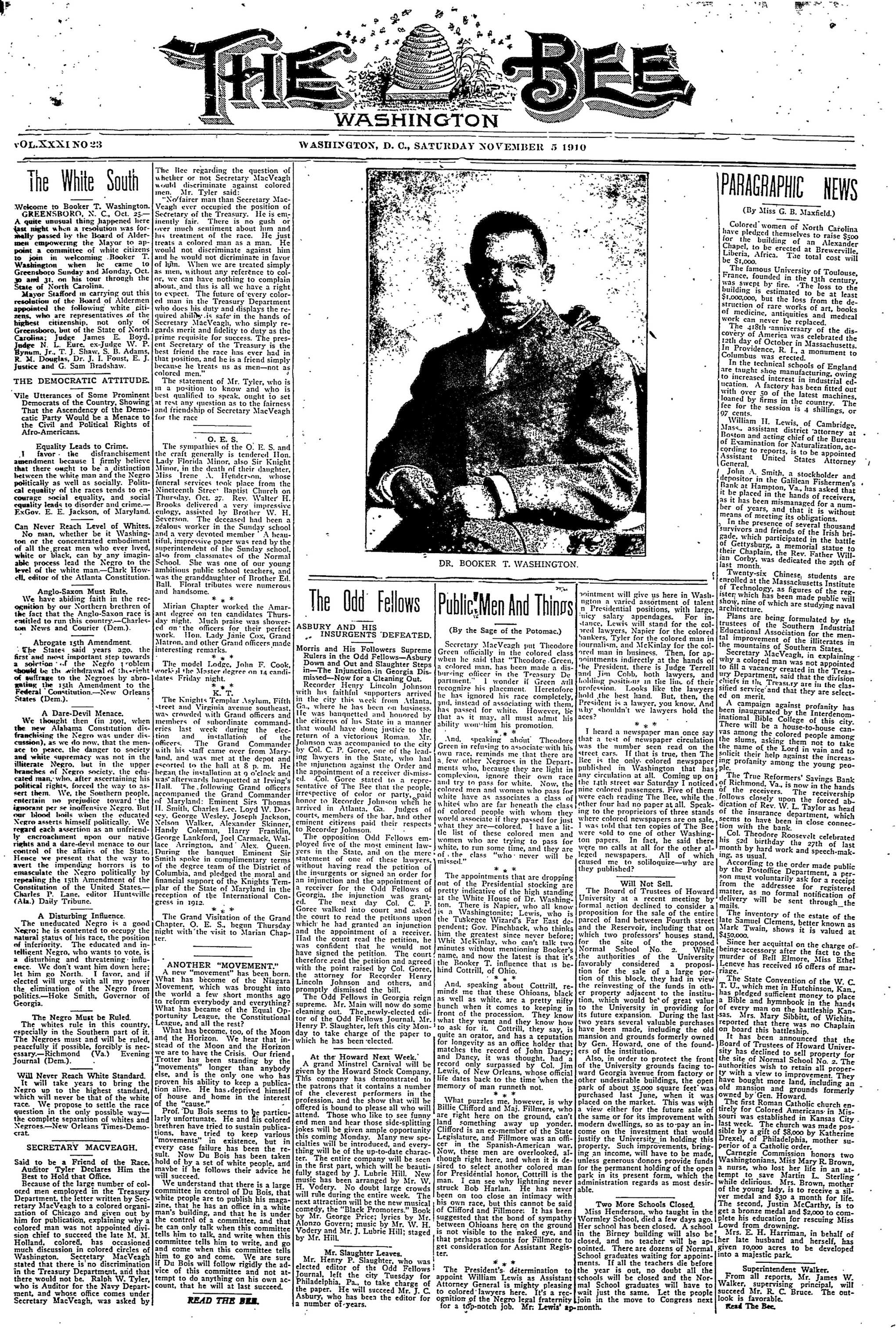
DR. BOOKER T. WASHINGTON
Public Men And Things
(By the Sage of the Potomac.)
Secretary MaeVeagh put Theodore Green officially in the colored class when he said that "Theodore Green, a colored man, has been made a disbursement officer in the Treasury Department." I wonder if Green will recognize his placement. Heretofeo he has ignored his race completely, and, instead of associating with them, has passed for white. However, he that as it may, all must admit his ability wow him his promotion.
\*\*\*
And, speaking about Theodore Green in refusing to associate with his own race, reminds me that there are a few other Negroes in the Departments who, because they are light in complexion, ignore their own race and try to pass for white. Now, the colored men and women who pass for white have as associates a class of whites who are far beneath the class of colored people with whom they world associate if they passed for just what they are—colored. I have a little list of these colored men and women who are trying to pass for white, to run some time, and they are of the class "who never will be missed."
\*\*\*
The appointments that are dropping out of the Presidential stocking are pretty indicative of the high standing at the White House of Dr. Washington. There is Napier, who all know is a Washingtonite; Lewis, who is the Tuskegee Wizard's Far East dependent; Gov. Pinchback, who thinks him the greatest since never before; Whit McKinlay, who can't talk two minutes without mentioning Booker's name, and now the latest is that it's the Booker T. influence that is behind Cottrill, of Ohio.
* * *
And, speaking about Cottrill, reminds me that these Ohioans, black as well as white, are a pretty nifty bunch when it comes to keeping in front of the procession. They know what they want and they know how to ask for it. Cottrill, they say, is quite an orator, and has a reputation for longevity as an office holder that matches the record of John Dancy; and Dancy, it was thought, had a record only surpassed by Col. Jim Lewis, of New Orleans, whose official life dates back to the time when the memory of man runneth not.
***
What puzzles me, however, is why Billie Clifford and Maj. Fillmore, who are right here on the ground, can't land something away up yonder. Clifford is an ex-member of the State Legislature, and Fillmore was an officer in the Spanish-American war. Now, these men are overlooked, although right here, and when it is desired to select another colored man for Presidential honor, Cottrill is the man. I can see why lightning never struck Bob Harlan. He has never been on too close an intimacy with his own race, but this cannot be said of Clifford and Fillmore: It has been suggested that the bond of sympathy between Ohioans here on the ground is not visible to the naked eye, and that perhaps accounts for Fillmore to get consideration for Assistant Register.
\*\*\*
The President's determination to appoint William Lewis as Assistant Attorney General is mighty pleasing to colored lawyers here. It's a recognition of the Negro legal fraternity for a top-notch job. Mr. Lewis' an
pointment will give us here in Washington a varied assortment of talent in Presidential positions, with large, juicy salary appendages. For instance, Lewis will stand for the colored lawyers, Napier for the colored bankers, Tyler for the colored man in journalism, and McKinlay for the colored man in business. Then, for appointments indirectly at the hands of the President, there is Judge Terrell and Jim Cobb, both lawyers, and holding positions in the line of their profession. Looks like the lawyers hold the best hand. But, then, the President is a lawyer, you know. And why shouldn't we lawyers hold the aces?
\*\*\*
I heard a newspaper man once say that a test of newspaper circulation was the number seen read on the street cars. If that is true, then The Bee is the only colored newspaper published in Washington that has any circulation at all. Coming up on the 14th street oar Saturday I noticed nine colored passengers. Five of them were each reading The Bee, while the other four had no paper at all. Speaking to the proprietors of three stands where colored newspapers are on sale, I was told that ten copies of The Bee were sold to one of other Washington papers. In fact, he said there were no calls at all for the other alleged newspapers. All of which caused me to soliloquize—why are they published?
Will Not Sell.
The Board of Trustees of Howard University at a recent meeting by formal action declined to consider a proposition for the sale of the entire parcel of land between Fourth street and the Reservoir, including that on which two professors' houses stand, for the site of the proposed Normal School No. 2. While the authorities of the University favorably considered a proposition for the sale of a large portion of this block, they had in view the reinvesting of the funds in other property adjacent to the institution, which would be of great value to the University in providing for its future expansion. During the last two years several valuable purchases have been made, including the old mansion and grounds formerly owned by Gen. Howard, one of the founders of the institution.
Also, in order to protect the front of the University grounds facing toward Georgia avenue from factory or other undesirable buildings, the open park of about 35,000 square feet was purchased last June, when it was placed on the market. This was with a view either for the future sale of the same or for its improvement with modern dwellings, so as to pay an income on the investment that would justify the University in holding this property. Such improvements, bringing an income, will have to be made, unless generous donors provide funds for the permanent holding of the open park in its present form, which the administration regards as most desirable.
Two More Schools Closed
Two More Schools Closed. Miss Henderson, who taught in the Wormley School, died a few days ago. Her school has been closed. A school in the Birney building will also be closed, and no teacher will be appointed. There are dozens of Normal School graduates waiting for appointments. If all the teachers die before the year is out, no doubt all the schools will be closed and the Normal School graduates will have to wait just the same. Let the people join in the move to Congress next month.
PARAGRAPHIC NEWS
PARAGRAPHIC NEWS
(By Miss G. B. Maxfield.)
Colored women of North Carolina have pledged themselves to raise $500 for the building of an Alexander Chapel, to be erected at Brewerville, Liberia, Africa. The total cost will be $1,000.
The famous University of Toulouse, France, founded in the 13th century, was swept by fire. The loss to the building is estimated to be at least $1,000,000, but the loss from the destruction of rare works of art, books of medicine, antiquities and medical work can never be replaced.
The 418th anniversary of the discovery of America was celebrated the 12th day of October in Massachusetts. In Providence, R. I., a monument to Columbus was erected.
In the technical schools of England are taught shoe manufacturing, owing to increased interest in industrial education. A factory has been fitted out with over 50 of the latest machines, loaned by firms in the country. The fee for the session is 4 shillings, or 97 cents.
William H. Lewis, of Cambridge, Mass., assistant district attorney at Boston and acting chief of the Bureau of Examination for Naturalization, according to reports, is to be appointed Assistant United States Attorney General.
John A. Smith, a stockholder and depositor in the Galilean Fishermen's Bank at Hampton, Va., has asked that it be placed in the hands of receivers, as it has been mismanaged for a number of years, and that it is without means of meeting its obligations.
In the presence of several thousand survivors and friends of the Irish brigade, which participated in the battle of Gettysburg, a memorial statue to their Chaplain, the Rev. Father William Corby, was dedicated the 29th of last month.
Twenty-six Chinese students are enrolled at the Massachusetts Institute of Technology, as figures of the register which has been made public will show, nine of which are studying naval architecture.
Plans are being formulated by the trustees of the Southern Industrial Educational Association for the mental improvement of the illiterates in the mountains of Southern States.
Secretary MacVeagh, in explaining why a colored man was not appointed to fill a vacancy created in the Treasury Department, said that the division chiefs in the Treasury are in the classified service and that they are selected on merit.
A campaign against profanity has been inaugurated by the Interdenominational Bible College of this city. There will be a house-to-house canvas among the colored people among the slums, asking them not to take the name of the Lord in vain and to solicit their help against the increasing profanity among the young people.
The True Reformers' Savings Bank of Richmond, Va., is now in the hands of the receivers. The receivership follows closely upon the forced abdication of Rev. W. L. Taylor as head of the insurance department, which seems to have been in close connection with the bank.
Col. Theodore Roosevelt celebrated his 52d birthday the 27th of last month by hard work and speech-making, as usual.
According to the order made public by the Postoffice Department, a person must voluntarily ask for a receipt from the addressee for registered matter, as no formal notification of delivery will be sent through the mails.
The inventory of the estate of the late Samuel Clemens, better known as Mark Twain, shows it is valued at $450,000.
Since her acquittal on the charge of being accessory after the fact to the murder of Bell Elmore, Miss Ethel Leneve has received 16 offers of marriage.
The State Convention of the W. C. T. U., which met in Hutchinson, Kan., has pledged sufficient money to place a Bible and hymnbook in the hands of every man on the battleship Kansas. Mrs. Mary Sibbitt, of Wichita, reported that there was no Chaplain on board this battleship.
It has been announced that the Board of Trustees of Howard University has declined to sell property for the site of Normal School No. 2. The authorities wish to retain all property with a view to improvement. They have bought more land, including an old mansion and grounds formerly owned by Gen. Howard. The first Roman Catholic church entirely for Colored Americans in Missouri was established in Kansas City last week. The church was made possible by a gift of $8,000 by Katherine Drexel, of Philadelphia, mother superior of a Catholic order. Carnegie Commission honors two Washingtonians, Miss Mary R. Brown, a nurse, who lost her life in an attempt to save Martin L. Sterling while delirious. Mrs. Brown, mother of the young lady, is to receive a silver medal and $30 a month for life. The second, Justin McCarthy, is to get a bronze medal and $2,000 to complete his education for rescuing Miss Lowd from drowning.
Mrs. E. H. Harriman, in behalf of her late husband and herself, has given 10,000 acres to be developed into a majestic park.
Superintendent Walker.
From all reports, Mr. James W. Walker, supervising principal, will succeed Mr. R. C. Bruce. The outlook is favorable.
Read The Bee
Andante legato.
1. Low gently over the drowsy world, God draws the veil of sleep,
2. Tis in the night, the starry night. When all is still and sweet,
Good
softly the ae-tri-al dews, The leaves and blos some steep.
angels in holy land With hu-man spirit its meet,
world worn heart, oh, careful breast,
soul's whorl earthly woes o'er-whelm,
soul's whom earthly woes o'er-whelm, Ye
ritard.
p ritard.
dim.
tired eyes... ye too may find... this bless ed calm.
American Melody Co. N. Copyright
Kenyon
$15
Men
Suit
When you seek economy,
ask your merchant to show
you this $15 Suit. Compare it with one
that costs $25, and see wherein lies the
difference. It does not lie in the wearing
qualities, surely not in the style and fit.
The great difference is one of price,
caused by more than one reason—made
in the largest factories of their kind in
the world.
C. Kenyon Co., 23 Union Sq., N.Y.
$15
Men's
Suits
seek economy,
echant to show
share it with one
wherein lies the
in the wearing
style and fit.
one of price,
reason—made
of their kind in.
B Union Sq., N.Y.
B. Reduso
CORSETS
Kenyon $15 Men's Suits
When you seek economy, ask your merchant to show you this $15 Suit. Compare it with one that costs $25, and see wherein lies the difference. It does not lie in the wearing qualities, surely not in the style and fit. The great difference is one of price, caused by more than one reason—made in the largest factories of their kind in the world.
C. Kenyon Co., 23 Union Sq., N.Y.
THE W. B. Reduso Corset brings well-developed figures into graceful, slender lines. It reduces the hips and abdomen from one to five inches. Simple in construction, the Reduso unhampered by straps or cumbersome attachments of any sort, transforms the figure completely.
Fabrics are staunch woven, durable materials, designed to meet the demand of strain and long wear. There are several styles to suit the requirements of all stout figures.
Fabrics are staunch woven, durable materials, designed to meet the demand of strain and long wear. There are several styles to suit the requirements of all stout figures.
Style 770 (as pictured) medium high bust, long over hips and abdomen. Made of durable coutil or batiste, with lace and ribbon trimming. Three pairs hose supporters. Sizes 19 to 36. Price $3.00.
Other REDUSO models $3.00 per pair upwards to $10.00.
t Form Corsets—in a series of per $1.00 upwards to $5.00 per pair. stores, everywhere. ers, 34th St. at Broadway, New York
W. B. Nuform and Erect Form Corsets-fect models, for all figures, $1.00 upwards
Sold at all stores, everyw
WEINGARTEN BROS., Makers, 34th St. at
W. B. Nuform and Erect Form Corsets—in a series of perfect models, for all figures, $1.00 upwards to $5.00 per pair.
Sold at all stores, everywhere.
WEINGARTEN BROS., Makers, 34th St. at Broadway, New York
es
l,
ips
es.
o
quire-
THE HUMAN RACE.
Will Man Simply Shrink Off the Face of the Earth? Asks This Statistician.
A French statistician who has been studying the military and other records with a view of determining the height of men at different periods has reached some wonderful results.
He has not only solved some perplexing problems in regard to the past of the human race, but is also enabled to calculate its future and to determine the exact period when man will disappear from the earth.
The recorded facts extend over nearly three centuries.
It is found that in 1610 the average height of man in Europe was 1.75 meters, or, say, five feet nine inches. In 1700 it was five feet six inches. In 1820 it was five feet five inches and a fraction. At the present time it is five feet three and three-quarter inches. It is easy to deduce from these figures a rate of regular and gradual decline in human stature and then apply this, working backward and forward, to the past and to the future. By this calculation it is determined that the stature of the first men attained: the surprising average of sixteen feet nine inches.
Truly, there were giants on the earth in those days. The race had already deteriorated in the days of Og, and Goliath was a quite degenerate offspring of the giants. Coming down to later time, we find that at the beginning of our era the average height of man was nine feet, and in the time of Charlemagne it was eight feet eight inches. But the most astonishing result of this scientific study comes from the application of the same inexorable law of diminution to the future. The calculation shows that by the year 4000 A. D. the stature of the average man will be reduced to fifteen inches. At that epoch there will be only illuminants on the earth. And the conclusion of the learned statistician is irreversible that "the end of the world will certainly arrive, for the inhabitants will have become so small that they will finally disappear"—"finish by disappearing," as the French idiom expresses it—"from the terrestrial globe"—London Tit-Bits.
GOT AHEAD OF PITT
The Ruse by Which George III. Outwitted His Presider.
On Jan. 10, 1805, Dr. Mennon-Button, Bishop of Norwich, was giving a dinner party in his Windsor demeany when his butler informed him that a gentleman wished particularly to see him, but would not give his name.
"Well, I can't come now in the middle of dinner" said the thom.
Allegretto grasioso.
No sound is heard, save that you stream, still murmurs to the air,…… L
some soft in interceding wise, That prays a partier
sostenuto.
p crescendo.
prayer,…… O! sleep-less eyes, O! wake-ful heart,
crescendo.
For you are remains this blest part.
poco rilard.
"Beg pardon, my lord," but the gentleman is very anxious to see you on important business," and the butler was so urgent that the bishop apologized to his company and went out. The gentleman who would not be denied proved to be King George III.
"How d'ye do, my lord?" said he. "Come to tell you that you're archbishop of Canterbury—archbishop of Canterbury. D'ye accept—accept? Eh, eh?"
The bishop bowed low in token of acceptance.
"All right." said his majesty. "You've got a party—see all their hats here. Go back to them. Good night."
Next morning Pitt appeared at Windsor castle to inform his majesty that Archbishop Moore had died the day before and to recommend the bishop of Lincoln, Dr. Prettyman, for the vacant primacy.
"Very sorry, very sorry, indeed, Pitt," said the king, "but I offered it to the bishop of Norwich last night, and he accepted. Can't break my word."
Pitt was very angry, but the dead was done, as the king meant it should be, and so Dr. Manners-Sutton became archbishop of Canterbury and held the great office for twenty-three eventful years.—Michael McDonagh in Chambers' Journal.
Where to Purchase the Bee.
The "Washington Bee" is on sal
at the following named places:
Dr. A. S. Gray, 12th and You St
N. W.
Drs. Board and McGuire, 1912 1-
14th Street. N. W.
E. Throckmorton, 1500 14th Street
N. W.
Dr. Walter C. Simmons, 1000.201
Street N. W.
Dr. William Davis, 11th and You
Streets N. W.
Send in your subscription at once
for The "Bee" 2507 P street, agency.
Dr. Singleton's drug store, 20th and
E. Street N. W.
Joseph Davis, 1020 U Street N. W.
Steele's Dairy Lunch Room, 1900 L
Street N. W.
Southwest.
Charles E. Smith, 312 G St. S. W
Out of town agents:
E. D. Burts, 2636 State Street, Chicago, Ill.
J. H. Gray, 1232, Pine Street, Phil adelphia, Pa.
WANTED—A RIDER AGENT IN EACH TOWN and disables them from making money fast. Write for full portability and special offer at once.
NO MUSIC ENQUIRY until you receive and approve of your bicycle. We ship to pursue anywhere in the U.S. without a cent deposit in advance, greeting freight, and allow TEN DAYS' durability during which time you may ride the bicycle and put it to any test you wish. If you are then not properly insured or do not wish to keep the bicycle shop you pick up at our expense and you sell, not on our contract.
FACTORY PRICES. We install the highest grade bicycles. It is possible to make up to 50% of our profits by buying grade of us and have the manufacturer's guarantee behind your bicycle. DO NOT BUY a bicycle or a pair of three tron anyone at any price until you receive our catalogues and learn our unbonded of factory grinds and rename handle special offers to rider aquatic.
YOU WILL BE ASTONISHED when you receive our beautiful catalogue and study our super models at the wonderfully low prices we can make you pay now. We sell the highest grade bicycles for less money than any other factory. We are equipped with 30 per cent above factory cost.
BUCTLEY DILL FIRE. You can sell our bicycles under your own name plate at double RECORD HAND BICYCLES. We do not regularly handle second hand bicycles, but usually have a number on hand in order for our learner stores. These we clear out.
RECORD HAND BICYCLES. We do not reworry handle second hand bicycles, but usually have a number on hand taken in trade by our Chicago retail stores. These we clear out power at prices ranging from $6 to $3 or $10. Descriptive bargains lets mark free. COASTER-BIKES. Complement of all kinds of bicycles, parts, repairs and maintenance.
8 50 HEDGETHORN PUNCTURE-PROOF 4 80 SELF-HEALING TIRES A SAMPLE PAIR 79 INTRODUCE, ONLY
```markdown
```
a special industry of retail.
porous and thick fabrics, a small penetration without allow-
ports and a small penetration with small penetration.
We have hundreds of letters from sat-
titude customers stating that their threes have only been pumped
up once or twice in a whole season. They weigh no more than
an ordinary two, the pressure remaining qualifies being given
by several layers of fabric, specially prepared fabric on the
tissue. The regular price of these tapes is 9.90 per pair, but for
advertising purposes we are making a special factory price to
the rider of only two per pair. All orders shipped same day letter is received. We ship C. O. D. on approval. You do not pay a cent until you have examined and found them strictly as represented. We will allow a cash discount of 5 per cent (thereby making the price $4.55 per pair) if you send FULL CASH WITH ODDER and enclose that advertisement. We will also send one paired plaque brass hand pump. Tires to be reinstated at OBE expense if for any reason they are not satisfactory on examination. We are perfectly reliable and money sent to us is as safe*a in a bank. If you order a pair of these tires, you will find that they will ride easier, run faster, wear better, last longer and look finer than any tire you have ever used or seen at any price. We know that you will be so well pleased that when you want a bicycle you will give us your order. We want you to send us a trial order at once, hence this remarkable tire offer.
FOR YOU
IF YOU LIKE PERFUME
Send only 4¢ in stamps for a little sample of
ED. PINAUD'S
LILAC VEGETAL
The latest Paris perfume craze
A wonderful creation, just like the living blossoms. Ask your
dealer for a large bottle -- 75c. (6 oz.) Write our American Offices
to-day for the sample, enclosing 4c. (to pay postage and packing).
Parfumerie ED. PINAUD, Dept. M
ED. PINAUD BLDG. NEW YORK
The regular retail price of these loves is
$50 per pair, but to introduce the new
will you please paint for $12.95 each or order $15.
NO MORE TROUBLE FROM PROTOCLES
NAILS, Tacks or Glass will not let the
air out. Sixty thousand pairs sold last year.
Over two hundred thousand pairs now in use.
DESCRIPTION: Made in all places. It is lively
and easy painting, very durable and hand made
Notice the thick rubber tread "A" and puncture stripe "B" and "D," also rim strip "H" to prevent rim cutting. This makes moke-NFT, ELASTIC and EASY RIDING.
Starting Rapidity With Which the Mind Works In Sleep.
SOME STRANGE EXPERIENCES
The Events of a Whole Lifetime May
Filt Past the Dreamer In a Few Moments—Quer Results of a Dream
Experiment by a Noted Psychologist
A characteristic of dreams which, as the rather materialistic Dr. Clarke says, "hints at a life that has neither beginning nor end and is bounded by no limits which human thoughts can occupy" is the rapidity with which events happen in the dream world. Thus, when asleep and dreaming, we live an entire lifetime in a minute; in a space of time that is scarcely more than a second we pass through experiences that could not be duplicated in this objective sphere in hours, perhaps in years.
Ocunt Levalette relates that one night, when imprisoned and under sentence of death, he dreamed that he stood for five hours at a Paris street corner, where he witnessed a continuous succession of harrowing scenes of blood, every one of which wrought his soul to the highest pitch of excitement. When he woke he found that he had been asleep less than two minutes.
In a more recent experiment, made expressly to test the truth of those theories, the subject was aroused from sleep by a few drops of water being sprinkled upon his forehead. It took but an instant to accomplish this result, and yet in that incalculably brief space of time the man dreamed of going on an excursion; of an accident by which he was plunged into a lake, and during the long struggle to escape death that followed all the experiences of his life seemed to flash before him, just as they are said to appear to a person who is actually drowning.
Dreams are tricksters. Professor Titchener of Cornell university told with gusto of his experience. As a specialist in psychology he interested himself in dreams. Like a true scientist, he once set about gathering data. He wanted to know what caused dreams, where they came from, what they meant, and all that. He determined to watch himself when he slept and to awake himself at once when he found himself dreaming something of value. 50, with a notebook on a writing table near his bed, he forced himself to waken for several nights and to write down, while the dream impressions were vivid, his remembrances of the details and by a study of the room, the bed and his physical condition to attempt to arrive at the possible causes of his dreams.
He was getting on famously. One night he had a particularly vivid dream. In accordance with his practice, he forced himself to awake and immediately write 'down clearly everything about it, then went back to sleep again. The next morning he arose and was astounded to see that his note sheet was blank. He remembered positively the notes he had set down thereon in the middle of the preceding night. The next night again he wrote down his notes after his dreams, only to have the same uncanny sensation the next morning at finding nothing recorded.
The strange circumstances set him to pondering. That night he impressed upon his mind before dropping off into slumber that he must awaken with his first dream, or, if not with that, with his second dream. Subsequently this strong autesleeping command delivered to himself was present all through his dream consciousness. When the first scenes of a vivid dream came before his fancy he felt himself awaken, and he set about writing down the facts upon the pad at his table.
It was then that from some source of inner consciousness he felt the command again to awake, although he seemed at the time to be in full possession of his normal facilities. His eyes opened, and the secret was out. He found himself lying in bed, where he had been all that night. His rising after each dream had become so much a routine that he had dreamed that he had arisen and had made the notes, and his dream was so clear that it seemed reality. Outing Magazine.
Pet's Deficiencies.
Mrs. McCarthy's husband went out in a boat alone. The boat overturned, and he was drowned. A friend met her some weeks later.
"I hear," said he, "that Pat left you very well off—that he left you $20,600."
"True," said Mrs. McCarthy; "he did."
"How was that?" asked her friend. "Pat could not read or write, could he?
"No," said Mrs. McCarthy, "nor could—New York Press."
Good Reason Why.
The Woman Hater—Can you explain why it is that a woman hardly ever thanks a man for giving her his seat in a street car? The Man Hater—Easily, sir! It's because she hardly ever gets the chance—Brooklyn Life.
Almost Got It.
"Is there any difference in the meaning of the words 'nautical' and 'marine?" arked Mr. Malaprop.
"Not much," replied Mrs. Malaprop.
"One is a chinamon of the other."—Chicago Record-Herald.
True dignity is never gained by place and never lost when honors are withdrawn—Massinger.
LATHAM'S HOME RUN
And How It Figured In Having Him Dubbed "the Dude," as Told by Charley Comiskey.
Charley Comiskey told the story of how Arile Latham came to be called "the dude."
"One spring during Latham's term of service with the good old St. Louis Browns," said Comiskey, "the jumped into the opening game of the season and won us a victory by knocking out a home run in the last inning. Chris von der Ahe from his place in the grand stand saw Arile make his sensational hit and naturally enthused. After the game 'der boss president' entered the clubhouse and in that peculiar dialect of his said to Latham:
"Arlie, my poy, you must be glad that I, Chris, was proud mit you, an' I will show you vat my feelings is by giving you the present of somedings for you to wear on yourself. Take dis order on mine own tailor an' go an' dress up yourself."
"Chris' order on the tailor read something like this:
"Give to Arlie der tings vat he buys, an' send to me der bill."
"Latham didn't do a thing on the strength of that order but replenish his wardrobe. For three days in succession he showed up at the ball park in a fine makeup, and every suit of clothes was brand new. On the fourth day Chris got a bill from the clothing people for $100. Naturally he sent for Latham and demanded an explanation.
"Why, Chris, old pal," said Lath, "there's nothing to explain. Didn't you agree in that order you gave me to pay for what I bought, and haven't I just begun to buy? Why, old pal, I have only got three suits and expect to be measured for another this afternoon. What's wrong?
"Arlia," replied Von der Abe, "you was de one infernal dude in de pixies, I vill bill bill pay, but you vill yourself go to der tailor an' mit him explain vot I dink of der impudence of you yourself. You vill also stop mit de clothes you now have on an' do no more mit such foolishmees on der man vot pays your salary. Arle, you was one dude, an' if you play mit any errors dis afternoon I vill myself fine you all der bootiful clothes you have yourself bought."
"From that day Latham became known to the baseball world as 'the dude.'"
A. Curloe Structure.
On the road from Clifton downs to Avonmouth the traveler will pass, in the Avon gorge, a curious structure to which a singular tradition is attached, relates the London Tatler. The story is that a person named Cook about a century ago was told by a gypsy in the Leigh woods that his only son would be killed by a serpent before he reached the age of twenty-one. To avert this he built a high tower and shut his son in the topmost room with the intention of secluding him there until the fatal age was passed. However, by accident a viper was taken up in a fagot to the room to light the fire, and it crept from the fagot and bit the boy so that he died. Therefore the tower was called Cook's Folly, and that is its name to this day, whatever is the true explanation.
An Ignoble Use.
Washington Irving in "Crayon Papers" says: "I was once at an evening entertainment given by the Duke of Wellington at Apsley House to William IV. The duke had manifested his admiration of his great adversary, Napoleon, by having portraits of him in different parts of the house. At the bottom of the grand staircase stood the colossal statue of the emperor by Canova. It was of marble in the antique style, with one arm partly extended, holding a figure of Victory. Over this arm the ladies in tripping upstairs to the ball had thrown their shawls. It was a singular office for the statue of Napoleon to perform in the mansion of the Duke of Wellington!
Imperial Caesar, dead and turned to clay, etc.
The Elder That Sword
An elder of the kirk, having found a little boy and his sister playing marbles on Sunday, put his reproof in this form, not a judicious one for a child: "Boy, do you know where children go who play marbles on Sabbath day?"
"Ay," said the boy. "They gang down to the field by the water below the brig."
"No," roared out the elder; "they go to hell and are burned."
The little fellow, really shocked, called to his sister: "Come awa', Jeanie. Here's a man swearing awfully."—"Beminiscences of Dean Bemay."
Hata sa Alda to Matrimony
"The wise woman is as careful about the choice of a hat as she is about the choice of a husband." The celebrated author who uttered this dictum may have exaggerated a little, but not much. And allow me, a woman, to tell you solemn men whom I see sneering at the "frivolity" of my sex that often the cleverest among you chooses a wife for no better reason than that the woman thus selected has herself chosen a becoming hat—Mma. C. De Broustelles in Grand Magazine.
Seeking Better
Darky (boarding a train)—I heard 'bout youh wife dyn', Jim. What yo'gwine now?
'To off to join de Mormons. He keeps one woman bustlin' too much to support a heavy eatth lak me."—Life.
To speak or write Nature did not peremptorily order these; but to work, she did—Caryls.
One of the Most Notable Scenes In the History of the War-The Parting of Comrades.
Men who saw the defeated general when he came forth from the chamber where he had signed the articles of capitulation say that he paused a moment as his eyes rested once more on the Virginia hills, smote his hands together as though in some excess of inward agony, then mounted his gray horse, Traveler, and rode calmly away.
If that was the very Gethsemane of his trials, yet he must have had then one moment of supreme, if chastened, joy. As he rode quietly down the lane leading from the scene of capitulation he passed into view of his men—of such as remained of them. The news of the surrender had got abroad, and they were waiting, grief stricken and dejected, upon the hillsides when they caught sight of their old commander on the gray horse. Then occurred one of the most notable scenes in the history of the war. In an instant they were about him, bare-headed, with tear wet faces, thronging him, kissing his hand, his boots, his saddle; weeping, cheering him amid their tears, shouting his name to the very skies. He said: "Men, we have fought through the war together. I have done my best for you. My heart is too full to say more."—From "Robert E. Lee, the Southern."
ERROR MEANT DEATH.
Typesetters and Proofreaders on Chinese Paper Careful.
China, with all its vast population, boasts not quite two dozen daily papers, but among them are the two oldest papers in the world. The Kin Pan used to be considered by Europeans the oldest paper, but it has been issued a mere thousand years. The Tsing Pao, or Pekin News, was first published 560 years before the Norman conquest and has been issued without intermission for nearly 1,400 years. The Tsing Pao has the appearance of a yellow backed magazine of twenty-four octavo pages, each page containing seven columns, consisting of seven "characters."
Two editions are published—an edition de luxe for the court and the upper classes at a cost of 24 cents a month, and an edition inferior in paper and printing, costing 16 cents a month. It has a circulation of about 10,000 and is really the principal paper of China, chronicling the movements of the emperor and of the court and printing the ministerial reports. It is probably the most exact newspaper in the world. The punishment for an error in printing was until recently, at least, instant death.—New York Times.
Old London Cookshops.
Mediaeval London, besides being a "city of taverns," was famous for its cookshops, such as the place on the river bank described by Fitzstephen in the thirteenth century: "There every day ye may call for any dish of meat, roast, fried or sodden, fish both small and great, venison and fowl. If friends come upon a sudden wearied with travel to a citizen's house and they be loath to wait for curious preparations and dressings of fresh meat let the servant run to the water side, where all things that can be desired are at hand." This particular place of public cookery apparently did an indoor as well as an outdoor trade, for Fitzstephen further described it as being used both day and night by "multitudes of soldiers or other strangers who refresh themselves to their content on roast goose, the fowl of Africa and the rare gadwit of Ionia." But what were the two last mentioned vlands?—London Chronicle.
Sickroom Mirrers.
"Only a hand mirror should find place in a sickroom," said a doctor, "and it should be one flattering to the patient—the kind, for instance, which if the face is too broad will lengthen it a little. And the patient should only be allowed to look in the mirror at propitious times. Many a patient has been frightened literally to death by his haggard reflection—has looked, sighed and renounced hope. But many another patient in a really bad way—really desperate, too—being given a look at himself just after he has taken a stimulant has bucked up wonderfully. In fact, a sickroom mirror wisely bandled is a curative agent, while recklessly handled it may kill."
His Usual Way.
The new waitress sidled up to a dapper young man at the breakfast table, who, after glancing at the bill, opened his mouth, and a noise issued forth that sounded like the ripping off of all of the cogs on one of the wheels in the power house. The new waitress made her escape to the kitchen. "Fellow out there insulted me," she said. The head waiter looked at him. "I'll get it," he said. "That's just the train caller ordering his breakfast."—Argonaut
Improved.
"How do you like your alarm clock?"
asked the jeweler.
"First rate."
"You didn't seem pleased with it at first."
"The spirit of your husband wishes to speak with you, madam."
"What does he say?
"He says that he doesn't have to dress in a cold room." - Bohemian.
Crushed Again.
Mrs. Denham—Do you think that I shall be a good looking old woman? Denham—I don't know why you should expect any such radical change.—New York Press.
MCCALL PATTERNS
10
AND
15
HOME RIGHTS
MCCALLS MAGAZINE
50
YEAR
WITHING A FREE PATTERN
McCALL PATTERNS
McCALL FASHION
C. Coatings for style perfect fit, simplicity and
reliability make 40 years. Sold in nearly
every city and town in the United States and
Canada, or by mail direct. More sold than
any other make. Send for free catalogue.
McCALL'S MAGAZINE
More subscribers than any other fashion
magazine—million a month, Invaluable, Latest
styles, patterns, dressmaking, mallinery,
plain sewing, needlework, head dressing,
quilted garments, On y 50 cents a
year (worth double), including a free pattern.
Subscribe today or send for sample copy.
WONDERFUL INDUCEMENTS
to Avenues. Postal brings price to ogue
and cash prize of s. Adams.
McCALL CO., 238 to 243 W. 37th St. NEW YORK
THE BEE AND McCALL'S GREAT
FASHION MAGAZINE
for one year for place.
COUPON.
Editor Bee—
Find enclosed two dollars. Send to my address below The Bee and McCall's Fashion Magazine for one year.
No.....
Street.....
Town or City....
BUY THE
NEW HOME
LIGHT RUNNING
SEWING MACHINE
Before You Purchase Any Other Write
THE NEW HOME SEWING MACHINE COMPANY
ORANGE, MASS.
Many Sewing Machines are made to sell regard- of quality, but the "New Home" is made weas. Our guarerly never runs out. We make Sewing Machines to suit all conditions of the trade. The "New Home" stands at the head of all High-grade locally sewing machines sold by authorized dealers only.
FOR SALE BY
Go to HOLMES' HOTEL,
No. 333 Virginia Ave., S.W.
Rent Afro-American Accommodation in the District.
EUROPEAN AND AMERI- PLAN.
Good Rooms and Lodging, 50,
75c. and $1.00. Comfortably
Heated by Steam. Give
us a Call
James Otoway Holmes, Prop.
Washington, D. C.
Mam Phone 2312.
CHINA'S GRAND CANAL
At Times It Holds Water Enough to Float Boats, but Usually They Are Dragged Over Mud Banks.
Of some of the crude and outgrown methods used on China's Grand canal a writer in the North China Daily News remarks: "The junction of the real canal with the Wei river was not by means of a lock, but simply a high and steeply sloping mod bank, over which the grain vessels had to be dragged by the force of perhaps many hundreds of men. It should be borne in mind that in China the lock of a canal is not much more like our idea of what that name connects than it is like a padlock. Amid constant and often serious changes of level, with an uncertain and not infrequently a scanty supply of water, and with a grain fleet which traveled in blocks of some eighty vessels under one officer, it was necessary to devise some way for keeping them together and for transferring them as a consolidated unit with this in view.
"For this reason a Chinese lock on the Grand canal is nothing but a stone gateway into which large boards may be lowered through a groove in the stones, restraining most of the water from its flow, until there is a depth sufficient to float all the craft, when the boards are pulled up and the entire foot passes through.
"After this the boards are again lowered for another division of the grain boats. In case the water gives out—a by no means unlikely occurrence—there is nothing to do but to wait until more comes from somewhere."
Crum 4x.
Take one quart of dough from the bread in the early morning, break three eggs, separating whites from yolks, whip both to a light froth, mk into the dough and gradually add in-kow warm water till the consistency griddle cakes. Beat well and let rise till breakfast time, then have the griddle hot and well greased, pour on the batter in small cakes and bake brown
WORTH ADVERTISING FOR
There are 5,499 Negroes employed here in Washington, the Government alone, and these 5,499 Negroes draw the aggregating $3,044,404. These more than three million are spent right here in Washington, but scattered at hundreds of tradesmen. Is this amount of money wading for? It certainly is, and not even the largest city would refuse to get the big end of it did they know much money the Negroes are really spending.
Now The Bee is the only Negro publication in the stands without a rival or competitor, and covers the few of the merchants in this city will patronize the advertisers of The Bee, presenting the attractive bargains they these Negroes — those 5,499 Negroes who draw annual Government over three millions of dollars — will assume a remitting a publication edited and operated by one of the such firms desire and deserve their patronage. And such receive the bulk of these over three millions of dollars re-spent by the Negroes of Washington.
What clothing stores, what furniture stores, what dry goods and what other lines of business will now make an effort themselves these over three millions of dollars spent by Negroes by advertising in The Bee?
Place your advertising in The Bee and watch those 5,499 Negroes spend their over three millions of dollars with Now is the time to advertise in The Bee, the newspaper into every Negro home in Washington. Remember, meet Washington, it's what advertising pays you, not what it is.
employed here in Washington by 5,499 Negroes draw salaries agon- than three millions of dollars, but scattered among the amount of money worth half-even the largest stores in the end of it did they but send the really spending. Pro publication in this city. It stor- and covers the field like a will patronize the advertising interactive bargains they may have, those who draw annually from the dollars — will assume that by put created by one of their name that advertisage. And such forms will millions of dollars received and in. house stores, what dry goods stores now make an effort to divert so of dollars spent by Washington?
and watch those 5,499 appoin- millions of dollars with you. The Bee, the newspaper that goes on. Remember, merchants of days you, not what it costs.
There are 5,499 Negroes employed here in Washington by the Government alone, and these 5,499 Negroes draw salaries aggregating $3,044,404. These more than three millions of dollars are spent right here in Washington, but scattered among the hundreds of tradesmen. Is this amount of money worth building for? It certainly is, and not even the largest stores in this city would refuse to get the big end of it did they but send how much money the Negroes are really spending.
Now The Bee is the only Negro publication in this city. It stands without a rival or competitor, and covers the field like a few of the merchants in this city will patronize the advertising columns of The Bee, presenting the attractive bargains they may have, those Negroes — those 5,499 Negroes who draw annually from the Government over three millions of dollars — will assume that by put remitting a publication edited and operated by one of their mone that such firms desire and deserve their patronage. And such firms will receive the bulk of those over three millions of dollars received and spent by the Negroes of Washington.
What clothing stores, what furniture stores, what dry goods stores and what other lines of business will now make an effort to divers to themselves those over three millions of dollars spent by Washington Negroes by advertising in The Bee?
Place your advertising in The Bee and watch those 5,499 appositive Negroes spend their over three millions of dollars with you.
MORE MONEY—RACE PROGRESS
If colored people groom themselves daintly, destruction odors, remove grease shine from the face, and we discoveries for improving the skin and dressing them will be better received in the business world, more money, and advance faster.
The Chemical Wonder Company of New York is business friend colored people have. It improves the as Dr. Booker Washington improves their minds. Company manufacturers nine Chemical Wonders, which colored people as attractive as individual peculiarities mit. Colored men in New York who use these Wonder better situations in banks, clubs and business houses men have better positions, marry better, get along better.
(1.) Complexion WonderCream will light up a face (black or brown) every time it is used. To prove one trial, we send demonstration sample for 10 cents jar, 50 cents postpaid.
(2) Magneto-Metallic Comb, called Wonder Cone be heated before using, to help straighten and dress Costs 50 cents, and will last a lifetime.
(3) Wonder Uncrel. When this pomade dressing hair the kinks can be uncurled and the hair become. When heated into the scalp and through the hair wider Comb, any stiff, knotty hair will dress well. 50 cents paid.
(4) Wonder Hair Grow fertilizes the scalp and hair grow long, just as fertilizers in the soil make grow. 50 cents postpaid.
(5) Odor Wonder. Powder instantly destroys odor. People who neglect such chemical cleansingious. 50 cents postpaid.
(6) Odor Wonder Liquid. This fine toilet water the body with delicate perfume. When used with Odor Wonder Powder the conditions of the body befect. If you can spare 50 cents extra, order this 50 cents postpaid.
(7) Wonder Foot Powder keeps the feet dainty postpaid.
(8) Wonder Wash. A shampoo to clean from and insure the health of the hair and scalp. 50 cents.
(9) Shell Pink Creme will give light brown girl pink cheeks without made-up appearance. 50 cents. We guarantee all these Wonders as represented.
We give advice free about hair, skin and scalp.
many of New York in the best wave. It improves their bodies, improves their minds. That Consul Wonders, which will make individual peculiarities will per who use these Wonders hold and business houses, and not better, get along better. Dream will light up any culture it is used. To prove this pec sample for 10 cents. Regularly called Wonder Comb. Can straighten and dress the hair. lifetime. This pomade dressing is in the and the hair becomes flexible through the hair with a Wonder will dress well. 50 cents post- fertilizes the scalp and makes skin the soil make cornstalks instantly destroys peruption chemical cleansing are obnoxious. This fine toilet water surrounds When used with used with portions of the body become peruxtra, order this luxury. 50 keeps the feet dainty. 50 cents, shampoo to clean from dandruff and scalp. 50 cents postpaid live light brown girls beautiful appearance. 50 cents postpaidders as represented. hair, skin and scalp. less free. business friends of colored par- my locality and guarantees peru required. Mer & Co., a Rector Street, Newal Wonder Company prepa- sure Drug Store
If colored people groom themselves daintly, destroy persecution odors, remove grease shine from the face, and use new discoveries for improving the skin and dressing the hair, they will be better received in the business world, make more money, and advance faster.
The Chemical Wonder Company of New York is the best business friend colored people have. It improves their bodies as Dr. Booker Washington improves their minds. That Company manufacturers nine Chemical Wonders, which will make colored people as attractive as individual peculiarities will permit. Colored men in New York who use these Wonders hold better situations in banks, clubs and business houses, and women have better positions, marry better, get along better.
(1,1) Complexion WonderCream will light up any colored face (black or brown) every time it is used. To prove this one trial, we send demonstration sample for 10 cents. Bagalm jar, 50 cents postpaid.
(2) Magneto-Metallic Comb, called Wonder Comb. Can be heated before using, to help straighten and dress the hair. Costs 50 cents, and will last a lifetime.
(3) Wonder Uneurl. When this pomade dressing is in the hair the kinks can be uneurled and the hair becomes flexible. When heated into the scalp and through the hair with a Wonder Comb, any stiff, knotty hair will dress well. 50 cents postpaid.
(4) Wonder Hair Grow fertilizes the scalp and makes hair grow long, just as fertilizers in the soil make cornstalks grow. 50 cents postpaid.
(5) Odor Wonder, Powder instantly destroys perpiration odor. People who neglect such chemical cleansing are obvious. 50 cents postpaid.
(6) Odor Wonder Liquid. This fine toilet water surrounds the body with delicate perfume. When used with used with Odor Wonder Powder the conditions of the body become perfect. If you can spare 50 cents extra, order this luxury. 50 cents postpaid.
(7) Wonder Foot Powder keeps the feet dainty. 50 cents, postpaid.
(8) Wonder Wash. A shampoo to clean from dandruff and insure the health of the hair and scalp. 50 cents postpaid.
(9) Shell Pink Creme will give light brown girls beautiful
(9) Shell Pink Creme will give light brown girls beautiful pink cheeks without made-up appearance. 50 cents postpaid. We guarantee all these Wonders as represented.
Will send book an attractiveness free. We will prove we are true business friends of ople. We require one agent for every locality and gun against loss. Only $2 capital required. Always write to M. B. Berger & Co., a Rector in York. We market all the Chemical Wonder Companions. Richardson's Pure Drug
We will prove we are true business friends of colored people.
We require one agent for every locality and guarantee you against loss. Only $2 capital required.
Always write to M. B. Berger & Co., 2 Rector Street, New York. We market all the Chemical Wonder Company preparations.
Richardson's Pure Drug Store
316 4½ Street, S. W.
Just received a large assignment of fresh drugs collection of very fine toilet preparations, Easter good useiul articles, Just the thing you desire for Easter of Richardson's Old Reliable Pure Drug St
316 4½ Street, S. W.
and 14th and RStreets, N. W.
ment of fresh drugs and a large
curations, Easter goods, and many
desire for Easter offering.
Reliable Pure Drug Store,
Street, S. W.
Streets, N. W.
Just received a large assignment of fresh drugs and a large collection of very fine toilet preparations, Easter goods, and many useful articles, Just the thing you desire for Easter offering. Richardson's Old Reliable Pure Drug Store
ceptional opportunity. This is the county in which The Tuskegee Normal and Industrial Institute is located. There is plenty of good land for sale on easy terms. There is a good schoolhouse, and the school term lasting from seven to eight months in every part of the county. The white people in Macon County are of the very best class. There is no disorder or racial trouble. We advise colored people who are now living in crowded towns or cities, in the North or in the South, and especially those who have children to raise to come to Macon County and buy a home where they can get plenty of land to cultivate and rear their families in the county free from the temptations of the cities and towns.
For further information write or see: Clinton J. Calloway. Real Estate
The commission in charge of the Illinois Hall of Fame, at Champaign, has decided that the late Philip D. Armour is entitled to recognition, owing to his services in promoting the livestock industry in the United States.
Cardinal Logue, the prelate of Ireland, who is in Durham, N. C., to attend the consecration service of St. Patrick's Cathedral, said: "The colored people should have been educated first, then gradually emancipated. It was a mistake to set them free, untutored and helpless.
There are many colored families who are living in crowded houses on small plots of land in towns or cities who want real freedom and real opportunity for themselves and for their children. It is very difficult to rear children in a crowded town or city. The place to rear children is in the country. In Macon County, Alabama, the colored people have a rare and ex-
THE BEE
Entered at the Post Office at Wash ington, D. C., as second-class mail matter.
ESTABLISHED 1884.
TERMS OF SUBSCRIPTION.
One copy per year in advance_$2.00
Six months_____1.00
Three months_____.50
Subscription monthly_____20
OUR BOYS AND GIRLS.
Does it ever occur to the colored people in this city the sad condition in which their boys and girls are in? Is it not a sad spectacle to look at when we see that every avenue is closed against them? Even after their graduation from the colored normal school they fail, to great extent, to be appointed to schools to which they are entitled, after their parents have struggled so hard to educate them. Just think of it! A few weeks ago a teacher died, and her class or school was closed, and not one of last year's graduates received the appointment to this vacancy. What does it all mean? Will the people who pay taxes for the support of their schools continue to tolerate this discrimination without a protest? We can't appeal to the white department stores to appoint our boys and girls, because they have boys and girls by thousands of their own to look after. All that they can hope to receive from any department store is the position in the ladies' toilet, and if they don't take that they can get nothing. If our girls marry, the men are so worthless that they soon return to their parents. What are we to do, then, for our boys and girls, after they come from our normal and the Armstrong Manual Training schools? A more beautiful illustration of the condition of our boys and girls cannot be found than in a recent sermon delivered a few Sunday mornings ago by Rev. Walter H. Brooks. That sermon should be in the home of every parent. We need a business high school connected with our public schools. We have advocated such a school, and believe that it will do much good at this time. Our boys and girls should be taught how to conduct and manage a business. They should know how to keep books. There should be more business enterprise among our people, and our boys and girls should be employed. Then we would not have to depend so much on the more fortunate members of our society. The white man takes care of his boys and girls. They protect them while in their employment. The girl in business should learn how to protect herself and be careful of the inducements held out to her. They should be taught to watch their surroundings and ignore the bait that is held out to them. The great trouble with some colored men is that they harbor the thought that every female is a woman of easy virtue. When the man dispels such a thought from his mind and protects the girl where she is employed, the morals of the community will be better. Every girl cannot be a school teacher. Every boy can not be a clerk. The honest business girl or boy demands the same respect as a school teacher or clerk. Public office doesn't make a lady or gentleman. The gutter cleaner or the street sweeper or the washer-woman can be just as much a lady and gentleman as any of the foregoing. The cook in the kitchen can command the same kitchen as the lady in the parlor. It is no disgrace to work. The child should be taught from infancy how to work and what it is to work and earn an honest living. The way to command respect is to respect those for whom we work or by those we are employed. The question is, what shall we do with our boys and girls? Some of the moralists condemn the moving picture shows. Some of them are elevating, and good
Christians.
What the colored Americans want now, that is, some of them, is good manners. They have everything the white man has now, and to a great extent is doing almost what the white man is doing. He has his automobiles, motion picture shows, his theaters, he is master of the prize ring, he is a sociologist, a philosopher, mathematician, orator, moralist or immoralist, a thief, some of them are honest, they commit robbery, commit suicide, just like the white man. It was a strange thing to hear of a colored man or woman committing suicide. They would always commit murder. This crime is old to them. Some of them are trying to fly now. Just how they will make out, time alone will tell. The time has come that the colored man will be last in nothing. They haven't got swindling down to a fine art or a high scale as yet, or robbing a bank. As soon as a few of them are made cashiers they will learn the art of manipulating the books. These are the white man's virtues soon to be taught to the colored Americans. They are fast nerving themselves up to the white man's virtues. Just give them the opportunity and the chance and then the colored man will be upon equality with the white man in everything. As a matter of fact the colored man has all the fine senses the white man has, and when an opportunity is given him to put them all in operation he will go down to posterity as the white man's equal.
THE TRUE REFORMERS.
It is with regret that The Bee announces the closing of the True Reformers Bank at Richmond, Va., and the suspension of the True Reformers in this city by order of the insurance chief, Mr. Curry. The True Reformers have done more on financial lines than any other benevolent organization in the United States. Why do the enemies of this great institution rejoice at its close? What has the organization done that its enemies should become so jubilant? Is it because it has assisted downtrodden humanity? This organization has a membership of some eighty thousand men, women and children. The institution was officered by men and women in the South who have come to the front by hard work. If the bank at Richmond, Va., is closed should we rejoice? Before we cry out catch thief, let us wait until the officers make their statement. Let us give them a chance to explain. Chief Griffin, in this city, so far as we can ascertain, has done his duty to build up and advance the organization. He has endeavored to help those who were in need of help. Why now cry out crucify him? Let us wait and see if he hasn't done all that becomes a man and a manager of the local branch. The Bee believes that Mr. Curry will be fair and just, and allow this great organization to rise above the common level. The True Reformers are too strong to die.
When it was announced that the President intended to appoint Wm. H. Lewis as Assistant Attorney General, the esteemed Washington Post looked through a glass darkly and saw visions of that horrible bugbear, Social Equality. In fact, whenever it is contemplated to appoint a Negro to a position of honor and trust, a few white daily newspapers raise this issue. It is an awful nightmare for them. Permit us to respectfully advise the esteemed Washington Post, and other white dailies that share its fear in this matter, that the race is not seeking, nor does it desire, social equality. All the race desires is equal opportunities to rise, and equal privileges in public places. The intelligent and respected and loyal race man finds that his own race can afford him all the social opportunities and enjoyment he desires, and he feels perfectly contented in the society of his own. No fear need be entertained that Mr. Lewis will attempt to break into the sacred confines of white social upper tendum. He will do, as other Negro officials have done before him, find congenial society among his own. And Washington furnishes as bright and clever colored men and women for mutual entertainment and edification as ever graced the salon of Mme. Marguerite Jeanne Cordier De Staal.
THE AGE.
The Bee takes this occasion to
teachers. Many of these theaters keep our girls and boys out of bad company. Going to these shows will keep them out of places where they have no business. If the man respects the girl the girl will respect herself. The boy should be taught good manners and manliness in school. The girls should be taught good manners and good morals.
TAFT GIVES ENCOURAGE MENT.
We cannot overestimate, and we must not underestimate, the encouragement the President has given to the race in the intended appointment of Wm. H. Lewis, of Boston, to the high position of Assistant Attorney General of the United States. Not only will this appointment, the highest yet given by any President to the race, constitute an encouragement to the race, but it is a high and splendid compliment to the Negro lawyers in this country. While some of them have had the temerity to hope and pray for such a high compliment, few believed that President Taft would agree to such an honor. This newspaper, all along, has pointed out that the President could be relied upon to do justice to the race, and that in his own time he would give full recognition. Our anticipations have been realized, and our faith in President Taft justified. Negro lawyers, as a class, represent the highest aims of the race, and no class of men have been more aggressive in their demands for a square deal for the race. This appointment of Mr. Lewis determined upon pleases the Negro lawyers and the entire race, and it is a recognition of a splendidly equipped man for the place. Mr. Lewis is sure to make good. He made good as Assistant U. S. District Attorney, and his excellent record in that position was in itself a plea for higher and greater recognition, both for himself and the race. The Bee congratulates Mr. Lewis and the race, and sincerely thanks the President for this fine recognition of a people who stood loyally by him in the campaign of two years ago.
And almost simultaneously with the announcement of Mr. Lewis's proposed appointment came the report that the President desired to appoint Charles A. Cottrill, of Ohio, Collector of Customs for Honolulu, and, if he could find the proper man, he desired to appoint one of the race as sub-Treasurer at Philadelphia. We sincerely hope that both these latter appointments may materialize. Mr. Cottrill would fill acceptably the place mentioned for him, and it ought not to be difficult to find a man fully equipped to fill the position at Philadelphia.
THE CATHOLIC CHURCH.
To-morrow the Catholic Church of this city will give all other denominations an object lesson. It will be remembered that some time ago there was held in this city a National Sunday School Convention of all denominations. It will also be remembered that there was a religious street parade, in which colored Christians were barred. Appeals throughout the civilized world were made to the Christian Committee in this city to permit colored Sunday schools to participate in the parade. The local committee in charge stopped up its ears and refused to listen to the appeals of the more conservative Christians. Hence the colored Americans were barred.
To-morrow afternoon the Catholic churches and Sabbath schools will parade. The so-called white Christians of other denominations who refused to allow colored Sunday schools to parade with them will please take a stand upon Pennsylvania avenue to-morrow to see white and colored Catholics side by side.
Invitations have been given by the Catholic priests to the effect that all colored Catholics are invited to march with the white Catholics, but, if there are any colored Catholics who prefer to march with their own people and Sunday school to swell their number, may do so. This parade of the Catholics will be an object lesson to the white Christians in this city. The Catholic Church has always shown its liberality towards colored Americans. The Catholic Church maintains that there is no difference so-far as the religion of Jesus Christ is concerned. The Catholic Church has extended the right hand of fellowship to the colored Catholics and opened their arms to receive all Catholic Christians alike.
The Bee extends an invitation to the white Christian (?) committee which ignored colored
THE COLORED MAN'S CHANCE.
NEGROES AND SOCIAL EQUALITY.
say that it is not its intention to do Mr. Napier any harm, and neither is it the intention of The Bee to bolster up the claim of Mr. Vernon. The Bee is glad that Mr. Napier is appointed Register of the Treasury, and exceedingly regrets the removal of Mr. Vernon. However, if the colored Republicans of Tennessee are satisfied with the appointment of Mr. Napier, certainly The Bee is more than satisfied. The Bee meant to say that the colored Republicans of Tennessee are dissatisfied because the Lily White Republicans of the State removed the only colored man off the Republican State Committee, and he was Mr. Napier, hence the bolt of the colored Republicans in the State. Governor Patterson, we understand, is a brave and honest man, although a Democrat, and the colored Americans in the State support him. The Bee advises all colored Americans in the South to support any man who is their friend, be he a Democrat, Republican or an ex-Confederate. There are some honest ex-Confederates in this country who are loyal to the Constitution, and so far as The Bee is concerned it has no malice towards any man who believes in equality of citizenship. The Bee stands corrected by its esteemed contemporary, the New York Age.
JAMES STORUM
After the entire life's service to the education of the colored youth, Prof. James Storum, whose reputation for morality, honesty and everything else that would make a man, has passed from the stage of action. The colored youth owes much to this distinguished scholar.
After all, what was his reward? Reduced from a position that he so successfully taught for years, which was no doubt the cause of this sudden death. It was but a few weeks prior to his death that the editor of this paper met him at the corner of 14th and U streets northwest and discussed briefly matters pertaining to the schools. The Bee could see then that he felt the humiliation of having been reduced from a position that he was competent to fill, and did fill it successfully under sensible men.
James Storum is dead. We have known when his name was a household word to honest people. We have known honest men to have appreciated his ability and worth. Well, the time will soon come when justice will catch those who treated him so unjustly. No man can succeed who wrongs his fellow-man. Right is bound to prevail. The District has lost a man and the public schools of this city have lost a scholar. "Vengeance is mine, sayeth the Lord."
THE DURHAM SCHOOL
THE DURHAM SCHOOL. The people in the South ought to feel grateful to Dr. James E. Shepard, because he is doing something that will tend to elevate the masses. Justice Pritchard, in a recent speech, at the opening of the National Religious Training School, at Durham, N.C., of which Dr. Shepard is president, said that this school is one of the greatest institutions in the South, and it is doing good for the masses. Dr. Shepard should be commented because he is doing a work that will cultivate and elevate the masses of his people. Men who are doing something should be encouraged. The white people of North Carolina believe in Dr. Shepard. They know him to be an honest and upright man who loves his people, and is doing something good for them. Men who continually talk and find fault with those who are doing something don't amount to very much. The man who continually talks and does nothing but talk what good is he in the community? Whenever you hear a man picking holes in another man's work, find out what the man is doing for his people.
OUR SCHOOLS.
There is a remarkable reduction in the colored schools of this city. What does it all mean? Another school was closed a few weeks ago and the money will be returned back to the Treasury. There are hundreds of colored normal school graduates out in the cold waiting for a job, but no effort is being made to appoint them. Prof. James Storum died a few days ago. His death occurred very soon after his reduction. O, what a shame. Miss Jennie Patterson, who was transferred and reduced some time ago was taken ill last Sunday at her home from the effects of nervous prostration. One by one the best teachers in the public schools are passing away. How long will ex-
M. H.
REV. SYLVESTER I. CORROTHERS.
Corrothers' Appeal
Appeals to the Colored Voters.
Dr. S. L. Corrothers, Chairman of the Campaign Committee of the National Independent Political League, upon reading the announcement of the appointment of W. H. Lewis, of Boston, Mass., as one of the assistants to the Attorney General of the United States, addressed the following communication to the organizers in the several States where branches of the organization exist:
"Sir: You have doubtless read in the paper of to-day the announcement that President Taft had decided to appoint W. H. Lewis, of Boston, Mass., as Assistant Attorney General of the United States.
"This appointment is made to deceive the Negroes into voting the Republican ticket in the coming election; a very clumsy bid for the Negro vote, indeed.
"Lewis is an appointee of that arch enemy of the Race, Theodore Roosevelt.
"We are pledged unconditionally to oppose and fight anything and everybody who bears the T. R. label. You will therefore urge all representatives of the League to denounce the appointment of Lewis through the pen and on the platform as an attempt to bribe the Negro voters. President Taft admits himself that the appointment-was in accordance with his policy of recognizing colored men in the government service, but with a view
isting conditions in the colored schools continue? If Congress doesn't meet soon and make a change in the colored schools, at the rate the colored schools are being closed there will be no need for teachers. Just see how smoothly the white schools are being conducted.
HIS TRAVELS ABROAD.
HIS TRAVELS ABROAD. There will appear in this paper six articles especially written for The Bee by Dr. Booker T. Washington of his travels and what he saw. These articles will be six in number, and those who want to take advantage of the articles should send for The Bee at once. Dr. Washington, as the world knows, is one of the smoothest writers in the world; a philosophical reasoner. Don't fail to read these articles. They will appear in no other paper. The cost of making this trip and securing the material has been considerable. Send for The Bee now.
BOOKER T. WASHINGTON.
BOOKER T. WASHINGTON.
Send for The Bee if you want to read Dr. Booker T. Washington's trip abroad. The articles that will appear in the Outlook are not the articles that are to appear in The Bee. These articles, six or more, are written by Dr. Washington especially for The Bee. The first article, will appear shortly.
The Same Platform.
Mr. Charles W. Anderson, of New York, was the only colored American who spoke from the same platform, in New York, to the voters, from which ex-President Roosevelt spoke two weeks ago. Mr. Anderson is one of the best speakers in the country.
Satisfied.
The rank and file of the colored Americans are satisfied with their color. So far as their schools are concerned, they believe in them and would be satisfied if the Board of Education would give them a colored superintendent acceptable to them.
Commencing Monday Novem. 7th go to the Big Minstrel Carnival all the week at the HOWARD THEATRE
Satisfied.
to taking the appointments as far as possible out of the Southern States, a policy of appointing one and removing a dozen.
"You will also note that the most pronounced and truest friend of the Negro race in the United States today. Hon. J. B. Foraker, has been again humiliated and insulted. The treacherous but hidden hand of T. R. is doubtless also in this.
"Hardly had the announcement of the appointment of Lewis and the cancellation of the engagements of Foraker been announced before comes the open declaration of a Lily-white Republican party in South Carolina.
"President Taft, by reason of his position, is the leader of the Republican party at this time. His failure to interfere at any time in these outrages gives them the color of his sanction. The League is pledged by the 9—BEE
announced principles for which it stands to oppose the entire administration as such. It cannot and must not support any local or National candidate that cannot or will not subscribe to the principles for which the League stands. Reports from one organizer and worker in the several States where organizations exist are very encouraging.
"We are uniting as never before. At last we are beginning to believe that in union there is strength. We urge you to put all of the time, energy and strength you can command in the campaign from now until election.
"The political rights of 10,000,000 of your brothers are in the balance. Deliverance must come through you—Sylvester L. Corrothers."
Respectfully dedicated to all who have been betrayed by their closest friend.
Know ye the man, whom thy strong friendship hath placed
Mid a throng, which else he might never have faced;
Who, then, with proud hauteur, looks round, with askance,
At thee, who his interest doth ever advance?
Know ye the man!
Know ye the man, whom from joyous childhood's hour
Thou sought to encourage, develop whose power;
Secured for him all, which thou thought for him best,
And stood ever ready at his need's behest?
Know ye the man!
Know ye the man, whom when troubles dire o'erwhelm,
And his hand by a stronger is wrest from the helm
Of the ship he guides; when fear clouds his face,
Thou hast rushed to his rescue and saved from disgrace?
Know ye the man!
Know ye the man, who, when stopped trouble's shower,
That rides with the wind to some prosperous bower,
Condescends now, "high-browed," when turning to thee,
As though thou must bend to him the servile knee?
Know ye the man, who, with glitter,
boast and sheen,
Makes the "pride of thy heart" with
envy turn green,
Then placates and cajoles and incites
her, anon,
With thoughts, which, in that "pride," were best never born?
Alas, for the friendship on which thou hast spent
The best that's within thee! Thou'll live to repent:
Like the viper, which thou hast warmed and life given,
He'll turn in thy bosom and life will be riven.
Judge Stafford Commends It. Judge Stafford, of the Supreme Court of the District of Columbia, commended the recent article in the Century Magazine written by Prof. Kelly Miller. Judge Stafford thinks that Prof. Miller is one of the best writers in the country. This distinguished jurist has an opinion that commands respect.
A QUERY.
The Week in Society
Get your drugs, medicines and toilet articles at the Board & McGuire Pharmacy 1912 1-2 14th St. N. W. "The place where everybody meets everybody else."
Miss Janie Patterson was taken suddenly ill last Sunday at her residence.
Mrs. J. W. Smith, wife of the late Bishop J. W. Smith, left the city last week on business.
Mr. W. Sidney Pittman left the city for North Carolina last week to join the touring party of Prof. B. T. Washington.
Mr. and Mrs. Shermonte Brooks have recently moved to their newly-purchased home, 1327 12th street northeast, where they will be glad to meet their many friends on or after Nov. 1, 1910.
Several weddings are expected to take place soon. Cupid is still on the path.
Miss Naomi Toppen, of 45 Hanover street northwest, was indisposed last week.
Miss Cordelia S. MacClenn, of this city, is the guest of Mrs. Sidney Bishop, of 1096 Massachusetts avenue, Cambridge, Mass.
Mr. George H. Jordan, who spent his vacation in New York City at his mother's home, 117 East 84th street, arrived here last week to pursue a course in law at Howard University.
Mrs. Evelyn Diggs, who spent the summer at Newport, R. I., stopped over in Brooklyn, N. Y., last week while en route to her home in this city, and was the guest of Mr. and Mrs. Fred Moore.
Miss Minnie Parker has returned to this city after a pleasant stay in Atlantic City.
Miss Ethel Edwards, who was royally entertained by friends during her stay in this city for a few weeks, has returned to her home in Atlantic City. Miss Edwards also visited friends in Philadelphia.
The matinee reception by the "Frogs" last week was largely attended and much enjoyed by the patrons.
Miss Maude Royal, of Philadelphia, Pa., is visiting friends in this city.
Mrs. Mayne Dowling, of this city, attended the Hackley recital in Philadelphia, Pa., last week. Mrs. Dowling was royally entertained by friends.
Mr. and Mrs. Clarence C. White were entertained by Dr. and Mrs. Minton while in Philadelphia last week to the Hackley recital.
Miss Matilda Murray, of Harrisburg, Pa., is visiting relatives in this city.
Mr. and Mrs. Humbert Johnson were entertained at the home of Mrs. Saddler last week during their visit to Philadelphia.
Miss Susan Cook has returned to this city after a pleasant stay in Brooklyn, N. Y., and Philadelphia.
Mr. George White, of Howard University, visited relatives and friends in Richmond, Va., on Sunday, Oct. 23.
Mr. George Jackson, of the Census Bureau, has returned to this city after spending several days with relatives and friends in Richmond, Va.
Mr. George Stevens, who attended the Colored State Fair in Richmond, Va., last week, has resumed his duties in the Census Office, this city.
Mrs. W. J. Smith, of Detroit, Mich., is visiting friends in this city.
Miss Eva Long has returned to this city after an enjoyable trip to Huntersville, Va., visiting her aunt, Mrs. Bunnie Hunt.
Mrs. Alice Bowler has returned home after a pleasant stay in Huntersville, Va., with her sister, Mrs. Amelia Giddings.
Mr. and Mrs. John Y. Sewall, of Boston, Mass., are visiting friends in this city.
Mrs. David T. Howard, of Atlanta, Ga., is visiting her daughter, Mrs. Joseph Douglass, on Florida avenue northwest.
Mrs. Claude Cuney Hare, who has been the guest of Mr. and Mrs. Wright Cuney and Mrs. W. L. Houston, has returned to her home in Boston, Mass.
Mrs. I. V. Tines, of Detroit, Mich., is visiting her sister and niece, Mrs. M. E. Thomas and Carrie Twine, 1110 19th street northwest.
Mrs. W. T. Vernon is visiting friends in Philadelphia and New York.
Mesdames Lucy White and Lucy Freeman have returned to their homes in Cincinnati, Ohio, after a pleasant stay of a month in this city with the former's son, Mr. David Utz.
Mrs. S. B. Gaskill has returned to Detroit, Mich., after a pleasant trip to this city and Harrisburg, Pa.
Miss Violet A. Kibble, who has been indisposed for several weeks, is much improved.
On Monday evening a Hallowe'en party was given by the ladies of Calvary P. E. Church at the beautiful home of Mrs. Florence Brodie, Douglass avenue, Kenilworth, D. C., which was largely attended by young people. Among those present were Misses Maude E. Flemming, Phoebe Forrest, Emmie J. Kibble, Jessie C. Mason, Marion Giles, Nomie Bailey, Evelyn Chapman, Mayme Cooper, Ethel Thornton, Lena Speller, Mary Cook, Madge Wright, Jessie Settlers, Nettie Lynch, Messrs. Dyer, Bryce, Cogwell, Wesley, Wooding, Janifer, McKenney, Ratley, Seymour, Sudler, Jones, Bruce, Raymond and others. Mr. and Mrs. Bailey, Mr. and Mrs. Panell, Mesdames Price, Davis, Wooding, Russell, Savoy, Greenlease, Hayson, Thornton and others. A committee of ladies prepared an elaborate table with delicacies of the season. The evening was pleasantly spent in solos, dancing, whist and other games. The happy crowd left for their homes at 11:15 p. m.
Mrs. Edward Thornton and family have gone to Raleigh, N. C., where they will make their future home. Their daughter Ethel will enter Shaw University.
Little John Williams, who has been ill during the past week, is expected to recover shortly. He may be seen at 1629 Corcoran street northwest.
The reception given by the "Frogs" Monday evening was well patronized and quite a unique affair.
Mrs. Wilbur E. King, of Columbus, Ohio, spent the week in this city, en route to New York to purchase goods for two large ladies' toilet stores controlled by her and her sisters.
Many of the Ohio men left this week to cast their votes in their State election. Among those who left were W. H. Clifford, Willis Mitchell, Chas. Fillmore, Richard Henderson and Ralph Tyler.
Mrs. R. H. Terrell has returned from a visit to her father in Memphis, Tenn.
Mrs. W. T. Vernon is visiting in Philadelphia.
Mr. Robert Campbell, the well-known undertaker of South Washington, has opened a branch undertaker's establishment at 1409 28th street, Georgetown, where he is prepared to
do first-class work on short notice. Mr. Robert Campbell needs no recommendation, as he is so well known in churches and all the lodges of the city, where he has hired members.
Mr. Campbell is an up-to-date funeral director, and is known as one of the best in the business. His southwest establishment is one of the best-equipped places in the city.
After the 5 and 10 cent theatre, between the acts, and at all hours, ice cream soda is now all the rage, especially that snappy, cold, pure, delicious kind that is served at the drug store of Board & McGuire, 1912 1-2 14th St. N. W. It is made right, served right, tastes right, and is right.
A masked Hallowe'en dance was given by Mr. and Mrs. Reed at their residence, 24 N street northwest. The young people enjoyed themselves until a late hour, when they were ushered into the dining-room, where a table was laden with all the delicacies of the season, having been prepared for the occasion. When the clock was striking a late hour all of the spooks, all tired out, were found making their way towards their homes.
Mrs. Serena Hopkins, Supreme Grand Matron of the Order of Eastern Star of the United States and Canada, and Mrs. Lucinda Robinson, Supreme Grand Guardian, have returned from New Orleans, La., where they have been attending a session of the Supreme Grand Chapter.
Mr. Alexander Payne, Worthy Grand Patron, left for his home in Louisville, Ky.
An "All Hallowe'en Party" was given last Monday evening by Groups 5 and 6 of St. Lukes parish at the residence of Mrs. Eustis B. Johnson, 1916 13th street northwest. The affair was liberally patronized and highly enjoyable. The proceeds of these entertainments are devoted to eliminating the bonded debt of the parish.
A Step In The Right Direction
$75 What I have furnished for $75 What I will furnish for What I do furnish for
Octagon-end oak casket, nicely polished, or black cloth casket, good grade, or white, silver-gray or lavender embossed plush caskets. These caskets are complete, with six strong silver handles, silver name-plate, cream or white satin lining and pillow. Outside case of pine. Grave. Three carriages to any cemetery in District. Black, gray or white hearse, to any cemetery in District. Embalming the remains. Experts in embalming, thereby making the dead look more natural, and guarantee to keep them for any length of time. Draping door. Services of funeral director. Use of our entire establishment to keep your dead and use of our funeral parlor. We take care of all particulars for you.
Satisfaction guaranteed or money refunded. Consult us.
The North-West Undertakers' Company
Funeral Directors and Embalmers
REH'S PH
New Jersey Ave
WASHING
Pure Drugs
PRESCRIPTIONS CARE
CIGARS
MORSE'S P
MORSE'S PHARMACY
J. W. MORSE, PROP.
1001 L Street, Cor. 10th N. W.
Do not hurry your druggist. Time is as necessary for the proper preparation of prescriptions as are care, competency, concentration of thought and pure material. We carry a most comprehensive supply of pure, standardized, up-to-date
Recorder Henry Lincoln Johnson left the city a few days ago for the East.
Mr. W. H. Lewis will be in the city in a few days.
Ex-Gov. P. B. S. Pinchback is in the city, having arrived from New York City a few days ago.
Rev. George W. Moore, formerly pastor of the Congregational Church, 11th and R streets, but now superintendent of the Southern church work, is in the city.
Mr. W. R. Griffin, deputy chief of the True Reformers, is in the city.
The matinee dance given by the Lyric Orchestra last Friday afternoon, the 28th ult., was well attended. All present enjoyed the music.
A quiet but interesting wedding took place last Thursday evening, the 28th, when Miss Marjorie Sublette Anderson was married to Mr. Leon S. Wormley at the residence of the bride's parents, Mr. and Mrs. J. B. Anderson, 69 P street northwest. Both of the contracting parties are well known in this city, the Wormleys being citizens here and the Andersons originally from Texas, but for some years have been established in business here. The bride's sister, Miss Lillian Anderson, was maid of honor. Only a few intimate friends and the families of both parties were present. Mr. Anderson left for California the following Saturday, where he will later be joined by his family.
Those present were Mr. and Mrs. Jacob Lyons, Sergt. and Mrs. Buck, Mrs. Wormley, the groom's mother; Mrs. Francis, Mr. Smith Wormley, Lawyer Henry Heatt, Mrs. H. E. Toppen, Misses Naomi Toppen, Incz Arrington, Lydia Brown, Lillian Anderson, Mary Chanie, Blanche Hill, Maggie Penn, Rosetta Dodson, Messrs. Franklin, Clifton Anderson, Grear Williams, Parker Lee, William Ruffin, Brother McKenney, William Lane, Edward Rattley and Lewis Brown.
Mr O. B. Zantzinger, one of the school commissioners for Prince George County, in company with Mr. R. N. Ryon, Clerk of the Circuit Court, were here Thursday, Oct. 27, for the purpose of investigating the public school conditions and supplying their needs. They found more than too children and no school provided for them. As a result of the efforts of Mr. O. B. Zantzinger, other members of the School Board, and the untiring persuasion of Messrs. Jas. F. Armstrong and R. S. Nichols, the delegates to Marlboro, the school commissioners allowed a public school for Fairmount Heights. The school will open Nov. 15. Miss Carrie B. Griffins, one of Fairmount Heights' most worthy young ladies, has been recommended and appointed teacher for the year. The full Board of School Commissioners and the County Superintendent of Education will visit Fairmount Heights Friday, Nov. 11, for the purpose of investigating the necessity of purchasing land and erecting a permanent school building. Much interest is being shown by the county officials, towards the education of the colored children in this community.
The regival services at the M. E. Church will close Sunday night, Nov. 6. Rev. E. S. Williams, D. D., District Superintendent of the Washington District, will preach and administer the Holy Sacrament. The Epworth League services were grand last Sunday evening. Many new members were added. Mr. and Mrs. W. H. Addison, former members of Asbury M. E. Church, were present and sang a beautiful solo. Among the new members were Mrs. L. E. Crouse, Miss C. B. Griffin, Miss Cornelia
645 FLORIDA AVE., N. W.
PHONE NORTH 1415
A Wedding.
Fairmount Heights
Washington, D. C.
PROMPT AND PERSONAL ATTENTION
DAY AND NIGHT
ALEXANDER HENSON, JR., MANAGER
PHARMACY
Ave & M Sts. n. w.
WASHINGTON, D. C.
Bugs & Chemicals
CAREFULLY COMPOUNDED
CANDIES
PERFUME
drugs and chemicals, together with a complete modern equipment. We are able to do perfect compounding, but with all must have time; frequently more is required than is anticipated. We use the utmost care and dispatch.
Ford Dabney's Theatre
9th and You Sts., N. W.
FIRST CLASS AND
POLITE VAUDEVILLE
THE THEATRE THE PEOPLE
ATTEND
New Pictures Every Evening and
Special Attractions
Ford Dadney NINTH AND YOU STS.
NORTHWEST
THE HOTEL LINCOLN Nos.22 and 24 Lincoln Avenue LONG ISLAND
The ideal place to spend your vacation holidays, or Saturday and Sunday. Delightfully located, one block from ocean, thoroughly up-to-date in equipments and operations, also cruising, boating, bathing and fishing. Write for description, booklets and full information. Address all mail to, E. I. DORSEY,
or R. C. PARKER, props,
138 West 53rd St., New York City.
Also: 24 Lincoln Ave. Rockaway Beach, Long island.
How to reach the hotel: Take any Rockaway Beach train to Hanniels Station. Will open June 15 to Sept. 15. (Telephone Connection.)
Crystal Springs, Maryland. WEST BERWYN.
New subdivision for colored or white. Lots cheap and on easy terms. One year's residence gives the right to vote. Take Maryland car to Berwyn on Sundays only. Our team will meet every car. Free tickets given at office. CAPITAL VIEW LAND CO., Inc., 520 6th Street N. W.
Gardner, Miss Saddie Corray. The M. E. Church, because of its flourishing condition, is frequently referred to as "young Asbury."
Miss Elenora Barnes entertained several of her friends at a Hallowe'en party last Monday evening.
Mr. Arthur E. Briscoe will leave Monday for New York, where he will spend a week with relatives and friends.
Program of Epworth League of Fairmount Heights M. E. Church.
Iffins, most
com-
for the
Com-
perin-
Fair,
for
nec-
erect-
folding.
4. Scripture Reading, Elenora Barhes.
5. Song, Selection.
6. Address, "Why We Should be Proud," Mr. A. E. Briscoe.
7. Song, Selection.
8. Select reading from "Sir Launfal," by Miss Ethel Howard.
9. Song, Selection.
10. Essay, "Charity," Mr. James A. Campbell.
11. Opening of topic by Mrs. Crouse, "Two Aspects of Government of Christ."
General Discussion.
WEST WASHINGTON NOTES.
Memorial Exercises in Honor of Miss Mary L. Beason.
Memorial exercises were held Sunday afternoon at Mount Zion M. E. Church under the auspices of the Epworth League in honor of the late Miss Mary L. Beason; a teacher in the public schools for more than 30 years. Eulogies were delievered by
PERFUME
PHONE MAIN 378S
BigMinstrelCarnival
With a Big Minstrel first part
A BRIGHT OLIO FUNNY END MEN NEW SONGS
NEW JOKES SONG & DANCES
A very laughable After piece. Grand Opening Chorus by W. H
Vodrey, augmented by the greatest singing chorus in the world
Staged by J. Lubrie Hill
PRICES:
MATINEES: Thursdays & Saturdays 15 & 25 Cts.
NIGHT PRICES: 15 Cents, 25 Cents, 35Cents &50 Cents
THE NEXT ATTRACTION THE BLACK PROMOTORS FOLLOW THE CROWDS TO THE SUNDAY NIGHT CONCERTS 10 CENTS TO ALL
If it's a Refrigerator or Porch Furniture, an Iron Bed or Matting, come to us and buy whatever is needed, on an open account. We arrange terms for each individual customer according to what can be afforded.
It's a convenient and satisfactory way of dealing, and you'll find our prices no higher than the best offers of cash stores.
Peter C.
and Son
817-23 7th St
Rev. M. W. Clair, Rev. D. W. Hayes and Mr. James L. Turner. Papers were read by Misses Rosie Williams and Josephine Carroll. Music was rendered by the junior choir, and a solo by Mr. E. Battles. Mrs. Annie Boyd presided. A series of resolutions were adopted to the memory of Miss Beason by the church and the many friends and associates of the deceased who attended the services.
Miss Mabel Turner, of Dumbarton avenue, has been appointed temporary teacher in the kindergarten school in the Stevens Building.
Miss Helen Magdaline Ford, the accomplished niece of Mrs. James Coonell, of 2700 P street, was married last Thursday evening to Mr. Howard I. Jones. Many handsome and beautiful presents were received from the friends of the happy couple.
The services at Mount-Zion M. E. Church Sunday were devoted to the benevolence of the church. At the morning service, Rev. W. P. Thirkield, D. D., President of Howard University, delivered a very interesting discourse from James i:5, and at the evening services Bishop W. T. Mallalien preached. He selected his text from Rev. ii:10, which was very inspiring to the large congregation present. Rev. D. W. Hayes made the closing remarks. A very large collec-
Grogan
us Co.
N. N. W
tion was raised for the benevolent cause during the day.
The residence of Mrs. Ray, of 1929 Sixth street northwest, was a scene of brilliant array last Saturday, the 29th, the occasion being a reception given in honor of Miss Fletcher Howell, of Portsmouth, Va., by the Misses Georgie E. Sheffery and Mattile B. Sneed. Among those present were the Misses Nettie Smallwood, Beatrice Malvin, Mary Waldron, Maria Johnson, Cicley Diggs, Lillian Ramsey, Ella Milton, Lottie Brown, Florence Barker, Ula Goodrich, Seletine Folk, Pearl and Louise Dennie, Essie and Lula Jackson, Minnie, and Mayme Simmons, Minnie and Edith Hall and Florence and Eva Hunt. Among the young men were Messrs. R. Wilson, H. Anderson, W. English, O. Jones, P. Scott, F. Brooks, E. Pinn, P. Olden, O. Perry, J. Sims, H. Barco, J. Johnson, E. Starks, W. Tibbs, Kyle, Davis, Hunter, Chism, Cuff, Bayliss, Anderson, Burrell, King. Parker, Hunt, Hunycutt, Proctor, Vaughter, Milton, Thomas, McMorris and others. The young people danced until a late hour, when refreshments were served. Miss Howell will no doubt ever remember the occasion and the many pleasant faces she met that night.
A Reception
THE KEY OF TEBALDO
Curious Messenger of Death Invented by an Italian.
TRAGIC LEGEND OF VENICE.
Unique Weapon With Which the Man of Mystery and Murder Sought to Slay His Way to the Hand of the Woman He Loved.
The chronicles of Venice tell that in the earlier part of the seventeenth century a certain stranger, a man of dark and sinister aspect, arrived in the city. His name was Tebaldo. He appears to have been a man of unruly passions, of great intellectual power, but one whose talents found their chief outlet in crime.
One day he observed a beautiful girl leaving church, attended in a manner which showed she belonged to a family of high degree. She was, in fact, the daughter of an ancient and noble house. He fell violently in love with her. Though far removed from him in station, his blind passion took no count of this fact, and he determined to sue for her hand.
There proved to be, however, a more insuperable obstacle to his suit. The girl was already betrothed to another, a young nobleman of almost equal rank and fortune. The knowledge did not deter Tebaldo, who boldly presented himself before the girl's parents in the capacity of a sutor for her hand. As might have been expected, he met with a curt and unceremonious rebuft.
The repulse ranked in his mind. Enraged beyond measure, he shut himself up in his own house and there secretly studied a means of revenge. Profoundly skilled in the mechanical arts, he allowed himself no rest until he had invented a most formidable and death-dealing weapon. This was a large key, the handle of which was so constructed that it could be turned at will. When it was thus turned a secret spring was disclosed, which, on being pressed, launched from the key head a fine needle or lancet. The latter was of such delicate construction that it penetrated the body of the victim and buried itself deep in the flesh without leaving any external trace.
The marriage of the betrothed couple was fixed to take place in the principal church in Venice on a certain day. Before the ceremony Tebaldo, runningly disguised, stationed himself at the church door armed with his diabolical weapon. As the bridegroom was about to enter the building the concealed watcher pressed the spring and sent the deadly steel lancet into the breast of his victim. The young nobleman had no suspicion of injury at the moment. In the midst of the ceremony, however, he was seized with a sharp spasm of pain and sank fainting on the steps of the altar. He was hurriedly conveyed to his home, where the leading Venice physicians were summoned to attend him. In spite of their unremitting efforts he sank and died, nor were they able to discover the nature of the mysterious and fatal seizure.
With the removal of his rival, Tebaldo once more presented himself before the girl's parents and renewed his request for her hand. Their refusal to listen to him sealed their doom. In what manner he accomplished it is not known, but within a few days both had been done to death in the same rudden and mysterious fashion.
The exiled rank of the victims created a profound sensation, and when, on examination of the bodies, a fine steel instrument was found in the flesh terror became universal. The citizens feared for their lives. The utmost vigilance was exercised on the part of the authorities, but as yet no suspicion fell upon Tebaldo.
The bereaved girl retired to a consent, where she passed the first months of mourning in sorrowful seclusion. Tebaldo, however, sought her out in her retreat and begged to speak to her through the gratifying.
His dark, evil face had always been displeasing to her, but since the death of her betrothed and parents it had become repulsive. When, therefore, in the course of the interview he pressed her to fly with him he met with an instant and indignant refusal. Her scorn stung him to the quick. Beside himself with rage, he brought his deadly weapon once more into play and succeeded in wounding the girl through the grating, the obscurity of the place preventing his action from being observed.
On her return to her room the girl felt a sharp pain in her breast. Examination of the spot showed that it was dotted with a single drop of blood. Physicians were hastily summoned. Taught by past experience, they wasted no time in vain conjecture, but cut into the flesh and extracted the slen der steel, thus saving the girl's life.
The dastardly attempt occasioned a public outcry. The visit of Tehaldo to the convent became known and caused suspicion to turn upon him. The emissaries of the law descended suddenly upon him, his house was searched, and there the abominable invention was discovered. Swift justice followed, and he ended his days upon the scaffold.
The key is still preserved in the arsenal at Venice - Chambers' Journal.
Layers' Guards:
Nell—A lovers' quarrel always reminds me of a crazy quilt. Belle—How's that? Nell—Always patched up—Philadelphia Record.
Fortune is ever seen accompanying industry—Goldsmith.
WOMEN ARE WOMEN.
A Rather Roundabout Way to Prove the Proposition—But Does This Prove It?
Men say women are angels; women say women are cats. Let us pause a moment and reason upon this thing.
If women are angels—however, that does not seem to be the proper starting point. Let us try again.
If angels are cats—but, no; that is hardly reasonable, for angels have wings, and cats do not fly. We must begin again.
If women are cats—but that isn't possible, for cats do not talk, and how could a dumb animal express an opinion in words of a woman? Whatever cats may think, they never say a word about a woman, while women—well women are not cats.
Now let us return to the first proposition.
If women are angels, they wouldn't say women are cats. Angels don't talk that way.
Once upon a time a man married a woman. He said she was an angel; the women said she was a cat. Happy man, not to know the difference between an angel and a cat!
Men say women are angels, and by this token women say angels are cats. Therefore, angels being cats, cats must be angels, and, both being the same, women are women.
Which is precisely what they are—W. J. Lampton in Lippincott's.
NEW MEXICO.
How That Portion of Northern New Spain Got Its Name.
The country now called Mexico was not so called till 1810, when the revolt against Spain began. Up to independence the country was called New Spain and was divided into the same number of provinces as Spain, each with a name of a province in Spain, with the prefix of "new," but New Mexico was not included in this division. It got its name in this way:
In 1561 Francisco Ibarra was in charge of an expedition of exploration into what is now northern Durango and southern Chihuahua and discovered an Indian village near where Santa Barbara now stands in which the houses were whitewashed and the people made and wore cotton cloth, raising the cotton in the neighborhood. He wrote an account of his discovery to his brother in the City of Mexico, telling him he had, discovered "una nueva Mexico," a new Mexico, another Mexico, meaning that he had found another town like the City of Mexico, and thereafter all this portion of northern New Spain was known as "Nueva Mexico"—that is, New Mexico—which name it has retained, though now much reduced in extent.—Las Vegas Optic.
Muskrate For Meat.
Of all animals that supply meat to man the muskrat has been the most abused and the least understood, says the Baltimore Star. Its name had bred in the public mind a prejudice that has been almost unconquerable, but truth will prevail in spite of fate. As a fact the muskrat is one of the nearest and most delightful of animals. It is a crank in cleaulness. It dines with the care of an epurec. It eats only the whitest and tenderest morsels. And its flesh has qualities that can be compared only to terrapin. Indeed, there are good people along the Cheesapeake, where all the best things live and grow, who find in the well served muskrat satisfaction that is equal to the diamondback. Only the ignorant and the prejudiced think differently, and they may be educated.
Ripening Bananas.
It is a familiar fact that bananas are imported green, but it came as a new thing to a visitor to the banana district in Colombia to find that bananas are not permitted to ripen on the plant even down there. They are cut and set to hang somewhere until they wither ripe, as the phrase is. Bananas do not have to be yellow to be ripe. That is only the color of the skin when it has dried up. To the person who is accustomed to eating bananas only when they are yellow it seems odd to peel them when they are green and find that they are perfectly ripe within and 6t to eat.—New York Sun.
The Prisoner's Retort.
It is a prison chaplain's duty to give a departing prisoner good advice and to exhort him to be a decent and honorable man in the future. In the course of one of these interviews a chaplain said, "Now, my friend, I hope you'll never have to come back to a place like this." The prisoner looked at him thoughtfully and then asked, "I say, chaplain, you draw a salary here, don't you?" When the chaplain replied in the affirmative the prisoner remarked, "Well, say, if me and the other fellows didn't keep coming back you'd be out of a job."
Didn't Need a Doctor
"Let me kiss those tears away!" he begged tenderly. She fell in his arms, and he was busy for the next few minutes. And yet the tears flowed, on. "Are you suffering? Can nothing stop them?" he asked, breathlessly sad. "No," she murmured. "It's only a cold, you know. But go on with the treatment."—Ladies' Home Journal.
Cheering Her.
Macduogul (to his new fourth wife)—
The meenlater doesna approve o' my
marryin' again, an' ase young a wife
tool! But, as I tell't him, I canna be
ave buryin', buryin'—Punch.
In this world it is not what we take
up, but what we give up, that makes
us rich—Beecher.
The Mermaid Malinche and Her Haunted Springs.
LURE OF THE WATER SPRITE.
To See This Fabled Custodian of the Royal Jewels of the Ancient Aztecs Is to Die and Help the Siren Guard the Hidden Treasures.
Mallinche, or Malintze, as some of the old Mexican writers spell it, is the water sprite, the mermaid, who lives in two famous springs in Mexico that are said to be connected by natural underground waterways.
She is invisible to all except those who never return to tell the tale, yet it is easy to see her, they say.
In the daytime Mallinche lives in the little spring bed pool just within the iron gates of Chapultepec. Here she is a sweet spirit, always wooing the passerby with the music of her gentle voice.
At nighttime she is miles away, and her voice is wicked and mournful. It will add interest to this legend of the Mallinche if the traveler when he starts out to visit Chapultepec for the first time will pause at the Cuauhtemoc statue in the second glorieta of the Paseo and take a long look at it, not only because it is a noble work of art, but because this Indian hero was the last ruler of his race, the Azteca, and in the final struggle called Mallinche to his aid.
A bronze relief in the base of the pedestal on which the statue stands shows the chief being tortured to compel him to reveal the hiding place of the wealth of his kingdom. Cuauhtemoc's stolical bearing rebukes the complainings of his comrade, whose feet are also roasting over the slow fire in the brasero beneath them, and when he at last cries out in angulish Cuauhtemoc reproves him. "For shame, faint heart. Do you think I am taking my pleasure in my bath that you appeal to me?"
The magnificent old cypress trees that surround the rock of Chapultepec on a slightly lower level than the spring were old before the conquest, and among them Cuauhtemoc and his plumed and painted warriors guided their canoes to the enchanted spring when they came to quench their battle thirst. Protected by these brave old trees, Cuauhtemoc climbed the rocks and from the heights watched the maneuvers of his enemies on the lakes. Close by the storied spring stands the monarch of them all, Montezuma's tree. It is awe inspiring to follow with the eye its rugged bole up over the growth of centuries and try to measure with the mind the history that has been enacted beneath its waving boughs. Perhaps the magic spring at its feet caused it to grow higher and more majestic than its fellows. Here in its shade Montezuma sat and wept when he foresaw his downfall. Here Cuauhtemoc vowed that if he could not overcome the Spaniard he would give the Aztec treasure to Mallinche.
She overheard him make this row and whispered from the fringed brink of the mirroring water that she would receive the trust at the spring of Atzcapotzalco, three or four miles away. This town, whose 'name looks so unpronounceable to the strangers, but sounds so smooth when uttered by a Mexican, has a little suburb, Zancoplina, that has been made famous by Mallinche's spring. It is here that Mallinche loses the sweet nature by which she is known at Chapultepec and becomes a wicked spirit. The legend relates that she grew savage because she was set to guard the treasure that Cuauhtemoc secretly conveved to her when the hour of despair had arrived for his people, though another tradition says that he selected that hiding place because of her wild and brave spirit.
However that may be, it was there that he carried the royal jewels of the Aztecs and much gold and silver when he knew that he was about to be defeated by Cortes. Calling up the Malinche, he gave all into her keeping and then went to his doom. Down deep into the hidden grottoes of her home Malinche dragged the hoarded treasures.
Long passageways connect these chambers and by many tortuous windings reach either spring. The walls of rock crystal and chalcedony have been polished and worn into fartastic shapes by the running water. There are long, narrow shelves on which the treasure is strewn and glittering stalactites that catch long strings of pearls and emeralds and hold them swaying in the winds of the caves.
Glowworms and electric fishes light the fairy scene, and the water makes constant music, but the Mallinche is not happy. If you go near the pool at Zancopinca you will hear her voice lamenting, and often in the nighttime it may be heard afar off. If the unwary traveler pauses to listen he will hear cries of distress and anger and sad moanings that attract him to their relief. He will come nearer and nearer to the spring and, bending down that his ear may be close, he will hear troubled waters rushing among hidden rocks. When his face is above the pool a pair of white arms will rise up out of the water and clasp him about the neck. He is never seen again. He has gone to help the siren guard the treasure of Cuauhtemoc.-Mary Worral Hudson in Mexican Herald.
Nature is lavish in the production of everything but great men.-Hubbard.
The Sins of Worldly Pleasures In the Seventeenth Century Included Laughing' and Even Smiling.
Buckle gives a graphic picture of the attitude of the kirk of Scotland to worldly pleasures during the seventeenth century. Cheerfulness, especially when it rose to laughter, was to be guarded against. Smiling might occasionally be allowed; still, being a carnal pastime, it was a sln to smile on Sunday. No husband should kiss his wife and no mother her child on the Sabbath day. Jesting was incompatible with a holy and serious life. The ministers were given much to weeping, groaning and lamentations. One, the Rev. Alexander Dunlop, was noted for his "holy groan". To engage in the frivolous art of writing poems was condemned. Men should not disport themselves with music; dancing was a "serious sln" joyousness even at a christening was a scandal. One should speak and walk with gravity and solemnity; he should not enjoy his dinner; only the ungody relished food. The great object of life was to be in a state of affliction. Whatever pleased the senses was to suspected. Whatever was natural was wrong. The churchmen grew sour in countenance, harsh in voice. Joy and love disappeared or were forced to hide in corncorn was.
·MAN MONEY.
The Old Teutonic Law on Killing or Injuring Others.
The system of atoning for death or bodily injuries inflicted on others by paying damages is as old as the earliest Teutonic laws, praised by Tactus. The trespasser was always required to make peace with the aggrieved family of the victim by "Wer-Geld." "Wer" is the ancient German for man. "Geld," now, as in the days of Wotan, means money. Damages were assessed in accordance with the rank and wealth of the injured party, and the money was paid over in the presence of the whole community, its acceptance forestalling feuds. Indeed, the recognition of Wer-Geld ("money for the man" killed) by law precluded further bloodshed or other forms of revenge.
If the slayer was not rich enough to pay the required sum, he turned over to the injured parties his sons as slaves. If his sons were not sufficient guarantee for the payment of the debt, the slayer himself had to turn bondman, both the letter and the spirit of the law requiring that the full amount of damage inflicted be recovered by the aggrieved parties.—New York-World.
Fulfilling His Agreement:
Having become tired of living in rented houses, Mr. Gwimple bought a home of his own. Not having enough money to pay for it outright, he had made a cash payment of $1,000 and given a trust deed on the property for the remalder. One night, not long after he had taken possession of his new home, Mrs. Gwimple roused him from a deep sleep.
"Gerald," she said, "somebody is trying to get into the house!"
Mr. Gwimple crawled out of bed and started downstairs.
"What are you going to do?" she asked him.
"I'm going to let him in," he answered, half awake.
"To let him in! Who?"
"The man that holds the trust deed on this property," he mumbled. "The document I signed blinds me to admit him to the premises at any hour of the day."-Youth's Companion.
Too Much For His Mind.
"My first impulses," wailed the sad eyed individual. "are invariably good. In fact, I think that I may venture without fear of undue exaggeration to say that they are very good. But I never act on them. I always act on second thoughts. This trait in my character has ruined my career, because my second thoughts are always bad. In fact, I think I may say without fear of misrepresentation that they're punk." "Well," suggested he who was listening, "why don't you wait until third thoughts and act on them?" Mournfully, despondently, the sad eyed individual shook his head. "My dear sir," he groaned. "I never had three successive thoughts about anything in my life."—Exchange.
At His Own Risk
Caller (on crutches and with a bandage over one eye) - I have come, sir, to make application for the amount due on my accident insurance policy. I fell down a long flight of stairs the other evening and sustained damages that will disable me for a month to come.
Manager of Company - Young man, I have taken the trouble to investigate your case, and I find you are not entitled to anything. It could not be called an accident. You certainly knew the young lady's father was at home.
An Old Saw Strikes a Nail
Mr. Scrapplington (muslingly)—As Lincoln said, a man may fool some of the people all the time and all the people some of the time—Mra. Scrapplington (briskly)—But you can't fool me any of the time—Puck.
Didn't Take the Bait.
Miss Anciente (insinuatingly)—I dislike my name; it's horrid. Mr. Fly (absently)—I fear it's too late to change it now. Thick silence—Pittsburg Press.
Pretty Unpopular
Wlgg-Bjones doesn't seem to be very popular. Wagg-I should say not. Why, that fellow is so unpopular he couldn't even get a job as a bill collector.-Philadelphia Record.
A DARING BUCCANEER
Edward Thatch, Who Was Known as the Blackbeard Pirate.
HIS BATTLE WITH MAYNARD.
After the Hand to Hand Conflict the Desperado's Head Hung at the Bowsprit End of the Lieutenant's Sloop as She Sailed Back to Virginia.
It is almost 200 years since Edward Thatch, better known as the pirate Blackbeard, was a name with which to terrorize the Atlantic coast of the then new country of America. As a buccaneer whose deeds of desperate daring made him feared wherever his name was known he stands a close rival of the famous Captain Kidd, if indeed in some respects he did not surpass that notorious freebooter.
The date of Thatch's birth is lost in history, and his native place is variously given as Bristol and Jamaica. He first appears as a foremast hand to Major Stede Bonnet, a gentleman of Barbados, who, although a man of property and having small knowledge of the sea, thought proper to fit out a sloop and take to a life of piracy, the explanation of his being "a little distracted" being charitably given by one biographer. However that may be, his crew missed in the major the qualities of a successful commander. They deposed him and elected Thatch in his place. Bonnet was tried and executed in 1711.
Thatch's first independent exploit of which we have a detailed account took place in June, 1718, when he captured two French ships near the Bermudas, one laden with sugar, the other empty. Transferring to the latter the crew of the laden vessel and letting them go their way, he sailed with his prize of vessel and sugar for Bathtown, N. C., with the governor of which place, Charles Eden, he had previously arrived at a pleasant understanding.
Thatch gave out that he had found the French ship deserted. Governor Eden received sixty hogsheads of sugar as his share. Tobias Knight, his secretary, took twenty, and the secretary fell to Thatch and his crew. Thatch lingered there for some months, plundering and insulting the merchants of the place. These, understanding at length the futility of expecting redress from Eden, applied to the governor of Virginia to rid them of the pest.
The governor, after consultation with the captains of the Pearl and Lime, then lying in the James river, agreed to provide two sloops, the warships to furnish a complement of men. Lieutenant Maynard of the Pearl was placed in command, and the punitive expedition sailed on Nov. 17, 1718. On the 21st the pirates were sighted in an inlet about sixty miles from Bathtown, and Maynard anchored for the night.
On the following morning Thatch, maneuvering to elude attack, ran his vessel aground, but Maynard's sloop, drawing more water, though she had no guns on board, failed to get to close quarters. The lieutenant, however, threw out his ballast and in answer to a truculent defence from Thatch promised to be "soon aboard him with his sloop." Coming at last within close range, a broadside from the pirate killed or wounded twenty of Maynard's crew and nine on board his consort.
Maynard now ran alongside the pirate, when, under cover of a discharge of grenades, Thatch and fourteen followers boarded the king's ship. Maynard and Thatch, pistol and sword in hand, engaged in a desperate personal encounter. The lieutenant's sword broke, and more than once he narrowly escaped a fatal injury. But at last Thatch, having received sixteen wounds, fell dead in the act of cocking a pistol. His followers jumped overboard and cried for quarter. Maynard hung Thatch's head at the bowsprit end, sailed for Bathtown, where he seized the governor's storehouse, and then, still with his grisly sign of triumph swinging in the wind, rejoined his ship in Virginia, where thirteen of the captured pirates were hanged.
One of the Blackbeard's crew who obtained pardon was Israel Hands, who makes his appearance in "Treasure Island." Shortly before Thatch met his death Hands had been lamed for life by a pistol shot in the knee fired by Thatch from under the cabin table, at which he, with Hands and others, was carousing, just to remind his crew in general "who he was." Such an act was only one of the many eccentric brutalities of Thatch's career.
When he felt himself in the vein or was going into action his appearance was somewhat startling—his bushy black beard tied up with ribbons, the ends of which were thrown over his ears; a fur cap on his head, with a lighted match on either side, and three brace of platos slung across his shoulder. Of the usual condition of himself and his crew much may be gathered from the fact that "our company somewhat sober" was a circumstance deemed worthy of note in the diary found after his death—London Globe.
Not Yet.
"Do you desire a room with a bath?" asked the affable clerk.
asked the unable clerk.
"Gee whiz, not" replied the gentleman with the canvas telescope. "This is only Tuesday, ain't it?"—Chicago Record-Herald.
Children have more need of models than of critics. Joubert.
When the Native Butcher Purposes Killing an Ox He Sends Around Notice to the White People.
Travelers in Africa find the standard of living somewhat different from what they are accustomed to at home. Mary Hall in her book, "A Woman's Trek From the Cape to Cairo," throws a strong light upon the condition of market and kitchen in British Central Africa:
When the native butcher proposes to kill an ox, notice to that effect is sent round to the white people on the previous day. Once they were apprised of the fact by the following startling announcement: "A bule will be murdered tomorrow morning at 6 a.m."
This cold blooded crime, so carefully premeditated, even to the exact hour, was, however, not committed, as the next morning a second notice was issued as follows: "The bule ran away this morning, so was not murdered." But this was an exceptional case. I heard one story which is so characteristic of the native that I repeat it. The man who related it told me that the incident occurred when he was on a journey and was suffering from a bad attack of fever. One evening he fancied he would like some eggs and told his boy to get two and boll them lightly. After a time they were brought to him as hard as bullets. He told the boy he must get some more and boll them less; but, alas, these were brought to him in the same condition, and the poor fellow wished he had never ordered them at all.
Being unwilling to give in, he made another attempt and told his boy, "Come to me when the water boils." The boy did so. "Now," said his master, "put the eggs in, and when you have counted fifty take them out."
The native method of reckoning is to count up to ten and then begin again, arriving at the total by the number of the tens counted. The slick man heard the boy start fair and get as far as four tens, when a second boy interfered and questioned whether it were the third or fourth ten.
This started a discussion, and as they could not agree it was decided to begin all over again. Meanwhile the eggs were still boiling and getting harder and harder. This was about the last straw, and, ill as the man felt, he was compelled to get out of bed and put a summary end to the cooking operations.
SOME SURE THINGS.
Do Not Bat on Your Ability to Perform These Feats.
Bets to be avoided by those who are cocksure they can do all things are those relating to athletic feats. It would seem that a good runner could easily give a start of fifty yards in a hundred to a man who was doing the fifty yards by hopping on one leg. But few runners, if any, can afford to give that amount of start to any man who is at all strong on his legs. For the first five yards or so they go at practically the same pace, so that to run ninety-five yards while his opponent is hopping forty-five he has to go more than twice as fast, and it is a weak man indeed who cannot hop fifty yards in ten seconds.
An ordinary wooden match is easily broken in the fingers, but, although there are many who will bet they can do it, none succeed in accomplishing the task if the match is laid across the nail of the middle finger of either hand and pressed upon by the first and third fingers of that hand, despite its seeming so easy at first sight.
No one can crush an egg placed lengthwise between his clasped hands—that is, if the egg be sound and has the ordinary shell of a hen's egg.
It is safe to bet a man that he cannot get out of a chair without bending his body forward or putting his feet under it if he is sitting on it, not at the edge of it.
Another equally certain wager is that a man cannot stand at the side of a room with both of his feet touching the wallscoting lengthwise.
It is safe to bet any man, save one who is blind, that he cannot stand for five minutes without moving if he is blindfolded.
Very Different.
It is never embarrassing in a novel for a rich man to find a lot of poor kin. There is always a vacancy in a bank, where the rich man finds a good position for the oldest son, who soon becomes the bank's president. Another child shows a genius for painting, and the rich man sends him to Italy to study. In a month or two the child returns a great artist. But how different in real life Ah, how vastly different!-Atchison Globe.
She Had Often Studied It.
Little Marie had returned from her first visit to Sunday school.
"And what lesson are you to study for next Sunday?" her mother asked.
"Nuffin' much," said the four-year-old rather scornfully. "Her jest said to learn all about the catakissin, and me knew that already."—Lippincott's.
Like the Bee.
"I, sir," said Mr. Dustin Stax, "am like the busy bee. I have industriously stored the good things of life."
Forces of Habit.
Captain of Signalers—G—G—G, what the duce does the fellow mean? There's no word with three G's running. Corporal—Beg pardon, sir, but Signaler Higgins he stutters!—London Punch.
SCHWARTZ'S JEWELRY STORE
BRING YOUR OLD RINGS, BROOCHES, PINS, WATCHES AND OTHER JELRY HERE FOR REPAIRS. WE MAKE OTHER JEWELRY, DO ALL KINDS OF REPAIR WORK AND CHARGE THE LOWEST PRICES FOR FIRST CLASS WORKMANSHIP.
YOUR EYES NEED GLASSES
IF YOU HAVE HEADACHES, PAIN IN THE EYES OR IF YOU CAN'T SEE TO READ WELL.
OUR OPTICIAN WILL EXAMINE YOUR EYES FREE AND TELL YOU WHAT'S THE TROUBLE.
SPECTACLES AND EYEGLASSES FROM $1 UP.
JEWELRY—DIAMONDS—SILVERWARE.
IF YOU HAVE HEADACHES, PAIN IN THE EYES OR IF YOU CAN'T SEE TO READ WELL. OUR OPTICIAN WILL EXAMINE YOUR EYES FREE AND TELL YOU WHAT'S THE TROUBLE. SPECTACLES AND EYEGLASSES FROM $1 UP. JEWELRY—DIAMONDS—SILVERWARE ANNOUNOUNCEMENT LIBERAL CREDIT TO ALL.
FER TO ASSIST OUR CUSTOMERS IN
SWARTZ, "THE POPULAR JEWELER
AND TO SELL YOU ANY ARTICLES YOU
CREDIT TERMS THAT WILL MEET
NNT YOU TO FEEL FREE TO COME T
BUY WHAT YOU WANT LWITH T
WHAT YOU WILL GET THE BEST VAL
LEST PRICES ON A LIBERAL BASIS.
IT WATCH REPAIRING, 30 YEARS' B
ER WATCH-INSURANCE IS A GREAT
INS EXPLAIN THE PLAN. WE ALSO
AL DEPARTMENT THAT GUARANTEE
EYES EXAMINED FREE.
24 7th St. Northwest
James H Winslo
IN ORDER TO ASSIST OUR CUSTOMERS IN EVERY WAY, SCHWARTZ, "THE POPULAR JEWELER" WILL BE PLEASED TO SELL YOU ANY ARTICLES YOU MAY SELECT ON CREDIT TERMS THAT WILL MEET YOUR APPROVAL.
WE WANT YOU TO FEEL FREE TO COME TO OUR STORE AND BUY WHAT YOU WANT LWITH THE ASSURANCE THAT YOU WILL GET THE BEST VALUES AT THE SMALLEST PRICES ON A LIBERAL BASIS.
EXPERT WATCH REPAIRING, 30 YEARS' EXPERIENCE. OUR WATCH-INSURANCE IS A GREAT FEATURE, SET-INS EXPLAIN THE PLAN. WE ALSO HAVE AN OPTICAL DEPARTMENT THAT GUARANTEES SATISFACTION. EYES EXAMINED FREE.
James H Winslow
UNDERTAKER AND EMBLAMER ALL WORK,FIRST CLASS. TERMS MOST REASONABLE TWELFTH AND R STREETS. N. W. James H. Dabney
James H. Dabney
FUNERAL DIRECTOR.
Hiring, Livery and Sale Stable.
aired for funerals, parties, balls, receptions,
l carriages kept in first-class style. Satis
Business at 1132 Third street northwest.
at 222 More street, Alexandria, Va.
for Office. Main 1727.
Carriages hired for funerals, parties, balls, receptions, etc. Horses and carriages kept in first-class style. Satisfaction guaranteed. Business at 1132 Third street northwest. Main office branch at 222 More street, Alexandria, Va. Telephone for Office, Main 1722.
J. H. DABNEY, Prop., 1132 Third Street N. W.
Phone, Main 3200. Carriages for Hire.
W.SidneyPittman Architect
THE MAGIC TWO TIME LARGER THAN PETITE 1169 IN LONG STEEL HEATING BAR
THE MAGIC SHAMPOO DRIER AND HAIR STRAIGHTENER
MAILED ANYWHERE IN U.S. $100 POSTAGE PAID
The Magic will not burn or injure the hair, because the comb is never heated. The steel heating bar which presses the hair, is sleek, put into the flame of the alcohol or gas heater. The Aluminum Comb is easily detached from the heating bar, then, after the bar is heated the combs rose back into place and is held by a turn of the handle. The Magic Heater is also suitable for curling irons, has a cover and can be carried in a hand bag. Magic Shampoo Drier $1.00. Magic Alcohol Heater $1.00. Liberal terms to agree. Write for literature today.
SCHWARTZ
The Famous French Dramatist Wrote and Drew Pictures While "Under Control."
Before he made his reputation by writing plays Victorien Sardon, the French dramatist, who was deeply interested in spiritualism, had a remarkable experience in taking dictation. He had been interested in occult phenomena, and by chance he came into communication with a spirit personality who signed himself "Bernard Palissy." M. Sardon told the story of his experiments in an article entitled "Only the Blindly Ignorant Scott" in the Dellneator. He said:
One day in my room with two friends I thought I would make the little table where we had taken our coffee run about the room, as I had often done when alone. Without saying anything I put my hand on the table, but it would not budge. I tried in vain all the time they were there to make it move, but to no avail. As soon as they were gone I could make it do what I pleased, even jump clear off the floor. So I took up my pencil and asked, "But why would you not make the table move while my friends were here?" The hand which held the pencil wrote, "They were too stupid."
Shortly after this I was sitting by my table one day idling, dreaming, not making any effort to do anything in particular. All of a sudden my hand began to work on the paper before me with a rapidity and precision which astonished me. And it kept this up for close to two hours. The result was a fantastic piece of work drawn in delicate lines, fine almost as a spider's web, and at the bottom a signature—"Bernard Palissy." "What is it?" I asked.
And my automatic hand wrote, "The house of Swedenborg, on the planet Jupiter." This was considered as most curious by all my friends, who knew that personally I had no aptitude for drawing. A plate was prepared, and I was given an etching tool. The result, in the same order of design, was a more elaborate piece of work, this time curiously combined out of all sorts of musical terms, clofs, notes, bars, and so on, and the whole was designated as the house of Mozart, also on Jupiter, and the whole was again signed "Pallissy." In fact, Bernard Pallissy became my almost constant companion from this on, like my second self.
AN UNWASHED PRINCE.
The Lesson That Ended His Kloke About Morning Baths.
When Emperor William II. was a small boy, he had a strong objection to being washed in the morning, and his governess, having had some unpleasant experiences with him and being in some doubt as to what she had better do, appealed to his father, the then Crown Prince Frederick. Frederick answered, "The next time he gives any trouble on this score leave him alone to his own pleasure and report to me." Naturally it was not long before the young prince refused to go through the purification process, and the governess followed the orders received.
Now, the boy had a little carriage and was very fond of driving out in the morning, and he generally ordered the coachman to go by way of the Brandenburg gate, as it amused and flattered him to see the soldiers in the barrack, just inside the gate, turn out and present arms as the heir to the empire passed their quarters. Accordingly on the morning of his disobedience the order was, as usual, "To the Brandenburg gate," and the carriage rolled rapidly thither. But what was the amazement and the rage of the princeling on arriving there to see no soldiers except those on guard, and they took not the slightest notice of him. In a towering passion he ordered the coachman to return to the palace, where, rushing into his father's room, he complained of the indecent behavior of the guard and demanded their condemn punishment.
But his father only smiled and said in the gentlest voice: "Fuer unwaschener prins wird niemals praesentirt" ("An unwashed prince is never satisfied—Humper's Weekly.
A FIRE IN JAPAN.
The Victim Has Other Troubles Besides Loss of Goods, Says American Missionary.
An American missionary living in Japan recently lost his dwelling by fire. He described in an amusing way the polite condolences which his neighbors showered upon him. "We were deluged with visiting cards," he says. "They were forced into our hands by sympathetic inquirers, friends offering aid and tradespeople soliciting orders. The conversation with each comer was somewhat as follows: You have indeed had an honorable disaster," says the friend. "I have humbly caused a great disturbance," I reply. "Please honorably excuse me." Indeed, it is honorably sad for you, the friend answers. "I have done an unheard of thing," I say. "I am overcome that you should have come to call on me on purpose. Thank you very much." "Please honorably excuse me for being so late in coming," says the friend. The energy required for such a conversation can be imagined by accompanying each sentence with a low bow and repeating the process about fifty times.
"About 10 o'clock we two foreigners escaped to face our next duty, which consisted in apologizing to all the houses in our section—about fifty. It was nearly 12 o'clock at night when our apology tour was completed, but our last visitor called at 2 o'clock in the morning. Callers began coming again at 6 o'clock and kept on coming steadily. During the day we received many visitors and paid twenty-eight or more calls. The strain of all this, together with our other tasks, including the receiving of the stream of visitors, which lasted a whole week, is better imagined than described.
"All day after the fire and for three days more people from all over Gifu and from out-stations kept bringing sympathy from their families and presents of cakes and fruit and other articles. We can never 'repay all the kindness we received.'—Chicago News.
THE ELBE RIVER.
Now the Stream Was Brought to an Even Slope and Current.
In the beginning the Elbe, like any other river, wandered at its will, now spreading out among a multitude of islands, now narrowing into a short and crooked turn, now widening over a shoal. As a propar beginning for the correction of this sort of thing the Prussians, in true German style, prepared a map of the stream as it was, decided by a simple mathematical calculation how wide a channel 1.50 meters deep at middle water could be with the existing flow and then upon the map in red ink, eliminating all sharp turns, drew in graceful curves and long straight reaches regardless of the existing banks two nearly parallel lines, indicating the banks as they were intended to be.
The engineers began at the head of the stream and built out from the old shore to the location of the red line transverse dikes, ground sills—ordinary contraction works. Sometimes where they seemed to be needed they built long parallel dikes exactly on the new red line. Sometimes they wove hurdles and revetment mattresses of willow brush, much as we do at home, and sunk them on bars between the tips of the transverse dikes, and then on the top of them set up upright sticks and wove "wattle" or basket fences of willow through them to make pens, and into these piled sand dredged from the stream, to build up the shore. Mile by mile they advanced, dredging the river or letting it dredge itself, leaving no ends loose to ravel out, gradually reducing the river to an even slope and current.—Boston Transcript.
His Dinner Guests.
In a volume published in London, "Piccadilly to Pall Mall," there is this queer anecdote of the vagaries of social life in the capital: Some years ago an eminent personage accepted or suggested a dinner with a certain millionaire, at that time comparatively unknown. The first guest to arrive, having explained to the butler that, being unacquainted with his host, he would wait till some one else came who could introduce him, lingered in the hall. The second was in the same predicament, as were the third, fourth, fifth and other guests up to the ninth, who chanced to be "the eminent personage" himself. Upon the dilemma being explained to him he cheerfully said: "Oh, come along with me! I will introduce you all. I know him."
Clown Dogs In Demand.
There are dogs and dogs, but not all dogs are fitted for clown work in the circus or a dog and pony show. Clown dogs are a source of great amusement with the children, and when a pup is found which has a keen sense of the ridiculous he is the one for the sawdust ring. Sometimes pups of no particular breed are found which fill the bill for harlequin roles, and the circus man is glad to get them. When a humorous dog is small and agile he is in great demand.-Chicago News.
Practical Proof.
"Yes, my son, I want you to make yourself ambidextrous. I want you to be able to use one hand just as skillfully as you do the other."
"That's me, dad. I can lick any boy in my class with either hand."—New York World.
The Dear Friends.
Vaudeville Dancer—When do you go on? Vaudeville Singer—Right after the trained cats. Vaudeville Dancer—Goodness me! Why don't the manager try to vary, the monotony of his acts? Cleveland Leader.
THE MAN WHO LAUGHS
By the Way He Does It He Gives an Index to His Character.
THE POTENCY OF LAUGHTER.
Shown by the Effective Way In Which Cervantes Smiled Spain's Vain and Foolish Chivalry Away—Men Who Never Laughed and Rarely Smiled.
What an index to character is man's laugh! What surer clew can we have to both his intellect and his temper unless it be that he seldom or never laughs? "Nothing," says Goethe, "is more significant of men's character than what they find laughable." "You know no man," says Tleck, "till you have heard him laugh—till you know when and how he will laugh." "The perception of the ludicrous," says Emerson, "is a pledge of sanity. A rogue alive to the ludicrous is still convertible. If that sense is lost his fellow men can do little for him."
Lavater, the great physlognist, lays his great stress on the very unequivocal and derisive nature of a laugh as an index of character. If it be free and hearty and occasion a general and light movement in all the features and dimple the cheek and chin, it is an almost infallible evidence of the absence of any great material wickedness of disposition. Caesar mistrusted Cassius because that lean and hungry conspirator rarely, if ever, indulged in laughter. When Horace Walpole was in Paris in 1705 he found that laughing was out of fashion in that gay capital. "Good folks," he writes, "they have no time to laugh. There are God and the king to be pulled down first, and men and women, one and all, are devoutly employed in the demolition."
How often a man fails to betray the tiger that lurks within him until he laughs! Is there nothing significant in the fact recorded by Plutarch of Cato the younger that nothing could make him laugh, that his countenance was scarcely softened even by a smile? Is it not a characteristic trait of the gloomy tyrant, Philip II. of Spain, that he rarely smiled and that he laughed but once in his entire life, and that when he heard of the massacre on St. Bartholomew's day? Is it not a suggestive fact regarding the gloomy, taciturn Wallenstein, the terror of the people, at the sight of whom as he paused through his camp with his lofty figure enveloped in a scarlet mantle and with a red feather in his cap a strange horror took possession of the soldiers, that he was never seen to smile? Can we wonder that the poor little dwarf, Alexander Pope, the cynical satirist, afflicted with asthma and dropy, tortured with rheumatism, racked with headaches and threatened with cataract, should never have laughed, but only smiled?
It has been said of the greatest of English dramatists, who united with his intense humor an equally intense, piercing insight into the darkest and most fearful depths of human nature, that no heart would have been strong enough to hold the woe of Lear and Othello except that which had the unquenchable elasticity of Falstaff and the "Midsummer Night's Dream."
Might not a similar remark be made of that "pendulum betwixt a smile and a fear," Abrham Lincoln, in whom sadness and a keen sense of the comic were so strikingly combined? How exuberant was his mirth, sparkling in jest, comic story and anecdote, and yet how often the very next moment those sad, pathetic, melancholy eyes showed a man familiar with "sorrows and acquainted with grief."
Who can doubt that but for the merriment in which he indulged—the contagious laughter which welled up from his soul as naturally as do bubbles in the springs of Søratoga—he would have sunk under his weary weight of care long before he fell by the pistol of Booth?
It is indeed statesmen, students and thinkers generally who most need the relaxation afforded by occasional merriment. Some centuries ago it was the fashion in Europe for men of rank to keep a buffoon, and a banquet was considered incomplete where a privileged jester was not an attendant. This was perhaps for those days a wise custom. It is surprising how much a few minutes' sleep will refresh the body and a few minutes' laughter the mind, and many a useful life might be prolonged by the substitution of these remedies for "carking care" and weariness in place of the usual treachorous tonics and stimulants.
What a dismal deduction would be made from the happiness of our homes if they were robbed of their merriment! What pictures of innocent mirth has Goldsmith given in the "Vicar of Wakefield," and how artless the remark of the good Dr. Primrose, "If he had little wit we had plenty of laughter!"
What a power for good and evil is the world's "dread laugh, which scarce the firm philosopher can scorn!" How many men have been cowed by it who could have faced without flinching a battery's deadly fire! Low many bad customs and wicked practices, how many quirotic schemes of philanthropy or reform, how many absurd doctrines in politics, theology and sociology, which have defied the artillery of argument have been "laughed off the public stage," never to return! Did not Cervantes "smile Spain's vain and foolish chivalry away?"—William Mathews in London Great Thoughts.
Ill gotten goods never prosper—German Proverb.
Did His Best In Keeping a Watch Upon the Patient, but He Practiced Substitution.
The late Dr. Drummond, the habitant poet, once related an amusing anecdote indicative of the simplicity of the rural French Canadian.
He was summering in Megantic county, Que., when, early one evening, he was visited by a young farmer named Ovide Leblanc.
"Bon soir, docteur," said Ovide by way of greeting. "Ma brudder Molse, heem ver' seek. You come on 1'house for see heem, doc?"
Drummond, always kind hearted and obliging, compiled with the request of Ovide and found the unfortunate Molse suffering from what he diagnosed as a fairly severe case of typhoid.
"Wishing to provide Molse with some medicine," said the doctor-poet, "I asked Ovide to accompany me back to the village. The prescription compounded, I proceeded to instruct Ovide. The dose was to be administered every three hours during the night, and, trying to be as brief, plain and explicit as possible, I said: 'Be sure and keep watch on Molse tonight and give him a teaspoonful of this at 9 o'clock, 12 o'clock and at 3 and 6 in the morning. Come and see me about 9 o'clock in the morning.'"
Ovide understood and departed. The following morning he again presented himself, and Drummond asked: "How's Molse? Did you do as I told you?" "Ma brudder Molse, I t'ink he some better dan las' night," replied Ovide. "I give heem de medecine, but I doan have no watch in d'house, but I tak d'leetle clock—d'one what mak d'beeg deesturb for get up. I keep eet on hees ches' all night. Tink eet do heem good dat, just l'ak d'watch. What you t'ink, doc?"-Harper's Weekly.
THE QUEEN BEE.
Her Household Service the Most Perfect in the World.
"We must go to the bee for the real solution of the servant question," said a housewife. "The queen bee's service is the most perfect in the world. Why, she even has servants who digest her food for her.
"The queen bee is so entirely occupied in egg laying—she lays 2,500 eggs, twice her own weight, daily—that all other things must be done for her.
"And so a corps of servants makes her toilet. This corps all day long cleans and brushes and polishes her person. It is as though her life were passed divinely in a beautiful parlor.
"Another corps of servants has charge of the air she breathes. The air must be the purest, that her eggs may be the finest. So, standing in a circle about her, fanning with their wings, these bees make a living ventilating system.
"Her most important servants are perhaps her feeders. Their training may be said to begin before birth, since they must be born, from specially molded eggs, with glands in their heads for the reception of bee milk, the chosen predigested food of the queen. The feeders stand always at attention, presenting, like a brimming cup, their head glands, swollen with predigested food, to the queen bee, busy at her task of laying a dozen eggs a minute."—New Orleans Times-Democrat.
The English Three B's
We are constantly being misunderstood by the foreigners, says Clarence Rook, and the Frenchman of whom the following story is told contrived to do us something less than justice.
He had been on a visit to this country in order to study at first hand the social manners of the English people.
On returning to his native land he was asked by a friend whether he had discovered the meaning of the mysterious "three R's."
"Oh, I found out what they were on the first day of my visit!" said he.
"And what are they, then?"
"Rippin', rotten and right-of!" replied the triumphant Frenchman.—London Mall.
Had Them Tested.
The loss and recovery of a $6,500 pearl necklace recall the story of a similar experience which a New York woman had after the last Old Guard ball. She also missed her necklace when she arrived at her home, and the next day it was brought to her by a woman who had shared her carriage on her way home. Handling the necklace to her friend, the finder said: "So glad I found it. We always thought they were real"—New York Tribune.
Allaying His Fears
The New Convict—Say, old man, I'm likely to go stomping around my boudoir at all hours of the night. I'm a sleepwalker. It worries me terribly too. Guard—it needn't in this hotel, for there isn't the slightest danger of your walking out of a window.—Puck.
Their Good Time
Little Elsie was very disobedient and mother was cross and scolding. Suddenly the little one looked up and said very sweetly. "Oh, mamma, ain't we having a good time!" "How?" asked the mother crossly. "Oh, just a-fussing."—Dellneator.
A Mechanical Ages.
"What has become of the old fashioned mother who sat up to see at what hour her boys got in?"
"I presume she has been superseded by a time clock."—Kansas City Journal.
A common danger produces unanlmity—Latin Proverb.
7 LEGAL NOTICES. .
Perrie W. Frisby, Attorney.
In’ the Supreme Court of the. Dis-
trict of Columbia, John C. Proctor,
plaintiff, vs. Lula Stewart, alias Lula
Chambers, alias Lula Proctor, defend-
ant, No. 29631, Equity Doc.
The object Of this suit is to obtain
a'decree declaring the marriage cere-
mony subsisting between the plaintiff
and the defendant a nullity on the
ground of fraud, 7
On motion of the complainant, by
his attorney, Perrie W. Frisby, it is this
roth day of October, 1910, ordered
that the defendant, Lula Stewart,
alias Lula Chambers, alias Lula Proc-
tor, cause her appearance ‘to be enter-
ed hetemn on or before the fortieth
day, exclusive ef Sundays and legal
holidays, occurring after the day of
‘the first publication of this order;
otherwise the cause will be proceeded
with as in case of default. Provided,
a copy of this order be published once
a week for three successive weeks in
the Washington Law Reporter and the
Washington Bee.
7 ASHLEY M. GOULD,
* Justice.
A true. copy. Test: J. R Young.
clerk. By R. P. Belew, assistant clerk.
‘Thomas Walker, Attorney.
In the Supreme Court of the Dis-
tret of Columbia. Lewis Hughes et
al, plaintiffs, vs. George Hughes, de-
fendant, No. 29413, Equity Doe. No. 64
‘The object of this suit is the partition
by sale of part of Lot Two (2) in
Block Seventeen (17), in’ Hall and
Evans’ Subdivision of Iand now
known as “Meridian Hill,” as per plat
recorded respectively, in“Liber E. C
E. No. 24, folio 499, of the Land Ree-
ords of the District of Columbia, and
Liber Levy Court No. 2, folio 58, and
Liber Governor Shepherd, folios 62
and 63, of the Records of the Office
of the Surveyor of said District.
Beginning for the same at the
southeast corner of said lot, and run-
ning thence west on Eric strect fifteen
(15) feet; thence north one hundred
and fifty (150) feet to the rear line
of said lot; thence cast on said rear
line fiftecn’(15) feet to the northeast
sorner of said lot, and thence south on
the east line of said lot one hundred
and fifty (150) feet to the place of
beginning, and the improvements
thereon.
On motion of the complainants, it
ig this 2d day of November, 1910, or-
dered that the defendant, Gcorge
Hughes, cause his appearance to be
entered hercin on or before the for-
tieth day, exclusives of Sundays and
legal holidays, occurring after the day
‘of the first publication of this order;
otherwise the cause will be proceed-
ed ‘with as in case of default. Provid-
ed a copy of this order be published
once a week in thé Washington Law
Reporter and The Washington Bee
before said day. 7
: ASHLEY M. GOULD,
Justice.
A true copy. Test: J. R. YOUNG,
Clerk, by F. E. CUNNINGHAM,
Assistant Clerk. |
Attorney Frisby.
The Court of Appeals handed down
its decision in the case of Attorney
Perric W.'Frisby. Ths court reversed
the lower court on every point and
declared the case should- never have
been tried. This sustains the conten-
tion ex-United States Attorney Dan-
fel A. Baker maintained, that there
was no case against Mr Frisby; but
when the enemies of Mr. Baker re-
Ported the matter to the Attorney
General and a trial was forced, Mr,
Baker could do no more than use the
machinery of the government to con-
vict the defendant. The best portion
ef the community never believed Mr.
Frisby guilty of wrongdoing, and the
evidence that was introduced at the
trial was not, in the opinion of many,
sufficient to convict. But the jury
thought otherwise, and the Court of
Appeals failed to agree with the low-
er court and the jury.
The Tyler Intercollegiate Prize
Eccay.
Serre
Through the-gencrosity of the Hon.
R. W. Tyler, Washington, D.C. Sso
as a prize for essay writing is offer.
ed to colored singers, members of
junior and senior classes in American
colleges." i
The conditions which govern the
competition are as follows:
1. All competitors must be colored
students, bona-fide juniors and seniors
in attendance at same American col-
lege.
= Essay must not exceed 4,000
words in length, must be typewritten
on but one side of paper, 12 by 10
inches, with a margin-to the leit of
the page of at least ane inch. No
essay’ must in any case bear the name
®f the competitor. Each essay, how-
ever, should bear a number. This
number should be written on an en-
velope within which isa shect of paper
bearing the name. college and post-
office address of the contestant. The
whole, essay and. envelope, should be
forwarded to Prof. Kelly Miller not
later than March 1. 1911.
3. The subject of the essay con-
test for 1911 will be “The Negto's
place in the present industrial devel-
opment of the South.”
4. Dr. W. EB. DuBois, Judge‘R.
H, Terrell and Dr. R. R. Wright, Jt
will be the judges.
Those intending to take part in the
contest should send in their names be-
fore Jan. 1 ‘to Prof. Kelly Miller,
Howard University, Washington, D.C.
Commencing Monday Novem. 7th
- go to the
Big Minstrel Carvival
allthe week at the
HOWARD THEATRE
Exchange.
The Woman's Exchange. Notions,
School Supplies, ete. Gents’ Furnish-
‘ings. 465 Florida avenue northwest.
Also News Depot; all papers. Cigars
and Tobacco. Phone N. 1168.
Rooms for Rent.
Large sunny front rooms, with all
modern improvements, suitable for
government employes, male or female.
Convenient to all car lines. Apply at
1904 Third street northwest.
® ee 7 ii RISE
SRR TE - Ee es
"lute oO” i Re 8st
a ~ ee, kl Be
Si a -_ > ia
PRO a a
fs fF i bath dn
; a Hs,
ga glia. oli «he
re >
Cac jae
i RES a RB Se
| cepa ares nest cS, gaee eae
eo ee oo
ee poe : :
| A eee hs ge Hl af
G A oa eee co an ;
es Poo ew ee on ve Pa
Aly. W. H. Smith, successfulManager of Howurd Theatre
Secure A Home N
BY SUBSCRIBING FOR STOCK IN
; .
The People’s Co-operative
e . * =
Building and Loar:
' Association .
- “ OF WASHINGTON, D.C. °
HINGTC
Incorporated under the Laws of the District of Columbia., '
Capital Stock $50,000. Par value of Each Share, $25.00
7 Payable $1.50 Per Month *
OFFICE: 609 F STREET, N. W. WASHINGTON, D.C
Hours, 9 A. M. to 5 P. M. Phone Main 1776
J.A. Davis, c. and Treas. J. Louis Taylor, Pre
Oe PT NSEE FEDS Ailadie 3D ie ta tim siret
M. HENNESSY
216 9TH ST.N. W.
_ £ The Place For The People ™
Ring Wises, Whiskies’ Cigars, Bic. If you ulenf
first class geeds for the belidays .
M. HENNESSY Is the place
“Our Friend From Dixie.”
This 1s the second week for this
popular musical comedy at the How-
ard Theater. The play is a great
improvement over last week: Not that
the play was not good last week, be-
cause, as The Bee stated, it is a com-
edy that the people of this city should
not fail to witness. .
Mr. J. Lubrie Hill, the producersof
the play, is a natural-born geiius, Mr.
Hill even makes his own supporters
laugh, so ludicrous are liis jokes and
funny sayings. Mr. William Simmons
will no doubt surpass the famous Geo.
Walker in time. He displays remark-
able dramatic genius. Mr. Brown in
the character of Bill Simmons, the
close friend of Jim Jackson, 1s the
counterpart of George Williams. He
is the son-in-law of Jasper Green, a
rich plantation owner. This character
is assiymed by Mr. Louis A. Mitchell,
who is a great acquisition to the show.
Mr. Jackson always makes a hit. He
is elected president of the Colored
Men’s Business League over his son-
in-law, Jim Jackson Lee, who married
his daughter Amanda. ‘He is led off
by Rill Simmons, the man from Dixie,
who convinces Jim Jackson Lee if he
changes his name tq Booker T. he can
be elected president of the Colored
Men's Business Leaguewat. Washing-
ton. Tle is persuaded to mortgage his
wife's house for $3,000 ‘and gO
to Washington. The Lee children are
very clever dancers and singers, They
all are about the same size, ‘They are
Misses Maggie Miller. Mamie Carter,
Hattie Akers and Mayme Butler.
They take their characters like well-
trained actresses,
Mr. Abe Lewis, the lawyer, is as-
sumed by Mr. Alonzo A. Govern. Te
is perfectly natural in his role. Lu-
cinda Longty, a merry widow, is Miss
L.cona Marshall. She is a sweet sing-
er and a polished actress. Her cos-
tumes are faultless. She is a fash:
jon-plate on the stage. Kate Krew,
suciety reporter, is Miss Evon Rober.
ston. She also assumes other charac-
ters, which are evidences of her dra-
matic’ ability. She 1s a sweet singer
and dancer. The reportorial role that
she assumes is up to date. The ball-
raoin scene, in which she displays her
handsome gown. portrays her as a
sweet society belle. Miss Roberston,
Miss Marshall and Mr. Bron in this
ballroom scene are shown to an ad-
vantage. They are loudly applauded
in this act m
One of the most laughable features
m the show is Carrie Nation Brown,
a suffregette. Miss Quetta Watts, a
Washington artist, takes this charac-
ter. Miss Watts makes a hit, and she
is to be congratulated. This is her
first public appgarance in drama, and
she acts like a professional
The Bee® spoke of the choruses, the
old men’s quartet and the newsboys
and other stunts at the Union Sta-
tion, where part of the scene is {aid.
‘Manager Smith is doing everything
in” his bowgr to give the people of
this city first-class, up-to-date plays.
Tt 1s with the people to sustain this
theater. vdce week will be an up-to-
date minstrel show. Secure your tick-
cts now.
THE PATTERSON CASE.
a Tl ON er ee
| | the Best Teachers Reduced,
|, it will be remembered that. Misses
Emma and Chanie Patterson afe grad-
uates from Oberlin College. These
two ladies have taught in the public
schools for years. Ex-Supcrintendent
Cook and ‘ex-Supcrintendent_ Mont-
gomery recognized their abilty as
teachers,
When Dr. Montgomery was pes
ceeded by Mr. Bruce and Dr. Chartcel-
lor succeeded! Mr. Stuart, these two
well-known teachers, whose records
stord above reproach, were reduced
and transferred: The editor of The
Ree laid the cases before Dr. William
E. Chancellor, who, after investigation,
said that they should not have been
reduced and transferred, He particu-
larly emphasized the case of Miss
Emma Patterson, and promised to re-
instate her. Before Dr. Chancellor
could keep his promise he was re-
moved by the Board of Education.
_It was a humiliation to these two
indies, who had given the best por-
tion of their lives to the schools, who
had doue so much for them, to be re-
duced arid transferred on the recom-
mendation of a supervising principal
who has heen under fire twice hime
self. x
The entire matter, after the removal
of Dr. Chancellor,’ was brought be-
fore the president of the Board of Ed-
ucation, Capt. Oysters who was also
convinced that thege ladies had been
unjustly treated. These are only two
of the many irregular acts and unjust
treatment of teachers by those who
have been clothed with a little au-
thority. §
The Boe fecls confident, when Con-
. ” cna
@t Julien |
st Julien
| Imported Claret |
Unexcelled in quality at itse
| Price, $1.50 doz, Bottled by |
| Christian Xander’s |
The Family Quality House
| 909 7th St Reet ss |
Phone Good Things to Eat
Special Attention Given to Theater
| . parties
IW. J. REEVES
| CAFE FOR LADIES AND
: GENTLEMEN
Ladies’ Dining Room Second Floor
626 T St. N. W. |
Second Door From Howard Theater.
‘Quick Service Carriages for Hire
ress investigates the colored schools
it will wonder why the Board of Ed-
ucation did not make a change in the
colored schools long ago. There are
conditions that exist in the colored
schools that cannot at this time be
brought before the people. But, as
soon as Congress convenes, for the
good of the colored schools, the peo-
ple will demand a change.
The Bee has the highest respect for
the Board of Education. It doesn’t
believe that it could be improved upon.
But, as a matter of fact, the Board
is unaware of the gross irregularities
that exist in the colored schools, and
the only way to inform it is to ask
Congress to investigate them.
. Public School Athletic League.
If the efforts ofthe committee in
charge of the formation of a Public
Schools Athletic League mean any-
thing at all, athletics in the public
schools will’soon play an important
part in the system. At the meeting
of the Board of Education held Oct.
19 permission was granted a teacher
in the physical training department
to organize a Public Schools Athletic
League. This league will be a brand-
new affair in connection with the pub-
lic school system of Washington, and
it is looked upon as the greatest or-
ganization yet established which has
in mind the physical betterment. of
the child. The plans of the organiza-
tion will be formally launched at a
meeting to he held in the assembly
hall of the M Street High School on
Monday, Nov. 7, at 3:30 o'clock. All
men teachers, building principals, su-
pervising principals and interested
teachers in colored schools are re-
quested to be present. Assistant Su-
perintendent Bruce his been asked to
preside temporarily. |
Wanted—Colored Artists.
‘Two good men comedians. two
good lady skirt dancers, buck and
wing, also butterfly dancing, for mo-
tion picture and vaudeville, under can-
vas, to spend winter South, taking in
Florida. No hooze artist need apply.
Good pay and steady work to parties
who want to make money. State
wages wanted. We furnish board,
lodging and washing. Men must be
able to sing. dance and play some in-
strument. Ladies must sing, dance
and play piano or some other instru-
ment. Address Tar Heel Amusement
Co.. W. TH. Brown, Stage Manager,
Sanford, N. C. 3%
@iiktion initleavar. *
The subject for discussion a the
mecting of the Christian Endeavor
Society of the Fifteenth Street Pres-
hyterian Church last Sunday was
“The work of our denomination in
foreign lands.” Mr. John Ewing gave
a very interesting anid graphic de-
scription of the work of the Presby-
terians in foreign missions, He stated
that in one particular country thé in-
habtants are so lacking in’ religion
that, they kill off all their female
hab@&. Missionaries are doing much.
he stated, to relieve this horrible sit-
uation. A feature of the afternoon
was the piano selection by Mic:
Brent. The Endeavorers regretted
that it was impossible for Rev. F J
Grimke, their pastor, to be present
Music.
Miss Bessie Gihson, one of Wash-
ington’s most talented and accom-
plished singers and musicians. is mak-
ing a specialty of church and concert
work. Private instructions in piano,
voice and harmony, voice culture.
Private studio, 2234 Sixth street north-
west. For engagements call at 2234
Sixth street northwest.
The National Religious Training
School, Durham, N. C, offers the fol.
lowng ‘special courses:
1. Religious Training. This course
is especially adapted to those who de-
sire training as Settlement Workers,
Deaconesses, Y. M. C. A. and Y. W.
C. A. Secretaries, Evangelists and
Home Visitors.
II, Training for the Christian Min.
istry. This Department will train
young men especially in practical
Theology, the art of reaching and sav
ing men. This course will be very
thorough. The.teachers have been se-
lected with great care.
III, Department of Music, vocal
and instrumental,
IV, Literary Branches, Academic
and Collegiate.
V. Commercial Department,
VI. Department of, Industry.
Young men and women to a lim-
ited number, who are worthy, will be
helped. All applications for admis-
sion must be made by September 15,
1910.
Regular school term begins Octo-
ber 12, 1910,
For further, information address
President, National Religious Train-
ing School, Durham, N. C.
GOTO
This 13 house for the masses
an entire house furnished Sor -
5 . . those who are beginuing to keep
a house It is the place whers you 7
; can get everything im Rousehol@ * *
goods :
. Seventh and Eye Sts -N Ww
TF at ES ee Ae ee eS
a
GC
This tsa hous
as entire hou
. 5 . . those who are
-= house It is th
f f can get everyth
goods
. Seventh and
SS
J. A. PIERRE
Orders Delivered Promptly
J A. PIERRE
. Wholesale and Retail
Dealer in
COAL, WOOD AND ICE
454 New York Avenue, N. W.
MLD MADE NEW
Tf you want your clothing
cleaned, altered or repaired, you
should send a card or call at the
up-to-date repair establishment,
All work guaranteed or money
refunded.
Mrs. D, Smith, Proprietor,
614 D Street, Northwest.
ee
ROBERT ALLEN
Buffet and Family Liquor Store
Phone North 2340
1917 4th Street, N. W.
Washington, Da
The National Religious Training
School, Durham, N. C., offers an un:
usually strong course- for young men
who are preparing to enter the Chris.
tian ministry. There is always an in.
viting field for the trained minister,
Lectures by distinguishd men will
[be delivered throughout the entire
course. It will be thorough in every
Particular. It will seek to combine
the cardinal principles of religion and
work,
One hundred young men are de-
sired to enter this particular depart-
ment. :
The regular school term opens Oc-
tober 12, 1910.
All applications for admission must
be_made by September 15, rg10.
For further information address the
President, National Religious Training
School, Durham, N. C.
Get a House,
If you want a well-erected house in
Virginia at a rent purchase, look else-
where in The Bee. Don't miss the op-
portunity, Purchase at once.
Good Timher
Hf the Board of Education wants
to sclect a good man for the colored
schools, there are many—Prof. Kelly
Miller, James Walker,. Prof. Mont-
gomery. or, if it wants a woman, Miss
Mattie Shedd would be satisfactory.
{i ees EN iW
) ee aN
Aes
\ by 5
i hore
THE OLD RELIABLE DRESSING FOR
KINKY OR CURLY HAIR.M'S USE MARES
‘STUBBORN, HARSH HAIR SOFTER, MORE,
PLIABLE AND GLOSSY, EASY TO COMB AND
PRT UPIM ANY STVLE THE LENGTH WILL
PERMIT. WRITE FOR TESTIMOPFIES, TELLING
HOW THIS REMARKABLE REMEDY MARES
SHONT, KRY HAIR GROW LONG AND
WAVY, BEST POMADE ON THE MARKET
FOR DANDRUFF, ITCHING OF THE SCALP
AND FALUING OUT OF THE HAIR.
BEWARE OF IMITATIONS, GET THE
GEMUINE.POT UP IR 25¢ARD 50+ BOTTLES
with CHARLES FORD'S
NAME ON EVERY PACKAGE.
SOLD BY DRUGGISTS.
IF YOUR DRUGGIST CANNOT SUPPLY
YOU,WE WALL SEND IT TO YOU DIRECT
AY THE FOLLOWING PRICES, SMALL SIZED
BOTTLE. 25¢ LARGE SIZED BOTTLESO+
THE QZONIZED OX MARIOW C8,
21 UNE SL.DEPT. 15 CMAQ, RL.
"AGENTS WANTED.
RT akbe. ae hate or eer |
THE WOMAN'S EXCHANGE
465 Florida Ave. N. W.
Notions, School Supplies, Gents’ Fur-
nishings, Cigars, Tobacco, and .|'
News Depot.
Mrs. S. E. Wormley, Proprietor.
Phone N. 1168.
The Bee is on sale in this city at the
following places:
In this City.
x5 S. Gray, r2th and U streets,
q,D8s: Board and McGuire, 1912 14th
Street, N. W. 7
Dr. Walter C. Simmons, tooo 2oth
Street, N. W.
Dr. W. S. Singleton, 20th and E
streets, N. W, .
wie Joseph E. Davis, 1020 U Street,
Mr. E. Throckmorton, 1s0o 14th
Sie George Steel Ls :
Fr. George Stesle, 1900 treet,
N.W:
Mr. D. S. Reed, 1013 New York
Avenue, N. W.
sie Charles E. Smith, 312 G Street,
Out of Town Agents.
E, D. Burts, 2636 State Street, Chi-
cago, IIL . :
7 H. Gray, 1233 Pine Street, Phila-
delphia, Pa. 7
Robert S. Lawrence, 41734 King
Street, Charleston, S.C’
James Allen, 1023 Texas Avenue,
Shreveport, La.
Alphesus Conlye, 7 Potter Street,
Buffalo, N. Y.
Young & Ilds, 1519 South Street,
Philadelphia, Pa.
W. H. Robinson, 406 South rth
Street, Philadelphia, Pa. .
M. A, Edwards, 1908 Arctic Avenue,
Atlantic City, N. J.
A. HINTON GREGORY,
TAILOR AND GENT’S .
FURNISHINGS
2242 7th Street, Northwest
CLEANING, DYEING, ALTERING
REPAIRING *
SUITS MADE TO ORDER ;
Work called for and delivered
4
Come and see our assort
ment for next year, 1911
:
“PINTING
of : every “i description
bs brought before g A. M., finish,
ee a ae itty atten
FIVE HUNDRED ENVLEOPES $1.50
TRIANGLE PRINTING CO
TWOOFFICES:
Urrows. 1212 FlacAve., NeW. Phone M a6-¥
| Downtown: t109 EyeSt.,N.W. Phone M 4073.
» W. Catvin Cuasz, Jn., Mor.
Sa
Wanted— Private Nursing
by Graduate Nurses. Several year
experience
Daisy Spears
Fione N. 2175-7 1108 S St, N. W.
H. K. FULTON’S LOAN
OFFICE
No. 314 Ninth Street, N. W.
Loans made on Watches, Dia-
monds, Jewelry, Silverware, Etc.
If you want to buy 2 good
watch, diamond ring, or jewelry
.of any kind, look at our stock
Why pay 10 per cent. when you
can get it for’3 per cent,
first. .You!
= K FULTON
Soe ee ee
BUIGRNSTINE LOAN OFFICE
GOLD AND SILVER WATCH- |
| ES, DIAMONDS, JEWEL-
RY, GUNS, MECHANICAL
TOOLS LADIES’ AND
| 3ENTS’ WEARING APPAR-
EL,
OLD GOLD AND SILVER
| BOUGHT.
‘UNREDEEMED PLEDGES
FOR SALE. .
361 Pennsylvania Avenue, N. W.
SSS
HOLTMAN’S
OLD ISTANL
“49t Penn. ave. N. W.”
QUR 3252 AND*°s3 SHOES ARE
ITHE BEST WADE.
SIGN OF THE BIG BOOT.
- WM. MORELAND. PROP. ~*