Washington Bee
Saturday, November 26, 1910
Washington, D.C.
Page text (machine-generated)
THE BLE
WASHINGTON
VOL. XXXI NO26
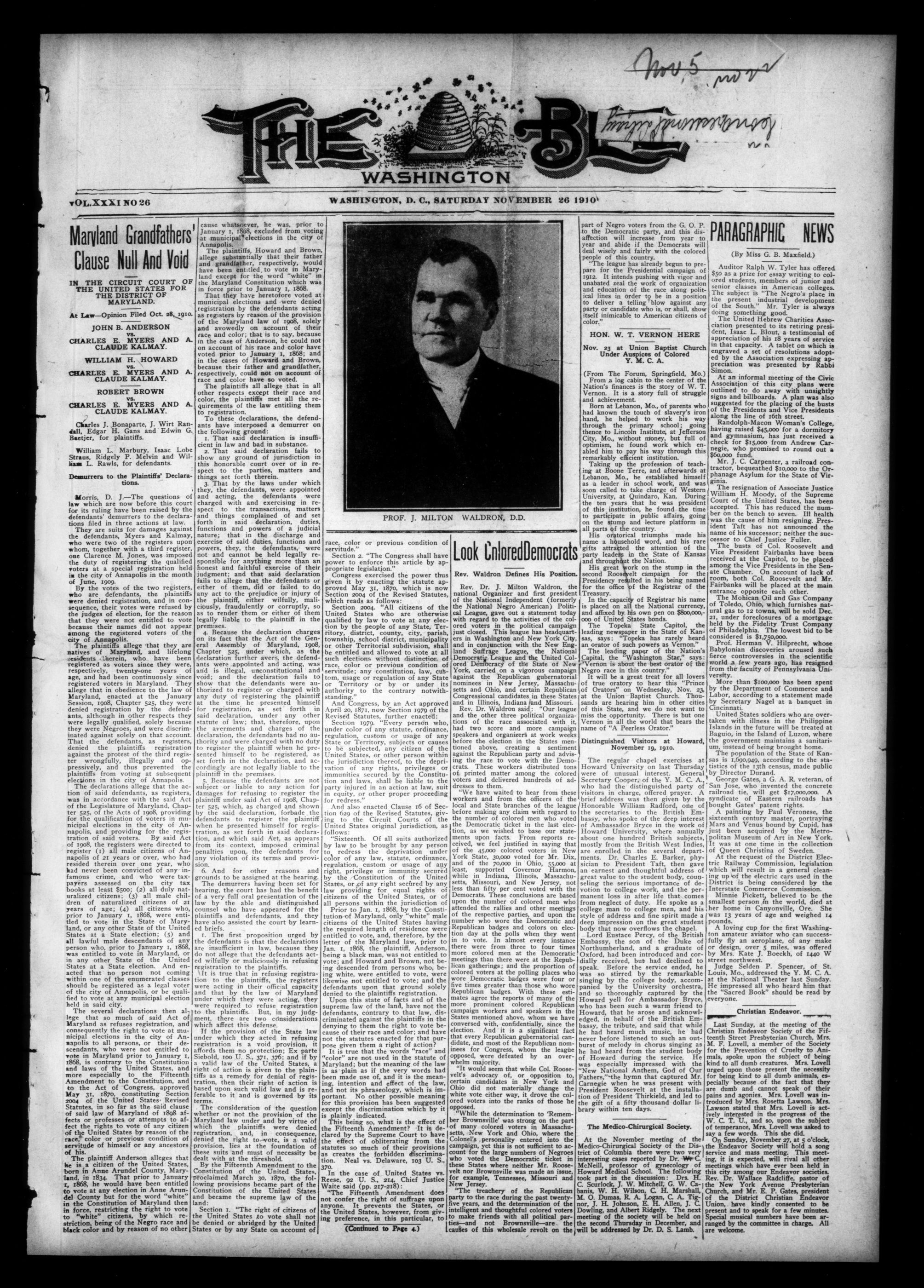
Maryland Grandfathers Clause Null And Void
IN THE CIRCUIT COURT OF
THE UNITED STATES FOR
THE DISTRICT OF
MARYLAND.
At Law—Opinion Filed Oct. 28, 1910.
JOHN B. ANDERSON
vs.
CHARLES E. MYERS AND A.
CLAUDE KALMAY.
WILLIAM H. HOWARD
vs.
CHARLES E. MYERS AND A.
CLAUDE KALMAY.
ROBERT BROWN
CHARLES E. MYERS AND A.
CLAUDE KALMAY.
Charles J. Bonaparte, J. Wirt Randall, Edgar H. Gans and Edwin G. Beetjer, for plaintiffs.
William L. Marbury, Isaac Lobe Straus, Ridgely P. Melvin and William L. Rawls, for defendants.
Demurrers to the Plaintiffs' Declarations.
Morris, D. J.—The questions of law which are now before this court for its ruling have been raised by the defendants' demurrers to the declarations filed in three actions at law.
They are suits for damages against the defendants, Myers and Kalmay, who were two of the registers upon whom, together with a third register, one Clarence M. Jones, was imposed the duty of registering the qualified voters at a special registration held in the city of Annapolis in the month of June, 1909.
By the votes of the two registers, who are defendants, the plaintiffs were denied registration, and in consequence, their votes were refused by the judges of election, for the reason that they were not entitled to vote because their names did not appear among the registered voters of the city of Annapolis.
The plaintiffs allege that they are natives of Maryland, and lifelong residents therein, who have been registered as voters since they were, respectively, twenty-one years of age, and had been continuously since registered voters in Maryland. They allege that in obedience to the law of Maryland, enacted at the January Session, 1908, Chapter 525, they were denied registration by the defendants, although in other respects they were legally qualified, solely because they were Negroes, and were discriminated against solely on that account. That the defendants, as registers, denied the plaintiffs registration against the protest of the third register wrongfully, illegally and oppressively, and thus prevented the plaintiffs from voting at subsequent elections in the city of Annapolis.
The declarations allege that the action of said defendants, as registers, was in accordance with the said Act of the Legislature of Maryland, Chapter 525, of the Acts of 1908, providing for the qualification of voters in municipal elections in the city of Annapolis, and providing for the registration of said voters. By said Act of 1908, the registers were directed to register (1) all male citizens of Annapolis of 21 years or over, who had resided therein over one year, who had never been convicted of any infamous crime, and who were tax-payers assessed on the city tax books at least $500; (2) all duly naturalized citizens; (3) all male children of naturalized citizens of 21 years of age; (4) all citizens who, prior to January 1, 1868, were entitled to vote in the State of Maryland, or any other State of the United States at a State election; (5) and all lawful male descendants of any person who, prior to January 1, 1868, was entitled to vote in Maryland or any other State of the United States at a State election. And enacted that no person not coming within one of the enumerated classes should be registered as a legal voter of the city of Annapolis, or be qualified to vote at any municipal election held in said city.
The several declarations then allege that so much of said Act of Maryland as refuses registration, and consequently the right to vote at municipal elections in the city of Annapolis to all persons, or their descendants, who were not entitled to vote in Maryland prior to January 1, 1868, is contrary to the Constitution and laws of the United States, and more especially to the Fifteenth Amendment to the Constitution, and to the Act of Congress, approved May 31, 1870, constituting Section 2004 of the United States-Revised Statutes, in so far as the said clause of said law of Maryland of 1898 affects or professes or attempts to affect the rights to vote of any citizen of the United States by reason of the race, color or previous condition of servitude of himself or any ancestors of his.
The plaintiff Anderson alleges that he is a citizen of the United States, born in Anne Arundel County, Maryland, in 1834. That prior to January 1, 1868, he would have been entitled to vote at any election in Anne Arundel County but for the word "white" in the Constitution of Maryland then in force, restricting the right to vote to "white" citizens, by which restriction, being of the Negro race and black color and by reason of no other
because whatsoever, he was, prior to January 1, 1868, excluded from voting at municipal elections in the city of Annapolis.
The plaintiffs, Howard and Brown, allege substantially that their father and grandfather, respectively, would have been entitled, to vote in Maryland except for the word "white" in the Maryland Constitution which was in force prior to January 1, 1868.
That they have heretofore voted at municipal elections and were denied registration by the defendants acting as registers by reason of the provision of the Maryland law of 1908, solely and avowedly on account of their race and color; that is to say, because in the case of Anderson, he could not on account of his race and color have voted prior to January 1, 1868; and in the cases of Howard and Brown, because their father and grandfather, respectively, could not on account of race and color have so voted.
The plaintiffs all allege that in all other respects except their race and color, the plaintiffs met all the requirements of the law entitling them to registration.
To these declarations, the defendants have interposed a demurrer on the following ground:
1. That said declaration is insufficient in law and bad in substance.
2. That said declaration fails to show any ground of jurisdiction in this honorable court over or in respect to the parties, matters and things set forth therein.
3 That by the laws under which they, the defendants, were appointed and acting, the defendants were charged with and exercising in respect to the transactions, matters and things complained of and set forth in said declaration, duties, functions and powers of a judicial nature; that in the discharge and exercise of said duties, functions and powers, they, the defendants, were not and cannot be held legally responsible for anything more than an honest and faithful exercise of their judgment; and that said declaration fails to allege that the defendants or either of them, did or failed to do any act to the prejudice or injury of the plaintiff, either wilfully, maliciously, fraudulently or corruptly, so as to render them or either of them legally liable to the plaintiff in the premises.
4. Because the declaration charges on its fact that the Act of the General Assembly of Maryland, 1908, Chapter 525, under which, as the declaration further avers, the defendants were appointed and acting, was and is illegal, unconstitutional and void; and the declaration fails to show that the defendants were authorized to register or charged with any duty of registering the plaintiff at the time he presented himself for registration, as set forth in said declaration, under any other statute of law; that, therefore, upon the averments and charges of the declaration, the defendants had no authority and were charged with no duty to register the plaintiff when he presented himself to be registered, as set forth in the declaration, and accordingly are not legally liable to the plaintiff in the premises.
5. Because the defendants are not subject or liable to any action for damages or for abuse or register the plaintiff under Act of 1908, Chapter 525, which, as charged and shown by the said declaration, forbade the defendants to register the plaintiff when he presented himself for registration, as set forth in said declaration, and which said Aet, as appears from its context, imposed criminal penalties upon, the defendants for any violation of its terms and provision.
6. And for other reasons and grounds to be assigned at the hearings. The demurrers having been set for hearing, the court has had the benefit of a very full oral presentation of the law by the able and distinguished counsel who have appeared for the plaintiffs and defendants, and they have also assisted the court by learned briefs.
1. The first proposition urged by the defendants is that the declarations are insufficient in law, because they do not allege that the defendants acted wilfully or maliciously in refusing registration to the plaintiffs.
It is true that in refusing registration to the plaintiffs, the registers were acting in their official capacity and that by the law of Maryland under which they were acting, they were required to refuse registration to the plaintiffs. But, in my judgment, there are two considerations which affect this defense.
The provision of the State law under which they act in refusing registration is valid provision; it affords them no protection; Ex parte Siebold, 700 U. S., 371, 376; and if by a valid law of the United States, a right of action is given to the plaintiffs as a remedy for denial of registration, then their right of action is based upon such valid law and is referable to it and is governed by its terms.
The consideration of the question whether or not the provision of the Maryland law under and by virtue of which the plaintiffs were denied registration, and, in consequence, denied the right to vote, is a valid provision, lies at the foundation of these suits and must of necessity be dealt with at the threshold.
By the Fifteenth Amendment to the Constitution of the United States, proclaimed March 30, 1870, the following provisions became part of the Constitution of the United States and became the supreme law of the land:
Section 1. "The right of citizens of the United States to vote shall not be denied or abridged by the United States or by any State on account of
M.
PROF. J. MILTON WALDRON, D.D.
race, color or previous condition of servitude."
Section 2. "The Congress shall have power to enforce this article by appropriate legislation."
Congress exercised the power thus given it by enacting the statute approved May 31, 1870, which is now Section 2004 of the Revised Statutes, which reads as follows:
Section 2004. "All citizens of the United States who are otherwise qualified by law to vote at any election by the people of any State, Territory, district, county, city, parish, township, school district, municipality or other Territorial subdivision, shall be entitled and allowed to vote at all such elections without distinction of race, color or previous condition of servitude; any constitution, law, custom, usage or regulation of any State or Territory or by or under its authority to the contrary notwithstanding."
And Congress, by an Act approved April 20, 1871, now Section 1979 of the Revised Statutes, further enacted:
Section 1979. "Every person who, under color of any statute, ordinance, regulation, custom or usage of any State or Territory, subjects or causes to be subjected, any citizen of the United States, or other person within the jurisdiction thereof, to the deprivation of any rights, privileges or immunities secured by the Constitution and laws, shall be liable to the party injured in an action at law, suit in equity, or other proper proceeding for redress."
And also enacted Clause 16 of Section 629 of the Revised Statutes, giving to the Circuit Courts of the United States original jurisdiction, as follows:
"Sixteenth. Of all suits authorized by law to be brought by any person to redress the deprivation under color of any law, statute, ordinance, regulation, custom or usage of any right, privilege or immunity secured by the Constitution of the United States, or of any right secured by any law providing for equal rights of citizens of the United States, or of all persons within the jurisdiction of Prior to Jan. 1, 1868, by the Constitution of Maryland, only "white" male citizens of the United States having the required length of residence were entitled to vote, and, therefore, by the letter of the Maryland law, prior to Jan. 1, 1868, the plaintiff, Anderson, being a black man, was not entitled to vote; and Howard and Brown, not being descended from persons who, being white, were entitled to vote, were likewise not entitled to vote; and the defendants upon that ground solely denied to the plaintiffs registration.
Upon this state of facts and of the supreme law of the land, have not the defendants, contrary to that law, discriminated against the plaintiffs in the denying to them the right to vote because of their race and color; and have not the statutes enacted for that purpose given them a right of action?
It is true that the words "race" and "color" are not used in the statute of Maryland; but the meaning of the law is as plain as if the very words had been made use of, and it is the meaning, intention and effect of the law, and not its phraseology, which is important. No other possible meaning for this provision has been suggested except the discrimination which by it is plainly indicated.
This being so, what is the effect of the Fifteenth Amendment? It is declared by the Supreme Court to have the effect of obliterating from the statutes so much of their provisions as creates the forbidden discrimination. Neal vs. Delaware, 103 U. S., 370.
In the case of United States vs. Reece, 92 U. S., 214, Chief Justice Waite said (pp. 217-218):
"The Fifteenth Amendment does not confer the right of suffrage upon anyone. It prevents the States, or the United States, however, from giving preference, in this particular, to
Look CnloredDemocrats
Rev. Waldron Defines His Position.
Rev. Dr. J. Milton Waldron, the national Organizer and first president of the National Independent (formerly the National Negro American) Political League, gave out a statement today with regard to the activities of the colored voters in the political campaign just closed. This league has headquarters in Washington and New York City, and in conjunction with the New England Suffrage League, the National Democratic League and the United Colored Democracy of the State of New York, carried on a vigorous campaign against the Republican gubernatorial nominees in New Jersey, Massachusetts and Ohio, and certain Republican Congressional candidates in these States and in Illinois, Indiana and Missouri.
Rev. Dr. Waldron said: "Our league and the other three political organizations of the race associated with it, had two score and more campaign speakers and organizers at work weeks before the election in the States mentioned above, creating a sentiment against the Republican party and advising the race to vote with the Democrats. These workers distributed tons of printed matter among the colored voters and delivered hundreds of addresses to them.
"We have waited to hear from these workers and from the officers of the local and State branches of the league before making any claim with regard to the number of colored men who voted the Democratic ticket in the last election, as we wished to base our statements upon facts. From reports received, we feel justified in saying that of the 45,000 colored voters in New York State, 30,000 voted for Mr. Dix, and of the 70,000 in Ohio, 55,000 at least, supported Governor Harmon, while in Indiana, Illinois, Massachusetts, Missouri, and New Jersey, not less than fifty per cent voted with the Democrats. These conclusions are based upon the number of colored men who attended the rallies and other meetings of the respective parties, and upon the number who wore the Democratic and Republican badges and colors on election day at the polls when they went in to vote. In almost every instance there were from three to four times more colored men at the Democratic meetings than there were at the Republican gatherings; and the proportion of voters at the polling places who wore Democratic badges were four or five times greater than those who wore Republican badges. With these estimates agree the reports of many of the more prominent colored Republican campaign workers and speakers in the States mentioned above, whom we have conversed with, confidently, since the election. And it is a significant fact that every Republican gubernatorial candidate, and most of the Republican nominees for Congress, whom the league opposed, were defeated by an overwhelming majority.
"It would seem that while Col. Roosevelt's advocacy of, or opposition to, certain candidates in New York and Ohio did not materially change the white vote either way, it drove the colored voters into the ranks of those he opposed.
"While the determination to 'Remember Brownsville' was strong on the part of many colored voters in Massachusetts, New York and Ohio, where the Colonel's personality entered into the campaign, yet this is not sufficient to account for the large numbers of Negroes who voted the Democratic ticket in these States where neither Mr. Roosevelt nor Brownsville was made an issue, for example, Tennessee, Missouri and New Jersey.
"The treachery of the Republican party to the race during the past twenty-five years, and the determination of the intelligent and thoughtful colored voters to make friends with all political parties—and not Brownsville—are the causes of this wholesale revolt on the
part of Negro voters from the G. O. P. to the Democratic party, and this affection will increase from year to year and abide if the Democrats will deal wisely and fairly with the colored people of this country.
"The league has already begun to prepare for the Presidential campaign of 1912. It intends pushing with vigor and unabated zeal the work of organization and education of the race along political lines in order to be in a position to deliver a telling blow against any party or candidate who is, or shall, show itself imminible to American citizens of color."
HON. W. T. VERNON HERE
Nov. 23 at Union Baptist Church Under Auspices of Colored Y. M. C. A.
(From The Forum, Springfield, Mo.)
From a log cabin to the center of the Nation's finances is the story of W. T. Vernon. It is a story full of struggle and achievement.
Born at Lebanon, Mo., of parents who had known the touch of slavery's iron hand, he helped to work his way through the primary school; going thence to Lincoln Institute, at Jefferson City, Mo., without money, but full of optimism, he found work which enabled him to pay his way through this remarkably efficient institution.
Taking up the profession of teaching at Boone Terre, and afterwards at Lebanon, Mo., he established himself as a leader in school work, and was soon called to take charge of Western University, at Quindaro, Kan. During the ten years that he was president of this institution, he found the time to participate in public affairs, going on the stump and lecture platform in all parts of the country.
His oratorical triumphs made his name a household word, and his rare gifts attracted the attention of the party leaders in the State of Kansas and throughout the Nation.
His great work on the stump in the second Roosevelt campaign for the Presidency resulted in his being named for the office of the Registrar of the Treasury.
In the capacity of Registrar his name is placed on all the National currency, and affixed by his own pen on $800,000-000 of United States bonds.
The Topeka State Capitol, the leading newspaper in the State of Kansas, says: "Topeka has rarely heard an orator of such powers as Vernon." The leading paper of the Nation's Capital, the "Washington Star," says: "Vernon is about the best orator of the Negro race in this country. It will be a great treat for all lovers of the Bible, of this "Prince of Orators" on Wednesday, Nov. 23, at the Union Baptist Church. Thousands are hearing him in other cities of this State, and we do not want to miss the opportunity. There is but one Vernon in all the world that bears the name of "A Peerless Orator."
Distinguished Visitors at Howard, November 19, 1910.
The regular chapel exercises at Howard University on last Thursday were of unusual interest. General Secretary Cooper, of the Y. M. C. A. who had the distinguished party of visitors in charge, offered prayer. A brief address was then given by the Honorable William Radford, one of the secretaries to the British Embassy, who spoke of the deep interest of Ambassador Bryce in the work of Howard University, where annually about one hundred British subjects, mostly from the British West Indies, are enrolled in the several departments. Dr. Charles E. Barker, physician to President Taft, then gave an earnest and thoughtful address of great value to the student body, counseling the serious importance of devotion to college work, and the permanent loss in after life that comes from neglect of duty. He spoke as a college man to college men, and his style of address and fine spirit made a deep impression on the great student body that now overflows the chapel.
Lord Eustace Percy, of the British Embassy, the son of the Duke of Northumberland, and a graduate of Oxford, had been introduced and cordially received, but had declined to speak. Before the service ended, he was so stirred by the remarkable singing by the college body, accompanied by the University orchestra and so thoroughly captured by the Howard yell for Ambassador Bryce, who has been such a warm friend to Howard, that he arose and acknowledged, in behalf of the British Embassy, the tribute, and said that while he had heard much music, he had never before listened to such an outburst of melody in chorus singing as he had heard from the student body of Howard during the service. He was especially impressed with the "New National Anthem, God of Our Fathers,"-the hymn that captured Mr. Carnegie when he was present with President Roosevelt at the installation of President Thirkield, and led to the gift of a fifty thousand dollar library within ten days.
The Medico-Chirurgical Society
At the November meeting of the Medico-Chirurgical Society of the District of Columbia there were two very interesting cases reported by Dr. W. C. McNeill, professor of gynecology of Howard Medical School. The following took part in the discussion: Drs. H. C. Scurlock, W. H. Mitchell, G. W. Carabis, W. H. Wilson, C. H. Marshall, M. O. Dumas, R. A. Logan, C. A. Tignor, J. H. Johnson, E. H. Allen, J. C. Dowling, and Albert Ridgegely. The next meeting of the society will be held on the second Thursday in December, and will be addressed by Dr. D. S. Lamb.
PARAGRAPHIC NEWS
PARAGRAPHIC NEWS
(By Miss G. B. Maxfield.)
Auditor Ralph W. Tyler has offered $50 as a prize for essay writing to colored students, members of junior and senior classes in American colleges. The subject is "The Negro's place in the present industrial development of the South." Mr. Tyler is always doing something good.
The United Hebrew Charities Association presented to its retiring president, Isaac L. Blout, a testimonial of appreciation of his 18 years of service in that capacity. A tablet on which is engraved a set of resolutions adopted by the Association expressing appreciation was presented by Rabbi Simon.
At an informal meeting of the Civic Association of this city plans were outlined to do away with unsightly signs and billboards. A plan was also suggested for the placing of the busts of the Presidents and Vice Presidents along the line of 16th street.
Randolph-Macon Woman's College, having raised $45,000 for a dormitory and gymnasium, has just received a check for $15,000 from Andrew Carnegie, who promised to round out a $60,000 fund.
Mr. J. C. Carpenter, a railroad contractor, bequeathed $10,000 to the Orphanage Asylum for the State of Virginia.
The resignation of Associate Justice William H. Moody, of the Supreme Court of the United States, has been accepted. This has reduced the number on the bench to seven. Ill health was the cause of him resigning. President Taft has not announced the name of his successor; neither the successor to Chief Justice Fuller. The busts of Col. Roosevelt and Vice President Fairbanks have been received at the Capitol, to be placed among the Vice Presidents in the Senate Chamber. On account of lack of room, both Col. Roosevelt and Mr. Fairbanks will be placed at the main entrance opposite each other. The Mohican Oil and Gas Company of Toledo, Ohio, which furnishes natural gas to 12 towns, will be sold Dec. 21, under foreclosures of a mortgage held by the Fidelity Trust Company of Philadelphia. The lowest bid to be considered is $1,750,000. Prof. Herman V. Hilprecht, whose Babylonian discoveries aroused such fierce controversies in the scientific world a few years ago, has resigned from the faculty of Pennsylvania University. More than $100,000 has been spent by the Department of Commerce and Labor, according to a statement made by Secretary Nagel at a banquet in Cincinnati. United States soldiers who are overtaken with illness in the Philippine Islands in the future will be treated at Baguio, in the Island of Luzon, where the government maintains a sanitarium, instead of being brought home.
The population of the State of Kansas is 1,600,949, according to the statistics of the 13th census, made public by Director Durand.
George Gates, a G. A. R. veteran, of 'San Jose, who invented the concrete railroad tie, will get $17,000,000. A syndicate of Eastern railroads has bought Gates' patent rights.
A painting by Paul Veronese, the sixteenth century master, portraying Mars and Venus bound by Cupid, has just been acquired by the Metropolitan Museum of Art in New York. It was at one time in the collection of Queen Christina of Sweden.
At the request of the District Electric Railway Commission, legislation which will result in a general cleaning up of the electric cars used in the District is being considered by the Interstate Commerce Commission.
Minnie Pickett, believed to be the smallest person in the world, died at her home in Canyonville, Ore. She was 13 years of age and weighed 14 pounds.
A loving cup for the first Washington amateur aviator who can successfully fly an aeroplane, of any make or design, over 5 miles, was offered by Mrs. Kate J. Boeckh, of 1440 W street northwest.
Judge Selden P. Spencer, of St. Louis, Mo., addressed the Y. M. C. A. at the National Theater last Sunday. He impressed all who heard him that the "Sacred Book" should be read by everyone.
Christian Endeavor
Last Sunday, at the meeting of the Christian Endeavor Society of the Fifteenth Street Presbyterian Church, Mrs. M. F. Lovell, a member of the Society for the Prevention of Cruelty to Animals, spoke upon the subject of being kind to all dumb creatures. Mrs. Lovell urged upon those present the necessity for being kind to all dumb animals, especially because of the fact that they are dumb and cannot speak of their pains and agonies. Mrs. Lovell was introduced by Mrs. Rosetta Lawson. Mrs. Lawson stated that Mrs. Lovell is actively interested in the progress of the W. C. T. U., and so upon the subject of temperance, Mrs. Lovell was asked to say a few words. This she did.
On Sunday, November 27, at 5 o'clock, the Endeavor Society will hold a song service and mass meeting. This meeting, it is expected, will rival all other meetings which have ever been held in this city among our Endeavor societies. Rev. Dr. Wallace Radcliffe, pastor of the New York Avenue Presbyterian Church, and Mr. E. P. Gates, president of the District Christian Endeavor Union, have kindly consented to be present and to speak for a few minutes. Special musical numbers have been arranged by the committee in charge. All are welcome.
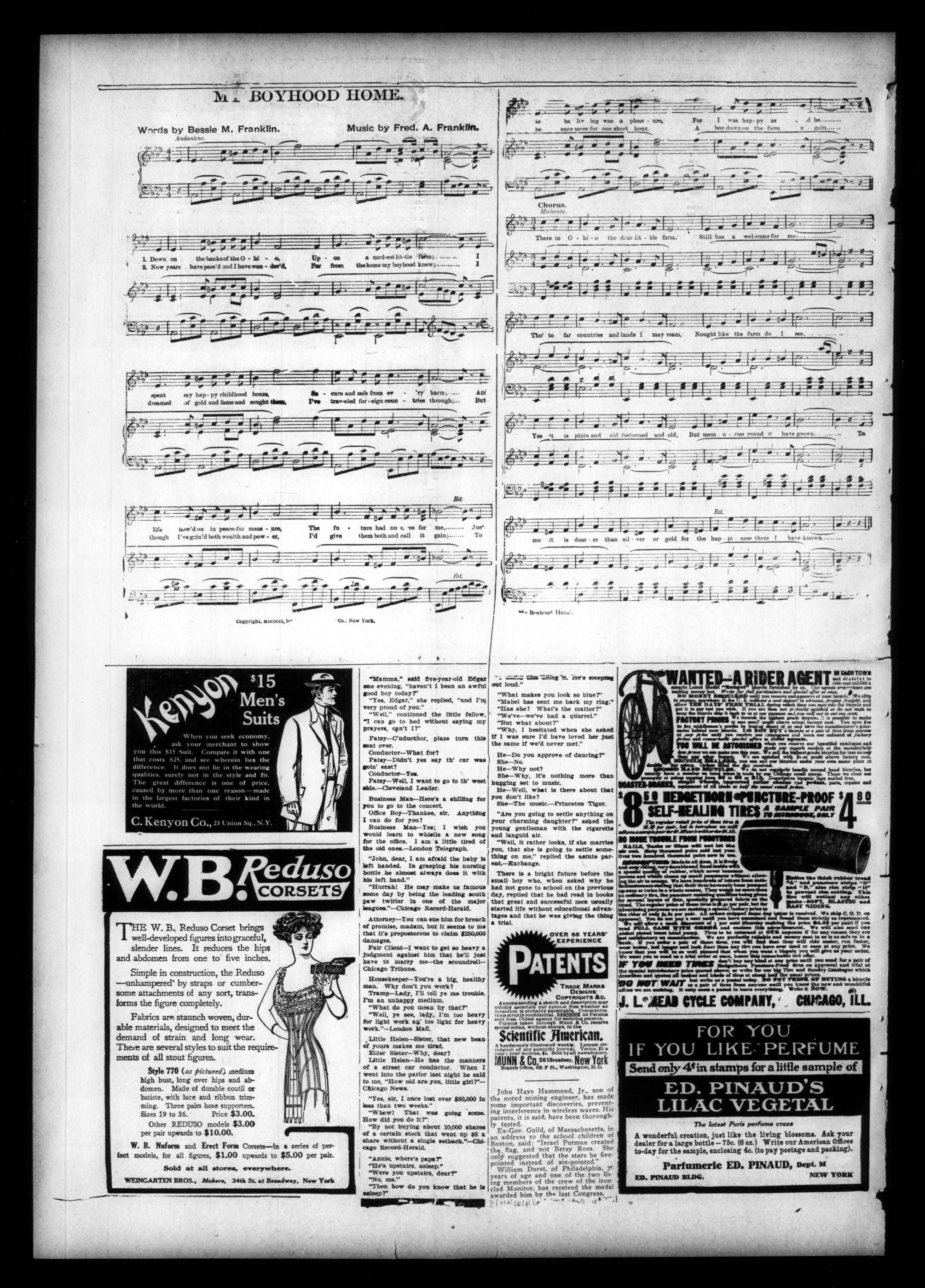
Words by Bessie M. Franklin.
Music by Fred. A. Franklin.
Kenyon $15 Men's Suits
When you seek economy, ask your merchant to show you this S15 Suit. Compare it with one that costs $25, and see wherein lies the difference. It does not lie in the wearing qualities, surely not in the style and fit. The great difference is one of price, caused by more than one reason—made in the largest factories of their kind in the world.
C. Kenyon Co., 23 Union Sq., N.Y.
W.B. Reduso CORSETS
Fabrics are staunch woven, durable materials, designed to meet the demand of strain and long wear. There are several styles to suit the requirements of all stout figures.
W. B. Nuform and Erect Form Corsets—in a series of perfect models, for all figures, $1.00 upwards to $5.00 per pair.
Sold at all stores, everywhere.
WEINGARTEN BROS., Makers, 34th St. at Broadway, New York
THE W. B. Reduso Corset brings well-developed figures into graceful, slender lines. It reduces the hips and abdomen from one to five inches. Simple in construction, the Reduso unhampered by straps or cumbersome attachments of any sort, transforms the figure completely:
Fabrics are staunch woven, durable materials, designed to meet the demand of strain and long wear. There are several styles to suit the requirements of all stout figures.
Style 770 (as pictured) medium high bust, long over hips and abdomen. Made of durable coutil or batiste, with lace and ribbon trimming. Three pairs hose supporters. Sizes 19 to 36. Price $3.00.
Other REDUSO models $3.00 per pair upwards to $10.00.
W. B. Nuform and Erect Form Corsetsfect models, for all figures, $1.00 upwards Sold at all stores overw
il,
ips
es.
quire-
"Mamma," said five-year-old Edgar one evening, "haven't I been an awful good boy today?"
"Yes, Edgar," she replied, "and I'm very proud of you."
"Well," continued the little fellow, "I can go to bed without saying my prayers, can't I?"
Patsy—C'nducthor, plaze, turn this seat over.
Conductor—What for?
Patsy—Didn't yez say th' car was goln' east?
Conductor—Yes.
Patsy—Well, I want to go to th' west side—Cleveland Leader.
Business Man—Here's a shilling for you to go to the concert.
Office Boy—Thankee, sir. Anything I can do for you?
Business Man—Yes; I wish you would learn to whistle a new song for the office. I am a little tired of the old ones.—London Telegraph.
"John, dear, I am afraid the baby is left handed. In grasping his nursing bottle he almost always does it with his left hand."
"Hurrah! He may make us famous some day by being the leading south paw twirler in one of the major leagues."—Chicago Record-Herald.
Attorney—You can sue him for breach of promise, madam, but it seems to me that it's preposterous to claim $250,000 damages.
Fair Client-I want to get so heavy a judgment against him that he'll just have to marry me-the scoundrell-Chicago Tribune.
Housekeeper-You're a big, healthy man. Why don't you work?
Tramp—Lady, I'll tell ye me trouble. I'm an unhappy medium. "What do you mean by that?" "Well, ye see, lady, I'm too heavy for light work an' too light for heavy work."—London Mail. Little Helen—Sister, that new beau of yours makes me tired.
Elder Sister—Why, dear?
Little Helen—He has the manners of a street car conductor. When I went into the parlor last night he said to me, "How old are you, little girl?"—CChicago News.
"Yes, sir, I once lost over $80,000 in less than two weeks."
"Whew! That was going some. How did you do it?"
"By not buying about 10,000 shares of a certain stock that went up $8 a share without a single setback"—Chicago Record-Herald.
"Then how do you know that he is asleep?"
to be living was a pleasure,
be once more for one short hour.
For I was happy as I be...
A boy down on the farm a gain...
Chorus,
Mother to
There in Ohi-o the dear little farm,
Still has a welcome for me...
Tho' to far countries and lands I may roam,
Nought like the farm do I see...
Yes it is plain and old fashioned and old,
But memories round it have grown.
Rit.
me it is dearer than silver or gold for the hap piñes there I have known...
Boyhood Home.
out loud."
"What makes you look so blue?"
"Mabel has sent me back my ring."
"Has she? What's the matter?"
"We've—we've had a quarrel."
"But what about?"
"Why, I hesitated when she asked if I was sure I'd have loved her just the same if we'd never met."
He—Do you approve of dancing?
She—No.
He—Why not?
She—Why, it's nothing more than
hugging set to music.
He—Well, what is there about that you don't like?
She—The music.—Princeton Tiger.
"Are you going to settle anything on your charming daughter?" asked the young gentleman with the cigarette and languid air.
"Well, it rather looks, if she marries you, that she is going to settle something on me," replied the astute parent—Exchange.
There is a bright future before the small boy who, when asked why he had not gone to school on the previous day, replied that he had read in books that great and successful men usually started life without educational advantages and that he was giving the thing a trial.
OVER 65 YEARS'
EXPERIENCE
PATENTS
TRADE MARKS
DESIGNS
COPYRIGHTS & C.
Anyone sending a sketch and description may
quickly ascertain our opinion free whether an
invention is probably patentable. Communications
strictly confidential. HANDBOOK on Patents
and four meetings. Any for acquiring patent.
Patents taken through Munn & Co. receive
special notice, without charge, in the
Scientific American.
A handsomely illustrated weekly. Largest circulation of any scientific journal. Terms, $4
our four months. $L. Sold by all newsletters.
MUNN & Co. 361 Broadway, New York
Branch Office, 625 F St. Washington, D. C.
John Hays Hammond, Jr., son of the noted mining engineer, has made some important discoveries, preventing interference in wireless waves. His patents, it is said, have been thoroughly tested.
Ex-Gov. Guild, of Massachusetts, in an address to the school children of Boston, said: "Israel Putman created the flag, and not Betsy Ross. She only suggested that the stars be five pointed instead of six-pointed."
William Durst, of Philadelphia, 7 years of age and one of the two living members of the crew of the iron clad Monitor, has received the medal awarded him by the last Congress.
YOU WILL BE AUTOMISHED when you receive our beautiful catalogue and study our superb models at the wonderfully large factory we can make you this year. We sell the highest grade bicycles for less money and other history. We are spathed with $5.00 proof above factory cost. BICYCLE HEALTHY, you can sell our bicycles under your own name plate at discount. ORDER ON THE WAY you received. APPROVED MAND BICYCLES do not regularly handle second hand bicycles, but usually have a member on hand in their case. Chicago round stores. These we clear out promptly at price improve from $4 to $8 or $10. BICYCLE burgans hats matted free. SLINGLE wheels, imported rubber abrasions, parts, repairs and components of all kinds at half the original price.
```markdown
```
powers and which clean up small punctures without allowing the air to escape. We have hundreds of letters from naked customers smiling that their heads have been pumped up once or twice in a whole season. They weigh more than an ordinary layer, the puncture resisting qualities being given by several layers of skin, specially prepared fabric on the trunk. The regular price of these trunks is $15 per pair, but for advertising purposes, we charge $25 per pair. All prices are arbitrary.
the rider of only five per pair. All orders shipped some day later is received. We ship C.O.D. on approval. You do not pay a rent you have committed and found strictly as represented. We will allow a cash discount of 5 per cent (theory making the price $4.58 per pair) if you send FULL CASH WITH GROUND and include the amount. We will also send one extra $0.50 per pair if you send OUR payment for not satisfactory on commission. We are perfectly reliable and money sent to us is as safe as in a bank. If you order a pair of these tires, you will find that they will ride easier, run faster, wear hotter, look longer and look faster than any tire you have ever used or seen at any price. We know that you will be so well planned that when you want a bicycle you will give us your order. We want you to send us a trial order at once, hence this remarkable tire offer. We don't buy any kind at any price until you send for a pair of
IF YOU NEED TIMES don't buy any kind at any price until you send for a pair of
the special introductory price quoted above or write for our big Tire and Sundry Catalogue which
describes and quotes all the new and wonderful
DO NOT WAIT or a pair of tires from anyone until you know the new and wonderful
offers we are making. R only costs a postal to learn everything. Write it NOW.
FOR YOU IF YOU LIKE PERFUME Send only 4in stamps for a little sample of ED. PINAUD'S LILAC VEGETAL
A wonderful creation, just like the living blossoms. Ask your dealer for a large bottle -- 75c. (6 oz.) Write our American Offices to-day for the sample, enclosing 4c. (to pay postage and packing).
The regular vertical print of Moses born to
the 500 parlor, but to instruct us we will
will you a sample page for Mr. Sifter with order #119.
NO HOKE TROUBLE FROM POSTMORTS
MAIL, Toaden or Gloss will not let the
air out. Skirty thousand pairs sold last year.
Over two hundred thousand pairs now in use.
POSTMORTS Made in all sizes. It is lively
and easy reading, very dazzle blended Hined inside with
a sturdy quantity of rubber, which never booze.
Makes the thick rubber tread
"A" and puncture strips "B"
and "D." also rim strip "IF"
to prevent rim cutting. This
makes other mats GOFT, ELASTIC and
BABY RIDING.
- Fee Ee ag Sl nee ee
OMATTOX. a
"GOT HIM CHEAP, = | LATHAW'S HOME RUM. PEE (AT APRON SP WORTH ADVER TISING FOR
Sir Morel Mackenzie, the! Figured | Havieg: rte One of the Most Notable Scenes In the (St <N Lb There are 5499 Negroes em ployed here in Washé a by :
jay Sir Morel Mackensie, . / : , eshington by
he Famous Surgeon, Was Once jn pubbed “tha Dudes as Told by Bury Ot ape ae The <a ~ | the Government alone, and these c sn ‘Neocron trace act...
Cleverly Tricked. rd “the Oude,” as T
Sir Morel Mackenzie once received a
wire from Antwerp asking bim his
ebarges for 2 certain operation. He
Feplied £500 and was told to come at
once. When he stepped upon the dock
he was met by three men in mourning,
who informed him sadly that he bad
tome too late, the patient had died.
“But,” sald the spokesman: of the
party, “we shall pay you your fall fee.”
And they did. “And now,” sald the
man, “since you are here, what do you
aay to visiting the city hospital and
giving a clinic for the benefit of our
local surgeons? It ts not often they
have an opportunity of benefiting by
such sclence 2s yours.”
Sir Morel sald he would gladly com-
ply. Herwent to the hospital and per-
formed many operations, among which
Were two of a similar nature to that
for which he had been called for.
When be bad finished all thanked him
profusely. On the steamer going home
“be met a friend, who had a business
house in Antwerp,
“Pretty scurvy trick they played on
you, Sir Morel.”
“What do you mean?" asked the sur-
eon.
“Told you the patient died before
you artived, didn't they?”
“Yea.",
“Lies.” You operated on him and a
friend with the same trouble at the
clinic. Got two operations for one
ore?
"HE WAS EXCITED.
And Yet He Was Making Only a Very
Reasonable Request.
ee ee
It was a dramatic scene, pregnant
with the most tragic possibilities.
‘Thus thought a witness to the meeting
of three Italians near the big express
depot at Fifteenth and Market streets.
Aman and woman who were deliver.
tng a trunk into the hands of a clerk
were suddenly confronted by another
man, who was highly excited. H¢ ap-
proached the woman. In roluble Ital-
fan he raved and swore and pleaded,
while she shrilled equally excited an-
swers. The other man stood back
against the wall, his arms folded def-
antly, his head sunk on his chest. It
certainly looked as if daggers were to
be drawn. The interested bystander
asked of some listeners who under-
stood the rapldly splattered diatect
what the trouble was all about.
“Why.” was the volunteered transla-
tion, “this woman has run away from
ber husband with this man,” pointing
to the sulky individual,
“Oh, and he ts begging her to re
tum?" was the next query.
“Not on your life.” was the express-
Ive reply. “She has packed up all her
husband's clothes in her trunk, as well
as ber own, and he ts berging her-to
sive back at least his Sunday suit.”—
Philadelphia Record.
Baked Men,
Workers in porcelain factories are
Mterally baked, but by some miracle of
tse and wout they remain sufficiently
underdone to live. At least If they arc
not quite baked thoy endure a stronget
heat than that which browns the Sun
dey sirloin. The furnaces wherein
Porcelain is finished are kept at the
Gereest heat used in auy industry. A
chain of workmen, thelr beads and
bodies swathed in fireproof garments,
take the fintshed pleces from the fre
one at a time aml pass them to the
cooling room. The man at the head
ef thts chaln—be who stands nearest
the furnace—can work In only fre
ratnute_ shifts. In bis interims of rest
he les on a maitress drinking rlass
after glass of ice water from the hands
of a small boy. .At lunchttme all about
the chain of men steaks grill—Cincln.
nati Enquirer.
Sust Tolerable.
Concerning a certaiu time scrying
‘Washington clergyman of whom a vis.
itor was one day expressing a harsh
estimate President Lincoln sald:
I think you are rather hard on Mr. —.
He reminds me of 2 man in Illinois who
was arrested for passing a counterfelt
Di, “He admitted that he had taken ft
to a bank cashier to know if ft was a
good bill. “Well, what was the reply of
the cashier?” asked his lawyer. “Why,”
evasively answered tho prisoner. “ha said
it was a pratty tolerable, respectable sort
of a buL”
Mr. Lincoln thought the clergyman
“a pretty tolerable, respectable sort of
a clergyman.”
At Close Range.
“Whe is that neglected looking Ittle
boy with dirt over his face?"
“He Is the child of the noted astron-
omer who lives over the way.”
“Oh, is he? Come here, sonny. Run
home and tell your father he doesn't
need his telescope if he wants to see
spots on the son.”—Raltimore Ameri-
can.
Mis Teantle.
Friend—Don't worry because your
sweetheart has turned you down since
you lost your money. There are as
rood fish in the sca as ever were
caught. Jilted One—Yes, but I've lost
my bait—Harper's Bazar,
oe
Ripe Old Age.
Little Willle—Say, pa, what is a ripe
eld age? Pa—It’s the age, my son, at
which 2 man fs willing to admit that
he’s not the only dricd apple in the
pantry—Chicago News.
‘The Doctor's Orders, ~
Mra, O'Harrigan—Phoy have yeetack
this empty task under th’ baby? Mrs.
Carey—Th’ doctor's ordthers. He told
me Of'd bare to keep th’ baby on a
dottle!—JIndge.
Not to outahine, but to shine upon,
his nelghbora is the successful man's
mission —Towne.
LATHAM’S HOME RUN
And How. It Figured In Having Hise
Dubbed “the Dude,” as Told by
Charley Comiskey,
- Charley Comiskey told the story of
how Arlie Lathan came to be called
“the dude.”
“One spring during Tatham's term of
service with the good old St. Louls
Browns,” satd Comiskey, “be jumped
Into the opening game of the season
and won us @ victory by Knocking ont
a home run in the Inst inning. Chris
von der Ahe from his place in the
grand stand saw Arlle make his sensa-
tional hit and naturally enthused. Agt-
et the game ‘der boss president’ enter-
ed the clubhouse and in that peculler
dialect of his sald to Latham:
“‘Aarlie, my poy, you must be glad
thet L Chris, vas proud mit you, an’ I
vill show you vat my feelings is by
siring you the present of somedings
for you to wear on yourself, Take dis
order on mine own tallor an’ go an’
dress up yourself’
“Chris' order on the tallor read some-
thing lke this:
“‘Give to Arile der tings vat he
buys, an’ send to me der bill’
“Latham didn't do a thing on the
strength of that order but replenish
bis wardrobe. For three days in suc-
cession he showed up at the ball park
fn a fine makeup, and every suit of
clothes was brand new. On the fourth
day Chris got a bill from the clothing
People for $100. Naturally he sent for
Latham and demanded an explanation,
“Why, Chris,.old pal,’ said ‘Lath,’
“thete’s nothing to explain. Didn't
you agree in that order you gave mo
to pay for what I bought, and haven't
I fest begun to buy? Why, old pal, I
have only got three sults and expect
to be measured for another this after-
noon. ‘What's wronc?
“‘Arlie’ replied Von der Abe, ‘you
yas de one tnfernal dude in de plzness,
I vill dis bill pay, but you vill yourself
go to der tallor an’ mit him explain rot
I dink of der tmpudence of you your-
eelf, You vill also stop mit de clothes
you now have on an’ do no more mit
such foolishness mit der man vot pays
your salary. Arile, you vas one dude,
an’ if you play mit eny errors dis
afternoon I vill myself fine you all
der bootifal clothes you have yourself
bought.’
“From that day Latham became
known to the baseball world as ‘the
dude.”
A Curlous Structure,
On the road from Clifton downs to
Avonmouth the traveler will pass, In
the Avon gorge, a curioug structure to
which a singular tradition is attached,
relates the London Tatler, The story
{a thet a person named Cook about a
century ago was told by a gypsy in the
Leigh Woods that his only son would
be killed by a serpent before he reach-
ed the age of twenty-one. To avert
this he built a ‘high tower and shut his
son in the topmost room with the in-
tention of secluding him there until the
fatal xge was passed. However, by ac-
eident a viper was taken up {n a fagot
to the room to lght the Ore, and it
crept from the fagot and bit the boy
80 that he dicd. Therefore the tower
was called Cook's Folly, and that {s its
name to this day, whatever {s the true
explanation.
An Joncble Uer.
Washington Irving in “Crayon Pa-
pers" says: “I was once at an evening
entertainment given by the Duke of
Wellington at Apsley Iouse to Wil-
Mam IV. The duke bad manifested
his admiration of his great adversary,
Napoleon, by having portraits of bia
in different parts of the house. At the
bottom of the grand staircase stood
the colossal statue of the emperor by
Canova. It was of marble In the an-
tique style, with one arm partly ex-
tended. holding a figure of Victory,
Over this arm the Indies 1n tripping
upstairs to the ball had thrown their
shawls It was a singular office for
the statue of Napoleon to perform in
the mansion of the Duke of Welling-
ton! +
Imperial Caesar, dead and turned to clay,
ete
The Elder That Gwore,
An elder of the kirk, having found a
Uttle boy and his sister playing mar-
dies on Sunday, put his reproof in this
form, not a judicious one for a child:
“Boy, do yoa know where children
g0 who play marbles on Sabbath
das?" 5 :
“Ay,” sald the boy. “They gang doun
to the feld by the water belaw the
brig."
“No.” roared out the elder: “they go
to hell and-are burned.”
The Ilttle Yellow, really shocked,
called to his elster: “Come awa’,
Jeante. Here's a man swearing aw
fally."—“Remjnlscences of Dean Ram-
a
His a0 Adds dm Alntitinane:
“The wise woman fs as careful about
the choice of a hat aa she 1s abont the
choice of a husband." The celebrated
author who uttered this dictum may
have exagzerated a little, bat not
much. And allow me, a woman, te
tell you solemn men whom I see meee.
ing at the “frivolity” of my sex that
often the cleverest among you chooves
a.wife for no better reason than that
the woman thus selectéd has hersclt
chosen a becoming bat!—Mme. 0, De
Broutelles tn Grand Magazine.
Se
Secking Retief.
Darky (benrding train)—I heart
"bout youh\wife dyin’, Jim. Wher yo
Prise now?
“Ts off to Join de Mormons. Hit
keeps one woman hustlin’ too mech
to support a heavy eatah lak me*—
Life.
To speak or write Nature did net
| peremptorily order thee: but to werk,
she dld.—Carlyle.
LEE AT APPOMATTOX.
One of the Most Notable Scenes In the
History of the War—The »
Parting of Comrades.
| Men who saw the defeated general
when he came forth from the chamber
where he bad signed the articles of
capitulation say that he paused a mo-
ment as his eyes rested once more on
the Virginia bills, smote his hands to-
gether as though in some excess of
inward agony, then mounted his gray
horse, Traveler, and rode calmly away.
If that was the very Gethsemane
of his trials, yet he must have had
then one moment of supreme, !f chas-
tened, Joy. As be rode quietly down
the lane leading from the ‘scene of
capitulation he passed into view of his
men—of such as remained of ‘them.
The news of the surrender had got
abroad, and they were waiting, grief
stricken and dejected, upon the hill-
sides when they caught sight of their
old commander on the gray horse.
Then occurred one of.the most notable
scenes in the history of the war. In
an instant they were about him, bare-
headed, with tear wet faces, thronging
him, kissing bls hand, bis boots, his
saddle; weeping, cheering him amid
thelr tears, shouting hfs name to the
very skies, He sald: “Men, we have
fought through the war together. I
have done my best for you. My heart
{s too full to say more."—From “Bob-
ert EL Lee, the Southerner.”
ERROR MEANT DEATH.
‘Typesetters and Proofreaders en Chi-
nese Papor Careful.
China, with all its vast population,
boasts not quite two dozen dally pa.
pers, but among them are the two old.
est papers in the world. The Kin Pan
used to be considered by Europeans
the oldest paper, but it has been issued
@ merethousand years. The Tsing Pao,
or Pekla News, was first published 580
years before the Norman conquest and
has been issued without intermisston
for nearly 1,400 years, The Tsing Pac
has the appearance of a yellow backed
magazine of twenty-four octavo pages,
each page containing seven columns,
consisting of seven “characters.”
‘Two editions are published—an edi-
tion de luxe for the court and thé up-
per classes at a cost of 24 cents a
month, and an edition inferior {n paper
and printing, costing 16 cents 2 month,
It has a circulation of about 10,000 and
Is really the principal paper of China,
chronicling the movements of the em-
peror and of the court and printing
the ministerial reports. It {s probably
the most exact newspaper in the world.
The punishment for an error in print-
ing was until recently, at least, instant
death.—New York Times, ©
ey
Old Landan facatehane.
Mediaeval London, besides belng a
“city of taverns,” was famous for its
cookshops, such as the place on the
river bank described by Fitzstephen In
the thirteenth century: “There every
day ye may call for any dish of meat,
roast, fried or sodden, fish both small
and great, venison and fowl. If friends
come upon a sudden wearled with
travel to a citizen's house and they be
loath to walt for curfous preparations
and dressings of fresh meat let the
servant rua to the water side, where
all things that can be desired are at
band.” This particular place of public
cookery apparently did an indoor as
well as an outdoor trade, for [itz-
stephen further described it as being
used both day and night by “mult
tudes of soldiers or other strangers
who refresh tuemselves fo their con-
tent on roast goose, the fowl of Afrl-
ca and the rare gudwit uf Ionia.” But
what were the two last mentioned
viands?—London, Chronicle,
Stekroom Mirrors,
“Only a band mirror should find
place in a sickroom,” said a doctor,
“and It, should be one fiattering to the
patient—the kind, for instance, which
If the face 1s too broad will lengthen
lt a little. And the patient should only
be allowed to look in the mirror at
propitious times, Many a patient has
been frightened Mterally to death by
‘bls haggard reflection—has looked,
sighed and renounced hope. But many
another patient in a really bad way—
really desperate, too—being given 2
look at himself just after he has taken
s stimulant bas bucked up wonderful-
ly, In fact, a sickroom mirror wisely
bandied fs a curative agent, while reck-
lessly handled It may kill.”
| His Usual Way.
The new ‘waltress sidled up to a
‘dapper young man at the breakfast
table, who, after glancing at the bill,
opened his mouth, and a nolse issued
forth that sounded lke the ripping off
of all of the cogs on one of the wheels
{n the power hotise, The new waitress
vmade her escape to the kitchen. “Fel-
low out there insulted me,” she said.
The head waiter looked at him. “I'll
get It,” he sald, “That's just the train
caller ordering his breakfast."—Arge-
maut
Improved.
| “How do you like your alarm clock?"
asked the Jeweler.
“First rate.”
“You didn’t seem pleased with ft at
first.”
“No, but it's broken now."—Tit-Bite,
Warm.
“The spirit of your husband wishes
to speak with you, madam.”
“What does he say?"
“He says that he doesn't have to
dress in 2 cold room."—Bohemlan.
| Crushed Again.
| Mrs. Denham—Do you think that T
shall be a good looking old woman?
Denbam—t don’t know why rou shoul?
expect any such radteal change—Nev
York Press.
Same Sg
‘
@ @
4 aN eS
te WY ATES
MecCALL PATTERNS
‘Ce -Frutud for style, perfect Ct, simplicity and
every ety ad town in tle Urited Sttes and
serene dea gus oi ses aed
Conliler hy mat dims, eve ed oe
McCilv's MAGAZINE
Falgatine—mn Hon a meat, Trealuible, Lae
WONTERICL INDUCEMNENTS
@ CCCALL CD, SI to M43 WB SL, LOW YORK
THE BEE AND MpCALL'S GREAT
FASHION MAGAZING
fer one year for fase,
COUPO>.
Rdhor Beei—
Find vechosed twe dollara Send te
ny addvces below The Bee and Meals
Fashien Megusive fer ems year.
SMreet.cccccccecccccccccccpece”
Tows or City..cccescsecscsccecccasce
3 BUY THE
3 ;
tag LEY
ay wo nt 4 .
ak teh
eZ Afi ips
‘i Whee re
ready pia ot :
a Gee el
SEWING [ALHINE
Before You Purchasa Any Uther Write
THE BW HOME SEW/NG MACHINE COMPANT.
ay Sreias MAC
Meay Sewing Machines ave madato sell rexsré-
* of qusiky, but the “Nesr Home’ . made
aera
Wemeake Sewmg Machines to suit all conditions
eee Soe ane oe at a sans
dead of all High-grade family sawing macianes
Seld hy authorized 4.alers only.
ror save %
: Gow
HOLMES’ HOTEL,
No. 333 Virgiaia Ave, SW
Rest Afro-American Accemmod:-
tiem in the District,
WUROPEAN AND AMERI-
CAN.
Good <ooms and Lodging, 50.
73¢. and* $1.00. Comtortably
Heated by Steam. Give
ns a Call
James Otoway Holmes, Prop.
Washington, D. C
dam Phone 233%.
CHINA’S GRAND CANAL.
At Times It Holds Water Enough to
Float Boats, but Usually They
Are Dragged Over Mud Banks.
| Of some of the crude and outgrown
methods used on China’s Grand canal
a writer in the North China Dally
News remarks: “The junction of the
real canal with the Wei river was not
by means of a lock, but simply a high
and steeply sloping mud bank, grer
which the grain vessels had to be
ragged by the force of perhaps many
hundreds of men. It should be borne
in mind that in China the lock of a
eanal {s not much more like our idea
of what that name connotes than it is
‘Uke a padlock. Amfd constant and
‘often serious changes of level, with an
uncertain and not infrequently
scanty supply of water, and with a
grain fleet which traveled in blocks of
some elghty vessels under one officer,
it was necessary to devise some way
tor keeping them together and for
transferring them as a consotidated
unit with thts in view,
“Bor this reason a Chinese lock on
the Grand canal 1s nothing but 2 stone
gateway into which large boards may
be lowered through a groove in the
stones, restraining most of the water
from its flow, until there ts a depth
wuffictent to float all the craft, when
the boards are pulled up and the en-
tire fleet passes through.
“After this the boards are again
lowered for another division of the
grain boats. In case the water gives
oat—a by no means unlikely occum
rence—there 1s nothing to do but te
welt until more comes from some
where.” .
wun *fs.
Take one quart of Cough ‘rom the
bread In the early morning, break
three eggs, separating whites from
yolks, whip both to a light froth, mi
into the dough and gradually add luke
warm water tih the consistency
griddle cakes, Reat well and let rise
till breakfast time, then have the grid:
@le hot and well greased, pour on the
hatter fm sma co'tes and hake beowe
WORTH ADVERTISING FOR
_ flere ate 5,499 Negroes employed here ix Washington b
the Government alone, and these 5.499 Negroes draw aslaries ag-
gregating $3,044,404. These more than three millions ef dellars
are spent right here in Washington, but scattered ameng the
hundreds of tradesmen, Is this amount of ‘money worth hid-
ding for? It certainly is, and not even the largest stores im this
city would refuse to get the big end of it did they but realize
show much’ money the Nezroes are really spending.
. Now The Bee is tn< only Negro publication in this eity. It
‘stands without a rival or competitor, and covers the field hike a
a few of the merchants in this city will patronize the advertising col
tams of The Bee, presenting the attractive bargains they may have,
these Negroes’ — these 5.499 Negroes who draw anaually from the
Government over three millions of Collars — will assume that by pat
Tonizing « publication edited and epernted by one of thew race that
such firws desire and deserve their patronage. And such fics will
teceive the bulk of these over thre milions of dollars received anv
spent by the Negroes of Washington. =
Whaat clething stores, what fu'niture stores, what dry goods seoree’
and what ether lines ef business wil] now make am effort to divert to
themaclyes these over three millicns tf dollars spent by Washington
Negroes by advertising in The Fee? .
Place your advertising in The Hee and watch these 5,499 apprecis-
tive Negrees spend their ever three milliens of dollars with yea.
Now is the time to advertise in The Bee, the newspaper that goes
into every Negro home in Washington, Remember, reerchents of
Washington, it’s what advertising pavy you, net what it costs.
MORE MONEY=— RACE PROGRESS
| If colored people groom themselves daintly, destroy perspira-
tion odors, remove grease shine from the face, and use exr now
discoveries for improving the skin and dressing the hair, they
will be better received in the business world, make more
money, and advance faster.
The Chemical Wonder Company of New York is the best
business friend colored people have. It improves their bodies
as Dr. Booker ‘Washington improves their minds. That Com-
pany manufacturers nipe Chemical Wonders, which will make
colored people as attractive as individual peculiarities wit per-
mit. Colored men in New: York who use these Wonders held
better situations in banks, clubs and business houses, and wo-
men have better positions, marry better, get along better.
(1,) | Complexion WonderCrezm will light. up any eolored
face (black or brown) every tine it is used. ‘To prove this on
one trial, we send demonstration sample for 10 cents. Regula,
jar, 50 cents postpaid. :
(2) Magneto-Metallic Comb, called Wonder Comb. an
be heated before using, to help straighten and dress the hair.
Costs 50 cents, and will last a lifetime. ‘
(3) Wonder Uncurl. When this pomade dressing is in the
hair the kinks can be uncurled and the hair becomes exible.
When heated into the scalp and through the hair with a Wor
der Comb, any stiff, knotty hair will dress well. 50 cemts pest-
paid.
. (4) Wonder Hair Grow fertilizes the scalp and makes
hair grow long, just as fertilizers in the soil’ make oerastalks
grow. §0 cents postpaid. sa . . ”
(5) Odor Wonder Powder instantly destroys perspiration
odor. People who neglect such chemical cleansing are obsox
jous. 50 cents postpaid. ‘
(6) Odor Wonder Liquid. -This fine toilet water surrounds
the body with delicate perfume: When used with weed with
Odor Wonder Powder the conditions of the body become per-
ffect. If you can spare 50 cents extra, order this luxury.- so
cents postpdid. é
(7) Wonder Foot Powder keeps the feet dainty. 50 cents,
postpaid. :
(8) Wonder Wash. A shampoo to clean from dandruff
and insure the health of the hair and scalp. 50 cents pestpaid.
. (9) Shell Pink Creme will give light brown girls beautiful
pink cheeks without made-up appearance. 50 cents postpaid.
We guarantee all these Wonders as represented.
We give advice free about hair, skin and seelp, .
Will send book an attractiveness free.
We will prove we are true business friends of eslored peo-
ple. a
We require one agent for every locality and guarantee you
against loss. Only $2 capital required. >
Always write to M. B: Berger & Co., 2 Rector Street, New
York. We market all the Chemical Wonder Company prepare
tions.
2 2B 3
Richa dson’s~ Pure Drug Store
316 4% Street, S. W. *
Just received a large assignment of fresh drugs and a large
colléction of very fine toilet preparations, Easter goods, and many
useiti articles, just the thing you desire for Easter offering. -
Richardson’s Old Reliable Pure Drug Store, o
316 4% Street, S. W. ,
and r4th and RStreets, N. W.
The commission in charge of the
Illinois Hall of Fame, at Champaign.
has decided that the late Philip D.
Armour is entitled to. recognition,
owing to his services in promoting
the livestock industry in the United
States.
Cardinal Logue, the prelate of Ire-
land, who is in Durham, N. C,, to at-
tend. the consecration service of St.
Patrick’s Cathedral, said: “The col-
ored people should have been edu-
cated first, then gradually emanci-
pated. It was a mistake to set them
free, untutored and helpless:
There are many colored families
who are living in crowded houses
on small plots of land in towns or
cities who want real freedom and
real opportunity for themselves and
for their children. It is very difficult
to rear children in a crowded town
or city, The place to rear children
is in the country.
In Macon County, Alabama, the
colored people have a rare and ex-
Porn S
ceptional opportunity. This is the
county in which The Tuskegee Nor-
mal and Industrial Institute is lo-
cated. There is plenty of good land
for sale on easy terms, There is a
good schoolhouse, and the school
term Jasting from seven to eight
months in every part of the county.
The white people in Macon County
are of the very best class. There is
no disorder or racial trouble. We
advise colored people who are now
living in crowded towns or cities,
in the North or in the South, and es-
pecially those who have children to
raise to come to Macon County and
buy 2 home where they can get plen-
ty of land to cultivate and rear their
families in the county free from the
temptations of the cities and towns.
For further information write oF
see:
Clinton J. Calloway. Real Estate
ee
: rex
a
taey Eye St, N. W, Washington,
DC
W. CALVIN CHASE, EDITOR
“Betared at the Pest Olice at Wash
iagtae, D.C, as second-class
mail matter,
ESTABLISHED 180,
TERMS OF SUBSCRIPTION.
Gace copy per year in advance_$2.00
Six months, wen — 1.00
Three moatha____ ogo
Suscriation monthly 2
BY THEIR FRUITS.
‘The National Negro League,
with headquarters in New York,
and of which Prof. DuBoiso is
the paid, if not the titular, head,
has issued a word-burdened ad-
dress “to the People of Great
Britain,” just as if Great Britain
was cognizant of American infin-
itesimals. As might have been
expected, the address is an attack
upon Dr. Booker T. Washington,
whose shoes many of the members
are unworthy to unlateh,
It is a pity for Prof. DuBoise
that he is so consumed by jeal-
ousy and so hedged about with
envy that he cannot move out on
the broad field of human endeay-
or and race uplift unfettered. He
acéouterments are too cumber-
some for a long march and a suc-
cessful battle. Every movement
that he fathers appears to have
for its one object tho pulling
down of Dr. Washington from
the high pedestal he occupies, and
upon which the people placed
him. Every utterance of Dr. Du
Boise is poisoned with the venom
of jealousy for the builder of
Tuskegee.
But Dr. Washington, bent to
one purpose, and determined up-
on one aim,—the uplift of the
masses,—ignores the petty, jeal-
ous attacks of his narrow-minded
assailants, and continues on, unin-
terrupted and unswerved, with
his grand and good work of
uplift.
The address of tho ‘National
Negro League, as sent “to the
people of-Great Britain,” is sign-
ed ty a few men who, like Prof,
DuBoise, are actuated by jealousy
and envy, and some of them have
failed signally to carve a small
niche in life’s rotunda for them-
selves. ‘In looking over the list we
find names of some barristers
without clients, some physicians
without patients, some .authors
whose books earn no royalties,
‘some ministers whose religion has
not the impress of Christian tol-
erance, some editors whose news-
papers are but sheets of billings-
gate and columns of defamation,
and a few human jokes who ‘are
but impecunious ' camp-follow-
ers—the whole lot forming a lim-
ited few iconoclasts who are im-
paled upon their own jealousy,
imprisoned within their own con-
ceit, and halted by their own
enviousness. :
Dr. Washington is not infalli-
ble, but he is honest and sincere.
He has never claimed infallibil-
ity. He may have made mistakes
but the mistakes, if mado, were
in an honest effort to build ur
and notin tearing down. Dr
Washington has the ear of the
people of the world—of all races
He has the confidence and ap:
plause of his own race. His lead.
ership cannot be disputed or dis
turbed by narfow-minded, self
opinionated men who, instead o!
spending their energies in build
ing up, are wasting their energie
in base attempts to tear down.
Brilliant, deep, finished schola
that, Prof. DuBoise is, in the enc
his epitaph, because of his nar
srow, jealous spirit, cannot fail t
bes .
ata Mo Gy Bead he fale
Dr. Washington maintains hi
home and does his greatest labo
of love dovn in the black belt
where his beloved people live ir
greatest. numbers, and most nee
the service of rea!, horest. sincere
unselfish leaders. Prof. DuBois
- left the real scene of needed ac
tion and betook -himself to Nev
York to fire envy-tipped pape
bullets at long xange. One is :
patriot at the head of an army of
patriots; th other is a guerrilla,
who hangs on that army’s rear.
One is wedded to breadth; the
other is married to narrowness.
One is faithful; the other is the
anthithesis of fnithlessness.
When Prof. DuBoise designs
with his own brain and builds
with his own hands a monument
out from which go annually hun-
dreds of ambitious, determined,
energetic, prepared negro boys
and girls to better their, our and
‘posterity’s condition, and 2 monu-
ment upon which not only Amer-
ica, but the civilized world proud-
ly gazes—when Prof. DuBoise
shall have dono this, then will
addresses inspired by him be
given respectful consideration.
“By ‘their fruits shall ye know
them.” The fruits of Dr. Wash-
ington’s labors are the sweet, life-
iving fruit of noble effort and
Beneficent uplift. Prof. DuBoise’s
fruits are the bitter apples of
jealousy and the sour grapes of
envy. We repeat: “By their fruits
shall.ye know them.”
HOWARD THEATER.
| Last Sunday evening the How-
ard Theater passed from the con-
trol of colored management. to
that of white. Messrs, Benedict
and Rosenthal, the owners, are
of the opinion that a white man-
ager can do more and better bus-
iness than a colored manager.
Such a move, no doubt, would
succeed in some other city, except
this one. Mr. W. H. Smith, who
steps down and out, no doubt de-
voted his entire time and energy
to the theater. If he failed to
bring the crowd, certainly it was
no fault of his.” The citizens of
this city had just begun to know
and appreciate him. He had cer-
tainly organized a first-class
stock company, of which -any city
would be proud. This stock com-
pany was under the direction of
Mr. J, Lubrie Hill,and all who
saw him in “Our Friend From
Dixie” must admit that he was
an actor. Mr. Smith spared
neither pains nor expense to give
the people of this city what they
have been asking for ever since
the establishment of “Jim_Crow-
ism” in all the theaters in this
city—a theater of their own.
Messrs. Rosenthal and Benedict
made it possible for the colored
people to realize their fond hopes.
Every officer and every employce
were colored. Every show, with
a few exceptions, was colored.
Now the manager is white who
succeeds Mr. Smith; the treasurer
is white, and he succeeds Mr. My-
ers. All the shows hereafter will
be white. Aro the colored people
appreciative? We have several
moving picture shows—Ford
Dabney, especially—but the col-
ored ‘people prefer to attend
Happy Land, where they are
compelled to go into a separate
entrance and occupy separate
seats. Instead of attending the
Howard Theater, where they are
permitted to breathe the air of
freedom and independence, they
prefer to go to the Academy and
pay 25 cents for the peanut gal-
lery, where the white people only
pay 15 cents for the same seats.
Is it a fact that the colored peo-
ple prefer to be “Jim Crowed,”
to enable them to inhale the air
of the white people? There is
something radically wrong with
the colored brother. If the How-
ard management fails under the
new movement The Bee is unable
to say what the next move will be.
Seen a aa <
WHY NOT REMOVE THEM?
To the chagrin of the people
of Southeast Washington, the
government of-this city has per-
mitted a local real estate firm to
build several sporting houses near
the colored school-house and re-
sp*ctable colored citizens in_ the
yicinity of these houses. Since
it is claimed that these houses are
moral necessities and are permit-
ted to exist, why not place the
white houses in white communities
and the colored houses in colored
communities? Or place them all
in one section of the city. It is
the duty of the Commissioners of
the District of Columbia to order
tho closing of these houses in the
vicinity of the colored school. The
Bee feels confident that the white
people in thecommunity would not
permit one of these houses to re
main in the vicinity of one of their
schools, Why should the colored
people be imposed upon? Some
action should be taken at once tc
remove these evis. The colored
children can loox out of their
school windows at any time and
see the inmates of thése sporting
houses. The Bee feels confident
the Commissioners can break
them up. Here is a case where our
chief ot police can order Captair
Williams in No, 4 to- raid thes
houses. Our chief of police doesn’t
have to wait for orders trom the
Commissioners, He will do the
colored citizens of the city a favor
jin he will order his Captain to
clase up these houses, He can do
it. Now, Major Sylvester, show
your nerve. You have it; now
execute it, ~ :
— GASSAWAY DAVIS.
SS ae ee ae ee ae
our ‘good friend, Senator Scott,
we don’t know of a better man to
succeed him than’ Senator H. G.
Davis, the father-in-law of Sena-
tor Elkins, Ex-Senator Davis, it
can be said, is the poor man’s
friend, and i, friend of colored
people, who love and respect him.
He employes thousands of colored
citizens in his West Virginia
mines, and Mo-dey, if it were pos-
sible for these colored men to vote
for him, Mr. Davis woula come to
the Senate. The Bee has always
had high esteem for this distin-
puished citizen of West Virginia.
He doesn't belong to that vicious
class of Democrats who want all
colored men exterminated. The
Legislature of West Virginia
would do honor to the State if it
elected the ex-Senator the suc-
cessor of Senator Scott.
PRESIDENT ROOSEVELT.
It cannot be denied that ex-
President Roosevelt is to-day the
greatest American upon this con-
tinent. “Whatever may be his
faults, the American people re-
spect him. The defeat of the Re-
publican party in the last cam-
paign was attributed to Mr.
Roosevelt. If the charge is true,
The Bee is of the opinion that he
will be a political factor in 1912.
President Taft, if he wants the
colored vote, must do something
at once to bring that vote bac
into the Republican party. Tho
colored voter is no longer tho
serf of any political party. Mr.
Roosevelt must do his duty in
restoring the party to power.
Will ex-President Roosevelt be
able to return in 1912?
ONE vs. TWENTY.
Dr. Booker T. Washingtan
made a tour of Europe some few
weeks ago, and briefly spoke of
the condition of the colored peo-
ple in this country. What ho said
set up a howl throughout Amer-
ica. A self-constituted committee
of colored men met somewhere
in New York and sent out a sign-
ed denial of what Dr. Washing-
ton had said. The American
colored man is a peter genius.
He does nothing himself; and if
one should happen to say or do
something, a cry goes out that
is a detriment to the person who
is doing something. ‘
Tho Democratic, party will re-
ward the colored independents by
introducing a “Jim Crow” bill in
the House of Representatives.
If Dr. Shepard and Dr. Wash-
ington could consistently pool
their issues,:no doubt the eduea-
tional world could be united.
Tho Bee would adviso the
President to change his Southern
policy and unito the Repulican
party,
Mr. Sinclair doesn’t believe in
divorces. His reasons are very
poor. Perhaps if he had a bump
upon his ‘head several times, he
would change his mind. |
Capers, of South Carolina, was,
always the colored Americans|
great political factor before he
was put out of office. |
Business at the Police Court is
getting slow. There are more
lawyers than there are clients
among a few of them.
Why do colored Odd Fellows
and Masons fail to keep their ob-
ligations with one another?
The Lincoln Amusement Com-
pany will attempt to build a
theater. The Bee has every reason
to believe that it will succeed.
Grandfathers’ Clause
Continued from page 1.
one citizen of the United States over
another on account of race, color
or previous condition of servitude.
Before its adoption, this could be
done. It was as much within the pow-
er of a State to exclude citizens of
the United States from voting on ac-
count of race, ctc. as it was on ac-
count of age, property or education.
Now it is not. If citizens of one race
having certain qualifications are. per-
mitted by law to vote, those of an-
other having ee same qualifications
must be. Previous to this amendment
there was no constitutional guaranty
against the discrimination; now there
is. It follows that the amendment has
invested the citizen of the United
States with a new constitutional right
which is within the protecting power
of Congress. That right is exemptior
from discrimination in the exercise 9
the elective franchise on account o
‘ace, color or previous condition 0:
servitude, This, under the expres:
provisions-of the second section of
Rak neal” ills ainda nab aetepenecldscday
In Ex parte Yarbough, t10 U. S.,
6st, Mr. Justice Miller, speaking for
the court, said (p. 664):
“The Fifteenth Amendment of the
Constitution, by its limitation on the
power of the States in the exercise
of their right to prescribe the quali-
fications of voters in their own elec-
tions, and by its limitation of the
power of the United States over that
subject, clearly shows that the right
of suffrage was considered to be of
supreme importance to the National
Government, and was not intended
to, be left within the exclusive con-
trol of the States.”
And again:
“While it is true, as was said by
this court in United States ys. Reese,
92 U.S. 214, that this article gives
no affirmative right to the colored
man to vote, and is designed primarily
to prevent discrimination against him
whenever the right. to vote may be
granted to others, itis easy to see
that, under some circumstances, it
may operate as the immediate source
of a right to vote. In all cases where
the former slave-holding States
had not removed from their constitu-
tions the words ‘white man’ as 2 qual-
ification for voting, this provision did,
in effect, confer on him the right to
vote, because, being paramount to the
State law, it annulled the discriminat-
ing word ‘white,’ and thus left him
in the enjoyment of the same right as
white persons. And such would be
the effect of any future constitutional
revision of a State which should give
the right of voting exclusively to
white people.”
Neale vs. Delaware, 103 U. Ss 379.
“In such cases the Fifteenth Article
of Amendment does, propri vigore,
substantially confer on the Negro the
right to vote, and Congress has the
Power to protect and enforce that
right.”
That the Fifteenth Amendment has
proprio vigore the effect of eliminat-
ing the qualifying adjective “white”
from all State constitutions and laws
in fixing the qualifications of voters
has been fully recognized by the
Court of Appeals of Maryland in nu-
merous cases. Schaffer vs. Gilbert,
73 Md., 66; Southerland vs. Norris,
74 Md., 326; Hanna vs. Young, 84
Md., 179; Pope vs. Williams, 98 Md.,
59.
It is therefore apparent that in en-
fercing the discriminating provisions
of the State statute, the registers
were doing and intended to do an act
forbidden by the supreme law of the
land, and for doing which the State
statutes could afford them ‘no pro-
tection. .
It is suggested in argument that if
the clause in question of the Mary-
land statute is by the Fifteenth
Amendment rendered invalid, the
whole statute falls with it, and the
registers had no power to register
anyone under it.
6—BEE
This was held in Giles vs. Harris,
189 U. S., 475, where the complainant
alleged that the whole registration
scheme of the Alabama constitution
was, a fraud on the Constitution
of the United States and void, and
asked the court in an equity suit to
so declare; at the same time, asking
the court to decree that the com-
plainant ‘be registered. The court
held that if the complainant’s con-
tention was sustained and the whole
scheme declared void, there was no
warrant of law for registering him
at all,
The plaintiffs make no such allega-
tion or contention in this case. The
law is recognized as valid in all its
provisions except the one which dis-
criminates;,and the plaintiffs allege
that but for that discriminating clause
they would have been entitled to reg-
‘ister.
We are now to consider whether it
was a requisite of good pleading that-
the declaration should allege that
the defendants acted wilfully, mali-
ciously, fraudulently or corruptly, in
order to render them legally liable in
these suits which are brought to én-
force the statutory remedy given by
Section 2004 and Section 1979.
It is to be observed that there can
be no right of action under the Fif-
teenth Amendment and these sec-
tions of the Resived Statutes unless
the descrimination and denial was in
pursuance of a State law.
Therefore, if the defendants’ con-
tention ‘could be upheld, the defend-
ant in such a suit could always plead
that he did not act maliciously or wil-
fully or in bad faith, because he was
acting in obedience to the laws of the
State.
The purpose of Congress in these
sections is distinctly stated to be to
give a right of action and art affec-
tive safeguard against deprivation of
a right by the enforcing of a statute
of the State; and when it says (Sec-
tion 1979) that “every person who,
under color of any statute of any
|State, subjects or causes to be sub-
jected any citizen of the United States
to the deprivation of any right, privi-
leges or immunities secured by the
Constitution and laws, shall be liable
Se aa ace cae, Statik te was costes ad
educational test; and it could not be
said, although that was the result in-
tended, that it was 2 discrimination
on account of race or color; but
would be referable to a different test.
But looking at the~constitution and
laws of Maryland, prior to Jan. 1,
1868, how can it ‘be said, with any
show of reason, that any’ but white
men could vote then—and how can
the court close its eyes to the ob-
vious fact that it is for that reason
solely that the test is inserted in the
Maryland Act of 1908, and is not the
court to take notice of the fact that
during all the 4o years since the adop-
tion of the Fifteenth Amendment, col-
ored men have been allowed to regis.
ter and vote in Maryland until the en-
actmient of the Maryland Statute of
1908?
Tt was primarily the right of suf-
rage, which was to be protected as
against any restrictive legislation of
the States which was the subject mat-
ter dealt with by the Fifteenth
Amendment and the Revised Statutes;
and, considering the purpose of the
law, it does not seem: that any other
construction can be defensible.
United States vs. Reese, 92 U. S,
214-218.
It is urged by the defendants that
the inhibitions of the Fifteenth
Amendment against the denial of the
right to vote of citizens of the United
States on account of race or color,
must be held to apply only to the
right to vote at Congressional elec-
tions derived from the United States,
and does not apply to the -right to
vote at State or Municipal elections
siven by the State.
The Fifteenth Amendment was pro-
claimed March 30, 1870, and by the
Act of May 31, 1870, Congress
undertook to exercise the powers it
understood were granted it by the
Amendment and passed the Act, now
Section ‘2004, providing expressly
that all citizens of the United States
otherwise qualified should be entitled
and allowed to vote at all elections in
any State, Territory, county, city,
without distinction of race or color,
any constitution, law, custom, usage
or regulation of any State or Terri-
tory to the contrary notwithstand-
ing.
Nothing in the way of interpreta-
tion by the legislative body which
itself had framed the amendment,
could be more significant than this
enactment passed by Congress imme-
diately upon.its adoption. I do not
find in the cases cited from the Su-
preme Court anything opposed to that
interpretation,
It seems clear that, when, by the
Firteenth Amendment, it is declared
that the right of citizens of the
United States to vote shall not be de-
nied or abridged by any State on ac-
count of race or color, it means
what Congress understood it to
mean, namely: The right to vote at
all public elections.
It is further agreed by the defend-
ants that if the Fifteenth Amendment
be construed as forbidding discrimina-
tions at State municipal elections, it
is beyond the power of the States to
so amend it, and therefore it should
not receive that construction. .
TI do not appreciate the force of this
contention. :
That the Amendment declaring all
ersons born in the United States to
Be'citizens of the United States, and
of the State wherein they reside,
without discrimination on account
of race or color, is beyond the
amending power is not suggested; and
if so, it cannot be reasonably main-
tained that to declare that such
citizens shall not be deprived of the
privilege of suffrage because of race
or color, is beyond the amending
power. One follows from the other.
It is my judgment that each of the
declarations states a case in. which
the right of action is validly given by
the construction and laws of the
United States and that the demurrers
should be overruled.
NOTES ON RACIAL PROGRESS
As Reported by National Negro Bus-
iness League.
New Negro Bank.
The Peoples’ Home Savings Bank,
at Shaw, Miss., capitalized at $15,000,
is one of the latest entries in_ the
domain of financial organizations.
The incorporators are said to be sub-
stantial and well known business men
of the community whose individual
successes have heen so marked as to
inspire the confidence of those “who
patronize the institution, The town
of Shaw is one of the most progres-
sive in the Delta, and draws on a
marvelously rich territory. For this
reasor the bank ought to succeed.
Negro Fairs.
There are an unusual number of
Negro fairs being held this autumn.
The Bolivar County Negro Fair has
just closed its first successful meeting
at Mound Gavou, Miss. There was
an unusual display of cotton, corn,
hogs, cattle, mules and sheep. In
the poultry exhibit were shown fowls
bred especially for egg production
and for ‘table use. Household pro-
ductions were also well represented.
At Greenville, Miss., the Negroes
have just held a successful fair, and
also at Jackson, where they partici-
pated in the State Fair. +
The Negro exhibits at the Ala-
bama State Fair were exceptionally
good. The corn, cotton, live stock,
women’s work, etc., compared favora-
by with what was exhibited by the
whites.
The Macon County Farmers’ Insti-
tute Fair, which was held at Tuske-
gee Institute, Alabama, on the 28th
and 29th of October, showed in many
ways the remarkable progress thal
the Negroes in the Black Belt are
making in agriculture. There was
once a time when the Negro carried
his produce to the fair on his back
or in a broken-down ox-wagon, but
at this fair the farmers brought theit
products by the two-horse wagonload
The same farmer would bring 2
large amount of cotton, corn, oats,
wheat, barley, peanuts, potatoes
canned and preserved fruits from the
home, and fancy’and plain sewing be-
longing to his wife. _
Among the State Fairs that are be
ing held are those at Macon, Ga., Au
gusta, Ga., and Columbia, S. C.
‘The Giles Coutity (Tenn) Negrc
Fair has just closed at Pulaski It
is not generally known that a Ne-
gro fair has been held at Pulaski for
the past several years, and that it
compares favorably with many county
fairs held in counties of the Nosth-
ern States. This fair is composed en-
tirely of Negro farmers and business
men of Giles County.
Negro fairs are of incalculable ben-
¢fit to the race. What the Negre
fair in South Carolina has done for
that State the Negro fair is doing
throughout the South. Of the Negre
fair in South Carolina it is said:
“The Negroes of South Carolina
should feel proud that they have a fair
Jof their own. It furnishes great it
\spiration for racial progress, and be-
gets a love of race enterprise. It is
here that all men and women have
the opportunity to show what they
have accomplished in any special line.
Farmers can show their best products.
Mechanics can show their skill, and
literary men their best productions.
‘The State Fair has done more than
any other thing in bringing the New
groes of South Carolina together. It
has proved a common interest ané
has begotten a spirit of progress.”
The last statement of the Bank at
Mound Bayou, Miss., shows that the
bank has resources. amounting te
$126,113.83, and that individual depos-
its, subject to check, amount to $33,-
934.93. Kos 7
““It is estimated by a writer in the
Banker and Investor Magazine that
the Negroes of the United States have
not less than $30,000,000 on deposit iz
the United States. In one bank ix
Washington, D. C., alone, they have
more than $500,000.”
A movement has been started in
Atlanta, Ga., by Rev. M. P. McCreary,
pastor of the Magnolia Street Baptist
Church. This movement, known as
the Young Men's Progressive Band of
the Reliable Labor Association, is ex-
pected to win the approval of both the
white and colored people of the city.
The object is to form an associa-
tion of hard-working and industrious
Negroes. If a Negro comes into the
ward who has these qualities he will
be invited to join. If he is without
these qualities the associ:tion will not
aid him to secure a place to work.
The object of the colored pastor is to
build up the association so that its
indorsement of an applicant for a
position will mean something.
In speaking of the movement, Rev.
McCreary said:
“Our purpose is to prevent the
commission of crime by our people,
and to be steady and industrious, We
will use, our influence to prevent
crime of’every kind, and thus aid in
keeping out of the chaingangs and
stockades our men and boys whose
free labor and talents are needed to
build up the city and State and make
the race better.” .
‘The colored men of means in Knox-
yille, Tenn. are co-operating, and
have several business organizations
now in course of formation. This
business activity is due in no small
measure to the influence of the East
Tennessee News, which, as an exam-
ple, says:
“There can be no, real reason ad-
vanced why in Knoxville we cannot
have a colored bank, or a colored gen-
eral store, or real estate firm, build-
ing homes for our own people, in the
same manner as other cities of the
South. We have made several suc-
cessful professional men by our pat-
ronage, now why cannot we by the
same patronage make successful bus-
iness men. We can and will, for the
‘opportunity will be given soon for
the trying out of the business ideas
in. Knoxville. Give it your encour-
agement and patronage.”
The Tuskegee Negro Conference.
eg ee oe
November 19, 1910.
The twentieth annual session of the
Tuskegee Negro Conference will con-
vene at Tuskegee Institute on Wednes-
day and Thursday, January 18 and 19,
190. :
On Wednesday, the first day, the
Tuskegee Negro Conference will be
held. Among the topics to be dis-
cussed are: Making Farming Pay,
Successful Truck Farming, Fruit Rais-
ing, Livk Stock and Poultry Raising,
Cotton Raisinge How to Successfully
Manage a Large Plantation, How to
Make a Living on a Small Farm.
A number of prominent white plant-
ers are expected to be present, and the
question of making tenant farming more
profitable both to the landlord and to
‘the tenant will be discussed somewhat at
Tength.
On Thursday, the annual Workers’
Conference will be held. On this oc-
casion an unusually large number of
persons directly engaged in Negro edu-
cation from the schools of the South
especially or interested in the uplift of
the Negro are expected to be present.
Among the subjects that will be taken
up at the Workers’ Conference is the
following: How can ministers, teach-
‘ers and business men assist the farm-
ers to make agriculture more profitable,
particularly by assisting in teaching
farmers more efficient methods of farm~
ing, and also to develop the business
side of, farming.
The indications are that the coming
annual Tuskegee Negro Conference will
be the largest and most successful of all
[the conferences held at Tuskegee In-
stitute. 3
Dr. Moore Urged
Dr. Lewis B. Moore, say his friends,
with his superior professional teain-
ing in education and philosophy, and
his years of experience as founder
and dean of the Teachers’ College of
the University, would make an ideal
superintendent of our colored public
schools in case of a change in the
office.
———s ——
Philadelphia House.
Mrs. ‘Carroll, the proprietor of the
Philadelphia House, is running one of
the finest Palm Gardens in the city.
Two New Banks.
The Bee's genial friend, Mr. Samuel
G. Stewart, has just purchased for his
two clerks, at 1141 Seventh street north-
west, two new cash registers in which
his two receivers of cash may place it
after itis handed over the counter to
them. Sam has an eye to business, and
he has oceans of friends who wish him
‘suecess.. 7
The Week in Society
Get your drugs, medicines and toilet articles at the Board & McGuire Pharmacy 1912 1-2 14th St. N. W. "The place where everybody meets everybody else."
Mrs. Nancy Whitney, of Boston, Mass., is spending the winter in this city.
Mr. Richard Lyles, of Plymouth, Mass., is visiting friends and relatives in this city.
The marriage of Mr. Charles Cabiness and Mrs. Emma Lewis took place at the residence of the bride's sister, Mrs. Clayton Bannister, 1523 S street northwest, on Wednesday evening last.
Dr. Andrew Jackson, of the Dental College, Howard University, is visiting friends in Harrisburg, Pa., where he expects to take the State examination.
Rev. W. H. Marshall, of Harrisburg, Pa., was the guest of Dr. W. H. Ferguson one day this week.
Miss Gladys Morgan, of St. Louis, Mo., is visiting friends in this city.
Race post cards and colored dolls at Gray and Gray's Drug Store, 12th and U streets northwest.
Mr. Edward M. Syphax, of this city, gave an organ recital at the Capital Street Presbyterian Church, Harrisburg, Pa., on last evening.
Mrs. Armistead Pride is visiting Mrs. Albert Bradford in Philadelphia, Pa.
Mr. Charles Reed returned to this city Saturday evening after a pleasant stay of two months or more in New Jersey.
Rev. D. Webster Davis, of Richmond, Va., spent Thanksgiving Day in this city.
Mr. and Mrs. John Jones, of Chicago street, Indianapolis, Ind., entertained a few friends in honor of Rev. Robinson, of this city, last week.
Meissra. Hunnicut, Bayliss and Burns, of the Census Department, were at Wilberforce last week to the football game between Wilberforce and Xenia, which was won by the former.
Messrs. Williams and Jones were visitors from Hampton, Va., last week.
Mrs. Estelle Jordan, who has been visiting Mrs. C. W. Jordan in Norfolk, Va., has returned to this city much improved.
Mrs. Maggie Proctor has returned to this city after a pleasant visit to Boston as a guest of her cousins, Mrs. William L. Reed and Mr. W. O. Godell, of Hingham, Mass.
For reliable prescription work, go to Gray and Gray's Drug Store, 12th and U streets northwest, and have the protection of four registered pharmacists and free delivery service to all parts of the city.
Dr. J. E. Shepard passed through this city for Durham, N. C., last Saturday morning.
Mr. W. Sidney Pittman left for Durham, N. C., last evening.
Mrs. M. C. Maxfield addressed the Sabbath school of Simpson Methodist Church last Sunday morning. Rev. Jackson, the pastor, introduced the speaker, who gave an interesting talk on "The use and value of the Bible."
Mr. Lewis Mitchell and Miss Leona Mitchell are at Ford Dabney's. Don't fail to see these great artists. They have been playing to crowded houses nightly.
Mrs. Fannie M. Mitchell is sick at her home, 1901 9th street northwest.
Ex-Recorder J. C. Dancy is in the city.
A Brilliant Reception.
Mr. John E. Williams' reception on Friday evening at his residence, 1629 Corcoran street northwest, in honor of Mr. Robert A. Blackwell, of Boston, was certainly one worth extreme favorable comment. The green room was decorated with white chrysanthemums, and the red room was occupied by more than 28 whist players, which was truly a satisfying picture to the most critical eye.
Miss Helen Gordon was charmingly gowned in light blue, trimmed with a profusion of golden beads. She occupied the seat just opposite Mr. Arthur Curtis. Miss Corolyne Wilson wore a beautiful evening dress of white princess batiste, who sat near the door with Mr. Louis Lemos, Mr. Howard and Miss Viola Menard. Miss Menard wore an exceedingly attractive empire gown of blue. Miss Thomasine Corrothers was more becomingly gowned in pale yellow,
wearing a bouquet of beautiful cream roses, occupying a seat near Mr. William Buckner and Mr. Oswald Burke. Miss Alyce Cooper's gown of French organdy over pink was indeed pleasing. She occupied a seat at the opening of the red room, near Mr. Robert Carter. Miss Beatrice Patten was indeed fascinating in her evening gown of gray silk tunic. Mr. Le Count Burgess was at her side. The crushed strawberry gown worn by Miss Elizabeth Tancil was one of extreme beauty. Miss Tancil sat opposite Mr. James Minor. Miss Alma Davis looked indeed sweet in her evening dress of pure white, while opposite her sat Miss Lillian Green in her elaborate gown of black. Miss Ida Taylor wore an elaborate, graceful gown of white and was seated in the green room near Mr. John Boardly. The beautiful gown of gray worn by Miss Johnston was very attractive. Dr. John Francis sat opposite her, while at her left was Mr. Clarence Mayo, and Mr. Barborso at her right. Miss Jones wore a stunning evening dress of blue.
Dr. J. Francis Johnson occupied a seat in the red room at a whist table of young men. Mr. William Cooper occupied an appropriate seat at the opening of the red room, near Miss Lillian Green, and Messrs. Johnson, Brooks and Ruffin. Miss Watson's most beautiful gown, empire style, of blue, was an attraction of the evening. The reception ended at 11 o'clock, all leaving with faces beaming with smiles.
Gray and Gray's Pharmacy, 12th and U streets northwest, is recommended to those seeking a complete stock, low prices and courteous, expert service. Four registered pharmacists regularly employed.
West Washington News.
The First Baptist Sunday School on Sunday morning had a grand rally and parents' day after an excellent program, which was rendered by Miss Mary Carter, solo; Miss Blanche Wallace, recitation, and a solo by Mr. Charles Lane. A short but instructive address was delivered to the parents by Mr. James L. Turner, and responded to by Rev. E. E. Ricks, the pastor. Mr. Joseph N. Lawson is the superintendent and Miss Lillian Ford secretary.
Mrs. Elizabeth Branson, who has been spending the summer at Boston, Mass., has returned home.
Mr. A. D. Howard, of O street northwest, who has been quite ill, is very much improved.
Mr. James W. Davenport, who has been stopping with friends during the summer, has left for his home in Virginia.
After the 5 and 10 cent theatre, between the acts, and at all hours, ice cream soda is now all the rage, especially that snappy, cold, pure, delicious kind that is served at the drug store of Board & McGuire, 1912 1-2 14th St. N. W. It is made right, served right, tastes right, and is right.
Clara Turner at the New Howard. The great dramatic treat of the season is in store for the patrons of the New Howard Theater the week commencing Monday, Nov. 28, when Clara Turner makes her first bow to a Washington audience. This clever little commedienne has enjoyed a long and prosperous run throughout the large cities of our country, and comes direct from Hart's Theater, Philadelphia, where with her players she delighted the thousands of patrons who occupied all the seats most every night of her, engagement, which covered a period of 30 weeks. Miss Turner comes to the Howard with her original Philadelphia cast of players, and will offer some of the highest-priced royalty plays. The opening play selected is from the pen of Owen Davis, "Anita, the Singing Girl," and is one of the most consistent dramas of the present day. In it you will be able to cry and laugh to your heart's content. In it you will see characters that adorn our most fashionable homes of the present day. In it you will see characters that are typical of those that you would cower from should you be brought face to face with them. So great are the make-ups and the strong situations and climaxes of this play that its author was brought into the limelight by its appearance and success. It will be given by Miss Turner and her players with the complete production, every detail being brought out to a nicety. The company carries two 60-foot cars to transport their effects, and with the company are two prize-winning ponies, the only ones of their kind that perform on the American stage. They are used to bring their little mistress to and from the theater in the different embellishments of the stage pictures. They are a delight of the child dren and the women, and with their little "whip" are admired by every one who beholds.
Queen of Sheba Chapter, No. 3, O. E. S., extended a cordial welcome to the Grand Chapter on Monday evening. The welcome address was delivered by the Royal Matron of Queen of Sheba
Chapter, Hon. Lady Lavinia Richardson, after which "The Knights of Olympia," a one-act comedy, was presented in the following characters:
Neptune—Patron—Louis H. Patterson.
Queen—Matron—Lavinia Richardson.
Urania—Associate Matron—Francis Jackson.
Cleo—Truth—Ida Young.
Erato—Faith—Julia Harris.
Calliope—Wisdom—Clara Patterson.
Polyhymnia — Charity — Elizabeth Thompson.
Thalia—Herald—Ethel Richardson.
Terpsichore — Conductress — Mayme Marshall.
Melpomene—Associate Cond.—Hattie McIntosh.
Euterpe—Warder—Cordelia Henderson.
Much praise was given by the Grand Chapter for the excellent year's work, numerically and financially.
Do you want first-class job work done? Call and send for estimates.
Its Second Anniversary.
The Home Mission Literary Society celebrated its second anniversary at True Reformers' Hall, corner of 12th and U streets northwest, Friday evening, November 18. The program of exercises was as follows:
Singing by the Society—"All Hail the Power of Jesus' Name."
Welcome address—Mr. Tate.
Introduction—Mr. Long.
Solo—Mr. Reid.
Recitation—Miss Tyler.
Solo—Miss Forrest.
Recitation—Miss Turner.
Select Reading—Miss Cogdell.
Instrumental Solo—Miss Gaskins.
Address—Subject, "Happiness," Rev.
F. W. Dixon.
After the exercises the society entertained its friends at its annual banquet. The officers of the society are as follows:
Mrs. A. R. Toomer, founder and president; E. S. Heywood, vice president; Miss R. Morrow, secretary; Mrs. Ella Tyler, treasurer; Miss Lucy Lipscomb, assistant secretary; John Tate, editor; Bishop Carson, sergeant-at-arms.
Ford Dabney.
The people could not be accommodated at Ford Dabney's this week. Miss Leona Marshall, Mr. Mitchell and Madine Cooper are the principal stars at this popular theater this week and next week. Miss Marshall as well as Miss Cooper are making great hits. Mr. Mitchell never fails. Every participant is heartily enceded. The moving pictures are up to date, and on whole the entire show is entertaining.
Athletic League.
The enthusiasm which manifested itself at the meeting of teachers composing the Athletic League of the public schools, has spread with rapidity throughout the entire system. Nearly two dozen schools have already joined the league, and have elected their officers within each building. The various school teams have taken advantage of the good weather of the past week and have used every spare moment in the preparation of themselves physically for whatever "stunt" they may be called upon to perform. Miss M. E. Gibbs, principal of the Stevens school, states that the league within her school is progressing rapidly, and that the enthusiasm bespeaks of much success. In her school, as in several other schools, the boys have purchased athletic suits.
Within a few days the committee having in charge the athletic meet to be held in Convention Hall will solicit subscriptions from the public and interested persons.
ODD FELLOWS HONOR DEAD.
To Its Deceased, Members Impressive Services, Held
Veterans' Association, No. 1, of the Grand United Order of Odd Fellows, held a memorial service for the 14 deceased members of the Order during the year. Rev. C. B. Gordon, pastor of the Walker Memorial Church, where the exercises were held, conducted the religious part of the service. The musical services were in charge of the choir of the church. As a part of the service, a large wreath of flowers was placed on a pedestal arranged with 14 candles, representing the number of members lost this year by death. The speakers were James H. Hawkins, Jr., James Langhorne, William B. Harris, Lawrence Clark, David P. Warner and Rev. W. J. Howard, who all paid excellent tribute to the deceased members. The names of the death roll were: W. H. Williams, Charles Matthews, John W. Bailey, A. D. Coleman, Alexander Hicks, Samuel M. Tyler, Harrison Banks, William H. Smith, Abram Hayson, Charles Dorsey, Henry W. Freeman, Bevley Young, Alexander Berry and William M. F. Forrester. The attendance was large, including many prominent members of the Order. Charles H. F. Over was the chairman, James L. Turner secretary, and Jacob B. Askins master of ceremonies.
Attorney Gregory South.
(From the Charleston Messenger.)
Attorney L. G. Gregory, of Washington. D. C., spoke at the Young People's Union at the New Tabernacle Fourth Church, Palmetto street, last Sunday. The address was ably delivered; it was full of thought and pathos. Attorney A. E. Twine introduced Attorney Gregory in most fitting words. Attorney Twine was at his best. He touched the hearts of the people' in a most pathetic way, and pictured the organizer of the Young People's Union, Dr. S. H. Jenins, who has departed this life. Attorney Twine told of his faithfulness and fidelity to the Union, and how he loved it. The meeting of last Sunday will never be forgotten.
Attorney L. P. Gregory, one of the young men of the hour, will appear at the Morris Brown A. M. E. Church on Monday night, November 21, and will lecture from the subject, "The Sacred Revelation by Bahaism." This young man is worth, yes, a hundred times the patronage of every self-respecting Negro within the gates of Charleston. He is morally a pure young man, no more,
Prince Albert, and Dress Suits for Hire
Don't Pay For any germent you order from me unless you are absolutely satisfied with the fit and making.
This week
OVERCOATS
20 and $25 Values
FANCY
VEST
FREE $15
ALL THE NEW SHADES
AND FABRICS
Horn THE TAILOR
637 F
no less. Hear him and be benefited. Charleston has paid homage to him who is well deserving, and has long wanted to raise up a son like he whom she could honor without feeling ashamed.
BALTIMORE PROPOSES TO REGULATE PLACES OF RESIDENCE.
Property Values at Stake—First Branch of City Councils Passes Ordinance to Second Reading. Democratic Majority Ready to Adopt It—Validity of the Ordinance if Passed Will be Attacked in U. S. Courts.
Baltimore, Nov. 21.
The Democrats in first branch city councils tonight passed to a second reading a favorably reported ordinance for the segregation of Negroes in this city. The Democratic majority will adopt the o. dinance, which was proposed because of the depreciating effect on values of proprietors in the residential section of colored families securing homes in those neighborhoods. On several avenues the presence of Negro residents has depreciated values from 30 to 50 per cent.
The committee in its report says that "unless some early and effective solution is found, more friction and disorder between the races will result," and "that public policy demands preventive legislation."
The report further says: "No fault is found with the Negro's ambitions, but the committee feels that Baltimoreans will be criminally negligent as to their future happiness if they suffer the Negroes' ambitions to live in white neighborhoods to go unchecked. The existence of such an ambition is a constant menace to the social quietude and property values of every white neighborhood in Baltimore."
The ordinance forbids white persons moving into an obviously Negro residential block, and lays a restraining hand on Negroes who would locate in white residential sections. The committee declares there is no driving of anybody into a circumsccribed pale.
If the ordinance is passed, the Negroes will at once appeal to the United States courts.
The Bee Would Like to Know
When W. H. Lewis will come to the city.
What the Democrats will give the Independent Political League.
If the Democratic House will adopt a "Jim Crow" street car bill as a reward for the support the colored Independent Political League gave the Democratic party.
If the gentleman from Alabama will renew his "Jim Crow" street car bill.
If Mr. B. H. Warner, Jr., wants the colored vote in the Sixth Maryland District.
How are the legal "cappers" making out now-a-days.
If W. L. Houston will be elected chief justice of the Supreme Court of Odd Fellows.
If Mr. Hawz will take this opportunity of getting even.
Why W. C. Martin would not make a fine judicial officer in the Odd Fellows. If the Board of Education will give us a colored business high school. If the Board of Education will accede to the wishes of the people in removing Mr. R. C. Bruce.
Public Meeting of Citizens.
Public Meeting of Citizens
The public and the friends of the public schools are requested to attend the public meeting of the citizens of Washington to take into consideration the appointment of a colored assistant superintendent of schools to succeed Roscoe C. Bruce, and a petition to Congress for a change in the colored schools, in the event of the Board of Education retaining him. Every loyal citizen is invited.
Convention of Y. M. C. A.
The 37th International Convention of the Y. M. C. A., which met in Toronto, Canada, Oct. 28 to 31, was from every point of view the largest convention in the history of the Associa-
WEEK OF DEC. 5—A GIRL'S BEST FRIEND
Rord Dabney's Theatre
9th and You Sts., N. W.
FIRST CLASS AND
POLITE VAUDEVILLE
THE THEATRE THE PEOPLE
ATTEND.
New Pictures Every Evening and
Special Attractions
Ford Dadney MINTH AND YOU STS.
NORTHWEST
"The House of Plainly Marked Prices."
We could tell you fifty reasons
—why it will be to your advantage to buy Furniture and Carpets from us.
Just one is sufficient
We make it possible for you to have everything necessary for home comfort AT ONCE.
Anything you wish will be charged on an open account which is made payable as your circumstances may suggest.
Come where you can read every price and do the buying before there's a question about how or when you desire to pay.
PETER GROGAN and Sons Co.
MORSE'S PHARMACY
I. W. MORSE, PROP.
1904 L Street, Cor. 19th N. W.
Do not hurry your druggist. Time is as necessary for the proper preparation of prescriptions as are care, competency, concentration of thought and pure material.
We carry a most comprehensive supply of pure, standardized, up-to-date
tion. There were more than 1,500 delegates in attendance, 18 of which were colored.
Dr. C. T. Walker, of Augusta, Ga., was one of the speakers. In his developing of the subject, "Our obligation to the colored man," he urged practical Christianity and constructive sympathy.
At the close of the convention among the other resolutions passed was one urging the International Committee to give more aid to the Colored Men's Department.
All left Toronto impressed by the hospitality of the Canadians and the bright outlook for the Association brotherhood.
Worthy of Help.
Mr. S. Ira Nye, who was injured some time ago in a railroad accident, is in the city in search of assistance from his friends and the public. He comes highly recommended by the leading people of the country. Mr. Nye was run over by a passenger train while crossing the A. C. L. R. yard. He employed eminent counsel to fight his case in court, but he lost. He had his left leg and right foot cut off. The Baptist churches have opened their doors to him, and it is reported that Register W. T. Vernon will lecture at True Reformers' Hall for his
Phone Good Things to Eat
Special Attention Given to Theater
parties
W. J. REEVES
CAFE FOR LADIES AND
GENTLEMEN
Ladies' Dining Room Second Floor
606 T. St. N. W.
Second Door From Howard Theater.
Quick Service Carriages for Hire
drugs and chemicals, together with a complete modern equipment. We are able to do perfect compounding, but with all must have time; frequently more is required than is anticipated. We use the utmost care and dispatch.
benefit. All other church denominations have also decided to help him. Any assistance that the friends of Mr. Nye desire to send will be received by The Bee and turned over to him.
The World's Work for November contains the second of Booker T. Washington's articles, entitled, "Chapters from my Experience." It is a chapter dealing with the so-called "intellectuals" of the race, and explains in detail the point of view of the Tuskegee educator with regard to the talented gentlemen who compose the "intellectuals." The World's Work is making much of these articles, well illustrating them, and giving them wide circulation. The next chapter, to appear in the December number, will be even more interesting in its discussion of the cleavage between the teachings of the Tuskegee educator and those of the ones who are disposed to find fault with his educational program,
A bill has been passed by the Democrats in the first branch of the City Council for second reading in Baltimore for the segregation of Negroes. It is claimed that the Negroes depreciate the value of property in the residential sections of the city.
Washington D. C
World's Work
THE·ONLY VICTIMS.
An Amusing Adventure In the Surf on the West Coast of Africa Told by a Traveler.
West Africa is known to all navigators for its few harbors and its heavy surf, which at certain seasons rages like a battle, defying the white man who would approach its shores. The author of "The Jungle Folk of Africa," Mr. R. H. Milligan, tells of a successful, and to the observers an amusing, effort to reach shore at a point where the surf did not seem to be impossible.
One day when the beach seemed much better than usual the captain and the ship's surgeon ventured ashore. The captain afterward narrated the adventure of their landing to a small but enthusiastic audience. He said that after waiting outside the surf half an hour the headman suddenly gave the order, and in a moment they were in the breakers, riding on the top of one of them and speeding toward the shore at the rate of "seventy miles an hour."
The captain was in the bow of the boat, well braced and cushioned. But when the boat struck the beach with the force of a railway collision the doctor was thrown violently over two thwarts into the captain's bosom, whom he clasped about the neck with a steel-like grip.
The next moment another breaker picked the boat up and hurled it upon the beach, throwing both captain and doctor to a perfectly safe distance, where they sprawled upon the sand. The doctor, still hugging the captain's neck and very much frightened, exclaimed: "Oh, captain, dear captain, is there anybody killed but you and me?"
BRAVE SOLDIERS.
Sacrificed Their Lives In an Attempt to Save the Colors.
In days gone by the Zulus were the boldest fighters among all the natives of South Africa, and it was not until they had been defeated in several battles that they would live in peace with white people. In 15STS 15,000 of the Zulus attacked and killed a regiment of British soldiers, and a most heroic deed was the attempt made by three British soldiers to save the two flags, or colors, belonging to the regiment. When it was seen that the Zulus were so many that there was no hope of keeping them at bay the colonel of the British regiment called to a young officer whose name was Lieutenant Melvill and said, "You will take charge of the colors, Melvill, and try to get away from here."
The lieutenant saluted and took into his hands the two colors of his regiment. Then, with another officer and a soldier, all mounted on horses, he suddenly dashed away with his precious burden. They were at once seen by the keen sighted Zulus, however, and after a long chase the three gallant Englishmen, fighting to the last, were killed by the enemy. Some time afterward one of the flags was found near a rocky stream, where the heroes had fought and dled, and it was taken to England and presented to Queen Victoria. And in memory of the three brave soldiers who had died while defending it the queen placed a wreath of immortelles on the staff which held the flag.—London Mall.
Paganini's Gab.
On awakening one morning at his hotel in Vienna, Paganini, the celebrated violinist, was informed that the tabman whom the previous evening he had employed to drive him to the concert hall where he was playing was waiting to see him. On being admitted to his presence the man, after having advanced poverty and a large family as an excuse for the request that he was about to make, prayed the great musician to make his fortune. "What do you mean?" demanded Paganini. "Authorize me to write in large letters on the back of my vehicle these two words, 'Paganini's Cab,'" was the answer. Consent was given, with altogether satisfactory results.
Matrimonial Repartee.
She (in stern and rockbound accents)
—You married me for better or worse,
didn't you. Edgar?
He—Er—um—yes, I suppose so, my
love.
She—Then what are you complaining
about? I'm no worse than the average
married wohan, I can assure you!
He (weekly)—Well, if that is the
case, all I've got to say is I'm mighty
glad—
She (breaking in)—Glad?
He-Yes. Glad I'm not a polygamist.
Er-um-looks a trifle squally over to
the northeast, doesn't it. Miranda?-
New York Times.
Lincoln on Money
"Lincoln," said a senator at a banquet in Washington, "had no great admiration for mere financial success.
"Financial success," Lincoln once said, "is purely metallic. The man who attains, it has four metallic attributes—gold in his palm, silver on his tongue, brass in his face and iron in his heart."
Diplomacy.
"Why do you insist on underrating the kind of golf you play?" "Because," answered the wise official, "there is no use of making a whole lot of people jealous and antagonistic over a little thing like golf."—Exchange
The Decisive Battles
Some married men will contend that "The Fifteen Decisive Battles of the Word" will never be complete until a few domestic scripts are added to the volume—London Telegraph.
On the relief train that had been rushed to the scene of the railway wreck was a newspaper reporter.
The first victim he saw was a man whose eyes were in mourning and whose left arm was in a sling. With his hair full of dirt, one end of his shirt collar flying loose and his coat ripped up the back, the victim was sitting on the grass and serenely contemplating the landscape.
"How many people are hurt?" asked the reporter, hurrying up to him.
"I haven't heard of anybody being hurt, young man," said the other.
"How did this wreck happen?"
"I haven't heard of any wreck."
"You haven't! Who are you, anyhow?"
"I don't know that it's any of your business, but I'm the claim agent of the road."—Chicago Tribune.
The Musical Gamut.
Guldo, a monk of Arezzo, in Tuscany, in 1009 A. D. was the inventor of the gamma "ut," or gamut, and the six notes "ut," "re," "ml," "fa," "sol," "la." These syllables were taken from the first three verses of the hymn of St. John the Baptist, "Ut queant laxis," etc. Without the use of the gamut a person could not in a little time become perfect master of plain song. Guldo says, in a letter which he wrote, "I hope they who come after us will not forget to pray for us, for we make a perfect master of singing in a year or two, whereas till now a person could scarce attain this science, even imperfectly, in ten years." The gamut is the first note, but oftener taken as signifying the whole scale of music or series of sounds, rising or falling toward acuteness or gravity from any given pitch or tone.
The Last Straw.
An Atchison man has been married five years, and three times a day for five years, or, to be exact, 5,475 times, he has stepped to the dresser to brush his hair and has had to tip the mirror back to get a look in. While dressing for an evening out, his wife would keep the mirror seesawing back and forth, she pulling it out to see how her clothes bung in the back and the man pushing it back to adjust his tie and comb his hair, etc. Finally, in desperation, he bought a chiffonier for his own use, but one evening he went home grouchy and found his chiffonier turned around and the mirror tipped forward; his wife was using them both. This was too much, and, grabbing his heavily mounted military brushes, he slammed one at each mirror, muttered a swear word and 'disappeared.' Atchison Globe.
The Conjurer Confesses.
That "the hand is quicker than the eye" is one of those accepted sayings invented by some one who knew nothing of conjuring, or, as is more likely, by some cunning conjurer who aimed still further to hoodwink a gullible public. The fact is that the best conjurer seldom makes a rapid motion, for that attracts attention, even though it be not understood. The true artist in this line is deliberate in every movement, and it is mainly by his actions that he leads his audience to look not where they ought, but in an entirely different direction. Mr. David Devant, who for a number of consecutive years has entertained London with his ingenious tricks, has said: "The conjurer must be an actor. By the expression of his face, by his gestures, by the tone of his voice—in short, by his acting—he must produce his effects."-St. Nicholas.
How Houses Become Haunted.
How Houses Become Haunted.
Nothing is easier than for a house to acquire the reputation of being haunted, even in the absence of uncanny manifestations. Dickens shows us the children of the street clustering round the keyhole of the Old Curiosity Shop to look for "the ghost" within a few hours of Quilp's removal of the goods and the desertion of the house. And a correspondent used to live in a house near the center of a provincial town one room of which was believed by some to be haunted solely because the iron shutter that closed its window on the street-side was never raised. The simple explanation was that this window was bricked up behind the shutter to secure privacy for the ground floor room in question—a drawing room lighted from the garden, on the other side.—London Chronicle.
What They Lacked.
There is a certain naval officer of the United States who is very much opposed to the use of profanity by the officers under his command. Indeed, he has been known severely to reprimand in private officers on his ships heard to address their men in profane terms.
The following story is told concerning this admiral's command of a squadron engaged in target maneuvers in Magdalena bay, Lower California. The commanding officer observed one day that the men of his ship, the flagship, seemed to lag behind the crews of the other vessels of the squadron, being the last to finish the execution of a command or to carry out a maneuver. He mentioned this fact to his captain. Just as the latter was about to reply there came floating over the water from the vessel standing by the flagship a volley of oaths, the result of which was that there was some pretty hustling on the part of the men addressed. Glancing at his superior officer with a smile, the captain replied:
"That's it, sir. You see, sir, my men don't get eneugh encouragement like that-" Harper's Weekly.
```markdown
```
Lost His Nerve.
Many years ago a blacksmith near York, England, successfully performed the delicate operation of removing a cataract from an eye on several of his fellow villagers, says the London Chronicle. The fact became known to a doctor in the neighborhood, who so admired the blacksmith's skill that he provided the means for his education as an oculist. To the blacksmith the removal of the cataract was no more than a mechanical feat, but when he became acquainted with the structure of the human eye and its amazing delicacy he was so overpowered by the rashness of what he had done in ignorance that he lost his nerve, and with the fear of knowledge he insisted on returning to his anvil.
An Undesirable Audience of One.
In a series of incidents of adverture told in the Wide World Magazine perhaps the most extremordinary is a story from Natal, wherein a lady describes how on a Christmas eve she went into a tiny church to practice a Christmas voluntary when she found a huge python, attracted by the music, standing close behind her, coll upon coll. To make matters worse, she was locked in, and her only safety was to continue playing and so charm the creature. Eventually the lady's brother returned and unlocked the church door. A little dog that ran in attracted the fatal attentions of the python, while his mistress escaped. The python was shot.
"A Poor Poet."
One afternoon Browning went to call on Lady Kinloch and missed his way. A lady was standing on her doorstep, and he asked her to direct him to the house. She could not tell him, but offered to look it up for him in the directory and took him into the house, produced a directory, and together they found out what he wanted to know, and then she came out to the doorstep again so that she could point out to him the direction he had to take. He thanked her, went down the steps, hesitated and then turned and came back to her, saying: "Perhaps you may like to know to whom you have been so kind. I am a poor poet, and my name is Robert Browning." — Westminster Gazette.
A Kindred Feeling.
Justice Harlan of the supreme court was on circuit in West Virginia some years ago, when there was tried before him a case in which principal counsel was a lawyer whose head was quite devoid of hair. The day was cold and damp and the room in which the sitting was had was badly heated. It was not long before counsel had begun his argument that he said:
"Your honor, I must pause long enough to request that the window opposite be closed more tightly. I feel the draft on my head."
"The court sympathizes with you," solemnly assented Mr. Harlan. "The court has the same kind of a head."—New York World.
Ample Reason:
During the trial of a man who had made an unsuccessful attempt at suicide a lawyer had badgered the witnesses to an ex-perating degree and evidently intended to pursue the same course with a meek appearing little Irishman who next took the stand. "You say you talked with the accused an hour after his attempt?" the lawyer demanded. "Olid" was the direct reply.
"Of did," was the direct reply.
"And did he give any reason for attempting to commit suicide?"
"He did, an' it was a good reason."
"Well and what reason did he give?"
"Well, and what reason did he give?"
"Sure, an' he said he wanted to kill himself," Pat answered, and for a moment even his honor could not control his laugh—Harper's Weekly.
Lost Articles Department.
Bridget, who had administered the culinary affairs of the Morse household for many years, was sometimes torn between her devotion to her mistress and loyalty to the small son of the house.
"Bridget," said Mrs. Morse, in a tone of wonder, after an inspection of the storeroom, "where have those splendid red apples gone that the man brought yesterday—those four big ones?"
"Well, now, ma'am," said poor Bridget. "I couldn't rightly say, but I'm thinkin' if you was to find where my loaf o' hot gingerbread is likely thim four red apples would be lynn' right on top of it, an' I'm only hopln' his little stummick can stand the sbrain."-Youth's Companion.
Hannah More's Wedding Day.
The cibellacy of Hannah More, the English writer, which gave her so much time to bend the powers of her mind to the interests of humanity, has always been a subject of surprise and discussion. A writer relates this circumstance: "She was early engaged to be married to a gentleman of family and fortune. The wedding day was fixed. The bride and her party moved off gayly to the church where the ceremony was to be performed, only to find that the lover was not there. 'The laggard comes late,' thought the attendant. They miscalculated. He came not at all. A horseman rode up to the church door and handed a letter to Miss More. With melancholy apologies the faithless swain told her that he could not 'take the responsibility' of making her his bride. At the same time he offered any pecuniary remuneration in his power.
"Whether the lady fainted or only pouted is not mentioned, but her relatives followed the business up with such promptness and spirit that the 'dastard in love' made a settlement upon the slighted lady of 4400 a year for life."—Exchange.
A' Rank Outsider.
The fashionable wedding presented a festive scene. Beautiful girls in gorgeous gowns were everywhere. The bride stood proudly beneath a canopy of choice exotics, beaming in her loveliness.
"Isn't she just too sweet?" gurgled an elderly matron. "But who do you suppose is the man who is always at her side?"
"I'm sure I can't imagine," replied another matron. Then, as a brilliant idea struck her, she remarked, "Oh, I guess it's only the bridegroom!"—Exchange.
Crushed the Critic.
He was very deferential, but he was a deacon in the church, and he felt that he had a right to criticise.
"I hope you'll pardon me," he said.
"If I suggest that your sermons are—ab"—
"Too prosy, I suppose," suggested the minister.
"Oh, no, not that, but too long."
"But you mustn't blame me for that," returned the minister pleasantly. "If you knew a little more I wouldn't have to tell you so much."—London Scrapg.
To Make a Man Act Like a Fool.
A man was considered a general ignorant by the concern for which he formerly worked. He came into our employ when we were obliged to take him on account of the scarcity of labor. It was not long, however, before he discovered that the firm appreciated suggestions. He proved a genius in his line, and his ideas were worth a good many dollars to us. I asked him one day why he did not present some of these ideas to his former employers, and his reply makes the point. "They treated me like a fool," said he, "so I acted like one."—System
Well Named.
He arrived late and worn out at the twentieth hotel, after wandering nearly all around London to find accommodations, and was delighted to learn that actually the place was not full up. Next morning, however, he complained of the bed, and the landlord stiffly said that a duke had once slept in it. "Perhaps it was the Duke of Wellington," said the visitor, with a sneer. "Perhaps it was," returned the landlord. "No wonder they called him the 'Iron Duke,'" retorted the visitor—London News.
A Careless Boston Burglar.
A Boston burglar at midnight stealthily climbed a heavily carpeted stairway, a dim candle in hand, when the voice of the unseen mistress above called, "Who is there?" Abstractedly the intruder answered, "It's me," and then all was still. At this crucial moment that Boston burglar, suddenly overcome by the consciousness of one of the worst breaks of his life, lost heart, turned wearily about, descended to the basement, deliberately, ate a small piece of cold chicken and sauntered away in deepest dejection from the back door—Boston Herald.
Hang Your Hat on a Lead Pencil.
Take a smooth hexagon lead pencil, one without either rubber or metal end, and place it against a door or window casing. Then with a firm, heavy pressure slide the pencil some three or four inches, and it will stay as if glued to the casing. You may now hang your hat on the end of the pencil. When you slide the pencil along the casing do it without any apparent effort, and it will appear to your audience as though you had hypnotized it. This is a very neat trick if performed right.—Popular Mechanics.
Dog Spooks:
The phantom dog specter was one of the hardest of old English superstititions. Almost every county had its black dog which haunted its lonely spots and was the dread of every native. Most of them were regarded as devils, but some were held to be the spirits of human beings, transformed thus as a punishment. Lady Howard, a Devon notable of the days of James I., for instance, was said to be compelled to haunt Okehampton in the form of a dog as a punishment for her cruelty to her daughter.—London Chronicle.
Oxygen and Mushrooms.
One of the government experts attached to the department of agriculture describes a singular way of removing oxygen from the air by the aid of a plant. Inside a glass bell jar, suspended over water, is placed a mushroom, and sunlight is allowed to fall on the plant. The mushroom absorbs the oxygen from the air in the jar, and the carbonic acid formed during the process is absorbed by the water, which gradually rises in the jar to one-fifth of its height. The mushroom now dries up, but its animation is only suspended, as may be proved by introducing beside it a green plant, when it will again begin to vegetate, being nourished by the oxygen exhaled from the fresh plant—Pittsburg Post.
Fine Finish.
The man who writes thrilling melodramas rushed into the manager's office in a state of great excitement. "I've got it!" he shouted triumphantly. "I've got it!"
"Got what?" asked the surprised manager.
"Why, the sensation of the year. In the third act of my new play there is a mill scene. Harold Headlight, the hero, casts the villain down into the yawning jaws of two great emery wheels."
"Yes, very fine. In fact, he comes out a polished villain."—Chicago News.
Auto-matic Complaints.
"I am all around tired," alged the weary auto wheel.
"And I am worn out," moaned the shabby cloak, stinking on the seat.
"I'm just played out," complained the tooting horn.
"That's nothing. I have that all gone, empty feeling," said the gasoline tank.
But just then all were put into the garage and shut up.—Baltimore American.
Sarcastic
A young woman in London tendered the cabby the exact fare of a shilling at the end of a journey.
"Half a moment, miss," said the driver. "Are you married?"
"No. Why do you ask?"
"Because," was the rejoinder, "when you do marry, whoever gets you will have a treasure. You makes a bob go farther than any gal I know."
Small Quarters For Moses.
Donald is fond of Bible stories. His auntie was relating to him the story of Moses in the basket of bulrushes, when he earnestly inquired:
"Did he ever grow to be a man?"
"Yes," he was told.
"A great big man?"
"Yes."
Donald remarked incredulously,
"Well, I'd 'a' thought he'd 'a' busted
the basket"—Dellneator.
Wretched Man.
See the sorrowful man. The man has every reason to look pleasant. His home is a happy one, his business is successful, his children are good looking and well behaved, he has health and credit to burn and money in the bank, yet he looks as gloomy as a dyspeptic atheist. The day has come when he must give his desk its annual cleaning out—Newark News.
Necessity Past.
Congress had been asked would it please do something for the Delaware. "Delaware?" repeated the members, with a puzzled air. "What's that?" "It's a river that Washington once crossed," explained an advanced representative of the people. "Well, he got across all right, didn't he?" responded the inquirers. "What's the use of improving the river now?"—Philadelphia Ledger.
A Hole In Glass.
A hole may be cut or etched through glass readily by using hydrofluoric acid, says Machinery. The acid should be applied in the same way as etching acid, using wax to surround the portion of glass which is to be penetrated. Hydrofluoric acid is sold in wax bottles, as it cannot be kept in glass. It may be handled with a hard rubber dropper similar in construction to the ordinary glass medicine droppers.
A Pretty Kettle of Fish.
When the patient called on his doctor he found the good man in a state of great apprehension.
"I've got all the symptoms of the disease you have," said the doctor.
"I'm sure I have caught it from you."
"What are you so scared about?" asked the patient.
"Why, man," replied the doctor. "I don't think I can cure it."—Harper's Weekly.
The Last Chance.
An Italian gravedigger after digging a certain grave put in a bill that was exorbitant. When complaint of the overcharge was made to him he said: "Well, the corpse and I had a row five years ago over a cart I sold him, and I could never make him pay me what he owed. So, seeing this was my last chance, I thought I'd better take it."
Took It Out on the Boy.
"What, you want a dollar for spending money?" exclaimed Mr. Tytes. "Look here, young man, when I was a boy of your age my father never gave me a dollar to spend foolishly: I was taught to consider myself lucky if I got a nickel." "Well," protested Bobby, "you don't need to jump on me about it. Tell your troubles to grandpa."—Cleveland Leader.
No Help Needed.
Visitor—I say, old boy, you are the most absurdly infatuated husband I ever saw in my life, considering how long you've been married. You praise every dish your wife makes, and yet her cooking is abominable.
Host—'Sh! Don't speak so loud. I know her cooking is bad, but if I say a wword she gets discouraged and sends for her mother.
Official Corporal Punishment.
The Geratsche Zeltung in a recent issue reproduced a "royal decree" issued by the Grand Duke Heinrich XX. at Gratz, in December, 1844, to show that corporal punishment was practiced "officially" at that time. The document calls attention to the fact that "from sunset until midnight boys disturbed the peace" and ordered a special patrol to arrest all such offenders, "take them to the lockup and before a magistrate, and if found guilty to punish them with twenty blows, and that these be administered by two corporals with sticks."
How Tommy Found It.
Tom Jackson said one morning at breakfast:
"Hang it all! While I was weeding I dropped my Imperial Order of the Roosters pin on the lawn, and I've been looking for it now over half an hour. It's gone for good, I suppose."
That night when Jackson sat down to dinner there was his pin beside his plate.
"Bully for you!" said his. "Where did you find it, Martha?"
"I let Tommy go barefooted this afternoon," said Mrs. Jackson quietly.
"Yep, woman is certainly do cause of me hein' dis way. If me wife hadn't lost her job, I'd had a home right now."—Near Orleans Picayune.
Hewitt—Lend me a dollar, old man.
Jewett—I never lend money.
Hewitt—Give me a dollar, then
Farmer—What are you doing in my apple tree?
Thief—Excuse me. I just fell off a balloon.—Fliegende Blatter.
"Have you ever seen the prisoner at the bar?"
"Yes, judge, and he can drink-like a fish."—Harper's Weekly.
"That man has done, some mighty good things."
"Yes; I was one of them."—Louisville Courier-Journal.
Teacher—Spring flowers bring forth what, Tommie?
Tommie—Umbrellas, ma'am!—Yonkers Statesman.
A woman can thrill as deeply-over her preparations for housecleaning as a man getting ready to go fishing.—New York Press.
Judge—Is that your real name? Prisoner (who has been up before)—No, yer honor it's my "pen" name. Harvard Lampoon.
Missionary—May I ask what course you intend to take with me? Cannibal King—The regular one. You'll follow the fish.
Witness—I saw a man with one eye named Wilkins.
Lawyer—What was the name of the other eye?
Russian battle songs are written in minor keys, and instead of being brilliantly martial are sad, telling of the soldier's fate.
The population of the earth at the time of Emperor Augustus was estimated at 54,000,000. It is now estimated to be about 1,585,000,000.
The horsepower of an engine can be found by the following rule: Square the diameter of the cylinder and divide by two.
Grasshoppers have neither lungs nor gills, but air enters breathing pores and is conveyed by tubes to all parts of the body.
"Are you in pain, my little man?" asked the kind old gentleman.
"No, sir," answered the boy "the pain's in me."
Sadie—Say, honest now, do you like Maggie? Pauline—Well, she's got a good heart, an' she means real well, but"—Sadie—Neither do I.—Exchange.
Walter—Be careful of the soup, gentlemen. It is so hot that it has scalded both my thumbs.—Meggendorfer Blatter.
Moonshine has been found to have a marked effect on stammering. People so afflicted stammer most at the full of the moon.—Loudon Scraps.
"Cool as a cucumber" is correct scientifically, for that vegetable usually has a temperature a degree less than the surrounding atmosphere.
There are at least 214 groups of signs used in Chinese, each group containing from 5 to 1,354 separate characters.
By a remarkable law of royal etiquette which has existed for a number of years at the court of Slam no person is permitted to sleep in an apartment situated above that occupied by the king. A delibereate breach of this rule has on more than one occasion been punished by death.
While auntie arranged the pantry shelves her little piece handled the spice boxes and called each spice by name. Presently she said, "Auntie, I can read." "Can you, dear?" answered auntie. "Yes, auntie," came the reply, "but I don't read like you do. I read by the smell."—Delineator.
The great editor carefully read the aspiring contributor's joke, then, looking up from the copy, inquired: "Where's the other?"
"Other? Why, there isn't any other."
"Um! I thought that Noah took two of every kind into the ark."—New York Times.
A Sunday school teacher told his pupils at the end of his lesson that he would give them a summary. A little boy asked: "What is a summary, please?"
"A summary is an abbreviated synopsis of anything," was the lucid answer. —Exchange.
From the oldest known coin, bearing inscription 1200 B. C., to the latest products of the mint, the dates, emblems and inscriptions form a continuous history, corroborating and correcting written history, and give us the only likenesses we have of some of the great men of ancient times.
There is a man in London who is a bit absentminded, but his politeness never falls him. He went to church last Sunday, and when the minister said "Let us pray" he responded in tones audible throughout the building. "Certainly, by all means."—London Tit-Bits.
Little Elmer accompanied his mother to church and on the way had been cautioned to keep very quiet during service. But Elmer became restless and said in an audible whisper, "Mamma, when we get home can I go out in the back yard and boiler just once?"—Exchange.
We Irish have got the name of being an adventurous people. You will hear the Irish accent in every continent. There is no speech or language where our voice is not heard. We have helped to civilize every country except our own—Dublin Irish Homestead.
---
SCHWARTZ'S JEWELRY STORE
IEWELRY REMADE
BRING YOUR OLD RINGS, BROOCHES, PINS, WATCHES AND OTHER JEELRY HERE FOR REPAIRS. WE MAKE OTHER JEWELRY, DO ALL KINDS OF REAIR WORK AND CHARGE THE LOWEST PRICES FOR FIRST CLASS WORKMANSHIP.
BRING YOUR OLD RINGS, BROOCHES, PINS, WATCHES AND OTHER JELRY HERE FOR REPAIRS. WE MAKE OTHER JEWELRY, DO ALL KINDS OF REPAIR WORK AND CHARGE THE LOWEST PRICES FOR FIRST CLASS WORKMANSHIP.
YOUR EYES NEED GLASSES
IF YOU HAVE HEADACHES, PAIN IN THE EYES OR IF YOU CAN'T SEE TO READ WELL.
OUR OPTICIAN WILL EXAMINE YOUR EYES FREE AND TELL YOU WHAT'S THE TROUBLE.
SPECTACLES AND EYEGLASSES FROM $1 UP.
JEWELRY—DIAMONDS—SILVERWARE
ANNOUNOUNCEMENT
LIBERAL CREDIT TO ALL
IN ORDER TO ASSIST OUR CUSTOMERS IN EVERY WAY, SCHWARTZ, "THE POPULAR JEWELER" WILL BE PLEASED TO SELL YOU ANY ARTICLES YOU MAY ELECT ON CREDIT TERMS THAT WILL MEET YOUR APPROVAL.
WE WANT YOU TO FEEL FREE TO COME TO OUR STORE AND BUY WHAT YOU WANT LWITH THE ASSURANCE THAT YOU WILL GET THE BEST VALUES AT THE SMALLEST PRICES ON A LIBERAL BASIS.
EXPERT WATCH REPAIRING, 30 YEARS' EXPERIENCE. OUR WATCH-INSURANCE IS A GREAT FEATURE, SET-INS EXPLAIN THE PLAN. WE ALSO HAVE IN OPTICAL DEPARTMENT THAT GUARANTEES SATISFACTION. EYES EXAMINED FREE.
824 7th St. Northwest
James H Winslow
IF YOU HAVE HEADACHES, PAIN IN THE EYES OR IF YOU CAN'T SEE TO READ WELL. OUR OPTICIAN WILL EXAMINE YOUR EYES FREE AND TELL YOU WHAT'S THE TROUBLE. SPECTACLES AND EYEGLASSES FROM $1 UP.
IN ORDER TO ASSIST OUR CUSTOMERS IN EVERY WAY, SCHWARTZ, "THE POPULAR JEWELER" WILL BE PLEASED TO SELL YOU ANY ARTICLES YOU MAY SELECT ON CREDIT TERMS THAT WILL MEET YOUR APPROVAL.
WE WANT YOU TO FEEL FREE TO COME TO OUR STORE AND BUY WHAT YOU WANT LWITH THE ASSURANCE THAT YOU WILL GET THE BEST VALUES AT THE SMALLEST PRICES ON LA LIBERAL BASIS.
EXPERT WATCH REPAIRING, 30 YEARS' EXPERIENCE. OUR WATCH-INSURANCE IS A GREAT FEATURE, SET-INS EXPLAIN THE PLAN. WE ALSO HAVE AN OPTICAL DEPARTMENT THAT GUARANTEES SATISFACTION. EYES EXAMINED FREE.
James H Winslow
UNDERTAKER AND EMBLAMER ALL WORK FIRST CLASS. TERMS MOST REASONABLE TWELFTH AND R STREETS. N. W. James H. Dabney
James H. Dabney
FUNERAL DIRECTOR. Hiring, Livery and Sale Stable. Carriages hired for funerals, parties, balls, receptions, etc. Horses and carriages kept in first-class style. Satisfaction guaranteed. Business at 1132 Third street northwest. Main office branch at 222 More street, Alexandria, Va.
Carriages hired for funerals, parties, balls, receptions, etc. Horses and carriages kept in first-class style. Satisfaction guaranteed. Business at 1132 Third street northwest. Main office branch at 222 More street, Alexandria, Va. Telephone for Office, Main 1727.
Telephone call for Stable. Main 1428-5
OUR STABLES IN FREEMAN'S ALLEY. Where I can accommodate 50 Horses. Call and inspect our new and modern stable.
OUR STABLES IN FREEMAN'S ALLEY,
Where I can accommodate 50 Horses.
Call and inspect our new and modern stable.
J. H. DABNEY, Prop., 1132 Third Street N. W.
Phone, Main 3200. Carriages for Hire.
W.SidneyPittman
Architect
RENDERING IN
MONOTONE, WATER COLOR
AND PEN & INK
STEEL CONSTRUCTION A SPECIALTY.
Office 404 Louisiana Ave., N.W.
THE MAGIC IS TWO TIMES LARGER THAN PICTURE IT IS 9 IN LONG
STEEL HEATING BAD
THE MAGIC SHAMPOO
DRIER
AND HAIR-STRAIGHTENER.
J. H. DABNEY, Prop., 1132 Tthird Street N. W.
Phone, Main 3200. Carriages for Hire.
W.SidneyPittman Architect
MAILED ANYWHERE IN U.S. $1.00
POSTAGE PAID.
SEND MONEY BY POST OFFICE MONEY ORDER.
LADIES LOOK!
Every lady can have a beautiful and luxurious head of
hair. She uses a MAGIC. After a shampoo or bath the
Magic dries the hair, removing the dandruff, and it will
straighten the curled hair. The Magic will not burn or injure the hair, because the comb pierced healed. The steel heat
bar which trans the hair, is alone, put into the flame of the alcohol or gas heater.
The Aluminum Comb is easily detached from the heating bar, then, after the bar is heat
the Comb back into place and is held by a turn of the handle.
The Magic Heater is suitable for curling hair, has a cover and can be carried in
and bar. Magic Shampoo Drier $1.00. Magic Alcohol Heater $0.50. Liberal terms to agent
write for literature today.
Magic Shampoo Drier Co.
Minneapolis, Minnesota
MODERN ROYALTY.
Hopelessly Handicapped by the Progress of Mankind.
What is a modern king for if not to set a pattern of the brave, courteous, urbane gentleman and make a comely figurehead for state occasions? If he falls there of what earthly use is he? He cannot govern. He dare not attempt to rule. He is so outclassed in professional training by his own generals that he would never be tolerated as an active commander in chief in time of war. He is hopelessly below the requirements of the age if he dreams of leadership in art or learning, literature or science. If he cannot make a brave showing of the virtues and graces of more primitive times when he gets a chance he falls utterly.
The truth is that modern royalty is handicapped hopelessly by the progress of mankind. The age is far too complex to enable a king to play the part he is cast for in the great drama of the world's work and struggles. He would be more than human if he could live up to the demands of his birth and the traditions of his vocation. Kings were formerly tragedies when they were evil and great benefactors when they were both good and wise. Now they are perilously near the border line of comedy, which slides easily down into farce.—Cleveland Leader.
Sneezing.
Sneezing has an extensive folklore in many countries. Sometimes the act is considered ominous of good and sometimes of evil. Among the Jews it has always been regarded at an appropriate moment, such as the conclusion of a bargain, as propitious, and a belief still lingers in many parts of the country that the regular habit of sneezing, particularly after meals, is conducive to longevity, and a precaution against fevers. The old English custom of saying "God bless you!" when a person sneezed, so as to avoid evil consequences, has its counterpart in many far distant parts of the globe. The early settlers in Brazil found the sneezer saluted with "God preserve you!" while in Fiji it was customary to retort, "May you live!" In superstitious Suffolk there is a sneezing tariff—once a wish, twice a kiss, thrice a letter and four times a disappointment.—London Sphere.
The Water Clock.
The earliest application of the clepsydra principle to produce motion was by Tslang Hung, A. D. 126, who made an "orrery" representing the apparent motion of the heavenly bodies around the earth, which was kept going by dropping water. In the sixth century of the Christian era an instrument was in use in China which, indicated the course of time by the weight of water as it gradually came from the beak of a bird and was received in a vessel on a balance, every pound representing a one-hundredth part of the day of twenty-four hours. About this time mercury began to be employed in clepsydras instead of water.
Victim of Circumstances:
"That Englishman is a funny chap," remarked the hat salesman in the big hotel; "he hasn't been out of his room today."
"No; he is a victim of circumstances," confided the coffee salesman.
"Victim of circumstances?"
"Yes; he put his shoes outside his door last night, according to the English custom, and somebody threw them at a cat down the areaway."—Chicago News.
Rebuke.
A chill, dark, autumnal morning. A breakfast table with an overcrowded tribe of clamorous children. A worried mother and an irritable father muttering something about "no decent elbow, room." A small child uplifts solemn eyes from his plate and says, "Hadn't one of us better die?"—London Academy.
Knew His Dad
Teacher—Several of your examples in arithmetic are wrong. Johnny. Why didn't you ask your father to help you? Johnny—Cause I wasn't looking for trouble, that's why—Exchange
The Only Real Way to Find Its Quality
Is to Smoke It—Smelling
It Is Useless.
On no point is the average smoker so ill informed as that of judging a cigar. Nine times out of ten, upon being handed a cigar, he will hold it to his nose, unlighted, sniff at the wrapper with a critical air and deliver his verdict in a self satisfied manner. This characteristic maneuver is always a source of amusement to any tobacco man who happens to observe it. There is only one way to ascertain the quality of a cigar, and that is to smoke it. No expert will pass judgment on a cigar until he has lighted it and smoked it well down toward the middle. The first and most important point upon which he bases his opinion is the "burn." Tobacco may have every other virtue, but if it does not hold the fire and burn evenly it is poor tobacco. Next in order of importance comes the aroma—the smoke must have a pleasing "smell," next comes the flavor—the smoke must be smooth and not "scratchy" or bitter. Then there is the color—rich brown, indicating a ripe leaf, well cured—and last is workmanship—good if the wrapper is put on smoothly and the "bunch" is made so that the cigar "draws" freely and is neither too hard nor too spongy, bad if the reverse.—Bohemian Magazine.
ROMANCE OF HISTORY.
These Things Read Like Legends, but Are Matters of Fact.
A peasant girl called half witted did promise to defeat the victors of Agincourt and did it; it ought to be a legend, but it happens to be a fact. A poet, and a poetess did fall in love and eloped secretly to a sunny clime; it is obviously a three volume novel, but it happened. Nelson did die in the act of winning the one battle that could change the world; it is a grossly improbable coincidence, but it is too late to alter it now. Napoleon did win the battle of Austerlitz; it is unnatural, but it is not my fault. When the general who had surrendered a republican town returned, saying easily, "I have done everything." Robesplierre did ask, with an air of inquiry, "Are you dead?" When Robesplierre coughed in his cold harangue Garnler did say, "The blood of Danton chokes you." Strauffard did say of his own desertion of parliament, "If I do it may my life and death be set on a hill for all men to wonder at." Dlsraell did say, "The time will come when you shall hear me."
The heroic is a fact, even when it is a fact of coincidence or of miracle, and a fact is a ting which can be admitted without being explained.—G. K. Chesterton in London News.
No Drums in the Middle Ages.
As we come to the middle ages, when the nations of modern Europe were struggling into existence, we find that at first the drum was not used at all. So, although melody had been known and practiced for many centuries, rhythm had been quite forgotten, for what there is left to us of the music of the middle ages contains no bars, and we know that it was slowly and monotonously chanted, without the least accent.
In the eleventh century, however, things began to improve, more particularly as the crusaders brought into Europe all sorts of percussion instruments from the east. Various kinds of drums, tambourines and cymbals were then seen in Europe for the first time since the days of savages, and they have been used, with very little change, ever since.—St. Nicholas.
An Epistolary Hint:
In the letter from Boston was a special delivery stamp.
"What did she send that for?" the woman wondered. "The information she wants can be sent in an ordinary letter. It won't need to be sent special."
"That stamp," said the man, "is a delicate hint to be quick about answering. It is a hurry up device used by many men. It is very effective. A two cent stamp does not always spur one on to any special effort, but a special delivery stamp means that the writer wants what he wants when he wants it, and the most dilatory correspondent alive is not going to let any grass grow between the scratches of his pen when answering."—New York Press.
Mantle Rays.
"There are X rays and X rays, and there are also rays from those mantle things that you put on gas burners to improve the light." The speaker, a photographer, pointed to a batch of fogged plates. "I know to my cost that there are mantle rays," said he. "For a month I stored new plates in a closet along with a mantle, and all of them got fogged. The mantle, you see, contained thorium, a radio-active substance that penetrates a cardboard plate box as easily as it penetrates glass. I didn't know that till my doctor told me so last week. My ignorance cost me over a hundred plates."—New York Press.
' Shunted.
Editor—is this your first effort?
Budding Poet—Yes, sir. Is it worth anything to you?
Editor (with emotion)—It's worth a guinea if you will promise not to write anything more for publication until after this has been printed. I want your entire output, you understand.
Budding Poet—I promise that, all right. When will it be printed?
Editor—Never while I'm alive—London Telegraph.
A kindness done to the good is never lost.—Plautus.
What Her Sister Heard When She Listened to the Doctors—It Was Not Expected.
One of two sisters who lived together was suddenly taken with a lung attack she feared was serious, says the London Telegraph. She therefore sent for a specialist and asked her doctor to meet him. Talking over his coming with her sister, she said: "Mona, I wish I could know Sir Henry B.'s real opinion. Neither he nor Dr. M. will tell us if there is anything really wrong, but I would much rather know."
Her sister replied: "Do not worry, dearest. You shall know everything, for I will go down to the dining room and stand behind the big oak screen and listen to every word they say."
"And will you be sure to tell me, Mona?"
"You may rely on me, dearest. I will tell you every word."
"Even if I am not to get well?"
"Even then, dearest," promised the loyal Mona.
The hour for the consultation arrived, and the sister went to the dining room and, standing behind the great oak screen, ensconced herself and prepared to listen.
By and by the two doctors were heard descending the stairs, and a moment later they came into the room.
Walking over to the fireplace, the specialist sank into an easy chair and the local doctor sank into another. Then followed a moment's silence, broken by the specialist, who leaned a little forward.
"My dear M.," he said slowly as he looked across at his colleague, "of all the ugly women that's the very ugliest woman I've ever seen in my life."
"Is she?" replied the local doctor. "You wait until you've seen her sister."
MAMMOTH MINERS.
The Experts Who Prospect and Dig For Prehistoric Creatures.
Mammoth miners are experts who know where to prospect for mammoths and how to dig them out, even as the mining engineer knows where to prospect for silver and how to extract it.
In the west, in Alaska and in Siberia mammoth miners are always at work. They are always unearthing creatures that died 100,000 years ago.
Siberia was the mammoth's true home. Siberia 100,000 years ago was one luxuriant forest. Here the fur covered beasts, with their ten foot trunks and their fifteen foot stature, swarmed. Then an earthquake removed a barrier-range between Siberia and the Arctic ocean, and those low lying forests were inundated. All their animal and vegetable life was killed.
The first of the drowned Siberian mammoths was found in 1700 by an Eskimo villager on the banks of the Lenn. It was imbedded in a vast cake of ice. The villagers melted the ice, they feasted on the 100,000-year-old flesh, and then they sold the tusks.
Only the bones remained when Zlotover of the Petersburg Imperial museum reached that outlandish village after a journey of 7,500 miles. He took the bones back to the museum, where you may see them mounted today. He bought the tusks from the ivory traders and fixed them on the skeleton, and the book he wrote about his find is still a text book among the mammoth miners of our day.
Safeguarding Crime.
It is inexplicable how those pessimistic carpers who are accustomed to hit all the minor chords with the loud pedal on can fall to see all about them the unmistakable signs of progress and the reddening dawn of a new day in the social ycast. And especially is this true in matters pertaining to crime. There is no doubt that the general standards of crime have been immeasurably raised of late. Nowadays a man can do almost anything and get away with it, provided he can arouse the sympathy of the special lady writers and pay the experts. Ah, brothers, who can say that all this does not make for the general uplift? How can we hope to realize the better things of life until crime has been made perfectly safe?-Life.
Sea Air.
At a meeting of the French Therapeutical society M. Laumouler showed that the therapeutic effect of sea air on the coast is quite different from that of the open sea-1. e., twenty or thirty miles out. On the coast the effect tends toward excitement and congestion and, moreover, is irregular in its action. Out at sea it is tonic and regulating, and in addition the patient gets quiet, a regular life and a continuous bath of pure air. These advantages are not so patent on board great liners on account of the vibration and the smell from the engines, but on a sailing ship they are evident.
Chinese Idea of Government.
Here is a Chinese idea of prosperity in a nation: When the sword is rusty, the plow bright, the prisons empty, the granaries full, the steps of the temple worn down and those of the law courts grass grown, when doctors go afoot, the bakers on horseback and the men of letters drive in their own carriages, then the empire is well governed.
Getting Ready For Him
"Dearest, what did your father say when you told him I loved you?"
"He didn't say anything, Harold; simply went over to the gymnasium and arranged for a course of boxing lessons."—Pittsburg Press.
Great men are they who see that spiritual is stronger than any material force—Emerson
Lincoln Stuck to His Selection of a Hospital Chaplain Despite Religious Views.
The nomination of a Mr. Shrigley of Philadelphia, a Universalist, for the position of chaplain for the hospital was not met with favor on all sides, and a delegation of protestants went to Washington to see President Lincoln on the subject. The following interview was the result:
"We have called, Mr. President, to confer with you regarding the appointment of Mr. Shrigley of Philadelphia as hospital chaplain."
"Oh, yes," replied the president. "I have sent his name to the senate, and he will no doubt be confirmed at an early date."
One of the young men replied, "We have not come to ask for the appointment, but to solicit you to withdraw the nomination."
"Ah," said Lincoln, "that alters the case. But on what grounds do you wish the nomination withdrawn?"
The answer was, "Mr. Shrigley is not sound in his theological opinions."
The president inquired, "On what questions is the gentleman unsound?"
"He does not believe in endless punishment. Not only so, sir, but he believes that even the rebels themselves will be finally saved," was the reply.
"Is that so?" inquired the president.
The members of the committee responded, "Yes, sir."
"Well, gentlemen, if that is so and there is any way under heaven whereby the rebels can be saved, then, for God's sake and their sakes, let the man be appointed."
Mr. Shrigley was appointed and served until the end of the war.—Boston Post.
THE GREAT BOMBARDMENT.
A Constant Rain of Missiles Upon the World's Atmosphere. The regions of space beyond our planet are filled with flying fragments. Some meet the earth in its onward rush; others, having attained inconceivable velocity, overtake and crash into the whirling sphere with loud detonation and ominous glare, finding destruction in its molecular armor or perhaps ricocheting from it again into the unknown. Some come singly, vagrant fragments from the infinity of space; others fall in showers, like golden rain, all constituting a bombardment appalling in its magnitude.
It has been estimated that every twenty-four hours the earth or its atmosphere is struck by 400,000,000 missiles of iron or stone, ranging from an ounce up to tons in weight. Every month there rush upon the flying globe at least 12,000,000,000 iron and stone fragments, which, with lurid accompaniment, crash into the circumambient atmosphere.
Owing to the resistance offered by the air few of these solid shots strike the earth. They move out of space with a possible velocity of thirty or forty miles per second and, like moths, plunge into the revolving globe, lured to their destruction by its fatal attraction. The moment they enter our atmosphere they ignite, and the air is piled up and compressed ahead of them with inconceivable force, the resultant friction producing an immediate rise in temperature, and the shooting star, the meteor of popular parlance, is the result.
A Subtle Hint.
A representative in congress, who is the father of several bright girls, tells a story whereof one daughter is the main figure.
"For a long time," says the representative, "I had the bad habit of hanging about the lower floor when the girls had men callers. One evening I had settled in an easy chair in the reception room just off the drawing room when one of my girls, who was talking to a bright chap from our own state, called out:
---
"What is it, daughter?"
"It's 9 o'clock, the hour when Tom and I usually go into committee."—Harper's Weekly.
When an Ostrich Kicks
"The only safe place in the neighborhood of a kicking ostrich is just behind it," said a zoo keeper. "An ostrich can kick a mule to death, but its kicks are delivered at an angle of 45 degrees. Within those 45 degrees, right abaft the 'pope's nose' of the bird, there is absolute safety. On the ostrich farms of California, when the herds are being driven, you will always see the ostrich boys holding on to the tails of bad kickers. The kickers tear along, and their scaly legs shoot out like piston rods, but the boys in the shelter of the pope's nose are safe."—New Orleans Times-Democrat.
Condemnation.
"What do you think of members of European aristocracy as sons-in-law?" asked the old time friend. "Well," answered Mr. Cumrox, "the way their relatives boss them around indicates that they ought to make easy husbands." -Washington Star.
The Idiotic Affairs
Irate Parent—Am I to understand there is some idiotic affair between you and that impecunious young ass. Lord Bilaris? Fair Daughter (very sweetly)—Only you, papa?—Illustrated Bits.
For Good.
It never seems to occur to persons who are getting married that they ought to take each other for good as well as for better or worse.—Philadelphia Record.
The tears of a penitent are the wine of angels.—Bernard.
Perrie W. Frisby, Attorney.
In the Supreme Court of the District of Columbia, John C. Proctor, plaintiff, vs. Lula Stewart, alias Lula Chambers, alias Lula Proctor, defendant, No. 29631, Equity Doc. The object of this suit is to obtain a decree declaring the marriage ceremony subsisting between the plaintiff and the defendant a nullity on the ground of fraud.
On motion of the complainant, by his attorney, Perrie W. Frisby, it is this 19th day of October, 1910, ordered that the defendant, Lula Stewart, alias Lula Chambers, alias Lula Proctor, cause her appearance to be entered herein on or before the fortieth day, exclusive of Sundays and legal holidays, occurring after the day of the first publication of this order; otherwise the cause will be proceeded with as in case of default. Provided, a copy of this order be published once a week for three successive weeks in the Washington Law Reporter and the Washington Bee.
ASHLEY M. GOULD,
Justire.
A true copy. Test: J. R Young,
clerk. By R. P. Belew, assistant clerk.
Thomas Walker, Attorney.
In the Supreme Court of the District of Columbia. Lewis Hughes et al., plaintiffs, vs. George Hughes, defendant. No. 29413, Equity Doc. No. 64. The object of this suit is the partition by sale of part of Lot Two (2) in Block Seventeen (17), in Hall and Evans' Subdivision of land now known as "Meridian Hill," as per plat recorded respectively, in Liber E. C. E. No. 24, folio 499, of the Land Records of the District of Columbia, and Liber Levy Court No. 2, folio 58, and Liber Governor Shepherd, folios 62 and 63, of the Records of the Office of the Surveyor of said District.
Beginning for the same at the southeast corner of said lot, and running thence west on Erie street fifteen (15) feet; thence north one hundred and fifty (150) feet to the rear line of said lot; thence east on said rear line fifteen (15) feet to the northeast corner of said lot, and thence south on the east line of said lot one hundred and fifty (150) feet to the place of beginning, and the improvements thereon.
On motion of the complainants, it is this 2d day of November, 1910, ordered that the defendant, George Hughes, cause his appearance to be entered herein on or before the fortieth day, exclusive of Sundays and legal holidays, occurring after the day of the first publication of this order; otherwise the cause will be proceeded with as in case of default. Provided a copy of this order be published once a week in the Washington Law Reporter and The Washington Bee before said day.
ASHLEY M. GOULD,
Justice.
A true copy. Test: J. R. YOUNG,
Clerk, by F. E. CUNNINGHAM,
Assistant Clerk.
L. MELENDEZ KING, ATTORNEY.
Supreme Court of the District of Columbia—Holding Probate Court.
No. 17278, Administration.
This is to give notice that the subscriber of the District of Columbia has obtained from the Probate Court of the District of Columbia, letters testamentary on the estate of Mary Jane Arthur, late of the District of Columbia, deceased. All persons having claims against the deceased are hereby warned to exhibit the same, with the vouchers thereof, legally authenticated, to the subscriber, on or before the 9th day of November, A.D. 1911; otherwise they may by law be excluded from all benefits of said estate.
Given under my hand this 9th day of November, 1910. L. Melendez King, 609 F street northwest.
Attest: James Tanner, Register of Wills of the District of Columbia, Clerk of the Probate Court.
L. MELENDEZ KING, Attorney.
Exchange.
The Woman's Exchange. Notions,
School Supplies, etc. Gents' Furnishings.
465 Florida avenue northwest.
Also News Depot; all papers. Cigars
and Tobacco. Phone N. 1168.
Rooms for Rent
Large sunny front rooms, with all modern improvements, suitable for government employees, male or female. Convenient to all car lines. Apply at 1904 Third street northwest.
FOR RENT
By Thos. Walker, 506 5th St. N. W.
FOR RENT—Good six room house, large front and back yard, on Sheriff Road, Deanwood, D. C., near car line; ten dollars per month. By Thos. Walker, 506 5th street northwest.
FOR RENT—One house on Ainger avenue, Garfield, D. C., six rooms, beautifully decorated; stable, chicken house, wood sheds, large front and back yards, good well of water. Rent, $12.00 per month. By Thos. Walker, 506 5th street northwest.
FOR RENT—Five room house on Ainger avenue, Garfield, D. C.; large front and back yards. Rent, $2.00 per month. By Thos. Walker, 506 5th street northwest.
Obituary.
Dr. J. Mitchell Seabrook, formerly practicing physician and surgeon, of Washington, D. C., is dead. He had been critically ill for about one year, and the end came Saturady, November 12, at Asheville, N. C., where he had gone to regain his health. His wife, father and mother-in-law were present when he peacefully passed away. Dr. Seabrook leaves a widow, who was Miss Charlotte G. Brown, of Portland, Me., a very intelligent, cultured and refined young woman, and who at the time of her marriage was engaged in social settlement work in New York City. He also leaves behind a father, mother, two sisters and two brothers, one an Inspector of Customs, New York, and the other a student at Brown University. The funeral was held in Columbia, S. C., where
A Step In The Right Direction
$75 What I have furnished for
What I will furnish for
What I do furnish for
Octagon-end oak casket, nicely polished, or black cloth casket, good grade, or white, silver-gray or lavender embossed plush caskets. These caskets are complete, with six strong silver handles, silver name-plate, cream or white satin lining and pillow. Outside case of pine. Grave. Three carriages to any cemetery in District. Black, gray or white hearse, to any cemetery in District. Embalming the remains. Experts in embalming, thereby making the dead look more natural, and guarantee to keep them for any length of time. Draping door. Services of funeral director. Use of our entire establishment to keep your dead and use of our funeral parlor. We take care of all particulars for you.
Satisfaction guaranteed or money refunded. Consult us.
The North-West Undertakers' Company
Runeral Directors and Embalmers
M. HENNESSY 216 9TH ST. N. W. The Place For The People
Ringe Wines, Whiskies Gigars, Etc: If you want first class goods for the holidays
615 FLORIDA AVE., N. W.
PHONE NORTH 1415
M. HEN
216 9TH
The Place For
Pine Wines, Whiskies &
first class goods
M. HENNESSY
he was born about thirty years ago. Though Dr. Seabrook was a very young man, and had engaged actively in his profession only a short time before his illness, he gave every promise of the most eminent success as a physician and business man. His jovial disposition, his courtly but pleasant bearing, his splendid equipment in education and special training, his ambition to excel in everything he undertook, were qualities of his that impressed themselves vividly upon all who had the privilege of his acquaintance. He received his education in the schools of Columbia, S. C., and at Howard University, Washington, D. C., where he graduated both from the School of Pharmacy and the School of Medicine, taking high rank in his classes. He was a member of the Corinthian Lodge of Odd Fellows, Washington, D. C., and of several other organizations of that city. The budding forth of a noble young manhood was in him so pronounced that death in his case seemed to have aimed for a shining mark, and deprived his friends, his loved ones and the race of a life of great promise and power for good.
Deaths
Mrs. Nancy Holmes died Nov. 8, 1910. Funeral took place Nov. 11, 1910, from Third Baptist Church. Interment at Moore's Cemetery. Northwest Undertakers Co., 645 Florida avenue northwest, conducted the funeral. Charles S. Bell died Nov. 13, 1910. Funeral took place Nov. 15, from the residence of his sister, 1117 First street northwest. Interment at Harmony Cemetery. Northwest Undertakers Co., 645 Florida avenue northwest, conducted the funeral.
A Trip to the North Pole.
Mr. Matthew A. Henson, who accompanied Commander Robert E. Peary to the North Pole, will tell the wonderful story of his twenty years' experience in the Arctic Regions, and his famous dash with Commodore Peary to the North Pole. This lecture, illustrated with stereopticon views, will be held at the Nineteenth Street Baptist Church, Nineteenth and Eye streets northwest, Tuesday, November 29, 1910, at 8 P.M. No one should miss this great treat, and special invitation is given to the school children as well as the older ones. Don't miss it. Admission, 15 cents.
C. S. Minor.
The closing of the Howard Stock Company last Friday night showed Mr. C. L. Minor in a new role. Mr. Minor is a genius in any part he assumes. The Bee is proud of him because he is a product of Washington, and will make his mark in histrionic art.
Annual Visitation Price Hall Chapter,
No. 12, Order Eastern Star.
No. 12, Order Eastern Star.
The beautiful and inspiring hymn, "Onward, Christian Soldiers," sung by the Chapter; a welcome address by the Worthy Matron, Mrs. Jennie Webster; a solo, "Good-bye," by Honored Lady Charlotte Wallace; a recitation, "College Oil Cans," by Honored Lady Julia E. Brooks; an instrumental solo by Honored Lady Maud E. Young, an address by Sir Knight J. Edgar Smith, a solo, "Longing," by Sir Knight Andrew J. Payne, chorus, "All hail the power of Jesus' name," by the Chapter, and the closing hymn, "Savior Divine, to Thy dear name we raise," embraced the program of exercises of Price Hall Chapter, Order of Eastern Star, in honor of the Annual Visitation of the Grand Chapter of the District of Columbia, last Monday evening, at Masonic Hall, corner Fifth street and Virginia avenue southeast.
The Worthy Patron, Charles Lemuel Harris, who had arranged this beautiful program of exercises, conducted them.
The Grand Chapter, under the direction of Miss Janey Cox, Grand Royal Matron, turned out in large numbers. The Chapter was the recipient of high compliments by the Royal Matron and other officers of the Grand Chapter. An examination of the books, as re-
Washington, D. C.
PROMPT AND PERSONAL ATTENTION
DAY AND NIGHT
ALEXANDER HENSON, JR. MANAGER
ALEXANDER HENSON, JR., MANAGEF
ENNESSY
H ST. N. W.
For The People
s' Cigars, Etc.: If you want
foods for the holidays
SY Is the place
ported by Lady Wayne, Grand Secretary, showed the Chapter to be in a first-class condition, both numerically and financially, embracing a membership of 171 financial members, and over $1,000 in the treasury. But one death was reported during the year, that of Honored Lady Thomas, who served as Warder of the Chapter during 12 years, and who resided at the time of her death on Pierce Place northwest. She was reported as a most faithful and efficient officer, having missed but one meeting during her long incumbency in office.
Several addresses were made by members of the Grand Chapter, including Lady Lucy Steward, Past Royal Patron William A. Baltimore, Past Grand Royal Matron Lucy Henderson, Past Grand Royal Patron John R. F. Brown, and Lady Tines, of Detroit, Mich., after which the closing ceremonies were performed and refreshments served by Lady
Another Victim of Anti-Roosevelt Mania.
(Louisville Evening Post.)
When any person, lawyer, banker, college president or business man, wants to attract attention to himself, he tries to say something offensive to Roosevelt, lowering not Roosevelt, but himself, in the opinion of the public.
Patrick Calhoun, Pulitzer, Stryker, Earle, and now Ballinger's attorney, Mr. Vertrees, of Tehnesse, assail Mr. Roosevelt without reading what they attack or trying to quote what he has said.
Mr. Vertrees wrote a pamphlet on the Negro question some years ago, which no one would discuss with him, and he evidently suffered a great disappointment.
Just now he has issued another pamphlet on the political situation in Tennessee, but he digresses to indulge in a fit of vulgar denunciation of Mr. Roosevelt, adding, "He has recently spent a year in the heart of Africa, the Negroes' home, * * * yet he is silent, absolutely silent, as to the Negro problem and the Negro race."
Silent as to the "Negro problem," because in Africa there is no Negro problem, but not silent as to the Negro race. By referring to Chapter I, page 8, in Mr. Roosevelt's "African Game Trails," Mr. Vertrees will find written:
"One of the government farms was being run by an educated colored man from Jamaica; and we were shown much courtesy by a colored man from our own country, who was practicing as a doctor. No one could fail to be impressed with the immense advance these men represented, as compared with the native Negro; and, indeed, to an American, who must necessarily think much of the race problem at home, it is pleasant to be made to realize, in vivid fashion, the progress the American Negro has made by comparing him with the Negro who dwells in Africa, untouched, or lightly touched, by white influence." Mr. Vertrees should take a day or a year off and study social or political questions before he invites attention to himself.
O.E.S.
The Ladies'. Chapter Room was crowded to its uttermost capacity Thursday night, when Marian Chapter received the Grand Chapter on its Annual Grand Visitation. An enthusiastic reception was given the royal visitors. After the salutation, the Grand Chapter was received by the Royal Matron in behalf of Marian Chapter. The following program was rendered.
Solo, Hon. Lady Contee.
Address, Minnie E. Lewis.
Instrumental solo, Florence Dancy.
Recitation, Mattie Daniels.
Paper, Nellie Williams.
Solo, Catherine Goran.
Recitation, Mary L. Johnson.
Duet, Hattie Contee and Sir Knight Benjamin Williams.
Remarks were made by the Grand Officers. Hon. Lady Annie Moore. Past Grand Matron, acting in behalf of Mirian Chapter, presented Hon.
---
$16 dozen, $1.50 bottle. Only obtainable at Christian Xander's The Family Quality House 909 7th St Phone M. 274 NoBranch Houses
THE HOTEL LINCOLN
Nos. 22 and 24 Lincoln Avenue
LONG ISLAND
The ideal place to spend your vacation holidays, or Saturday and Sunday. Delightfully located, ones block from ocean, thoroughly up-to-date in equipments and operations, also cruising, boating, bathing and fishing. Write for description, booklets and full information. Address all mail to, E. I. DORSEY.
or R. C. PARKER, props.,
138 West 53rd St., New York City.
Also: 24. Lincoln Ave. Rockaway
Beach, Long Island.
How to reach the hotel: Take any
Rockaway Beach train to Hanniels
Station. Will open June 15 to Sept.
15. (Telephone Connection.)
Mr. Robert Campbell, the well-known undertaker of South Washington, has opened a branch undertaker's establishment at 1409, 28th street, Georgetown, where he is prepared to do first-class work on short notice. Mr. Robert Campbell needs no recom-
JOHN H. HARRIS
mendation, as he is so well known in churches and all the lodges of the city, where he has buried members. Mr. Campbell is an up-to-date funeral director, and is known as one of the best in the business. His southwest establishment is one of the best-equipped places in the city.
The National Religious Training School, Durham, N. C., offers the following special courses:
I. Religious Training. This course is especially adapted to those who desire training as Settlement Workers. Deaconesses, Y. M. C. A. and Y. W. C. A. Secretaries, Evangelists and Home Visitors.
II. Training for the Christian Ministry. This Department will train young men especially in practical Theology, the art of reaching and saving men. This course will be very thorough. The teachers have been selected with great care.
III. Department of Music, vocal and instrumental.
IV. Literary Branches. Academic and Collegiate.
V. Commercial Department.
VI. Department of Industry.
Young men and women to a limited number, who are worthy, will be helped. All applications for admission must be made by September 15, 1910. Regular school term begins October 12, 1910. For further information address President, National Religious Training School, Durham, N. C.
WITH COMPLIMENTS
OF
WILLIAM MEEHAN
20th and L Sts. N. W.
Lady Janie Cox, the Grand Matron,
a handsome loving cup, beautifully
engraved, which was gratefully
received with approapriate remarks by
the recipient.
Two hundred shares of stock, issued by the Eastern Star Home Association, is being sold very fast, 75 having been sold during the past two weeks. Anyone desiring stock may apply to Sir Knight J. A. F. Brown, 807 K street northeast, Secretary, Eastern Star Home Association.
***
The American Negro Monograph Company, of which John W. Cromwell is editor, has gotten out its second edition, "Contemporary evolution of the Negro race." The first, has "Confession, trial and execution of Nat Turner, the Negro insurgent. Col. John McElroy, editor of the National Tribune and a distinguished patriot of the Grand Army, has recently published a pamphlet entitled "Soul Growth of Abraham Lincoln," which deserves commendation and should be read by all loyal Americans.
Read The Bee.
If In Doubt GO TO HOUSE and HERRMANN
This is a house for the masses
An entire house furnished for
those who are beginning to keep
house It is the place where you
can get everything in household
goods
Seventh and Eye Sts N
Orders Delivered Promptly
J A. PIERRE
Wholesale and Retail
Dealer in
COAL, WOOD AND ICE
454 New York Avenue, N. W.
OLD MADE NEW
If you want your clothing cleaned, altered or repaired, you should send a card or call at the up-to-date repair establishment. All work guaranteed or money refunded. Mrs. D. Smith, Proprietor, 614 D Street, Northwest.
ROBERT ALLEN
Buffet and Family Liquor Store
Phone North 2340
1917 4th Street, N. W.
Washington, D. C.
The National Religious Training School, Durham, N. C., offers an unusually strong course for young men who are preparing to enter the Christian ministry. There is always an inviting field for the trained minister. Lectures by distinguished men will be delivered throughout the entire course. It will be thorough in every particular. It will seek to combine the cardinal principles of religion and work. One hundred young men are desired to enter this particular department. The regular school term opens October 12, 1910.
All applications for admission must be made by September 15, 1910. For further information address the President, National Religious Training School, Durham, N. C.
If you want a well-erected house in Virginia at a rent purchase, look elsewhere in The Bee. Don't miss the op portunity. Purchase at once.
If the Board of Education wants to select a good man for the colored schools, there are many—Prof. Kelly Miller, James Walker, Prof. Montgomery; or, if it wants a woman, Miss Mattie Shedd would be satisfactory.
FORD'S
HAIR POMADE
THE OLD RELIABLE DRESSING FOR KINKY OR CURLY HAIR. IT'S USE MAKES STUBBORN, HARSH HAIR SOFTER, MORE PLIABLE AND GLOSSY, EASY TO COMB AND PUT UP IN ANY STYLE THE LENGTH WILL PERMIT. WRITE FOR TESTIMONIES, TELLING NOW THIS REMARKABLE REMEDY MAKES SHORT, KINKY HAIR GROW LONG AND WAVY. BEST POMADE ON THE MARKET FOR DANDRUFF, TICHING OF THE SCALP AND FALLING OUT OF THE HAIR. BEWARE OF IMITATIONS, GET THE GENUINE, PUT UP IN 25+ AND 50+ BOTTLES WITH CHARLES FORD'S NAME ON EVERY PACKAGE.
SOLD BY DRUGGISTS.
IF YOUR DRUGGIST CANNOT SUPPLY
YOU, WE WILL SEND IT TO YOU DIRECT
AT THE FOLLOWING PRICES, SMALL SIZED
BOTTLE, 25¢ LARGE SIZED BOTTLE, 50¢
THE OZONIZED OX MARNOW CO.
216 LAKE ST. DEPT. 15 CHICAGO, ILL.
AGENTS WANTED.
THE WOMAN'S EXCHANGE
465 Florida Ave. N. W.
Notions, School Supplies, Gents' Furnishings, Cigars, Tobacco, and News Depot.
Mrs. S. E. Wormley, Proprietor.
Phone N. 1168.
Get a House
Gbod Timber
The Bee is on sale in this city at the following places:
Dr. A. S. Gray, 12th and U streets, N. W.
Drs. Board and McGuire, 1912 14th Street, N. W.
Dr. Walter C. Simmons, 1000 20th Street, N. W.
Dr. W. S. Singleton, 20th and E streets, N. W.
Mr. Joseph E. Davis, 1020 U Street, N. W.
Mr. E. Throckmorton, 1500 14th Street, N. W.
Mr. George Steele, 1900 L Street, N. W.
Mr. D. S. Reed, 1013 New York Avenue, N. W.
Mr. Charles E. Smith, 312 G Street, S. W.
Out of Town Agents.
E. D. Burts, 2636 State Street, Chicago, Ill.
J. H. Gray, 1233 Pine Street, Philadelphia, Pa.
Robert S. Lawrence, 417½ King Street, Charleston, S. C.
James Allen, 1023 Texas Avenue, Shreveport, La.
Alphesus Conlye, 7 Potter Street, Buffalo, N. Y.
Young & Ilds, 1519 South Street, Philadelphia, Pa.
W. H. Robinson, 406 South 11th Street, Philadelphia, Pa.
M. A. Edwards, 1908 Arctic Avenue, Atlantic City, N. J.
A. HINTON GREGORY
TAILOR AND GENT'S
FURNISHINGS
2242 7th Street, Northwest
CLEANING, DYEING, ALTERING
REPAIRING
SUITS MADE TO ORDER
Work called for and delivered
CALENDARS
Come and see our assort ment for next year, 1911
QUIGKEST BEST CHEAPEST P INTING
of every description
jobs brought before g A. M., finished same day. Read our offers
FIVE HUNDRED ENVLEOPES
UPTOWN: 1125 Fla.Ave., N.W. Phone N 264-7
DOWNTOWN: 1109 Eye St., N.W. Phone M 4078
W. CALVIN CHASE, JR., MOR.
Wanted—Private Nursing
by Graduate Nurses Several year
experience
Daisy Spears
Phone N. 2175-y, 1108 S. St., N.W.
H. K. FULTON'S LOAN OFFICE
No. 314 Ninth Street, N. W. Loans made on Watches, Diamonds, Jewelry, Silverware, Etc. If you want to buy a good watch, diamond ring, or jewelry of any kind, look at our stock Why pay 10 per cent. when you can get it for 3 per cent. first. You!
BURNSTINE LOAN OFFICE
GOLD AND SILVER WATCHES, DIAMONDS, JEWELRY, GUNS, MECHANICAL TOOLS LADIES' AND GENTS' WEARING APPAREL.
OLD GOLD AND SILVER BOUGHT.
UNREDEEMED PLEDGES FOR SALE.
361 Pennsylvania Avenue, N. W.
HOLTMAN'S
FINE BOOTS AND SHOES
491 Penn. ave., N. W.,
OUR SAGE AND'R3 SHOES ARE
THE BEST MADE.
SIGN OF THE BIG BOOT.
WM. MORELAND. PROP.