Washington Bee
Saturday, February 4, 1911
Washington, D.C.
Page text (machine-generated)
SUBSCRIBE FOR
THE BEE
The Leading Newspaper of the Race in Washington
All the News, Political and Other-
wise, in Washington, You Must
Have The Bee to Keep Informed.
Strong in General News
Local News & Editorials
The Regular Subscription Price is
1 Year $2 6 Months $1
But any one, anywhere in the United States, who fills out the Subscription Blank printed in this
Advertisement and mails to us ON OR BEFORE MARCH I, we offer the following:
1911 BARGAIN LOTS
1 YEAR $1 6 MOS. 75c
3 MOS. 35c
Send in at Once. Don't Delay
THE WASHINGTON BEE
1109 EYE SREET, N. W.
WASHINGTON, D. C.
Enclosed find... for which send The Bee regularly for a period of... ....
to name and address given below
NAME
ADDRESS
VOL.XXXI NO 36
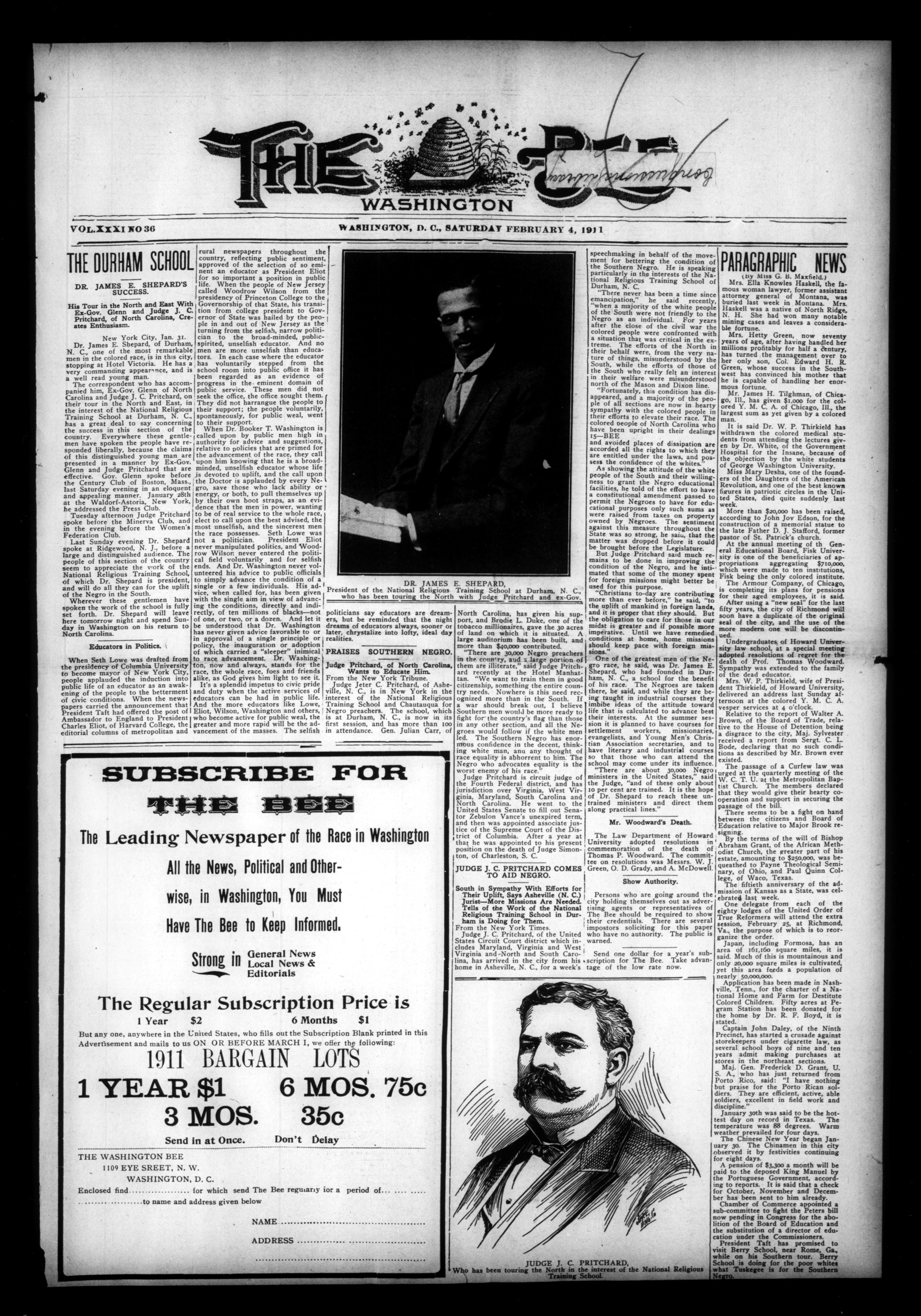
THE DURHAM SCHOOL
THE DURHAM SCHOOL
DR. JAMES E. SHEPARD'S SUCCESS.
His Tour in the North and East With Ex-Gov. Glenn and Judge J. C Pritchard, of North Carolina, Creates Enthusiasm.
New York City, Jan. 31.
Dr. James E. Shepard, of Durham, N. C., one of the most remarkable men in the colored race, is in this city, stopping at Hotel Victoria. He has a very commanding appearance, and is a well read young man.
The correspondent who has accompanied him, Ex-Gov. Glenn of North Carolina and Judge J. C. Pritchard, on their tour in the North and East, in the interest of the National Religious Training School at Durham, N. C., has a great deal to say concerning the success in this section of the country. Everywhere these gentlemen have spoken the people have responded liberally, because the claims of this distinguished young man are presented in a manner by Ex-Gov. Glenn and Judge Pritchard that are effective. Gov. Glenn spoke before the Century Club of Boston, Mass., last Saturday evening in an eloquent and appealing manner. January 28th at the Waldorf-Astoria, New York, he addressed the Press Club.
Tuesday afternoon Judge Pritchard spoke before the Minerva Club, and in the evening before the Women's Federation Club.
Last Sunday evening Dr. Shepard spoke at Ridgewood, N. J., before a large and distinguished audience. The people of this section of the country seem to appreciate the work of the National Religious Training School, of which Dr. Shepard is president; and will do all they can for the uplift of the Negro in the South. Wherever these gentlemen have spoken the work of the school is fully set forth. Dr. Shepard will leave here tomorrow night and spend Sunday in Washington on his return to North Carolina.
Educators in Politics.
When Seth Lowe was drafted from the presidency of Columbia University to become mayor of New York City, people applauded the induction into public life of an educator as an awakening of the people to the betterment of civic conditions. When the newspapers carried the announcement that President Taft had offered the post of Ambassador to England to President Charles Eliot, of Harvard College, the editorial columns of metropolitan and
rural newspapers throughout the country, reflecting public sentiment, approved of the selection of so eminent an educator as President Eliot for so important a position in public life. When the people of New Jersey called Woodrow Wilson from the presidency of Princeton College to the Governorship of that State, his transition from college president to Governor of State was hailed by the people in and out of New Jersey as the turning from the selfish, narrow politician to the broad-minded, public-spirited, unselfish educator. And no men are more unselfish than educators. In each case where the educator has voluntarily stepped from the school room into public office it has been regarded as an evidence of progress in the eminent domain of public service. These men did not seek the office, the office sought them. They did not harrangue the people to their support; the people voluntarily, spontaneously, for public weal, went to their support.
When Dr. Booker T. Washington is called upon by public men high in authority for advice and suggestions, relative to policies that are primed for the advancement of the race, they call upon him knowing that he is a broad-minded, unselfish educator whose life is devoted to uplift, and the call upon the Doctor is applauded by every Negro, save those who lack ability or energy, or both, to pull themselves up by their own boot straps, as an evidence that the men in power, wanting to be of real service to the whole race, elect to call to the best advised, the most unselfish, and the sincerest men the race possesses. Seth Lowe was not a politician. President Eliot never manipulated politics, and Woodrow Wilson never entered the political field voluntarily and for selfish ends. And Dr. Washington never volunteered his advice to public officials to simply advance the condition of a single or a few individuals. His advice, when called for, has been given with the single aim in view of advancing the conditions, directly and indirectly, of ten millions of blacks—not of one, or two, or a dozen. And let it be understood that Dr. Washington has never given advice favorable to or in approval of a single principle or policy, the inauguration or adoption of which carried a "sleeper" inimical to race advancement. Dr. Washington, now and always, stands for the race, the whole race, foes and friends alike, as God gives him light to see it.
It's a splendid impetus to civic pride and duty when the active services of educators can be held in public life. And the more educators like Lowe, Eliot, Wilson, Washington and others, who become active for public weal, the greater and more rapid will be the advancement of the masses. The selfish
THE WORLD'S FIRST WORLD WAR
politicians say educators are dreamers, but be reminded that the night dreams of educators always, sooner or later, chrystalize into lofty, ideal day realities.
PRAISES SOUTHERN NEGRO.
Judge Pritchard, of North Carolina, Wants to Educate Him. From the New York Tribune.
Judge Jeter C. Pritchard, of Asheville, N. C. is in New York in the interest of the National Religious Training School and Chautauqua for Negro preachers. The school, which is at Durham, N. C., is now in its first session, and has more than 100 in attendance. Gen. Julian Carr, of North Carolina, has given his support, and Brodie L. Duke, one of the tobacco millionaires, gave the 30 acres of land on which it is situated. A large auditorium has been built, and more than $40,000 contributed.
“There are 30,000 Negro preachers in the country, and a large portion of them are illiterate,” said Judge Pritchard recently at the Hotel Manhattan. “We want to train them in good citizenship, something the entire country needs. Nowhere is this need recognized more than in the South. If a war should break out, I believe Southern men would be more ready to fight for the country’s flag than those in any other section, and all the Negroes would follow if the white men
JUDGE J. C. PRITCHARD
JUDGE J. C. PRITCHARD,
Who has been touring the Mines in the interest of the National Religious
Training School.
North Carolina, has given his support, and Brodie L. Duke, one of the tobacco millionaires, gave the 30 acres of land on which it is situated. A large auditorium has been built, and more than $40,000 contributed.
"There are 30,000 Negro preachers in the country, and a large portion of them are illiterate," said Judge Pritchard recently at the Hotel Manhattan. "We want to train them in good citizenship, something the entire country needs. Nowhere is this need recognized more than in the South. If a war should break out, I believe Southern men would be more ready to fight for the country's flag than those in any other section, and all the Negroes would follow if the white men led. The Southern Negro has enormous confidence in the decent, thinking white man, and any thought of race equality is abhorrent to him. The Negro who advocates equality is the worst enemy of his race."
Judge Pritchard is circuit judge of the Fourth Federal district, and has jurisdiction over Virginia, West Virginia, Maryland, South Carolina and North Carolina. He went to the United States Senate to fill out Senator Zebulon Vance's unexpired term, and then was appointed associate justice of the Supreme Court of the District of Columbia. After a year at that he was appointed to his present position on the death of Judge Simonton, of Charleston, S. C.
JUDGE J. C. PRITCHARD COMES TO AID NEGRO.
South in Sympathy with Efforts for Their Uplift, Says Asheville (N. C.) Jurist—More Missions Are Needed. Tells of the Work of the National Religious Training School in Durham is Doing for Them. From the New York Times. Judge J. C. Pritchard, of the United States Circuit Court district which includes Maryland, Virginia and West Virginia and-North and South Carolina, has arrived in the city from his home in Asheville, N. C., for a week's
speechmaking in behalf of the movement for bettering the condition of the Southern Negro. He is speaking particularly in the interests of the National Religious Training School of Durham, N. C.
"There never has been a time since emancipation," he said recently, "when a majority of the white people of the South were not friendly to the Negro as an individual. For years after the close of the civil war the colored people were confronted with a situation that was critical in the extreme. The efforts of the North in their behalf were, from the very nature of things, misunderstood by the South, while the efforts of those of the South who really felt an interest in their welfare were misunderstood north of the Mason and Dixon line.
"Fortunately, this condition has disappeared, and a majority of the people of all sections are now in hearty sympathy with the colored people in their efforts to elevate their race. The colored people of North Carolina who have been upright in their dealings 15-BEE
and avoided places of dissipation are accorded all the rights to which they are entitled under the laws, and possess the confidence of the whites." As showing the attitude of the white people of the South and their willingness to grant the Negro educational facilities, he told of the effort to have a constitutional amendment passed to permit the Negroes to have for educational purposes only such sums as were raised from taxes on property by Negroes. The sentiment against the measure throughout the State was so strong, he said, that the matter was dropped before it could be brought before the Legislature. But Judge Pritchard said much remains to be done in improving the condition of the Negro, and he intimated that some of the money spent for foreign missions might better be used for this purpose.
"Christians to-day are contributing more than ever before," he said, "to the uplift of mankind in foreign lands, and it is proper that they should. But the obligation to care for those in our midst is greater and if possible more imperative. Until we have remedied conditions at home, home missions should keep pace with foreign missions."
One of the greatest men of the Negro race, he said, was Dr. James E. Shepard, who had founded in Durham, N. C., a school for the benefit of his race. The Negroes are taken there, he said, and while they are being taught in industrial courses they imbibe ideas of the attitude toward life that is calculated to advance best their interests. At the summer session it is planned to have courses for settlement workers, missionaries, evangelists, and Young Men's Christian Association secretaries, and to have literary and industrial courses so that those who can attend the school may come under its influence.
"There are about 30,000 Negro ministers in the United States," said the Judge, "and of these only about 10 per cent are trained. It is the hope of Dr. Shepard to reach these untrained ministers and direct them along practical lines."
Mr. Woodward's Death.
The Law Department of Howard University adopted resolutions in commemoration of the death of Thomas P. Woodward. The committee on resolutions was Messrs. W. J. Green, O. D. Grady, and A. McDowell.
Show Authority.
Persons who are going around the city holding themselves out as advertising agents or representatives of The Bee should be required to show their credentials. There are several impostors soliciting for this paper who have no authority. The public is warned.
Send one dollar for a year's subscription for The Bee. Take advantage of the low rate now.
PARAGRAPHIC NEWS
PARAGRAPHIC NEWS
(By Miss G. B. Maxheld).
Mrs. Ella Knowles Haskell, the famous woman lawyer, former assistant attorney general of Montana, was buried last week in Montana. Mrs. Haskell was a native of North Ridge, N. H. She had won many notable mines cases and leaves a considerable fortune.
Mrs. Hetty Green, now seventy years of age, after having handled her millions profitably for half a century, has turned the management over to her only son, Col. Edward H. R. Green, whose success in the Southwest has convinced his mother that he is capable of handling her enormous fortune.
Mr. James H. Tilghman, of Chicago, Ill., has given $1,000 for the colored Y. M. C. A. of Chicago, Ill., the largest sum as yet given by a colored man.
It is said Dr. W. P. Thirkield has withdrawn the colored medical students from attending the lectures given by Dr. White, of the Government Hospital for the Insane, because of the objection by the white students of George Washington University.
Miss Mary Desha, one of the founders of the Daughters of the American Revolution, and one of the best known figures in patriotic circles in the United States, died quite suddenly last week.
More than $20,000 has been raised, according to John Jov Edson, for the construction of a memorial statue to the late Father D. J. Stafford, former pastor of St. Patrick's church.
At the annual meeting of the General Educational Board, Fisk University is one of the beneficiaries of appropriations aggregating $710,000, which were made to ten institutions, Fisk being the only colored institute.
The Armour Company, of Chicago,
is completing its plans for pensions
for the company.
for their aged employees, it is said. After using a "new seal" for the last fifty years, the city of Richmond will soon have a duplicate of the original seal of the city, and the use of the more modern one will be discontinued. Undergraduates of Howard University law school, at a special meeting adopted resolutions of regret for the death of Prof. Thomas Woodward. Sympathy was extended to the family of the dead educator. Mrs. W. P. Thirkield, wife of President Thirkield, of Howard University, delivered an address last Sunday afternoon at the colored Y. M. C. A. vesper services at 4 o'clock. Relative to the report of Walter A. Brown, of the Board of Trade, relative to the House of Detention being a disgrace to the city, Maj. Sylvester received a report from Sergt C. L. Bode, declaring that no such conditions as described by Mr. Brown ever existed. The passage of a Curfew law was urged at the quarterly meeting of the W. C. T. U. at the Metropolitan Baptist Church. The members declared that they would give their hearty cooperation and support in securing the passage of the bill. There seems to be a fight on hand between the citizens and Board of Education relative to Major Brook resigning.
By the terms of the will of Bishop Abraham Grant, of the African Methodist Church, the greater part of his estate, amounting to $250,000, was bequeathed to Payne Theological Seminary, of Ohio, and Paul Quinn College, of Waco, Texas.
The fifteenth anniversary of the admission of Kansas as a State, was celebrated last week.
One delegate from each of the eighty lodges of the United Order of True Reformers will attend the extra session, February 25, at Richmond, Va., the purpose of which is to reorganize the order.
Japan, including Formosa, has an area of 161,160 square miles, it is said. Much of this is mountainous and only 20,000 square miles is cultivated, yet this area feeds a population of nearly 50,000,000.
Application has been made in Nashville, Tenn., for the charter of a National Home and Farm for Destitute Colored Children. Fifty acres at Pegram Station has been donated for the home by Dr. R. F. Boyd, it is stated.
Captain John Daley, of the Ninth Precinct, has started a crusade against storekeepers under cigarette law, as several school boys of nine and ten years admit making purchases at stores in the northeast sections.
Maj. Gen. Frederick D. Grant, U. S. A., who has just returned from Porto Rico, said: "I have nothing but praise for the Porto Rican soldiers. They are efficient, active, able soldiers, excellent in field work and discipline."
January 30th was said to be the hottest day on record in Texas. The temperature was 88 degrees. Warm weather prevailed for four days. The Chinese New Year began January 30. The Chinamen in this city observed it by festivities continuing for eight days. A pension of $3,300 a month will be paid to the deposed King Manuel by the Portuguese Government, according to reports. It is said that a check for October, November and December has been sent to him already. Chamber of Commerce appointed a sub-committee to fight the Peters bill now pending in Congress for the abolition of the Board of Education and the substitution of a director of education under the Commissioners. President Taft has promised to visit Berry School, near Rome, Ga., while on his Southern tour. Berry School is doing for the poor whites what Tuskegee is for the Southern Negro.
i
my a oo ee
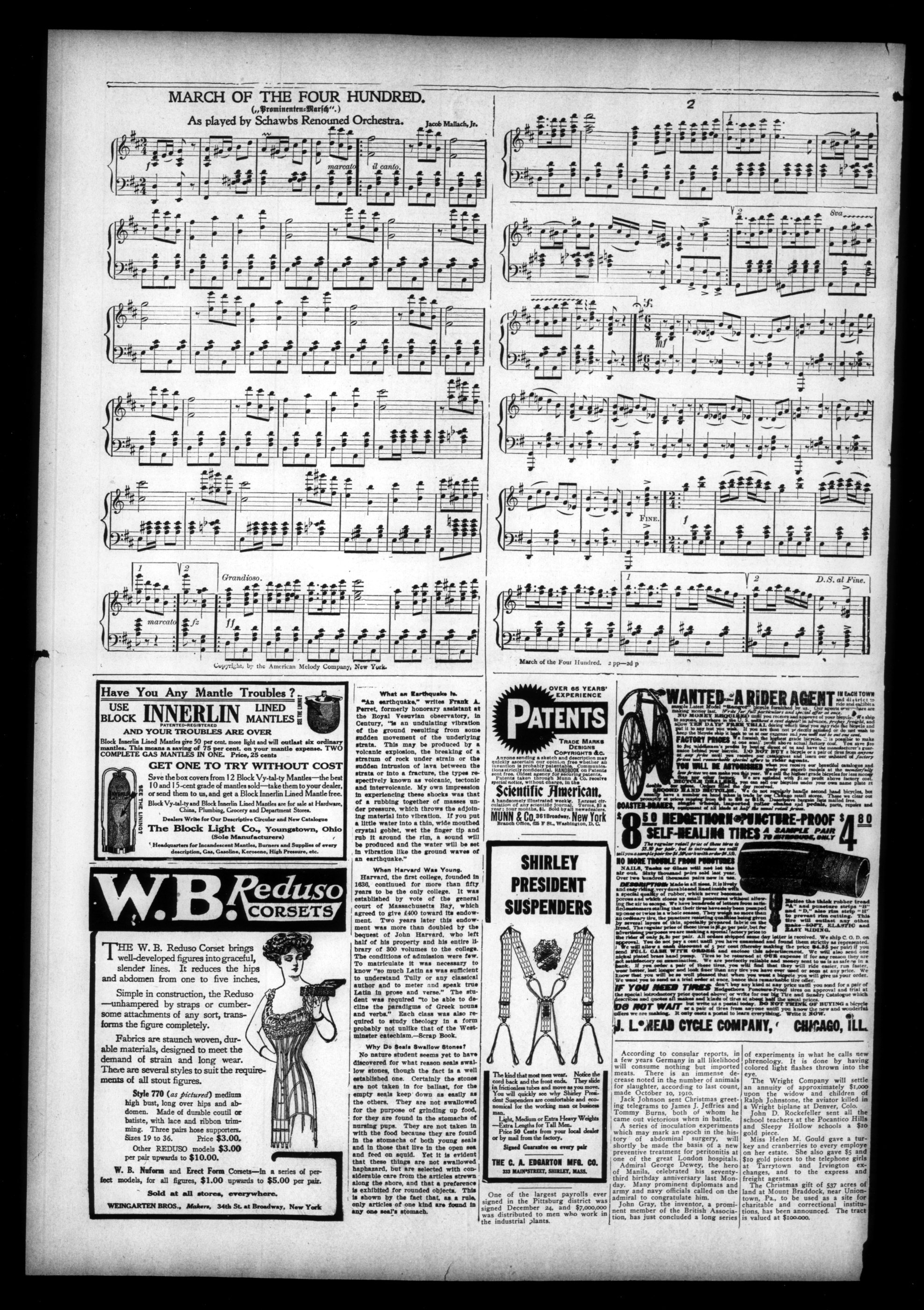
MARCH OF THE FOUR HUNDRED. : *.
rominenten:Marfqj’’.) z $ ‘ 5 = >
As s : ———<——————————
played by Schawbs Renouned Orchestra. : 2 :
Sra ay te po Joo Malach, Jee 2: fet & De
3 Sets 9 ae] Cs te . cf —o = o 2% Leet 1, eo 1
' Sse pease ee ee pe ipp=$ 3? —_ 38S seer o ee =
je-? |+ ie —— eee Ba Soe ee A ore et eT, ¥
pep} ——8 J $4 \t os , cc = ~ =e) eta-
Diese ie — Fete oo 2 «| 2 of 2 2 F |
" — es Stee 5-|—3——3:|—3—8 s+ Si3| $22\¢ ot ot
, + bee eh ee cm o—-— Fp —~s—e | 6-31-51 9-3-3 | @. 9-08 02
* Re aa aoa et | o—*— 9-5,
zt St e+ = tee a SE EE See E
a ee 2 ™ a ———
oi: —AEe- oS — [ m3 tee esl es
{ +— =——— E Lee re a V2 a —-
| a aie f a a 4 Bip et 2-g2% wna =
ss g | - | —— ae | gee 77 To x,
ys $= >| Se ; es ae Fo —0-r0_F
tb ato -o— — 84-8 3. 3 b ee a Ope eet ae
: ont Flee rs «phe betwee Lin + pee | OP OE
SP ELAP tT eS | byte re —— — ere
f i a | gto —*— 3-6 |" 6—_____\ Voi
Pe tte — Fe D336} *| $= é-,-l_1|_#4##1 444
= tt 1 a [———¢-|-— -9_ ——s wy}: 2
pe _Frt 2» £ : . | See eee a3 [8
pepe 2 fa ee Corte
StS rt Seeseeasoss as Ss Hy zo J
= = (tet aie. OS
; rte , CASS Eo ene upe oye
+ S$ |__. 3. 2 ! eee oH tae Who
ec ee at is | \ OEE Se es ae
pe Ee a — o = 778,¢— De aoe He
— BE che ee Senet ek if | |
ee ee | (Die | BeBe avr eter Sa eet
fe e- - Kae a by = $——|—+
2 te. Le eo ea epee “het
o-<9 J o.#2e £2 be v — ia Tp
& ee i ta 54 =+ —
— SE = FES az] (IGE eg —~)— : e
7 a al ae ew = ys - beet pg eee = — aE =
eae —$—$ 1-3-3] $3 |_4_$|_ 333 $ SEES re eee ae Pe pe
e- -—_ fe -|- —9—— » |__ 5 —_p- |——»-»—e— ‘ti 2 o ~~ -——_6_-
Tp 2 =| * poe Sid < ~~
poo ep ero F=|| (PHortepeee eee 1. al
tig . a mh | = '— | 7. 54% %. as aes See
yp = Pets fhe 2 = ™ he
Bera — tes — oe t=. + +H at ; = =
es aa —— -— . a
p— SSF et | — Ho phe rs ak seehe 2 FS
————— = L* fe | * pe ge a a ; Zeetet 2 or Sgn
Pr o—1-€ |- S| Se —| se = 22222
. oboe b 3 o56- oF |S et PSS -— ts
5 iene ees Soe —=——
. - —— — + 2 t- — 3 HINE f -———=
cal
— == eee eee tt} ob 8 - 3
i 2 _ —— PeSe| re pee 2 ey a
: : B Eee, z Grandioso. . | . “FZ fe oa co ce a St
7 = 2 + es .
oO oe, for 1 $35 sete fest # ttet 7 a
fp spe ree Sp |-9 ie Ot [-0, 6B 55 6 a |e tee 2 -
= | =| e—p-9-|-f-fe-e (ir — -+9- $e 2 wtag | ets D.S.al Fine. |-
, y = mareatel $ fe tf. - i = ae iF] es at sans i=ee5 cia 2g. 7 > |
a es: S 6 \— se - SS a a
hai —-8—}-—_ 2s —_ i—_e— _ : Po ot
an Fen a ere 9 wea 98 | 9 91a a — te 2/ te » rf
. “| ft pe KH PH |" pee oe — oe} tee A128 a2l* =
Rep sate ti teas Amiericon er = . i 7 ee peo j5—t ——F-
can Melody Company, New Yue March of thie Four Hundred, 2 pp—2d —— 4 ie
We eee eg ee 7 ~
- “ , . ws 7
rere " OEY Sore
on LO 5 SR FES OE
BL FORO F PER 5°. 7
Have You Any Mantle Troubles ?. 9.
cock INNERLIN sanrces? We
BLOCK MANTLES § (ic
PATENTED-REGISTERED outer 4
AND YOUR TROUBLES ARE OVER =
Block fnnerlin Lined Mantles give 50 per cent: more light and will outlast six ordinary
mantles. This means a saving of 75 per cent. on your mantle expense. TWO
COMPLETE GAS MANTLES IN ONE. Price, 25 cents
GET ONE TO TRY WITHOUT COST
ae Save the box covers from 12 Block Vy-tal-ty Mantles—the best
ee a 10and 15-cent grade of mantles sold—take them to your dealer,
; pe f orsend them to us,and get a Block Innerlin Lined Mantle free.
bes ||3! Black Vy.talty and Block Inneslin Lined Mantles are for sale at Hardware,
Pega |. China, Plumbing, Grocery and Department Stores.
a ff = Dealers Write for Our Descriptive Circular and New Catalogue
ieee o The Block Light Co., Youngstown, Ohio
i =e | (Sole Manufacturers) ‘
i PM) « rreadquarters for lacandescent Mantles, Burners and Supplies of every
ay description, Gas, Gasoline, Kerosene, High Pressure, etc.
ve B pnt
By
LTP
"THE .W.B. Reuso Corset brings gi son
well-developed figures intograceful, “So ©
slender lines. It reduces the hips
and abdomen from one to five inches, Nos
Simple in construction, the Reduso és kate me
—unhampered by straps or cumber- / Avil
some attachments of any sort, trans- Ries sath
forms the figure completely. RS Se
Fabrics are staunch woven, dur- Ni Wh Yj ,
able materials, designed to meet the a
demand of strain and long wear. i NN
| There are several styles to suit the require- {! ‘\ \
ments of all stout figures, I iy
Style 770 (as pictured) medium | 4 Wy
high bust, long over hips and ab- \ i}
domen. Made of durable coutil or H || hea
batiste, with lace and ribbon trim- rit ; 7
ming. Three pairs hose supporters. basics
Sizes 19 to 36, Price $3.00. UA 7
Other REDUSO models $3.00 eee d
per pair upwards to $10.00.
W. B. Naform and Erect Form Corsets—in a series of per
fect models, for all figures, $1.00 upwards to $5.00 per pair.
Sold at all stores, everywhere, e
‘WEINGARTEN BROS., Makers, 34th St. at Broadway, New York
What an Zarthquake ts.
“An earthquake,” writes Frank J
Perret, formerly honorary assistant at
the Royal Vesuvian observatory, in
Century, “is an undulating vibration
of the ground resulting from some
gudden movement of the underlying
strata, This may be produced by a
yolcante explosion, the breaking of a
stratum of rock under strain or the
sudden Intrusion of Inva between the
atrata or into a fracture, the types re-
spectively known as volcanic, tectonic
and ntervoleanic. My own impression
in penne these shocks was that
of a rubbing together of masses un-
der pressure, which throws the adjotn-
ing material Into vibration, If you put
a little water Into a thin, wide mouthed
crystal goblet, wet the finger tip and
rub it around the rim, a sound will
be produced and the water will be set
in vibration like the ground waves of
an earthquake.”
When Harvard Was Young:
Harvard, the first college, founded in
1636, continued for more than fifty
years to be the only college. It was
established by vote of the general
court of Massachusetts Bay, which
' agreed to give £400 toward Its endow-
ment. Two years later this endow-
ment was more than doubled by the
bequest of John Harverd, who left
half of his property and his entire If-
brary of 300 volumes to the college.
The conditions of admission were few.
‘To matriculate it was necessary to
know “so much Latin as was sufficient
to understand Tully or any classical!
author and to meter and speak true
Latin in prose and verse,” The stu-
dent was required “to be able to de-
cline the paradigms of Greek nouns
and verbs.” Each class was also re-
quired to study theology in a form
probably noi unlike that of the West-
minster catechism.—Scrap Book.
Why Do Seals Swallow Stones?
No nature student seems yet to have
discovered for what reason seals swal-
low stbnes, thotgh the fact is a well
| established one, Certainly the stones
are not taken In for ballast, for th
empty seals keep down as easily a
the others. They are not swallowed
for the purpose of grinding up food,
‘ for they are found in the stomachs 0!
nursing pups. They are not taken tr
with the food because they are found
in the stomachs of both young séals
| and In those that lve in the open ses
and feed on squid. Yet it is eviden
‘that these things are not swallowed
| haphazard, but are selected with con
; siderable care from the articles strewt
‘ along the shore, and that a preferenc:
fs exhibited for rounded objects. Thi
is shown by the fact that, as a rale
only articles of one kind are found i
any one seal’s stomach.
‘OVER 65 YEARS!
EXPERIENCE
‘Trape Manns
Desicns
Copyricnts &.
Anyone sending a sketch and. esceintion may
antekly ascertallt our opinion free whether ad
huvention ts probably patentadia, Commanica-
Uoneatrictly contdential, HANDBOOK om Patents
sch free. Uidgut apency for securing patenth,
Watents taken through Munn & Co. recelve
special notice, without charge, inthe
Scientific Fitmerican,
Ahandaomely itnatrated weekly. Targest ctr-
culation of any acientite journsi, Terms, 3 a
Year: tour months, $l, Bold byall newsdeslers.
MUNN & Gp,26rerseeas. New York
Branch OMice, 2 F &t., Washington, D.C.
SHIRLEY
PRESIDENT
SUSPENDERS
\e/
Cal
guys ‘wif sh
i fal
a. ue : x
é 4 d \ 6 ON
‘The kind that most men wear. Notice the
Sal matetotes ee
ees
nomical for the working man or busmess
Tit, Metin ca Hey We
* Price 50 Cents from your local dealer
of by mail from the factory.
Signed Guarantee on every pair
THE C. A. EDGARTON FFG. CO.
‘303 MAIN’STREET, SHIRLEY, MASS.
One of the largest payrolls ever
signed in the Pittsburg district was
signed December 24, and $7,000,000
was distributed to men who work in
the industrial plants.
/ WANTED <A RIDER AGENT 22:22
pa’ patrict >
A i a = a Baad Boe ard ctstona
A . Tes
ee LX eae oe
i , PA t topos, anywhere wn tbe PS. erthomt w cen! dapou ke ndvanee Po Fe
{ och Beat waka SHELA Lore eh una you pyre Ac cpl sad
g 4 B you are thea not » rect]; do
i IN) Sete thes Corte out to comeard ears
HA LKR FACTORY PROES Walon Se inricw crac tapclen re ponctr to make
Ni Pa bo Dos, Sidlnnen’s profs by Eoplog Greet ol be td have Oe samalaecrer Fe oe
NU RMEME wo et ne eee Lo BUY a bicycle or a par of fires fross aayoar
Bax So foresee onent nid letra out wrboard of factory
q iY fy YOU WILL BE ASTOROMED Tos Te emis oe bec clone and
i} i dey Arner coe maa you hs rec. Wesel Bie event rade cpclea arlene oe?
y \ fun ether 'e wre mutisbed with $100 profit above cost,
= Tamers met i ow oom eta a
Sted Rasp Wena handle sacood hand bicre
te rs Tnioas poe Tetons ras poe nat ene Bie feear
Deze frce.
leor=se-paans, cele Foard soe ST A raelh Gs ie et
5.0 MEDGETHORNGPUNCTERE-PROOF Sa 80
SELF-HEALING TIRES 7 Stareves'oxcy
STRIOVEE,
> Tg regulon relat pint of ten seat
SL per pair, bet be introduce we rrist SY
sell you csemple pomr for Ft Sica kercth order 36S. mamma coc F
NO MORE TROUBLE FROM PESCTORES Se See to a Sf)
NAILS, Teoks or Glase will mot lot the gee oe Af: ) a a)
AIF out ‘Skrty Ghomsnad prirs said last year, oe SER
Over twe bundred theasasa palrs pew in vee, PREM eee SIRES
DEDOREPT HO Hie Medal al sae. Ils }traty | af aa
and easy: very dursbiossed hastings ry 3
spel quay robber, which mrver besomes —S ty
porovesnd watch closes sp small ponctunss whhowt alter. c
Dg Cee ir Wo eecape. We have of laticra from satie. amy Zatice the thlek robber tread
fiedeustoasers staling that thetr tires haveenty been puan| @A" and panetare strips “is”
tpoace of twice aa whele seased. They Seabrethes BE S84 “D." also rim telp =U
Pfeerdedipteniy le venieine haioe piven to prevent rim cutting. This
Tavcral tnyere ef thin, specialty prepared fabricioa tee Bre wil eatiat aay other
PF area reToiec prieel Eeesetivecna pigeper pelr.botter Sart ELavric asd
‘adveruaing parpoees Weare aking anpreel ac eeatn x HIDING.
Boe Tider ot aly $080 per pals. al shipped mene Gory latter ia received. We ship OD
segroval, Yes Go not pry s coat natfl you hare examined aad found them strict! na fe to
uj 'e wal allow & lnawant of 5 per cent thereby maxing the Price S486 init
tend FOLL CASH WITH ORBEM and encicec 1) sévertiecrent. We wit sos sone.
Bical pited brass hand pee Tires to be retaread at OUM eapense if for any reason they are
pot pat ou examination. We are poriaatiy rellable and poney nent to we laos rate oi 5.
CENT Oo in ealt OT thane neat rea GI hand teat een TAT na ne ee eee
te banter, int igen are leak Seer Han 2ny tire you ave tret toed or besa or any ree, We
now thet wi - PAeaed thai weet i
[Be renege dw rt ges Sane ae reece mbna See
TF YOU SEED THES feign toncvcre CAE tes on Ippo sod el
the apecial iotroductory price quoted abcves or write f ood sun, Soque wal
Hepeneeaterenione serra ee eevee
rl a < Ui NG a bicycle
BOT WAIT « ‘of tires from now the new
pom ress. It only onets a portal to lear Creryibing? Welte lt HOW a
i
* ¢ COM ‘
py. LewEAB CYCLE COMPANY,’ CHIGAGO, ILL.
| According to consular reports, in
a few years Germany in all Inkelihood
will consume nothing ybut’ imported
meats. There is an-ammense de-
crease noted in the number of animals
for slaughter, according to last count,
made October 10, 1910. _
a Jack Johnson sent Christmas greet-
‘ing telegrams to James J. Jeffries and
Tommy Burns, both of whom he
came out victorious when in battle.
| A series of inoculation experiments
which may mark an epoch in the his-
tory of abdominal surgery, will
shortly be made the basis of a new
preventive treatment for peritonitis at
one of the great London hospitals.
"Admiral George Dewey, the hero
of Manila, celebrated his seventy-
third birthday anniversary last Mon-
day. Many prominent diplomats and
army and navy officials called on the
admiral to congratulate him.
John Gray, the inventor, a promi-
nent member of the British Associa-
tion, has just concluded a long series
of experiments in what he calls new
phrenology, it is done by having
colored light flashes thrown into the
eye:
The Wright Company will settle
an annuity of approximately $1,000
upon the widow and children of
Ralph Johnstone, the aviator kr'led in
a Wright biplane at Denver, Cc io.
John D. Rockefeller sent ail the
school teachers at the Pocant'co Hills
and Sleepy Hollow schools a $10
gold piece.
Miss Helen M. Gould gave a tur-
key and cranberries to every employe
on her estate. She also gave $3 and
$10 gold pieces to the telephone girls
at Tarrytown and Irvington ex-
changes, and to the express and
freight agents.
The Christmas gift of 537 acres of
land at Mount Braddock, near Union-
town, Pa, to be used as a site for
charitable and correctional institu-
tions, has been announced. The tract
is valued at $100.000.
A Turk always stands in the presence of his mother until invited to sit down, a compliment he pays to no one else.
The oldest royal house in Europe is that of Mecklenburg. It traces its descent from Genseric, who sacked Rome in A. D. 455.
Every pleasure is acquired at the cost of suffering. The price of real pleasure is paid, in advance; for wrong pleasure one pays after—John Foster.
Longchump—Did she give any reason for refusing you? Hardit—Reason? No; that's the woman of it. Simply said she did not love me.
Mrs. Cannibal—You haven't a single redeeming trait. Cannibal—Oh, there's some good in me. I have just eaten a missionary—New York Press.
Mr. B.-Do you and I agree on anything? Mrs. B.-Yes; each of us believes that one of us is poorly mated—Illustrated Bits.
"Why do they always make pictures of Cupid without any clothes?"
"So he won't ever be out of style."—Cleveland Leader.
"Demosthenes talked with pebbles in his mouth, my son."
"He must have made a rocky speech, pa."—New York Press.
She—How conceitedly that man talks! Is he an actor?
He—Worse than that! He's an amateur actor.—Life.
"They say he has a coarse streak in him."
"I should say that he had a refined streak in him."—Puck.
"Do you keep a second girl?"
"No; my wife isn't strong enough to wait on more than one."—Kansas City Journal.
Mrs. Knicker—What did you do when she stole your cook?
Mrs. Subbubs—Stole her dressmaker.
—New York Sun.
"I am looking for a fashionable overcoat."
"All right, sir. Will you have it too short or too long?"—Filegende Blatter.
Little Girl—What's an intelligence office, mamma? Mother—It's where one goes to find out what wages cooks are charging.—New York Herald.
"Is this new business you're going into tentative?"
"No, it ain't. It's dry goods."—Baltimore American.
Teacher—Can any one in the class tell me what a lawsuit is?
Small Boy—Yes, ma'am, I can. It's a suit worn by a policeman—Exchange.
Up to a certain point exposure to radium rays stimulates the germination of seeds, but if that point is passed the growth is stopped.
"Fusil" was the old name for the flintlock to distinguish it from the matchlock, and fusileers were those who carried fusils.
The double entry system of bookkeeping now in common use was first practiced in Italy in the latter part of the fifteenth century.
In Scotland the corn and grass fields are divided into spaces twenty to thirty yards wide by a furrow made by a plow. These are termed rigs.
John Brown was executed at Harpers Ferry on Dec. 2, 1859. It was shortly after 11 o'clock in the morning. Two thousand soldiers were ranged around the scaffold when he was brought from his prison house and placed in a wagon which was to convey him to the scene of execution.
Man In Hard Luck—I am reduced to the painful expedient of asking you to buy the diamonds in my wife's jewelry and to replace them with imitations.
Jeweler (examining the jewels)—Your wife evidently has preceded you in evolving that clever plan—Jewelers' Circular.
There is a seventeen-year-old girl in Atchison who feels so good that she almost screams with joy. In a few years when we meet that girl pushing a baby buggy and looking as cross as it is possible for a married woman to look we are sure we shall laugh.—Atchison Globe.
Bullets of paper or tallow produce far greater damage than metal ones when used for short distance firing. A paper bullet passing through six pieces of tin placed one foot apart buckled them up and made them useless, whereas a metal bullet merely left a small round hole.
The Sword Swallower—I'm in a great quandary. Manager—What's the matter? The Sword Swallower—I asked the two headed girl to marry me, and only one of her accepted! Manager—What's the matter with the other of her? The Sword Swallower—She's afraid of bigamy!
Father—What! Another dressmaker's bill? My dear girl, you should fix your mind on something higher than dress. Daughter—So I have, papa, I've got my mind fixed on a love of a hat in a downtown milliner's window, and just think, it's only $19.99! You'll get it for me, won't you, papa, dear!
Percy (exhibiting a bromide enlargement of kodak snapshot of himself riding a donkey)—See, Dick, I had this taken when I was away during the holidays. Do you think it does me justice? Dick—Why, yes, rather. But who's the awkward rider on your back—New York Times.
"Which side is your member of congress on in this attack on corporate wealth?"
"Well," answered Farmer Cornosel, "I haven't heard him say much one way or another, but I reckon that, usual, he's on the inside."—Washington Star.
When a man tells his wife of so increase in his wages she doesn't burst out in congratulations. She has an absentminded look in her eyes as if calculating just about how many yards it will take for a dress she had hitherto felt that she couldn't afford.—Atchison Globe.
Citizen—What'll you charge me, Uncle Rastus, to cart away that pile of stone? Uncle Rastus—About $2, sah. Citizen—Isn't that very high! Uncle Rastus—Yes, sah, jee' fo' cahtin' away the stone, but I got ter hire a man ter he'ep me hahness de mula—Harper's Bazar.
The young man leading a dog lounged up to the ticket office of a railway station and inquired:
"Must I—aw—take a ticket for a puppy?"
"No; you can travel as an ordinary passenger," was the reply.—Universalist Leader.
"Do you think the climate affects a man's energies?"
"Undoubtedly," answered the leisurely person. "When the weather's cloudy you haven't the ambition to work, and then when it's fair it seems a shame to shut yourself up in an office."—Washington Star.
"Yes, the brother and sister both married for titles."
"I don't understand."
"She married to get the title of countess, and he married to get the title for one of the finest pieces of property to be found in the city."—Cleveland Leader.
Eva—Why did you refuse him?
Edna—He was too economical.
Eva—But I thought you said the young man you accepted would have to be economical?
Edna—But he was too much, so. He actually proposed on a postcard—London Express.
"Eggs For Invalida" read the sign at a certain shop.
"What is there unusual about those eggs?" asked a curious observer.
"Why, them eggs is an absolute novelty," said the dealer briskly, adding impressively in awed tones, "them eggs is fresh."—Liverpool Mercury.
The seal of Oliver Cromwell, now in the possession of a prominent family in Wales, is a plain, gold mounted corundum stone five-eighths of an inch in diameter. It dates from 1653 and was used on several of Cromwell's deeds. All the Lord's prayer is engraved on it—London Gentlewoman.
He (wondering if Bertie Williams has been accepted)—Are both your rings heirlooms?
She (concealing her hand)—Oh, dear, yes. One has been in the family since the time of Alfred, but the other is newer (blushing)—only dates from the conquest—London Mall.
Among the Anglo-Saxons the bridegroom gave a pledge, or "wed," at the betrothal ceremony. This wed included a ring, which was placed on the malden's right hand, where it remained until, at the marriage, it was transferred to the fourth finger of the left.
"What's the matter, old man?"
"Oh, I've just had a quarrel with my wife."
"Well, forget and forgive."
"I can never forgive her. You sea, I was in the wrong."
"Then in that case demand an apology."
Carlotta Grisl complained to Rossini that Giulia Grisl's success as a singer obliged her to fall back upon the dancer's profession.
"What would you more, my child?" he replied. "Glulla has stolen the nightingale's voice, but she has left you its wings."
"It's awfully late," I remarked to my friend after an extra long whist bout at the club. "What will you say to your wife?"
"Oh, I shan't say much, you know," was the reply; "'Good morning, dear,' or something of that sort. She'll say the rest."
"Don't you think that fellow who broke his engagement because the girl went to the jeweler to find the price of the ring a bit sensitive?"
"I think he was wise. A woman like that would be wanting her husband to keep an account of his private expenses."—Exchange.
A Sponge Garden.
A beautiful effect may be obtained by means of a damp sponge and a few seeds. Take a large piece of coarse sponge and cut it into any shape desired. Then soak it in water, squeeze half dry and sprinkle in the openings red clover seed, millet, barley, grape, rice, oats—any or all of these. Hang the sponge in a window where the sun shines at least part of the day.—Country Life In America.
His Prophecy.
Hannibal, the illustrious general, driven to despair by his enemies, had taken poison and had laid himself down to die.
"Anyhow," he said, "my name will live in history."
His forestight was unerring.
Two thousand years later a town in Missouri was named in his honor—Chicago Tribune.
Time was when London was a watering place, whose wells, if not rivaling Bath or Harrogate, were widely famed and frequented by people from all quarters. In South London there were quite a number of spas, Lambeth wells, which sold water for a penny a quart and gave it to the poor for nothing. St. George's wells, Sydenham wells and Dulwich wells being the best known—London Graphite.
Deep Breathing and Character
We are beginning to learn the value to health and lungs of the habit of "deep breathing." To throw our windows wide open, breathe in fresh air so deeply that not only the lungs, but the whole of the body right down to the hips, is expanded, exercised and bathed with clean air, prevents chest weakness and consumption and helps to cure anaemia and-bad temper.-Exchange.
* Trouser Legs.
A study of the trousers legs as seen in the photographs of our most noted men brings the smile of contempt from even the most disinterested, and one wonders if anything could be uglier than the concertina folds of the clumsy, elephantine outlines that are there to be seen. Breeches, knickers and kilts are all far more artistic and healthy—Tailor and Cutter.
A Definite Reason.
An English paper tells of a canny Scot whose neighbor met him flitting. The Scot had wife and children and household furniture piled atop the wagon, and he was solemnly driving his one horse along the street.
"So ye're flittin'T" said the neighbor.
"I am. I want to be near me work."
"And where's yer job?"
"I haven't got one yet."
An Easy Riddance.
Mr. Hardrocks—By George, I was relieved this morning! Mrs. Hardrocks—Why, Siliaa, how? Did somebody pick your pocket? Mr. Hardrocks—No. Young Perkleigh came in to see me. I thought he was certainly after our daughter, but he merely wanted to borrow $10. He'll never bother us any more. I let him have it—Cleveland Leader.
Hla Reason:
"Why do you always ride in the smoking car? You don't smoke."
"I ride in the smoking car," replied the man to whom the question was addressed, "to escape from the effusive gratitude of the young women to whom I always have to give up my seat when I ride in the other cars."
But there was a hard, metallic, ironical sort of ring in his voice.—Chicago Tribune.
Giving Himself Away.
"You are married, aren't you?" she asked as they took their seats at the table at the dinner party.
"Yes," he acknowledged. "How did you know?"
"You opened the door for yourself," she answered, "then went through, leaving me to follow, instead of holding it and letting me pass through first."—New York Press.
How It Helped.
"Are you still helping that poor family?"
"I'm trying to help them. I gave the mother some money the other day so that she would feel independent of her drunken husband."
"Well?"
"She, she had her husband arrested for beating her and then paid his fine with the money I gave her."—Cleveland Plain Dealer.
Von Bulow's Threat.
So far as the audience was concerned, Von Bulow always made a point of doing exactly as he pleased. On one occasion when a Lelpzlg audience insisted on recalling him in spite of his repeated refusal to play again he came forward and said, "If you do not stop this applause I will play all Bach's forty-eight preludes and fugues from beginning to end!"
A Living Tomb.
Some of the lasmas of Tibet have a custom of allowing themselves to be inclosed in grottoes, so that they would live in darkness for the rest of their lives. Sven Hedin heard of a man who was inclosed at the age of sixteen or seventeen years and lived there sixty-nine years without any communication with the outside world whatever, his food and water being passed underground by a long pole.
Banks of Newfoundland.
Newfoundland would be nothing without that great submarine plateau known as the "banks," on which all the fishing is done. At a small station within the edges of the great bank that the cod loves so well the sea is quite smooth. It is usual for vessels fishing on the bank to inquire from those that have arrived from the open sea as to what sort of weather it is "aboard."
The Elva Kakkar
A set of regulations, intended to distinguish the Sikhs irrevocably from those around them, was the rule of the Five Kakkas. Every Sikh must have with him five things beginning with the letter "k"—viz, kesa (long hair), kangha' (a comb), karada (a knife), kirapana (a sword) and kacha (breeches reaching to the knee). The purpose of those rules was that every Sikh should avoid shaving, as do Mohammedans and Hindos, and should be constantly armed and free from the long garments that might impede him in a fight.
Ambassadorial Humor.
Following the proclamation of the commune in Paris, General Brackenbury attached himself to the government troops at Versailles, where Lord Lyons, the British ambassador, also was. One day Lord Lyons was persuaded to visit Mendon. He was looking from the window of an empty house when a shell fell and burst in the garden below. Then he said quietly: "Perhaps I had better retire. It would be a diplomatic blunder if her majesty's ambassador were to be killed." -Blackwood's Magazine.
McCALL PATTERNS
10
AND
15
NONE HIGHER
McCALL'S MAGAZINE
50
YEAR
INCLUDING A FREE PATTERN
McCALL PATTERNS
Celebrated for style, perfect &, simplicity and
reliability. Every 40 yrs. Sold in neatly
every city and town in the United States and
Canada, or by mail direct. More soild than
any other make. Send for free catalogue.
McCALL'S MAGAZINE
More subscribers than any other fashion magazine—million a month. Invaluable. La- titude type, stylish, multifacil millinery, plain sewing, fancy needlework, hairdressing, stitche-ture, good stitches, etc. Only 10 cents a year (worth double), including a free pattern. Subscribe today or send for sample copy.
WONDERFUL INDUCEMENTS
to Agents. Postal brings premium catalogue and new cash prize offer. Addres- s.
McCALL CO., 223 to 213 W. 37th St. NEW YORK
THE BEE AND McCALL'S GREAT
FASHION MAGAZINE
for one year for $200.
COUPON.
Richer Bee—
Find enclosed two dollars. Send to my address below The Bee and McCall's Fashion Magazine for one year.
No.....
Street.....
Town or City.....
.....
BUY THE
NEW HOME
LIGHT RUNNING
SEWING MACHINE
Before You Purchase Any Other Write
THE N.W. HOME SEWING MACHINE COMPANY
ORANGE, MASS.
Many Sewing Machines are made to sell "r d quality, but the "New Home" made weas. Our guaranty never runs out.
We make Sewing Machines to suit all conditions n the trade. The "New Home" wands satthes BIG green grass. We are proud to sell. Sold by authorized dealers only.
FUR SALE BY
Go to
HOLMES' HOTEL,
No. 333 Virginia Ave., S.W.
Best Afro-American Accommodation in the District.
EUROPEAN AND AMERI-
AN.
Good Looms and, Lodging, 50.
75c. and $1.00. Comfortably
Heated by Steam. Give
us a Call
James Otoway Holmes, Prop.
Washington, D. C.
Main Phone 231c.
CHINA'S GRAND CANAL
At Times It Holds Water Enough to Float Boats, but Usually They Are Dragged Over Mud Banks.
Of some of the crude and outgrown methods used on Chinn's Grand canal a writer in the North China Daily News remarks: "The junction of the real canal with the Wel river was not by means of a lock, but simply a high and steeply sloping mud bank, over which the grain vessels had to be dragged by the force of perhaps many hundreds of men. It should be borne in mind that in China the lock of a canal is not much more like our idea of what that name connotes than it is like a padlock. Amid constant and often serious changes of level, with an uncertain and not infrequently a scanty supply of water, and with a grain fleet which traveled in blocks of some eighty vessels under one officer, it was necessary to devise some way for keeping them together and for transferring them as a consolidated unit with this in view.
"For this reason a Chinese lock on the Grand canal is nothing but a stone gateway into which large boards may be lowered through a groove in the stones, restraining most of the water from its flow, until there is a depth sufficient to float all the craft, when the boards are pulled up and the entire fleet passes through."
"After this the boards are again lowered for another division of the grain boats. In case the water gives out—a by no means unlikely occurrence—there is nothing to do but to wait until more comes from somewhere."
It is known that the rate of increase in the population of a species is directly proportional to the square of the population size.
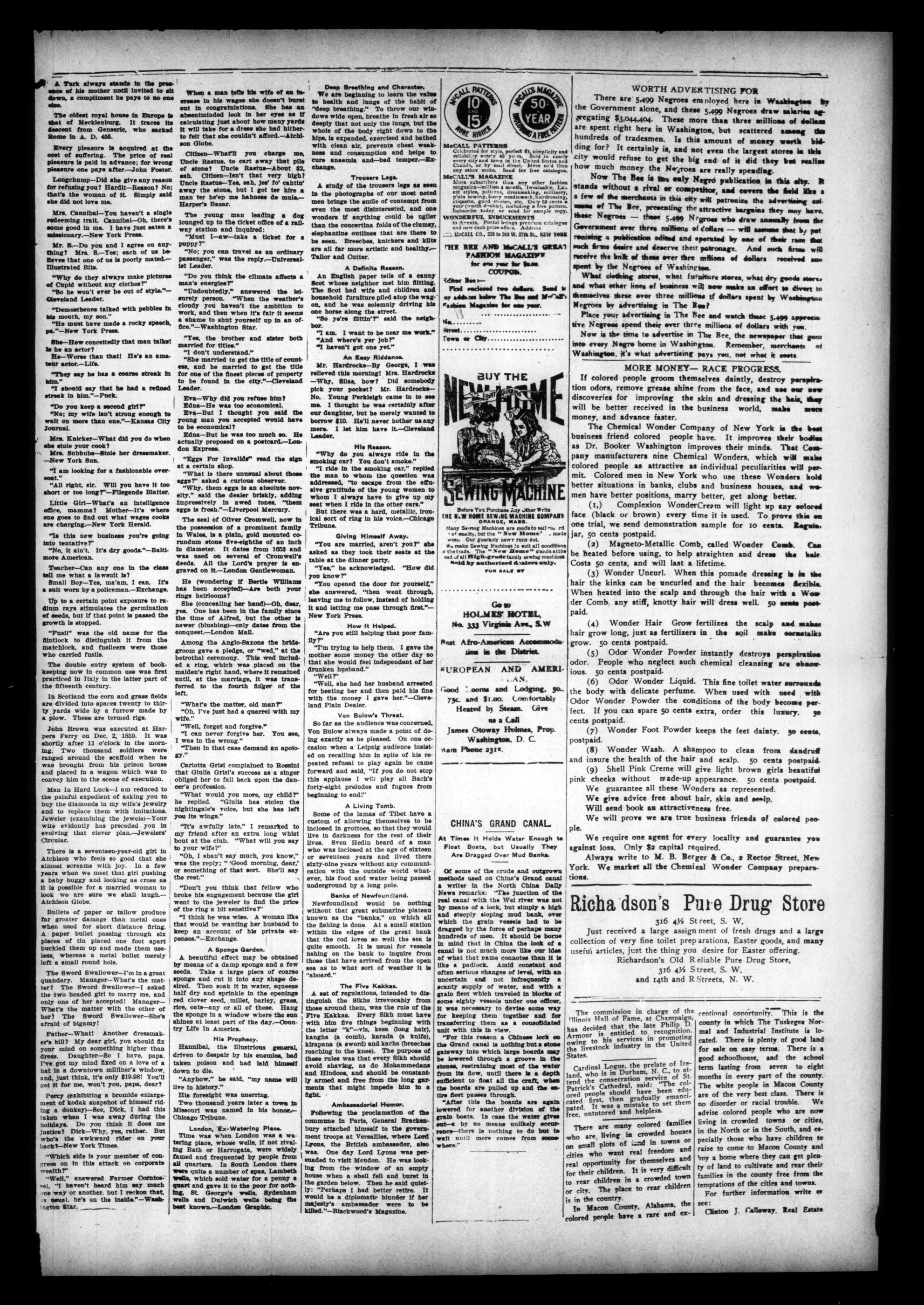
WORTH ADVERTISING FOR
There are 5,499 Negroes employed here in Washington, the Government alone, and these 5,499 Negroes draw six megatrating $3,044,404. These more than three millions are spent right here in Washington, but scattered and hundreds of tradesmen. Is this amount of money being for? It certainly is, and not even the largest store city would refuse to get the big end of it did they know much money the Negroes are really spending.
Now The Bee is the only Negro publication in this stands without a rival or competitor, and covers the few of the merchants in this city will patronize the adventures of The Bee, presenting the attractive bargains they these Negroes — those 5,499 Negroes who draw annually Government over three millions of dollars — will assume the renaming a publication edited and operated by one of these such firms desire and deserve their patronage. And such receive the bulk of these over three millions of dollars repent by the Negroes of Washington.
What clothing stores, what furniture stores, what dry goods and what other lines of business will now make an effort to themselves these over three millions of dollars spent by Negroes by advertising in The Bee?
Place your advertising in The Bee and watch these 5,499 Negroes spend their over three millions of dollars will Now is the time to advertise in The Bee, the newspaper into every Negro home in Washington. Remember, men Washington, it's what advertising pays you, not what it is.
eyed here in Washington by 1499 Negroes draw salaries ag-
e than three millions of dollars, but scattered among the
amount of money worth bid-
even the largest stores in this
and of it did they but sealline
really spending.
and publication in this city. R
or, and covers the field like a
patronize the advertising co-
nstructive bargains they may have,
ones who draw annually from the
dollars — will assume that by pat-
tured by one of their race that
chronage. And such firms will
dollars received an-
ure stores, what dry goods stores
now make an effort to divert to
dollars spent by Washington
and watch these 5,499 approxima-
millions of dollars with you.
Bee, the newspaper that goes
on. Remember, merchants of
you, not what it costs
There are 5,499 Negroes employed here in Washington by the Government alone, and these 5,499 Negroes draw salaries aggregating $3,044,404. These more than three millions of dollars are spent right here in Washington, but scattered among the hundreds of tradesmen. Is this amount of money worth bidding for? It certainly is, and not even the largest stores in this city would refuse to get the big end of it did they but sealize how much money the Negroes are really spending.
Now The Bee is the only Negro publication in this city. It stands without a rival or competitor, and covers the field like a few of the merchants in this city will patronize the advertising columns of The Bee, presenting the attractive bargains they may have, these Negroes — those 5,499 Negroes who draw annually from the Government over three millions of dollars — will assume that by patronizing a publication edited and operated by one of their race such firms desire and deserve their patronage. And such firms will receive the bulk of these over three millions of dollars received and spent by the Negroes of Washington.
What clothing stores, what furniture stores, what dry goods stores and what other lines of business will now make an effort to divert to themselves these over three millions of dollars spent by Washington Negroes by advertising in The Bee?
Place your advertising in The Bee and watch these 5,499 appreciative Negroes spend their over three millions of dollars with you. Now is the time to advertise in The Bee, the newspaper that goes into every Negro home in Washington. Remember, merchants of Washington, it's what advertising pays you, not what it costs
MORE MONEY—RACE PROGRESS
If colored people groom themselves daintly, destroy odors, remove grease shine from the face, and use discoveries for improving the skin and dressing them will be better received in the business world, more money, and advance faster.
The Chemical Wonder Company of New York is a business friend colored people have. It improves the skin Dr. Booker Washington improves their minds. The company manufacturers nine Chemical Wonders, which are colored people as attractive as individual peculiarities. Colored men in New York who use these Wonders better situations in banks, clubs and business houses men have better positions, marry better, get along better.
(1.) Complexion WonderCream will light up the face (black or brown) every time it is used. To prove one trial, we send demonstration sample for 10 centiar, 50 cents postpaid.
(2) Magneto-Metallic Comb, called Wonder Comb, be heated before using, to help straighten and dress Costs 50 cents, and will last a lifetime.
(3) Wonder Uneurl. When this pomade dressing hair the kinks can be uncurled and the hair become When heated into the scalp and through the hair with Wonder Comb, any stiff, knotty hair will dress well. 50 cents paid.
(4) Wonder Hair Grow fertilizes the scalp of hair grow long, just as fertilizers in the soil make grow. 50 cents postpaid.
(5) Odor Wonder Powder instantly destroys odor. People who neglect such chemical cleansingious. 50 cents postpaid.
(6) Odor Wonder Liquid. This fine toilet water the body with delicate perfume. When used with Odor Wonder Powder the conditions of the body befect. If you can spare 50 cents extra, order this 1 cents postpaid.
(7) Wonder Foot Powder keeps the feet dainty postpaid.
(8) Wonder Wash. A shampoo to clean from and insure the health of the hair and scalp. 50 cents.
(9) Shell Pink Cremne will give light brown girl pink cheeks without made-up appearance. 50 cents We guarantee all these Wonders as represented. We give advice free about hair, skin and scalp.
oves daintly, destroy perspiration the face, and use our new skin and dressing the hair, they business world, make more many of New York is the best love. It improves their bodies moves their minds. That Comed Wonders, which will make individual peculiarities will per- who use these Wonders hold and business houses, and w-oetter, get along better. Dream will light up any colored it is used. To prove this on sample for 10 cents. Regular.
called Wonder Comb. Can straighten and dress the hair. Setime. This pomade dressing is in the and the hair becomes flexible through the hair with a Wow will dress well. 50 cents post- fertilizes the scalp and makes in the soil make cornstalks instantly destroys perspiration chemical cleansing are obnox- This fine toilet water surrounds When used with used with portions of the body become per- extra, order this luxury. 50 keeps the feet dainty. 50 cents, soap to clean from dandruff and scalp. 50 cents postpaid live light brown girls beautiful appearance. 50 cents postpaid orders as represented: hair, skin and scalp. less free. business friends of colored peo-ry locality and guarantee you required. Mer & Co., 2 Rector Street, Newal Wonder Company prepara-
If colored people groom themselves daintly, destroy perspiration odors, remove grease shine from the face, and use our new discoveries for improving the skin and dressing the hair, they will be better received in the business world, make more money, and advance faster.
The Chemical Wonder Company of New York is the best business friend colored people have. It improves their bodies as Dr. Booker Washington improves their minds. That Company manufacturers nine Chemical Wonders, which will make colored people as attractive as individual peculiarities will permit. Colored men in New York who use these Wonders hold better situations in banks, clubs and business houses, and women have better positions, marry better, get along better.
(1,) Complexion WonderCream will light up any colored face (black or brown) every time it is used. To prove this on one trial, we send demonstration sample for 10 cents. Regula jar, 50 cents postpaid.
(2) Magneto-Metallic Comb, called Wonder Comb. Can be heated before using, to help straighten and dress the hair. Costs 50 cents, and will last a lifetime.
(3) Wonder Uneurl. When this pomade dressing is in the hair the kinks can be uncurled and the hair becomes flexible. When heated into the scalp and through the hair with a Wonder Comb, any stiff, knotty hair will dress well. 50 cents postpaid.
(4) Wonder Hair Grow fertilizes the scalp and makes hair grow long, just as fertilizers in the soil make cornstalks grow. 50 cents postpaid.
(5) Odor Wonder Powder instantly destroys perspiration odor. People who neglect such chemical cleansing are obnoxious. 50 cents postpaid.
(6) Odor Wonder Liquid. This fine toilet water surrounds the body with delicate perfume. When used with used with Odor Wonder Powder the conditions of the body become perfect. If you can spare 50 cents extra, order this luxury. 50 cents postpaid.
(7) Wonder Foot Powder keeps the feet dainty. 50 cents, postpaid.
(8) Wonder Wash. A shampoo to clean from dandruff and insure the health of the hair and scalp. 50 cents postpaid.
(9) Shell Pink Creme will give light brown girls beautiful pink cheeks without made-up appearance. 50 cents postpaid. We guarantee all these Wonders as represented. We give advice free about hair, skin and scalp.
Will send book an attractiveness free. We will prove we are true business friends of a ple. We require one agent for every locality and gu against loss. Only $2 capital required. Always write to M. B. Berger & Co., 2 Rector York. We market all the Chemical Wonder Compa tions. Richardson's Pure Drug
We will prove we are true business friends of colored people. We require one agent for every locality and guarantee you against loss. Only $2 capital required. Always write to M. B. Berger & Co., 2 Rector Street, New York. We market all the Chemical Wonder Company preparations.
Richardson's Pure Drug Store
316 4½ Street, S. W.
Just received a large assignment of fresh drug collection of very fine toilet preparations, Easter good useful articles, just the thing you desire for Easter of Richardson's Old Reliable Pure Drug S.
316 4½ Street, S. W.
and 14th and R. Streets, N. W.
ment of fresh drugs and a large
varations, Easter goods, and many
desire for Easter offering.
reliable Pure Drug Store,
street, S. W.
Streets, N. W.
Just received a large assignment of fresh drugs and a large collection of very fine toilet preparations, Easter goods, and many useful articles, just the thing you desire for Easter offering. Richardson's Old Reliable Pure Drug Store
centional opportunity. This is the county in which The Tuskegee Normal and Industrial Institute is located. There is plenty of good land for sale on easy terms. There is a good schoolhouse, and the school term lasting from seven to eight months in every part of the county. The white people in Macon County are of the very best class. There is no disorder or racial trouble. We advise colored people who are now living in crowded towns or cities, in the North or in the South, and especially those who have children to raise to come to Macon County and buy a home where they can get plenty of land to cultivate and rear their families in the county, free from the temptations of the cities and towns. For further information write on
Clinton J. Calloway. Real Estate
---
The commission in charge of the Illinois Hall of Fame, at Champaign, has decided that the late Philip D. Armour is entitled to recognition, owing to his services in promoting the livestock industry in the United States.
Cardinal Logue, the prelate of Ireland, who is in Durham, N. C., to attend the consecration service of St. Patrick's Cathedral, said: "The colored people should have been educated first, then gradually emancipated. It was a mistake to set them free, untutored and helpless.
There are many colored families who are, living in crowded houses on small plots of land in towns or cities who want real freedom and real opportunity for themselves and for their children. It is very difficult to rear children in a crowded town or city. The place to rear children is in the country.
In Macon County, Alabama, the colored people have a rare and ex-
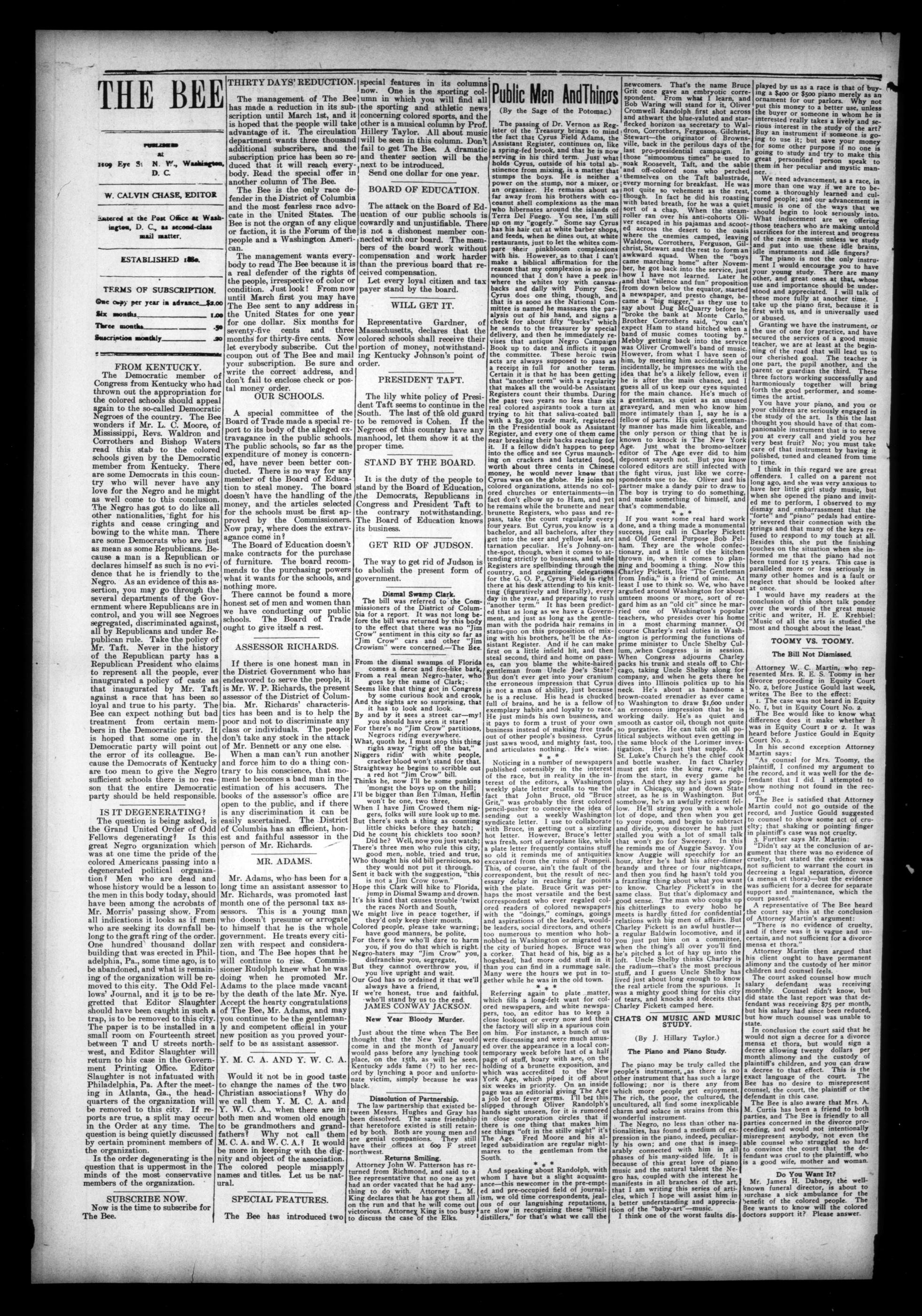
THE BEE
PUBLISHED
at
1109 Eye St. N. W., Washington,
D. C.
W. CALVIN CHASE, EDITOR
entered at the Post Office at Washington, D. C., as second-class mail matter.
ESTABLISHED 1884.
TERMS OF SUBSCRIPTION.
One copy per year in advance $2.00
Six months 1.00
Three months .50
Subscription monthly .20
FROM KENTUCKY.
The Democratic member of Congress from Kentucky who had thrown out the appropriation for the colored schools should appeal again to the so-called Democratic Negroes of the country. The Bee wonders if Mr. L. C. Moore, of Mississippi, Revs. Waldron and Corrothers and Bishop Waters read this stab to the colored schools given by the Democratic member from Kentucky. There are some Democrats in this country who will never have any love for the Negro and he might as well come to this conclusion. The Negro has got to do like all other nationalities, fight for his rights and cease cringing and bowing to the white man. There are some Democrats who are just as mean as some Republicans. Because a man is a Republican or declares himself as such is no evidence that he is friendly to the Negro. As an evidence of this assertion, you may go through the several departments of the Government where Republicans are in control, and you will see Negroes segregated, discriminated against, all by Republicans and under Republican rule. Take the policy of Mr. Taft. Never in the history of the Republican party has a Republican President who claims to represent all the people, ever inaugurated a policy of caste as that inaugurated by Mr. Taft against a race that has been so loyal and true to his party. The Bee can expect nothing but bad treatment from certain members in the Democratic party. It is hoped that some one in the Democratic party will point out the error of its colleague. Because the Democrats of Kentucky are too mean to give the Negro sufficient schools there is no reason that the entire Democratic party should be held responsible.
IS IT DEGENERATING?
IS IT DEGENERATING?
The question is being asked, is the Grand United Order of Odd Fellows degenerating? Is this great Negro organization which was at one time the pride of the colored Americans passing into a degenerated political organization? Men who are dead and whose history would be a lesson to the men in this body today, should have been among the acrobats of Mr. Morris' passing show. From all indications it looks as if men who are seeking its downfall belong to the graft ring of the order. One hundred thousand dollar building that was erected in Philadelphia, Pa., some time ago, is to be abandoned, and what is remaining of the organization will be removed to this city. The Odd Fellows' Journal, and it is to be regretted that Editor Slaughter should have been caught in such a trap, is to be removed to this city. The paper is to be installed in a small room on Fourteenth street between T and U streets northwest, and Editor Slaughter will return to his case in the Government Printing Office. Editor Slaughter is not infatuated with Philadelphia, Pa. After the meeting in Atlanta, Ga., the headquarters of the organization will be removed to this city. If reports are true, a split may occur in the Order at any time. The question is being quietly discussed by certain prominent members of the organization.
Is the order degenerating is the question that is uppermost in the minds of the most conservative members of the organization.
SUBSCRIBE NOW.
Now is the time to subscribe for The Bee.
THIRTY DAYS' REDUCTION.
The management of The Bee has made a reduction in its subscription until March 1st, and it is hoped that the people will take advantage of it. The circulation department wants three thousand additional subscribers, and the subscription price has been so reduced that it will reach everybody. Read the special offer in another column of The Bee. The Bee is the only race defender in the District of Columbia and the most fearless race advocate in the United States. The Bee is not the organ of any clique or faction, it is the Forum of the people and a Washington American.
The management wants everybody to read The Bee because it is a real defender of the rights of the people, irrespective of color or condition. Just look! From now until March first you may have The Bee sent to any address in the United States for one year for one dollar. Six months for seventy-five cents and three months for thirty-five cents. Now let everybody subscribe. Cut the coupon out of The Bee and mail your subscription. Be sure and write the correct address, and don't fail to enclose check or postal money order.
OUR SCHOOLS
A special committee of the Board of Trade made a special report to its body of the alleged extravagance in the public schools. The public schools, so far as the expenditure of money is concerned, have never been better conducted. There is no way for any member of the Board of Education to steal money. The board doesn't have the handling of the money, and the articles selected for the schools must be first approved by the Commissioners. Now pray, where does the extravagance come in?
The Board of Education doesn't make contracts for the purchase of furniture. The board recommends to the purchasing powers what it wants for the schools, and nothing more. There cannot be found a more honest set of men and women than we have conducting our public schools. The Board of Trade ought to give itself a rest.
ASSESSOR RICHARDS
If there is one honest man in the District Government who has endeavored to serve the people, it is Mr. W. P. Richards, the present assessor of the District of Columbia. Mr. Richards' characteristics has been and is to help the poor and not to discriminate any class or individuals. The people don't take any stock in the attack of Mr. Bennett or any one else.
When a man can't run another and force him to do a thing contrary to his conscience, that moment he becomes a bad man in the estimation of his accusers. The books of the assessor's office are open to the public, and if there is any discrimination it can be easily ascertained. The District of Columbia has an efficient, honest and faithful assessor in the person of Mr. Richards.
MR. ADAMS.
Mr. Adams, who has been for a long time an assistant assessor to Mr. Richards, was promoted last month one of the personal tax assessors. This is a young man who doesn't presume or arrogate to himself that he is the whole government. He treats every citizen with respect and consideration, and The Bee hopes that he will continue to rise. Commissioner Rudolph knew what he was doing when he promoted Mr. Adams to the place made vacant by the death of the late Mr. Nye. Accept the hearty congratulations of The Bee, Mr. Adams, and may you continue to be the gentlemanly and competent official in your new position as you proved yourself to be as assistant assessor.
Y. M. C. A. AND Y. W.
Would it not be in good taste to change the names of the two Christian associations? Why do we call them Y. M. C. A. and Y. W. C. A., when there are in both men and women old enough to be grandmothers and grandfathers? Why not call them M. C. A. and W. C. A.? It would be more in keeping with the dignity and object of the association. The colored people misapply names and titles. Let us be natural.
SPECIAL FEATURES
The Bee has introduced two
special features in its columns now. One is the sporting column in which you will find all the sporting and athletic news concerning colored sports, and the other is a musical column by Prof. Hillery Taylor. All about music will be seen in this column. Don't fail to get The Bee. A dramatic and theater section will be the next to be introduced. Send one dollar for one year.
BOARD OF EDUCATION
The attack on the Board of Education of our public schools is cowardly and unjustifiable. There is not a dishonest member connected with our board. The members of the board work without compensation and work harder than the previous board that received compensation. Let every loyal citizen and tax payer stand by the board.
WILL GET IT.
Representative Gardner, of Massachusetts, declares that the colored schools shall receive their portion of money, notwithstanding Kentucky Johnson's point of order.
PRESIDENT TAFT.
The lily white policy of President Taft seems to continue in the South. The last of the old guard to be removed is Cohen. If the Negroes of this country have any manhood, let them show it at the proper time.
STAND BY THE BOARD.
It is the duty of the people to stand by the Board of Education, the Democrats, Republicans in Congress and President Taft to the contrary notwithstanding. The Board of Education knows its business.
GET RID OF JUDSON.
The way to get rid of Judson is to abolish the present form of government.
Dismal Swamp Clark
The bill was referred to the Commissioners of the District of Columbia for a report. It was not long before the bill was returned by this body to the effect that there was no "Jim Crow" sentiment in this city so far as "Jim Crow" cars and other "Jim Crowism" were concerned.—The Bee.
From the dismal swamps of Florida comes a fierce and face-like bark, From a real mean Negro-hater, who goes by the name of Clark: Seems like that thing got in Congress by some curious hook and crook, And the sights are so surprising, that it has to look and look. By and by it sees a street car—my! you should have seen it stare! For there's no "Jim Crow" partitions, Negroes riding everywhere. What, quoth he, I must stop this thing right away "right off the bat," Niggers ridin' with white people, cracker blood won't stand for that. Straightway he begins to scribble out a red hot "Jim Crow" bill. Thinks he, now I will be some punkins 'mongst the boys up on the hill; I'll be bigger than-Ben Tilman, Heflin won't be one, two three. When I have Jim Crowed them niggers, folks will sure look up to me. But there's such a thing as counting little chicks before they hatch; Did he count his chicklets too soon? Did he? Well, now you just watch; There's three men who rule this city, good men, noble, tried and true, Who thought his old bill pernicious, so they would not put it through. Sent it back with the suggestion, "this is not a Jim Crow town." Hope this Clark will hike to Florida, jump in Dismal Swamp and drown. It's his kind that causes trouble 'twixt the-races North and South; We might live in peace together, if they'd only keep their mouth. Colored people, please take warning; have good manners, be polite. For there's few who'll dare to harm you, if you do that which is right. Negro-haters may "Jim Crow" you, disfranchise you, segregate, But they cannot overthrow you, if you live upright and wait. Our God has so ordained it that we'll always have a friend. If we're honest, true and faithful, you'll stand by us to the end. JAMES CONWAY JACKSON.
New Year Bloody Murder.
Just about the time when The Bee thought that the New Year would come in and the month of January would pass before any lynching took place, on the 15th, as will be seen, Kentucky adds fame (?) to her record by lynching a poor and unfortunate victim, simply because he was black.
Dissolution of Partnership
Dissonation of Partnership.
The law partnership that existed between lawyers. Heynes and Gray has been dissolved. The same partnership that heretofore existed is still retained by both. Both are young men and are genial companions. They still have their offices at 609 F street northwest.
Returns Smiling
Attorney John W. Patterson has returned from Richmond, and said to a Bee representative that no one as yet had an order vacated that he had anything to do with. Attorney L. M. King declares that he has got them all on the run and that he will come out victorious. Attorney King is too busy to discuss the case of the Elks.
Public Men And Things
The passing of Dr. Vernon as Register of the Treasury brings to mind the fact that Cyrus Field Adams, the Assistant Register, continues on, like a spring-fed brook, and that he is now serving in his third term. Just what holds Cyrus, outside of his total abstinence from mixing, is a matter that stumps the boys. He is neither a power on the stump, nor a mixer, or an organizer. He remains about as far away from his brothers with coconut shell complexions as the man who hibernates around the islands of Terra Del Fuego. You see, I'm still up on my "gogefy." Some say Cyrus has his hair cut at white barber shops, and feeds, when he dines at, at white restaurants, just to let the whites compare their pinkbloom complexions with his. However, as to that I can't make a biblical affirmation for the reason that my complexion is so pronounced that I don't have a peek in where the whites toy with canvases and dally with Pomry See. Cyrus does one thing, though, and that is as soon as the National Committee is named he massages the paralysis out of his hand, and signs a check for about fifty "bucks" which he sends to the treasurer by special delivery, and then he immediately revises that antique Negro Campaign Book up to date and inflicts it upon the committee. These heroic twin acts are always supposed to pass as a receipt in full for another term. Certain it is that he has been getting that "another term" with a regularity that makes all the would-be Assistant Registers count their thumbs. During the past two years no less than six real colored aspirants took a turn at trying to hit that saliva-coated ball with a $2,500 trade mark, registered in the Presidential book as Assistant Register, and every one of them came near breaking their backs reaching for it. If a fellow didn't happen to peep into the office and see Cyrus maunching on crackers and lactated food, worth about three cents in Chinese money, he would never know that Cyrus was on the globe. He joins no colored organizations, attends no colored churches or entertainments—in fact don't elbow up to Ham, and yet he remains while the brunette and near brunette Registers, who pass and repass, take the count regularly every four years. But Cyrus, you know is a bachelor, and all bachelors, after they get into the seer and yellow leaf, are tarnation peculiar. He's Johnny-on-the-spot, though, when it comes to attending strictly to business, and while Registers are spellbinding through the country, and organizing delegations for the G. O. P., Cyrus Field is right there at his desk attending to his knitting (figuratively and literally), every day in the year, and preparing to rush "another term." It has been predicted that as long as we have a Government, and just as long as the gentleman with the podrida hair remains in statu-quo on this proposition of mixing with his brothers, he'll be the Assistant Register. And if he can make first on a little inflict hit, and then steal second, and home on passes, can you blame the white-haired gentleman from Uncle Joe's State? But don't ever get into your cranium the erroneous impression that Cyrus is not a man of ability, just because he is a recluse. His head is chucked full of brains, and he is a fellow of exemplary habits and loyalty to race. He just minds his own business, and it pays to form a trust of your own business instead of making free trade out of other people's business. Cyrus just saws wood, and might fast, too, and articulates nothing. He's wise.
Noticing in a number of newspapers published ostensibly in the interest of the race, but in reality in the interest of the editors, a Washington weekly plate letter recalls to me the fact that John Bruce, old "Bruce Grit," was probably the first colored pencil-pusher to conceive the idea of sending out a weekly Washington syndicate letter. I use to collaborate with Bruce, in getting out a sizzling hot letter. However, Bruce's letter was fresh, sort of a aeroplane like, while a plate letter frequently contains stuff so old it reminds me of antiquities excavated from the ruins of Pompeii. Thus, of course, ain't the fault of the correspondent, but the result of necessary delay in reaching far points with the plate. Bruce Grit was perhaps the most versatile and the best correspondent who ever regaled colored readers of colored newspapers with the "doings," comings, goings and aspirations of the leaders, would-be leaders, social directors, and others too numerous to mention who hobbled in Washington or migrated to the city of buried hopes. Bruce was a corker. That head of his, big as a hogshead, had more old stuff in it than you can find in a rummage sale. Many were the hours we put in together while he was in the old town.
Referring again* to plate matter, which fills a long-felt want for colored newspapers, and white newspapers, too, an editor has to keep a close lookout or every now and then the factory will slip in a spurious coin on him. For instance, a bunch of us were discussing and were much amused over the appearance in a local contemporary week before last of a half page of stuff, hoary with ae, on the holding of a brunette exposition, and which was accredited to the New York Age, which piped it off about six weeks in priority. On an inside page was an editorial giving The Age a job lot of fever germs. I'll bet this slipped through Oliver Randolph's hands sight unseen, for it is rumored in close corporation circles that if there is one thing that makes him see things "oft in the stillv night" it's The Age. Fred Moore and his alleged subsidization are regular nightmares to the gentleman from the South.
\*\*\*
And speaking about Randolph, with whom I have but a slight acquaintance—this newcomer in the pre-empted and pre-occupied field of journalism, we old time correspondents, jealous of our languishing reputations, are slow in recognizing these "illicit distillers," for that what we call the
newcomers. That's the name Bruce Grit once gave an embryotic correspondent. From what I learn, and Bob Waring will stand for it, Oliver Cromwell Randolph first shot across and athwart the blue-valuted and star-flecked horizon as secretary to Waldron, Corrothers, Ferguson, Gilchrist, Stewart—the originator of Brownsville, back in the perilous days of the last pro-presidential campaign. In those "simoomous times" he used to soak Roosevelt, Taft, and the sable and off-colored sons who perched themselves on the Taft b仕uradse, every morning for breakfast. He was not quite so vehement as the rest, though. In fact he did his roasting with bated breath, for he was a quiet sort of a chap. When the steamroller ran over his anti-cohorts Oliver escaped in his pajamas and scooted across the desert to the oasis where the enemies camped, leaving Waldron, Corrothers, Ferguson, Gilchrist, Stewart and the rest to form an awkward squad. When the "boys came marching home" after November, he got back into the service, just how I have not learned. Later he and that "silence and fun" proposition from down below the equator, started a newspaper, and presto change, became a "big nigger" as they use to say about McQuarry before he "broke the bank at Monte Carlo." Brother Corrothers said, "you can't expect Ham to stand hitched when a band of music comes tooting by." Mebby getting back into the service was Oliver Cromwell's band of music. However, from what I have seen of him, by meeting him accidentally and incidentally, he impresses me with the idea that he's a likely fellow, even if he is after the main chance, and I guess all of us keep our eyes squinted for the main chance. He's much of a gentleman, as quiet as an unused graveyard, and men who know him more intimately than I, say he is a fellow of parts. His quiet, gently-manner has made him likeable, and the only person or thing that he is known to knock is The New York Age. Just what the bromo-seltzer editor of The Age ever did to him deponent sayeth not. But you know colored editors are still infected with the fight virus, just like we correspondents use to be. Oliver and his partner make a dandy pair to draw to The boy is trying to do something, and make something of himself, and that's commendable.
If you want some real hard work done, and a thing made a monumental success, just call in Charley Pickett and Old General Purpose Bob Pelham. They are the whole confectionary, a little of the kitchen thrown in, when it comes to planning and booming a thing. Now this Charley Pickett, like "The Gentleman from India," is a friend of mine. At least I use to think so. We, who have argued around Washington for about uteen moons or more, sort of regard him as an "old cit" since he married one of Washington's popular teachers, who presides over his home in a most charming manner. Of course Charley's real duties in Washington is performing the functions of prime minister to Uncle Shelby Cullum, when Congress is in session. When Congress adjourns Charley packs his trunk and steals off to Chicago, taking Uncle Shelby along for company, and when he gets there he dives into Illinois politics up to his neck. He's about as handsome a brown-coated enredadier as ever came to Washington to draw $1,600 under an erroneous impression that he is working daily. He's as quiet and smooth as castor oil, though not quite so purgative. He can talk on all political subjects without even getting in the same block of the Lorimer investigation. He's just that supple. At St. Luke's Church he the chief cook and bottle washer. In fact Charley must get into the king row, right from the start, in every game he plays. And they say he's just as popular in Chicago, up and down State street, as he is in Washington. But somehow, he is an awfully reticent fellow. He'll string you with a whole lot of dope, and then when you get to your room, and begin to subtract and divide, you discover he has just stalled you with a lot of small talk that won't go for Sweeney. In this he reminds me of Auggie Savoy. You know Auggie will speechify for an hour, after he's had his after-dinner brandy and three or four nightcaps, and then you find he hasn't told you a frazzling thing about what you want to know. Charley Pickett in the same class. But that's diplomacy and good sense. The man who coughs up his chitterlings to every hobo he meets is hardly fitted for confidential relations with big men of affairs. But Charley Pickett is an awful hustler—a regular Baldwin locomotive, and if you just put him on a committee, when the thing's all over you'll find he's pitched a lot of up into the loft. Uncle Shelby thinks Charley is the radium—that's the most precious stuff, and I guess Uncle Shelby has lived just about long enough to know the real article from the spurious. It was a mighty good thing for this city of tears, and knocks and deceits that Charley Pickett camped here.
CHATS ON MUSIC AND MUSIC STUDY
(By J. Hillary Taylor.)
The Piano and Piano Study.
The piano may be truly called the people's instrument, as there is no other instrument that has such a large following; nor is there any from which more people get enjoyment. The rich, the poor, the cultured, the uncultured, all find some inexplicable charm and solace in strains from this wonderful instrument.
The Negro, no less than other nationalities, has found a medium of expression in the piano, indeed, peculiarly his own; and one that is inseparably connected with him in all phases of his many-sided life. It is because of this great love of piano music and the natural talent the Negro has, coupled with the interest he manifests in all branches of the art, that I am writing this series of articles, which I hope will assist him in a better understanding and appreciation of the "baby-art"—music.
I think one of the worst faults dis-
played by us as a race is that of buying a $400 or $500 piano merely as an ornament for our parlors. Why not put this money to a better use, unless the buyer or someone in whom he is interested really takes a lively and serious interest in the study of the art? Buy an instrument if someone is going to use it; but save your money for some other purpose if no one is going to study and try to make this great personified person speak to them in her peculiar and mystic manner.
We need advancement, as a race, in more than one way if we are to become a thoroughly learned and cultured people; and our advancement in music is one of the ways that we should begin to look seriously into. What inducement are we offering those teachers who are making untold sacrifices for the interest and progress of the race in music unless we study, and put into use these idle brains, idle instruments and idle fingers?
The piano is not the only instrument I would encourage you to have your young study. There are many other, and great ones at that, whose use and importance should be understood and appreciated. I will talk of these more fully at another time. I take up the piano first, because it is first with us, and is universally used or abused. Granting we have the instrument, or the use of one for practice, and have secured the services of a good music teacher, we are at least at the beginning of the road that will lead us to our cherished goal. The teacher is one part, the pupil another, and the parent or guardian the third. These three factors working successfully and harmoniously together will bring forth the good performer, and sometimes the artist.
You have your piano, and you or your children are seriously engaged in the study of the art. Is this the last thought you should have of that companionable instrument that is to serve you at every call and yield you her very best fruit? No; you must take care of that instrument by having it polished, tuned and cleaned from time to time.
I think in this regard we are great offenders. I called on a parent not long ago, and she was very anxious to have her little girl study music, but when she opened the piano and invited me to perform, I observed to my dismay and embarrassment that the "forte" and "piano" pedals had entirely severed their connection with the strings and that many of the keys refused to respond to my touch at all. Besides this, she put the finishing touches on the situation when she informed me that the piano had not been tuned for 15 years. This case is paralleled more or less seriously in many other homes and is a fault or neglect that should be looked after at once.
I would have my readers at the conclusion of this short talk ponder over the words of the great music critic and writer, H. E. Krebhius: "Music of all the arts is studied the most and thought about the least."
TOOMY VS. TOOMY.
The Bill Not Dismissed.
Attorney W. C. Martin, who represented Mrs. R E. S. Toomy in her divorce proceeding in Equity Court No. 2, before Justice Gould last week, writes The Bee to the effect: 1. The case was not heard in Equity No. 1, but in Equity Court No. 2.
The Bee would like to know what difference does it make whether it was in Equity Court 2 or 2. It was heard before Justice Gould in Equity Court No. 2.
In his second exception Attorney Martin says:
"As counsel for Mrs. Toomy, the plaintiff, I confined my argument to the record, and it was well for the defendant that I did. I attempted to show nothing not found in the record."
The Bee is satisfied that Attorney Martin could not go outside of the record, and Justice Gould suggested to counsel to show some act of cruelty; that shaking or pointing finger in plaintiff's case was not cruelty.
"Didn't say at the conclusion of argument that there was no evidence of cruelty, but stated the evidence was not sufficient to warrant the court in decreeing a legal separation, divorce (a mensa et thora)—but the evidence was sufficient for a decree for separate support and maintenance, which the court passed."
A representative of The Bee heard the court say this at the conclusion of Attorney Martin's argument:
"There is no evidence of cruelty, and if there was it is vague and uncertain, and not sufficient for a divorce mensa et thora."
Attorney Martin then argued that his client ought to have permanent alimony and the custody of her minor children and counsel feels.
The court asked counsel how much salary defendant was receiving monthly. Counsel didn't know, but did state the last report was that defendant was receiving $75 per month, but his salary had since been reduced, but how much counsel was unable to state.
In conclusion the court said that he would not sign a decree for a divorce mensa et thora, but would sign a decree allowing twenty dollars per month alimony and the custody of plaintiff's children, and you can draw a decree to that effect. This is the exact language of the court. The Bee has no desire to misrepresent counsel, the court, the plaintiff or the defendant in this case.
The Bee is also aware that Mrs. A.M. Curtis has been a friend to both parties, and The Bee is friendly to all parties concerned in the divorce proceeding, and would not intentionally misrepresent anybody, not even the able counsel who struggled so hard to convince the court that the defendant was cruel to the plaintiff, who is a good wife, mother and woman.
Do You Want It?
Mr. James H. Dabney, the well-known funeral director, is about to purchase a sick ambulance for the benefit of the colored people. The Bee wants to know will the colored doctors support it? Please answer.
The Week in Society
Going down town? No; not when I can get the richest and most artistic boxes of fine fresh candies, dainty and lasting perfumery, high-grade post cards, fine cigars and novelties at the drug store of Board & McGuire, 1912$^{1}$ 14th street northwest.
***
Dr. and Mrs. W. K. Scott entertained at their residence in Anacostia last Friday evening. The evening was very pleasantly spent by the playing of games and dancing. The most interesting feature of the evening was the whist games. After many games of whist the guests were served with a Dutch supper.
***
The students of the commercial college of Howard University were entertained last Saturday night at the residence of Dean Cook.
**
The private reception given by the well-known club, the Meditators, on Friday afternoon, Jan. 27, was one of the best social functions of the season. Most of the society young folks of the city attended. It was held in the main auditorium, of True Reformers' Hall, music being furnished by the Dabney Orchestra.
****
Miss Nannie H. Burroughs, of the National Women's Training School, is doing great work for the uplift of her sex. Several improvements have been made at her school.
Mrs. Samuel Holder, of Hartford, Conn., who is stopping with Dr. Tunnells, of Howard University, and who is a cultured singer, will sing one of her beautiful selections Sunday morning, February 5, at the Metropolitan A. M. E. Church. Friends are invited to hear her.
Mrs. J. B. Loftieus, wife of officer Loftieus, who has been quite sick at her home, 40 Hanover street, is much improved.
* * *
Quality is what counts in drugs, medicines and remedies. You get the very highest quality at the fairest price at the drug store of Board & McGuire, 1912½ Fourteenth street northwest. Hundreds of satisfied customers attest this fact.
Mrs. Marion Thurman was buried from the 15th Street Presbyterian Church last week.
Mrs. Wm. Beckett, one of the oldest and most highly respected citizens, was buried from the Methodist A. M. E. Church last Sunday afternoon. It was one of the largest funerals in the history of the church. Rev. I. N. Ross preached the sermon.
Miss Delia Claude, of this city, is visiting Mrs. Grace Symington, 22 Upton street, Cambridge, Mass.
Miss M. A. Wheeler, principal of Lovejoy School, is indisposed at her home, 1034 New Jersey avenue northwest.
Miss Nomie Bailey, who has been indisposed with La Grippe at her home in Linden street, is convalescent.
Miss May Fletcher, one of Baltimore's school teachers, spent last Saturday and Sunday-in this city with relatives and friends.
Miss Henrietta Vintoh Davis is in Ohio.
* *
Mr. Solomon Dickerson, of this city, has gone to Hampton, Va., to spend the remainder of the winter.
Miss Susie Holmes has returned to this city after spending a very pleasant stay in Hampton, Va., with her parents, Mr. and Mrs. Solomon Dickerson.
\*\*\*
Ice cream soda is popular the year 'round at the drug store of Board & McGuire on Fourteenth street. "The place where everybody meets everybody else."
Miss Bessie Taylor has returned to this city after a delightful stay of ten days in Philadelphia, Pa., with friends.
Mr. J. Milton Turner, of St. Louis, Mo., is in the city.
Mrs. Hattie Torrence, of this city, was called to Charlotte, N. C., last week, to the bedside of her aunt, Mrs. Harriet Yokum, who suffered a stroke of paralysis.
Miss Minnie Parker is visiting friends in Harrisburg, Pa.
Miss Marie C. Janes will spend February 22 in Pennsylvania.
Mrs. Sarah Moore, who left this city ill, is rapidly improving at her home in Harrisburg, Pa.
Mr. and Mrs. J. E. Moorland have returned after a trip of ten days in Chicago, Ill.
Dr. T. G. Stewart, of Wilberforce University, formerly chaplain in the Regular Army, addressed the student body of Howard University on Thursday.
Don't take calomel for your liver when you can get Liveroids, the great vegetable liver regulator, tonic and blood purifier, at the drug store of Board & McGuire, 1912 $ \frac{1}{2} $ Fourteenth street northwest.
**
Mr. James H. Winslow, the well-known funeral director, who has been so seriously ill for several weeks, is fast improving.
Miss G. B. Maxfield entertained a few friends at a dramatic reading at her home, 1229 First street northwest, last Wednesday evening, after which light refreshments were served. It was proposed to organize a dramatic club.
Dr. S. M. Pierre has gotten in the push and purchased an automobile.
Mr. Ferguson has returned to his home in Chicago, after a very enjoyable visit to this city, Richmond, Va., Pittsburg and Baltimore.
Mrs. Susana·Ferrell, formerly of this city, died at her home in Chicago, Ill.
\*\*\*
Miss E. B. Parks, an employee here, has been visiting friends in New York, Atlantic City, New Jersey and Baltimore.
Dr. George C. Clement, editor of Star of Zion, passed*through our city recently en route to Carlisle, Pa., where he has been holding a successful revival.
\* \*
A banquet is being planned in honor of Hon. J. C. Napier, newly appointed Register of the Treasury, on February 17th.
Don't forget to call at the drug store of Board & McGuire and examine the finest assortment of the best perfumery and candies in the city from 25 cents to $5 a box.
Citizens' Association.
At the January meeting of the Northeastern Suburban Citizens' Association, the following officers were elected:
Dr. Willis W. Jones, president;
John George, vice president; Chas Wesley, recording secretary; H. H. Shorter, corresponding secretary; J. P. Payne, treasurer; Henry Staughter, chaplain.
The committees will be appointed at the installation, at which time the ladies will give a banquet in honor of the elected officers.
Mr. Chapman, chairman of the Executive Committee, suggested that the Commissioners be asked to make some arrangement for signs to be placed at the different roads which lead to the District of Columbia, as country people who have business interests within the District may not be aware of the light regulation.
The Committee on Schools, of which Mr. John H. Paynter is chairman, reported that petition and protest had been filed with the District Committee in relation to establishment of a school in the Burrville section, and against the proposed addition to Deanwood School.
Coleman Minor.
Mr. Coleman L. Minor, one of the most popular and well-known comedians and lyric writers in the country, who is now connected with "Our Friend From Dixie," is in Philadelphia, not so well. He says "Our Friend From Dixie" company has met with success everywhere it has appeared. Mr. Minor sends regards to all friends.
Mr. Bruce Ill.
Assistant Superintendent Roscoe C. Bruce, who has been dangerously ill at his home for some time, is improving and there are hopes of his speedy recovery.
CONCERT AND RECITAL.
The People Turn Out.
Last Friday night, January 27, the Howard Theater was a scene of beauty and culture. The people turned out in response to the concert and recital under the auspices of Mrs. Carrie W. Clifford and her most genial husband, Mr. W. H. Clifford, for the benefit of the Y. M. C. A. The occasion was the Evolution of the Negro in fiction, song and story, at the New Howard Theater. The management of this theater has given the colored people every advantage and opportunity to display their talents. Mrs. Carrie W. Clifford and her husband are two of the most genial citizens in this city, and they have added much to its welfare, so far as the colored people are concerned. The entertainment given by these two well known citizens was successful beyond expectation. Twice as many tickets could have been sold, and it is regretted that the affair was not booked for two nights instead of one. The entertainment was well worth repeating. There were some very commendable features in the entertainment. Mrs. Clifford, was the central figure, and as a narrator she is calm, eloquent, concise and precise. "Night of
Slavery Sorrow," sung by the Armstrong and M Street High schools, Mr. Ernest R. Armstrong, director, was good.
Miss Theresa Lee deserves credit for the presentation of the song characteristic from Madame Sherry, in which nine young misses participated, Misses Collier, Bailey, Wright, Scott, Wilson, Green, Mayer, Jenifer and Watson. Their dancing and singing was excellent. Madame Jean Kelly Armstead sang very sweetly, "My Heart is Weary." She has a sweet contralto voice.
Dr. C. Sumner Wormley never fails to elicit applause. He carries his audience before him, and on this occasion the applause was deafening. He is Washington's favorite and is always enthusiastically greeted. His song was "The Trumpeter."
Miss Lillian Evans sang "My Heart at Thy Sweet Voice." Her dress was beautiful, and her appearance very attractive.
Master Merrill Curtis, the son of Dr. and Mrs. A. M. Curtis, is master of his profession. He is a genius. His several impersonations were loudly applauded, and he was faultless in his several parts. Miss Moline Thomas's mezzo-so-pronza solo "Summer" was well rendered. She has a sweet voice.
L'Alligator Glee Club: (a) "My Lady Clo," (b) "De Coppah Moon."
This is the most popular and most talented club in the city. So well pleased was the audience that the club was recalled several times. Miss Charlotte Wallace, Mr. Jeter, deserve special mention. On a whole the entertainment was first-class.
In The Field Of Sports
Departmental Base Ball League.
Departmental Base Ball League. At the annual meeting of the Departmental League held last Saturday, the following officers were elected for the season of 1911: Mr. R. A. Tucker was re-elected president for one year, and Mr. Frank McKinney re-elected secretary. The officers having served the league successfully in the past, were unanimously elected. Mr. Tucker has been with the league since its first year, and his work has always been satisfactory. He is very prominent in all walks of life, an earnest worker and thorough gentleman. Such men as Mr. Tucker and Mr. McKinney are a credit to any organization. Mr. McKinney has been with the league since the start, having always given his very best service to the cause, and serving as secretary. He is one of the most valuable men in the league, always striving hard and earnestly for the betterment of the league. All of the teams were represented. Many trades were spoken of, but each manager seemed to be afraid of the material offered. Therefore, no players were exchanged, though many players will find themselves in new berths at the beginning of the season
Mr. W. A. Hawk succeeded Parker as manager of the champion Postoffice team. He will manage the team from the bench. Manager Hawks appointed Mr. Wallace Sudler, the fast shortstop, his field captain and assistant. They hope to repeat next year. Manager Barnwell, of the War and Navy, has seen fit to sever his connection with that team, and will not be found in the line-up next season. He played a brilliant game in left field for the last two seasons for the Warriors, and will be missed very much. Captain Johnson is signing players for the coming season, and hopes to be a strong contender for the flag. The War and Navy is a fast bunch of players, and ought to finish strong next season.
Captain "Sill" Irving, of the fast Government Printing Office team, will make his debut as playing manager next season. All the followers of the league are well acquainted with the work of this excellent player, and look for him to make good. The league and players will greatly miss the service of Manager Davis, who was at the helm last season. Mr. Davis is a man of excellent ability, a man that every one respected, and a manager that got the best out of his players. It is regretted that it was impossible for him to continue. Such men are a credit to any decent sport. Manager McKinney, the able secretary of the league, will manage his band of Redmen from the Interior Department. Manager Mac is an earnest worker, and player.of some note. We all hope Mac will have success with his strong combination.
Manager Dickerson, of the Agricultural Department, intends to stand pat on his same line up. They finished strong last season, and with another pitcher, he predicts that he will be in the running when the gong sounds. Captain Al Andrews will pilot the team on the field, while Manager Dickerson gives instructions from the bench.
Mr. Fred Reynolds, of the Bureau of Engraving and Printing team, has relinquished the reigns of management to Mr. Paris H. Pollard, for the coming season. Manager Pollard is well known as the organizer and first president of the league, who afterwards resigned to enter the ranks as a player. This will be his debut as a league manager. The patrons of the league who are well acquainted with Manager Pollard, look for him to be a big success. Manager Pollard is very anxious to secure some new material, and is determined to put a team on the field that the Bureau will be proud of.
The Departmental League has been running successfully for the last two seasons. They occupy grounds at the corner of 17th and B streets northwest. The surrounding grounds are beautiful, and the best of order is our motto and is always in evidence. This is the only league of its kind in the States. There is no compensation connected with the players, but they are governed by as strong a contract as professional ball players. The rivalry is very keen between the departments. All players must be employed by the Federal or Municipal Government to be a player, and the law is strictly carried out to the letter. The public is invited to see these games and look over the promising young athletes of the city. There is any member of the entire league and their players. It is a self-supporting
league, every player buys his outfit, and makes good to play. Every afternoon you can find a manly, self-respecting nine of players representing their department, playing as hard and as earnestly to win for the glory of their department as you will be able to see in the National League Park. The players are as eager for the season to open as the men who make their living by playing professional ball.
Such self-supporting and decent athletes ought to be encouraged, and the public should pay them a visit to judge for themselves, and when they once see the quality of the material on the field they will certainly take interest and see every game possible.
Colored Athletes.
The event of an indoor meet for colored athletes given by organizations of colored men has attracted all sorts of attention to our athletic conditions by white men in this section of the East. Long before the masses of our people were made aware of the plans for the meet, the Southern Amateur Athletic Union, with officers among the business men in Baltimore, Richmond, and Washington, knew of the intentions and have spoken creditably of the undertaking. White boys in the community are fast learning to respect the skill and physical ability of the colored boys along the lines of sports old to them, and but recently a part of the life of our race in the cities.
George Washington University and Georgtown University will give meets at Convention Hall on February 4 and March 4. These events will be attended by athletes from the prominent schools in the North, and athletes will enter from all local institutions. Howard University basket ball team is booked to oppose the Alpha Physical Culture Club quint of New York as a star feature on the occasion of the meet. It will be the first time that our people will see a basket ball game played under first-class conditions on a full-sized court, free from obstructions. The Alpha players are all men holding excellent positions in that city, three of the quint are public school teachers with quite a record in New York City.
Track teams of M Street High School, Armstrong, Howard University and many city grade schools have entered training. Many employees in the Government service are planning to enter the events. W. F. Williams and Moore, of the Census Bureau, are in training. A bulletin has been sent to each athletic association of the grade schools giving information regarding the meet and points on how to train for the events. In many sections of the city school boys and older athletes may be seen diligently at work strengthening the body to compete in the events on March 11. All committees are hard at work making arrangements and giving out information. The finance committee is busy securing ads for the program, which is to be a striking souvenir.
Those who desire to become patrons should send in $2.00 to any member of the finance committee or its chairman, Mr. G. S. Wormley, for which amount they will be sent tickets worth $2.50, and in sections that they might choose. The tickets sell at 50 cents, 75 cents and $1.00, with nearly one-half of the $1.00 section sold to date.
Joseph H. Douglass, violinist, began touring the South at Richmond last week, appearing before the students of Union University.
Harmony Society.
The Columbia Harmony Society of the District of Columbia has elected the following officers for 1911:
G. F. Cook, president; E. G. Brooks, vice president; John H. Cook, secretary and superintendent. The Columbia Harmony Society is one of the strongest and most representative in this city. Hundreds of dollars worth of improvements have been expended upon this beautiful cemetery.
At Howard Theater.
Special matinee this afternoon for school children at the Howard Theater. At night and to-morrow (Sunday) evening special program of Tuskegee Institute and what the Negro is doing. Don't miss it.
Meeting With Success.
Boston, Mass., July 24. GRAND OPERA HOUSE—"My Friend from Dixie," a musical comedy in three acts, by J. Leubrie Hill. The cast:
Jasper Green.....Louis A. Mitchell
Mandy Lee.....J. Leubrie Hill
Jim Jackson Lee.....Richard W. Shelton
Emalina Lee.....Julia Gidion
Sophena Lee.....Mamie Carter
Susie Lee.....Hattie Akers
Clementine.....Mayme Butler
Bill Simmons.....Will Brown
Abe Lewis.....George A. Price, Jr.
Lucinda Langtry.....Leona Marshall
Katie Krew.....Evon Robertson
Carrie Nation Brown.....Quetta Watts
Dr. Moore.....Arthur Carr
Joe Brown.....Coleman L. Minor
Spikey.....Chas H. Woody
Jimmie Moon.....Tinie Ray
Repeating the success which it made in this city earlier in the season, "My Friend From Dixie" returned to the Grand Opera House last evening, where a large and appreciative audience was plainly delighted with the show, and with the capable cast of colored players upon whose efforts depends in a large measure the success of the performance.
A pleasing mixture of snappy dialogue and tuneful songs, strung together by a plot which is sufficiently plausible, and at times highly amusing, form a combination which cannot fail to interest and would probably amuse a more critical audience than that of last evening.
Louis A. Mitchell made a distinct hit in the role of Jasper Green, a rich plantation owner in Dixieland, and the role of Mandy Lee, his daughter, was well played by J. Leubrie Hill. Richard W. Shelton and Will Brown were amusing as Jim Jackson Lee and Bill Simmons, while Julia Gidion, Hattie Akers and Mamie Carter imper-
Realistic Pictures showing the building, farms and students working and learning trades. Also many other interesting scenes. Cotton industry of the South, Religious progres o the churches of Boston, Mass.
"The House of Plainly Marked Prices."
We could tell you fifty reasons
—why it will be to your advantage to buy Furniture and Carpets from us.
Just one is sufficient
We make it possible for you to have everything necessary for home comfort AT ONCE.
Anything you wish will be charged on an open account which is made payable as your circumstances may suggest.
Come where you can read every price and do the buying before there's a question about how or when you desire to pay.
PETER GROGAN
and Sons Co.
"The House of Plainly Marked Prices."
We could tell you fifty reasons
—why it will be to your advantage to buy Furniture and Carpets from us.
Just one is sufficient
We make it possible for you to have everything necessary for home comfort AT ONCE.
Anything you wish will be charged on an open account which is made payable as your circumstances may suggest.
Come where you can read every price and do the buying before there's a question about how or when you desire to pay.
PETER GROGAN and Sons Co.
LADIES' DININGROOMS Oysters in All Styles
JACOB DIEMER BUFFET AND RESTUARANT
480 La. Avenue, Northwest
CONSULT
Mme. B
PALMIST and
CARD R
Who Controls Events!
PRICES REASON
SEVENTH STREET,
Bet. L and M
Mme. Banzi PALMIST and
H. K. FULTON'S LOAN OFFICE
No. 314 Ninth Street, N. W.
Loans made on Watches, Diamonds, Jewelry, Silverware, Etc.
If you want to buy a good watch, diamond ring, or jewelry of any kind, look at our stock first. You!
Why pay 10 per cent, when you can get it for 3 per cent.
H. K. FULTON
sonated the three Lee children with marked success. Leona Marshall proved delightful as Lucinda Langtry. Evon Robertson was comical as Katie Krew, a society reporter, and Quetta Watts caused a great deal of laughter by her portrayal of the role of Carrie Nation Brown.
---
```markdown
```
Few Reserved seats at 20 and 30cts
Special School Children's Tickets
for Saturday Matinee 5c
of PRICES."
would you reasons
e to your ad-
Furniture and
one sufficient
possible for you
warning necessary
art AT ONCE.
wish will be
open account
payable as
aces may sug-
you can read
do the buying
question about
you desire to pay.
HIROGAN
ns Co.
All Styles
DIEMER
RESTUARANT
CONSULT
me. Banzi
LIST and
CARD READER
Controls Events! Never Fails!
RICES REASONBLE
NTH STREET, NORTHWEST
Bet. L and M
BURNSTINE LOAN OFFICE
GOLD AND SILVER WATCHES, DIAMONDS, JEWELRY, GUNS, MECHANICAL TOOLS LADIES' AND GENTS' WEARING APPARAL.
OLD. GOLD AND SILVER BOUGHT.
UNREDEEMED PLEDGES FOR SALE.
361 Pennsylvania Avenue, N. W.
Job Printing.
Bring your job printing to this office and have it done in first-class style. All orders for printing brought to this office will entitle you to a free notice in The Bee.
W. Calvin Chase, Jr., manager of the Triangle Printing Company.
Mail orders with a deposit enclosed will receive immediate attention.
Address 1109 I street northwest.
Job Printing
PERILS OF EXPLORERS
*Tragio Journey Across a Desert Central Asia by the Great Swedish Explorer, Sven Hedin.
One of the most trying of the central Asian adventures of Sven Hedin, the Swedish explorer, was this: In February, 1805, Sven Hedin started eastward, exploring the country between the Kashgar and Yarkand rivers, proceeding in April to cross the Takla Makan desert, between the Yarkand and Khotan rivers. Never before had any known traveler attempted to exploit a course amid the eternal sea of shifting sand hills from river to river. The tale of that little, travel worn, bedraggled group, far beyond the last watering place, enveloped in dust, stumbling along through the dreary but agitated desert sea by crooks and roundabout ways, with desolation spread around and every trace of life departed; was a weird and pathetic one. "Not even a fly was to be heard in the air, not even a yellow leaf broke the monotony."
And ever at their head was the sturdy figure of the Swedish explorer, compass in hand, still enthusiastic, guilding them as best he could through the death shrouded wilderness. At length the camels had to eat their kraw saddles, and the last of the bread was gone. Horrors followed. As men and camels dropped out of the line they were immediately enveloped in the whirling sand shroud and never seen again.
The end came on May 5, when Sven Hedin, crawling on all fours, dragged himself across the dry bed of the Khotan river. "All of a sudden a duck flew into the air and water splashed," he wrote. Two of his followers were all that survived, and it is doubtful whether even those two would have lived to tell the tale had not Sven Hedin carried back water for them in his boots.
MARKED THEIR TRAIL
Two Brave Women Who Outwitted a Band of Indians.
One summer afternoon in 1770 Jemlma Boone and two sisters named Callaway while boating on the Kentucky allowed their canoe to drift close to the opposite bank. Here, behind a bush, five Shawnee warriors were in hiding, and, although the spot was not more than a quarter of a mile from Boonesborough, one of the Shawnees struck boldly out into the water, setzed the canoe and dragged it to shore with its screaming occupants.
Once in the power of the Indiana, however, these youthful daughters of the wilderness betrayed a wonderful self possession and resourcefulness. They knew enough of Indian customs to realize that if their strength failed them and they should prove unequal to the long march to the Shawnee towns on the Ohio they would be slaughtered mercilessly. So they stifled sobs and calmly accompanied their captors without protest or struggle. At every opportunity, though, they secretly tore little pieces from their clothing and attached them to bushes on the trail. Nothing more was needed to inform Boone and his fellow settlers, who had quickly started in pursuit, that they were on the right track, and on the second day of the captivity they caught up with the Indians. A volley laid two Shawnees low, the rest fled, and by the close of another day the girls were safe in the arms of their thankful mothers.—II. Addington Bruce in Smith's Magazine.
Stories of W. & Gilbert
When Sir Henry Irving and Edwin Booth were acting together in London at doubled prices, the story goes that Mr. Herman Vezin, meeting W. S. Gilbert in the street, asked him whether he had been to this quite exceptional show. "No," said Mr. Gilbert; "I have sometimes paid half a guinea to see one bad actor, but I will not pay a guinea to see two." Mr. Beerbohm Tree was playing the part of Falsaft at the London Haymarket, and the indispensable stuffing made him perspire profusely. Mr. Gilbert, who was in the theater, went behind the scenes to see the actor, who may well have been expected to be congratulated on the excellence of his impersonation. "How well your skin acts!" said Mr. Gilbert—London Graphic.
Peter the Great as a Drinker:
There is preserved in the Bodleian library, Oxford, an innkeeper's bill for breakfast eaten in England by Peter the Great of Russia. The czar and his twenty companions managed to dispose of half a sheep, a quarter of lamb, ten pullets, twelve chickens, three quarts of brandy, six quarts of mulled wine, seven dozen of eggs, with salad in proportion. Peter was always a hard drinker. He would drink a pint of brandy and a bottle of sherry for his morning draft; after dinner he managed eight bottles of sack, "and so to the playhouse." But his favorite drink was hot pepper and brandy.
He Had the Bill.
Tom (in restaurant—Excuse me, old man, but would you mind paying my check? I haven't anything but a forty dollar bill. Jack—A forty dollar bill Why, I never heard of a bill of that denomination. Tom—Here it is—a bill from my tailor—Chicago News.
To Fresh Eyes
Wille, accompanied by his father, was visiting a circus and menageria. "Oh, papa," the boy exclaimed as they passed before an elephant, "look at the big cow with her horns in her mouth eating hay with her tail." — Christian Register.
There is nothing so utterly hollow as a kind word that should have been spoken yesterday.—Ervangel
As the Twig Bends.
Kendall had a son who was the pride of his heart. One day he found one of his favorite cherry trees cut down. "Jack" he said, "did you do that?" With quivering lip Jack replied: "Father, I can't deceive you. I did not cut the tree down. Billy Brown did it, but I bossed the job." Tears of joy sprang into the father's eyes. "Bless you, my boy," he said. "Billy will be president of the United States, but you will be chairman of the national committee."—Success Magazine.
The Gargoyle
The word "gargoyle" is closely akin to "gargle," for "gargoyle" is simply the French "gargouille" (throat). It was a good name for the architectural monster through whose mouth the rainwater was carried off. But all idea of the throat had disappeared in the terrible Gargouille de Bouen, the dragon which wasted a French district until St. Romanus threw it into the Selene. In after generations' a huge sham gargouille used to be carried round the city once a year in memory of this deliverance.
Something Wrong.
"Oh, dear, John, I just know I shall not like this dress!"
"What's the matter now?" asked her husband without laying down his pipe or looking from his paper. "I thought you said you liked it."
"That's just it. I was so sure I wouldn't like it when I got it home, though I liked it well enough in the store. And now that I am home I do like it, and therefore I know I will not like it when it is made up. Now I don't know what to do."
"Search me," grunted the cruel man, turning to the sporting page.—Puck.
Diamond Cut Diamond.
A Quaker was negotiating with an insurance agent as to effecting a policy on a vessel overdue. At this juncture he heard of the vessel's loss and wrote at once to the agent of the company: "Friend, if the heasn't filled up the policy thee needn't, for I've heard of the ship." "Eh," said the officers, "cunning fellow. He wants to do us out of the premium." So they wrote to the Quaker: "Thou art too late by half an hour. Thy policy is filled up."
Stromboli's Flames.
Stromboli rarely pours out streams of lava, for this Aeolian crater vomits its fire persistently and cinders spasmodically. The "lighthouse" of the Mediterranean" has been known to stick to its function of torchbearer for the space of 2,000 years. Whenever the tiny, regular eruption takes place the stones drop back again into the crater. While the ancients regarded Stromboli variously as the smithy of Vulean and the headquarters of Aeolus, the men of the middle ages looked upon it as the main highway to purgatory.
What Telepathy Is.
Telepathy is the transference of emotions and sensations between souls, while thought transference is the transmission of words, ideas or images from mind to mind. Thus telepathic communication is possible only between persons of a certain degree of soul development and between whom there is a degree of emotional sympathy, while in transference of thought one dominant, positive mind may affect another without there being any degree of sympathetic vibration between them."Svastika."
The Earth's Crust.
The solid crust of the earth is about twenty-five miles thick, and it floats upon a denser substratum, which is fluid or at least plastic. The crust of the earth may therefore be compared to an ice floe resting on the ocean and the mountains to icebergs imbedded in it. Just as an iceberg floats with only a small proportion of its bulk above the surface of the water, so the hills as we know them are merely the crests of huge bergs that float, almost wholly submerged," in a denser substratum.-Captain Craster in New Quarterly Review.
Eating Oysters.
Surely the queerest way of cooking an oyster is that mentioned in the year 1672, when Richardson, the fire eater, took a live coal on his tongue; on this he put a raw oyster in its shell, while an attendant blew upon the coal with bellows until it fumed and sparkled in his mouth. This continued until the oyster opened and was perfectly cooked.
The European Magazine for 1803 contains an account of a young lady at Brighton who undertook to eat for supper the amazing quantity of 800 oysters, with a certain amount of bread and butter. This feat she performed, greatly to the astonishment of all present.
Armor Plated Pawnahona
The inside of a Chinese pawnshop is a terra incognito to most people, Chinese and English. Few are admitted within its mysterious walls except those directly connected with the business. A traveler was recently permitted to inspect one in an inland town and was surprised to find the entire building incased in sheet iron about one-eighth of an inch thick. It must have cost a large sum to build an iron house within the usual lofty brick edifice, yet there it was, even to the roof. It served a twofold purpose—a protection against fire and thieves. Yet even within this iron castle night watchmen armed with heavy revolvers and clad in bullet proof jackets ever keep watch.
THE NEW YORK TIMES
A DARING BUCCANEER
HIS BATTLE WITH MAYNARD.
After the Hand to Hand Conflict the Desperado's Head Hung at the Bow-sprit End of the Lieutenant's Sloop as She Sailed Back to Virginia.
It is almost 200 years since Edward Thatch, better known as the pirate Blackbeard, was a name with which to terrorize the Atlantic coast of the then new country of America. As a buccaneer whose deeds of desperate daring made him feared wherever his name was known he stands a close rival of the famous Captain Kidd, if indeed in some respects he did not surpass that notorious freebooter.
The date of Thatch's birth is lost in history, and his native place is variously given as Bristol and Jamaica. He first appears as a foremost hand to Major Stede Bonnet, a gentleman of Barbados, who, although a man of property and having small knowledge of the sea, thought proper to fit out a sloop and take to a life of piracy, the explanation of his being "a little distracted" being charitably given by one biographer. However that may be, his crew missed in the major the qualities of a successful commander. They deposed him and elected Thatch in his place. Bonnet was tried and executed in 1711.
Thatch's first independent exploit of which we have a detailed account took place in June, 1718, when he captured two French ships near the Bermudas, one laden with sugar, the other empty. Transferring to the latter the crew of the laden vessel and letting them go their way, he sailed with his prize of vessel and sugar for Bathtown, N. C., with the governor of which place, Charles Eden, he had previously arrived at a pleasant understanding.
Thatch gave out that he had found the French ship deserted. Governor Eden received sixty hogsheads of sugar as his share. Tobias Knight, his secretary, took twenty, and the remainder fell to Thatch and his crew. Thatch lingered there for some months, plundering and insulting the merchants of the place. These, understanding at length the futility of expecting redress from Eden, applied to the governor of Virginia to rid them of the pest.
The governor, after consultation with the captains of the Pearl and Lime, then lying in the James river, agreed to provide two sloops, the warships to furnish a complement of men, Lieutenant Maryard of the
rear was placed in command, and the punitive expedition sailed on Nov. 17, 1718. On the 21st the pirates were sighted in an inlet about sixty miles from Bathtown, and Maynard anchored for the night.
On the following morning Thatch, maneuvering to elude attack, ran his vessel aground, but Maynard's sloop, drawing more water, though she had no guns on board, failed to get to close quarters. The lieutenant, however, threw out his ballast and in answer to a truculent defence from Thatch promised to be "sooon aboard him with his sloop." Coming at last within close range, a broadside from the pirate killed or wounded twenty of Maynard's crew and nine on board his consort.
Maynard now ran alongside the pirate, when, under cover of a discharge of grenades. Thatch and fourteen followers boarded the king's ship. Maynard and Thatch, pistol and sword in hand, engaged in a desperate personal encounter. The lieutenant's sword broke, and more than once he narrowly escaped a fatal injury. But at last Thatch, having received sixteen wounds, fell dead in the act of cocking a pistol. His followers jumped overboard and cried for quarter. Maynard hung Thatch's head at the bowsprit end, sailed for Bathtown, where he selzed the governor's storehouse, and then, still with his grisly sign of triumph swinging in the wind, rejoined his ship in Virginia, where thirteen of the captured pirates were hanged.
One of the Blackbeard's crew who obtained pardon was Israel Hands, who makes his appearance in "Treasure Island." Shortly before Thatch met his death Hands had been lamed for life by a pistol shot in the knee fired by Thatch from under the cabin table, at which he, with Hands and others, was carousing, just to remind his crew. In general "who he was." Such an act was only one of the many eccentric brutalities of Thatch's career.
When he felt himself in the vein or was going into action his appearance was somewhat startling—his bushy black beard tied up with ribbons, the ends of which were thrown over his ears; a fur cap on his head, with a lighted match on either side, and three brace of plates slung across his shoulder. Of the usual condition of himself and his crew much may be gathered from the fact that "our company somewhat sober" was a circumstance deemed worthy of note in the diary found after his death—London Globe.
Not Yet
"Do you desire a room with a bath?" asked the affable clerk. "Gee whiz, not" replied the gentleman with the canvas telescope. "This is only Tuesday, ain't it?"—Chicago Record-Harald.
OLD CADIZ
It Was Once Richer Than London, but Now Its Chief Business Is Only the Exportation of Salt.
Of Cadix, De Amicis said, "It is best described by writing the word 'white' with a white pencil on blue paper." Under the noonday sun, seen from the lofty Torre de Vigia, the medieval watchtower in the center of the city, its buildings are dazzling and almost encircled by the blue sea. A long, narrow isthmus like the stem of a pipe leads from San Fernando, on the mainland. Cadix rests on the bowl of the pipe—yes, a pure white meerschaum without coloring, though 8,000 years old.
Americans may justly regard this now decadent place with compassion, because it grew to greatness by its commerce with the new world—while Spain ruled the Americas—and then fell away into decay on the loss of the western possessions.
It was great before Rome was founded. And as lates as 1770 it was wealthier than London. Commerce has ever been its life. Today its chief business is the production of salt for export. This humble staple, evaporated in countless shallow lagoons in wide spreading marshes, still keeps Cadis in touch with the new world, as most of the salt is shipped to South America.
The natives pronounce Cadis with "r" silent and "a" very broad—"Cadil". That has always been its name, with slight variations. Its Phoenician and Tyrian founders called it Gadir, a castle of fastness. The Romans called it Gades. The Arabs had it Kadix—Detroit News-Tribune.
HER GREETING.
In spite of the Old Lady's Care She Managed to Blunder.
The daughters of a certain charming old lady in Washington are frequently much upset by the odd social blunders of their parent, whose failings in this respect are, however, more than offset by her kindliness of manner.
Among the callers to the house of this family was a Mrs. Farrell, who, after some years of widowhood, again married, this time becoming the wife of a Mr. Meggs.
"If you love us, mother," said one of the girls when the newly married lady's card had been brought in one afternoon shortly after the completion of the honeymoon, "don't make the mistake of calling her Mrs. Farrell."
The mother solemnly promised to commit no faux pas and as she went downstairs was heard to repeat to herself, "Meggs—Meggs—Meggs—not Farrell."
At the conclusion of the call the old lady was met at the head of the stairs by the daughter, who at once observed an ominous expression of despondency on the old lady's face.
"Oh, mother," she exclaimed, "surely you didn't—
"No, Clara," replied the mother emphatically, "I didn't. I was so careful to call her Mrs. Meggs all the time."
"Well, what's the trouble, then?"
"Oh, dear!" murmured the kindly old lady, as she sank into a chair.
"It was awful of me, I know! When I greeted her I said: I am glad to see you, Mrs. Meggs. How is Mr. Farrell?"—"Harper's Weekly.
Hla Little Joke.
It was just two years after their wedding.
"George," she said romantically as she gazed at the fantastic pictures the red coats formed, "do you remember our courting days?
George laughed teasingly.
"No, my dear. I do not."
She looked up with a hurt expression.
"George, do you mean to sit there and say you do not remember our courting days? Why, I am shocked at your coldness."
"No, dear; I do not remember our courting days because only night watchmen have to do their courting in the daytime. But I do remember our courting nights, and they were delightful, pet."
But she said he was too horrid for anything.—Chicago News.
Delaware's Circular Boundary.
Delaware University
The northern boundary line of Delaware is circular because the charter given to Penn states that Pennsylvania was to be "bounded on the east by the Delaware river from twelve miles distant north of Newcastle town until the three and fortieth degree of north latitude" and that the southern boundary was to be "a circle drawn at twelve miles distant from the town of Newcastle northward and westward until the fortieth degree of north latitude and then by a straight line westward." This makes a circular boundary for northern Delaware unavoidable, and the facts above set forth explain a geographical curiosity that has puzzled many students.
Domestic Economy.
"Nora, was that the coal man I saw making love to you yesterday evening?"
"Yes, ma'ma, but I 'ope, ma'ma"—"Does he love you very much, Nora?"
"D 'ays 'e does, ma'ma."
"Well, you tell him that unless he gives us better weight than he has been doing we shall get our coal elsewhere."-London Illustrated Bits.
Within Her Means.
A pretty little girl of three years was in a drug store with her mother. Being attracted by something in the showcase, she asked what it was. The clerk replied, "That is a scent bag." "How cheap" replied the little girl. "Til take two!"—Lippincott's.
GIFT OF LANGUAGE
The Man Who Is an Able Conventionalist Has the Advantage Over All Others.
There is no other one thing which enables us to make so good an impression, especially upon those who do not know us thoroughly, as the ability to converse well. A man who can talk well, who has the art of putting things in an attractive way, who can interest others immediately by his power of speech, has a very great advantage over one who may know more than he, but who cannot express himself with ease or eloquence. You may be a good singer, a fine artist, you may have a great many accomplishments which people occasionally see or enjoy, you may have a very beautiful home and a lot of property, which comparatively few people ever know about, but if you are a good converser every one you meet recognized and appreciates your art. Everybody you converse with feels the influence of your skill and charm.
In other words, there is no accomplishment, no attainment, which you can use so constantly and effectively which will give so much pleasure to your friends as fine conversation. There is no doubt that the gift of language was intended to be a much greater accomplishment than the majority of us have ever made of it. Orlison Swett Marden in Success Magazine.
PAPER AND CANVAS
An Anecdote of Turner, the Great Landscape Painter.
In a book entitled "Stories of the English Artists" R. Dayles and C. Hunt tell an interesting anecdote of Turner, the great landscape painter. He disliked to part with his pictures and when he sold one invariably wore a look of dejection and oppression. If a friend asked him what was the master he would sorrowfully explain, "I've lost one of my children this week."
Once a rich Birmingham manufacturer, Gillott by name, introduced himself to the painter and stated that he had come to buy.
"Don't want to sell" or some such laconic rebuff was the answer.
The manufacturer then drew from his pocket a bundle of banknotes, about £5,000 worth.
"Mere paper," observed Turner, with grim humor, a little softened, however, and evidently enjoying the joke.
"To be bartered for mere canvas," replied the persistent Gillott, waving his hand at the "Building of Carthage" and its companions. This tone of cool depreciation seemed to have a happy effect, and finally Gillott departed with some £5,000 worth of Turner's pictures.
A Strenuous Wooper.
"The Reminiscences of Bismarck" contains an account of his courtship. He was a young Prussian officer when he first met Johanna von Puttkamer, but he made application at once to her father for permission to pay his addresses. Aghast at Bismarck's proposal, the old gentleman did not absolutely decline it. Instead he wrote giving permission to pay a sort of "visit of inspection" at the Puttkamer home. Bismarck hastened to Relinfeld. The whole Puttkamer family was lined up to greet him. The father and mother glared at him solemnly, and Johanna herself stood between them, her eyes cast modestly downward. With the swift, whirlwind decision that scored Bismarck his later political triumphs he carried the situation by storm. Galloping up the driveway, he leaped from his horse, ran forward and flung his arms around Johanna, taking no heed of her scandalized parents and catching her to his breast and covering her blushing face with kisses. After that there could be no talk of "probation" or "waiting." The betrotha was necessarily an accepted fact.
Satisfied Each Side.
Nearer seven feet tall than six was the father of the present earl of Enniskillen. He was a magistrate and a mighty fox hunter. He used to come to the "justice room" ready dressed for hunting quite early in the morning, in order to hear cases before he started off to the meet. His practice was to hear the plaintiff and then肩ewhip the defendant, abusing him for behaving in such a blackguardly manner. Then he heard the defendant and afterward horsewhipped the plaintiff. It is said that both parties left the court perfectly satisfied, each saying that the other had been horsewhipped by his honor.—London Graphic.
How He Know:
"My wife took me to the orchestra concert last night, and I think they played Wagner."
"What makes you think so?"
"Why, a big bunch of plaster fell from the ceiling into the middle aisle during the concert, and a man who was sleeping near me woke up and said 'Wagner!" -Cleveland Plain Dealer.
Got It Free.
A good old preacher who had decided to leave an unremunerative charge, finding it impossible to collect his salary, said in his farewell sermon: "I have little more to add, dear brethren, save this—you were all in favor of free salvation, and the manner in which you have treated me proves that you have got it!"
Would 8am Not
"In these stories of the middle ages we always read about the hero's good right arm."
"Well?"
"Was there never a southpaw knight?"—Philadelphia Bulletin.
The right word is always a power and communicates its definiteity to our action—Ellot.
. e
James H Winslow
: UNDERTAKER AND EMBLAMER, .
ALL WORK FIRST CLASS, TERMS MOST REASONABLE
_ TWELFTH AND R STREETS, N. W.
JamesH. Dabney
FUNERAL DIRECTOR.
Hiring, Livery and Sale Stable, *
Carriages hired for funerals, parties, balls, receptions, etc.
Horses and carriages kept in first-class style. Satisfaction
guaranteed. - Business at 1132 Third street northwest. Main
efice branch at 222 More street, Alexandria, Va.
Telephone for Office, Main 1727.
Telephone call for Stable, Main 14285. ,, ,
OUR STABLES IN FREEMAN’S ALLEY,
Where I can accommodate 30 Horses. 4
,Call and inspect our new and modern stable.
J. H. DABNEY, Prop., 1132 Third Street N. W.
Ph 4, Msin 3200. - Carriages for Hire.
x . re
=f gw :
W.SidneyPittman
°
' ogy 4 ;
Architect
_, RENDERING PATENT DRAWEORS.
BSONOTONE, WATER COLGR @RAFTING, DETAILING, TRACAN-
7 AND PEN & INK BLUE PRINTING é
STEEL CONSTRUCTION A SPECIALTY. ~
Phone: Main Sosg—M. Office 494 Louisiana Ave., N.W
Perper gen rane ir ae
= AST T Ee MEAT INN HES en ee -
Q — TF SHAMPOO
__ ee RS ELAR FET
ES re AGIC price. |)
! Ath : A i H FZ Ano HAIR:STRAIGHTENER.,
Met iE ‘ f j fi
Ai r ANYWHERE IN U.S: eo
| CN RTTTSSSaIE EVI) MAILED asneese nes $122
SUND MONEY BY SET OrTIEE HOMEY ORDER,
Every lacy can have = pexutiful snd luxuriant bead of
hair if she uses a MAGIC. Afters shampoo or bath the
Magic dries the hair. removing the dandruff; and {t will
S straighten the curliest head of nair.
‘The Magic will ne: burn of injure the halt, because the comb is never heated. ‘The steel heat-
ing bar whic? trons the halr, is alone, put into the flame of the alcohol or gas heater.
‘The Alumloum Combis easily detached from the nesting bar. then, after the bar is hoat-
ed the com> roes back into place and is held bya tarn of the handle.
+) The Magic Heater is also suitable for eurling frons. bas 8 cover and can be carried fo x
hand bag. *fagic Shampoo Drier #100. Magic Alcohol Heater $050. Liberalterms to acents.
‘Write for Uterature today. e
Magic Shampoo Drier Co. Minneapolis, Minnesota.
Sees MRR CRN nr
e e e “6
Is Your Hair Beautiful
* Pat 7
# RY -, Soft, Silky and Long?
Ec an ‘
Gj PAS See > — Dossitcomb easily without breaking?
Vey NS ts It stealght?
3 mes
ta es ; = bees ameat vt testy
: P — do Rup In any ef the charre-
3 time! too sy
; yles, 10 Ht will stay, and
aS . + = puke you proud of 12 “em
>, * sy 1- ts ang and ff Ue?
4 - ‘ F—=4 It you cannot say YES to all of th
¥ “ ON a above questions, then yeassid *
7 A aN Ny Nelson’: "
E — }
7 a> Ly elson Ss
At Pe ae °
Ye ‘jg Hair Dressing *
a ty «
ST ey. cou sieunrreaare
id W foo Ie maken your hits grow fast {t makes utters, Haky ind
Megas tangled aie as volt and supple xenilk. Ttoukest® healthy.
iG Guy Shestt shan chant teoged for by allree aden
Xe iN Use Nelson's Hair Dressing {Ear
7 Your head will Kean. ve acum
anmatel a, Youwillncrerhave talpduneoe You ilteacigioc! whi adaateoetcars 7
Nelson's Hair Dressing 'smtvr = bndeme foununce murs ta bse
apis evenrobire sl 3826 earths IR yor cast gs Inve wc 50 Gaebod ee Cala
Po Ahil decbac maspeld, CosadbertaaecntAittdemed niin Ada
NELSON MANUFACTURING CO., Richmond, Va.
» Live nyents Wanted. Write Quick for Terms. e
HOLTMAN’S
OLD [STANE
4gt Penn. ave. N. W.
QUR 32:59 ANU 33 SHOES ARE
THE BES™ MADE,
SIGN OF THE BIG BOOT.
WM. MORELAND, PROP.
J. A. PIERRE
Orders Delivered Promptly
J A PIERRE
Wholesale and Retail
Dealer in
COAL, WOOD AND ICE
454 New York Avenue, N. W.
LARODRICKER
4651 14h Street, D. WW.
French Dressmaking
Ladies’ Tailoring
“Gentlemen’s Repair Work Neatly
Done
Fine’Laces Carefully Cleaned
MLLE. R. E..BELL
Mr. Kipling, while on a visit to Mr
Hardy, went to see a house which the
author of “Life's Little Ironies”
thought would suit him, When Mr.
Kipling moved out of earshot, Mr.
Hardy observed to the occupant:
“I may mention to you that this gen:
tleman is no other than Mr. Rudyard
Eipling.”
“Is that so?” she replied. “I never
heard the name before.”
Presently Mr. Kipling, in turn, found
himself alone with the lady and re.
marked:
“Possibly you may not be aware that
the gentleman who brought me here to-
day is Mr. Hardy, the eminent author.”
“Ob, indeed,” was her reply, “I don’t
know his‘name.”—London Chronicle.
Goquelin’s Memory.
“How many parts do you know well
enough to play tonight if need be?"
somebody once asked Coquelin. He
took a sheet of paper and wrote dowr
the names of fifty-three plays of his
repertoire, His friends laughed. ~
“You are boasting surely, mon ami?
sald the Viscomte de Lovenjoul.
“You have every one of these play:
tn your Nbrary,” said Coquelin quietly
“Get them all out and put them on
the table” The viscomte did so
“Now,” said Coquelin, “let anybody. se
lect a cue from any one of these plays
at haphazard and give it me.”
They tried him with sixteen plays
out of the fifty-three, and he never
missed a single cue or made one mis
take.—Fortnightly Review.
DROPPED IN AT RIGHT TIME
Burglar’s Oppoctune Visit Enabled
Woman to Rid Herself of Much
Undesirable “Truck.”
‘The burglar hesitated. Back of him
was a sheer drop of 25 feet to the
ground. In front of him was a deter-
mined woman, grasping in her hand
a huge revolver, She covered him
steadily.
“I won't shoot,” she sald, “if you
will remain still,”
| She advanced upon bim and poking
the muzzle of the sun in his face
reached into his pocket and pulled out
his revolver.
“Come in.”
The burglar obediently stepped in-
side the room. All his courage was
gone.
“Sit down,” sald the woman.
He sat down,
She got a huge ball of cord from her
bureau and spent the next 20 minutes
in tying him up.
‘Then, she pointed out of the window.
“Is that your wagon out there be
hind the barn?”
“Yes, ma'am,”
‘The woman called her husband, whc
was hiding behind the baby’s crib in
the next room.
“Here, John,” sho sald, “take some
of this furniture out.”
John came in and got to work. The
burglar watched with curious eyes
Suddenly his face blanched. He lookec
out of the window and saw in the ligh’
of the moon what John was carrying
“What are you doing to met” hi
asked.
‘The woman began cutting his cords
“I'm going to load you up with al
of the old eyesores that we have ha
in the house for these many years,
she sald, merrily—“all the furnitur
Presented to us at Christmas by kind
hearted relatives, all the prizes wi
have taken at card parties, all th
family portralts—everything that w
have been simply dying to get rid of.
—Life.
Good Turn by the Ol’ Clo’ Man.
ee eae, eae eee, eye an aay ea
“That old clothes man back on the
corner just now saved me the price of
& new sult,” remarked a young busl-
ness man yesterday, on his way down
Euclid avenue past the old Arcade.
“Nope. Guess again. I fildn't sell
him anything and I haven't any idea
of buying a sult of second-hand clothes
from him, But until 1 walked by hf
just then I was of the opinion that I
would have to lay aside this last sum-
mer’s sult I'va been wearing and pay
forty or fifty dollars for a new one.
Now I've changed my mind. That fel.
low on the corner asked me: ‘Got any
ol clo’s to sell, mister?’ I told him
I didn't, and our conversation ended
right there. But it was enough. He
wouldn't ask a seedy-looking man if he
hhad any old clothes for sale, would
he? Naturally he'd think a shabbily
dressed person was wearing about th
nly clothes he owned and wouldn’
‘want to part with those. The ones
‘these old clothes people Iike to dea’
with aro the dressy ducks—the boys
that get a new suit every little while
and dispose of the old ones for little o1
nothing. He must bave thought I wa:
that sort. So 1 judge this sult mus!
stack up pretty well. I'll just make {
do this summer for every day and take
that forty or fifty dollars out of on
pocket and put it in another."-—Cleve
Jand Plain Dealer,
‘The Poor Boy's Opportunity.
Once more we realize that our re-
sources, our true resources of strength
and of greatness, are not to be sought
for in mine or field, but reside in man.
‘When we take account of these re-
sources, we find once more impressing
upon us that we are not to look ex-
clusively to the favore dhome of excep-
tional opportunity, to sheltered child-
hood, to youth blessed with extraor-
dinary adyantages, to, those upon whom
fortune has smiled and who are led
along the paths of life with constant
counsel and ready Inspiration, But we
‘must take all America within our view
-—the homes of the poor, the unfortu
nate, those who seem thrust aside from
the fair avenues of opportunity, thos
upon whom {t would seem a blight had
rested at the very beginning of thelt
eareer. Probably today in some low;
home, where there {a the hardest work
to achfeve even a decent support
wwhere some little lad 1s looking out or
life apparently without a chance, {a th:
future leader of the great people o}
this nation.—Governor Hughes of Nev
York, in Leslle’s.
He Liked Life Term Best.
He was one of Magistrate Galla-
gher’s “regular” prisoners, His ready
tongue had generally contrived to get
him off with a reprimand, but one
day the magistrate, holding the scales
of justice from the desk In the Fit.
teenth and Vine streets police station,
decided to take severer measures,
“You'll take the pledge or go to the
house of correction,” he told the ap-
parently penitent prisoner. “Which?”
“Pledge for life?’ sald the’ man,
“Well, sald the magistrate, lentent-
ly, “better make {t for a year first.
‘Then you can renew it.” :
“Ob, that’s all ‘right,” the prisoner
remarked, cheerfully. “I always take
it for Ife."—Phifadelphia Times,
Always Late.
They had gone to a theater at
-elght and found it empty. The people
strolled In about half after, and by
nine the house was filled.
The next nlght they went to a club
dinner at seven, and the diners ar-
rived at half after elght and nino.
Tt was the sams at a five-o'clock tea
that did not start until seven.
~'T belleve,” he sald, “that these New
Yorkers would come in late to thelr
own funerals.”"—Néw York Press.
‘MODERN IDEAS IN TURKEY
wai Practiticness Are No Longer
| Rigorously €xcluded from
the Harem.
| Tho attitude of the hanoums to med-
{eal practitioners has changed much
jot recent years. Twenty or 30 years:
}ag0 no Turkish woman would ever
have submitted to a physical ex-
amination by @ doctor. All be could
have persuaded her to do. would be
ito show him her tongue through
Ja rent in the yashmak or let him
touch hér pulse from behind a heavy
| curtain and in presence, of course, of
an arguseyed eunuch or old female
slave.
Any attempt to apply a stethoscope
to the chest would have been spurned
as an impertinent presumption of
western “barbarism.” No matter
how severe the illness ‘the medical
man could not go beyond certain strict
Umits of Islamatic usage ‘and tiadl-
tional custom. Even in cases of . {m-
minent danger to Ife these scanty
Mmlts were never allowed to be over-
stepped, and the bellef-n the incanta.
tions of a priest and the house reme-
dies of old, tgnorcnt and superstitious
women held unlimited sway and was
always greater than the faith in the
j efficacy of medical skill and sclence.
| This 1s now changing, and changing
‘rapidly, There are of course still man}
[exceptions where antiquated views and
conceptions are fanatically adhered te
“and practised, but these become rare!
and rarer with each advancing year
Many Turkish women will now wher
MM voluntarily calf on a medical prac
ttioner and never hesitate to subm!
themselves to a thorough physical ex
, mination,
| The general public optaton ot
| these matters among the Turks {s fas
_ ditering for the better and only In ver:
| rare cases is thero now any difficult;
| at all raised as to letting the hanoun
) submit to an examination with stethc
/) scope or other instrument.
In the Chorus.
What's It like to be in the chorus?
| “Perfectly fascinating!" thinks the
shopgirl as she measures off another
yard of percale and pictures herself in
pink tights.
“Awful!” remarks the prima donna
with a look of disguat that forbids all
reference to her own days attong the
spear carriers. .
“Remunerative,” suggests the cynic,
recalling the inexhaustible supply of
Pittsburg millfonaires ready to thrust
riches upon the airy little fairies of
the ballet.
“Dangerous,” urges the moraliet
with his mind on stage entrances and
champagne suppers.
“Impossible!” snaps the woman {r
soclety.
| “A foothold on the ladder to fame,’
declares the manager, Wisely.
“Great!” saya the chorus girl, Tha‘
4s translating freely into her own lan
guage.
It’s great If she happens to be i
right with an easy berth in a goa
‘company. But if she’s lashed to ¢
bum outfit where she has to hustl
|*o corral three squares a day, it’s rot
ten.
Women Get Wireless Fever.
Women who are now employed as
operators In the “wire” companies are
getting the wireless fever. Many are
experinienting with home made ap-
paratua, while others besiege the
commercial! wireless companies for
Jobs.
‘The manager of one Chicago station
says he has had to refuse a number of
women applicants in the last few
months. “They come,” he saya, “with
only a smattering of the knowledge
necessary, and are indignant when re-
fused jobs as operators. Even the few
who have acquired sifficient skill |
will not employ because they are too
prone to be temperamental and under
the tension which the operators’ work
would acquire ‘nerves’ too quickly.
“There is perhaps only one women
who is a wireless operator on a boat.
She {s on one of the Pacific boats run
ning between San Francisco and Se
attle.”
Making a Rallway Man Work.
E. J. Naylor, general agent of the
Hawley Hnes, at Los Angeles, was in
the city last week on business, and
while on his way to the Flood build-
ing Thursday left his suitcase In the
office of the Canadian Pacific. The
Doys In the office loaded it with lead
pipe, and when Naylor got the sult-
case later in the afternoon and walked
with it to the Manx hotel nearly every
railroad man on the row walked be-
hind and watched the struggle.
“Gee, I only got about two collars
and three ties In this, but it is heavy!”
he sald when he was about three
blocks from the Manx.
“Well, it gets heavier the longer you
pack it,” yoluntered J. R. Holcomb of
the Kansas City, Mexico & Orient,
Naylor didn’t open the grip until the
next day, and since that time he has
been looking for the Canadian Pacific
agents with a plece of lead pipe in his
hand.—San Francisco Call.
Emigration of Children From England.
The other day two large parties of
children left Liverpool by the Allan
Miner Corsican, Captain Cook, for Que-
pec, says the London Times. One
party, consisting of boys and girls,
was from the Birt home, and the
children were under the care of Miss
Birt, who traveled In the ship. This
lady has been engaged for 37 years In
rescuing children and has taken out
over 6,000 and settled them in the
Dominion of Canada, The party In
the Corsican was the elghty-first
}which has gone out under the au:
pices of the home.
ANSWERED THE LETTER.
=
A Politician Won a Bet That American
Statesmen Reply to Courteous Let-
ters From the Humblest Citizens.
‘There ts, or was a few years ago, @
neatly framed letter banging in the
consulting room of a Brouklyn doctor
which he found in bis mall one winter
morning. It ran as follows:
Princeton, Jan, 12, 108
Dear Sir-I cheerfully accede to your
request and acknowledge the compliment
pald to my wife and daughter by bestow-
fog thelr names upon your own twin
Gaughters, and I hope these children may
be spared to be of constant comfort to
thelr parents. Sincerely yours,
GROVER CLEVELAND.
‘The young doctor's brain whirled.
Belng 2 bachelor and having no ac
quaintance with the former president,
he could not.understand it at all.
The mystery was solred when a
friend of the doctor’s, a Brooklyn poll-
ticlan, met him. The politiclan had
‘made a bet with a cynical acquaintance
‘that any American statesman would
personally reply to a courteous letter
from the humblest of bis countrymen.
The cynic took him up and named
Grover Cleveland. Phe terms of the
bet were that the answer to a letter
mailed on Jan. 8 must be received be
fore Jan, 25. Signing the young doc
tora name, the politician wrote of
how his marriage had been blessed by
twin daughters. Would it be asking
too much for an autograph letter to
frame which the sweet twins could
look upon and read when they grew
up and cherish ever afterward?
Mr. Cleveland ourteously and prompt
ly answered the letter, and the poll
) ticlan won his bet.—New York Tribune
CORRECT SPELLING.
There Was a Time When It Wes Not
Considered Important.
‘The art of spelling words correctly
1s of comparatively’ recent repute.
Time was when men and women did
not care, but wrote ahead without re-
gard to strict orthography. Mme. de
Sevigne, for instance, never learned
the proper way to write her name,
while it was remarked by Mme, de
Malntenon that at the College of St
Cyr much precious time was wasted
in learning how to spell.
It remained, however, for the Em-
prees Engenfe in 1868 at Complegne to
put to a practical test the spelling
standard which obtained even among
the highest lterary authorities. Thus
under the pretext of a theme proposed
to them for an examination a number
of French academicians took dowr
from dictation 2 composition by Pros
per Merimee. Not one “immortal”
wrote without mistake.
As to the empress, she could not un
Gerstand so many faults being mad
until it was conveyed to her that sh
herself from the same dictation wa
responsible for no less than pinety
‘The emperor, again, made sixty. It {
but fair to add, however, that the dic
tation was compiled expressly with 1
view to focusing the difficulties no
only of spelling, but grammar.—Har
per’s Weekly.
A Versatile Parisian.
A quaint Partsian character was
Mile. Montanster, an actress, who,
while on the stage one night, heard
Marie Antoinette say, “How good that
cabbage soup they are eating smells!”
‘The actress took a bow! round to the
royal box and that night supped with
Marie Antoinette, an honor to which
the highest nobles in France dared not
aspire thence In due course becoming
manager of the fetes at Versailles.
Later she was a sort of queen of the
Palais Royal and sent to the war 4
band of actors who performed farces
between two battles. She obtained
8,000,000 francs from the revolutionary
government, almost married Napoleon
—or so Barras said—and had her last
love affair when ehe was eighty-five.
When she died she bequeathed all her
creditors to the king of France.
‘/+ Manske Slava:
There was a humble slave in the pal-
ace of the Callph Haroun al Raschid.
‘The caliph had in bis audience cham-
ber twenty rare vases, and it was
written tn the laws of Bagdad that he
who should have the misfortune te
break oue of these would pay the pen-
alty with his Iife. This slave one day
broke a vase. He was instantly seiz-
ed, tried and condemned to death, But
the callph had no sooner pronounced
sentence on him than the slave turned,
and, walking calmly to the other nine.
teen vases, with one sweep of the arm
destroyed them all,
“Wretch,” the caliph thundered,
“why have you done that barbarous
deed?”
“To save the lives of nineteen of
my fellow countrymen,” the doomed
slave replied. +
Munich an Artletle Leader.
Munich ts in great/part a creation of
the nineteenth century, Yet when one
sees how artfully and lovingly she bas
woven the new about whatever re
mains of the old it is easy to under
stand why she has been Germany's
artistic leader for the last bundred
years and why such geniuses 2s Len-
bach, Von Ubde, Schwanthaler, Orlan-
do di Lasso and Richard Strauss have
felt at home there.—Robert Haven
Schanfler In Century.
‘The Desire For Appearance.
| The Village Grocer (peevishly)—Look
here, Aaron! What makes you put the
big apples tn the top of the bar'l?_ Tbe
Honest Farmer (cheerily)—What makes
you comb that long scalp lock -over
your bald spot?—Puck.
| Deld.
Miss Belle (warningly)~Sally, ther
used to tell me when I was a little gitt
that If I did not let coffee alone it
would make me foolish. Sally (who
owes ber one)—Well, why 4idn't you?
—Life
ROYAL MAIDS.
It Is They Who Must Always Do the
Proposing When They
‘Wish to Marry,
‘When a reiguing queen ts to be man
tied she must be the one to broach the
subject first to her future consort
The same rule holds good with regard
to all royal ladles who marry com
moners,
‘The late Queen Victoria has told how
ahe man-sed to “put the question” to
Prince Albert—how she firs showed
him Windsor and Its beauties and the
distant landscape and then sald, “All
this may be yours.” The queen of Hob
land on a like oceaston simply sent a
sprig of white heather, begging Prince
Henry to look out Its meaning in a
book of flowers and their meanings.
The Duchess of Argyll took the fok
lowing means of proposing to the Mar
quis of Lorne: She was about to attend
a state ball and gave it out that she
would choose as her partner for the
first dance the man she intended to
honor. She selected the marquis, who
|wubsequently became her husband,
But perbaps the most interesting of
all ways chosen was that of the Duch-
ess of Fife. She took the earl, as he
then was, to a drawer and showed him
its contents. There he saw a number
of trifes he bad given her at different
times, including sprigs of several kinds
of flowers, now dead, he had picked
for her at various times. He was
much impressed at the sight, nor did
it require words on her part to makes
ber meaning plain—London Answern
ADENOIDS.
‘The Way These Growths Endanger
the Health of Children,
Adenolds are curious little caullfow-
etlike growths which appear at the
Junction of the nasal cavity and the
pharynx. They are often observed at
birth, but they seldom cause discom-
fort until some months later. Then
they Interfere with resptration and
cause the baby to be restless. It tosses
in its sleep and wakens suddenly, ery
ing out as If in distress.
If adenoids are permitted to remain
they deform the mouth, -teeth, throat,
chest and face. At their worst they
produce pep eyes and what is called a
frog face. They cause mouth breath-
ing, with afl its attendant evils. They
open the way for a bundred and one
fils, from rupture of the eardrum, ran
ning from the ears, coughs and tonsilh
tis to pulmonary tuberculosis.
‘A alight operation suffices to remove
them. The baby suffers little pain and
loses Uttle blood. Out they come, and
‘with them the overgrown tonsils that
commoniy accompany them. If they
are suffered to remain they may never
De discovered. But it is certain that in
one way or another, directly or indl-
rectly, they will causo damage.—Dr.
Leonard Keene Hirshbergin tn Deline
a
Yarmouth’s Narrow Street.
Kitty Witches row, Great Yar
mouth, can justly claim to be the nar-
rowest street in the world, the en-
trance at one end being only twenty-
nine inches and at theother fifty-six
tuches. It gives some ides of the
width when one mentions that nefgh-
bors can shake hands and put out each
others candles across the street! Why
there rows have been so constructed
has given rise to a good deal of dis
cussion. Some writers give the reason
that when there was a very high tide
the water might fow through them;
others, in the event of an Invasion
they would prove an excellent means
of defense or that the ground plans of
the rows were suggested by the fisher
men’s nets, which, spread on the dune
to dry, had a narrow pathway left be-
tween them, which represented the
rows. Yarmouth has 145 rows, and
their total length exceeds seven miles,
Kitty Witches being the most Later
esting and the narrowest of all
How Faraday Refused a Pension.
Lord Melbourne once announced to
Faraday that it was his pleasing doty
to offer him a pension, bat. he added,
“[ suppose all this sclence is humbug.”
Faraday at once. replied, “If that is
your opinion, my lord, I decline the
pension,” and retired. Melbourne, on
meeting some of his colleagues, sald:
“I have had a strange thing bappen.
A man bas declined a pension.” But
these gentlemen knew Faraday’s posi:
tfon and reputation better than the.
premler and urged him to rectify the
blunder, Faraday was again tnter-
viewed, but Melbourne was obliged to
retract and apologize before the pen-
son was accepted.
London Snowstorme.
‘The purifying effect of a stowstorm
on city alr was shown in London by
experiments which demonstrated fire
times the amount, of impurities on
week days, when all the factortes are
active, as on Sunday. It was figured
out that nevertheless a single Sunday
snowstorm carried to the surface of
the county of London 75 tons of dis
solved sollds, 142 tons of suspended
matters, 100 tons of coal, 25 tons of
salt and a ton of ammonta—London
Chrontele. e
A Sudden .Btart.
“You used to go to school with Cop-
pera, the new millionaire, didn’t you?”
“Ldid. Fact is, I gave bim his first
start tn life.”
“How?”
“With a bent pin.”—Cleveland Plata
Dealer.
On Hle Birthday.
He—The worst thing about me is my
nose, I've got such a beastly one. Bhe
—You shouldn't say such things about
a gift. He—A gift? I—-ab—don't u-
derstand. She—Wasu't it a birthday
present?—New York Journal.
“Wherever we meet misery we owe
pity.—Dryden. .
}
John H. Myers. Attorney.
SUPREME COURT OF THE
DISTRICT OF COLUMBIA, hold-
ing Probate Court. No. 17388, Ad-
ministration, This is to give notice:
That the subscriber, of the District
of Columbia, has obtained from the
Probate Court of the District of Co-
lumbia; Letters of Administration on
the estate of George W. Edwards,
late of the District of Columbia, de-
ceased. All persons having claims
against-the decezsed are hereby warn-
ed to exhibit same, with the vouchers
thereof, legally authenticated, to the
subscriber, on or before the 23d day
of December, A. D. 191; otherwise
they may by law be excluded frou
all benefit of said estate.
Given under my hand this 23d day
of December, '1910.
(eal) JAMES H. DABNEY,
1132 Third St N. W.
Attest: JAMES TANNER, Regis
ter of Wills for the District of Co
lumbia, Clerk of the Probate Court
JOHN H. MYERS, Attorney.
Thomas Walker, Attorney. __
eee een nee ences sae"
DISTRICT OF COLUMBIA, hald-
ing Probate Court. No. 17626, Ad-
ministration. This is to give_notice:
That the subscriber, of the State of
Virginia, has obtained from the Pro-
bate Court of the District of Colum-
bia, Letters of Administration on the
estate of Lucy Strothers, late of the
District of Columbia, deceased. All
persons having claims against the de-
ceased are hereby warned to exhibit
the same, with the vouchers thereof.
legally authenticated, to the sub-
scriber, on or before the 4th day of
January, A. D, 1912; otherwise they
may by law be excluded from all ben-
efit_of said estate. .
Given under my hand this 4th day
of January, torr. NASH WRIGHT.
‘Shenandoah, Va. _ Attest (Seal):
JAMES TANNER, Register of Wills
for the District of Columbia. Clerk of
the Probate Court. THOMAS
WALKER, Attorney.
a ee a Ce ee co en oe a
Supreme Court of the District of Co-
lumbia, Holding Probate Court—
No. 17685, Administration.
This is to give notice that_the sub-
seriber, of the District of Columbia,
has obtained from the Probate Court
of the District of Columbia, letters of |
administration on the estate of Wil-
liam Johnson, late of the District of
Columbia, deceased. All persons hav-
ing claims against the deceased are
hereby warned to exhibit same, with
the vouchers thereof, legally authenti-
cated, to the subscriber, on or before
the 18th day of January, A. D. 1912:
otherwise they may by law be,exclu-
ded‘from all benefit of said estate.
Given under my hand this 18th day
of January, 1911.
JAMES F. BUNDY,
No. 420 sth St. N. W.,
‘Washington, D. C.
Attest: JAMES TANNER,
Register of Wills of the District of
Columbia, Clerk of the Probate
Court. =
JAS. F. BUNDY, Attorney.
THE ENTIRE RACE THROWN
INTO MOURNING BY THE
DEATH OF BISHOP ABRAM
GRANT, D. D., AND WIFE,
“The A. M. E. Connection Loses One
of Its Ablest Bishops.
The End Came to Mrs. Lula B.
Grant Saturday. Night, Jan. 14.
Death of Bishop Grant Follows a
Week Later, Sunday Morning, Fif-
teen Minutes After Ten.
Special correspondence by E. Edw.
Vaughan, Jan. 22, 1911.
Friends, both white and colored,
throughout the entire country were
surprised beyond measure to Iearn of
the sudden death of Mrs. Grant, wife
of Bishop Abram Grant, of the Fifth
Episcopal district. Death was caused
by an apoplectic stroke, and came
just after the departed had taken the
Lord's Supper with her beloved hus-
band, who was himself lying dan-
gerously ill at the time. The sacra-
ment was given by Bishop Benjamin
F. Lee. The end came at 8:15 p. m.
at the Episcopal residence, 532 Wash-
ington Boulevard. Funeral services
were immediately arranged, and were
held Tuesday, Jan. 17. in the First A.
M. E. Church, Eighth street and Ne-
braska avenue, this city, to which
church Mrs. Grant belonged. The
services were conducted by Rt. Rev.
H. Blanton Parks, Bishop of the
‘Twelfth A. M. E. district, who was
assisted by Rt. Rev. Benjamin F. Lee,
Bishop of the Seventh Episcopal dis.
trict, who delivered the ‘funeral ad:
dress. The choir opened the services
by singing “Asleep in Jesus.” Appro:
priate passages of scripture were ther
read by both Bishop Parks and the
Rev. Dr. E. Arlington Wilson, pastor
of the Metropolitan Baptist Church
this city. Miss E. E. Grant, of the
department of music of Western Uni
versity, sang “Jesus, Lover of My
Soul.” She sang so sweetly and soft
ly that the entire audience sat in sus
pense and in reverence before the bie!
of the deceased. One was. reminde:
that one had come not to weep ant
mourn over a departed soul, butt
pay-last tribute to one who had durin;
a whole lifetime strived to do wha
her Master desired of her.
Resolutions were offered by th
Ministerial Alliance. the Interdenomi
national Alliance, the ministers an
laity of both the Fourth and Fift
Episcopal districts, the pastors an
members of the First A. M. E
Church, Western University (whos
students attended in a body). the gen
eral officers of the A. M. E. Churc
and by the Bishops’ Council. Man
telegrams of condolence were rt
ceived, and a long list of these wer
read.
Bishop Lee took his text from
| Cor. iv: 16-18. His address was
funeral oration, and doubtless one «
the greatest sermons those present
the funeral ever heard delivered.
* “Bishop Parks followed with a fe
remarks, and again repeated that w
had come not to weep over the dea:
but, as we took- our last, farewe
look, to think on her life in its purit
and endeavor to fottow more close!
in the steps of Jesus.
The Rev. Dr. William H. Peck, pa
tor of the Allen Chapel A. M. 1
Church in Kansas City. Mo., sang
RE SR RC Tain Smee career
Beulah Douglass, of the department
of music of Western University, as-
sisted in the music.
At the close of the services the
body was carried to Woodlawn Cem-
tery, where the last funeral rites were
conducted and the body placed in a
vault, ‘
“Mrs. Grant died at the age of 58
years. At the age of 18 she pro-
fessed a hope in Christ and joined
the church at Lakeview, Fla. She:
was married twice, the first ‘time to
Bishop Armstrong, who died shortly
after he had been elected to the
Bishopric. On Oct. 3, 1902, at Wilber-
force University, she was married to
Bishop Grant, to whom she remained
faithful until death separated them a
few short evenings ago.
At this point news comes that
Bishop Grant passed away a few mo-
ments ago after a lingering illness
which confined him to his couch dur-
ing the last two or three months. A
most remarkable type of man, with a
strong will power. At the time of the
}death of his wife, the Bishop was al:
most in the Death Angel’s arms. Upon
hearing of his wife's death, though he
took it hard, he rallied through it, and
immediately set to thinking how he
might attend the funeral of his dearly
beloved wife. Finding it impossible,
he urged “that he must live long
enough to change his will, and im.
‘mediately Dr. John Hurst, his admin-
istrator (Washington, D. C.) was
wired to come at once. The Bishor
lived to change his will, +
Bishop Grant was born’ Aug. 24
1847, near Lake’ City, Fla. and. wa:
almost 64 years of age at his death
He had been in the ministry for th
last 39 years, and received his minis:
terial training from several Bishop.
and clergymen of the Methodist Epis:
copal Church (South), who were at.
tracted by his brightness during the
earlier years of his life, when he wa:
employed as head waiter in one of th
leading hotels of Jacksonville, Fla
After a short study of theology, h
was ordamed a minister, and 16 year:
later was made a Bishop of the A. M
E. Church. In 1904 he became Bish
op of this diocese, and for the pas
seven years has lived in this city
While “his diocese embraces _ onl}
States west of the Mississippi River
he wielded great influence over the
entire race.
. The Bishop had no years of declin
ing power. Year by year he becam
recognized as a leader. He and Dr
Booker T. Washington had becom
recognized as the race's two foremos
leaders, and both have served ot
many prominent boards directing th
education of the Negro in the South
land. Together they were member:
of the Trustee Board of the $1,000,00
Jeanes Fund given for the educatior
of the rural-Negro. He was head o
the financial department of the A, M
E. Church, and was to have presidec
over the next general conference o
the A, M, E. Church, to be held it
Kansas City, Mo. in 1912.
The Bishop was, by virtue of hi
position, President of both ‘the Stat:
and Church boards of .Western Uni
versity. He last visited this institu
tion in the fall of last year at thi
time of the November meetings of thi
boards. Being unabl¢ to ascend th
stairs to the main chapel, the student
appeared itt dress parade while hi
viewed them from a convenient posi
tion, Immediately afterward he wen
to his home, where his illness confines
him till death. Owing to his illness
the boards met at the Eniscopal resi
dence, where he would preside for ;
while and would Iie down and res
a while until all the business ha
been transacted and the meetings ad
journed.
Shortly after Bishop Lee, Bisho:
Parks and others had broken sacra
ment to him and his wife she becam
suddenly ill, and, hearing the hurry
inz of persons ‘through the hall
Bishop Grant realized that her cas
{was serious, and insisted on knowin
Jjust how his wife might be gettin
Jalong. At first those around him feat
Jed to tell him of her death an hou
Jafter the sacrament, but he insiste
|that the sudden rush in the hous
|meant a turn in affairs, and he mu:
|know of her condition. He allie
jthrough the terrible moment, an
.}then set to thinking how he might a
Jtend the funeral, which, of cours
|] was impossible.
| Here he found it necessary
{change his will, Immediately his ac
{ministrator, Dr. John Hurst, of Was!
,|ington, D. C., was wired to come :
;jonce. Meanwhile the Bishop was b
coming somewhat better; but afte
‘jthe arrival of his administrator ar
_|his affairs had been finally straigh
,)gned out for the last time, he lapse
-j{into his former state, with a sti
| greater pain in his side. 1
-| The Bishop was, during all his il
|ness, cheerful and’ sometimes even
,|bit of humor was evident. Bishc
.|Grant was a strict grammarian, tho
-| oughly polished, despite the fact th
y|his years of academic training in tI
| school room were few. , He oft
eee eee at een eg eee a
Rt eS OO Se Ne
Christian Xander’s |
R° Van Winkle |
: GIN
Finest imported gin at
tainable. $1.25 full qt.
Only obtainable at |
The Family Quality House
loog 7th St tmnt.
A PA { 7s
ens .
PA)
i Co i
(\ eee ll
. a e
) Ree) UU
THE OLD RELIABLE DRESSING FOR
KINKY OR CURLY HAIR,IT'S USE MAKES
‘STUBBORN, HARSH HAIR SOFTER, MORE
PLIABLE AND GLOSSY, EASY TO OMB AND
PUT UPIN ANY STYLE THE LENGTH WILL
PERMIT. WRITE FOR TESTIMONIES, TELLING
HOW THIS REMARKABLE REMEDY MARES
‘SHORT, KINKY HAIR GROW LONG AND
WAVY, BEST PO-MADE ON THE MARKET
FOR DANDRUFF, ITCHING OF THE SCALP
AND FALLING OUT OF THE HAIR.
BEWARE OF IMITATIONS, GET THE
GENUINE,PUT UP IN 25+AND 50¢ BOTTLES:
witt CHARLES FORD'S
NAME ON EVERY PACKAGE,
SOLD BY DRUGGISTS.
f IF YOUR DRUGGIST CANNOT SUPPLY
YOU,WE WILL SEND IT TO YOU DIRECT
AT THE FOLLOWING PRES, SMALL SIZED
BOTTLE,25¢ LARGE SIZED BOTTLE SO+
THE OZONIZED OX MARROW OD.
216 LAKE ST.DEPT. 1s CHICAGO, ILL.
AGENTS WANTED.
City Hal: Restuarant
In the
U.S. COURT HOUSE
We give the best meals and
havethe coolest and most pleasant
dining room in summer and the
warmest in winter.
—If you want first class meals
don’tfail to call. .
GEO. B. ALTORFER, PROP-
Magazines, Periodicals, Etc.
Daily and Sunday Papers
WM. CLEVER
DEALER IN
FINE CIGARS AND TOBACCO
| Foreign and Domestic
Phone Main 2232 1911 7th st.n.w
9
J.D.0’Connor
Wines, lsiquors
AND
‘ Cigars
1500 Seventh Street, Northwest
WITH GOMPLIMERTS |
WILLIAM MEEHAN
20th and L Sts. H.W,
are estimated at $35,000. Bishop
Parks, of the Twelfth Episcopal_dis-
trict, will assume charge of the Fifth
Episcopal district until the meeting of
the general conference in 1912.
* EIGHTH GRADE TO THE
HIGH SCHOOL.
Interesting Exercises in the Several
Divisions.
The graduating exercises in the
public schools of pupils promoted
from the cighth grade to the high
schools were held last Tuesday (Jan.
31) at the various elementary schools.
Each child received a certificate to
the effect that he has completed suc-
cessfully the eight grades of the ele-
mentary schools. The programs as
announced by the various supervising
principals are as follows:
TENTH DIVISION.
Eighth Grade, Myrtilla Miner School.
Chorus, “Prayer.”
Quotation, “Believing in Our
Work"—Class.
Essay, “Class Pledge.”
Chorus, “Love's Old Sweet Song.”
Address—Dr. W. B. Evans.
- Music, Instrumental.
Presentation of Diplomas—Mr. T. J.
Calloway,
Chorus, “Centennial Hymn.”
Presiding Officer, J. C. Nalle, Super-
vising Principal.
* . o es Cy ¢
sho 3 way 21> S aes Pan
- owt? aad ra s, Se Mf oa |
5 ate es no So - eA)
5 ae ere eae a : cent A i r 2
ita i aaa: wee Se LS MrArarpe - a
GN RUA a Ae Iutavere
7] 4 ae Poe f
BUY NOW. Especially adapted for shampooing hasn't this, drop us ‘a card.
; the hair, and fills every requirement Active agents wanted everywhere.
HAIR-VIM is an ideal and elegant forsuse in the toilet, bath and nursery. Liberal commission paid.
hair dressing. Especially prepared for 25cts the cake. Braids, puffs and transformations
Persons who appreciate the ideal and = BEAU-TE-VIM CREAM—Is a re- made to order. All grades of hair per-
elegant appearance of their hair. It storer, preserver, beautifierand bleach fectly matched.
makes the hair soft, silky and glossy, for the skin. Lubricating the surface, Free advice given for your hair
and greatly promotes its luxuriant giving it life and adding brilliancy to needs.
growth, It cures dandruff, stops fall- the complexion. 25ets the box. Hair-Vim Chem. Co., Inc. Succes-
ing hair, and prevents baldness by | OWL CORN SALVE—A panacea sor to Columbia Chemical Co. New-
completely destroying the dandruff for all foot evils. One box convinces port News, Va.
germ, 25cts the box; the bottle, by the most skeptical. Try it. 10 cts.a | Mrs. J. P. H. Coleman, Phar. D.,
mail, 30 cts. 7 : box, : president and manager, 643 Florida
HAIR-VIM SOAP is cleansing in All preparations on sale at all first- avenue northwest, Washington, D. C,
its effect and beautifying in its results. class drug stores. If your druggist Phone N. 42s0-M.
TENTH DIVISION.
Briggs School, E. F, Wilson, Principal
Graduation Exercises, 2 to 3 p. m.
Program.
National Hymn—School.
Remarks—Principal.
Instrumental Selection—Master
Ernest Hays.
“Gems of Thought,” by Ada Bun-
day, Emma Summerville, Bessie Ware
and William H. Jackson.
Song, “Building.” by the School.
pi pecitetion; “The Builders,”"—Helen
ell. & :
Valedictory—Charles Hays
Address to Graduates—Mr. R. R.
Horner, we
Music, “Just a Song at Twilight,’—
School.
Presentation of Certificates.
ELEVENTH DIVISION.
Marion P. Shadd, Principal.
Mr. R._R. Horner, Member of
Board of Edication, D. C., presiding.
Invocation—Rev. I. N. Ross.
| Chorus, “Psalm to Labor"—Gradu-
ating Class.
Solo, “Life's a Game of Checkers"—
Alonzo J. Collins, Garrison School.
Recitation, _ “Forward” — Dorothy
Mines, Bruce School.
"Deciamation, “The Goal” —Trene
Mahoney, Cook School.
Piano Solo, “Twilight Meditation”
—Percy A. Griffith, Slater School.
Recitation, “Work"—Alonzo J. Col-
lins, Garrison School.
Recitation, “The Ladder of St. Au-
gustine’—Mary L. Bowler, Garrison
School. .
Piano Solo, “Narcissus”—Berdell A.
Boozer.
natree— Revs Walter H. Brooks,
Awarding Certificates—Mr. R. C.
Bruce, Assistant Superintendent of
Schools. :
Chorus, “Love’s Old Sweet Song”—
Graduating Class.
TWELFTH DIVISION, .
Graduation Exercises Held at the
Logan School, Jan. 31, 1911.
+ Program.
Invocatios. .
Chorus, “Psalm to Labor.”
Address and Presentation of Diplo-
mas—Dr. W. S. Montgomery, Super-
vising Principal. 7
. Solo, Selected—Miss V. E. Will-
jams.
Chorus, “Love's Old Sweet Song.”
- Benediction. elie
. THIRTEENTH DIVISION.
8-B Schools. Bell School.
Invocation, «
Opening Chorus, “National Hymn.”
Remarks—Presiding Officer.
Chorus, “A Merry Life”—Graduat-
ing Class.
Address—Dr. W. J. Howard.
Solo, Selected—Miss M. A. Murray.
Awarding of Certificates—Dr. C. W.
Childs. r =
Chorus, “Love's Old Sweet Song”—
Graduating Class.
Benediction.
J. E. Walker, Supervising Principal.
| Another Special Feature.
. + vr. f.. Treo.) Ok
Prof. J. Hillary Taylor, the well-
known musitian and music teacher,
will contribute weekly articles on mu-
sic. Prof. Taylor is a man well versed
in music, and no doubt his articles
will _be more than interesting to the
music people. This week Prof. Tay-
lor chats on “Pianos and piano
study.”
The next one will be “The relation
of parent, pupil and teacher.” Other
subjects which will follow from time
to time are: “Making the music les-
son interesting,” “Musical literature
we should know,” “The value of the-
oretical study,” “Biographical
Sketches of great musicians,” “The
orchestra and orchestral instruments,”
“Hints for the organization of music
clubs,” “How choral societies elevate
a community.” “Chamber music—ts
study, and influence,” “Music history,
“Music in- America,” “Negro folk
songs,” “Youth and opportunity,”
“Importance of form in music,” “Ma-
jor and minor scale construction,”
“Songs and song writers,” “Negro
Song writers,” “S, Coleridge Taylor
and. his works,” “Negro_ violinists,
pianists, singers and organists,” “Mu-
sic at Tuskegee Institute,” “Why
should not Negro musicians organ-
ize?” “Washington Conservatory of
Music and. School of Expression,”
“Music in Africa,” “Our musical con-
dition,” “The pedals of the piano—
Their use and abuse,” etc.
CRISPUS ATTUCKS SUED.
Must Pay Judgment of $50 and Costs.
The Crispus Attucks, a, benevolent
benevolent organizations in this city,
was sued for nonpayment of sick ben-
efits in the Municipal Court Tuesday
morning by Attorney George a
Ambler, committee for his brother,
Edward. M. Ambler. Edward | M-
Ambler is sick in the hospital, and his
brother was appointed by the Su-
‘and one of the most representative
BLY EE OR hao
Ey ¥ 3 3a ' Thousands of Useful and Beauti-
eh 3 Ly ful Furniture .Gifts for Every
A hM-(SZ yy
el AVS) Room in the House
BL x SEN ; .
1 & z. PA WZ =" Our enormous holiday stocks, attractively
\s “ ‘ Liye % PA displayed throughout the seven floors of
kash = $K.7 Eps reat establishment, are ndw ia com-
Imes H mS plete readiness to.meet your every want.
"e SS Practical and useful things, as well as
Fu v aa the ornate aad beautiful, abound in every
=f RE, Fi a Early selection, giving you time for de-
i Whe SIREN —ilberation and careful choosing, will be
4 = ate Oy greatly to your advantage; and we will lay
\ Sf ore aside, and deliver Jater, any article in our
store on payment of a deposit.
WHEN IN DOUBT, BUY OF
SE and HERRMANN
HOUSE an
7th and I Streets, N. W. Complete Housefurnishers
pt Ss se
ihe FPeeople’s Friend
The Northwest Undertakers
S50-Suavel to you Outrigh-SB5O0
WE DO FOR YOU FOR $75 WHAT OTHERS CHARGE you
$125 TO $150 FOR. YOUR SAVING IS $50 TO $75. IS IT
WORTH SAVING? . , .
$75 What we have furnished for $75 ‘
What we'd furnish for ,
What we will furnish for si
*Handsome casket, black cloth,polished oak, whit or Iay-
| ender, embossed, *ninah-coveredsasket, Gintaad, tonplers nix
handles, engraved name plate,cream or white satin lining and
| pillow ; outside case; grave; threecarriages, hearse; embalming ree
mains by expert embalmers, whorestore life-like appearance; drap-
ingdf door; directing funeral; useot faueral parlors.
1 .
Prompt and personal attentionday or night.
Shipping bodies carefully attended to.
SATISFACTION GUARANTEED. CONSULT US.
. Remember the Number, 645 Florida avenue Northwest.
Avexanper Henson, Jz,
Manager,
The North-West Undertakers’
645 FLORIDA AVE., N. ¥. . PHONE NORTH 1415
NEW YORK.
_ CANDY KITCHEN
| . 1506 7th St. N. W.
Fresh Candies Daily —
oo Chocolate Candy 15c Ib. Good Taffy 10c Ib.
PURE ICE CREAM $1.00 gal. 30cqt.
the hair and ine Sampooing
the hair, and fills every requirement
forsuse in the toilet, bath and nursery.
25cts the cake.
BEAU-TE-VIM CREAM—Is a re-
storer, preserver, beautifier and bleach
for the skin. Lubricating the surface,
giving it life and adding brilliancy to
the complexion, 2sets the box.
OWL CORN SALVE—A_ panacea
for all foot evils. One box convinces
the most skeptical. Try it. 10 cts. a
box, 7
All preparations on sale at all first-
class drug stores. If your druggist
preme Court of the District of Co-
lumbia a committee for his brother’s
estate. He has been sick for some
time, and the evidence was that the
committee had notified the organiza-
tion of the sickness of his brother
and it would pay no attention to the
demands for payment, which amount-
ed to $50, ten weeks’ benefits; that he
(the committee) had paid regularly
the monthly dues for his brother; that
he had furnished two doctors’ certi-
ficates and the organization had paid
no attention to them; that he had filed
a certified copy of his appointment
by the court as the committee at the
request of Mr, Naylor, and still no at-
tention was paid to it; that after the
sick committee and the organization
had been informed of his brother's
sickness no attention was paid to the
claim. Attorneys I- L. Jones and
Marion T. Clinkscales represented
Mr. Ambler and Attorney Royal
Hughes represented the Crispus At-
tucks organization. At the conclusion
of the presentation of the claims ‘of
both sides, Judge Strider, before
whom the case was tried, scored the
organization and gave jurgment for
Base 5 Cae, SCP Us S Care. =
Active agents wanted everywhere.
Liberal commission paid,
Braids, pulls and. transformations
made to order. All grades of bair per-
fectly matched.
Free advice given for your hair
needs.
Hair-Vim Chem. Co., Inc. Succes-
sor to Columbia Chemical Co., New-
port News, Va.
Mrs. J. P. H. Coleman, Phar. D.,
president and manager, 643 Florida
avenue northwest, Washington, D. C,
Phone N. 3259-M._
ROBERT ALLEN.
Buffet and Family Liquor Store
Phone North 2340
1917 4th Street, N. W.
Washington, D. C.
THE WOMAN'S EXCHANGE
465 Florida Ave. N. W. e
Notions: School Supplies, Gents’ Fur-
nishings, Cigars, Tobacco, and
News Depot.
Mrs. S. E. Wormley, Proprietor.
Phe
Music Lessons Taught.
Mrs. M. Harvey Clinkscales, teacher
of piano. Terms reasonable. For
further information, call or write 121
K street northwest.
the plaintiff in the sum of $s0 and
costs. 7
| Improve your inind and personality.
N. D. MURPHY,
30x 97, Washington, D. C.