Washington Bee
Saturday, February 18, 1911
Washington, D.C.
Page text (machine-generated)
THE BEE
WASHINGTON
VOL. XXXI NO.38
WASHINGTON, D. C., SATURDAY FEBRUARY 18, 1911
Miss Moten Objects
IS NOT THE BEE A FRIEND OF
THE TEACHER?
Did Not The Bee Defend Miss Moten
When Her Enemies Tried to Remove Her?
Mr. William Calvin Chase, Editor of
The Bee
1100 I street northwest.
1109 I street northwest.
My Dear Sir: Your circular letter
asking for subscribers has been re-
ceived.
Your paper does very little for our school other than find fault with the principal and print the unfavorable criticism of her enemies. Why, then, should you expect either my financial or moral support?
I believe that your paper could be a power for good in this community if you would investigate allegations against those whose whole life is sagredly devoted to the uplift and upbuilding of the race before you publish statements detrimental or annoying to a sensitive and refined nature.
Washingtonians should stand shoulder to shoulder in the many battles which we are forced to fight, in order to keep our footold in our own home, but instead we are our own worst enemies. It is always painful for me to be obliged to do or say anything uncomplimentary of one of our own.
We have power in our hands if we would only stand together. I believe in living a strictly correct life, doing unto others as we would have them do unto us, and leaving the rest to God. I fear no man.
Our school is doing a grand work for the race, and it would be a very real help if we had some very fair and just paper to which we might send very interesting and always instructive articles. No school in the country is duplicating the work done here for the refining and elevating of our young women; we are giving them every opportunity for the development of high ideals of conduct as well as of teaching as a profession. I invite your inspection.
Our Home and School Association is about a grand work and gives every evidence of accomplishing some very desirable reforms in the future. Why won't you throw your influence in with them? Friday night, Feb. 17. Hou. A. Grimke will give his lecture on Fred. Douglass, and the students are preparing a nice musical program.
I stand ready and willing to help you when your paper represents what is best in us and ceases to magnify our smallest defects. "There is much good in the worst of us, and so much bad in the best of us, that it all becomes any of us to find fault with the rest of us."
Yours for the best of us.
LUCY E. MOTEN.
Feb. 14, 1911.
Howard University.
The semi-annual meeting of the Board of Trustees of Howard University was held Tuesday in the Library Room of the Carnegie Library Justice Job Barnard. President of the Board, presiding. The report of President Thirkield shows a favorable condition of the institution. The attendance surpasses that of any previous year, with an entering college class of 167 freshmen. This shows, first, a growing conviction on the part of colored youths that if they are to meet the demands of the race for leadership as physicians, preachers, teachers, lawyers and industrial leaders a mere preparatory course will not suffice. The fact that since emancipation there have been only an average of 75 colored college graduates per year makes the need for college-trained men apparent. This, increase is also a prompt response to the enlarged opportunities open at Howard. Large numbers who formerly went to Northern colleges now receive their training here.
There are more than 600 students receiving regular instruction in physics, chemistry and biology, in the new Science Hall, four professors and three regular instructors giving their entire time to the work of science instruction, besides seven student assistants.
The Rev. Dr. Pezavia O'Connell, of Salisbury, Md., was unanimously elected to the Chair of Church History and Scripture Exegesis made vacant by the death of Dr. John L. Ewell, who for 30 years held that chair. Dr. O'Connell is a man of unusual scholarship, Prof. Morris Jastrow, Jr., of the University of Pennsylvania, where he took his degree, stating: "He has the mind and method of a real investigator, and I am satisfied that he will make additions to our knowledge of the Old Testament. He has also a most lucid and happy manner of exposition, and I cannot imagine any better fortune for aspirants to knowledge in a seminary than to come into contact with such a man." President Francis Brown, of the Union Theological Seminary, speaks of him as a "scholar of remarkable ability and a gentleman of cultivation and personal attractiveness." It was announced that Dr. Ewell had left a bequest of $1,000 for the school of theology.
The position in the school of law made vacant by the death of Mr Thomas P. Woodward, who for eight years had been a lecturer on the law of real estate, was not filled. On recommendation of the Dean, Mr. George Francis Williams, one of the professors, was appointed to temporarily fill the chair for the remainder of the year.
budget for the year, however, reveals the fact that only by the most rigid economy can a deficit be avoided, on account of the large increase of students and the enlargement of the teaching force.
The rapid increase of Y. M. C. A. buildings for colored men in the North and South has made a demand for a training school for secretaries. At the urgent request of the International Y. M. C. A. Committee, the Board authorized the opening of a Y: M. C. A. Training School, the work to be provided for by the present teaching force in the school of theology and college, with assistance from the officers of the Central Y. M. C. A., and from the two International Secretaries for colored work who are located in Washington. The opening next year of a library school for the training of librarians, who are now in demand in the colleges, academies and cities of the country, was authorized, to be conducted by the present force of the Carnegie Library. The demand for definite courses of study in the applied sciences to meet the demand for trained colored men in electrical, civil and mechanical engineering, was presented, and the Board authorized the enlargement of these courses in connection with the school of manual arts and applied sciences for next year.
The following members of the Board of Trustees were present: Justice Job Barnard, President Thirkield, Chief Justice Stanton J. Pelle, Mr.W V. Cox, Justice George W. Atkinson, Dr. John R. Francis, Rev. Dr. Charles H. Richards, of New York; Dr. F. G. Grimke, Mr. John T. Emlen, of Philadelphia; Mr. J. Doulmiller, of New York; President E. M. Gallaudet, Dr. J. N. Waring, and Dr. Marcus Wheatland, of Newport, R. I.
George F. Collins.
One of the most polished members of the bar and a man who no doubt would be a good successor to the late Mr. Woodward is Mr. George F. Collins, of the local bar. He is a young man of ability and refinement and would no doubt reflect credit on his profession in the law department of Howard University. Mr. Collins is not only an able young lawyer, but a hard-working one
GEORGE F. COLLINS, ATTOR-
LY.
It is not known what the Trustees
of the university will do when the
appointment of a successor to Mr.
Woodward is finally considered. He
has the respect of the bench and the
confidence of the members of the bar,
irrepective of color. The Bee, as
well as the people, would be glad to
see this young man elevated.
REV. NORMAN TO TRUE RE-
FORMERS:
Chief Griffin's Great Work—The Order Will Be Restored to Its Former Greatness.
Rev. M. W. D. Norman, D. D., Sunday at the Metropolitan Baptist Church preached a sermon to more than 2,000 people. The great audience seemed to have been ready to render any aid in its power to help restore the Order to its former place.
Mr. William L. Houston, the Past Grand Master of the Grand United Order of Old Fellows, delivered an address in defense of the True Reformers, which stirred the great audience to the highest degree of enthusiasm. He said, in part:
"The failure of the True Reformers would sound a death knell, to the Odd Fellows, Fishermen, Free Masons, and all other Negro concerns."
W. R. Griffin, the District Chief, made a short address, which was well received by the audience, also making a report of the Rosebud Convention in behalf of the delegates who had just returned from Philadelphia, Pa.
More than 50 delegates from Washington will leave here next Monday morning at 10 a.m. to attend the extra session at Richmond, Va. More than $2,000 have been paid out in death claims since Jan. 1, 1911, in the District of Columbia.
Testimonial to Prof. Layton.
The friends of Prof. J. T. Layton are contemplating tendering him a substantial testimonial at the Howard Theater some time in May. Some of the best local talent have volunteered to take part. Prof. Layton has rendered valuable service to the people of this city, and many of his admirers have decided to give him a testimonial. Full particulars later on.
WASHINGTON, D. C., SATURDAY FEBRUARY 18, 1911
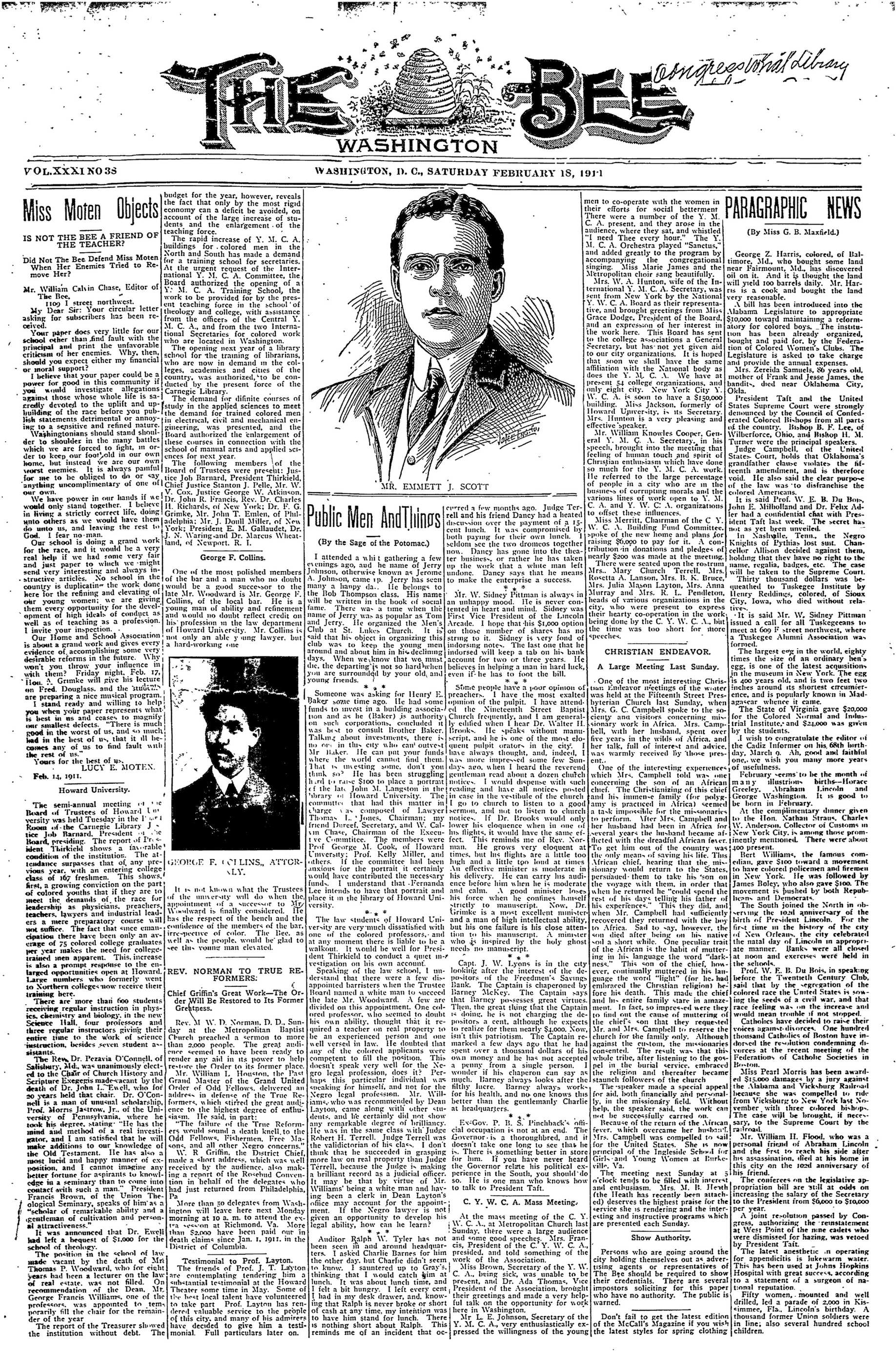
MR. EMMETT J. SCOTT
Public Men And Things
(By the Sage of the Potomac.)
I attended a whit gathering a few evenings ago, and he name of Jerry Johnson, otherwise known as Jerome A. Johnson, came up. Jerry has seen many a happy da... He belongs to the Bob Thompson class. His name will be written in the book of social fame. There was a time when the name of Jerry was as popular as Tom and Jerry. He organized the Men's Club at St. Lukes Church. It is said that his object in organizing this club was to keep the young men around and about him in his declining days. When we know that we must die, the departing is not so hard when you are surrounded by your old, and young friends.
\* \*
Someone was asking for Henry E. Baker some time ago. He had some funds to invest in a building association and as he (Baker) is authority on such corporations, concluded it was best to consult Brother Baker. Talking about investments, there is no one in this city who can outvict Mr. Baker. He can put your funds where the world cannot find them. That is investing some, don't you think so? He has been struggling hard to raise $100 to place a portrait of the late John M. Langston in the library of Howard University. The committee that had this matter in charge was composed of Lawyer Thomas L. Jones, Chairman; my friend Duree, Secretary, and W. Calvin Chase, Chairman of the Executive Committee. The members were Prof George M. Cook, of Howard University; Prof. Kelly Miller, and others. If the committee had been anxious for the portrait it certainly would have contributed the necessary funds. I understand that Fernanda Lee intends to have that portrait and place it in the library of Howard University.
* . *
The law students of Howard University are very much dissatisfied with one of the colored professors, and at any moment there is liable to be a walkout. It would be well for President Thirkield to conduct a quiet investigation on his own account.
Speaking of the law school, I understand that there were a few disappointed barristers when the Trustee Board named a white man to succeed the late Mr. Woodward. A few are divided on this appointment. One colored professor, who seemed to doubt his own ability, thought that it required a teacher on real property to be an experienced person and one well versed in law. He doubted that any of the colored applicants were competent to fill the position. This doesn't speak very well for the Negro legal profession, does it? Perhaps this particular individual was sneaking for himself, and not for the Negro legal profession. Mr. Williams, who was recommended by Dean Layton, came along with other students, and he certainly did not show any remarkable degree of brilliance. He was in the same class with Judge Robert H. Terrell. Judge Terrell was the validictorian of his class. I don't think that he succeeded in grasping more law on real property than Judge Terrell, because the Judge is making a brilliant record as a judicial officer. It may be that by virtue of Mr. Williams' being a white man and having been a clerk in Dean Layton's office may account for the appointment. If the Negro lawyer is not given an opportunity to develop his legal ability, how can he learn?
Auditor Ralph W. Tyler has not been seen in and around headquarters. I asked Charlie Barnes for him the other day, but Charlie didn't seem to know. I sauntered up to Gray's thinking that I would catch him at lunch. It was about lunch time, and I felt a bit hungry. I left every cent I had in my desk drawer, and knowing that Ralph is never broke or short of cash at any time, my intention was to have him stand for lunch. There is nothing short about Ralph. This reminds me of an incident that oc-
curred a few months ago. Judge Terrell and his friend Dancy had a heated discussion over the payment of a 15-cent lunch. It was compromised by both paying for their own lunch. I seldom see the two dromes together now. Dancy has gone into the theater business, or rather he has taken up the work that a white man left undone. Dancy says that he means to make the enterprise a success.
Mr. W. Sidney Pittman is always in an unhappy mood. He is never contented in heart and mind. Sidney was First Vice President of the Lincoln Arcade. I hope that his $1,000 option on those number of shares has no string to it. Sidney is very fond of indorsing notes. The last one that he indorsed will keep a tab on his bank account for two or three years. He believes in helping a man in hard luck, even if he has to foot the bill.
Some people have a poor opinion of preachers. I have the most exalted opinion of the pulpit. I have attended the Nineteenth Street Baptist Church frequently, and I am generally edified when I hear Dr. Walter H. Brooks. He speaks without manuscript, and he is one of the most eloquent pulpit orators in the city. I have always thought, and, indeed, I was more impressed some few Sundays ago, when I heard the reverend gentleman read about a dozen church notices. I would dispense with such reading and have all notices posted in case in the vestibule of the church. I go to church to listen to a good sermon, and not to listen to church notices. If Dr. Brooks would only lower his eloquence when in one of his flights, it would have the same effect. This reminds me of Rev. Norman. He grows very eloquent at times, but his flights are a little too high and a little too loud at times. An effective minister is moderate in his delivery. He can carry his audience before him when he is moderate and calm. A good minister loses his force when he confines himself strictly to manuscript. Now, Dr. Drinke is a most excellent minister and a man of high intellectual ability, but his one failure is his close attention to his manuscript. A minister who is inspired by the holy ghost needs no manuscript.
Capt. J. W. Lyons is in the city looking after the interest of the depositors of the Freedmen's Savings Bank. The Captain is chaperoned by Barney McKey. The Captain says that Barney possesses great virtues. Then, the great thing that the Captain is doing, he is not charging the depositors a cent, although he expects to realize for them nearly $4,000. Now, isn't this patriotism. The Captain remarked a few days ago that he had spent over a thousand dollars of his own money and he has not accepted a penny from a single person. I wonder if his chaperon can say as much. Barney always looks after the filthy lucre. Barney always works for his health, and no one knows this better than the gentlemanly Charlie at headquarters.
Ex-Gov. P. B. S. Pinchback's official occupation is not at an end. The Governor is a thoroughbred, and it doesn't take one long to see that he is. There is something better in store for him. If you have never heard the Governor relate his political experience in the South, you should do so. He is one man who knows how to talk to President Taft.
C. Y. W. C. A. Mass Meeting.
At the mass meeting of the C. Y. W. C. A., at Metropolitan Church last Sunday, there were a large audience and some good speeches. Mrs. Francis, President of the C. Y. W. C. A., presided, and told something of the work of the Association.
Miss Brown, Secretary of the Y. W. C. A., being sick, was unable to be present, and Dr. Ada Thomas, Vice President of the Association, brought their greetings and made a very helpful talk on the opportunity for work here in Washington.
Mr L. E. Johnson, Secretary of the Y. M. C. A., very enthusiastically expressed the willingness of the young
men to co-operate with the women in their efforts for sociid betterment There were a number of the Y. M. C. A. present, and they arose in the audience, where they sat, and whistled "I need Thee every hour." The Y. M. C. A. Orchestra played "Sanctus," and added greatly to the program by accompanying the congregational singing. Miss Marie James and the Metropolitan choir sang beautifully. Mrs. W. A. Hunton, wife of the International Y. M. C. A. Secretary, was sent from New York by the National Y. W. C. A. Board as their representative, and brought greetings from Miss Grace Dodge, President of the Board, and an expression of her interest in the work here. This Board has sent to the college associations a General Secretary, but has not yet given aid to our city organizations. It is hoped that soon we shall have the same affiliation with the National body as does the Y. M. C. A. We have at present 54 college organizations, and only eight city. New York City Y. W. C. A. is soon to have a $150,000 building. Miss Jackson, formerly of Howard Upward-ity, is its Secretary. Mrs. Hunton is a very pleasing and effective speaker.
Mr. William Knowles Cooper, General Y. M. C. A. Secretary, in his speech, brought into the meeting that feeling of human touch and spirit of Christian enthusiasm which have done so much for the Y. M. C. A. work. He referred to the large percentage of people in a city who are in the business of corrupting morals and the various lines of work open to Y. M. C. A. and Y. W. C. A. organizations to offset these influences.
Miss Merritt, Chairman of the C Y. W. C. A. Building Fund Committee, spoke of the new home and plans for raising $6,000 to pay for it. A contribution in donations and pledges of nearly $200 was made at the meeting. There were seated upon the rostrum Mrs. Mary Church Terrell, Mrs. Rosetta A. Lanson, Mrs. B. K. Bruce, Mrs. Julia Mason Layton, Mrs. Anna Murray and Mrs. R. L. Pendleton, heads of various organizations in the city, who were present to express their hearty co-operation in the work being done by the C. Y. W. C. A., but the time was too short for more speeches.
CHRISTIAN ENDEAVOR.
A Large Meeting Last Sunday.
One of the most interesting Christian Endeavor meetings of the wouter was held at the Fifteenth Street Presbyterian Church last Sunday, when Mrs. G. C. Campbell spoke to the society and visitors concerning missionary work in Africa. Mrs. Campbell, with her husband, spent over five years in the wilds of Africa, and her talk, full of interest and advice, was warmly received by those present.
One of the interesting experiences which Mrs. Campbell told was one concerning the son of an African chief. The Christianizing of this chief and his immense family (for polyamy is practiced in Africa) seemed a task impossible for the missionaries to perform. After Mrs. Campbell and her husband had been in Africa for several years the husband became afflicted with the dreadful African fever. To get him out of the country was the only means of saving his life. This African chief, hearing that the missionary would return to the States, persuaded them to take his son on the voyage with them, in order that when he returned he "could spend the rest of his days telling his father of his experiences." This they did, and when Mr. Campbell had sufficiently recovered they returned with the boy to Africa. Sad to say, however, the son died after being on his native a short while. One peculiar trait of the African is the habit of muttering in his language the word "darkness." This son of the chief, however, continually muttered in his language the word "light" (for he had embraced the Christian religion) before his death. This made the chief and his entire family stare in amazement. In fact, so impressed were they to find out the cause of muttering of the chief's son that they requested Mr. and Mrs. Campbell to reserve the church for the family only. Although against the custom, the missionaries consented. The result was that this whole tribe, after listening to the gospel in the burial service, embraced the religion and thereafter became staunch followers of the church.
The speaker made a special appeal for aid, both financially and personally, in the missionary field. Without help, the speaker said, the work can not be successfully carried on. Because of the return of the African fever, which overcame her husband, Mrs. Campbell was compelled to sail for the United States. She is now principal of the Ingleside School for Girls and Young Women at Burkerville, Va. The meeting next Sunday at 5 o'clock tends to be filled with interest and enthusiasm. Mrs. M. B. Heath (the Heath has recently been attached) deserves the highest praise for the service she is rendering and the interesting and instructive programs which are presented each Sunday.
Show Authority.
Persons who are going around the city holding themselves out as advertising agents or representatives of the Bye should be required to show their credentials. There are several impostors soliciting for this paper who have no authority. The public is warned.
Don't fail to get the latest edition of the McCall's Magazine if you wish the latest styles for spring clothing
PARAGRAPHIC NEWS
(By Miss G. B. Maxfield.)
George Z. Harris, colored, of Baltimore, Md., who bought some land near Fairmount, Md., has discovered oil on it. And it is thought the land will yield 100 barrels daily. Mr. Harris is a cook and bought the land very reasonable.
A bill has been introduced into the Alabama Legislature to appropriate $10,000 toward maintaining a reformatory for colored boys. The institution has been already organized, bought and paid for, by the Federation of Colored Women's Clubs. The Legislature is asked to take charge and provide the annual expenses.
Mrs. Zereida Samuels, 86 years old, mother of Frank and Jesse James, the bandit, died near Oklahoma City, Okla.
President Taft and the United States Supreme Court were strongly denounced by the Council of Confederated Colored Bishops from all parts of the country. Bishop B. F. Lee, of Wilberforce, Ohio, and Bishop H. M. Turner were the principal speakers.
Judge Campbell, of the United States Court, holds that Oklahoma's grandfather clause violates the fifteenth amendment, and is therefore void. He also said the clear purpose of the law was to disfranchise the colored Americans.
It is said Prof. W. E. B. Du Bois, John E. Milholland and Dr. Felix Adler had a confidential chat with President Taft last week. The secret has not as yet been unveiled.
In Nashville, Tenn., the Negro Knights of Pythias lost suit. Chancellor Allison decided against them, holding that they have no right to the name, regalia, badges, etc. The case will be taken to the Supreme Court.
Thirty thousand dollars was bequeathed to Tuskegee Institute by Henry Reidings, colored, of Sioux City, Iowa, who died without relatives.
It is said Mr. W. Sidney Pittman issued a call for all Tuskegeeans to meet at 609 F street northwest, where a Tuskegee Alumni Association was formed.
The largest egg in the world, eighty times the size of an ordinary hen's egg, is one of the latest acquisitions in the museum in New York. The egg is 400 years old, and is two feet two inches around its shortest circumference, and is popularly known in Madagascar whence it came.
The State of Virginia gave $20,000 for the Colored Normal and Industrial Institute, and $24,000 was given by the students.
I wish to congratulate the editor of the Cadiz Informer on his 68th birthday, March 9. Ah, good and faithful one, we wish you many more years of usefulness.
February seems to be the month of many illustrations births-Horace Greeley, Abraham Lincoln and George Washington. It is good to be born in February.
At the complimentary dinner given to the Hon. Nathan Straus, Charles W. Anderson, Collector of Customs in New York City, is among those prominently mentioned. There were about 400 present.
Bert Williams, the famous comedian, gave $100 toward a movement to have colored policemen and firemen in New York. He was followed by James Boley, who also gave $100. The movement is pushed by both Republicans and Democrats.
The South joined the North in observing the 102nd anniversary of the birth of President Lincoln. For the first time in the history of the city of New Orleans, the city celebrated the natal day of Lincoln in appropriate manner. Banks were all closed at noon and exercises were held in the schools.
Prof. W. E. B. Du Bois, in speaking before the Twentieth Century Club, said that by the segregation of the colored race the United States is sowing the seeds of a civil war, and that race feeling was on the increase and would mean trouble if not stopped.
Catholics have decided to raise their voices against divorces. One hundred thousand Catholics of Boston have indorsed the resolution condemning divorces at the recent meeting of the Federations of Catholic Societies in Boston.
Miss Pearl Morris has been awarded $15,000 damages by a jury against the Alabama and Vicksburg Railroad because she was compelled to ride from Vicksburg to New York last November with three colored bishops. The case will be brought, if necessary, to the Supreme Court by the railroad.
Mr. William H. Flood, who was a personal friend of Abraham Lincoln and the first to reach his side after his assassination, died at his home in this city on the 102d anniversary of his friend.
The conferences on the legislative appropriation bill are still at odds on increasing the salary of the Secretary to the President from $6,000 to $10,000 per year.
A joint resolution passed by Congress, authorizing the reenstatement at West Point of the nine cadets who were dismissed for hazing, was vetoed by President Taft.
The latest anesthetic in operating for appendicitis is lukewarm water. This has been used at John Hopkins Hospital with great success, according to a statement of a surgeon of national reputation.
Fifty women, mounted and well drilled, led a parade of 2,000 in Kissimmee, Fla., Lincoln's birthday. A thousand former Union soldiers were in line; also several hundred school children.
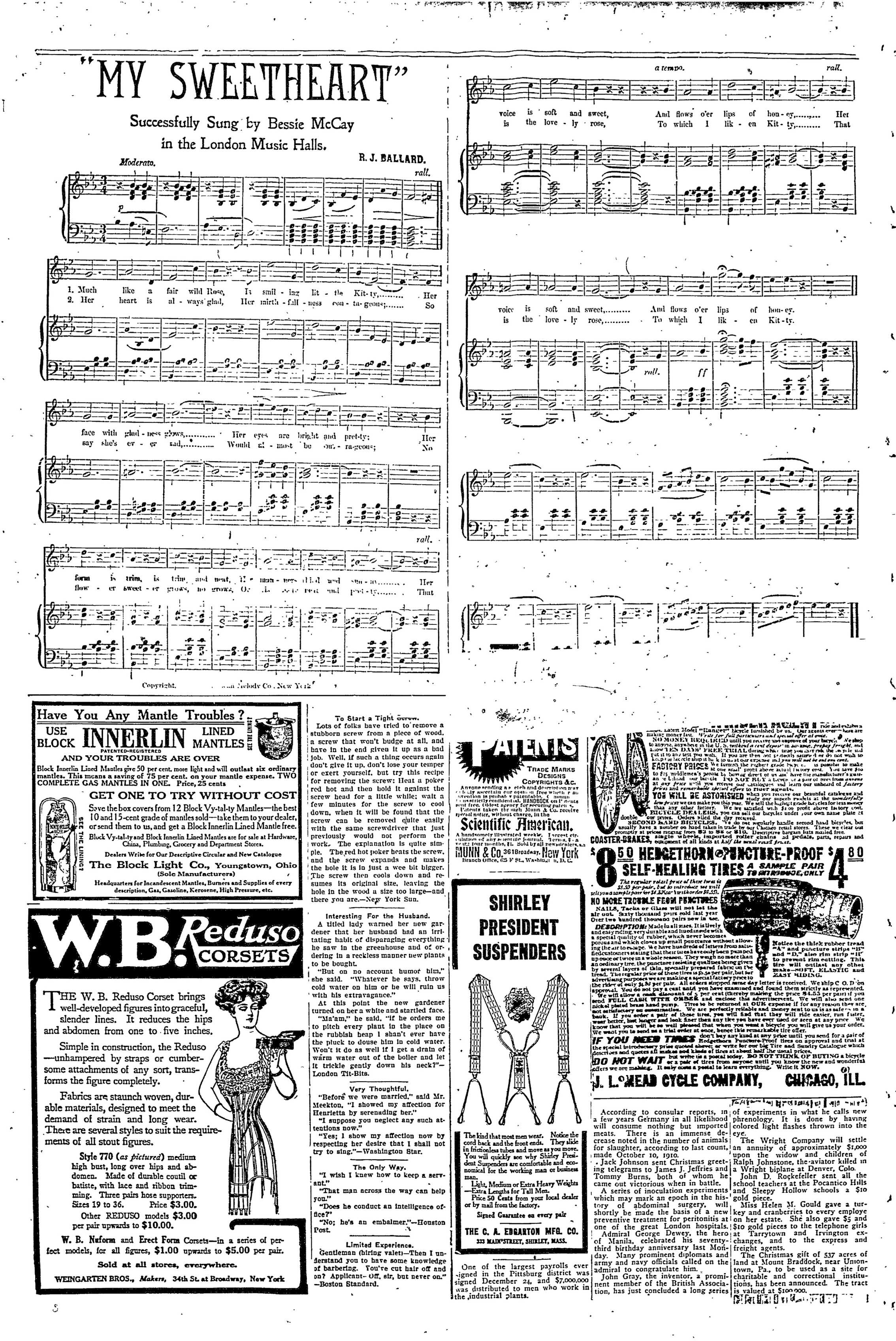
"MY SWEETHEART"
1. Much like a fair wild Rose, Is smiling little Kitty,…… Her
2. Her heart is always glad, Her mirth-fallness contagious;…… So
face with gladness glows,…… Her eyes are bright and pretty; Her
say she's ever sad,…… Would almost be outrageous; No
form is trim, is trim, and neat, It manners itself and smiles, Her
flower sweeter grows, no grows, Or is more neat and pretty; That
Have You Any Mantle Troubles?
USE BLOCK INNERLIN LINED MANTLES
AND YOUR TROUBLES ARE OVER
Block Innerlin Lined Mantles give 50 per cent, more light and wi
mantles. This means a saving of 75 per cent, on your m
COMPLETE GAS MANTLES IN ONE. Price, 25 cent.
GET ONE TO TRY WITH
Save the box covers from 12 Block Vy-tal
10 and 15-cent grade of mantles sold—tai
or send them to us, and get a Block Inner
Block Vy-tal-ty and Block Innerlin Lined Mantles
China, Plumbing, Grocery and Depot
Dealers Write for Our Descriptive Circula
The Block Light Co., Y.
(Sole Manufacturer)
Headquarters for Incandescent Mantles, Burn
description, Gas, Gasoline, Kerosene, L
W.B. Re
Block Innerlin Lined Mantles give 50 per cent, more light and will outlast six ordinary mantles. This means a saving of 75 per cent. on your mantle expense. TWO COMPLETE GAS MANTLES IN ONE. Price, 25 cents
GET ONE TO TRY WITHOUT COST
Save the box covers from 12 Block Vy-tal-ty Mantles—the best 10 and 15-cent grade of mantles sold—take them to your dealer, or send them to us, and get a Block Innerlin Lined Mantle free.
Block Vy-tal-ty and Block Innerlin Lined Mantles are for sale at Hardware, China, Plumbing, Grocery and Department Stores.
The Block Light Co., Youngstown, Ohio (Sole Manufacturers)
Headquarters for Incandescent Mantles, Burners and Supplies of every description, Gas, Gasoline, Kerosene, High Pressure, etc.
W.B. Reduso CORSETS
W. B. Nuform and Erect Form Corsets—infect models, for all figures, $1.00 upwards to Sold at all stores, everywh WEINGARTEN BROS., Makers, 34th St. at Bro
W. B. Nuform and Erect Form Corsets—in a series of perfect models, for all figures, $1.00 upwards to $5.00 per pair.
Sold at all stores, everywhere.
WEINGARTEN BROS., Makers, 34th St. at Broadway, New York
MERLU
LOTT
SEE THE LINING?
THE W. B. Reduso Corset brings well-developed figures into graceful, slender lines. It reduces the hips and abdomen from one to five inches.
Simple in construction, the Reduso unhampered by straps or cumbersome attachments of any sort, transforms the figure completely.
Fabrics are staunch woven, durable materials, designed to meet the demand of strain and long wear. There are several styles to suit the requirements of all stout figures.
Style 770 (as pictured) medium high bust, long over hips and abdomen. Made of durable coutil or batiste, with lace and ribbon trimming. Three pairs hose supporters. Sizes 19 to 36. Price $3.00.
Other REDUSO models $3.00 per pair upwards to $10.00.
3
SEE THE LIVING
THE LIVING
LIVE
and will outlast six ordinary your mantle expense. TWO 25 cents
WITHOUT COST
Ky V-tal-ty Mantles—the best sold—take them to your dealer, Jack Innerlin Lined Mantle free. Mantles are for sale at Hardware, and Department Stores.
Circular and New Catalogue
D., Youngstown, Ohio (facturers)
Burners and Supplies of every rosene, High Pressure, etc.
s
ul,
ips
es.
quire-
ets-in a series of per- raids to $5.00 per pair. anywhere. at Broadway, New York
R. J. BALLARD.
lit - the Kitty;... Her
ness con - ta - geous;... So
light and pref - ty; Her
be out - ra - geous; No
rall.
lid and sin - no; Her
wet and pref - ty; That
To Start a Tight Grow.
Lots of folks have tried to remove a stubborn screw from a piece of wood, a screw that won't budge at all, and have in the end given it up as a bad job. Well, if such a thing occurs again don't give it up, don't lose your temper or exert yourself, but try this recipe for removing the screw: Heat a poker red hot and then hold it against the screw head for a little while; wait a few minutes for the screw to cool down, when it will be found that the screw can be removed quite easily with the same screwdriver that just previously would not perform the work. The explanation is quite simple. The red hot poker heats the screw, and the screw expands and makes the hole it is in just a wee bit bigger. The screw then cools down and resumes its original size, leaving the hole in the wood a size too large—and there you are.—New York Sun.
Interesting For the Husband.
A titled lady warned her new gardener that her husband had an irritating habit of disparaging everything he saw in the greenhouse and of ordering in a reckless manner new plants to be bought.
"But on no account humor him," she said. "Whatever he says, throw cold water on him or he will ruin us with his extravagance."
At this point the new gardener turned on her a white and startled face.
"Ma'am," he said, "if he orders me to pitch every plant in the place on the rubbish heap I shan't ever have the pluck to douse him in cold water. Won't it do as well if I get a drain of warm water out of the boiler and let it trickle gently down his neck?"—London Tit-Bits.
Very Thoughtful.
"Before we were married," said Mr. Meekton, "I showed my affection for Henrietta by serenading her."
"I suppose you neglect any such attentions now."
"Yes; I show my affection now by respecting her desire that I shall not try to sing."—Washington Star.
The Only Way.
"I wish I knew how to keep a servant."
"No; he's an embalmer."—Houston Post.
Limited Experience
Gentleman (biring valet)—Then I understand you to have some knowledge of barbering. You've cut hair off and on? Applicant-- Off, sir, but never on." Boston Standard.
voice is soft and sweet,
is the lovely rose,
And flows o'er lips of honey,.... Her
To which I lik-en Kit-ty,.... That
voice is soft and sweet,…… And flows o'er lips of honey.
is the lovely rose,…… To which I liken Kit-ty.
```markdown
```
COPYRIGHTS & C.
Anyone sending a piece and description may
obtain assertive our opinion free whether or not
an invention is probable patentable. A common
strictly confidential. HANDBOOK on Parents
sent free. Obstant agency for securing patent.
Letters to the Publisher & Co. receive
special notice, without charge, in the
Scientific American.
A handsomely illustrated weekly. Largest circulation
of any scientific journal. Terms, $4
a year, four months, $1. Sold by all new dealers.
MUNN & Co. 361 Broadway New York
Branch Office, 65 F. St., Washington, D.C.
SHIRLEY PRESIDENT SUSPENDERS
SUSPENDERS
The kind that most men wear. Notice the cord back and the front ends. They slide in frictionless tubes and move as you move. You will quickly see why Shirley President Suspenders are comfortable and economical for the working man or business man.
Light, Medium or Extra Heavy Weights
—Extra Lengths for Tall Men.
Price 50 Cents from your local dealer or by mail from the factory.
THE C. A. EBARTON MFG. CO.
323 MAIN*STREET, SHIRLEY, MASS.
One of the largest payrolls ever signed in the Pittsburg district was signed December 24, and $7,000,000 was distributed to men who work in the industrial plants.
ROSE and calibrate
our latest Model "Ranger" bicycle furnished by us. Our agents ever here are
rate for full participation and will offer all once.
NO MONEY REQUIRED
NO MONEY REQUIRED
NO MONEY REQUIRED
We shop to anyone anywhere in the U.S. without a department in anyone, pratt freight, and allow TEN DAYS FREE THIRD during what we assume you may not wish to put it to any test you wish. If you are then not seriously saturated or do not wish to keep the bicycle ship it back to us at our expense and you will not be on our cart.
FASTEST PRICES
FASTEST PRICES
at one small profit above all costly cost. You save too to for middleness's profits by buying direct of us and have the manufacturer's guarantee. Our bicycle DO NOT BUY a braven or a pair of tires from anyone at any price until you receive our catalogues and learn our unheard of fattery offers to rider signatures.
YOU WILL BE ASTORISHED when you receive our beautiful catalogue and study our superb models at the wonderfully low prices we can make you this year. We sell the highest grade bicycles for less money than any other factory. We are satisfied with $100 profit above factory cost. BICYCLE DEALERS, you can sell our bicycles under your own name plate at our prices. Orders filled the day received.
SECOND HAND BICYCLES. We do not regularly handle second hand bicycles, but usually have a number on hand taken in trade by our Chicago retail stores. These we clear out promptly at price reductions. Our descriptive bargain lists mailed free. We also stock bevels, imported rosters, pedals, parts, repairs and equipment of all kinds at half the usual retail rates.
COASTER-BRAKES, single wheels, imported roter
equipment of all kinds at half the price
$ 50 HEDGETHORN © PUNG
SELF-MEALING TIRES
The regular retail price of these tires is
$ 52 per pair, but to introduce we will
```markdown
```
a special quality of rubber, which never becomes porous and which closes up small punctures without allowing the air to escape. We have hundreds of letters from satisfied customers stating that their tires have only been pumped up once or twice in a whole season. They weigh no more than an ordinary tire, the puncture resistance is quite high by several layers of rubber and fabric on the trend. The price of these tires is $5 per pair, but our customers are making a special factory price to
ooped same day letter is received. We ship C.O.D. on
announced and found them strictly as represented.
at (thereby making the price $4.55 per pair) if you
close this advertisement. We will also send one
returned at OUR expense if for any reason they are
reliably reliable and money sent to us is as safe in a
will find that they will ride easier, run faster,
y the you have ever used or seen at any price. We
when you want a bicycle you will give us your order.
ence this remarkable tire offer.
any kind at any price until you send for a pair of
born Puncture-Proof tires on approval and trial at
write for our big Tire and Sundry Catalogue which
tires at about half the usual prices.
today. DO NOT THINK OF BUYING a bicycle
from anyone until you know the new and wonderful
learn everything. Write it NOW.
COMPANY, CHICAGO, ILL.
bringing you only $4.85 per pair. All orders shipped same day letter is received. We ship O.D. on approval. You do not pay a cash until you have examined and found them strictly as represented. You will allow a cash discount of 5 per cent (thereby making the price $4.55 per pair) if you send FULL CASH WITH OMBER and enclose this advertisement. We will also send one nickel plated brass hand pump. Tires to be returned at OUK expense if for any reason they are not satisfactory on examination. We are perfectly reliable and money sent to us is as safe in a book. If you order a pair of tires, you will find that they will ride easier, run faster, wear better, last longer and look finer than any tire you have ever used or seen at any price. We know that you will be so pleased that when you want a bicycle you will give us your order. We want you to send us a trial order at once, hence this remarkable tire offer.
the rate of only 34£ per pair. All orders shipped same day aporel. You do not pay a coat until you have examined it. We will allow a cash discount of 5 per cent (thereby we send FULL CASH WITH OMBER and enclose this nickel plated brass hand pump. Tires to be returned at C not satisfactory on examination. We are perfectly reliable book. If you order a pair of these tires, you will find wear better, last longer and look finer than any you have know that you will be so well pleased that when you wear. We want you to send us a trial order at once, hence this rev.
IF YOU NEED TIMES don't buy any kind of the special introductory price quoted above; or write for our describes and quotes all kinds and kinds of times at about DO NOT WAIT but write in a postal today. Do or a pair of tires from anyone offers we are making. It only comes a postal to learn every
J. L. HEAD CYCLE COMPANY
IF YOU NEED TIMES don't buy any kind at any price until you send for a pair of
Redgehoppers Puncture-Proof tires on approval and trial at
the special introductory price quoted above; or write for our big Tire and Sundry Catalogue which
describes and quotes all makes and kinds of tires at about half the usual prices.
DO NOT WAIT but write us a postal code. DO NOT THINK OF BUYING a bicycle
or a pair of tires from anyone with you know the new and wonderful
.
double
SECOND
usually have
promptly at p
selioua sample porr $ 25.00 with or $ 55.00
NO MORE TROUBLE FROM PUNCTURES
NAILS, Tackles or Glazes will not let the
air out. Sixty thousand pairs cold last year.
Over two hundred thousand pairs now in use.
DESCRIPTION Made in all states. It is lively
and easygoing, very durable and lined with
mildew.
According to consular reports, in a few years Germany in all likelihood will consume nothing but imported meats. There is an immense decrease noted in the number of animals for slaughter, according to last count, made October 10, 1910. Jack Johnson sent Christmas greeting telegrams to James J. Jeffries and Tommy Burns, both of whom he came out victorious when in battle.
A series of inoculation experiments which may mark an epoch in the history of abdominal surgery, will shortly be made the basis of a new preventive treatment for peritonitis at one of the great London hospitals. Admiral George Dewey, the hero of Manila, celebrated his seventy-third birthday anniversary last Monday. Many prominent diplomats and army and navy officials called on the admiral to congratulate him. John Gray, the inventor, a prominent member of the British Association, has just concluded a long series
Notice the thick rubber tread
"A" and puncture strips "B"
and "D." also rim strip "IF"
to prevent rim cutting. This
tire will outlast any other
make—HIFT. ELASTIC and
ZASY RIDING.
of experiments in what he calls new phrenology. It is done by having colored light flashes thrown into the eye. The Wright Company will settle an annuity of approximately $1,000 upon the widow and children of Ralph Johnstone, the aviator killed in a Wright biplane at Denver, Colo. John D. Rockefeller sent all the school teachers at the Pocantico Hills and Sleepy Hollow schools a $10 gold piece. Miss Helen M. Gould gave a turkey and cranberries to every employee on her estate. She also gave $5 and $10 gold pieces to the telephone girls at Tarrytown and Irvington exchanges, and to the express and freight agents.
The Christmas gift of 537 acres of land at Mount Braddock, near Unitown, Pa., to be used as a site for charitable and correctional institutions, has been announced. The tract is valued at $100,000.
The Bella Coola Believe There Are Five Worlds and Are Worshipers of the Sun.
There is an odd feature in the theology of the small Indian tribe of the Bella Coola which inhabit British Columbia in about latitude 52. They believe that there are five worlds, one above the other, and the middle one is our own world, the earth. Above it are two heavens, and under it are two underworlds. In the upper heaven is the supreme delity, who is a woman, and she doesn't meddle much with the affairs in the second world below her. The zenith is the center of the lower heaven, and here is the house of the gods, in which live the sun and the rest of the delties.
Our own earth is believed to be an island swimming in the ocean. The first underworld from the earth, is inhabited by ghosts, who can return, when they wish, to heaven, from which place they may be sent down to our earth. If then they misbehave again they are cast into the lower of the underworlds, and from this bourn no ghostly traveler returns.
The Bella Coola are sun worshlpers, for Senex, the sun, the master of the house of gods, who is called the father and the sacred one, is the only deity to whom the tribe pray. Each family of the Bella Coola has its own traditions and its own form of the current traditions, so that in the mythology of the tribe there are countless contradictions. When any one not a member of a clan tries to tell a tradition which does not belong to his clan it is like a white man trying to tell another joke—he is considered as appropriating the property right which does not belong to him.
SMOKELESS POWDER.
It Came Through Experimenting For High Explosives.
The idea is very general that smokeleas powder in being practically smokeleas achieves its greatest end, but as a matter of fact its smokeleess feature is incidental and was an accident.
When the idea of modern long range guns was conceived it was at once apparent that the old black powder lacked explosive force, and thousands of experiments were made with various chemicals to procure a powder of high explosive properties, and this was at last accounted.
When the new powder was tried, much to the surprise of every one it was found that practically no smoke followed the explosion, though this could of course have been predicted had the question ever arisen. The volume of smoke from black powder is due mainly to the quantity of charcoal in the powder, an ingredient not found in the smokeless explosive. Smokeless powder, though a great boon to the sportsman, is of questionable value on the battlefield, so far as its smokelessness is concerned. The smoke clouds of old days were frequently most advantageously used to cloak movements of troops and batteries and really interfered with the enemy much more than with the troops creating the smoke—Exchange.
Saved by Fireflies
The gigantic tropical firefiles which swarm in the forests and canebrakes, of most of the low lying West Indian islands once proved the salvation of the city of Santo Domingo. A body of buccaneers, headed by the notorious Thomas Cavendish, had laid all their plans for a descent upon the place, intending to massacre the inhabitants and carry away all the treasure they conveniently could, and had actually put off their boats for that purpose. As they approached the land, however, rowing with muffled ears, they were greatly surprised to see an infinite number of moving lights in the woods which framed the bayup which they had to proceed, and, concluding that the Spaniards knew of their approach, they put about and regained their ship without attempting to land.
The Wonderful Banana.
Some people believe that the banana was the original forbidden fruit of the garden of Eden. In any case it is one of the curiosities of the vegetable kingdom, being not a tree, a palm, a bush, a shrub, a vegetable or a herb, but a herbaceous plant with the status of a tree. Although it sometimes attains a height of thirty feet, there is no woody fiber in any part of its structure, and the bunches growing on the dwarf banana plant are often heavier than the stalk which supports them. No other plant gives such a quantity of food to the acre as the banana. It yields 44 times more by weight than the potato and 123 times more than wheat. Moreover, no insect will attack it, and it is always immune from diseases of any kind.
Convinced.
"Do you think a college education helps a man in business?"
"Sure. I've had two college boys here workin' for me durin' the past year, and I was afraid to discharge either one of 'em for fear they'd find fault with my grammar when I done it."—Chicago Record-Herald.
Following Orders
Charlie—What have you been doing to your face, dear boy? Percy—I tried to share myself this morning. Charlie—What on earth for? Percy—The doctor told me that I ought to take more exercise—Illustrated Bits.
At Cross Purposes.
Scott—Half the people in the world don't know what the other half are doing. Mott—No; that is because the other half are doing them. — Boston Transcript.
The Native Youngsters of New Guinea Had a Good Reason For Refusing to Eat It.
In certain parts of New Guinea the wallaby, a species of kangaroo, are very plentiful, and the traveler in search of sport finds the pursuit of them an exciting occupation. Wallaby steak is a refreshlu, change from canned meats, and the natives are only too glad to have the remnants of the carcass. A writer in an English magazine tells an amusing incident connected with the animal.
He had been ashore in one of the sparsely populated regions of the coast and secured four wallaby, an ample supply for, the whole party, native guides and servants included. But he found that, although wallaby is regarded as such a delicacy that no trouble is considered too great to obtain it, none of the native boys in the party would touch it.
This was a mystery until one of them explained that they had been trained in childhood in the belief that if they ate wallaby before reaching a certain age it would stop their growth.
These boys all belonged to the part of the country where wallaby are few, and one can imagine the crafty old folks seated round the festive pot and winking at one another as the young people declined the succulent dainty.
LACEMAKING.
An Old Legend That Tells of the Origin of the Art.
Lacemaking is by no means so old an industry as most persons suppose. There is no proof that it existed previous to the fifteenth century, and the oldest known painting in which it appears is a portrait of a lady in the academy at Venice painted by Caspaccho, who died about 1523. The legend concerning the origin of the art is as follows:
A young fisherman of the Adriatic was betrothed to a young and beautiful girl of one of the isles of the lagoon. Industrious as she was beautiful, the girl made a new net for her lover, who took it with him on board his boat. The first time he cast it into the sea he dragged therefrom an exquisite petrified wrack grass, which he hastened to present to his fiancee; but, war breaking out, the fisherman was pressed into the service of the Venetion navy. The poor girl wept at the departure of her lover and contemplated his last gift to her. While absorbed in following the intricate tracery of the wrack grass she began to twist and plait the threads weighted with small beads which hung around her net. Little by little she wrought an imitation of the petrification, and thus was created the bobbin lace.
Too Realistic.
During a performance of "Captain Lapalisse" at a Valencia theater some years ago an incident occurred which for lifelike effect left nothing to be desired. During the said play some of the actors mingle with the spectators in order to co-operate from the body of the house. No sooner had Mirailles, the actor, taken his seat in the stalls to a daring pickpocket robbed him of his gold watch. Mirailles seized the man by his coat collar and called out in a deep bass voice:
"Police! Help! Thleves!"
The audience, taking this little episode to be part of the performance, roared with laughter. Even the policemen joined in without stirring hand or foot.
"This is no farce!" cried the actor in tones of despair. "The fellow has not my watch!"
The voice sounded so natural that the audience broke into loud applause at "such excellent fooling." Meanwhile the thief managed to break away from his captor and escaped.
A Judicial Expert
The native with a stogle met the native with a pipe.
"Howdy, Zeb?" quoth the stogle native.
"Hear 'bout th' fuss down to th' courthouse?"
"Nope." drawled the man with the pipe.
"What was it about?"
"Why, Jim Simpson has been suin' Abner Hawley for allenatin' th' affections of his wife, an' Jedge Musgrove told th' jury to bring in a verdick of 6 cents damages, 'cause he thought that was all the damage was worth to Jim. An' Jim's wife got und an' threw a chair at th' judge, an' he had her arrested 'an' put in th' cooler."
"Not at all, not at all! You see, he was her first husband."—Cleveland Plain Dealer.
Singer and Orator
"If I had my way," Dr. Macnamara once confessed to an interviewer, "I should be singing in 'Carmen' instead of making speeches from the treasury bench, but unfortunately the British public thinks a great deal more of a man who can make a bad speech than a man who can sing a good song."—Westminster Gazette.
To Reform Him.
Minister—You say you are going to marry a man to reform him. That is noble. May I ask who it is? Miss Beauti—It's young Mr. Bondclipper. Minister—Indeed! I did not know he had any bad habits. Miss Beauti—Yes; his friends say that he is becoming quite miserly.
Anticipation
"Doesn't it make you the least bit envious to see what elegant furniture Mrs. Eyedy is putting into her house next door?" "Not a bit. My husband says it will be sold by the sheriff within six months—and I'll be there to buy it"—Chicago Tribune.
A Sample Circular Composed by a Native Tradesman With an Observation on the Servant Problem.
There comes from a correspondent in Japan this example of circulars in English that Japanese tradesmen sometimes compose:
'Dear Sir-I have the honour to write a letter for you that I have now established the meat market and its branch to deliver the meat as one of the branch of my slaughter house, as which I have many cattle, their pastures, their markets, milk houses, and a slaughter house, etc., and I will have a fresh meat with the most cheapest price from my slaughter house than other buchery and especially make you many reduction for every day purchaser for month. I beg you can soon make me your order without your servant's commission as you know your servant is always making money by your meat.' I will make you the pass-book for the credit or only.
"P. S.—If you handed bad meat from your servant while you are making purchases the meat from my market every day, you will go to let it exchange by the servant without any hesitation. Please make me your order, and if you can make me order by letter I will have the postage reduction from the count of meat with kind regards. Your truly"—Boston Transcript.
THE DELUGE.
Queer Old Australian Tradition About the Flood.
The aboriginal blacks, of Australia have a queer tradition about the flood. They say that at one time there was no water on the earth at all except in the body of an immense frog, where men and women could not get at it. There was a great council on the subject, and it was found out that if the frog could be made to laugh the waters would run out of his mouth and the drought be ended.
So several animals were made to dance and caper before the frog to induce him to laugh, but he did not even smile, and so the waters remained in his body. Then some one happened to think of the queer contortions into which the eel could twist itself, and it was straightway brought before the frog, and when the frog saw the wriggling he laughed so loud that the whole earth trembled, and the waters poured out of his mouth in a great flood, in which many people were drowned.
The black people were saved from drowning by the pelican. This thoughtful bird made a big canoe and went with it among all the lands that appeared here and that move the surface of the water. Red in the black people and s
Curiosities of Superstition
When Egypt was in the height of her power, when she was most highly civilized and delighted in being called the mistress of the land and sea, her people worshiped a black bull. There was some discrimination, however, even in this form of worship. In order to be an object of mad adoration it was necessary that the bull calf be born with a circular white spot in the exact center of his forehead, and the advent of such a creature in any herd was the signal of wild demonstrations from the Mediterranean to the border of the Lyblan desert. Even as late as the time of Cleopatra, star eyed goddess, glorious sorceress of the Nile, such animals were shod with gold and had their horns tipped with the same metal. Herodotus tells of a man who died with grief because he sold a cow that soon after became the mother of a black bull calf marked with the sacred white circle in his forehead.
Lead Pencil Experiments.
An English statistician was asked how many words could be written with an English lead pencil, and, being determined to answer it, he bought a lead pencil and Scott's "Ivanhoe" and proceeded to copy the latter word by word. He wrote 95,008 words and then was obliged to stop, for the pencil had become so short that he could not use it. A German statistician who heard of this experiment was dissatisfied with it because all the lead in the pencil was not used on the work, and therefore he bought a pencil and started to copy a long German novel. When the pencil was so short that he could not handle it with his fingers he attached a holder to it, and it is said that he wrote with this one pencil 400,000 words. Possibly, however, his pencil was longer or the lead in it was of a more durable quality.
When Silence Is Deadly.
Silence is commonly the slow poison used by those who mean to murder love. There is nothing violent about it. No shock is given. Hope is not abruptly strangled, but merely dreams of evil and fights with gradually stiffing shadows. When the last convulsions come they are not terrific. The frame has been weakened for dissolution. Love dies like natural decay. It seems the kindest way of doing a cruel thing.—George Meredith.
Rubbing It In.
The Bride—That nasty Mrs. Jones, next door, said I'd better try these biscuits on the dog before I gave 'em to you. The Groom—Hasn't she got a mean disposition! Why, I thought she was fond of dogs!—Cleveland Leader.
Often the Case.
Sillicus—What do you suppose caused him to go to the bad? Cynicus—Trying to be a good fellow.—Philladelphia Record.
The fool's ear was made for the knave's tongue.—Ramaswami's "Indian Fables."
McCALL PATTERNS
10
AND
15
NONE HIGHER
McCALL'S MAGAZINE
INCLUDING A FREE PATTERN
McCALL PATTERNS
Celebrated for style, perfect fit, simplicity and
reliability for more than 40 years. Sold in any
every city and town in the United States and
Canada, or by mail direct. More so than in
any other make. Send for free catalogue.
McCALL'S MAGAZINE
More subscribers than any other fashion
magazine—more a month. Inexpensive. Las-
er styles, pitttins, dressmaking, military,
plain穿着, any edition, height, beading,
taquette, good stories. On 50 or a
year (month double), including a free pat-
ter. Subscribe today or send for sample copy.
WONDERFUL INDUCENCEMENTS
to Agents. Post brushes, print, tape
and new cash price lists. Addres-
McCALL CO. 238 to 243 W. 37th St. NEW YORK
HF BFF AND McCALL'S GREAT
FASHION MAGAZIP
Find enclosed two dollars. Send to
or address below The Bee and McCall's
Fashion Magazine for one year
No.....
street.....
Town or City....
SEWING MACHINE
Before You, Purchase Any Other Write
THE NEW HOME SEWING MACHINE COMPANY
ORANGE, MASS
Many Sewing Machines are made to suit
of ours, but the "New Home" made
new. Our guarantee never runs out.
We make Sewing Machines to suit all conditions
the trade. The "New Home" stands at
all high-grade family sewing machines
widely by authorized dealers only.
FOR SALE
Go to
HOLMES' HOTEL,
No. 333 Virginia Ave., S.W.
Post Afro-American Accommodation in the District.
EUROPEAN AND AMERI-
LAN PLAN.
Good Rooms and Lodging, 30,
75c. and $1.00. Comfortably
Heated by Steam. Give
to a Cell
Otowa by
Washington
Black Eye For Blackstone.
"Your honor," said Moman Prulett, the criminal lawyer, "since reports and modern law are not sufficient to convince you, let me read this section from Blackstone, the father of the common law, an undoubted authority. He supports my contention precisely."
"You had as well sit down, Mr. Prulett. I have decided the point against you," replied the court. "You need not cite more cases. I have overruled your demurrer and do not care to hear you read the section."
"I know you have, your honor. I know you have," sarcastically said the redoubtable lawyer. "I know it, but I just wanted to show the court what a fool Blackstone was."—Kansas City Times.
First Use of the Word "Kerosene."
The word "kerosene" seems to have been first used in the United States patent No. 12.012 of March 27, 1855, granted to Abraham Gesner of Williamsburg, N. Y., and assigned to the North American Kerosene Gaslight company. In the preamble to his specification Gesner states that he has "invented and discovered a new and useful manufacture or composition of matter, being a new liquid hydrocarbon which I denominate 'kerosene.'" So far as we are aware and so far as the patent office examiners are aware, this is the first instance in which the word kerosene was suggested as a trademark or a name for what was then generally called "rock oil"—Scientific American.
Ceremonious and Deadly Dull.
Ceremonious and Deadly Dull.
The first executive mansion was in Philadelphia, a three story brick building with small paned windows and a heavy brass knocker on the door. Formal state dinners took place on Thursdays at 4 o'clock, with ten to twenty guests. Friday evening Mrs. Washington held her drawing rooms. Plum cake, tea and coffee were served at 9 o'clock, after which Mrs. Washington rose and dismissed her guests, as though they were little children too long lingering at a party, "The general," was the naive formula, "always retires at 0, and I usually precede him." The whole affair was stupendously ceremonious and deadly dull—Scrap Book.
---
WORTH ADVERTISING FOR
There are 5,499 Negroes en-
the Government alone, and these 5,499 Negroes draw se-
regating $3,044,404. These more than three millions
are spent right here in Washington, but scattered are
hundreds of tradesmen. Is this amount of money wri-
ting for? It certainly is, and not even the largest store-
city would refuse to get the big end of it did they b
how much money the Negroes are really spending.
Now The Bee is the only Negro publication in this
stands without a rival or competitor, and covers the f
few of the merchants in this city will patronize the adve-
rances of The Bee, presenting the attractive bargains they
these Negroes — these 5,499 Negroes who draw annually
Government over three millions of dollars — will assume o
minizing a publication edited and operated by one of these
such firms desire and deserve their patronage. And such
receive the bulk of these over three millions of dollars re-
pent by the Negroes of Washington.
What clothing stores, what furniture stores, what dry g
and what other lines of business will now make an effort to
themselves these over three millions of dollars spent by W
Negroes by advertising in The Bee?
Place your advertising in The Bee and watch those 5,499
Negroes spend their over three millions of dollars wri-
Now is the time to advertise in The Bee, the newspaper
into every Negro home in Washington. Remember, men
Washington, it's what advertising pays you, not what it
99 Negroes draw salaries ag-
than three millions of dollars
but scattered among the
amount of money worth bid-
ven the largest stores in this
id of it did they but realize
really spending.
No publication in this city. It
is, and covers the field like a
patronize the advertising con-
tractive bargains they may have,
ces who draw annually trust the
dollars — will assume that by pat-
rated by one of their race that
cronage. And such firms with
mions of dollars received are
stores, what dry goods stores
now make an effort to divert to
dollars spent by Washington
and watch those 5,499 apprecu-
milions of dollars with you.
Bee, the newspaper that goes
on. Remember, merchants of
you, not what it costs.
There are 5,499 Negroes en in Washington by the Government alone, and these 5,499 Negroes draw salaries aggregating $3,044,404. These more than three millions of dollars are spent right here in Washington, but scattered among the hundreds of tradesmen. Is this amount of money worth bidding for? It certainly is, and not even the largest stores in this city would refuse to get the big end of it did they but realize how much money the Negroes are really spending.
Now The Bee is the only Negro publication in this city. It stands without a rival or competitor, and covers the field like a few of the merchants in this city will patronize the advertising commns of The Bee, presenting the attractive bargains they may have, these Negroes — these 5,499 Negroes who draw annually from the Government over three millions of dollars — will assume those by patronizing a publication edited and operated by one of their race that such firms desire and deserve their patronage. And such firms will receive the bulk of these over three millions of dollars received and spent by the Negroes of Washington.
What clothing stores, what furniture stores, what dry goods stores and what other lines of business will now make an effort to divert to themselves these over three millions of dollars spent by Washington Negroes by advertising in The Bee?
Place your advertising in The Bee and watch those 5,419 appreciative Negroes spend their over three millions of dollars with you. Now is the time to advertise in The Bee, the newspaper that goes into every Negro home in Washington. Remember, merchants of Washington, it's what advertising pays you, not what it costs.
MORE MONEY—RACE PROGRESS.
If colored people groom themselves daintly, destroyion odors, remove grease shine from the face, and use discoveries for improving the skin and dressing them will be better received in the business world, many money, and advance faster.
The Chemical Wonder Company of New York is business friend colored people have. It improves the Dr. Booker Washington improves their minds. Company manufacturers nine Chemical Wonders, which are colored people as attractive as individual peculiarities. Colored men in New York who use these Wonder situations in banks, clubs and business houses can have better positions, marry better, get along better.
(1) Complexion WonderCream will light up a face (black or brown) every time it is used. To prove trial, we send demonstration sample for 10 cents or 50 cents postpaid.
(2) Magneto-Metallic Comb, called Wonder Comb, be heated before using, to help straighten and dress Costs 50 cents, and will last a lifetime.
(3) Wonder Uncurl. When this pomade dressing hair the kinks can be uncurled and the hair becomes When heated into the scalp and through the hair will der. Comb any stiff, knotty hair will dress well. 50 cents paid.
(4) Wonder Hair Grow fertilizes the scalp and hair grow long, just as fertilizers in the soil make grow. 50 cents postpaid.
(5) Odor Wonder Powder instantly destroys odor. People who neglect such chemical cleansingious. 50 cents postpaid.
(6) Odor Wonder Liquid. This fine toilet water the body with delicate perfume. When used with Odor Wonder Powder the conditions of the body affect. If you can spare 50 cents extra, order this 10 cents postpaid.
(7) Wonder Foot Powder keeps the feet dainty postpaid.
(8) Wonder Wash. A shampoo to clean from and insure the health of the hair and scalp. 50 cents.
(9) Shell Pink Creme will give light brown girl pink cheeks without make-up appearance. 50 cents. We guarantee all these Wonders as represented. We give advice free about hair, skin and scalp.
lives daintly, destroy perspiration on the face, and use our new hair and dressing the hair, they business world, make more many of New York is the best love. It improves their bodies moves their minds. That Comed Wonders, which will make individual peculiarities will per-who use these Wonders hold and business houses, and wo-etter, get along better. Team will light up any colored it is used. To prove this on sample for 10 cents. Regula.
called Wonder Comb. Can straighten and dress the hair. Setime. This pomade dressing is in the mid the hair becomes flexible. Through the hair with a Wow will dress well. 50 cents post- fertilizes the scalp and makes on the soil make cornstalks
instantly destroys perspiration chemical cleansing are obnox- This fine toilet water surrounds When used with used with portions of the body become perkra, order this luxury. 50 keeps the feet dainty. 50 cents, soap to clean from dandruff and scalp. 50 cents postpaid-ive light brown girls beautiful appearance. 50 cents postpaid.orders as represented. hair, skin and scalp. less free. business friends of colored peo-ury locality and guarantee you required. Mer & Co., 2 Rector Street, Newal Wonder Company prepara-
If colored people groom themselves daintly, destroy perspiration odors, remove grease shine from the face, and use our new discoveries for improving the skin and dressing the hair, they will be better received in the business world, make more money, and advance faster.
The Chemical Wonder Company of New York is the best business friend colored people have. It improves their bodies as Dr. Booker Washington improves their minds. That Company manufacturers nine Chemical Wonders, which will make colored people as attractive as individual peculiarities will permit. Colored men in New York who use these Wonders hold better situations in banks, clubs and business houses, and women have better positions, marry better, get along better.
(1,) Complexion WonderCream will light up any colored ice (black or brown) every time it is used. To prove this on the trial, we send demonstration sample for 10 cents. Regular, 50 cents postpaid.
(2) Magneto-Metallic Comb, called Wonder Comb. Can be heated before using, to help straighten and dress the hair. Costs 50 cents, and will last a lifetime.
(3) Wonder Uncurl. When this pomade dressing is in the hair the kinks can be uncurled and the hair becomes flexible. When heated into the scalp and through the hair with a Wonder Comb, any stiff, knotty hair will dress well. 50 cents postpaid.
(4) Wonder Hair Grow fertilizes the scalp and makes hair grow long, just as fertilizers in the soil make cornstalks grow. 50 cents postpaid.
(5) Odor Wonder Powder instantly destroys perspiration odor. People who neglect such chemical cleansing are obnoxious. 50 cents postpaid.
(6) Odor Wonder Liquid. This fine toilet water surrounds the body with delicate perfume. When used with used with Odor Wonder Powder the conditions of the body become perfect. If you can spare 50 cents extra, order this luxury. 50 cents postpaid.
(7) Wonder Foot Powder keeps the feet dainty. 50 cents, postpaid.
(8) Wonder Wash. A shampoo to clean from dandruff and insure the health of the hair and scalp. 50 cents postpaid.
(9) Shell Pink Creme will give light brown girls beautiful
We give advice free about hair; skin and scalp. Will send book an attractiveness free. We will prove we are true business friends of ple. We require one agent for every locality and gu against loss. Only $2 capital required. Always write to M. B. Berger & Co., 2 Rector York. We market all the Chemical Wonder Compa tions. Richa dson's Pure Drug
We will prove we are true business friends of colored people. We require one agent for every locality and guarantee you against loss. Only $2 capital required. Always write to M. B. Berger & Co., 2 Rector Street, New York. We market all the Chemical Wonder Company preparations.
Richardson's Pure Drug Store
316 4½ Street, S. W.
Just received a large assignment of fresh drugs collection of very fine toilet preparations, Easter good seiu articles, just the thing you desire for Easter or Richardson's Old Reliable/Pure Drug S.
316 4½ Street, S. W.
and 14th and RStreets, N. W.
ment of fresh drugs and a large
arrations, Easter goods, and many
desire for Easter offering.
Reliable Pure Drug Store,
Street, S. W.
Streets, N. W.
Just received a large assignment of fresh drugs and a large collection of very fine toilet preparations, Easter goods, and many seiu articles, just the thing you desire for Easter offering. Richardson's Old, Reliable Pure Drug Store
national opportunity. This is the county in which The Tuskegee Normal and Industrial Institute is located. There is plenty of good land for sale on easy terms. There is a good schoolhouse, and the school term lasting from seven to eight months in every part of the county. The white people in Macon County are of the very best class. There is no disorder or racial trouble. We advise colored people who are now living in crowded towns or cities, in the North or in the South, and especially those who have children to raise to come to Macon County and buy a home where they can get plenty of land to cultivate and rear their families in the county free from the temptations of the cities and towns. For further information write or see:
Clinton J. Calloway. Real Estate
The commission in charge of the Illinois Hall of Fame, at Champaign, has decided that the late Philip D. Armour is entitled to recognition, owing to his services in promoting the livestock industry in the United States.
Cardinal Logue, the prelate of Ireland, who is in Durham, N. C., to attend the consecration service of St. Patrick's Cathedral, said: "The colored people should have been educated first, then gradually emancipated. It was a mistake to set them free, untutored and helpless.
There are many colored families who are living in crowded houses on small plots of land in towns or cities who want real freedom and real opportunity for themselves and for their children. It is very difficult to rear children in a crowded town or city. The place to rear children is in the country.
In Macon County, Alabama, the colored people have a rare and ex-
THE BEE
PUBLISHED
at
1109 Eye St. N W., Washington,
D. C.
W. CALVIN CHASE, EDITOR
Entered at the Post Office at Washington, D. C., as second-class mail matter.
ESTABLISHED 1860.
TERMS OF SUBSCRIPTION.
One (.02) per year in advance $2.00
Six months 1.00
Three months .50
Subscription monthly .20
THE TEACHERS' PENSION
BILL.
It is hoped that the Senate and House of Representatives will pass the teachers' pension bill. The teachers in our schools are looking with anxious eyes and fond hopes to see the bill in which they are interested passed by Congress. No one knows the anxiety of these hard worked teachers. It is sad to think of it. Many teachers in our public schools have grown old in the service. They have given the best portion of their lives to the education of the youth and to throw them out or to reduce them from their present position to that of a lower one is unfair and unjust. We cannot see the justice of the philosophy of those who have the supervision of the teachers, when they declare that this or that teacher is too old. They talk as if they will never get old. Some people have no respect for old age. It is regrettable to see what little interest the colored people take in their teachers. The white people give their support and encouragement to their teachers in a way to increase their benefit fund. Some few years ago the friends of the white teachers gave a benefit at Convention Hall to their teachers, and realized thousands of dollars. Subsequently a benefit was given to the colored teachers by the colored people, and hardly enough was realized to pay the expenses of the entertainment. When Johnson, of Kentucky, knocked out the appropriation for a new colored high school and a training school on a point of order, not colofed citizen went to the Capitol to see after it. The only person who went was a colored teacher, and he was assured by a Republican Senator that the colored schools would get what was coming to them. This same teacher, who is one of the best in the schools, was reduced last year on a subterfuge. What the colored schools need is a strong man behind them. Every citizen who has any influence should see that their schools are protected. They should see that their teachers are protected against imposition and unfairness. The Board of Education cannot look after everything. The present board has done more to elevate the schools than those who are doing everything to pull them down. The members of the board are working without compensation, and it is the duty of every citizen to see that the hands of the board are upheld.
Congress should be given to understand that the teachers are in need of help. Why should not the bill become a law?
Let the pension bill pass.
THE COWARD.
It is always the coward who attacks you behind your back, and when a person is too cowardly to sign his name to a communication for publication he is unworthy of consideration.
We are in receipt of two anonymous communications attacking the court on alleged remarks said to have been made at the time a prisoner in the Criminal Court was being sentenced. The writers are personal in their attacks, but they are not manly enough to sign their names, but would have the editor take the responsibility. The Bee has known Judge Wright ever since he has been upon the Supreme Court bench, and no fairer man ever occupied that position. If he has any favorites among the whites, or if he has ever given
a colored person a greater sentence than he has given a white person for the same or similar offense there is no record of it. Some few weeks ago a colored man was charged with an assault with a deadly and dangerous weapon upon a white man. The Government painted the case so black from the testimony of white witnesses—all were white—that you would have readily concluded that there was no hope for this unfortunate individual. Attorney Thomas L. Jones, who defended the colored man, withdrew his plea of not guilty and threw the defendant on the mercy of the court. The prisoner said, in addressing the court, that he was a stranger in the city and came from Baltimore. Md., with a revolver in his pocket, and while walking up the street in the vicinity of Florida avenue, several white men with white ladies accosted him. One of the white men struck and knocked him upon his face to the ground, and another kicked him in the back, and while he was upon the ground the crowd of whites rushed upon him, and to frighten the crowd off he fired, not to hit or to kill, and he got up and ran, and threw his revolver in an open lot. He was caught and was choked.
The court heard this statement by the prisoner, but it didn't tally with the notes in the hands of the Government. Notwithstanding. Judge Wright thought that there was not enough provocation to shoot, and he extended his mercy by giving the prisoner only thirty days in the workhouse. This is only one of the many instances in which Judge Wright has shown mercy to colored prisoners.
We should be willing and ready to speak of the good qualities in a person and not be too quick to hold one up to ridicule and contempt for an offense or a remark which looks to be unfair or may have been said inadvertently. The Bee wants everybody to understand that it will not publish anonymous communications from any one. Only cowards will strike you behind your back.
MISS MOTEN'S OBJECTIONS.
In another column of The Bee will be read with interest a letter from Miss Lucy E. Moten, principal of the normal school. Miss Moten has been a teacher in the normal school for a number of years, and her ability as a teacher is recognized by the best educators in the land. Miss Moten took exception to The Bee's criticisms of her methods in the normal school that were not pleasing to the lady, and she takes this opportunity to give vent to her pent-up indignation. The Bee has been a greater friend to Miss Moten than the assistant colored superintendent of schools, and if Miss Moten remembers, she knows that it was The Bee that defended her against the Bruce letter of recommendation of her removal under former Superintendent of Schools Chancellor. Some people can always remember small things, but very seldom remember the good that is done for them.
The Bee has criticised certain methods of Miss Moten, and it shall continue to criticise school methods that are not acceptable to The Bee and the people. Miss Moten is a public officer, and she is no more infallible than any one else. The Bee is a defender of the rights of the teachers, and it is doing all in its power to relieve the teachers of tyrant rule, and no one has felt it any more than Miss Moten.
The Bee never said that Miss Moten was afraid of any man. This paragraph is out of place. Why should Miss Moten interject it? The colored assistant superintendent of schools is aware of Miss Moten's fighting qualities, and perhaps she is referring to him. Miss Moten being a good Christian, she will take advantage of our low rates before March 1.
DRUGGISTS AIIEAD.
So far as the Negro in business is concerned, the Negro druggists in this city are away ahead. The Bee wants to congratulate Drs. Board and McGuire on the opening of their new drug store at the corner of 9th and U streets northwest. These two enterprising pharmacists are doing something. They are building up Washington so far as the Negro in business is concerned. Dr. Morse, 20th and L streets northwest, is another enterprising druggist. His place of business is a gem. He is what you may call an up-to-date pharmacist.
Drs. Gray & Gray, corner of 12th and U streets northwest, has added greatly to the business of this city. In South Washington Dr. Harris is making a mark. The Bee cannot afford to leave out that old veteran druggist, Dr Murray, the pioneer druggist of the Southwest. So that it will be seen that the Negro is advancing in business in this line.
The colored citizens need not complain about being "Jim Crowed" in the purchase of soda water, and we want to say further that it is the duty of the colored citizens to patronize all drug stores that don't discriminate against them.
Dr. Richardson in the Southwest and Dr. Richardson in the Northwest is one and the same person. He is a white man who knows no person by the color of his skin. He is a friend of the race, and The Bee mentions this gentleman because he is one man in this city who does all in his power for the poor, white and black, and The Bee wants this fact to be known.
In the printing business the colored man is doing well.
In building and carpentering he is also a success.
In architecture he is a success. There are two of the best architects in this city that can be found. The Negro in business is succeeding.
OBJECTIONABLE NEGROES
In another column of The Bee will be seen an excerpt from the daily Post to the effect that a Miss Pearl Morris was awarded $15,000 damages by a jury because she was compelled to ride in a Pullman car with Negro bishops. This is a great world. There must be something valuable attached to Negroes that they are continually being abused, contended and criticised. Just what the objectionable features were about these Negro bishops The Bee is unable to state. Ah! well, the day will soon come when all this color business will be a thing of the past. The prejudiced white man and woman will see their folly and say to themselves, "What fools we mortals are." The prejudice against the Negro has been on account of his color, and because it is claimed that he wanted social equality. That idea has been dispelled, and now the latest "bugaboo" is that the Negro must not live in the same neighborhood with the white people because the two races cannot dwell in peace and happiness. The question is really, the Negro is advancing too fast for his enemies. The devil will get the whole bunch soon.
IS THERE NO RELIEF?
The colored teachers in our schools are suffering with nervousness and anxiety as to what is to come next. On all sides you can hear complaints from these hard worked teachers of the injustice and discrimination in the colored schools. The Board of Education should in justice to the colored teachers remedy the evils that exist in the colored schools and the frequent complaint of the teachers. Certainly the members of the Board of Education are not deaf to the many complaints in the colored schools against the colored assistant superintendent. Is there to be no relief for the colored teachers?
The Bee is aware that certain members of the Board of Education are cognizant of the opposition to the present assistant superintendent of schools. It would be better for the board to make a change in the schools than for Congress. The members of the District Committee are aware of the discontent of the colored The Board of Education should ask the teachers how they are doing and how they are treated.
TRUE REFORMERS.
The Bee extends its congratulations to Chief W. R. Griffin for the great work that he is doing to restore the Grand United Order of True Reformers to its former greatness. The people have the most implicit confidence in Chief Griffin, and believe that he will eventually bring the order up to its former standing. There is no man who has done more for this great organization, and it is hoped that the people will continue to rally to his support.
Rev. Norman delivered one of his able sermons last Sunday to the members of this order, and his address fully demonstrated the confidence his hearers had in him. The Bee has every reason to believe that the order will be relieved from its present embarrassments.
The Leading Newspaper of the Race in Washington All the News, Political and Other wise, in Washington, You Must Have The Bee to Keep Informed.
Why are they important. Every time a white man organizes an association the Negroes would attempt to organize a similar organization. The white man organized a Pythian organization, the Negro then followed suit. The white man organized an Elk, the Negro organized one also. Just why the Negro would insist on being imitators The Bee is unable to state. In some parts of the country Negro Elks and Pythians have been put out of commission, and The Bee firmly believes that the time will come when both of these organizations will be put out of commission. It is hoped that the day will soon come when the Negro will be original.
MR. EMMETT J. SCOTT.
Mr. Emmett J. Scott, late commissioner of the United States of America to the Republic of Liberia, has prepared a most graphic description of his and that of the commission's visit to Liberia in May, 1909. Mr. Scott tells of his arrival on the Coast and what he saw and how he was greeted. Every American should secure a copy if it can be obtained, because it is worth reading. Commissioner Scott gives some very valuable information of Liberia and the customs of the people. The Bee congratulates this brainy American, and it assures him that he has done credit to the position to which he was appointed and reflected honor on the race he represented.
SENATOR ROOT.
The recent speech of Senator Root, of New York, delivered in the Senate of the United States a few days ago, was an able defense of the Constitution of the United States. If the Democrats in the Senate are anxious to have Senators elected by a direct vote of the people, why wouldn't they want to agree to the Root amendment? The best evidence of Democratic trickery is their unwillingness to allow the Negro to vote. Senator Root is the man to head the Republican ticket in 1912. The country is in need of such a man.
presented a few days ago for those would-be great men and women to demonstrate their bravery, but did they? No, they appealed to The Bee to do the cussing that they should do. The Bee doesn't propose to be used as a tool for others' benefit. If these would-be great people have any grievance against an individual let them show it.
Didn't Know Him.
(From the S. C. Light.)
Editor Chase, of The Washington Bee, is searching President Taft with "open letters," warning him against the pitfalls that await the party if the President's attitude toward the Negro is continued. The "open letter" methods are alarming President Taft now: seems to be a "gnat-on-the-bull's-horn" affair. The brilliant and manly Editor Chase could not have been induced to have put his "stingers" into the loby sides of the President before he was elected. It would have been better to have fearlessly opposed President Taft before the election than to have supported him, with all the facts before the editor, and now to be continually opposing him.
The editor of The Bee was assured that President Taft was all right. He certainly disappointed The Bee. There has never been a President of the United States. Democrat, Knownothing, or a Republican, who would stand to have discriminated against a class of people as Mr. Taft has. Had the editor of The Bee thought once that Mr. Taft intended to have adopted such a policy, he would have been found elsewhere.
Certainly Mr. Bryan never would have made such a declaration as that made by Mr. Taft. The appointment of a few Negroes to Presidential offices will not right the wrong that has been inflicted upon the Southern Negroes in the South and elsewhere. The Bee agrees with Dr. DuBois when he declared that race prejudice is more prevalent now than it has ever been, until it is bordering on to a race war. Mr. Taft is responsible. He encourages and discriminates in the several executive departments of the government.
S1.00 PER YEAR.
Do you want The Bee for one year?
Do you want The Bee for six months?
Send 75 cents.
Do you want The Bee for one year?
Send your check or money order at once.
Fill out blank on the front page.
Do you want The Bee for three months?
Send 35 cents.
We want three thousand new subscribers by March 1. We are preparing to run a great race paper with a new outfit.
Y. M. C. A. After Loan Sharks.
The Colored Men's Branch of the Young Men's Christian Association recently demonstrated its practical usefulness to the colored men of this community. It is taking an especial interest in helping men not only in the religious and educational side, but also in their economic affairs. An example of this recently came to light. Secretary Lewis E. Johnson stated:
"A young man who works in the Government Printing Office came to me and stated that he was in the clutches of the loan sharks; that he had sickness in his family and had been compelled to borrow some money. He borrowed $25 from one of the loan-shark companies in this city, and was paying a rate of 50 per cent for six months, or 112 per cent for a year. He had already paid $20 and was indebted still $13 more. He said that he would be compelled to borrow some money elsewhere to meet the payment then due the loan sharks. This was such an illegal and outrageous proceeding that I immediately became interested in the man. We took the matter up, and the young man was released from further payment."
Mr. Johnson stated he finds that a great many of the young men of this community are developing a very bad habit of paying exhorbitant rates for the purpose of borrowing money, and that it is not always borrowed for the purpose of meeting some present need, but that it is borrowed for the purpose of meeting social expense and unnecessary luxuries. The Young Men's Christian Association intends to make a fight against the loan sharks and to conduct a campaign of education against them in the endeavor to counteract the tendency on the part of a great many people to borrow money at almost any rate of interest to meet only fanciful needs.
Mr. Johnson calls upon all of the people interested in this line of work to give this movement their hearty support.
If you want The Bee for three months' trial, send 35 cents. Once in your home, you will never allow it to leave you.
The Week in Society
Bring your job work to The Bee
office, or address W. Calvin Chase,
Jr., 1109 Eye street N. W., or 1212
Florida avenue N. W.
Mrs. Jesse Pryor and Mrs. Cora
Pinson, of Jersey City, who visited
relatives and friends here last week,
had a delightful stay. Mrs. Pryor
left on Friday morning for Jackson-
ville, Fla., where she will join her
husband for six weeks. Mrs. Pinson
left for her home in Jersey City
Tuesday morning.
**
Rev. Williams, of 1316 G. street northeast, who has been indisposed for several days, is slowly improving.
Quality is what counts in drugs, medicines and remedies. You get the very highest quality at the fairest price at the drug store of Board & McGuire, 1912½ Fourteenth street northwest. Hundreds of satisfied customers attest this fact.
Many Washingtonians were in Baltimore this week to see the great show, "My Friend from Dixie."
Miss Lida Braxton has returned to her home in Cincinnati, Ohio, after a very pleasant visit in this city.
Mrs. Mary E. Jones, who was attacked with the rheumatism some time ago, is now able to go about.
Miss Elinor Olfua, Mrs. V. Barter and Mrs. H. Saunders, of this city, spent a very pleasant day in Baltimore on Wednesday of last week as the guests of Mrs. W. I. Johnson.
or Board & McGuire, 1912½ 14th street northwest.
After you leave the Chelsea and the Fairyland, call by Dr. Morse's and ask for a glass of ice cream soda.
Mr. Levi Miller; of Howard University, was in Baltimore last week, the guest of Miss B. Fitzgerald, 110 West Biddle street.
Mrs. Lattimore, of New York City, is the guest of her son-in-law and daughter, Mr. and Mrs. Henry Grant.
Misses Amelia Peck and Rachel Williams, of Baltimore, Md., spent last Saturday and Sunday in this city with friends.
Don't pass Dr. J. W. Morse's Gem Drugstore, 19th and L. Streets N. W.
Miss Jeanette Lee Barnes was among the guests of honor at a social given by Mr. Joseph Hawkins at his home in Germantown, Pa., on the evening of Feb. 7.
Dr S. L. Corrothers has returned to the city
Ice cream soda is popular the year round at the drug store of Board & McGuire on Fourteenth street. "The place where everybody meets everybody else."
Miss Mabel Diggs, of this city, was the recent guest of friends during her visit to Philadelphia.
Mr Grant Johnson, a recent employee of the Census Bureau, has returned to his home in Indianapolis, Ind.
Mr Charles N. Barker, of this city, was the guest of Mr. and Mrs. Paul Bray in Yonkers, N. Y., last week.
Dr J. W. Morse, the popular drug-gist at 1904 L street N. W., who has been quite ill, is up and out again. He looks as pleasing as ever.
Mr. S. Hall, of this city, was in Philadelphia, Pa., on Monday of last week, attending to business.
Mr. and Mrs. Spencer Dickinson, at Chicago, Ill., are spending some time in this city. They shall later out the former's parents in Austin, Tex.
Mr. and Mrs. Robert Brown have turned to their home in Harrisburg.
The Wilberforcean Musical Association entertained their friends at a vintage matinee assembly on Tuesday in the main auditorium.
True Reformers' Hall. A special feature was the presentation of a handsome souvenir valentine to the most popular lady present.
If you want pure drugs, go to the Gem Drug Store, Dr. J. W. Morse,
Tyler
have been confined to the house by illness for the past two weeks, and most of the time one or both bedfast. They are now reported convalescent.
A great many people from this city went to Baltimore last week to see "My Friend from Dixie."
The Y.W. C. A. needs the encouragement of all. They are doing a good work. Mrs. Bettie Francis, who is President, deserves credit and support from all.
**
The best cigars for your money will be found at the Gem Drug Store of Dr. J. W. Morse, 1904 L street N. W.
Despite the inclement weather, a large crowd attended the valentine matinee assembly given on last Tuesday afternoon by the Wilberforcian Musical Association. Music was furnished by the Wilberforcian Orchestra. Thus Association contemplates giving another matinee in the near future.
\*\*\*
The officers of the yacht Relmak have formed a club known as the Relmak Yacht Club. The officers are; Mr. Robert H. Johnson, President; George Gwyner, Vice President; Joseph Washington, Secretary, and John Gwynn, Treasurer. A reception will be given on Tuesday evening, Feb. 28, at the G. A. R. Hall.
Don't take calomel for your liver when you can get Liveroids, the great vegetable liver regulator, tonic and blood purifier, at the drug store of Board & McGuire, 1912½ Fourteenth street northwest.
day evening. A large supper was served. The guests were Messrs. E. Letcher, B. Smith, B. Tyler, H. Nugent, D. Smith, Whimsey W. English, R. L. Middleton and Mr. McKenney. After a most enjoyable evening, the quests retired to their homes.
* * * *
If you drink soda water, you will find pure fruit syrups at Dr. J. W. Morse's Gem Drug Store, at 1904 L street N. W.
* * * *
Rev. George West, A. B., B. D., of Ashbury Park, N. J., an alumnus of Howard University, is the guest of his mother. Mrs. Anna West, and sister, Mrs. H. W. Grant, 115 New Jersey avenue northwest.
\*\*\*
Don't forget to call at the drug store of Board & McGuire and examine the finest assortment of the best perfumery and candies in the city from 25 cents to $5 a box.
ALEXANDRIA NEWS.
Alexandria, Va., Feb. 12.
The Roherts Chapel M. E. Church,
since being under the supervision of
Rev. G. W. W. Jenkins, D. D., has
been prosperous, both spiritually and
financially—more so than for years.
We have a large congregation, a large
Sunday school and Junior Epworth
League at 4:30 o'clock every Sunday,
which is crowded. The young men's
bible class is taught by Dr. Jenkins.
Great things are being looked forward
to should he remain. In the pulpit
or on the platform he is equal to the
hour.
CHATS ON MUSIC AND MUSIC STUDY.
By J. Hillary Taylor.
Making the Music Lesson Interesting.
There is a peculiar joy to be seen in the eyes of the pupil who is just about to take his first lesson. He is full of hope and expectation. What book will my teacher give me? Will he be kind or mean in his manner or method of imparting knowledge? Will he put me first on those everlasting scales, or give me a nice, sweet piece? Will my knuckles be rapped if I fail in the task assigned me? Will he keep mamma and papa informed as to what I am doing and how I prepare my lessons. These are questions that haunt the minds more or less of every prospective music student.
How often is it that these light-hearted, bright-eyed pupils are not greatly disappointed, even at their first lesson, to say nothing of future ones. The teacher is often cross and mean he makes the tasks too large for the little minds and little fingers; his technical terms are too evident during his explanatory remarks, and, alas, he goes to mamma and papa with a woeful tale that saddens their hearts and darkens their hopes; for Mary or John, as the case may be, must needs be a pianist, violinist, organist or singer.
It is the purpose of this article to encourage the teacher, and especially the young teacher, to make the path
of the young ones a little more pleasant, to keep their hopes warm, their hearts strong, and their ambitions fresh and vigorous.
Remember that your resourceful knowledge as a teacher was gained after years of study, practice, research, reflection, observation and experience. Carry yourself back to your own first lesson—when Mary is on the piano stool. Study her peculiar nature, temperament and fancies from the first lesson onward. Make the tasks short and explain each step clearly. Use simple language, and if you must use technical terms, have them followed by simple easy English words that are within the easy comprehension of the pupil. We too often teach over the heads of our pupils; then blame them for not understanding our explanations. One thing at a time, and be persistent, but kind; strict, but sympathetic; exacting, but forgiving. When the pupil's interest wanes on one point, pass to another, returning to the former point later. Do not tire your pupils by needless lectures and lengthy, perplexing explanations upon this or that problem that may confront them. Be brief and let wit season your remarks. Some very difficult problems can be made clear by some simple example, illustration or comparison. A pupil had the habit of missing notes here and there during her performance, without the feeling that these missed notes marred the perfection of her interpretation. I asked her one day if she would be satisfied if she hired Anne to wash all the windows in her home, agreeing to pay her $2 for the job; and on inspection, found, unwashed, a pane in the parlor window, another in the library, two in the dining-room and one in the kitchen in the same condition. She studied for a while, and replied: "No; I would not pay her one red cent until every window pane was washed." "Now," said I, you would not be satisfied with her work, nor can I be pleased with your playing as long as there are omitted notes—or unwashed panes." It is needless to say this pupil gave me a cleanly-played study the next lesson, and continued to improve in her reading and interpretation thereafter.
To another pupil, who had the pernicious habit of bowing whenever she struck the wrong note or chord, I, on the completion of her piece one day, simply said: "Your head seems to play more notes than your fingers." And, seating myself at the instrument, I played, imitating her performance (exaggerating it slightly). This minicking performance brought forth a burst of laughter from the pupil, who remarked: "Well, if it looks, that ridiculous, I will never do it again."
A little girl could not keep good time, playing one measure slowly, another fast; then a halt, a sudden jump at the next, and a slow retreat, a second attempt and a stop. I said to
souther, then. I rephed. you n.
You will have many trifling cases, but treat them all good naturelly and encourage more than scold, assist more than demand, be witful rather than sarcastic, and you will succeed as a teacher.
Play often for your pupils and drop a few hints on the way in regard to the form of the composition performed. Tell the pupil what to listen for; where the melody is most prominent; where the harmony is strongest; how the climax is worked up; how accentuation may improve this or that passage, etc. Show them the importance of proper pedal usage—the function of the damper and piano pedals—the two combined. Explain the theory of sympathetic vibration, the magic power of various touches, phrasings, etc. Play for them a piece, which you should reproduce at some future time with the inquiry as to whether they have heard it before or not. Here if you can discover their likes and dislikes in regard to style and contents of certain compositions. Preface your remarks before performance with a few thoughts on the historical or biographical sides of the art and sandwich in, if possible, a good anecdote from the life of some great musician.
Often spend a few minutes teaching your pupils how to listen and distinguish the difference between a major third and a minor third; a major chord and a minor chord; a diminished chord and a dominant seventh chord. Use your blackboard in this connection and have the pupil build as well as sing and name the various intervals, scales and chords. Give them a few short and pregnant rules for the formation and building of the various scales, major and minor chords, intervals, arpeggios and various forms of two, three and five finger exercises. Have them write the major and minor scales using the number, pitch and syllable names, then must follow the recitation and singing of the same scales. Do not give too much at once, but insist on thoroughness and a clear understanding of each step. Make everything alive, and your pupils will catch your enthusiasm.
Have periodic written examinations in which the pupil must show what he has gained by being able to give a clear and concise explanation of this or that problem. If you are so busy you cannot find time for these useful examinations, then take the necessary time from some lesson hour. The pupil in return will gain more from the examination than he should have from the lesson. Make the questions and problems cover that which the pupil has studied, with an occasional excursion into a new and undiscovered field. The power to express one's thoughts in language will assist the expression of one's thoughts in music.
Have your pupils to read books and music journals relating to the art, and talk over with them from time to time the current musical events of the season. Have a good library, and constantly use it yourself, as well as to acquaint your students with its valuable volumes. Make your studio at-
S=L KIDNEY BLADDER and LIVER Remedy
FOR
RETENTION AND INCONTINENCE OF WRINE.
Inflammation of the Kidneys, Constipation. Pain in the back. It removes Uric acid from the blood, thereby relieving Rheumatism and many other long-standing diseases of the Kidneys & Bladder due from habit-forming drugs.
BOARD & McGUIRE
Make an Announcement.
We are pleased to announce to our friends' and patrons, and to the public generally, that we have purchased the drug store at the southwest corner of Ninth and U streets northwest, where we propose to conduct one of the most up-to-date, clean and reliable drug stores in Washington. We will completely restock this store with new and high-grade drugs, chemicals, toilet articles, candies, cigars, stationery, novelties and a FULL LINE OF THE GREAT A. D. S. PREPARATIONS. In short, it is our intention to be able to supply you with everything carried in a first-class drug store.
We will continue our Fourteenth street store as before, but as we needed more room for our growing business, we took advantage of this opportunity to purchase on a growing business thoroughfare that is fast becoming "the uptown F street of Washington."
We will continue our policy which our six years of business experience proves to be a paying one, that of giving the people good quality and good service for the least money commensurate with such quality and service.
We take this opportunity to thank the many physicians of Washington, who by their kind offices have made possible our success, and to thank our
many friends and patrons, who by their kind words and patronage have done so much to encourage us to further efforts.
To all we extend a cordial welcome to visit us in our new place of business at the corner of NINTH and YOU streets northwest, across from FORD DABNEY'S THEATER.
Very cordially yours,
BOARD & McGUIRE,
1912½ Fourteenth street northwest,
Washington, D. C.
tractive and enticing; let musical pictures adorn the walls; statues and busts decorate your mantle; pots of flowers here and there on your floor; in other words, use your individual taste in adorning your studio. Make it reflect your inner self. There is quite a good deal in this suggestion, and I would have you think well on it. It all helps to keep alive the interest and give the pupil that bright look and hopeful spirit one should have who is studying the art of the beautiful.
Treat all pupils with the same kindness and courtesy. Make them always want to be near you and be willing to drink freely from your fount of knowledge.
Remember, interest begets interest, and it behooves every earnest teacher to possess that element, more than any other, that will secure and hold pupils, thus enabling you to fully develop their talents. This element is the power to interest and make alive the lesson hour.
---
The Night Writers.
Writers who, habitually work at night, and all night, frequently get strange nervous fancies. Huxley said, "When I am working at night I not only hear burglars moving about, but I actually see them looking through the crack in the door at me!" Wilkle Collins was a habitual night worker until he was frightened out of it by the appearance of another Wilkle Collins, who sat down at the table with him and tried to monopolize the desk. There was a struggle, and the inkstand was upset. When the real Wilkle Collins came to himself, sure enough, the ink was running over the writing table, proof enough of a struggle. After that Mr. Collins gave up night work.
The 300th anniversary of the "King James" revision of the Bible was commemorated by the Trinity Episcopal Church in this city last week.
Send one dollar for a year's subscription for The Bee. Take advantage of the low rate now.
Hair Vim.
Dr. J. P. H. Coleman, the manufacturer of Hair Vim, is one of the best-known pharmacists in this country and a woman of education. Hair Vim in on the market and in every drug store of character. It is harmless and does the work. Her soap and other toilet articles are equally as good. Read the advertisement in The Bee Send 75 cents for six months' subscription for The Bee.
-why it will be to your advantage to buy Furniture and Carpets from us.
Just one is suffi
We make it possible to have everything for home comfort.
Anything you are charged on an item which is made your circumstance gest.
Come where you every price and before there's a how or when you
PETER G.
and Son
Just one is sufficient
We make it possible for you to have everything necessary for home comfort AT ONCE.
Anything you wish will be charged on an open account which is made payable as your circumstances may suggest.
Come where you can read every price and do the buying before there's a question about how or when you desire to pay.
PETER GROGAN
and Sons Co.
Oppose the Peters Bill.
The protest of the District of Columbia against any change in the present school system was placed on file to-day by representative citizens from all sections of the District of Columbia, in the form of the following petition:
Washington, D. C., Jan. 31, 1911.
We, the undersigned, parents, citizens and taxpayers, wish to go on record as being strongly opposed to the Peters bill, or any similar measure which aims to take control of the schools from a Board of Education, consisting of citizens of the District of Columbia, and place them under a Director of Education.
Therefore, we most respectfully petition Congress to make no change in the present school system.
GALBRAITH CHURCH.
A Great Revival Just Closed—Big Meeting Monday Evening. The special meetings at Galbraith were brought to a close Monday night. It was the most remarkable, in many respects, ever known in the history of the church. More than a hundred souls, young and old, were converted; and the miraculous fact of it was that the most of them were men. So great has been the enthusiasm among the men that a male choir, consisting of forty voices, has been organized.
Sunday, Feb. 19, at 11 a. m. Bishop Alex. Walters, who has just returned from a tour in Africa and Europe, will preach at Galbraith. The citizens of Washington will have an opportunity to hear one of the most able, enthusiastic and best-known Negro churchman in the world. Sunday at 8 p. m. Dr. Corrothers, who is now completing his ninth year as pastor of Galbraith, will deliver the annual sermon to the Ladies' Auxiliary of the Drivers' Association of the District of Columbia.
Monday night, Feb. 20., the following program will be carried out: A National Meeting if the Interest of Livingstone College, Monday, Feb. 20, 8 p. m., Galbraith Church, 5th and L. Sts.
The accomplishments and the needs of Livingstone College and Training School, located at Salisbury, N. C., will be presented to the reading public at the Nation's Capital under the auspices of the Livingstone Educational Association of Washington, D. C.
c
THE BROOKLYN PRESS
THE LORD OF THE RING
REV. SYLVESTER I. CORROTHERS.
one
efficient
possible for you
mining necessary
start AT ONCE.
wish will be
open account
payable as
ences may sug-
you can read
do the buying
question about
you desire to pay.
GIROGAN
Ins Co.
BURNSTINE LOAN OFFICE
GOLD AND SILVER WATCHES, DIAMONDS, JEWELRY, GUNS, MECHANICAL TOOLS LADIES' AND GENTS' WEARING APPARAL.
OLD GOLD AND SILVER BOUGHT.
UNREDEEMED PLEDGES FOR SALE.
361 Pennsylvania Avenue, N. W.
H. K. FULTON'S LOAN OFFICE
No. 314 Ninth Street, N. W.
Loans made on Watches, Diamonds, Jewelry, Silverware, Etc.
If you want to buy a good watch, diamond ring, or jewelry of any kind. Look at our stock first. You!
Why pay 10 per cent, when you can get it for 3 per cent.
H. K. FULTON
The following program will be presented
Opening Hymn—Choir.
Scripture Lesson—Rev. Logan
Johnson. D. D.
Prayer—W. A. Ray, Metropolitan
Zion Church.
Music.
Introductory Remarks—Rev. S. L.
Corrothers. D. D., President of the
Association.
Address. "The Negro and Education"—Dr. W. P. Thirkield, President of Howard University.
Music.
Address. "The Progress of the
American Negro"—Hon. W. Sulzer,
of New York.
Address. "Higher Education and
the Negro"—Prof. Kelley Miller,
Dean of Science, Howard University.
Address. "The Negro and the Future Development of Africa"—Bishop
A. Walters. A. M. D. D.
Address, "Education and Negro Independence"—Dr. J. Milton Waldron, pastor of Shiloh Baptist Church.
THE
Switzerland's Remarkable Method of Preparing For Rapid Mobilization of Her Troops.
In Switzerland the state is part owner of horses used by reserves It purchases a remount at three and a half years old, and the soldier pays half the cost of the horse to the government, together with the difference between its cost and the price that the horse fetches at auction, for all horses are sold by auction to the men.
After every year of training the government refunds one-tenth of the original half cost to the man, and at the end of ten years the horse becomes the absolute property of the soldier. In this manner the soldier is not only always well mounted, but as he keeps his horse with him at his home his mobilization problem is of the simplest nature.
The average price of these Swiss troop horses is about £45, says Bally's Magazine, and as most of these horses are imported from Ireland and north Germany their price is considerably higher than it would be in Great Britain. Thus the state secures the services of a horse for an annual outlay of about £410s. But there are certain other expenses which must be included in this estimate, such as the cost of the establishment for remount depots, etc., which raises the total cost of horses for the Swiss government to about £812s, a year.
ROADS IN CHINA.
They Are Narrow and Crooked and Edged With Ditches. The Chinese road is private property, a strip taken from somebody's land. This is done much against the will of the owner, since he not only loses the use of it, but also still has to pay taxes on it. One consequence is that it is wide enough for only one vehicle, and carts can pass one another only by trespassing on the cultivated land. To prevent this the farmers dig deep ditches by the roadside. As the surface wears away and the dust blows off it gradually grows lower, and after awhile it becomes a drain for the surrounding fields. A current forms in the rainy season, which still further hollows it out, and thus has arisen the proverb that a road a thousand years old becomes a river.
Those whose lands are used for roads naturally prefer to have the roads run along the edge of their farms instead of cutting across them, and this accounts for the fact that Chinese roads are often so crooked that one may have to go a considerable distance to reach a place that is in reality but a few miles away. This always interests the stranger.
Only Pursuing His Profession
A Brooklyn magistrate recently had four darkies who were caught in a gambling raid before him. The first of the lot to be brought to the bar was an undersized man, with a comical face as black as night. The dialogue between the magistrate and the prisoner created some merriment in the court.
"What is your name?" inquired the magistrate sternly.
"Mah name's Smiff," replied the darky.
"What is your profession?"
"I's a locksmith by trade, sah."
"What were you doing when the police broke into the room last night?"
"Judge, I was pursuin' mah profession. I was makin' a bolt for the door." "Officer," said the magistrate, with a merry twinkle in his eye, "lock Smith up."—New York Tribune.
The Art of Overlooking.
Nobody can live long in the world and not admit that the words "nothing for nothing" contain a sad amount of truth. He is of course a fool who does not count the cost so far as the future is concerned, but scarcely less a fool is he who does not overlook past costs. If we have any good or delightful thing in this life, at all hazards let us not taint our enjoyment by considering what we gave for it. Was it more than we could afford? Never mind. We have afforded it; we have made our purchase. Let us take off the ticket with the price and burn the receipt. There are items in life's ledger which must be overlooked unless we would spend all our days in balancing closed accounts.—London Spectator.
How She Rules Him.
"Skimphint's wife certainly has remarkable success in managing him. I wonder how she does it."
"When he undertakes to deny her anything she really wants she threatens to sue him for divorce."
"Does he care so much for her, then?"
"Oh, no, it's not that, but he figures that it is cheaper to let her have her own way than it would be to either defend the suit or pay allmony."—Chicago Post.
A Bad Start.
"A man always looks foolish when he proposes," said the frank young woman. "Yes," answered Mr. Meekton, "and I have evidently failed to overcome the absurd impression I made on Henrietta on that occasion."—Washington Star.
Social Paradox.
"It's impossible for me to dress on $5,000 a year."
"Well, my love, you must wear less."
"Don't be sally! You know perfectly well that the less I wear the more it costs."—Judge's Library.
Common sense is instinct, and enough of it is genius.—H. W. Shaw.
THE FIRST CLOCK.
They Were Regarded With Awe, and One at Milan Was Really a Wonder of Mechanism
It was, we are told, in 1309 that the first clock known to the world was placed in the tower of San Eustorgio in Milan.
The greatest astonishment and admiration were manifested by crowds who flocked to see the timepiece. In 1344 a clock was installed in the palace of the nobles at Padua. This was a wonder of mechanism indeed, for besides indicating the hours it showed the course of the sun, the revolutions of the planets, the various phases of the moon, the months and the fetes of the year.
The period of the evolution from the clock to the watch was seventy-one years—not so very long, all things considered—and the record of the first watch is 1380. A half century later an alarm clock made its appearance. This, we are told, was looked upon by the people of that age as "un instrument prodigleux."
The fortunate possessor of this clock was Andrea Alclato, a councilor of Milan. The chroniclers have placed on record that this clock sounded a bell at a stated hour, and at the same time a little wax candle was lighted automatically. How this was done we are not told, but it must not be overlooked that until about seventy years ago we had no means of obtaining a light other than the tinder box, so that the Milanese must have been centuries ahead of us in this respect.
Not much progress was made with the watch until 1740, when the second hand was added.-London Globe.
TEMPTED. HE ATE.
A Story of Heinrich Heine and a
Toothache Lyme Sourge
Returning from a journey to the south of France, Heinrich Helle met a friend, a German violinist, in Lyons, who gave him a large sausage that had been made in Lyons with the request to deliver it to a mutual acquaintance, a homeopathic physician, in Paris. Helle promised to attend to the commission and intrusted the delicacy to the care of his wife, who was traveling with him. But as the postchale was very slow and he soon became very hungry, on the advice of his wife both tasted of the sausage, which dwindled with every mile.
Arriving at Paris, Heline did not dare to send the remainder to the physician, and yet he wished to keep his promise. So he cut off the thinnest possible slice with his razor, wrapped it in a sheet of vellum paper and inclosed it in an envelope, with the following note:
Dear Doctor—From your scientific investigations we learn that the millionth part of a certain substance brings about the greatest results. I beg, therefore, your kind acceptance of the accompanying millionth part of a Lyons sausage, which our friend gave me to deliver to you. If homeopathy is a truth, then this little piece will have the same effect on you as the whole sausage. Your HEINRICH HEINE.
—Ughetti's "With Physicians and Clients."
Old Time English Elections.
Old Time English Elections.
In old time England each constituency gave its representative in parliament a horse to carry him to West-minister and also paid his expenses on the road. These expenses, together with an allowance for each day spent on duty at the house of commons, generally at the rate of 80 cents a day, were refunded in one lump sum when the member returned home at the end of the parliamentary year. Sir F. Delaval totaled seven votes in an attempt on Andover in the general election of 1768. An item in his election agent's bill is typical of the reckoning he had to pay: "To being thrown out of the George Inn, Andover, to my legs being thereby broken, to sugeon's bill and loss of time and business, all in the service of Sir F. Delaval, £500." Lord Llandaff won Dungurvan in 1868. The item "£547 whisky," caused him to protest faintly. "Begorra," said his election agent, "if we want to squeeze a plippin like that ye'll never do for Dungurvan."
Real Sea Serments
In New Caledonia sea serpents are frequently seen and sometimes captured. They are curious creatures, the head being very small and scarcely distinguishable from the body and the tail being formed like an ear. In length they are generally between three and four feet. In the jaw there are tiny glands containing polson, but as the mouth is very small it is difficult for them to bite, and the natives handle them fearlessly. A European traveler witnessed an experiment at Noumea which shows that under certain conditions the sea serpent can do dendly work. A rat was caught in a trap, and its tongue was grasped by a pair of pinchers and placed in the mouth of a sea serpent. The serpent immediately bit it, and the rat died in four minutes.
Cause of Thought.
"You look thoughtful tonight. Smith," remarked Brown as he stretched himself on two chairs.
"Yes," said Smith. "I have just got a note from the landlady." "What does she say?" "She says that I must pay my board at once or her daughter will sue me for breach of promise. I'm thinking what I'd better do."-London Tit-Bits.
Force of Habit.
Force of Habit.
"You know that pretty salesgirl I took home from the dance?"
"Yes."
"Well, I stole a kiss."
"What did she say?"
"Will that be all?"—Judga.
CRAWFORD IN KILTS.
The Novelist Expressed Great Surprise When He Saw Himself as a Child.
One of the best known guides in the capitol at Washington used to be Colonel Jasper E Snow formerly a Kansas City lawyer, who always sat in Republican conventions and voted for Blaine as long as there was a Blaine to vote for.
Colonel Snow used to tell this little story of the late Marlon Crawford.
He had Mrs. Crawford in Florence, Italy, and when the novelist game to Washington Colonel Snow was the first person who showed him the doors made by the novelist's father, Thomas Crawford.
These are the senate bronze doors on the eastern portico. They represent scenes connected with the Revolution and the founding of the government.
The panel representing Washington's reception at Trenton when on his way to his inauguration in New York contains among the populace portrait figures of the sculptor, his wife, his three children and Handolph Rogers, the sculptor of the main doors of the capitol.
The novelist, who had never seen the doors before, quickly identified his mother and father.
"Yes," said he, "mother used to wear her hair just like that."
Then, guzing at the largest child, a Fauntleroyish figure in kilt, with long, flowing hair, he added speculatively: "But I wonder if I ever really did look like that."—New York Sun.
An Insulting Pronoun.
The ritual of society, as women make it, is very exacting the world over, even in almhouses. The London Outlook reports a serious trouble among a set of workhouse officials. The infirmary nurses, three in number, had demanded a separate sitting room and the delight of Sunday dinner therein, and the matron had sought to humble them by sending the cook to enjoy her Sunday dinner in their company. The brawny cook described what occurred as follows:
"Well, Nurse Blank, she come down and got inside the door. 'Four covers?' she says. 'Four? Who's the fourth?' 'Me,' says I. 'You!' she says, and with that she tosses her head and walks away."
Here cook drew a long breath, then continued, "If it hadn't 'a' been Sunday, gentlemen. I should have let her have it for calling me 'you!'"
London Pavements In the Old Time. Occasionally a side pavement added to the comfort of the foot passengers and spared them the necessity of floundering through the deep mire of the roadway. These pavements, however, were only partial, and passengers made use of the highway, soft with mud and flith thrown from the houses and obstructed with heaps of manure, which dogs and swine made their lair. The latter animal was so useful a scavenger and could be kept af so little expense as to account for the pigsties which stood in the main streets of all our towns, even in London. When a royal procession was expected to pass along the narrow roadway dogs and pigs were driven indoors and gravel was thrown down to make the road passable. Usually, however, the streets were left in their primitive nolsomeness.—"Denton's England In the Fifteenth Century."
Punished With Starvation.
In the whole wide world there is not a class of people to be found who inflict severer punishment upon themselves than the Caribs of Central America. Their religion, which is one of the most peculiar kind, demands self punishment for sins intentionally of unintentionally committed. The punishment takes the form of starvation and close confinement. If the sin be in the form of a lie, no matter whether it is calculated to injure another or not, the sinner goes without either food or drink for three days, at the end of which it is believed that the offender has paid the penalty for his or her sin. Blaspheming and using bad language are punishable by absolute starvation for two days. Assault, drunkenness and other serious sins call for four days' starvation for one week, three days' starvation for the second week, two days' starvation for the third week and one day's starvation in the fourth week. All sins are punished with starvation. For that reason crime is very low among the Caribs, who are among the best behaved and most truthful people in the world.—Exchange
Mansfield Baron Chavrial
Richard Matsfield's first great success in January, 1883, was as Barok Chevrinal in "A Pakistani Romance," a part that came to him through the refusal of the veteran J. H. Stoddart in A. M. Palmer's Unison Square company to play the part. Matsfield gave many hours to a study of its possibilities and the details of a realistic makeup.
"It was probably the most realistically detailed figure of refined moral and physical depravity, searched to its invitable end, the stage has ever seen. For a moment after the certain fell there was a hush of awe and surprise: then the audience found itself and called Mansfield to the footlights a dozen times. But neither then nor there after would he appear until he had removed the wig and makeup of the dead baron. There was no occasion to change his clothes. He wore the conventional evening suit. The effect of shriveled undersizedness was purely a muscular effect of the actor. The contrast between the figure that fell at the head of the stairs and the athletic young gentleman who acknowledged the applause was no anticlimax." "Richard Mansfield, the Man and the Actor," by Paul Willstach.
HER DEAREST WISH
TOT'S HEART SET ON POSSESSION OF A PONY.
And Though it Wasn't a Very Elegant Animal, and the Carriage Was Rickety, Little Girl Was Delighted.
"If I only had a pony," began the little girl. Then she stopped. That pony had been the subject of her dreams and her waking thought for weeks. It had become so much of an all-absorbing subject that it had been frowned upon in the family circle, but suppression only made it more important.
"If I only had a pony."
The little girl had planned it all out. She had told father and mother the plans. Father had looked troubled and mother had seemed sorry. The little girl couldn't understand this, for to every little girl a father always has money, for he has means of earning it that little girls lack.
"Some day," father had said, and on this foundation the little girl had built the dreams and the plans. It was all arranged. There was a nice shed to keep the pony in, and she had gathered grass and put it in a soap box in the stall in case the pony should come.
She would drive to the office for father every day of the world, and when mother wanted something from the grocery in a hurry all she would have to do would be to jump on the pony or she would let ride with her, but some of them—no, they were mean and shouldn't even come near the pony.
Mother told father all these things at night, and father would do sums in mental arithmetic in the dark and postpone the solution to another time, for all sums cannot be worked out right away
Then mother took a hand.
"John," she said, "can't we get some kind of a pony for her? Anything will do. She don't need a fancy pony and cart or anything like that—just something she can drive." Father said he would see.
And a few days later he grove home behind a small and very tame appearing animal that might have been called a horse by courtesy. The buggy was old and rusty, but a coat of paint would settle that, and it would look fine.
"My pony!" said the little girl. That was all. She could say nothing more for at least an hour, not even when she was taken up to the buggy and allowed to drive all by herself.
"It cost only $20," father told mother when they were together that night, "and the buggy is about to fall to pieces, but she will have just as much fun out of it." "You're a dear boy," said mother, "Nonsense!" said father, gruffly. "She had to have it."—Galveston News.
Back In the Fold.
"Family pride just about reaches its limit with the Biddles of Philadelphia," said a man who halls from the burg of scrapple. "To be a Biddle in Philadelphia is sort of like being an archangel in heaven—at least from the point of view of the Biddles. One of the women of that numerous family married a man who was quite her social equal, but who was afflicted with the somewhat commonplace name of—well, say Robinson. They have a little girl, who is now about six years old, and the child is never permitted to lose sight of the fact that her mother was a Biddle. In Sunday school a couple of weeks ago her infantile mind was expected to grasp the problem of salvation according to the doctrine that we must be born again. When she reached home she ran to her mother, exclaiming: 'O mother, I have such good news for you!'
"What is it, dear?' asked her mother.
"Why, when you die and go to heaven, explained the little girl, 'you'll be a Biddle again!'"
Edward's Interest In Medicine
In particular, the late King Edward was interested in the promotion of everything that might tend to bring the best aid of medicine and surgery within the reach of all, and in the wide employment of any scientific development which might mitigate or, happily, prevent the spread of dangerous disease. He was saved from typhoid fever death by the great Sir William Jenner in 1872. In 1902 Sir Frederick Treves, the great Scotch surgeon, operated on the king for an abscess around his appendix. In 1896 the king saved Guy's hospital from financial collapse. King Edward was Fellow of the Royal College of Physicians of London and Fellow of the Royal College of Surgeons of England, and was the intimate friend of a number of doctors.
Grasping the Situation.
"I want to exchange these," said the customer, handing a long box across the counter to the saleslady. "I never could wear anything that compressed me so, here," placing her two hands just above her waist line.
"Oh," responded the saleslady, after deftiy encircling the customer's waist with a tape measure, "you need a larger size. These are too tight across the diagram."
[Any one can see that this story was written by a horrid old bachelor.]
My chum, Henry Burbank, and I courted the girls we married at the same time and married within a week of each other. As soon as we had returned from our wedding trips we met for a supper and a chat.
"Well, Harry," I said, "is your honeymoon over, or is it going to last forever?"
"I've learned just enough about working in double harness to realize that it requires adroitness to trot smoothly together."
"So have I."
"My wife seems to want to have her own way about every little thing."
"Same here."
"On our wedding trip if I proposed to go fishing she wanted that we should play tennis. If I wished to take an afternoon slesta she insisted on going to ride."
"Well, what are you going to do about it?"
"I don't know—grin and bear it. I suppose. How are you making out?"
"Well, I don't have exactly the same trouble that you have. My wife is different. If we differ about anything she always argues and argues, and I can't stop her. If I say, 'it's not a matter of any importance; let's stop talking about it,' she says, 'I want to say just one more thing,' and she says it."
"A great many times?"
"Yes."
The next summer my wife went to the country, and I, not being able to get away, stayed at home. I dined frequently with Harry and his wife. At the first dinner I took with them the subject of people keeping pet dogs in the city came up, and I was surprised to hear Harry invelgh against the practice.
"Why, I thought you loved dogs in your bachelor days," I remarked.
"Hate 'em."
"Upon my word! Did you bring about this change, Mrs. Burbank?" I asked.
"Oh, no! I like dogs. I like all animals."
At that moment a little skye terrier ran into the room and jumped up on to Harry's lap. Harry ordered him down harshly.
"I want you to come round, Tom," said Harry, "when my wife's sisters come. They're going to make us a visit. I'm looking forward to their coming with a great deal of pleasure. Lovely girls, both of 'em."
"That must be very nice for you, Mrs. Burbank," I renarked.
"Well, I'd like it if we had plenty of room and more servants and all that. Harry's got it into his head that he wants them to come. He thinks it lonely here—no one in the house with him but me. I give in to him in everything, but for once I'm going to have my own way."
I looked at Harry and thought I saw a strange look in his eyes.
"You see how I have my way," he said, addressing me. "My wife has an aunt—dearest old lady you ever met; poor woman, hasn't any home. I want her to come here and make a home with us."
"Now, Harry, you're giving an entirely wrong impression. Aunt Martha is old and irritable. She needs to run her own establishment. She would not be happy here at all. No home! Why, she has a very comfortable home—a small flat of five rooms."
"And not a soul in 'em," snapped Harry, "except herself. It must be awful lonely."
When coffee was served Mrs. Burbank left us while we smoked. She had no sooner gone than the skye terrier jumped into his master's lap, and Harry petted him as if he were a spoiled child.
"Why, Harry." I exclaimed, "I thought you hated the little beast!" "Don't you give me away, old man. If I didn't make believe I hated him he wouldn't be here. You see, I've learned something since I've been married. I keep a sharp lookout, and if I see anything coming I don't like I just veer right round on to that side, and the harder I blow for it the more determined Doll is that it shant come off. She has two horrid old maid sisters that she's been thinking of asking to come for a visit. See the way I headed her off?"
"Oh, that's your game, is it?"
"And the old aunt—if she came here there wouldn't be any use having any vinegar on the table. She'd turn milk sour. She'd bring on a divorce between Doll and me within a week. The first thing I knew one day Doll began to talk about her aunt and how lovely she was living by herself and how much company the old cat would be for her when I was downtown and sometimes when I have to go away on business. I jumped right on to the scheme and swore it. should be done at once. Doll doesn't like to be hurried into anything, and this and my belong for it together have put her right on to the other side. I tell you I'm a Jim dandy of a married man. These fellows who are loaded down with their wife's relations don't know how to keep 'em off. They must begin at home. It's like one of those valves that the more you blow their way the more they shut up."
When my wife came home, the first time we had a disagreement I put in practice Harry's principle. But it didn't work. When I jumped on to her side of the question she jumped on to mine.
HIS CONTRIBUTION
By MARTHA HOTCHKISS
Mr. Keating was a young man who had a natural gift as a financial operator. Only twenty-six years old, he had carried through several deals in stocks. He had met Miss Ethel Lamb, who was quite willing to marry him. Not that he had asked her, for he had not; he wished to get himself in better financial shape before doing so.
"Mr. Keating," she said to him one evening, "I am so anxious to make a little money. I want it for a certain purpose. It's something I can't tell you about, for I have promised not to tell any one. You see, there are several of us interested in it, and I would not be justified in telling their secret."
"Certainly not. Some-social move, I suppose?"
"Oh, you are going in for some of these fads the rich women are taking up—woman voting, helping women operatives who strike or something of that kind."
"Nothing of the sort. I see you have got a wrong impression entirely, so I'll have to tell you."
And she did. They were going to endow a colored church.
"That's a laudable object, and I'd be very mean not to help you. Would a hundred dollars do?"
"We wish to make ten thousand. Now, it seems to me that if you would give us a—what do you call it?"
"A tip?"
"Yes; a tip when some stock you are going to make money in is going up, so that we can buy some of it. We can make all we want—"
"Yes, that's it. Without having to beg it in little lots, get up fairs and all that sort of thing."
"Very well. I'm thinking of a little scheme now. If it comes to anything I'll let you know."
Not long after that Mr. Keating called on Miss Lamb and asked if he could speak to her without being overheard. She shut all the doors, and he said to her in a low tone:
"If I give you a tip will you be sure not to tell any one?"
"Certainly."
"Well, buy Jimberjaw Lead. You'll make your $10,000. But if you should lose I will stand your loss myself."
Miss Ethel Lamb thanked her informer, though she said it wouldn't be quite fair for him to stand any loss. Still, since there wouldn't be any loss there wouldn't be anything for him to stand.
The next day she went to a friend who was a stockbroker and told him that she had received a tip on Jimber-jaw Lead and asked him to buy some of the stock for her. She had no money to put up for a margin, but he told her that if she would convince him that the tip was reliable he would buy some stock for her without any margin.
Miss Lamb remembered her promise, but, considering the cause she was working for warranted-her breaking it, concluded to tell him provided he would promise solemnly not to tell a single person. He promised, and she told him that the tip had come from Mr. Keating.
He opened his eyes, but said nothing, and the next morning she received a notice of the purchase of 500 shares of Jimberjaw Lead. As soon as she had left the office the broker told his partners that Keating had tipped a lady he (the broker) happened to know Keating was attentive to that there was to be a movement in Jimberjaw Lead. This was done in the private office, where no one except the members of the firm could hear.
A number of customers doing business with the firm were quietly advised to buy a little of the stock without having been given the source from which the information about it came. But the clerks, seeing large orders for the shares going into the exchange, took filers and confidentially told the clerks of other offices. Very soon the price of Jimberjaw Lead began to rise, at first slowly, but in time rapidly. Then it began to jump. One morning Miss Lamb was informed by her broker that she had a profit of $6000. Would she sell? She said she would like first to ask her tipper. She telephoned Keating for information, who told her to hold on and she would surely make her $10,000. This information she communicated to her brokers, and it radiated in many directions.
There were large sales of Jimberjaw Lead for a few days, the stock gaining and losing in price alternately; then it began to go down. Suddenly a large lot was dropped on the market, and Miss Lamb's profit was wiped out. From that time forward it sank slowly until she had lost some $3,000. She sent for Mr. Keating. "What-shall I do?" she moaned. "I've lost money I can't pay."
"Didn't I tell you I would stand your loss?"
"Yes, but I don't like to have you do that. Besides, the church!"
"I'll take care of the church."
This somewhat reassured her.
"I am abundantly able to give $10,000 to your church project, since I have sold out shares that have been on my hands for two years at a handsome profit." You enabled me to do so.
"I! How?"
"By confiding my secret to another."
"You wretch."
"I forgive you on one condition—that you help me to spend the profits as my wife."
James H Winslow
UNDERTAKER AND EMBLAMER,
ALL WORK FIRST CLASS. TERM.
TWELFTH AND R
James H. H.
FUNERAL DIRECTOR
Hiring, Livery and S
Carriages hired for funerals, parties
Horses and carriages kept in first
guaranteed. Business at 1132 Third
office branch at 222 More street, Alex
Telephone for Office, Main 1727.
Telephone call for Stable, Main 1
OUR STABLES IN FREED
Where I can accommodate 50 Horses.
Call and inspect our new and modern
J. H. DABNEY, Prop., 1132 T
Phone, Main 3200.
W. Sidney H.
Archit
RENDERING IN
MONOTONE, WATER COLOR
AND PEN & INK
STEEL CONSTRUCTION
Phone: Main 655—M.
Office 492
THE MAGIC IS TWO TIMES LARGER THAN PICTURE IT IS IN CON-
STRELLING HEATING RAD
LADIES LOOK!
The Magic will not burn or mure the hair because it
incurred from the hair to store put into the flame.
The Aluminum Comb is easily detached from the
edited combs back into place and is held by a tur-
dle.
The Magic Heater is also suitable for curling iron
hair. Magic Shampoo Dr. 1104 Magic Alcoh-
drine for literature today.
FIRST CLASS. TERMS MOST REASONABLE.
TWELFTH AND R STREETS, N. W.
James H. Dabney
FUNERAL DIRECTOR.
Hiring, Livery and Sale Stable.
hired for funerals, parties, balls, reception
carriages kept in first-class style. Sale
Business at 1132 Third street northwest
at 222 More street, Alexandria, Va.
For Office, Main 1727.
Call for Stable, Main 1428-5. ",
STABLES IN FREEMAN'S ALLEY,
accommodate 50 Horses.
Direct our new and modern stable.
DABNEY, Prop., 1132 Third Street N. W.
3200. Carriages
Sidney Pittman
Architect
BRING IN
WATER COLOR
EN & INK
BLUE PRINTING
CONSTRUCTION A SPECIAL
Office 494 Louisiana A
THE MAGIC
AND HAIR STRAIGHTENING BAR
H. Dabney
METAL DIRECTOR.
Gery and Sale Stable.
Cirals, parties, balls; receptions, etc.
cept in first-class style. Satisfaction
1132 Third street northwest. Main
street, Alexandria, Va.
Main 1727.
Lee, Main 1428-5. ",
MIN FREEMAN'S ALLEY,
50 Horses.
and modern stable.
Top., 1132 Third Street N. W.
Carriages for Hire.
eyPittman
architect
PATENT DRAWING
CRAFTING, DETAILING, TRAC
BLUE PRINTING
RUCTION A SPECIALTY.
Office 494 Louisiana Ave., N.W.
THE MAGIC SHAMPOO DRIER
AND HAIR-STRAIGHTENER.
ALL WORK FIRST CLASS. TERMS MOST REASONABLE TWELFTH AND R STREETS, N. W.
James H.Dabney
Hiring, Livery and Sale Stable. Carriages hired for funerals, parties, balls, receptions, etc. Horses and carriages kept in first-class style. Satisfaction guaranteed. Business at 1132 Third street northwest. Main office branch at 222 More street, Alexandria, Va. Telephone for Office, Main 1727. Telephone call for Stable, Main 1428-5. OUR STABLES IN FREEMAN'S ALLEY, Where I can accommodate 50 Horses. Call and inspect our new and modern stable. J. H. DABNEY, Prop., 1132 Third Street N. W. Phone, Main 3200. Carriages for Hire.
W.SidneyPittman Architect
LOOK! I can do it better with a painful and
curious use of a MAGIC. After a Shave
Magic dries the hair, removing the dead
stretchen the curliest head of hair.
And burn or merge the hair because the comb is never heated.
The hair is alone, put into the flame of the alcohol or musth
Comb is easily detached from the heating bar, then, after
back into place and is held by a turn of the handle.
It is also suitable for curling irons, has a cover and can
shampoo Deer 21 04. Magic Alcohol Heater $0.54. Liberal
I can only can have a beautiful and luxurious head of hair. I use a MAGIC. After a shampoo or bath the hair dries the hair, removing the dead hair, and it will shaven the curliest head of hair. Hair, because the comb is never heated. The steel heat put into the flame of the alcohol or gas heater, is burned from the heating bar, then, after the bar is heat is held by a turn of the handle. For curling irons, has a cover and can be carried in a Magic Alcohol Heater $0.25A Liberal terms to parents
The Magic will not burn or inure the hair, because the comb is never heated. The steel heat in or wring irons the hair, is alone, but into the flame of the alcoholic gas heater. A aluminum comb is easily detached from the heating bar, then, after the bar is heated, the comb is placed in the water. The Magic Heater is also suitable for curling hair, has a cover and can be carried in a bag. Magic Shampoo Brush 01. Magic Alcohol Heater $0.54. Liberal terms to agents for literature today.
NELS
pomade
It makes your hair
tangled hair as
it keeps it from
and gives it that
Use Nelson's
Your head will keep clean.
Nelson's Hair Dressing
NELSON'S HAIR DRESSING is the finest hair pomade on the face of the earth for cooped people. It makes your hair grow fast. It makes stubborn, bumpy and tangled hair as soft and supple asilk. It makes it healthy. It keeps it from splitting or breaking off. It makes it rich and gives it that charm so longed for by all true ladies.
Nelson's Hair Dressing and you'll never will keep clean. The roots of your hair will have the necessary lip disease. You will be delighted with its delicate perfume.
Dressing is put up in handsome four-ounce square tin boxes, like the lady holds in her hand. Drigglest and box. If you can't get it, send us 30 cents and we will mail it now, or sit right down and write us. Address
ACTURING CO., Richmond, Va.
amount of oil. You will never have scalp disease. You will Nelson's Hair Dressing is put up like the agents everywhere sell it at 25 cents a box. If you can you a full size box postpaid. Go and buy it now, or sit NELSON MANUFACTURING Live Agents Wanted.
you will never have scalp disease. You will be delighted with his Hair Dressing is put up in handsome four-ounce
we will it at 25 centa box. If you can't get it, send us 30 cents
postpaid. Go and buy it now, or sit right down and write us. A
MANUFACTURING CO., Richm
Nelson's Hair Dressing is put up in handsome four-ounce square tin boxes, like the lady holds in her hand. Drugglats and agents everywhere sell it at 25 cents a box. If you can't get it, send us 30 cents and we will mail you a full size box postpaid. Go and buy it now, or sit right down and write us. Address
NELSON MANUFACTURING CO., Richmond, Va.
HOLTMAN'S
FINE BOOTS AND SHOES
491 Penn. ave. N. W.
OUR $2.50 AND $3 SHOES ARE
THE BEST MADE.
SIGN OF THE BIG BOOT.
WM. MORE! AND. PROP
J. A. PIERRE
Orders Delivered Promptly J A. PIERRE Wholesale and Retail Dealer in COAL, WOOD AND ICE 454 New York Avenue N. W.
LARODRICKER
1551 141h Street H. W.
French Dressmaking
Ladies' Tailoring
Gentlemen's Repair Work Neatly
Done
Fine Laces Carefully Cleaned
MLLE. R. E. BELL
---
---
---
MAILED ANYWHERE IN U.S. $100
SEND MONLY BY POST OFFICE MONEY ORDER
Does it comb easily without breaking?
Is it straight?
Does it smooth out nicely?
Can you do it up in any of the charming styles, so it will stay, and make you proud of it?
Is it long and full of life?
If you cannot say YES to all of the above questions, then you need
Write Quick for Terms.
The Screaming Walloon is Something of a Diver Too.
The screaming walloon is a hard duck to kill. Its hide is very tough and is thickly covered with feathers and down. Besides, the bird is a great diver, one of the kind that used to "dive at the flash" when hunted with the old arm that flipped when fired. It is of very little value for table use, being so tough. The only way to manage it at all is to skin it and parboll it in a big pot with plenty of water. The negroes make caps of walloon skins.
"They are great ducks for diving," says a well known Tred Avon river proger. "They can dive quicker, go down deeper, remain under water longer and come up farther away than any other duck that frequents our waters. I remember once I succeeded in killing a walloon, and, being short of game for the table, I determined to cook my bird. I got a negro to skin it, giving him the hide for his trouble. After being cleaned we put it in a great pot full of water and under it kindled a hot fire. After awhile I wanted to see how the cooking of my duck progressed and lifted the top off the boiling pot, but there was so much steam escaping I could not see into the pot and struck a match over it. The blamed walloon, sk, dived at the flash of the match. It disappeared and has never been seen since."—Baltimore Sun.
[Copyright, 1910, by Associated Literary Press.]
Jed Smith was a farmer's son twenty years old. He was uneducated, uncouth and awkward, but he had romance in his soul. He fell in love with the new schoolma'am at once, and as he was the biggest of the boys and could lick any one of them he felt that he had the best chance. He was going to marry Miss Seymour or know the reason' why. When he began to betray signs of his love his father took him out to the barn and turned on him to say:
"Now. Jed Smith, don't you go and make no ding dang fool of yourself!"
make no ding dang fool of yourself"
It was plain, sensible talk, but Jed wouldn't take it that way. He was a poor reader, but he had digested so many love novels that he wasn't going to let go without a try for it. He had drawn the schoolma'am on his hand sled, he had skated with her, they had sled down hill together, he had brought her the biggest apples of any one, but there was really nothing in these things to arouse her romance, and he realized that romance must come before love. After thinking over it for ten long nights and losing hours of sleep he got his plan. The schoolma'am must be abducted and he must rescue her. At first the trouble seemed to be to find the abductor, but Jed Smith had a way with him. Having got the next biggest boy in the district out to the barn with him, he unfolded his plan and added:
"Jim, you've got to bear the schoolma'am away, and I've got to rescue her. You've got to turn your coat wrong side out and wear a mask and speak in a hoarse voice. In rescuing her I've got to give you a mighty good licking, but as I am going to give you 50 cents you mustn't mind that"
Jim demurred. He didn't want to abduct a schoolma'am, and he didn't want to be licked. He came to it in time, however. Fifty cents in cash was not to be sneezed at, and he would be licked if he refused to enter into the plot. It took some little time to perfect the details, but at last everything was ready. Jed's old father saw fresh "signs," and he took him to task again.
"Jed," he said, "if you are going to make a fool of yourself in any way, then look out for me!"
In winter, especially on a cloudy day.
house, and he could both watch and have a horse ready harnessed. Jed Smith was to be waiting up the road. One afternoon the signal was given, and the plot was afoot. The teacher had remained until almost 5. She was just donning cloak and hat when a masked villain appeared before her and announced in an awful voice: "Come with me! If you scream or struggle it means death!"
Miss Seymour was properly shocked. She had never seen a masked villain before. No man, holding a pench stone in his mouth to make his voice terrible, had ever thus addressed her. She thought she recognized the figure, and there was a something about the terrible voice that sounded familiar, but she grew faint, her knees weakened, and she was about to sit down when the villain selzed her with a grip of steel and bore her out to his sleigh. She screamed and struggled, but she had to go. Jed Smith had said that it would be all the better for the plot if she screamed and struggled. More credit would be due him for rescuing her.
What neither of the plotters had counted on was that some one might come driving along the highway at the critical moment. Some one did come. He was a man without romance in his soul. He was driving a fast horse to a cutter, and when the masked man swung the schoolma'am into his sleigh and started off at a gallop the stranger followed on and cracked his whip and shouted to let the girl know that help was at hand. She heard him, and so did Jim and his horse. In fact, the horse ran away, and just as he reached the point where the rescuer stood waiting he shiled into a drift and things were upset. Jed jumped forward, but he had scarcely roared out, "Die, villain!" when he was knocked silly by the stranger. Then the struggling Jim caught it. The schoolma'am was pulled out of the robes and blankets and stood one side, and then her rescuer went in to have some fun with abductor and rescuer.
He stood them on their heads in the drifts; he jammed them about; he walloped them up and down, and when they shouted for mercy he walloped the harder. Then, when tired out, he lifted the girl into his cutter and drove her home. It did not break up the school; it simply broke up the romance of the thing. When Farmer Smith had got through using the gad on the battered Jed he threw it aside and said:
"You was after romance, and I" give you nuff of it. There's 200 bushels of corn to be husked and shelled, and it's going to be your work from now on to next Fourth of July. Rescuing a gall. Why, durn you, you don't know nuff to rescue an old cabbage head!"
A Vision
By F. A. MITCHEL
"Are you ill, sir?"
I looked up dazed. I made no reply, for I was engaged in getting my bearings.
"This is the. Tower?" I asked presently.
"Yes, sir."
I was sitting on a bench in an open court in the Tower of London. Before me was a piece of pavement different from the rest, some fifteen or twenty feet square and in its center a plate on which was an inscription. I remembered being the evening before in the quarters of one of the Tower officials, and that was all. How I came to be seated on the bench in the early morning I have never to this day fully determined. At 11 I had started for my lodgings in Oxford street, but I could not remember going there. One of the Tower attendants, commonly called "beefeaters," had roused me.
If how I came to be there is a mystery, what I saw there is a still greater one. I had been sitting a long while. Of that I was fully conscious. Whether it was night or day I have no recollection, but the scene I witnessed seems to me to have been enacted in the day. My first remembrance is hearing shouts of "Long live Queen Mary," but they seemed to come from without the enclosure. Within a few persons hurried by silently, as if in preparation for some momentous event. They were all serious, and one or two of them were in tears.
Then I was conscious of a number of persons sitting with me about the square-bit of pavement, though the seats on which they sat were of rough hewn wood. The men wore trunks, hose, doublets and hats decorated with feathers, the women stomachers and large ruffled collars. Covering the square place on the pavement I have mentioned was a platform on which rested a rectangular block of wood about two feet high and hollowed at the top on both sides. Beside it, leaning on a huge ax, was a tall figure in tight fitting costume. Those about the platform, which was plainly a scaffold, wore serious countenances. Without the Tower, enclosure I heard sounds indicating commotion: "The duke's finished; death to all traitors." A man sitting next me whispered to another, "It's all up on the hill."
A horror crept over me. I would gladly have gone away, but had no power to move. Looking down toward the other end of the court where there were buildings for dwelling purposes, I saw a lovely apparition at a window, a young girl apparently from seventeen to twenty years old. At the same time I heard the rumbling of a cart. Two young girls attendant on the one at the window tried to draw her away, but she would not go. "It is the body of her husband," I heard some one say. "He's been executed on Tower hill."
When the cart had passed there was an interval that my memory falls to fill, but the next scene was the opening of the door under the window at which the young lady had appeared, and she came out with an officer, attended by the two girls I had seen with her and a priest. She came toward the scaffold reading from a book and praying. When she reached the scaffold she ascended the steps with as much composure as if she were going to her chamber and stood waiting for silence. When it came she spoke to the people, but I have no remembrance of what she said. There she knelt, prayed and asked permission of the priest to say a psalm.
These religious features ended, she took off her gloves and her kerchief, which she handed to one of her maids, and loosened her gown. The executioner knelt before her and asked for forgiveness for what he was about to do. The girl then tied a handkerchief over her eyes with her own hands. Groping for the block, she asked, "Where is it?" Guided to it, she knelt and laid her neck on it, saying, "Lord, into thy hands I commend my spirit." The last I remember was the ax swinging over her.
"Have you been sitting here all night, slr?" asked the attendant.
"I don't know. I have a vague recollection gradually coming back to me of having followed last night when I started to go home a figure dressed in singular costume."
At that moment my eyes rested on the plate in the center of the marked square. I saw the name Lady Jane Grey. I read that she, Anne Boleyn and Catherine Howard were all executed there. My horror of the night before returned. I rose and was staggering away when the attendant, putting his arm through mine, assisted me, taking me to the gate and calling a cab for me. I was driven to my lodgings and did not leave them for a fortnight.
When I got out I had a longing to know something of Lady Jane Grey, but dreaded to bring back my experience of that grewsome night. After a few months had passed I mustered courage to read her life. I found events attending her execution the same as I witnessed in my vision, my dream or whatever it was. Those who attended her at her death have testified to her serenity.
Years afterward in a gallery of a noble family of England I saw a portrait of Lady Jane Grey's husband, Lord Guildford Dudley. He was the man who led me to the place of the scaffold.
A Pardon
By HARRY VON AMBERG
"You, boy! Come out o' that and help bring on the wood."
So called the mate of a steamboat on the Mississippi to a pale faced boy lying in his bunk. It was at night, and the weather was stormy.
"I can't; I'm slick."
"You hauln't goin' to work yer passage on this yere boat sojern there. Glt up! say, and carry your load."
Fear gave the boy additional strength, and he managed to pull himself out and stagger over the gang plank to a wood pile which the deck hands were transferring to the boat. He worked as best he could till the task was finished, then crawled back to his bunk and fell fataling in it. This boy, Robert Stewart, was so poor that in order to get from New Orleans to St. Louis he was obliged to work his passage on a steamboat. The mate was a powerful man, and the boy, who was ill with a fever, was completely at his mercy. What made the act still more brutal was that there were plenty of deck hands to do the work without calling out a slick boy. There was something fendish in the mate's nature that led him to this act of cruelty.
Years passed meanwhile. That sick boy was moving in one direction, while the mate who had tyrannized over him and had nearly cost him his life was moving in another. The one was rising, the other sinking. Schooled in adversity, Robert Stewart possessed that within him which enabled him to triumph over obstacles, the hardships he had endured furnishing a spur to send him onward and upward. Successful in his own affairs, the people intrusted him with theirs. In time his name became known to every one in Missouri. He rose to be governor.
One day a man was brought to the governor from the penitentiary as an applicant for pardon. He was a large, powerful fellow, and the moment the governor looked at him he started. Then he scrutinized the criminal long and closely. Without speaking he turned to his desk, picked up the paper on which the man's pardon had been made out and wrote his name at the bottom of it. Before handing it to the prisoner he said to him:
"I fear it will be useless, perhaps wrong, for me to grant you this pardon."
The man stood stolidly waiting to know the governor's reason.
"You will commit some other crime and be sent to the penitentiary again."
"No, governor; I promise you that I will not."
The governor looked doubtful. He was apparently turning something over in his mind. Finally he said: "You will go back on to the river—as mate on a steamer, I suppose."
"Yes, governor; I'll go back to work at any position I can get."
"Well," the governor continued, "before I pardon you I wish you to make me a promise."
The man looked interested and waited. The chief magistrate was in no hurry. The mass of business awaiting his attention was forgotten in this pardon case. There must be something in it to move him so strangely. For a few minutes there was a faraway look in his eyes. He seemed to be pleuring something. That it was a painful scene was evident from his expression. Then be turned to the criminal and said impressively:
"I wish you to pledge your word that when you go back to the river as mate on a steamboat you will never drive a sick boy from his bunk to load your boat on a stormy night."
The criminal looked at the governor in a vain attempt to understand why he imposed upon him such a singular condition. Then he made the required promise, asking at the same time for an explanation. Finally the governor gave it:
"One night many years ago you were mate of a steamboat running between New Orleans and St. Louis. On that boat was a boy sick with a fever. One night when the wind blew cold and the rain came down in torrents you drove that boy out of his bunk and forced him to carry wood.
"Now, there are two reasons why I don't wish you to do that again. The first is that I desire any boy you might so treat to escape your crucify. Another time it might cost him his life. The second is that he might become governor of his state and you might commit another crime and come before him with an application for pardon."
The man stood looking at the governor, a faint glimmer of memory struggling in his brain. But with a life of so many brutal acts behind him it was hard for him to remember one which at the time he had considered of so little importance.
The governor handed him his pardon. "I was that boy," he said. "That document is my revenge. But another time the governor's revenge might be of a different kind. The pardoning power is lodged in the chief magistrate alone, and another governor might see fit to refuse clemency. Go! Try to earn an honest living without brutality." The criminal slunk away, but whether or not the lesson had any effect on him there is no available record.
TWIN SPIRITS
By ESTHER VANDEVEER
He was a genius—a genius of the brush. When at his easel he was completely absorbed. At such time no one could secure his attention. His lunchon was brought in every day and set down beside him; but, although the servant was instructed to call his attention to it, he seldom knew that it was there. Often after he had finished his work for the day he would feel faint for want of food. Then he would arise to get some and frequently knocked over the stool on which his lunch had been placed and broke the dishes.
She was a poetess. She had had a lover; but, finding that she didn't feel those heavenly thrills of which she had written of people in such condition, she had broken off her engagement with him. She had seen the artist's pictures and was sure she loved the man who painted them. She burned to know him and asked every friend she possessed to introduce her. But none of them was acquainted with him.
But her yearning for him would not down. She resolved to visit him in his studio. A friend to whom she had given her confidence advised, her to "brush up a bit," leave off her black alpaca and put on silk. But the recommendation did not impress her. Love was a matter of the soul; it had nothing to do with clothes, whereupon her friend admonished her to wear something pretty all the same.
She went to his studio, climbed several flights of stairs—she was delicate, and the effort made her heart throb violently—and tapped softly at the door. There was no response. No sound came from within. She tried the doorknob, turning it gently, then pushed the door slightly ajar. He was there. He sat at his easel before a canvas on which were a divine face and figure. The latch slipped back, making a sound. She started, thinking it would betray her. No; he went on painting. What a noble brow! His tumbled hair—it was thin—caressed the crown of his august head.
What should she do? Should she break the spell under which he worked by speaking? No; there was a chair near by. She would go and sit upon it till he came to himself or from himself. So she went softly to the chair, keeping her eyes upon him the while, and sat down.
Alas, she sat upon a palette—a palette' on which were soft paints of many bright colors!
She sat looking at him, yearning for him. Presently he looked aside from his work and straight at her. Through his eyes looked a great spirit. But they did not see her; they were as those of a somnambulist. He turned his gaze back to his easel.
For another half hour he worked. She would no sooner drag him down from his idea flight than she pulled down herself when a poem was welling up in her own heart.
Presently she arose to go. She had seen him. Her soul had caressed his. It was enough.
But unfortunately something fell on the floor.
"Where have you been?" he asked. "I've been waiting for you. I must put in the eyes." Then, without waiting, he went on: "A little closer, please. There, face the light."
At the same time he turned and looked into her eyes. He thought she was his model. But she did not know it. She thought that his lofty intellect had stalked over the gap of a want of acquaintance.
Then he began to paint, putting her own dark, poetic eyes into the head on the canvas, turning often to look into those of flesh and blood. In her poetic imagination she fancied that he was taking, spiritually, her eyes from her body and placing them in the head of an angel.
At last the work was finished. He arose, stood at a short distance from it, viewed it critically, made a few touches, threw down his brush, put his hand in his pocket, fished out a plug of black tobacco and bit off a quild.
As her romance, pierced to the heart, dled within her she gave a little cry. He turned and looked at her through eyes from which the light of Genius Creatrix had gone out and saw her as she was, a lean, homely old maid with handsome eyes.
"Who in thunder are you?" he blurted.
Foor woman! Had the romance remained it would have been quite embarrassing enough, but it had vanished with the appearance of the tobacco. What to say she did not know. There was but one thing for her to do—leave the studio. She slunk toward the door. He followed her with his eyes.
"Stop!" he said suddenly, making a few quick strides toward her. Was he going to break even the fragments of the idol she had raised and how? He seized her skirt—that part of it which hung in rear—and, spreading it out, exclaimed:
"Great Scott!"
"What is it?" she asked, not being able to see behind her.
"You've been sitting on my palette!" he said, surveying the wreck of her dress ruefully. The dress was a confusion of vermillion, prussian blue, chrome yellow, violet and other colors. Then, telling her to wait, he rushed for turpentine and other articles and in a quarter of an hour had got off the most of the paint. As she passed out he said:
"Thank you for the use of your eyes."
JAS. F. BUNDY, ATTORNEY. Supreme Court of the District of Columbia, Holding Probate Court—No. 17685, Administration. This is to give notice that the subscriber, of the District of Columbia, has obtained from the Probate Court of the District of Columbia, letters of administration on the estate of William Johnson, late of the District of Columbia, deceased. All persons having claims against the deceased are hereby warned to exhibit same, with the vouchers thereof, legally authenticated, to the subscriber, on or before the 18th day of January, A. D. 1912; otherwise they may by law be excluded from all benefit of said estate. Given under my hand this 18th day of January, 1911.
Attest: JAMES TANNER
Register of Wills of the District of
Columbia, Clerk of the Probate
Court. JAS. F. BUNDY, Attorney.
OBITUARY.
Miss Annie P. Brown, for 17 a teacher in the public schools, was buried from Israel C. M. E. Church February 12. The Silver Leaf club of the church drew up the following resolutions:
Whereas it has pleased our Heavenly Father to remove from our midst our much beloved sister and coworker in Christ, Miss Anna T. Brown, we, the members of the Silver Leaf Club of Israel C. M. E. Chureh, realize that in her death we have lost one of our most valuable and ardent workers; and we do further acknowledge that her presence with us was always a source of life and light, and that her amiable character and gentle disposition always made her the center of admiration. But since it has pleased Him who doeth all things well to call her from labor to reward, we do humbly bow in submission to the inevitable, with the assurance that if we make her bright life the polar star of our Christian ambition, we will join, her in that celestial city, where joy is bliss and pleasure is unalloyed: Therefore, be it resolved, that the members of the Silver Leaf Club deeply sympathize with the bereft father and sister in the loss of their loved one. Second, that we do all in our power to commemorate her untimely death. Third, that a copy of these resolutions be spread upon the minutes and a copy be sent to the bereaved family and a copy sent to The Bee for publication.
A. L. BROOKS, President.
T. E. Clifford, Secretary.
Attorney King Wins the Legal Contest of the Elks.
Attorney's L. M. King and Benjamin Gaskins, on one side, and Attorney's John W. Patterson and John E. Collins, on the other side of the Elks, left this city last week for Richmond, Va., to contest the right of Exalted Ruler Wheaton surrendering the rights of the Elks and consolidating the organization. It was a hot contest. Messrs. Patterson and Collins were knocked out on every point. The court said that he never would have signed the order had he known the circumstances; but both sides apparently got together and brought him an agreement or order, but now he finds that the entire transaction was a fraud and illegal. Attorney Patterson made some ugly charges against Attorney's King and Gaskins, which the court ignored. The question now to be settled is, which lodge has the right ritual? Many of the members of Columbia Lodge favor changing of the name of the Elks to the Ancient Order of Egyptians. The treasuries in both lodges are about exhausted. Messrs. King and Gaskins were victorious, and a banquet is to be given in their honor, and a large fee will be presented them.
P. G. M. Council, No. 1, G: U. O. of O. F., of New York, Sued.
New York City.
This important case grew out of the refusal of this Council to pay the $50 death benefit 'due the estate of one of its deceased members. The facts were briefly these:
Ivan C. Davis, a member of said Council, died; and at the time of his death he had been a member of said Council 11 months, 3 weeks and 4 days. The deceased's mother, Mrs. Sarah Davis, was duly appointed administratrix of his estate, and requested the Council to pay her the death benefit. Acting under the advice of the Sulcommitee of Management, the highest tribunal in said Order, said Council flatly refused to pay it, on the ground that deceased had not been a member 12 months. Mrs. Davis retained an attorney, and in November last filed suit in the City Court of the city of New York against Howard V. Fry, as Treasurer of the Pastmasters' Council, No. 1. Grand United Order of Odd Fellows.
The defendant was duly served with summons, but, declined to appear in court, whereupon judgment was rendered in favor of the plaintiff for Sgr and costs.
On Now. 7 last the court issued a rule against defendant Fry, requiring him to appear and make discovery respecting the property of the defendant and judgment debtor. Defendant Fry again failed to obey the order of the court and did not appear. On Dec. 21, the court ordered defendant Fry to appear on Dec. 27 at 10 a.m. and show cause why he should not be adjudged in contempt. The said Fry paid no attention to this order, and failed to appear; whereupon an attachment was issued, and the Sheriff of the County of New York directed to arrest the defendant, Fry, and forthwith bring him before the court to be dealt with according to law. The Sheriff found Fry at his work place, promptly arrested him, and took him before the court Jan. 10, 1911. On hearing the case, the court adjudged Fry, guilty of contempt, and ordered, inter alia, that the misconduct of the defendant was calculated to, and did, defeat, impair, impede and prejudice the rights and remedies of the plaintiff and judgment creditor to her actual loss on injury in the sum of $106.28, besides
the costs of this motion; that the defendant pay to the plaintiff or her attorneys, on or before noon, Jan. 14, 1911, the sum of $106.28, together with $10 costs of this motion; and that upon the defendant's failure to make payment as herein ordered that the Sheriff commit him to the county jail, and there detained in close custody until the sum of $116.28 is fully paid, or he is discharged according to law. Prominent members of the Order in New York City say that the claim would have been paid had not the Subcommittee on Management advised Fry and the officers of the Council not to do so.
MISSISSIPPI'S PREPARATIONS.
How the People of the City of Meridian are Preparing to Entertain the Sunday School Congress. Meridian, Miss. In order to show to what extent the people of Meridian and the State of Mississippi are preparing to entertain the Sunday School Congress, the Secretary of the local board, which board has charge of the entire arrangement for the entertainment and reception of the Congress forces, has given out the following:
"The local board of managers held a meeting last week at the New Hope Baptist Church. Nearly all of the churches were represented at this meeting by their pastors and members, who were appointed to serve on the committee. The churches represented and that have thus far agreed to work for the upbuilding of the Congress are El Bethel, New Hope, Union, Calvary, Pilgrim-Progress, St. John, Mount Zion, Brown's Chapel, Savannah Grove, Mount Bethel and Mount Herman. The others will fall in line as soon as they select their representatives.
"One member from each of these churches has been appointed to serve on the Committee of Homes and their names handed to Prof. William M. Hopkins, Secretary of the local board
"Rev. William Hicks, D. D., has been appointed Chairman of the Committee on Homes, and Mr. E. S. Gaston Secretary, and they request that all who contemplate a visit to Meridian address either the Chairman or Secretary of the committee at 1103 Thirteenth avenue, Meridian, Miss
"The entire membership of the churches and the local board are stirring themselves in the interest of the coming meeting. Drs. Lee, Davis, Hicks, Brookins, Flynn, Wallace, Colbert, Hyman, Benjamin, James, Ruffin, Spencer, Burwell, Sharp, Shirren and their associates are as busy as bees around a hive, rallying the forces of the city, county and State." The assurance is given out that a pledge of 500 attendants from the State of Mississippi alone has already been made, with efforts on foot to make it 1,000, which if realized will make the attendance at this meeting of the Congress, which will be in session five days, between four and five thou- and visitors.
THE WHIPPING POST.
Delegate Buffington, of Huntington, lias introduced a bill into the House of Delegates providing for establishing a whipping post in West Virginia. The measure provides for the public lashing of all wife-beaters. There's a whipping post in hades with a thousand red-hot thongs;
Twas built to avenge the faithful wives for the many deadly wrongs That are heaped on them by the brutish men who've falsely sworn that they Would love and cherish and defend with their lives both night and day. For the hypocrites who prate of love while they live a double life. There's a whipping post, and it's waiting now for the man who beats his wife. There's a whipping post in hades; and it's working overtime On the backs of thugs who beat their wives, and said it was no crime; Who said: "I've bought and paid for her, and she belongs to me; So I must rule and she obey, for I'm her husband, see!"
They forget the promise to protect and love in peace or strife;
and love in peace of sacrifice.
There's a whipping post to slash the back of the man who beats his wife.
There's a whipping post in hades, though they've been outlawed on earth.
For the men all know that the cruel lash is a cause for grief—not mirth; Yet there be those who'll strike their mates such terrible, cruel blows.
And who, if caught, will growl and whine of their trials and griefs and woes.
There's many a tired, weary soul who've given up the strife;
There's a whipping post to tear the hide of the man who beats his wife.
There's a whipping post in hades—some wives may need a few—
For there's some friends in female form who are false and cruel, too;
who are false and cruel, too;
Still, there's no reason, why a man
will turn to deadly hate.
A man must learn to give and take to live a happy life;
There's a whipping post—or there ought to be—for the man who beats his wife.
—James Conway Jackson.
Tokio's Lord Mayor and The Bee.
When the Hon. Yukio Ozaki, Lord Mayor of Tokio, and his wife passed through America recently, on their around-the-world tour, Mayor Ozaki decided on an American reminder. So he commissioned a press clipping bureau in New York to gather all that was published in the newspapers concerning his American visit, directing that the material be mounted on leaves and be bound in one volume. He intended the work, he explained, for the Imperial Library of Japan.
The work has just been completed by the Burrell Bureau and forwarded to Mayor Ozaki at Tokio. The labor of gathering the material necessitated the reading of all papers in America, and resulted in 5,240 separate items from different publications, a
HAIR VIM
TRADE MARK
HAIR-VIM is an ideal and elegant hair dressing. Especially prepared for persons who appreciate the ideal and elegant appearance of their hair. It makes the hair soft, silky and glossy, and greatly promotes its luxuriant growth. It cures dandruff, stops falling hair, and prevents baldness by completely destroying the dandruff germ. 25cts the box; the bottle, by mail. 30 cts.
HAIR-VIM SOAP is cleansing in its effect and beautifying in its results.
precedent.
Miss Morris alleges she was publicly humiliated and suffered from an attack of hysterics that left her a nervous wreck. The plaintiff, who is prominent socially, was 50 miles on her way before she discovered that the colored ministers were in adjoining berths. She wired this fact to male relatives here, and an effort was made to get a special train and organize a lynching party.
Lincoln's National life is past,
But his memory is yet alive.
It was he that gave us rest,
And our liberty to strive.
Lincoln was noble, good and true;
His mandates we commend.
Such men as he now are few.
And makes the foe shake and tremble
To see the Negro come like men.
Although he has been deserted
By those that were his friends;
With this he is not discouraged,
And will strive through crooks and
bends.
Others have gone up this old way,
With adversity on every side,
But now they hold their own,
And for their own do provide.
City Hall Restuarnt
In the
U. S. COURT HOUSE
Magazines, Periodicals, Etc.
Daily, and Sunday Papers
WM. CLEVER
DEALER IN
FINE CIGARS AND TOBACCO
Foreign and Domestic
Phone Main 2232 1911 7th st.n.w
J.D. O'Connor
Wines, Liquors
AND
Cigars
1500, Seventh Street, Northwest
tary of the of the W young per Presbyter Mrs. Han terest and said that contains those with bones and Hanson bone type wish the do anything Those of people w ance, but deeds. However, ganization ready an effort to througho many va ciety for ating an
---
FORD'S
HAIR POMADE
THE OLD RELIABLE DRESSING FOR
KINKY OR CURLY HAIR, IT'S USE MAKES
STUBBORN, HARSH HAIR TOFTER, MORE
PLIABLE AND GLOSSY, EASY TO COMB AND
PUT UP IN ANY STYLE THE LENGTH WILL
PERMIT. WRITE FOR TESTIMONIES, TELLING
HOW THIS REMARKABLE REMEDY MAKES
SHORT, KINKY HAIR GROW LONG AND
WAVY. BEST POMADE ON THE MARKET
FOR DANDRUFF, ITCHING OF THE SCALP
AND FALLING OUT OF THE HAIR.
BEWARE OF IMITATIONS, GET THE
GENUINE, PUT UP IN 25+ AND 50+ BOTTLES
WITH CHARLES FORD'S
NAME ON EVERY PACKAGE.
SOLD BY DRUGGISTS.
IF YOUR DRUGGIST CANNOT SUPPLY
YOU,WE WILL SEND IT TO YOU DIRECT
AT THE FOLLOWING PRICES,SMALL SIZED
BOTTLE,25¢ LARGE SIZED BOTTLE,50¢
THE OZONIZED OX MARROW CO.
216 LAKE ST.,DEPT. 15 CHICAGO,ILL.
AGENTS WANTED.
—We give the best meals and havethe coolest and most pleasant dining room in summer and the warmest in winter.
—If you want first class meals don'tfail to call.
GEO. B. ALTORFER, PROP-
WITH COMPLIMENTS
OF
WILLIAM MEEHAN
20th and L Sts. N. W.
prominent position being given to The Bee.
These items were mounted on Irish linen paper leaves, four columns to the page, of 13 by 15 inches in size, and filled 739 pages, aggregating 46,000 inches of solid reading. The bound book, although the leaves are of the thinnest material usable, measures nearly a foot thick.
ROAD MUST PAY HER $15,000.
Woman Forced to Ride in Pullman With Colored Bishops Gets Damages. Speciul to the Washington Post.
Vicksburg, Miss, Feb. 12.—Miss Pearl Morris was awarded $15,000 damages by a jury yesterday against the Alabama and Vicksburg Railroad, because she was compelled to ride from this city to New York last November in the same Pullman car with three colored bishops. This is the first case involving application of Mississippi's Jim Crow law to interstate passenger traffic. The defense pleaded that the Negro bishops had come here from Washington in Pullmans, and were entitled to the same sleeping car privileges on their return. Appeal was made to the State Supreme Court, and if the railroad loses the United States Supreme Court will be asekd to establish a
OUR LIBERATOR
God bless the name of Lincoln—
We will love him and defend;
His name shall never wrinkle.
For the laws he gave will stand.
Now let us watch and ever pray,
And together let the Negro stand;
For God will open up the way.
And lead us by His hand.
Rev. L. C. Moore.
802 F street northwest.
Mrs. Flora Hays Hanson, Secretary of the Young People's Branch of the W. C. T. U., addressed the young people of the Fifteenth Street Presbyterian Church last Sunday. Mrs. Hanson's talk was of great interest and instructive. The speaker said that the temperance movement contains people of three classes—those with jawbones, those with wishbones and those with backbones. Mrs. Hanson said that those of the wishbone type are the people who always wish the movement well, but never do anything to further the movement. Those of the jawbone type represent people who, continually talk temperance, but never put their talk into deeds. Those of the backbone type, however, are the backbone of the organization. Such people are always ready and willing to put forth every effort to spread the temperance wave throughout the country. She gave many valuable suggestions to the Society for improving its work and creating an interest.
Harmony Society.
The Columbia Harmony Society of the District of Columbia has elected the following officers for 1911: G. F. Cook, president; L. G. Brooks, vice president; John H. Cook, secretary and superintendent. The Columbia Harmony Society is one of the strongest and most representative in this city. Hundreds of dollars worth of improvements have been expended upon this beautiful cemetery.
The National Religious Training School, Durham, N. C., offers the following special courses:
I. Religious Training. This course is especially adapted to those who desire training as Settlement Workers, Deaconesses, Y. M. C. A. and Y. W. C. A. Secretaries, Evangelists and Home Visitors.
11. Training for the Christian Ministry. This Department will train young rrm especially in practical Theology, the att of reaching and saving men. This course will be very thorough. The teachers have been selected with great care.
III. Department of Music, vocal and instrumental
IV. Literary Branches. Academic and Collegiate. V. Commercial Department. VI. Department of Industry. Young men and women to a limited number, who are worthy, will be helped. All applications for admission must be made by September 15, 1900.
Regular school term begins October 12, 2010
For further information address President. National Religious Train-
Wanted
At The Bee office. An assistant female stenographer and typewriter. Permanent position for the right person. Wanted also three good collectors, canvassers and solicitors. Call between 1 and 4 p.m. The Bee Printing Company.
3 Piece Parlor Suites at PHENOMENAL Reductions
These Handsome Parlor Suites, including new styles, are to be so much reduced you cannot possibly overlook the opportunity to buy now
WHEN IN DOUBT, BUY OF HOUSE and HERRMANN
The Northwest Undertakers
$50=Saved to you Outright=$50
WE DO FOR YOU FOR $75 WHAT OTHERS C. ARGE YOU
$125 TO $150 FOR. YOUR SAVING IS $50 TO $75. IS IT
WORTH SAVING?
$75 What we have furnished for
What we'd furnish for
What we will furnish for
Handsome casket, black cloth, polished oak, white, gray or lavender, embossed, plush-covered casket, trimmed, complete, six handles, engraved name plate, cream or white satin lining and pillow; outside case; grave; three carriages, hearse; embalming remains by expert embalmers, who restore life-like appearance; drapping of door; directing funeral; use of funeral parlors.
Prompt and personal attention day or night.
Shipping bodies carefully attended to.
SATISFACTION GUARANTEED. CONSULT US.
Remember the Number, 645 Florida avenue Northwest.
The North-West Undertakers
NEW YORK CANDY KITCHEN 1506 7th St. N. W. Fresh Candies Daily.
ES THE HAIR
Especially adapted for shampooing the hair, and fills every requirement for use in the toilet, bath and nursery. sets the cake.
BEAU-TE-VIM CREAM—Is a restorer, preserver, beautifier and bleach for the skin. Lubricating the surface, giving it life and adding brilliance to the complexion. 25cts the box.
OWL CORN SALVE—A panacea for all foot evils. One box convinces the most skeptical. Try it. 10 cts. a box.
All preparations on sale at all first-class drug stores. If your druggist
3 Piece Parlor
PHENOMENA
These Handsome Parlor Suites, inc
much reduced you cannot possibly owe
$48 Suite, tapestry
covering $39
$58 Suite, french
velour covering $45
$66 Suit, silk plush
loose cushions $50
$78 Suite, silk plush
loose cushions $60
$80 Suite, silk plush
loose cushions $64
$84 Suite. French
verona covering $66
WHEN IN DOU
HOUSE and H
7th and I Streets, N. W.
The People
MONEY SAVED
The Northwest
$50=Saved to you
WE DO FOR YOU FOR $75 W
$125 TO $150 FOR. YOUR S
WORTH SAVING?
$75 What we have
What we'd
What we will
Handsome casket, black cloth,
ender, embossed, plush-covered
handles, engraved name plate,
pillow; outside case; grave; three
mains by expert enbalmers, who
ing of door; directing funeral; use
Prompt and personal attention
Shipping bodies carefully at
SATISFACTION GUARANTY
Remember the Number, 645 Florida
The North-Wes
NEW YORK
CAN
1506 7th
Fresh Candy
Good Chocolate Candy, 15c lb.
PURE ICE CREAM
Job Printing.
Bring your job printing to this office and have it done in first-class style. All orders for printing brought to this office will entitle you to a free notice in The Bee. W. Calvin Chase, Jr., manager of the Triangle Printing Company.
Mail orders with a deposit enclosed will receive immediate attention. Address 1100 I street northwest.
Dead Heads.
Subscribers who fail to receive their paper, The Bee, need not be surprised, because the manager has cut off all dead heads. If a paper is worth reading it is worth paying for. A list of dead-head subscribers is printed on a slip and hung up in this office for public inspection, which tells the story. No more dead-head subscribers. Call and look at them.
GROW hasn't this, drop us a card.
Active agents wanted everywhere. Liberal commission paid. Braids, puffs and transformations made to order. All grades of hair perfectly matched. Free advice given for your hair needs. Hair-Vim Chem. Co., Inc. Successor to Columbia Chemical Co., Newport News, Va. Mrs. J. P. H. Coleman, Phar. D., president and manager, 643 Florida avenue northwest, Washington, D. C. Phone N. 3259-M.
for Suites at
AL Reductions
including new styles, are to be so
overlook the opportunity to buy now
$55 Suite, inlaid, silk
plush, loose cushions $42
$88 Suise, silk tapestry
covering 68
$92 Suite, panue plush
loose cushions $72
$97 Suite, silk plush,
loose cushions 75
$184 Suite, best quality
genuine leather lib-
rary style . $140
DUBT, BUY OF
HERRMANN
Complete Housefurnishers
e's Friend
MONEY SAVED
At Undertakers
you Outright=$50
WHAT OTHERS C. ARGE YOU
SAVING IS $50 TO $75. IS IT
have furnished for
furnish for
will furnish for
$75
high, polished oak, white, gray or lav-
edcasket, trimmed, complete, six
ce, cream or white satin lining and
secarriages, hearse; embalming re-
store life-like appearance; drap-
seof funeral parlors.
sunday or night.
attended to.
TEED. CONSULT US.
la avenue Northwest.
ALEXANDER HENSON, JR. Manager.
st Undertakers
PHONE NORTH 1415
INDY KITCHEN
n St. N. W.
andies Daily.
Good Taffy 10c lb.
$1.00 gal. 30c qt.
ROBERT ALLEN
Buffet and Family Liquor Store
Phone North 2340
1917 4th Street, N. W.
Washington, D. C.
THE WOMAN'S EXCHANGE
465 Florida Ave. N. W.
Notions, School Supplies, Gents' Furnishings, Cigars, Tobacco, and News Depot.
Mrs. S. E. Wormley, Proprietor,
Phone N. 1168.
For Rent
Bright, cheerful rooms, with conveniences; moderate rent; good neighborhood. 1520 Corcoran St. N. W.
READ THE BEE.