Washington Bee
Saturday, February 25, 1911
Washington, D.C.
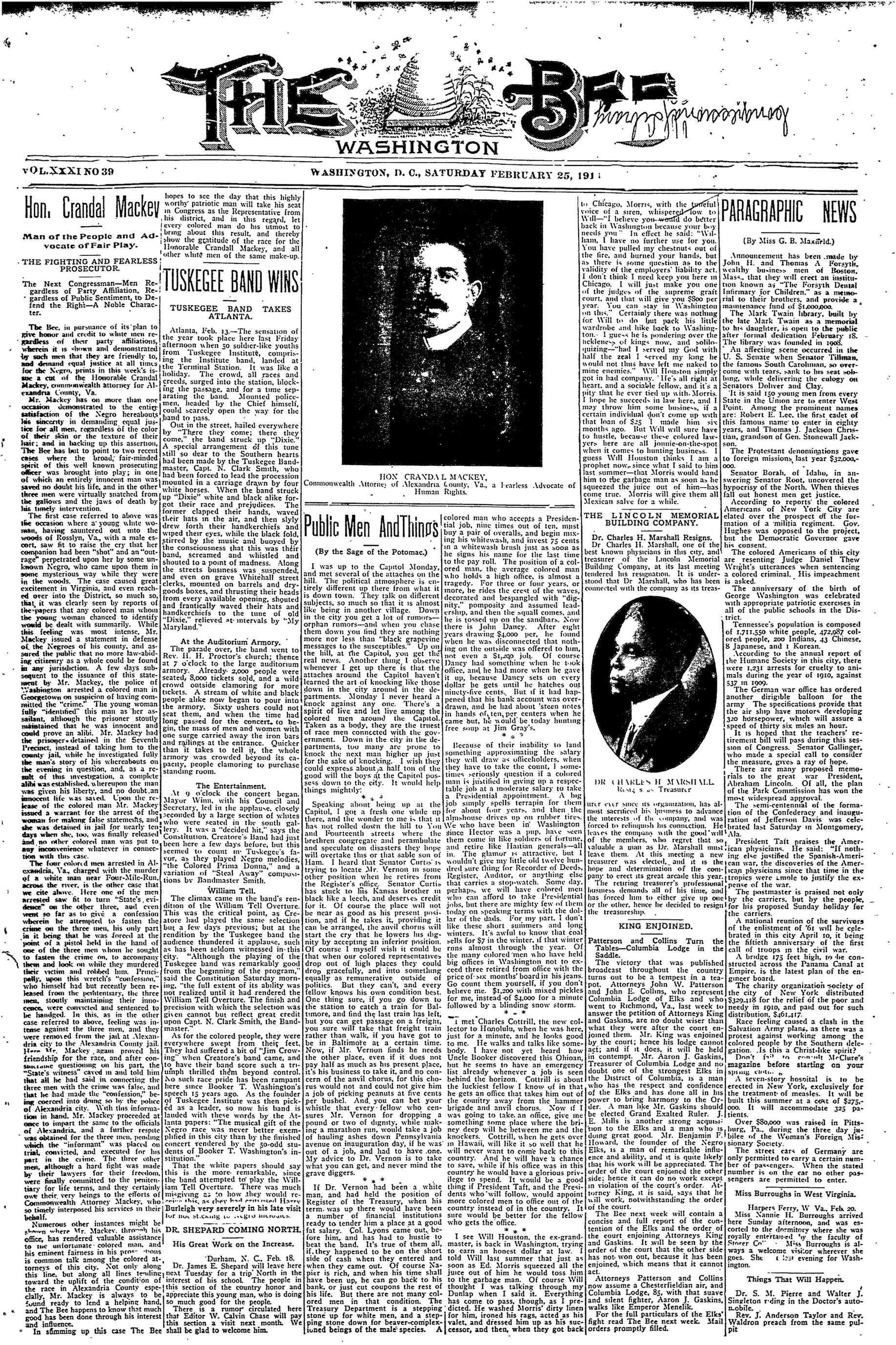
Page text (machine-generated)
Hon. Crandal Mackev
Man of the People and Advocate of Fair Play.
THE FIGHTING AND FEARLESS PROSECUTOR.
The Next Congressman—Men Regardless of Party Affiliation, Regardless of Public Sentiment, to Defend the Right—A Noble Character.
The Bee, in pursuance of its plan to give honor and credit to white men regardless of their party affiliations, wherein it is shown and demonstrated by such men that they are friendly to, and demand equal justice at all times for the Negro, prints in this week's issue a cut of the Honorable Crandal Mackey, commonwealth attorney for Alexandria County, Va.
Mr. Mackey has on more than one occasion demonstrated to the entire satisfaction of the Negro hereabouts his sincerity in demanding equal justice for all men, regardless of the color of their skin or the texture of their hair; and in backing up this assertion, The Bee has but to point to two recent cases where the broad, fair-minded spirit of this well known prosecuting officer was brought into play; in one of which an entirely innocent man was saved no doubt his life, and in the other three men were virtually snatched from the gallows and the jaws of death by his timely intervention.
The first case referred to above was the occasion where a young white woman, having sauntered out into the woods of Rosslyn, Va., with a male escort, saw fit to raise the cry that her companion had been "shot" and an "outrage" perpetrated upon her by some unknown Negro, who came upon them in some mysterious way while they were in the woods. The case caused great excitement in Virginia, and even reached over into the District, so much so, that it was clearly seen by reports of the papers that any colored man whom the young woman chanced to identify would be dealt with summarily. While this feeling was most intense, Mr. Mackey issued a statement in defense of the Negroes of his county, and assured the public that no more law-abiding citizenry as a whole could be found in any jurisdiction. A few days subsequent to the issuance of the statement to Mr. Mackey, the police of Washington arrested a colored man in Georgetown on suspicion of having committed the "crime." The young woman fully "identified" this man as her assistant, although the prisoner stoutly maintained that he was innocent and could prove an alibi. Mr. Mackey had the prisoner detained in the Seventh Precinct, instead of taking him to the county jail, while he investigated fully the man's story of his whereabouts on the evening in question, and, as a result of this investigation, a complete alibi was established, whereupon the man was given his liberty, and no doubt, an innocent life was saved. Upon the release of the colored man Mr. Mackey issued a warrant for the arrest of the woman for making false statements, and she was detained in jail for nearly ten days when she, too, was finally released, and no other colored man was put to any inconvenience whatever in connection with this case.
The four colored men arrested in Alexandria, Va, charged with the murder of a white man near Four-Mile-Run, across the river, is the other case that we cite above. Here one of the men arrested saw fit to turn "State's evidence" on the other three, and even went so far as to give a confession wherein he attempted to fasten the crime on the three men, his only part in it being that he was forced at the point of a pistol held in the hand of one of the three men whom he sought to fasten the crime on, to accompany them and look on while they murdered their victim and rolled him. Principally, upon this wretch's "confession," who himself had but recently been released from the penitentiary, the three men, stoutly maintaining their innocence, were convicted and sentenced to be hanged. In this, as in the other case referred to above, feeling was intense against the three men, and they were removed from the jail at Alexandria city to the Alexandria County jail. Here Mr. Mackey again proved his friendship for the race, and after consequent questioning on his part, the "State's witness" caved in and told him that all he had said in connecting the three men with the crime was false, and that he had made the "confession," being coerced into doing so by the police of Alexandria city. With this information in hand, Mr. Mackey proceeded at once to impart the same to the officials of Alexandria, and a further respite was obtained for the three men, pending which the "informant" was placed on trial, convicted, and executed for his part in the crime. The three other men, although a hard fight was made by their lawyers for their freedom, were finally committed to the penitentiary for life terms, and they certainly owe their very beings to the efforts of Commonwealth Attorney Mackey, who so timely interposed his services in their behalf.
Numerous other instances might be shown where Mr. Mackey, through his office, has rendered valuable assistance to the unfortunate colored man, and his eminent fairness in his prosecutions is common talk among the colored attorneys of this city. Not only along this line, but along all lines tending toward the uplift of the condition of the race in Alexandria County especially, Mr. Mackey is always to be found ready to lend a helping hand, and The Bee happens to know that much good has been done through his interest and influence. In sfinming up this case The Bee
hopes to see the day that this highly worthy patriotic man will take his seat in Congress as the Representative from his district, and in this regard, let every colored man do his utmost to bring about this result, and thereby show the gratitude of the race for the Honorable Crandall Mackey, and all other white men of the same make-up.
TUSKEGEE BAND WINS
TUSKEGEE BAND TAKES ATLANTA.
Atlanta, Feb. 13.—The sensation of the year took place here last Friday afternoon when 50 soldier-like youths from Tuskegee Institute, comprising the Institute band, landed at the Terminal Station. It was like a holiday. The crowd, all races and creeds, surged into the station, blocking the passage, and for a time separating the band. Mounted policemen, headed by the Chief himself, could scarcely open the way for the band to pass.
Out in the street, hailed everywhere by "There they come; there they come," the band struck up "Dixie." A special arrangement of this tune still so dear to the Southern hearts had been made by the Tuskegee Bandmaster, Capt. N. Clark Smith, who had been forced to lead the procession mounted in a carriage drawn by four white horses. When the band struck up "Dixie" white and black alike forgot their race and prejudices. The former clapped their hands, waved their hats in the air, and then slyly drew forth their handkerchiefs and wiped their eyes, while the black fold, stirred by the music and buoyed by the consciousness that this was their band, screamed and whistled and shouted to a point of madness. Along the streets business was suspended, and even on grave Whitehall street clerks, mounted on barrels and drygoods boxes, and thrusting their heads from every available opening, shouted and frantically waved their hats and handkerchiefs to the tune of old "Dixie," relieved at intervals by "My Maryland."
At the Auditorium Armory
The parade over, the band went to Rev. H. H. Proctor's church; thence at 7 o'clock to the large auditorium armory. Already 2,000 people were seated, 8,000 tickets sold, and a wild crowd outside clamoring for more tickets. A stream of white and black people alike now began to pour into the armory. Sixty ushers could not seat them, and when the time had long passed for the concert, to begin, the mass of men and women with one surge carried away the iron bars and railings at the entrance. Quicker than it takes to tell it, the whole armory was crowded beyond its capacity, people clamoring to purchase standing room.
The Entertainment
At 9 o'clock the concert began. Mayor Winn, with his Council and Secretary, led in the applause, closely seconded by a large section of whites who were seated in the south gallery. It was a "decided hit," says the Constitution. Creatore's Band had just been here a few days before, but this seemed to count in Tuskegee's favor, as they played Negro melodies, "the Colored Prima Donna," and a variation of "Steal Away" compositions by Bandmaster Smith.
William Tell.
The climax came in the band's rendition of the William Tell Overture. This was the critical point, as Creatore had played the same selection but a few days previous; but at the rendition by the Tuskegee band the audience thundered it applause, such as has been seldom witnessed in this city. "Although the playing of the Tuskegee band was remarkably good from the beginning of the program," said the Constitution Saturday morning, "the full extent of its ability was not realized until it had rendered the William Tell Overture. The finish and precision with which the selection was given cannot but reflect great credit upon Capt. N. Clark Smith, the Bandmaster."
As for the colored people, they were everywhere swept from their feet. They had suffered a bit of "Jim Crowing" when Creatore's band came, and to have their band score such a triumph thrilled them beyond control. No such race pride has been rampant here since Booker T. Washington's speech 15 years ago. As the founder of Tuskegee Institute was then picked as a leader, so now his band is lauded with these words by the Atlanta papers: "The musical gift of the Negro race was never better exemplified in this city than by the finished concert rendered by the 50-odd students of Booker T. Washington's institution."
That the white papers should say this is the more remarkable, since the band attempted to play the William Tell Overture. There was much misgiving as to how they would receive this, as they had entrusted Harry Burleigh very severely in his late visit for not sticking to Negro mottoes.
DR. SHEPARD COMING NORTH
His Great Work on the Increase.
Durham, N. C., Feb. 18.
Dr. James E. Shepard will leave here next Tuesday for a trip North in the interest of his school. The people in this section of the country honor and appreciate this young man, who is doing so much good for the people.
There is a rumor circulated here that Editor W. Calvin Chase will pay this section a visit next month. We shall be glad to welcome him.
1914
HON CRANDAL MACKEY,
Commonwealth Attorney of Alexandra County, Va., a Fearless Advocate of
Human Rights.
Public Men And Things
(By the Sage of the Potomac.)
I was up to the Capitol Monday, and met several of the attaches on the hill. The political atmosphere is entirely different up there from what it is down town. They talk on different subjects, so much so that it is almost like being in another village. Down in the city you get a lot of rumors—orphan rumors—and when you chase them down you find they are nothing more nor less than "black grapevine messages to the susceptibles." Up on the hill, at the Capitol, you get the real news. Another thing I observe whenever I get up there is that the attaches around the Capitol haven't learned the art of knocking like those down in the city around in the departments. Monday I never heard a knock against any one. There's a spirit of live and let live among the colored men around the Capitol. Taken as a body, they are the truest of race men connected with the government. Down in the city in the departments, too many are prone to knock the next man higher up just for the sake of knocking. I wish they could express about a half ton of the good will the boys at the Capitol possess down to the city. It would help things mightly:
* *
Speaking about being up at the Capitol, I got a fresh one while up there, and the wonder to me is that it has not rolled down the hill to You and Fourteenth streets where the brethren congregate and peramulate and speculate on disasters they hope will overtake or that sable son of Ham. I heard that Senator Curtis is trying to locate Mr. Vernon in some other position when he retires from the Register's office. Senator Curtis has stuck to his Kansas brother in black like a leech, and deserves credit for it. Of course the place will not be near as good as his present position, and if he takes it, providing it can be arranged, the anvil chorus will start the cry that he lowers his dignity by accepting an inferior position. Of course I myself wish it could that when our colored representies drop out of high places they could gracefully, and into something equally as remunerative outside of politics. But they can't, and every fellow knows his own condition best. One thing sure, if you go down to the station to catch a train for Baltimore, and find the last train has left, but you can get passage on a freight, you sure will take that freight train rather than walk, if you have got to be in Baltimore at a certain time. Now, if Mr. Vernon finds he needs the other place, even if it does not pay half as much as his present place, it's his business to take it, and no concern of the anvil chorus, for this chorus would not and could not give him a job of picking peanuts at five cents per bushel. And you can bet your whistle that every fellow who censures Mr. Vernon for dropping a pound or two of dignity, while making a marathon run, would take a job of hauling ashes down Pennsylvania avenue on inauguration day, if he was out of a job, and had to have one. My advice to Dr. Vernon is to take what you can get, and never mind the grave diggers.
If Dr. Vernon had been a white man, and had held the position of Register of the Treasury, when his term was up there would have been a number of financial institutions ready to tender him a place at a good fat salary. Col. Lyons came out, before him, and has had to hustle to beat the band. It's true of them all, if they happened to be on the short side of cash when they entered and when they came out. Of course Napier is rich, and when his time shall have been up, he can go back to his bank, or just cut coupons the rest of his life. But there are not many colored men in that condition. The Treasury Department is a stepping stone up for white men, and a stepping stone down for beaver-complexioned beings of the male species. A
colored man who accepts a Presidential job, nine times out of ten, must buy a pair of overalls, and begin mixing his whitewash, and invest 75 cents in a whitewash brush just as soon as he signs his name for the last time to the pay roll. The position of a colored man, the average colored man who holds a high office, is almost a tragedy. For three or four years, or more, he rides the crest of the waves, decorated and bespangled with "dignity," pomposity and assumed leadership, and then the squall comes, and he is tossed up on the sandbars. Now there is John Dancy. After eight years drawing $4,000 per, he found when he was disconnected that nothing on the outside was offered to him, not even a $1,000 job. Of course Dancy had something when he took office, and he had more when he gave it up, because Dancy sets on every dollar he gets until he hatches out ninety-five cents. But if it had happened that his bank account was overdrawn, and he had about "steen notes in hands of, ten, per centers when he came but, he would be today hunting free soup at Jim Gray's.
Because of their inability to land something approximating the salary they will draw as officeholders, when they have to take the count, I sometimes seriously question if a colored man is justified in giving up a respectable job at a moderate salary to take a Presidential appointment. A big job simply spells terrapin for them for about four years, and then the almshouse drives up on rubber tires. We who have been in Washington since Hector was a pup, have seen them come in like soldiers of fortune, and retire like Haitian generals—all in. The glamor is attractive, but I wouldn't give my little old twelve hundred sure thing for Recorder of Deeds, Register, Auditor, or anything else that carries a stop-watch. Some day, perhaps, we will have colored men who can afford to take Presidential jobs, but there are mighty few of them today on speaking terms with the dollar of the dads. For my part, I don't like these short summers and long winters. It's awful to know that coal sells for $7 in the winter, if that winter runs almost through the year. Of the many colored men who have held big offices in Washington not to exceed three retired from office with the price of six months' board in his jeans. Go count them yourself, if you don't believe me. $1,200 with mixed pickles for me, instead of $4,000 for a minute followed by a blinding snow storm.
I met Charles Cotttrill, the new collector to Honolulu, when he was here, just for a minute, and he looks good to me. He walks and talks like somebody. I have not yet heard how Uncle Booker discovered this Ohioan, but he seems to have an emergency list already whenever a job is seen behind the horizon. Cotttrill is about the luckiest fellow I know of in that he gets an office that takes him out of the country away from the hammer brigade and anvil chorus. Now if I was going to take an office, give me something some place where the brine deep will be between me and the knockers. Cotttrill, when he gets over in Hawaii, will like it so well that he will never want to come back to this country. And he will have a chance to save, while if his office was in this country he would have a glorious privilege to spend. It would be a good thing if President Taft, and the Presidents who will follow, would appoint more colored men to office out of the country instead of in the country. It sure would be better for the fellow who gets the office.
I see Will Houston, the ex-grandmaster, is back in Washington, trying to earn an honest dollar at law. I told Will last summer that just as soon as Ed. Morris squeezed all the juice out of him he would toss him to the garbage man. Of course Will thought I was talking through my Dunlap when I said it. Everything has come to pass, though, as I predicted. He washed Morris' dirty linen for him, ironed his rags, acted as his valet, and dressed him up as his successor, and then, when they got back
to Chicago, Morris, with the tuneful voice of a siren, whispered low to Will—I believe you would do better back in Washington because your boy needs you." In effect he said: "William, I have no further use for you. You have pulled my chestnut out of the fire, and burned your hands, but as there is some question as to the validity of the employers' liability act, I don't think I need keep you here in Chicago. I will just make you one of the judges of the supreme graft court, and that will give you $800 per year. You can stay in Washington on this." Certainly there was nothing for Will to do but pack his little wardrobe and hike back to Washington. I guess he is pondering over the hickleness of kings now, and soliloquizing—"had I served my God with half the zeal I served my king he would not thus have left me naked to mine enemies." Will Houston simply got in bad company. "He's all right at heart, and a sociable fellow, and it's a pity that he ever tied up with Morris. I hope he succeeds in law here, and I may throw him some business, if a certain individual don't come up with that loan of $25 I made him six months ago. But Will will sure have to hustle, because these colored lawyers here are all joinnie-on-the-spot when it comes to hunting business. I guess Will Houston thinks I am a prophet now, since what I said to him last summer—that Morris would hand him to the garbage man as soon as he squeezed the juice out of him—has come true. Morris will give them all Mexican salve for a while.
THE LINCOLN MEMORIAL BUILDING COMPANY.
Dr. Charles H. Marshall Resigns.
Dr Charles H. Marshall, one of the best known physicians in this city, and treasurer of the Lincoln Memorial Building Company, at its last meeting tendered his resignation. It is understood that Dr Marshall, who has been connected with the company as its treas-
DR CHARLES H. MARSHALL
Resigns as Treasurer
urter ever since its organization, has almost sacrificed his business to advance the interests of the company, and was forced to relinquish his connection. He leaves the company with the good will of the members, who regret that so valuable a man as Dr. Marshall must leave them. At this meeting a new treasurer was elected, and it is the hope and determination of the company to erect its great arcade this year. The retiring treasurer's professional business demands all of his time, and has forced him to either give up one or the other, hence he decided to resign the treasureship.
KING ENJOINED.
Patterson and Collins Turn Tables—Columbia Lodge in Saddle.
The victory that was published broadcast throughout the country turns out to be a tempest in a teapot. Attorneys John W. Patterson and John E. Collins, who represent Columbia Lodge of Elks and who went to Richmond, Va., last week to answer the petition of Attorneys King and Gaskins, are no doubt wiser than what they were after the court enjoined them. Mr. King was enjoined by the court; hence his lodge cannot act; and if it does, it will be held in contempt. Mr. Aaron J. Gaskins, Treasurer of Columbia Lodge and no doubt one of the strongest Elks in the District of Columbia, is a man who has the respect and confidence of the Elks and has done all in his power to bring harmony to the Order. A man like Mr. Gaskins should be elected Grand Exalted Ruler. J. E. Mills is another strong acquisition to the Elks and a man who is doing great good. Mr. Benjamin F. Howard, the founder of the Negro Elks, is a man of remarkable influence and ability, and it is quite likely that his work will be appreciated. The order of the court enjoined the other side; hence it can do no work except in violation of the court's order. Attorney King, it is said, says that he will work, notwithstanding the order of the court.
The Bee next week will contain a concise and full report of the contention of the Elks and the order of the court enjoining Attorneys King and Gaskins. It will be seen by the order of the court that the other side has not won out, because it has been enjoined, which means that it cannot act. Attorneys Patterson and Collins now assume a Chesterfieldian air, and Columbia Lodge, 85, with that suave and silent fighter, Aaron J. Gaskins, walks like Emperor Menelik. For the full particulars of the Elks' fight read The Bee next week. Mail orders promptly filled.
PARAGRAPHIC NEWS
PARAGRAPHIC NEWS
(By Miss G. B. Maxneid.)
Announcement has been made by John H. and Thomas A Forsyth, wealthy business men of Boston, Mass., that they will erect an institution known as "The Forsyth Dental Infirmary for Children," as a memorial to their brothers, and provide a maintenance fund of $1,000,000.
The Mark Twain library, built by the late Mark Twain as a memorial to his daughter, is open to the public after formal dedication February 15. The library was founded in 1908.
An affecting scene occurred in the U. S. Senate when Senator Tillman, the famous South Carolinian, so overcome with tears, sank to his seat sobbing, while delivering the eulogy on Senators Doliver and Clay.
It is said 150 young men from every State in the Union are to enter West Point. Among the prominent names are: Robert E. Lee, the first cadet of this famous name to enter in eighty years, and Thomas J. Jackson Christian, grandson of Gen. Stonewall Jackson.
The Protestant denominations gave to foreign missions, last year $32,000,000.
Senator Borah, of Idaho, in answering Senator Root, uncovered the hypocrisy of the North. When thieves fall out honest men get justice.
According to reports the colored Americans of New York City are elated over the prospect of the formation of a militia regiment. Gov. Hughes was opposed to the project, but the Democratic Governor gave his consent. The colored Americans of this city are resenting Judge Daniel Thew Wright's utterances when sentencing a colored criminal. His impeachment is asked.
The anniversary of the birth of George Washington was celebrated with appropriate patriotic exercises in all of the public schools in the District.
Tennessee's population is composed of 1,711,550 white people, 472,987 colored people, 200 Indians, 43 Chinese, 8 Japanese, and 1 Korean.
According to the annual report of the Humane Society in this city, there were 1,231 arrests for cruelty to animals during the year of 1910, against 537 in 1909.
The German war office has ordered another dirigible balloon for the army. The specifications provide that the air ship have motors developing 320 horsepower, which will assure a speed of thirty six miles an hour.
It is hoped that the teachers' retirement bill will pass during this session of Congress. Senator Gallinger, who made a special call to consider the measure, gives a ray of hope.
There are many proposed memorials to the great war President, Abraham Lincoln. Of all, the plan of the Park Commission has won the most widespread approval. The semi-centennial of the formation of the Confederacy and inauguration of Jefferson Davis was celebrated last Saturday in Montgomery, Ala.
President Taft praises the American physicians. He said: "If nothing else justified the Spanish-American war, the discoveries of the American physicians since that time in the tropics were amole to justify the expense of the war.
The postmaster is praised not only by the carriers, but by the people, for his proposed Sunday holiday for the carriers.
A national reunion of the survivors of the enlistment of 61 will be celebrated in this city April 10, it being the fifteenth anniversary of the first call of troops in the civil war.
A bridge 175 feet high, to be constructed across the Panama Canal at Empire, is the latest plan of the engineer board.
The charity organization society of the city of New York distributed $329,418 for the relief of the poor and needy in 1910, and paid out for such distribution, $461,417.
Race feeling caused a clash in the Salvation Army plans, as there was a protest against working among the colored people by the Southern delegation. Is this a Christ-like spirit?
Don't fail to consult McClure's magazine before starting on your spring clothing.
A seven-story hospital is to be erected in New York, exclusively for the treatment of measles. It will be built this summer at a cost of $275,000. It will accommodate 325 patients.
Over $80,000 was raised in Pittsburgh, Pa., during the three day jubilee of the Woman's Foreign Missionary Society.
The street cars of Germany are only permitted to carry a certain number of passengers. When the stated number is on the car no other passengers are permitted to enter.
Miss Burroughs in West Virginia.
Harpers Ferry, W Va. Feb 20.
Miss Nannie H. Burroughs arrived here Sunday afternoon, and was escorted to the dormitory where she was royally entertained by the faculty of Storer Co*. Miss Burroughs is always a welcome visitor wherever she goes. She is last evening for Washington.
Things That Will Happen.
Dr. S. M. Pierre and Walter J. Singleton riding in the Doctor's auto- onobile. Rev. J. Anderson Taylor and Rev. Waldron preach from the same pulpit
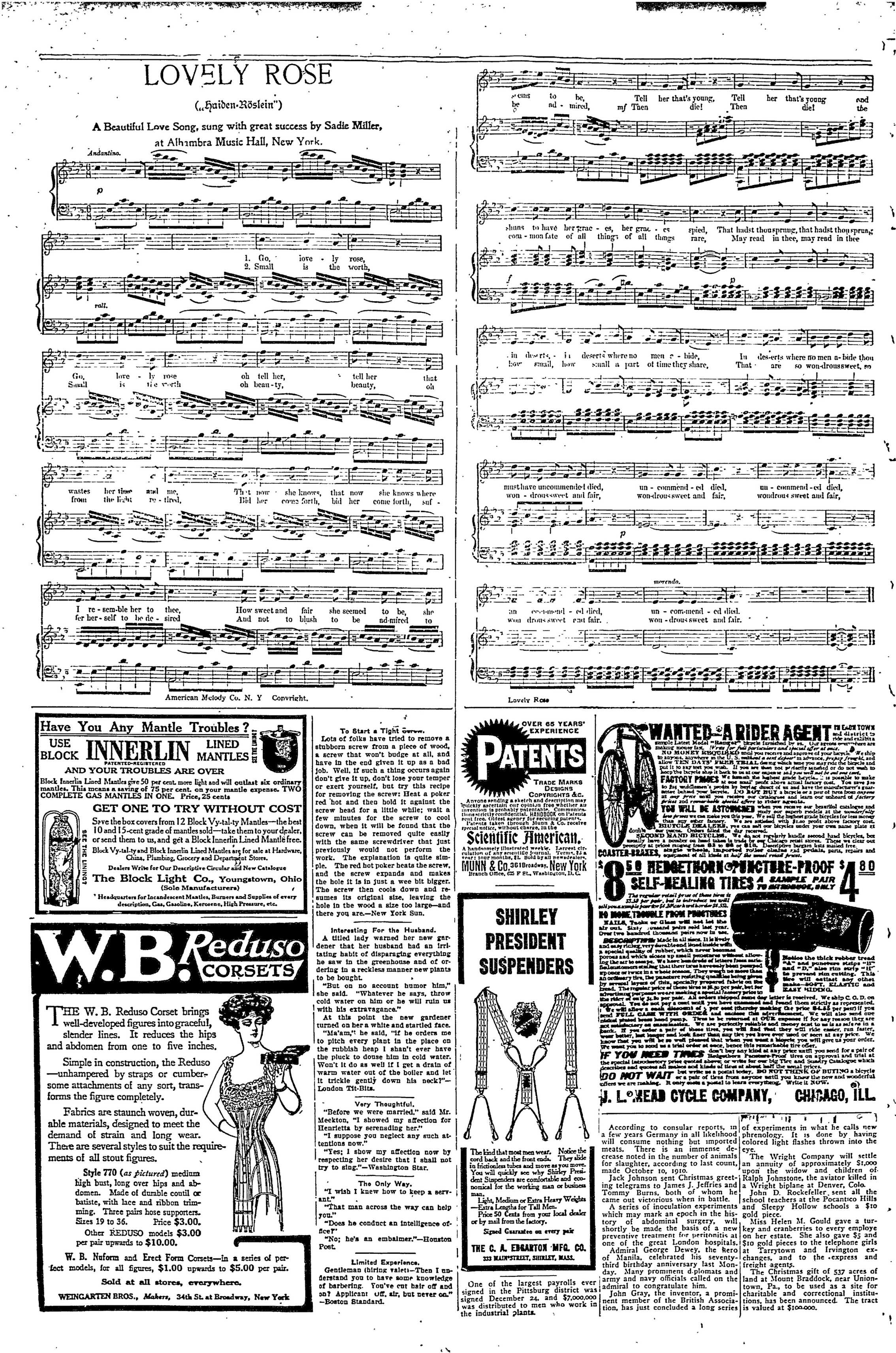
LOVELY ROSE
A Beautiful Love Song, sung with great success by Sadie Miller, at Alhambra Music Hall, New York.
at Albambra Music Hall, New York.
1. Go, lovely rose,
2. Small is the worth,
Go, lovely rose oh tell her, tell her beauty, oh
wastes her time and me, That now she knows, that now she knows where
from the light re-tired, bid her come forth, bid her come forth, suf
I re-semble her to thee, How sweet and fair she seemed to be, she
fer her self to be desired And not to blush to be ad-mired to
American Melody Co. N. Y. Copyright.
Have You Any Mantle Troubles?
USE INNERLIN LINED BLOCK MANTLES
Block Innerlin Lined Mantles give 50 per cent. more light and will outlast six ordinary mantles. This means a saving of 75 per cent. on your mantle expense. TWO COMPLETE GAS MANTLES IN ONE. Price, 25 cents
GET ONE TO TRY WITHOUT COST
Save the box covers from 12 Block Vy-tal-ty Mantles—the best 10 and 15-cent grade of mantles sold—take them to your dealer, or send them to us, and get a Block Innerlin Lined Mantle free.
Block Vy-tal-ty and Block Innerlin Lined Mantles are for sale at Hardware, China, Plumbing, Grocery and Department Stores.
Dealers Write for Our Descriptive Circular and New Catalogue
The Block Light Co., Youngstown, Ohio
(Sole Manufacturers)
'Headquarters for Incandescent Mantles, Burners and Supplies of every description, Gas, Gasoline, Kerosene, High Pressure, etc.
W. B. Nuform and Erect Form Corsets—in a series of perfect models, for all figures, $1.00 upwards to $5.00 per pair.
Sold at all stores, everywhere.
WEINGARTEN BROS., Makers, 34th St. at Broadway, New York
AND YOUR TROUBLES ARE OVER
Block Innerlin Lined Mantles give 50 per cent, more light and w
mantles. This means a saving of 75 per cent, on your re
COMPLETE GAS MANTLES IN ONE. Price, 25 cent.
GET ONE TO TRY WITH
Save the box covers from 12 Block Vy-tal
10 and 15-cent grade of mantles sold—tai
or send them to us, and get a Block Inner
Block Vy-tal-ty and Block Innerlin Lined Mantle
China, Plumbing, Grocery and Depa
Dealers Write for Our Descriptive Circula
The Block Light Co., Y
(Sole Manufacturer
7 Headquarters for Incandescent Mantles, Burn
description, Gas, Gasoline, Kerosene, H
W.B. Re
BEE THE LINING?
THE W.B. Reduso Corset brings well-developed figures into graceful, slender lines. It reduces the hips and abdomen from one to five inches. Simple in construction, the Reduso unhampered by straps or cumbersome attachments of any sort, transforms the figure completely.
Fabrics are staunch woven, durable materials, designed to meet the demand of strain and long wear. There are several styles to suit the reqments of all stout figures.
Style 770 (as pictured) medium high bust, long over hips and abdomen. Made of durable couil or batiste, with lace and ribbon trimming. Three pairs hose supporters. Sizes 19 to 36. Price $3.00.
Other REDUSO models $3.00 per pair upwards to $10.00.
W. B. Nuform and Erect Form Corsets—in lect models, for all figures, $1.00 upwards to Sold at all stores, everywha WEINGARTEN BROS., Makers, 34th St. at Bro
SIX THE LUNAR 7
and will outlast six ordinary your mantle expense. TWO 25 cents
WITHOUT COST
K. Vy-tal-ty Mantles—the best sold—take them to your dealer, back Innerlin Lined Mantle free.
Mantles are for sale at Hardware, and Department Stores.
Circular and New Catalogue
D., Youngstown, Ohio (acturers)
Is, Burners and Supplies of every osene, High Pressure, etc.
Peduso CORSETS
s
l,
ips
es.
o
quire-
ets-in a series of per- rds to $5.00 per pair. ywhere. at Broadway, New York
Lots of folks have tried to remove a stubborn screw from a piece of wood, a screw that won't budge at all, and have in the end given it up as a bad job. Well, if such a thing occurs again don't give it up, don't lose your temper or exert yourself, but try this recipe for removing the screw: Heat a poker red hot and then hold it against the screw head for a little while; wait a few minutes for the screw to cool down, when it will be found that the screw can be removed quite easily with the same screwdriver that just previously would not perform the work. The explanation is quite simple. The red hot poker heats the screw, and the screw expands and makes the hole it is in just a wee bit bigger. The screw then cools down and resumes its original size, leaving the hole in the wood a size too large—and there you are.—New York Sun.
A titled lady warned her new gardener that her husband had an irritating habit of disparaging everything he saw in the greenhouse and of ordering in a reckless manner new plants to be bought.
"But on no account humor him," she said. "Whatever he says, throw cold water on him or he will ruin us with his extravagance."
At this point the new gardener turned on her a white and startled face. "Ma'am," he said, "if he orders me to pitch every plant in the place on the rubbish heap I shan't ever have the pluck to douse him in cold water. Won't it do as well if I get a drain of warm water out of the boiler and let it trickle gently down his neck?"—London Tit-Bitz.
Very Thoughtful.
"Before we were married," said Mr. Meekton, "I showed my affection for Henrietta by serenading her." "I suppose you neglect any such attentions now." "Yes; I show my affection now by respecting her desire that I shall not try to sing"—Washington Star.
"I wish I knew how to keep a servant."
"That man across the way can help you."
"Does he conduct an intelligence office?"
"No; he's an embalmer."—Houston Post.
Limited Experience.
Gentleman (hiring valet)—Then I understand you to have some knowledge of barbering. You've cut hair off and on? Applicant off, air, but never on."—Boston Standard.
must have uncommended died, won - drows-sweet and fair,
in deserts - in small, how to be, ad - mired,
shuns to have her grace - es, her grace - es com - mon fate of all things of all things spied,
men - hide, small a part of time they share,
un - commend - ed, won-drous-sweet and fair,
un - commend - ed died,
un - commend - ed died,
un - com-mend - ed died.
won - drows-sweet and fair.
in her that's young,
Tell Then her that's young
Tell Then her that's young
May read in thee, may read in thee
In deserts where no men a-bide thou are so won-drous-sweet, so
OVER 65 YEARS' EXPERIENCE
PATENTS
TRADE MARKS
DESIGNS
COPYRIGHTS &C.
Anvone sending a sketch and description may
quickly ascertain our opinion free whether an
invention is probably patented. Community-
internationally confidential. HANDBOOK On Estates
sent free. Oldest agency for securing patents.
Patents taken through Blunn & Co. receive
special notice, without charge, in the
Scientific American.
A handsomely illustrated weekly. Largest circulation of any scientific journal. Terms $3 a year; four months. $L. Sold by all newdealers.
MUNN & Co. 361 Broadway, New York
Branch Office, 625 F. St., Washington, D. C.
SHIRLEY PRESIDENT SUSPENDERS
M
The kind that most men wear. Notice the cord back and the front ends. They slide in frictionless tubes and move as you move. You will quickly see why Shirley President Suspenders are comfortable and economical for the working man or business man.
Light, Medium or Extra Heavy Weights
—Extra Lengths for Tall Men.
Price 50 Cents from your local dealer
or by mail from the factory.
Signed Guarantee on every pair
THE C. A. EBGARTON MFG. CO.
333 MAIN*STREET, SHIRLEY, MASS.
One of the largest payrolls ever signed in the Pittsburg district was signed December 24, and $7,000,000 was distributed to men who work in the industrial plants.
FACTORY PRICES We furnish the highest grade bicycle. It is possible to make at one small profit above actual factory cost. You have pro to less widenlumber's product by buying direct of us and have the manufacturer's guaranteed behind your bicycle. LO BOT BUY a bicycle or a pair of tires from an anyone at any price until you receive our catalogues and learn our unheard of factory prices and remarkable special offers to rider agents.
YOU WILL BE ASTONISHED when you receive our beautiful catalogue and
youdy our superb models at the wonderfully
low prices we can make you this year. We sell the highest grade bicycles for less money
than any other factory. We are satisfied with $1.00 profit above factory cost.
BIUFULE DEALER, you can call our bicycles under your own name plate at
our porch. Orders filled the day received.
SECOND MAND BICYCLES. We do not regularly handle second hand bicycles, but usually have a number on hand taken in trade by our Chicago retail stores. These we clear out promptly at价钱 time to ship to our office. Ourelvepure burglar lists mailed free. COASTER-BRAXES. equipment of all kinds, professional bike pedals, parts, repairs and maintenance of all kinds as half the annual rent property.
1000
and easy ricing, very durable and loaded inside with a special quality of rubber, which never becomes porous and white closes up small penetrations without allowing moisture. We have hundreds of letters from satisfied customers stating that their twenty have been pumped up once or twice in a whole season. They weigh no more than an ordinary tire, the pressure residing qualities being given by several layers of thin, specially prepared fabric on the bread. The regular price of these tires is $50 per pair, but our advertisement purposes we are making a special 'safety price' to
picked some day letter is received. We ship C. O. D. on
examined and found them strictly as represented,
and thereby making the price $4.55 per pair if you
will send this advertise. We will send you
received at OUR expense if for any reason they are
not reliable and money seat to us is as safe in a
will find that they will ride easier, run faster,
the you have ever used or seen at any price. We
when you want a bicycle you will give us your order,
since this remarkable tire offer.
any kind at any price until you send for a pair of
bora Pantheum-Pro tires on approval and trial at
write for our big Tire and Sunday Catalogue which
is at about half the usual price.
at today. DO NOT THINK OF BUYING a bicycle
from anyone until you know the now and wonderful
learn everything. Write it NOW.
COMPANY, CHICAGO, ILL
the other at only $20 per pair. All orders shipped same day letter is received. We ship C.O.D. on approval. You do not pay a court until you have examined and found them strictly as represented. We will allow a mean discount of 5 per coat (thereby making the price $4.50 per pair) if you send FULL CASH WITH ORDER and encircle this advertisement. We will also send one initial pleased house hand pump. Then we be returned at OUR expense if for any reason they are not mandatory on examination. We are perfectly reliable and money sent to us is as safe in a bank. If you order a pair of three, you will find that they will ride easier, run faster, your better, but longer and look finer than any tie you have ever used or seen at any price. We know that you will be so well pleased that when you want a hipopie you will give us your order. We want you to send us a trial order at once, hence this remarkable tire offer.
this rider of only $2, so per pair. All orders shipped some day after approval. You do not pay a cash until you have examined it. We will allow a cash discount of $2 per coat (otherwise send FULL CASH WITH ORDER and enclose this medical printed house hand pump. Then be returned at O not mandatory on examination. We are perfectly reliable back. If you order a pair of these ties, you will find your better, but longer and look finer than any tie you have know that you will be so well pleased that when you wear. We want you to send us a trial order at once, hence this year.
IF YOU NEED TIES don't buy any kind the special introductory price quoted above, or write for our descriptions and quotes all names and kinds of ties at about DO NOT WAIT but write us a postal today. Do set a pair of ties from anyone offers we are making. It only costs a postal to learn every
J. L. O'MEAD CYCLE COMPANY
IF YOU NEED TIMES don't buy any kind at any price until you send for a pair of
Badgegora Pamache-Proof tires on approval and trial at
the special introductory price quoted above, or write for our Big Tire and Sundry Catalogue which
describes and quotes all makes and kinds at tails at about half the serial price.
DO NOT WAIT but write in a postal body. DO NOT THINK OF BUTING a bicycle
or a pair of tires from anyone until you know the new and wonderful
.
---
The regular retail price of these we will
$3.50 per pair, but to introduce we will
sell you a sample pair for $3.50 each肩 border $3.50
NO MORE, TROUBLE FROM PRODUCTS
HAIL, Tooke or Glass will not let the
air out. Sixty oneand pears sold last year.
Over two hundred thousand pairs now in use.
According to consular reports, in a few years Germany in all likelihood will consume nothing but imported meats. There is an immense decrease noted in the number of animals for slaughter, according to last count, made October 10, 1910.
Jack Johnson sent Christmas greeting telegrams to James J. Jeffries and Tommy Burns, both of whom he came out victorious when in battle.
A series of inoculation experiments which may mark an epoch in the history of abdominal surgery, will shortly be made the basis of a new preventive treatment for peritonitis at one of the great London hospitals.
Admiral George Dewey, the Hero of Manila, celebrated his seventy-third birthday anniversary last Monday. Many prominent d-plomats and army and navy officials called on the admiral to congratulate him. John Gray, the inventor, a prominent member of the British Association, has just concluded a long series
Notice the thick rubber tread
"A" and puncture strips "B"
and "D." also rim strip "H"
to prevent rim cutting. This
should not interfere with any other
make-up: KLASTIC and
EASY HIDDING.
of experiments in what he calls new phrenology. It is done by having colored light flashes thrown into the eye.
The Wright Company will settle an annuity of approximately $1,000 upon the widow and children of Ralph Johnstone, the aviator killed in a Wright biplane at Denver, Colo.
John D. Rockefeller, sent all the school teachers at the Pocantico Hills and Sleepy Hollow schools a $10 gold piece.
Miss Helen M. Gould gave a turkey and cranberries to every employee on her estate. She also gave $5 and $10 gold pieces to the telephone girls at Tarrytown and Irvington exchanges, and to the express and freight agents.
The Christmas gift of 537 acres of land at Mount Braddock, near Uniontown, Pa., to be used as a site for charitable and correctional institutions, has been announced. The tract is valued at $100,000.
QUEER INDIAN BELIEFS.
The Bella Coola Believe There Are Five Worlds and Are Worshipers of the Sun.
There is an odd feature in the theology of the small Indian tribe of the Bella Coola which inhabit British Columbia in about latitude 52. They believe that there are five worlds, one above the other, and the middle one is our own world, the earth. Above it are two heavens, and under it are two underworlds. In the upper heaven is the supreme delity, who is a woman, and she doesn't meddle much with the affairs in the second world below her. The zenith is the center of the lower heaven, and here is the house of the gods, in which live the sun and the rest of the delites.
Our own earth is believed to be an island swimming in the ocean. The first underworld from the earth is inhabited by ghosts, who can return, when they wish, to heaven, from which place they may be sent down to our earth. If then they misbehave again they are cast into the lower of the underworlds, and from this bourn no ghostly traveler returns.
The Bella Coola are sun worshipers, for Senex, the sun, the master of the house of gods, who is called the father and the sacred one, is the only deity to whom the tribe pray. Each family of the Bella Coola has its own traditions and its own form of the current traditions, so that in the mythology of the tribe there are countless contradictions. When any one not a member of a clan tries to tell a tradition which does not belong to his clan it is like a white man trying to tell another's joke—he is considered as appropriating the property right which does not belong to him.
SMOKELESS POWDER
It Came Through Experimenting For High Explosives.
The idea is very general that smokeless powder in being practically smokeless achieves its greatest end, but as a matter of fact its smokeless feature is incidental and was an accident.
When the idea of modern long range guns was conceived it was at once apparent that the old black powder lacked explosive force, and thousands of experiments were made with various chemicals to procure a powder of high explosive properties, and this was at last accomplished.
When the new powder was tried, much to the surprise of every one it was found that practically no smoke followed the explosion, though this could of course have been predicted had the question ever arisen. The volume of smoke from black powder is due mainly to the quantity of charcoal in the powder, an ingredient not found in the smokeless explosive. Smokeless powder, though a great boon to the sportsman, is of questionable value on the battlefield, so far as its smokelessness is concerned. The smoke clouds of old days were frequently most advantageously used to cloak movements of troops and batteries and really interfered with the enemy much more than with the troops creating the smoke—Exchange
Saved by Fireflies
The gigantic tropical firefiles which swarm in the forests and canebrakes of most of the low lying West Indian islands once proved the salvation of the city of Santo Domingo. A body of buccaneers, headed by the notorious Thomas Cavendish, had laid all their plans for a descent upon the place, intending to massacre the inhabitants and carry away all the treasure they conveniently could, and had actually put off their boats for that purpose. As they approached the land, however, rowing with muffled oars, they were greatly surprised to see an infinite number of moving lights in the woods which fringed the bayon up which they had to proceed, and, concluding that the Spanials knew of their approach, they put about and regained their ship without attempting to land.
The Wonderful Banana.
Some people believe that the banana was the original forbidden fruit of the garden of Eden. In any case it is one of the curiosities of the vegetable kingdom, being not a tree, a palm, a bush, a shrub, a vegetable or a herb, but a herbaceous plant with the status of a tree. Although it sometimes attains a height of thirty feet, there is no woody fiber in any part of its structure, and the bunches growing on the dwarf bananas plant are often heavier than the stalk which supports them. No other plant gives such a quantity of food to the acre as the banana. It yields 44 times more by weight than the potato and 133 times more than wheat. Moreover, no insect will attack it, and it is always immune from diseases of any kind.
Convinced.
"Do you think a college education helps a man in business?"
"Sure. I've had two college boys here workin' for me durin' the past year, and I was afraid to discharge either one of 'em for fear they'd find fault with my grammar when I done it"—Chicago Record-Herald.
Following Orders
Charlie—What have you been doing to your face, dear boy? Percy—I tried to share myself this morning. Charlie—What on earth for? Percy—The doctor told me that I ought to take more exercise—Illustrated Bits.
At Cross Purposes
Scott—Half the people in the world don't know what the other half are doing Mott—No; that is because the other half are doing them — Boston Transcript.
KANGAROO MEAT.
The Native Youngsters of New Guinea Had a Good Reason For Refusing to Eat It.
In certain parts of New Guinea the wallaby, a species of kangaroo, are very plentiful, and the traveler in search of sport finds the pursuit of them an exciting occupation. Wallaby steak is a refreshing, change from canned meats, and the natives are only too glad to have the remnants of the carcass. A writer in an English magazine tells an amusing incident connected with the animal.
He had been ashore in one of the sparsely populated regions of the coast and secured four wallaby, an ample supply for the whole party, native guldes and servants included. But he found that, although wallaby is regarded as such a delicacy that no trouble is considered too great to obtain it, none of the native boys in the party would touch it.
This was a mystery until one of them explained that they had been trained in childhood in the belief that if they ate wallaby before reaching a certain age it would stop their growth.
These boys all belonged to the part of the country where wallaby are few, and one can imagine the crafty old folks seated round the festive pot and winking at one another as the young people declined the succulent daisy.
LACEMAKING.
An Old Legend That Tells of the Origin of the Art.
Lacemaking is by no means so old an industry as most persons suppose. There is no proof that it existed previous to the fifteenth century, and the oldest known painting in which it appears is a portrait of a lady in the academy at Venice painted by Caspacio, who died about 1523. The legend concerning the origin of the art is as follows:
A young fisherman of the Adriatic was betrothed to a young and beautiful girl of one of the isles of the lagoon. Industrious as she was beautiful, the girl made a new net for her lover, who took it with him on board his boat. The first time he cast it into the sea he dragged therefrom an exquisite petrified wrack grass, which he hastened to present to his fiancee; but, war breaking out, the fisherman was pressed into the service of the Venetion navy. The poor girl wept at the departure of her lover and contemplated his last gift to her. While absorbed in following the intricate tracery of the wrack grass she began to twist and plait the threads weighted with small beads which hung around her net. Little by little she wrought an imitation of the petrification, and thus was created the bobbin lace.
Too Realistic.
During a performance of "Captain Lapalisse" at a Valencia theater some years ago an incident occurred which for lifelike effect left nothing to be desired. During the said play some of the actors mingle with the spectators in order to co-operate from the body of the house. No sooner had Miralles, the actor, taken his seat in the stalls than a daring pickpocket robbed him of his gold watch. Miralles seized the man by his coat collar and called out in a deep bass voice: "Policel Help! Thleves!"
The audience, taking this little episode to be part of the performance, roared with laughter. Even the policemen joined in without stirring hand or foot.
"This is no farce!" cried the actor in tones of despair. "The fellow has got my watch!"
The voice sounded so natural that the audience broke into loud applause at "such excellent fooling." Meanwhile the thief managed to break away from his captor and escaped.
A Judicial Expert
The native with a stogle met the native with a pipe.
"Howdy, Zeb?" quoth the stogle native.
"Hear 'bout th' fuss down to th' courthouse?"
"Nope," drawled the man with the pipe.
"What was it about?"
"Why, Jim Simpson has been suin' Abner Hawley for allenatin' th' affections of his wife, an' Jedge Musgrove told th' jury to bring in a verdick of 6 cents damages, 'cause he thought that was all the damage was worth to Jim. An' Jim's wife got mad an' threw a chair at th' judge, an' he had her arrested an' put in th' cooler."
"But didn't th' judge go a leetle too far when he fixed her value so low?"
"Not at all, not at all! You see, he was her first husband."—Cleveland Plain Dealer.
Singer and Orator
"If I had my way." Dr. Macnaimara once confessed to an intervieweer, "I should be singing in 'Carmen' instead of making speeches from the treasury bench, but unfortunately the British public thinks a great deal more of a man who can make a bad speech than a man who can sing a good song"—Westminster Gazette.
To Reform Him
Minister—You say you are going to marry a man to reform him. That is noble. May I ask who it is? Miss Beauti—It's young Mr. Bondclipper. Minister—Indeed! I did not know he had any bad habits. Miss Beauti—Yes; his friends say that he is becoming quite miserly.
Anticipation.
"Doesn't it make you the least bit
envious to see what elegant furniture
Mrs. Eyedy is putting into her house
next door?"
"Not a bit. My husband says it will
be sold by the sheriff within six
months—and I'll be there to buy it."
Chicago Tribune
JAPANESE ENGLISH.
A Sample Circular Composed by a Native Tradesman With an Observation on the Servant Problem.
There comes from a correspondent in Japan this example of circulars in English that Japanese tradesmen sometimes compose:
"Dear Sir-I have the honour to write a letter for you that I have now established the meat market and its branch to deliver the meat as one of the branch of my slaughter house, as which I have many cattle, their pastures, their markets, milk houses, and a slaughter house, etc., and I will have a fresh meat with the most cheapest price from my slaughter house than other buchery and especially make you many reduction for every day purchaser for month. I beg you can soon make me your order without your servant's commission, 'as you know your servant is always making money by your meat.' I will make you the pass-book for the creditor only.
"P. S.—If you handed bad meat from your servant while you are making purchases the meat from my market every day, you will soon to let it exchange by the servant without any hesitation. Please make me your order, and if you can make me order by letter I will have the postage reduction from the count of meat with kind regards. Your truly."—Boston Transcript.
THE DELUGE
Queer Old Australian Tradition About the Flood.
The aboriginal blacks of Australia have a queer tradition about the flood. They say that at one time there was no water on the earth at all except in the body of an immense frog, where men and women could not get at it. There was a great council on the subject, and it was found out that if the frog could be made to laugh the waters would run out of his mouth and the drought be ended.
So several animals were made to dance and caper before the frog to induce him to laugh, but he did not even smile, and so the waters remained in his body. Then some one happened to think of the queer contortions into which the eel could twist itself, and it was straightway brought before the frog, and when the frog saw the wriggling he laughed so loud that the whole earth trembled, and the waters poured out of his mouth in a great flood, in which many people were drowned.
The black people were saved from drowning by the pelican. This thoughtful bird made a big canoe and went with it among all the islands that appeared here and there above the surface of the water and gathered in the black people and saved them.
Curiosities of Superstition.
When Egypt was in the height of her power, when she was most highly civilized and delighted in being called the mistress of the land and sea, her people worshiped a black bull. There was some discrimination, however, even in this form of worship. In order to be an object of mad adoration it was necessary that the bull calf be born with a circular white spot in the exact center of his forehead, and the advent of such a creature in any herd was the signal of wild demonstrations from the Mediterranean to the border of the Lybian desert. Even as late as the time of Cleopatra, star eyed goddess, glorious sorceress of the Nile, such animals were shod with gold and had their horns tipped with the same metal. Herodotus tells of a man who died with grief because he sold a cow that soon after became the mother of a black bull calf marked with the sacred white circle in his forehead.
Lead Pencil Experiments
An English statistician was asked how many words could be written with an English lead pencil, and, being determined to answer it, he bought a lead pencil and Scott's "Ivanhoe" and proceeded to copy the latter word by word. He wrote 95,608 words and then was obliged to stop, for, the pencil had become so short that he could not use it. A German statistician who heard of this experiment was dissatisfied with it because all the lead in the pencil was not used on the work, and therefore he bought a pencil and started to copy a long German novel. When the pencil was so short that he could not handle it with his fingers he attached a holder to it, and it is said that he wrote with one pencil 400,000 words. Possibly, however, his pencil was longer or the lead in it was of a more durable quality.
When Silence Is Deadly.
Silence is commonly the slow poison used by those who mean to murder love. There is nothing violent about it. No shock is given. Hope is not abruptly strangled, but merely dreams of evil and fights with gradually stifling shadows. When the last convulsions come they are not terrific. The frame has been weakened for dissolution. Love dies like natural decay. It seems the kindest way of doing a cruel thing.—George Meredith.
Bubbling It In:
The Bride-That nasty Mrs. Jones, next door, said I'd better try these blacults on the dog before I gave 'em to you. The Groom-Hasn't she got a mean disposition! Why, I thought she was fond of dogs!-Cleveland Leader.
Often the Case.
Silicus—What do you suppose caused him to go to the bad? Cynicus—Trying to be a good fellow—Philadelphia Record.
The fool's ear was made for the knave's tongue.—Ramaswami's "Indian Faber."
MAGALIS MAGAZINE
50
YEAR
WELCOME A FREE PATTERN
MCCALL PATTERNS
10
15
MORE MORE
MCCALL'S MAGAZINE
50
YEAR
MAGAZING A FREE PATTERN
McCALL PATTERNS
Celebrated for style, perfect fit, simplicity and
reliability nearly 40 years. Sold in nearly
every city and town in the United States and
Canada, or by mail direct. More so'd than
any other make. Send for free catalogue.
McCALL'S MAGAZINE
More subscribers than any other fashion magazine—million a month. Invaluable. Latest style, patterns, dressmaking, millinery, plain sewing, fancy needlework, hairdressing, stitchet, good stories, etc. Only 80 cents a year (worth double), including a free pattern. Subscribe today or send for sample copy. WONDERFUL INDUCEMENTS
to Argents. Postal brings premium catalogues and new cash prize offers. Address
INN McCALL CO., 238 to 243 W. 37th St., NEW YORK
THE BEE AND McCALL'S GREAT FASHION MAGAZINE
for one year for $100.
COUPON.
Either Bee—
Find enclosed two dollars. Send to my address below The Bee and McCall's Fashion Magazine for one year.
No.....
Street.....
Town or City....
BUY THE
NEW HOME
LIGHT RUNNING
SEWING MACHINE
Before You Purchase Any Other Write
THE NEW HOME SEWING MACHINE COMPANY
ORANGE, MASS.
Many Sewing Machines are made to sell the
of quality, but the "New Home" made
worse. Our guaranty now runs out.
We make Sewing Machines to suit all conditions
of the trade. The "New Home" stands at the
end of all High-grade family sewing machines
Mold by authorized dealers only.
FOR SALE BY
Go to
HOLMES' HOTEL,
No. 395 Virginia Ave., S.W.
Best Afro-American Accommoda
tion in the District.
EUROPEAN AND AMERICAN PLAN.
Good Rooms and Lodging, 50,
75c. and $1.00. Comfortably
Heated by Steam. Give
us a Call
James Otoway Holmes, Prop.
Washington, D. C.
Main Phone 2312.
Black Eye For Blackstone,
"Your honor," said Moman Prulett,
the criminal lawyer, "since reports
and modern law are not sufficient to
convince you, let me read this section
from Blackstone, the father of the
common law, an undoubted authority.
He supports my contention precisely."
"You had as well sit down, Mr. Prullett. I have decided the point against you," replied the court. "You need not cite more cases. I have overruled your damurrer and do not cure to hear you read the section."
"I know you have, your honor. I know you have," sarcastically said the redoubtable lawyer. "I know it, but I just wanted to show the court what a fool Blackstone was."—Kansas City Times.
First Use of the Word "Kerosene."
The word "kerosene" seems to have been first used in the United States patent No. 12,612 of March 27, 1855, granted to Abraham Gesner of Williamsburg, N. Y., and assigned to the North American Kerosene Gaslight company. In the preamble to his specification Gesner states that he has "invented and discovered a new and useful manufacture or composition of matter, being a new liquid hydrocarbon which I denominate 'kerosene.'" So far as we are aware and so far as the patent office examiners are aware, this is the first instance in which the word kerosene was suggested as a trademark or a name for what was then generally called "rock oil"—Scientific American.
Ceremonious and Deadly Dull.
The first executive mansion was fa Philadelphia, a three story brick building with small paned windows and a heavy brass knocker on the door. Formal state dinners took place on Thursdays at 4 o'clock, with from ten to twenty guests. Friday evening Mrs. Washington held her drawing rooms. Plum cake, tea and coffee were served at 9 o'clock, after which Mrs. Washington rose and dismissed her guests, as though they were little children too long lingering at a party. "The general," was the naive formula, "always retires at 9, and I usually precede him." The whole affair was suspendously ceremonious and deadly dull—Serap Book.
WORTH ADVER ISING FOR
There are 5,499 Negroes em loved here in Washington, the Government alone, and these 5,499 Negroes draw an averaging $3,044,404. These more than three million are spent right here in Washington, but scattered and hundreds of tradesmen. Is this amount of money willing for? It certainly is, and not even the largest store city would refuse to get the big end of it did they know much money the Negroes are really spending.
Now The Bee is the only Negro publication in the stands without a rival or competitor, and covers the few of the merchants in this city will patronize the advertisers of The Bee, presenting the attractive bargains they these Negroes — those 5,499 Negroes who draw annual Government over three millions of dollars — will assume the responsibility of publication edited and operated by one of their such firms desire and deserve their patronage. And such receive the bulk of those over three millions of dollars repent by the Negroes of Washington.
What clothing stores, what furniture stores, what dry goods and what other lines of business will now make an effort to themselves those over three millions of dollars spent by Negroes by advertising in The Bee?
Place your advertising in The Bee and watch those 5,499 Negroes spend their over three millions of dollars will Now is the time to advertise in The Bee, the newspaper into every Negro home in Washington. Remember, most Washington, it's what advertising pays you, not what it is.
Loved here in Washington by 4,499 Negroes draw maries agre-
than three millions of dollars, but scattered among the
amount of money worth bid-
even the largest stores in this
and of it did they but realise
it really spending.
Two publication in this city. Be-
lor, and covers the field like a
patronina the advertising co-
tractive bargains they may have,
one who draw annually from the
dollars — will assume that by pat-
rated by one of their sons that
advertage. And such firms will
millions of dollars received and
more stores, what dry goods stores
now make an effort to divert to
of dollars spent by Washington
and watch these 5,499 appraisin-
millions of dollars with you.
In Boe, the newspaper that goes
on. Remember, merchants of
yrs you, not what it costs.
There are 5,499 Negroes em loved here in Washington by the Government alone, and these 5,499 Negroes draw mharies aggregating $3,044,404. These more than three millions of dollars are spent right here in Washington, but scattered among the hundreds of tradesmen. Is this amount of money worth bidding for? It certainly is, and not even the largest stores in this city would refuse to get the big end of it did they but realise how much money the Negroes are really spending.
Now The Bee is the only Negro publication in this city. It stands without a rival or competitor, and covers the field like a few of the merchants in this city will patronize the advertising columns of The Bee, presenting the attractive bargains they may have, those Negroes — those 5,499 Negroes who draw annually from the Government over three millions of dollars — will assume that by patronizing a publication edited and operated by one of their sons that such firms desire and deserve their patronage. And such firms will receive the bulk of those over three millions of dollars received and spent by the Negroes of Washington.
What clothing stores, what furniture stores, what dry goods stores and what other lines of business will now make an effort to divert to themselves those over three millions of dollars spent by Washington Negroes by advertising in The Bee?
Place your advertising in The Bee and watch those 5,499 appositive Negroes spend their over three millions of dollars with you.
tive Negroes spend their over three millions of dollars with you. Now is the time to advertise in The Bee, the newspaper that goes into every Negro home in Washington. Remember, merchants of Washington, it's what advertising pays you, not what it costs.
MORE MONEY—RACE PROGRESS
If colored people groom themselves daintly, destroy odors, remove grease shine from the face, and use discoveries for improving the skin and dressing them will be better received in the business world, more money, and advance faster.
The Chemical Wonder Company of New York is a business friend colored people have. It improves their minds as Dr. Booker Washington improves their minds. Many manufacturers nine Chemical Wonders, which colored people as attractive as individual peculiarity limit. Colored men in New York who use these Wonders better situations in banks, clubs and business houses men have better positions, marry better, get along best.
(1) Complexion WonderCream will light up a face (black or brown) every time it is used. To prove one trial, we send demonstration sample for 10 cents jar, 50 cents postpaid.
(2) Magneto-Metallic Comb, called Wonder Comb, be heated before using, to help straighten and dress Costs 50 cents, and will last a lifetime.
(3) Wonder Uneurl. When this pomade dressing hair the kinks can be uncurled and the hair becomes When heated into the scalp and through the hair with Comb, any stiff, knotty hair will dress well. 50 cents paid.
(4) Wonder Hair Grow fertilizes the scalp hair grow long, just as fertilizers in the soil make grow. 50 cents postpaid.
(5) Odor Wonder Powder instantly destroys odor. People who neglect such chemical cleansingious. 50 cents postpaid.
(6) Odor Wonder Liquid. This fine toilet water the body with delicate perfume. When used with Odor Wonder Powder the conditions of the body feel. If you can spare 50 cents extra, order this 1 cents postpaid.
(7) Wonder Foot Powder keeps the feet dainty postpaid.
(8) Wonder Wash. A shampoo to clean from and insure the health of the hair and scalp. 50 cents.
(9) Shell Pink Creme will give light brown girl pink cheeks without made-up appearance. 50 cents. We guarantee all these Wonders as represented. We give advice free about hair, skin and scalp.
solves daintly, destroy parephrase from the face, and use our new skin and dressing the hair, they business world, make more many of New York is the best love. It improves their bodies moves their minda. That Com-1 Wonders, which will make individual peculiarities will per-who use these Wonders hold and business houses, and wo-better, get along better. Dream will light up any colored be it is used. To prove this on sample for 10 cents. Regular.
called Wonder Comb. Can straighten and dress the hair. lifetime. This pomade dressing is in the and the hair becomes flexible through the hair with a Wonder will dress well. 50 cents post- fertilizes the scalp and makes in the soil make cornstalks instantly destroys perepiration chemical cleansing are obso-This fine toilet water surrounds When used with used with portions of the body become per-extra, order this luxury. 50 keeps the feet dainty. 50 cents, shampoo to clean from dandruff and scalp. 50 cents postpaid. give light brown girls beautiful appearance. 50 cents postpaid. unders as represented. hair, skin and scalp. less free. business friends of colored po-very locality and guarantees you required. Erer & Co., a Rector Street, Newal Wonder Company prepar-
If colored people groom themselves daintly, destroy perpiration odors, remove grease shine from the face, and use our new discoveries for improving the skin and dressing the hair, they will be better received in the business world, make more money, and advance faster.
The Chemical Wonder Company of New York is the best business friend colored people have. It improves their bodies as Dr. Booker Washington improves their minds. That Company manufacturers nine Chemical Wonders, which will make colored people as attractive as individual peculiarities will permit. Colored men in New York who use these Wonders hold better situations in banks, clubs and business houses, and women have better positions, marry better, get along better.
(1,) Complexion WonderCream will light up any colored face (black or brown) every time it is used. To prove this on one trial, we send demonstration sample for 10 cents. Regula jar, 50 cents postpaid.
(2) Magneto-Metallic Comb, called Wonder Comb. Can be heated before using, to help straighten and dress the hair. Costs 50 cents, and will last a lifetime.
(3) Wonder Uneurl. When this pomade dressing is in the hair the kinks can be uncurled and the hair becomes flexible. When heated into the scalp and through the hair with a Wonder Comb, any stiff, knotty hair will dress well. 50 cents postpaid.
(4) Wonder Hair Grow fertilizes the scalp and makes hair grow long, just as fertilizers in the soil make cornstalks grow. 50 cents postpaid.
(5) Odor Wonder Powder instantly destroys perspiration odor. People who neglect such chemical cleansing are obnoxious. 50 cents postpaid.
(6) Odor Wonder Liquid. This fine toilet water surrounds the body with delicate perfume. When used with used with Odor Wonder Powder the conditions of the body become perfect. If you can spare 50 cents extra, order this luxury. 50 cents postpaid.
(7) Wonder Foot Powder keeps the feet dainty. 50 cents postpaid.
(8) Wonder Wash. A shampoo to clean from dandruff and insure the health of the hair and scalp. 50 cents postpaid.
Will send book an attractiveness free. We will prove we are true business friends of ple. We require one agent for every locality and go against loss. Only $2 capital required. Always write to M. B. Berger & Co., a Rector York. We market all the Chemical Wonder Compa tions. Richardson's Pure Drug
We will prove we are true business friends of colored people. We require one agent for every locality and guarantee you against loss. Only $2 capital required. Always write to M. B. Berger & Co., a Rector Street, New York. We market all the Chemical Wonder Company preparations.
Richardson's Pure Drug Store
316 4½ Street, S. W.
Just received a large assignment of fresh drugs collection of very fine toilet preparations, Easter good useful articles, just the thing you desire for Easter of Richardson's Old Reliable Pure Drug S.
316 4½ Street, S. W.
and 14th and RStreets, N. W.
ment of fresh drugs and a large
arations, Easter goods, and many
desire for Easter offering.
reliable Pure Drug Store,
street, S. W.
Streets, N. W.
Just received a large assignment of fresh drugs and a large collection of very fine toilet preparations, Easter goods, and many useful articles, just the thing you desire for Easter offering.
ceptional opportunity. This is the county in which The Tuskegee Normal and Industrial Institute is located. There is plenty of good land for sale on easy terms. There is a good schoolhouse, and the school term lasting from seven to eight months in every part of the county. The white people in Macon County are of the very best class. There is no disorder or racial trouble. We advise colored people who are now living in crowded towns or cities, in the North or in the South, and especially those who have children to raise to come to Macon County and buy a home where they can get plenty of land to cultivate and rear their families in the county free from the temptations of the cities and towns.
For further information write or see: Clinton J. Calloway. Real Estate
has decided that the late Philip D. Armour is entitled to recognition, owing to his services in promoting the livestock industry in the United States. Cardinal Logue, the prelate of Ireland, who is in Durham, N. C., to attend the consecration service of St. Patrick's Cathedral, said: "The colored people should have been educated first, then gradually emancipated. It was a mistake to set them free, untutored and helpless.
There are many colored families who are living in crowded houses on small plots of land in towns or cities who want real freedom and real opportunity for themselves and for their children. It is very difficult to rear children in a crowded town or city. The place to rear children is in the country. In Macon County, Alabama, the colored people have a rare and ex
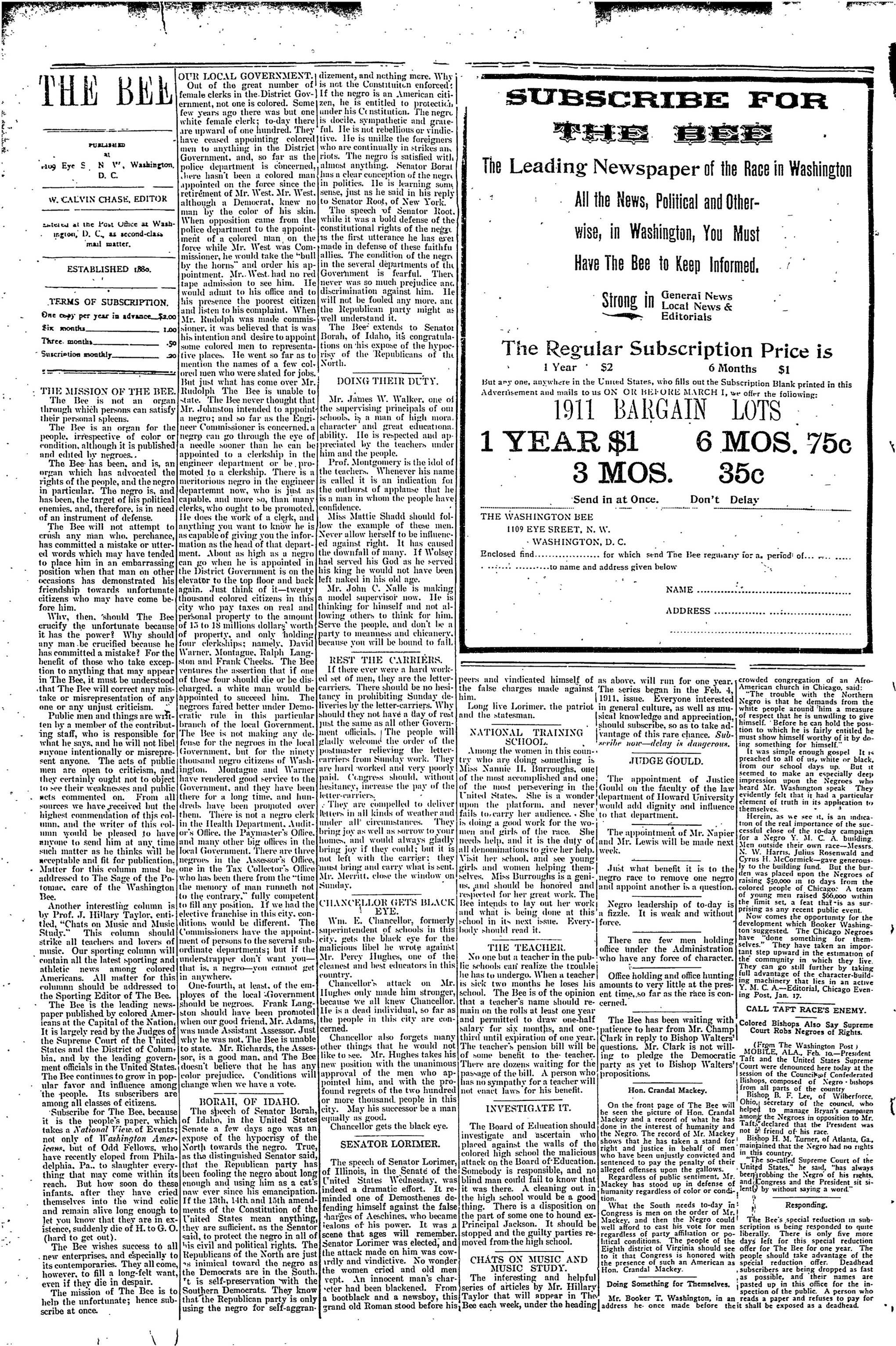
THE BEE
PUBLISHED
at
109 Eye S. N W., Washington,
D. C.
W. CALVIN CHASE, EDITOR
entered at the Post Office at Washington, D. C., as second-class
mail matter.
ESTABLISHED 1880.
TERMS OF SUBSCRIPTION.
One copy per year in advance $2.00
Six months 1.00
Three months .50
Subscription monthly .20
THE MISSION OF THE BEE.
The Bee is not an organ
through which persons can satisfy
their personal spleens.
The Bee is an organ for the people, irrespective of color or condition, although it is published and edited by negroes. The Bee has been, and is, an organ which has advocated the rights of the people, and the negro in particular. The negro is, and has been, the target of his political enemies, and, therefore, is in need of an instrument of defense.
The Bee will not attempt to crush any man who, perchance, has committed a mistake or uttered words which may have tended to place him in an embarrassing position when that man on other occasions has demonstrated his friendship towards unfortunate citizens who may have come before him.
Why, then, should The Bee crucify the unfortunate because it has the power? Why should any man be crucified because he has committed a mistake? For the benefit of those who take exception to anything that may appear in The Bee, it must be understood that The Bee will correct any mistake or misrepresentation of any one or any unjust criticism.
Public men and things are written by a member of the contributing staff, who is responsible for what he says, and he will not libel anyone intentionally or misrepresent anyone. The acts of public men are open to criticism, and they certainly ought not to object to see their weaknesses and public acts commented on. From all sources we have received but the highest commendation of this column, and the writer of this column would be pleased to have anyone to send him at any time such matter as he thinks will be acceptable and fit for publication. Matter for this column must be addressed to The Sage of the Potomac, care of the Washington Bee.
Another interesting column is by Prof. J. Hillary Taylor, entitled, "Chats on Music and Music Study." This column should strike all teachers and lovers of music. Our sporting column will contain all the latest sporting and athletic news among colored Americans. All matter for this column should be addressed to the Sporting Editor of The Bee.
The Bee is the leading newspaper published by colored Americans at the Capital of the Nation. It is largely read by the Judges of the Supreme Court of the United States and the District of Columbia, and by the leading government officials in the United States. The Bee continues to grow in popular favor and influence among the people. Its subscribers are among all classes of citizens.
Subscribe for The Bee, because it is the people's paper, which takes a National View of Events; not only of Washington Americans, but of Odd Fellows, who have recently eloped from Philadelphia. Pa., to slaughter everything that may come within its reach. But how soon do these infants, after they have cried themselves into the wind colic and remain alive long enough to let you know that they are in existence, suddenly die of H. to G. O. (hard to get out).
The Bee wishes success to all new enterprises, and especially to its contemporaries. They all come, however, to fill a long-felt want, even if they die in despair.
The mission of The Bee is to help the unfortunate; hence subscribe at once.
One-fourth, at least, of the employees of the local Government should be negroes. Frank Langston should have been promoted when our good friend, Mr. Adams, was made Assistant Assessor. Just why he was not. The Bee is unable to state. Mr. Richards, the Assessor, is a good man, and The Bee doesn't believe that he has any color prejudice. Conditions will change when we have a vote.
BORAH, OF IDAHO.
BORAH, OF IDAHO. The speech of Senator Borah, of Idaho, in the United States Senate a few days ago was an expose of the hypocrisy of the North towards the negro. True, as the distinguished Senator said, that the Republican party has been fooling the negro about long enough and using him as a cat's paw ever since his emancipation. If the 13th, 14th and 15th amendments of the Constitution of the United States mean anything, they are sufficient, as the Senator said, to protect the negro in all of his civil and political rights. The Republicans of the North are just as inimical toward the negro as the Democrats are in the South. It is self-preservation with the Southern Democrats. They know that the Republican party is only using the negro for self-aggran-
dizement, and nothing more. Why is not the Constitution enforced? If the negro is an American citizen, he is entitled to protection under his Constitution. The negro is docile, sympathetic and grateful. He is not rebellious or vindictive. He is unlike the foreigners who are continually in strikes and riots. The negro is satisfied with almost anything. Senator Borat has a clear conception of the negro in politics. He is learning some sense, just as he said in his reply to Senator Root, of New York. The speech of Senator Root, while it was a bold defense of the constitutional rights of the negro is the first utterance he has ever made in defense of these faithful allies. The condition of the negro in the several departments of the Government is fearful. There never was so much prejudice and discrimination against him. He will not be fooled any more, and the Republican party might as well understand it.
The Bee extends to Senator Borah, of Idaho, its congratulations on his expose of the hypocrisy of the Republicans of the North.
DOING THEIR DUTY.
Mr. James W. Walker, one of the supervising principals of our schools, is a man of high mora. character and great educationa. ability. He is respected and appreciated by the teachers under him and the people. Prof. Montgomery is the idol of the teachers. Whenever his name is called it is an indication for the outburst of applause that he is a man in whom the people have confidence.
Miss Muttie Shadd should follow the example of these men. Never allow herself to be influenced against right. It has caused the downfall of many. If Wolsey had served his God as he served his king he would not have been left naked in his old age. Mr. John C. Nalle is making a model supervisor now. He is thinking for himself and not allowing others to think for him. Serve the people, and don't be a party to meanness and chicanery, because you will be bound to fall.
REST THE CARRIERS.
REST THE CARRIERS. If there ever were a hard worked set of men, they are the letter-carriers. There should be no hesitancy in prohibiting Sunday deliveries by the letter-carriers. Why should they not have a day of rest just the same as all other Government officials. The people will gladly welcome the order of the postmaster relieving the letter-carriers from Sunday work. They are hard worked and very poorly paid. Congress should, without hesitancy, increase the pay of the letter-carriers.
They are compelled to deliver letters in all kinds of weather and under all circumstances. They bring joy as well as sorrow to your homes, and would always gladly bring joy if they could; but it is not left with the carrier; they must bring and carry what is sent. Mr. Merritt, close the window on Sunday. CHANCELLOR GETS BLACK EYE.
Wm. E. Chancellor, formerly superintendent of schools in this city, gets the black eye for the malicious libel he wrote against Mr. Percy Hughes, one of the cleanest and best educators in this country. Chancellor's attack on Mr. Hughes only made him stronger, because we all knew Chancellor. He is a dead individual, so far as the people in this city are concerned.
Chancellor also forgets many other things that he would not like to see. Mr. Hughes takes his new position with the unanimous approval of the men who appointed him, and with the profound regrets of the two hundred or more thousand people in this city. May his successor be a man equally as good.
Chancellor gets the black eye.
SENATOR LORIMER.
The speech of Senator Lorimer, of Illinois, in the Senate of the United States Wednesday, was indeed a dramatic effort. It reminded one of Demosthenes defending himself against the false charges of Aeschines, who became zealous of his power. It was a scene that ages will remember. Senator Lorimer was elected, and the attack made on him was cowardly and vindictive. No wonder the women cried and old men wept. An innocent man's character had been blackened. From a bootblack and a newsboy, this grand old Roman stood before his
SUBSCRIBE FOR THE BEE
The Leading Newspaper of the Race in Washington
All the News, Political and Otherwise, in Washington, You Must
Have The Bee to Keep Informed.
Strong in General News
Local News & Editorials
The Regular Subscription Price is
1 Year $2 6 Months $1
But any one, anywhere in the United States, who fills out the Subscription Blank printed in this Advertisement and mails to us ON OR BEFORE MARCH 1, we offer the following:
1911 BARGAIN LOTS
1 YEAR $1 6 MOS. 75c
3 MOS. 35c
Send in at Once. Don't Delay
THE WASHINGTON BEE
1109 EYE SREET, N. W.
WASHINGTON, D. C.
Enclosed find... for which send The Bee regularly for a period of... ... to name and address given below
NAME ...
ADDRESS ...
peers and vindicated himself of the false charges made against him. Long live Lorimer, the patriot and the statesman.
NATIONAL TRAINING SCHOOL
Among the women in this country who are doing something is Miss Nannie H. Burroughs, one of the most accomplished and one of the most persevering in the United States. She is a wonder upon the platform, and never fails to carry her audience. She is doing a good work for the women and girls of the race. She needs help, and it is the duty of all denominations to give her help. Visit her school, and see young girls and women helping themselves. Miss Burroughs is a genius, and should be honored and respected for her great work. The Bee intends to lay out her work and what is being done at this school in its next issue. Everybody should read it.
THE TEACHER
No one but a teacher in the public schools can realize the trouble he has to undergo. When a teacher is sick two months he loses his school. The Bee is of the opinion that a teacher's name should remain on the rolls at least one year and permitted to draw one-half salary for six months, and one-third until expiration of one year. The teacher's pension bill will be of some benefit to the teacher. There are dozens waiting for the passage of the bill. A person who has no sympathy for a teacher will not enact laws for his benefit.
INVESTIGATE IT.
The Board of Education should investigate and ascertain who placed against the walls of the colored high school the malicious attack on the Board of Education. Somebody is responsible, and no blind man could fail to know that it was there. A cleaning out in the high school would be a good thing. There is a disposition on the part of some one to hound Principal Jackson. It should be stopped and the guilty parties removed from the high school.
CHATS ON MUSIC AND MUSIC STUDY.
The interesting and helpful series of articles by Mr. Hillary Taylor that will appear in The Bee each week, under the heading
as above, will run for one year. The series began in the Feb. 4, 1911, issue. Everyone interested in general culture, as well as musical knowledge and appreciation, should subscribe, so as to take advantage of this rare chance. Subscribe now—delay is dangerous.
JUDGE GOULD
The appointment of Justice Gould on the faculty of the law department of Howard University would add dignity and influence to that department.
The appointment of Mr. Napier and Mr. Lewis will be made next week.
Just what benefit it is to the negro race to remove one negro and appoint another is a question.
Negro leadership of to-day is a fizzle. It is weak and without force.
There are few men holding office under the Administration who have any force of character.
Office holding and office hunting amounts to very little at the present time, so far as the race is concerned.
The Bee has been waiting with patience to hear from Mr. Champ Clark in reply to Bishop Walters' questions. Mr. Clark is not willing to pledge the Democratic party as yet to Bishop Walters' propositions.
Hon. Crandal Mackey.
On the front page of The Bee will be seen the picture of Hon. Crandal Mackey and a record of what he has done in the interest of humanity and the Negro. The record of Mr. Mackey shows that he has taken a stand for right and justice in behalf of men who have been unjustly convicted and sentenced to pay the penalty of their alleged offenses upon the gallows. Regardless of public sentiment, Mr. Mackey has stood up in defense of humanity regardless of color or condition. What the South needs to-day in Congress is men on the order of Mr. Mackey, and then the Negro could well afford to cast his vote for men regardless of party affiliation or political conditions. The people of the Eighth district of Virginia should see to it that Congress is honored with the presence of such an American as Hon. Crandal Mackey.
Doing Something for Themselves.
Mr. Booker T. Washington, in an address he once made before the
crowded congregation of an Afro-American church in Chicago, said: "The trouble with the Northern Negro is that he demands from the white people around him a measure of respect that he is unwilling to give himself. Before he can hold the position to which he is fairly entitled he must show himself worthy of it by doing something for himself." It was simple enough gospel. It is preached to all of us, white or black, from our school days up. But it seemed to make an especially deep impression upon the Negroes who heard Mr. Washington speak. They evidently felt that it had a particular element of truth in its application to themselves.
Herein, as we see it, is an indication of the real importance of the successful close of the 10-day campaign for a Negro Y. M. C. A. building. Men outside their own race—Messrs. N. W. Harris, Julius Rosenwald and Cyrus H. McCormick—gave generously to the building fund. But the burden was placed upon the Negroes of raising $50,000 in 10 days from the colored people of Chicago: A team of young men raised $60,000 within the limit set, a feat that is as surprising as any recent public event.
Now comes the opportunity for the development which Booker Washington suggested. The Chicago Negroes have "done something for themselves." They have taken an important step upward in the estimation of the community in which they live. They can go still further by taking full advantage of the character-building machinery that lies in an active Y. M. C. A.-Editorial, Chicago Evening Post, Jan. 17.
CALL TAFT RACE'S ENEMY.
Colored Bishop's Also Say Supreme Court Robs Negroes of Rights.
(From The Washington Post)
MOBILE, ALA., Feb. 10.—President Taft and the United States Supreme Court were denounced here today at the session of the Council of Confederated Bishops, composed of Negro bishops from all parts of the country
Bishop B. F. Lee, of Wilberforce, Ohio, secretary of the council, who helped to manage Bryan's campaign among the Negroes in opposition to Mr. Taft, declared that the President was not a friend of his race.
Bishop H. M. Turner, of Atlanta, Ga., maintained that the Negro had no rights in this country.
"The so-called Supreme Court of the United States," he said, "has always been robbing the Negro of his rights, and Congress and the President sit silent) by without saying a word."
Responding.
The Bee's special reduction in subscription is being responded to quite liberally. There is only five more days left for this special reduction offer for The Bee for one year. The people should take advantage of the special reduction offer. Deadhead subscribers are being dropped as fast as possible, and their names are pasted up in this office for the inspection of the public. A person who reads a paper and refuses to pay for it shall be exposed as a deadhead
The Week in Society
Bring your job work to The Bee office, or address W. Calvin Chase, Jr., 1109 Eye street N. W., or 1212 Florida avenue N. W.
Mrs. Mary Pierre, wife of Dr. S. M. Pierre, who has been ill for several days is able to be up and out again. Send your society news to the society editor of The Bee not later than Wednesday evening of each week.
Wednesday evening of each week.
All local news must be in this office not later than Wednesday evening of each week.
Auditor Ralph W. Tyler has improved sufficiently to be out again.
Miss Zellaca C. Wooding, one of our teachers, who has been confined to her bed because of illness during the last 10 days, is much improved.
Rev. Williams, District Superintendent for the A. M. E. churches, who has been much indisposed, is convalescent and out.
Col. Henry Lincoln Johnson was in Atlanta, Ga., last week.
Rev. Walter H. Brooks was in Clifton Forge, Va., last Sunday. His pulpit was filled by Rev. Perkins, B. D., of Howard University.
Quality is what counts in drugs, medicines and remedies. You get the very highest quality at the fairest price at the drug store of Board & McGuire, 1912½ Fourteenth street northwest. Hundreds of satisfied customers attest this fact.
Invitations are out for the marriage on March 7 of Marion Toussaint Scott, daughter of Mrs. A. M. Scott and the late Dr. E. D. Scott, to Mr. Charles N. Barker, of Topeka, Kan. Miss Lenora Wingfield, of West Medford, Mass., will come on to act as bridesmaid.
The tea and dance given by the Prudence Crandall Association last Wednesday night at the Auditorium Hall was a grand success. Music was furnished by the full Wilberforcian Orchestra.
The comedy, "One of the Eight," presented by the senior class of the Academy of Howard University last Friday evening was enjoyed by the large audience which was present to witness it.
Miss Laura Peterson, assisted by her sister, Miss Henrietta Peterson, entertained at luncheon on Wednesday at their residence, 2116 F street northwest, in honor of Misses Nellie Ford and Jessie C. Mason.
Going down town? No; not when I can get the richest and most artistic boxes of fine fresh candies, dainty and lasting perfumery, high-grade post cards, fine cigars and novelties at the drug store of Board & McGuire, 1012$^{2}$ 14th street northwest.
Mrs. Louise Jennings Brown, mother of Mrs. Marshall, and mother-in-law of Dr. Charles H. Marshall, died at her residence last Sunday morning and was buried from St. Mary's Church Wednesday afternoon. She was interred in Harmony Cemetery.
Mr. John E. Ricks and his mother-in-law, Mrs. Hill, of Philadelphia, Pa., were the guests of Mr. and Mrs. Henry D. Mason, of 1253 Wylie street northeast, a few hours Saturday evening east. Mr. Ricks left for Maryland to visit his parents, while Mrs. Hill left for Wilmington, N. C., on a late train, where she was called to see her son, who is ill.
Mrs. Freeman has returned to her home, 1224 Linden street northeast, after a stay of 20 days in Goldsboro, N. C., where she was called to her sister's bedside, who was dangerously ill
Mrs. Gertrude Wiggens has returned to her home in Baltimore after a pleasant trip to this city. After you leave the Chelsea and the Fairyland, call by Dr. Morse's and ask for a glass of ice cream soda. Miss Hallie Q. Brown, the celebrated elocutionist of Willberforce, Ohio, was the guest of Prof. and Mrs. J C Wright, 514 T street northwest, on Wednesday and Thursday of last week. On Thursday the Willbeforian Club, of which Prof. Wright is President, entertained in honor of her.
On Thursday evening last Miss Lucille Nooks entertained friends at a whist party at 1314 V street northwest. After a series of games a dainty luncheon was served. Those present were Mr. and Mrs. Nathan Mesbit. Dr and Mrs. J. C. Dowling, Misses Edna Murry, Daisy Watson and Harriet Butler, Mrs. Grace Harland, Messrs. J. Sherman Hunnicutt, W. L. Pollard, Preston Bayless, N. L. Burns, Percival Bruce, Norman Butler, Arthur White and Oscar E. Jones. Mr Andrew W. Sears, proprietor of the Hotel Brunswick, has been called to his home at Durham, N. C., to the bedside of his sister, Mrs. W. T. Price.
Ice cream soda is popular the year 'round at the drug store of Board & McGuire on Fourteenth street. "The place where everybody meets everybody else."
Mrs. P. Laws, who has been confined to her home for some time because of illness, is able to be out again.
Miss Bessie Taylor has returned to her home in this city after a 10 days' stay with friends in this city.
If you want pure drugs, go to the Gem Drug Store, Dr. J. W. Morse, 2004 L street N. W.
Mr. Charles Stewart has returned to Indianapolis, Ind., after a pleasant stay in this city.
Misses Anna Hurley and Orleans Lane, of this city, were recent visitors to Philadelphia, Pa.
During Dr. Cromwell's stay in Philadelphia, Pa., he was the guest of his sister, Mrs. Nancy Cromwell.
Miss Lalia Williams, a noted singer of Philadelphia, Pa., was a recent visitor here.
The best cigars for your money will be found at the Gem Drug Store of Dr. J. W. Morse, 1904 L street N. W.
Mr. T. J. Willis, of the medical school of Howard University, is still detained at his home in Richmond, Va., because of illness of his mother and sister.
Mr. George W. Ward, a student of Howard University, who could not resume his studies because of illness, has been visiting relatives in Allentown, Pa., since the holidays.
Prof. Joseph Edwards, of Boston, Mass., is in the city.
Mrs. J. Douglass Dyson has returned to her home in Philadelphia, Pa., after a pleasant stay of a week in this city as the guest of her mother-in-law, Mrs. Rachel Dyson, in T street.
Don't take calomel for your liver when you can get Liveroids, the great vegetable liver regulator, tonic and blood purifier, at the drug store of Board & McGuire, 1912½ Fourteenth street northwest.
Vesper song service at Howard University on Sunday last was largely attended by the young people of the city. The program, under the leadership of Miss Lula V. Childress, was ably conducted. Many persons were turned away because of the vast crowd within.
Recorder J. Lincoln Johnson left the city last week for his home in Atlanta, Ga.
Capt. J. W. Lvons, who is working so hard for the Freedmen's Savings Bank depositors, will no doubt win. Capt. Lyons is one of the most honorable men in this country.
Don't forget to call at the drug store of Board & McGuire and examine the finest assortment of the best perfumery and candies in the city from 25 cents to $5 a box.
Attorney W. L. Pollard will leave the city in a few days for a trip East.
Mr. Joseph H. Stewart has completed his book on the Negro race.
Miss Emma F. G. Merritt is one of the most successful teachers in the public schools.
If you drink soda water, you will find pure fruit syrups at Dr. J. W. Morse's Gem Drug Store, at 1904 L street N. W.
Rev J. H. Hubbard, assistant editor of the Foundation, of Atlanta, Ga., was in the city this week, the guest of Rev M. M. Clair. Rev Hubbard is a fine type of Southern manhood.
Attorney A. W. Scott, wife and baby will go to Atlantic City during the Easter holidays.
Dr. James E. Shepard, of Durham, N. C., will not arrive in the city until next week.
Mr. James H. Winslow, the well-known funeral director, who was seriously ill some few weeks ago, is now out of danger, and will be able to be out within a few days.
Miss Hyman, who has been to North Carolina for several weeks, has returned to the city restored to health.
Dinner to Dr. Shepard.
There is a movement on foot by the resident citizens of North Carolina and the friends of Dr. James E. Shepard, to tender him a complimentary dinner some time in April, for the excellent work that he has accomplished for the Negroes of the South. The affair is in the hands of a special committee.
Honoring the Doctors.
A public reception was tendered the physicians of the Nineteenth Street Baptist Church free dispensary and the choir by the Nineteenth Street Baptist Church last Friday.
The work of the dispensary was beautifully portrayed in the addresses delivered by Drs. Wilson, Daniels, Cabaniss and Wright, and Mrs. Julia M. Layton. Mr. William H. Harriss made a very happy address of welcome, and the response on the part of Miss Parthenia Woodson was all that could be expected of her. She very ably presented her theme, "Our choir."
"The Portrait" was recited by Miss Julia Brooks in her own pleasing manner.
The choir made everybody happy by rendering Farmer's "Kyrie" and "Sanctus" and DeKoven's "Merry Miller." Dr. Charles Marshall presided.
The following were among the special invited guests: Drs. William A. Warfield, H. C. Scurlock, Prof. I. T. Layton and Dr. C. C. Fry, Rev. William Walker was in charge of the banquet, and left nothing undone to make that part of the program equal the musical and literary numbers. The whole was a big affair, presented to a big lot of folks by a big church. Report of Dispensary Work. Pursuant to the wish of the dis-
pensary staff, I herewith present for the information of the public a report of the work done by the clinicians and nurses in the administration and care of the hundreds-yea, thousands-of patients who have visited the dispensary from its beginning, Oct. 8, 1907. The nurses have made many sacrifices in attending the clinics, receiving not even car fare, and have zealously and acceptably arranged the patients for proper inspection and examination by the physicians, also in cleansing the soiled linen and sterilization of instruments and other material used.
Rarely a day has passed in the three years without the presence of at least one of the two or three physicians assigned for each day; so the efficiency of the medical staff is beyond question.
The proper care of the teeth of the indigent, having so much to do with the general health, the staff will consider at its next meeting the installation of the apparatus necessary for the conduct of a well-equipped, up-to-date dental clinic, and thus enlarge the scope of the dispensary work.
As a matter of introduction of special works, such as eye, ear and throat, is contemplated, the staff hopes the church may in the near future see its way clear, through its Trustees, to construct one or more rooms on its vacant lot suitable for the display of all the work of the medical department, and thus remove from the sanctuary proper its laudable charity.
To show that the purposes in establishing this dispensary, to discriminate against none on account of race or creed, the Secretary takes pleasure in stating that persons other than those of the Negro race have been given treatment. The denominational showing is as follows:
Baptists 1,736
Methodists 486
Roman Catholics 151
Episcopalians 55
Congregationalists 10
Seventh Day Adventists 4
Presbyterians 3
No church 631
Honor to Dr. Washington.
Principal Booker T. Washington, of the Tuskegee Institute, has been invited by the pastor of St. Bartholomew's Church, one of the richest and most exclusive churches in New York City, to speak in a series of special meetings to be held on Sunday evenings during Lent, from March 5 to April 9. Others who will speak in this series are President A. Lawrence Lowell, of Harvard University; Mr. Justice Hughes, of the Supreme Court of the United States, and Gov. Woodrow Wilson, of New Jersey.
Principal Booker T. Washington, of the Tuskegee Institute, has received from King Frederick and Queen Louise of Denmark autographed photographs of their Majesties in acknowledgment of his work, "Up From Slavery," which they have had the pleasure of reading. King Frederick and Queen Louise entertained Dr. Washington at the palace when he was in Copenhagen, Denmark, last summer. Queen Alexander of England was present on that occasion.
The executors of the estate of Mr Andrew J. Dotger have recently turned over to the Trustees of the Tuskegee Normal and Industrial Institute $404,893.57. This goes to the endowment fund of the institution.
Howard Theater.
The Howard Theater will open the spring season next week with the Capital City Comedy Company, an organization comprising 30 people, all high-class performers. This company is headed by Richards and Brown, the Washington favorites, assisted by the celebrated Capital City Quartet. Popular prices will prevail for this engagement They appear on Monday, Tuesday, Wednesday and Saturday. Thursday and Friday will be devoted to the Howard College Dramatic Club's Shakespearean rendition of the "Merry Wives of Windsor," which promises to be a dramatic treat. Other popular attractions will follow in regular order, due notice of which will be given the readers of The Bee.
In Chicago. Ill.
Chicago, Ill., Feb. 22, 1911. "Our Friend From Dixie" company is meeting with success wherever it goes. This company was organized by W. H. Smith, formerly the manager of the Howard Theater, Washington, D. C. "Our Friend From Dixie" and the "Smart Set" will open here to-morrow, "Dixie" at the Globe Theater for two weeks and the "Smart Set" at Weber's Theater. "Dixie" is successful wherever it goes. W. H. Smith is here and as-popular as ever. He is organizing a burlesque company.
Miss Tyson.
The female ticket seller at the Howard Theater, Miss Tyson, knows her business and is a drawing card. She attends to her business in a business-like manner.
MANAGER HENDERSON'S ATHLETIC WORK.
Standing of the Public School Leagues.
The Public School Athletic League is making remarkable strides in the development of healthy athletic sports among the boys of the colored schools. Ten fully-equipped teams are playing basket-ball, eight of which are entered in the I. S. S. A. series of games at True Reformers Hall. The game to date is played with far more skill and has developed greater than the fondest hopes of the League founders. Too much credit cannot be given to the principals and teachers, who to their already heavy tasks have added the responsibilities and joys of educational athletics to the curriculum.
Mott School, Briggs School and
Stevens School teams have clear slates to the present. The other teams are either late in striking their stride or were outweighed by opponent, and now on more evenly matched contests will ensue.
On Saturday night, the 25th, a great assortment of games will be played at True Reformers Hall. Howard Academy quintet plays St. Marys five. Mott School meets Briggs; Sumner plays Randall, and Stevens locks horns with the crack Y. M. C. A. Juniors.
The Team Standing.
Won. Lost. Pet.
Stevens 4 0 1,000
Briggs 3 0 1,000
Mott 3 0 1,000
Garnet 1 2 .333
Randall 1 3 .250
Birney 0 1 .000
Sumner 0 2 .000
Patterson 0 4 .000
The manager, A. B. Hendersoh, for the Interscholastic Athletic Association and Public School Athletic League meet at Convention Hall on March 11 announces that plans are satisfactorily working out, and that the event promises to be more successful than was earlier hoped for. The Finance Committee is hard at work attending to its end of the games, and with the Publicity and Games Committees, expects good results.
This will be the first occasion where colored athletes have had indoor competition on so large a scale, although many of the leading athletes have won places in competition at the indoor games north of this city. Ed. Gray was anchor man on Amherst's relay team two years ago and won his track "A," being a consistent winner of the 440 and 220 yard hurdles in dual games. Jim Hunter performed consistently at 100 and 220 yard sprints when at Amherst. Solanear was usually scratched in the sprints by New York City handicappers. Slaughter has done better than 53 seconds in the 440 at Iowa State University. W. F. Williams has bettered 5 feet 8 inches over the jump bar, and C. George, of Howard University, expects to clear 6 feet on the coming occasion. Maurice Curtis equalled the college gymnasium record for 35 yards at Michigan last year. Bill English lost by only a few inches to Tex Ramsdell with a yard handicap in the century sprint a year ago. Penn, Robbins, Adams, Burwell, Walker and other good men will be likely to perform well.
Birncy, Sumner, Wilson, Stevens, Montgomery, Horner, Patterson, Garnet, Mott, Banneker, Douglass, Payne, Deanwood, Bunker Hill Road, Randall, Cardoza, Bell, Lincoln, Giddings, Jones, Lovejoy, Garfield, Cook, Slater, Langston and Ambush schools are some of the P. S. A. L. members who will enter school boys in one or all of the three events closed to members of the Public School Athletic League. Mr. A. K. Savoy of the Games Committee or the manager of the meet can supply information.
Armstrong, M Street High and Business High Schools will be represented by large numbers of track athletes. The 440 and mile runs scholastic are handicap runs, and will attract large numbers' of boys. The gold, silver and bronze medals are on exhibition at the pharmacy window of Gray & Gray at Twelfth and U streets northwest. A large band will furnish music on the occasion. Tickets are on sale at the Colored Y. M. C. A. office at Twelfth and U streets northwest.
WEST WASHINGTON NEWS.
Mt. Zion M. E. Sunday School Holds Interesting Exercises.
The Men's Day at Mt. Zion M. E. Sunday School was observed last Sunday morning, which was very instructive and interesting. Many prominent Sunday school workers being present and took part in the program, as announced by Mr. William Audrick, the chairman, with Mr. Harry Thompson, secretary. Addresses were delivered by Mr. W. I. Lee, of the 19th Street Baptist school, Mr. S. M. Dudley and Mr. R. F. Grant, of Union Wesley school, Mr. Benj. Washington and Mr. M. C. Maxfield, of the 19th Street Baptist school, Mr. C. W. Lewis, Third Baptist school, Mr. N. G. Mitchell, Ebenezer A. M. E. school, Mr. J. D. Pair, associate editor, the National Union; solo by Mr. T. Henderson, Union Wesley, recitation, Mr. Clarence Lewis; responsive address was by Mr. Jas. L. Turner. Tomorrow (Sunday), will be ladies' day, and an interesting program is to be presented. Sabbath school workers invited. Mrs. Marie Wheeler is the superintendent.
The class leaders of Mt. Zion M. E. Church were the guests of their pastor on Wednesday evening at the parsonage, 2902 O street northwest. A very pleasant time was spent in the discussion of the year's work of the leaders with the pastor, which has been very successful and gratifying. Mrs. Hayes, the wife of the pastor, invited the leaders, with their wives, to partake of light refreshments, which was one of the happy features of the occasion. The return of Dr. Hayes for the next conference year is anticipated. Among those present were Mr. and Mrs. J. F. Garner, Mr. and Mrs. J. Reed, Mr. and Mrs. A. Williams, Mr. and Mrs. Wm. Douglass, Mr. and Mrs. J. Dorsey, Mr. Andrew Carte, Mrs. Hattie Jackson and Geo. Minor.
The fifty-fifth anniversary of Henderson's Commandery was very appropriately observed Sunday by attending divine services at Ebenezer A. M. E. Church. The sermon was delivered by Rev. E.' E. Ricks, pastor of the First Baptist Church. The music for the occasion was by the Junior Choir of the First Baptist Church. Rev. W. G. Leeper, pastor of Ebenezer A. M. E. Church, preached to a large congregation Sunday evening at the First Baptist Church.
Y. M. C. A. NOTES.
The effort of the Y. M. C. A. to prevent the loan sharks from sapping the lives out of the young men of the city, and to keep all young men from borrowing money for unnecessary
HOWARD THEATRE
The Theatre for the People
Monday, Tuesday, Wednesday & Saturday
February 27 & 28; March 1 & 4
The Capital City
Comedy Company
IN THEIR NEW MUSICAL COMEDY
A Bogus Chief
THE CELEBRATED COMEDIANS RICHARDS & BROWN AND 30 HIGH CLASS COLORED PERFORNERS INCLUDING THE CAPITOL CITY QUARTET POPULAR PRICES 15,25,35 & 50 CENTS
Thursday and Friday Eveg's March 2d and 3d The Howard College Dramatic Club IN SHAKESPEARE'S
Anything you wish will be charged on an open account which is made payable as your circumstances may suggest.
Come where you can read every price and do the buying before there's a question about how or when you desire to pay.
PETER GROGAN and Sons Co.
purposes, is meeting with a hearty response from the people of Washington. Many have expressed their approval and stated that the Y. M. C. A. can be of service to the community in this regard.
The joint meeting of the Y. W. C. A. and the Y. M. C. A. was a great success. The men rallied to the support of the ladies in a very creditable manner. The Y. M. C. A. orchestra of ten pieces, under Mr. Sherman Hunicutt, director, gave their services free for this meeting. This shows a fine brotherly spirit.
Professor Layton, chairman of the Musical Committee, is doing good work, and bringing the musical department of the Y. M. C. A. up to a fine standard. His instruction last Sunday on the proper method of singing Gospel hymns was very instructive and appreciated by the men. Mr. Sherman Hunnicutt, who has charge of the orchestra, is present every Sunday and right on time. Mr. Johnson, secretary, had been trying to get an orchestra for two years, but was unable to do so until he enlisted the services of Mr. Hunnicutt. The new building on Twelfth street is rapidly nearing completion. The rooms on the two upper floors have been lathed and plastered. The furnace has been installed, and is now used for heating the building to dry out the plaster.
The Bible Class, under the direction of Professor E. C. Williams, of M Street High School, grows in interest, and has a good attendance every night. The Bible Class will give an exemplification of its work at the Sunday afternoon meeting on March 20th.
Mr. L. E. Johnson delivered an address at the Strangers' Tea Meeting at the Central Y. M. C. A. on G street Sunday afternoon, February 12th. He spoke on the subject of Abraham Lincoln, and also gave an account of the Y. M. C. A. work at Buxton, Iowa, among the miners.
Next Sunday afternoon Elder L. C.
Sheafe will address the men's meeting
on the subject "The great question
of the age." Mr. R. G. Doggett and
Elder Sheafe will each sing a solo, and
the Y. M. C. A. orchestra will furnish
music.
The Bee Would Like To Know
Who Napier's private secretary will
you can read
do the buying
question about
you desire to pay.
HROGAN
Ins Co.
BURNSTINE LOAN OFFICE
GOLD AND SILVER WATCHES, DIAMONDS, JEWELRY, GUNS, MECHANICAL TOOLS LADIES' AND GENTS' WEARING APPARAL.
OLD GOLD AND SILVER BOUGHT.
UNREDEEMED PLEDGES FOR SALE.
361 Pennsylvania Avenue, N. W.
H. K. FULTON'S LOAN OFFICE
No. 314 Ninth Street, N. W.
Loans made on Watches, Diamonds, Jewelry, Silverware, Etc.
If you want to buy a good watch, diamond ring, or jewelry of any kind, look at our stock first. You!
Why pay 10 per cent, when you can get it for 3 per cent.
H. K. FULTON
to appoint a few colored officers on the force.
If Sidney Bieber, the District National Committeeman, will get a job.
If Postmaster General Hitchcock intends to resign.
If President Taft's Southern policy is to continue.
How many Negro orators delivered patriotic speeches Tuesday.
How are the new barristers getting along at the bar.
When will all the bachelors marry.
Why is a bachelor a bachelor.
If Thomas L. Jones and John W. Patterson form a law partnership.
If W. Sidney Pittman and J. A. Lonk dine together.
What Arthur F. Boston said at the prayer meeting.
Switzerland's Remarkable Method of Preparing For Rapid Mobilization of Her Troops.
In Switzerland the state is part owner of horses used by reserves. It purchases a remount at three and a half years old, and the soldier pays half the cost of the horse to the government, together with the difference between its cost and the price that the horse fetches at auction, for all horses are sold by auction to the men.
After every year of training the government refunds one-tenth of the original half cost to the man, and at the end of ten years the horse becomes the absolute property of the soldier. In this manner the soldier is not only always well mounted, but as he keeps his horse with him at his home his mobilization problem is of the simplest nature.
The average price of these Swiss troop horses is about £45, says Bally's Magazine, and as most of these horses are imported from Ireland and north Germany their price is considerably higher than it would be in Great Britain. Thus the state secures the services of a horse for an annual outlay of about £10a. But there are certain other expenses which must be included in this estimate, such as the cost of the establishment for remount depots, etc., which raises the total cost of horses for the Swiss government to about £12a, a year.
ROADS IN CHINA.
They Are Narrow and Crooked and Edged With Ditchs.
The Chinese road is private property, a strip taken from somebody's land. This is done much against the will of the owner, since he not only loses the use of it, but also still has to pay taxes on it.
One consequence is that it is wide enough for only one vehicle, and carts can pass one another only by trespassing on the cultivated land. To prevent this the farmers dig deep ditches by the roadside. As the surface wears away and the dust blows off it gradually grows lower, and after awhile it becomes a drain for the surrounding fields. A current forms in the rainy season, which still further hollows it out, and thus has arisen the proverb that a road a thousand years old becomes a river.
Those whose lands are used for roads naturally prefer to have the roads run along the edge of their farms instead of cutting across them, and this accounts for the fact that Chinese roads are often so crooked that one may have to go a considerable distance to reach a place that is in reality but a few miles away. This always interests the stranger.
Only Pursuing Hla Profession
A Brooklyn magistrate recently had four darkies who were caught in a gambling raid before him. The first of the lot to be brought to the bar was an undersized man, with a comical face as black as night. The dialogue between the magistrate and the prisoner created some merriment in the court.
"What is your name?" inquired the magistrate sternly.
"Mah name your Smiff," replied the darky.
"What is your profession?"
"I's a locksmith by trade, sah."
"What were you doing when the police broke into the room last night?"
"Judge, I was pursuit' mah profes sion. I was makin' a bolt for the door."
"Officer," said the magistrate, with a merry twinkle in his eye, "lock Smith up."—New York Tribune.
The Art of Overlooking.
Nobody can live long in the world and not admit that the words "nothing for nothing" contain a sad amount of truth. He is of course a fool who does not count the cost so far as the future is concerned, but scarcely less a fool is he who does not overlook past costs. If we have any good or delightful thing in this life, at all hazards let us not taint our enjoyment by considering what we gave for it. Was it more than we could afford? Never mind. We have afforded it; we have made our purchase. Let us take off the ticket with the price and burn the receipt. There are items in life's ledger which must be overlooked unless we would spend all our days balancing closed accounts.—London Spectator.
How She Rules Him
"Skinphilint's wife certainly has remarkable success in managing him. I wonder how she does it."
"When he undertakes to deny her anything she really wants she threatens to sue him for divorce."
"Does he care so much for her, then?"
"Oh, no. it's not that, but he figures that it is cheaper to let her have her own way than it would be to either defend the suit or pay allmony."—Chicago Post.
A Bad Start
"A man always looks foolish when he proposes," said the frank young woman.
"Yes," answered Mr. Meekton, "and I have evidently failed to overcome the absurd impression I made on Henrietta on that occasion."—Washington Star.
Social Paradox.
"It's impossible for me to dress on
£3,000 a year."
"Well, my love, you must wear less."
"Don't be silly! You know perfectly
well that the less I wear the more it
costs."—Judge's Library.
Common sense is instinct, and enough
of it is genius—H. W. Shaw.
They Were Regarded With Awe, and One at Milan Was Really a Wonder of Mechanism
It was, we are told, in 1309 that the first clock known to the world was placed in the tower of San Eustorgio in Milan.
The greatest astonishment and admiration were manifested by crowds who flocked to see the timepiece. In 1544 a clock was installed in the palace of the nobles at Padua. This was a wonder of mechanism indeed, for besides indicating the hour it showed the course of the sun, the revolutions of the planets, the various phases of the moon, the months and the fetes of the year.
The period of the evolution from the clock to the watch was seventy-one years—not so very long, all things considered—and the record of the first watch is 1280. A half century later an alarm clock made its appearance. This, we are told, was looked upon by the, people of that age as "un instrument prodigieux."
The fortunate possessor of this clock was Andrea Alclato, a councilor of Milan. The chroniclers have placed on record that this clock sounded a bell at a stated hour, and at the same time a little wax candle was lighted automatically. How this was done we are not told, but it must not be overlooked that until about seventy years ago we had no means of obtaining a light other than the tinder box, so that the Milanese must have been centuries ahead of us in this respect.
Not much progress was made with the watch until 1740, when the second hand was added.—London Globe.
TEMPTED, HE ATE
A Story of Heinrich Helne and a
Toothsome Lyons Sausage.
Returning from a journey to the south of France, Heinrich Heine met a friend, a German violinist, in Lyons, who gave him a large sausage that had been made in Lyons with the request to deliver it to a mutual acquaintance, a homeopathic physician, in Paris. Heine promised to attend to the commission and intrusted the delicacy to the care of his wife, who was travelling with him. But as the postchase was very slow and he soon became very hungry, on the advice of his wife both tasted of the meat, which dwindled with every mile.
Arriving at Paris, Heine did not dare to send the reminder to the physician, and yet he wished to keep his promise. So he cut off the thinnest possible slice with his razor, wrapped it in a sheet of vellum paper and inclosed it in an envelope, with the following note:
Dear Doctor-From your scientific investigations we learn that the millibillion part of a certain substance brings about the greatest results. I bag, therefore, your kind acceptance of the accompanying millibillion part of a Lyons sausage, which our friend gave me to deliver to you. Your homeopathy is a truth, then this little piece will have the same effect on you as the whole sausage. Your HEINRICH HEINE
-Ughetti's "With Physicians and Clients."
Old Time English Elections.
Old Time English Elections.
In old time England each constituency gave its representative in parliament a horse to carry him to Westminster and also paid his expenses on the road. These expenses, together with an allowance for each day spent on duty at the house of commons, generally at the rate of 80 cents a day, were refunded in one lump sum when the member returned home at the end of the parliamentary year. Sir F. Delaval totaled seven votes in an attempt Ondover in the general election of 1768. An item in his election agent's bill is typical of the reckoning he had to pay: "To being thrown out of the George inn, Andover, to my legs being thereby broken, to sugeon's bill and loss of time and business, all in the service of Sir F. Delaval £500." Lord Llandaff won Dungurvan in 1868. The item "£547 whisky," caused him to protest faintly. "Begorra," said his election agent, "if you want to squeeze a pipkin like that ye'll never do for Dungurvan."
Real Sea Serpents
In New Caledonia sea serpents are frequently seen and sometimes captured. They are curious creatures, the head being very small and scarcely distinguishable from the body and the tail being formed like an ear. In length they are generally between three and four feet. In the jaw there are tiny glands containing poison, but as the mouth is very small it is difficult for them to bite, and the natives handle them fearlessly. A European traveler witnessed an experiment at Nounea which shows that under certain conditions the sea serpent can do deadly work. A rat was caught in a trap, and its tongue was grasped by a pair of pinchers and placed in the mouth of a sea serpent. The serpent immediately bit it, and the rat died in four minutes.
Cause of Thought.
"You look thoughtful tonight. Smith," remarked Brown as he stretched himself on two chairs. "Yes," said Smith. "I have just got a note from the landlady." "What does she say?" "She says that I must pay my board at once or her daughter will sue me for breach of promise. I'm thinking what I'd better do." -London Tit-Bits.
Forca of Habit
CRAWFORD IN KILTS.
The Novelist Expressed Great Burp-
rise When He Saw Himself
as a Child.
One of the best known guides in the
capitol at Washington used to be
Colonel Jupiter E. Snow, formerly a
Kansas City lawyer, who always sat
in Republican conventions and voted
for Blaine as long as there was a
Blaine to vote for.
Colonel Snow used to tell this little
story of the late Marion Crawford.
He had a Mr Crawford in Florence,
Italy, and when the novelist
came to Washington Colonel Snow was
the first person who showed him the
doors made by the novelist's father,
Thomas Crawford.
These are the senate bronze doors
on the eastern portico. They represent
scenes connected with the Revolu-
tion and the founding of the government.
The panel representing Washington's reception at Trenton when on his way to his inauguration in New York contains among the populace portrait figures of the sculptor, his wife, his three children and Randolph Rogers, the sculptor of the main doors of the capitol.
The novelist, who had never seen the doors before, quickly identified his mother and father
"Yes," said he, "mother used to wear her hair just like that."
Then, gazing at the largest child, a Fauntleroyish figure in kilt, with long, flowing hair, he added speculatively:
"But I wonder if I ever really did look like that."—New York Sun.
An Insulting Pronoun
The ritual of society, as women make it, is very exacting the world over, even in almhouses. The London Outlook reports a serious trouble among a set of workhouse officials. The infirmary nurses, three in number, had demanded a separate sitting room and the delight of Sunday dinner therein, and the matron had sought to humble them by sending the cook to enjoy her Sunday dinner in their company. The brawny cook described what occurred as follows:
"Well, Nurse Blank, she come down and got inside the door. 'Four covers' she says. 'Four? Who's the fourth?' Me, says I. 'You' she says, and with that she tosses her head and walks away."
Here cook drew a long breath, then continued, "If it hadn't 'a' been Sunday, gentlemen, I should have let her have it for calling me 'you!'"
London Pavements In the Old Time. Occasionally a side pavement added to the comfort of the foot passengers and spared them the necessity of floundering through the deep mire of the roadway. These pavements, however, were only partial, and passengers made use of the highway, soft with mud and flinth thrown from the houses and obstructed with heaps of manure, which dogs and swine made their lair. The latter animal was so useful a scavenger and could be kept at so little expense as to account for the pigsies which stood in the main streets of all our towns, even in London. When a royal procession was expected to pass along the narrow roadway dogs and pigs were driven indoors and gravel was thrown down to make the road passable. Usually, however, the streets were left in their primitive notsomeness."Denton's England In the Fifteenth Century."
Punished With Starvation.
Punished With Starvation.
In the whole wide world there is not a class of people to be found who inflict severer punishment upon themselves than the Caribs of Central America. Their religion, which is one of the most peculiar kind, demands self punishment for sins intentionally or unintentionally committed. The punishment takes the form of starvation and close confinement. If the sin be in the form of a lie, no matter whether it is calculated to injure another or not, the sinner goes without either food or drink for three days, at the end of which it is believed that the offender has paid the penalty for his or her sin. Blaspheming and using bad language are punishable by absolute starvation for two days. Assault, drunkenness and other serious sins call for four days' starvation for one week, three days' starvation for the second week, two days' starvation for the third week and one day's starvation in the fourth week. All sins are punished with starvation. For that reason crime is very low among the Caribs, who are among the best behaved and most truthful people in the world—Exchange.
Manefield's Baron Chavrial
Richard Mansfield's first great success in January, 1883, was as Baron Ohevrial in "A Persian Renaissance" a part that came to him through the refusal of the veteran J. H. Stoddart in A. M. Palmer's Unison Square company to play the part. Mansfield gave many hours to a study of its possibilities and the details of a realistic makeup.
"It was probably the most realistically detailed figure of refined moral and physical deprivacy, searched to its inevitable end, the stage has ever seen. For a moment after the certain fell there was a hush of awe and surprise then the audience found itself and called Mansfield to the footlights a dozen times. But neither then nor there after would he appear until he had removed the wig and makes of the dead baron. There was no occasion to change his clothes. He wore the conventional evening suit. The effect of shriveled undersizedness was purely a muscular effect of the actor. The contrast between the figure that fell at the head of the stairs and the athletic young gentleman who acknowledged the applause was no anticlimax."—"Richard Mansfield, the Man and the Actor," by Paul Wiltach.
HER DEAREST WISH
TOT'S HEART SET ON POSSSESSION OF A PONY.
And Though It Waant'a Very Elegant Animal, and the Carriage Was Rickety, Little Girl Was Delighted.
"If I only had a pony," began the little girl. Then she stopped. That pony had been the subject of her dreams and her waking thought for weeks. It had been so much of an all-absorbing subject that it had been frowned upon in the family circle, but suppression only made it more important.
"If I only had a pony."
The little girl had planned it all out. She had told father and mother the plans. Father had looked troubled and mother had seemed sorry. The little girl couldn't understand this, for to every little girl a father always has money, for he has means of earning it that little girls lack.
"Some day," father had said, and on this foundation the little girl had built the dreams and the plans. It was all arranged. There was a nice shed to keep the pony in, and she had gathered grass and put it in a soap box in the stall in case the pony should come.
She would drive to the office for father every day of the world, and when mother wanted something from the grocery in a hurry all she would have to do. would be to jump on the pony or get into the little cart that comes with all ponies and get it in no time.
How the other little girls would envy her as she drove past! Some of them she would let ride with her, but some of them—no, they were mean and shouldn't even come near the pony.
Mother told father all these things at night, and father would do sums in mental arithmetic in the dark and postpone the solution to another time, for all sums cannot be worked out right away.
Then mother took a hand.
"John," she said, "can't we get some kind of a pony for her? Anything will do. She don't need a fancy pony and cart or anything like that—just something she can drive." Father said he would see.
And a few days later he drove home behind a small and very tame appearing animal that might have been called a horse by courtesy. The buggy was old and rusty, but a coat of paint would settle that, and it would look fine.
"My pony!" said the little girl. That was all. She could say nothing more for at least an hour, not even when she was taken up to the buggy and allowed to drive all by herself.
"It cost only $20," father told mother when they were together that night, "and the buggy is about to fall to pieces, but she will have just as much fun out of it."
"You're a dear boy," said mother, "Nonsense!" said father, griffy, "She had to have it."—Galveston News.
Back In the Fold.
"Family pride just about reaches its limit with the Biddles of Philadelphia," said a man who halls from the burg of scrapple. "To be a Biddle in Philadelphia is sort of like being an archangel in heaven—at least from the point of view of the Biddles. One of the women of that numerous family married a man who was quite her social equal, but who was afflicted with the somewhat commonplace name of—well, say Robinson. They have a little girl, who is now about six years old, and the child is never permitted to lose sight of the fact that her mother was a Biddle. In Sunday school a couple of weeks ago her infantile mind was expected to grasp the problem of salvation according to the doctrine that we must be born again. When she reached home she ran to her mother, exclaiming: 'O, mother, I have such good news for you!'
"What is it, dear?" asked her mother.
"Why, when you die and go to heaven," explained the little girl, you'll be a Biddle again!"
Edward's Interest In Medicine.
In particular, the late King Edward was interested in the promotion of everything that might tend to bring the best aid of medicine and surgery within the reach of all, and in the wide employment of any scientific development which might mitigate or, happily, prevent the spread of dangerous disease. He was saved from typhoid fever death by the great Sir William Jenner in 1872. In 1902 Sir Frederick Treves, the great Scotch surgeon, operated on the king for an abscess around his appendix. In 1896 the king saved Guy's hospital from financial collapse. King Edward was Fellow of the Royal College of Physicians of London and Fellow of the Royal College of Surgeons of England, and was the intimate friend of a number of doctors.
Grasping the Situation.
"I want to exchange these," said the customer, handing a long box across the counter to the saleslady. "I never could wear anything that compressed me so, here," placing her two hands just above her waist line. "Oh," responded the saleslady, after deftly encircling the customer's waist with a tape measure, "you need a larger size. These are too tight across the diagram."
PER
CONTRA
By JOHN BERWICK
[Any one can see that this story was written by a horrid old bachelor.]
My chum, Henry Burbank, and I courted the girls we married at the same time and married within a week of each other. As soon as we had returned from our wedding trips we met for a supper and a chat.
"Well, Harry," I said, "is your honeymoon over, or is it going to last forever?"
"I've learned just enough about working in double harness to realize that it requires adroitness to trot smoothly together."
"So have I."
"My wife seems to want to have her own way about every little thing."
"Same here."
"On our wedding trip if I proposed to go fishing she wanted that we should play tennis. If I wished to take an afternoon sleesta she insisted on going to ride."
"Well, what are you going to do about it?"
"I don't know—grin and bear it, I suppose. How are you making out?"
"Well, I don't have exactly the same trouble that you have. My wife is different. If we differ about anything she always argues and argues, and I can't stop her. If I say, 'it's not a matter of any importance; let's stop talking about it,' she says, 'I want to say just one more thing,' and she says it."
"A great many times?"
"Yes."
The next summer my wife went to the country, and I, not being able to get away, stayed at home. I dined frequently with Harry and his wife. At the first dinner I took with them the subject of people keeping pet dogs in the city came up, and I was surprised to hear Harry invigil against the practice.
"Why. I thought you loved dogs in your bachelor days," I remarked.
"Hate 'em."
"Upon my word! Did you bring about this change, Mrs. Burbank?" I asked.
"Oh, not I like dogs. I like all animals."
At that moment a little skye terrier ran into the room and jumped up on to Harry's lap. Harry ordered him down harshly.
"I want you to come round, Tom," said Harry, "when my wife's sisters come. They're going to make us a visit. I'm looking forward to their coming with a great deal of pleasure. Lovely girls, both of 'em."
"That must be very nice for you, Mrs. Burbank," I remarked.
"Well, I'd like it if we had plenty of room and more servants and all that. Harry's got it into his head that he wants them to come. He thinks it lonely here—no one in the house with him but me. I give in to him in everything, but for once I'm going to have my own way."
I looked at Harry and thought I saw a strange look in his eyes.
"You see how I have my way," he said, addressing me. "My wife has an aunt—dearest old lady you ever met; poor woman, hasn't any home. I want her to come here and make a home with us."
"Now, Harry, you're giving an entirely wrong Impression. Aunt Martha is old and irritable. She needs to run her own establishment. She would not be happy here at all. No home! Why, she has a very comfortable home—a small flat of five rooms."
"And not a soul in 'em," snapped Harry, "except herself. It must be awful lonely."
When coffee was served Mrs. Burbank left us while we smoked. She had no sooner gone than the skye terrier jumped into his master's lap, and Harry petted him as if he were a spoiled child.
"Why, Harry," I exclaimed, "I thought you hated the little beast!"
thought you hated the little beast.
"Don't you give me away, old man.
If I didn't make believe I hated him
he wouldn't be here. You see, I've
learned something since I've been married.
I keep a sharp lookout, and if I
see anything coming I don't like I just
veer right round on to that side, and
the harder I blow for it the more
determined Doll is that it shan't come off.
She has two horrid old maid sisters
that she's been thinking of asking
to come for a visit. See the way I
headed her off."
"Oh, that's your game, is it?"
"And the old aunt—If she came here there wouldn't be any use having any vinegar on the table. She'd turn milk sour. She'd bring on a divorce between Doll and me within a week. The first thing I knew one day Doll began to talk about her aunt and how lovely she was living by herself and how much company the old cat would be for her when I was downtown and sometimes when I have to go away on business. I jumped right on to the scheme and swore it should be done at once. Doll doesn't like to be hurried into anything, and this and my being for it together have put her right on to the other side. I tell you I'm a Jim dandy of a married man. These fellows who are loaded down with their wife's relations don't know how to keep 'em off. They must begin at home. It's like one of those, valves that the more you blow their way the more they shut up."
When my wife came home, the first time we had a disagreement I put in practice Harry's principle. But it didn't work. When I jumped on to her side of the question she jumped on to mine.
HIS CONTRIBUTION
By MARTHA HOTCHKISS
Mr. Keating was a young man who had a natural gift as a financial operator. Only twenty-six years old, he had carried through several deals in stocks. He had met Miss Ethel Lamb, who was quite willing to marry him. Not that he had asked her, for he had not; he wished to get himself in better financial shape before doing so. "Mr. Keating" she said to him one evening, "I am so anxious to make a little money. I want it for a certain purpose. It's something I can't tell you about, for I have promised not to tell any one. You see, there are several of us interested in it, and I would not be justified in telling their secret." "Certainly not. Some social move, I suppose?"
"Oh, you are going in for some of these fads the rich women are taking up—woman voting, helping women operatives who strike or something of that kind."
"Nothing of the sort. I see you have got a wrong impression entirely, so I'll have to tell you."
And she did. They were going to endow a colored church.
"That's a landable object, and I'd be very mean not to help you. Would a hundred dollars do?"
"We wish to make ten thousand. Now, it seems to me that if you would give us a—what do you call it?"
"A tip?"
"Yes; a tip when some stock you are going to make money in is going up, so that we can buy some of it. We can make all we want—"
"In one fell swoop."
"Yes, that's it. Without having to beg it in little lots, get up fairs and all that sort of thing."
"Very well. I'm thinking of a little scheme now. If it comes to anything I'll let you know."
Not long after that Mr. Keating called on Miss Lamb and asked if he could speak to her without being overheard. She shut all the doors, and he said to her in a low tone:
"If I give you a tip will you be sure not to tell any one?"
"Certainly."
"Well, buy Jimberjaw Lead. You'll make your $10,000. But if you should lose I'll stand your loss myself."
Miss Ethel Lamb thanked her informer, though she said it wouldn't be quite fair for him to stand any loss. Still, since there wouldn't be any loss there wouldn't be anything for him to stand.
The next day she went to a friend who was a stockbroker and told him that she had received a tip on Jimber-jaw Lead and asked him to buy some of the stock for her. She had no money to put up for a margin, but he told her that if she would convince him that the tip was reliable he would buy some stock for her without any margin. Miss Lamb remembered her promis, but, considering the cause she was working for warranted her breaking it, concluded to tell him provided he would promise solemnly not to tell a single person. He promised, and she told him that the tip had come from Mr. Keating.
He opened his eyes, but said nothing, and the next morning she received a notice of the purchase of 500 shares of Jimberjaw Lead. As soon as she had left the office the broker told his partners that Keating had tipped a lady he (the broker) happened to know Keating was attentive to that there was to be a movement in Jimberjaw Lead. This was done in the private office, where no one except the members of the firm could hear.
A number of customers doing business with the firm were quietly advised to buy a little of the stock without having been given the source from which the information about it came. But the clerks, seeing large orders for the shares going into the exchange, took filers and confidentially told the clerks of other offices.
Very soon the price of Jimberjaw Leed began to rise, at first slowly, but in time rapidly. Then it began to jump. One morning Miss Lamb was informed by her broker that she had a profit of $4,000. Would she sell? She said she would like first to ask her tipper. She telephoned Keating for information, who told her to hold on and she would surely make her $10,000. This information she communicated to her brokers, and it radiated in many directions.
There were large sales of Jimberjaw Lead for a few days, the stock gaining and losing in price alternately; then it began to go down. Suddenly a large lot was dropped on the market, and Miss Lamb's profit was wiped out. From that time forward it sank slowly until she had lost some $3,000. She sent for Mr. Keating.
"What shall I do?" she moaned. "I've lost money I can't pay."
"Didn't I tell you I would stand your loss?"
"Yes, but I don't like to have you do that. Besides, the church?"
"I'll take care of the church."
This somewhat reassured her.
"I am abundantly able to give $10,000 to your church project since I have sold out shares that have been on my hands for two years at a handsome profit. You enabled me to do so."
"I How?"
"By confiding my secret to another."
"You wretch?"
"I forgive you on one condition—that you help me to spend the profits so my wife."
James H Winslow
UNDERTAKER AND EMBLAMER.
TWELFTH AND R STREETS, N. W.
James H. H.
FUNERAL DIRECTOR
Hiring, Livery and S
Carriages hired for funerals, parties
Horses and carriages kept in first
guaranteed. Business at 1132 Third
office branch at 222 More street, Alex
Telephone for Office, Main 1727.
Telephone call for Stable, Main 1132
OUR STABLES IN FREED
Where I can accommodate 50 Horses,
Call and inspect our new and modern
J. H. DABNEY, Prop., 1132 T
Phone, Main 3200.
W. Sidney
Archi
RENDERING IN
BONOTONE, WATER COLO
AND PEN & INK
STEEL CONSTRUCTION
Phone: Main 669—M. Office 491
THE MAGIC IS TWO TIMES LARGER THAN PICTURE. IT IS 9 IN LONG.
STEEL MEATING BAR
LADIES LOOK!
Every lady can
hair if she meets
Magic dress the h
straightens the catt
ing bar which dress the hair, is close, put into the flame
ed the oompower back into place and is held by a hum
The Magic Heater is also suitable for curling iron
hand bag. Magic Shampoo Drier $100. Magic Alooha
Write for Literature today
Magic Shampoo Driller Co.
Is Your Hair
James H. Dabney
FUNERAL DIRECTOR.
Hiring, Livery and Sale Stable.
Required for funerals, parties, balls, receptions, etc.
Carriages kept in first-class style. Satisfaction
Business at 1132 Third street northwest. Main
at 222 More street, Alexandria, Va.
For Office, Main 1727.
Call for Stable, Main 1428-5.
STABLES IN FREEMAN'S ALLEY,
accommodate 50 Horses.
Object our new and modern stable.
DABNEY, Prop., 1132 Third Street N. W.
3200.
Carriages for Hire.
Sidney Pittman
Architect
BRING IN
WATER COLOUR
EN & INK
BLUE PRINTING
L CONSTRUCTION A SPECIALTY.
Office 494 Louisiana Ave., N.W.
THE MAGIC SHAMPOO
DRIER
AND HAIR-STRAIGHTENER
MAILED ANYWHERE IN U.S. $1.00
SEMB HONEY BY POST OFFICE BORDER.
LOOK!
Every lady can have a beautiful and luxurious head of
hair if she uses a MAGIC. After a shampoo or both the
Magic dries the hair, removing the dandruff; and it will
strainless the curly head of hair.
Just burn or lace the hair, because the comb is never heated. The steel heat-
the bar is slose, put into the flame of the alcohol or gas heater.
Comb is easily detached from the boating bar, then, after the bar is heat-
the print place, and is held by a ring of the handle.
It is also suitable for curling irons. Has a cover and can be carried in a
shampoo Drier $1.00. Magic Alcohol Heater $0.50. Liberal terms to agents.
are today.
Minneapolis, Minnesota
Your Hair Beautiful
James H.Dabney
FUNERAL DIRECTOR.
Hiring, Livery and Sale Stable.
Carriages hired for funerals, parties, balls, receptions, etc.
Horses and carriages kept in first-class style. Satisfaction guaranteed. Business at 1132 Third street northwest. Main office branch at 222 More street, Alexandria, Va.
Telephone for Office, Main 1727.
Telephone call for Stable, Main 1428-5. ,
OUR STABLES IN FREEMAN'S ALLEY,
Where I can accommodate 50 Horses.
,Call and inspect our new and modern stable.
J. H. DABNEY, Prop., 1132 Third Street N. W.
Phone, Main 3200. Carriages for Hire.
W.SidneyPittman Architect
LADIES LOOK!
Every lady can have 2 beautiful and luxurious head of hair if she uses a MAGIC. After a shampoo or bath the Magic dries the hair, removing the dandruff and it will straighten the cutest head of hair.
The Magic will not burn as is issued by the manufacturer's gas heater. The steel heating bar which fires the hair, is slim, put into the flame of the alcohol or gas heater.
The Aluminum Comb is easily detached from the heating bar, then, after the bar is heated the comb roars back into place and is held by a turn of the handle.
The Magic Heater is also suitable for curing irons, has a cover and can be carried in a hard Shampoo Drier $1.00. Magic Alcohol Heater $0.50. Liberal terms to agents.
Write for Literature today
Is Your Hair Beautiful
Soft, S
NELS
pomade
it makes your b
tangled hair as
it keeps it from
and gives it tha
Use Nelson's H
Your head will keep clean.
Soft, Silky and Long?
NELSON'S HAIR DRESSING is the finest hair pomade on the face of the earth for colored people. It makes your hair grow farty it makes stubborn, kinky and tangled hair as soft and supple as silk. It makes it healthy. It keeps it from splitting or breaking off. It makes it stiff and gives it that charm so longed for by all true ladies.
amount of oil. You will never have scalp disease. You will Nelson's Hair Dressing is put up like the agents everywhere still it at 25 cents a box. If you can you a full size box postpaid. Go and buy it now, or at r NELSON MANUFACTURING Live Agents Wanted.
you will never have scalp disease. You will be delighted with its delicate perfume.
His Hair Dressing is put up in handsome four-ounce square tin boxes, like the lady holds in her hand. Druggists and we sell it at 25 cents a box. If you can't get it, send us 30 cents and we will mail it postpaid. Go and buy it now, or sit right down and write us. Address
MANUFACTURING CO., Richmond, Va.
Agents Wanted. Write Quick for Terms.
Nelson's Hair Dressing is put up in handsome four-ounce square tins boxes, like the lady holds in her hand. Drooglets and agnites everywhere sell it at 25 cents a box. If you can't get it, send it 30 cents and we will mail you a full size box portapot. Go and buy it now, or sit right down and write us. Address
; HOLTMAN'S
FINE BOOTS AND SHOES
491 Penn. ave. N. W.
OUR $2.50 AND 23 SHOES ARE
THE BEST MADE.
SIGN OF THE BIG BOOT.
WM. MORE! AND. PROP
J. A. PIERRE
Orders Delivered Promptly
J A. PIERRE
Wholesale and Retail
Dealer in
COAL, WOOD AND ICE
454 New York Avenue N W
LARODRICKER
1551 141h Street, D. W.
French Dressmaking
Ladies' Tailoring
Gentlemen's Repair Work Neatly
Done
Fine Laces Carefully Cleaned
MLLE, R. E. BELL
.
---
Does it combine easily without breaking?
Is it straight?
Does it smooth out nicely?
Can you do it up in any of the charming styles, so it will stay, and make you proud of it?
Is it long and full of life?
If you cannot say YES to all of the above questions, then you need
A DUCK HARD TO KILL
The Screaming Walloon Is Something of a Diver Too.
The screaming walloon is a hard duck to kill. Its hide is very tough and is thickly covered with feathers and down. Besides, the bird is a great diver, one of the kind that used to "dive at the flash" when hunted with the old arm that flashed when fired. It is of very little value for table use, being so tough. The only way to manage it at all is to skin it and parboil it in a big pot with plenty of water. The negroes make caps of walloon skins.
"They are great ducks for diving," says a well known Tred Avon river progger. "They can dive quicker, go down deeper, remain under water longer and come up farther away than any other duck that frequents our waters. I remember once I succeeded in killing a walloon, and, being short of game for the table, I determined to cook my bird. I got a negro to skin it, giving him the hide for his trouble. After being cleaned we put it in a great pot full of water and under it kindled a hot fire. After awhile I wanted to see how the cooking of my duck progressed and lifted the top off the boiling pot, but there was so much steam escaping I could not see into the pot and struck a match over it. The blamed walloon, sir, dived at the flash of the match. It disappeared and has never been seen since."—Baltimore Sun.
A WINTER ROMANCE
By M. QUAD
[Copyright, 1910, by Associated Literary Press.]
Jed Smith was a farmer's son twenty years old. He was uneducated, uncouth and awkward, but he had romance in his soul. He fell in love with the new schoolma'am at once, and as he was the biggest of the boys and could lick any one of them he felt that he had the best chance. He was going to marry Miss Seymour or know the reason why. When he began to betray signs of his love his father took him out to the barn and turned on him to say:
"Now, Jed Smith, don't you go and make no ding dang fool of yourself."
It was plain, sensible talk, but Jed wouldn't take it that way. He was a poor reader, but he had digested so many love novels that he wasn't going to let go without a try for it. He had drawn the schoolma'am on his hand sled, he had skated with her, they had slid down hill together, he had brought her the biggest apples of any one, but there was really nothing in these things to arouse her romance, and he realized that romance must come before love. After thinking over it for ten long nights and losing hours of sleep he got his plan. The schoolma'am must be abducted and he must rescue her. At first the trouble seemed to be to find the abductor, but Jed Smith had a way with him. Having got the next biggest boy in the district out to the barn with him, he unfolded his plan and added:
"Jim, you've got to bear the schoolma'am away, and I've got to rescue her. You've got to turn your coat wrong side out and wear a mask and speak in a hoarse voice. In rescuing her I've got to give you a mighty good licking, but as I am going to give you 50 cents you mustn't mind that."
Jim demurred. He didn't want to abduct a schoolma'am, and he didn't want to be licked. He came to it in time, however. Fifty cents in cash was not to be sneezed at, and he would be licked if he refused to enter into the plot. It took some little time to perfect the details, but at last everything was ready. Jed's old father saw fresh "signs," and he took him to 'task again.
"Jed," he said, "if you are going to make a fool of yourself in any way, then look out for me!"
In winter, especially on a cloudy day, it begins to get dark soon after 4 o'clock in the afternoon. The school-mat'am had often to stay after school had been dismissed to look over the work for the next day. She had only half a mile to go when ready. Sometimes two or three pupils stayed and walked along with her; sometimes she was alone. Luck aided the conspirators. It was young Jim Andrews who was to do the abducting part. His father's barn was near the schoolhouse, and he could both watch and have a horse ready harnessed. Jed Smith was to be waiting up the road. One afternoon the signal was given, and the plot was afoot. The teacher had remained until almost 5. She was just donning cloak and hat when a masked villain appeared before her and announced in an awful voice:
"Come with me! If you scream or struggle it means death!"
Miss Seymour was properly shocked. She had never seen a masked villain before. No man, holding a peach stone in his mouth to make his voice terrible, had ever thus addressed her. She thought she recognized the figure, and there was a something about the terrible voice that sounded familiar, but she grew faint, her knees weakened, and she was about to sit down when the villain seized her with a grip of steel and bore her out to his sleigh. She screamed and struggled, but she had to go. Jed Smith had said that it would be all the better for the plot if she screamed and struggled. More credit would be due him for rescuing her.
What neither of the plotters had counted on was that some one might come driving along the highway at the critical moment. Some one did come. He was a man without romance in his soul. He was driving a fast horse to a cutter, and when the masked man swung the schoolma'am into his sleigh and started off at a gallop the stranger followed on and cracked his whip and shouted to let the girl know that help was at hand. She heard him, and so did Jim and his horse. In fact, the horse ran away, and just as he reached the point where the rescuer stood waiting he shiled into a drift and things were upset. Jed jumped forward, but he had scarcely roared out, "Die, villain!" when he was knocked silly by the stranger. Then the struggling Jim caught it. The schoolma'am was pulled out of the robes and blankets and stood one side, and then her rescuer went in to have some fun with abductor and rescuer.
He stood them on their heads in the drifts; he jammed them about; he walloped them up and down, and when they shouted for mercy he walloped the harder. Then, when tired out, he lifted the girl into his cutter and drove her home. It did not break up the school; it simply broke up the romance of the thing. When Farmer Smith had got through using the gad on the battered Jed he threw it aside and said:
"You was after romance, and I'll give you nuff of it. There's 200 bushels of corn to be husked and shelled, and it's going to be your work from now on to next Fourth of July. Rescuing a gall. Why, durn you, you don't know nuff to rescue an old cabbage head!"
A Vision
By F. A. MITCHEL
"Are you ill, sir?"
I looked up dazed. I made no reply,
for I was engaged in getting my bearings.
"This is the Tower?" I asked presently.
"Yes, sir."
I was sitting on a bench in an open court in the Tower of London. Before me was a piece of pavement different from the rest, some fifteen or twenty feet square and in its center a plate on which was an inscription. I remembered being the evening before in the quarters of one of the Tower officials, and that was all. How I came to be seated on the bench in the early morning I have never to this day fully determined. At 11 I had started for my lodgings in Oxford street, but I could not remember going there. One of the Tower attendants, commonly called "beefeaters," had roused me.
If how I came to be there is a mystery, what I saw there is a still greater one. I had been sitting a long while. Of that I was fully conscious. Whether it was night or day I have no recollection, but the scene I witnessed seems to me to have been enacted in the day. My first remembrance is hearing shouts of "Long live Queen Mary!" but they seemed to come from without the enclosure. Within a few persons hurried by silently, as if in preparation for some momentous event. They were all serious, and one or two of them were in tears.
Then I was conscious of a number of persons sitting with me about the square bit of pavement, though the seats on which they sat were of rough hewn wood. The men wore trunks, hose, doublets and bats decorated with feathers, the women stomachers and large ruffled collars. Covering the square place on the pavement I have mentioned was a platform on which rested a rectangular block of wood about two feet high and hollowed at the top on both sides. Beside it, leaning on a huge ax, was a tall figure in tight fitting costume. Those about the platform, which was plainly a scaffold, wore serious countenances. Without the Tower inclosure I heard sounds indicating commotion: "The duke's finished; death to all traitors!" A man sitting next me whispered to another, "It's all over up on the hill."
A horror crept over me. I would gladly have gone away, but had no power to move. Looking down toward the other end of the court where there were buildings for dwelling purposes, I saw a lovely apparition at a window, a young girl apparently from seventeen to twenty years old. At the same time I heard the rumbling of a cart. Two young girls attendant on the one at the window tried to draw her away, but she would not go. "It is the body of her husband," I heard some one say. "He's been executed on Tower hill."
When the cart had passed there was an interval that my memory falls to fill, but the next scene was the opening of the door under the window at which the young lady had appeared, and she came out with an officer, attended by the two girls I had seen with her and a priest. She came toward the scaffold reading from a book and praying. When she reached the scaffold she ascended the steps with as much composure as if she were going to her chamber and stood waiting for silence. When it came she spoke to the people, but I have no remembrance of what she said. There she knelt, prayed and asked permission of the priest to say a psalm.
These religious features ended, she took off her gloves and her kerchief, which she handed to one of her malds, and loosened her gown. The executioner knelt before her and asked forgiveness for what he was about to do. The girl then tied a handkerchief over her eyes with her own hands. Groping for the block, she asked, "Where is it?" Guided to it, she knelt and laid her neck on it, saying, "Lord, into thy hands I commend my spirit." The last I remember was the ax swinging over her.
"Have you been sitting here all night, sir?" asked the attendant.
"I don't know. I have a vague recollection gradually coming back to me of having followed last night when I started to go home a figure dressed in singular costume."
At that moment my eyes rested on the plate in the center of the marked square. I saw the name Lady Jane Grey. I read that she, Anne Boleyn and Catherine Howard were all executed there. My horror of the night before returned. I rose and was staggering away when the attendant, putting his arm through mine, assisted me, taking me to the gate and calling a cab for me. I was driven to my lodgings and did not leave them for a fortnight.
When I got out I had a longing to know something of Lady, Jane Grey, but dreaded to bring back my experience of that grewsome night. After a few months had passed I mustered courage to read her life. I found events attending her execution the same as I witnessed in my vision, my dream or whatever it was. Those who attended her at her death have testified to her serenity.
Years afterward in a gallery of a noble family of England I saw a portrait of Lady Jane Grey's husband, Lord Guildford Dudley. He was the man who led me to the place of the scaffold.
A Pardon
By HARRY VON AMBERG
"You, boy! Come out o' that and help bring on the wood."
So called the mate of a steamboat on the Misissippi to a pale faced boy lying in his bunk. It was at night, and the weather was stormy.
"I can't; I'm sick."
"You hain't goin' to work yer passage on this yere boat sofern there. Git up, I say, and carry your load."
The boy made a feeble attempt to rise, but failed. The mate seized a stick of wood and held it over the Invalid.
"You git up or I'll brain you!"
Fear gave the boy additional strength, and he managed to pull himself out, and stagger over the gang plank to a wood pile which the deck hands were transferring to the boat. He worked as best he could till the task was finished, then crawled back to his bunk and fell fainting in it. This boy, Robert Stewart, was so poor that in order to get from New Orleans to St. Louis he was obliged to work his passage on a steamboat. The mate was a powerful man, and the boy, who was ill with a fever, was completely at his mercy. What made the act still more brutal was that there were plenty of deck hands to do the work without calling a slick boy. There was something flendish in the mate's nature that led him to this act of cruelty.
Years passed meanwhile. That sick boy was moving in one direction, while the mate who had tyrannized over him and had nearly cost him his life was moving in another. The one was rising, the other slinking. Schoolled in adversity, Robert Stewart possessed that within him which enabled him to triumph over obstacles, the hardships he had endured furnishing a spur to send him onward and upward. Successful in his own affairs, the people intrusted him with theirs. In time his name became known to every one in Missouri. He rose to be governor.
One day a man was brought to the governor from the penitentiary as an applicant for pardon. He was a large, powerful fellow, and the moment the governor looked at him he started. Then he scrutinized the criminal long and closely. Without speaking he turned to his desk, picked up the paper on which the man's pardon had been made out and wrote his name at the bottom of it. Before handing it to the prisoner he said to him:
"I fear it will be useless, perhaps wrong, for me to grant you this pardon."
The man stood stolidly waiting to know the governor's reason.
"You will commit some other crime and be sent to the penitentiary again."
"No, governor; I promise you that I will not."
The governor looked doubtful. He was apparently turning something over in his mind. Finally he said: "You will go back on to the river—as
"You will go back on to the river-as mate on a steamer, I suppose."
"Yes, governor! I'll go back to work at any position I can get."
"Well," the governor continued, "before I pardon you I wish you to make me a promise."
The man looked interested and waited. The chief magistrate was in no hurry. The mass of business awaiting his attention was forgotten in thin pardon case. There must be something in it to move him so strangely. For a few minutes there was a faraway look in his eyes. He seemed to be picturing something. That it was a painful scene was evident from his expression. Then he turned to the criminal and sald impressively:
"I wish you to pledge your word that when you go back to the river as mate on a steamboat you will never drive a sick boy from his bunk to load your boat, on a stormy night."
The criminal looked at the governor in a vain attempt to understand why he imposed upon him such a singular condition. Then he made the required promise, asking at the same time for an explanation. Finally the governor gave it:
"One night many years ago you were mate of a steamboat running between New Orleans and St. Louis. On that boat was a boy sick with a fever. One night when the wind blew cold and the rain came down in torrents you drove that boy out of his bunk and forced him to carry wood.
"Now, there are two reasons why I don't wish you to do that again. The first is that I desire any boy you might so treat to escape your cruelty. Another time it might cost him his life. The second is that he might become governor of his state and you might commit another crime and come before him with an application for pardon."
The man stood looking at the governor, a faint glimmer of memory struggling in his brain. But with a life of so many brutal acts behind him it was hard for him to remember one which at the time he had considered of so little importance.
The governor handed him his pardon. "I was that boy," he said. "That document is my revenge. But another time the governor's revenge might be of a different kind. The pardoning power is lodged in the chief magistrate alone, and another governor might see fit to refuse clemency. Go! Try to earn an honest living without brutality." The criminal slunk away, but whether or not the lesson had any effect on him there is no available record.
TWIN SPIRITS
By ESTHER VANDEVEER
He was a genius—a genius of the brush. When at his easel he was completely absorbed. At such time no one could secure his attention. His lunchson was brought in every day and set down beside him; but, although the servant was instructed to call his attention to it, he seldom knew that it was there. Often after he had finished his work for the day he would feel faint for want of food. Then he would arise to get some and frequently knocked over the stool on which his lunch had been placed and broke the dishes.
She was a poetess. She had had a lover; but, finding that she didn't feel those heavenly thrills of which she had written of people in such condition, she had broken off her engagement with him. She had seen the artist's pictures and was sure she loved the man who painted them. She buried to know him and asked every friend she possessed to introduce her. But none of them was acquainted with him.
But her yearning for him would not down. She resolved to visit him in his studio. A friend to whom she had given her confidence advised her to "brush up a bit," leave off her black alpaca and put on silk. But the recommendation did not impress her. Love was a matter of the soul; it had nothing to do with clothes, whereupon her friend admonished her to wear something pretty all the same.
She went to his studio, climbed several flights of stairs—she was delicate, and the effort made her heart throb violently—and tapped softly at the door. There was no response. No sound came from within. She tried the doorknob, turning it gently, then pushed the door slightly ajar. He was there. He sat at his easel before a canvas on which were a divine face and figure. The latch slipped back, making a sound. She started, thinking it would betray her. No; he went on painting. What a noble brow! His tumbled hair—it was thin—caressed the crown of his august head.
What should she do? Should she break the spell under which he worked by speaking? No, there was a chark near by. She woul' go and sit upon it till he came to himself or from himself. So she went softly to the chair, keeping her eyes upon him the while, and sat down. Alas, she sat upon a palette—a palette on which were soft paints of many bright colors! She sat looking at him, yearning for him. Presently he looked aside from his work and straight at her. Through his eyes looked a great spirit. But they did not see her; they were as those of a somnambulist. He turned his gaze back to his easel.
For another half hour he worked. She would no sooner drag him down from his idea flight than she pulled down herself when a poem was welling up in her pwn heart.
Presently she arose to go. She had seen him. Her soul had caressed his. It was enough.
But unfortunately something fell on the floor.
"Where have you been?" he asked. "I've been waiting for you. I must put in the eyes." Then, without waiting, he went on: "A little closer, please. There, face the light."
At the same time he turned and looked into her eyes. He thought she was his model. But she did not know it. She thought that his lofty intellect had stalked over the gap of a want of acquaintance.
Then he began to paint, putting her own dark, poetic eyes into the head on the canvas, turning often to look into those of flesh and blood. In her poetic imagination she fancied that he was taking, spiritually, her eyes from her body and placing them in the head of an angel.
At last the work was finished. He arose, stood at a short distance from it, viewed it critically, made a few touches, threw down his brush, put his hand in his pocket, fished out a plug of black tobacco and bit off a quid.
As her romance, pierced to the heart, died within her she gave a little cry. He turned and looked at her through eyes from which the light of Genius Creatrix had gone out and saw her as she was, a lean, homely old mald with handsome eyes.
"Who in thunder are you?" he blurted.
Poor woman! Had the romance remained it would have been quite embarrassing enough, but it had vanished with the appearance of the tobacco. What to say she did not know. There was but one thing for her to do—leave the studio. She slunk toward the door. He followed her with his eyes.
"Stop!" he said suddenly, making a few quick strides toward her. Was he going to break even the fragments of the idol she had raised and how? He selzed her skirt—that part of it which hung in rear—and, spreading it out, exclaimed.
"Great Scott!"
"What is it?" she asked, not being able to see behind her.
"You've been sitting on my palette!" he said, surveying the wreck of her dress ruefully. The dress was a confusion of vermilion, prussian blue, chrome yellow, violet and other colors. Then, telling her to wait, he rushed for turpentine and other articles and in a quarter of an hour had got off the most of the paint. As she passed out he said:
"I thank you for the use of your eyes."
JAS. F. BUNDY, ATTORNEY. Supreme Court of the District of Columbia, Holding Probate Court—No. 17685, Administration. This is to give notice that the subscriber, of the District of Columbia, has obtained from the Probate Court of the District of Columbia, letters of administration on the estate of William Johnson, late of the District of Columbia, deceased. All persons having claims against the deceased are hereby warned to exhibit same, with the vouchers thereof, legally authenticated, to the subscriber, on or before the 18th day of January, A. D. 1912; otherwise they may by law be excluded from all benefit of said estate.
Given under my hand this 18th day of January, 1911.
Washington, D. C.
Attest: JAMES TANNER
Register of Wills of the District o
Register of Wills of the District of Columbia, Clerk of the Probate Court.
JAS. F. BUNDY, Attorney.
W. L. POLLARD, Attorney
SUPREME COURT OF THE DISTRICT OF COLUMBIA, holding Probate Court. No. 17797, Administration. This is to give notice: That the subscriber, of the District of Columbia, has obtained from the Probate Court of the District of Columbia letters of administration on the estate of Annie T. Brown, late of the District of Columbia, deceased. All persons having claims against the deceased are hereby warned to exhibit the same, with the vouchers thereof, legally authenticated, to the subscriber on or before the 20th day of February, A. D. 1912; otherwise, they may be excluded from all benefit of said estate.
Given under my hand this 20th day of February, 1911. SAMUE BROWN, 1209 S street northwest. Attest: (Seal.) JAMES TANNER. Register of Wills for the northwest of Columbia, Clerk of the Probate Court. WM. L. POLLARD, Attorney.
CHARLES H. BIBB
New Orleans, La., Feb. 20.
In the death of Mr. Charles H. Bibb the colored race lost a most remarkable man. At one time he stood in the front ranks among the leaders of the forces at work in Louisiana for the establishment of the reconstructed government on the principles of equality among men, working side by side for a period with P. B. B. Pinchback and others renowned at that time.
About two years ago his wife died in Washington, D. C. Miss Eloise Bibb, his accomplished daughter, of poetic mind and sentiment, about three years ago having taken unto herself the noble task of Settlement Work in the Capital City, was called from this work to come to the bedside of her father three weeks previous to his death.
Mr. Bibb had never formerly been an orthodox Christian. His daughter, true to her noble calling, but truer still to her father, who seemed to have centered all his hopes in her, was well prepared for the task of bringing about his conversion. Mr. Bibb was a man of very great intelligence, and needed but to see the truth in order to be impressed by it. Once he had grasped it, he accepted it with joy and begged to be carried to the fount of baptism, where he pronounced belief in God and in the teachings of the Roman Catholic Church.
For the past forty years Mr. Bibb has been employed as a day inspector of U. S. customs, a position that he held up to the time of his death. He was a man of much wealth, leaving his only daughter, Eloise, a fortune estimated between fifty and seventy-five thousand dollars, which he made by industry, economy and real estate transactions during the past forty years. Mr. Bibb died Wednesday, February 8, at his home, 1110 Milan street, at the age of 62 years.
DEATH OF RICHARD HENDERSON.
First Sergeant of Company A, 1st U, S. Colored Infantry.
Sergeant Richard Henderson, a native of the District, was buried from his fate residence, 2011 Eleventh street northwest, Monday, February 13, after a brief illness. Mr. Henderson was associated with a large number of Grand Army organizations, and was held in the highest esteem for the gallant services rendered by him during the civil war. The race will be rich in military and historic achievements in taking note of the gallant services rendered by him to our government. His regiment rendered during the civil war heroic services for liberty and for the saving of the Union. The First U. S. Colored Infantry was organized in the District of Columbia from May 19 to June 30, 1863, to serve three years. It was mustered out of service September 29, 1865. The number of battles in which this regiment participated are reported as follows: Wilson Landing, Va., May 24, 1864, killed 1, wounded 19, missing 1; Petersburg, Va., from June 15, 1864 to April 2, 1865, killed 1, wounded 19, missing; 2 Chaffin's Farm, Va., September 29 and 30, 1864, killed 2, and wounded 16; Fair Oaks, Va., October 27 and 28, 1864, killed 15, and wounded 48; Fillmore, Va., October 4, 1864, wounded 1; Town Creek, N. C., killed 2, wounded 1, and missing 1; Wilmington, N. C., February 22, 1865, no loss; Warsaw, N. C., killed 2. Total number of men killed, wounded and missing in the various battles fought by this regiment were 145.
It is a noted fact that by the desperate fighting of this regiment and other colored troops on the James River in 1864 after the repulse of the Union Army at the battle of the Second Cold Harbor, General Grant was enabled after his failure to drive the Confederate Army from their intrenched position to make a peaceful detour to the left and place his army across the James River on pontoon bridges over the river. The ground which had been saved and held by the desperate fighting of this and other colored regiments up to June, 1864, grave General Grant the much-needed
opportunity to place his army south of the James River, to give the Confederates a blow which crushed the rebellion at Petersburg and Appomat tox in April, 1865. It was in all these battles Mr. Henderson, as sergeant of his company, distinguished himself a a true soldier.
He was a member of the Union Veterans' Union, a charter member of the O. P. Morton Post, now known as the Frederick Douglass Post No. 21, and a member of the Soldiers and Sailors' Union, and of the Capital City Council. I. O. of St. Luke.
Sergeant Henderson entered the Treasury Department in 1867, after which he entered the Department of Commerce and Labor; total, forty-four years, which he rendered faithful service to the National Government He leaves a widow, Mrs. Nannie Henderson, a faithful wife and adviser, to whom much of his success is due; a faithful son, who has emulated the many virtues of his father, and a foster daughter, who deserves a full share of the moral worth and all the sterling qualities for which this good family stands. Three sisters also survive him.
Teachers' Retirement
Teachers' Retirement
WILL REALIZE THEIR HOPE. The Teachers' Retirement Fund Bill Looks Favorable—Text of the Bill.
The bill, in its first section, creates a public school teachers' retirement fund—to consist of the permanent fund and the annuity fund. The permanent fund is to be made up of all monies received from gifts, legacies, donations and bequests, and any unused balance in the annuity fund at the end of a fiscal year, but the permanent fund is limited to $100,000. The annuity fund is to consist of interest on the permanent fund, any balance to the credit of the appropriation for teachers' salaries at the end of each fiscal year and 1 per cent of salaries for first 10 years of teaching, $1\frac{1}{2}$ per cent for from 10 to 20 years of service, and 2 per cent for 20 or more years of teaching. The Treasurer of the United States is to invest the permanent fund in the United States interest-bearing bonds and transfer the interest to the annuity fund, reporting the transfers to the Commissioners.
"The Board of Trustees of the teachers' retirement fund" is created in the second section, to consist of two members of the Board of Education, elected annually at the first Board meeting in May of each year; the Superintendent of Public Schools, the Director of Intermediate Instruction, the colored Superintendent of Public Schools and nine teachers of the public schools, to be elected from the primary, intermediate and secondary departments. The Board is to have general control of the administration of the retirement fund, under the general supervision, when appeal is made to it, of the Board of Education.
Who It Will Benefit.
The teachers to be benefited are: Teachers who have taught 30 years, 15 of which have been in the District of Columbia public schools; teachers who have taught 25 years in the District of Columbia public schools; teachers who have taught 20 years, 10 of which have been in the District of Columbia public schools, and who are mentally or physically incapacitated; teachers who have taught at least five years and less than 20 years in the District of Columbia schools, and who are incapacitated physically or mentally. Authority is given to the Board of Trustees to grant an annuity to all teachers who shall have attained the age of 65 years at the time of the passage of the bill.
The general retired pay is to be six-tenths of the average annual salary for the five years immediately preceding the date of retirement. A teacher, retired between five and 20 years, receives such proportion of the full annuity as the number of years she has taught bears to 20 years. If a teacher, for instance, has taught five years, she will receive one-fourth of the full annuity.
To Show Need of Bill.
Senator Burkett will report the bill to the Senate soon, and with it he will file an elaborate report, showing the need for legislation for the betterment of the Washington schools and for showing proper consideration for the veteran teachers of the local school system, as well as pointing out the many other municipalities where such systems have been adopted and now are working successfully. There are teachers' pension systems in 31 States of the United States, it is understood the report will show.
"I have strong hopes that this legislation will get through Congress at this session," Senator Burkett said recently, after the District Committee had put its O. K. on the plan. "I think the Senate will pass it, and I hope the Senate bill can be taken from the Speaker's table in the House and put through."
Business High School Notes.
A great honor has come to one of the graduates of the Business High School recently in the shape of an appointment to the diplomatic service of the United States. Mr. Eldredge T. Hawkins, of the class of 1908, has been selected as the private secretary to Dr. Crum. The position first came to the notice of Dr. Evans through a letter from Dr. Booker T. Washington, and was turned over to Mr. Murray to fill. Young Hawkins was selected as the most promising of a large field of candidates chiefly upon the strength of his recommendations from Mr. H. H. Bearing, Vice President of the Alaska Northern Syndicate, for whom he had acted as private secretary when that company was seeking a guarantee of 4 per cent upon its railroad bonds.
Mr. Henry Robinson, one of Washington's colored business men, addressed the boys of the school recently on the essentials of success in business. Having made a success of
in California Claret
oz n Only at
Christian Xander's
The Family Quality House
900 710 N Phone M 274
NoBranch House
I
FORD'S HAIR POMADE
THE OLD RELIABLE DRESSING FOR KINKY OR CURLY HAIR, IT'S USE MAKES STUBBORN, HARSH HAIR SOFTER, MORE PLIABLE AND GLOSSY, EASY TO COMB AND PUT UP IN ANY STYLE THE LENGTH WILL PERMIT. WRITE FOR TESTIMONIES, TELLING HOW THIS REMARKABLE REMEDY MAKES SHORT, KINKY HAIR GROW LONG AND WAY. BEST POWADE ON THE MARKET FOR DANDRUFF, TICHING OF THE SCALP AND FALLING OUT OF THE HAIR. BEWARE OF IMITATIONS, GET THE GENUINE, PUT UP IN 25* AND 50* BOTTLES WITH CHARLES FORD'S NAME ON EVERY PACKAGE.
SOLD BY DRUGGISTS.
IF YOUR DRUGGIST CANNOT SUPPLY
YOU, WE WILL SEND IT TO YOU DIRECT
AT THE FOLLOWING PRICES, SMALL SIZED
BOTTLE, 25¢ LARGE SIZED BOTTLE, 50¢
THE OZONIZED OX MARROW CO.
216 LAKE ST., DEPT. 15 CHICAGO, ILL.
AGENTS WANTED.
City Hall Restuarant
U.S. COURT HOUSE
—We give the best meals and havethe coolest and most pleasant dining room in summer and the warmest in winter.
—If you want first class meals don'tfail to call.
GEO. B. ALTORFER, PROP-
Magazines, Periodicals, Etc. Daily and Sunday Papers WM. CLEVER
FINE CIGARS AND TOBACCO Foreign and Domestic Phone Main 2232 1911 7th st.n.w his own business by attending to his and not everyone's else. Mr. Robinson was well qualified to give advice, and was listened to with marked interest by the boys. The new banking screen has been installed, and in a few days colored boys and girls will have an opportunity to be initiated into the mysteries of the banking business.
The next move toward the equipment of the Business High School will be the introduction of a Commercial Bureau Course, through which the actual problems of the commercial world will be brought into the classroom. This course is given in all the best European commercial schools and has the active indorsement of every one of the foreign Ministers of Commerce.
(By Rounder.)
I dropped in Gaskins' a few evenings ago and the first individuals I met was John W. Patterson and John E. Collins. They are planning for the other side. Listen, and hear something drop.
* * *
Ben. Gaskins returned from Richmond last week. There is nothing bombastic about Ben. He has secured office rooms over his friend Hernen.
* * *
If you want a pleasant time you should not miss the Summer Garden of Mr. James O. Holmes. Ortoway is one of those genial fellows who always welcomes his friends.
\*\*\*
If you want a good solid talk from a good solid man, drop into Moses Dade's and chat with Jack. He is a whole-soul fellow, who drinks water with so much ease. Moses Dade is a hustler. He knows how to earn money from long greens. If you don't believe it, follow him about Christmas times-in and about Center Market. He has his entire family at work, his mother, sisters, cousins and aunts. You can hear all about the Elks at Moses' and the Academy Cafe.
\*\*\*
There is always a genial crowd at the Academy Cafe. Phil Dickson has his headquarters there. It is always a pleasure to go to the Academy and chat a moment or so with Mr. Gaskins. Rounder never fails to enjoy himself with this sauve dispenser of liquid refreshment and everything else that satisfies the appetite.
HAIR VIM
TRADE MARK
HAIR-VIM is an ideal and elegant hair dressing. Especially prepared for persons who appreciate the ideal and elegant appearance of their hair. It makes the hair soft, silky and glossy, and greatly promotes its luxurient growth. It cures dandruff, stops falling hair, and prevents baldness by completely destroying the dandruff germ. 25cts the box; the bottle, by nail, 30 cts.
HAIR-VIM SOAP is cleansing in its effect and beautifying in its results.
S=L KIDNEY BLADDER and LIVER Remedy
RETENTION AND INCONTINENCE OF WRINE.
Inflammation of the Kidneys, Constipation. Pain in the back. It removes Uric acid from the blood, thereby relieving Rheumatism and many other long-standing diseases of the Kidneys & Bladder due from habit-forming drugs.
PRICE 50c,
Tyree & Co. Druggists
S. E. Cor.
Wash., D. C. 15th & H st.N.E.
Drop in the Police Court and see the legal lights hustling for business. Then stand for a few moments in the hallway and watch events. I never witness a regular lunch hour among the Blackstones. You are liable to see a fight or a quarrel any time.
* * *
I strolled over to the Bureau of Engraving and Printing a few days ago and saw the work room. Well, you should go there once and see the colored statesmen. This is the first time that I have been there since Chase caused windows to be put there. It is a hot box pure and simple.
There is to be an investigation of the colored high school. If what I heard is true, there should be a vacancy somewhere. Well, I hear that Prof. Jackson is being pursued again. His enemies are determined to do him if they can. Roscoe C. Bruce is to be transferred, I hear. That is the whisper now. Mr. R. R. Horner and another colored member of the Board of Education insist on the removal or transfer of Mr. Bruce. There is some quiet work going on. There was a secret meeting of some of the teachers held a few days ago, for the purpose of demanding the removal 'of Bruce. I hear that there is a hot time in the schools.
I saw Prof. Kelly Miller a few days ago and heard him make an appeal for the schools. Prof. Miller is an honest individual and would no doubt make a good superintendent of schools.
I met Judge Hewlett a few days ago, just as active as ever. He had his petition for the lawyers to sign against Judge Wright. He secured the names of ten who declared against Judge Wright.
My friend Dr. S. M. Pierre has a new machine. I saw it and would have taken a ride but it was too late. Dr. Pierre knows what he is about. I admire him so much. He is a prince if anything. Doctor has a host of friends who wish him success. Well, I admire his machine.
The National Religious Training School, Durham, N. C., offers the following special courses: I. Religious Training. This course is especially adapted to those who desire training as Settlement Workers, Deaconesses, Y. M. C. A. and Y. W. C. A. Secretaries, Evangelists and Home Visitors.
II. Training for the Christian Ministry. This Department will train young men especially in practical Theology, the art of reaching and saving men. This course will be very thorough. The teachers have been selected with great care.
III. Department of Music, vocal and instrumental.
IV. Literary Branches. Academic and Collegiate.
V. Commercial Department.
VI. Department of Industry.
Young men and women to a limited number, who are worthy, will be helped. All applications for admission must be made by September 15.
1910. Regular school term begins October 12, 1910. For further information address President. National Religious Train-
Wanted
At The Bee office. An assistant female stenographer and typewriter. Permanent position for the right person. Wanted also three good collectors, canvassers and solicitors. Call between 1 and 4 p.m. The Bee Printing Company.
3 Piece Parlor Suites at PHENOMENAL Reductions
$50=Saved to you Outright=$50
WE DO FOR YOU FOR $75 WHAT OTHERS CHARGE YOU $125 TO $150 FOR. YOUR SAVING IS $50 TO $75. IS IT WORTH SAVING?
$75 What we have furnished for What we'd furnish for What we will furnish for
Handsome casket, black cloth, polished oak, white, gray or lavender, embossed, plush-covered casket, trimmed, complete, six handles, engraved name plate, cream or white satin lining and pillow; outside case; grave; threecarriages, hearse; embalming remains by expert embalmers, whorestore life-like appearance; draping of door; directing funeral; useof funeral parlors.
Prompt and personal attention or night. Shipping bodies carefully attended to.
SATISFACTION GUARANTEED. CONSULT US.
Remember the Number, 645 Florida avenue Northwest.
The North-West Undertakers
NEW YORK CANDY KITCHEN 1506 7th St. N. W. Fresh Candies Daily
especially adapted for shampooing the hair, and fills every requirement for use in the toilet, bath and nursery. 25cts the cake.
BEAU-TE-VIM CREAM—Is a restorer, preserver, beautifier and bleach for the skin. Lubricating the surface, giving it life, and adding brilliancy to the complexion. 25cts the box.
OWL CORN SALVE—A panacea for all foot evils. One box convinces the most skeptical. Try it. 10 cts. a box.
3 Piece Parlor
PHENOMENA
These Handsome Parlor Suites, incl
much reduced you cannot possibly over
$48 Suite, tapestry
covering $39
$58 Suite, french
velour covering $45
$66 Suit, silk plush
loose cushions $50
$78 Suite, silk plush
loose cushions $60
$80 Suite, silk plush
loose cushions $64
$84 Suite. French
verona covering $66
WHEN IN DOU
HOUSE and E
7th and I Streets, N. W.
The People'
MONEY SAVED
The Northwest
$50=Saved to you
WE DO FOR YOU FOR $75 W
$125 TO $150 FOR. YOUR S
WORTH SAVING?
$75 What we have
What we'd f
What we will
Handsome casket, black cloth,
ender, embossed, plush-covered
handles, engraved name plate,
pillow; outside case; grave; threed
mains by expert embalmers, whor
ing of door; directing funeral; used
Prompt and personal attention
Shipping bodies carefully at
SATISFACTION GUARANTY
Remember the Number, 645 Florida a
The North-West
NEW YORK
CANDY
1506 7th
Fresh Candy
Good Chocolate Candy 15c lb.
PURE ICE CREAM
Job Printing.
Bring your job printing to this office and have it done in first-class style. All orders for printing brought to this office will entitle you to a free notice in The Bee.
W. Calvin Chase, Jr., manager of the Triangle Printing Company.
Mail orders with a deposit enclosed will receive immediate attention. Address 1100 I street northwest.
Dead Heads.
Subscribers who fail to receive their paper, The Bee, need not be surprised, because the manager has cut off all dead heads. If a paper is worth reading it is worth paying for. A list of dead-head subscribers is printed on a slip and hung up in this office for public inspection, which tells the story. No more dead-head subscribers. Call and look at them.
Hair-Vim Chem. Co., Inc. Successor to Columbia Chemical Co., Newport News, Va.
For Suites at
REAL Reductions
including new styles, are to be so
overlook the opportunity to buy now
$55 Suite, inlaid, silk
plush, loose, cushions $42
$88 Suise, silk tapestry
covering 68
$92 Suite, panue plush
loose cushions $72
$97 Suite, silk plush,
loose cushions 75
$184 Suite, best quality
genuine leather lib-
rary style
DOUBT, BUY OF
HERRMANN
Complete Housefurnishers
e's Friend
MONEY SAVED
at Undertakers
you Outright=$50
WHAT OTHERS CHARGE YOU
SAVING IS $50 TO $75. IS IT
have furnished for
all furnish for
will furnish for
sh, polished oak, white, gray or lav-
edcasket, trimmed, complete, six
te, cream or white satin lining and
decarriages, hearse; embalming re-
morestore life-like appearance; drap-
seof funeral parlors.
monday or night.
attended to.
TEED. CONSULT US.
dia avenue Northwest.
ALEXANDER HENSON, JR. Manager.
st Undertakers'
PHONE NORTH 1415
ANDY KITCHEN
In St. N. W.
andies Daily
Good Taffy 10c lb.
ROBERT ALLEN
Buffet and Family Liquor Store
Phone North 2340
1917 4th Street, N. W.
Washington, D. C.
THE WOMAN'S EXCHANGE
465 Florida Ave. N. W.
Notions, School Supplies, Gents' Furnishings, Cigars. Tobacco, and News Depot.
Mrs. S. E. Wormley, Proprietor.
Phone N. 1168.
For Rent
Bright, cheerful rooms, with conveniences; moderate rent; good neighborhood. 1520 Corcoran St. N. W.
READ THE BEE.