Washington Bee
Saturday, March 11, 1911
Washington, D.C.
Page text (machine-generated)
vOL.XXXI NO41
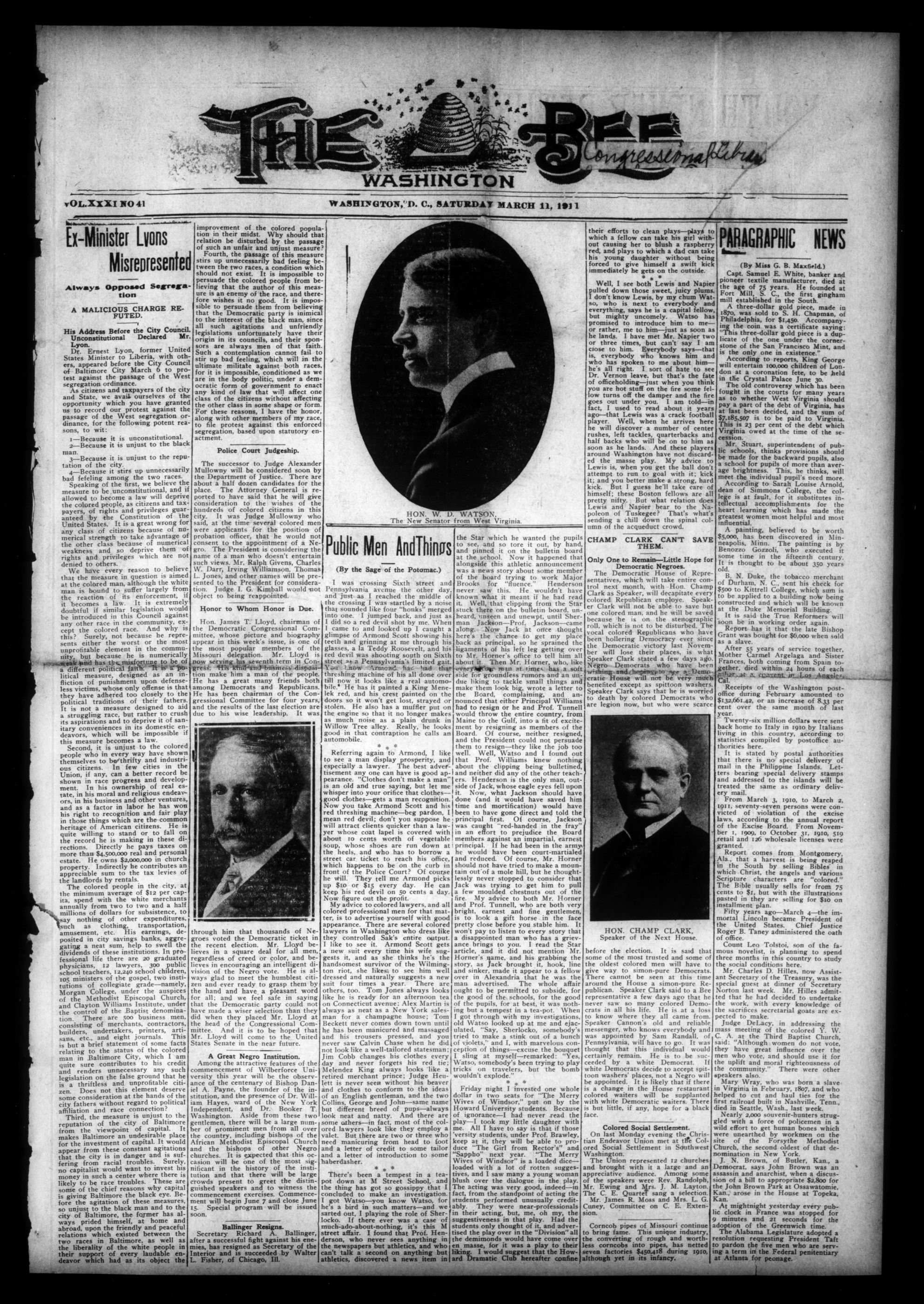
Ex-Minister Lyons Misrepresented
Always Opposed Segregation
A MALICIOUS CHARGE REFUTED.
His Address Before the City Council.
Unconstitutional Declared Mr. Lyon.
Dr. Ernest Lyon, former United States Minister to Liberia, with others, appeared before the City Council of Baltimore City March 6 to protest against the passage of the West segregation ordinance.
As citizens and taxpayers of the city and State, we avail ourselves of the opportunity which you have granted us to record our protest against the passage of the West segregation ordinance, for the following potent reasons, to wit:
1—Because it is unconstitutional.
2—Because it is unjust to the black man.
3—Because it is unjust to the reputation of the city
4—Because it stirs up unnecessarily
fearful among the two races.
Speaking of the first, we believe the measure to be unconstitutional, and if allowed to become a law will deprive the colored people, as citizens and tax-payers, of rights and privileges guaranteed by the Constitution of the United States. It is a great wrong for any class of citizens because of numerical strength to take advantage of the other class because of numerical weakness and so deprive them of rights and privileges which are not denied to others.
We have every reason to believe that the measure in question is aimed at the colored man, although the white man is bound to suffer largely from the reaction of its enforcement, if it becomes a law. It is extremely doubtful if similar legislation would be introduced in this Council against any other race in the community, except the colored race. And why is this? Surely, not because he represents either the worst or the most unprofitable element in the community, but because he is numerically weak and has the misfortune to be of a different political faith. It is a political measure, designed as an infliction of punishment upon defense-less victims, whose only offense is that they have adhered too closely to the political traditions of their fathers. It is not a measure designed to aid a struggling race, but rather to crush its aspirations and to deprive it of sanitary conveniences in its domestic endeavors, which will be impossible if this measure becomes a law.
Second, it is unjust to the colored people who in every way have shown themselves to be thrifty and industrious citizens. In few cities in the Union, if any, can a better record be shown in race progress and development. In his ownership of real estate, in his moral and religious endeavors, in his business and other ventures, and as a factor in labor he has won his right to recognition and fair play in those things which are the common heritage of American citizens. He is quite willing to stand or to fall on the record he is making in these directions. Directly he pays taxes on more than $4,500,000 real and personal estate. He owns $2,000,000 in church property. Indirectly he contributes an appreciable sum to the tax levies of the landlords by rentals.
The colored people in the city, at the minimum average of $12 per capita, spend with the white merchants annually from two to two and a half millions of dollars for subsistence, to say nothing of other expenditures, such as clothing, transportation, amusement, etc. His earnings, deposited in city savings banks, aggregating a neat sum, help to swell the dividends of these institutions. In professional life there are 20 graduated physicians, 12 lawyers, 300 public school teachers, 12,240 school children, 105 ministers of the gospel, two institutions of collegiate grade—namely, Morgan College, under the auspices of the Methodist Episcopal Church, and Clayton Williams Institute, under the control of the Baptist denomination. There are 500 business men, consisting of merchants, contractors, builders, undertakers, printers, artisans, etc., and eight journals. This is but a brief statement of some facts relating to the status of the colored man in Baltimore City, which I am quite sure contributes to his credit and renders unnecessary any such legislation on the false ground that he is a thriftless and unprofitable citizen. Does not this element deserve some consideration at the hands of the city fathers without regard to political affiliation and race connection?
Third, the measure is unjust to the reputation of the city of Baltimore from the viewpoint of capital. It makes Baltimore an undesirable place for the investment of capital. It would appear from these constant agitations that the city is in danger and is suffering from racial troubles. Surely, no capitalist would want to invest his money in such a center where there is likely to be race troubles. These are some of the chief reasons why capital is giving Baltimore the black eye. Before the agitation of these measures, so unjust to the black man and to the city of Baltimore, the former has always prided himself, at home and abroad, upon the friendly and peaceful relations which existed between the two races in Baltimore, as well as the liberality of the white people in their support of every laudable endeavor which had as its object the
improvement of the colored population in their midst. Why should that relation be disturbed by the passage of such an unfair and unjust measure? Fourth, the passage of this measure stirs up unnecessarily bad feeling between the two races, a condition which should not exist. It is impossible to persuade the colored people from believing that the author of this measure is an enemy of the race, and therefore wishes it no good. It is impossible to persuade them from believing that the Democratic party is inimical to the interest of the black man, since all such agitations and unfriendly legislations unfortunately have their origin in its councils, and their sponsors are always men of that faith. Such a contemplation cannot fail to stir up bad feeling, which will in the ultimate militate against both races, for it is impossible, conditioned as we are in the body politic, under a democratic form of government to enact any kind of law that will affect one class of the citizens without affecting the other class in some shape or form. For these reasons, I have the honor, along with other members of my race, to file protest against this enforced segregation, based upon statutory enactment.
Police Court Judgeship.
The successor to Judge Alexander Mullowny will be considered soon by the Department of Justice. There are about a half dozen candidates for the place. The Attorney General is reported to have said that he will give consideration to the wishes of the hundreds of colored citizens in this city. It was Judge Mullowny who said, at the time several colored men were applicants for the position of probation officer, that he would not consent to the appointment of a Negro. The President is considering the name of a man who doesn't entertain such views. Mr. Ralph Givens, Charles W. Darr, Irving Williamson, Thomas L. Jones; and other names will be presented to the President for consideration. Judge I. G. Kimball would not object to being reappointed.
Honor to Whom Honor is Due.
Hon. James T. Lloyd, chairman of the Democratic Congressional Committee, whose picture and biography appear in this week's issue, is one of the most popular members of the Missouri delegation. Mr. Lloyd is now serving his seventh term in Congress. His kind and business/disposition make him a man of the people. He has a great many friends both among Democrats and Republicans. He has been chairman of the Congressional Committee for four years, and the results of the last election are due to his wise leadership. It was
W. H.
through him that thousands of Negroes voted the Democratic ticket in the recent election. Mr. Lloyd believes in a square deal for all men, regardless of creed or color, and believes in encouraging an intelligent division of the Negro vote. He is always glad to meet the humbleest citizen and ever ready to grasp them by the hand and have a pleasant word for all; and we feel safe in saying that the Democratic party could not have made a wiser selection than they did when they placed Mr. Lloyd at the head of the Congressional Committee. And it is to be hoped that Mr. Lloyd will come to the United States Senate in the near future.
A Great Negro Institution.
Among the attractive features of the commencement of Wilberforce University this year will be the observance of the centenary of Bishop Daniel A. Payne, the founder of the institution, and the presence of Dr. William Hayes, ward of the New York Independent, and Dr. Booker T. Washington. Aside from these two gentlemen, there will be a large number of prominent men from all over the country, including bishops of the African Methodist Episcopal Church and the bishops of other Negro churches. It is expected that this occasion will be one of the most significant in the history of the institution and that there will be large crowds present to greet the distinguished speakers and to witness the commencement exercises. Commencement will begin June 7 and close June 15. Special program will be issued soon.
Ballinger Resigns.
Secretary Richard A. Ballinger, after a successful fight against his enemies, has resigned as Secretary of the Interior and is succeeded by Walter L. Fisher, of Chicago, Ill.
WASHINGTON
WASHINGTON, D. C., SAT
HON. W. D. NATHANSON
HON. W. D. WATSON
The New Senator from West Virginia.
Public Men And Things
(By the Sage of the Potomac.)
I was crossing Sixth street and Pennsylvania avenue the other day, and just as I reached the middle of the crossing I was startled by a noise that sounded like four "honks" merged into one. I jumped back, and just as I did so a red devil shot by me. When I came to and looked up I caught a glimpse of Armond Scott showing his teeth and grinning at me through his glasses, a la Teddy Roosevelt, and his red devil was shooting south on Sixth street a Pennsylvania's limited gait. You know Armond has had that threshing machine of his all done over till now it looks like a real automobile. He has it painted a King Menelek red, and his crest painted on the doors so it won't get lost, strayed or stolen. He also has a muffler put on the engine so that it no longer makes as much noise as a plain drunk in Willow Tree alley. Really, he looks good in that contraption he calls an automobile.
Referring again to Armond, I like to see a man display prosperity, and especially a lawyer. The best advertisement any one can have is good appearance. "Clothes don't make a man" is an old and true saying, but let me whisper into your orifice that clothes—good clothes—gets a man recognition. Now you take Armond Scott and his red threshing machine—beg pardon, I mean red devil; don't you suppose he will attract clients quicker than a lawyer whose coat lapel is covered with about 10 cents worth of vegetable soup, whose shoes are run down at the heels, and who has to borrow a street car ticket to reach his office, which happens to be on the curb in front of the Police Court? Of course he will. They tell me Armond picks up $10 or $15 every day. He can keep his red devil on 50 cents a day. Now figure out the profit.
My advice to colored lawyers, and all colored professional men for that matter, is to advertise yourself with good appearance. There are several colored lawyers in Washington who dress like they controlled Sak's entire output I like to see it. Armond Scott gets a new suit every time his wife suggests it, and as she thinks he's the handsomest survivor of the Wilmington riot, she likes to see him well dressed and naturally suggests a new suit four times a year. There are others, too. Tom Jones always looks like he is ready for an afternoon tea on Connecticut avenue; Alex Martin is always as neat as a New York salesman for a champagne house; Tom Beckett never comes down town until he has been manicured and massaged and his trousers pressed, and you never saw Calvin Chase when he did not look like a well-tailored statesman; Jim Cobb changes his clothes every day and never forgets his red tie; Melendez King always looks like a retired merchant prince; Judge Heulett is never seen without his beaver and clothes to conform to the ideas of an English gentleman, and the two Collins, George and John—same name but different breed of pups—always look neat and natty. And there are some others—in fact, most of the colored lawyers look like they employ a valet. But there are two or three who need manicuring from head to foot and a letter of credit to some tailor and a letter of introduction to some haberdasher.
There's been a tempest in a teapot down at M Street School, and the thing has got so gossipy that I concluded to make an investigation. I got Watso—you know Watso, for he's a bird in such matters—and we sorted out. I playing the role of Sherlocko. If there ever was a case of much-ado-about-nothing, it's this M street affair. I found Prof. Henderson, who never sees anything in the newspapers but athletics, and who can't talk a second on anything but athletics, discovered a news item in
* *
SATURDAY MARCH 11, 1911
the Star which he wanted the pupils to see, and so tore it out, by hand, and pinned it on the bulletin board at the school. Now it happened that alongside this athletic announcement was a news story about some member of the board trying to work Major Brooks for "fluence." Henderson never saw this. He wouldn't have known what it meant if he had read it. Well, that clipping from the Star stuck there on the bulletin board, unheard, unseen and unewpt, until Sherman Jackson—Prof. Jackson—came along. Now Jack at once thought here's the chance to get my place back as principal, so he sprained the ligaments of his left leg getting over to Mr. Horner's office to tell him all about it. Then Mr. Horner, who like everyone, man at times has a soft side for groundless rumors and an undue liking to tackle small things and make them look big, wrote a letter to the Board, complaining, and announced that either Principal Williams had to resign or he and Prof. Tunnell would throw the entire country, from Maine to the Gulf, into a fit of excitement by resigning as members of the Board. Of course, neither resigned, and the President could not persuade them to resign—they like the job too well. Well, Watso and I found out that Prof. Williams knew nothing about the clipping being bulletined, and neither did any of the other teachers. Henderson is the only man, outside of Jack, whose eagle eyes fell upon it. Now, what Jackson should have done (and it would have saved him time and mortification) would have been to have gone direct and told the principal first. Of course, Jackson was caught "red-handed in the fray" in an effort to prejudice the Board members against an impartial, earnest principal. If he had been in the army he would have been court-martialed and reduced. Of course, Mr. Horner should not have tried to make a mountain out of a mole hill, but he thoughtlessly never stopped to consider that Jack was trying to get him to pull a few moulded chestnuts out of the fire. My advice to both Mr. Horner and Prof. Tunnell, who are both very bright, earnest and fine gentlemen, is to look a gift horse in the face pretty close before you stable him. It won't pay to listen to every story that a disappointed man who has a grievance brings to you. I read the Star article, and it did not mention Mr. Horner's name, and his grabbing the story, as Jack brought it, hook, line and sinker, made it appear to a fellow over in Alexandria that he was the man advertised. The whole affair ought to be permitted to subside, for the good of the schools, for the good of the pupils, for at best, it was nothing but a tempest in a tea-pot. When I got through with my investigations, old Watso looked up at me and ejaculated, "Say, Sherlocko, somebody's tried to make a stink out of a bunch of violets, and I, with marvelous conception of things—excuse the bouquet I slung at myself—remarked: "Yes, Watso, somebody's been trying to play tricks on travelers, but the bomb wouldn't explode."
Friday night I * invested one whole dollar in two seats for "The Merry Wives of Windsor," put on by the Howard University students. Because of ignorance—I had never read the play—I took my little daughter with me. All I have to say is that if those 'versity students, under Prof. Brawley, keep at it, they will be able to produce "The Girl from Rector's" and "Sappho" next year. "The Merry Wives of Windsor" is a loaded dice—loaded with a lot of rotten suggestives, and I saw many a young woman blush over the dialogue in the play. The acting was very good, indeed—in fact, from the standpoint of acting the students performed unusually creditably. They were near-professionals in their acting, but, me, oh my, the suggestiveness in that play. Had the students only thought of it, and advertised the play over in the "Division" all the demimonds would have come over en masse, for it was a play to their liking. I would suggest that the Howard Dramatic Club hereafter confine
their efforts to clean plays—plays to which a fellow can take his girl without causing her to blush a raspberry red, and plays to which a dad can take his young daughter without being forced to give himself a swift kick immediately he gets on the outside.
Well, I see both Lewis and Napier pulled down those sweet, juicy plums. I don't know Lewis, by my chum Watso, who is next to everybody and everything, says he is a capital fellow, but mighty uncomely. Watso has promised to introduce him to me or rather, me to him—just as soon as he lands. I have met Mr. Napier two or three times, but can't say I am close to him. Everybody says—that is, everybody who knows him and who has spoken to me about him—he's all right. I sort of hate to see Dr. Vernon leave, but that's the fate of officeholding—just when you think you are hot stuff on the fire some fellow turns off the damper and the fire goes out under you. I am told—in fact, I used to read about it years ago—that Lewis was a crack football player. Well, when he arrives here he will discover a number of center rushes, left tackles, quarterbacks and half backs who will be on to him as soon as he lands. And these players around Washington have not discarded the masse play. My advice to Lewis is, when you get the ball don't attempt to run to goal with it; kick it; and you better make a strong, hard kick. But I guess he'll take care of himself; these Boston fellows are all pretty nifty. But what relation does Lewis and Napier bear to the Napoleon of Tuskegee? That's what's sending a chill down the spinal column of the acqueduct crowd.
CHAMP CLARK CAN'T SAVE
THEM.
Only One to Remain—Little Hope for Democratic Neroes.
The Democratic House of Representatives, which will take entire control next month, with Hon. Champ Clark as Speaker, will decapitate every colored Republican employee. Speaker Clark will not be able to save but one colored man, and he will be saved because he is on the stenographic roll, which is not to be disturbed. The vocal colored Republicans who have been hollering Democracy ever since the Democratic victory last November will lose their places, is what Speaker Clark stated a few days ago. Negro Democrats who have been wishing and hoping to see a Democratic House will not be very much benefited except as spittoon washers. Speaker Clark says that he is worried to death by colored Democrats who are legion now, but who were scarce
HON. CHAMP CLARK,
Speaker of the Next House.
before the election. It is said that some of the most trusted and some of the oldest colored men will have to give way to simon-pure Democrats. There cannot be seen at this time around the House a simon-pure Republican. Speaker Clark said to a Bee representative a few days ago that he never saw so many colored Democrats in all his life. He is at a loss to know where they all came from. Speaker Cannon's old and reliable messenger, who knows everybody and was appointed by Sam Randall, of Pennsylvania, will have to go. It was thought that this individual would certainly remain. He is to be succeeded by a white Democrat. If white Democrats decide to accept spittoon washers' places, not a Negro will be appointed. It is likely that if there is a change in the House restaurant colored waiters will be supplanted with white Democratic waiters. There is but little, if any, hope for a black face.
Colored Social Settlement
On last Monday evening the Christian Endeavor Union met at tife Colored Social Settlement in Southwest Washington.
The Union represented 12 churches and brought with it a large and an appreciative audience. Among some of the speakers were Rev. Randolph, Mr. Ewing and Mrs. J. M. Layton. The C. E. Quartet sang a selection. Mr. James R. Moss and Mrs. L. G. Cuney, Committee on C. E. Extension.
Corncob pipes of Missouri continue to bring fame. This unique industry, the converting of rough and worthless corncobs into pipes, has netted seven factories $450,418 during 1910, although yet in its infancy.
(By Miss G. B. Maxfield.)
Capt Samuel E. White, banker and pioneer textile manufacturer, died at the age of 75 years. He founded at Fort Mill, S. C., the first gingham mill established in the South.
A three-dollar gold piece, made in 1870, was sold to S. H. Chapman, of Philadelphia, for $1,450. Accompanying the coin was a certificate saying: "This three-dollar gold piece is a duplicate of the one under the cornerstone of the San Francisco Mint, and is the only one in existence."
According to reports, King George will entertain 100,000 children of London at a coronation fete, to be held in the Crystal Palace June 30.
The old controversy which has been fought in the courts for many years as to whether West Virginia should pay a part of the debt of Virginia, has at last been decided, and the sum of $7,185,507 is to be paid to Virginia. This is 23 per cent of the debt which Virginia owed at the time of the secession.
Mr. Stuart, superintendent of public schools, thinks provisions should be made for the backward pupils, also a school for pupils of more than average brightness. This, he thinks, will meet the individual pupil's need more.
According to Sarah Louise Arnold, dean of Simmons College, the college is at fault, for it substitutes intellectual accomplishments for the heart learning which has made the greatest women most helpful and most influential.
A painting, believed to be worth $5,000, has been discovered in Minneapolis, Minn. The painting is by Benozzo Gozzoli, who executed it some time in the fifteenth century. It is thought to be about 350 years old. B. N. Duke, the tobacco merchant of Durham, N. C., sent his cheek for $500 to Kittrell College, which sum is to be applied to a building now being constructed and which will be known at the Duke Memorial Building. It is said the True Reformers will soon be in working order again. Report has it that the late Bishop Grant was bought for $6,000 when sold as a slave. After 55 years of service together, Mother Carmel Argelaga and Sister Frances, both coming from Spain together, died within 24 hours of each other at a convent in Los Angeles, Cal. Receipts of the Washington post-office during February amounted to $132,661.42, or an increase of 8.33 per cent over the same month of last year. Twenty-six million dollars were sent back home to Italy in 1910 by Italianans living in this country, according to statistics compiled by postoffice authorities here. It is stated by postal authorities that there is no special delivery of mail in the Philippine Islands. Letters bearing special delivery stamps and addressed to the islands will be treated the same as ordinary delivery mail.
From March 3, 1910, to March 2, 1911, seventy-seven persons were convicted of violation of the excise laws, according to the annual report of the Excise Board. From November 1, 1900, to October 31, 1910, 519 retail and 126 wholesale licenses were granted.
Report comes from Montgomery, Ala., that a harvest is being reaped in the South by selling Bibles in which Christ, the angels and various Scripture characters are "colored." The Bible usually sells for from 75 cents to $1, but with the illustrations pasted in they are selling for $10 on installment plan.
Fifty years ago—March 4—the immortal Lincoln became President of the United States. Chief Justice Roger B. Taney administered the oath of office.
Count Leo Tolstoi, son of the famous novelist, is planning to spend three months in this country to study the social conditions here.
Mr. Charles D. Hilles, now Assistant Secretary of the Treasury, was the special guest at dinner of Secretary Norton last week. Mr. Hilles admitted that he had decided to undertake the work, with every knowledge of the sacrifices secretarial goats are expected to make.
Judge DeLacy, in addressing the mass meeting of the colored Y. W. C. A. at the Third Baptist Church, said: "Although women do not vote, they have great influence over the men who vote, and should use it for the uplift and moral righteousness of the community." There were other speakers also.
Mary Wray, who was born a slave in Virginia in February, 1807, and who helped to cut and haul ties for the first railroad built in Nashville, Tenn., died in Seattle, Wash., last week.
Nearly 2,000 souvenir-hunters struggled with a force of policemen in a wild effort to get human bones which were unearthed by workmen on the site of the Forsythe Methodist Church, the second oldest of that denation in New York.
J. N. Brown, of Butler, Kan., a Democrat, says John Brown was an assassin and anarchist, when a discussion of a bill to appropriate $2,800 for the John Brown Park at Ossawatomie, Kan., arose in the House at Topeka, Kan.
At mightnight yesterday every public clock in France was stopped for 9 minutes and 21 seconds for the adoption of the Greenwich time.
The Alabama Legislature adopted a resolution requesting President Taft to pardon the five men who are serving a term in the Federal penitentiary at Atlanta for peonage.
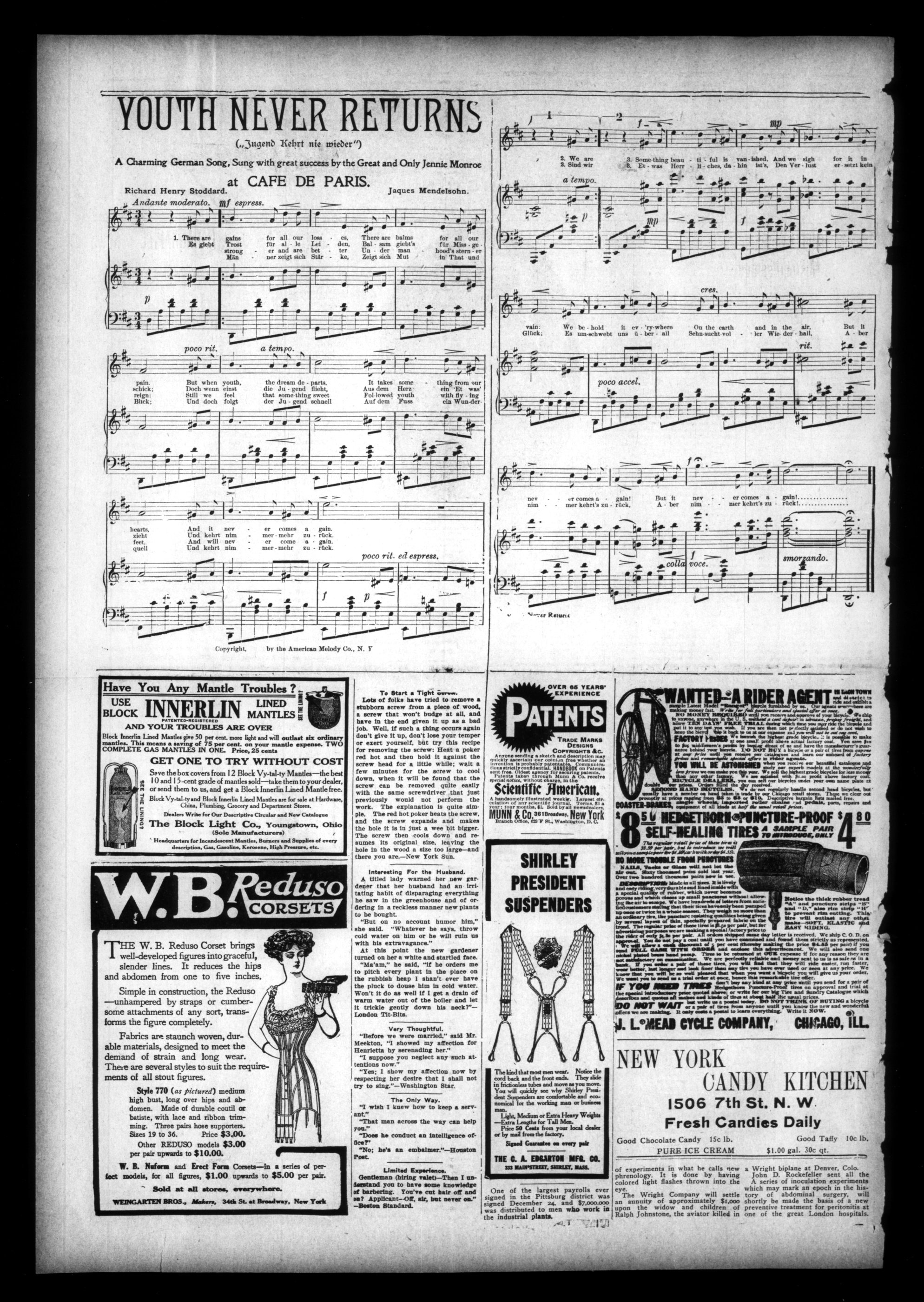
YOUTH NEVER RETURNS
A Charming German Song, Sung with great success by the Great and Only Jennie Monroe at CAFE DE PARIS.
Andante moderato. mf espress.
1. There are gains for all our losses, There are balms for all our Es giebt Trost für al-le Lei-den, Bal-sam giebt's für Miss-ge-strong er and are bet-ter Un-der man hood's stern-er Man ner zeigt sich Stärke, Zeigt sich Mut in That und
poco rit. a tempo.
pain. But when youth, the dream de- parts, It takes some thing from our schick; Doch wenn einst die Ju-gend flieht, Aus dem Herz ein 'Et was' reign: Still we feel that some thing sweet Fol lowed youth with fly-ing Blick; Und doch folgt der Ju-gend schnell Auf dem Fuss ein Wun-der
hearts, And it nev- er comes a gain. zieht Und kehrt nim mer-mehr zu- rück. feet. And will nev- er come a gain. quell Und kehrt nim mer-mehr zu- rück.
poco rit. ed espress.
Block Innerlin Lined Mantles give 50 per cent, more light and will outlast six ordinary mantles. This means a saving of 75 per cent, on your mantle expense. TWO COMPLETE GAS MANTLES IN ONE. Price, 25 cents
GET ONE TO TRY WITHOUT COST
Save the box covers from 12 Block Vy-tal-ty Mantles—the best 10 and 15-cent grade of mantles sold—take them to your dealer, or send them to us, and get a Block Innerlin Lined Mantle free.
Block Vy-tal-ty and Block Innerlin Lined Mantles are for sale at Hardware, China, Plumbing, Grocery and Department Stores.
Dealers Write for Our Descriptive Circular and New Catalogue
The Block Light Co., Youngstown, Ohio
(Sole Manufacturers)
Headquarters for Incandescent Mantles, Burners and Supplies of every description, Gas, Gasoline, Kerosene, High Pressure, etc.
W. B. Nuform and Erect Form Corsets—in a series of perfect models, for all figures, $1.00 upwards to $5.00 per pair. Sold at all stores, everywhere. WEINGARTEN BROS., Makers, 34th St. at Broadway, New York
SEE THE LINING?
THE W. B. Reduso Corset brings well-developed figures into graceful, slender lines. It reduces the hips and abdomen from one to five inches.
Simple in construction, the Reduso unhampered by straps or cumbersome attachments of any sort; transforms the figure completely.
Fabrics are staunch woven, durable materials, designed to meet the demand of strain and long wear. There are several styles to suit the requirements of all stout figures.
Style 770 (as pictured) medium high bust, long over hips and abdomen. Made of durable coutil or batiste, with lace and ribbon. trimming. Three pairs hose supporters. Sizes 19 to 36. Price $3.00. Other REDUSO models $3.00 per pair upwards to $10.00.
IN THE LUNCH
and will outlast six ordinary your mantle expense. TWO 25 cents
WITHOUT COST
Ky Vy-tal-ty Mantles—the best sold—take them to your dealer, back Innerlin Lined Mantle free.
Mantles are for sale at Hardware, and Department Stores.
Circular and New Catalogue
D., Youngstown, Ohio (acturers)
Burners and Supplies of every osene, High Pressure, etc.
Peduso CORSETS
al,
ips
es.
quire-
ets-in a series of per- rds to $5.00 per pair. anywhere. at Broadway, New York
To Start a Tight Grow.
Lots of folks have tried to remove a stubborn screw from a piece of wood, a screw that won't budge at all, and have in the end given it up as a bad job. Well, if such a thing occurs again don't give it up, don't lose your temper or exert yourself, but try this recipe for removing the screw: Heat a poker red hot and then hold it against the screw head for a little while; wait a few minutes for the screw to cool down, when it will be found that the screw can be removed quite easily with the same screwdriver that just previously would not perform the work. The explanation is quite simple. The red hot poker heats the screw, and the screw expands and makes the hole it is in just a wee bit bigger. The screw then cools down and resumes its original size, leaving the hole in the wood a size too large—and there you are.—New York Sun.
A titled lady warned her new gardener that her husband had an irritating habit of disparaging everything he saw in the greenhouse and of ordering in a reckless manner new plants to be bought.
"But on no account humor him," she said. "Whatever he says, throw cold water on him or he will ruin us with his extravagance."
At this point the new gardener turned on her a white and startled face. "Ma'am," he said, "if he orders me to pitch every plant in the place on the rubbish heap I shan't ever have the pluck to douse him in cold water. Won't it do as well if I get a drain of warm water out of the boiler and let it trickle gently down his neck?"—London Tit-Bits.
Very Thoughtful.
"Before we were married," said Mr. Meekton, "I showed my affection for Henrietta by serenading her." "I suppose you neglect any such attentions now."
"Yes; I show my affection now by respecting her desire that I shall not try to sing."—Washington Star.
"I wish I knew how to keep a servant."
"That man across the way can help you."
"Does he conduct an intelligence officer?"
"No; he's an embalmer."—Houston Post.
Limited Experience.
Gentleman (hiring valet)—Then I understand you to have some knowledge of barbering. You've cut hair off and on? Applicant—Off, sir, but never on." —Boston Standard.
2. We are
2. Sind wir
3. Something beau - ti - ful is van - ished. And we sigh for it in
8. Et - was Herr - li - ches, da - hin ist's, Den Ver - lust er - setzt kein
a tempo.
cres.
vain: We be - hold it ev - ry-whero On the earth and in the air, But it
Glück; Es um-schwebt uns ü - ber - all Sehn-sucht-vol - ler Wie - der - hall, A - ber
rit.
poco accel.
nev - er comes a - gain! But it nev - er comes a - gain!...
nim - mer kehrt's zu - rück, A - ber nim - mer kehrt's zu - rück!...
colla voce.
smorzando.
OVER 65 YEARS' EXPERIENCE
PATENTS
TRADE MARKS
DESIGNS
COPYRIGHTS & C.
Anyone sending a sketch and description may quickly ascertain our opinion free whether an invention is probably patentable. Communications strictly confidential. HANDBOOK on Patents sent free. Other secretive publications. Patents taken through Bunn & Co. receive special notice, without charge, in the Scientific American.
A handsomely illustrated weekly. Largest circulation of the scientific journal. Terms, $1 a year; four months, $1. Sold by all newsletters.
MUNN & Co. 361 Broadway, New York
Branch Office, 65 F. St. Washington, D. C.
SHIRLEY
PRESIDENT
SUSPENDERS
M
The kind that most men wear. Notice the cord back and the front ends. They slide in frictionless tubes and move as you move. You will quickly see why Shirley President Suspenders are comfortable and economical for the working man or business man.
Light, Medium or Extra Heavy Weights
—Extra Lengths for Tall Men.
Price 50 Cents from your local dealer
or by mail from the factory.
THE C. A. EDGARTON MFQ. CO.
233 MAIN STREET, SHIRLEY, MASS.
One of the largest payrolls ever signed in the Pittsburg district was signed December 24, and $7,000,000 was distributed to men who work in the industrial plants.
SECOND HAND BICYCLES. We do not regularly handle second hand bicycles, but usually have a number on hand taken in trade by our Chicago retail stores. These we clear out promptly at prices reasonable, imported polar leather burgers lits mailed free COASTER-BRAKES, component of all bikes at half the usual retail price.
the riders of only 50 per pair. All orders shipped same day letter is received. We ship C O D. on approval. You do not pay a cent until you have examined and found them strictly as represented. We will allow a cash discount of 5 per cent (thereby making the price $4.65 per pair) if you send FULL CASH WITH ORDER and endorse this advertisement. We will also send one initial placed brace hand pump. Tires to be returned at OUR expense if for any reason they are not satisfactory on examination. We are perfectly reliable and money sent to us as safe in a bank. If you order a pair of these tires, you will find that they will ride easier, run faster, wear better, last longer and look finer than any tire you have ever used or at any price. We know that you will be so well pleased that when you want a bicycle you will give us your order. We want you to send us a trial order at once, believe this remarkable tire offer.
describes and quotes all makes and knows of fires and the truth of prices
but write us a postal letter. DO NOT THINK OF BUYING a bicycle
or a pair of tires from anyone until you know the new and wonderful
office supplies. It only sends a postal to learn everything. Write it NOW.
NEW YORK CANDY KITCHEN 1506 7th St. N. W. Fresh Candies Daily
$35.90 per pair, but in retreads we will sell you a sample pair for $20.00 plus order $20.00
NO MODELE TRUST FROM PETROURES
NAILS, Tweaks or Glass will not let the air out. Sixty thousand pairs sold last year.
Over two hundred thousand pairs new in toc.
RECORDABLES Made in all sizes. It is livable and easy riding, very durable and hand made will
a special quality of rubber, which never becomes porous and which closes up small panesets without allowing the air to escape. We have hundreds of letters from satisfied customers stating that their tires have been pumped up once or twice in a whole season. They weigh no more than an ordinary tire, the puncture can be sealed by sealing it by injection, and the tires are usually prepared fabric on the surface. The regular price of these tires is $5 per pair, but for suburban tires we are making a special /accent price to
the rider of only $10 per pair. All orders shipped same day approval. You do not pay a cent until you have commenced it. We will allow a cash discount of 5 per cent thereby must send FULL CASH WITH ORDER and encash this a metal plated house hand pump. Tires to be returned at G not manufactory on commission. We are perfectly reliable bank. If you order a pair of these tires, you will find your better, not longer and look finer than any tire you have known that you will be so well pleased that when you want we want you be send us a trial order at stock because don't buy any kind of IF YOU NEED TIRES Hedgehorn Puncture the special introductory price quoted above; or write for descrbes and quotes all makes and kinds of tires at about DO NOT WAIT but write us a postal notice. DO NOT WAIT or a pair of tires from anyone offers we are making. It only costs a postal to learn every J. L. HEAD CYCLE COMPANY
NEW YORK
CANDY
1506 7th St.
Fresh Candy
Good Chocolate Candy 15c lb. PURE ICE CREAM of experiments in what he calls new phrenology. It is done by having colored light flashes thrown into the eye.
The Wright Company will settle tory an annuity of approximately $1,000 shortly upon the widow and children of preven Ralph Johnstone, the aviator killed in one o
Notice the thick rubber tread
"A" and puncture strips "H"
and "D," also rim strip "If"
to prevent rim cutting. This
tire will outlast any other
make—HFT, ELASTIC and
EASY HIDING.
many day letter is received. We ship C O D. on
named and found them strictly as represented
lovely making the price $4.55 per pair if you
are this advertisement. We will also send one
used at OUR expense if for any reason they are
reliable and money seat to us as safe as in a
ill and that they will ride easier, run faster,
you have ever used or seen at any price. We
you want a bicycle you will give us your order,
this remarkable tire offer.
any kind at any price until you send for a pair of
Puncture-Proof tires on approval and trial at
date for over big Tire and Sundry Catalogue which
at show hold the usual price.
any. DO NOT THENK OF BUYING a bicycle
anyone until you know the new and wonderful
is everything. Write it NOW.
PANY, CHICAGO, ILL.
DY KITCHEN
St. N. W.
dies Daily
Good Taffy 10c lb.
$1.00 gal. 30c qt.
a Wright biplane at Denver, Colo.
John D. Rockefeller sent all the
A series of inoculation experiments
which may mark an epoch in the history
of abdominal surgery, will
shortly be made the basis of a new
preventive treatment for peritonitis at
one of the great London hospitals.
The Bella Coola Believe There Are Five Worlds and Are Worshipers of the Sun.
There is an odd feature in the theology of the small Indian tribe of the Bella Coola which inhabit British Columbia in about latitude 52. They believe that there are five worlds, one above the other, and the middle one is our own world, the earth. Above it are two heavens, and under it are two underworlds. In the upper heaven is the supreme delity, who is a woman, and she doesn't meddle much with the affairs in the second world below her. The zenith is the center of the lower heaven, and here is the house of the gods, in which live the sun and the rest of the delites.
Our own earth is believed to be an island swimming in the ocean. The first underworld from the earth is inhabited by ghosts, who can return, when they wish, to heaven, from which place they may be sent down to our earth. If then they misbehave again they are cast into the lower of the underworlds, and from this bourn no ghostly traveler returns.
The Bella Coola are sun worshipers, for Senex, the sun, the master of the house of gods, who is called the father and the sacred one, is the only deity to whom the tribe pray. Each family of the Bella Coola has its own traditions and its own form of the current traditions, so that in the mythology of the tribe there are countless contradictions. When any one not a member of a clan tries to tell a tradition which does not belong to his clan it is like a white man trying to tell another's joke—he is considered as appropriating the property right which does not belong to him.
SMOKELESS POWDER
It Came Through Experimenting For High Excelsior.
The idea is very general that smokeless powder in being practically smokeless achieves its greatest end, but as a matter of fact its smokeless feature is incidental and was an accident. When the idea of modern long range guns was conceived it was at once apparent that the old black powder lacked explosive force, and thousands of experiments were made with various chemicals to procure a powder of high explosive properties, and this was at last accomplished.
When the new powder was tried, much to the surprise of every one it was found that practically no smoke followed the explosion, though this could of course have been predicted had the question ever arisen. The volume of smoke from black powder is due mainly to the quantity of charcoal in the powder, an ingredient not found in the smokeless explosive. Smokeless powder, though a great boon to the sportsman, is of questionable value on the battlefield, so far as its smokelessness is concerned. The smoke clouds of old days were frequently most advantageously used to cloak movements of troops and batteries and really interfered with the enemy much more than with the troops creating the smoke—Exchange.
Saved by Firefiles.
The gigantic tropical firefiles which swarm in the forests and canebrakes of most of the low lying West Indian islands once proved the salvation of the city of Santo Domingo. A body of buccaneers, headed by the notorious Thomas Cavendish, had laid all their plans for a descent upon the place, intending to massacre the inhabitants and carry away all the treasure they conveniently could, and had actually put off their boats for that purpose. As they approached the land, however, rowing with muffled oars, they were greatly surprised to see an infinite number of moving lights in the woods which fringed the bayon up which they had to proceed, and, concluding that the Spaniards knew of their approach, they put about and regained their ship without attempting to land.
The Wonderful Banana.
Some people believe that the banana was the original forbidden fruit of the garden of Eden. In any case it is one of the curiosities of the vegetable kingdom, being not a tree, a palm, a bush, a shrub, a vegetable or a herb, but a herbaceous plant with the status of a tree. Although it sometimes attains a height of thirty feet, there is no woody fiber in any part of its structure, and the bunches growing on the dwarf banana plant are often heavier than the stalk which supports them. No other plant gives such a quantity of food to the acre as the banana. It yields 44 times more by weight than the potato and 133 times more than wheat. Moreover, no insect will attack it, and it is always immune from diseases of any kind.
Convinced.
"Do you think a college education helps a man in business?"
"Sure. I've had two college boys here workin' for me durin' the past year, and I was afraid to discharge either one of 'em for fear they'd find fault with my grammar when I done it."—Chicago Record-Herald.
Following Orders:
·Charlie—What have you been doing to your face, dear boy? Percy—I tried to shave myself this morning. g. Charlie—What on earth for? Percy—The doctor told me that I ought to take more exercise—Illustrated Bita.
At Cross Purposes
Scott—Half the people in the world don't know what the other half are doing. Mott-No; that is because the other half are doing them. Boston Transcript.
KANGAROO MEAT.
The Native Youngsters of New Guinea Had a Good Reason For Refusing to Eat It.
In certain parts of New Guinea the wallaby, a species of kangaroo, are very plentiful, and the traveler in search of sport finds the pursuit of them an exciting occupation. Wallaby steak is a refreshing, change from canned meats, and the natives are only too glad to have the remnants of the carcass. A writer in an English magazine tells an amusing incident connected with the animal.
He had been ashore in one of the sparsely populated regions of the coast and secured four wallaby, an ample supply for the whole party, native guides and servants included. But he found that, although wallaby is regarded as such a delicacy that no trouble is considered too great to obtain it, none of the native boys in the party would touch it.
This was a mystery until one of them explained that they had been trained in childhood in the belief that if they ate wallaby before reaching a certain age it would stop their growth.
These boys all belonged to the part of the country where wallaby are few, and one can imagine the crafty old folks seated round the festive pot and winking at one another as the young people declared the succulent daisy.
LACEMAKING.
An Old Legend That Tells of the Origin of the Art.
Lacemaking is by no means so old an industry as most persons suppose. There is no proof that it existed previous to the fifteenth century, and the oldest known painting in which it appears is a portrait of a lady in the academy at Venice painted by Casparia, who died about 1523. The legend concerning the origin of the art is as follows:
A young fisherman of the Adriatic was betrothed to a young and beautiful girl of one of the lakes of the lagoon. Industrious as she was beautiful, the girl made a new net for her lover, who took it with him on board his boat. The first time he cast it late the sea he dragged there from an exquisite petrified wrack grass, which he hastened to present to his fances; but, war breaking out, the fisherman was pressed into the service of the Venetion navy. The poor girl wept at the departure of her lover and contemplated his last gift to her. While absorbed in following the intricate tracery of the wrack grass she began to twist and plait the threads weighted with small beads which hung around her net. Little by little she wrought an imitation of the petrification, and thus was created the bobbin lace.
Too Realistic.
During a performance of "Captain Lapalisse" at a Valencia theater some years ago an incident occurred which for lifelike effect left nothing to be desired. During the said play some of the actors mingle with the spectators in order to co-operate from the body of the house. No sooner had Miralles, the actor, taken his seat in the stalls than a daring pickpocket robbed him of his gold watch. Miralles seized the man by his coat collar and called out in a deep bass voice: "Police! Help! Thieves!"
The audience, taking this little episode to be part of the performance, roared with laughter. Even the policemen joined in without stirring hand or foot.
"This is no farce!" cried the actor in tones of despair. "The fellow has got my watch!"
] The voice sounded so natural that the audience broke into loud applause at "ruch excellent fooling." Meanwhile the thief managed to break away from his captor and escaped.
A Judicial Expert
The native with a stogie met the native with a pipe.
"Howdy, ZebY" quoth the stogie native. "Hear 'bout th' fuss down to th' courthouse?
"Nope," drawled the man with the pipe. "What was it about?"
"Why, Jim Simpson has been suin' Abner Hawley for alienatin' th' affections of his wife, an' Judge Musgrove told th' jury to bring in a verdick of 6 cents damages, 'cause he thought that was all the damage was worth to Jim. An' Jim's wife got mad an' threw a chair at th' jedge, an' he had her arrested an' put in th' cooler."
"But didn't th' jedge go a leetle too far when he fixed her value so low?"
"Not at all, not at all! You see, he was her first husband."—Cleveland Plain Dealer.
Singer and Orator
"If I had my way." Dr. Macnamara once confessed to an intervieweer, "I should be singing in 'Carmen' instead of making speeches from the treasury bench, but unfortunately the British public thinks a great deal more of a man who can make a bad speech than a man who can sing a good song."—Westminster Gazette.
To Reform Him.
Minister—You say you are going to marry a man to reform him. That is noble. May I ask who it is? Miss Beauti—It's young Mr. Bondclipper. Minister—Indeed! I did not know he had any bad habits. Miss Beauti—Yes; his friends say that he is becoming quite miserly.
Anticipation
"Doesn't it make you the least bit envious to see what elegant furniture Mrs. Eyefy is putting into her house next door?"
"Not a bit. My husband says it will be sold by the sheriff within six months—and I'll be there to buy it"—Chicago Tribune.
JAPANESE ENGLISH.
A Sample Circular Composed by a Native Tradesman With an Observation on the Servant Problem.
There comes from a correspondent in Japan this example of circulars in English that Japanese tradesmen sometimes compose:
"Dear Sir—I have the honour to write a letter for you that I have now established the meat market and its branch to deliver the meat as one of the branch of my slougher house, as which I have many cattle, their pastures, their markets, milk houses, and a slougher house, etc., and I will have a fresh meat with the most cheapest price from my slougher house than other buchery and especially make you many reduction for every day purchaser for month. I beg you can soon make me your order without your servant's commission. 'as you know your servant is always making money by your meat.' I will make you the pass-book for the creditor only.
"P. S.—If you handed bad meat from your servant while you are making purchases the meat from my market every day, you will soon to let it exchange by the servant without any hesitation. Please make me your order, and if you can take me order by letter I will have the postage reduction from the count of meat with kind regards. Your truly."—Boston Transcript.
THE DELI GE
Queen Old Australian Traction About the Flood.
The aboriginal blacks of Australia have a queer tradition about the flood. They say that at one time there was no water on the earth at all except is the body of an immense frog, where men and women could not get at it. There was a great council on the subject, and it was found out that if the frog could be made to laugh the waters would run out of his mouth and the drought be ended.
So several animals were made to dance and caper before the frog to induce him to laugh, but he did not even bathe, and so the waters remained in his body. Then some one happened to think of the queer contortions into which the eel could twist itself, and it was straightway brought before the frog, and when the frog saw the wriggling he laughed so loud that the whole earth trembled, and the waters poured out of his mouth in a great flood, in which many people were drowned.
The black people were saved from drowning by the palican. This thoughtful bird made a big canoe and went with it among all the islands that appeared here and there above the surface of the water and gathered in the black people and saged them.
Curiosities of Superstition.
When Egypt was in the height of her power, when she was most highly civilized and delighted in being called the mistress of the land and sea, her people worshiped a black bull. There was some discrimination, however, even in this form of worship. In order to be an object of mad adoration it was necessary that the bull calf be born with a circular white spot in the exact center of his forehead, and the advent of such a creature in any herd was the signal of wild demonstrations from the Mediterranean to the border of the Lybian desert. Even as late as the time of Cleopatra, star eyed goddess, glorious sorceress of the Nile, such animals were shod with gold and had their horns tipped with the same metal. Herodotus tells of a man who died with grief because he sold a cow that soon after became the mother of a black bull calf marked with the sacred white circle in his forehead.
Load Pencil E. eriments
An English statistician was asked how many words could be written with an English lead pencil, and, being determined to answer it, he bought a lead pencil and Scratch "Ivanhoe" and proceeded to copy as latter word by word. He wrote 95,606 words and then was obliged to stop, for the pencil had become so short that he could not use it. A German statistician who board of this experiment was dissatisfied with it because all the lead in the pencil was not used on the work, and therefore he bought a pencil and started to copy a long German novel. When the pencil was so short that he could not handle it with his fingers he attached a holder to it, and it is said that he wrote with this one pencil 400,000 words. Possibly, however, his pencil was longer or the lead in it was of a more durable quality.
When Silence Is Deadly.
Silence is commonly the slow poison used by those who mean to murder love. There is nothing violent about it. No shock is given. Hope is not abruptly strangled, but merely dreams of evil and fights with gradually stifling shadows. When the last convulsions come they are not terrific. The frame has been weakened for dissolution. Love dies like natural decay. It seems the kindest way of doing a cruel thing.-George Meredith.
Bubbing It In.
The Bride—That nasty Mrs. Jones, next door, said I'd better try these biscuits on the dog before I gave 'em to you. The Groom—Hann't she got a mean disposition! Why, I thought she was fond of dogs!—Cleveland Leader.
Often the Case.
Silicus—What do you suppose caused him to go to the bad? Cynicus—Trying to be a good fellow.—Philadelphia Record.
The fool's ear was made for the knave's tongue.—Ramaswami's "Indian Fables."
MCALL PATTERNS
10
15
MORE HIGHER
MCALL'S MAGAZINE
50
YEAR
INCLUDING A FREE PATTERN
MeCALL PATTERNS
Celebrated for style, perfect fit, simplicity and
reliability nearly 40 years. Sold nearly
every city and town in the United States and
Canada, or by mail direct. More sold than
any other make. Send for free catalogue.
McCALL'S MAGAZINE
More subscribers than any other fashion magazine—million a month. Invaluable. Latest styles, patterns, dressmaking, military, plaid sewing, fancy needlework, hairdressing, quilting, good stitching. One Day 40 cents a year (worth double), including a free part. Subscribe today or send for sample copy.
WONDERFUL INDUCEMENTS
to Attends. Postal brings premium toogue and new cash prize offers. Address.
ECALC CO. 228 to 243 W. 371 S. NEW YORK
THE BEER AND MCCALL'S GREAT
FASHION MAGAZINE
for one year for $200.
COUPON@.
Editor Bea—
Find enclosed two dollars. Send to my address below The Bee and M-Call's Fashion Magazine for one year.
No.....
Street.....
Town or City.....
.....
BUY THE
NEW HOME
SEWING MACHINE
Before You Purchase Any Other Write
THE N.W. HOME SEWING MACHINE COMPANY
ORANGE, MADE.
Many Sewing Machines are made to sell record
of quality, but the "New Home" made
year. Our warranty now runs out.
We make Sewing Machines to suit all conditions
of the trade. The "New Home" stands at the
head of all High-grade family sewing machines
sold by authorized dealers only.
FOR SALE BY
Go to
HOLMES' HOTEL,
No. 383 Virginia Ave., S.W
Post Afro-American Accommodation in the District.
EUROPEAN AND AMERI
PLAN.
Good Homes and Lodging, no. 75c. and $1.00. Comfortably Heated by Steam. Give us a Call James Otoway Holmes, Prop. Washington, D. C. Main Phone 231c.
Black Eye For Blackstone.
"Your honor," said Moman President, the criminal lawyer, "since reports and modern law are not sufficient to convince you, let me read this section from Blackstone, the father of the common law, an undoubted authority. He supports my contention precisely."
"You had as well sit down, Mr. Prunett. I have decided the point against you," replied the court. "You need not cite more cases. I have overruled your demurder and do not care to hear you read the section."
"I know you have, your honor. I know you have," sarcastically said the redoubtable lawyer. "I know it, but I just wanted to show the court what a feel Blackstone was."—Kansas City Times.
First Use of the Word "Keresene."
First Use of the Word "Kerosene."
The word "kerosene" seems to have been first used in the United States patent No. 12.612 of March 27, 1855, granted to Abraham Gesner of Williamburg, N. Y., and assigned to the North American Kerosene Gaslight company. In the preamble to his specification Gesner states that he has "invented and discovered a new and useful manufacture or composition of matter, being a new liquid hydrocarbon which I denominate 'kerosene.'" So far as we are aware and so far as the patent office examiners are aware, this is the first instance in which the word kerosene was suggested as a trademark or a name for what was then generally called "rock oil."—Scientific American.
Ceremonious and Deadly Dull.
Ceremonious and Deadly Dull.
The first executive mansion was in Philadelphia, a three story brick building with small paned windows and a heavy brass knocker on the door. Formal state dinners took place on Thursdays at 4 o'clock, with from ten to twenty guests. Friday evenings Mrs. Washington held her drawing rooms. Plum cake, tea and coffee were served at 0 o'clock, after which Mrs. Washington rose and dismissed her guests, as though they were little children too long lingering at a party. "The general," was the naive formula, "always retires at 9, and I usually predece him." The whole affair was stupendously ceremonious and deadly Dull—Scrap Book.
---
---
COPYRIGHT
CLINEDINAT
WASHINGTON, D. C.
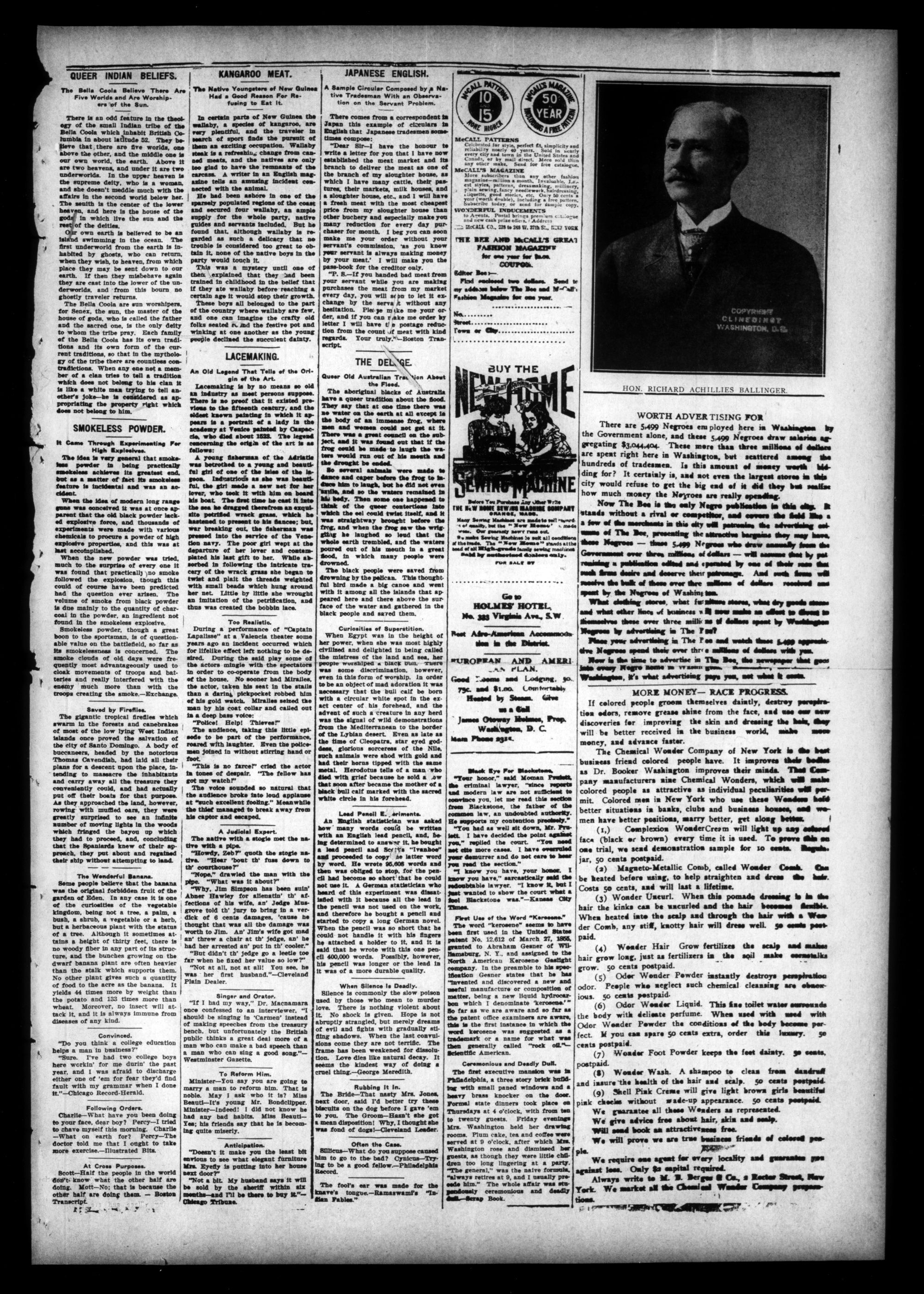
HION. RICHARD ACHILLIES BALLINGER
WORTH ADVERTISING FOR
There are 5,499 Negroes employed here in Washington. Government alone, and these 5,499 Negroes draw money by registering $3,044,404. These more than three million spent right here in Washington, but scattered and hundreds of tradesmen. Is this amount of money worth for? It certainly is, and not even the largest store would refuse to get the big end of it did they pay much money the Negroes are really spending.
Now The Bee is the only Negro publication in the fields without a rival or competitor, and covers the news of the merchants in this city will patronize the advertisers of The Bee, presenting the attractive bargains they see Negroes — those 5,499 Negroes who draw annual government over three millions of dollars — will assume the role of a publication edited and operated by one of the firms desire and deserve their patronage. And such drive the bulk of these over three millions of dollars rest by the Negroes of Washington.
What clothing stores, what furniture stores, what dry goods, what other lines of business will now make an effort to possess these over three millions of dollars spent by Negroes by advertising in The Post?
Since your advertising in The Bee and watch times 5,499 Negroes spend their over three millions of dollars will flow in the time to advertise in The Bee, the newspaper every Negro home in Washington, it's what advertising pays you, not what it is.
There are 5,499 Negroes employed here in Washington by the Government alone, and these 5,499 Negroes draw salaries aggregating $3,044,404. These more than three millions of dollars are spent right here in Washington, but scattered among the hundreds of tradesmen. Is this amount of money worth hiding for? It certainly is, and not even the largest stores in this city would refuse to get the big end of it did they but realize how much money the Negroes are really spending.
Now The Bee is the only Negro publication in this city. It stands without a rival or competitor, and covers the field like a few of the merchants in this city will patronize the advertising columns of The Bee, presenting the attractive bargains they may have, these Negroes — those 5,499 Negroes who draw annually from the Government over three millions of dollars — will assume that by pat resisting a publication edited and spotted by one of their roses that such forms desire and deserve their patronage. And such forms will receive the bulk of these over three millions of dollars received and spent by the Negroes of Washington.
What clothing stores, what furniture stores, what dry goods stores and what other lines of business will now make an effort to discuss themselves these over three millions of dollars spent by Washington Negroes by advertising in The Post?
Place your advertising in The Bee and watch times 5,499 apprative Negroes spend their over three millions of dollars with you.
Now in the time to advertise in The Bee, the newspaper that goes into every Negro home in Virginia gives Washington, It's what advertising pays you, not what it costs.
MORE MONEY—RACE PROGRESS
of colored people groom themselves daintly, destroy
the odors, remove grease shine from the face, and use
recoveries for improving the skin and dressing them
will be better received in the business world, more
money, and advance faster.
(1) The Chemical Wonder Company of New York is
business friend colored people have. It improves the
Dr. Booker Washington improves their minds.
Many manufacturers nine Chemical Wonders, which
colored people as attractive as individual peculiarities.
Colored men in New York who use these Wonders
alter situations in banks, clubs and business houses
can have better positions, marry better, get along best.
(1,) Complexion WonderCream will light up skin
(black or brown) every time it is used. To pro-
tect trial, we send demonstration sample for 50 cents
50 cents postpaid.
(2) Magneto-Metallic Comb, called Wonder Co-
heated before using, to help straighten and dress
hairs 50 cents, and will last a lifetime.
(3) Wonder Uncurl. When this pomade dressing
for the kinks can be uncurled and the hair become
heated into the scalp and through the hair with
Comb, any stiff, knotty hair will dress well. 50
cents.
(4) Wonder Hair Grow fertilizes the scalp
for grow long, just as fertilizers in the soil make
hair. 50 cents postpaid.
(5) Odor Wonder Powder instantly destroys p-
er. People who neglect such chemical cleansing a-
s. 50 cents postpaid.
(6) Odor Wonder Liquid. This fine toilet water
body with delicate perfume. When used with
Odor Wonder Powder the conditions of the body be-
t. If you can spare 50 cents extra, order this. lu-
ts postpaid.
(7) Wonder Foot Powder keeps the feet dainty.
postpaid.
(8) Wonder Wash. A shampoo to clean from
insure the health of the hair and scalp. 50 cents.
(9) Shell Pink Creme will give light brown girl-
k cheeks without made-up appearance. 50 cents.
We guarantee all those Wonders as represented.
We give advice free about hair, skin and scalp.
If colored people groom themselves daintly, destroy perpiration odors, remove grease shine from the face, and use our new discoveries for improving the skin and dressing the hair, they will be better received in the business world, make more money, and advance faster.
The Chemical Wonder Company of New York is the best business friend colored people have. It improves their bodies as Dr. Booker Washington improves their minds. The Company manufacturers nine Chemical Wonders, which will make colored people as attractive as individual peculiarities will permit. Colored men in New York who use these Wonders hold better situations in banks, clubs and business houses, and women have better positions, marry better, get along better.
(1.) Complexion WonderCream will light up any colored face (black or brown) every time it is used. To prove this we one trial, we send demonstration sample for 10 cents. Magula jar, 50 cents postpaid.
(2) Magneto-Metallic Comb, called Wonder Comb. Can be heated before using, to help straighten and dress the hair. Costs 50 cents, and will last a lifetime.
(3) Wonder Uneurl. When this pomade dressing is in the hair the kinks can be uncurled and the hair becomes flexible. When heated into the scalp and through the hair with a Wonder Comb, any stiff, knotty hair will dress well. 50 cents postpaid.
(4) Wonder Hair Grow fertilizes the scalp and makes hair grow long, just as fertilizers in the soil make cornstalks grow. 50 cents postpaid.
(5) Odor Wonder Powder instantly destroys perspiration odor. People who neglect such chemical cleansing are obnoxious. 50 cents postpaid.
(6) Odor Wonder Liquid. This fine toilet water surrounds the body with delicate perfume. When used with used with Odor Wonder Powder the conditions of the body become perfect. If you can spare 50 cents extra, order this, luxury. 50 cents postpaid.
(7) Wonder Foot Powder keeps the feet dainty. 50 cents, postpaid.
(8) Wonder Wash. A shampoo to clean from dandruff and insure the health of the hair and scalp. 50 cents postpaid.
(9) Shell Pink Creme will give light brown girls beautiful pink cheeks without made-up appearance. 50 cents postpaid. We guarantee all these Wonders as represented.
Will send book an attractiveness free. We will prove we are true business friends of ca We require one agent for every locality and give first loss. Only $2 capital required. Always write to M. B. Bergus @ Ca., a Rector S. k. We market all the Chennai Wonder Company.
We will prove we are true business friends of colored people.
We require one agent for every locality and guarantee you against loss. Only $2 capital required.
Always write to M. B. Bergus & Co., a Rector Street, New York. We market all the Chemical Wonder Company productions.
THE BEE
PUBLISHED
AT
1109 lye S. N. W., Washington,
D. C.
W. CALVIN CHASE, EDITOR
entered at the Post Office at Wash-
ington, D. C., as second-class
mail matter.
ESTABLISHED 1860.
TERMS OF SUBSCRIPTION.
One copy per year in advance $2.00
Six months 1.00
Three months .50
Suscription monthly .20
THE APOLOGIST.
The editor of a local contemporary who publishes an editorial defending the administration of President Taft, who is an office holder, is so contrary to what this same editor has expressed to the editor of The Bee relative to the treatment of colored office holders by the present administration. This same editor has a verbal opinion to express derogatory of the administration and a public opinion to publish favorable to the administration, thinking that he is deceiving the President and his friends. The Bee has nothing to hide. The Bee doesn't agree with the administration as to the treatment of colored office holders in the South. The Bee would like to see men express their honest convictions and not play the hypocrite and apologist contrary to existing conditions. It is true that the President has appointed two good men, Messrs. Lewis and Napier, and up to date there is only one real man in office in this city, under his administration—Mr. Tyler—all others are apologists. The Bee has never seen much manhood in a Southern Negro office holder. He is apologetic and sycophantic, and the comer the administration is to trust and confer with men, the latter it will be for the colored American race. No one but a sycophant and apologist will say that the President's Southern policy is a correct one. The President himself is in doubt as to his own policy. He is no doubt convinced that he has wronged the Southern Negro. There are sixteen millions of Negroes in the South, and there are only two Presidential places held by them, one in South Carolina and the other is in Florida. The last census does not give the true population of the Negroes in the South. Then a Negro editor who is an office holder should cease telling lies and give his readers the real conditions of affairs in this country.
The Bee, for one, doesn't agree with the President's Southern policy or any other policy that tends to discriminate against the colored Americans in every department, with but one or two exceptions, of the general government. Let Negro apologists die
CANADIAN RECIPROCITY.
Heretofore the Negro has taken little, if any, interest in economic policies and legislation. The reason is not far to see, however. Placing human rights far above every other consideration, and having those rights assailed and restricted in many States, the Negro has concentrated his thoughts and efforts upon one question alone—manhood rights. Reports received by The Bee from every section of the country, however, show that, contrary to the rule, the race is taking the liveliest interest possible in the Canadian reciprocity measure now pending before Congress and the country. They are for it, and they are praising President Taft for his firm stand in favor of it.
Eighty-six and eight-tenths per cent of the Negroes of this country are bread-winners—are doing manual labor for wages that vary from meager to average only. For this reason they feel that reciprocity will help to stretch their meager wages to a point that will make it possible for them to fill their market basket at least once or twice a week, and leave a portion sufficient for a decent domicile and for fairly decent clothes.
and for a common school education, at least, for their children. The high cost of living-strikes no class so hard as it does the Negro, because of his restricted opportunities. For this reason he is of a necessity deeply and sympathetically interested in any policy or legislation that will reduce the cost of living—that will remove the tax from the necessities of life. The Negro, as a class, may hope for luxuries, but he seldom is able to secure more than the necessities of life. And this is why the race commends and favors President Taft's Canadian reciprocity measure. For them it means, they believe, cheaper and better living. For them it means, they believe, a full market basket at a medium cost.
TO HIM WHO WAITS.
It has been handed down to us, from a remote period, and in a book considered divinely inspired, that "all things come to him who waits." In making reference to the appointment of J. C. Napier to be the next Register of the Treasury we are forcibly reminded of this quotation. Mr. Napier has never desired any office save Register of the Treasury. He once refused one "just as good." He was a candidate for this office under President McKinley, but it went to another. He hoped for it under President Roosevelt, but his hopes were doomed to disappointment. This time the place sought him. It is no reflection to be a candidate for office. The greatest of all Americans, the late President Lincoln, was a persistent candidate. It is, however, a high compliment to be called without seeking.
Mr. Napier is no stranger to Washington. Years ago, we will not say how many for fear of embarrassing the worthy Tennessean, he was a clerk in the departments and a law student at Howard University. Since then fame and fortune, the twins of desire, have come to him. Washington will welcome him back. He is a high-class gentleman, a fully equipped man for the office he has been selected to administer, and a man who will reflect great credit upon the race. His life has been morally clean and unblemished. He is not a politician, but a representative Negro—aye, more, a representative American. It is fortunate for the race that President Taft selected so splendid a man as Mr. Napier to be the next Register. His selection will fully compensate for the loss of the Kansan.
HOUSE CHANGES.
The Bee has every reason to believe that the Democratic House of Representatives will discharge every colored Republican, except one, from garret to cellar. Just how the so-called colored Democrats who supported the Democratic party last year can get consolation from coming events, The Bee would like to know. The Bee has reasons to believe that these hungry political vampires will be unable to dish out but one decent place for their faithful black allies. It is claimed that even Jim Neal will have to go. He, it is claimed, has been an invaluable man at the speaker's door. This is an indication of the hunger that is affecting the Democratic House. If there is no salvation for Neal, who is safe under the coming Democratic ax? Of course, the Republicans can expect no man. They generally give the Democrats as many offices as possible, to the detriment of their own, and whenever they can, but when the Democrats come in they treat the Republican civil service with a vengeance. Not only will black Republicans be removed but white Republicans will have no more chance of remaining than the noble sons of Ham.
The Republican party has great consideration for those who oppose it and disregard those who defend it. Every Negro Republican in the South except two have been removed from office by a Republican administration and a Republican President, and yet you can find Negro editors in this city calling the act religious.
SEGREGATION
The white people in Richmond. Va., or rather, the law-making power, has passed an ordinance to segregate the colored people. This ordinance prohibits colored people from living in a white neighborhood or square. 'This ordinance is the sign of the advancement of the colored people and the growing ignorance of certain whites. The pretext of the Southern white people, or a portion of them, has been that the Negro
spent all of his money in whiskey. Certainly this ordinance shows just to the contrary. If Negroes spent all of their money in whiskey, etc., they would not be able to purchase homes and houses, and so successful and thrifty are the Southern blacks that an ordinance has been passed prohibiting them from purchasing property in white neighborhoods.
"The wheels of the gods grind slowly, but remarkably fine." It makes no difference where you put the Negro; the Japanese will be here soon, and the white people will be glad to be surrounded by all the Negroes they can find. O! you segregation!
HIS VALEDICTORY.
Editor E. W. Brown, of The Reformer, at Richmond, Va., retired from the editorship of that paper last week, and has been succeeded by Benjamin A. Graves, the business manager. Editor Brown writes his valedictory, and in another column in a reprint editorial, he gives Negro leaders this parting shot:
"A MISTAKEN IDEA."
"Some people, and particularly a certain class of Negro leaders, have a vague idea of the character and responsibilities of a real newspaper. The average Negro leader does not think that a newspaper ought to have character and opinions of its own, but ought to reflect the personal whims and the empty harpings of the superficial idea of the real newspaper. We believe the newspaper ought to have both character and individuality of its own, and reflect the highest ideals in its editorial policy. We do not feel that a reputable journal ought unnecessarily to criticise any man, or set of men, neither do we feel that the press ought to hesitate to justly criticise any man out of fear or favor."
WASHINGTON'S ITINERARY
Dr. Booker Washington's speaking itinerary for March—every available date being taken, simply emphasizes the fact that there is no wane to this man's popularity. All through the great Northwest they are calling for him—all races and classes. The East shows no diminution in the number of requests for his appearance there; the Middle West clamors for him, and the South—right where he resides, watches, waits and hopes for his coming. The hold this Negro has upon the public—upon the world, is wonderful. It is not surprising, however, for the reason that wherever he goes he carries with him an earnest and convincing plea for justice for his people, and always leaves in his wake the conviction that his race is deserving of justice and encouragement. There is no speaker, educator or leader, white or black, who is more in demand than the builder of Tuskegee.
EX-MINISTER LYONS.
The Democratic press of Maryland published sometime ago that ex-Minister Lyons favored the passage of the segregation bill that separated the white citizens from the colored. At the time the press of Maryland-published broadcast throughout the country that ex-Minister Lyons favored this bill. The Bee, as well as other journals, denounced the ex-Minister. What The Bee can't understand, why ex-Minister Lyons should make it so late to make his denial. However, The Bee will be fair and give him the benefit of all doubt, and publish his denial, and is pleased to know that he never joined the army of traitors to his race.
Mrs. Bruce, the wife of Assistant Superintendent of Schools, Prof. Roscoe C. Bruce, has been and is dangerously and painfully ill at their home, suffering more than a wife and a mother should be called upon by fate to suffer. Remembering Garfield's beautiful and touching utterance that "the sweetest flowers are those which grow over the party walls of politics." The Bee extends its sympathies to Mrs. Bruce and her family, and hopes for her speedy and complete recovery.
We can stand for opportunity knocking, but object to all other knocking.
There is at least one point upon which The New York Age and The Atlanta Independent agree, and that is that Prof. DuBois is not a real leader.
Evidently the President did not
read The Atlanta Independent's editorial, for he appointed J. C. Napier Register of the Treasury, as had been previously announced he would. The Independent's "knock" editorial was a case of "wasting sweetness upon the desert air."
Prof. DuBois in a recent address declared that race prejudice is likely to bring on civil war. If it does, the Professor will never remain to witness or participate in the bloody contest. He will "fade away" to parts unknown, just as he did when the Atlanta riot was on.
In its issue of February 25th The Bee announced that the appointments of Lewis and Napier would be made during the week just past. Both appointments came off as scheduled. If you see it in The Bee it's so.
While the Odd Fellows' organization is paying a rental of $1,500 a year for an office for the Odd Fellows' Journal in Washington a big-building erected by the order in Philadelphia stands tenantless. This is more than woeful waste of funds—it's looting the treasury.
DR. SHEPARD AND EX-GOV.
GLENN.
Two Distinguished Southerners Honored—Field Day for the National Training School.
East Liverpool, Ohio. March 5.—Two of the best-known men from the South arrived in this city last evening—Ex-Gov. Glenn, of Durham, N. C., and Dr. James E. Shepard, President of the National Religious Training School at Dutham, N. C.
This morning Dr. Shepard spoke at the First Presbyterian Church to a large representative white audience. At 11 a. m. he addressed the people at the Pennsylvania Avenue M. E. Church. This evening he spoke at the First United Presbyterian Church. At 11 a. m. ex-Gov. Glenn spoke at the First M. E. Church, and at 7:30 p. m. he spoke at the First United Presbyterian Church.
The Evening Review of East Liverpool, Ohio, has this to say of Dr. Shepard and ex-Gov. Glenn.
"Great Men's Meeting.
"One of the rarest of opportunities is offered to the men of East Liverpool to-morrow afternoon at 2 o'clock, when Dr. James E. Shepard, one of the greatest colored educators in the world, and Hon. Robert B. Glenn, formerly Governor of North Carolina, and an orator of international repute, will speak at the First Presbyterian Church.
"The hour is placed early in the afternoon that there may be no conflict with a meeting arranged for later, but even if it should be a bit inconvenient, every man who attends will be well rewarded for the effort it requires.
"Dr. Shepard will speak briefly of the work of the Religious Training School and Chautauqua for the Colored Race, of which he is the President. Following, ex-Gov. Glenn will present his greatest temperance address that has stirred this country from one end to the other.
"No admission will be charged, but it will be necessary to take an offering to defray the expenses of the meeting. Usually Gov. Glenn's address itself commands a large admission price. To-morrow it is desired that every man in the community shall hear him sigh. The prospects are now that seats will be at a premium."
Another press comment is as follows:
"First United Presbyterian.
"H. A. Kesey, pastor. Because of quarantine on his home, the pastor will not be out to-morrow. In his stead Mr. W. F. Harkey, a student in Allegheny Seminary, will preach in the morning. In the evening the pulpit will be filled by ex-Gov. Robert B. Glenin, of North Carolina, speaking in the interest of the Religious Training School for Negroes at Durham, N. C. Sunday school at 9:40. Junior meeting at 3 p. m., and Senior and Intermediate Endeavor at 6:30 p. m., at which times it is 'expected that Dr. James E. Shepard, one of the ablest colored men of the Nation, will be present and speak of the work in the training of young men in his school at Durham."
Cleveland's First Citizen.
From the Cleveland (Ohio) Journal.
Some one remarked the other day that the Hon John P. Green is our race's first citizen of Cleveland.
Mr. Green has been an attorney-at-law for over forty years and has held honorable positions in State and Nation. He has established a substantial home, where the "welcome" sign is always out, and has reared a respectable family.
Mr. Green is actively identified with church, civic and social interests and is always alert in affairs for race progress and betterment.
His scholarly attainments, literary and oratorical ability, wide travels, congeniality and politeness are acknowledged by all who know him.
Mr. Green is growing in years and his hair is silvered with the hand of Time, and yet his interest in mankind has not abated.
Is such a man entitled to be known as our "first citizen"?
Mr. Horner Will Speak.
Mr. R. R. Horner, of the Board of Education, will address the Howard Park Citizens' Association at their regular meeting on next Monday night at the Church of Our Redeemer, Eighth street, below Barry place.
Restrained From Ritual
Temporary Restraining Order Enforced-TheQuestion of Copyright Referred to Examiner.
THE DECREE OF DEC. 3 IS VACATED AND SET ASIDE.
Temporary Restraining Order in Force—Claude N. Dean, Esq., Appointed Special Master to Determine to Whom the Copyright Belongs and the Amount of Damages Sustained—King's Side Cannot Act Under This Decree—Columbia Lodge Alone Has Authority to Act.
Upon consideration of the motion herein filed on the 16th day of January, 1911, by Harry H. Pace, William E. Gales and others, and the order passed herein on the same day, and of the motion for a rule to show cause filed herein on the 28th day of January by the Grand Lodge of the Improved, Benevolent and Protected Order of Elks of the World and others, and the rule to show cause granted thereon on the same day, and of the petitions of said Pace and Gales herein in this day filed, and of the affidavits in support of said motions and petitions, and of the answers to said motions, with the affidavits filed therewith, as well as the exception of the complaint to the filing of the petitions of said Pace, Gales and others, and upon objection to their right to intervene herein, said rule and said petitions and the affidavits in support thereof, and the affidavits in reply to said answer, and upon the answer of said J. Frank Wheaton, and the motion in writing of Cary Wheaton this day filed, together with all and singular the pleadings and proceedings heretofore had in the above-mentioned cause, and after argument by counsel for the original and intervening parties, and for the parties to said motions and petitions, IT IS ADJUDGED, ORDERED AND DECREED:
1. That said Gales and Pace be, and they hereby are, allowed to file their petitions herein seeking among other things to set aside the order herein made and entered on the 3d day of December, 1910.
2. That the decree heretofore passed on the 3d day of December, 1910, making permanent the temporary restraining order heretofore entered approving the terms of a certain arbitration made between the then parties to this litigation, and naming arbitrators to carry out the same, be, and the same is hereby, in all respects vacated and set aside. And the arbitrators therein named will exercise no further authority thereunder, but nothing contained in this decree is intended in any manner to affect the temporary restraining order granted herein on the 12th day of October, 1910.
3. That the said arbitrators, Giles B. Jackson, John W. Patterson and Oscar D. Morris, will return and file with the papers in this cause a report showing their actings and doings thereunder, accounting for and showing the disposition of all sums of money received by them under said decree.
4. That this cause be, and the same is hereby, referred to Claude M. Dean, Esq., as Special Master, who is directed to inquire and report to the court to whom the copyright mentioned in the bill and proceedings of this cause belongs, said Special Master first seeing that he has before him the proper parties to legally pass upon and determine that question; and leave is hereby given to the complainant to file such amended bill or bills as may be necessary to bring before the court the proper parties to determine this question, if the same are not already before the court. And the said Special Master is further directed to report the damages sustained from the improper use of said copyright, or of any spurious copy thereof, by those to whom it does not belong, if the complainant or any other party litigant in whose favor he reports the same belongs, desires him to do so.
5. The complainant, B. F. Howard, who has intervened herein, having intimated a purpose to appeal from this decree, and having requested the court to grant such appeal, the same is hereby allowed, to become effective upon his filing within twenty days from the date of the entry of this order, proper assignments of error, and executing before the clerk of this court an appeal bond in the sum of five hundred dollars. But such appeal is in no way to operate as a supersedeas to this decree.
EDMUND WADDILL, Jr.
United States Judge
Richmond, Va., Feb. 7, 1911.
Segregation in Richmond.
From the Sunday Post, March 5.
The Negroes of Richmond, like their brethren in Baltimore, are meeting the issue of segregation of the races with a show of resistance. The whites offer a valuable concession, but beyond permitting the Negroes to own property anywhere in the city, there is but one opinion as to the matter of residence. The City Council adopted the segregation ordinance unanimously, after listening to a strong plea from the spokesman of the colored population. Negro ownership of a piece of property in a white district does not affect the value of the surrounding property so long as it is tenanted by whites, and the granting of this privilege is held to be sufficient to offset the Negro argument that his last chance to improve his business standing is being taken away.
The movement at Richmond doubtless arises from the same feeling of apprehension which seized the whites in Baltimore. The colored brother is growing prosperous, and with the acquisition of dollars there comes a desire to get away from congestion and squalor to a home of his own in a more desirable locality. But his presence in a community of well-to-do whites is anything but conducive to peace of mind and stability of values, and when the invasion broadens out and everybody begins to feel the effects something must be done. The Richmond segregationists would appear to have clear sailing. The enforcement of the ordinance is not likely to encounter successful opposition. On the other hand, the Baltimore movement has been retarded by a decision declaring the ordinance invalid. But another has been put on passage, which, it is claimed, will stand the test of legality.
Other cities having a large Negro population do not appear to be disturbed by whatever is taking place in their midst as between white and colored distribution on social and financial lines. Philadelphia, New York and Boston are attracting Negroes from their Southern habitat in large numbers, and this is true also of Western centers. But, like Washington which has the largest number and by far the largest proportion of Negro residents of any city in the country, conditions in none of these cities forecast an experience like unto that of Baltimore and Richmond.
Christian Endeavor.
Services at the Third Baptist Church Christian Endeavor on Sunday evenings at 6 p.m. are drawing great throngs at every session. Sunday last Mrs. Bessie Cartter, of the Walker Memorial Baptist Church, spoke on "The life of Moses" to the member who remained after the great mass meeting in the interest of the colored Y. W. C. A. Her remarks were very interesting, as she portrayed the different incidents in the Bible relating to the call, the leadership and greed obedience in obeying God's command to lead the Children of Israel. Mr. F. W. Taylor, Mrs. Rebecca Grav Mrs. A. Hall, of the Nineteenth Street Baptist C. E. Society, and others gave incidents in the life of Moses by which they have learned lessons.
Architect A. Sidney Pittman ad dressed the Society February 26 on the topic of missions, telling of the work of Tuskegee University, how they help the Negroes in the South to enter the arena of life. His description of the school and its every-day work was very vivid and realistic, and at his conclusion was warmly commended by the several speakers who followed.
On Sunday, at 6 p. m., the speaker "will be the President of the New Bethel Baptist C. E. Society, Mrs. James Carter, who will discuss the topic, "First aid for the tempted. Heb. ii., 15-18.
All are welcome. The pastor, Rev James H. Lee, who has been confined to his bed for three weeks, is out again, and spoke last Sunday. Mr J H. Coleman is President of the C E. Society.
OTHERS' FAULTS.
Why do we see the faults of others,
When we can't hide our own
We should be more like brothers
And let others' faults alone.
I know a way, and think it best.
To keep busy at my home
Straightening kinks and defects,
And reap what I have sown.
I will not seek the better class
To hide my faults behind;
They are like reflecting glass,
And the light on me will shine.
My faults are many, I admit.
I'll not let them on others rest,
For fear they will let me slip,
And show me up at last.
By this now I wish to say:
I do really need your prayers.
That I may do better every day,
Keeping straight my own affairs.
L. C. MOORE
Advancement of the Colored People.
The National Association for the Advancement of Colored People will meet in the Park Street Church, Boston, Mass., March 30 and 31. There are to be three public sessions and one private. The Washington people having membership in the association are Judge W. P. Stafford, Mrs. M. C. Terrell, Rev. J. M. Walldon, L. M. Hershaw, Prof. L. B. Moore and Prot Kelly Miller. The association publishes the Crisis, edited by W E. B Du Bois and a corps of assistants. The subjects to be discussed at the annual meeting are "Discrimination, labor and peonage."
Fairmount Heights.
The Fairmount Height Citizen's Association held its regular sem monthly meeting Feb. 28 and elected its officers for the year. After much discussion, the following were elected President, Sergt Frank Coalman vice president, to be elected, recording secretary, James A Campbell financial secretary, Robert S Nebb treasurer, Henry E. Jennifer, chairman of the executive board, Walter S Crouse; chaplain, Rev. A H Strothers; marshal, William A Brooks assistant marshal, Berkley Evans assistant treasurer, William B Markel. It is the hope of the officers and members of the association to become more active and do more in the way of improving the conditions in the community in the future.
The Progressive Citizens' Association of Fairmount Heights was organized Wednesday evening in the First Presbyterian Church. Charles E Payne, president; I. N. West, vice president; C. H. Fonville, secretary, W. H Adison, financial secretary, R. A. Tilhman, treasurer. The association's aim is to make Fairmount more beautiful and attractive than ever. New settlers are flocking to this thriving village and are erecting fine homes.
---
The Week in Society
You want your prescriptions carefully and accurately filled from the best drugs obtainable at the most reasonable price. Then patronize the drug stores of Board & McGuire at 19124 Fourteenth street northwest and at Ninth and U streets northwest. Four graduates in pharmacy regularly employed. You get quality and service of the best.
Mrs. Eliza Maxfield, of 1229 First street northwest, who has been quite ill for the past week, is improving, and it is hoped that she will be out soon.
Auditor Ralph W. Tyler, who has just recovered from a severe case of the grip, is at his desk again.
Miss Rosa Hershaw has gone to accept a position as teacher in the Manassas Institute, at Manassas, Va.
If you want pure and fresh drugs, go to Morse's drug store, Twentieth and L streets northwest.
Mrs. George W. Cooke, of this city, is being royally entertained during her stay in Harrisburg, Pa., this week.
Misses Minerva and Emma Staunton have returned to their home in Detroit, Mich., after a very pleasant visit in this city.
Dr. Stephen J. Lewis, of Harrisburg, Pa., spent a few days last week in this city and Virginia with relatives and friends.
Mr. John F. Collins, Esq., of Harrisburg, Pa., spent several days in this city last week with his family and friends.
Mrs. Lennon C. Carter has returned to Harrisburg, Pa., after a pleasant stay in this city.
Miss Gladys Moore, of New York City, is visiting her cousins, the Misses Watson, on Seventh street northwest.
Miss May Francis, of Greensboro, N. C., has been the guest of Miss Bertha Jarvis during the past two weeks.
Mr. Stephen Plummer returned to this city Sunday last after visiting Dr. Harroll Norwood in Annapolis, Md., several days.
Nothing funny about it. People just like to deal at the drug stores of Board & McGuire at 1912½ Fourteenth street northwest and at Ninth aid U-streets northwest, two places "where everybody meets everybody else" for the most delicious ice-cream soda in the city.
Miss Henrietta Vinton Davis sailed for Bermuda on the 8th.
Mrs. S. Willie Layton, General Secretary of the National League for the Protection of Colored Women, and her daughter, Miss Madeline, are visiting friends here.
Miss Sadie Merriwether, a teacher of Baltimore, spent the week-end in this city as the guest of her mother, Mrs. J. H. Merriwether.
Mr. J. Garfield Scott, of Meyersdale, Pa., is in this city for a few months.
Mr. Vernon E. Carroll has been transferred from this city to the navy yard in New York City.
Mr. James O. Hall is spending a few days in Portsmouth, Va.
Mr. James Lomax, of this city, is visiting relatives and friends in Charlotte, N. C.
Mrs. Carrie Storum and her daughter, Mrs. Felix Ware, have returned to this city after a pleasant trip to New York City.
Dr. J. W. Morse has the gem drug store in the northwest. Prescriptions carefully compounded by registered clerks.
Miss Ray Farley spent the weekend in New York City visiting her sister, Mrs. Harry T. Burleigh.
Mrs. Robert Irvory, of Philadelphia, Pa., is visiting relatives here for a few weeks.
Mr. and Mrs. George Young, of Detroit, Mich., are soon to come here to reside.
Mrs. W. T. Smith and her daughter, of New York, are spending the winter here.
Mr. R. J. Frazier, of Auburn, N. Y., has been called to this city on account of the illness of his son, Mr. William Frazier.
Miss Macey Lee Crawford, of Aberdeen. Miss., is visiting her sister, Mrs. Oscar A. Ryce, 2236 Eleventh street northwest.
Bring your job work to The Bee office, or address W. Calvin Chase, Jr., 1109 Eye street N. W., or 1212 Florida avenue N. W.
Grandmaster Morris will be in the city next week.
Mrs. Smith, wife of the late Bishop J. W. Smith, entertained Bishop Alexander Walters and others at her residence last week.
Miss Marian Scott and Mr. Barker were married at the residence of the bride last Tuesday evening.
Dr. James E. Shepard passed through the city Wednesday, en route to Durham, N. C.
Miss Naomi Toppen has been quite ill with la gripe.
The finest cigars in the city are sold at Morse's drug store. Twentieth and L streets northwest.
Mr. W. H. Carter, Jr., who was well known as the choirmaster of St. Lukes P. E. Church, has been called to Calvary P. E. Church, Eleventh and G streets northeast, as choirmaster of that church.
Rev. W. J. Howard has returned from Virginia, where he conducted a large revival. The Sunday school was well conducted and largely attended. Rev. Sales' congregation and friends
are trying to pay for a new edifice. His sermon on the burning bush was excellent and spiritual. Mr. W. E. Pryor, of Omaha, Neb. is spending two weeks here with his family.
The Grand Royal Matron, Mrs. Florida Minor, of O. E. S., entertained the present and past officers of the Grand Chapter at her residence, 741 Kenyon street northwest, last week.
After you leave Happyland, call across the street to Morses's drug store for a glass of pure fruit soda and the best ice cream in the city.
SCOTT-BAKER MARRIAGE.
Much Dissatisfaction Among the Invited Guests—Social Discrimination Criticised—Some Asked to Remain to Supper and Others Requested to Leave—Mrs. Scott's Explanation.
Washington, D. C. March 7, 1991
Editor of The 'Bee: The Scott-
Barker wedding came off to-night and
500 people were invited to the reception from 8 to 10 o'clock. About 9 o'clock a gentleman called off several names and then said, "All others please get your things and depart." In other words, it is "Sheep stay in and goats butt out." Yours truly, M. J. WELLS.
Others stated that a piece of cake was handed each guest on his way out. Hence, the special invited guests were selected, because the supper table had not been disturbed until such guests were asked to depart who were not requested to remain, and the special 60 enjoyed the elaborate supper that had been so tastefully prepared by a caterer. Some few refused the cake that was handed to them. Mrs. Scott makes the following statement:
Mrs. Scott, in talking to a reporter of The Bee, said she regretted very much the above affair and knew nothing about the few who were selected to remain to the private dance in honor of Lenora Winfield, of Boston. It was gotten up by the ushers while in the house: 'She also stated that every one was served with a piece of cake before leaving, and the dance was a private affair, which the guests to the marriage reception had nothing to do with and were not invited to remain. Mrs. Scott declares that the report is absolutely false.
West Washington News.
The Nineteenth Street Baptist choir sang for the morning services at Mount Zion M. E. Church, Twentyninth street northwest, on Sunday last, and those who were present were treated with excellent musical selections. Prof. James Walker is to be congratulated on the work of the well-trained choir, the singing of which seemed to vibrate as it were from the rafters with re-echoing voices of the late Prof. R. S. Parrott in Mount Zion in days of yore. At the same hour the full choir of Mount Zion M. E. Church rendered the music at the Nineteenth Street Baptist Church, with Prof. J. T. Beason, leader, and received loud expressions of praise from the large congregation present. This interchanging of musical courtesy was highly commendable and reflected much credit on the respective leaders in their musical sphere.
The funeral of Mrs. Catherine Morris, an old and much-respected citizen, took place Friday, March 3, 1911, from Mount Zion M. E. Church, and was largely attended by many prominent white families by whom the deceased was highly regarded. Many floral offerings were presented by the friends. Rev. D. W. Hayes officiated. Interment at Mount Zion Cemetery The Young People's Dramatic Club recently organized in the West End will shortly appear with one of their beautiful dramas. The solo rendered by Mrs. Noah Duquit in "Quit Tallis" Sunday morning at Mount Zion M. E. Church was highly pleasing and worthy of special mention. Rev. D. W. Hayes, pastor of Mount Zion M. E. Church, will leave March 20 to attend the Annual Conference of the M. E. Church to meet in Lynchburg, Va.
Rev. E. E. Ricks, the pastor of the First Baptist Church, preached to a large congregation Sunday morning, and at the close of the services baptized several candidates, and fourteen new members attached themselves to the church.
The Church Directory Board of Mount Zion M. E. Church still bears the name of the ex-pastor, who has been stationed in Roanoke, Va., for nearly a year. Will the Trustees please explain for the benefit of the membership and the public in general?
Smart Set.
The noted colored comedian and star, S. H. Dudley, whose fame as a funmaker extends across the entire continent, has one of the best roles in his career in the three-act musical comedy, "His Honor the Barber," which the famous Smart Set will pre-
THE NEW YORK TIMES
THE BLACK PATTI COMEDY CO. in "A Trip to Africa."
sent again this season. The piece will be the next attraction at the Howard Theater. Edwip Hanford wrote the book, and the music and lyrics are the work of Messrs. Brymm, Smith and Burris. The comedy abounds in unctious humor, clever sarcasm, satire, real wit and novelty of superlative degree. It sparkles with effervescent activity and overflows with laugh-provoking situations. The musical numbers are of the jingling, catchy order. There is not a mediocre song among the 15 offered, which is saying a good deal in this era of progressive, machine-made melody. Mr. Dudley will appear as Raspberry Snow, a shiftless, newer-do-well Negro, who wants to shave the President of the United States. Unfortunately, this ambition is never realized. Not a detail has been overlooked to make the offering delectable and acceptable. It is rich in unique features, surprises, scenic adornment, electrical and stage effects, besides bristling with fun of the sort that is both durable and wholesome. Aida Overton Walker, recognized as America's foremost comedienne and dancer, is another important addition to a cast of capable and talented artists. Miss Walker offers an entirely new specialty and some of the costumes she wears are said to be a dream of the dressmaker's art and execution. Others who aid Mr. Dudley in his fun-making propensities are Ella Anderson, Lottie Grady, Andrew Tribble and Irving Allen.
Black Patti Coming Next Week.
A classic stage attraction, but one which appears each season new as the newest in its added features, is the Black Patti Musical Company, which presents this year "A Trip to Africa," a musical comedy in three acts, prepared by John Larkins.
The show scintillates with bright comedy gems, and is alive with musical and novelty features. Madame Sissieretta Jones, the original Black Patti, the musical star of this attraction, is a singer than whom none of her race and few of any race can claim a higher niche in the hall of fame of singers. She is at her best this year and surrounded by a sprightly troupe of singers, dancers and comedians. On arranging for the presentation of "A Trip to Africa," due deference ance. The comedy will contain full measure of music, laughter and dancing, and half a score of novel features new to the Black Patti show, and, for the most part, to the stage.
The show this season is better than ever before; the musical numbers, as they deal with the chorus, are all new, and are fine examples of the brightest and best in humorous and sentimental music. Madame Jones will sing two songs in the second act. In the third act she will appear as the Princess Lulu, and also sing with the sextet, which will give selections from the grand opera "Lucia de Lammermoor." Prices, 25, 50 and 75 cents.
A Beautiful Home Wedding.
One of the most eventful happenings in the lives of two young people of Washington took place Tuesday evening (March 7) when the wedding bells pealed forth the joyous tidings that the sacred bonds of matrimony had been welded between the hearts of Miss Marion Toussaint Scott, the daughter of Mrs. Edward D. Scott and the late Dr. E. D. Scott, and Mr. Charles N. Barker, the ceremony being performed, at the home of the bride's mother, 903 Ninth street northeast, the Rev. Dr. D. F. Rivers, of Berean Baptist Church, officiating.
Promptly at 7:30 o'clock, Mr. John E. Lemos commenced Mendelssohn's wedding march in all its sublimity and grandeur, and the beautiful ceremony was begun. First came the little ribbon girls—Misses Robbie Brown, Evalyn Brooks, Blanche Hope and Flossie Childs—who, with their streamers of ribbon, formed an asle. Then came the groom and his best man Mr. Wm. E. English, both in full evening attire. These were followed by the bridesmaid, Miss Lenora Wingfield, of Boston, Mass., at
J. Sherman Hunnicutt
DIRECTOR AND VIOLIN
1915 6th Street, N. W.
K. F. Phillips, MANAGER, PIANO & VIOLIN
2130 13th Street, N. W.
E. L. Burns, TREASURER AND DRUMS
938 T St., N. W., Phone North 5013-m
C. W. Jones
PIANO AND CORNET
J. H. Andermon
CELLO
W. P. Baylesh
2D VIOLIN
W. C. Hunnicutt
FLUTE
J. B. Clark
TROMBONE
F. G. Haley
TROMBONE
Mr. Preston, VIOLA
tired in a costume of chiffon over pink silk, with beaded embroidery and pearl trimmings, carrying a bouquet of American Beauty roses, typically representing the Star in the East as a token of the greater one to come, and in due time the bride, leaning on the arm of her brother, Paul, entered as an angel of light dazingly arrayed in a costume of messaline silk, entraine, with silk medallions and lace, with a shower bouquet of white roses and lilies of the valley, with a wreath of sweet peas and maidenhair ferns. Then came the little ring-bearer. Miss Bessie Hope. The whole bridal party stood, under a bower of palms and ferns, while Dr. Rivers performed the ceremony that made two hearts as one, amid the low sweet strains of music by Mr. Lemos.
Just before the final blessings were pronounced upon the couple Miss Charlotte Wallace, one of the sweetest singers of Washington, in her own sweet way, and in a wonderful voice, sang "The Life Road."
From 8 to 10 congratulations were extended, and the many friends wished the happy pair a long and prosperous journey on the sea of time.
Promptly at 10 a beautiful repast of the delicacies of the season was served under the supervision of Mr. A. H. Underdown, but preceding this feature of the evening Mr. John M. Dorsey, of Topeka, Kans., read the following:
Mr. Underdown and his most excellent corps of assistants served the repast in clock-like precision, not a hutch or omission being made.
The ushers for the evening were Messrs. Phil Cuney, Dan Monroe, Edwin Brown, Wm. Tarlton and Charles E. Cheatham, who performed such excellent service as to receive commendation from all sources. Mr. Barker is a Kansan, and is a clerk in the Land Office division of the Interior Department, and has a host of friends to bid him success in his new role in life. The presents were numerous and hauntsome.
Reading Circle.
The Reading Circle of Asbury M. E. Church held its regular meeting at the residence of Mrs. M. W. Clair last Tuesday evening. The program took the form of an "evening with Longfellow." Very interesting papers were read by Miss Marie Thompson, Miss Hall and Mr. Miller. The next meeting will be held on the 21st; and an evening will be spent with Tennyson.
Mr. Holmes Out.
Mr. James O. Holmes, who has been quite ill for several weeks, is out again. Mr. Holmes will next Monday evening entertain at his residence several of his Odd-Fellow friends.
Tst.near7th,N.W. The Theatre for the People Black Patti Coming
A. B.
Matinees: Tuesday, Thursday and Saturday Madame Jones will appear as
COMING BACK SOON The Show That Can Always COME BACK
Imported fruits of all kinds. Fresh vegetables daily. We give prompt service, all orders delivered. Give us a trial.
A. B.
Next Week
: Tuesday, Thursday and
Madame Jones will appear
INCESS LU
PRICES: 25, 50 and 75c
MALAWI
---
THE
MILITARY
COMMANDER
(From "The Tuskegee Student.") Principal Washington has been kept unusually busy during the past two months speaking to various organizations in widely different sections of the country. At each of these meetings he has spoken in the interest of Negro education, and at some of them in the interest of the work here at Tuskegee Institute. We are printing below the names of organizations before which he has spoken; also the names of the organizations before which he is to appear during the next month or six weeks.
On December 4th, in Chicago and Evanston, Ill., he spoke as follows: South Congregational Church, Abraham Lincoln Centre, Colored Men's Sunday Evening Club, Mt. Olivet Church, and Bethel Church; also in the afternoon in the First Congregational Church, Evanston. On December 5th, in Chicago, he spoke to the Scooby Club, the University of Chicago, Colored Newspaper Association, the Tuskegee Club, and at a banquet arranged in his honor by the Local Negro Business League From Chicago, he went to Milwaukee, Wis., where on December 6th, he spoke to the Sunset Club and to the Milwaukee Athletic Association. December 11th in New York City, he spoke as follows: At the Fourth Presbyterian Church, and in the evening at the West End Presbyterian Church. In the afternoon of the same day he addressed the Young Men's Christian Association of Yonkers, New York.
On December 13th in Washington, he spoke at the exercises in connection with the dedication of the New Science Hall of Howard University. December 15, in Milton, Mass., he addressed the Milton Club. December 16th he spoke in Milford, N H., and on December 17th he spoke at a dinner arranged for him by the Local Negro Business League of Boston. December 18th, also in Boston, he spoke at the Mt. Vernon Congregational Church, First Universalist Chuch, and the Charles Street A. M. A. Church. December 19th, in Providence, R. I., he addressed the congregation of the Rhode Island Congregational Church.
On January 1st, he addressed the citizens of Union Springs, Ala. January 18th and 19th, he spoke and presided at the sessions of the annual
NEGROES BADLY TREATED.
The Interior Department Not All Silver or Gold—J. C. Cunningham Writes Startling Charges.
Editor The Bee:
Lauter The Die
"Be not deceived; God is not
mocked; for whatsoever a man sow-
eth that shall he also reap."
Our text applies to a nation, or nations, of peoples as well as to the individual man or woman. We notice that our colored newspapers are beginning to open their eyes and the eyes of their people relative to the unjust discrimination against the colored employees in the various government departments in Washington. These are very sad pictures to be flashed upon the canvas before the eyes of Christian (?) America; yet we can testify to very much that's being said along that line. There seems to be an epidemic of Negrophobia wherever the colored brother applies for a chance to make an honest living, side by side with his white brother, especially if the said white neighbor is afflicted with that dreadful disease of which we have just spoken—Negrophobia. There ought to be as much money spent and lectures given to stamp out this disease as is spent to check that much dreaded disease known as the "hook worm," for both these diseases are destined to halt the progress of any people, once they be allowed to sink too deep in the human mind and flesh.
We know of no government department in this broad country where the colored brother is abused and humiliated more so than they are in the Interior Department. We wouldn't dare to write upon what we have heard about, but we purpose to talk to the public, through The Bee, about what we know about. (We will have
DR. BOOKER T. WASHINGTON.
Farmers' and Workers' Conferences.
February 6th, in Augusta, Ga., he spoke to the colored people of that city, and on February 7th in New York City, he was present and spoke at a meeting in the interest of Hampton Institute at the rooms of Ethical Culture Society. Also, in the interest of Hampton Institute, he spoke in Boston, February 8th, at a meeting held in Vendome Hotel. During a portion of December and January he spent at Tuskegee Institute, also since February 10th he has been at the Institute.
On March 5th he is to speak in Philadelphia, Pa; March 10th in Sioux City, Iowa, where he is to address the Northwestern Iowa Teachers' Association; March 11th he is to speak at the Iowa State College, Ames, Iowa; March 12th in Des Moines, Iowa; March 13th in Madison, Iowa, and March 14th he is to speak at the Iowa State Teachers' College, Cedar Falls, Iowa; March 15th he is to speak in Battle Creek, Mich., at a meeting arranged by Dr. W. H. Kellogg, of the Battle Creek Sanitarium. On March 16th he will address the Staten Island Academy, New Brighton, Staten Island, on the subject of "Negro Education in the South."
On March 17th he will speak in Auburn, N. Y. March 26th in Philadelphia, he is to address the Ethical Culture Society on the subject of "The Moral Development of a Race: Obstacles and Progress."
The February School News.
(From "Student," Tuskegee, Ala.) The February "School News," published by Mr. J. R. E. Lee, as editor, offers a vigorous chapter in modern Negro education. Barring an interesting article on the National Association, by President W. T. B. Williams, and a few editorials, the News is devoted to setting forth the work of the Jeanes Fund. Those who have looked upon this fund as a sort of myth, or as a source of revenue to some one locality will be startled at the activity and results that this Foundation has brought to light. A general report by Dr. Jas. H. Dillard, and a more detailed report by Prof. B. C. Caldwel, his assistant, show what seven-league strides are being made in rendering the rural community habitable, by taking the pupils of these districts more efficient and the rural dwellings more like homes.
to give it to you in broken doses, for you can't stand it otherwise.) The regular working hours in the executive departments constitute seven hours for a day's work. All of the employees in the Interior Department, with the exception of the colored laborers, work seven hours a day. The colored laborers in that department are forced to work "eight" hours for a day's work, without a single penny for extra pay. All of you know what happened when, a few short weeks ago, it was rumored that the President and his Cabinet had under their consideration a plan to add a half-hour to the seven hours, and what a great stir it created among the clerks and their friends. Even the merchants of the city busied themselves in behalf of these clerks. They took the matter up with the President, and showed him the great injustice that would be done those people by adding a half hour to the seven hours, making it seven and a half hours for a day's work. It was then the colored laborers thought that they were on the eve of enancipation. They thought and prayed to God that out of that fight the day of freedom from being discriminated against in the working hours was at hand. But not so. They are being driven almost as badly as was their fathers and mothers before Abraham Lincoln issued his famous proclamation declaring that all men shall be free!
You would hardly want to believe it if you were told how the poor colored men and women are being treated in the Interior Department. Here the poor "char women" have to work four hours. Very often when some of the men are absent, because of illness or on leave, these poor char women have to do their work, mopping the floors and lifting the heavy desks around. I.C. CUNNINGHAM
Discussing the work of the industrial supervisor of the rural schools, Dr. Dillard shows that in each, the physician, as the instructor might be called, is prescribing remedies to suit the ills of the patient at hand. Thus he says: "Some are aiming to help the local teachers. Some are making special efforts to lengthen school terms. Some are organizing clubs and school improvement leagues, and might be called social organizers as well as teachers. When I have found that anyone showed special interest or aptitude in emphasizing any line of work which was useful, I have not interfered." Thus too it is with the trades introduced by these instructors. Sewing, dyeing, rug-weaving, gardening, basket work, cooking, in addition to "showing the teacher some good methods of teaching arithmetic" and other subjects, furnish an outline of the actual school work these teachers perform.
It is Prof. Caldwell's report, however, which shows the full play of this fund. From his report one sees just how many schools are being helped by this fund, how much each secures and the length of each school term. Numerous photographs of teachers at work, aye, in their shirt sleeves too, lend life to the figures and data.
A more encouraging and significant course is found among Prof. Caldwell's list of helpers. It seems that white people, especially promoters of large industrial plants, are alive to the advantage of the kind of training these schools are undertaking to give. Thus, he says, "A cotton mill at Greenville, S. C., contributes material and helps to pay the salary of an industrial teacher. A saw mill at Stamps, Ark., contributed all the lumber for a large two-story industrial building. A planter in Mississippi contributed sewing machines to two schools in his neighborhod. The Pineland club makes regular contributions to the industrial work on its immense estate in South Carolina. The mine owners are the largest individual contributors to the industrial work in the school at Corona, Ala. The bankers and railroad agents are active helpers of the industrial work in one of the Texas counties. And the corporation owning a big plantation in Arkansas offers to help with the industrial outfit of any school on its estate."
---
Our Junior Senator From West Virginia.
We, the members of the National Colored Personal Liberty League, representing over 600,000 colored voters in the United States, an organization that rendered valuable services to the Democratic party in the recent campaign, take great pleasure in presenting to the colored voters of West Virginia the Hon. C. W. Watson, of Fairmont, West Virginia, whose cut and biography appear in this week's issue. Mr. Watson was elected to succeed the Hon. Davis Elkins, who was appointed United States Senator by Governor Glasscock, to fill out the unexpired term of his father, the Hon. Stephen B. Elkins, Mr. Watson, although a Democrat, is a friend to the colored race, and we feel safe in saying that the Legislature could not have made a wiser and better selection than they did when they elected the Hon. C. W. Watson to fill out the unexpired term of the late Senator Elkins, and we believe that his election will be instrumental in carrying the State of West Virginia for a Democratic President in 1912, and we appeal in conclusion to the thinking colored voters of West Virginia and urge that they give their moral support to Senator Watson in 1912, and we feel sure that you will never have cause to regret so doing. Done by order of the League.
The Negro's Friend.
We, the members of the National Colored Personal Liberty League, take great pleasure in presenting to the readers of the National Union and the Washington Bee the Hon. Isaac R. Sherwood, of Toledo, Ohio, who is now serving his second term in Con-
gress from the Ninth District. Gen. Sherwood, as he is familiarly known among his many friends, has made a record in Congress that speaks for itself. Although a Democrat, he is a true friend to the colored race and demonstrated the same in the support he gave to Senator Foraker in the Brownsville case. Gen. Sherwood has made a great many friends since he came to Congress, both among Democrats and Republicans, on account of his kind and genial disposition. He is a true friend to the old soldier, and always ready to do anything in his power to further their cause. He is always glad to meet an old comrade, regardless of creed or color, and there is seldom a day passes but what some
old soldier calls upon him for his aid and support in some measure. We feel safe in saying that the colored voters of the Ninth District could not have made a wiser selection than they did when they gave their support to Gen. Sherwood, and it is to be hoped that the Democratic Congress will see to it that this old veteran is given proper recognition when it comes to the selection of the chairmen of the various committees, and we appeal to every loyal and liberty-loving colored voter in the Ninth district to see to it that Gen. Sherwood gets your undivided support in the 1912 campaign; and we assure you that you will never have cause to regret so doing.
Done by order of the National Colored Personal Liberty League.
L. A. WILES, President.
JAMES H. JONES, Secretary.
CHARLES C. CURTIS.
National Organizer.
As Reported by the National Negro Business League.
The Central Regalia Company, 8th and Plum streets, Cincinnati, Ohio, established in 1902 by Mr. Jos. L. Jones, has grown to be the largest concern of the kind in America. They manufacture every sort of regalia now in use. They also design and create original styles. Twenty persons are regularly employed in the factory. The company has branch offices in Columbia, S. C., New Orleans, La., and Selma, Ala.
Captain David J. Gilmer, who served in the Spanish-American war and for eight years in the Philippines as a scout, in the regular army, returned to Greensboro, N. C., his home, last fall and launched out into the real estate and grocery business.
At the present his stock of proceries is valued at from $2,500 to $3,000. His business is increasing every month and the results are very gratifying.
Sherman, Texas, directory of colored men in business comprises, in part, the following persons—groceries: Messrs. Sherman, Holdmners and Brown; tuneral establishments: Sherman; cale: Messrs Gaston and Taylor; hotel: G. W. Hume & Son; shoemaker: J. P. Hamilton; tailoring company: J. K. Chime; barber shop and baths: E. J. Williams and Wm. Mann; contractor cement sidewalk: James Parker; contractor and builder: G. C. Taylor and D. Franklin; real estate: Wade and Sykes.
Within a few weeks of each other in the month of August, there will be two great gatherings in Little Rock, Ark, each one representing two separate and distinct races; viz., the Confederate Reunion and the National Negro Business League.
The two races in Little Rock believe that the material interests and welfare of both are mutual and independent, therefore, the Negroes are contributing to the entertainment fund for the Confederate Reunion, and the white folks are doing likewise for the entertainment of the National Business League. Verily, there is something new under the sun.
The Armstrong Association in Philadelphia is an organization which has for its object the aiding of colored mechanics to secure work in the city and at the same time encourage them to save money and build up a sound business of some kind.
This movement was started because, out of the 85,000 colored population in Philadelphia, there are only a few skilled mechanics, relatively speaking; the great majority of laborers are unskilled.
The promoters of the association reasoned wisely that such an unsatisfactory condition presented a very unsound basis, upon which there is little hope of building a real and permanent economic superstructure. Hence this organization.
The members pay a small fee for the privileges and advantages the society guarantees. As an evidence of the benefit the Arnstrong Association is to its members, according to its second annual report, the amount of work obtained from new customers by the men through this agency, from November 15, 1909, to October 15, 1910, was: number of jobs, 402, aggregating $20,813.25.
The headquarters are 1508 Lombard street, B. F. Lee, Jr., manager.
A movement is on foot to form a similar association for the women in the city.
One of the most progressive and widewake Local, Negro Business Leagues in the country is the one in Bristol, Tenn-Va., of which Robert E. Clay is president. This league is one of the few that has kept in view the object for which it came into being, viz.: the financial and material advancement of our people in the community where such a league is formed. Since its origin, the Bristol league has very largely stimulated the colored people to build homes, establish business enterprises of various kinds, and accumulate property of whatever description.
Every year the local league has a celebration, which tends to increase its influence and usefulness. At this anniversary some of the white as well as colored men of prominence are invited to be present and speak. Among the principal speakers at the recent celebration last month was the Rev. C. H. Johnson, pastor of Lee Street Baptist Church, and Major A. D. Reynolds, and Secretary F. M.
THE NEW YORK TIMES
DR. JAMES E. SHEPARD
CONDITION OF THE NEGRO DETAILED BY ONE OF THEM.
Dr. James E. Shepard, of Durham,
Speaks to Pastors—Strong Presentation of Race Problem and How It Is Being Solved.
Daily Times, Chattanooga, Tenn. Feb. 28.
Dr. James E. Shepard, president of the National Religious Training School and Chautauqua, Durham, N.C., an institution modeled after the Northfield (Mass.) schools, spoke yesterday morning to the United Pastors' Association of this city, on the "Religious Education and Training of the Negro Race." The unanimous judgment of the pastors present, both white and colored, was that the address was one of the sanest and most helpful yet delivered on this question in this city. Dr. Shepard said, in part:
"Religious education awakens the sluggish, dormant energies of an individual and turns them into channels of usefulness. It stops the large amount of waste material found in jails, penitentiaries and chaugangs, and puts it to useful service. It adds to the material growth and prosperity of the city, the State and the Nation. It protects the home and causes peace to reign instead of confusion.
"To educate a man religiously does not mean that he is to shout on Sunday and do poor work and devilment on Monday, but it means to do the very best and to put the very best into life's work.
"Mary was asked about her religion, how she knew she had it, and she caid she swept in the corners, under the beds, and removed the rugs—that was why."
The speaker said this was what he meant by religious education—to be honest, true and reliable. He said the largest asset of any race should be turned into practical channels. Since enthusiasm is the largest asset of the race, it should be directed along practical lines.
The National Religious Training School is founded to teach that religion and work must go hand in hand. Primarily, it was formed to reach the Negro minister who is ignorant and untrained. There are 30,000 Negro
Runnels, of the Board of Trade The latter congratulated the league upon the material evidence of industrial and commercial thrift and assured its members of the moral and active support of the Bristol Board of Trade in all its good works. Why cannot more of the local leagues emulate this kind of progressive spirit?
SET FUDGE ON HIGH
SET FUDGE ON HIGH
THE STANDARD OF CIVILIZATION HAS BEEN SET.
Femininity In Absolute Accord on the Subject—Inventor Merita More Approval Than She Has Yet Been Accorded:
At last a standard of civilization—of feminine civilization—has been set, according to the Cleveland Leader.
The masculine one has not as yet been reached, and the difficulty of arriving at a general standard is at once apparent.
With femininity, however, there was little or no trouble. The sex unites upon a single test. That made, the examination is passed with honors.
The case of the Misses Chang, whose father is the new Chinese minister to the United States, is a most pertinent illustration. According to their governess, who has had a wide experience with outside barbarians, these young Chinese girls are the most intelligent students of English she has ever known and are showing marvelous results. Most significant of all, they have not only fallen a victim to fudge, but they are experts in its manufacture. Nothing more is needed to admit them to equality, social, moral, religious and intellectual, with the girls of this nation. They have become Americanised in the biggest sense of
ministers in the United States, and of this number only 10 per cent are trained, leaving the starting fact, 27,000 untrained ministers leading a comparatively ignorant mass of nearly 10,000,000 people. The Nexro minister exercises more than a priestly influence over his race, so he must be reached.
The speaker called attention to the crimes of the race, and cited these startling facts, taking for an example a Northern State, New Jersey: The Negroes of that State comprise only 5 per cent of the total population, and yet furnish 30 per cent of the criminal population. To correct these evils, it is the plan and purpose of the National Religious Training School to send out settlement workers who are trained in the laws of sanitation and economics, and by precept and example lead men to better lives. The school has a summer term, extension literary and industrial centers. Among the recent large givers have been Messrs. J. B. and B. N. Duke and Mrs. Russell Sage.
One of the strongest arguments, apart from the actual need of this kind of school, is the fact that the Southern white people who represent the best element of progress are among its strongest supporters.
The chairman of the committee in control is Judge Jeter C. Prichard, of the United States Circuit Court. The treasurer, Gen. Carr, is an ex-Confederate soldier and one of the largest mill owners in the South.
All denominations are represented; the school is reverent in spirit, inter-denominational in character, and thorough in methods.
Dr. Shepard was followed by the Rev. I. Welch and the Rev. James Smith, colored ministers of this city. Dr. Joshua Gravatt, of Denver, also made a brief address along the same lines.
During the business session a committee was appointed to adopt resolutions on the death of the Rev. Wallace B. Lucas, former pastor of the Park Place Presbyterian Church. Dr. Ira M. Boswell was named as chairman, the other members of the committee being J. Vesey and I Welch, colored.
This was the regular joint meeting of the white and colored pastors, and was largely attended.
the word. And they will stand in the very first rank of feminine civilization, because the records show that they make fudge three times a day, and only heaven knows how often they nibble at it.
It doesn't need this celestial approval to show the heavenly qualities of fudge. It is the most popular course in every feminine boarding school or college, and while not officially recognized in the curricula of public schools, it is there just the same.
History knows that Dolly Madison invented ice cream, and a grateful world talks of raising a statue to her. But all that is known of the discoverer of fudge is the slight fact that she was a Vassar college girl and that she hit upon the delicious compound, like so many other inventions of great moment to the world have been made, in a casual way.
From another point of view her discovery is unique. Improvements have followed upon other inventions; the basic idea has been expanded and developed. But the original fudge is still the best of all, though there have been countless variants of it.
To a mere man it seems that there is an unconscious ingritude on the part of fudge lovers, not at all consistent with the big-hearted appreciation we expect from the sex. If there should be concerted action to discover the girl who invented the delicacy, and to reward her as she deserves, it would be better than a number of the other plans which women are agitating.
And as a slight beginning, as an earnest of the reverence womankind should feel for fudge and its inventor, we would suggest that the exclamation: "Oh, fudge!" so common among coeds, be dropped altogether or robbed of its anseeing irreverence. After that, the pension for the discovery and then a statue.
James H Winslow
UNDERTAKER AND EMBLAMER
ALL WORK FIRST CLASS. TERMS.
TWELFTH AND R
James H. H.
FUNERAL DIRECTOR
Hiring, Livery and S
Carriages hired for funerals, parties
Horses and carriages kept in first-
guaranteed. Business at 1132 Third
office branch at 222 More street, Alex
Telephone for Office, Main 1727.
Telephone call for Stable, Main 14
OUR STABLES IN FREED
Where I can accommodate 50 Horses,
Call and inspect our new and modern
J. H. DABNEY, Prop., 1132 T
Phone, Main 3200.
W. Sidney H.
Archi
RENDERING IN
BOROTONE, WATER COLOR
AND PEN & INK
STEEL CONSTRUCTION
Phone: Main 640—M. Office 494
THE MAGIC IS TWO TIMES LARGER THAN PICTURE. IT IS 9 IN
STEEL HEATING BAR.
LADIES LOOK!
Every lady can
hair if she wears
Magic drier the hair
straightens the curls
ing bar which leaves the hair, is sleek, put into the flame.
The Aluminum Comb is easily detached from the
ed the comb rests back into place, and is held by the
The Magic Heater is also suitable for curling from
hand bag. Magic Shampoo Drier $1.00. Magic Alcohol
Write for Literature today.
Magic Shampoo Drier Co.
Is Your Hair E
FIRST CLASS. TERMS MOST REASON
TWELFTH AND R STREETS, N.
James H. Dabn
FUNERAL DIRECTOR.
Hiring, Livery and Sale Stable.
Died for funerals, parties, balls, reception
carriages kept in first-class style. Sale
Business at 1132 Third street northwest
at 222 More street, Alexandria, Va.
For Office, Main 1727.
Call for Stable, Main 1428-5.
STABLES IN FREEMAN'S ALLEY,
accommodate 50 Horses.
Direct our new and modern stable.
DABNEY, Prop., 1132 Third Street N. W.
3200.
Carriages
Sidney Pittm
Architect
BRING IN
WATER COLOR
DRAFTING, DETAILED
EN & INK
BLUE PRINT
L CONSTRUCTION A SPECIAL
M.
Office 494 Louisiana A
THE MAGIC
AND HAIR-STR
MAILED ANYWHERE
SEND MONEY BY POSTMARK
LOOK!
Every lady can have a beautiful and
hair if she uses a MAGIC. After a sham
Magic drills the hair, removing the dand
straighten the outset head of hair.
And burn or injure the hair, because the comb is never hurt.
The hair is sleek, put into the flame of the alcohol or gas
Comb is easily detached from the heating bar, after
application and is held by a turn of the handle.
The hair is also suitable for curling irons, has a cover and can
shampoo Driller $100. Magic Alcohol Heater $0.84. Liberate
today.
Poo Drier Co.
Minneapolis,
Your Hair Beautiful
H. Dabney
RAL DIRECTOR.
ery and Sale Stable.
irals, parties, balls, receptions, etc.
cept in first-class style. Satisfaction
1132 Third street northwest. Main
street, Alexandria, Va.
main 1727.
le, Main 1428-5.
IN FREEMAN'S ALLEY,
50 Horses.
and modern stable.
rop., 1132 Third Street N. W.
Carriages for Hire.
ey Pittman
architect
PATENT DRAWN
DRAFTING, DETAILING, TRAC
BLUE PRINTING
RUCTION A SPECIALTY.
Office 494 Louisiana Ave., N.W.
THE MAGIC SHAMPOO
DRIER
AND HAIR-STRAIGHTENER
MAILED ANYWHERE IN U.S. $100
POLYMER PAID
SAVE MONEY BY POST OFFICE MONEY GROUND.
Every lady can have a beautiful and luxurious head of
hair if she once a MAGIC. After a shampoo or bath the
magic dries the hair, removing the dandruff, and it will
brighten the earliest head of hair.
hair, because the comb is never heated. The steel heat-
put into the flame of the alcohol or gas heater.
is held by a turn of the handle.
for cooling irons, has a cover and can be carried in a
Magic Alcohol Heater 80.4. Liberal terms to agree.
Minneapolis, Minnesota
Hair Beautiful
ALL WORK FIRST CLASS. TERMS MOST REASONABLE
James H.Dabney
FUNERAL DIRECTOR.
Hiring, Livery and Sale Stable.
Carriages hired for funerals, parties, balls, receptions, etc.
Horses and carriages kept in first-class style. Satisfaction guaranteed. Business at 1132 Third street northwest. Main office branch at 222 More street, Alexandria, Va.
Telephone for Office, Main 1727.
Telephone call for Stable, Main 1428-5.
OUR STABLES IN FREEMAN'S ALLEY,
Where I can accommodate 50 Horses.
Call and inspect our new and modern stable.
J. H. DABNEY, Prop., 1132 Third Street N. W.
Phone, Main 3200.
Carriages for Hire.
W.SidneyPittman Architect
LADIES LOOK!
Every lady can have a beautiful and luxurious head of hair if she uses a MAGIC. After a shampoo or bath the Magic dries the hair, removing the dandruff and it will straighten the outliest head of hair.
The Magic will set burn or injure the hair, because the comb is never heated. The steel heating element will warm the hair until the comb is heated.
The Aluminum Comb is easily detached from the heating bar, then after the bar is heated the comb goes back into place and is held by a turn of the handle.
The Magic Heater is also suitable for curling hair. has a cover and can be carried in a hand bag. Magic Shampoo Drier $1.00. Magic Alcohol Heater $0.40. Liberal terms to agents.
Write for Literature today.
Is Your Hair Beautiful
Soft, S
NELS
pomade
It makes your b
tangled hair as a
it keeps it from
and gives it tha
Use Nelson's H
You need will have date.
Soft, Silky and Long?
Nelson's Hair Dressing
NELSON'S HAIR DRESSING is the finest hair pomade on the face of the earth for colored people. It makes your hair grow fast! It makes stubborn, kinky and tangled hair as soft and supple as silk. It makes it healthy, it keeps it from splitting or breaking off. It makes it rich and gives it charm so longed for by all true ladies.
Nelson's Hair Dressing and you'll never have dandruff. It will keep clean. The roots of your hair will have the necessary scalp disease. You will be delighted with its delicate perfumes. Dressing is put up in handome four-square tin boxes, like the lady holds in her hand. Drugsists and box. If you can't get it, send us 30 cents and we will mail buy it now, or sit right down and write us. Address ACTURING CO., Richmond, Va. United. Write Quick for Terms.
Nelson's Hair Dressing. In put up
agents everywhere sell it at 25 cents a box. If you can
you a full size box postpaid. Go and buy it now, or nitr
NELSON MANUFACTURING
Live Agents Wanted.
You will never have scaly disease. You will be delighted with its dress Hair Dressing is put up in handsome four-curves like the lady holds in her hand sell it at 25 cents a box. If you can't get it, send us 30 cents or postpaid. Go and buy it now, or sit right down and write us. MANUFACTURING CO., Richmond Agents Wanted. Write Quick for T
Nelson's Hair Dressing is put up in handsome four-sonce square tin boxes, like the lady holds in her hand. Drudgists and agents everywhere sell it at 25 cents a box. If you can't get it, send us 30 cents and we will mail you a full-size box postpaid. Go and buy it now, or sit right down and write us. Address
; HOLTMAN'S
FINE BOOTS AND SHOES
491 Penn. ave. N. W.
OUR $2.50 AND $3 SHOES ARE
THE BEST MADE.
SIGN OF THE BIG BOOT.
WM. MORE! AND. PROP
J. A. PIERRE
Orders Delivered Promptly
J A. PIERRE
Wholesale and Retail
Dealer in
COAL, WOOD AND ICE
154 New York Avenue N. W.
LARODRICKER
1551 141th Street, D. W.
French Dressmaking
Ladies' Tailoring
Gentlemen's Repair Work Neatly
Done
Fine Laces Carefully Cleaned
MLLE. R. E. BELL
---
---
---
Does it come easily without breaking?
Is it straight?
Does it smooth out nicely?
Can you do it up in any of the charming styles, so it will stay, and make you proud of it?
Is it long and full of life?
If you cannot say YES to all of the above questions, then you need
A DUCK, HARD TO KILL
The Screaming Walloon Is Something of a Diver Too.
The screaming walloon is a hard duck to kill. Its hide is very tough and is thickly covered with feathers and down. Besides, the bird is a great diver, one of the kind that used to "dive at the flash" when hunted with the old arm that flashed when fired. It is of very little value for table use, being so tough. The only way to manage it at all is to skin it and parboil it in a big pot with plenty of water. The negroes make caps of walloon skins.
"They are great ducks for diving," says a well known Tred Avon river progger. "They can dive quicker, go down deeper, remain under water longer and come up farther away than any other duck that frequents our waters. I remember once I succeeded in killing a walloon, and, being short of game for the table, I determined to cook my bird. I got a negro to skin it, giving him the hide for his trouble. After being cleaned we put it in a great pot full of water and under it kindled a hot fire. After awhile I wanted to see how the cooking of my duck progressed and lifted the top off the boiling pot, but there was so much steam escaping I could not see into the pot and struck a match over it. The blamed walloon, sir, dived at the flash of the match. It disappeared and has never been seen since."—Baltimore Sun.
By M. QUAD
[Copyright, 1910, by Associated Literary Press.]
Jed Smith was a farmer's son twenty years old. He was uneducated, uncouth and awkward, but he had romance in his soul. He fell in love with the new schoolma'm at once, and as he was the biggest of the boys and could lick any one of them he felt that he had the best chance. He was going to marry Miss Seymour or know the reason why. When he began to betray signs of his love his father took him out to the barn and turned on him to say: "Now, Jed Smith, don't you go and make no ding dang fool of yourself!"
make no ding dang fool of yourself!"
It was plain, sensible talk, but Jed wouldn't take it that way. He was a poor reader, but he had digested so many love novels that he wasn't going to let go without a try for it. He had drawn the schoolma'am on his hand sled, he had skated with her, they had sled down hill together, he had brought her the biggest apples of any one, but there was really nothing in these things to arouse her romance, and he realized that romance must come before love. After thinking over it for ten long nights and losing hours of sleep he got his plan. The schoolma'am must be abducted and he must rescue her. At first the trouble seemed to be to find the abductor, but Jed Smith had a way with him. Having got the next biggest boy in the district out to the barn with him, he unfolded his plan and added:
"Jim, you've got to bear the schoolma'am away, and I've got to rescue her. You've, got to turn your coat wrong side out and wear a mask and speak in a hoarse voice. In rescuing her I've got to give you a mighty good licking, but as I am going to give you 50 cents you mustn't mind that."
Jim demurred. He didn't want to abduct a schoolma'am, and he didn't want to be licked. He came to it in time, however. Fifty cents in cash was not to be sneezed at, and he would be licked if he refused to enter into the plot. It took some little time to perfect the details, but at last everything was ready. Jed's old father saw fresh "signs," and he took him to task again.
"Jed," he said, "if you are going to make a fool of yourself in any way, then look out for me!"
In winter, especially on a cloudy day, it begins to get dark soon after 4 o'clock in the afternoon. The school-matam had often to stay after school had been dismissed to look over the work for the next day. She had only half a mile to go when ready. Sometimes two or three pupils stayed and walked along with her; sometimes she was alone. Luck aided the conspirators. It was young Jim Andrews who was to do the abducting part. His father's barn was near the schoolhouse, and he could both watch and have a horse ready harnessed. Jed Smith was to be waiting up the road. One afternoon the signal was given, and the plot was afoot. The teacher had remained until almost 5. She was just donning cloak and hat when a masked villain appeared before her and announced in an awful voice:
"Come with me! If you scream or struggle it means death!"
Miss Seymour was properly shocked. She had never seen a masked villain before. No man, holding a peach stone in his mouth to make his voice terrible, had ever thus addressed her. She thought she recognized the figure, and there was a something about the terrible voice that sounded familiar, but she' grew faint, her knees weakened, and she was about to sit down when the villain selzed her with a grip of steel and bore her out to his sleigh. She screamed and struggled, but she had to go. Jed Smith had said that it would be all the better for the plot if she screamed and struggled. More credit would be due him for rescuing her.
What neither of the plotters had counted on was that some one might come driving along the highway at the critical moment. Some one did come. He was a man without romance in his soul. He was driving a fast horse to a cutter, and when the masked man swung the schoolma'am into his sleigh and started off at a gallop the stranger followed on and cracked his whip and shouted to let the girl know that help was at hand. She heard him, and so did Jim and his horse. In fact, the horse ran away, and just as he reached the point where the rescuer stood waiting he shiled into a drift and things were upset. Jed jumped forward, but he had scarcely roared out, "Die, villain!" when he was knocked silly by the stranger. Then the struggling Jim caught it. The schoolma'am was pulled out of the robes and blankets and stood one side, and then her rescuer went in to have some fun with abductor and rescuer.
He stood them on their heads in the drifts; he jammed them about; he walloped them up and down, and when they shouted for mercy he walloped the harder. Then, when tired out, he lifted the girl into his cutter and drove her home. It did not break up the school; it simply broke up the romance of the thing. When Farmer Smith had got through using the gad on the battered Jed he threw it aside and said:
"You was after romance, and I'll give you nuff of it. There's 200 bushels of corn to be husked and shelled, and it's going to be your work from now on to next Fourth of July. Rescuing a gall. Why, durn you, you don't know nuff to rescue an old cabbage head!"
A Vision
By F. A. MITCHEL
"Are you ill, sir?"
I looked up dazed. I made no reply, for I was engaged in getting my bearings.
"This is the Tower?" I asked presently.
I was sitting on a bench in an open court in the Tower of London. Before me was a piece of pavement different from the rest, some fifteen or twenty feet square and in its center a plate on which was an inscription. I remembered being the evening before in the quarters of one of the Tower officials, and that was all. How I came to be seated on the bench in the early morning I have never to this day fully determined. At 11 I had started for my lodgings in Oxford street, but I could not remember going there. One of the Tower attendants, commonly called "beefeaters," had roused me.
If how I came to be there is a mystery, what I saw there is a still greater one. I had been sitting a long while. Of that I was fully conscious. Whether it was night or day I have no recollection, but the scene I witnessed seems to me to have been enacted in the day. My first remembrance is hearing shouts of "Long live Queen Mary;" but they seemed to come from without the indisclosure. Within a few persons hurried by silently, as if in preparation for some momentous event. They were all serious, and one or two of them were in tears.
Then I was conscious of a number of persons sitting with me about the square blit of pavement, though the seats on which they sat were of rough hewn wood. The men wore trunks, hose, doublets and hats decorated with feathers, the women stomachers and large ruffled collars. Covering the square place on the pavement I have mentioned was a platform on which rested a rectangular block of wood about two feet high and hollowed at the top on both sides. Beside it, leaning on a huge ax, was a tall figure in tight fitting costume. Those about the platform, which was plainly a scaffold, wore serious countenances. Without the Tower inclosure I heard sounds indicating commotion: "The duke's finished; death to all traitors!" A man sitting next me whispered to another, "It's all ever up on the hill."
A horror crept over me. I would gladly have gone away, but had no power to move. Looking down toward the other end of the court, where there were buildings for dwelling purposes, I saw a lovely apparition at a window, a young girl apparently from seventeen to twenty years old. At the same time I heard the rumbling of a cart. Two young girls attendant on the one at the window tried to draw her away, but she would not go. "It is the body of her husband," I heard some one say. "He's been executed on Tower hill."
When the cart had passed there was an interval that my memory falls to fill, but the next scene was the opening of the door under the window at which the young lady had appeared, and she came out with an officer, attended by the two girls I had seen with her and a priest. She came toward the scaffold reading from a book and praying. When she reached the scaffold she ascended the steps with as much composure as if she were going to her chamber and stood waiting for silence. When it came she spoke to the people, but I have no remembrance of what she said. There she knelt, prayed and asked permission of the priest to say a psalm.
These religious features ended, she took off her gloves and her kerchief, which she handed to one of her malds, and loosened, her gown. The executioner knelt before her and asked forgiveness for what he was about to do. The girl then tied a handkerchief over her eyes with her own hands. Groping for the block, she asked, "Where is it?" Guided to it, she knelt and laid her neck on it, saying, "Lord, into thy hands I commend my spirit." The last I remember was the ax swinging over her.
"Have you been sitting here all night, sir?" asked the attendant.
"I don't know. I have a vague recollection gradually coming back to me of having followed last night when I started to go home a figure dressed in singular costume."
At that moment my eyes rested on the plate in the center of the marked square. I saw the name Lady Jane Grey. I read that she. Anne Boleyn and Catherine Howard were all executed there. My horror of the night before returned. I rose and was staggering away when the attendant, putting his arm through mine, assisted me, taking me to the gate and calling a cab for me. I was driven to my lodgings and did not leave them for a fortnight.
When I got out I had a longing to know something of Lady Jane Grey, but dreaded to bring back my experience of that grewsome night. After a few months had passed I mustered courage to read her life. I found events attending her execution the same as I witnessed in my vision, my dream or whatever it was. Those who attended her at her death have testified to her serenity.
Years, afterward in a gallery of a noble family of England I saw a portrait of Lady Jane Grey's husband, Lord Guildford Dudley. He was the man who led me to the place of the scaffold.
A Pardon
By HARRY VON AMBERG
"You, boy! Come out o' that and help bring on the wood."
So called the mate of a steamboat on the Mississippi to a pale faced boy lying in his bunk. It was at night, and the weather was stormy.
"I can't; I'm sick."
"You hain't goin' to work yer passage on this yere boat sojern there. Git up, I may, and carry your load."
The boy made a feeble attempt to rise, but failed. The mate selzed a stick of wood and held it over the invalid.
"You git up or I'll brain you."
Fear gave the boy additional strength, and he managed to pull himself out and stagger over the gang plank to a wood, pile which the deck hands were transferring to the boat. He worked as best he could till the task was finished, then crawled back to his bunk and fell fainting in it.
This boy, Robert Stewart, was so poor that in order to get from New Orleans to St. Louis he was obliged to work his passage on a steamboat. The mate was a powerful man, and the boy, who was ill with a fever, was completely at his mercy. What made the act still more brutal was that there were plenty of deck hands to do the work without calling out a sick boy. There was something fiendish in the mate's nature that led him to this act of cruelty.
Years passed meanwhile. That sick boy was moving in one direction, while the mate who had tyrannized over him and had nearly cost him his life was moving in another. The one was rising, the other sinking. Schooled in adversity. Robert Stewart possessed that within him which enabled him to triumph over obstacles, the hardships he had endured furnishing a spur to send him onward and upward. Successful in his own affairs, the people intrusted him with theirs. In time his name became known to every one in Missouri. He rose to be governor.
One day a man was brought to the governor from the penitentiary as an applicant for pardon. He was a large, powerful fellow, and the moment the governor looked at him he started. Then he scrutinized the criminal long and closely. Without speaking he turned to his desk, picked up the paper on which the man's pardon had been made out and wrote his name at the bottom of it. Before handing it to the prisoner he said to him:
"I fear it will be useless, perhaps wrong, for me to grant you this pardon."
The man stood stolidly waiting to know the governor's reason.
"You will commit some other crime and be sent to the penitentiary again."
"No, governor; I promise you that I will not."
The governor looked doubtful. He was apparently turning something over in his mind. Finally he said: "You will go back on to the river—as mate on a steamer, I suppose."
"Yes, governor! I'll go back to work at any position I can get."
at any position I can get.
"Well," the governor continued, "before I pardon you I wish you to make me a promise."
The man looked interested and waited. The chief magistrate was in no hurry. The mass of business awaiting his attention was forgotten in thin pardon case. There must be something in it to move him so strangely. For a few minutes there was a faraway look in his eyes. He seemed to be picturing something. That it was a painful scene was evident from his expression. Then he turned to the criminal and sald impressively:
"I wish you to pledge your word that when you go back to the river as mate on a steamboat you will never drive a sick boy from his bunk to load your boat on a stormy night."
The criminal looked at the governor in a vain attempt to understand why he imposed upon him such a singular condition. Then he made the required promise, asking at the same time for an explanation. Finally the governor gave it:
"One night many years ago you were mate of a steamboat running between New Orleans and St. Louis. On that boat was a boy sick with a fever. One night when the wind blew cold and the rain came down in torrents you drove that boy out of his bunk and forced him to carry wood.
"Now, there are two reasons why I don't wish you to do that again. The first is that I desire any boy you might so treat to escape your cruelty. Another time it might cost him his life. The second is that he might become governor of his state and you might commit another crime and come before him with an application for pardon." The man stood looking at the governor, a faint glimmer of memory struggling in his brain. But with a life of so many brutal acts behind him it was hard for him to remember one which at the time he had considered of so little importance.
The governor handed him his pardon. "I was that boy," he said. "That document is my revenge. But another time the governor's revenge might be of a different kind. The pardoning power is lodged in the chief magistrate alone, and another governor might see fit to refuse clemency. Go! Try to earn an honest living without brutality." The criminal slunk away, but whether or not the lesson had any effect on him there is no available rec-
TWIN SPIRITS
By ESTHER VANDEVEER
He was a genius—a genius of the brush. When at his easel he was completely absorbed. At such time no one could secure his attention. His lunch-eon was brought in every day and set down beside him; but, although the servant was instructed to call his attention to it, he seldom knew that it was there. Often after he had finished his work for the day he would feel faint for want of food. Then he would arise to get some and frequently knocked over the stool on which his lunch had been placed and broke the dishes.
She was a poetess. She had had a lover; but, finding that she didn't feel those heavenly thrills of which she had written of people in such condition, she had broken off her engagement with him. She had seen the artist's pictures and was sure she loved the man who painted them. She burned to know him and asked every friend she possessed to introduce her. But none of them was acquainted with him.
But her yearning for him would not down. She resolved to visit him in his studio. A friend to whom she had given her confidence advised her to "brush up a bit," leave off her black alpaca and put on silk. But the recommendation did not impress her. Love was a matter of the soul; it had nothing to do with clothes, whereupon her friend admonished her to wear something pretty all the same.
She went to his studio, climbed several flights of stairs—she was delicate, and the effort made her heart throb violently—and tapped softly at the door. There was no response. No sound came from within. She tried the doorknob, turning it gently, then pushed the door slightly ajar. He was there. He sat at his easel before a canvas on which were a divine face and figure. The latch slipped back, making a sound. She started, thinking it would betray her. No; he went on painting. What a noble brow! His tumbled hair—it was thin—caressed the crown of his august head.
What should she do? Should she break the spell under which he worked by speaking? No; there was a chair near by. She would go and sit upon it till he came to himself or from himself. So she went softly to the chair, keeping her eyes upon him the while, and sat down. Alas, she sat upon a palette—a palette on which were soft paints of many bright colors! She sat looking at him, yearning for him. Presently he looked aside from his work and straight at her. Through his eyes looked a great spirit. But they did not see her; they were as those of a somnambulist. He turned his rage back to his easel.
For another half hour he worked. She would no sooner drag him down from his idea flight than she pulled down herself when a poem was welling up in her own heart.
Presently she arose to go. She had seen him. Her soul had caressed his. It was enough.
But unfortunately something fell on the floor.
"Where have you been?" he asked. "I've been waiting for you. I must put in the eyes." Then, without waiting, he went on: "A little closer, please. There, face the light."
At the same time he turned and looked into her eyes. He thought she was his model. But she did not know it. She thought that his lofty intellect had stalked over the gap of a want of acquaintance.
Then he began to paint, putting her own dark, poetic eyes into the head on the canvas, turning often to look into those of flesh and blood. In her poetic imagination she fancied that he was taking, spiritually, her eyes from her body and placing them in the head of an angel.
At last the work was finished. He arose, stood at a short distance from it, viewed it critically, made a few touches, threw down his brush, put his hand in his pocket, fished out a plug of black tobacco and bit off a quild.
As her romance, pierced to the heart, dled within her she gave a little cry. He turned and looked at her through eyes from which the light of Genius Creatrix had gone out and saw her as she was, a lean, homely old mald with handsome eyes.
"Who in thunder are you?" he blurted.
Poor woman! Had the romance remained it would have been quite embarrassing enough, but it had vanished with the appearance of the tobacco.
What to say she did not know. There was but one thing for her to do—leave the studio. She slunk toward the door. He followed her with his eyes.
"Stop!" he said suddenly, making a few quick strides toward her. Was he going to break even the fragments of the idol she had raised and how? He selzed her skirt—that part of it which hung in rear—and, spreading it out, exclaimed:
"Great Scott!"
"What is it?" she asked, not being able to see behind her.
"You've been sitting on my palette!" he said, surveying the wreck of her dress rufely. The dress was a confusion of vermilion, prussian blue, chrome yellow, violet and other colors. Then, telling her to wait, he rushed for turpentine and other articles and in a quarter of an hour had got off the most of the paint. As she passed out he said:
"Thank you for the use of your eyes."
W. L. POLLARD, Attorney.
SUPREME COURT OF THE DISTRICT OF COLUMBIA, holding Probate Court. No. 17797, Administration. This is to give notice: That the subscriber, of the District of Columbia, has obtained from the Probate Court of the District of Columbia letters of administration on the estate of Annie T. Brown, late of the District of Columbia, deceased. All persons having claims against the deceased are hereby warned to exhibit the same, with the vouchers thereof, regularly authenticated, to the subscriber on or before the 20th day of February, A. D. 1912; otherwise, they may be excluded from all benefit of said estate.
Given under my hand this 20th day of February, 1911. SAMUEL BROWN, 1209 S street northwest. Attest: (Seal). JAMES TANNER. Register of Wills for the district of Columbia, Clerk of the Probate Court. WM, L. POLLARD, Attorney.
NEGROES MUST GO
Democratic Utilitatum to Colored Employers
THE NEGRO IN POLITICS.
W. C. Payne Scores the Over-Estimated Alleged Self-Constituted Leader—No Cringing Negroes Wanted.
Mr. Editor: With your permission for space, I shall endeavor to comply with the request of many of my acquaintances who constantly ask me to let the public know what I understand the National independent political movement to mean, and what is the occasion of it.
Having advanced the thought for an independent Negro political organization ten years ago, while speaking to an assembly of Negro Democrats in this city, the account of which was published in the Times October 27, 1900, I followed the idea, and with a few others who agreed with it, we called a mass convention at St. Lous, Mo., in 1904, and effected the National Liberty Party. This convention was representative, and went so far as to nominate a Presidential ticket. For good reasons, this action was rescinded by the National Committee, mostly because they did not wish to add anything to the election of corporation Democrats, such as were the Parker and Davis ticket.
The Liberty Party Leagues came upon the scene again in 1908, in Ohio, when it opposed the election of the Republican State ticket with that of the President. The State ticket lost in Ohio that year, and the Negro Independent Political League, having been called to Columbus to effect a National independent movement, the Liberty Party Leagues met and fused with them, so that there would be one organization of the same character Led by William Monroe Trotter, of Boston, Mass., the Negro Political League and the Liberty Party Leagues, headed by myself, formed what is now popularly known as the National Independent Political League
The movement means that all really intelligent Negroes who are not purely selfish in the political sphere, Negroes who will not cringe and indorse any kind of government policies for the sake of grabbing a dollar or an office, are dissatisfied with the Repub-
P.
lican party's National policies and thoroughly disgusted with its attitude on Negro citizenship, and therefore will not longer tolerate in silence the political prostitution of the Negro masses by the party to which they have always been wholly loyal. It means that the Negro has found out that he shall not get fair decisions and equal justice while the Republicans hold the regins of government. that there is no difference between the Democrats and the Republicans on the Negro question; hence the Negro must organize that he may throw his strength to his friends in all parties, wheresoever they may be found.
There are but two great principles of government which need to concern the Negro specifically. They are citizenship and economics. First of all, the Negro should be concerned about his status of citizenship; next, his material welfare. With the white man one of these questions—that of citizenship—has been settled, but he, too, is confronted with the problem of government economics. Upon this question the Negro, the middle and under classes, should be well agreed, but they are not. While it is plain that the masses can only be benefited by a system which will equalize the wealth of the country between those who toil rather than concentrate it among those who speculate, yet the Negroes' vote has heretofore been cast to promote the interest of that class of citizens to which they do not belong.
Regardless of what the over-estimated self-constituted Negro leader, who thinks only of himself, has to say, it is notoriously true that the Republi-
can party does not maintain such policies of government under its control as will benefit the toiling masses, but rather it has built up a class whose enormous wealth is now shaking the foundations of the government which it has in its own hands. The class of Negro leaders of the past would not dare talk these things to their people for fear of offending some Republican statesman and losing a chance at a job or a five-spot. And, then, what do these leaders do for their race when they do draw from a lucrative position? Do they promote organization or build up institutions? No; they look only after themselves.
It should be seen from what we have already said why the Independent League chooses to vote with the Democratic party. But, to be more explicit, I should say its members are nearly all agreed that no American party has any fixed determination to settle in a National way the status of Negro citizenship. The Republican Party has been pledging some solution of this vexed problem for 35 years, but has finally concluded to compromise on an exchange of Negro votes in the North for white Republican votes in the South. The Negro is no longer to be a factor of political consideration. That is all settled, if we Republicans can but have a white party in the South who will stand for class legislation to protect trusts and predatory wealth.
Now, why should the Negroes vote with the Republicans to kick themselves out of the party? Why should they vote against policies of government pledged to the welfare of the masses by the Democrats simply because it has been their custom in the past to vote with the Republicans? The National Independent Political League aims to lead the Negro into the light of true political independence. Is there anything wrong about that?
FORD'S
HAIR POMADE
THE OLD RELIABLE DRESSING FOR
KINNY OR CURLY HAIR, IT'S USE MAINS
STUBBORN, HARSH HAIR SOFTER, MORE
PLIABLE AND GLOSSY, EASY TO COMB AND
PUT UP IN ANY STYLE THE LENGTH; WILL
PERMIT, WRITE FOR TESTIMONIES, TELLING
HOW THIS REMARKABLE MEMORIES MAKES
SHORT, KINNY HAIR GROW LONG AND
WAVY, BEST POMADE ON THE MARKET
FOR DANDRUFF, MITCHING OF THE SCALP
AND FALLING OUT OF THE HAIR.
BEWARE OF IMITATIONS, GET THE
GENUINE, MIT UP IN 25+ AND 50+ BOTTLES
WITH CHARLES FORD'S
NAME ON EVERY PACKAGE.
SOLD. BY DRUGGISTS.
IF YOUR DRUGGIST CANNOT SUPPLY
YOU, WE WILL SEND IT TO YOU DIRECT
AT THE FOLLOWING PRICES, SMALL SIZED
BOTTLE, 25* LARGE SIZED BOTTLE, 50*
THE OZONIZED OX MARKW CO.
216 LAKE ST. DEPT. 15 CHICAGO, IL.
AGENTS WANTED.
City Hall Restuarant
U.S. COURT HOUSE
—We give the best meals and havethe coolest and most pleasant dining room in summer and the warmest in winter.
—If you want first class meals don'tfail to call.
GEO. B. ALTORFER, PROP-
Magazines, Periodicals, Etc.
Daily and Sunday Papers
WM. CLEVER
DEALER IN
FINE CIGARS AND TOBACCO
Foreign and Domestic
Telephone Main 810
CHOICE
Wines, Liquors
..and Cigars..
J. H. Kennedy
PROPRIETOR OF
The Moose House
625 D Street, N. W.
Washington, D. C.
Special Liquor Sale Every Saturday.
National Training School Students Play "The Slabtown Convention." On Wednesday night the Metropolitan Church, of which Rev. M. W. D. Norman is the pastor, was packed to witness the presentation of "The Slab-
S HERRIES
19 varieties Direct
importation. Sole
distributer
Christian Xander's
The Family Quality House
909 7th St Phone M. 274 NoBranch Houses
town Convention" by the students of
the National Training School.
This drama, full of wit and humor, was written by Miss Nannie H. Burroughs, and the immense audience that witnessed the performance last evening went away "feeling good all over." The performance from start to finish showed fine work, and the players put their souls into what they were doing. For nearly three hours these young women entertained and delighted the vast audience. The singing was beautiful. Requests are pouring in from other churches of the city to have the young ladies present the entertainment for them.
LIBERIAN LOAN PREPARATIONS.
R. P. Falkner Returning from London, After Arrangements There. Special to The Bee.
LONDON, Feb. 28.-R. P. Falkner will sail from Southampton to New York to-morrow on the steamship Adriatic, having completed on this side all preliminaries of the Liberian loan, which is the first step in the American plan for the financial rehabilitation of Liberia. Under a law recently adopted by that Republic, the American receiver-general of customs will have complete authority, the government placing at his disposal the land and sea customs and a patrol service for the enforcement of his regulations. The law also provides for the formation of an adequate military force to maintain internal peace, and the President of the United States is to be invited to nominate officers and organize the same. Mr. Falkner was chairman of the American Commission to Liberia, and later was appointed the financial agent of that country.
Surprised.
Mr J C. Cunningham, of 26 Defries street northwest, who has been writing some philippics, and while in one of those fits a few evenings ago his wife presented him a bouncing baby boy. Both are doing well.
The Opening.
Mr Charles S. Smith succeeds Mr. Walter Savoy at 18 C street northwest. The opening of the new proprietor was a success, and the stand bids fair to do business.
Hair Vim.
Madame Coleman's Hair Vim is one of the greatest preparations on the market.
Mrs. Wormley's.
The Woman's Exchange by Madame Wormley is the place to purchase fine salads.
Grogan's.
The oldest furniture house in the city, where you can purchase what you want, is Grogan's. Mention The Bee.
House & Herrmann.
This is the second oldest and one of the most reliable houses in the city.
The National Religious Training School, Durham, N. C., offers the following special courses:
I. Religious Training. This course is especially adapted to those who desire training as Settlement Workers, Deaconesses, Y. M. C. A. and Y. W. C. A. Secretaries, Evangelists and Home Visitors.
II. Training for the Christian Ministry. This Department will train young men especially in practical Theology, the art of reaching and saving men. This course will be very thorough. The teachers have been selected with great care.
III. Department of Music, vocal and instrumental.
IV. Literary Branches, Academic and Collegiate.
V. Commercial Department.
VI. Department of Industry.
Young men and women to a limited number, who are worthy, will be helped. All applications for admission must be made by September 15, 1970.
Regular school term begins October 12, 1910.
For further information address President. National Religious Train
For Rent.
Bright, cheerful rooms, with conveniences; moderate rent; good neighborhood. 1520 Corcoran St. N. W.
Dead Heads.
Subscribers who fail to receive their paper, The Bee, need not be surprised, because the manager has cut off all dead heads. If a paper is worth reading it is worth paying for. A list of dead-head subscribers is printed on a slip and hung up in this office for public inspection, which tells the story. No more dead-head subscribers. Call and look at them.
Job Printing.
Bring your job printing to this office and have it done in first-class style. All orders for printing brought to this office will entitle you to a free notice in The Bee.
Mail orders with a deposit enclosed will receive immediate attention. Address 1109 I street northwest.
HAIR VIM
TRADE MARK
HAIR-VIM is an ideal and elegant hair dressing. Especially prepared for persons who appreciate the ideal and elegant appearance of their hair. It makes the hair soft, silky and glossy, and greatly promotes its luxurient growth. It cures dandruff, stops falling hair, and prevents baldness by completely destroying the dandruff germ. 25cts the box; the bottle, by mail, 30 cts. HAIR-VIM SOAP, is cleansing in its effect and beautifying in its results.
S-L KIDNEY BLADDER and LIVER Remedy FOR
FOR
RETENTION AND INCONTINENCE OF WRINE.
Inflammation of the Kidneys, Constipation. Pain in the back. It removes Uric acid from the blood, thereby relieving Rheumatism and many other long-standing diseases of the Kidneys & Bladder due from habit-forming drugs.
Tyree & Co. Druggists
S.E. Cor.
Wash., D. C. 15th & H st.N.E.
BURNSTINE LOAN OFFICE
GOLD AND SILVER WATCHES,
DIAMONDS, JEWELRY,
GUNS, MECHANICAL
TOOLS LADIES'. AND
GENTS' WEARING APPAREL
OLD GOLD AND SILVER
BOUGHT.
361 Pennsylvania Avenue, N. W.
M. K. FULTON'S LOAN OFFICE
No. 314 Ninth Street, N. W.
Loans made on Watches, Diamonds, Jewelry, Silverware, Etc.
If you want to buy a good watch, diamond ring, or jewelry of any kind, look at our stock first. You!
Why pay 10 per cent, when you can get it for 3 per cent.
M. K. FULTON
ROBERT ALLEN
Buffet and Family Liquor Store
Phone North 2340
1917 4th Street, N. W. Washington, D. C.
PRINTING
GET YOUREASTER& SPRING
ANNOUNCEMENTS
—Reduced Prices to Churches and
Societies for FOLDERS for Easter
Services.
—An assortment of Advertising
Blotters, etc., at reduced price,call
for samples.
TRIANGLE PRINT
1109 Eye Street 1212 Fla. Ave.
Northwest
Phone Main 4078 Phone North 2642 y
Addison N. Scurlock, Photographer,
to Have New Studio.
Mr. Addison N. Scurlock, the well-known maker of fine photographs, has leased from Board & McGuire the entire part of their building at Ninth and U streets not used by the drug store. Special alterations are being made, and when finished it will be one of the best-equipped photographic studios in the city.
Mr. Scurlock has engagements in Atlanta and Nashville which will take him out of Washington from March 19 to April 15. The new studio will be occupied immediately after his return.
THE WOMAN'S EXCHANGE.
MRS. S. E. WORMLEY. Proprietress.
Salads Made to Order. Notions. School Supplies. Gents' Furnishing. Magazines and Perfolio cloth. Plain Sewing. Agent for Laundry, Cut Flowers, and Dry Cleaning. High School and College Pennants.
Phone North 1768. 465 Florida Ave. N. W. Washington, D. C.
GROW
Especially adapted for shampooing the hair, and fills every requirement for use in the toilet, bath and nursery. 25cts the cake.
hasn't this, drop us a card. Active agents wanted everywhere. Braids, puffs and transformations made to order. All grades of hair perfectly matched.
BEAU-TE-VIM CREAM-Is a restorer, preserver, beautifier and bleach for the skin. Lubricating the surface, giving it life and adding brilliancy to the complexion. 25ets the box.
Free advice given for your hair needs. Hair-Vim Chem. Co., Inc. Successor to Columbia Chemical Co., Newport News, Va.
OWL CORN SALVE—A panacea for all foot evils. One box convinces the most skeptical. Try it. 10 cts. a box.
Mrs. J. P. H. Coleman, Phar. D. president and manager, 643 Florida avenue northwest, Washington, D. C. Liberal commission paid. Phone N. 3250-M.
All preparations on sale at all first- class drug stores. If your druggist
3 Piece Parlor Suit
PHENOMENAL Rece
These Handsome Par. or Suites, including new
much reduced you cannot possibly overlook the c
$48 Suite, tapestry
covering $39
$58 Suite, french
velour covering $45
$66 Suit, silk plush
loose cushions $50
$78 Suite, silk plush
loose cushions $60
$80 Suite, silk plush
loose cushions $64
$84 Suite. French
verona covering $66
WHEN IN DOUBT, BUY
HOUSE and HER
Parlor Suites at MENAL Reductions
or Suites, including new styles, are to be so not possibly overlook the opportunity to buy now
ng $39
ng $45
ns $50
ns $60
ns $64
ng $66
$55 Suite, inlaid, silk plush, loose cushions = $42
$88 Suise, silk tapestry covering 68
$92 Suite, panue plush loose cushions $72
$97 Suite, silk plush., loose cushions 75
$184 Suite, best quality genuine leather library style $140
HEN IN DOUBT, BUY OF and HERRMANN
3 Piece Parlor Suites at PHENOMENAL Reductions
HOUSE and HERRMANN
The People's F
people's Friend
The Northwest Unc
$50=Saved to you Outre
WE DO FOR YOU FOR $75 WHAT OTH
$125 TO $150 FOR. YOUR SAVING IS
WORTH SAVING?
$75 What we have furnished
What we'd furnish for
What we will furnish
Handsome casket, black cloth, polished oak
ender, embossed, plush-covered casket, tr
handles, engraved name plate, cream or w
pillow; outside case; grave; three carriages,
mains by expert embalmers, whorestore life-
ing of door; directing funeral; useof funeral p
Prompt and personal attention day or night
nwest Undertakers
reaved to you Outright=$50
FOR $75 WHAT OTHERS CHARGE YOU
FOR. YOUR SAVING IS $50 TO $75. IS IT
What we have furnished for
What we'd furnish for
What we will furnish for
black cloth,polished oak, white, gray or lav-
plush-covered casket, trimmed, complete, six
name plate,cream or white satin lining and
grave; three carriages, hearse; embalming re-
balmers, whorestore life-like appearance; drap-
g funeral; useof funeral parlors.
onal attention day or night.
The Northwest Undertakers
$50=Saved to you Outright=$50
WE DO FOR YOU FOR $75 WHAT OTHERS CHARGE YOU $125 TO $150 FOR. YOUR SAVING IS $50 TO $75. IS IT WORTH SAVING?
$75 What we have furnished for What we'd furnish for What we will furnish for
Handsome casket, black cloth, polished oak, white, gray or lavender, embossed, plush-covered casket, trimmed, complete, six handles, engraved name plate, cream or white satin lining and pillow; outside case; grave; three carriages, hearse; embalming remains by expert embalmers, whorestore life-like appearance; draping of door; directing funeral; useof funeral parlors.
Shipping bodies carefully attended to. SATISFACTION GUARANTEED. Remember the Number, 645 Floridaavenue North ALEXAN The North-West Unc
GUARANTEED. CONSULT US. ber, 645 Floridaavenue Northwest. ALEXANDER HENSON, JR., Manager. th-West Undertakers'
SATISFACTION GUARANTEED. CONSULT US. Remember the Number, 645 Floridaavenue Northwest. ALEXANDER HENSON, JR., Manager.
"The House of Plataly Marked Prices."
We could tell you fifty reasons
"The House of Plalaly Marked Prices."
We could tell you fifty reasons
—why it will be to your advantage to buy Furniture and Carpets from us.
Just one is sufficient
Just one is sufficient
We make it possible for you to have everything necessary for home comfort AT ONCE.
Anything you wish will be charged on an open account which is made payable as your circumstances may suggest.
Come where you can read every price and do the buying before there's a question about how or when you desire to pay.
E. as. Sup- and foraling. W. PETER GROGA and Sons Co.
PETER GROGAN
and Sons Co.
7th and I Streets, N. W.
MONEY SAVED
645 FLORIDA AVE., N. W.
Complete Housefurnishers
MONEY SAVED
PHONE NORTH.1415