Washington Bee
Saturday, June 3, 1911
Washington, D.C.
Page text (machine-generated)
THE BEE
WASHINGTON
Dr. Jt E. Shepard is Doing a Good Work
THINGS HE SAW AND HEARD
BUSINESS MEN OF DURHAM.
Wonderful Growth of the Southern Negro—Greatest Insurance Company in the World.
(Editorial Correspondence.)
If I am to judge the South by what I see here in Durham, N. C., my opinion of the Southland is changed from this moment. I am giving my opinion of the conditions in this section of the South as I see them. I have been in Durham, N. C., just one week, and I assure you that I don't find as much laziness here as I find in the North. There is no necessity for any one, to be idle in Durham, and I am informed by reliable persons that the same conditions exist in other sections of the State. I am not writing from hearsay, but from personal observations and contact.
are living together here in perfect harmony. The "Jim Crow" cars don't seem to disturb the people in the least because you will hardly see over three or four colored people riding on them at any time. The most progressive colored citizens own their own teams and carriages. They are under no obligations to the street car system. I asked a prominent colored citizen what he thought of the "Jim Crow" system at Durham. He thought it was a Godsend in disguise. It tends to force the colored people to become more united. In many instances The White Physicians and the white dentists hold sway here. Now the colored physician and dentist about monopolize the medical profession. The colored people with but one exception employ colored physicians and dentists. I came in contact with every prominent colored physician in the city. Every one is doing well. Dr. Charles H. Shepard, brother of Dr. James E. Shepard, seems to be the most successful and the most prominent in the city. He recently married a very accomplished young lady who seems to be a great help to the young physician. Speaking of people.
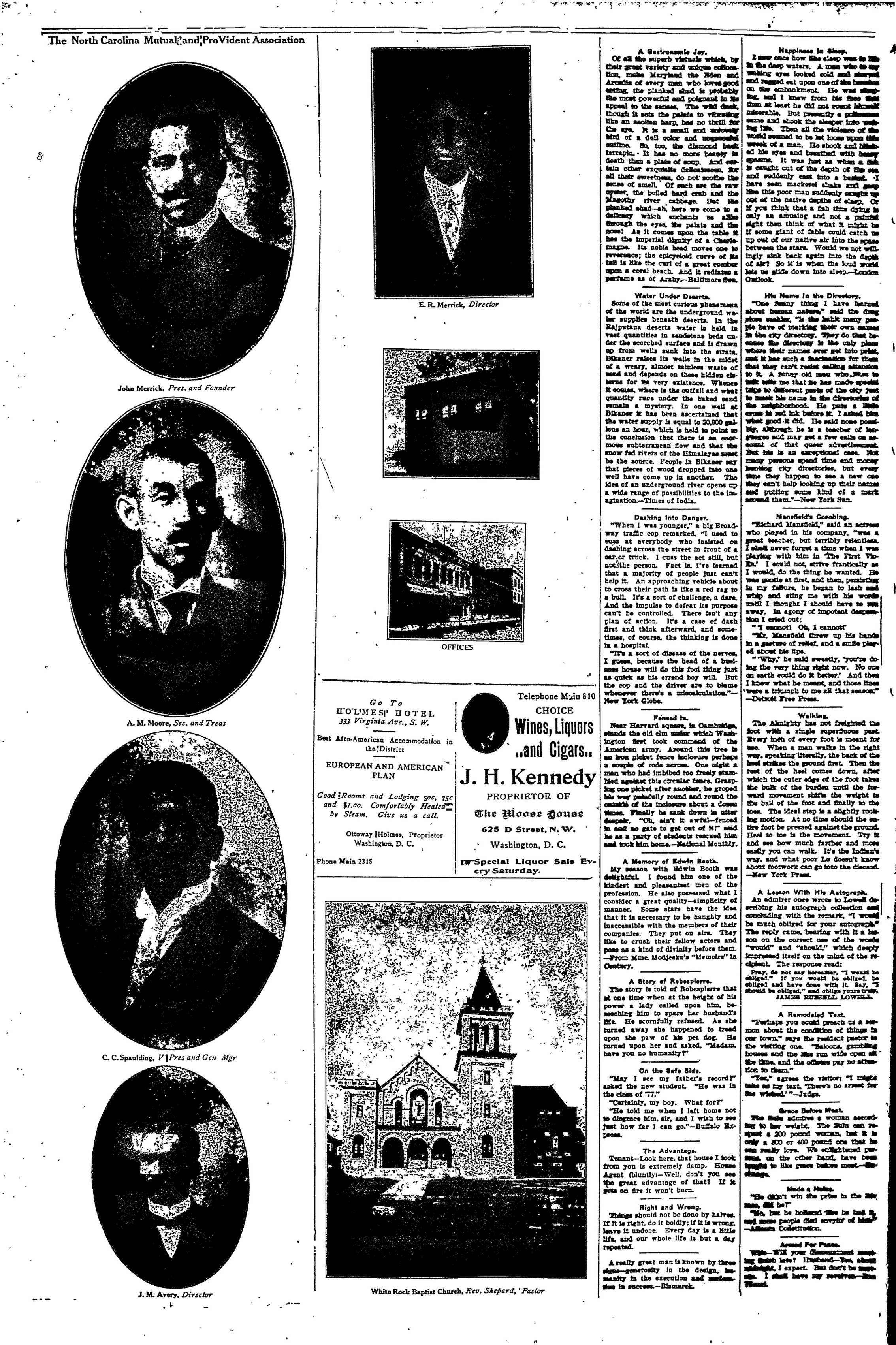
the North can't hold the light for the colored people in Durham. The North Carolina colored American, from my standpoint, can't ever teach the. Northern colored man how to conduct business. I shall first take up the North Carolina Mutual Insurance Company, which is reputed to be the greatest insurance company in the world among colored people. The company is officered by such well known business men as John Merrick, who is the president and founder. Mr. Merrick is one among the leading business men in this city. He is married and has a most excellent wife and several children. It is rumored that his only single daughter is to be married shortly to a well-known physician in Winston, N. C. I understand that this young physician has a very large practice. Miss Merrick is regarded as the belle of Durham. She is faultless in her dress. The Merricks live on Fayette Street, a fashionable part of the city.
President Merrick is a genial and agreeable companion. He wears a smile that never comes off. He is one of the strongest of supporters the National Religious Training School has, and a man of considerable wealth. I went with him Thursday to his church on Fayette Street, which is one of the most imposing in the city. I have never seen a church so well
M. B.
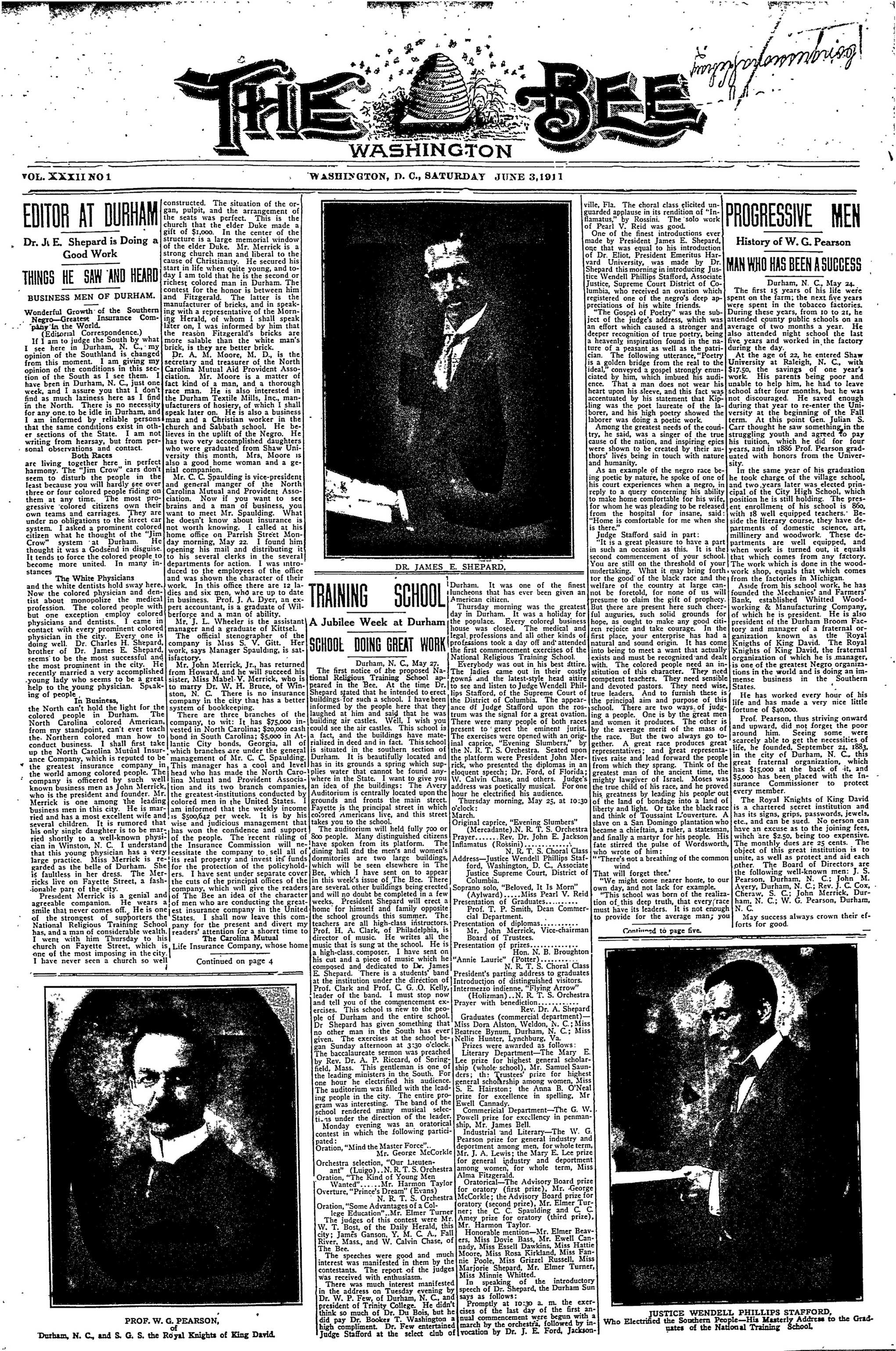
PROF. W. G. PEARSON, of Durham, N. C., and S. G. S. the Royal Knights of King David.
VOL. XXXII NO1
Both Races
The White Physicians
In Business
constructed. The situation of the organ, pulpit, and the arrangement of the seats was perfect. This is the church that the elder Duke made a gift of $1,000. In the center of the structure is a large memorial window of the elder Duke. Mr. Merrick is a strong church man and liberal to the cause of Christianity. He secured his start in life when quite young, and today I am told that he is the second or richest colored man in Durham. The contest for the honor is between him and Fitzgerald. The latter is the manufacturer of bricks, and in speaking with a representative of the Morning Herald, of whom I shall speak later on, I was informed by him that the reason Fitzgerald's bricks are more salable than the white man's brick, is they are better brick.
Dr. A. M. Moore, M. D., is the secretary and treasurer of the North Carolina Mutual Aid Provident Association. Mr. Moore is a matter of fact kind of a man, and a thorough race man. He is also interested in the Durham Textile Mills, Inc., manufacturers of hosiery, of which I shall speak later on. He is also a business man and a Christian worker in the church and Sabbath school. He believes in the uplift of the Negro. He has two very accomplished daughters who were graduated from Shaw University this month, Mrs. Moore is also a good home woman and a genial companion.
Mr. C. C. Spaulding is vice-president and general manger of the North Carolina Mutual and Provident Association. Now if you want to see brains and a man of business, you want to meet Mr. Spaulding. What he doesn't know about insurance is not worth knowing. I called at his home office on Parrish Street Monday morning, May 22. I found him opening his mail and distributing it to his several clerks in the several departments for action. I was introduced to the employees of the office and was shown the character of their work. In this office there are 12 ladies and six men, who are up to date in business. Prof. J. A. Dyer, an expert accountant, is a graduate of Wilberforce and a man of ability.
Mr. J. L. Wheeler is the assistant manager and a graduate of Kittsel. The official stenographer of the company is Miss S. V. Gitt. Her work, says Manager Spaulding, is satisfactory. Mr. John Merrick, Jr., has returned from Howard, and he will succeed his sister, Miss Mabel V. Merrick, who is to marry Dr. W. H. Bruce, of Winston, N. C. There is no insurance company in the city that has a better system of bookkeeping.
There are three branches of the company, to wit: It has $75,000 invested in North Carolina; $20,000 cash bond in South Carolina; $5,000 in Atlantic City bonds, Georgia, all of which branches are under the general management of Mr. C. C. Spaulding. This manager has a cool and level head who has made the North Carolina Mutual and Provident Association and its two branch companies, the greatest institutions conducted by colored men in the United States. I am informed that the weekly income is $500,642 per week. It is by his wise and judicious management that has won the confidence and support of the people. The recent ruling of the Insurance Commission will necessitate the company to sell all of its real property and invest its funds for the protection of the policyholders. I have sent under separate cover the cuts of the principal offices of the company, which will give the readers of The Bee an idea of the character of men who are conducting the greatest insurance company in the United States. I shall now leave this company for the present and divert my readers' attention for a short time to The Carolina Mutual
Life Insurance Company, whose home
Continued on page 4
[Name]
WASHINGTON, D. C., SATURDAY JUNE 3,1911
THE MAYOR OF BROOKLYN
DR. JAMES E. SHEPARD
TRAINING SCHOOL
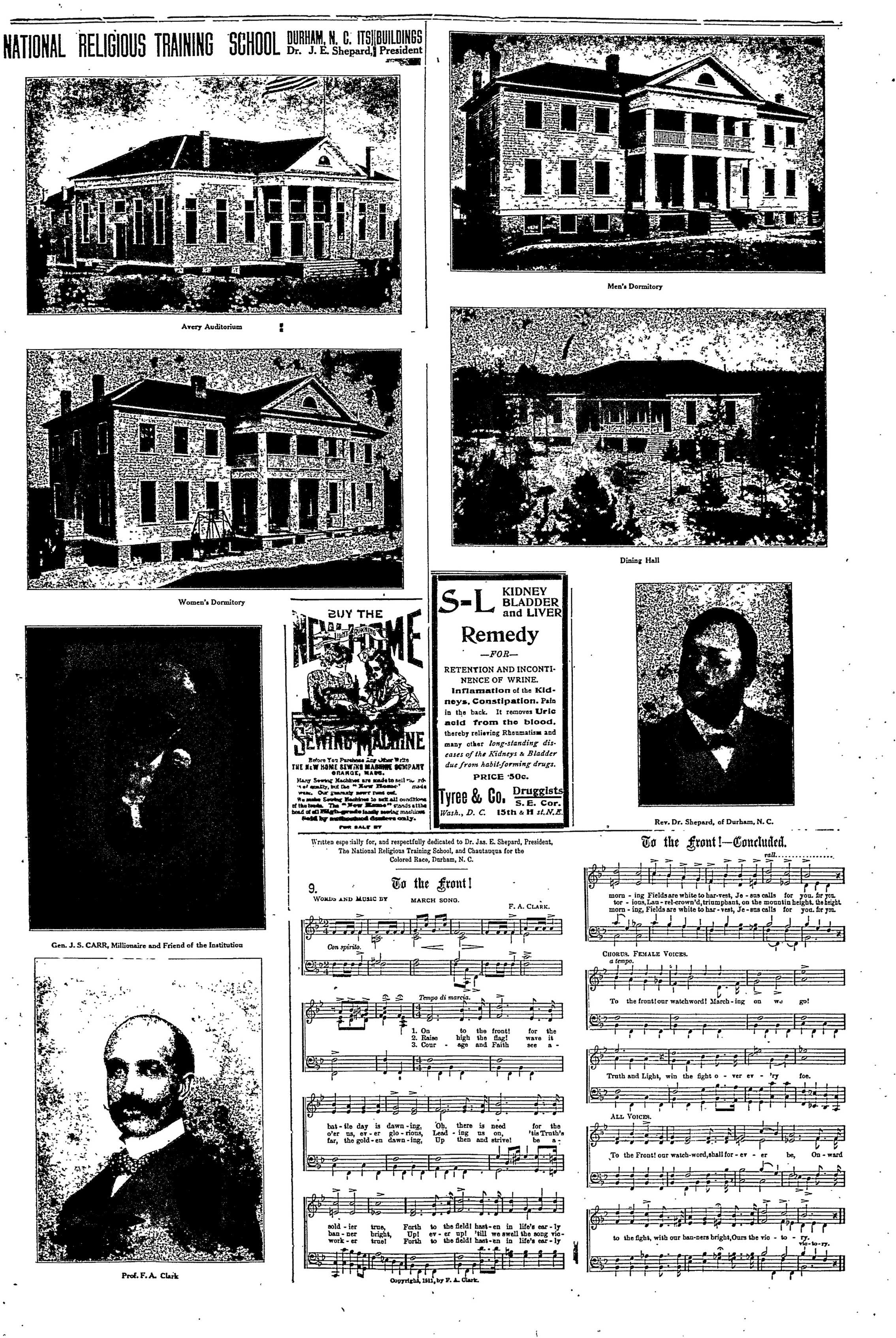
Durham, N. C., May 27. The first notice of the proposed National Religious Training School appeared in the Bee. At the time Dr. Shepard stated that he intended to erect buildings for such a school. I have been informed by the people here that they laughed at him and said that he was building air castles. Well, I wish you could see the air castles. This school is a fact, and the buildings have materialized in deed and in fact. This school is situated in the southern section of Durham. It is beautifully located and has in its grounds a spring which supplies water that cannot be found anywhere in the State. I want to give you an idea of the buildings: The Avery Auditorium is centrally located upon the grounds and fronts the main street Fayette is the principal street in which colored Americans live, and this street takes you to the school.
The auditorium will held fully 700 or 800 people. Many distinguished citizens have spoken from its platform. The dining hall and the men's and women's dormitories are two large buildings, which will be seen elsewhere in The Bee, which I have sent on to appear in this week's issue of The Bee. There are several other buildings being erected and will no doubt be completed in a few weeks. President Shepard will erect a home for himself and family opposite the school grounds this summer. The teachers are all high-class instructors. Prof. H. A. Clark, of Philadelphia, is director of music. He writes all the music that is sung at the school. He is a high-class composer. I have sent on his cut and a piece of music which he composed and dedicated to Dr. James E. Shepard. There is a students' band at the institution under the direction of Prof. Clark and Prof. C. G. O. Kelly, leader of the band. I must stop now and tell you of the commencement exercises. This school is new to the people of Durham and the entire school. Dr Shepard has given something that no other man in the South has ever given. The exercises at the school began Sunday afternoon at 3:30 o'clock. The baccalaureate sermon was preached by Rev. Dr. A. P. Riccard, of Springfield, Mass. This gentleman is one of the leading ministers in the South. For one hour he electrified his audience. The auditorium was filled with the leading people in the city. The entire program was interesting. The band of the school rendered many musical selectios under the direction of the leader Monday evening was an oratorica
Monday evening was an oratorical contest in which the following participated:
Oration, "Mind the Master Force".. Mr. George McCorkle
Orchestra selection, "Our Lieutenant" (Luigo)..N.R.T.S. Orchestra
Oration, "The Kind of Young Men
Wanted".....Mr. Harmon Taylor
Overture, "Prince's Dream" (Evans)
N.R.T.S. Orchestra
Oration, "Some Advantages of a College Education"..Mr. Elmer Turner
The judges of this contest were Mr. W. T. Bost, of the Daily Herald, this city; James Ganson, Y. M. C. A., Fall River, Mass., and W. Calvin Chase, of The Bee.
The speeches were good and much interest was manifested in them by the contestants. The report of the judges was received with enthusiasm.
There was much interest manifested in the address on Tuesday evening by Dr. W. P. Few, of Durham, N. C., and president of Trinity College. He didn't think so much of Dr. Du Bois, but he did pay Dr. Booker T. Washington a high compliment. Dr. Few entertained Judge Stafford at the select club of
Durham. It was one of the finest luncheons that has ever been given an American citizen. Thursday morning was the greatest day in Durham. It was a holiday for the populace. Every colored business house was closed. The medical and legal professions and all other kinds of professions took a day off and attended the first commencement exercises of the National Religious Training School. Everybody was out in his best attire. The ladies came out in their costly gowns and the latest-style head attire to see and listen to Judge Wendell Phillips Stafford, of the Supreme Court of the District of Columbia. The appearance of Judge Stafford upon the rostrum was the signal for a great ovation. There were many people of both races present to greet the eminent jurist. The exercises were opened with an original caprice, "Evening Slumbers," by the N. R. T. S. Orchestra. Seated upon the platform were President John Merrick, who presented the diplomas in an eloquent speech; Dr. Ford, of Florida; W. Calvin Chase, and others. Judge's address was poetically musical. For one hour he electrified his audience.
Thursday morning, May 25, at 10:30
o'clock:
March.
Original caprice, "Evening Slumbers"
(Mercadante).N. R. R. T. S. Orchestra
Prayer.....Rev. Dr. John E. Jackson
Inflamatus (Rossini).....
N. R. T. S. Choral Class Address—Justice Wendell Phillips Stafford, Washington, D. C., Associate Justice Supreme Court, District of Columbia
Soprano solo, "Beloved, It Is Morn"
(Aylward).....Miss Pearl V. Reid
Presentation of Graduates.....
Prof. T. P. Smith, Dean Commercial Department.
Presentation of diplomas.....
Mr. John Merrick, Vice-chairman
Board of Trustees.
Presentation of prizes.....
Hon. N. B. Broughton
"Annie Laurie" (Potter)
N. R. T. S. Choral Class
President's parting address to graduates
Introduction of distinguished visitors.
Intermezzo indienne, "Flying Arrow"
(Holizman)...N. R. T. S. Orchestra
Prayer with benediction.
Rev. Dr. A. Shepard
Graduates (commercial department)—Miss Dora Alstra, Weldon, N. C.; Miss Beatrice Bynum, Durham, N. C.; Miss Nellie Hunter, Lynchburg, Va.
Prizes were awarded as follows:
Literary Department—The Mary E. Lee prize for highest general scholarship (whole school), Mr. Samuel Saunders; th. Trustees' prize for highest general scholarship among women, Miss S. E. Hairston; the Anna B. O'Neal prize for excellence in spelling, Mr Ewell Cannady.
Commercial Department—The G. W. Powell prize for excellency in penmanship, Mr James Bell.
Industrial and Literary—The W. G. Pearson prize for general industry and deportment among men, for whole term, Mr. J. A. Lewis; the Mary E. Lee prize for general industry and deportment among women, for whole term, Miss Alma Fitzgerald.
Oratorical—The Advisory Board prize for oratory (first prize), Mr. George McCorkle; the Advisory Board prize for oratory (second prize), Mr. Elmer Turner; the C. C. Spaulding and C. C. Amey prize for oratory (third prize), Mr. Harmon Taylor.
Honorable mention—Mr. Elmer Beavers, Miss Dovie Bass, Mr. Ewell Canady, Miss Essell Dawkins, Miss Hattie Moore, Miss Rosa Kirkland, Miss Fannie Poole, Miss Grizzel Russell, Miss Marjorie Shepard, Mr. Elmer Turner, Miss Minnie Whitted.
In speaking of the introductory speech of Dr. Shepard, the Durham Sun says as follows:
Promptly at 10:30 a.m. the exercises of the last day of the first annual commencement were begun with a march by the orchestra, followed by invocation by Dr. J. E. Ford, Jackson-
THE MAYOR OF NEW YORK
JUSTICE WENDELL PHILLIPS STAFFORD, Who Electrified the Southern People—His Masterly Address to the Graduates of the National Training School.
ville, Fla. The choral class elicited unguarded applause in its rendition of "Inflamatus," by Rossini. The solo work of Pearl V. Reid was good. One of the finest introductions ever made by President James E. Shepard, one that was equal to his introduction of Dr. Eliot, President Emeritus Harvard University, was made by Dr. Shepard this morning in introducing Justice Wendell Phillips Stafford, Associate Justice, Supreme Court District of Columbia, who received an ovation which registered one of the negro's deep appreciations of his white friends.
"The Gospel of Poetry" was the subject of the judge's address, which was an effort which caused a stronger and deeper recognition of true poetry, being a heavenly inspiration found in the nature of a peasant as well as the patrician. The following utterance, "Poetry is a golden bridge from the real to the ideal," conveyed a gospel strongly enunciated by him, which imbued his audience. That a man does not wear his heart upon his sleeve, and this fact was accentuated by his statement that Kipling was the poet laureate of the laborer, and his high poetry showed the laborer was doing a poetic work.
Among the greatest needs of the country, he said, was a singer of the true cause of the nation, and inspiring epics were shown to be created by their authors' lives being in touch with nature and humanity.
As an example of the negro race being poetic by nature, he spoke of one of his court experiences when a negro, in reply to a query concerning his ability to make home comfortable for his wife, for whom he was pleading to be released from the hospital for insane, said: "Home is comfortable for me when she is there."
Judge Stafford said in part:
Judge Stanford said in part, "It is a great pleasure to have a part in such an occasion as this. It is the second commencement of your school. You are still on the threshold of your undertaking. What it may bring forth tor the good of the black race and the welfare of the country at large cannot be foretold, for none of us will presume to claim the gift of prophecy. But there are present here such cheerful auguries, such solid grounds for hope, as ought to make any good citizen rejoice and take courage. In the first place, your enterprise has had a natural and sound origin. It has come into being to meet a want that actually exists and must be recognized and dealt with. The colored people need an institution of this character. They need competent teachers. They need sensible and devoted pastors. They need wise, true leaders. And to furnish these is the principal aim and purpose of this school. There are two ways of judging a people. One is by the great men and women it produces. The other is by the average merit of the mass of the race. But the two always go together. A great race produces great representatives; and great representatives raise and lead forward the people from which they sprang. Think of the greatest man of the ancient time, the mighty lawgiver of Israel. Moses was the true child of his race, and he proved his greatness by leading his people out of the land of bondage into a land of liberty and light. Or take the black race and think of Toussaint L'ouverture. A slave on a San Domingo plantation who became a chieftain, a ruler, a statesman and finally a martyr for his people. His fate stirred the pulse of Wordsworth who wrote of him:
"There's not a breathing of the common wind
That will forget thee."
"We might come nearer home, to our own day, and not lack for example.
"This school was born of the realization of this deep truth, that every race must have its leaders. It is not enough to provide for the average man; you
PROGRESSIVE MEN
History of W. G. Pearson
MAN WHO HAS BEEN A SUCCESS
Durham, N. C., May 24. The first 15 years of his life were spent on the farm; the next five years were spent in the tobacco factories. During these years, from 10 to 21, he attended county public schools on an average of two months a year. He also attended night school the last five years and worked in the factory during the day. At the age of 22, he entered Shaw University at Raleigh, N. C., with $17.50, the savings of one year's work. His parents being poor and unable to help him, he had to leave school after four months, but he was not discouraged. He saved enough during that year to re-enter the University at the beginning of the Fall term. At this point Gen. Julian S. Carr thought he saw something in the struggling youth and agreed to pay his tuition, which he did for four years, and in 1886 Prof. Pearson graduated with honors from the University.
In the same year of his graduation he took charge of the village school, and two years later was elected principal of the City High School, which position he is still holding. The present enrollment of his school is 860, with 18 well equipped teachers.' Beside the literary course, they have departments of domestic science, art, millinery and woodwork. These departments are well equipped, and when work is turned out, it equals that which comes from any factory. The work which is done in the woodwork shop, equals that which comes from the factories in Michigan. Aside from his school work, he has founded the Mechanics' and Farmers' Bank, established Whitted Woodworking & Manufacturing Company, of which he is president. He is also president of the Durham Broom Factory and manager of a fraternal organization known as the Royal Knights of King David. The Royal Knights of King David, the fraternal organization of which he is manager, is one of the greatest Negro organizations in the world and is doing an immense business in the Southern States.
He has worked every hour of his life and has made a very nice little fortune of $40,000.
Prof Pearson, thus striving onward and upward, did not forget the poor around him. Seeing some were scarcely able to get the necessities of life, he founded, September 24, 1883, in the city of Durham, N. C., this great fraternal organization, which has $15,000 at the back of it, and $5,000 has been placed with the Insurance Commissioner to protect every member. The Royal Knights of King David is a chartered secret institution and has its signs, grips, passwords, jewels, etc., and can be sued. No person can have an excuse as to the joining fees, which are $2.50, being too expensive. The monthly dues are 25 cents. The object of this great institution is to unite, as well as protect and aid each other. The Board of Directors are the following well-known men: J. S. Pearson, Durham, N. C.; John M. Avery, Durham, N. C.; Rev. J. C. Cox, Cheraw, S. C.; John Merrick, Durham, N. C.; W. G. Pearson, Durham, N. C.
May success always crown their efforts for good.
MANDOLIN SERENADE
A Charming Serenade by Richard Stahl, Composer of "Sea King," etc Sung with great success by the Great and Only CORINNE
1. Brightly the moon is shin-ing to-night, nature's in re-
2. If thou dost love me, as I love you, dream of me to-
pose,…… Night-in-gale on-ly sings with de-light of my love she knows……
night,…… Dream of the one who's faithful and true, and gave thee his plight……
Patiently here I'm staying, Join-ing her song d'a-mour,... Oh, list' to my lay with
Many a time I've told you Thou art my queen divine,... Believe what I say and
F published by AMERICAN MELODY Co. New York
Troubles?
LINED MANTLES
S ARE OVER
ent, more light and will outlast six ordinary
cent, on your mantle expense. TWO
E. Price, 25 cents
DO TRY WITHOUT COST
from 12 Block Vy-tal-ty Mantles—the best
of mantles sold—take them to your dealer,
and get a Block Innerlin Lined Mantle free.
Innerlin Lined Mantles are for sale at Hardware,
Grocery and Department Stores.
Our Descriptive Circular and New Catalogue
Light Co., Youngstown, Ohio
(ole Manufacturers)
Descriptive Mantles, Burners and Supplies of every
Gasoline, Kerosene, High Pressure, etc.
Element Store, W. T. & F. B. Weaver
Armentrout & Son
B. Reduso
CORSETS
Block Innerlin Lined Mantles give 50 per cent, more light and will outlast six ordinary mantles. This means a saving of 75 per cent, on your mantle expense. TWO COMPLETE GAS MANTLES IN ONE. Price, 25 cents
GET ONE TO TRY WITHOUT COST
Save the box covers from 12 Block Vy-tal-ty Mantles—the best 10 and 15-cent grade of mantles sold—take them to your dealer, or send them to us, and get a Block Innerlin Lined Mantle free.
Block Vy-tal-ty and Block Innerlin Lined Mantles are for sale at Hardware, China, Plumbing, Grocery and Department Stores.
Dealers Write for Our Descriptive Circular and New Catalogue
The Block Light Co., Youngstown, Ohio
(Sole Manufacturers)
Headquarters for Incandescent Mantles, Burners and Supplies of every description, Gas, Gasoline, Kerosene, High Pressure, etc.
For cate by Golde berg Department Store, W. T. & F. B. Weaver I. Small Armentrout & Son
W.B. Reduso CORSETS
THE W.B. Reduso Corset brings well-developed figures into graceful, slender lines. It reduces the hips and abdomen from one to five inches. Simple in construction, the Reduso unhampered by straps or cumbersome attachments of any sort, transforms the figure completely.
Fabrics are staunch woven, durable materials, designed to meet the demand of strain and long wear. There are several styles to suit the requirments of all stout figures.
Fabrics are staunch woven, durable materials, designed to meet the demand of strain and long wear. There are several styles to suit the requirements of all stout figures.
Form Corsets—in a series of per- 1.00 upwards to $5.00 per pair. acres, everywhere. 34th St. at Broadway, New York
W. B. Nuform and Erect Form Corsets fact models, for all figures, $1.00 upwards
W. B. Nuform and Erect Form Corsets-in a series of perfect models, for all figures, $1.00 upwards to $5.00 per pair.
Sold at all stores, everywhere.
WEENGARTEN BROS., Makers, 34th St. at Broadway, New York
BEZ THE LINING?
Style 770 (as pictured) medium high bust, long over hips and abdomen. Made of durable coutil or batiste, with lace and ribbon trimming. Three pairs hose supporters. Sizes 19 to 36. Price $3.00. Other REDUSO models $3.00 per pair upwards to $10.00.
BET THE LION?
gs
oul,
hips
hes.
so
quire-
AX FACE 10007.
When Schleissmann was digging at the supposed site of Troy he discovered masses of silver in the form of ax heads. Gotze suggested that these were intended not for implements, but for money. Bronze ax heads have also been discovered in ancient remains, mingled with metal pieces in the form of rings, in such a manner as to suggest that all alike were intended to serve as money, and the conclusion is drawn that in ancient times the metal ax head had come to be a popular unit of value for purposes of barter. After it had disappeared as actual money the memory of it, according to this theory, was preserved in the coins of Tenodos, which bore the figure of an ax head. It has been suggested that the "wedge of gold" which Achen stole from the spoils of Jericho and for the stealing of which Joachua had him stoned to death was a specimen of the ancient ax head money. Harper's Weekly.
A Youthful Joke
"When Mark Twain was the editor of the Virginia City Enterprise," said an essayist at the Franklin inn in Philadelphia, "a servant girl in the neighboring town of Lovelock unexpectedly fell heir to $800,000. Her name was Miriam Rogers. A day or two after the announcement, while all Virginia City and Lovelock hummed with Miriam's good luck, Mark Twain printed on the editorial page of the Enterprise this paragraph:
"If Miriam Rogers of Lovelock, who recently inherited a large fortune, will call at this office she will hear something greatly to her advantage. We are busehleorn."—New York Press.
Surrounding a Difficulty-
A man of fact always manages to get out of a difficulty. The clerk of a parish in England whose business it was to read the first lesson in the church came across the chapter in Davil in which the names Bindash, Hassah and Abednego occur twelve times.
Finding it extremely difficult to pronounce these names, he went through the chapter referring to them as "the aforesaid gentlemen."
Her Gull Possession.
"Miss Oldcastle is always self possessed no matter what happens."
"Wull, she ought to be seeing that she has had puerile in the sold possession line for at least thirty-two years"—Glengo Record-Thread.
man do lin pray! List to my strains pure... Oh, heart!... oh, heart!... My
list I pray! List to my strains pure... Oh, heart!... oh, heart!... My
CHORUS. Tempo di Valse. (Slow.)
man do lin I'm playing, Each strain brings new de-light.
send thee thousand kisses and sing to thee "Good night." My
man do lin I'm playing, each strain brings new de-light.
send thee thousand kisses and sing to thee, "Good night."
OVER 65 YEARS'
EXPERIENCE
PATENTS
TRADE. MARKS
DESIGNS
COPYRIGHTS & C.
Anyone sending a sketch and description may
quickly ascertain our opinion free whether an
inventure is probably patentable. Communications
strictly confidential. HANDBOOK on Patents
isnt free. Oldest agency for securing patents.
Patents taken through Munn & Co. receive
special notice, without charge, in the
Scientific American.
A handsomely illustrated weekly. Largest circulation of any scientific journal. Terms, $3 a year: four months, $L. Bold by all newsdealers.
MUNN & Co. 361Broadway, New York
Branch Office, CCS W St., Washington, D. C.
SHIRLEY
PRESIDENT
SUSPENDERS
M
The kind that most men wear. Notice the cord back and the front ends. They slide in frictionless tubes and move as you move. You will quickly see why Shimley President Suspenders are comfortable and economical for the working man or business man.
Light, Medium or Extra Heavy Weights
—Extra Lengths for Tall Men.
Price 50 Cents from your local dealer
or by mail from the factory.
THE C. A. EDGARTON MFG. CO.
323 MAIN*STREET, SHIRLEY, MASS.
Lady Halle, of Austria, a noted performer, died last week of pneumonia. Lady Halle was born in 1840. She was appointed violinist to Queen Alexandra in 1901.
WANTED-ARIDER AGENT
859 RESEARCH INSTITUTE-PROOF
SELF-HEALTH TREAS
4
NEW YORK CANDY KITCHEN 1506 7th St. N. W. Fresh Candies Daily
Good Chocolate Candy 15c lb.
PURE ICE CREAM
Consult McClure's Magazine for the latest on fads and fashions.
Former Minister Komura entertained in Tokio United States Ambassador O'Brien at a congratulatory dinner in celebration of the signing of the new treaty between Japan and the United States.
Good Taffy 10c lb.
Robert Lowery, noted gospel hymn writer, was unveiled last week at Plainfield, N. J. Statistics issued by transcontinental traveled from eastern cities to points railroads showed that 85,000 persons on the Pacific coast during the thirty-five day period ending April 10.
THE HISTORY OF THE MUSEUM
THE HISTORY OF THE MUSEUM
Women's Dormitory
The image provided is too blurry to accurately recognize any text. It appears to be a grayscale photo of a person, but the details are not clear.
```markdown
```
The image provided is too blurry to accurately recognize any text or details. It appears to be a grayscale image with a blurry, speckled texture.
Gen. J. S. CARR, Millionaire and Friend of the Institution
---
M.
Prof. F. A. Clark
Written especially for, and respectfully dedicated to Dr. Jas. E. Shepard, President, The National Religious Training School, and Chautauqua for the Colored Race, Durham, N. C.
9. To the front!
WORDS AND MUSIC BY MARCH SONG.
F. A. CLARK.
Con spirito.
Tempo di marcia.
1. On to the front! for the
2. Raise high the flag! wave it
3. Courage and Faith see a
battle day is dawn-ing, Oh, there is need for the
o'er us, ev-er glorious, Leading us on, 'tis Truth's
far, the gold-en dawn-ing, Up then and strive!
soldier true, Forth to the field! hast-en in life's ear-ly
ban-ner bright, Up! ev-er up! 'till we swell the song vio-
work-er true! Forth to the field! hast-en in life's ear-ly
BUY THE
NEW HOME
LIGHT RUNNING
SEWING MACHINE
Before You Purchase And Other Write
THE N&W HOME SEWING MACHINE COMPANY
ORANGE, MASS.
Many Sewing Machines are made to sell for
rich and quality, but the "New Home" made
wear. Our generally never runs out.
We make Sewing Machines to suit all conditions
of the trade. The "New Home" stands at the
head of all High-end family sewing machines
field by multimachine dealers only.
6
The house is elevated on a platform, surrounded by a dense forest. It has a large porch with a railing, and a set of stairs leading up to the entrance. The building is made of stone and has a flat roof. There are several windows on the front and side of the house, and a large door on the front. The house is surrounded by a dense forest, and there are many trees in the background.
morning Fields are white to harvest, Je-sus calls for you. for you
torious, Lan-rel-crown'd, triumphant, on the mountin height, the height
morning, Fields are white to harvest, Je-sus calls for you. for you.
CHORUS. FEMALE VOICES.
a tempo.
To the front! our watchword! Marching on we go!
Truth and Light, win the fight over every foe.
ALL VOICES.
To the Front! our watch-word, shall for-ever be, On-ward
to the fight, with our ban-ners bright, Ours the vi-o-to-ry.
vi-o-to-ry.
Men's Dormitory
RETENTION AND INCONTINENCE OF WRINE.
Inflammation of the Kidneys, Constipation. Pain in the back. It removes Uric acid from the blood, thereby relieving Rheumatism and many other long-standing diseases of the Kidneys & Bladder due from habit-forming drugs.
PRICE 50c.
Tyree & Co. Druggists
S.E. Cor.
Wash., D. C. 15th & H st.N.E.
Dining Hall
M. H.
Rev. Dr. Shepard, of Durham, N. C. To the front!—Concluded.
THE BEE
Published
at
1109 Eye St., N. W., Washington,
D. C.
W. CALVIN CHASE, EDITOR.
Entered at the Post Office at Washington, D. C., as second-class mail matter.
ESTABLISHED 1880.
TERMS OF SUBSCRIPTION.
One copy per year in advance...$2.00
Six months...1.00
Three months....50
Subscription monthly....20
DURHAM. N. C.
We desire to call the attention of our readers to the editor's trip to Durham, N. C., last week, which has been put in as simple and as plain a manner as possible, so that the American people can tell for themselves what the colored people in Durham, N. C., are doing. Perhaps there are just two things that we have failed to call the attention of our readers in our correspondence, and these two items are the condition of the white people in East Durham and the condition of the colored people in East Durham. They are on par. While in the central section of the city both races are doing business in a manner that is commendable. That is, they are both doing business alike. Colored men in business are being supported. No man or woman is jealous of the other. The black man and woman of Durham are not jealous of each other. They are unlike the Northern colored man. They believe in helping one another. The white people in Durham, that is, the well-to-do-classes, do all in their power to help the colored people.
We want to call the attention of the country to Gen. J. S. Carr, the banker, and the Dukes, the Daily Herald, Sun, and other enterprises have done much to advance the colored people. The daily press of Durham is extremely fair toward the colored people. We desire to take this occasion to commend Mr. W. T. Bost, of the Associated Press, for the liberal space he gave the several exercises of the Durham school. We want to commend the systematic manner in which the North Carolina Mutual and Provident and the Carolina Mutual Life Insurance Companies are conducted.
We extend to the Durham people, white and colored, our congratulations, and we are glad to personally commend the Dukes for the liberal share of work they are giving colored boys and girls, men and women, in their factories. This firm shows what its appreciation is for the colored race South, and from what we saw and heard, all that is necessary for the colored man and woman to do is to be loyal to their employers, true to themselves, and have a just regard for the laws of health, and we feel confident that colored men and women South will rise above the common level.
What the colored man South needs to do is to continue to do as they are doing. Durham is able to teach all other cities in the South a lesson. "It is a city upon a hill," remarked Mr. Justice Stafford. There is race pride in Durham, and to her fellow-citizens The Bee extends its congratulations and its editor extends thanks for the hospitality shown him.
THE LIGHT THAT FAILED.
It is always the emasculated pervert who has not contributed anything to the sum total of achievements, and who is unfit and incapable of infusing life into dormancy, who, wearing the cynical, senile grin of deceit, and possessing all the characteristics of the sneaking, rognish cat, like an assassin in the night, attacks its superiors. We say "its," because in this case it is eminently proper to use the neuter gender. It was one of these species of nonentities who held up the International Secretary of the Y. M. C. A. on the street recently, and, with the demeanor of a sly, slick, slimy snake, poured into his ears mischievous, but ineffective, venom.
And this same sly, slick, slimy snake, when it next met, face to face, those upon whom it had spewed its venom, wore the sickly, deceitful smile of a Judas, and spoke with the servility it is capable of. It was one of these aforesaid, and described akin to the offensive, hideous reptile family, who criticised the presence upon the platform at a recent Sunday meeting of the Y. M. C. A. of men whom the records of the Y. M. C. A. show have contributed liberally to the new Y. M. C. A. building; men who have given frequently of their time, talents and money to push forward the good and grand Y. M. C. A. work. But it—the snake—reckoned without its host. The International Secretary is too high and lofty, too broad and sincere, too deeply interested in his work for God and man, to lend ear or countenance to backbiting or the vaporings of reptiles.
The Y. M. C. A. officials and members will tell you that they have no apologies to offer for having invited to the platform Sunday men who have done, and are doing now something for the race, the Y. M. C. A., and for humanity. Upon that platform there was not a single colored man but who has contributed liberally to the Y. M. C. A. movetet, both of time, talents and purse. But the slimy, deceitful ingrate who moves with a suggestion of a Uriah Heap and a snake; whose lying tongue and envious backbiting bespeak the foulness of its motives and the ingratitude of its makeup, and who happened not to be invited to the platform, has contributed not one farthing to the Y. M. C. A., as the records will show. But why spaciate upon known deceit and the reptile family? By that low, mean criticism the snake impaled itself upon its own poinard. And its vaporings may be likened to the light that failed.
MERITORIOUS ACTION.
MERITORIOUS ACTION.
While Judge Robert H. Terrell was in Tuskegee last week to deliver the commencement address at Tuskegee Institute, the trustees of Howard University met and elected him, by an overwhelming vote, a member of the Law School faculty. In conferring this honor the trustee board honored the university's alumnus, and showed appreciation of the Judge's splendid record on the bench. The loyalty of such men as Dr. Francis, Dr. Mooreland, and Dr. Purvis, who are members of the trustee board, who, with the stanch support of the white trustees, made his selection possible, cannot be praised too highly. Our first duty is to aid our own. These men performed their duty, and well.
Another meritorious act of the board was the advancing, upon the recommendation of Dr. Thirkield, Prof. Just to the position of Associate Professor. Prof. Just's work has earned for him this advancement. He's a splendid type of the modestly aggressive, progressive young man. And still another action on the part of the trustee board that calls for our commendation, and the commendation of the Howard alumnus, was the election of Hon. J. C. Napier, Register of the Treasury, to be a member of the trustee board. The Bee notes with pride and with favor this work of Howard's trustees.
J. DOUGLAS WETMORE. That was a manly letter of J. Douglas Wetmore, published last week, in which he explained the necessitous delay in bringing Dr. Washington's assailant to trial, and in which he incidentally but forcibly censured carping critics of the Doctor. There are a class of lazy, shiftless, work-divorced negroes who imagine they are doing something when they criticize Dr. Washington or suggest improper conduct on his part. The men who do this are men whose own lives are either a tissue of lies or shredded immorality. The man without visible support, and the man who has failed to accomplish something in life is not worth one's while to listen to. Mr. Wetmore has deftly but none the less effectively thrust the dagger of silence under the fifth rib of such men. But J. Douglas Wetmore can always be relied upon to be open, frank and manly, even when he is with you, and fair and square when against you. And we respect him for it.
Webster's definition of an ingrate is "an ungrateful person." That's good as far as it goes, but
Curs will bark, and vice dogs will snap, but both are harmless.
Life's one long, sweet song to the fellow who knows how to take it, but to the man who cannot grab or reach the hanging strap of success life is one long, frightful nightmare. It's a sweet song with us.
One of the noted colored men of the race attending the exercises is Editor W. Calvin Chase, of Washington, who edits The Bee. He is not accustomed to seeing things that don't exist or to growing unbecomingly gay when he does see them, for he smarts under the glaring mistreatment of men of his race in localities where greatest friendship is assiduously proclaimed in theory, but denied in fact. Of the conditions here; he finds no complaint and said last night: "I think the white people here treat the colored people grandly." He is here to see the school and to watch the work of the two races.
MEMORIAL EXERCISES AT
HARMONY CEMETERY.
Interesting Addresses, Music and Other Features—M. C. Maxfield Speaks.
There were several hundred people at Harmony Cemetery Tuesday. The Grand Army of the Republic, under the auspices of Charles Summer Post No. 9, Benjamin Young, Commander, assisted by the First Separate Battalion, Maj. Arthur Brooks, commanding, Rear Admiral Charles M. Thomas Camp No. 9, U. S. V. V.; Gen. Guy V. Henry Garrison No. 9, Frank Coolman, and others participated in the ceremonies Tuesday.
Commander Young delivered a very touching and eloquent opening address. He reviewed briefly the work of the Grand Army and what the soldiers did in the War of the Rebellion and why the 30th of May was designated as Memorial Day. The junior choir of the Metropolitan Church, under the direction of Prof. W. G. Braxton, rendered music. Reading of Lincoln's Gettysburg Address and solo, were the next features of the occasion.
Mr. M. C. Maxfield was the next speaker introduced. He made the principal address. He reviewed eloquently the valor of the colored soldier. He paid an eloquent tribute to the Generals and Commander Young. The address of Mr. Maxfield was full of history. For one hour and 15 minutes he held his audience. He said in part:
"We have assembled this day to commemorate the death of those who are buried in these sacred grounds. These brave heroes died for a cause which has been made perpetual by an act of Congress and which shall ever be held sacred as long as life lasts. The liberty which we enjoy to-day cannot be appreciated by this generation. We have no idea of its value or worth. In yonder graves your ancestors lie asleep. If they could but speak, what a story could they tell or a tale unfold. The hands that placed them are not, I don't believe, among the living. They, too, are asleep in some silent tomb. When the true history of these noble braves shall be truthfully written, your boys whose faces beam with delight will read the story of the historians, and hesitate for a moment and say to themselves, we live in a Republic which cost thousands of lives to maintain. This is a sad moment in the history of our Republic. The Constitution that governs us was sustained by the sword and the bayonet. The black soldier played an important part, and an evidence of their valor look at yonder graves. This is an hour of sadness. This is an hour to extol the virtue, the valor and the bravery of those who fought for a cause which has made us free and independent citizens. It is the duty of our Government then to support the widows of the fallen braves. I love this flag and this country. We have but one flag and one country, no matter what the conditions are. Our fathers, sons and brothers, although dead, are part of this country. The memory of these dead heroes will forever be emblazoned on the scroll of fame, and when that scroll shall be opened, the merits and demerits of the participants of the late War of the Rebellion should be counted, the black soldiers will be numbered among them. I am actuated by a feeling of pride. I am happy when I know that we have played our part, and this generation is doing its whole duty on an occasion like this."
He was followed by Mr. R. E. Torry, who prefaced his two poems with a short eloquent address. His first poem was on the American Flag, and his second poem was the black soldier. He was applauded throughout the delivery of his address and poems.
Mr. W. Calvin Chase was the next speaker who delivered a short address.
To the Public.
I, the daughter of the late G. W. Barnes, who departed this life June 9, 1908, wish to rectify the article in the issue of The Bee May 27, 1911. I want to say that my mother nor I have never been and are not now dependent on any one for assistance, as stated in the paper, but as my father was a true, and valiant servant to the late Gen. U. S. Grant, and that through him, probably Gen. Grant's life was saved in the assassination of President Lincoln, my mother would be very glad for any action that Congress would make, as also mentioned in article referred to in regards for a pension, as my father was also a soldier, but never pensioned. The relics of the late Gen. Grant, as was mentioned, if wanted for any institution, I will be very glad to be interviewed concerning said. Very respectfully, (MRS) NELLIE WASHINGTON, 1454 N Street, Northwest.
Public Men And Things
It was back in 1896, I believe, at St. Louis, when Whittie McKinlay became a National character. In that year Whittie assumed the responsibility of nominating the late Senator Allison for President. Whittie spluttered and fumed around the hotels of St. Louis, imploring every one to vote for "what-you-call-um," but all his powers of persuasion, and all the freckles in his salad-colored face couldn't turn the trick. Then Whittie returned to Washington, and ever since, backed by a constituency consisting of himself and Whittie McKinlay, he has been telling various Presidents just what their duties consist of, who they should appoint, and who they should blackball. And the real joke of it is that he actually believes that the Presidents have followed his advice. If a man is appointed, and Whittie hears of it in the newspapers, he tells it all around that he turned the trick, and he believes it himself. If a man is turned down, Whittie can tell you exactly how he, single handed and alone, accomplished it. He claims everything with confidence. The only thing that Whittie is known not to claim is responsibility for that old bank failure. Whittie draws the line on that accomplishment. And I guess he is right. I had about $56 dollars in that old bank when she breathed her last, and it's there yet. When the thing was fresh many of us who had a little deposit in the bank, and those of us who owed the bank long over due notes, which we were tickled to death to be relieved of; heaped a lot of blame on McKinlay. But if there is a man who came clean out of that bank it was Whittie McKinlay. He was an actual, and a heavy loser. If it had not been for paying up debts, the result of that bank failure, and for which the courts relieved him, Whittie would be riding around this old berg in a French-made touring car, and be living swell on Easy Street, right around the corner from Millionaire Avenue. In business he is a shrewd little mess of freckles, and some times I think he is a distant relative of the Einstines. Whittie is a resident of South Carolina, when he gets to talking about what votes he can control, but ordinarily, and in reality, he is a resident of Washington, and if he lived a few blocks further he would be over in Virginia. He's Collector of Customs now, but just how he put it over the boys and landed this plum, I have not been able to find out, but he landed all right. I used to borrow money, occasionally, from Whittie, when I was a single fellow, and thought I was in society here, and he always accommodated me. He was the most accommodating fellow about lending I know of, when you paid the toll, and he never was particularly how big the toll was. If it had not been for the Spanish-American war, which sent stocks tumbling down, and that mournful dream—the Capitol Savings Bank, McKinlay would be a very rich man, and they say he is fast getting on his feet again, and if things break right during the next two or three years, he will be moving towards Easy Street. As a politician Whittie thinks he's the best ever. Some people are awfully mistaken at times, and McKinlay is one of those. He is an awfully game fighter, holds on with a sort of bulldog tenacity, and he's a mighty loyal friend. But it is better than a minstrel show to listen to him tell how he did everything, from making the world to electing Presidents and picking Cabinet officers. And the funny thing about it is, he's just semiconscious enough to believe it. But old "what-you-call-um" is not a bad stag at making a man. In fact, the freckled-faced South Carolinian, who, like the rest of the tribe from that State, think themselves better than any people on earth, is a credit to his race. But if Whittie would only forget that he is not a Warwick, we might reside in the same city with him, at least comfortably. But the critter won't forget. His dad never taught him that word.
"Mr. President." I exclaimed, and a deathlike silence shrouded the White House. Even the cow that Senator Stephenson donated to the President stopped chewing her cud, for fear of making a noise. "I arise to nominate the only, real proper man to represent this country at Port au Prince." President Taft looked up from his desk in amazement and surprise. When he caught his senses he softly remarked, "Mr. Sage, proceed." "The proper man for Haiti should be a colored man. He should be one who feels himself capable of being a diplomat." Overcome with this information, the President was speechless for a few moments. On recovering his powers of articulation, he arose from his gilded chair and said: "Mr. Sage. I have applications from an even hundred proper men, and each mail brings in additional proper men. Up to date every applicant has been a colored man, and up to date every one has avowed that he felt himself fully capable to be a Minister to Haiti."
I might have known that every fellow feels himself capable to draw that $10,000 per annum. It was rumored on the Rialto the past week that Dr. Tunnell, too, was a candidate. Well, he would not be bad. In fact, there are many colored men who, if given a chance, would make a crackerjack Minister. Dr. Furness simply developed. Any man with a good education, grit, and character, can develop. Washington, counting Dr. Tunnell, has three candidates, and you would not make a failure if you selected either of the three.
Another rumor that came floating down the Rialto last week was that the selection of a Minister was all in the air; that a man, if he felt disposed, could enter the list now and have an equal chance with the rest. The only ones who are barred are the lily-whitehs. If you have a complexion that ranges from a coconut brown to a blue black, you are eligible. But complexions of the Cy Adams, or Bruce Evans sort, are barred from entry. A lot of fellows, hoping that lightning might strike them, are
brushing up on their outlawed French. Judge Terrell has been speaking French for a week. Jim Cobb, having originated in the swamps of Louisiana, near New Orleans, said he used to speak a patois that was near French, and he is practicing on that old stuff. Walter and Bis Pinbackch are brushing up on their New Orleans French. Prof. Leyton is singing a few French songs, now, just for practice. Dr. Sumner Wormley, every time a patient enters his studio to have a molar saturated with cocaine, always greets them with "Polly you, Francais?" and Harry Cardozo, now that the candidate fever has struck Howard Hill, is talking a jargon to all the Freedman's patients which he calls pure French. Will Houston went home the other evening and surprised his wife by asking her, in French, to pass him the pie at dinner. If ever Will lands the Haitian mission, he will bring up a delegation of revolutionists to the next B. M. C. that will handle the steam roller in a way to make the handlers at the last B. M. C. look like the dirty dozen bound for the Island of St. Helena. And if Will should go, he would jolly those Haitians into electing him Grandmaster for life. As a jollier, Will holds the Hague medal. The other day when I passed the kiosk down on the avenue. I saw 15 or 20 Hamites surrounding it, and when I asked, "What's the excitement?" they answered in chorus: "We are figuring out how hot it is, and trying to determine how much hotter it is in Haiti." "Are you candidates?" I murmured. "No," each one answered. "I've got the job cinched." And every one of them looked good. "when far away," for the job. Dr. Vernon is still West, they say, with his ear to the ground, and in the meantime is sending a few endorsements by special delivery. It wouldn't surprise me if Dr. Hurst, being a Haitian himself, wouldn't have a few words to say as to who will be the next Minister to Haiti. In the meantime, rumor says, Kelly Miller is within speaking distance of the job.
EDITOR AT DURHAM
office is located at 242 1-2 Main Street.
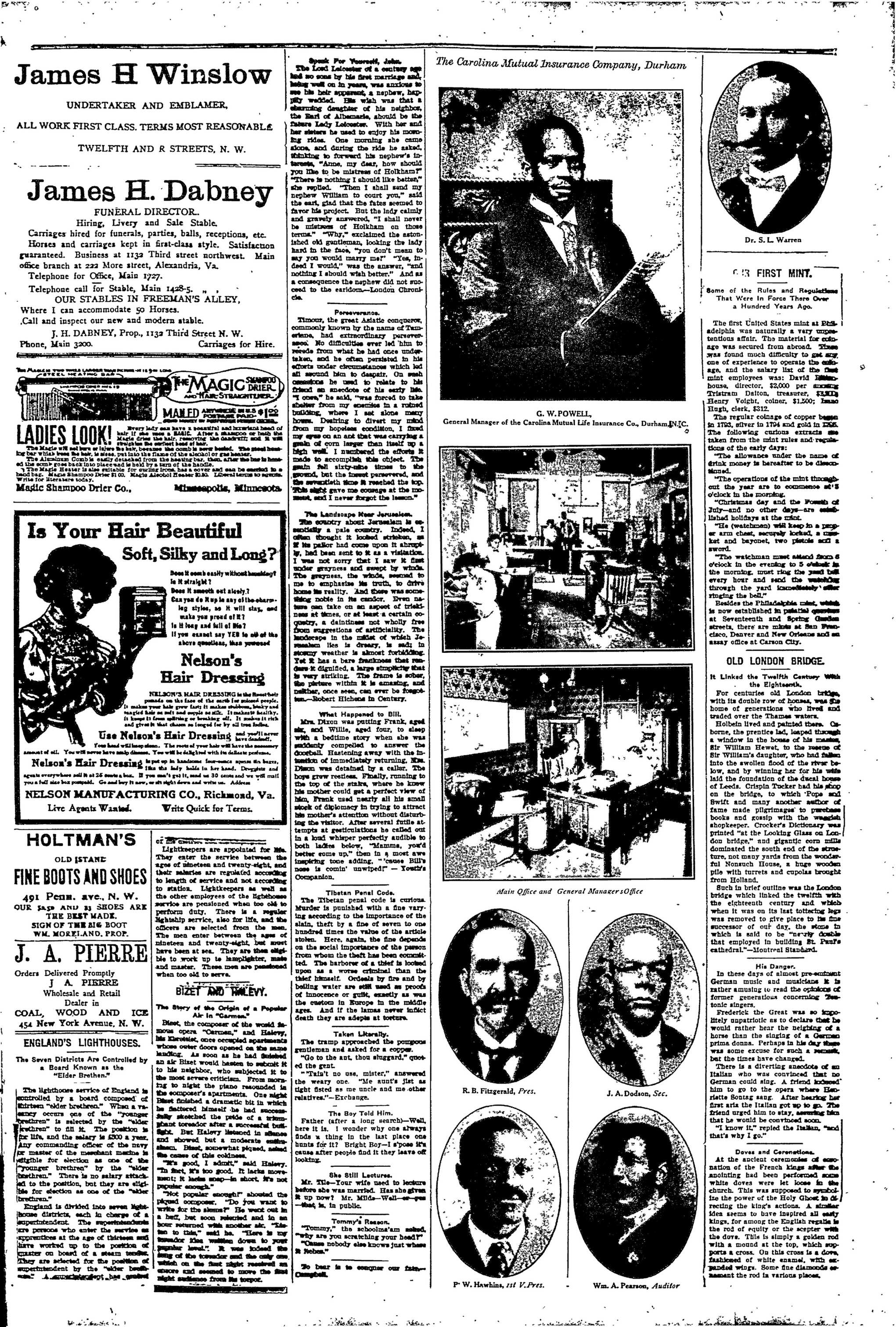
I am now in the office of the general manager, Mr. G. W. Powell. This company is the next largest in the State, and Mr. Powell informs me that when he moves into his new building in Orange Street, near Paris, it will be the largest and the best equipped office in the city. The building will be 34 by 80, two stories, with nine rooms, with two store-rooms.
The general manager's office, Mr. Powell, the auditor's room, cashier's office, stenographers and general clerical department, superintendent's office of the Durham division, medical directors and treasurer's office, will be on the second floor. The building will be equipped with electric lights. The birthplace of the general manager, Mr. Powell, is Boykin, Va. He came to Durham, N. C., and took up the insurance. He is a very young man and has a strict eye to business. The office hours of the company are from 8:30 a.m. to 5 p.m. Every employee must be on time. I would like for a few Washington business men to come to Durham, N. C., and be taught how to run a business. The officers of the Carolina Mutual Life Insurance Company are R. B. Fitzgerald, president. I am informed that he is a man of fine business qualities; P. W. Dawkins, first business manager; J. A. Donson, secretary; S. L. Warner, treasurer; G. W. Powell, general manager; W. G. Pearson, auditor, and C. H. Shepard, M. D. medical director. These men are among the leading business men in Durham. I will leave this company for a while and step across the hall to the offices of Dr. James E. Shepard. I find him engaged in holy worship with the secretary of the Massachusetts Christian Association. Ahl good morning, Miss Shivers! Dr. Shepard is engaged. "Won't you come in my office, he will be at leisure in a few moments." Miss Hattie Louise Shivers is the lady's name with whom I am now talking. She is from Detroit, Michigan, and an accomplished musician, stenographer and typewriter. I informed Miss Shivers that my principal commodity was ice water and I find everything up to date here, but you are lacking in ice water. I was politely informed that I could get all the ice water I wanted, and grape juice thrown in. My thirst was soon quenched, after which Dr. Shepard made his appearance and invited me in his spacious office in front.
I was his guest, it is true, but he politely informed me that on account of the rush of business he could spare me five minutes. It made no difference what he said, I remained long enough to examine everything in his office, thinking that I could find something out of the ordinary. I was informed that the State Legislature had barred what he thought I was looking for.
"Now, if you want a prayer book or a guide to keep you straight while in Durham, I will furnish you with both," said the religious educator.
There are two stenographers in this office, the other is Miss Emma Z. Pendleton. She was sick.
There are all kinds of business enterprises here. It is not necessary for anybody to be out of work. The Duke hosiery mills and tobacco places keep the colored population busy. If a man or woman is idle it is his or her fault. Children from six to 15 years old, and girls from 15 to 20, and men and women ranging to ages that will enable them to work, may find employment here. If there is any starvation it is because the idlers don't care to work. I was informed a few days ago that the only time that the population got uneasy is when the mills close down for a short time, then the chicken coops are in danger of invasion. The Dukes have a hosiery mill for white and colored, which demonstrated the greatness of their hearts. I was invited to the
managed by Charles C. Amey. This is operated entirely by colored help and owned by colored people. Thousands of dozens of hose are turned out weekly. Here is where you will see colored American enterprise. I
find that the people are quite religious in this section, and they believe in Churches.
I attended the church of Rev. Shepard. It is a fine structure. Rev. Shepard has a peculiar method in questioning young converts. They are real good Christians; they are held responsible for the falsehoods they tell. I never saw so many young folks in my life who profess the Christian religion. Since the addition to the church, which was made by my friend Pittman, it gives the church a fine appearance. Rev. Shepard is a practical man. He doesn't believe in foolishness, and he never visits his members until they are sick. He is a careful man, and is loved by all who know him. I would not want to be treated better than I am being treated in Durham. The largest social function given was by Mr. C. C. Spaulding, Thursday afternoon, May 25, at his beautiful residence, 1006 Fayette Street, on which occasion Rev John R. Ford, Messrs. John Merrick, C. C. Spaulding, McCreny, Drs. Shepard, Moore, and your humble servant were present. Mrs. Spaulding was hostess and Mr. Spaulding was host. It was a most delicious dinner to the invited guest.
EX-GOV. PINCHBACK SPEAKS
He Addressed the Forum.
Paterson, N. J., May 29. The Sunday Afternoon Forum of Paterson, N. J., which meets regularly in the C. M. A. Hall, has had two of the most successful of its meetings, on the two Sundays past. On Sunday, May 21, we had as our speaker, ex-Gov. P. B. S. Pinchback, formerly of Louisiana, now of Brooklyn, N. Y. Mr. Pinchback discussed the advantages of the race and its people, and pointed out to them that in order to obtain that which is due us, united effort, on our part is essential. The hall was packed to the doors, and there were people who were unable to obtain even admission for standing room, and it is the desire of the people that the Governor will soon address us again.
Mr. H. H. Harrison, of New York City, addressed our Forum on Sunday, May 28, and he chose as his topic, "The Function of Complaint." He mastered his subject to perfection and he kept the peopel spellbound. Both speakers were preceded by a literary program, -which was carefully arranged by Miss Jennie Maupin and Mrs. Joseph Green, respectively.
Invitation to Speak
Cambridge, Mass.—Announcement is made that Harvard Union, the largest and most popular of Harvard University student organizations, has extended an invitation to Booker T. Washington, of the Tuskegee Institute, to speak to the students of the University in November coming. The list of those invited to speak before the Union during the coming year is unusually large and representative
No Disorder
Mr. W. C. Daniels, the sheriff of Macon County, Alabama, in which the Tuskegee Normal and Industrial Institute is located, reported that at the commencement exercises of the Tuskegee Institute, held on May 25, although there were at least 6,000 colored people on the school grounds during the day, he did not make a single arrest, nor did he find a single disorderly or intoxicated man or woman among the six thousand.
Music Teacher.
Piano teacher; terms reasonable. Call between 6 and 7 o'clock p. m., at 400 Tea Street, Northwest for further information.
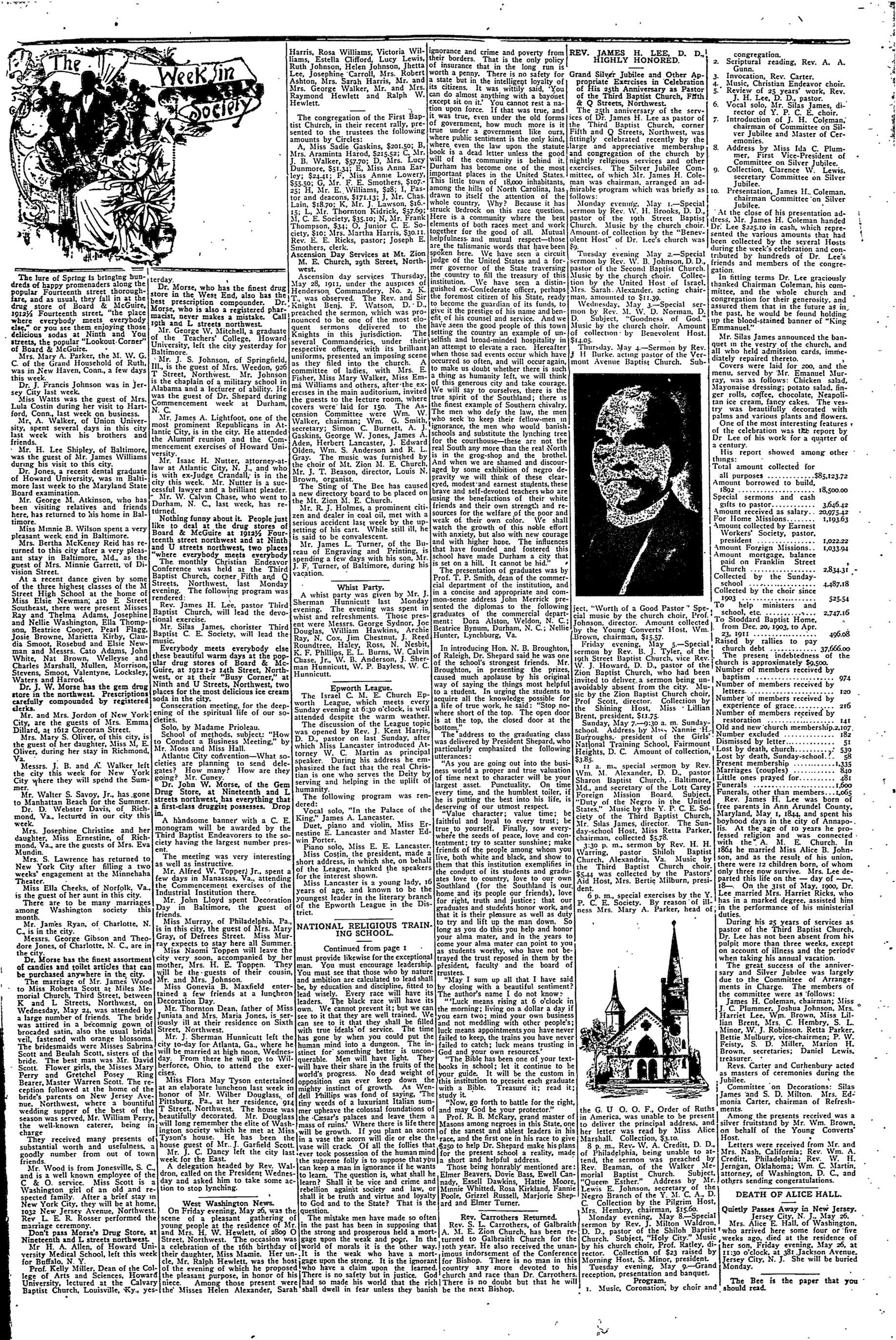
The Week in Society
The lure of Spring is bringing hundreds of happy promenaders along the popular Fourteenth street thoroughfare, and as usual, they fall in at the drug store of Board & McGuire, 1912½ Fourteenth street, "the place where everybody meets everybody else," or you see them enjoying those delicious sodas at Ninth and You streets, the popular "Lookout Corner" of Board & McGuire.
Mrs. Mary A. Parker, the M. W. G. C. of the Grand Household of Ruth, was in New Haven, Conn., a few days this week.
Dr. J. Francis Johnson was in Jersey City last week.
Miss Watts was the guest of Mrs. Lula Costin during her visit to Hartford, Conn., last week on business.
Mr. A. Walker, of Union University, spent several days in this city last week with his brothers and friends.
Mr. H. Lee Shipley, of Baltimore, was the guest of Mr. James Williams during his visit to this city.
Dr. Jones, a recent dental graduate of Howard University, was in Baltimore last week to the Maryland State Board examination.
Mr. George M. Atkinson, who has been visiting relatives and friends here, has returned to his home in Baltimore.
Miss Minnie B. Wilson spent a very pleasant week end in Baltimore.
Mrs. Bertha McKeney Reid has returned to this city after a very pleasant stay in Baltimore. Md., as the guest of Mrs. Minnie Garrett, of Division Street.
At a recent dance given by some of the three highest classes of the M Street High School at the home of Miss Elise Newman; 410 E Street Southeast, there were present Misses Ray and Thelma Adams, Josephine and Nellie Washington, Ella Thompson, Beatrice Cooper, Pearl Flagg, Josie Browne, Marietta Kirby, Claudia Smoot, Rosebud and Elsie Newman and Messrs. Cato Adams, John White, Nat Brown, Welleyse and Charles Marshall, Mullen, Morrison, Stevens, Smoot, Valentyne, Locksley, Waters and Harrod.
Dr. J. W. Morse has the gem drug store in the northwest. Prescriptions carefully compounded by registered elks.
Mrs. Mary S. Oliver, of this city, is the guest of her daughter, Miss M. E. Oliver, during her stay in Richmond, Va.
Messrs. J. B. and A. Walker left the city this week for New York City where they will spend the Summer.
Mr. Walter S. Savoy, Jr., has gone to Manhattan Beach for the Summer.
Mrs. Josephine Christine and her daughter, Miss Ernestine, of Richmond, Va., are the guests of Mrs. Eva Mundin.
Mrs. S. Lawrence has returned to New York City after filling a two weeks' engagement at the Nehmehaha Theater.
Miss Ella Cheeks, of Norfolk, Va., is the guest of her aunt in this city.
There are to be many marriages among Washington society this month.
Mr. James Ryan, of Charlotte, N. C., is in the city.
Messrs. George Gibson and Theodore Jones, of Charlotte, N. C., are in the city. Dr. Morae has the finest assortment of candies and toilet articles that can be purchased anywhere in the city.
The marriage of Mr. James Wood to Miss Roberta Scott at Miles Memorial Church, Third Street, between K and L Streets, Northwest, on Wednesday, May 24, was attended by a large number of friends. The bride was attired in a becomingg gown of brocaded satin, also the usual bridal veil, fastened with orange blossoms. The bridesmaids were Misses Sabrina Scott and Beulah Scott, sisters of the bride. The best man was Mr. David Scott. Flower girls, the Misses Mary Perry and Gretchel Posey. Ring Bearer, Master Warren Scott. The reception followed at the home of the bride's parents on New Jersey Avenue. Northwest, where a bountiful wedding supper of the best of the season was served, Mr. William Perry, the well-known caterer, being in charge. They received many presents of substantial worth and usefulness, a goodly number from out of town friends.
Mr. Wood is from Jonesville, S. C., and is a well known employee of the C & O. service. Miss Scott is a Washington girl of an old and respected family. After a brief stay in New York City, they will be at home, 1032 New Jersey Avenue, Northwest. Rev L. E. R. Rosser performed the marriage ceremony. Don't pass Morse's Drug Store, at Nineteenth and L streets northwest.
Mr H. A. Allen, of Howard University Medical School, left this week for Buffalo, N. Y.
Prof. Kelly Miller, Dean of the College of Arts and Sciences, Howard University, lectured at the Calvary Baptist Church, Louisville, Ky., yes-
terday.
Dr. Morse, who has the finest drug store in the West End, also has the best prescription compounder. Dr. Morse, who is also a registered pharmacist, never makes a mistake. Call 1918 and L streets northwest.
Mr. George W. Mitchell, a graduate of the Teachers' College, Howard University, left the city yesterday for Baltimore.
Mr. J. S. Johnson, of Springfield, Ill., is the guest of Mrs. Weedon, 926 T Street, Northwest. Mr. Johnson is the chaplain of a military school in Alabama and a lecturer of ability. He was the guest of Dr. Shepard during Commencement week at Durham, N. C.
Mr. James A. Lightfoot, one of the most prominent Republicans in Atlantic City, is in the city. He attended the Alumni reunion and the Commencement exercises of Howard University.
Mr. Isaac H. Nutter, attorney-at-law at Atlantic City, N. J., and who is with ex-Judge Crandall; is in the city this week. Mr. Nutter is a successful lawyer and a brilliant pleader. Mr. W. Calvin Chase, who went to Durham, N. C., last week, has returned.
Nothing funny about it. People just like to deal at the drug stores of Board & McGuire at 1912% Fourteenth street northwest and at Ninth and U streets northwest, two places "where everybody meets everybody The monthly Christian Endeavor Conference was held at the Third Baptist Church, corner Fifth and Q Streets, Northwest, last Monday evening. The following program was rendered:
Rev. James H. Lee, pastor Third Baptist Church, will lead the devotional exercise.
Mr. Silas James, chorister Third Baptist C. E. Society, will lead the music.
Everybody meets everybody else these beautiful warm days at the popular drug stores of Board & McGuire, at 19121-2 12th Street, Northwest, or at their "Busy Corner," at Ninth and U Streets, Northwest, two places for the most delicious ice cream soda in the city.
Consecration meeting, for the deepening of the spiritual life of our societies.
Solo, by Madame Prioleau.
School of methods, subject: "How to Conduct a Business Meeting," by Mr. Moss and Miss Hall.
Atlantic City convention—What societies are planning to send delegates? How many? How are they going? Mr. Cuney.
Dr. John W. Morse, of the Gem Drug Store, at Nineteenth and L streets northwest, has everything that a first-class druggist possesses. Drop in.
A handsome banner with a C. E. monogram will be awarded by the Third Baptist Endeavorors to the society having the largest number present.
The meeting was very interesting as well as instructive.
Mr. Alfred W. Topper Jr., spent a few days in Manassas, Va., attending the Commencement exercises of the Industrial Institution there.
Mr. John Lloyd spent Decoration Day in Baltimore, the guest of friends.
Miss Murray, of Philadelphia, Pa., is in this city, the guest of Mrs. Mary Gray, of Defrees Street. Miss Murray expects to stay here all Summer.
Miss Naomi Toppen will leave the city very soon, accompanied by her mother, Mrs. H. E. Toppen. They will be the guests of their cousin, Mr. and Mrs. Johnson.
Miss Gonevia B. Maxfield entertained a few friends at a luncheon Decoration Day.
Mr. Thornton Dean, father of Miss Juniata and Mrs. Maria Jones, is seriously ill at their residence on Sixth Street, Northwest.
Mr. J. Sherman Hunnicutt left the city to-day for Atlanta, Ga., where he will be married at high noon, Wednesday. From there he will go to Wilberforce, Ohio, to attend the exercises.
Miss Flora May Tyson entertained at an elaborate luncheon last week in honor of Mr. Wilber Douglass, of Pittsburg, Pa., at her residence, 914 T Street, Northwest. The house was beautifully decorated. The Douglass will long remember the elite of Washington society which he met at Miss Tyson's house. He has been the house guest of Mr. J. Garfield Scott.
Mr. J. C. Dancy left the city last week for the East.
A delegation headed by Rev. Waldron, called on the President Wednesday and asked him to take some action to stop lynching.
West Washington News
On Friday evening, May 26, was the scene of a pleasant gathering of young people at the residence of Mr. and Mrs. H. W. Hewlett, of 2809 O Street, Northwest. The occasion was a celebration of the 16th birthday of their daughter, Miss Mamie. Her uncle, Mr. Ralph Hewlett, was the host of the evening of which he proposed the pleasant purpose, in honor of his niece. Among those present were the Misses Helen Alexander, Sarah
Harris, Rosa Williams, Victoria Williams, Estella Clifford, Lucy Lewis, Ruth Johnson, Helen Johnson, Jhetta Lee, Josephine Carroll, Mrs. Robert Ashton, Mrs. Sarah Harris, Mr. and Mrs. George Walker, Mr. and Mrs. Raymond Hewlett and Ralph W. Hewlett.
The congregation of the First Baptist Church, in their recent rally, presented to the trustees the following amounts by Circles:
A, Miss Sadie Gaskins, $201.50; B, Mrs. Araminta Harod, $215.50; C, Mr J. B, Walker, $57.70; D, Mrs. Lucy Dunmore, $51.34; E, Miss Anna Earley; $24.41; F, Miss Annie Lowery, $55.50; G, Mr. F. E. Smothers, $107.25; H, Mr. E. Williams, $28; I, Pastor and deacons, $171.13; J, Mr. Chas Lain, $18.70; K, Mr. J. Lawson, $16.15; L, Mr. Thornton Kidrick, $27.97; M, C. E. Society, $35.10; M, Mr. Frank Thompson, $34; O, Junior C. E. Society, $10; Mrs. Martha Harris, $30.11 Rev. E. E. Ricks, pastor; Joseph E. Smothers, clerk.
Ascension Day Services at Mt. Zion M. E. Church, 29th Street, Northwest.
Ascension day services Thursday, May 28, 1911, under the auspices of Henderson Commandery, No. 2, K. T., was observed. The Rev. and Sir Knight Benj. F. Watson, D. D., preached the sermon, which was pronounced to be one of the most eloquent sermons delivered to the Knights in this jurisdiction. The several Commanderies, under their respective officers, with its brilliant uniforms, presented an imposing scene as they filed into the church. A committee of ladies, with Mrs. E. Fisher, Miss Mary Walker, Miss Emma Williams and others, after the exercises in the main auditorium, invited the guests to the lecture room, where covers were laid for 150. The Ascension Committee were Wm. W. Walker, chairman; Wm. G. Smith, secretary; Simon C. Burnett, A. J. Gaskins, George W. Jones, James A. Aden, Herbert Lancaster, J. Edward Olden, Wm. S. Anderson and R. L. Gray. The music was furnished by the choir of Mt. Zion M. E. Church, Mr. J. T. Beason, director, Louis N. Brown, organist.
The Sting of The Bee has caused a new directory board to be placed on the Mt. Zion M. E. Church.
Mr. R J. Holmes, a prominent citizen and dealer in coal oil, met with a serious accident last week by the upsetting of his cart. While still ill, he is said to be convalescent.
Mr. James L. Turner, of the Bureau of Engraving and Printing, is spending a few days with his son, Mr. J. F. Turner, of Baltimore, during his vacation.
Whist Party.
Whist Party.
A whist party was given by Mr. J. Sherman Hunnicutt last Monday evening. The evening was spent in whist and refreshments. Those present were Messrs. George Dynor, Joe Douglas, William Hawkins, Archie Ray, N. Cox, Jim Chestnut, J. Reed Roundtree, Haley, Ross, N. Nesbit, K. F. Phillips, E. L. Burns, W. Calvin Chase, Jr., W. B. Anderson, J. Sherman Hunnicutt, W. P. Bayless, W. C. Hunnicutt.
Enworth League.
The Israel C. M. E. Church Epworth League, which meets every Sunday evening at 6:30 o'clock, is well attended despite the warm weather. The discussion of the League topic was opened by Rev. J. Kent Harris, D. D., pastor on last Sunday, after which Miss Lancaster introduced Attorney W. C. Martin as principal speaker. During his address he emphasized the fact that the real Christian is one who serves the Deity by serving and helping in the uplift of humanity. The following program was rendered: Vocal solo, "In the Palace of the King," James A. Lancaster.
Duet, piano and violin, Miss Ernestine E. Lancaster and Master Edwin Porter. Piano solo, Miss E. E. Lancaster. Miss Costin, the president, made a short address, in which she, on behalf of the League, thanked the speakers for the interest shown. Miss Lancaster is a young lady, 16 years of age, and known to be the youngest leader in the literary branch of the Epworth League in the District.
NATIONAL RELIGIOUS TRAIN- ING SCHOOL
Continued from page 1
must provide likewise for the exceptional man. You must encourage leadership. You must see that those who by nature and ambition are calculated to lead shall be, by education and discipline, fitted to lead wisely. Every race will have its leaders. The black race will have its own. We cannot prevent it; but we can see to it that they are well trained. We can see to it that they shall be filled with true ideals' of service. The time has gone by when you could put the human mind into a dungeon. The instinct for something better is unconquerable. Men will have light. They will have their share in the fruits of the world's progress. No dead weight of opposition can ever keep down the mighty instinct of growth. As Wendell Phillips was fond of saying, The tiny weeds of a luxuriant Italian summer upheave the colossal foundations of the 'Cesar's' palaces and leave them a mass of ruins.' Where there is life there will be growth. If you plant an acorn in a vase the acorn will die or else the vase will crack. Of all the follies that ever took possession of the human mind the supreme folly is to suppose that you can keep a man in ignorance if he wants to learn. The question is, what shall he learn? Shall it be vice and crime and rebellion against society and law, or shall it be truth and virtue and loyalty to God and to the State? That is the question.
The mistake men have made so often in the past has been in supposing that the strong and prosperous held a mortgage upon the weak and popr. In the world of morals it is the other way. It is the weak who have a mortgage upon the strong. It is the ignorant who have a claim upon the learned. There is no safety but in justice. God had so made his world that the rich shall dwell in fear unless they banish
ignorance and crime and poverty from their borders. That is the only policy of insurance that in the long run is worth a penny. There is no safety for a state but in the intelligent loyalty of its citizens. It was wittily said, 'You can do almost anything with a bayonet except sit on it.' You cannot rest a nation upon force. If that was true, and it was true, even under the old forms of government, how much more is it true under a government like ours, where public sentiment is the only kind, where even the law upon the statute book is a dead letter unless the good will of the community is behind it. Durham has become one of the most important places in the United States. This little town of 18,000 inhabitants, among the hills of North Carolina, has drawn to itself the attention of the whole country. Why? Because it has struck Udredock on this race question. Here is a community where the best elements of both races meet and work together for the good of all. Mutual helpfulness and mutual respect—those are the talismanic words that have been spoken here. We have seen a circuit judge of the United States and a former governor of the State traversing the country to fill the treasury of this institution. We have seen a distinguished ex-Confederate officer, perhaps the foremost citizen of his State, to give it the prestige of his name and benefit of his counsel and service. And we have seen the good people of this town and the country an example of unselfish and broad-minded hospitality in an attempt to elevate a race. Hereafter when those sad events occur which have occurred so often, and will occur again, to make us doubt whether there is such a thing as humanity left, we will think of this generous city and take courage. We will say to ourselves, there is the true spirit of the Southland; there is the finest example of Southern chivalry. The men who defy the law, the men who seek to keep their fellow-men in ignorance, the men who would banish schools and substitute the lynching tree for the courthouse—these are not the real South any more than the real North is in the grog-shop and the brothel. And when we are shamed and discouraged by some exhibition of negro deprivacy we will think of these cleareyed, modest and earnest students, these brave and self-devoted teachers who are using the benefactions of their white friends and their own strength and resources for the welfare of the poor and weak of their own color. We shall watch the growth of this noble effort with anxiety, but also with new courage and with higher hope. The influences that have founded and fostered this school have made Durham a city that is set on a hill. It cannot be hid."
The presentation of graduates was by Prof. T. P. Smith, dean of the commercial department of the institution, and in a concise and appropriate and common-sense address John Merrick presented the diplomas to the following graduates of the commercial department; Dora Alston, Weldon, N. C.; Beatrice Bynum, Durham, N. C.; Nellie Hunter, Lynchburg, Va.
In introducing Hon. N. B. Broughton, of Raleigh, Dr. Shepard said he was one of the school's strongest friends. Mr. Broughton, in presenting the prizes, caused much applause by his original way of saying the things most helpful to a student. In urging the students to acquire all the knowledge possible for a life of true work, he said: "Stop now where short of the top. The open door is at the top, the closed door at the bottom."
The "address to the graduating class was delivered by President Shepard, who particularly emphasized the following utterances:
"As you are going out into the business world a proper and true valuation of time next to character will be your largest asset. Punctuality. On time every time, and the humblest toil, if he is putting the best into his life, is deserving of our utmost respect.
"Value character; value time; be faithful and loyal to every trust; be true to yourself. Finally, sow everywhere the seeds of peace, love and contentment; try to scatter sunshine; make friends of the people among whom you live, both white and black, and show to them that this institution exemplifies in the conduct of its students and graduates love to country, love to our own Southland (for the Southland is our home and its people our friends), love for right, truth and justice; that our graduates and students honor work, and that it is their pleasure as well as duty to try and lift up the man down. So long as you do this you help and honor your alma mater, and in the years to come your alma mater can point to you as students worthy, who have not betrayed the trust reposed in them by the president, faculty and the board of trustees.
"May I sum up all that I have said by closing with a beautiful sentiment? The author's name I do not know."
"Luck means rising at 6 o'clock in the morning; living on a dollar a day if you earn two; mind your own business and not meddling with other people's; luck means appointments you have never failed to keep, the trains you have never failed to catch; luck means trusting in God and your own resources."
"The Bible has been one of your textbooks in school; let it continue to be your guide. It will be the custom in this institution to present each graduate with a Bible. Treasure it; read it; study it.
"Now, go forth to battle for the right, and may God be your protector."
Prof. R. B. McRary, grand master of Masons among negroes in this State, one of the sanest and ablest leaders in his race, and the first one in his race to give $250 to help Dr. Shepard make his plans for the present school a reality, made a short and helpful address.
Those being honrally mentioned are: Elmer Beavers, Dowie Bass, Ewell Cannady, Essell Dawkins, Hattie Moore, Minnie Whitted, Rosa Kirkland, Fannie Poole, Grizzel Russell, Marjorie Shepard and Elmer Turner.
Rev. Carrothers Returned.
Rev. S. L. Carrothers, of Galbraith A. M. E. Zion Church, has been returned to Galbraith Church for the 10th year. He also received the unanimous indorsement of the Conference for Bishop. There is no man in this country any more devoted to his church and race than Dr. Carrothers. There is no doubt but that he will be the next Bishop.
Grand Silver Jubilee and Other Appropriate Exercises in Celebration of His 25th Anniversary as Pastor of the Third Baptist Church, Fifth & Q Streets, Northwest.
The 25th anniversary of the services of Dr. James H. Lee as pastor of the Third Baptist Church, corner Fifth and Q Streets, Northwest, was fittingly celebrated recently by the large and appreciative membership and congregation of the church by nightly religious services and other exercises. The Silver Jubilee Committee, of which Mr. James H. Coleman was chairman, arranged an admirable program which was briefly as follows:
Monday evening, May 1—Special sermon by Rev. W. H. Brooks, D. D., pastor of the 19th Street Baptist Church. Music by the church choir. Amount-of collection by the "Benevolent Host" of Dr. Lee's church was $9.
Tuesday evening May 2.—Special sermon by Rev. W. B. Johnson, D. D., pastor of the Second Baptist Church. Music by the church choir. Collection by the United Host of Israel. Mrs. Sarah Alexander, acting chairman, amounted to $11.39. Wednesday, May 3.—Special sermon by Rev. M. W. D. Norman, D. D. Subject, "Goodness of God." Music by the church choir. Amount of collection by Benevolent Host. $14.05. Thursday, May 4.—Sermon by Rev. J H Burke, acting pastor of the Vermont Avenue Baptist Church. Sub-
P.
ject, "Worth of a Good Pastor" Special music by the church choir, Prof. Johnson, director. Amount collected by the Young Converts' Host, Wm. Brown, chairman, $15.57. Friday evening, May 5—Special sermon by Rev. B. J. Tyler, of the 10th Street Baptist Church, vice Rev. W. J. Howard, D. D., pastor of the Zion Baptist Church, who had been invited to deliver a sermon being unavoidably absent from the city. Music by the Zion Baptist Church choir, Prof Scott, director. Collection by the Shining Host, Miss Lillian Brent, president, $11.75. Sunday, May 7—9:30 a.m. M. Sundayschool. Address by Miss Nannie H. Burroughs, president of the Girls' National Training School, Fairmount Heights, D. C. Amount of collection, $3.85.
11 a. m., special sermon by Rev. Wm. M. Alexander, D. D., pastor Sharon Baptist Church, Baltimore, Md., and secretary of the Lott Carey Foreign Mission Board, Subject, "Duty of the Negro in the United States," Music by the Y. P. C. E. Society of the Third Baptist Church, Mr. Silas James, director. The Sunday-school Host, Miss Retta Parker, chairman, collected $7.78. 3:30 p. m., sermon by Rev. H. H. Warring, pastor Shiloh Baptist Church, Alexandria, Mus. Music by the Third Baptist Church choir. $5.44 was collected by the Pastors' Aid Host, Mrs. Bertie Milburn, president. 6 p. m., special exercises by the Y. P. C. E. Society. By reason of illness Mrs. Mary A. Parker, head of
```markdown
```
the G. U. O. O. F., Order of Ruths in America, was unable to be present to deliver the principal address, and her letter was read by Miss Alice Marshall. Collection, $3.10. 8 p. m., Rev. W. A. Creditt, D. D., of Philadelphia, being unable to attend, the sermon was preached by Rev. Beaman, of the Walker Memorial Baptist Church. Subject, "Queem Esther." Address by Mr. Lewis E. Johnson, secretary of the Negro Branch of the Y. M. C. A., D. C. Collection by the Pilgrim Host, Mrs. Hembry, chairman, $15.60. Monday evening, May 8—Special sermon by Rev. J. Milton Waldron, D. D., pastor of the Shiloh Baptist Church. Subject, "Holy City." Music by his church choir, Prof. Ratley, director. Collection of $23 raised by Morning Host, S. Minor, president. Tuesday evening, May 9—Grand reception, presentation and banquet. Program. 1. Music, Coronation, by choir and
congregation.
2. Scriptural reading, Rev. A. A. Gunn.
Invocation, Rey. Carter.
4. Music, Christian Endeavor choir.
5. Review of 25 years' work, Rev.
J. H. Lee, D. D., pastor.
6. Vocal solo, Mr. Silas James, director of Y. P. C. E. choir.
8. Address by Miss Ida C. Plummer, First Vice-President of Committee on Silver Jubilee.
9. Collection, Clarence W. Lewis, secretary Committee on Silver Jubilee.
10. Presentation, James H.. Coleman, chairman Committee on Silver Jubilee.
At the close of his presentation address, Mr. James H. Coleman handed Dr. Lee $225.19 in cash, which represented the various amounts that had been collected by the seyeral Hosts during the week's celebration and contributed by hundreds of Dr. Lee's friends and members of the congregation.
In fitting terms Dr. Lee graciously thanked Chairman Coleman, his committee, and the whole church and congregation for their generosity, and assured them that in the future as in the past, he would be found holding up the blood-stained banner of "King Emmanuel."
Mr. Silas James announced the banquet in the vestry of the church, and all who held admission cards, immediately repaired thereto.
Covers were laid for 200, and the menu, served by Mr. Emanuel Murray, was as follows: Chicken salad, Mayonnaise dressing; potato salad, finger rolls, coffee, chocolate, Neapolitan ice cream, fancy cakes. The vestry was beautifully decorated with palms and various plants and flowers. One of the most interesting features of the celebration was the report by Dr Lee of his work for a quarter of a century. His report showed among other things:
gifts to pastor.....
Amount received as salary.....
For Home Missions.....
Amount collected by Farnest
Collected by the Sunday-
school
Collected by the choir since
1903
church debt 37,600
The present indebtedness of
church is approximately $9,500.
Number of members received by
baptism 9
Number of members received by
letters. 1
Number of members received by
experience of grace
Number of members received by
restoration 141
Old and new church membership.2,107
Number excluded 182
Dismissed by letter 51
Lost by death, church 539
Lost by death, Sunday-school 58
Present membership 1,335
Marriages (couples) 840
Little ones prayed for 481
Funerals 1,600
Funerals, other than members 1,965
Rev James H. Lee was born of free parents in Ann Arundel County, Maryland, May 1, 1844, and spent his boyhood days in the city of Annapolis. At the age of 10 years he professed religion and was connected with the A. M. E. Church. In 1864 he married Miss Alice B. Johnson, and as the result of his union, there were 12 children born, of whom only three now survive. Mrs. Lee departed this life on the — day of — 18— On the 31st of May, 1900, Dr. Lee married Mrs. Harriet Ricks, who has in a marked degree, assisted him in the performance of his ministerial duties. During his 25 years of services as pastor of the Third Baptist Church, Dr. Lee has not been absent from his pulpit more than three weeks, except on account of illness and the periods when taking his annual vacation.
The great success of the anniversary and Silver Jubilee was largely due to the Committee of Arrangements in Charge. The members of the committee were as follows:
James H. Coleman, chairman; Miss J. C. Plummer, Joshua Johnson, Mrs. Harriet Lee, Wm. Brown, Miss Lillian Brent, Mrs. C. Hembry, S. L. Minor, W. J. Robinson, Retta Parker, Bettie Mulbury, vice-chairman; P. W. Feisty, S. D. Miller, Marion H. Brown, secretaries; Daniel Lewis, treasurer.
Revs. Carter and Curhenbury acted as masters of ceremonies during the Jubilee.
Committee on Decorations: Silas James and S. D. Milton. Mrs. Edmonia Carter, chairman of Refreshments.
Among the presents received was a silver fruitstand by Mr. Wm. Brown, on behalf of the Young Converts' Host.
Letters were received from Mr. and Mrs. Nash, California; Rev. Wm. A. Creditt, Philadelphiia; Rev. W. H. Jerrigan, Oklahoma; Wm. C. Martin, attorney, of Washington, D. C., and others sending congratulations.
DEATH OF ALICE HALL.
Quietly Passes Away in New Jersey. Jersey City, N. L. May 26.
Mrs. Alice E. Hall, of Washington,
who arrived here some four or five
weeks ago, died at the residence of
her son, Friday evening, May 26,
at 11:30 o'clock, at 381 Jackson Avenue,
Jersey City, N. J. She will be buried
Monday.
The Bee is the paper that you
should read.
John Merrick, Pres. and Founder
A. M. Moore, Sec. and Treas
C. C. Spaulding, V Pres. and Gen. Mgr
J. M. Avery, Director
C. C. Spaulding, V Pres and Gen Mgr
[Image of a man in a suit with a tie, but no face or hair visible.]
E. R. Merrill
E.R. Merrick, Director
19 29 49
---
OFFICES
.
Go To
HOL'MES' HOTEL.
333 Virginia Ave., S. W.
Best Afro-American Accommodation in
the District
EUROPEAN AND AMERICAN
PLAN
Good Rooms and Lodging 50c, 75c
and $1.00. Comfortably Heated
by Steam. Give us a call.
Ottoway Holmes, Proprietor
Washington, D. C.
Phone Main 2315
CATHEDRAL
White Rock Baptist Church, Rev. Shepard,' Pastor
---
---
Telephone Main 810
CHOICE
Wines, Liquors
..and Cigars...
J. H. Kennedy
PROPRIETOR OF
The Moose House
625 D Street, N. W.
Washington, D. C.
Special Liquor Sale Every Saturday.
A Gastronomie Joy.
Of all the superb victories which, by their great variety and unique collection, make Maryland the Eden and Arcadia of every man who loves good eating, the planked shad is probably the most powerful and polignant in the appeal to the senses. The wild duck, though it sets the palate to vibrating like an acutian harp, has no thrill for the eye. It is a small and universally bird of a dull color and magnificent outline. So, too, the diamond back terrapin. It has no more beauty in death than a plate of soup. And certain other exquisite delicacies, for all their sweetness, do not soothe the sense of smell. Of such are the raw oyster, the boiled hard crab and the Magothy river cabbage. But the planked shad—ah, here we come to a delicacy which enchants us alike through the eyes, the palate and the nose! As it comes upon the table it has the imperial dignity of a Charlemagne. Its noble head moves one to reverence; the epicycloid curve of its tail is like the curl of a great comber upon a coral beach. And it radiates a perfume as of Araby—Baltimore sun.
Water Under Deserts.
Some of the most curious phenomena of the world are the underground water supplies beneath deserts. In the Rajputana deserts water is held in vast quantities in sandstones beds under the scorched surface and is drawn up from wells sunk into the strata. Bikaner raises its walls in the midst of a weary, almost mistless waste of sand and depends on these hidden cisterns for its very existence. Whence it comes, where is the outfall and what quantity runs under the baked sand remains a mystery. In one wall at Bikaner it has been ascertained that the water supply is equal to 20,000 gallons an hour, which is held to point to the conclusion that there is an enormous subterranean flow and that the snow fed rivers of the Himalayas must be the source. People in Bikaner say that pieces of wood dropped into one well have come up in another. The idea of an underground river opens up a wide range of possibilities to the imagination.—Times of India.
Dashing Into Danger.
"When I was younger," a big Broadway traffic cop remarked. "I used to cuss at everybody who insisted on dashing across the street in front of a car or truck. I cuss the act still, but not the person. Fact is, I've learned that a majority of people just can't help it. An approaching vehicle about to cross their path is like a red rag to a bull. It's a sort of challenge, a dare. And the impulse to defeat its purpose can't be controlled. There isn't any plan of action. It's a case of dash first and think afterward, and sometimes, of course, the thinking is done in a hospital.
"It's a sort of disease of the nerves. I guess, because the head of a business house will do this fool thing just as quick as his errand boy will. But the cop and the driver are to blame whenever there's a miscalculation."—New York Globe.
Feinsed in.
Near Harvard square, in Cambridge, stands the old elm under which Washington first took command of the American army. Around this tree is an iron picket fence encclosure perhaps a couple of rods across. One night a man who had imbibed too freely stumbled against this circular fence. Grasping one picket after another, he groped his way peacefully round and round the outside of the encclosure about a dozen times. Finally he sank down in utter despair. "Oh, didn't it awful—fenced in and no gats to get out of it?" said he as a party of students rescued him and took him home.—National Monthly.
A Memory of Edwin Booth.
My season with Edwin Booth was delightful. I found him one of the kindest and pleasant men of the profession. He also possessed what I consider a great quality—simplicity of manner. Some stars have the idea that it is necessary to be haughty and inaccessible with the members of their companies. They put on airs. They like to crush their fellow actors and pose as a kind of divinity before them.—From Mme. Modjeska's "Memoirs" in Century.
A Story of Rebeasplera
The story is told of Bobesplierre that at one time when at the height of his power a lady called upon him, beaching him to spare her husband's life. He scornfully refused. As she turned away she happened to tread upon the paw of his pet dog. He turned upon her and asked, "Madam, have you no humanity?"
On the Safe Bike
"May I see my father's record?" asked the new student. "He was in the class of '77." "Certainly, my boy. What for?" "He told me when I left home not to disgrace him, sir, and I wish to see just how far I can go."—Buffalo Express.
The Advantage:
Tenant—Look here, that house I took from you is extremely damp. House Agent (bluntly)—Well, don't you see the great advantage of that? If it gets on fire it won't burn.
Right and Wrong.
Things should not be done by halves. If it is right, do it boldly; if it is wrong, leave it undone. Every day is a little life, and our whole life is but a day repeated.
A really great man is known by three signs—generosity in the design, humanity in the execution and moderation in success.—Bismarck.
Happiness In Slow.
I saw once how like sleep was to lie in the deep waters. A man who is my waking eyes looked cold and sturdy and regarded sat upon one of the benches on the embankment. He was sleeping, and I knew from his face that then at least he did not count himself miserable. But presently a pollinator came and shook the sleeper into waking life. Then all the violence of the world seemed to be let loose upon this wreck of a man. He shook and blissed his eyes and breathed with heavy spasms. It was just as when a fish is caught out of the depth of the sea and suddenly cast into a basket. I have seen mackerel shake and grasp like this poor man suddenly caught up out of the native depths of sleep. Or if you think that a fish thus dying is only an amusing and not a painful sight then think of what it might be if some giant of table could catch us up out of our native air into the space between the stars. Would we not willingly sink back again into the depth of air? So it is when the loud world lets us glide down into sleep—London Outlook.
His Name In the Directory.
"One funny thing I have learned about human nature," said the drug store coahler, "is the habit many people have of marking their own names in the city directory. They do that because the directory is the only place where their names ever get into print, and it has such a fascination for them that they can't resist calling attention to it. A fancy old man who likes to talk tells me that he has made special trips to different parts of the city just to mark his name in the directories of the neighborhood. He puts a little excuse in and ink before it. I asked him what good it did. He said none possibly, although he is a teacher of languages and may get a few calls on account of that queer advertisement. But he is an exceptional case. Not many persons spend time and money hunting city directories, but every time they happen to see a new case they can't help looking up their names and putting some kind of a mark around them."—New York Sun.
Mansfield's Cornholing
"Richard Mansfield," said an actress who played in his company, "was a great teacher, but terribly relentless. I shall never forget a time when I was playing with him in The First Volk." I could not, strive frantically as I would, do the thing he wanted. He was good at first, and then, persisting in my failure, he began to laish and whip and sting me with his words until I thought I should have to run away. In agony of impotent despair I cried out: "I cannot! Oh, I cannot!"
"Mr. Mansfield threw up his hands in a gesture of relief, and a smile played about his lips.
"Why," he said sweetly, "you're doing the very thing right now. No one on earth could do it better." And then I know what he meant, and those lines were a triumph to me all that season."
Detroit Free Press
Walking
The Almighty has not freighted the foot with a single superfluous past every inch of every foot is meant for use. When a man walks in the right way, speaking literally, the back of the heel strikes the ground first. Then the rest of the heel comes down, after which the outer edge of the foot takes the bulk of the burden until the forward movement shifts the weight to the ball of the foot and finally to the toe. The ideal step is a slightly rocking motion. At no time should the entire foot be pressed against the ground. Heel to toe is the movement. Try it and see how much farther and more easily you can walk. It's the Indian's way, and what poor Lo doesn't know about footwork can go into the discased.—New York Press.
A Lesson With His Artograph.
An admirer once wrote to Lowell describing his autograph collection and concluding with the remark, "I would be much obliged for your autograph." The reply came, bearing with it a lesson on the correct use of the words "would" and "should," which deeply impressed itself on the mind of the recipient. The response read:
Pray, do not say hereafter, "I would be obliged." If you would be obliged, be obliged and have done with it. Flay, "I should be obliged," and oblige yours truly, JAMES RUSSELL, LOWELL.
A Ramodalad Text
"Perhaps you could preach us a common about the condition of things in our town," says the resident pastor to the visiting one. "Balloons, gambling houses and the like run wide open all the time, and the officers pay no attention to them."
"Yes," agrees the visitor; "I might take as my text. There's no arrest for the wicked."—Jadon.
Grace Before Mast
The Skin admires a woman according to her weight. The Skin can respect a 200 pound woman, but it is only a 800 or 400 pound one that he can really love. We enlightened persons, on the other hand, have been taught to like grace before meat.—Elizabeth
Made a Video
"He didn't win the prize in the May
mars, did he?"
"No, but he hollered 'Like he had it,
and many people died savyr' of death."
- Attorney Correction.
Armed For Peace
Wish—WILL your management meet my faults late? Hustard—You almost misjudge, I expect. But don't be nervous. I shall have my reefermen—Bun Vonant.
James H Winslow
UNDERTAKER AND EMBLAMER ALL WORK FIRST CLASS. TERMS MOST REASONABLE TWELFTH AND R STREETS. N. W.
James H. Dabney
FUNERAL DIRECTOR.
Hiring, Livery and Sale Stable.
or hired for funerals, parties, balls, receptions, etc.
and carriages kept in first-class style. Satisfaction
Business at 1132 Third street northwest. Main
nth at 222 More street, Alexandria, Va.
me for Office, Main 1727.
The call for Stable, Main 1428-5.
OUR STABLES IN FREEMAN'S ALLEY,
can accommodate 50 Horses.
Inspect our new and modern stable.
H. DABNEY, Prop., 1132 Third Street N. W.
in 3200.
Carriages for Hire.
THE MAGIC SHAMPOO DRIER
AND MARC STRAIGHTLER.
MAILED ANYWHERE IN U.S. POSTAL CARD.
James Hair
FUNERAL DRESS
Hiring, Livery and Carriages hired for funerals, pigs, horses and carriages kept in guaranteed. Business at 1132 W. office branch at 222 More street. Telephone for Office, Main rp. Telephone call for Stable, M. OUR STABLES IN F. Where I can accommodate 50. Call and inspect our new and new J. H. DABNEY, Prop., Phone, Main 3200.
LADIES LOOK!
Every hair is Magic dressing. The Magic will not burn or failure the hair, be big bar which brushes the hair, is mose. put into the. The Aluminum Comb is easily detached framed the some rose back into place and is hold by. The Magic Heater is also suitable for our hand bag. Magic Shampoo Drier $10. Magic Write for Literature today.
Magic Shampoo Drier Co.
Is Your Hair Soft
Use Nelson
Your head will keep all amount of oil. You will never have many dimes.
Nelson's Hair Dressing agents everywhere sell at 26 cents a box. If you a full size box pompald. Go and buy it new.
NELSON MANUFACTURE
Live Agents Wanted.
James H. Dabney
James H. Dabney
Carriages hired for funerals, parties, balls, receptions, etc.
Horses and carriages kept in first-class style. Satisfaction guaranteed. Business at 1132 Third street northwest. Main office branch at 222 More street, Alexandria, Va.
Telephone for Office, Main 1727.
Telephone call for Stable, Main 1428-5. " "
OUR STABLES IN FREEMAN'S ALLEY,
Where I can accommodate 50 Horses.
Call and inspect our new and modern stable.
J. H. DABNEY, Prop., 1132 Third Street N. W.
Phone, Main 3200. Carriages for Hire.
Every lady can have a beautiful and brittle head of hair if she uses a HAIR. After a shampoo or bath the Magic dries the hair, removing the deadwrink and it will straighten the earliest head of hair.
Your Hair Beautiful Soft, Silky and Long?
Nelson's Hair Dressing
Use Nelson's Hair Dressing and you'll never have dreadful. Your hand will keep damp. The roots of your hair will have the memory. You will never have ample dimness. You will be delighted with its delicate perfume.
It's Hair Dressing is put up in handsome four-course queen tin bars, like this lady holds in her hand. Drapes and are sold it at 25 cents a box. If you men's get it, send us 30 cents and we will mail on postpaid. Go and buy it now, or sit right down and write us. Address
IN MANUFACTURING CO., Richmond, Va.
Nelson's Hair Dressing is put up in handsome four-sonne aqueen tin boxes,
like this the lady holds in her hand. Drugstore and
agents everywhere sell it at 25 cents a box. If you men's get it, and us 30 cents and we will mail
you a full also box postpaid. Go and buy it now, or sit right down and write us. Address
HOLTMAN'S
FINE BOOTS AND SHOES
491 Penn. ave., N. W.
OUR SAGE AND 13 SHOES ARE
THE BEST MADE.
SIGN OF THE BIG BOOT
WM. MORELAND. PROP.
Orders Delivered Promptly
J A. PIERRE
Wholesale and Retail
Dealer in
COAL, WOOD AND ICE
454 New York Avenue, N. W.
ENGLAND'S LIGHTHOUSES.
The Seven Districts Are Controlled by
a Board Known as the
"Elder Brethen."
The lighthouse service of England is controlled by a board composed of thirteen "older brethren." When a vacancy occurs one of the "younger brethren" is selected by the "older brethren" to fill it. The position is for life, and the salary is £500 a year. Any commanding officer of the navy or master of the merchant marine is eligible for election as one of the "younger brethren" by the "older brethren." There is no salary attached to the position, but they are eligible for election as one of the "older brethren."
England is divided into seven light-house districts, each in charge of a superintendent. The superintendents are persons who enter the service as apprentices at the age of thirteen and have worked up to the position of master on board of a steam tender. They are selected for the position of superintendent by the "taker board." A superintendent has gender.
---
Minneapolis. Minnesota.
Does H come easily without breathing?
Is H straight?
Does H smooth out ally?
Can you do H up in any of the charm-
ing styles, as H will stay, and
make you proud of H?
Is H long and full of life?
If you cannot say YEB in all of the
above gestures, then you need
NELSON'S HAIR DRESSING in the finest tweets
pomade on the face of the earth for loved people.
It makes your hair grow fast! It makes stubbly, bunky and
tangled hair no melt and people no slick. It makes it healthy.
It keeps it from splitting or breaking off. It makes it rich
and gives it that chameau no longered for by all true Indian.
Write Quick for Terms.
or the contrary
Lightkeepers are appointed for life. They enter the service between the ages of nineteen and twenty-eight, and their salaries are regulated according to length of service and not according to station. Lightkeepers as well as the other employees of the lighthouse service are pensioned when too old to perform duty. There is a regular lightship service, also for life, and the officers are selected from the men. The men enter between the ages of nineteen and twenty-eight, but must have been at sea. They are then eligible to work up to lamplighter, mast and master. These men are pensioned when too old to serve.
BIZET AND TRILEVY.
The Story of the Origin of a Popular Air In "Carmen."
Bisset, the composer of the world famous opera "Carmen," and Halevy, his kinetist, once occupied apartments whose outer doors opened on the same landing. As soon as he had finished an air Bizet would hasten to submit it to his neighbor, who subjected it to the most severe criticism. From morning to night the piano resounded in the composer's apartments. One night Bizet finished a dramatic bit in which he scattered himself he had successfully sketched the pride of a triumphant torcedor after a successful bulldog. But Halevy listened in silence and showed but a moderate enthusiasm. Bisset, somewhat piqued, asked the causes of this coldness.
"It's good, I admit," said Haley. "In fact, it's too good. It lacks movement; it lacks snap—in short, it's not popular enough."
"Not popular enough" aboued the plucked composer. "Do you want to write for the alms?" He went out in a huff, but soon returned and in an hour returned with another air. "Sit down to this," said he. "Here is my tuxedor. This written down to your popular level." It was indeed the song of the tuxedor and the only one which on the first night received an encore and seemed to move the first night audience from its torpor.
Speak For Yourself, John
The Lord Lofcoster of a century ago had so sons by his first marriage and, being well on in years, was anxious to see his heir apparent, a nephew, happily wedded. His wish was that a charming daughter of his neighbor, the Earl of Albemarle, should be the future Lady Lofcoster. With her and her sisters he used to enjoy his morning rides. One morning she came alone, and during the ride he asked, thinking to forward his nephew's interests, "Anne, my dear, how should you like to be mistress of Holkham?" "There is nothing I should like better," she replied. "Then I shall send my nephew William to court you," said the earl, glad that the fates seemed to favor his project. But the lady calmly and gravely answered, "I shall never be mistress of Holkham on those terms." "Why," exclaimed the astonished old gentleman, looking the lady hard in the face, "you don't mean to say you would marry me!" "Yes, indeed I would," was the answer, "and nothing I should wish better." And as a consequence the nephew did not succeed to the earldom—London Chronicle.
Poreeverance.
Timour, the great Aslatic conqueror, commonly known by the names of Tamerlene, had extraordinary perseverance. No difficulties ever led him to recede from what he had once undertaken, and he often persisted in his efforts under circumstances which led all around him to despair. On such occasions he used to relate to his friend an anecdote of his early life. "I once," he said, "was forced to take shelter from my enemies in a ruined building, where I sat alone many hours. Dealing to divert my mind from my hopeless condition, I找 my eyes on an art that was carrying a grain of corn longer than itself up a high wall. I numbered the efforts it made to accomplish this object. The grain fell sixty-nine times to the ground, but the insect persevered, and the seventieth time it reached the top. This sight gave me courage at the moment, and I never forgot the lesson."
The Landscape near Jerusalem.
The country about Jerusalem is essentially a pale country. Indeed, I often thought it looked strenuous, as if its pallor had come upon it abruptly, had been sent to it as a visitation. I was not sorry that I saw it first under grayness and swept by winds. The grayness, the winds, seemed to me to emphasise its truth, to drive home its reality. And those was something notable in its candor. Even nature can take on an aspect of triumph at times, or at least a certain coasty, a daintiness not wholly free from suggestions of artificiality. The landscape in the midst of which Jerusalem lies is dreary, is sad; in stormy weather is almost forbidding. Yet it has a bare frankness that renders it dignified, a large simplicity that is very striking. The frame is soar, the picture within it is amazing, and neither, once seen, can ever be forgotten—Robert Hichens in Century.
What Happened to Bill.
Mrs. Dixon was putting Frank, aged six, and Willie, aged four, to sleep with a bedtime story when she was suddenly compelled to answer the doorbell. Hastening away with the intention of immediately returning, Mrs. Dixon was detained by a caller. The house grew restless. Finally, running to the top of the stairs, where he knew his mother could get a perfect view of him, Frank used nearly all his small stock of diplomacy in trying to attract his mother's attention without disturbing the visitor. After several futile attempts at gesticulations he called out in a loud whisper perfectly audible to both ladies below, "Mamma, you'd better come up," then in a most awe inspiring tone adding, "'cause Bill's nose is comin' unwiped!" — Youtfit's Companion.
Tibetan Penal Code.
The Tibetan penal code is curious. Murder is punished with a fine varying according to the importance of the slain, theft by a fine of seven to one hundred times the value of the article stolen. Here, again, the fine depends on the social importance of the person from whom the theft has been committed. The harborer of a theft is locked upon as a worse criminal than the theft himself. Ordeals by fire and by boiling water are still used as proofs of innocence or guilt, exactly as was the custom in Europe in the middle ages. And if the lasms never inflict death they are adepts at torture.
Taken Literally.
The tramp approached the pumpos gentleman and asked for a copper. "Go to the ant, thou sluggard," quoted the gent. "Tain't no use, mister," answered the weary one. "Me aunt's jist as tight fisted as me uncle and me other relatives."—Exchange
Father (after a long search)—Well, here it is. I wonder why one always finds a thing in the last place one hunts for it? Bright Boy—I 'pose it' cause after people find it they leave off looking.
She Still Lectures.
Mr. Tile—Your wife used to lecture before she was married. Has she given it up now? Mr. Milds—Well—or—per—that is, in public.
"Tommy," the schoolma'am asked, "why are you scratching your head?"
"Cause nobody else knows just where it Nebens."
To bear in to conquer our fate—Campbell.
The Carolina Mutual Insurance Company, Durham
M.
G. W. POWELL, General Manager of the Carolina Mutual Life Insurance Co., Durham, N.C.
THE CAFE
THE CAFE
Main Office and General ManagersOffice
[Picture of a man with a mustache and a suit].
R. B. Fitzgerald, Pres.
[Image of a man in a suit and tie].
P. W. Hawhina, 1st V. Pres.
[Picture of a man with a bald head and a mustache, wearing a suit and a tie.]
J. A. Dodson, Sec.
A. B.
Wm. A. Pearson, Auditor
Dr. S. L. Warren
C.13 FIRST MINT.
Some of the Rules and Regulations
That Were In Force There Over
a hundred Years Ago.
The first United States mint at Philadelphia was naturally a very unimportant affair. The material for coinage was secured from abroad. There was found much difficulty to get any one of experience to operate the coinage, and the salary list of the first mint employees was: David Hallowhouse, director, $2,000 per annum. Tristram Dalton, treasurer, $3,000. Henry Voight, colner, $1,500; Iman Hugh, clerk, $312.
The regular coinage of copper began in 1793, silver in 1794 and gold in 1804. The following curious extracts are taken from the mint rules and regulations of the early days:
"The allowance under the name of drink money is hereafter to be discontinued.
"The operations of the mint throughout the year are to commence at 8 o'clock in the morning.
"Christmas day and the Fourth of July—and no other days—are established holidays at the mint.
"He (watchman) will keep in a proper arm chest, securely locked, a musket and bayonet, two pistols and a sword.
"The watchman must attend from 6 o'clock in the evening to 5 o'clock in the morning, must ring the yard bell every hour and send the watching through the yard immediately after ringing the bell."
Besides the Philadelphia mint, which is now established in palatial question at Seventeenth and Spring Garden streets, there are mines at San Francisco, Denver and New Orleans and an assay office at Carson City.
OLD LONDON BRIDGE
It Linked the Twelfth Century With the Eighteenth. For centuries old London bridge, with its double row of houses, was the home of generations who lived and traded over the Thames waters.
Holbein lived and painted there. Osborne, the prentice lad, leaped through a window in the house of his master, Sir William Hewet, to the roosters of Sir William's daughter, who had fallen into the swollen flood of the river below, and by winning her for his wife laid the foundation of the ducal house of Leeds. Crispin Tucker had his shop on the bridge, to which Pope and Swift and many another author of fame made pilgrimages to prelate books and gossip with the wangshi shopkeeper. Crocker's Dictionary was printed "at the Looking Glass on London bridge," and gigantic corn mills dominated the south end of the structure, not many yards from the wonderful Nonsuch House, a huge wooden pile with turrets and cupolas brought from Holland.
Such in brief outline was the London bridge which linked the twelfth with the eighteenth century and which when it was on its last tottering legs was removed to give place to its first successor of our day, the stone in which is said to be "nearly double that employed in building St. Paul's cathedral."-Montreal Standard.
His Danger.
In these days of almost presentiment German music and musicians it is rather amusing to read the opinions of former generations concerning Teutonic singers.
Frederick the Great was so impolitely unpatriotic as to declare that he would rather hear the neighing of a horse than the singing of a German prima donna. Perhaps in his day there was some excuse for such a remiss, but the times have changed.
There is a diverting anecdote of an Italian who was convinced that no German could sing. A friend induced him to go to the opera where Harriette Sontag sang. After hearing her first aria the Italian got up to go. The friend urged him to stay, assuring him that he would be convinced soon.
"I know it!" replied the Italian.
"I know it." replied the Italian, "and that's why I go."
Doves and Coronations
At the ancient ceremonies of accen-
nation of the French kings after the
anointing had been performed some
white doves were let loose in the
church. This was supposed to symbolize the power of the Holy Ghost in di-
recting the king's actions. A similar
idea seems to have inspired all early
kings, for among the English regalia is
the rod of equity or the accepter with
the dove. This is simply a golden rod with a mound at the top, which supports a cross. On this cross is a dove, fashioned of white enamel, with expanded wings. Some fine diamonds
command the rod in various places.