Washington Bee
Saturday, August 12, 1911
Washington, D.C.
Page text (machine-generated)
THE BEE Congression a Library WASHINGTON
VOL. XXXII NO.11
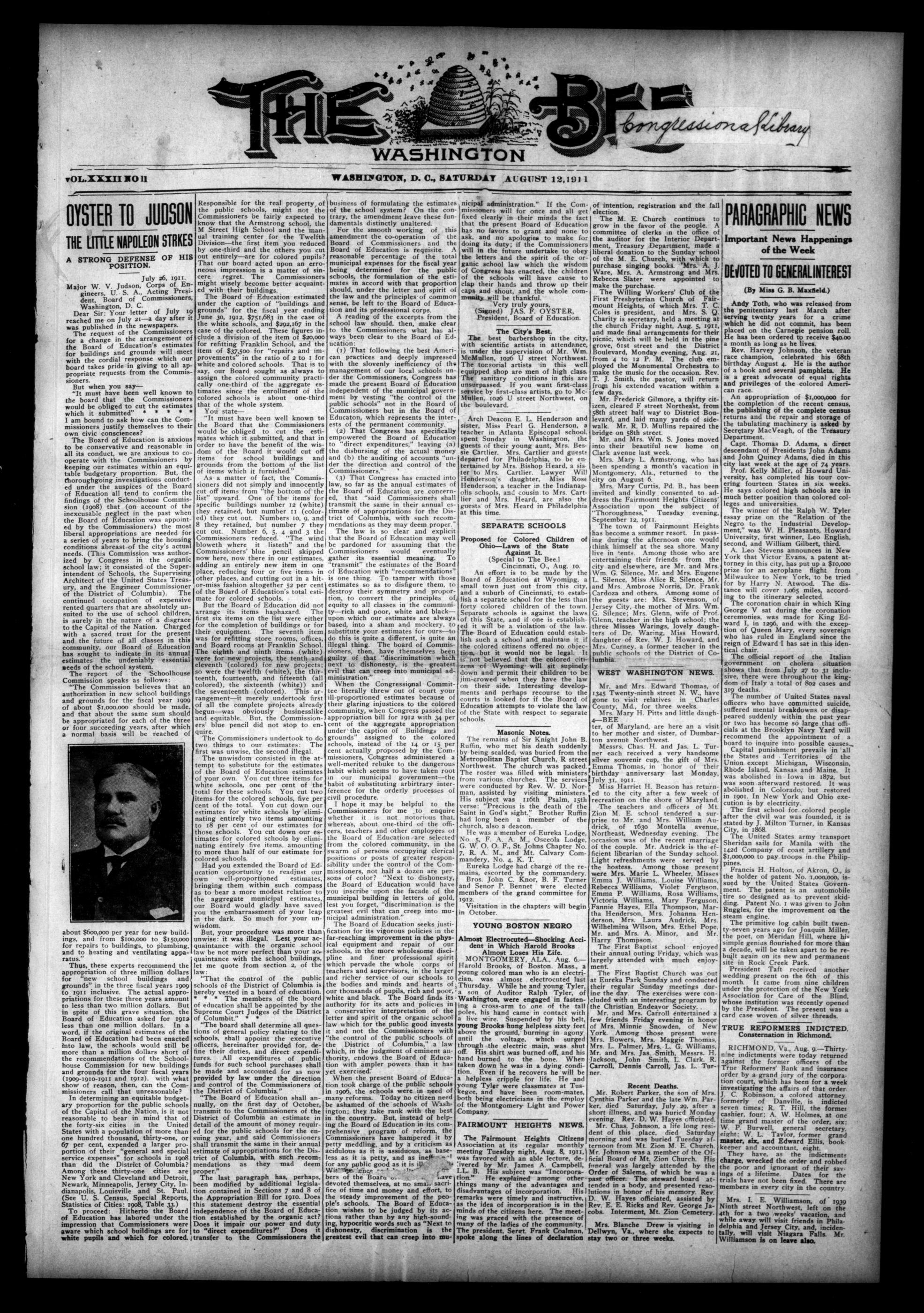
OYSTER TO JUDSON
THE LITTLE NAPOLEON STRKES
A STRONG DEFENSE OF HIS POSITION.
July 26, 1911.
Major W. V. Judson, Corps of Engineers, U. S. A., Acting President, Board of Commissioners, Washington, D. C.
Dear Sir: Your letter of July 19 reached me on July 21—a day after it was published in the newspapers.
The request of the Commissioners for a change in the arrangement of the Board of Education's estimates for buildings and grounds will meet with the cordial response which our board takes pride in giving to all appropriate requests from the Commissioners.
But when you say—
"It must have been well known to the board that the Commissioners would be obliged to cut the estimates which it submitted" * * * * *
I am bound to ask how can the Commissioners justify themselves to their own civic consciences?
The Board of Education is anxious to be conservative and reasonable in all its conduct, we are anxious to cooperate with the Commissioners by keeping our estimates within an equitable budgetary proportion. But, the thoroughgoing investigations conducted under the auspices of the Board of Education all tend to confirm the findings of the Schoolhouse Commission (1908) that (on account of the inexcusable neglect in the past when the Board of Education was appointed by the Commissioners) the most liberal appropriations are needed for a series of years to bring the housing conditions abreast of the city's actual needs. (This Commission was authorized by Congress in the organic school law; it consisted of the Superintendent of Schools, the Supervising Architect of the United States Treasury, and the Engineer Commissioner of the District of Columbia). The continued occupation of expensive rented quarters that are absolutely unsuited to the use of school children, is surely in the nature of a disgrace to the Capital of the Nation. Charged with a sacred trust for the present and the future of all classes in this community, our Board of Education has sought to indicate in its annual estimates the undeniably essential needs of the school system.
The report of the Schoolhouse Commission speaks as follows:
"The Commission believes that an authorization in new school buildings and grounds for the fiscal year 1900 of about $1,000,000 should be made, and that about the same sum should be appropriated for each of the three or four succeeding years, after which a normal basis will be reached of
about $600,000 per year for new buildings, and from $100,000 to $150,000 for repairs to buildings, to plumbing, and to heating and ventilating apparatus."
Thus, these experts recommend the appropriation of three million dollars for "new school buildings and grounds" in the three fiscal years 1909 to 1911 inclusive. The actual appropriations for these three years amount to less than two million dollars. But in spite of this grave situation, the Board of Education asked for 1912 less than one million dollars. In a word, if the original estimates of the Board of Education had been enacted into law, the schools would still be more than a million dollars short of the recommendations of the School-house Commission for new buildings and grounds for the four fiscal years (1909-1010-1911 and 1912). with what show of reason, then, can the Commissioners call that unreasonable?
In determining an equitable budgetary proportion for the public schools of the Capital of the Nation, is it not reasonable to bear in mind that of the forty-six cities in the United States with a population of more than one hundred thousand, thirty-one, or 67 per cent, expended a larger proportion of their "general and special service expenses" for schools in 1908 than did the District of Columbia? Among these thirty-one cities are New York and Cleveland and Detroit, Newark, Minneapolis, Jersey City, Indianapolis, Louisville and St. Paul. (See U. S. Census, Special Reports, Statistics of Cities: 1908, Table 33.)
To proceed: Hitherto the Board of Education has labored under the impression that Commissioners were responsible for the white umbrella and which, for colored,
Responsible for the real property of the public schools, might not the Commissioners be fairly expected to know that the Armstrong school, the M Street High School and the manual training training for the Twelfth Division—the first item you reduced by one-third and the others you cut out entirely—are for colored pupils? That our board acted upon an erroneous impression is a matter of sincere regret. The Commissioners might wisely become better acquainted with their buildings.
The Board of Education estimated under the caption of "buildings and grounds" for the fiscal year ending June 30, 1912, $751,683 in the case of the white schools, and $292,167 in the case of the colored. These figures include a division of the item of $20,000 for refitting Franklin School, and the item of $27,500 for "repairs and improvements" in the ratio of 2 to 1 for white and colored schools. That is to say, our Board sought as always to assign the colored community practically one-third of the aggregate estimates since the enrollment of the colored schools is about one-third that of the whole system.
You state—
"It must have been well known to the Board that the Commissioners would be obliged to cut the estimates which it submitted, and that in order to have the benefit of the wisdom of the Board it would cut off items for school buildings and grounds from the bottom of the list of items which it furnished."
As a matter of fact, the Commissioners did not simply and innocently cut off items from "the bottom of the list" upward. One of the items for specific buildings number 12 (white) they retained, but number 11 (colored) they cut out. Numbers 10, 9, and 8 they retained, but number 7 they cut out. Number 6, 5, 4 and 3 the Commissioners reduced. "The wind bloweth where it listeth" and the Commissioners' blue pencil skipped now here, now there in our estimates, adding an entirely new item in one place, reducing four or five items in other places, and cutting out in a hit-or-miss fashion altogether 52 per cent of the Board of Education's total estimate for colored schools.
But the Board of Education did not arrange its items haphazard. The first six items on the list were either for the completion of buildings or for their equipment. The seventh item was for refitting store rooms, offices, and Board rooms at Franklin School. The eighth and ninth items (white) were for new projects, the tenth and eleventh (colored) for new projects; so were the twelfth (white), the thirteenth, fourteenth, and fifteenth (all colored), the sixteenth (white)) and the seventeenth (colored). This arrangement—it merely undertook first of all the complete projects already begun—was obviously businesslike and equitable. But, the Commissioners' blue pencil did not stop to enquire.
The Commissioners undertook to do two things to our estimates: The first was unwise, the second illegal.
The unwisdom consisted in the attempt to substitute for the estimates of the Board of Education estimates of your own. You cut three items for white schools, one per cent of the total for these schools. You cut two items for the colored schools, five per cent of the total. You cut down our estimates for white schools by eliminating entirely two items amounting to 18 per cent of our estimates for those schools. You cut down our estimates for colored schools by eliminating entirely five items, amounting to more than half of our estimate for colored schools.
Had you extended the Board of Education opportunity to readjust our own well-proportioned estimates, bringing them within such compass as to bear a more modest relation to the aggregate municipal estimates, our Board would gladly have saved you the embarrassment of your leap in the dark. So much for your unwisdom.
But, your procedure was more than unwise: it was illegal. Lest your acquaintance with the organic school law be not more perfect than your acquaintance with the school buildings, let me quote from section 2, of the law:
"That the control of the public schools of the District of Columbia is hereby vested in a board of education.
* * * The members of the board of education shall be appointed by the Supreme Court Judges of the District of Columbit." * *
"The board shall determine all questions of general policy relating to the schools, shall appoint the executive officers, hereinafter provided for, define their duties, and direct expenditures. All expenditures of public funds for such school purchases shall be made and accounted for as now provided by law under the direction and control of the Commissioners of the District of Columbia."
"The Board of Education shall annually, on the first day of October, transmit to the Commissioners of the District of Columbia an estimate detail of the amount of money required for the public schools for the ensuing year, and said Commissioners shall transmit the same in their annual estimate of appropriations for the District of Columbia, with such recommendations as they mad deem proper."
The last paragraph has, perhaps, been modified by additional legislation contained in Sections 7 and 8 of the Appropriation Bill for 1910. Does this statement destroy the essential independence of the Board of Education established by the organic act? Does it impair our power and duty to "direct expenditures"? Does it transfer to the Commissioners the
WASHINGTON, D. C., SATURDAY AUGUST 12,1911
business of formulating the estimates of the school system? On the contrary, the amendment leave these fundamentals distinctly unaltered. For the smooth working of this amendment the co-operation of the Board of Commissioners and the Board of Education is requisite. A reasonable percentage of the total municipal expenses for the fiscal year being determined for the public schools, the formulation of the estimates in accord with that proportion should, under the letter and spirit of the law and the principles of common sense, be left to the Board of Education and its professional corps. A reading of the excerpts from the school law should, then, make clear to the Commissioners what has always been clear to the Board of Education:
(1) That following the best American practices and deeply impressed with the slovenly inefficiency of the management of our local schools under the Commissioners, Congress has made the present Board of Education independent of the municipal government by vesting "the control of the public schools" not in the Board of Commissioners but in the Board of Educaton, which represents the interests of the permanent community.
(2) That Congress has specifically empowered the Board of Education to "direct expenditures," leaving (a) the disbursing of the actual money and (b) the auditing of accounts "under the direction and control of the Commissioners."
(3) That Congress has enacted into law, so far as the annual estimates of the Board of Education are concerned, that "said Commissioners shall transmit the same in their annual estimate of appropriations for the District of Columbia, with such recommendations as they may deem proper." The law is so clear and explicit that the Board of Education may well be pardoned for assuming that the Commissioners would eventually gather its essential meaning. To "transmit" the estimates of the Board of Education with "recommendations" is one thing. To tamper with those estimates so as to disfigure them, to destroy their symmetry and proportion, to convert the principles of equity to all classes in the community—rich and poor, white and black—upon which our estimates are always based, into a sham and mockery, to substitute your estimates for ours—to do this is quite a different, is quite an illegal thing. The board of Commissioners, then, have themselves been guilty of that "discrimination which next to dishonesty, is the greatest evil that can creep into municipal administration."
When the Congressional Committee literally throw out of court your ill-proportioned estimates because of their glaring injustices to the colored community, when Congress passed the appropriation bill for 1912 with 34 per cent of the aggregate appropriation under the caption of Buildings and grounds" assigned to the colored schools, instead of the 14 or 15 per cent actually proposed by the Commissioners, Congress administered a well-merited rebuke to the dangerous habit which seems to have taken root in our municipal government—the habit of substituting arbitrary interference for the orderly processes of civil procedure.
I hope it may be helpful to the Commissioners for me to enquire whether it is not notorious that, whereas, about one-third of the officers, teachers and other employees of the Board of Education are selected from the colored community, in the swarm of persons occupying clerical positions or posts of greater responsibility under the control of the Commissioners, not half a dozen are persons of color? "Next to dishonesty, the Board of Education would have you inscribe upon the facade of the municipal building in letters of gold, lest you forget, "discrimination is the greatest evil that can creep into municipal administration."
The Board of Education seeks justification for its vigorous policies in the far-reaching improvement in the physical equipment and repair of our schools, in the more wholesome discipline and finer professional spirit which pervade the whole corps of teachers and supervisors, in the larger and richer service of our schools to the bodies and minds and hearts of our thousands of pupils, rich and poor, white and black. The Board finds its authority for its acts and policies in a conservative interpretation of the letter and spirit of the organic school law which for the public good invests it and not the Commissioners with "the control of the public schools of the District of Columbia," a law which, in the judgment of eminent authority, endows the Board of Education with ampler powers than it has yet exercised.
When the present Board of Education took charge of the public schools in 1906, the schools were in need of many reforms. Today no citizen need be ashamed of the schools of Washington; they take rank with the best in the country. But, instead of helping the Board of Education in its comprehensive program of reform, the Commissioners have hampered it by petty meddling, and by a criticism as acidulous as it is assiduous, as baseless as it is petty, and as inefficient for any public good as it is ill. Witness the encounters of the Board of Commissioners of the Board of Education have devoted themselves, at no small, sacrifice of time and money and effort, to the steady improvement of the people's schools. The Board of Education wishes to be judged by its actions rather than by any high-sounding, hypocritic words such as "Next to dishonesty, discrimination is the greatest evil that can creep into mu-
nicipical administration." If the Commissioners will for once and all get fixed clearly in their minds the fact that the present Board of Education has no favors to grant and none to ask, and no apologies to make for doing its duty; if the Commissioners will in the future undertake to obey the letters and the spirit of the organic school law which the wisdom of Congress has enacted, the children of the schools will have cause to clap their hands and throw up their caps and shout, and the whole community will be thankful. Very truly yours, (Signed) JAS. F. OYSTER, President, Board of Education.
The City's Best
The best barbershop in the city with scientific artists in attendance is under the supervision of Mr. Wm McMullen, 1026 U street Northwest. The tonsorial artists in this well equipped shop are men of high class. The sanitary conditions in this are unsurpassed. If you want first-class service by first-class artists, go to McMullen, 1026 U street Northwest, on the boulevard.
Arch Deacon E. L. Henderson and sister, Miss Pearl G. Henderson, a teacher in Atlanta Episcopal school spent Sunday in Washington, the guests of their young aunt, Mrs. Bessie Cartlier. Mrs. Cartlier and guests departed for Philadelphia, to be entertained by Mrs. Bishop Heard, a sister to Mrs. Cartlier. Lawyer Will Henderson's daughter, Miss Rose Henderson, a teacher in the Indianapolis schools, and cousin to Mrs. Cartlier and Mrs. Heard, are also the guests of Mrs. Heard in Philadelphia at this time.
SEPARATE SCHOOLS
Proposed for Colored Children of Ohio-Laws of the State
Cincinnati, O., Aug. 10.
An effort is to be made by the Board of Education at Wyoming, a small town just out from this city, and a suburb of Cincinnati, to establish a separate school for the less than forty colored children of the town. Separate schools is against the laws of this State, and if one is established it will be a violation of the law. The Board of Education could establish such a school and maintain it if the colored citizens offered no objection, but it would not be legal. It is not believed that the colored citizens of Wyoming: will sit supinely down and permit their children to be jim-crowed when they have the law on their side. Interesting developments and perhaps recourse to the courts is looked for if the Board of Education attempts to violate the law of the State with respect to separate schools.
Masonic Notes
The remains of Sir Knight John B. Ruffin, who met his death suddenly by being scalded, was buried from the Metropolitan Baptist Church, R street Northwest. The church was packed. The roster was filled with ministers from various churches. The services were conducted by Rev. W. D. Norman, assisted by visiting ministers. His subject was 116th Psalm, 15th verse: "Precious is the death of the Saint in God's sight." Brother Ruffin had long been a member of the church, also a deacon. He was a member of Eureka Lodge, No. 5, F. A. A. M, Osceola Lodge, G. W. O. O. F., St. Johns Chapter No. 7, R. A. M., and Mt. Calvary Commandery, No. 4, K. T. Eureka Lodge had charge of the remains, escorted by the commandery. Bros. John C. Knor, B. F. Turner and Senor P. Bennet were elected members of the grand committee for 1912. Visitation in the chapters will begin in October.
YOUNG BOSTON NEGRO
Almost Electrocuted—Shocking Accident in Which Harold Brooks
Almost Losses His Lite.
MONTGOMERY, ALA., Aug. 6.—Harold Brooks, of Boston, Mass., a young colored man who is an electrician, was almost electrocuted last Thursday. While he and young Tyler, of Washington, were engaged in fastening a crossbar on poles, his hand came in contact with a live wire. Suspended by his belt, young Brooks hung helpless sixty feet above the ground, burning in agony until the voltage, which surged through the electric main, was shut off. His shirt was burned off, and his hand burned to the bone. When taken down he was in a dying condition. Even if he recovers he will be a helpless cripple for life. He and young Tyler were classmates at Tuskegee, and have been room-mates, both being electricians in the employ of the Montgomery Light and Power Company.
FAIRMOUNT HEIGHTS NEWS
The Fairmount Heights Citizens Association at its regular monthly meeting Tuesday night, Aug. 8, 1911, was favored with an able lecture, delivered by Mr. James A. Campbell, LL.B. B. His subject was "Incorporation." He explained among other things many of the advantages and disadvantages of incorporation. His remarks were timely and instructive, as the idea of incorporation is in the minds of the citizens here. The meeting was graced with the presence of many of the ladies of the community. The president, Seret Frank Coalman, spoke along the lines of declaration
of intention, registration and the fall election.
The M. E. Church continues to grow in the favor of the people. A committee of clerks in the office of the auditor for the Interior Department, Treasury Department, made a liberal donation to the Sunday school of the M. E. Church, with which to purchase singing books. Mrs. A. J. Ware, Mrs. A. Armstrong and Mrs. Rebecca Slater were appointed to make the purchase.
The Willing Workers' Club of the First Presbyterian Church of Fairmount Heights, of which Mrs. T. C. Coles is president, and Mrs. S. Q. Charity is secretary, held a meeting at the church Friday night, Aug. 5, 1911, and made final arrangements for their picnic, which will be held in the pine grove, 61st street and the District Boulevard, Monday evening, Aug. 21 from 4 to 12 P. M. The club employed the Monumental Orchestra to make the music for the occasion. Rev. T. J. Smith, the pastor, will return from his extended vacation within a few days.
Mr. Frederick Gilmore, a thrifty citizen, cleared F street Northeast, from 58th street half way to District Boulevard, and laid many yards of sidewalk. Mr. R. D. Mullins repaired the bridge on 58th street.
Mr. and Mrs. Wm. S. Jones moved into their beautiful new home on Clark avenue last week.
Mrs. Mary L. Armstrong, who has been spending a month's vacation in Montgomery, Ala., returned to the city on August 6.
Mrs. Mary Curtis, Pd. B., has been invited and kindly consented to address the Fairmount Heights Citizens' Association upon the subject of "Thoroughness." Tuesday evening, September 12, 1911.
The town of Fairmount Heights has become a summer resort. In passing during the afternoon one would think himself at the sea shore. Many live in tents. Among those who are entertaining their friends from the city and elsewhere, are Mr. and Mrs. Wm. G. Silence, Mr. and Mrs. Eugene L. Silence, Miss Alice R. Silence, Mr. and Mrs. Ambrose Norris, Dr. Frank Cardoza and others. Among some of the guests are: Mrs. Stevenson, of Jersey City, the mother of Mrs. Wm. G. Silence; Mrs. Glenn, wife of Prof. Glenn, teacher in the high school; the three Misses Warings, lovely daughters of Dr. Warring, Miss Howard, daughter of Rev. W. J. Howard, and Mrs. Curney, a former teacher in the public schools of the District of Columbia.
WEST WASHINGTON NEWS.
Mr. and Mrs. Edward Thomas, of 1345 Twenty-ninth street N. W., have gone to visit relatives in Charles County, Md., for three weeks. Mrs. Mary H. Pitts and little daughter—BEE
ter, of Maryland, are here an a visit to her mother and sister, of Dumbarton avenue Northwest. Messrs. Chas. H. and Jas. L. Turner each received a very handsome silver souvenir cup, the gift of Mrs Emma Thomas, in honor of their birthday anniversary last Monday July 31, 1911.
Miss Harriet H. Beason has returned to the city after a few week of recreation on the shore of Maryland. The teachers and officers of Mt Zion M. E. school tendered a surprise to Mr. and Mrs. William Audrick, of 1630 Montella avenue Northeast, Wednesday evening. The occasion was of the recent marriage of the couple. Mr. Audrick is the efficient librarian of the Sunday school Light refreshments were served by the hostess. Among those present were Mrs. Marie L. Wheeler, Misses Emma J. Williams, Louise Williams Rebecca Williams, Violet Ferguson Emma P. Williams, Rosa Williams Victoria Williams, Mary Ferguson Fannie Hayes, Ella Thompson, Martha Henderson, Mrs. Johanna Henderson, Mrs. Laura Audrick, Mrs Wilhelmina Wilson, Mrs. Ethel Pope Mr. and Mrs. A. Minor, and Mr. Harry Thompson.
The First Baptist school enjoyed their annual outing Friday, which was largely attended with much enjoyment.
The First Baptist Church was out at Eureka Park Sunday and conducted their regular Sunday meetings during the day. The exercises were concluded with an interesting program by the Christian Endeavor Society.
Mr. and Mrs. Carroll entertained a few friends Friday evening in honor of Mrs. Minnie Snowden, of New York. Among those present were Mrs. Bowers, Mrs. Maggie Thomas, Mrs. L. Palmer, Mrs. L. G. Williams, Mr. and Mrs. Jas, Smith, Messrs. H. Jackson, John Smith, L. Clark. R Carroll, Dennis Carroll, Jas. L. Turner.
Recent Deaths
Mr. Robert Parker, the son of Mrs Cynthia Parker and the late Wm. Parker, died Saturday, July 29, after a short illness, and was buried Monday evening. Rev. D. W. Hayes officiated. Mr. Chas, Johnson, a life long resident of this place, died Saturday morning and was buried Tuesday afternoon from Mt. Zion M. E. Church. Mr. Johnson was a member of the Official Board of Mt. Zion Church. His funeral was largely attended by the Order of Salems, of which he was a past officer. The steward board attended in a body, and presented resolutions in honor of his memory. Rev. D. W. Hayes officiated, assisted by Rev. E. E. Ricks and Rev. George Jacobs. Interment, Mt. Zion Cemetery.
Mrs. Blanche Drew is visiting in Dellwyn, Va., where she expects to stay two or three weeks.
Important News Happenings of the Week
DEVOTED TO GENERAL INTEREST
(By Miss G. B. Maxfield.)
Andy Toth, who was released from the penitentiary last March after serving twenty years for a crime which he did not commit, has been placed on the Carnegie pension roll. He has been ordered to receive $40.00 a month as long as he lives.
Rev. Harvey Johnson, the veteran race champion, celebrated his 68th birthday August 4. He is the author of a book and several pamphlets. He is a great advocate of equal rights and privileges of the colored American race.
An appropriation of $1,000,000 for the completion of the recent census, the publishing of the complete census returns and the repair and storage of the tabulating machinery is asked by Secretary MacVeagh, of the Treasury Department.
Capt. Thomas D. Adams, a direct descendant of Presidents John Adams and John Quincy Adams, died in this city last week at the age of 74 years.
Prof. Kelly Miller, of Howard University, has completed his tour covering fourteen States in six weeks. He says colored high schools are in much better position than colored colleges and universities.
The winner of the Ralph W. Tyler essay prize on the "Relation of the Negro to the Industrial Development," was W. H. Pleasants, Howard University, first winner, Leo English, second and William Gilbert, third
A. Leo Stevens announces in New York that Victor Evans, a patent attorney in this city, has put up a $10,000 prize for an aerospace flight from Milwaukee to New York, to be tried for by Harry N. Atwood. The distance will cover 1,065 miles, according to the itinerary selected.
The coronation chair in which King George V sat during the coronation ceremonies, was made for King Edward I, in 1296, and with the exception of Queen Mary, every sovereign who has ruled in England since the reign of Edward I has sat in this identical chair.
The official report of the Italian government on cholera situation shows that from July 27 to 31 inclusive, there were throughout the kingdom of Italy a total of 802 cases and 319 deaths.
The number of United States naval officers who have committed suicide, suffered mental breakdowns or disappeared suddenly within the past year or two has become so large that officials at the Brooklyn Navy Yard will recommend the appointment of a board to inquire into possible causes.
Capital punishment prevails in 'all the States and Territories of the Union except Michigan, Wisconsin, Rhode Island, Kansas and Maine. It was abolished in Iowa in 1872, but was soon afterward restored. It was abolished in Colorado; but restored in 1901. In New York and Ohio execution is by electricity.
The first school for colored people after the civil war was founded, it is stated by J. Milton Turner, in Kansas City, in 1868. The United States army transport Sheridan sails for Manila with the 142d Company of coast artillery and $1,000,000 to pay troops in the Philippines. Francis H. Holton, of Akron, O., is the holder of patent No. 1,000,000, issued by the United States Government. The patent is an automobile tire so designed as to prevent skidding. Patent No. 1 was given to John Ruggles, for the improvement on the steam engine. The primitive log cabin built twenty-seven years ago for Joaquin Miller, the poet, on Meridan Hill, where his simple genius flourished for more than a decade, will be taken apart to be rebuilt again on its new and permanent site in Rock Creek Park. President Taft received another wedding present on the 6th of this month. It came from nine children under the protection of the New York Association for Care of the Blind, whose institution was recently opened by the President. The present was a card case woven of silver threads.
TRUE REFORMERS INDICTED
Consternation in Richmond
RICHMOND, Va., Aug. 9—Thirty-nine indictments were today returned against the former officers of the True Reformers' Bank and insurance order by a grand jury of the corporation court, which has been for a week investigating the affairs of that order, J. C. Robinson, a colored attorney, formerly of Danville, is indicted seven times; R. T. Hill, the former cashier, four; A. W. Holmes, at one time grand master of the order; six; W. P. Burwell, general secretary, eight; W. L. Tavlor, former grand master, six, and Edward Ellis, bookkeeper and accountant, eight.
They have, as the indictments charge, wrecked the order and robbed the poor and ignorant of their savings of a lifetime. Dates for the trials have not been fixed. There are members in every city in the country.
Mrs. I. E. Williamson, of 1939 Ninth street Northwest, left on the 4th for a two weeks' vacation, and while away will visit friends in Philadelphia and Jersey City, and, incidentally, will visit Niagara Falls. Mr. Williamson is on leave also.
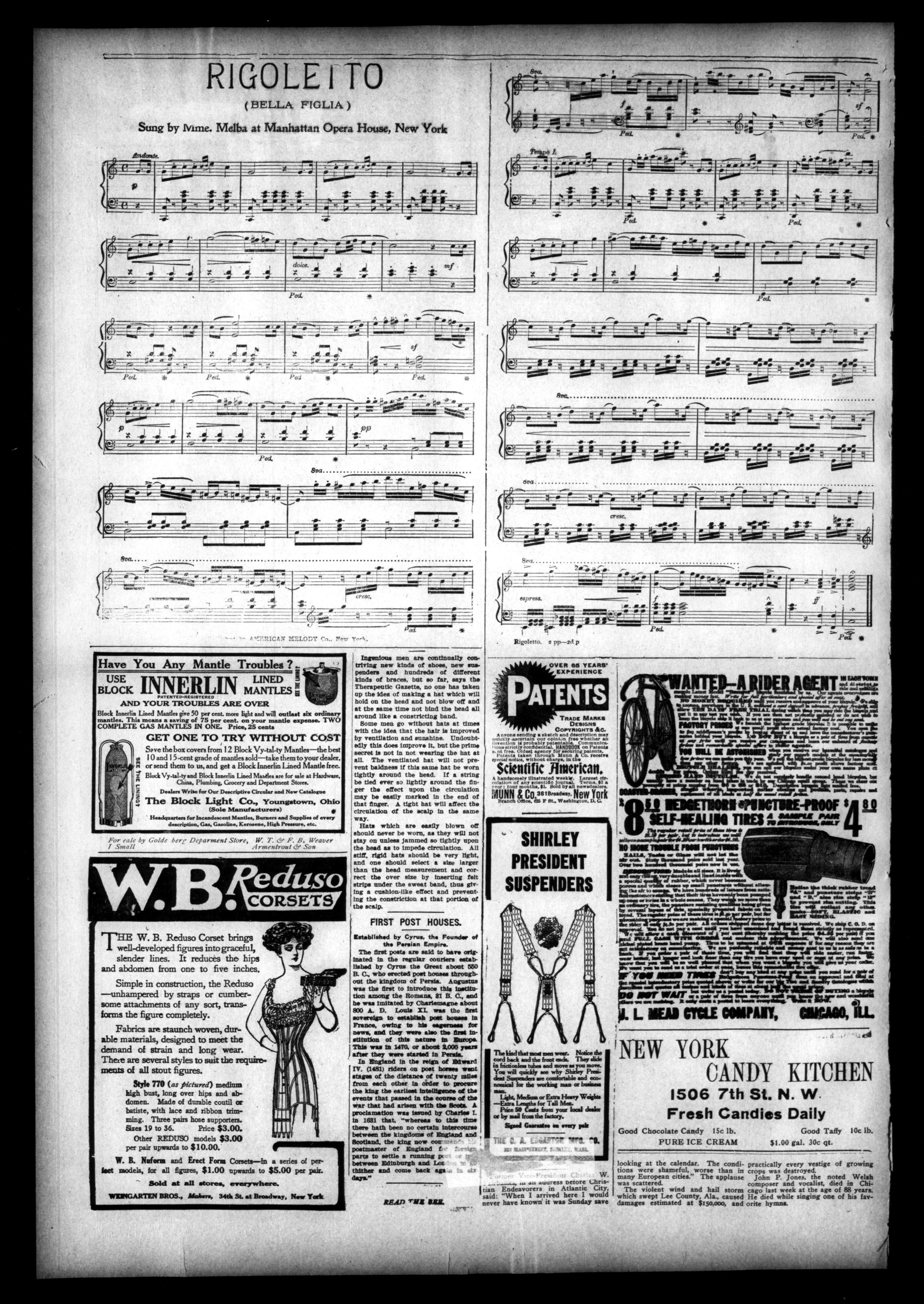
RIGOLEITO
the. Melba at Manhattan Opera House
doice.
Ped.
Ped.
pp
Ped.
8va.
cresc.
Sung by Mime. Melba at Manhattan Opera House, New York
Andante.
Ped.
Ped. * Ped. * Ped. * Ped. *
Ped.
```markdown
```
Have You Any Mantle Troubles?
USE BLOCK INNERLIN LINED MANTLES
PATENTED REGISTERED
See the LINK?
per cent. more light and will outlast six ordinary 75 per cent. on your mantle expense. TWO N ONE. Price, 25 cents
Parment Store, W. T. & F. B. Weaver
Armentrout & Son
3. Reduso
CORSETS
ect Form Corsets—in a series of per- $1.00 upwards to $5.00 per pair. stores, everywhere. makers, 34th St. at Broadway, New York
Sung by Mime. Melba at M
Have You Any Mantle Trouble
USE BLOCK INNERLIN LINE MANTLE
(BELLA FIGLIA)
ung by Mime. Melba at Manhattan Open
Ped.
Ped.
Ped.
8va.....
You Any Mantle Troubles?
INNERLIN LINED MANTLES
PATENTED REGISTERED
Uruca
AND YOUR TROUBLES ARE OVER Block Innerlin Lined Mantles give 50 per cent. more light and w mantles. This means a saving of 75 per cent. on your COMPLETE GAS MANTLES IN ONE. Price, 25 cent.
ined Mantles give 50 per cent. more light and will outlast six ordinary means a saving of 75 per cent. on your mantle expense. TWO AS MANTLES IN ONE. Price, 25 cents
Block Innerlin Lined Mantles give 50 per cent. more light and will outlast six ordinary mantles. This means a saving of 75 per cent. on your mantle expense. TWO COMPLETE GAS MANTLES IN ONE. Price, 25 cents
GET ONE TO TRY WITHOUT COST
Save the box covers from 12 Block Vy-tal-ty Mantles—the best 10 and 15-cent grade of mantles sold—take them to your dealer, or send them to us, and get a Block Innerlin Lined Mantle free.
Block Vy-tal-ty and Block Innerlin Lined Mantles are for sale at Hardware, China, Plumbing, Grocery and Department Stores.
Dealers Write for Our Descriptive Circular and New Catalogue
The Block Light Co., Youngstown, Ohio (Sole Manufacturers)
Headquarters for Incandescent Mantles, Burners and Supplies of every description, Gas, Gasoline, Kerosene, High Pressure, etc.
GET ONE TO TRY WITHOUT COST Save the box covers from 12 Block Vy-tal-ty Mantles—the best 10 and 15-cent grade of mantles sold—take them to your dealer, or send them to us, and get a Block Innerlin Lined Mantle free. Block Vy-tal-ty and Block Innerlin Lined Mantles are for sale at Hardware, China, Plumbing, Grocery and Department Stores. Dealers Write for Our Descriptive Circular and New Catalogue The Block Light Co., Youngstown, Ohio (Sole Manufacturers) Headquarters for Incandescent Mantles, Burners and Supplies of every description, Gas, Gasoline, Kerosene, High Pressure, etc.
W.B.Re
y Goldberr Department Store, W. T. & F. B. Weaver Armentrout & Son V.B. Reduso CORSETS
For by Goldie her Department Store, W. T & F. B. Weaver
I Sm I Armentour & Son.
W.B. Reduso CORSETS
sul,
ips
nes.
quire-
THE W.B. Reduso Corset brings well-developed figures into graceful, slender lines. It reduces the hips and abdomen from one to five inches. Simple in construction, the Reduso unhampered by straps or cumbersome attachments of any sort, transforms the figure completely.
Fabrics are staunch woven, durable materials, designed to meet the demand of strain and long wear. There are several styles to suit the requirements of all stout figures.
Style 770 (as pictured) medium high bust, long over hips and abdomen. Made of durable coutil or batiste, with lace and ribbon trimming. Three pairs hose supporters. Sizes 19 to 36. Price $3.00.
Other REDUSO models $3.00 per pair upwards to $10.00.
W. B. Naform and Erect Form Corsets—infect models, for all figures, $1.00 upwards to Sold at all stores, everywhere WENGARTEN BROS., Makere, 34th St. at Broa
Nuform and Erect Form Corsets—in a series of per- for all figures, $1.00 upwards to $5.00 per pair. Sold at all stores, everywhere. RTEN BROS., Makere, 34th St. at Broadway, New York
W. B. Nuform and Erect Form Corsets—in a series of perfect models, for all figures, $1.00 upwards to $5.00 per pair. Sold at all stores, everywhere.
Ingenious men are continually contriving new kinds of shoes, new suspenders and hundreds of different kinds of braces, but so far, says the Therapeutic Gazette, no one has taken up the idea of making a hat which will hold on the head and not blow off and at the same time not bind the head all around like a constricting band.
Some men go without hats at times with the idea that the hair is improved by ventilation and sunshine. Undoubtedly this does improve it, but the prime secret is not in not wearing the hat at all. The ventilated hat will not prevent baldness if this same hat be worn tightly around the head. If a string be tied ever so lightly around the finger the effect upon the circulation may be easily marked in the end of that finger. A tight hat will affect the circulation of the scalp in the same way.
Hats which are easily blown off should never be worn, as they will not stay on unless jammed so tightly upon the head as to impede circulation. All stiff, rigid hats should be very light, and one should select a size larger than the head measurement and correct the over size by inserting felt strips under the sweat band, thus giving a cushion-like effect and preventing the constriction at that portion of the scalp.
FIRST POST HOUSES.
Established by Cyrus, the Founder of the Persian Empire. The first posts are said to have originated in the regular couriers established by Cyrus the Great about 550 B. C., who erected post houses throughout the kingdom of Persia. Augustus was the first to introduce this institution among the Romans, 31 B. C., and he was imitated by Charlemagne about 800 A. D. Louis XI. was the first sovereign to establish post houses in France, owing to his eagerness for news, and they were also the first institution of this nature in Europe. This was in 1470, or about 2,000 years after they were started in Persia.
In England in the reign of Edward IV. (1481) riders on post horses want stages of the distance of twenty miles from each other in order to procure the king the earliest intelligence of the events that passed in the course of the war that had arisen with the Scot. A proclamation was issued by Charles I. in 1631 that, "whereas to this time there hath been no certain intercourse between the kingdoms of England and Scotland, the king now postmaster of England parts to settle a running p between Edinburgh and Lor thither and come back aga. daya."
READ THE BEE
8va.
Ped.
Pca.
Tempo I.
Ped.
Ped.
Pal.
```markdown
```
```markdown
```
cresc.
espress.
Rigoletto. 2 pp—2d p
OVER 65 YEARS' EXPERIENCE
PATENTS
TRADE MARKS
DESIGNS
COPYRIGHTS &C.
Anvone sending a sketch and description may quickly ascertain our opinion free whether an invention is probably patentable. Communication automatically confidential. HARDWARE on tickets not free. Oldest agency for securing patents. Patents taken through Munn & Co. receive special notices, without charges, in the
A handsomely illustrated week. Largest circulation of any scientific journal. Terms, $3 a cur. four months, $1. Bold by all newdealers. MUNN & Co. 361 Broadway, New York Branch Office, CS F St., Washington, D. C.
SHIRLEY
PRESIDENT
SUSPENDERS
M
The kind that most men wear. Notice the cord back and the front ends. They slide in frictionless tubes and move as you move. You will quickly see why Shirley President Suspenders are comfortable and economical for the working man or business man.
Light, Medium or Extra Heavy Weights — Extra Lengths for Tall Men.
Price 50. Cents from your local dealer or by mail from the factory.
Signed Guarantee on every pair
0.
in an aduress before Christian Endeavorers in Atlantic City, said: "When I arrived here I would never have known' it was Sunday save
WANTED—A RIDER AGENT IN EACH DOWN and all stages so ride and exhibits making money fast. Write your full details and special after all ones. Our agents everywhere are making money fast. We pay full fees for riders and special after all ones.
NO MONEY BROKEN! We must pay full fees for riders and special after all ones. We only pay to transport anywhere in the U. S. without a good deposit in advance, apply for payment and allow TEN DAYS TRIAL during which you will be paid. If you put it to any pay you wish. If you are there not privately sponsored or do not wish to keep the bicycle you bring it to us at our premises and your will not be out and paid.
FASTORY PRICES We become the highest grade bicycle. It is possible to trade for additional people by buying up a good of land and from the manufacturer's guarantee behind your bicycle. NO KOR HAYY a bicycle of a mere one mile from expire at any price will you receive our campaign and leave our unbound of freedom prince and remembrance grand prize to rider agents.
YOU WILL BE AUTOMOBILE when you motivate our beautiful engines and your former we can purchase you your pure, high grade bicycles for less money than other bicycles you can sell our bicycles need your own name plate.
BONUS HARD INSTALLED. We do not necessarily handle second hand bicycles, but our former we can purchase you by our Chicago equal amount. These we clear out, dispose of wholly, import and sell by 11:59. Description bicycles left marked from, dispose of wholly, import and sell by 11:59. Description bicycles left marked from, dispose of wholly, import and sell by 11:59.
$ 8 5.9 MEDGETHORN PUNCTURE-PROOF $ 4 80
SELF-HEALING TIRES A SAMPLE PAIR
TO INTRODUCE, ONLY
The regular retail price of these items is
$1.50 per pair, but to make them we will
polly you on bargains for $1.00 per hour here or
NO MORE TROUBLE FROM FIRSTBREES
NAILS. Treads or Glasses will not let this
air out. Sixty thousand pairs sold last year.
Over two hundred thousand pairs now in use.
Made in all sizes. It is lovely
240
but only training very carefully and then made more a special quality of rubber, which never becomes porous and which clears up small punctures without allowing the air to escape. We have hundreds of letters from national authorities making that their lives have been pumped up once or twice in a whole season. They would be more than ordinary life, the pumping qualities being given by several hours of the sun, particularly pumped on the brand. The regular pulse of these times is so per year, but for industrial purposes we are making a special priority to allow air to per year. All colors of rubber.
and more day labor is received. We ship C. O. D. on
commission and bound from strictly as represented,
at precisely matching the prices B. L. R. per pair if you
obtain this appointment. We will also send one
assumed at O.P.R. expense if for any reason they are
only reliable and money paid to us is made in a
will find that they will ride order, run hungry,
and you have ever used or negot at any price. We
when you want a biggie you will give us your order,
see this memorable offer.
By any kind at any price will you send for a pair of
Yours. Please preform then on approval and final at
write for our big Ties and Beauty Catalogs within
at about the same price.
And before. No more allowance for BOTTING a biggie
anyone until you know the new and wonderful
been everything. Write it BOTTLE.
COMPANY, CHICAGO, ILL.
ANDY KITCHEN
in St. N. W.
andies Daily
the seller of only 10 per pair. All orders shipped same day later is received. We ship C.O.D. on approval. You do not pay a cash payment you have committed and bound strictly as represented. We will allow a cash discount of 5 per cent thereby making the prices 8.50 per pair if you send FULL CALL WITH ORIGINAL and endorse this advertisement. We will also send one nickel potted brass hand pump. Thus to be assumed at G.O.S. expenses if for any reason they are not satisfactory on maintenance. We are patiently reliable and money sent to us is made on a bank. If you order a pair of these first, you will find that they will slide easier, run faster, wear better, and longer and look fewer than any life you have ever or might at any price. We know that you will be so well pleased that when you want a bicycle you will give us your order. We want you to send us a brief order at once, hence this commendable offer.
IF YOU MIND TIME, just say any kind at any price until you send for a pair of the special intermediary price quoted above or write our box at this and intimacy Catalogue within descriptions and quotes all names and kinds of them at above box. Do not WAIT but write us a posted today. Do not KNOW a bicycle DO NOT WAIT or a pair of them from anyone until you know the age and wonderful nature we not making. It only costs a postal to learn everything. Write R. ROW.
J. L. MEAD CYCLE COMPANY, CHICAGO, ILL.
You do not pay a cash card you have committed to. We will allow a cash discount of 1 per cent thereby and send FULL CASH WITH ORIGINAL and enclose that a nickel piped brass hand pump. Three to be submitted at OCTOBER 1st on subscription on monmouth. We are proudly reliable bank. If you order a pair of these tires, you will find it wear better, but longer and look faster than any tire you have known that you will be so well pleased that when you wear it, we want you to send us a trial order at once, hence this run. IF YOU NEED TIRES Midlandton Purchase are special intermediary price quoted above, or write our address and quotes all instances and kinds of these at along with DO NOT WAIT or a pair of these from anyone we offer. J. L. MEAD CYCLE COMPANY
NEW YORK
CANDY
1506 7th St.
Fresh Candie
CANDY KITCHEN 1506 7th St. N. W. Fresh Candies Daily
Good Chocolate Candy 15c lb.
PURE ICE CREAM
looking at the calendar. The conditions were shameful, worse than in many European cities." The applause was scattered. The violent wind and hail storm which swept Lee County, Ala., caused damages estimated at $150,000, and
Bottles the thick rubber tread "A" and puncture strips "B" and "D," also rim strip "1B" to prevent rim cutting. This time will outlast any other game—8377, ELASTIC and EAST RIDING.
Good Taffy 10c'lb.
$1.00 gal. 30c qt.
practically every vestige of growing crops was destroyed.
John P. Jones, the noted Welsh composer and vocalist, died in Chicago last week at the age of 88 years. He died while singing one of his favorite hymns.
By ELIZABETH WEED
Edith Wilton combined two marked contradictions. She possessed a lovable disposition, but when she was a baby, through the carelessness of a nurse, she fell and cut her lip, producing a wound that in healing left a scar, giving a very disagreeable expression to her face.
Edith could see in the faces of those she met a repugnance occasioned by her expression. At first she tried to obviate this effect by smiling, but she saw at once by the further recoil of the one looking at her that she was only heightening the disagreeable impression. Such physical blights usually have one of two effects, either the blighted person is unconscious of the defect or becomes painfully sensitive concerning it. Edith was of the latter class. She would not go to the sozial gatherings of her own age. More and more she shrank within herself. Then, becoming conscious that in being a rebellious she would be forced into a life of selfishness, she began to devote herself to the poor.
She had friends, girl friends, who sought to draw her out socially. Confidence between young girls is close, while that between opposite sexes, especially at that age, is distant. The young men who met Edith looked upon the expression on her face and turned away with a shrug. Her girl friends had a better opportunity to learn what there was under the misleading expression. When one of her chums was married she insisted on Edith being her bridesmaid. Edith denured, but her friend would not excuse her.
At the wedding the bridesmaid, looking up suddenly, saw the eyes of a young man she had never seen riveted upon her and without that repelled expression she was accustomed to see. The man was a recent graduate of a medical school. The reason why his face did not reflect any disagreeable expression at her defect was because, being a practitioner, he was used to controlling his features when treating his patients.
But Edith did not know this. She knew only that a man with a kindly face was looking at her without any reference to her defect. And when Dr. Allan Emerson requested an introduction and was presented to her her heart fairly bounded within her. Not for an instant while he chatted with her did he seem conscious of her blight. And she, being made to feel that it was inconsequential, rose above it so far as to display the real attractiveness and worth that were in her.
And yet the reason of the young doctor's desire to make her acquaintance was that very defect. He had been observing her before she had noticed him and with a professional eye had been watching the effect of her scar upon the various expressions that flitted across her face. Some physicians, rough in manner, though they may be invaluable helpers to the afflicted, would not have scruped to betray the real object of their interest. Emerson was of a different kind. He not only concealed his own thoughts for professional reasons, but from an innate sense of delicacy.
Whatever be the exact analysis of his feelings, the act produced a marked impression upon Edith Wilton. A man whose personnel, whose bearing, was far above the average had not only failed to show any repugnance at her defect, but had asked to be introduced to her and chatted with her, displaying unusual interest in her without seeming to be conscious that there was any difference between her and other girls, unless to her advantage. But when he asked her if he might not call upon her the cap of her delight was full.
A few months after the meeting Dr. Emerson asked Edith to be his wife. When she had accepted him he mentioned for the first time her defect, letting her know that he believed he could remove at least its effects.
"Why," said Edith, "didn't you remove it before proposing to me?"
move it before proposing to me?"
"Because, sweetheart," he replied,
"these stupid men who have been
passing you by would have learned of
your real worth, and the field would
have been full of rivals."
There was more in her eyes than in
her words when she replied, "You
know very well that none of them
were to be feared by you."
But Edith dreaded lest in case an operation were not successful her lover might find himself tied through life to a blighted woman and unhappiness for both would result. She therefore insisted on having the operation performed and if the trouble were removed the marriage to take place afterward. Dr. Emerson demurred to this, saying that whether the operation were or were not a success he would not give her up. Both stood firmly on the ground that they had taken, but the man, since the result would be the same to him in any event, finally yielded.
The operation was merely a matter of delicate handling, its only object being to produce a certain result of facial expression. Dr. Emerson performed it himself, covering the wound he made with a piece of skin from the arm of another person. When the whole had healed and the bandages were removed, though the scar remained, the expression on the face had entirely changed. Dr. Emerson is facetious in his remarks upon how he kept rivals from the girl he wanted and whom as his wife he considers a treasure.
Mr. and Mrs. Trevor were sitting one October evening before a blazing wood fire—they had not yet lighted the furnace—and the room was aglow and redolent with the pleasant odor of burning wood. The children had been romping, Mr. Trevor carrying Bennie pligaback and Willie on all fours, but their mother had now taken them all, including the girls, up to bed, tucked them in, kissed them good night and had returned with her sewing, which she was doing by the big lamp on the table, while Mr. Trevor read a magazine. There was a ring at the bell.
Now, for many years there was something in the ring of his doorbell that cast a sober look over Samuel Trevor's face. But to explain the reason for this it is necessary to go back to the time when he was a very young man
When he was but eighteen his father, who was a lumber merchant, sent his son to a lumber camp that he might learn the business which would one day be his, from the beginning. There is danger to all persons of that age of inexperience and recklessness that they may make a mesalliance, and on that account it is a bad plan to take them away from young girls of their own social circle and place them among their inferiors. And where would a young man of refinement find people more his inferiors than in a lumber camp? Among the girls there was Madge Hopkins, the daughter of a lumberman, several years older than Trevor, who lured him into indiscretions with her, then threatened him with vengeance if he refused to marry her. He did so, but immediately left the camp.
An effort was made to annul the marriage, but it was unsuccessful. Then the woman offered to refrain from troubling her husband if his father would support her. Remittances were sent regularly for a season, when suddenly a newspaper was received containing a notice of her death. No doubt was felt of the truth of the notice when several years had passed and, no remittances having been sent, no demand was made for them.
Twelve years after the conclusion of this episode Samuel Trevor married Agatha Beach. He told her all about it before being engaged to her, not expressing a doubt that his first wife was dead. "You may be sure of that," said Agatha, "or she would be drawing the lifeblood out of you." Nevertheless Trevor, having had nothing but the death notice to prove to him Madge Hopkins' demise, never felt absolutely sure. And that was the reason why a certain dread was connected with the ringing of his doorbell.
A maid in a neat uniform of black and white went to the door, and the wife and husband heard a woman's coarse voice ask for Mr. Trevor. Then, without waiting to be announced, the caller brushed past the maid and into the sitting room.
"Hello, Sami!" she said.
Trevor put his hands to his face and trunbied. It was Madge Hopkins, and, judging from her appearance, she had been growing coarser with every year.
Mrs. Trevor ran to her husband and put her arms about him as if to shield him from the blow.
"Y' needn't be afraid o' me," said the woman. "If you'll give me somethin' to live on."
"Why did I receive that notice of your death?" faltered Trevor.
"I nin't got nothin' to do with that. I ain't got nothin' to live on. Send them remittances that was dropped and I'll let y' alone."
"Mamma!" cried the oldest daughter, a girl of ten, from above. "What's the matter?"
"Leave your address and go," said Trevor, eager to get the woman out of the house before the children should learn who she was.
The address was given, and the woman went away. Then after a silence Mr. Trevor said:
"Don't worry on my account, dearie. My position is not pleasant, but what is it compared with the interest of you and the children? Be comforted. We will keep the secret. Send the remittances regularly and no one will be the wiser."
But Mrs. Trevor had no intention of letting the matter rest-where it was. A shrewd woman, she believed that there had been some weak spot in Madge Hopkins' record which was accountable for the spurious death notice and the failure to claim the remittances.
It was but a week after this, when Trevor came home one evening from business, that his wife received him with a radiant countenance that boded good news. Taking him to a room where the children would not hear and closing the door, she said:
"It's all right. I put a detective on her track, and he has been here this afternoon to report. The woman has never been Madge Hopkins since you have known her. She was secretly married before you met her to a number shover—whatever that is—and, he drifting away, she took you in. But after you left he returned and claimed her. She lived with him; but, fearing if you appeared in their lives she would be tried for bigamy, she sent you the notice of her death, which she had inserted in a paper for the purpose, and gave up the remittances. Her husband has recently died, and she came back on you for support."
By REGINALD D. HAVEN
"I never did but one good act in my life," said the old counterfeiter. "There wasn't much credit in it to me, but it was productive of a lot of happiness to others. It occurred many years ago, and as I am now a very old man and have a very long, troubled life to look back upon, including several terms in the penitentiary, it stands out from the rest of my acts in odd contrast
"It was in the summer of 1859 that several of us got together, in a northern city and manufactured a number of twenty dollar counterfeit bills. As soon as we had finished the job we destroyed the outfit, divided the bills and started for different parts of the country to put them out on the public, my section being the south. Boarding one of the crack steamers of that day, I started for New Orleans. In order the better to impose on people I dressed myself in ministerial black and wore a white cravat. I had been an actor and could personate a clergyman, or any one else, for that matter, to perfection.
"The main cabin of the steamers running in the Mississippi river in those days, when the table was not set for meals, was occupied principally for gambling. Poker, seven-out, euchre and other games were played, though the parties playing were not large and often two persons only occupied a table. I was sitting on the guards one day when a negro cane out of the cabin, wringing his hands.
"What's the matter, boy? I asked.
"Mars' done gone lose me to a nigah trader. Ma wife an' pleckaninnies won't neber see me no mo'.
"I found that his master, a planter, had taken him to Cairo as his body servant, was returning, had lost all the money he had with him at cards, staked his darky and lost him too. I went into the cabin, where the planter and the trader being settling up, the planter being at the moment occupied in making out a bill of sale for the slave.
"I beg your pardon, sir," I said to the planter. 'On account of my vocation I am opposed, of course, to gambling in any form, but I dislike exceedingly the separation of families. I understand that you have lost your negro. I would be pleased to lend you the money to win him back.'
"The gentleman accepted the offer, I brought out some new, crisp bills, just from the press, and the game started anew. It was euche. I soon saw that the gambler could go on winning from the trader all day if he liked, for the former was perpetrating one of the commonest tricks on him—that is, 'turning jack.' In other words, when he dealt he would always turn up a knave for himself. Seeing this and other cheating, I interfered. I told him that I had learned the game before becoming a clergyman and insisted on taking the planter's place. Since I was backing the latter he was obliged to yield to me in the matter, which he did with a bad grace.
"I had not only learned the game 'before becoming a clergyman,' but all the tricks that went with it and many other games. I walked into that card sharper in a way that opened his eyes. The negro at stake had followed me into the cabin and was standing watching the game with bulging eyes. It was hard for me to keep a straight face, playing as I was, a supposed minister of the gospel, with counterfeit money and doing as neat bits of thimberlingg as had ever been practiced on that palatial steamboat. The negro trader was not a professional card sharper, though he didn't hesitate to cheat the planter, and never dreamed that the somber man before him in a : oless white necktie was placing the cards exactly where he wanted them.
"Of course I soon won the darky for his master. Then I arose from the table, delivered a homily on the sin of gambling and returned to the guards. I was followed by the planter, who said to me:
"Pe'mit me, suh, to say to yo' that you're the first man of the cloth that has each obtained my unbounded respect, suh. Yo' have saved my boy, suh, from being separated from his wife and children, an act fo' which I would have been to blame. I have sufficient influence, suh, to control a call to the First Baptist church of —, Mississippi. If yo' will accept it shall be yo' with a fat salary."
"I thanked the gentleman for his offer, but declined it. When we reached his landing he insisted so heartily upon my visiting him at his plantation that I consented."
"I was made welcome by his family, and the wife and children of the negro I had saved from the trader came to the house with tears in their eyes to thank me. I was a good looking young fellow in those days and could see that I made an impression on one of the planter's daughters. I had everything at my disposal to perpetrate any rascality I might choose. I could get the planter's indorsement, which would enable me to dispose of my 'green goods,' and I believed I could win his daughter.
"I did neither. For a brief season I enjoyed the sensation of being a fine fellow. During that time I permitted myself to feel the part just as an actor will feel the character he is personating. Then when it was over I departed, resisting with difficulty the reproachful look of the girl who favored me, and as soon as I was on another boat was, again a dog of a counterfeiter."
By DAVID WALTER CHURCH
Little Inez Basquimento, a Mexican girl I saw while engineering in the southwest, was a merry child (if she had been born in the north she would have been a child; but, being a Mexican, she was a woman). She might have been anywhere from fourteen to sixteen. She played the guitar and sang with a little birdlike voice, jabbered Spanish musically, danced, and her face wore a perpetual smile, which was for every one. But if any person attempted to guy her she would knit her brows and shrink away as though terrified. And once her confidence was lost by a bit of banter her good will could never be regained.
There was a young engineer engaged on the same work as myself out there, at the time fresh from one of the "Teck" schools of the northern states. He was twenty years old, handsome as a picture and as bright as a new brass button. What must he do but make love to Inez with all the recklessness of youth regardless of the consequences both to himself and her! I, who was older, saw his danger and warned him. I knew what was up, for in the evening when the day's work was over I would hear on the Basquimento veranda the twang of Inez's guitar her little flute voice, her merry laughter mingled with sounds which I recognized as coming from Ben Eggleston, the young man who was sowing the wind to reap the whirlwind.
"You little fool," I would say to him,
"don't you know that the girl is a ringing of child and woman—child in inexperience, woman in development; that she will fall in love with you and then"
"I'll break it off at once," would be the young fellow's invariable reply. The boy fully intended to keep his resolution when it was made, but gave up trying to do so when it got cold. The next night I would hear the same pleasant sounds on the veranda and knew that they were breeding the same storm.
This went on till the work on that division was finished and we were about to move. Eggleston assured me there wouldn't be any trouble. The girl was such a child that he couldn't believe she had been attracted to him as she might have been if more of a woman. He was going away and would simply bid her goodby as he would any other girl of immature years whose companion he had been.
"My advice to you," I said, "is to do no such thing. Go without saying anything about your going."
He didn't take my advice. The day before leaving he told her in a careless way that the engineering party to which he belonged was going to move its headquarters.
"And I will not see you again?" said the girl, her smile vanishing.
"Perhaps not," replied Ben, not thinking it wise to leave her to look forward to meeting him again. "You'll grow up soon and get married. Then you won't want any young men friends like me."
In order the better to kill in her all expectation of getting any nearer to him he told her he had a girl in the north.
That evening I met Inez carrying a cadgel in one hand and a canvas bag in the other. She wore the same innocent look she had always worn, but I noticed a peculiar glitter in her eye. There was something incongruous in a little girl's carrying a bludgeon, and, naturally fearful for Ben Eggleston, I could not help vaguely connecting the act with the jitting he was giving her. She passed me without looking back, and, taking position behind a tree, I watched her.
She went along, looking about her on the ground as if searching for something. She spent half an hour in this way, I following her, taking a new position now and then where I would not be observed by her. Presently I saw her hit something with her weapon. Then she picked up what looked to me from a short distance like a baby alligator. She held it by the tall, dropped it into the bag, closed the mouth and went away.
I didn't know what it all meant; but, still timorous about Ben, I told him he had better not wait for the moving of the party, but get out at once. He laughed at me and said there was nothing to fear and if there were he wouldn't run from a little Mexican girl who had scarcely given up her doll.
We engineers slept in a long temporary building one story high. That night I was startled by an unearthly yell. Springing out of bed, I ran along to a room where Eggleston and a rodman slept. The window was open, and Eggleston had just struck a light. His roommate was holding one leg and writing with pain.
"Kill it!" he yelled.
Then I saw a little alligator looking thing on the floor.
"Kill it! It's the Gila monster and has bitten me. I'm gone up."
Inez's actions were explained. She had dropped the reptile in through the window on Ben, she supposed, but really on his roommate. For a week the poor devil howled in agony, then died. That was years ago. Ben Eggleston has never married. The bare mention of a woman produces on him a temporary insanity.
By CORA HATHORN SYKES
Each dwelling should be a thing of itself, not containing any one except the family whose home it is. Many a wife and husband have been separated, innocent children made to suffer and sometimes murder done because of a man or a woman going to live with a family of which they were not a part.
The Brown's were a hundrum couple, content with each other and their home. When it was decided to have a governess for their children Miss Olive Markam was selected for the purpose. Miss Markam was pretty, and Mrs. Brown should have hesitated before taking her into the sheepfold. Not that the wolf was likely to harm her lambs, but there was a sheep in the family who, though not very tender, was liable to fall a prey to the newcomer. Neither Mrs. Brown nor her husband gave the entrance of Miss Markam into the family a thought so far as danger was concerned. Neither had ever known a pang of jealousy. Mr. Brown was a pudgy, baldheaded man of forty-two; Mrs. Brown was a tall, angular woman but a year his junior. Neither supposed that the other could attract any one else even if so inclined. The governess was but twenty and replied to Mr. Brown's remarks with "Yes, slr," and "No, slr," as a person of an entirely different generation. And yet there was danger in her presence at the Brown's.
Mr. Brown had his own sleeping room, where he might get a quiet night's rest without being disturbed by the rest of the family. One night he wakened from a bad dream and could not go to sleep again. After vainly endeavoring for an hour or more to do so he got up, put on a dressing gown and went downstairs to get a biscuit and a glass of wine, hoping that by thus drawing the blood to his stomach he might return to slumber. He took great care to move softly that he might not awaken any of the family and on reaching the dining room refrained even from striking a light. He found what he wanted in the sideboard and, having partaken of it, was about to return to his room when he felt his hand clasped by a softer one. Mr. Brown knew Mrs. Brown's hand very well. It was not soft; it was not even round. On the contrary, it was hard and bony. A current shot quickly up his arm and entered—his heart? no, his self esteem, exciting that natural gratification a man who has passed middle life feels in attracting a young woman. The conviction that the governess had fallen in love with him popped into Mr. Brown's head and created there a disturbance at once delightful and terrifying. On the one hand was his home, his wife, his children; on the other, the siren. If he listened to the one the wreck of the others was sure to follow. But had he the power to resist? Mr. Brown felt in his bones that he had not.
All this flashed through Mr. Brown's mind in the two or three seconds that he held the hand in his. Then it was withdrawn, and without sound or farewell the owner passed. With a wildly beating heart he stood, listened, hoped for further manifestation, feared he would receive it, groped for it with outstretched hands, was disappointed, comforted, troubled, pleased and thrilled all at the same time. At last, being convinced that the owner of the hand had gone, he returned to his room.
Mr. Brown lay awake till daylight, a prey to different emotions, then went to sleep and dreamed that he and the governess were floating down a river whose banks were covered with luxuriant foliage and overhung with flowers. She was the same woman, but transfigured to one of transcendent beauty. He bent over the side of the boat and saw his own face reflected in the water. To his surprise, his hair had come back on his head with no gray streaks in it, and his eye had regained the fire of youth. Then he took her hand in his—the same hand he had held before. There was the same pleasurable thrill without the dread of consequences. The wife of his bosom, so far as his dream was concerned, had no existence; his children were not yet born. He drifted in paradise.
He was awakened by a shake and the words: "Ellisha, are you going to sleep all day? Get up!"
It was Mrs. Brown, in dishabille and forming a dreadful contrast with the companion of his dream. Mr. Brown lay a few moments trying to get used to the returned reality, then slowly got out of bed, forced himself into his clothes and went down into the dining room. The family were at breakfast. His oldest daughter, aged fourteen, looked at him mischievously. "How did you like the ghost, papa?" she asked, her eyes dancing with fun. "W-h-a-t ghost?" But he knew before she told him that she had got up in the night for a glass of water, heard him leave his room, followed him and, with better eyes than his, clasped his hand. "My dear," said Mr. Brown to his wife after breakfast and before going downtown. "I've been thinking that the children will get on better going to school than taught by a governess."
"Perhaps you're right, pa. Anyway, we can't keep Miss Markam after the holidays. She's going to be married." "Married!" "Yes, to a very nice looking young fellow, a year older than she. Same difference as between us, dear."
WHEN ABNER GOT MAD
By M. QUAD
[Copyright, 1910, by Associated Literary Press.]
Miss Eunice Glasser was a "sorter" old maid, but it was not her fault. Abner Jackson, who was a "sorter" old bachelor, had been courting her for five years without actually popping the question. She lived with her widowed mother in the village, and he worked a little farm just outside.
Abner wasn't lazy. He was just a good natured poke of a man. He was goln- to get married some day, but there was no hurry about it. He always talked as if he intended to marry Eunice, but he didn't come down to details. He didn't ask her to name the day and arrange the bridal tour. Eunice liked Abner and bore him, but she was getting rather tired of it when her Aunt Hannah came on a visit. Aunt Hannah saw Abner two or three times, understood his nature and then said to her niece:
"Look here, you've got a poke of a man hanging around after you, and it may be ten years more before he'll say anything about marriage. Are you going to put up with it or do something?
"Why, auntle, what can I do?
"Get mad at him and make him think he's going to lose you."
"He only laughs when I get mad."
"Then set in and criticise his feet, his nose, his eyebrows. Tell him that he's the homeliest man you ever saw."
"I don't think he'd mind it at all."
"Didn't you ever see him show any temper?"
"Not a bit. He was run over by a drove of hogs once and got up laughing. No, you can't make Abner mad. He's a poke, but an awfully good man."
"And are you going to keep right on for the next fifty years, are you?"
One afternoon three or four days later a vinegar barrel with one head out was left at the house by the grocer to be used as a rain barrel. The house stood on quite a hill, and there was a sharp slope down to the village street. About the hour Abner usually appeared Eunice was sent on an errand to the other side of the village, and when the "poke" arrived Aunt Hannah was the one to greet him. She took him to the corner of the house where the barrel stood and promptly began: "See here, Mr. Jackson, you've been dawdling around here for years. What are you after?" "Why—why"—he stammered as he leaned up against the house and could say no more.
"Oh, you can't tell! I knew you couldn't. You've come here almost every night in the week for months and years and squatted yourself down, and what for? Your talk can't interest anybody. The sight of you isn't inspiring. If I was Eunice I'd just as soon have a wooden man around. And yet you come and squat and squat. I ask you, slr, what you mean by such conduct?"
"I-I guess I'll go home," answered Abner, who was too astonished to see straight.
"And I guess you won't." said Aunt Hannah, "at least not until you have explained yourself. I've been looking at you. If I had a cow as homely as you are I'd knock her in the head with the ax. Hump shouldered, bowlegged and feel like an elephant, and yet you come here and squat around and take up a girl's time! Why, man, what can you think of yourself?"
"I'll never come again!" exclaimed Abner in a changed voice.
"That's good. That's what I wanted to hear you say. Go and squat somewhere else. Go and find the homeiest girl in the country to match you. The first time I saw you I knew you was a poke of a man and you hadn't grit enough to push a toad of its nest."
"Woman, be careful! If you aggravate me too much"—
"Aggravate an old poke! Why, man, it would take you three years to get mad, even if you started in toil."
The next thing she knew she was being lifted off her feet in Abner's strong arms and deposited in the handy barrel. Before she could yelp, twice the barrel was whirled on its side and given a kick to start it down the slope. It took an erratic course. It ran to the right a few feet and then shiled to the left. It stopped for a moment at a gooseberry bush and then dodged and jumped clear over a crabbapple tree. There were yelling and screaming from the inmate of the barrel, but Abner stood and watched the circus and shouted back:
"I'm a poke, am I? I'm a squatter, am I? I've got bowlegs and humped shoulders and feet like an elephant! Gol durn your hide, roll on!"
And the barrel rolled, and Aunt Hannah rolled, and neither of them stopped rolling till the barrel crashed through the fence and brought up against a shade tree in the street. No one was killed. No bones were broken. Aunt Hannah crept out and up to the house and was just finished with the last of the armla when Miss Eunice came rushing in with radiant face to exclaim:
"I was coming back home—and I met Abner—and he was swearing—and he grabbed me by the arm—and he said he'd break my neck if I didn't go right to the preacher's and be married—and—and"
"And you went?"
"Yes, and we were married. I had to be. Abner ain't a poke any more, but the awfulest, determinedest man you ever heard of. Why, auntie, he told me to tell you that you could go to thunder and be durned to you!"
THE BEE
Published
at
1109 Eye St., N. W., Washington,
D. C.
W. CALVIN CHASE, EDITOR:
Entered at the Post Office at Washington, D. C., as second-class mail matter.
ESTABLISHED 1880.
TERMS OF SUBSCRIPTION.
One copy per year in advance...$2.00
Six months...1.00
Three months....50
Subscription monthly...20
PRESIDENT TAFT'S INFLUENCE.
Last Sunday's Star carried a news item to the effect that it was President Taft himself who had taken up, with a view of seeing that there was a square deal, the matter of estimates for the colored schools of Washington. The colored people of this city have felt that for the past ten years and more they had been discriminated against in the matter of school appropriations, though without knowing who was to blame. The Board of Education had let it be known that when the estimates had left the board's hands the per cent for the colored schools was fair and just, and in proportion to the colored enrollment.
Knowing that President Taft has always and ever taken a deep and active interest in Negro education, never failing to speak and act in favor of the broadest, highest and best education for the Negro to fit him for the responsibilities of American citizenship, the President was appealed to to use his influence in righting what seemed to the colored citizens injurious and retarding discrimination. That the President acted is a belief borne out by the letter of Commissioner Judson, on the part of the District Commissioners, and 'the reply, thereto, of Capt. James F. Oyster, president of the Board of Education, on the part of the Board. Commissioner Judson lay the blame for discrimination upon the Board of Education, and Capt. Oyster vigorously disclaimed that the board was responsible for the low estimates for the colored schools, but did charge the Commissioners with the blame.
The Bee is not interested in the charges, denials and counter charges on the part of the board and the Commissioners except as to the fact that the two extraordinary letters, one from Commissioner Judson, and the reply from Capt. Oyster, left no doubt whatever but what there has been discrimination. But the illuminating and gratifying feature of the controversy is that President Taft, always in favor of the best educational opportunities for the race, and the best civic opportunities for the race, took it upon himself to urge that the colored schools of the District be given a fair and equitable per cent of the total school appropriations. No more, no less. The hundred thousand Negroes of the District, the thousands of Negro school children who are thirsting for knowledge, and yearning for comfortable and sanitary school buildings, are thankful to President Taft that his helpful interest assures to them an ending of unjust and hurtful discrimination in the school estimates. There has never been a time when the big heart of President Taft did not beat for Negro progress, and there has never been a time when he failed to act to better their condition, because he's built that way
OYSTER TO JUDSON.
In another column of The Bee will be read with interest the letter of Captain James F. Oyster, president of the Board of Education, to Major Judson, the Engineer Commissioner, who claims to have a high appreciation and esteem for the colored schools and teachers. As an evidence of Major Judson's love for the colored citizens, The Bee will readily show the people why the colored schools have failed to receive their just allowance. Since the designation of Major Judson from the army to the District building, he has neither appointed nor promoted a colored
citizen in his department, and from all indications, he doesn't intend to do so. Is not Captain Oyster right when he says that the Board of Education is not inimical to the colored schools. Commissioner Johnson, the Civil Commissioner, and who claims to be a Republican, has not appointed a colored citizen in his department, and, indeed, his chief of police, under his supervision, has discontinued appointing colored men on the force, and if reports are true, it is claimed that he has given out the statement that he doesn't intend to appoint any, and whenever a colored officer is removed or dies his place is to be filled by white men. It would seem that this declaration is true, because every colored officer who has been removed or resigned, which number four or five, their places have been filled by white men.
The policy of ex-Commissioner West, was, although a Democrat, if a colored applicant for the force passed the examination he would see that he was appointed. Or, if a colored officer resigned or was removed, another colored man would be appointed in his place. Since a change has been made in the Commissioners Messrs. West and Macfarland, no colored man has been found competent enough to pass the examination, if the report of the surgeons is always correct. The colored citizens of this city will forever hold in high esteem ex-Commissioner West, who, like Grant, could be relied on to do what he said.
Commissioner Rudolph is a pleasing gentleman. He has always a word of encouragement by telling you: "See, your name is on my list; I am just waiting for some one to die or resign." There have been several deaths and resignations and no colored brother has been appointed yet. Who is to blame for the non-appointment of competent colored citizens in our local government? Major Sylvester has outgrown his department. He is too big for the job, and Commissioners Judson and Johnson are bigger than the President of the United States. The resignation of these gentlemen would certainly be appreciated.
Out of a colored population of almost ninety thousand people, the number of colored clerks in our local government are: David Warner and Montague, appointed under the last generation, long before either Mr. Judson or Mr. Johnson had retired from the army; Mr. Frank Cheek and Mr. Frank Langston, appointed by Mr. Macfarland; Mr. West appointed the late E. E. Cooper to a clerkship in the tax collector's office, but he resigned. Can there be any doubt why our colored schools have not been justly treated? What is Captain Oyster's record toward the colored people?
Recognition according to merit irrespective of color or condition. If President Taft would request the resignation of the Commissioners, the chief of police included. The Bee is of the opinion that a few colored citizens would receive recognition. Mr. President, act at once.
WASTING HIS POWDER.
The Boston Guardian has for several years filled its columns with bitter and undignified abuse of Mr. Wim. 11. Lewis, now Assistant Attorney General. What has been the result? Ignoring the vituperation the billingsgate, and the utterly indefensible criticism appearing in Mr. Trotter's personal organ as something beneath the notice of a man. Mr. Lewis has advanced from good to better. The antics of the editor of The Guardian, who is green-eyed with jealousy, have not so much as attracted a passing notice from him. Mr. Lewis served long and honorably as an Assistant U. S. District Attorney at Boston—right at the home of Mr. Trotter, and because of his splendid showing of capacity, and ability, and service in that position, President Taft, to the gratification of the race, appointed him Assistant Attorney General, and a United States Senate approved the President's wisdom. Mr. Lewis' career and his advancement, in spite of the weekly tirade of abuse heaped upon him by a very narrow editor of a very impotent publication, erroneously called a newspaper, constitutes more evidence to prove that "every knock is a boost." In view of Mr. Lewis' continued advancement, and assured higher honors awaiting him, it would appear to even a partially sane man that Mr. Munroe Trotter would appropriate sufficient wisdom to enable him to conclude that he is but wasting his powder. Every man Mr. Trotter abuses succeeds, while each bitter detraction uttered or penned by him against
successful and worthy Negroes simply shoves the editor of The Guardian further down into the oblivion of disrespect. Why waste your powder, Mr. Trotter? And why work yourself into an insane frenzy when all evidences conclusively prove your efforts aimed to discredit worthy Negroes are as ineffective as paper wads blown against a pachyderm.
CURSE TO THE RACE.
Attention is called to a special to The Bee to the effect that the Board of Education of Wyoming, a village in Ohio just outside of Cincinnati, proposes to establish a separate school for the less than forty colored children of the village. It is pointed out that the laws of Ohio prohibit separate schools in that State. If the colored citizens of Wyoming favor, or permit through indifference, the establishment of a separate school for colored children then they do not deserve the privileges and rights of citizenship. Such an establishment would be a step backward, a grievous step backward, and "forward, not backward" should be the slogan of the colored people of Ohio. What a terrible rebuke it would be to the aggressive and progressive colored men and women, of that State who years ago contended for, and had it written into the laws that there should be no separate schools in Ohio. If the colored people of Ohio permit their children to be jim-crowed in separate schools when the law of the State emphatically defines against it, then it will not be very long until the whites, with the colored people's approval or indifference to progress, will repeal the law prohibiting separate schools. Every vantage ground lost simply shoves the race farther back into conditions which prevailed before the issuance of the Emancipation Proclamation. Negroes who will permit of the establishment of separate schools in States whose laws prohibit same are nothing less than a curse to the race, and it would be a welcomed act of divine providence if all such were returned to their Maker instanter. Even a suggestion of a return to separate schools in Ohio is a reflection upon the intelligence of the colored people of that State.
MILITARY TOURNAMENT.
The editor of The Bee tenders his thanks to Col. John R. Marshall, of the 8th Infantry, Ill. N. G., for a copy of the official program, National Military Tournament. Col. Marshall is no doubt one of the most competent military officers in the country. The Bee next week will review the excellent program of 160 pages.
IUDGE PUGH.
Not since the death of the late Thomas H. Miller has there been a man on the Police Court bench who is any more popular with the masses and the bar than Judge James Pugh. Alone, is he presiding over both branches of the Police Court, with dignity and precision. Thus far he has made a model judge.
"Everybody works but father." Wonder if a few people around here have heard that song? If not, won't some one sing it to them?
The tragic death of Bob Cole removes the primere comedian of the race. Bob Cole was a high comedian—a student of the stage and the drama, and not simply a plotless imitator. And there is no one to take his place.
The circulation of The Bee has been practically doubled during the past two months. More Bee's are sent direct to subscribers from our office than any other colored newspaper published in Washington, and the news stand sales of The Bee is five times that of any other local colored newspaper. The Bee leads.
Mr. Peyton Returned.
Attorney Fontain Peyton, who left the city three months ago for the West, was compelled to return on account of the severe sickness of his wife. Mrs. Peyton is now living in Hyattsville, Md., with her four children. She is there by the advice of her physician. Mr. Peyton has decided to remain in the city and reestablish his law practice. The Bee wishes him success.
Gift to Tuskegee.
It has just been made known in Boston that a friend has recently donated the money with which to erect and equip a hospital at Tuskegee Institute in memory of the late Governor John A. Andrew, of Massachusetts. It is to be known as "The John A. Andrew Memorial Hospital." It is understood that the sum contributed for the erection and equipment of this hospital is $50,000.00.
Public Men And Things
Did you ever try to run down a rumor in Washington? Well, if you never did, and really want to enter a fin de siecle marathon race, my advice is to try to trace down a rumor. A coffee-colored individual called me aside the other day, and in tones subdued three flights below a whisper, imparted to me what was a rumor concerning a friend. Well, I told the friend, and he got warm—very tripal—and we decided to run down the rumor, locate the rumorer—the guilty one fragrante delicto, as George Collins would say, and, just like Dr. Curtis did with a certain poet-laureate, give the originator a cordial introduction to the law against libel. But what a deviled-crab of a time we had locating the fountain head. It was harder than trying to locate the True Reformers' money. Every person we went to had heard it—some one had told him or her in strict confidence, and they themselves had never mentioned it to a soul this side of Bennings. In our chase to locate the guilty one we interviewed, three men whose long suit is talking to hear themselves talk; two hobbled-skirted married women who make a specialty of everybody's business on the town plat but their own, and one spinster of uncertain age who could take the first prize for garrulity in Garrulityville. But "nobody knew nothing." They all reminded me of Artimus Ward's saying that "some people always know everything till they come to testify, and then they aren't got a thimble full of brains nor an inch of memory." To use Pope's line, the average gossiper, when run to cover, is "so sweetly mawkish, and so smoothly dull." Well, me and my friend just couldn't locate the architect of the rumor. We ran up and down Rue del Rumor—that's Eleventh street—went over in LeDroit Park where old Dame Rumor takes her vacation and perambulations; visited a couple of barber shops where men talk for prizes, but "nobody knew nothing." We think we know the chocolate drop in the woodpile, however.
And this reminds me that I heard the other day that a certain lawyer has papers all prepared for two libel suits. One is against a lady whose tongue is said to prove that perpetual motion has been discovered, and one is against a man whose propensity to talk about other people entitles him to use the non de plum of "King of Loquatious Prevaricators." Both suits were to have been filed two weeks ago, but mutual friends have been working on the plaintiffs to not file the suits. If the suits are filed there will be a cyclone of excitement in mauve colored society, and a few ladies who belong to whist clubs, and gentlemen who represent "what tis" in colored society may be dragged into the courts to testify. Even if the plaintiff does not win, and from what I've learned he ain't got a ghost of a chance of losing, the filing of the suit and trial will put a stop to a lot of gossipers who take seven day's leave of absence each week to talk about other people's business. They tell me that when one certain lady in the mauve circle got wind of the probable suit, knowing she had relayed the rumor at a whist party, she went off into a trance that lasted for three days of twenty-four hours each. If the suits are filed there'll be something doing, and not a fe wpewople will find it convenient to have inserted in The Bee that they "have been called out of the city suddenly on important business." Now "a white man, done told me" this.
Dr. McNeill some time ago cleaned his spark plugs, timed his engine, ground his valves, adjusted his carbureter, "oiled" up his differential, coaxed his magneto, cooked his steering knuckle, and stopped the squeak in his mudguards, and then took the train for "way down east." When he got back he brought along a fib rib with him to "love and obey." That was the first act in the drama entitled "McNeill the Silent." Now for the second act, a wee bit of a baby, of the masseine sex was dropped into the Doctor's home the other day, and he acknowledged it a his own. It's a boy, and already the Doctor has commenced to prepare him to take his place at Howard Medical School. Good for this lean, lanky North Carlinian. Now that I have Dr. McNeill up before the public on a paternity charge, I might as well throw him a few inshoots. Doc is an awfully silent fellow, and an awfully stubborn fellow, when he thinks he's got the right side of the road. They tell me that even Dr. Thirkield, with his ministerial psalms-like face, can make the Doctor believe the gobblins will get him of he don't watch out, providing Doc thinks he's right, and there never was a time when Doc thought he was wrong. That's a characteristic of these North Carolinians they always think they are right. Did you ever hear of John Dancy, Armond Scott, John Howe, of Centerrush Henry Tyson admit they were wrong? Never. And they all come from the turpentine district. When Doc. McNeill bought the Shadd castle there was a lot of self-appointed administrators around who said he was wrong. Doc. never admitted it. He just went ahead, engaged carpenters, painters and decorators and renovated the old castle, and then moved in, and later silently stole into Connecticut and got a jewel and installed her there. I kinder like his obstinate way, because he's so different. Now that Doc. has started to follow Teddy's advice in that race suicide matter, I presume he'll have to stay pretty close to home, nursing the baby and giving it Mrs. Winslow's soothing syrup to still its vocal organs. He's an awfully bright young physician, you can wager, and is making an enviable reputation. Dr. Booker T., who is pretty hifty when it comes to sizing up a fellow's quantity of gray matter, says that Dr. McNeill is the plural of best. He ain't much of a mixer though—just sets himself back in that little autofix of his so low
it almost drags on the ground, and rides all by his lonesome. "From dis time on," though, watch for him pushing a baby cart around in the vicinity of Ninth and R. I guess Dr. Williston and Dr. Lufton, the duplicate twins, must have talked with him.
A friend of mine blew into town a few days ago and registered at a colored hotel. He looked me up a few days later, and asked me where was a good place to eat. I asked him where he was stopping, and he said Hotel Conventient, or something like that. I asked him why he didn't take his meals there, and he said: "Why, Sagebrush, don't you know that ain't no eating house? That's just a place to sleep and drink; colored hotels can't pay any dividends if they feed, or take passengers who have much baggage. Why I'm surprised at your ignorance, and living right here in Washington too. But I tell you there's a mighty lot of people who come to Washington. Every night I've been there it's been crowded—come in on every train, then most of them leave on the next train out—just passing through the city, most of them from Norfolk to Baltimore. Suppose they just ship their baggage right through, cause you can't get no "stop over privileges" for a trunk, nor even for a hand satchel."
MAYOR OF NEW TOWN.
Some After Thoughts on the "Mayor of New Town."
(By R. G. Doggett)
Howard Theater, "Mayor of New Town," musical comedy in three acts and seven scenes. Book by S. Tutt Whitney. Music by T. L. Corwell, Henry Watterson, J. Homer Tutt and S. Tutt Whitney. Produced August 7 with this cast:
Sam Jackson—J. Homer Tutt.
Pedro Manual—Ed. Tolliver.
Major Jinks—Sam Gardiner.
Eph Shaw—Alfred Strander.
Zeek Swift—Will Dixon.
Elder Toots—J. C. Wright.
Mose Gabbler—Russell Smith.
Judge Vance—W. B. Watters.
Harvey Logan—Frank Jackson.
Circus Barker—Sam Gardiner.
Jim Bland—Tom Lockhart.
Marie Vance—Ethel Marshall.
Evelyn Bristow—Nettie Taylor.
Pocahontas—Maybelle Brown.
Samantha Knowitall—Babe Brown.
Maw Loyan—Ada Alexander.
Sally—Nina Marshall.
Liza—Missouri Nelson.
Mandy—Grace Kneff.
Julia—Eloise Brown.
Hester—Josie Graham.
Rachel—Julia Gideon.
Cassy—Bessie Carter.
Nancy—Hattie Ackers.
Sophia—Helen Chisam.
Rhoda—Mary Nicols.
Math—Belle Smedley.
S. Tutt Whitney as Lem Lee, the Mayor of New Town.
Synopsis of Scenery.
Act II.—Scene 1. New Town Carnival. Scene 2. Persimmon street. New Town. Scene 3. Grand Carnival Ball. Act III.—Scene 1. Indian encampment. Scene 2. Eagle pass. Scene 3. Battlefield.
To the chronic kicker, the actor and play-goer who have of late developed a pessimistic attitude toward everything theatrical since the passing of that great triumvirate of pioneer actors—Earnest Hoyan, George W. Walker and Bob Cole, the performance of S. Tutt Whitney, J. Homer Tutt and their large company ought at least prove a cheering sight, and in a slight way at least prove that things in general have not gone to the bow wows, and that there is still to be found much talent left despite the fact that great inroads have been made in the profession.
There can be no doubt that the passing of these three great players, with so short a time intervening between each of their deaths, has given a just cause for alarm and dire foreboding, and has been enough to cause the most optimistic to begin wondering whither are we drifting? Yet while I have sorrowed with the rest, I have never lost hope for the future of the Negro on the stage, during all these troubled times. I have constantly contended that the Negro's future on the stage is today brighter than ever in spite of its great losses, and have always tried to look at the passing of this great triumvirate with a philosophical turn of mind. Hoyan, Walker and Cole came on the scene, saw and conquered, and acted well their parts under the most adverse circumstances and have now gone to their eternal resting place, just as you and I must do, but let us hope when it comes our time to take our departure we will be able to leave as great a record of solid achievement as these great pioneers have left.
The appearance of S. Tutt Whitney, J Homer Tutt and their large company is their new production, "The Mayor of New Town," has also served to confirm another belief on my part—namely, that there was never so many talented members in the profession, nor so many with talent anxiously awaiting an opportunity to enter the profession than can be found at the present time. Where in the good old days which some of us love so much to talk about, could such an array of talent been assembled in such a short time as these two talented men have gathered together?
Differing from the average musical comedy, "The Mayor of New Town" tells a consistent story, and when certain changes have been made in its construction there will be a well worked out play. The principle action is centered in the love of Sam Jackson, and Pedro Manual, for the same girl, Marie-Vance. Marie favors Sam's suit, and on her rejection of Pedro, New Town is set on fire by Pedro and Marie is kidnapped by Eagle Eye, through the intriguing of Pedro. The rest of the story deals with the pursuit of Pedro and Eagle Eye, and the final rescue of Marie, who had been taken to the Indian encampment. The whole plot is developed with many beautiful, thrilling and realistic situations.
The story of the play, if, simplified, and if its several parts better correlated, would make it very much more acceptable in its present form. The audience is kept in their seats far past the critical hour of eleven. Several songs could be easily sacrificed in the first two acts, which would give the actors more time to change their costumes, also there would be ample time to properly stage that wonderfully beautiful song, "Mexico," which is being sung nightly with telling effect by that gifted robust tenor, Ed. Tolliver. The three scenes in the last act could be easily merged into one scene, and instead of two big ensemble numbers, with judicious care they could be merged together harmoniously. The freedom of this play from knock-about comedians, chicken stealing scenes, dice games and the use of the word coon, will bring audiences to the realization that there is still a living possibility of wholesome musical comedy which "The Mayor of New Town" certainly is.
Considering the class of houses such a worthy attraction will be compelled to play, the scenery is adequate and in many places beautiful. The staging of act three will cause favorable comment from the most critical. All the staging and costuming are correspondingly good. While in the music we miss the immortal strains of J. Rosamond Johnson and Will M. Cook, we readily content ourselves with the delightful strains that have been furnished by T. L. Corwell, Henry Watterson, S. Tutt Whitney, J. Homer Tutt and Bud Minor, for two such geniuses as J. Rosamond Johnson and Will Marion Cook are not given us every day. The company is adequately good. The chorus work is par excellent, and the ensemble singing is of such a high order that it would make the average white musical comedy ensemble singers turn green with envy.
Mr. S. Tutt Whitney and J. Homer Tutt are two of the most promising younger members of the profession. Aside from being the writers of all their shows, they possess in a great measure those requisites necessary for success on the stage—artistic temperament, superb health, rare intelligence, a love for their art, a determination to succeed, great capacity for learning and improving, an abundance of good common sense and charming personalities.
This combination of qualities is extraordinary and such that is bound to bring them to the front rank of actors on the American stage.
Mr. S. Tutt Whitney possesses the true comedy spirit from the time he makes his entrance on the stage until his final exit. He is the one big hit of the show. He makes every point with as much sureness in every detail as the nature of the case requires. He is indeed as jolly a companion as any audience could ask for. If there is a better straight comedian of the younger generation than J. Homer Tutt he had better look to his laurels, for if Mr. Tutt continues to improve he will soon capture them. Mr. Tutt was very neat in everything he did, especially in his singing and his artistic dancing with that gifted young woman, Miss Ethel Marshall, was one of the hits of the show.
In the Misses Ethel Marshall, Nina Marshall, Maybelle Brow and Babe Brow, Mr. S. Tutt Whitney has surrounded himself with a quartet of unusually talented young women, who, if they continue to study and improve are bound to become Broadway favorites.
The Howard Theater
Sunday night the first Sunday night concert of the season will be given at Howard. A bill of much merit has been arranged for the occasion, consisting of six new to Washington vaudeville acts, together with four reels of the very latest motion pictures. In the inauguration of the concerts for the year it is the purpose of the management to give to the patrons of the house the largest and best Sunday night attractions ever offered in the city.
Miss Tyson Returned.
Miss F. M. Tyson, the assistant manager of Howard Theater, who has been enjoying herself in the mountains of Virginia after her return East, returned to the city last week and may be seen energetically working at her post, where she has become a popular favorite with the people of this city. Messrs. Rosenthal and Benedict, the owners of Howard, need feel themselves congratulated in having such an accomplished female assisting in handling such a large play house.
Miss Tyson is one among the many young women in this city who reflects credit on her sex.
Appointed Delegate.
The Commissioners of the District of Columbia Executive Department, Washington, ordered: that Miss E. A. Chase, M. V. Dickerson, Dr. Mildred E. Gibbs, Miss S. C. Lewis, Mr R. N. Mattingly, Dr. D. I. Renrof, Mrs J. W. Shaw, Dr. C. H. Thomas, and Mr G. C. Wilkinson are hereby appointed delegates from the District of Columbia to the Negro National Educational Congress, to be held at Denver, Colo., August 12, 13, 14 and 15, 1911. (Signed) WILLIAM TINDALL,
Secretary Board of Commissioners, District of Columbia.
An Afternoon Outing
An afternoon outing was given by a party of young ladies last Saturday afternoon on Corcoran Hill, Northeast. A delightful repast was served at the residence of Miss Norma E. Boyd, 1324 Montella avenue Northeast, before the party went to the hill. Those in the party were Misses Norma E. Boyd, Lena Speller, Jeanette Wesley, Genevieve Boyd, Orrie B. Boyd, Anna Belle Wesley; Messrs. Haywood Goode, C. B. Richie, Turner Speller and W. Calvin Chase, Jr.
Mrs. Brown's Dinner.
Mrs. Brown's Dinner.
Mrs. W. H. C. Brown, of 1929 Thirteenth street Northwest, entertained at dinner at the Northwest Cafe last Friday evening a number of her friends. The affair was an enjoyable one.
The Week in Society
Mountain breezes, seashore breezes and social breezes all meet around the breezy soda fountain at the two drug stores of Board & Maguire at 19121-2 14th St., and at 9th and You Sts. Two places "where everybody meets everybody else" for the most delicious ice cream soda in the city.
Miss Nellie Ford left the city last week for the country.
Miss M. E. Janifer has gone to Hampton, Va., where she will spend the month of August with friends.
Miss Geneva Walker and mother left the city this week for Atlantic City and New York.
Miss Georgia Sheffey and mother will visit friends in Tennessee, Mrs. Sheffey's old home, before returning to the city.
Mrs. L. C. Collier, of Savannah, Ga., left for a six weeks' visit to her daughter in this city.
The Misses Mary E. Smith and Stella R. Arrington, of this city, who have been visiting in Detroit, Mich., returned to the city after a very pleasant trip.
The Misses Boyds, of 1324 Montello avenue Northeast, entertained a few friends last Saturday evening.
Mr. Campfield Bostic and wife are in Atlantic City.
Prof. L. B. Moore passed through the city last week enroute to Mountain Lake Park, Md., to address the chautaqua assembly, which was in session there.
Mrs. J. M. Seabrook, widow of the late Dr. J. Mitchell Seabrook, is in the city for several days, at 1337 T street Northwest, where she will be pleased to see any of her friends.
Mrs. Alice Smith, formerly of this city, but now of Red Bank, N. J., spent a week in the city recently visiting friends who gave her a delightful time. While here she was the guest of Mrs. A. L. Lenard, of First street Northwest.
Miss Dora F. Barker, a teacher in the schools here, is much improved after quite a long spell of illness. Her friends hope the coming school term will be as successful as her first, as she was not absent a day.
Ford Dabney, Mr. Joe' Gans, Mrs. Anna Jarrott and E. Bernard Taylor, motored to Atlantic City last week.
Miss Virginia Sackum, who has been the guest of Mrs. S. E. Bishop, of Cambridge, Mass., has returned to the city.
Mr. J. Henry Lewis, director of the Amphion Glee Club, is in Atlantic City.
Dr. J. W. Morse has the gem drug store in the northwest. Prescriptions carefully compounded by registered clerks.
The Misses Bessie and Pocahontas Berry, of New York, are in the city visiting relatives. Before returning to their home they will also visit Petersburg, Va.
Miss Adele Parks, of this city, who is the guest of Dr. and Mrs. Roberts. of New York City, has been receiving a great deal of social attention. Theater parties and auto rides and luncheons have been some of the courtesies shown her.
Mr. Fred Syphax, of this city, was among those who attended the surprise given Miss Hattie Naomi Frasure, of New York City.
Miss Bessie Hall, of this city, who has been the guest of Dr. and Mrs. C. Lennon Carter, of Harrisburg, Pa., has returned to the city.
Mr. and Mrs. W. E. Fletcher, of 1301 Wallach Place Northwest, were the guests of Mr. and Mrs. C. N Hershey, of Mt. Joy, Pa., in their touring car. The party started for Philadelphia Friday, the 3d, stopping in Baltimore, Wilmington, Chester, arriving in Philadelphia 11 P. M. Sunday.
Miss Lula Brown is visiting Mr. and Mrs. Fendall, in Philadelphia, Pa.
Miss Mary Ferguson, of this city, is in Frankford, Pa., for a few weeks.
Miss Louise Howard and Miss Sallie Fisher, of this city, are the guests of miss Mary Cole, of Pittsburg, Pa. Mrs. John Weitt, of Pittsburg, Pa. has guest Mrs. H. D. Woodson, of this city. The Washington guests at the English House, in Gotham, N. Y., are Miss L. Washington, Miss A. Cornell, and Mrs. C. Lucas and daughter. Mr. and Mrs. Charles Davis, of New York City, are visiting friends in this city. From here they will go to Richmond and Lawrenceville, Va. Mrs W. G. Turner has returned to her home in Philadelphia, Pa., after a pleasant-ten day trip in this city. Dr. John W. Morse, of the Gem Drug Store; at Nineteenth and L streets northwest, has everything that a first-class druggist possesses. Drop in.
Mrs. Helen Lenning and Jessie Faucet were among the Washingtonians seen on the Boardwalk in Atlantic City last week.
Mrs. William Bishop, who has been visiting friends here, has returned to Philadelphia.
Mr. James Neal, of this city, is visiting his sister and brother, Mrs. Henry and Andrew Neal, of Chicago, Ill.
Don't pass Morse's Drug Store, at Nineteenth and L streets northwest.
Miss Mary E. Baltimore, of Harrisburg, Pa., is in the city. She came to attend the meeting of the National Association of Colored Nurses, of which she is a member.
Miss Edith Savoy, of this city, is the guest of her relative, Wilbur Rodgers, of New York City.
Miss Nellie Trice and Miss Mattie Hughes are among the Washingtonians in Charlottesville, Va.
Miss Ruth Brown, of Catonsville, Md., who spent the month of July as the guest of Miss Bernice Brooks, of 533 Florida avenue, has returned home, much pleased with her trip.
Prof. Tunnell, wife and daughter, Miss Mabel, have been the guests of Mrs. Thomas Stubbs, of Buffalo, N. Y. Mrs. Catherine Matthewson and Martha Dancy, sisters of Hon. John C. Dancy, and Georgia Matthewson, the daughter of Mr. and Mrs. George Matthews, and niece of Mrs. Dancy, all of Tarboro, N. C., the birthplace of Mr. Dancy, spent a part of last week here, the guests of Mr. and Mrs. Dancy. They visited all the places of interest, and were charmed with the Capital city. Mr. Charles Fearing, stenographer at Tuskegee Institute, is in the city, visiting relatives. Mrs. Lucile Alleyne, is in Charlotte, N. C., visiting her parents. She will be joined by her husband, Rev. Alleyne, later. Mrs. Mary Pierre and little children are still in the mountains.
Capt. Walter Loving, leader of the Filipino band, is again in this country. Mr. George W. Hays, of Cincinnati, O., was in the city last week as the guest of Mr. W. L. Houston. Mr. Hays is Grand Director of the Sub-Committee of Management of the G. U. O. of O. F. He has been attached to the U. S. District Court for the Southern District of Ohio for more than forty years, and is a personal friend of President Taft. While in the city, in company with Mr. Houston, he called on the President and enjoyed a reminiscent talk with the Chief Executive.
Mr. William T. Francis, of St. Paul, Minn., was in the city last week as the guest of Mr. W. L. Houston. Mr. Francis is the clerk of the Odd Fellows' Supreme Court. He is a prominent lawyer of St. Paul, and has been for a number of years connected with the legal department of the Northern Pacific Railroad. He called to pay his respects to President Taft while here
W. L. Houston, Justice of the Odd Fellows' Supreme Court, is in Augusta, Ga., this week, attending the session of the Georgia District Grand Lodge. He will visit Atlanta to inspect the progress being made with the new headquarters for the Order in that State, and will return to Washington next week with Hon. Henry Lincoln Johnson, Deputy Grand Master of the Odd Fellows, who is also in Georgia for the Grand Lodge session. Mrs. T. J. Houston has gone to Toronto, Ontario, to visit her son, Mr. Ulysses L. Houston, who is spending the summer at that point. She will visit other points in Canada and also Niagara Falls before her return.
Among the merry group of bathers at the Wallis last week in Atlantic City, were Mrs. W. A. Wilson, Misses Laura, Margaret and Minnie Wilson, Nellie Washington, and Profs. Dyson and Logan, all of this city
Dr. Morse, who has the finest drug store in the West End, also has the best prescription compounder. Dr. Morse, who is also a registered pharmacist, never makes a mistake. Call 19th and L streets northwest.
Prof. Charles N. Thomas is visiting his mother, Mrs. L. N. Brown, in Philadelphia, Pa.
Miss Eva Brown, one of the public school teachers of this city, is in Denver, Colo., the guest of Mrs. Gaines.
Rev. Walter H. Brooks filled his pulpit at the Nineteenth Street Baptist Church after a much needed rest
last Church after a much needed rest.
Miss Lillie Burke has returned from New York, where she was attending summer school.
Mrs. Smith, mother of Mrs. Louise S. Keys, has improved sufficient to be up.
Miss Anna R. Isbell, cousin of Miss Ethel Johnson, was entertained in Philadelphia, Pa., last week. Miss Isbell will spend some time in this city before her return to Norfolk. She is the belle of Norfolk, and will be entertained on her return to the city.
Dr. John R. Francis, wife and daughter, are at Arundel on the Bay. Miss Eva A. Chase left Lynchburg, Va., for Tye River, last Monday.
Misses Georgia and Clarice Jones are two of the most fashionably dressed young misses in Vermont avenue.
Mrs. Warfield and children are in Maryland. Miss Ida Jenkins will leave for Atlantic City shortly. On Thursday evening, the 17th, a reception will be given by the local nurses' association, at the Auditorium on Eighth street between D and E streets Southeast. All persons holding invitations are admitted free.
Music will be furnished by the Wilberforcian Orchestra. Notice the advertisement in another column. Dr. Morse has the finest assortment of candies and toilet articles that can be purchased anywhere in the city.
Mr. Wm. H. Lewis and Mr. James A. Cobb spent Sunday last at Wilmington, Del., the guests of Dr. and Mrs. Elbert.
Mr. Geo. W. Hays, an attache of the U. S. District Court at Cincinnati, O., was the guest of W. L. Houston last Saturday and Sunday.
Mrs. B. R. Pinchback is rusticating in the country.
The family of Prof. R. C. Bruce are spending the summer vacation at Opequin, Va.
Miss Maude Young, of Howard University, after spending several weeks at Oberlin, O., returned to Washington for a few days last week, prior to going to Raleigh, N. C., to visit her father.
A persistent rumor is current that Dr. Gaskins, of Twelfth and T streets will shortly renounce the single life and take unto himself a wife in the person of a talented musician.
Ralph Cook is back in Washington from Chicago University, for the summer vacation.
Dr. Gordon Jackson has resigned as intern at Freedman's Hospital, and returned to Chicago to take up the practice of medicine.
Master Sidney Williston, who is attending school at Tuskegee, is spending his vacation with his parents, Dr and Mrs. E. D. Williston.
Mrs. Curtis, wife of Dr. A. M. Curtis, who has been visiting in California, has reached Chicago, en route back to Washington.
Mrs. Edith Miller, of Cincinnati, is the guest of her sister, Mrs. Mary Hamilton, of Vermont avenue.
Mr. Jay Cox left Monday for a visit to his home-at Chilicothe and to Columbus, Ohio.
Mrs. Bella Highwarden and daughter, Miss Ether Highwarden, are in New York.
Miss Annie Murdock, of Eleventh street, who recently underwent an operation for appendicitis, is rapidly improving.
Miss Annie Belle Wesley left the city last Tuesday afternoon for Bristol, Anne Arundel County, Md., where she will spend several weeks.
Miss J. T. Mitchell and Miss Anna Tucker, of Norfolk, Va., passed through the city Saturday en route to Atlantic City, N. J. While here they spent the time with Dr. Julia P. H. Coleman.
Miss Helen Taylor, of Fortress Monroe, is spending her vacation in the city, the guest of her brother, Wm. Taylor.
Mrs. Julia H. Hayes will visit Richmond, Va., next week.
Mr. Ernest J. Green returned last Sunday from Darnestown, Md., where he visited his mother.
Miss Cloutil Houston will spend her vacation in Canada.
Mrs. Mamie Jordan left the city Saturday evening for Boston, Mass. While en route she visited her cousin, Mrs. Bessie Dade, in Jersey City.
Miss Mary Cooke left the city Sunday evening to visit her brothers in Newport, R. I.
Miss Hines has returned to her home in Wilson, N. C. Miss Noyle Thomas accompanied her there and will be her guest for ten days.
Miss Corinne Quivers is the guest of Mrs. A. O. Knox and Miss Gussie V. Williams, of N. Fifth street, Richmond, Va.
Mrs. Annie Ricks, who resides in Philadelphia, who has been in Charlotte, N. C., two months visiting relatives and friends, is now visiting in Gaithersburg, Md.
Mrs. Annie Mason is visiting relatives and friends in Gaithersburg, Md.
Mr. George W. Mitchell, who resides in Baltimore, Md., and a graduate of the Teachers' College, Howard University, of the Class '11, has been appointed Professor of Mathematics and Sciences in the Albany Normal School, Albany, N. Y.
Mrs. Anna May Mason, formerly of this city, but now a resident of Jersey City, is spending her vacation in Gaithersburg, Md., with relatives and friends.
Rev. Walter H. Brooks is to be speaker of the evening at the public meeting of the St. Lukes on the evening of the 16th, at the Fifth Street Baptist Church, Richmond, Va. His theme, "The Possibilities of the Race."
Miss Gaines, of Danville, Va., is visiting friends in this city.
Mr. George A. Robinson and two little sons, returned to the city on Monday of last week, after a two weeks' sojourn in Atlantic City.
Miss Beatie Martin is spending her vacation in Atlantic City.
Mrs. Randall, of Suffolk, Va., is visiting her son, Mr. George A. Robinson, in Harvard street, Northwest.
Mr. and Mrs. H. J. Davis, of Twelfth street Northeast, and his mother, left the city Saturday morning for Vienna, N. J., where they are the guests of Mrs. Davis' parents, Mr. and Mrs. Crawford.
Mrs. P. W. Price and daughter Lanier, are spending their vacation at Somerset Beach, Md.
Miss Mary Mason is enjoying her stay in Atlantic City, N. J.
The Misses Leslye and Helen Spears, the daughters of Mrs. Isabel Spears, will spend the summer in Rochester, N. Y., visiting their uncle, Mr. John Spears. On their return home in September they will visit friends in New York City.
Mrs. Isabel Spears has gone to visit her mother in the Virginia mountains.
Miss Rose A. Henderson, of Indianapolis, Ind., is the guest of Mrs. J. C. Dancy.
Mr. Richard Morris, of Pierce Place, gave a dinner to his friends at Martin's Cafe last week. It was served in courses.
HOWARD UNIVERSITY WASHINGTON D.C.
Wilbur P. Thirkield, LI. D., President.
Located in Capital of the Nation. Campus of over 20 acres. Advantages unsurpassed. Modern scientific and general equipment. New Carnegie Library. New science hall. Faculty of over one hundred. 1,382 students from 37 States and 10 other countries. Unusual opportunities for self-support. No young man or woman of energy or capacity need be deprived of its advantages.
The College of Arts and Sciences.
Devoted to liberal studies. Courses in English, mathematics, Latin, Greek, French, German, physics, chemistry, biology, history, philosophy, and the social sciences, such as are given in the best approved colleges. Sixteen professors. Kelly Miller, A.M. dean.
The Teachers' College.
Special opportunities for teachers. Regular college courses in psychology, pedagogy, education, etc., with degree of A. B.; pedagogical courses leading to Ph. B. degree. High-grade courses in normal training, music, manual arts and domestic sciences. Graduates helped to positions. Lewis B. Moore, A. M. Ph. D. dean
The Academy.
Faculty of 13. Three courses of four years each. High-grade preparatory school. George J. Cummings, A. M., dean.
The Commercial College.
Courses in bookkeeping, stenography, commercial law, history, civics, etc. Business and English high school education combined. George W. Cook, A. M., dean.
School of Manual Arts and Applied Sciences.
Furnishes thorough courses. Six instructors. Offers four-year courses in mechanical and civil engineering, and architecture.
PROFESSIONAL SCHOOLS
The School of Theology.
Interdenominational. Five professors. Broad and thorough courses. Advantages of connection with a great university. Students' aid. Low expenses. Isaac Clark, D. D., dean.
THE SCHOOL OF MEDICINE.
Medical, Dental and Pharmaceutica Colleges.
Forty-nine professors. Modern laboratories and equipment. Connected with new Freedmen's Hospital, costing a half million dollars. Clinical facilities not surpassed in America Post-graduate school and polyclinic. Edward A. Balloch, M. D., dean, Fifth and W Streets, Northwest. W. C. McNeill, M. D., secretary, 901 R Street, Northwest.
The School of Law.
Faculty of eight. Courses of three years, giving a thorough knowledge of theory and practice of law. Occupies own building opposite court house. Benjamin F. Leighton, LL.B., dean, 420 Fifth Street, Northwest. For catalogue and special information, address Dean of Department.
a few days ago for Boston, Mass., where she will spend the rest of the summer.
Mrs. Mary E. Jones and her two daughters, Misses Clarice and Georgia, left the city Thursday for Bealton, Va., where they will remain two weeks. From there they will go to Niagara Falls and several other Eastern cities.
Mrs. F. J. Bundy and daughter Miss Della will leave the city next week on an extensive trip.
Miss Harriett P. Shadd, who has been at Arlington, N. Y., has left for other parts of the country on a vacation.
Misses E. A. Chase and R. E. Bell are numbered among the guests composing the house party of Attorney and Mrs. Lulu Chase Goldsberry, his wife, at 1000 Polk street, Lynchburg, Va. About August 15 the party will repair to Paradise farm, the summer residence of Attorney and Mrs. Goldsberry, where they will spend the remainder of the season. Then Mrs. Goldsberry will accompany the party on a trip up the James River and to Richmond and Newport News. Dr. M. Alethia Crews, of the Fountain Pharmacy, Washington, D. C., is the guest of Mrs. M. J. Moore, 208 West 133d street, New York, N. Y.
rest in the mountains of Pittston, Pa.
Mrs. Jno. T. Howe, after spending ten days visiting friends in Raleigh and Goldsboro, N. C., has gone to Wilmington, N. C., her old home, where she is the guest of her sister-in-law, Mrs. McDonald.
Miss S. J. Janifer has gone to the Missionary Sunday Schoon Convention, which met in Knoxville, Tenn., Thursday.
Mr. Thomas Redmon, proprietor of the Portet's Exchange, has gone to Atlanta, Ga., on business.
Mrs. Oliver Rodgers and son, of T street Northwest, have returned from Philadelphia; looking the picture of health.
Mrs. Ella Brown, of 1911 Second street Northwest, is confined to her home, ouite sick We wish her a speedy recovery.
Miss Emma Millen, of Birmingham, Ala., and Miss Sophie M. Overstreet, of Camp Nelson, Kv., were the guests of Miss Mabel Overstreet last week. These young ladies were the recipients of much social attention.
For Sale = 3 Sold
2125=31 Newport Place, Northwest
Bet.21st & 22nd,N & O Sts.
Sample House 2129
The equal in finish and style to a $7500 house
A FEW OF THE FEATURES:
Cement cellar.
Front and rear porches.
Large back yards-to alley.
Tiled bath with terrazo floors
Extra closet and wash tubs in cellar. Hardwood finish.
Handsome mantels in parlor and dining room.
Eighteen feet
Fronts finished
tile.
Two squares from
One square from New
One square from
Reasona
Easy
Frank T Rawlin
Howard
THE SEARCH
Sunday Night
Sunday
6-NEW VAUEE
4-Reels of the Latest
THE BIGGEST ANO BEST
10—CEE
TWO ERFORMAN
Two squares from DupontCircle One square from New Hampshire Avenue One square from P street car line
Frank T Rawlings Co 1425 ป.ป.ป.ป.ve. NORTHWEST
Howard Theatre
THE SEARONS FIRST
Sunday Night Concert
Sunday Aug. 13
6-NEW VAUEEVILLE ACTS-6
4-Reels of the Jatest Motion Pictures-4
Miss Julia A, Smith, of Providence, R. I., is the guest of her daughter, Miss Ethel Robinson. Mr. and Mrs. Moses Thornton, of Providence, R. I., are the guests of Rev. and Mrs. Jones, on T street. Misses Edna and Emma Lucas are visiting friends in Providence, R. I. Mrs. Dolman, of 1213 Druid Hill avenue, Baltimore, Md., spent several days in this city. Among the Washingtonians who attended the Galilean Fisherman Convention, which met in Baltimore last week, were Mr. and Mrs. Grayson, Mr. and Mrs. J. A. Curtis, N. Jones, Johnson. Mrs. Edward Webster, of Elm street, is spending the summer in Philadelphia, Pa.
Mrs. Jennie Daly and two daughters, Laura and Ruth, are visiting Mr. and Mrs. Joseph Mathews, in Gettysburg, Pa.
Misses Gerster Smallwood and Hattie Betts have gone to Atlantic City, N. J., to spend two weeks.
Miss Leonora E. Bailey left the city last Saturday on a trip to Atlantic City.
Mr. and Mrs. Henry D. Mason have returned from Atlantic City, where they enjoyed a very pleasant stay.
Misses Sylva and Sadie Piper are summering at Asbury Park.
Mrs. James Turner, of Baltimore, is the guest of Mr. and Mrs. George Mason, in Carrollbury Place.
Mr. and Mrs. Walter F. Cannon, of St. Louis, Mo., are the guests of their son, Mr. Walter Cannon, Jr., 1838 Eleventh street.
Mrs. James Skinner, of Baltimore, Md., is the guest of Miss Mary A. Francis.
Mrs. Ida V. Smith, of 1309 R street, has Miss Blanche Arenwood, of Tampa, Fla., as her house guest.
Mrs. Barbara Cole is in Leavenworth, Kansas.
Mrs. Eunice Chaney, of Eleventh street, with her little son, is summering in North Carolina.
Mrs. W. T. Vernon is in Colton, Ind.
Dr. Lucy Moten is in Harper's Ferry, W. Va.
Miss Eliza Bill, of this city, accompanied by Mrs. Fowler, of Baltimore, Md., will leave in a few days for Atlantic City and Boston.
Miss Florence Johnson is in Deer Park, Md.
wide.
ed off in Spanish
from DupontCircle
New Hampshire Avenue
1 P street car line
Table Price
Terms
Bags Co 1425 N.Y.Ave.
NORTHWEST
Theatre
ONS FIRST
ight Concert
Aug. 13
DEVILLE ACTS-6
Motion Pictures-4
ST EVER OFFERED FOR
ENTS-10
CES-8 AND 9:15
Carsto the NortheastSection and suburbs pass the door
Astoria Pharmacy
(W. Armstrong)
Fresh Drugs
Third and G Sts. N. W.
Drugs and Prepararitons
always fresh
Phone Main 3252
MOORE'S
Original Concert Co.
Will Play Concerts, Sunday Schools,Benevolent Societies, Churches 810 F STREET, N.W.
BEST IN THE CITY
High Class Artists
FIRST CLASS HAIR CUT AND
SAAVE-EVERY INSTRUMENT
STERILIED BEFORE AND AFTER
USING-ELECTRIC MASSAGE
Wm. McMullen
know that two of the successful contestants in the recent fly campaign were members of the Jas. A. Garfield school, of which Mr. Harry Lewis is principal. Their names are Mabel Oden and Essie Henson. Mabel Coates, also of the Garfield school, received honorable mention. Mrs. Mary Pierre and two children, Samuel, Jr., and little Mary, are summering at Huny, Md. They have a beautiful little cottage near the water front, and are having a delightful time. Dr. Sam Pierre will make a visit to his family shortly. He is now keeping bachelor's quarters.
eras . _ ow Ee NAR . 7 : sa
WORTH ADVERTISING FOR ]--- cap ann crarueee | evctoNeE Enevatinn ‘~~ Tue neaercer cicr ~1 A DEED OF DARING
There are 5,499 Negroes employed here in Waskingwoa bi
the Government alone, and thesere thae three milNome of dailar
gregating \$3,044,404. These me 5.409 Negroes draw salories ag
are spent right here in Washington, but seattered among
hundreds of tradesmen. Is this amount of meney werth bid
ding for? It certainly is, and mot evem the largest stores im titis
city would refuse to get the big end of it did they bet vealir:
“how much money the Negroes are really spending.
Now The Bee is tn: only Negro publication in this elty. 1
stands without a cival ex competitor, and covers the field fice :
a few of the merchants i2 this eity wit] patrenive the advertiemg «~
umus of Tha Bee, presenting the attractive bargains they may he.
these Negroes — these 5,499 Negross who draw omexolty frem t'
,Governntent ever three milideag of collars — whl sesume shat by pi
renizing « publication edited and operated by ome of their raze flr
such firms desire and deserve thetr patroange. And szch firam vw"
seecive the bulk of these over tlre mitione ef dollars received
spent by the Negrocs cf Washington.
What dathing stores, what fwfniture stores, what dey goods sm~
and wht other Hines vf beainess will row moe am eflnrt to cfveri -
_thamselves these ever three millieas if dofievs spent by Waskic2
Negroes by advertising in The Bev?
Place your advertising in The Bee and. wotch thave 3.489 apyzr
tive Negross spend their ever three maillicns of dotlare with you.
Now is the time to advertise i The Bee! the mewspngper thet px.
fats every Negro home in Washingten, Remember, mecebnats
Wrashincton, it’s whet advertiomg pays you, not what it conte.
MORE MONEY— RACE PROGRESS.
«- Hf colored people groom themselves daintly, destroy psrapira
’ tion odors, remove grease shime from the face, umd cee aww aey
discoveries for improving f@ea skin and dressing the heir, the:
wilk be better received in the business world, make mor
money, and advance faster.
The Chemical Wonder Company of New York is the bes
business friend colored people have. It improves their bodi
‘as Dr. Booker Washington improves their minds. That Cor
pany manufacturers nine Chemical Wonders, which wil mak
colored people as attractive as individual peculiarities wil per
mit, Colored men in-New York who use these Wanders hei
better situations in banks, clubs and business houses, amd wo
men have better positions, marry better, get along better.
- (3%) Complexion WoaderCream will light up any colore.
face (black or brown) every time it is used. To prove this ‘i
one trial, we send demonstration sample for 10 eents. -Regule
jar, 50 cents postpaid. z
“ (2), Magneto-Metallic Com), called Wonder Comb. Cu
be heated before using, to help straighten and dress the har
Costs 50 cents, and will last a lifetime.
“ (3) Wonder Uncurl. When this pomade dressing is in ti
hair the kinks can be uncurled and the hair becomes flexib!
When heated into the scalp and through the hair with 2 Wo:
der Comb, any stiff, knotty hair will dress well. $0 eexts pos
paid, .
(4) Wonder Hair Grow fertilizes the scalp azd make
hair grow long, just as fertilizers in the soil make eocastalk
grow. 50 cents postpaid. . .
(5) Odor Wonder Powder instantly destroys perspiratic
odor. People who neglect such chemical cleansing are obno
fous. 56 cents postpaid
* (6) Odor Wonder Liquid. This fine toilet water surroun:
the body with delicate perfume When used with used wit
Odor Wonder Powder the conditions of the body become pe
fect. If you cam spare 50 cents extra, order this luxury. ¢
cents postpaid. .
(7) Wonder Foot Powder keeps the feet dainty. 50 cent
postpaid.
(8) Wonder Wash. A shampoo to clean from dandm
and insure the health’of the hair and scalp. 50 cents postpar
(9) Shell Pink Creme will give light brown girls beautit
pink cheeks without sade-up appearance. so cents pastpaic
* We guarantee all these Wonders as represented.
We give advice free about hair, skin and seelp.
Will send book am attractiveness free. |
We will prove we are true business friends of colored pev
ple.
We require one agent foc every locality and guaraites oP
against loss, Only $2 capital required. o
Always write to M. B. Berger & Co, 2 Rector Street, Ne
York. We market all the Chemical Wonder Company psepact
tions, :
Telephone Main 810
CHOICE
Wings, Liquors
aad Cigars,
J. H. Kennedy
. PROPRIETOR OF ~*
Ghe Woose Jouse
625 D Street, N. W.
Washington, D. C.
ta@rSpecial Liquor Sale Ev-
ery Saturday. .
"Ge To.
HOLMES’ HOTEL
. 333 Virginia Ave., S. We
[a %
eat Atro-American Accommodation in
. : the District
EUROPEAN AND AMERICAN
PLAN
Good Rocms and Lodging soc, 75¢
_ and $100. Comfortably Heated
by" Steam. Give us @ call.
James Ottoway Holmes, Proprietor
. ‘Washington, D. C.
Pbone;Main 2315 -
BINT oN tec ERLE Pet Meg
Py
Ge (SE
= Sa
Cre is my
McCALL PATTERNS
Cul ted Lor style, perfcet Et, simplicity and
Felisbu ty mary 4). th Sultan reary
erety cily and torn in Lue United Stats and
Canuds, or by mail direct, More seld tlan
any other make, Send for free catalogue.
McCALL'S MAGAZINE
More rudseribers than any other fashiow
magazine—mlion a month, Invaluable. 1.2
ER TaRyTee patterns, “dn eemating, muhncry
pisin sewing, fancy needlework, hiirdressiti
Fuguette, gead stories ete. On'y BD cente 2
ear (rowth deuble), iucludiag a Ine p tern,
Wibidnbe teday ef send for acy ie crsy,
WONDERFUL INBUCEMENTS 3
to Aveate, Po-tal brings prevum ct cue
Bnduew cath priseofe & ‘Addre t
TTD McCALL CO., 236 te 253 W. 2th St, NEW TORK
THE BRE AWD McCALE'S GREA?
FASHION MAUAZIN™
far one year for $2.00,
COUPOn,
Ether Bee—
Find enclosed two dolar. Send *
my adédeasa below The Ben and W-"at
| Fashion Magneiae for out year.
: Nae eee eee eens cree ee
No.esesceces
Town Or Cirsccesevisseicaissscspec
| ——
Go to Xander’s. :
If you want pure wines and liquor
you should go to Xander’s. It is th
greatest wine house in the country.
“"" TAR AND FEATHERS, .
A Coat of These, Taking Several Days
to Remove, Means Excruciating
Torture to the Victim. *
People who read of tarring and
feathering know that the punishment
is a very unpleasant one, but few im-
agine how terribly painful and dan-
gerous it is. Hardened tar is very
hard to remove from the skih, and
when feathers are added it forms a
kind of cement that sticks closer than
is brother. As soon as the tar sets the
victim's suffering begins. It contracts
has it cools, and every ouof the little
veins on the body fs pulled, causing the
most exquisite agony. The perspira-
tion fs entirely stopped, and unless the
tar is removed death fs certain to en-
sue.
But the removal ts no easy task and
requires several days. The tar cannot
be softened by the application of heat
and must be peeled off bit by bit,
sweet oll being used to make the proc-
ess less painful. The irritation to the
skin {s very great, as the hairs cannot
be disengaged, but must be pulled out
or cut off. No man can be cleaned of
tar in a single day, a8 the pain of the
operation would be too excruciating
for endurance, and until this fs done he
has to suffer from a pain like that of
10,000 pin pricks, Numbers of men
have died under the torture, and none
who have gone through it regard tar
and feathering as anything but a most
fearful infliction.
TOBACCO IN THE ARCTIC.
Resource of Miners: When They Can
Neither Chew Nor Smoke.
“When the wind ts blowing thirty
miles an hour and the temperature fs
40 below {t is some cold," said a man
from Alaskd. “If a man used tobacco
in the ordinary way out of doors dur-
ing such weather and got bis lips wet
through smoking a pipe or chewing he
would be apt to get into trouble. First
thing he knew he'd have his lips erack-
ed, and they would be raw all winter
long. . ‘
“The regulars stationed at the mill-
tary posts up in Alaska found that if
they tied a tobacco leaf in their arm-
pit previous to undesired duty they
would become very sick and could pass
the post surgeon for hospital, getting
rid of detail work they wanted to
avoid.
“The miners up there learned some-
thing of this and found that the tobac-
co craving could be satisfied by bind-
ing a quantity of the leaf either in the
armplt or against the solar plexus.
This avoided broken and bleeding Ups
during the winter, and they weren't
Prevented from smoking indoors us
Well if they wanted to. It was the out:
door smoking or chewing that made all
the trouble.”"—New York Sun.
Way to Treat Venison.
The sportsman was explaining to a
few of his uninitiated friends.
“If you don’t like venlson,” be said,
“it 1s because it has not been prepared
Properly. I think I know the kind you
‘have tried to eat, and I agree with
you it fs not ft, After the deer has
}been shot the carcass probably has
been allowed to Ile around untit the
blood has discolored the meat and
really hus almost tainted It Few
-huiters dress thelr, game carefully
enough. As soon as u deer ts killed
‘the carcass shopld be thoroughly bled.
‘skinned, the entralls removed aud the
/ment hung up in the dry alr for some
hours. Thoroush and prompt bleeding
1s of the utmost Importance. Venison
prepared in this way 1s comparatively
Mght in color—that ts, It {s a clear,
bright red, und the fat is white and
clean, There Js no strong, rank taste.”
New York Press.
Ravana.
“Stop!” The brakes of the motor
were suddenly applied, a pandemonium
of whirling wheels ensued, and the mo-
torist came face to face with Consta-
ble Coppem, who bad becn hiding in
the hedge.
| “Excuse me, sir,” sald the portly po-
Hceman, taking out bls notebook and
pencil, “but you exceeded the speed
Umit by two miles over a measured
Plece of road.” 5
“I bave done nothing of the kind,”
retorted the motorist, “and, besides”—
“Well, if you don't believe me I'll
call the sergeant, bein’ as It was ‘im
fas took the time. He’s in the pigsty
yonder.”
“Don't trouble, Robert,” the other
hastened to reply. “I wouldssooner
pay fifty fines than disturl) the ser-
geant at his meals}"”—London Answers.
Faithful Wortan,
I tell you that women, as a rule, are
more faithful than men—ten times
more faithful. I never saw a man
pursue his wife into the very ditch and
dust of degradation and take her in
his arms. I never saw a man stand at
the shore where she was wrecked,
waiting for the waves to bring back
her corpse to hts arms, but I have seen
a woman with her white arms lift a
‘man from the mire of degradation and
hold him to her bosom as if he were
an angel.—Ingersoll.
| His Way of Doing.
“Could the cashier of that company
explain the muddle in the books?”
“He said he would clear it all up.”
| “Did he?” >
“No, he didn’t clear it up. He
cleared out.”—Baltimore American.
| Ungallant,
Henderson—Ever met with any serl-
ous accident while traveling? Hen-
peck—Did I1?7 I met my wife while
traveling abroad. 5 -
i —=
| Sorrow is an evil with many feet —
Simonides.
“ “CYCLONE FORMATION.
Alr Gets Warm and Light, and the
Mechanical Laws Are the Same
as In a Whirlpool.
Any one can make the exact counter-
part of a cyclone if he ro desires, Of
course a cyclone is caused by the air
over a big area getting warm and
Ught with small pressure, This alr
consequently tries,to rise almost In a
body and leaves a partial vacuum be-
hind, but the outside cold air rushes
in from all sides, Nov, it fs a scien-
tific and mechanical truth that when a
fluld runs in from all sides toward a
central point it causes a whirlpool or
rotation of the fluid. The exact anal-
ogy of 2 cyclone, then, although with
the fluid water Instead of air, fs seen
when the stopper ts pulled out of the
bottom of a basin full of water. An
almost perfect vacuum, as far as the
water is concerned, is caused by the
water immediately over-the stopper
running out. The rest of the -water
rushes In from’all directions, and 2
whirlpool is the result. There is one
difference here from the alr cyclone.
In the alr the force with which it
‘rushes toward the ceuter greatly com-
‘Presses the air whirling at that point
and makes it very dense—so dense, in
tact, that a straw carried In the cen-
tral whirl ean be driven into a big
block of wood witbout bending. Of
course in 2 whirlpool the water ts not
compressed, remaining practically the
same in density all the time. ‘That
4s one highly important property of
Water; it Is praaiically incompressible.
Nevertheless ‘it is very interesting to
‘gee the whirl form in a basin and
‘know that the mechanical laws are
the same as in the formation of a cy-
clone many miles wide.—Harper’s
Weekly.
NEW JERSEY TEA.
Red Root, That Did Good Service In
| Revolutionary Days.
_ You housektepers of today whos¢ fa-
‘Yorite brands of Orange Pekoe, Enz-
sh Breakfast. India and Ceylon, ete.,
diffuse their fragrance over your tea
‘table would hardly suppose that tea,
or, rather, a fairly good substitute for
it, was once made from the leaves of
one of our prettiest New Jersey wild
flowers. Yet so it was in the old tur-
bulent days of the American Revolu-
‘Mon, when they bad so mych trouble
over the imported article and used
various beverages as substitutes for
‘that to which they had become accus-
tomed.
| New Jersey tea, or red root, ag it is
also called, is a low growing shrub
With many branckes, seldom over
‘three fect high, and is found from
Canada to Florida, growing usually in
dry wooded sections. It is very abun-
dant in New Jersey, for which it is
named. It blooms profusely Jn July
and is so showy, with its many pan-
icled white blossoms, as to be quite
‘worth a place in the gardens as an
ornamental shrub. It has a dark red
Toot, with leaves downy beneath and
/Yery much veined, by which it is easily
‘distinguished from the pure tea. An
infusion of the leaves prepared ‘n the
‘same manner as the genuine article
}has somewhat the taste of ordinary
‘grades of the tea of the orient, but is
not supposed to possess any of its
stimulating’ properties.—-Excbanre.
Bulwer Lytton and His Chorus.
The Princess yon Racowitsa met
Bulwer Lytton fu the Riviera toward
the end of the fifties. He was then,
she says in her autobiography, “past
his first youth; bis fame was at its
zenith. He seemed to me antedilu-
vian, with his long dyed curls and his
old fashioned dress. He dressed exact-
ly in the fasbion of the twenties, with
Jong coats reaching to the ankles, knee
breeches and long colored walstconts.
Also he appeared afways with a young
lady who adored him and who was
followed by a manservant carrying
a harp. She sat at his feet and ap-
peared, as he did, in the costume of
1830, with long flowing curls, called
Anglaises. He read aloud from his
owi works, and in especially poetic
passages his ‘Alice’ accompanied bim
with arpeggios on the harp.”
A Tree Climbing Dog.
A government official in Bavaria con-
nected with the forestry department
has a wonderful dog, which is as clev-
er at climbing trees as a cat. If his
master fastens a handkerchief up in
the treetops the animal will clamber
up after it in the nimblest way and
never falls to bring It down. He was
taught by his mother, who was famous
as a tree climber, The clever animal
has won several medals by his ex-
traordinary talent and takes particular
delight in climbing silver birches, not
the easiest tree in the world to scale,
for the trunk is particularly smooth
and slippery.—Wide World Magazine.
The Alternative.
Figg—My wife wants a new silk
dress,
Fogg—Are you golng to let her have
Mt?
Figg—Yes. It's a case of silks or
salks.—Boston Transcript.
The Silver Lining.
In Ufeggoubles will come which look
as if theywould never pass away. The
night and the storm look as if they
would last forever, but the coming of
the calm and the morning cannot be
ateved.
| Unreasonable.
Mrs. Sbarpe (severely)—Norah, I’can
find only seven of these plates. Where
are the other fre? Cook (in surprise)
—Sure, mum, don’t ye make no allow-
ance for ordinary wear an’ tear?
THE DEAREST GIFT.
A Pathetio Incident In the Life of Rob-
ert Browning Told by an Ameri-
‘can Traveler In Italy.
A young American woman was trav-
eling one day in an Italian railway
‘coach, the only other occupant of the
compartment being an elderly gentle-
man. Observing the interest of the
young woman fn the country through
which they were passing and seeing
also that it was new to her, the more
experienced traveler polnted out ob-
Jects and places of note.
From scenery the conversation arift-
ed to books and authors, until some
thing suggested to the young Ameri-
can one of Elizabeth Barrett Brown-
ing’s sonnets, which she quoted.
She was astonished and abashed be-
cause the gentlethan made no reply,
but during the rest of the ride sat look-
ing {intently out of the window, hav-
ing apparently forgotten the very ex-
istence of his traveling companion.
As they neared the station where the
young lady yas to leave the car she
said timidly: .
“TI fear, sir, that I have offended you.
Perhaps you do not ike Mrs. Brown:
ing's poetry.”
The man slowly turned upon her
tear dimmed'eyes, and ina volce fult of
emotion he said:
“Madam, that sonnet is the sweetest,
as its singer wus the dearest, gift God
ever gave to me.”
Her traveling companion was Rob-
ert Browning.—Youth’s Companion.
A CURIOUS ANIMAL.
The Sea Cucumber Can Part With ond
Replace Its Organs,
Among the curious animals which fn-
habit the sea we may tuke the holo-
thuria, or sea cucumber, xo called from
its resemblance to the eneumber.
When this animal is attacked by an
enemy it does not stand up and fight.
but by a sudden movement it ejects its
teeth, stomach, digestive apparatus
and nearly ill its intestines and then
shrivels its ody up to almost nothing.
When, however. the danger fs past
the animal commences to replace the
organs which it has voluntarily parted
with, and in a Short time.the animal
Js as perfect as ever It was.
Dr. Johnstone kept one in water for
a2 long time. and one day he forgot to
cbange the water. The ereature in
consequence ejected Its Intestines and
shriveled up, but when the water was
changed all Jts organs were repro-
duced. Although the animal fs not
eaten fn Europe, it fs a favorite with
the Chinese, and the fishing forms an
important part of the industry of the
east. Thousands of junks are annual-
ly used in fishing for trepang, as the
animals are called.—London Tic-Bits.
Cows That Never Drink.
~The “wild cow” of Arabia, In reality
an antelope, the Beatrix oryx, is said
never to ‘drink, which fs probably cor-
rect, for unless these animals can de-
scend the wells they can find no drink-
ing water tor ten months in the year.
There is nd surface water, and rain
falls but precariously during the win-
ter. Only once during my journey did
I find a pool of rainwater, caught in a
hollow rock, and even thls I should
have passed by without knowing of
its existence had not my camels sniff-
ed it from a distance and obstinately
refused to be turned from going in
that direction. These antelope, how-
ever, are provided by nature with a
curious food supply, especially design
ed as a thirst quencher. This fs a
parasite which grows on the roots of
the desert bushes and forms a long
spadix full of water and julce. The
antelope dig deep holes in the sand In
order to get at these—Wide World
Magazine.
Easily Explained.
“They have to admit tn: the old
world,” said a New York theatrical
man, “that we've got them beaten on
every count. Talk *o them about the
matter and they can only quibble.
“Ob, yes,” said an English banker
to me the other day, ‘you've got a
great country, the greatest country In
‘the world, there's no denying that’
“Then he gave a nasty laugh.
“‘But look at your Gres,’ he sald.
‘Your terrible fires are a disgrace to
mankind.’
“*Oh, our fires,’ sald I, ‘are due to
the friction caused by our rapid
growth’” .
Kindness to Animals.
“What I believe In,” said Mr. Eras
tus Pinkly, “is kindness to dumb ani.
mals.”
“Yes,” replied Miss Mlam{ Brown,
“] has byubed dat some folks kin lr
a chicken off de roos’ so gentle an’
tender dat he won't have his sleey
disturbed ska’sely noue.”—Washington
Star. .
Spiteful.
eee eee
“Yes,” sald the engaged girl, “Dick
Is very methodical. «fe gives me one
kiss when he comes und two when he
goes away.” :
“That's always been bis way,” re
turned her dearest friend. “I've heard
lots of girls comravnt on ft.”
Thus It happens that they cease to
«peak to each other.
Fell In With ¢he Araument.
“The leading sitestion.” sald thr
olonel, “Is the fines! one”
“Right,” replied ti umjor, “and |
was just about ty isk soy to add &
fo that $10 1 bor>wed from you ye
terday.”—-Uncie Hewus’ Maxazine.
Trouble xprinzs frum idleness “and
-tlevous toll from needless ease-
Franklin.
"A DEED OF DARING
One Man Swam to Sinking Vessel
Twenty-seven Times, Returning
Every Time With a Human Being.
A historic case of daring and endux
fnce rarely equaled tn life saving an-
nals was that of the rescue of twenty-
seven souls by one man in 1867. The
fishing schooner Sea CUpper was driv-
ex by the tempest against a reef near
the Spotted fslands on that coast and
speedily went to pleces. Captain Wi-
lam Jackman, in charge of a fishing
crew at these Islands, had wandered
in a direction he bad never been be-
fore as if by Inspiration and suddenly
saw the wholé tragedy enacted before
his eyes. Hurrying bis one compan-
fon back to the Osbing station to sum-
mon help, he plunged into the howling
swirl himself and eleven times swam
to the ship. Each time he took back
a human being to safety. battling
splendidly against wind and tide. *
‘Then help arrived. but no me:uns was
avallable of commanteating with the
¥essel, so Jackman fastened a rope
‘around his waist and made fifteen
more trips, returning + ‘th a castaway
on each occasion. It was then discor-
ered that a woman had been orerlook-
ed and left on board, and the bellet
Was expressed that she was dead, but
be declared that he woul? not leare
her there, living or dead. Accordingly
he plunged Into the surf again and
soon bore the hapless creature to the
shore, where, divesting himself of bis
Mannels, be wrapped them round her,
43 she was almost at death's door, She
expired a few hours later, but MHved
‘long enonzh to thank her preserver
tor his, noble efforts in her behalf.—
Wide World Magazine.
BROUGHT UP HOT WATER.
The Friction of the Boat Made the
Ocean Almost Boil.
The steamship was speeding over
seas with a record breaking list of
passengers when one of the gay, young
and Inquiring girls whe sre found on
every trip skipped up to the captain
and asked:
“Captain, are we really going fast?
It seems as {f we were just crawling”
“Fast,” answered the captain gruff-
ly, “of course we're guing fast. With
nothing to see but water and sky you
can’t judge our speed, but, my dear
young lady, the friction of the boat is
8o great it makes the water hot aft”
“I don’t believe it,” giggled the girl,
and the captain, with a great show of
indignation, called for a rope and
bucket to prove his words. These
brought, he slung the pail down aft of
the vessel directly under the drainpipe
of the galley, where hot water runs
all day, and brought it up smoking, to
the astonishment of the awstruck gir
A long, lean Yankee who had been
watching the performance then came
forward and drawled, “Say, cap, that
must make you change your course
mighty often.”
“Change my course?’ blustered the
captain. “What would I change my
course for?”
“Well,” sald the Yankee slowly, “so
darn much friction as that must wear
the ocean out mighty quick.”—Phila-
delphia Times.
unas.
Our word “sugar” fs sald to be de-
rived from the Arabic “sukkar,” the
article itself having got {nto Europe
through the arablan Mobammedans,
who overran 2 great part of the world
in the seventh, eighth and ninth cen-
turles. According to Dr. Van Lipp-
man,a Dutch writer, as a result of the
Arab Invasion of Persle sugar found
itg way Into Arabia, whence again
its culture was carried to Cyprus,
Rhodes, Sicily znd Egypt. In the last
named country the preparation of sug-
ar was greatly Improved, and the
Egyptian product becanie widely fa-
mous. From Egypt the industry
spread alonz the northern coasts of
Africa ana sc entered Spain, where,
about the year 1150, some fourteen re-
fireries were in operation. Columbus
introduced sugar cane into the new
world.—Argoraut.
His Bad Dreem.
Truly oriental was the defense put
forward by a prisoner at Allpore.
Charged with stealing a Hindu {dol
with its ornaments, he stated that the
goddess told him fn a dream the night
before that, as she was not properly
worshiped by the Hindn priest, she
would be better taken care of by him,
'& Mohammedan, and that unless he
took charge of her wérsbip she would
in her wrath destroy his whole family.
‘The magistrate, however, was not sat-
isfied with the story and sentenced the
Jaccused to two months’ rigorous to
prisonment and to pay 2 fine—Bom-
| bay Gazette.
When the Loss Was Felt.
Wife (on returning home after a
long visit)}—Have you noticed that my
husband missed me much while I was
away, Mary? Mald—Well, mum, I
didn’t notice that he felt your absence
much at first, but this last day or two
he has certainly seemed very down-
hearted, mum.
He Promised.
Buttoo—No, can't spare the money
very well, but I'll Jend it to you if you
Promise not to keep It too long. Gay-
boy—I’ll undertake to spend every pen-
ny of it before tomorrow.—Washing-
tonfan. so
* Faedina the Fish.
.. Disgusted Fisherman (emptying his
Dalt into the stream)—Hanged if I'l
wait on you any longer! Here, help
yourselyes.—Life. - 5
James H Winslow
UNDERTAKER AND EMBLAMER ALL WORK FIRST CLASS. TERMS MOST REASONABLE TWELFTH AND R STREETS. N. W.
James H
FUNERAL
Hiring, Livery
Carriages hired for funerals
Horses and carriages kept
guaranteed. Business at 113
office branch at 222 More street
Telephone for Office, Main
Telephone call for Stable,
OUR STABLES IN
Where I can accommodate 5
Call and inspect our new and
J. H. DABNEY, Prop.
Phone, Main 3200.
James H. Dabney
Carriages hired for funerals, parties, balls, receptions, etc. Horses and carriages kept in first-class style. Satisfaction guaranteed. Business at 1132 Third street northwest. Main office branch at 222 More street, Alexandria, Va. Telephone for Office, Main 1727.
J. H. DABNEY, Prop., 1132 Third Street N. W.
Phone, Main 3200. Carriages for Hire.
HOLTMAN'S
FINE BOOTS AND SHOES
491 Penn. ave. N. W.
OUR $2.50 AND 33 SHOES ARE
THE BEST MADE.
SIGN OF THE BIG BOOT.
WM. MORELANG. PROP.
J. A. PIERRE
Orders Delivered Promptly
J A. PIERRE
Wholesale and Retail
Dealer in
COAL, WOOD AND ICE
454 New York Avenue, N. W.
BUY THE
NEW HOME
RIGHT WINNING
SEWING MACHINE
Before You Purchase Any Other Write
THE NEW HOME SEWING MACHINE COMPANY
ORANGE, MASS.
Many Sewing Machines are made to sell reward
of cash, but a "New Home" made
wear. Our guarantee never runs out.
We make Sewing Machines to suit all conditions at the trade. The "New Home" gants at the head of all High-grade appliy sewing machines sold by an authorized dealer only.
We want our readers to patronize us; it helps all around. The Ozonized Ox Marrow Co. advertises in this paper, and when you want a first-class dressing for kinky, harsh and unruly hair, go to your druggist's and get a bottle of Ford's Hair Pomade, 25c or 50c a bottle.
House and Herrman.
The 134th anniversary of the birth of the Stars and Stripes was observed by the Government departments, patriotic societies and schools throughout the District last Wednesday.
Wilberforcian Orchestra
The finest orchestra in the city is the Wilborforian. It is composed of educated young men, studying professions. The music by this orchestra is first class. You should hear it.
INTERNATIONAL CONFERENCE ON THE NEGRO.
Wednesday, Thursday and Friday,
April 17, 18 and 19, 1912.
For some years past I have had in mind to invite here from different parts of the world—from Europe, Africa, the West Indies and North and South America—persons who are actively interested or directly engaged as missionaries, or otherwise, in the work that is going on in Africa and elsewhere for the education and upbuilding of Negro peoples.
For this purpose it has been determined to hold at Tuskegee Institute, Alabama, Wednesday, Thursday and Friday, April 17, 18 and 19, 1912, a little more than a year from this time, an international conference on the Negro. Such a conference as this will offer the opportunity for those engaged in any kind of service in Africa, or the countries above mentioned, to become more intimately acquainted with the work and the problems of Africa and these other countries. Such a meeting will be valuable and helpful, also, in so far as it will give opportunity for a general interchange of ideas in organizing and systematizing the work of education of the native peoples in Africa and elsewhere and the preparation of teachers for that work. Wider knowledge of the work that each is doing should open means of co-operation that do not now exist.
The object of calling this conference at Tuskegee Institute is to afford an opportunity for studying the
FUR SALE BY
Ox Marrow.
House and Herrman
methods employed in helping the Negro people of the United States, with a view of deciding to what extent Tuskegee and Hampton methods may be applied to conditions in these countries, as well as to conditions in Africa. It is hoped that numbers of people representing the different governments interested in Africa and the West Indies, as well as representatives from the United States and the countries of South America, will decide to attend this conference. Especially is it urged that missionary and other workers in these various countries be present and take an active part in the deliberations of the conference.
It is desirable, in any case, to have any suggestions as to what might be done to make the work of the conference more helpful to all concerned. The names of persons who would like to be present, with whom you are acquainted, will be appreciated, and through you they are invited to be present and take part in the deliberations of the conference. Those who come to Tuskegee properly accredited will be welcomed and entertained as guests of the institution, and will be under no expense during their stay here.
BOOKER T. WASHINGTON.
Principal, Tuskegee Normal and
Industrial Institute, Tuskegee
Institute, Alabama.
Elephant Threnodics
The natives of certain portions of south central Africa, says the Duchess of Aosta in Harper's Weekly, look on the death of an elephant as an event. They attach an almost religious aspect to it. "As soon as the animal stalked is stretched out on the ground the hunters climb upon the huge, still warm body and there perform a dance, gesticulating and shaking their guns, accompanied by a sort of litany, in which they extol the animal and his qualities, his strength, his size, his cunning; then they praise the skill of the hunter, his prompt eye, his accurate shot. And this song is just murmured, as if they were afraid that if they raised their voices they would attract the curse of the spirit which has just left the animal and is still floating round him."
How Parchment Came to Be Used.
When the literary jealousy of the Egyptians caused them to stop the supply of papyrus, the king of Pergamos, a city in Asia Minor, introduced the use of sheepskin in a form called, from the place of its invention, pergamona, whence our word parchment is believed to be derived. Vellum, a finer article, made from calfskin, was also used. Many of the books done on vellum in the middle ages were transcribed by monks, and often it took years to complete a single copy.
Proof.
"I'm after the gas bill."
"Geel! My husband forgot to leave the check—he's just gone."
"Are you sure he forgot to leave it?"
"Yes; he told me so just as he went."
—Cleveland Leader.
One of Many.
"Then you think you won no permanent place in her heart?"
"I'm just a notch on her parasol handle; that is all."—Louisville Courier-Journal
High Art.
"Asse you blind, prisoner?" acquired the magistrate.
"Tee, your worship."
"You are charged with vaguency. How did you lose your sight?"
"By a fit of appleplexy, str."
"But there is a picture on your breast representing an explosion in a mina, through which, it is stated, you became blind. How is this?"
"Please, your worship, I couldn't aford to pay a hartist as could paint appleplexy."—London Answers.
Where the Trouble Was
"Some mishul slinner took an' runned off wd de collection hat las' meeting day," said Brother Dickey, "an' I well knows dat ef dar wus no sich place ez hell de good Lawd would make one for dat slinner."
"Was there much money in the hat? "
"No; such day warnt so much ez a brass button in it."
"Than why are you so mad about it?" "Hit wun my hat," he said.—Atlanta Constitution.
Professor Trowbridge Declares That It Is Due to Heating of Gases Along the Line of Electric Discharge.
To Professor Trowbridge we owe an experiment to explain the noise of thunder. It has usually been thought that the noise is caused by the closing up of the vacuum created by the passage of lightning, the air rushing in from all sides with a clap, but the intensity of the noise is rather disproportionate, and it is now supposed that the thunder is due to the intense heating of the gases, especially the gas of water vapor along the line of the electric discharge, and the consequent conversion of suspended moisture into steam at enormous pressure.
In this way the crackle with which a peal of thunder sometimes begins might be regarded as the sound of steam explosions on a small scale, caused by inductive discharges before the main flash. The rumble would be the overlapping steam explosions, and the final clap, which soundest loudest, would be the steam explosion nearest to the auditor. In the case of rumbling thunder the lightning is passing from cloud to cloud. When the flash passes from the earth to the clouds the clap is loudest at the beginning. Professor Trowbridge gave substance to these suppositions by causing electric flashes to pass from point to point through terminals clothed in soaked cotton wool, and he succeeded in magnifying the crack of the electric spark to a terrifying extent—London Graphic.
THE BIG DIPPER.
It is the Hour Hand of the Woodman's Celestial Clock.
The pole star is really the most important of the stars in our sky. It marks the north at all times. It alone is fixed in the heavens. All the other stars seem to swing around it once in twenty-four hours.
But the pole star of Polaris is not a very bright one, and it would be hard to identify but for the help of the so-called pointers in the "Big Dipper," or "Great Bear." The outer rim of the dipper points nearly to Polaris at a distance equal to three times the space that separates the two stars of the dipper's outer side. Various Indians called the pole star the "Home Star" and the "Star That Never Moves," and the dipper they call the "Broken Back." The "Great Bear" is also to be remembered as the pointers for another reason. It is the hour hand of the woodman's clock. It goes once around the north star in about twenty-four hours, the reverse way of the hands of a watch—that is, it goes the same way as the sun—and for the same reason—that it is the earth that is going and leaving them behind.—Country Life In America.
A Blow Arrested
An organist who on the eve of a festival was taken suddenly ill secured a deputy to take his place. The deputy, on the authority of St. James' Budget, was a gentleman who played a very full organ, playing full chords where his principal played only single notes, and consequently using a much larger quantity of wind.
When about three parts through with the "Hallelujah Chorus" the wind suddenly gave out. Going round to the back of the organ to ascertain the reason, the deputy found the blower in the act of putting on his coat preparatory to going home.
"What do you mean by such behavior?" the deputy angrily expostulated.
"Look here, sir," the blower returned with warmth, "if you think I don't know 'ow many puffs it takes to blow the 'Allelujah Chorus' you make a big mistake!"
Helped the Thief.
"A simple, honest Scotch farmer had taken a sack of meal to dispose of in Aberdeen castle market," says Mrs Mayo in her "Recollections of Fifty Years." "It was in the days when people were hanged for any petty theft, and an execution was in progress, the culprit being a sheep stealer. The worthy countryman stood aghast when a stranger bustled up with the question:
"What's a do?'
"A hanging,' said the other, awed. 'for stealing a sheep.'
"Eh, what won't folks risk for gear?' cried the stranger. 'Will ye just give me a hand up with this sack?"
"The farmer promptly complied. It was only afterward that he discovered he had helped a thief to make off with the dish of meal he had brought to sell!"
Force of an Oil Well.
Oil has been ejected from the Baku wells with such force and accompanied with so much sand that steel blocks twelve inches thick placed over the mouth of the well to defect the flow were perforated in a few hours and had to be replaced. The casing with which the wells were lined was often torn to shreds and eventually collapsed, and hundreds of thousands of tons of sand which accumulated in the vicinity necessitated the services of large bodies of workmen—London Mall.
A Safe Bet.
A man can never guess how big the hats or sleeves or skirts of women will be next season, but he stands ready to bet that no fashion center can make big shoes for women popular.—Atchison Globe.
"The easiest thing I know of," says the philosopher of folly, "is to begin to save up some money next month."—Cleveland Leader.
Bring to it Bright Pictures and Pleasant Thoughts and Bar Out Business Worries.
Whatever your lot in life, keep joy with you, says Orison Swett Marden in Success Magazine. It is a great healer. Sorrow, worry, jealousy, envy, bad temper, create friction and grind away the delicate human machinery so that the brain loses its cunning.
Half the misery in the world would be avoided if the people would make a business of having plenty of fun at home instead of running everywhere else in search of it.
"Now For Rest and Fun." "No Business Troubles Allowed Here."
These are good home building mottoes.
When you have had a perplexing day, when things have gone wrong with you and you go home at night exhausted, discouraged, blue, instead of making your home miserable by going over your troubles and trials just bury them. Instead of dragging them home and making yourself and your family unhappy, with them and spelling the whole evenning, just lock everything that is disagreeable in your office.
Just resolve that your home shall be a place for bright pictures and pleasant memories, kindly feelings toward everybody and "a corking good time" generally. If you do this you will be surprised to see how your vocation or business wrinkles will be ironed out in the morning and how the crooked things will be straightened.
THE COTTON GIN.
Whitney Got the Idea From the Work of an Old Negro.
Ell Whitney, the inventor of the cotton gin, got the germ of his great idea from seeing through the interstices of a hut an old negro work a hand saw among the freshly picked cotton stored within.
The teeth of the saw tore the lint from the seed easily and quickly, and young Whitney (he was barely thirteen at the time) realized at once that a machine working a number of similar saws simultaneously would revolutionize the cotton growing industry.
He said nothing to anybody, but set to work building models and experimenting. His difficulties were enormous, for he not only had to make his own wheels, cogs, etc., but he had also first to forge his own tools and even to manufacture the paint wherewith to color his many plans and drawings.
But he succeeded in the end, and, though the outbreak of war and other hindrances prevented the invention from being actually placed upon the market until many years afterward, the first complete cotton gin ever constructed was built from those very models and plans and with scarcely a single alteration.
The Springbok.
A peculiarity of that most beautiful of South African antelopes the springbok is that it always leaps over human tracks. It is at once exceedingly shy and marvelously active, and the reason for this strange antic is its intense suspicion of any possible enemies, among whom it has come to recognize man as the most dangerous. It is not only with human tracks that the springbok goes through this performance, for it does the same with the tracks of lions or even when it gets wind of a lion. The leap is exceedingly graceful, and the animal covers from twelve to fifteen feet at each bound. It drops on all four feet at once and immediately rises again, making a clear spring without any run. Its usual gait when not pursued is a light springtrot. The springbok usually travels with its nose to the ground, as if constantly on the lookout for the scent of enemies.
A. Mole's Nest.
Among common animals few have been less studied in their life history than the mole. Mr. Lionel E. Adams says that under the "fortress" which the mole constructs above the surface of the ground will always be found a series of tunnels running out beneath the adjacent field. A curious feature almost invariably found is a perpendicular run penetrating about a foot below the bottom of the nest and then turning upward to meet another run. A mole is never found in his nest, although it may yet be warm from his body when opened. Guided by smell and hearing, a mole frequently locates the nest of a partridge or pheasant above his run and, penetrating it from below, eats the eggs. The adult mole is practically blind, but there are embryonic indications that the power of sight in the race has deteriorated.
A Japanese Peculiarity.
"When a Japanese servant is rebuked or scolded," says a traveler, "he must smile like a Cheshire cat. The etiquette in smiles is very misleading at first. I often used to think that Taki, my riksha 'boy,' meant to be importent when he insisted on smiling when I was angry at him. But when he told me of the death of his little child with a burst of laughter I knew that this was only one of the curious details of etiquette in this topsy turvy land."
One Definition:
"Papa," asked a little boy, "what is a legal blank?"
"A legal blank, Johnny," replied his father, "is a lawyer who never gets a case."-Chicago Record-Herald.
"Why not? Our cashier took only $1,000 to fly to Europe."
ADAM'S PEAK.
A Shrine Visited by Thousands and Sacred to Three Conflicting Religious Sects.
Throughout Asia "holy places" are almost as numerous as leaves on a tree, but in Ceylon is a mountain which enjoys the unique distinction of being a very holy place to the devotees of three absolutely distinct and conflicting religious sects. This is Adam's Peak, or Samanala.
According to the Mohammedan belief, Adam, after the fall, was taken by an angel to the top of Samanala, and a panorama of all the lilts that through sin should afflict mankind was spread out before him. His foot left an impression on the solid rock, and his tears formed the lake from which pilgrims still drink. The Buddhists contend that it was not Adam, but Buddha himself that made the footprint in the rock, that being the last spot where he touched the earth before ascending to heaven, while the Brahmins have still another legend. All, however, Brahmins, Mohammedans and Chinese, agree that Samanala is a very holy place, and to perform a pilgrimage to the spot is to the Buddhist what a visit to Mecca is to a Mohammedan. In mixed crowds the worshipers come, each plying the ignorance of the other, who is so far from the "true way."
It requires no little faith and some imagination to trace in the depression in the rock the likeness of a human footprint. It is $5\frac{1}{4}$ feet long by $2\frac{1}{2}$ feet wide, on the top of a huge bowler. The natives, however, insist that it is the footprint of Adam.-Emmett Campbell Hall in Cincinnati Commercial Tribune.
MINIATURE GARDENS
Tiny Lakes, Trees and Houses In Diliminative Japanese Parks.
The Japanese have the art of dwarfing trees to mere shrubs and of cultivating plants in a similar way. The people take great delight in their miniature gardens, which require a special gardener to keep them down to desired limits. A Japanese garden is generally about ten yards square, and in this small space is found a park and demesne, with lake, summer houses, temples, trees, all complete and in keeping with the dimensions available.
One such garden shows a lake four feet long and full of goldfish. On the border stands a pine tree exactly eighteen inches high and fifty years old. Beneath its shade is a temple carved out of one piece of stone the size of a brick. On a lofty crag of some two and a half feet stands a fine maple tree, perfect in form and shape, fifteen years old and twelve inches high.
One household in Japan boasts of a complete garden contained in a shallow two dozen wine case. Everything is complete down to the fish in the lake, a sheet of water only a few inch square, and the footbridges over the water courses. Tea houses there are and numerous trees of various kinds, each about six inches in height. Old as the hills are these diminutive trees, but full of vitality, and yet never growing bigger.—New York Press.
One Consolation
During the time he acted as United States consul in Glasgow Bret Harte occasionally indulged in a day's sport with the gun, and it was during one of his shooting excursions that the humorist met with an accident which might have disfigured him for the remainder of his life, his face being badly cut through the recoil of an overloaded gun. Fortunately the doctor's skill prevented him from being permanently marked.
Writing about the occurrence to his friend, T. Edgar Pemberton, who quotes the letter in his "Tribute to Bret Harte," the novelist concludes his letter by telling of an amusing effort which was made to console him on account of the accident.
"When the surgeon was stitching me together," he wrote, "the son of the house, a boy of twelve, came timidly to the door of my room.
"Tell Mr. Bret Harte it's all right," he said. "He killed the hare."
Artificial Flowers
It was in Italy that a demand for artificial flowers first arose. This was due primarily to a caprice of fashion which demanded that during festivals blossoms in and out of their seasons should be worn and also to the fact that their color and freshness were stable. Later on, in the middle ages, the artificial so far superseded the natural that both men and women decked their heads with imitation flowers of cambric, paper, glass and metal.
8piteful.
At a local picture show a painter hung a notice under his highly prized landscape, "Do not touch with canes or umbrellas." Some one who was not an admirer of his works added to the notice, "Take an axi!"
Disagreeable Economy.
Husband—You are not economical
Wife—Well, if you don't call a woman
economical who saves her wedding
dress for a possible second marriage
I'd like to know what you think economy
is like.
An Inside Outing.
Wigg—The best outing a man can take is an ocean trip. Wagg—Yes, an outing for the inner man, as well—Philadelphia Record.
To live in hearts we leave behind is not to die—Campbell.
PICKING HUSBANDS.
A Woman's Cynical View of the German Marriage Market, Where Men Wait to Be Purchased.
The men in Germany do not marry. They are married. They are more or less passive articles of sale, which stand in rows in the matrimonial shop window with their price labeled in large letters in their buttonhole, waiting patiently for a purchaser. They are perfectly willing, even eager, victims. They want to be bought, but their position does not allow them to grasp the initiative, and they are thankful when at last some one comes along and declares herself capable and willing to pay the price.
The girl and her mother, with their purse in hana, pass the articles in review and choose out the one which best suits their means and fancy.
"I shall marry an officer," one girl told me some time ago with the easy confidence of a person about to order, a new dress, and, lo and behold, before the year was out she was walking proudly on the arm of a dragoon lieutenant! I even knew of three women who swore to each other that they would marry only genluses, and here also they had their will. One married a great painter, one a poet and another a famous diplomatist. That they were all three peculiarly unhappy is not a witness against the system, but a proof that genluses may occasionally be very uncomfortable partners. In this case the purchasers were rich and popular and could therefore make their choice. Others of lesser means would have had to content themselves with an officer, cavalry or infantry, according to the "dot," or a lawyer, or a doctor, or a merchant, and so on down the scale.—Miss Wylle's "My German Year."
ODDLY EXPRESSED.
Queer Ways In Which Ideas Are Sometimes Put Into Words.
Curious ways of expressing ideas in English may be expected from foreigners, as, for instance, when the Frenchman, who made a call in the country and was about to be introduced to the family, said: "Ah, ze ladies! Zen I would before, if you please, vish to purify mine 'ands and to sweep mine hair."
A Scotch publican was complaining of his servant maid. He said that she could never be found when wanted. "She'll gang oot o' the house," he said, "twenty times for once she'll come in."
A countryman went to a menagerie to examine the wild beasts. Several gentlemen expressed the opinion that the orang outing was a lower order of the human species. Hodge did not like this idea and, striding up to the gentleman, expressed his contempt for it in these words: "Pooh! He's*no more of the human species than I be." "Mamma, is that a spoiled child?" asked a little boy on seeing a negro baby for the first time.
A shop exhibits a card warning everybody against unscrupulous persons "who infringe our title to deceive the public." The shopman does not quite say what he means any more than the prophetor of an eating house near the dock, on the door of which may be read the following announcement conveying fearful intelligence to the gallant tars who frequent this port: "Sailors' vitals cooked here."-Philadelphia North American.
Definition of True Humor
The sense of humor is the "saving sense" principally because it saves us from ourselves. The person who cannot laugh at himself now and then is to be pitted. Moreover, the person who cannot take good naturedly the occasional bantering of others is in the same class of disagreeables. A well directed shaft of raillery will often find the vulnerable point in our armor of self complacency and show us where our self satisfaction is all wrong. True humor, however, must spring as much from the heart as from the head. Its essence must be truth and friendliness, not contempt. There never was a good joke yet that told a lie or besmirched a reputation. Humor which carries with it a sting to wound the sensitiveness or delicacy of one who does not deserve to suffer is not true humor.—San Francisco Chronicle
Professional Instinct
"Romeo and Juliet," with the original company, had reached its crucial moment. Juliet was staggering about the stage, regarding her afflicted lover, "Oh, cruel poison!" she wailed.
She raised her lover for a moment in her arms. A wildly excited medical student in the gallery sprang to his feet.
"Keep him up, Jullet—keep him up!" he bellowed. "T'll run out and fetch the stomach pump!"
A Run of Luck:
Violet-I never had such a streak of luck. He fell in love in Paris, proposed in Rome and bought the ring in Naples. Pierrot-Did your luck end there? Violet-Oh, no! While we were at Monte Carlo he won enough from papa for us to get married on-London Illustrated Bits.
A Mianomar.
It is becoming daily more dangerous to refer to "the weaker sex" on account of the increasing doubt in the reader's mind which sex is meant—London Saturday Review.
The reward of one duty is the power to fulfill another.
Supreme Court of the District of Columbia, holding Probate Court. No. 18240. Administration.
This is to give notice that the subscriber of the District of Columbia has obtained from the Probate Court of the District of Columbia, letters testamentary on the estate of Fannie Henderson, late of the District of Columbia, deceased. All persons having claims against the deceased are hereby warned to exhibit the same, with the vouchers thereof, legally authenticated, to the subscriber, on or before the 2d day of August, A. D. 1912, otherwise they may by law be excluded from all benefit of said estate.
Given under my hand this 2d day of August, 1911
COLUMBIA
Court
JOS. H. STEWART,
Attorney.
Afue McDowell
Attorney and Counselor-at-Jaw
503 D street, Northwest
Residence 475 N street, Northwest
Phone, Office M 2874
Residence N 2546
practices in all courts
TYREE'S
Compound Syrup of
Hyphosphites
We claim for this prepara
ation the the reliability in-
sured by the use of pure
chemicals, silfully com-
binea.
A valuable remedy in general
Debility, and fortifies the system
against the rapid waste of Pulmo-
nary and Scrofulous diseases.
It is one of the Best Tonies for
persons in advanced years.
PRICE 50c.
TYREE & CO.
15th and H Sts., N. E.
OPEN ALL NIGHT
Where you change the cars for Chesapeake
Junction.
Houses and Lots For Sale and Official Papers Executed by
JAMES F. ARMSTRONG, LL. B.,
Notary Public and Manager of the Fairmount Heights Real Estate and Home Saving Association, Fairmount Avenue and Wilson Street, Fairmount Heights.
Office Hours: 6 to 8 a. m., 6 to 9 p. m. All holidays.
Direction: Take District Line cars for Chesapeake Junction, get off at 61st Street N. E., go north two squares.
Printing.
If you want first-class printing done in the most artistic manner, send it to W. Calvin Chase, Jr., for estimates. Office, 1109 Eye Street, Northwest, residence 1212 Florida Avenue, Northwest. Phone N. 2642 Y, M. 4078. Every job will entitle you to a free notice in The Bee.
North Mountain Sana-
torium FOR COLORED CONSUMPTIVES SITUATED AT NORTH MOUNTAIN BERKELY CO., W. VA. Elevation 1200 Feet P. Franklin, Samuel Gray, Suptierintendent Medical Director For further information apply to Dr. Sam'l Gray Martinburg, W. Va.
Ruben George Washington
Tonsorial Artist
THE ONLY FIRST CLASS ONE IN
THE PARK
EVERYTHING FIRST CLASS
1936 4th STREET, N. W.
Mrs. Jennie Washington
HAIR WORK—MASSAGING
MANICURING
TRANSFORMATION PUFFS
SWITCHES
326 oakdale Place, N. W.
Elected Trustee.
At the recent international gathering of the Christian Endeavor Society in Atlantic City, Booker T. Washington was unanimously elected to the position of a trustee at large. The motion to elect him was made by a Southern white man living in Nashville.
At Martin's Cafe.
Those who are stopping at Martin's great cafe, Eleventh, and U streets
With increased facilities we are better able to satisfy our customers than ever before.
We have just received a large assignment of new type.
SATISFACTION
GUARANTEED
1109 Eye Street 1212 Fla. Ave.
Northwest
Phone Main 4078 Phone North 2642-y
AUDELLA WEST
received a large
type.
DECTION
ENTEED
1212 Fla. Ave.
west
Phone North 2642-y
Syrup, 50c Fur
Delicious with ice wa
Family Quality
909 7th St Phone M
NoBrand
Consorial Parlors
QUICK AND POLITE SERVICE
401 Q Street, N. W.
ROBERT ALLEN
Buffet and Family Liquor Store
Phone North 2340
1917 4th Street, N. W.
Washington, D. C.
ALLEN
Fully Liquor Store
North 2340
Street, N. W.
ton, D. C.
Ice Cream, cut, $1
Plain Ice Cream
Public and private receipt
in our large dining
E. Murray 1216 Yo
COLLEGE
TRAINING SCH
AVERY COLLEGE TRAINING SCHGOL
North Pittsburgh, Pa.
The institution offers young colored women exceptional opportunities to acquire skilled knowledge to become self-supporting in the following gainful occupations: Dressmaking, cutting and drafting, domestic science and an intermediate English course.
The institution offers young contunities to acquire skilled knowledge the following gainful occupations: ing, domestic science and an intern The Lincoln Memorial Hospit tution, offers excellent chances to the professional nurses. Uniforms, book and text books are given free, and The buildings are heated by st plant, and has a modernly equip to all parts of the building. Nine penses in the trades department; are no charges. Catalogues are no cations to
tion offers young colored women excepti
ire skilled knowledge to become self-su-
miline occupations: Dressmaking, cutting
science and an intermediate English cours
in Memorial Hospital, in connection with
excellent chances to those who may wish
urses. Uniforms, board, furnished roo
are given free, and a small monthly com-
lags are heated by steam, lighted by its e
a modernly equipped hot-water system
the building. Nine dollars per month co-
rades department; in the hospital depart-
Catalogues are now ready. Address a
The Lincoln Memorial Hospital, in connection with the institution, offers excellent chances to those who may wish to become professional nurses. Uniforms, board, furnished room, laundry and text books are given free, and a small monthly compensation.
The buildings are heated by steam, lighted by its own electric plant, and has a modernly equipped hot-water system extending to all parts of the building. Nine dollars per month covers all expenses in the trades department; in the hospital department there are no charges. Catalogues are now ready. Address all communications to
JOSEPH D. MAHONEY,
Box 154,
Secretary and Treasurer,
North Side, Pittsburgh, Pa.
Under New M
Porters'
103-5 6th ST
NEAR PA
REFRESHMENTS O
Buffet
THE MAGIC IS TWO TIMES LARGER THAN PICTURE. IT IS
STEEL HEATING BAR
ALUMINUM COMBS
LADIES LOOK!
Every l
hair if sho
Magic drier
straighten th
ing bar which trons the hair, is alone, put into the
The Aluminum Comb is easily detached fr
ed the comb goes back into place and is held
The Magic Heater is also suitable for cur
hand bag. Magic Shampoo Drier $1.00. Magic
Write for literature today.
er New Managemen ers' Excha 5 6th STREET N.
Under New Management Porters' Exchange
NEAR PA. Avenu
FRESHMENTS OF EVERY VARIETY
Buffet Service
THOMAS REDMOND
LES LARGER THAN PICTURE IT IS 9 INCH LONG
EATING BAR
WOOD ORDER MAILED
AND HAIR-STR
LOOK! Every lady can have a beautiful and hair if she uses a MAGIC. After a shaw Magic dries the hair, removing the dand straighten the curliest head of hair. not burn or injure the hair, because the comb is never heated the hair, is alone, put into the flame of the alcohol or gas. Comb is easily detached from the heating bar, then, ack into place and wash. It is a durable for curling irons, has a cover and can bamboo Order $1.00. Magic Alcohol Heater $0.50. Libera today.
LADIES LOOK! Every lady can have a beautiful and luxurial head of hair if she uses a MAGIC. After a shampoo or bath the Magic dries the hair, removing the dandruff; and it will straighten the curliest head of hair.
The Magic will not burn or injure the hair, because the comb is never heated. The steel heating bar which irons the hair, is alone, put into the flame of the alcohol or gas heater. The Aluminum Comb is easily detached from the heating bar, then, after the bar is heated the comb goes back into place and is held by a turn of the handle. The Magic Heater is also suitable for curing irons, has a cover and can be carried in a hand bag. Magic Shampoo Drier $1.00. Magic Alcohol Heater $0.50. Liberal terms to agents. Write for literature today.
Magic Shampoo Drier Co., Minneapolis, Minnesota.
one to
es.
st,
th-
78.
ree
THE HOME OF THE MAYOR
1103 N Senate avenue, Indianapolis, Ind., and the resting Calantha Courts and K. of P during your stay in our city home with all comforts, electric lights, a large bath and two three blocks from the K. of P. Hall. On one of the lead lines in this city. Everything to make you feel at home, a welcome. Rooms.
ate avenue, Indianapolis, Ind., and the resting and K. of P during your, stay in our city comforts, electric lights, a large bath and two from the K. of P. Hall. On one of the leady. Everything to make you feel at home, ams.
1103 N Senate avenue, Indianapolis, Ind., and the resting place of the Calantha Courts and K. of P during your stay in our city. A modern home with all comforts, electric lights, a large bath and two phones. Only three blocks from the K. of P. Hall. On one of the leading street car lines in this city. Everything to make you feel at home, and you all are welcome. Rooms.
Northwest, are: Dr. F. T. Jones and G. A. Cain, of Shreeveport, La.; Mr. Geo. W. Hayes, of Cincinnati, O.; Mr. C. B. Lee, of New York; Mr. and Mrs. Reed. Glenn White, W. Va.; Mr. James A. Jackson, Jersey City, N. J.; Miss Brown, of Baltimore, Md.; Mrs. S. B. Childs, Hot Springs, Va.; Miss A. Hope, Augusta, Ga.; Mr. W. C. Jason, Dover, Del.; Miss Rosa Thompson, Philadelphia, Pa.
Madam Nairdee.
Any one wishing nice accommodations while attending the K. of P. which meets this year in Indianapolis Ind., should go to 1103 Senate avenue, where they will receive first class service.
E. MURRAY
The : Up-to-date : Cafe
FIRST-CLASS PLACE
FOR MEALS
Ice Cream, cut, $1.20 per gal.
Plain Ice Cream 90c per gal
Public and private receptions served
in our large dining room.
E. Murray 1216 You S-. N. W.
LEGE
NING SCHGOL
Burgh, Pa.
colored women exceptional oppo-
edge to become self-supporting in
Dressmaking, cutting and draft-
mediate English course.
dital, in connection with the institi-
tion those who may wish to become
board, furnished room, laundry
and a small monthly compensation.
steam, lighted by its own electric
tapped hot-water system extending
the dollars per month covers all ex-
in the hospital department there
now ready. Address all communi-
Secretary and Treasurer,
North Side, Pittsburgh, Pa.
Management
Exchange
TREET N. W.
PA. Avenu
OF EVERY VARIETY
Service
THOMAS REDMON, Proprietor
THE MAGIC SHAMPOO DRIER AND HAIR-STRAIGHTENER
MAILED ANYWHERE IN U.S. $1.00
POST MAIL FAIR
SEND MONEY BY POST OFFICE MONEY ORDER
my lady can have a beautiful and luxurious head of
he uses a MAGIC. After a shampoo or bath the
also the hair, removing the dandruff; and it will
because the comb is never heated. The steel heat
the flame of the alcohol or gas heater.
from the heating bar, then, after the bar is heated
by a turn of the handle.
curing irons, has a cover and can be carried in a
Alcohol Heater $0.50. Liberal terms to agents.
Minneapolis, Minnesota.
The image provided is too blurry to accurately recognize any text or details. It appears to be a black-and-white photograph of a building with a flat roof and a balcony. The architecture suggests a modern style, possibly from the early to mid-20th century. However, without clearer visibility, no definitive text can be extracted.
son, Philadelphia, Pa.
Madam Nairdee.
Any one wishing nice accommodations while attending the K. of P. which meets this year in Indianapolis, Ind., should go to 1103 Senate avenue, where they will receive first-class service.
HAIR VIM
TRADE MARK
MAKES THE HAIR GROW
BUY NOW. Especially adapted for shaping hair isn't this dreary.
HAIR-VIM is an ideal and elegant hair dressing. Especially prepared for persons who appreciate the ideal and elegant appearance of their hair. It makes the hair, soft, silky and glossy, and greatly promotes its luxuriant growth. It cures dandruff, stops falling hair, and prevents baldness by completely destroying the dandruff germ. 25cts the box; the bottle, by mail, 30 cts.
HAIR-VIM SOAP is cleansing in its effect and beautifying in its results.
MADAM MCANIRDEE,
The Talented, Clairvoyant
The gifted clairvoyant, the great female wonder, born with the double (caul) veil. She is one of the old ancient Southern clairvoyants of New Orleans. She is a living phrenologist and physiogomist. She tells plainly what you are adapted for in life by reading your brain and mind. With a grasp of her hand she gives you a course of influence to enable you to overcome all bad luck. She has made thousands of homes happy. Read the fifth chapter, 9th verse of St. Matthew: "Blessed are the peacemakers, for they shall be called the children of God." She reunites the separated, makes peace where there is confusion. Your husband or wife or sweetheart will never forsake you, but will love you and marry you sooner if you will only heed this lady's consultation. Read what several ladies of your city say. "Yes, we believe her a Godsend to us. My husband and I separated over a year ago, and just think, since I called on this lady, he returned to me. We are together and happy." This young lady says: "The one I loved refused to call or write me. I called on this lady and we are now engaged." You can't afford to miss consulting this gifted lady. She is gifted to read characters. She challenges the world to excel her advice on love, losses, business, family and
```markdown
```
financial troubles. Reunites the separated, causes speedy marriages with one of your choice. No cards allowed in her place of business. No one's ill wishes filled; strictly a Christian lady, and depends entirely on her heavenly gift. If you are painful or ailing, think you have been witchcrafted, go to see her. She spent thirty years in the jungles of Africa and has traveled through thirty-four States, doing good wherever she went. Read St. John, 9th chapter, 33d verse: "If this man is not of God, he could do nothing."
"I for one, as one in the midst. My heart ached from the cruel treatment of my husband and the way he would throw away his time and money, until I consulted this wonderful lady. It will soon be a year. Through her he has been a loving husband, and today he presents me with a lovely lot on which he will build a home. Tongue can't praise her too high."
Thousands are flocking to see this wonderful lady daily. Her powerful consultation when heeded has sent sunshine to the homes of all who called. Don't put off, but call at once, if you wish to enjoy future happiness. Don't delay. Highly indorsed by all the press, teachers, preachers, lawyers and doctors, and come well recommended by four of the leading lodges, the S. M. T., United Order of True Reformers, also the Calanthan Court. The church society of her home, known by the name of United Sisters of Charity of the Missionary Church, and loved by all. God has endowed her with an unspeakable blessing to aid humanity. She deals in nothing to be ashamed of.
She wants to hear from all that are in trouble or distress. Address
INDIANAPOLIS, IND.
Positively no attention paid to letters without one dollar enclosed.
Painless Extraction of Teeth Filling and Crowning
Dr. Robert L. Peyton
SURGEON DENTIST
First Class Work Guaranteed
1229 Pennsylvania Ave. N.W.
Washington, D. C.
Gas Administered Hours 9 to 5
HAIR V
TRADE MARK
ES THE HAIR C
Especially adapted for shampooing b
the hair, and fills every requirement
for use in the toilet, bath and nursery.
25cts the cake.
BEAU-TE-VIM CREAM-Is a restorer, preserver, beautifier and bleach for the skin. Lubricating the surface, giving it life and adding brilliance to the complexion. 25cts the box:
OWL CORN SALVE—A panacea for all foot evils. One box convinces the most skeptical. Try it. 10 cts. a box. All preparations on sale at all first-class drug stores. If your drugrist
3 Piece Parlor
PHENOMENA
These Handsome Parlor Suites, inc.
much reduced you cannot possibly owe
$48 Suite, tapestry
covering $39
$58 Suite, french
velour covering $45
$66 Suit, silk plush
loose cushions $50
$78 Suite, silk plush
loose cushions $60
$80 Suite, silk plush
loose cushions $64
$84 Suite. French
verona covering $66
WHEN IN DOU
HOUSE and H
3 Piece Parlor Suites at PHENOMENAL Reductions
These Handsome Par. or Suites, including new styles, are to be so much reduced you cannot possibly overlook the opportunity to buy now
BURNSTINE LOAN OFFICE
GOLD AND SILVER WATCHES, DIAMONDS, JEWELRY, GUNS, MECHANICAL TOOLS LADIES' AND GENTS' WEARING APPAREL
OLD GOLD AND SILVER POUGHT.
UNREDEEMED PLEDGES FOR SALE.
361 Pennsylvania Avenue, N. W
H. K. FULTON'S LOAN OFFICE
No. 314 Ninth Street, N. W Loans made on Watches, Diamonds, Jewelry, Silverware, Etc. If you want to buy a good watch, diamond ring, or jewelry of any kind, look at our stock first. You! Why pay 10 per cent, when you can get it for 3 per cent. K. FULTON
THE WOMAN'S EXCHANGE,
MR.S. E. WORMLEY, Proprietress.
Salads Made to Order. Notions, School Supplies, Gent's Furnishing, Magazines and Periodicals. Plain Sewing. Agent for Laundry, Cut Flowers, and Dry Cleaning.
High School and College Pensants.
Phone North 1763. 466 Florida Ave N. W.
Washington, D. C.
Bring your job work to The Bee
office, or address W. Calvin Chase,
Jr., 1109 Eye street N. W., or 1212
Florida avenue N. W.
"The House of
Platly Marked Prices."
We could
tell you
fifty reasons
—why it will be to your adv-
antage to buy Furniture and
Carpets from us.
Just one
is sufficient
We make it possible for you
to have everything necessary
for home comfort AT ONCE.
Anything you wish will be
charged on an open account
which is made payable as
your circumstances may sug-
gest.
Come where you can read
every price and do the buying
before there's a question about
how or when you desire to pay.
PETER GROGAN
and Sons Co
7th and I Streets, N. W.
GROW
hasn't this, drop us a card.
Active agents wanted everywhere
Braids, puffs and transformations
made to order. All grades of hair
perfectly matched.
Free advice given for your hair
needs.
Hair-Vim Chem. Co., Inc. Successor to Columbia Chemical Co., New-
ort News, Va.
Mrs. J. P. H. Coleman, Phar. D.
president and manager, 1113 U street,
northwest, Washington, D. C.
Liberal commission said
Phone N. 3250-M
plush, loose cushions $42
$88 Suise, silk tapestry
covering 62
$92 Suite, panue plush
loose cushions $72
$97 Suite, silk plush,
loose cushions 75
$184 Suite, best quality
genuine leather li-
brary style $140
Complete Housefurnishers
FORD'S
HAIR POMADE
THE OLD RELIABLE DRESSING FOR
KINKY OR CURLY HAIR, ITS USE MAKES
STUBBORN, HARSH HAIR SOFTER, MORE
PLIABLE AND GLOSSY, EASY TO COMB AND
PUT UP IN ANY STYLE THE LENGTH WILL
PERMIT, WRITE FOR TESTIMONIES, TELLING
HOW THIS REMARKABLE REMEDY MAKES
SHORT, KINKY HAIR GROW LONG AND
WAYY. BEST POMADE ON THE MARKET
FOR DANDRUFF, ITCHING OF THE SCALP
AND FALLING OUT OF THE HAIR.
BEWARE OF IMITATIONS, GET THE
GENUINE, PUT UP IN 25+ AND 50+ BOTTLES
WITH CHARLES FORD'S
NAME ON EVERY PACKAGE.
SOLD BY DRUGGISTS.
IF YOUR DRUGGIST CANNOT SUPPLY
YOU, WE WILL SEND IT TO YOU DIRECT
AT THE FOLLOWING PACES, SMALL SIZED
BOTTLE, 25* LARGE SIZED BOTTLE, 50*
THE OZONIZED OX MARROW CO.
216 LAKE ST. DEPT. 15 CHICAGO, ILL.
AGENTS WANTED