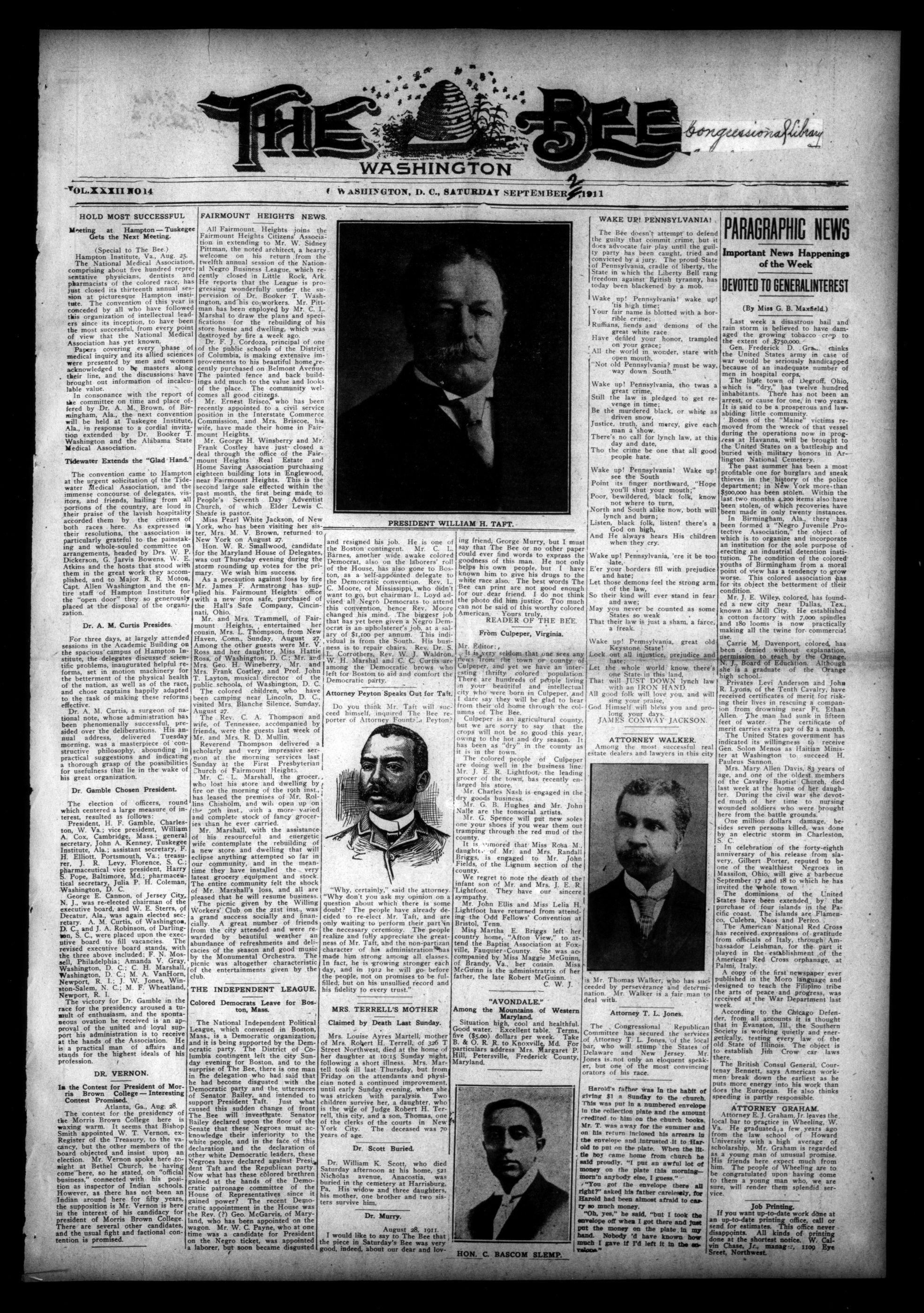
Washington Bee
Saturday, September 2, 1911
Washington, D.C.

Page text (machine-generated)
THE BEE congressional library WASHINGTON
HOLD MOST SUCCESSFUL
Hampton Institute, Va., Aug. 25. The National Medical Association comprising about five hundred representative physicians, dentists and pharmacists of the colored race, has just closed its thirteenth annual session at picturesque Hampton institute. The convention of this year is conceded by all who have followed this organization of intellectual leaders since its inception, to have been the most successful, from every point of view that the National Medical Association has yet known. Papers covering every phase of medical inquiry and its allied sciences were presented by men and women acknowledged to be masters along their line, and the discussions have brought out information of incalculable value. In consonance with the report of the committee on time and place offered by Dr. A. M. Brown, of Birmingham, Ala., the next convention will be held at Tuskegee Institute, Ala., in response to a cordial invitation extended by Dr. Booker T. Washington and the Alabama State Medical Association.
Tidewater Extends the "Glad Hand."
The convention came to Hampton at the urgent solicitation of the Tidewater Medical Association, and the immense concourse of delegates, visitors, and friends, hailing from all portions of the country, are loud in their praise of the lavish hospitality accorded them by the citizens of both races here. As expressed in their resolutions, the association is particularly grateful to the painstaking and whole-souled committee on arrangements, headed by Drs. W. P. Dickerson, G. Jarvis Bowens, W. E. Atkins and the hosts that stood with them in the great work they accomplished, and to Major R. R. Moton, Capt. Allen Washington and the entire staff of Hampton Institute for the "open door" they so generously placed at the disposal of the organization.
Dr. A. M. Curtis Presides.
For three days, at largely attended sessions in the Academic Building on the spacious campus of Hampton Institute, the delegates discussed scientific problems, inaugurated helpful reforms, set in motion machinery for the betterment of the physical health of the nation, as well as of the race, and chose captains happily adapted to the task of making these reforms effective.
Dr. A. M. Curtis, a surgeon of national note, whose administration has been phenomenally successful, presided over the deliberations. His annual address, delivered Tuesday morning, was a masterpiece of constructive philosophy, abounding in practical suggestions and indicating a thorough grasp of the possibilities for usefulness that lie in the wake of his great organization.
Dr. Gamble Chosen President.
The election of officers, round which centered a large measure of interest, resulted as follows:
President, H. F. Gamble, Charleston, W. Va.; vice president, William A. Cox, Cambridge, Mass.; general secretary, John A. Kenney, Tuskegee Institute, Ala.; assistant secretary, F. H. Elliott, Portsmouth, Va.; treasurer, R. J. Levy, Florence, S. C.; pharmaceutical vice president, Harry S. Pope, Baltimore, Md.; pharmaceutical secretary, Julia P. H. Coleman, Washington, D. C.
George E. Cannon, of Jersey City, N. J., was re-elected chairman of the executive board, and W. E. Sterrs, of Decatur, Ala., was again elected secretary, A. M. Curtis, of Washington, D. C., and J. A. Robinson, of Darlington, S. C., were placed upon the executive board to fill vacancies. The revised executive board stands, with the three above included: F. N. Mossell, Philadelphia; Amanda V. Gray, Washington, D. C.; C. H. Marshall, Washington, D. C.; M. A. VanHorn, Newport, R. I.; J. W. Jones, Winston-Salem, N. C.; M. F. Wheatland, Newport, R. I.
The victory for Dr. Gamble in the race for the presidency aroused a tumult of enthusiasm, and the spontaneous ovation he received is an approval of the united and loyal support his administration is to receive at the hands of the Association. He is a practical man of affairs and stands for the highest ideals of his profession.
DR. VERNON.
In the Contest for President of Morris Brown College - Interesting Contest Promised.
Atlanta, Ga., Aug. 28.
The contest for the presidency of the Morris Brown College here is waxing warm. It seems that Bishop Smith appointed W. T. Vernon, ex-Register of the Treasury, to the vacancy, but the other members of the board objected and insist upon an election. Mr. Vernon spoke here tonight at Bethel Church, he having come here, so he stated, on "official business," connected with his position as inspector of Indian schools. However, as there has not been an Indian around here for fifty years, the supposition is Mr. Vernon is here in the interest of his candidacy for president of Morris Brown College. There are several other candidates, and the usual fight and factional content is promised.
FAIRMOUNT HEIGHTS NEWS
All Fairmount, Heights joins the Fairmount Heights Citizens' Association in extending to Mr. W. Sidney Pittman, the noted architect, a hearty welcome on his return from the twelfth annual session of the National Negro Business League, which recently closed in Little Rock, Ark. He reports that the League is progressing wonderfully under the supervision of Dr. Booker T. Washington, and his co-workers. Mr. Pittman has been employed by Mr. C. L. Marshal to draw the plans and specifications for the rebuilding of his store house and dwelling, which was destroyed by fire a week ago. Dr. F. J. Cordoza, principal of one of the public schools of the District of Columbia, is making extensive improvements to his beautiful home, recently purchased on Belmont Avenue. The painted fence and back buildings add much to the value and looks of the place. The community welcomes all good citizens. Mr. Ernest Brisco, who has been recently appointed to a civil service position in the Interstate Commerce Commission, and Mrs. Briscoe, his wife, have made their home in Fairmount Heights.
Mr. George H. Winsberry and Mr. Frank Costley have just-closed a deal through the office of the Fairmount Heights Real Estate and Home Saving Association purchasing eighteen building lots in Englewood, near Fairmount Heights. This is the second large sale effected within the past month, the first being made to People's Seventh Day Adventist Church, of which Elder Lewis C. Sheafe is pastor.
Miss Pearl White Jackson, of New York, who has been visiting her sister, Mrs. M. V. Brown, returned to New York on August 27.
Hon. W. R. Smallwood, candidate for the Maryland House of Delegates, was out Thursday evening during the storm rounding up votes for the primary. We wish him success.
As a precaution against loss by fire Mr. James F. Armstrong has supplied his Fairmount Heights office with a new iron safe, purchased of the Hall's Safe Company, Cincinnati, Ohio.
Mr. and Mrs. Trammell, of Fairmount Heights, entertained her cousin, Mrs. L. Thompson, from New Haven, Conn, Sunday, August 27. Among the other guests were Mr. V. Ross and her daughter, Miss Hattie Ross of Washington, D. C.; Mr. and Mrs. Geo H. Wineberry, Mr. and Mrs. Frank Costley, and Prof. John T. Layton, musical director of the public schools, of Washington, D. C.
The colored children, who have been camping near Lincoln, D. C., visited Mrs. Blanche Silence, Sunday, August 27.
The Rev. C. A. Thompson and wife, of Tennessee, accompanied by friends, were the guests last week of Mr. and Mrs. R. D. Mullin. Reverend Thompson delivered a scholarly and very impressive sermon at the morning services last Sunday at the First Presbyterian Church of Fairmount Heights. Mr. C. L. Marshall, the grocer, who lost his store and dwelling by fire on the morning of the 20th inst., has leased the premises of Mr. Rollins Chisholm, and will open up on the 60th inst., with a more varied and complete stock of fancy groceries than he ever carried. Mr. Marshall, with the assistance of his resourceful and energetic wife contemplate the rebuilding of a new store and dwelling that will eclipse anything attempted so far in our community, and in the meantime they have installed the very latest grocery equipment and stock. The entire community felt the shock of Mr. Marshall's loss, and all are pleased that he will resume business. The picnic given by the Willing Workers' Club on the 21st inst., was a grand success socially and financially. A great number of friends from the city attended and were rewarded by beautiful weather an abundance of refreshments and delicacies of the season and good music by the Monumental Orchestra. The picnic was altogether characteristic of the entertainments given by the club.
THE INDEPENDENT LEAGUE.
Colored Democrats Leave for Boston, Mass.
The National Independent Political League, which convened in Boston, Mass., is a Democratic organization, and it is being supported by the Democratic party. The District of Columbia contingent left the city Sunday evening for Boston, and to the surprise of The Bee, there is one man in the delegation who had said that he had become disgusted with the Democratic party and the utterances of Senator Bailey, and intended to support President Taft. Just what caused this sudden change of front The Bee will investigate. Senator Bailey declared upon the floor of the Senate that these Negroes must acknowledge their inferiority to the white people, and in the face of this declaration and the declaration of other white Democratic leaders, these Negroes have declared against President Taft and the Republican party. Now what has these colored brethren gained at the hands of the Democratic patronage committee of the House of Representatives since it gained power? The recent Democratic appointment in the House was the Rev. (?) Geo. McGarvis, of Maryland, who has been appointed on the wagon. Mr. W. C. Payne, who at one time was a candidate for President on the Negro ticket, was appointed a laborer, but soon became disgusted
T. W.
and resigned his job. He is one of the Boston contingent. Mr. C. L. Barnes, another wide awake colored Democrat, also on the laborers' roll of the House, has also gone to Boston, as a self-appointed delegate to the Democratic convention. Rev. L. C. Moore, of Mississippi, who didn't want to go, but chairman L. Loyd advised all Negro Democrats to attend this convention, hence Rev. Moore changed his mind. The biggest job that has yet been given a Negro Democrat is an upholsterer's job, at a salary of $1,100 per annum. This individual is from the South. His business is to repair chairs. Rev. Dr. S. L. Corrothers, Rev. W. J. Waldron, W. H. Marshal and C. C. Curtis are among the Democratic brows who left for Boston to aid and comfort the Democratic party.
Attorney Peyton Speaks Out for Taft.
Do you think Mr. Taft will succeed himself, inquired The Bee reporter of Attorney Founta?, Peyton?
ing friend, George say that The Bear could ever find a goodness of this his own him to go white race also. Bee can print a for our dear friend the photo did him not be can said of American. Your READE
From Culp
Mr. Editor: It is very selde news from the Culpeper, and yet esting thrifty There are hounds in your beauty city who were b! I dare say they from their old hood umns of The Culpeper is an
"Why, certainly," said the attorney. "Why don't you ask my opinion on a question about which there is some doubt? The people have already decided to re-elect Mr. Taft, and are only waiting to perform their part in the necessary ceremony. The people realize and fully appreciate the greatness of Mr. Taft, and the non-partizan character of his administration has made him strong among all classes. In fact, he is growing stronger each day, and in 1912 he will go before the people, not on promises to be fulfilled, but on his unsullied record and his fidelity to every trust."
Mrs. Louise Ayres Martell, mother of Mrs. Robert H. Terrell, of 326 T Street Northwest, died at the home of her daughter at 10:15 Sunday night, following a short illness. Mrs. Martell took ill last Thursday, but from Friday on the attendants and physician noted a continued improvement, until early Sunday evening, when she was stricken with paralysis. Two children survive her, a daughter, who is the wife of Judge Robert H. Terrell, this city, and a son, Thomas, one of the clerks of the courts in New York City. The deceased was 70 years of age.
Dr. Scott Buried
Dr. William K. Scott, who died Saturday afternoon at his home, 521 Nicholas avenue, Anacostia, was buried in the cemetery at Harrisburg, Pa. His widow and three daughters, his mother, one brother and two sisters survive him.
August 28, 1911.
I would like to say to The Bee that the piece in Saturday's Bee was very good, indeed, about our dear and lov-
Dr. Murry.
ing friend, George Murry, but I must say that The Bee or no other paper could ever find words to express the goodness of this man. He not only helps his own people, but I have known him to give his drugs to the white race also. The best words The Bee can print are not good enough for our dear friend. I do not think the photo did him justice. Too much can not be said of this worthy colored American. Yours truly, READER OF THE BEE.
From Culpeper, Virginia.
It is very seldom that one sees any news from the town or county of Culpeper, and yet we have an interesting thrifty colored population. There are hundreds of people living in your beautiful and intellectual city who were born in Culpeper, and I dare say they will be glad to hear from their old home through the columns of The Bee. Culpeper is an agricultural county, but we are sorry to say that the crops will not be so good this year, owing to the hot and dry season. It has been as "dry" in the county as it is in the town. The colored people of Culpeper are doing well in the business line. Mr. J. E. R. Lightfoot, the leading grocer of the town, has recently enlarged his store.
Mr. Charles Nash is engaged in the dry goods business.
Mr. G. B. Hughes and Mr. John Nalle are the tonsorial artists.
Mr. G. Spence will put new soles one your shoes if you wear them out tramping through the red mud of the county.
It is honored that Miss Rosa M., daughter of Mr. and Mrs. Randall Briggs, is engaged to Mr. John Fields, of the Lignum section of the county.
We regret to note the death of the infant son of Mr. and Mrs. J. E. R. Lightfoot. They have our sincere sympathy.
Mr. John Ellis and Miss Lelia H. Lightfoot have returned from attending the Odd Fellows' Convention at Bristol, Tenn.
Miss Martha E. Briggs left her country home, "Afton View," to attend the Baptist Association at Foxville, Fauquier-County. She was accompanied by Miss Maggie McGuinn, of Brandy, Va., her cousin. Miss McGuinn is the administratrix of her father, the late Robert McGuinn.
Situation high, cool and healthful
Good water. Excellent table. Terms
five ($5.00) dollars per week. Take
B. & O. R. R. to Knoxville, Md. For
particulars address Mrs. Margaret P.
Hill, Petersville, Frederick County,
Maryland.
HON. C. BASCOM SLEMP.
WAKE UR! PENNSYLVANIA!
The Bee doesn't attempt to defend the guilty that commit crime, but it does advocate fair play until the guilty party has been caught, tried and convicted by a jury. The proud State of Pennsylvania, cradle of liberty, the State in which the Liberty Bell rang freedom against British tyranny, has today been blackened by a mob.
Wake up! Pennsylvania! wake up! 'tis high time!
Your fair name is blotted with a horrible crime;
Ruffians, fiends and demons of the great white race
Have defiled your honor, trampled on your grace;
All the world in wonder, stare with open mouth,
"Not old Pennsylvania? must be way, way down South."
Wake up! Pennsylvania, tho twas a great crime,
Still the law is pledged to get revenge in time;
Be the murdered black, or white as driven snow,
Justice, truth, and mercy, give each man a show.
There's no call for lynch law, at this day and date,
Tho the crime be one that all good people hate.
Wake up! Pennsylvania! Wake up! see the South
Point its finger northward, "Hope you'll shut your mouth." Poor, bewildered, black folk, know not where to turn, North and South alike now, both will lynch and burn;
Listen, black folk, listen! there's a God on high,
And He always hears His children when they cry.
Wake up! Pennsylvania, 'ere it be too late,
E'er your borders fill with prejudice and hate;
Let those demons feel the strong arm of the law,
So their kind will ever stand in fear and awe;
May you never be counted as some States so weak
That their law is just a sham, a farce, a freak.
Wake up! Pennsylvania, great old Keystone State!
Lock out all injustice, prejudice and hate.
Let the whole world know there's one State in this land.
That will JUST DOWN lynch law with an IRON HAND.
All good folk will love you, and will sing your praise.
sing your praise,
God Himself will bless you and pro-
long your days.
JAMES CONWAY JACKSON.
ATTORNEY WALKER.
Among the most successful real estate dealers and lawyers in this city
is Mr. Thomas Walker, who has such succeeded by perseverance and determination. Mr. Walker is a fair man to deal with.
Attorney T. L. Jones
The Congressional Republican Committee has secured the services of Attorney T. L. Jones, of the local bar, who will stump the States of Delaware and New Jersey. Mr. Jones is not only an eloquent speaker, but one of the most convincing orators of his race.
Harold's father was In the habit of giving $1 a Sunday to the church. This was put in a numbered envelope in the collection plate and the amount credited to him on the church books. Mr. T. was away for the summer and on his return inclosed his arrears in the envelope and intrusted it to Harold to put on the plate. When the little boy came home from church he said proudly. "I put an awful lot of money on the plate this morning—morn'n anybody else, I guess."
"You got the envelope there all right?" asked his father carelessly, for Harold had been almost afraid to carry so much money.
"Oh, yes," he said, "but I took the envelope off when I got there and just put the money on the plate in my hand. Nobody'd have known how much I gave if I'd left it in the envelope."
PARAGRAPHIC NEWS
Important News Happenings of the Week
DEVOTED TO GENERALINTEREST
DEVOTED TO GENERALINTEREST
(By Miss G. B. Maxfield.)
Last week a disastrous hail and rain storm is believed to have damaged the growing tobacco crop to the extent of $750,000.
Gen. Frederick D. Gra., thinks the United States army in case of war would be seriously handicapped because of an inadequate number of men in hospital corps.
The little town of Degroff, Ohio, which is "dry," has twelve hundred inhabitants. There has not been an arrest, or cause for one, in two years. It is said to be a prosperous and lawabiding little community.
Bones of the "Maine" victims removed from the wreck of that vessel during the operations now in progress at Havanna, will be brought to the United States on a battleship and buried with military honors in Arlington National Cemetery.
The past summer has been a most profitable one for burglaries and sneak thieves in the history of the police department; in New York more than $500,000 has been stolen. Within the last two months, 4,200 items also have been stolen, of which recoveries have been made in only twenty instances.
In Birmingham, Ala., there has been formed a "Negro Juvenile Protective Association," the object of which is to organize and incorporate an institution for the sole purpose of erecting an industrial detention institution.
The condition of the colored youths of Birmingham from a moral point of view has a tendency to grow worse. This colored association has for its object the betterment of their condition.
Mr. J. E. Wiley, colored, has founded a new city near Dallas, Tex., known as Mill City. He established a cotton factory with 7,000 spindles and 180 looms is now practically making all the twine for commercial use.
Carrie M. Davenport, colored, has been denied without explanation, permission to teach by the Orange, N. J., Board of Education. Although she is a graduate of the Orange high school.
Privates Levi Anderson and John R. Lyons, of the Tenth Cavalry, have received certificates of merit for risking their lives in rescuing a companion from drowning near Ft. Ethan Allen. The man had sunk in fifteen feet of water. The certificate of merit carries extra pay of $2 a month. The United States government has indicated its willingness to receive Gen. Solon Menas of Haitian Minister at Washington to succeed H. Pauleus Sannon.
Mrs. Mary Allen Davis, 83 years of age, and one of the oldest members of the Cavalry Baptist Church, died last week at the home of her daughter. During the civil war she devoted much of her time to nursing wounded soldiers who were brought here from the battle grounds.
One million dollars damage, besides seven persons killed, was done by an electric storm in Charleston, S. C.
In celebration of the forty-eighth anniversary of his release from slavery, Gilbert Porter, reputed to be one of the wealthiest Negroes in Massillon, Ohio, will give a barbecue September 17 and 18 to which he has invited the whole town. The dominions of the United States have been extended, by the purchase of four islands in the Pacific coast. The islands are Flamenco, Culebra, Naos and Perico. The American National Red Cross has received expressions of gratitude from officials of Italy, through Ambassador Leishman, for the part it played in the establishment of the American Red Cross orphanage, at Palmi, Italy. A copy of the first newspaper ever published in the Moro language and designed to teach the Filipino tribe the arts of peace and progress, was received at the War Department last week. According to the Chicago Defender, from all accounts it is thought that in Evanston, Ill., the Southern Society is working quietly and energetically, testing every law of the old State of Illinois. The object is to establish Jihn Crow car laws there. The British Consul General, Courtney Bennett, says American workmen break down the earliest as he puts more energy into his work than does the European. He also thinks speeding is partly responsible.
ATTORNEY GRAHAM
Attorney E. J. Graham, Jr. leaves the local bar to practice in Wheeling, WI. Va. He graduated, a few years ago from the law school of Howard University with a high average of scholarship. Mr. Graham is regarded as a young man of unusual promise. His friends here expect much from him. The people of Wheeling are to be congratulated upon having come to them as a man and are sure, will render them splendid service.
Job Printing.
If you want up-to-date work done at an up-to-date printing office, call or send for estimates. This office never disappoints. All kinds of printing is the shortest notice. W. Calvin Chase, Ic., manag.; 1109 Eye Street Northwest
The Maiden's Wish
(Mädchens Wunsch)
A beautiful Love Song, as
leading Concert Hall
Allegro via non troppo.
high in heav-en soaring,
dro - ben ich schei -nen,
high in heav-en sing-ing,
dro - ben ich sin-gen.
we Song, as sung by Selma
Concert Halls of Berlin and
1. Were I
1. Ach, dürfte
2. Were I
2. Ach, dürfte
soar-ing,
schet-nen,
sing-ing,
sin-gen,
On-ly on thee should
all met-ne Strah-len
Joy to thy heart my
soll-ie mean Lied nur
A beautiful Love Song, as sung by Selma Kranich in the leading Concert Halls of Berlin and Vienna
Allegro ma non troppo.
FR. CHOPIN
1. Were I the sun, so
1. Ach, dürft' als Sonne
2. Were I a bird-ling
2. Ach, dürft' als Vöglein
high in heav-en soaring,
dro - ben ich schei - nen,
high in heav-en singing,
dro - ben ich sin - gen,
On - ly on thee should my friendly rays be
all' met - ne Strah - len er - goss' ich für
Joy to thy heart my song should be ev - er
soll - it mein Lied nur für Ei - nen er -
Published by AMERICAN MELODY Co., New York.
Have You Any Mantle Troubles?
USE BLOCK INNERLIN LINEED MANTLES
PATENTED-REGISTERED
AND YOUR TROUBLES ARE OVER
Block Innerlin Lined Mantles give 50 per cent, more light and wifi mantles. This means a saving of 75 per cent, on your most COMPLETE GAS MANTLES IN ONE. Price, 25 cents.
GET ONE TO TRY WITH
Save the box covers from 12 Block Vy-tal-ty and 10 and 15-cent grade of mantles sold—tall or send them to us, and get a Block Innerlin Block Vy-tal-ty and Block Innerlin Lined Mantles China, Plumbing, Grocery and Depa Dealers Write for Our Descriptive Circular
The Block Light Co., YO
(Sole Manufacturer)
Headquarters for Incandescent Mantles, Burnt description, Gas, Gasoline, Kerosene, H
For sale by Golde berg Department Store, W. T. I Sma'l Arme
Mantle Troubles?
LIN LINED MANTLES ARE OVER
per cent, more light and will outlast six ordinary
mantles per cent. on your mantle expense. TWO
ONE. Price, 25 cents
TO TRY WITHOUT COST
Mantles from 12 Block Vy-tal-ty Mantles—the best
made of mantles sold—take them to your dealer,
and get a Block Innerlin Lined Mantle free.
Block Innerlin Lined Mantles are for sale at Hardware,
Clumbing, Grocery and Department Stores.
For Our Descriptive Circular and New Catalogue
Light Co., Youngstown, Ohio
(Sole Manufacturers)
Candescent Mantles, Burners and Supplies of every
Gas, Gasoline, Kerosene, High Pressure, etc.
Department Store, W. T. & F. B. Weaver
Armentrout & Son
B. Reduso
CORSETS
Block Innerlin Lined Mantles give 50 per cent, more light and will outlast six ordinary mantles. This means a saving of 75 per cent, on your mantle expense. TWO COMPLETE GAS MANTLES IN ONE. Price, 25 cents
GET ONE TO TRY WITHOUT COST
Save the box covers from 12 Block Vy-tal-ty Mantles—the best 10 and 15-cent grade of mantles sold—take them to your dealer, or send them to us, and get a Block Innerlin Lined Mantle free.
Block Vy-tal-ty and Block Innerlin Lined Mantles are for sale at Hardware, China, Plumbing, Grocery and Department Stores.
Dealers Write for Our Descriptive Circular and New Catalogue
The Block Light Co., Youngstown, Ohio
(Sole Manufacturers)
Headquarters for Incandescent Mantles, Burners and Supplies of every description, Gas, Gasoline, Kerosene, High Pressure, etc.
I create by Golde berg Department Store, W. T. & F. B. Weaver
I Small Armentrout & Son
THE W. B. Reduso Corset brings well-developed figures into graceful, slender lines. It reduces the hips and abdomen from one to five inches. Simple in construction, the Reduso unhampered, by straps or cumbersome attachments of any sort, transforms the figure completely.
Fabrics are staunch woven, durable materials, designed to meet the demand of strain and long wear. There are several styles to suit the requirements of all stout figures.
Style 770 (as pictured) medium high bust, long over hips and abdomen. Made of durable coutil or batiste, with lace and ribbon trimming. Three pairs hose supporters. Sizes 19 to 36. Price $3.00.
Other REDUSO models $3.00 per pair upwards to $10.00.
rect Form Corsets—in a series of per, $1.00 upwards to $5.00 per pair. stores, everywhere. Makers, 34th St. at Broadway, New York
W. B. Nuform and Erect Form Corsets—in feet models, for all figures, $1.00 upwards to
Sold at all stores, everywha
WENGARTEN BROS., Maker, 34th St. at Br
W. B. Nuform and Erect Form Corsets—in a series of perfect models, for all figures, $1.00 upwards to $5.00 per pair. Sold at all stores, everywhere.
SEE THE LINNOIT
50
s
l,
ips
es.
o
quire-
The negro preacher is noted for his enthusiasm and his picturesque, almost poetic, way of expressing things. In "Life In Old Virginia" J. J. McDonald tells about a colored minister who was conducting a revival without much success. At last, however, he awakened his congregation by asking: "Does yo' know what eternity is? Well, I tell yo'.
"If one of dem ll'l sparrows what yo' see round yo' garden bushes was to dip his bill in de 'Lantic ocean an' take one hop a day an' hop 'cross de country an' put dat drop of water into de 'Clific ocean an' den he hop back to de 'Lantic ocean—jes' one hop a day—an' if he keep dat hoppin' up twell de 'Lantic ocean wuz dry as a bone, it wouldn't be break o' day in eternity."
"Dar, now," said one of the brethren, "yo' see for yo'sef how long eternity is."
: A Tribute to Woman.
When everything around a man staggers and wavers, when all seems dark and dim in the far distance of the unknown future, when the world seems but a picture or a fairy tale and the universe a chimera, when the whole structure of ideas vanishes in smoke and all certainties become enigmatical, what is the only permanent thing which may still be his? The faithful heart of a woman. There he may rest his head; there he will renew his strength for the battle of life, increase his faith in Providence and, if need be, find strength to die in peace with a benediction on his lips.—Henri Frederic Amiel.
Easy Marks.
"Talk erbout yore easy marks," said Uncle Silas Geehaw, who had been passing a week in the city, "us rubos ain't in it with them air teown chaps."
"Did yew sell 'em enny gold bricks, Silas?" queried old Daddy Squashneck.
"Naw, I didn't," answered Uncle Silas, "but I seed a feller peddlin' artificial ice—hed th' sign right on his wagon—an' blamed of th' chumps did not buy it fer th' real thing, by grass!"—Chicago News.
Lots of Nerva.
Farmer's Son—My father sent me over to borrow your horse and cart.
She—Goodness! Why, he already has all, our tools, our axes, our hay rakes and"—
He—I know. He just wants the horse and cart to bring them back—London Telegraph.
Also It Uses Up Gold.
"Did you ever notice how a ring is like the marriage obligation?"
"No. How do you mean?"
"A ring is more easily put on them it is taken off."—Boston Transcript.
READ THE SEE
pour ing; Not on the for est green, Not on the fields se reae,
Ei nen; nicht für die Wal der, nicht für die Fel der
bring ing; Not on the for est green, Not on the fields se reae,
klin gen! Nicht für die Wal der, nicht für die Fel der
mar alo.
But in the little window; There would I all my friendly rays be
wollt' ich als Sonne schei-nen, Dort un-term Fen ster, un-ter dem
But in the little window; Were I a bird king, there would I be
wollt' ich als Vöglein sin-gen. Dort un-term Fen ster, un-ter dem
pour ing, Were I the sun, so high in heav en soar ing.
klei nen, schien ich den ganzen Tag nur für Ei nen!
sing ing, Joy to thy heart my songs should e'er be bring ing.
klei nen, säng ich die ganze Nacht nur für Ei nen!
HAIR VIM
TRADE MARK
Northwest Cafe
VISITORS TO THE CITY SHOULD TAKE THE CAR AT THE UNION STATION AND GET OUT AT THE DOOR OF THE CAFE
The Place for First Class Service and the Place to Find all Washington
Polite and accommodating waiters—Everything the market affords
Fish and Game in Season
First class breakfast, innch and dinner. Balls, parties, receptions and private dinners served in the large and commodious aining rooms up and downstairs
THE TWENTIETH CENTURY HAIR FOOD IS WHAT YOU NEED TO STIMULATE GROWTH. ERADICATE DANDRUFF, CLEANSE THE SCALP AND MAKE THE HAIR STRAIGHT, SOFT & SILKY Get a bottle today from your Druggist and note the improvement. Trial size 10c, on sale at all Drug Stores.
HAIR-VIM is an ideal and elegant hair dressing. Especially prepared for persons who appreciate the ideal and elegant appearance of their hair. It makes the hair soft, silky and glossy, and greatly promotes its luxurient growth. It cures dandruff, stops falling hair, and prevents baldness by completely destroying the dandruff germ. 25cts the box; the bottle, by mail, 30 cts. HAIR-VIM SOAP is cleansing in its effect and beautifying in its results.
Especially adapted for shampooing the hair, and fills every requirement for use in the toilet, bath and nursery. 25cts the cake. BEAU-TE-VIM CREAM-Is a restorer, preserver, beautifier and bleach for the skin. Lubricating the surface, giving it life and adding brilliancy to the complexion. 25cts the box. OWL CORN SALVE-A panacea for all foot evils. One box convinces the most skeptical. Try it. 10 cts. a box. All preparations on sale at all first-class drug stores. If your druggist
GROW hasn't this, drop us a card.
Active agents wanted everywhere.
Braids, puffs and transformations made to order. All grades of hair perfectly matched.
Free advice given for your hair needs.
Hair-Vim Chem. Co., Inc. Successor to Columbia Chemical Co., Newport News, Va.
Mrs. J. P. H. Coleman, Phar. D. president and manager, 1113 U street northwest, Washington, D. C.
Liberal commission said.
Phone N. 3250-M
SHIRLEY
PRESIDENT
SUSPENDERS
The kind that most men wear. Notice the cord back and the front ends. They slide in frictionless tubes and move as you move. You will quickly see why Shirley President Suspenders are comfortable and economical for the working man or business man.
Light, Medium or Extra Heavy Weights — Extra Lengths for Tall Men.
Price 50 Cents from your local dealer or by mail from the factory.
Signed Guarantee on every pair
THE C. A. EMBARTON MFG. CO.
323 MAIN STREET, SHIRLEY, MASS.
Wilbur P. Thirkield, LJ. D., President.
Located in Capital of the Nation.
Campus of over 20 acres. Advantages unsurpassed. Modern scientific and general equipment. New Carnegie Library. New science hall. Faculty of over one hundred. 1,382 students from 37 States and 10 other countries. Unusual opportunities for self-support. No young man or woman of energy or capacity need be deprived of its advantages.
The College of Arts and Sciences
4 Devoted to liberal studies. Courses in English, mathematics, Latin, Greek, French, German, physics, chemistry, biology, history, philosophy, and the social sciences, such as are given in the best approved colleges. Sixteen professors. Kelly Miller, A. M., dean.
The Teachers' College.
Special opportunities for teachers Regular college courses in psychology, pedagogy, education, etc., with degree of A. B.; pedagogical courses leading to Ph. B. degree. High-grade courses in normal training, music, manual arts and domestic sciences. Graduates helped to positions. Lewis B. Moore, A. M.; Ph. D., dean.
The Academy.
Faculty of 13. Three courses of four years each. High-grade preparatory school. George J. Cummings, A. M., dean.
The Commercial College.
Courses in bookkeeping, stenography, commercial law, history, civies, etc Business and English high school education combined. George W. Cook, A. M., dean.
School of Manual Arts and Applied Sciences.
Furnishes thorough courses. Six instructors. Offers four-year courses in mechanical and civil engineering, and architecture.
PROFESSIONAL SCHOOLS.
The School of Theology.
Interdenominational. Five professors. Broad and thorough courses. Advantages of connection with a great university. Students' aid. Low expenses. Isaac Clark, D. D., dean.
THE SCHOOL OF MEDICINE
Medical, Dental and Pharmaceutica Colleges.
Forty-nine professors. Modern laboratories and equipment. Connected with new Freedmen's Hospital, costing a half million dollars. Clinical facilities not surpassed in America Post-graduate school and polyclinic. Edward A. Balloch, M. D., dean, Fifth and W Streets, Northwest. W. C McNeill, M. D., secretary, 901 R Street, Northwest.
The School of Law.
Faculty of eight: Courses of three years, giving a thorough knowledge of theory and practice of law. Occupies own building opposite court house Benjamin F. Leighton, LL B., dean, 420 Fifth Street, North-west
For catalogue and special information
n. address Dean of Departmnet.
Fosters DYE Works
FOSTER'S DYE AND CLEANING WORKS.
(You Street, between 11th and 12th Streets, Northwest.)
Business and Display Office,
11th and You Streets, Northwest
CALL AND INSPECT OUR WORK.
Ladies' suits a specialty.
Gentlemen's suits cleaned, pressed and sponged.
Gloves cleaned.
All goods look like new when they leave our works.
FOSTER'S DYE WORKS.
FIRST POST HOUSES
Established by Cyrus, the Founder of the Persian Empire.
The first posts are said to have originated in the regular couriers established by Cyrus the Great about 550 B. C. who erected post houses throughout the kingdom of Persia. Augustus was the first to introduce this institution among the Romans, 81 B. C., and he was imitated by Charlemagne about 800 A. D. Louis XI. was the first sovereign to establish post houses in France, owing to his eagerness for news, and they were also the first institution of this nature in Europe. This was in 1470, or about 2,000 years after they were started in Persia.
In England in the reign of Edward IV. (1481) riders on post horses went stages of the distance of twenty miles from each other in order to procure the king the earliest intelligence of the events that passed in the course of the war that had arisen with the Scota. A proclamation was issued by Charles L. in 1631 that, "whereas to this time there hath been no certain intercourse between the kingdoms of England and Scotland, the king now commands his postmaster of England for foreign parts to settle a running post or two between Edinburgh and London to go thither and come back again in six days."
WILLING TO LEND.
"But, Oh, My Dear, I am So Sorry; My Husband, the Mean Thing, Has Been at My Purse Again."
Men have something to learn from women in the art of warding off "touchers" for coin. Women respond to such requests once in about every thousand cases, but they are scientific in their refusals. A Cleveland woman with a reputation as a borrower turned up at the home of one of her friends the other morning with a much done over story about a persistent and threatening dressmaker and the usual request for the loan—"pay it back tomorrow, certain"—of $5.
"Why, my dear, certainly," was the pleasant response to her carefully rehearsed little yarn, "you poor thing, you! Just wait till I run upstairs and get my purse."
She ran upstairs. The male head of the house happened to be in the room where she kept her purse. He saw her dig the purse out of a chiffonler drawer and deliberately remove a wad of bills from it, leaving about 37 cents in silver and copper in the change receptacle. The man was mean enough to lean over the stair railing when his wife went downstairs to the parlor with her flattened pocketbook in her hand.
"Oh, I'm so sorry, dearie," he heard her say, "but I really thought I had the money. I find, though, that Frank, as usual, has been at my purse—I heard him say something about settling a plumber's bill last night when I was half asleep—and the mean thing has left me only enough for car fare. Too bad! Of course, you know, if I had it"—and so on—Cleveland Plain Dealer.
CURIOUS BLUNDERS.
The Anachronisms That Crowded a Once Famous Poem.
The medieval romances are full of blunders, making contemporaries of men who were separated sometimes by hundreds, sometimes by thousands, of years, but as historical criticism had not then a being and the general information of the age was not superior in any particular to that of the novelist their plans do not amount to much from a literary point of view. Such an instance is the case of Aristotle, who might be supposed to know something at least of the truth of history, but whose once famous poem, "Orlando Furioso," is a tissue of historical absurdities from beginning to end.
In this poem Charlemagne and his peers are joined by Edward I. of England, Richard, earl of Warwick; Clarence and the Dukes of York and Gloucester; cannon are employed hundreds of years-before the time of Monk Schwartz, and the Moors are represented as established in Spain in spite of the historic fact that 300 years elapsed after the death of Charlemagne before they crossed from Africa. In one place Prester John, who lived 400 years after Charlemagne, and Constantine the Great, who died five centuries before him, are introduced and hold familiar converse with the great Charles, while in another Saladin and Edward the Confessor are joined by the Black Prince.
Audubon and His Hair.
Audubon, the great naturalist, early in his career wore his hair very long. He wrote in his diary one day: "I wear my hair as long as usual. I believe it does as much for me as my paintings." However, in 1827 his friends succeeded in persuading him to get his hair cut according to the prevailing fashion. On March 19 of that year he wrote in his diary: "This day my hair sacrificed and the will of God usurped by the wishes of man. As the barber clipped my locks rapidly it reminded me of the horrible times of the French revolution when the same operation was performed upon all the victims murdered by the guillotine. My heart sank low." Further to express his grief, the margin of the page on which this entry was made he painted black about three-quarters of an inch deep all around.
Still Wondering.
The deaf man got out of the tram car on to the other line of rails.
"Look out! There's a car coming!" cried the conductor.
"What?" said the deaf man.
"There's a car coming."
"What?"
Just then the car caught and knocked down the deaf man, and as he picked himself up he said:
"I wonder what that fool kept me there talking about!"—London Mail.
Just the Opposite.
An Irishman at a fair got poked in the eye with a stick and took proceedings against the offender.
Said the magistrate, "Come, now, you don't really believe he meant to put your eye out."
"Faith, you're right this time," said Pat, "for I believe he tried to put it farther in."—London Tit-Bits.
The Moral Stimulus of Good Clothes. Men grow in self respect as they wear good clothes. Their clothes earn them the approval of their fellows. In turn they are forced to grow to fill the measure of good opinion, so that, forced forward by the clothes he wears, men attain to their highest capability—Sartorial Art Journal.
The Excption.
"Doesn't your husband like cats, Mrs. Blinks?" "No, indeed. He hates all cats except a little kitty they have at his club."-Baltimore American.
My Sympathetic Friend
By SUSAN YOUNG PALMER
My father and mother both died when I was so young that I have no remembrance of them, and I was sent to an orphan asylum. When I was eighteen the matron one morning called me into her room and said to me:
"You have been very useful to us here since you passed out of childhood, but I am expected by the managers to get on without help. You are now old enough to be self supporting and must either work for yourself alone or in a home. I occasionally receive a letter from some man desiring one of our grown girls for a wife. I had one of these letters this morning from a young man in the west, who says that he has a good farm on which he lives alone, and he wishes me to send him some one for a helpmeet whom I can recommend, and he has forwarded letters recommending him. Let me know if you wish the position."
The matron was used to condensing everything she said just as she had spoken these words. She was a good woman, but was so intimately connected with the world's troubles that she could not give much attention to those of any one person. She turned to other duties, and I left her to go to my room to think.
The result of my tearful deliberations was that I was a few days later handed a ticket and what money I would need on the journey and took a train for the west. My leaving was telegraphed to my future husband, who was to meet me at the station, marry me and drive me twenty miles to his farm. I had no money with which to return or go anywhere else in case he should prove disagreeable. Indeed, I felt as though I had been pitched over a prepice.
The train had left Chicago and we were bowling along toward the Mississippi. I noticed a young man sitting near me who was looking at me. I thought, sympathetically, I must have shown my despondency in my face, for his own reflected it or, rather, bespoke commiseration. Presently he came over to me and said, with an encouraging smile:
"You look troubled. Is there anything I can do or say to make you feel happier."
There was that in his honest face and eyes that invited confidence. I told him my story. He listened to it attentively and respectfully and when I had finished said:
"Has it occurred to you that the man who is to marry you is in the same position with regard to you that you are with regard to him?"
"I never thought of that."
"And do you know that many so called love matches turn out very unhappily?"
"I supposed," I replied, "that it was the forced marriages such as the one I am about to make that are failures."
"There is no truer saying than that marriage is a lottery. I think you have a better chance in yours than those people who, blinded by love, see no fault until a number of them are plainly visible after marriage. Unblassed persons have recommended this man to you and you to him. You both trust to them instead of your own judgment blessed by love. The chances are largely in your favor."
"What you say," I replied, "sounds encouraging, but it seems to me that I would rather begin with love even if I must end with disappointment."
"Spoken like a woman," he rejoined, "And I would rather begin without love and end with love." What a treasure are these people who have the faculty of lifting the cloud that hangs over us and showing us the sun shining behind. This young man seemed to have only an ordinary education; but any deficiency was made up by common sense. Then, too, it was easy to see that he had a kind heart. He was constantly looking at me out of those sympathetic eyes of his, which said, "Poor child, how I pity you!" He was with me most of the morning and all the afternoon. He soon ceased to talk about my trouble, leading me into other paths, though he told me many instances of persons who had made marriage a matter of business and found it a matter of affection.
My lover—I was certainly thinking the word, mockery that it was—had written that my train would land me in the night at the last principal town on my route, and I was to remain there, taking another train the next morning. When I parted with my newly made friend I relapsed into the same miserable condition as before. But I was tired, and that night, though I went to sleep in tears, I got a fairly good rest. This and a bright morning kept me up the next day till I approached the last station, where I was to meet "my lover," when it was all I could do to resist a temptation to throw myself from the train. I permitted every one to go out before me and wished there were more of them. Then when alone I nerved myself for the ordeal and left the car.
My lover was there waiting for me, extending his hand to assist me down the steps.
A sudden wonder mixed with a wild fluttering of my heart caused me to pause. Was I in a dream or was I waking from sleep? The man waiting to hand me down was my sympathetic friend.
STAR GEM OF CEYLON.
The Asteria Brought Health and Fortune to Its Wearer, Particularly if He Had Been Born in April.
Familiar to some of the ancient writers and credited with supernatural powers, the asteria, or star gem, was highly valued for the benefits supposed to be conferred on the wearer. Its bright six rayed star, ever changing and shifting with every play of light and especially shooting out its flames in the direct sunlight, would seem to be something more than an ordinary crystal, and to the superstitions mind it could readily be believed to embody some tutelar spirit.
The particular virtue attributed to this gem was the conferring upon the wearer of "health and good fortune" when worn as an amulet, and to those fortunate to be born in the month of April, with which the stone was associated or represented, the wearer was insured from all evil.
The star stone is found principally in Ceylon, invariably in soil peculiar to rubies and sapphires. Indeed, it is composed of the same constituent "corundum," its chatoyant, or star raya, being caused by the pressure of what the natives call "sill." It is found in many different colors, from pale blue, plink and white to deep dark blue, ruby and purple. The blue are termed sapphire stars, the red ruby stars. It is always cut en cachochon, the star dividing into six rays at the apex. It is next in hardness to the diamond.
MARITIME EXPRESSIONS.
Used In a Metaphorical Sense They Are Quite Common.
Maritime expressions used metaphorically are, in fact, very common. We say a couple are "spliced," a young man is the "mainstay" of his family, an intruder "puts his car in," a man is "hard up," sometimes "taken aback" or has "the wind taken out of his sails," a toper is "slewed," a loafer "spins a yarn," sometimes "tries the other tack," and a ruler "steers the ship of state" through troublesome times.
This last metaphor is extremely ancient, by the way. Horace refers to Rome as a ship at sea, and Plutarch says the Delphic oracle referred to Athens in the same way. A Tamil saying embodies a like metaphor, "The soul is the ship, reason is the helm, the oars are the soul's thoughts, and truth is the port." An old collection of English proverbs contains this one: "The tongue is the rudder of our ship." A Malay maxim says, "The boat which is swamped at sea may be bailed out, but the shipwreck of the affections is final."
Aristophanes, Plautus and others use an expression which comes down to us as an English saw, "To row one way and look another." An old English proverb (614) was, "It is not good to have an oar in every one's boat."
He Sat.
It is related of the Rev. Matthew Clark that in the audience was once a young British military officer whose scarlet uniform far outshone any rival habilliments and so fixed the gaze of the young damsels present that the weaker, enjoying the impression he was making, not only stood through the prayer with the rest, but remained standing after all others had sat down until the pastor had proceeded for some time with his sermon, and at length, noticing a divided attention and its cause, the minister stopped, laid aside his sermon and, addressing his new hearer, said: "Ye're a braw (brave) lad. Ye ha'e a braw suit of claithres, and we ha'e a' seen them. Ye may sit doun." The lieutenant dropped as if shot—From the "Autobiography of Horace Greeley."
Snubbed the Composer.
Snubbed the Composer.
Gustav Mahler had a queer experience in Munich one day for which his name was partly responsible. His new symphony was being rehearsed, and he took advantage of an hour's intermission to get some fresh air. "On returning to the building," says a Munich paper, "he lost his way and tried to reach the hall through a corridor in which plasterers were at work. 'You cannot pass through here,' he was told. 'But I am Mahler.' (Mahler is the German for painter.) 'You look it,' was the unsympathetic reply of the man who blocked his way. 'We are not ready for the painters yet, so run on.' And the composer, realizing that argument would be useless, plunged into the labyrinth and finally reached his destination."
Camels In Arabia:
There are two varieties of camels in use in Arabia, the dromedary and the freight camel. The dhulul dromedaries are celebrated for their easy riding gait and speed. A dhulul carries about 300 pounds and travels about six miles a day. It can be purchased for 100 to 150 Maria Theresa dollars ($42.50 to $63.75). A freight camel carries about 500 pounds and travels about two and a half miles an hour. It costs 300 Maria Theresa dollars ($127) or more.
Not Idle Curiosity
Mrs. Wanterknowe—I should like to know, Mr. W., why you are so cross when I ask questions. Surely you don't think I have idle curiosity? "Great Scott, ho! Yours is the most perniciously active, wide awake, sleepless, energetic curiosity it was ever my fate to encounter."
Musical Note.
A newspaper says of a recent operatic performance, "The ladies, the barbone and the bass were good, and so were the tenor's intentions."
I left St. Petersburg in the afternoon. When the guard closed the door of the compartment I was'in I noticed a man sitting opposite me give a sigh of relief. Still, he continued to look out the window, as he had been doing, apparently dreading to see something or some one. The train moved out with accelerating motion, and the faster it rolled the more relieved looked my fellow passenger. Suddenly I heard him give a smothered cry, and, following the direction of his eyes, I saw a man running like a deer to catch the train. The passenger put his head out the window to see the end of the race, drew it in and gasped:
"My God!"
"Did he catch the train?" I asked.
"He jumped on to the footboard of the last car."
"My friend," I said, "I judge that you are a political refugee."
"Why do you think that?" said the man, stiffening up.
"The man who ran to catch the train is a government official. His object is to arrest you."
"Who are you?"
"An American."
"Ah! Americans are our friends. I will tell you. That man, as you say, will arrest me, and I shall be sent to Siberia. Help me!"
"How can I do that?"
"We are not unlike—the same height, both light hair and beard, both wear glasses. Give me your traveling coat and your golf cap and put on these Russian clothes. When the train stops an officer will come here to arrest me. But by that time it will be night. I shall pretend to be asleep in my corner with the collar of your coat pulled up about my face and your cap down over my eyes. You say, with a groan of despair, 'I am caught at last, but I will not live to go to the mines!' While they are removing you I shall watch for an opportunity to get away before they discover their mistake."
When the scheme was first proposed to me' I had not the remotest idea of perpetrating it. But since it was an hour before the train stopped he had that time to persuade me. I should have yielded, but I was not sure that I would not suffer a long term of imprisonment for interfering in the man's capture. Before we had reached the station he had promised if I would take his place to see that the American minister was made aware of the matter, and as the train slowed down, not being able to resist his pathetic appeals, I adopted his plan. All happened as he had predicted. As soon as the train stopped the coach door was thrown open and a lantern thrust into the compartment. True to my promise, I cried out in Russian, "I am caught at last, but I will not live to go to the mines!"
I was jerked out of the coach and hurried away. What became of the "political" I did not know. I was taken into the station, given a closer inspection and the deception discovered. By the next train I was taken back to St. Petersburg and thrown into prison.
The next morning I asked for writing materials, which were given me, and wrote a note to the American minister, stating that I was an American citizen in a Russian prison and asking his assistance. The day passed and I heard nothing. A week, a month, went by. I gave up hope and cursed myself for a fool.
One morning a young man came to see me, saying that he was from the embassy. I asked him why he had been so long in taking cognizance of my note. He replied that no note had been received, but the very next day after my arrest the minister had been informed of all that had happened. He had since been trying to get the government to take the matter up. I had been twice moved from one prison to another, and each time the embassy had been informed of my removal. In short, my note to the minister had not been delivered, but some one had been keeping watch over me and informing the minister of my condition.
After another month's hard work the embassy succeeded in securing my release on condition that I leave the country immediately. I was escorted over the line, wondering the while whether I had been a fool or a fine fellow. I had no sooner got beyond the border than a man stepped up to me and said, "I am to take you to the count."
"Thanks, no. I don't want to go to any count. I've had enough of this business."
But he persuaded me and took me to a house where I was received by—the man whom I had helped to escape. He rushed forward and gave me a bear hug and kissed me on both cheeks. When his transports had subsided he said:
"I kept my promise. The government tried to lose you, but my friends prevented. After you left me I got out of the car and escaped. I have been here ever since. I am a noble, rich, and half my fortune is yours.
"No," I said. "It feels so good to have made one sacrificial act that you can't pay me for doing it."
But I found it impossible to get rid of the count's gratitude. I went to Paris and had no sooner arrived than a number of Russians called on me. One offered me a box at the opera, another the use of a house. There was nothing I wished for that was not forthcoming.
ATE A WHOLE SHEEP.
This Was Only One of the Gastronomie
Feats of Nicholas Wood, a Famous English Glutton.
The following account of a man
named Nicholas Wood, famed for his
gluttony, was written by John Taylor,
the "water poet" of the seventeenth
*century*.
Nicholas Wood was a Kentish yeoman.
"Be it known to all men to
whom these presents shall come,"
writes John Taylor, "that I, John Taylor,
waterman of St. Savior's in South-
wark, will, with plain truth, bare and
threadbare, treat of the remarkable
actions of Nicholas Wood.
"He hath eaten a whole sheep at one meal: pardon me! I think he left the skin, the wool and bones; and presently after he hath swallowed three pecks of damsons. Two loins of mutton and one loin of veal are but three spraats to him. Once at Sir William St. Ledger's house, he vallant and staunch of teeth he showed himself, that he ate as much as would suffice thirty men, and afterwards he slept eight hours.
"One morning I sent for him to the inn to eat breakfast. He had already eaten one potle of milk, one potle of pottage, and bread, butter, and cheese. He gave me thanks and said that if he had known any gentleman would have invited him to breakfast he would have spared his meal at home. Nevertheless he would do me the courtesy to show me some small cast of his office. Whereupon I summoned the hostess and commanded that all the victuals in the house be laid before my guest.
"The inn was slenderly provided, but six-penny loaves were mounted two stories high like a rampart, three six-penny veal pies, one pound of sweet butter, and a number of other dishes were set out, all of which were quickly brought to nothing."
RUBBER OYSTERS.
They Brought Trade and Saved Their Inventor From Failure.
"Rubber oysters laid the foundation of my success," said a millionaire hotel man.
"I had a small saloon in them days, and things looked very black. They looked, in fact, like bankruptcy. So in desperation I cut an old rubber doormat into oyster shaped pieces on April 1 and fried them in egg and breadcrumbs to a tasty brown.
"There was only one man in the bar when I fetched in that dish of smoking rubber oysters. His eyes glittered, and he grabbed a fork, jabbed it into a big fellow and took a hungry bite.
"Seeing the surprised look that spread over his face, I turned away to hide a smile. He gave an awkward laugh and said:
"Them's fine oysters. I'll bring a couple of the boys in to sample them." "Sure enough, he brought two friends a half hour later. The friends no sooner saw the appetizing rubber oysters than, setting down their beer, they each sunk their teeth in one. "They, too, sent in friends for oysters. I fried up no less than three old doormats and two overshoes that April fool day. The whole town laughed, and the papers printed funny stories about my joke. My joint got real popular. "In short, I was saved—saved from bankruptcy by rubber oysters." — Washington Post.
A Light on Mothers.
The late William James, Harvard's famous psychologist, would often illuminate a misty subject with an appropriate anecdote. Discussing motherhood in a lecture on psychology, Professor James once said:
"A teacher asked a boy this question in fractions:
"Suppose that your mother baked an apple pie and there were seven of you—the parents and five children. What part of the pie would you get for your portion?
"A sixth, ma'am,' the boy answered.
"But there are seven of you.' said the teacher. 'Don't you know anything about fractions?
"Yes, ma'am,' said the boy. 'I know all about fractions, but I know all about mother too. Mother'd say she didn't want no pie.'"
The Misquided Friend.
De Chapple—If there's any one, nulsance I hate more than another it's a fellow who is always going around introducing people. There's Goodheart, for instance.
Bouttown—What's he been doing?
De Chapple—The idiot! The other day he introduced me to a man I owed money to, and I'd been owing it so long he'd forgotten all about me. Now I'll have to pay up or be sued—London Telegraph.
Catching On.
Young Mr. Struckett-Ritch was eating his first meal at a real restaurant. "What are those?" he asked, pointing at the finger bowls the waiter had just brought to the table. "Those are to wash your fingers in, ir," said the waiter. "Oh, I know that," rejoined young Struckett-Ritch, with remarkable possession. "I mean are they cut glass?" —Chicago Tribune.
Betty is only four and often in her excitement she makes very odd remarks. The other day she cried out, "Oh, mother, there's a dear malina kitten all curled up in the corner!"
A Feat For Willie.
Teacher-Willie, if you had five eggs in the basket and laid three on the table, how many would you then have? Willie-Eight-Life.
THE BEE
Entered at the Post Office at Washington, D. C., as second-class mail matter.
TERMS. OF SUBSCRIPTION.
One copy per year in advance...$2.00
Six months.....1.00
Three months.....50
Subscription monthly.....20
A PROPHECY.
In our issue of August 19, The Bee carried an editorial, under the caption of "Retribution," on the horrible lynching of a Negro at Coatesville, Pa., the Sunday night previous. We called attention to the fact that the lynching of every Negro had been followed by one or more calamitous happenings which had snuffed out the lives of scores of whites. On the very night that the Negro Walker was lynched, horribly burned alive by the "white hopes" of Coatesville, the Pennsylvania "Flyer" was wrecked in Indiana, and many dead and maimed white men and women was the toll of that wreck. And all that week following the newspapers recorded calamities which claimed many lives. Are these calamitous happenings which leave a long list of dead and mangled whites in their wake God's punishment upon the innocent for the sins of the guilty? Does not such things move us to reflect seriously upon the solemn words recorded in the Holy Writ, "I will repay, saith the Lord?" One week after the inhuman whites of Coatesville stood around the burning form of the Negro Walker, and cheered as the merciless flames burned the writhing-in-agony poor Negro, Oklahoma, where race prejudice runs rampant, imitates the friendish work of the Pennsylvania mob and saturates the body of a Negro with oil, and after setting fire to the yet living victim, rent the heavens with their demaniac cheers. And that mob was composed of assumed civilized, educated whites. The next day the newspapers recorded a horrible, shocking railroad wreck, in which thirty-seven lives were snuffed out, and twice that many were fearfully maimed mangled. Almost as swift as the jagged lightning from the heavy hanging black cloud, the Lehigh Valley train plunged through a bridge, twenty-four hours after the burning alive of a Negro by a mob in Oklahoma, and thirty-seven white men and women were ushered into the presence of the same God to whom white brutes sent a Negro in Oklahoma by fire. We repeat that for every Negro lynched there always follows a calamity in which an All Wise God precipitates a number of whites to death. "And I will repay, saith the Lord."
A BAD PRECEDENT.
Now that Phelps' School, on Vermont Avenue, has been abandoned by the whites, is to be turned over to house the pupils of the colored Business High School. In Baltimore the colored "new" school buildings are the "old" abandoned white school buildings. This has been the history of separate schools the country over—what has become unfit for white pupils is considered perfectly fit for colored pupils. If by any chance the Board of Education should even consider turning a school building heretofore occupied by colored pupils—even were it modern down to the minute, over to the whites, a protest would go up that would arouse the entire city. It simply could not be done. Washington has, in past, been free from the practice of forcing upon the colored pupils the castoffs of white pupils, and to begin it now may establish a dangerous precedent. Phelps' School is a fairly good building, but it is nearly a fifth of a century from modern. The whites abandoned it to occupy a new, and perfectly modern building but two blocks away. It is true that Phelps' School building is an improvement over the old condemned Mott building, now occupied by the Colored Business High School, but it does not argue
that because a human being is confined in a pig stile he should be transferred to a horse stall. If the colored people of Washington acquiesce without complaint to the forcing upon them of one of the abandoned, out-of-date white school buildings it will be easy, a little later on to not only make the old. abandoned white school buildings the "new" colored buildings, but to furnish colored buildings, as in some other cities, with out-of-date, castoff furniture from white schools. Progress is the watchword, and progress is not retrogression. We sincerely trust this will be the last time that an old, unmodern, abandoned white school will be imposed upon the colored pupils, and we hope no colored principal will agree to recommend such a thing. We deserve better.
TEACHERS' MORALS
It is said that sufficient is known of the new superintendent of schools, Dr. Davidson, to warrant the belief that he stands for and insists on clean morals for school teachers. That is right, and The Bee is of the opinion that every parent will support the superintendent in a rigid demand for clean school teachers. And this applies to men with equal force as to women. Some men teachers, apparently, are of the opinion that laxity in morals in men will be condoned by the public. This is an error. We admonish the colored school teachers of Washington, and especially the men, that it will be far to the best interests of the pupils, and to their own best interests, to be perfectly circumspect in their morals. We cannot expect the boys in school to aim at perfect lives if they have a aim at perfect lives if a teacher. We cannot expect one teacher to mete out punishment to young boys for frequenting bar rooms, and for looking upon the wine when red, without being subjected to criticism, if some teacher in some other building does the same thing—indulge in intoxicants. The boys in school, and especially those in the high schools who are just merging into manhood keep a pretty good line upon all teachers, and if one is a bit uncareful as to his morals, or his indulging in the cup that cheers, the boys will be sure to learn of it, and particularly so in this city of leisure where people are allowed so much time for and so much immunity from gossip. Good morals is the prime requisite of a school teacher. It comes before all other requisites.
WILL UNITE
The Fairmount Citizens' Progressive Association, headed by Mr. Charles Payne, in a statement to The Bee last Friday evening stated that his association is ready and willing to unite with the regular association, of which Mr. James C. Armstrong is a prominent and valuable member. Now, if Mr. Payne means what he stated, and The Bee has no reason to doubt him, he will advise his organization to go in a body to the next meeting of the regulars and join in a harmony jollification. More will be accomplished by both organizations if they come together. It is now up to Mr. Payne to carry out his declaration to The Bee. Mr. Armstrong, in a statement to The Bee Tuesday, was informed of what The Bee has stated, and is willing and ready to give the so-called progressives equal recognition to membership. He was glad to know that Mr. Payne was ready and willing to join forces and work for the interest of the citizens of Fairmount Heights.
It is hoped that The Bee will be able to inform its readers in the next issue that there is unity and harmony among the colored citizens of Fairmount Heights. Mr. Payne can do much good for his people.
DR. WASHINGTON'S POPULARITY.
The reception Dr. Washington received in Arkansas gave abundant evidence that the popularity of, and esteem in which the Tuskegee educator is held, increases as time grows. Not only at Little Rock did whites and blacks vie with each other to do him honor, and to show their high appreciation of him as a leader, but all through the State, as he proceeded to his home, there was ovation after ovation. And, when Forrest City, Ark., was reached, the home of the wealthy Negro Scott Bond, he found more than ten thousand delighted citizens assembled to greet him. The popularity of Dr. Washington convincingly points to the fact that sticking to a fixed
purpose, and unselfishly laboring for others without thought of self will bring honors, renown and the applause of the people.
LINCOLN.
Abraham Lincoln, in one of his speeches, said:
"And when by all these means you have succeeding in dehumanizing the Negro; when you have put him down, and made it impossible for him to be but as the beasts of the field; when you have extinguished his soul and placed him where the ray of hope is blown out in the darkness that broods over the spirits of the damned, are you quite sure the demon you have roused will not turn and rend you?"
PRESIDENT TAFT
The gauntlet that President Taft threw down to the insurgents or bolters in the Republican party has caused consternation in their camps. Just what these kickers hope to gain by antagonizing and endeavoring to embarrass the administration, The Bee cannot see. Mr. Taft has endeavored to protect the people against graft and corruption, and it is the duty of the Athenian people to see that he is sustained.. Has President Taft been liberal and just? If not, will some one point to one act that he has perpetrated against the laws and constitution by which the American people are governed? Has he not done everything to satisfy and promote the will of the people? Has not the wisdom of the President been vindicated by the calling of the extra session of Congress? Has not the acts of that Congress fully convinced the people what the Democratic party will do if it gets entire control of the government?
That meeting of the alleged Negro Independent Political League in Boston last Monday was about as much of a fizzle as J. Silas Harris' National Negro Educational Congress at Denver. Like a certain historical king of France, they "marched up the hill and down again," and that is all they did. And the attendance was so small, ridiculously small, as to remind us of the ridiculotsness of Gus Williams' order to one lone private to "right about face and form a hollow square."
Two hells—Coatesville, Pa., and Purcell, Okla.
The white mob call their roll of dead around a pyre. God called his in the two railroad wrecks.
And Congress has adjourned. Before doing so, the Democrats tried exceedingly hard to put the President in the hole, but he turned the tables on them.
The Independents met in Boston last Monday. When a Negro calls himself an Independent he has simply invented a description which in reality spells Democrat.
Had the Democrats in Congress been wise, and bent on rewarding their faithful black allies, they would have provided some place for W. H. Ferguson, of this city. Will washed their dirty linen two years ago, and appeared at their pie counter for a slice of pastry when Congress convened, 'tis said, but they did not so much as offer him crumbs.
ENGLAND'S LIGHTHOUSES
The Seven Districts Are Controlled by a Board Known as the "Elder Brethren."
The lighthouse service of England is controlled by a board composed of thirteen "older brethren." When a vacancy occurs one of the "younger brethren" is selected by the "older brethren" to fill it. The position is for life, and the salary is £500 a year. Any commanding officer of the navy or master of the merchant marine is eligible for election as one of the "younger brethren" by the "older brethren." There is no salary attached to the position, but they are eligible for election as one of the "older brethren."
England is divided into seven light-house districts, each in charge of a superintendent. The superintendents are persons who enter the service as apprentices at the age of thirteen and have worked up to the position of master on board of a steam tender. They are selected for the position of superintendent by the "older brithram." A superintendent has control
In a Quandary.
The young lady sighed deeply and was almost affected to tears.
"Harold," she said, "declares that if I don't marry him he will end his life. And I am afraid he will."
She stifed a sob, then continued:
"And Randolph declares that if I don't marry him he will go into politics and become great and famous, and then he says I shall, what I have heard. And I declare he will have
A MAGIC CLUB.
Village Sorcerer Performs Rites Over Curious Decoy Used by the Native Fisherman of Hawaii.
"Lau melomelo" is the name of a decoy used by the native fishermen of Hawaii. It is made of the hardest wood to be found on the islands and is carved and rubbed till it assumes the shape of a club with a little knob at the smaller end, to which the line is tied.
The club is from one to three feet long. A village sorcerer performs certain rites over it over a sacred fire. After this is done the club is magic, and the fisherman must be extremely careful of it. If a woman should stop over it or enter a canoe in which it lies the club would lose all its power and would be useless ever afterward.
After the club has been charmed the fisherman mixes candlenut and cocoanut meat, bakes it and ties the mixture in a wrapper of coconut fiber.
At the fishing grounds the club is covered with the oily juice of the stuff and is then lowered carefully to the bottom. The scent of the baked nut meat attracts certain kinds of fish, which soon gather and begin to nibble at the club. As soon as enough fish are around the decoy a small bag shaped net is lowered very gently until its mouth is just over the club. The latter is then pulled up carefully and cunningly till it is within the bag. The fish are so eager for the stuff with which the club is covered that they follow it into the net without fear. As soon as all the fish are in it a fisherman dives and closes the mouth of the net, whereupon the rest haul it up quickly.
THE MIDDLE AGED MAN.
Finding Happiness In a Life That to Youth is Irksome.
"Younger people," said the middle aged man, "want variety. They want to be always on the go. Routine galls them. They hate to have to do the same; thing over and over and over again day after day.
"They want to go somewhere or do something different all the time. Older people are happiest in a life of routine, most disturbed when variety is thrust upon them.
"For myself I welcome my daily task, endlessly repeated and always the same. I should be lost without it; disturbed if it were changed. A life of habit suits me best. I like the old scenes—familiar friendly surroundings. I don't want to change.
"Nor do I want much outside pleasure. In fact, I think I should be best suited with none. I like my groove. It fits me, and I fit it. I don't want change. I just want to be left alone to work in my accustomed ways. It is in my groove that I am most comfortable. I like a life of labor and routine.
"And could there come to one a greater blessing? Nature and the customs of men enforce routine upon us whether we like it or not. In youth this irks us, but in our maturer years in a life of routine, in the undisturbed enjoyment of familiar labor, we may find our greatest happiness."—New York Sun.
The One to Pay.
When she was Lady Randolph Churchill, Mrs. George Cornwallis-West consented to electioneer for Mr. Ashmead-Bartlett in his first parliamentary campaign. Mr. Ashmead-Bartlett was married to the Baroness Burdett-Coutts, a very rich woman, who was nearly forty years his senior. Lady Randolph, with her beauty and charms, did splendid work for the candidate.
To a group of farmers she said one day:
"Won't you promise me to vote for Mr. Ashmead-Bartlett?"
"My lady," said a red faced farmer, with a chuckle, "we'll all vote for him if every vote 'll be paid for with a kiss."
"Thank you very much," said Lady Randolph. "Your offer is accepted. I'll send for the Baroness Burdett-Coutts at once."
Deserted Their Towns
So late as the end of the seventeenth century the inhabitants of Ceylon were in the habit of deserting their towns. Their customs are described in the narrative of Captain Robert Knox, who for nineteen years, from 1630 to 1679, was a captive among them. He speaks of several towns as lying desolate owing to the fact that their inhabitants had forsaken them. This they did if many of them fell sick, and two or three died soon after one another, thinking that it was a visitation of the evil one. Some of them came back when they thought the evil spirits had departed.
A Gusar Creature
Queer that while the male seal is a bull and the female a cow their youngster is not called a calf, but a pup.
Why "seal fisheries," too, when the seal is not a fish?
And why should the seal's breeding place be styled a rookery?
It looks as if this strange creature is only a fish in common parlance while at sea. On land (or ice) he is classed popularly with animals or birds.—Exchange.
Gratitude.
Kind Lady - My poor man, what would you do with the money if I gave you a penny? Tired Hobo-Madam, I'd buy a picture postcard an' write yer a note o' thanks.-Cleveland Leader.
Ignorance when it is voluntary is criminal-Johnson.
Public Men And Things
(By the Sage of the Potomac.) Atlantic City, Aug. 27. Dear Bee Readers:
For Sale
The residence of the old Kast of thirteen acres of land, on an finest views to be had in the Districtory, and is always dry, which, and Summer. This building, thousand dollars, is a large, hands-of-thorn of the basement, which is the hall is sixty feet long and about on the East side are twenty feet square, and the first twenty feet square, but the remains are large. There are also two nice roofs on the North and East sides of the house extend the whole length of the building. This is without doubt a most could be used for a school, hospital, which goes with it contains 27,722. It is desired, with a young apple or grapes and pears, and a splendid four minutes' walk from street car.
Price of this very valuable price Building lots adjoining this price and on easy terms.
Address or apply to CHARLES H. 1301 G Str.
ROYAL
Jolly John Larkins, the King
Spend Labor Day with the N. E. LABOR DA AT PINE GROVE PARK,
Monday
Statement Regarding the Arcade.
With reference to the Brief "squib" in the last issue of your paper alluding to the Lincoln Arcade, I wish to say that the directors are willing, and indeed, anxious, to have the stockholders and prospective investors to examine our books; and ask any information desired, and thus fully satisfy themselves as to the handling and disposal of every dollar collected for the promotion of this worthy race-enterprise. The utmost care is exercised in the spending of every cent as our chief object is to put everything possible in the purchase of the property, corner of Tenth and U Streets. Our records will show that this has been done, and at the last meeting of the stockholders, a few weeks ago, satisfaction was expressed with the results so far obtained. The prospect at this very moment is very encouraging, as we are confident now of paying for the property, and when that is accomplished, from our viewpoint, the completion of the arcade is assured.
We are meeting our obligations as they become due, despite the dull summer months, when every one complains of dullness in business. I have frequently stated publicly that unless the proposition becomes a reality that under no circumstances will I accept one penny for services rendered. In this I am trying to show my own spirit of self-sacrifice in order that the proposition may not fail. There are others of the leaders in the movement who are doing the same thing. We insist now, as heretofore, with renewed emphasis, that prospective investors in the stock of the corporation look carefully into the matter before purchasing stock, as we do not propose to dupe any one into doing so, or to take a leap in the dark.
The Lincoln Arcade is recognized by every loyal race member as a present pressing need. The proposed stores, the offices and the lodge rooms, as well as the great auditorium, being crying necessities at this moment, and will prove object les-
sons of race purpose and race enterprise, both to residents of the city and strangers as well. It is the intention of those of us in this corporation to supply such a need. We are seeking support and assistance in the open, and we are perfectly willing to satisfy every one seeking light as to the honesty of our efforts, and to allay criticism by a show of our books and methods of doing business and handling the funds of the investors. The character and business standing of our directors is the best assurance we can give of their intention. Their records are an open book, and we court the closest scrutiny and most careful investigation as touching the arcade or otherwise. Very sincerely yours.
MASONIC NOTES
The solemn and impressive services were held Monday at midnight at the late residence of Bro. W. K. Scott, 521 Nichols Avenue, Anacostia, where he departed this life on Saturday, the 26th inst. The services were largely attended by his many friends and members of Charles Datcher lodge. The remains were escorted to the Pennsylvania railroad station by a detention from his lodge, accompanied by his family, where the body was taken to his birthplace in Harrisburg, Pa., for interment.
Honored Lady Anna B. Whitten, of 210 D Street Southwest, is spending a few weeks up in the mountains of Pennsylvania.
Honored Lady Atkinson, of Marian Chapter, and her daughter Lydia, are spending a few weeks with her son in Atlantic City.
Brother Joseph A. Wisdom, an attacke of the Custom House at Portland, Oregon, has been spending a few weeks in this city at the residence of Brother Andrew Over, 50 D Street Southeast, on official business.
The Charles Datcher lodge worked the Master degree on fourteen candidates on last Wednesday night One being from Ionic and one from John F. Cook, this being the largest number of Master Masons being received at one time since Ionic lodge was established five years ago. The work was done by all Past Masters under the supervision of the officers of Datcher lodge, Bro. Henry Ricks, Worshipful Master. The work was beautifully and impressively performed. A. A. O. N. M. S., Mecca Temple No. 10, and Oasis Court, Daughters of Isis, will leave on Monday, September 4, about noon, for Atlantic City, to attend the session of the Imperial Council, which will convene on Tuesday at 10 A. M.
THE HOWARD
The Dandy Dixie Minstrels are scheduled to appear at the, Howard for next week. This superb organization, 'tis said, will outdo its former successful efforts this season in the way of newness and merit.
Enrolled under the banner will be found many of the leading figures of minstrelsy, most notable are those of James Crosby, one of the best known and talented comedians of the day. Chicken Jones, the far-famed 'end man will occupy his favored position with the Tambo, and his original songs and grotesque dances. These two principles are ably and well surrounded by a corp of clever fun producing comedians that will make the comedy portion of the entertainment run a race of fun to the finish. The singing contingency is one of more than noteworthy, as the manager, Mr. Collins, has been untiring in his efforts to gather together the cream of noted vocalists for this seasons tour, and has succeeded in every way. W H. Norton, the double-voiced phenomenal, Ed. Carter, the tenor, and Walter Stewart, the headliners, all of which are followed by close seconds in the greatest singing show of the year.
The production being beautifully and artistically mounted, the first part acknowledged to be a masterpiece of stagecraft. The closing number, "Frolics on the Levy," has been arranged with care and skill, so as to introduce all the main features customary in minstrelsy, namely, the singing and dancing features combined with a neat story and brim full of good, clean, wholesome comedy. The Dixie band will give the regular street parades as well as a concert every night at the theater free to the public. Howard prices will prevail for the engagement. Mrs. Bettye S. Jackson and children, of 1727 Tenth Street Northwest, have gone to the Blue Ridge Mountains. On returning in October she will be pleased to see her many friends. Miss Annie Tubman has just returned from Camp Ordway (Frederic, Md.); she speaks very complimentary of our District militia.
Miss Elizabeth Pettyford, of the G. P. O., who has been so successful as a temporary press feeder, has been appointed probationary press feeder and put on the permanent roll. Accept congratulations.
Mrs. Arthur F. Boston, of 2029 Thirteenth Street Northwest, will visit New York and Niagara Falls. Miss Georgia Browne will recuperate in the mountains of Virginia.
Mrs. J. Arthur James is having a delightful time in Atlantic City. She will visit Buffalo and Niagara Falls before returning to Washington.
Mr. Benj. F. Warnick, J. Arthur James, Wm. B. Harris, Arthur F Boston, Geo. H. Payne, A. T. Lewis and W. E. L. Sandford will spend a few days in Atlantic City, and later rusticate somewhere in Maryland.
Mr. and Mrs. Garfield Harris, of W Street Northwest, will visit Philadelphia, New York and Midland.
A New Book.
A book on Mind Reading, plain facts, no mysteries.
If you would part with its contents for a hundred times its price I will refund your money. Price, 50c, post paid. Also a book called a Prayer to the Devil, on the temperance question. The keenest temperance gun ever fired. Price, 10c. To any colored person 'answering this add, both
The Week in Society
Mountain breezes, seashore breezes and social breezes all meet around the breezy soda fountain at the two drug stores of Board & Maguire at 1912112 14th St., and at 9th and You Sts. Two places "where everybody meets everybody else" for the most delicious ice cream soda in the city.
Attorney Wm. L. Pollard, who left Pittsburg, Pa., last week, is now in Atlantic City. He has greatly improved in health.
Dr. James E. Shepard, of Durham, N. C., passed through the city from Hampton, Va., Wednesday morning.
Miss Emma Younger, of New York, is visiting her sisters, the Misses Rebecca and Lillian Norton, 20 Defrees Street Northwest.
Mrs. Emma Keith, who has been in New York for quite a while, has returned to her home, 1416 Tenth Street Northwest.
Mrs. J. H. Dillard, of Deanwood, is visiting friends in the White Mountains.
Miss Rosa E. Smith and Beatrice Smith, are spending their vacation in Brooklyn, N. Y., with their brother.
Mesdames C. Johnson, Jacobson and Overton spent a pleasant stay in Baltimore recently, visiting Mrs. Garnett.
Mrs. Francie Tout was the recent guest of Miss Virginia Braxton, of Riggs Avenue, Baltimore, Md.
Mr. William Atkinson, who spent a delightful vacation in this city has returned to New York City.
Mrs. E. Gray is visiting in Utica, N. Y.
Misses Hattie Betts, Eva Harvey, Gertrude Smallwood, Cecil Diggs and Tessie Lee are sojourning in Atlantic City. Mrs. Sarah Johnson is a guest at Herb Cottage, Asbury Park.
Mr. and Mrs. C. Lucas are visiting at Catskill: N. Y.
Miss Ida T. Payne is visiting in Asbury Park, N. J.
Miss McGuiness is visiting her sister, Mrs. Blanche Cummings, on Druid Hill Avenue, Baltimore, Md.
Miss Theresa Roberts is spending the week in Baltimore visiting her mother, Mrs. Ella Simmons, of 1932 Druid Hill Avenue.
Dr. J. W. Morse has the gem drug store in the northwest. Prescriptions carefully compounded by registered clerks.
Mrs. J. Wheeler has returned to her home in Baltimore after an enjoyable stay of six weeks in West Virginia and this city.
Mrs. Virginia Brown, of Bayonne, N. J., and Miss Madeline Johnson, of New York City, who are visiting friends in Richmond, Va., will stop over in this city on their return home.
Mrs. Robert Colbert and Mrs. Charles Douglas are spending a pleasant visit in Atlantic City.
Mr. an Mrs. Wm. E. Smoot are the guests of Mr. and Mrs. T. Edward Cerute, of 31 West 135th Street, New York City.
Mrs. Madison and daughter, of Church Street, have gone to Atlantic City for a short stay.
Miss Rosa E. Smith is enjoying her stay in Brooklyn, N. Y.
Miss Jessie C. Mason spent a very pleasant day in Ritchie, Md., last Sunday, as the guest of Dr. and Mrs. Charles H. Marshall, at their beautiful summer cottage.
Mrs Elizabeth Williams is in Cornwell. Pa., spending a pleasant vacation.
Mr. J. W. Williams left the city last Saturday morning for Atlantic City, where he will spend several weeks.
Mrs. Essie Johnson, of Richmond, who is now visiting friends in Owenton, Va., for two weeks, then she will come to this city.
Mrs. J. V. Sherman and daughter, Miss V. O. Sherman, of Savannah, Ga., are the guests of Mrs. M. E. Cheeks, 1828 K Street Northwest.
Miss Anna V. Stokes, of 118 Benning Road, is spending two weeks in Falls Church, Va., with friends.
Mr. and Mrs. Wm. Dozier have returned to Baltimore after a pleasant visit to this city.
Mrs. Serena Edwards is spending a fortnight stay in Baltimore.
Messrs. Jas. O. Bampfield, John P. Turner and Dr. C. C. Thompson were recent guests of Mrs. Carrie Jones, of Argyle Avenue, Baltimore, Md.
Mrs. M. E. Webster spent a pleasant stay in Baltimore, visiting Mrs. E. C. Freeman.
Mr. Davis was the r cent guest of Dr. Hughes, on Druid Hill Avenue, Baltimore.
Mr. and Mrs. Irwin Jackson are visiting at Long Island, N. Y.
Mr. Frank Callen is visiting at Asbury Park.
Miss Maggie Keys is sojourning at Asbury Park,
Miss Sadie Dorsette, of Tuskegee Institute is spending several weeks here.
Mrs. F. S. Phillips and son Fred are visiting in Petersburg, Va.
Dr. and Mrs. L. H. Harris are spending their 17th anniversary, in Atlantic City. Before returning home they will visit Port Jefferson and Sag Harbor, L. I. N. Y.
Don't pass Morse's Drug Store, at Nineteenth and L streets northwest.
Dr. and Mrs. Charles I. West, left town August 24th for Newport, R. I., for several weeks. They will be the guest of Dr. and Mrs. Marcus Wheatland.
Dr. and Mrs. Thomas W. Edwards are spending a very pleasant vacation in Luray, Va.
Miss Flossy Hunt is visiting in New York.
Misses Ada Hill and Eva Price, employees of the Census Office, have been visiting friends in New York City.
Miss C. Long is at Asbury Park.
Misses Ernestine and Ethel Brent and Nellie Ford were the guests of Mrs. F. W. Lee, in Buffalo, N. Y., last week.
Dr. and Mrs. R. W. Brown and Mr. and Mrs. S. W. Rutherford, are spending two weeks in Saratoga Springs, N. Y.
Mrs. Charles Brantley, of Atlanta, Ga., is visiting her parents, Mr. and Mrs. A. M. Miles, on Sixth Street Northwest.
Daniel B. Stewart is visiting his brother George Stewart, in Brooklyn, N. Y.
Mrs. Marian Blackwell has returned from Brooklyn, N. Y., where she was the house guest of Mr. and Mrs. George W. Stewart, Jr.
Mrs. Barbara Cole, now residing in Leavenworth, Kansas, will return to this city soon.
Miss Ella Jones, who has been spending a week in New York, has gone to Atlantic City, where she will remain two weeks.
Misses Eunice Bates and Annie Cole, of Fort Reno, are enjoying a ten days' vacation in Oxen Hill, Md.
Miss Gertrude Green, of 22 Davenport Street, Fort Reno, D: C., has Miss Josephine King, of Newark, N. I., as her house guest for two weeks.
Miss Corine Quivers, who has been visiting relatives in Richmond, Va., for several weeks, is now in Hampton, Va., where she will remain two weeks.
Mrs. John E. Thomas, of 1830 L Street, and Mrs. J. Irving Greenlease, of 812 Twelfth Street Northwest, left the city on August 22 for New York City, where they will be the guests of Mrs. Ida Poole, of 42 West 136th Street, for several days. They will also spend a few days in Boston and Bar Harbor, Maine, returning home September 8.
Coleman L. Minor, of this city, played in "Barnyard Frolickers" at the Pekin Theater, Chicago, Ill. on August 26 and 27.
Mrs. Helen A. Davis is the guest of Mrs. Elwood Pingree, in Denmark, Maine. On her return home she will visit Boston and New York and Atlantic City.
Mr. William Parker was the weekend guest of Mr. and Mrs. Patten, 117 Balm Street, Harrisburg, Pa.
Mrs. Armstead Taylor has returned to her home in Little Rock, Ark., after a very pleasant visit to this city.
Dr. John W. Morse, of the Gem Drug Store, at Nineteenth and L streets northwest, has everything that a first-class druggist possesses. Drop in.
Miss Emma Miller, of Harrisburg, Pa., was the recent guest of her sister, Miss Margaret Miller. Miss Miller also visited friends in Baltimore.
Miss Reita Parker has returned to this city after a delightful stay of two weeks in Harrisburg, Pa., as the house guest of Mrs. Charles P. Bruce Miss Parker, who is very popular in society of this city, received much social attention in Harrisburg. She also spent a few days in Baltimore with friends on her return home
Mrs Martha Carter is the guest of her sons, W. Justin and Dr. C. Lennon Carter, at their home in Harrisbrug, Pa.
Dr. Wm. Henry was a week-end visitor in Coleman, Md.
Mrs. Riley is visiting her sister, Mrs. J. W. Webster
Dr. Thomas Martin is in Atlantic City.
Mrs. Adeline Cook and children are visiting relatives and friends in Philadelphia, Pa.
Mrs. Lillie Bundy and her daughter Ada are spending a three weeks' stay in Philadelphia, Pa.
Miss Pearle Addison, who spent a week in Richmond, Va., visiting Miss Lillie K. Jackson, is now, visiting friends in Chesterfield, Va.
Mr. John C. Dancy was in Charlotte, N. C., last week.
Mr. Arthur James has returned to Philadelphia, Pa., after a delightful vacation in this city and Maryland.
Miss Irene Scott is spending her vacation in Woburn, Mass.
Mr. Baxter is visiting in Boston, Mass. Mesdames Johnson and Ware are enjoying their stay in Boston, Mass. Mrs. Anita R. Grandier has received much social attention during her stay in Boston, Mass. Mrs. Carrie Clifford, is visiting friends in Cleveland, Ohio.
Mrs. Granville Hatcher, of Cleveland, Ohio, is visiting friends in this city. Before returning home she will visit in Richmond, Va. Miss Norman E. Bovd was the
guest of Dr. annd Mrs. Green, in Norfolk, Va., last week.
The Misses Edna and Emma Lucas are enjoying their stay at Jamestown, R. I. They will also visit Newport, R. I.
Messrs. James L. Neil and William T. Fergurson are in Boston this week.
Mr. J. T. C. Newsom is in Boston this week.
Misses Elizabeth and Estelle Lee, who have been touring the Western cities during the past month, have been the center of attraction socially, wherever they have visited.
Mr. Armstead Lewis, of Providence, R. I., is here on Vacation.
Mrs. John Hulin, of Savannah, Ga., is here on a two weeks' visit. Miss Marie James is the guest of Mr. and Mrs. J. S. Collins, in Portsmouth, Va. Everybody meets everybody else these beautiful warm days at the popular drug stores of Board & McGuire, at 19121-2 14th Street, Northwest, or at their "Busy Corner," at Ninth and U Streets, Northwest, two places for the most delicious ice cream soda in the city. Mr. and Mrs. Harry Thornton are visiting in Indiapanolis, Ind. Mr. and Mrs. Percy Baker, of Glencoe, Ill.; are among the prominent visitors here. Prof. B. G. Brawley is in Chicago, Ill., this week.
Mr. and Mrs. John L. Lee are among the visitors who are being admired during their sojourn in Boston. Mrs. Lella Pendleton enjoyed her stay in Boston. Mrs. Annie E. Brown, the noted evangelist of this city, accompanied by her secretary, Miss Bell Paschal, of Atlanta, Ga., are in Chicago, Ill., for an indefinite stay. T. Edward Hill, who was called to Petersburg, Va., on business, returned to this city on Wednesday of last week, after a pleasant stay of two weeks at his home in Martinsville, Va. Mr. Hill spent three weeks away.
The Misses Tillie M. and Lillie E. Shepard, sisters of Dr James E. Shepard, in company with Miss Bessie A. Johnson, of Durham, N. C., who spent several days in this city as the guest of Mrs. Mary Lee, 1203 T Street Northwest, returned to their home Tuesday night, much delighted with their visit.
Smart Set.
"The Smart Set," headed by S. H. Dudley, will inaugurate its regular session on September 26, playing only the large cities and going into the Majestic Theater, New York, in the early spring for its usual New York run. The new vehicle, which has been accepted by Mr. Dudley for his entertainment this year, is entitled "Doctor Beans from Boston," and it gives promise of being an entirely different style of play from anything ever before presented by colored entertainers; in fact, it is called by the author, "a pyrotechnical musical melange." Mr. Dudley will be surrounded by the strongest company ever assembled under one banner, and the production will be new and alluring in every detail. Will H. Vodery will have charge of the musical department. Rehearsals are already in progress.
DURHAM BELLES IN TOWN.
Guests of Miss McGinnis and Mrs. Lee—Theater Party and Drive by The Bee.
Leaving Hampton, Va., after the adjournment of the medical convention and summer school, several of the Durham belles, Misses Tilla and Lillie Shepard and Miss Bessie A. Johnson arrived in this city last Saturday afternoon, and repaired to the residence of Mr. and Mrs. Geo. H. Lee, 1203 T Street Northwest, as the guests of Miss Emma McGinnis. They attended the 19th Street Baptist Church last Sabbath; in the evening they visited the library. Monday afternoon they were given a drive around the speedway by The Bee, and in the evening a theater party was given by Mr. Chase, of The Bee. They left Tuesday morning for their Durham home, highly pleased with the city and the reception they received.
Dr. Morse has the finest assortment of candies and toilet articles that can be purchased anywhere in the city. Dr. W. L. Board, of the drug firm of Board & McGuire, operating two stores in this city, was elected president of the Pharmaceutical section of the National Medical Association at its meeting in Hampton last week. Prof. T. H. Kane, of Shreveport, La., is here on a visit for several weeks. Miss Mable Finley, of Dayton, O., is the guest of Mrs. C. H. Cuney, 1915 Second Street Northwest.
Mrs. John Matthews, accompanied by her son and daughter, Miss Madeline and John, have gone to Atlantic City on a two weeks' visit.
Mr. and Mrs. D. D. Moore, of 327 T Street, entertained at an informal reception in honor of Miss Mayme McGwin, of this city; Mrs. Geo. W. Owens, Mr. Vance, J. Anderson and Mr. Jesse Binga, of Chicago. Mr. Anderson and Miss McGwin were married Wednesday.
Mrs. Josephine Martin, of Pelham Manor, N. Y., is visiting her son-in-law and daughter, Mr. and Mrs. Jas. M. Trigg.
* Mr. W. H Butler is now in Atlantic City.
Mr. Robert B. Duncan, of this city, and Miss Maude Washington, of Lexington, Ky., were married on Sunday, August 20, at the home of the bride. Mr. and Mrs. Duncan will be at home after September 20, at their home, 2356 Sixth Street.
Mr. Wm. A. Roberson, of Jeffersonville, Ind., is the guest of Mr. Charles Hall.
Mrs. Lloyd H. Cox, of Dayton, O., who has been visiting in this city, has gone to North Carolina to spend a few days.
Miss Carrie C. Thomas has been visiting her sister in Duluth, Minn.
Mrs. T. N. Hawkins and her brother, Mr. Geo. Diggs, are spending the remainder of the summer in Albany, N. Y., and Boston.
Mrs. T. J. Houston returned
from, Toronto, Canada; where she visited her son.
Miss L. Estelle Collier has gone to Newport, R. L., where she will be the house guest of Mrs. Charlotte Cooke for three weeks.
Mrs. C. D. Holmes, of South Carolina, is the guest of her brother and sister-in-law, Mr. and Mrs. J. L. Thorne, of 3228 Sherman avenue.
Mrs. Lucy Forde is the guest of her son, Mr. Chas. Ford, 1100 Third Street, Northwest.
Mr. S. W. Turner is enjoying his stay at his home in Concord, N.C.
Misses Fannie and Marian Estes, in campany with their brother, of Jackson, are visiting relatives here. They will go to New York also. Miss Naomi Toppen, who has been ill for several weeks, has gone to Manassas, Va., to recuperate. Miss Toppen joined her father. Rev. C. S. Jones, of Galveston, Texas, has come to this city to fill a government position. Dr. and Mrs. F. J. Anderson have returned to their home in Charlotte, N.C., after a pleasant stay in this city.
ASTORIA PHARMACY.
One of the most unique and up-to-date pharmacists in this city is the Astoria, Dr. W. Armstrong, Third and G Streets Northwest. The citizens in the Northeast section of the city need not worry about fresh drugs and whether their prescriptions will be well compounded. You will also find ice cream soda at this drug store, and everything fine in toilet articles. There are accommodating clerks to wait on you. Say you saw this in The Bee, the only up-to-date Negro journal in this city.
Dr. Morse, who has the finest drug store in the West End, also has the best prescription compounder. Dr. Morse, who is also a registered pharmacist, never makes a mistake. Call 19th and L streets northwest.
WEST WASHINGTON NEWS.
The Junior Endeavor Society of the First Baptist Church presented a very interesting program Sunday evening August 27. The main auditorium of the church was comfortably filled with the members and a number of visiting friends of the Endeavors, to witness the exercises. Among the number who participated were Mr. Leonard Bowles and Mr. Leroy Gaskins, piano solos, Twilight Glee Club, Mr. Chas. Lane, director; Mr. Raymond Keys, solo and chorus, dedicated to the pastor, Rev E. E. Rick, entitled "First Baptist Juniors." Miss Martha Harris, the president, conducted the meeting. Mr. L. Gaskins, pianist. Mr. R. Keys led the singing. The church was beautifully decorated with roses, flags and palms. Rev. E. E. Rick delivered the address to the Juniors, and a large collection was raised by the society.
The new agency of The Bee is Mr. Thos. Smith, 29th and O Streets Northwest, where it can be had for five cents per copy.
Rev. R. A. Hart, of Union Mission M. E. Church, preached Sunday morning at Mt. Zion M. E. Church, 29th Street. The pastor, Rev. D. W. Hayes, is still spending his vacation, which ends the present week, when the evening services will begin. Rev. Geo. Jacobs, the acting pastor, having acceptably filled the station during his absence.
Rev. U. S. Leeper, of Ebenezer A. M. E. Church, is now in the city, and preached to his congregation Sunday. The Sabbath school, of which Mr. A. Mitchell is the superintendent, was addressed by Mr. J. L. Turner Sunday morning. The singing of the school was excellent.
Personal.
Mrs. Maggie Gates, of. 2503 P Street, who has been quite ill, is now convalescent. Mr. John Jackson, an old resident of this place, but now of New York, is here on a visit to his sister, Mrs. Geo. Fleet, of 2506 P. Street Northwest. The Ladies' Pansy Pleasure Club and the Ladies of the Heliotrope Circle, have arranged to jointly entertain their friends at Early Rose Park Friday evening, September 8. An excellent musical program has been arranged, including the Monumental Orchestra, Prof. Chas. Hamilton, leader. Mrs. Louise Brown and Mrs. Alice Carroll, respectively, are presidents. Purchase The Bee at Mr. Thomas Smith's ice cream parlor, 29th and O Streets Northwest.
Mr. and Mrs. John Ayres have returned after a very pleasant trip to Atlantic City.
Mrs. E. A. Patten and daughter Beatrice, of 1731 Twelfth Street Northwest, have returned from Texas, and report a most delightful time in the "Lone Star State" among relatives and friends.
Mrs. J. Thomas Tascoe and Mrs. L. Carr left the city on Monday, August 21 for a month's vacation at Atlantic City. They will be joined by their husbands September 4. Mr. J Thomas Tascoe, a Past Potentate of Mecca Temple, No. 1., Nobles of the Mistic Shrine, will attend the Imperial Council.
Attorney E. J. Graham has gone to Wheeling, W. Va., to practice law
Mrs. Marjorie Sublette Wormley, wife of Mr. Leon Wormley, has returned home after a very pleasant stay of two months in Nashville. Tenn., with her cousins, the Sublette's, Miss Carrie Carney and Mrs. John Dunn, of Dickerson, Tenn Capt. and Mrs. Robert L. Johnson and son Furman will leave today for a cruise of ten days on their yacht Kelmal Mrs. M. J. Richardson and daughter Princess, are sojourning in Greensboro. N. C., this week. They will spend the next two weeks in Winston-Salem, N. C. Miss Cornelia V. Hohman, accompanied by Miss Ella Thueman, has gone to Niagara Falls; upon her return Miss Hohman will stop in Philadelphia to visit her cousin, Mr. and Mrs. Noble Smith.
For Sale
The residence of the old Kast of thirteen acres of land, on and finest views to be had in the Dirt territory, and is always dry, whiter and Summer. This building, thousand dollars, is a large, hands has every city convenience, bath, furnace in the basement, which The hall is sixty feet long and abo on the East side are twenty feet so wide by twenty long, and the fi twenty feet square, but the rema large. There are also two nice re the North and East sides of the L extend the whole length of the bmer use. This is without doubt a most could be used for a school, hosp which goes with it contains 27,722 is desired, with a young apple of grapes and pears, and a splendid four minutes' walk from street car. Price of this very valuable pr Building lots adjoining this prices and on easy terms.
ance of the old Kastle Estate which is located of land, on an eminence which affords it be had in the District, overlooking all its always dry, which makes it healthy but harsh. This building, which cost between two acres, is a large, handsome bungalow, sixty-four convenience, bath, electric lights, and hot basement, which extends under the wall to feet long and about fifteen feet wide, we are twenty feet square, with bath rooms long, and the front room on the W. side, but the remaining rooms and kitchens are also two nice rooms in the attic. The East sides of the house are about twelve feet length of the building, with wire so that doubt a most attractive and beautiful for a school, hospital or sanatorium, as it contains 27,722.35 square feet, or as a young apple or peach orchard, arches, and a splendid garden, and is only talk from street car line. Its very valuable property is $6,500. Arts adjoining this property may be purchased terms. Apply to
The residence of the old Kastle Estate which is located on a tract of thirteen acres of land, on an eminence which affords one of the finest views to be had in the District, overlooking a large expansive territory, and is always dry, which makes it healthy both in the Winter and Summer. This building, which cost between seven and eight thousand dollars, is a large, handsome bungalow, sixty feet square, and has every city convenience, bath, electric lights, and heated by a large furnace in the basement, which extends under the whole structure. The hall is sixty feet long and about fifteen feet wide, while the rooms on the East side are twenty feet square, with bath room between fifteen wide by twenty long, and the front room on the West side is also twenty feet square, but the remaining rooms and kitchen are not so large. There are also two nice rooms in the attic. The verandas on the North and East sides of the house are about twelve feet wide, and extend the whole length of the building, with wire screens for Summer use.
This is without doubt a most attractive and beautiful home, and could be used for a school, hospital or sanatorium, and the ground which goes with it contains 27,722.35 square feet, or as much more as is desired, with a young apple or peach orchard, an abundance of grapes and pears, and a splendid garden, and is only some three or four minutes' walk from street car line.
Price of this very valuable property is $6,500.
Building lots adjoining this property may be purchased at low prices and on easy terms.
Address or apply to:
Address or apply to
CHARLES H. JERMAN. 1301 G Street N. W.
ROY
Jolly John Larkins, the Kn
Spend Labor Day with the N
LABOR DAY
AT PINE GROVE PARK
Monday
A Base Ball game will be played
picked nine from the Progressiv
tions will be played at 3 o'clock
race and a doughnut contest.
Plentiful will be served.
Music by Lone Star Orch
Dr. W. W. Jones, Pres. (Chas. W.
ROYAL SAM
Larkins, the King of Myrth, in R
Day with the N. E. County Citizens
BOR DAY OUT
GROVE PARK, FAIRMOTNT
Monday Sept. 4
Home will be played between the N. E. from the Progressive and Faiomount Park played at 3 o'clock. Other features will include nut contest. A country dinner, we served. Dancing Take District One Star Orchestra Admission
S. Pres. Chas. Wesley, Sec. W. T. A. L.
ROYAL SAM
Jolly John Larkins, the King of Jlyrth, in Royal Sam.
LABOR DAY OUTING AT PINE GROVE PARK, FAIRMOTNT HEIGHTS Monday Sept. 4
A Base Ball game will be played between the N. P. County and a picked nine from the Progressive and Faiomount Heights Associations will be played at 3 o'clock. Other features will be a potato race and a doughnut contest. A country dinner, wholesome and plentiful will be served. Dancing Take District line car to 61st st Music by Lone Star Orchestra Admission 10 Cents Dr.W.W. Jones, Pres. Chas. Wesley, Sec. W.T. Lapnan, Chr.Com
J. H.
HON. MARLIN E DGAR OLMSTED
MME.T.D.PERKINS SCIENTIFIC SCALP SPECIALIST 4630 West 35th Avenue, Denver, Colo.
```markdown
```
This Tells The Story Copyrighted. March 24th,'10 Woman, Stop, Wait, Listen, Read
Madam T. D. Perkins, of Denver, Colo., who has spent five years in study of the scalp, is now interesting women all over the globe in the care of the hair and scalp. No matter how dark your skin is, Madam Perkins's matchless scalp preparations and scientific method of treatment for cultivating, beautifying and growing the hair will grow your hair if there is no physical ailment to prevent. Her treatments have been successful where all others have failed. Have you written her? If not, and you want hair like her own, write her today. Be sure to enclose a 4-cent stamp and write your name and address very plain if you expect a reply. Don't unless you mean business. If a woman have long hair, it is a glory to her.—I Cor. 11-15.
Every Woman Can Have That Glory If She Wishes It.
This is for you. No more ironed hair, but soft, long, beautiful hair that need not be put on the dresser on retiring. Do you want this kind of hair? If so, write for particulars to Madam T. D. Perkins, the Scientific Scalp Specialist of Denver, Colo., who is astonishing the world with her wonderful art of growing hair.
My own hair is my best advertisement. With these treatments my hair grew 17 inches in two years. It had remained one length (four inches) for 15 years. What I did for my hair I am doing for hundreds of others, and will do for you with my Matchless Scientific Scalp Preparations. My treatment stops falling hair or breaking off, cures split ends, removes dandruff and scalp scurf, causes the hair to grow long, no matter how short; soft, no matter how harsh; thick, no matter how thin; straight from the bulbs, no matter how kinky. First treatment will show wonderful improvement. Do not wait if you are interested in your hair. I give treatments all over the United States by mail. Write me at once. I send booklet OF INFORMATION, and testimonials of those taking my treatments when 4-cent stamp is enclosed. I do not have agents. I need a personal history of your hair and scalp and your physical condition.
All mail promptly answered when 4-cent stamp is enclosed. I am the only woman of the race growing hair today who can show the real length my hair was when I first began treating it. Send for booklet if you mean business. You can secure these preparations from me. None like them made in the world. The T. D. P. Scientific Scalp Preparation, Madam Perkins, sole agent.
Best Afro-American Accommodation in
the District
EUROPEAN' AND AMERICAN
PLAN
Good Rooms' and Lodging 50c, 75c
and $1.00. Comfortably Heated
by Steam. Give us a call.
James Ottoway Holmes, 'Proprietor
Washington, D. C.
Phone Main 2315
TYREE'S
Compound Syrup of
Hyphosphites
We claim for this prepara
tion the reliability in-
sured by the use of pure
chemicals, skilfully com-
binea.
A valuable remedy in general
Debility, and fortifies the system
against the rapid waste of Fulmona-
ry and Scrofulous diseases.
It is one of the Best Tonics for
persons in advanced years.
PRICE 50c.
TYREE & CO.
15th and H Sts., N. E.
OPEN ALL NIGHT
Where you change the cars for Chessapeake
Junction.
Ruben GeorgeWashington
THE ONLY FIRST CLASS ONE IN
THE PARK
EVERYTHING FIRST CLASS
1936 4th STREET, N. W.
Mrs. Jennie Washington
HAIR WORK—MASSAGING
MANICURING
TRANSFORMATION PUFFS
SWITCHES
326 oakdale Place, N. W.
Under New
Porters'
Under New Management Porters' Exchange
NEAR PA. Avenue
The : Up-to-date : Cafe
FIRST-CLASS PLACE
FOR MEALS
Ice Cream, cut, $1420 per gal.
Plain Ice Cream 90c per gal
Public and private receptions served
in our large dining room.
E. Murray 1216 You St. N. W.
Attorney and Counselor-at-law
503 D. street, Northwest
Residence 475 N street, Northwest
Phone, Office M 2874
Residence N 2546
practices in all courts
BEST IN THE CITY
High Class Artists
FIRST CLASS 'HAIR CUT AND
SAAVE-EVERY INSTRUMENT
STERILIVED BEFORE AND AFTER
USING-ELECTRIC MASSAGE
AS SPECIALTY
Wm. McMullen
1026 YOU STREET,N. W.
Painless Extraction of Teeth Filling and Crowning
Dr. Robert L. Peyton
SURGEON DENTIST
First Class Work Guaranteed
1229 Pennsylvania Ave. N.W.
Washington, D. C.
Gas Administered Hours 9 to 5
Management
Exchange
STREET N. W.
. THOMAS REDMON, Proprietor
Afue McDowel
McCALL PATTERNS
10
15
MORE HIGHER
McCALL MAGAZINE
50
YEAR
MAGAZING AT THE PATTERN
McCALL PATTERNS
Celebrate for style, perfect 2x, simplicity and
relaxity in 40 years. Sold in acryl
every city at stores in the United States and
Canada, or by mail direct. More sold than
any other make. Send for free catalog.
McCALL MAGAZINE
Mare subcribes to any other fashion magazine-million a month. Invades. Last streets, pitts, dts, dressmaking, milliner, plain skining, fancy needlework, hard dressing, stucco work, 50 cent a month, including a living room, including a living room, or send for sale at WONDERFUL INDUCEMENTS to: Postal burgers press, 2100 ue and new call prize robe, aldua. McCALL CO. 223 123 8W. 57th ST. NYC H.
Editor Bee
Find enclosed two dollars. Send
in address below The Bee and McCall
Sashion Magazine for one year
THE WOMAN'S EXCHANGE.
MRS. S. E. WORMLEY, Proprietress,
Salads Made to Order, Notions, School Supplies, Gents' Furnishing, Magazines and Periodicals, Plaid Sewing. Agent for Laundry, Cut Flowers, and Dry Cleaning High School and College Pennants.
Phone North I766. 403 Florida N. W. N. Washington, D. O.
Bring your job work to The Best Office, or address W. Calvin Chase Jr., 1109 Eye street N. W., or 1212 Florida avenue N. W.
---
MADAM McNAIRDEE,
The Talented Claimment
The gifted clairvoyant, the great female wonder, born with the double (caul) veil. She is one of the old ancient Southern clairvoyants of New Orleans. She is a living phrenologist and physiognomist. She tells plainly what you are adapted for in life by reading your brain and mind. With a grasp of her hand she gives you a course of influence to enable you to overcome all bad luck. She has made thousands of homes happy. Read the fifth chapter, 9th verse of St. Matthew: "Blessed are the peacemakers, for they shall be called the children of God." She reuites the separated, makes peace where there is confusion. Your husband or wife or sweetheart will never forsake you, but will love you and marry you sooner if you will only heed this lady's consultation. Read what several ladies of your city say. "Yes, we believe her a Godsmen to us. My husband and I separate over a year ago, and just think, since I called on this lady, he returned to me. We are together and happy. This young lady says: "The one loved refused to call or write me. called on this lady and we are now engaged." You can't afford to miss consulting this gifted lady. She is gifted to read characters. She challenges the world to excel her advice on love, losses, business, family and
C
financial troubles. Reunites the separated, causes speedy marriages with one of your choice. No cards allowed in her place of business. No one's ill wishes filled; strictly a Christian lady, and depends entirely.on her heavenly gift. If you are painful or ailing, think you have been witchcraft, go to see her. She spent thirty years in the jungles of Africa and has traveled through thirty-four States, doing good wherever she went. Read St. John, 9th chapter, 33 verse: "If this man is not of God, he could do nothing."
"I for one, as one in the midst. My heart ached from the cruel treatment of my husband and the way he would throw away his time and money, until I consulted this wonderful lady. It will soon be a year. Through her he has been a loving husband, and today he presents me with a lovely lot on which he will build a home. Tongue can't praise her too highly."
Thousands are flocking to see this wonderful lady daily. Her powerful consultation when heeded has sent sunshine to the homes of all who call sunshine. Don't put off, but call at once, if you wish to enjoy future happiness. Don't delay. Highly indorsed by all the press, teachers, preachers, lawyers and doctors, and come well recommended by four of the leading lodges, the S. M. T., United Order of True Reformers, also the Calanthan Court. The church society of her home, known by the name of United Sisters of Charity of the Missionary Church and loved by all. God has endowed her with an unspeakable blessing to aid humanity. She deals in nothing to be ashamed of.
She wants to hear from all that are in trouble or distress. *Address
MADAM McNAIRDEE
1107 N. Senate Avenue,
INDIANAPOLIS, IND.
Positively no attention paid to letters without one dollar enclosed.
ATHLETICS Versus LEARNING Story of a Twirler and Tackler By HUDSON C. EASTON
"Johnny," said Peter Weatherbee to his son when his boy left him in the mountains of Colorado to go east to college, "I want you to study your larnin' hard and don't give too much of your time to those games the boys play at college. Out here when an eddecated young man onct gets a start he can top those who haven't the eddecation. Now study hard and let the other things go."
When Johnny returned four years later his father was very much disappointed in his record. He had taken no honors, stood near the foot of his class, but was the athletic hero of the season. As a twirler he could send a ball that few could hit; as a tackler no man could get past him. Johnny's father was owner and editor of the Rocky Mountain Globe. But the paper during Johnny's sojourn at college had been running down. A rough element had come into the town, which had started with fine prospects, and so disturbed the condition of things that the better people were leaving, while no new respectable settlers were coming in.
"Father," said Johnny, "it seems to me that it's the duty of an editor to make it hot for evil wherever his paper is located."
"And get shot for doing it."
"Better be shot than let the other fellow take the bread and butter away from you. If the town dies our paper dies."
Peter Weatherbee consented that his son should write articles against the evil disposed, thus awakening the better class of citizens against them. Johnny began by invigling against the indiscriminate carrying of weapons. Then he attacked certain men who ran gambling houses, with others who made offices of the said resorts.
"Johnny," said his father, "seems to me you've weakened yourself. You can't carry a revolver since you've come down on the practice, and these men you've been larrupin' ill shoot you down like a dog."
"They won't go for me, father. I'm only an understrapper. They'll go for you, at least till they find out that I'm the man that's after them."
The next morning Johnny put his desk in a room through which all must go to his father's office. He had hardly got settled when one of the parties attacked in that day's issue of the paper came up the stairs.
"Where's old Weatherbee?" he asked. "I'm goin' to kill the"
"In there," interrupted Johnny. The man was opening the door when Johnny tackled him from behind, pulled him to the landing and threw him down to the first floor, two flights below. He was not killed outright, but dled in a hospital the next day. "So much for my football training, father," said Johnny. "By and by I'll try some other athletic features I learned at college."
Johnny sat down to write some more articles attacking other rascals. Over his desk was a rosewood baseball inlaid with gold which Johnny had won in college as a trophy. When he was rallied on his defenselessness he said he could use that far better than a revolver. During the morning he heard a quick footstep at the other end of the hall. There's lots in a step. Johnny knew at once whit this one meant. Selzing his wooden ball, he went to the door. Some fifty feet away a man he recognized as a pal of the one he had thrown downstairs was coming with blood in his eyes as well as his step. Johnny twirled his trophy ball, landing it in the right eye of the comer and relieving it of all the blood there was in it.
The man didn't come any farther. Indeed, he was taken to his home, where a doctor pronounced his case a fracture of the frontal bone. He died in a few days.
These two novel encounters encouraged the good citizens and somewhat shamed the bad ones. An athletic gambler vowed he would take Johnny on his own ground. Meeting Johnny on the street, he suddenly tackled him with his right arm and began to rain blows on his face with his left fist. But Johnny had been thus held often before. He wrigled out like an eel and landed a blow on his opponent's mug that capsized him. The man started to run. Johnny followed him, every now and then getting in a kick. At last, after having several times served as Johnny's football, the man gave out and could go no farther.
Those who saw the last kick the gambler received differed as to the distance Johnny sent him. Some said it was ten feet, some fifteen, and one man, who claimed to have measured the distance with a tape line, declared that it was just nineteen feet and four inches.
The man suffered from a broken coccyx, which is the end of the backbone. This being the third man that Johnny had put "out of the fight," a number of citizens called on him and told him that they would see him through what else might be in store for him. Johnny said to them:
"While at college I prepared myself for my beginning here. But I reckon that, having got rld of the three worst men in the town, the others will be cowed."
And so it proved. Johnny, having paved the way for his usefulness, rose rapidly in the esteem of his fellow citizens and is now one of the prominent men of the state.
Does Not Lose Its Transparency, but
It Produces an Odd and Tricky
Kind of Mirror.
Platinized glass consists of a piece of glass coated with an exceedingly thin layer of a liquid charged with platinum and then raised to a red heat. The platinum becomes united to the glass in such a way as to form an odd tind of mirror.
The glass has not really lost its transparency, and yet if one places it against a wall and looks at it he sees its image as in an ordinary looking glass. But when light is allowed to come through the glass from the other side, as when it is placed in a window, it appears perfectly transparent, like ordinary glass.
By constructing a window of platinized glass one could stand close behind the panes in an unilluminated room and behold clearly everything going on outside, while passersby looking at the window would behold only a fine mirror or set of mirrors in which their own figures would be reflected while the person inside remained invisible.
In France various tricks have been contrived with the aid of this glass. In one a person seeing what appears to be an ordinary mirror approaches it to gaze upon himself. A sudden change in the mechanism sends light through the glass from the back, whereupon it instantly becomes transparent, and the startled spectator finds himself confronted by some grotesque figure that had been hidden behind the glass.-Harper's Weekly.
ORIGIN OF LLOYD'S.
Humble Beginning / Europe's Great Maritime Agency.
Two centuries ago a man who had a cargo to send to the Mediterranean contrived to get rid of some of the risk by inducing a friend to take an interest with him. It was necessary to write out a statement of contract to which the guarantors subscribed. This was the first underwriting. These two men happened to be frequenters of Lloyd's coffee house in London, which was a favorite place for the merchants of the town to gather to discuss business or to gossip. Others immediately saw the advantage of the scheme which their colleagues had devised, and on the next voyage the risk was parceled out among a larger number of the patrons of the coffee house.
Out of this small beginning has grown the great European maritime agency, still bearing the name of the humble coffee house proprietor, and which not only writes risks on vessels, but rates them and publishes their arrivals at every port the world over, no matter how small or how remotely situated.—"Annals of the American Academy."
Where Abraham Fished.
Mrs. Victoria de Bunsen in "The Soul of a Turk" relates a legend concerning Abraham which will be new to many readers. She learned of it while at Edessa, the traditional Ur of the Chaldees. She was shown there a large oblong tank of water so filled with fishes resting just below the surface of the water that their fins and backs seemed almost wedged together so as to form "an almost solid layer of silvery life." "The guardian of the mosque throws some meal into the water, and the fish jump high to catch it, a great living pyramid, of which those which jump the highest form the pinnacle. The tradition is that Abraham as a child fished in the tank; hence the fish were considered sacred. No single one has been caught or killed to this day. Indeed, death would overtake the man who transgressed this law."
Protection From Lightning
Sir Oliver Lodge stated that the problem of securing protection from lightning consisted in finding the best method of dissipating the enormous energy of the flash, but that it was not wise to get rid of the energy too quickly. A thin iron wire is considered the best lightning conductor from the electrical point of view, but it is almost impossible to protect a building from lightning unless it is completely enveloped in a metal cage. It is by no means true that a building is safe when provided with a conductor reaching up to the highest part of the building.
The Origin of Grocer.
Grocer appears in Hollnshed's Chronicle, 1580, as "grosser," and in other medieval records it is sometimes written "engrosser" and was applied to the spicers and peppers who were wholesale dealers in various spices—that is, who dealt en gros—in large quantities, as distinguished from "regrators," who were retail dealers. The Grocers' company first adopted the word grocer in 1373, when the spicers and peppers allied themselves into a single corporation—London Express.
A Useless Question.
"They have named the baby after Uncle Belshazzar."
"Has' Uncle Belshazzar money?"
"Do you suppose they liked the name?"—Pittsburgh Post.
Mrs. Benham-Every time I sing to the baby he cries. Benham-He gets his ability as a musical critic from my side of the house-New York Press. Prosperity demands of us more patience and moderation than adversity.
By F. TOWNSEND. SMITH
When I was abroad last summer I visited a German American friend of mine who had got rich in America making beer and with the proceeds bought one of those ruined castles on the Rhine, repaired it and spent his summers there. We were sitting one afternoon in a room facing the west. The weather being warm, the blinds were closed to keep out the sun. Seeing what I supposed to be a silver coin on the floor, I arose, went to it and was about to pick it up when I saw that it was one of those little round sun images that will come through a chink. Shuster, my host, laughed at me and sald:
"That reminds me of a legend about this castle. It was formerly owned by Baron Hugner. The story goes that the baron was a great gambler. When he succeeded to the castle a lot of money went with it. You see, it lies on one of two hills, and a road has always led between them down to the river. This road was frequented by merchants who took goods down to the Rhine for shipment by water. When the baron saw a party of them in the distance he had only to swoop down on them, levy a tribute of some 25 to 50 per cent of the value of their goods for toll, and there you are.
"This baron I was telling you about—Hubert Hugner was his name—inherited the property just about the time that people got virtuous, and it wasn't considered any more the way for a nobleman to rob. He did it after this by serving the sovereign, and when his king pounced upon a state or a duchy or something like that the baron got a slice.
"Well, as I was saying, Baron Hugner was rich, a gambler and withal virtuous. He gambled all day, and he gambled all night. Now, the legend has it that the devil had for centuries been interested in the wealth the baron had extorted from the merchants and wanted his share. But he didn't want it in money. He has no use for material, only spiritual things. What he wanted for his share of the plunder was a soul, and the soul he had set his villainous heart on was Baron Hubert Hugner.
"The way the devil managed to get a hold on the baron was through his passion for play. Whenever Hugner gambled the devil stood behind him and so influenced him to make his bets that gradually every bit of the gold that the Hugners had for centuries taken from the merchants went by the board. Then one day when the baron had lost it all the devil came into the room disgulsed as a Jew and told him that he would discount his note for a large sum without either security or interest. When Hugner came to find out what the devil wanted in lieu of security and interest it was the usual thing Satan hungers for -his soul.
The transaction was completed, the consideration—the soul—to be delivered six months after date without grace. The baron was furnished with a thousand pieces of gold, with which he went on gambling and gradually recovered all he had lost, getting his financial affairs into a satisfactory condition a few days before his note came due.
"The night before Hugner's soul was to be delivered the baron had a dream. He dreamed that an angel appeared to him and said. 'Tomorrow Satan will claim your soul in lieu of his interest in the plunder exacted in the past by your ancestors from merchants. It is not meet that he should reap this benefit. Tomorrow when he comes for you tell him that you can win money from him without even a piece of money so big as a head of a pin. He will damn to that. Then offer to bet him the soul of your oldest son that you can do what you have said."
"When the baron awoke it seemed that he had really seen the angel and received the advice. Hugner was scarcely out of bed before a stranger called and asked to see him. The baron recognized at once the flend who had called for his soul. With a faint hope he obeyed the instructions of his dream. The devil accepted the challenge, and they sat down before a board used on that day something like faro. The devil dealt and, seeing what he thought was a silver coin on the green, turned up a card that won. Without examining the coin he threw the baron one of equal value.
"I would respectfully call your attention," said the baron, "to the fact that what you thought was a coin is only a round sun spot coming in through a chink in the window blind."
"Upon my word," said the devil, "I believe you are right."
"I think we are quits," pursued the baron, 'and my soul is my own.'
"The devil answered never a word, but got up from the table, went out of the door and never returned. But that night he sent a fierce storm of lightning and hall that partly destroyed the castle, and it had never been occupied till I came here myself."
My host assured me that all of the people at the foot of the Schloss knew of this legend and that most of them believed it.
It is these legends that make the ruins of German castles more interesting than they would be were they mere piles of stone and mortar. I spent quite awhile with my friend the baron, and my fascination for his home steadily grew till my departure.
me a e FMR IT I PF oe . as . ze we . a Ps * .
ne ie Bre 5% ; . : :
SS
eens es LLL == :
RE —————EE
SSE| OTHE VEILED PROPHET. A GROTESQUE BIRD.
W 1 Ww sd pen A Man I Million \panartable Anortnent
I Y l es H inslo . Was Most Noted Impostor of the Mid- Man In a whion. scsbita ‘Ase Sar eauisiana
a . Luck Did k * dle Ages, Duping His Followers a Peculiar Shaped Beak of the |
4 by the Art of Jugglery. By M. QUAD Brazilian Toucan.
UNDERTAKER AND EMBLAMER, ——— ‘The celebrated “Velled Prophet” of : ‘i “| he very pecullar looking Brazilian
= . By RUTH GRAHAM history was a Moslem fanatic whose | CPYTiEY 110 by Associated Titerary 4-4 ‘te toncan, has a body about as
ORK FIRST CLASS. TERMS MOST REASONABL1& real name was Haken Ibn Hashem. |__| bag that of a good sized parrot, but
ALU WORE-EH - om ; a ie ws to stout the ma 0 th | RS | es teat very aifereat and ay
. eighth century and became the most! Joseph Skater was in the Ughtning | tts dominant feature, though this bird
TWELFTH AND & STREETS, N. W. pehany O'Nell and itty Bowers coved impostor of the middle ages. }Yod business, He could talk lightalng | te by no means lacking In bright and
James H. Dabney
FUNERAL DIRECTOR.
Hiring, Livery aad Sale Stable,
Carriages hired for funerals, parties, balls, receptions, ete.
Horses and carriages kept in first-clasa style. Satisfaction
guaranteed. Business at 1132 Third street northwest. Main
ofce branch at 222 More street, Alexandria, Va. .
Telephoze for Office, Maim 1727. :
Télephone call for Stable, Maia 14385. , 5
OUR STABLES IN FREEMAN’S ALLEY,
Where I can accommodate 50 Horses. © r
,Call and inspect our mew and modern stable.
J. H. DABNEY, Prop., 1134 Third Street N. W.
Phone, Main 3200. Carriages for Hire.
: CANDY KITCHEN
_ 1506 7th St. N. W.
Fresh Candies Daily ;
Good Chocolate Candy 15c lb. Good Taffy 10c Ib.
PURE ICE CREAM $1.00 gal. 30c at.
HOLTMAN’S carsro the NortheastSeotion
OLD [STANE and suburbs pass the door
FINE BOOTS AND SHOES me
4st Penn. ave.N. W. | Astoria Pharmacy
OUR sa50 ANY 43 SHOES ARE) .
TRE BEST MADE. : (W. Armstrong)
SIGMOF THEBIG Boot. |
WH. MOREI.AND, PROP. 1 Sioa meen
BUY THE |
yp usin
| Pe ms
er he
e a
Ao Bie.
rs
gress, 52
er fr ee)
eee Se
ae a eee
Breton
RY PRACHINE,
" Batore You Perchaae any uther Brite
THE WeW ROME STWNO MAGHIE COMPARE
ORANGE, MASS.
Many Seumag Machines are madeto sells. ré
Sef eoaty, bat the New Momer mad
em, Ont Zaoreaty erre Runt On.
De mais Bowing Moskines So exit all eonditions
twbece, Tks “Sew Mouse” sionds attts
eee of nl Big gevendio tacity eweing msch ines
‘Redd by sustestmed douteme exrky.
ren sane ev
Ox Marrow.
We want our readers to patronize
us; it helps all around. The Ozonized
Ox Marrow Co. advertises in this pa-
per, and when you want a first-class
dressing for kinky, harsh and unruly
hair, go to your druggist’s and get a
bottie of Ford's Hair Pomade, asc or
soc a bottle.
House and Herrman.
The 134th anniversary of the birth
‘of the Stars and Stripes was observed
by the Government departments, p2-
*notic societies and schools through-
out the District last Wednesday.
OVER 6S YEARS’
EXPERIENCE
‘Trape Manas }
Desicns
Coprrichts &c.
anronseenaing sack ont dance sty
SHS ea ah ater i uraece
Sale i ebell biiarhwoot eras
"Bile tates tesserae Uo aie
"Scientific Aimer:
adunpesemaingnin, locate
Rites erg a
‘S81Broadeay,
AUNN & Go,sereoroen New York
Houses and Lots For Sale and Official
Papers Executed by
JAMES F. ARMSTRONG, LL. B.,
Notary Public and Manager of” the
Fairmount Helghts Real Estate
and Home Saving Association,
Fairmount Avenne and
Wilson Street, Faire -
mount Helghts,
Office Hours: 6 to 8 a m, 6 to 9
p.m All holidays.
Direction: Take District Line cars for
Chesapeake Junction, get off at
61st Street N. E., go north two
squares,
Carsto the NortheastSeotion
and suburbs pass the door
THE 7
(W. Armstrong)
&resh Drugs
Third and 6 Sis. W.W.
Drugs and Prepararitons
always fresh
Phone Main 3252
rrr rr
Printing.
If you want first-class printing done
in the most artistic manner, send it to
W.. Calvin Chase, Jr, for estimates
Office, 1309 Eye Street, Northwest,
residence 1212 Florida Avenue, North:
west. Phone N. 2632 Y, M. 4078
Every job will entitle you to a free
notice in The Bee.
| + BURN YOUR BRIDGES.
We Are So Conatituted That When a
Retreat Is Left Open We Are
Apt to Turn Back.
Young men often make the mistake
when they start on an important un-
dertaking of leaving open a way of
retreat if things go too hand, says Ori-
son Swett Marden in Success Maga-
xine. No one can call ont his greatest
reserves, do the gréatest thing pos-
sible to him, while he knows that if
the battle gets too hot he has a Line of
retreat still left open. Only when
there is no hope of ‘escape will an
army fight with that spirit of dee-
peration which gives no quarter.
‘Many a great general in his march
on the enemy has burned his bridges
dehind him, cut off his only possible re-
treat, for the bracing, encouraging ef-
fect upon himself and bis army, be
cause he knew that men only call out
thelr greatest reserves of power when
all retreat is cut off and when Sight
ing desperately for that which they
count dearer than life.
We are so made that as long at
there 1s a chance to retreat, as long
as there are bridges behind us, we ar
tempted to turn back when the grea
test comes.
“Will you hold this fort?" asked
General Rosecrans of General Pieres
at Btone river. “I will try, general.’
“Will you hold this fort?” “I will dle
ta the attempt” “That won't do
Look me in the eyo, alr, and tell m
if you will hold this position.” “1
| will” sald General Pierce, and he did
‘The Cow Decided.
A peasant living in the village of
Predeal, neaf the Hungarian frontier,
lost his cow. “About two months algo
he bappened to be standing at the
railroad station watching a train load
of cattle about to be sent across the
frontier. Bnddenly he gave a shout.
“That's my cow!” he cried, running
toward one of the cars.
‘The ttatnmen only Isughed at bim
and he went before the magistrate
his good man Listened to the peas
ant's story patiently. ‘Then he pro
nounced this judgment: “The cow shal
be taken to the public square of Pre
deal and milked. ‘Then if it goes of it
Own accord to the plaintiffs stable 1
| ahall belong to him.”
The order of the court was carriet
oat, and the cow, in spite of ite ter
months’ absence, took without hesita
tion the lane which led it a few min
Utes Inter into the peasant's stable
Chicago News.
Luck ; Did It.
Jobnny O'Neil and Kitty Bowers
were two young things who loved each
other and wished to marry, But John‘
ny, who was but twenty years old,
had nothing laid up, and Kitty's father
didn't purpose to support his daughter
and her husband too, So he forbade
the match. Philip Bowers was a farm
er who prided himself on having
made himself comfortable by hard
work and good judgment. |
“You've got to begin,” he sald to
his would be son-in-law, “the way I
began. I was a farm hand, and of
every dollar I earned I saved a half.
‘When I got a small Iump together I
loaned it at # big interest till Pd got
enough together to buy this farm,
part cash and-part mortgage. I had
| to live close to pay the mortgage, but I
‘Gid it, and now I’m prosperous.”
/ “Didn't luck have anything to do
‘with it?” asked Johnny. :
“Not a bit. Never had any lock in
my life. What I’ve got I've made ip
spite of Tuck.”
Jobnny asked Kit to meet him out
on a projecting corner of her fathers
farm’to talk matters over. They chose
this spot becanse|it was far from the
house and they \were not Uable to
interruption there! It was an unpro-
duetive piece of ground that had been
tacked on to the farm in order to sell
it
Johnny and Kit looked at the situ-
ation and saw no comfort In it. John
had no one to help him, and Kit knew
her father too well to expect any
help from him. 1
There was not $20 to be scraped
together between the two. Kit said
she would wait, but Jobn, who
was an impatient fellow, didn't wish
to walt. He sald that to go about the
problem of, life as Mr, Bowers pro-
Posed would be imposstble to a man
le his disposition. He told ’Kit that
he would go out into the world and
do what he could. She could walt for
him or not, as she chose. If he hed
any luck he would come back and
claim. her; if not, she might marry some
one else in case she got a good offer.
Eilt bade him goodby with streaming
eyes and went home, while he stood
looking after her. When she reached
a point where she would pass from
his view she turned, threw him a kdss,
which he returned, and then she dis-
appeared.
‘The only consolation Johnny had
jas his pipe. He took it out of bis
pocket, filled {t and sat down on the
ground for a smoke. It was one of
those warm sultry days that some-
times come Just before the collapse of
summer. Johnny sank lower and low-
er on the ground till at last he was
eprawled at full length. Then he
turned on his side with his nose not
two inches above the earth,
“Some one," he said to himself, “must
have spilled kerosene here. I can smell
{it He put “his nose flat down on the
surface and sniffed. ‘The odor was un-
mistakable, He moved a short dis.
tance, sniffed again and got the same
odor. After testing several locations
he found that the odor was strongest
where he had first smelled it, but {t
was so scattered that it could not have
come from the overturning of a can of
Kerosene. Johnny had discovered coal
Holl on fr. Bower's ground.
‘That night he returned with a spade
[2 dug a hole where he had first de
“tected the odor. The deeper he dug
the more perceptible the odor. Wher
| he was satisfied he filled the hole, ob.
|literated the marks of it and went
away.
| A few days later Farmer Griggs,
owning land adjoining the Bowers
|farm, dickered with Bowers for the
|corner of the farm on which Jotin and
Kitty bad parted and bought it for a
‘}song. It was deeded to Griggs, wh¢
{deeded ft to John O'Neil and 2 maz
'|he bad induced to advance the monej
'|for its purchase. One morning Mr.
‘|Bowers saw preparations for boring
‘Jun the property he had sold. He wat
much fnterested. All day he could heat
},the noise of the boring. Then there
| was a stopping of the work for tw
| months, at the end of which time 1
‘|was recommenced. After several o:
these stops, covering a period of nearly
‘ta year, Mr. Bowers heard somethin
;{that astonished him. Rushing ont t¢
where the men were boring, he sa¥
ja stream of oll shooting up toward
|the sky.
| Bowers was much disgruntled tha
'Igome one had discovered ofl on bi
‘lroperty and had ot {t from him fo
2 paltry sum. He tried to find ou
who were the lucky parties, but failed
ee ae eae i a a ae
THE VEILED PROPHET.
‘Was Most Noted Impostor of the Mid-
dle Ages, Duping His Followers
| by the Art of Jugglery.
‘The celebrated “Velled Prophet” of
history was a Moslem fanatic whose
real name was Haken Ibn Hashem.
He was born about the middje of the
eighth century and became the most
noted Impostor of the middle ages.
He pretended that he was an embod!-
ment of the spirit of the “Living God*
and, belng very proficfent in jugglery
(which the {gnorant mistook for the
power to work miracles), soon drew
an Immense number of followers
around him. He always wore a gold
mask, claiming that he“dld so to pro-
tect the mortals of this earth, who, he
said, could not look upon his face and
ve.
At last, after thousands bad quitted
the city and even left the employ of
the Caliph al Mohdl to join the fanat-
{eal movement, an. army was sent
against the "Velled Prophet,” forcing
him to flee for safety to the castle at
Keh, north of the Oxus. Finally,
| when ultimate defeat was certain, the
prophet killed and burned his whole
family and then threw himself intc
the flames, belng entirely consumed
except his hair, which was kept in s
museum at Bagdad until the time o:
the crusades, He promised his falth
ful followers that he would reappeat
to them In the future dressed in white
and riding a white horse.
WANTED HIS PAY.
The Husky Jamaican Didn't Care to
Work For Nothing.
An English naval officer tells of be
ing on a war vessel which took pro-
vision’ to St. Kitts, one of the Brit-
{sh West India tslands. A hurricane
had left many of the inhabitants in 2
destitute or even starving condition.
Hungry crowds gathered at the whart,
but refused to help unload the food
that was to be given to them unless
paid for thelr work.
A similar stors sheds lght on the
Jamaican negro. Some years ago
hurrieane devastated the island, and a
large relief sum was raised, much of
ft in England and the United States.
‘The committee having charge of this
fund sent a wagon load of lumber tc
a husky black man whose house bad
been scattered over the parish. He
and his famfly were living in a rude
shack, made out of odds and ends.
“What's that fur?” he asked of the
men who were unloading the materia
in front of his patch of ground.
“That's for your new house,” wa:
‘the reply. “It's from the relct func
and won't cost you anything.”
“Who's goin’ to build mah house?”
“You are, If anybody does.”
“Who's goin’ to pay.me fur mal
work?’—Waynesboro Record.
. An Old Garret on a Stormy Day.
I know no nobler forage ground for
a romantic, venturesome, mischfevous
boy than the garret of an old family
mansion on a day of storm. ‘It fs a
perfect field of chivalry. The heavy
tatters and dashing rain, the piles of
spare mattresses to carouse upon, the
big trunks to hide in, the old white
coats and hats hanging in obscure cor-
ners like ghosts, are great! And it s
so far away from the old lady who
keeps rule in the nursery that there is
no possible risk of a scolding for twist-
ing off the fringe of a rug. There ts
no baby in the garret to wake up
There {8 no “company” in the garret
to be' disturbed by the nolse. There fs
no crochety old uncle or grandma,
with thelr everlasting “Boys, boys!”
and then a look of horror.—Donald G.
Mitchell. .
Sacic Bhiesuned dee Teck:
Jack Sheppard had a great hold upon
the Imagination of the people of his
time, The fact that 200,000 people wit-
nessed his execution at Tyburn on
Nov. 18, 1724, “upon the tree that bears
twelve times a yeare” Is some witness
to his grim popularity. But one of the
strangest tributes ever paid him was
the sermon preached upon him in
London church,
“Ob, that ye were all like Jack Shep-
pard!” began the preacher, to the stu
pefaction of his congregation. He went
on to draw, parallel between things
‘of the flesh and those of the soul and
to point out that the genlus shown tp
housebreaking might have been be
stowed upon “picking the locks of the
heart with the nail of repentance.”—
London Standard. -
| Sure on One Point.
“Do you belleve that great wealth
has a tendency to keep a man out of
heaven?” queried the party who was
addicted to the conundrum habit.
“I am not prepared to express an
opinion on that subject,” answered the
student of human nature, “but I know
that great wealth has kept many a
man out of the penttentiary."—-Chicago
News.
Mark Twain's Definitions.
It 4s told of Mark Twain that daring
a conversation with a young lady of
his acquaintance he had occasion to
‘mention the word drydock.
“What is a drydock, Mr. Clemens?”
she asked.
#A thirsty physician,” replied the hu-
most
| smebibeoueone calla Names
Flannery—It seems his full name ts
Dinnis K. K. K. Casey. What's all
thim K's fur? Finnegan — Nothin’.
“Twas the fault of his godfather stut-
terin’ whin he tried to say “Dinnis Cs-
sey."—Philadelphia Ledger.
Sooser or later the world comes
around *) see the truth and do the
right—Hulard.
A Man In a Million
By M. QUAD
(Copyright, 1910, by Associated Literary
‘Press.}
| Joseph Skater was in the lightning
rod business, He could talk lightning
for half an hour with only four inter-
vals for breath. 8
‘When Mr. Slater got the Job of rod-
ding a building he proceeded to cheat
and Ile. He would cheat as to the
amount of the material used, and he
would He about the protection that
might be expected, He started in a
poor man, and he got rich by Ising
and cheating. Never for a moment
did bis conscience trouble him. He
|sang as he drove bis wagon around
the country, and he whistled as he
worked away on the root of house or
| barn.
On one of bis happy Jaunts around
the country Mr, Skater discovered a
widow. He discovered forty of them,
for that matter, but thistwas a partic-
ylar widow. She wasn't go very old,
but she was so homely as to be star-
ting, He had seen tens of thousands
of women, but never one to compete
with the Widow Alibright. She knew
she was homely, aud she owned up to
it, and that was also something Mr.
Skater* had never heard of before.
, She had a daughter eight years old,
and the girl was even homeller than
the mother.
| “How did your husband come to
marty you?” asked the lightning’ man
in a volce tinctured with sympathy.
“He was a little bit daft from birth,”
was the reply,
“You have a very tidy little farm
here?”
“Yes, Widowers and old bachelors
come and look the farm over, but
when they come to see me and Anna
they hurry away.”
“Mrs, Allbright, I shall take your
case under ndvisement. You are not
|to blame for your looks, ‘The homely
}people ought to have a fair deal. I
shall try to get you one.”
] It was curious that such a selfish
|man as Mr. Skater should think of the
Jinterests of any one else, but as he
Jwent hig way the matter bothered
‘tlm. He kept thinking and thinking,
|and it was two weeks before he came
)|that way again and sald:
“Widow, you have a creek on your
|tarm. It rises from a spring in a
|]marsh. You know what petroleum Is,
of course. Petroleum {s going to be
:|found in the marsh and creek.”
1] “But I have never seen any there,”
she replied.
“Because the psychological moment
bad not arrived. It will arrive in three
Jor four days. Three or four days later
than that men will arrive—various
sorts of men. Wonld you care for
riches?”
r| N00"
3| “Just so. You want some one'to love
;|you and call you pet names, eh? Jus
| want to stay right here and take com
p|fort? A wise decision.”
¢| “I didn't say I wanted to get mar
2 |rled again,” protested the widow.
2) “No, no, but none of us can afforé
-{to miss 2 good thing in this world
3 Love is greater than riches. Mrs. All
>|bright, you may he offered $5,000 fo
g{this farm, which 1s worth about $2,
- {000."”
s| “Then I'll take it.” :
.| “Then don’t you do ansthing of th
t|kind. ‘There will be an offer of mar
s|riage. What you want to do Is to ac
,{eept that. You want to be petted
*| That irl wants a father. A husbanc
.Jand father is worth more than $5,000
No sale, remember. A husband oi
nothing.”
“But how is the petroleym going t
n|ect ints the spring?” was asked.
3] “Widow, there ure many mysterfou
-|things conuected with the lightnin;
n|rod business. ‘I'hix is one of them
g|The petroleum will appear in gooc
g|time. So will the men. So shall I
@{One day nature sends us a thunder
g|storm; the nest day it is a hurricane
a |the next she ciuses the earth to quak
and pour out petroleum. It is for u:
poor mortals to, take advantage o
[sul things wild possible.”
t| ‘The -petroleum appeared on th
3 |creek. It wax sniffed and sighted b;
a|a traveler where It crossed the bigh
njway, In two days thirty men wer
,-{snifiing and following the ereek to tt
e{source. ‘They called at the house, Al
{the widow contd say Was that thi
petroleum had suddenly appeared
Those thirty: men lookéd at the widov
ind her chitd and turned away, ‘Ther
n|they turned bark to muke offers t
¢ltease the farm. te buy It outright. t
a | Arill for wil on royalty. No enthuslasn
on the part of the widow. She didn’
n|zare for money.
@| The “find” was announced tn th
7 (papers, and the thirty men becsm
tty. ‘There were gushers gushing
De ne Me ee aan
A GROTESQUE BIRD.
Remarkable Assortment of Colors and
Peculiar Shaped Beak of the
Brazilian Toucan.
The very peculiar looking Brazilian
bind, the toucan, has a body about as
big as that of a good sized parrot, but
{ts beak is very different and tally
its dominant feature, though this bird
4s by no means lacking in bright and
striking colors. ‘The toucan’s beak is
half as long as its body, and it fs broad
and thin and set on edge vertically,
shaped something lke a blunted
scythe, with the slightly curring,
rounded edge on top and ending with
a hook point turned downyard—a ro-
markable beak in size and shape—and
this beak is tinted with a remarkable
assortment of colors, purple and red
and green and yellow, while aroand
the beak at the head rons a line at
Dlack.
‘The eyes of the toucan are surround-
ed by circles of a bright light blue, and
on {ts breast, regularly outlined, ts a
broad and deep expanse of bright yel-
low in size and shape in proportion to
the bird about the sare as the gener
ous expanse of shirt front shown by 2
man in evening dress with his walst-
coat cut low and well rounded out at
the bottom, this show of yellow belng
edged with a red line. ‘The toucan’s
body for the bulk of it ss black or a
very deep blue black, but around at
i base of the tafl run two bands of
color, one red and one white,
It is not a song bird. Itis sold as «
set, not for children, but to adults,
and it is more often fancied by men
ban by women, It takes $25 to $50 ta
buy a toucan—New York Sun.
ROD AND LINE ‘WON.
Contest Between a Strong Swimmer
and an Export Angler.
-A novel contest took place some time
ago at the Endinburgh corporation
‘baths between one of the strongest
‘swimmers in Scotland and a well
mown angler. The contest. occurred
in a pool elghty feet long and forty
feet wide.
‘The angler was furnished with an
eleven foot trolling rod and an un
create silk line, ‘The line was fized
toa girth belt, made expressly for the.
purpose, by a swivel immediately be-
tween the shoulders of the swimmer
| at the point where he had the greatest
pulling power.
| In the first trial the line snapped. In
; the second the angler gave and played
| without altogether slacking line, and
several porpolse dives were well ban-
dled. ‘The swimmer then tried cross
swimming from corner to corner, but
ultimately was beaten, the match end-
ing with a victory for the rod and
faother contest took place in which
the angler employed a very ght trout-
ing rod ten feet lon gad welghing
only six and one-half uwmes, the line
being the same as that used with the
trolling rod. ‘The swimmer, whose aim
evidently was to smash the rod, pulled
and leaped into the water. He was
held steadily, however, and in aboat
ifive minutes was forced to give in.
ihe rod was again successful. At the
| Anish ‘both competitors were almost
aamabel.
Want Their Children Thieves.
The Kakba Khels, » tribe that in-
habits the country of the Khyber pasa
tn northern India, are thleves and con-
sider thfeving a most honorable occa-
pation. * A young woman of the Kakha
Ehet will not look at a young man
‘who would like to become her husband
unless he {3 proficient in the art. .The
dearest wish of @ mother is that ber
Uttle boy may become a cunning thief.
Every child {s consecrated, as {t were,
at {ts birth to crime. A hole is, made
in the wall similar to that made by &
burglar; and the mother passes the in-
fant backward and forward through
the hole, singing in its ear: “Be. a
thief! Bea thief! Bea thief! They
are probably the only tribe in India
who glorify peculatfon and raise it to
the dignity of a regular calling —Chris-
tan Herald.
See Ebid aes Calas.
Jenny Lind as a child of three years
was the lark of her parents’ house. As
a girl of nine she attracted the atten-
tion of all lovers of music and entered
the Stocklolm conservatory as a pupll.
Her continuous studies at so tender an
age caused the sudden loss of her voice,
end for four full years she pursued
ber theoretical and technical studies,
when suddenly the full sweet sounds
came back, to the delight, as every
ene knows, of thousands for many
years.
To Show {t Of.
“The Cross of the Legion is a won-
derful thing for health.”
“How's that?”
“There's nothing Uke it to encourage
fong promenades in the park.”"—Flie-
yende Blatter.
Another Version.
| The latest rindering of the Burns
tne, “Oh, wad some power,” etc., 1s
ven tn a London evening paper thus:
“Oh, wad some power the giftié gle us
to see some folk before they see us.”
Parental Blunder.
“I know {t's ridiculous for me to
powder’ my face so thickly,” said the
flashing brunette, “but my parents
named. me Pearl, and I've got to live
4p to the name."—Chicago Tribune.
‘Happier-Days.
“My poor fellow, were you always =
tramp?" «
“No, mum. Onct I wuz known as a
an about, town.”—Loulsville Courler-
Journal.
Howard Theatre
THOMAS WALKER, ATTORNEY.
Supreme Court of the District of Columbia, Holding Probate Court.
No. 18287. Administration.
This is to give notice that the subscriber, of the District of Columbia, has obtained from the Probate Court of the District of Columbia, Letters of Administration on the estate of John B. Ruffin, late of the District of Columbia, deceased. All persons having claims against the deceased are hereby warned to exhibit the same with the vouchers thereof, legally authenticated, to the subscriber, on or before the 15th day of August, A. D. 1912; otherwise they may by law be excluded from all benefit of said estate.
- Given under my hand this 29th day of August, 1911.
ROSETTA W. RUFFIN,
1719 Eleventh St. N. W
Attest:
JAMES TANNER,
Register of Wills for the District of
Columbia, Clerk of the Probate
Court
THOS. WALKER. Attorney.
JABEZ LEE, ATTORNEY.
In the Supreme Court of the District of Columbia, Holding a Probate Court-In Re Estate of Jacob Davis. Deceased, Administration No. 5810.
Application having been made herein for probate of the Last Will and Testament of said deceased and for Letters of Administration Cum Testamento Annexo on the said estate by Chloe Ann Waters, it is ordered this 25th day of August. A. D. 1911, that Sandy Davis and Alfred Thomas Davis, heirs at law and next of kin of said Jacob Davis, deceased, and all others concerned, appear in said Court October 16. A. D., 1911, at 10 o'clock A. M., to show cause, if any they have, why such application should not be granted.
Let notice hereof be published in the Washington Law Reporter and the Washington Bee once in each of three successive weeks before the return day herein mentioned, the first to be not less than thirty days before the said return day.
WENDELL P. STAFFORD.
Justice.
JABEZ LEE,
Attorney for Petitioner.
A true copy:
Attest:
JAMES TANNER,
Register of Wills.
BURNSTINE LOAN OFFICE GOLD AND SILVER WATCHES. DIAMONDS, JEWELRY, GUNS, MECHANICAL TOOLS LADIES' AND GENTS' WEARING APPAREL. OLD GOLD AND SILVER ROUGHT.
UNREDEEMED PLEDGES FOR SALE.
361 Pennsylvania Avenue, N. W
MOORE'S
Original Concert Co.
Will Play Concerts, Sunday Schools,Benevolent Societies, Churches 810 F STREET, N.W.
Triangle Printing Co.
Fall Announcements
SATISFACTION
GUARANTEED
1.109 Eye Street 1212 Fla. Ave.
Northwest
one Mala 4078 Phone 411
DANDY DIXIE MINSTRELS
Superb Singers
Acrobats & Mystifying Nicromancers
Nimble Dancers
Mirth Provoking Comedians
A show of the period far in advance of the times and other orgaizations
See the Dixie Minstrel Challenge Band street parade—Concert in front of theatre every night 7:30
Howard Prices
ALWAYS THE SAME
15, 25, 35, and 50c
NEXT SUNDAY NIGHT
PROFESSIONAL VAUDEVILLE. Le Posier, the wizzard - May & Albright, musical experts-Mons La Place Novelty Mimic, James & Edwaards the conversationalist. Motion Picture. All seats 10 cts.
Week of 11 JOLLY JOHN LARKINS, and his happy flock of 40 mostly girls
Christian Xander's
18 AMERICAN WHISKIES
Peerless at respective pried
Family. Quality House
909 7th St Phone M.274
NoBranch Houses
FORD'S
HAIR POMADE
THE OLD RELIABLE DRESSING FOR KINKY OR CURLY HAIR. IT'S USE MAKES STUBBORN, HARSH HAIR SOFTER, MORE PLIABLE AND GLOSSY, EASY TO COMB AND PUT UP IN ANY STYLE THE LENGTH WILL PERMIT. WRITE FOR TESTIMONIES, TELLING HOW THIS REMARKABLE REMEDY MAKES SHORT, KINKY HAIR GROW LONG AND WAVY. BEST POPADE ON THE MARKET FOR DANDRUFF, ITCHING OF THE SCALP AND FALLING OUT OF THE HAIR. BEWARE OF IMITATIONS, GET THE GENUINE, PUT UP IN 25+ AND 50+ BOTTLES WITH CHARLES FORD'S NAME ON EVERY PACKAGE.
SOLD BY DRUGGISTS.
IF YOUR DRUGGIST CANNOT SUPPLY
YOU WE WILL SEND IT TO YOU DIRECT
AT THE FOLLOWING PRICES, SMALL SIZED
BOTTLE,25¢ LARGE SIZED BOTTLE,50¢
THE OZONIZED OX MARROW CO.
216 LAKE ST. DEPT. 15 CHICAGO,ILL.
AGENTS WANTED.
But the Parting Was More Strenuous Than Jim Expected.
A man named Roynor when gold hunting in Alaska had as partner a venerable prospector, who went about habitually with his boot legs stuffed full of dynamite sticks. The old man had a pleasantly casual way of filling the stove oven with these sticks in order that they might thaw out there. Sometimes, too, he forgot them, which was imprudent, to say the least. Roynor was not at all of a timorous disposition, but the ancient prospector's reckless carelessness troubled his nerves. He demonstrated with him repeatedly and strenuously, but his protest did not seem to have the slightest effect. "Jim," he said finally when driven to desperation, "If you can't be more careful with that dynamite we'll have to separate."
That night as he approached the shack a terrific concussion rent the air and knocked him insensible. When he recovered consciousness he perceived one of the aged prospector's legs lying near. He stared at it a moment meditatively.
"Well, Jim," he remarked at last sadly, "I guess we've managed to separate all right, particularly you, Jim!"—Minneapolis Journal.
"Some mis'bul slinner took an' roomed off wid de collection hat las' month' say," said Brother Dickay, "an' I well knows dat of dar was no slah place or hall de good Lawd woulf, make one for dat slinner."
NIXIE M
EN JONES
PAYNE,
-WITH-
AND FORTY
GREATEST
MERRY MIN
Singers
Flying Nicromancers
A s
ge Band street parade—Concert i
1 Prices
15
PROFESSIONAL VAUDEVI
& Albright, musical experts-Mo
Edwaards the conversationalist
HN LARKINS, and his hap
THE WORLD'S GREATEST AND MOST STUPENDOUS COLORED ORGANIZATION
JAMES GEOSBY, CHICKEN JONES AND FORTY OTHER OF AMERICA'S GE TAYLOR, JOHN C. PAYNE, GREATEST EXPONSNTS OF MODERN HLLMAN MERRY MINSTRELSY
No. 314 Ninth Street, N. W. Loans made on Watches, Diamonds, Jewelry, Silverware, Etc. If you want to buy a good watch, diamond ring, or jewelry of any kind, look at our stock first. You!
Why pay 10 per cent, when you can get it for 3 per cent.
M. K. FULTON
EUGENE R: JAMES
E. R. Ja
(Late of Me
UNDERTAKERS
1824-6 L
WASHING
CHAPEL — SHOW RO
THE MAGIC IS TWO TIMES LARGER THAN PICTURE-17 STEEL HEATING BAR
ALUMINUM COMB
LADIES LOOK!
Every hair if s
Magic dri
straighten
The Magic will not burn or injure the hair, b
ing bar which irons the hair, is alone, put into
The Aluminum Comb is easily detached
ed the comb goes back into place and is held
The Magic Henter is also suitable for o
hand bag. Magic Shampoo Drier $1.00. Mag
Write for literature today.
Magic Shampoo Drier Co..
At The C
5th & L S
Purity Ic
cent, when yo
3 per cent.
LTON
Supterintendent
For further information ap-
Martinburg
Open all t
MES J. AR
R. James & H.
(Late of McKenzie Scott)
BRTAKERS AND EMBALM
1824-6 L St. N. W.
WASHINGTON, D. C.
SHOW ROOM — PHOTO
ARGER THAN PICTURE. IT IS 9 IN LONG
ING BAR
THE MAGIC
AND HAIRS
MAILED ANYWHERE
SEND MONEY BY POST
BOOK!
Every lady can have a beautiful
hair if she uses a MAGIC. After a
Magic dries the hair, removing the
straighten the curliest head of hair.
Turn or injure the hair, because the comb is never h
hair, is alone, put into the flame of the alcohol or
b is easily detached from the heating bar, then
into place and is held by a turn of the handle.
It is also suitable for curling irons, has a cover an
poo Drier $100. Magic Alcohol Heater $0.50. L
day.
Drier Co., Minneapolis
The Old St
& L Sts., N
ty Ice & Coa
At The Old Stand 5th & L Sts., N.W. Purity Ice & Coal co.
J, E. McGAW $ ^{2} $ General Manager
WEEK OF SEPT. 4
Special Labor Day Matinee Regular Matinees: TUES. THURS. SAT.
J. ARTHUR JAMES
The Parlor Suites
MENAL Reduce
for Suites, including new styles
not possibly overlook the opportunity
$39
$45
$50
$60
$64
$66
$55 Suite, inlaid
plush, loose
$88 Suise, silk
$92 Suite, panu
loose
$97 Suite, silk
loose
$184 Suite, best
genuine lea
HEN IN DOUBT, BUY OF
and HERRI
3 Piece Parlor Suites at PHENOMENAL Reductions
These Handsome Par. or Suites, including new styles, are to be much reduced you cannot possibly overlook the opportunity to buy now
$48 Suite, tapestry covering $39
$58 Suite, french velour covering $45
$66 Suit, silk plush loose cushions $50
$78 Suite, silk plush loose cushions $60
$80 Suite, silk plush loose cushions $64
$84 Suite. French verona covering $66
$55 Suite, inlaid, silk plush, loose cushions $42
$88 Suise, silk tapestry covering $63
$92 Suite, panue plush loose cushions $42
$97 Suite, silk plush, loose cushions $75
$184 Suite, best quality genuine leather library style $146
WHEN IN DOUBT, BUY OF HOUSE and HERRMANN
AVERY C LLE TRAIN
C LLEGE TRAINING S North Pittsburgh, Pa.
The institution offers young colored women exceptional opportunities to acquire skilled knowledge to become self-supporting in the following gainful occupations: Dressmaking, cutting and drafting, domestic science and an intermediate English course.
The institution offers young college tunities to acquire skilled knowledge, the following gainful occupations: Living, domestic science and an intermed.
The Lincoln Memorial Hospital institution, offers excellent chances to the professional nurses. Uniforms, boots and text books are given free, and the buildings are heated by steel plant, and has a modernly equipped to all parts of the building. Nine penses in the trades department; it are no charges. Catalogues are notations to JOSEPH D. MAHONEY, Box 154,
We can tell you fifty n
—why it will be vantage to buy Carpets from us.
Just it is suff
We make it p to have everyt for home comfo
Anything you charged on an which is made your circumstan gest.
Come where every price and before there's a how or when you PETER C and So
offers young colored women excelsed knowledge to become seer occupations: Dressmaking, curtains and an intermediate English or memorial Hospital, in connection at chances to those who may be Uniforms, board, furnished given free, and a small monthly heated by steam, lighted by modernly equipped hot-water sys- building. Nine dollars per month department; in the hospital or catalogues are now ready. Addr.
ONEY, Secretary and North Side
"The House of Plainly Marked Prices."
We could tell you fifty reasons
why it will be to your advantage to buy Furniture and Carpets from us.
Just one is sufficient
We make it possible for you to have everything necessary for home comfort AT ONCE.
Anything you wish will be charged on an open account which is made payable as your circumstances may suggest.
Come where you can read every price and do the buying before there's a question about how or when you desire to pay.
PETER GROGAN and Sons Co
The Lincoln Memorial Hospital, in connection with the institution, offers excellent chances to those who may wish to become professional nurses. Uniforms, board, furnished room, laundry and text books are given free, and a small monthly compensation. The buildings are heated by steam, lighted by its own electric plant, and has a modernly equipped hot-water system extending to all parts of the building. Nine dollars per month covers all expenses in the trades department; in the hospital department there are no charges. Catalogues are now ready. Address all communications to
"The House of Plainly Marked Prices."
We could tell you fifty reasons
—why it will be to your advantage to buy Furniture and Carpets from us.
Just one is sufficient
We make it possible for you to have everything necessary for home comfort AT ONCE.
Anything you wish will be charged on an open account which is made payable as your circumstances may suggest.
Come where you can read every price and do the buying before there's a question about how or when you desire to pay.
PETER GROGAN and Sons Co
If you want first-class service and meals at all hours, go to Murray's Cafe. It is a first-class place in every particular. Don't forget the number, 1216 U Street Northwest. You will see many of your friends there.
7th and I Streets, N. W.
AN
OLIO
OF
NOVELTY
AND
REFINEMENT
INTRODUCING
THE
PREMIER
ACTS
OF
AMERICA
Performances:
Suites at Reductions
Using new styles, are to be look the opportunity to buy now
$55 Suite, inlaid, silk plush, loose cushions $42
$88 Suise, silk tapestry covering 62
$92 Suite, panue plush loose cushions $72
$97 Suite, silk plush, loose cushions 75
$184 Suite, best quality genuine leather library style $146
ST, BUY OF ERRMANN
Complete Housefurnishers
BAGE
BING SCHGOL
Bingham, Pa.
Aided women exceptional oppor-
tions to become self-supporting in
pressmaking, cutting and draft-
mediate English course.
In connection with the insti-
tute who may wish to become
ward, furnished room, laundry
a small monthly compensation.
Dam, lighted by its own electric
and hot-water system extending
dollars per month covers all ex-
tremely the hospital department there
ready. Address all communi-
ties.
Secretary and Treasurer,
North Side, Pittsburgh, Pa.
of Prices."
ould
you
reasons
to your ad-
tion Furniture and
one
efficient
possible for you
being necessary
at ONCE.
wish will be
open account
payable as
services may sug-
you can read
do the buying
question about
desire to pay.
ROGAN
Ins Co
ROBERT ALLEN
Buffet and Family Liquor Store Phone North 2340
1917 4th Street, M. W.
Washington, D. C.