Washington Bee
Saturday, September 9, 1911
Washington, D.C.
Page text (machine-generated)
VOL.XXXII NO15
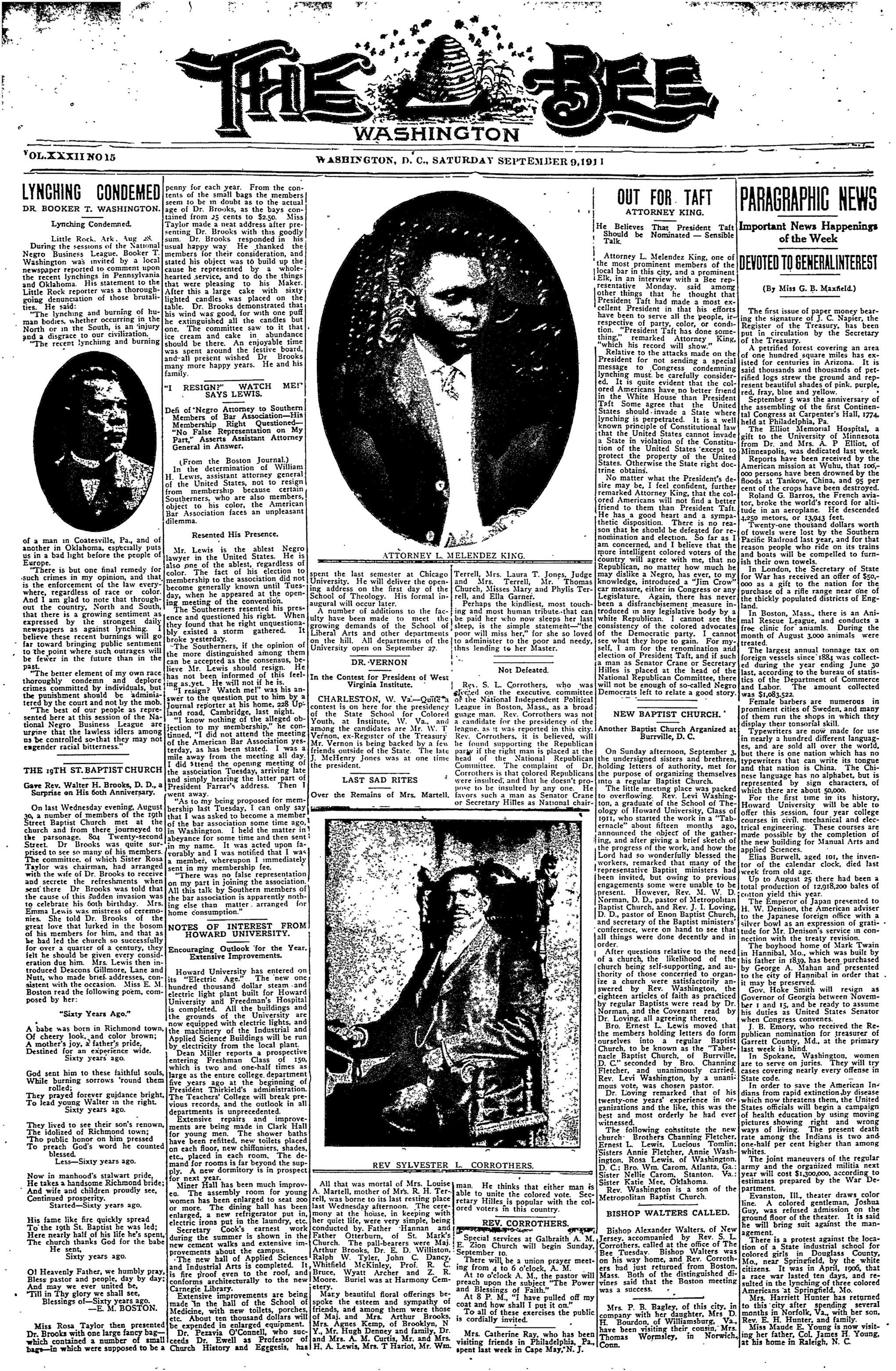
LYNCHING CONDEMED DR BOOKER T. WASHINGTON.
Lynching Condemned
Little Rock, Ark, Aug 28. During the sessions of the National Negro Business League, Booker T. Washington was invited by a local newspaper reported to comment upon the recent lynchings in Pennsylvania and Oklahoma. His statement to the Little Rock reporter was a thoroughgoing denunciation of those brutalities. He said:
"The lynching and burning of human bodies, whether occurring in the North or in the South, is an injury and a disgrace to our civilization.
"The recent lynching and burning of a man in Coatesville, Pa., and of another in Oklahoma, especially puts us in a bad light before the people of Europe.
"There is but one final remedy for such crimes in my opinion, and that is the enforcement of the law everywhere, regardless of race or color. And I am glad to note that throughout the country, North and South, that there is a growing sentiment as expressed by the strongest daily newspapers as against lynching. I believe these recent burnings will go far toward bringing public sentiment to the point where such outrages will be fewer in the future than in the past.
"The better element of my own race thoroughly condemn and deplore crimes committed by individuals, but the punishment should be administered by the court and not by the mob.
"The best of our people as represented here at this session of the National Negro Business League are urging that the lawless idlers among us be controlled so that they may not engender racial bitterness."
THE 19TH ST.BAPTIST CHURCH
Gave Rev. Walter H. Brooks, D. D., a Surprise on His 6th Anniversary.
On last Wednesday evening, August 30, a number of members of the 19th Street Baptist Church met at the church and from there journeyed to the parsonage. 804 Twenty-second Street. Dr Brooks was quite surprised to see so many of his members. The committee, of which Sister Rosa Taylor was chairman, had arranged with the wife of Dr. Brooks to receive and secrete the refreshments when sent there Dr Brooks was told that the cause of this sudden invasion was to celebrate his 60th birthday. Mrs. Emma Lewis was mistress of ceremonies. She told Dr. Brooks of the great love that lurked in the bosom of his members for him, and that as he had led the church so successfully for over a quarter of a century, they felt he should be given every consideration due him. Mrs. Lewis then introduced Deacons Gillmore, Lane and Nutt, who made brief addresses, consistent with the occasion. Miss E. M. Boston read the following poem, composed by her:
"Sixty Years Ago."
A babe was born in Richmond town,
Of cheery look, and color brown;
A mother's joy, a father's pride,
Destined for an experience wide.
Sixty years ago.
God sent him to these faithful souls,
While burning sorrows 'round them
rolled:
They prayed forever guidance bright,
To lead young Walter in the right.
Sixty years ago.
They lived to see their son's renown,
The idolized of Richmond town;
The public honor on him pressed
To preach God's word he counted
blessed.
Less—Sixty years ago.
Now in manhood's stalwart pride,
He takes a handsome Richmond bride;
And wife and children proudly see,
Continued prosperity.
Started—Sixty years ago.
His fame like fire quickly spread
To the 19th St. Baptist he was led;
Here nearly half of his life he's spent,
The church thanks God for the babe
He sent,
Sixty years ago.
Ol Heavenly Father, we humbly pray,
Bless pastor and people, day by day;
And may we ever united be,
Till in Thy glory we shall see,
Blessings of—Sixty years ago.
—E. M. BOSTON.
Miss Rosa Taylor then presented
Dr. Brooks with one large fancy bag—
which contained a number of small
bags—in which were supposed to be a
THE BEE WASHINGTON
penny for each year. From the contents of the small bags the members seem to be in doubt as to the actual age of Dr. Brooks, as the bays contained from 25 cents to $2.50. Miss Taylor made a neat address after presenting Dr. Brooks with this goodly sum. Dr. Brooks responded in his usual happy way. He thanked the members for their consideration, and stated his object was to build up the cause he represented by a whole-hearted service, and to do the things that were pleasing to his Maker. After this a large cake with sixty lighted candles was placed on the table. Dr. Brooks demonstrated that his wind was good, for with one puff he extinguished all the candles but one. The committee saw to it that ice cream and cake in abundance should be there. An enjoyable time was spent around the festive board, and all present wished Dr. Brooks many more happy years. He and his family.
"I RESIGN?" WATCH ME! "SAYS LEWIS.
Defi of Negro Attorney to Southern Members of Bar Association—His Membership Right Questioned— "No False Representation on My Part," Asserts Assistant Attorney General in Answer. (From the Boston Journal.)
In the determination of William H. Lewis, assistant attorney general of the United States, not to resign from membership because certain Southerners, who are also members, object to his color, the American Bar Association faces an unpleasant dilemma.
Resented His Presence.
Mr. Lewis is the ablest Negro lawyer in the United States. He is also one of the ablest, regardless of color. The fact of his election to membership to the association did not become generally known until Tuesday, when he appeared at the opening meeting of the convention.
The Southerners resented his presence and questioned his right. When they found that he right unquestionably existed a storm gathered. It broke yesterday.
The Southerners, if the opinion of the more distinguished among them can be accepted as the consensus, believe Mr. Lewis should resign. He has not been informed of this feeling as.yet. He will not if he is.
"I resign? Watch me!" was his answer to the question put to him by a Journal reporter at his home, 228 Upland road, Cambridge, last night.
"I know nothing of the alleged objection to my membership," he continued, "I did not attend the meeting of the American Bar Association yesterday, as has been stated. I was a mile away from the meeting all day. I did attend the opening meeting of the association Tuesday, arriving late and simply hearing the latter part of President Farrar's address. Then I went away.
"As to my being proposed for membership last Tuesday, I can only say that I was asked to become a member of the bar association some time ago, in Washington. I held the matter in abeyance for some time and then sent in my name. It was acted upon favorably and I was notified that I was a member, whereupon I immediately sent in my membership fee.
"There was no false representation on my part in joining the association. All this talk by Southern members of the bar association is apparently nothing else than matter. arranged for home consumption."
NOTES OF INTEREST FROM
HOWARD UNIVERSITY.
Encouraging Outlook for the Year. Extensive Improvements.
Howard University has entered on its "Electric Age." The new one hundred thousand dollar steam and electric light plant built for Howard University and Freedman's Hospital is completed. All the buildings and the grounds of the University are now equipped with electric lights, and the machinery of the Industrial and Applied Science Buildings will be run by electricity from the local plant.
Dean Miller reports a prospective entering Freshman Class of 150, which is two and one-half times as large as the entire college. department five years ago at the beginning of President Thirkield's administration. The Teachers' College will break previous records, and the outlook in all departments is unprecedented.
Extensive repairs and improvements are being made in Clark Hall for young men. The shower baths have been refitted, new toilets placed on each floor, new cliffioniers, shades, etc., placed in each room. The demand for rooms is far beyond the supply. A new dormitory is in prospect for next year.
Miner Hall has been much improved. The assembly room for young women has been enlarged to seat 200 or more. The dining hall has been enlarged, a new refrigerator put in, electric irons put in the laundry, etc. Secretary Cook's earnest work during the summer is shown in the new cement walks and extensive improvements about the campus. The new hall of Applied Sciences and Industrial Arts is completed. It is fire proof even to the roof, and conforms architecturally to the new Carnegie Library. Extensive improvements are being made In the hall of the School of Medicine, with new toilets, porches, etc. About ten thousand dollars will be expended in enlarged equipment. Dr. Pezavia O'Connell, who succeeds Dr. Ewell as Professor of Church History and Egegesis, has
A. B.
ATTORNEY L. MELENDEZ KING
spent the last semester at Chicago University. He will deliver the opening address on the first day of the School of Theology. His formal inaugural will occur later.
A number of additions to the faculty have been made to meet the growing demands of the School of Liberal Arts and other departments on the hill. All departments of the University open on September 27.
DR. VERNON
In the Contest for President of West Virginia Institute.
CHARLESTON, W. Va.—Quite a contest is on here for the presidency of the State School for Colored Youth, at Institute, W. Va., and among the candidates are Mr. W. T. Vernon, ex-Register of the Treasury; Mr. Vernon is being backed by a few friends outside of the State. The late J. McHenry Jones was at one time the president.
LAST SAD RITES
Over the Remains of Mrs. Martell
```markdown
```
M. B.
All that was mortal of Mrs. Louise A. Martell, mother of Mrs. R. H. Terrell, was borne to its last resting place last Wednesday afternoon. The ceremony at the house, in keeping with her quiet life, were very simple, being conducted by Father Hannan and Father Otterburn, of St. Mark's Church. The pall-bearers were Maj. Arthur Brooks, Dr. E. D. Williston, Ralph W. Tyler, John C. Dancy, Whitfield McKinley, Prof. R. C. Bruce, Wyatt Archer and Z. R. Moore. Buriel was at Harmony Cemetery.
Mary beautiful floral offerings bespoke the esteem and sympathy of friends, and among them were those of Maj. and Mrs. Arthur Brooks. Mrs. Agnes Kemp, of Brooklyn, N. Y., Mr. Hugh Denney and family, Dr. and Mrs. A. M. Curtis, Mr. and Mrs. H. A. Lewis, Mrs. H. Hariot, Mr. Wm.
man. He thinks that able to unite the cor-retary Hilles is popu-ored voters in this c
REV. CORRO
Special services at E. Zion Church will September 10.
There will be a uni-ing from 4 to 6 o'clock. At 10 o'clock A. M. preach upon the sub- and Blessings of Fai-At 8 P. M., "I have coat and how shall I To all of these exe is cordially invited.
Mrs. Catherine Rai visiting friends in I
Terrell, Mrs. Laura T. Jones, Judge and Mrs. Terrell, Mr. Thomas Church, Misses Mary, and Phylis Terrell, and Ella Garner.
Perhaps the kindliest, most touching and most human tribute-that can be paid her who now sleeps her last sleep, is the simple statement—"the poor will miss her," for she so loved to administer to the poor and needy, thus lending to her Master.
Not Defeated.
Rev. S. L. Corrothers, who was elected on the executive committee of the National Independent Political League in Boston, Mass., as a broad guage man. Rev. Corrothers was not a candidate for the presidency of the league, as it was reported in this city. Rev. Corrothers, it is believed, will be found supporting the Republican party if the right man is placed at the head of the National Republican Committee. The complaint of Dr. Corrothers is that colored Republicans were insulted; and that he doesn't propose to be insulted by any one. He favors such a man as Senator Crane or Secretary Hilles as National chair-
THE LEGEND OF THE MASTER OF THE CITY OF NEW YORK
man. He thinks that either man is able to unite the colored vote. Secretary Hilles is popular with the colored voters in this country.
REV. CORROTHERS.
Special services at Galbraith A. M.
E. Zion Church will begin Sunday,
September 10.
There will be a union prayer meeting
from 4 to 6 o'clock. A. M.
At 10 o'clock A. M., the pastor will preach upon the subject "The Power and Blessings of Faith."
At 8 P. M., "I have pulled off my coat and how shall I put it on."
To all of these exercises the public is cordially invited.
Mrs. Catherine Ray, who has been visiting friends in Philadelphia, Pa., spent last week in Cape May,'N. J.
OUT FOR TAFT
OUT FOR TAFT
ATTORNEY KING.
He Believes That President Taft Should be Nominated — Sensible Talk.
Attorney L. Melendez King, one of the most prominent members of the local bar in this city, and a prominent Elk, in an interview with a Bee representative Monday. said among other things that he thought that President Taft had made a most excellent President in that his efforts have been to serve all the people, irrespective of party, color, or condition. "President Taft has done something," remarked Attorney King, "which his record will show."
Relative to the attacks made on the President for not sending a special message to Congress condemning lynching must be carefully considered. It is quite evident that the colored Americans have no better friend in the White House than President Taft Some agree that the United States should invade a State where lynching is perpetrated. It is a well known principle of Constitutional law that the United States cannot invade a State in violation of the Constitution of the United States except to protect the property of the United States. Otherwise the State right doctrine obtains.
No matter what the President's desire may be, I feel confident, further remarked Attorney King, that the colored Americans will not find a better friend to them than President Taft. He has a good heart and a sympathetic disposition. There is no reason that he should be defeated for renomination and election. So far as I am concerned, and I believe that the more intelligent colored voters of the country will agree with me, that no Republican, no matter how much he may dislike a Negro, has ever, to my knowledge, introduced a "Jim Crow" car measure, either in Congress or any Legislature. Again, there has never been a disfranchisement measure introduced in any legislative body by a white Republican. I cannot see the consistency of the colored advocates of the Democratic party. I cannot see what they hope to gain. For myself, I am for the renomination and election of President Taft, and if such a man as Senator Crane or Secretary Hilles is placed at the head of the National Republican Committee, there will not be enough of so-called Negro Democrats left to relate a good story.
NEW BAPTIST CHURCH.
Another Baptist Church Arganized at Burrville, D. C.
On Sunday afternoon, September 3, the undersigned sisters and brethren, holding letters of authority, met for the purpose of organizing themselves into a regular Baptist Church. The little meeting place was packed to overflowing. Rev. Levi Washington, a graduate of the School of Theology of Howard University, Class of 1911, who started the work in a "Tabernacle" about fifteen months ago, announced the object of the gathering, and after giving a brief sketch of the progress of the work, and how the Lord had so wonderfully blessed the workers, remarked that many of the representative Baptist ministers had been invited, but owing to previous engagements some were unable to be present. However, Rev. M. W. D. Norman, D. D., pastor of Metropolitan Baptist Church, and Rev. J. I. Loving, D. D., pastor of Enon Baptist Church, and secretary of the Baptist ministers' conference, were on hand to see that all things were done decently and in order.
After questions relative to the need of a church, the likelihood of the church being self-supporting, and authority of those concerned to organize a church were satisfactorily answered by Rev. Washington, the eighteen articles of faith as practiced by regular Baptists were read by Dr. Norman, and the Covenant read by Dr. Loving, all agreeing thereto. Bro. Ernest L. Lewis moved that the members holding letters do form ourselves into a regular Baptist Church, to be known as the "Tabernacle Baptist Church, of Burrville, D. C." seconded by Bro. Channing Fletcher, and unanimously carried. Rev. Levi Washington, by a unanimous vote, was chosen pastor. Dr. Loving remarked that of his twenty-one years' experience in organizations and the like, this was the best and most orderly he had ever witnessed. The following constitute the new church: Brothers Channing Fletcher, Ernest L. Lewis, Lucious Tomlin; Sisters Annie Fletcher, Annie Washington, Rosa Lewis, of Washington, D. C.: Bro. Wm. Carom, Atlanta, Ga.; Sister Nellie Carom, Stanton. Va.; Sister Katie Mee, Oklahoma.
Rev. Washington is a son of the Metropolitan Baptist Church.
BISHOP WALTERS CALLED.
Bishop Alexander Walters, of New Jersey, accompanied by Rev. S. L. Corrothers, called at the office of The Bee Tuesday. Bishop Walters was on his way home, and Rev. Corrothers had just returned from Boston, Mass. Both of the distinguished divines said that the Boston meeting was a success.
Mrs. P. B. Bagley, of this city, in company with her daughter, Mrs D. H. Bourdon, of Williamsburg, Va. have been visiting their cousin, Mrs. Thomas Wormsley, in Norwich, Conn.
PARAGRAPHIC NEWS Important News Happenings of the Week DEVOTED TO GENERAL INTEREST
(By Miss G. B. Maxfield.)
The first issue of paper money bearing the signature of J. C. Napier, the Register of the Treasury, has been put in circulation by the Secretary of the Treasury.
A petrified forest covering an area of one hundred square miles has existed for centuries in Arizona. It is said thousands and thousands of petrified logs strew the ground and represent beautiful shades of pink, purple, red, fray, blue and yellow.
September 5 was the anniversary of the assembling of the first Continental Congress at Carpenter's Hall, 1774, held at Philadelphia, Pa.
The Elliot Memorial Hospital, a gift to the University of Minnesota from Dr. and Mrs. A. P Elliot, of Minneapolis, was dedicated last week
Reports have been received by the American mission at Wuhu, that 100,000 persons have been drowned by the floods at Tankow, China, and 95 per cent of the crops have been destroyed.
Roland G. Barros, the French aviator, broke the world's record for altitude in an aeroplane. He descended 4,250 metors, or 13,943 feet.
Twenty-one thousand dollars worth of towels were lost by the Southern Pacific Railroad last year, and for that reason people who ride on its trains and boats will be compelled to furnish their own towels.
In London, the Secretary of State for War has received an offer of $50,000 as a gift to the nation for the purchase of a rifle range near one of the thickly populated districts of England.
In Boston, Mass., there is an Animal Rescue League, and conducts a free clinic for aniamls. During the month of August 3,000 animals were treated.
The largest annual tonnage tax on foreign vessels since 1884 was collected during the year ending June 30 last, according to the bureau of statistics of the Department of Commerce and Labor. The amount collected was $1,083,522.
Female barbers are numerous in prominent cities of Sweden, and many of them run the shops in which they display their tonsorial skill. Typewriters are now made for use in nearly a hundred different languages, and are sold all over the world, but there is one nation which has no typewriters that can write its tongue and that nation is China. The Chinese language has no alphabet, but is represented by sign characters, of which there are about 50,000. For the first time in its history, Howard University will be able to offer this session, four year college courses in civil, mechanical and electrical engineering. These courses are made possible by the completion of the new building for Manual Arts and applied Sciences. Elias Burwell, aged 101, the inventor of the calendar clock, died last week from old age. Up to August 25 there had been a total production of 12,918,200 bales of cotton yield this year. The Emperor of Japan presented to H. W. Denison, the American adviser to the Japanese foreign office with a silver bowl as an expression of gratitude for Mr. Denison's service in connection with the treaty revision.
The boyhood home of Mark Twain in Hannibal, Mo., which was built by his father in 1839, has been purchased by George A. Mahan and presented to the city of Hannibal in order that it may be preserved.
Gov. Hoke Smith will resign as Governor of Georgia between November 1 and 15, and be ready to assume his duties as United States Senator when Congress convenes.
J. B. Emory, who received the Republican nomination for treasurer of Garrett County, Md., at the primary last week is blind.
In Spokane, Washington, women are to serve on juries. They will try cases covering nearly every offense in State code.
In order to save the American Indians from rapid extinction by disease which now threatens them, the United States officials will begin a campaign of health education by using moving pictures showing right and wrong ways of living. The present death rate among the Indians is two and one-half per cent higher than among whites.
The joint maneuvers of the regular army and the organized militia next year will cost $1,300,000, according to estimates prepared by the War Department.
Evanston, Ill., theater draws color line. A colored gentleman, Joshua Guy, was refused admission on the ground floor of the theater. It is said he will bring suit against the management.
There is a protest against the location of a State industrial school for colored girls in Douglass County, Mo., near Springfield, by the white citizens. It was in April, 1906, that a race war lasted ten days, and resulted in the lynching of three colored Americans at Springfield, Mo.
Mrs. Harriett Hunter has returned to this city after spending several months in Norfolk, Va., with her son, Rev. E. H. Hunter, and family.
Miss Maude E. Young is now visiting her father, Col. James H. Young, at his home in Raleigh, N. C.
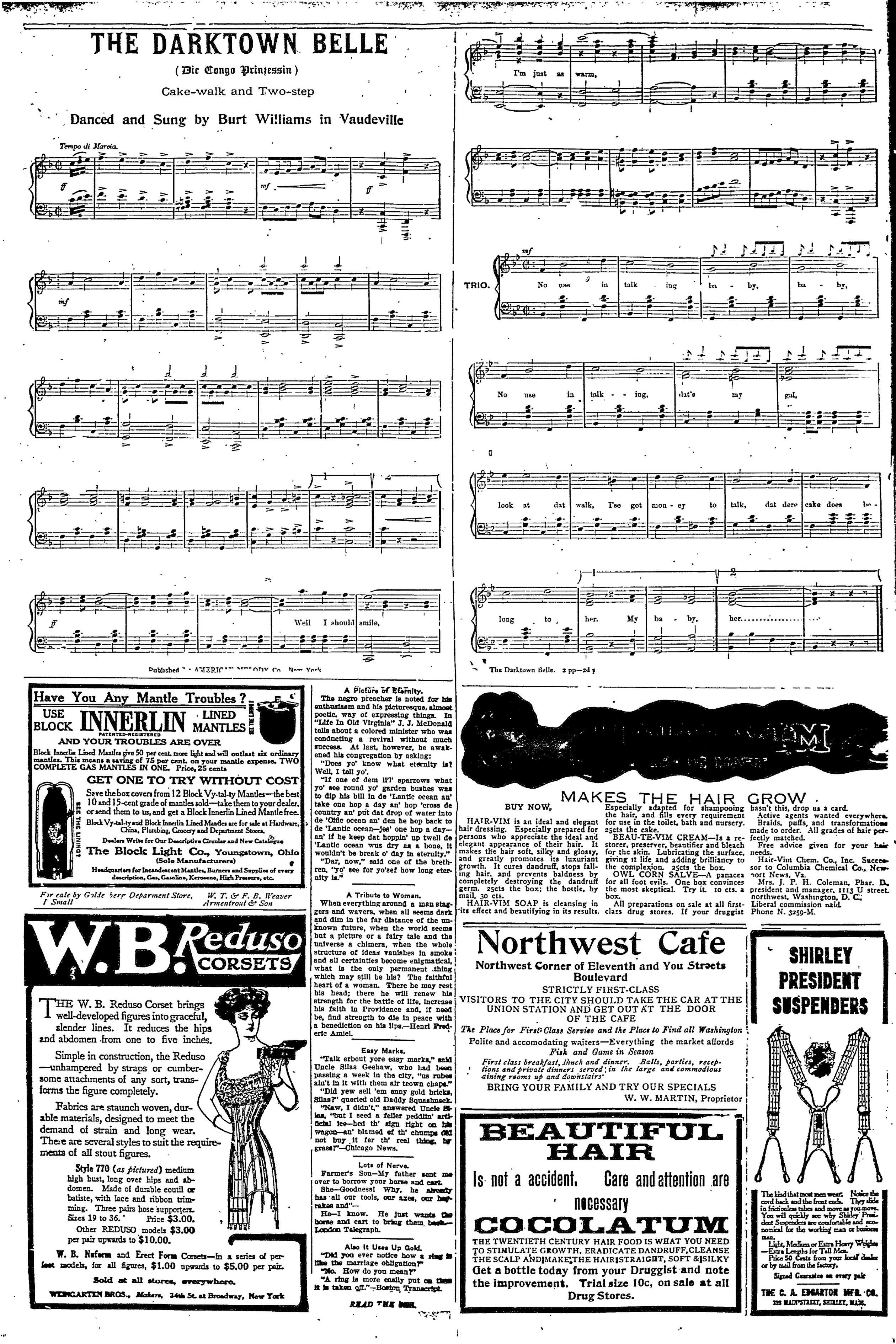
THE DARKTOWN BELLE
Tempo di Marcia.
mf
```markdown
```
```markdown
```
Well I should smile.
Have You Any Mantle Troubles?
USE BLOCK INNERLIN LINED MANTLES
PATENTED-REGISTERED
AND YOUR TROUBLES ARE OVER.
Block Innerlin Lined Mantles give 50 per cent. more light and we mantles. This means a saving of 75 per cent. on your complete GAS MANTLES IN ONE. Price, 25 cents.
GET ONE TO TRY WITH
Save the box covers from 12 Block Vy-tu 10 and 15-cent grade of mantles sold—tax or send them to us, and get a Block Innerlin Block Vy-tal-ty and Block Innerlin Lined Mantle China, Plumbing, Grocery and Depot
Dealers Write for Our Descriptive Circulation
The Block Light Co., Yi (Sole Manufacturer)
Headquarters for Incandescent Mantles, Burn description, Gas, Gasoline, Kerosene, L
For sale by Golde herg Department Store, W. T. Arm
I Small
Mantle Troubles?
LIN · LINED MANTLES
MANTLES ARE OVER
per cent. more light and will outlast six ordinary
75 per cent. on your mantle expense. TWO
ONE. Price, 25 cents
TO TRY WITHOUT COST
Mantles from 12 Block Vy-tal-ty Mantles—the best
made of mantles sold—take them to your dealer,
and get a Block Innerlin Lined Mantle free.
Block Innerlin Lined Mantles are for sale at Hardware,
Plumbing, Grocery and Department Stores.
For Our Descriptive Circular and New Catalogue
Light Co., Youngstown, Ohio
(Sole Manufacturers)
Candescent Mantles, Burners and Supplies of every
Gas, Gasoline, Kerosene, High Pressure, etc.
Block Innerlin Lined Mantles give 50 per cent, more light and will outlast six ordinary mantles. This means a saving of 75 per cent, on your mantle expense. TWO COMPLETE GAS MANTLES IN ONE. Price, 25 cents
GET ONE TO TRY WITHOUT COST
Save the box covers from 12 Block Vy-tal-ty Mantles—the best 10 and 15-cent grade of mantles sold—take them to your dealer, or send them to us, and get a Block Innerlin Lined Mantle free.
Block Vy-tal-ty and Block Innerlin Lined Mantles are for sale at Hardware, China, Plumbing, Grocery and Department Stores.
Dealers Write for Our Descriptive Circular and New Catalogue
The Block Light Co., Youngstown, Ohio
(Sole Manufacturers)
Headquarters for Incandescent Mantles, Burners and Supplies of every description, Gas, Gasoline, Kerosene, High Pressure, etc.
Reduso CORSETS
W.B. Reduso CORSETS
THE W. B. Reduso Corset brings well-developed figures into graceful.
slender lines. It reduces the hips and abdomen from one to five inches.
Simple in construction, the Reduso unhampered by straps or cumbersome attachments of any sort, transforms the figure completely.
Fabrics are staunch woven, durable materials, designed to meet the demand of strain and long wear. There are several styles to suit the requirements of all stout figures.
Style 770 (as pictured) medium high bust, long over hips and abdomen. Made of durable coutil or batiste, with lace and ribbon trimming. Three pairs hose supporters. Sizes 19 to 36. Price $3.00. Other REDUSO models $3.00 per pair upwards to $10.00.
ect Form Corsets—in a series of per $1.00 upwards to $5.00 per pair. stores, everywhere. kers, 34th St. at Broadway, New York
W. B. Nuform and Erect Form Corsets—in few models, for all figures, $1.00 upwards to
Sold at all stores, everywhere
WENGARTEN BROS., Makers, 34th St. at Broc
W. B. Nuform and Erect Form Corsets—in a series of perfect models, for all figures, $1.00 upwards to $5.00 per pair.
Sold at all stores, everywhere.
WENGARTEN BROS., Makars, 34th St. at Broadway, New York
SEE THE LINING?
SEE THE LINKS 1
W. T. & F. B. Weaver Armentrout & Son
gs
ul,
hips
thes.
so
quire-
The negro preacher is noted for his enthusiasm and his picturesque, almost poetic, way of expressing things. In "Life In Old Virginia" J. J. McDonald tells about a colored minister who was conducting a revival without much success. At last, however, he awakened his congregation by asking: "Does yo' know what eternity is? Well, I tell yo'.
"If one of dem li'l' sparrows what yo' see round yo' garden bushes was to dip his bill in de 'Lantic ocean an' take one hop a day an' hop 'cross de country an' put dat drop of water into de 'Oific ocean an' den he hop back to de 'Lantic ocean—jes' one hop a day—an' if he keep dat hoppin' up twell de 'Lantic ocean wuz dry as a bone, it wouldn't be break o' day in eternity." "Dar, now," said one of the brethren, "yo' see for yo'sef how long eternity is."
A Tribute to Woman.
When everything around a man staggers and wavers, when all seems dark and dim in the far distance of the unknown future, when the world seems but a picture or a fairy tale and the universe a chimera, when the whole structure of ideas vanishes in smoke and all certainties become enigmatical, what is the only permanent thing which may still be his? The faithful heart of a woman. There he may rest his head; there he will renew his strength for the battle of life, increase his faith in Providence and, if need be, find strength to die in peace with a benediction on his lips.—Henri Frederic Amiel.
Easy Marks.
"Talk erbout yore easy marks," said Uncle Silas Geehaw, who had been passing a week in the city, "us rubes ain't in it with them air teown chaps."
"Did yew sell 'em enny gold bricks, Silas?" queried old Daddy Squashnack.
"Naw, I didn't," answered Uncle Silas, "but I seed a feller peddlin' artificial ice—hed th' sign right on his wagon—an' blamed of th' chumps did not buy it fer th' real thing, by grass!"—Chicago News.
Lots of Nerve.
Farmer's Son—My father sent me over to borrow your horse and cart.
She—Goodness! Why, he already has all our tools, our axes, our hay rakes and"—
He—I know. He just wants the horse and cart to bring them back—London Telegraph.
Also it Uses Up Gold.
"DM you ever notice how a ring is like the marriage obligation?"
"No. How do you mean?"
"A ring is more easily put on them it is taken off."—Boston Transcript.
READ THE BOOK.
I'm just as warm,
```markdown
```
TRIO.
No use in talking. that's my gal.
long to her. My baby, her.....
MAKES THE HAIR GROW.
HAIR-VIM is an ideal and elegant hair dressing. Especially prepared for persons who appreciate the ideal and elegant appearance of their hair. It makes the hair soft, silky and glossy, and greatly promotes its luxuriant growth. It cures dandruff, stops falling hair, and prevents baldness by completely destroying the dandruff germ. 25cts the box; the bottle, by mail, 30 cts. HAIR-VIM SOAP is cleansing in its effect and beautifying in its results.
Northwest Northwest Corner of E Boul
nwest Cafe of Eleventh and You Straets Boulevard
Northwest Cafe
STRICTLY FIRST-CLASS THE CITY SHOULD TAKE THE CAR AT THE NATION AND GET OUT AT THE DOOR OF THE CAFE
VISITORS TO THE CITY SHOULD TAKE THE CAR AT THE UNION STATION AND GET OUT AT THE DOOR OF THE CAFE The Place for First Class Service and the Place to Find all Washington Polite and accommodating waiters—Everything the market affords Fish and Game in Season First class breakfast, lunch and dinner. Balls, parties, receptions and private dinners served in the large and commodious aining rooms up and downstairs BRING YOUR FAMILY AND TRY OUR SPECIALS W. W. MARTIN, Proprietor
Is not a accident. Care and attention are necessary
THE TWENTIETH CENTURY HAIR FOOD IS WHAT YOU NEED TO STIMULATE GROWTH. ERADICATE DANDRUFF, CLEANSE THE SCALP AND MAKE THE HAIR STRAIGHT, SOFT & SILKY Get a bottle today from your Druggist and note the improvement. Trial size 10c, on sale at all Drug Stores.
Especially adapted for shampooing the hair, and fills every requirement for use in the toilet, bath and nursery. 25cts the cake.
BEAU-TE-VIM CREAM—Is a restorer, preserver, beautifier and bleach for the skin. Lubricating the surface, giving it life and adding brilliancy to the complexion. 25cts the box.
OWL CORN SALVE—A panacea for all foot evils. One box convinces the most skeptical. Try it. 10 cts. a box.
All preparations on sale at all first-class drug stores. If your druggist
GROW hasn't this, drop us a card.
Active agents wanted everywhere.
Braids, puffs, and transformations made to order. All grades of hair perfectly matched.
Free advice given for your hair needs.
Hair-Vim Chem. Co., Inc. Successor to Columbia Chemical Co., New nort News, Va.
Mrs. J. P. H. Coleman, Phar. D. president and manager, 1113 U street northwest, Washington, D. C.
Liberal commission naid.
Phone N. 3250-M.
SHIRLEY
PRESIDENT
SUSPENDERS
The kind that most men wear. Notice the cord back and the front ends. They slide in frictionless tubes and move as you move. You will quickly see why Shirley President Suspenders are comfortable and economical for the working man or business man.
Light, Medium or Extra Heavy Weights — Extra Lengths for Tall Men.
Price 50 Cents from your local dealer or by mail from the factory.
Signed Guarantee on every pair
THE C. A. EDGARTON MFR. CO.
333 MAIN*STREET, SHIRLEY, MAKE.
HOWARD UNIVERSITY WASHINGTON, D. C.
Wilbur P. Thirkield, LI. D., President.
Located in Capital of the Nation. Campus of over 20 acres. Advantages unsurpassed. Modern scientific and general equipment. New Carnegie Library. New science hall. Faculty of over one hundred. 1,382 students from 37 States and 10 other countries. Unusual opportunities' for self-support. No young man or woman of energy or capacity need be deprived of its advantages.
The College of Arts and Sciences
Devoted to liberal studies. Courses in English, mathematics, Latin, Greek, French, German, physics, chemistry, biology, history, philosophy, and the social sciences, such as are given in the best approved colleges. Sixteen professors. Kelly Miller, A. M., dean.
The Teachers' College.
Special opportunities for teachers Regular college courses in psychology, pedagogy, education, etc., with degree of A. B.; pedagogical courses leading to Ph. B. degree. High-grade courses in normal training, music, manual arts and domestic sciences. Graduates helped to positions. Lewis B. Moore. A. M. Ph. d. Dean.
The Academy.
Faculty of 13. Three courses of four years each. High-grade preparatory school. George J. Cummings, A. M., dean.
The Commercial College.
Courses in bookkeeping, stenography, commercial law, history, civics, etc. Business and English high school education combined. George W. Cook, A. M., dean.
School of Manual Arts and Applied Sciences.
Furnishes thorough courses. Six instructors. Offers four-year courses in mechanical and civil engineering, and architecture.
PROFESSIONAL SCHOOLS
The School of Theology.
Interdenominational. Five professors. Broad and thorough courses. Advantages of connection with a great university. Students' aid. Low expenses. Isaac Clark, D. D., dean.
THE SCHOOL OF MEDICINE.
Medical, Dental and Pharmaceutical Colleges.
Forty-nine professors. Modern laboratories and equipment. Connected with new Freedmen's Hospital, costing a half million dollars. Clinical facilities not surpassed in America Post-graduate school and polyclinic. Edward A. Balloch, M. D., dean. Fifth and W Streets, Northwest, W. C. McNeill, M. D., secretary, 901 R Street, Northwest.
The School of Law.
Faculty of eight. Courses of three years, giving a thorough knowledge of theory and practice of law. Occupies own building opposite court house. Benjamin F. Leighton, LL. B, dean, 420 Fifth Street, Northwest. For catalogue and special information, address Dean of Departmnet.
Fosters DYE Works
FOSTER'S DYE AND CLEANING WORKS.
(You Street, between 11th and 12th Streets, Northwest.)
Business and Display Office,
11th and You Streets, Northwest
CALL AND INSPECT OUR WORK.
Ladies' suits a specialty.
Gentlemen's suits cleaned, pressed and sponged.
Gloves cleaned.
All goods look like new when they leave our works.
FOSTER'S DYE WORKS.
FIRST POST HOUSES
Established by Cyrus, the Founder of the Persian Empire.
The first posts are said to have originated in the regular couriers established by Cyrus the Great about 550 B. C, who erected post houses throughout the kingdom of Persea. Augustus was the first to introduce this institution among the Romans, 81 B. C, and he was imitated by Charlemagne about 800 A. D. Louis XI. was the first sovereign to establish post houses in France, owing to his eagerness for news, and they were also the first institution of this nature in Europe.
This was in 1470, or about 2,000 years after they were started in Persia.
In England in the reign of Edward IV. (1431) riders on post horses went stages of the distance of twenty miles from each other in order to procure the king the earliest intelligence of the events that passed in the course of the war that had arisen with the Scots. A proclamation was issued by Charles I. in 1631 that, "whereas to this time there hath been no certain intercourse between the kingdoms of England and Scotland, the king now commands his postmaster of England for foreign parts to settle a running post or two between Edinburgh and London to go thither and come back again in six days."
WILLING TO LEND.
"But, Oh, My Dear, I am So Sorry; My Husband, the Mean Thing, Has Been at My Purse Again."
Men have something to learn from women in the art of warding off "touchers" for coin. Women respond to such requests once in about every thousand cases, but they are scientific in their refusals. A Cleveland woman with a reputation as a borrower turned up at the home-of one of her friends the other morning with a much done over story about a parsiment and threatening dressmaker and the usual request for the loan-"pay it back tomorrow, certain"—of $5.
"Why, my dear, certainly," was the pleasant response to her carefully rehearsed little yarn, "you poor thing, you! Just walt till I run upstairs and get my purse."
She ran upstairs. The male head of the house happened to be in the room where she kept her purse. He saw her dig the purse out of a chiffonier drawer and deliberately remove a wad of bills from it, leaving about 87 cents in silver and copper in the change receptacle. The man was mean enough to lean over the stair railing when his wife went downstairs to the parlor with her flattened pocketbook in her hand.
"Oh, I'm so sorry, dearie," he heard her say, "but 'I' really thought I had the money. I find, though, that Frank, as usual, has been at my purse. I heard him say something about setting a plumber's bill last night when I was half asleep—and the mean thing has left me only enough for car fare. Too bad! Of course, you know, if I had it"—and so on—Cleveland Plain Dealer.
CURIOUS BLUNDERS
The Anachronisms That Crowded a Once Famous Poem.
The medieval romances are full of blunders, making contemporaries of men who were separated sometimes by hundred, sometimes by thousands, of years, but as historical criticism had not then a being and the general information of the age was not superior in any particular to that of the novelist their plans do not amount to much from a literary point of view. Such an instance is the case of Aristo, who might be supposed to know something at least of the truth of history, but whose once famous poem, "Orlando Furioso," is a tissue of historical absurdities from beginning to end.
In this poem Charlemagne and his peers are joined by Edward I, of England, Richard, earl of Warwick; Clarence and the Dukes of York and Gloucester; cannon are employed hundreds of years before the time of Monk Schwartz, and the Moors are represented as established in Spain in spite of the historic fact that 300 years elapsed after the death of Charlemagne before they crossed from Africa. In one place Prester John, who lived 400 years after Charlemagne, and Constantine the Great, who died five centuries before him, are introduced and hold familiar converse with the great Charles, while in another Saladin and Edward the Confessor are joined by the Black Prince.
Audubon and His Hair.
Audubon, the great naturalist, early in his career wore his hair very long. He wrote in his diary one day: "I wear my hair as long as usual. I believe it does as much for me as my paintings." However, in 1827 his friends succeeded in persuading him to get his hair cut according to the prevailing fashion. On March 19 of that year he wrote in his diary: "This day my hair sacrificed and the will of God usurped by the wishes of man. As the barber clipped my locks rapidly it reminded me of the horrible times of the French revolution when the same operation was performed upon all the victims murdered by the gullotine. My heart sank low." Further to express his grief, the margin of the page on which this entry was made he painted black about three-quarters of an inch deep all around.
Still Wondering.
The deaf man got out of the tram car on to the other line of rails.
"Look out! There's a car coming!"
tried the conductor.
"What?" said the deaf man.
"There's a car coming."
"What?"
Just then the car caught and knocked down the deaf man, and as he picked himself up he said:
"I wonder what that fool kept me there talking about?"-London Mall.
Just the Opposite.
An Irishman at a fair got poked in the eye with a stick and took proceedings against the offender.
Said the magistrate, "Come, now, you don't really believe he meant to put your eye out."
"Faith, you're right this time," said Pat, "for I believe he tried to put it farther in."—London Tit-Bits.
The Moral Stimulus of Good Clothes. Men grow in self respect as they wear good clothes. Their clothes earn them the approval of their fellows. In turn they are forced to grow to fill the measure of good opinion, so that, forced forward by the clothes he wears, men attain to their highest capability.—Sartorial Art Journal.
The Exception.
"Doesn't your husband like cats, Mrs. Blinks?"
"No, indeed. He hates all cats except a little kitty they have at his club."-Baltimore American.
My Sympathetic Friend
By SUSAN YOUNG PALMER
My father and mother both died when I was so young that I have no remembrance of them, and I was sent to an orphan asylum. When I was eighteen the matron one morning called me into her room and said to me:
"You have been very useful to us here since you passed out of childhood, but I am expected by the managers to get on without help. You are now old enough to be self supporting and must either work for yourself alone or in a home. I occasionally receive a letter from some man desiring one of our grown girls for a wife. I had one of these letters this morning from a young man in the west, who says that he has a good farm on which he lives alone, and he wishes me to send him some one for a helpmeet whom I can recommend, and he has forwarded letters recommending him. Let me know if you wish the position."
The matron was used to condensing everything she said just as she had spoken these words. She was a good woman, but was so intimately connected with the world's troubles that she could not give much attention to those of any one person. She turned to other duties, and I left her to go to my room to think.
The result of my tearful deliberations was that I was a few days later handed a ticket and what money I would need on the journey and took a train for the west. My leaving was telegraphed to my future husband, who was to meet me at the station, marry me and drive me twenty miles to his farm. I had no money with which to return or go anywhere else in case he should prove disagreeable. Indeed, I felt as though I had been pitched over a precinct.
The train had left Chicago and we were bowling along toward the Mississippi. I noticed a young man sitting near me who was looking at me, I thought, sympathetically. I must have shown my despondency in my face, for his own reflected it or, rather, bespoke commiseration. Presently he came over to me and said, with an encouraging smile: "You look troubled. Is there anything I can do or say to make you feel happier."
There was that in his honest face and eyes that invited confidence. I told him my story. He listened to it attentively and respectfully and when I had finished said: "Has it occurred to you that the man who is to marry you is in the same position with regard to you that you are with regard to him?"
"I never thought of that."
"And do you know that many so called love matches turn out very unhappily?"
"I supposed," I replied, "that it was the forced marriages such as the one I am about to make that are failures."
"There is no truer saying than that marriage is a lottery. I think you have a better chance in yours than those people who, blinded by love, see no fault until a number of them are plainly visible after marriage. Unblessed persons have recommended this man to you and you to him. You both trust to them instead of your own judgment blessed by love. The chances are largely in your favor."
"What you say," I replied, "sounds encouraging, but it seems to me that I would rather begin with love even if I must end with disappointment."
"Spoken like a woman," he rejoined,
"And I would begin without love and end with love."
What a treasure are these people who have the faculty of lifting the cloud that hangs over us and showing us the sun shining behind. This young man seemed to have only an ordinary education, but any deficiency was made up by common sense. Then, too, it was easy to see that he had a kind heart. He was constantly looking at me out of those sympathetic eyes of his, which said, "Poor child, how I pity you!" He was with me most of the morning and all the afternoon. He soon ceased to talk about my trouble, leading me into other paths, though he told me many instances of persons who had made marriage a matter of business and found it a matter of affection.
My lover—I was certainly thinking the word, mockery that it was—had written that my train would land me in the night at the last principal town on my route, and I was to remain there, taking another train the next morning. When I parted with my newly made friend I relapsed into the same miserable condition as before. But I was tired, and that night, though I went to sleep in tears, I got a fairly good rest. This and a bright morning kept me up the next day till I approached the last station, where I was to meet "my lover," when it was all I could do to resist a temptation to throw myself from the train. I permitted every one to go out before me and wished there were more of them. Then when alone I nerved myself for the ordeal and left the car.
My lover was there waiting for me, extending his hand to assist me down the steps.
A sudden wonder mixed with a wild fluttering of my heart caused me to pause. Was I in a dream or was I waking from sleep? The man waiting to hand me down was my sympathetic friend.
STAR GEM OF CEYLON.
The Asteria Brought Health and Fortune to Its Wearer, Particularly if He Had Been Born in April.
Familiar to some of the ancient writers and credited with supernatural powers, the asteria, or star gem, was highly valued for the benefits supposed to be conferred on the wearer. Its bright six rayed star, ever changing and shifting with every play of light and especially shooting out its flames in the direct, sunlight, would seem to be something more than an ordinary crystal, and to the superstitions mind it could readily be believed to embody some tutelar spirit.
The particular virtue attributed to this gem was the conferring upon the wearer of "health and good fortune" when worn as an amulet, and to those fortunate to be born in the month of April, with which the stone was associated or represented, the wearer was insured from all evil.
The star stone is found principally in Ceylon, invariably in soil peculiar to rubles and sapphires. Indeed, it is composed of the same constituent "corundum," its chatoyant, or star rays, being caused by the pressure of what the natives call "silk." It is found in many different colors, from pale blue, pink and white to deep dark blue, ruby and purple. The blue are termed sapphire stars, the red ruby stars. It is always cut en cabochon, the star dividing into six rays at the apex. It is next in hardness to the diamond.
MARITIME EXPRESSIONS
Used In a Metaphorical Sense They Are Quite Common.
Maritime expressions used metaphorically are, in fact, very common. We say a couple are "spliced," a young man is the "mainstay" of his family, an intruder "puts his car in," a man is "hard up," sometimes "taken aback" or has "the wind taken out of his sails," a toper is "slewed," a loafer "pins a yarn," sometimes "tries the other tack," and a ruler "steers the ship of state" through troublesome times.
This last metaphor is extremely ancient, by the way. Horace refers to Rome as a ship at sea, and Plutarch says the Delphic oracle referred to Athens in the same way. A Tamil saying embodies a like metaphor, "The soul is the ship, reason is the helm, the oars are the soul's thoughts, and truth is the port." An old collection of English proverbs contains this one: "The tongue is the rudder of our ship." A Malay maxim says, "The boat which is swamped at sea may be bailed out, but the shipwreck of the affections is final."
Aristophanes, Plautus and others use an expression which comes down to us as an English saw, "To row one way and look another." An old English proverb (614) was, "It is not good to have an ear in every one's boat."
He Sat.
It is related of the Rev. Matthew Clark that in the audience was once a young British military officer whose scarlet uniform far outshone any rival habiliments and so fixed the gaze of the young damsels present that the weaker, enjoying the impression he was making, not-only stood through the prayer with the rest, but remained standing after all others had sat down until the pastor had proceeded for some time with his sermon, and at length, noticing a divided attention and its cause, the minister stopped, laid aside his sermon and, addressing his new hearer, said: "Ye're a braw (brave) lad. Ye he'a a braw suit of claithres, and we ha'e a' seen them. Ye may sit doun." The lieutenant dropped as if shot—From the "Autoblography of Horace Greeley."
Snubbed the Composer.
Gustav Mahler had a queer experience in Munich one day for which his name was partly responsible. His new symphony was being rehearsed, and he took advantage of an hour's intermission to get some fresh air. "On returning to the building," says a Munich paper, "he lost his way and tried to reach the hall through a corridor in which plasterers were at work. You cannot pass through here; he was told. 'But I am Mahler.' (Mahler is the German for painter.) You look it, was the unsympathetic reply of the man who blocked his way. 'We are not ready for the painters yet, so run on. And the composer, realizing that argument would be useless, plunged into the labyrinth and finally reached his destination."
Camels In Arabia
There are two varieties of camels in use in Araba, the dromedary and the freight camel. The dhielu dromedaries are celebrated for their easy riding gait and speed. A dhielu carries about 900 pounds and trivels about six miles a day. It can be purchased for 100 to 150 Maria Theresa dollars ($42.50 to $63.75). A freight camel carries about 500 pounds and travels about two and a half miles an hour. It costs 800 Maria Theresa dollars ($127) or more.
Not Idle Curiosity
Mrs. Wanterknowe—I should like to know, Mr. W., why you are so cross when I ask questions. Surely you don't think I have idle curiosity? "Great Scott, not Yours is the most perniciously active, wide awake, sleepless, energetic curiosity it was ever my fate to encounter."
Musical Note.
A newspaper says of a recent operatic performance, "The ladies, the barbone and the bass were good, and so were the tenor's intentions!"
```markdown
```
A Sacrifice
By-ANDREW C. EWING.
I left St. Petersburg in the afternoon. When the guard closed the door of the compartment I was in I noticed a man sitting opposite me give a sigh of relief. Still, he continued to look out the window, as he had been doing, apparently dreading to see something or some one. The train moved out with accelerating motion, and the faster it rolled the more relieved looked my fellow passenger. Suddenly I heard him give a smothered cry, and, following the direction of his eyes, I saw a man running like a dear to catch the train. The passenger put his head out the window to see the end of the race, drew it in and gasped:
"My GodP"
"Did he catch the train?" I asked.
"He jumped on to the footboard of the last car."
"My friend," I said, "I judge that you are a political refugee."
"Why do you think that?" said the man, stiffening up.
"The man who ran to catch the train is a government official. His object is to arrest you."
"Who are you?"
"An American."
"Ahl Americans are our friends. I will tell you. That man, as you say, will arrest me, and I shall be sent to Siberia. Help me!"
"How can I do that?"
"We are not unlike—the same height, both light hair and beard, both wear glasses. Give me your traveling coat and your golf cap and put on these Russian clothes. When the train stops an officer will come here to arrest me. But by that time it will be night. I shall pretend to be a sleep in my corner with the collar of your coat pulled up about my face and your cap down over my eyes. You say, with a groan of despair, 'I am caught at last, but I will not live to go to the mines! While they are removing you I shall watch for an opportunity to get away before they discover their mistake."
When the scheme was first proposed to me I had not the remotest idea of perpetrating it. But since it was an hour before the train stopped he had that time to persuade me. I should have yielded, but I was not sure that I would not suffer a long term of imprisonment for interfering in the man's capture. Before we had reached the station he had promised if I would take his place to see that the American minister was made aware of the matter, and as the train slowed down, not being able to resist his pathetic appeals, I adopted his plan. All happened as he had predicted. As soon as the train stopped the coach door was thrown open and a lantern thrust into the compartment. True to my promise, I cried out in Russian, "I am caught at last, but I will not live to go to the mines!"
I was jerked out of the coach and hurried away. What became of the "political" I did not know. I was taken into the station, given a closer inspection and the deception discovered. By the next train I was taken back to St. Petersburg and thrown into prison. The next morning I asked for writing materials, which were given me, and stated a note to the American minister, stating that I was an American citizen in a Russian prison and asking his assistance. The day passed and I heard nothing. A week, a month, went by. I gave up hope and cursed myself for a fool.
One morning a young man came to see me, saying that he was from the embassy. I asked him why he had been so long in taking cognizance of my note. He replied that no note had been received, but the very next day after my arrest the minister had been informed of all that had happened. He had since been trying to get the government to take the matter up. I had been twice moved from one prison to another, and each time the embassy had been informed of my removal. In short, my note to the minister had not been delivered, but some one had been keeping watch over me and informing the minister of my condition.
After another month's hard work the embassy succeeded in securing my release on condition that I leave the country immediately. I was escorted over the line, wondering the while whether I had been a fool or a fine fellow. I had no sooner got beyond the border than a man stepped up to me and said, "I am to take you to the count."
"Thanks, no. I don't want to go to any count. I've had enough of this business."
But he persuaded me and took me to a house where I was received by—the man whom I had helped to escape. He rushed forward and gave me a bear hug and kissed me on both cheeks. When his transports had subsided he said:
"I kept my promise. The government tried to lose you, but my friends prevented. After you left me I got out of the car and escaped. I have been here ever since. I am a noble, rich, and half my fortune is yours.
"No," I said. "It feels so good to have made one sacrificial act that you can't pay me for doing it."
But I found it impossible to get rid of the count's gratitude. I went to Paris and had no sooner arrived than a number of Russians called on me. One offered me a box of the opera, another the use of a house. There was nothing I wished for that was not forthcoming.
ATE A WHOLE SHEEP.
This Was Only One of the Gastronomile Feats of Nicholas Wood, a Famous English Glutton.
The following account of a man named Nicholas Wood, famed for his gluttony, was written by John Taylor, the "water poet" of the seventeenth century:
Nicholas Wood was a Kentish yeoman. "Be it known to all men to whom these presents come," writes John Taylor, "that I, John Taylor, waterman of St. Savier's in Southwark, will, with plain truth, bare and threadbare, treat of the remarkable actions of Nicholas Wood.
"He hath eaten a whole sheep at one meal; pardon me! I think he left the skin, the wool and bones; and presently after he hath swallowed three pecks of damsons. Two loins of mutton and one loin of veal are but three spraats to him. Once at Sir William St. Ledger's house, so vallant and stanunch of teeth he showed himself, that he ate as much as would suffice thirty men, and afterwards he slept eight hours.
"One morning I sent for him to the inn to eat breakfast. He had already eaten one pottle of milk, one pottle of pottage, and bread, butter, and cheese. He gave me thanks and said that if he had known any gentleman would have invited him to breakfast he would have spared his meal at home. Nevertheless he would do me the courtesy to show me some small cast of his office. Whereupon I summoned the hostess and commanded that all the victuals in the house be laid before my guest.
"The inn was slenderly provided, but six-penny loaves were mounted two stories high like a rampart, three six-penny veal ples, one pound of sweet butter, and a number of other dishes were set out, all of which were quickly brought to nothing."
RUBBER OYSTERS.
They Brought Trade and Saved Their Inventor From Failure.
"Bubber oysters laid the foundation of my success," said a millionaire hotel man.
"I had a small saloon in them days, and things looked very black. They looked, in fact, like bankruptcy. So in desperation I cut an old rubber doormat into oyster shaped pieces on April 1 and fried them in egg and breadcrumbs to a tasty brown.
"There was only one man in the bar when I fetched in that dish of smoking rubber oysters. His eyes glittered, and he grabbed a fork, jabbed it into a big fellow and took a hungry bite.
"Seeling the surprised look that spread over his face, I turned away to hide a smile. He gave an awkward laugh and said:
"Them's fine oysters. I'll bring a couple of the boys in to sample them."
"Sure enough, he brought two friends a half hour later. The friends no sooner saw the appetizing rubber oysters than, setting down their beer, they each sunk their teeth in one.
"They, too, sent in friends for oysters. I fried up no less than three old doormats and two overshoes that April fool day. The whole town laughed, and the papers printed funny stories about my joke. My joint got real popular.
"In short, I was saved—saved from bankruptcy by rubber oysters." — Washington Post.
A Light on Mothera
The late William James, Harvard's famous psychologist, would often illuminate a misty subject with an appropriate anecdote. Discussing motherhood in a lecture on psychology, Professor James once said:
"A teacher asked a boy this question in fractions:
"Suppose that your mother baked an apple ple and there were seven of you—the parents and five children. What part of the ple would you get for your portion?
"A sixth, ma'am," the boy answered.
"But there are seven of you," said the teacher. 'Don't you know anything about fractions?'
"Yes, ma'am," said the boy. 'I know all about fractions, but I know all about mother too. Mother 'd say she didn't want no ple.'"
The Misquided Friend
De Chapple—If there's any one nuisance I hate more than another it's a fellow who is always going around introducing people. There's Goodheart, for instance.
Bouttown—What's he been doing?
De Chapple—The idiot! The other day he introduced me to a man I owed money to, and I'd been owing it so long he'd forgotten all about me. Now I'll have to pay up or be sued—London Telegraph.
Catching On.
Young Mr. Struckett-Ritch was eating his first meal at a real restaurant. "What are those?" he asked, pointing at the finger bowls the waiter had just brought to the table. "Those are to wash your fingers in, str," said the waiter. "Oh, I know that," rejoined young Struckett-Ritch, with remarkable possession. "I mean are they cut glass?" —Chicago Tribune.
Betty and the Kitten
Betty is only four and often in her excitement she makes very odd remarks. The other day she cried out, "Oh, mother, there's a dear malina kitten all curled up in the corner."
A Feat For Willia.
Teacher--Willie, if you had five eggs in the basket and laid three on the table, how many would you then have? Willie--Eight--Life.
THE BEE
Published
at
1109 Eye St., N. W., Washington,
D. C.
W. CALVIN CHASE, EDITOR.
Entered at the Post Office at Washington, D. C., as second-class mail matter.
ESTABLISHED 1880.
TERMS OF SUBSCRIPTION.
One copy per year in advance...$2.00
Six months...1.00
Three months....50
Subscription monthly...20
LIBERTY VS. OPPRESSION.
O! Liberty, where is thy sting?
Oppression, O! where is thy virtues?
In the latter the colored independent voters seem to find virtue and consolation. In the former there seems to be a pill. The sensible men in the Negro race have seen and realized-enough of the oppression that seems to impede the progress of the race. Liberty is a sweet recreation for the grateful and those who have been benefited by those who have sacrificed life and property. Should the blandishments of official power prevent those who today enjoy liberty, be a stay to the performance of their political duty to the party that was instrumental in giving the colored Americans the fruits which are enjoyed by the more fortunate American citizens? The colored man complains of unjust treatment and discrimination. No advancement is made by any progressive people without a struggle.
There is nothing better than liberty, no matter from whom it comes. There is a great deal of hypocrisy in the so-called Christian church. Some people can pray harder and louder and do more devilment than the hardest sinner. The so-called independents find more liberty in the stings of their enemies and virtue oppressive than they do honor in the Republican party.
MAKING PROGRESS
The election of Wm. H. Lewis to membership in the American Bar Association, following closely on his appointment as Assistant Attorney General not only puts Mr. Lewis in the pioneer class, but it is the best evidence possible that the race is making progress. With Wm. H. Lewis a member of the American Bar Association, and John Mitchell, Jr., of Richmond, Va., a member of the American Bankers' Association, we have a recognition of the race in the greatest organization of lawyers and the greatest organization of financiers.
And banking is the highest order of financiering. But these men were recognized by membership in these two organizations not because they were colored men, but because their ability and achievements merited it, and in spite of their color. The election of neither was from sentiment, but because their careers entitled them to this membership. While these honors came to them not because they were colored men, still the fact that they are colored, and members of a race who, fifty years ago was in hopeless, abject slavery, forms indisputable proof that we, as a race, are making wonderful progress. Every day we meet with some discouraging prejudice that all but makes pessimists of us, and yet the day after comes records of some achievement, on the part of some members of the race, that changes pessimism into optimism John Mitchell has now been a member of the American Bankers' Association for several years, and he has proven a credit to that association of successful financiers. And Wm. H. Lewis will prove a credit to the premier association of distinguished lawyers of this country. True it is we are making progress, and great, progress.
THE MASK OFF
When colored men set their sail to catch each passing breeze they adopt, or include in a selected elongated name the word "independent." But independent, in this connection usually means that the members are for the highest bidder, or for either or both parties at the same time. That was true during the last Presidential campaign, for some of the members of this same National Independent. Political League which convened at Boston last week were notoriously offering their services first to the Democrats and then to the Republicans, and before the campaign was over some of them had accepted funds from both parties. It is a fact that this league, which erroneously uses the word "independent," is composed of some Negroes who are Democrats for cash. Now would it not have been much better, and more honorable, and more honest, if they had adopted the name of the National Negro Democratic League? Such a name would have not been misleading. As it is, however, their adopted name, National Independent Political League, is not misleading to the initiated. On which side, in the open, was Bishop Walters, Dr. Corrothers, Rev. Waldron, Munroe Trotter, W. T. Ferguson, et al., in the last campaign? The press utterances of these self-styled patriots show they were openly for Democracy. Information is easily obtainable to prove that some of them, at least, were willing to secretly work for the Republicans, providing. Ah, "providing," that little word is full of meaning. Some of these men are skating on thin ice, and if the ice should happen to melt from the warmth of the divulgence of facts they would take a plunge into the waters of exposure. Independent! Why, that's but a mask. Later on The Bee will tear away their mask.
JUDGE GIBBS' NAME.
The Independent National Political League, composed of men, for the most part, who have an itching palm to sell their influence for cash, and whose desire for the tainted coin is as great as the name of their organization is long, have attempted to give that organization respectability and standing by electing Judge M. W. Gibbs its treasurer. Judge Gibbs, who is now in the seer and yellow leaf of age, has lived an honorable and eventful life. He has been honored repeatedly, by the party that accomplished the freedom of his race, to office at home and abroad, and well did he fill those offices to the credit of his country, party, race and sellf. Now at the age of eighty and eight years, when he should be enjoying the rest he so richly deserves, a few highbinders would use his good name to mask their battery of iniquitous graft. Well do they know that not one dollar of the tax they will levy upon Democratic candidates will ever reach his hands. The Negroes of this country admire Judge Gibbs for his honorable and helpful past, and they protest against using his good name, which is a heritage in their keeping, to assist any clique or clan to filch money from a party that imposed upon the Judge's race the horrors of slavery.
Judge Gibbs, grand old man that he is, has fought his fight, has kept his faith, and has rendered unto Caesar Caesar's own, and is now entitled to that peace and solace unembittered by factional or party strife, which a well spent life brings at the fag end of life's journey. Too attempt to use his good
name to give character to any organization of political nondescripts or characterless political pirates is to attempt, for selfish purposes, to dishonor the fair name of a man whose many year shave borne ripe fruit for his people. We owe Judge Gibbs a debt of gratitude; we owe him honor and homage, not dishonor in the winter of his long useful career. Judge Gibbs' name is a legacy to us to preserve and honor, not to debase.
PETTICOATS IN CONTROL
The so-called progressive citizens' association of Fairmount Heights will not consolidate with the regular citizens' association, which it bolted some time ago. It seems that the men in this association are controlled by the petticoats who are the dominating faction, and refuse to join hands with the regulars. At a meeting of the so-called progressives held last Tuesday evening, there were several advocates who favored a consolidation, but the leader of the female petticoat faction threw a firebrand into the ranks of the meeting and declared that the regulars should come to the bolters. It is quite evident that this division is to continue as long as the petticoats hold sway. Several sensible speeches were made by Col. Lewis and Mr. Harris, but they had no effect with the petticoats. It is to be regretted that sensible men would allow a lot of hot-headed women to dominate an organization that could do so much good for a community. In the first place, females should be eliminated from both organizations, and until it is done this division will be continued.
DR. S. L. CORROTHERS.
At the recent Boston, Mass., meeting of the National Independent League, The Bee must commend the attitude of Dr. S. L. Corrothers when he rebuked Rev. Waldron for the insult he offered Assistant United States Attorney James A. Cobb Mr. Cobb was on his vacation, and while in Boston he was invited to attend the meetings of the Independent League, and when he entered the committee room he was insulted by Rev, Waldron. This divine may mean well, but he has a poor way of showing it. He adopted the same tactics in Philadelphia, when the Editor of The Bee attended the first meeting of the semi-Democratic organization. The Editor of The Bee, unlike Mr. Cobb, won his innings. Rev. Waldron was not at all commended for his attitude toward Mr. Cobb.
School days are near at hand.
Just compare The Bee with other, alleged colored newspapers published in Washington, and the verdict is unanimously in our favor.
The colored citizens of Los Angeles, Cal., have extended President Taft an invitation to address them while in that city on his forthcoming trip.
If the School Board adopts a policy of turning over to whites school buildings vacated by colored we cannot complain if they turn over to us school buildings, modern and in good repair, vacated by whites. All we ask is a square deal, and not to make fish of one and foul of the other.
The Rev. J. Milton Waldron wanted to have James A. Cobb put out of the Independent's meeting in Boston last week, when he was there but as a visitor, presuming the meetings were open to the public. If the alleged Independents are honest, why covet seclusion?
Dr. Corrothers is to be commended for being broad enough to repudiate Rev. Waldron's desire to eject certain visitors from the Boston meeting last week. Rev. Corrothers argued, in effect, for the light of day, while Rev. Waldron leaned towards the dark-lantern ways.
Our editorial, appearing in last week's issue, on Teachers' Morals, attracted a great deal of attention, and we have been the recipient of many complimentary notes of praise from teachers and parents as a result. Dr. Davidson, the new superintendent, will insist on clean morals among the teachers. He demands this, and knowing it, The Bee passed the word along to teachers that none might be caught napping.
MORRIS BROWN COLLEGE
Elects a New President.
ATLANTA, Ga., Sept. 4.-Mr. W. T. Vernon failed to land the presidency of Morris Brown College. The election resulted in Dr. Fountain being chosen president.
Rochester, N. Y., was a gala city during encampment week, crowded with people from all over the country. Parade Day was an ideal one, and the old comrades marched with a vim of bygone days, but the feeble limbs, wrinkled cheeks and white locks reminded all "that not many mare marches for the old, valiant heroes." None more conspicuous in line than Comrades Chas, Douglass, Brooks, Davis and Lynn, of Douglass Post. Louisiana, with the old hero, Colonel Lewis, at its head, together with the comrades and W. R. C.'s of Mississippi and Louisiana marched on Tuesday to the statue of our own Frederick Douglass and placed thereon a beautiful wreath of flowers (wax that can be preserved and put on every Memorial Day) and then they went to Mt. Hope Cemetery and strewed flowers upon Mr. Douglass' grave, a most fitting tribute to one of the greatest men that ever lived.
On Wednesday night a campfire was held in Zion A. M. E. Church, that noted old landmark of bygone days, where poor slaves were, making their way to Canada, the land of freedom.
Major Charles R. Douglas, Colonel Lewis, Mrs. Brooks, Miss Jordan and Miss Grinnage were on the program with others. All were excellent numbers. Washington, as usual, held her own.
On Wednesday afternoon in the largest church in Rochester, Central Presbyterian, Mrs. Julia Mason Layton, National Inspector for detached corps throughout the United States, presented Mrs. Belle C. Harris, National President (the lady who appointed Mrs. Layton) with a little token. Her little speech was received with a round of applause, and Representative Sherwood's wife, Mrs. Kate B. Sherwood, made a motion that the house give a rising vote of thanks to Mrs. Harris for Mrs. Layton's appointment, and a rising vote of thanks to Mrs. Layton for her excellent work, for the first time in the history of the W. R. C. all the corps throughout the South had been inspected. In the entire convention only ten colored representatives: Miss Grinnage represented the Department of Potomac, and Mrs. Layton the detached corps of the National Woman's Relief corps. A most harmonious and successful convention was held. Cheapside, Mappsville and Eastville, Va., were represented by Mrs. Morrison, Watson and Grulin; Newbern, N. C., by Mrs. Wynn, and Savannah, Ga., by Mrs. Williams; Mississippi by Mrs. Washington, and Louisiana by Mrs. Tapir, and Mrs. Petiran. Mrs. Cora D. Davis, of Oregon, was elected president, and she has already asked Mrs. Layton to do the same work this year as last.
Many courtesies were extended to the visitors. Mrs. Layton was house guest of Mr. and Mrs. Lyvers, and Mr. and Mrs. Burke, 40 Cypress Street. In the same elegant home was housed Col. Lewis and his insimable daughter, Mrs. Josephine Petijan, who is provisional-secretary of Louisiana. A reception was tendered these good folks by Mr. and Mrs. Burke, dinners by Mrs. Spencer, Mr. and Mrs. Samuel Ball (formerly pupils of Mrs. Layton in Washington, D. C.), Mr. and Mrs. Ollie Hall, and many other social functions.
Mrs. Layton spoke in Dr. Boyd's church (Presbyterian) at 7:30 o'clock, and Dr. Brown's (A. M. E. Z.) on the same evening. Both houses were crowded. Mrs. Layton has been asked in the coming winter season to return to Rochester and deliver an address. Mrs. Brown gave Mrs. Layton an outing at Ontario Beach. While there they paid a visit to Miss Seymour, cousin to the wealthy Hettie Green. Miss Seymour is a spinster worth over a million dollars, very charitable, and especially so to the colored churches of Rochester. An hour of pleasantry was enjoyed by all.
In 1898 a handsome flag was presented by the W. R. C.'s of Minnesota, in the convention at Chicago, to Prof. Wright's school. Mrs. Layton accepted the flag in the name of her race and her people in Georgia. When Mrs. Layton was in Savannah in May, she visited Prof. Wright's school and found the flag in tatters. She told Prof. Wright she'd see what she could do. Minne-ota in a few weeks will send through Mrs. Layton another handsome flag to float over the Industrial School near Savannah, Ga.
Mrs. Layton made her report on the work accomplished throughout the South on Friday night, just before the installation of National President. She was received with applause, and as she told her story many wept. Massachusetts, Pennsylvania, Vermont, Idaho, New York, Colorado and California have each pledged to give eight flags to be given Mrs. Layton, and she to present them to the corps who are without flags for their work, or a large flag for any Southern colored school (not public school) that is without a flag to float each day or without means to purchase one. One of the most prominent figures on the National Convention floor, ever ready to lend her voice, pen, or pocketbook for the cause of the colored race, was Mrs. Isabelle Worrell Ball, of the National Tribune.
Among the prominent Washingtonians in Rochester during encampment week may be noted in addition to those already mentioned: Mrs. Griffin, Mrs. Douglass, Mrs. Lynn, Mrs. Brooks, Mrs. Cooper, Mrs. Collier, Miss Barrier, Miss Page, and Mr. N. B. Marshall.
Mrs. Layton paid a flying visit to friends in Niagara, Buffalo and Canada. She also reports a most harmonious session of the Supreme Court, at Indianapolis, Ind., to which she was a delegate. Full particulars later.
M. Hunley, of Cleveland.
Invitations have been received in Washington by friends for the wedding of Mr. Wm. H. Hunley, of Cleveland, familiarly known as "Prince" Hunley, and Miss Lulu R. Cowan, of Oberlin, O. Miss Cowan is a sister of Prof. Cowan, of Armstrong Manual Training School, this city. The date of the wedding is September 12.
Public Men And Things
Public Men And Things
(By the Sage of the Potomac.) When Napoleon Bonaparte re-entered Paris, after his march back over the bleak, frozen hills and plains from Moscow, and on catching sight of dear old Paris, he turned to Marshals Murat and Ney, who were riding on either side of him, and said: "You bet your pumple pudding Paris certainly looks good to your uncle Nap." When I blew into Washington last week, and traversed the Rialto, and Piccadilly Lane—them's You and Fourteenth Streets—I remarked, just as Napoleon did, "Washington certainly looks good to me." My friends have been busy telling me all the news, but they don't know that we Washingtonians who were imitating millionaires at Atlantic City have been informed as to every move on the checkerboard. Why, we know all about the "murder" yell followed by a cornet solo in dear old Gossipville. When it comes to gossip, Washington has nothing on Atlantic City. Over there it's gossip, bluff and spend. Over here it's gossip, sideep and spend. Just substitute a middle word, that's all. When I landed in the Union Station I had a street car ticket, a postage stamp and an appetite. The postage stamp I used to write back to the surf city advising my landlady I would remit that balance as soon as school took in. The street car ticket I used to take a Washington Electric Company taxi to my six room palace, and the appetite I appeased on tick. But I wasn't the only one who got back from Atlantic City in this predicament. My condition was the rule. All of you who have played Vanderbilt at Atlantic City know full well how they work you over there. Really, Atlantic City in July and August is a great big cascaret—just naturally works you to a finish—cleans you out of all your savings and ten per cent borrowed capital.
Next year, if I live, I'm going to take my vacation at Arundel-on-the-Bay. The name sounds more exclusive and aristocratic than Atlantic City, and the costivity ain't near so approachable to a retired army officer on full pay. If Dr. Francis and his family can stand Arundel for all these years, and he's got a full dinner pail, I guess I can stand it for a couple of weeks. My honeybunch will just have to "pipe" her dreams next year, and bathe with her dearie—that's me—at Arundel. Now, speaking about Dr. Francis, we who have known him for many years always speak of him as "Johnnie" Francis, don't you know there is one more wise man. He was the first man related to Mr. Negro who began practicing in Washington, and while he has not carried an electric sign around with him to let people know who and where he is at, he has been getting there just the same. When it comes to having the mazumma, Doc Francis sure has his, and he will always have it, phone up to the time that gave it phones down to the time to get ready to register his name on the Eternity Hotel blotter. And if old St. Peter doesn't be right smack on his job attending the gate, Johnnie will get by him with a few beautiful earthly dollars. As a physician, Doc Francis never blew his horn, he never carried a grind organ around, nor never was caught with a megaphone, but he's always been recognized as a down to the minute physician. He never was a spendthrift, and the result is when he gets into that automobile of his he can ride by a few houses that he can regard as his own, personal self's property. Some say that he is one of those "exclusives," a "highbrow," a "off-tomyself" sort of a man. Well, Doc. is exclusive in that he hasn't got much time to give to fly-blown individuals. Now flyblown individuals are the "just happened" set, who are always itching to get into society, live four blocks above their means, and talk big—regular five-dollar-hat-on-a-fifty-cent-head class of Darwin proofs.
All I've got in this world is an expensive taste and a borrowing habit, and yet Doc. has always treated me like a gentleman. One thing about Johnnie Francis, he's always classy. He was the first colored physician to get an automobile, and now they are as thick as the ambrosial dew. Did you ever go into Doc. Francis' office? No? Well, then go, and you will see one up-to-date physician's office. Of courseDoc. sort of feels he's got the stuff, sort of feels he's one of the elect, but that's a mighty good feeling. He attends strictly to his own business, and that's one reason why he got so much business to look after. Never worry about Dr. John R. Francis, the day will never come when he will have to lay awake of nights figuring on the price of a bun. He's got it—got ability and money, and both a plenty.
***
There's an awful lot of school rumors going around the town these days, and they ain't Horner rumors, either I've been trying to chase some of them down, and see whether or not I'm connected with any of them by direct connection. I got in touch with Roscoe Bruce by proxy the other evening, but couldn't get a thing. You know Roscoe is the grand high priest in the Society of Unsatisfactory Information. You can work the stomach pump on him till the sucker wears out, and not get what you are after. He can sidestep one thing after another, and just leave you in such a state of mind that you feel like singing: "Put a watermelon on my grave, and let the jince soak through." The rumor is that there will be a few changes in the force, and that one or two of us fellow-teachers may have an opportunity to apply to the District Commissioners for a job with the "white wings" force, to follow the ponies as they back up and down the avenues. I have always felt pretty safe, but everybody is nervous now that there is a new man at the helm. Roscoe was smooth. He stayed right here and got next.
There was one time in my early career when I thought. I would study dentistry. It looked to me like a strictly cash business, with no limit on the charges. I've had that thought dissipated long ago. Dentists have to charge like everybody else, only more so. I was in Doc. Sum. Wormley's office one day when one of the "Climbers" was having some work done. When she got through she said, in a sort of effervescent tone, "Doctor, just put that on my account." Now, Doc. Sum. Wormley, as every one knows, has an angelic disposition; he's so nice about everything that the ladies say to their sons "why don't you be nice like Dr. Wormley?" But picking up the thread of my story again, when this particular bit of bluepoint on the half-shell told Doc to put the last two pullings on the account, I asked him, when she left, if she ran an account, cause I saw him kinder frown. "Yes," said he, "she has a running account. It's been running without a stop since it started." Right then and there I said, no dentist dentist for this pet child. Just before I left Atlantic City, I was talking to a misfit duplex angel who has been wearing her teeth out on Porterhouse steaks, Iobsters and Huyler's bon-bons, and she said the first thing she must do when she got back to Washington would be to have Dr. Wormley repair her tooffies. Now I know she went broke in Atlantic, just as I did, and that's what made me think of what Doc. once said about a running account. Come to think of it, don't know but what I owe.Doc. a little balance on the last gold crown. But that's all right, it's different with me, because Doc and I are old friends. He doesn't mind friends owing him. He knows he can get what I owe him whenever he wants it, just if he only gives me about two months' notice in advance that he wants it. But with all the "running accounts" Doc. Wormley has to keep on his books, he looks mighty prosperous, looks as if every other patient comes in with the cold, fleeting cash.
JUDGE EMANUEL M. HEWLETT
Comes Out for President Taft—Sees Nothing in the Democratic Party
Judge Emanuel M. Hewlett, for a number of years one of the most competent judges in the District of Columbia, and whose record stands today equal to any member of the bar, has come out unequivocally for President Taft. In speaking to a Bee representative, Judge Hewlett said that he sees nothing in the Democratic party, and so far as President Taft is concerned he doesn't believe that any better man can be nominated as the Republican standard bearer The colored voters of the country would do themselves an injustice should they attempt to desert the principles of the Republican party
During the last Presidential campaign Judge Hewlett canvassed several of the Eastern States for the Republican party, and from the letters of commendation from the Republican State Committees, Judge Hewlett made a strong impression on the Republican voters wherever he spoke. As a speaker he is effective and convincing, and no doubt Judge Hewlett will be among the first speakers to enter the next campaign for President Taft and his party, which he has so wisely represented.
A LETTER OF THANKS.
September 4. 1911
Mr. William Calvin Chase.
I take this opportunity to express my appreciation for the many, many direct and indirect influences which you have enabled us to reach through the medium of The Bee. The growth of a healthy and aggressive sentiment towards the establishment of a business high school for our boys and girls has been greatly aided by the friendly attitude of The Bee. After all the real test of any formula of education is the attitude of the people towards it, who are to experience its benefits and in enabling us to show that the most influential and widely colored newspaper gives the matter its unqualified endorsement you have been a real help. Again thanking you, I have the honor to remain. Your obedient servant. GEORGE H. MURRAY
MASONIC NOTES.
The boom for Sir Kt. S. S Thompson for Grand Commander for 1914 was launched on Monday with flying colors. Monday, Labor Day, was a gala day for the Sir Knights and ladies' auxiliary, of Mt. Calvary Commandery No. 4, Kt., who were tendered a reception at the surburban residence of Sir Kt. George W Robinson, at the corner of 59th and C Streets. The Sir Knights and honored ladies began to arrive at 3 o'clock, when they were received and welcomed by Sir Knights George W. Robinson. J H Robinson and Charles Bundy. Every one enjoyed their trip.. Sir Knight John P. Turner, Grand Commander, acted as master of ceremonies. Remarks were made by Sir Knight S. S. Thompson, the prospective Grand Commander, George W. Robinson, Eminent Commander of Mt. Calvary Commandery.
The Grand Commander and his staff paid the annual visitation to Henderson Commandery No. 2, Thursday night, and Simon Commandery on Friday night, and visited Gethsemane No. 3, on Wednesday night at the asylum, Fifth and Virginia Avenue Southeast.
The many friends of Miss Fannie Powell, of 2017 F Street Northwest, will rejoice to know that she had such a narrow escape in the wreck at Manchester, N. Y. Miss Powell was returning from Rochester, N. Y., where she attended the Army and Navy Union convention in Rochester, N. Y. Mrs. Marie Johnson, in company with her sister, Miss Georgie Letcher and Miss Lyda Moxley, have returned to this city after an extensive trip of sixteen days to Niagara Falls, Canada, Atlantic City and other points.
The Week in Society
Mountain breezes, seashore breezes and social breezes all meet around the breezy soda fountain at the two drug stores of Board & Maguire at 19121-2 14th St., and at 9th and You Sts. Two places "where everybody meets everybody else" for the most delicious ice cream soda in the city.
Miss Alice Robinson, of Memphis, Tenn., Mrs. Winnie Jones, of Colt, Ark, and Mr. Alexander D. Crawford, Sr., of Aberdeen, Miss., having spent two weeks sightseeing in Washington and Baltimore, have returned to their respective homes. They were guests at the home of Mr. and Mrs. Oscar A. Ryce, of 2236 Eleventh Street Northwest
Miss Macey Lee Crawford has returned to her home at Aberdeen, Miss, after a pleasant stay of nine months with her sister, Mrs. Oscar A. Ryce, at 2236 Eleventh Street Northwest.
Miss Clotill M. Houston left the city last week for Niagara Falls, Buffalo, and points in Canada, where she will remain until the date set for the opening of the Washington schools.
Mrs. Daniel Murray and sons are home after a summer spent at Harper's Ferry.
Prof. and Mrs. A. H. Glenn have returned to Washington from the country, where they spent a fortnight.
Dr. and Mrs. B. R. Pinchback are back from their stay in the hills of Virginia.
Mr. Wyatt Archer is at White Plains, N. Y., for a brief rest.
Mrs. Jennie Holland has returned to Washington from Harper's Ferry.
Dr. Charles Harrison, who spent his vacation in his bungalow at Congress Heights is back in the city.
Miss Tibbs, of 924 T Street, has returned to the city after having visited for a few weeks in Virginia.
Mrs. Smith and daughter, Miss Smith, of Wilberforce, Ohio, were guests last week of Mrs. Hunt of 902 T Street.
The family of Maj. Charles Fillmore will move to New York, where the Major is now located. Friends regret the departure of Mrs. Fillmore and her daughter, Miss Helen.
Mrs. Agnes Kemp was over from Brooklyn, N. Y., last week, to attend the funeral of the late Mrs. Louise Martell.
Wm. H. Lewis and James A. Cobb were guests at Dr. Washington's Long Island summer home the past week. Waldo W. Tyler, son of Auditor R. W Tyler, leaves the coming week to enter the Ohio State University at Columbus. Mr. and Mrs. Walter Pinchback are back after a month spent at Atlantic City.
Mrs. Roscoe C. Bruce and children are back from Opecquin, Va., where they spent the heated term.
Mrs. Phillip Peyton, of New York, was the guest for a few days last week of Dr. and Mrs. Brooks, of T Street.
Mrs. Thomas L. Jones and daughters are home after a few weeks spent in the country.
Mr Joe Evans, son of Dr. and Mrs. W. Bruce Evans, is home from Ann Arbor.
Mrs. Wm. H. Clifford has returned after several months' sojourn in Ohio.
Dr Montgomery and family are home from Harper's Ferry, where they spent the summer.
Dr. W. A. Warfield has gone to Ashton, Md., to join his family until September 15.
Mrs. Alice Robinson Sneed and her little niece Dorothy Robinson, have arrived home after a stay of six weeks visiting her brother in New York.
Mrs. Nannie Smith is visiting friends in Philadelphia, Pa.
Mrs. Fanny Jackson and Miss Emma Jackson are in Philadelphia, Pa.
Mrs. Eliza Halley, of Philadelphia, Pa., is visiting her parents in this city.
Mrs. John S. Quander and her son Lawrence, returned to the city from the mountains in the South, where they spent a pleasant vacation of two weeks.
Dr. J. W. Morse has the gem drug store in the northwest. Prescriptions carefully compounded by registered elerks.
Dr and Mrs. Thomas W. Edwards have returned from Luray, Va., where they spent a very pleasant stay of ten days.
Miss Helen Taylor has been visiting Mrs. Lucinder Bellany, on North Howard Street, Baltimore.
Miss Gertrude E. Braxton, of Baltimore, Md, is the guest of Mr. and Mrs. Louis W. Easley.
Mrs. Serena Edmonds, who has been visiting friends in Baltimore, made a flying trip to Philadelphia.
Mr. and Mrs. George Owens have returned to Philadelphia, after a pleasant stay here.
Mr. Dallas Frazier has returned to his home in Baltimore, after spending a pleasant vacation in this city and Atlantic City.
Mrs. Henrietta Bowie, who spent two weeks in Richmond, Va., visiting her sister, Mrs. Rosa Day, returned
home this week much pleased with her trip.
Miss Eleanora Minkins, who has been spending the past two weeks in Atlantic City, spent last week in Brooklyn, N. Y., with friends.
Don't pass Morse' Drug Store, at Nineteenth and L streets northwest.
Mrs. Annie Gilliam Green and son have been the guests of Mr. and Mrs. B. B. Brown, during the past ten days, in Pittsburg, Pa.
Mrs. George is visiting Mrs. Paige, in Wylie Avenue, Pittsburg, Pa.
J. Edward Hartley has been visiting J. 'C Stanton and Ceasar 'D. Lownes, in Pittsburg, Pa., during this week.
Mr. Harry Walker is visiting friends in Buffalo, -N. Y.
Mrs. Jennie Stewart and Mrs. Anne Durrell, of Brooklyn, N. Y., are here on a three week's vacation.
Misses B. E. Cole and Janie Paige are sojourning at Cape May, N. J.
Miss Evelyn Roberts is visiting in Whitesboro, N. J.
Mrs. John Thomas and Mrs. J. Irving Greenlease are being royally entertained during their stay in New York City.
Mrs. E. C. Younger, of New York City, is visiting her sisters, the Misses Norton, of 29 Defres Street.
Miss Helen Mitchell, of Summit, N. Y., is visiting relatives and friends here.
Mrs. John Brooks is enjoying her stay in New York City.
Misses Lillie B. Moore and Lillie B. Wright, of Richmond, Va., who have been visiting friends in this city, are now enjoying their stay in Orange, N. J.
Dr. Wm. Wells has been visiting friends in Buffalo, N. Y.
Misses Ida Washington and Anna Dawes are in New York City.
Mr. William Maurice Morse, of Birmingham, Ala., who spent several days in this city with his brother, Dr. J. W. Morse, is now visiting another brother, Mr. Moses Morse, in Philadelphia, Pa., and friends in Atlantic City and New York.
Dr. Walter C. Simmons returned to the city last Friday from Atlantic City, where he spent a pleasant vacation.
Dr. R. Giles visited Mrs. Osia McGhee, in Huntington, W. Va., last week.
Miss Marie Lewis, who has been spending the summer in Montelair, N. J., is now visiting her sister, Miss Mamie Anderson, in New York City.
Dr. Stephen J. Lewis, of Harrisburg, Pa., is visiting relatives and friends in this city and Virginia.
Miss Rosa Lynch has returned to this city after spending a pleasant summer in Cairo, Ill.
Mr. A. W. Dangerfield has returned to this city from his tour in the North and East. He also was the guest of Mr. and Mrs. Alhena Green, at St. John's, Va.
Miss Minnie Wilson returned to this city on Thursday of last week, after a pleasant sojourn of several weeks in Atlantic City.
Mr. Lawson A. Melker and wife, of St. Paul, Minn., were in our city from Friday night until Monday, on their way to the Imperial Council of the Nobles of Mystic Shrine, which meets in Atlantic City. They were guests at Hotel Brunswick.
Mrs. Robert H. Terrell and daughters are in Memphis, Tenn., the guests of Mrs. Terrell's father, who is seriously ill.
Miss Eulalia Whittle, who has been visiting friends in Philadelphia, spent a few hours in this city Monday last, visiting her aunt, Mrs. Rebecca Brent, of Eighteenth Street Northwest, while en route to her hame in Richmond, Va.
Miss Edna Brent has returned to the city after spending several weeks in Richmond, Va., visiting relatives.
Mr Ernest O. Dickerson, of the Bacteriological Division, Agricultural Department, has gone to Boston, Mass., and Bridgeport, Conn., where he will spend several days.
Mr Ernest O. Dickerson, of 1202 Linden Street, entertained at a whist party on Friday evening, September 1, in honor of Miss Essie M. Hubbard, of Macon, and Miss Charlotte Lewis, of Atlanta, Ga. The guests invited to meet these young ladies were: Misses Swift, Mason, Minkins, Logan, Askew, Gordon, Mrs. Boyle and Mrs. Reid, of Pittsburg, Pa.; Mesrs. Jones, Carter, Clanton, Gordon, Wallace, Miller, Somerville and Childers. The evening was pleasantly spent, and the guests were served bountifully with delicacies of the season.
Dr. John W. Morse, of the Gem Drug Store, at Nineteenth and L streets northwest, has everything that a first-class druggist possesses. Drop in.
Mrs. Bessie Diggs Eaton, who has been spending the past four weeks in Richmond, Va., visiting her mother, Mrs. Laura Diggs, spent several hours here last Monday, in company with her mother, and were the guests of Mr. and Mrs. Robert L. Middleton, of 516 Eighth Street Southeast. Mrs. Eaton, left on the late afternoon train for her home in. Bridgeport, Conn. Mrs. Diggs returned to her
Marie Nash. Mrs. Julia Hall is spending a week in Atlantic City. Mr. John Williams is spending several days in Atlantic City.
Mr. and Mrs. Walter Pinchback, accompanied by Miss Bertie George, have returned to this city after a very enjoyable vacation in Atlantic City.
Everybody meets everybody else these beautiful warm days at the popular drug stores of Board & McGuire, at 19121-2 14th Street, Northwest, or at their "Busy Corner," at Ninth and U Streets, Northwest, two places for the most delicious ice cream soda in the city.
Mr. Charles Harris, of Minneapolis, Minn., has come to this city to enter Howard University.
Misses Sallie and Eunice Mishaw have returned to their home in Charleston, S. C., after a pleasant stay of two weeks in this city with their father and friends.
Dr. A. M. Curtis is the guest of Dr. George C. Hall, in Chicago, Ill.
Miss Mable Finley, of Dayton, O., is visiting friends in this city and Atlantic City.
Mrs. J. V. Sherman and daughter have returned to their home in Savannah, Ga., after a pleasant visit to this city.
Mr. R. Coker Thomas has returned to this city after a pleasant stay of fifteen days in Savannah, Ga., with friends.
Mrs. Wilson Bruce Evans has returned from an extended trip through the West, where she addressed several mothers' meetings on home economics as applied to the economic use in the home.
Rev. I. Garland Penn, of Atlanta, Ga., was in the city this week en route for the North. This distinguished educator is doing good work among the churches. He dined at Martin's Cafe while in the city.
Dr. Morse has the finest assortment of candies and toilet articles that can be purchased anywhere in the city.
Miss Beulah Burk, who has been with her parents since the closing of her school in Kansas City, Mo., left for that city last Sunday evening. A few of her friends were at the Union Station to bid her good bye.
Mr. W. Sidney Pittman, who went to Little Rock, Ark., to attend the Business League convention, has returned to the city highly pleased with his trip.
Miss Irene Middleton, of C Street Southwest, an attache of the popular Hawatha Theater, is visiting Miss Hazel Banks, in Cumberland, Md., where she is being much entertained by card parties, picnics, dances, and mountain climbing, being some of the diversions in vogue.
Miss Effie Middleton is in Philadelphia, the guest of Mrs. Hall, of Carpenter Street. Mrs. Hall and Miss Middleton will spend Labor Day week in Atlantic City, then they will visit Harrisburg, Pa., returning to this city on September 16.
Miss Hattie Hamer, of this city, and a teacher in Winston-Salem, N., C., is spending the end of her vacation near Rockville, before returning to her school work in the Southland, which begins about October 1.
Dr. Chas. A. Tignor has returned to the city after two weeks' vacation in Atlantic City.
Lawyer G. C. Scurlock, of the District Bar, who was called to North Carolina on account of the illness of his brother, has returned and will spend the remainder of his vacation in the city.
Mrs. Ella Galvin, of 1213 New York Avenue, has returned to this city after a very pleasant stay of several weeks in Atlantic City.
Mr. and Mrs. Henry J. Davis and their son George, arrived home Monday evening after a pleasant stay of a month in Veinna, N. J., with her parents.
Miss Lola Johnson has returned to this city after a pleasant stay of two weeks in Ritchie, Md., as the guest of Mrs. Pauline Marshall.
Mrs. Estelle McKenny Fennell, of Philadelphia, will be the guest of her mother, Mrs. S. A. McKenny, of 63 P Street Northwest, this week.
Mr. Robert Campbell, the popular South Washington undertaker, is spending his vacation in New York, and Atlantic City. He will be out of the city two weeks.
Extensive improvements are being made in the Metropolitan A M. E Zion Church, Second and D Streets Southwest.
Miss Martha Liggons has returned from an extended visit to Pittsburg, Harrisburg, and other places in the Keystone State. She is in the best of condition for her public duties.
FAIRMOUNT HEIGHTS NEWS
A large number of Fairmount Heights citizens participated in the primary election Tuesday, August 29. Mr. W. R. Smallwood, the "favorite," was nominated for member of the Maryland House of Delegates. At the September meeting of the Board of Trustees of the Fairmount Heights school it was decided to open the above named school Monday morning, October 2, 1911. Owing to the fact that the new school house will not be ready for use before about the 15th of January, the Board of Trustees will open the school in the building now being completed by Mr. John Spencer, next to the Methodist Church. The parents and guardians were urged to send their children to school.
The contractors have begun work on the Methodist Episcopal Church. The cornerstone laying of said church will be held on the fourth Sunday in September, the exercises beginning at 2:30 o'clock U. M. The Odd Fellows of the District of Columbia and all sister organizations, also all sister churches with their pastors, choirs and congregations, are invited to turn out.
The Citizens' Association, of which Dr. W. W. Jones is president, gave a picnic here on Labor Day. A game of ball was played between citizens of the District of Columbia and citizens of Maryland. The game ended in favor of the citizens of the District of Columbia. Much is being said about union. Any day may find the citizens united in one "strong band of Christian Love." Mr. John F. Collins, a member of the D. C. bar, a former member of
home in Richmond, Va., Tuesday evening.
Mrs. Bertha Larkins and her sister,
Mrs. Ida Smith, who have been
spending the past two weeks in Caroline
County, Virginia, returned to the
city Monday evening after a grand trip.
Mr. William Sutton returned to the
city this week after a very pleasant
summer at Asbury Park, N. J.
Mrs. Williams and her daughter
Madeline, returned to this city on
Monday of last week after a very
pleasant trip of two weeks to Atlantic
City and Niagara Falls, N. Y.
Mr. Walter S. Savoy returned to
the city this week after a very pleasant
season at Asbury Park, N. J.
Misses Essie M. Hubbard, of Macon, Ga., and Charlotte Lewis, of Atlanta, Ga., who have been visiting
friends here for two weeks, left for
their homes last Saturday afternoon,
after a most delightful stay here.
Mrs. Mary Fleming Peterson, who has been visiting her parents, Mr. and Mrs. William Fleming, or Thirteenth Street Northwest, for several weeks, left for her home in Chicago, Ill., on Tuesday after a most delightful stay. Mrs. A. L. Howe, wife of Mr. John T. Howe, who has been South to her old home at Raleigh, N. C., and after having spent such a delightful time returned to the city this week. Mrs. Howe is one of the most interesting ladies from the South, and possesses remarkable refinement.
Mrs. Sallie J. Fletcher is at Long Island, N. Y. She was for a long time one of the best known social lights in this city. Mr. J. H. Fletcher was in the city Labor Day and paid The Bee office a visit.
Dr. and Mrs. S. M. Pierre and their two children, Sam'l Jr., and Mary, returned to the city this week after a pleasant vacation at their cottage in Virginia.
Mrs. Mary Lee and her daughter Miss Ellen, left the city Wednesday for West Virginia.
Labor Day was very enjoyably spent at the St. Luke building, 1924 Thirteenth Street Northwest, by a party of thirty-five high school and normal young ladies and young men, who readily responded to cordial invitations extended by Mr. and Mrs. Leon S. Wormley, Misses Lilliam Sublett Anderson, Mary Chaney, Blanche Hill, Rosetta Dodson and Messrs. Grayer, Williams, Clifton Anderson and Parker. Good music was furnished for the afternoon by Mr. Wm. Lane. Mrs. B. B. Anderson and Mrs. M. B. Heath chaperoned.
Mrs. Anna Tubman Wright, of 1826 Riggs Place, is the guest of Mrs. Mary E. Woodard, Derwood, Md., and Mrs. Ida Snowden, Woodbin Howard County, MD.
Mrs. Geo H. Payne, of 1462 T Street Northwest, who has been sightseeing at Niagara Falls, is now in Atlantic City. She will return home September 15.
Mrs. R. H. Brown, of 1324 G Street Northeast, has returned from Midland, Va.
Dr. S. M. Pierre and family have returned from the mountains of Virginia. The Doctor is occupying his usual seat in the front yard.
Mrs. Edward Holland, of Twentieth Street Northwest, is having a fine time in Virginia, sitting under the shady trees drinking mineral water.
Mrs. Wm. B. Harris, of Wallach Place, is contemplating a brief trip to Indiana.
Mr. Chas. W. Mason, president of the U. P. C., and Mr. Edw. Holland, Chairman of the Board, U. P. C., tell us that the next reception, which is to take place shortly, will be the event of the season.
Rev. W. J. Howard, who has been to Wilmington, N. C., and other parts of the South, returned to the city Tuesday morning. He had a most delightful time, and he has a great deal to relate to this friend Maxfield conserving his Southern trip.
HOWARD THEATER
Lovers of mirth, melody and good singing, and to our credit it can be said that they are legion, are looking forward to the appearance of "Jolly" John Larkins and his happy flock of pretty girls and funny boys, in his new big musical comedy, "Royal Sam," at the Howard Theater next week.
No colored comedian possesses a more attractive personality or greater vocal accomplishment than "Jolly" John Larkins. His comedy vein has gained marvelously in strength during the past few years, but not at the loss of its purity, as is often the case when comedians strive for greater honors.
In "Royal Sam," it is said that the word "comic" is used advisedly in connection with this musical comedy, and furthermore, that it is through the wit and humor of the lines and situations, and not because of any buffoonery on the part of the funmakers. The book is entirely new and up-to-date—tuneful music, original song numbers, specialties, spectacular features and novelties. Everything is brand new, scenic adornment and sensations calculated to appeal to the most blase amusement seeker. The chorus consists of thirty stunningly gowned young ladies with excellent singing voices and magnetic charms, who form a delightful background for the principals.
Managers Morrew and Mindlin have surrounded "Jolly" John with an incomparable cast, which included Jennie Pearl, J. Francis Mores, Irving Boots Allen, Irene Tasker, Wm. Wilkins, Jas. A. Lillard, Luke A. Scott, Ethel Johnson, Anna Tleyer, Geo. McClain, Ethelyn Green, Ora Dunlap, Arthur C. Simmonds, T. J. Sadler, Richard Webb, and many others.
John Larkins has only just completed a four years' contract as costar with "Black Patti". Diggs, of this city, at the residence of Mr. and Mrs. James Adderly, in Camden, N. L.
Misses Madeline Matthews, Ruth Piper and Edythe Wright are in Atlantic City, and are being chaperoned by Mrs. Fannette Walker Penn, of Alexandria, Va.
Mrs. Theodore Watson, of 1106 Fitzgerald Street, Philadelphia, Pa., is visiting her mother in this city.
Miss Alberta Curtis has returned to this city after a pleasant sojourn in Philadelphia with her aunt, Mrs.
Kastle Park For Sale
The residence of the old Kastle Estate which is located on a tract of thirteen acres of land, on an eminence which affords one of the finest views to be had in the District, overlooking a large expansive territory, and is always dry, which makes it healthy both in the Winter and Summer. This building, which cost between seven and eight thousand dollars, is a large, handsome bungalow, sixty feet square, and has every city convenience, bath, electric lights, and heated by a large furnace in the basement, which extends under the whole structure. The hall is sixty feet long and about fifteen feet wide, while the rooms on the East side are twenty feet square, with bath room between fifteen wide by twenty long, and the front room on the West side is also twenty feet square, but the remaining rooms and kitchen are not so large. There are also two nice rooms in the attic. The verandas on the North and East sides of the house are about twelve feet wide, and extend the whole length of the building, with wire screens for Summer use.
This is without doubt a most attractive and beautiful home, and could be used for a school, hospital or sanatorium, and the ground which goes with it contains 27,722.35 square feet, or as much more as is desired, with a young apple or peach orchard, an abundance of grapes and pears, and a splendid garden, and is only some three or four minutes' walk from street car line.
Price of this very valuable property is $6,500.
Building lots adjoining this property may be purchased at low prices and on easy terms.
Address or apply to
THIS IS WITHOUT DOUBE A MOST ATTRACTIVE AND BEAUTIFUL HOME, and could be used for a SCHOOL, HOSPITAL or SANATORIUM, etc.
THE WESTERN CAFE
MRS. ANNIE MUNNERLYN, Proprietress
MEALS AT ALL HOURS. STRICTLY FIRST-CLASS
BALLS, PARTIES; AND RECEPTIONS SERVED.
QUICK LUNCHES, HOT OR COLD
GAME IN SEASON, COOKED TO ORDER
DON'T FORGET THE NUMBER
2200 Georgia Avenue N. W.
ANNIE MUNNERLYN, Proprietress
CASTLE PARK FOR SALE.
Address or apply to
THIS IS WITHOUT DOUBE BEAUTIFUL HOME, and could be PITAL or SANATORIUM, etc.
CHAS. H. JERK
1301 G Street
THE WESTER
MRS. ANNIE MUNNER
MEALS AT ALL HOURS.
BALLS, PARTIES; AND QUICK LUNCHES, HOT GAME IN SEASON, COOK
DON'T FORGET
2200 Georgia A
ANNIE MUNNER
CASTLE PARK
Fairmount Heights, who now enjoys a lucrative practice in Harrisburg, Pa., visited his old friends and neighbors on Labor Day. Many express the desire of having Mr. Collins again in the community. Dr. E. S. Williams, D. D., District Superintendent of the Washington District of the Washington Conference of the M. E. Church, administered Holy Communion at the Fairmount Heights M. E. Church Sunday night, September 3. Dr. Williams left for the District Conference on the 6th. Mrs. Hattie Barnes and Mrs. Georgia Griffin, widows of M. E. ministers, are on the sick list. We are sure they shall not be forgotten by the active ministers of the M. E. Church. They have been on the sick list quite a while. Mrs. Barnes has a minor child. Mrs. Griffin has four minor children.
Didn't Say It.
Information reaches The Bee that W. C. Payne has denied stating that he was in favor of the Fairmount Citizens' Association consolidating. The Bee will publish Mr. Payne's interview in full next week, and the reason he objects to a consolidation of the two associations.
WEST WASHINGTON NEWS. Among the Churches.
The Mt. Zion M. E. Church was largely attended at both the morning and evening services, the pastor, Rev. D. W. Hayes, having returned from his vacation. Rev. I. L. Thomas, the general field missionary agent of the M. E. Church, delivered at the morning service an excellent sermon. At the evening service Rev. I. Garland Penn preached before a large audience, after which Holy Communion was served. Rev. E. E. Ricks, of the First Baptist Church, preached to a very large congregation Sunday morning, and administered the Lord's Supper at the evening service. Rev. U. S. Leeper, of Ebenezer A. M. E. Church, is arranging for a series of special sermons during the coming Fall.
Heliotrope Circle Have Outing.
The residence of Mr. and Mrs. Chas. Gorden, at Burrville, D. C., was the scene of brilliancy and pleasure on Labor Day. The occasion was an outing of the Heliotrope Circle. The pleasures of the day were had on the beautiful lawn, where swinging, rope jumping, croquet and other amusements were participated in by the Circle and their invited guests. Picnic dinner was served on the lawn at 5 o'clock, which had been prepared by the committee, and was greatly enjoyed. At a reasonable hour the party returned to their homes, after spending a delightful day. Among those present were Mrs. Bena Reeder, Mrs. Jannie Whiting, Mr. and Mrs. E. Holt, Mr. and Mrs. Jas. Smith, Mrs. Maggie Thomas, Mrs. L. G. Williams, Mrs. Alice Carroll, Mr. and Mrs. Wm. Saunders, Jr., Mrs. M. L. Zazenberry, Messrs. Wm. Macoy, John Contee, David Coakquire, Jas. L. Turner and Mr. Carter Warren.
Personals.
Miss Martha Henderson, Miss Sara Grisby, Mrs. M. Grisby, Mr. Fred, Pryor, Mr. Wm. Grisby, all of this city, were visitors at Spencerville, Md., in attendance at the first colored horse show of the citizens of Howard and Montgomery, which was largely attended. Prizes were awarded t
owners of horses from Rockville, Sandy Springs, Baltimore, etc. The enterprise was a very successful one, and reflected great credit on the association.
Will the subscribers of The Bee kindly remit or have your subscription ready when our agent calls?
The Bee for sale at Thomas' saloon, Twenty-ninth and O Streets Northwest.
Miss Mable Turner and Miss Viola Ferguson, who have been spending their vacation at Berkeley Springs, Va., have returned, and are ready to resume their public school duties.
Mr. J. Townsend Beason, with his wife and two sisters, have returned from their trip abroad.
Miss Sallie Reuss, Mrs. Matte Smith and Miss Nellie Hurbert have returned to the city.
Miss Martha Henderson has returned to her school in Baltimore City, where she is a teacher.
Mrs. Alice Harris, who has been spending a few weeks in Jersey City, has returned. Mr. Howard H. Turner has been temporarily appointed to a position in the Agricultural Department.
A Pleasant Outing.
The members of the Blue Ribbon Club, of Asbury M. E. Church, gave a very pleasant outing on Labor Day, September 4, at the Rock Creek Park. A very enjoyable time was had by both the members and invited guests of the club. Among those present were M. A. M. Carroll, president, Mrs. Rosa B. Smith, vice president, Miss Emma Carroll, acting secretary, Miss Lizzie Thomas, Messrs. Percy Roy, treasurer; Prince A. Beaman, Robert Carroll, James L. Smith, Peter M. Murray, Sylvester L. McLaurin and Charles P. Ford.
Attorney add Mrs. Henry Heath entertained a large number of their friends in their beautiful home, 79 P Street Northwest. Monday evening, September 4, in honor of Mr. Heath's birthday. Eighteen candles were burning on a large birthday cake in the midst of a table laden with "goodies," and a great spirit of rivalry was created among the jolly party in trying to extingish all the burning lights at one whiff. "Hot air" seemed to have not been in demand with any one but Mr. Grayer Williams. He is the man of the hour. Long may Attorney and Mrs. Heath live, and may many blessings be theirs in return.
(By the Sage of the Potomac)
THE CHELSEA THEATER
Gee! But it's great to see a good show.
Where?
At the Chelsea Theater, in M
Street between 19th and 20th
Streets Northwest.
NEW STARS.
Next week at this popular theater, an up-to-date amusement place, ANDREW TIBBS and JEFF DEMONT. Don't fail to hear them the week beginning September 11, 1911.
Miss Maude Dillard has returned to her home in Columbia, S.C., after a very pleasant stay in this city.
Miss Blanche Wade, of New York City, N.Y., has come to this city to spend two weeks with relatives and friends.
A
This Tells The Story Copyrighted March 24th,'10 Woman, Stop, Wait, Listen, Read
Madam T D Perkins, of Denver, Colo, who has spent five years in study of the scalp, is now interesting women all over the globe in the care of the hair and scalp. No matter how dark your skin is, Madam Perkins' matchless scalp preparations and scientific method of treatment for cultivating, beautifying and growing the hair will grow your hair if there is no physical ailment to prevent. Her treatments, have been successful where all others have failed. Have you written her? If not, and you want hair like her own, write her today. Be sure to enclose a 4-cent stamp and write your name and address very plain if you expect a reply. Don't write unless you mean business.
If a woman have long hair, it is a glory to her.—I Cor. 11-15.
Every Woman Can Have That Glory If She Wishes It.
This is for you. No more ironed hair, but soft, long, beautiful hair that need not be put on the dresser on retiring. Do you want this kind of hair? If so, write for particulars to Madam T. D. Perkins, the Scientific Scalp Specialist of Denver, Colo., who is astonishing the world with her wonderful art of growing hair.
My own hair is my best advertisement. With these treatments my hair grew 17 inches in two years. It had remained one length (four inches) for 15 years. What I did for my hair I am doing for hundreds of others, and will do for you with my Matchless Scientific Scalp Preparations. My treatment stops falling hair or breaking off, cures split ends, removes dandruff and scalp scurf, causes the hair to grow long, no matter how short; soft, no matter how harsh: thick, no matter how thin; straight from the bulbs, no matter how kinky. First treatment will show wonderful improvements. Do not wait if you are interested in your hair. I give treatments all over the United States by mail. Write me at once. I send booklet OF INFORMATION, and testimonials of those taking my treatments when 4-cent stamp is enclosed. I do not have agents. I need a personal history of your hair and scalp and your physical condition.
All mail promptly answered when 4-cent stamp is enclosed. I am the only woman of the race growing hair today who can show the public the real length my hair was when I first began treating it. Send for booklet if you mean business You can secure these preparations from me. None like them made in the world. The T. D. P. Scientific Scalp Preparation, Madam Perkins, sole agent.
Best Afro-American Accommodation in the District
EUROPEAN' AND AMERICAN PLAN
Good Rooms and Lodging 50c, 75c and $100. Comfortably Heated by Steam. Give' us a call.
James Ottoway | Holmes, Proprietor Washington, D. C.
TYREE'S Compound Syrup of Hyphosphites
We claim for this prepara tion the reliability insured by the use of pure chemicals, skilfully combinea.
A valuable remedy in general Debility, and fortifies the system against the rapid waste of Pulmonary and Scrofulous diseases.
It is one of the Best Tonies for persons in advanced years.
15th and H Sts., N. E.
OPEN ALL NIGHT
Where you change the cars for Chesapeake
Junction.
Ruben George Washington
Tonsorial Artist
THE ONLY FIRST CLASS ONE IN
THE PARK
EVERYTHING FIRST CLASS
1936 4th STREET, N. W.
Mrs. Jennie Washington
HAIR WORK—MASSAGING
MANICURING
TRANSFORMATION . PUFFS
SWITCHES
326 oakdale Place, N. W.
Under New Porters'
Under New Management Porters' Exchange
NEAR PA. Avenue
The : Up-to-date : Cafe
FIRST-CLASS PLACE
FOR MEALS
Ice Cream, cut, $1.20 per gal.
Plain Ice Cream 90c per gal
Public and private receptions served
in our large dining room.
E. Murray 1216 You St. N. W.
Attorney and Counselor-at-Yaw
503 D street, Northwest
Residence 475 N street, Northwest
Phone, Office M 2874
Residence N 2546
practices in all courts
BEST IN THE CITY
High Class Artists
FIRST CLASS HAIR CUT AND
SAAVE-EVERY INSTRUMENT
STERILIVED BEFORE AND AFTER
USING-ELECTRIC MASSAGE
A SPECIALTY
Wm. McMullen
1026 YOU STREET, N. W.
Painless Extraction of Teeth Filling and Crowning
Dr. Robert L. Peyton
SURGEON DENTIST
First Class Work Guaranteed
1229 Pennsylvania Ave. N.W.
Washington, D. C.
Gas Administered Hours 9 to 5
Management Exchange
Afue McDowel
McCALL PATTERNS
10
15
MORE HIGHER
McCALL'S MAGAZINE
50
YEAR
MOTION MAGAZINE
McCALL PATTERNS
Creators of style, perfect fit, simplicity and
reliability more than 40 years. Sold in nearly
every city and town in the Uni of States and
Canada, or by mail direct. More so than
any other make. Send for free catalogue.
McCALL'S MAGAZINE
MCCALL'S MAGAZINE
More subscribers than any other fashion magazine, with mouthful lavender, lavender styles, patties, dressmaking, millinery, plain sewing, fancy needlework, hairdressing, elegant, good stories, etc. On 10 cents a year (with duplication, including a free pattern, subscribe today or send for sample copy.
WONDERFUL INDUCEMENTS
to Aventis, Postal brings pre-agree a new cash price of $1.50.
K.L. McCALL CO., 233 to 268 W. 37th St. NEW YORK
THE BEE AND MCCALL'S GREAT FASHION MAGAZINE
for one year for face COUPON.
Ethor Best—
Find seclosed two dollars. Send to my address below The Bee and McCall's Fashion Magazine for one year.
THE WOMAN'S EXCHANGE,
MRS. S. R. WORMLEY, Proprietress.
Salads Made to Order. Notions. School Supplies. Gent's Furnishing. Magazines and Periodicals. Plain Sewing. Agent for Laundry, Cut Flowers, and Dry Cleaning High School and College Peanuts.
Phone North 1768. 405 Florida Ave. N. W.
Washington, D. C.
Bring your job work to The Bee
office, or address W. Calvin Chase,
Jr., 1109 Eye-street N. W., or 1212
Florida avenue N. W.
MADAM MCAINDEE
The Talented, Clairvoyant
The gifted clairvoyant, the great female wonder, born with the double (caul) veil. She is one of the old ancient Southern clairvoyants of New Orleans. She is a living phrenologist and physiogist. She tells plainly what you are adapted for in life by reading your brain and mind. With a grasp of her hand she gives you a course of influence to enable you to overcome all bad luck. She has made thousands of homes happy. Read the fifth chapter, 9th verse of St. Matthew: "Blessed are the peacemakers, for they shall be called the children of God." She reunites the separated, makes peace where there is confusion. Your husband or wife or sweetheart will never forsake you, but will love you and marry you sooner if you will only heed this lady's consultation. Read what several ladies of your city say. "Yes, we believe her a Godsend to us. My husband and I separated over a year ago, and just think, since I called on this lady, he returned to me. We are together and happy." This young lady says: "The one I loved refused to call or write me. I called on this lady and we are now engaged." You can't afford to miss consulting this gifted lady. She is gifted to read characters. She challenges the world to excel her advice on love, losses, business, family and
```markdown
```
financial troubles. Reunites the separated, causes speedy marriages with one of your choice. No cards allowed in her place of business. No one's ill wishes filled; strictly a Christian lady, and depends entirely on her heavenly gift. If you are painful or ailing, think you have been witchcrafted, go to see her. She spent thirty years in the jungles of Africa and has traveled through thirty-four States, doing good wherever she went. Read St. John, 9th chapter, 33d verse: "If this man is not of God, he could do nothing."
"I for one, as one in the midst. My heart ached from the cruel treatment of my husband and the way he would throw away his time and money, until I consulted this wonderful lady. It will soon be a year. Through her he has been a loving husband, and today he presents me with a lovely lot on which he will build a home. Tongue can't praise her too highly."
Thousands are flocking to see this wonderful lady daily. Her powerful consultation when heeded has sent sunshine to the homes of all who called. Don't put off, but call at once, if you wish to enjoy future happiness. Don't delay. Highly indorsed by all the press, teachers, preachers, lawyers and doctors, and come well recommended by four of the leading lodges, the S. M. T., United Order of True Reformers, also the Calanthan Court. The church society of her home, known by the name of United Sisters of Charity of the Missionary Church, and loved by all. God has endowed her with an unspeakable blessing to aid humanity. She deals in nothing to be ashamed of.
She wants to hear from all that are in trouble or distress. Address
MADAM McNAIRDEE
1107 N. Senate Avenue,
INDIANAPOLIS, IND.
Positively no attention paid to letters without one dollar enclosed.
ATHLETICS Versus LEARNING Story of a Twirler and Tackler BY HUDSON C. EASTON
"Johnny," said Peter Weatherbee to his son when his boy left him in the mountains of Colorado to go east to college, "I want you to study your larnin' hard and don't give too much of your time to those games the boys play at college. Out here when an eddicated young man onct gets a start he can top those who haven't the eddecation. Now study hard and let the other things go."
When Johnny returned four years later his father was very much disappointed in his record. He had taken no honors, stood near the foot of his class, but was the athletic hero of the season. As a twirler he could send a ball that few could hit; as a tackler no man could get past him. Johnny's father was owner and editor of the Rocky Mountain Globe. But the paper during Johnny's sojourn at college had been running down. A rough element had come into the town, which had started with fine prospects, and so disturbed the condition of things that the better people were leaving, while no new respectable settlers were coming in.
"Father," said Johnny, "it seems to me that it's the duty of an editor to make it hot for evil wherever his paper is located."
"And get shot for doing it."
"Better be shot than let the other follow take the bread and butter away from you. If the town dies our paper dies."
Peter Weatherbee consented that his son should write articles against the evil disposed, thus awakening the better class of citizens against them. Johnny began by inveighing against the indiscriminate carrying of weapons. Then he attacked certain men who ran gambling houses, with others who made offices of the said resorts.
"Johnny," said his father, "seems to me you've weakened yourself. You can't carry a revolver since you've come down on the practice, and these men you've been larrupin" "I shoot you down like a dog."
"They won't go for me, father. I'm only an understrapper. They'll go for you, at least till they find out that I'm the man that's after them."
The next morning Johnny put his desk in a room through which all must go to his father's office. He had hardly got settled when one of the parties attacked in that day's issue of the paper came up the stairs.
"Where's old Weatherbee?" he asked. "I'm goin' to kill the"—
"In there." Interrupted Johnny.
In there, interrupted Johnny.
The man was opening the door when Johnny tackled him from behind, pulled him to the landing and threw him down to the first floor, two flights below. He was not killed outright, but died in a hospital the next day.
"So much for my football training, father," said Johnny. "By and by I'll try some other athletic features I learned at college."
Johnny sat down to write some more articles attacking other rascals. Over his desk was a rosewood baseball inlaid with gold which Johnny had won in college as a trophy. When he was rallied on his defenselessness he said he could use that far better than a revolver. During the morning he heard a quick footstep at the other end of the hall. There's lots in a step. Johnny knew at once what this one meant. Selizing his wooden ball, he went to the door. Some fifty feet away a man he recognized as a pal of the one he had thrown downstairs was coming with blood in his eyes as well as his step. Johnny twirled his trophy ball, landing it in the right eye of the corner and relieving it of all the blood there was in it.
The man didn't come any farther. Indeed, he was taken to his home, where a doctor pronounced his case a fracture of the frontal bone. He dled in a few days.
These two novel encounters encouraged the good citizens and somewhat shamed the bad ones. An athletic gambler vowed he would take Johnny on his own ground. Meeting Johnny on the street, he suddenly tackled him with his right arm and began to rain blows on his face with his left fist. But Johnny had been thus held often before. He wriggled out like an eel and landed a blow on his opponent's mug that capsized him. The man started to run. Johnny followed him, every now and then getting in a kick. At last, after having several times served as Johnny's football, the man gave out and could go no farther.
Those who saw the last kick the gambler received differed as to the distance Johnny sent him. Some said it was ten feet, some fifteen, and one man, who claimed to have measured the distance with a tape line, declared that it was just nineteen feet and four inches.
The man suffered from a broken coctex, which is the end of the backbone. This being the third man that Johnny had put "out of the fight," a number of citizens called on him and told him that they would see him through what else might be in store for him. Johnny said to them:
"While at college I prepared myself for my beginning here. But I reckon that, having got rid of the three worst men in the town, the others will be cowed."
And so it proved. Johnny, having paved the way for his usefulness, rose rapidly in the esteem of his fellow citizens and is now one of the prominent men of the state.
PLATINIZED GLASS.
Does Not Lose Its Transparency, but It Produces an Odd and Tricky Kind of Mirror.
Platinized glass consists of a piece of glass coated with an exceedingly thin layer of a liquid charged with platinum and then raised to a red heat. The platinum becomes united to the glass in such a way as to form an odd tind of mirror.
The glass has not really lost its transparency, and yet if one places it against a wall and looks at it he sees his image as in an ordinary looking glass. But when light is allowed to come through the glass from the other side, as when it is placed in a window, it appears perfectly transparent, like ordinary glass.
By constructing a window of platinized glass one could stand close behind, the panes in an unilluminated room and behold clearly everything going on outside, while passersby looking at the window would behold only a fine mirror or set of mirrors in which their own figures would be reflected while the person inside remained invisible. In France various tricks have been contrived with the aid of this glass. In one a person seeing what appears to be an ordinary mirror approaches it to gaze upon himself. A sudden change in the mechanism sends light through the glass from the back, whereupon it instantly becomes transparent, and the startled spectator finds himself confronted by some grotesque figure that had been hidden behind the glass-Harper's Weekly.
ORIGIN OF LLOYD'S.
Humble Beginning Europe's Great Maritime Agency.
Two centuries a man who had a cargo to send to the Mediterranean contrived to get rid of some of the risk by inducing a friend to take an interest with him. It was necessary to write out a statement of contract to which the guarantors subscribed. This was the first underwriting. These two men happened to be frequenters of Lloyd's coffee house in London, which was a favorite place for the merchants of the town to gather to discuss business or to gossip. Others immediately saw the advantage of the scheme which their colleagues had devised, and on the next voyage the risk was parceled out among a larger number of the patrons of the coffee house.
Out of this small beginning has grown the great European maritime agency, still bearing the name of the humble coffee house proprietor, and which not only writes-risks on vessels, but rates them and publishes their arrivals at every port the world over, no matter how small or how remotely situated.—"Annals of the American Academy."
Where Abraham Fished.
Mrs. Victoria de Bunsen in "The Soul of a Turk" relates a legend concerning Abraham which will be new to many readers. She learned of it while at Edessa, the traditional Ur of the Chaldees. She was shown there a large oblong tank of water so filled with fishes resting just below the surface of the water that their fins and backs seemed almost wedged together so as to form "an almost solid layer of silvery life."
"The guardian of the mosque throws some meal into the water, and the fish jump high to catch it, a great living pyramid, of which those which jump the highest form the pinnacle. The tradition is that Abraham as a child fished in the tank; hence the fish were considered sacred. No single one has been caught or killed to this day. Indeed, death would overtake the man who transgressed this law."
Protection From Lightning.
Sir Oliver Lodge stated that the problem of securing protection from lightning consisted in finding the best method of dissipating the enormous energy of the flash, but that it was not wise to get rid of the energy too quickly. A thin iron wire is considered the best lightning conductor from the electrical point of view, but it is almost impossible to protect a building from lightning unless it is completely enveloped in a metal cage. It is by no means true that a building is safe when provided with a conductor reaching up to the highest part of the building.
The Origin of Grocer
Grocer appears in Holinshed's Chronicle, 1580, as "grosser," and in other mediaeval records it is sometimes written "engrosser" and was applied to the spicers and pepperers who were wholesale dealers in various spices—that is, who dealt en gros—in large quantities, as distinguished from "regators," who were retail dealers. The Grocers company first adopted the word grocer in 1373, when the spicers and pepperers allied themselves into a single corporation—London Express.
"They have named the baby after Uncle Belshazzar."
"Has Uncle Belshazzar money?"
"Do you suppose they liked the name?"—Pittsburg Post.
Mrs. Benham—Every time I sing to the baby he cries. Benham—He gets his ability as a musical critic from my side of the house.—New York Press.
Prosperity demands of us more pandence and moderation than adversity.
By F. TOWNSEND SMITH
When I was abroad last summer I visited a German American friend of mine who had got rich in America making beer and with the proceeds bought one of those ruined castles on the Rhine, repaired it and spent his summers there. We were sitting one afternoon in a room facing the west. The weather being warm, the blinds were closed to keep out the sun. Seeing what I supposed to be a silver coin on the floor, I arose, went to it and was about to pick it up when I saw that it was one of those little round sun images that will come through a chink. Shuster, my host, laughed at me and said:
"That reminds me of a legend about this castle. It was formerly owned by Baron Hugner. The story goes that the baron was a great gambler. When he succeeded to the castle a lot of money went with it. You see, it lies on one of two hills, and a road has always led between them down to the river. This road was frequented by merchants who took goods down to the Rhine for shipment by water. When the baron saw a party of them in the distance he had only to swoop down on them, levy a tribute of some 25 to 50 per cent of the value of their goods for toll, and there you are."
"This baron I was telling you about—Hubert Hugner was his name-inhabited the property just about the time that people got virtuous, and it wasn't considered any more the way for a nobleman to rob. He did it after this by serving the sovereign, and when his king pounced upon a state or a duchy or something like that the baron got a slice.
"Well, as I was saying, Baron Hugner was rich, a gambler and withal virtuous. He gambled all day, and he gambled all night. Now, the legend has it that the devil had for centuries been interested in the wealth the baron had extorted from the merchants and wanted his share. But he didn't want it in money. He has no use for material, only spiritual things. What he wanted for his share of the plunder was a soul, and the soul he had set his villainous heart on was Baron Hubert Hugner.
"The way the devil managed to get a hold on the baron was through his passion for play. Whenever Hugner gambled the devil stood behind him and so influenced him to make his bots that gradually every bit of the gold that the Hugners had for centuries taken from the merchants wont by the board. Then one day when the baron had lost it all the devil came into the room disguised as a Jew and told him that he would discount his note for a large sum without either security or interest. When Hugner came to find out what the devil wanted in lieu of security and interest it was the usual thing Satan hungers for—his soul.
"The transaction was completed, the consideration—the soul—to be delivered six months after date without grace. The baron was furnished with a thousand pieces of gold, with which he went on gambling and gradually recovered all he had lost, getting his financial affairs into a satisfactory condition a few days before his note came due.
"The night before Hugner's soul was to be delivered the baron had a dream. He dreamed that an angel appeared to him and said: 'Tomorrow Satan will claim your soul in lieu of his interest in the plunder exacted in the past by your ancestors from merchants. It is not meet that he should reap this benefit. Tomorrow when he comes for you tell him that you can win money from him without even a piece of money so big as a head of a pin. He will damn to that. Then offer to bet him the soul of your oldest son that you can do what you have said."
"When the baron awoke it seemed that he had really seen the angel and received the advice. Hugner was scarcely out of bed before a stranger called and asked to see him. The baron recognized at once the fiend who had called for his soul. With a faint hope he obeyed the instructions of his dream. The devil accepted the challenge, and they sat down before a board used on that day something like taro. The devil dealt and, seeing what he thought was a silver coin on the green, turned up a card that won. Without examining the coin he threw the baron one of equal value.
"I would respectfully call your attention," said the baron, "to the fact that what you thought was a coin is only a round sun spot coming in through a chink in the window blind."
"Upon my word," said the devil, "I believe you are right."
"I think we are quits," pursued the baron, 'and my soul is my own.'
"The devil answered never a word, but got up from the table, went out of the door and never returned. But that night he sent a fierce storm of lightning and hail that partly destroyed the castle, and it had never been occupied till I came here myself."
My host assured me that all of the people at the foot of the Schloss knew of this legend and that most of them believed it.
It is these legends that make the ruins of German castles more interesting than they would be were they mere piles of stone and mortar. I spent quite awhile with my friend the baron, and my fascination for his home steadily grew till my departure.
James H Winslow
UNDERTAKER AND EMBLAMER ALL WORK FIRST CLASS. TERMS MOST REASONABLE TWELFTH AND R STREETS, N. W.
James H.
FUNERAL
Hiring, Livery
Carriages hired for funerals,
Horses and carriages kept
guaranteed. Business at 1132
office branch at 222 More street
Telephone for Office, Main
Telephone call for Stable, B
OUR STABLES IN
Where I can accommodate 500.
Call and inspect our new and
J. H. DABNEY, Prop.,
Phone, Main 3200.
NEW YORK
1506 7th
Fresh Car
James H. Dabney
FUNERAL DIRECTOR.
Hiring, Livery and Sale Stable.
Carriages hired for funerals, parties, balls, receptions, etc.
Horses and carriages kept in first-class style. Satisfaction guaranteed. Business at 1132 Third street northwest. Main office branch at 222 More street, Alexandria, Va.
Telephone for Office, Main 1777.
Telephone call for Stable, Main 1428-5.
OUR STABLES IN FREEMAN'S ALLEY,
Where I can accommodate 50 Horses.
.Call and inspect our new and modern stable.
J. H. DABNEY, Prop., 1132 Third Street N. W.
Phone, Main 3200.
Carriages for Hire.
Good Chocolate Candy 15c lb.
PURE ICE CREAM
HOLTMAN'S
OLD STANE
FINE BOOTS AND SHOES
491 Penn. ave., N. W.
OUR 550 AND 83 SHOES ARE
THE BEST MADE.
SIGN OF THE BIG BOOT.
WM. MORELAND, PROP.
BUY THE
NEW HOME
SEWING MACHINE
Before You Purchase Any Other Write
THE NEW HOME SEWING MACHINE COMPANY
ORANGE, MASS.
Many Bowing Machines are made to call view-re-
s of quality, but the "New Home" made
worn. Our generally new runs out.
We make Bowing Machines so suit all conditions
of the trade. The "New Home" stands a
band of all High-grade family sewing machines
to build our most comfortable home.
FOR SALE BY
Ox Marrow.
We want our readers to patronize us; it helps all around. The Ozonized Ox Marrow Co. advertises in this paper, and when you want a first-class dressing for kinky, harsh and unruly hair, go to your druggist's and get a bottle of Ford's Hair Pomade, 25c or 50c a bottle.
House and Herrman
The 134th anniversary of the birth of the Stars and Stripes was observed by the Government departments, patriotic societies and schools throughout the District last Wednesday.
OVER 65 YEARS' EXPERIENCE
PATENTS
TRADE MARKS
DESIGNS
COPYRIGHTS &c.
Anyone sending a sketch and description may quickly ascertain our opinion free whether an invention is probably patentable. Communica-
tions are strictly confidential. HM000K on Patents sent free. Oldest agency for securing patents.
Patents taken through Munn & Co. receive special notice, without charge, in the
Scientific American.
A handsomely illustrated weekly. Largest circulation of any scientific journal. Terns, $3 a year; four months, $1. Sold by all newdealers.
MUNN & Co. 381 Broadway, New York
Branch Office, 625 F St., Washington, D.C.
Houses and Lots For Sale and Official Papers Executed by
JAMES F. ARMSTRONG, LL. B.,
Notary Public and Manager of the Fairmount Heights Real Estate and Home Saving Association, Fairmount Avenue and Wilson Street, Fairmount Heights.
Office Hours: 6 to 8 a.m. 6 to 9 p. m. All holidays.
Direction: Take District Line cars for Chesapeake Junction, get off at 61st Street N. E., go north two squares.
I. Dabney
DIRECTOR.
and Sale Stable.
parties, balls, receptions, etc.
in first-class style. Satisfaction
Third street northwest. Main
t, Alexandria, Va.
1927.
Main 148-5.
FREEMAN'S ALLEY,
Horses.
modern stable.
1132 Third Street N. W.
Carriages for Hire.
DY KITCHEN
St. N. W.
Indies Daily
Good Taffy 10c lb.
$1.00 gal. 30c qt.
Cars to the Northeast Seoul
and suburbs pass the door
THE
Astoria Pharmacy
(W. Armstrong)
fresh Drugs
Third and 6 fts. 81. 81.
Drugs and Prepararitons
always fresh
Phone Main 3252
Printing.
If you want first-class printing done in the most artistic manner, send it to W. Calvin Chase, Jr., for estimates. Office, 1109 Eye Street, Northwest, residence 1212 Florida Avenue, Northwest. Phone, N. 2642 Y, M. 4078. Every job will entitle you to a free notice in The Bee.
BURN YOUR BRIDGES.
We Are So Constituted That When a Retreat Is Left Open We Are Apt to Turn Back.
Young men often make the mistake when they start on an important undertaking of leaving open a way of retreat if things go too hard, says Orison Swett Marden in Success Magazine. No one can call out his greatest reserves, do the greatest thing possible to him, while he knows that if the battle gets too hot he has a line of retreat still left open. Only when there is no hope of escape will an army fight with that spirit of desperation which gives no quarter.
Many a great general in his march on the enemy has burned his bridges behind him, cut off his only possible retreat, for the bracing, encouraging effect upon himself and his army, because he knew that men only call out their greatest reserves of power when all retreat is cut off and when fighting desperately for that which they count dearer than life. We are so made that as long as there is a chance to retreat, as long as there are bridges behind us, we are tempted to turn back when the great test comes.
"Will you hold this fort?" asked General Rosecrans of General Pierce at Stone river. "I will try, general." "Will you hold this fort?" "I will die in the attempt." "That won't do. Look me in the eye, air, and tell me if you will hold this position." "I will!" said General Pierce, and be did.
The Cow Decided.
A peasant living in the village of Prodeal, near the Hungarian frontier, lost his cow. About two months ago he happened to be standing at the railroad station watching a train load of cattle about to be sent across the frontier. Suddenly he gave a about. "That's my cow!" he cried, running toward one of the cars.
The trainmen only laughed at him, and he went before the magistrate. This good man listened to the peasant's story patiently. Then he pronounced this judgment: "The cow shall be taken to the public square of Prodeal and milked. Then if it goes of its own accord to the plaintiff's stable it shall belong to him."
The order of the court was carried out, and the cow, in spite of its ten months' absence, took without hesitation the lane which led it a few minutes later into the peasant's stable—Chicago News.
THE
Printing.
By RUTH GRAHAM
Johnny O'Nell and Kitty Bowers were two young things who loved each other and wished to marry. But Johnny, who was but twenty years old, had nothing laid up, and Kitty's father didn't purpose to support his daughter and her husband too. So he forbade the match. Philip Bowers was a farmer who prided himself on having made himself comfortable by hard work and good judgment.
"You've got to begin," he said to his would be son-in-law, "the way I began. I was a farm hand, and of every dollar I earned I saved a half. When I got a small lump together I loaned it at a big interest till I'd got enough together to buy this farm, part cash and part mortgage. I had to live close to pay the mortgage, but I did it, and now I'm prosperous."
"Didn't luck have anything to do with it?" asked Johnny.
"Not a bit. Never had any luck in my life. What I've got I've made in spite of luck."
Johnny asked Kit to meet him out on a projecting corner of her father's farm to talk matters over. They chose this spot because it was far from the house and they were not liable to interruption there. It was an unproductive piece of ground that had been tacked on to the farm in order to sell it.
Johnny and Kit looked at the situation and saw no comfort in it. John had no one to help him, and Kit knew her father too well to expect any help from him.
There was not $20 to be scraped together between the two. Kit said she would wait, but John, who was an impatient fellow, didn't wish to wait. He said that to go about the problem of life as Mr. Bowers proposed would be impossible to a man of his disposition. He told Kit that he would go out-into the world and do what he could. She could wait for him or not, as she chose. If he had any luck he would come back and claim her; if not, she might marry some one else in case she got a good offer.
Kit bade him goodbye with streaming eyes and went home, while he stood looking after her. When she reached a point where she would pass from his view she turned, threw him a kiss, which he returned, and then she disappeared.
The only consolation Johnny had was his pipe. He took it out of his pocket, filled it and sat down on the ground for a smoke. It was one of those warm sultry days that sometimes come just before the collapse of summer. Johnny sank lower and lower on the ground till at last he was sprawled at full length. Then he turned on his side with his nose not two inches above the earth.
"Some one," he said to himself, "must have spilled kerosene here. I can smell it." He put his nose flat down on the surface and sniffed. The odor was unmistakable. He moved a short distance, sniffed again and got the same odor. After testing several locations he found that the odor was strongest where he had first smelled it, but it was so scattered that it could not have come from the overturning of a can of kerosene. Johnny had discovered coal oil on Mr. Bower's ground.
That night he returned with a spade and dug a hole where he had first detected the odor. The deeper he dug the more perceptible the odor. When he was satisfied he filled the hole, obliterated the marks of it and went away.
A few days later Farmer Griggs, owning land adjoining the Bowers farm, dickered with Bowers for the corner of the farm on which John and Kitty had parted and bought it for a song. It was deeded to Griggs, who deeded it to John O'Nell and a man he had induced to advance the money for its purchase. One morning Mr. Bowers saw preparations for boring on the property he had sold. He was much interested. All day he could hear the noise of the boring. Then there was a stopping of the work for two months, at the end of which time it was recommenced. After several of these stops, covering a period of nearly a year, Mr. Bowers heard something that astonished him. Bushing out to where the men were boring, he saw a stream of oil shooting up toward the sky.
Bowers was much disgruntled that some one had discovered oil on his property and had got it from him for a paltry sum. He tried to find out who were the lucky parties, but failed. Meanwhile the Eagle Oil company was organized, but the well was soon sold out to the Universal Oil company and was merged into its extensive properties.
One day Johnny O'Nell appeared at the Bowers farm dressed in city clothes and with oil appearance of prosperity. Indeed, he drove up in a $7,500 automobile. He said he came for Kitty and after a showing of his assets to her father had no difficulty in getting her. Just before the young man's departure Mr. Bowers asked:
"Luck," replied Johnny as he was whirled away.
After Johnny and Kit were married Mr. Bowers made another attempt to discover how Johnny had made his fortune. He received no more explicit reply than before. John knew the old man would never forgive him for getting the better of him.
THE VEILED PROPHET.
Most Noted Impostor of the Middle Ages, Duping His Followers by the Art of Jugglery.
The celebrated "Velled Prophet" of history was a Moslem fanatic whose real name was Haken Ibn Hashem. He was born about the middle of the eighth century and became the most noted impostor of the middle ages. He pretended that he was an embodiment of the spirit of the "living God" and, being very proficient in jugglery (which the ignorant mistook for the power to work miracles), soon drew an immense number of followers around him. He always wore a gold mask, claiming that he did so to protect the mortals of this earth, who, he said, could not look upon his face and live.
At last, after thousands had quitted the city and even left the employ of the Caliph al Mobidi to join the fanatical movement, an army was sent against the "Veiled Prophet," forcing him to flee for safety to the castle at Keh, north of the Oxus. Finally, when ultimate defeat was certain, the prophet killed, and burned his whole family and then threw himself into the fames, being entirely consumed, except his hair, which was kept in a museum at Bagdad until the time of the crusades. He promised his faithful followers that he would reappear to them in the future dressed in whites and riding a white horse.
WANTED HIS PAY.
The Huaky Jamaican Didn't Care to Work For Nothing.
An English naval officer tells of being on a war vessel which took provisions to St. Kitts, one of the British West India islands. A hurricane had left many of the inhabitants in a destitute or even starving condition. Hungry crowds gathered at the wharf, but refused to help unload the food that was to be given to them unless paid for their work.
A similar story sheds light on the Jamaican negro. Some years ago a hurricane devastated the island, and a large relief sum was raised, much of it in England and the United States. The committee having charge of this fund sent a wagon load of lumber to a husky black man whose house had been scattered over the parish. He and his family were living in a rude shack, made out of odds and ends. "What's that fur?" he asked of the men who were unloading the material in front of his patch of ground. "That's for your new house," was the reply. "It's from the relief fund and won't cost you anything." "Who's goin' to build mah house?" "You are, if anybody does." "Who's goin' to pay me fur mah work?"—Waynesboro Record.
An Old Garret on a Stormy Day.
I know no nobler forage, ground for a romantic, venturesome, mischievous boy than the garret of an old family mansion on a day of storm. It is a perfect field of chivalry. The heavy rafters and dashing rain, the piles of spare mattresses to carouse upon, the big trunks to hide in, the old white coats and hats hanging in obscure corners like ghosts, are great! And it is so far away from the old lady who keeps rule in the nursery that there is no possible risk of a scolding for twisting off the fringe of a rug. There is no baby in the garret to wake up. There is no "company" in the garret to be disturbed by the noise. There is no crochety old uncle or grandma, with their everlasting "Boys, boys!" and then a look of horror.—Donald G. Mitchell.
Jack Sheppard as a Text.
Jack Sheppard had a great hold upon the imagination of the people of his time. The fact that 200,000 people witnessed his execution at Tyburn on Nov. 18, 1724, "upon the tree that bears twelve times a yeare" is some witness to his grim popularity. But one of the strangest tributes ever paid him was the sermon preached upon him in a London church. "Oh, that ye that are all like Jack Sheppard!" began the preacher, to the stupefaction of his congregation. He went on to draw a parallel between things of the flesh and those of the soul and to point out that the genius shown in housebreaking might have been bestowed upon "picking the locks of the heart with the nail of repentance."—London Standard.
Sure on One Point
"Do you believe that great wealth has a tendency to keep a man out of heaven?" queried the party who was addicted to the conundrum habit.
"I am not prepared to express an opinion on that subject," answered the student of human nature, "but I know that great wealth has kept many a man out of the penitentiary."—Chicago News.
Mark Twain's Definitions
It is told of Mark Twain that during a conversation with a young lady of his acquaintance he had occasion to mention the word drydock.
"What is a drydock, Mr. Clemens?" she asked.
"A thirsty physician," replied the humorist.
Stuttered Out the Child's Name. Plannery—It seems his full name is Dinnis K. K. K. Casey. What's all thin K's fur? Finnegan—Nothin'. "Twas the fault of his godfather stutterin' whin he tried to say "Dinnis Casey."—Philadelphia Ledger.
Sooner or later the world comes around » see the truth and do the right—Hulard.
Joseph Skater was in the lightning rod business. He could talk lightning for half an hour with only four intervals for breath.
When Mr. Slater got the job of rodding a building he proceeded to cheat and lie. He would cheat as to the amount of the material used, and he would lie about the protection that might be expected. He started in a poor man, and he got rich by lying and cheating. Never for a moment did his conscience trouble him. He sang as he drove his wagon around the country, and he whistled as he worked away on the roof of house or barn.
On one of his happy jaunts around the country Mr. Skater discovered a widow. He discovered forty of them, for that matter, but this was a particular widow. She wasn't so very old, but she was so homely as to be startling. He had seen tens of thousands of women, but never one to compete with the Widow Allbright. She knew she was homely, and she owned up to it, and that was also something Mr. Skater had never heard of before. She had a daughter eight years old, and the girl was even homeller than the mother.
"How did your husband come to marry you?" asked the lightning man in a voice tinctured with sympathy.
"He was a little bit daft from birth," was the reply.
"You have a very tidy little farm here?"
"Yes. Widowers and old bachelors come and look the farm over, but when they come to see me and Anna they hurry away."
"Mrs. Allbright, I shall take your case under advisement. You are not to blame for your looks. The homely people ought to have a fair deal. I shall try to get you one."
It was curious that such a selfish man as Mr. Skater should think of the interests of any one else, but as he went his way the matter bothered him. He kept thinking and thinking, and it was two weeks before he came that way again and said:
"Widow, you have a creek on your farm. It rises from a spring in a marsh. You know what petroleum is, of course. Petroleum is going to be found in the marsh and creek."
"But I have never seen any there," she replied.
"Because the psychological moment had not arrived. It will arrive in three or four days. Three or four days later than that men will arrive—various sorts of men. Would you care for riches?"
"N-o-o"
"Just so. You want some one to love you and call you pet names, eh? Just want to stay right here and take comfort? A wise decision."
"I didn't say I wanted to get married again," protested the widow.
"No, no, but none of us can afford to miss a good thing in this world. Love is greater than riches. Mrs. Allbright, you may be offered $5,000 for this farm, which is worth about $2,000."
"Then I'll take it."
"Then don't you do anything of the kind. There will be an offer of marriage. What you want to do is to accept that. You want to be petted. That girl wants a father. A husband and father is worth more than $5,000. No sale, remember. A husband or nothing."
"But how is the petroleum going to get into the spring?" was asked.
"Widow, there are many mysterious things connected with the lightning rod business. This is one of them. The petroleum will appear in good time. So will the men. So shall I. One day nature sends us a thunderstorm; the next day it is a hurricane; the next she causes the earth to quake and pour out petroleum. It is for us poor mortals to take advantage of such things when possible."
The petroleum appeared on the creek. It was stuffed and sighted by a traveler where it crossed the highway. In two days thirty men were sniffing and following the creek to its source. They called at the house. All the widow couldn't say was that the petroleum had suddenly appeared. Those thirty men looked at the widow and her child and turned away. Then they turned back to make offers to lease the farm, to buy it outright, to drill for oil or royalty. No enthusiasm on the part of the widow. She didn't care for money.
The "find" was announced in the papers, and the thirty men became fifty. There were gushers gushing 1,000 barrels of oil per day not fifty miles away. The widow was offered as high as $10,000 cash for the farm, but she shook her head. Men were going and coming when Mr. Skater drove up with one seated beside him. They went up to the spring, heard the talk and then entered the house. The man started back at sight of the widow, but recovered a moment later. An offer of $15,000 had just been made for the farm. Mr. Skater left the couple alone for an hour. Then he was asked to gallop his horses for a preacher, and there were a marriage ceremony and a scattering of disappointed speculators.
No, the petroleum didn't last over two weeks, but then the widow was as good as she was homely, and you can't get a divorce in any state in the Union just because you got married in a hurry to become the owner of a petroleum ranch.
A GROTESQUE BIRD.
markable Assortment of Colors and Peculiar Shaped Beak of the Brazilian Toucan.
The very peculiar looking Brazilian bird, the toucan, has a body about as big as that of a good sized parrot, but its beak is very different and easily its dominant feature, though this bird is by no means lacking in bright and striking colors. The toucan's beak is half as long as its body, and it is broad and thin and set on edge vertically, shaped something like a blunted scythe, with the slightly curving, rounded edge on top and ending with a hook point turned downward—a remarkable beak in size and shape—and this beak is tinted with a remarkable assortment of colors, purple and red and green and yellow, while around the beak at the head runs a line of black.
The eyes of the toucan are surrounded by circles of a bright light blue, and on its breast, regularly outlined, is a broad and deep expanse of bright yellow in size and shape in proportion to the bird about the same as the generous expanse of shirt front shown by a man in evening dress with his waist coat cut low and well rounded out at the bottom, this show of yellow being edged with a red line. The toucan's body for the bulk of it is black or a very deep blue black, but around at the base of the tail run two bands of color, one red and one white. It is not a song bird. It is sold as a pet, not for children, but to adults, and it is more often fancied by men than by women. It takes $25 to $50 to buy a toucan.—New York Sun.
ROD AND LINE WON.
Contest Between a Strong Swimmer and an Expert Angler.
A novel contest took place some time ago at the Endinburgh corporation baths between one of the strongest swimmers in Scotland and a well known angler. The contest occurred in a pool eighty feet long and forty feet wide.
The angler was furnished with an eleven foot trolling rod and an undressed silk line. The line was fixed to a girth belt, made expressly for the purpose, by a swivel immediately between the shoulders of the swimmer at the point where he had the greatest pulling power.
In the first trial the line snapped. In the second the angler gave and played without altogether slacking line, and several porpoise dives were well handled. The swimmer then tried cross swimming from corner to corner, but ultimately was beaten, the match ending with a victory for the rod and line.
Another contest took place in which the angler employed a very light trouting rod ten feet long and weighing only six and one-half ounces, the line being the same as that used with the trolling rod. The swimmer, whose alm evidently was to smash the rod, pulled and leaped into the water. He was held steadily, however, and in about five minutes was forced to give in. The rod was again successful. At the finish both competitors were almost exhausted.
Want Their Children Thieves
The Kakha Khels, a tribe that inhabits the country of the Khyber passa in northern India, are thieves and consider thieving a most honorable occupation. A young woman of the Kakha Khel will not look at a young man who would like to become her husband unless he is proficient in the art. The dearest wish of a mother is that her little boy may become a cunning thief. Every child is consecrated, as it were, at its birth to crime. A hole is made in the wall similar to that made by a burglar, and the mother passes the infant backward and forward through the hole, singing in its ear: "Be a thief! Be a thief! Be a thief!" They are probably the only tribe in India who glorify peculation and raise it to the dignity of a regular calling.—Christian Herald.
Jenny Lind as a Child.
Jenny Lind as a child of three years was the lark of her parents' house. As a girl of nine she attracted the attention of all lovers of music and entered the Stockholm conservatory as a pupil. Her continuous studies at so tender an age caused the sudden loss of her voice, and for four full years she pursued her theoretical and technical studies, when suddenly the full sweet sounds came back, to the delight, as every one knows, of thousands for many years.
To Show It Off.
"The Cross of the Legion is a wonderful thing for health."
"How's that?"
"There's nothing like it to encourage long promenades in the park."—Fliegende Blatter.
Another Version
The latest rendering of the Burns thus, "Oh, wad some power," etc., is given in a London evening paper that: "Oh, wad some power the gittle gie us to see some folk before they see us."
Parental Blunder.
"I know it's ridiculous for me to powder my face so thickly," said the fashing brunette, "but my parents named me Pearl, and I've got to live up to the name." -Chicago Tribune
"My poor fellow, were you always a
bump?"
"No, mum. Onct I wuz known as a
man about town."—Louisville Courler-
Journal.
HOWARD THEATRE Mat. Tues. Thurs. Sat. 1,000 Best Seats 25C, Children 15C Phone N. 762 For Reserved Seats
Concert every Sunday night all seats lOc
```markdown
```
Hon.
A Host of Pretty Girls.
A Revelry of New Songs.
A Score of Nimble Dancers.
A Budget of Swinging Music
Surrounded by a Grand and
Dazzling Stage Picture.
Concert
NEXT W
LEGAL NOTICES.
THOS. WALKER, ATTORNEY.
Supreme Court of the District of Columbia, Holding Probate Court. No. 17998, Administration. This is to give notice that the subscriber of the District of Columbia has obtained from the Probate Court of the District of Columbia, Letters of Administration, etc., on the estate of Richard W. Williams, late of the District of Columbia, deceased. All persons having claims against the deceased are hereby warned to exhibit the same, with the vouchers thereof, legally authenticated, to the subscriber, on or before the 21st day of August, A. D. 1912; otherwise they may by law be excluded from all benefit of said estate. Given under my hand this 31st day of August, 1911.
DAISY C. SMITH,
1028 Lamont St. N. W.
Attest:
JAMES TANNER,
Register of Wills for the District of
Columbia, Clerk of the Probate
Court.
THOMAS WALKER, ATTORNEY.
Supreme Court of the District of Columbia, Holding Probate Court. No. 18287. Administration.
This is to give notice that the subscriber, of the District of Columbia, has obtained from the Probate Court of the District of Columbia, Letters of Administration on the estate of John B. Ruffin, late of the District of Columbia, deceased. All persons having claims against the deceased are hereby warned to exhibit the same with the vouchers thereof, legally authenticated, to the subscriber, on or before the 15th day of August, A. D. 1912; otherwise they may by law be excluded from all benefit of said estate.
Given under my hand this 29th day of August, 1911.
ROSETTA W. RUFFIN,
1719 Eleventh St. N. W.
Attest:
JAMES TANNER,
Register of Wills for the District of Columbia, Clerk of the Probate Court.
Court.
THOS. WALKER,
Attorney.
JABEZ LEE, ATTORNEY.
In the Supreme Court of the District of Columbia, Holding a Probate Court-In Re Estate of Jacob Davis, Deceased, Administration No.5810.
Application having been made herein for probate of the Last Will and Testament of said deceased and for Letters of Administration Cum Testamento Annexo on the said estate by Chloe Ann Waters, it is ordered this 25th day of August, A. D., 1911, that Sandy Davis and Alfred Thomas Davis, heirs at law and next of kin of said Jacob Davis, deceased, and all others concerned, appear in said Court October 16, A. D., 1911, at 10 o'clock A. M., to show cause, if any they have, why such application should not be granted.
Let notice hereof be published in the Washington Law Reporter and the Washington Bee once in each of three successive weeks before the return day herein mentioned, the first to be not less than thirty days before the said return day.
Justice.
JABEZ LEE,
Attorney for Petitioner.
A true copy: Attest:
JAMES TANNER
Register of Wills.
JOLLY JOHN LARKINS LATE CO-STAR "BLACK PATTI" Supported by Miss JenniePearl And His Merry Flock of Helpers Mostly Girls.
Christian Jander
RED
WINE
VINEGAR
Absolutely Pure
Gallon .... 40¢
FAMILY QUALITY HOUSE
T N. W. Phone M. 274
No BranchHon ses
BURNSTINE LOAN OFFICE GOLD AND SILVER WATCHES, DIAMONDS, JEWELRY, GUNS, MECHANICAL TOOLS LADIES' AND GENTS' WEARING APPAREL
361 Pennsylvania Avenue, N. W.
"RED CAPS"
Tender Capt. and Mrs. Wm. Young, of New York City, Reception.
Mr. and Mrs. William Young, of New York City, returned home Saturday last after a pleasant two weeks' stay, with relatives in this city. On Wednesday evening the members of the Union Station (D. C.) Red Caps Association gave a reception in honor of Mr. and Mrs. Young, at 18 C Street Northwest, which lasted from 8 to 11:30. The reception rooms, as well as the large table upon which refreshments were served at 10 P M., were tastefully decorated with potted plants and flowers, and the music by the orchestra added greatly to the pleasure of the occasion.
The Red Caps Association, through its president, Mr. J. E. Mitchell, presented Mrs. Young with a large, beautiful bouquet of choice flowers, which she gracefully received.
Among the ladies present were: Miss Bessie Washington, Miss Nettie Hodge, Miss Celia Lincoln, Miss Rosa Edlin and Miss Augusta Fletcher. The officers and members of the association are: J. E. Mitchell, president; Ernest Fenwick, vice president; J. O. Wood, financial secretary; Burnett Parker, corresponding secretary; D. E. Johnson, treasurer; Edward Thurman, chaplain; George Sudletts, sergeant-at-arms; Wm. M. Garner, general manager; J. N. Jordan, dan, business manager; W. H. Brooks, John Smith and D. E. Johnson, banking, committee; Robert Campbell, John P. Thomas, Johnnie Wood, J. S. Triplett, Randall Mason, Frank Wedge, George Triplett, Sammy Jesup, George Campbell, James Britton, George Washington, Ralph Richardson, Edward Hughes and William Adams.
By promotion, which he earned by uniform courtesy and close, earnest attention to duty. Mr. Young is now holding a responsible position in the service of the Pennsylvania Railway Company at its New Union Station in New York City, and has under his charge several hundred of the company's employees. Sometime since he was unanimously elected captain of the New Union Station (N. Y.) Red Caps Association, an organization similar to the one in this city. Captain and Mrs. Young made many warm friends during their visit to the National Capital, among whom is every member of the Union Station Red Caps Association.
been visiting Mr. and Mrs. J. C. Berry, in Jersey City,, N. J., has returned to this city.
Mrs. Archfield Runner is spending a few days at her former home in Wilmington, Del.
3 Piece Parlor Suites at
PHENOMENAL Reductlons
WHEN IN DOUBT, BUY OF
HOUSE and
7th and I Streets, N. W.
H. K. FULTON'S LOAN OFFICE
No. 314 Ninth Street, N. W.
Loans made on Watches, Diamonds, Jewelry, Silverware, Etc.
If you want to buy a good watch, diamond ring, or jewelry of any kind, look at our stock first. You!
Eand HERRI
N. W. Complete
ON'S LOAN
HOUSEand HERRMANN
Why pay 10 per cent, when you can get it for 3 per cent.
R. K. FULTON
EUGENE R. JAMES
E. R. J
(Late of McL
UNDERTAKERS A
MES J, A
R. James & B.
(Late of McKenzie Scott)
RTAKERS AND EMBALM
1824-6 L St. N. W.
WASHINGTON, D. C.
CHAPEL — SHOW ROOM
THE MAGIC IS TWO TIMES LARGER THAN PICTURE-IT IS STEEL HEATING RAP
SHOW ROOM PHOTO
MARGER THAN PICTURE-IT IS 9PM LONG
ING RAP
THE MA
ical Comedy
THE LAST COLORED SHOP
THE MOST COLOSSICAL, BEAUTIFUL
AND COSTLY ORGANIZATION
OR EVER CONCEIVE
Revival of
Uncle To
or Suites at
AL Reductlons
including new styles, are to be overlook the opportunity to buy now
$55 Suite, inlaid, silk
plush, loose cushions $42
$88 Suise, silk tapestry
covering 63
$92 Suite, panue plush
loose cushions $72
$97 Suite, silk plush,
loose cushions 75
$184 Suite, best quality
genuine leather lib-
rary style $144
THE LAST COLORED SHOW THIS FALL THE MOST COLOSSICAL. BEAUTIFUL. TUNEFUL AND COSTLY ORGANIZATION ON TOUR OR EVER CONCEIVED.
HERRMANN Complete Housefurnisher
North Mountain Sana-
torium
FOR
COLORED
CONSUMPTIVES
SITUATED AT NORTH MOUNTAIN
BERKELY CO., W. VA.
Elevation 1200 Feet
P. Franklin Scott. SamuelGray.
Supterintendent Medical Director
For further information apply to Dr. Sam'l Gray
Martinburg, W.Va.
Open all the Year
mes & Bro. (Benzie Scott) ND EMBALMERS
THE MAGIC SHAMPOO DRIER: AND HAIR-STRAIGHTENER
MAILED ANYWHERE IN U.S. $1.00 POSTAGE PAID. SEND MONEY BY POST OFFICE MONEY ORDER.
You can have a beautiful and luxurious head of uses a MAGIC. After a shampoo or bath the hair, removing the dandruff, and it will curlest head of hair.
Use the comb is never heated. The steel heat-flame of the alcohol or gas heater, on the heating bar, then, after the bar is heated a turn of the handle.
Iron has a cover and can be carried in a Alcohol Heater £5.50. Liberal terms to agents.
HOWARD PRICES 15-25-35-50 ALWAYS THE SAME
COMEDY SCREAM
THE BIGGEST THING OF THE YEAR. NEW BRIGHT AND SPARKLING.
OLORED SHOW THIS FALL
CLASSICAL. BEAUTIFUL. TUNEFUL
ANY ORGANIZATION ON TOUR
EVER CONCEIVED.
All seats 10c
of
Circle Tom's Cabin
s at
ntions
are to be
unity to buy now
d, silk
cushions $42
tapestry
covering 63
the plush
cushions 772
plush,
cushions 75
quality
ther li-
ary style $146
LANN
Housefurnisher
Uncle Tom's Cabin
J. ARTHUR JAMES Just
Bro.
ERS
NE: MAIN 428
MIC SHAMPOO DRIER-TRAIGHTENER
HERE IN U.S. $100
GE PAID-
PRICE MONEY ORDER
and luxuriant head of
shampoo or bath the
andruff; and it will
is sure
We make it to have every for home com
Anything you charged on and which is made your circumstance gest.
Come where every price and before, there's a how or when you
PETER C and S
Murray's
Real The Bee.
SHOP ALEXANDER WALTERS
"The House of Plainly Marked, Prices."
We could tell you fifty reasons
THE BIRTH OF A MEMORIAL MEMBER
why it will be to your advantage to buy Furniture and Carpets from us.
Just one is sufficient
We make it possible for you to have everything necessary for home comfort AT ONCE.
Anything you wish will be charged on an open account which is made payable as your circumstances may suggest.
Come where you can read every price and do the buying before, there's a question about how or when you desire to pay.
PETER GROGAN
and Sons Co
If you want first-class service and meals at all hours, go to Murray's Cafe. It is a first-class place in every particular. Don't forget the number, 1216 U Street Northwest. You will see many of your friends there.
Murray's
Florida Flow Is The Scream Song Of N.Y. 20 Others.
A
ROBERT ALLEK Buffet and Family Liquor Store Phone North 2340
1917 4th Street, M. W.
Washington, D. C.