Washington Bee
Saturday, October 21, 1911
Washington, D.C.
Page text (machine-generated)
VOL.XXXII NO20
TRUE REFORMERS
WISH WM.A. BOWIE FOR CHIEF
WILLIAM A. BOWIE LOCAL
CHIEF.
Popular Request to Chief Griffin—A Worthy Young Man and Thoroughly Competent—All Shades and Demoninations for Him.
Washington, D. C., Sept., 1911.
Whereas, In the wisdom of the thirty-first annual session of the Grand Fountain, U. O. T. R. has seen fit to elect and honor the efficient, and worthy chief of Washington division, in the person of W. R. Griffin, as Grand Worthy Master, the highest office in the gift of the Grand Fountain, which leaves a vacancy in this division;
Whereas, The Washington Division, in view of its unfavorable condition, demands an able man not only of sterling character and great efficiency, but wide business experience, great knowledge of commercial affairs and influence with the official authorities of the District of Columbia, to fill the vacancy made in the position of chief deputy by the resignation of Mr. W. R. Griffith; therefore be it.
Resolved, That the Washington Division recommends such a man in the person of William A. Bowie, who is well known, has before filled with credit and great distinction the office of Chief Deputy for more than two years to the satisfaction of every True Reformer in the city of Washington, and is very popular among all classes of citizens, to the Grand Master, W. R. Griffith, for his most favorable consideration for the appointment to the position of Chief Deputy of the Washington Division at Washington, D. C. We, the pastors, citizens and True Reformers earnestly ask the most favorable consideration of the Grand Worthy Master in this important position.
Respectfully submitted. Rev. J. N. Beaman, Rev. E. B. Gordon, Memorial; Rev. J. A. Taylor, Trinity; Rev. Jas. Matthews, Bethlehem; Rev. W. D. Norman, Metropolitan Baptist; Rev. Wm. James Howard, Zion; Rev. B. J. Askew, Macedonia; Rev. Aquilla Sayles, Providence; Rev. J. Milton Waldron, Shiloh; Rev. J. Harvey Randolph, Mt. Moriah; Rev. W. D. Jarvis, New Bethel; Rev. S. L. Corrothers, Galbraith M. E. Z.; Rev. James H. Lee, Third Baptist; Rev. D. E. Wiseman, Lutheran Church; Rev. W. S. Jackson, Simpson Memorial M. E.; Rev. James E. Willis, Vermont Avenue Baptist; Rev. M. W. Clair, Asbury M. E. Church; Rev. W. Bishop Johnson, Second Baptist; Rev. W. A. Ray, Met. A. M. E. Z. Church; Zeph P. More, lawyer; James H. Winslow, 1702 12th St. N. W.; Lewis H. Oldham, 1320 T. St. N. W.; Isaac S. T. Peyton; H. W. Hamilton, 1918 12th St. N. W.; J. W. Butler, 925 Golden St. S. W.; S. W. Garland, 34 E. St. N. W.; Mrs. Ella M. Bell, 605 10th St. N. E.; Mrs. S. M. Stockton, H. E. Franklin, 932 St. N. W.; John W. Stockton, 2322 H. St. N. W.; Mrs. Mary E. Jefferson, 1635 Conn. Ave.; Anna E. Lee, 1416 P. St. N. W.; Miss Mary Carr, 1635 Conn. Ave.; Anna E. Lee, 1416 P. St. N. W.; Natha M. Bell, 605 10th St. N. E.; Mrs. Mary E. Richardson, 1209 S. St. N. W.; Eunie Williams, Benning, D. C., R. F. D. No. 3, Box 2024; Charlotte L. Waites, 407 N. St. N. W.; Mary E. Coles, Lakeland, Md. Susie P. Robb, 1431 11th St. N. W. M. E. Beaman, 1743 11th St. N. W. W. Briscoe Carter, 1743 11th St. N. W.
DR. THOMPSON ON DR. BuBOIS Social Equality the Issue.
Kansas City, Mo., Sept. 26. Fac-simile of tocp from September Crisis.
"SOCIAL EQUALITY"
A colored physician of Kansas City has made a speech at a large meeting in Denver in which he protests that he does not want "social equality." It happens, however, that social equality is precisely what this gentleman does want, and we can prove it: if our readers will turn to the March number of the Crisis they will learn that this same physician got on a Pullman car to ride into Texas and was ejected. He protested vigorously, as he ought to have done, and brought suit Now, riding on a Pullman car is social equality, and there is no use pretending that it is not Equal political rights are impossible without social equality. When American Negroes recently sent a protest to England complaining of civil and political degradation what did the South retort? Practically all the Southern white papers said this is "demanding social equality" and it was Social equality is simply the right to be treated as a gentleman when one is among gentlemen and acts like a gentleman. No person who does not demand such treatment is fit for the society of gentlemen. Of course, what the speaker meant to say was that he had no desire to force his company on people unnecessarily if they objected to him, but such a right does not imply "equality," but "superiority," and this speaker knows or ought to know that every time a black man says publicly that he is willing to be treated as a social pariah, he is forging the chains of his social slavery. Let intelligent black men stop this sort of talk. If they are afraid to demand their rights as men, they can, at least, pre
serve dignified silence
In the response to the Governor of colorado to the National Negro Educational Congress, held in Denver, August 14, 1911, the writer said in part as follows "It is not social equality that we seek; we abhor the mere expression of social equality as the average white man sees it. We ask no special favors, but we do ask a square deal to make opportunities to be men."
Now, the September "Crisis" refers to this as a speech made by a colored physician of Kansas City, in which he protests that he does not want social equality. Then your excellent journal cites its readers to its comment in the March issue upon this "same colored physician's" protest against being ejected from a Pullman car, and goes on to prove his Denver speech is not consistent with the stand he took in the Pullman case. The suit entered for $100,000 against the Pullman and M. K & T R R Companies for violence to one's person and its consequent humiliation and against the rights of an American citizen, would be classed by the world at large as a suit for civil rights, not as the sociologist puts it in the "social equality" list.
Let us for a minute take another statement of the Crisis as follows "Now riding on a Pullman car is so equality and there is no use pretending that it is not." If some one had told me this was a statement coming from the editorial columns of the Crisis, I could not have believed it. The expression is so absolutely absurd and shows utter lack of the editor's ability to discriminate between personal comforts and his phantom—"Social Equality." The expression is petty and shows no eternal fineness of things.
A Pullman, car is a luxury, a commodity for which one pays a fee to rest, to sleep, to be comfortable, and the question of Social Equality is not a consideration and must not be confused with necessary comforts. Take my own case. I received an urgent call to go to a Southern city last week on professional business. I had been up two consecutive nights. The telegram says "come at once." The distance is 330 miles. The next days is to be a strenuous one. The life of an individual is to be under my immediate care. My nerves must be steady; my senses clear. The coach is a straight back, dingy affair adjoining the baggage car. The Pullman is one of the above comforts for which I can pay and which is necessary for the preservation of my own body and maybe the life of an individual.
We have a teacher here in one of our schools who brought his wife, who was ill, from Georgia in a Pullman car. Tell me it is this your idea of social equality? It has not been so understood by the American people and never will be. In last week's paper we see where one of the Gould brothers is threatening the interests of another brother because his actress wife is not received on a basis of social equality in the family. There was a multi-millionaire in Colorado Springs who made his money by sudden speculations and sought membership in an aristocratic club-made up of English gentlemen He was refused because he was an ex serf. These two cases I cite as typical examples in the clamor for Social Equality. Another statement: "Equal civil rights are impossible without social equality and equal political rights are impossible without social equality." Now, civil and political rights are governed by laws made through acts of legislation; so regulated and so enjoyed by all alike. Social equality is a mutual agreement between individuals by sign or token or facial expression, which legislation cannot regulate and which all cannot enjoy alike.
The fact that the "Southern white papers" accused the American Negroes in London of "demanding social equality" does not make it so, for they too, like others I know, are constantly chasing this same phantom and when they find this nameless something, for peace of mind and a better name, they style it "social equality."
There has never been a word of human tongue that has been made to cloak so many things. The Crisis says "social equality is simply the right to be treated as a gentleman, when one is among gentlemen." May I ask of those men that come into the office of the Crisis, how many men that are not gentlemen are treated as such? Are all men the social equals of each other when they "act like gentlemen?" It has ever been my desire to reflect credit, honor and dignity upon my people and I am willing for the American Negroes to determine the meaning_of my statement; when you accuse me of "forging the chains of social slavery." If they agree with me, then you will at least acknowledge the verdict. If they agree with you, I will "preserve a dignified silence."
I can only say, as long as there is ignorance and intelligence, as long as there exist millionaires, middlemen and paupers, there can never be social equality. I have discussed this matter of social equality as the average man sees and feels, eliminating the technicalities, for the editor of the Crisis bears the distinction of being our greatest sociologist and understands sociology in its gruesome details. If I am wrong and he is right, then the world needs a better definition of social equality.
Respectfully,
WM. J. THOMPSON, M.D.,
Kansas City, Mo.
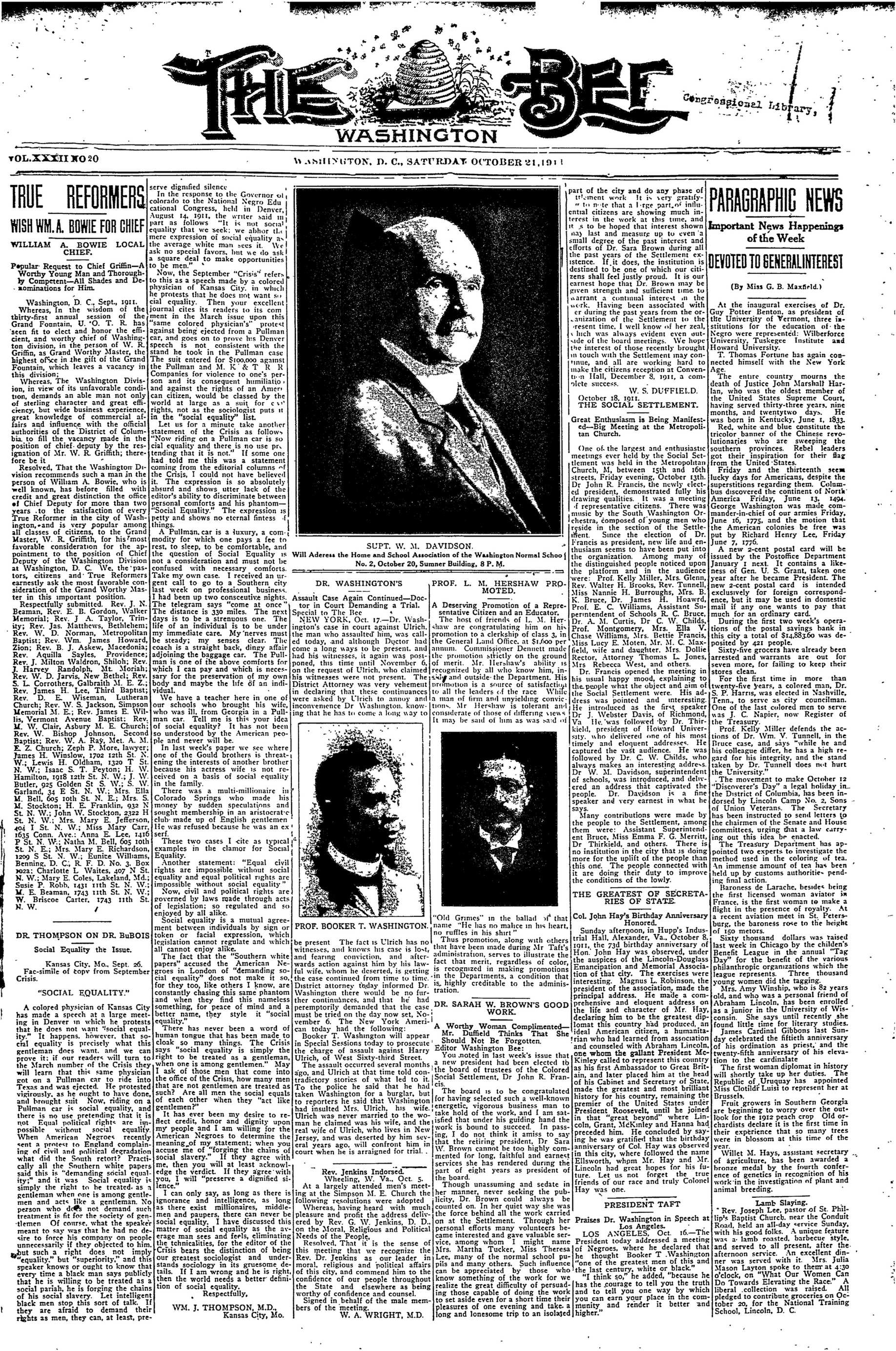
[Pictorial portrait of a man in formal attire, facing slightly to the right.]
Will Aderess the Home and School Association of the Washington Normal School No. 2, October 20, Sumner Building, 8 P. M.
DR. WASHINGTON'S
Assault Case Again Continued—Doctor in Court Demanding a Trial. Special to The Rec.
NEW YORK, Oct. 17—Dr. Washington's case in court against Ulrich, the man who assaulted him, was called today, and although Doctor had come a long ways to be present, and had his witnesses, it again was postponed, this time until November 6, on the request of Ulrich, who claimed his witnesses were not present. The District Attorney was very vehement in declaring that these continuances were asked by Ulrich to annoy and inconvenience Dr Washington, knowing that he has to come a long way to
PROF. BOOKER T. WASHINGTON
be present. The fact is Ulrich has no witnesses, and knows his case is lo-t, and fearing conviction, and afterwards action against him by his lawful wife, whom he deserted, is getting the case continued from time to time. District attorney today informed Dr. Washington there would be no further continuances, and that he had peremptorily demanded that the case must be tried on the day now set, November 6. The New York American today had the following: Booker T. Washington will appear in Special Sessions today to prosecute the charge of assault against Harry Ulrich, of West sixty-third Street. The assault occurred several months ago, and Ulrich at that time told contradictory stories of what led to it. To the police he said that he had taken Washington for a burglar, but to reporters he said that Washington had insulted Mrs. Ulrich, his wife. Ulrich was never married to the woman he claimed was his wife, and the real wife of Ulrich, who lives in New Jersey, and was deserted by him several years ago, will confront him in court when he is arraigned for trial.
Wheeling, W. V. Va., Oct. 5. At a largely attended men's meeting at the Simpson M. E. Church the following resolutions were adopted Whereas, having heard with much pleasure and profit the address delivered by Rev. G. W. Jenkins, D. D., on the Moral, Religious and Political Needs of the People, Resolved, That it is the sense of this meeting that we recognize the Rev. Dr. Jenkins as our leader in moral, religious and political affairs of this city, and commend him to the confidence of our people throughout the State and elsewhere as being worthy of confidence and counsel. Signed in behalf of the male members of the meeting. W. A. WRIGHT M.D.
PROF. L. M. HERSHAW PROMOTED.
A Deserving Promotion of a Representative Citizen and an Educator.
The host of friends of L. M. Hershaw are congratulating him on his promotion to a clerkship of class 3, in the General Land Office, at $1,600 per annum. Commissioner Dennett made the promotion strictly on the ground of merit. Mr. Hershaw's ability is recognized by all who know him, inside and outside the Department. His promotion is a source of satisfaction to all the leaders of the race. While a man of firm and unyielding convictions, Mr. Hershaw is tolerant and considerate of those of differing views. It may be said of him as was said of
"Old Grimes" in the ballad of that name "He has no mahice in his heart, no ruffles in his shirt"
Thus promotion, along with others that have been made during Mr Taft's administration, serves to illustrate the fact that merit, regardless of color, is recognized in making promotions in the Departments, a condition that is highly creditable to the administration.
DR. SARAH W. BROWN'S GOOD WORK
A Worthy Woman Complimented—Mr. Duffield Thinks That She Should Not Be Forgotten. Editor Washington Bee: You noted in last week's issue that a new president had been elected to the board of trustees of the Colored Social Settlement, Dr John R. Francis. The board is to be congratulated for having selected such a well-known energetic, vigorous business man to take hold of the work, and I am satisfied that under his guiding hand the work is bound to succeed. In passing, I do not think it amiss to say that the retiring president, Dr Sara W. Brown cannot be too highly commented for long, faithful and earnest services she has rendered during the part of eight years as president of the board.
Though unassuming and sedate in her manner, never seeking the publicity, Dr. Brown could always be counted on. In her quiet way she was the force behind all the work carried on at the Settlement. Through her personal efforts many volunteers became interested and gave valuable service, among whom I might name Mrs. Martha Tucker, Miss Theresa Lee, many of the normal school pupils and many others. Such influence can be appreciated by those who know something of the work for we realize the great difficulty of persuading those capable of doing the work to set aside even for a short time their pleasures of one evening and take a long and lonesome trip to an isolated
part of the city and do any phase of settlement work. It is very gratify to note that a large part of influential citizens are showing much interest in the work at this time, and it is to be hoped that interest shown may last and measure up to even a small degree of the past interest and efforts of Dr. Sara Brown during all the past years of the Settlement existence. If it does, the institution is destined to be one of which our citizens shall feel justly proud. It is our earnest hope that Dr. Brown may be given strength and sufficient time to warrant a continual interest in the work. Having been associated with her during the past years from the organization of the Settlement to the present time, I well know of her zeal, which was always evident outside of the board meetings. We hope the interest of those recently brought in touch with the Settlement may continue, and all are working hard to make the citizens reception at Convention Hall, December 8, 1911, a complete success.
Great Enthusiasm is Being Manifested—Big Meeting at the Metropolitan Church.
One of the largest and enthusiastic meetings ever held by the Social Settlement was held in the Metropolitan Church, M, between 15th and 16th streets, Friday evening, October 13th. Dr John R. Francis, the newly elected president, demonstrated fully his drawing qualities. It was a meeting of representative citizens. There was music by the South Washington Orchestra, composed of young men who reside in the section of the Settlement. Since the election of Dr. Francis as president, new life and enthusiasm seems to have been put into the organization. Among many of the distinguished people noticed upon the platform and in the audience were: Prof. Kelly Miller, Mrs. Glenn, Rev. Walter H. Brooks, Rev. Tunnel, Miss Nannie H. Burroughs, Mrs. B. K. Bruce, Dr. James H. Hoawrd, Prof. E. C. Williams, Assistant Superintendent of Schools R. C. Bruce, Dr. A. M. Curtis, Dr C. W. Childs, Prof. Montgomery, Mrs. Ella V. Chase Williams, Mrs. Bettie Francis, Miss Lucy E. Moten, Mr. M. C. Maxfield, wife and daughter. Mrs. Dollie Rector, Attorney Thomas L. Jones, Mrs. Rebecca West, and others.
Dr. Francis opened the meeting in his usual happy mood, explaining to the people what the object and aim of the Social Settlement were. His address was pointed and interesting. He introduced as the first speaker Dr J. Webster Davis, of Richmond, Va. He was followed by Dr. Thirkield, president of Howard University, who delivered one of his most timely and eloquent addresses. He captured the vast audience. He was followed by Dr. C. W. Childs, who always makes an interesting address. Dr W. M. Davidson, superintendent of schools, was introduced, and delivered an address that captivated the people. Dr. Davidson is a fine speaker and very earnest in what he says.
Many contributions were made by the people to the Settlement, among them were: Assistant Superintendent Bruce, Miss Emma F. G. Merritt, Dr Thirkield, and others. There is no institution in the city that is doing more for the uplift of the people than this one. The people connected with it are doing their duty to improve the conditions of the lowly.
THE GREATEST OF SECRETARIES OF STATE.
Col. John Hay's Birthday Anniversary Honored
Sunday afternoon, in Hupp's Industrial Hall, Alexander, Va., October 8, 1011, the 73rd birthday anniversary of Hon. John Hay was observed, under the auspices of the Lincoln-Douglass Emancipation and Memorial Association of that city. The exercises were interesting. Magnus L. Robinson, the president of the association, made the principal address. He made a comprehensive and eloquent address on the life and character of Mr. Hay, declaring him to be the greatest diplomat this country had produced, an ideal American citizen, a humanitarian who had learned from association and counseled with Abraham Lincoln, one whom the gallant President McKinley called to represent this country as his first Ambassador to Great Britain, and later placed him at the head of his Cabinet and Secretary of State, made the greatest and most brilliant history for his country, remaining the premier of the United States under President Roosevelt, until he joined in that "great beyond" where Lincoln, Grant, McKinley and Hanna had preceded him. He concluded by saying he was gratified that the birthday anniversary of Col. Hay was observed in this city, where followed the name Ellsworth, whom Mr. Hay and Mr. Lincoln had great hopes for his future. Let us not forget the true friends of our race and truly Colonel Hay was one.
PRESIDENT TAFT
Praises Dr. Washington in Speech at Los Angeles
LOS ANGELES, Oct. 16.—The President today addressed a meeting of Negroes, where he declared that he thought Booker T. Washington "one of the greatest men of this and the last century, white or black." "I think so," he added, "because he has the courage to tell you the truth and to tell you one way by which you can earn your place in the community and render it better and higher."
PARAGRAPHIC NEWS
At the inaugural exercises of Dr. Guy Potter Benton, as president of the University of Vermont, three institutions for the education of the Negro were represented: Wilberforce University, Tuskegee Institute and Howard University.
T. Thomas Fortune has again connected himself with the New York Age.
The entire country mourns the death of Justice John Marshall Harlan, who was the oldest member of the United States Supreme Court, having served thirty-three years, nine months, and twenty-two days. He was born in Kentucky, June 1, 1833. Red, white and blue constitute the tricolor banner of the Chinese revolutionaries who are sweeping the southern provinces. Rebel leaders got their inspiration for their flag from the United-States.
Friday and the thirteenth seem lucky days for Americans, despite the superstitions regarding them. Columbus discovered the continent of North America Friday, June 13, 1494. George Washington was made commander-in-chief of our军队 Friday, June 16, 1775, and the motion that the American colonies be free was put by Richard Henry Lee, Friday June 7, 1776.
A new 2-cent postal card will be issued by the Postoffice Department January 1 next. It contains a likeness of Gen. U. S. Grant, taken one year after he became President. The new 2-cent postal card is intended exclusively for foreign correspondence, but it may be used in domestic mail if any one wants to pay that much for an ordinary card.
During the first two week's operations of the postal savings bank in this city a total of $14,883.60 was deposited by 421 people.
Sixty-five grocers have already been arrested and warrants are out for seven more, for failing to keep their stores clean.
For the first time in more than twenty-five years, a colored man, Dr. S. P. Harris, was elected in Nashville, Tenn., to serve as city councilman. One of the last colored men to serve was J. C. Napier, now Register of the Treasury.
Prof. Kelly Miller defends the actions of Dr. Wm. V. Tunnell, in the Bruce case, and says "while he and his colleague differ, he has a high regard for his integrity, and the stand taken by Dr. Tunnell does not hurt the University."
The movement to make October 12 "Discoverer's Day" a legal holiday in the District of Columbia, has been indorsed by Lincoln Camp No. 2, Sons of Union Veterans. The Secretary has been instructed to send letters to the chairmen of the Senate and House committees, urging that a law carrying out this idea be enacted.
The Treasury Department has appointed two experts to investigate the method used in the coloring of tea. An immense amount of tea has been held up by customs authoritec pending final action.
Baroness de Larache, besides being the first licensed woman aviator in France, is the first woman to make a flight in the presence of royalty. At a recent aviation meet in St. Petersburg, the baroness rose to the height of 150 meters.
Sixty thousand dollars was raised last week in Chicago by the child's Benefit League in the annual "Tag Day" for the benefit of the various philanthropic organizations which the league represents. Three thousand young women did the tagging.
Mrs. Amy Winship, who is 82 years old, and who was a personal friend of Abraham Lincoln, has been enrolled as a junior in the University of Wisconsin. She says until recently she found little time for literary studies.
James Cardinal Gibbons last Sunday celebrated the fifteenth anniversary of his ordination as priest, and the twenty-fifth anniversary of his elevation to the cardinalate
The first woman diplomat in history will shortly take up her duties. The Republic of Uruquay has appointed Miss Clotildf Luisi to represent her at Brussels. Fruit growers in Southern Georgia are beginning to worry over the outlook for the 1912 peach crop Old orchardists declare it is the first time in their experience that so many trees were in blossom at this time of the year. Willet M. Hays, assistant secretary of agriculture, has been awarded a bronze medal by the fourth conference of genetics in recognition of his work in the investigation of plant and animal breeding.
Lamb Slaving
Rev. Joseph Lee, pastor of St. Phillip's Baptist Church, near the Conduit Road, held an all-day service Sunday, with his good folks. A unique feature was a lamb roasted, barbecue style, and served to all present, after the afternoon service. An excellent dinner was served with it. Mrs. Julia Mason Layton spoke to them at 4:30 o'clock, on "What Our Women Can Do Towards Elevating the Race." A liberal collection was raised. All pledged to contribute groceries on October 20, for the National Training School, Lincoln, D. C.
ERRORS IN WILLS.
Famous Lawyers Whose Testaments Were Defective.
TILDEN'S CURIOUS BLUNDER.
Loosely Drawn Stipulations That Invalidated His Charitable Trust Bequest—President Polk's Will, Written by Himself, Nullified.
Whether the old saying that "a lawyer who tries his own case has a fool for a client" is applicable to Samuel J. Tilden in the matter of drawing his will is not known. It was thought for some time that the will was drawn, or at least approved, by Charles O'Coron and James C. Carter, two of the most eminent lawyers in New York, but later statements, says Case and Comment, are to the effect that they had nothing at all to do with the will, and consequently it is not definitely known who was responsible for it.
It would hardly seem possible that Mr. Tilden himself could have made such a mistake had he been acting for some one else. The statement has been made that Mr. Tilden had some doubts as to the validity of those clauses which the court subsequently condemned and had spoken to Mr. Carter about it, but nothing more came of it.
In summing up the provisions of the Tilden will the court in holding it invalid stated that the testator in substance said: "I have determined to devote my estate to churitable, educational and scientific purposes. I have formed no detailed plan how that purpose can be executed, but under the law of New York it must be done through and by means of a corporation. I request you to cause to be incorporated an institution to be called the Tilden trust," with capacity to maintain a free library and reading room in the city of New York, and such other educational and scientific objects as you shall designate, and if you deem it expedient—that is, if you think it advisable and the fit and proper thing to do—convey to that institution all or such part of my residuary estate as you choose, and if you do not think that course advisable then apply it to such charitable, educational and scientific purposes as in your judgment will most substantially benefit mankind."
It will be noted that the discretion of the trustees was indefinite both as to the amount which they were to give to the corporation to be formed and also as to whether they should give any at all to the incorporation, and the validity of the bequest was denied upon the ground of this complete discretionary power to convey or not to convey to the suggested beneficiary.
The trustees procured the incorporation of the "Tilden trust" and elected to convey to it the entire property, but the court held that the invalidity of the charitable trust because of its uncertainty could not be cured by anything done by the trustees to execute it.
In striking contrast with the Tilden will is that of his contemporary in law and politics. Roscoe Conkling, the text of which is as follows: "I, Roscoe Conkling of Utica, make, publish and declare my last will and testament as follows: I give, devise and bequeath to my wife Julia and to her heirs and assists forever all my property and estate, whether real or mixed, and I constitute and appoint my said wife sole executrix of this my last will." It would undoubtedly take a better lawyer than even Mr. Conkling to break his will.
In passing upon the validity of the will of President James K. Polk a Tennessee court of chancery said: "This will was written by the testator with his own hand in the executive mansion at Washington at a time when he was president of the United States. He was a lawyer of recognized ability, had filled many high public offices with distinction and reflected great honor upon his state. His will was witnessed by a law partner and a senator in congress and named as executor one of the justices of the supreme court of the United States. It comes to us with the impression of having been carefully thought out before it was formally put down and published as his last testament."
Among other provisions his home, known as Polk Place, situated in the city of Nashville, was given to his wife for life, and upon her death it was bequeathed to the state of Tennessee in trust to be occupied and enjoyed "by such one of my blood relatives having the name of Polk as may be designated by the said state," and if there were no blood relatives of that name then "by such other of my blood relations as may be designated by the said state to execute this trust." The occupant was to keep the same in repair and prevent it from dislapping or falling into decay, to pay the taxes and to preserve and keep in repair "the tomb which may be placed or erected over the mortal remains of my beloved wife and myself and shall not permit the same to be removed not any buildings or other improvements be placed or erected over the spot where said tomb may be."
This will was declared invalid as tending to establish a perpetuity. It was not a gift for public charity and was merely an attempt to retain the property for the use of the blood relatives of the testator.
How easy it is for one to suggest a sure way for some one else to manage a troublesome affair!
NOT A GAME OF CHANCE.
After a Test the Jury Decided That Seven-up Was Decidedly Scientific.
One of Mark Twain's old time stories concerned the game of seven-up, or old sledge. Some Kentucky boys were arrested for playing this game under the usual charge of playing a game of chance. When they were brought before the judge their lawyer claimed that this game was not a game of chance, but was a game of science. The court, puzzled, asked for a suggestion, and the lawyer declared that if a jury of six gamblers well acquainted with the game in a scientific way and six deacons be impaled with a pack of cards their decision ought to be determinative. So the story goes:
"There was no disputing the fairness of the proposition. Four deacons and the two dominies were sworn in as the 'chance' jurymen, and six inveterate old seven-up professors were chosen to represent the 'science' side of the issue. They retired to the jury room.
"In about two hours Deacon Peters sent into court to borrow $3 from a friend. In about two hours more Dominie Miggles sent into court to borrow a 'stake' from a friend. During the next three or four hours the dominie and the other deacons sent into court for small loans.
"The rest of the story can be told briefly. About daylight the jury came in, and Deacon Job, the foreman, read the following verdict:
"We, the jury in the case of the commonwealth of Kentucky versus John Wheeler et al., have carefully considered the points of the case and tested the merits of the several theories advanced and do hereby unanimously decide that the game commonly known as old sledge, or seven-up, is eminently a game of science and not of chance. In demonstration whereof it is hereby and herein stated, iterated, reiterated, set forth and made manifest that during the entire night the "chance" men never won a game or turned a jack, although both feats were common and frequent to the opposition, and furthermore in support of this our verdict we call attention to the significant fact that the "chance" men are all broke and the "science" men have got the money. It is the deliberate opinion of this jury that the "chance" theory concerning seven-up is a pernicious doctrine and calculated to inflict untold suffering and peculiarly loss upon any community that takes stock in it."
SLEEPING SICKNESS.
The Grip This Dreadful Disease Takes Upon Its Victims.
The course of the dreadful disease, sleeping sickness, is an extremely slow one. The first stage is said to last a year or more, and the cause of the disease may be in the blood long before any symptoms whatever present themselves. The patient has occasional fever; indeed, a disease hitherto called Gambla fever has recently been recognized as the first stage of sleeping sickness. It is said that the swelling of the lymphatic glands of the neck is a characteristic early symptom. This was known in 1803 to Dr. Winterbotton, who states that slave traders, recognizing the symptom of a fatal disease, would not buy slaves who had this glandular enlargement. The patient feels well and strong and is able to go about his usual occupations.
The second stage is indicated by a distinct change in the appearance of the patient. His expression grows heavy and dull; he becomes apathetic, lies around a great deal and cannot exert himself. With the progress of the disease these symptoms become more marked; walking and speech become difficult and finally impossible. During the last week the sufferer lies in a state of complete coma, from which the illness derives its name. Often during the second stage of the disease the brain becomes affected, and some of the patients try to run away into the forests or swamps, where they die of exposure or starvation. To prevent this the relatives of a sufferer frequently chain him down until the time comes when he can no longer move.—McClure's Magazine.
Some Famous Men of Old.
The "nine worthies" were Joshua, David, Judas Maccabee, Hector of Troy, Alexander the Great, Julius Caesar, King Arthur of Britain, Charlemagne of France and Godfrey of Bouillon. The list varies somewhat, but this is the most popular one. The "seven wise men of Greece" were Solon, Thales, Pittucus, Blas, Cloobolus, Myson and Chellon of Sparta. The supposition is, of course, that these were not the only wise men in Greece, but the wisest—New York American.
Waiting For Him
"Yes, mum," said Poetic Pete as he twined an autumn leaf through his buttonhole. "I am a great lover of the romantic. I stopped at dis gate because I saw we sign 'Idlewood.'" "You did?" approved the housewife. "Well, there is a lot of idle wood down at the wood pile. Just take this ax and split up a half cord."—Chicago News.
A Greater Attraction.
Herr Harden told of a meeting at Gastelin between William I. and Francis Joseph. The Austrian sovereign commented impatiently on the too pressing attentions of the crowd. "It won't last long," returned his ally soothingly. "Bismarck will be here directly, and then no one will look at us."—London Spectator.
A mere madness—to live like a wretch and die rich.—Burton.
COLOR AND SOUND.
Hues That Humans Cannot See and Tones Louder Than Thunder That Are Unheard.
The primary colors shown in the rainbow vary from red to blue and violet, and the vibrations or lengths of the light waves that give us violet grow shorter and shorter and at length give us red. These vibrations can be measured. One day, quite by chance, I came across the statement that there were innumerable light waves longer than those which give violet. At once the question sprang. Were these longer waves represented by colors which we don't see, colors for which we have no name, colors of which we can form no conception? And was the same thing true of the waves which, growing shorter and shorter, give us the sensation of red? There is room, of course, for myriads of colors beyond this other extremity of our vision. A little study convinced me that my guess was right, for all the colors which we see are represented to our sense of feeling in degrees of heat; that is, blue shows one reading on the thermometer and red a higher reading, and by means of this new standard I discovered that man's range of vision is not even placed in the middle of the register of heat, but occupies a little space far up toward the warmer extremity of it. There are thousands of degrees of cold lower than blue and hundreds of degrees of heat above red. All these gradations are doubtless represented by colors which no human eye can perceive, no human mind imagine. It is with sight as with sound. We know now that there are no noises louder than thunder which we cannot hear, the roar that lies on the o'er side of silence. We men are poor restless prisoners, hemed in by our senses as by the walls of a cell, hearing only a part of nature's orchestra and that part imperfectly; seeing only a thousand part of the color marvels about us and seeing that infinitesimal part incorrectly and partially.—Forum.
THE DEATH OF A CZAR.
Dramatic Story of the Way Nicholas I.
Committed Suicide.
There are various stories of the death of the Czar Nicholas I. Here is one which the great singer Mario heard from a doctor of the court and which is told in "The Romance of a Great Singer."
"When the Russian army was meeting with reverse after reverse in the Crimean war the czar sent for his doctor and demanded to know which was the quickest and most painless poison that he knew of, bluntly telling the started physician that he had resolved to commit suicide. He further warned the doctor in the stern manner which was his characteristic that if he were not obeyed the doctor's life would be worthless. He sharply silenced the man's nervous remonstrances and commanded him to bring the poison. The doctor did not dare to refuse and a few minutes later brought a small vial containing the poison, which he assured the czar would deprive any one of existence in a few minutes. To be sure that he had been obeyed and that the doctor was speaking the truth the czar obliged him to remain in the room warning him that if the poison failed his life should answer for it. The czar took the poison without the least tremor or the movement of a muscle, and, although twice told by the doctor, who held his watch in his hand, that there was time to save him by an antidote should he alter his mind, the czar refused, answering the second entreaty by simply waving the man away, he by that time being unable to speak. It was given out that the czar had died from the effects of a severe chill, but those who knew the facts also knew that he had committed suicide rather than face the defeat of his army."
Carlyle an Intemperate Smoker.
Carlyle an in temperate smoker.
For about seventy of his eighty-six years Carlyle smoked and made most of his contemporaries smoke. The trouble with him was that he was too fond of smoking a rank pipe on an empty stomach. That gave him pains and his contemporaries particular pains, for "pulr auld Carlyle" was as savage as a meat house dog all the time. He cared for but two men in the world, Tennyson and Dickens. All the rest were "pulr, feckless, reekless, intemperate bladders and gas bags," and all because Tom did not know how to clean his pipe and keep it clean and would smoke before breakfast.—Tobacco Leaves.
Breaking the Sabbath:
Two Scots, one old and the other young, set out one bright winter Sunday morning to walk ten miles to kirk. The sun shone gloriously. The frozen road rang under their feet. The cold, pure air was as exhilarating as wine. The younger Scott looked up at the glittering blue sky and said: "It's a fine day."
The older man frowned and answered: "Aye, it is a fine day, but is this a day to be talking about days?"
Doubtful Vocalism.
"There is only one trouble about a Chinese cook," said the man from the west.
"What is that?"
"You can never tell whether he is singing at his work or whether he has burnt himself and is moaning with pain."—Washington Star.
Baron (to creditors)—I see no hopes of being able to pay what I owe you. Why not organize a suicide club?—Megcendorfer Blattet
MIGHTY ARCTURUS.
If This Star Were Our Sun It Would Instantly Consume the Earth.
The parallax of a star is its angular displacement as seen from two opposite points on the earth's orbit. The base line employed in this gigantic species of surveying is 186,000,000 miles in length, but the calculation is reduced to the semidiameter of the orbit. The results are at the same time amazing and instructive.
Let us take the famous star Arcturus, often called the "star of Job" because in the Old Testament the Almighty is represented as saying to the fortunate patriarch, who maintains a certain dignity in spite of his helplessness and his sufferings, "Canst thou call forth Arcturus and his sons?"
Many conflicting measures of the parallax of Arcturus have been made, but the latest made at Yale seem more probably correct than their predecessors. They fix the parallax at 0.066 seconds—i.e. sixty-six one-thousandth of a second of arc. From this it is easy to calculate the distance of the star. It comes out at nearly 200,000,000,000,000 miles (two hundred and ninety trillion miles). This is more than 3,000,000 times the distance of the earth from the sun.
Having this distance, we can calculate the actual amount of light shed by Arcturus, or, in other words, its actual brightness as compared with that of our sun, on the supposition that both were at the same distance from us. We thus find that Arcturus exceeds the sun as a light giver about 2,500 times! It is a sun 2,500 times brighter than ours.
Put the earth as near to Arcturus as it is to the sun and all life would disappear from its surface as if swept off by a blast of inconceivable heat. The summer temperature would rise to tens of thousands of degrees. The oceans would holl away. Vegetation would be burned up in a twinkling. The eyes of living beings would char in their sockets. The plains and mountains would burst into fame. Minerals would run in molten streams. There would be no comfort for a living world nearer to Arcturus than about 4,000,000,000 miles. If he has planets he must keep them at a respectful distance. And yet nearly 300,000,000,000 miles from him we can look into his blazing eye and see only a bright star.
Still, Dr. Alfred Russel Wallace maintains that this little earth, this tiny attendant of a tiny sun, is the only seat of intelligent life—outside of the misty midregion of disembodied spirits—that the universe contains, and Dr. Wallace is a learned man. But his learning is not that which astronomy offers.-Garrett P. Serviss in New York American.
Unavoidable Relax
A woman went before the magistrate and modestly inquired:
"Your honor, can I have a warrant for the arrest of my husband? He boxed my ears yesterday."
"Certainly, ma'am," replied the judge. "I will make out a warrant on the ground of assault and personal injuries."
"Can I fetch the warrant in about a month?"
"In a month? Why won't you take it at once?"
"Please, your honor, when my husband shapped my face, I took my rolling pin and hit him on the head so that he had to be removed to the hospital. The doctors say, however, that he will be on his legs again in a month."
Discrediting an Astrologer.
Discrediting an Astrologer.
A certain king, says a tale from the Persian, asked an astrologer, "How many years of life remain to me?" The wise man replied, "Ten." The king became very dependent and betook himself, as one stricken with a sickness, to his bed. His vizier, who possessed great wisdom, sent for the seer and in the king's presence asked him, "How many years have you to live?" He replied, "Twenty." The vizier ordered that he should that very hour be executed in the king's presence. The king was satisfied and commended the sagacity of his minister and no longer attached any importance to the astrologer's saying.
Getting Into German:
In the use of legal terms the German lawyer's gain in a saving of number of words over our equivalent expressions seems to be lost in multiplication of syllables in the words used by him. For example, he says "Zuruckbehaltungsrecht" for "right of iten" and "gesammtgutsverbindlichkeiten" for "liabilities of common property." What an awful word he must have as an equivalent for our "imprescriptibility"—Docket.
Bung In an Actor
"How did you enjoy the vaudeville performance?"
"It was good. They had performing cats, a baseball player, a champion puglist, a trained cockatoo, and, I give you my word, they even had an actor doing a turn."—Louisville Courrier Journal.
The Fanciest Ever
New Boarder—Haven't you got any fancy dishes here? Rural Landlord—Sure thing. Mame, bring the gentleman that mustache cup your grandfather used to use.—Puck.
A Way They Have
People are forever striving to get things for nothing and then failing to appreciate them because they didn't cost anything.-Chicago Record-Herald.
HIS DOLLAR BILL
His Charitable Endeavor Was Not Appreciated, and the Bill Was Pocketed by Another.
Diplomacy doesn't always work, as a certain kint. hearted business man in West Philadelphia has just found out. He says that the lesson was cheap at the price, but at the same time he will employ more direct methods next time he wishes to play the philanthropist.
It happened on the subway the other night. He had just closed a real estate deal at considerable profit and was feeling very generous, so when he saw a poor woman in a threadbare dress carefully count out five pennies for her ticket and saw that it was the last money in her worn pocketbook he determined to help her. Of course it wasn't easy, but the man prides himself upon being a diplomat. So, crumpling a dollar bill up in his hand, he stooped over as if picking something up and then, holding it out to the woman, said:
"Mudam, here is some money you dropped." He tried to smile significantly as he said it, but she didn't seem to understand and said simply:
"Tain't mine."
"You'd better take it," he said. "It isn't mine, and it was lying right by you."
The woman shook her head at first, then took it slowly out of his hand and looked at it gloatingly. The man smiled, well pleased with himself, but an instant later the woman, seeing a man looking down at the platform, rushed up and cried, "Was you looking for a dollar bill?" "I sure was," answered the man promptly. "Well, here it is," said the woman, and the man with a delighted "Oh, thanks!" calmly pocketed the sum and walked away—Philadelphia Times.
FIRE EATERS.
The Trick of Breathing Flames and Sparks From the Mouth.
Fire tricks were practiced in very ancient times. The first known fire breather was a Syrian slave named Eunus, a leader in the Servile war in Sicily, 130 B.C. He pretended to have immediate communication with the gods. When desirous of inspiring his followers with courage he breathed flames and sparks from his mouth.
In order to accomplish this feat Eunus pierced a nutshell at both ends, and, having filled it with some burning substance, he put it in his mouth and breathed through it. The same trick is performed today in a more approved manner. The performer rolls some flax or hemp into a ball about the size of a walnut, which he lets burn until it is nearly consumed. Then he rolls around it more flax while it is still burning. By this means the fire is retained in the ball for a long time. He slips this ball into his mouth unperceived and breathes through it. His breath revives the fire, and he sustains no injury so long as he inhales only through his nostrils.
Various theories have been advanced to account for other feats of this sort performed by the ancients. An old ordeal was the holding of a redhot iron by the accused, who was not burned if he were innocent. Probably some protective paste was used on the hands. The peculiar property of mineral salts, such as alum, in protecting articles of dress from fire has long been known. An old Milanese devised a costume consisting of a cloth covering for the body which had been steeped in alum. A metallic dress of wire gauze was added to this, and thus protected a man might walk on hot iron.-Harper's.
London's Dramatic Censors.
London has had its absurd, dramatic censors even if it cannot quite come up to Vienna. Colley Clibber in his autobiography tells us of one master of the revels who was responsible for the licensing of plays in those days expurgating the whole first act of "Richard III." on the ground that the distresses of Henry VI. would remind weak people of King James, then living in France. In fact, Shakespeare has more than once been censored, for "King Lear" was inhibited during the illness of George III. George Colman when reader of plays banned the use of such words as angel and heaven.—London Chronicle.
"Unfit for duty because of insomnia" was the record of a New York policeman for several weeks. Inspector Byrnes sent for the man and gave him a little bit of advice, thus: "Tonight, about midnight, put on your uniform, belt, hat, revolver, take night stick in hand and go to some corner house. Lean against it, and lean against it hard, as if you were really on duty. You'll go to sleep, all right." -New York Tribune.
No Skill Required.
Litigant-Your fee is outrageous. Why, it is more than three-fourths of what I recovered. Lawyer-I furnished the skill and the legal learning for your case. Litigant-But I furnished the case. Lawyer-Oh, anybody can fall down a coal-hole!-Boston Transcript.
Alarmed Her.
Servant—Heavens! I have knocked the big flowerpot off the window ledge and it struck a man on the head. Mistress—What! My beautiful majolica?—Flegende Blatter.
We may forgive those who bore us. We cannot forgive those whom we bore.—La Rochefoucauld.
RUSSIA'S JESTER.
Balakireff is the Joe Miller of the Muscovites.
HIS WIT TICKLES THE BEAR.
He Was the Court Fool That Many a Time Braved the Anger of Peter the Great—His Miracle of the Sword and a Wondrous Deed of Daring.
Every nation has its typical jester, around whom crystallize all the floating stories of a people. Thus England has its Joe Miller, Germany its Till Eulenspiegel, Italy its Punchnello, the orient its Nasreddin el Khoja and Russia its Balakireff. Like Joe Miller, the last was a real character, though not all the jokes credited to him were his own. Some were inventions of a later age; others were borrowed from the past. He shares the credit for many of the latter with Joe Miller and Eulenspiegel.
History records that Balakkreff was the favorite jester of Peter the Great. Tradition represents him as the constant company of that czar, frequently exercising his wilt at royal expense. One day, for example, a cousin of his had fallen under the czar's displeasure and was sentenced to death. Balakkreff undertook to obtain a reprieve, The czar guessed his errand even before he opened his mouth. "No!" he cried. "Tis no use your coming here. I swear that I will not grant what you are going to ask!" Balakkreff dropped at once to his knees. "Peter Mexelviteh," he cried, "I pray you, put to death that scamp of a cousin of mine!" Peter, thus caught in his own trap, had no choice but to laugh and send a pardon to the culprit.
On another occasion Balakkiref asked that he might be enrolled among his master's domestic guards. Peter consented for the sake of the joke, but warned his fester that death was the penalty if any officer of the guards absented himself from his poet or mislaid his sword. Then to test the volunteer he sent him up a flagon of wine to "moisten his commission." Balakkiref, as was expected, drank to the intoxicating point. While he was sleeping off his debauch the czar himself crept into the room and carried off his sword from the scabbard. Balakkiref, though badly scared, on awaking made shift to replace the missing weapon with his own wooden imitation of the guardsmen's sword. He was called to parade next morning, when Peter feigned hot indignation at the untidiness of one of the guards. "Captain Balakkiref," he cried at last, "draw your sword and cut off the head of that sloven!"
Balakiref cast his eyes up to heaven. "Oh, merciful God," he prayed, "grant that my sword may turn into wood before I use it on one of my own fellow soldiers!"
And, lo, when he unsheathed it the blade stood revealed as a wooden one. Peter laughed heartily at the knave's presence of mind and restored him to favor.
A more serious offense resulted in the banishment of the jester. "Never dare to appear again on Russian soil!" stormed the emperor. Judge then of Peter's surprise when, a week later, he beheld his old favorite coolly driving a cart past the palace.
"How dare you disobey me?" shouted the enraged monarch. "Did I not forbid you ever to show yourself on Russian soil?"
"Nay," replied Balakiref, "I have not disobeyed you. This is not Russian soil."
"How say you—not Russian soil?" "Truly not. His cartoon of earth on which I am sitting is Swedish soil. I dug it up in Finland only the other day."
Again the ezar laughed uproariously and readmitted his buffoon to favor. Some historians add that when he heard the excuse he said, "If Finland be Swedish soil now it shall be Russian before long," a threat he was not slow to fulfill.
This story, however, was an old one long before the time of Balakireff. It forms the twenty-seventh adventure of Till Eulenspiegel, who is reputed to have died in 1550. Having offended the Duke of Lunenberg, Till was "forbidden the land." He purchased a shilling's worth of earth to fill his cart with, and, being duly challenged by the duke, he answered:
"My gracious lord, I am not in your land, but in mine own, wherein I do sit. I bought it of a boor for a shilling. And rightfully could he sell it, for from his foresathers he inherited it. So is this truly my land."
At the close of one of Czar Peter's campaigns Balakrief overheard some Russian officers boasting of expolls they had performed.
"Nay," he cried. "I can tell a better story than any of you." And, being pressed for the story, he continued:
"Never have I liked this modern way of fighting all in a body together. Surely it would be more manly for each to stand by himself. Therefore went I out alone in search of adventures. One day while reconnoitering near the enemy's outposts I espied a Swedish soldier lying on the ground. Before he could rise and give the alarm I rushed upon him and with one blow from my sword cut off his right foot."
"You fool!" cried one of his auditors.
"Why did you not cut off his head?"
"So would I have done," retorted
Balakiref. "except that somebody else
had already done it."—Washington
Star.
‘ .
et CF a
ied 7
|
Published
‘ at
Eye St, N, W. Washington,
atop Eye S: Ne gton,
* W.CALVIN CHASE, EDITOR.
Entered at the Post Office at Wasb-
ington, D. C, as second-class
mail matter. +
ESTABLISHED 188
TERMS OF SUBSCRIPTION.
One copy per year in advance...$2.0c
Si mMomths.......eeceeeeeeeeves 1000
Three montht........ssessceeeee $0
Subscription monthly........06. 20
*
2 eee
INSPIRING CAREERS.
at is fortunate for the student:
at Howard University that with
all-this passing show of - genius
Statesmanship and __scholarshig
which the Nation's capital presents
they, the students, do not need to
descend from Howard's hill to find
a man after whose life it is safe to
pattern theirs, and whose life fur-
nishes an inspiration as great as
those who legislate for us on Capi-
tol hill. Prof. Kelly Miller is a
shining example of the ability of
‘man to remove restrictions, rise up
from out lowly surroundings and,
by mere self-efforts, assume a
rightiul place among the elect. Not
only may the students at Howard
University find in Prof. Kelly Mil-
ler an incentive to greatest effort,
but the hundreds of clerks and
messengers in the government ser-
vice here at Washington.may find
much in his life to emulate, for at
one time he was an underestimated
government clerk. He is a master
of English. There are so few, who
can claim a place in the list of mas-
ters of. English that to place him
there is quite sufficient to surround
him with a contingent of worthy
place-seekers who would emulate
him. But acknowledging Prof.
Miller’s scholarship, his pen’s
worth, and there are few writers
who even approach him for style,
diction, comprehensiveness, and fer-
tility of thought and research, there
is another side to him that swells
his life to emulative proportions,
and that is the purity and supleness
of his private life. There is not
one jot of selfishness in his make-
up. Although his name and fame
as a scholar is co-extensive with the
fame of the university he repre-
sents, and although his splendid
abilities are but meagerly reward-
ed, there is a simplicity about his
life, and a complacent acceptance
of apparent lack of proper apprecia-
tian that not only invites our at-
tention, but challenges our admira-
tion. Prof. Miller’s only tools given
him to carve his place in the nich of
fame were an indomnitable will,
perfect poise, and a touch of hu-
manity that made all other men his
kin for whom he felt he should Ia-
bor without thought of reward.
Prof. Kelly Miller’s life is really an
smspising one. *
JUSTICE HARLAN.
When the spirit of John Marshal
Harlan left its temple of clay last
Saturday morning a great light
went out. and a great friend of the
Negro ‘passed ‘out of this life. As
a member of the United States Su-
preme Court, the highest tribunal
in this land, Justice Harlan dissent-
ed from every decision handed
down by that’ court against the
rights of the race. He may, not
have heen a better interpreter of
the Jaw than his colleagues, but
semchow his interpretations: leaned
more towards humanity than his
colleagues. Te has well been re-
ferred to as the “grand old man,”
and grand he was, and grand is ev-
ery man who, like him, can see his
was to decide law, or rather con-
Struc law as a protection to those
who need protection, Following
the traditions of his early life. when
he came to the Supreme Court, he
did net forsake us—he did not fol-
low the maiority in deciding every
case effecting the Negro, effecting
human rights. against us. An en-
tire race, téday, is weeping because
he has been taken from the bench.
An entire race is howed in grief he-
cause a friend has been taken from
us. Justice Harlan loved iustice.
as much for the humblest citizen
as for the highest. Justice Harlan
was old-fashion enough, and was
‘so grounded in law that he could
Delieve. and did believe that a pro-
tecting: ~tatute was enacted to pro-
tect: that an \merican citizen was
entitled -to justice ‘regardless and
in spite of his color. Now that he
has gone, we cannot help but trem-
ble, and fear that no one after him
may dissent against decisions that
are against our race. A great and
good man has gone to his reward,
and if the prayers of thé race are
answered, and if future reward is
measured by the good one has done
whlie yet in life, then great will be
the reward of the late, lamented
Justice Harlan. - 7
' MEMBERS OF THE BAR.
The colored members of the
bar should have no cause to com-
plain of their treatment by the
courts of this city. There are no
professional men who are treated
better by the judges of our courts
than the colored members of the
bar. The great trouble is, that
the colored members are not or-
ganized, They could do much
good if they were. There is, in
the first place, too much bickering,
jealousy, back-biting and, petty
meanness among certain colored
members of the bar’ Many of
them are too jealous of one an-
other. If one has more cases than
the other, that old girm monster
will show itself. The judges treat
colored members of the bar with
as much respect and consideration
: they do the white members of
the bar. It is true that colored
lawyers cannot hope to have as
large cases as the whites, because
the colored people have not that
property interest and possessions as
the white people. There are no
great railroad corporations, trust
companies and other great institu-
tions among the colored pedple,
as you will find among the whites.
But the suits that the colored mém-
bers of the bar have are handled
with that degree of ability that is
found in the whites. There are a
few colored lawyers who are so
thin-skinned as to say that the court
is prejudiced, if they should lose a
case. The fact is, the lawyer should
know the law and be able to ex-
pound it when he goes before the
court. An ignorant lawyer is as
bad as an ignorant mechanic.
Many lawyers try their cases in a
bar room before a class of whisky
and beer- drinkers, and when they
appear before the court and lose,
they will say: “If I had——of
course, the judge has it in for my
client,” and all such rot. The fact
of the matter is the lawyer is to
blame and not the court.
Let the colored bar organize and
then it will see the difference. ~
MR. WM. A. BOWIE.
Many well-known and prominent
citizens and ministers of the gos
pel have petitioned Mr. W. R. Grif
fin, Grand Worthy Chief of the
United Order of True Reformers,
to appoint Mr. Wm. A. Bowie, dep-
uty chief of the order in this city
Mr. Bowie is a young, active and
progressive worker in the order
and a man who is well known and
liked by the people in this city.
Chief Griffid could not select a bet-
ter man or any one more worthy
than Mr. Bowie. The petition,
which has been sent to Chief Grif-
fin, or rather a copy of it, appears
in this week’s issue of The Bee,
which is an evidence of the esteem
in which he is held by the best
known men in the ministry. Mr.
Bowie was at one time deputy, and
his work was most satisfactory.
Mr. Bowie is also popular with the
press, which is a necessary requi-
site to the order, Among Mr.
Nowie's strong supporters, and who
is handling his campaign. is Mr.
Lewis, the president of the Labo-
rers’ Union. A better or stronger
man in the True Reformers cannot
be found. He it was who made the,
election of Chief Griffin possible.
The very fact that Mr. Lewis rec-
amends Mr. Bowie ought to be
sufficient. There is no man in this
city who has a stronger -following
than Mr..Lewis. He has the com-'
non people with him. What The
Bee means by the common peoplé
is the working people, the sons of
toil, who have the Laborers’ Union
a stiecess. Chief Griffin would
make no mistake in appointing Mr.
Bowie, because, as secretary of the
Laborers’ Union, he has “demon-
strated his great executive ability.
| ANTI-NEGRO DECISIONS.
| In Oltio and Illinois last week.
there were two decisions rendered
by judges that are particularly dis-
couraging. At Columbus, where
Graham Duewell, a colored lawyer.
had brought suit against a white
coniectiorer for reiusing him a
glass of soda, a Republican Com-
inom Pleas judge rendered a decis-
jpn that soda fountain keepers are
not compelled to serve any one they
choose to refuse. The colored at-
torney contended that a soda foun-
tain is a “place of general public
accommodation.” The same week,
at Chicago, a municipal judge ren,
dered a decision that an automobile
livery company is not a public con-
veyor, and therefore not liable for
refusing to transport Negroes.
Here we have two adverse court
decisions against us in States here-
tofore considered ‘friendly towards
rights due to the race as American
citizens. While many in the race
are quibbling among. themselves,
‘and contending against each other.
the courts are interpreting the law
against us. Such decisions as
these, manifestly unsupported by
aw, and manifestly the result of
race prejudice, may- have a strong
tendency to cause the Negro vote to
be recorded in favor of the recall
lof judges when the proposition
comes up for adoption in Oltio and
Ilinois, Is it possible that we can-
not hope for justice from the
courts? Is it possible that the Ne-
groes of Ohio and’ Tllinois will fail
to carry these cases to a higher and
the highest court?
REMARKABLE DEGENERACY
Tt. ont enartacla sat ome enniist
ihe sad spectacie that one would
witness is the great number of
young criminals” brought before
the criminal courts, Nos. 1 and 2,
charged with housebreaking and
other high crimes and misdemean-
ors. In Criminal Court No. 1 on
last Monday at least a dozen crim-
inals were arraigned before his
honor, Justice Anderson, on many
serious charges. What could have
been the thoughts of Judge Ander-
son? What was his private opin-
ion of the young Negro of today?
The editor of this paper sat there
and wondered to.himself if the
learned judge had the same opin-
ion Of every young colored man as
he had of the men who were
brought before him for sentence.
Every man with but one exception
plead guilty to the indictment.
Notwithstanding the many aggra-
vated cases, the judge showed a
romarkable leniency in many cases.
What is the pulpit doing to reform
tlfis’ criminal tlass? Is not the
young Negro of today inflicted avith
a greater ¢riminal tendency ‘than
those in former years or sodn after
reconstruction? The so-called in-
telligent classes are not going to
teach reformation, They have he-
come intoxicated with social pro-
pensities and ‘are ambitious for
dress and’ frolic. The _ police
court of this city seems to be mo-
nopotized gby a class of individuals
who have no respect for the higher
walks, of life. There‘is a great
deal of work for the pulpit to do,
and it should see to it that a refor-
mation takes place among the crim-
inal classes of this community.
' TRUE REFORMERS.
There is no organization in this
country that is any more deserving
lof support than the Grand Unitec
Order of True Reformers, of which
Mr. W. R. Griffith, the well-known
and hustling chief is head. No man
has worked harder for the success
of the organization than Chiei
Griffin. He has resurrected it and
within a few months The Bee he-
lieves that the True Reformers will
be in a better condition financially
and numerically than it has ever
been. The True Reformers in this
city are gaining new life. Every-
body seems to be rallying around
the standard bearer of Chief (rif-
fin. The Bee hay abvays given its
support to tlie organization, and
stated at the time the organization
was probibited from doing business
that it would be restored again to
its former greatness, Chief Griffin
is entitled to the credit of making
it a success,
THE REF.
| A lige in The Bee is more effec.
tive than a column is in any othe
paper. The Bee leads all other
Negro publications in the country
The personal attack on .the editor
of The Bee last week is in keeping
with similar attacks made by per-
sons who have ignominiously failed
to measure arms with him in any
kind of combat. The best evidence
of the superiority of The Bee over
all other Negro publications in this
city is the support the people give
it and its success in the journalistic
field.
“A man once, did sell the lion's
skin while the beast still lived was
killed while hunting him.”
The Bee will have more to say
later on. :
CAMPRELL CARRINGTON.
It was, indeed. very gratifying
to the friends and admirers of Col.
Campbell Carrington to sce. kim
out, and almost’ himself again,
‘From his appearance no doub'
“Richard will soon be _ himself
again.” The genial and affable at-
torney paid his office, *s03 D
Street. a_ visit Monday morning,
accompanied by his faithful wife.
who looks after his every want
That same sweet smile yet remains
with him, and it is the hope of The
Bee that Campbell Carrington will
soon be among his associates and
companions.
DR.JAMES E. SHEPARD.
Do something is the question.
The men who are doing something
have their enemies. You must re-
spect the man who is successful.
Dr. Shepard'is a man who is and
has done sométhing. The South,
as well as the country, is proud of
him. This week he takes a trip
North and it is believed that he
will realize much good in the way
of advancing his school, which is
of great benefit to the people of the
South.
HIS CRITICS *
Whose fault is it now? The
demagogues and blacklegs whe
have been declaring that Dr.-Wash-
ington would not dare to prosecute
his New York assailant was be-
fore the New York bar of justice
Tuesday, and demanding a_ trial
and the prosecution of his assail-
ant, but the defendant pleaded for
a postponement. Why? Let .the
‘demagogues ‘and b.acklegs answer.
| THE PROGRESSIVES.
ihe Pfogressive convention
which was held this week enunciat-
jed a declaration of principles, Mr.
Jantes A. Garfield imagines ‘that
he is the whole convention. Just
when he became so great The Bec
wonders, Certainly there is noth-
Be he hax achieved. President
Roosevelt placed him in_his Cabi-
net. If there are any Negro pro-
xressives they will be left in the
cold when the love feast comes,
MEMOMIAL TO JUSTICE
HARLAN.
Tt is but fair, just-and human,
that the colored citizens of the
United States should honor and re-
spect the services of the late Jus-
tice John Marshall Harlan, by hold-
ing a public themorial meeting in
this city.- .\Iready a movement is
on foot for sich a’ meeting, and it
is hoped that every loyal and patri-
atic citizen will respond and make
the mecting one that “will be long
remembered, Os
SOCIAL SETTLEMENT.
The meeting of the Social Sct-
tlement last Friday evening, Octo-
ber 13, in the Metropolitan Church,
was a great event. The enthusiasm
that the people manifested was an
evidence that the organization
needed some one the people would
follow. Dr. John R. Francis
seems to be that one. He is to be
congratulated on the success of his
- public meeting:
| Better keep awake.
These are no times for day
—
pics
__ Get a move, a hustle and a rustle
if you expect to keep up with the
Procession,
ee
At’ last accounts not a_ single
snember of the Board of Education
had handed in his resignation, and
none are expected to.
1 Why is it that Jewish, Greek and
| Italian merchants can locate in
thickly Negro-populated districts
land do a thriving business, while
: A g
' Negroes either will not start busi-
ness among their own, or fail if
;they do. Talk about “following
the color line,” these Jewish, Greek
and Italian storekeepers know what
profit there is in following it. In
the Northwest, where there is a
colored population of nearly twenty
thousand, practically all the busi-
ness, save the drugs and clothes-
cleaning business, is in the hands of
ignorant Russian Jews, dirty Ital-
jans, and ‘insufferable Greeks.
Why is it?
Woman's Domestic Council.
The Woman's Domestic Council
held its first meeting of the season
at the Clarke Training School, 1106
R Street Northwest, Friday, Oct 13,
at 8.30 PM
| There was quite a number present
Among them was: Miss Henrietta V
Davis. Rev. Wiseman, Mrs M.A.
Clarke, of New York, and Mrs L. R,
Clarke |
This council anticipates much good
to be accomplished through its work-
ing. Mrs. SI. Carter is president, and
‘A. P Cole. sccretany. 4
| The Bee's circulation is increas-
ing each week, by leaps and bounds,
and all because we print the news,
the most news, and the best news
each week. People won't buy
phony diamonds at genuine dia-
mond prices, and people won't take
a newspaper that does not print
the news.
Hon. J. C. Napier delivered an
laddrees at the Appalachian Expo-
sition in Tennessee recently. Meas-
ured by how he stands at home,
and that is the safe way of measur-
ing a man, J. C. Napier is a great
big, muchly admired man. His
own State loves him and loves to
honor him. And he deserves it, for
jhe is a high-class, clean, able gen-
tleman.
Miss Cornelia Webb, of Cincinnati,
Qhio, is visiting this city, the guest
ee Mr. and Mrs. Samuel H. Webb, of
426,.Q Street Northwest. She will re-
‘main here until the rsth of October.
Public Men And Things
ee ae een ee Obs MORE:
bunches are buying certainly does
jhelp their appearance, and I approve
of iL no matter what the tax is. |
never did blame a woman for straight.
ening her hair. Who wants to prom:
gnade down the Avenue de Nig with
$45 worth of willow plumes on. a
heal whose hair covering looks like
minnie balls assembled for consulta-
tipn? The fact that hair can be
raightened proves it was never or-
dained to stick close to the scalp in
strands one-sixteenth of an inch long.
Speaking abdut hair straightener, 1'll
bet Armond Scott's automobile
against any other noise, that Rev.
Corrothers, some time in the early pe-
tiod of his existence, used a few
pounds of bovine fat reduced to a
vaseline constituency, on his locks.
Did you ever gaze on the Doctor's
hair?) Well, a fly could no more light
and stick on his hair than a mule
could climb Mount {lane irom the
gorge side. But hair doesn't. make
the man. If it did Judge Terrell
would be a mollusk back in the glacial
period, and Roscoe Bruce would be
a nameless waif resting in the cata-
combs. But getting back to Dr. Cor-
rothers, before I lose the thread of
my discourse, he's got the appearance
of a well-kept gentleman. If ever I
get to the point where I can have a
lot of hod carriers and washerwomen
“ah wurkin’ fer me,” providing me
with prince albert coats, square-top
hats, porterhouse steaks, amd lobsters
in exchange for my ‘getting them
ready to fall in line when old Gabriel
toots his horn on resurrection morn,
I won't give a California ig for any-
zody. But let me adcise you, serious-
ly, Dr! Corrothers gives his congrega-
tion a pretty fair exchange for the
robbery. The Doctor is a fine pulpit
orator, looks well after his fléck, and
hands them some pretty sound advice
on Sunday. He’s obsessed with the
idea that he's got to play in the game
of politics, be an independent, and
oppose Republicans. Wheneverr: I
hear Doctor talking independence, I
always gesticulate to myself—"whose
looney now?” But sinct that Boston
meeting the Rev. Dr. Corrothers, D.
D., ain't so independent as he use to
was There were some things that
his co-laborer Waldron didn’t explain
about the jack-pot with a succinct-
ness to suit him. I only use “jack-
pot” fignratively. I've “hearn it
sayed” that after that Boston meet-
ing Dr. Corrothers sat down in his
study one day and reflectively asked
himself the question, if two and two
really makes four. The two Doctors
are differently alike, so different that
when they come to the point where
both will be a case of “dust to dust,”
it will be impossible for both to rest
in Harmony Cemetery at the same
time. Now if, anybody expects to
wake up and find Corrothers a fool
UN miss my guess if that somebody
ain't already adjudged insane. No
matter if you differ with him, you
have to respect him, and you can’t
help liking him because he’s fair. He
never roasts you just because you
can’t use the same glasses he uses,
and he doesn’t fall out with you if
you don’t want to take the road he
takes. Galbraith Church got a real
prize when it got him for a pastor,
and this community has had nothing
subtracted from its achievements be-
cause of his presence in it. There are
a lot of men far less able than Dr.
Corrothers, but there ain’t no whole
township fult of abler men than he.
If you give every dog his dues,
you: got to give Dr. Corrothers
his, and I don’t mean to put him in
the canine class either. He's a long
ways from being a_Hamfatto, even if
he does live easy. But if I were him,
and I say this sub-rosa—just loud
enough for you to read it—I would
slip down to the hatters some day and
ask him if he wouldn't please send out
to my house, and charge it to Gal-
braith’s congregation, a hat in ex-
change for that sugar-loaf affair he’
wears. And I would let out my sus-
penders about an inch. Did you ever!
notice that Dr. Corrothers always
wears his trousers “gallused up”
about two inches from his instep to|
show his neat foot? All these A. M.
E. Zion preachers are dead stuck on
their feet. Why that’s the only part
of John C Dancy's anatomy that he
will keep dressed up. But crawling
pack to Corrothers, take my word
for it, he’s some pumpkins, a darn
ight more than a nightmare.
af
T saw Napoleon Marshall here last
Thursday night, October the 12th
uet him on the Boulevard Theatre,
Nap looks well, but rather tired. “It
ho’ is a pity” the way that boy has
iad te work since he got out of Har-
ard University, It’s a wonder to me.
tow the poor fellow with an athletic
ieart. could ever fatten up as he is,
ind work as strenuously as he does.
| remember when alt us fellows here
redicted a brilliant carews for Nap.
© soon as he slunk away from Har-
ard, and we haven't been disappoint-
Look how he camped on the
rail of the Brownsville soldiers,
"1 saw Napoleon Marshall here last
Tharsday night, October the 12th,
met him on the Boulevard Theatre.
Nap looks well, but rather tired. “It
sho’ iz a pity” the way that boy has
had to work since he got out of Har-
vard University. It’s a wonder to me
how sthe poor fellow with an athletic
heart. could ever fatten up as he is,
and work as strenuously as he does.
T remember when alt us fellows here
predicted a brilliant carews for Nap.
so soon as he slunk away from Har-
vard, and we haven't been disappoint-
ed Look how he camped on_ the
trail of the Brownsville soldiers,
without money, and without price, ex-
cept what they and Senator Foraker
could hand him. Look how he has
sacrificed happiness and future just to
snuff out thé candle of that Tuske-
geen wonder, and note how nervous,
idgety he is because the Tuskegean’s
candle has become an electric light.
He has whispered to his friends, loud
enough to be heard by Sam Lacey
and'a few other. Night-blooming se-
ries, that he’s going to get Roscoe
Bruce’s scalp. Next to Booker
Washington, Roscoe Bruce is the one
wart that Nap. loses sleep over. One
of Nap’s particular friends said to
another particular friend, that if Nap
stayed here long enough he was going
to take him- out to the Zoo, down
behind one of the bear cages, and
whisper’ to him gently, while the
moon is shining, that if he would
only get acquainted with old Visible
Means of Support he'd be a catalogue-
size apple in this or any other com-
munity. The fact 1s Napoleon Mar-
shall is a fellow that’s got heaps of
ability, but his energy got switched
off into the misdirected channel. If,
he'd buckle down. to law, just stick,
to it, there wouldn't be ‘many who:
would give him the distance flag. But!
jhe’s just so dog-goned full of that
idea that he can get Booker T’s Boat,
and so full of the silly notion that he
can put a lever under Roscoe Bruce
and pry him loose that he’s - been
Wasting 2 lot of valuable time sleeps
ing at the switch. He's an affable
fellow, pleasant as a basket of chips.
Got brains too, and plenty of them.
Got culture, and réal native ability,
but he's always chasing some will-o-
wisp. I remember when’ he went in
with Tom Jones to practice law—
moved his library. consisting of as
many as three or four books, down to.
Tom's office. We other Howard Law
School shines figured out that this
team woula be a soxdologer. But
‘watchman, what of the night?”- Why
Tom Jones is making money, buying
Property and sending his daughters
away to fashionable eastern boarding
schools, and Nap is hugging’ and luge
gine the delusive hope that he'll get
Booker yet. As a graduate, and
licensed sage, let me mject this dope
into you, dear Nap, just forget that
Booker Washington crowd, get, busy
on your own temple, take a few hours
exercise in the “doing something”
gymnasium, and with your ability,
your education, you will move over
into the king row, ‘cause you've got
tne -oods. All you want to do 1s to
sell them in the open market. And at
that, I’m your friend until death we
do mart.
yt
I was in a friend’s house the Uther
day, and while viewing with deep re~
flection the painting of “Napoleon's
Return from Moscow,” by Meisson-
ier, my mind involuntarily turned to
‘Dr. Will Conner, who is Preparing
to go to Indiana to practice medicine
on the over-confident and unsuspect
ing Hoosiers. just imagined I could
see Doc., in about two months return-
ing. OF course, Doc., being new out
there, may run into a flood of church
concerts, entertainment, “and sich” to
manage, and if he dves,. he'll show
them how he ran amuck here, be-
cause Doc. is a real hustler in church
affairs, even if he doesn’t wear his
insignia of office on the lapel of his
coat. I'm half way suspecting. that
he'll find that old regular Stoo every
month down at the Penion Office
more reliable than patients’ fees out
in “Indgeana,” Anyhow, [ wish him
well, ‘cause he’s a eed scout, even
if he is a bit noisy. Doc’s a real hus-
tler, and a hustler most always gets
there, But oh. that regular $100 per
month down at the Pension Office.
Better not overlook that bet, Doc.
‘cause you “ain't so young as you
use to was.” Going to say more
about this Eleventh Street after-the-
sun-sinks-in-the-golden-west physician
a little later on.
THE SHEPARD CONFER-
ENCE OF MINISTERS.
(Charleston, W. Va., Advocate.)
The Shepard Conference of Min-
jisters, called to meet at Durham,
jon the 6th of July, 1912, offers a
happy medium” for’ throwing light
upon many shadowy phases of the
race problem. The call, issued by
Dr. Jas. E. Shepard, printed in an-
other column of The Advocate,
should be read with care by every
clergyman and every layman in the
land.
The subjects suggested for dis-
cussion touch the life of our prob-
lem at every point. Evils, as well
aS strengths, are to be uncovered
in candid, heart-to-heart fashion,
Remedies will be evolved for the
evils which retard our progress,
and methods will be brought for-
ward leading to a more effective
conservation and utilization of the
powers that reside within us.
Say what we will, the minister
who devotes his entire time to the
moral and material uplift of hu-
manity, and who comes in intimate
contact daily with our inner selves,
is the natural leader of the people.
His influence oversteps that of men
engaged in any other calling.
Hence, when this profound agency
is enlisted in behalf of 2 movement,
the entire race is reached and in-
terested. If the ministry of the
country can be aroused along the
lines indicated ‘by Dr Shepard's
conference call, untold benefits will
be garnered by both races. for the
welfare of each is so interlaced that
what affects the health, prosperity
and happiness of the one is bound
to affect almost in like manner the
well-being of the other.
It is fortunate that such a con-
venient and admirably equipped
place as the National Religious
Training School has been selected
for the conference. The purity of
the atmosphere about the institu-
tion and the inspiration that pro-
gressive Durham will generate, are
conducive to high-thinking and
right-living. Every local impulse
will be in keeping with the spirit of
the momentous occasion.
In calling the conference, Dr.
Shepard has evidenced a far-sight-
edness that shows him to be a lead-
er who knows how to lead. He
has sagacity, resourcefulness and
courage—prime requisites in a pre~
mier who hopes to develop a fol-
lowing. With characteristic gen-
rosity, Dr. Shepard invites the vis-
itors to be guests of the school, and
heir week’s stay on the grounds,
will be without expense of any kind,
That the “Shepard Conference”
vill take long strides toward the
practical solution of many of our
nost intricate problems is not
loubted.
If you want first-class furniture of
all kinds, on your own terms, go to
Grogan’s, one of the leading and the
oldest business house in the city.
\This is a reliable firm.
i : aD
12 eA @- i, = _
se aN
TWN SS C e “he
Se Uae Sib
‘ nf a + Society
MN, a? a7
SESS j
pk gC oN
a a “N= |
¥ as NF
1
beginning of the heaviest fall trade
in the history of their business. This
firm has always stood for QUALITY
in drugs and medicines, as well as in
their famous ice créam soda, and qual-
ity always draws the discriminating
buyer. _
‘Me. David I. Cooper spent a tew hour®
in thw city lasif Monday while enroute ¢,
Hot Springs, Va, from Lenox, Mass.
where he has been spending the past three
months.
Mr. Napoleon Marshall arrived in
the city last week.
for. James E. Shepard, of Durham,
XC, came to the city Tuesday morn-
ing and left in the excrmg tor tk
East. 7
Attorney J.P. Sanders, of Char-
tote, N.C, Who has been in the eity
several days on business, left Tues-
day for his home.
Do you want first-class job work?
If so, send to W. Calvin Chase, Jr.
A guessing prize party under’ the
auspices of the “Deacons’ Reliei
" Club” of the roth Street Baptist
Church was given last Friday even-
ing, at the residence of Mr. Jackson
Tucker, 1320 S Street Northwest.
The affair was both financially suc-
cessful and socially enjoyable.
The “Helping Hand. Circle” of
Metropolitan A.M. E, Church gave a
. Prize reception Friday evening last, in
the basement of the church. A large
number of persons attended. Mrs, A.
L._ Welch is president of the club.
‘Mr. Joseph C. Ruffin, of the In-
ternal Revenue Bureau, has been re-
cently elected a member of the official
board of Metropolitan Church.
Miss Lillian Minor, of this city, has
been recently appointed to a position
in Bryn Mawr Woman's College,
Bryn Mawr, Pa.
The genial William Carl Boliver,
of Philadelphia, visited this city the
past week, the guest of RD. R Ven-
ning. =
A complimentary reception by the
Columbiana Social Club at Odd Fel-
lows’ Hall last Monday evéning was
a very pleasant affair. Music was
furnished by the Columbia Orchestra,
Prof. Carroll, leader. Prof. B. C
Chase acted oor manager. The di-
rectors of this club are Frank Holli-
day, Henry Brodis, Alec Primus,
Charles Green, Germain James, Rufus
G. Byars and Prof. Bryson C.’ Chase.
Frederick Crusor is visiting friends
in Philadelphia, Pa. a
Mr. David Green and Miss E. V.
Chew were recently married.
Miss Josephine Lawson is <pending
several weeks in Brooklyn, N. Y.
Nathaniel Murray is m Greensboro,
NC. teaching agriculture.”
Dr William J. Howard has been
spending a very pleasant vacation in
Syracuse, NeY.
Miss Celestine Coates has retnened
to this city viter spending a pleas-
ant vacation in New York City, New-
pert, ROL, Fall River and Boston.
Mass 7
Mis Lithe Nell has been spending
a few days in Hartford, Conn, with
her sister. Mrs. Morris Lee.
Dr George Butcher is visiting
friends and relatives in Carlisle, Pa.
Dr Butcher is also visiting friends in
Harrisburg, Pa 5
Mrs Lillian P. Taylor has returried
to her home in Harrisburg, Pa, after
a pleasant visit to this city and An-
napolis, Md.
Mr. Jefferson Coage is the guest oi
Mr and Mrs W. J) Winchester. in
Wilmington, Del.
Counsellor J. T. Sanders, of Char-
lotte, N. C, is. spending a few days
here
Miss Rebecca Carpenter, of Lake
Forest, Ill, is in the city. .
Mr. J. Edward French is enjoying
his vacation at Niagara Falls, Before
returning home he will visit friends in
Toronto, Canada, Boston, Mass. and
New York City.
Dr. J. W. Morse has been spending
the past few days very pleasantly in
New York City and Philadelphia.
Mrs. Sarah Jane Taylor 1s in, As-
bury Park, N. J.
‘Mr. Wm, R Carter has returned to
this city after spending an enjoyable
yacation at his home in Amherst,
Va, where he visited relatives and
friends. .
Dr. and Mrs. W. L. Tignor arc
spending a most delightful time in
New York City, and their many
friends are making it very pleasant for
them. ‘
Dr. J. W. Morse has the gem drug
store in the northwest. Prescription:
carefully compounded by registeres
clerks.
The “Insurgents”. oyster feast las
Friday night at the residence of Mr
James Williams, 2140 Ward Place
NW, was the first of many whicl
come off during the winter months
The membership includes: Rev. W. T
Beck, John T. Turner, Thomas Hen
derson, Samuel R. Harris, James Wil
liams, Martin Johnson, Dorsey Con
radand Dr. Samuel L. Pierre. ~~
The Capital City Business Asso
ciation held an oyster supper at th
residence of Mrs. Julia H. Haye:
1307 T Street Northwest, on Tuesda:
evening,
Reh abu 8. the Gwe cake: abies Ga
yy DoR't pass Morse’r Drug Store,
| Nineteanth and L streets aocthwest.
| Miss Mayme Wright, of New York
i was the recent guest of Mrs. Ross, o}
| Twelfth Street, Northwest.
Mr, John A. Downing is spending 2
vacation of two weeks in Pittsburg
Altoona and other cities.
Mrs Tessie Smith, of New .York
City, has ‘been the guest of her sis.
iter. Miss Marie Lewis, on Vermont
i Avenue.
. Mrs, SK Plumb has returned tc
‘this city aiter a pleasant vacation 9!
‘a month in Asbury Park and ponits
m New York
Mr. Wright Archer spent his vaca-
yen in White Plams, N.¥., and New
York City.
Dr Joha W. Morse, of the Gex
Drug Store, at Nineteenth and L
.streets northwest, has everything tha
la first-class druggist possesses. Dros
in,
Mrs. Henry Lincoln Johnson, the
wife of the Recorder of Deeds, wh
has been sick"at her home in this city.
is fast improving. The Recorder ha:
been confined to his home nursing hi-
sick wife
| Mrs. Celia Rector, mother of the
late John K. Rector, who has been in
his city the guest “of her’ grandson.
John R. Rector, Jr., and daughter-in-
law, Mrs. Dollte Baldwin, has returit-
ed to her home in Little Rock, Ark.
after having spent an enjoyable time
in this city. and where several social
functions’ were held in her honor.
John K. Rector, Jr, spent Sunday
in’ Alexancria, Va. ‘the guest’ of
friends.
Mrs. H. E. Toppen, of 45 Hanover
Street Northwest,. paid a flying visit
to her husband, Mr. Alfred W. Top-
pen, who is in the Mountains of Vir-
Rinia, where he hopes to recover his
health.
‘There are a great many of the
teachers attending the business night
schools this year.
Mrs. Lula Ricks Steele has returned
from Cincinnati, Ohio. She expects
to_spend the winter in this city.
|. Don't fail to read the advertisements
in The Bee.
There will be several marriages in
December. Watch for them in The
ec. 5
| ‘The Young Woman's Protective
League expect to have a collation
next month.
‘Mr. and Mrs. Webster ‘Eidier, arc
stopping with the latter's mother.
Mrs. Lanham, 12 Eleventh Street
Northwest.
Mrs. Alice Ruffin 1s quite sick, con-
fined to her home, 313 K Street North
west.
Miss Vivian Madison, the daughter
of Mrs. Chas. Madison, of Church
Street. has returned from Atlantic
Cite, ‘antl has begun her studies. in
the gnblic, schonls
| Miss Tda ~Bland_came over from
Philadelphia last Sunday to _accom-
pany her.nicce, Miss Mary Stewart.
home, who has been the house guest
Jf Miss Jett, in Church Street. Miss
Stewart is returning home with pleas-
Ant reports of the heautiful city,
© Master William Preston has return-
ed home after spending the week-end
with his grandmother in| Warrenton,
Va. 5
Misses Elizabeth and Catherine
[Preston, of Warrenton, Va, are
spending the winter with their mother.
Mrs Gertrude Preston Jasper, of N
If Ave. Northwest
‘Seasons may come and seasons may
change, but the crowds go on. for-
ever at the two drug stores of Board
& McGuire, 19124 tith St. and oth
and You Sts: N. W: Two places
Alarge crowd greeted Prof. E. C
Williams at the Bethel Literary last
Tuesday evening. Prof. Williams held
his audience spell-bound His paper
was certamly instructive and inter-
esting.
‘Keep your eye on the “Colored So-
cial Settlement” during the presidency
of Dr Francis, See how it pro-
Rresses
Dr. J. E. Shepard passed through
the city last week en route North on
.a lecturing tour.
Mrs. Anna_Robinson, head nurse o!
the “Good Samaritan | Hospital,” 0!
Charlotte, N.C. is in the city, the
gues of her aunt, Mrs Kezah Reed.
of_1614 Eleventh Street Northwest
1 There are several Hallowe'en _re-
[ceptions coming off. Watch for thei
ladvertisements.
|_ Mr. Edgar Furbush, of the United
(States Legation, Port au Prince, Hai.
Iti, is in the city. Mr. Furbush is, well
‘known in this city. He was for a
number of years a prominent resi-
dent.
Two Hearts That Beat as One.
Be ke
Never a more beautiful scene than
when Mr. Wm, D. Brooks and Miss
Josephine F. Carroll plighted their
troth as one, The home of Mr. and
Mrs Richard Turner was a scene of
heauty and elegance on the evening
‘of the marriage of their sister, Octo:
ber 5, 1911. :
Promptly at 8 o'clock the groom
and his best man, Dr. Carrol Brooks
(brother), marched into the spaciou:
parlors to the sweet strains of music
Prof Edward Syphax at the piano
Following came the matron of honor
Mrs. Richard Turner, most handsome
ly gowned in black Marquesette ove:
blue silk, lace trimmings, etc. Then
came the bride on the arm of her
brother, Mr. Louis Carroll. The
bride's ‘gown of brocaded India silk,
messaline antique lace, etc, was a
dream, This exquisite bridal’ costume
was the same used by three_ brides
Of the immediate family. —Conven:
tional vel, orange blossoms,-bridal
bouquet of white roses, fan, etc., com-
pleted this handsome outfit. Never a
‘sweeter looking bride, more hand-
somely gowned, than this. The house
decorations were replete in every par-
ticular, The presents of these popu-
Jar young folks were numerous and
costly. Cut glass, silver, bric-a-brac,
and many useful houschold gifts were
noticeable. The most conspicuous
personage excepting bride and groom
was the mother of the bride, Mrs
Carroll, a true type of the old-time
Washington aristocracy. Rev. I. N.
Ross, the bride's pastor, tied the nup-
tial knot. Messrs. Shermont Brooks
and C. Bannister did the honors in
serving the guests to the delicacies of
the season. \ most pleasing and
toothsome menu was served.
Among the many guests who came
to do honor to these ‘estimable young
folks starting out on life’s voyage
may be noted the following: Mrs
Lawrence Clarke and daughter, Mrs
Harry Cornell, Mr. and Mrs, Pollard
Mr. and Mrs) H. E. Barnett, Mrs
)Melendez King, Mr. Jobn Quander
mother and sister, Mrs. Heurictts
Bowman, Prof. and Mrs. John T. Lay:
ton, Mrs. L. Bowman, Rev. and Mrs
Hagan, Mr. and Mrs. John Simins
Mrs. Annie Johnson and niece, Mr
and Mrs. Shermont Brooks, Mr. an
Mrs. C. Bannister, Mr. and Mrs. A
Smith, Mrs. Matue Carroll, Mr. ‘anc
Mrs. Deans, Dr. Geo. G. Turner, Mr
i. Dean, Mrs. McGrundy, Mrs. Black
well, Mr. and Mrs, Cuombs, Mrs, 1
kee, Mr Hunnicut, Mr. Geo. Robin:
son. Mr. and Mrs, Levi Collins, Misse:
Gerue Tibbs, N. Charity, UL. Ross, K
Orme, D. Wiley, I. Washington,’ M
‘Thomas, E. Lucas, E. McGinnis,
Morris, E, ‘Smith, M. Reese.
Among the out-of-town guests may
be mentioned: Mz, and+ Mrs. Grilix
Brooks, Mlcxandria, Va; Mr. J
Brooks, Va.; Mr. and Mrs,” Jame:
Lumphins, Mlesandria, Va; Mrs. Ev-
ans, Boston, Mass, Many-others tov
numerous to mention.
-The bride and groom left that night
icran extended” honeymoon, whicl
took in Adantic City, Niagara Falls
and other points. They will begin
housekeepmg in their cosy quarters 11
die ‘Richardson ‘apartment house.
Monthly Meeting, 15th St, Presbyte.
tian Missionary Society.
The missionary Society Of thi
chitrch held their monthly meeting
Sunday evening at 6 a'clock .\_ good-
Dr. Shepard in the East.
Dr. James E. Shepard, who passed
through the ‘city Wednesday will
speak at Boston, Mass. Oct. 22,
Scranton, Pa., on Oct. 29, and Novem:
her 5th he will speak in the West
This distinguished editor will -speak
in the interest of his school.
ly number were present. Mrs Luckey
spoke on foreign missions, and noted
that in the United States there were
640.000 Indians who had never heard
the gospel. Mrs. Julia Mason Layton
spoke on “City Missionary Needs.”
Mrs. Bessie G Francis, vice president,
presided. This society is doing ex:
cellent work in this city, and. con.
tributing liberally toward foreign mis-
sions. =
| WEST WASHINGSTON NEWS
‘the tuncral of Mr. George Massey,
a well-known barber of this place
took place Friday afternoon from the
First Baptist Chureh, and was largely
attended He owas a member of
Young Men's Progressive Lodge No.
4136 G. U. O. of O. F., who attended
in'a body. Rey. EE. Ricks and Rev
‘A. Jones officiated. Interment, Mt.
Zion Cemetery. ‘
Personal.
Miss .C DeNeal, of Denver, Colo.,
who has been spending several months
with her uncle, Mr. O. A. Butler, of
© Street Northwest, has returned
home after avery pleasant stay,
making many friends.
Mrs, Katie Layton Ross, of 1736
Fourteenth Street, has returned from
Atlantic City and New York, where
she has heen visiting friends.
‘Mrs, Irene Price has returned from
Ontario, Canada, and other extended
trips abroad.
The Cosmovilla, an -entertainment
of varied pleasing features, ‘is to be
an important event in Mt. Zion M.
jE. Church. The series will open
{Monday evening, October 23d, _an¢
continue until Friday evening, of the
same week.
A sacred musical with popular read.
ings will Be by request given at Mt
Zion M. E. Church on Sunday even:
ing, October 29, 7:30 P. M. The
Senior choir of the church will ren-
der special music for the occasion, as:
sisted by the following well knowr
talent: Mrs, Jennie B. Brown, Mrs
Ethel Parrott Pope, Miss Hattie Dan.
dridge, Mr. Wm. H. Carter, Jr., Mr
Jas. Sewell, Mr. E. Battles, and other:
of which a full program will appeat
in our next isste.
The Bee agency is located at the
Smith drug store, Dumbarton Ave:
nue and Twenty-eighth Street North
west. 7
Among the Churches.
The grand rally and second annua
bee swarming of the Bees of Ebene
zer .\. M. E. Church, took place or
Sunday, October 15, 1911, and the fol
lowing ministers preached to the fif
teen hives during the ae At ira
‘M., Rey. B. F, Watson, D. D., secre
tary of the church extension’ of the
+A. M, E. Chuch; 3 P. M, Rev. I, N
Ross. and 8 P. AM, Rev, L. M. Beck
ett, D. D. The collection amountec
to $300. Rev. Ulysses G. Leeper, pas
tor of the ¢hurch, was very mucl
pleased with the Bees’ harvest.
The pulpit of Mt. Zion M. E. Churel
was on Sunday last very acceptabl:
filled by Rev. E. W. S, Williams, thi
|district’ superintendent of M. E
|Chureh, who preached a very instruc
tive and interesting sermon. Th
Senior choir rendered exéellent musi
{at the sérvice. Mr. Ex Battles sanj
"a solo, which enchanted the larg
,, congregation present.
‘The First Baptist Church, Dumbas
,jton Avenue, had a very successft
|| ally ‘on Sunday. The amount of 0
‘lection was ‘S000. Rev. E. E. Rick
has now nearly canceled the debt on
thé church of $7,000.
Cultural Club,
A very interesting meeting .of the
Chrysalis Cultural Club was held at
the residence of the president, Miss
Lillian Evans, last Monday " night,
After the discussion of a few of the
recent books and current topics, Miss
Evans carried the club from Washing-
ton to France in a very clever paper.
The club 1s making an effort: tu help
the Young Woman's Christian Asso-
Giation through securing Ladies’
Home Journal subscriptions and re-
‘eewali:
newals, Se SS Sa |
FAIRMOUNT HEIGHTS NEWS.
Mr. J. H. Washington, general fae
perintendent of industries of the “us-
kegce Normal and Industrial School,
Tuskegee Institute, Ala. ts stopping
with Mr. and Mrs, W. Sidney Pitt:
man. (le, in company with Mr. Patt
man, called to see Mr, James F. Arm-
strong, one of his former students.
Mr. - Washington expressed. . gt cat
pleasure and satisfaction with the,
progress the young men and wonten
from Tuskegee are making in this see-
tion of the country, He said: “"Nine-
ty-nine per cent of the Tuskegee stu-
dents and graduates, throughomt the
country are having great success.”
Mr Washingtun suggested the need
of an industry or factory in Fairmount
Ne ghts. He gave an outline as ty
how the niattress factory at Tush +
phee was established.
1 Last Tuesday. evening Mr. W.-Sid-
ney Pittman, the noted’ architect, en-
tertamed the Fairmount Heights Citi-
zens’ Association with Mr. J HL
Washington as the guest of honor at
his residence in Fairmount Heights.
Mr. Washngton. brother of — Dr.
Kobker 1, Washington, is the father
of the great mdustrial featnte of Tus-
hexee, and as such was listened to
jWith great interest by these present,
who, by the way, were all enterpris-
ing leaders of the community. In his
remarks to the association, Mr. Wash-
ington lughly praised the unselushness
and the many. sactitices the citizens
are making in building such beautiful
homes, improving their surroundings
to the eatent so noticeable to those
from without He also wok sccasion
to congratulate those who have so
conspicuously identified themselves im
the general upbuilding of civic and ed-
ucitional advantages. both froma ma-
terial and moral standpoint. Fojlow-
ing Mr. Washington, in response, were
Messrs. Frank Cualman, Jax. PF.” Arm-
strong, RS Nichols, Walter S.
Crouse, W. O. Dawson, Rev, A. He
Strother and others. ten. W. Calvin
Chase, attorney, and editer of The
Washington Bee, was special guest of,
the association. Ile responded ably
to the toast “The True Leaders.” and
all present, were greatly benetited by
Mr. Chase’s helpful: advice, which
were so modestly enconched in Ins
liberal treatment of civic duties among
those at the front. Among those pres-
ent were: Mr, J. HL. Washington.
Frank Coalman, E. .\. Briscoe, J. A.
Campbell, R. S. Nichdls, W. S_ Croifse,
W. “B. Makel, W. A. Brooks, Jno.
Madley, Berkley Exans, Edward Day,
W O Dawson, J. F. Armstrong,
Steward M. Lewis, J. P. Ware, Rev.
A Il Strother, Rev. R.A. Hart.
‘After partaking of a delicious Dutch
Luncheon, those present bade Mz. J
H. Washington goodbye, and retired
to. their several, homes.
Mr John T. Trent is progressing
nicely with the work on the M. E-
Church here. He says that the con-
gregation avill be able to eat their
Thanksgiving: dinner in the complete
Fairmount Heights M. E Church.
The dedieatory exercives will he held
on the first Sunday in December, 1911,
at 3 o'clock. Twenty collectors have
promised to report four hundred dol-
lars on the occasion, *
* The public school building com-
mittee, of which Mr. R_S. Nichols is
chairman, Mr. James F Armstrong
secretary, and W. S. Pittman is archi-
fect, is glad to announce the com-
mencement of the work of the school
building. Brick ix now hentg phiced
‘on the ground, and ina few days may
be heard the “ringing of the hammer
and the nail.”
The Fairmount Heights | citizens
having finished the public waiting sta-
tion at Sixty-first street, has, through
tts worthy” president, | Sergt, Frank
Coalman, turned the same over to the
railway authorities.
Owing tothe Springman murdér
trial, Hon, R. N. Ryon, the clerk of
the Circuit Court at Upper Marlboro,
was unable to reach Fairmount
Heights on Oct 17, to take declara-
tions of intentions of those who de-
sire to became citizens of Maryland.
Mr James F. Armstrong, Mr. John
S. Johnson, and Mr. C. L. Marshall,
the delegates elected by the people of
Fairmount Heights to negotiate with
the county authorities relative to the
high assesced valuation of property
here, held a conference Friday night,
Oct ‘13, and outlined their proceedure,
which’ was of great assistance when
their cases were heard. Unfortunate-
ly, Mr. Armstrong, the elected chair-
man of the delegation, could not go
to Marlboro, but the long experience
of Mr. John S. Johnson and Mr. C. L.
Marshall, the courteous and obliging
grocer here, were equal to the occa-
sion, and in some of the case the as-
sessed valuation of the property .was
reduced more than $1,700. Men of
the type of those on. the delegation
are of great service to the commu-
nity
GALBRAITH CHURCH.
Dr. Corrothers Continues to Draw.
Great crowds continue to go to Gal-
braith A. M. E, Zion Church on Sun-
day mornings and evenings to hear
that distinguished pulpit orator. Dr.
S. L. Corrothers. His subject last
Sunday night was “Regeneration and
building of a nation,” The speaker
seemed to have been at his best, and
everybody seemed to enjoy the ser-
mon as never before.
After the sermon there were two
accessions) to the church. So large
jis the congregation getting to be ev-
ery Sunday night it will only be a
question of a very short time now be:
fore the officials of the church wil
find it necessary to extend the gal
|lery around the sides of this beautifu
ledifice in order to accommodate the
We FILL YOUR PRESCRIPTIONS just.as your Doctor wants
them filled, from our well-selected stock of fresh, pure chemicals, by
experienced graduates in pharmacy, thus insuring PURITY and AC-
CURACY, and the cost is no more.
| - THIS WEEK'S BARGAINS. M8
25 Foot Relief Tablets, best on the market, 20c; 50c Skin-Kure
Ointnient, 29¢; 25¢ Palmer's Skin Success Ointment and Soap. 20c;
25¢ Liveroids, 20c; 15¢ Talcum Powders. toc: and many others.
McGUIRE’S CATARRHAL CREAM has no superior’ on the-
market, and is only 25¢ a tube. -
-Mll the great -\. D. S. Preparations for Colds, Rheumatism, Kid-
ney troubles; Indigestion, Constipation, Headache, Toothache, Wo-
man's complaints, cte., sold on our guarantee and money-back pian.
Come to either of our two stores, and ypu will want to come
again. < *
BOARD ,& McGUIRE, Druggists, 1912 1-2 Fourteenth Street,
aut Ninth and You Streets Northwest. an .
i
‘ ° THE WESTERN CAFE
2° Mrs. Annie -MunNentyn, Proprietress ,
MEALS AT ALL HOURS. STRICTLY FIRST-CLASS
Batts; Parties, anp Recevtions SéRvep ..
Quick Luncnes, Hor or Corp‘
Game tn Season, Cookep to Orpsr*
—o—_DON'T FORGET “THE NUMBER——o—.
7 2200 Georgia Avenue N. W.
ANN TE MUNNERL YN, Proprietress %
a) ee
oa
¢ @
(f
i; ,
oo
WHAT DOES BOARD & McGUIRE
SAY THIS WEEK?
visiting friends. .
While all the members of Galbraith
would be delighted to see Dr. Cor-
rothers crowned with the highest
honors in the gift of the A. M. E. Zion
Church, they recognize the great loss
it will be to the church if he is made
Bishop within the next eight months.
Come one, come all! You are wel-
comte! .
BURVILLE, D. C.
Demne Watencad,
j\ surprise reception of welcome was
tendered Rev. and Mrs. Levi Wash-
ington on Friday evening, Oct. 13, by
the citizens of Burville, D. C. Rev.
Washington 1s pastor and founder of
the Tabernacle Raptist. Church of
Burville, and has recently moved into
the community. .
The occasion was a splendid deim-
onstration of the high esteem in which
the young pastor is held by the people
of tns thrifty settlement, The ad-
dress of welcome was made by Mrs.
Caroline Morton. “Mrs. Mariah F,
White was introduced as chatrman
of the occasion. In the pastor's re-
sponse he stated that he could bet-
ter show his appreciation by his fu-
{ure service to the community. Many
baskets of produce were left. Rev.
Washington is ably supported by a
modest and loyal wife.
SOUTHEAST WASHINGTON.
SEO SSEE SRS ees s+ Nee setene Os
1117 N Strect Southeast, entertained
in honor of Color Sergeant and Mrs.
Abraham Hill, 24th Infantry, Thurs-
day evening, October 11, 1911. Amon;
those “present were: Captain aa
Mrs. Jack Buck; Mr. John T. Rhunes,
Past Deputy FB. PO Elks of the
World; Color Sergeant and_ Mrs,
Mitchell, Wilcox; Mrs. L.A. Stuart,
Miss Ethel_E. Wiggins, Mrs. Bessie
Anderson, Supreme Deputy, Order of
St. Luke; Mrs. W. J. and Mrs. Par-
nell, Mrs. M. J. Wormley, Miss-E. C.
Jackson, Mrs. M. Heath, Mrs. Sophia
Lias, Mrs. M. Reynolds, Miss L. Ty-
ler “the Nightingale,” Mrs. Rollins
and Mrs. Mabel Eaton. 5
Sergeant Hill is spending a fur-
lough among friends. His regiment
sails for duty in the Philippine Islands
December §, this being its’third tour
in the far Orient. .
Woman’s Symposium.
Asbury M. E. Church members are
working like beavers for their build-
ing fund, Sunday night was Woman's
Night The music by the choir was
excellent’ Mrs. M. W. Clair presided
The following program was accepta-
bly rendered: »
“Woman in the Church”—Mrs. J.
M. Layton,
“Woman as an Educator”—Mrs.
Coralie F. Cook. <
“Woman in the Professions’"—Dr
Julia Coleman,
Solo—Miss Sara Tyler. -
Mrs. Mary Jones.
Mrs, Mary E. Jones, the very ac-
complished wife of Attorney Thomas
L. Jones, will go to New York very
shortly to visit her daughter, | Miss
Georgia. who has entered Pratt’s In-
stitute, Rrooklyn, N. Y.
MASONIC NOTES—K. T.
At the annual conclave of the
Grand Commandery, the following
eminent Sir Knights were elected as
grand officers for the year 1912:
Sirs: Simon C. Burnet, E.G. C.:
Peter Walker, V_E. D. G. CG; J. A
Richardson, Gr, Capt. Gen'l; Nathan-
iel Robinson, Gr. Treas.: J. O. Bamp-
field, Gr. Recorder; J. F_ N. Wilkin-
son, Gr. Prelate; S. F. Craig, Gr. S
We Don't Have to Advertise ‘Our
Ice Cream Soda Department Our
true fruit soda drinks, Nut and Fruit
Sundaes, have well advertised them-
selves as being the purest. richest and
most delicious in the city, and you can
enjox them at our stores every day
in the year. But, there. are times
when you will need drugs and toilet
articles too. That's when you will
appreciate QUALITY, also.
NOW LISTEN. We want your
trade, and the way we expect to get
it and keep it is to give you such good
values for your money that you will
want to trade with us and have your
friends do the same. And further,
We will give your moncy back when-
ever. you are dissatisfied with anything
ve recommend fer your purchase,
W.; Longstreet Bradford, Gr. G. W.5
H. C. Irving, Gr. Warder:
RA. M.
_At the annual meeting of St. John’s
Chapter,” the following officers were
elected fur the ensuing year:
Companions, Richard Steward, M.
Ex. H. P.R: L Carol King, O. W.
Mitchell, Scribe; A. F, Clarke, Treas.;
F. M. Dent, Sec.
At the annual meeting of the Rich-
ard Howell Gleaves assembly No. 2,
A. A. S. Rite, the following loyal
ladies were elected for the ensuing
year. Officers of the Golden Circle:
Loyal Lady Ruler, Miss Bessie Clay:
Associate Loyal Ruler, Mrs. Janie Ca-
baniss: Loyal Lady Ruler, Mrs. Lau-
ra Fortune; Loyal Lady Priestess,
Mrs. Cordelia Heriderson; Loyal Lady
Secretary, Miss Ethel Richardson:
Loyal Lady Treasurer, Mrs. St. James:
Loyal Lady Standard Bearer, Miss
Minnie Fraizier; Loyal Lady Inner
Guard, Mrs. Ella Fair; Loyal Lady
Herald, Miss Anna Cox.
O. E. S.
Grand Matron, Hon. Lady Florida
Minor and her officers will begin the
annual visitations to the ‘several sub-
ordinate Chapters, starting with Ma-
rian Capter, November 2, and the
other chapters in their regular order.
WM. W. MARTIN.
. AE POPULAR N. W. CAFE.
_ One, if not the best known cafe's
in this city is conducted at®the
Northwest corner of Eleventh and
You Streets Northwest. It is first
class, because all first-class people
in this country patronize this pop-
ular resort. This is the place
where you will meet all of the lead-
ing people. It is a family resort.
The best people inthe city dine at
this cafe. Hot rolls twice a day,
breakfast and dinner. Mr. Martin
has all first-class and accomme-
dating waiters. His meals are
served in a first-class manner. Ey-
erything is fresh from the market.
Everything in season may be had
at this popular cafe. Mr. Martin
is.a-gentleman, and he knows how
to treat everybody who calls. His
prices are reasonable and fair.
The people of this city have been
asking for a first-class place, where
they may carry their families.’ Now
they have one. The question is, do
they appreciate it. Call and ask
Mr. Martin for a breakfast; then
go for lunch. By all means try
his dinners, and you will surely go
again,
. The Bee.
During the Presidential campaign
The Bee will be published semi-
weekly, and it will contain all the
news. “At least twenty to forty thou-
sand of each edition will be sold.
The Bee is for the nomination and
election of President Taft
Dr. Shepard Better,
Durham, N. C, Oct. 16.
Rev. Shepard, the venerable father
of Dr. James E. Shepard, and one of
the most prominent divines in the
country, who has been so seriously
ill, has improved within the last 23
hours. There is no man in this sec-
tion of the country better loved, hon-
ored gnd esteemed than Rev Shep-
ard, Sind his sickness caused - much
alarm
MME .T. D. PERKINS SCIENTIFIC SCALP SPECIALIST 4630 West 35th Avenue, Denver, Colo.
```markdown
```
This Tells The Story Copyrighted March 24th,10 Woman, Stop, Wait, Listen, Read
Madam T. D. Perkins, of Denver, Colo., who has spent five years in study of the scalp, is now interesting women all over the globe in the care of the hair and scalp. No matter how dark your skin is, Madam Perkins' matchless scalp preparations and scientific method of treatment for cultivating, beautifying and growing the hair will grow your hair if there is no physical ailment to prevent. Her treatments have been successful where all others have failed. Have you written her? If not, and you want hair like her own, write her today. Be sure to enclose a 4-cent stamp and write your name and address very plain if you expect a reply. Don't write unless you mean business.
If a woman have long hair, it is a glory to her.—I Cor. 11-15.
Every Woman Can Have That Glory If She Wishes It.
This is for you. No more ironed hair, but soft, long, beautiful hair that need not be put on the dresser on retiring. Do you want this kind of hair? If so, write for particulars to Madam T. D. Perkins, the Scientific Scalp Specialist of Denver, Colo., who is astonishing the world with her wonderful art of growing hair.
My own hair is my best advertisement. With these treatments my hair grew 17 inches in two years. It had remained one length (four inches) for 15 years. What I did for my hair I am doing for hundreds of others, and will do for you with my Matchless Scientific Scalp Preparations. My treatment stops falling hair or, breaking off, cures split ends, removes dandruff and scalp scurf, causes the hair to grow long, no matter how short; soft, no matter how harsh; thick, no matter how thin; straight from the bulbs, no matter how kinky. First treatment will show wonderful improvements. Do not wait if you are interested in your hair. I give treatments all over the United States by mail. Write me at once. I send booklet OF INFORMATION, and testimonials of those taking my treatments when 4-cent stamp is enclosed. I do not have agents. I need a personal history of your hair and scalp and your physical condition.
All mail promptly answered when 4-cent stamp is enclosed. I am the only woman of the race growing hair today who can show the public the real length my hair was when I first began treating it. Send for booklet if you mean business. You can secure these preparations from me. None like them made in the world. The T. D. P. Scientific Scalp Preparation, Madam Perkins, sole agent.
East Afro-American Accommodation in the District
EUROPEAN AND AMERICAN PLAN
Good Rooms and Lodging 50c, 75c and $1.00. Comfortably Heated by Steam. Give us a call.
James Ottoway [Holmes. Proprietor Washington, D. C
Phone Main 2315
TYREE'S
Compound Syrup of
Hyphosphites
We claim for this prepara
tion the reliability in-
sured by the use of pure
chemicals, skilfully com-
binea.
A valuable remedy in general
Debility, and fortifies the system
against the rapid waste of Pulmo-
nary and Scrofulous diseases.
It is one of the Best Tonies for persons in advanced years.
PRICE 50c.
TYREE & CO.
15th and H Sts., N. E.
OPEN ALL NIGHT
Where you change the cars for Chesapeake Junction.
Fosters DYE Works
FOSTER'S DYE AND CLEANING WORKS.
(You Street, Between 11th' and 12th Streets, Northwest.)
Business' and Display Office.
11th and You Streets, Northwest
CALL AND INSPECT OUR WORK.
Ladies' suits a specialty
Gentlemen's suits cleaned, pressed and sponged.
Gloves cleaned.
All goods look like new when they leave our works.
FOSTER'S DYE WORKS.
E. MURRAY
The : Up-to-date : Cafe
FIRST-CLASS PLACE
FOR MEALS
Ice Cream, cut, $1.20 per gal.
Plain Ice Cream 90c per gal
Public and private receptions served
in our large dining room.
E. Murray 1216 You St. N. W.
Confidence In the Mails
Having sent a strong box key by mall in an unregistered letter, a clerk was told by his employer that the key "arrived O. K.," but that the means of transportation adopted showed too much confidence. In answer the clerk said, "Ever since a New Year's eve incident of two years' standing my confidence in the postoffice is great." And pressed for an explanation he said: "That evening, or early in the morning rather, a man came out of a restaurant rather the worse for celebrating. He had a wallet in his pocket containing considerable money and was uncertain as to the honesty of his companions. He went to a letter box, forced the wallet through the slot and continued to make a night of it. It required considerable red tape to recover his property, but he got it."—New York Tribune.
Tipping and Treating.
There are two practices in this country that are being justly condemned. One is tipping and the other treating. To be sure, we are not responsible for originating either. Away back in the days of Queen Elizabeth every coffee house had a box bearing the inscription, "To Insure Promptness;" hence T. I. P. Neither is treating an innovation. Some of the Caesars, so says history, used to get huffy when their guests could not see the bottom of the glass often enough. But both have got such a hold on Americans that they have come to be recognized as national habits, and the latter sometimes as a national evil—Indianapolis News.
A Willing Witness
"Did his actions have an air of varisimilitude?" the lawyer asked the witness.
"What was that, sir?"
"I say, did his conduct wear an air of versimillitude?"
"Oh," replied the witness. "Sure! He was versimilludin' all round the place."—Saturday Evening Post.
Women and Their Idols.
"Women adore Idols."
"Do they?"
"Don't they? Why, when a woman's idol proves human she's stronger for it than ever."—Toledo Blade.
Painless Extraction of Teeth
Filling and Crowning
Dr. Robert L. Peyton
SURGEON DENTIST
First Class Work Guaranteed
1229 Pennsylvania Ave. N.W.
Washington, D. C.
Gas Administered Hours 9 to 5
HISTORIC LOVING CUP.
It Changed Possessors Frequently, Being Owned In Turn by Goldsmith, Garrick, Dr. Johnson and Burke.
The famous literary society of London called the Savage club has traditional connection with Will's coffeehouse and the Mermaid tavern of early days. The reader of Mr. Watson's volume of history and anecdote relating to the club will come across in its pages incidental mention of things that recall names that are famous in our literature. How rich in associations a simple drinking cup may become is shown by the following:
In 1902 there was brought to the club a most remarkable relic of which the lord mayor of London had recently obtained possession. This was a loving cup holding a pint or a little more which, as certain inscriptions testified, was at one time the property of Oliver Goldsmith. On Goldsmith's death it passed into the hands of David Garrick and thence to the possession of one of the literary and artistic clubs of the day.
Then after an interval it passed into Dr. Johnson's hands, for one of the inscriptions engraved on its silver rim records that it was presented to Burke by his friend Samuel Johnson, doctor of letters, as a memento of Johnson's visit to Beaconsfield, which was Burke's home. The date of the presentation was 1770, five years after the death of Goldsmith and five before the death of Johnson.
ESSEN'S BAKERY.
Said to Be the Largest Breadmaking Concern in the World. The largest bakery in the world is located in Essen, Prussia, the home of the great Krupp-gun factory. It is a vast building, in which seventy workmen, divided into two shifts, work night and day. Everything is done by machinery, says the London Post. A screw turns unceasingly a kneading trough, into which are poured some water and ten sacks of flour of 200 pounds each.
This machine makes about 40,000 pounds of bread each day, in the shape of 25,000 small loaves and 25,000 large loaves, produced by 230 sacks of flour of 200 pounds each. All the operations of breadmaking are performed in this colossal bakery. The wheat arrives there, is cleaned, ground and brought automatically to the kneading trough by a series of rising and descending pipes. There are thirty-six double ovens, and the workmen who watch over the baking of the bread earn from 8 to 10 cents an hour, making an average of 90 cents a day for eleven hours on duty. They have coffee and bread free; also the use of a bathroom, for they are required to keep themselves spotlessly clean and must wash their hands eight times a day.
The Brown Rat.
The best way to make a good clearance of rats is to turn a cobra into the place they inhabit. It will clear them out in an amazingly short time. But most people prefer the rats. Were it not for cats, owls, weasels and a few other animals in combination with man, in a short time the whole country would be one vast rattery, for the rate at which these animals increase is stupendous. They are without doubt one of the worst forms of vermin, but they possess one good quality. In a tight corner few animals are more courageous than the brown rat. Rats hard pressed have been known to fly at a man's throat. Two or three, secure in a little fortress with a small opening only large enough for one at a time to come in and go out, will defy a score of ferrets, and if one ferret with more courage than his brothers does venture to enter the lions' den he must look well to himself or he will never come out alive—London Globe.
Organ Pines.
The names of the different parts of an organ pipe are interesting. For instance, the air is forced in through a hole in the pointed toe of the pipe, goes through the fine (the slit cut in the side) and strikes the lip. In some cases it then hits the beard (a metal cylinder attached just below the opening) and rebounds against the lip, producing a double vibration. There is also a tongue, and the upper part is called the barrel.-Exchange.
Faultfinding
Often the most unhappy people are those who have lost the art of admiration and become experts in the art of faultfinding. Beauty is everywhere, but they see it not because of the flaws somewhere below it. Faultfinders should turn their magnifying glasses upon themselves and there discover why they are not loved.
Conversation.
Conversation warms the mind, enlivens the imagination and is continually starting fresh game, which is immediately pursued and taken and which would never have occurred in the duller intercourse of epistolary correspondence.-Franklin.
Dead Authors
The society of dead authors has this advantage over that of living men—they never flatter us to our faces, or slander us behind our backs, or intrude upon our privacy, or quit their shelves until we take them down.—Colton.
When two women get their heads together in a parlor it's a safe bet that they're not discussing the weather.—Detroit Free Press.
The wicked are always ungrateful.—Cervantes.
SPARE THE OLD THINGS.
A Plea For the Preservation of Tokens of Love and Reminders of Days Gone By.
Most everything is being sacrificed nowadays to the spirit of practicability. Old love letters are destroyed because desk room, is needed. The spreading oak that marked for decades the turn of the road is sacrificed to give room to a modern electric sign that tells the same story. The baby's first pair of shoes, wee, dainty and soft as they are, are thrown in the trash pile that there may be room in the top drawer for the powder box.
All of this destruction of "nuld lang syne" sentiment and the basis of reminiscence is chuck full of wrong. The most interesting place in or near Washington is Mount Vernon. The most magnificent square in Philadelphia is Independence hall. The most valuable spot in Texas is the old Alamo at San Antonio. Such places as these contain the story of American history, and the citizen who views and thinks while viewing—and no one can view without thinking—becomes instantly a patrol, likewise a better husband and a better father.
Keep the old love tokens. Don't destroy the "old gray bonnets." Treasure the little shoes. Save youth's love letters. And we may not have as much room, but we will have more sweetness, and there will be more heart in the world.—Welchita Beacon.
IN A BAILWAY SMASHUP.
The Proper Thing to Do if You Have Time Enough.
If you were a passenger on a railroad train that collided with another, jumped the track, ran into an open switch or fell a victim to any of the other misfortunes that railroad trains are heir to, what would you do or what do you think you would do?
A writer in an engineering journal, after describing from his personal observation what most passengers do in such times of stress and peril—that is, "stand up and howl"—gives what he calls sound advice, which is simply "to drop upon the floor, preferably in the alley, or cling to the seat frame."
That advice is not only sound, but simple. The trouble, however, is that not one person in ten can tell with any degree of certainty to what extent the same kind of mental demoralization that causes the volunteer fireman to throw mirrors out of the window and tenderly carry feather beds downstairs would possess him in such an emergency. The man who believes with absolute conviction that he would remain calm, cool and collected under all circumstances may be the very man who would make a mental aviation flight that would cause the records of the champion aeronauts to pale into insignificance.—Cincinnati Times-Star.
Wasted Ability
Mrs. Norton had attended the concert given at the town hall by Mile. Faure, a young Frenchwoman whom the summer residents were trying to help, as she had lost all her possessions through a fire in the city studio, where she lived and taught.
At the end of the concert the different opinions expressed by the villagers as to the exhibition of plino playing to which they had listened had no effect on Mrs. Norton.
"I don't know whether she played too loud' or whether her pieces were the best or not." she announced decisively. "All I know is that I kept thinking if I could roust out that but ter fingered Clancy girl that's pretending to help me with my'kitchen work and set that madem belle down to shelling peas and beans and shucking corn I guess the boarders would have their meals somewheres near out time!"—Youth's Companion.
Facts About Animal Structure.
The complexity of animal structure is marvelous. A caterpillar contains more than 2,000 muscles. In a human body are some 2,000,000 perspiration glands, communicating with the sur face by ducts, having a total length of some ten miles, while that of the arteries, veins and capillaries must be very great. The blood contains millions of corpuscles, each a structure in itself. The roots in the retina, which are supposed to be the ultimate recipients of light, are estimated at 30,000,000, and Meinert has calculated that the gray matter of the brain is built of at least 600,000,000 cells.
The Joined Fragments.
Walter-What will you have, sir?
Customer (looking over the restaurant bill of fare)—Permit me to coqitate. In the correlation of forces it is a recognized property of atomic fragments, whatever their age, to join, and—
Walter (shouts across the hall)—Hash for one!—London Tit-Bits.
Some Balm.
"Duke, I'm sorry," said the million alre, "but my daughter can't marry you." "Then I have loved in vain?"
"Not wholly, duke. Here's $50 for you."
The Fluent Speaker
"One of the kind you are glad to hear because the things he says never cause you to change your opinion."—Leslie's Weekly.
Reassuring.
other. Terrified Rider (in hired motorcar) I say-I say-you're going much too fast. Chauffeur-Oh, you're all right, sir. We always insures our passengers.-London Punch.
Hard Cheeses' Lasting Qualities—Parmesan Is So Hard That Cutting
Is Practically Impossible.
The difference in cheeses is sometimes confusing to those who have not access to a large market. Edam, pineapple, Parmesan and Roquefort are hard cheeses, Neufchatel, cream and cottage cheeses soft. Genuine cream cheese is made from a rich cream thickened by souring or from sweet cream thickened rennet. Neufchatel is a soft rennet cheese made from cow's milk either whole or skimmed. Cottage cheese is made from sour milk without the use of rennet. Roquefort is a hard rennet cheese made from the milk of sheep, the name being derived from the village of Roquefort. in the southeastern part of France, where the cheese is ripened in caves or natural caverns. Edam is a hard rennet cheese produced in Holland and is made from unskimmed cow's milk. Parmesan is an Italian cheese known for centuries in that country as Grana, the term referring to the granular condition of the cheese. It is so hard cutting is practically impossible, and we get it in this country grated in bottles. This cheese is made from skimmed milk. Pineapple cheese is said to have originated in Litchfield county, Conn., and is a hard rennet cheese made from cow's milk. The flavor of different cheeses is given by the method of ripening, due to the action of bacteria.
Hard and soft cheeses differ mainly in the fat constituents and methods of manufacture, but most of all in their keeping quality. the hard cheeses keeping for a protracted time.-Good Housekeeping.
MAKING A PICTURE LOVER.
A Cynical and Caustic Fling at the
English Art Patron.
The general art patron in England is a brewer or distiller. Five and forty is the age at which he begins to make his taste felt in the art world, and the cause of his collection is the following or analogous reason. After a heavy dinner, when the smoke cloud is blowing lustily, Brown says to Smith: "I know you don't care for pictures, so you wouldn't think that Leader was worth £1,500. Well, I paid all that and something more, too, at the last academy for it." Smith, who has never heard of Leader, turns slowly round on his chair, and his brain, stupefied with strong wine and tobacco, gradually becomes aware of a village by a river bank seen in black silhouette upon a sunset sky. Wine and food have made him happily sentimental, and he remembers having seen a village looking very like that village when he was paying his attention to the eldest Miss Jones. Yes, it was looking like that, all quite sharp and clear on a yellow sky, and the trees were black and still, just like those trees. Smith determines that he, too, shall possess a Leader. He may not be quite as big a man as Brown, but he has been doing pretty well lately. There's no reason why he shouldn't have a Leader. So irredeemable mischief has been done at Brown's dinner party. Another five or six thousand a year will exert its mighty influence in the service of bad art.—George Moore.
Proper Breathing.
To breathe properly take a deep, slow breath, another and another. Put both the hands on your ribs and see how they expand and contract as you breathe in and out. Put one hand on the low ribs in front and the other opposite it on the back. Feel how the back swells as you breathe. There is a powerful muscle called the diaphragm that divides the chest from the abdomen. As the heart and lungs are in the chest, the diaphragm may be called the floor of the chest. It is fastened to the backbone, the ribs and the sternum, or breastbone. And when people speak of diaphragmatic breathing they mean just what we are doing now—filling the lungs with air and emptying them by the expansion and contraction.—Boston Herald.
Our First Cup of Tea.
The first cup of tea made in this country was brewed on the Shapleigh estate in Ellot, N. H. It is said, early in the seventeenth century. Nicholas Shapleigh of England, a rich tea dealer, fitted out an expedition in 1623, placed his son-in-law in command and directed him to explore a portion of the new world. The son-in-law landed at Kittery Point, and two years later Nicholas settled in what is now Ellot. The estate is still owned by his descendants.—Boston Globe.
Old Acquaintances
"Mrs. Von Queer says that in a previous existence she was a stray cat in a medieval alley."
"That's funny. I wonder if she recalls the gentleman in the purple velvet doublet who opened the casement in the castle tower and flung a bootjack at her! That was me."—Cleveland Plain Denler.
Her Joy.
"How did you get along at the card party?" "Fine. My husband lost five games that he couldn't blame me for."—Detroit Free Press.
A Genial Reply.
Mrs. Wiggs—John, what is an absolute vacuum? Wiggs—An absolute vacuum, my dear, is something that exists only in your mind.—Chicago News.
This is the best day the world has ever seen. Tomorrow will be better.—R. A. Campbell.
ANCIENT EMBALMERS
The Motives Which Impelled the Egyptians to Preserve the Bodies of Their Dead.
To appreciate the motives which impelled the ancient Egyptians to invent the art of embalming it is necessary to throw our minds back nearly sixty centuries. Then Egyptians were in the habit of burying their dead in shallow holes scraped in the soil immediately beyond the limits of the narrow strip of cultivated land. As the result of placing the body in hot dry sand it frequently happened that, instead of undergoing a process of decay, it became desiccated and preserved in an incorruptible form for an indefinite time. The burial of valuable and useful objects with the dead naturally led to grave robbing, which was already common in the earliest known prehistoric times in Egypt. This plundering of graves must have taught the people at large that the forces of nature were often sufficient to preserve a dead body. In this way it became a part of the religion of the Egyptians to regard the preservation of the body as the condition of the attainment of immortality.
The early Egyptians learned that the body when placed in a coffin or buried in a rock tomb usually underwent decomposition. It was a widespread belief that the stone "ate the flesh"—hence the word "sacrophagus." Artificial mummification, therefore, had its origin in an attempt to deprive the grave of its victory.—British Medical Journal.
PARIS STOCKBROKERS
When They, Fail They Are Always Treated as Criminals.
An agent de change (Paris stockbroker) can under the rule of the code of commerce never be adjudged bankrupt pure and simple, his insolvency always involving more or less criminal responsibility. In the absence of fraud the penalty is hard labor for a term, but in case of fraud the punishment is no less than hard labor for life. The public, however, never suffers from the insolvency of an agent de change, because his liabilities, no matter what they amount to, are always taken care of and liquidated in full by the other members of the corporation, who contribute obligatorily each year to a sort of insurance fund or reserve for this purpose. Besides, each of them must before being appointed make a deposit of 250,000 or 800,000 francs at the treasury, which allows them an interest of $2/4 per cent
An agent de change, according to section S5 of the code of commerce, must not transact any commercial or banking business for his own account. He must have no financial interest in any commercial enterprise, whether in his own name or under an assumed name. He cannot even receive payment or settle any account on behalf of his clients. The penalty for the violation of this rule may be a fine of 3,000 francs and eventually the dismissal of the offender.—Moody's Magazine.
Her Tribute to Emerson.
A poor washerwoman in Coneord was seen to be hurrying her work and rolling down her sleeves considerably before her usual hour for leaving. "I'm going out," she informed her employer, with a pleased and ruther consequential air. "Where are you going, Bridget?" "To hear Mr. Emerson lecture." "Why, he is very deep, Bridget. Most of us can't understand him very well." "Oh, I don't understand him, mum, but I like to see him stand up there and talk as if he thought everybody else was as good as he was." The great philosopher was absolutely free from pride, and he made his hearers realize his perfect democracy of feeling.
Family Preserves.
The following recipe was sent to the editor of a newspaper who had established a household column. It was evidently given by a person of experience:
To make a good jam place one finger or possibly two lightly on the upper edge of an open desk or bureau drawer, close the drawer quickly with the other hand and keep closed for two or three seconds.
Open it, remove the finger or fingers, adding plenty of interjections. This recipe has been tried by every member of my family and has never failed.
Northern Eskimos.
The northern Eskimos have absolutely none of the conveniences of civilization. The weapons they use in the hunt are tipped with bone or, more usually, with native copper, which they work quite skillfully. Bows and arrows and sealing spears, with hide canoes, constitute the outfit. Vegetables are unknown in those latitudes, and they subsist wholly on flesh and fish.
An Earthquake.
The secretary of agriculture asked the chief of the weather bureau, "As a scientific man, can you tell me anything definite about an earthquake?" "Certainly I can," replied the weather man, who is witty as well as wise. "An earthquake is a great movement in real estate."—St. Louis Republic.
Breakfast Habits.
Mrs. X.—When my husband stays out all night I refuse to get him any breakfast.
Mrs. X.—When my husband stays out all night he never wants any.—Boston Transcript.
James H Winslow
UNDERTAKER AND EMBLAMER.
ALL WORK FIRST CLASS. TERMS MOST REASONABLE
TWELFTH AND R STREETS N W
James H. Dabney
James H. Dabney
FUNERAL DIRECTOR. HIRING, LIVERY, AND SALE STABLE.
Parties, Balls, Receptions, Etc.
class-style. Satisfaction guaranteed.
Third Street Northwest.
Phone call for Stable, North 3274M.
FREEMAN'S ALLEY.
D., 1132 Third St. N. W.
Carriages For Hire.
DY KITCHEN
St. N. W.
Indies Daily
Carriages Hired for Funerals, Parties, Balls, Receptions, Etc.
Horses and carriages kept in first-class-style. Satisfaction guaranteed.
Business at 1132 Third Street Northwest.
Phone for Office, Main 1727. Phone call for Stable, North 3274M.
OUR STABLES IN FREEMAN'S ALLEY.
J. H. DABNEY, Prop., 1132 Third St. N. W.
Phone, Main 3200. Carriages For Hire.
Good Taffy 10c lb.
$1.00 gal. 30c qt.
Cars to the NortheastSection
and suburbs pass the door
Astoria Pharmacy
(W. Armstrong) Fresh Drugs
Third and G Sts. N. Yl.
Drugs and Prepararitons
always fresh
Phoné Main 3252
If you want first-class printing done in the most artistic manner, send it to W. Calvin Chase, Jr., for estimates. Office, 1109 Eye Street, Northwest, residence 1212 Florida Avenue, Northwest. Phone N. 2642 Y. M. 4078. Every job will entitle you to a free notice in The Bee.
BURN YOUR BRIDGES
Are So Constituted That When a Retreat Is Left Open We Are Apt to Turn Back.
Young men often make the mistake when they start on an important undertaking of leaving open a way of retreat if things go too hard, says Orison Swett Marden in Success Magazine. No one can call out his greatest reserves, do the greatest thing possible to him, while he knows that if the battle gets too hot he has a line of retreat still left open. Only when there is no hope of escape will an army fight with that spirit of desperation which gives no quarter.
Many a great general in his march on the enemy has burned his bridges behind him, cut off his only possible retreat, for the bracing, encouraging effect upon himself and his army, because he knew that men only call out their greatest reserves of power when all retreat is cut off and when fighting desperately for that which they count dearer than life. We are so made that as long as there is a chance to retreat, as long as there are bridges behind us, we are tempted to turn back when the great test comes.
"Will you hold this fort?" asked General Rosecrans of General Pierce at Stone river. "I will try, general." "Will you hold this fort?" "I will die in the attempt." "That won't do. Look me in the eye, sir, and tell me if you will hold this position." "I will!" said General Pierce, and be did.
The Cow Decided.
A peasant living in the village of Predeal, near the Hungarian frontier, lost his cow. About two months ago he happened to be standing at the railroad station watching a train load of cattle about to be sent across the frontier. Suddenly he gave a shout. "That's my cow!" he cried, running toward one of the cars.
The trainmen only laughed at him, and he went before the magistrate. This good man listened to the peasant's story patiently. Then he pronounced this judgment: "The cow shall be taken to the public square of Predeal and milked. Then if it goes of its own accord to the plaintiff's stable it shall belong to him."
The order of the court was carried out, and the cow, in spite of its ten months' absence, took without hesitation the lane which led it a few minutes later into the peasant's stable—Chicago News.
Good Chocolate Candy 15c lb.
PURE ICE CREAM
HOLTMAN'S
FINE BOOTS AND SHOES
491 Penn. ave., N. W.
OUR 3250 AND 33 SHOPS ARE
THE BEST MADE.
SIGN OF THE BIG BOOT.
WM. MORELAND. PROP.
NEW
THE SEWING MACHINE OF QUALITY.
NOT
SOLD
UNDER
ANY
OTHER
NAME.
If you purchase the NEW HOME you will have a life asset at the price you pay, and will not have an endless chain of repairs.
Quality Considered it is the Cheapest in the end to buy.
If you want a sewing machine, write for our latest catalogue before you purchase.
The New Home Sewing Machine Co., Orange, Mass.
Ox Marrow.
We want our readers to patronize us; it helps all around. The Ozonized Ox Marrow Co. advertises in this paper, and when you want a first-class dressing for kinky, harsh and unruly hair, go to your druggist's and get a bottle of Ford's Hair Pomade, 25c or 50c a bottle.
OVER 65 YEARS' EXPERIENCE
TRADE MARKS
DESIGNS
COPYRIGHTS & C.
Anone sending a sketch and description may quickly ascertain our opinion free whether an invention is probably patentable. Communica-
tively confidential. HINDBOOK on patent
sent free. Oldest agency for securing patents.
Patents taken through Munn & Co. receive
special notice, without charge, in the
Scientific American.
A handsomely illustrated weekly. Largest cir-
culation of any scientific journal. 300 a
year; four months, $L Sold by all newdealers.
MUNN & Co. 361 Broadway, New York
Braech St. Washington D.C.
Houses and Lots For Sale and Offic al Paners Executed by
JAMES F. ARMSTRONG, FLL. B..
Notary Public and Manager of the
Fairmount Feights Real Estate
and Home Saving Association,
Fairmount Avenue and
Wilson Street, Fairmount Heights.
Office Hours: 6 to 8 a.m., 6 to 9
p.m. All holidays.
Direction: Take District Line cars for
Chesapeake Junction, get off at
61st Street N. E., go north two
squares.
Printing.
LONDON'S HISTORIC TOWER.
And the Poisoned Egg From Which Was Hatched the Great Charter.
Richard Davey in "The Tower of London" connects the historic edifice with the wrestling of the great charter from King John.
King John, it would seem, though legally married to Isabella of Angouleme, fell desperately in love in 1214 with "Matilda" or "Maud," "the Fair," the beautiful daughter of Robert, Lord Fitzwalter. This lady, remaining deaf to his entreaties, was treacherously abducted from her father's seat at Dunmow by the king's order and shut up in the round turret of the White tower. On this Fitzwalter made a vain attempt to rouse the people to revolt, but was forced to fly to France with his wife and remaining children. Maud once safe in the tower, King John renewed his suit, but only succeeded in driving her to utter silence, which so infuriated him that he sent her a poisoned egg for her breakfast, and she died early in 1215. A year later her remains were translated to the family vault at Dunmow.
When the news of this crafty murder came to the ears of Fitzwalter he forthwith returned to England and discovered to his joy that the barons were on the point of declaring war against John. He at once placed himself at their head, hoping, it is said, to combine his personal revenge with his duty as an English peer and is indeed supposed to have forced the king to sign the great charter for the express purpose of humiliating his daughter's murderer. Thus from an egg was hatched the great charter. Whether the story be true or false, it is a certified historical fact that the barons held the tower in pledge till John consented to accept the charter and affixed his reluctant signature to the deed.
About a year later, when the war with the barons was at its height and John once more a power, the tower again fell into his hands, and, though the barons laid siege to it, they were repulsed by the king's men. To complete its strange viciousitudes during this strenuous reign the tower became on Nov. 1, 1215, the temporary court of King Louis of France, whom the rebellious barons had summoned to assist in the adjustment of their grievances. Appearing before the gates with a large body of men, he so completely awed the officials that they handed over the keys without striking a blow for their rightful monarch.
FREAKS OF A RIVER.
A Stream So Crooked That It Double Crosses Itself.
There is a stream in Massachusetts called the North river. It starts in a pond near Hanson and runs to the sea at Scituate. It is ten miles by air line from Hanson to Scituate, and the river is forty miles long.
This river is probably the most remarkable body of water, barring the Dead sea, on this footstool and has stood more ablue and bad language than the Chicago river. When the tide is coming in the river runs upstream, and not only that, but the upper part of it, which is fresh water, also runs up, and the spectacle of a fresh water river beating it uphill is alone enough to call attention to itself. But there is much more to it than that.
The North river is noted for being the scene of the last Indian raid on the coast settlements. It is notable for having given birth to the ship Columbia, whose captain discovered and named the Columbia river, and was the first American vessel to circumnavigate the world. It is notorious for having suddenly changed its mind on its course on the night of Nov. 27, 1898, when it moved its mouth three miles to the northward, presented the town of Marshfield with a deep harbor, killed three men and converted about 200,000 acres of prime meadow land into a salt marsh.
But the chief thing about this river is its crookedness. This river is so crooked that it double crosses itself. If you don't believe it go and see. There is one place in Hanover where by making three loops the river moves toward the sea for a distance of almost fifty feet and meanders about for fifteen miles in doing it.-Boston Traveler.
The Open Fire
The open fire is a primitive, elemental thing. It cheers with more than mere heat; it is a bit of the red heart of nature laid bare; it is a dragon of the prince docle and friendly there in the corner. What pictures, what activity, how social, how it keeps up the talk! You are not permitted to forget it for a moment. How it responds when you nudge it! How it rejoices when you feed it! Why, an open fire in your room is a whole literature. It supplements your library as nothing else in the room does or can.—John Burroughs in Country Life in America.
Out or In.
"What's that noise?" asked the visitor in the apartment house.
"Probably some one in the dentist's apartments on the floor below getting a tooth out."
"But this seemed to come from the floor above."
"Ah, then it's probably the Popleye's baby getting a tooth in!"—Catholic Standard and Times.
Made It Lean.
Teacher—Now, Harold, can you tell me what made the tower of Pisa lean? Harold—I guess there must have been a famine in the land.—Exchange.
The best of us lack more'n wings to be angels.—Thomas B. Aldrich.
LINCOLN'S QUESTION.
Stilled the Storm of Applause For His Opponent, Stephen Douglas.
Professor James T. McLeary of Mankato, Minn., who for fourteen years represented a district of his state in congress, told this Lincoln story:
"A friend of mine told me that when a boy he attended with his father one of the famous Lincoln-Douglas debates in Illinois. My friend's father was a Lincoln man, but the place in which that particular debate took place was a Douglas stronghold.
"Douglas spoke first, and he was frequently interrupted by vociferous applause. The cheering and the hand-clapping at the end lasted four or five minutes." When Lincoln was introduced the crowd broke out into cheers for Douglas and kept it up for several minutes. Lincoln meanwhile waited patiently.
"When at length the enthusiasm had subsided Lincoln extended his long right arm for silence. When he had partly got this he said in an impressive tone. What an orator Judge Douglas is!"
"This unexpected tribute to their friend set the audience wild with enthusiasm. When this applause had run its course Lincoln, extending his hand again, this time obtained silence more easily.
"What a fine presence Judge Douglas has!" exclaimed the speaker earnestly. Again tumultuous applause followed the tribute.
"How well rounded his sentences are! How well chosen his language is! How apt his illustrations are! ending up with, 'What a splendid man Judge Douglas is!'
"Then when the audience had again become silent at his call Lincoln leaned forward and said:
"And now, my countrymen, how many of you can tell me one thing Judge Douglas said?"
"My friend told me he searched his own heart for an answer and found none. Afterward he asked his father if he could remember anything Judge Douglas had said, and the latter remembered practically nothing. 'But,' my friend said to me impressively, 'even now, half a century later, I can recall practically all that Lincoln said.'"—Exchange.
THE USE OF ARSENIC.
How the Poison Acts When Taken as a Complexion Beautifier.
"You no doubt have observed the lily white complexion of some women. These women are sacrificing years of their lives for that beautiful skin by the use of arsenic," said a chemist of Manchester, England.
"It is a well known fact that thousands of women in all countries of the world use the poison in small quantities to bleach their skin. It is an effective means of whitening and clearing the complexion, but the complexion given by its use has no permanency unless the absorption of the drug be continued.
"Arsenic, as science has long told us, is an accumulative poison. When one takes it either by prescription for the upbuilding of an appetite or for the bleaching of the skin he does not feel any ill effects for several years. The effect of the drug is bracing and makes a person feel like eating. It also aids the digestion. The average user of the poison takes it in such small quantities that he does not realize how much of it will accumulate in his system in the course of four or five years.
"Being an accumulative poison, it often takes that length of time to see the results of the drug. Then the user may complain of not being able to control his fingers or toes. Subsequently he loses control of his hands and arms. Paralysis, superinduced by arsenical poisoning, is the fearful result.—Washington Post.
That Was Enough.
They were talking about the nosey women who knew everybody in the middle of the block.
"Apparently she's got it in for those people who moved away from 35 last week," said he. "What did they do to her?
"Nothing," said she, "except to borrow her opera glasses the day before they moved and keep them till the day after, so she couldn't get a chance to train them on their back room furniture."—New York Times.
What Damp Means.
Learn to know what damp means, especially when used upon polished woodwork. Think it means wet and you will be reviling valuable information as "newspaper rubbish." Dip a cloth in hot water, wring it as hard as you can, then shake it in the air and it should have about the right amount of moisture-Exchange.
The Missing Word.
A "new missing" word contest has just appeared. It is as follows: A good church deacon sat down on the pointed end of a tack. He at once sprang up and said only two words. The last was "it." Any one guessing the first word and sending a dollar in cash will be entitled to this periodical for one year.--Lippincott's.
The Silver Lining.
"Oh, John," exclaimed Mrs. Shortcash, who was reading a letter, "our son has been expelled from college. isn't it awful?" "Oh, I don't know," answered Mr. Shortcash. "Perhaps I can pull through without making an assignment now."—Chicago News.
NEXT DOOR'S FRUIT TREE.
The One Whose Branches, Usually Heavily Laden, Extend Over the Fence Into Your Yard.
The next door fruit tree, growing so near the line that laden branches extend over the fence, has proved a source of untold spankings to the small boy, quarrels between otherwise good neighbors and even resort to the police courts. One is inclined to suspect that the original apple tree of trouble hung over a neighbor's fence.
The cause of friction is, of course, the question of the ownership of or at least the right to take and use the fruit on the too, widely spread branches. Generally this fruit is claimed by the person whose property is thus invaded, but if he asserts this claim to the point of gathering the fruit without permission he may feel the iron hand of the law, says Harper's Weekly. If he objects to the presence of the branches which extend over his property the owner of the tree must remove them. But if the owner of the tree applies for the fruit or asks permission to enter and take it the owner of the land over which the branches extend cannot refuse permission for entry for this purpose. If he refuses either to hand over the fruit or to allow the owner of the tree to enter and take it, then the owner of the tree may enter without permission, but he must use no force nor commit any damage in so entering.
Certainly the most neighborly thing to do would be to divide that fruit.
INDEXING BOOKS.
The Custom Is an Old One That Developed Rather Slowly.
The custom of indexing books developed gradually. "Cicero used the word "index," but in the sense of a table of contents. Seneca provided some works which he sent to a friend with notes of particular passages, "so that he who only aimed at the useful might be spared the trouble of examining them entire." This was at least a partial "index" in the modern sense. Annotated, or at least explanatory, tables of contents seem to have preceded the index proper.
Such tables followed the order of appearance of the subjects in the book itself. Alphabetic arrangement, which was the beginning of the real index, appears not to have been thought of until the invention of printing, and even then it spread but slowly. Erasmus was one of the first to provide his works with alphabetical indexes. The custom did not become universal until well into the sixteenth century.
The first index to an English book is said to be that printed in Polydore Vergil's "Angilie Historie," in 1546. An edition of this work published ten years later has an index of thirty-seven pages.
Stories of Wellington and Blucher.
I once met Wellington at dinner. He was then much aged, talked gravely and with great distincess, ate but little, drank no wine and left early. He was a member on the Union club when I joined it, and I have heard a story that he became a member of Crockford's, the famous gambling resort, that he might blackball his sons if they became delicates.
I remember the touching anecdote of how he and that old Prussian warrior Blücher use on the field of Waterloo and mingled their tears over the bodies of the slain. The well known and much more probable story is told of Blücher that, having been entertained at a city darner and thoroughly enjoying its gorgeous hospitality, he delighted his hosts by his admiration of London, concluding, however, with the startling exclamation, "What a splendid city it would be to sack!"—From Sergeant Ballanane's Experiences
"I Don't Think."
Many correspondents have traced "I don't think" through many writers and speakers. But this writer, who has the habit of reading the Bible in bed the last thing at night, suddenly came upon the seventeenth chapter of St. Luke and the parable of the servant who merely did his duty: "Doth he thank that servant because he did the things that were commanded him? I trow not." Now, the Greek words are simply these in modern characters, "On doko," which mean just "I don't think." Anyhow we cannot get better authority for the use of the expression which Christ employed in one of these lights; sketches he threw out as he walked o and talked. London Chronicle
The fear of death is unnatural. The fear of death is the consciousness of sin.
The fear of death emanates from the fact that people regard as life only a small part of it. limited by their own erroneous conception.
Just as the owner of the fig tree knows the time when the fruit is ripe, so God knows when to call the righteous from this world.
Strive to keep your life at a point where you neither fear death nor desire it.—Tolstoy's "Cycle of Readings."
The Helpful Waiter.
Contemptuous Walter (who can stand it no longer)-Scuse me, sir; you don't seem hable to get all that soup hup with your spoon. Shall I get you a piece of blotting paper?-London Tilt-Bits.
Not His Style.
"I thought you said the golf could win in a walk?"
"Well, they went and entered him in a running race" - Washington Herald.
The Tragedy Associated With the Church That Stands In the "Field of Forty Footsteps."
The church in Woburn square, London, is said to occupy the site of the "Field of Forty Footsteps," to which a tragic legend attaches. The story dates from the days of Monmouth's rebellion. According to the version given in Mr. J. S. Ogilvy's "Relics and Memorials of London Town," two brothers fell in love with a woman who, either from callous vanity or fearing reprisals from the unsuccessful suturer, would not say which was to be the favored swain, suggesting that they should fight a duel and to the victor she would give her charms. They came from the town to this suburban field. The woman calmly sat down to await events. She had not long to wait, judging from the number of footprints, when one of the brothers fell dead, and as the victor approached she held out her arms to greet him, when, with a sudden revulsion of feeling for his brother's death, he slew her as she stood, and, turning the weapon, he drove it through his own heart. So they were found stiff in death with the footprints stamped in the wet clay, where they remained indelible through summer heat and winter frost; no green thing would grow, nor any man build himself a dwelling there. Streets were erected all round, but it was not until the nineteenth century that men took heart of grace and built a church there, when the consecration of the ground rolled back the curse and the memory of the legend grew faint and faded away.
DOWN THE BACK OF HIS HEAD
A Parting of the Hair From Which We've Partly Parted.
What has become of our well known fellow townman that used to brush his hair two ways from a line extending from crown to collar and swing the ends over his ears? He was a leading citizen. He sat in the next new in front at church and always attended the shows. He worked in a bank in St. Louis and was mate on one of the Mississippi river steamboats. He was a floorwalker in a New York dry goods store and kept a saloon just off the main street. Usually he wore a cluster of diamonds with a little chain attached in his shirt front. He was a conductor on the day express, a Mason and an Odd Fellow. He practiced medicine and worked in the boot and shoe store. He had been to California and played cards for money.
Well, he's still in town, although greatly changed. It was all the barber's fault. When he was in his prime and known to everybody the barber used to trim hair. Later he began to cut it. It wasn't long before our well known fellow citizen was slipped by the shears, his locks curled on the calico plumed around his neck and rolled to the floor, and there wasn't anything to part. When the barber's ruthless shears cut their way to the very scalp they killed a famous pomade customer, for the man that parted his hair behind always stood (or sat) for the things in the bottles which cost 10 cents extra.—St. Louis Post-Dispatch.
A Compliment For Him.
She was eighteen and very shy, and she never had been in the city before. There was no one at Broad street station to meet her, and she looked about timidly for a cab. Her mother had told her to take a hansom. She did not see any hansom, nor did she know that the "cobbles" wore a livery all their own. She did not see a policeman either, so she approached a youth who was standing on the corner of Fifteenth street with her bashful question.
"Please." she began, "are you a hansom man?"
The youth raised his hend and twirled his mustache ingratiatingly, smiling with deprecating assumption of modesty.
"I am so considered," he replied.—Philadelphia Times.
Hunger From the Liver-
Hunger, appetite, does not start from the stomach, as all believe and as you all feel when hungered, but the call for food really comes from the fleshes of the whole body, mostly from the liver, it seems, for people who have had to have their stomachs taken entirely from their body still have the absent old stomach growl and yell three times a day for meals, something like people having finger palms and pleasures in a hand that has been cut off for years.-New York Press.
A Stone's Throw.
"The ancient Romans had a catapult that could hurl rocks more than a mile."
"Now I understand it."
"What?"
"My landlord told me this house was a stone's throw from the depot. He must have had it on his hands since the time of the Caesars."—Cleveland Leader.
Cleverness and Cunning.
Cleverness and cunning are incompatible. I never saw them united. The latter is the resource of the weak and is only natural to them. Children and fools are always cunning, but clever people never.—Byron.
A Money Maker
Smith—He is not rich, and yet he makes a great deal more money than he spends Jones—How can that be? Smith—He works in the mint—New York American.
The first years of man must make provision for the last—Johnson.
Supreme Court of the District of Columbia, Holding Probate Court. No. 18354, Administration.
This is to give notice that the subscriber, of the District of Columbia, has obtained from the Probate Court of the District of Columbia, Letters of Administration on the estate of Robert Kurney, late of the District of Columbia, deceased. All persons having claims against the deceased are hereby warned to exhibit the same, with the voucher thereof, legally authenticated, to the subscriber, on or before the 15th day of September, A. D. 1912; otherwise they may by law be excluded from all benefit of said estate.
Given under my hand this 22d day of September, 1911.
JAMES TANNER
Register of Wills of the District of Columbia, Clerk of the Probate Court.
W. C. MARTIN,
Attorney.
Supreme Court of the District of Columbia, Holding Probate Court No. 18425, Administration.
This is to give notice that the subscriber, of the District of Columbia, has obtained from the Probate Court of the District of Columbia, Letters Testamentary on the estate of John H. Burruss, late of the District of Columbia, deceased. All persons having claims against the deceased are hereby warned to exhibit the same, with the vouchers thereof, legally authenticated, to the subscriber, on or before the 16th day of October, A. D. 1912; otherwise they may by law be excluded from all benefit of said estate.
JAMES TANNER, Register of Wills for the District of Columbia, Clerk of the Probate Court. L. MELENDEZ, KING,
Attorney.
TheOlympiaDancing Class
Every Thursday Evening
AUDITORIUM HALL
8th St. bet. E and G, S. E.
YALE ORCHESTRA
ADMISSION - 15 CENTS
Music For All Occasions
THE
Lyric Orchestra
For Terms See Miss S.F. Lewis Office True Reformer Hall 12th and You St., N. W.
Telephone Connection.
C. S. FAUNCE.
WOOD, COAL, AND ICE.
AGENTS WANTED
$200 per month can be made selling lots in our beautiful Southern Heights Addition to Muskogee, Oklahoma. If you are earning less, write at once for our special terms and easy selling plan. Absolutely clean, honest work. Highest commissions. Costs you absolutely nothing to try it. Write now. Southern Heights Co., Box 995, Muskogee, Oklahoma.
Douglass Directory.
There is a new directory that is to be published by Miss Jeannett Carter. Attorney L. M. King is president of the company, Dr. Julia H. P. Coleman is secretary, and Miss Jeannette Carter is treasurer. This is what the colored people have been needing for a number of years. This directory will contain the names and residence of the colored people in this city and their business.
For Rent
For rent, nice large, sunny rooms, furnished or unfurnished. Modern conveniences. Apply 1438 Rhode Island Avenue, N. W.
Rooms.
Rooms for rent at the Cameron, Apt. 41, 1902 Vermont Avenue N. W. Gas, steam heat, sanitary bath, telephone and cafe at your service.
A three-room flat, suitable for two ladies or gents' bachelor quarters. Fine light airy rooms. Heat and light furnished.
Apply 1224 You Street, N. W.
WONDERFUL RESULTS
ON SHORT NOTICE
I have used your Pomade. Its the best thing I ever used for making curly hair lie smooth. I have not finished my first bottle, but can see wonderful results, writes Mrs. Louise E. Hayes of Pineville, S. G.
Try Ford's Hair Pomade for harsh stubborn and unruly hair and Ford's Royal White Skin Lotion for the complexion. Ask your druggist for them. Be sure and get the genuine (Ford's) manufactured by the Ozonized Ox Marrow Company, Chicago, Ill.
They come in all-wool Cheviots, Serges etc., and are lined with extra quality satin.
1
Delicius sweet wines of quality, $1.50 and $2.00 a gallon. Only at Family Quality House 909 7th St Phone M.274 MoBranch Houses
MEMORIAL TO HARLAN. Next Month in the Metropolitan Baptist Church—Distinguished Men to Speak.
The colored citizens of the United States of all shades and standing, residing in the District of Columbia, will arrange to hold a memorial in commemoration of the life, death and services rendered them and the country, next month in the Metropolitan Baptist Church. The exact date will be announced later on. Justice Harlan, it will be remembered, was a friend to humanity, refardless of color or condition. This meeting will be under the auspices of the citizens of the District of Columbia. Among some of the speakers will be Dr. Booker T. Washington, Assistant Attorney General W. H. Lewis, Auditor R. W. Tyler, Attorney Thomas L. Jones, A. W. Scott, Rev. Norman, Prof. R. C. Bruce, and others. There is no man in this country to whom the colored race is more indebted than to the late Justice John Marshall Harlan.
REV. CREDIT AT BEREAN.
Warm Welcome to Her Former Pastor—The Choir, Under Prof. Ambler, Sings Sweet Music.
Not in the history of Berean Baptist Church has there been such a congregation as was assembled last Sabbath morning to give Rev. Credit; of Philadelphia, Pa., and former pastor of Berean Baptist Church, a welcome. The church has been newly painted throughout. The pulpit has had new railings and other things added, which give the church an entire new dress. The choir was in excellent trim, and Prof. Lewis Ambler, chorister, and Prof. John Lemos, organist, were greatly in evidence.
Dr. C. S. Wormley rendered a most touching vocal solo, which electrified the congregation. Miss Blanch Wright also rendered very sweetly a sacred solo. Miss Wright's solo was sweetly and artistically rendered. Before the introducing of Rev. Credit, Dr. Rivers, the pastor, stated that over eighteen hundred dollars had been contributed by different members toward the recent improvements made in the church, and extended his thanks for the liberality that the members and friends of the church had shown. After this he introduced Rev. Wm. A. Credit, formerly pastor of the Berean church, who took for his text 1st Acts, 6th to the 9th verses. He was most eloquent and logical. For thirty-five minutes he held the congregation spell-bound. The following were the exercises throughout the day.
Hymn—Congregation.
Reading the Scriptures and Invocation.
Anthem—Choir
Notices Read—Clerk.
Remarks—Pastor.
Vocal Solo—Miss Blanche Wright.
Sermon—Rev. Wm. A. Credit, D.D.
Pastor First African Baptist Church,
Philadelphia.
Vocal Solo—Dr. C. S. Wormley.
Organ Solo and Collection.
Anthem—Choir.
Benediction.
3:30 P. M.
Hymn—Choir of Shiloh Baptist Church.
Reading of Scriptures and Invocation.
Anthem—Choir.
Notices Read—Clerk.
Vocal Solo—Selected.
Sermon—Rev. J. Milton Waldron,
D. D., pastor, Shiloh Baptist Church,
D. C.
Singing—Choir
Organ Solo and Collection.
Anthem—Choir.
Benediction.
8 P. M.
Hymn—Congregation.
Reading the Scriptures and Invocation.
Anthem—Choir.
Notices Read—Clerk.
Solo or Anthem—Selected.
Sermon—Rev Wm. A. Credit, D. D.
Vocal Solo—Miss Lola Johnson.
Organ Solo and Collection.
Anthem—Choir.
Doxology.
Benediction.
D. F. Ricers, pastor.
I take pleasure in advising my friends & patrons that my fall and winter samples which include all the latest designs, are now ready for your inspection.
My nobby business suits, made in the best possible manner, range in price from $18 to $25. The care in cutting and fitting these suits is equal to that given to $50 suits, in short, it is the best that money and experience can secure.
I have added to my business department in which cleaning, pressing, altering and repairing is done in a way that guarantees satisfaction. You can arrange to have this class of work done by the month.
Whenever I can serve you in anyway, I would be pleased to receive your order and allow my work to speak for itself. Very respectfully,
A. H. COOPER, 925 18th St., N.W.
Phone Main 5045
HAYDEN'S F and 10th Sts.
$18 Suits
Cheviots.
etc., in
black, blue, and
elegantly tail-
elaborately trimmed
lined and finished. A
$18 value, just like
$10.95
in all-wool Cheviots, Serges
lined with extra quality satin.
An Announce
I take pleasure in advising me
fall and winter samples
all the latest designs
your insult.
My nobby business suits, made in the
from $18 to $25. The care in cu-
to that giuen to $50 suits, in short,
rience can
I have added to my business
ing, pressing, altering and re-
that guarantees satisfaction.
this class of work done by the
Whenever I can serve you in a
receive your order and allow
Very
A. H. CO
David Warner, Clerk.
B. F. Petway, Chairman Deacon
Board.
L. M. King, Chairman Trustee
Board.
Lewis Ambler, Chorister.
John Lemos, Organist.
Meeting of the Progressives of Hudson County—Speech of Robert W. Early. Jersey City, N. J. The colored Republicans of Jersey City, N. J., held a large and enthusiastic meeting here recently, and Robert W. Early, president and a representative of the Republican party in this State, delivered one of his telling speeches, which was the key note for the colored Republicans in the coming campaign. Mr. Early said in part:
Gentlemen and Members of the Hudson County Colored Progressive Republican Club:
Republican Club:
Let me thank you and at the same time congratulate you on the consumption of this organization, and wish for the coming on of time when your labor will be repaid in the accomplishment of the material good you will render the progressive Republican organization of this country, State and Nation.
You have created a permanent organization, in which the hopes of us all are realized in as broad a light as the very nature of political affairs can admit.
The thinking minds of a political party at times call for a change. The change which you have brought about in the perfection of this organization simply takes the form of a common understanding and a united working effort on the part of all colored voters.
More than that, is not ours to give and less than that, is not ours to receive. With individuals, natural efforts avail but little. No person now hopes to accomplish the poorest enterprise alone. He must make community of interest with existing corporations. To live as a political being, signifies to unite with a party
My idea, therefore, is that which you have done is none the worse for being a generous and broad organization. Our duty, therefore, is not to see what lies dimly at a distance, but to do what lies at our hands.
For years past the Democrats have been making inroads into our Republican ranks, with the past years of struggle we haven't accomplished anything, but in the future years of the progressives new idea we wish to accomplish something in that alone we will find ourselves in harmony.
We do not speak in strange tongues or declare false doctrines, but with a clear understanding with all the colored Republican leaders as well as the workers.
And in conclusion let me once more thank you for electing me as your president.
ROBT. W. EARLY, Pres.
J. S. HENDERSON, Sec.
L. A. JACKSON, Cor. Sec.
Northwest Cafe.
Regular Board-$11 per month.
Half month-$6.00.
Regular breakfast-20 cents.
Regular dinner-25 cents.
Big special Sunday dinner-35 cents.
The above are the popular prices at the Northwest Cafe, 11th and You Streets Northwest, on the Boulevard.
Outclassed Them.
One hundred and twenty-five Bee's to 15 of the other two local papers were sold at the news stands of J. S. Jones last week. Fifteen papers included the sale of the other two papers published in this city. Ask the news stand which publication leads.
HAYDEN'S F and 10th Sts.
.
Black Taffeta Dress Skirts or Imported Voiles at $5.00. Worth $15
my friends & patrons that my samples which include items, are now ready for inspection.
The best possible manner, range in price cutting and fitting these suits is equal, it is the best that money and expense secure.
Our department in which clean-repairing is done in a way. You can arrange to have the month.
Anyway, I would be pleased to show my work to speak for itself. My respectfully,
WOOPER, 925 18th St., N.W.
Phone Main 5045
BURNSTINE LOAN OFFICE GOLD AND SILVER WATCHES, DIAMONDS, JEWELRY, GUNS, MECHANICAL TOOLS LADIES' AND GENTS' WEARING APPARAL
OLD GOLD AND SILVER BOUGHT.
UNREDEEMED PLEDGES FOR SALE.
361 Pennsylvania Avenue, N. W.
H. K. FULTON'S LOAN OFFICE
No. 314 Ninth Street, N. W.
Loans made on Watches, Diamonds, Jewelry, Silverware, Etc.
If you want to buy a good watch, diamond ring, or jewelry of any kind, look at our stock first. You! Why pay 10 per cent. when you can get it for 3 per cent. K. FULTON
ROBERT ALLEN
Buffet and Family Liquor Store
Phone North 2340
1917 4th Street, N. W
Washington, D. C.
FORD'S
HAIR POMADE
MAKES HARSH, KUNKY OR CLURY HAIR
GLOSSY, SOFTER AND MORE PLAIABLE,
EASY TO CUMB AND PUT UP IN ANY STYLE
THE LENGTH WILL PERMIT GRINDLER
FORD'S
HAIR POMADE
MAKES MAASH, KINKY OR CURY HAIR
GLOSSY, SOFTER AND MORE PLAIN,
EASY TO GIMP AND PUT UP IN ANY STYLE
THE LENGTH WILL PERMIT UNRESTRICTED
FOR PREVENTING HAIR FROM TALLING OUT AND BUFF AND TICKING
OF SCALE BEWARE OF IMITATIONS, GET THE GENUINE, PUT UP IN
25+ AND 50+ BOTTLES WITH CHARLES FORD'S MAKE ON
EVERY PACKAGE
TRY FORD'S RUYAL WHITE
SKIN LOTION FOR THE COMPLEXION.
MAKES THE SKIN WHITER IMMEDIATELY
UPON APPLICATION. WILL NOT IRRITATE
THE MOST DELICATE SKIN. UNEXCELLED
FOR ECZEMA, SALT RHEUM, PIMPLES,
ROUGH SKIN AND FRECKLES. . . .
SOLD BY DRUGGISTS. IF YOUR DRUGGIST CANNOT
SUPPLY YOU WE WILL SEND IT TO YOU DIRECT AT THE
FOLLOWING PRICES. SMALL SEED BOTTLE 25L, LARGE SEED BOTTLE
30L THE OZONIZED OX MARROW CO.
222 LAKE ST. DEPT. 284
AGENTS WANTED.
SPIRITUALISM.
PROF. H. ROGERS PEGUES.
The colored Psychic and Spiritual medium. Advice given in business and domestic affairs. None better.
Office hours, 9 A. M. to 10 P. M.
Circles Thursday and Sunday eynings at 8 P. M.
Classes on Monday evening.
Attention paid to the sick free of charge.
1231 Ninth Street, N. W.
LADIES' NURSE
MADAME K. L. COLEMAN
Ladies' Nurse
3335 Sherman Avenue N. W.
Phone Columbia 466.
PHENOMENAL Reductions
These Handsome Par. or Suites, including new styles, are to be much reduced you cannot possibly overlook the opportunity to buy now.
$48 Suite, tapestry covering $39
58 Suite, french velour covering $45
$66 Suit, silk plush loose cushions $50
$78 Suite, silk plush loose cushions $60
$80 Suite, silk plush loose cushions $64
$84 Suite. French verona covering $66
$55 Suite, inlaid, silk plush, loose cushions $42
$88 Suise, silk tapestry covering $68
$92 Suite, panue plush loose cushions $72
$97 Suite, silk plush, loose cushions $75
$184 Suite, best quality genuine leather library style $140
WHEN IN DOUBT, BUY OF
House&
7th and I Streets, N. W.
THE MAGIC IS TWO TIMES LARGER THAN PICTURE. IT IS
STEEL HEATING BAR
SHAMPOO DRIER M10
ALUMINUM COMB
LADIES LOOK!
Every hair if she
Magic drier
straighten the
ing bar which irons the hair, is alone, put into the
The Aluminum Comb is easily detached f
ed the comb goes back into place and is held
The Magic Heater is also suitable for cu
hand bag. Magic Shampoo Drier $1.00. Magic
Write for literature today.
Magic Shampoo Drier Co.,
se & Herrn
N. W. Complete
LARGER THAN PICTURE-IT IS 9TH LONDON
BATING BAR
O ORIER M. TU
COMB
THE MAIR
AND HAIR
MAILED ANY POST
SEND MONEY BY POST
COOK!
Every lady can have a beautiful hair if she uses a MAGIC. After Maric dries the hair, removing the straighten the curliest head of hair, return or injure the hair, because the comb is never hair, is alone, put into the flame of the alcohol comb is easily detached from the heating bar, the into place and is held by a turn of the handle is also suitable for curling irons, has a cover, poopo Drier $1.00. Magic Alcohol Heater $0.50. today.
O Drier Co., Minneapolis
MES
R. James &
[(Late of McKenzie;Scott)
ERTAKERS AND EMBAL
House& Herrmann
7th and I Streets, N. W.
Complete Housefurnishers
THE MAGIC IS TWO TIMES LARGER THAN PICTURE. IT IS 9TH LONG STEEL HEATING BAR
SHAMPOO DRIER MI. 10
ALUMINUM COMD
THE MAGIC SHAMPOO DRIER AND HAIR-STRAIGHTENER
MAILED ANYWHERE IN U.S. $1.00 POSTAGE PAID. SEND MONEY BY POST OFFICE MONEY ORDER.
LADIES LOOK!
Every lady can have a beautiful and luxuriant head of hair if she uses a MAGIC. After shampoo or bath the Magic dries the hair, removing the dandruff, and it will straighten the curliest head of hair.
The Magic will not burn or injure the hair, because the comb is never heated. The steel bearing bar which irons the hair, is alone, put into the flame of the alcohol or gas heater.
The Aluminum Comb is easily detached from the heating bar, then, after the bar is heated the comb goes back into place and is held by a turn of the handle.
The Magic Heater is also suitable for curling irons, has a cover and can be carried in a hand bag. Magic Shampoo Drier $1.00. Magic Alcohol Heater $0.50. Liberal terms to agree. Write for literature today.
Magic Shampoo Drier Co., Minneapolis, Minnesota.
E. R. Jam
(Late of Me
UNDERTAKERS
1824-6 L St.N.W. WASHINGTON, D.C.
We can tell you fifty
why it will vantage to buy Carpets from us
Just it is sure
We make it to have every for home com
Anything you charged on a which is made your circumst
gest
Come where every price and before there's how or when you
PETER and S
VISIBLE W
WELLINGTON V
Only $60.00.
SOLD ON
Only Typewriter Sold Which is Two Dollars per Month Will Rent
Rental Applies on Purchase.
Manufactured by the
WILLIAMS MANUFA
509 Eleventh St. N. W.
"The House of Plataly Marked Prices."
We could tell you fifty reasons.
—why it will be to your advantage to buy Furniture and Carpets from us.
Just one is sufficient
We make it possible for you to have everything necessary for home comfort AT ONCE.
Anything you wish will be charged on an open account which is made payable as your circumstances may suggest.
Come where you can read every price and do the buying before there's a question about how or when you desire to pay.
PETER GROGAN and Sons Co
ABLE WELLINGTON VISIBLE TYPEW
SOLD ON EASY TERMS
er Sold Which is Guaranteed for
Month Will Rent the Wellington
on Purchase.
by the
AMS MANUFACTURING CO
St. N. W.
VISIBLE WELLINGTON
VISIBLE WELLINGTON
WELLINGTON VISIBLE TYPEWRITER
Only Typewriter Sold Which is Guaranteed for Two Years:
WILLIAMS MANUFACTURING COMPANY,
North Mountain Sana-
torium
FOR
COLORED
CONSUMPTIVES
SITUATED AT NORTH MOUNTAIN
IBERKELY CO., W. VA.
Elevation 1200 Feet
P. Franklin Scott, SamuelGrey.
Superintendent Medical Director
For further information apply to Dr. Sam'l Gra-
Martinburg, W.Va.
Open all the Year
NORTH MOUNTAIN
CO., W. VA.
1200 Feet
R. Samuel Gray.
Medical Director
apply to Dr. Sam'l Gray
burg, W.Va.1
1 the Year
Coat, 40c. Pan
Suits Pressed, 2
1537 Fourth
ROBERT DOW
EUGENE R.JAMES
Herrmann
Complete Housefurnishers
THE MAGIC SHAMPOO DRIER AND HAIR-STRAIGHTENER
MAILED ANYWHERE IN U.S. $1.00 POSTAGE PAID. SEND MONEY BY POST OFFICE MONEY ORDER.
body can have a beautiful and luxuriant head of hair; uses a MAGIC. After a shampoo or bath the hair, removing the dandruff, and it will be the curliest head of hair.
use the comb is never hazed. The steel heat-flame of the alcohol or gas heater. On the heating bar, then, after the bar is heated a turn of the handle.
Irons, has a cover and can be carried in a Alcohol Heater $0.50. Liberal terms to agree.
Minneapolis, Minnesota.
mes & Bro. (Kenzie;Scott) ND EMBALMERS
should you reasons. Go to your ad- Furniture and one efficient possible for you thing necessary short AT ONCE. You wish will be open account payable asences may sug- you can read do the buying question about you desire to pay. GROGAN Ins Co
WELLINGTON
IBLE TYPEWRITER
You Save $40.00.
EASY TERMS.
Guaranteed for Two Years:
in the Wellington.
CTURING COMPANY,
Washington, D. C.
THE ENTERPRISE CLEANING AND PRESSING. CO.
The Proper Cleansing and Pressing of Gent's Clothing Our Exclusive Work. 75c per Suit.
Coat, 40c. Pants, 20c. Vest, 15c. Suits Pressed, 35c. Four for $1.00. 1537 Fourteenth St. N. W. ROBERT DOUGLASS, Manager.
J. ARTHUR JAMES
123