Washington Bee
Saturday, February 15, 1913
Washington, D.C.
Page text (machine-generated)
IF IT'S NEWS, IT'S IN THE BEE,
FOR THE BEE IS A NEWSPAPER.
THE BEE
WASHINGTON
Washington's Best and Leading Negro Newspaper That's THE BEE
VOL. XXXIII. NO. 36
WASHINGTON. D.C. SATURDAY. FEBRUARY 15, 1913
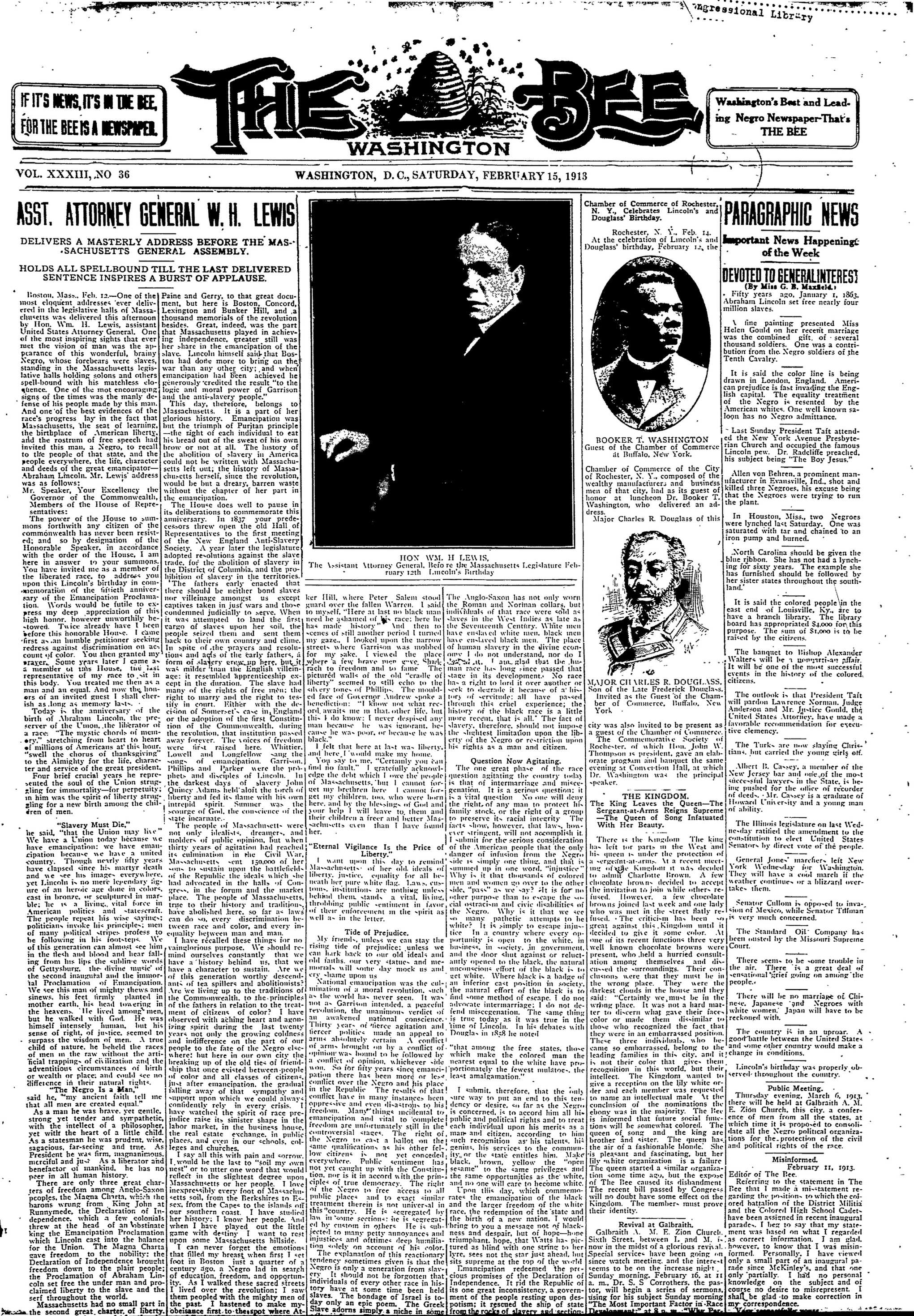
ASST. ATTORNEY GENERAL W. H. LEWIS
DELIVERS A MASTERLY ADDRESS BEFORE THE MASSACHUSETTS GENERAL ASSEMBLY.
HOLDS ALL SPELLBOUND TILL THE LAST DELIVERED SENTENCE INSPIRES A BURST OF APPLAUSE.
Boston, Mass., Feb. 12.—One of the most eloquent addresses ever delivered in the legislative halls of Massachusetts was delivered this afternoon by Hon. Wm. H. Lewis, assistant United States Attorney General. One of the most inspiring sights that ever met the vision of man was the appearance of this wonderful, brainy Negro, whose forebears were slaves, standing in the Massachusetts legislative halls holding solons and others spell-bound with his matchless eloquence. One of the most encouraging signs of the times was the many defense of his people made by this man. And one of the best evidences of the race's progress lay in the fact that Massachusetts, the seat of learning, the birthplace of American liberty, and the rostrum of free speech had invited this man, a Negro, to recall to the people of that state, and the people everywhere, the life, character and deeds of the great emancipator—Abraham Lincoln, Mr. Lewis' address was as follows:
Paine and Gerry, to that great document, but here is Boston, Concord Lexington and Bunker Hill, and thousand memorials of the revolution besides. Great, indeed, was the part that Massachusetts played in achieving independence, greater still was her share in the emancipation of the slave. Lincoln himself said that Boston had done more to bring on the war than any other city; and when emancipation had been achieved he generously credited the result "to the logic and moral power of Garrison and the anti-slavery people."
This day, therefore, belongs to Massachusetts. It is a part of her glorious history. Emancipation was but the triumph of Puritan principle—the right of each individual to eat his bread out of the sweat of his own brow or not at all. The history of the abolition of slavery in America could not be written with Massachusetts left out; the history of Massa chusets herself, since the revolution would be but a dreary, barren wast
Mr. Speaker, Your Excellency the Governor of the Commonwealth, Members of the House of Representatives:
The power of the House to summons forthwith any citizen of the commonwealth has never been resisted; and so by designation of the Honorable Speaker, in accordance with the order of the House, I am here in answer to your summons. You have invited me as a member of the liberated race, to address you upon this Lincoln's birthday in commemoration of the fiftieth anniversary of the Emancipation Proclamation. Words would be futile to express my deep appreciation of this high honor, however unworthily bestowed. Twice already have I been before this honorable House. I came first as an humble petitioner seeking redress against discrimination on account of color. You then granted my prayer. Some years later I came as a member of this House, the last representative of my race to sit in this body. You treated me then as a man and an equal. And now the honors of an invited guest I shall cherish as long as memory lasts.
Today is the anniversary of the birth of Abraham Lincoln, the preserver of the Union, the librator of a race. "The mystic chords of memory," stretching from heart to heart of millions of Americans at this hour, "swell the chorus of thanksgiving" to the Aimighty for the life, character and service of the great president. Four brief crucial years he represented the soul of the Union struggling for immortality—for perpetuity; in him was the spirit of liberty struggling for a new birth among the children of men.
"Slavery Must Die."
he said, "that the Union may live." We have a Union today because we have emancipation; we have emancipation because we have a united country. Though nearly fifty years have clapsed since his martyrd death and we see his images everywhere, yet Lincoln is no mere legendary figure of an heroic age done in colors, cast in bronze, or sculptured in marble; he is a living, vital force in American politics and statescraft. The people repeat his wise sayings; politicians invoke his principles; men of many political stripes profess to be following in his footsteps. We of this generation can almost see him in the flesh and blood and hear falling from his lips the sublime words of Gettysburg, the divine music of the second inaugural and the immortal Proclamation of Emancipation. We see this man of mighty thews and sinews, his feet firmly planted in mother earth, his head towering in the heavens. He lived among men, but he walked with God. He was himself intensely human, but his sense of right, of justice, seemed to surpass the wisdom of men. A true child of nature, he beheld the races of men in the raw without the artificial trappings of civilization and the adventitious circumstances of birth or wealth or place; and could see no difference in their natural rights.
said he, "my ancient faith tell me that all men are created equal."
As a man he was brave, yet gentle, strong yet tender and sympathetic, with the intellect of a philosopher, yet witht the heart of a little child. As a statesman he was prudent, wise, sagacious, far-seeing and true. As President he was firm, magnanimous, merciful and just. As a liberator and benefactor of mankind, he has no peer in all human history.
There are only three great charters of freedom among Anglo-Saxon peoples, the Magna Churta, which the barons wrung from King John at Runnymede, the Declaration of Independence, which a few colonials threw at the head of an obstinate king the Emancipation Proclamation which Lincoln cast into the balance for the Union. The Magna Charta gave freedom to the nobility: the Declaration of Independence brought freedom down to the plain people; the Proclamation of Abraham Lincoln set free the under man and proclaimed liberty to the slave and the serf throughout the world.
Paine and Gerry, to that great document, but here is Boston, Concord, Lexington and Bunker Hill, and a thousand memorials of the revolution besides. Great, indeed, was the part that Massachusetts played in achieving independence, greater still was her share in the emancipation of the slave. Lincoln himself said that Boston had done more to bring on the war than any other city; and when emancipation had been achieved he generously credited the result "to the logic and moral power of Garrison and the anti-slavery people." This day, therefore, belongs to Massachusetts. It is a part of her glorious history. Emancipation was but the triumph of Purjitan principle—the right of each individual to eat his bread out of the sweat of his own brow or not at all. The history of the abolition of slavery in America could not be written with Massachusetts left out; the history of Massachusetts herself, since the revolution, would be but a dreary, barren waste without the chapter of her part in the emancipation.
The House does well to pause in its deliberations to commemorate this anniversary. In 1837 your predecessors threw open the old Hall of Representatives to the first meeting of the New England Anti-Slavery Society. A year later the legislature adopted resolutions against the slave trade, for the abolition of slavery in the District of Columbia, and the prohibition of slavery in the territories. The fathers early enacted that there should be neither bond slaves nor villeimage amongst us except captives taken in just wars and those condemned judicially to serve. When it was attempted to land the first cargo of slaves upon her soil, the people seized them and sent them back to their own country and cline. In spite of the prayers and resolutions and acts of the early fathers, a form of slavery erased up here, but it was milder than the English villeimage; it resembled apprenticeship except in the duration. The slave had many of the rights of free men; the right to marry and the right to testify in court. Either with the decision of Somerset's case in England or the adoption of the first Constitution of the Commonwealth, during the revolution, that institution passed away forever. The voices of freedom were first raised here. Whittier Lowell and Longfellow sang the songs of emancipation. Garrison, Phillips and Parker were the prophets and disciples of Lincoln. In the darkest days of slavery John Quincy Adams held aloft the torch of liberty and fed its flame with his own intrepid spirit. Summer was the scourge of God, the conscience of the state incarnate.
The people of Massachusetts were not only idealists, dreamers, and molders of public opinion, but when thirty years of agitation had reached its culmination in the Civil War, Massachusetts sent 150,000 of her sons to sustain upon the battlefields of the Republic the ideals which she had advocated in the halls of Congress, in the forum and the market place. The people of Massachusetts, true to their history and tradition, have abolished here, so far as laws can do so, every discrimination between race and color, and every inequality between man and man.
I have recalled these things for no vainligorious purpose. We should remind ourselves constantly that we have a history behind us, that we have a character to sustain. Are we of this generation worthy descendants of tea spillers and abolitionists? Are we living up to the traditions of the Commonwealth, to the principles of the fathers in relation to the treatment of citizens of color? I have observed with aching heart and agonizing spirit during the last twenty years not only the growing coldness and indifference on the part of our people to the fate of the Negro elsewhere; but here in our own city the breaking up of the old ties of friendship that once existed between people of color and all classes of citizens, just after emancipation, the gradual falling away of that sympathy and support upon which we could always confidently rely in every crisis. I have watched the spirit of race prejudice raise its sinister shape in the labor market, in the business house, the real estate exchange, in public places, and even in our schools, colleges and churches.
I say all this with pain and sorrow. I would be the last to "soil my own nest" or to utter one word that would reflect in the slightest degree upon Massachusetts or her people. I love inexpressibly every foot of Massachusetts soil, from the Berkshires to Essex, from the Capes to the islands off our southern coast. I have studied her history; I know her people. And when I have played out the little game with destiny I want to rest upon some Massachusetts hillside. I can never forget the emotions that filled my breast when first I set foot in Boston just a quarter of a century ago, a Negro lad in search of education, freedom, and opportunity. As I walked these sacred streets I lived over the revolution; I saw them peopleled with the mighty men of the past. I hastened to make my obeisance first to the thespass where At-
THE MASTER OF THE MUSIC
HON WM. H LEWIS,
The Assistant Attorney General, Refore the Massachusetts Legislature Feb
ruary 12th Lincoln's Birthday
ker Hill, where Peter Salem stood guard over the fallen Warren. I said to myself, "Here at last no black man need he ashamed of his race; here he has made history." And then to scenes of still another period I turned my gaze, I looked upon the narrow streets where Garrison was mobbed for my sake. I viewed the place where a few brave men gave Shack rach to freedom and to fame. The pictured walls of the old "cradle of liberty" seemed to still echo to the silvery tones of Phillips. The moulded face of Governor Andrew spoke a benediction: "I know not what record, awaits me in that other life, but this I do know: I never despised any man because he was ignorant, because he was poor, or because he was black." I felt that here at last was liberty, and here I would make my home.
You say to me, "Certainly you can find no fault," I gratefully acknowledge the debt which I owe the people of Massachusets, but I cannot forget my brethren here. I cannot forget my children, too, who were born here, and by the blessings of God and your help I will leave to them and their children a freer and better Massachusets even than I have found her.
"Eternal Vigilance Is the Price of Liberty."
I want upon this day to remind Massachusetts of her old ideals of liberty, justice, equality for all beneath her pure white flag. Laws, customs, institutions are nothing unless behind them stands a vital, living, throbbing public sentiment in favor of their enforcement in the spirit as well as in the letter.
Tide of Prejudice
My friends, unless we can stay the rising tide of prejudice; unless we can hark back to our old ideals and old faiths, our very statues and memorials will some day mock us and cry shame upon us
National emancipation was the culmination of a moral revolution, such as the world has never seen. It was not as Garrison intended, a peaceful revolution, the unanimous verdict of an awakened national conscience. Thirty years of fierce agitation and fierce politics made an appeal to arms absolutely certain. A conflict of arms brought on by a conflict of opinion was bound to be followed by a conflict of opinion, whichever side won. So for fifty years since emancipation there has been more or less conflict over the Negro and his place in the Republic. The results of that conflict have in many instances been oppressive and even diarrhoeal to his freedom. Many things incidental to emancipation and vital to complete freedom are unfortunately still in the controversial stages. The right of the Negro to cast a ballot on the same qualifications as his other fellow citizens is not yet conceded everywhere. Public sentiment has not yet caught up with the principles of true democracy. The right of the Negro to free access to all public places and to exact similar treatment therein is not universal in this country. He is segregated by law in some sections; he is segregated by custom in others. He is subjected to many petty annoyances and injustices and oftimes deep humiliation solely on account of his color. The explanation of this reactionary tendency sometimes given is that the Negro is only a generation from slavery. It should not be forgotten that individuals of every other race in history have at some time been held slaves. The bondage of Israel is today only an epic poem. The Greek Slave adorns simply a niche in some
The Anglo-Saxon has not only worn the Roman and Norman collars, but individuals of that race were sold as slaves in the West Indies as late as the Seventeenth Century. White men have enslaved white men, black men have enslaved black men. The place of human slavery in the divine economy I do not understand, nor do I allow it. I am glad that the human race has long since passed that stage in its development. No race has a right to lord it over another or seek to degrade it because of a history of servitude; all have passed through this cruel experience; the history of the black race is a little more recent, that is all. The fact of slavery, therefore, should not impose the slightest limitation upon the liberty of the Negro or restriction upon his rights as a man and citizen.
Question Now Agitating.
Question Now Agitating.
The one great phase of the race question agitating the country today is that of intermarriage and miscegenation. It is a serious question; it is a vital question. No one will deny the right, of any man to protect his family stock, or the right of a group to preserve its racial integrity. The facts show, however, that laws, however stringent, will not accomplish it. I submit for the serious consideration of the American people that the only danger of infusion from the Negro side is simply one thing, and that is summed up in one word, "injustice." Why is it that thousands of colored men and women go over to the other side, "pass" as we say? It is for no other purpose than to escape the social ostracism and civic disabilities of the Negro. Why is it that we see so many pathetic attempts to be white? It is simply to escape injustice. In a country where every opportunity is open to the white, in business, in society, in government, and the door shut against or reluctantly opened to the black, the natural unconscious effort of the black is to get white. Where black is a badge of an inferior cast position in society, the natural effort of the black is to find some method of escape. I do not advocate intermarriage; I do not defend miscegenation. The same thing is true today as it was true in the time of Lincoln. In his debates with Douglas in 1858 he noted.
"that among the free states, those which make the colored man the nearest equal to the white have proportionately the fewest mulattoes, the least amalgamation."
I submit, therefore, that the only sure way to put an end to this tendency or desire, so far as the Negro is concerned, is to accord him all his public and political rights and to treat each individual upon his merits as a man and citizen, according to him such recognition as his talents, his genius, his services to the community, or the state entitles him. Make black, brown, yellow the "open sesame" to the same privileges and the same opportunities as the white, and no one will care to become white. Upon this day, which commemorates the emancipation of the black and the larger freedom of the white race, the redemption of the state and the birth of a new nation, I would bring to you a message not of blackness and despair, but of hope—hope triumphant, hope, that Watts has pictured as blind with one string to her lyre, sees not the star just ahead, but sits supreme at the top of the world.
Emancipation redeemed the precious promises of the Declaration of Independence. It rid the Republic of its one great inconsistency, a government of the people resting upon despotism; it rescued the ship of state from the rocks of slavery and section-
Chamber of Commerce of Rochester, N. Y., Celebrates Lincoln's and Douglass' Birthday.
Rochester, N. Y., Feb. 14.
At the celebration of Lincoln's and Douglass' birthday, February 12, the
BOOKER T. WASHINGTON
Guest of the Chamber of Commerce
at Buffalo, New York.
Chamber of Commerce of the City of Rochester, N. Y., composed of the wealthy manufacturers and business men of that city, had as its guest of honor at luncheon Dr. Booker T. Washington, who delivered an address.
Major Charles R. Douglass of this
MAJOR CHARLES R. DOUGLASS,
Son of the Late Frederick Douglass,
Invited as the Guest of the Chamber of Commerce, Buffalo, New York
city was also invited to be present as a guest of the Chamber of Commerce. The Commemorative Society of Rochester, of which Hon. John W. Thompson is president, gave an elaborate program and banquet the same evening at Convention Hall, at which Dr. Washington was the principal speaker.
THE KINGDOM.
The King Leaves the Queen—The Sergeant-at-Arms Reigns Supreme—The Queen of Song Infatuated With Her Beauty.
There is the Kingdom. The king has left for parts in the West and his queen is under the protection of a sergeant-at-arms. At a recent meeting of the Kingdom it was decided to admit Charlotte Brown. A few chocolate brownies decided to accept the invitation to join while others refused. However, a few chocolate brownies joined last week and one lady who was met in the street flatly refused. The criticism has been so great against this Kingdom until it decided to give it some color. At one of its recent functions three very well known chocolate brownies were present, who held a hurried consultation among themselves and discussed the surroundings. Their conclusions were that they must be in the wrong place. They were the darkest clouds in the house and they said: "Certainly we must be in the wrong place. It was not a hard matter to discern what gave their face color or made them dissimilar to those who recognized the fact that they were in an embarrassed position. These three individuals, who became so embarrassed, belong to the leading families in this city, and it is not their color that gives them recognition in this world, but their intellect. The Kingdom wanted to give a reception on the lily white order and each member was requested to name an intellectual male. At the conclusion of the nominations the ebony was in the majority. The Bee is informed that future social functions will be somewhat colored. The queen of song and the king are brother and sister. The queen has the air of a fashionable blonde. She is pleasant and fascinating, but her lily white organization is a failure. The queen started a similar organization some time ago, but the expose of The Bee caused its disbandment. The recent bill passed by Congress will no doubt have some effect on the Kingdom. The members must prove their identity.
Revival at Galbraith
Galbraith A. M. E. Zion Church. Sixth Street, between L. and M. is now in the midst of a glorious revival. Special services have been going on since watch meeting, and the interest seems to be on the increase night. Sunday morning, February 16, at 11 a. m., Dr. S. S Corrothers, the pastor, will begin a series of sermons, using for his subject Sunday morning "The Most Important Factor in-Race Development" at 8 a. m. "Why Pace
DEVOTED TO GENERAL INTEREST
(By Miss G. B. Mayfield)
Fifty years ago, January 1, 1863, Abraham Lincoln set free nearly four million slaves.
A line painting presented Miss Helen Gould on her recent marriage was the combined gift, of several thousand soldiers. One was a contribution from the Negro soldiers of the Tenth Cavalry.
It is said the color line is being drawn in London, England. American prejudice is fast invading the English capital. The equality treatment of the Negro is presented by the American whites. One well known saloon has no Negro admittance.
Last Sunday President Taft attended the New York Avenue Presbyterian Church and occupied the famous Lincoln pew. Dr. Radliffe preached, his subject being "The Boy Jesus."
Allen von Behren, a prominent manufacturer in Evansville, Ind., shot and killed three Negroes, his excuse being that the Negroes were trying to run the plant.
In Houston, Miss., two Negroes were lynched last Saturday. One was saturated with tar and chained to an iron pump and burned.
North Carolina should be given the blue ribbon. She has not had a lynching for sixty years. The example she has furnished should be followed by her sister states throughout the southland.
It is said the colored people in the east end of Louisville, Ky., are to have a branch library. The library board has appropriated $4,000 for this purpose. The sum of $1,000 is to be raised by the citizens.
The banquet to Bishop Alexander Walters will be a nonparti-affair. It will be one of the most successful events in the history of the colored citizens.
The outlook is that President Tait will pardon Lawrence Norman, Judge Anderson and Mr. Justice Gould, the United States Attorney, have made a favorable recommendation for executive clemency.
The Turks are now slaying Christians, but carried the young girls off.
Albert B. Cassey, a member of the New Jersey bar and one of the most successful lawyers in the State, is being pushed for the office of recorder of deeds. Mr. Cassey is a graduate of Howard University and a young man of ability.
The Illinois legislature on last Wednesday ratified the amendment to the constitution to elect United States Senators by direct vote of the people.
General Jones' marchers left New York Wednesday for Washington. They will have a cool march if the weather continues or a blizzard overtakes them.
Senator Cullom is opposed to invasion of Mexico, while Senator Trillman is very much concerned.
The Standard Oil Company has been ousted by the Missouri Supreme Court.
There seems to be some trouble in the air. There is a great deal of sensational grief going on among the people.
There will be no marriage of Chinese, Japanese and Negroes with white women. Japan will have to be reckoned with.
The country is in an uproar. A good battle between the United States and some other country would make a change in conditions.
Lincoln's birthday was properly observed throughout the country.
Public Meeting
Thursday evening, March 6, 1913, there will be held at Galbraith A. M. E. Zion Church, this city, a conference of men from all the states, at which time it is proposed to consolidate all the Negro political organizations for the protection of the civil and political rights of the race.
Misinformed.
February 11, 1913.
Editor of The Bee.
Referring to the statement in The Ree that I made a mi-statement regarding the position, to which the colored battalion of the District Militia and the Colored High School Cadet have been assigned in recent inaugural parade, I beg to say that my statement was based on what I regarded as correct information. I am glad, however, to know that I was misinformed. Personally, I have viewed only a small part of an inaugural parade since McKinley's, and that one only partially. I had no personal knowledge on the subject and of course no desire to misrepresent. I shall be glad to make correction in my correspondence.
Scotland's "Daft Days"
So bilious were the old ceremonies of welcoming the new year in Scotland that Dec 31 and Jan. 1 won for themselves the designation of "the daft days" Temperance legislation has done much in recent years to moderate and refine the festivities, which still, however, assume extensive and exuberant proportions. Only a few years ago a writer in the London Chronicle in Edinburgh on New Year's eve saw the "Black Maria" perambulating the streets and picking up the hopelessly drunken persons from the pavements and doorsteps for conveyance to the police station.
It was formerly the custom in Ireland and Wales to carry a lantern tastefully decorated with ribbons and containing a wren, round each hamlet and village on New Year's day and make calls on dwellers in cottage and hall. The bearers, swinging the lantern at each door, would favor all whom it might concern with a song and receive a monetary reward.
The Old Time Stagecoach.
In 1762 there were, strange as it seems, only six stagecoaches running in all England, and of course these were the only public vehicles for travelers. Even these were a novelty, and a person named John Crosset thought they were such a dangerous innovation that he wrote a pamphlet against them. "These coachees," he wrote, "make gentlemen come to London upon every small occasion, which otherwise they would not do except upon urgent necessity. Nay, the convenience of the passage makes their wives come often up, who rather than come such long journeys on horseback would stay at home. Then when they come to town they must be in the wade, get fine clothes, go to plays and treats and by these means get such a habit of idleness and love of pleasure that they are uneasy after."
Roast Pig In' Servia.
The favorite dish of the Serylans, says a writer in the Wide World Magazine, consists of a lamb or sucking pig roasted whole over ashes. A pit is first dug and filled with wood-vine branches for choice, as they give the best flavor—and the fire is then allowed to burn for several hours. The carcass is next impaled with a stout stick and slowly turned round and round over the embers. The result, after six hours' turning, is a very luscious meal, for all the gravy is kept in and the meat is unusually tender. No picnic in Servia is considered complete without this delicacy. A story goes that on one of his campaigns Napoleon noticed a group of Servian soldiers cooking meat in this way, whereupon he came up, inquired what they were doing, tasted the meat and was delighted with it.
Races of Mankind.
The races of mankind are five in number—white, yellow, brown, red and black, or the Caucasian, Mongolian, Malayan, Indian and negro. The interrelationships of these different breeds have been the subject of study with the specialists for ages, but the disputes are as numerous as they were when the study began. Whether the various races sprang from some one original race and if so what that original race was, is a question that is still in limbo. Between these five races, as found at present, there are physical, moral and mental differences so marked as to seem to preclude a common origin and yet, unless such origin is assumed, the difficulty of the case is greatly enhanced. Race origins are an ensolved problem.—New York American
Rainbows That Can Change Sex.
Rainbows That Can Change Sex. In many parts of the world it is the general belief that the rainbow has the power to change sex. This queer belief obtains in such widely separated districts as South Africa and Norway and China and Australia. The Zulus have a long folklore story of the young man who was changed into a wrinkled old woman by touching the many hued arch. The Scandinavian peasants have a similar story, and in Greece they say that anybody who runs against the end of the rainbow will have his or her sex instantly changed. In France and India to pass under the rainbow has a similar effect.
Well Trained.
Old Lady (improving the occasion)—Ah, my poor man, you would not be in this position if you had received an early training in some trade or calling. Trump—Don't you tork too sudden about wot you don't know nothin' about, missus. No trainin', indeed! W'y. I was in prison afore I was fourteen.—London Mail.
Made His Hair Come Out
Habitual Customer (to his barber)—Your confounded hair restorer has made my hair come off more than ever! Barber—Ah, you must 'ave put too much on, sir! Made the 'air come right out, 'stead of only 'arfway.—Windsor Magazine.
His Philosophy.
Employer—I see you've collected a lot of small accounts, but you haven't made much headway with the bigger ones. Collector—No, sir; I generally make it a rule to—h'm—follow along the line of least realstance—Chicago Tribune.
There Are Cooks and Cooks
A lady correspondent remarks cynically that many a man who would hesitate to make a wife of his cook is quite ready to make a cook of his wife.—London Standard.
He who would rest must wash Italian Proverb.
A German Fairy Tale.
As the cobbler stepped into his shop his scold of a wife started to lecture him unmercifully for coming in late. "Be quiet. Zenobia," said he affably. "Today I have had a great stroke of nuck. Coming home, I met a fairy who had lost her way. I put her on the right track, and out of gratitude she presented me with this pair of slippers. Whoever puts on the left one becomes invisible. Then if you put on the right one you reappear. You will see that this present is very valuable, because we will be able to make lots of money with it." Zenobia became still and stood overcome with curiosity in front of her husband. "Come," said he; "let us try it once." She slipped on the left slipper and positively in the same instant vanished away.
"It is really true!" said the cobbler, astonished. "She is gone!" Then he took the right slipper, went out of the house and threw it in the deepest well—Fliegende Blatter.
Munich Royalty Is Modest.
As far as meeting royalty is concerned, Munich is a great contrast to Berlin. It is impossible to stay long in the Prussian capital without having one's path stopped or impeded by the passing of some prince of the royal house or, at all events, by the cohorts of police who safeguard them. One may stay for months in Munich without seeing more than a royal carriage driving past almost unnoticed except for the raising of bats. The popularity of the Wittelsbachs is genuine, and every Munlicher takes a lively interest in the ways and doings of the members of the royal house. The tragic history of the Wittelsbachs in recent times is perhaps the reason why the personalities of the present generation seem somewhat effaced. They at all events take care not to stand in the limelight.-Mauchester Guardian.
Champagne From Sponges
"Champagne makers of Rheims buy a lot of our sponges," said a wholesale dealer. "They squeeze champagne out of them. They must squeeze in the year's course a million bottles of champagne out of sponges. Mystified, aren't you? But there is no mystery about the matter. Champagne as it ferments is powerful stuff; it breaks the strongest bottles, and in the past all the champagne that broke its bottles and escaped was lost. Now, though, they pack the champagne bottles in clean sponges, and every day or two they go over the plant, and if any of the bottles have broken they squeeze into casks the wine that the sponges have retalned. This wine, reclarified, refined and bottled again, makes a very good second quality drink."
How a Flea Jumps.
It is said that a flea leaps 200 times its height, and, while it usually does land on its feet, it often falls, especially when it falls on a perfectly smooth surface, where the claws can get only a slight hold. A flea has six legs, whose great length and bulk make them so heavy that they must be a great help in keeping their owner right side up when it makes one of those gigantic jumps, and when it lands upside down or in some other way its ability to kick is so great that not more than one wriggle is needed to set things right. A flea's wings are mere scales and of no use. But, small and worthless as they are, they tell the entomologist something about the proper classification of the insect. To the flea itself they have no value.
Compelling Use of Surnames
Compelling Use of Surnames. Some folk have been compelled by law to change their surnames. In 1603, for instance, the name of MacGregor was proscribed, and those who had previously borne it were compelled to adopt another. In Ireland, also, as far back as 1485, an act was passed ordering the inhabitants of certain districts to "gue appareled like Englishmen, wear their head after the English manner and take English surnames." The act further directed that those concerned should take for their new names "the name of a town, as Sutton, Chester, Cork or a color, as White, Black, Brown," and that they and their wives should use this new surname under pain of forfeiting all their belongings —London Graphite.
"To the Lamppeat."
"To the lamppost" is a mistranslation of "a la lanterne." There was no lamppost. The lamp was hung over the middle of the street in the center of a coral, which passed over pulleys at the sides of the street. The lamp was let down, the person to be hanged was substituted for it and the ends of the cord pulled.—London Notes and Queries.
Poor Colors.
"She's always trying to get things to match her complexion."
"What of it?"
"Haven't you ever noticed her complexion?"—Milwaukee Sentinel.
"Wouldn't it be fine to live in clover?" said the optimist.
"Huh! You'd only get hay fever," said the pessimist. — Cincinnati Enquirer.
Try It
A man never quite realizes how much furniture he owns until he tries to walk rapidly through his rooms in the dark.-Puck.
Describing Her.
Gibbs—Say, old man, that little wife of yours is a picture. Dibbs—Morr she's a picture puzzle.—Boston Transcript.
Arab Hagolina
Alan Ostler in "The Arabs In Tripoli" comments on the amusing haggling scenes in the desert plunder market when loot of war was the merchandise.
"Why do you not sell at a set price to all alike?" he asked a merchant. "But why?" said he. "If I can get but half a grushe the more from one of them than from another, is it not gain?" "But that wastes time, for while you bargain with one you might have sold to three. They say with us, Time is money." "Oh, folly," he retorted scornfully. "Time is God's and given freely to all men, so that all have it alike. But with the flus one has much, another none, and you must take what you can get."
To hangle with any one is a joy to the Arab. But mutual trust he lacks. "I have known two men," says Mr. Ostler, "farm partners, walk eight miles to a market with three scrawny hens to sell. Both must needs go, for neither would trust the other not to cheat him."
The Speed of Animals
According to naturalists, no animal is known to have exceeded the speed attained by the famous race horse Eysonby. Instantaneous photographs show the full length of one complete stride as about twenty-six feet. In the stride of the fastest racers the blind quarters and the limbs are raised considerably higher than the shoulders and from this relatively great height brought downward and forward, widely separated from each other, as a sportsman says, "to avoid striking the fore legs." The hare which is hunted with fast hounds has not in reality the speed of the dog. The dog, on the other hand, does not attain the speed of the horse. The giraffe is said to run at the rate of fifteen meters (yards) per second under the most favorable conditions. The elephant, going at the rate of two yards a second, carries a weight approximating that carried by six horses—Harper's.
---
An Interested Listener
Mark Twain one rainy day found himself in a room in his club which contained only one other occupant The two men drifted into conversation. Mark began a discussion on the merits of "Tess of the d'Urbervilles," and made brilliant deductions as to the character and personality of the writer of "Tess," from what he called the internal evidence of the story His listener at times mildly dissented, but on the whole maintained an attitude of impassivity:
When "Tess" had been labeled only passable, Mark Twain's chance acquaintance excused himself and departed. Calling the attendant Mark Twain he had been conversed.
"That's Mr. Thomas piled the steward imp
Granted that it is that we shall remain our appointed lives that mankind should death. Without that dread the world could hardly remain peopled. The dread of death is to the soul what the law of gravity is to the body. It anchors us to the earth. Without that dread to weigh us down and keep us to the globe half mankind would be driven by curiosity, by the love of change, by the dread of ennui, by what Bacon calls "niceness and satiety," to push open the closed door and see what is beyond. Children and a few very happy and easily pleased people might perhaps say they would not explore farther and that they were perfectly content with things as they are—St. James' Gazette.
To Calculate Longevity
"Bacon took a deep interest in longevity and its earmarks," said a physician, "and Bacon's signs of long life and of short life are as true today as they ever were. You won't live long, Bacon pointed out, if you have soft, fine hair, a fine skin, quick growth, large head, early corpulence, short neck, small-mouth, brittle and separated teeth and fat ears. Your life, barring accidents, will be very lengthy if you have slow growth, coarse hair, a rough skin, deep wrinkles in the forehead, firm flesh, a large mouth, wide nostrils, strong teeth set close together and a hard, gristly ear."
Obligation Both Ways
"Of course you are very proud to have them."
"Yes, and I have no doubt the old masters would have considerable respect for me if they knew what I paid for them."—Washington Star.
A Social Catastrophe
"Was no one injured in the railway collision, count?" "No, but nevertheless it was a most painful situation. First, second, third and fourth class passengers all mingled together Simply unheard of"—Fillegende Blatter.
Not an Expert Opinion
"He has just returned from Mexico. He says a Mexican burro is the most aggravatingly stubborn thing on earth." "He isn't married."-Houston Post.
A Helping Hand.
"Why are you removing all the rocking chalrs?"
"Pa has sworn off on swearing, and we want to do all we can to help him."
—Detroit Free Press.
Boast not thyself of tomorrow, for thou knowest not what a day may bring forth.—Proverbs.
Animal Life.
The May fly's life is complete in four to five hours, during which it is born, matures, loves, fights, mates, propagates and dies. The ordinary tooth lives three to four days, the locust (grasshopper) lives four weeks, dragon fly six to eight weeks, male bees or drones four to five months, snails two to three years, queen bee two to three years, mouse six years, squirrel six years, pigeon ten to twenty years, canary twelve to fifteen years, rabbit ten years, brer fox fourteen years, crawfish twenty years, pig twenty years, lion thirty-five years, toad frog forty years, cat forty years, bear fifty years, raven 100 years, elder duck, 100 years, parrot 100 years, golden eagle 104 years, white headed vulture 118 years, pike 200 years, carp 200 years, elephant 200 years and swan 300 years.
Considering the fact that the average man's age is only about thirty three years, it will be seen that many members of the animal kingdom have a great advantage over the human race in their allotted length of life.
An Insult
Angrily the head of the haberdashery concern stormed into the employment agency and demanded an interview with the manager.
"I understand," he said, "that you have been recommending as AI collectors certain young men whom you represent as having collected money from us. If they can get it from us they can get it from anybody. That's the way you make it appear, consequently your clients land good jobs."
With visions of possible libel suits rising before his guilty conscience, the agent attempted self justification.
"You are considered pretty hard nuts, you know," he said.
"Oh, that's all right," said the man. "It ain't that I'm kicking about, but not one of your men has ever collected a'dollar at our shop, and it don't do any good to lie about it"—New York Times.
It Might Have Been Worse.
Mark Twain during one of his lecture tours was waiting at a station for a delayed train. The lecture committee and several townsmen were with him and talking their best to pass the time away. One man told about a frightfully unhealthy town he had read about, and it was a grewsome tale of dying and burials and that sort. "It might have been worse," Twain followed, in his slow and direct manner. "I lived in that same town for two years, and I never died once—not a single, time." The way he said it seemed to daze the crowd, and not a man said a word in response. "Of course you may think I'm lying," the humorist continued, "and I'm sorry, for I can't get any witnesses to testify that I didn't, because everybody else that lived there is dead."
Dr. Johnson and Tea.
Jonas Hanway was an inveterate foe to tea and wrote a pamphlet in which he ascribed the majority of nervous disorders to tea drinking. He declared that the practice was sapping the vigor of Englishmen and spoiling the beauty of women and expressed horror at the fact that no fewer than six ships were employed in the China tea trade. Dr. Johnson, who reviewed Hanway's diatribe in the Literary Magazine, prefaced his criticism with the frank aweval. "The author is to expect little justice from a hardened and shameless tea drinker, whose kettle has secrecy time to cool, with tea amuses the evening, with tea solaces the midnight and with tea greets the morning," but even he admitted that tea drinking was not good for the working classes, as he thought it an inducement to idleness. —London Chronicle.
More Than Was Asked:
The old tombstone, in the quaint fashion of its kind, implored the passerby to pause and drop a tear, and no sooner had the beautiful girl read the inscription than she began to weep. But her mother reproved her. "Cecilia," she exclaimed, "why can you not have more restraint? You are requested merely to drop a tear, and here you have burst into several!"—Puck.
Patronizing Papa.
Father—Upon my word, you children are getting too dainty for anything, Jam and butter on the same piece of bread, indeed! Why, when I was your age I was glad to get enough dry bread to eat. Bobby—You have a much better time living with us, don't you, father?—National Monthly.
Comforting.
Wife—Why did you tell the Batsons that you married me because I was such a good cook, when you know I can't even boll a potato? Hubby—I had to make some excuse, my dear, and I didn't know what else to say.—London Opinion.
His Advantage
"An aviator, has one big advantage over other men."
"Most of his advantages are over men, but what is this special one?"
"He can want the earth without being called grasping."—Baltimore American.
Economical
Johnny—Mamma, will you wash my face? Mamma—Why, Johnny, can't you do that? Johnny—Yes, but I'll have to wet my hands, and they don't need it.—Lippincott's.
Not Like the National Game. Geraldine—Did you ever play kissing games? Gerald Yes, and I remember them as games that didn't have to be called on account of darkness.—New York Times.
Death Through a Tarantula:
One of the quickest and most complete and justifiable killings that ever I saw came about through a tarantula. It was at a mine camp in the old days, and the camp bully had a tarantula impaled on a stick. A man newly arrived from the east stood gazing, fascinated with horror, at the squirming reptile, working its black fangs in the effort to reach something that it could fasten them into. Suddenly, without warning, the bully thrust the tarantula straight into the tenderfoot's face. His whiskers saved him from the fangs, but he let out a yell as if he had actually been bitten, and jumped back, I fully believe, ten feet. Then as the fellow came poking the tarantula toward him again, the tenderfoot drew his revolver and turned loose on his tormentor. His first shot would have been enough, as it went straight through the fellow's body, but the tenderfoot had his excitement to work off, and he never stopped shooting until his revolver had been emptied and the man with the tarantula was a sieve. "Served him right," was the verdict of the coroner's jury, and the case never went to court for trial.
Why Chinese Shops Are Small
The average Chinese shop of any kind in Tientsin and Peking is a one story building without doors or windows to the street. The entire front is closed by shutters at night. In the day time the shutters are removed. These shops are fourteen to sixteen feet wide on the street, and the room is not deeper than this. Three or four feet back from the front a counter runs, behind which there is shelving. The storerooms are not deeper because of the peculiar arrangement of Chinese houses. The typical Chinese house is only one story in height and is built on all four sides of a square-courtyard. If more room is needed there is a second courtyard in the rear with a communicating door, and so on. The yamens or official residences of the various Chinese officials of Tientsin are all erected in this way—one courtyard after another surrounded by buildings all opening into the court.
Opals and Ill Luck.
Many people regard the opal as an omen of ill luck, and the following will show how this superstition arose. Two or three centuries ago the stone was very popular in Europe, and the jewelers of Italy were especially cunning in its setting. At the height of its popularity came the plague which wrought great havoc in Venice. It was noticed by some observant persons in that city that when a victim was on the point of death his opal, if he wore one, brightened, while after death it became dull. The reason of this was
the heighten
become hot,
brilliant, whi
and damp of t
however dect
brought death
door, and as
the sale of opi
day people be
stone brings il
Scot Free.
The expression "scot free," which is in use every day, harks back to the times of Scottish romance and tragedy so luminously described by Sir Walter Scott in "The Antiquary" and "Rob Roy." In these stirring tales we are told of one form of Scottish trials given certain offenders of justice. He who had broken the law was divested of all of his clothing and placed at a certain distance from archers who had bows and arrows ready, waiting the command, "Fire!" When the command was given the man under indictment would begin running and the archers would commence firing, and if in runnin: this gantlet none of the arrows hit him he was allowed to go scot free.
An Unusual Request.
A large, determined looking woman, undeniably from the country, entered the elevator in a well known New York dry goods establishment. She was carried up and down the elevator several trips, but showed no disposition to get out at any department. Finally the man in charge ventured to address her: "Where do wish to go madam?"
Where do we wish to go?
"Let me out as near Madison Square Garden as ye can," came the unexpected response. -Dellneator.
Not Well Posted.
She—There's always a crowd round the dear old professor. He's such a wonderful conversationist. He—Lor! You really think so? I tried him just now on every possible topic—hounds, bridge, golf, music halls, everything, and he was simply useless.—London Punch.
She Had a Substitute.
Influential Member—I am glad to notice, doctor, that your wife never turns her head to see who comes into church late on Sunday morning. The Rev. Dr. Goodman—No, but she makes me tell her all about them after we go home.—Chicago Tribune.
Conserving Energy.
If one half the world could be prevented from prying into the business of the other half the greatest problem in conservation of energy would be solved—Philadelphia Ledger.
The Brute.
Mother-in-Law-Has the young man who saved my life yesterday called upon you yet? Son-in-Law-Yes, in deed. He has already made his apologe.—Ellegende Blatter.
A gentle hand may lead the elephant with a hair.—Persian.
London's Hot Baked Potatoes.
There are few colder places on a winter's night than the streets of London. Naturally anything warm is welcomed by wayfarers. Roasted chestnuts and hot pies stand high in public favor, but the cry of "Baked potatoes, all hot!" is peculiarly inviting. The simplest form of a potato can—really more like a box than a can—is of plain, unpainted tin, not unlike that used by the street pleman. In the central portion the potatoes are kept hot, while in compartments on each side salt and butter are kept. A large pepper box usually stands on the top of the can. A small valve lets out the steam, and its whistling guides the traveler in search of a hot potato. Street corners, where an omnibus stops or near places of amusement, are favorite spots for the vendors of this delicacy. The season lasts from the latter part of September until about the end of March. It is said that more than 3,000 people gain their livelihood in this way in the streets of London.
Musical Sound and the Ear:
The well trained ear of a musician can distinguish notes differing only one-hundredth part of a tone from one another. Most people cannot perceive a difference of one-tenth of a tone, and a few can scarcely tell one tone from another. The cause of this curious disparity resides in slight differences in the structure of the cochlea, a wonderful piece of apparatus in the innermost part of the ear. It is a little body shaped like a snail shell and believed to be the part of the hearing apparatus which recognizes musical sounds. In its structure it closely resembles the strings of a piano and even has a damper to prevent the mixture of sounds quickly following one another. This little musical apparatus is set going by vibrations received from the middle ear or drum, and in some mysterious manner it sends these on to the brain through the auditory nerve in the form of musical sounds.
The Drummer's Secret.
Here is an old war story. As a regiment of soldiers was on the march to Gettysburg some of the soldiers stepped out of the ranks and confiscated a couple of geese, and one of the drummers unheaded his instrument and put the captured birds in the drum.
Shortly afterward the colonel rode along and, noticing the boy, said sharply:
"Why don't you beat that drum?"
"Colonel," said the drummer mysteriously, "I want to speak to you."
The colonel drew still closer, and, bending, down his head, said, "Well, what have you to say?"
The drummer whispered, "Colonel. I've got a couple of geese in here."
The colonel straightened up and gravely said, "Well. If you're sick and can't play, you needn't."
The colonel had roast goose that night.
A Winter on a Mountain Top.
As one climbs up to the mountain top the danger from lightning increases rapidly, and, as a rule, the observatories located on the mountain tops are rather uncomfortable places of residence, as discovered by the scientific gentlemen who have had the experience of a winter on a mountain top. It is evident that ordinary lightning rods are entirely inadequate to carry off the enormous discharges of the mountain thunderstorms. There are several observatories on Mont Blanc, and at one of them, that of Janssen, there have been a number of bombardments, during which the interior of the place was filled with ribbonlike sheets of electricity and balls of fire which moved silently from point to point—Eychange.
Breakfast In Norway.
Home brewed beer has of late years, says Harold Simpson in his "It tambles in Norway," largely displaced spirits as the national drink of the Norwegians. It is so popular that it is used even at breakfast to wash down the stock dish-fried pork smothered in onions. The first sight of a Norwegian breakfast table, adds the author, is apt to astound one. It is covered with small dishes, principally fish-fresh fish, smoked fish, fish in tins, fish in miniature barrels. There are also cold meats and an endless variety of cheeses, of which the Norwegians are very fond.
Tears Not Idle.
"My doctor tells me a good cry is beneficial."
The second woman, opening her purse, displayed a first class return ticket to Europe.
"A good cry gained me this," she said—New York Press.
True Love.
Tom—But perhaps she 'doesn't love you Jack—Oh. yes, she does! Tom—How do you know? Jack—When I told her that I had no money to get married on she offered to borrow some from her father.—Philadelphia Inquirer.
The Departing Son
"Our boy has left us," wept the mother as their only son waved goodby from the car window.
"Yes," said the old man, whom the boy had just touched for a heavy loan, "but he hasn't left us much"—Detroit News.
"I do not think people should get married until they are thoroughly acquainted with each other."
"What would you do—abolish matrimony?'—Judge.
A life in continual need is half death
—German Proverb.
SCHOONER HITS STEAMER AT SEA
Panic Among Passengers on the Prince Oskar Was Prevented by the Officers.
The Hamburg-American line steamer Prinz Oskar, sailing from Philadelphia, steaming at full speed on the first leg of her voyage to Hamburg, and the four-masted schooner City of Georgetown, running under full sail in a fresh northwest gale for Savannar, collided off Five Fathom Bank lightship, forty miles at sea, due east of the Delaware Capes.
The sailing vessel, after ramming a jagged hole in the steel port plates of the liner, which nearly sent her to the bottom, sank. After dealing this mighty blow, the weaker vessel, whose bowsprit penetrated two decks and jammed the liner's port anchor ten feet into her interior, drifted away and disappeared in seven minutes' time, sinking by the bow.
Captain A. C. Slocum and his crew of seven men were saved after a thrilling battle for their lives. Half of them were asleep when the two ships rammed. Those awakened by the impact and jostled from their berths in the forecastle were nearly trapped by falling masts, splintered spars and falling sails and riggings, which strewed the decks.
As the how dipped into the water and the ship stood nearly vertically before plunging to the bottom, the eight sailors crawled to the stern and dropped overboard into the icy water. A sailor, wielding a butcher knife, had severed the lashings of a dory. The other lifeboats had been smashed. Three cabin and 130 steerage passengers aboard the Prinz Oskar were panic-stricken. They had been jolted from their berths. Upon fleeing to the upper decks they found the liner listed badly to port and in danger of slipping water through the hole at the prow. The plates had been torn away in a jagged circle, big enough for a team to be driven within.
The fears of the passengers were soon abated by Captain von Leuentel and his officers. The liner receded slowly from the sinking schooner and lifeboats were lowered. The ship's searchlights were turned and revealed the crew of the schooner battling for their lives. All succeeded in galming thedoryry. Though the dory was finally their salvation, the sailors were all nearly drowned. The schooner, upon sinking caused a churling of the waters. The suction drew the dory into its eddies and the frail craft was swarled about. The swirling of the water finally ceased and the sailors, half frozen and exhausted, were rescued by the men of the Prinz Oskar. The liner came back to Philadelphia.
TRUCE ENDS AS TURKS CONCEDE MORE Allies Say Four Days' Grace Has Begun.
The Balkan allies gave notice to Turkey of the termination of the armistice, the period of grace of ten days starting at seven o'clock Friday evening.
The armistice, which has been in operation since Dec. 3, was signed on that day by Bulgaria, Servia and Montenegro on the one side and Turkey on the other. Greece never was a party to the cessation of hostilities. She has continued fighting, both on land and sea.
The Montenegrins also have come into conflict with the garrison of Sintarl on several occasions, notwithstanding the truce.
In its reply to the joint note of the powers the Young Turk government asserts itself boldly. Apart from proposals to divide Adrianople and a plea for the retention of the Aegean Islands, the new government takes advantage of the occasion to press for relief from the fetters of tariff and "foreigners' extra-territorial rights," under which the Turks long have thafed.
Ryan Is Released.
Frank M. Ryan, president of the int
ternational iron Workers' union, serv
ing a sentence on conviction of con-
spiracy to transport dynamite in inter
state commerce. was released from the
federal prison at Leavenworth, Kan.
on a $70,000 bond. Ryan is the seventh
of thirty-three men to be released on
bond.
1913 FEBRUARY 1913
S. M. T. W. T. F. S
1
2 3 4 5 6 7 8
9 10 11 12 13 14 15
16 17 18 19 20 21 22
23 24 25 26 27 28
PETER H.
Photo by American Press Association.
Saulsbury Elected Delaware Senator.
Willard Saulsbury, Democratic national committeeman from Delaware, was elected to the United States senate, when the deadlock broke and he received a majority of the votes of the legislators meeting in joint session in Dover.
The surrender of the anti-Saulsbury men came on the ninth ballot. It was the result of a conference held by Senator Williams and Representative Cummins, Houston and Schneider, the four Democrats, who had refused to support the caucus nominee.
In this conference all the recalcitrants except Williams yielded to the pressure brought to bear by party leaders and agreed to vote for Saulsbury.
The vote was as follows: Willard
Saulsbury, Democrat, 28; Republicans,
Senator Harry A. Richardson, 11; Al
fred I. Dupont, 3; former Governor S.
Pennewill, 1; Ruby R. Vall, 1, and
Alexander P. Corbit, 1.
Hughes Chosen Senator in Jersey. The two houses of the New Jersey legislature in Trenton, voting separately, elected former Congressman William Hughes, Democrat, of Paterson, United States senator, to succeed Frank O. Briggs, Republican, whose term expires March 4 next. Mr. Hughes won the senatorship in the Democratic primaries last fall and received the full Democratic vote in each house of the legislature, 63 against 17 cast by Republicans for S. Senator Briggs. In the house Mr. Hughes polled 51 votes and Senator Briggs 9. in the senate Hughes 12. Briggs 9. The legislature in joint session elected E. E.Gross cup, Democratic state chairman, as state treasurer, to succeed Daniel S. Voorhees, Republican whose term is about to expire.
Adopts Lincoln Memorial Plans.
The house adopted the joint resolution approving the plans of the fine arts commission for a $2,000,000 memorial to the memory of Abraham Lincoln in Washington. The resolution had already passed the senate and now goes to the president for his signature. The plans of the fine arts commission call for the erection of a monument in Potomac park, just south of the White House, to be housed by a Greek temple. An appropriation of $2,000,000 already has been made for its construction.
Miss Taft's Companion Hurt
Miss Martha Bowers, the daughter of the late Sollicitor General Lloyd Bowers, while horseback riding in Sixteenth street, Washington, in company with Miss Helen Taft, daughter of the president, was seriously injured when her mount was struck by a street car.
Her horse was instantly killed. Miss Taft, who escaped injury, aided in carrying her injured companion to a physician's office.
One Man Causes Strike.
Close to 1300 men are now idle at the colliery in Williamstown, Pa., owing to the refusal of one man to join the miners' organization. Thirty-man men were reported last week as declining to become members. Since that time all but one have been enrolled The miners have refused to work until the man joins the organization or is dismissed.
- Dies After Taking Poison.
Miss Annie Long, twenty-five year old, found unconscious on the door step of her home, 1335 East Thirteenth streeet, Wilmington, Del, died in the Delaware hospital, having swallowed polson. No cause is known for her act
Four Burned to Death In Hotel Fire
Four Burned to Death In Hotel Fire.
Three meand one woman were burned to death, three men were set ousely injured and a dozen others suffered less hurts in a fire which destroyed the Iowa hotel, 330-332 Nort' Clark street, Chicago.
---
Raise For 18,000 Ohio Ironworkers. About 18,000 employees in the independent iron and steel mills in Youngs town, O., were notified of a 10 per cent increase in wages, which goes in to effect immediately.
Mr. Whitefield McKinlay, collector of customs for the Port of Georgetown, has renewed his official bond of $40,000 for the year beginning February 1.
The Chandelier Club, headed by the employees of the White House, gave a ball at Odd Fellows' Hall Monday evening, which the oldest inhabitants describe as the finest affair of its kind ever held here. The gowns worn by the ladies were marvels of the modiste's, art and the banquet table, in decorative splendor and quality of viands, has never been surpassed at a local reception. Major Arthur Brooks had general charge of the arrangements and Mr. James Berman Walker acquitted himself gracefully as floor manager. Music was furnished by a section of the United States Marine Band.
- (Contributed.)
"At the Philadelphia meeting of the National Negro Press Association last Saturday, on motion of R. W. Thompson, the appointment of Mr. Fred R. Moore as minister to Liberia was unanimously endorsed and the President was heartily thanked for according this honorable recognition to a worthy member of the Negro press. The Senate was urged to confirm Mr. Moore's nomination at the earliest practicable moment." He will never be confirmed—The
NOTES INDICATING NEGRO
4 PROGRESS
As Furnished by the National Negro Business League.
The Douglass Co-operation Investment Company is the name of a new Negro business firm of Harrisburg, Pa.
The Afro-American Investment and Employment Company of Kansas City, Mo., will "cut a $900 melon" among its stockholders February 1st.
The Bragg Brothers of Richmond, Va., who conduct one of the largest steam laundries in the city, have begun a real estate business. Their backing is said to be unlimited.
A Negro Commercial and Industrial Club is in process of formation in Nashville, Tenn. The organization is to work in co-operation with the Negro Board of Trade, a strong organization of the same city.
The One Cent Savings Bank of Nashville, Tenn., in the recent report of the directors, shows a clearance of $832,000 for the year of 1912. The increase of clearance in 1912 over 1911 amounted to $45,000.
A concern to manufacture or otherwise deal in brick and building supplies has been incorporated at Mound Bayou, Miss. Its corporate title is the People's Brick Company. Its capital stock is $10,000.
The colored business men of Baltimore, Md., are to launch what their local papers call a "flying squadron," whose mission will be to "spread the gospel of Negro business to every corner of Baltimore."
The Windham Brothers Construction Company, of Birmingham, Ala., is ranked among the leading contractors, builders and movers of the country. The company employs steadily sixty men and does a business ranging from $150,000 to $200,000 a year.
The colored people in the east end of Louisville, Ky., are to have a branch library. The library board has appropriated $4,000 for this purpose. The sum of $1,000 is to be raised by the citizens. The arrangements are in the hands of a colored committee
The Negro Baptists of North-Carolina support twenty-eight secondary schools of that State. The total number enrolled in these schools is 3,340 pupils. Last year the State Baptists contributed $23,200. These schools have acquired property valued at $123,762.
The colored people of Nashville, Tenn., are interested in building a Negro civic center. This will be placed in the northwest section of the city near Fisk University. It is desired that the Y. M. C. A., the Carnegie Library and other important Negro institutions be placed here. The proposition to raise $100,000 for this has been set in motion.
The Alabama Penny Savings Bank of Birmingham, Ala., celebrated the fiftieth anniversary of the Negroes' freedom and its own twenty-second anniversary by moving into its new $50,000 steel constructed building, a six-story structure. The people of the city joined in the celebration by depositing on that day $15,000; 300 new accounts were opened.
Twenty Negro farmers around Fairhope, Ala., have signed up to form cooperative packing association. The object is to kill and pack all hogs killed in their community. A*member of the firm will attend to the selling and shipping of the packed meat and the profits will be divided at the end of the season. The company will start with a capital stock of $6,000.
A number of educators and clergymen of Louisville, Ky., have begun a movement to form a co-operative stock company for the purpose of establishing a bank. They are endeavoring to raise a capital of $95,000. Several Negro leaders in Tennessee, California, West Virginia are interested in the movement. This is the first attempt to establish a Negro bank in Louisville and it is expected that the plan will succeed.
A summary of the business of the North Carolina Mutual and Provident Association, Durham, N. C., for 1912 shows an increase of $20,000 over the year 1911. The gross earnings of the company for the year amount to $350,000. Ten years ago it amounted to $3,000. The company has in reserve in excess $100,000. This sum is represented by real estate and state
bonds and is sufficient to insure the only counties in the million class. Several others are far up toward the mark, but do not quite reach it. No groves own the largest amount of land in the following counties: Bertie, 61-414 acres; Halifax, 53,802 acres; Warren, 50,006 acres; Bladen, 48,463; Wake, 40,096; Columbus, 39,224 acres; Sampson, 38,267 acres; Pender, 37-438 acres; Northhampton, 36,142 acres; Craven, 36,092 acres, while there are eight other counties in which from 25,000 to 35,000 acres are owned by Negroes.
HAMPTON -INSTITUTE'S NEW
Y. M. C. A. BUILDING.
Hampton, Va., January 16. The new Hampton Institute Y. M C. A. building, known as Clarke Hall, will be dedicated on February 2, 1913, at the time of the Founder's Day celebration. The dedication address will be delivered by Dr. William J. Schieffelin, of New York City, who is a trustee of Hampton Institute. The Y. M. C. A. building, designed by Ludlow & Peabody, architects, with offices in New York City, and built for the most part by Hampton Institute tradesmen, is a two-story brick structure seventy feet wide by forty-five deep, exclusive of two verandas and a terrace at the rear. On the ground floor there are the loggial thanked by two offices; a large central hall at the northeast end of which, there is a room for games, and at the southwest end a writing room containing a large fireplace faced with pressed brick.
On the second floor there will be found several rooms suitable for Bible study classes and offices and a good-sized auditorium. This floor plan is so arranged that the auditorium and class rooms can be thrown open for large gatherings. There is also a gallery around three sides of the auditorium.
The front view of Clatke Hall is simple, but attractive. The shafts of the six columns at the loggia entrance are formed of especially molded brick with bases and caps of brown stone. The second story contains French windows with wrought iron balconies. The building is conspicuous for the free use of the flat or segmental arch. Over the loggia entrance is a terra cotta panel with the inscription, "Clarke Hall." The roof of the main building is covered with first quality sea-green slates.
Th interior of the Y. M. C. A. building is finished in chestnut with a wax finish. The furnishings throughout will be simple, but substantial. Clarke Hall will be a social center for the boys of Hampton Institute. About $33,000 will be spent for the building and equipment, including furniture, pictures, books and other necessary articles for a well-organized Y. M. C. A. and student recreation center.
The Hampton Institute Y. M. C. A. building has been made possible by the gift of $30,000 by Mrs. Charles S. Clarke, of New York, as a memorial to her husband.
Dr. Frissell has said of the Hampton Institute Y. M. C. A. "Of the 500 young men 350 are members of the Young Men's Christian Association. This is a very active organization; its representatives correspond with accepted applicants before they enter the school, meet them at the boats and trains, care for their comfort, and give them needed information."
The Misfit Accoutrement
A recently appointed second lieutenant in the army on his first public appearance at one of the president's receptions had some difficulty with his sword and tripped over it several times while he was in line, says an exchange. It gtqt between his vege and dangled about in a most perplexing way. "Young man," said a military official in a most kindly manner, "that thing you are wearing is a sword, not a hurdle." --Denver Republica.
Cautious Judge.
"Judge, why did you adjourn court for five minutes just now?"
"I felt that I had to sneeze."
"Yes?"
"And I feared if I sneezed on the bench the lawyers would make that the basis of a demand for a new trial."
-Louisville Courier-Journal.
Quite In Harmony.
First Doctor—Had a couple of rather odd patients this morning. Second Doctor—Indeed! Who were they? First Doctor—One of them was a beekeeper with the hives and the other a grass widow with the hay fever.—Boston Transcript.
The Result.
"Did the trip of the young heiress to Europe to secure a title in the matrimonial market succeed?"
"Yes, though, strange to say, it was a baron result."-Baltimore American
Just Shopping
Tired Clerk (over piled up counter)—
Can I show you anything else, madam?
Customer—Yes; the nearest way out.
Boston Transcript.
You cannot retrace crooked steps.
The path of reform is straight.
The Bee Would Like to Know
Why there are to be so many colored inaugural balls.
How many will attend the reception of the White House employes next month.
Why Major Arthur Brooks is so popular with his friends.
Why Col. Henry Lincoln Johnson didn't accompany his friend, Ben Davis, to Cuba.
If Col. Johnson will write a few of his Phillifics of the Atlanta Independent.
About what time will Attorney R. R. Horner file his application for the recordership.
If Rev. Waldron wouldn't prefer the Haitian mission.
GEN. SICKLES OBTAINS BAIL
Widow of General Longstreet Wires She Will Help Raise Money to Pay Shortage.
General Daniel E. Sickles, ninety-two years of age, Gettysburg veteran, who is charged by the state of New York with a shortage of $23,476, was arrested at his home in New York by a sheriff of the county of New York.
General Sickles did not have to go to jail, because his counsel furnished a bond of $30,000. When the officers entered the general's home they found the old warrior sitting in front of a desk.
Hardly had the formalities of the arrest been completed and the sheriff walked down the steps of the old Fifth avenue home than there confronted the old colored servant of the general's the son of the warrior, Stanton, and his mother. They demanded an audience. The keeper of the outer portals disappeared into the gloomy halls of the big house. Presently he was back again with the word that the general would not see his wife and son. The two swung upon their heels and went back to the Hotel Albert.
Stanton said: "The whole affair will be straightened out very soon. When the claim of the Bowyery bank against the general's Fifth avenue properties is foreclosed in a week or so my mother need only to bid the amount of that claim to become the owner."
Counsel for General Sickles, Dan P. Hays, telephoned the sheriff's office that he had procured a bond for his client's release. Thereupon the sheriff thrust his papers into his pockets and hastened to the Sickles residence. When the sheriff arrived at the house he walked up to the veteran and said: "I am very glad to see you, general."
"And I," said the general, courteously, "am glad to see you. Did you receive the letter I sent you—the one from Mrs. Longstreet?"
The sheriff said that he hadn't received any letters from Mrs. Long street, and the general thrust forward a telegram. It read as follows:
"Gamesville, Ba., Jan. 26.
"My soul is sorrowed by your troubles. Am wiring the attorney general of New York that I will raise the money among the ragged, destitute and malmed veterans who followed Lee to pay the amount demanded if New York officials will allow sufficient time. We are not writing into our history the story of degenerate descendants of her role lives. The republic whose battles you fought will not permit your degradation.
"HELEN D. LONGSTREET."
The general received the order of arrest and tossed it on the table with out looking at it. He told the sheriff that it had cost him $600 to get the surety bond required. The procedure of arrest and release was short and formal.
Castro Released From Ellis Island.
Cplriano Castro, former president of Venezuela, walked the streets of New York, temporarily a free man, under a writ of habeas orpus issued by Judge Holt in the federal court.
A surety company gave $500 bail for the general. The case was brought before Judge Holt as the result of the refusal of the department of commerce and labor to admit Castro to this country.
His lawyers pointed out that Castro had already been held at Ellis Island for several weeks. "in a manner sufficiently outrageous to satisfy the vindictiveness of any one," and asked that he be admitted to bail immediately.
United States District Attorney Wise opposed the application for bail. "I seems to me," said the court, "that his is a case for bail."
Mr. Wise argued that granting liberty to Castro, even temporarily, at this time would defeat the purpose of the department of commerce in the steps it has already taken. The court, how ever, sustained the application and fixed next Friday for hearing arguments.
Followed by a curious crowd, Castro went to a hotel. He was all smiles and beaming with happiness as he invited photographers to surround him as he posed. Before the habeas corpus proceedings the Venezuelan issued a statement bitterly attacking the authorities at Washington for excluding him.
Jim Thorne a Professional.
James Thorpe, the Carlisle Indian school athlete, who distinguished himself at the Olympic games at Stockholm, Sweden, last summer, has admitted that he is a professional. Word was received in Philadelphia that the confession was contained in a letter received by the committee of the A. A. U., sitting in New York. The committee consists of James S. Sulivan, Barton Weeks and Gustavus Klarby. The letter came from Glenn Warner, coach of the Carlisle foot ball team. He wrote that Thorpe had admitted playing professional base ball in the Eastern Carolina league. It was stated that the authorities of Carlisle knew nothing about Thorpe's professional career until the Indian made a statement several days ago. Warner wrote that the trophies won by
Thorpe in the decathlon and pentathlon events at Stockholm would be placed at the disposal of the A. A. U. They will probably be forwarded to the Olympic committee and they will then be given to the second man in each event. Roy Mercer, the 1912 U. of P. foot ball captain, who was fourth in the decathlon, will not get the prize for third place.
Landslides Menace Panama Canal.
Further movements of the slides in the banks of the Culebra cut, Panama canal, was reported to the 15thman canal commission in Washington.
Material to the amount of 1,060,000 cubic-yards has been or will be thrown into the cut as a result of this latest activity of the slides.
Between 500,000 and 400,000 cubic yards of earth moved into the cut at Curachaca," covering five railroad tracks in the cut at that point, leaving only one of the tracks open.
Another slide occurred just south of Gold Hill, and it is expected that 500,000 cubic yards of earth and rock will have been precipitated into the cut before the slide is completed. The latest slide at Curachaca has also weakened the bank at Purple Hill, and it is expected that there will be further sliding at that point in the near future.
Crude Oil Quoted at $2.33.
The fourth successive advance in crude oils was recorded when the South Penn Oil company announced its prices in Pittsburgh, Pa.
As on every day this week the price was lifted seven cents a barrel, bringing Pennsylvania crude oil to $2.33.
For eighteen months preceding the dissolution of the Standard Oil company of New Jersey, which took place Dec. 15, 1911, Pennsylvania crude, on which the price of all oil is based by the purchasing agencies, had been quoted at $1.03 a barrel. Eleven days afterward the price was advanced five cents, and within a month producers were receiving $1.50 a barrel for oil. Advances continued at regular intervals, and $3 a barrel is predicted before the end of the year.
Let Husband Wed Another
When his wife became homesick four years ago, Paul Steinberg, of New York city, with her consent, married a younger woman and used the $50 dowry she brought him to send his first wife back to Russia.
This was the story Steinberg told when arraigned in court on a bigamy charge. The plan promised well until the first Mrs. Steinberg decided to return to New York.
Here she had trouble supporting her five children and sought aid from the father. Steinberg grew tired of this and stopped the payments. Then his first wife had him arrested.
The court thought Steinberg's story so unusual that sentence was postponed to permit further investigation.
Senator Tillman Re-Elected.
Without a dissenting vote, Benjamin R. Tillman was elected by the South Carolina legislature for the fourth consecutive term in the United States senate. The opposition talked of as a result of Tillman's recent attack on the legislature as being controlled by the railroads did not develop.
James Bartlett Hammond, invenor of the typewriter that bears his name, and president of the company manufacturing it, died suddenly at the Hotel Alcazar in St. Augustine, Fla. He was nearly seventy-five years old and was on a yatching cruise to benefit his health. His body will be taken to New York for burial.
Arrested at Close of His Sermon.
Just as Fred W. Randall finished a sermon on "Salvation" before the Bible Students' association in Albany, N. Y., he was arrested on a charge of deserting his wife and two children.
---
Red Caps For Hunters.
Hunters in New York state will be required to wear a bright red cap while in pursuit of game if a bill introduced in the legislature by Assemblyman Doty becomes a law.
The house passed the annual rivers and harbors appropriation bill, the biggest of the so-called "pork barrel" measures. It carried appropriations of $40,800,000.
Nominee to Congress Killed
Harry L. Bailey, Republican nominee for congress from the Ninth district of Kentucky at the last election, was shot and killed by Newton Arnold at Cynthiana, Ky.
GENERAL MARKETS
PHILADELPHIA — FLOUR quiet;
winter clear, $4.10@4.30; city mills,
fancy, $5@5.35.
CORN steady; No. 2 yellow; 56@57@
OATS firm; No. 2 white; 40@40@
lower grades; 38@c
POULTRY; Live steady; hens, 1;
@17c; old roosters, 11@12c. Dressed
farm; choice fowls, 17c; old roosters,
13c.
BUTTER firm; fancy creamery, 38c.
EGGS steady; selected, 28 @30;
nearby, 26c.; western, 26c.
BATATOES firm; per bush, 70@73c.
Live Stock Markets
PITTSBURGH (Union Stock Yard)
=CATTLE ready; choice, $8.25@8.40;
prime, $7.50, 8.10.
SHEEP lower; prime wethers, $2.60@5.75; culls and common, $2.50@2.50;
lambs, $5@4.75; calves, $10@10.50.
HOGS active; prime heavies, $7.60 t
7.85; medians, $8@10.5; heavy Yors
lars, light Yorkers and pligs, $8.10
8.15; roughs, $6.15@7.
THE BEE
Published
at
1109 Eye St. N. W., Washington,
D. C.
W. CALVIN CHASE, EDITOR
Entered at the Post Office at Wash-
ington, D. C., as second-class
mail matter.
ESTABLISHED 1880.
TERMS OF SUBSCRIPTION.
One copy per year in advance... $2.00
Six months ..... 1.00
Three months ..... .50
Subscription monthly ..... 20
SCARBOROUGH'S DUTY. Prof. Scarborough, president of Wilberforce University, if he is blessed with an ordinary appreciation of consistency, must know that his continuance as president of Wilberforce University is a handicap to that institution, one of the most deserving educational institutions maintained for the race. Negro institutions of learning are largely endowed by philanthropic white friends of the race. President Scarborough has applied to such white friends for support for his school. He must realize that white men who contribute to Negro schools feel that the heads of such schools ought to be men whose advocacy of Negro schools is consistent with their practices. President Scarborough advocates the maintenance of Wilberforce as a separate and distinct school for Negro young men and women in a State whose laws stand for no color line in the school system, and yet one of his acts has been directly the opposite of his teaching. Either he ought to come out boldly and pronounce for equality along every line of action—even to marriages—or he ought to resign and give place to some Negro educator whose life, in every particular, is in accord with his preaching. Wilberforce, founded and maintained for the education of Negroes, deserves and ought to have for president an educator whose practices are in consonant with his preachings, as well as one who is able, wise and strong in executive ability. The interests of the race—of the students at Wilbertforce are paramount to the interests of one man. Wilberforce ought to be maintained for the race, and not for President Scarborough. Will he awake to the fact that he is a retardance rather than an accelerator for Wilberforce? Will he realize that he ought to abdicate? And besides, he is no longer possessed with the vigor of youth to prosecute a great work. His life is mostly in the retrospect. His vigor was never a featured accomplishment even before his years had accumulated. The wave of unjust criticism of the race for which the marriage act of Jack Johnson is responsible ought not to be kept in motion or given impetus by a president of a Negro educational institution. We are firm in our belief that no Negro whose marriage constitutes a contention in favor of intermarriage between the races can consistently, or to the advantage of his school, remain at the head of a distinctively Negro institution of learning.
BEGINNING AT THE TOP.
A few days ago a number of gentlemen met in this city and decided to form a social club, lease or buy a residence, and furnish it and equip it on a sumptuous scale. This club is designed for the amusement and pleasure of its members. It does appear that we, of Washington, will continue to begin working from the top down, instead of from the bottom up. With such a crying need here for organization to promote and finance commercial enterprises it does appear that if men can organize to spend money lavishly for amusement they ought to be able to organize to spend money judiciously to foster business enterprises. With not a single colored grocery store of size and stock deserving the name of a grocery store, in Washington; with all grocery stores of any dimension, located in Negro neighborhoods, controlled and operated by Russian Jews, Greeks, and Italians; with not a single drygoods, hardware, confection or china store or bank in this city
of 127,000 Negroes, it would appear that it would be far better to organize clubs to promote business rather than to furnish amusement. And these are anything but amusement times. This is a serious period in our history. With a House of Representatives passing jim-crow measures, and each day the daily prints carrying cruel, outrageous attacks upon the race by members of Congress; with right after right, and privilege after privilege being swept away; with the door of opportunity being closed more effectually every day, there ought to be something more serious to command our attentions than the providing of a sumptuous club in which to loll our time away with nectard wines and aimless conversation. The sumptuously appointed social club, among the whites, came after the amassing of wealth and business success. Just at this particularly crucial period in our history, which invites serious thought and earnest work, a social club, sumptuously appointed, would be the imitating of Nero—fiddling while Rome burned. Let's begin at the bottom and work up, rather than at the top to work down.
ETHIOPIA AGAIN.
With our political enemies in Congress, with our illy white organizations, and with our opposition to each other, the Negro is in a bad condition. The Democratic Negro declared that there would be no Democratic legislation against his people, but even before the Democratic party comes in control of our government, the Negro is stabbed. To which party, must the Democratic Negro look for his protection?
The Democratic House has declared by almost a unanimous vote that it cannot trust its women with the Negro. The Republican Senate will no doubt repudiate the House bill, if not The Bee is confident that President Taft will not sign it. It is not believed that President-elect Wilson will be controlled by these Southern crackers. It is not believed that the Democratic South will be able to pass legislation that will humiliate the Negro, But, the question is, what excuse can these Democratic Negroes give the people? What explanation will they make to the people for the passing of such legislation? The Bee has great hopes for the future success and prosperity of the Negro. The time will come when the darker races will control the world. The Southern' crackers are used only as an instrument in the hands of God. The salvation of the Negro and his success will soon be at hand. When the Negro realizes that he is against himself, he will throw off the yoke that binds his progress. His lily white proclivities will soon pass into oblivion. He will realize the fact that we are of one flesh and made by the same God. The heathen South and the civilized North should come together as one people. The brain races shall be in control of the world, and the white man who has been such a tyrant, especially the cracker in the South, will be subdued. The Negro will become united
The Negro will become united and "Ethiopia shall stretch forth her hand again unto God."
DEMOCRATIC LEGISLA TION
The Democratic House of Representatives, by an overwhelming majority, passed the Hardwick bill prohibiting intermarriages between the white and black races. We submit this bit of legislation, discriminating and restrictive, to Bishop Walters and his band of faithfuls as an evidence of the unreliability of that party in matters effecting the Negro. We are opposed to intermarriage as a practice—and it has never risen to the dignity of a practice—but we are also opposed to a prohibition being placed upon whom a man or a woman shall select as a life partner. If the Democratic Congress can pass a law restricting the Negro in one thing it can pass laws restricting him in other things, and jim-crow street cars in the District is one of those things we can now, look forward to as a near certainty.
It would be far better for Bishop Walters, and for those other alleged Negro Democrats, and real Negro Democrats, if any, that instead of contesting over a few minor offices—if they are really interested in race advancement, that they exert their influence more on their party to persuade it from passing hateful, hurtful legislation, and less in trying to secure janitors jobs and like positions. If this prohibition of intermarriages is a sample of
the interest the Democratic party proposes to take in the race, then God deliver us from that interest. And where was Bishop Walters, James Ross, Cosey, Woods, et al., when the Democratic House was passing jim-crow legislation? We ask where?
EVERYBODY BUT THE BEE.
(From Indianapolis Freeman.)
"Everybody indorsed Fred Moore, of the New York Age, for the Liberian ministership, except Calvin B. Chase. He seems to have the chronic grouch.
You fools don't know him as well as we do. He will never be confirmed. His nomination is more of a joke than a reality. Minister to Liberia? What would he do with the job if the Senate was fool enough to confirm him? It was never written that Fred Moore would be sent to Liberia by this government. R. W. Thompson, who offered a resolution at the meeting of an alleged press convention, indorsing him, was abused and opposed for president of this so-called press association. Fred Moore has always had a poor opinion of Thompson as Thompson of him. What carried the convention. This barber editor, or rather a more fastidious term, the tonsorial artist, of the Indianapolis Freeman, charges the editor with being afflicted with the "chronic grouch." There is one thing certain. his occupation doesn't call for curing the barber's "itch." See:
WASHINGTON IN THE WEST
The itinerary arranged for Dr. Booker T. Washington through the far West, arranged for his deliverance of addresses before the great white educational institutions of the West, is simply one more evidences of the drawing power of the man, of the estimate the public places upon him as an educator; and of the one grand leader of the race whose works testify to his ability and foreseeing. If you should ask what has Dr. Washington done, it is only necessary to point to Tuskegee. If you should ask what is he doing now, you have only to point to the fact that he is laboring "afield and afar" for his race while his destructors remain far from the scene of battle contenting themselves with firing ineffective abuse. If you should ask who are for him, the masses—the people with no personal grievances and no selfish axes to grind, will answer in concert—"we are for and with him." It is both a compliment to him and to the great developing West that he has been invited to address the people of the States west of the father of waters—the Mississippi.
AWAKE NEGRO !!
A cry from Macedonia calls upon the Negroes to awake. The world is against him, and at every corner there is a fire. Awake. Negro, and defend yourself against the assaults of the enemy. The world is set with dynamite, and at every ball there is a fuse. Time will not permit us to delay. Awake. Negro, and smother the fuse.
RACE DEVELOPMENT
RACE DEVELOPMENT. The most important factor in race development is the subject of Rev: S. L. Corrothers' sermon at Galbraith Church on tomorrow morning at 11 o'clock. This eloquent and logical divine will have a crowded house. No one should fail to hear him as he is one of the most effective speakers in this country. Dr. Corrothers will deal with the Negro in a logical manner.
After the passage of the bill restricting marriages should come a proposal for still another Negro inauguration ball.
They lynched and burned another Negro in Mississippi last week, but it was the cultured, intellectual, superior race in that State that reverted back to savagery.
The National Negro Press Association, whose name includes more words than there are members, met last week. Simply met. The President, the man who sets his sail to catch each passing breeze, and is, all things to all men, presided. Nuff sed.
"Lady of Lyons"
Howard University Dramatic Club present Sir Bulwer Lyton's great five-act comedy drama, "The Lady of Lyons," at Howard Theater Saturday evening, February 22. Popular prices. Admission, 15c, 25c, 35c, 50c. Tickets now on sale. Phone North 1660, Trunk 34. F-18-125.
Public MenAr.d Things
But here I am off - at a tangent again. What I meant to relate to you was this argument in a "strictly" colored barber shop between a high yaller Odd Fellow and a teakwood-complexioned Mason. You know colored Masons are all versed in the antiquity of their order. That's pumped into them from the time they get lasseod with a cable tow to the time they have saved up enough to pay tor traversing the burning sands of the desert. Now, a colored Odd Fellow doesn't know a thing about antiquity in his order. Aked a colored Odd Fellow when his order was founded, and he will give you a St Elizabeth look and mumble something about Peter Ogden that'unintelligible even to himself. But a colored Mason, while he may roast other Masons and reduce his cable tow to about a foot in length, leaves his "square" locked up in the dog house, and destroys his "leech," he can tell you all about the antiquity of his order. Well, these two fraternal gymnasts got into a heated argument. Driven to a corner, the high yaller Odd Fellow, when the teakwood-complexioned Mason said they could go way back to Solomon's time, said "Now, who was Solomon, anyhow?" That was all this discipline of Prof. Wentherles wanted. "Who was Solomon," he repeated, "why Solomon was a thirty-three degree sport. He took all the degrees and invented a few of his own. His statutes were not all hewed of wood and drawers of water like you Hamets, lots of them were highbrows. Solomon not only came into the world with a golden spoon in his mouth, but the spoon had a sunburst diamond handle. While he lived he saw all there was to be seen and done all there was to be done and learned all there was to learn. He not only drank dry the well of knowledge, but he pulled out the pump when he got through. He was the wisest man what ever lived. Why, your Peter Ogden wasn't one-two-three with old Solly. After he filled up with all the wisdom there was hanging around loose, he decided to go out for a little pleasure. And he just cut himself loose. The way he went at it would have made a ba-eah fan at a champion series look like a dummy in front of a Seventh Street second-hand clothing store. Finally his shining charior of gold burst a tire on one of the wheels, and he had to stop." Right here the Peter Ogden follower broke in with "And yes, he got to hit the hooe, too, and signed up seven hundred wives and three hundred concubines. Now, that's the guy you all trace your history back to." The cream-nut-colored Mason got riled at this, and as things began to look like a mix-up was imminent, I remarked to the barber. "I've got to catch a train wish you would spatter that near-water stinking witchhazel on my face and let me out of this chair." Just as I was going out of the door I heard the teakwood colored Mason yell, in a falsetto-voice "We Masons pride ourselves on our antiquity." And the relict of Peter Ogden yelled back "And that's all you have got to hitch your pride to."
\* \*
It strikes me that the average colored barber shop has a service that's bad enough, anyhow, without the colored Masons and colored Odi Fellows meeting there in grand lodge sessions and telling all the secrets of the orders. You can hear any-kind of a discussion in a colored razor parlor from a discussion of the Bible down to an argument on the tariff, about which they know nothing. You can hear all the neighborhood, scandals, learn the latest spread-over-town rumors in school circles, and all the choice knocks that your friends have been handing you. And you can see all the family skeletons taken out of the closets and out for a walk. Some of these days some wide-awake fel-
low will drop into this town, open up a colored barber shop, and put out an electric sign in front reading: "This Is a Barber Shop, and Not a Conversational Parlor," and get all the credit business there is in the town.
I dropped in at the Howard last week and saw Black Pattie's troupe. I've been arraigning myself ever since on a charge of accessory to prolongation of a has been. The first time I heard Black Pattie was a number of years ago, some time after the dove returned to Noah's ark. Her troupe at that time was moderately indifferent, and she wasn't up to the show bills, according to my tastes. But now Black Pattie has reached the age of retirement, and if she would announce, at the close of this season, that she will retire permanently from the stage she would be doing the proper thing. I see Sam Lucas has retired, and while Sam is up in the seventies I don't think the prima donna is very far behind him. If Black Pattie is going to give us return engagements for an indefinite number of years to come, she at least ought to surround herself with a troupe that will enable us to forget her. But really, as I view it, the dark-brown prima donna has seen her best days, and she had some twenty years ago. It's a funny thing about a colored singer. If she ever was touted as a singer with a fair voice she thinks her voice every year finds one of those elyxer springs of American Vespa was hunting for when he sailed for America a few hundred years ago. Old Liberty Bell at Philadelphia has got a crac, and some of these dark-brown warbblers who have arrived at an uncertain age have also got a crack in their voices about as wide and long as the one in the Liberty Bell. Some one ought to insert this advertisement in the newspapers. "Lost, a once fair voice. Finder will be liberally rewarded by returning to Black Pattie any time before the arrival of the millennium." Now, I use to know a little about music, and in my halcyon days use to sing a pretty fair tenner for a Baptist choir. Proof Layton, who is authority on dark voices, will tell you, if you get him off in a corner, that the nut-brown prima donna's voice has missed connection with the present through express. To me, Black Pattie's voice is about as pleasant as the piano playing we have been getting at Hiawatha for the past few weeks, and comes pretty close to being a violation of the nuisance order.
WILLIAM H. LEWIS
Delivers a Masterly Address Before the Massachusetts General Assembly.
Holds All Spellbound Till the Last Delivered Sentence Inspires a Burst of Applause.
alism, and set her with sails full and chart and compass true once more upon the b lead the w human bro countered times; the have run hj encies of tl the heaven and depair faith, beca course, and has ever be freedom to the slave we insured freedom to the free." In a country where all men were free none could be slaves. Emancipation raised labor to its true dignity and gave a new impetus to industry, commerce and civilization. Under free labor men of many climes have come here to help develop the natural resources of the country, and the nation has entered upon a period of progress such as the world has never before witnessed in any time or place.
Emancipation Justified.
What of the Negro him-self? Has he justified emancipation? The statistics of his physical, intellectual and material progress are known to all. He has increased his numbers nearly threefold. The Negro population is today nearly three times that of the whole country at the time of the adoption of the Constitution. It is nearly three times that of New England in 1860. He has reduced his illiteracy to 30 per cent. He owns nearly $700,000,000 worth of property including nearly one million homes. He has shown that his "tutelage in American civilization has not been in vain; that he could live under the most trying and oppressive conditions.
Three milestones in his progress have been reached and passed: First—The North and South agree that the abolition of slavery was right and just
Second—The people of the North and South agree that every industrial opportunity shall be given to the Negro.
Third—The right of the Negro to be educated and the duty of the state to see to it that he has every opportunity for education are established. Public opinion has settled forever the right of the Negro to be free to labor and to educate.
These three things constitute no slight advance; they are the fundamental rights of civilization.
The prophecy of Lincoln has been fulfilled, that emancipation would be "An act which the world will forever applaud and God must forever bless." Moreover, it should not be forgotten, as Banoroff, the historian, has said, that "it is in part to the aid of the Negro in freedom, in its movement of regeneration—that the world of mankind owes the continuance of the United States as an example of a Republic." The American Negro, in freedom, has brought new prestige and glory to his country in many ways. Tanner, a Georgia boy, is no longer a Negro artist, but an American artist whose works adorn the galleries of the world. Paul Lawrence Dunbar, an American poet, who singing songs of his race, voicing its sorrows and griefs with unrivalled lyric sweetness and purity, has caught the ear of the world. The matchless story of Booker Washington, the American educator, is told in many
conquests and in many lands.
The history of the world has no such chapter as the Negro's fifty years of freedom. THE DUTY OF THE HOUR IS TO UNSHACKLE HIM AND MAKE HIM HOLLY FREE. When the Negro is free from the vexatious annoyances of color and has only the same problems of life as any other men, his contribution to the general welfare of his country will be greater than ever before.
Whatever be his present disadvantages and inequalities, one thing is absolutely certain, that nowhere else in the world does so large a number of people of African descent enjoy so many rights and privileges as here in America. God has not placed these 10,000,000 here upon the American Continent in the American Republic for naught. There must be some work for them to do. He has given to each race some particular part to play in our great national drama. I predict that within the next fifty years all these discriminations, disfranchements, and segregation will pass away. Antipathy to color is not natural, and the fear of ten by eighty million or people is only a spook of politics, a ghost summoned to the banquet to frighten the timid and foolish
I care nothing for the past. I look beyond the present: I see a great country with her territories stretching from the rising to the setting sun, with a climate as varied as a tropical day and an Arctic night, with a soil blessed by the fruits of the earth and nourished by the waters under it. I see a great country tenanted by un told millions of happy, healthy human beings, men of every race that Goil has made out of one blood to inherit the earth, a great human family, governed by righteousness and justice, not by greed and fear—in which peace and happiness—shall reign supreme.
Men more and more are beginning to realize that the common origin and destiny of the human race give to each species the right to occupy the earth in peace, prosperity, and plenty, and that, the duty of each race is to promote the happiness of all. The movements for social and industrial justice and the right of the people to rule are world-wide.
The American people are fast loosing their provincial character. They are today a great world power with interests and possessions upon every part of the globe. Their horizon is the world; they are thinking in terms of the universe, and speaking in the tongues of all men. With the widening of men's vision they must realize that the basis of true democracy and human brotherhood is the common origin and destiny of the human race; that we are all born alike, live alike, and die alike that the laws of man's existence makes abolutely no distinction
All Equal in Death.
I wandered recently into Westminster Abbey. I behold all around me the images and effigies of the illustrious and the great kings, rulers, statesmen, poets, patriots, explorers and scientists. I trumped upon the graves of some; I stood before the tombs of kings, some dead twelve centuries, there the wisest and merriest of monarchs and the most pious and dissolute of kings slept side by side. As illustrating the vanity of triumph of personal glory, on one side of the Chapel of Henry VII rests Mary, Queen of Scots, and almost directly opposite, all that remains of Elizabeth, her executioner. I stood before the tomb of the great Napoleon: I wandered through his palaces at Versailles and Fontainebleau with all of their magnificence and splendor and I recalled the period of his power and glory among men, and yet he, too, died. Then I passed a potter's field, and I looked upon the graves of the unknown, graves of the pauper, and the pleb, and I realized that they were at last equal, those who slept in Valhalla and those who slept in the common burying ground, and that they would each and all hear the first on the second trump of the resurrection "according to the deeds done in the body and the flesh, according to whether they were good or evil" In the democracy of death all are equal. Then, men, my brothers, our duty is to make life in human society the same great democracy of equality or rights, of privileges, or opportunity for all the children of men. There is nothing else worth while.
God grant to the American people this larger view of humanity, this greater conception of human duty. In a movement for democracy, for social and industrial justice, for the complete emancipation of the Negro from the disabilities of color, Massachusetts must now, as in the past, point the way. If we fail here with tradition and history such as are ours behind us, we can we succeed elsewhere. The Great Emancipator speaks to us at this hour and furnishes the solution for all our race problems "Let us discard all this quibbling about thiman and the other man, this race and the other race, and the other race being inferior and therefore must be placed in an inferior position. Let us discard all these things and unite as one people throughout this land, until we shall once more stand up declaring that "all men are created equal" God grant that the American people, year by year, may grow more like Lincoln in charity, justice, and righteousness to the end that "the government of the people, for the people, by the people shall not perish from the earth."
Col. Simmons Visits Tuskegee.
Tuskegee Institute, Ala., Feb. 9- For several weeks Tuskegee has had as a visitor Roscoe, Conkling Simmons, the journalist and orator, and "boy of the campus." Col. Simmons has received a hearty reception on every hand. Before a great audience in the Institute Chapel Col. Simmons delivered a moving address during Conference week. The student body gave him an ovation. Taking a lively interest in all departments of the work' of the Institute, Col. Simmons has spoken before the several literary societies and lectured to the Senior Class. For the New York Sun, the Evening Post and the Chicago Inter Ocean he has written notable stories of the Conference.
The Week in Society
Quality and good service. You will always find at Board's Drug Store, 1912 1-2 Fourteenth Street Northwest.
Miss Lois A. Hall, of Pittsburgh, Pa., is the guest of Mr. and Mrs. Chas. E. Hall, 617 You Street Northwest.
Mr. Sam Taylor, of Leesburg, Va., has been visiting friends in this city.
Mr. Charles H. Ashe, of Leesburg, Va., was in the city last week on business.
Miss Lydia E. Ashburn, a graduate of Howard University, has passed the medical board of Virginia and will practice medicine there.
Mr. and Mrs. William L. Bell, of 1511 Druid Hill Avenue, Baltimore, Md., gave a whist party last Saturday evening in honor of Miss Grace Waters of this city and Miss Gertrude Henry, of Wilmington, Del.
Mrs. Ella Madison, who has been visiting in this city, has returned to her home in South Twentieth Street, Philadelphia, Pa.
Miss Mary Parker of this city is the guest of Mrs. A. G. McKensic, of 1737 Christian Street, Philadelphia, Pa.
Miss Pearl Spurlock, of Pittsburgh, Pa., has come to this city to take up nurse training in Freedmen's Hospital.
Mr. Arthur Bonner, who resigned his position in the Navy Department, died recently at his home in New Orleans, La.
Prof. Louis Gregory, of this city, will deliver an address at a piano recital in Chicago, Ill., next Sunday.
Miss Edith Meriwether, of this city, rendered a vocal solo entitled "My Dear" at the annual reception of the Schubert Shakespearean Club of Durham, N. C. The club held its reception in the beautiful home of Dr. Shephard. Miss Sadhe Sumner, of this city, was present and is a member of the club.
Mr. Jay Cox, of this city, who has been a student in Columbus, Ohio, has discontinued his studies at the university on account of a nervous breakdown.
Mr. Churchill, of 1423 S Street Northwest, who has been sick for more than six weeks, is now convalescent. His friends wish his speedy recovery
Mr. and Mrs. Leon Wormley had to give up their cozy little flat in P Street on account of the health of Baby Elizabeth. They are now living with the experienced mother of Mrs. Wormley.
The friends of Miss Phoebe Forrest are sorry to note the continued illness of her aunt.
February 27, 1913, at 8 p. m., at Florida Avenue Baptist Church, Mrs. Maggie L. Walker, R. W. G. secretary-treasurer, will speak to all Councils of St. Luke's and conduct a great union obligation. Every St. Luke bring one new member.
Dr. J. W. Morse, having commenced his season with a new line of goods, he will be pleased to greet all of his old and any new patrons that may come. 1904 L Street Northwest.
Dr. Sarah Brown and Miss Mamie Williamson, teachers of this city, m company with with Dr. Brown of Pittsburgh, Pa., have gone on a long visit to Porto Rico.
Miss Hart of this city was among the guests present at a surprise party given for Mr. J. H. Dade, of Corona, X^9.
Miss Beatrice Patten, one of the public school teachers, was recently married to Mr. Jessie Mitchell of this city.
Mrs. Wingfield, the wife of Mr. Walter Wingfield, after a long illness died at the home of her daughter in Tea Street Northwest and was buried from Vermont Avenue Baptist Church.
Mr. and Mrs. Thomas Gorgas and the Misses Alice and Henrietta Seth, of Philadelphia, Pa., were in the city last Sunday.
Mrs. Ella Johnson, of 1615 South Hancroft Street, Philadelphia, Pa., is in the city for several weeks.
Mrs. Sara Johnson has returned to her home in Philadelphia after spending several days here visiting friends and relatives.
Miss Bessie K. Mayse of this city was quietly married to Mr. David W. Jones, of Philadelphia. The bride received useful presents.
Rev. Alexander Williamson, after a ten days' visit in this city, has returned to his home in Chester, Pa.
Mrs. Frances White and Mrs. Mattie Smith have returned to their home after visiting Mrs. Joseph Manning,
028 E Street Southwest
Miss Nora Randall, of Silver Springs Orange, N. J., was in the city during the illness of Mrs. Manning.
Her friends are glad to note the change in her health.
Ice Cream Sodas and Sundaes are always pure and delicious at Board's, the drug store on Fourteenth Street,
1912 I-2, where everybody meets everybody else.
Sunday to join his family, and will make this his future home.
Mr. and Mrs. Thomas Gargas, of Philadelphia, Pa., spent last Sunday in this city the guest of Mr. and Mrs. Walter Pinchback. While they had a very pleasant time receiving old friends.
Mr Edgar Thomas, of 65 N Street Northwest, entertained a few of his friends last Saturday night. Among those present were Messrs. Raymond Thomas, Percy D. Williams, Leland Ward, James I. Minor, Perry Edwards and Philip Barnes.
The "soloists" at the Metropolitan A. M. E. Church Christian Endeavor on last Sunday were Miss Ruth Smith, who rendered "Hope and Charity"; Miss Berry, who rendered "By the Water of Babylon." and Mr. Williams, who rendered "Teach Me to Pray." These young singers have exceedingly fine voices and we wish them great success.
Register J C Napier returned to the city from Tennessee last Friday, where he has been on business.
Fourteenth Street was never a more popular thoroughfare than it is today, and Board's Drug Store at 1912 1-2 is its most popular center.
ALEXANDRIA NEWS.
```markdown
```
The funeral of Mrs. Cornelia Shelton Scott, who was killed in a trolley accident in Yonkers, N. Y., took place from Roberts' Chapel, M. E. Church, Sunday at 2 p. m. The deceased was related to Miss Alice Dogans, Leonard Dogans and several other Alexandrians. Rev. S. H. Brown, D. D., officited. Interment was made in Bethel Cemetery.
Mr. Garnet C. Wilkerson, of the Arnstrong Manual Training School, addressed the Epworth League Sunday at 4 p. m. Special music was rendered by the League choir.
Miss Irene Randolph was operated on at Freedmen's Hospital Tuesday morning. Dr. J. Milton Hopkins, her physician, reports her case as being very fay will remain at that inst two weeks, or possibly
the direction of sir. Richard H. Brooks
Mrs. Lizzie Johnson is spending a few weeks in Philadelphia with relatives.
Douglas R. Carter and Whitfield H. Brooks opened their Friday night dancing class at Whiting's Hall last evening. There was a large and jolly crowd present. The class will continue during the season.
The concert at the Third Baptist Church on Wednesday evening was a phenomenal success. Miss Chapman deserves much credit for the way she managed the affair. The program included numbers by Mr. P. H. Lumpkins. Mme Gertrude Hopkins, Madame Margaret Brown and other able talent
For an up-to-date drug store, Dr. J. W. Morsd, at 1904 L Street Northwest, is the one.
FAIRMOUNT HEIGHTS.
Sunday, February 9, 1913, was red letter day at the Fairmount Heights M. E. Church here Rev. Dr. M. W. Clair, Ph.D., pastor of Ashury M. E. Church, Washington, D. C., who has encouraged this work ever since its organization and who has contributed greatly to its spiritual and financial success, was out at 3 o'clock, preached a glorious sermon, and brought or raised the sum of twenty dollars and left with the trustees to pay on the obligations of the church. Rev. Clair encouraged an after collection at one of his weekly meetings for the benefit of the work here and seven dollars and fifty cents was raised. He always exemplifies the spirit of the great Nazarene—helping wherever he can.
Mr. James A. Campbell was also elected a trustee of the Fairmount Heights M. E. Church. His name was erroneously omitted from the list published in the last issue of The Bee. Mrs. Tabb sang in the M. E. Church choir last Sunday. She is an accomplished lady and a valuable accession. It is the hope of the church that it will be convenient for her to become a permanent member of said choir.
Rev. Dr. Ernest S. Williams, D. D. held the Fourth Quarterly Conference of the charge at Mt. Airy, Montgomery County, Maryland, Saturday, February 8. The reports showed great improvements over previous years. Rev. Bradly Johnson, the good pastor, and his people have made great progress this year under the superintendency of Dr. Williams. He held the greatest conference at Sandy Springs February 13. He has consented to aid the Fairmount Heights. M. E. Church in revival services beginning Sunday night, February 16, 1913. Mr. Charles E. Payne, one of our good citizens, worshiped at the M. E.
Church Sunday night. He addressed the meeting and aided in raising the collection.
The Deanwood Catholic Church was at the public hall February 3, the old Folks' Concert under the leadership of Mrs. H. B. Cardozo, Wednesday night, February 5, and the Miller Musical Family Friday night, February 7, 1913. Each of the above engagements were highly patronized and enjoyed.
The Christian workers here formed an interdenominational Sunday School Union a few days ago. This union will be composed of representatives from the Sunday, Schools of Fairmount Heights and vicinity. The first public meeting was held Sunday evening, February 9, at the Presbyterian Church. They rendered a beautiful program of songs, prayers and addresses. The welcome address was delivered by Mr. Robert S. Nichols, the superintendent of the Presbyterian Church Sunday School. The response was made by Rev. C. H. Strother, the superintendent, of the First Baptist Church Sunday School. The temporary officers are: C. H. Strother, chairman, and C. A. Thompson, secretary. Permanent organization will be formed soon.
Rev. Bradley Johnson, pastor of Mt. Airy charge, Rev. Benjamin Gross, pastor of Laytonville charge, and Mr. Gross, his brother, were in the city of Washington on February 10, 1913. They report great success in their fields of labor. Miss Justine Wilkes, the principal of the Fairmount Heights School, favored her class, which is now studying United States money, with a trip through the United States Treasury Department and made some practicable and instructive observations. They were guided and shown through by our good old friend, Mr. A. E. Doan. His courtesy to the principal and pupils shall never be forgotten.
There was a successful meeting held at the Union Mission M. F. Church, of which Rev. Robert A. Hart is pastor. The district superintendent and many visiting ministers were present Monday night and helped in the revival services. Many souls were made to now the Lord. Rev. Hart is doing a great work for Christ and the church and has a bright future.
Rev. John Mansky and his people conducted the meeting Tuesday night, which was a great success.
The revival at Ashbury M. F. Church, Washington, D. C., is reported to be the most successful in ten years. More than two hundred persons found peace to their souls and added to the church.
Dr. W. L. Smith, Fourth and Elm Streets Northwest, is prepared to fill any kind of prescription. It is the only drug store in the park.
Deanewood. D. C.
Rev. E. Thos. Broadus, pastor of the Zion Baptist Church, is visiting Baltimore and Philadelphia for a week on ten days, and will return to Wilmington, Del. for a short stay. During his one year's pastorate of this church it is said that there has been done more actual work in bringing forward the work of this church, both financially and spiritually, than can be said of any church in this city proportionately to the few he had to help him. He is a stirring, energetic gospel preacher, forceful and logical in pressing the truth
Engagement Announced.
Cincinnati, Ohio; Feb 9, 1913
A card party at which there were fifty invited guests at the residence of Mrs. Daisy S Merchant, 1014 John Street, the night of January 31, the engagement of Mr Chas H Moore, Greensboro, N. C. and Mrs. Daisy Simms-Merchant was publicly announced. Mrs Merchant is the daughter of Mr. and Mrs. Washington Simms. Mr. Simms for twenty years was one of the first colored teacher here on College Hill. The last fifteen years he has been known as one of the leading caterers of this city Mr. Daisy Simms-Merchant happily enjoys the sincere friendship of a host of admirers, not only in the "Queen City," but throughout the central states wherever she is known. She is easily the most prominent, successful business woman in the city—that of cateress.
Mr. Moore, as is well known to the business and professional men of the country, has been for the past six years the National organizer of the National Negro Business League. Previous to his entering the League work, he had been connected with the State Agricultural and Mechanical College for the colored race, Greensboro, N. C., for fifteen years as vice president and director of the Academic Department of the school.
BASKET BALL
Hiawatha Will Win the Championship.
The Cardinal-Hiawatha basket ball team won its first inter-city game at home on Saturday night when it trimmed the Dunbar quint from the Monumental city by the score of 25 to 16. The Dunbar boys arrived in Washington fresh from a victory over the strong intercollegiate team of Philadelphia in Baltimore on Friday night, and fully expected to duplicate their winning here in Washington. The first half ended in favor of the visitors by a score of 8 to 7, but in the second half of the game the home boys let loose and threw nine baskets to two field goals and four fouls by their opponents. The Dunbar players were much heavier than the boys on the Hiawatha quint, but this was not enough to offset the speed of the lighter players. Henderson and Holland shot fewer goals, but the passing and speed of these two meant much to the winners. Mabry and Miller were in form, but as the game progressed grew weak in spots. Lewis did not play up to his usual standard, but was in the game at all times and scored more goals than did any other in the game. The Webb brothers were the best for the visiting aggregation in field play, while Jones' six out of nine chances from the foul line. Only four field goals were thrown by the visitors, yet considering the strange court, they did well.
It was proven last night that the
Hiawatha team is the fastest lightweight quint that has ever existed in Washington, and that this team will likely win the amateur city club title when it plays the Y. M. C. A. heavyweight team at the meet in Convention Hall on February 28.
M Street High School five defeated the Keystone Athletic Club of this city in the preliminary by the score of 27 to 11. Neither team did anything remarkable, and the M Street boys were way off form, with little or no passing or guarding of the type of which they are capable. The Keystones for a first-year team are doing well, and if the organization lives should be a strong contender on the court next year.
The games of last night and the work of the officials cannot be too highly complimented.
Summary.
Following is the line-up of the Hinwatha team and the Dunbar A. A.
Henderson..... R. F. ..... W Webb
Mabry..... L. F. ..... H Webb
K. Miller, Jr...... C. *..... T Jone-
Lewis..... R. G. ..... L. Wilson
Holland..... L. G. ..... M. Dorsey
Referee—Mr. W. H. J. Beckett. Y.
M. C. A.
Umpire—Mr. B. Washington. A. M.
T. S.
Scorer—Miss. Lily Skinker. captain
Y. W. C. A. girls.
Timer—Mr. Herriot.
Score—H-C A. C. 25; D. A. A. 16.
Following is the line-up of the M
Street High School and the Key-
stones:
Slade-Toomer, R. F. ..... H. Brice
Brown-Rector., L. F. ..... H. Williams
Scott-Green... C ..... Estes
Tyler-Rector, R. G. ..... Green
Brown-Tyler... L. G. ..... Bryce
Referee—Mr Holland, H.-C. A. C.
Umpire—Mr H G. Douglass, M
Street H. S
Score-M Street. 27: Keystones. 11.
Don't miss the Park Drug Store.
Fourth and Elm Street Northwest.
Dr. W. L. Smith.
The Choral Concert.
The Choral concert presented at Howard Theater February 2 by the Washington Conservatory of Music was like all of their concerts, a delightful success in quality, length and audience
It is the hope of its patrons and many of the leading minister- that the Sunday concert of uplifting classics will be a helpful contribution to the general culture of our young people.
The large audience was a compliment to the work of this our first and only mission school of music, conducted by Negroes in America.
The Choral Society only recently organized, reflected great credit upon the training of its capable director, Mr. Harry A. Williams
The program was as follows: Kermesse Scene-"Faust". Gounod Harcarroll-"The Tales of Hoff-
Washington Conservatory Chorus.
Waltz Song—"The Firefly"...Frintl
Viss Ienne Kelly.
"Young Lovel's Bride".....Haesche
Misses Emola McDaniel and Jeanne
Kelly with Chorus of Ladies'
Voices
African Melodies.....Coleridge-Taylor
Mr. Felix Weir.
Inhumanatus—"Stabat Mater"...Rossini
Miss Alta B. Scott and Chorus.
Duo "Night Hymn at Sea".....Goring-Thomas
Miss Jeanne Kelly and Mr. Adolph
Hodge.
"Good Night, Good Night, Beloved,
and "Nay, the Concert Is Oversee."
and Now the Concert is Over
Pinsutt
Chorus
The student soloists, now under the skillful direction of Mr. Harry A. Williams, presented to the audience excellent voices and most promising talent. They were Misses Enola McDaniel, Lillian and Alta Scott and Mr. Adolph Hodge, all who did most creditable work. The rendition of the "Firefly" by Frimi by Miss Jeanne Kelly, the well known dramatic contralto, brought peristent encore
The concert as a whole was a most enjoyable one and all, are looking forward with great interest to the "Mikado" to be presented by the Choral Society March 1st at 8 p.m at Howard Theater.
Dr. McGuire's Gratitude.
Dr. Robert L. McGuire, successor to Board & McGuire, Pharmacy, at Ninth and You Streets Northwest, extends most grateful thanks to the profession, patrons and the public in general for their generous patronage during the past two years
Pure drugs, choice toilet accessories, select candies, ice cream of all popular flavors, delicious hot and cold sodas, etc., are among the attractions that have made the Ninth and You Street store the reliable, busy corner pharmacy.
Assuring prompt attention, courteous service, accuracy, and personal supervision, your-continued patronage and that of your friends is cordially solicited
PARENTS' MEETING
And Musicale, by-Normal No. 2—Confidence and Gratitude Expressed—Tribute to Principal and to High Character of Students—"Credit System" of Marking Explained—Necessity of Good Companions, Etc.
After a musicale by the students of Normal No. 2, directed by Miss Lola Johnson of the faculty, last Friday afternoon, a parents' meeting was held with students and faculty all present.
The principal, Dr. Lucy E. Moten, stated in characteristic fashion that the best of character was none too good to be placed in charge of children in the classroom, and that to the extent of the power of the administration of the normal school, character was demanded and developed. She admonished the parents as to the necessity for carefully supervising the conversation, companions, dress and diversions of their sons ad daughters, and urged them to co-operate in demanding character in those in high places in public life.
In several addresses by the parents
Under the Auspices of Interscholastic Athletic Association, Public Schools Athletic League, and The Teachers' Benefit and Annuity Association.
Colleges, Schools, and Clubs as follows will be represented:
Howard University,
Hampton Institute,
Alpha Physical Culture of New York,
Lincoln University,
Smart Set of New York,
Salem and Crescent of New York,
Public Schools Athletic League of Washington, D. C.
Other teams from New York, Philadelphia, Jersey City, Newark, and Baltimore.
Events begin at 8 and are over at 11 o'clock.
Hoffman's Orchestra until 2 a. m.
Reserved Seat Tickets $1.25, $1.00, 75c and 50c. On sale at Y. M. C. A Office, 1816 Twelfth Street Northwest.
General admission, 50c.
J. MORIA SAUNDERS,
Chairman Committee on Advertising.
high tribute was paid to the work of the school as displayed in the development of the young people while under its influence.
Much satisfaction was expressed with the credit system of marking for work done in terms of the value of the subject taught in the whole course of two years, which was inaugurated by Assistant Superintendent Bruce upon assuming charge of the public schools, and effectively applied by the principal.
Dr. J. H. Waring and Rev. Dr. Jernagin were especially forceful in urging the necessity for co-operation between parents and children on one hand and the school on the other in producing that fitness for the high calling of the teacher. Critical self-examination was urged upon those who essayed to teach, and an honest judgment as to the results.
C. M. Thomas of the faculty vigorously defended the student body. He urged that full credit be given them for the character shown in making the difficult adjustments between the human nature and the high ideals set before them in preparation for the teaching profession.
After hearing themselves discussed pro and con, the students were dismissed and the parents met the individual teachers in their classrooms to confer respecting the special strengths and weaknesses of individual members of the school.
The following courses are in operation in the Normal School this year:
The regular course for elementary schools.
The Kindergarten course.
Domestic Science course.
Domestic Arts course.
Woodwork or Manual Arts course. There is no Drawing or College Section course this year. Miss Harriet Perry was graduated February 1, 1013.
Mr. Roland Hayes in Recital at Howard University.
On February 14, at 8 p.m. the School of Music at Howard University will present Mr. Rowland W. Hayes, the phenomenal tenor soloist of Boston, Mass. Those who heard the rendition of Handel's "Messiah" by the choral society of the university will remember the splendid work of Mr. Hayes, who thrilled the entire audience with the beauty of his voice. This young artist is the possessor of a rich lyric tenor voice which is wonderful in its range and the depth of its expression.
Mr Hayes began his career with the Fiske Jubilee Quartet, with which organization he gave the most brilliant performances. His work attracted the attention of the influential wealthy people of the south, some of whom are now backing him financially in his efforts to complete his musical education in Boston. Recently, in conjunction with Mr. R.W. Tibbs, instructor in the School of Music of Howard University, Mr
THE FILM OF "THE MASTER" BY ROBERT M. BURNS
Hayes appeared in recital before an audience composed of the students and faculty of the New England Conservatory of Music and the most exclusive Boston society. His performance astounded his auditors and the press of New England was unanimous in placing him in the foremost rank of American artists. Miss Clarice Jones, the well known pianist who recently graduated from the Conservatory of Music of Cornell University, will assist at the piano, Mr. R. W Tibbs will accompany Mr. Hayes
The demand for seats for this recital is greater than that of any other previous event of this kind in Howard University, and a large and brilliant audience will greet the soloist.
TUSKEGEE HOSPITAL.
The John A. Andrew Memorial Hospital to. Be Dedicated.
Tuskegee Institute, Ga., Feb. 11—A $50,000 hospital, to be known as the John A. Andrew Memorial Hospital, given by the granddaughter of the war Governor of Massachusetts, will be dedicated at Tuskegee Institute Friday, February 21, at 4 p. m. The
The Berean Baptist Church Bazaar.
The Berean Baptist Church bazaar will begin Monday, February 17 There will be several special attractions Wednesday evening, the 19th The spelling bee under the direction of Prof. Grant Lucas, Chas. S. Syphax. Miss Nettie Murray and others. The public should not fail to attend every evening, because everything will be interesting. Admission, 10 cents.
program contemplates addresses by Hon. Seth Low, chairman of the Tuskegee Institute board of trustees; Principal Booker T. Washington; Dr. John A. Kenney, medical director of the Tuskegee Institute Hospital; Dr. Geo C. Hall, of Chicago, Ill.; Dr. U. G Mason, of Bramingham, Ma.; Dr. W. A. Warfield, surgeon-m chief Freedmen's Hospital. Washington, D.C. and a post graduate nurse as well as student nurse. The dedication will take place in the presence of a most distinguished audience. Two special trans are coming—one from New York under the direction of Mr. Low and other New York trustees and another from Chicago with friends as guests of Mr. Julius Rosenwald, the Chicago philanthropist and trustee of Tuskegee Institute.
During the meeting of the National Medical Association last August 524 patients were treated and some twenty-five operations were performed in the small hospital of the Institute. It is now planned to have another such clinic in connection with the dedication of the John A. Andrew Hospital, which is, in many respects, one of the best-fitted hospitals in all the Southl. The clinics are to be held under the directions of Dr. John A. Kenney, the Institute medical director, and operations will be performed, remedies prescribed, etc., by the physicians above named and by Dr C V. Roman, on Nashville, Tenn., specialist in the treatment of the eye, ear, nose and throat.
Joseph Manning.
A strong supporter of The Lee and all colored enterprises. He is thorough race man and one in whom the people have confidence and respect for his honesty and integrity. Mr Joseph Manning, a well known carpenter and builder of this city, expresses himself as being grateful for his association with the old boys or his long acquaintance. Mr. Manning is one of the founders of Odd Fellows' Hall Association and has been one of the directors for more than twenty-two years. He was for more than eleven years the treasurer, assuming the responsibility of more than $10,000. Four years ago he gave a check for $9,500, which cancelled the lending debt on the Hall. In the
S.
last four years, at the rate of 5 per cent, more than $10,000 have been paid to the stockholders
Mr. Manning, who is a member of all the branches of Odd Fellows, is also one of the founders of Crispus Attucks Relief Association and now its president. In this organization more than $2,500 per year is expended for sick and death benefits.
Mr. Manning, aside from being associated with these noted organizations, is one of the deacons of the Zion Baptist Church. If at any time you should need a builder, call on this deserving man, who is not a stranger to his profession.
The best in drugs, medicines and toilet articles can be had at the right prices at Board's, 1912 1-2 Fourteenth Street Northwest.
The gentlemen who through a mistake took a black hat with initials W. H. D. D. from the Metropolitan A. M. E. Church, Seventeenth and M Streets. February 11, can find his hat at 420 Q Street Northwest, or Telephone North 5191.
SIX-YEAR TERM WINS IN SENATE
NOW GOES TO THE HOUSE
Measure If Passed and Approved by States Would Bar Wilson, Taft and Roosevelt From Re-Election.
To the surprise of many of its own members and of outsiders generally, the senate gave just one vote more than the necessary two-thirds in favor of the Works-constitutional amendment limiting the tenure of office of president to one term of six years.
This action of the senate assures that if three-fourths of the states ratify the proposed change within the next four years the presidential term of Woodrow Wilson will be automatically extended two years, and he will be ineligible for re-election, as will Colonel Theodore Roosevelt and William H. Taft.
The final vote by which the unamended Works resolution was adopted proved exciting in the extreme, as it was very close throughout and again and again it looked as if the resolution was defeated. Senator Henry A. Dupont, of Delaware, by his belated vote in the affirmative at last saved the day for the proposed constitutional change, the result being 47 ayes and 23 noes.
In addition to the surprise caused by the success of the resolution, due to the apparent drift of senatorial sentiment during the three days' debate on the proposition, the way in which several senators voted was surprising and almost inexplicable.
Senator LaFollette, for instance, turned up in opposition to the resolution, although its passage would be a long step in the direction of preventing Colonel Roosevelt from ever again being president of the United States. On the other hand, Senator Cummins was recorded in the affirmative, while the only Democratic senator in opposition was Snively, of Indiana. Senators Dixon, of Montana, and Polindexter, of Washington, both ardent supporters of Roosevelt, of course cast their votes in the negative. Senator Oliver went the same way, while Penrose was recorded in the affirmative. In all seventeen regular Republicans supported the proposition.
Senator Dupont had been paired with Senator Culberson, of Texas, and so announced when he voted, but said that he felt free to have himself recorded in the affirmative, because he understood that if the Texas senator were present he would vote the same way.
There seems to be no doubt that the house of representatives will adopt the Works resolution or one practically identical with it. It is also expected that three-fourths of the state legislatures will be found to be in favor of the constitutional change when it is submitted to them for ratification.
The language which it is proposed to insert in the constitution in place of the first paragraph of article 2 is as follows.
"The executive power shall be vested in a president of the United States of America The terms of the office of President shall be six years; and no person who has held the office by election, or discharged its powers or duties, or acted as president under the constitution and laws made in pursuance thereof, shall be eligible to hold again the office by election."
7300 MINERS ON STRIKE
Quit Work Because Engineers Refuse to Join Union. Refusing to work alongside of engineers who have refused to join the union, 7390 miners at the Lackawanna collieries in Scranton, Pa., and Tavon and 'at the Delaware & Hudson colliery in Archbald are, out of work. This was part of a general strike that had been planned for between Nanticoke and Forest City to compul engineers to become allied with the miners' organization. At the collieries not affected by the walkout the engineers have joined the union.
The walking out of the 7300 men tied up operations completely at the nine-collieres. Every Lackawanna colliery in Scranton is affected, but the workers at its other twenty-four collieries remained at work.
FIRE SWEPS WATER FRONT
Blaze at Savannah, Ga., Does $1,500,000. Damage.
Destruction by fire of the wharves of the Merchants' and Miners' Transportation company and the Planters' Rice mill on the water front of Savannah Ga., entailed a loss estimated at $500,000.
The fire raged for four hours before it finally was brought under control. No lives were lost.
The wharves destroyed are owned by the Central of Georgia railway, but are used by the Merchants' and Miners' company. The burned area is a quarter of a mile long and two blocks wide.
West Virginia Acts on Election. The lower house of the West Virginia legislature adopted a resolution ratifying the amendment to the constitution of the United States providing for the direct election of senators The senate has not yet taken action.
Former Philadelphia Official Convicted of Conspiracy.
[Name]
GUILTY OF CONSPIRACY
Ex-City Official of Philadelphia and True Contractors Convicted
Two Contractors Convicted.
Henry Clay, former director of public safety; John R. Wiggins and Willard H. Wallis, contractors, of Philadelphia, were found guilty of conspiracy to defraud the city in the erection of a fire house during the administration of Mayor Reyburn. Carl B. Zilenziger, tried on the same charge, was acquitted. A motion was made for a new trial.
It was shown at the trial that Philadelphia paid $35,000 for a building that could be erected at a profit for $18,000, and that two sets of plans and specifications were used in awarding the contract. The favored contractors bid on the cheaper plans and others on those calling for high-priced material.
Should the verdict be sustained the three men will be lable to a maximum penalty of two years' imprisonment and $500 fine. Pending disposition of the motion for a new trial the convicted men were released on $5000 bail March 1 was set for hearing argument on the motion.
FIRE CHIEF'S MOTHER AND SISTER BURN
Leading his company in response to an alarm, Fire Chief Patrick Curran found the blaze was in his own home on West Maiden street, Washington. Pa. Grabbing a chemical extinguisher, he rushed through the smoke filled doorway and, running through the hall, enered the room of his aged mother, Mrs. Bridget Curran, eighty-four years old, where the flames were burning fiercely. The fire chief stumbled over something on the floor and, reaching down, picked up the terribly burned body of his mother. He carried the woman into a neighboring house, where she died soon afterward.
The aged woman's daughter, Miss Mary Curran, who attempted to save her mother, sustained fatal burns while a son, Michael, was terribly injured by the flames.
The fire had its origin in an open coal grate. It is supposed that Miss Curran rose in the night and approached the mantel, her nightrobe become ignited at the grate. Her screams brought her daughter from the second floor, and in the flight with the flame Miss Curran was burned over the greater part of her body.
TWO KILLED IN PANIC
Cry of Fire Stampedes Audience In Moving Picture Show.
Two women were killed and more than a score of men, women and children were badly hurt in a panic at the Houston Street Hippodrome, a moving picture center at 143 East Houston street, New York.
A blind, unreasoning panic at the shout of "The!" swept an East Side audience of 800 into the entrance way to the snow house, where they clutched and tore and trampled upon each other.
The fire itself, the quick flash of a moving picture film, was out in three minutes. The operator himself had smothered the blaze that was the cause of the death of two before the firemen could fight their way through the terorized crowd to his assistance
Killed by Train; Friend Fatally Hurt. While on their way to Pittsburgh to look for work, Richard Lowe, of Mac tawan, N. J., and A. J. Kennedy, of Haddonfield, N. J., were run down by a freight train on the Pennsylvania railroad near Horse Shoe Curve, above Altoona, Pa., the former was killed and the latter probably fatally injured. Kennedy's scalp was almost torn from his head.
Mule's Kick Fatal to Farmer. Isanc Troop, a tarmer, of Denver Pa., died as the result of a kick on the head by a mule.
National Religious Training Schoo
THE NATIONAL RELIGIOUS TRAINING SCHOOL
Offers superior advantages for the training of young men and women in many departments of work.
The following Departments are in successful operation.
1. Department of Religious Training. This department is intended especially for the training of Y. M. C. A. and Y. W. C. A. Secretaries. Settlement workers, Deaconesses, and for Home and Foreign Missionaries.
House & Herrmann 7th and Eye Sts., N. W
James Ottoway | Holmes, Proprietor
| Washington, D. C.
home Muia 2315
of all kinds and description, House and Herrmann is the place to visit. There is no other house of its kind in the city where the people can be satisfied. This is house that will satisfy you.
Knights Of Mary
A National Negro Secret Society Chartered Under the
By Congress and Approved by the President of the
It proposes to uplift the race along moral, s
lines, to be the largest association of its kind in the
lish subordinate lodges in every village, hamlet and
holding a convention in Washington, D. C., during the
Inauguration.
It pays sick benefits ranging from $2.50 to $6.00
$100 to $1,000 at death. Joining fee from $2.50 to $5.
Good organizers wanted everywhere, and are at
$100 per month salary.
For further information, address Supreme Lodge
F St., N. W., Washington, D. C. L. Melendez King
Bruce Evans, G. S. L. G., Miss Henrietta Vinton Da
Entered Under the Laws as Enacted President of the United States.
strong moral, social and industrial arts kind in the world, and to estab- hamlet and town, however small, C., during the coming Presidential
$2.50 to $6.00 per week, and from $2.50 to $5.25.
ere, and are assured from $50 to
Supreme Lodge of Malachites, 609 Melendez King, G. S. G., Dr. W.utta Vinton Davis, G. L.
A National Negro Secret Society Chartered Under the Laws as Enacted By Congress and Approved by the President of the United States.
It proposes to uplift the race along moral, social and industrial lines, to be the largest association of its kind in the world, and to establish subordinate lodges in every village, hamlet and town, however small, holding a convention in Washington, D. C., during the coming Presidential Inauguration.
It pays sick benefits ranging from $2.50 to $6.00 per week, and from $100 to $1,000 at death. Joining fee from $2.50 to $5.25.
Good organizers wanted everywhere, and are assured from $50 to $100 per month salary.
For further information, address Supreme Lodge of Malachites, 609 F St., N. W., Washington, D. C. L Melendez King; G. S. G., Dr. W. Bruce Evans, G. S. L. G., Miss Henrietta Vinton Davis, G. L.
FORD'S
HAIR POMADE
MAKES HARSM, KUNKY OR CURLY HAIR
GLOSSY, SOFTER AND MORE PLIABLE,
EASY TO COMB AND PUT UP IN ART STYLE
THE LENGTH WILL PERMIT, UNEXCEILLED
FOR PREVENTING HAIR FROM FALLING OUT, GANDRUFF AND ITching
OF SCALE BEWARE OF IMITATIONS, GET THE GEMINI, PUT UP IN
25* AND 50* BOTTLES WITH CHARLES FORD'S NAME ON
EVERY PACKAGE
TRY FORD'S ROYAL WHILE SKIN LOTION FOR THE COMPLEXION MAKES THE SKIN WHITER IMMEDIATELY UPON APPLICATION. WILL NOT IRRITATE THE MOST DELICATE SKIN. UNEXCELLED FOR ECZEMA, SALT RHEUM, PIMPLES, ROUGH SKIN AND FRECKLES. SOUL BY DRUGGISTS. IF YOUR DRUGGIST CANNOT SUPPLY YOU, WE WILL SEND IT TO YOU DIRECT AT THE FOLLOWING PRICES, SMALL SIED BOTTLE, 25% LARGE SIED BOTTLE, 50% THE OZONIZED OX MARROW CO. 232 LAKE ST., DEPT. 284 CHICAGO, IL AGENTS WANTED.
BURNSTINE LOAN OFFICE
GOLD AND SILVER WATCHES, DIAMONDS, JEWELRY, GUNS, MECHANICAL TOOLS LADIES' AND GENTS' WEARING APPARKL.
OLD GOLD AND SILVER BOUGHT.
UNREDEEMED PLEDGES FOR SALE.
361 Pennsylvania Avenue, N. W.
imports ever recorded. It looks somewhat like "free competition," does it not? When prosperous Americans can spend more than $25,000,000 a year on foreign merchandise the equivalent of which could for the most part have been produced in our own country, and when to the extent of close upon a billion dollars foreigners are allowed to compete in the American market, what becomes of the Free-Trade contention that lower tariff duties are needed? How much more than the competing privilege of $25,000,000 a year are the foreigners entitled to? As the case now stands they displace about $1,200,000,000 of American labor and production. Isn't that enough?
Reference—E. B. Henderson.
Umpire—B: Washington.
Timer—R. Vaughn.
Scorer—J. F. N. Wilkinson.
Would Have the Field All to Itself.
With free raw sugar the Sugar Trust can close down practically every beet sugar plant in the country and put the 25,000 farmers who are raising sugar beets out of business. Then it will have the field entirely to itself once more and can combine with other importers as it did in the past, and make prices to suit itself. If sugar were made free the price would drop for a while, but
2. Department of Theology.
3. Commercial Department.
4. Literary Department.
5. Department of Music.
GO
HOLMES,' HOTEL
33 Virginia Ave., S. V
est Afro-American Acc
the District
Good Rooms and Lodging 50c, 75c
and $1.00. Comfortably Heated
by Steam. Give us a call.
Assistant Attorney General Wm. H. Lewis, in company with ex-Minister John Durham, of Philadelphia, are receiving a royal reception by the crown heads of Europe.
ELEMENTARY SCHOOLS
In Athletics—Great Meet at Conven- tion Hall.
In the series for the championship of the elementary schools of the P. S. A. L. Slater School annexed another victory on Friday afternoon, which assures this team of a place as a contending team at the Athletic Carnival to be held on February 28 at Convention Hall. The other team is to be decided in the game this week between Banneker School team and Stevens School heavyweight team. The intent of the series just held was according to the plans of the City Games Committee to decide the two best teams in each weight class to compete for the championship in a deciding game at the big meet. In the lightweight class, by the series just finished, Birney School has been the only team eliminated. Stevens, Garrison and Jones Schools each have a chance to be one of the two teams to play for the lightweight city championship that night.
The game between Slater and Lincoln was an uninteresting game due to the one-sided feature of the contest. Slater won by the score of 18 to 5, and did not put up much effort to score.
The Stevens School lightweight team appeared all in and did not show the form of other occasions, while Jones played better than it has before. The score was 11 to 0 in favor of Jones. Captain Hart and Lewis were the stars of the game.
Following is the line-up of the teams:
Stevens School.
Slater..... Pos..... Lincoln
Graves..... R. F..... Toyer
Gilmore..... L. F..... Piper
Bacon..... C..... Barnes
Meredith..... R. G..... Meredith
Bryant..... Bryant
Betters..... L. G..... Smith
Jones School.
Jones..... Pos..... Stevens
Hart..... R. F..... S. Parker
Baltimore..... L. F..... C. Parker
Jackson..... C..... Reynolds
Dyer..... R. G..... Brown
Lewis..... L. G..... Coleman
"Free Competition" $825,443,010.
(From the American Economist.) In the year just closed the people of the United States, in spite of a "prohibitive" Tariff, purchased from other countries articles entering into competition with domestic labor and industry of the invoice value—foreign value—of $25,443,010. This is an increase of nearly $100,000,000 over the year 1911, and is the largest amount of durable
Malachites
FORD'S
HAIR POMADE
MAKES MARSH, KIRKY OR GIRLY HAIR
GLOSSY, SOFTER AND MORE PLIABLE,
EASY TO COMB AND PUT UP IN ANY STYLE
THE LENGTH WILL PERMIT UNEXCEELED
6. Department of Literary Training
7. Department of Industries.
8. Extension Home Classes.
There are special scholarships for deserving young men and women, in the Departments of Theology and Religious Training.
The next Summer School and Chautauqua will open July 3. 1917
For further information and catalogue, address
PRESIDENT JAMES E. SHEPARD.
& Herrmann
and Eye Sts., N
ABOUT YOUK
Furniture
and Herrmann is the place
house of its kind in the city
satisfied. This is
satisfy you.
Durham, N. C.
Herrma
Eye Sts., N. W
ANNOUNCEMENT
The Sherman Directory Company Directory and Ready Reference of a trict of Columbia.
This publication has been compiled the general public a concise Directorying the names, addresses and occupa sixteen years of age, male and female schools, colleges, homes, orphan asy institutions.
The book is bound with blue c and has no advertisement on either the ing throughout is neat and on the b it a place in the finest home or office.
The information found therein reference convenient to every profes Subscriptions will be received by attention.
Delivery about October 1st.
We will be pleased to have our your perusal.
SHERMAN DIRECT
Rooms 415-416
Sherman Directory Company announces their pro-
fession and Ready Reference of the colored population
Cumbria.
Publication has been compiled with the idea of
a public a concise Directory of the colored pop-
lages, addresses and occupations, that is to say,
years of age, male and female, together with a list
of colleges, homes, orphan asylums, hospitals, and
books is bound with blue cloth, front cover prince
advertisement on either the front or back cover
about is neat and on the best quality of paper,
in the finest home or office library.
Information found therein will be found valu-
convenient to every professional and business m
scriptions will be received by mail or phone, and
very about October 1st. Prince
will be pleased to have our representative call wi
tal.
SHERMAN DIRECTORY COMPANY,
Rooms 415-416 Kenois Building,
S Sts. N. W.
Cultural & Mechanical
All the year. For males only. Strong course
of B. S. in Agriculture, and B. S. in Mea-
Faculty. Well furnished Lab-
Board, Lodging and Tuition, $7.00 per Mon-
catalogue or other information, write to
The Sherman Directory Company announces their publication of a Directory and Ready Reference of the colored population in the District of Columbia.
This publication has been compiled with the idea of presenting to the general public a concise Directory of the colored population, showing the names, addresses and occupations, that is to say, of those over sixteen years of age, male and female, together with a list of churches schools, colleges, homes, orphan asylums, hospitals, and other colore institutions.
The book is bound with blue cloth, front cover printed in silver and has no advertisement on either the front or back cover. The printing throughout is neat and on the best quality of paper, thus affording it a place in the finest home or office library.
The information found therein will be found valuable, and the reference convenient to every professional and business man.
Subscriptions will be received by mail or phone, and given prompt attention.
Delivery about October 1st. Price, $5.00. We will be pleased to have our representative call with a copy for your perusal.
SHERMAN DIRECTORY COMPANY,
Rooms 415-416 Kenois Building,
11th and G Sts. N. W. Phone Main 7726.
Agricultural & M.
Open all the year. For males
the Degree of B. S. in Agriculture
Able Faculty.
Board, Lodging and Tu
For Catalogue or other informa
JAS. B.
Agricultural & MechanicalCollege
Open all the year. For males only. Strong courses leading to the Degree of B. S. in Agriculture, and B. S. in Mechanical Arts. Able Faculty. Well furnished Laboratories. Board, Lodging and Tuition, $7.00 per Month. For Catalogue or other information, write to
JAS. B. DUDLEY:
President. - - - - Greensboro, N. (
HOWARD
Stephen M. Newman.
Located in the Capital of the Campus of over twenty acres. Equipment. New Carnegie Library Faculty of one hundred. 1,409 stu. States and eight other countries. support.
THE COLLEGE OF ARTS AND SCIENTIFIC AND ENTHE TEACHERS COLLEGE.
THE COMMER SCHOOL OF MANUAL ART COURSES IN MUSIC.
THE SCHOOL OF THE SCHOOL OF MEDICINE. MEDICAL. PHARMACEUTIC.
as soon as the beet sugar producers were put out of business it would be run up to any point the trust pleased.
WARD UNIVERSITY
Stephen M. Newman, A. M., D. D., President
d in the Capital of the Nation. Advantages of over twenty acres. Modern scientific of New Carnegie Library Building. New one hundred. 1,409 students last year from eight other countries. Unusual opportunity.
COLLEGE OF ARTS AND SCIENCES With SCIENTIFIC AND ENGINEERING COURSE
MCHERS COLLEGE. THE
THE COMMERCIAL COLLEGE.
OF MANUAL ARTS AND APPLIED
SIN MUSIC PROFESSIONAL
THE SCHOOL OF THEOLOGY:
CHOOL OF MEDICINE. THE SCHOOL L. PHARMACEUTIC. AND DENTAL
Located in the Capital of the Nation. Advantages unsurpassed. Campus of over twenty acres. Modern scientific and general equipment. New Carnegie Library Building. New Science Hall. Faculty of one hundred. 1409 students last year from thirty-seven States and eight other countries. Unusual opportunities for self-support.
THE COLLEGE OF ARTS AND SCIENCES With CLASSICAL, SCIENTIFIC AND ENGNEERING COURSES.
SCHOOL OF MANUAL ARTS AND APPLIED SCIENCES COURSES IN MUSIC PROFESSIONAL SCHOOLS.
The Democrats are short-sighted in a good many things, but in hardly anything else are they going it so blindly or displaying so much ignorance as in their cries for "free sugar in order to down the Sugar -Trust."—Johnstown Leader.
rmann
N. W
Beautiful Lounges
Morris Chairs Writing Desks
Music Boxes Beds
Fine Bedsteads and Mattresses
If you want a first-class Bed-room suite, call after you have been elsewhere
CEMENT.
Many announces their publication of a
the colored population in the Dis-
piled with the idea of presenting to
every of the colored population, show-
ations, that is to say, of those over
ale, together with a list of churches
ylums, hospitals, and other colore
cloth, front cover printed in silver
the front or back cover. The print-
best quality of paper, thus affording
ce library.
in will be found valuable, and the
essional and business man.
by mail or phone, and given prompt
Price, $5.00.
or representative call with a copy for
TORY COMPANY,
Kenois Building,
MechanicalCollege is only. Strong courses leading to ore, and B. S. in Mechanical Arts. Well furnished Laboratories. Tuition, $7.00 per Month. Nation, write to
UNIVERSITY
A. M., D. D., President.
The Nation. Advantages unsurpassed.
Modern scientific and general
Building. New Science Hall.
Students last year from thirty-seven
Unusual opportunities for self-
SCIENCES With CLASSICAL,
ENGINEERING COURSES.
THE ACADEMY.
MERCIAL COLLEGE.
TS. AND APPLIED SCIENCES.
PROFESSIONAL SCHOOLS.
OF THEOLOGY:
THE SCHOOL OF LAW.
AND DENTAL COLLEGES.
Opposition to the reduction of the sugar tariff by Louisiana Democrats, who depend upon beet sugar for their livelihood, is the first monkey-wrench that has been chucked into the theoretically well-oiled, smooth-running machine especially designed to produce tariff reform all along the line.—Philadelphia Inquirer.
Read The Bee if you want a live paper.
Phone Main 7729.
James H Winslow
UNDERTAKER AND EMBLAMER ALL WORK FIRST CLASS. TERMS MOST REASONABLE TWELFTH AND R STREETS, N. W. James H.Dabney
James H.Dabney
FUNERAL DIRECTOR. HIRING, LIVERY, AND SALE STABLE.
minerals, Parties, Balls, Receptions, Etc.
on first-class style. Satisfaction guaranteed.
1132 Third Street Northwest.
7. Phone call for Stable, North 3274M
S IN FREEMAN'S ALLEY.
Y, Prop., 1132 Third St. N. W.
Carriages For Hire.
THE MAGIC SHAMPOO DRIER
AND HAIR-STRAIGHTENER
MAILED ANYWHERE IN U.S.$100
POSTAGE. PAID.
SEE MONEY BY POST OFFICE MONEY ORDER.
Carriages Hired for Funerals, Parties, Balls, Receptions, Etc.
Horses and carriages kept in first-class style. Satisfaction guaranteed. Business at 1132 Third Street Northwest.
Phone for Office, Main 1727. Phone call for Stable, North 3274M
OUR STABLES IN FREEMAN'S ALLEY.
J. H. DABNEY, Prop., 1132 Third St. N. W.
Phone, Main 3200. Carriages For Hire.
Every lady can have a beautiful and luxurious head of hair if she uses a MAGIC. After a shampoo or bath the Magic dries the hair, removing the dandruff; and it will straighten the curliest head of hair. The hair, because the comb is never heated. The steel heatput into the flame of the alcohol or gas heater. Detached from the heatput, after the bar is heated from the heatput, the handle. for curling hair has a cover and can be carried in a 0.01 Magic Alcohol Heater $0.50. Liberal terms to agents.
ed the combo goes back to place and is used by a form of the dancer.
The Magic Heater is also suitable for curing from burn cover and can be carried in a hand bag. Magic Shampoo Drier $100. Magic Alcohol Heater $550. Liberal terms to agents. Written for literature today.
Minneapolis. Minnesota.
Hopelessly Tangled:
Professor Thinkitout was about to be married and had just received an invitation to his own wedding, which he had absentmindedly mailed to himself.
"Well, well," he mused, "what does this mean? My fiancee's name on a wedding invitation! The faithless hussy! And great Logarithms! There's my name on it too. Either she's untrue or I'm about to be a bigamist."—Exchange.
Testing His Love.
"Has he ever tried to tell how much he loves you?"
"Frequently, but I am going to get you inside information this afternoon."
yet reached a verdict, your honor. I missed my pocketbook in the night, and I would respectfully ask that each juror be searched
"The prima donna we heard yesterday has a voice of velvet."
"Of course That's where she gets her pile."-Baltimore American.
Mabel—George thinks I am so easy to please. Gladys—He must think so after all the rest of us had turned him down.—Baltimore American.
He who laughs last is an Englishman.—Princeton Tiger.
The gold plate on which the invitation to the late President Wm. McKinley was engraved was found in a New York pawn shop, where it was sold by the niece of the late President.
Judge Pugh has given authority to the Commission to impose a fine for the violation of the building regulations.
There will be three colored inaugural balls March 3, with no President to inaugurate.
Bishop Alexander Walters will reside in the District of Columbia where he will make his home.
J. N. Carpenter, of Natchez, Miss., a white philanthropist, has given $80,000 for the white public schools and $5,000 for a Negro school.
When President Taft becomes the Kent professor of law at Yale University, his salary will be $5,000 which is the maximum paid to full-grade professors there. Of this sum $305 comes from the Kent endowment and the remainder is given by the college.
By the will of Miss Helen M. Griggs, of Boston, Mass., $3,000 was left to the Arkansas Baptist College, of Little Rock, Ark.
The mayor of San Antonio, Texas, through the influence of the women's clubs, lately announced his intention to appoint four women on the city police force.
Chief of Police in Los Angeles, Cal., has promoted a colored officer to the rank of detective at a salary of $125 per month.
Mr. Julius Rosenwald, of Chicago, who has given so magnificently to the Colored Young Men's Christian Association, gave $2,500 recently to the National Association for the Advancement of Colored People.
THE SEWING MACHINE OF QUALITY.
NOT SOLD UNDER ANY OTHER NAME.
HOME
WARRANTED FOR ALL TIME.
If you purchase the NEW HOME you will have a life asset at the price you pay, and will not have an endless chain of repairs.
NEW HOME
Quality Considered it is the Cheapest in the end to buy.
If you want a sewing machine, write for our latest catalogue before you purchase.
The New Home Sewing Machine Co., Orange, Mass.
Cars to the Northeast Section and Suburbs pass the door. THE ASTORIA PHARMACY
(W. ARMSTRONG)
Fresh Drugs.
Third and G Streets Northwest.
Drugs and Preparations always fresh. phone Main 3252.
ROBERT ALLEN
Buffet, and Family Liquor Store
Phone North 2340
Washington, D. C.
1917 4th Street, N. W.
H. K. FULTON'S LOAN OFFICE
No. 314 Ninth Street, N. W.
monds, Jewelry, Silverware, Etc.
If you want to buy a good
watch, diamond ring, or jewelry
of any kind, look at our stock
first. You!
Why pay to per cent, when you
can get it for 3 per cent.
M. K. FULTON
.
PROPRIETOR OF
The Moose House
625 D Street, N. W.
Washington, D. C.
Special Liquor Sale Every Saturday.
my engagement
Iouston Post.
Jury.
re you agreed
prisoner guilty
charged in the
-We have not
Naturally.
Cruel Hint
Horse Sense.
When a collar hurts, the average horse winces upon being asked to throw his weight into the collar. Later he becomes what we foolishly call balky perhaps, and finally he fights like an army mule when some one tries to put a collar on him. That's knowing something!
I am personally acquainted with a horse which simply hates a certain blacksmith who once upon a time nailed a bad fitting pair of shoes to his feet and inflicted sore feet upon this horse for all time to come.
There are men in this world of ours cruel enough to fasten a horse with a heavy rope in a stall and then beat the horse with a chain. But such men have "bad luck," for forever afterward if the horse which has received this sort of discipline hears a chain rattle he will bolt in terror, whether hitched to a mowing machine, a carriage with children in it or a heavy wagon loaded with produce. This is either horse sense or horse revenge.—Farm and Fireside.
Place Names In Russia.
The Russian has not applied his names without reason. In 1838, when he founded the capital of the Amoor province, he named it Blagoveschensk. This means "good news"—to all save the proofreaders in the newspaper offices. Three years later he founded the capital of Primorskaya and gave it a name that plainly showed what it was intended to be—Vladivostok, "ruler of the east." Near the end of his great transcontinental railway he made a brand new city and called it Dalny, "farthest," a very appropriate name for a place 5,800 miles from the starting point of the road. A petty clan of the Suchan family, springing from the narrow, beautiful, but savage glens southwest of Changbalahan, founded the Manchu dynasty, which for more than 200 years ruled China. They took the dynastic name of Manju, or Manchu, in their own language meaning "clear." To this the Europeans have added a termination, and we have Manchuria, the "country of the Manchus."—London Answers.
His Shaky Memory.
The lawyers got a tartar when, in a recent trial in a southern city, they summoned to the stand an aged darky who had been an eyewitness of a fight that had occurred between a number of persons.
"Tell us what you know about this fight," said counsel when old Mose had been placed upon the stand.
"Flight?" asked Mose, apparently greatly surprised. "What fight?" "You know very well what fight is meant," said counsel. "Tell us about it."
"I don't know nothin' about no fight," insisted the witness. "When was it?" "See here, Moses," exclaimed the lawyer; "no trifling—the fight day, before yesterday. You know all about it. Tell us"— "Oh, de fight day befo' ylsterday," said Mose. "Well, sub. you see, I'm slept since de day befo' ylsterday, and I never kil rickollect anything after I'm been asleep."
And that was all they could get from him.-Green Bag.
Blind Dogs and Bats
Canines born blind or Towsers that become blind by accident are able to smell and paw their way into the most inaccessible and out of the way places. It is practically impossible to starve them, lose them or trap them. Furthermore, blind dogs learn stunts just as quickly as those that see. Loss of sight in no way interferes with their ability to learn tricks, acquire habits or find their bed.
Rats, as a matter of fact, if they use their eyes at all—a doubtful matter—can see little or nothing of the world. The retina of these creatures has no point of perfect vision such as is found in the higher animals and man; hence their noses, muscles, touch and hearing give them information about the world they live in—New York Press.
Gave Himself Away.
A little girl was weeping bitterly in the street, and a benevolent old gentleman, putting her on the shoulder, inquired, what was the matter. "I've lost a penny, sir." the child sobbed. The old gentleman promptly handed her a penny. She looked at him askance for a few seconds and then said in a tone more of sorrow than of anger: "Oh, you wicked old man! So 'ou had it all the time'—London Tatter.
His Opinion of War
"War," replied the old fellow, "is a bad investment.
"The poor man goes out to fight and then, if he doesn't get killed, he has to come home and help pay the debts."
—Detroit Free Press.
Mighty Texas.
Texas is so big that if it swung around in a circle over the United States it would touch the great lakes to the northward, to the east would reach the Atlantic, westward the Pacific and southward the Caribbean sea. -Cassier's Magazine.
A Popular Recreation.
"Where are you going. Sandy?" said one Scotchman to another. "Doon to the club." said Sandy. "And who'foor?" "Just to contradect a wee bit."
Executive Ability.
Little James—Father, what is executive ability? His father—The faculty of earning your bread by the sweat of other people's brows, my son.
Philosophy is a good horse in the stable, but an arrant jade on a journey.—Goldsmith.
In former times the punishment of the bagno (bath), one of the most cleverly cruel inflictions ever devised, was administered in Venice, where the water of the lagoons played so prominent a part in its penal system. The punishment was as follows: The prisoner was placed in a vat the sides of which were slightly in excess of the average height of a man. In order to hold in check the rising tide of a supply of water which ran into the vat in a constant stream the criminal was furnished with a scoop with which to bale out the water as fast as it came in. The respite from death by immersion thus obtained was more or less prolonged, according to the powers of endurance possessed by the victim. But imagine the mortal torture, the exhausting and even hideously grotesque efforts, the incessant and pitiless toll by night and day, to stave off the dread moment fast approaching when, overcome by sleep and fatigue, he was unable to struggle any longer against his fate.
Compliments.
Said a certain eminent actor, who at the age of fifty-nine looks no more than thirty-five:
"I try to keep my hair on and my stomach off—that is the true secret of perennial youth."
Then he told one of his famous stories illustrative of the horrors of corpulence.
"A fat man," he said, "could not help laughing one day at the ludicrous appearance of a very bow legged chap, one of those arch looking chaps, you know.
"Though a total stranger to him, the fat man slapped the bow legged chap on the back and said:
"By flugo, brother, you look as if you'd been riding a barrel."
"The bow legged man smiled and poked his forefinger deep into the fat man's soft, loose stomach.
"And you look as if you'd been awal lowing one," he said."—Washington Star.
A Town You Should Reach.
A Town You Should Reach.
The pleasant town of Get There lies far up a rocky, hill, across the sands of Courage and above the swamp of Will. The path that leads to Get There leaves the pleasant thoroughfare and wanders off 'mild rocks that grind and briar vines that tear. And thousands pass along the road that leads to Nowhereville and grumble at the few who climb to Get There on the hill, and others start the thorny path and seek the town to gain, but falter at the swamp of Will and turn them back in pain. Oh, happy town of Get There, shining in the morning sun, you only show the toller how yet higher peaks are won! The truest recompense you give for self denying years is but the promise old, yet new, that conquers doubts and fears. For no one lives at Get There, but with heart and purpose set on better things, from peak to peak they climb up higher yet. — Rural New Yorker.
He Favored Brevity.
A bishop once rose to address the house of lords and began by saying he intended to divide his speech into twelve heads. Lord Durham thereupon got up and begged leave to interpose for a few minutes to tell the house an anecdote.
He was returning home, he said, a few nights before and passed St. Paul's cathedral just before midnight. As he did so there was a drunken man trying to see the time. Just then the clock began to strike the hour and slowly toled out 12. The drunken man listened, looked hard at the clock and said:
"Hang you, why couldn't you have said all that at once!"
After this narration the bishop condensed his remarks—London Globe.
Walrus and Bullets
The most vulnerable spot in which to hit a walrus is the back part of the skull. The forehead, being several inches thick in bone, almost invariably turns bullets even if solid ones are used in a big rifle, as should always be done. Besides the head, with the exception of the heart, there is hardly a vital spot in these huge brutes' bodies, and bullets may be fired ad libitum into these masses of flesh and blubber without seeming to have much effect.
Domestic Tragedy.
"This morning our furnace was found choked."
"Whom do you suspect?"
"Well, uncle was the sworn enemy of that furnace, and father is known to have made threats." — Louisville Courler-Journal.
A Fatal Error.
Borrows—Nellie, hand me my umbrella, will you? It has commenced to rain. Mrs. B.—I lent your umbrella to Mr. Sweetfern last night. Borrowes—What in thunder did you do that for? Didn't you know it was·his?—Spare Moments.
The Mystery of Man
Man is greater than a world-than systems of worlds. There is more mystery in the union of soul with body than in the creation of a universe. Henry Gilles.
The Inexitable
There is no good in arguing with the inevitable. The only argument available with an east wind is to put on your overcoat.
Making It Right
First lawyer—Don't you think we are giving our client unnecessary trouble! Second lawyer—Yes, but we can charge him for it!
L. C. SMITH & BROS.
Typewriter
The escapement of the L. C. Smith permits the carriage to get away from the last printing point so instantaneously that no speed of operation is too rapid.
The hair trigger touch of the ball bearing type bars, a carriage that is never shifted for capitals, a capital shift key requiring only one-third ordinary pressure, a combined one-motion carriage return and line space, which spaces one, two or three lines with the same sweep, and the lightest possible carriage tension—give an ease of operation that makes all day speed easy for the operator.
The always rigid carriage, stationary printing point, the arrangement of ribbon shift and back space keys, and the fact that no necessary operation takes the hands from the writing position, combines speed with accuracy in the L. C. Smith.
Mail a postal for literature today.
L. C. SMITH & BROS. TYPEWRITER CO.
Head Office for Domestic and Foreign Business: SYRACUSE, N. Y., U. S. A.
Branches in all Principal Cities
WASHINGTON BRANCH, 1323 G. St. N. W., Washington, D. C.
Smith & Bros
N95 LA SMITH & BROS LYMPHWITCH CO.
N95
L. C. SMITH & Typewriter BALL BEARING LON
The escapement of the L. C. Smith person get away from the last printing point so inspeed of operation is too rapid.
The hair trigger touch of the ball bear riage that is never shifted for capitals, a cap ing only one-third ordinary pressure, a co carriage return and line space, which space lines with the same sweep, and the light tension—give an ease of operation that r easy for the operator.
The always rigid carriage, stationary pr the arrangement of ribbon shift and back spa the fact that no necessary operation takes the the writing position, combines speed with acc L. C. Smith.
Mail a postal for literature
L. C. SMITH & BROS. TY
Head Office for Domestic and Foreign Business
Branches in all Principal C
WASHINGTON BRANCH, 1323 G. S
McCall's Magazine and McCall Patterns
McCall's Magazine and McCall Patterns
Have More Friends than any other magazine or patterns. McCall's is the reliable Fashion Guide monthly in one million one hundred thousand homes. Besides showing all the latest designs of McCall Patterns, each issue is bimiful of sparkling short stories and helpful information for women.
Save Money and Keep in Style by subscribing for McCall's Magazine at once. Costs only 60 cents a year, including any one of the celebrated McCall Patterns free.
McCall Patterns Lead all others in style, fit, simplicity, economy and number sold. More detailed McCall Patterns any other two makes combined. None higher than 60 cents. Buy from your de.ler, or by mail from
McCALL.L'S MAGAZINE
236-246 W. 37th St., New York City
Norm-Sample Copy, Premium Catalogs and Pattern Catalogs Free, on request.
TYREE'S
Compound Syrup of
Hyphosphites
We claim for this prepar
ation the reliability in-
sured by the use of pure
chemicals, skilfully com-
binea.
A valuable remedy in general Debility, and fortifies the system against the rapiad waste of Pulmonary and Scrofulous diseases.
It is one of the Best Tonies for persons in advanced years.
15th and H Sts., N. E.
OPEN ALL NIGHT
Where you change the cars for Cessapeake
Junction.
Buy at Once.
Buy at Once.
For Sale—Truck farm containing one acre of fertile land, in D. C., on a fine Macadam, electric lighted highway. Good fruit on property. Suitable for subdivision. Cheap for cash. For particulars address room 38, Warder building.
In Morris, Minn., December 21, Olaf Christopherson, aged 17, confessed to the killing of his pastor, Rev. John Cling. He charged the boy with not earning his board.
The Yaquis Indians wiped out a whole town in Mexico and captured and carried off a lot of girls.
Mr. Wm. Jennings Bryan denies that he has selected,a place in President-elect Wilson's cabinet.
Attorney Louis Gregory is in a fair way to solve the race problem. His new religion is making inroads in the most select circles.
There are 20,000 cases of hookworm among the school children in Breathat County, Ky. Every pupil has it.
A Harvard College thief has robbed the students of $10,000 in money, books, etc. One of President Taft's sons was a victim.
Lulu Davis Maschino, formerly of Texas, was arrested for slandering her husband, a member of the Italian House of Deputies, was released from jail, divorced from husband and given $50,000 alimony. She has returned to Texas.
Dr. Williston, accompanied by his friend, Mr. John T. Howe, was going in the direction of Harmony last sun day afternoon.
The Typewriter without a Speed Limit
& BROS.
Enter
LONG WEARING
with permits the carriage te
so instantaneously that no
all bearing type bars, a car-
riage, a capital shift key requir-
e, a combined one-motion
h spaces one, two or three
the lightest possible carriage
that makes all day speed
inary printing point,
back space keys, and
makes the hands from
with accuracy in the
literature today.
TYPEWRITER CO.
Business: SYRACUSE, N. Y., U. S. A.
Principal Cities
G. St. N. W., Washington, D. C.
WHY not give your lad the same training?
"When I was a growing lad, and came upon many words in my reading that I did not understand, my mother, instead of giving me the definition when I applied to her, uniformly sent me to the dictionary to learn it, and in this way I gradually learned many things besides the meaning of the individual word in question--among other things, how to use a dictionary, and the great pleasure and advantage there might be in the use of the dictionary. Afterwards, when I went to the village school, my chief diversion, after lessons were learned and before they were recited, was in turning over the pages of the "Unabridged" of those days. Now the most modern Unabridged—the NEW INTERNATIONAL—gives me a pleasure of the same sort. So far as my knowledge extends, it is at present the best of the one-volume dictionaries, and quite sufficient for all ordinary users. Even those who possess the apleidend dictionaries in several volumes will yet find it a great convenience to have this, which is so compact, so full, and so trustworthy as to leave, in most cases, little to be desired." Albert S. Cook, Ph.D., L.L.D. Professor of the English Language and Literature, Yale Univ. April 13, 1911.
WRITE for Specimen Pages, Illustrations, Etc.
of WESTER'S NEW INTERNATIONAL DICTIONARY
G. & C. MERRIAM COMPANY,
For Over 68 Years Publishers of
The Genuine Webster's Dictionaries,
SPRINGFIELD, MASS., U.S.A.
M.nc.L.C.Parrish
HAIR CULTURING, MANICURING AND SCALP TREATMENT
A. B.
Largest Manufacturer of Hair Preparations in Boston.
Largest Importer of Pure Human Hair.
Trained in the best schools. Many years' experience.
Honest dealing with the public.
For Growing Hair on Bald Heads and Bare
Temples, use Parrish's Never Fail Hair Fool,
per jar . . . 25c. and 50c.
For Cleansing and Softening the Skin,
use Parrish's Velvet Liquid Powder, per
bottle
25c and 50c
For Developing and Beautifying the Skin,
use Parrish's Orange Flower Skin Food,
per jar
25c
We manufacture all other kinds of Toilet Articles—Hand Made, Natural Looking Wigs, Switches, Braids, Puffs, etc. Free Catalogue.
Parrish's Never Fail Hair Food is almostly one of the best hair preparations on the market. It stakes the hair from Splitting at the neck and falling out. It will make your Hair Grow. It is praised by people in all sections of the country.
Send 10 cents for a sample jar.
Agents wanted. Write for terms.
Mme. L. C. PARRISH,
95 Camden St., Boston, Mass.
Phone 888 R Tremont.
Mention this paper when writing.
Read The Bee if you want a live
LEGAL NOTICE
Supreme Court of the District of Columbia, Holding Probate Court. No. 19451, Administration. This is to give notice: That the subscriber, of the District of Columbia, has obtained from the Probate Court of the District of Columbia, letters of administration on the estate of Robert Ward, late of the District of Columbia, deceased. All persons having claims against the deceased are hereby warned to exhibit the same, with the vouchers thereof, legally authenticated, to the subscriber, on or before the 13th day of January, A. D. 1914; otherwise they may by law be excluded from all benefit of said estate.
Given under my hand this 13th day of January, 1913.
Register of Wills for the District of Columbia, Clerk of the Probate Court.
GEORGE F. COLLIINS,
Attorney.
AUGUSTUS W.GRAY, ATTORNEY
Supreme Court of the District of Columbia, Holding Probate Court. No. 19599, Administration.
This is to give notice that the subscriber, of the District of Columbia, has obtained from the Probate Court of the District of Columbia, letters of administration on the estate of Georgiana Clay, late of the District of Columbia, deceased. All persons having claims against the deceased are hereby warned to exhibit the same, with the vouchers thereof, legally authenticated, to the subscriber, on or before the 16th day of January, A. D. 1914 otherwise they may by law be excluded from all benefit of said estate.
Given under my hand this 16th day of January, 1913.
Register of Wills for the District of Columbia, Clerk of the Probate Court.
Court.
'AUGUSTUS W. GRAY,
Attorney.
ATTORNEYS SMITH AND WARRICK
Supreme*Court of the District of Columbia, Holding Probate Court. No. 19590. Administration Docket.
Estate of David G. Cleveland, deceased. Application having been made for probate of the last will and testament of said deceased, and for letters testamentary on said estate, by Samuel W. Watson, it is ordered this 31st day of January, A.D. 1913, that Nelson Cleveland, John Cleveland, Milton Cleveland, Maggie Cleveland, Glenn and Caroline Pickens, and all others concerned, appear in said Court on Monday, the 17th day of March, A.D. 1913, at 10 o'clock A.M., to show cause, if any they have, why such application should not be granted. Let notice hereof be published in the "Washington Law Reporter" and "The Washington Bee," once in each of three successive weeks before the return day herein mentioned, the first publication to be not less than thirty days before said return day.
THOS. H. ANDERSON,
Justice.
Attest:
WM. C. TAYLOR,
Deputy Register of Wills for the District of Columbia, Clerk of the Probate Court.
LINCOLN'S BIRTHDAY
Celebration—Senator Bradley of Kentucky Speaks—"Big Day at the National Training School."
On last Sunday afternoon the beautiful chapel of the National Training School for Women and Girls, Miss Nannie H Burroughs, president, Lincoln Heights, Washington, D. C., was packed to overflowing with a most representative audience to listen to the Lincoln Day address delivered by the Hon. W. O. Bradley of Kentucky.
The meeting was one of the best of its kind that has ever been held in the city, and the address of the distinguished Senator from Kentucky was a masterpiece. The Senator's great admiration for the emancipator was expressed in the most tender and beautiful eloquence. With the vision of a true statesman he told with the greatest sense of appreciation the value to a nation in general and to a race in particular of the greatest man that has ever lived since the days of Jesus Christ. Coming from the state that gave to us the immortal Lincoln, the speaker was nearer to his subject, and could paint the life from the log cabin to a place at the head of a list of the world's greatest martyrs, from the inspiration he received by frequent visits to the National Mecca in Hardin County.
The lessons drawn were so beautiful and practical that every one went away feeling that to make their lives of the greatest service to humanity they must be willing to be used by God, and to stand squarely for the right, in a great crisis. The distinguished state-man made it quite plain that while the Negro must be helped, he must learn, and the sooner the better, that his advancement depends upon his own efforts; that Abraham Lincoln, by his Emancipation Act, made a race possibility, but that the Negro himself must make that possibility real.
The special music for the Lincoln Day celebration was splendid. It consisted of national and folk songs. The audience was particularly pleased with the rendition of "The Prophecy," the words of which were written by Miss Nannie H. Burroughs and sung to the tune of "Swane River." Miss Frankie Turner was the soloist, and Misses Rudolph, Wright, Versa and Austin were the other members of the quintette who rendered so effectively the beautiful song.
The chapel was tastefully decorated with national colors. In the audience were white men and women, who are becoming interested in the work of the National Training School.
50c quart25c full Pint Only at 909 7th St. Nobranch stores
Senator Bradley expressed himself as greatly pleased with the wonderful work that has been done on Lincoln Heights by Negro women, for Negro women.
The great throng inspected the five beautiful buildings, and then turned their footsteps homeward, feeling a new inspiration, a wider vision, a deeper sympathy, a greater faith and deeper consciousness of the part they must take in solving the great problems of a great race.
NINETEENTH ST, BAPTIST
Church—Will the Members Sell
Same?—Talk of a Sale—Opposition
to the Scheme.
There has been a report in circulation for some time to the effect that there is a movement on foot by two or three leading officials to accept an offer of one hundred thousand dollars for that old and historic corner where the First Baptist Church was erected and where the Nineteenth Street Baptist Church is now. It is not believed that the members of this church will accept any price for this corner, which they worked so hard to relieve from debt. There is not a cent owed on this church and the members are composed of the leading and most influential in this city.
The First Baptist Church was erected in 1803 on this corner and the first pastor was Rev. Obidiah Brower, a clerk in the patent office at that time. This church then moved to Tenth Street, where the old Ford Theater was—the place in which President Lincoln was assassinated. Then it moved to Thirteenth Street, between G and II Street-Northwest; thence to Sixteenth and O Streets N. W. Seventy-five years or more later this ground was sold to the colored Baptists of the District of Columbia, which was organized and set apart as the First Colored Baptist Church. The ground where the Nineteenth Street Baptist Church is now situated is one of the most valuable spots in this city. It is in close proximity to the White House, the monument grounds, the war, navy and state department of justice. It commands a view of every important building in this city and today this property is worth every bit of one hundred and fifty thousand dollars.
What reason would the members of the Nineteenth Street Baptist Church have to sell this old historic spot? This church is a monument left to this generation by its anteestors. Certainly the members can't better their condition. The church is out of debt What more? The spirits of Wm Syphax, Henry Jarvis, John Lewis, Corbin A. Stewart and hundreds of other Christian patriots would rise before Rev. Brooks on some beautiful Sunday morning while he was in one of his cloquent flights and figures of speech. The charm of Rev Walker would lose its sweetness and echoes of those moving spiritual sermons of Pastor Brooks would pass forever into eternity. The Bee is confident that the members of Nineteenth Street Baptist Church have too much sense to sell their landmark.
DEATH OF W. T. SMITH.
A Well Known Funeral Director Is Dead.
William P Smith, a life-long resident of this city and a well known funeral director, died Wednesday evening at 6 o'clock at 2235 Cleveland Avenue Northwest and was buried Thursday, February 8, from Walker Memorial Church, Rev. A. B. Gordon, pastor. Elsworth T. Chisholm, the well known funeral director of this city, officiated. Mr. Chisholm of 643 Rhode Island Avenue, assisted by Wilmer D. Kennedy, gave excellent service.
Mr Smith was for a number of years connected with the firm of James H Winslow. It was with Mr. Winlow that he learned the business. The funeral was largely attended by his friends.
Gray & Gray's Health Hints—No. 1.
Take no chances with your health. Care and skill characterizes every prescription compounded at Gray's
THE S-L.
KIDNEY, BLADDER, LIVER AND BOWEL REMEDY.
By its direct action on the Kidneys and Bladder, relieves those important parts of the human system of Diseases of the Urinary Organs, such as Inflammation of the Kidneys. Pain in Back, Cystitis, Catarrh of the Bladder, and by its mild laxative properties acting on the Liver and Stomach, our remedy is especially helpful in relieving Billiousness, Constipation and kindred troubles.
It is pleasant, palatable, and can be given to children.
Price, 50c.
TYREE & CO.
15th and H Sts. N. E.
Open All Night.
Where you change the cars for Chesapeake Junction and Kenilworth.
Oysters and Clams. Wholesale and Retail. Meals at all Hours. ROBT. T. MURRAY,
Horner's Dairy
600 T. St. N. W., cor. Florida Ave. Horner's
Perfect Pasteurized Milk and
Cream. Raw milk if desired, Our
Specialty.
Fine grades of Creamery Butter,
Fresh laid eggs. Eight wagons give
you prompt, reliable and efficient service.
Corner Eighth and M, Northwest.
Phone, North 1872.
C. B. HORNER
DANIEL FREEMAN'S N.
1833 14th Street, N. W.
FINE PHOTOGRAPHS, C.
Any Size and
Groups, Flowers and Copying
ALL WORK FIRST-CLASS AND
ALL WORK
Lessons Given in Retouching and
Picture Framing. A Handsome LARGE
of Photos and Post Cards.
Studio on ground floor; 25 feet o
with steam heat.
SITTINGS MADE RAIN OR SHIN.
Phone No.
Go To
HOLMES' HOTEL
333 Virginia Aye, S. W.
Finest Afro-American Accommodations in the District.
European and American Plan.
Good Rooms and Lodging. 50c,
75c and $1.00. Comfortably
Heated by Steam. Give
Us a Call.
James Ottoway Holmes, Prop.,
Washington, D. C.
Phone, Main 2315.
BURNSTINE LOAN OFFICE.
Gold and Silver Watches, Diamonds, Jewelry, Guns, Mechanical Tools, Ladies' and Gents' Wearing Apparel.
OLD GOLD AND SILVER BOUGHT.
Unredeemed Pledges for Sale.
361 Pennsylvania Ave. N. W.
HAY'S HAIR
Pomfret
Does All and More it Promises to Do
HAY'S HAIR POMADE straightens coarse, kinky hair and makes it glossy and luxuriant.
You can dress your hair in any position and keep it so, if you USE HAY'S HAIR POMADE REGULARLY.
Any one with kinky, coarse hair that is stubborn, will always get satisfactory results from HAY'S HAIR POMADE even if all others have failed.
— Highly Perfumed —
Present this adr. with 25 cents,
and get a large jar; and free sample
of HARFINA SOAP, at
O'DONNELL'S PHAR:
WASHINGTON, D. C.
004 E ST. N W
Happy Birthday
Happy Birthday
Happy Birthday
Philo Hay Spec. Co.
Sole Manufacturers
Newark, N. J., U. S. A.
Telephore North 595
LEWIS J. COHEN
Wholesale Wines and Liquors,
Fancy Groceries.
410 O Street Northwest
Washington, D. C.
Phone, Main 4856.
OPEN ALL DAY
J. J. RONAYNE
Fine Wines, Liquors and Cigars
436 L St. N. W.
JUSTH'S OLD STAND.
It's about this time of the year that your money is supposed to go farthest, gets so far away you never see it again. Many a man wishes he had called here first, as we have the stock, and, if you want a tailor-made suit or a slightly used overcoat, low as $3, here's headquarters. One price. Justth's Old Stand. 619 D.
Washington, D. C.
s Dairy
Coupon
Present this coupon to driver or
office and a 5 per cent discount
on your milk if at retail prices
HORNER'S DAIRY
8th and M.St. N. W.
PRIETORS - C.F. HEIM
NEW MODERN STUDIO
W., Washington, D.C.
CRAYONS AND PASTELS
and All Kinds.
Interior and Exterior Views.
GUARANTEED NOT TO FADE.
K REDUCED.
and General Photography. Pictures and
ARGE PHOTO FREE with each Order
operating room; two dressing rooms
NE. YOU ARE INVITED TO CALL
north 724-Y.
BRODT'S HATS.
The greatest hat st es in the city. Only places where the up-to-date hats are made fresh from the block. Give your friend a Brodt hat for Christmas. Brodt's stores, 419 Eleventh Street Northwest, and 503 Ninth Street Northwest.
GEORGE W. MURRAY
DRUGGIST.
The Most Reliable Druggist in the Southwest.
For Holiday Toilets Murray's is the place to go.
201 D Street S. W.
Mention The Bee.
ESMERALDO
Phone N. 406.
Don't forget to go to the Esmeraldo, on the boulevard. Phone for a box of oysters before you leave the theater. Phone N. 406.
Call or phone to the Triangle Printing Co., for-estimates. It is one of the most up-to-date printing offices in the city. W. Calvin Chase, Jr., is manager. Two new presses will be installed beginning the New Year.
FOR RENT
Four (4) nice rooms, and bath, heat furnished; Dresden Apartments, 4th and Florida Ave. N. W.; $20.00.
Notice to Patrons
For the benefit of those who continue to send advertising matter for publication and want it inserted as news matter will kindly remember: That news matter differs from advertising matter. Notices of public meetings, church meetings, sermons, Christian Endeavor meetings or all notices of meetings to be held, entertainments, for rent, for sale, for hire, must be paid for.
Wonderful Results on Short Notice. I have used your Pomade. It's the best thing I ever used for making curly hair hair smooth. I have not finished my first bottle, but can see wonderful results, writes Mrs. Louise E. Hayes, of Pineville, S. C. Try Ford's Hair Pomade for harsh, stubborn and unruly hair and Ford's Royal White Skin Lotion for the complexion. Ask your druggist for them. Be sure and get the genuine (Ford's), manufactured by the Ozonized Ox Marrow Company, Chicago, Ill.
For 'sale by Nichols' Pharmacy, Corner 19th Street and Penn, Ave.; S. A. Richardson & Co., 7th and Q Sts., N. W.; Morse's Pharmacy, 19th and L Sts., N. W.; W. S. Richardson, 316 Four-and-a-Half St. S. W.; Daniel H. mith, 28th and Dumbarton Ave., N. W.; F. Simpson, corner 7th St. Rhode Island Ave., and R St., N. W. Singleton's Pharmacy, 20th and E Sts. N. W.; Market Pharmacy, corner 20th and K Sts. N. W.; John R. Major, 716 7th St. N. W.; Ideal Pharmacy, 11th St. and N. Y. Ave., N. W.; R A Veitch, corner 20th and M Sts., N. W.; E. Cissell, 10th St. and N. Y: Ave., W. P. Herbst, Penn. Ave. and 25th St. N. W.; Hutton & Hilton, 22d and L Sts., N. W.; R. W. Duffey, Penn. Ave. and 22d St. N. W.; Whiteside Pharmacy, 192r Pa. Ave.; Board & McGuire, corner 9th and U Sts.; F. M. Criswell, 1901 7th St. N. W.; Quigley's Pharmacy, corner 21st and G Sts. N. W.; Daw's Drug Store, corner 23d and H Sts. N. W.; Howard Pharmacy, 10th and R Sts. N. W.; People's Pharmacy, 7th and Mass.
JAMES F. OYSTER
Telephone Main 4820-4821.
BUTTER, CHEESE AND EGGS.
900-902 Penna. Avenue.
Center Market, 5th and K St.
Washington
PETER GROGAN & SONS CO.
Square Stands: Center Market, 5th and K St. Market. Riggs Market. Washington, D. C.
It's time to be thinking about new Furniture and Carpets. Look through your home and see what will be needed—then come to US.
Here is a store where you will realize that a feeling of good will pervades every business transaction. We take more than a mere buying and selling interest in our customers. We're interested in their homes and in their desire to make them comfortable and attractive. Our experience and advice is valuable to them, both in this direction and in the matter of economy.
Our interest takes the helpful form of making it possible for them to have the things they want, the qualities that will show the most value, and to have them when they want them.
We tell you not to hesitate in saying that you wish your purchases charged. We're not going to bind you with notes of any description nor charge any interest. Here it is simply an open book account, such as you carry with your grocer—except that we do not ask you to pay in a lump sum at the end of the month, but divide the account into such amounts as will suit you.
We make these arrangements with you; we make them according to your statements and wishes; and we do not go outside our store for information regarding your private affairs.
PETER GROGAN & SONS CO.
817-823 Seventh St. N. W.
IE GROVES MINING AND M
THE MOLLIE GROVES MINING AND MILLING COMPANY begs to announce to the public that they are closing out the last block of stock in their copper mines located in Grand County, Colorado, not far from Denver, in the vicinity of the famous Cripple Creek Mines, the Happy Dream Mines, and the Leadville Mines, each of which has long since enriched the country with its mineral resources. The Mollie Groves Mines embraces 114 acres of pure mineral and contain gold, silver, copper, iron, aluminum and other products of wonderful resources. The Mine was incorporated March 4th, 1909, under the laws of the State of Colorado, and a record of the corporation, as well as the deed transferring the property to said corporation known as the Mollie Groves Mining and Milling Co., can be found with the Recorder of Deeds, whose office is Sulphur Springs, Grand County, Colorado.
Mr. O. M. Groves, the former owner and present manager, and Mr. T. W. Lott, General Agt., are in the city for the purpose of selling the last block of stock, consisting of 8,000 shares at $1.00 per share. The Mine is being operated already. There is $4,000,000 worth of ore on the dump waiting to be smelted and sent to the market. With the sale of the 8,000 shares of stock, a smelter that is already built and contracted for, will be placed in position by March 1st, at which time the sale of stock will end, and those already holding stock will receive a liberal dividend in addition to the increase in their shares of stock from $1.00 per share to $5.00 per share.
A local Mollie Groves Mining and Milling League has been organized with the following well known persons as officers (each one being a large stockholder himself in the Co.); W. Bishop Johnson, Pres.; W. H. Jernagin, Vice Pres.; Alfred W. Adams, Secy; Spencer Adams, Treas.; with offices at 818 3d St. N. W., Washington, D. C., where any additional information may be given. It is the desire of the League to put before the public at least 100 agents with a liberal commission. We will be glad to have anybody act as agent, giving their whole or spare time, to call at the office and make arrangements. The following prominent persons throughout the country are among the stockholders:
J. G. Groves, the "Potato King of the world." Edwardsville, Kansas; Prof. E. A. Meyzeek, Principal of the Normal School, Louisville, Ky.; R. O. Johnson, a leading merchant, Louisville, Ky.; Dr. L. G. Jordan, Secy of Baptist Foreign Mission Board, Philadelphia, Pa.; R. M. Brewer, Indianapolis, Ind.; R. H. Boyd, M. D., Nashville, Tenn.; Prof. W. J. Harvey, mail clerk, Memphis, Tenn.; W. J. Amigar, D. D., Pres. State University, Louisville, Ky.; John Bond, undertaker, Brownsville, Tenn.; S. W. Bacote, D. D., statistician for National Baptist Convention, Kansas City, Mo.; W. T. Taylor, druggist, Cairo, Ill.; Judge T. A. Head, Cairo, Ill., Prof. J. W. Holmes, merchant and mechanic, Du Quoin, Ill.; Rev. J. F. Thomas, Pastor Ebenezer Baptist Church, Chicago, Ill.; Rev. Dr. Anderson, Pastor Quinn Chapel, Louisville, Ky.; Rev. L. H. Brown, Presiding Elder, C. M. E. Church, Louisville, Ky.; J. E. Johnson, Citizens' Bank and Trust Co., Muskogee, Okla.; P. B. Austin, merchant, Muskogee, Okla.; R. Emmett Stewart, lawyer, Muskogee, Okla.; J. H. Escoe, Cashier Citizens' Bank and Trust Co., Muskogee, Okla.; Rev. Hardin Smith, leading Divine of West Tenn., Brownsville, Tenn.
Lowest Prices Best Work
TRIANGLE PRINTING CO.
BOOK AND JOB PRINTING