Washington Bee
Saturday, April 5, 1913
Washington, D.C.
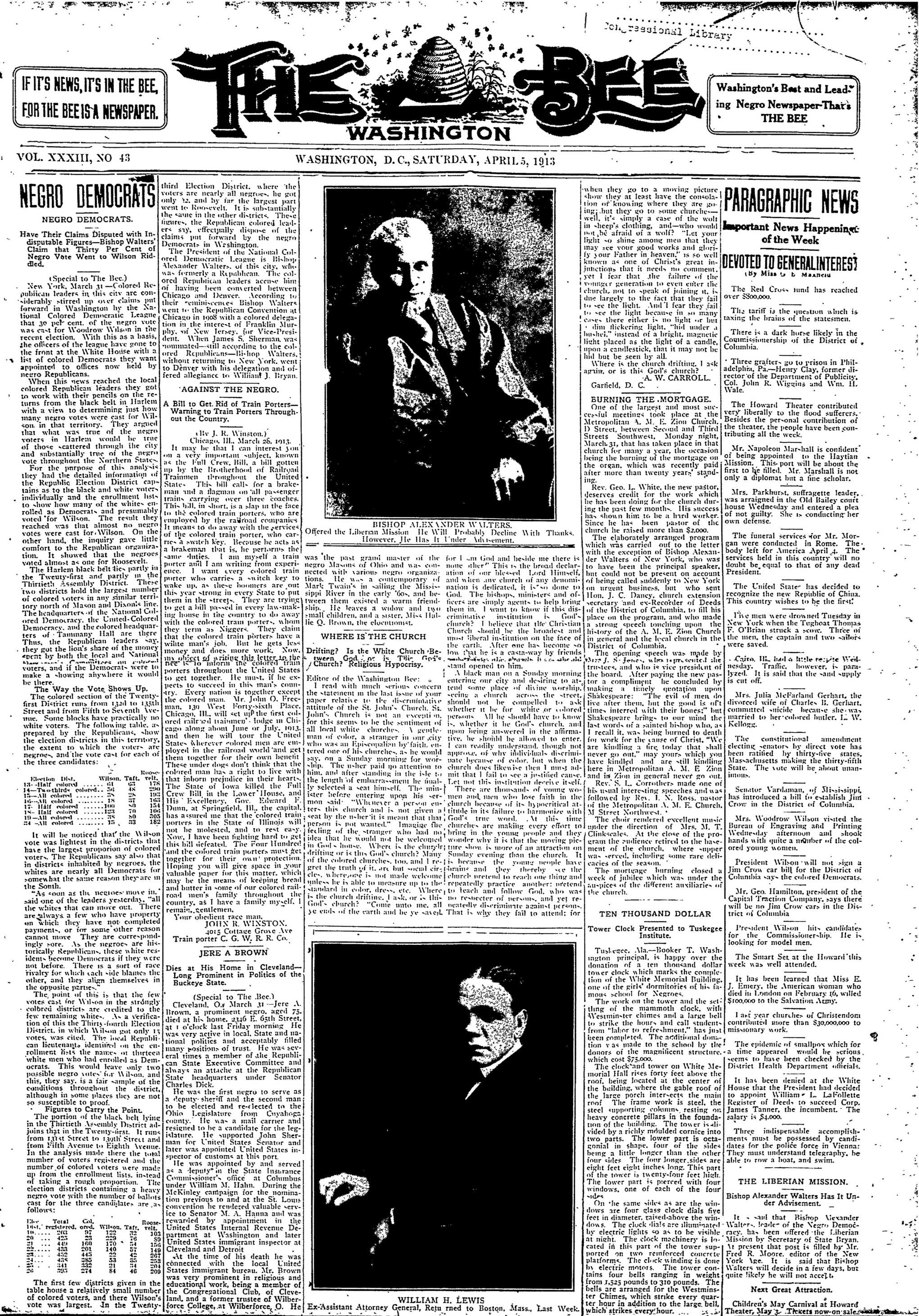
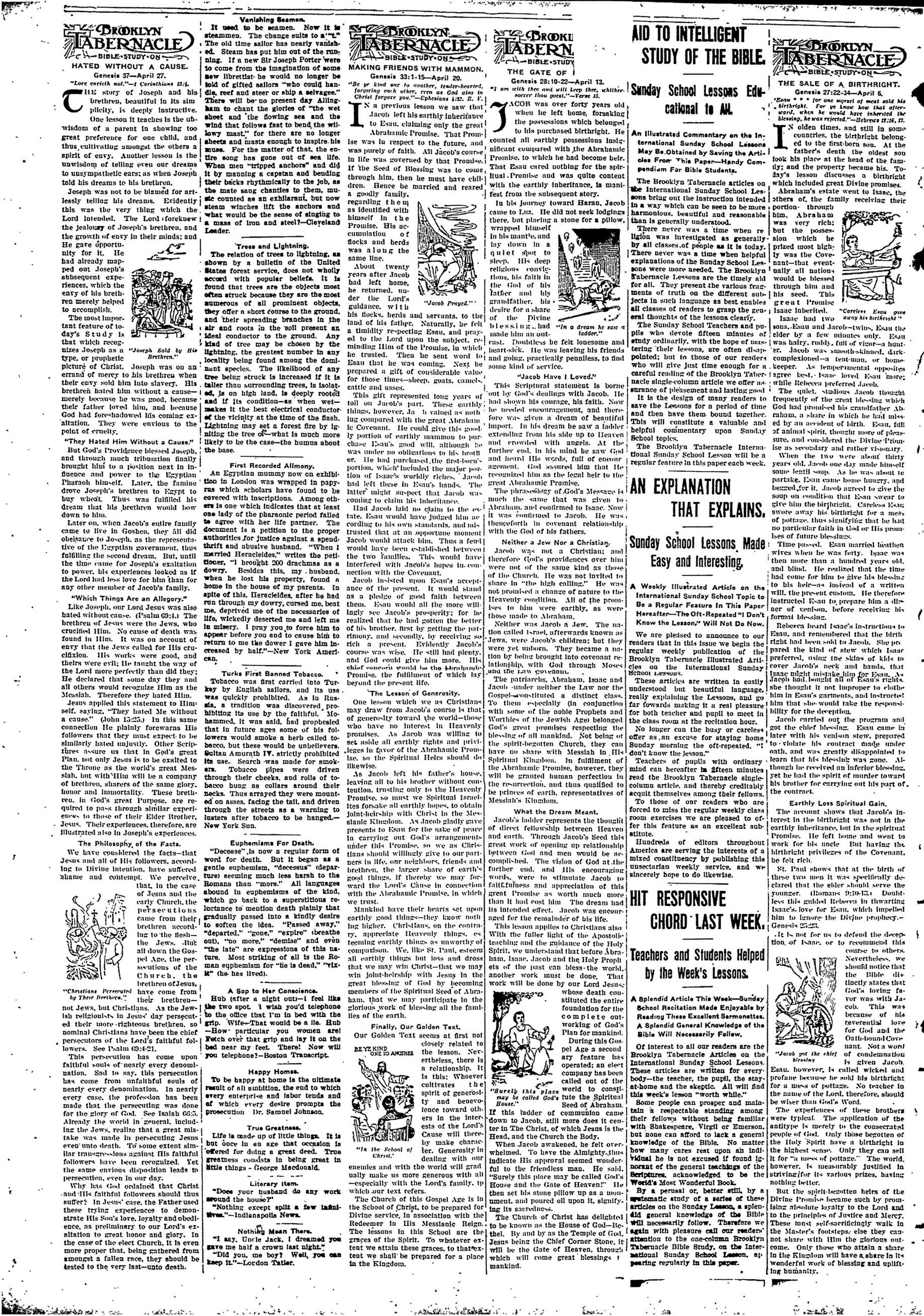
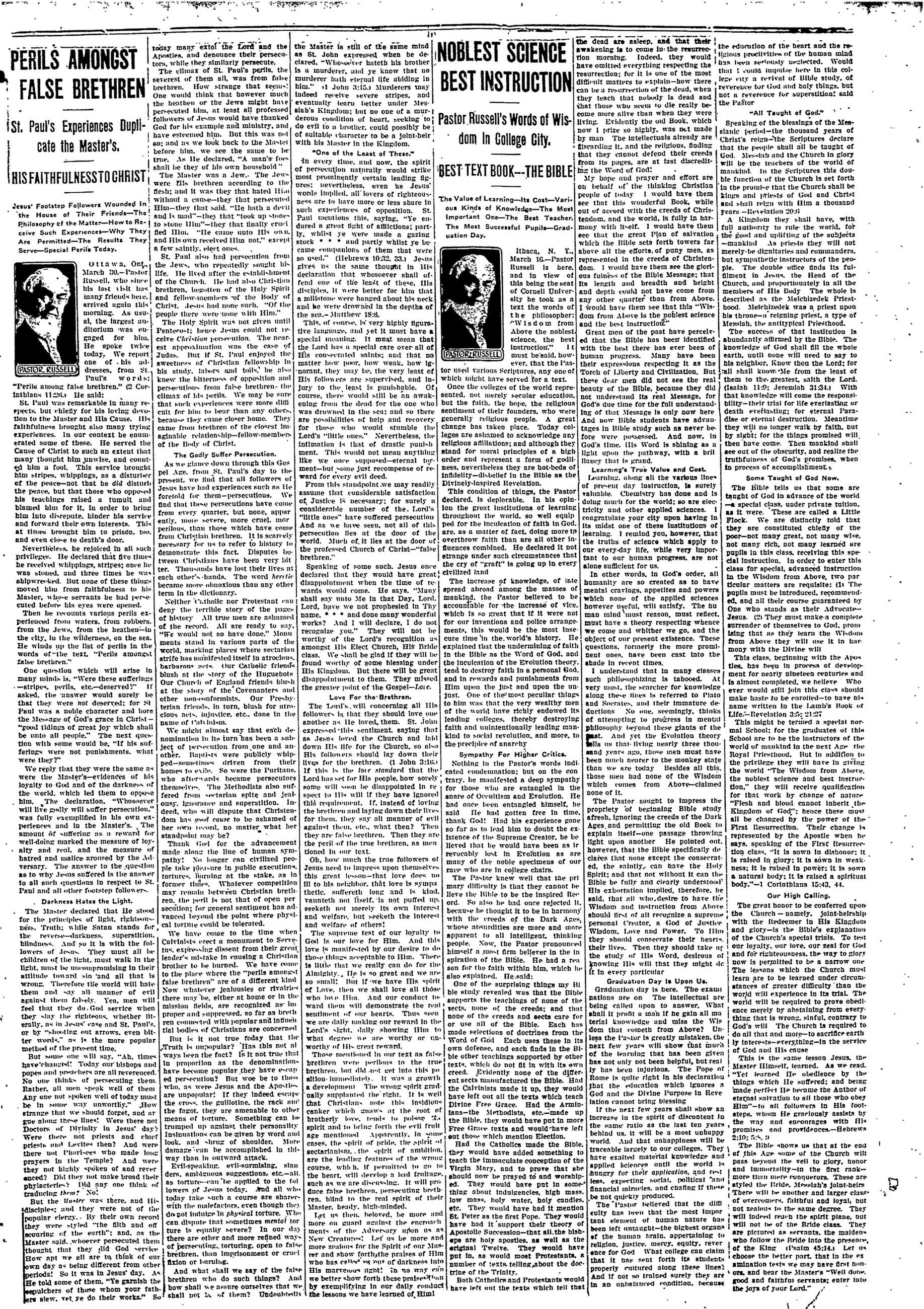
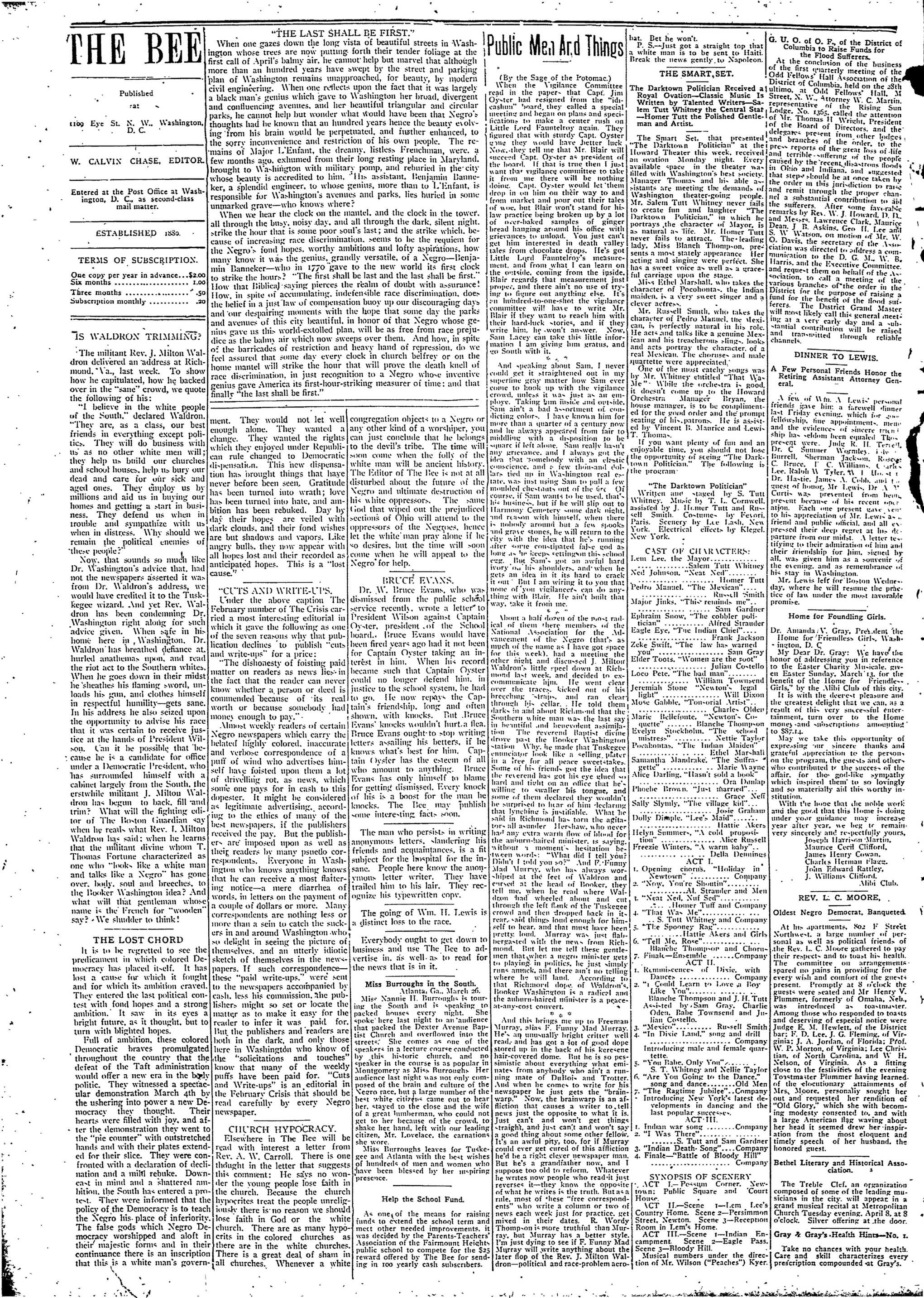
Page text (machine-generated)
NEGRO DEMOCRATS
Have Their Claims Disputed with Indisputable Figures—Bishop Walters' Claim that Thirty Per Cent of Negro Vote Went to Wilson Riddled.
(Special to The Bee.)
New York, March 31—Colored Republican leaders in this city are considerably stirred up over claims put forward in Washington by the National Colored Democratic League that 30 per cent. of the negro vote was cast for Woodrow Wilson in the recent election. With this as a basis, the officers of the league have gone to the front at the White House with a list of colored Democrats they want appointed to offices now held by negro Republicans.
When this news reached the local colored Republican leaders they got to work with their pencils on the returns from the black belt in Harlem with a view to determining just how many negro votes were cast for Wilson in that territory. They argued that what was true of the negro voters in Harlem would be true of those scattered through the city and substantially true of the negro vote throughout the Northern States. For the purpose of this analysis they had the detailed information of the Republic Election District captains as to the black and white voters individually and the enrollment list to show how many of the white enrolled as Democrats and presumably voted for Wilson. The result they reached was that almost no negro votes were cast for Wilson. On the other hand, the inquiry gave little comfort to the Republican organization. It showed that the negroes voted almost as one for Roosevelt.
The Harlem black belt lies partly in the Twenty-first and partly in the Thirtieth Assembly District. These two districts hold the largest number of colored voters in any similar territory north of Mason and Dixon's line. The headquarters of the National Colored Democracy, the United Colored Democracy, and the colored headquarters of Tammany Hall are there. Thus, the Republican leaders say, they got the lion's share of the money spent by both the local and National Democrats. Committees on colored voters, and if the Democrats were to make a showing anywhere it would be there.
The Way the Vote Shows Up.
The colored section of the Twenty-first District runs from 132d to 135th Street and from Fifth to Seventh Avenue. Some blocks have practically no white voters. The following table, prepared by the Republicans, show the election districts in this territory, the extent to which the voters are negroes, and the vote cast for each of the three candidates:
Election Dist. Wilson. Taft.elt. velt.
13—Half colored 61 63 178
14—Two-thirds colored 56 48 292
15—All colored 28 28 192
14—All colored 77 77 192
17—Half colored 100 80 154
18—Half colored 123 70 106
19—All colored 38 80 305
24—All colored 15 33 182
It will be noticed that the Wilson vote was lightest in the di-tricts that have the largest proportion of colored voters. The Republicans say also that in districts inhabited by negroes, the whites are nearly all Democrats for somewhat the same reason they are in the South.
"As soon as the negroes move in," said one of the leaders yesterday, "all the whites that can move out. There are always a few who have property on which they have not completed payments, or for some other reason cannot move. They are correspondingly sore. As the negroes are historically Republicans, these white residents become Democrats if they were not before. There is a sort of race rivalry for which each side blames the other, and they align themselves in the opposite parties.
The point of this is that the few votes cast for Wilson in the strongly colored districts are credited to the few remaining whites. As a verification of this the Thirty-fourth Election District, in which Wilson got only 15 votes, was cited. The local Republican lieutenants identified on the enrollment lists the names of thirteen white men who had enrolled as Democrats. This would leave only two possible negro votes for Wilson, and this, they say, is a fair sample of the conditions throughout the district, although in some places they are not so susceptible to proof.
Figures to Carry the Point.
The portion of the black belt lying in the Thirtieth Assembly District adjuins that in the Twenty-first. It runs from 131st Street to 191st Street and from Fifth Avenue to Eighth Avenue. In the analysis made there the total number of voters registered and the number of colored voters were made up from the enrollment lists, instead of taking a rough proportion. The election districts containing a heavy negro vote with the number of ballots cast for the three candidates are as follows:
Elec. list. Total registered, ord. Col. Wilson. Taft. Roosevelt.
10 ... 203 97 122 76 103
20 ... 425 23 129 76 99
21 ... 449 160 170 54 156
22 ... 433 201 140 57 149
23 ... 452 445 22 42 267
24 ... 438 285 33 35 323
25 ... 341 232 21 34 204
26 ... 395 274 84 46 209
The first few districts given in the table house a relatively small number of colored voters, and there Wilson's vote was largest. In the Twenty-
third Election District, where the voters are nearly all negroes, he got only 22, and by far the largest part went to Roosevelt. It is substantially the same in the other districts. These figures, the Republican colored leaders say, effectually dispose of the claims put forward by the negro Democrats in Washington. The President of the National Colored Democratic League is Bishop Alexander Walters, of this city, who was formerly a Republican. The colored Republican leaders accuse him of having been converted between Chicago and Denver. According to their reminiscences Bishop Walters went to the Republican Convention at Chicago in 1908 with a colored delegation in the interest of Franklin Murphy, of New Jersey, for Vice-President. When James S. Sherman was nominated—still according to the colored Republicans—Bishop Walters, without returning to New York, went to Denver with his delegation and offered allegiance to William J. Bryan.
AGAINST THE NEGRO
A Bill to Get. Rid of Train Porters— Warning to Train Porters Throughout the Country.
Your obedient race man,
JOHN R. WINSTON,
4015 Cottage Grove Ave
Train porter C. G. W. R. R. Co.
JERE A BROWN
Dies at His Home in Cleveland— Long Prominent in Politics of the Buckeye State. (Special to The Rec.)
SPECIAL TO THE BEC
Cleveland, Or. March 31—Jere A. Brown, a prominent negro, aged 75, died at his home, 2346 E. 65th Street, at 1 o'clock last Friday morning. He was very active in local, State and national politics and acceptably filled many positions of trust. He was several times a member of the Republican State Executive Committee and always an attack at the Republican State headquarters under Senator Charles Dick.
He was the first negro to serve as a deputy sheriff and the second man to be elected and re-elected to the Ohio Legislature from Cuyahoga county. He was a mail carrier and resigned to be a candidate for the legislature. He supported John Sherman for United States Senator and later was appointed United States inspector of customs at this port.
He was appointed by and served as a deputy in the State Insurance Commissioner's office at Columbus under William M. Hahn. During the McKinley campaign for the nomination previous to and at the St. Louis convention he rendered valuable service to Senator M. A. Hauna and was rewarded by appointment in the United States Internal Revenue Department at Washington and later United States immigrant inspector at Cleveland and Detroit.
At the time of his death he was connected with the local United States immigrant bureau. Mr. Brown was very prominent in religious and educational work, being a member of the Congregational Club, of Cleveland, and a former trustee of Wilberforce College, at Wilberforce, O. He
11
BISHOP ALEXANDER WALTERS. Offered the Liberian Mission He Will Probably Decline With Thanks. However, He Has It Under Adsessment.
THE MASTER OF THE MUSIC
was the past grand master of the negro Masons of Ohio and was connected with various negro organizations. He was a contemporary of Mark Twain in sailing the Mississippi River in the early '60s, and between them existed a warm friendship. He leaves a widow and two small children, and a sister, Miss Hallie Q. Brown, the elocutionist.
WHERE IS THE CHURCH
Drifting? Is the White Church Between God or is This God's Church? Religious Hypocrisy.
Editor of the Washington Bee: . I read with much serious concern the statement in the last issue of your paper relative to the discriminative attitude of the St. John's Church. St. John's Church is not an exception, for this seems to be the sentiment of all local white churches. A gentleman of color, a stranger in our city who was an Episcopalian by faith, entered one of his churches, as he would say, on a Sunday morning for worship. The usher paid no attention to him, and after standing in the isle to the length of embarrassment he finally selected a seat himself. The minister before entering upon his sermon said: "Whenever a person enters this church and is not given a seat by the usher it is meant that that person is not wanted." Imagine the feeling of the stranger who had no idea that he would not be welcomed in God's house. Where is the church drifting or is this God's church? Many of the colored churches, too, and I regret the truth of it, are but social circles, where the person is not made welcome unless he is able to measure up to the standard in color, dress, etc. Where is the church drifting, I ask, or is this God's church? "Come into me, all ye ends of the earth and be ye saved,
for I am God and beside me there is none other. This is the broad declaration of our blessed Lord Himself, and when any church of any denomination is dedicated, it is so done to God. The bishops, ministers and officers are simply agents to help bring them in. I want to know if this discriminative institution is God-church? I believe that the Christian Church should be the broadest and most liberal institution on the face of the earth. After one has become so low that he is a casta-way by friends and stand opened to him. A black man on a Sunday morning entering our city and desiring to attend some place of divine worship, seeing a church across the street, should not be compelled to ask whether it be for white or colored persons. All he should have to know is, whether it be God's church, and upon being answered in the affirmative, he should be allowed to enter. I can readily understand, though not approve, of why individuals discriminate because of color, but when the church does likewise then I must admit that I fail to see a justified cause. Let not this institution deceive itself.
There are thousands of young women and men who lose faith in the church because of its hypocritical attitude in its failure to harmonize with God's true word. At this time churches are making every effort to bring in the young people and they wonder why it is that the moving picture show is more of an attraction on Sunday evening than the church. It is because the young people have brains and they thereby see the church pretend to reach one thing and repeatedly practice another; pretend to teach and follow God, who was no respecter of persons, and yet repeatedly discriminate against persons. That is why they fail to attend; for
when they go to a moving picture show they at least have the consolation of knowing where they are going; but they go to some churches—well, it's simply a case of the wolf in sheep's clothing, and—who would not be afraid of a wolf? "Let your light so shine among men that they may see your good works and glorify your Father in heaven," is so well known as one of Christ's great injunctions that it needs no comment, yet I fear that the failure of the younger generation to even enter the church, not to speak of joining it, is due largely to the fact that they fail to see the light. And I fear they fail to see the light because in so many cases there either is no light or but a dim flickering light. "hid under a bushel," instead of a bright, magnetic light placed as the light of a candle, upon a candlestick, that it may not be hid but be seen by all.
Where is the church drifting, I ask again, or is this God's church?
BURNING THE.MORTGAGE.
One of the largest and most successful meetings took place at the Metropolitan A. M. E. Zion Church, D Street, between Second and Third Streets Southwest, Monday night, March 31, that has taken place in that church for many a year, the occasion being the burning of the mortgage on the organ, which was recently paid after more than twenty years' standing.
Rev. Geo. L. White, the new pastor, deserves credit for the work which he has been doing for the church during the past few months. His success has shown him to be a hard worker. Since he has been pastor of the church he raised more than $2,000.
The elaborately arranged program which was carried out to the letter with the exception of Bishop Alexander Walters of New York, who was to have been the principal speaker, but could not be present on account of being called suddenly to New York on urgent business, but who sent Hon. J. C. Dancy, church extension secretary and ex-Recorder of Deeds of the District of Columbia, to fill his place on the program, and who made a strong speech touching upon the history of the A. M. E. Zion Church in general and the local church in the District of Columbia.
The opening speech was made by Mrs J. S. Jones, who represented the trustees, and who is vice president of the board. After paying the new pastor a compliment he concluded by making a timely quotation upon Shakespeare: "The evil of men do live after them, but the good is oft times interred with their bones;" but Shakespeare brings to our mind the last words of a sainted bishop who, as I recall it, was being burned to death for work for the cause of Christ, "We are kindling a fire today that shall never go out," may yours which you have kindled and are still kindling here in Metropolitan A. M. E Zion and its Zion in general never go out.
Rev. S. L. Corrothers made one of his usual interesting speeches and was followed by Rev. I. N. Ross, pastor of the Metropolitan A. M. E. Church, M Street Northwest. The choir rendered excellent music under the direction of Mrs. M. T. Clinksaales. At the close of the program the audience retired to the basement of the church, where supper was served, including some rare delicacies of the season. The mortgage burning closed a week of jubilee which was under the auspices of the different auxiliaries of the church.
TEN THOUSAND DOLLAR
Tower Clock Presented to Tuskegee Institute.
Tuskegee, Ma.—Booker T. Washington principal, is happy over the donation of a ten thousand dollar tower clock which marks the completion of the White Memorial Building, one of the girls' dormitories of his famous school for Negroes. The work on the tower and the setting of the mammoth clock, with Westminster chimes and a large bell to strike the hours, and call students from "labor to refreshment," has just been completed. The additional donation was made to the school by the donors of the magnificent structure, which cost $75,000.
The clock and tower on White Memorial Hall rises forty feet above the roof, being located at the center of the building, where the gable roof of the large porch intersects the main roof. The frame work is steel, the steel supporting columns, resting on heavy concrete pillars in the foundation of the building. The tower is divided by a richly moulded cornice into two parts. The lower part is octagonal in shape, four of the sides being a little longer than the other four sides. The four longer, sides are eight feet eight inches long. This part of the tower is twenty-four feet high. The lower part is pierced with four windows, one of each of the four sides.
On the same sides as are the windows are four glass clock dials five feet in diameter, raised above the windows. The clock dials are illuminated by electric lights so as to be visible at night. The clock machinery is located in this part of the tower supported on two reinforced concrete platforms. The clock winding is done by electric motors. The tower contains four bells ranging in weight from 1,525 pounds to 310 pounds. The bells are arranged for the Westminster Chimes, which strike every quarter hour in addition to the large bell, which strikes every hour.
The Red Cross fund has reached over $800,000.
The tariff is the question which is taxing the brains of the statesmen.
There is a dark horse likely in the Commissionership of the District of Columbia.
Three grafters go to prison in Philadelphia, Pa.-Henry Clay, former director of the Department of Publicity, Col. John R. Wiggins and Wm. H. Wale.
The Howard Theater contributed very liberally to the flood sufferers. Besides the personal contribution of the theater, the people have been contributing all the week.
Mr. Napoleon Marshall is confident of being appointed to the Haytian Mission. This port will be about the first to be filled. Mr. Marshall is not only a diplomat but a fine scholar.
Mrs. Parkhurst, suffragette leader, was arraigned in the Old Bailey court house Wednesday and entered a plea of not guilty. She is conducting her own defense.
The funeral services for Mr. Morgan were conducted in Rome. The body left for America April 4. The services held in this country will no doubt be equal to that of any dead President.
The United States has decided to recognize the new Republic of China. This country wishes to be the first.
Five men were drowned Tuesday in New York when the Tugboat Thomas F. O'Brian struck a scow. Three of the men, the captain and two sailors were saved.
Cairo, Ill. had a little respite Wednesday. Traffic, however, is paralyzed. It is said that the sand supply is cut off.
Mrs. Julia McFarland Gerhart, the divorced wife of Charles B. Gerhart, committed suicide because she was married to her colored butler, L. W. Kellogg.
The constitutional amendment electing senators by direct vote has been ratified by thirty-five states, Massachusetts making the thirty-fifth State. The vote will be about unanimous.
Senator Vardaman, of Mississippi, has introduced a bill to establish Jim Crow in the District of Columbia.
Mrs. Woodrow Wilson visited the Bureau of Engraving and Printing Wednesday afternoon and shook hands with quite a number of the colored young women.
President Wilson will not sign a Jim Crow car bill for the District of Columbia says the colored Democrats.
Mr. Geo. Hamilton, president of the Capital Traction Company, says there will be no Jim Crow cars in the District of Columbia.
President Wilson hits candidates for the Commissioner-ship. He is looking for model men.
The Smart Set at the Howard this week was well attended.
It has been learned that Miss E. J. Emery, the American woman who died in London on February 16, willed $100,000 to the Salvation Army.
Last year churches of Christendom contributed more than $30,000,000 to missionary work.
The epidemic of smallpox which for a time appeared would be serious seems to have been checked by the District Health Department officials.
It has been denied at the White House that the President had decided to appoint William L. LaFollette Register of Deeds to succeed Corp. James Tanner, the incumbent. The salary is $4,000.
Three indispensable accomplishments must be possessed by candidates for the police force in Vienna: They must understand telegraphy, be able to row a boat, and swim.
THE LIBERIAN MISSION
Bishop Alexander Walters Has It Under Advisement.
It said that Bishop Alexander Walters, leader of the Negro Democracy, has been offered the Liberian Mission by Secretary of State Bryan. It present that post is filled by Mr. Fred R. Moore, editor of the New York Age. It is said that Bishop Walters will decide in a few days, but quite likely he will not accept.
Next Great Attraction.
Children's May Carnival at Howard Theater, May 3. Tickets now on sale.
BIBLE-STUDY ON
HATED WITHOUT A CAUSE.
Genesis 37—April 27.
"Lore enrichit not."—I Corinthians 12:4.
THE story of Joseph and his brethren, beautiful in its simplicity, is deeply instructive.
One lesson it teaches is the ubwisdom of a parent in showing too great preference for one child, and thus cultivating amongst the others a spirit of envy. Another lesson is the unwisdom of telling even our dreams to unsympathetic ears; as when Joseph told his dreams to his brethren.
Joseph was not to be blamed for artlessly telling his dreams. Evidently this was the very thing which the Lord intended. The Lord foreknew the jealousy of Joseph's brethren, and the growth of envy in their minds; and
He gave opportunity for it. He had already mapped out Joseph's subsequent experiences, which the envy of his brethren merely helped to accomplish.
A
The most important feature of today's Study is that which recognizes Joseph as a type, or prophetic picture of Christ.
nizes Joseph as a "Joseph Sold by His type, or prophetic picture of Christ. Joseph was on an errand of mercy to his brethren when their envy sold him into slavery. His brethren hated him without a cause—merely because he was good, because their father loved him, and because God had fore-shadowed his coming exaltation. They were envious to the point of cruelty.
"They Hated Him Without a Cause." But God's Providence blessed Joseph, and through much tribulation finally brought him to a position next in influence and power to the Egyptian Pharaoh himself. Later, the famine drove Joseph's brethren to Egypt to buy wheat. Thus was fulfilled his dream that his brethren would bow down to him.
Later on, when Jacob's entire family came to live in Goshen, they all did obeisance to Joseph, as the representative of the Egyptian government, thus fulfilling the second dream. But, until the time came for Joseph's exaltation to power, his experiences looked as if the Lord had less love for him than for any other member of Jacob's family.
"Which Things Are an Allegory."
Like Joseph, our Lord Jesus was also hated without cause. (Psalm 60:1). The brethren of Jesus were the Jews, crucified Him. No cause of death was found in Him. It was on account of envy that the Jews called for His crucifixion. His works were good, and theirs were evil; He taught the way of the Lord more perfectly than did they. He declared that some day they and all others would recognize Him as the Messiah. Therefore they hated Him.
Jesus applied this statement to Himself, saying, "They hated Me without a cause." (John 15:25.) In this same connection He plainly forewarns His followers that they must expect to be similarly hated unjustly. Other Scriptures assure us that in God's great Plan, not only Jesus is to be exalted to the Throne as the world's great Messiah, but with Him will be a company of brethren, sharers of the same glory, honor and immortality. These brethren, in God's great Purpose, are required to pass through similar experiences to those of their Elder Brother, Jesus. Their experiences, therefore, are illustrated also in Joseph's experiences.
The Philosophy of the Facts.
We have considered the facts—that Jesus and all of His followers, according to Divine intention, have suffered shame and contempt. We perceive that, in the case of Jesus and the early Church, the persecutions came from their brethren according to the flesh—the Jews. But all down the Gospel Age, the persecutions of the Church, the brethren of Jesus, have come from their brethren—
"Christians Persecuted by Their Brethren."
of Jesus and the early Church, the persecutions came from their brethren according to the flesh—the Jews. But all down the Gospel Age, the persecutions of the Church, the brethren of Jesus, have come from their brethren—not Jews, but Christians. As the Jewish religionists in Jesus' day persecuted their more righteous brethren, so nominal Christians have been the chief persecutors of the Lord's faithful followers. See Psalm 60:4-21.
This persecution has come upon faithful souls of nearly every denomination. Sad to say, this persecution has come from unfaithful souls of nearly every denomination. In nearly every case, the profession has been made that the persecuting was done for the glory of God. See Isaiah 605. Already the world in general, including the Jews, realize that a great mistake was made in persecuting Jesus even unto death. To some extent similar transgressions against His faithful followers have been recognized. Yet the same envious disposition leads to persecution, even in our day.
Why has God ordained that Christ and His faithful followers should thus suffer? In Jesus' case, the Father used these trying experiences to demonstrate His Soul's love, loyalty and obedience, as preliminary to our Lord's exaltation to great honor and glory. In the case of the elect Church, it is even more proper that, being gathered from amongst a fallen race, they should be tested to the very last—unto death.
It used to be seamen. Now it is steammen. The change suits to it "a"*"The old time sailor has nearly vanished. Steam has put him out of the running. If a new Sir Joseph Porter were to come from the imagination of some new librettist he would no longer be told of gifted sailors "who could handle, reef and steer or ship a selvagee." There will be no present day Allingham to chant the glories of "the wet sheet and 'the flowing sea and the wind that follows fast to bend the willowy mast," for there are no longer sheets and masts enough to inspire his muse. For the matter of that, the entire song has gone out of sea life. When men "tripped anchors" and did it by manning a capstan and bending their backs rhythmically to the job, as the mate sang chanties to them, music counted as an exhilarant, but now steam winches lift the anchors and what would be the sense of singing to a mass of iron and steel?—Cleveland Leader.
Trees and Lightning.
The relation of trees to lightning, as shown by a bulletin of the United States forest service, does not wholly accord with popular beliefs. It is found that trees are the objects most often struck because they are the most numerous of all prominent objects, they offer a short course to the ground, and their spreading branches in the air and roots in the soil present an ideal conductor to the ground. Any kind of tree may be chosen by the lightning, the greatest number in any locality being found among the dominant species. The likelihood of any tree being struck is increased if it is taller than surrounding trees, is isolated, is on high land, is deeply rooted and if its condition—as when wet—makes it the best electrical conductor of the vicinity at the time of the flash. Lightning may set a forest fire by igniting the tree of—what is much more likely to be the case—the humus about the base.
First Recorded Allmony.
An Egyptian mummy now on exhibition in London was wrapped in papyrus which scholars have found to be covered with inscriptions. Among others is one which indicates that at least one lady of the pharaonic period failed to agree with her life partner. The document is a petition to the proper authorities for justice against a spendthrift and abusive husband. "When I married Heracleides," writes the petitioner, "I brought 200 drachmas as a dowry. Besides this, my husband, when he lost his property, found a home in the house of my parents. In spite of this, Heracleides, after he had run through my dower, cursed me, beat me, deprived me of the necessaries of life, wickedly deserted me and left me in misery. I pray you to force him to appear before you and to cause him to return to me the dower I gave him increased by half."—New York American.
Turks First Banned Tobacco. Tobacco was first carried into Turkey by English sailors, and its use was quickly prohibited. As in Russia, a tradition was discovered prohibiting its use by the faithful. Mohammed, it was said, had prophesied that in future ages some of his followers would smoke a herb called tobacco, but these would be unbelievers. Sultan Amurath IV. strictly prohibited its use. Search was made for smokers. Tobacco pipes were driven through their cheeks, and rolls of tobacco hung as collars around their necks. Thus arrayed they were mounted on asses, facing the tall, and driven through the streets as a warning to lusters after tobacco to be hanged.—New York Sun.
Euphemisms For Death.
"Decease". Is now a regular form of word for death. But it began as a gentle euphemism, "decessus" (departure) seeming much less harsh to the Romans than "mors." All languages abound in euphemisms of the kind, which go back to a superstitious reluctance to mention death plainly that gradually passed into a kindly desire to soften the idea. "Passed away," "departed." "gone." "expire" (breathe out), "no more." "demise" and even "the late" are expressions of this nature. Most striking of all is the Roman euphemism for "he is dead," "vixit" (he has lived).
A Sop to Her Conscience.
Hub (after a night out)—I feel like the two spot. I wish you'd telephone to the office that I'm in bed with the grip. Wife-That would be a life. Hub—How particular you women are! Fetch over that grip and lay it on the bed near my feet. There! Now will you telephone?—Boston Transcript.
Happy Homes.
To be happy at home is the ultimate result of all ambition, the end to which every enterprise and labor tends and of which every desire prompts the prosecution Dr. Samuel Johnson.
True Greatness
Life is made up of little things. It is but once in an age that occasion is offered for doing a great deed. True greatness consists in being great in little things - George Macdonald.
Literary Item:
"Does your husband do any work around the house?"
"Nothing except split a few infinitives."
"Indianaapolis News."
Nothing Mean There.
"I say, Uncle Jack. I dreamed you gave me half a crown last night."
"Did you, me boy? Well, you can keep it."—Lord Tatler.
MAKING FRIENDS WITH MAMMON.
Genesis 13:1-15 - April 20.
"Be ye kind one to another, tender-hearted,
forcuring each other, crean as God also in
Christ forge you." - Ephelias 13:2, R. F.
In a previous lesson we saw that
Jacob left his earthly inheritance
to Esau, claiming only the great
Abrahamic Promise. That Promise
was in respect to the future, and
was purely of faith. All Jacob's course
in life was governed by that Promise.
If the Seed of Blessing was to come
through him, then he must have children.
Hence he married and reared
a goodly family, regarding the them as identified with himself in the Promise. His accumulation of flocks and herds was along the same line.
M
About twenty years after Jacob had left home, he returned. under the Lord's guidance, with
der the Lord's "Jacob Prayed." guidance, with his flocks, herds and servants, to the land of his father. Naturally, he felt a timidity respecting Esau, and prayed to the Lord upon the subject, reminding Him of the Promise, in which he trusted. Then he sent word to Esau that he was coming. Next he prepared a gift of considerable value for those times—sheep, goats, camels, cattle and asses.
This gift represented long years of toil on Jacob's part. These earthly things, however, Ja'b valued as nothig compared with the great Abraham I Covenant. He could give this goodly portion of earthly mammon to purchase Isa'u's good will, although he was under no obligations to his breth- er. He had purchased the first-born portion, which included the major portion of Isa'u's worldly riches. Isa'u had left these in Isa'u's hands. The latter might suspect that Jacob was coming to claim his inheritance.
Had Jacob laid no claim to the estate, Isa'u would have judged him according to his own standards, and mistrusted that at an opportune moment Jacob would attack him. Thus a feud would have been established between the two families. This would have interfered with Jacob's hopes in connection with the Covenant.
Jacob invisted upon Esau's acceptance of the present. It would stand as a pledge of good faith between them. Esau would all the more willingly see Jacob's prosperity; for he realized that he had gotten the better of his brother, first by getting the parrimoin, and secondly, by receiving so rich a present. Evidently Jacob's course was wise. He still had plenty, and God could give him more. His chief sonnet would be the *Apacharnia* Promise, the fulfillment of which lay beyond the present life.
The Lesson of Generosity.
One lesson which we as Christians may draw from Jacob's course is that of generosity toward the world—those who have no interest in Heavenly promises. As Jacob was willing to set aside all earthly rights and privileges in favor of the Abrahamic Promise, so the Spiritual Helms should do likewise.
As Jacob left his father's house, leaving all to his brother without contention, trusting only to the Heavenly Promise, so must we Spiritual Israelites forsake all earthly hopes, to obtain joint-heirship with Christ in the Messianic Kingdom. As Jacob gladly gave presents to Esau for the sake of peace in carrying out God's arrangements under this Promise, so we as Christians should willingly give to our partners in life, our neighbors, friends and brethren, the larger share of earth's good things. If thereby we may forward the Lord's Cause in connection with the Abrahamic Promise, in which we trust.
Mankind have their hearts set upon earthly good things—they know nothing higher. Christians, on the contrary, appreciate Heavenly things, esteem earthly things as unworthy of comparison. We, like St. Paul, esteem all earthly things but loss and dross that we may win Christ—that we may win joint-heirship with Jesus in the great blessing of God by becoming members of the Spiritual Seed of Abraham, that we may participate in the glorious work of blessing all the families of the earth.
Finally, Our Golden Text,
Our Golden Text seems at first not
seems at first not closely related to the lesson. Nevertheless, there is a relationship. It is this; Whoever cultivates the spirit of generosity and benevolence toward others in the interests of the Lord's Cause will thereby make character. Generosity in dealing with our
ertheless, there is a relationship. It is this: Whoever cultivates the spirit of generosity and benevolence toward others in the interests of the Lord's Cause will thereby make character. Generosity in dealing with our enemies and with the world will gradually make us more generous with all—especially with the Lord's family, to which our text refers.
The Church of this Gospel Age is in the School of Christ, to be prepared for Divine service, in association with the Redeemer in His Messianic Reign. The lessons in this School are the graces of the Spirit. To whatever extent we attain these graces, to that extent we shall be prepared for a place in the Kingdom.
THE GATE OF I
Genesis 28:10-22—April 13.
"I am with thee and will keep thee, whither soever thou poet."—Verse 15.
JACOB was over forty years old when he left home, forsaking the possessions which belonged to his purchased birthright. He counted all earthly possessions insignificant compared with the Abraham Promise, to which he had become heir.
That Esau cared nothing for the spiritual. Promise and was quite content with the earthly inheritance, is manifest from the subsequent story.
In his journey toward Haran, Jacob came to Luz. He did not seek lodgings there, but plaining a stone for a pillow,
wrapped blisself in his mantle, and lay down in a quiet shot to sleep. His deep religious convictions, his faith in the God of his father and his grandfather, his desire for a share of the Divine blessing, had made him an out-
wrapped musket in his mantle, and lay down in a quiet shot to sleep. His deep religious convictions, his faith in the God of his father and his grandfather, his desire for a share of the Divine blessings, had made him an outcast. Doubtless he felt lonesome and heart-sick. He was leaving his friends and going, practically penniless, to find some kind of service.
"Jacob Have I Loved."
This Scriptural statement is borne out by God's dealings with Jacob. He had shown his courage, his faith. Now he needed encouragement, and therefore was given a dream of beautiful import. In his dream he saw a ladder extending from his side up to Heaven and crowded with angels. At the further end, in his mind he saw God and heard His words, full of encouragement. God assured him that He recognized him as the legal heir to the great Abrahamic Promise.
The phraseology of God's Message is much the same that was given to Abraham, and confirmed to Isaac. Now it was continued to Jacob. He was thenceforth in covenant relationship with the God of his fathers.
Neither a Jew Nor a Christian.
Neither was Jacob a Jew. The nation called Israel, afterwards known as Jews, were Jacob's children; but they were yet unborn. They became a nation by being brought into covenant relationship, with God through Moses and the law government.
The patriarchs, Abraham, Isaac and Jacob under neither the Law nor the Gospel constituted a distinct class. To them especially (in conjunction with some of the noble Prophets and Worthies of the Jewish Age belonged God's great promises respecting the blessing of all mankind. Not being of the spirit-hegotten Church, they can have no share with Messiah in His Spiritual Kingdom, in fulfillment of the Abrahamic Promise, however, they will be granted human perfection in the resurrection, and thus qualified to be princes of earth, representatives of Messiah's Kingdom.
What the Dream Meant.
Jacob's ladder represents the thought of direct fellowship between Heaven and earth. Through Jacob's Seed this great work of opening up relationship between God and men would be accomplished. The vision of God at the further end, and His encouraging words, were to stimulate Jacob to faithfulness and appreciation of this great Promise as worth much more than it had cost him. The dream had its intended effect. Jacob was encouraged for the remainder of his life. This lesson applies to Christians also With the fuller light of the Apostolic teaching and the guidance of the Holy Spirit, we understand that before Abraham, Isaac, Jacob and the Holy Prophets of the past can bless the world, another work must be done. That work will be done by our Lord Jesus.
whose death constituted the entire foundation for the complete outworking of God's Plan for mankind.
A
During this Gospel Age a secondary feature has operated; an electric company has been called out of the world to constitute the Spiritual Seed of Abraham.
"Burstly this place world to consti-
may be called God's tute the Spiritual
House." Seed of Abraham.
If this ladder of communion cane
down to Jacob, still more does it center
in The Christ, of which Jesus is the
Head, and the Church the Body.
When Jacob awakened, he felt over-
whelmed. To have the Almighty, thus
indicate His approval seemed wonderful
to the friendless man. He said,
"Surely this place may be called God's
House and the Gate of Heaven!" He
then set his stone pillow up as a monument, and poured oil upon it, signifying its sacredness.
The Church of Christ has delighted
to be known as the House of God—Heil-
thel. By and by as the Temple of God,
Jesus being the Chief Corner Stone, it
will be the Gate of Heaven, through
which will come great blessings t
mankind.
AID TO INTELLIGENT STUDY OF THE BIBLE.
An Illustrated Commentary on the International Sunday School Lessons May Be Obtained by Saving the Articles From This Paper—Handy Compendium for Bible Students.
The Brooklyn Tabernacle articles on the International Sunday School Lessons bring out the instruction intended in a way which can be seen to be more harmonious, beautiful and reasonable than is generally understood.
There never was a time when religion was investigated as generally by all classes, of people as it is today. There never was a time when helpful explanations of the Sunday School Lessons were more needed. The Brooklyn Tabernacle Lessons are the timely aid for all. They present the various fragments of truth on the different subjects in such language as best enables all classes of readers to grasp the general thoughts of the lessons clearly.
The Sunday School Teachers and pupils who devote fifteen minutes of study ordinarily, with the hope of mastering their lessons, are often disappointed; but to those of our readers who will give just time enough for a careful reading of the Brooklyn Tabernacle single-column article we offer assurance of pleasure and lasting good. It is the design of many readers to save the Lessons for a period of time and then have them bound together. This will constitute a valuable and helpful commentary upon Sunday School topics.
The Brooklyn Tabernacle International Sunday School Lesson will be a regular feature in this paper each week.
AN EXPLANATION THAT EXPLAINS. Sunday School Lessons Made Easy and Interesting.
A Weekly Illustrated Article on the International Sunday School Topic to Be a Regular Feature In This Paper Hereafter—The Oft-Repeated "I Don't Know the Lesson," Will Not Do Now.
We are pleased to announce to our readers that in this issue we begin the regular weekly publication of the Brooklyn Tabernacle Illustrated Articles on the International Sunday School Lessons.
These articles are written in easily understood but beautiful language, really explaining the Lessons, and go far towards making it a real pleasure for both teacher and pupil to meet in the class room at the recitation hour.
No longer can the busy or careless offer as an excuse for staying home Sunday morning the oft-repeated, "I don't know the lesson."
Teachers of pupils with ordinary mind can hereafter fifteen minutes read the Brooklyn Tabernacle single-column article, and thereby creditably acquit themselves among their fellows. To those of our readers who are forced to miss the regular weekly classroom exercises we are pleased to offer this feature as an excellent substitute. Hundreds of editors throughout America are serving the interests of a mixed constituency by publishing this unsectarian weekly service, and we sincerely hope to do likewise.
HIT RESPONSIVE CHORD LAST WEEK. Teachers and Students Helped by the Week's Lessons.
A Splendid Article This Week—Sunday
School Recitation Made Enjoyable by
Reading These Excellent Sermonettes.
A Splendid General Knowledge of the
Bible Will Necessarily Follow.
Of Interest to all our readers are the
Brooklyn Tabernacle Articles on the
International Sunday School Lessons.
These articles are written for every-
body—the teacher, the pupil, the stay-
at-home and the skeptic. All will find
this week's lesson "worth while."
Some people can prosper and maintain a respectable standing among their fellows without being familiar with Shakespeare, Virgil or Emerson, but none can afford to lack a general knowledge of the Bible. No matter how many cares rest upon an individual he is not excused if found ignorant of the general teachings of the Scriptures, acknowledged to be the World's Most Wonderful Book. By a perusal or, better still, by a systematic study of a series of these articles on the Sunday Lesson, a splendid general knowledge of the Bible will necessarily follow. Therefore we again with pleasure call our readers' attention to the one-column Brooklyn Tabernacle Bible Study, on the International Sunday School Lesson, appearing regularly in this paper.
THE SALE OF A BIRTHRIGHT.
Genesis 27:22-34—April 6.
"Eaque * * * for one moment of meat sold his birthright. For we know how that afterward, when he would have inherited the blessing, he was rejected."—Ibrahim 12:16, tt.
In olden times, and still in some countries, the birthright belonged to the first-born son. At the father's death the oldest son took his place at the head of the family; and the property became his. Today's lesson discusses a birthright which included great Divine promises.
Abraham's estate went to Isaac, the others of, the family receiving their portion through him. Abraham was very rich; but the possession which he prized most highly was the Covenant—that eventually all nations would be blessed through him and his seed. This great Promise Isaac Inherited. "Carriac, Few care."
him. Abraham was very rich; but the possession which he prized most highly was the Covenant—that eventually all nations would be blessed through him and his seed. This great Promise Isaac inherited. Isaac had two sons, Esau and Jacob—twins, Esau the elder by a few minutes only. Esau was hairy, ruddy, full of vigor—a hunter. Jacob was smooth-skinned, dark-complexioned—a tent-man, or homekeeper. As temperamental opposites agree best. Isaac loved Esau more; while Rebecca preferred Jacob.
The quiet, studious Jacob thought frequently of the great blessing which God had promised his grandfather Abraham, a share in which he had missed by an accident of birth. Esau, full of animal spirit, thought more of pleasure, and considered the Divine Promise as secondary and rather visionary. When the two were about thirty years old, Jacob one day made himself some lentil soup. As he was about to partake, Esau came home humery, and begged, for it, Jacob agreed to give the soup on condition that Esau swear to give him the birthright. Careless Esau swore away his birthright for a mess of potage, thus signifying that he had no particular faith in God or His promises of future blessings.
Time passed. Esau married heathen wives when he was forty. Esau was then more than a hundred years old, and blind. He realized that the time had come for him to give his blessing to his heir-as instead of a written will, the present custom. He therefore instructed Esau to prepare him a dinner of venison, before receiving his formal blessing.
Rebecca heard Esau's instructions to Esau, and remembered that the birth right had been sold to Jacob. She prepared the kind of stew which Esau preferred, using the skins of kids to cover Jacob's neck and hands, that Esau might mistake him for Esau. As Jacob had bought all of Esau's rights, she thought it not improper to cloth him in Esau's garments, and instructed him that she would take the responsibility for the deception.
Jacob carried out the program and got the chief blessing. Esau came in later with his venison stew, prepared to violate his contract made under oath, and was greatly disappointed to learn that his blessing was gone. Although he received an inferior blessing, yet he had the spirit of murder toward his brother for carrying out his part of the contract.
Earthly Loss Spiritual Gain.
The account shows that Jacob's interest in the birthright was not in the earthly inheritance, but in the spiritual Promise. He left home and went to work for his uncle. But having the birthright privileges of the Covenant, he felt rich.
St. Paul shows that at the birth of these two men it was specifically declared that the elder should serve the younger. (Romans 9:10-13) Doubts this guided Rebeva in thwarting Isaac's love for Esau, which impelled him to ignore the Divine prophecy.—Genesis 5:22.
It is not for us to defend the deception of Isaac, or to recommend this
course to others.
Nevertheless, we should notice that the Bible distinctly states that God's favor loving was with Jacob. This was because of his reverential love for God and the Oath-bound Covenant. Not a word of condemnation is given Jacob.
Nevertheless, we should notice that the Bible distinctly states that God's loving favor was with Jacob. This was because of his reverential love for God and the Oath-bound Covenant. Not a word of condemnation is given Jacob. Esau, however, is called wicked and profane because he sold his birthright for a mess of potage. No teacher in the name of the Lord, therefore, should be wiser than God's Word.
The experiences of these brothers were typical. The application of the antitype is merely to the consecrated people of God. Only those begotten of the Holy Spirit have a birthright in the highest sense. Only they can sell it for a mess of potage. The world, however, is measurably justified in striving for its various prizes, having nothing better.
But the spirit-begotten heirs of the Divine Promise became such by promising absolute loyalty to the Lord and to the principles of Justice and Mercy. These must self-sacrificingly walk in the Master's footsteps; else they cannot share with Him the glorious outcome. Only those who attain a share in the Kingdom will have a share in its wonderful work of blessing and uplifting humanity.
PERILS AMONGST FALSE BRETHREN
Jesus' Footstep Followers Wounded in the House of Their Friends—The Philosophy of the Matter—How to Receive Such Experiences—Why They Are Permitted—The Results They Serve—Special Perils Today.
Ottawa, Ont., March 30—Pastor Russell, who since his last visit has in many friends here, arrived again this morning. As usual, the largest auditorium was engaged for him. He spoke twice today. We report one of his addresses, from St. Paul's words:
PASTOR RUSSELL
PASTOR RUSSELL one of his addresses, from St. Paul's words: "Perils among false brethren." (2 Corinthians 11:26). He said: St. Paul was remarkable in many respects, but chiefly for his loving devotion to the Master and His Cause. His faithfulness brought also many trying experiences. In our context he enumerated some of these. He served the Cause of Christ to such an extent that many thought him unwise, and counted him a fool. This service brought him stripes, whippings, as a disturber of the peace—not that he did disturb the peace, but that those who opposed his teachings raised a tumult and blamed him for it. In order to bring him into disrepute, hinder his service and forward their own interests. This at times brought him to prison, too, and even close to death's door.
Nevertheless, he rejoiced in all such privileges. He declared that five times he received whippings, stripes; once he was stoned, and three times he was shipwrecked. But none of these things moved him from faithfulness to his Master, whose servants he had persecuted before his eyes were opened. Then he recounts various perils experienced from waters, from robbers, from the Jews, from the heathen in the city, in the wilderness, on the sea. He winds up the list of perils in the words of the text. "Perils amongst false brethren."
One question which will arise in many minds is, "Were these sufferings—stripes, perils, etc.—deserved?" If asked, the answer would surely be that they were not deserved; for St Paul was a noble character and bore the Message of God's grace in Christ—"good tidings of great joy which shall be unto all people." The next question with some would be, "If his sufferings were not punishments, what were they?"
We reply that they were the same as were the Master's—evidences of his loyalty to God and the darkness of the world, which led them to oppose him. The declaration, "Whosoever will live gaily will suffer persecution," was fully exemplified in his own experiences and in the Master's. The amount of suffering as a reward for well-doing marked the measure of loyalty and zeal, and the measure of hatred and malice aroused by the Adversary. The answer to the question as to why Jesus suffered is the answer to all such questions in respect to St. Paul and all other footstep follower-
Darkness Hates the Light.
The Master declared that He stood for the principles of light, righteousness, Truth; while Satan stands for the reverse-darkness, superstition, blindness. And so it is with the followers of Jesus. They must all be children of the light, must walk in the light, must be uncompromising in their attitude toward sin and all that is wrong. Therefore the world will hate them and say all manner of evil against them falsely. Yea, men will feel that they do. God service when they stay the righteous, whether literally, as in Jesus' case and St. Paul's, or by "shouting out arrows, even bitter words," as is the more popular method of the present time.
But some one will say, "Ah, times have changed! Today our bishops and popes and preachers are all reverenced. No one thinks of persecuting them. Rather, all men speak well of them. Any one not spoken well of today must be in some way unworthy." How strange that we should forget, and argue along these lines! Were there not Doctors of Dignity in Jesus' day? Were there not priests and chief priests and Levites then? And were there not Pharisees who made long prayers in the Temple? And were they not highly spoken of and reverenced? Did they not make broad their phylacteries? Did any one think of reducing them? No.
But the Master was there, and His disciples; and they were not of the popular clergy. By their own record they were styled "the fifth and off-accurring of the earth"; and, as the Master said, whoever persecuted them thought that they did God service. How apt we all are to think of our own day as being different from other periods! So it was in Jesus day. As He told some of them, "Ye garnish the acquilcers of those whom your fathers slew, yet ye do their works." So
today many exfoli the Lord and the Apostles, and denounce their persecutors, while they similarly persecute.
The climax of St. Paul's perils, the severest of them all, was from false brethren. How strange that second: One would think that however much the beaten and the Jews might have persecuted him, at least all professed followers of Jesus would have thanked God for his example and ministry, and have esteemed him. But this was not so; and as we look back to the Master before him, we see the same to be true. As He declared, "A man's foe shall be they of his own household."
The Master was a Jew. The Jews were his brethren according to the flesh; and it was they that hated Him without a cause—they that persecuted Him—they that said. "He hath a devil and is mad"—they that "took up stone to stone Him"—they that finally crucified Him. "He came unto His own, and His own received Him not," except a few saintly, elect ones.
St. Paul also had persecution from the Jews, who repeatedly sought his life. He lived after the establishment of the Church. He had also Christian brethren, begotten of the Holy Spirit and fellow-members of the Body of Christ. Jesus had none such. "Of the people there were none with Him."
The Holy Spirit was not given until Pentecost; hence Jesus could not receive Christian persecution. The nearest approximation was the case of Judas. But if St. Paul enjoyed the sweetness of Christian fellowship in his study, labors and toils, he also knew the bitterness of opposition and persecutions from false brethren—the climax of his perils. We may be sure that such experiences were more difficult for him to bear than any others, because they came closer home. They came from brethren of the closest imaginable relationship—fellow-members of the Body of Christ.
The Godly Suffer Persecution.
The Grey Sister Persecution.
As we glance down through this Gospel帖 Age, from St. Paul's day to the present, we find that all followers of Jesus have had experiences such as He foretold for them-persecutions. We find that these persecutions have come from every quarter, but none, apparently, more severe, more cruel, more perilous, than those which have come from Christian brethren. It is scarcely necessary for us to refer to history to demonstrate this fact. Disputes between Christians have been very bitter. Thousands have lost their lives at each other's hands. The word heretic became more obloxous than any other term in the dictionary.
Neither Catholic nor Protestant can deny the terrible story of the pages of history. All true men are ashamed of the record. All are ready to say, "We would not so have done." Monuments stand in various parts of the world, marking places where sectarian strife has unmiffed itself in atrocious, barbarous nots. Our Catholic friends blush at the story of the Huguenots Our Church of England friends blush at the story of the Covenanters and other non-conformists. Our Presbyterian friends, in turn, blush for atrocious acts, injustice, etc., done in the name of Catholic.
We might almost say that each denomination in its turn has been a subject of persecution from one and another. Baptists were publicly whipped—sometimes driven from their homes to exile. So were the Puritans, who afterwards became persecutors themselves. The Methodists also suffered from sestarian spite and jealousy, ignorance and superstition. Indeed, who will dispute that Christendom has good cause to be ashamed of her own record, no matter what her standpoint may be?
Thank God for the advancement made along the line of human sympathy! No longer can civilized people take pleasure in public executions, tortures, burning at the stake, as in former titles. Whatever competition may remain between Christian brethren, the porl is not that of open persecution; for general sentiment has advanced beyond the point where physical torture could be tolerated.
We have come to the time when Calvinists erect a monument to Servetus, expressing dissent from their great leader's mistake in causing a Christian brother to be burned. We have come to the place where the "perils amongst false brethren" are of a different kind. Now whatever jealousies or rivalries there may be, either at home or in the mission fields, are recognized as improper and suppressed, so far as brethren connected with popular and influential bodies of Christians are concerned
But is it not true today that the Truth is unpopular? Has this not always been the fact? Is it not true that in proportion as the denomination have become popular they have escaped persecution? But woe be to those who, as were Jesus and the Apostles are unpopular? If they indeed escape the cross, the guillotine, the rack and the fagot, they are amenable to other means of torture. Something can be trumped up against their personality. Instinctions can be given by word and look, and shrug of shoulder. More damage can be accomplished in this way than in outward attack.
Evil-speaking, evil-summbling, slanders, ambiguous suggestions, etc.—all, as turture—can be applied to the followers of Jesus today. And all who today take such a course are shareers with the malefactors, even though they do not indulge in physical torture. Who can dispute that sometimes mental torture is equally severe? In our day there are other and more refined ways of persecuting, torturing, open to false brethren, than imprisonment or cruel fixion or burning.
And what shall we say of the false brethren who do such things? And how shall we assure ourselves that we shall not be of them? Undoubtedly
the Master is still of the same mind as St. John expressed when he declared, "Whoever hateth his brother is a murderer, and ye know that no murderer hath eternal life abiding in him." (1 John 3:15.) Murders may indeed receive severe stripes, and eventually learn better under Messiah's Kingdom; but no one of a murderous condition of heart, seeking to do evil to a brother, could possibly be of suitable character to be a joint-heir with his Master in the Kingdom.
"One of the Least of These."
"One of the Least of These."
In every time, and now, the spirit of persecution naturally would strike most prominently certain leading figures; nevertheless, even as Jesus' words implied, all lovers of righteousness are to have more or less share in such experiences of opposition. St. Paul mentions this, saying, "Ye endured a great fight of afflictions; partly, whilst ye were made a gazing stock . . . . and partly whilst ye became companions of them that were so used." (Hebrews 10:22, 33.) Jesus gives us the same thought in His declaration that whosoever shall offend one of the least of these. His disciples, it were better for him that a millstone were hanged on his neck and he were drowned in the depths of the sea. Matthew 18:3.
This, of course, is very highly figurative language, and yet it must have a special meaning. It must mean that the Lord has a special care over all of His consecrated saints; and that no matter how poor, how weak, how ignorant, they may be, the very least of His followers are supervised, and injury to the least is punishable. Of course, there would still be an awakening from the dead for the one who was drowned in the sea; and so there are possibilities of help and recovery for those who would stumble the Lord's "little ones." Nevertheless, the intimation is that of drastic punishment. This would not mean anything like we once supposed—eternal torment—but some just recompense of reward for every evil deed.
From this standpoint we may readily assume that considerable satisfaction of Justice is necessary; for surely a considerable number of the Lord's "little ones" have suffered persecution And as we have seen, not all of this persecution lies at the door of the world. Much of it lies at the door of the professed Church of Christ—"false brethren."
Speaking of some such, Jesus once declared that they would have great disappointment when the time of rewards would come. He says, "Many shall say unto Me in that Day, Lord. Lord, have we not prophesied in Thy name, * * * and done many wonderful works? And I will declare, I do not recognize you." They will not be worthy of the Lord's recognition as amongst His Elect Church, His Bride class. We shall be glad if they will be found worthy of some blessing under His Kingdom. But there will be great disappointment to them. They missed the greater point of the Gospel—Late.
Love For the Brethren.
Love for the Brethren
The Lord's will concerning all His followers is that they should love one another as He loved them. St. John expressed this sentiment, saying that as Jesus loved the Church and laid down His life for the Church, so also His followers should lay down their lives for the brethren. (1 John 3:11).
If this is the love standard that the Lord has set for His people, how sorely some will soon be disappointed in respect to His will if they have ignored this requirement. If, instead of loving the brethren and laying down their lives for them, they say all manner of evil against them, etc., what then? Then they are false brethren. Then they are the peril of the true brethren, as mentioned in our text.
Oh, how much the true followers of Jesus need to impress upon themselves this great lesson—that love does no ill to his neighbor, that love is sympathetic, suffereth long and is kind, vaunteth not itself, is not puffed up, seeketh not merely its own interest and welfare, but seeketh the interest and welfare of others!
The supreme test of our loyalty to God is our love for Him. And this love is manifested by our desire to do those things acceptable to Him. There is little that we really can do for the Almighty. He is so great and we are so small. But if we have His spirit of Love, then we shall love all those who love Him. And our conduct toward them will demonstrate the real sentiment of our hearts. Thus seen we are daily making our reward in the Lord's sight, daily showing Him to what degree we are worthy or unworthy of His great reward.
Those mentioned in our text as false brethren were perilous to the true brethren, but did not get into this position immediately. It was a growth a development. The wrong spirit gradually supplanted the right. It is well that Christians note this insidious canker which gnaws at the root of brotherly love, tends to poison its spirit and to bring forth the evil fruit age mentioned. Apparently, in some cases, the spirit of pride, the spirit of sectarianism, the spirit of ambition, are the leading features of the wrong course, which, if permitted to go to the heart, will develop a bad fruitage, such as we are discussing. It will produce false brethren, persecuting brethren, blind to the real spirit of their Master, heady, high-minded.
Let us then, beloved, be more and more on guard against the encroachments of the Adversary upon us as New Creatures. Let us be more and more zealous for the Spirit of our Master and show forth the praises of Him who has called us out of darkness into His marvellous night! In no way can we better show forth these praises by exemplifying in our daily conduct the lessons we have learned of Himal
NOBLEST SCIENCE BEST INSTRUCTION
Pastor Russell's Words of Wisdom In College City.
The Value of Learning—Its Cost—Various Kinds of Knowledge—The Most Important One—The Best Teacher, The Most Successful Pupils—Graduation Day.
Ithaca, N. Y.
March 16.—Pastor Russell is here, and in view of this being the seat of Cornell University he took as a text the words of the philosopher: "Wisdom from Above the noblest science, the best instruction." It must be said, how
Ithaca, N. Y.
March 16—Pastor Russell is here,
and in view of this being the seat of Cornell University he took as a text the words of the philosopher:
"Wisdom from Above the noblest science, the best instruction." It must be said, however, that the 'As-
PASTOR+RUSSELL must be said, however, that the 'Pastor used various Scriptures, any one of which might have served, for a text.
Once the colleges of the world represented, not merely secular education, but the faith, the hope, the religious sentiment of their founders, who were generally religious people. A great change has taken place. Today colleges are ashamed to acknowledge any religious affiliations; and although they stand for moral principles of a high order and represent a form of godliness, nevertheless they are hot-beds of infidelity—disbelief in the Bible as the Divinely-inspired Revelation.
This condition of things, the Pastor declared, is deplorable. In his opinion the great institutions of learning throughout the world, so well equipped for the inculcation of faith in God, are, as a matter of fact, doing more to overthrow faith than are all other influences combined. He declared it not strange under such circumstances that the cry of "graft" is going up in every civilized land
The increase of knowledge, of late spread abroad among the masses of mankind, the Pastor believed to be accountable for the increase of vice, which is so great that if it were not for our inventions and police arrangements, this would be the most insecure time in the world's history. He explained that the undermining of faith in the Bible as the Word of God, and the inculcation of the Evolution theory, tend to destroy faith in a personal God, and in rewards and punishments from Him upon the just and upon the unjust. One of the most peculiar things to him was that the very wealthy men of the world have richly endowed its leading colleges, thereby destroying faith and unintentionally leading mankind to social revolution, and more, to the preface of anarchy
Sympathy For Higher Critica
Nothing in the Pastor's words indicated condemnation; but on the contrary, he manifested a deep sympathy for those who are entangled in the snare of Occultism and Evolution. He had once been entangled himself, he said. He had gotten free in time, thank God. Had his experience gone so far as to lead him to doubt the existence of the Supreme Creator, he believed that he would have been as irrevocably lost in Evolution as are many of the noble specimens of our race who are in college chairs.
The Pastor knew well that the primary difficulty is that they cannot believe the Bible to be the inspired Record. So also he had once rejected it, because he thought it to be in harmony with the creeds of the Dark Ages, whose absurdities are more and more apparent to all intelligent, thinking people. Now, the Pastor pronounced himself a most firm believer in the inspiration of the Bible. He had a reason for the faith within him, which he also explained. He said:
One of the surprising things my Bible study revealed was that the Bible supports the teachings of none of the sects, none of the creeds; and that none of the creeds and sects care for or use all of the Bible. Each has made selections of doctrines from the Word of God. Each uses these in its own defense, and each finds in the Bible other teachings supported by other texts, which do not fit in with its own creed. Evidently none of the different sects manufactured the Bible. Had the Calvinists made it up, they would have left out all the texts which teach Divine Free Grace. Had the Arminians—the Methodists, etc.-made up the Bible, they would have put in more Free Grace texts and would have left out those which mention Election.
Had the Catholics made the Bible, they would have added something to teach the immaculate conception of the Virgin Mary, and to prove that she should now be prayed to and worshiped. They would have put in something about indulgencies, high mass, low mass, holy water, holy candles, etc. They would have had it mention St. Peter as the first Pope. They would have had it support their theory of Apostolic Succession—that all the bishops are holy apostles, as well as the original Twelve. They would have put in, as would most Protestants, a number of texts telling about the doctrine of the Trinity. Both Catholics and Protestants would have left out the texts which tell that
the dead are asleep, and that their awakening is to come in the resurrection morning. Indeed, they would have omitted everything respecting the resurrection; for it is one of the most difficult matters to explain—how there can be a resurrection of the dead, when they teach that nobody is dead and that those who seem to die really become more alive than when they were living. Evidently the old Book, which now I prize so highly, was not made by man. The intellectuals already are discarding it, and the religious, finding that they cannot defend their creeds from its pages, are at fast discrediting the Word of God.
My hope and prayer and effort are on behalf of the thinking Christian people of today. I would have them see that this wonderful Book, while out of accord with the creeds of Christendom, and the world, is fully in harmony with itself. I would have them see that the great Plan of salvation which the Bible sets forth towerers far above all the efforts, of puny men, as represented in the creeds of Christendom. I would have them see the glorious fulness of the Bible Message; that its length and breadth and height and depth could not have come from any other quarter than from Above. I would have them see that this "Wisdom from Above is the noblest science and the best instruction"
Great men of the past have perceived that the Bible has been identified with the best there has ever been of human progress. Many have been their expressions respecting it as the Torch of Liberty and Civilization. But these dear men did not see the real beauty of the Bible, because they did not understand its real Message, for God's due time for the full understanding of that Message is only now here. And now Bible students have advantages in Bible study such as never before were possessed. And now, in God's time. His Word is shining as a light upon the pathway, with a brilliany that is grand.
Learning's True Value and Cost.
Learning's True Value and Cost. Learning, along all the various lines of present day instruction, is surely valuable. Chemistry has done and is doing much for the world; so are electricity and other applied sciences. I congratulate your city upon having in its midst one of these institutions of learning. I remind you, however, that the truths of science which apply to our every-day life, while very important to our human progress, are not alone sufficient for us.
In other words, in God's order, all humanity are so created as to have mental cravings, appetites and powers which none of the applied sciences however useful, will satisfy. The human mind must reason, must reflect, must have a theory respecting whence we come and whither we go, and the object of our present existence. These questions, formerly the more prominent ones, have been cast into the shade in recent times.
I understand that in many classes such philosophizing is tabooed. At very most, the searcher for knowledge along these lines is referred to Plato and Socrates, and their immature deductions. No one, seemingly, thinks of attempting to progress in mental philosophy beyond these giants of the past. And yet the Evolution theory tells us that living nearly three thousand years ago, those men must have been much nearer to the monkey state than we are today. Besides all this, those men had none of the Wisdom which comes from Above—claimed none of it.
The Pastor sought to impress the propriety of beginning Bible study afresh, ignoring the creeds of the Dark Ages, and permitting the old Book to explain itself—one passage throwing light upon another. He pointed out, however, that the Bible specifically declares that none except the consecrated, the saintly, can have the Holy Spirit; and that not without it can the Bible be fully and clearly understood His exhortation implied, therefore, he said, that all who desire to have the Wisdom and instruction from Above should first of all recognize a supreme personal Creator, a God of Justice Wisdom, Love and Power. To Him they should consecrate their hearts their lives. Then they should take up the study of His Word, desirous of knowing His will that they might do it in every particular
Graduation Day Is Upon Us.
Graduation Day Is Upon Us.
Graduation day is here. The examinations are on. The intellectual are being called upon to answer. What shall it profit a man if he gain all material knowledge and miss the Wisdom that cometh from Above? Unless the Pastor is greatly mistaken, the next few years will show that much of the learning that has been given has not only not been helpful, but really has been injurious. The Pope of Rome is quite right in his declaration that the education which ignores a God and the Divine Purpose in Revelation cannot bring blessing.
If the next few years shall show an increase in the spirit of discontent in the same ratio as the last ten years behind us, it will be a most unhappy world. And that unhappiness will be traceable largely to our colleges. They have exerted material knowledge and applied sciences until the world is hungry for their application, and restless, expecting social, political and financial miracles, and chasing if these be not quickly produced.
The Pastor believed that the difficulty has been that the most important element of human nature has been left untaught—the highest organs of the human brain, appertaining to religion, justice, mercy, equity, revence for God. What college can claim that it has sent forth its students properly cultured along these lines! And if not so trained surely they are in an unbalanced condition, because
the education of the heart and the religious proclivities of the human mind has been seriously neglected. Would that I could impulse here in this college city a revival of Bible study, of reverence for God and holy things, but not a reverence for superstition! said the Pastor
"All Taught of God."
Speaking of the blessings of the Messianic period—the thousand years of Christ's reign—the Scriptures declare that the people shall all be taught of God. Messiah and the Church in glory will be the teachers of the world of mankind. In the Scriptures this double function of the Church is set forth in the promise that the Church shall be kings and priests of God and Christ and shall reign with Him a thousand years—Revelation 20:6
A Kingdom they shall have, with full authority to rule the world, for the good and uplifting of the subjects—mankind As priests they will not merely be dignitaries and commanders, but sympathetic instructors of the people. The double office finds its fulfilment in Jesus, the Head of the Church, and proportionately in all the members of His Body. The whole is described as the Melchizedek Priesthood. Melchizedek was a priest upon his throne—a reigning priest, a type of Messiah, the antitypical Priesthood.
The success of that institution is abundantly affirmed by the Bible. The knowledge of God shall fill the whole earth, until none will need to say to his neighbor, know thou the Lord; for all shall know:Me from the least of them to the greatest, saith the Lord. (Isaiah 119: Jeremiah 31:34.) With that knowledge will come the responsibility—their trial for life everlasting or death everlasting; for eternal Paradise or eternal destruction. Meantime they will no longer walk by faith, but by sight; for the things promised will then have come. Then mankind shall see out of the obscurity, and realize the truthfulness of God's promises, when in process of accomplishment.
Some Taught of God Now.
The Bible tells us that some are taught of God in advance of the world—a special class, under private tuition, as it were. These are called a Little Flock. We are distinctly told that they are constituted chiefly of the poor—not many great, not many wise, not many rich, not many learned are pupils in this class, receiving this special instruction. In order to enter this class for special, advanced instruction in the Wisdom from Above, two particular matters are requisite: (1) The pupils must be introduced, recommended, and all their course guaranteed by One who stands as their Advocate—Jesus. (2) They must make a complete surrender of themselves to God, promising that as they learn the Wisdom from Above they will use it in harmony with the Divine will
This class, beginning with the Apothetes, has been in process of development for nearly nineteen centuries and is almost completed, we believe. Who ever would still join this class should make haste to be enrolled—to have his name written in the Lamb's Book of Life—Revelation 3:5; 21:27
This might be termed a special normal School; for the graduates of this School are to be the instructors of the world of mankind in the next Age the Royal Priesthood. But in addition to the privilege they will have in giving the world "The Wisdom from Above, the noblest science and best instruction," they will receive qualification for that work by change of nature "Flesh and blood cannot inherit the Kingdom of God"; hence these must all be changed by the power of the First Resurrection. Their change is represented by the Apostle when he says, speaking of the First Resurrection class, "It is sown in dishonor; it is raised in glory; it is sown in weakness; it is raised in power; it is sown a natural body; it is raised a spiritual body."—1 Corinthians 15:43, 44.
Our High Calling.
The great honor to be conferred upon the Church—namely, joint-heirship with the Redeemer in His Kingdom and glory—is the Bible's explanation of the Church's special trials. To test our loyalty, our love, our zeal for God and for righteousness, the way to glory now is permitted to be a narrow one. The lessons which the Church must learn are to be learned under circumstances of greater difficulty than the world will experience in its trial. The world will be required to prove obedience merely by abstaining from everything that is wrong, sinful, contrary to God's will. The Church is required to do all that and more—to sacrifice earthly interest—everything—in the service of God and His cause
This is the same lesson Jesus, the Master Himself, learned. As we read, "Yet learned He obedience by the things which He suffered; and being made perfect He became the Author of eternal salvation to all those who obey Him" to all followers in His footsteps, whom He graciously assists by the way and encourages with His promises and providences.—Hebrews 2:10:5, 9
The Bible shows us that at the end of this Age some of the Church will pass beyond the vell to glory, honor and immortality—in the first rank—more than conquerors. These are styled the Bride, Messiah's joint-heirs. There will be another and larger class of overcomers, faithful and loyal, but not zealous to the same degree. They will indeed reach the spirit plane, but will not be of the Bride class. They are pictured as servants, the midsmen who follow the Bride into the presence of the King (Psalm 45:14). Let us choose the better part, that in the examination tests we may have first honors, and bear the Master's "Well done, good and faithful servants; enter into the joys of your Lord."
THE BEE
Published
at
1109 Eye St. N. W., Washington,
D. C.
W. CALVIN CHASE, EDITOR.
Entered at the Post Office at Wash-
ington, D. C., as second-class
mail matter.
ESTABLISHED 1880.
TERMS OF SUBSCRIPTION.
One copy per year in advance...$2.00
Six months .....1.00
Three months ......50
Subscription monthly ......20
IS WALDROX TRIMMING?
The militant Rev. J. Milton Waldron delivered an address at Richmond, Va., last week. To show how he capitulated, how he backed over in the "sane" crowd, we quote the following of his:
"I believe in the white people of the South," declared Waldron. "They are, as a class, our best friends in everything except politics. They will do business with us as no other white men will; they help us build our churches and school houses. help us bury our dead and care for our sick and aged ones. They employ us by millions and aid us in buying our homes and getting a start in business. They defend us when in trouble and sympathize with us when in distress. Why should we remain the political enemies of these people?"
Now, that sounds so much like Dr. Washington's advice that, had not the newspapers asserted it was from Dr. Waldron's address, we would have credited it to the Tuskkegee wizard. And yet Rev. Waldron has been condemning Dr. Washington right along for such advice given. When safe in his homie here in, Washington, Dr. Waldron has breathed defiance at, hurled anathemas upon, and read the riot act to the Southern whites. When he goes down in their midst he sheathes his flaming sword, unloads his gun, and clothes himself in respectful humility—gets sane. In his address he also seized upon the opportunity to advise his race that it was certain to receive justice at the hands of President Wilson. Can it be possible that because he is a candidate for office under a Democratic President, who has surrounded himself with a cabinet largely from the South, the erstwhile militant J. Milton Waldron has begun to back, fill and trim? What will the fighting editor of The Boston Guardian say when he reads what Rev. J. Milton Waldron has said; when he learns that the militant divine whom T. Thomas Fortune characterized as one who "looks like a white man and talks like a Negro" has gone over, body, soul and breeches, to the Booker Washington idea? And what will that gentleman whose name is the French for "wooden" say? We shudder to think!
THE LOST CHORD
It is to be regretted to see the predicament in which colored Democracy has placed itself. It has lost a cause for which it fought and for which its ambition erawed. They entered the last political contest with fond hopes and a strong ambition. It saw in its eyes a bright future, as it thought, but to turn with blighted hopes.
Full of ambition, these colored Democratic braves promulgated throughout the country that the defeat of the Taft administration would offer a new era in the body politic. They witnessed a spectacular demonstration March 4th by the ushering into power a new Democracy they thought. Their hearts were filled with joy, and after the demonstration they went to the "pie counter" with outstretched hands and with their plates extended for their slice. They were confronted with a declaration of declination and a mild rebuke. Downcast in mind and a shattered ambition, the South has entered a protest. They were informed that the policy of the Democracy is to teach the Negro his place of inferiority. The false gods which Negro Democracy worshipped and aloft in their majestic forms and in their continuance there is an inscription that this is a white man's govern-
"THE LAST SHALL BE FIRST."
When one gazes down the long vista of beautiful streets in Washington whose trees are now putting forth their tender foliage at the first call of April's balmy air, he cannot help but marvel that although more than an hundred years have swept by the street and parking plan of Washington remains unapproached, for beauty, by modern civil engineering. When one reflects upon the fact that it was largely a black man's genius which gave to Washington her broad, divergent and confluencing avenues, and her beautiful triangular and circular parks, he cannot help but wonder what would have been that Negro's thoughts had he known that an hundred years hence the beauty evolving from his brain would be perpetuated, and further enhanced, to the sorry inconvenience and restriction of his own people. The remains of Major L'Enfant, the dreamy, listless Frenchman, were a few months ago, exhumed from their long resting place in Maryland, brought to Washington with military pomp, and reburied in the city whose beauty is accredited to him. His assistant, Benjamin Banneker, a splendid engineer, to whose genius, more than to L'Enfant, is responsible for Washington's avenues and parks, lies buried in some unmarked grave—who knows where?
When one gazes down the long vist-
ington whose trees are now putting
first call of April's balmy air, he can
more than an hundred years have a
plan of Washington remains unapp-
civil engineering. When one reflects,
a black man's genius which gave to
and confluencing avenues, and her
parks, he cannot help but wonder wh
thoughts had be known that an hund-
ing from his brain would be perper-
the sorry inconvenience and restrict
mains of Major L'Enfant, the drea-
few months ago, exhumed from their
brought to Washington with military
whose beauty is accredited to him.
ker, a splendid engineer, to whose g
responsible for Washington's avenue
unmarked grave—who knows where.
When we hear the clock on the m
all through the busy, noisy day, and
strike the hour that is some poor sou
cause of increasing race discriminat
the Negro's fond hopes, worthy am
many know it was the genius, grand
min Banneker—who in 1770 gave
to strike the hours? "The first shall
How that Biblical saying pieces the
How, in spite of accumulating, inde-
the belief in a just law of compensation
and our despairing moments with the
and avenues of this city beautiful, in
nius gave us this world-extolled plan
dice as the balmy air which now swe
of the barricades of restriction and
feel assured that some day every ch
home mantel will strike the hour the
race discrimination, in just recogniz-
genius gave America its first-hour-st
finally "the last shall be first."
When we hear the clock on the mantel, and the clock in the tower, all through the busy, noisy day, and all through the dark, silent night, strike the hour that is some poor soul's last; and the strike which, because of increasing race discrimination, seems to be the requiem for the Negro's fond hopes, worthy ambitions and lofty aspirations, how many know it was the genius, grandly versatile, of a Negro—Benjamin Banneker—who in 1770 gave to the new world its first clock to strike the hours? "The first shall be last and the last shall be first." How that Biblical saying pierces the realm of doubt with assurance! How, in spite of accumulating, indefensible race discrimination, does the belief in a just law of compensation buoy up our discouraging days and our despairing moments with the hope that some day the parks and avenues of this city beautiful, in honor of that Negro whose genius gave us this world-extolled plan, will be as free from race prejudice as the balmy air which now sweeps over them. And how, in spite of the barricades of restriction and heavy hand of repression, do we feel assured that some day every clock in church belfrey or on the home mantel will strike the hour that will prove the death knell of race discrimination, in just recognition to a Negro whose inventive genius gave America its first-hour-striking measurer of time; and that finally "the last shall be first."
ment. They would not let well enough alone. They wanted a change. They wanted the rights which they enjoyed under Republican rule changed to Democratic dispensation. This new dispensation has brought things that have never before been seen. Gratitude has been turned into wrath; love has been turned into hate, and ambition has been rebuked. Day by day their hopes are veiled with dark clouds, and their fond wishes are but shadows and vapors. Like angry bulls, they now appear with all hopes lost and their recorded as anticipated hopes. This is a "lost cause."
"CLTS AND WRITE-LPS
"CUTS AND WRITE-CUTS.
Under the above caption The February number of The Crisis carried a most interesting editorial in which it gave the following as one of the seven reasons why that publication declines to publish "cuts and write-ups" for a price:
"The dishonesty of foisting paid matter on readers as news lies in the fact that the reader can never know whether a person or deed is commended because of its real worth or because somebody had money enough to pay."
Almost weekly readers of certain Negro newspapers which carry the belated highly colored, inaccurate and verbose correspondence of a puff of wind who advertises himself have foisted upon them a lot of drivelling rot, as news, which some one pays for in cash to this dopester. It might be considered as legitimate advertising, according to the ethics of many of the best newspapers, if the publishers received the pay. But the publishers are imposed upon as well as their readers by many psuedo correspondents. Everyone in Washington who knows anything knows that he can receive a most flattering notice—a mere diarrhea of words, in letters on the payment of a couple of dollars or more. Many correspondents are nothing less or more than a sein to catch the suckers in and around Washington who so delight in seeing the picture of themselves, and an utterly idiotic sketch of themselves in the newspapers. If such correspondence—the "paid write-ups," were sent to the newspapers accompanied by cash, less his commission, the publishers might set or locate the matter as to make it easy for the reader to infer it was paid for. But the publishers and readers are both in the dark, and only those here in Washington who know of the "solicitations and touches" know that many of the weekly puffs have been paid for. "Cuts and Write-ups" is an editorial in the February Crisis that should be read carefully by every Negro newspaper.
CHURCH HYPOCRACY.
CHURCH HYPOCRACY.
Elsewhere in The Bee will be read with interest a letter from Rev. A. W. Carroll. There is one thought in the letter that suggests this comment: He says no wonder the young people lose faith in the church. Because the church hypocrites treat the people unreligiously there is no reason we should lose faith in God or the white church. There are as many hypocrites in the colored churches as there are in the white churches. There is a great deal of sham in all churches. Whenever a white
of beautiful streets in Wash-
forth their tender foliage at the
not help but marvel that although
swept by the street and parking
broached, for beauty, by modern
upon the fact that it was largely
Washington her broad, divergent
beautiful triangular and circular
that would have been that Negro's
fired years hence the beauty evolu-
tated, and further enhanced, to
tion of his own people. The re-
amy, listless Frenchman, were, a
air long resting place in Maryland,
very pomp, and reburied in the city
"His assistant, Benjamin Banne-
genius, more than to L'Enfant, is
lies and parks, lies buried in some
mantel, and the clock in the tower,
all through the dark, silent night.
Sul's last; and the strike which, be-
tion, seems to be the requiem for
obtissions and lofty aspirations, how
dolly versatile, of a Negro—Benja-
t to the new world its first clock
will be last and the last shall be first."
The realm of doubt with assurance!
defensible race discrimination, dope-
sion buoy up our discouraging days
the hope that some day the parks
in honor of that Negro whose gen-
will be as free from race preju-
seps over them. And how, in spite
heavy hand of repression, do we
clock in church belfrey or on the
that will prove the death knell of
tion to a Negro whose inventive
striking measurer of time; and that
congregation objects to a Negro or any other kind of a worshiper, you can just conclude that he belongs to the devil's tribe. The time will soon come when the folly of the white man will be ancient history. The Editor of The Bee is not at all disturbed about the future of the Negro and ultimate destruction of his white oppressors. The same God that wiped out the prejudiced sections of Ohio will attend to the oppressors of the Negroes, hence let the white man pray alone if he so desires, but the time will soon come when he will appeal to the Negro for help.
BRUCE EVANS.
Dr. W. Bruce Evans, who was dismissed from the public school service recently, wrote a letter to President Wilson against Captain Oyster, president of the School board. Bruce Evans would have been fired years ago had it not been for Captain Oyster taking an interest in him. When his record became such that Captain Oyster could no longer defend him, in justice to the school system, he had to go. He now replays the Captain's friendship, long and often shown, with knocks. But Bruce Evans' knocks wouldn't hurt a flea. Bruce Evans ought to stop writing letters assailing his betters, if he knows what's best for him. Captain Oyster has the esteem of all who amount to anything. Bruce Evans has only himself to blame for getting dismissed. Every knock of his is a boost for the man he knocks. The Bee may publish some interesting facts soon.
The man who persists in writing anonymous letters, slandering his friends and acquaintances, is a fit subject for the hospital for the insane. People here know the anonymous letter writer. They have trailed him to his lair. They recognize his typewritten copy.
The going of Win. H. Lewis is a distinct loss to the race.
Everybody ought to get down to business and use The Bee to advertise in, as well as to read for the news that is in it.
Miss Burroughs in the South.
Atlanta, Ga. 30610
Miss Nannie H. Burroughs is touring the South and is speaking to packed houses every night. She spoke here last night to an audience that packed the Dexter Avenue Baptist Church and overflowed into the streets. She comes as one of the speakers in a lecture course conducted by this historic church, and no speaker in the course is as popular in Montgomery as Miss Burroughs. Her audience last night was not only composed of the brain and culture of the Negro race, but a large number of the best white citizens came out to hear her, stayed to the close and the wife of a great bumberman, who could not get to her because of the crowd, to shake her hand, left with our leading citizen, Mr. Lovelace, the carnations she wore.
Miss Burroughs leaves for Tuskegee and Atlanta with the best wishes of hundreds of men and women who have been blessed by her inspiring presence.
Help the School Fund.
As one of the means for raising funds to extend the school term and meet other needed improvements, it was decided by the Parents-Teachers' Association of the Fairmount Heights public school to compete for the $25 reward offered by The Bee for sending in 100 yearly cash subscribers.
(By the Sage of the Fotomac.)
When the Vigilance Committee read in the paper that Capt. Jim Oyster had resigned from the "idicashum" board, they called a special meeting and began on plans and specifications to make a center rush on Little Lord Fauntelroy again. They figured that with sturdy Capt. Oyster gone they would have better luck Now, they tell me that Mr. Blair will succeed Capt. Oyster as president of the board. If that is true then I just want that vigilance committee to take it from me there will be nothing doing. Capt. Oyster would let them drop in on him on their way to and from market and pour out their tales of woe, but Blair won't stand for his law practice being broken up by a lot of over-baked samples of ginger bread hanging around his office with grievances to unload. You just can't get him interested in death valley tales from chocolate drops. He's got Little Lord Fauntelroy's measurement, and from what I can learn on the outside, coming from the ipside. Blair regards that measurement just proper, and there ain't no use of trying to figure out anything else. It's an hundred-to-one-shot the vigilance committee will have to write Mr. Blair if they want to reach him with their hard-luck stories, and if they write him, he won't answer. Now, Sam Lacey can take this little information I am giving him gratis, and go South with it.
And speaking about Sam, I never could get it straightened out in my super fine gray matter how Sam ever come to hook up with the vigilance crowd, unless it was just as an employee. Taking him inside and outside, Sam ain't a bad assortment of conflicting colors. I have known him for more than a quarter of a century now and he always appeared from fair to middling with a disposition to be square if left alone. Sam really hasn't any grievance, and I always got the idea that somebody with an elastic conscience, and a few thou- and dollars tied up in Washington real estate, was just using Sam to pull a few moulded chestants out of the fire. Of course, if Sam wants to be used, that's his business, but if he will slip out to Harmony Cemetery some dark night, and reason with himself, when there is nobody around but a few spooks and grave stones, he will return to the city with the idea that he's running after some constipated false god as long as he keeps setting himself on school egg. But Sam's got an awful hard ivory on his shoulders, and when he gets an idea in it its hard to crack it out. But I am wiring it to you that none of you vigilancers can do anything with Blair. He ain't built that way, take it from me.
About a half dozen of the most radical of them there members of the National Association for the Advancement of the Negro (that's as much of the name as I have got space for this week), had a meeting the other night and discussed J. Milton Waldron's little speel down at Richmond last week, and decided to excommunicate him. He went clear over the traces, kicked out of his breeching straps, and ran clear through his cellar. He told them darks in and about Richmond that the Southern white man was the last say in beautiful and benevolent assimilation. The reverend Baptist divine drove past the Booker Washington station. Why, he made that Tuskegee encinnator look like a selling plater in a free for all peace sweet-stakes. Some of his friends got the idea that the reverend has got his eye ghed so hard and tight on an office that he willing to swallow his tongue, and some of them declared they wouldn't be surprised to hear of him declaring that lynching isifiable. What he said in Richmond has torn the agitators all asunder. Hershaw, who never had any extra warm flow of blood for the auburn-haired minister, is saying, without a moment's hesitation between words: "What did I tell you? Didn't I told you so?" And P. Funny Mad Murray, who has always worshiped at the feet of Waldron and cursed at the head of Booker, they tell me, when he read where Waldron had wheeled about and cut through the left flank of the Tuskegee crowd and then dropped back in it rear, said things loud enough for himself to hear, and that must have been pretty loud. Murray was just flabbergasted with the news from Richmond. But let me tell these gentlemen that when a negro minister gets to playing in politics, he just simply runs anuck, and there aren't no telling where he will land. According to that Richmond dope of Waldron's Booker Washington is a radical and the auburn-haired minister is a peace-at-any-cost convert.
And this brings me up to Freeman Murray, alias F. Funny Mad Murray. He's an unusually bright critter well read, and has got a lot of good dope stored up in the back of his keresene hair-covered dome. But he is so pessimistic about everything what eminates from anybody who ain't a running mate of DuBois and Trotter. And when he comes to write for his newspaper he just gets the "brainwarp". Now, the brainwarp is an affliction that causes a writer to tell news just the opposite to what it is. Just can't and won't get things straight, and just can't and won't say a good thing about some other fellow. It's an awful pity, too, for if Murray could ever get cured of this affliction he'd be a right clever newspaper man. But he's a grandfather now, and I suppose too old to reform. Whatever he writes now people who read it just reverses it—they know the opposite of what he writes is the truth. But as a rule, most of these "free correspondents" who write a column or two of news each week just for practice, get mixed in their dates. R. Wordy Thompson is more truthful than Murray, but Murray has a better style. I'm just dying to see if F. Funny Mad Murray will write anything about the later flop of the Rev. J. Milton Waldron—political and race-problem acro
bat. Bet he won't.
P. S.-Just got a straight top that
a white man is to be sent to Haiti.
Break the news gently, to Napoleon.
THE SMART. SET.
The Darktown Politician Received a Royal Ovation—Classic Music Is Written by Talented Writers—Saleem Tutt Whitney the Central Stat—Homer Tutt the Polished Gentleman and Artist.
The Smart Set, that presented "The Darktown Politician" at the Howard Theater this week, received an ovation Monday night. Every available space in the theater was filled with Washington's best society. Manager Thomas and his able assistants are meeting the demands of Washington theater-going people. Mr. Salem Tutt Whitney never fails to create fun and laughter "The Darktown Politician," in which he portrays the character of Mayor, is as natural as life. Mr. Homer Tutt never fails to attract. The leading lady, Miss Blanch Thompson, presents a most stately appearance. Her acting and singing were perfect. She has a sweet voice as well as a graceful carriage upon the stage.
Miss Ethel Marshall, who takes the character of Pocohontas, the Indian maiden, is a very sweet singer and a clever actress.
Mr. Russell Smith, who takes the character of Pedro Manuel, the Mexican, is perfectly natural in his role. He acts and talks like a genuine Mexican and his treacherous slings, looks and acts portray the character, of a real Mexican. The choruses and male quartette were appreciated.
One of the most catchy songs was by Mr. Whitney entitled "That Wake Me". While the orchestra is good, it doesn't come up to the Howard Orchestra Manager Bryan, the house manager, is to be complimented for the good order and the prompt seating of his patrons. He is assisted by Vincent B. Maurice and LewiT. Thomas.
If you want plenty of fun and an enjoyable time, you should not lose the opportunity of seeing "The Dark-town Politician." The following is the program:
"The Darktown Politician"
"The Darktown Politician"
Written and staged by S. Tutt
Whitney. Music by T. L. Cornwell,
assisted by J. Homer Tutt and Russell
Smith. Costumes by Feyor.
Paris. Scenery by Lee Lash. New
York. Electrical effects by Klegel.
New York.
CAST OF CHARACTERS:
Lem Lee, the Mayor.
... Salem Tutt Whitney
Ned Johnson, "Neat Ned"
... Homer Tutt
Pedro Manuel, "The Mexican"
... Russell Smith
Major Jinks, "This reminds me"
... Sam Gardner
Ephraim Snow, "The cobbler politician"
... Alfred Strauder
Eagle Eye, "The Indian Chief"
... Frank Jackson
Zeke Swift, "The law has warned you"
... Sam Gray
Elder Toots, "Women are the root"
... Julian Costello
Loco Pete, "The bad man"
... William Townsend
Jeremiah Stone, "Newton's legal light"
... Will Dixon
Mose Gabble, "Ton-orial Artist"
... Charles Olden
Marie Bellefonte, "Newton's Couette"
... Blanche Thompson
Evelyn Stockholm, "The school mistress"
... Nettie Taylor
Pocahontas, "The Indian Maiden"
... Ethel Marshali
Samantha Mandrake, "The Suffragette"
... Marie Wayne
Alice Darling, "Hasn't sold a book"
Ora Dunlap
Phocie Brown, "Just married"
... Grace Neff
Sally Slymly, "The village kid"
... Josie Graham
Dolly Dimple, "Lee's Maid"
... Hattie Akers
Helyn Summers, "A cold proposition"
... Alice Russell
Freezie Winters, "A warm baby"
... Della Dennings
ACT I.
1. Opening chorus, "Holiday in Newtown"
... Company
2. "Now, You're Shoutin"
... Al. Strauder and Men
3. "Neat Ned, Nuf Sed"
... Honer Tuff and Company
4. "That Was Me"
... S. Tutt Whitney and Company
5. "The Spooney Rag"
... Hattie Akers and Girls
6. "Tell Me, Rose"
Blanche Thompson and Chorus
7. Finale—Ensemble
ACT II.
1. Reminiscences of Divie, with Dances
... Company
2. "I Could Learn to Love a Boy Like You"
Blanche Thompson and J.H. Tutt
Assisted by Sam Gray, Charlie Oden, Babe Townsend and Julian Costello.
3. "Mexico"
Russell Smith
4. "In Divie Land," song and drill
Company
Introducing male and female quartette.
5. "You Babe, Only You"
S. T. Whitney and Nellie Taylor
6. "Are You Going to the Dance," song and dance.
Old Men
7. "The Ragtime Jubilee"
Company
Introducing New York's latest developments in dancing and the last popular successes
ACT III.
1. Indian war song ..... Company
2. "I Was There" .....
S. Tutt and Sam Gardner
3. "Indian Death Song"...Company
4. Finale—"Battle of Bloody Hill"
.....Company
SYNOPSIS OF SCENERY
ACT I.—Possum Corner. New-
town: Public Square and Court
House.
ACT II.—Scene 1—Lem Lee's
Country Home. Scene 2—Persimmon
Street, Newton. Scene 3—Reception
Room in Lem's Home.
ACT III.—Scene 1—Indian Encampment. Scene 2—Eagle Pass.
Scene 3—Bloody Hill.
Musical numbers under the direc-
tion of Mr. Wilson ("Peaches") Kyer.
G. U. O. of O. F. of the District of Columbia to Raise Funds for the Flood Sufferers
At the conclusion of the business of the first quarterly meeting of the Odd Fellows' Hall Association of the District of Columbia, held on the 28th ultimo, at Odd Fellows' Hall, M. Street, N. W., Attorney W. C. Martin, representative of the Rising Sun Lodge, No. 1365, called the attention of Mr. Thomas H. Wright, President of the Board of Directors, and the delegates present from other lodges and branches of the order, to the press reports of the great loss of life and terrible suffering of the people caused by the recent disastrous floods in Ohio and Indiana, and suggested that steps should be at once taken by the order in this jurisdiction to raise and remit through the proper channel a substantial contribution to aid the sufferers. After some favorable remarks by Res. W. J. Howard, D. L. and Messrs. Lawrence Clark, Maurice Dean, J. B. Askins, Geo H. Lee and S. W. Watson, on motion of Mr. W. O. Davis, the secretary of the Association was directed to address a communication to the D. G. M. W. B. Harris, and the Executive Committee. and request them on behalf of the Association, to call a meeting of the various branches of the order in the District for the purpose of raising a fund for the benefit of the flood sufferers. The District Grand Master will most likely call this general meeting at a very early day and a substantial contribution will be raised and transmitted through reliable channels.
DINNER TO LEWIS
A Few Personal Friends Honor the Retiring Assistant Attorney General.
a few of Wm. A Lewis' personal friends gave him a farewell dinner last Friday evening, which for good fellowship, fine appointments, memoir and the evidences of sincere friendship has seldom been equaled. Those present were. Judg R. H. Terrell, Dr. C Summer Wormley, Idaho Burrell, Sherman Jackson, Roseg C. Bruce, F. C. Williams, Cark Lee, Raloh W Tyler, W. I. Host to Dr. Hastie, James A. Cobb, and to guest of honor, Mr Lewis, Dr A. W Curtis was prevented from being present because of his recent operation. Each one present gave event to his appreciation of Mr Lewis as a friend and public official, and all expressed their deep regret at his departure from our midst. A letter testifying to their admiration of him and their friendship for him, signed by all, was given him as a souvenir of the evening, and as remembrance of his stay in Washington.
Mr. Lewis left for Boston Wednesday, where he will resume the practice of law under the most favorable promise.
Home for Foundling Girls.
Dr. Amanda/V. Gray, President the Home for Friendless Girls, Washington, D.C.
May we take this opportunity of expressing our sincere thanks and grateful appreciation to the persons on the program, the guests and others who contributed to the success of the affair, for the god-like sympathy which inspired them to so lovingly and so materially aid this worthy institution.
With the hope that the noble work and the good that this Home is doing under your guidance may increase year after year, we beg to remain very sincerely and respectfully yours,
Joseph Harrison Martin,
Maurice Cecil Clifford,
James Henry Cowan,
Charles Herman Flagg,
John Edward Rattley,
J. Williams Clifford.
Aibi Club.
REV. L: C. MOORE,
Oldest Negro Democrat, Banqueted
At his apartments, 802 F Street Northwest, a large number of personal as well as political friends of the Rev. L. C. Moore gathered to pay their respects and to toast his health. The committee on arrangements spared no pains in providing for the every wish and comfort of the guests present. Promptly at 8 o'clock the guests were seated and Mr Henry V. Plummer, formerly of Omaha, Neb., was introduced as toastmaster. Among those who responded to toasts and deserving of especial notice were Judge E. M. Hewlett, of the District bar; F. D. Lee, J. G. Fleming, of Virginia; J. A. Jordan, of Florida; Prof. W. P. Morton, of Virginia; Lee Christian, of North Carolina, and W. H. Nelson, of Virginia. As a fitting close to the festivities of the evening Toastmaster Plummer having learned of the elocutionary attainments of Mrs. Moore, personally sought her out and requested her rendition of "Old Glory," which she with becoming modesty consented to, and with a large American flag waving about her head it seemed drew her inspiration from the most eloquent and timely speech of her husband, the honored guest.
Bethel Literary and Historical Association.
The Treble Clef, an organization composed of some of the leading musicians in the city, will appear in a grand musical recital at Metropolitan Church Tuesday evening. April 8, at 8 o'clock. Silver offering at the door.
Gray & Gray's.Health Hints—No. 1.
Take no chances with your health. Care and skill characterizes every prescription compounded at Gray's.
Origin of Paper.
At various times the scholars of different countries have tried definitely to determine the real discoverer of paper in the eleventh century. It is to paper that we owe the renalssance of letters. From time immemorial something answering modern paper was used in China, where it was manufactured from silk. About the middle of the seventh century of our era there seems to have been established in Arabia a manufactory of paper, and fifty years later the way was discovered to make it from cotton instead of from silk, silk being a rare commodity outside of China at that time and cotton relatively plentiful. In the reign of Henry II. of France a Greek scholar was sent to Paris to arrange systematically a catalogue of antique manuscripts in the royal library, and a notation in his hand speaks of what was then known as "paper" as originating in Damascus. The later invention of making paper from flax, linen or hemp has been attributed equally to Italy and Germany, but there is evidence that it existed prior to the fourteenth century.—Harper's.
Escort For the Holy Carpet.
As is well known to Mohammedans, but to few Europeans, the Holy Carpet always travels with an escort to and from the holy cities of Medina and Mecca. This escort consists of 300 to 350 men of one of the Egyptian infantry regiments, with two small field pieces and two quick firing guns, and about forty mounted men, together with their horses. The object of such a strong escort is to protect the sacred object from falling into the hands of the Bedouin tribes, through whose countries it must pass at various stages of its journey and who are also on the lookout for it, as the carpet is worth a fine ransom. Desperate attacks are not infrequently made upon the Holy Carpet by the Bedouins of the desert; hence the strength of the escort. Egyptian Gazette.
Llora and Tlora
Three feet or a little over is the real height of good sized lions and tigers. And when sportsmen realize what an extra six inches or nine inches added to the stature involves in increased length and general bulk to balance the known proportions of the animals I am equally sure they will admit that no lion ever scaled anything like four feet at the shoulder and that the height measurements of dead specimens give quite a false idea of the actual heights of the animals in life. The following are the heights at the shoulders of some of our large felidae: Large lioness, 2 feet 11 inches; Manchuria tigress, 2 feet, 9 inches; Nepal tigress, 2 feet 8 inches; Sumatran tiger, 2 feet 7 inches; large male jaguar, 2 feet 3 inches; male cheetah, 2 feet 2 inches.—London Fleid.
Youth.
Youth is the springtime of life. It is the time to acquire information, so that we may show it off in after years and paralyze people with what we know. The wise youth will "lay low" till he gets a whole lot of knowledge and then in later days turn it loose in an abrupt manner. He will guard against telling what he knows, a little at a time. That is unwise. I once knew a youth who wore himself out telling people all he knew from day to day, so that when he became a bald-headed man he was utterly exhausted and didn't have anything left to tell any one. Some of the things that we know should be saved for our own use. The man who sheds all his knowledge and doesn't leave enough to keep house with fools himself.—Bill Nye.
Turkish Justice.
The poor baker for some reason appears to have been singled out for some extrordinary punishments. It is only within late years that there has been rescinded in Turkey a law by which the baker guilty of short, weight tricks, was punished by having his car nailed to the doorpost. Turkish officers of the law are notoriously averse to giving themselves more trouble than is absolutely necessary. If the recalcitrant baker did not happen to be at home when they arrived to administer punishment they didn't bother to call again, but just seized his son or his journeyman or his father-in-law or whoever was handy and nailed his car to the doorpost. So long as somebody was punished it did not matter.
The Samian Letter
The letter Y is called the Samlan letter. It is so called because its Greek original was deferred to by Pythagorus, the philosopher of Samos, to illustrate how deviation from the straight path of virtué becomes constantly wider as the lines are extended. The poet Pope refers to this idea in the lines:
When reason, doubtful, like the Samlan letter.
Points him two ways, the narrower the better.
Her Intense Sorrow.
He—I called to see you last evening. and the servant told me you were not in. She—Yes; I was sorry to have missed you. He—I thought you must be. I heard you laughing upstairs in such grief stricken tones that I almost wept myself out of sympathy.
Wanted to Find the Crumb
Mamma-What are you tearing your doll to pieces for? Hattie-I'm looking for the crumb of comfort papa said was to be found in everything.
Friendship.
Bounder—Is Slick a friend of yours?
Bounder—I should say so. Why, he
will let me share my last dollar, with
him—Exchange.
The man who cannot forgive any
mortal thing is a green hand in life.
Cream Puff Cure.
A young woman teacher in a school in one of the poorer parts of the city was overcome by a sudden attack of illness the other day. She dismissed the class, telling the boys she felt too ill to continue, but hoped to be quite well by the next day. The teacher rested her head on her arms and sat at her desk a few minutes waiting for strength to start on the journey home ward. She was only dully conscious of what was going on about her and did not notice a group of the ragged youngsters gathered by the door in deep consultation.
In a little while she heard some one softly say, "Teacher!" and looked up. It was the raggedest boy of the lot, and he was holding out a paper bag full of something.
"What is it, Jimmie?" she asked.
"Somethin' t' eat." replied Jimmie.
"But I'm not hungry."
"Yes, you are," insisted the ragged philanthropist, winking at her gravely.
"Nobody's sick except when they're hungry. We took up a c'lection-and got these cream puffs fur youse. Eat 'em quick, ma'am, an' you'll feel better."—Philadelphia Star.
The Silence Wager
Once a Brahman and his wife quarreled acutely over three kol fish. Each wanted to eat, two and leave the third for the other. The husband argued that he had fetched them from the bazaar, the wife that she had cooked them. Neither would give way. Then said the Brahmani: "Let us go to bed and see who speaks first. Whichever of us does will have to take the one kol fish." This agreed, they lay down, supperless, and passed the night, the dawn, the morning, in utter silence. The neighbors, alarmed, went in to see if they were dead. They shook them and pulled them about. Still no sound. Then three of them made the funeral pyre, placed the Brahman upon it and applied the torch. Next they lifted up the Brahmani to lay her beside her husband. At that moment the flames reached the body of the Brahman. Unable to keep quiet any longer, he jumped up, crying. "Brahmani, I'll eat the one!" "Then I'll eat the other two," she promptly replied.—"Bengall Household Tale."
Some Indian Precepts
Ernest Thompson Seton's "The Book of Woodcraft and Indian Lore" contains the teachings of the Indian Chief Wabasha I., from which we quote the following:
"In the day of his strength no man is fat. Fat is good in a beast, but in a man it is disease and comes only of an evil life.
"No man will eat three times each sun if he would keep his body strong and his mind unclouded.
"Bathe every sun in cold water and one sun in seven enter the sweat lodge
"When your time comes to die sing your death song and die pleasantly. not like the white men, whose hearts are ever filled with the fear of death, so when their time comes they weep and wall and pray for a little more time so they may live their lives over again in a different manner."
Almost Epigrammatic.
This overheard conversation appeals to the weary one as hearly epigrammatic. The young people on the seat ahead of us in the homeward bound car the other night talked it out so loud that we couldn't help hearing it and jotting down a few notes on it. "So," said the girl, "he said he knew me when I was a little girl?" "He didn't say anything of the sort," contradicted the man. "You said he did."
"I didn't."
"Why, then what did you say?"
"I said he said he knew you when he was a boy." That put such a wet blanket on the conversation that we were able to read our sporting extra uninterrupted for the next several blocks.-Cleveland Plain Dealer.
Bits From Shakespeare.
Users of everyday catchwords are constantly quoting that ubiquitous person Shakespeare. "Dead as a door nall," "long and short of it," "getting even," "tag-rag," "birds of a feather," "that's flat," "mum," "scarecrow," "bold," "milksop," "loggerhead," "bag and baggage," "a mere song," "dancing attendance," "send, him packling," "kill with kindness," "give and take," "an eyesore," "to boot" and "the man in the moon" are all his.
Impertinence.
"I was born on the 29th of February."
"Remarkable!"
"Yes. There are few men who have that distinction."
"Very true. Have you ever done anything else unusual?"—Chicago Record-Herald.
Cynical.
The old fashioned woman who used to get up at 5 a. m. to celebrate wash day now has a daughter who has an awful time getting the stuff together in time to give it to the laundry driver when he calls at 2 p. m.—Cincinnati Enquirer.
Didn't Know Horse Talk.
"Wanted, a man who can speak French and who understands horses." reads an advertisement. One of the applicants wrote, "Oh, yes; I can speak ze Francais, but I know not what 'langue' ze 'orses speak."—London Standard.
Talk of Money.
It is true that money talks, but its vocabulary is limited to "goodbye" and one or two other phrases.—Philadelphia Ledger.
National Religious Training Schoo
The image shows a large, open field with a few scattered trees and a building in the background. The field appears to be covered in snow, and the sky is overcast.
Offers superior advantages for the training of young men and women in many departments of work. The following Departments are in successful operation: 1. Department of Religious Training. This department is intended especially for the training of Y. M. C. A. and Y. W: C. A. Secretaries. Settlement workers, Deaconesses, and for Home and Foreign Missionaries.
FORD'S HAIR POMADE MAKES HARSH, KINKY OR CURLY HAIR GLOSSY, SOFTER AND MORE PLIABLE. EASY TO COMB AND PUT UP IN ANY STYLE THE LENGTH WILL PERMIT UNTILled House & Herrmann 7th and Eye Sts., N. W
The State NORMAL School
State Summer School for Teachers of Both Sexes. Fourteenth annual session will begin June 23d and continue five weeks;
Accommodations limited. Send $1 at once and reserve accommodations in advance. Address
Agricultural & Mechanical College, Greensboro, N. C.
2. Department of Theology.
3. Commercial Department
4. Literary Department.
5. Department of Music.
FORD'S
HAIR POMADE
MAKES MARSH, KINKY OR CURLY HAIR
GLOSSY, SOFTER AND MORE PLIABLE.
EASY TO COMB AND PUT UP IN ANY STYLE
THE LENGTH WILL PERMIT UNEXCELLED
FOR PREVENTING HAIR FROM FALLING OUT, BANDRUFF AND BITCHING
OF SCALE BEWARE OF IMITATIONS, GET THE GENUINE, PUT UP IN
25* AND 50* BOTTLES WITH CHARLES FORD'S NAME ON
EVERY PACKAGE
* TRY FORD'S ROYAL WHITE
SKIN LOTION FOR THE COMPLEXION,
MAKES THE SKIN WHITER IMMEDIATELY
UPON APPLICATION. WILL NOT IRRITATE
THE MOST DELICATE SKIN. UNEXCELLED
FOR ECZEMA, SALT RHEUM, PIMPLES,
ROUGH SKIN AND FRECKLES. . . .
SOLD BY DRUGGISTS. IF YOUR DRUGGIST CANNOT
SUPPLY YOU, WE WILL SEND IT TO YOU DIRECT AT THE
FOLLOWING PRICES, SMALL SIZED BOTTLE, 25LARGE SIZED BOTTLE,
THE OZONIZED OX MARROW CO.
232 LAKE ST. DEPT. 284
AGENTS WANTED.
The State NOR
State Summer School for T
Fourteenth annual session will be
weeks:
Board, Lodging and Tuition and
Thirty-two expert specialists com
Accommodations limited. Send S
modations in advance. Address
STATE SUMME
Agricultural & Mechanical Co
TYREE'S
Compound Syrup of
Hyphosphites
We claim for this preparation the reliability insured by the use of pure chemicals, skilfully combined.
A valuable remedy in general Debility, and fortifies the system against the rapid waste of Pulmonary and Scrofulous diseases.
It is one of the Best Tonies for persons in advanced years.
TYREE & CO.
15th and H Sts., N. E.
OPEN ALL NIGHT
Where you change the cars for Caesapeake
Junction.
E. MURRAY
E. MURRAY
The : Up-to-date : Cafe FIRST-CLASS PLACE FOR MEALS
FOR MEALS
Ice Cream, cut, $1.20 per gal.
Plain Ice Cream. 90c per gal
Public and private receptions served
in our large dining room.
E. Murray 1216 You St. N.W.
TRAINING SCHOOL FOR GIRLS.
Mrs. P. James Bryant, of Atlanta, Ga., has been the guest of the president and faculty of the National Training School for Women and Girls, at Lincoln Heights, during the past week.
Mrs. Bryant is a trustee of the institution and vice president of the Woman's Convention, auxiliary to the National Baptist Convention, which owns and operates the school.
She came to the city for the purpose of helping to lay plans looking forward to an elaborate celebration of the Fiftieth Anniversary of freedom in connection with the meeting of the convention at Nashville, Tenn., next September.
Plans for a great religious celebration were carefully considered and it is quite evident that the Nashville meeting will be the biggest and best ever held by Negro Christians in this country.
Mrs. Bryant received much social attention while here, but perhaps the
THE NATIONAL RELIGIOUS TRAINING SCHOOL
of all kinds and description, House and Herrmann is the place to visit. There is no other house of its kind in the city where the people can be satisfied. This is house that, will satisfy you.
most beautiful and elaborate spread was the dinner served in the Model Home on the grounds of the institution. Fourteen of the most distinguished educators and social workers of Washington were the invited guests. There was a serious and helpful discussion of the various phases of the race problem. Mrs. Bryant returns to her own work in Atlanta this week, but will give much attention to the development of the plans for the celebration at Nashville.
MISS BURRILL WINS AP-
PLAUSE.
A Large Audience Fills the Church.
Before an audience which completely filled the Fifteenth Street Presbyterian Church, Miss M. P. Burrill gave two Lenten recitals from Henry Van Dyke on last Sunday. Her subjects were "The Lost Word" and "The Story of the Other Wise Man." Miss Burrill's renditions were the best of their kind that have ever been given in Washington. Religious subjects are naturally difficult to portray, but Miss Burrill presented her readings with such ease and vividness that the audience was ready to shower her with hand-claps but for fact that it was the Sabbath. She possesses a natural eloquence and dramatic instinct which places her in the front rank of modern elocutionists.
At the conclusion of her second recital she was presented with a beautiful bouquet of roses and carnations—the gift of the Christian Endeavor Society as a token of its appreciation of the service which Miss Burrill rendered. The presentation was made by Mrs. C. C. Smith, vice president of the society. The Endeavor choir, under the leadership of Dr. R. E. Rattley, rendered "Lead Kindly Light" with the same sweetness which characterizes all of its selections. At the conclusion of the service Miss Burrill was surrounded by her many admirers and showered with congratulatory expressions.
Go To
HOLMES' HOTEL
333 Virginia Ave. S. W.
Finest Afro-American Accommodations in the District.
European and American Plan.
Good Rooms and Lodging, .50c,
75c and $1.00. Comfortably
Heated by Steam. Give
Us a Call.
James Ottoway Holmes, Prop.,
Washington, D. C.
Phone. Main 2315.
6. Department of Literary Training
7. Department of Industries.
8. Extension Home Classes.
There are special scholarships for deserving young men and women, in the Departments of Theology and Religious Training.
The next Summer School and Chautauqua will open July 1, 1915
For further information and catalogue, address
PRESIDENT JAMES E. SHEPARD.
Durham. N. C. Herrman e Sts., N. W
rmann
I. W
Beautiful Lounges
Morris Chairs Writing Desks
Music Boxes Beds
Fine Bedsteads and Mattresses
If you want a first-class Bed-room suite, call after you have been elsewhere
PEEL FREEMAN'S NEW MODERN STUDIO
833 14th Street, N. W., Washington, D. C.
PHOTOGRAPHS, CRAYONS AND PASTE
Any Size and All Kinds.
Flowers and Copying Interior and Exterior V
IRST-CLASS AND GUARANTEED NOT
ALL WORK REDUCED.
Join in Retouching and General Photography.
A Handsome LARGE PHOTO FREE with
Post Cards.
Round floor; 25 feet operating room; two dress
DE RAIN OR SHINE. YOU ARE INVITED.
Phone North 724-Y.
PETER GROGAN & SONS CO.
NEW MODERN STUDIO
, Washington, D. C.
RAYONS AND PASTELS
All Kinds.
Interior and Exterior Views.
GUARANTEED NOT TO FADE.
REDUCED.
General Photography. Pictures and
THE PHOTO FREE with each Order
operating room; two dressing rooms
E. YOU ARE INVITED TO CALL
with 724-Y.
DANIEL FREEMAN'S NEW MODERN STUDIO 1833 14th Street, N. W., Washington, D. C. FINE PHOTOGRAPHS, CRAYONS AND PASTELS Any Size and All Kinds. Groups, Flowers and Copying Interior and Exterior Views. ALL WORK FIRST-CLASS AND GUARANTEED NOT TO FADE. ALL WORK REDUCED.
Lessons Given in Retouching and General Photography. Pictures and Picture Framing. A Handsome LARGE PHOTO FREE with each Order of Photos and Post Cards. Studio on ground floor; 25 feet operating room; two dressing rooms with steam heat. SITTINGS MADE RAIN OR SHINE. YOU ARE INVITED TO CALL Phone North 724-Y.
It's time to be thinking about new Furniture and Carpets. Look through your home and see what will be needed—then come to US.
Here is a store where you will realize that a feeling of good will pervades every business transaction. We take more than a mere buying and selling interest in our customers. We're interested in their homes and in their desire to make them comfortable and attractive. Our experience and advice is valuable to them, both in this direction and in the matter of economy.
Our interest takes the helpful form of making it possible for them to have the things they want, the qualities that will show the most value, and to have them when they want them.
We tell you not to hesitate in saying that you wish your purchases charged. We're not going to bind you with notes of any description nor charge any interest. Here it is simply an open book account, such as you carry with your grocer—except that we do not ask you to pay in a lump sum at the end of the month, but divide the account into such
not to hesitate in
u wish your pur-
We're not going
with notes of any
charge any inter-
s simply an open
such as you carry
er—except that we
to pay in a lump
end of the month,
account into such
Lowest Prices Best Work
TRIANGLE PRINTING CO.
BOOK AND JOB PRINTING
Electric Power Presses Linotype Composition
Specialty made of Constitutions and Pamphlets
BUSINESS OFFICE and PLANT, 1109 EYE STREET. N. W.
PHONE MAIN 4078
Uptown Office:
Phone: North 2002-y
James H Winslow
UNDERTAKER AND EMBLAMER
ALL WORK FIRST CLASS. TERMS MOST REASONABLE
TWELFTH AND R. STREETS. N. W
James H.Dabney
FUNERAL DIRECTOR.
HIRING, LIVERY, AND SALE STABLE
Parties, Balls, Receptions, Etc.
Mass style. Satisfaction guaranteed.
And Street Northwest.
One call for Stable, North 3274M
FREEMAN'S ALLEY.
1132 Third St. N. W.
Carriages For Hire.
THE MAGIC SHAMPOO DRIER AND HAIR-STRAIGHTENER
MAILED ANYWHERE IN U.S. $100
POSTAGE PAID.
SEND MONEY BY POSTOFFICE MONEY ORDER.
You can have a beautiful and luxurious head of hair in a MAGIC. After a shampoo or bath the hair, removing the dandruff; and it will cure the combs never heated. The steel heat-flame of the alcohol or gas heater, on the heating bar, then, after the bar is heated, runs on a cover and can be carried in a Alcohol Heater $150. Liberal terms to agents.
Carriages Hired for Funerals, Parties, Balls, Receptions, Etc.
Horses and carriages kept in first-class style. Satisfaction guaranteed.
Business at 1132 Third Street Northwest.
Phone for Office, Main 1727. Phone call for Stable, North 3274M
OUR STABLES IN FREEMAN'S ALLEY.
J. H. DABNEY, Prop., 1132 Third St. N. W.
Phone, Main 3200. Carriages For Hire
Minneapolis, Minnesota.
Which Falls Quicker?
If one marble be snapped horizontally from the top of a table and another be dropped from the same height at the same instant, which reaches the floor first?
This question is sent to the Scientific American by a correspondent, and the editor of that magazine answers it as follows:
Sir Isaac Newton stated three laws of motion which from his time to the present have been universally accepted as true. The second law is, "A given force produces the same effect whether it acts upon a body at rest or in motion, whether it acts alone or together with other forces." You will see that the second part of this law covers the case of a ball dropped from a table and another ball shot horizontally from the same level at the same instant. The first ball falls by the force of gravity alone. The second ball has, as you say, two forces acting upon it. The ball obeys both forces at the same time. It falls both gravity acted alone. It goes by the blow as if the blow acted alone. Both balls reach the floor at the same instant.
The Milk In the Coconut
South Africa natives along the Orange river have a way of producing "milk," which, primitive as it is, vies in ingenuity with the method of those who believe in the synthetic production of what the journalist, hardup for a synonym, has been known to call "the lactate fluid." After cutting the top from a cocoanut, the native places the nut over hot ashes, so that the warmth may cause the fat and "butter" contained in the husk to be absorbed by the milk. This changes the milk's quality and gives it a palatable taste. In order to deal with several nuts at a time the natives construct rough "holders" from old iron hoops. The ashes are placed under the grim ing and the nuts set in it. Obviously there must be no actual fire beneath the nuts or they would be burned away and the milk be lost—Argonaut.
The Matterhorn
Many mountains which long enjoyed a reputation of being absolutely unclimbable are now considered as almost ordinary excursions. The Matterhorn for many years repulsed men who were among the foremost mountaineers of the day. Professor Tyndall and Edward Whymper were foiled on more than a dozen occasions But on July 15, 1865, with Lord Francis Douglas, Hudson and Hadow, Mr Whymper eventually reached the summit, and it was in descending that the fatal slip occurred which cost the lives of his three English companions as well as of Michel Croz, one of the most competent of Swiss guides. Nowadays the peak is constantly ascended (with the help of guides) by tourists who have no pretensions to be mountaineers at all.—Dundee Advertiser.
Queerest Town In England.
Queerst Town in England. The most curious town in England is Northwich. There is not a straight street nor, in fact, a straight house in the place. Every part of it has the appearance of an earthquake. Northwich is the center of the salt industry in Cheshire, England. On nearly all sides of the town are big salt works, with their engines pumping hundreds of thousands of gallons of brine every week. At a depth of some 200 or 300 feet are immense subterranean lakes of brine, and as the contents of these are pumped and pumped away the upper crust of earth is correspondingly weakened, and the result is an occasional subsidence. These subsidences have a "pulling" effect on the nearest buildings, and they are drawn all ways and give the town an extremely dissipated appearance.
---
THE SEWING MACHINE OF QUALITY.
NOT SOLD UNDER ANY OTHER NAME. HOME
If you purchase the NEW HOME you will have a life asset at the price you pay, and will not have an endless chain of repairs.
Quality Considered it is the Cheapest in the end to buy.
If you want a sewing machine, write for our latest catalogue before you purchase. The New Home Sewing Machine Co., Orange, Mass.
PROFITABLE DAILY TITHING.
"Daily Heavenly Manna."
This little book is having the largest circulation of any of its kind and is conceded by Christians everywhere to be the most helpful.
If Christians allow the rush and crush of selfish ambition to deprive them of their daily portion of heavenly food, they must not be surprised if they grow spiritually leaner day by day, and if the peace of God gives place in their hearts to the discontent which is growing in the world, not withstanding the multiplication of our comforts and privileges.
Daily Hearenly Manna contains a collection of Scripture texts with appropriate quotations for every day in the year. Surely the little tithe of time daily spent in partaking of its morsels of heavenly counsel cannot fall to profit all who partake. It is published to do good—not for profit.
Your Friends' Birth Dates.
An autograph and birthday record feature in this book is a great convenience. Opposite each day of the year are blank lines upon which you can secure the autographs of your friend and be reminded of their birthdays as they occur. This makes the book more valuable yearly. In ten years you would not sell it for ten dollars. Besides it has a place for Birth Records. Marriage Records and Death Records. Also it has a table showing the day of the week of any date for one hundred and fifty years. Printed on bond writing paper, blue cloth, handsome. Price, 35 cents postpaid; limitation alligator skin, gold edges, $1.00 postpaid. Order now Bible and Tract Society, 17 Hicks Street. Brooklyn, N. Y.
Didn't Like the Combination.
Weary Walker—I allers know'd it.
Tired Tatters—Know'd wot?
"Wot dat sign over de way sez-
'Cleaning and Dyeing."
"Well, wot erbout it?"
"Why. I allers know'd dey went ter-
gether."—Boston Post.
Willing to Oblige
Lawyer-We want you to be willing to waive immunity in this case. Witness-All right; hand the old rag here I'll wave anything to oblige you.-Baltimore American.
A concealed spark is more to be shared than an open fire.-German. Proverb.
A Wonderful Prodigy.
A Wonderful Prodigy.
The king of prodigies died on June 17, 1725, at the age of five, after having astonished the whole world. His story is the most remarkable in human annals and is attested by evidence which has satisfied all the learned inquirers who have written about him. The infant, Christian Melnckean, was born of respectable parents in Lubeck, 1721. A few hours after his birth he began a conversation, at ten months there was scarcely a subject on which he could not express an opinion, and at a year and a month he had mastered both the Old and New Testaments. He was only two and a half when he was able to answer questions concerning anything in ancient and modern history, and he was also at this time an expert geographer. He spoke Latin and French and at the age of four was speaking in the French language at the court of Denmark. All this time he was being nursed by his mother. At the age of five it became necessary for him to be weaned, and in consequence of this change of diet he died, leaving psychologists an insoluble problem—Westminster Gazette.
Politician and Other Bibles
"You bibliophiles talk about the breeches' Bible, the 'bug' Bible, the 'politician' Bible, the 'vinegar' Bible, and so on. What do those names mean?"
"I'll tell you," the collector answered. "Take first the 'breeches' Bible. It is so called because a typographical error in it causes the garments made by Adam and Eve out of fig leaves to be termed breeches instead of aprons.
"In the 'vinegar' Bible of, 1807 the word 'vineyard' is mislprinted 'vinegar.'"
"The 'printers' Bible, 1702, makes the psalmist say, 'Printers have persecuted me without a cause.'"
"The 'religious' Bible, which was printed in 1637, put 'religious' for 'rebellious' in the fourth chapter, seventh verse of Jeremiah—'Because she hath been religious, * * * saith the Lord.'"
"The politician' Bible was published at Geneva in 1672. It makes the famous verse 'Blessed are the peace-makers' read 'Blessed are the place makers.'"
A Rational Old Aristocrat
"The old French aristocracy dies with me," cried the Princess de Valmont on her deathbed. She was a bitter old soul, who, born of a long line of uncontaminated ancestors and married to a noble of equally superfine strain, had, through her husband's death in financial difficulties, to marry her five children to "abominable persons" of high character, but with the blight of trade or industry in their blood. Her last years were made mournful to her by this pliful descent, and just before her grandlose last utterance, looking with a bitter smile at her children and grandchildren in tears round her deathbed, she broke silence in the following terrible reflection: "We have here," counting on her fingers, "representatives of carriage making, wholesale grocery, confectionery, coal mining and the stock exchanges, and all grafted on the old tree of the De Valmont."
The Value of Knowledge.
Mrs. Featherton had embroidered a gown for herself. Butterfiles were the design, and she had made them look so natural that—so Mr. Featherton said—one would think they were actually alive. But Mrs. Featherton's little son was more critical. He regarded the decorative insects long and earnestly, opened his lips to speak and then, with remarkable self control for one so young, closed them again without speaking.
"Well, Frankle," said his mother at last. "tell me what you think of my butterfiles."
"They are very nice, mother," replied he seriously, "but the next time you embroider butterfiles would you mind putting the antennae on the other end?"—New York Press.
Osculation Conjugation.
Sam Slick once said that kisses were, like creation, made out of nothing and very good, and another American writer thus conjugated the verb "to kiss." "Buss.' to kiss; rebus, to kiss again; pluribus, to kiss without regard to numbers; syllabus, to kiss the hands instead of the lips; blunderbuss, to kiss the wrong person; erebus, to kiss in the dark; omnibus, to kiss every one in the room."
Persiflage.
"Hello, Jones! I hear you were sick."
"Yes; I was threatened with a fever, but the doctor succeeded in arresting it."
"Ah! He arrested it for making threats, I suppose."—Exchange.
Concentration
The weakest living creature by concentrating his powers in a single object can accomplish something; the strongest by dispersing his over many may fall to accomplish anything. Carylia.
Enough For Her.
Her. Father—What are the young man's business prospects?
Daughter—I don't know that, pa. All I know is that he means business.—Boston Transcript.
The Cure.
Guest—Yes, my wife has been ill, but she is out again now. Hostess—What doctor did you have? Guest—No doctor at all. I bought her a new hat. London Opinion.
"The Hungarian goulash in session."
-Exchange.
Willoughby was nervously watching the time, and as the minutes passed and it became erudient that the train could not by any possibility reach its destination on time he turned viciously to the porter and began angrily:
"Of all the dad bluged old heaps of junk this side of the earthquake belt this railroad of yours is without any exception the"—
"Excuse me, boss," said the porter, with a courteous wave of his whisk-broom toward the rear end of the train.
"but dere's an observation cyar on de end ob diss yere train, sub, an' If Ah might take de libibity ob makin' a suggestion, sub, you might go back dere, suh, an' make de observations now risin' in yo' midst. De presence ob ladies on diss yere cyar, suh, is mah excuse fo' makin' de suggestion."
) Whereupon Willoughby retired to the rear platform and strewed his observations along the track with such effect that one of the ties was seen to be smoking long after the train had passed it—Harper's.
Rivalry In Prayer.
Turkish dignitaries comport themselves toward European representatives how otherwise than some of them formerly did. Sir Henry Layard tells an imusing encounter between Charles Allson, then chief interpreter at the British embassy, and the grand vizier, to whom Sir Stratford Canning had sent film on important business. In the middle of a discussion the Turk rose from his seat and said his prayers on a carpet speed by an attendant, concluding with the curse on all Christians very emphatically uttered, and going through the motion of spitting over his right and left shoulders in abhorrence. Allson was equal to the occasion. Presently he, too, left off business to pray in a corner, doing it in Turkish and invoking curses on all followers of Islam. To the scandalized Pasha he explained that Christians also had their religious duties, and he had no doubt the formal curses of their prayers meant as little as the Mohammed's.
The Kind of Eggs He Wanted.
A New York business man has a very delicate boy who is fond of eggs. Now, the father is suspicious of any eggs found within city limits. To his great gratification, therefore, he not long ago discovered what seemed to him an honest marketman.
"Can you furnish me with fresh eggs?" demanded the business man.
"Yes, sir."
"Perfectly fresh?"
"Perfectly."
"Laid the same day?"
The marketman seemed a bit doubtful as to this. "I could hardly guarantee a large quantity that way," said he.
"They must be perfectly fresh," ad ded the father, "they must be three in number, they must be laid the day they are left at my door, and they must be one hen's eggs."—Lippincott's.
Racial Differences as to Humor
Racial Differences as to Humor.
The comparative seriousness of the English and French races is illustrated by their mental attitude toward their respective instruments of capital execution. Sometimes during the Christmas season in Paris little crowds may be seen gathered in the streets around a toy which seems to amuse them very much. This is a miniature guillotine, in complete imitation of the real thing, and it is caused by the men who are vending it to decapitate a mankind of lead to the great delight of the crowds. The guillotine is not a new toy in France. During the reign of terror little copper guillotines were worn as charms, and during the last century delicate women in the cities of France wore the same strange ornaments.
So far as known, the English speaking race has never converted its galows into a toy.-Boston Post
Conventionalities of Speech
Nothing is easier than to fall into conventionalities of speech, and nothing so impoverishes conversation. A generation ago it was customary to thank a person for a service rendered. Now we thank him "very much," although the service be no more than pickling up a pencil. Also it is "awfully good" of him to hold the door open for us or to give up his seat in a car. An amusing story is sure to be applauded by the imane "Oh, that's lovely!" At least let us pray that we may never be the party of the second part in "How's your mother?" "Nicely, thanks."—Youth's Companion.
"The`Charles Dickens Train."
A friend of mine who was connected with the London and Northwestern railway for over forty years was traveling to London on the "Charles Dickens" train. Before starting he strolled up the platform as usual to have a look at the engine. "Well, driver," he said, "how much of the original engine have you there today?" "P'raps the whistle, sir." said the driver.—Manchester Guardian.
Floral Scandal.
"You can't paint the lily," declared the rose. *
"Maybe not," responded the aster
"But have you not lecled?"
"Not lecled what?"
"The lily pads!"—Washington Her
id.
Silicus—What is the age of discretion? Cynicus—There isn't any. I know a man over seventy who married his fourth wife the other day. Philadelphia Record.'
Many a man finds out too late that he cannot hide anything from his own conscience. I lilny.
V3
L. C. SMITH & BROS. Typewriter
The escapement of the L. C. Smith permits the carriage to get away from the last printing point so instantaneously that no speed of operation is too rapid.
The escapement of the L.C. Sn get away from the last printing point speed of operation is too rapid. The hair trigger touch of the briage that is never shifted for capital ing only one-third ordinary pressure carriage return and line space, which lines with the same sweep, and the tension—give an ease of operation easy for the operator. The always rigid carriage, static the arrangement of ribbon shift and the fact that no necessary operation the writing position, combines speed L.C. Smith.
The hair trigger touch of the ball bearing type bars, a carriage that is never shifted for capitals, a capital shift key requiring only one-third ordinary pressure, a combined one-motion carriage return and line space, which spaces one, two or three lines with the same sweep, and the lightest possible carriage tension—give an ease of operation that makes all day speed easy for the operator.
The always rigid carriage, stationary printing point, the arrangement of ribbon shift and back space keys, and the fact that no necessary operation takes the hands from the writing position, combines speed with accuracy in the L. C. Smith.
Mail a postal for literature today.
L. C. SMITH & BROS. TYPEWRITER CO.
Head Office for Domestic and Foreign Business: SYRACUSE, N. Y.
Branches in all Principal Cities
WASHINGTON BRANCH, 1323 G. St. N. W., Washington.
L. C. SMITH & BROS. TYPEWRITER CO. Head Office for Domestic and Foreign Business: SYRACUSE, N. Y., U. S. A
McCall's Magazine and McCall Patterns
McCall's Magazine and McCall Patterns
Have More Friends than any other magazine or patterns. McCall's is the reliable Fashion Guide monthly in one million one hundred thousand homes. Besides showing all the latest designs of McCall Patterns, each issue is bumiful of sparkling short stories and helpful information for women.
Save Money and Keep in Style by subscribing for McCall's Magazine at once. Costs only so cents a year, including any one of the celebrated McCall Patterns free.
McCall Patterns Lead all others in style, fit, simplicity, economy and number sold. Store dealers call McCall Patterns for any other two sales combined. None higher than 30 cents. Buy from your dealer, or by mail from
McCALL'S MAGAZINE
236-246 W. 37th St., New York City
Horn—Sample Copy, Premium Catalog and Pattern Catalogs free, on request.
PYRAMID OF GIZEH
NO LONGER ENIGMATIC.
The very stones of the Great Pyramid of Gizeh are crying out in no uncertain tones. Every luch of the massive structure, with unerring precision, reveals the solutions to problems which for centuries civilized nations have spent fabulous sums in vain to find and which men of science have encountered hardships to analyze.
This wonderful testimony of the Great Stone Witness, with its general description and storehouse of Truth, scientific, historic and prophetic, with Bible allusions to it, the importance of its location and verifications of astronomical and geographical deductions, is an extensive chapter of a volume which may be obtained by sending 35 cents to the Watch Tower Society, 17 Hicks Street, Brooklyn.
Puzzling Scottish Terms.
There are many puzzling differences between Scottish and English law terms. For instance, bankruptcy is in Scotland an "act of sequestration," a solicitor is either a "writer" or a "law agent," the argument in a case is the "debate," the assize is the jury, a wrongdoer is a "delinquent," an idiot—in Scottish law—is "a fatuous person," and burglary is (with true Scottish caution) "housebreaking with an aggravation." Finally, an author is in Scotland not a person who writes, but the vender or seller of real property from whom the title to it is derived
Willing to Help.
Justwedd (to father-in-law)—Ahem.
You remember, sir, you said that after we were married you'd assist me in furnishing a house. Father-in-Law-And so I will, my boy. Come down to the corner and I'll introduce you to a friend of mine who is in the installment business—Boston Transcript.
Old Lady (in tears, to chemist)-Wl
will you polson my dear lt-little Fldn?
He's in such-such agony. Chemie-
(politely)-With pleasure, madam. Old
Lady (indignantly)-With pleasure, you
nasty, unfeeling maul! Then you shan't
do it!-London Answers.
A woman always compliments another woman's gown. A man glances casually at a new suit of clothes and says, "Where was the fire?"—Philadelph phla Ledger.
To Know Later On.
"Can you manage a typewriter?" .
"Ask me in about a year. We've only been married a month."—New York Herald.
"Not all who auto ought to," said he
"Humph," said she; "not all who
ought to auto"—Ladies' Home Jour-
nal
BALL BEARING
For Women
Too Willing.
Two Ways.
Tut. Tut.
& BROS.
iter
LONG WEARING
with permits the carriage te
it so instantaneously that no
all bearing type bars, a car-
s, a capital shift key requir-
re, a combined one-motion
h spaces one, two or three
the lightest possible carriage
that makes all day speed
5. TYPEWRITER CO.
Business: SYRACUSE, N.Y., U. S. A
Principal Cities
3 G. St. N. W., Washington. D
WHY not give your lad the same training?
"When I was a growing lad, and come upon many words in my reading that I did not understand, my mother, instead of giving me the definition when I applied to her, uniformly sent me to the dictionary to learn it, and in this way I gradually learned many things besides the meaning of the individual word in question—among other things, how to use a dictionary, and the great pleasure and advantage there might be in the use of the dictionary. Afterwards, when I went to the village school, my chief diversion, after lessons were learned and before they were recited, was in turning over the pages of the "Unabridged" of those days. Now the most modern Unabridged—theNEWINTERNATIONAL—gives me a pleasure of the same sort. So far as my knowledge extends, it is at present the best of the one-vOLUME dictionaries, and quite sufficient for all ordinary cases. Even those who possess the splendid dictionaries in several volumes will yet find it a great convenience to have this, which is no compact, so full, and so trustworthy as to leave, in most cases, little to be desired."—Albert S. Cook, Ph.D., LL.D., Professor of the English Language and Literature, Yale Univ. April 28, 1911.
WRITE for Specimen Pages, Illustrations, Ex-
c of WEBSTER'S NEW INTERNATIONAL DICTIONARY
G. & C. MERRIAM COMPANY,
For Over 68 Years Publishers of
The Genuine Webster's Dictionaries,
SPRINGFIELD, MASS., U.S.A.
Mme. L. C. Parrish
Mme. L. C. Parrish
HAIR CULTURING, MANICURING AND SCALP TREATMENT
THE MAYOR OF BROOKLYN
Largest Manufacturer of Hair Preparations in Boston.
Largest Importer of Pure Human Hair.
Trained in the best schools. Many years' experience.
Honest dealing with the public.
For Growing Hair on Bald Heads and Barb Temples, use Parrish's Never Fail Hair Fool, per jar. 25c and 50c.
For Stimulating the Growth of the Hair, use Parrish's Wonderful Hair Tonic, per bottle. 25c and 50c.
For Cleaning the Hair and Scalp, use Parrish's Head Wash, per jar. 25c.
For Cleansing and Softening the Skin, use Parrish's Velvet Liquid Powder, per bottle. 25c and 50c.
For Developing and Beautifying the Skin, use Parrish's Orange Flower Skin Fool, per jar. 25c.
We manufacture all other kinds of Toilet Articles—Hand Made, Natural Looking Wigs, Switches, Braids, Pulls, etc. Free Catalogue.
Parrish's Never Fail Hair Food is abl-
lately one of the best hair preparations on
the market. It stops the hair from Splitting
at the ends and falling out. It will make
your Hair Grow. It is praised by people in
all sections of the country.
Send 10 cents for a sample jar.
Agents wanted. Write for terms.
Mme. L. C. PARRISH,
95 Camden St., Boston, Mass.
Phone 888 R Tremont.
Read The Bee if you want a Bug
The Typewriter without a Speed Limit
```markdown
```
'LEGAL NOTICES
W. C. MARTIN, ATTORNEY.
Supreme Court of the District of Columbia, Holding Probate Court—No 1526. Administration.
This is to Give Notice:
That the subscriber, of the District of Columbia, has obtained from the Probate Court of the District of Columbia letters testamentary on the estate of William Dickerson, late of the District of Columbia, deceased. All persons having claims against the deceased are hereby warned to exhibit the same, with the vouchers thereof, legally authenticated, to the subscriber, on or before the 30th day of September, A. D. 1913, otherwise they may by law be excluded from all benefit of said estate.
Given under my hand this 24th day
of March, 1913.
W. J. HOWARD.
100 Massachusetts Avenue X. W.
(Seal.)
Attest:
JAMES TANNER.
JAMES TANNEY
Register of Wills for the District of
Columbia. Clerk of the Probate
Court.
W. C. Martin, Attorney.
E. L. GASKINS, ATTORNEY.
In the Supreme Court of the District of Columbia, Holding an Equity Court.
Equity No. 31,550.
Daniel E. Wiseman, Executor of Last Will and Testament of Hannah Fuller, deceased, Plaintiff, vs. Harriet Freeman et al. Defendants. Order.
The object of this suit is to correct a certain deed from Harriet Freeman to Henry Fuller and Hannah Fuller dated the nineteenth day of August, nineteen hundred and two, conveying the south half of lot lettered "K" of Wright's Subdivision of lots numbered respectively, sixty-four (64), sixty-five (65), sixty-six (66), and sixty-seven (67). of. Wright and God's Subdivision of part of Pleasant Plains.
On motion of the plaintiff, it is this 22th day of March, A. D. 1913, ordered that the defendants, Sandy Fuller, the younger, Maggie Fuller, Archie Fuller, Beatrice Fuller, Garfield Fuller, Dora Cornish, Florence Furke, and Sarah Washington, and Catherine Jones, cause their appearance to be entered herein on or before the fertieth day exclusive of Sundays and legal holidays, occurring after the day of the first publication of this order, and that the defendant, James Henry Fuller, if he be living, and his unknown heirs, devises, and aliences, if he be dead, cause their appearance to be entered herein on or before the first rule day occurring after the expiration of three months from the day of the first publication of this order; otherwise the cause will be proceeded with as in case of default. Provided a copy of this order be published for three months, once a week for three successive weeks during the first month, and twice a month during each of the two succeeding months in the Washington Law Reporter and the Washington Bee. (SEAL) IOR BARNARD
Smith & Warrick, Attorneys.
Supreme Court of the District of Columbia, holding probate court. No. 19,560. Administration.
This Is to Give Notice:
That the subscriber, at the District of Columbia, has obtained from the Probate Court of the District of Columbia, letters testimony on the estate of David G. Cleveland, late of the District of Columbia, deceased. All persons having claims against the deceased are hereby warned to exhibit the same, with the vouchers thereof, legally authenticated, to the subscriber, on or before the 26th day of March. A. D. 1914; otherwise they may be excluded from all benefit of said estate.
Given under my hand this 26th day of March. 1913
(SEAL)
Attest: JAMES TANNER.
Register of Wills for the District of Columbia. Clerk of the Probate Court.
JAS. H. SMITH.
T. B. WARRICK
Attorneys.
THOS. L. JONES, ATTORNEY.
Filed April 1, 1913. J. R. Young.
Clerk
In the Supreme Court of the District of Columbia, holding an Equity Court.
Ruth Nellings. Complainant, vs.
George Nellings. Defendant, and Edner Miller. Co-respondent—In Equity.—No. 31050.
Order of Publication
The object of this suit is to secure for the complainant, Ruth Nellings, an absolute divorce from the bond of marriage between her and the defendant, George Nellings, because of his adultery with Edner Miller. On motion of the complainant, it is this 1st day of April, V. D. 1913, ordered that the defendant, George Nellings, cause his appearance to be entered herein on or before the fortieth day, exclusive of Sundays and legal holidays occurring after the date of the first publication of this order; otherwise, the cause will be proceeded with as in default. Provided, a copy of this order be published once a week for three successive weeks before said time in the Washington-Law Reporter and the Washington Bee. THOS. H. ANDERSON.
I. R. YOUNG. Clerk.
By F. E. CUNNINGHAM.
Assistant Clerk
A Great Meeting.
The National Civil Rights Protective Association will hold its annual meeting at Galbraith A. M. E Zion Church, Sixth Street, between L and M Streets Northwest, Friday night, April 11.
Speakers for the occasion will be:
Dr. I. N. Ross; Dr. B. F. Rivers, Dr. A. C. Garner, Lawyer W. Calvin
Christian Xander's Very Old California Madeira OF FINEST TASTE 50c full pint Only at 909 7th St. No branch stores
Chase, Senator W. O. Bradley, Senator Moses E. Clapp, T. O. Mason, of New Mexico, Attorney L. M. King.
AQUILA MOXLEY.
One of the largest funerals held in St. Paul A. M. E. Church was that of Miss Alice Rebecca Moxley, the daughter of Aquila Moxley, on March 20, who is butcher at Centre Market and has been for over twenty-five years. His wife died fourteen years ago, leaving a large family of five girls and five boys.
Miss Moxley worked in every branch of the church. It is to the credit of the father that he kept this large family, except one, together until they were grown. Three of them live outside of the city in Massachusetts, Pennsylvania and Delaware, but were all here to console him in this affliction. Rev. Young preached a most practical and uplifting sermon. Drs L. N. Ross spoke most touchingly as a father, preacher and friend. Rev. Howard, who is always willing to help a friend, and because of his close association with Mrs. Moxley, knowing of his struggles to rear this family, he was able to sympathize and console as only one who has struggled can. He had known Mr. Moxley for over thirty-five years.
The pastor of Israel C. M. E. Church, of whom Albert Moxley is a member, was there to lend his sympathy.
The Vested Choir was out in full. Col. Perry Carson Council, I. o. O. St. Luke, of which Miss Moxley was secretary, turned out. The burial ceremony was conducted under the leadership of the past district deputy, Mrs. Julia M. Layton, Mrs. Judia H. Hayes, the pioneer of the St. Luke work in Washington, and Miss M. A. D. Madre, past organizing deputy and a degree chief.
Solos by Me. rs. James Marshall and James Wright were sung.
We extend our sympathy to Mr. Aquila Moxley, Sr., his five sons and four daughters, and the other relatives of the family.
MR ELISHA LIGGONS.
The Bee extends its sympathy to the bereaved family of the late Mr. Elisha kiggons, and particularly to his faithful daughter. Miss Martha Liggons, who is a teacher in the public schools here.
The inneral took place from the Vermont Avenue Baptist Church March 27. Rev. Edward Willis, the pastor, preached a very impressive sermon. Rev. S. L. Corrothers, the pastor of Galbraith A. M. L. Zion Church, assisted.
Remarks were made by Mrs. Julia M. Layton who is one of the most helpful women of her race. She knew the deceased personally and spoke of his many virtues.
Captain Matt Kersey, under whom Mr. Liggons was steward for more than twenty-five years, spoke of his faithfulness, honesty, his stand for temperance, and his peaceful and gentlemanly manner. He remarked that there was never a more honest and faithful man to an employee than the deceased. That they were more than employer and employee, but were true companions. He often sought advice from Mr. Liggons on matters of grave importance. That he worked more as a partner than a hired man. The cloir was out in fall Mr. James Wright sang a solo, "O Dry Those Tears" in a very sympathetic and effective manner. The Shining Star Club, who had visited and ministered to him during his illness, was out in a body led by Mrs. Mary Sewall, the active, loyal and sympathetic president.
There were eighteen floral offerings as a tribute of respect to his memory
JABEZ LEE, ESO.
Made Good Use of His Time—A Successful Real Estate Broker.
One of the most successful real estate agents in this city and an active member of the local bar is Jabez Lee, Esq., whose office is at 600 F Street Northwest. He is a young man and today he has real estate in his own right going into the thousands. He has the reputation of being able to rent houses more rapidly than the
[Picture of a man in a suit and tie].
average broker. It may be said to the credit of Mr Lee that he is giving a large part of his time to help make the Florida Avenue Baptist Church one of the most influential in this city. He works actively in all of its depart-
Goldheim Says
My stock of New Spring Fabrics has arrived and is now ready for the selection of every particular tailor-clothed man in Washington
Make your selection from over seven hundred of the season's newest fabrics—Serges, Worsteds, Cassimeres, Cheviots, Homespuns, and Tweeds. All sound woolens in the very latest weaves and the most fashionable colorings—distinctive patterns that will not be duplicated in ready-mades.
Make your selection now and here and be sure of being correctly dressed. There is no reason why you should wear anything less than made-to-your-measure clothes-tailored to your body lines and to fit your individuality. The new models for Spring, with their close-fitting lines, make ready-mades more impossible than ever—and they are no economy. My tailored-to-measure prices run from $18 to $40.
Goldheim The Young Man's Tailor 403-405 Seventh Street
ments and is very popular among its membership of eight hundred. It is through his efforts that the New Florida Avenue Baptist Church was purchased. He is a success.
What Is the Answer?
It happened during the construction of one of Kansas City's skyscrapers. The noon whistle blew, and a plasterer, working on the floor above that on which he had left his street clothes, wanted some change from his pocket-book and ordered his tender to go and get it.
The tender paused. "Look hyah, Mistah Jim," he objected, "if somebody has already stole yo' money an' I comes back hyah an' tells you dat it's gone yo' is swine to say I tuk it."
Although struck by the seeming justice of the objection, the plasterer was impatient. "What's the matter with you?" he ejaculated. "Nobody has stolen my money. You go ahead, and if the money is gone I won't blame you."
The tender departed, to return in a few minutes and stand just inside the door. "Well," said the plasterer pointedly.
The tender shuffled his feet, wide eyed and innocent. "It's jes' like I tole yo', boa', jes' like I tole yo'. Somebody done robbed yo'. Dey wuzn' acent in dem clothes."—Kansas City Star.
A. Quaint Oriental Story.
A recent English traveler in Baluchistan had from a holy man in that country a story about Moses which does not appear in the Scriptures, yet which has its pertinence to this matter of politicians proposing to do away with all the evils of the human lot, says the Century Magazine. The piratarch was sitting in his house very sad, and the Lord said to him, "Prophet Moses, why art thou cast down?" "Alas," said he. "I see so many people sorrowful. Some are unclothed, and some are hungry. I pray thee make all happy and contented." The Lord promised it should be so. But soon Moses was again disconsolate, and once more the Lord asked the cause. "Lord," cried the prophet, "the upper story of my house has fallen down, and nobody will come to mend it; they are all too busy enjoying themselves." "But what am I to do?" "Lord, make the people as they were before!"
BETHEL LITERARY.
Salesmanship His Subject—Many Art Present.
The Bethel Literary and Historical Association was addressed on the evening of March 25 by Mr. C. First Johnson, of Mobile, Alabama, a gentleman whose reputation as a scholar and financier, whose extraordinary business acumen has not only won for him, the highest recognition and esteem from the citizens of Mobile, but has made him renowned throughout
MAKE $200.00 A MONTH
Be Your Own Boss
500 to 1500% Profit in Each Sale
If you are making less than $5 a week you should write me to day. I can help you to wealth and income. I can help you to work when you please, where you please, aka a have money and the means of making harrows more of it.
HOW WOULD YOU LIKE to start from home on a combination business and pleasure trip, stay at the best hotels, and live like a lord and clean up corner manufacturing institutions, place on street corner manufacturing institutions, where ten minutes walk from home on the other side of the globe. Just set my camera up any place you happen to select, and make $10 a day above, operating a paper POST CARDS DIRECT
My proposition is my WONDERFUL NEW COMBINATION CAMERA with which you can take and instantiate styles develop ELEVEN entirely different styles of pictures, including Buttons, four styles of Tintype pictures, and three styles of Thattype pictures. Every picture is developed without the use of time or negatives, and a ready to deliver to your customers in less than a week. REMARKABLE INVENTION takes 100 pictures an hour. Everybody wants pictures, and each sale verifies your business and makes more money for you.
Max Brodie lecture: I made $4,212.50 in eleven
months; my average profit was $11.50 per day.
If you have $200, P. G. Olivier will profit more than $200
profit with your Outfit in a short time.
P. N. Fimore wears it. I have not kept track, but
WONDERFUL I will keep it right along with your
Outfit, which beats them all.
Hundreds of letters like these prove the tremendous
music-making possibilities in this new, unique and
497 free.
KEY ADDRESS 938
The subject of Dr. John-on's address was "Salesmanship," and was delivered to one of the most cultured and intelligent audiences that ever graced Metropolitan A. M. E. Church. Dr. Johnson said in part that salesmanship is the ability to make the other fellow see the goods or proposition as you see it.
While the word "salesman" in the most common and ordinary sense of the term at first brings to our imagination a man having the ability to sell his goods, wares or merchandise, yet the term in its broadest significance equally applies to those who sell their labor, their influence, and their ideas. No man can be a successful salesman-unless he eradicates from his life all negative forces which must be supplanted by positive forces was clearly emphasized. The acquisition and development of ability, reliability, endurance and action were strongly suggested as the fundamental requisites upon which a salesman must proceed to court success.
At the close of the address discussions were made by Prof. George Cook, secretary of Howard University, Dr. C. W. Childs and others.
PAPER POST CARDS DIRECT
TREMENDOUS PROFITS
the entire Southland.
abolutely independent profession. Every sale gives you a profit from 500 to 1,500 per cent.
NO EXPERIENCE NEEDED
Simple instructions accompany each Outfit, and you can be trained to make money in fifteen minutes after my Outfit reaches you.
The Outfit is the demand for photos on university, that everyone who sees your Camera is a profitable customer for you.
The pronts are so quick, so certain, so steady that on earth gives you a big permanent income. Even if you cannot put all of your time into this business, your spare moments may in this pleasant and easy way make you more useful than your present steady employment.
Saturday afternoon, Sundays and holidays mean rich harvests for you, and after $25 to $50 have been made in a few short hours by men who are regularly employed in mills, offices and on farms, and who are simple and thoroughly guaranteed Outfit.
POSITIVE MONEY-MAKING PROGES FREE
You should investigate this proposition at once. The proofs showing the money-making ability of this Camera we will give you free and they will siarle, amare and delight you.
A triling investment will go this wonderful Outfit for you and put you in a position to make $2,500 a year. If you want to be independent and absolutely your own boss, write me to day and I will send you by return mail, full free information regarding this WONDERFUL PROPOSITION, including letters offering positive proofs from every part of the work. DON'T DELAY ANSWER THIS ANNOUT. MENT TO DAY. I ASCFHIF. Mgr. 627 West CRK. U. S.A.
Immediately after the exercises the Alabama Club tendered an elaborate reception in honor of Dr. Johnson The menu on this occasion consisted of those sumptuous delicacies of which only the best social life of Washington is cognizant Wednesday, March 26, Dr. Johnson was given a most enthusiastic reception at Howard University, where he delivered an able address to the faculty and student-body on "The Opportunities Offered in Business to Colored Young Men and Women in the South." We wish Dr. Johnson nothing less than he deserves, continued success
GREAT INDUCEMENT
GREAT INDUCEMENT.
$10.00 a day and more to live agents; 100 per cent profit; sells to every colored man and women on earth; this is the quickest kind of easy money; send 15c stamps or coin for 50c sample and terms; money back if not satisfied at first glance.
INTERNATIONAL SPECIALTY CO., Republic Bldg.
Chicago, Ill.
10
Philo Hay Spec. Co.
Sole Manufacturers
Newark, N. J., U. S. A.
Telephone North 595
LEWIS J. COHEN
Wholesale Wines and Liquors
Fancy Groceries.
410 O Street Northwest
Washington, D. C.
JUSTH'S OLD STAND.
The benefits of knowing this store gives a man a chance to tell his "buddy" as to how we sell slightly-used suits at $3 to $10 that are cash-savers, and besides we have a nice lot of new pants, such as a $5 buys here they sell at $2 to $3, and your jydgment settles it. Try us.
JUSTH'S OLD STAND,
One Price,
619 D Street.
THE S-L.
KIDNEY, BLAUDER, LIVER
AND
BOWEL REMEDY.
By its direct action on the Kidneys and Bladder, relieves those important parts of the human system of Diseases of the Urinary Organs, such as Inflammation of the Kidneys. Pain in Back, Cystitis, Catarrh of the Bladder, and by its mild laxative properties acting on the Liver and Stomach, our remedy is especially helpful in relieving kindred troubles.
It is pleasant, palatable, and can be given to children.
Price, 50c.
TYREE & CO.
15th and H Sts. N. E.
Open All Night.
Where you change the cars for
Chesapeake Junction and
Kenilworth.
Wonderful Results on Short Notice. I have used your Pomade. It's the best thing I ever used for making curly hair lie smooth. I have not finished my first bottle, but can see wonderful results, writes Mrs. Louise E. Hayes, of Pineville, S. C. Try Ford's Hair Pomade for harsh, stubborn and unruly hair and Ford's Royal White Skin Lotion for the complexion. Ask your druggist for them. Be sure and get the genuine (Ford's), manufactured by the Ozonized Ox Marrow Company, Chicago, III
For sale by Nichols' Pharmacy, Corner 19th Street and Penn. Ave: S. A. Richardson & Co., 7th and Q Sts, N. W.; Morsel's Pharmacy, 19th and L Sts, N. W.; W. S. Richardson, 316 Four-and-a-Half St. S. W.; Daniel H. mith, 28th and Dumbarton Ave. N. W.; J. F. Simpson, corner 27th St. Rhode Island Ave., and R St. N. W: Singleton's Pharmacy, 20th and E Sts. N. W; Market Pharmacy, corner 20th and K Sts. N. W; John R. Major, 716 7th St. N. W; Ideal Pharmacy, 11th St. and N. Y. Ave., N. W; R. A. Veitch, corner 20th and M Sts., N. W; E. E. Cissell, 10th St. and N. Y. Ave.; W. P. Herbst, Penn. Ave. and 25th St. N. W.; Hutton & Hilton, 22d and L Sts., N. W.; R. W. Duffey, Penn. Ave. and 22d St. N. W; Whiteside Pharmacy, 1921 Pa. Ave.; Board & McGuire, corner 9th and U Sts. F. M. Criswell, 1901 7th St. N. W. Quigley's Pharmacy, corner 21st and G Sts. N. W.; Daw's Drug Store, corner 23d and H Sts. N. W.; Howard Pharmacy, 10th and R Sts. N. W. People's Pharmacy, 7th and Mass.
RUPTURE CURED
FREE
By Stuartia Plapao-Pada means that you can throw away the painful truss altogether, as the firm is able to repair and not simply to tie it, being self-adhesive and body slipping is impossible.
therefore, they are also an important factor in the recovery of a truss, so we tape, buckles or springs—cannot tap, so cannot chaf or press against themselves at home without hindrance from work and comfort. Aimed at recovery, Awarded Gold Medal. Process of recovery is natural, so no further use for truss, and a most convincing mass of evidence absolutely FREE—you pay nothing for it, now, or ever. Write your name on a postal and mail TODAY. Address:
Plapao Laboratories, Block 358, St. Louis, Mo.
Dr. J. W. Morse.
Dr. J. W. Morse.
If you want to see an up-to-date drug store, call on Dr. J. W. Morse,
roost L Street Northwest. He takes the lead in the West End.