Washington Bee
Saturday, June 27, 1914
Washington, D.C.


Page text (machine-generated)
ANNIVERSARY
VOL. XXXV. NO. 3
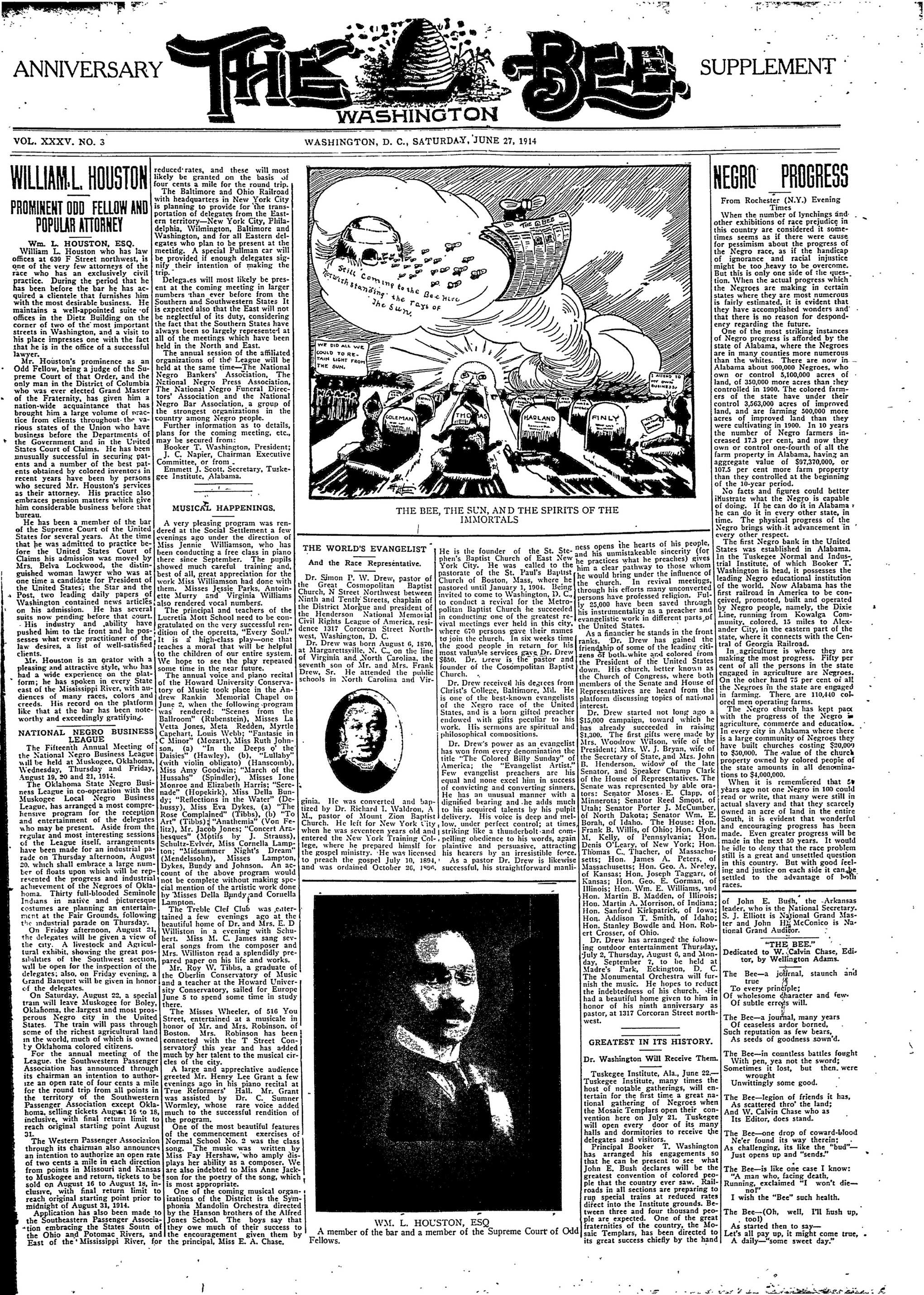
WILLIAM.L. HOUSTON PROMINENT ODD FELLOW AND POPULAR ATTORNEY
Wm. L. HOUSTON, ESQ.
William L. Houston who has law offices at 639 F Street northwest, is one of the very few attorneys of the race who has an exclusively civil practice. During the period that he has been before the bar he has acquired a clientele that furnishes him with the most desirable business. He maintains a well-appointed suite of offices in the Dietz Building on the corner of two of the most important streets in Washington, and a visit to his place impresses one with the fact that he is in the office of a successful lawyer.
Mr. Houston's prominence as an Odd Fellow, being a judge of the Supreme Court of that Order, and the only man in the District of Columbia who was ever elected Grand Master of the Fraternity, has given him a nation-wide acquaintance that has brought him a large volume of practice from clients throughout the various states of the Union who have business before the Departments of the Government and in the United States Court of Claims. He has been unusually successful in securing patients and a number of the best patients obtained by colored inventors in recent years have been by persons who secured Mr. Houston's services as their attorney. His practice also embraces pension matters which give him considerable business before that bureau.
He has been a member of the bar of the Supreme Court of the United States for several years. At the time that he was admitted to practice before the United States Court of Claims his admission was moved by Mrs. Belva Lockwood, the distinguished woman lawyer who was at one time a candidate for President of the United States; the Star and the Post, two leading daily papers of Washington contained news articles on his admission. He has several suits now pending before that court. His industry and ability have pushed him to the front and he possesses what every practitioner of the law desires, a list of well-satisfied clients.
Mr. Houston is an grator with a pleasing and attractive style, who has had a wide experience on the platform; he has spoken in every State east of the Mississippi River, with audiences of many races, colors and creeds. His record on the platform like that at the bar has been noteworthy and exceedingly gratifying.
NATIONAL NEGRO BUSINESS LEAGUE
The Fifteenth Annual Meeting of the National Negro Business League will be held at Muskogee, Oklahoma, Wednesday, Thursday and Friday, August 19, 20 and 21, 1914.
The Oklahoma State Negro Business League in co-operation with the Muskogee Local Negro Business League, has arranged a most comprehensive program for the reception and entertainment of the delegates who may be present. Aside from the regular and most interesting sessions of the League itself, arrangements have been made for an industrial parade on Thursday afternoon, August 20, which shall embrace a large number of floats upon which will be represented the progress and industrial achievement of the Negroes of Oklahoma. Thirty full-blooded Seminole Indians in native and picturesque costumes are planning an entertainment at the Fair Grounds, following the industrial parade on Thursday.
On Friday afternoon, August 21, the delegates will be given a view of the city. A livestock and Agricultural exhibit, showing the great possibilities of the Southwest section, will be open for the inspection of the delegates; also, on Friday evening, a Grand Banquet will be given in honor of the delegates.
On Saturday, August 22, a special train will leave Muskogee for Boley, Oklahoma, the largest and most prosperous Negro city in the United States. The train will pass through some of the richest agricultural land in the world, much of which is owned by Oklahoma colored citizens. For the annual meeting of the League. the Southwestern Passenger Association has announced through its chairman an intention to authorize an open rate of four cents a mile for the round trip from all points in the territory of the Southwestern Passenger Association except Oklahoma, selling tickets August 16 to 18, inclusive, with final return limit to reach original starting point August 31.
The Western Passenger Association through its chairman also announces an intention to authorize an open rate of two cents a mile in each direction from points in Missouri and Kansas to Muskogee and return, tickets to be sold on August 16 to August 18, inclusive, with final return limit to reach original starting point prior to midnight of August 31, 1914.
Application has also been made to the Southeastern Passenger Association embracing the States South of the Ohio and Potomac Rivers, and East of the Mississippi River, for
THE BEE
WASHINGTON
reduced rates, and these will most likely be granted on the basis of four cents a mile for the round trip. The Baltimore and Ohio Railroad with headquarters in New York City is planning to provide for the transportation of delegates from the Eastern territory—New York City, Philadelphia, Wilmington, Baltimore and Washington, and for all Eastern delegates who plan to be present at the meeting. A special Pullman car will be provided if enough delegates signify their intention of making the trip.
Delegates will most likely be present at the coming meeting in larger numbers than ever before from the Southern and Southwestern States It is expected also that the East will not be neglectful of its duty, considering the fact that the Southern States have always been so largely represented at all of the meetings which have been held in the North and East.
The annual session of the affiliated organizations of the League will be held at the same time—The National Negro Bankers' Association, The National Negro Press Association, The National Negro Funeral Directors' Association and the National Negro Bar Association, a group of the strongest organizations in the country among Negro people.
Further information as to details, plans for the coming meeting, etc., may be secured from:
Booker T. Washington, President; J. C. Napier, Chairman Executive Committee, or from .
Emmett J. Scott, Secretary, Tuskegee Institute, Alabama.
MUSICAL HAPPENINGS.
A very pleasing program was rendered at the Social Settlement a few evenings ago under the direction of Miss Jennie Williamson, who has been conducting a free class in piano there since September. The pupils showed much careful training and, best of all, great appreciation for the work Miss Williamson had done with them. Misses Jessie Parks, Antoinette Murry and Virginia Williams also rendered vocal numbers. The principal and teachers of the Lucretia Mott School need to be congratulated on the very successful rendition of the operetta, "Every Soul." It is a high-class play—one that teaches a moral that will be helpful to the children of our entire system. We hope to see the play repeated some time in the near future.
The annual voice and piano recital of the Howard University Conservatory of Music took place in the Andrew Rankin Memorial Chapel on June 2, when the following program was rendered: "Scenes from the Ballroom" (Rubenstein), Misses La Vetta Jones, Meta Redden, Myrtle Caphart, Louis Webb; "Fantasie in C Minor" (Mozart), Miss Ruth Johnson, (a) "In the Deeps o' the Daisies" (Hawley), (b), "Lullaby" (with violin obligato) (Hanscomb), Miss Amy Goodwin; "March of the Hussahs" (Spindler), Misses Ione Monroe and Elizabeth Harris; "Serenade" (Hopekirk), Miss Della Bundy; "Reflections in the Water" (Debussy), Miss Eva Dykes, (a) "The Rose Complained" (Tibbs), (b) "To Art" (Tibbs); "Anathemia" (Von Felitz), Mr. Jacob Jones; "Concert Arabesques" (Motifs by J. Strauss), Schultz-Evlker, Miss Cornella Lampton; "Midsummer Night's Dream" (Mendelssohn), Misses Lampton, Dykes, Bundy and Johnson. An account of the above program would not be complete without making special mention of the artistic work done by Misses Della Bundy and Cornella Lampton.
The Treble Clef Club was entertained a few evenings ago at the beautiful home of Dr. and Mrs. E. D Williston in a evening with Schubert. Miss M. C. James sang several songs from the composer and Mrs. Williston read a splendidly prepared paper on his life and works. Mr. Roy W. Tibbs, a graduate of the Oberlin Conservatory of Music and a teacher at the Howard University Conservatory, sailed for Europe June 5 to spend some time in study there.
The Misses Wheeler, of 516 You Street, entertained at a musicale in honor of Mr. and Mrs. Robinson, of Boston. Mrs. Robinson has been connected with the T Street Conservatory this year and has added much by her talent to the musical circles of the city.
A large and appreciative audience greeted Mr. Henry Lee Grant a few evenings ago in his piano recital at True Reformers' Hall. Mr. Grant was assisted by Dr. C. Sumner Wormley, whose rare voice added much to the successful rendition of the program.
One of the most beautiful features of the commencement exercises of Normal School No. 2 was the class song. The music was written by Miss Fay Hershaw, who amplly displays her ability as a composer. We are also indebted to Miss Anne Jackson for the poetry of the song, which is most appropriate.
One of the coming musical organizations of the District is the Symphonia Mandolin Orchestra directed by the Hanson brothers of the Alfred Jones School. The boys say that they owe much of their success to the encouragement given them by the principal, Miss E. A. Chase.
WASHINGTON, D. C., SATURDAY, JUNE 27, 1914
Still Coming to the Beehive
Tectwith standing the rays of
The Sun.
WE DID ALL WE
COULD TO RE-
TAIN LIGHT FROM
THE SUN.
I ALLIEND TO
MY BUSINESS.
COLEMAN
THOMAS
HARLAND
FINLY
THE BEE, THE SUN, AND THE SPIRITS OF THE IMMORTALS
THE WORLD'S EVANGELIST
And the Race Representative.
Dr. Simon P. W. Drew, pastor of the Great Cosmopolitan Baptist Church, N Street Northwest between Ninth and Tenth Streets, chaplain of the District Morgue and president of the Henderson National Memorial Civil Rights League of America, residence 1317 Corcoran Street Northwest, Washington, D. C.
Dr. Drew was born August 6, 1870, at Margarettsville, N. C., on the line of Virginia and North Carolina, the seventh son of Mr. and Mrs. Frank Drew, Sr. He attended the public schools in North Carolina and Vir-
ginia. He was converted and baptized by Dr. Richard I. Waldron, A M., pastor of Mount Zion Baptist Church. He left for New York City when he was seventeen years old and entered the New York Training College, where he prepared himself for the gospel ministry. He was licensed to preach the gospel July 10, 1894, and was ordained October 26, 1896.
s of sys e ch
[Picture of a man with a mustache and a suit].
WM. L. HOUSTON. ESO
A member of the bar and a member of the Supreme Court of Odd Fellows.
A member of the bar and a me
Fellows.
He is the founder of the St. Stephen's Baptist Church of East New York City. He was called to the pastorate of the St. Paul's Baptist Church of Boston, Mass, where he pastored until January 1, 1904. Being invited to come to Washington, D.C., to conduct a revival for the Metropolitan Baptist Church he succeeded in conducting one of the greatest revival meetings ever held in this city, where 670 persons gave their names to join the church. In six weeks time the good people in return for his most valuable services gave Dr. Drew $650. Dr. Drew is the pastor and founder of the Cosompolitan Baptist Church.
Dr. Drew received his degrees from Christ's College, Baltimore, Md. He is one of the best-known evangelists of the Negro race of the United States, and is a born gifted preacher endowed with gifts peculiar to his work. His sermons are spiritual and philosophical compositions.
Dr. Drew's power as an evangelist has won from every denomination the title "The Colored Billy Sunday" of America; the "Evangelist Artist." Few evangelist preachers are his equal and none excel him in success of convicting and converting sinners. He has an unusual manner with a dignified bearing and he adds much to his acquired talents by his pulpit delivery. His voice is deep and mellow, under perfect control; at times striking like a thunderbolt and compelling obedience to his words, again plaintive and persuasive, attracting his hearers by an irresistible force. As a pastor Dr. Drew is likewise successful, his straightforward manli-
THE NEW YORK TIMES
member of the Supreme Court of Ode
ness opens the hearts of his people, and his unmistakeable sincerity (for he practices what he preaches) gives him a clear pathway to those whom he would bring under the influence of the church. In revival meetings, through his efforts many unconverted persons have professed religion. Fully 25,000 have been saved through his instrumentality as a preacher and evangelistic work in different parts of the United States.
As a financier he stands in the front ranks. Dr. Drew has gained the friendship of some of the leading citizens of both white and colored from the President of the United States down. His church, better known as the Church of Congress, where both members of the Senate and House of Representatives are heard from the platform discussing topics of national interest.
Dr. Drew started not long ago a $15,000 campaign, toward which he has already succeeded in raising $1,300. The first gifts were made by Mrs. Woodrow Wilson, wife of the President; Mrs. W. J. Bryan, wife of the Secretary of State, and Mrs. John B. Henderson, widow of the late Senator, and Speaker Champ Clark of the House of Representatives. The Senate was represented by able orators: Senator Moses·E. Clapp, of Minnerota; Senator Reed Smoot, of Utah; Senator Porter J. McCumber, of North Dakota; Senator Wm. E. Borah, of Idaho. The House: Hon. Frank B. Willis, of Ohio; Hon. Clyde M. Kelly, of Pennsylvania; Hon. Denis O'Leary, of New York; Hon. Thomas C. Thacher, of Massachusetts; Hon. James A. Peters, of Massachusetts; Hon. Geo. A. Neeley of Kansas; Hon. Joseph Taggart, of Kansas; Hon. Geo. E. Gorman, of Illinois; Hon. Wm. E. Williams, and Hon. Martin B. Madden, of Illinois; Hon. Martin A. Morrison, of Indiana; Hon. Sanford Kirkpatrick, of Iowa; Hon. Addison T. Smith, of Idaho; Hon. Stanley Bowdle and Hon. Robert Crosser, of Ohio.
Dr. Drew has arranged the following outdoor entertainment Thursday, July 2, Thursday, August 6, and Monday, September 7, to be held at Madre's Park, Eckington, D. C. The Monumental Orchestra will furnish the music. He hopes to reduce the indebtedness of his church. He had a beautiful home given to him in honor of his ninth anniversary as pastor, at 1317 Corcoran Street northwest.
GREATEST IN ITS HISTORY.
Dr. Washington Will Receive Them.
Tuskegee Institute, Ala., June 22. Tuskegee Institute, many times the host of notable gatherings, will entertain for the first time a great national gathering of Negroes when the Mosaic Templars open their convention here on July 21. Tuskegee will open every door of its many halls and dormitories to receive the delegates and visitors.
Principal Booker T. Washington has arranged his engagements so that he can be present to see what John E. Bush declares will be the greatest convention of colored people that the country ever saw. Railroads in all sections are preparing to run special trains at reduced rates direct into the Institute grounds. Between three and four thousand people are expected. One of the great fraternities of the country, the Mosaic Templars, has been directed to its great success chiefly by the hand
NEGRO PROGRESS
NEGRO PROGRESS
From Rochester (N.Y.) Evening Times When the number of lynchings and other exhibitions of race prejudice in this country are considered it sometimes seems as if there were cause for pessimism about the progress of the Negro race, as if the handicap of ignorance and racial injustice might be too heavy to be overcome. But this is only one side of the question. When the actual progress which the Negroes are making in certain states where they are most numerous is fairly estimated, it is evident that they have accomplished wonders and that there is no reason for despondency regarding the future.
One of the most striking instances of Negro progress is afforded by the state of Alabama, where the Negroes are in many counties more numerous than the whites. There are now in Alabama about 900,000 Negroes, who own or control 5,100,000 acres of land, of 350,000 more acres than they controlled in 1900. The colored farmers of the state have under their control 3,563,000 acres of improved land, and are farming 500,000 more acres of improved land than they were cultivating in 1900. In 10 years the number of Negro farmers increased 17.3 per cent, and now they own or control one-fourth of all the farm property in Alabama, having an aggregate value of $97,370,000, or 107.5 per cent more farm property than they controlled at the beginning of the 10-year period.
No facts and figures could better illustrate what the Negro is capable of doing. If he can do it in Alabama he can do it in every other state, in time. The physical progress of the Negro brings with it advancement in every other respect.
The first Negro bank in the United States was established in Alabama. In the Tuskegee Normal and Industrial Institute, of which Booker T. Washington is head, it possesses the leading Negro educational institution of the world. Now Alabama has the first railroad in America to be conceived, promoted, built and operated by Negro people, namely, the Dixie Line, running from Kowalga Community, colored, 15 miles to Alexander City, in the eastern part of the state, where it connects with the Central of Georgia Railroad.
In agriculture is where they are making the most progress. Fifty per cent of all the persons in the state engaged in agriculture are Negroes. On the other hand 75 per cent of all the Negroes in the state are engaged in farming. There are 110,440 colored men operating farms.
The Negro church has kept pace with the progress of the Negro agriculture, commerce and education. In every city in Alabama where there is a large community of Negroes they have built churches costing $20,000 to $50,000. The value of the church property owned by colored people of the state amounts in all denominations to $4,000,000.
When it is remembered that 50 years ago not one Negro in 100 could read or write, that many were still in actual slavery and that they scarcely owned an acre of land in the entire South, it is evident that wonderful and encouraging progress has been made. Even greater progress will be made in the next 50 years. It would be idle to deny that the race problem still is a great and unsettled question in this country. But with good feeling and justice on each side it can be settled to the advantage of both races.
of John E. Bush, the Arkansas leader, who is the National Secretary, S. J. Elliott is National Grand Master and John H. McConico is National Grand Auditor.
"THE BEE."
Dedicated to W. Calvin Chase, Editor, by Wellington Adams.
The Bee—a journal, staunch and true
To every principle;
Of wholesome character and few
Of subtle errors will.
The Bee—a journal, many years
Of ceaseless ardor borned,
Such reputation as few bears,
As seeds of goodness sown'd.
The Bee—in countless battles fought
With pen, yea not the sword;
Sometimes it lost, but then. were
wrought
Unwittingly some good.
The Bee—legion of friends it has,
As scattered thro' the land;
And W. Calvin Chase who as
Its Editor, does stand.
The Bee—one drop of coward-blood
Ne'er found its way therein;
As challenging, its like the "bud"
Just opens up and "sends."
The Bee—is like one case I know:
"A man who, facing death,
Running, exclaimed "I won't die—
no!"
IF IT'S NEWS, IT'S IN THE BEE,
FOR THE BEE IS A NEWSPAPER.
THE BEE
WASHINGTON
Washington's Best and Leading Negro Newspaper That's THE BEE
VOL. XXXV, NO. 3
WASHINGTON, J. D. C., SATURDAY, JUNE 27, 1914
THE INDEPENDENT ORDER OF ST. LUKE
The Most Progressive and Substantial Fraternal Organization in the Country. THE OUTGROWTH'OF BRAINS AND ENERGY
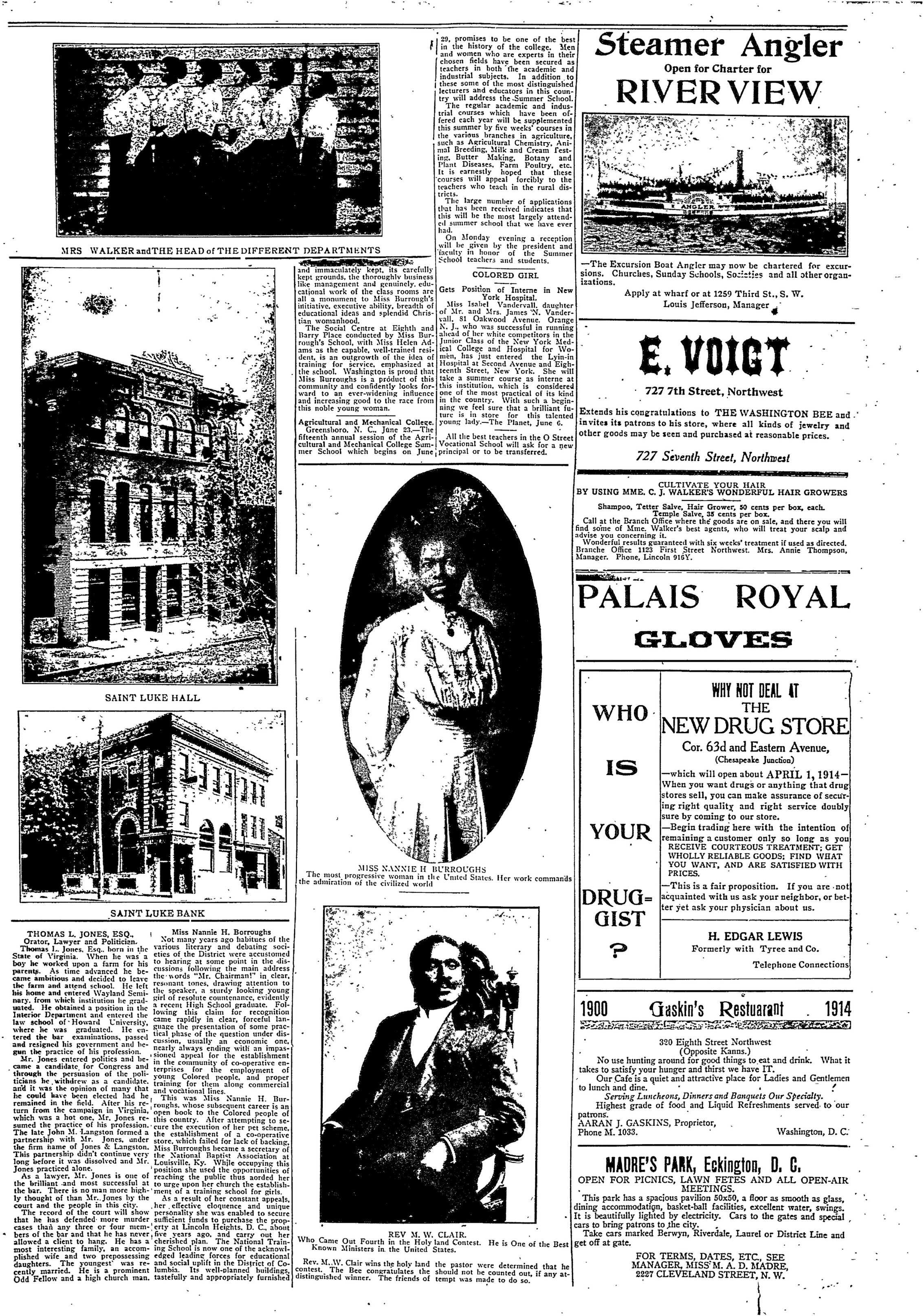
A Woman's Work and a Woman's Success. The St. Luke Bank, a Growing, Dependable Institution, With a Woman, Mrs. Maggie L. Walker, President. Aren't You a St. Luke? Have you ever been to Richmond, Va? No? Then you have missed seeing much in the way of Negro development. If you have been, of course, you have both seen and heard about the St. Lukes and the great work they are doing. A trip to Richmond and a failure to visit the St. Luke Hall and the St. Luke Bank, would be like going to Washington, D. C., on a sight-seeing tour and not seeing the Capitol and the White House.
The words "St. Luke" are household words in Richmond, representing brain, energy, and financial co-operation. It is a great fraternal organization of men, women and children, which has evolved from an old-fashioned benevolent society, that came into existence shortly after the close of the war, its founder being a woman, a Mrs. Proutt of Baltimore, Md. Mrs. Proutt is dead now, but she builted better than she knew. She sowed a grain of mustard seed, which indeed is the least of all seeds; but it has grown, it is the greatest among herbs and hath become a tree, so that the birds of the air come and lodge in the branches thereof, and men, women and children gather under the shade thereof for rest, shelter and protection.
But the development of such a fraternal organization as the, Independent Order of St. Luke has been one never-ending struggle: A master mind, an untiring body, a genius for organization, a soul of truth, the personification of justice, rigid impartiality, high ideals, amiability, personal magnetism and faithfulness are the qualities of body and mind which have made it possible for Mrs. Maggie L. Walker, the leader of the St. Lukes, to gather around her the men and women who comprise the official staff of the organization.
While it is true that the St. Luke Order has been in existence for nearly fifty years, its real growth, and development began just a little more than a dozen years ago, when it was handed over to Mrs. Walker in a basket, dying, discouraged and debt ridden, a bankrupt society, with badly kept books and numberless bills, from which those who had managed the same were fleeing in hot haste to escape the stigma of having it die on their hands. This was fourteen years ago. Today the real estate, cash and personal property of the Order is worth more than $100,000, with a membership of more than forty thousand, operating in twenty-five different states.
In these days of government inspection, to prevent the exploiting of irresponsible and improperly conducted fraternal societies—leeches feeding on the people, dodging their obligations upon the slightest technicality—the Insurance Departments of the several states are now looking with scrutinizing and even microscopic eyes into the financial conduct of these fraternal organizations. The Insurance Department of Virginia rates the St. Lukes A1. This official endorsement places the St. Luke Order in the very front of the front rank. Conducted under the latest and most improved rules and regulations of fraternalism, depositing security whenever and wherever required, members of the organization are secure and their mortuary benefits sure and certain.
The Forty-Seventh Annual Convention of the Right Worthy Grand Council meets at Richmond in August. The present officers are: R. W.' G. Chief, Minnie L. Banks, Macon, Ga; R. W. G. Vice Chief, Dr. H. L. Harris, Richmond, Va.
R. W. W. Secretary-Treasurer, Maggie L, Walker, Richmond, Va.
Executive Board
Leah J. Lynch, Norfolk, Va.; Charity Jones, New York City; Georgia A. Queene, Newark, N. J.; Rev. C. H. King, Hickory, N. C.; Josephine D. Cannady, Eckman, W. Va.; Geo. W. Coleman Roanoke, Va.; Anna J. Evans, Providence, R. I.; Booker Ellis, Dinwiddie, Va.; Julia M. Layton, Washington, D. C.; Frances Cox, Lynchburg, Va.; Ella O. Waller, Sallie W. Dickerson, Lula A. Willis, Rev. Z. D. Lewis, W. W. Fields, Richmond, Va.; and Rev. R. H. Cooley, Petersburg, Va. Attorney, James H. Hayes, Washington, D. C.
The St. Luke Penny Savings Bank of Richmond, Va., while bearing the name "St. Luke," is in every way a separate, distinct corporation, with a different set of officers working under a separate and distinct charter. It was chartered some eight years ago, has a fully paid up capital stock of $50,000, with assets totaling more than $200,000.
This bank has for its president, the
woman, Maggie L. Walker, who by her personal energy and solicitation sold by far the major portion of the capital stock. Millions of dollars of money has passed over the counters, and Cashier Emmett C. Burke is a highly-respected and well-known figure in the banking circles of Richmond. The St. Luke Bank is the people's bank, in all that the expression implies. It has helped thousands: it is not a hoarding bank but an outpouring bank, helping the business man, the professional man and the individual man.
The bank officials are: President,
Mrs. Maggie L. Walker; vice president,
Rev. Z. D. Lewis, D. D.; cashier,
Emmet C. Burke; assistant cashier,
Mrs. Mary H. Dawson.
There is much in this article about Maggie L. Walker. The reasons are these: Maggie L. Walker resurrected, and breathed into the St. Luke Order the breath of life. She has made of it a great, nation-known fraternal order, not existing on paper, but built upon a foundation that grows stronger as the years come and go; an organization that is growing by leaps and bounds and destined to cover the entire land. She has made it a success by paying the price in such cases always demanded—her strength, mental, physical, moral and religious—her very life. Dedicating herself to the St. Luke cause when a child, she has given it her life and nursed it to vigor, increasing growth and permanent success.
Maggie L. Walker and the St. Lukes are co-ordinates. The St. Lukes belong to her because she has given her life to them. She belongs to them because they have adopted her and changed her name from Maggie Lena Walker to Maggie Luke Walker. Brick, mortar, iron, steel and money are great things with which to lay the foundation of an organization, and upon which to build; but greater still is that indestructible heart foundation, built upon the confidence and faith of men and women as the result of a clean organization, honestly administered, free from the bickerings and strife of unprincipled ambition. The St. Luke Order and the St. Luke Bank are successes, because they are clean in purpose, great in honesty and just in transaction. Are you a 'St. Luke?
A Few Facts and Figures
A membership of more than 40,000.
Operating in 25 states. Pays all it promises promptly. Paying out more than $1000 per week to beneficiaries. Not an uncontested unpaid death claim. Up to date has paid $433130 in death claims.
A St. Luke policy is as good as gold.
The largest Fraternal Juvenile department.
Local St. Luke's
There are 60 St. Luke Councils here in Washington, with Rev. A. C. Garner District Deputy and Mrs. Julia H. Hayes Associate Deputy; Mrs. Bessie B. Anderson, Deputy for Maryland and District of Columbia. Phyllis Wheatley No. 234, organized in August 1902 is the oldest council, the work of Mrs. Julia H. Hayes, who bears the honored distinction of being the mother of St. Luke work in the District, and Lovely Trion No. 970, the youngest.
EXAMINATION FOR CAPTAIN
Three Colored Soldiers and One White Soldier Successfully Pass Examination Given by a Board of Examiners Consisting of Five United States Army Officers at Ft. Huachuca, Arizona, May 25.
On May 25 a board of examiners, consisting of five United States army officers, met at Fort Huachuca, Ariz. and examined the four soldiers at the Tenth United States Cavalry for the office of Captain of United States Volunteers.
The examination extended over a period of thirteen days, consisting of arithmetic, geography, grammar, history, army regulations, guard manual, field service regulations, topography, military law, international law, infantry drill regulations, cavalry drill regulations, hippology, manual of court-martial, military appearance and bearing, and general fitness for the position of Captain of Volunteers. All of the candidates acquitted themselves well; making a general average above 80 per cent. The names of the candidates are as follows: Sergeant Major E. P. Frierson and Commissary Sergeant W. W. Thompson, of the Tenth U. S. Cavalry; Quartermaster Sergeant William Payne, Quartermaster Corps, and Ordnance Sergeant Stephen T. Bandy, U. S. Army (white).
Sergeant Major Frierson is a veteran of the Tenth Cavalry, having been in the service over twenty-two years and enjoys the highest confidence of his superior officers as a non-commissioned officer, who is capable, trustworthy, neat, competent, and has a thorough knowledge of administrative functions of a regiment.
Reception to the Senior Class of Alfred Jones School.
Class Day and the reception of the Senior Class of Alfred Joys School by the juniors marked the closing events of this school for the year 1913 and 1914, with the following program: Presiding officer, Emma S. Saunders, who was class president.
Salutatory, Beatrice E. Webster.
Class Song, Alma Mater.
Class History, Louise M. Bowyer.
Class Prophecy, Viola M. E. Ford.
Class Poem, The Ivy, Elizabeth Davis.
Class Will, Maude L. Burke.
Solo, A Perfect Day, Gladys G.
WASHINGTON, J. D.C., SATURDAY, JUNE 27, 1914
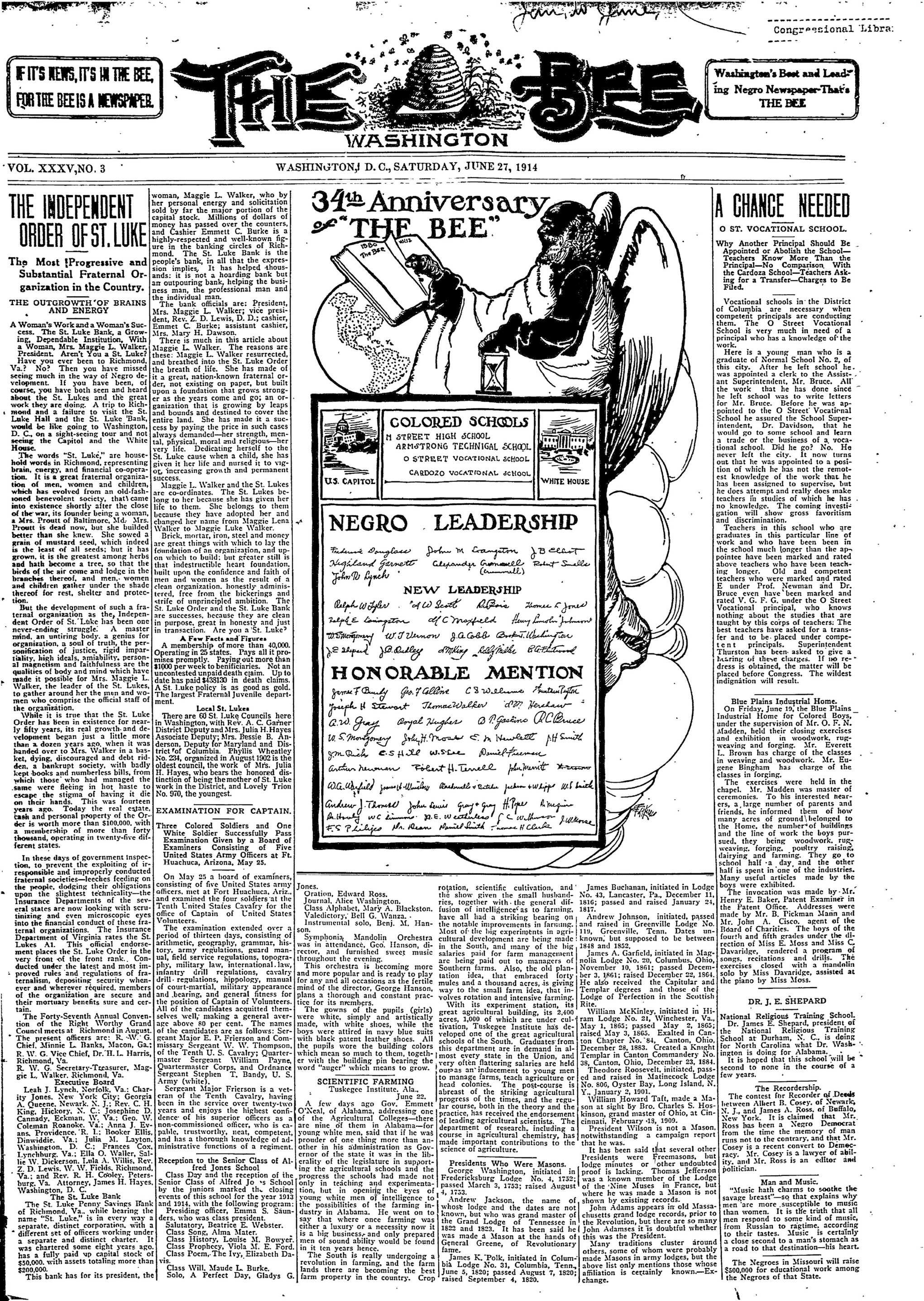
34th Anniversary
of "THE BEE"
GOLORED SCHOOLS
M STREET HIGH SCHOOL
ARMSTRONG TECHNIGAL SCHOOL
O STREET VOCATIONAL SCHOOL
CARDOZO VOCATIONAL SCHOOL
NEGRO
Frederick Douglass
Highland Garrett
John W. Lynch
NEW
Ralph W. Tyler
Ralph E. Livingston
W. W. Hartington
J. E. Shippard
J. O. Dullley
HONORARY
James F. Dunley
Geo. F. Gill
Joseph H. Stewart
A. W. Gray
Royal N.
W. S. Montgomery
John H. T.
J. M. Rich
C. S. H. L. W.
Arthur Newman
W. A. Ulyfield
Joseph H. Wunley
Andrew J. Thomas
John E.
D. Howley
W. C. Simmons
F. S. Philipses
Mr. Ream
NEGRO LEADERSHIP
Class Alphabet, Mary A. Blackston
Valedictory, Bell G. Wanza.
Instrumental solo, Benj. M. Hanson.
Symphonia, Mandolin Orchestra was in attendance, Geo. Hanson, director, and furnished sweet music throughout the evening.
This orchestra is becoming more and more popular and is ready to play for any and all occasions as the fertile mind of the director, George Hanson, plans a thorough and constant practice for its members.
The gowns of the pupils (girls) were white, simply and artistically made, with white shoes, while the boys were attired in navy blue suits with black patent leather shoes. All the pupils wore the building colors which mean so much to them, together with the building pin bearing the word "anger" which means to grow.
SCIENTIFIC FARMING Tuskegee Institute. Ala.,
A few days ago Gov. Emmett O'Neal, of Alabama, addressing one of the Agricultural Colleges—there are nine of them in Alabama—for young white men, said that if he was prouder of one thing more than another in his administration as Governor of the state it was in the liberality of the legislature in supporting the agricultural schools and the progress the schools had made not only in teaching and experimentation, but in opening the eyes of young white men of intelligence to the possibilities of the farming industry in Alabama. He went on to say that where once farming was either a luxury or a necessity now it is a big business—and only prepared men of sound ability would be found in it ten years hence.
The South is really undergoing a revolution in farming, and the farm lands there are becoming the best farm property in the country. Crop
U.S. CAPITOL
Jones.
Oration, Edward Ross.
LEADERSHIP
John M. Crangaton J.B. Elliot
Philippe Gromwell Robert Smith
(Cummell)
LEADERSHIP
Scott R. Barris Thomas K. Jones
C. Mossfield Henry Lincoln Johnson
J. G. Cobb Bertolt Washington
Milton R. Wilhelm B. C. Hutton
ABLE MENTION
Pine C.B. Wellsman Hunter Taft
Marc Walker A.M. Herchert
Hugh O. P. Gastino R.C. Bruce
Road E. M. Newlett P.H. Smith
S. S. Lee Daniel Freeman
St. H. Terrell John Kemitt
Rashwell B. Cotter Jackson + Whipple W.S.
Gray + Gray H. Pipe H. Morgan
Westchester J. C. W. Hammons J. W. Smith
Daniel Smith Thomas H. Clarke
rotation, scientific cultivation, and the show given the small husbandries, together with the general diffusion of intelligence as to farming, have all had a striking bearing on the notable improvements in farming. Most of the big experiments in agricultural development are being made in the South, and many of the big salaries paid for farm management are being paid out to managers of Southern farms. Also, the old plantation idea, that embraced forty mules and a thousand acres, is giving way to the small farm idea, that involves rotation and intensive farming.
With its experiment station, its great agricultural building, its 2,400 acres, 1,000 of which are under cultivation, Tuskegee Institute has developed one of the great agricultural schools of the South. Graduates from this department are in demand in almost every state in the Union, and very often flattering salaries are held out as an inducement to young men to manage farms, teach agriculture or head colonies. The post-course is abreast of the striking agricultural progress of the times, and the regular course, both in the theory and the practice, has received the endorsement of leading agricultural scientists. The department of research, including a course in agricultural chemistry, has made important contributions to the science of agriculture.
Presidents Who Were Masons.
George Washington, initiated in Fredericksburg Lodge No. 4, 1752; passed March 3, 1753; raised August 4, 1753.
Andrew Jackson, the name of whose lodge and the dates are not known, but who was grand master of the Grand Lodge of Tennessee in 1822 and 1823. It has been said he was made a Mason at the hands of General Greene, of Revolutionary fame.
James K. Polk, initiated in Columbia Lodge No. 31, Columbia, Tenn., June 5, 1820; passed August 7, 1820; raised September 4, 1820.
James Buchanan, initiated in Lodge No. 43, Lancaster, Pa., December 11, 1816; passed and raised January 24, 1817.
Andrew Johnson, initiated, passed and raised in Greenville Lodge No. 119, Greenville, Tenn. Dates unknown, but supposed to be between 1848 and 1852.
James A. Garfield, initiated in Magnolia Lodge No. 20, Columbus, Ohio, November 10, 1861; passed December 3, 1861; raised December 22, 1864.
He also received the Capitular and Templar degrees and those of the Lodge of Perfection in the Scottish Rite.
William McKinley, initiated in Hiram Lodge No. 21, Winchester, Va., May 1, 1865; passed May 2, 1865; raised May 3, 1865. Exalted in Canton Chapter No. 84, Canton, Ohio, December 28, 1883. Created a Knight Templar in Canton Commandery No. 38, Canton, Ohio, December 23, 1884. Theodore Roosevelt, initiated, passed and raised in Matinecock Lodge No. 806, Oyster Bay, Long Island, N. Y., January 2, 1901. William Howard Taft, made a Mason at sight by Bro. Charles S. Hoskinson, grand master of Ohio, at Cincinnati, February 19, 1909. President Wilson is not a Mason, notwithstanding a campaign report that he was.
It has been said that several other Presidents were Freemasons, but lodge minutes or other undoubted proof is lacking. Thomas Jefferson was a known member of the Lodge of the Nine Muses in France, but where he was made a Mason is not shown by existing records. John Adams appears in old Massachusetts grand lodge records, prior to the Revolution, but there are so many John Adamses it is doubtful whether this was the President. Many traditions cluster around others, some of whom were probably made Masons in army lodges, but the above list only mentions those whose affiliation is certainly known.—Exchange.
A CHANGE NEEDED
O ST. VOCATIONAL SCHOOL.
Why Another Principal Should Be Appointed or Abolish the School—Teachers Know More Than the Principal—No Comparison. With the Cardoza School—Teachers Asking for a Transfer—Charges to Be Filed.
Vocational schools in the District of Columbia are necessary when competent principals are conducting them. The O Street Vocational School is very much in need of a principal who has a knowledge of the work.
Here is a young man who is a graduate of Normal School No. 2, of this city. After he left school he was appointed a clerk to the Assistant Superintendent, Mr. Bruce. All the work that he has done since he left school was to write letters for Mr. Bruce. Before he was appointed to the O Street Vocational School he assured the School Superintendent, Dr. Davidson, that he would go to some school and learn a trade or the business of a vocational school. Did he go? No. He never left the city. It now turns out that he was appointed to a position of which he has not the remotest knowledge of the work that he has been assigned to supervise, but he does attempt and really does make teachers in studies of which he has no knowledge. The coming investigation will show gross favoritism and discrimination.
Teachers in this school who are graduates in this particular line of work and who have been been in the school much longer than the appointee have been marked and rated above teachers who have been teaching longer. Old and competent teachers who were marked and rated E under Prof. Newman and Dr. Bruce even have been marked and rated V. G. F. G. under the O Street Vocational principal, who knows nothing about the studies that are taught by this corps of teachers. The best teachers have asked for a transfer and to be placed under competent principals. Superintendent Thurston has been asked to give a hearing of these charges. If no redress is obtained, the matter will be placed before Congress. The wildest indignation will result.
Blue Plains Industrial Home.
On Friday, June 19, the Blue Plains Industrial Home for Colored Boys, under the supervision of Mr. O. F. N. Madden, held their closing exercises and exhibition in woodwork, rugweaving and forging. Mr. Everett L. Brown has charge of the classes in weaving and woodwork. Mr. Eugene Bingham has charge of the classes in forging.
The exercises were held in the chapel. Mr. Madden was master of ceremonies. To his interested hearers, a large number of parents and friends, he informed them of how many acres of ground belonged to the Home, the number of buildings and the line of work the boys pursued, they being woodwork, rugweaving, forging, poultry raising, dairying and farming. They go to school half a day, and the other half is spent in one of the industries. Many useful articles made by the boys were exhibited.
The invocation was made by Mr. Henry E. Baker, Patent Examiner in the Patent Office. Addresses were made by Mr. B. Pickman Mann and Mr. John A. Cisco, agent of the Board of Charities. The boys of the fourth and fifth grades under the direction of Miss E. Moss and Miss C. Davaridge, rendered a program of songs, recitations and drills. The exercises closed with a mandolin solo by Miss Davaridge, assisted at the piano by Miss Moss.
DR. J. E. SHEPARD
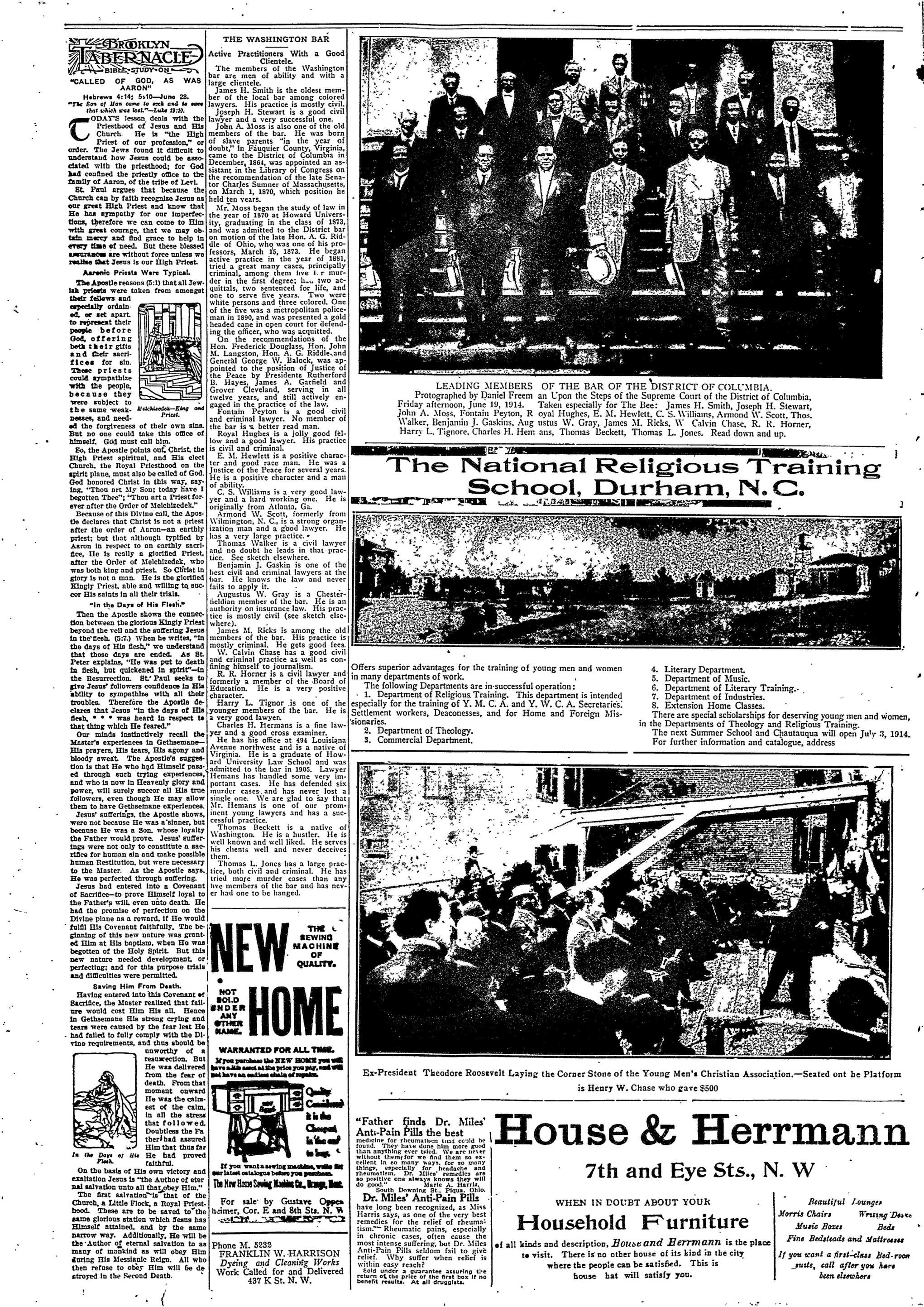
National Religious Training School. Dr. James E. Shepard, president of the National Religious Training School at Durham, N. C., is doing for North Carolina what Dr. Washington is doing for Alabama. It is hoped that this school will be second to none in the course of a few years.
The Recordership:
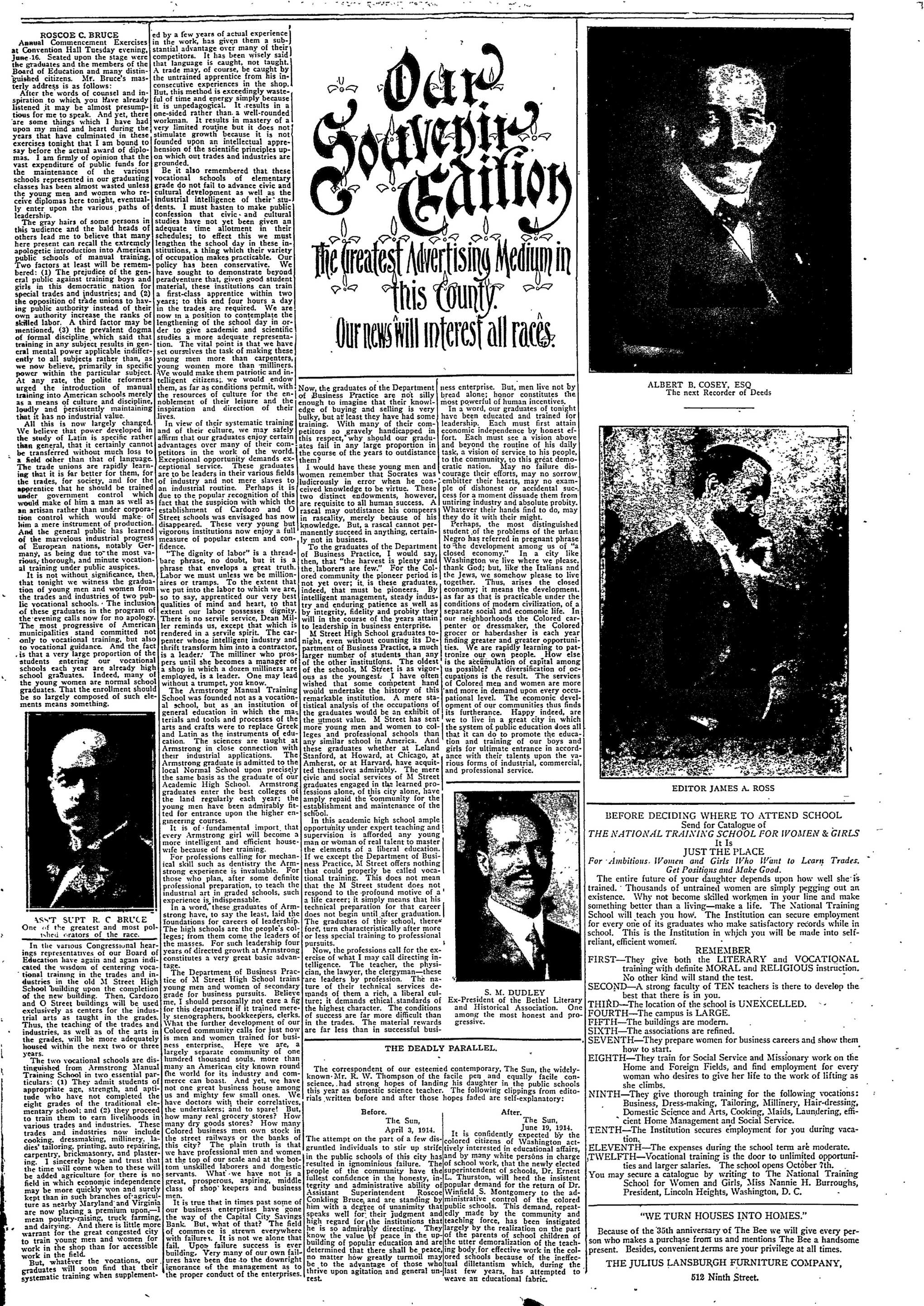
The contest for Recorder of Deeds between Albert B. Cosey, of Newark, N. J., and James A. Ross, of Buffalo, New York. It is claimed that Mr. Ross has been a Negro Democrat from the time the memory of man runs not to the contrary, and that Mr. Cosey is a recent convert to Democracy. Mr. Cosey is a lawyer of ability, and Mr. Ross is an editor and politician.
Man and Music.
"Music hath charms to soothe the savage breast"—so that explains why men are more susceptible to music than women. It is the truth that all men respond to some kind of music, from Russian to ragtime, according to their tastes. Music is certainly a close second to a man's stomach as a road to that destination—his heart.
The Negroes in Missouri will raise $500,000 for educational work among the Negroes of that State.
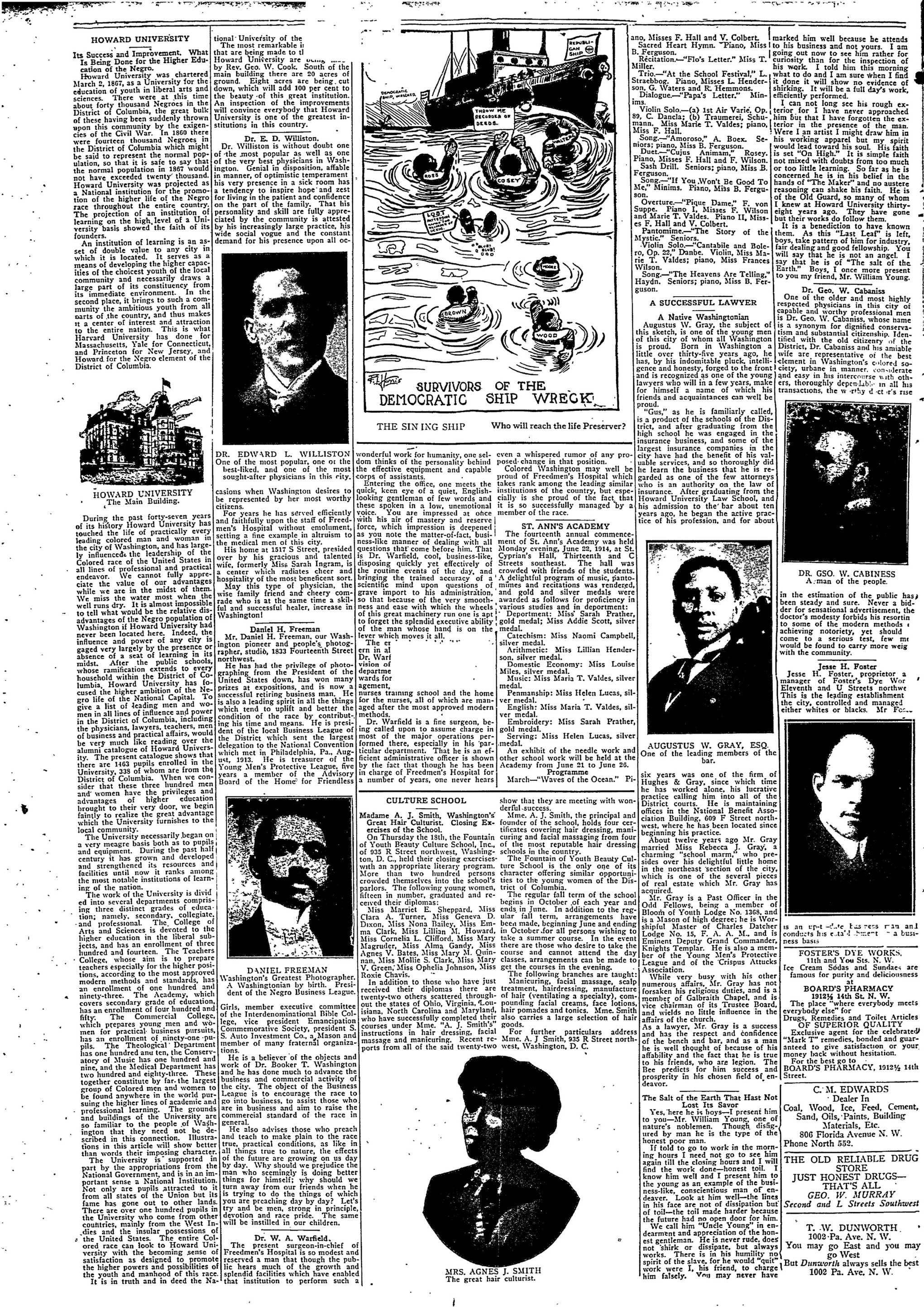
HOWARD UNIVERSITY
Its Success and Improvement. What Is Being Done for the Higher Education of the Negro.
cation of the Negro.
Howard University was chartered March 2, 1867, as a University for the education of youth in liberal arts and sciences. There were at this time about forty thousand Negroes in the District of Columbia, the great bulk of these having been suddenly thrown upon this community by the exigencies of the Civil War. In 1860 there were fourteen thousand Negroes in the District of Columbia which might be said to represent the normal population, so that it is safe to say that the normal population in 1867 would not have exceeded twenty thousand. Howard University was projected as a National institution for the promotion of the higher life of the Negro race throughout the entire country. The projection of an institution of learning on the high, level of a University basis showed the faith of its founders.
An institution of learning is an asset of double value to any city in which it is located. It serves as a means of developing the higher capacities of the choicest youth of the local community and necessarily draws a large part of its constituency from its immediate environment. In the second place, it brings to such a community the ambitious youth from all parts of the country, and thus makes it a center of interest and attraction to the entire nation. This is what Harvard University has done for Massachusetts, Yale for Connecticut, and Princeton for New Jersey, and Howard for the Negro element of the District of Columbia.
HOTEL
HOWARD UNIVERSITY
The Main Building.
During the past forty-seven years of its history Howard University has touched the life of practically every leading colored man and woman in the city of Washington, and has largely influenced the leadership of the Colored race of the United States in all lines of professional and practical endeavor. We cannot fully appreciate the value of our advantages while we are in the midst of them. We miss the water most when the well runs dry. It is almost impossible to tell what would be the relative disadvantages of the Negro population of Washington if Howard University had never been located here. Indeed, the influence and power of any city is gaged very largely by the presence or absence of a seat of learning in its midst. After the public schools, whose ramification extends to every household within the District of Columbia, Howard University has focused the higher ambition of the Negro life of the National Capital. To give a list of leading men and women in all lines of influence and power in the District of Columbia, including the physicians, lawyers, teachers, men of business and practical affairs, would be very much like reading over the alumni catalogue of Howard University. The present catalogue shows that there are 1463 pupils enrolled in the University, 338 of whom are from the District of Columbia. When we consider that these three hundred men and women have the privileges and advantages of higher education brought to their very door, we begin faintly to realize the great advantage which the University furnishes to the local community.
The University necessarily began on a very meagre basis both as to pupils and equipment. During the past half century it has grown and developed and strengthened its resources and facilities until now it ranks among the most notable institutions of learning of the nation.
The work of the University is divided into several departments comprising three distinct grades of education; namely, secondary, collegiate, and professional. The College of Arts and Sciences is devoted to the higher education in the liberal subjects, and has an enrollment of three hundred and fourteen. The Teachers College, whose aim is to prepare teachers especially for the higher positions, according to the most approved modern methods and standards, has an enrollment of one hundred and ninety-three. The Academy, which covers secondary grade of education, has an enrollment of four hundred and fifty. The Commercial College, which prepares young men and women for practical business pursuits, has an enrollment of ninety-one pupils. The Theological Department has one hundred and ten, the Conservatory of Music has one hundred and nine, and the Medical Department has two hundred and eighty-three. These together constitute by far the largest group of Colored men and women to be found anywhere in the world pursuing the higher lines of academic and professional learning. The grounds and buildings of the University are so familiar to the people of Washington that they need not be described in this connection. Illustrations in this article will show better than words their imposing character
The University is supported in part by the appropriations from the National Government, and is in an important sense a National Institution. Not only are pupils attracted to it from all states of the Union but its fame has gone out to other lands. There are over one hundred pupils in the University who come from other countries, mainly from the West Indies and the insular possessions of the United States. The entire Colored race can look to Howard University with the becoming sense of satisfaction as designed to promote the higher powers and possibilities of the youth and manhood of this race. It is in truth and in deed the Na-
wonderful work for humanity, one seldom thinks of the personality behind the effective equipment and capable corps of assistants.
Entering the office, one meets the quick, keen eye of a quiet, English-looking gentleman of few words and these spoken in a low, unemotional voice. You are impressed at once with his air of mastery and reserve force, which impression is deepened as you note the matter-of-fact, business-like manner of dealing with all questions that come before him. That is Dr. Warfield, cool, business-like, disposing quickly yet effectively of the routine events of the day, and bringing the trained accuracy of a scientific mind upon questions of grave import to his administration, so that because of the very smoothness and ease with which the wheels of this great machinery run one is apt to forget the splendid executive ability of the man whose hand is on the lever which moves it all.
The er
ern in al
Dr. Warf
vision of
departme
wards for
agement
dnefsooen
hensyereehs
e,
tional University of the The most remarkable is that are being made to th Howard University are being made by Rev. Geo. W. Cook. South of the main building there are 20 acres of ground. Eight acres are being. cut down, which will add 100 per cent to the beauty of this great institution. An inspection of the improvements will convince everybody that Howard University is one of the greatest institutions in this country.
Dr. E. D. Williston.
Dr. Williston is without doubt one of the most popular as well as one of the very best physicians in Washington. Genial in disposition, affable in manner, of optimistic temperament his very presence in a sick room has a tendency to inspire hope and zest for living in the patient and confidence on the part of the family. That his personality and skill are fully appreciated by the community is attested by his increasingly large practice, his wide social vogue and the constant demand for his presence upon all oc-
M. B.
DR. EDWARD L. WILLISTON One of the most popular, one of the best-liked, and one of the most sought-after physicians in this city. casions when Washington desires to be represented by her most worthy citizens. For years he has served efficiently and faithfully upon the staff of Freedmen's Hospital without emolument, setting a fine example in altruism to the medical men of this city. His home at 1517 S Street, presided over by his gracious and talented wife, formerly Miss Sarah Ingram, is a center which radiates cheer and hospitality of the most beneficent sort. May this type of physician, the wise family friend and cheer comrade who is at the same time a skillful and successful healer, increase in Washington!
Daniel H. Freeman
Mr. Daniel H. Freeman, our Washington pioneer and people's photographer, studio, 1833 Fourteenth Street northwest.
He has had the privilege of photographing from the President of the United States down, has won many prizes at expositions, and is now a successful retiring business man. He is also a leading spirit in all the things which tend to uplift and better the condition of the race by contributing his time and means. He is president of the local Business League of the District which sent the largest delegation to the National Convention which met in Philadelphia, Pa., August, 1913. He is treasurer of the Young Men's Protective League, five years a member of the Advisory Board of the Home for Friendless
J.
Washington's Greatest Photographer. A Washingtonian by birth. President of the Negro Business League. Girls, member executive committee of the Interdenominational Bible College, vice president Emancipation Commemorative Society, president S. S. Auto Investment Co., a Mason and member of many fraternal organizations. He is a believer of the objects and work of Dr. Booker T. Washington and he has done much to advance the business and commercial activity of the city. The object of the Business League is to encourage the race to go into business, to assist those who are in business and aim to raise the commercial standard of the race in general.
He also advises those who preach and teach to make plain to the race true, practical conditions, as like in all things true to nature, the effects of the future are growing on us day by day. Why should we prejudice the man who seemingly is doing better things for himself; why should we turn away from our friends when he is trying to do the things of which you are preaching day by day? Let's try and be men, strong in principle, devotion and race pride. The same will be instilled in our children.
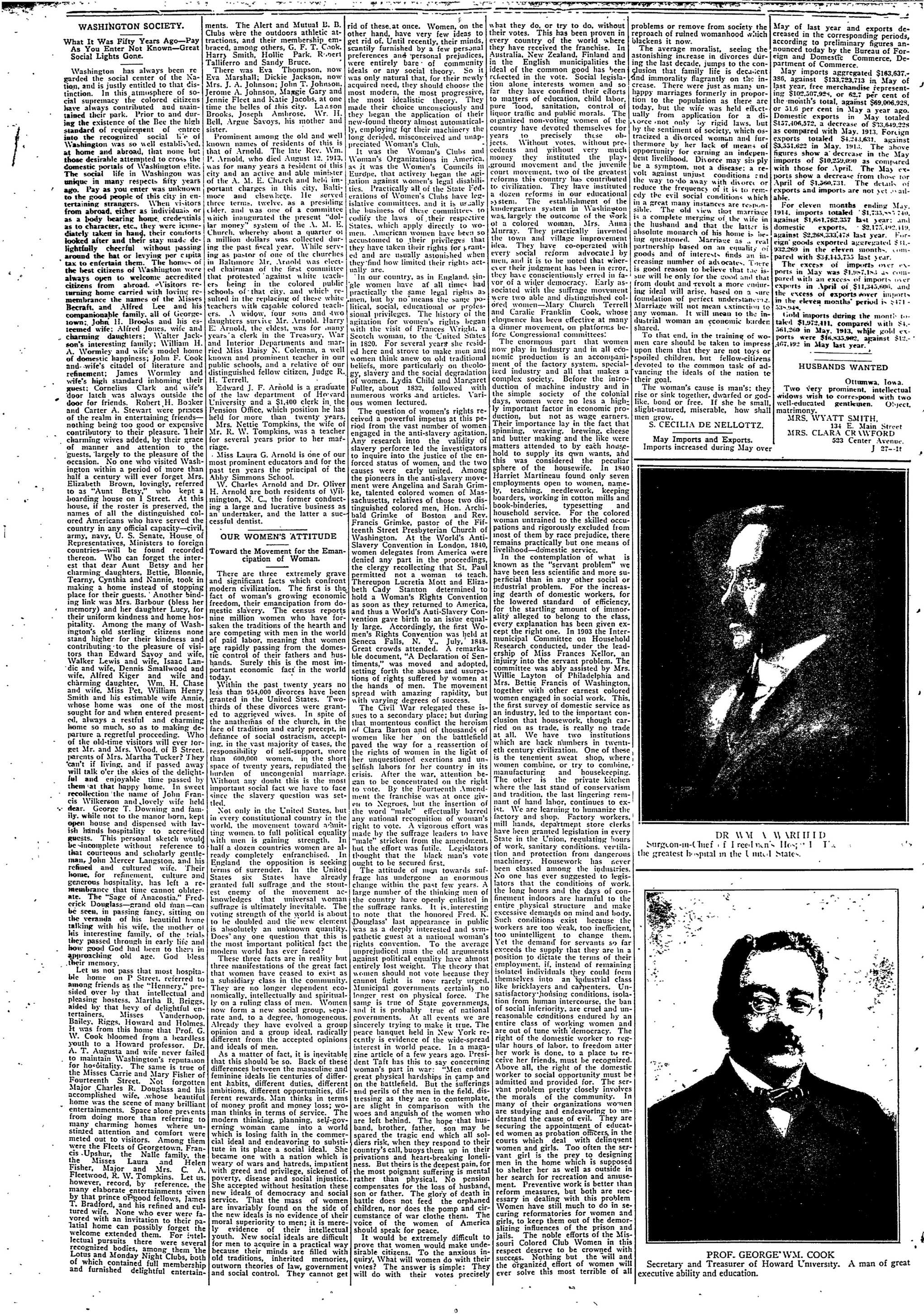
Dr. W. A. Warfield.
The present surgeon-in-chief of Freedmen's Hospital is so modest and reserved a man that though the public hears much of the growth and splendid facilities which have enabled that institution to perform such a
REPUBLICAN SHIP
DEMOCRATIC SHIP, WRECKED.
THROW ME RECORDER OF DEEDS.
ROSS
COSEY
POLITER
LOST
MUTTENGER
MURDERER
DEEDER
MURDERER
MURDERER
BROWN
WOOD
SURVIVORS OF THE
DEMOCRATIC SHIP WRECK
nurses training school and the home for the nurses, all of which are managed after the most approved modern methods. Dr. Warfield is a fine surgeon, being called upon to assume charge in most of the major operations performed there, especially in his particular department. That he is an efficient administrative officer is shown by the fact that though he has been in charge of Freedmen's Hospital for a number of years, one never hears
CULTURE SCHOOL
Madame A. J. Smith, Washington's Great Hair Culturist. Closing Exercises of the School.
On Thursday the 18th, the Fountain of Youth Beauty Culture School, Inc., of 935 R Street northwest, Washington, D. C., held their closing exercises with an appropriate literary program. More than two hundred persons crowded themselves into the school's parlors. The following young women, fifteen in number, graduated and received their diplomas:
Miss Marriet E. Sheppard, Miss Clara A. Turner, Miss Geneva D. Dixon, Miss Nona Bailey, Miss Emma Clark, Miss Lillian M. Howard, Miss Cornelia L. Clifford, Miss Mary Magruder, Miss Alma Gandy, Miss Agnes V. Bates, Miss Mary M. Quinnan, Miss Mollie S. Clark, Miss Mary V. Green, Miss Ophelia Johnson, Miss Roxie Chavis.
In addition to those who have just received their diplomas there are twenty-two others scattered throughout the states of Ohio, Virginia, Louisiana, North Carolina and Maryland, who have successfully completed their courses under Mme. "A. J. Smith's" instructions in hair dressing, facial massage and manicuring. Recent reports from all of the said twenty-two
MRS. AGNES J. SMITH
The great hair culturist.
MRS. AGNES J. SMITH
The great hair culturist.
The ern in al Dr. Warf vision of departme wards for agement
even a whispered rumor of any proposed change in that position. Colored Washington may well be proud of Freedmen's Hospital which takes rank among the leading similar institutions of the country, but especially is she proud of the fact that it is so successfully managed by a member of the race.
ST. ANN'S ACADEMY
The fourteenth annual commencement of St. Ann's Academy was held Monday evening, June 22, 1914, at St. Cyprian's Hall, Thirteenth and C Streets southeast. The hall was crowded with friends of the students. A delightful program of music, pantomimes and recitations was rendered, and gold and silver medals were awarded as follows for proficiency in various studies and in deportment: Deportment: Miss' Sarah Prather, gold medal; Miss Addie Scott, silver medal.
Catechism: Miss Naomi Campbell, silver medal.
Arithmetic: Miss Lillian Henderson, silver medal.
Domestic Economy: Miss Louise Miles, silver medal.
Miles, silver medal.
Music: Miss Maria T. Valdes, silver medal.
Penmanship: Miss Helen Lucas, silver medal.
English: Miss Maria T. Valdes, silver medal.
Embroidery: Miss Sarah Prather, gold medal.
Serving: Miss Helen Lucas, silver medal.
An exhibit of the needle work and other school work will be held at the Academy from June 21 to June 26.
Programme
March—"Waves of the Ocean." Pi-
show that they are meeting with wonderful-success.
Mme. A. J. Smith, the principal and founder of the school, holds four certificates covering hair dressing, manicuring and facial massaging from four of the most reputable hair dressing schools in the country.
The Fountain of Youth Beauty Culture School is the only one of its character offering similar opportunities to the young women of the District of Columbia.
The regular fall term of the school begins in October of each year and ends in June. In addition to the regular fall term, arrangements have been made, beginning June and ending in October for all persons wishing to take a summer course. In the event there are those who desire to take the course and cannot attend the day classes, arrangements can be made to get the courses in the evening.
The following branches are taught: Manicuring, facial massage, scalp treatment, hairdressing, manufacture of hair (ventilating a specialty), compounding facial creams, face lotions, hair pomades and tonics. Mme. Smith also carries a large selection of hair goods.
For further particulars address Mme. A. J Smith, 935 R Street northwest, Washington, D. C.
10
ano, Misses F. Hall and V. Colbert.
Sacred Heart Hymn. "Piano, Miss B. Ferguson.
Récitation.—"Flo's Letter." Miss T. Miller.
Trio.—"At the School Festival," L. Straebbog. Piano, Misses L. Henderson, G. Waters and R. Hemmons.
Dialogue.—"Papa's Letter." Minims.
Violin Solo.—(a) 1st Air Varié, Op. 89, C. Dancla; (b) Traumerei, Schumann. Miss Marie T. Valdes; piano, Miss F. Hall.
Song.—"Amoroso," A. Boex. Seniors; piano, Miss B. Ferguson.
Duet.—"Cujus Animam," Rosey. Piano, Misses F. Hall and F. Wilson.
Sash Drill. Seniors; piano, Miss B. Ferguson.
Song.—"If You, Won't Be Good To Me," Minims. Piano, Miss B. Ferguson.
Overture.—"Pique Dame," F. von Suppe. Piano I, Misses F. Wilson and Marie T. Valdes. Piano II, Misses F. Hall and V. Colbert.
Pantomime.—"The Story of the Mystic." Seniors.
Violin Solo.—"Cantabile and Bolero, Op. 22." Danbe. Violin, Miss Marie T. Valdes; piano, Miss Frances Wilson.
Song.—"The Heavens Are Telling," Haydn. Seniors; piano, Miss B. Ferguson.
A SUCCESSFUL LAWYER
A Native Washingtonian
Augustus W. Gray, the subject of this sketch, is one of the young men of this city of whom all Washington is proud. Born in Washington a little over thirty-five years ago, he has, by his indefitable pluck, intelligence and honesty, forged to the front and is recognized as one of the young lawyers who will in a few years, make for himself a name of which his friends and acquaintances can well be proud.
"Gus," as he is familiarly called, is a product of the schools of the District, and after graduating from the high school he was engaged in the insurance business, and some of the largest insurance companies in the city have had the benefit of his valuable services, and so thoroughly did he learn the business that he is regarded as one of the few attorneys who is an authority on the law of insurance. After graduating from the Howard University Law School, and his admission to the'bar about ten years ago, he began the active practice of his profession, and for about
JOHN H. HARRIS
AUGUSTUS W. GRAY, ESQ.
One of the leading members of the bar.
six years was one of the firm of Hughes & Gray, since which time he has worked alone, his lucrative practice calling him into all of the District courts. He is maintaining offices in the National Benefit Association Building, 609 F Street northwest, where he has been located since beginning his practice.
About twelve years ago Mr. Gray married Miss Rebecca J. Gray, a charming "school marm," who presides over his delightful little home in the northeast section of the city, which is one of the several pieces of real estate which Mr. Gray has acquired.
Mr. Gray is a Past Officer in the Odd Fellows, being a member of Bloom of Youth Lodge No. 1368, and is a Mason of high degree; he is Worshipful Master of Charles Datcher Lodge No. 15, F. A. A. M., and is Eminent Deputy Grand Commander, Knights Templar. He is also a member of the Young Men's Protective League and of the Crispus Attucks Association. While very busy with his other numerous affairs, Mr. Gray has not forsaken his religious duties, and is a member of Galbraith Chapel, and is vice chairman of its Trustee Board, and wields no little influence in the affairs of the church.
As a lawyer, Mr. Gray is a success and has the respect and confidence of the bench and bar, and as a man he is well thought of because of his affability and the fact that he is true to his friends, who are legion. The Bee predicts for him success and prosperity in his chosen field of endeavor.
The Salt of the Earth That Hast Not Lost Its Savor
Yes, here he is boys—I present him to you—Mr. William Young, one of nature's noblemen. Though disfigured by man he is the type of the honest poor man.
If told to go to work in the morning hours I need not go to see him again till the closing hours and I will find the work done—honest toil. I know him well and I present him to the young as an example of the business-like, conscientious man of endeaver. Look at him well—the lines in his face are not of dissipation but of toil—the toil made harder because the future had no open door for him. We call him "Uncle Young" in endearm and appreciation of the honest gentleman. He is never rude, does not shirk or dissipate, but always works. There is in his humility no spirit of the slave, for he would "quit" work were I, his friend, to charge him falsely. You may never have
marked him well because he attends to his business and not yours. I am going out now to see him rather for curiosity than for the inspection of his work. I told him this morning what to do and I am sure when I find it done it will show no evidence of shirking. It will be a full day's work, efficiently performed.
I can not long see his rough exterior for I have never approached him but that I have forgotten the exterior in the presence of the man. Were I an artist I might draw him in his working apparel but my spirit would lead toward his soul. His faith is set "On High." It is simple faith not mixed with doubts from too much or too little learning. So far as he is concerned he is in his belief in the hands of "The Maker" and no austere reasoning can shake his faith. He is of the Old Guard, so many of whom I knew at Howard University thirty-eight years ago. They have gone but their works do follow them. It is a benediction to have known them. As this "Last Leaf" is left, boys, take pattern of him for industry, fair dealing and good fellowship. You will say that he is not an angel. I say that he is of "The salt of the Earth." Boys, I once more present to you my friend, Mr. William Young.
Dr. Geo. W. Cabaniss
One of the older and most highly respected physicians in this city of capable and worthy professional men is Dr. Geo. W. Cabaniss, whose name is a synonym for dignified conservatism and substantial citizenship. Identified with the old citizenry of the District, Dr. Cabaniss and his amiable wife are representative of the best element in Washington's colored society, urbane in manner, considerate and easy in his intercourse with others, thoroughly dependable in all his transactions, the worthy dictator's rise
THE LIFE OF MARY CATHERINE BURKE
DR. GSO. W. CABINESS A. man of the people. in the estimation of the public has been steady and sure. Never a bidder for sensational advertisement, the doctor's modesty forbids his resortin to some of the modern methods achieving notoriety, yet should come to a serious test, few me would be found to carry more weig with the community.
Jesse H. Foster
Jesse H. Foster, proprietor a manager of Foster's Dye Wor Eleventh and U Streets northwest This is the leading establishment the city, controlled and managed either whites or blacks. Mr Fee.
M.
is an up-to-date business ran and conducts his estateiment a business basis
FOSTER'S DYE WORKS,
11th and You Sts. N. W.
Ice Cream Sodas and Sundae are famous for purity and deliciousness
The place "where everybody meets everybody else" for Drugs, Remedies and Toilet Articles OF SUPERIOR QUALITY Exclusive agent for the celebrated "Mark T" remedies, bonded and guaranteed to give satisfaction or your money back without hesitation. For the best go to BOARD'S PHARMACY, 1912½ 14th Street.
C. M. EDWARDS
Dealer In
Coal, Wood, Ice, Feed, Cement,
Sand, Oils, Paints, Building
Materials, Etc.
806 Florida Avenue N. W.
Phone North 552.
THE OLD RELIABLE DRUG STORE
JUST HONEST DRUGS—
THAT'S ALL
GEO. W. MURRAY
Second and L Streets Southwest
T. W. DUNWORTH
1002 Pa. Ave. N. W.
You may go East and you may go West
But Dunworth always sells the best
1002 Pa. Ave. N. W.
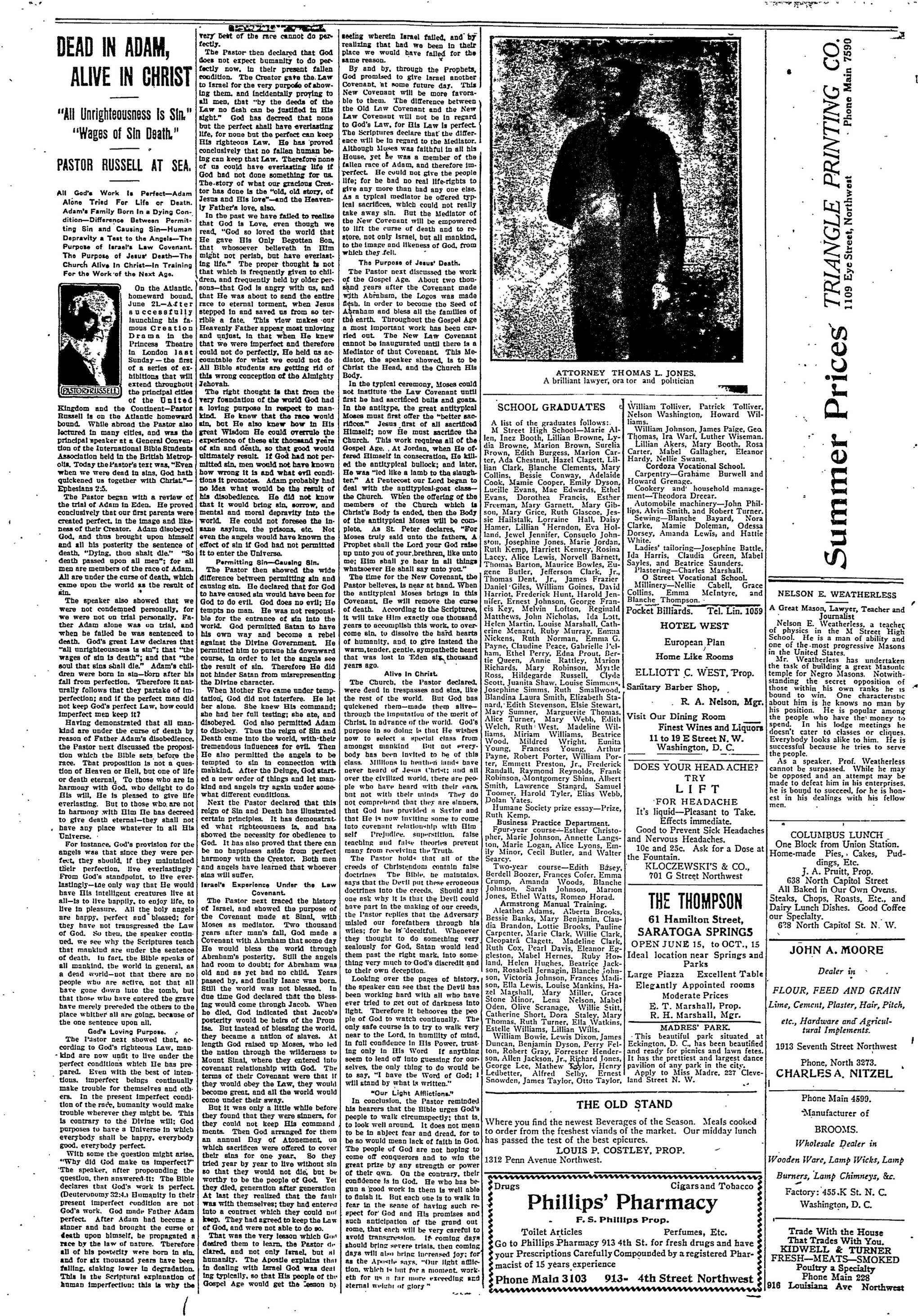
DEAD IN ADAM, ALIVE IN CHRIST
"All Unrighteousness Is Sin." "Wages of Sin Death."
PASTOR RUSSELL AT SEA
All God's Work Is Perfect—Adam Alone Tried For Life or Death. Adam's Family Born In a Dying Condition—Difference Between Permitting Sin and Causing Sin—Human Depravity a Test to the Angels—The Purpose of Israel's Law Covenant. The Purpose of Jesus' Death—The Church Alive In Christ—In Training For the Work of the Next Age.
PASTOR RUSSELL
On the Atlantic, homeward bound, June 21.-After successfully launching his famous Creation Drama in the Princess Theatre in London last Sunday—the first of a series of exhibitions that will extend throughout the principal cities of the United
Kingdom and the Continent—Pastor Russell is on the Atlantic homeward bound. While abroad the Pastor also lectured in many cities, and was the principal speaker at a General Convention of the International Bible Students Association held in the British Metropolis. Today the Pastor's text was, "Even when we were dead in sins, God hath quickened us together with Christ."—Ephesians 2:5.
The Pastor began with a review of the trial of Adam in Eden. He proved conclusively that our first parents were created perfect, in the image and likeness of their Creator. Adam disobeyed God, and thus brought upon himself and all his posterity the sentence of death, "Dying, thou shalt die." "So death passed upon all men"; for all men are members of the race of Adam. All are under the curse of death, which came upon the world as the result of sin.
The speaker also showed that we were not condemned personally, for we were not on trial personally. Father Adam alone was on trial, and when he failed he was sentenced to death. God's great Law declares that "all unrighteousness is sin"; that "the wages of sin is death"; and that "the soul that sins shall die." Adam's children were born in sin—born after his fall from perfection. Therefore it naturally follows that they partake of imperfection; and if the perfect man did not keep God's perfect Law, how could imperfect men keep it?
Having demonstrated that all mankind are under the curse of death by reason of Father Adam's disobedience, the Pastor next discussed the proposition which the Bible sets before the race. That proposition is not a question of Heaven or Hell, but one of life or death eternal. To those who are in harmony with God, who delight to do His will, He is pleased to give life everlasting. But to those who are not in harmony with Him He has decreed to give death eternal—they shall not have any place whatever in all His Universe.
For instance, God's provision for the angels was that since they were perfect, they should, if they maintained their perfection, live everlastingly From God's standpoint, to live everlastingly—the only way that He would have His intelligent creatures live at all—is to live happily, to enjoy life, to live in pleasure. All the holy angels are happy, perfect and blessed; for they have not transgressed the Law of God. So then, the speaker continued, we see why the Scriptures teach that mankind are under the sentence of death. In fact, the Bible speaks of all mankind, the world in general, as a dead world—not that there are no people who are active, not that all have gone down into the tomb, but that those who have entered the grave have merely preceded the others to the place whither all are going, because of the one sentence upon all.
God's Loving Purpose.
The Pastor next showed that, according to God's righteous Law, mankind are now unfit to live under the perfect conditions which He has prepared. Even with the best of intentions, imperfect beings continually make trouble for themselves and others. In the present imperfect condition of the race, humanity would make trouble wherever they might be. This is contrary to the Divine will; God purposes to have a Universe in which everybody shall be happy, everybody good, everybody perfect.
With some the question might arise, "Why did God make us imperfect?" The speaker, after propounding the question, then answered it: The Bible declares that God's work is perfect. (Deuteronomy 32:4.) Humanity in their present imperfect condition are not God's work. God made Father Adam perfect. After Adam had become a sinner and had brought the curse of death upon himself, he propagated a race by the law of nature. Therefore all of his posterity were born in sin, and for six thousand years have been falling, sinking lower in degradation. This is the Scriptural explanation of human imperfection: this is why the
very best of the race cannot do perfectly.
The Pastor then declared that God does not expect humanity to do perfectly now, in their present fallen condition. The Creator gave the Law to Israel for the very purpose of showing them, and incidentally proying to all men, that "by the deeds of the Law no flesh can be justified in His sight." God has decreed that none but the perfect shall have everlasting life, for none but the perfect can keep His righteous Law. He has proved conclusively that no fallen human being can keep that Law. Therefore none of us could have everlasting life if God had not done something for us. The story of what our gracious Creator has done is the "old, old story, of Jesus and His love"—and the Heavenly Father's love, also.
In the past we have failed to realize that God is Love, even though we read, "God so loved the world that He gave His Only Begotten Son, that whosoever believeth in Him might not perish, but have everlasting life." The proper thought is not that which is frequently given to children, and frequently held by older persons—that God is angry with us, and that He was about to send the entire race to eternal torment, when Jesus stepped in and saved us from so terrible a fate. This view makes our Heavenly Father appear most unloving and unjust. In that when He knew that we were imperfect and therefore could not do perfectly, He held us accountable for what we could not do. All Bible students are getting rid of this wrong conception of the Almighty Jehovah.
The right thought is that from the very foundation of the world God had a loving purpose in respect to mankind. He knew that the race would sin, but He also knew how in His great Wisdom He could overrule the experience of these six thousand years of sin and death, so that good would ultimately result. If God had not permitted sin, men would not have known how wrong it is and what evil conditions it promotes. Adam probably had no idea what would be the result of his disobedience. He did not know that it would bring sin, sorrow, and mental and moral deprivacy into the world. He could not foresee the insane asylum, the prisons, etc. Not even the angels would have known the effect of sin if God had not permitted it to enter the Universe.
Permitting Sin—Causing Sin. The Pastor then showed the wide difference between permitting sin and causing sin. He declared that for God to have caused sin would have been for God to do evil. God does no evil; He tempts no man. He was not responsible for the entrance of sin into the world. God permitted Satan to have his own way and become a rebel against the Divine Government. He permitted him to pursue his downward course, in order to let the angels see the result of sin. Therefore He did not hinder Satan from misrepresenting the Divine character.
When Mother Eve came under temptation, God did not interfere. He let her alone. She knew His command; she had her full testing; she ate, and disobeyed. God also permitted Adam to disobey. Thus the reign of Sin and Death came into the world, with their tremendous influences for evil. Then He also permitted the angels to be tempted to sin in connection with mankind. After the Deluge, God started a new order of things and let mankind and angels try again under somewhat different conditions.
Next the Pastor declared that this reign of Sin and Death has illustrated certain principles. It has demonstrated what righteousness is, and has showed the necessity for obedience to God. It has also proved that there can be no happiness aside from perfect harmony with the Creator. Both men and angels have learned that whoever sins will suffer.
Israel's Experience Under the Law Covenant.
The Pastor next traced the history of Israel, and showed the purpose of the Covenant made at Sinal, with Moses as mediator. Two thousand years after man's fall, God made a Covenant with Abraham that some day He would bless the world through Abraham's posterity. Still the angels had room to doubt; for Abraham was old and as yet had no child. Years passed by, and finally Isaac was born. Still the world was not blessed. In due time God declared that the blessing would come through Jacob. When he died, God indicated that Jacob's posterity would be heirs of the Promise. But instead of blessing the world, they became a nation of slaves. At length God raised up Moses, who led the nation through the wilderness to Mount Sinal, where they entered into covenant relationship with God. The terms of their Covenant were that if they would obey the Law, they would become great, and all the world would come under their sway.
But it was only a little while before they found that they were sinners, for they could not keep His commandments. Then God arranged for them an annual Day of Atonement, on which sacrifices were offered to cover their sins for one year. So they tried year by year to live without sin so that they would not die, but be worthy to be the people of God. Yet they dled, generation after generation. At last they realized that the fault was with themselves; they had entered into a contract which they could not keep. They had agreed to keep the Law of God, and were not able to do so.
That was the very lesson which God desired them to learn, the Pastor declared, and not only Israel, but all humanity. The Apostle explains that in dealing with Israel God was dealing typically, so that His people of the Gospel Age would get the lesson by
seeing wherein Israel failed, and by realizing that had we been in their place we would have failed for the same reason.
By and by, through the Prophets, God promised to give Israel another Covenant, at some future day. This New Covenant will be more favorable to them. The difference between the Old Law Covenant and the New Law Covenant will not be in regard to God's Law, for His Law is perfect. The Scriptures declare that the difference will be in regard to the Medlator. Although Moses was faithful in all his House, yet he was a member of the fallen race of Adam, and therefore imperfect. He could not give the people life; for he had no real life-rights to give any more than had any one else. As a typical medlator he offered typical sacrifices, which could not really take away sin. But the Medlator of the New Covenant will be empowered to lift the curse of death and to restore, not only Israel, but all mankind, to the image and likeness of God, from which they fell.
The Purpose of Jesus' Death.
The Pastor next discussed the work of the Gospel Age. About two thousand years after the Covenant made with Abraham, the Logos was made flesh. In order to become the Seed of Abraham and bless all the families of the earth. Throughout the Gospel Age a most important work has been carried out. The New Law Covenant cannot be inaugurated until there is a Mediator of that Covenant. This Mediator, the speaker showed, is to be Christ the Head, and the Church His Body.
In the typical ceremony, Moses could not institute the Law Covenant until first he had sacrificed bulls and goats. In the antitype, the great antitypical Moses must first offer the "better sacrifices." Jesus first of all sacrificed Himself; now He must sacrifice the Church. This work requires all of the Gospel Age. At Jordan, when He offered Himself in consecration, He killed the antitypical bullock; and later, He was "led like a lamb to the slaughter." At Pentecost our Lord will be dealt with the antitypical-goat class—the Church. When the offering of the members of the Church which is Christ's Body is ended, then the Body of the antitypical Moses will be complete. As St. Peter declares, "For Moses truly said unto the fathers, A prophet shall the Lord your God raise up unto you of your.brethren, like unto me; Him shall ye hear in all things whatsoever He shall say unto you."
The time for the New Covenant, the Pastor believes, is near at hand. When the antitypical Moses brings in this Covenant, He will remove the curse of death. According to the Scriptures, it will take Him exactly one thousand years to accomplish this work, to overcome sin, to dissolve the hard hearts of humanity, and to give instead the warm, tender, gentle, sympathetic heart that was lost in Eden six thousand years ago.
Alive In Christ.
The Church, the Pastor declared, were dead in trespasses and sins, like the rest of the world. But God has quickened them—made them alive—through the imputation of the merit of Christ, in advance of the world. God's purpose in so doing is that He wishes now to select a special class from amongst mankind. But not everybody has been invited to be of this class. Millions in heathen lands have never heard of Jesus Christ; and all over the civilized world, there are people who have heard with their ears, but not with their minds. They do not comprehend that they are sinners, that God has provided a Savior and that He is now inviting some to come into covenant relationship with Himself. Prejudice, superstition, false teaching and false theories prevent many from receiving the Truth.
The Pastor holds that all of the creeds of Christendom contain false doctrines. The Bible, he maintains, says that the Devil put these erroneous doctrines into the creeds. Should any one ask why it is that the Devil could have part in the making of our creeds, the Pastor replies that the Adversary misled our forefathers through his wiles; for he is 'deceltful. Whenever they thought to do something very zealously for God, Satan would lead them past the right mark, into something very much to God's discredit and to their own deception.
Looking over the pages of history, the speaker can see that the Devil has been working hard with all who have ever tried to get out of darkness into light. Therefore it behooves the people of God to watch continually. The only safe course is to try to walk very near to the Lord, in humility of mind, in full confidence in His Power, trusting only in His Word. If anything seem to lead off into guessing for ourselves, the only thing to do would be to say, "I have the Word of God; I will stand by what is written."
"Our Light Afflictions."
In conclusion, the Pastor reminded his hearers that the Bible urges God's people to walk circumspectly; that is, to look well around. It does not mean to be in abject fear and dread, for to be so would mean lack of faith in God. The people of God are not hoping to come off conquerors and to win the great prize by any strength or power of their own. On the contrary, their confidence is in God. He who has begun a good work in them is well able to finish it. But each one is to walk in fear in the sense of having such respect for God and His promises and such anticipation of the grand out come, that each will be very careful to avoid transgression. If coming days should bring severe trials, then coming days will also bring increased joy; for as the Apostle says, "Our light affliction, which is but for a moment worketh for us a far more exceeding and eternal weight of glory."
THE NEW YORK TIMES
ATTORNEY THOMAS L. JONES.
A brilliant lawyer, ora tor and politician.
SCHOOL GRADUATES
A list of the graduates follows:
M Street High School—Marie Allen, Inez Booth, Lillian Browne, Lydia Browne, Marion Brown, Surelia Brown, Edith Burgess, Marion Carter, Ada Chestnut, Hazel Clagett, Lillian Clark, Blanche Clements, Mary Collins, Bessie Conway, Adelaide Cook, Mamie Cooper, Emily Dyson, Lucille Evans, Mae Edwards, Ethel Evans, Dorothea Francis, Esther Freeman, Mary Garnett, Mary Gibson, Mary Grice, Ruth Glascoe, Jessie Hailstalk, Lorraine Hall, Daisy Hamer, Lillian Herndon, Eva Holland, Jewel Jennifer, Consuelo Johnson, Josephine Jones, Marie Jordan, Ruth Kemp, Harriett Kenney, Rosina Lacey, Alice Lewis, Norvell Barnett, Thomas Barton, Maurice Bowles, Eugene Butler, Jefferson Clark, Jr, Thomas Dent, Jr, James Frazier Daniel Giles, William Goines, David Harriot, Frederick Hunt, Harold Jennifer, Ernest Johnson, George Francis Key, Melvin Lofton, Reginald Matthews, John Nicholas, Ida Lott, Helen Martin, Louise Marshall, Catherine Menard, Ruby Murray, Emma Nickens, Ruth Norman, Emma G. Payne, Claudine Peace, Gabrielle Proult, Ethel Perry, Edna Proult, Bertie Queen, Annie Rattley, Marion Richards, Mary Robinson, Myrtle Ross, Hildegarde Russell, Clyde Scott, Juanita Shaw, Louise Simmons, Josephine Simms, Ruth Smallwood, Blandina Laura Smith, Elizabeth Stanford, Edith Stevenson, Elsie Stewart, Mary Sumner, Marguerite Thomas, Alice Turner, Mary Webb, Edith Welch, Ruth West, Madeline Williams, Miriam Williams, Beatrice Wood, Mildred Wright, Eunita Young, Frances Young, Arthur Payne, Robert Porter, William Porter, Emmett Preston, Jr., Frederick Randall, Raymond Reynolds, Frank Robinson, Montgomery Shinn, Albert Smith, Lawrence Stanard, Sanuel Toomer, Harold Tyler, Elias Webb, Dolan Yates.
Humane Society prize essay—Prize,
Ruth Kemp.
Business Practice Department.
Four-year course—Esther Christopher,
Marie Johnson, Annette Langston,
Marie Logan, Alice Lyons, Emily Minor, Cecil Butler, and Walter Searcy.
Two-year course—Edith Bäsey,
Berdell Boozer, Frances Cofer, Emma Crump, Amanda Woods, Blanche Johnson, Sarah Johnson, Marion Jones, Ethel Watts, Romco Horad.
Armstrong Manual Training.
Aleathea Adams, Alberta Brooks,
Bessie Banks, Mary Benjamin, Claudia
Brandon, Lottie Brooks, Pauline
Carpenter, Marie Clark, Willie Clark,
Carpatrà Clagett, Madeline Clark,
Ruth Cox, Pearl Davis, Eleanor Eggleston, Mabel Hernes, Ruby Horland, Helen Hughes, Beatrice Jackson, Rosabell Jernagin, Blanche Johnson, Victoria Johnson, Frances Madison, Ella Lewis, Louise Mankins, Hazel Marshall, Mary Miller, Grace Stone Minor, Lena Nelson, Mabel Oden, Olive Scranage, Willie Stitt, Catherine Short, Dora Staley, Mary Thomas, Ruth Turner, Ella Watkins, Estelle Williams, Lillian Wills.
William Bowie, Lewis Dixon, James Duncan, Benjamin Dyson, Perry Felton, Robert Gray, Forrester Henderson, Allen Jackson, Jr., Richard Jones, George Lee, Mathew Taylor, Henry Ledbetter, Alfred Selby, Ernest Snowden, James Taylor, Otto Taylor,
THE OLD STAND
Where you find the newest Beverages of the Season. Meals cooked to order from the freshest viands of the market. Our midday lunch has passed the test of the best epicures.
Phillips' Pharmacy
Go to Phillips Pharmacy 913 4th St. for fresh drugs and have your Prescriptions Carefully Compounded by a registered Pharmacist of 15 years experience
William Tolliver, Patrick Tolliver, Nelson Washington, Howard Williams.
William Johnson, James Paige, Geo Thomas, Ira Warf, Luther Wiseman.
Lillian Akers, Mary Booth, Rosa Carter, Mabel Gallagher, Eleanor Hardy, Nellie Swann.
Cordoza Vocational School.
Carpentry-Grahame Burwell and Howard Grenage.
Cookery and household management-Theodora Dreear.
Automobile machinery-John Phillips, Alvin Smith, and Robert Turner.
Sewing-Blanche Bayard, Nora Clarke, Mamie Doleman, Odessa Dorsey, Amanda Lewis, and Hattie White.
Ladies' tailoring-Josephine Battle, Ida Harris, Claudia Green, Mabel Sayles, and Beatrice Saunders.
Blastering-Charles Marshall
O Street Vocational School. Millinier-Nellie Cabell, Grace Collins, Emma McIntyre, and Blanche Thompson. Pocket Billiards. Tel. Lin. 1059
HOTEL WEST
European Plan Home Like Rooms
R. A. Nelson, Mgr.
Visit Our Dining Room
Finest Wines and Liquors
11 to 19 E Street N. W.
Washington, D. C.
DOES YOUR HEAD-ACHE?
LIFT
FOR HEADACHE
It's liquid—Pleasant to Take.
Effects immediate.
Good to Prevent Sick Headaches
and Nervous Headaches.
10c and 25c. Ask for a Dose at
the Fountain.
THE THOMPSON
61 Hamilton Street,
SARATOGA SPRING5
OPEN JUNE 15, to OCT., 15
Ideal location near Springs and
Parks
Large Piazza Excellent Table
Elegantly Appointed rooms
Moderate Prices
E. T. Marshall, Prop.
R. H. Marshall, Mgr.
MADRES' PARK.
This beautiful park situated at Eckington, D. C., has been beautified and ready for picnics and lawn fetes. It has the prettiest and largest dance pavilion of any park in the city. Apply to Miss Madre, 227 Cleveland Street N. W.
ges of the Season. Meals cooked of the market. Our midday lunch cures. TLEY, PROP. Cigars and Tobacco Pharmacy
Summer Prices TRIANGLE PRINTING CO. 1109 Eye Street, Northwest Phone Main 7590
NELSON E. WEATHERLESS
A Great Mason, Lawyer, Teacher and Journalist
Nelson E. Weatherless, a teacher of physics in the M Street High School. He is a man of ability and one of the-most progressive Masons in the United States.
Mr. Weatherless has undertaken the task of building a great Masonic temple for Negro Masons. Notwithstanding the secret opposition of those within his own ranks he is bound to win. One characteristic about him is he knows no man by his position. He is popular among the people who have the money to spend. In his lodge meetings he doesn't cater to classes or cliques. Everybody looks alike to him. He is successful because he tries to serve the people.
As a speaker, Prof. Weatherless cannot be surpassed. While he may be opposed and an attempt may be made to defeat him in his enterprises, he is bound to succeed, for he is honest in his dealings with his fellow men.
COLUMBUS LUNCH
One Block from Union Station.
Home-made Pies, Cakes, Puddings, Etc.
J. A. Pruitt, Prop.
638 North Capitol Street
All Baked in Our Own Ovens.
Steaks, Chops, Roasts, Etc., and
Dairy Lunch Dishes. Good Coffee
our Specialty.
JOHN A. MOORE
FLOUR, FEED AND GRAIN
Lime, Cement, Plaster, Hair, Pitch,
etc., Hardware and Agricultural Implements.
1913 Seventh Street Northwest
Phone, North 3273.
CHARLES A. NITZEL
Phone Main 4599.
Manufacturer of
BROOMS.
Wholesale Dealer in
Wooden Ware, Lamp Wicks, Lamp
Burners, Lamp Chimneys, &c.
Factory: 455.K St. N.C.
Washington, D.C.
Trade With the House
That Trades With You.
KIDWELL & TURNER
FRESH—MEATS—SMOKED
Poultry a Specialty
Phone Main 228
916 Louisiana Ave Northwest
11th and You Streets, Northwest
WASHINGTON, D. C.
DYEING
BUTTON, D. C.
AND PRESSING
1
```markdown
```
Phones: North 2125 2126
---
Legal Notices
CHAS. S. WILLIAMS, ATTORNEY
Supreme Court of the District of Columbia, Holding Probate Court. No. 20277, Adminiestration.
This is to give notice that the subscriber, of the District of Columbia, has obtained from the Probate Court of the District of Columbia, Letters Testamentary on the estate of Edward Columbus Younger, late of the District of Columbia, deceased. All persons having claims against the deceased are hereby warned to exhibit the same, with the vouchers thereof, legally authenticated, to the subscriber, on or before the 23d day of April, A D. 1915; otherwise they may by law be excluded from all benefit of said estate.
Given under my hand this 23d day of April, 1914.
GEORGE L. YOUNGER,
1451 Q Street N. W.
Seal.
Attest:
JAMES TANNER,
Register of Wills for the District of
Columbia, Clerk of the Probate
Court.
CHAS. S. WILLIAMS,
Attorney.
THOMAS WALKER, ATTORNEY.
Supremie Court of the District of Col-
umbia, Holding Probate Court—
No. 20010, Administration.
This is to give notice that the subscriber, of the District of Columbia, has obtained from the Probate Court of the District of Columbia, Letters of Administration C. T. A. on the estate of Maria A. Comstead, late of the District of Columbia, deceased. All persons having claims against the deceased are hereby warned to exhibit the same, with the vouchers thereof, legally authenticated, to the subscriber, on or before the 30th day of April, A. D. 1915, otherwise they may by law be excluded from all benefit of said estate. Given under my hand this 30th day of April, 1914. DAISY C. SMITH, 7028 Lamont St. N. W. Seal.
JAMES TANNER
Register of Wills of the District of
Columbia, Clerk of the Probate
Court.
THOS. WALKER.
Zeph P. Moore, Attorney. Supreme Court of the District of Columbia, Holding Probate Court. No. 20804, Administration. This is to Give Notice: That the subscriber of the District of Columbia has obtained from the Probate Court of the District of Columbia, Letters testamentary on the estate of Geneva Jackson late of the District of Columbia, deceased. All persons having claims against the deceased are hereby warned to exhibit the same, with the vouchers thereof, legally authenticated, to the subscriber, on or before the 12th day of May, A. D. 1915; otherwise they may by law be excluded from all benefit of said estate. Given under my hand this 12th day of May, 1914.
EDWARD B. GORDON,
918 French Street Northwest.
Attest:
JAMES TANNER,
Register of Wills for the District of
Columbia, Clerk of he Probate
Court.
ZEPH P. MOORE, Attorney.
A. W. Gray, Attorney.
Supreme Court of the District of Columbia, Holding Probate Court.—No. 20786, Administration.
This is to Give Notice:
That the subscribers, of the District of Columbia, have obtained from the Probate Court of the District of Columbia, Letters of administration on the estate of David L. Lewis alias J. D. Lewis, late of the District of Columbia, deceased. All persons having claims against the deceased are hereby warned to exhibit the same, with the vouchers thereof, legally authenticated, to the subscribers, on, or before the 5th day of May, A. D. 1915; otherwise they may by law be excluded from all benefit of said estate.
Given under our hands this 5th day
of May, 1914.
JOHN M. GEORGE,
338 Indiana Avenue N. W.
AUGUSTUS W. GRAY,
609 F Street N. W.
(Seal)
Attest: JAMES TANNER,
Register of Wills for the District of
Columbia, Clerk of the Probate
Court.
AUGUSTUS W. GRAY, Attorney.
R. W. Claxton
R. W. Claxton
Wholesale and Retail Dealer
IN
All Products of the Sea
Poultry and Game
940 1-2 Louisiana Ave., N. W
Branch, 11th Street Wharf
Telephone Main 579
AGRICULTURAL AND MECHANICAL COLLEGE
FOR THE COLORED
RACE
Agricultural and Mechanical College. Open all the year round. Fifteenth Annual Session Summer School for Teachers of both sexes begins June 29th and continues five weeks. Fall term for males only, begins September 1, 1914. Board, lodging and tuition, $7.00 per month. For catalog address J. B. Dudley, President, Greensboro, N. C.
Lowest Prices Best Work
Specialty made of Constitutions and Pamphlets BUSINESS OFFICE and PLANT, 1109 EYE STREET. N. W. PHONE MAIN 4078
A BEAUTIFUL HEAD OF HAIR IS A LADY'S CROWNING GLORY.—And every lady can have it if she will use the Magic. The Magic will dry the hair after a shampoo or bath, and straighten the earliest head of hair. It will also stimulate its growth. The Aluminium Comb cannot injure the hair, because it is never heated direct, but takes its heat from the heating bar which is heated on our Alcohol Heater, or any other heater. We advise the use of Hayca Hair Pomade. Best on the market. Price per box, 50c. Alcohol Heater, price 50c. Liberal terms to agents.
MAGIC SHAMPOO DRIER COMPANY. MINNEAPOLIS. MINNESOTA
Write for literature today.
JamesH Winslow
READ WEBB'S BIBLICAL WORKS OF THE BLACK MAN'S PART IN THE BIBLE.
PETER H. BURKE
BOOK AND PICTURE. Jesus was a Black Man (or Negro) by blood. Webb's book and picture show it and prove it by the Bible. A picture 12x18 of Jesus with wooly hair and his holy angels at his second coming. And a book showing that Jesus was born out of the black tribe, according to Biblical history. This famous picture in colors and the Biblical book both for $1.50 postage prepaid. The following comment is upon the same, from the Seattle, Wash.. Daily Times:
The evidence submitted by Elder Webb tending to prove that the Saviour of mankind was a black those who oppose the proposition upon their proof. Now that the chain of evidence presented by Mr. Webb seems so complete, it is strange that none of the delvers in the Biblical records have. advanced the proposition before.
Combination of both books prepaid..
Send money order, express or
J. M. Webb, 3519 State Street, C
Will submit terms to agents.
The Vian Corresponden
and Ty
Do You Want to Increase Your W
Time While Holding You
If so, send a stamped envelope f
tunities afforded for becoming an
taking the correspondence course a
prises the best ideas gained from
Reporter in the Illinois Courts. I
the course. For terms, etc, address
section of both books and pictures for $2.00
money order, express order, or registered letter
13519 State Street, C chicago, Ill.
mit terms to agents.
Correspondence School of S
and Typewriting
t to Increase Your Weekly Capacity 50 per ce
While Holding Your Present Employment
a stamped envelope for information regarding
ded for becoming an expert stenographer or
correspondence course at the Vian School. The
best ideas gained from a ten years' experience
the Illinois Courts. Diplomas furnished on c
For terms, etc, address
Combination of both books and pictures for $2.00, postage prepaid..
Send money order, express order, or registered letter to Elder J. M. Webb, 3519 State Street, C chicago, Ill.
The Vian Correspondence School of Shorthand and Typewriting
Do You Want to Increase Your Weekly Capacity 50 per cent in a Short Time While Holding Your Present Employment?
If so, send a stamped envelope for information regarding the opportunities afforded for becoming an expert stenographer or reporter by taking the correspondence course at the Vian School. The course comprises the best ideas gained from a ten years' experience as a Court Reporter in the Illinois Courts. Diplomas furnished on completion of the course. For terms, etc, address
VIAN CORRESPONDENCE SCHOOL,
Suite 18-143 N. Dearborn Street,
KING'S
Crowds are 60
GREAT, F
AND OBTAINING BARGAIN
PROACHED: EVERYTHING
WEAR IS BEING SACRIFICIAL
PRICE, AS A RESULT OF O
N. Dearborn Street, Chic
Suite 18-143 N. Dearborn Street, Chicago, Illinois.
KING'S PALACE
Crowds are Coming to the GREAT, FIRE SALE BAINING BARGAINS NEVER BEFORE EVERYTHING NEEDED FOR BEING SACRIFICED AT AND BELOW A RESULT OF OUR DISASTROUS F
AND OBTAINING BARGAINS NEVER BEFORE APPROACHED: EVERYTHING NEEDED FOR SUMMER WEAR IS BEING SACRIFICED AT AND BELOW HALF PRICE, AS A RESULT OF OUR DISASTROUS FIRE.
KING'S PALACE
810-16 Seventh Street Northwest
Not only was Christ a Negro, but it seems that Solomon, who has been held up through all the ages as the personification of wisdom, had Ethiopian blood in his veins also.
A new book entitled "The Black Man Was the Father of Civilization." This book defends its title exclusively by the Bible and therefore has nothing to fear. This book is illustrated with many pictures. Price, $1.00 by mail. The following comment is from the Seattle Daily Post Intelligencer:
Elder J. M. Webb, evangelist of the Church of God, in his book describes the black man as the father of all civilization. He takes the Bible to show that the fathers of the church and all the great leaders, even the Greatest One, was black. Mr. Webb's work is able and thoughtful. Whether the Anglo-Saxon believes him or not, Mr. Webb writes what he believes to be true about his race and their place in Biblical history.
Combination of both books and pictures for $2.00 postage prepaid. Send money order, express order or registered letter to Elder J. M. Webb, 3519 State Street, Chicago, Ill. Will submit terms to agents.
and pictures for $2.00, postage
order, or registered letter to Elder
Chicago, Ill.
Prince School of Shorthand
Typewriting
Weekly Capacity 50 per cent in a Short
Your Present Employment?
For information regarding the oppor-
expert stenographer or reporter by
at the Vian School. The course com-
a ten years' experience as a Court
Diplomas furnished on completion of
ess
PALACE
Coming to the
FIRE SALE
INS NEVER BEFORE AP-
NEEDED FOR SUMMER
NED AT AND BELOW HALF-
OUR DISASTROUS FIRE.
Men Admire
Women
with
Beautiful
Hair!
NELSON'S
HAIR DRESSING
will make you proud of your hair
It is unsurpassed for making harsh, kinky and
stubborn hair—soft, glossy and luxurious.
It not only beautifies the hair—but also keeps it
in good condition.
Price, 25 and 50 Cents Everywhere
NELSON MFG. CO., RICHMOND, VA.
FAIR-VBM
MADE MARK
The Hair Dressing of quality and merit. For Men Women and Children Sold at all drug stores - 25c per box. Agents make big money handling our goods Write for terms and territory HAIR VIM CHEM. CO. 1234 You St., Wash., D. C.
The Fifteenth Annual Session of the STATE SUMMER SCHOOL For Colored Teachers of both Sexes at the AGRICULTURAL and MECHANICAL COLLEGE Greensboro, N. C. will begin June 24, 1914, and continue five weeks
James B. Dudley, President or D. J. Jordan, Director. A. & M. College, Greensboro, N. C.
THE ONLY PLACE OPEN FOR EXCURSIONS AND PICNICS This Season.
ADAM'S ELECTRIC
West Annapolis, Md., 90 minutes ride from city and A. Electric Railroad.
This beautiful park of 10 acres is magnificently ground near Annapolis, surrounded on three sides fine shade, constant cool breezes, large pavillion, swings, steam launches for seeing the historic scenery crabbing, fishing, etc.
ADAM'S ELECTRIC PARK
ADAM'S ELECTRIC PARK
West Annapolis, Md., 90 minutes ride from city, on the W. B. and A. Electric Railroad. This beautiful park of 10 acres is magnificently located on high ground near Annapolis, surrounded on three sides by salt water, fine shade, constant cool breezes, large pavillion, flying horses, swings, steam launches for seeing the historic scenery, and boats for crabbing, fishing, etc. New dining room seating 40 people.
Electric lights over entire grounds and new station for passengers, thus avoiding ferry across the creek.
Electric lights over entire grounds and gers, thus avoiding ferry across the cree For terms and further particulars ca H. Coleman, 1522 12th St. N. W. Hour
For terms and further particulars call or drop a postal to Jas. H. Coleman, 1522 12th St. N.W. Hours 4 to 7 P.M.
WATCHES AND CLOCKS
Finé Clock and Watch Repairing. Expert Diamond Setting.
DAVID D. VAWTER,
Watchmaker and Jeweler,
1106 You Street N. W.
Phone, North 1942.
THE RELIABLE MEAT
MARKET,
H. Katz, Prop.
1941 Ninth Street N. W.
Corner Ninth St. and Florida Ave.
Phone, North 1269.
SHOES POLISHED.
Promptness—Neatness.
Antiseptic Shaving Parlor.
Managing and Shampooing a
Specialty.
Shoes Polished.
True Reformers' Hall,
1204 You Street N. W.
W. S. Hall, Prop.
S. FAINMAN,
Ladies' Tailor,
Suits Made to Order.
1110 U Street Northwest.
NAPPER'S PHARMACY,
7th and Fla. Ave.—Phone 3090.
5th and Fla. Ave.—Phone 3178.
PURE DRUGS.
Prescriptions are carefully compounded. Delicious Soda Water. Domestic and Imported Toilet Supplies, Imported Cigars. Highgrade Stationery and Candies. PURE DRUGS—NAPPER'S
CTRIC PARK
routes ride from city, on the W. B.
is magnificently located on high
ed on three sides by salt water,
large pavillion, flying horses,
the historic scenery, and boats for
people.
lands and new station for passen-
the creek.
ulars call or drop a postal to Jas.
Hours 4 to 7 P. M.
GO TO
HOLMES' HOTEL
333 Virginia Ave., S.W.
Finest Afro-American Accomo
dations in the District
European & American Plan
Good Rooms and Lodging, 50c,
75c and $1.00. Comfortably
heated by steam. Give us a Call
JAMES OTTOWAY HOLMES, Prop
Washington, D. C. Phone, Main 2315
SPECIAL NOTICE
ARLINGTON POULTRY
FARM, VA.
Arlington Poultry and Egg Farm.
Eggs, Chickens, at current market
prices.
Address orders to
SAMUEL M. PIERRE, JR.
Arlington, Va.
SELLINGER'S
LOOK FOR THE BIG CLOCK. Wishing You Lots of Success.
Open Sundays 7 a.m. to 6:15 p.m.
LEE'S LUNCH ROOM
Geo. H. Lee, Prop.
1231 E Street N. W.
Meals 15c and 25c.
Washington, D. C.
Legal Notices
Thomas Walker, Attorney.
Supreme Court of the District of Columbia, Holding Probate Court—No. 20765, Administration Docket.
Federal Office of Alaska Department
Estate of Alice J. Scott, Deceased. Application having been made herein for probate of the last will and testament of said deceased, and for letters Testamentary on said estate, by Creed W. Childs, it is ordered this 3rd day of June, A. D. 1914, that Samuel Lockett, Dillard Lockett, Sidnor Lockett and all others concerned, appear in said Court on Tuesday, the 14th day of July, A. D. 1914, at 10 o'clock A. M., to show cause why such application should not be granted. Let notice thereof be published in the "Washington Law Reporter" and The Washington Bee once in each of three successive weeks before the return day herein mentioned, the first publication to be not less than thirty days before said return day.
WENDELL P. STAFFORD. Justice.
Attest:
(Scal) JAMES TANNER,
Register of Wills for the District of
Columbia, Clerk of the Probate
Court.
THOMAS WALKER, Attorney.
Supreme Court of the District of Columbia, Holding Probate Court.—No. 20854, Administration Docket. Estate of Margaret Brown, Deceased. Application having been made herein for probate of the last will and testament of said deceased, and for letters Testamentary on said estate, by Mary E. Brock, it is ordered this 3rd day of June, A. D. 1914, that John Brown, Sr., John Brown, Jr., and Margaret Brown, only heirs at law and next of kin of the said Margaret Brown, deceased, and all others concerned, appear in said Court on Tuesday, the 14th day of July, A. D. 1914, at 10 o'clock A. M., to show cause why such application should not be granted. Let notice hereof be published in the "Washington Law Reporter" and "Bee" once in each of three successive weeks before the return day herein mentioned, the first publication to be not less than thirty days before said return day.
WENDELL P. STAFFORD,
Justice.
Attest:
(Seal) JAMES TANNER,
Register of Wills for the District of
Columbia, Clerk of the Probate
Court.
ZEPH MOORE, Attorney.
Now Ready VARDAMAN UNMASKED A Defense of the Colored Race By
A.
Dr. George H. Richardson,
M. D., L. L. D.
A Reply to The Mulatto.
By
Prof. H. E. Jordan,
Of the University of Virginia.
James K. Vardaman, of Mississippi, et ai.,
Published under the auspices of
The Washington Bee.
Address: The Washington Bee,
1109 Eye Street N. W.
Washington, D. C.
Or
Dr. Geo. H. Richardson,
309 Eleventh Street N. E.
McCall's Magazine and McCall Patterns For Women Have More Friends than any other magazine or patterns. McCall's is the reliable Fashion Guide monthly in one million one hundred thousand homes. Besides showing all the latest designs of McCall Patterns, each issue is brimful of sparkling short stories and helpful information for women.
Save Money and Keep in Style by subscribing for McCall's Magazine at once. Cents only go exerts a year, including any one of the celebrated McCall Patterns free.
McCall Patterns Load all others in style, fit, simplicity, economy and number sold. More dealers sell McCall Patterns than any other two makes combined. None higher, than 15 cents. Buy from your dealer, or by mail from McCALL'S MAGAZINE
236-246 W. 37th St., New York City
New-England Copy, Premium Giftware and Pattern Giftware Box, on request.
ROBERT ALLEN
Buffet and Family Liquor
Store
Phone North 2340
1917 14th Street, N. W.
Washington, D. C.
WASHINGTON SOCIETY.
What It Was Fifty Years Ago—Pay As You Enter Not Known—Great Social Lights Gone.
Washington has always been regarded the social center of the Nation, and is justly entitled to that distinction. In this atmosphere of social supremacy the colored citizens have always contributed and maintained their park. Prior to and during the existence of the Bee the high standard of requirement of entree into the recognized social life of Washington was so well established, at home and abroad, that none but those desirable attempted to cross the domestic portals of Washington elite. The social life in Washington was unique in many respects fifty years ago. Pay as you enter was unknown to the good people of this city in entertaining strangers. When visitors from abroad, either as individuals or as a body bearing home, credentials as to character, etc., they were immediately taken in hand, their comforts looked after and their stay made delightfully cheerful without passing around the hat or levying per capita tax to entertain them. The homes of the best citizens of Washington were always open to welcome accredited citizens from abroad. Visitors returning home carried with loving remembrance the names of the Misses Becraft, and Alfred Lee and his companionable family, all of Georgetown; John H. Brooks and his esteemed wife; Alfred Jones, wife and charming daughters; Walter Jackson's interesting family; William H. A. Wormley and wife's model home of domestic happiness; John F. Cook and wife's citadel of literature and refinement; James Wormley and wife's high standard inhoming their guest; Cornelius Clark and wife's door latch was always outside the door for friends. Robert H. Booker and Carter A. Stewart were princes of the realm in entertaining friends—nothing being too good or expensive contributory to their pleasure. Their charming wives added, by their grace of manner and attention to the guests, largely to the pleasure of the occasion. No one who visited Washington within a period of more than half a century will ever forget Mrs. Elizabeth Brown, lovingly, referred to as "Aunt Betsy," who kept a boarding house on I Street. At this house, if the roster is preserved, the names of all the distinguished colored Americans who have served the country in any official capacity—civil, army, navy, U. S. Senate, House of Representatives, Ministers to foreign countries—will be found recorded thereon. Who can forget the interest that dear Aunt Betsy and her charming daughters, Bettie, Blonnie, Tearny, Cynthia and Nannie, took in making a home instead of stopping place for their guests. Another binding link was Mrs. Barbour (bless her memory) and her daughter Lucy, for their uniform kindness and home hospitality. Among the many of Washington's old sterling citizens none stand higher for their kindness and contributing to the pleasure of visitors than Edward Savoy and wife, Walker Lewis and wife, Isaac Landie and wife, Dennis Smallwood and wife, Alfred Kiger and wife and charming daughter, Wm. H. Chase and wife, Miss Pet, William Henry Smith and his estimable wife Annie, whose home was one of the most sought for and when entered presented, always a restful and charming home so much, so as to making departure a regretful proceeding. Who of the old-time visitors will ever forget Mr. and Mrs. Wood, of B Street, parents of Mrs. Martha Tucker? They can't if living, and if passed away will talk o'er the skies of the delightful and enjoyable time passed by them at that happy home. In sweet recollection the name of John Francis Wilkerson and lovely wife held dear. George T. Downing and family, while not to the manor born, kept open house and dispensed with lavish hands hospitality to accreted guests. This personal sketch would be incomplete without reference to that courteous and scholarly gentleman, John Mercer Langston, and his refined and cultured wife. Their home, for refinement, culture and generous hospitality, has left a remembrance that time cannot obliterate. The "Sage of Anacostia," Frederick Douglass—grand old man—can be seen, in passing fancy, sitting on the veranda of his beautiful home talking with his wife, the mother of his interesting family, of the trials, they passed through in early life and how good God had been to them in approaching old age. God bless their memory.
Let us not pass that most hospitable home on P Street, referred to among friends as the "Hennery," presided over by that intellectual and pleasing hostess. Martha B. Briggs, aided by that hevy of delightful entertainers. Misses Vanderhoop, Bailey, Riggs, Howard and Holmes. It was from this home that Prof. G. W. Cook bloomed from a heardless youth to a Howard professor. Dr. A. T. Augusta and wife never failed to maintain Washington's reputation for hospitality. The same is true of the Misses Carrie and Mary Fisher of Fourteenth Street. Not forgotten Major Charles R. Douglass and his accomplished wife, whose beautiful home was the scene of many brilliant entertainments. Space alone prevents from doing more than referring to many charming homes where unstinted attention and comfort were meted out to visitors. Among them were the Fleets of Georgetown, Francis-Upshur, the Nalle family, the the Misses Laura and Helen Fisher, Major and Mrs. C. A. Fleetwood, R. W. Tompkins. Let us, however, record, by reference, the many elaborate entertainments given by that prince of good fellows, James T. Bradford, and his refined and cultured wife. None who ever were favored with an invitation to their palatial home can possibly forget the welcome extended them. For intellectual pursuits there were several recognized bodies, among them the Lotus and Monday Night Clubs, both of which contained full membership and furnished delightful entertain-
ments. The Alert and Mutual B. B. Clubs were the outdoors athletic attractions, and their membership embraced, among others, G. F. T. Cook, Harry Smith, Hollie Park, Robert Talliferro and Sandy Bruce. There was Eva Thompson, now Eva Marshall; Dickie Jackson, now Mrs. J. A. Johnson; John T. Johnson, Jerome A. Johnson, Margie Gary and Jennie Fleet and Katie Jacobs, at one time the belles of this city. Larson Brooks, Joseph Ambrose, Wr. H. Bell, Argue Savoys, his mother and sister.
Prominent among the old and well known names of residents of this is that of Arnold. The late Rev. Wm. P. Arnold, who died August 12. 1913, was for many years a resident of this city and an active and able minister of the A. M. E. Church and held important charges in this city, Baltimore and elsewhere. He served three terms, twelve, as a presiding elder, and was one of a committee which inaugurated the present "dollar money" system of the A. M. E. Church, whereby about a quarter of a million dollars was collected during the past fiscal year. While serving as pastor of one of the churches in Baltimore Mr. Arnold was elected chairman of the first committee that protested against white teachers being in the colored public schools of that city, and which resulted in the replacing of these white teachers with capable colored teachers. A widow, four sons and two daughters survive Mr. Arnold. Harry E. Arnold, the eldest, was for many years a clerk in the Treasury, War and Interior Departments and married Miss Daisy N. Coleman, a well known and prominent teacher in our public schools, and a relative of our distinguished fellow citizen, Judge R. H. Terrell.
Edward J. F. Arnold is a graduate of the law department of Howard University and a $1,400 clerk in the Pension Office, which position he has held for more than twenty years. Mrs. Nettie Tompkins, the wife of Mr. R. W. Tompkins, was a teacher for several years prior to her marriage. Miss Laura G. Arnold is one of our most prominent educators and for the past ten years the principal of the Abby Simmons School. W. Charles Arnold and Dr. Oliver H. Arnold are both residents of Willington, N. C., the former conducting a large and lucrative business as an undertaker, and the latter a successful dentist.
OUR WOMEN'S ATTITUDE
Toward the Movement for the Emancipation of Woman.
There are three extremely grave and significant facts which confront modern civilization. The first is the fact of woman's growing economic freedom, their emancipation from domestic slavery. The census reports nine million women who have forsaken the traditions of the hearth and are competing with men in the world of paid labor, meaning that women are rapidly passing from the domestic control of their fathers and husbands. Surely this is the most important economic fact in the world today.
Within the past twenty years no less than 954,000 divorces have been granted in the United States. Two-thirds of these divorces were granted to aggrieved wives. In spite of the anathemas of the church, in the face of tradition and early precept, in defiance of social ostracism, accepting, in the vast majority of cases, the responsibility of self-support, more than 600,000 women, in the short space of twenty years, repudiated the burden of uncongenial marriage. Without any doubt this is the most important social fact we have to face since the slavery question was settled.
Not only in the United States, but in every constitutional country in the world, the movement toward abstituting women, to full political equality with men is gaining strength. In half a dozen countries women are already completely enfranchised. In England the opposition is seeking terms of surrender. In the United States six States have already granted full suffrage and the stoutest enemy of the movement acknowledges that universal woman suffrage is ultimately inevitable. The voting strength of the world is about to be doubled and the new element is absolutely an unknown quantity. Does any one question that this is the most important political fact the modern world has ever faced?
These three facts are in reality but three manifestations of the great fact that women have ceased to exist as a subsidiary class in the community. They are no longer dependent economically, intellectually and spiritually on a ruling class of men. Women now form a new social group, separate and, to a degree, homogeneous. Already they have evolved a group opinion and a group ideal, radically different from the accepted opinions and ideals of men.
As a matter of fact, it is inevitable that this should be so. Back of these differences between the masculine and feminine ideals lie centuries of different habits, different duties, different ambitions, different opportunities, different rewards. Man thinks in terms of money profit and money loss; woman thinks in terms of service. The modern thinking, planning, self-governing woman came into a world which is losing faith in the commercial ideal and endeavoring to substitute in its place a social ideal. She became one with a nation which is weary of wars and hatreds, impatient with greed and privilege, sickened of poverty, disease and social injustice. She accepted without hesitation these new ideals of democracy and social service. That the mass of women are invariably found on the side of the new ideals is no evidence of their moral superiority to men; it is merely evidence of their intellectual youth. New social ideals are difficult for men to acquire in a practical way because their minds are filled with old traditions, inherited memories, outworn theories of law, government and social control. They cannot get
rid of these, at once. Women, on the other hand, have very few ideas to get rid of. Until recently, their minds, scantily furnished by a few personal preferences and personal prejudices, were entirely bare of community ideals or any social theory. So it was only natural that, for their newly acquired need, they should choose the most modern, the most progressive, the most idealistic theory. They made their choice unconsciously and they began the application of their new-found theory almost automatically, employing for their machinery the long derided, misconceived and unappreciated Woman's Club.
It was the Woman's Clubs and Woman's Organizations in America, as it was the Women's Councils in Europe, that actively began the agitation against women's legal disabilities. Practically all of the State Federations of Women's Clubs have legislative committees, and it is usually the business of these committees to codify the laws of their respective States, which apply directly to women. American women have been so accustomed to their privileges that they have taken their rights for granted and are usually astonished when they find how limited their rights actually are.
In our country, as in England, single women have at all times had practically the same legal rights as men, but by no means the same political, social, educational or professional privileges. The history of the agitation for women's rights began with the visit of Frances Wright, a Scotch woman, to the United States in 1820. For several years she resided here and strove to make men and women think anew on old traditional beliefs, more particularly on theology, slavery and the social degradation of women. Lydia Child and Margaret Fuller, about 1832, followed with numerous works and articles. Various women lectured.
The question of women's rights received a powerful impetus at this period from the vast number of women engaged in the anti-slavery agitation. Any research into the validity of slavery perforce led the investigators to inquire into the justice of the enforced status of women, and the two causes were early united. Among the pioneers in the anti-slavery movement were Angelina and Sarah Grimke, talented colored women of Massachusetts, relatives of those two distinguished colored men, Hon. Archibald Grimke of Boston and Rev. Francis Grimke, pastor of the Fifteenth Street Presbyterian Church of Washington. At the World's Anti-Slavery Convention in London, 1840, women delegates from America were denied any part in the proceedings, the clergy recollecting that St. Paul permitted not a woman to teach. Thereupon Lucretia Mott and Elizabeth Cady Stanton determined to hold a Woman's Rights Convention as soon as they returned to America, and thus a World's Anti-Slavery Convention gave birth to an issue equally large. Accordingly, the first Women's Rights Convention was held at Seneca Falls, N. Y., July, 1848. Great crowds attended. A remarkable document, "A Declaration of Sentiments," was moved and adopted, setting forth the abuses and usurpations of rights suffered by women at the hands of men. The movement spread with amazing rapidity, but with varying degrees of success.
The Civil War relegated these issues to a secondary place; but during that momentous conflict the heroism of Clara Barton and of thousands of women like her on the battlefield paved the way for a reassertion of the rights of women in the light of her unquestioned exertions and unselfish labors for her country in its crisis. After the war, attention began to be concentrated on the right to vote. By the Fourteenth Amendment the franchise was at once given to Negroes, but the insertion of the word "male" effectually barred any national recognition of woman's right to vote. A vigorous effort was made by the suffrage leaders to have "male" stricken from the amendment, but the effort was futile. Legislators thought that the black man's vote ought to be secured first.
The attitude of men towards suffrage has undergone an enormous change within the past few years. A large number of the thinking men of the country have openly enlisted in the suffrage ranks. It is, interesting to note that the honored Fred. K. Douglass' last appearance in public was as a deeply interested and sympathetic guest at a national woman's rights convention. To the average unprejudiced man the old arguments against political equality have almost entirely lost weight. The theory that women should not vote because they cannot fight is now rarely urged. Municipal governments certainly no longer rest on physical force. The samsg is true of State governments, and it is probably true of national governments. At all events we are sincerely trying to make it true. The peace banquet held in New York recently is evidence of the wide-spread interest in world peace. In a magazine article of a few years ago, President Taft has this to say concerning woman's part in war: "Men endure great physical hardships in camp and on the battlefield. But the sufferings and perils of the men in the field, distressing as they are to contemplate, are slight in comparison with the woes and anguish of the women who are left behind. The hope that husband, brother, father, son may be spared the tragic end which all soldiers risk, when they respond to their country's call, buoys them up in their privations and heart-breaking loneliness. But theirs is the deepest pain, for the most poignant suffering is mental rather than physical. No pension compensates for the loss of husband, son or father. The glory of death in battle does not feed the orphaned children, nor does the pomp and circumstance of war clothe them. The voice of the women of America should speak for peace.
It would be extremely difficult to prove that women would make undesirable citizens. To the anxious inquiry, What will women do with their votes? The answer is simple: They will do with their votes precisely
what they do, or try to do, without their votes. This has been proven in every country of the world where they have received the franchise. In Australia, New Zealand, Finland and in the English municipalities the ideal of the common good has been reflected in the vote. Social legislation alone interests women and so far they have confined their efforts to matters of education, child labor, pure food, sanitation, control of liquor traffic and public morals. The organized non-voting women of the country have devoted themselves for years to precisely these objects. Without votes, without precedents and without very much money they instituted the playground movement and the juvenile court movement, two of the greatest reforms this country has contributed to civilization. They have instituted a dozen reforms in our educational system. The establishment of the kindergarten system in Washington was largely the outcome of the work of a colored woman, Mrs. Anna Murray. They practically invented the town and village improvement idea. They have co-operated with every social reform advocated by men, and it is to be noted that wherever their judgment has been in error, they have conscientiously erred in favor of a wider democracy. Early associated with the suffrage movement were two able and distinguished colored women—Mary Church Terrell and Caralie Franklin Cook, whose eloquence has been effective at many a dinner movement, on platforms before Congressional committees:
The enormous part that women now play in industry and in all economic production is an accompaniment of the factory system, specialized industry and all that makes a complex society. Before the introduction of machine industry and in the simple society of the colonial days, women were no less a highly important factor in economic production, but not as wage earners. Their importance lay in the fact that spinning, weaving, brewing, cheese and butter making and the like were matters attended to by each household to supply its own wants, and this was considered the peculiar sphere of the housewife. In 1840 Harriet Martineau found only seven employments open to women, namely, teaching, needlework, keeping boarders, working in cotton mills and book-hinderies, typesetting and household service. For the colored woman untrained to the skilled occupations and rigorously excluded from most of them by race prejudice, there remains practically but one means of livelihood—domestic service.
In the contemplation of what is known as the "servant problem" we have been less scientific and more superficial than in any other social or industrial problem. For the increasing dearth of domestic workers, for the lowered standard of efficiency, for the startling amount of immorality alleged to belong to the class, every explanation has been given except the right one. In 1903 the Intermunicipal Committee on Household Research conducted, under the leadership of Miss Frances Kellor, an injury into the servant problem. The committee was ably assisted by Mrs. Willie Layton of Philadelphia and Mrs. Bettie Francis of Washington, together with other earnest colored women engaged in social work. This, the first survey of domestic service as an industry, led to the important conclusion that housework, though carried on as trade, is really no trade at all. We have two institutions which are back numbers in twentieth century civilization. One of these is the tenement sweat shop, where women combine, or try to combine, manufacturing and housekeeping. The other is the private kitchen where the last stand of conservatism and tradition, the last lingering remnant of hand labor, continues to exist. We are learning to humanize the factory and shop. Factory workers, mill hands, department store clerks have been granted legislation in every State in the Union, regulating hours of work, sanitary conditions, ventilation and protection from dangerous machinery. Housework has never been classed among the industries. No one has ever suggested to legislators that the conditions of work, the long hours and the days of confinement indoors are harmful to the entire physical structure and make excessive demands on mind and body. Such conditions exist because the workers are too weak, too inefficient, too unintelligent to change them. Yet the demand for servants so far exceeds the supply that they are in a position to dictate the terms of their employment, if, instead of remaining isolated individuals they could form themselves into an industrial class like bricklayers and carpenters. Unsatisfactory housing conditions, isolation from human intercourse, the ban of social inferiority, are cruel and unreasonable conditions endured by an entire class of working women and are out of tune with 'democracy. The right of the domestic worker to regular hours of labor, to freedom after her work is done, to a place to receive her friends, must be recognized. Above all, the right of the domestic worker to social opportunity must be admitted and provided for. The servant problem pretty closely involves the morals of the community. In many of their organizations women are studying and endeavoring to understand the cause of evil. They are securing the appointment of educated women as probation officers, in the courts which deal with delinquent women and girls. Too often the servant girl is the prey to designing men in the home which is supposed to shelter her as well as outside in her search for recreation and amusement. Preventive work is better than reform measures, but both are necessary in dealing with this problem. Women have still much to do in securing reformatories for women and girls, to keep them out of the demoralizing influences of the prison and jails. The noble efforts of the Missouri Colored Club Women in this respect deserve to be crowned with success. Nothing but the will and the organized effort of women will ever solve this most terrible of all
1930
M.
PROF. GEORGE'WM. COOK Secretary and Treasurer of Howard University. A man of great executive ability and education.
problems or remove from society the reproach of ruined womanhood which blackens it now.
The average moralist, seeing the astonishing increase in divorces during the last decade, jumps to the conclusion that family life is decadent and immorality flagrantly on the increase. There were just as many unhappy marriages formerly in proportion to the population as there are today, but the wife was held effectively from application for a divorce not only by rigid laws, but by the sentiment of society, which ostracized a divorced woman and furthermore by her lack of means of opportunity for earning an independent livelihood. Divorce may simply be a symptom, not a disease; a revolt against unjust conditions and the way to do away with divorce or reduce the frequency of it is to remedy the evil social conditions which in a great many instances are responsible. The old view that marriage is a complete merging of the wife in the husband and that the latter is absolute monarch of his home is being questioned. Marriage as a real partnership based on an equality of goods and of interests finds an increasing number of advocates. There is good reason to believe that the issue will be only for the good and that from doubt and revolt a more enduring ideal will arise, based on a sure foundation of perfect understanding. Marriage will not mean extinction to any woman. It will mean to the industrial woman an economic burden shared.
To that end, in the training of women care should be taken to impress upon them that they are not toys or spoiled children, but fellow-citizens devoted to the common task of advancing the ideals of the nation to their goal.
The woman's cause is man's; they rise or sink together, dwarfed or godlike, bond or free. If she be small, slight-natured, miserable, how shall men grow.
S. CECILIA DE NELLOTTZ.
May Imports and Exports.
Imports increased during May over
May of last year and exports decreased in the corresponding periods, according to preliminary figures announced today by the Bureau of Foreign and Domestic Commerce, Department of Commerce.
May imports aggregated $163,637,386, against $133,723,713 in May of last year, free merchandise representing $102,507,924, or 62.7 per cent of the month's total, against $69,006,928, or 51.6 per cent in May a year ago. Domestic exports in May totaled $157,406,572, a decrease of $73,649,228 as compared with May. 1913. Foreign exports totaled $2,424,631, against $3,551,621 in May. 1913. The above figures show a decrease in the May imports of $10,259,000 as compared with those for April. The May exports show a decrease from those for April of $1,360,731. The details of exports and imports are not yet available.
For eleven months ending May, 1914, imports totaled $1,733,857,740, against $1,681,762,357 last year; and domestic exports, $2,175,492,419, against $2,268,333,478 last year. Foreign goods exported aggregated $11,926,260 in the eleven months, compared with $34,145,755 last year. The excess of imports over exports in May was $1,957,183 as compared with an excess of imports over exports in April of $11,345,606, and the excess of exports over imports in the eleven months' period is $471,538,949. Gold imports during the month totaled $1,972,411, compared with $4,561,260 in May. 1913, while gold exports were $16,833,902, against $12,467,492 in May last year.
HUSBANDS WANTED
Two very prominent, intellectual widows wish to correspond with two well-educated gentlemen. Object, matrimony.
MRS. WYATT SMITH,
134 E. Main Street
MRS. CLARA CRAWFORD
523 Center Avenue.
J 27-1t
THE BEE
Published
at
1109 Eye St. N. W.D Washington,
D. C.
W. CALVIN CHASE, EDITOR
Entered at the Post Office at Washington, D. C., as second-class mail matter.
ESTABLISHED 1850
TERMS OF SUBSCRIPTION.
One copy per year in advance .. $2.00
Six months .. 1.00
Three months .. 5.0
Subscription monthly .. 2.0
· MR. ROSCOE C. BRUCE.
Frequently during the past few years the local press has taken occasion to comment with enthusiastic approval and appreciation upon the scholarly attainments, matchless eloquence, educational insight, administrative ability and activity in all movements for social betterment displayed by the Assistant Superintendent of Schools, Mr. Rosee C. Bruce. Therefore, at this time of summing up the progress of the colored race in this community during the last quarter century and taking stock of our assets in the shape of men and women of talent, virtue and achievement, it is eminently fitting that we calmly and fairly take estimate of this young man who has now for a number of years honorably filled one of the most exacting positions in the educational world, and at the same time borne fittingly his part in the community life in general.
Especially is this timely now that disappointed aspirants for positions or preferment for themselves or friends and malcontents generally are seeking to involve the schools in an embroglio to match the situation in Mexico—the same who a few short months ago were engaged in advocating peace and the continuance of the present admirable administration. For what reason other than those indicated they now demand a change is hard to fathom other than that. Athenian-like, colored Washington demands constant change and would exile even Aristides, the Just, from envy or simple emui.
From his statesman father and that charming grand dame, his mother, Mr. Bruce, inherits his self-control, equable poise, suavity of manner and diplomacy which has carried him serenely and victoriously through many a difficult situation. Educationally, it is conceded that he is fully abreast of the times. Nay, one of the chief objections urged against him is that he is a "visionary." But what would the world do in the way of progress but for the young men who "see visions" of a splendid future? That he is pressing toward his ideals more rapidly than the more conservative "old school" men can follow him is due somewhat to the enthusiasm of youth, and youth is a fault he is mending every day.
It can not be denied, however, that in grasp of sound educational doctrine, shrewd judgment of men and motives, disinterested zeal for the welfare of the schools and a courageous refusal to be bound helplessly, by the chains of tradition and precedent, he shows a wisdom that hoary, age can not excel.
Mr. Bruce entered the school system at a time when the colored people were clamoring for a superintendent who should be more than a helpless, spineless straw blown hither and thither by the rival ambitions of members of a Board of Education whose only desire seemed to be to reward their friends and punish their enemies regardless of the welfare of the schools.
It was plainly seen by those who had the good of the public schools at heart that what was needed was an outsider, fully equipped mentally and temperamentally in sympathy with the best traditions in the system, but with no schemes of reprisal and no debts of gratitude to burden him to the detriment of his efficiency of administration. After a careful survey of the field Mr. R. C. Bruce was chosen to head the colored schools, and that he might not be hampered as his predecessor, was given fuller authority in the matter of details of management, selection of his assistants and initiative in the introduction of mod-
In his essay on "Liberty," John Stuart Mill makes the following statement: "Unfortunately, the general tendency of things is to render mediocrity the ascendant power. At present, individuals are lost in the crowd, and it is almost a triviality to say that public opinion now 'rules the world. And public opinion is the opinion of collective mediocrity, and is expressed by mediocre men. The initiation of all wise and noble opinions must come from individuals and the individuality of those who stand on the highest eminences of thought is necessary to correct the tendency that makes mankind acquiesce in customary and popular opinions." Applying this irrefragable statement to the colored people of this country, two facts stand out very prominently: first, a servile acquiescence in a social dispensation dictated by mediocre men and women, and the urgent necessity for a powerful and constructive leadership. The first fact follows logically from the second—we have no adequate leadership, in the proper sense of that term. It may be true that a few men are now posing under that appellation, a distinction acquired by virtue of the accident of favoritism, of the power of money, of appointment by unauthorized, presumptuous and foreign agencies, but as for a leader who approximately expresses the aspirations, ambition, desires and legitimate deniances of the colored people, such we have not. It may be that we have had leaders justly entitled to the name. Certainly, we can point to many colored men who gained the popular confidence, and even gratitude, by a close adherence to sound moral, economic and political principles, and a fearless exposition and defense of them. We recall one who expressed himself before a civic body in this wise: "While I hold as firmly as ever to the conviction that the South is the natural home of the colored people, so unjustly treated and so grievously oppressed, as to fully justify them in seeking homes elsewhere, and in view of their destitution, I fully believe that it is our duty to assist them in so doing. The mode of relief will be beneficial in two ways. It will help those that go, and those who stay. It will hold out an inducement to the white landholders of the South to treat their colored laborers so justly and humanely as to induce them to remain. For the wealth of the South, like the wealth of all other sections, has its foundation in the bone and sinew of its laborers." The same leader said: "This is no question of party. It is a question of law and government. It is a question whether men should be protected by law, or be left to the mercy of cyclones of anarchy and bloodshed. It is whether the government or the mobs shall rule the land; whether the promises solemnly made to us in the Constitution be manfully kept, or meanly and flagrantly broken. Upon this vital point, we ask the whole people of the United States to take notice that whatever of political power we have shall be exerted for no man of any party who will not, in advance of election, promise to use every power given him by the government, State or National, to make the black man's path to the ballot-box as straight, smooth and safe as that of any other American citizen." He also said: "We as a people are often reproached with ambition for political office and honors. We are not ashamed of this ambition. Our destitution of such ambition would be our real shame. If the six and a half million of people whom we represent could develop no aspirants to political office or honor, under this government, their mental indifference, barrenness and stolidity might be taken as proof of their unfitness for American citizenship." "It is no crime to seek or hold office. If it were, it would take a larger space than that of Noah's ark to hold the white criminals." Against this may be placed the statement of a specimen of so-called modern colored leadership, as follows: "The South is the most wonderful place in the world for the Negro. No better place can be pictured for the hard-working black man; and for the lazy black man it is a heaven, indeed. There is no place where the Negro is enabled to get better food or wear better clothes than this portion of a great nation." Again: "I love my people for one reason, because they smile. You can see them smiling under adversity and in prosperity. You can see a Negro in chains being led off to the penitentiary, but you will see him smile as he goes. This is a great asset and I advise you to smile all the more when things go against you." There is some slight agreement between the quotations above cited, as to the most suitable place for the mass of the colored people. One takes into consideration the recognized law of supply and demand, while the other postulates unconditionally. One insists upon the exercise of all civil and political rights guaranteed by the Constitution to American citizens generally. He also counsels the use of the ballot as a most powerful agency for race advancement. The other seems to regard the colored people from a purely economic point of view. We have presented these statements merely to indicate the degree to which opinions have shifted. For our part our leader must have the proper credentials, otherwise he may stand in the midst of the race and cry: "I am Sir Oracle; when I ope my lips, let no dog bark" to no purpose. He must be a man of convictions, and those convictions must be on the side of Right and Justice. He cannot be on both sides of the fence at the same time, nor can he sit on the fence. He must have wisdom, creative, constructive, directing power. He must be interested in all questions directly and indirectly affecting the race—questions of wealth, pauperism, production, consumption, exchange, the rights of capital and labor, as well as politics and education. He must ever contend that right is right, whether it be applied to the high or low, rich or poor, learned or unlearned, prince or beggar, servant or master, bond or free, white or black. He must have the eye of an eagle, the heart of a lion, the energy of a whirlwind, the voice of thunder, and the eloquence to stir men's souls; and whether it be politics, education, or economic methods and policies, he will be quick to perceive, swift to act, and with thundering eloquence and facile pen, dipped in intellect and inspiration, attack the strongholds of the enemy.
ern educational ideas.
ern educational ideas.
The results have justified the choice. With a wisdom far beyond his years, with respect for tradition and precedents, yet no slavish adherent to out-grown custom, with a firm and manly stand for his right to the prerogatives bestowed upon him by law, yet withal a courteous willingness ever to receive open-mindedly the opinions of others, our superintendent has kept apace of educational progress and maintained the tone and efficiency of our schools, looking ever with the vision of youth to the future school of the people which shall preserve the best of the old system for the many-sided interests demanded by modern culture and prepare the youth of the city for life by developing and training each one along the line for which he is individually best fitted or into which his environments thrusts him.
Just now the subject of vocational training is engaging the attention and earnest study of educators and social workers the world over. Assistant Superintendent Bruce was among the first to perceive the vital importance of this movement as affecting our young people, so sadly in need of trade education, from which they have been excluded by racial prejudice and trades unionism, an almost equal enemy with slavery to the progress of the race. Accordingly, Mr. Bruce was instrumental in opening for colored
pupils the first vocational schools for the elementary grades in the District, and the recent report of the committee of the New York Chamber of Commerce mentions them as doing superior work with inferior equipment. For some reason our people look askance at any advocacy of vocational training, seeming to perceive therein an effort to restrain the ambitions of colored youth to the despised role of the "hewer of wood and drawer of water." The duty of the leaders is to educate the people as to the nature of and necessity for this essential feature of education, whose need is apparent to any fair-minded, thoughtful observer of the economic world, and unpopular though it be, Mr. Bruce loses no legitimate opportunity for impressing upon the public the facts that demand this modern departure in education, the methods being used to attain the desired training of our youth and the results hoped for. We predict the time will come when Washington will account as cause for self-congratulation that its own Assistant Superintendent led the van in this community in the movement for education of the hand as well as the mind.
We admit Mr. Bruce has made some mistakes. Who has not? But one forgives errors that are the result of too enthusiastic reaching toward ideals that must be reached by slow and tortuous climbing. His
Thirty-four years ago the publisher of The Bee launched this publication upon the journalistic field in support and defense of the race to which he belongs and which this newspaper has striven unselfishly to properly represent. During these thirty-four years, it can be stated with commendable, and excusable pride, The Bee has never missed an issue, and its management and editorship has not experienced any change. We do not claim we have made any mistakes in these thirty-four years, but we do claim that any mistakes which may have been made were mistakes of the mind conception rather than of the heart. At no time have we ever lost sight of our duty to the race and to the community we serve, and have served, at a sacrifice in money. At no time have we hesitated to express an honest opinion fearlessly, and at no time have we demurred in making a correction when a mistake in the appraisement of men or measures or policies, inadvertently made, was called to our attention.
During this span of thirty-four years, comparatively short, yet long for the uninterrupted existence of a Negro newspaper, we have witnessed the birth and demise of a dozen or more Negro publications in this city inaugurated ostensibly to voice the hopes and complaints of the race, but in reality to supercede The Bee in Washington and nearby homes as a distinctively race organ.
Began as a publication in the interest of no clique or faction, no party or organization, but merely and only as a voice of the race in its entirety, we have continued in this course, and shall continue on in the same course so long as under the control of its present publisher, who alone is responsible for its utterances.
In the future, as in the past, we shall feel free to commend or condemn that which, in our belief, is inimical to the best interests of this community and of the race we represent.
The Bee is very grateful to all those who have directly or indirectly contributed to its support. We have endeavored to merit support, and the endeavor will characterize our future. The columns of this newspaper are open as freely to those who differ with its policy as to those who agree with it, and because we believe that fairness accorded to both friends and foe should-be the motto of every newspaper, and especially a race newspaper.
The life of The Bee has reached the thirty-fourth milestone for the reason that the public has supported it. Appreciating past support to the fullest degree, we ask a continuance of that support, and to a larger extent, that The Bee may become stronger and more powerfully influencing in its efforts to advance the race along every line of honest and helpful endeavor. The Bee, on this its thirty-fourth anniversary, reaffirms its devotion to race interests, and because of this devotion alone asks the continued support of the public—the support of those of every race who believe in justice and fair play.
It is but proper that we should also thank the many white friends who have at all times lent their support for the continuation of this newspaper. Without their support our efforts might have been in vain, and our thirty-fourth anniversary, possibly, never a realization.
The Bee is read by all classes, races and denominations. It enters the homes of the rich, the haunts of the poor. The palaces of the crown heads and the huts of the lowly. It knows no man, no woman or nationality by the color of his or her skin or the curl of his or her hair.
Its motto is and shall ever be: "Honey for its friends and stings for its enemies."
outlook upon the educational world, sympathetic accord with all movements for betterment and courteous willingness to listen to those who differ from him, make it evident that his future holds large promise of usefulness to the schools of Washington. We expect him from time to time to commit the human error of making mistakes of judgment, and reserve the right to criticize and admonish him upon such occasions. Nevertheless, take it all in all, the schools are faring as well now as ever, and the gradual broadening and strengthening of the system is due in no small measure to the inspired zeal and earnest effort of Assistant Superintendent R. C. Bruce.
COLORED LAWYERS
The photograph of the District bar shown in this issue of The Bee presents a group of professional men of whom any community should be proud. A few of our brightest legal lights were inadvertently omitted through inability to be present at the time, but a large enough representation is secured to fully illustrate the character of the men intrusted with guarding the legal rights of that part of Washington which "lives in the shadow."
Look carefully at these men, you will read in their faces and bearing intellect, honesty, determination, penetrating shrewdness, dignity, kindly good-will, culture and sturdy manhood. No race need despair which can produce men like these. Prosperity and material success are also depicted by these portraits, together with self-respect and a regard for the social amenities of life. Symbolic also is this group of the unity which is happily growing among the members of the colored bar, which points toward the culmination in the near future of the fond hope of many of the foremost colored lawyers—the formation of a local Colored Bar Association.
With the large number of colored lawyers now practicing in the District, the necessity for such an organization is imperative in order that co-operation, mutual understanding and a proper esprit du corps be established and maintained among this influential body of men.
THE ORDER OF ST. LUKE'S.
By no means the least among the many organizations, social, business, fraternal and religious—which are making of Washington the center of Negro life in America is the prosperous and ever-growing Order of St. Luke's. Because it is one of the few societies that aim at industrial and commercial development for the colored race, as well as the more purely fraternal and beneficial objects, it deserves more than ordinary commendation. Under the management of the chief, Mrs. Julia Hayes, the first to introduce the order in this city. The lo-
cal branch of St. Luke's is enjoying a period of gratifying popularity, prosperity and growth. It is understood that large plans are on foot for the future of St. Luke's in this community, including a building for headquarters which shall contain, in addition to the usual office and lodge rooms, stores, cafe and other business enterprises. The remarkable success in paying for the present building used as headquarters the last few years, together with the rapid growth of the membership owing to her aggressive campaigns, inspires confidence that all of these ambitions will be realized.
The report of the order for the year just ended showing the large number of sick and death claims paid, the phenomenal increase in membership, the continued solvency of the Bank and the high financial rating of the order merits the confidence generally accorded this splendidly managed institution. Elsewhere in The Bee will be read with interest an article on the Order of St. Luke.
FALLS CHURCH NOTES
Rev. G. W. Powell, pastor of the Second Baptist Church, accompanied by his choir members and friends, spent Sunday last at Seminary, Va. Rev. Powell occupied the pulpit at the three o'clock services at the Baptist Church there. A very pleasant time was had by all.
Miss Estelle Simms of Washington, D. C., spent Sunday here visiting friends.
Mrs. Susie Allen, superintendent of the Galloway M. E. Chapel, made an address at the Children's Day exercises at Hall's Hill Sunday last.
The Children's Day exercises were observed Sunday at the Galloway Chapel at 3.30, and were attended by a large congregation of members and friends. Mrs. Nellie Ferguson of Halls Hill, Va., made quite an interesting and encouraging address. Mrs. Mary Richards had charge of the music. The collection at this time was $13.50.
The evening sermon was preached by Rev. Posey of Washington, D. C. A large audience was assembled at this service.
Mr. Edward Bowman and Miss Flora Turner were married Monday night at the parsonage by Rev. J. W. Colbert. A large number of relatives and friends were present to witness the ceremony. Mrs. Della Williams, Mrs. Milnie Bowman and Miss Ella Crockson of Baltimore, Md., were also present. The contracting parties received many useful presents.
Mrs. Alice Williams left recently
Mrs. Alice Williams left recently for Hyannias Port. Mass.
Mr. and Mrs. George Gorham had as their guest Sunday Mr. Edward Carter of Washington, D. C.
Miss Nellie Lee, Mr. Guy Tinner and Miss Bell of Washington, D. C.
visited friends here Friday last.
Mr. Talbert Thomas and Miss Cora Lee, were married, recently.
Mrs. Frederick A. Marine of Washington, D. C., visited relatives here Sunday.
Miss Emma Tinner of Philadelphia, Pa., spent-sunday with her parents, Mr. and Mrs. Charles Tinner, Sr., returning the same day.
Mrs.' Etta Mullen, of 1502 Kingman Place northwest, has gone to Charmian, Pa., where she will spend the summer.
Mr. E. W. Harrison of 1822 Fourth Street northwest, left Wednesday, June 24, for a visit to his parents' home in Brinkley, Ark. He was accompanied by his eleven-year-old niece, V. Louse Byrd and his eight-year-old nephew, Ellis Kendall. They left on B. O. & train 55 at 9.10 a.m. going via Cincinnati and arriving St. Louis Thursday at 1.45 p.m. After a seven-hour stay there they leave St. Louis at 9.41 p.m. over the Cotton Belt Route, arriving in Brinkley at 11.09 a.m. Friday. The children continue on to Marvelv. 34 miles further. Mr. Harrison, after a stay of several days in Brinkley, will visit Marvelv, his wife's home, Helena, and return to Washington via the Southern passing through Memphis, Nashville, Chattanooga and Knoxville, arriving here July 10.
HALL'S HILL VA
Sumner School held their closing exercises Tuesday, June 16. A program was well rendered, including speeches made by Rev. J. D Pair, pastor of St. Johns Baptist Church, of Arlington and Mr. R. W. Thompson, ex-president of the National Negro, Press Association of Washington The showing made by the scholars reflected great credit on the instructors, Mr. I. C. Baltimore, principal, and the Misses Beatrice Thomas and Emma Holmes, his assistants.
Sunday School at Calloways M. E. Church began at 10 o'clock. The lesson was a very practical one and was listened to with much interest. We were favored with a most excellent address by Mr. Sodders, a young gentleman who has recently built a model home and is located in this vicinity.
Eleven o'clock services were held by Rev. J. E. Ennis, pastor of Mt. Carmel Baptist Church of Washington, who used as his text words taken from the 20th chapter of St. Matthew: "And he went a little further." His subject was, "Salvation Through Jesus Christ."
Mundy of Washington. D C. was present at the services.
A large number of folks attended the Children's Day exercises at Langley, Va. It being Rev. Queene's regular preaching Sunday there, he was present at the services, which took place at 3 o'clock. Mrs. Priscilla, superintendent.
Mt. Salvation Baptist Church of Hall's Hill, celebrated their Children's Day exercises commencing at 7:30 p.m. The church was profusely decorated and at an early hour was packed to overflowing. The regular program was well rendered and the children being well-trained performed their parts splendidly, under the direction of Mr. D. B. Anderson and Mrs. Marion Mooney. Mr. Hurgezeford, the superintendent, is still unable to serve on account of his long, protracted illness.
Miss Marion Jones, a former student of Sumner School of this place, but who has been for the past term away attending a preparatory school, in the state, was present and read a most excellent paper in which she dealt largely with the greatest problems of the race.
There will be a rally of the families of Calloways M. E. Church of Hall's Hill, Va. Rev. C. E. Queene, pastor, Sunday, July 19, for the benefit of securing a parsonage. The groups are busy planning to that end.
WEST WASHINGTON
The Teachers of Phillip School Tendered a Reception.
On Wednesday noon after the closing of the school a reception was given the teachers of the Phillip School by a few of the parents of the children of the school. A beautiful table had been prepared laden with refreshments and was served by a committee of ladies. The principal, Miss Williams, and her corps of teachers, were very grateful for the hospitality of the parents. Dr. Chas. H. Marshall, member of the Board of Education, Walter J. Ahrams, Jas. L. Turner and Herbert Marshall were seated at the table as the guests. Mrs. Pauline L. Marshall, Mrs. Marv Turner, Mrs. S. Pryor, Mrs. Janie Williams, Mrs. A. T. Pride and L. Richardson were the ladies in charge of the repast.
GORDON MUSIC SCHOOL
Closing Exercises
The pupils of Miss M. H. Gordon held their sixth closing exercises on Wednesday evening, June 17, at Union Wesley A. M. E. Church. Twenty-third Street northwest. The class numbered forty-six members. A very interesting literary and musical program was presented, showing much proficiency in the art of music. Special mention of Miss Evelyn Clark pianist, and Miss E. Hayley, soloist Miss A. E. Stockton, valedictorian: Miss Annie Scott, Miss Evelyn Clark and Mr. Ralph Smith each received gold medals, which were presented by Mr. Jas, L. Turner, who congratulated Miss Gordon, and her pennils for the excellent program. Rev. G. M Oliver delivered the benediction. Mother's Day was celebrated on Sunday at Ehenezer A. M. E. Church. O Street, at the 3 o'clock service. Mr. Bowlden, the evangelist, addressed the meeting. The junior choir rendered excellent music. Mrs. M. A. Ferguson presided.
The banquet of white day services was held at First Baptist Church at the 11 o'clock meeting on Sunday and attracted wide attention which was spirited and full of interest. The altar was adorned in white, with pastor and female members dressed in white Rev. E. R. Ricks, delivered an interesting tonic upon the occasion.
The annual rally of Mt. Zion M F Church is now in progress and will continue for two weeks. The trustees are endeavoring to pay $1,000 on the bonded debt due in Annewt, and the members are co-operating with them in their efforts. Special services. All welcome. 'Rev. W. C. Thompson, pastor.
A special sacred song service will be rendered at Mt. Zion M. E. Church. Twenty-ninth Street, on Sunday evening at 8 o'clock, by the Washington Conservatory of Music. Mrs. A Brown the elocutionist, and other talent will assist. Mrs. Harriet Gibbs Marshall, directress: Rev W C Thompson, pastor. Silver offering at the door.
of Rural School also in Moatgomery County. A large part of the funds for it by the patrons. In addition to the literary work there is taught in practical elementary agriculture and some industrial subjects. The schools try to meet t
The image shows a serene outdoor scene with a large tree in the foreground, its branches spreading out to the sides. In the background, there are several buildings, including a house with a sloped roof and a large window. The ground is covered with grass and a few scattered trees. The sky is overcast, suggesting a cloudy day.
Another type of Rural School also in Montgomery County A large part of the funds for the buildings is furnished by the patrons. In addition to the literary work there is taught in practically every country school elementary agriculture and some industrial subjects. The schools try to meet the needs of the people. Improved under the direction of Tuskegee's Extension Department.
The school building is surrounded by a large crowd of students and teachers. The building has a large entrance and a large window on the right side. The roof is made of wooden slats and the walls are made of brick. The building is surrounded by a large crowd of students and teachers. The building has a large entrance and a large window on the right side. The roof is made of wooden slats and the walls are made of brick.
The image shows a large, multi-story building with a sloped roof and multiple windows. In front of the building, there is a large crowd of people gathered, possibly attending an event or gathering. The building appears to be a school or a community center, given its size and the presence of a large crowd.
t is rapidly replacing the old, on a cut of the Madison Park Pubk has been a factor in bringing abo
TUSKEGEE'S EXTENSION WORK
What the Institute Is Trying to Do Through Its Extension, Activities, What the Tuskegee Idea Is—A School for All the People.
Mr. Jackson Davis, State Superintendent of Rural Schools of the State of Virginia, visited the Tuskegee Institute at Tuskegee, Alabama, some years ago and in the course of an address made this statement: "The thing that impressed me most about Tuskegee was the fact that here were being trained hundreds of young men and women who are to go out among the masses of their race, not to sow discontent with their condition, but to raise by thrift and intelligent labor their standard of civilization to a happier, more wholesome and efficient basis.
Take the average man or the average woman, who goes out from any institution as a teacher. They often yield to the temptation of, first of all, impressing their own greatness upon their students, of impressing upon their students the fact that they know a great deal, that there is something hidden away back in their heads that may not come out for fear the world will be revolutionized; that is, they yield to the general temptation to surround education with an atmosphere of aristocracy, of exclusiveness, of mystery. Now all that is changing. The world is coming to understand and is forcing everybody to understand that education must be for the many, not for the few. It must concern itself with the ordinary things of life, not confining itself to the extraordinary things of life.
Education to be valuable to the community must be practical; it must take account of the work that is to be done and fit its students to perform that work. Only by fitting men and women to be of greater service to the community can education justify its existence. This is the Tuskegee Idea. A Model Rural School.
Some years ago, in accordance with the Tuskegee Idea that a school ought to do something for its community, the Tuskegee Institute started out to see what it could do to improve the conditions among the colored people in Macon County. The first thing attempted was to start a model Negro rural school, a school that would embody as far as possible the ideas which Principal Washington had been preaching to his people for a number of years. At that time there was a little Negro community on the outskirts of Tuskegee called "Rising Star." The center of this community was a little church and a broken-down and dilapidated school. The experiment was then started of converting this unsightly building into a model country school.
In the place of the old building there was erected a comfortable five-room house resembling in style and general appearance the cottage of some of the more prosperous Negro farmers of the neighborhood. Around this building was located a stable, out buildings, flower garden in front and a vegetable garden behind; and two teachers, a man and his wife, were employed to make their home in this building and at the same time to teach school.
At the present time all the rooms as well as the garden and stable are used different times in the day in teaching students the ordinary duties of the farmer and his wife in that part of the country. Here the children learn to make the beds and to clean, dust, and arrange the sitting room. At noon they go into the kitchen, where they are taught to lay the table and serve a farmer's meal.
The flowers in the front yard are cared for by the children of the school. The vegetables in the garden are those which have been found best adapted to the soil and the needs of the community, and all are planted and cared for by the teachers and students. There is a cow in the barn, and near by are pigs and poultry. The children are taught how to keep the cow house, the pig sty, and the poultry house clean and attractive.
The usual academic studies of a public school are taught in the sitting room. There is, however, this difference: the lessons in arithmetic consist for the most part of problems that have to do with the work that is going on at the time in the house, the garden, or on the farms in the surrounding community. As far as possible, all the English composition work is based on matters connected with the daily life of the community. In addition to the ordinary reading books, pupils in this school spend some time every week reading a little local agricultural newspaper which is published at Tuskegee Institute in the interest of the farmers and schools in the surrounding country.
It is interesting to observe the effect of this teaching on the fathers and mothers of the children who attend this school. As soon as fathers discovered that their boys were learning at school to tell how much their pigs, cotton, and corn were worth, the fathers (who had been more or less disappointed with the results of the previous education) felt that the school was really worth something after all. When the girls began to ask their mothers to let them take their dresses to school so that they might learn to patch and mend them, these mothers began to get an entirely new idea of what school meant.
Later, when these girls were taught to make simple garments in the school room, their mothers became still more interested. They began to attend the mothers' meetings, and before long there was a genuine enthusiasm in that community—not only for the school and its teachers, but for the household improvement that they taught. The teachers used their influence with the pupils first of all to start a crusade of whitewashing and general cleaning-up. Houses that had never known a coat of whitewash began to assume a neat and attractive appearance. Better than all else, under the inspiration of this school and of the other schools like it, the whole spirit of this community and the others throughout the country improved.
In a short time a little revolution has taken place in the material, educational, moral, and religious life of "Rising Star." The influence of the school has extended to the minister and to the church. At the present time the sermons that are preached in the church have a vital connection with the moral life of the community.
The experiment of establishing a model school at Rising Star has been carried out to a less complete extent in other parts of the county. As a result something like fifty new school buildings have been erected at an average cost of $700; school terms have been lengthened from three and four to eight and nine months, and the people themselves have raised on an average of about $3,600.00 to bring this about. Altogether about $20,000.00 was raised by the colored people of the county as a result of the educational campaign begun by the Tuskegee Institute at Rising Star.
Among the other agencies which Tuskegee has made use of to improve conditions in the community, immediately about the school is the Farmers' Institute which was established in 1907 and has held monthly meetings, winter and summer, ever since that time. At these meetings the farmers hear simple lectures and demonstrations covering the principles of agriculture and are invited to give their own experiences in attempting to apply these methods to the soil.
The Short Course in Agriculture started in January, 1904, and intended to give farmers in the surrounding country, at the season when most of them are idle, the advantage of two weeks' study and observation of the work of the school farm and has been increasingly successful. The first year there were but eleven students and most of them were older men. In 1912 this number had increased to 1,472 and 800 of these were young men and women.
A Negro County Fair has been held for a number of years in connection with the Farmers' Institute on the grounds near the school. In 1906 a permanent Fair ground was erected within the limits of the village of Greenwood. In 1811 the Negro County Fair was merged with the white association of the county under the name of Macon County Fair Association. Rural School Extension seeks to assist and direct the Negro farming communities in building schoolhouses, lengthening the school terms and securing competent teachers. The aid received from the Jeanes Fund and other sources enables teachers to employ the most effective methods of teaching the pupils and improving the communities, so that the school of the county where Tuskegee Institute is located are among the best rural schools in the South. A special supervisor is employed whose duty is to visit the various schools and advise and assist teachers, particularly with reference to the management of school farms and school gardens and the teaching of agriculture and the industries. One of the important tasks of this supervisor is the organization of community clubs for the support of the schools.
The School and the State
What Tuskegee has succeeded in doing in Macon County it is attempting to do on a wider scale among the colored people throughout the State. Tuskegee Institute has a Department of Extension Work. In this department all the different agencies and activities, through which the school attempts to influence and improve the colored people in its immediate neighborhood and throughout the State, are brought together under one direction. Tuskegee's extension work grew out of its now famous Negro Conference. This Conference, which lasts two days, is divided in two sections, the first day is the Farmers' Conference, and the second is the Workers' Conference. At these meetings successful Negro farmers are invited to come and tell how they succeeded. It would be easy but not interesting to get large numbers of Negro farmers and others to tell why they didn't succeed, but this is a meeting primarily for inspiration and the speeches are confined pretty much to those who are able to tell how they succeeded in spite of difficulties. At the same time the farmers are invited to report upon the conditions of the schools and the churches in their communities. After they have told what the conditions are they are asked to tell what they are doing to improve them. This gives a practical turn to the discussion and encourages can put in practice.
Every year at the Annual Negro Conference pamphlets are given out bearing on topics of vital interest to farmers and teachers. One year a pamphlet was given out containing suggestions about poultry raising; another time a pamphlet was prepared showing how the rural school terms may be lengthened; another contained hints on healthful living. The pamphlet given out in 1911 contained a planting calendar in which farmers were told what they should plant in their gardens every month in the year. Last year the topic of discussion at the Conference was Negro Health. In connection with the Conference, also, there was a Child Welfare League of New York City. As a result of the discussion and of these exhibits, a movement was started at this Conference in which the State authorities will co-operate with the Tuskegee Institute and the Alabama Medical Negro Society, to bring the information and suggestions brought out at this meeting to the Negro people in every part of the State. It is hoped and believed that the movement will be extended to other States, and it is predicted that the co-operation of all the courses now at work in the cities and in the country are destined to bring about changes little short of revolutionary in the condition of the Negro in the South.
The image shows a large, wooden building with a sloped roof and multiple windows. It appears to be a school or a community center, surrounded by a grassy area and trees. The building is likely used for educational purposes.
The type of Rural School that the state of Alabama. The above i County. Tuskegee's Extenion Wo
Another way in which Tuskegee is seeking to help the State of Alabama is by the work it is doing to improve the Negro schools throughout the State, to make them really efficient agencies in improving the mass of the colored people and introducing a practical form of education. During the past few years, as a result of the work done by the Ileanes Fund for the improvement of rural Negro schools, a number of counties in the State have introduced colored supervising teachers who work under the county superintendent, giving all their attention to the improvement of the colored rural schools. It is the purpose of these supervising teachers to make the schools not only more efficient as teaching agencies, in the ordinary sense of the term, but to convert the school house into a center for the education and improvement of the practical activities of life of the whole community. In order to make this possible it has been necessary to discover and prepare a new type of school teacher, a school teacher who knows how to carry the work of the school outside of the school house—planting school gardens, encouraging people to contribute to the support of the local schools, urging them to whitewash their houses and improve their style of living by raising a much larger quantity of food at home. Tuskegee has to a large extent carried on the work of educating and producing this type of teacher.
In a word, Tuskegee Institute is seeking to serve the greatest number of people in the most practical way. It does not believe in abstract teaching. Its graduates are fitted for the kind of service needed by the masses in the South.
Two hundred young men and women went forth from the school on May 28th carrying 200 diplomas and certificates. They were equipped as teachers, mechanics, agriculturists, dressmakers, milliners—in fact there are taught at Tuskegee forty trades and industries. All told, more than a thousand graduates have gone forth to do its work. Nine thousand persons have received as much as two year's training. It is through the medium of these men and women that Tuskegee hopes to get in vital touch with the great mass of uneducated, untrained Negroes throughout the South.
In vain does one seek in the taut drawn face, the unexpressionable eyes, the reticent mood of Dr. Booker T. Washington for some physical reason for his greatness—for some reason why he should have built higher and stronger than any tawny-skin man who had preceded him. But alas, searching for physical indicatives is in vain. The most uncommunicative man of his race, he has achieved most. One of the most ordinary in statute of his race to dip down his bucket where he stood, he towers, in achievements, far above his imitators, followers and detractors. One of the lowliest born, and most restricted environed, he leaped into the fierce glare of renown as a trained athlete vaults the high pole for vaulting tests. Possessing less of oratorical powers than the great Douglass, or the eloquent Price, vast crowds surge to hear him again and again, hanging on his every utterance in spell-bound silence only to be broken by tremendous applause when his last word uttered falls upon the ambient air. Unmindful of the rules circumscribing the rhetorician, his plain, common words and sentences bore straight through the crust of curiosity and strike a responsive chord. Learned in Biblical lore, and pinning utmost faith in the Book of Books, from its Genesis to its Revelation, he seems to have singled out but one sentence—one verse: "By their works we shall know them," and emblazoning that upon his banner he holds it high to impress and inspire the ten million of his people he loves and serves.
Tuskegee with its three thousand cultivated acres; Tuskegee a bee hive of 1,700 ambitious, aspiring Negro students; Tuskegee with its alumni whose membership thirty years has swelled into many hundreds; Tuskegee some thirty years ago but a shack and an acre or so of sterile soil, but now a beautiful expanse of trees, of farm products, of great commodious buildings, well kept, winding roads, and lawns, and shrubbery, and flowers and animated student life tells how well he himself heeded that motto: "By their works ye shall know them."
MEN I HAVE MET
---
County. A large part of the funds for the build-
rary work there is taught in practically every
subjects. The schools try to meet the needs of
A
e-room school building throughout he School, located in Montgomery ut such improvements.
No man of his race has wrought so well as he—few of any race have made the matchless strides "up from slavery" as he. Unmindful of envious attacks, of criticism born in the cynical, selfish mind, he forward passes the hall of race progress. Never hesitating to reply to the verbal assaults of the skeptic and the pessimist, lie, with the same restless energy that has made this country the wonder of republics, presses on with his constructive program.
We build monuments, sometimes, to commemorate the valor and achievements of men. Booker T. Washington, with his own hands, his own brain, his indomitable pluck, has builted his own monument, which he unselfishly dedicates not to himself, but to his race. For most men who work for country, race and humanity with martyr-like devotion, it requires decades, as the lever, and full realization, as the fulcrum, to pry up a sluggish appreciation. But while he yet lives, while yet but in his prime, Dr. Washington has won for himself—from a critical present, full and ripe appreciation, and the civilized world renders him his proper mead of praise. Why? Because he has never lost sight of the portentious import of that motto chosen—"By their works ye shall know them."
One lesson Dr. Washington's life and course has taught is that time spent in internecine strife is time lost, irretrievably lost, to race constructive plans. His has been the beautiful life of simplicity and devotion to high ideals, avoiding, ever and always, the uncompensating road to rancor and strife.
By Hon. James C. Napier, Ex-Register of the Treasury—A Great Financier.
There is no line of business that is so helpful to a people as that of banking. In every community where there is a bank in operation it proves advantageous to every individual and to every commercial enterprise. It is a benefit to the individual in that it causes him to cultivate habits of thrift, economy and saving. It serves as a bookkeeper for him, ready to render him an accurate and detailed statement of his account at any and all times. So that the only attention he needs to pay to his cash account is to be careful that the amount of the checks which he issues never exceeds the amount of his deposits. No habit grows on the individual like that of saving. If he has saved a dollar today the natural inclination is to save another tomorrow, and so on ad infinitum. When he once experiences the advantage of having a bank account behind him and the convenience of drawing a check and using his money in any desirable amount without carrying it around with him, he will hardly ever be willing to give up that self-satisfying privilege.
All these advantages attach to the financier, the corporation, the firm, the company, the merchant, the tradesman, as well as the individual. And then for any of these who can give adequate security such bank would always furnish a place, where funds could be had to help them over the close places into which all of us, both individuals and firms, some times get.
The rapid growth of business and commercial enterprises among our people in the District of Columbia is most gratifying to all of us. Already it has given our people a standing and a degree of importance in the community which no other vocation or calling would have commanded. Why not now add to this splendid showing an institution which will do all classes of banking business and thus raise the commercial standing of our people in the District of Columbia still another notch higher.
Will not The Bee continue to prod the men who owe it to the community and to themselves to organize such an institution until Washington can boast of a bank which the entire community will be benefited and of which all will be proud? Let the men of this city, the churches, the orders and other organizations determine that they will have a bank in operation before the close of the year 1914. All that has been said about the City of Washington in this connection can be said with equal emphasis about our neighboring city of Baltimore. Why will not some venturesome spirit take hold?
BANKS AND BANKING
The Week in Society
"You will have a soda or a sundae, won't you, dear?"
"Sure, if you go to Board's Pharmacy, at 1912% Fourteenth Street. The sodas there are so pure and delicious and the service is first-class." The place "Where everybody meets everybody else."
Mrs. A.J. Webster left the city for Cincinnati, Ohio, as a delegate to the Ladies' Auxiliary, K.N.S.T.J. She will be away two weeks' or more.
Miss Maule Dulalle, the amiable and efficient clerk to Supervisor Montgomery, left the city Wednesday night for a short vacation trip. Her sister, Mrs. Inez Crump, who has been critically ill for some weeks, is sufficiently recovered to relieve the family's anxiety. Miss DuValle expects to visit friends in Cincinnati, and Louisville.
Miss Marian Freeman and Mr. Albert Andrews, of Louisville, Ky., were married Wednesday evening at the home of the bride's brother, Dr. Walter Freeman. The happy couple left the same evening for their home in Louisville, Ky.
Pro. D. A. Forbes, who has been teaching in Cairo, Ill., has returned to his home in this city where he will spend his vacation.
Prof. Joseph Douglass was the recipient of an ovation while at the commencement exercises of A. and M. College, Greensboro, N. C.
Mr. Henry Thompson was visiting in Rock Hill, S. C., last week.
Miss Bessie Nelms, a student of Howard University, has returned to her home in Montgomery, Ala., for her vacation.
Harold Murray of the city, a junior student at Cornell, is enroute to Havana, Cuba, to take up work for the college on the lines of his studies
summer week. Dr. Henry D. Dolphin of New York, stopped in the Bee office last week; his visit to this city is for the purpose of taking the examination for the local bar, that he might settle here as he is very favorably impressed. Miss Lillie Sheppard is visiting her sister, Mrs. Fred Gardner, Richmond, Va. Mr. Edgar H. Poe visited his father, Editor James W. Poe, Sunday night at Richmond, Va. Father and son spent a pleasant tine together. Lawyer Hugh Francis, of Porto Rico, was a visitor at The Bee office last week. Rev. James Wright, formerly a student of Howard University, is the recipient of degrees from Harvard and Andover Seminaries. Dr. Wright is the first Colored student to receive degree of Bachelor of Sacred Theology from Andover since 1907, and the fifth during the 106 years of the seminary.
Dr. U. T. Daniels will visit New York to be present at an entertainment of Ada Overton Walker July 15. Dr. Daniels will motor all the way.
Mr. John H. Butcher, a clerk in the Government Printing Office, is seriously ill at his home.
Mrs. Fannie C. Cargill of Macon, Ga., was the guest of Mrs. Tarquina Middleton, 915 T Street, while attending the commencement of Howard University, from which institution her daughter, Miss Gwinnie Cargill graduated.
Mr. J. H. White of Limeton, Va., is visiting friends and relatives in the city
"High-Brown" face powder and toilet articles are now all the rage. Get the genuine at Board's Pharmacy, 1912% Fourteenth Street. Mail orders filled, 25c and 50c.
Mr. Ernest R. Amos is winning laurels in Chicago. Both melody and feeling is brought out in his renditions.
An interesting phase of entertaining was that which Miss Mary E. Winters extended to Miss Beatrice Martin in the form of a miscellaneous shower, at her residence, 308 New York Avenue, Friday evening, June 19, 1914. She received many beautiful and useful presents from her relatives and friends. After refreshments were served from a beautifully decorated dining room, the guests danced from 10.30 until 12.30 o'clock, several new dances being introduced by Miss Fairchilds of Texas. Those who participated were: Misses Ohilia Johnson, Lula Brown, Ethel Gibbons, Gladys Powell, Mary Powell, Estelle Franklin and Georgie Sheffy; Mesdames Beverly, Adams, Margaret Martin Rosa Myers, Bessie Wilkins. Miss Beatrice Martin and Mr. Frank Adams will be married Wednesday evening July 1, 1914, at 7 o'clock p. m. from her home.
Miss Izetta Belle Nickens, of Manassas, Va., was in the city during the week at 1710 Tenth Street Northwest, the guest of her sister, Miss Alice G. Martin, who is Lawyer Scott's stenographer.
Mrs. Marea Roper, of 706 Howard Avenue. Anacostia, entertained a few friends Friday evening, June 19th. The guests were: Misses Estelle Hicks, Edmonia Day, Iona Marlow, Esther L. Conway, Jessie C. Mason, Messrs. Quinten Williams, Paul Marshall, William Brown, Orlanda C. Thornton and Dr. W. Ernest Lewis.
Misses Oteatia and Mary Cromwell sailed for Europe last Saturday. Me. Lawrence Quander is sum-
mering at Ashbury Park.
mering at Asbury Park.
Gray and Gray's Deodorant Powder makes hot weather endurable.
Mr. William Sutton, a student of the University of Illinois, arrived home on Thursday, June 18, and will leave within a few days for Asbury Park to spend the summer.
Fiss Anna Belle Wesley will leave shortly for Asbury Park.
Dr. and Mrs. E. M. Boyle are now residing in Baltimore.
resting in Baltimore.
Mrs. Golden, of Twelfth Street Northeast, left this week for Colton, Mt. to spend a summer.
Mrs. J. R. Boyd of Montello Avenue Northeast, expects to leave the latter part of this month to spend several weeks with her daughter and son-in-law, Dr. and Mrs. Ed Garde McSween, in Huntington, W. Va.
Mr. Benjamin Washington has been spending a few days at Hampton, Va.
Mr. Traverse Dade is spending some time in New York City.
Mr. and Mrs. Charles P. Ford, of 1832, Third Street Northwest, were "at home" to their many friends on Wednesday evening, June 17. Many called to express hearty congratulations to the newlywed. The gifts, which consisted of silver, cut glass, brick-a-brac, linen, etc., were numerous and costly.
Mr. Emmett J. Scott, secretary of Tuskegee Institute, was a visitor at The Bee office this week. He is the guest of Dr. A. M. Curtis.
Mr. Jacob Donloho, formerly of this city, will settle in Helena.
Gray and Gray have installed an electric carbonator. Best carbonated soda in town.
After enjoying a stay of three weecks at Atlantic City, Mrs. Laura Savoy has returned to the city.
Miss Emma Kennedy was the guest of her sister, Miss Estelle V. Kennedy while in Atlantic City.
En route to her home in St. Louis, Mrs. Nannie Underwood Davis stopped over in Atlantic City for a day.
Mr. L. V. Contee is able to be out again greatly to the gratification of his many friends.
Mr. James A. Headen was the guest of Mr. George Dook last week while visiting in Greensboro, N. C.
Mrs. Joseph W. Piles is visiting her daughter indefinitely, Mrs. Chas. Alexander, of Los Angeles, Cal. Mrs. Mary A. Green, of St. Mary's, attended the fourteenth annual commencement of St. Ann's Academy Monday evening, June 22. During her stay she was the guest of Miss Margie Dorssey, of A Street Southeast. Mr. Thos. G. Sewall has been appointed road boss at $1,000 a year in Grant County, Oregon. Mr. Sewall is a cousin of Dr. G. T. Sewall, of this city. Miss Eva A. Chase will visit her sisters at Lynchburg, Va., and Abbeville, S. C. Misses Virginia, Ada and Marian Williams will leave for Abbeville, S. C., next Monday. Gray and Gray carry the exclusive line of Imogene Toilet Articles.
Mrs. Nannie B. Richardson, sister of Mr. Herndon Jones, left for Boston last Saturday morning after a long visit with her mother, following the death of her father, Mr. Tavlor Jones.
The congregation of Lincoln Temple Congregational Church, which has been without a pastor since the resignation in December last of Rev. S. N. Brown, has secured the services of Rev. W. S. Thompson of this city until October, when a permanent pastor will be called. A large number of applications for the vacancy are before the church officials, from whom it is hoped an able man may be selected who will assist the church in maintaining the leading place among the churches of the city long held by it by virtue of its honorable history, splendid work for Christ and humanity and its highly intelligent congregation, famous for its activity in all phases of religious and philanthropic work.
Miss Georgia Simpson of the M Street High School, sailed from New York last week to spend the summer in Paris for the further study of the French language. This will be Miss Simpson's fourth visit to Europe. Her zeal for self-improvement is a fine example for some of the younger teachers.
Charles V. Richey left the city Thursday for New York City. He will be gone several days.
Miss Annie E. Henderson left the city Thursday for Sound Beach Inn, Conn.
Dr. George W. Murray is one of the most genial druggists in the city. Call when you are in the vicinity of Second and D Streets southwest. George enjoys bachelor life.
Mrs. Emma S. Roberts, a teacher in the Bricks Industrial School, of Enfield, N. C., and little daughter Evelyn, who has been in the city, the guests of Rev. and Mrs. Pope, of 135 P Street northwest, will leave for
Col. Henry Lincoln Johnson will keep his residence and practice in Atlanta, Ga., as before, although he intends to educate his children in this city.
Chicago. Ill., Saturday.
Mrs. Annie Brown of 69 N Street northwest, will leave for the seashore Monday. The picnics given by the Young Laies' Protective League last Wednesday, was a success. Miss Pearl A. Denney of 1903 Third Street northwest, is an ardent worker of Saint Mary's Chapel. On the beautiful lawn at her residence next Tuesday evening will be given a Japanese Garden Party, for the benefit of the church. She hopes her friends patronize her, as it is for a good cause, and the admission is only ten cents.
A BRILLIANT MARRIAGE
Attorney Charles P. Ford and Miss
Lillian A. Drake in Wedlock.
Wednesday evening, June 17, was the occasion of a very beautiful wedding reception given in honor of Mr. and Mrs. Charles P. Ford, who were married on the evening of June 10 at Greensboro, N. C., the home of the bride, and who have taken up their abode at 1852 Third Street Northwest of this city.
The reception was under the direction of the Excelsior Club of Queen of Sheba Chapter No. 3, Order of the Eastern Star, of which club Mrs. Elizabeth Thompson is president, and was complimentary to the groom, who has served for three years as royal patron of this chapter, Assisting the club was Attorney James C. Waters, Jr., a personal friend of Mr. Ford, Mr. J. William Monroe, president of the Mercurian Club, who is also master of John F. Cook Lodge No. 10, F. A. A. M., of which the groom is junior warden and Dr. G. H. Butcher, the druggist.
From 8 to 10 p. m. the spacious parlors, which were tastefully decorated with palms and ferns, were thronged with admiring friends who came to pay their respects to the popular young couple. Among these were representatives from numerous social and fraternal organizations, including the Mereurian Club, the Odd Fellows, all branches of the Masonic Order, as well as the officiary, choir and Sunday school of Ashbury M. E. Church, of which the groom is an active member.
The bride was tastefully attired in a gown of lustrous charmeuse and lace, carrying a bouquet of brides roses and sweet peas. The groom wore evening dress. Both presented a dignified and pleasing appearance as they stood midst a cluster of palms to acknowledge the greetings of each guest.
The bride, who was Miss Lillian A. Day, was of the class of 1097 of Scotland Seminary. Concord, N. C. has studied at the New England Conservatory, Boston, Mass., and was a pupil of Prof. W. Waugh Lauder of the Cosmopolitan School of Music of Chicago, Ill. She was in charge of the Music Department of Bennett College, Greensboro, N. C., for three years, and for the past four years has had charge of the Music Department of the Topeka Industrial Institute, Topeka, Kan.
The groom was of the class of 1903 of the College of Liberal Arts, of Howard University, and of the class of 1906 of the Law Department of Boston University, from which institution he took both the bachelor's and master's degrees in law. He is a member of the bar of the State of Oklahoma, where he practiced for three years after graduation, a member of the Massachusetts bar, a member of the bar of the Supreme Court of the United States, and was recently admitted on motion as a member of the District bar. In 1910 he entered the service of the United States Bureau of Indian Affairs and is still connected with that office.
The following is a partial list of the many valuable and useful presents received:
Solid silver service, set of four pieces, colonial design. Queen of Sheba Chapter; solid silver service, set of seven pieces, engraved. The Mercurian Club; silver service set of four pieces, engraved, Ashbury M. E. Church Choir; full dinner set, Asbury Sunday School Board; cut-glass fruit bowl, M. & F. Division, Indian Office; lace-trimmed dresser scarf, Mrs. Hattie Contee; two pairs of silk-socks, Mrs. Maggie Gilchrist; embroidered centerpiece, Mrs. and Mrs. William Law; silver-mounted individual salt cellars and spoons, engraved, Miss Arabella Arter; six silver teapoons, Mr. and Mrs. Rivers; silver castor for salt and peppers, Dr. J. B. Cherry; china cake plate, Miss Frances Isabel; silver set, pot and cups, Misses Alice and Emma Carroll; berry set, Miss Marietta rice, towels, Mrs. Julia Harris; silver salad fork, Mr. and Mrs. John Chapman; six dessert spoons engraved, Mr. and Mrs. Thos. Coapilin; picture, Mr. and Mrs. Davis and Mrs. Charlotte Shields; two pictures, Mrs. and Misses Madella, Miss Mundy, Miss Black and Mrs. Miss Ryder; berry set, Mr. John W. Smith; sofa pillow, Mrs. Herbert Walker; bath mat, Mr. and Mrs. Francis Johnson; picture, Dr. and Mrs. S. S. Thompson; pierced silver cake plate, Mr. and Mrs. Chas. H. Harris; face and bath towels, Mr. and Mrs. Piper and daughter; cut-glass celery dish, Mr. and Mrs. Robert Johnson, Baltimore, Md.; Battenberg centerpiece, Miss Edna Bowie; silver castor for salt and pepper, Mr. and Mrs. John P. Miller; bath mat, Mrs Enola McDaniels; napkins, Mr. and Mrs. Wm. H. Johnson; centerpiece, Mrs. M. E. Marshall; china cake plate, Mrs. Alice Furr; six ice teapoons, Mr. and Mrs. Arthur Smith; metal top hair receiver, Mr. and Mrs. W. G. Smith; gilt clock, Mr. and Mrs. Samuel Young; one year's subscription to Woman's Home Companion, James C. Waters, Esq.; silver pitcher, Miss Lizzie M. Thomas; silver ladder, Mr. and Mrs. A. W. Chapman; bust of B. T. Washington, Mr. Isaac Hatha way; vase (statuary), Miss Mary A. Edmons; silver castor for salt and pepper, Mr. and Mrs. A. H. Huff
embroidered linen case. Miss Edna Mitchell, Greensboro, N.C.; towels, Prof. and Mrs. Faulkner, Greensboro, N.C.; towels, Mr. and Mrs. Smith, Annell, Greensboro, N.C.; towels, Mr. and Mrs. Watson Law, Greensboro, N.C.; scarf, Mr. and Mrs. W. E. Purvis. Greensboro, N.C.; scarf, Rev. and Mrs. Lomax, Greensboro, N.C.; scarf, Mrs. Mary Hardin, Greensboro, N.C.; towels, Miss Grace M. Halcy, Cincinnati, Ohio: $2.50 in gold, Mr. and Mrs. J. A. Waugh, Greensboro, N.C.; check for $5, Mr. R. C. Cunningham, Topeka, Kan.; check for $10, Mrs. A. V. Williams, Salisbury, N.C.; check for $10, Mr. and Mrs. Reuben Henderson, Washington, D.C.; check for $10, Dr. James C. Waddy, Greensboro, N.C.; punch glasses, Miss Eva B. Jones, Washington, D.C.; cards of acknowledgement, Mr. and Mrs. Wm. A. Baltimore, Washington, D.C.
Wedding Bells.
Miss-Marion Evelyn Freeman, of this city, and Mr. Albert Anson Andrews, of Louisville, Ky., were married on Wednesday evening, June 21, at the bride's residence, 1900 Thirteenth Street Northwest, Rev. Francis J. Grimpke officiating. The house was beautifully decorated with cut flowers and palms.
The bride wore a creation of crepe, de chine and lace. She was attended by her four sisters, Mrs. Jane Freeman, Misses Ida, Alice and Gladys Freeman. The best man was Mr. Walter Grimshaw, of Washington.
The bride was given in marriage by her brother, Dr. Henry Waller Freeman. A delightful reception was held from 7:30 to 9:30. Many beautiful and useful gifts were received.
Mr. and Mrs. Andrews will make their home in Louisville, where the groom is practicing law.
An Appreciation
Mr. and Mrs. Charles P. Ford wish to extend to the members of the Excelsior Club of Queen of Sheba Chapter No. 3, Order of the Eastern Star, including the following members of that club who took an active part in preparing for the reception and serving same; Mrs. Elizabeth Thompson, Mrs. Maria Walker, Mrs. Ethel Jenefer, Mrs. Sarah Vawter, Mrs. Mary Stokes, Mrs. Maggie White and Miss Elmonds; also to Messrs. James C. Waters, Jr., J. William Monroe, and G. H. Butcher; to the members of Queen of Sheba Chapter; the Officers of the Grand Chapter; the Mercurian Club; the Choir and Sunday School Board of Asbury M. E. Church; to the members of the several clubs and organizations; and to their many friends here and elsewhere, for the many expressions of their sincere regard on the occasion of their marriage on June 10.
The bride was Miss Lillian A. Day, the stepdaughter of Mr. Joseph S. Williams, who is a postal clerk on the Greensboro-Goldsborough run, and the daughter of Mrs./Maria Williams, who has been a teacher in the city schools of Greensboro for many years. She was of the class of 1907.
FAIRMOUNT HEIGHTS.
The officers, members and friends of the Fairmount Heights M. E. Church gave a reception in honor of their new pastor Friday night, June 10, at 8 p. m. The affair was beautifully arranged and a great majority of the churches and organizations here were represented on the program and in the audience. Rev. O. G. Hunter and Miss Ruth Delaney represented the Baptist Church, Rev. J. D. Pair, the Odd Fellows, Rev. Blane, Jones' Chapel, Mr. J. A. Campbell the M. E. Church, Mrs. Addie B. Mullins and Miss Mary Plummer the Clinkscale female concert company, Mr. D. W. Utz, attorney-at-law, spoke on behalf of the community.
The church and the reception table were beautifully decorated and the supper could not have been surpassed. All present seemed to enjoy themselves as never before. The great success was made possible by the energetic efforts of the reception committee consisting of the following: Mrs. Catharine Ennis, chairman; Mary Johnson, vice chairman; Miss Alberta Gardiner, secretary; Mrs. Ada Armstrong, assistant secretary, and other members of the committee were Mrs. Campbell. Mrs. Susie Patterson, Mrs. Bessie Patterson, Mrs. A. J. Ware, Mrs. Nichols, Mrs. B. Lewis, and others. The pastor, Rev. Nelson, made a good impression.
Children's Day Celebration
The Children's Day was celebrated at the Fairmount Heights M. E. Church Sunday, June 21, at 7.30 p. m. The exercises drew one of the largest audiences in the history of the church. The spirit of hysteria was immensely the highest degree by Garfield Hunter, the popular pastor of the First Baptist Church, who in respect for the friendly relationship existing among Christian workers here, adjourned the R. Y. P. U. and attended the Children's Day exercises in a body. Also there were present representatives of the Presbyterian Church Sunday School. Mr. C. L. Marshall and Mr. Thomas N. Brown, both great lovers of children and Sunday School work, made encouraging addresses.
The Sunday School report showed that more than $60 was raised during the past year. The superintendent and his co-workers deserve and are receiving the highest congratulations of all those who were present. Special mention should be made of Mrs. Frances Tolls, Mrs. Lavinia Briscoe. Mrs. M. E. Campbell and the Sunday School Board, who did much to train the young people. The Sunday School Board consists of the following: James A. Campbell, superintendent; A. E. B'risone, assistant superintendent; Q. V. Coalman, temperance superintendent; Blanche Lake, cradle roll; C. Knight, secretary; Marion Dorsey, assistant secretary; Lucy Gardiner, birthday secretary; V. Floyd, treasurer, and Ada Armstrong, Missionary Department. Earl Ware and Edward Knight, ushers.
The contract for the completion of the Fairmount Heights school was awarded to Mr. John T. Trent. It was the hope of the trustees of the school to award this contract to a reputable Colored builder but strange to say that they were unable to secure bids from such persons. They held
FOR RENT
High Class Apartments
The Minerva
1838 4th Street, N. W.
First Class Location
Modern Building
Beautiful Apartments
We have just reduced the
grents 20 per cent
AGENTS
SHANNON AND LUGHS
RENTING SERVICE
713 14th St., N.W. M 2345
Opens June 15—Ocean House. Closes September 15. Sea Isle, N. J. Better known as the Gordon Sea View. The only hotel for colored people fronting on the Atlantic Beach. Fishing, boating, bathing, amusements, band concerts twice daily. Special rates for June. July and September. Write for rates. MRS. LUCY LEE, 5 Plain Street, Elmhurst, N. Y.
COLEMAN PARK
Don't fail to read the advertisement of Coleman Summer Park, seen elsewhere in this week's Bee. This is one of the most delightful resorts in this city. Don't fail to select your dates.
up the work for thirty days with that aim in view. Mr. Trent is an honest builder. He erected the Fairmount Heights M. E. Church and many other substantial structures here. This work must be completed on or before September 1. There are no vacancies in the school.
Miss Berdell Boozer was among the 1914 graduates also.
Mr. Daniel Spriggs of Huntsville, Md., died Saturday, June 20. He was a patron of the Fairmount Heights school and an exemplary citizen. He leaves a widow, several children, brothers and sisters and a host of friends.
Deanwood. D. C.
The District Epworth League of the M. E. Church of the District of Columbia, under the presidency of Rev. M. W. Clair, D. D. Ph. D., held its June session at the Deanwood M. E. Church June 29. Many of the suburban churches were represented and quite an interesting program was rendered. Along with others, Rev. Clair is donig great work in extending the borders of the grand old church. He will leave for the Holy Land soon. We wish his safe return.
Burville. D. C.
Presiding Elder M. L. Blalock at Contee A. M. E. Zion Church, Burrville, D. C., Rev. Logan Johnson, pastor, Sunday, June 21, and preached at 11 a. m. and held feast at 3.30 p. m. Large attendance and good meetings all day.
Held quarterly conference Monday night. Reports showed substantial progress in all lines and material reduction of church mortgage.
The congregation and the people of the neighborhood are looking forward with much interest to the church and family excursion to Glen Arden on the Washington, Baltimore and Annapolis Electric Line, July 16, from the White House Station, corner Fifteenth and H Streets northeast.
MOUNTAIN VIEW HOUSE
I am at Harper's Ferry for the season, which opened last Saturday, June 20, with five guests: Mrs. M. C. Butler and daughter, Miss F. G. Butler; Mr. Richard Morris of Washington, Mrs. H. B. Irwin of Howard University and sister, Miss F. G. Brooks of Philadelphia; Dr. Howard E. Young, druggist of Baltimore, spent a few days for rest after the opening. Miss Julia E. Davis of Washington, arrived Sunday, and will spend ten days at the Mountain View House, Prof. D. O. W. Holmes, Mrs. Holmes and son of Baltimore, arrived Monday, the 22d, for the season. Prof. Holmes was honored with the degree of A. M. by Howard University on June 3. Many guests will arrive this week too late for this letter.
Great preparations are being made to receive a bride and groom who are to be married in Washington tomorrow (Wednesday) afternoon, and will arrive on the 9.10 p. m. train; but Mr. Martin, the proprietor, will not tell who the charming parties are. We are assured of the largest season in the history of this resort, formerly known as Storer College. Mr. Martin has opened up the new Lincoln Building and I want to say there is nothing in this section to come anywhere near it. The views from this building cannot be described.
Mrs. Warfield, field of Dr. W. A
Warfield, chief surgeon of Freedmen's
Hospital, and children, and Miss
Edith Lee of Georgetown, arrived to
day and are stopping at the Herrod
Cottage. I will tell about the bridal
party in my next letter.
The Triangle Printing Co. is an
up-to-date business institution. Don't
fail to bring your job work to it, at
1109 I Street northwest.
THE MUSEUM OF THE WORLD
ARMSTRONG MANUA L TRAINING SCHOOL Class of 1914 By Freeman
II
C. Gowan.
```markdown
```
Peace On Earth
And Good Will
Toward Men.
F. McGowan.
[Image of a man in profile, wearing a suit and tie].
DR. CHARLES H. MARSHALL
A member of the Board of Education
---
THE FIRST FESTIVAL OF THE YEAR
M STREET HIGH SCHOOL Graduates of the Class of 1914 By Freeman
Pe
W
T
1
DR. C. W. CHILDS
Member of the Board of Education.
Popular and doing good work.
BROOKLYN
TABERNACLE
BIBLE STUDY ON
Hebrews 4:14; 5:10—June 28. "The Son of Man came to seek and to save that which was lost."—Luke 19:10.
CODAY'S lesson deals with the Priesthood of Jesus and His Church. He is "the High Priest of our profession," or order. The Jews found it difficult to understand how Jesus could be associated with the priesthood; for God had confined the priestly office to the family of Aaron, of the tribe of Levi. St. Paul argues that because the Church can by faith recognize Jesus as our great High Priest and know that He has sympathy for our imperfections, therefore we can come to Him with great courage, that we may obtain mercy and find grace to help in every time of need. But these blessed assurances are without force unless we realize that Jesus is our High Priest.
The Apostle reasons (5:1) that all Jewish priests were taken from amongst their fellows and especially ordained, or set apart, to represent their people before God, offering both their gifts and their sacrifices for sin. These priests could sympathize with the people, because they were subject to the same weaknesses, and need-
Melchizedek—King and Priest.
Nielchieck—King and Priest.
the same weak. Melchizedek—King and
nesses, and need-
ed the forgiveness of their own sins.
But no one could take this office of
himself. God must call him.
So, the Apostle points out, Christ, the
High Priest spiritual, and His elect
Church, the Royal Priesthood on the
spirit plane, must also be called of God.
God honored Christ in this way, say-
ing, "Thou art My Son; today have I
begotten Thee"; "Thou art a Priest for-
ever after the Order of Melchizedek."
Because of this Divine call, the Apostle declares that Christ is not a priest after the order of Aaron—an earthly priest; but that although typified by Aaron in respect to an earthly sacrifice, He is really a glorified Priest, after the Order of Melchizedek, who was both king and priest. So Christ in glory is not a man. He is the glorified Kingly Priest, able and willing to succor His saints in all their trials.
"In the Days of His Flesh."
Then the Apostle shows the connection between the glorious Kingly Priest beyond the veil and the suffering Jesus in the flesh. (5.7.1) When he writes, "in the days of His flesh," we understand that those days are ended. As St. Peter explains, "He was put to death in flesh, but quickened in spirit"—in the Resurrection. St. Paul seeks to give Jesus' followers confidence in His ability to sympathize with all their troubles. Therefore the Apostle declares that Jesus "in the days of His flesh, * * * was heard in respect to that thing which He feared."
Our minds instinctively recall the Master's experiences in Gethsemane—His prayers, His tears, His agony and bloody sweat. The Apostle's suggestion is that He who had Himself passed through such trying experiences, and who is now in Heavenly glory and power, will surely succor all His true followers, even though He may allow them to have Gethsemane experiences. Jesus' sufferings, the Apostle shows, were not because He was a sinner, but because He was a Son, whose loyalty the Father would prove. Jesus' sufferings were not only to constitute a sacrifice for human sin and make possible human Restitution, but were necessary to the Master. As the Apostle says, He was perfected through suffering.
Jesus had entered into a Covenant of Sacrifice—to prove Himself loyal to the Father's will, even unto death. He had the promise of perfection on the Divine plane as a reward, if He would fulfil His Covenant faithfully. The beginning of this new nature was granted Him at His baptism, when He was begotten of the Holy Spirit. But this new nature needed development, or perfecting; and for this purpose trials and difficulties were permitted.
Saving Him From Death.
Having entered into this Covenant of Sacrifice, the Master realized that failure would cost Him His all. Hence in Gethsemane His strong crying and tears were caused by the fear lest He had failed to fully comply with the Divine requirements, and thus should be unworthy of a resurrection. But He was delivered from the fear of death. From that moment onward He was the calmest of the calm, in all the stress that followed. Doubtless the Father had assured Him that thus far He had proved faithful.
In the Days of His
Flesh
On the basis of His own victory and exaltation Jesus is "the Author of eternal salvation unto all that obey Him." The first salvation is that of the Church, a Little Flock, a Royal Priesthood. These are to be saved to the same glorious station which Jesus has Himself attained, and by the same narrow way. Additionally, He will be the Author of eternal salvation to as many of mankind as will obey Him during His Messianic Reign. All who then refuse to obey Him will be destroyed in the Second Death.
THE WASHINGTON BAR
Active Practitioners With a Good Clientele.
The members of the Washington bar are men of ability and with a large clientele.
James H. Smith is the oldest member of the local bar among colored lawyers. His practice is mostly civil.
Joseph H. Stewart is a good civil lawyer and a very successful one.
John A. Moss is also one of the old members of the bar. He was born of slave parents "in the year of doubt," In Fauquier County, Virginia, came to the District of Columbia in December, 1864, was appointed an assistant in the Library of Congress on the recommendation of the late Senator Charles Sumner of Massachusetts, on March 1, 1870, which position he held ten years.
Mr. Moss began the study of law in the year of 1870 at Howard University, graduating in the class of 1873, and was admitted to the District bar on motion of the late Hon. A. G. Riddle of Ohio, who was one of his professors, March 15, 1873. He began active practice in the year of 1881, tried a great many cases, principally criminal, among them five for murder in the first degree; two two acquittals, two sentenced for life, and one to serve five years. Two were white persons and three colored. One of the five was a metropolitan policeman in 1890, and was presented a gold headed cane in open court for defending the officer, who was acquitted.
On the recommendations of the Hon. Frederick Douglass, Hon. John M. Langston, Hon. A. G. Riddle, and General George W. Balock, was appointed to the position of Justice of the Peace by Presidents Rutherford B. Hayes, James A. Garfield and Grover Cleveland, serving in all twelve years, and still actively engaged in the practice of the law.
Fontain Peyton is a good civil and criminal lawyer. No member of the bar is a better read man.
Royal Hughes is a jolly good fellow and a good lawyer. His practice is civil and criminal.
E. M. Hewlett is a positive character and good race man. He was a Justice of the Peace for several years. He is a positive character and a man of ability.
C. S. Williams is a very good lawyer and a hard working one. He is originally from Atlanta, Ga.
Armond W. Scott, formerly from Wilmington, N. C., is a strong organization man and a good lawyer. He has a very large practice. Thomas Walker is a civil lawyer and no doubt he leads in that practice. See sketch elsewhere. Benjamin J. Gaskin is one of the best civil and criminal lawyers at the bar. He knows the law and never fails to apply it. Augustus W. Gray is a Chesterfieldian member of the bar. He is an authority on insurance law. His practice is mostly civil (see sketch elsewhere). James M. Ricks is among the old members of the bar. His practice is mostly criminal. He gets good fees. W. Calvin Chase has a good civil and criminal practice as well as confining himself to journalism.
R. R. Horner is a civil lawyer and formerly a member of the Board of Education. He is a very positive character.
Harry L. Tignor is one of the younger members of the bar. He is a very good lawyer.
Charles H. Hermans is a fine lawyer and a good cross examiner.
He has his office at 494 Louisiana Avenue northwest and is a native of Virginia. He is a graduate of Howard University Law School and was admitted to the bar in 1905. Lawyer Hermans has handled some very important cases. He has defended six murder cases and has never lost a single one. We are glad to say that Mr. Hermans is one of our prominent young lawyers and has a successful practice.
Thomas Beckett is a native of Washington. He is a hustler. He is well known and well liked. He serves his clients well and never deceives them. Thomas L. Jones has a large practice, both civil and criminal. He has tried more murder cases than any five members of the bar and has never had one to be hanged.
NOT SOLD UNDER ANY OTHER NAME.
HOME
WARRANTED FOR ALL TIME.
If you purchase the NEW HOME you will have a safe asset at the price you pay, and will not have an endless chain of repairs.
Quality Combined
it is the Cheapest in the end to keep.
If you want a sewing machine, write for our latest catalogue before you purchase.
The New Home Sewing Machine Co. Brunswick, N. W.
For sale by Gustave Oppenheimer, Cor. E and 8th Sts. N. W.
Phone M. 5232 FRANKLIN W. HARRISON Dyeing and Cleaning Works Work Called for and Delivered 437 K St. N. W.
THE FEDERAL CONFERENCE ON THE AMERICAN REPUBLIC
LEADING MEMBERS OF THE BAR OF THE DISTRICT OF COLUMBIA. Protographed by Daniel Freem an Upon the Steps of the Supreme Court of the District of Columbia, Friday afternoon, June 19, 1914. Taken especially for The Bee: James H. Smith, Joseph H. Stewart, John A. Moss, Fontain Peyton, R oyal Hughes, E. M. Hewlett, C. S. Williams, Armond W. Scott, Thos. Walker, Benjamin J. Gaskins, Aug ustus W. Gray, James M. Ricks, W Calvin Chase, R. R. Horner, Harry L. Tignore, Charles H. Hem ans, Thomas Beckett, Thomas L. Jones. Read down and up.
The National Religious Training School, Durham, N.C.
The image shows a serene landscape with a calm body of water in the foreground, surrounded by trees and buildings. The sky is overcast, and the overall atmosphere is peaceful.
167.
Ex-President Theodore Roosevelt Laying the Corner Stone of the Young Men's Christian Association.—Seated ont he Platform is Henry W. Chase who gave $500
Offers superior advantages for the training of young men and women in many departments of work. The following Departments are in successful operation:
1. Department of Religious Training. This department is intended especially for the training of Y. M. C. A. and Y. W. C. A. Secretaries. Settlement workers, Deaconesses, and for Home and Foreign Missionaries.
2. Department of Theology.
3. Commercial Department.
Ex-President Theodore Roose
"Father finds Dr. Miles' Anti-Pain Pills the best medicine for rheumatism that could be found. They have done him more good than anything ever tried. We are never without them for we find them so excellent in so many ways, for so many things, especially for headache and rheumatism. Miles' are so positive one always knows they will do good." Marle A. Harris. South Downing St. Piqua. Ohio. Dr. Miles' Anti-Pain Pills have long been recognized, as Miss Harris says, as one of the very best remedies for the relief of rheumatism. Rheumatic pains, especially in chronic cases, often cause the most intense suffering, but Dr. Miles Anti-Pain Pills seldom fail to give relief. Why suffer when relief is within easy reach? Sold under a guarantee assuring the return of the price of the first box if no benefit results. At all druggists.
There are special scholarships for deserving young men and women, in the Departments of Theology and Religious Training. The next Summer School and Chautauqua will open July 3, 1914. For further information and catalogue, address
House & Herrmann
4. Literary Department.
5. Department of Music.
6. Department of Literary Training.
7. Department of Industries.
8. Extension Home Classes.
of all kinds and description, House and Herrmann is the place to visit. There is no other house of its kind in the city where the people can be satisfied. This is house hat will satisfy you.
Beautiful Lounge
Morris Chairs Writing Desk
Music Boxes Beds
Fine Bedleads and Mattresses
If you want a first-class Bed-room suite, call after you have been elsewhere
ROSCOE C. BRUCE
Annual Commencement Exercises at Convention Hall Tuesday evening, June.16. Seated upon the stage were the graduates and the members of the Board of Education and many distinguished citizens. Mr. Bruce's masterly address is as follows:
After the words of counsel and inspiration to which you Have already listened it may be almost presumptious for me to speak. And yet, there are some things which I have had upon my mind and heart during the years that have culminated in these exercises tonight that I am bound to say before the actual award of diplomas. I am firmly of opinion that the vast expenditure of public funds for the maintenance of the various schools represented in our graduating classes has been almost wasted unless the young men and women who receive diplomas here tonight, eventually enter upon the various paths of leadership.
The gray hairs of some persons in this audience and the bald heads of others lead me to believe that many here present can recall the extremely apologetic introduction into American public schools of manual training. Two factors at least will be remembered: (1) The prejudice of the general public against training boys and girls in this democratic nation for special trades and industries; and (2) the opposition of trade unions to having public authority instead of their own authority increase the ranks of skilled labor. A third factor may be mentioned, (3) the prevalent dogma of formal discipline, which said that training in any subject results in general mental power applicable indifferently to all subjects rather than, as we now believe, primarily in specific power within the particular subject. At any rate, the polite reformers urged the introduction of manual training into American schools merely as a means of culture and discipline loudly and persistently maintaining that it has no industrial value.
All this is now largely changed. We believe that power developed in the study of Latin is specific rather than general, that it certainly cannot be transferred without much loss to a field other than that of language. The trade unions are rapidly learning that it is far better for them, for the trades, for society, and for the apprentice that he should be trained under government control which would make of him a man as well as an artisan rather than under corporation control which would make of him a mere instrument of production. And the general public has learned of the marvelous industrial progress of European nations, notably Germany, as being due to the most various, thorough, and minute vocational training under public auspices.
It is not without significance, then, that tonight we witness the graduation of young men and women from the trades and industries of two public vocational schools. The inclusion of these graduates in the program of the evening calls now for no apology. The most progressive of American municipalities stand committed not only to vocational training, but also to vocational guidance. And the fact is that a very large proportion of the students entering our vocational schools each year are already high school graduates. Indeed, many of the young women are normal school graduates. That the enrollment should be so largely composed of such elements means something.
[Name]
ASNT SUPT R. C BRUCE One of the greatest and most polished orators of the race.
In the various Congressional hearings representatives of our Board of Education have again and again indicated the wisdom of centering vocational training in the trades and industries in the old M Street High School building upon the completion of the new building. Then, Cardozo and O Street buildings will be used exclusively as centers for the industrial arts as taught in the grades. Thus, the teaching of the trades and industries, as well as of the arts in the grades, will be more adequately housed within the next two or three years.
The two vocational schools are distinguished from Armstrong Manual Training School in two essential particulars: (1) They admit students of appropriate age, strength, and aptitude who have not completed the eight grades of the traditional elementary school; and (2) they proceed to train them to earn livelihoods in various trades and industries. These trades and industries now include cooking, dressmaking, millinery, ladies' tailoring, printing, auto repairing, carpentry, brickmasonry, and plastering. I sincerely hope and trust that the time will come when to these will be added agriculture for there is no field in which economic independence may be more quickly won and surely kept than in such branches of agriculture as nearby Maryland and Virginia are now placing a premium upon. I mean poultry-raising, truck farming, and dairying. And there is little more warrant for the great congested city to train young men and women for work in the shop than for accessible work in the field.
But, whatever the vocations, our graduates will soon find that their systematic training when supplement-
ed by a few years of actual experience in the work, has given them a substantial advantage over many of their competitors. It has been wisely said that language is caught, not taught. A trade may, of course, be caught by the untrained apprentice from his inconsecutive experiences in the shop. But, this method is exceedingly wasteful of time and energy simply because it is unpedagogical. It results in a one-sided rather than a well-rounded workman. It results in mastery of a very limited routine but it does not stimulate growth because it is not founded upon an intellectual apprehension of the scientific principles upon which out trades and industries are grounded.
Be it also remembered that these vocational schools of elementary grade do not fail to advance civic and cultural development as well as the industrial intelligence of their students. I must hasten to make public confession that civic and cultural studies have not yet been given an adequate time allotment in their schedules; to effect this we must lengthen the school day in these institutions, a thing which their variety of occupation makes practicable. Our policy has been conservative. We have sought to demonstrate beyond peradventure that, given good student material, these institutions can train a first-class apprentice within two years; to this end four hours a day in the trades are required. We are now in a position to contemplate the lengthening of the school day in order to give academic and scientific studies a more adequate representation. The vital point is that we have set ourselves the task of making these young men more than carpenters, young women more than milliners. We would make them patriotic and intelligent citizens; we would endow them, as far as conditions permit, with the resources of culture for the enoblement of their leisure and the inspiration and direction of their lives.
In view of their systematic training and of their culture, we may safely affirm that our graduates enjoy certain advantages over many of their competitors in the work of the world. Exceptional opportunity demands exceptional service. These graduates are to be leaders in their various fields of industry and not mere slaves to an industrial routine. Perhaps it is due to the popular recognition of this fact that the suspicion with which the establishment of Cardozo and O Street schools was envisaged has now disappeared. These very young but vigorous institutions now enjoy a full measure of popular esteem and confidence.
"The dignity of labor" is a threadbare phrase, no doubt, but it is a phrase that envelops a great truth. Labor we must unless we be millionaires or tramps. To the extent that we put into the labor to which we are, so to say, apprenticed our very best qualities of mind and heart, to that extent our labor possesses dignity. There is no servile service, Dean Miller reminds us, except that which is rendered in a servile spirit. The carpenter whose intelligent industry and thrift transform him into a contractor, is a leader. The milliner who prosperst until she becomes a manager of a shop in which a dozen milliners are employed, is a leader. One may lead without a trumpet, you know.
The Armstrong Manual Training School was founded not as a vocational school, but as an institution of general education in which the materials and tools and processes of the arts and crafts were to replace Greek and Latin as the instruments of education. The sciences are taught at Armstrong in close connection with their industrial applications. The Armstrong graduate is admitted to the local Normal School upon precisely the same basis as the graduate of our Academic High School. Armstrong graduates enter the best colleges of the land regularly each year; the young men have been admirably fitted for entrance upon the higher engineering courses. It is of fundamental import, that every Armstrong girl will become a more intelligent and efficient housewife because of her training.
For professions calling for mechanical skill such as dentistry the Armstrong experience is invaluable. For those who plan, after some definite professional preparation, to teach the industrial art in graded schools, such experience is indispensable. In a word, these graduates of Armstrong have, to say the least, laid the foundations for careers of leadership. The high schools are the people's colleges; from them come the leaders of the masses. For such leadership four years of directed growth at Armstrong constitutes a very great basic advantage.
The Department of Business Practice of M Street High School trains young men and women of secondary grade for business pursuits. Believe me, I should personally not care a fig for this department if it trained merely stenographers, bookkeepers, clerks. What the further development of our Colored community calls for just now is men and women trained for business enterprise. Here we are, a largely separate community of one hundred thousand souls, more than many an American city known round the world for its industry and commerce can boast. And yet, we have not one great business house among us and mighty few small ones. We have doctors with their correlatives, the undertakers; and to spare! But, how many real grocery stores? How many dry goods stores? How many Colored business men own stock in the street railways or the banks of this city? The plain truth is that we have professional men and women at the top of our scale and at the bottom unskilled laborers and domestic servants. What we have not is a great, prosperous, aspiring, middle class of shop keepers and business men.
It is true that in times past some of our business enterprises have gone the way of the Capital City Savings Bank. But, what of that? The field of commerce is strewn everywhere with failures. It is not we alone that fail. Upon failure success is ever building. Very many of our own failures have been due to the downright ignorance of the management as to the proper conduct of the enterprises.
Our Souvenir Edition
The greatest Advertising Medium in
this County.
Our news will interest all races.
Now, the graduates of the Department of Business Practice are not silly enough to imagine that their knowledge of buying and selling is very bulky, but at least they have had some training. With many of their competitors so gravely handicapped in this respect, why should our graduates fail in any large proportion in the course of the years to outdistance them?
I would have these young men and women remember that Socrates was ludicrously in error when he conceived knowledge to be virtue. These two distinct endowments, however, are requisite to all human success. A rascal may outdistance his comperees in rascality, merely because of his knowledge. But, a rascal cannot permanently succeed in anything, certainly not in business.
To the graduates of the Department of Business Practice, I would say, then, that "the harvest is plenty and the laborers are few." For the Colored community the pioneer period is not yet over; it, is these graduates, indeed, that must be pioneers. By intelligent management, steady industry and enduring patience as well as by integrity, fidelity and probity they will in the course of the years attain to leadership in business enterprise.
M Street High School graduates tonight, even without counting its Department of Business Practice, a much larger number of students than any of the other institutions. The oldest of the schools, M Street is as vigorous as the youngest. I have often wished that some competent hand would undertake the history of this remarkable institution. A mere statistical analysis of the occupations of the graduates would be an exhibit of the utmost value. M Street has sent more young men and women to colleges and professional schools than any similar school in America. And these graduates whether at Leland Stanford, at Howard, at Chicago, at Amherst, or at Harvard, have acquitted themselves admirably. The mere civic and social services of M Street graduates engaged in the learned professions alone, of this city alone, have amply repaid the community for the establishment and maintenance of the school.
In this academic high school ample opportunity under expert teaching and supervision is afforded any young man or woman of real talent to master the elements of a liberal education. If we except the Department of Business Practice, M Street offers nothing that could properly be called vocational training. This does not mean that the M Street student does not respond to the profound motive of a life career; it simply means that his technical preparation for that career does not begin until after graduation. The graduates of this school, therefore, turn characteristically after more or less special training to professional pursuits.
Now, the professions call for the exercise of what I may call directing intelligence. The teacher, the physician, the lawyer, the clergyman—these are leaders by profession. The nature of their technical services demands of them a rich, a liberal culture; it demands ethical.standards of the highest character. The conditions of success are far more difficult than in the trades. The material rewards are far less than in successful busi-
THE DEADLY PARALLEL.
The correspondent of our esteemed contemporary, The Sun, the widely-known Mr. R. W. Thompson of the facile pen and equally facile conscience, had strong hopes of landing his daughter in the public schools this year as domestic science teacher. The following clippings from editorials written before and after those hopes faded are self-explanatory:
The attempt on the part of a few disgruntled individuals to stir up strife in the public schools of this city has resulted in ignominious failure. The people of the community have the fullest confidence in the honesty, integrity and administrative ability of Assistant Superintendent Roscoe Conkling Bruce, and are standing by him with a degree of unanimity that speaks well for their judgment and high regard for the institutions that he is so admirably directing. They know the value of peace in the upbuilding of popular education and are determined that there shall be peace, no matter how greatly turmoil may be to the advantage of those who thrive upon agitation and general unrest.
It is confidently expected by the colored citizens of Washington actively interested in educational affairs, and by many white persons in charge of school work, that the newly elected superintendent of schools, Dr. Ernest L. Thurston, will heed the insistent popular demand for the return of Dr. Winfield S. Montgomery to the administrative control of the colored public schools. This demand, repeatedly made by the community and teaching force, has been instigated largely by the realization on the part of the parents of school children of the utter demoralization of the teaching body for effective work in the colored schools because of the ineffectual diletantism which, during the last few years, has attempted to weave an educational fabric.
Before.
ness enterprise. But, men live not by bread alone; honor constitutes the most powerful of human incentives. In a word, our graduates of tonight have been educated and trained for leadership. Each must first attain economic independence by honest effort. Each must see a vision above and beyond the routine of his daily task, a vision of service to his people, to the community, to this great democratic nation. May no failure discourage their efforts, may no sorrow embitter their hearts, may no example of dishonest or accidental success for a moment dissuade them from untiring industry and absolute probity. Whatever their hands find to do, may they do it with their might.
Perhaps, the most distinguished student of the problems of the urban: Negro has referred in pregnant phrase to the development among us of "a closed economy." In a city like Washington we live where we please, thank God; but, like the Italians and the Jews, we somehow please to live together. Thus, arises the closed economy; it means the development. as far as that is practicable under the conditions of modern civilization, of a separate social and economic life. In our neighborhoods the Colored carpenter or dressmaker, the Colored grocer or haberdasher is each year finding greater and greater opportunities. We are rapidly learning to patronize our own people. How else is the accumulation of capital among us possible? A diversification of occupations is the result. The services of Colored men and women are more and more in demand upon every occupational level. The economic development of our communities thus finds its furtherance. Happy indeed, are we to live in a great city in which the system of public education does all that it can do to promote the education and training of our boys and girls for ultimate entrance in accordance with their talents upon the various forms of industrial, commercial, and professional service.
A. S.
Ex-President of the Bethel Literary and Historical Association. One among the most honest and progressive.
S. M. DUDLEY
After.
ALBERT B. COSEY, ESQ
The next Recorder of Deeds
THE DECIDING WHERE TO ATTEND SCHOOL
Send for Catalogue of
NATIONAL TRAINING SCHOOL FOR WOMEN
It Is
JUST THE PLACE
Forous. Women and Girls Who Want to LOVE
Get Positions and Make Good.
The future of your daughter depends upon how
thousands of untrained women are simply per-
cy. Why not become skilled workmen in your life
better than a living—make a life. The Nation
teach you how. The Institution can secure
one of its graduates who make satisfactory re-
cords is the Institution in which you will be ma-
nent women.
M. H.
BEFORE DECIDING WHERE TO ATTEND SCHOOL Send for Catalogue of THE NATIONAL TRAINING SCHOOL FOR WOMEN & GIRLS It Is JUST THE PLACE For Ambitious. Women and Girls Who Want to Learn Trades, Get Positions and Make Good. The entire future of your daughter depends upon how well she is trained. Thousands of untrained women are simply pegging out an existence. Why not become skilled workmen in your line and make something better than a living—make a life. The National Training School will teach you how. The Institution can secure employment for every one of its graduates who make satisfactory records while in school. This is the Institution in which you will be made into self-reliant, efficient women.
REMEMBER
FIRST-They give both the LITERARY and VOCATIONAL training with definite MORAL and RELIGIOUS instruction. No other kind will stand the test.
they give both the LITERARY and VOCAL training with definite MORAL and RELIGIOUS other kind will stand the test.
A strong faculty of TEN teachers is there to that there is in you.
The location of the school is UNEXCELLED.
The campus is LARGE.
The buildings are modern.
The associations are refined.
They prepare women for business careers and to start.
They train for Social Service and Missionary business, Dress-making, Tailoring, Millinery, Homestic Science and Arts, Cooking, Maids, Lawn Home Management and Social Service.
The Institution secures employment for you.
I—The expenses during the school term are—Vocational training is the door to unlimited and larger salaries. The school opens Octobre a catalogue by writing to The National School for Women and Girls, Miss Nannie H. President, Lincoln Heights, Washington, D. C.
THIRD—The location of the school is UNEXCELLED. FOURTH—The campus is LARGE.
SEVENTH—They prepare women for business careers and show them how to start.
EIGHTH—They train for Social Service and Missionary work on the Home and Foreign Fields, and find employment for every woman who desires to give her life to the work of lifting as she climbs.
NINTH—They give thorough training for the following vocations: Business, Dress-making, Tailoring, Millinery, Hair-dressing, Domestic Science and Arts, Cooking, Maids, Laundering, efficient Home Management and Social Service.
TENTH—The Institution secures employment for you during vacation.
ELEVENTH—The expenses during the school term are moderate.
TWELFTH—Vocational training is the door to unlimited opportunities and larger salaries. The school opens October 7th.
You may secure a catalogue by writing to The National Training School for Women and Girls, Miss Nannie H. Burroughs, President, Lincoln Heights, Washington, D. C.
"WE TURN HOUSES INTO HOMES."
Of the 35th anniversary of The Bee we will give a purchase from us and mentions The Bee sides, convenient terms are your privilege at AULIUS LANSBURGH FURNITURE COMPANY 512 Ninth Street.
Because of the 35th anniversary of The Bee we will give every person who makes a purchase from us and mentions The Bee a handsome present. Besides, convenient terms are your privilege at all times. THE JULIUS LANSBURGH FURNITURE COMPANY.
THE MUSIC GROUP
MRS WALKER and THE HEAD of THE DIFFERENT DEPARTMENTS
THE BANK OF NEW YORK
SAINT LUKE HALL
SAINT I
THE BANK
SAINT LUKE BANK
THOMAS L. JONES, ESQ. Orator, Lawyer and Politician. Thomas L. Jones, Esq., born in the State of Virginia. When he was a boy he worked upon a farm for his parents. As time advanced he became ambitious and decided to leave the farm and attend school. He left his home and entered Wayland Seminary, from which institution he graduated. He obtained a position in the Interior Department and entered the law school of Howard University, where he was graduated. He entered the bar examinations, passed and resigned his government and begun the practice of his profession.
Mr. Jones entered politics and became a candidate for Congress and through the persuasion of the politicians he withdrew as a candidate, and it was the opinion of many that he could have been elected had he remained in the field. After his return from the campaign in Virginia, which was a hot one, Mr. Jones resumed the practice of his profession. The late John M. Langston formed a partnership with Mr. Jones, under the firm name of Jones & Langston. This partnership didn't continue very long before it was dissolved and Mr. Jones practiced alone. As a lawyer, Mr. Jones is one of the brilliant and most successful at the bar. There is no man more highly thought of than Mr. Jones by the court and the people in this city.
The record of the court will show that he has defended more murder cases than any three or four members of the bar and that he has never allowed a client to hang. He has a most interesting family, an accomplished wife and two prepossessing daughters. The youngest was recently married. He is a prominent Odd Fellow and a high church man.
THE BANK
Miss Nannie H. Borroughs
Not many years ago habitues of the various literary and debating societies of the District were accustomed to hearing at some point in the discussions following the main address the words "Mr. Chairman!" in clear, resonant tones, drawing attention to the speaker, a sturdy looking young girl of resolute countenance, evidently a recent High School graduate. Following this claim for recognition came rapidly in clear, forceful language the presentation of some practical phase of the question under discussion, usually an economic one, nearly always ending with an impassioned appeal for the establishment in the community of co-operative enterprises for the employment of young Colored people, and proper training for them along commercial and vocational lines.
This was Miss Nannie H. Burroughs, whose subsequent career is an open book to the Colored people of this country. After attempting to secure the execution of her pet scheme, the establishment of a co-operative store, which failed for lack of backing, Miss Burroughs became a secretary of the National Baptist Association at Louisville, Ky. While occupying this position she used the opportunities of reaching the public thus aided her to urge upon her church the establishment of a training school for girls.
As a result of her constant appeals, her effective eloquence and unique personality she was enabled to secure sufficient funds to purchase the property at Lincoln Heights, D. C., about five years ago, and carry out her cherished plan. The National Training School is now one of the acknowledged leading forces for educational and social uplift in the District of Columbia. Its well-planned buildings, tastefully and appropriately furnished
and immaculately kept, its carefully kept grounds, the thoroughly business like management and genuinely, educational work of the class rooms are all a monument to Miss Burrough's initiative, executive ability, breadth of educational ideas and splendid Christian womanhood. The Social Centre at Eighth and Barry Place conducted by Miss Burrough's School, with Miss Helen Adams as the capable, well-trained resident, is an outgrowth of the idea of training for service, emphasized at the school. Washington is proud that Miss Burroughs is a product of this community and confidently looks forward to an ever-widening influence and increasing good to the race from this noble young woman.
Agricultural and Mechanical College
Greensboro, N. C., June 23.—The fifteenth annual session of the Agricultural and Mechanical College Summer School which begins on June
MISS NANNIE H
The most progressive woman in the admiration of the civilized world
KANNIE H BURROU
woman in the United
civilized world
[Picture of a woman in a white dress with a black headband, standing with her hands on her hips.]
THE EDITOR
REV M. W. CLAIR.
Who Came Out Fourth in the Holy land Con-
Known Ministers in the United States.
Rev. M., W. Clair wins the holy land the paste
contest. The Bee congratulates the should not
distinguished winner. The friends of tempt was
in the Holy land Con-
trol the United States.
he holy land the pasts
tatulates the should n
he friends of tempt wa
Rev. M.W. Clair wins the holy land the pastor were determined that he contest. The Bee congratulates the should not be counted out, if any attistinguished winner. The friends of tempt was made to do so.
29, promises to be one of the best in the history of the college. Men and women who are experts in their chosen fields have been secured as teachers in both the academic and industrial subjects. In addition to these some of the most distinguished lecturers and educators in this country will address the -Summer School.
The regular academic and industrial courses which have been offered each year will be supplemented this summer by five weeks' courses in the various branches in agriculture, such as Agricultural Chemistry, Animal Breeding, Milk and Cream Festing, Butter Making, Botany and Plant Diseases, Farm Poultry, etc. It is earnestly hoped that these courses will appeal forcibly to the teachers who teach in the rural districts.
The large number of applications that has been received indicates that this will be the most largely attended summer school that we have ever had.
On Monday evening a reception will be given by the president and faculty in honor of the Summer School teachers and students.
Gets Position of Interne in New York Hospital. Miss Isabel Vandervall, daughter of Mr. and Mrs. James N. Vandervall, 81 Oakwood Avenue. Orange N. J., who was successful in running ahead of her white competitors in the Junior Class of the New York Medical College and Hospital for Women, has just entered the Lyin-in Hospital at Second Avenue and Eighteenth Street, New York. She will take a summer course as interne at this institution, which is considered one of the most practical of its kind in the country. With such a beginning we feel sure that a brilliant future is in store for this talented young lady.—The Planet, June 6.
All the best teachers in the O Street Vocational School will ask for a new principal or to be transferred.
COLORED GIRL
Steamer Angler Open for Charter for RIVER VIEW
ANGLER
The Excursion Boat Angler may now be chartered for excursions. Churches, Sunday Schools, Societies and all other organizations. Apply at wharf or at 1259 Third St., S. W. Louis Jefferson, Manager
E. VOIGT
dhs his congratulations to THE WASHINGTON BEE and its patrons to his store, where all kinds of jewelry and goods may be seen and purchased at reasonable prices.
Extends his congratulations to THE WASHINGTON BEE and invites its patrons to his store, where all kinds of jewelry and other goods may be seen and purchased at reasonable prices.
727 Seventh Street, Northwest
CULTIVATE YOUR HAIR
ING MME. C. J. WALKER'S WONDERFUL HAIR GROWERS
Shampoo, Tetter Salve, Hair Grower, 50 cents per box, each.
Temple Salve, 35 cents per box.
At the Branch Office where the goods are on sale, and there you will
me of Mme. Walker's best agents, who will treat your scalp and
you concerning it.
Thermal results guaranteed with six weeks' treatment if used as directed.
The Office 1123 First Street Northwest. Mrs. Annie Thompson,
Mr. Phone, Lincoln 916Y.
ALAIS ROYAL
GLOVES
VHO
WHY NOT DEAL AT
THE
NEW DRUG STORE
CULTIVATE YOUR HAIR
BY USING MME. C. J. WALKER'S WONDERFUL HAIR GROWERS
Shampoo, Tetter Salve, Hair Grower, 50 cents per box, each.
Temple Salve, 35 cents per box.
Call at the Branch Office where the goods are on sale, and there you will find some of Mme. Walker's best agents, who will treat your scalp and advise you concerning it.
Wonderful results guaranteed with six weeks' treatment if used as directed.
Branche Office 1123 First Street Northwest. Mrs. Annie Thompson,
Manager. Phone, Lincoln 916Y.
Cor. 63d and Eastern Avenue, (Chesapeake Junction)
—which will open about APRIL 1, 1914— When you want drugs or anything that drug stores sell, you can make assurance of securing right quality and right service doubly sure by coming to our store.
—Begin trading here with the intention of remaining a customer only so long as you RECEIVE COURTEOUS TREATMENT; GET WHOLLY RELIABLE GOODS; FIND WHAT YOU WANT, AND ARE SATISFIED WITH PRICES.
This is a fair proposition. If you are not acquainted with us ask your neighbor, or better yet ask your physician about us.
H. EDGAR LEWIS Formerly with Tyree and Co. Telephone Connections
320 Eighth Street Northwest
(Opposite Kanns.)
Do use hunting around for good things to eat and drink. What it
to satisfy your hunger and thirst we have IT.
Our Cafe is a quiet and attractive place for Ladies and Gentlemen
ch and dine.
Serving Luncheons, Dinners and Banquets Our Specialty.
Highest grade of food and Liquid Refreshments served to our
s.
AN J. GASKINS, Proprietor,
M. 1033.
Washington, D. C.
No use hunting around for good things to eat and drink. What it takes to satisfy your hunger and thirst we have IT. Our Cafe is a quiet and attractive place for Ladies and Gentlemen to lunch and dine.
Washington, D. C.
MADRE'S PARK, Eckington, D. C.
FOR PICNICS, LAWN FETES AND ALL OPEN-AIR MEETINGS. park has a spacious pavilion 50x50, a floor as smooth as glass, accommodation, basket-ball facilities, excellent water, swings. autifully lighted by electricity. Cars to the gates and special bring patrons to the city. cars marked Berwyn, Riverdale, Laurel or District Line and at gate.
OPEN FOR PICNICS, LAWN FETES AND ALL OPEN-AIR MEETINGS.
This park has a spacious pavilion 50x50, a floor as smooth as glass, dining accommodation, basket-ball facilities, excellent water, swings. It is beautifully lighted by electricity. Cars to the gates and special cars to bring patrons to the city.
Take cars marked Berwyn, Riverdale, Laurel or District Line and get off at gate.
FOR TERMS, DATES, ETC., SEE
MANAGER, MISS M. A. D. MADRE,
2227 CLEVELAND STREET, N. W.
The Duke of Wellington attributed the victory at Waterloo to the training of youthful Britishers on the playfields of England, and it can be as effectively stated that our athletic games and pastimes have to some degree molded our ideals and institutions here in America. In sections of our country where good wholesome athletic games are as part of the life of the people of the community, you will seldom hear of uncontrolled mob spirit, but in other parts you will find a lack of ambition, and fair play will not feature in their dealings with their fellow creatures. Nothing tends to instill the free spirit of Americanism into the foreigner who comes here or the children brought in as immigrants as our great national games and sports. The timid weak East-sider in New York City soon becomes an American when he takes part in the games and comes in social and physical contact with the native boy, for in competition he develops that inert, inherent, dominant spirit for a long time suppressed by the conditions of his fatherland. So with the boys and girls of our race. As they are forced into the field of competition on equal terms such as athletics affords, the inborn spirit of slavishness disappears and native talents of free and forceful action and expression burst forth. There are many reasons, both evident and hidden to all, except to the unbiased student, why so much money, time and energy is spent in the promotion of athletics in this country.
Washington has proven a center for much that has been done along athletics lines for the race about the country today. We have several organizations here that are models for similar ones elsewhere. Here is the home office of the Inter-Scholastic Athletic Association, a pioneer in the field of school and club athletics. The organizers of the association are now scattered in fields of large endeavor. The originators are Messrs. Joiner of Wilberforce, DeCatur of Manassus, Wilkinson, Mattingly and Henderson of Washington, and Cook of Baltimore. The present presiding officer is Samuel E. Compton of Washington. Major James E. Walker, of the D.C. N. G., is president of the Public Schools Athletic League, an organization unique in its kind and not duplicated by colored people anywhere. This league has furnished competition for thousands of boys of the elementary and high schools in the past four years, and increases its work each year. We have also the leading and original Y. M. C. A. of the big ones the race now possesses, with fully equipped resources for athletic work. The D.C. N. G. is now engaged in fostering athletics for the hundreds of men within its ranks.
Among the many men who have and are still doing much for the cause of athletics for the youth of our city can be mentioned with high praise: Major James E. Walker, Carnet C. Wilkinson, M. C. Clifford, G. H. Murray, J. H. Cowan, M. M. Morton, W. H. Menard, H. G. Douglass, C. McDuffie, S. E. Compton, W. A. Hamilton, W. Washington, Dr. J. Washington, J. F. N. Wilkinson, C. Bannister, J. E. Hunter, E. Clark, C. Adams, S. Matthews, J. C. Bruce, A. Rucker, J. Chestnut, R. Ashton, J. Montgomery, R. Green, W. H. J. Beckett, L. E. Johnson, W. S. Duffield, and many others too numerous to mention in this space. Among some of the athletes of the past and present day we have: Captain Washington, Shorter, Brownley, Dwight Holmes, Walter Smith, J. B. Brown, Terry, M. Francis, R. Cook, C. Cook, Carter, Jackson, Gray, Tyson, Oliver, Steele of Howard University, English, Bruce, Monroe, O. Walker, Hunt, Powe, Martin, Burwell, Pinkett and Gilmore.
Gymnasiums are located in the M Street High School, the Armstrong Manual Training School, the new Normal School, Howard University, St. Cyprians Church, the Y. M. C. A., and many local clubs have splendid, well-laid-out tennis courts. Baseball has been the leading sport for many years and is now largely indulged in by school and club organizations. The old teams, the Colts, the Navy, Yards, the Blues, the Market House, are held still in memory. Present-day teams known as the Asbusy Brownis, Teddy Bears, Washington Giants and members of the Departmental Baseball League hold forth during the baseball season. A series is conducted each year under the auspices of the P. S. A. L. for elementary school teams and high school teams, while Howard University brings the best of the eastern college teams here.
Football is almost entirely a school and college sport of which the local teams as represented by Howard University and the public high schools are usually in lead of the neighboring competing elements. In old days the "West End" team played many interesting games with the high school teams. Basket ball has been entirely developed here in the past seven years and was so increased in popularity that but few boys reach the adolescent years without having played the game. Starting with one inferior gymnasium in which practice could take place and but one hall in which to play, the game now fills six spacious gymnasiums and thousands of people witness games each season.
Track and field athletics has been greatly developed in past years and many big meets have been pulled off, carrying expense items up beyond the $1,000 mark. From Washington have gone many boys who have won honors in track competition in the northern college and amateur fields where the baneful blight of race prejudice does not prohibit competition with any or all.
The Evening Star and the Washington Bee have served in no uncertain manner to promote the field of athletics through their well-read columns. The future looks even more rosy and I predict that Washington will be the greatest competing center in athletics among Negroes.
Birney ..... 7
Cook ..... 4
Slater ..... 2
Lincoln ..... 1
Stevens ..... 1
Garfield ..... 1
Randall ..... 1
The annual field and track games of the Public Schools Athletic League for the elementary school boys was won by Birney School for the first time. Birney School scored thirty points more than its nearest opponent, Cook School, which took forty-six points. Birney won eight firsts out of sixteen events. The features of the occasion was the high jumping of Betters of Slater School, who with a leap of five feet won this event. Betters also won the 100-yard dash in 11 seconds. Birney School won the eighty-pound class relay and the 95-pound class relay, while Lincoln landed the 115-pound city-championship relay and Stevens School landed the heavy-weight championship honors. Birney School was a close second for this event and might have won had the second runner not been fouled by another athlete. Birney entered a protest, but in the interest of good sportsmanship withdrew the protest. All three first places in the broad jumps went to Birney.
The events were held on the Cardoza Playground and were witnessed by a large and enthusiastic crowd. The events were handled well by Mr. James Hunter, chairman of the Elementary Schools Games Committee, and the officials in charge. The presence of Major James E. Walker, president of the P. S. A. L., added much to the success of the occasion.
With the winning of the city championship goes the most beautiful trophy of the elementary school collection, the Evening Star Cup.
Summary.
80-pound class, 50 yards dash—Won by Ball, Birney; second, Lee, Cook; third, Williams, Cook; fourth, Smith, Garfield.
Running high jump—Won by Lee, Cook; second, Price, Birney; third, Thompson, Birney.
Running broad jump—Won by Roy, Birney; second, Williams, Birney; third, Ross, Cook; fourth, Hughes, Garfield.
360 yards relay race—Won by Birney; second, Stevens; third, Cook.
95-pound class, 60-yards dash—Won by Simms, Birney; second, Bumry, Birney; third, Pickett, Shater; fourth, Price, Birney.
Running high jump—Won by G. Price; second, Lee, Cook; third, R. Price, Birney; fourth, Gilbert, Slater.
Running broad jump—Won by Bell, Birney; second, Davis, Birney; third, Douglas; fourth, Pickett, Slater.
440-yards relay race—Won by Birney; second, Stevens; third, Garfield.
115-pound class, 70-yards dash—Won by Taylor, Lincoln; second, Dixon, Birney; third, Brown, Cook; fourth, Jones, Garfield.
8-pound shot-put—Won by Tyler, Cook; second, Simms, Cook; third, Thornton, Birney; fourth Askins, Slater.
Running broad jump—Won by Sayles, Birney; second, Butler, Stevens; third, Hopkins, Cook; fourth, Makell.
440-yards relay race—Won by Lincoln; second, Birney; third, Cook.
100-yards dash, unlimited weight class—Won by Betters, Slater; second, Knell, Cook; third, Warren, Slater; fourth, Smith, Randall.
12-pound shot-put—Won by Brown, Cook; second, Monroe, Birney; third, Smith, Randall; fourth, Fraction, Birney.
Running high jump—Won by Betters, Slater; second, Knell, Cook; third, Taylor, Lincoln; fourth, Taylor, Birney.
880-yards relay race—Won by Stevens; second, Birney; third, Cook. Officials. Referee—A. C. Newman.
Judges—M. C. Curtis, M. Morton.
J. L. Chestnut, Dr. J. Washington.
Inspectors—A. N. Rucker, E.
Clark, N. Washington, E. Staley
Timers—E. Lawson, M. Curtis, R.
B. Green.
Announcer—E. B. Henderson.
PAST AND PRESENT.
Offices Held By Colored Men in the
Past—Substance Gone—Shadow
Hardly Left.
The present generation has little, if any, knowledge of the prominence attained by colored men in the District of Columbia when the right of suffrage was effective in said District. For the enlightenment and general information of all who are of the opinion that the colored man was a nonenity before the importation of the colored brother from the Southland and elsewhere, whose stock in trade, after drawing his first month's salary, consisted of a pair of eye glasses, came—white gaiter tops, a big bunch of cheek and conceit. The airs of this representative bunch of "would be his" was amusing, and for the benefit of that class, if any survive, we furnish what the real bona fide colored citizens of Washington acquired long before free transportation was furnished the would-be dictators of society and politics emerged from their unknown cabins.
As far back as 1867 John F. Cook and Carter A. Stewart were elected Aldermen, while later John T. Johnson, Geo. W. Hatton, Andrew H. Freeman, Robert Thompson, Joseph Brooks and Alfred Gaines were elected to serve in the Common Council. The municipal form of government was supplanted by a territorial form of government, having an Upper Council appointed by the President of the United States and House of Delegates elected by the people. The colored members appointed by the President during the life of the territorial form of government were Frederick Douglass, John H. Brooks, John A. Gray, Lewis H. Douglass and Adolphus Hall. Those elected by the people during the same, period were James A. Hand (Bishop), Solomon G. Broron, O. S. B. Wall, Thomas W. Chase, W. A. Tolafera
and Sidney W. Herbert. Board of Health: John M. Langston, member; J. Harry Smith, Inspector. Treasurer District of Columbia, John T. Johnson; Police Commissioner, William H. Smith; Fire Commissioners, Robert H. Booker and Geo. Smith; Collector of Taxes, John F. Cook; clerk in office of Tax Collector, Messrs. Clark, Montague and Warner; Justices of the Peace, John W. Moss, O. S. B. Wall, John F. Cook, James A. Handy (Bishop), and John P. Sampson; Wood Treasurer, John A. Clark; Market Master, Sidney McFarland; Clerk Police Court, Isaac N. Cary; Bailiff Police Court, Frederick C. Revells; School Superintendent (in absolute charge), Geo. F. T. Cook; Trustees (nine in number); deputies assigned to duty at jail, four in number. In addition to the above there were a number of minor yet important and responsible positions held by colored men, among Reading and Engrossing Clerks in the Upper Council, House of Delegates and Common Council, Clerk to School Superintendent, etc. It requires no clear imagination to make it clearly apparent to our readers to note that the colored men of Washington held their own under elective franchise and were fully equal to the requirements of the times. It is with no spirit of boast or brag that the above facts are presented, but simply to put on record what in the past the colored men of Washington have achieved, with the hope that it may take root in the narrow minds of some recent importations and induce them to understand and appreciate that Washington had a prior existence to their temporary resting place at so much per. It is to the credit of the colored men of Washington that in all matters of a public nature affecting the interests of the Capital of the Nation their counsel was sought on every occasion, especially if it affected the interests of the colored people, and the confidence thus placed was never betrayed or made traffic of.
THOMAS WALKER
One of the most genuinely respected and best-liked men in Washington is the subject of this sketch, Mr. Thomas Walker, an honored member of the District bar, a successful business man and public-spirited citizen. So seldom does a newspaper writer have so fine a theme that one finds difficulty in discussing Mr. Walker's personal characteristics and public career to refrain from what may seem an exaggerated panegyric. Born in Selma, Alabama, Mr. Walker spent his youth amid the scenes of a South in the throes of a struggle to retain that doomed and hateful institution, slavery, and in his early manhood was an active participant in the stormy events of reconstruction days. Filling several federal and state offices with honor, his active partisanship for the Republican party caused his forced removal to the West, where he became a teacher in Arkansas, until his appointment to a government clerkship in Washington.
During this time, this active minded and ambitious man studied law, and, having by thrift and wise management accumulated a competence, retired from departmental service and began the practice of law. His phenomenal success, which has made him one of the wealthiest colored citizens of Washington, is due to his capacity for detail, his shrewd knowl-
M. B.
edge of men and local values, his careful avoidance of risky speculation and absolute honesty and regard for his word.
To those who know the personal side of the man his rare unfailing courtesy blended with the quiet dignity that comes from consciousness of personal worth, his old-fashioned esteem for women, toward whom he has the Southern chivalric feeling, his ready response to demands upon his sympathy and the modesty that avoids all public mention of his many deeds of kindness and frequent gifts to charity; these and many other traits merit the warm esteem in which Mr. Walker is held by all who know him, in business, social, official, or church associations.
Several times Mr. Walker has refused the tender of a position upon the Board of Education, yet he is ever willing and ready to lend the assistance of his personality or purse in the aid of civic improvement, social uplift, charitable enterprises and the support and extension of religious work.
His talented wife, formerly Miss Annie Anderson, of Brooklyn, and an artist of recognized merit, shares with him their handsome modern home at 1811 Eighth Street north-west. A niece, one of the half-d-zen young relatives educated by Mr. Walker, is the beautiful and popular wife of Dr. A. B. Penn, of Alexandria, Va., and was formerly a teacher in the public schools of this city.
Washington is proud to boast among its most valued citizens such a man, great in the strength of his
THE HISTORY OF THE HOUSE
Rev. E, B. Gordon, Manager and Financial Agent, Non-Sectarian. A Great Institution for Poor Colored People All Over the Country. The Interstate Old Folks Home is a new enterprise recently launched to take its place among the many philanthropic institutions of the city. Unlike many others of like nature, however, it begins its life with the fairest prospects of success, because of the public confidence in the tried ability and known integrity of its founder and general financial agent, Rev. E, B. Gordon, a young man who has spent his whole ministerial career, covering a period of twenty years, in this city, entering actively into the varied religious and philanthropic interests of the community.
Rev. Gordon was born in Richmond, Va., but came here in 1889, entering Wayland Seminary, 1890, and graduating from the theological department of that institution in 1894. He was assisted in his schooling by Judge Morris, who took a deep interest in the quick, earnest, ambitious young man. Rev. Gordon's first charge upon entering the ministry, was Walker Memorial Baptist Church
many virtues and honored by his own life record of industry, honesty and public service.
HELPING NEGRO SCHOOLS.
Dr. Washington Reports His Stewardship.
Chicago, Ill., June 15.—Last week Dr. Booker T. Washington, of the Tuskegee Normal and Industrial Institute, visited Chicago for the purpose of reporting to Mr. Julius Rosenwald, the Chicago philanthropist, regarding the use that has been made of certain monies appropriated by Mr. Rosenwald a short while ago for the purpose of building school houses in some of the rural districts of the South.
In each case the people of the community were asked to do as much as they could toward the building of the school house by making cash contributions, or contribution in materials, or labor. The report made by Dr. Washington was so satisfactory that Mr. Rosenwald has decided to go ahead with the experiment on a large scale, and has agreed to duplicate dollar for dollar whatever sum is raised in any rural district in the South for school-house buildings. The experiment which Dr. Washington has been carrying out has been kept very quiet for the reason that Mr. Rosenwald was anxious, to test out the experiment before making any public announcement regarding it. One of the crying needs in the South is good school houses in the country districts where a majority of our people lie. Until this need is met the masses of our people will in a large measure remain in ignorance.
The securing of these school houses through the generosity of Mr. Rosenwald marks a long step forward in the advancement of our race. Any number of communities in the South will, it is expected, within a few months, meet the conditions demanded by this gift. Every time a school house is built in one of these country communities it will bring new hope and confidence to our people.
then a struggling congregation of 69 members, worshiping in a small frame structure on Madison Street Serving this church continuously since, by his zeal and unfagging devotion, Rev. Gordon has increased the membership to 400, comprising some of the best people of Washington, and has erected an attractive, modern but modest church building on Thirteenth Street between U and V Streets northwest. For some time Rev. Gordon served as the manager of the Stoddard Baptist Old Folks Home, during which experienced he acquired a practical knowledge of institutional management, and a wide acquaintance with social welfare methods which he decided to utilize in the establishment of the institution just opened under the most favorable conditions.
The Interstate Old Folks Home, located at 1512 Corlorean Street, is non-sectarian in its character and its inmates are limited to no locality. It is a modern building with 22 rooms and three baths, steam heated throughout, surrounded by spacious grounds and with every facility to ensure the comfort or the aged persons confided to its care. The executive office is in the building, where all business connected with the management will be
MONEY FOR NEGRO SCHOOLS
Mr. Rosenwald to Duplicate Any Sum Raised in the South. Chicago, June 21.
Julius Rosenwald, millionaire philanthropist, today agreed to provide money to erect rural school houses for Negroes in the South. At a conference with Booker T. Washington, he said he would duplicate whatever is raised for that purpose in any Southern community. The location of the schools and the details of their construction' will be left to the Tuskegee Institute.
The above item appeared in the Associated Press despatches from Chicago a few days ago. This news will be hailed with delight by our people in the South. Nothing is more needed than good school houses in the country districts.
HEALTHY GROWTH
Of Isaiah T. Hatton and Company, Architects.
Mr. and Mrs. Isaiah T. Hatton have recently returned from a week's stay at Norfolk, Va., where they attended the opening and house warming of the new Home Office Building of the Virginia Beneficial Insurance Company at 526-8-30 Queen Street.
This building has been acknowledged by all who have visited it to be one of the most excellently finished, designed and appointed bank and office buildings, in the city of Norfolk.
During the last year Mr. Hatton, who designed and supervised the construction of this building, has designed and supervised the construction of many handsome modern structures, including eighteen churches, thirty-two apartment houses, two schools, seventy-three dwellings, two banks, three office buildings.
The steady growth that this firm has enjoyed is due to the splendid ability and business integrity of Mr.
transacted. The Home opened June 10, 1914, with seven inmates. A house warming, linen shower and bazaar is now in progress at the Home, to continue until July 8. All interested persons are invited to call, inspect the premises and assist this worthy cause. Refreshments will be served and music rendered by the Junior Choir of the Vermont Avenue Baptist Church each evening. Elsewhere in this paper will be seen a photograph of the building.
The following are the members of the Finance Committee: Rev. Jas. J. E. Wills, chairman. Rev. Van Loo, secretary; M. W. E. Dentiger, treasurer; Rev. W. Bishop Johnson, Rev. J. Milton Waltign, Rev. Thomas Taylor, Rev. J. Anderson Taylor, Rev. Daniel Washington, Rev. Shelton Miller, Rev. A. C. Garner, Mr. S. E. Lacy, Mr. G. L. Walton, Mr. P. D. Morris, Mr. William Johnson, Mr. J. T. Holmes, Mr. A. D. Powell, Rev. J. N. Beaman, Rev. Richards, Rev. J. H. Garfield, Rev. L. D. Robinson, Rev. W. B. Carroll, Rev. Pezavia O'Connell, Rev. G. H. Harris, Rev. W. S. Jackson, Rev. J. T. Clark, Rev. W. H. Dean, Rev. Frank Washington, Rev. W. W. McCary, Rev. D. E. Wiseman, Dr. E. D. Williston, Rev. A. J. Tyler.
PETER
Rev. E. B. Gordan
Hatton backed up by ten years of practical experience not merely in an office but on actual building operations. He has built up an effective organization whose motto is efficiency and fair dealing.
Since the firm has been in existence not a dissatisfied client has been turned away from its doors nor has it lost in competition where merit, fitness of agricultural design or decorative harmony have been the deciding factors.
Mr. Hatton has recently been awarded the contract for the plans of a $45,000 church in Norfolk, Va., as well as the plans for a $20,000 office building in the same city.
He has submitted competitive designs to the committee of the Masonic Hall Building Association for the proposed Temple to be erected at the corner of Tenth and V Streets Northwest, which are under advisement.
THE VEHICLE
JAMES BROTHERS, 19th and L STS.iness business they've got it."
An Up-to-the-Minute Business
This community has already been fully impressed with the business sagacity and progressive methods of the James Brothers, the successful firm of undertakers at Nineteenth and L Streets. But their latest addition to their splendid modern establishment has caused all of their competitors to "sit up and take notice" and for the general public to emphatically exclaim, in the language of the sidewalk, that "what it takes to get
M.
MR CHARLES P FORD
Marrried June 10.9.1914
James A. Cobb Assistant United States Attorney. The first man to hold such a position
```markdown
```
JAMES A. COBB in the District of Columbia. Mr. Cobb is a gentleman and a lawyer of ability.
Commissioner Frederick L. Siddons, one of the best and one of most conservative officials under the present administration. Mr. Siddons is a man without prejudice and beyond all doubt a man of the people. He is responsible for the appointment of two Colored detectives at the police headquarters. His attention has been called to the failure of the police department as to why Colored men are not appointed on the regular force. Heretofore Colored men have been ignored and the report is that none have been able to pass the examinations under the administration of ex-Commissioner West. Colored men were found competent to pass the police surgeons and Mr. West saw that they were appointed. It is believed that Mr. Siddons will see that competent Colored men are appointed on the police force.
A LAWN FETE
will be given by the Guild of the Holy Cross of Calvary Church on the lawn of Mr. Robert Brooks, Kenilworth Avenue, Kenilworth, D. C., Thursday, July 2, 1914, from 6 to 12 p. m. Admision, 10 cents. Music and refreshments. Country dinner served from 6 p. m. Come and dine with us. Rev. F. I. A. Bennett, Rector. Take Columbia line cars marked "Kenilworth" to the door.
Conundrum
How can a teacher mark a teacher in sewing who knows nothing about sewing?
How can a principal mark a teacher?
At an immense expense these hustling young men have just purchased tric hearse together with several imor use at funerals a magnificent elemense electric funeral cars, duplicates of those used by the most modern and fashionable undertakers in all of the large cities. This equipment will enable them to gratify the desires of persons wishing to conduct a funeral in keeping with the modern methods, insuring a quiet, noiseless and dignified entourage en route to the last
M. S. S.
PROF. R. J. DANIELS
A Musical Genius and Organist for
Thirty Years.
PROF. R. J. DANIELS
A Musical Genius and Organist for
Thirty Years.
A Great Music Teacher. Attended Maryland Seminary and Graduated From There.
Prof. R. J. Daniels of Rosslyn, Va., and organist of Zion Baptist Church, was born in Kent County, Md. Prof. Daniels is one of the best-known and one of the most competent music teachers in this country.
He was taught music by the late Prof. Bischoff and Theodore J. King. He graduated from the Theological Normal and Academic Departments of Maryland Seminary. He has been organist at Zion Baptist Church for thirty years and is liked by the entire church. At no time has he ever had friction or any unpleasantness during the entire time he has been at this church.
in millinery who has never taught it
and knows nothing about it?
FREEMAN, THE ARTIST
The photos of the bar and the schools are the work of Daniel Freeman, Washington's greatest photo artist. Send for a copy of The Bee.
IN NEED OF A HEAD
The O Street Vocational School Change.
The O Street Vocational School is very much in need of a head. How can a person be a teacher in studies that he knows nothing about and has never taught.
Charges will be filed with the superintendent, Mr. Thurston, against Mason Saunders.
BUSINESS VENTURES
Drug Stores, Numberless.
Barbershops, Everywhere.
Real Estate Men, Increasing.
Undertakers, Growing.
OLD FOLKS HOME
The Old Folks Home of which Rev. A. B. Gordon is manager, has twenty two bed rooms and ten other rooms. At the opening last Monday night fully ten hundred people made visits. This is the greatest institution in this city.
The old reliable may be seen at his place of business willing and ready to greet his friends.
Costly
Lou Costly is at the same old stand.
Dade
Moses Dade will cordially greet you.
Holmes
Ortway Holmes takes the speedway occasionally. 333 Virginia Avenue Southwest is his number.
PARAGRAPHIC NEWS.
Miss Lucy Belknap, of Louisville,
resting place of the honored dead.
The day of the antiquated "hack" is past; no more need the old jeer, "rattle his bones over the stones" be true; the orderly, regular stately and noiseless movement of the funeral pageant with such elegant conveyances can strike no discordant note upon the car of the sensitive mourner.
The Colored community is to be congratulated upon the possession of such a progressive, ambitious firm of business men. May others follow their example!
He has given fourteen musicales, all of which have been largely attended. He has had one graduation which elicited the admiration of the people in this city. Prof. Daniels is one of the most affable men one would desire to come in contact with. He is loved by his pupils and admired by their parents. He is to Zion Baptist Church as the late Prof. Bischoff was to the First Congregational Church. There is no man better qualified to teach young children and impart to them the art of music.
One of the best and largely attended musicales ever given was at the True Reformers Hall. Standing room was at a premium. His many musicales given in Zion Baptist Church have been crowded to the doors.
Ky., has bequeathed $10,000 for the education of colored girls and women.
J. H. Gray, a white druggist of Cleveland, Ohio, has been forced out of the management of a drug store because he insisted upon employing two Negro clerks, while a Nashville, Tenn., druggist has four Negroes in his employ.
Telephone, Main 1145
R. L. PENDLETON, PRINTER
Office, 609 F Street N. W.
Washington, D. C.
Electric power presses insure quick and satisfactory work at moderate prices.
Phone Main 2479
PALACE PHARMACY
Cor. New Jersey Ave. and L St.
N. W.
In filling prescription and the use of only the best and purest drugs and chemicals in correct proportions. "Bring us your prescriptions"
Ray T. Bailey, Phar. D.
DRUGGIST
11th and New York Ave.
· N.W.
PHONES: Main 3021 Main 3022
P .O. Station 49
A
We offer young married couples a more liberal and helpful proposition in buying their home-furnishings than can be had from any other house in Washington.
It has always been our policy to make it possible for the young folks to begin married life with comfort and beauty in their home surroundings.
We give them valuable advice in choosing goods that will combine good looks and long years of service.
We realize their need for unusually liberal terms until they have become fully established with larger incomes. Come to us and we will arrange an account so you can afford to buy such qualities as you know will prove economical in the end.
Peter Grogan and Sons Co., 817-8237th St.
Our Credit Accommodation Brings Home Comfort.
35 Foreign and Domestic Whiskies
HAVE NATIONAL FAME FOR QUALITY
HELLER'S HAIR STORE
712 Seventh Street, Northwest Oldest Hair Store in America
For more than fifty-seven year Goods. This over half a century and store has skilled us to advising arrangement of the hair. N SEE THE HELP 26-inch Creole Switches, short st 22-inch Creole Transformations, 2 $5 Creole Wigs, made with long w $1.50 Creole Puffs, moon shape, the Black Combs, Side Combs, Hair Should you need Gray Hair— Silk Fans in all styles. Gradu Lanman Engra Half-Tones Zinc Et Process Engravers, Newspaper W "Quality and Speed" Post Building, 14th Street and Penna. Ave. N. W WHITE POWDER IS NOT BECOMING
than fifty-seven years we have made and
this over half a century of expsriense in the
was skilled us to advise on the proper and p
ment of the hair. Not the cheapest but th
SEE THE HELLER SPECIALS.
Single Switches, short stem, full and wavy; spe
Single Transformations, 20-inch hair, extra full;
igs, made with long wavy hair, parted style; s
Puffs, moon shape, that go from ear to ear.
mbs, Side Combs, Hair Pins, Barrettes.
You need Gray Hair—We show every style a
in all styles. Graduation Presents.
Human Engraving Company
Times Zinc Etchings
Process Engravers, Illustrators, Designers
Newspaper Work a Specialty
Quality and Speed"
and Penna. Ave. N. W.
For more than fifty-seven years we have made and sold Hair Goods. This over half a century of expsriense in the workshop and store has skilled us to advise on the proper and most becoming arrangement of the hair. Not the cheapest but the best.
SEE THE HELLER SPECIALS.
26-inch Creole Switches, short stem, full and wavy; special.....98c
22-inch Creole Transformations, 20-inch hair, extra full; special.....98c
$5 Creole Wigs, made with long wavy hair, parted style; special..$3.98
$1.50 Creole Puffs, moon shape, that go from ear to ear.....98c
Black Combs, Side Combs, Hair Pins, Barrettes.
Should you need Gray Hair—We show every style at every price.
Silk Fans in all styles. Graduation Presents.
Flesh or Pink Powder is not to good taste, but "Creole Cream" Face Powder is just the thing for the hot summer days to take off that shiny and oily appearance. Cut out this coupon and bring it in and we will give you one 50c box of Creole Cream Face Powder in a large box daintily perfumed.
With Coupon 25 Cents
PEOPLE'S DRUG STORES
Two Stores
7th & F 7th & K
7th & K
we have made and sold Hair
y of expsriense in the workshop
me on the proper and most becom-
lot the cheapest but the best.
LER SPECIALS.
mm, full and wavy; special.....98c
0-inch hair, extra full; special.....98c
havy hair, parted style; special..$3.98
that go from ear to ear.....98c
Pins, Barrettes.
We show every style at every price.
ation Presents.
Having Company
things Designs
Illustrators, Designers
Work a Specialty
SPEND YOUR SUMMER VACATION
at the Miller's Cottage, Luray, Va.
Five minutes' walk from the Luray cars.
Healthful, invigorating amusements, tennis courts, croquet grounds, good board. Reasonable rates. Send for booklet.
Mrs. Aldina Hawkins Haines.
NOTICE.
NOTICE
Persons who desire to express themselves through the columns of The Bee must sign their names, especially if they want the articles published. Please remember this. THE BEE
Phone, Main 673
105 Benning Road, 6 rooms... $8.40
106 Benning Road, 7 rooms... 12.00
2654 15th St. N. W., 7 rooms... 16.50
2532 15th St. N. W., rooms... 10.50
249 W St.N.W., 6 rooms, brick 15.50
245 W St.N.W., 6 rooms, brick 16.50
1115 N.J.Ave. N.W. 7 rooms,bath- 20.00
330 Bryant St. N. W., 5 rooms 10.50
906 1st St. S.W., 5 rooms, brick Jefferson Street, Lincoln, D. C., 2 rooms and summer kitchen 5.00
Burrville, D. C., (near Burville School) 5 rooms and large garden 10.00
1804 Vermont Ave. N. W., 10 rooms and bath.....
1706 17th St. N. W., 12 rooms and bath, hot water heat. This house will be repaired and painted to suit any reliable tenant 35.00
THOMAS WALKER, Attorney-at-Law,
506 Fifth Street Northwest, Phone Main 4662.
For Sale.
For Sale—Three lots, 25x120 feet
each corner Fifty-third and Dayton
Strc Northeast, two blocks west
of National Training School, $600.
Address "N," Bee office.
JUSTH'S OLD STAND.
We expect to sell a great many
uncalled for tailor's suits. They are
the best grade of goods and at $8
to $18 are about the biggest value
a man can find. Onl, trouble is
we cannot get them fast enough.
Some good men are learning how
to save big bunches of cash buying
from us. One price.
JUSTH'S OLD STAND,
619 D Street.
BABEK
for
Chills and Fever
Keep It In
Your Noti-
tion Charts
For Sale
by all
Braggins
SUMMER BOARDERS—THE DENNIS HOUSE.
The Dennis House will open the first day of June to daily, weekly and monthly summer boarders. The resort is situated on the Chesapeake Bay, Anne Arundel County, Md. There are many pleasures to be had—fishing, bathing and other summer amusements. For further information write to Mrs. Joshua M. Dennis, Shady Side P. O., Anne Arundel County, Md.