Wichita Searchlight
Saturday, June 9, 1900
Wichita, Kansas
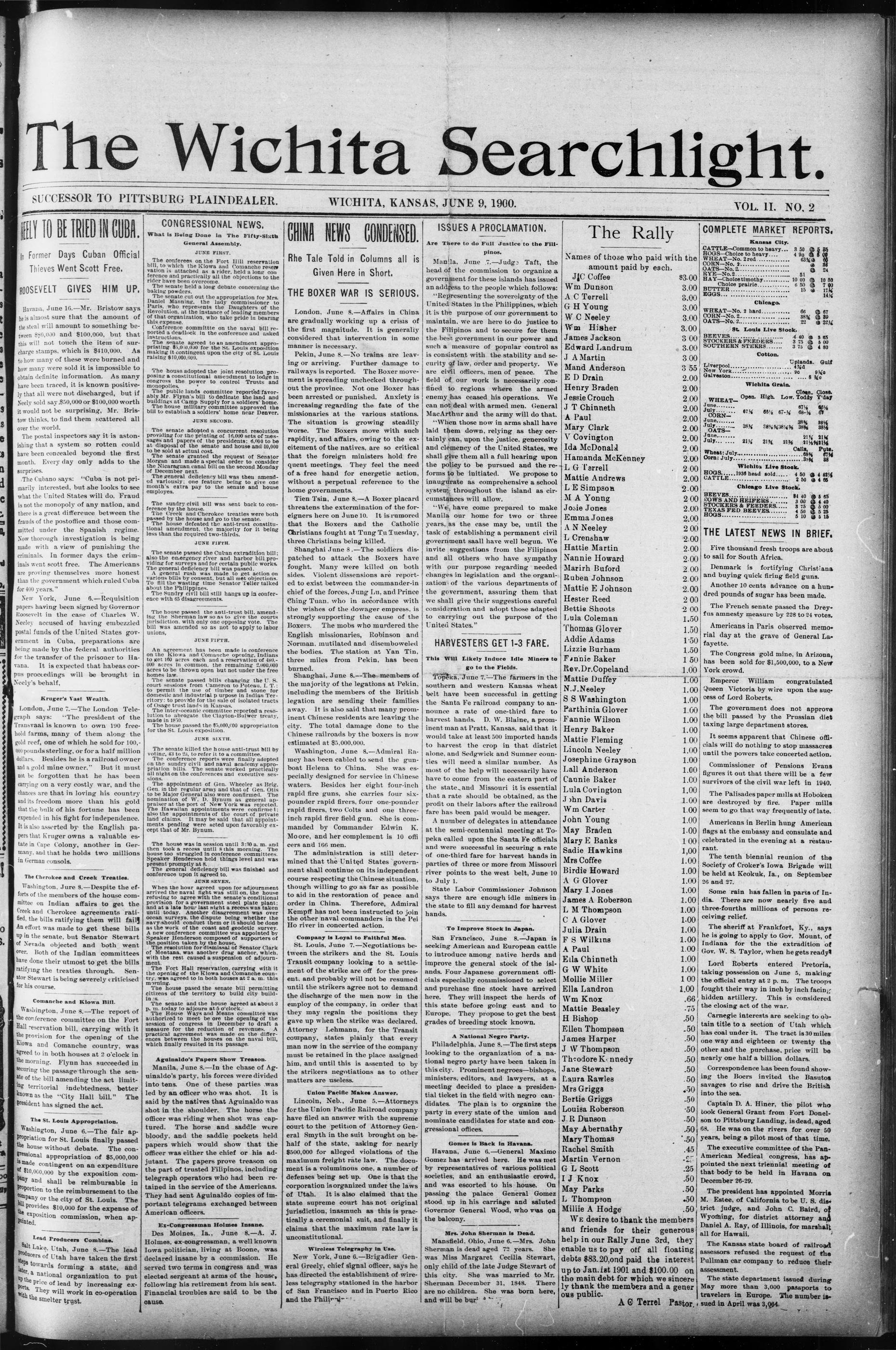
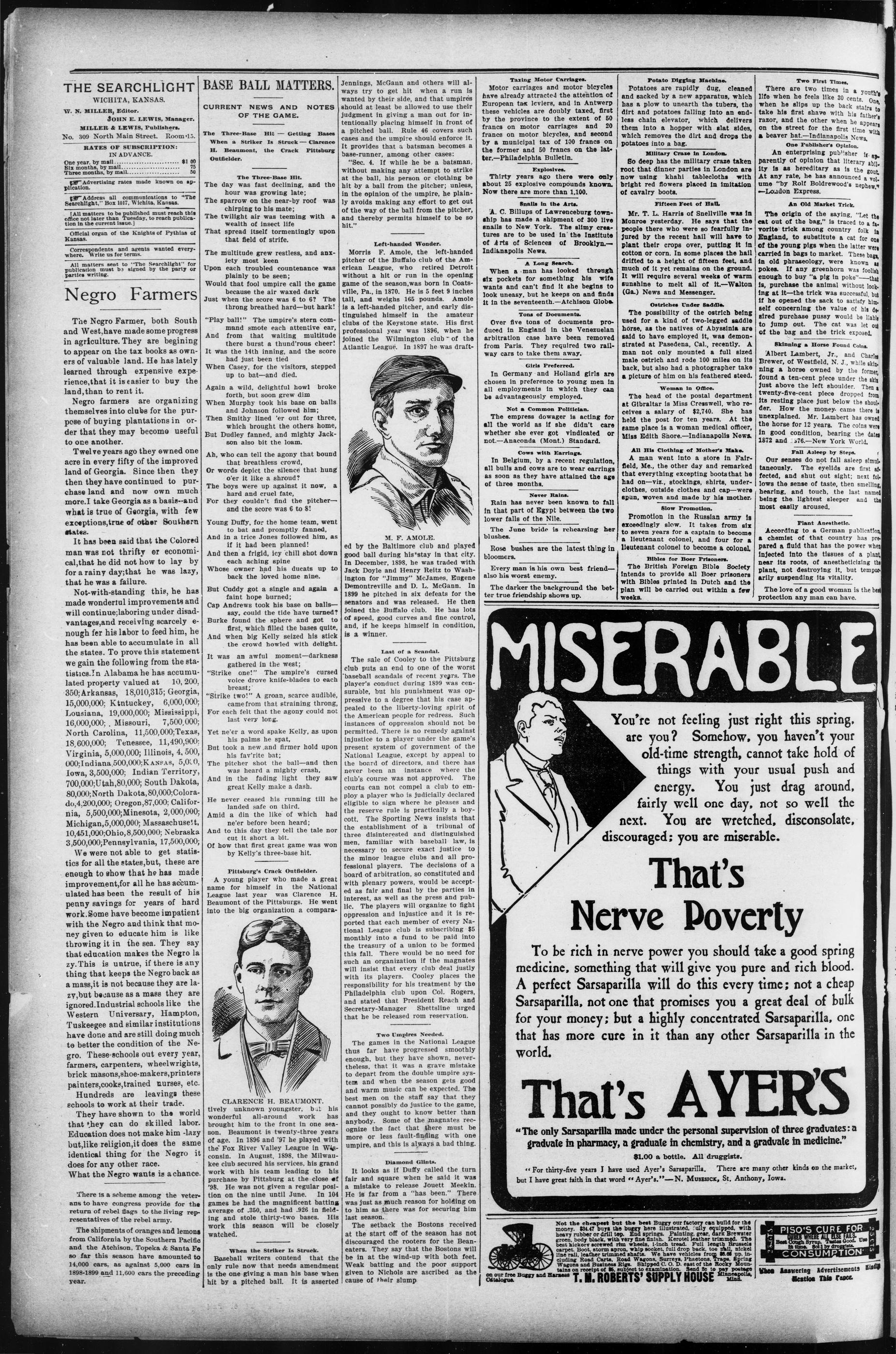
Page text (machine-generated)
The Wichita Searchlight.
SUCCESSOR TO PITTSBURG PLAINDEALER
HEELY TO BE TRIED IN CUBA.
In Former Days Cuban Official
Thieves Went Scott Free.
ROOSEVELT GIVES HIM UP,
Havana, June 16.—Mr. Bristow says
he is almost sure that the amount of
the steal will amount to something
between $50,000 and $100,000, but that
this will not touch the item of sur-
charge stamps, which is $410,000. As
to how many of these were burned and
how many were sold it is impossible to
obtain definite information. As many
have been traced, it is known positively
that all were not discharged, but if
Neely sold say $50,000 or $100,000 worth
it would not be surprising, Mr. Bristow
thinks, to find them scattered all
over the world.
The postal inspectors say it is astonishing that a system so rotten could have been concealed beyond the first month. Every day only adds to the surprises.
The Cubano says: "Cuba is not primarily interested, but she looks to see what the United States will do. Fraud is not the monopoly of any nation, and there is a great difference between the frauds of the postoffice and those committed under the Spanish regime. Now thorough investigation is being made with a view of punishing the criminals. In former days the criminals went scott free. The Americans are proving themselves more honest than the government which ruled Cuba for 400 years."
New York, June 6.—Requisition papers having been signed by Governor Roosevelt in the case of Charles W. Neely accused of having embezzled postal funds of the United States government in Cuba, preparations are being made by the federal authorities for the transfer of the prisoner to Havana. It is expected that habeas corpus proceedings will be brought in Neely's behalf.
Kruger's Vast Wealth
London, June 7.—The London Telegraph says: "The president of the Transvaal is known to own 190 freehold farms, many of them along the gold reef, one of which he sold for 100,000 pounds sterling, or for a half million dollars. Besides he is a railroad owner and a gold mine owner." But it must not be forgotten that he has been carrying on a very costly war, and the chances are that in loving his country and its freedom more than his gold that the bulk of his fortune has been expended in his fight for independence. It is also asserted by the English papers that Kruger owns a valuable estate in Cape Colony, another in Germany, and that he holds two millions in German consols.
The Cherokee and Creek Treaties
Washington, Jure 8.—Despite the efforts of the members of the house committee on Indian affairs to get the Creek and Cherokee agreements ratified, the bills ratifying them will fail. An effort was made to get these bills up in the senate, but Senator Stewart of Nevada objected and both went over. Both of the Indian committees have done their utmost to get the bills ratifying the treaties through. Senator Stewart is being severely criticised for his course.
Comanche and Klowa Bill.
Washington. June 8.—The report of the conference committee on the Fort Hall reservation bill, carrying with it the provision for the opening of the Kiowa and Comanche country, was agreed to in both houses at 2 o'clock in the morning. Flynn has succeeded in securing the passage through the senate of the bill amending the act limiting territorial indebtedness, better known as the "City Hall bill." The president has signed the act.
The St. Louis Appropriation.
Washington, June 6.—The fair appropriation for St. Louis finally passed the house without debate. The congressional appropriation of $5,000,000 is made contingent on an expenditure of $10,000,000 by the exposition company and shall be reimbursable in proportion to the reimbursement to the company or the city of St. Louis. The bill provides $10,000 for the expense of the exposition commission, when appointed.
Lead Producers Combine
Producers Combine.
Salt Lake, Utah, June 8.—The lead producers of Utah have taken the first steps towards forming a state, and later, a national organization to put up the price of lead by increasing exports. They will work in co-operation with the smelter trust.
CONGRESSIONAL NEWS
JUNE FIRST.
The conferences on the Fort Hill reservation bill, to which the Klowa and Comanche rescue units are under the rider, held a long conference and practically all the objections the rider have been overcome.
The senate held a long debate concerning the baking powders.
baking powders.
The senate cut out the appropriation for Mrs. Dana, the only commissioner to Paris, who represents the Daughters of the Revolution, at the instance of leading members of that organization, who take pride in bearing this expense.
Conference committees on the naval bill reported a deadlock in the conference and asked in
The senate agreed to an amendment appropriating $1,0,0,0,0 for the St. Louis exposition making it contingent upon the city of St. Louis raising $10,000,00.
The house adopted the joint resolution proposing a constitutional amendment to lodge in congress the power to control Trusts and monopolies.
The public lands committee reported favorably Mr. Flynn's bill to dedicate the land and buildings at Camp Supply for a soldiers' home. The bill also requires bills to establish a soldiers' home.
JUNE SECOND.
The senate adopted a concurrent resolution providing for the printing of 10,000 sets of mesas to the president; 4,000 to be at disposal of the senate and 10,000 to be sold at actual cost. The senate granted the request of Senator Morgan and made a special order to consider the general bill on the second Monday of December next. The general deficiency bill was then amended; variously, one feature being to give one month's extra pay to the senate and house employees.
The sundry civil bill was sent back to conference by the house. The Creek and Cherokee treaties were both passed by the house and go to the senate. The House and the trust constitutive amendment, the majority, for it being less than the required two-thirds.
JUNE FIFTH.
The senate passed the Cuban extradition bill; also the emergency river and harbor bill prohibits the work of the general defence bill was passed. A general rush was made to get action on the Philippines, but all met objections. To fill the wasting time Senator Teller talked about the Philippines. The Sunday civil bill still hangs up in conference with 65 disagreements. The house passed the anti-trust bill, amending the Sherman law so as to give the courts jurisdiction, with only one opposing vote. The bill was amended so as not to apply to labor unions.
JUNE FIFTH.
An agreement has been made in conference on the Kiowa and Comanche opening, Indians to get 100 acres each and a reservation of 450 acres in common, the remaining 2,000,000 acres to be thrown open but not under the free homes law. The senate passed bills changing the U.S. court sessions from Cameron to Poteau, I.T. to Cameron and Poteau, I.T. to domestic and industrial purpose in Indian Territory; to provide for the sale of isolated tracts of Osage trust lands in Kansas. The inter-oceanic committee reported a resolution granting the Clayton-Bulwer treaty, made in 1830.
The house passed the $5,000,000 appropriation for the St. Louis exposition.
JUNE SIXTH.
The senate killed the house anti-trust bill by voting, 43 to 33, to refer it to a committee.
The conference reports were finally adopted on the sundry civil and naval academy appropriation bills. The senate worked practically on the conferences and executive sessions. The appointment of Gen. Wheeler as Brig. Gen. in the regular army and that of Gen. Otis Gen. in the general also were confirmed, the nomination of the governor, the praiser at the port of New York was rejected. The Hawaiian appointments were confirmed; also the appointments of the court of private affairs were approved, and that all appointments pending were acted upon favorably except that of Mr. Bynum.
---
The house was in session until 3:30 a.m. and then took a recess until 8 a.m. the morning. The house too struggled in conference committees. The house had little things level and was present promptly at 8.
The general deficiency bill was finished and conference upon it agreed to.
JUNE SEVEN.
When the hour agreed upon for adjournment arrives, the governor refusing to agree with the senate's conditional provision for a government steel plate plant; and at a late hour last night a recess was taken to the ocean surveys, the dispute being whether the navy should conduct them or it should be done as the work of the coast and geodetic survey. The governor was appointed by Speaker Henderson composed supporters of the position taken by the house.
The resolution for dismissal of Senator Clark of Montana was drawn up. In which, with the rest, caused a suspension of adjournment.
The Fort Hall reservation, carrying with it the opening of the Kluwa and Comanche country, agreed to in both houses at 2 a. m. this morning.
The house passed the senate bill permitting
sales of the territory to build city build-
ings.
the senate and the house agreed at about 3
p. m. today to adjourn at 4 o'clock.
p.m. today to adjourn at 6 o'clock.
The House Ways and Means committee was assigned the task of preparing the filing of the session of congress in December to draft a measure for the reduction of revenues. A practice agreement was made on the differ-ence in the bill, the naval bill, which finally resulted in its passage.
Aguinaldo's Papers Show Treason.
Manila, June 8.—In the chase of Aguinaldo's party, his forces were divided into tens. One of these parties was led by an officer who was shot. It is said by the natives that Aguinaldo was shot in the shoulder. The horse the officer was riding when shot was captured. The horse and saddle were bloody, and the saddle pockets held papers which would show that the officer was either the chief or his adjutant. The papers prove treason on the part of trusted Filipinos, including telegraph operators who had been retained in the service of the Americans. They had sent Aguinaldo copies of important telegrams exchanged between American officers.
Des Moines, Ia., June 8.—A. J. Holmes, ex-congressman, a well known Iowa politician, living at Boone, was declared insane by a commission. He served two terms in congress and was elected sergeant at arms of the house, following his retirement from his seat. Financial troubles are said to be the cause.
WICHITA, KANSAS, JUNE 9, 1900.
CHINA NEWS CONDENSED.
Rhe Tale Told in Columns all is Given Here in Short.
THE BOXER WAR IS SERIOUS.
London, June 8.—Affairs in China are gradually working up a crisis of the first magnitude. It is generally considered that intervention in some manner is necessary.
Pekin, June 8.—No trains are leaving or arriving. Further damage to railways is reported. The Boxer movement is spreading unchecked throughout the province. Not one Boxer has been arrested or punished. Anxiety is increasing regarding the fate of the missionaries at the various stations. The situation is growing steadily worse. The Boxers move with such rapidity, and affairs, owing to the excitement of the natives, are so critical that the foreign ministers hold frequent meetings. They feel the need of a free hand for energetic action, without a perpetual reference to the home governments.
Tien Tsin, June 8.—A Boxer placard threatens the extermination of the foreigners here on June 10. It is rumored that the Boxers and the Catholic Christians fought at Tung Tu Tuesday, three Christians being killed.
Shanghai June 8.—The soldiers dispatched to attack the Boxers have fought. Many were killed on both sides. Violent dissensions are reported to exist between the commander-in-chief of the forces, Jung Lu, and Prince Ching Tuan, who in accordance with the wishes of the dowager empress, is strongly supporting the cause of the Boxers. The mobs who murdered the English missionaries, Robinson and Norman, mutilated and disemboweled the bodies. The station at Yan Tin, three miles from Pekin, has been burned.
Shanghai. June 8.--The members of the majority of the legations at Pekin, including the members of the British legation are sending their families away. It is also said that many prominent Chinese residents are leaving the city. The total damage done to the Chinese railroads by the boxers is now estimated at $5,000,000.
Washington, June 8.--Admiral Ramey has been cabled to send the gunboat Helena to China. She was especially designed for service in Chinese waters. Besides her eight four-inch rapid fire guns, she carries four six-pounder rapid fliers, four one-pounder rapid fliers, two Colts and one three-inch rapid flier field gun. She is commanded by Commander Edwin K. Moore, and her complement is 10 officers and 166 men.
The administration is still determined that the United States government shall continue on its independent course respecting the Chinese situation, though willing to go as far as possible to aid in the restoration of peace and order in China. Therefore, Admiral Kempff has not been instructed to join the other naval commanders in the Pei Ho river in concerted action.
Company is Loyal to Faithful Men.
Company is Loyal to Faithful Men. St. Louis, June 7.—Negotiations between the strikers and the St. Louis Transit company looking to a settlement of the strike are off for the present, and probably will not be resumed until the strikers agree not to demand the discharge of the men now in the employ of the company, in order that they may regain the positions they gave up when the strike was declared. Attorney Lehmann, for the Transit company, states plainly that every man now in the service of the company must be retained in the place assigned him, and until this is assented to by the strikers negotiations as to other matters are useless.
Union Pacific Makes Answer.
Lincoln, Neb., June 5.—Attorneys for the Union Pacific Railroad company have filed an answer with the supreme court to the petition of Attorney General Smyth in the suit brought on behalf of the state, asking for nearly $500,000 for alleged violations of the maximum freight rate law. The document is a voluminous one, a number of defenses being set up. One is that the corporation is organized under the laws of Utah. It is also claimed that the state supreme court has not original jurisdiction, inasmuch as this is practically a ceremonial suit, and finally it claims that the maximum rate law is unconstitutional.
Wireless Telegraphy in Use.
New York, June 6.—Brigadier General Greely, chief signal officer, says he has directed the establishment of wireless telegraphy stationed in the harbor of San Francisco and in Puerto Rico and the Phillipines.
ISSUES A PROCLAMATION.
Are There to do Full Justice to the Filipinos.
Manila, June 7.—Judge Taft, the head of the commission to organize a government for these islands has issued an address to the people which follows:
"Representing the sovereignty of the United States in the Philippines, which it is the purpose of our government to maintain, we are here to do justice to the Filipinos and to secure for them the best government in our power and such a measure of popular control as is consistent with the stability and security of law, order and property. We are civil officers, men of peace. The field of our work is necessarily confined to regions where the armed enemy has ceased his operations. We can not deal with armed men. General MacArthur and the army will do that.
"When those now in arms shall have laid them down, relying as they certainly can, upon the justice, generosity and clemency of the United States, we shall give them all a full hearing upon the policy to be pursued and the reforms to be initiated. We propose to inaugurate as comprehensive a school system, throughout the island as circumstances will allow.
"We have come prepared to make Manila our home for two or three years, as the case may be, until the task of establishing a permanent civil government saall have well begun. We invite suggestions from the Filipinos and all others who have sympathy with our purpose regarding needed changes in legislation and the organization of the various departments of the government, assuring them that we shall give their suggestions careful consideration and adopt those adapted to carrying out the purpose of the United States."
HARVESTERS GET 1-3 FARE
This Will Likely Induce Idle Miners to go to the Fields.
Topeka, June 7.—The farmers in the southern and western Kansas wheat belt have been successful in getting the Santa Fe railroad company to announce a rate of one-third fare to harvest hands. D. W. Blaine, a prominent man at Pratt, Kansas, said that it would take at least 500 imported hands to harvest the crop in that district alone, and Sedgwick and Sumner counties will need a similar number. As most of the help will necessarily have to come from the eastern part of the state and Missouri it is essential that a rate should be obtained, as the profit on their labors after the railroad fare has been paid would be beager.
A number of delegates in attendance at the semi-centennial meeting at Topeka called upon the Santa Fe officials and were successful in securing a rate of one-third fare for harvest hands in parties of three or more from Missouri river points to the west belt, June 10 to July 1.
State Labor Commissioner Johnson says there are enough idle miners in the state to fill any demand for harvest hands.
To Improve Stock in Japan.
San Francisco, June 8.—Japan is seeking American and European cattle to introduce among native herds and improve the general stock of the islands. Four Japanese government officials especially commissioned to select and purchase fine stock have arrived here. They will inspect the herds of this state before going east and to Europe. They propose to get the best grades of breeding stock known.
A National Negro Party.
Philadelphia, June 8.—The first steps looking to the organization of a national negro party have been taken in this city. Prominent negroes—bishops, ministers, editors, and lawyers, at a meeting decided to place a presidential ticket in the field with negro candidates. The plan is to organize the party in every state of the umion and nominate candidates for state and congressional offices.
Gomez is Back in Havana.
Havanna, June 6.—General Maximo Gomez has arrived here. He was met by representatives of various political societies, and an enthusiastic crowd, and was escorted to his house. On passing the palace General Gomez stood up in his carriage and saluted Governor General Wood, who was on the balcony.
Mrs. John Shermnn is Dead.
Mansfield, Ohio, June 6.—Mrs. John Sherman is dead aged 72 years. She was Miss Margaret Cecilia Stewart, only child of the late Judge Stewart of this city. She was married to Mr. Sherman December 31, 1848. There are no children. She was born here, and will be burial.
WE desire to thank the members and friends for their generous help in our Rally June 3rd, they enable us to pay off all floating debts $83.20,ond paid the interest up to Jan.lat 1901 and $100.00 on the main debt for which we sincerely thank the members and a generous public.
A G Terrel Pastor
VOL. 11. NO. 2
COMPLETE MARKET REPORTS.
Kansas City.
CATTLE—Common to heavy... 3 50 @ 5 85
CATTLE—Choice to heavy... 4 90 @ 5 00
WHEAT—No. 1red... 63% @ 26
CORN—No. 2... 68
OATS—No. 2... 24
BYE—No. 2... 51
HAY—Choice timothy... 10 00 @ 10 50
Choice prairie... 6 50 @ 7 00
BUTTER... 15 @ 17%
EGGS... 14%
Chicago.
WHEAT—No. 2 hard... 66 @ 67
CORN—No. 2... 88% @ 39
OATS—No. 2... 22 @ 22%
St. Louis Live Stock.
BEEVERS... 4 40 @ 5 65
STOCKERS & FEEDERS... 3 75 @ 5 00
SOUTHERN STEERS... 3 75 @ 4 80
Cotton.
Uplands. Gulf
Liverpool... %4d
New York... 90
Galveston... 8 %c
Wichita Grain.
Close. Close.
Open. High. Low. Today Yday.
WHEAT—
June... 67% 65% 67%- 68% @ 61%
June... 67% 65% 67%- 68% @ 61%
CORN—
June... 38% 38% 38% 38% @ 38%
July... 38% 38% 38% 38% @ 38%
OATS—
June... 21% 21% 21% 21% @ 21%
July... 21% 21% 21% 21% @ 21%
Calls.
Wheat: July... 68% @ 67%
Corn: July... 3% @ 38
Wichita Live Stock.
HOGS... 1393 head sold... 4 50 @ 4 82%
CATTLE... 2 50 @ 4 05
Chicago Live Stock.
BEEVERS... $4 40 @ 5 65
BEEVERS & FEEDERS... 3 00 @ 4 40
STOCKERS & FEEDERS... 5 00 @ 5 25
TEXAS FED BEEVERS... 4 50 @ 5 15
HOGS... 5 10 @ 5 15
THE LATEST NEWS IN BRIEF.
Five thousand fresh troops are about to sail for South Africa.
Denmark is fortifying Christiana and buying quick firing field guns.
Another 10 cents advance on a hundred pounds of sugar has been made.
The French senate passed the Dreyfus amnesty measure by 228 to 24 votes.
Americans in Paris observed memorial day at the grave of General Lafayette.
The Congress gold mine, in Arizona, has been sold for $1,500,000, to a New York crowd.
Emperor William congratulated Queen Victoria by wire upon the success of Lord Roberts.
The government does not approve the bill passed by the Prussian diet taxing large department stores.
It seems apparent that Chinese officials will do nothing to stop massacres until the powers take concerted action.
Commissioner of Pensions Evans figures it out that there will be a few survivors of the civil war left in 1940.
The Palisades paper mills at Hoboken are destroyed by fire. Paper mills seem to go that way frequently of late.
Americans in Berlin hung American flags at the embassy and consulate and celebrated in the evening at a restaurant.
The tenth biennial reunion of the Society of Croker's Iowa Brigade will be held at Keokuk, Ia., on September 26 and 27.
Some rain has fallen in parts of India. There are now nearly five and three-fourths millions of persons receiving relief.
The sheriff at Frankfort, Ky., says he is going to apply to Gov. Mount, of Indiana for the extradition of Gov. W. S. Taylor, when he gets ready.
Lord Roberts entered Pretoria, taking possession on June 5, making the official entry at 2 p.m. The troops fought their way in inch by inch facing hidden artillery. This is considered the closing act of the war.
Carnegie interests are seeking to obtain title to a section of Utah which has coal under it. The tract is 30 miles one way and eighteen or twenty the other and the purchase, price will be nearly one half a billion dollars.
Correspondence has been found showing the Boers invited the Basutos savages to rise and drive the British into the sea.
Captain D. A. Hiner, the pilot who took General Grant from Fort Donelson to Pittsburg Landing, is dead, aged 68. He was on the rivers for over 50 years, being a pilot most of that time
The executive committee of the Pan-American Medical congress, has appointed the next triennial meeting of that body to be held in Havana on December 26-29.
The president has appointed Morris M. Estee, of California to be U. S. district judge, and John C. Baird, of Wyoming, for district attorney and Daniel A. Ray, of Illinois, for marshall all for Hawaii.
The Kansas state board of railroad assessors refused the request of the Pullman car company to reduce their assessment.
The state department issued during May more than 3,000 passports to travelers in Europe. The number issued in April was 3,004.
RATES OF SUBSCRIPTION:
IN ADVANCE
One year, by mail ..... $1 00
Six months, by mail ..... 75
Three months, by mail ..... 50
Advertising rates made known on ap-
Advertising rates made known on application.
Address all communications to "The Searchlight," Box 1017, Wichita, Kansas.
[All matters to be published must reach this office not later than Tuesday, to reach publication in the current issue.]
Organic agent of the Knights of Pythias of Kansas.
Correspondents and agents wanted everywhere. Write us for terms.
All matters sent to "The Searchlight" for publication must be signed by the party or parties writing.
The Negro Farmer, both South and West, have made some progress in agriculture. They are beginning to appear on the tax books as owners of valuable land. He has lately learned through expensive experience, that it is easier to buy the land, than to rent it.
Negro farmers are organizing themselves into clubs for the purpose of buying plantations in order that they may become useful to one another.
Twelve years ago they owned one acre in every fifty of the improved land of Georgia. Since then they then they have continued to purchase land and now own much more.I take Georgia as a basis--and what is true of Georgia, with few exceptions,true of other Southern states.
It has been said that the Colored man was not thrifty or economical,that he did not how to lay by for a rainy day;that he was lazy, that he was a failure.
Not-with-standing this, he has made wonderful improvements and will continue;laboring under disadvantages,and receiving scarcely enough for his labor to feed him, he has been able to accumulate in all the states. To prove this statement we gain the following from the statistics.In Alabama he has accumulated property valued at 10,200,350; Arkansas, 18,010,315; Georgia, 15,000,000; Kntuckey, 6,000,000; Louisiana, 19,000,000; Mississippi, 16,000,000; Missouri, 7,500,000; North Carolina, 11,500,000; Texas, 18,600,000; Tennessee, 11,490,900; Virginia, 5,000,000; Illinois, 4,500,000; Indiana, 500,000; KANSAS, 5,000,000; Iowa, 3,500,000; Indian Territory, 700,000; Utah, 80,000; South Dakota, 80,000; North Dakota, 80,000; Colorado, 4,200,000; Oregon, 87,000; California, 5,500,000; Minesota, 2,000,000; Michigan, 5,000,000; Massaschuset, 10,451,000; Ohio, 8,500,000; Nebraska, 3,500,000; Penusylvania, 17,500,000;
We were not able to get statistics for all the states,but, these are enough to show that he has made improvement,for all he has accumulated has been the result of his penny savings for years of hard work. Some have become impatient with the Negro and think that money given to educate him is like throwing it in the sea. They say that education makes the Negro lazy. This is untrue, if there is any thing that keeps the Negro back as a mass,it is not because they are lazy,but because as a mass they are ignored. Industrial schools like the Western University, Hampton, Tuskegee and similar institutions have done and are still doing much to better the condition of the Negro. These schools out every year, farmers, carpenters, wheelwrights, brick masons,shoe-makers,printers painters,cooks,trained nurses, etc.
Hundreds are leavings these schools to work at their trade.
They have shown to the world that they can do skilled labor. Education does not make him lazy but, like religion, it does the same identical thing for the Negro it does for any other race.
What the Negro wants is a chance.
There is a scheme among the veterans to have congress provide for the return of rebel flags to the living representatives of the rebel army.
The shipments of oranges and lemons from California by the Southern Pacific and the Atchison, Topeka & Santa Fe so far this season have amounted to 14,000 cars, as against 5,000 cars in 1898-1899 and 11,600 cars the preceding year.
BASE BALL MATTERS.
BASE BALL MATTERS.
CURRENT NEWS AND NOTES
OF THE GAME.
The Three-Base Hit — Getting Bases
When a Striker Is Struck — Clarence
H. Beaumont, the Crack Pittsburg
Outfielder.
The Three-Base Hit.
The day was fast declining, and the hour was growing late;
The sparrow on the near-by roof was chirping to his mate;
The twilight air was teeming with a wealth of insect life
That spread itself tormentingly upon that field of strife.
The multitude grew restless, and anxiety most keen
Upon each troubled countenance was plainly to be seen;
Would that fool umpire call the game because the air waxed dark
Just when the score was 6 to 6? The throng breathed hard—but hark!
When Casey, for the visitors, stepped up to bat—and died.
Again a wild, delightful howl broke forth, but soon grew dim
When Murphy took his base on balls and Johnson followed him;
Then Smithy lined 'er out for three, which brought the others home.
But Dudley fanned, and mighty Jackson also bit the loam.
Ah, who can tell the agony that bound that breathless crowd,
Or words depict the silence that hung o'er it like a shroud?
The boys were up against it now, a hard and cruel fate.
For they couldn't find the pitcher—and the score was 6 to 8!
Young Duffy, for the home team, went to hot, and promptly fanned.
And then a frigid, icy chill shot down each aching spine
Whose owner had his ducats up to back the loved home nine.
But Cuddy got a single and again a faint hope burned;
Cap Andrews took his base on balls—say, could the tide have turned?
Burke found the sphere and got to first, which filled the bases quite.
And when big Kelly seized his stick the crowd howled with delight.
It was an awful moment—darkness gathered in the west;
"Strike one!" The umpire's cursed voice drove knife-blades to each breast;
"Strike two!" A groan, scarce audible, came from that straining throng.
For each felt that the agony could not last very long.
Yet neer a word spake Kelly, as upon his palms he spat,
But took a new and firmer hold upon his fav'rite bat;
The pitcher shot the ball—and then was heard a mighty crash,
And in the fading light they saw great Kelly make a dash.
He never ceased his running till he landed safe on third.
Amid a din the like of which had ne'er before been heard;
And to this day they tell the tale nor cut it short a bit.
Of how that first great game was won
by Kelly's three-base hit.
Pittsburg's Crack Outfielder.
A young player who made a great name for himself in the National League last year was Clarence H. Beaumont of the Pittsburgs. He went into the big organization a compara-
CLARENCE H. BEAUMONT
CLARENCE H. BEAUMONT.
tively unknown youngster, but his wonderful all-around work has brought him to the front in one season. Beaumont is twenty-three years of age. In 1896 and '97 he played with the Fox River Valley League in Wisconsin. In August, 1898, the Milwaukee club secured his services, his grand work with his team leading to his purchase by Pittsburg at the close of '98. He was not given a regular position on the nine until June. In 104 games he had the magnificent batting average of .350, and had .926 in fielding and stole thirty-two bases. His work this season will be closely watched.
When the Striker Is Struck.
Baseball writers contend that the only rule now that needs amendment is the one giving a man his base when hit by a pitched ball. It is asserted
Jennings, McGann and others will always try to get hit when a run is wanted by their side, and that umpires should at least be allowed to use their judgment in giving a man out for intentionally placing himself in front of a pitched ball. Rule 46 covers such cases and the umpire should enforce it. It provides that a batsman becomes a base-runner, among other cases: "Sec. 4. If while he be a batsman, without making any attempt to strike at the ball, his person or clothing be hit by a ball from the pitcher; unless, in the opinion of the umpire, he plainly avoids making any effort to get out of the way of the ball from the pitcher, and thereby permits himself to be so hit."
Left-handed Wonder.
Morris F. Amole, the left-handed pitcher of the Buffalo club of the American League, who retired Detroit without a hit or run in the opening game of the season, was born in Coatsville, Pa., in 1870. He is 5 feet 9 inches tall, and weighs 165 pounds. Amole is a left-handed pitcher, and early distinguished himself in the amateur clubs of the Keystone state. His first professional year was 1896, when he joined the Wilmington club of the Atlantic League. In 1897 he was draft-
M. E. AMOLE
ed by the Baltimore club and played good ball during his*stay in that city. In December, 1898, he was traded with Jack Doyle and Henry Reitz to Washington for "Jimmy" McJames, Eugene Demontreville and D. L. McGann. In 1899 he pitched in six defeats for the senators and was released. He then joined the Buffalo club. He has lots of speed, good curves and fine control, and, if he keeps himself in condition, is a winner.
Last of a Scandal.
The sale of Cooley to the Pittsburgh club puts an end to one of the worst baseball scandals of recent years. The player's conduct during 1899 was censurable, but his punishment was oppressive to a degree that his case appealed to the liberty-loving spirit of the American people for redress. Such instances of oppression should not be permitted. There is no remedy against injustice to a player under the game's present system of government of the National League, except by appeal to the board of directors, and there has never been an instance where the club's course was not approved. The courts can not compel a club to employ a player who is judicially declared eligible to sign where he pleases and the reserve rule is practically a boycott. The Sporting News insists that the establishment of a tribunal of three disinterested and distinguished men, familiar with baseball law, is necessary to secure exact justice to the minor league clubs and all professional players. The decisions of a board of arbitration, so constituted and with plenary powers, would be accepted as fair and final by the parties in interest, as well as the press and public. The players will organize to fight oppression and injustice and it is reported that each member of every National League club is subscribing $5 monthly into a fund to be paid into the treasury of a union to be formed this fall. There would be no need for such an organization if the magnates will insist that every club deal justly with its players. Cooley places the responsibility for his treatment by the Philadelphia club upon Col. Rogers, and stated that President Reach and Secretary-Manager Shettline urged that he be released rom reservation.
Two Umpires Needed.
The games in the National League thus far have progressed smoothly enough, but they have shown, nevertheless, that it was a grave mistake to depart from the double umpire system and when the season gets good and warm music can be expected. The best men on the staff say that they cannot possibly do justice to the game, and they ought to know better than anybody. Some of the magnates recognize the fact that there must be more or less fault-finding with one umpire, and this is always a bad thing.
Diamond Gllnts
It looks as if Duffy called the turn fair and square when he said it was a mistake to release Jouett Meekin. He is far from a "has been." There was just as much reason for holding on to him as there was for securing him last season.
The setback the Bostons received at the start off of the season has not discouraged the rooters for the Beaneaters. They say that the Bostons will be in at the wind-up with both feet. Weak batting and the poor support given to Nichols as ascribed as the cause of their slump
MISERABLE
That's Nerve Poverty
To be rich in nerve power you should take a good spring medicine, something that will give you pure and rich blood. A perfect Sarsaparilla will do this every time; not a cheap Sarsaparilla, not one that promises you a great deal of bulk for your money; but a highly concentrated Sarsaparilla, one that has more cure in it than any other Sarsaparilla in the world.
That's AYER'S
"The only Sarsaparilla made under the personal supervision of three graduates: a graduate in pharmacy, a graduate in chemistry, and a graduate in medicine."
$1.00 a bottle. All druggists.
"For thirty-five years I have used Ayer's Sarsaparilla. There are many other kinds on the market, but I have great faith in that word "Ayer's."—N. MUSESICK, St. Anthony, Iowa.
Not the cheapest but the best Buggy our factory can build for the money. $84.47 buys the buggy here illustrated, "fully equipped, with heavy rubber or drill top. End springs. Painting, gear, dark Brewer water, green body, black with very fine finish. Kerotel leather trimmed. The best hickory screwed rm rw wheels, 1-inch road, back Brussels lion rail, full back back length, rear lion rail, leather trimmed shafts. We have vehicles from $8.66 up, including Road Carts, Road Wagons, Surrey, Phectons, Traps, Spring Wagons and Business Rigs. Shipped C.O. D. east of the Rocky Mountains on receipt of $5, subject to examination. Send 20 to payable presses T. M. ROBERTS' SUPPLY HOUSE Kinston, North Carolina
Taxing Motor Carriages.
Motor carriages and motor bicycles have already attracted the attention of European tax levellers, and in Antwerp these vehicles are doubly taxed, first by the province to the extent of 50 francs on motor carriages and 20 francs on motor bicycles, and second by a municipal tax of 150 francs on the former and 50 francs on the latter.—Philadelphia Bulletin.
Explosives.
Thirty years ago there were only about 25 explosive compounds known. Now there are more than 1,100.
Snails in the Arts.
A. C. Billups of Lawrenceburg township has made a shipment of 300 live snails to New York. The slimy creatures are to be used in the Institute of Arts of Sciences of Brooklyn. Indianapolis News.
A Long Search.
When a man has looked through six pockets for something his wife wants and can't find it she begins to look uneasy, but he keeps on and finds it in the seventeenth. —Atchison Globe
Tons of Documenta
Over five tons of documents produced in England in the Venezuelan arbitration case have been removed from Paris. They required two railway cars to take them away.
Girls Preferred.
In Germany and Holland girls are chosen in preference to young men in all employments in which they can be advantageously employed.
Not a Common Politician.
The empress dowager is acting for all the world as if she didn't care whether she ever got vindicated or not.—Anaconda (Mont.) Standard.
Cows with Earrings.
In Belgium, by a recent regulation, all bulls and cows are to wear earrings as soon as they have attained the age of three months.
Never Rains.
Rain has never been known to fall
in that part of Egypt between the two
lower falls of the Nile.
The June bride is rehearsing her
blushes.
Rose bushes are the latest thing in
bloomers.
Every man is his own best friend—
also his worst enemy.
The darker the background the better
true friendship shows up.
MIS
Nex
To be rich in medicine, something
A perfect Sarsaparilla
Sarsaparilla, not o
for your money;
that has more cur
world.
That
"The only Sarsaparilla
graduate in pharmacy
"For thirty-five years I ha
but I have great faith in that w
Not the cheapest b
money. $34.47 buys t
heavy rubber or drill
green, body black, wi
best hickory screwed
carpet. Boot, storm a
like raincoat trims
cluding Road Cars,
Wagons and Business
tains on receipt of $6.
on our free Buggy and Harness
Ocatalogue.
T. M. ROB
You're not feeling just right this spring are you? Somehow, you haven't your old-time strength, cannot take hold of things with your usual push and energy. You just drag around, fairly well one day, not so well the next. You are wretched, disconsolate, discouraged; you are miserable.
Potato Digging Machine.
Potatoes are rapidly dug, cleaned and sacked by a new apparatus, which has a plow to unearth the tubers, the dirt and potatoes falling into an endless chain elevator, which delivers them into a hopper with slat sides, which removes the dirt and drops the potatoes into a bag.
Military Craze in London.
So deep has the military craze taken root that dinner parties in London are now using khahl tablecloths with bright red flowers placed in imitation of cavalry boots.
Elfteen Feet of Hall.
Mr. T. L. Harris of Snellville was in Monroe yesterday. He says that the people there who were so fearfully injured by the recent hall will have to plant their crops over, putting it in cotton or corn. In some places the hall drifted to a height of fifteen feet, and much of it yet remains on the ground. It will require several weeks of warm sunshine to melt all of it.—Walton (Ga.) News and Messenger.
Ostriches Under Saddle
The possibility of the ostrich being used for a kind of two-legged saddle horse, as the natives of Abyssinia are said to have employed it, was demonstrated at Pasedena, Cal., recently. A man not only mounted a full sized male ostrich and rode 100 miles on its back, but also had a photographer take a picture of him on his feathered steed.
Woman in Office.
The head of the postal department at Gibraltar is Miss Cresswell, who receives a salary of $2,740. She has held the post for ten years. At the same place is a woman medical officer, Miss Edith Shore.-Indianapolis News.
All His Clothing of Mother's Make.
A man went into a store in Fairfield, Me., the other day and remarked that everything except boots that he had on-viz., stockings, shirts, underclothes, outside clothes and cap—were spun, woven and made by his mother.
Slow Promotion:
Promotion in the Russian army is exceedingly slow. It takes from six to seven years for a captain to become a lieutenant colonel, and four for a lieutenant colonel to become a colonel.
Bibles for Boer Prisoners
Bibles for Boer Prisoners. The British Foreign Bible Society Intends to provide all Boer prisoners with Bibles printed in Dutch and the plan will be carried out within a few weeks.
Two First Times
There are two times in a youth's life when he feels like 30 cents. One, when he slips up the back stairs to take his first shave with his father's razor, and the other when he appears on the street for the first time with a beaver hat—Indianapolis News.
One Publisher's Opinion.
An enterprising publisher is apparently of opinion that literary ability is as hereditary as is the gout. At any rate, he has announced a volume "by Rolf Boldrewood's nephew." -London Express.
An Old Market Trick
The origin of the saying, "Let the cat out of the bag," is traced to a favorite trick among country folk in England, to substitute a cat for one of the young pigs when the latter were carried in bags to market. These bags, in old phraseology, were known as pokes. If any greenhorn was foolish enough to buy a 'pig in poke'—that is, purchase the animal without looking at it—the trick was successful, but if he opened the sack to satisfy himself concerning the value of his desired purchase pussy would be liable to jump out. The cat was let out of the bag and the trick exposed.
Skinning a Horse Found Colns
Albert Lambert, Jr., and Charles Brewer, of Westfield, N. J., while skimming a horse owned by the former, found a ten-cent piece under the skin just above the left shoulder. Then a twenty-five-cent piece dropped from its resting place just below the shoulder. How the money came there is unexplained. Mr. Lambert has owned the horse for 12 years. The coins were in good condition, bearing the dates 1872 and 1876—New York World.
Fall Aaleep by Steps
Our senses do not fall asleep simultaneously. The eyelids are first affected, and shut out sight; next follows the sense of taste, then smelling, hearing, and touch, the last named being the lightest sleeper and the most easily aroused.
Plant Anesthetic
According to a German publication a chemist of that country has prepared a fluid that has the power when injected into the tissues of a plant near its roots, of anesthetizing the plant, not destroying it, but temporarily suspending its vitality. The love of a good woman is the best protection any man can have.
BLE
right this spring,
you haven't your
cannot take hold of
or usual push and
must drag around,
not so well the
hed, disconsolate,
able.
erty
take a good spring
are and rich blood.
time; not a cheap
great deal of bulk
and Sarsaparilla, one
Sarsaparilla in the
ER'S
ion of three graduates: a
gradvale in medicine."
many other kinds on the market,
ny, Iowa.
PISO'S CURE FOR
CURES WHERE ALL ELSE FAILS.
Best Cough Syrup. Tastes Good. Use
in time. Sold by druggists.
CONSUMPTION
When Answering Advertisements Kindly
mention This Face.
N.C.Allen the barber is now residing in St.Louis,Mo. Mrs Robert Braden went to Cald well this week to visit her husband Mrs W C Neeley was taken quite ill Sunday eve.She is reported better at this writing. We are in receipt of letter from Claud William of St.Louis Mo. formerly of tihis city,both enjoying the very besi health.
The Knights of Pythias will hold the semi-aunal election of their officers Tuesday night. All Knights in good standing are cordially welcome to meet with us. Mrs L Slaughter of Topeka, Kas arrived in the city Friday. She will be in the city about a mouth the gueet of Mrs Jno Williams on North Mead and Mrs A. Paul of 623 North Main street. John Phelps better known as "Fish" is jumping around at Morsman and Innes,
Jw Thompson has added his name to the subscription list of The Searchlight We like to see all the young man follow Mr Thompson's example.
Mrs Ella Bramlet and daughter left Tuesday for Pueblo, Colo. Her husband will follow in a few doys. They expect to make Colo. their future home-May success follow them
Master Ernest Lewis is on the sick list.
For First-Class Ice Crew go to Bissantz' 306 E Douglass. You will be treated right,he advertises with us.
Patronize him
Phillip Hyde and Rev H F Frazier were callers at THE SEARCH-LIGHT office this week. We are always glad to have our friends call. Horace Bishop of Kansas City, Ks. is visiting in the city with the engineers of the new rail road throuh' the South.
Rev. Terrell has added his name on our snbscription list for 1 year paid up subscription. We would be glad to see all the Ministers of the city follow the Rev. example.
J T Haynes and son Henry of Parsons spent Wednesday in the city en route to Ellsworth where he expects permanently to locate in the barber trade.
Joe Dunson met with quite a severe accident Tuesday, his horse ran away throwing him out of his buggy on the pavement and broke his leg near the joint. He is resting as easy as can be expected under the circumstances. We hope for his early recovery.
Arkansas Valley lodge No 21 A F & A M held their annual election of officers Tuesday night it resulted as follows: Hopkins Abernathy, W.M., J. T.Chinneth S.W., James Roberson J.W., Julius Gains Treas., Will Clark, Secretary
Remember the moonlight social Saturday evening at 123 N. Emporia.
Mr. R. W. Winn and wife left Thursday afternoon for Colorado Springs, Colo.
The New Hope Sunday school expects to have quite an interesting program Sunday evening at 3 p. m. Children's Day service.
Rev. Frazier filled his pulpit both morning and evening last Sunday and preached two eloquent services and was greeted with a large house.
We kindly ask our subscribers to patronize those that advertise with us and don't forget to mention the "Search-light."
Wm. Johnson was in the city Wednesday. He had his beard shaved off which causes quite a change on his face. He returns on the night train to Topeka.
Capt. S. W. Jones left on the Mo. Pacific Wednesday evening for Kansas City to attend the Trustee and Board meeting of the Western University of Quindaro, Kas.
Jennie Hooker, a white girl, attempted suicide Thursday afternoon at 4:30 by shooting herself in the left breast. The attempt was very unsuccessful, she is still living and it is probable that she will recover.
COMMON DUTIES AND REWARD
THE SUBJECT
Addressed to the Tollers and Strugglers on Life's Difficult Highway — Heroes and Herolines of Our Times—The Heroes of Heaver.
[Copyright, 1900, by Louis Klopsch.]
Text, II Timothy II, 3, "Thou therefore endure hardness."
Historians are not slow to acknowledge the merits of great military chieftains. We have the full length portraits of the Cromwells, the Washington, the Napoleons and the Wellingtons of the world. History is not written in black ink, but red ink of human blood. The gods of human ambition do not drink from bowls made out of silver or gold or precious stones, but out of the bleached skulls of the fallen. But I am now to unroll before you a scroll of heroes that the world has never acknowledged—those who faced no guns, blew no bugle blast, conquered no cities, chained no captives to their charlot wheels and yet in the great day of eternity will stand higher than some of those whose names startled the nations, and seraph and rapt spirit and archangel will tell their deeds to a listening universe. I mean the heroes of common, everyday life.
In this roll, in the first place, I find all the heroes of the sickroom. When satan had failed to overcome Job, he said to God, "Put forth thy hand and touch his bones and his flesh, and he will curse the to thy face." Satan had found out that which we have all found out, that sickness is the greatest test of one's character. A man who can stand that can stand anything. To be shut in a room as fast as though it were a bastile; to be so nervous you cannot endure the tap of a child's foot; to have luscious fruit, which tempts the appetite of the robust and healthy, excite our loathing and disgust when it first appears on the platter; to have the rapiper of pain strike through the side or across the temples like a razor or to put the foot into a vise or throw the whole body into a blaze of fever, yet there have been men and women, but more women than men, who have cheerfully endured this hardness. Through years of exhausting rheumatisms and excruciating neuralgias they have gone and through bodily distress that rasped the nerves and tore the muscles and paled the cheeks and stooped the shoulders. By the dim light of the sickroom taper they saw on their wall the picture of that land where the inhabitants are never sick. Through the dead silence of the night they heard the chorus of the angels.
Heroes in Sickness.
In this roll I also find the heroes of toil who do their work uncomplainingly. It is comparatively easy to lead a regiment into battle when you know that the whole nation will applaud the victory; it is comparatively easy to doctor the sick when you know that your skill will be appreciated by a large company of friends and relatives; it is comparatively easy to address an audience when in the gleaming eyes and the flushed cheeks you know that your sentiments are adopted. But to do sewing when you expect the employer will come and thrust his thumb through the work to show how imperfect it is or to have the whole garment thrown back on you, to be done over again; to build a wall and know there will be no one to say you did it well, but only a swearing employer howling across the scaffold; to work until your eyes are dim and your back aches and your heart faints, and to know that if you stop before night your children will starve—ah, the sword has not slain so many as the needle! The great battlefields of our civil war were not Gettysburg and Shiloh and South Mountain. The great battlefields were in the arsenals and in the shops and in the attics, where women made army jackets for a sixpence. They toiled on until they died. They had no funeral eulogium, but, in the name of my God, this day, I enroll their names among those of whom the world was not worthy. Heroes of the needle! Heroes of the sewing machine! Heroes of the attic! Heroes of the cellar! Heroes and heroines! Bless God for them!
Heroes of Domestic Injustice.
Society to-day is strewn with the wrecks of men who, under the northeast storm of domestic infelicity, have been driven on the rocks. There are tens of thousands of drunkards to-day, made such by their wives. That is not poetry; that is prose. But the wrong is generally in the opposite direction. You would not have to go far to find a wife whose life is a perpetual martyrdom—something heavier than a stroke of the fist, unkind words; staggering home at midnight and constant maltreatment, which have left her only a wreck of what she was on that day when in the midst of a brilliant assemblage the vows were taken, and full organ played the wedding march, and the carriage rolled away with the benediction of the people. What was the burning of Latimer and Ridley at the stake compared with this? Those men soon became unconscious in the fire, but there is a 30 years' martyrdom, a 50 years' putting to death, yet uncomplaining. No bitter words when the rollicking companions at 2 o'clock in the morning pitch the husband dead drunk into the front entry. No bitter words when wiping from the swollen brow the blood struck out in a midnight carousel. Bending over the battered and bruised form of him who
when he took her from her father's home promised love and kindness and protection, yet nothing but sympathy and prayers and forgiveness before they are asked for. No bitter words when the family Bible goes for rum and the pawnbroker's shop gets the last decent dress. Some day, desiring to evoke the story of her sorrows, you say, "Well, how are you getting along now?" and, rallying her trembling voice and quieting her quivering lip, she says, "Pretty well, I thank you; pretty well." She never will tell you. In the delirium of her last sickness she may tell all the other secrets of her lifetime, but she will not tell that. Not until the books of eternity are opened on the throne of judgment will ever be known what she has suffered. Oh, ye, who are twisting a garland for the victor, put it on that pale brow. When she is dead the neighbors will beg linen to make her a shroud, and she will be carried out in a plain box, with no silver plate to tell her years, for she has lived a thousand years of trial and anguish. The gamblers and swindlers who destroyed her husband will not come to the funeral. One carriage will be enough for that funeral—one carriage to carry the orphans and the two Christian women who presided over the obsequies.
The Celestial Door Opened.
But there is a flash and the opening of a celestial door and a shout, "Lift up your head, ye everlasting gate, and let her come in!" And Christ will step forth and say, "Come in. Ye suffered with me on earth; be glorified with me in heaven." What is the highest throne in heaven? You say, "The throne of the Lord God Almighty and the Lamb." No doubt about it. What is the next highest throne in heaven? While I speak it seems to me it will be the throne of the drunkard's wife, if she with cheerful patience endured all her earthly torture. Heroes and heroes! * * *
Reward of Devotion.
You have all seen or heard of the ruins of Melrose abbey. I suppose in some respects they are the most exquisite ruins on earth. And yet, looking at it I was not so impressed—you may set it down to bad taste—but I was not so deeply stirred as I was at a tombstone at the foot of that abbey, the tombstone placed by Walter Scott over the grave of an old man who had served him for a good many years in his house—the inscription, most significant, and I defy any man to stand there and read it without tears coming into his eyes—the epitaph, "Well done, good and faithful servant." Oh, when our work is over, will it be found that, because of anything we have done for God—or the church or suffering humanity that such an inscription is appropriate for us? God grant it! * * * * *
John Brown's Prayer.
John Brown fell upon his knees and began to pray. "Ah," said Claverhouse, "look out if you are going to pray; steer clear of the king, the council and Richard Cameron." "O Lord," said John Brown, "since it seems to be thy will that I should leave this world for a world where I can love thee better and serve thee more. I put this poor widow woman and these helpless, fatherless children into thy hands. We have been together in peace a good while, but now we must look forth to a better meeting in heaven. And as for these poor creatures, blindfolded and infatuated, that stand before me, convert them before it be too late, and may they who have sat in judgment in this lonely place on this blessed morning upon me, a poor, defenseless fellow creature—may they in the last judgment find that mercy which they have refused to me, thy most unworthy but faithful servant. Amen."
He arose and said, "Isabel, the hour has come of which I spoke to you on the morning when I proposed hand and heart to you, and are you willing now, for the love of God, to let me die?" She put her arms around him and said: "The Lord gave, and the Lord hated taken away. Blessed be the name of the Lord." "Stop that sniveling," said Claverhouse. "I have had enough of it. Soldiers do your work. Take aim! Fire!" And the head of John Brown was scattered on the ground. While the wife was gathering up in her apron the fragments of her husband's head—gathering them up for burial—Claverhouse looked into her face and said, "Now, my good woman, how do you feel now about your bonnie man?" "Oh," she said, "I always thought weel of him; he has been very good to me; I had no reason for thinking anything but weel of him, and I think better of him now." Oh, what a grand thing it will be in the last day to see God pick out his heroes and heroines. Who are those paupers of eternity trudging off from the gate; of heaven? Who are they? The Lord Claverhouses and the Herods and those who had scepters and crowns and thrones, but they lived for their own aggrandizement, and they broke the heart of nations. Heroes of earth, but paupers in eternity. I beat the drums of their eternal despair. Woe, woe, woe!
The Heroes of Heaven.
The Heroes of Heaven.
What harm can the world do you when the Lord Almighty with unsheated sword fights for you? I preach this sermon for comfort. Go home to the place just where God has put you to play the hero or the heroine. Do not envy any man his money or his applause or his social position. Do not envy any woman her wardrobe or her exquisite appearance. Be the hero or the heroine. If there be no flour in the house and you do not
know where your children are to get bread, listen, and you will hear something tapping against the window pane. Go to the window and you will find it is the beak of a raven, and open the window, and there will fly in the messenger that fed Elijah. Do you think that the God who grows the cotton of the South will let you freeze for lack of clothes? Do you think that the God who allowed his disciples on Sabbath morning to go into the grain field and then take the grain and rub it in their hands and eat—do you think God will let you starve? Did you ever hear the experience of that old man, "I have been young and now am old, yet I have never seen the righteous forsaken or his seed begging bread." Get up out of your discouragement, O troubled soul, O sewing woman, O man kicked and cuffed by unjust employers, O ye who are hard beset in the battle of life and know not which way to turn, O you bereft one, O you sick one with complaints you have told to no one, come and get the comfort of this subject. Listen to our great Captain's cheer: "To him that overcometh will I give to eat of the fruit of the tree of life which is in the midst of the paradise of God."
TEST BUTTER BY PHOTOGRAPH
State Chemist J. A. Hummel has hit upon a new scheme which he thinks will surely bring the butterline dodgers to time. By a combination of nickel prisms, microscopes and a lensless camera with a sensitive plate Mr. Hummel has developed a plan which must show the difference between butters and pseudo butters to every amateur eye at a moment's glance. Thus, it is hoped, the photographs will carry weight with a jury where chemical formulae failed. When asked to explain the process of examination by photographic methods Mr. Hummel said: The simple fact to be considered is that pure butter as made in the dairies or at the cremery contains only amorphous fat. Any heating process such as is followed in renovation and running in of milk immediately generates fat crystals. In the oleomargarine the crystals from the meat fats added to cotton seed oil are very thick. Now, all we need to do is to place a sample of suspected butter in a glass slide and then under the microscope. We put one prism above and one below in such a way that the light rays cannot pass through, according to a law of physics. Now we push the tube of a camera directly over the head of the microscope and insert a plate at the other end. No direct light, you see, can pass through—that is, as long as these two prisms are properly placed. But, according to the laws of light, as soon as we get a third prism such as a crystal, which, you know, is of prismatic shape, the light again finds its way through. Consequently, if the butter is free from crystals no direct rays and only a dull translucent light will pass through, while otherwise bright and dark spots will come together and form the peculiarly shaped picture you see in the oleomargarine sample. The proof is simple, absolute and convincing.—St. Paul Pioneer Press.
MIND OVER MATTER.
In This Instance It Failed to Bring About Any Results.
"I suppose it was wrong," said a well-known member of the Detroit bar with a grin, "but I couldn't afford to let the opportunity pass. My wife has become a convert to the mind cure fad, and for the last month I have hear nothing but the power of mind over matter. I said little, hoping that she would soon tire of it and drop it. But I was doomed to disappointment, for the longer she harped on it the worse she became. This morning she discovered that a water pipe was leaking, and she went at it with that universal woman's tool, a hairpin, with the result that she only made the hole larger and caused a small jet of water to be shot into the room. Clapping a finger over the hole to stop the flow of water, she called loudly for me, and when I appeared on the scene I took the situation in at a glance. 'What is the matter, my dear?' I asked. 'There is a hole in the pipe?' she gasped, 'get a plug while I hold the water back.' 'There is no leak there if you will only think so,' said I, soothingly. 'Put your mind on it and remove your finger.' 'John Henry' she began, but at that moment her finger slipped and a jet of water hit her in the eye, and the valuable remarks that she was about to make were lost for all time. 'John,' she snapped, 'can't you see that the wall paper will be ruined if I let go?' 'Well, my dear,' said I, ignoring her question, 'it is time I was going down town, besides I am afraid that if I remain here I may interfere with the calm, reposeful working of your mind. Convince yourself, my dear, that there is no leak and remove your finger.' With that I left her. I took the precaution, however, to send up a plumber; but from what I heard when I left I am afraid her mind was far from being in a reposeful mood."—Detroit Free Press.
The Postal Card Fad.
The postal card fad, which is so virulent in Europe to-day, has not yet reached this country, and the indications are that it will never amount to the craze here that it has already become abroad. All sorts of views can already be had, and there is scarcely a noted spot in the country, from Niagara Falls to Mammoth Cave, which has not been reproduced on the cards available here. But the demand for them continues slight.—New York S.
Dealers in Wall Paper, Window Shades, Paints, Glass, Pictures, Frames, Mouldings, Painters'Artistic Supplies.
Steps Taken To Organize One.
The first steps looking to the organization of a National Negro party was taken in Phildelpnia on last Thursday. Prominent Colored divines bishops, ministers, editors, and lawyers, at a meeting decided to place a ticket in the field this field, with Colored men as candidates. The plan is to organize the party in every state in the Union and nominate candidates for state and congressional offices. An executive committee has been appointed to draw up a call for a convention and distrute circulars outlining the reasons for the formation of a national negro party, Bishop Chappin, the newly e'ected head of the A M E chureh in this district presided at meeting
Names mentoned for president were, Judge E J Walker of Boston, with P W Pinch back ex Lieutent governor of Lousiana for vice president, otheas are, Bishop Derry, N Y, with Prof Duboise,
Miss Mary Adams was horribly burned Wednesday afternoon while filling the tank of a gasoline stove. Her injuries were so severe that she died at one o'clock Thursday morning. Her funeral took place yesterday morning at 9:30 at the A. M. E. church. A large crowd was present to pay to her their last tribute of respect.
The curious gymnastic feats which parrots sometimes perform in their cages have been ascribed to the desire of the birds to vary the monotony of their life in captivity. That was the opinion of Mrs. Maudsley, the wife of the Central American explorer, until she saw the parrots, in a state of perfect freedom, indulging in all the feats practised by their caged cousins.
It has been said that any nation which collects an indemnity from Turkey ought to receive additional compensation for the time lost and the strain on the nervous system. The delay in paying for losses inflicted upon our people in the Armenian massacres is entirely in keeping with Turkish traditions. The approved theory in the sultan's domains seems to be that "he pays twice who pays promptly."
The peculiar condition of the atmosphere over southern England and western France on January 11th gave rise to extraordinary exhibitions of solar halos, or sun dogs, described in the scientific journals of both countries. The phenomena were very beautiful, the sun being surrounded with concentric circles and inverted arches showing rainbow colors, while mock suns appears among the halos. They were caused by clouds of minute ice-crystals floating at a great elevation.
Some curious spiral fossils, recently discovered in rocks of the Permian period in Russia, appear to represent a kind of sawlike appendage, armed with enamelled teeth, and capable of being rolled up in the manner of a spiral spring, which once belonged to a species of fish related to the rays and dogfish of today. A French geologist, Monsieur Priem, suggests that the fish carried this singular weapon as an extension of its upper jaw. Except in its capability of being rolled up, such an appendage seems to be no more wonderful than that of the sawfish or the swordfish.
A writer in the North American Review calls attention to the evils of excessive legislation. It appears that at their last annual sessions, the legislatures of our forty-five states enacted more than fourteen thousand laws—good, bad and indifferent. Such industry might be said to speak volumes for the public spirit of the American people if we could wink out of sight the facts that many of the "acts" spring from an unwholesome desire to accomplish social reforms by short processes, and that many more of them represent individual or corporate contrivances to utilize the power of the state for the turning of private grindstones.
RESTAURANT.
Meals 15c at all hours.
Week board $2.50.
PETE COLEMAN, Prop,
702 E- Douglas.
Moonlight SOCIAL Saturday night at 122 north Emporia. Come out
Read The Searchlight
---
Men of Business
OUR TAILORING establishment produces Business Suits which gives pleasure to business men.No difficulty in suiting an in dividual Style and skill making the garment fashionable.
When you place yourself in our hands,we take care that you are not disappointed or dissatisfied.
The PEERLESS
TAILOR & FURNISHER.
508 E Douglass Ave. Phone 511
H C Dunbar,
UNDERTAKER,
235 North Main Street
Telephones:
Office 308
Residence 362
DEICLIOUS and REFRESHING
is the
Ice Cream
we sell you. We take the greatest care in mak- Our CREAM and use the BEST material.
BISSANTZ
306 E.Douglass Ave., 'Phone 98
Photographs
For EVERY-BODY.
A fine life size Portrait absolutely FREE with every dozen best Cabinets.
BUNDY & CHILDERS
330 N Main st., Wichiaa, Kas.
BROS.,
s in
Window Shades,
, Glass,
Painters' Artistic Supplies.
Golng Back to Old Methods.
Dan Sinclair has started a new fad for bicyclists, or, rather, has resurrected a very ancient one. His drive chain is tastefully draped over the handle-bars, and he propels the machine by using his feet as paddles, lowering his feet so that he can easily reach the ground. The appearance of the rider is not particularly graceful, but as it is rather a unique idea, or, at least, primitive, it will probably be very popular in these days when old things are in general favor. Grand Forks Herald.
Germany's Exports to Us.
The United States consul-general at Frankfort-on-Main has issued a statement showing that the exportation to the United States from his own consulate and those under his supervision during the first quarter of 1900 amounted to $2,945,473. The figures for the same period in 1899 were $8,234,141. The increase for this year is $1,011,332. Kehl, Mayence, Munlich and Stuttgart show a decrease.
Electricity in Capsules
Is made from cheap chemicals, and when added to a certain quantity of water will furnish electricity enough to light a house or drive an automobile. But this is nothing compared to the strengthening power contained in a bottle of Hostetter's Stomach Bitters. It cures indigestion, dyspepsia, bilious ness, liver and kidney troubles.
The only thing original about the average joke is the sin of stealing it.
High livers will soon be dining on roof gardens.
Better Blood
Better Health
If you don't feel well today you can be made to feel better by making your blood better. Hood's Sarsaparilla is the greatest pure blood maker. That is how it cures that tired feeling, pimples, sores, salt rheum, scrofaula and catarrh. Get a bottle of this great medicine and begin taking it at once and see how quickly it will bring your blood up to the Good Health point.
Hood's Sarsaparilla
Is America's Greatest Blood Medicine.
Blessed is the fisherman whose lines are cast in pleasant places.
A man may outgrow his illusions, but he never gets too old to avoid being taken in by an occasional delusion.
Usually the man who makes a fool of himself has merely anticipated the intentions of his fellow men.
The Best Prescription for Chills and Fever is a bottle of GROVE's TASTELESS CHILL TONIC. It is simply iron and quinine in a tasteless form. No cure—no pay. Price, 500.
As the twig is bent is bent the small boy inclined to shoot—out the back way.
Falling of the Hair
is caused by dandruff. Coke Dandruff Cure
will stop it or money refunded. $1.00.
The great objection to a theory is
that it is very apt to strike a practical
snag.
The Bluest Blue makes the whitest
white, that's Red Cross Ball Blue.
He who has nothing to do in this
world but amuse himself has a difficult
job on hand.
Keep looking young and save your hair, its color
and beauty with Parker's Hair Salam.
HANDSCOURNS, the best cure for corn. 150c.
Money often talks through the
mouths of those who occupy boxes at
the opera.
Shake into your shoes Allen's Foot-East, a powder for the feet. It makes tight or New Shoes feel Easy. Cures Corns, Bunlons, Swollen, Hot and Sweating Feet. At all Druggists and Shoe Stores, 25c. Sample sent FREE. Address Allen S. Olmsted, LeRoy, N. Y.
The woman who marries a man because she is sorry for him is apt to be orry for herself later on.
Weary Women
Rest and help for weary women are found in Lydia E. Pinkham's Vegetable Compound. It makes women strong and healthy to bear their burdens, and overcomes those His to which women are subject because they are women. Lydia E. Pinkham's Vegetable Compound
Is known from coast to coast. It has cured more elk women than any other medicine. Its friends are everywhere and they are constantly writing thankful letters which appear in this paper. If you are puzzled write for Mrs. Pinkham's advice. Her address is Lynn, Mass. She will charge you nothing and she has restored a million women to health.
---
FROM LORD ROBERTS DIRECT
Correspondents Had Not Had Their Turn at The Wires.
PRETORIA QUIETLY OCCUPIED.
London, June 7.—The first news of the capture of the Transvaal Capital came from General Roberts, the correspondents having to wait. Lord Roberts' dispatch says: "Just before dark the enemy were beaten back from nearly all of the positions they had been holding and Ian Hamilton's mounted infantry followed them to within 2000 yards of Pretoria, through which they retreated hastily. D Lisle then sent an officer with a flag of truce into the town demanding its surrender in my name. Shortly before midnight I was awakened by two officials of the South African republic, Sandberg, military secretary to Commandant General Botha, and a general officer of the Boer army, who brought me a letter from Botha, proposing an armistice for the purpose of settling the terms of surrender. I replied that I would gladly meet the commandant general the next morning, but that I was not prepared to discuss any terms, as the surrender of the town must be unconditional. I asked for a reply at daybreak, as I had ordered the troops to march on the town as soon as it was light.
"In his reply Botha told me that he had decided not to defend Pretoria, and he trusted women, children and property would be protected. At 1 a. m. today, while on the line of march, I was met by the principal officials with a flag of truce, stating their wish to surrender the town. It was answered that Pretoria should be taken possession of by her majesty's troops at 2 o'clock p. m. Mrs. Botha and Mrs. Kruger are both at Pretoria."
Grain Dealers Watch Freight Rates.
Vinita, I. T., Jnue 7.-The grain dealers of the Indian Territory have organized and appointed a board of managers. The object of the organization is to protect members from excessive freight rates, unfair inspection and unjust discrimination at destination points. These advantages secured, the grain dealer can pass the favor up to the farmer and give more for grain. The following officers were elected: President, E. N. Ratcliffe, of Vinita; vice president, D. E. Kirkpatrick, Claremore; secretary, W. J. Strange, treasurer, W. W. England, Afton.
This Country Will Not Get Mixed Up.
This Country Will Not Get Mixed Up. Washington, June 8.—The state department still finds itself unable to do more than it has already ordered respecting the protection of American interests in China. Troops are not available and the government here is disinclined to participate in any joint demonstration that would menace the integrity of the Chinese empire. This statement is a sufficient answer to the intimation coming from British newspapers that United States co-operation with British forces in China would be welcomed.
The Boers New Stand.
London, June 8.—General Botha was not defending Pretoria but only delaying the British advance long enough to get his army and all trains away toward Lydenburg, which he accomplished. Lydenburg, where a cartridge fretory has been erected and where reserve supplies of all sorts are stored, is a volcanic region of fertile valleys, enclosed by great ramparts of precipitous rocks, penetrated by narrow, winding passes. There are herds of cattle in the valleys and there is much native labor available for the fortifying.
Men Put to Work in Steel Mill.
Chicago, June 7.—A Joliet. Ill., special says a merchant mill of the Illinois Steel company has started up giving employment to 500 men. The company officials say the mill will run through the summer. It is rumored that the rod mills and converter will also resume operations soon. At the American tin plate works the pot mills have started up, and the entire plant is once more in operation, furnishing work for 350 men.
Sheep Camp Robbed.
Sterling, Col., June 8.—The sheep camp of King and Southgate was robbed by two men, who bound and gagged the proprietors and their two employees. After the robbers left the sheepmen released themselves and aided by a neighbor overhaul the robbers, killing one and badly wounding and capturing the other. The latter said they were from Tennessee. James Lynch, one of the pursuers, was painfully wounded in the hip.
A Touching Incident.
Johannesburg, June 7. After the ceremony of taking possession here Lord Roberts' headquarters was at a large inn in an orange grove. There was a characteristic scene there at the close of his victorious day. One of the staff officers approached and found the field marshal with the inn keeper's little daughter on his knee, trying to teach her to write. When the officer interrupted Lord Roberts looked up with a smile and said: "Don't come now."
The only reason that we could possibly obtain this twine was that a party needed spot cash. We had no expectation of being able to get any twine at anything like this price, for if you will just think of it a little longer, we would have to have a larger twine. We always believe, when we get a larger twine, that our friends and customers, feeling that when they know that we are always willing to treat them right and give them the benefit of our one basis on which we do business, namely large sales and small profits, that they will appreciate it, and in the end we will make more by favoring them with something of this kind than we would by charging them the regular market value. Consequently we divide this profit with you and will simply say that when this twine is out you can rest assured that we will try to make you as low prices as possible, but, nevertheless, we would suggest that you get your order in as once for my part that you may want of this lot. We will be able to ship by May 26th, as the twine resolves us by fast freight. The above telegram was received shortly and for agricultural implement catalogue.
T. M. ROBERTS' SUPPLY HOUSE, 712-719-721 MICOLLET AVENUE, 712-720-722 FIRST AVENUE S., MINNEAPOLIS, MINN.
"La Creole' Will Restore those Gray Hairs
"La Creole' Hair Restorer is a Perfect Dressing and Restorer. Price $1.00.
Hon. W. V. Sullivan, U. S. Senator from Michigan.
Hon. W. V. Sullivan, U. S. Senator from Mississippi.
Hon. W. V. Sullivan, United States Senator from Mississippi, in a letter recently written to Dr. Hartman from Oxford, Miss., says the following:
"For some time I have been a sufferer from catarrh in its most incipient stage, so much so that I became alarmed as to my general health. But, hearing of Pe-ru-na as a good remedy, I gave it a fair trial and soon began to improve. Its effects were distinctly beneficial, removing the annoying symptoms, and was particularly good as a tonic.
"I take pleasure in recommending your great national catarrh cure, Peru-na, as the best I have ever tried."
"W. V. Sullivan."
Peruna cures catarrh wherever located. Peruna has no substitutes—no rivals. Insist upon having Peruna. Address The Peruna Medicine Co., Columbus, O., for a free book on catarrh.
Time isn't much money when one can purchase an eight-day clock for 98 cents.
A man's ideal home has a mantel in every room on which to rest his feet.
Louis F. Walbel, Ph. G., St. Louis, Mo. wrote: I have recommended TEEHINA when the doctors gave up the child and it cured at once.
Some people have such open countenance that you can't shut them up.
Cheap Bringer Twine.
Our readers will do well to write T. M. Roberts' Supply House, Minneapolis, Minn., before buying. See offer in another part of this paper. The firm is thoroughly reliable.
The prohibitionist, despite his belief, must sooner or later take to his bier.
Binder Twine at Low Prices.
If you want a special inside price on binder twine, either Sisal, Standard or Manila, cut three inches and mail to SEARS, RobEuck & Co. (Binder Twine Department, Chicago, stating about how much twine you will require and how soon you will want it, and they will pay you money by quoting you a price that either source your binder or compel the party who supplies you to sell to you at a lower price than he otherwise would.
Work and don't worry if you would be happy. Worry and don't work if you would be otherwise.
Mrs. Winslow's Soothing Syrup.
For children teething, softens the gums, reduces in fammation, allays pain, cures wind colic. See a bottle
A tow-headed youth portrays the meeting of extremes.
Red Cross Ball Blue makes clothes whiter than snow. Large package 5c.
It's a good thing that man wants but little here below for woman wants the balance.
A Book of Choice Recipes Sent free by Walter Baker & Co. Ltd., Dorchester, Mass. Mention this paper.
Some men are unsuccessful because they have too few friends, and some because they have too many.
Hall's Catarrh Cure Is a constitutional cure. Price, 75c.
There is always room at the top—and if it's a woman's letter, there is always room at the bottom, for a postscript.
Examine carefully every bottle of CASTORIA
a safe and sure remedy for infants and children,
and see that it
Bears the
signature of
Charles H. Altenstein.
In Use For Over 30 Years.
The Kind You Have Always Bought
Every barroom patron who gets a
head helps the proprietor to get
ahead.
Are You Using Allen's Foot-Ease?
It is the only cure for Swollen,
Smarting, Burning, Sweating Feet,
Corns and Bunions. Ask for Allen's
Foot-Ease, a powder to be shaken into
the shoes. At all Druggists and Shoe
Stores, 25c. Sample sent FREE. Address
Allen S. Olmsted, LeRoy, N. Y.
The telephone has conferred more
benefits upon mankind than all the
political orators that ever talked through
their hats.
Send as a postal card and we will send you a Bicycle Catalogue Free. This catalogue prices new $15.00 Bicycle
and used $10.00 Bicycle. If you buy a new $37.00, new $43.00, new $51.00 and a bicycle as good as you can buy for $40.00 or at any price, we sell at $24.74. If you buy everything
in this line in this catalogue, Send postal card at once for this bicycle catalogue. It will save you money on
bicycles and repairs. Also gun and helping tackle catalogue free. Ask for each.
BUY A PACKAGE OF "FRIENDS AND MANY MORE VALU
The Round Trade Marks are valuable. A complete premium list mailed upon application to
BILE
BILE BLOAT
```markdown
```
you naturally and easily and without gr a week and help the liver clean up the face look clean, eyes bright. Get a 10c cured or satisfied you get your money ba
you naturally and easily and without gripe or pain. Start to-night—one tablet—keep it up for a week and help the liver clean up the bowels, and you will feel right, your blood will be rich, face look clean, eyes bright. Get a 10c box of CASCARETS, take as directed. If you are not cured or satisfied you get your money back. Bile bloat is quickly and permanently
CURED BY
CASCARETS
CANDY CATHARTIC
BEST FOR THE BOWELS
10c.
25c. 50c.
ALL
DRUGGISTS
To any needy mortal suffering from bowel troubles and too poor to buy CASCARETS we will send a box free. Address Sterling Remedy Company, Chicago or New York, mentioning advertisement and paper.
It's a poor piano that never won a first prize at some county fair.
You can't always tell how many friends a bridal couple have from the number of invitations sent out.
Hint to Housekeepers.
When a man shaves himself he is justified in saying that his face is his fortune.
Some articles must be described. White's Yucatan needs no description; it's the real thing.
The bow-legged man has an open gait of his own.
Piso's Cure is the best medicine we ever used for all affections of the throat and lungs.—W.M. O. ENDSLEY, Vanburen, Ind., Feb. 10, 1900.
No, Maude, dear, it doesn't take a deaf and dumb detective to go on a still hunt.
WILL MAKE BABY FAT AS A PIG.
DR. MORG TEET (Teething P
Costs only 25 cent
Or mail 25 cents to C.
FRIENDS' FRIENDS
MINOR BROLL
ROLLED
OATS
OATS
Sterling Silver Friendship Hearts,
Belt Buckles, also Brooches, etc.
Sterling Silver Friendship Hearts,
Belt Buckles, also Brooches, etc.
Puffs under the eyes; red nose; pimple-blotched, greasy face don't mean hard drinking always as much as it shows that there is BILE IN THE BLOOD. It is true, drinking and over-eating overloads the stomach, but failure to assist nature in regularly disposing of the partially digested lumps of food that are dumped into the bowels and allowed to rot there, is what causes all the trouble. CASCARETS will help nature help you, and will keep the system from filling with poisons, will clean out the sores that tell of the system's rottenness. Bloated by bile the figure becomes unshapely, the breath foul, eyes and skin yellow; in fact the whole body kind of fills up with filth. Every time you neglect to help nature you lay the foundation for just such troubles. CASCARETS will carry the poisons out of the system and will regulate
Save the Labels
and write for list of premiums we offer
free for them.
HIRES
Rootbeer
The favorite
summer
drink
Chestnuts
Malvern
Pas
Bicycle
Seed us a postal card and we will send you a Bicycle
access, 1900 model, at $7.47; new $20.00 bicycles at $11.47;
and a bicycle card you can carry for $0 or as an
little lime in this catalogue. Send postal card to
bicycles and repairs. Also gun and fishing tackle cats.
T. M. ROBERTS' SUPPLY HQ
ETTS
A
Allays Irritation, Alds Digestion,
Regulates the Bowels,
Strengthens the Child,
Makes Teething Easy.
TEETHINA Relieves the Bowel
Troubles of Children of
ANY AGE
ENDS' OATS," AND
VALUABLE PREMIUM
und Trade Marks are valuable. A
WATCHES
FOR ME
AND B
Gent's Stag Handle Pocket Knife Superior Quality
USE FAULTLESS
THE BEST STARCH FOR LAUNDRY
WORK
FOR SHIRTS, COLLARS, CUFFS, AND FINE LINEN
PENSIONS Get Your Pension
DOUBLE, QUICK!
Write CAPT. O'FARRELL, Pension Agent,
1425 New York Avenue, WASHINGTON, D.C.
If afflicted with
sore eyes, use Thompson's Eye Water
CATALOGUE Free!
Cycle Catalogue Free. This catalogue prices new $15.00 Bicycle; new $30.00 bicycles at $16.47; new $50.00 bicycles at any price; we sell at $24.47. Bicycle repairs and everything else for this bike catalogue. It will save you money on Malcolge free. Ask for each.
HOUSE, MINNEAPOLIS, MINN.
PENSION JOHN W. MORRIS Washington, D.C.
Successfully Prosecutes Claims.
Late Principal Examinee U.S. Pension Bureau.
Syracuse civil war, is adjudicating claims, city since
W.N.U. WICHITA-NO.-23-1900
When Answering Advertisements Kindly Mention This Paper.
AND FIND HOW TO OBTAIN THESE IUMS FREE.
A complete premium list mailed upon
FRIENDS' OATS,
Muscatine, Iowa
BOOKS FOR YOUNG AND OLD.
HOLIDAYS
WADIK
ALEXANDER B. BROWN
QUO VADIS.—Bound in English Cloth, 515 Pages. OAT