Wichita Searchlight
Saturday, June 23, 1900
Wichita, Kansas
Page text (machine-generated)
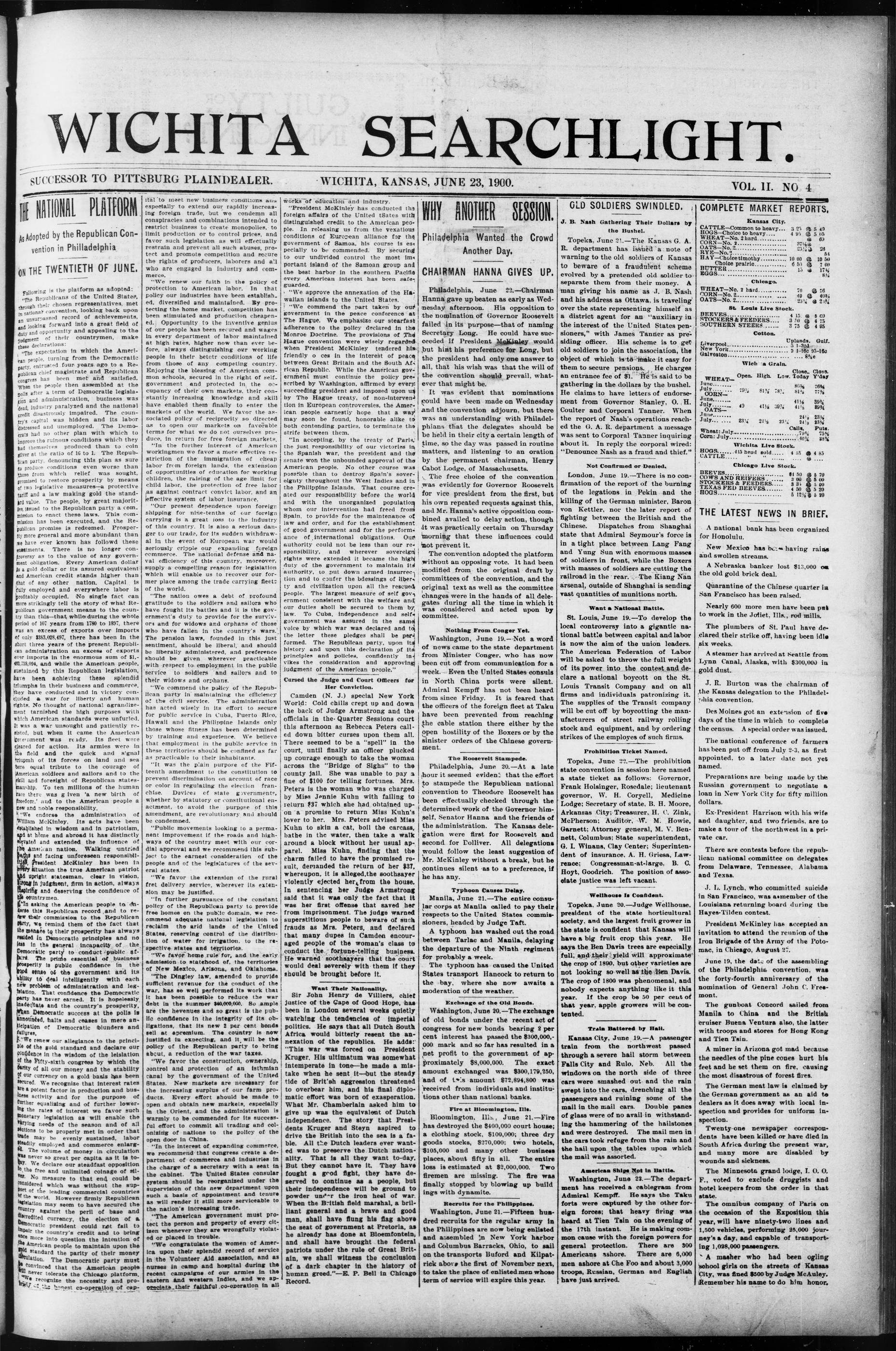
WICHITA SEARCHLIGHT.
SUCCESSOR TO PITTSBURG PLAINDEALER.
As Adopted by the Republican Convention in Philladelphia
ON THE TWENTIETH OF JUNE.
Following is the platform as adopted: "The Republicans of the United States, through their chosen representatives, met in national convention, looking back upon an unsurpassed record of achievements, and looking forward into a great field of duty and opportunity and appealing to the judgment of their countrymen, make these declarations:
these events.
"The expectation in which the American people, turning from the Democratic party, entrusted four years ago to a Republican chief magistrate and Republican congress has been met and satisfied. When the people then assembled at the polls after a term of Democratic legislation and administration, business was dead industry paralyzed and the national credit disastrously impaired. The country's capital was hidden and its labor distressed and unemployed. The Democrat had no other plan with which to remove the ruinous conditions which they themselves produced than to coin gifts at the ratio of 16 to 17. The Republican party, denouncing this plan as sure to produce conditions even worse than those from which relief was sought, promised to restore prosperity by means of two legislative measures—a protective staff and a law making gold the standard value. The people, by great majorities,致 to the Republican party a commission to enact these laws. This commission has been executed, and the Republican promise is redeemed. Prosperity more ever and more abundant we have ever known has followed these gestures. There is no longer controversy as to the American dollar is a gold dollar or its assured equivalent or that of any other nation. Capital is profitably occupied. No story fact can strongly tell the story of what Republican government means to the country this—that, while during the whole period of 107 years from 1780 to 1897, there is no longer any evidence of only $353,894,497, there has been in the short three years of the present Republican administration an excess of exports over imports in the enormous sum of $1,453,783,094, and while the American people, sustained by this Republican legislation, have been achieving these splendid triumphs in their business and commerce, they have conducted and in victory conquered a war for liberty and human rights. No thought of national agrandement tarnished the high purposes with which American standards were unfurled. It was a war unsought and patiently resisted, but when it came the American government was ready. Its fleet were cleared for action. Its armies were in the field and the quick and signal triumph of its forces on land and sea bore equal tribute to the courage of American soldiers and sailors and to the skill and foresight of Republican statesmanship. To ten millions of the human race there was given 'a new birth of freedom,' and to the American people a new and noble responsibility.
"We endorse the administration of William McKinley. Its acts have been established in wisdom and in patriotism, and at home and abroad it has distinctly elevated and extended the influence of the American nation. Walking untried beds and facing unforeseen responsibilities President McKinley has been in every situation the true American patriot and upright statesman, clear in vision, strong in judgment, firm in action, always inspiring and deserving the confidence of the countrymen.
"I am asking the American people to disguise this Republican record and to review their commission to the Republican party, we remind them of the fact that the menace to their prosperity has always resided in Democratic principles and no less in the general incapacity of the Democratic party to conduct public affairs. The prime essential of business prosperity is public confidence in the good sense of the government and its ability to deal intelligently with each new problem of administration and legislation. That confidence the Democratic party has never earned. It is hopelessly inadequate and the country's prosperity, when Democratic success at the polls is annotated, halts and ceases in mere anticipation of Democratic blunders and failures.
We renew our allegiance to the principle of the gold standard and declare our confidence in the wisdom of the leslation of the Fifty-sixth congress by which the party of all our money and the stability of our currency on a gold basis has been secured. We recognize that interest rates are a potent factor in production and business activity and for the purpose of further equaling and of further lowering the rates of interest we favor such monetary legislation as will enable the varying needs of the season and of all sections to be properly met in order that trade may be evenly sustained, labor steadily employed and commerce enlarged. The volume of money in circulation was never so great per capita as it is today. We declare our steadfast opposition to the free and unlimited colage of silvers. No measure to that end could be considered which was without the support of the leading commercial countries of the world. However firmly Republican legislation may seem to have secured the country against the peril of base and discredited currency, the election of a Democratic president could not fail to impair the country's credit and to bring more into question the intention of the American people to maintain upon the gold standard the parity of their money circulation. The Democratic party must be convinced that the American people never tolerate the Chicago platform, we recognize the necessity and probably the honest co-operation of cap
ital to meet new business conditions and especially to extend our rapidly increasing foreign trade, but we condemn all conspiracies and combinations intended to restrict business to create monopolies, to limit production or to control prices, and favor such legislation as will effectually restrain and prevent all such abuses, protect and promote competition and secure the rights of producers, laborers and all who are engaged in industry and commerce.
"We renew our faith in the policy of protection to American labor. In that policy our industries have been established, diversified and maintained. By protecting the home market, competition has been stimulated and production cheapened. Opportunity to the inventive genius of our people has been secured and wages in every department of labor maintained at high rates, higher now than ever before, always distinguishing our working people in their better conditions of life from those of any competing country. Enjoying the blessing of American common schools, secured in the right of self-government and protected in the occupancy of their own markets, their constantly increasing knowledge and skill have enabled them finally to enter the markets of the world. We favor the associated policy of reciprocity so directed as to open our markets on favorable terms for what we do not ourselves produce, in return for free foreign markets.
"In the further interest of American workingmen we favor a more effective restriction of the immigration of cheap labor from foreign lands, the extension of opportunities of education for working children, the raising of the age limit for child labor, the protection of free labor as against contract convict labor, and an effective system of labor insurance.
"Our present dependence upon foreign shipping for nine-tenths of our foreign carrying is a great loss to the industry of this country. It is also a serious danger to our trade, for its sudden withdrawal in the event of European war would seriously cripple our expanding foreign commerce. The national defense and naval efficiency of this country, moreover, supply a compelling reason for legislation which will enable us to recover our former place among the trade carrying fleets of the world.
"The nation owes a debt of profound gratitude to the soldiers and sailors who have fought its battles and it is the government's duty to provide for the survivors and for widows and orphans of those who have fallen in the country's wars. The pension laws, founded in this just sentiment, should be liberal, and should be liberally administered, and preference should be given wherever practicable with respect to employment in the public service to soldiers and sailors and to their widows and orphans.
"We commend the policy of the Republican party in maintaining the efficiency of the civil service. The administration has acted wisely in its effort to secure for public service in Cuba, Puerto Rico, Hawaii and the Phillipine Islands only those whose fitness has been determined by training and experience. We believe that employment in the public service in these territories should be confined as far as practicable to their inhabitants."
"It was the plain purpose of the Fifteenth amendment to the constitution to prevent discrimination on account of race or color in regulating the election franchise. Devices of state governments, whether by statutory or constitutional enactment, to avoid the purpose of this amendment, are revolutionary and should be condemned.
"Public movements looking to a permanent improvement if the roads and highways of the country meet with our cordial approval and we recommend this subject to the earnest consideration of the people and of the legislatures of the several states.
"We favor the extension of the rural fret delivery service, wherever its extension may be justified.
"In further pursuance of the constant policy of the Republican party to provide free homes on the public domain, we recommend adequate national legislation to reclaim the arid lands of the United States, reserving control of the distribution of water for irrigation, to the respective states and territories."
"We favor home rule for, and the early admission to statehood of, the territories of New Mexico, Arizona, and Oklahoma.
"The Dingley law, amended to provide sufficient revenue for the conduct of the war, has so well performed its work that it has been possible to reduce the war debt in the summer $40,000,000. So ample are the revenues and so great is the public confidence in the integrity of its obligations, that its new 2 per cent bonds sell at apremium. The country is now justified in expecting, and it will be the policy of the Republican party to bring about, a reduction of the war taxes.
"We favor the construction, ownership, control and protection of an Isthmian canal by the government of the United States. New markets are necessary for the increasing surplus of our farm products. Every effort should be made to open and obtain new markets, especially in the Orient, and the administration is warmly to be commended for its successful effort to commit all trading and colonizing of nations to the policy of the open door in China.
"In the interest of expanding commerce, we recommend that congress create a department of commerce and industries in the charge of a secretary with a seat in the cabinet. The United States consular system should be reorganized under the supervision of this new department upon such a basis of appointment and tenure as will render it still more serviceable to the nation's increasing trade.
"The American government must protect the person and property of every citizen whenever they are wrongfully violated or placed in trouble.
"We congratulate the women of America upon their splendid record of service in the Volunteer Aid association, and as nurses in camp and hospital during the recent campaigns of our armies in the eastern and western Indies, and we appreciate their faithful co-operation in all
WORKS OF EDUCATION AND INDUSTRY.
"President McKinley has conducted the foreign affairs of the United States with distinguished credit to the American people. In releasing us from the vexatious conditions of European alliance for the government of Samoa, his course is especially to be commended. By securing to our undivided control the most important island of the Samoa group and the best harbor in the southern Pacific every American interest has been safeguarded.
"We approve the annexation of the Hawaiian islands to the United States.
WHY ANOTHER
Philadelphia Wanted to Another Day.
CHAIRMAN HANNA G.
Philadelphia, June 23
Hanna gave up beaten as a
"We commend the part taken by our government in the peace conference at The Hague. We emphasize our steerfast adherence to the policy declared in the Monroe Doctrine. The provisions of The Hague convention were wisely regarded when President McKinley tendered his friendly o ces in the interest of peace between Great Britain and the South African Republic. While the American government must continue the policy prescribed by Washington, affirmed by every succeeding president and imposed upon us by The Hague treaty, of non-intervention in European controversies, the American people earnestly hope that a way may soon be found, honorable alike to both contending parties, to terminate the strife between them.
"In accepting, by the treaty of Paris, the just responsibility of our victories in the Spanish war, the president and the senate won the unbounded approval of the American people. No other course was possible than to destroy Spain's sovereignty throughout the West Indies and in the Philippine Islands. That course created our responsibility before the world and with the unorganized population whom our intervention had freed from Spain, to provide for the maintenance of law and order, and for the establishment of good government and for the performance of international obligations. Our authority could not be less than our responsibility, and wherever sovereignty were extended it became the high duty of the government to maintain its authority, to put down armed insurrection and to confer the blessings of liberty and civilization upon all the rescued people. The largest measure of self government consistent with the welfare and our duties shall be secured to them by law. To Cuba, independence and self-government was assured in the same voice by which war was declared and to the letter these pledges shall be performed. The Republican party, upon its history and upon this declaration of its principles and policies, confidently invokes the consideration and approving judgment of the American people."
Cursed the Judge and Court Officers for Her Conviction.
Camden (N. J.) special New York World: Cold chills creep up and down the back of Judge Armstrong and the officials in the Quarter Sessions court this afternoon as Rebecca Peters called down bitter curses upon them all. There seemed to be a "spell" in the court, until finally an officer plucked up courage enough to take the woman across the "Bridge of Sighs" to the county jail. She was unable to pay a fine of $100 for telling fortunes. Mrs. Peters is the woman who was charged by Miss Jennie Kuhn with falling to return $37 which she had obtained upon a promise to return Miss Kuhn's lover to her. Mrs. Peters advised Miss Kuhn to skin a cat, boil the carcass, bathe in the water, then take a walk around a block without her usual apparel. Miss Kuhn, finding that the charm failed to have the promised result, demanded the return of her $37, whereupon, it is alleged, the soothsayer violently ejected her from the house. In sentencing her Judge Armstrong said that it was only the fact that it was her first offense that saved her from imprisonment. The judge warned superstitious people to beware of such frauds as Mrs. Peters, and declared that many dupes in Camden encouraged people of the woman's class to conduct the fortune-telling business. He warned soothsayers that the court would deal severely with them if they should be brought before it.
Went Their Nationality
Want Their Nationality.
Sir John Henry de Villiers, chief justice of the Cape of Good Hope, has been in London several weeks quietly watching the tendencies of imperial politics. He says that all Dutch South Africa would bitterly resent the annexation of the republics. He adds: "This war was forced on President Kruge. His ultimatum was somewhat intemperate in tone—he made a mistake when he sent it—but the steady tide of Brit's aggression threatened to overbear him, and his final diplomatic effort was born of exasperation. What Mr. Chamberlain asked him to give up was the equivalent of Dutch independence. The story that Presidents Kruge and Steyn aspired to drive the British into the sea is a fable. All the Dutch leaders ever wanted to preserve the Dutch nationality. That is all they want to-day. But they cannot have it. They have fought a good fight, they have deserved to continue as a people, but their independence will be ground to powder under" the iron heel of war. When the British field marshal, a brilliant general and a brave and good man, shall have flung his flag above the seat of government at Pretoria, as he already has done at Bloemfontein, and shall have brought the federal patriots under the rule of Great Britain, we shall witness the conclusion of a dark chapter in the history of human greed."—E. P. Bell in Chicago Record.
WHY ANOTHER SESSION.
Philadelphia Wanted the Crowd Another Day.
CHAIRMAN HANNA GIVES UP.
Philadelphia, June 22.—Chairman Hanna gave up beaten as early as Wednesday afternoon. His opposition to the nomination of Governor Roosevelt failed in its purpose—that of naming Secretary Long. He could have succeeded if President McKinley would but hint his preference for Long, but the president had only one answer to all, that his wish was that the will of the convention should prevail, whatever that might be.
It was evident that nominations could have been made on Wednesday and the convention adjourn, but there was an understanding with Philadelphia that the delegates should be held in their city a certain length of time, so the day was passed in routine matters, and listening to an oration by the permanent chairman, Henry Cabot Lodge, of Massachusetts.
The free choice of the convention was evidently for Governor Roosevelt for vice president from the first, but his own repeated requests against this, and Mr. Hanna's active opposition combined availed to delay action, though it was practically certain on Thursday morning that these influences could not prevent it. The convention adopted the platform without an opposing vote. It had been modified from the original draft by committees of the convention, and the original text as well as the committee changes were in the hands of all delegates during all the time in which it was considered and acted upon by committee.
Nothing From Conger Yet.
Washington, June 19.—Not a word of news came to the state department from Minister Conger, who has now been cut off from communication for a week. Even the United States consuls in North China ports were silent. Admiral Kempff has not been heard from since Friday. It is feared that the officers of the foreign fleet at Taku have been prevented from reaching the cable station there either by the open hostility of the Boxers or by the sinister orders of the Chinese government.
The Roosevelt Stampede
Philadelphia, June 20. At a late hour it seemed evident that the effort to stampede the Republican national convention to Theodore Roosevelt has been effectually checked through the determined work of the Governor himself. Senator Hanna and the friends of the administration. The Kansas delegation were first for Roosevelt and second for Dolliver. All delegations would follow the least suggestion of Mr. McKinley without a break, but he continues silent as to a preference, if he has any.
Typhoon Causes Delay
Manila, June 21.—The entire consular corps at Manila called to pay their respects to the United States commissioners, headed by Judge Taft.
A typhoon has washed out the road between Tarlac and Manila, delaying the departure of the Ninth regiment for probably a week.
The typhoon has caused the United States transport Hancock to return to the bay, where she now awaits a moderation of the weather.
Exchange of the Old Bonds.
Washington, June 20.—The exchange of old bonds under the recent act of congress for new bonds bearing 2 percent interest has passed the $300,000,-000 mark and so far has resulted in a net profit to the government of approximately $8,000,000. The exact amount exchanged was $300,179,250, and of this amount $72,894,800 was received from individuals and institutions other than national banks.
Fire at Bloomington, Ills.
Bloomington, Ill., June 21.—Fire has destroyed the $400,000 court house; a clothing stock, $100,000; three dry goods stocks, $270,000; two hotels, $105,000 and many other business places, about fifty in all. The entire loss is estimated at $2,000,000. Two firemen are missing. The fire was finally stopped by blowing up buildings with dynamite.
Recruits for the Philippines.
Washington, June 21.—Fifteen hundred recruits for the regular army in the Philippines are now being enlisted and assembled in New York harbor and Columbus Barracks, Ohio, to sail on the transports Buford and Kilpatrick above the first of November next, to take the place of enlisted men whose term of service will expire this year.
OLD SOLDIERS SWINDLED.
J. B. Nash Gathering Their Dollars by the Bushel.
Topeka, June 21.—The Kansas G. A. R. department has issued a note of warning to the old soldiers of Kansas to beware of a fraudulent scheme evolved by a pretended old soldier to separate them from their money. A man giving his name as J. B. Nash and his address as Ottawa, is traveling over the state representing himself as a district agent for an "auxiliary in the interest of the United States pensioners," with James Tanner as presiding officer. His scheme is to get old soldiers to join the association, the object of which is to make it easy for them to secure pensions. He charges an entrance fee of $1. He is said to be gathering in the dollars by the bushel. He claims to have letters of endorsement from Governor Stanley, O. H. Coulter and Corporal Tanner. When the report of Nash's operations reached the G. A. R. department a message was sent to Corporal Tanner inquiring about it. In reply the corporal wired: "Denounce Nash as a fraud and thief."
Not Confirmed or Denied.
London, June 19.—There is no confirmation of the report of the burning of the legations in Pekin and the killing of the German minister. Baron von Kettler, nor the later report of fighting between the British and the Chinese. Dispatches from Shanghai state that Admiral Seymour's force is in a tight place between Lang Fang and Yung Sun with enormous masses of soldiers in front, while the Boxers with masses of soldiers are cutting the railroad in the rear. The Kiang Nan arsenal, outside of Shanghai is sending vast quantities of munitions north.
Want a National Battle:
St. Louis, June 19.—To develop the local controversy into a gigantic national battle between capital and labor is now the aim of the union leaders. The American Federation of Labor will be asked to throw the full weight of its power into the contest and declare a national boycott on the St. Louis Transit Company and on all firms and individuals patronizing it. The supplies of the Transit company will be cut off by boycotting the manufacturers of street railway rolling stock and equipment, and by ordering strikes of the employees of such firms.
Prohibition Ticket Named.
Topeka, June 22.—The prohibition state convention in session here named a state ticket as follows: Governor, Frank Holsinger, Rosedale; lieutenant governor, W. H. Coryell, Medicine Lodge; Secretary of state, B. H. Moore, Arkansas City; Treasurer, H. C. Zink, McPherson; Auditor, W. M. Howie, Garnett; Attorney general, M. V. Bennett, Columbus; State superintendent, G. I. Winans, Clay Center; Superintendent of insurance, A. H. Griesa, Lawrence; Congressman-at-large, B. C. Hoyt, Goodrich. The position of associate justice was left vacant.
Wellhouse Is Confident.
Topeka, June 30.—Judge Wellhouse, president of the state horticultural society, and the largest fruit grower in the state is confident that Kansas will have a big fruit crop this year. He says the Ben Davis trees are especially full, and their yield will approximate the crop of 1890, but other varieties are not looking so well as the Ben Davis. The crop of 1800 was phenomenal, and nobody expects anything like it this year. If the crop be 50 per cent of that year, apple growers will be contented.
Train Battered by Hall.
Kansas City, June 19.—A passenger train from the northwest passed through a severe hail storm between Falls City and Rulo. Neb. All the windows on the north side of three cars were smashed out and the rain swept into the cars, drenching all the passengers and ruining some of the mail in the mail cars. Double panes of glass were of no avail in withstanding the hammering of the hailstones and were destroyed. The mail men in the cars took refuge from the rain and the hail upon the tables upon which the mail was assorted.
American Ships Not In Battle.
Washington, June 23.—The department has received a cablegram from Admiral Kempff. He says the Taku forts were captured by the other foreign forces; that heavy firing was heard at Tien Tain on the evening of the 17th instant. He is making common cause with the foreign powers for general protection. There are 300 Americans ashore. There are 6,000 men ashore at Che Foo and about 3,000 troops, Russian, German and English have just arrived.
VOL. II. NO 4
COMPLETE MARKET REPORTS.
Kansas City.
CATTLE—Common to heavy... 3 25 @ 5 40
HOGS—Choice to heavy... 4 95 @ 5 60
WHEAT—No. 2 hard... 6 95 @ 6 30
CORN—No. 2... 37% @ 24
OATS—No. 2... 31% @ 24
RYE—No. 2... 31% @ 24
HAY—Choice timothy... 10 00 @ 10 50
Choice prairie... 6 50 @ 7 00
BUTTER... 15 @ 17%
EGGS... 81%
Chicago.
WHEAT—No. 2 hard... 70 @ 16
CORN—No. 2... 40 @ 40%
OATS—No. 2... 23% @ 21%
St. Louis Live Stock.
BEEVES... 4 15 @ 5 60
STOCKERS & FEEDERS... 3 50 @ 7 00
SOUTHERN STEERS... 3 75 @ 4 05
Cotton.
Uplands. Gulf.
Liverpool... 5 1-324
New York... 3 1-186 55-183
Galveston... 84%
Wichita Grain.
Close. Closs.
WHEAT—
June... 80% @ 76%
July... 79% @ 81% @ 78% @ 81% @ 77%
CORN—
June... 41% @ 79% @ 41% @ 79%
July... 40 @ 41% @ 39% @ 41% @ 89%
OATS—
June... 24% @ 24% @ 24%
July... 23% @ 21% @ 23% @ 21%
Calls. Puts.
Wheat: July... 79% @ 75%
Corn: July... 40% @ 40%
Wichita Live Stock.
HOGS... 415 head sold... 4 55 @ 4 85
CATTLE... @
Chicago Live Stock.
BEEVES... 81 50 @ 5 40
COWS & HEIFERS... 4 50 @ 5 00
STOCKERS & FEEDERS... 3 81 @ 4 90
TEXAS FED BEEVES... 4 50 @ 5 20
HOGS... 5 12% @ 5 20
THE LATEST NEWS IN BRIEF.
A national bank has been organized for Honolulu.
New Mexico has been having rains and swollen streams.
A Nebraska banker lost $13,000 on the old gold brick deal.
Quarantine of the Chinese quarter in San Francisco has been raised.
Nearly 600 more men have been put to work in the Jofiet, Ills., rod mills.
The plumbers of St. Paul have declared their strike off, having been idle six weeks.
A steamer has arrived at Seattle from Lynn Canal, Alaska, with $300,000 in gold dust.
J. R. Burton was the chairman of the Kansas delegation to the Philadelphia convention.
Des Moines got an extension of five days of the time in which to complete the census. A special order was issued.
The national conference of farmers has been put off from July 2-3, as first appointed, to a later date not yet named.
Preparations are being made by the Russian government to negotiate a loan in New York City for fifty million dollars.
Ex-President Harrison with his wife and daughter, and two friends, are to make a tour of the northwest in a private car.
There are contests before the republican national committee on delegates from Delaware, Tennessee, Alabama and Texas.
J. L. Lynch, who committed suicide in San Francisco, was a member of the Louisiana returning board during the Hayes-Tilden contest.
President McKinley has accepted an invitation to attend the reunion of the Iron Brigade of the Army of the Potomac, in Chicago, August 27.
June 19, the date of the assembling of the Philadelphia convention, was the forty-fourth anniversary of the nomination of General John C. Freemont.
The gunboat Concord sailed from Manila to China and the British cruiser Buena Ventura also, the latter with troops and stores for Hong Kong and Tien Tsin.
A miner in Arizona got mad because the needles of the pine cones hurt his feet and he set them on fire, causing the most disastrous of forest fires. The German meat law is claimed by the German government as an aid to dealers as it does away with local inspection and provides for uniform inspection. Twenty-one newspaper correspondents have been killed or have died in South Africa during the present war, and many more are disabled by wounds and sickness. The Minnesota grand lodge, I. O. O. F., voted to exclude druggists and hotel keepers from the order in that state.
The omnibus company of Paris on the occasion of the Exposition this year, will have ninety-two lines and 1,500 vehicles, performing 25,000 journey's a day, and capable of transporting 1,028,000 passengers.
`A masher who had been ogling school girls on the streets of Kansas City, was fined $300 by Judge McAulay. Remember his name to do him honor.
Published every Saturday at No. 140
North Main Street, up stairs.
RATES OF SUBSCRIPTION:
IN ADVANCE.
One year, by mail. 81 00
Six months, by mail. 75
Three months, by mail. 56
Advertising rates made known on application.
Address all communications to "The
Searchlight", Box 1017, Wichita, Kansas.
(All matters to be published must reach this
office not later than Tuesday, to reach publication
in the current issue.)
Official organ of the Knights of Pythias of
Kansas.
Correspondents and agents wanted every-
where. Write us for terms.
All matters sent to "The Searchlight" for
publication must be signed by the party
or parties writing.
Wichita's Business Men.
We deem it not amiss at this time to publicly acknowledge through these columns our sincere appreciation of the many courticies shown us by the business men of this city. When-ever and wherever you find a city with wide awake, up to date business men, there you will find a good place to live. A city only what its business men make it they are the land marks from which to count it has never been our pleasure or good fortune to meet a more considerate and courteous set of business men than we find in the growing city of Wichita; with such energetic business like men, why shouldn't Wichita grow? There is no way to stop the continual growth of this city as long as she maintain her present set of business men; we wish to become better acquainted with each one and hope to be able to have each as our friend. We will not mention the names of any certain ones as we find them all enterprising. May their success increase ten fold. The citizens of this city should be proud of her business men.
Subscribe for 'The Searchlight' and help support a good Negro Journal in your city.
The republican platform in speaking of the hellish scheme of the ballot-box stuffers and shot-gun-white supremacy, Negro disfran-chisement, which is so manifest in the southern states, says; "It is the plain purpose of the Fifteenth amendment to the constitution to prevent discrimination on account of race or color in regulating the election franchise. Devises of state governments, whether statutory or constitutional enactment, to avoid the purpose of this amendment, are revolutionary and "should" be condemned". Isn't this pretty soft talk for the friends of these much wronged people? If this is the purpose of the fifteenth amendment is there no way to put it into execution according to its purpose?
Now is the time to aet.
Read EVERY 'ad' in this paper
—then patronize the places.
Colored Childrns Hom
The Helen Gould Childrens home located at 1447 River st- is a worthy institution, one that should receive the loyal supert of every Colored person in the County. There is no class or race of people who need such an institution, than the Colored people. And with such a home under good management the or phan and homeless can be taken off the streets and given the care which tends to make child grow to be a good citizen. Let us encourage such managers, each person could donate something and every little helps. The home is doing some very effective work. J. C, Parish Pres; H. H. Neeley Supt; and are doing some good work.
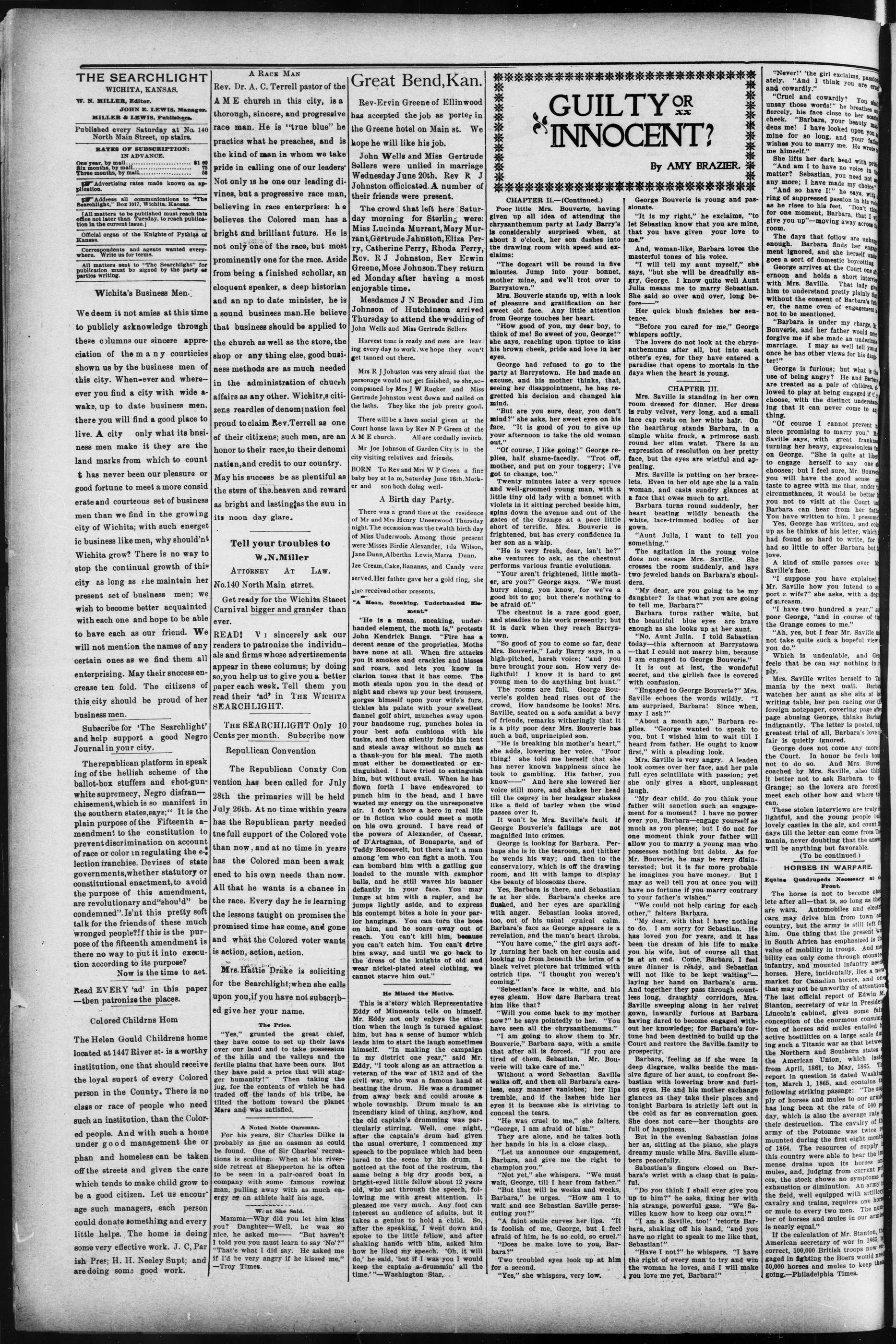
Rev. Dr. A. C. Terrell pastor of the AME church in this city, is a thorough, sincere, and progressive race man. He is "true blue" he practices what he preaches, and is the kind of man in whom we take pride in calling one of our leaders. Not only is he one our leading divines, but a progressive race man, believing in race enterprises: he believes the Colored man has a bright and brilliant future. He is not only one of the race, but most prominently one for the race. Aside from being a finished schollar, an eloquent speaker, a deep historian and an np to date minister, he is a sound business man. He believe that business should be applied to the church as well as the store, the shop or any thing else, good business methods are as much needed in the administration of church affairs as any other. Wichitr's citizens reardles of denomination feel proud to claim Rev.Terrell as one of their citixens; such men, are an honor to their race, to their denomination, and credit to our country. May his success be as plentiful as the sters of the heaven and reward as bright and lasting as the suu in its noon day glare.
Tell your troubles to W.N.Miller
ATTORNEY AT LAW.
No.140 North Main strret.
Get ready for the Wichita Staeet
Carnival bigger and grander than
ever.
READ! V I sincerely ask our
readers to patronize the individuals and firms whose advertisements appear in these columnus; by doing so, you help us to give you a better paper each week. Tell them you read their 'ad' in THE WICHITA SEARCHLIGHT.
THE SEARCHLIGHT Only 10
Cents per month. Subscribe now
Republican Convention
The Republican County Convention has been called for July 28th the primaries will be held July 26th. At no time within years has the Republican party needed the full support of the Colored vote than now, and at no time in years has the Colored man been awakened to his own needs than now. All that he wants is a chance in the race. Every day he is learning the lessons taught on promises the promised time has come, and gone and what the Colored voter wants is action, action, action.
Mrs. Hattie Drake is soliciting for the Searchlight;when she calls upon you,if you have not subscribed give her your name.
The Price.
"Yes," grunted the great chief, they have come to set up their laws over our land and to take possession of the hills and the valleys and the fertile plains that have been ours. But they have paid a price that will stagger humanity!" Then taking the jug, for the contents of which he had traded off the lands of his tribe, he tilted the bottom toward the planet Mars and was satisfied.
A Noted Noble Oarsman
For his years, Sir Charles Dilke is probably as fine an oasman as could be found. One of Sir Charles' recreations is sculling. When at his river-side retreat at Shepperton he is often to be seen in a pair-oared boat in company with some famous rowing man, pulling away with as much energy as an athlete half his age.
What She Said.
Mamma—Why did you let him kiss you? Daughter—Well, he was so nice, he asked me—"But haven't I told you you must learn to say 'No?' "That's what I did say. He asked me if I'd be very angry if he kissed me."—Troy Times.
Great Bend,Kan.
Rev-Ervin Greene of Ellinwood has accepted the job as porter in the Greene hotel on Main st. We hope he will like his job.
John Wells and Miss Gertrude Sollers were uniied in marriage Wednesday June 20th. Rev R J Johnston officiated. A number of their friends were present.
The crowd that left here Saturday morning for Sterling were: Miss Lucinda Murrant, Mary Murrant, Gertrude Jahnston, Eliza Perry, Catherine Perry, Rhoda Perry, Rev R J Johnston, Rev Erwin Greene, Mose Johnson. They returned Monday after having a most enjoyable time.
Mesdamcs J N Broader and Jim Johnson of Hutchinson arrived Thursday to attend the wadding of John Wells and Miss Gertrude Sellers
Harvest time is ready and men are leaving every day to work. we hope they won't get tanned out there.
Mrs R J Johnston was very afraid that the parsonage would not get finished, so she,accompained by Mrs J W Rucker and Miss Gertrade Johnston went down and nailed on the laths. They like the job pretty good.
There will be a lawn social given at the Court house lawn by Rev N P Green of the A M E church. All are cordially inviteb.
Mr Joe Johnson of Garden City is in the city visiting relatives and friends.
BORN To Rev and Mrs W P Green a fine baby boy at 1a m,Saturday June 16th.Mother and son both doing well.
A Birth day Party.
There was a grand time at the residence of Mr and Mrs Henry Unerewood Thursday night. The occasion was the twelfth birth day of Miss Underwoob. Among those present were: Misses Birdie Alexander, 1da Wilson, Jane Dunn, Albertha Lewis, Marra Dunn, Iee Cream, Cake, Bananas, and Candy were served. Her father gave her a gold ring, she also received other presents.
"A Mean, Sneaking, Underhanded Element."
"He is a mean, sneaking, underhanded element, the moth is," protestes John Kendrick Bangs. "Fire has a decent sense of the proprieties. Moths have none at all. When fire attacks you it smokes and crackles and hisses and roars, and lets you know in clarion tones that it has come. The moth steals upon you in the dead of night and chews up your best trousers, gorges himself upon your wife's furs, tickles his palate with your swellest flannel golf shirt, munches away upon your handsome rug, punches holes in your best sofa cushions with his tusks, and then silently lifts his tent and steals away without so much as a thank-you for his meal. The moth must either be domesticated or extinguished. I have tried to extinguish him, but without avail. When he has flown forth I have endeavored to punch him in the head, and I have wasted my energy on the unresponsive air. I don't know a hero in real life or in fiction who could meet a moth on his own ground. I have read of the powers of Alexander, of Caesar, of D'Artagnan, of Bonaparte, and of Teddy Roosevelt, but there isn't a man among 'em who can fight a moth. You can bombard him with a gatling gun loaded to the muzzle with camphor balls, and he still waves his banner defiantly in your face. You may lunge at him with a rapiper, and he jumps lightly aside, and to express his contempt bites a hole in your parlor hangings. You can turn the hose on him, and he soars away out of reach. You can't kill him, because you can't catch him. You can't drive him away, and until we go back to the dress of the knights of old and wear nickel-plated steel clothing, we cannot starve him out."
He Missed the Motive.
This is a story which Representative Eddy of Minnesota tells on himself. Mr. Eddy not only enjoys the situation when the laugh is turned against him, but has a sense of humor which leads him to start the laugh sometimes himself. "In making the campaign in my district one year," said Mr. Eddy. "I took along as an attraction a veteran of the war of 1812 and of the civil war, who was a famous hand at beating the drum. He was a drummer from away back and could arouse a whole township. Drum music is an incendiary kind of thing, anyhow, and the old captain's drumming was particularly stirring. Well, one night, after the captain's drum had given the usual overture, I commenced my speech to the populace which had been lured to the scene by his drum. I noticed at the foot of the rostrum, the same being a big dry goods box, a bright-eyed little fellow about 12 years old, who sat through the speech, following me with great attention. It pleased me very much. Any fool can interest an audience of adults, but it takes a genius to hold a child. So, after the speaking, I went down and spoke to the little fellow, and after shaking hands with him, asked him how he liked my speech. 'Oh, it will do,' he said, 'but if I was you I would keep the captain a drummin' all the time.'"—Washington Star.
```markdown
```
GUILTY OR
INNOCENT?
CHAPTER II—(Continued.) George Bouverie is young and pas
CHAPTER II.—(Continued.)
Poor little Mrs. Bouverie, having given up all idea of attending the chrysanthemum party at Lady Barry's is considerably surprised when, at about 3 o'clock, her son dashes into the drawing room with speed and exclaims:
"The dog cart will be round in five minutes. Jump into your bonnet, mother mine, and we'll trot over to Barrystown."
Mrs. Bouverie stands up, with a look of pleasure and gratification on her sweet old face. Any little attention from George touches her heart.
"How good of you, my dear boy, to think of me! So sweet of you, George!" she says, reaching upon tiptoe to kiss his brown cheek, pride and love in her eyes.
George had refused to go to the party at Barrystown. He had made an excuse, and his mother thinks, that, seeing her disappointment, he has regretted his decision and changed his mind.
"But are you sure, dear, you don't mind?" she asks, her sweet eyes on his face. "It is good of you to give up your afternoon to take the old woman out."
"Of course, I like going!" George replies, half shame-facedly. "Trot off, mother, and put on your toggery; I've got to change, too."
Twenty minutes later a very spruce and well-groomed young man, with a little tiny old lady with a bonnet with violets in it sitting perched beside him, spins down the avenue and out of the gates of the Grange at a pace little short of terrific. Mrs. Bouvierie is frightened, but has every confidence in her son as a whip.
"He is very fresh, dear, isn't he?" she ventures to ask, as the chestnut performs various frantic evolutions.
"Your aren't frightened, little mother, are you?" George says. "We must hurry along, you know, for we've a good bit to go; but there's nothing to be afraid of."
The chestnut is a rare good goer, and steadies to his work presently; but it is dark when they reach Barrystown.
"So good of you to come so far, dear Mrs. Bouverie," Lady Barry says, in a high-pitched, harsh voice; "and you have brought your son. How very delightful! I know it is hard to get young men to do anything but hunt."
The rooms are full. George Bouverie's golden head rises out of the crowd. How handsome he looks! Mrs. Saville, seated on a sofa amidst a bevy of friends, remarks witheringly that it is a pity poor dear Mrs. Bouverie has such a bad, unprincipled son.
"He is breaking his mother's heart," she adds, lowering her voice. "Poor thing! she told me herself that she has never known happiness since he took to gambling. His father, you know—" And here she lowered her voice still more, and shakes her head till the osprey in her headgear shakes like a field of barley when the wind passes over it.
It won't be Mrs. Saville's fault if George Bouverie's failings are not magnified into crimes.
George is looking for Barbara. Perhaps she is in the tearoom, and thither he wends his way; and then to the conservatory, which is off the drawing room, and lit with lamps to display the beauty of blossoms there.
Yes, Barbara is there, and Sebastian is at her side. Barbara's cheeks are flushed, and her eyes are sparkling with anger. Sebastian looks moved, too, out of his usual cynical calm. Barbara's face as George appears is a revelation, and the man's heart throbs.
"You have come," the girl says softly, turning her back on her cousin and looking up from beneath the brim of a black velvet picture hat trimmed with ostrich tips. "I thought you weren't coming."
"Sebastian's face is white, and his eyes gleam. How dare Barbara treat him like that?
"Will you come back to my mother now?" he says pointedly to her. "You have seen all the chrysanthemums."
"I am going to show them to Mr. Bouverie," Barbara says, with a smile that after all is forced. "If you are tired of them, Sebastian, Mr. Bouverie will take care of me."
Without a word Sebastian Saville walks off, and then all Barbara's careless, easy manner vanishes; her lips tremble, and if the lashes hide her eyes it is because she is striving to conceal the tears.
"He was cruel to me," she falters.
"George, I am afraid of him."
They are alone, and he takes both her hands in his in a close clasp.
"Let us announce our engagement, Barbara, and give me the right to champion you."
"Not yet," she whispers. "We must wait, George, till I hear from father."
"But that will be weeks and weeks, Barbara," he urges. "How am I to wait and see Sebastian Saville persecuting you?"
"A faint smile curves her lips. "It is foolish of me, George, but I feel afraid of him, he is so cold, so cruel."
"Does he make love to you, Barbara?"
Two troubled eyes look up at him for a second.
"Yes," she whispers, very low.
By AMY BRAZIER.
George Bourier is young and passionate.
"It is my right," he exclaims, "to let Sebastian know that you are mine, that you have given your love to me."
And, woman-like, Barbara loves the masterful tones of his voice.
"I will tell my aunt myself," she says, "but she will be dreadfully angry, George. I know quite well Aunt Julia means me to marry Sebastian. She said so over and over, long before——"
Her quick blush finishes her sentence.
"Before you cared for me," George whispers softly.
The lovers do not look at the chrysanthemums after all, but into each other's eyes, for they have entered a paradise that opens to mortals in the days when the heart is young.
CHAPTER III
Mrs. Saville is standing in her own room dressed for dinner. Her dress is ruby velvet, very long, and a small lace cap rests on her white hair. On the hearthrug stands Barbara, in a simple white frock, a primrose sash round her slim waist. There is an expression of resolution on her pretty face, but the eyes are wistful and appealing.
Mrs. Saville is putting on her bracelets. Even in her old age she is a vain woman, and casts sundry glances at a face that owes much to art.
Barbara turns round suddenly, her heart beating wildly beneath the white, lace-trimmed bodice of her gown.
"Aunt Julia, I want to tell you something."
The agitation in the young voice does not escape Mrs. Saville. She crosses the room suddenly, and lays two jeweled hands on Barbara's shoulders.
"My dear, are you going to be my daughter? Is that what you are going to tell me, Barbara?"
Barbara turns rather white, but the beautiful blue eyes are brave enough as she looks up at her aunt.
"No, Aunt Julia. I told Sabastian today—this afternoon at Barrystown—that I could not marry him, because I am engaged to George Bouierie."
It is out at last, the wonderful secret, and the girlish face is covered with confusion.
"Engaged to George Bouierie?" Mrs. Saville echoes the words wildly. "I am surprised, Barbara! Since when, may I ask?"
"About a month ago," Barbara replies. "George wanted to speak to you, but I wished him to wait till I heard from father. He ought to know first," with a pleading look.
Mrs. Saville is very angry. A leaden look comes over her face, and her pale full eyes scintillate with passion; yet she only gives a short, unpleasant laugh.
"My dear child, do you think your father will sanction such an engagement for a moment? I have no power over you. Barbara—engage yourself as much as you please; but I do not for one moment think your father will allow you to marry a young man who possesses nothing but debts. As for Mr. Bouvier, he may be very disinterested; but it is far more probable he imagines you have money. But I may as well tell you at once you will have no fortune if you marry contrary to your father's wishes."
"We could not help caring for each other," falters Barbara.
"My dear, with that I have nothing to do. I am sorry for Sebastian. He has loved you for years, and it has been the dream of his life to make you his wife, but of course all that is at an end. Come, Barbara. I feel sure dinner is ready, and Sebastian will not like to be kept waiting"—laying her hand on Barbara's arm. And together they pass through countless long, draughty corridors, Mrs. Saville sweeping along in her velvet gown, inwardly furious at Barbara having dared to become engaged without her knowledge; for Barbara's fortune had been destined to build up the Court and restore the Saville family to prosperity.
Barbara, 'feeling as if she were in deep disgrace, walks beside the massive figure of her aunt, to confront Sebastian with lowering brow and furious eyes. He and his mother exchange glances as they take their places and tonight Barbara is strictly left out in the cold as far as conversation goes. She does not care—her thoughts are full of happiness.
But in the evening Sabastian joins her as, sitting at the piano, she plays dreamy music while Mrs. Saville slumbers peacefully.
Sabastian's fingers closed on Barbara's wrist with a clasp that is painful.
"Do you think I shall ever give you up to him?" he asks, fixing her with his strange, powerful gaze. "We Savilles know how to keep our own!"
"I am a Saville, too!' retorts Barbara, shaking off his hand, "and you have no right to speak to me like that, Sebastian!"
"Have I not?" he whispers. "I have the right of every man to try and win the woman he loves, and I will make you love me yet, Barbara!"
"Never!' the girl exclaims, passionately. "And I think you are cruel and cowardly."
"Cruel and cowardly? You shall unsay those words!" he breathes our fiercely, his face close to her sweet cheek. "Barbara, your beauty makes dens me! I have looked upon you to mine for so long, and your father wishes you to marry me. He wrote to me himself."
She lifts her dark head with pride. "And am I to have no voice in the matter? Sebastian, you need not me any more; I have made my choice."
"And so have I!" he says, with ring of suppressed passion in his voice as he rises to his feet. "Don't think for one moment, Barbara, that I give you up"—moving away across the room.
The days that follow are unhappy enough. Barbara finds her engagement ignored, and she herself undergoes a sort of domestic boycotting. George arrives at the Court one earlyoon and holds a short interview with Mrs. Saville. That lady gives him to understand pretty plainly that without the consent of Barbara's father, the name even of engagement is not to be mentioned.
"Barbara is under my charge. Mr. Bouverie, and her father would never forgive me if she made an undesired marriage. I may as well tell you once he has other views for his daughter!"
George is furious; but what is the use of being angry? He and Barbara are treated as a pair of children, allowed to play at being engaged if it choose, with the distinct understanding that it can never come to an thing.
"Of course I cannot prevent my niece promising to marry you," Mr. Saville says, with great frankness turning her heavy, expressionless on George. "She is quite at liberty to engage herself to any one of chooses; but I feel sure, Mr. Bouvier you will have the good sense and taste to agree with me that, under the circumstances, it would be better for you not to visit at the Court un Barbara can hear from her faith You have written to him, I presume Yes, George has written, and color up as he thinks of his letter, which had found so hard to write, for a had so little to offer Barbara but I love.
A kind of smile passes over M. Saville's face.
"I suppose you have explained Mr. Saville how you intend to support a wife?" she asks, with a degree of s:rcasm.
"I have two hundred a year," says poor George, "and in course of the Grange comes to me."
"Ah, yes, but I fear Mr. Saville must not take quite such a hopeful view you do."
Which is undeniable, and Gerfeels that he can say nothing in my.
Mrs. Saville writes herself to Tamaria by the next mall. Barbaria watches her aunt as she sits at her writing table, her pen racing over the foreign notepaper, covering page after page abusing George, thinks Barbaria indignantly. The letter is posted, as greatest trial of all, Barbara's love a fair is quietly ignored.
George does not come any more the Court. In honor he feels not to do so. And Mrs. Burvet coached by Mrs. Saville, also this it better not to ask Barbara to the Grange; so the lovers are forced meet each other how and where the can.
These stolen interviews are truly lightful, and the young people but lovely castles in the air, and count the days till the letter can come from The mania, never doubting that the answer will be anything but favorable.
HORSES IN WARFARE.
Equine Quadrupedes Necessary at Front.
The horse is not to become obsolete after all—that is, so long as they are wars. Automobiles and electric cars may drive him from town and country, but the army is still left for him. One thing that the present war in South Africa has emphasized is the value of mobility in troops. And mobility can only come through mounts infantry, and mounted infantry need horses. Here, incidentally, lies a new market for Canadian horses, and one that may not be unworthy of attention. The last official report of Edwin M. Stanton, secretary of war in President Lincoln's cabinet, gives some fair conception of the enormous consumption of horses and mules to active hostilities on a large scale during such a Titanic war as that between the Northern and Southern states of the American Union, which lasted from April, 1861, to May, 1865. The report in question is dated Washington, March 1, 1865, and contains the following striking passage: "The supply of horses and mules to our army has long been at the rate of 500 per day, which is also the average rate of their destruction. The cavalry of the army of the Potomac was twice mounted during the first eight months of 1864. The resources of supply of this country were able to bear the immense drains upon its horses and mules, and, judging from current prices, the stock shows no symptoms of exhaustion or diminution. An army in the field, well equipped with artillery cavalry and trains, requires one horse or mule to every two men. The number of horses and mules in our armies is nearly equal."
If the calculation of Mr. Stanton, the American secretary of war in 1865, is correct, 100,000 British troops now engaged in fighting the Boers would need 50,000 horses and mules to keep them going—Philadelphia Times.
NO REMEDY EQUALS PERUNA,
SO THE WOMEN ALL SAY.
Miss Susan Wymar.
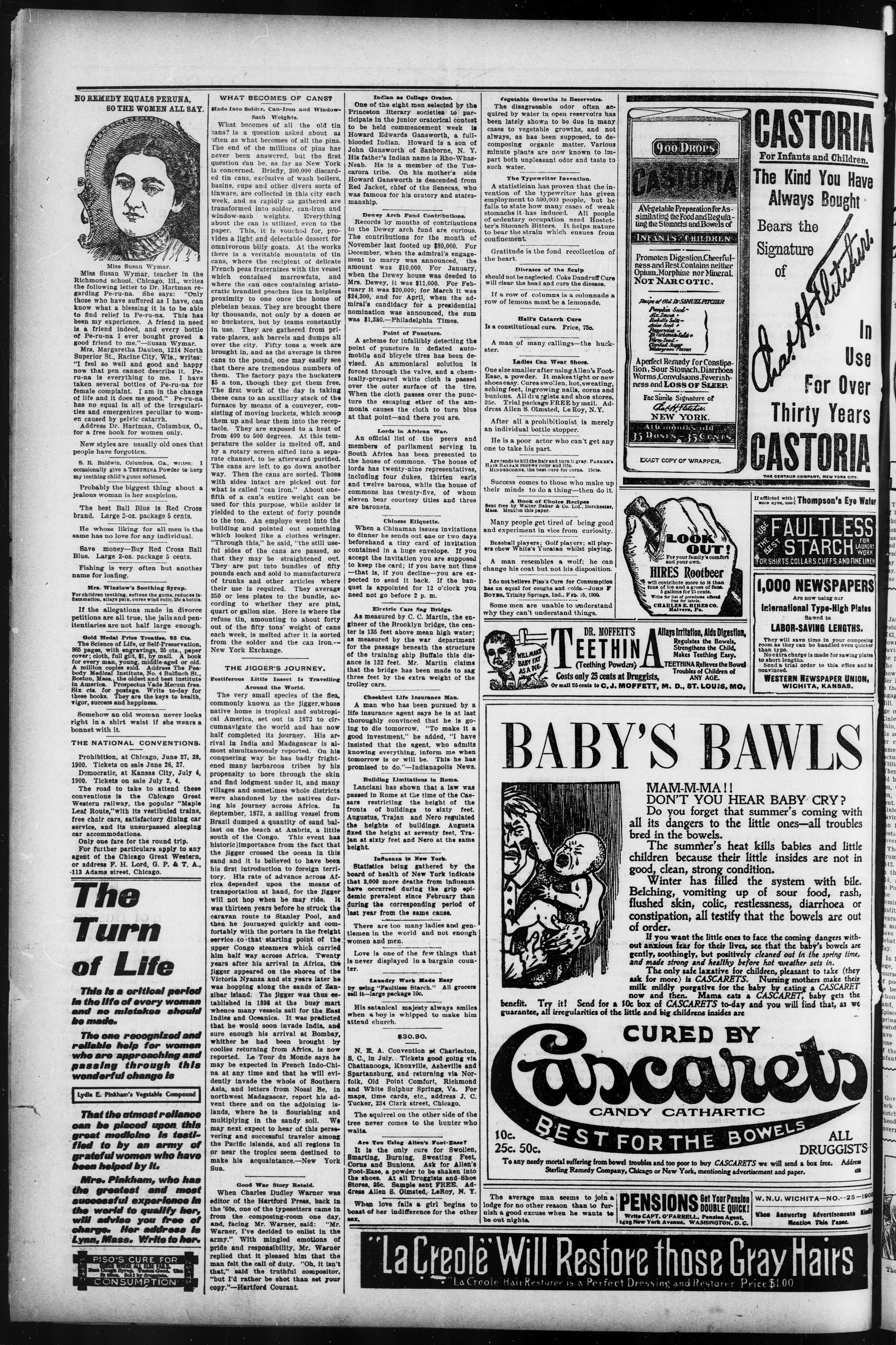
Miss Susan Wymar, teacher in the Richmond school, Chicago, Ill., writes the following letter to Dr. Hartman regarding Pe-ru-na. She says: "Only those who have suffered as I have, can know what a blessing it is to be able to find relief in Pe-ru-na. This has been my experience. A friend in need is a friend indeed, and every bottle of Pe-ru-na I ever bought proved a good friend to me."—Susan Wymar.
Mrs. Margaretha Dauben, 1214 North Superior St., Racine City, Wis., writes: "I feel so well and good and happy now that pen cannot describe it. Pe-ru-na is everything to me. I have taken several bottles of Pe-ru-na for female complaint. I am in the change of life and it does me good." Pe-ru-na has no equal in all of the irregularities and emergencies peculiar to women caused by pelvic catarrh.
Address Dr. Hartman, Columbus, O., for a free book for women only.
New styles are usually old ones that people have forgotten.
S. R. Baldwin, Columbus, Ga., writes: I occasionally give a TEETHINA Powder to keep my teething child's gums softened.
Probably the biggest thing about a jealous woman is her suspicion.
The best Ball Blue is Red Cross brand. Large 2-oz. package 5 cents.
He whose liking for all men is the same has no love for any individual.
Save money—Buy Red Cross Ball Blue. Large 2-oz. package 5 cents.
Fishing is very often but another name for loafing.
Mrs. Winslow's Soothing Syrup.
For children teething, softens the gums, reduces inflammation, allays pain, cures wound colic. 28c a bottle.
If the allegations made in divorce petitions are all true, the jails and penitentiaries are not half large enough.
Gold Medal Prize Treatise, 25 Cts.
The Science of Life, or Self-Preservation,
885 pages, with engravings, 25 cts., paper
cover; cloth, full gilt, $1, by mail. A book
for every man young, middle-aged or old.
Available at the Pamela Body Medical Institute, No. Bulfinch St.
Boston, Mass, the oldest and best institute
in America. Prospectus Vade Mumc free.
Six cts. for postage. Write to-day for
these books. They are the keys to health,
vigor, success and happiness.
Somehow an old woman never looks
right in a shirt waist if she wears a bonnet with it.
THE NATIONAL CONVENTIONS.
Prohibition, at Chicago, June 27, 28,
1900. Tickets on sale June 26, 27.
Democratic, at Kansas City, July 4,
1900. Tickets on sale July 2, 4.
The road to take to attend these conventions is the Chicago Great Western railway, the popular "Maple Leaf Route,"with its vestibulated trains, free chair cars, satisfactory dining car service, and its unsurpassed sleeping car accommodations. Only one fare for the round trip.
Only one fare for the round trip.
For further particulars apply to any agent of the Chicago Great Western, or address F. H. Lord, G. P. & T. A., 113 Adams street, Chicago.
The Turn of Life
This is a critical period in the life of every woman and no mistakes should be made.
The one recognized and reliable help for women who are approaching and passing through this wonderful change is
That the utmost reliance can be placed upon this great medicine is testified to by an army of grateful women who have been helped by it.
Mrs. Pinkham, who has the greatest and most successful experience in the world to qualify her, will advise you free of charge. Her address is Lynn, Mass. Write to her.
Made Into Soldier, Can-Iron and Window-
Sah Weights.
What becomes of all the old tin sans? is a question asked about as often as what becomes of all the pins. The end of the millions of pins has never been answered, but the first question can be, as far as New York is concerned. Briefly, 300,000 discarded tin cups, exclusive of wash boilers, basins, cups and other divers sorts of tinware, are collected in this city each week, and as rapidly as gathered are transformed into solder, can-iron and window-sash weights. Everything about the can is utilized, even to the paper. This, it is vouchered for, provides a light and delectable dessert for omnivorous billy goats. At the works there is a veritable mountain of tin cans, where the recipient of delicate French peas fraternizes with the vessel which contained marrow fats, and where the can once containing aristocratic brandied peaches lies in helpless proximity to one once the home of plebeian beans. They are brought there by thousands, not only by a dozen or so hucksters, but by teams constantly in use. They are gathered from private places, ash barrels and dumps all over the city. Fifty tons a week are brought in, and as the average is three cans to the pound, one may easily see that there are tremendous numbers of them. The factory pays the hucksters $5 a ton, though they get their free. The first work of the day is taking these cans to an auxiliary stack of the furnace by means of a conveyer, consisting of moving buckets, which scoop them up and bear them into the receptacle. They are exposed to a heat of from 400 to 500 degrees. At this temperature the solder is melted off, and by a rotary screen sifted into a separate channel, to be afterward purified. The cans are left to go down another way. Then the cans are sorted. Those with sides intact are picked out for what is called "can iron." About one-fifth of a can's entire weight can be used for this purpose, while solder is yielded to the extent of forty pounds to the ton. An employee went into the building and pointed out something which looked like a clothes wringer. "Through this," he said, "the still useful sides of the cans are passed, so that they may be straightened out. They are put into bundles of fifty pounds each and sold to manufacturers of trunks and other articles where their use is required. They average 350 or less plates to the bundle, according to whether they are pint, quart or gallon size. Here is where the refuse tin, amounting to about forty out of the fifty tons' weight of cans each week, is melted after it is sorted from the solder and the can iron.--New York Exchange.
THE JIGGER'S JOURNEY.
Festiferous Little Insect Is Travelling Around the World.
The very small species of the flea, commonly known as the jigger, whose native home is tropical and subtropical America, set out in 1872 to circumnavigate the world and has now half completed its journey. His arrival in India and Madagascar is almost simultaneously reported. On his conquering way he has badly frightened many barbarous tribes by his propensity to bore through the skin and find lodgment under it, and many villages and sometimes whole districts were abandoned by the natives during his journey across Africa. In September, 1872, a sailing vessel from Brazil dumped a quantity of sand ballast on the beach at Ambriz, a little south of the Congo. This event has historic importance from the fact that the jigger crossed the ocean in this sand and it is believed to have been his first introduction to foreign territory. His rate of advance across Africa depended upon the means of transportation at hand, for the jigger will not hop when he may ride. It was thirteen years before he struck the caravan route to Stanley Pool, and then he journeyed quickly and comfortably with the porters in the freight service to that starting point of the upper Congo steamers which carried him half way across Africa. Twenty years after his arrival in Africa, the jigger appeared on the shores of the Victoria Nyanza and six years later he was hopping along the sands of Zanzibar island. The jigger was thus established in 1898 at the busy mart whence many vessels sail for the East Indies and Oceania. It was predicted that he would soon invade India, and sure enough his arrival at Bombay, whither he had been brought by coolies returning from Africa, is now reported. Le Tour du Monde says he may be expected in French Indo-China at any time and that he will evidently invade the whole of Southern Asia, and letters from Nossi Be, in northwest Madagascar, report his advent there and on the adjoining islands, where he is flourishing and multiplying in the sandy soil. We may next expect to hear of this persevering and successful traveler among the Pacific islands, and all regions in or near the tropics seem destined to make his acquaintance.—New York Sun.
Good War Story Reteld.
When Charles Dudley Warner was editor of the Hartford Press, back in the '60s, one of the typesetters came in from the composing-room one day, and, facing Mr. Warner, said: "Mr. Warner, I've decided to enlist in the army." With mingled emotions of pride and responsibility, Mr. Warner replied that it pleased him that the man felt the call of duty. "Oh, it isn't that," said the truthful compositor, "but I'd rather be shot than set your copy."-Hartford Courant.
Indian as College Oraton
One of the eight men selected by the Princeton literary societies to participate in the junior oratorical contest to be held commencement week is Howard Edwards Gansworth, a full-blooded Indian. Howard is a son of John Gansworth of Sanborne, N. Y. His father's Indian name is Rho-Whas-Neab. He is a member of the Tuscarora tribe. On his mother's side Howard Gansworth is descended from Red Jacket, chief of the Senecas, who was famous for his oratory and statesmanship.
Dewey Arch Fund Contributions.
Records by months of contributions to the Dewey arch fund are curious.
The contributions for the month of November last footed up $80,000. For December, when the admiral's engagement to marry was announced, the amount was $10,000. For January, when the Dewey house was deeded to Mrs. Dewey, it was $11,000. For February it was $20,000; for March it was $24,300, and for April, the admiral's candidacy for a presidential nomination was announced, the sum was $1,380.—Philadelphia Times.
Point of Puncture
A scheme for infallibly detecting the point of puncture in deflated automobile and bicycle tires has been devised. An ammoniacal solution is forced through the valve, and a chemically-prepared white cloth is passed over the outer surface of the tire. When the cloth passes over the puncture the escaping ether of the ammonia causes the cloth to turn blue at that point—and there you are.
Lords in African War
An official list of the peers and members of parliament serving in South Africa has been presented to the house of commons. The house of lords has twenty-nine representatives, including four dukes, thirten earls and twelve barons, while the house of commons has twenty-five, of whom eleven bear courtesy titles and three are baronets.
Chinese Etiquette
When a Chinaman issues invitations to dinner he sends out one or two days beforehand a tiny card of invitation contained in a huge envelope. If you accept the invitation you are supposed to keep the card; if you have not time—that is, if you decline—you are expected to send it back. If the banquet is appointed for 12 o'clock you need not go before 2 p. m.
Elcetrie Cars Sag Bridge
As measured by C. C. Martin, the engineer of the Brooklyn bridge, the center is 135 feet above mean high water; as measured by the war department for the passage beneath the structure of the training ship Buffalo this distance is 132 feet. Mr. Martin claims that the bridge has been made to sag three feet by the extra weight of the trolley cars.
Checklest Life Insurance Man.
A man who has been pursued by a life insurance agent says he is at last thoroughly convinced that he is going to die tomorrow. "To make it a good investment," he added, "I have insisted that the agent, who admits knowing everything, inform me when tomorrow is or will be. This he has promised to do."—Indianapolis News.
Building Limitations in Rome
Lancliani has shown that a law was passed in Rome at the time of the Caesars restricting the height of the fronts of buildings to sixty feet. Augustus, Trajan and Nero regulated the heights of buildings. Augusta fixed the height at seventy feet. Trajan at sixty feet and Nero at the same height.
Influenza in New York.
Statistics being gathered by the board of health of New York indicate that 3,000 more deaths from influenza have occurred during the grip epidemic prevalent since February than during the corresponding period of last year from the same cause.
There are too many ladies and gentlemen in the world and not enough women and men.
Love is one of the few things that is never displayed in a bargain counter.
Laundry Work Made Easy by using "Faultless Starch." All grocers sell it—large package 10c.
His satanical majesty always smiles when a boy is whipped to make him attune church.
$30.80.
N. E. A. Convention at Charleston,
S. C. in July. Tickets good going via
Chattanooga, Knoxville, Asheville and
Spartansburg, and returning via Nor-
folk, Old Point Comfort, Richmond
and White Sulphur Springs, Va. For
maps, time cards, etc., address J. C.
Tucker, 234 Clark street, Chicago.
The squirrel on the other side of the
tree never comes to the hunter who
waits.
Are You Using Allen's Foot-Ease?
It is the only cure for Swollen,
Smarting, Burning, Sweating Feet,
Corns and Bunlons. Ask for Allen's
Foot-Ease, a powder to be shaken into
the shoes. At all Drummists and-Shoe
Stores, 25c. Sample sent FREE. Address
Allen S. Olmsted, LeRoy, N. Y.
When love fails a girl begins to
boast of her indifference for the other
sex.
DR. MOFFETT'S TEETHINA (Teething Powders) Allays Irritation, Aids Digestion. Regulates the Bowels, Strengthens the Child, Makes Teething Easy. TEETHINA Relieves the Bowel Troubles of Children of ANY AGE. Costs only 25 cents at Druggists, Or mail 25 cents to C, J. MOFFETT, M. D., ST. LOUIS, MO.
BABY'S BAWLS
benefit. Try it! Send for a 10c box of CASCARETS to-day and you will find that, as we guarantee, all irregularities of the little and big childrens insides are
CURED BY
CASCARETS
CANDY CATHARTIC
BEST FOR THE BOWELS
10c.
25c. 50c.
ALL
DRUGGISTS
To any needy mortal suffering from bowel troubles and too poor to buy CASCARETS we will send a box free. Address Sterling Remedy Company, Chicago or New York, mentioning advertisement and paper.
Vegetable Growths in Reservoirs. The disagreeable odor often acquired by water in open reservoirs has been lately shown to be due in many cases to vegetable growths, and not always, as has been supposed, to decomposing organic matter. Various minute plants are now known to impart both unpleasant odor and taste to such water.
The Typewriter Invention
A statistician has proven that the invention of the typewriter has given employment to 500,000 people, but he fails to state how many cases of weak stomachs it has induced. All people of sedentary occupation need Hostetter's Stomach Bitters. It helps nature to bear the strain which ensues from confinement.
Gratitude is the fond recollection of the heart.
Diseases of the Scalp
Diseases of the scalp should not be neglected. Coke Dandruff Cure will clear the head and cure the disease. If a row of columns is a colonnade a row of lemons must be a lemonade.
Hall's Catarrh Cure
Is a constitutional cure. Price, 750.
A man of many callings—the huckster.
Ladies Can Wear Shoes.
One size smaller after using Allen's Foot-ease, a powder. It makes tight or new shoes easy. Cures swollen, hot, sweating, aching feet, ingrowing nails, corn and bunions. All drug surgeis and shoe stores, 25c. Trial package FREE by mail. Address Allen S. Olmsted, Le Roy, N.Y.
After all a prohibitionist is merely an individual bottle stopper.
He is a poor actor who can't get any one to take his part.
Age tends to the hair and turn it gray. PARKER'S HAIR BALSAM kills renewal color and life.
HANDSCOGNES, the best cure for corn, 16cts.
Comes to those who make up their minds to do a thing—then do it.
A Book of Choice Recipes
Sent free by Walter Baker & Co. Ltd., Dorchester, Mass. Inscribed this paper.
Many people get tired of being good and experiment in vice from curiosity.
Baseball players; Golf players; all players chew White's Yucatan whilst playing.
A man resembles a wolf: he can change his coat but not his disposition. I do not believe Piso's Cure for Consumption has an equal for coughs and colds—JOHN F BOWER, Trinity Springs, Ind., Feb. 15, 1900. Some men are unable to understand why they can't understand things.
DR. MOFFE
TEETH
(Teething Pow
Costs only 25 cents a
Or mail 25 cents to C. J.
WILL MAKE
BABY FAT
AS A PIG.
BABY
A man is holding a baby in his arms. The baby is crying. The man is looking at the baby with a concerned expression.
benefit. Try it! Send for a
guarantee, all irregularities of the
BEST
10c.
25c. 50c.
To any needy mortal suffering from bow
Sterling Remedy Compan
The average man seems to join a lodge for no other reason than to furnish a good excuse when he wants to be out nights.
e' Will Resto
oole Hair Restorer is a Perfect
DON'T YOU HEAR BABY CRY?
Do you forget that summer's coming with all its dangers to the little ones—all troubles bred in the bowels.
The summer's heat kills babies and little children because their little insides are not in good, clean, strong condition.
Winter has filled the system with bile. Belching, vomiting up of sour food, rash, flushed skin, colic, restlessness, diarrhoea or constipation, all testify that the bowels are out of order.
If you want the little ones to face the coming dangers without anxious fear for their lives, see that the baby's bowels are gently, soothingly, but positively cleaned out in the spring time, and made strong and healthy before hot weather sets in.
The only safe laxative for children, pleasant to take (they ask for more) is CASCARETS. Nursing mothers make their milk mildly purgative for the baby by eating a CASCARET now and then. Mama eats a CASCARET, baby gets the 10c box of CASCARETS to-day and you will find that, as we
AVegetable Preparation for Assimilating the Food and Regulating the Stomachs and Bowels of
Promotes Digestion, Cheerfulness and Rest. Contains neither Opium, Morphine nor Mineral. NOT NARCOTIC.
Recipe of Old Dr. SAMUEL PITCHER
Pumpkin Seed -
Alc. Sugar -
Light Salt -
Dairy Soap -
Ringerwort -
Dry Potassium Soda -
Wine Seed -
Clarified Sugar -
Wintergreen Flavor
Aperfect Remedy for Constipation, Sour Stomach, Diarrhoea Worms, Convulsions, Feverishness and LOSS OF SLEEP.
Fac Simile Signature of
Charles H. Stittier
NEW YORK.
A16 months old
35 Doses - 35 CENTS.
EXACT COPY OF WRAPPER.
LOOK OUT!
For your family's comfort
and your own.
HIRES Rootbeer
will contribute more to it than
tons of ice and a gross of fan.
8 gallons for $2 cents.
Write for lots of惊喜 offered
free for labels.
CHARLES E. HIRES CO.
Maltown, N.
TEETHINA
Allays Irritation, Alds Digestion,
Regulates the Bowels,
Strengthens the Child,
Makes Teething Easy.
TEETHINA Relieves the Bowel
Troubles of Children of
ANY AGE.
MOFFETT, M. D., ST. LOUIS, MO.
Y'S BA
MAM-M-MA!!
DON'T YOU HE Do you forget that all its dangers to the bred in the bowels. The summer's heat children because their good, clean, strong con
USE
THE BEST
FAULTLESS
STARCH
FOR LAUNDRY
WORK
FOR SHIRTS COLLARS CUFFS, AND FINE LINEN