Wichita Searchlight
Saturday, December 22, 1900
Wichita, Kansas
Page text (machine-generated)
Is Closing Out their entire line of Millinery goods,regardless of Costtthay also have a large line of Christmas Goods at Bargains Come in and see them before you buy. 418 E.Douglas
Weinschenk's
Spot Cash Grocery.
The Largest and Best line of Groceries and Xmas Goods
In the City.
Phone 82. i13 E.Douglas.
Pechin's FURNITURE AND STORAGE CO.
Rockers, Bed Room Suits, Go-Carts, Chairs, Iron Beds,
Springs, Mattresses, Couches, Stoves, Carpets, Mattings, Oil
Cloth, Teats, Wagon Sheets, and Tinware.
312 N.Main St. Wichita, Kansas.
J.J.WRIGHT'S
459 N.Main St.
Is Headquarters for First-Class Groceries and Meats.
.....At Lowest Prices.....
Call and See Us, We will Treat You Right.
Don't Forget the Number.
F.M.Jaques & Co.,
Special Prices made on Furniture, Stoves, Carpets, and Matting for Holiday trade. Either cash or easy payments. Call in whether you buy or not. we take pleasure in showing goods and giving you prices. F.M.Jaques & Co., 243 N.Main St.
MYRONA. DEAN,
815 N.Main St.
Headquarters for Staple and Fancy Groceries, Shoes,Rubb
bers,Pants,Gloves,Stockings.etc. 'Phone 101
H:FRANK,
Merchant Tailor The latest styles of Suitings, Overcoats, and Pantaloons always on hand,at Lowest prices. Strictly Guaranteed. 307 East Douglas Ave Wichita,Kansas.
J.E.Farrow, deputy register of deeds,has a word of comfort for the croup among children at this time of the year.He says:When our children begin to cough we give them one or two doses of Henrion's Tar Expectorant and it always relieves all danger.We have raised three children,and have never had a case of croup in the house.We attribute it to Tar Expectorant,which we consider the best cough remedy ever made.Sold by W.S Henrion West Side Drug Store, H C. Kendrick,W.O.Goodin.
Heller's Market For Your Meats.
137 N. Main St.
"The best and Cheapet."
50 per cents reduction to the
holiday trade.
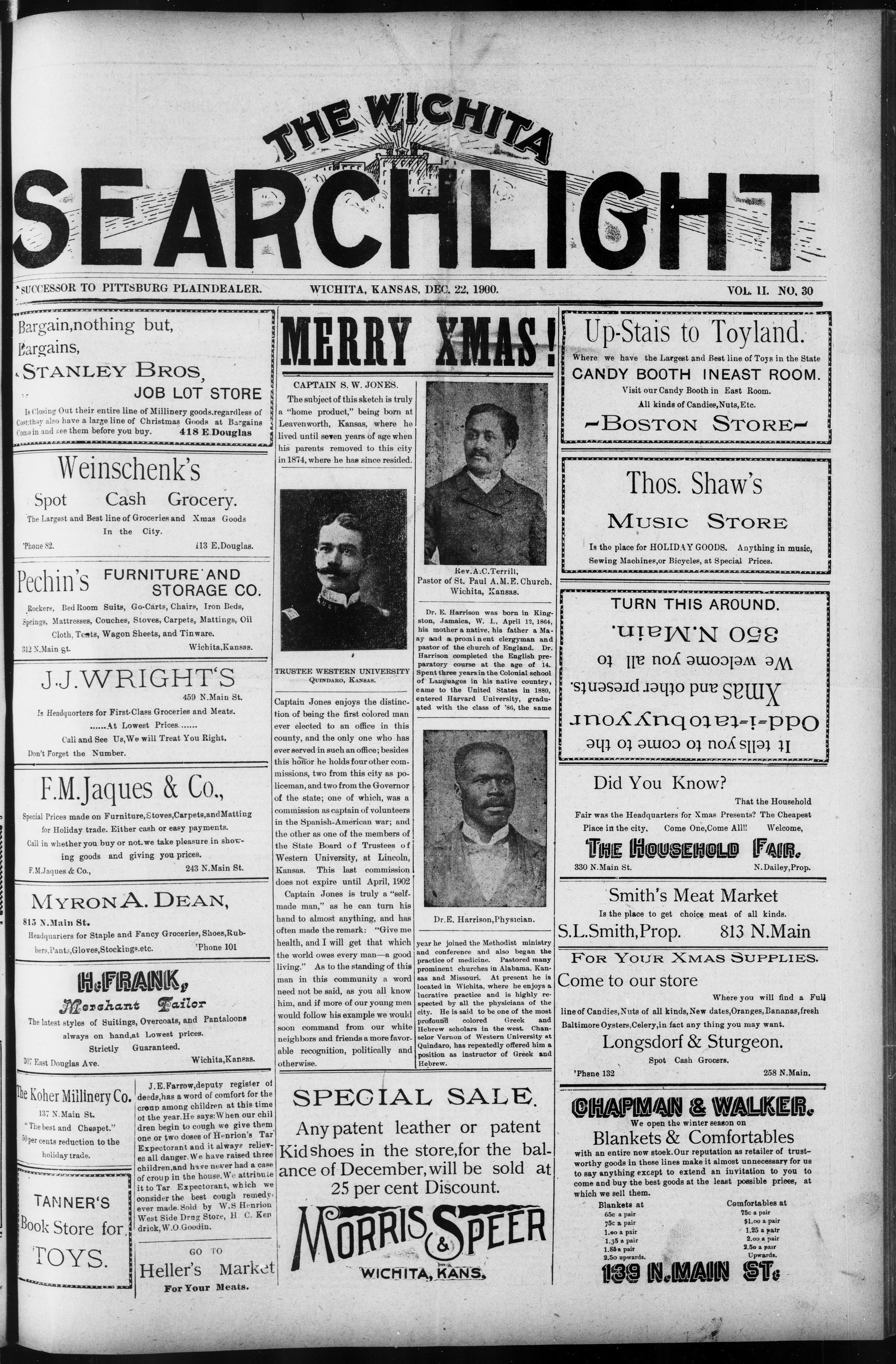
WICHITA, KANSAS, DEC. 22, 1900. MERRY XM CAPTAIN S. W. JONES
MERRY XMAS!
The subject of this sketch is truly a "home product," being born at Leavenworth, Kansas, where he lived until seven years of age when his parents removed to this city in 1874, where he has since resided.
1
TRUSTEE WESTERN UNIVERSITY
QUINDARO, KANSAS.
Captain Jones enjoys the distinction of being the first colored man ever elected to an office in this county, and the only one who has ever served in such an office; besides this honor he holds four other commissions, two from this city as policeman, and two from the Governor of the state; one of which, was a commission as captain of volunteers in the Spanish-American war; and the other as one of the members of the State Board of Trustees of Western University, at Lincoln, Kansas. This last commission does not expire until April, 1902. Captain Jones is truly a "self-made man," as he can turn his hand to almost anything, and has often made the remark: "Give me health, and I will get that which the world owes every man—a good living." As to the standing of this man in this community a word need not be said, as you all know him, and if more of our young men would follow his example we would soon command from our white neighbors and friends a more favorable recognition, politically and otherwise.
SPECIAL SALE
Any patent lea Kid shoes in the ance of December 25 per cent
Any patent leather or patent Kid shoes in the store,for the balance of December,will be sold at 25 per cent Discount. MORRIS SPEER WICHITA, KANS.
XMAS!
M. B. B.
Rev.A.C.Terrill, Pastor of St. Paul A.M.E. Church, Wichita, Kansas.
Dr. E. Harrison was born in Kingston, Jamaica, W. I., April 12, 1864, his mother a native, his father a May and a prominent clergyman and pastor of the church of England. Dr. Harrison completed the English preparatory course at the age of 14. Spent three years in the Colonial school of Languages in his native country, came to the United States in 1880, entered Harvard University, graduated with the class of 86, the same
[Picture of a man in a suit and bow tie].
Dr.E. Harrison, Physician.
year he joined the Methodist ministry and conference and also began the practice of medicine. Pastored many prominent churches in Alabama, Kansas and Missouri. At present he is located in Wichita, where he enjoys a lucrative practice and is highly respected by all the physicians of the city. He is said to be one of the most profound colored Greek and Hebrew scholars in the west. Chanselor Vernon of Western University at Quindaro, has repeatedly offered him a position as instructor of Greek and Hebrew.
ather or patent
store,for the bal-
er,will be sold at
t Discount.
Bla
with an en-
worthy good
to say any
come and b
which we s
Blan
65c
75c
Up-Stais to Toyland.
Where we have the Largest and Best line of Toys in the Sta
CANDY BOOTH INEAST ROOM
Visit our Candy Booth in East Room.
All kinds of Candies,Nuts,Etc.
BOSTON STORE
Thos. Shaw's
MUSIC STORE
Up-Stais to Toyland.
Where we have the Largest and Best line of Toys in the State
CANDY BOOTH INEAST ROOM.
Visit our Candy Booth in East Room.
All kinds of Candies, Nuts, Etc.
BOSTON STORE
It tells you to come to the Odd=i=tatobuyyour Xmas and other presents. We welcome you all to 350 N.Main.
It tells you to come to the Odd=i=tatobuyyour Xmas and other presents. We welcome you all to 350 N.Main.
That the Household
Fair was the Headquarters for Xmas Presents? The Cheapest
Place in the city. Come One,Come All!! Welcome,
THE HOUSEHOLD FAIR.
330 N.Main St. N.Dailey,Prop.
Smith's Meat Market
Is the place to get choice meat of all kinds.
L.L. Smith, Prop. 813 N.Main
FOR YOUR XMAS SUPPLIES
Come to our store
Where you will find a F
one of Candies, Nuts of all kinds, New dates, Oranges, Bananas, fresh
altimore Oysters, Celery, in fact any thing you may want.
Longsdorf & Sturgeon.
Spot Cash Grocers.
'Phsne 132 258 N.Main.
Smith's Meat Market
Is the place to get choice meat of all kinds.
S.L.Smith,Prop. 813 N.Main
FOR YOUR XMAS SUPPLIES.
Come to our store
CHAPMAN & WALKER.
with an entire new stock. Our reputation as retailer of trustworthy goods in these lines make it almost unnecessary for us to say anything except to extend an invitation to you to come and buy the best goods at the least possible prices, at which we sell them.
Blankets at Comfortables at
65c a pair 75c a pair
75c a pair $1.00 a pair
1.00 a pair 1.25 a pair
1.35 a pair 2.00 a pair
1.85 a pair 2.50 a pair
2.50 upwards. Upwards.
139 N.MAIN ST.
'Phsne 132
VOL. 11. NO. 30
Toyland.
Line of Toys in the Sta-
EAST ROOM
East Room.
uts, Etc.
STORE
AW'S
STORE
Is the place for HOLIDAY GOODS. Anything in music, Sewing Machines,or Bicycles, at Special Prices.
TURN THIS AROUND.
It tells you
Odd=i=ta
Xmas
We weld
350
Market
of all kinds.
813 N.Main
SUPPLIES
ere you will find a F
s,Oranges,Bananas,fres
you may want.
urgeon.
258 N.Main.
Comfortables at
75c a pair
$1.00 a pair
1.25 a pair
2.00 a pair
2.50 a pair
Upwards.
ST:
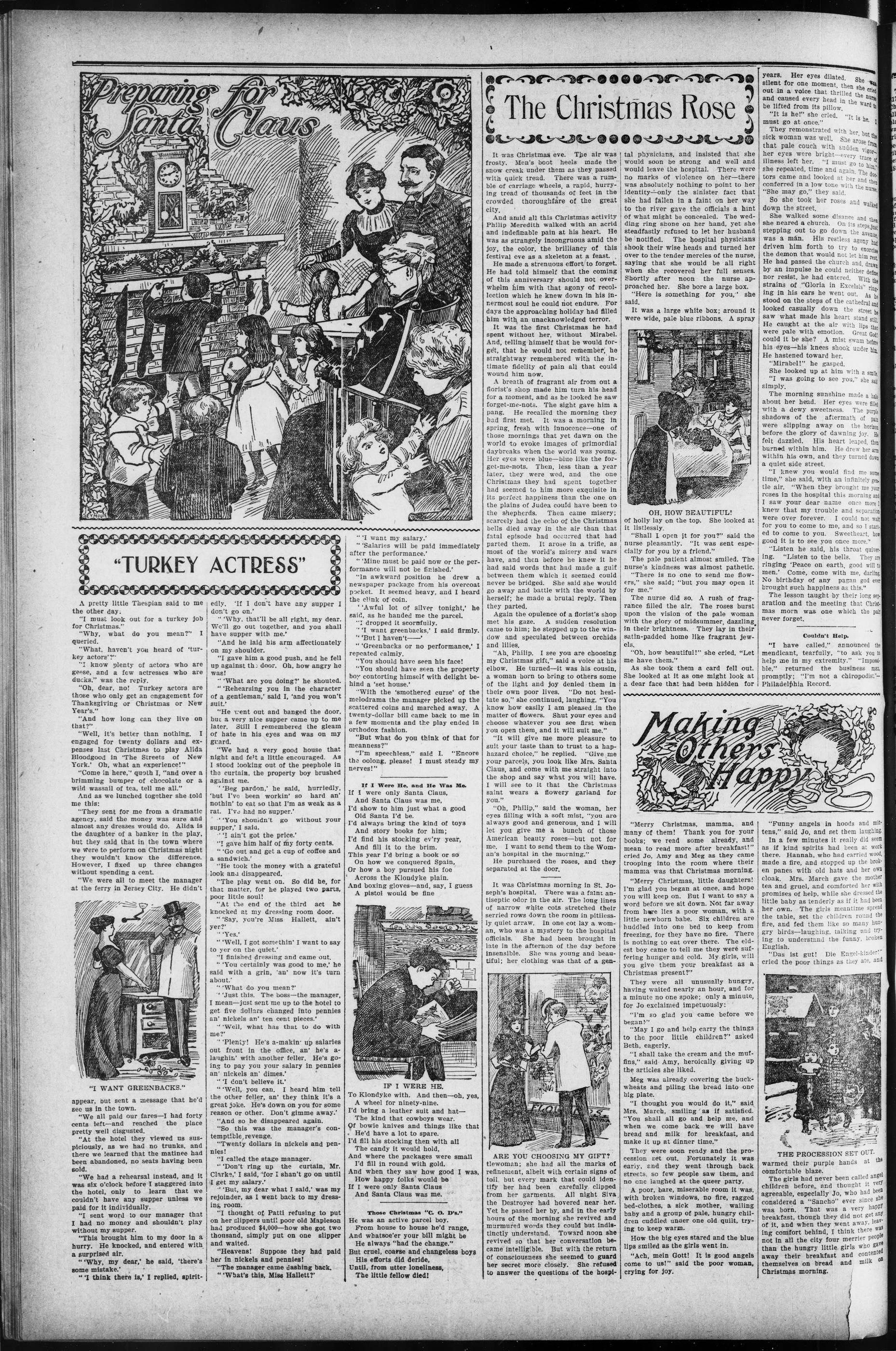
Did You Know?
The Story of Christmas
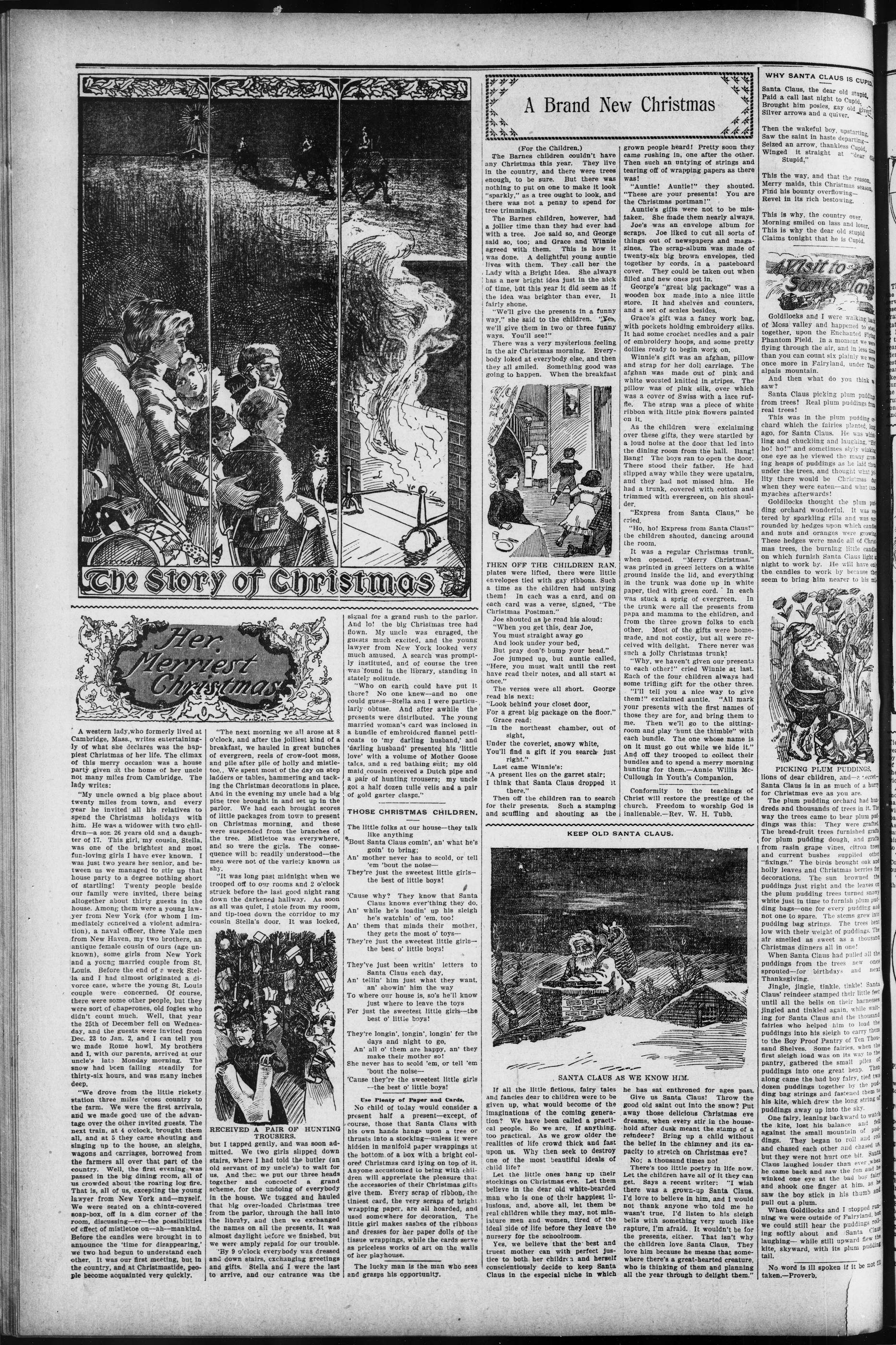
Her. Merriest Christmas
A western lady, who formerly lived at Cambridge, Mass., writes entertainingly of what she declares was the happiest Christmas of her life. The climax of this merry occasion was a house party given at the home of her uncle not many miles from Cambridge. The lady writes:
"The next morning we all arose at o'clock, and after the jolliest kind of breakfast, we hauled in great bunch of evergreen, reels of crow-foot moose and pile after pile of holly and mist tooe. We spent most of the day on stadders or tables, hammering and tac ing the Christmas decorations in pla
"My uncle owned a big place about twenty miles from town, and every year he invited all his relatives to spend the Christmas holidays with him. He was a widower with two children—a son 26 years old and a daughter of 17. This girl, my cousin, Stella, was one of the brightest and most fun-loving girls I have ever known. I was just two years her senior, and between us we managed to etir up that house party to a degree nothing short of startling! Twenty people beside our family were invited, there being altogether about thirty guests in the house. Among them were a young lawyer from New York (for whom I immediately conceived a violent admiration), a naval officer, three Yale men from New Haven, my two brothers, an antique female cousin of ours (age unknown), some girls from New York and a young married couple from St. Louis. Before the end of a week Stella and I had almost originated a divorce case, where the young St. Louis couple were concerned. Of course, there were some other people, but they were sort of chaperones, old fogies who didn't count much. Well, that year the 25th of December fell on Wednesday, and the guests were invited from Dec. 23 to Jan. 2, and I can tell you you made Rome howl. My brothers and I, with our parents, arrived at our uncle's late Monday morning. The snow had been falling steadily for thirty-six hours, and was many inches deep.
"We drove from the little rickety station three miles 'cross country to the farm. We were the first arrivals, and we made good use of the advantage over the other invited guests. The next train, at 4 o'clock, brought them all, and at 5 they came shouting and singing up to the house, an sleighs, wagons and carriages, borrowed from the farmers all over that part of the country. Well, the first evening was passed in the big dining room, all of us crowded about the roaring log fire. That is, all of us, excepting the young lawyer from New York and—myself. We were seated on a chintz-covered soap-box, off in a dim corner of the room, discussing—er the possibilities of effect of mistletoe on—ah—mankind. Before the candles were brought in to announce the 'time for disappearing,' we two had begun to understand each other. It was our first meeting, but in the country, and at Christmastide, people become acquainted very quickly.
"The next morning we all arose at 8 o'clock, and after the jolliest kind of a breakfast, we hauled in great bunches of evergreen, reels of crow-foot moss, and pile after pile of holly and mistletoe. We spent most of the day on step ladders or tables, hammering and tacking the Christmas decorations in place. And in the evening my uncle had a big pine tree brought in and set up in the parlor. We had each brought scores of little packages from town to present on Christmas morning, and these were suspended from the branches of the tree. Mistletoe was everywhere, and so were the girls. The consequence will be readily understood—the men were not of the variety known as shy.
"It was long past midnight when we trooped off to our rooms and 2 o'clock struck before the last good night rang down the darkened hallway. As soon as all was quiet, I stole from my room, and tip-toe down the corridor to my cousin Stella's door. It was locked,
A
RECEIVED A PAIR OF HUNTING TROUISERS.
RECEIVED A PAIR OF HUNTING TROUSERS. but I tapped gently, and was soon admitted. We two girls slipped down stairs, where I had told the butler (an old servant of my uncle's) to wait for us. And then we put our three heads together and concocted a grand scheme, for the undoing of everybody in the house. We tugged and hauled that big over-loaded Christmas tree from the parlor, through the hall into the library, and then we exchanged the names on all the presents. It was almost daylight before we finished, but we were amply repaid for our trouble. "By 9 o'clock everybody was dressed and down stairs, exchanging greetings and gifts. Stella and I were the last to arrive, and our entrance was the
signal for a grand rush to the parlor. And lo! the big Christmas tree had flown. My uncle was enraged, the guests much excited, and the young lawyer from New York looked very much amused. A search was promptly instituted, and of course the tree was found in the library, standing in stately solitude. "Who on earth could have put it there? No one knew—and no one could guess—Stella and I were particularly obtuse. And after awhile the presents were distributed. The young married woman's card was inclosed in a bundle of embroidered flannel petticoats to 'my darling husband,' and 'darling husband' presented his 'little love' with a volume of Mother Goose talks, and a red bathing suit; my old maid cousin received a Dutch pipe and a pair of hunting trousers; my uncle got a half dozen tulle veils and a pair of gold garter clasps."
The little folks at our house—they talk like anything
'Bout Santa Claus comin', an' what he's goin' to bring;
An' mother never has to scold, or tell 'em 'bout the noise—
They're just the sweetest little girls—the best of little boys!
'Cause why? They know that Santa Claus knows ever'thing they do.
An' while he's loadin' up his sleigh he's watchin' of 'em, too!
An' them that minds their mother, they gets the most o' toys—
They're just the sweetest little girls—the best o' little boys!
They've just been writin' letters to Santa Claus each day.
An' tellin' him just what they want, an' showin' him the way
To where our house is, so's he'll know just where to leave the toys
Fer just the sweetest little girls—the best o' little boys!
They're longin', longin', longin' fer the days and night to go,
An' all o' them are happy, an' they make their mother so!
She never has to scold 'em, or tell 'em
'bout the noise—
'Cause they're the sweetest little girls
—the best o' little boys!
No child of today would consider a present half a present—except, of course, those that Santa Claus with his own hands hangs upon a tree or thrusts into a stocking—unless it were hidden in manifold paper wrappings at the bottom of a box with a bright colored Christmas card lying on top of it. Anyone accustomed to being with children will appreciate the pleasure that the accessories of their Christmas gifts give them. Every scrap of ribbon, the tiniest card, the very scraps of bright wrapping paper, are all hoarded, and used somewhere for decoration. The little girl makes sashes of the ribbons and dresses for her paper dolls of the tissue wrappings, while the cards serve as priceless works of art on the walls of her playhouse.
The lucky man is the man who sees and grasps his opportunity.
---
A Brand New Christmas
(For the Children.)
The Barnes children couldn't have any Christmas this year. They live in the country, and there were trees enough, to be sure. But there was nothing to put on one to make it look "sparkly," as a tree ought to look, and there was not a penny to spend for tree trimmings.
The Barnes children, however, had a jollier time than they had ever had with a tree. Joe said so, and George said so, too; and Grace and Winnie agreed with them. This is how it was done. A delightful young auntie lives with them. They call her the Lady with a Bright Idea. She always has a new bright idea just in the nick of time, but this year it did seem as if the idea was brighter than ever. It fairly shone.
"We'll give the presents in a funny way," she said to the children. "Yes, we'll give them in two or three funny ways. You'll see!"
There was a very mysterious feeling in the air Christmas morning. Everybody loked at everybody else, and then they all smiled. Something good was going to happen. When the breakfast
A
THEN OFF THE CHILDREN RAN,
plates were lifted, there were little
envelopes tied with gay ribbons. Such
a time as the children had untying
them! In each was a card, and on
each card was a verse, signed, "The
Christmas Postman."
But pray don't bump your head.
Joe jumped up, but auntie called,
"Here, you must wait until the rest
have read their notes, and all start at
once."
The verses were all short. George
read his next:
"Look behind your closet door,
For a great big package on the floor."
Grace read:
"In the northeast chamber, out of
sight,
Under the coverlet, snowy white,
You'll find a gift if you search just
right."
Last came Winnie's:
"A present lies on the garret stair;
I think that Santa Claus dropped it
there."
Then off the children ran to search
for their presents. Such a stamping
and scuffling and shouting as the
KEEP OLD SANTA CLAUS.
SANTA CLAUS
SANTA CLAUS
SANTA CLAUS AS WE KNOW HIM.
If all the little fictious, fairy tales and fancies dear to children were to be given up, what would become of the imaginations of the coming generation? We have been called a practical people. So we are. If anything, too practical. As we grow older the realities of life crowd thick and fast upon us. Why then seek to destroy one of the most beautiful ideals of child life?
Let the little ones hang up their stockings on Christmas eve. Let them believe in the dear old white-bearded man who is one of their happiest illusions, and, above all, let them be real children while they may, not miniature men and women, tired of the ideal side of life before they leave the nursery for the schoolroom.
Yes, we believe that the best and truest mother can with perfect justice to both her children and herself conscientiously decide to keep Santa Claus in the especial niche in which
---
grown people heard! Pretty soon they came rushing in, one after the other. Then such an untying of strings and tearing off of wrapping papers as there was!
"Auntie! Auntie!" they shouted.
"These are your presents! You are the Christmas postman!"
Auntie's gifts were not to be mistaken. She made them nearly always. Joe's was an envelope album for scraps. Joe liked to cut all sorts of things out of newspapers and magazines. The scrap-album was made of twenty-six big brown envelopes, tied together by cords, in a pasteboard cover. They could be taken out when filled and new ones put in.
George's "great big package" was a wooden box made into a nice little store. It had shelves and counters, and a set of scales besides
Grace's gift was a fancy work bag, with pockets holding embroidery silks. It had some crochet needles and a pair of embroidery hoops, and some pretty doilies ready to begin work on. Winnie's gift was an afghan, pillow and strap for her doll carriage. The afghan was made out of pink and white worsted knitted in stripes. The pillow was of pink silk, over which was a cover of Swiss with a lace ruffle. The strap was a piece of white ribbon with little pink flowers painted on it.
As the children were exclaiming over these gifts, they were started by a loud noise at the door that led into the dining room from the hall. Bang! Bang! The boys ran to open the door. There stood their father. He had slipped away while they were upstairs, and they had not missed him. He had a trunk, covered with cotton and trimmed with evergreen, on his shoulder.
"Express from Santa Claus," he cried.
"Ho, ho! Express from Santa Claus!" the children shouted, dancing around the room.
It was a regular Christmas trunk, when opened. "Merry Christmas," was printed in green letters on a white ground inside the lid, and everything in the trunk was done up in white paper, tied with green cord. In each was stuck a sprig of evergreen. In the trunk were all the presents from papa and mamma to the children, and from the three grown folks to each other. Most of the gifts were homemade, and not costly, but all were received with delight. There never was such a jolly Christmas trunk!
"Why, we haven't given our presents to each other!" cried Winnie at last. Each of the four children always had some trifling gift for the other three. "I'll tell you a nice way to give them!" exclaimed auntie. "All mark your presents with the first names of those they are for, and bring them to me. Then we'll go to the sitting-room and play 'hunt the thimble' with each bundle. The one whose name is on it must go out while we hide it." And off they trooped to collect their bundles and to spend a merry morning hunting for them.—Annie Willis McCullough in Youth's Companion.
Conformity to the teachings of Christ will restore the prestige of the church. Freedom to worship God is inalienable.—Rev. W. H. Tubb.
A
he has sat enthroned for ages past. Give us Santa Claus! Throw the good old saint out into the snow? Put away those delicious Christmas eve dreams, when every stir in the household after dusk meant the stamp of a reindeer? Bring up a child without the belief in the chimney and its capacity to stretch on Christmas eve?
No; a thousand times no!
There's too little poetry in life now. Let the children have all of it they can get. Says a recent writer: "I wish there was a grown-up Santa Claus. I'd love to believe in him, and I would not thank anyone who told me he wasn't true. I'd listen to his sleigh bells with something very much like rapture, I'm afraid. It wouldn't be for the presents, either. That isn't why the children love Santa Claus. They love him because he means that somewhere there's a great-hearted creature, who is thinking of them and planning all the year through to delight them."
---
Santa Claus, the dear old stupid,
Paid a call last night to Cupid,
Brought him posies, gay old giver,
Silver arrows and a quiver.
Then the wakeful boy, upstarting,
Saw the saint in haste departing—
Seized an arrow, thankless Cupid,
Winged it straight at "dear
Stupid."
This the way, and that the reason,
Merry maids, this Christmas season,
Find his bounty overflowing—
Revel in its rich bestowing.
This is why, the country over,
Morning smiled on lass and lover.
This is why the dear old stupid
Claims tonight that he is Cupid.
AVisit to Santa Claus
Goldilocks and I were walking back of Moss valley and happened to stop together, upon the Enchanted Flying Phantom Field. In a moment we were flying through the air, and in less than than you can count six plainly we once more in Fairyland, under Turtle alpais mountain.
And then what do you think we saw?
Santa Claus picking plum puddings from trees! Real plum puddings from real trees!
This was in the plum pudding orchard which the fairies planted, long ago, for Santa Claus. He was whining and chuckling and laughing. "He ho! ho!" and sometimes slyly whining one eye as he viewed the many growing heaps of puddings as he laid them under the trees, and thought what joylity there would be Christmas when they were eaten—and what myaches afterwards!
Goldilocks thought the plum pudding orchard wonderful. It was tered by sparkling rills and was rounded by hedges upon which candles and nuts and oranges were growing. These hedges were made all of Christmas trees, the burning little candles on which furnish Santa Claus light a night to work by. He will have on the candles to work by because the seem to bring him nearer to his m
SANTA
PICKING PLUM PUDDINGS, lions of dear children, and—a secret—Santa Claus is in as much of a hurry for Christmas eve as you are. The plum pudding orchard had hundreds and thousands of trees in it. The way the trees came to bear plum puddings was this: They were grafted. The bread-fruit trees furnished grafts for plum pudding dough, and grafts from rasin grape vines, citron trees and current bushes supplied often "fixings." The birds brought oak and holly leaves and Christmas berries for decorations. The sun browned the puddings just right and the leaves on the plum pudding trees turned snowy white just in time to furnish plum pudding bags—one for every pudding and not one to spare. The stems grew into pudding bag strings. The trees bent low with their weight of puddings. The air smelled as sweet as a thousand Christmas dinners all in one!
When Santa Claus had pulled all the puddings from the trees new ones sprouted—for birthdays and next Thanksgiving.
Jingle, jingle, jingle, tinkle, tinkle! Santa Claus' reindeer stamped their little feet until all the bells on their harnesses jingled and tinkled again, while waiting for Santa Claus and the thousand fairies who helped him to load the puddings into his sleigh to carry them to the Boy Proof Pantry of Ten Thousand Shelves. Some fairies, when the first sleigh load was on its way to the pantry, gathered the small piles of puddings into one great heap. Then along came the bad boy fairy, tied two dozen puddings together by the pudding bag strings and fastened them to his kite, which drew the long string of puddings away up into the sky.
One fairy, leaning backward to watch the kite, lost his balance and fell against the small mountain of puddings. They began to roll and roll and chased each other and chased us, but they were not hurt one bit. Santa Claus laughed louder than ever, when he came back and saw the fun and the winked one eye at the bad boy fairy and shook one finger at him, as he saw the boy stick in his thumb and pull out a plum.
When Goldilocks and I stopped running we were outside of Fairyland, but we could still hear the puddings rolling softly about and Santa Claus laughing—while still upward flew the kite, skyward, with its plum pudding tail.
No word is ill spoken if it be not ill taken—Proverb.
PRIVATE
TIERNAN'S
RYE
WHISKEY
XMAS
THE STORM
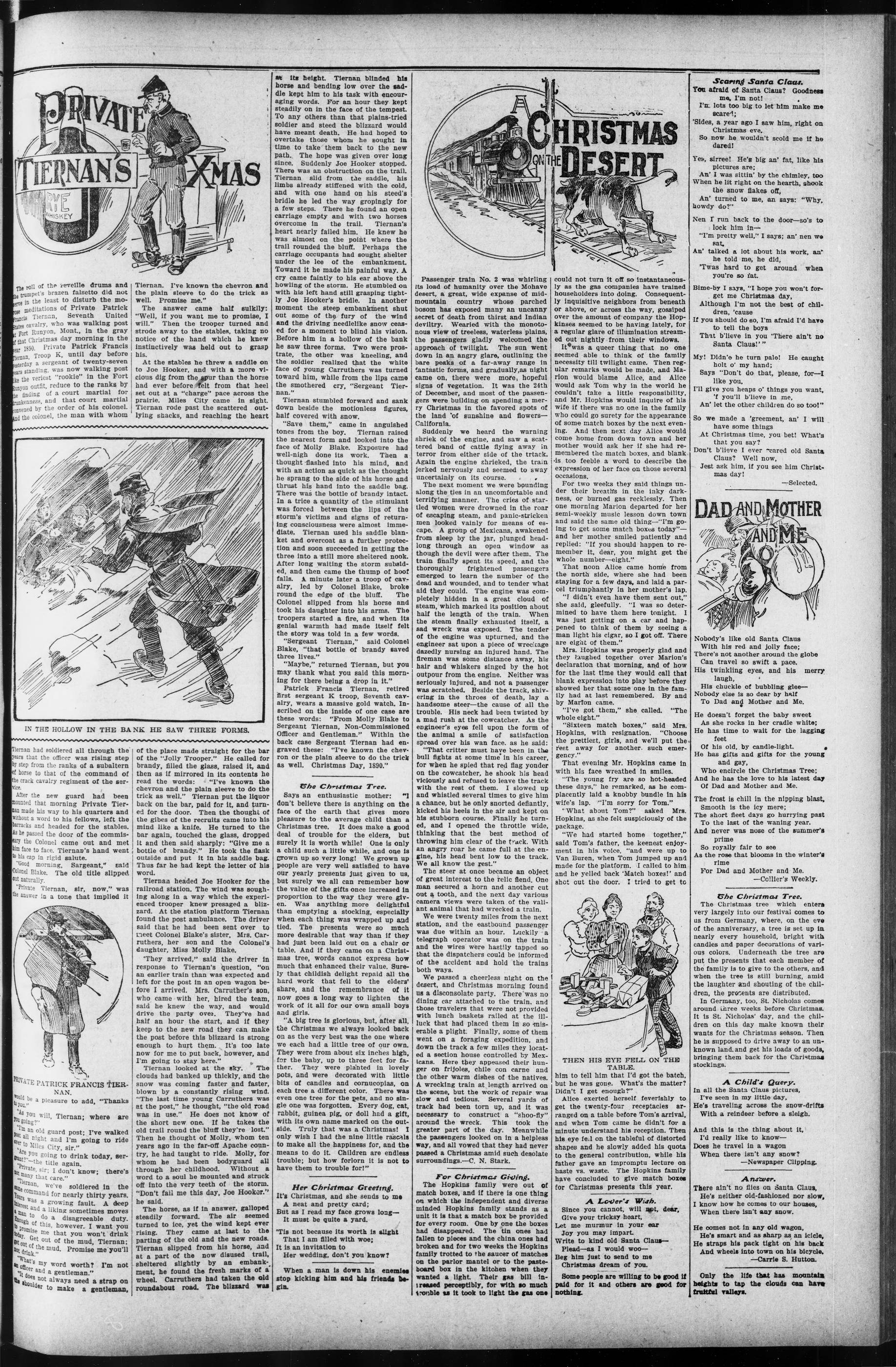
IN THE HOLLOW IN THE BANK HE SAW THREE FORMS.
The roll of the revelle drums and the trumpet's brazen falsetto did not serve in the leazen to disturb the moose meditations of Private Patrick Francis Tiernan, Seventh United States cavalry, who was walking post at Fort Runyon, Mont., in the gray of that Christmas day morning in the year 1890. Private Patrick Francis Tiernan, Troop K, until day before yesterday a sergeant of twenty-seven years standing, was now walking post like the veriest "rookie" in the Fort Runyon outfit, reduce to the ranks by the finding of a court martial for drunkenness, and that court martial convened by the order of his colonel, and the colonel, the man with whom
IN THE HOLLOW IN THE BA
Tiernan had soldiered all through the years that the officer was rising step by step from the ranks of a subaltern of horse to that of the command of the crack cavalry regiment of the service.
After the new guard had been mounted that morning Private Tiernan made his way to his quarters and without a word to his fellows, left the barracks and headed for the stables. As he passed the door of the commissary the Colonel came out and met him face to face. Tiernan's hand went to his cap in rigid salute.
"Good morning, Sargeant," said Colonel Blake. The old title slipped out naturally.
"Private Tiernan, sir, now," was the answer in a tone that implied it
PRIVATE PATRICK FRANCIS TIER
NAN.
would be a pleasure to add, "Thanks to you."
"As you will, Tiernan; where are you going?"
"I'm an old guard post; I've walked post all night and I'm going to ride over to Miles City, sir."
"Are you going to drink today, sergant?" - the title again.
"Private, sir; I don't know; there's many that care."
"Tiernan, we've soldiered in the same command for nearly thirty years. Your was a interest fault. A deep interest and a liking sometimes moves a man to do a disagreeable duty. Enough of this, however. I want you to promise me that you won't drink today. Get out of the mud, Tiernan; get out of the mud. Promise me you'll not drink."
"What's my word worth? I'm not an officer and a gentleman."
"It does not always need a strap on this shoulder to make a gentleman."
6
Tiernan. I've known the chevron and the plain sleeve to do the trick as well. Promise me."
The answer came half sulkily: "Well, if you want me to promise, I will." Then the trooper turned and strode away to the stables, taking no notice of the hand which he knew instinctively was held out to grasp his.
At the stables he threw a saddle on to Joe Hooker, and with a more vicious dig from the spur than the horse had ever before felt from that heel set out at a "charge" pace across the prairie. Miles City came in sight. Tiernan rode past the scattered outlying shacks, and reaching the heart
NK HE SAW THREE FORMS.
of the place made straight for the bar of the "Jolly Trooper." He called for brandy, filled the glass, raised it, and then as if mirrored in its contents he read the words: "I've known the chevron and the plain sleeve to do the trick as well." Tiernan put the liquor back on the bar, paid for it, and turned for the door. Then the thought of the gibes of the recruits came into his mind like a knife. He turned to the bar again, touched the glass, dropped it and then said sharply: "Give me a bottle of brandy." He took the flask outside and put it in his saddle bag. Thus far he had kept the letter of his word.
Tiernan headed Joe Hooker for the railroad station. The wind was soughing along in a way which the experienced trooper knew presaged a blizzard. At the station platform Tiernan found the post ambulance. The driver said that he had been sent over to meet Colonel Blake's sister, Mrs. Carruthers, her son and the Colonel's daughter, Miss Molly Blake.
"They arrived," said the driver in response to Tiernan's question, "on an earlier train than was expected and left for the post in an open wagon before I arrived. Mrs. Carruther's son, who came with her, hired the team, said he knew the way, and would drive the party over. They've had half an hour the start, and if they keep to the new road they can make the post before this blizzard is strong enough to hurt them. It's too late now for me to put back, however, and I'm going to stay here."
Tiernan looked at the sky. The clouds had banked up thickly, and the snow was coming faster and faster, blown by a constantly rising wind. "The last time young Carruthers was at the post," he thought, "the old road was in use." He does not know of the short new one. If he takes the old trail round the bluff they're lost." Then he thought of Molly, whom ten years ago in the far-off Apache country, he had taught to ride. Molly, for whom he had been bodyguard all through her childhood. Without a word to a soul he mounted and struck off into the very teeth of the storm. "Don't fail me this day, Joe Hookar." he said.
The horse, as if in answer, galloped steadily forward. The air seemed turned to ice, yet the wind kept ever rising. They came at last to the parting of the old and the new roads. Tlernan slipped from his horse, and at a part of the now disused trail, sheltered slightly by an embankment, he found the fresh marks of a wheel. Carruthers had taken the old roundabout road. The blizzard was
at its height. Tiernan blinded his horse and bending low over the saddle kept him to his task with encouraging words. For an hour they kept steadily on in the face of the tempest. To any others than that plains-tried soldier and steed the blizzard would have meant death. He had hoped to overtake those whom he sought in time to take them back to the new path. The hope was given over long since. Suddenly Joe Hooker stopped. There was an obstruction on the trail. Tiernan slid from the saddle, his limbs already stiffened with the cold, and with one hand on his steed's bridle he led the way gropingly for a few steps. There he found an open carriage empty and with two horses overcome in the trail. Tiernan's heart nearly failed him. He knew he was almost on the point where the trail rounded the bluff. Perhaps the carriage occupants had sought shelter under the lee of the embankment. Toward it he made his painful way. A cry came faintly to his ear above the howling of the storm. He stumbled on with his left hand still grasping tightly Joe Hooker's bridle. In another moment the steep embankment shut out some of the fury of the wind and the driving needellike snow ceased for a moment to blind his vision. Before him in a hollow of the bank he saw three forms. Two were prostrate, the other was kneeling, and the soldier realized that the white face of young Carruthers was turned toward him, while from the lips came the smothered cry, "Sergeant Tiernan."
Tiernan stumbled forward and sank down beside the motionless figures, half covered with snow.
"Save them," came in anguished tones from the boy. Tiernan raised the nearest form and looked into the face of Molly Blake. Exposure had well-nigh done its work. Then a thought flashed into his mind, and with an action as quick as the thought he sprang to the side of his horse and thrust his hand into the saddle bag. There was the bottle of brandy intact. In a trice a quantity of the stimulant was forced between the lips of the storm's victims and signs of returning consciousness were almost immediate. Tiernan used his saddle blanket and overcoat as a further protection and soon succeeded in getting the three into a still more sheathed nook. After long waiting the storm subsided, and then came the thump of hoof falls. A minute later a troop of cavalry, led by Colonel Blake, broke round the edge of the bluff. The Colonel slipped from his horse and took his daughter into his arms. The troopers started a fire, and when its genial warmth had made itself felt the story was told in a few words.
"Sergeant Tiernan," said Colonel Blake, "that bottle of brandy saved three lives."
"Maybe," returned Tiernan, but you may thank what you said this morning for there being a drop in it."
Patrick Francis Tiernan, retired first sergeant K troop, Seventh cavalry, wears a massive gold watch. Inscribed on the inside of one case are these words: "From Molly Blake to Sergeant Tiernan, Non-Commissioned Officer and Gentleman." Within the back case Sergeant Tiernan had engraved these: "I've known the chevron or the plain sleeve to do the trick as well. Christmas Day, 1890."
The Christmas Tree.
Says an enthusiastic mother: "I don't believe there is anything on the face of the earth that gives more pleasure to the average child than a Christmas tree. It does make a good deal of trouble for the elders, but surely it is worth while! One is only a child such a little while, and one is grown up so very long! We grown up people are very well satisfied to have our yearly presents just given to us, but surely we all can remember how the value of the gifts once increased in proportion to the way they were given. Was anything more delightful than emptying a stocking, especially when each thing was wrapped up and tied. The presents were so much more desirable that way than if they had just been laid out on a chair or table. And if they came on a Christmas tree, words cannot express how much that enhanced their value. Surely that childish delight repaid all the hard work that fell to the elders' share, and the remembrance of it now goes a long way to lighten the work of it all for our own small boys and girls.
"A big tree is glorious, but, after all, the Christmas we always looked back on as the very best was the one where we each had a little tree of our own. They were from about six inches high, for the baby, up to three feet for father. They were planted in lovely pots, and were decorated with little bits of candles and cornucopias, on each tree a different color. There was even one tree for the pets, and no single one was forgotten. Every dog, cat, rabbit, guinea pig, or doll had a gift, with its own name marked on the outside. Truly that was a Christmas! I only wish I had the nine little rascals to make all the happiness for, and the means to do it. Children are endless trouble; but how forlorn it is not to have them to trouble for!"
Her Christmas Greeting.
It's Christmas, and she sends to me a neat and pretty card;
But as I read my face grows long—
It must be quite a yard.
'Tis not because its worth is slight
That I am filled with woe;
It is an invitation to
Her wedding, don't you know?
When a man is down his enemies
stop kicking him and his friends begin.
CHRISTMAS
ON THE DESERT
Passenger train No. 2 was whirling its load of humanity over the Mohave desert, a great, wide expanse of midmountain country whose parched bosom has exposed many an uncanny secret of death from thirst and Indian devilry. Wearied with the monotonous view of treeless, waterless plains, the passengers gladly welcomed the approach of twilight. The sun went down in an angry glare, outlining the bare peaks of a far-away range in fantastic forms, and gradually, as night came on, there were more, hopeful signs of vegetation. It was the 24th of December, and most of the passengers were building on spending a merry Christmas in the favored spots of the land of sunshine and flowers—California.
Suddenly we heard the warning shriek of the engine, and saw a scattered band of cattle flying away in terror from either side of the trtack. Again the engine shrieked, the train jerked nervously and seemed to sway uncertainly on its course.
The next moment we were bounding along the ties in an uncomfortable and terrifying manner. The cries of startled women were drowned in the roar of escaping steam, and panic-striken men looked vainly for means of escape. A group of Mexicans, awakened from sleep by the jar, plunged headlong through an open window as though the devil were after them. The train finally spent its speed, and the thoroughly frightened passengers emerged to learn the number of the dead and wounded, and to tender what ald they could. The engine was completely hidden in a great cloud of steam, which marked its position about half the length of the train. When the steam finally exhausted itself, a sad wreck was exposed. The tender of the engine was upturned, and the engineer sat upon a piece of wreckage dazedly nursing an injured hand. The fireman was some distance away, his hair and whiskers singed by the hot outpour from the engine. Neither was seriously injured, and not a passenger was scratched. Beside the track, shivering in the throes of death, lay a handsome steer—the cause of all the trouble. His neck had been twisted by a mad rush at the cowcatcher. As the engineer's eyes fell upon the form of the animal a smile of satisfaction spread over his wan face, as he said:
"That critter must have been in the bull fights at some time in his career, for when he spied that red flag yonder on the cowcatcher, he shook his head viciously and refused to leave the track with the rest of them. I slowed up and whistled several times to give him a chance, but he only snorted defiantly, kicked his heels in the air and kept on his stubborn course. Finally he turned, and I opened the throttle wide, thinking that the best method of throwing him clear of the track. With an angry roar he came full at the engine, his head bent low to the track. We all know the rest."
The steer at once became an object of great interest to the relic flounder. One man secured a horn and another cut out a tooth, and the next day various camera views were taken of the valiant animal that had wrecked a train.
We were twenty miles from the next station, and the eastbound passenger was due within an hour. Luckily a telegraph operator was on the train and the wires were hastily tapped so that the dispatchers could be informed of the accident and hold the trains both ways.
We passed a cheerless night on the desert, and Christmas morning found us a disconsolate party. There was no dining car attached to the train, and those travelers that were not provided with lunch baskets railed at the illuck that had placed them in so miserable a plight. Finally, some of them went on a foraging expedition, and down the track a few miles they located a section house controlled by Mexicans. Here they appeased their hunger on frijoles, chile con carne and the other warm dishes of the natives. A wrecking train at length arrived on the scene, but the work of repair was slow and tedious. Several yards of track had been torn up, and it was necessary to construct a "shoo-fly" around the wreck. This took the greater part of the day. Meanwhile the passengers looked on in a helpless way, and all vowed that they had never passed a Christmas amid such desolate surroundings.—C. N. Stark.
For Christmas Giving
The Hopkins family were out of match boxes, and if there is one thing on which the independent and diverse minded Hopkins family stands as a unit it is that a match box be provided for every room. One by one the boxes had disappeared. The tin ones had fallen to pieces and the china ones had broken and for two weeks the Hopkins family trotted to the saucer of matches on the parlor mantel or to the pasteboard box in the kitchen when they wanted a light. Their gas bill increased perceptibly, for with so much trouble as it took to light the gas one
could not turn it off so instantaneously as the gas companies have trained householders into doing. Consequently inquisitive neighbors from beneath or above, or across the way, gossiped over the amount of company the Hopkins seemed to be having lately, for a regular glare of illumination streamed out nightly from their windows.
It was a queer thing that no one seemed able to think of the family necessity till twilight came. Then regular remarks would be made, and Marlon would blame Alice, and Alice would ask Tom why in the world he couldn't take a little responsibility, and Mr. Hopkins would inquire of his wife if there was no one in the family who could go surely for the appearance of some match boxes by the next evening. And then next day Alice would come home from down town and her mother would ask her if she had remembered the match boxes, and blank is too feeble a word to describe the expression of her face on those several occasions.
For two weeks they said things under their breathes in the inky darkness, or burned gas recklessly. Then one morning Marion departed for her semi-weekly music lesson down town and said the same old thing—"I'm going to get some match boxes today"—and her mother smiled patiently and replied: "If you should happen to remember it, dear, you might get the whole number—eight."
That noon Alice came home from the north side, where she had been staying for a few days, and laid a parcel triumphantly in her mother's lap.
"I didn't even have them sent out," she said, gleefully. "I was so determined to have them here tonight. I was just getting on a car and happened to think of them by seeing a man light his cigar, so I got off. There are eight of them."
Mrs. Hopkins was properly glad and they laughed together over Marion's declaration that morning, and of how for the last time they would call that blank expression into play before they showed her that some one in the family had at last remembered. By and by Marfon came.
"I've got them," she called. "The whole eight."
"Sixteen match boxes," said Mrs. Hopkins, with resignation. "Choose the prettiest, girls, and we'll put the rest away for another, such emergency."
That evening Mr. Hopkins came in with his face wreathed in smiles.
"The young fry are so hot-headed these days," he remarked, as he complacently laid a knobby bundle in his wife's lap. "I'm sorry for Tom."
"What about Tom?" asked Mrs. Hopkins, as she felt suspiciously of the package.
"We had started home together," said Tom's father, the keenest enjoyment in his voice. "and were up to Van Buren, when Tom jumped up and made for the platform. I called to him and he yelled back 'Match boxes!' and shot out the door. I tried to get to
THEN HIS EYE FELL ON THE TABLE
him to tell him that I'd got the batch, but he was gone. What's the matter? Didn't I get enough?" Alice exerted herself feverishly to get the twenty-four receptacles arranged on a table before Tom's arrival, and when Tom came he didn't for a minute understand his reception. Then his eye fell on the tableful of distorted shapes and he slowly added his quota to the general contribution, while his father gave an impromptu lecture on haste vs. waste. The Hopkins family have concluded to give match boxes for Christmas presents this year.
A Lover's Wish
Some people are willing to be good if paid for it and others are good for nothing.
Blime-by I says, "I hope you won't forget me Christmas day,
Although I'm not the best of children, 'cause
If you should do so, I'm afraid I'd have to tell the boys
That b'live in you 'There ain't no Santa Claus!'"
My! Didn'e he turn pale! He caught holt o' my hand;
Says "Don't do that, please, for—I like you.
I'll give you heaps o' things you want,
'f you'll b'lieve in me,
'an' let the other children do so too!"
So we made a 'greement, an' I will
have some things
At Christmas time, you bet! What's
that you say?
Don't b'lieve I ever cared old Santa
Claus? Well now.
DAD AND MOTHER
AND ME
Nobody's like old Santa Claus
With his red and jolly face;
There's not another around the globe
Can travel so swift a pace.
His twinkling eyes, and his merry
laugh
His chuckle of bubbling glee—
Nobody else is so dear by half
To Dad and Mother and Me.
He doesn't forget the baby sweet
As she rocks in her cradle white;
He has time to wait for the lagging
feet
Of his old, by candle-light.
He has gifts and gifts for the young
and gay,
Who encircle the Christmas Tree;
And he has the love to his latest day
Of Dad and Mother and Me.
The frost is chill in the nipping blast,
Smooth is the levy mere;
And never was nose of the summer's prime
So royally fair to see
As the rose that blooms in the winter's rime
For Dad and Mother and Me.
—Collier's Weekly.
The Christmas Tree.
The Christmas tree which enters very largely into our festival comes to us from Germany, where, on the eve of the anniversary, a tree is set up in nearly every household, bright with candles and paper decorations of various colors. Underneath the tree are put the presents that each member of the family is to give to the others, and when the tree is still burning, amid the laughter and shouting of the children, the presents are distributed. In Germany, too, St. Nicholas comes around three weeks before Christmas. It is St. Nicholas' day, and the children on this day make known their wants for the Christmas season. Then he is supposed to drive away to an unknown land, and get his loads of goods, bringing them back for the Christmas stockings.
He's traveling across the snow-drifts
With a reindeer before a sleigh.
And this is the thing about it,
I'd really like to know—
Does he travel in a wagon
When there isn't any snow?
—Newspaper Clipping.
Answer.
Answer.
There ain't no files on Santa Claus,
He's neither old-fashioned nor slow,
I know how he comes to our houses,
When there isn't any snow.
He comes not in any old wagon,
He's smart and as sharp as an icicle,
He straps his pack tight on his back
And wheels into town on his bicycle.
—Carrie S. Hutton.
Only the life that has mountain
heights to tap the clouds can have
fruitful valleys.
THE SEARCHLIGHT WICHITA, KANSAS.
W. N. MILLER, Editor.
Entered at the Post Office at Wichita Kansas, as Second Class Mail Matter.
Published every Saturday at No 239 North Main Street, up stairs
RATES OF SUBSCRIPTION:
IN ADVANCE.
One year, by mail..... 81 69
Six months, by mail..... 75
Three months, by mail..... 50
Searchlight', Wichita, Kansas.
[All matters to be published must reach this once not later than Tuesday, to reach publication in the current issue.]
correspondents and agents wanted everywhere. Write us for terms.
All matters sent to "The Searchlight" for publication must be signed by the party or parties writing.
If you fail to get your paper notify us once.
-239 N Main st
We'd like to see
A Colored Fire Department here,
Jimme Johnston's liscense.
A few Colored men at work on
the streets.
Some of our young ladies clerking in stores.
Everybody have a merry xmas.
The Colored people drop so much foolishness, and go in business.
More Colored men buy homes,
and pay taxes instead of rent.
Everybody bring or send The Searchlight an Xmas present.
More Colored farmers.
If you reach any high place in This world do not get the big head nor forget the depth from which you rose and do not desert the friends that helped you on the way.
If the Negro can manage to be a friend to himself his future is secure He must learn the value of time and moneo.To waste either is foolish.
If there be a Negro problem, the Negro is the best one to solve it.By industry,race pride,common sense, home,buying and home owning,coupled with morality,intelligence and honesty,the problem will be solved. Too often do we see men of families and responsibilities given over to frivolities and pleasures of
life,wich are reprehensible in married young men.It is the bounden- tity of the head of every family to do best toards qrovid ing proper support for that family.so ast o al— low the wife to stay at home and properly care for her children. If heaven has so blessed their union, and to attend those householddutie in cumbent upon the true wife and mother.
ASSESSMENT LEGISLATION.
Higher Valuation With Smaller Taxation Levy.
Topeka, Dec. 21.—Assistant Attorney General J. S. West is now engaged in drafting a tax bill for the state auditor which he will try to get the legislature to pass. The principal feature of the bill will be a feature attaching a penalty for the failure of assessors to assess property at its true cash value. The present law provides that property shall be taxed at its cash value, but there is no penalty attached, and as a result that provision is now a dead letter. The assessors assess at from one-fourth to one-third the value. This necessitates a high tax levy. By assessing at full value, the levy can be greatly reduced and still the same amount of money raised. A high valuation with a low levy, will be a good advertisement for the state. Outside people are now scared away from Kansas investments on account of the high levy. They do not stop to consider the low assessment. Another feature of the bill will be a clause giving the state board of canvassers authority to fix the levy for state purposes instead having the legislature make it.
---
MERRY XMAS.
Santa Claus will take notice that our place of business is 139 N. Main,residence 428 w.14th. Come!!!
LOST—At the Tabernacle baptist church last Wednesday night, a Gold Masonic watch charm, finder will please leave it at the Jack—son house or The Searchlight office and receive reward, Joe Fines
Mrs.M.Carr is on the sick list.
The Second Baptist church will render a cantata, "The Lost and Found," on Xmas evening.
Mrs. Fannie Baker left Friday for St.Joe,Mo., where she was summoned to the bedsiuc of her sick daughter, Mrs. A. Hunter.
A fine Sacred program will be rendered at the A.M.E. church on Sunday evening. Special music and selections will be features of the evening. You are invited.
Isiaac Miskel is erecting a modern cottage on his property.
Mrs.W.H.Jones of 522 N. Water, is visiting friends in Valley Center.
Jas.Jackson and Syl Anderson went hunting Saturday.
Mrs.J.T.Chinneth is on sick list J.A.Robinson of 808 N. Wichita is still taking orders for first.class clothing at living prices. See him.
Are you a Sub scriber to the Searchlight?
Arkansas Valley lodge No.21, masonic, will celebrate St. John's Day, Thursday, Dec. 27th., with a big Masonic Banquet at their hall. This occasion is the grand semi-annual re-union of the masonic family and promises to be a grand event. It is for masonic family only Dr.A.C.Terrill,pastor of the Methodist church,is preparing to give the public two grand treats during the holidays.On Dec.26th. will be given " The Gypsie Musical ",under the direction of Miss Lula Covington.On January 1st,1901,will be given a play occupying 2 hrs. and 15 min.Both will be handled by an excellent company. Admissioh each night only 10 cents. Both will be rendered at the church. Come Out. W.N.Miller and wife have bought household goods and moved to 428 w.14th.
Mrs J.E. Lewis is on the sick list There will be an excellent program rendered at the 2nd Baptist church Sunday eve.Dec 30th. Miss Betty May Hall is detained from school with a bad cold Robt Davi is on the sick list. The body of Mrs Bettis was removed from the receiving vault Thursday and placed in a grave. It is said that Hon M L Cox will be a candidate for Mayor at the spring election
The Colored men of the 2nd ward will a mass meeting soon Rev. Oscar J. Scott, of Denver, Colo., has succeeded Rev. Jesse F. Peck as pastor of the Allen Chapel, A. M. E. church, Kansas City, Mo. Rev. Peck takes charge of the church in Denver left by Rev. Scott.
Point of Puncture.
A scheme for infallibly detecting the point of puncture in deflated automobile and bicycle tires has been devised. An ammoniacal solution is forced through the valve, and a chemically-prepared white cloth is passed over the outer surface of the tire. When the cloth passes over the puncture the escaping ether of the ammonia causes the cloth to turn blue at that point—and there you are.
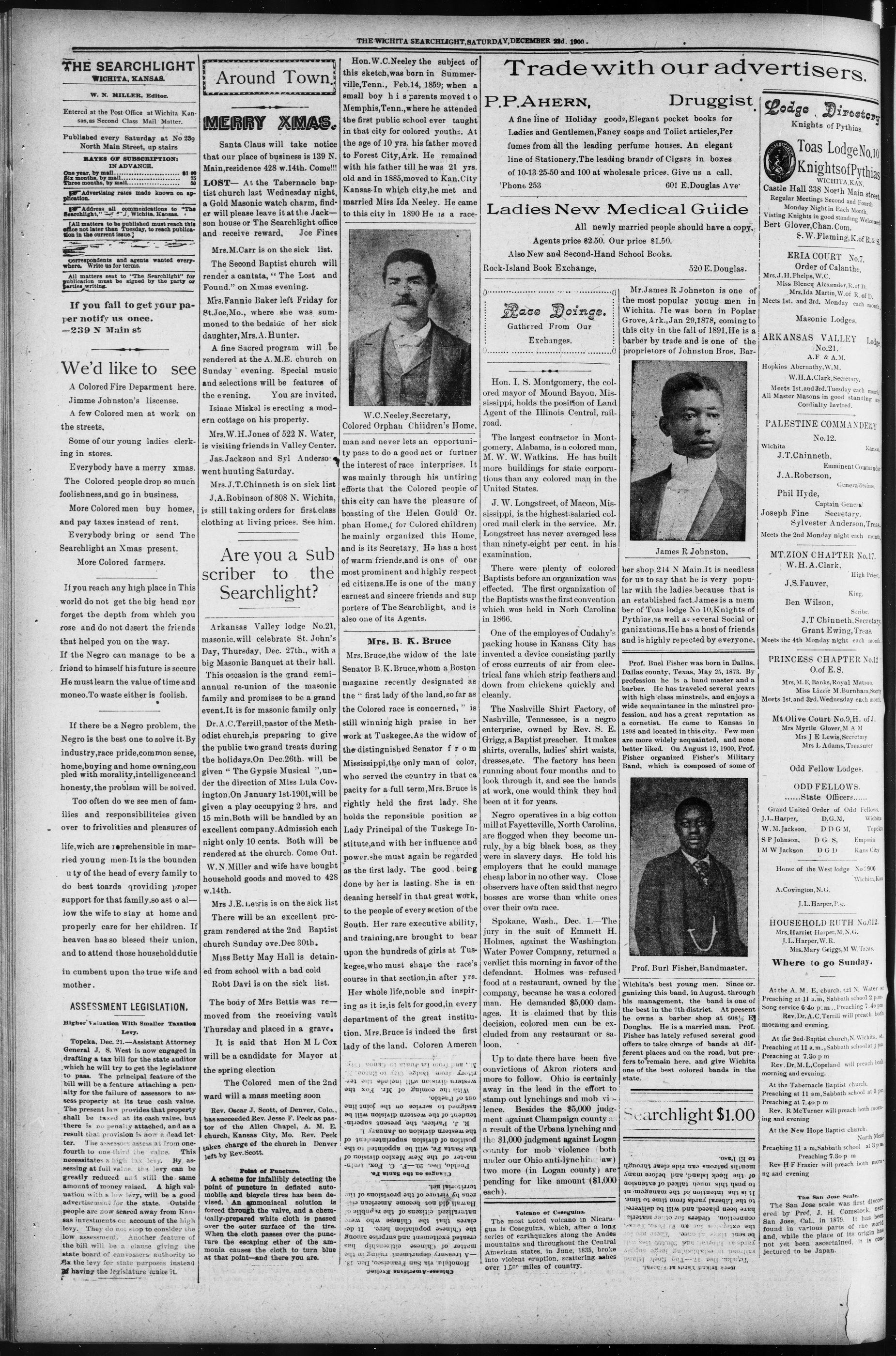
Hon. W.C. Neeley the subject of this sketch, was born in Summerville, Tenn., Feb. 14, 1859; when a small boy his parents moved to Memphis, Tenn., where he attended the first public school ever taught in that city for colored youths. At the age of 10 yrs. his father moved to Forest City, Ark. He remained with his father till he was 21 yrs. old and in 1885, moved to Kan. City Kansas. In which city, he met and married Miss Ida Neeley. He came to this city in 1890 He is a race-
Trade
P.P.AHERN
A fine line of Holiday Ladies and Gentlemen fumes from all the line of Stationery. The of 10-13-25-50 and 100 Phone 253
Ladies New
Colored Orphan Children's Home man and never lets an opportunity pass to do a good act or further the interest of race interprises. It was mainly through his untiring efforts that the Colored people of this city can have the pleasure of boasting of the Helen Gould Orphan Home, (for Colored children) he mainly organized this Home, and is its Secretary. He has a host of warm friends, and is one of our most prominent and highly respected citizens. He is one of the many earnest and sincere friends and supporters of The Searchlight, and is also one of its Agents.
Mrs. B. K. Bruce
Mrs. Bruce,the widow of the late Senator B.K.Bruce,whom a Boston magazine recently designated as the "first lady of the land,so far as the Colored race is concerned," is still winning high praise in her work at Tuskegee,As the widow of the distingnished Senator from Mississippi,the only man of color, who served the country in that capacity for a full term,Mrs. Bruce is rightly held the first lady. She holds the reponsible position as Lady Principal of the Tuskegee Institute,and with her influence and power,she must again be regarded as the first lady. The good being done by her is lasting. She is endeaing herself in that great work, to the people of every section of the South. Her rare executive ability, and training,are brought to bear upon the hundreds of girls at Tuskegee,who must shape the race's course in that section,in after yrs. Her whole life,noble and inspiring as it is,is felt for good,in every department of the great institution. Mrs.Bruce is indeed the first lady of the land. Coloren Amercn
With the coming of Mr. Fox the western division will include the territory from Bidge city to Kyron. Mr. and from la junta to Canon City.
Chinese-Americans Killed
Honolulu, via San Francisco, Dec. 18.
—A treasury department ruling in the matter of Chinese citizenship has created excitement and surprise among the Chinese population here. It declares that the Chinese who were naturalized citizens of the republic of Hawaii did not become American citizens by virtue of the provisions of the territorial net.
Changes on the Santa Fe.
Pueblo, Dec. 20. C. F. Fox, treasurer of the New Mexico division of the Santa Fe, will be appointed to the position of division superintendent of the western division on January 1.
Trade with our advertisers.
A fine line of Holiday goods,Elegant pocket books for Ladies and Gentlemen,Faney soaps and Toilet articles,Per fumes from all the leading perfume houses. An elegant line of Stationery.The leading brandr of Cigars in boxes of 10-13-25-50 and 100 at wholesale prices. Give us a call. Phone 253 601 E.Douglas Ave
P.P.AHERN,
A fine line of Holiday good
Ladies and Gentlemen, Fanee
fumes from all the leading
line of Stationery. The leadi
of 10-13 25-50 and 100 at who
'Phone 253
Ladies New M
All newly
Agents price $2.50. O
Also New and Second-Hand
Rock-Island Book Exchange,
Race Doings. Gathered From Our Exchanges.
---
Hon. I. S. Montgomery, the colored mayor of Mound Bayou, Mississippi, holds the position of Land Agent of the Illinois Central, railroad.
The largest contractor in Montgomery, Alabama, is a colored man, M. W. W. Watkins. He has built more buildings for state corporations than any colored man in the United States.
J. W. Longstreet, of Macon, Mississippi, is the highest-salaried colored mail clerk in the service. Mr. Longstreet has never averaged less than ninety-eight per cent. in his examination.
There were plenty of colored Baptists before an organization was effected. The first organization of the Baptists was the first convention which was held in Norh Carolina in 1866. One of the employees of Cudahy's packing house in Kansas City has invented a device consisting partly of cross currents of air from electrical fans which strip feathers and down from chickens quickly and cleanly.
The Nashville Shirt Factory, of Nashville, Tennessee, is a negro enterprise, owned by Rev. S. E. Grigg, a Baptist preacher. It makes shirts, overalls, ladies' shirt waists, dresses,etc. The factory has been running about four months and to look through it, and see the hands at work, one would think they had been at it for years.
Negro operatives in a big cotton mill at Fayetteville, North Carolina, are flogged when they become unruly, by a big black boss, as they were in slavery days. He told his employers that he could manage cheap labor in no other way. Close observers have often said that negro bosses are worse than white ones over their own race.
Spokane, Wash., Dec. 1.—The jury in the suit of Emmett H. Holmes, against the Washington Water Power Company, returned a verdict this morning in favor of the defendant. Holmes was refused food at a restaurant, owned by the company, because he was a colored man. He demanded $5,000 damages. It is claimed that by this decision, colored men can be excluded from any restaurant or saloon.
Up to date there have been five convictions of Akron rioters and more to follow. Ohio is certainly away in the lead in the effort to stamp out lynchings and mob violence. Besides the $5,000 judgment against Champaign county as a result of the Urbana lynching and the $1,000 judgment against Logan county for mob violence (both under our Ohio anti-lynching law) two more (in Logan county) are pending for like amount ($1,000 each).
Volcano of Coseguina.
The most noted volcano in Nicaragua is Coseguina, which, after a long series of earthquakes along the Andes mountains and throughout the Central American states, in June, 1835, broke into violent eruption, scattering ashes over 1,500 miles of country.
Druggist
dls, Elegant pocket books for
soaps and Toilet articles, Per
perfume houses. An elegant
brandr of Cigars in boxes
lesale prices. Give us a call.
601 E.Douglas Ave
Medical Guide
married people should have a copy.
or price $1.50.
School Books.
520 E.Douglas.
Mr.James R Johnston is one of the most popular young men in Wichita. He was born in Poplar Grove, Ark., Jan 29,1878, coming to this city in the fall of 1891. He is a barber by trade and is one of the proprietors of Johnston Bros. Bar-
JOHN H. HARRIS
James R Johnston.
ber shop,244 N Main.It is needless for us to say that he is very popular with the ladies,because that is an established fact.James is a mem ber of Toas lodge No 10,Knights of Pythias,as well as several Social or ganizations.He has a host of friends and is highly repected by everyone.
Prof. Buel Fisher was born in Dallas, Dallas county, Texas, May 25, 1873. By profession he is a band master and a barber. He has traveled several years with high class minstrels, and enjoys a wide acquaintance in the minstrel profession, and has a great reputation as a cornetist. He came to Kansas in 1898 and located in this city. Few men are more widely acquainted, and none better liked. On August 12, 1900, Prof. Fisher organized Fisher's Military Band, which is composed of some of
A.
Prof. Burl Fisher,Bandmaster.
Wichita's best young men. Since organizing this band, in August, through his management, the band is one of the best in the 7th district. At present he owns a barber shop at 008 E. Douglas. He is a married man. Prof. Fisher has lately refused several good offers to take charge of bands at different places and on the road, but prefers to remain here, and give Wichita one of the best colored bands in the state.
Searchlight $1.00
Searchlight $1.00
Koea Island Yards at Gibraltar.
Teyelan, Dee 12.—The Roek Island railroad is establishing large supply yards at Gibraltar, and 300,000 ties will be sent there at once. There are for the exteation for an El Paso, Texas connection. Orders for other materials have been placed, and will be delivered to the Liberal yards from time to time. It is the intention of the managem-nt to push this much talked of extension of the Roek Island, and before many months patrons can ride clear through
Lodge Directory
Knights of Pythias.
Toas Lodge No.10
KnightsofPythias
Toas Lodge No.10
KnightsofPythias
WICHITA.KAN.
Castle Hall 338 North Main street.
Regular Meetings Second and Fourth
Monday Night in Each Month.
Visting Knights in good standing Welcome
Bert Glover,Chan.Com.
S. W. Fleming,K.of R.S. S.
ERIA COURT No.7.
Order of Calanthe.
Mrs.J.H.Phelps,W.C.
Miss Blencq Alexander,K.of D.
Mrs.Ida Martin,W.of R. of D.
Meets 1st. and 3rd. Monday each month.
Masonic Lodges.
ARKANSAS VALLEY Lodge
No.21.
A.F & A.M.
Hopkins Abernathy, W.M.
W.H.A. Clark, Secretary.
Meets 1st, and 3rd. Tuesday each month.
All Master Masons in good standing are
Cordially Invited.
PALESTINE COMMANDERY
No.12.
Wichita Kansas
J.T. Chinneth,
Emminent Commander
J.A. Roberson,
Generalissimo
Phil Hyde,
Captain General
Joseph Fine Secretary.
Sylvester Anderson, Treas
Meets the 2nd Monday night each month
MT.ZION CHAPTER No.17.
W.H.A.Clark,
High Priest
J.S.Fauver.
J.T Chinneth,Secretary
Grant Ewing,Treas.
Meets the 4th Monday night each month.
PRINCESS CHAPTER No.12
O.of E.S.
Mrs.M.E.Banks,Royal Matron.
Miss Lizie M.Burnham,Seety
Meets 1st,and 8rd.Wednesday each month.
Mt Olive Court No.9,H. of J.
Mrs Myrtle Glover,M A M
Mrs J E Lewis,Secretary
Mrs L Adams,Treasurer
Odd Fellow Lodges
ODD FELLOWS.
.....State Officers.....
Grand United Order of Odd Fellows.
J.L.Harper, D.G.M, Wichita
W.M.Jackson, D.D.G M, Topeka
S.P Johnson, D.G.S, Emporia
M.W Jackson D.G D Kans City
Home of the West lodge No.1906
Wichita, Kau
A.Covington,N.G.
HOUSEHOLD RUTH No.61E
Mrs, Harriet Harper, M.N.G.
J.L. Harper, W.R.
Mrs, Mary Geiggs, M.W.Treas.
Where to go Sunday.
Att the A. M. E. church, 51 N. Water t
Preeching at 11 a.m. Sabbath school 2 p.m.
song service 6·40 p.m. Preaching 7·40 p.m.
Rev.Dr.A.C.Terrill will preach both mooning and evening.
At the 2nd Baptist church,N.Wichita, st
Preaching at 11 a.m.,Sabbath school at 3 pm
Preaching at 7.80 p m
Rev.Dr.M.L.Copeland will preach both morning and evening.
At the Tabernacle Baptist church.
Preaching at 11 am,Sabbath school at 3 pm
Preaching at 7.40 p m
Rev.R McTurner will preach both morning and evening
At the New Hope Baptist church.
North Meson
Preaching 11 a.m,Sabbath school at 3 pm
Preaching 7.80 p m
Rev H F Frazier will preach both morning and evening
The San Jose Scale
The San Jose scale was first discovered by Prof. J. H. Comstock, near San Jose, Cal., in 1879. It has been found in various parts of the world and, while the place of its origin has not yet been ascertained, it is conjectured to be Japan.
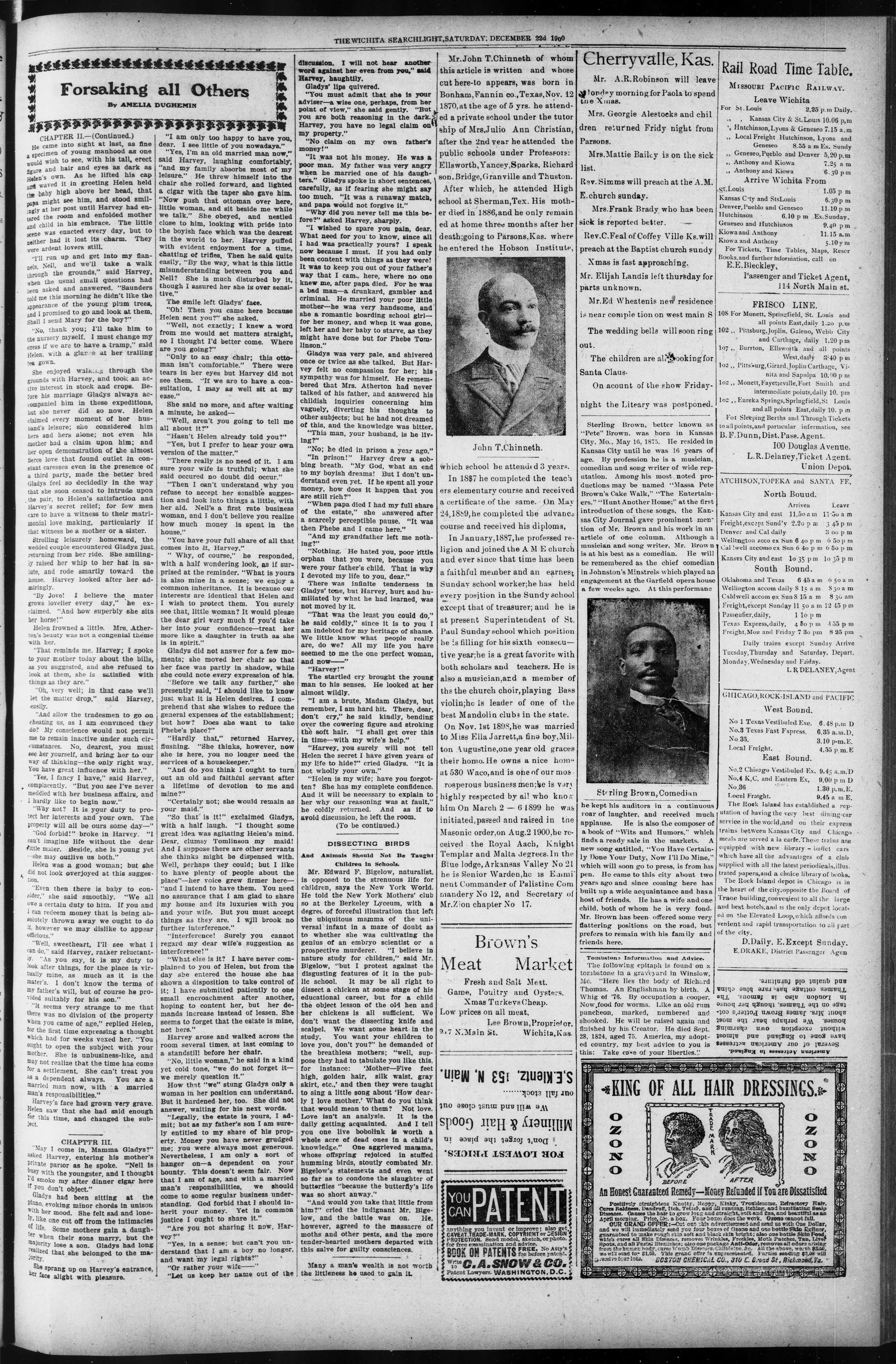
CHAPTER II.—(Continued.)
CHAPTER II.—(Concluded.)
He came into sight at last, as fine a specimen of young manhood as one would wish to see, with his tall, erect figure and hair and eyes as dark as Helen's own. As he lifted his cap and waved it in greeting Helen held the baby high above her head, that papa might see him, and stood smiling at her post until Harvey had entered the room and enfolded mother and child in his embrace. The little scene was enacted every day, but to neither had it lost its charm. They were ardent lovers still.
"I'll run up and get into my flannels, Nell, and we'll take a walk through the grounds," said Harvey, when the usual small questions had been asked and answered. "Saunders told me this morning he didn't like the appearance of the young plum trees, and I promised to go and look at them, shall I send Mary for the boy?"
"No, thank you; I'll take him to the nursery myself. I must change my dress if we are to have a tramp," said Helen, with a glance at her trailing tee gown.
She enjoyed walking through the grounds with Harvey, and took an active interest in stock and crops. Before his marriage Gladys always accompanied him in these expeditions, but she never did so now. Helen claimed every moment of her husband's leisure; she considered him hers and hers alone; not even his mother had a claim upon him; and her open demonstration of the almost fierce love that found outlet in constant caresses even in the presence of a third party, made the better bred Gladys feel so decidedly in the way that she soon ceased to intrude upon the pair, to Helen's satisfaction and Harvey's secret relief; for few men care to have a witness to their matrimonial love making, particularly if that witness be a mother or a sister.
Strolling leisurely homeward, the wedded couple encountered Gladys just returning from her ride. She smilingly raised her whip to her hat in salute, and rode smarter toward the house. Harvey looked after her admiringly.
"By Jove! I believe the mater grows lovelier every day," he exclaimed. "And how superbly she sits her horse!"
Helen frowned a little. Mrs. Atherton's beauty was not a congenial theme with her.
"That reminds me, Harvey; I spoke to your mother today about the bills, as you suggested, and she refused to look at them, she is satisfied with things as they are."
"Oh, very well; in that case we'll let the matter drop," said Harvey, easily.
"And allow the tradesmen to go on cheating us, as I am convinced they do? My conscience would not permit me to remain inactive under such circumstances. No, dearest, you must see her yourself, and bring her to our way of thinking—the only right way. You have great influence with her." "Yes, I fancy I have," said Harvey, complacently. "But you see I've never meddled with her business affairs, and I hardly like to begin now." "Why not? It is your duty to protect her interests and your own. The property will all be ours some day—" "God forbid!" broke in Harvey. "I can't imagine life without the dear little mater. Beside, she is young yet—she may outlive us both." Helen was a good woman; but she did not look overjoyed at this suggestion.
"Even then there is baby to consider," she said smoothly. "We all owe a certain duty to him. If you and I can redeem money that is being absolutely thrown away we ought to do it, however we may dislike to appear offless."
"Well, sweetheart, I'll see what I can do," said Harvey, ratxer reluctantly. "As you say, it is my duty to look after things, for the place is virtually mine, as much as it is the mater's. I don't know the terms of my father's will, but of course he provided suitably for his son."
"It seems very strange to me that there was no division of the property when you came of age," replied Helen, for the first time expressing a thought which had for weeks vexed her. "You ought to open the subject with your mother. She is unbusiness-like, and may not realize that the time has come for a settlement. She can't treat you as a dependent always. You are a married man now, with a married man's responsibilities." Harvey's face had grown very grave. Helen saw that she had said enough for this time, and changed the subject.
CHAPTTR III
"May I come in, Mamma Gladys?" asked Harvey, entering his mother's private parlor as he spoke. "Nell is busy with the youngster, and I thought I'd smoke my after dinner cigar here if you don't object." Gladys had been sitting at the plano, evoking minor chords in unison with her mood. She felt sad and lonely, like one cut off from the intimacies of life. Some mothers gain a daughter when their sons marry, but the majority lose a son. Gladys had long realized that she belonged to the majority. She sprang up on Harvey's entrance, her face alight with pleasure.
"I am only too happy to have you, dear. I see little of you nowadays."
"Yes, I'm an old married man now," said Harvey, laughing comfortably, "and my family absorbs most of my leisure." He threw himself into the chair she rolled forward, and lighted a cigar with the taper she gave him.
"Now push that ottoman over here, little woman, and sit beside me while we talk." She obeyed, and nestled close to him, looking with pride into the boyish face which was the dearest in the world to her. Harvey puffed with evident enjoyment for a time, chatting of trifles. Then he said quite easily, "By the way, what is this little misunderstanding between you and Nell? She is much disturbed by it, though I assured her she is over sensitive."
The smile left Gladys' face.
"Oh! Then you came here because Helen sent you?" she asked.
"Well, not exactly; I knew a word from me would set matters straight, so I thought I'd better come. Where are you going?" "Only to an easy chair; this ottoman isn't comfortable." There were tears in her eyes but Harvey did not see them. "If we are to have a consultation, I may as well sit at my ease." She said no more, and after waiting a minute, he asked— "Well, aren't you going to tell me all about it?" "Hasn't Helen already told you?" "Yes, but I prefer to hear your own version of the matter." "There really is no need of it. I am sure your wife is truthful; what she said occurred no doubt did occur."
"Then I can't understand, why you refuse to accept her sensible suggestion and look into things a little, with her aid. Nell's a first rate business woman, and I don't believe you realize how much money is spent in the house."
"You have your full share of all that comes into it, Harvey."
"Why, of course," he responded, with a half wondering look, as if surprised at the reminder. "What is yours is also mine in a sense; we enjoy a common inheritance. It is because our interests are identical that Helen and I wish to protect them. You surely see that, little woman? It would please the dear girl very much if you'd take her into your confidence—treat her more like a daughter in truth as she is in spirit."
Gladys did not answer for a few moments; she moved her chair so that her face was partly in shadow, while she could note every expression of his. "Before we talk any further," she presently said, "I should like to know just what it is Helen desires. I comprehend that she wishes to reduce the general expenses of the establishment; but how? Does she want to take Phebe's place?" "Hardly that," returned Harvey, flushing. "She thinks, however, now she is here, you no longer need the services of a housekeeper." "And do you think I ought to turn out an old and faithful servant after a lifetime of devotion to me and mine?" "Certainly not; she would remain as your maid."
"So that is it!" exclaimed Gladys, with a half laugh. "I thought some great idea was agitating Heilen's mind. Dear, clumsy Tomlinson my maid! And I suppose there are other servants she thinks might be dispensed with. Well, perhaps they could; but I like to have plenty of people about the place"—her voice grew firmer here—and I intend to have them. You need no assurance that I am glad to share my house and its luxuries with you and your wife. But you must accept things as they are. I will brook no further interference."
"Interference! Surely you cannot regard my dear wife's suggestion as interference!"
"What else is it? I have never complained to you of Helen, but from the day she entered the house she has shown a disposition to take control of it; I have submitted patiently to one small encroachment after another, hoping to content her, but her demands increase instead of lessen. She seems to forget that the estate is mine, not hers."
Harvey arose and walked across the room several times, at last coming to a standstill before her chair.
"No, little woman," he said in a kind yet cold tone, "we do not forget it—we merely question it."
How that "we" stung Gladys only a woman in her position can understand. But it hardened her, too. She did not answer, waiting for his next words.
"Legally, the estate is yours, I admit; but as my father's son I am surely entitled to my share of his property. Money you have never grudged me; you were always most generous. Nevertheless, I am only a sort of hanger on—a dependent on your bounty. This doesn't seem fair. Now that I am of age, and with a married man's responsibilities, we should come to some regular business understanding. God forbid that I should inherit your money. Yet in common justice I ought to share it."
"Are you not sharing it now, Harvey?"
"Yes, in a sense; but can't you understand that I am a boy no longer, and want my legal rights?"
"Or rather your wife——"
"Let us keep her name out of the
THE WICHITA SEARCHLIGHT,SATURDAY. DECEMBER 22d 1900
discussion. I will not hear another word against her even from you," said Harvey, haughtily.
Gladys's lips quivered.
"You must admit that she is your adviser—a wise one, perhaps, from her point of view," she said gently. "But you are both reasoning in the dark. Harvey, you have no legal claim on my property."
"No claim on my own father's money!"
"It was not his money. He was a poor man. My father was very angry when he married one of his daughters." Gladys spoke in short sentences, carefully, as if fearing she might say too much. "It was a runaway match, and papa would not forgive it."
"Why did you never tell me this before?" asked Harvey, sharply.
"I wished to spare you pain, dear. What need for you to know, since all I had was practically yours? I speak now because I must. If you had only been content with things as they were! It was to keep you out of your father's way that I cam. here, where no one knew me, after papa died. For he was a bad man—a drunkard, gambler and criminal. He married your poor little mother—he was very handsome, and she a romantic boarding school girl—for her money, and when it was gone, left her and her baby to starve, as they might have done but for Phebe Tomlinson."
Gladys was very pale, and shivered once or twice as she talked. But Harvey felt no compassion for her; his sympathy was for himself. He remembered that Mrs. Atherton had never talked of his father, and answered his childish inquiries concerning him vaguely, diverting his thoughts to other subjects; but he had not dreamed of this, and the knowledge was bitter.
"This man, your husband, is he living?"
"No; he died in prison a year ago." "In prison!" Harvey drew a sobbing breath. "My God, what an end to my boyish dreams. What I don't understand even yet. If he spent all your money, how does it happen that you are still rich?"
"When papa died I had my full share of the estate," she answered after a scarcely perceptible pause. "It was then Phebe and I came here."
"And my grandfather left me nothing?"
"Nothing. He hated you, poor little orphan that you were, because you were your father's child. That is why I devoted my life to you, dear."
There was infinite tenderness in Gladys' tone, but Harvey, hurt and humiliated by what he had learned, was not moved by it.
"That was the least you could do," he said coldly, "since it is to you I am indebted for my heritage of shame. We little know what people really are, do we? All my life you have seemed to me the one perfect woman, and now—"
"Harvey!"
The startled cry brought the young man to his senses. He looked at her almost wildly.
"I am a brute, Madam Gladys, but remember, I am hard hit. There, dear, don't cry," he said kindly, bending over the cowering figure and stroking the soft hair. "I shall get over this in time—with my wife's help."
"Harvey, you surely will not tell Helen the secret I have given years of my life to hide!" cried Gladys. "It is not wholly your own."
"Helen is my wife; have you forgotten? She has my complete confidence. And it will be necessary to explain to her why our reasoning was at fault," he coldly returned. And as if to avoid discussion, he left the room.
DISSECTING BIRDS
And Animals Should Not Be Taught Children in Schools.
Mr. Edward F. Bigelow, naturalist, is opposed to the strenuous life for children, says the New York World. He told the New York Mothers' club so at the Berkeley Lyceum, with a degree of forceful illustration that left the ubiquitous mamma of the universal infant in a maze of doubt as to whether she was cultivating the genius of an embryo scientist or a prospective murderer. "I believe in nature study for children," said Mr. Bigelow, "but I protest against the disgusting features of it in the public school. It may be all right to dissect a chicken at some stage of his educational career, but for a child the object lesson of the old hen and her chickens is all sufficient. We don't want the dissecting knife and scalpel. We want some heart in the study. You want your children to love you, don't you?" he demanded of the breathless mothers; "well, suppose they had to tabulate you like this, for instance: 'Mother-Five feet high, golden hair, silk waist, gray skirt, etc.' and then they were taught to sing a little song about 'How dearly I love mother.' What do you think that would mean to them? Not love. Love isn't an analysis. It is the daily getting acquainted. And I tell you one live bobolink is worth a whole acre of dead ones in a child's knowledge." One aggrieved mamma, whose offspring rejoiced in stuffed humming birds, stoutly combated Mr. Bigelow's statements and even went so far as to condone the slaughter of butterflies "because the butterfly's life was so short anway."
"And would you take that little from him?" cried the indignant Mr. Bigelow, and the battle was on. He, however, agreed to the massacre of moths and other pests, and the more tender-hearted mothers departed with this salve for guilty consciences.
Many a man's wealth is not worth the littleness he used to gain it.
Mr.John T.Chinneth of whom this article is written and whose cut here-to appears, was born in Bonham, Fannin co., Texas, Nov. 12 1870, at the age of 5 yrs. he attended a private school under the tutor ship of Mrs,Julio Ann Christian, after the 2nd year he attended the public schools under Professors: Ellsworth, Yancey,Sparks, Richard son, Bridge, Granville and Thuston.
After which, he attended High school at Sherman, Tex. His mother died in 1886, and he only remained at home three months after her death;going to Parsons, Kas, where he entered the Hobson Institute,
John T. Chinneth.
which school he attended 3 years. In 18$7 he completed the teachers elementary course and received a certificate of the same. On May 24,1889,he completed the advance course and received his diploma.
In January,1887,he professed religion and joined the A M E church and ever since that time has been a faithful member and an earnest Sunday school worker;he has held every position in the Sundy school except that of treasurer;and he is at present Superintendent of St. Paul Sunday school which position he is filling for his sixth consecutive year;he is a great favorite with both scholars and teachers. He is also a musician,and a member of the church choir,playing Bass violin;he is leader of one of the best Mandolin clubs in the state. On Nov.1st 1898,he was married to Miss Ella Jarrett,a fine boy,Milton Augustine,one year old graces their homo.He owns a nice home at 530 Waco and is one of our mos-
rosperous business men; he is very highly respected by all who know him On March 2 - 6 1899 he was initiated,passed and raised in the Masonic order,on Aug.2 1900,he received the Royal Aach, Knight Templar and Malta degrees. In the Blue lodge, Arkansas Valley No 21 he is Senior Warden,he is Eminent Commander of Palistine Commandery No 12, and Secretary of Mr.Zion chapter No 17.
Brown's
Fresh and Salt Meat.
Game, Poultry and Oysters.
Xmas Turkeys Cheap.
Low prices on all meat.
Lee Brown, Proprietor.
2.7 N.Main St. Wichita, Kas.
S.E.Klentz, 153 N. Main.
FOR LOWEST PRICES. Don't forget the place in Millinery & Hair Goods We will and must close out
YOU CAN PATENT
anything you invent or improve; also get
CAVEHAT. TRADE-MARK, COPYRIGHT or DESIGN
PROTECTION. Read model, sketch, or photo.
for free examination read attn.
BOOK ON PATENTS FREE. No Atty's
fee before patent.
Write C.A. SNOW & CO.
Patent Lawyers. WASHINGTON, D.C.
Cherryvalle, Kas.
Mr. A.R.Robinson will leave
Monday morning for Paola to spend
the Xmas.
Mrs. Georgie Alestocks and child
dren returned Fridy night from
Parsons.
Mrs.Mattie Bailey is on the sick
list.
Rev.Simms will preach at the A.M.
E.church sunday.
Mrs.Frank Brady who has been
sick is reported better.
Rev.C.Feal of Coffey Ville Ks.will
preach at the Baptist church sundy
Mr. Elijah Landis left thursday for parts unknown.
Mr.Ed Wheatenis new residence is near completion on west main S
The wedding bells will soon ring out.
The children are all looking for Santa Claus.
On account of the show Friday-night the Liteary was postponed.
Sterling Brown, better known as "Pete" Brown, was born in Kansas City, Mo. May 16, 1875. He resided in Kansas City until he was 16 years of age. By profession he is a musician, comedian and song writer of wide reputation. Among his most noted productions may be named "Massa Pete Brown's Cake Walk," "The Entertainers," "Hunt Another Home;" at the first introduction of these songs, the Kansas City Journal gave prominent mention of Mr. Brown and his work in an article of one column. Although a musician and song writer, Mr. Brown is at his best as a comedian. He will be remembered as the chief comedian in Johnston's Minstrels which played an engagement at the Garfield opera house a few weeks ago. At this performance
JOHN H. HARRIS
Stirling Brown, Comedian
he kept his auditors in a continuous roar of laughter, and received much applause. He is also the composer of a book of "Wits and Humors," which finds a ready sale in the markets. A new song entitled, "You Have Certainly Done Your Duty, Now I'll Do Mine," which will soon go to press, is from his pen. He came to this city about two years ago and since coming here has built up a wide acquaintance and has a host of friends. He has a wife and one child, both of whom he is very fond. Mr. Brown has been offered some very flattering positions on the road, but prefers to remain with his family and friends here.
Tombstone Information and Advice.
The following epitaph is found on a tombstone in a graveyard in Winslow, Me. "Here lies the body of Richard Thomas. An Englishman by birth. A Whig of 76. By occupation a cooper. Now, food for worms. Like an old rum puncheon, marked, numbered and shooked. He will be raised again and finished by his Creator. He died Sept. 28, 1824, aged 75. America, my adopted country, my best advice to you is this: Take case of your liberties."
OZONO
TRADE MARK
BEFORE
AFTER
An Honest Guaranteed Remedy—Money Refunded if You are Dissatisfied
Positively straightens Knotty, Nappy, Kinky, Troublesome, Refractory Hair, Curved Hands, Inked Hands, Wrinkled, All-matching, Washing and Brilliant Scrap Diseases. Causes the hair to grow long and straight, soft and flax, and beautiful as an April morning. Price, like a box. Four boxes does the work. Ozono cannot fall.
Rail Road Time Table.
MISSOURI PACIFIC RAILWAY.
Leave Wichita
For St. Louis 2.25 p.m Daily
, Kansas City & St. Louis 10.06 p.m
, Hutchinson, Lyons & Geneseo 7.15 a.m
, Local Freight Hutchinson, Lyons and
Geneseo 8.55 a.m Ex. Sundy
, Geneseo, Pueblo and Denver 5.20 p.m
, Anthony and Kiowa 7.25 a.m
, Anthony and Kiowa 6.30 p.m
Arrive Wichita From
St. Louis 1.05 p.m
Kansas C-ty and StsLouis 6.30 p.m
Denver, Pueblo and Geneseo 11.10 p.m
Hutchinson 6.10 p.m Ex. Sunday.
Geneseo and Hutchiuson 9.40 p.m
Kiowa and Anthony 11.15 a.m
Kiowa and Anthony 5.10 p.m
For Tickets, Time Tables, Maps, Reser
Books, and further information, call on
E.E. Bleckley.
Passenger and Ticket Agent,
114 North Main st.
FRISCO LINE.
108 For Monett, Springfield, St. Louis and all points East,daily 1.20 p.m
102 , Pittsburg, Joplin, Galeno, Webb City and Carthage, daily 1.20 p.m
107 , Burrton, Ellsworth and all points West,daily 3:40 p.m
102 , Pittsburg,Girard, Joplin Carthage, Vinita and Sapulpa 10:00 p.m
102 , Monett, Fayetjeville,Fort Smith and intermediate points,daily 10. pm
102 , Eureka Springs, Springfield, St. Louis and all points East,daily 10. p.m
For Sleeping Berths and Through Tickets to all points,and particular information, see B.F.Dunn,Dist.Pass.Agent.
100 Douglas Avenue.
L.R.Delaney,Ticket Agent.
Union Depot.
ATCHISON,TOPEKA and SANTA FE.
Arrives Leav
Kansas City and east 11.50 a m 11.50 a m
Freight,except Sund'y 2.20 p m 3.45 p m
Denver and Cal daily 3.00 p m
Wellington acco ex Sun 6.40 p m 6.50 p m
Calwell accomo ex Sun 6.40 p m 6.50 p m
Kansas City and east 10.35 p m 10.35 p m
South Bound.
Oklahoma and Texas 6.45 a m 6.50 a m
Wellington accom daily 8.15 a m 8.30 a m
Calwell accom ex Sun 8.15 a m 8.30 a m
Freight,except Sunday 11.50 a m 12.45 p m
Passeufer,daily 1.10 p m
Texas Express,daily 4.50 p m 4.55 p m
Freight,Mou and Friday 7.30 p m 8.25 p m
Daily trains except Sunday Arrive
Tuesday,Thursday and Saturday. Depart.
Monday,Wednesday and Friday.
No 1 Texas Vestibuloid Exe,
No.3 Texas Fast Fxpress,
No 35,
Lordfield
No.2 Chicago Vestibulated Ex. 9.45 a.m.D
No.4 K,C, and Eastern Ex. 9.00 p.m.E
No.36 1.30 p.m.E.
Locul Fratght. 9.45 a m.E.
The Rock Island has established a reputation of having the very best dining car service in the world,and on their express trains between Kansas City and Chicago meals are served a la carfe.These trains are equipped with new library - buffet cars which have all the advantages of a club supplied with all the latest periodicals,illus. trated papers,and a choice library of books.
The Rock Island depot in Chicago is in the heart of the city,opposite the Board of Trace building,convequent to all the large and best hotels,and is the only depot located on the Elevated Loop,which affords convenient and rapid transportation to all part of the city.
D.Daily. E.Except Sunday.
E.DRAKE. District Passenger. Agen
Several of our American actresses have gone to England and almost without exception own charming houses. We perhaps hear the most about Mrs. James Brown Potter's cottage on the Thames, though her house in London also is famous. The Thames cottage has rare blue china and quaint old furniture.
AIR DRESSINGS.
Money Refunded if You are Dissatisfied
Kinky, Troublesome, Refractory Har-
all running, itching, and humiliating Soap
and medicine, and making maniacities an
ace does the work. Ozono cannot fall
advertisement and send us with One Dollar,
xes of Ozono and one bottle Skin Refor-
sher, skincare body also one bottle Skin Refor-
shers, Prockies, Moth Patches, Tan, Live
package Anti-Odor, removes all odors arising
Coldness, All the above, you need,
unpressured. Priced at $9.90 will
CO. 310 E. Broad St, Richmond, Va.
North Bouud.
L R DELANEY.Agent
West Bound
6.48 p.m D
6.35 a.m.D.
3.10 p-m.E.
4.55 m.e
Preparing for
Santa Claus
"TURKEY ACTRESS"
A pretty little Thespian said to me the other day.
"I must look out for a turkey job for Christmas."
"Why, what do you mean?" I queried.
"What, haven't you heard of 'turkey actors'?"
"I know plenty of actors who are geese, and a few actresses who are ducks." was the reply.
"Oh, dear, no! Turkey actors are those who only get an engagement for Thanksgiving or Christmas or New Year's."
"And how long can they live on that?"
"Well, it's better than nothing. I engaged for twenty dollars and expenses last Christmas to play Alida Bloodgood in 'The Streets of New York.' Oh, what an experience!"
"Come in here," quoth I, "and over a brimming bumper of chocolate or a wild wassail of tea, tell me all."
And as we lunched together she told me this:
"They sent for me from a dramatic agency, said the money was sure and almost any dresses would do. Alida is the daughter of a banker in the play, but they said that in the town where we were to perform on Christmas night they wouldn't know the difference. However, I fixed up three changes without spending a cent.
"We were all to meet the manager at the ferry in Jersey City. He didn't
"I WANT GREENBACKS."
appear, but sent a message that he'd sec us in the town.
"We all paid our fares—I had forty cents left—and reached the place pretty well disgusted.
"At the hotel they viewed us suspiciously, as we had no trunks, and there we learned that the matinee had been abandoned, no seats having been sold.
"We had a rehearsal instead, and it was six o'clock before I staggered into the hotel, only to learn that we couldn't have any supper unless we paid for it individually.
"I sent word to our manager that I had no money and shouldn't play without my supper.
"This brought him to my door in a hurry. He knocked, and entered with a surprised air.
"Why, my dear," he said, 'there's some mistake."
"I think there is.' I replied, spirit-
edly. 'If I don't have any supper I don't go on.'
"Why, that'll be all right, my dear. We'll go out together, and you shall have supper with me."
"And he laid his arm affectionately on my shoulder.
"I gave him a good push, and he fell up against the door. Oh, how angry he was!
"What are you doing?" he shouted.
"Rehearsing you in the character of a gentleman,' said I, 'and you won't suit.'
"He went out and banged the door, but a very nice supper came up to me later. Still I remembered the gleam of hate in his eyes and was on my guard.
"We had a very good house that night and felt a little encouraged. As I stood looking out of the pheephole in the curtain, the property boy brushed against me.
"Beg pardon,' he said, hurriedly,
'but I've been workin' so hard an'
nothin' to eat so that I'm as weak as a
rat. I've had no supper.'
"You shouldn't go without your
supper, I said.
"Iain't got the price.'
"I gave him half of my forty cents.
"Go out and get a cup of coffee and
a sandwich.'
"He took the money with a grateful
look and disappeared.
"The play went on. So did he, for
that matter, for he played two parts,
poor little soul!
"At the end of the third act he
knocked at my dressing room door.
"Say, you're Miss Hallett, ain't
yer?
"Yes.'
"Well, I got somethin' I want to say
to yer on the quiet."
I finished dressing and came out.
"You certainly was good to me," he said with a grin, 'an' now it's turn about.
"What do you mean?"
"Just this. The boss—the manager, I mean—just sent me up to the hotel to get five dollars changed into pennies an' nickels an' ten cent pieces."
"Well, what has that to do with me?"
"Plenty! He's a-makin' up salaries out front in the office, an' he's a laughin' with another feller. He's going to pay you your salary in pennies an' nickels an' dimes."
"I don't believe it."
"Well, you can. I heard him tell the other feller, an' they think it's a great joke. He's down on you for some reason or other. Don't gimme away."
"And so he disappeared again.
"So this was the manager's contemptible revenge."
"Twenty dollars in nickels and pennies!
"I called the stage manager.
"Don't ring up the curtain, Mr. Clarke,' I said, 'for I shan't go on until I get my salary.'
"But, my dear what I said,' was my rejoinder, as I went back to my dressing room.
"I thought of Patti refusing to put on her slippers until poor old Mapleson had produced $4,000—how she got two thousand, simply put on one slipper and waited.
"Heavens! Suppose they had paid her in nickels and pennies!
"The manager came dashing back.
"What's this. Mise Hallett?"
"Salaries will be paid immediately after the performance."
"Mine must be paid now or the performance will not be finished."
"In awkward position he drew a newspaper package from his overcoat pocket. It seemed heavy, and I heard the clink of coin."
"Awful lot of silver tonight," he said, as he handed me the parcel.
"I dropped it scornfully."
"I want greenbacks," I said firmly.
"But I haven't—"
"Greenbacks or no performance," I repeated calmly.
"You should have seen his face!
You should have seen his face.
"You should have seen the property boy contorting himself with delight behind a 'set house.'
"With the 'smothered curse' of the melodrama the manager picked up the scattered coins and marched away. A twenty-dollar bill came back to me in a few moments and the play ended in orthodox fashion.
"But what do you think of that for meanness?"
"I'm speechless," said I. "Encore the oolong, please! I must steady my nerves!"
If I Were He, and He Was Me.
If I were only Santa Claus,
And Santa Claus was me,
I'd show to him just what a good Old Santa I'd be.
I'd always bring the kind of toys
And story books for him;
I'd find his stocking evry year,
And fill it to the brim.
And boxing gloves—and, say, I guess
A pistol would be fine
IF I WERE HE.
To Klondyke with. And then—oh, yes,
Waite for ninety-nine.
Of bowie knives and things like that.
He'd have a lot to spare.
And when they saw how good I was. How happy folks would be
Those Christmas "C. O. D.'s."
He was an active parcel boy.
From house to house he'd range,
And whatsoe'er your bill might be
He always "had the change."
But cruel, coarse and changeless boys
His efforts did deride,
Until, from utter loneliness,
The little fellow died!
The Christmas Rose
It was Christmas eve. The air was frosty. Men's boot heels made the snow creak under them as they passed with quick tread. There was a rumble of carriage wheels, a rapid, hurrying tread of thousands of feet in the crowded thoroughfare of the great city.
And amid all this Christmas activity Philip Meredith walked with an acrid and indefinable pain at his heart. He was as strangely incongruous amid the joy, the color, the brilliancy of this festival ove as a skeleton at a feast.
He made a strenuous effort to forget. He had told himself that the coming of this anniversary should not overwhelm him with that agony of recollection which he knew down in his innermost soul he could not endure. For days the approaching holiday had filled him with an unacknowledged terror.
It was the first Christmas he had spent without her, without Mirabel. And, telling himself that he would forget, that he would not remember, he straightway remembered with the intimate fidelity of pain all that could wound him now.
A breath of fragrant air from out a florist's shop made him turn his head for a moment, and as he looked he saw forget-me-nots. The sight gave him a pang. He recalled the morning they had first met. It was a morning in spring, fresh with innocence—one of those mornings that yet dawn on the world to evoke images of primordial daybreaks when the world was young. Her eyes were blue—blue like the forget-me-nots. Then, less than a year later, they were wed, and the one Christmas they had spent together had seemed to him more exquisite in its perfect happiness than the one on the plains of Judea could have been to the shepherds. Then came misery; scarcely had the echo of the Christmas bells died away in the air that that fatal episode had occurred that had parted them. It arose in a trifle, as most of the world's misery and wars have, and then before he knew it he had said words that had made a gulf between them which it seemed could never be bridged. She said she would go away and battle with the world by herself; he made a brutal reply. Then they parted.
Again the opulence of a forist's shop met his gaze. A sudden resolution came to him; he stepped up to the window and speculated between orchids and lilies.
"Ah, Philip. I see you are choosing my Christmas gift," said a voice at his elbow. He turned—it was his cousin, a woman born to bring to others some of the light and joy denied them in their own poor lives. "Do not hesitate so," she continued, laughing. "You know how easily I am pleased in the matter of flowers. Shut your eyes and choose whatever you see first when you open them, and it will suit me."
"It will give me more pleasure to suit your taste than to trust to a hap-hazard choice," he replied. "Give me your parcels, you look like Mrs. Santa Claus, and come with me straight into the shop and say what you will have. I will see to it that the Christmas saint wears a flowery garland for you."
"Oh, Philip," said the woman, her eyes filling with a soft mist, "you are always good and generous, and I will let you give me a bunch of those American beauty roses—but not for me. I want to send them to the Woman's hospital in the morning."
He purchased the roses, and they separated at the door.
It was Christmas morning in St. Joseph's hospital. There was a faint antiseptic odor in the air. The long lines of narrow white cots stretched their serried rows down the room in pitiless quiet arrow. In one cot lay a woman, who was a mystery to the hospital officials. She had been brought in late in the afternoon of the day before insensible. She was young and beautiful; her clothing was that of a gen-
FLOWER
ARE YOU CHOOSING MY GIFT? tiewoman; she had all the marks of refinement, albeit with certain signs of toil, but every mark that could identify her had been carefully clipped from her garments. All night Silva the Destroyer had hovered near her. Yet he passed her by, and in the early hours of the morning she revived and murmured words they could but indistinctly understand. Toward noon she revived so that her conversation became intelligible. But with the return of consciousness she seemed to guard her secret more closely. She refused to answer the questions of the hospi-
Making Others Happy
tal physicians, and insisted that she would soon be strong and well and would leave the hospital. There were no marks of violence on her—there was absolutely nothing to point to her identity—only the sinister fact that she had fallen in a faint on her way to the river gave the officials a hint of what might be concealed. The wedding ring shone on her hand, yet she steadfastly refused to let her husband be notified. The hospital physicians shook their wise heads and turned her over to the tender mercies of the nurse, saying that she would be all right when she recovered her full senses. Shortly after noon the nurse approached her. She bore a large box. "Here is something for you," she
"Here is something for you," she said.
It was a large white box; around it were wide, pale blue ribbons. A spray
OH HOW BEAUTIFUL!
of holly lay on the top. She looked at it listlessly.
"Shall I open it for you?" said the nurse pleasantly. "It was sent especially for you by a friend."
The pale patient almost smiled. The nurse's kindness was almost pathetic.
"There is no one to send me flowers," she said; "but you may open it for me."
The nurse did so. A rush of fragrance filled the air. The roses burst upon the vision of the pale woman with the glory of midsummer, dazzling in their brightness. They lay in their satin-padded home like fragrant jewels.
"Oh, how beautiful!" she cried. "Let me have them."
As she took them a card fell out. She looked at it as one might look at a dear face that had been hidden for
"Merry Christmas, mamma, and many of them! Thank you for your books; we read some already, and mean to read more after breakfast!" cried Jie, Amy and Meg as they came trooping into the room where their mamma was that Christmas morning.
"Merry Christmas, little daughters! I'm glad you began at once, and hope you will keep on. But I want to say a word before we sit down. Not far away from here lies a poor woman, with a little newborn babe. Six children are huddled into one bed to keep from freezing, for they have no fire. There is nothing to eat over there. The oldest boy came to tell me they were suffering hunger and cold. My girls, will you give them your breakfast as a Christmas present?"
They were all unusually hungry, having waited nearly an hour, and for a minute no one spoke; only a minute, for Jo excclaimed impetuously:
"I'm so glad you came before we began!"
"May I go and help carry the things to the poor little children?" asked Beth, eagerly.
"I shall take the cream and the muffins," said Amy, heroically giving up the articles she liked.
Meg was already covering the buckwheats and piling the bread into one big plate.
"I thought you would do it," said Mrs. March, smiling as if satisfied.
"You shall all go and help me, and when we come back we will have bread and milk for breakfast, and make it up at dinner time."
They were soon ready and the procession set out. Fortunately it was early, and they went through back streets, so few people saw them, and no one laughed at the queer party.
A poor, bare, miserable room it was, with broken windows, no fire, ragged bed-clothes, a sick mother, walling baby and a group of pale, hungry children cuddled under one old quilt, trying to keep warm.
How the big eyes stared and the blue lips smiled as the girls went in.
"Ach, mein Gott! It is good angels come to us!" said the poor woman, crying for joy.
years. Her eyes dilated. She was silent for one moment, then she cried out in a voice that thrilled the nurse and caused every head in the ward to be lifted from its pillow.
"It is he!" she cried. "It is he. I must go at once."
They demonstrated with her, but the sick woman was well. She arose from that pale couch with sudden vigor—her eyes were bright—every trace of illness left her. "I must go to him!" she repeated, time and again. The doctors came and looked at her and then conferred in a low tone with the nurse. "She may go," they said.
So she took her roses and walked down the street.
She walked some distance and then she neared a church. On its steps just stepping out to go down the avenue was a man. His restless agony had driven him forth to try to exorcise the demon that would not let him rest. He had passed the church and, drawn by an impulse he could neither define nor resist, he had entered. With the strains of "Gloria in Excelsis" ringing in his ears he went out. As he stood on the steps of the cathedral and looked casually down the street he saw what made his heart stand still. He caught at the air with lips that were pale with emotion. Great God! could it be she? A mist swam before his eyes—his knees shook under him. He hastened toward her.
"Mirabell!" he gasped. She looked up at him with a smile. "I was going to see you," she said simply.
The morning sunshine made a hole about her head. Her eyes were filled with a dewy sweetness. The purple shadows of the aftermath of pain were slipping away on the horizon before the glory of dawning joy. He felt dazzled. His heart leaped, then burned within him. He drew her arm within his own, and they turned down a quiet side street.
"I knew you would find me some time," she said, with an infinitely cheerful air. "When they brought me your roses in the hospital this morning and I saw your dear name once more I knew that my trouble and separation were over forever. I could not wait for you to come to me, and I so started to come to you. Sweetheart, how good it is to see you once more."
"Listen he said, his throat quivering. "Listen to the bells. They are ringing 'Peace on earth, good will to men.' Come, come with me, darling. No birthday of any pagan god ever brought such happiness as this."
The lesson taught by their long separation and the meeting that Christ mas morn was one which the pain never forget.
Couldn't Help.
"I have called," announced the mendicant, tearfully, "to ask you to help me in my extremity." "Imposible," returned the business man promptly; "I'm not a chiropodist." Philadelphia Record.
"Funny angels in hoods and mite tens," said Jo, and set them laughing
In a few minutes it really did seem as if kind spirits had been at work there. Hannah, who had carried wood, made a fire, and stopped up the broken panes with old hats and her own cloak. Mrs. March gave the mother tea and gruel, and comforted her with promises of help, while she dressed the little baby as tender as if it had been her own. The girls meantime spread the table, set the children round the fire, and fed them like so many hungry birds—laughing, talking and trying to understand the funny, broken English.
"Das ist gut! Die Engel-kinder" cried the things as they ate, and
A
THE PROCESSION SET OUT. warmed their purple hands at the comfortable blaze. The girls had never been called angel children before, and thought it very agreeable, especially Jo, who had been considered a "Sancho" ever since she was born. That was a very happy breakfast, though they did not get any of it, and when they went away, leaving comfort behind. I think there was not in all the city four merrier people than the hungry little girls who gave away their breakfast and contented themselves on bread and milk on Christmas morning.
The Siege of Khartoum continued 317 days. Over 4,000 people, including Chinese Gordon and all his officers and all foreigners were slain. Only the black troops were saved. The city was pillaged and the women were distributed among the Arabs, and it has been described as one of the most horrible orgies of blood and lechery the century had known. This was in Jan. 1915—New York Weekly.
Our Nation's Wealth.
The material wealth and strength of our nation is in iron, the most useful of all metals, just as the wealth of a human being lies in a useful stomach. If you have overworked yours, try Hostetter's Stomach Bitters. It will relieve the clogged bowels, improve the appetite and cure constipation, dyspepsia and biliousness.
As women grow older, they begin to find more fault with the unbecoming styles of hats that are displayed at the milliner's.
The Best Prescription for Chills and Fever is a bottle of Grown's TASTELESS Chill Tincture. It is simply iron and quinine in a delicious form. No cure—no pay. Price, 500.
No woman in a decollette gown can be said to be overdressed.
Don't quarrel, if you can help it; a quarrel is never made up.
One nuisance no sooner leaves town than another lights.
Garfield Tea produces a healthy action of the stomach, liver, kidneys and bowels it purifies the blood, thus protecting the system against disease.
A man can always be on time without wearing stockings with clocks in
Restricting Marriages.
The Tri-State Medical association of Tennessee, Alabama and Georgia at its recent session in Chattanooga took steps to secure medical legislation in those states for the purpose of regulating or prohibiting the marriage of habitual criminals, persons afflicted with incurable disease, drunkards and victims of harmful drugs.
SEVERE HEADACHES
of any kind are caused by disordered Kidneys. Look out also for backache, sealing urine, dizziness and brick-dust or other sediment in urine which has been allowed to stand. Heed these warnings before it is too late.
reward will be paid for a case
lessness, weakness, loss of vitality, incipient kidney, bladder and urinary disorders, that can cause death.
$50
KID-NE-OIDS
the great scientific discovery for shattered
trees and thin impoverished blood.
MISSOURI AND KANSAS
people erupted by KID-ne-oids. In writing
these please enclose stamped addressed
envelope.
I. W. Powers, Lamar, Mo.
Mrs. A. K. Powers, St. Moberly, Mo.
Mrs. Mary Alnert, N. Cherry St., Chilcothe, Mo.
Mrs. M. M. Christian, 518 E. 8th St., Sedalia, Mo.
Mary Jacobson, 828 Lavine St., Atchison, Kan.
Mary Todman, the Soldiers' Home, Leaven-
ward, Kan.
M. A. H. Willis, 202 E. 4th St., Topeka, Kan.
Momor's Kid-ne-oids are not pills,
but Yellow Tablets and store at fifty
cents a box at drug stores.
JOHN MORROW & CO., CHEMISTS, Springfield, D
You Can Get NOTHING MORE APPRO-
PRIATE for a LITTLE MONEY than
Something out of our
JAPANESE BAZAAR GEHRING'S DRUG STORE
400 E. Douglas Ave., Wichita.
12th Street Promptly Attended to.
MILLER & HULL,
LEADING
Tailors and
FURNISHERS.
Fall Line of
Furnishings
for the Holidays
158 N. MAIN ST., WICHITA.
Barnes & Newcomb, Headquarters
FOR
Fine Pianos.
ALL KINDS OF
MUSICAL Merchandise. WICHITA, KANS.
BAWYER'S
EXCELSIOR
Keep Out
the Wet
Sawyer's Slickers
Sawyer's "Excellent Brand"? Suits
theaters are the best waterproof coat.
Made from the best
materials and warranted. Made from the best
materials and warranted. Waterproof. Made
the toughest work and weather.
Look for the trade mark. If your dealer
does not have the price for catalogue.
H. M. BAWYER & SONS. Sole M.Cs.
Last Cambridge, Mass.
PISO'S CURE FOR
DURES WHERE ALL ELSE FAILS.
Best Cough Syrup. Tablespoon Use
in since Sold by druggists.
CONSUMPTION
CONDITION STILL UNSETTLED.
Trainmen Consider the Strike a Mistake But Have Sympathy.
PRES. BARR'S STATEMENT.
Chicago, Dec. 20.—According to a statement issued by J. M. Barr, third vice president of the Santa Fe railway, the committees of the representatives of the different railway organizations who have taken up the grievances of the striking telegraphers, consider the strike a mistake, and that nothing but re-employment of the telegraphers will be requested from the company. Mr. Barr's statement follows:
"A committee consisting of the system chairmen of the engineers, firemen, conductors and brakemen has asked for a meeting in order to ask that the utmost consideration be shown by the company toward the telegraphers who recently quit work on our system under strike order, in the matter of re-employment. The gentlemen composing this committee as representing the employees named, do not sympathize with or support the telegraphers' strike, but consider it a mistake. Their sympathy for the men who have lost their places has induced them to take action as here named.
"We have a full force of telegraphers employed on all our lines. Our business is moving under normal conditions. Our earnings for the first two weeks of December were the largest for a like period in the history of the road."
Topeka Federal Building.
Topeka, Dec. 19.—The new addition to the Topeka federal building will be completed and ready for occupancy on March 1. There were two court rooms in the old building. When the building is completed there will be only one court room. It will be on the top floor. The entire third floor will be devoted to the department of justice. The second floor will be used for the pension office, and the first floor for postoffice.
Going to Puerto Rico.
Washington, Dec. 21.—A delegation of congressmen goes for a tour of inspection to Puerto Rico on one of the government transports. Among those invited to go are Delegate Flynn, of Oklahoma, and Mr. Curtis, of Kansas. The latter, however, is unable to attend, owing to pressing duties which will keep him confined to the capitol until holiday adjournment.
For Fraudulent Homesteading.
Rapid City, S. D., Dec 21.—Fourteen homesteaders have been indicted for fraudulent representations to the land office as to improvements on their claims. The local land officials have received instructions from Washington to stop receiving homestead entries on the Black Hills forest reserve after the ninety day limit.
Thunderer is Blood Thirsty.
London, Dec. 21.—The Times, editorially denouncing the "misguided leniency toward the Boers," says: "Such a concentration of Boers as brought disaster on General Clements" force would not have been possible had we carried on the war as it would have been carried on by any other civilized nation."
Fire at Empire City.
Galena, Dec. 21.—Empire City, just north of Galena, was the scene of a $6,000 fire. The fire originated in Porter Clark's furniture and undertaking house and it with Joe Atwood's blacksmith shop was totally destroyed. Buildings on the north and south were slightly damaged. Fully insured.
German Shoemakers Ask Protection.
Washington, Dec. 18.—The influx of American made shoes into Germany has prompted a petition from German boot and shoe manufacturers to the national legislature for a rise in the import tariff on articles of this description. Vice Consul General Hanauer, at Frankfort, says these manufacturers claim the tariff as a necessity to protect their industry against foreign encroachments.
Union Pacific Cut-off.
Cheyenne, Wyo., Dec. 21.—The Union Pacific Railroad company awarded a contract for the construction of a cut off through Echo canyon from Echo, Wyo., to Salt Lake, a distance of forty miles. The contract price, $6,000,000, is one of the largest in the history of railroad construction in the west. The contractors have four years in which to complete the work. It is said the Union Pacific has formed a deal with the Los Angeles and Salt Lake Railroad company which will give them practically an air line from Chicago to the Pacific coast via Salt Lake.
Burled by a Sand Slide.
Chadron, Neb., Dec. 21.—Three men are buried thirty feet by a landslide in an irrigation canal near here that buried Thomas C. Burns, Staunch Burns and Woody Litchfield. They were laying tiling in a ditch thirty-five feet deep when the sand bank gave way and buried them. Thomas Burns is one of the big flock masters of Montana and a Kansas City property owner who recently bought a large tract of the irrigable and near here and is improving it.
"LaCreole" Will Restore those Gray Hairs
"LaCreole Hair Restorer is a Perfect Dressing and Restorer Price $1.00
HAD FUN WITH A SPANIARD.
Brienda Deerled Bull-Fighting and Suggested Cowboys.
There is a Spanish gentleman and scholar who finds it more to his comfort during the strike in Cuba and army drafts in Spain to carry cocktails around the Marlborough bar, says the New York Herald. Incidentally he keeps right up to date on the internecine strife and continues to have a childlike faith in the greatness and goodness of his native land. As a sort of a privileged character he joined in a general discussion of the merits of bull-fighting as a civilizer the other day, and finally became considerably wrought up by a declaration from one of the party to the effect that the ancient sport wasn't half so dangerous as it appeared to be. Some pictureer were displayed by way of illustration.
"We've got a thousand cowboys out west," said the gentleman, "who could go into the bull ring of Madrid single handed with a lariat and rope any Spanish bull that ever pawed up the earth."
"But these are not ordinary bulls,' protested the Spaniard, "and are born and bred fighters. They raise them just as you raise game cocks and breed rat terriers. They are not afraid of anything or anybody. It takes the bravest men, who get enormous salaries, to meet them in the arena, where from 50,000 to 75,000 people pay for the privilege of seeing the sport."
"Yes, and it takes half a dozen men with red blankets and lancets to stir the bull up to business," continued the westerner, "and if anybody is killed it is usually the horse. Now, if one of our little bronces and an ordinary cow puncher were, to tackle such an aniline, they'd down him and tie his legs together before he knew where he was. I tell you they're dead slow over there."
"That's right," put in a man who had an arm in splints, "we may be a little short on bulls, but we've got the bicycle."
The Spaniard walked away without a word more.
New Collecting Mania.
Sir Walter Besant has found a new kind of collecting mania. It is that of collecting railway tickets. "As it has long been the unalterable resolution, as everybody knows, on the part of the railway companies to collect their tickets for themselves, the collection by private hands requires skill, boldness and ingenuity. The whole difficulty is to get past the ticket collector. This is attempted, sometimes successfully, I learn from an ardent virtuoso in railway tickets, in several ways. You may rush him in the crowd; you may walk past him with a familiar nod—that of the season ticket holder; you may linger to the last and until the ticket collector has gone; you may pretend that you have already given it up; you may even, as is rumored concerning one enthusiast, pretend that you have lost it and pay your fare over again. All collecting except that of collecting gold coins of the present reign is vanity, but really the vanity of collecting railway tickets is the most egregious."—Exchange.
An Invalid Policeman:
I was passing up Tremont street about half-past four in the afternoon, at which hour the sidewalk is always crowded. Just as I stepped on the curbstone at the upper side of Mason street, a man rushed around the corner and attacked a man directly at my side, striking my shoulder as he ran. Instantly a fight began; women rushed into doorways to get out of the way of the struggling, swaying men; men and boys gathered around to watch the brutal fun; cars were stopped that motormen and conductors might take it in, and there was no policeman in sight. After assuring myself that the fight would go on until one of the combatants was "downed," I hastened on my way, hoping to meet one of the guardians of the law.
At the corner of Boyleston street a policeman was just boarding a southbound car; I beckoned to him, and when he alighted said, "There's a fight going on at the corner of Mason street and not a policeman to be seen." "Well," he said, "I'm an invalid, and darn't go into it!" He stepped on another car and rode way. Was the riot too little for him?—Boston Transcript.
Brilliant Family.
"John, where's your daddy?"
"He's out yander gittin' beat fer cor-
oner."
"An' yer uncle?"
"Seein' how close he kin come ter
bein' sheriff."
"An' Bill—where's he?"
"Well, Bill don't 'mount ter much an'
I've hearn tell they're gwine ter send
him ter congress ter git sheet of him."
"An' you—what's your a-runnin' fer?"
"Nothin'. I'm the only one in the
family what ain't got no edication, so
I'm a-teachin' of a school fer a livin'.
"Atlanta Constitution."
No matter how tall a man is he is not above criticism.
After nine days of wonder the puppy gets his eyes open.
The fire in genius isn't always capable of making the pot boil.
Dentistry for Sheep.
A shepherd of New South Wales has tried dentistry for sheep with great success. He had a valuable ram which found great difficulty in masticating its food owing to the loss of teeth. Artificial teeth were inserted.
Five Years for a Killing.
James McCaffney of Parsons, W. Va., has been given a five years' sentence for killing W. H. Mars at Davis last winter. McCaffney was so sure of acquittal that when he had a chance to escape from jail in September he went away and after visiting friends for a day returned.
Sunday School Teachers' Salaries
The pastor of an eastern church stated recently that certain teachers in his Sunday school were paid for their services. According to the pastor for the prime requisite of a capable teacher is the ability to tell stories. This is the form in which moral lessons can best be conveyed. And good story tellers, he concludes, are always worthy of their hire.
Drew Straws for Office.
In Rush county, Kansas, there was a tie in the votes received by Mr. McCormick and Mr. Anderson for the office of county attorney. Before drawing straws, as provided by law, the men agreed that the winner should make the loser his deputy and equally divide the salary. Mr. McCormick, the Populist, won, and Mr. Anderson will be his deputy.
Love doesn't laugh at the minister and he is love's lock-smith.
HER HEART WAS TOUCHED.
FOLSOM, Custer Co., South Dakota, Dec. 15.—(Special.)—Mrs. H. D. Hyde has given for publication a letter expressing her unbounded gratitude to Doud's Kidney Pills for the double cure of herself and little daughter. Mrs. Hyde has been troubled with palms in her heart for over three years and for a long time her little girl suffered from weak kidneys. The grateful lady does not seem able to find words strong enough to express her gratitude. She has written the following:
I cannot say too much in praise of Dodd's Kidney Pills. They are the greatest kidney and heart medicine I ever used. I had been troubled for over three years with a severe pain in my heart, which entirely disappeared after I had taken a few doses of Dodd's Kidney Pills. I also gave them to my little girl, whose kidneys had been weak, and she commenced to improve from the very first dose. Dodd's Kidney Pills are certainly a wonderful medicine. I would be pleased to have this, my statement, published, as I feel it my duty to let others know just what the Pills will do for them.
MRS. H. H. HYDE.
Dodd's Kidney Pills always cure. 50c a box. All dealers.
Every little vice is the subject of a lot of advice.
The baker may not want for bread, but he has his hour for knead.
The Great Asphalt Lake.
Recent estimates are to the effect that asphalt is being dug out of the famous tar lake of Trinidad—the most notable existing source of the material in the world—at the rate of 80,000 tons per annum. There are still 4,500,000 tons in sight, but at this rate the supply could not last long, were it not that the lake of bitumen referred to is receiving a constant accretion from the bowels of the earth.
Valuab'e Bill at Occonamowoc
A $ 5 bill issued according to an act of the continental congress in 1776 is a valuable relic in the hands of G. T. Palmer of Oconomowoc, Wis. The bill, which measures $ 2\frac{1}{2} \times 3\frac{3}{4} inches was given to the present owner by his grandfather. The following words also appear on the face: "This bill entitles the bearer to receive five Spanish milled dollars, or the value thereof in gold or silver, according to a resolution of congress, passed at Philadelphia, Feb. 17, 1776."
King of Rat Catchers.
Thomas Wortly, who has just died in South London, was known as the "King of Rat-Catchers." With a bull's-eye lantern at his belt, a bag in one hand and a pair of tongs at the other, he would descend nightly into the cellars of a West End hotel. A low whistle or squeak would bring out a swarm of rats. After dazzling them with his lantern, Wortly would pick them up with his tongs, and so dexterously drop them into the bag that comparatively few escaped.
Red Cross Ball Blue makes clothes whiter than snow. Large package 5c.
The people who live on the top floor of a big apartment house say it's tip top.
A schoolboy says there are too many switches on the road to knowledge.
You Can Get Allen's Foot-Ease Free
Write to-day to Allen S. Olstedm, Le Roy, N. Y., for a FREE sample of Allen's Foot-Ease, a powder. It cures sweating, damp, swollen, aching feet. Makes uew or tight shoes easy. A certain cure for Chilblains and Frost-bites At all druggists and shoe stores; 25c.
It is the acme of politeness for ruin to stare a man in the face.
MRS. BREWER RECOMMENDS PERUNA FOR GRIP AND FEMALE CATARRH.
The Homeof Mrs. Lizzie H. Brewer at Westerly, R. L.
Postal Convention with Venezuela
Postmaster General Smith has just concluded a parcel post convention with Venezuela, the documents in the case having been brought to Washington with the signature of President Castro, of Venezuela, by United States Minister Loomis.
Prosperity in France
While the French population is stationary, there is a steady progress in prosperity, which is indicated by the increasing consumption of meat and the decreasing consumption of bread.
Best for the Bowels
No matter what ails you, headache to a cancer, you will never get well until your bowels are put right. CASCARETS help nature, cure you without a gripe or pain, produce easy natural movements, cost you just 10 cents to start getting your health back. CASCARETS Candy Cathartic, the genuine, put up in metal boxes, every tablet has C. C. stamped on it. Beware of imitations.
When a fellow refers to a girl as a peach, the marrying clergyman may be justified in looking for a pair.
I am sure Piso's Cure for Consumption saved my life three years ago.—Mrs. THOS. ROBBINS, Maple Street, Norwich, N. Y., Feb. 17, 1900.
The forger goes wrong when he begins to write.
No one is as impudent as the fiddler when he presents his bill.
When cycling, take a bar of White's Yucatan. You can ride further and easier.
The man who possesses a million is a capital fellow.
Many a man's originality is due to a defective memory.
The Bluest Blue makes the whitest white, that's Red Cross Ball Blue.
A set of false teeth is an emblem of time.
An event is a circumstance that seldom happens.
Are tends to kill the hair and turn it gray. PARKER'S Hair Balsam Tapes color and life. HANDERCOWS, the best cure for corn. 15cts.
Minds are not like streams. A broad-minded man is seldom shallow.
In the pulpit and on the stage the supply is often inadequate to the demand.
Sweat and fruit acids will not C-color goods dyed with RUTNAM FADELESS DYES.
When it comes to word painting the sign painter is at the top of the ladder.
The people who indulge in sour grapes deserve to look seedy.
TO CURE A COLD IN ONE DAY.
Take LAXATIVE BROMO QUININE TABLETS. All drugsintend refund the money if it fails to cure.
E. W. Grove's signature is on the box. E2c.
Lots of people who are inclined to do good keep putting it off until tomorrow.
MRS. BREWER RECON
FOR GRIP AN
The House of Mrs. Lizzie N
In a letter to Dr. Hartman concerning the merits of Pe-ru-na, Mrs. Brewer writes, among other things:
Westerly, R. I.
"Dear Dr. Hartman—I find Pe-ru-na a sure cure for all cataract affections so common in this part of the country. It cures a cold at once. There is no cough medicine that can at all equal Pe-ru-na. As for la gripe, there is no other remedy that can at all compare with Pe-ru-na.
"I am among the sick a great deal in our city and have supplied many inwalids with Pe-ru-na, simply because I am enthusiastic in my faith as to its results. I have never known it to fall to quickly and permanently remove that demoralized state of the human system which follows la gripe.
"In all cases of extreme weakness I use Pe-ru-na with perfect confidence of a good result. In cases of weakness peculiar to my sex I am sure that no other remedy can approach in good
A big fortune awaits the inventor of a sewing machine that will collect rents, repair family breeches and mend bad manners.
When a tricky jockey holds the reins the race isn't always to the swift.
Read the Advertisements.
You will enjoy this publication much better if you will get in the habit of reading the advertisements; they will afford a most interesting study and some excellent bargains. Our advertisers are reliable and send what they advertise.
Beauty unadorned may be all right in some cases, but a little dressing always improves the turkey.
re those Gra
Dressing and Restorer Pride
Algebra and Geometry.
The term algebra is generally used to denote a method of calculating by means of letters which are employed to represent the numbers and signs which are used to represent their relations. Geometry is that branch of the sciences of mathematics which treats of the properties of space. Algebra and geometry may be studied together; in fact this is the usual custom in schools.
Mrs. Winslow's Soothing Syrup.
For children teething, softens the gums, reduces inflammation, allays pain, cures wind colic, 35c a bottle.
Love makes the world go round only when the lovers are intoxicated with happiness.
The girl of the period is never in a state of coma.
Dropsy treated free by Dr. H. H. Green's Sons, of Atlanta, Ga. The greatest dropsy specialists in the world. Read their advertisement in another column of this paper.
When one woman is inclined to be charitable and doesn't care to express opinion of another she merely says she is queer.
Garfield Tea is an invaluable remedy for all forms of bowel and stomach disorders; it will cure the most obstinate case of chronicle constipation.
Cultivate small pleasantries if you would be happy; great ones seldom last long.
Don't Get Foosore! Get FOOT-EASE.
A certain cure for Swollen, Smarting, Burning, Sweating Feet, Corus and Buntons. Ask for Allen's Foot-Ease, a powder. Cures Frost-bites and Chilblains. At all Druggists and Shoe Stores, 25c. Sample sent FREE. Address Allen S. Olmsted, LeRoy, N. Y.
The north pole is much like a woman's pocket. We all know where it should be, but we can't find it.
Important to Mothers.
Examine carefully every bottle of CASTORIA
a safe and sure remedy for infants and children,
and see that it
Bears the
Signature of
Charles H. Stetsch.
In Use For Over 30 Years.
The Kind You Have Always Bought
Some young men who pose as literary lions are really nothing more than cubs.
It is surprising how many good schemes fail to work.
Frank J. Cheney makes out that he is the senior partner of the firm of F. J. Cheney & Co., doing business in the City of Toledo, County and state afloat and that he has ONE HUNDRED DOLLARS or each and every case of Catcatch that cannot be cured by the use of Hall's Catcatch. J. CHENEY, Sworn to before me and subscribed in my presence, this 6th day of December, A. D. 1886. [SEAL] A. W. GLEASON Hall's Catcatch Care is taken internally, and acts directly on the blood and mucous surfaces of the system. Send for testimonials, free. Sold by Druggists, 756. Hall's Faint Pills are the best.
Modesty in a woman is like the color in her cheek—decidely becoming it not put on.
MENDS PERUNA
AND FEMALE CATARRH.
L. Drewer at Westerly. R. L.
results the action of Pe-ru-na. It meets all the bad symptoms to which females are subject. The irregularities and nervousness, the debility and miseries which afflict more or less the women from girlhood to change of life, are one and all met and overcome by this excellent remedy. I wish every young lady in our city could read your book.
"Mrs. Lizzle M. Brewer."
Pe-ru-na will cure the worst cases of catarrh. La gripe is acute epidemic catarrh, for which Pe-ru-na is a specific.
Mrs. J. W. Reynolds, New Lisbon, Ohio, suffered for many years with chronic catarrh of the lungs, head and throat; continuous cough; many physicians failed to cure. Permanently cured by Pe-ru-na. Thousands of testimonials could be produced. A valuable treatise on catarrh sent free by The Pe-ru-na Medicine Company, Columbus, C.
If afflicted with) Thompson's Eye Water
sore eyes, use J.
DROPSY NEW DISCOVERY; gives
quick relief and cures worm
cases. Book of testimonials DAVY treatment
FREE. DE. H. G. H. GREEN'S SOSK. By K. Atlanta, Ga.
CLAIMANTS FOR PENSION
write to NATHAN
THICKFORD, washington, D. C., they
will receive quick replies. R. 6th, H. Vale
Staff 20th Corps. Prosecuting Claims since 1878
PENSION JOHN W. MORRIS,
Washington, D. C.
Successfully Prosecutes Claims a.
Late Engineer U. S. Pension Bureau.
37th in civil war. B adjudicating claims, city also
W.N.U. WICHITA-NO.-51-1900
When Answering Advertisements Kindly
Mention This Paper.
ay Hairs
e$100