Wichita Searchlight
Saturday, July 13, 1901
Wichita, Kansas
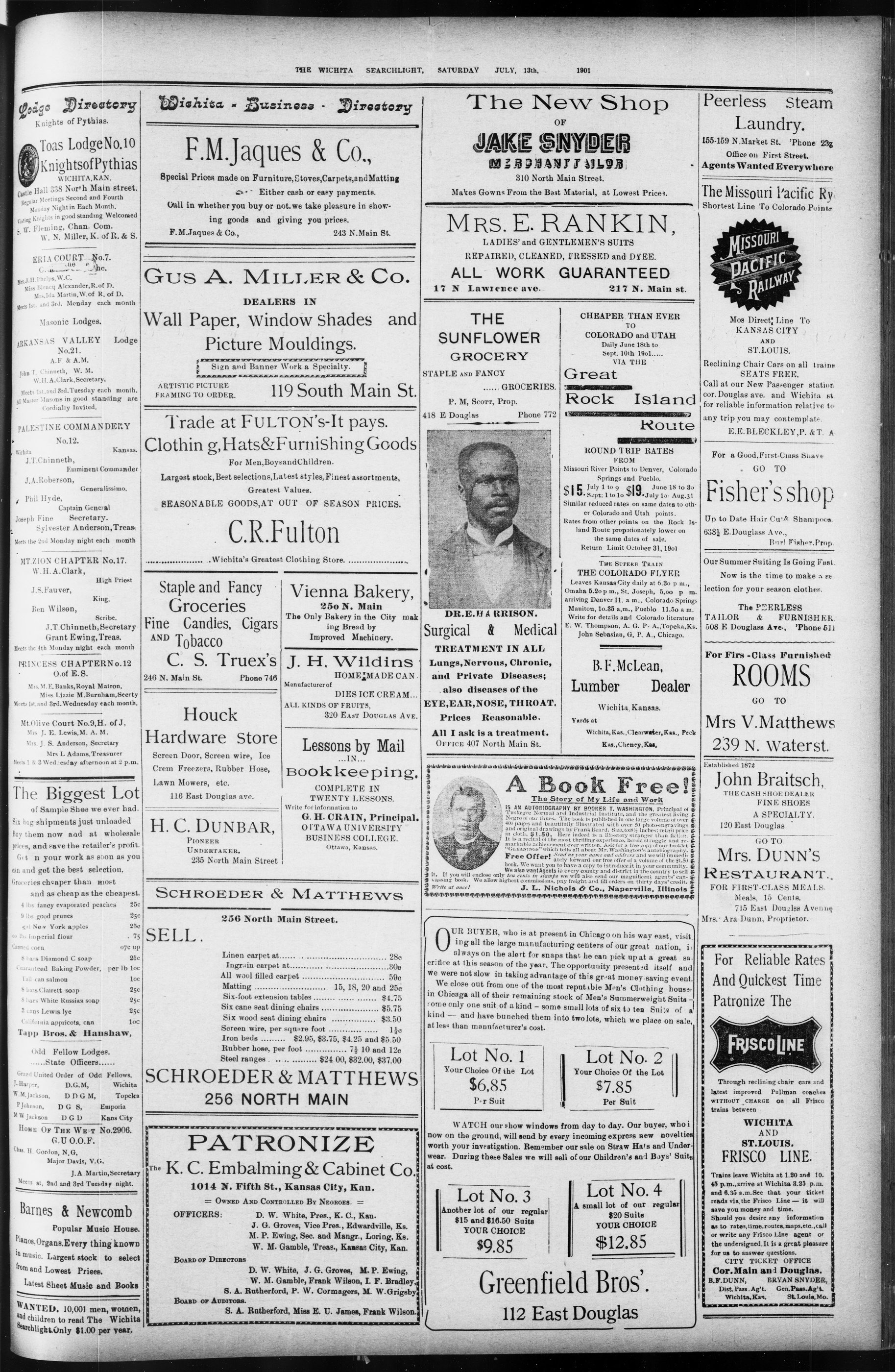
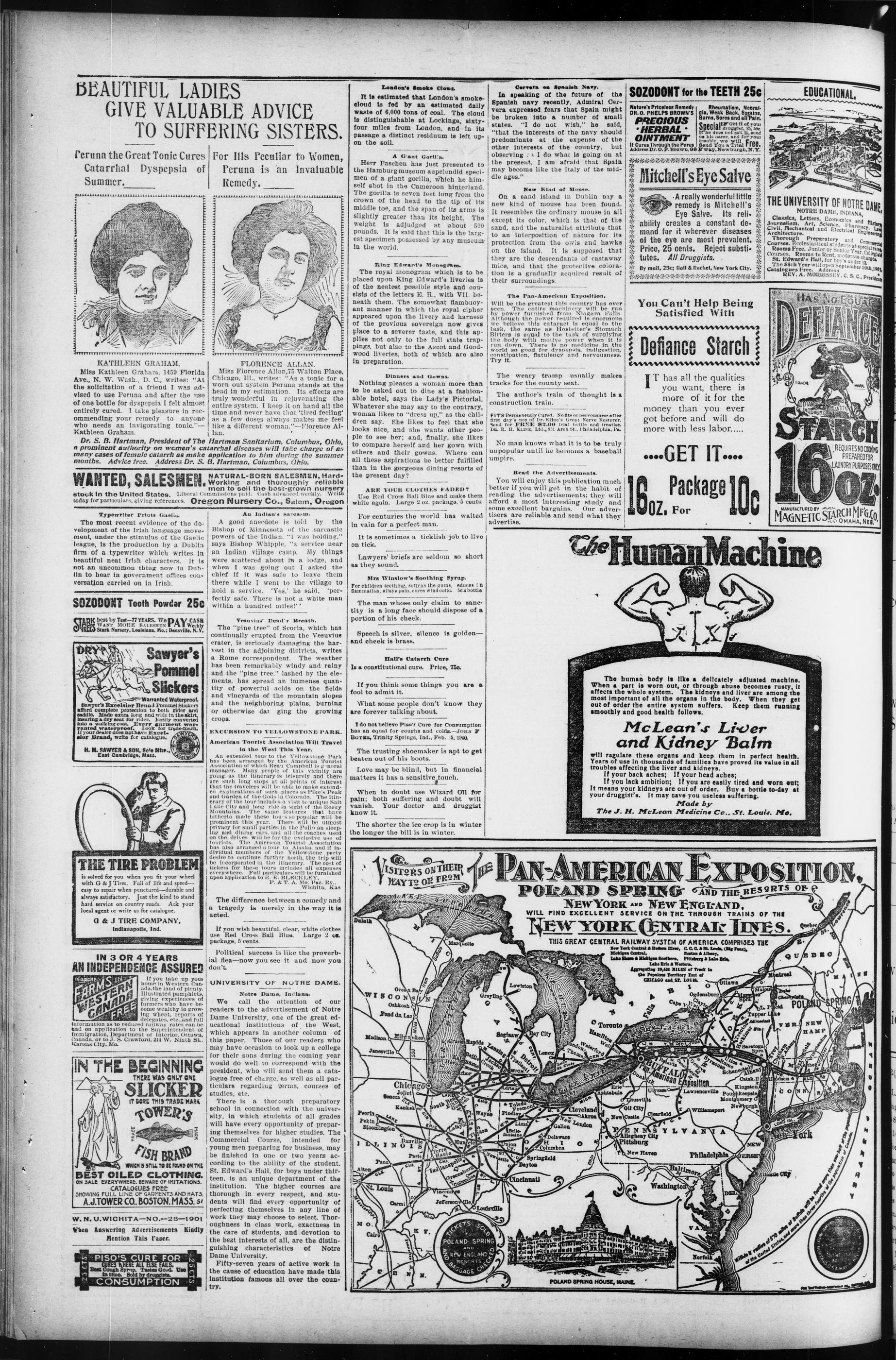
Page text (machine-generated)
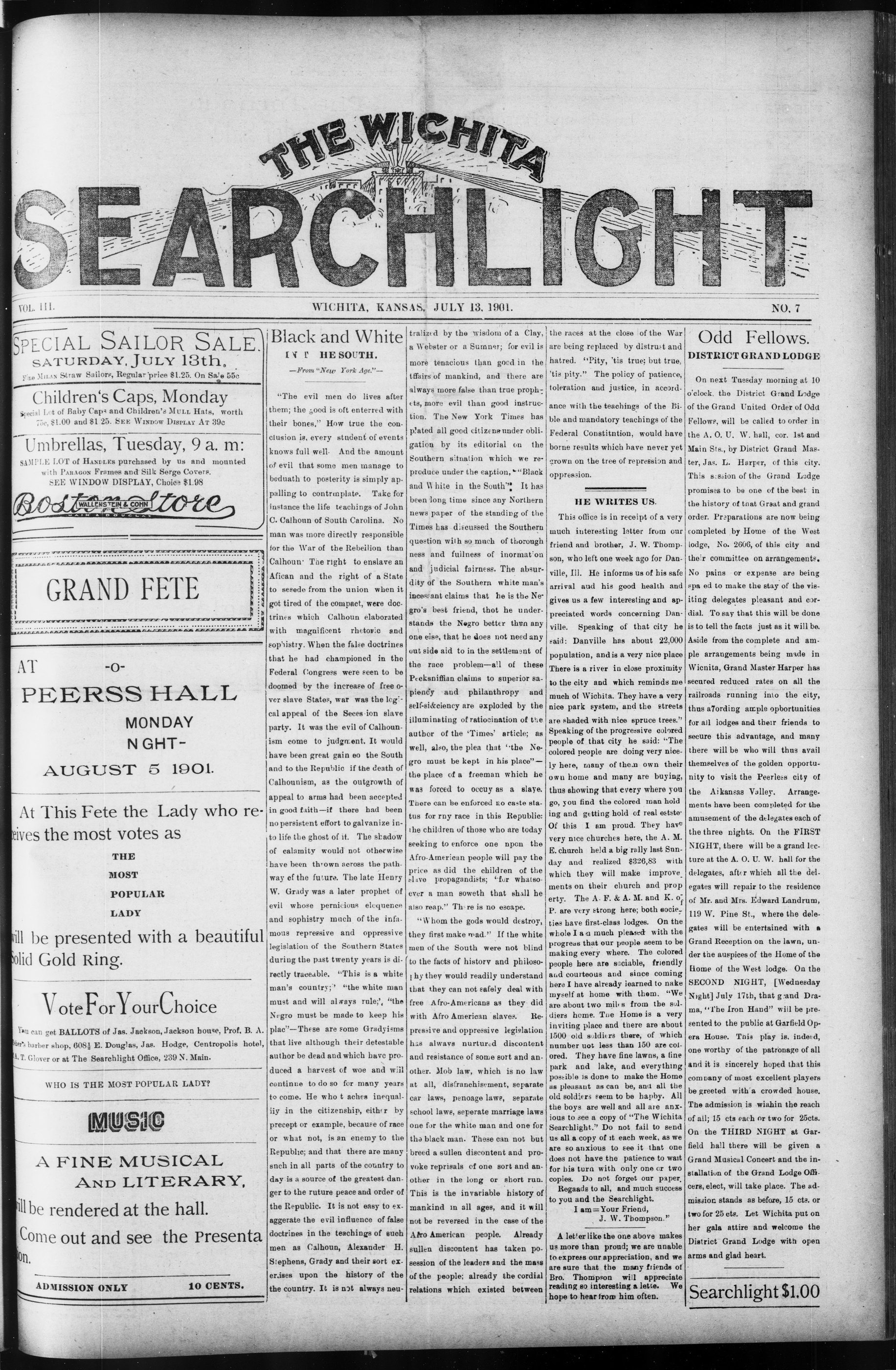
THE WICHITA
SEARCHLIGHT
SPECIAL SAILOR SALE
SATURDAY, JULY 13th.
Fine Milan Straw Sailors, Regular price $1.25. On Sa'e 55c
Children's Caps, Monday
Special Lot of Baby Caps and Children's Mull Hats, worth
75c, $1.00 and $1.25. SEE WINDOW DISPLAY At 39c
Umbrellas, Tuesday, 9 a. m:
SAMPLE LOT of HANDLES purchased by us and mounted
with Paragon Frames and Silk Serge Covers.
SEE WINDOW DISPLAY, Choice $1.98
GRAND FETE
-0-
EERSS HAL
MONDAY
N GHT-
AUGUST 5 1901.
This Fete the Lady w the most votes as
At This Fete the Lady who receives the most votes as
THE
MOST
POPULAR
LADY
will be presented with a beautiful Solid Gold Ring.
will be presented with a beautiful Solid Gold Ring.
VoteForYourChoice
get BALLOTS of Jas. Jackson, Jackson house. over shop, 608 $ \frac{1}{2} $ E. Douglas, Jas. Hodge, Centre over or at The Searchlight Office, 239 N. Main.
You can get BALLOTS of Jas. Jackson, Jackson house, Prof. B. A. Fisher's barber shop, 608 1/2 E. Douglas, Jas. Hodge, Centropolis hotel, A. T. Glover or at The Searchlight Office, 239 N. Main.
WHO IS THE MOST POPULAR LADY?
MUSIC
A FINE MUSICAL AND LITERARY rendered at the hall.
A FINE MUSICAL AND LITERARY, will be rendered at the hall. Come out and see the Presenta ion.
WICHITA, KANSAS, JULY 13, 1901.
WICHITA, KANSAS, JULY 13, 1901.
Black and White IN F HE SOUTH.
"The evil men do lives after them; the good is oft entered with their bones," How true the conclusion is, every student of events knows full well. And the amount of evil that some men manage to boduath to posterity is simply appalling to contrample. Take for instance the life teachings of John C. Calhoun of South Carolina. No man was more directly responsible for the War of the Rebellion than Calhoun. The right to enslave an African and the right of a State to sesede from the union when it got tired of the compact, were doctrines which Calhoun elaborated with magnificent rhetoric and sophistry. When the false doctrines that he had championed in the Federal Congress were seen to be doomed by the increase of free over slave States, war was the logical appeal of the Secession slave party. It was the evil of Calhounism come to judgment. It would have been great gain eo the South and to the Republic if the death of Calhounism, as the outgrowth of appeal to arms had been accepted in good faith—if there had been no persistent effort to galvanize into life the ghost of it. The shadow of calamity would not otherwise have been thrown across the pathway of the future. The late Henry W. Grady was a later prophet of evil whose pernicious eloquence and sophistry much of the infamous repressive and oppressive legislation of the Southern States during the past twenty years is directly traceable. "This is a white man's country;" "the white man must and will always rule," "the Negro must be made to keep his plac"—These are some Gradyisms that live although their detestable author be dead and which have produced a harvest of woe and will continue to do so for many years to come. He who taches inequaliily in the citizenship, either by precept or example, because of race or what not, is an enemy to the Republic; and that there are many such in all parts of the country to day is a source of the greatest danger to the future peace and order of the Republic. It is not easy to exaggerate the evil influence of false doctrines in the teachings of such men as Calhoun, Alexander H. Stephens, Grady and their sort exercises upon the history of the the country. It is not always neu-
tralized by the wisdom of a Clay, a Webster or a Sumner; for evil is more tenacious than good in the affairs of mankind, and there are always more false than true prophets, more evil than good instruction. The New York Times has plated all good citizens under obligation by its editorial on the Southern sitation which we reproduce under the caption, "Black and White in the South". It has been long time since any Northern news paper of the standing of the Times has discussed the Southern question with so much of thoroughness and fullness of information and judicial fairness. The absurdity of the Southern white man's insistent claims that he is the Negro's best friend, that he understands the Negro better than any one else, that he does not need any out side aid to in the settlement of the race problem—all of these Peeksniffian claims to superior sapiency and philanthropy and self-si ciency are exploded by the illuminating of ratiocination of the author of the 'Times' article; as well, also, the plea that "the Negro must be kept in his place"—the place of a freeman which he was forced to occupy as a slaye. There can be enforced no caste status for rny race in this Republic: the children of those who are today seeking to enforce one upon the Afro-American people will pay the price as did the children of the slave propagandists; "for whatsoever a man soweth that shall he also reap." There is no escape.
"Whom the gods would destroy, they first make mad." If the white men of the South were not blind to the facts of history and philosophy they would readily understand that they can not safely deal with free Afro-Americans as they did with Afro American slaves. Repressive and oppressive legislation has always nurtured discontent and resistance of some sort and another. Mob law, which is no law at all, disfranchisement, separate car laws, penoage laws, separate school laws, seperate marriage laws one for the white man and one for the black man. These can not but breed a sullen discontent and provoke reprisals of one sort and another in the long or short run. This is the invariable history of mankind in all ages, and it will not be reversed in the case of the Afro American people. Already sullen discontent has taken possession of the leaders and the mass of the people; already the cordial relations which existed between
the races at the close of the War are being replaced by distrust and hatred. "Pity, 'tis true; but true, 'tis pity." The policy of patience, toleration and justice, in accordance with the teachings of the Bible and mandatory teachings of the Federal Constitution, would have borne results which have never yet grown on the tree of repression and oppression.
HE WRITES US.
This office is in receipt of a very much interesting letter from our friend and brother, J. W. Thompson, who left one week ago for Danville, Ill. He informs us of his safe arrival and his good health and gives us a few interesting and appreciated words concerning Danville. Speaking of that city he said: Danville has about 22,000 population, and is a very nice place There is a river in close proximity to the city and which reminds me much of Wichita. They have a very nice park system, and the streets are shaded with nice spruce trees." Speaking of the progressive colored people of that city he said: "The colored people are doing very nicely here, many of them own their own home and many are buying, thus showing that every where you go, you find the colored man holding and getting hold of real estate Of this I am proud. They have very nice churches here, the A. M. E. church held a big rally last Sunday and realized $326,83 with which they will make improvements on their church and property. The A. F. & A. M. and K. P. are very strong here; both societies have first-class lodges. On the whole I am much pleased with the progress that our people seem to be making every where. The colored people here are sociable, friendly and courteous and since coming here I have already learned to make myself at home with them. "We are about two miles from the soldiers home. The Home is a very inviting place and there are about 1500 old soldiers there, of which number not less than 150 are colored. They have fine lawns, a fine park and lake, and everything possible is done to make the Home as pleasant as can be, and all the old soldiers seem to be happy. All the boys are well and all are anxious to see a copy of "The Wichita Searchlight." Do not fail to send us all a copy of it each week, as we are so anxious to see it that one does not have the patience to wait for his turn with only one or two copies. Do not forget our paper. Regaads to all, and much success to you and the Searchlight.
A letter like the one above makes us more than proud; we are unable to express our appreciation, and we are sure that the many friends of Bro. Thompson will appreciate reading so interesting a letter. We hope to hear from him often.
NO.7
Odd Fellows. DISTRICT GRAND LODGE
On next Tuesday morning at 10 o'clock, the District Grand Lodge of the Grand United Order of Odd Fellows, will be called to order in the A. O. U. W. hall, cor. 1st and Main Sts., by District Grand Master, Jas. L. Harper, of this city. This session of the Grand Lodge promises to be one of the best in the history of that Great and grand order. Preparations are now being completed by Home of the West lodge, No. 2606, of this city and their committee on arrangements. No pains or expense are being spared to make the stay of the visiting delegates pleasant and cordial. To say that this will be done is to tell the facts just as it will be. Aside from the complete and ample arrangements being made in Wicnita, Grand Master Harper has secured reduced rates on all the railroads running into the city, thus a7ording ample opportunities for all lodges and their friends to secure this advantage, and many there will be who will thus avail themselves of the golden opportunity to visit the Peerless city of the Akansas Valley. Arrangements have been completed for the amusement of the delegates each of the three nights. On the FIRST NIGHT, there will be a grand lecture at the A. O. U. W. hall for the delegates, after which all the delegates will repair to the residence of Mr. and Mrs. Edward Landrum, 119 W. Pine St., where the delegates will be entertained with a Grand Reception on the lawn, under the auspices of the Home of the Home of the West lodge. On the SECOND NIGHT, [Wednesday Night] July 17th, that grand Drama, "The Iron Hand" will be presented to the public at Garfield Opera House. This play is, indeed, one worthy of the patronage of all and it is sincerely hoped that this company of most excellent players be greeted with a crowded house. The admission is wiahin the reach of all; 15 cts each or two for 25cts. On the THIRD NIGHT at Garfield hall there will be given a Grand Musical Concert and the installation of the Grand Lodge Officers, elect, will take place. The admission stands as before, 15 cts. or two for 25cts. Let Wichita put on her gala attire and welcome the District Grand Lodge with open arms and glad heart.
Searchlight $1.00
W. N. MILLER, Editor.
Entered at the Post Office at Wichita Kansas, as Second Class Mail Matter.
Published every Saturday at No 239 North Main Street, up stairs
RATES OF SUBSCRIPTION
IN ADVANCE.
On year, by mail. $1 00
By mail, by mail. $1 00
Three months, by mail. $50
Advertising rates made known on application.
Address all communications to "The
Searchlight," Wichita, Kansas.
[All matters to be published must reach this office not later than Tuesday, to reach publication in the current issue.]
correspondents and agents wanted everywhere. Write us for terms.
All matters sent to "The Searchlight" for publication must be signed by the party or parties writing.
"To Live and Let Live," is our Motto.
COLORED FIRE DEPARTEENT.
On or about August 1st, Chief, A.G. Walden of our Fire Department will establish a fire company in the north part of the city, manned by good efficient colored men. In the appointment of colored men by Chief Walden at the new house, the colored people highly rejoice, and feel proud of the action of our Mayor and Chief of Fire Depriment. This company is not being established temporary but permanent. Chief Walden has ordered a new fire apparatus and will supply this house with the latest improved fire fighting instruments. This action of the Cheif and Mayor prove their friendship for the colored people and their great desire to see the colored people of this city attain the tee highest mark within their power. On the behalf of our many colored readers we thank the Mayor and Chief Walden for this magnificent recognition and promise them that the colored people will endeavor to prove by their dcts their appreciation of this high and much favored act toward them.
THE WHITE BRIGADE.
Street Commissioner, E. J. Allen has introduced a crew of white coated street sweepers. These are all colored men and they are dress in white coats and pants and white helmits. They present quite a metropolitan appearance as they go up and down Main ann Douglas, and keep them clean. This is quite a needed addition and adds to the material good health of our city. Commissioner Allen has more colored men in his employ than than was ever employed in the city before. We doff our hat to our hat to our good street commissioner.
Mr. Al Buford and Miss Maud Vernon were united in marriage at the residence of the bride last Monday evening. The ceremony was performed by Rev. A. C Terrell pastor of the A. M. E. church. The bride was very beautifully attired in a neat white dress, while the groom wore a suit of black. The wedding was a quit one and only the relatives of the two contracting parties were present. Searchlight extends to Mr. and Mrs. Buford their most sincere wish for a long and happy married life.
Hon. Chas. H Luling is a man among men, and is an Abraham Lincoln to the coldred people of Wichita. He will ever find a tender spot in the heart and a friendly remembrance in the minds of all the colored people here.
We are glad to note that so many colored people are buying homes.
Chief Walden will install the colored Fire company about Aug. 1st.
HURRAH! for our Fire Chief.
Locals and Personals.
We do job printing.
MRS. LEE ANDERSON
and MASSAGE PARLOR.
442 N. TOPEKA AVE.
Mrs. Ara Dunn has a firstclass restaurant at 715 E. Douglas. You can get a nice hot meal "like mother used to cook." Go there 715 E. Douglas Ave. Hot meals.
O YES!
Remember the last Grund Rally of the FRIENDSHIP Baptist church will be on the third [ 3rd ] Sunday of this month [ July 21tt ]. A grand and interesting program has been arranged for this occasion. We expect our friends to help us Revs. H. F. Faazier, A. C. Terrill, and R. McTurner and their kind members have promised to be with us on that dap. Rev. Brasco of Newton will preach at 11 a. m.; Rev. Dr. Terrill at 3:30 p. m. Come out and hear them All services will be at PEERLESS HALL on account of our small seating capacity.
PAID HER CLAIM
W. H. A. Clork, Secretary of Arkansas Valley lodge No. 21, A. F. & A. M., of this city, paid to Mrs. Minie Bowman $100.00 on July 9, 1901. Being in full for the Endowment of her husband Bro. Wm. Bowman, who died a few weeks ago.
Jas. Jackson, Syl Anderson and a few more of the "sports" went fish ing Wednesday night. They succeeded in catching 00000000 fish. Good boys, go again!! Thats good.
Mrs. S. L. Ford of Pine Bluff, Ark., is visiting her aunt, Mrs. Jacob McAfee, 1020 N. Ohio,
FOR SALE or TRADE:—One barber outfit complete. Address:— W. A. Patton, 215 S. Washington, Wichita, Kans.
A COOL PLACE
... Where You Can
Spend your SUNDAY AFTER-NOON and EVENING, is the CENTROPOLIS HOTEL. We make it a specialty to * * * * *
Have Everything
for the comfort of our patrons.
Ice Cream, Soda Pop and lunches.
J. H. Hodge, Prop. 605, N. Main.
When in need of Groceries
do not forget that you can
always get the Best at the
Lowest prices at
KERNAN'S
1102 E Douglass Ave. 'Phone 357
Backed U
THE S & M
Mens' Socks
Polka Dots, Stripes and Figured
in Black and Colors;
Choice Pair 10c.
SCHMITT & MARTIN'S
5 AND 10F
WICHITA. 8M STORE
KANSAS.
NO. 406 EAST DOUGLAS AVE.
3rd door East of Topeka Ave.
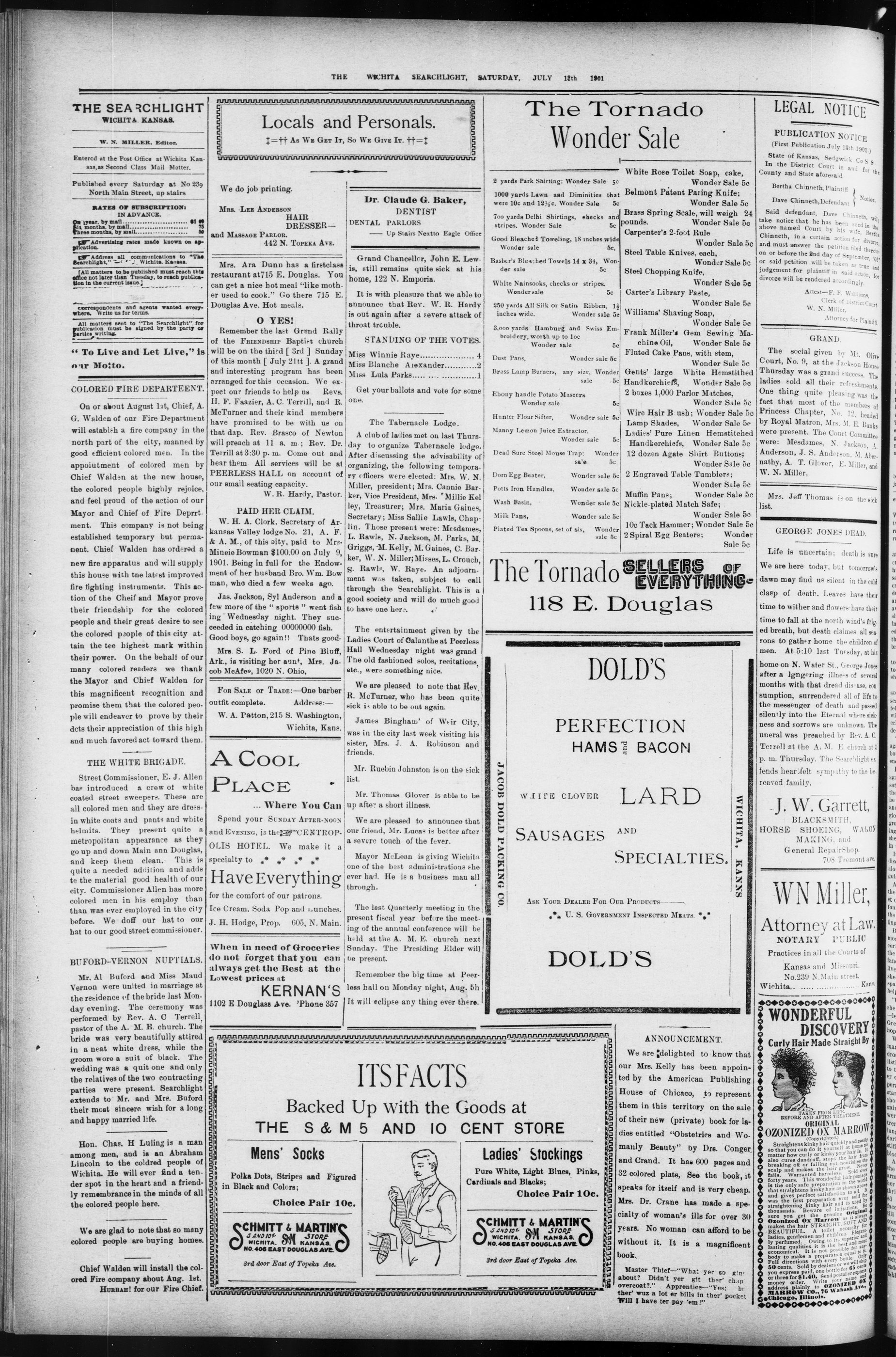
THE WICHITA SEARCHLIGHT, SATURDAY, JULY 18th 1901
Dr. Claude G. Baker,
DENTIST
DENTAL PARLORS
Up Stairs Nextto Eagle Office
Grand Chancellor, John E. Lewis, still remains quite sick at his home, 122 N. Emporia.
It is with pleasure that we able to announce that Rev. W. R. Hardy is out again after a severe attack of throat trouble.
STANDING OF THE VOTES.
Miss Winnie Raye.....4
Miss Blanche Alexander.....2
Miss Lula Parks.....1
Get your ballots and vote for some one.
The Tabernacle Lodge.
A club of ladies met on last Thursday to organize Tabernacle lodge. After discussing the advisability of organizing, the following temporary officers were elected: Mrs. W. N. Miller, president; Mrs. Cannie Barker, Vice President, Mrs. 'Millie Kelley, Treasurer; Mrs. Maria Gaines, Secretary; Miss Sallie Lawls, Chaplin. Those present were: Mesdames, L. Rawls, N. Jackson, M. Parks, M. Griggs, M. Kelly, M. Gaines, C. Barker, W. N. Miller; Misses, L. Cronch, S. Rawls, W. Raye. An adjournment was taken, subject to call through the Searchlight. This is a good society and will do much good to have one here.
The entertainment given by the Ladies Court of Calanthe at Peerless Hall Wednesday night was grand The old fashioned solos, recitations, etc., were something nice.
We are pleased to note that Rev. R. McTurner, who has been quite sick is able to be out again.
James Bingham' of Weir City, was in the city last week visiting his sister, Mrs. J. A. Robinson and friends.
Mr. Ruebin Johnston is on the sick list.
Mr. Thomas Glover is able to be up after a short illness.
We are pleased to announce that our friend, Mr. Lucas is better after a severe touch of the fever.
Mayor McLean is giving Wichita one of the best administrations she ever had. He is a business man all through.
The last Quarterly meeting in the present fiscal year before the meeting of the annual conference will be held at the A. M. E. church next Sunday. The Presiding Elder will be present.
Remember the big time at Peerless hall on Monday night, Aug. 5h It will eclipse any thing ever there.
ITSFACTS
Up with the Goo
M 5 AND IO CE
1
---
The Tornado Wonder Sale
Office
700 yards Delhi Shirtings, checks and
stripes. Wonder Sale 5c
Good Bleached Toweling, 18 inches wide.
Wonder sale 5c.
Lew-
his
Basber's Bleached Towels 14 x 34, Wonder
sale 5c
ble to
hardy
back of
250 yards All Silk or Satin Ribbon, 14
inches wide. Wonder sale 5c
TES.
3,000 yards Hamburg and Swiss Embroidery, worth up to 10c
Wonder sale 5c
..... 4
..... 2
..... 1
Dust Pans, Wonder sale 5c
Brass Lamp Burners, any size, Wonder
sale 5c
Hunter Flour Sifter, Wonder sale 5c
Manny Lemon Juice Extractor.
Wonder sale 5c
Dead Sure Steel Mouse Trap; Wonder
sa'e 5c
Dorn Egg Beater, Wonder sale 5c
Potts Iron Handles, Wonder sale 5c
Wash Basin, Wonder sale 5c
Milk Pans, Wonder sale 5c
Plated Tea Spoons, set of six, Wonder sale 5c
The Tornado
118 E. D
DO
ornado SELLERS OF EVERYTHING 8 E. Douglas DOLD'S
PERFECTION HAMS and BACON
WITTE CLOVER LARD SAUSAGES AND WICHITA,
SAUSAGES
D PACKING CO.
Ask YOUR DEALER FOR OUR
U. S. GOVERNMENT
YOUR DEALER FOR OUR PRODUCTS
U. S. GOVERNMENT INSPECTED MEATS.
ASK YOUR DEALER FOR OUR PRODUCTS
U. S. GOVERNMENT INSPECTED MEATS. * *
DOLD'S
Goods at
CENT STORE
ANNOUNCEMENT.
Pure White, Light Blues, Pinks, Cardinals and Blacks;
Choice Pair 10c.
SCHMITT & MARTIN'S
SAND 10V SM STORE
WICHITA. KANSAS.
NO. 408 EAST DOUGLAS AVE.
3rd door East of Topeka Ave.
---
Ebony handle Potato Maseers
Wonder sale
Ladies' Stockings
3rd door East of Topeka Ave.
White Rose Toilet Soap, cake,
Wonder Sale 5c
Wonder Sale 5c
Gents' large White Hemstitched
Handkerchiefs, Wonder Sale 5c
2 boxes 1,000 Parlor Matches,
Wonder Sale 5c
Wire Hair B ush; Wonder Sale 5c
Lamp Shades, Wonder Sale 5c
Ladies' Pure Linen Hemstitched
Handkerchiefs, Wonder Sale 5c
12 dozen Agate Shirt Buttons;
Wonder Sale 5c
Muffin Pans; Wonder Sale 5c
Nickle-plated Match Safe;
Wonder Sale 5c
10c Tack Hammer; Wonder Sale 5c
2 Spiral Egg Beaters; Wonder
Sale 5c
LARD
AND SPECIALTIES.
We are delighted to know that our Mrs. Kelly has been appointed by the American Publishing House of Chicago, to represent them in this territory on the sale of their new (private) book for ladies entitled "Obstetrics and Womanly Beauty" by Drs. Conger and Crand. It has 600 pages and 32 colored plats, See the book, it speaks for itself and is very cheap. Mrs. Dr. Crane has made a specialty of woman's ills for over 30 years. No woman can afford to be without it. It is a magnificent book.
Master Thief—"What yer so glu-
about? Didn't yer git ther' chap
overcoat?" Apprentice—"Yes; but
her' wuz a lot er bills in ther' pocket
Will I wuz ter pay 'em'"
LEGAL NOTICE
PUBLICATION NOTICE
(First Publication July 13th 1901.)
State of Kansas, Sedgwick Co S S
In the District Court in and for the
County and State aforesaid
Bertha Chinneth, Plaintiff
Dave Chinneth, Defendant
Said defendant, Dave Chinneth, will
take notice that he has been sued in the
above named Court by his wife, Bertha
Chinneth, in a certain action for divorce,
and must answer the petition filed therein
on or before the 2nd day of September, 1901
or said petition will be taken as true and
judgement for plaintiff in said action, for
divorce will be rendered accordingly.
Attest—F. F. Williams,
Clerk of district Court
W. N. Miller,
Attorney for Plaintiff
GRAND
The social given by Mt. Olive Court, No. 9, at the Jackson House Thursday was a grand success. The ladies sold all their refreshments. One thing quite pleasing was the fact that most of the members of Princess Chapter, No. 12, headed by Royal Matron, Mrs. M. E. Banks were present. The Court Committee were: Mesdames, N. Jackson, A. Anderson, J. S. Anderson, M. Abernathy, A. T. Glover, E. Miller, and W. N. Miller.
Mrs. Jeff Thomas is on the sick list.
GEORGE JONES DEAD.
Life is uncertain; death is sure. We are here today, but tomorrow's dawn may find us silent in the cold clasp of death. Leaves have their time to wither and flowers have their time to fall at the north wind's frigided breath, but death claims all seasons to gather home the children of men. At 5:10 last Tuesday, at his home on N. Water St., George Jones after a lngering illness of several months with that dread dis use, consumption, surrendered all of life to the messenger of death and passed silently into the Eternal where sickness and sorrows are unknown. The uneral was preached by Rev. A.C. Terrell at the A. M. E. church at 5 p. m. Thursday. The Searchlight ex-fends hearfelt sympathy to the bereaved family.
J. W. Garrett,
BLACKSMITH,
HORSE SHOEING, WAGON
MAKING, and
General RepairShop.
708 Tremont ave.
WN Miller,
Attorney at Law.
NOTARY PUBLIC
Practices in all the Courts of
Kansas and Missouri.
No.239 N.Main street.
WONDERFUL
DISCOVERY
Curly Hair Made Straight By
TAKEN FROM LIFE
(Copyrighted)
Straighteners kinky and easily so that you can fit it yourself at home no matter how curly or kinky your hair is also cures dandruff, stops the from breaking off of the hair, helps the hair grow. Never fails. Warranted harmless. Never forty years. This wonderful hair product is the only safe propionate in the world for straightening kinky hair as shown above and gives perfect satisfaction to you was the first preparation ever used for straightening kinky hair is used by sure you get the genuine Origin Ozonized Ox Marrow makes the hair STRAIGHT SOFT AND lends the hair necessity to ladies, gentlemen and children. Only perfumed. Owing to its price and lasting qualities it is best and most body to make a preparation equal to Full directions with every One 50 cents. Sold by bottle we will ship you one bottle for 65 cents money order for $1.40. Send postal or express money order. Write your name and address plainly to 76 Wabash Ave. Chicago, Illinois.
Chicago, Illinois.
Susie: A Character Sketch
By Philip Verrill Michels
CHAPTER II - (Continued.)
CHAPTER II.—(Continued.)
The sun went down, the daylight warned. Exhaustion told the man beware to cease and go to his cabin. Having loaded the bucket he labored slowly up the vertical climb on the ladder. The Indian glided nearer to the edge. He could hear every step on the rungs of the ladder, could ever detect the sound of the roughened hands grasping the wood. Leaning far over, he saw the candle, fastened on the miner's bag. Nearer, nearer it slowly came, fluttering, throwing goblin shadows against the somber walls, contending firmly against the encompassing floor.
The shaft was now alive with hollow shoes of the labors of the man. On came the light. It was 10 feet away—it was five feet—two. The head and the light emerged above the yawning floor.
With a movement swift, strong, make-like, Mingo thrust out his powerful hand. It came across the minors eyes and nose; then the head was crenched quickly, violently backward. The hands, surprised, tried to cling, but failed. They loosened, waved wildly, clutched at the air, and then, with the body and head, were overtopped, headlong, twisting, turning, the man was hurled to the swallowing abyss. The light on the hat gave forth the sound of a flame in the wind and was gone—plucked off by the rushing darkest. A shriek issued forth from the mouth of the tomb. "Susie! little Susie!" was the cry. Sounds of a striking—a bounding back and forth, dully, against the jagged sides—a crash at the bottom—and silence deeper than stillness ensued.
The door swing open and Mingo, the Washoe, glided forth and away in the twilight, into the sage brush; and a rabbit would have made a greater ruse. The stiffness of midnight, a seeming attribute of masses of shadows that rounded from the waning moon, behind the rocks, the brush and every salient thing, was timidly broken. The break in the hinges of the mize cabin door sounded weirdly clear—a wall, an omen, thought the Indian girl. An awesome darkness filled the silent shed. Susie, on her knees, went creeping, feeling with her hands for the edge of the shaft. There she clutched the windlass post, and leaned her breast against it.
"Frank," she cooed, in a low, sweet tone that wavered with the effort made to keep it cheerful, "Frank, my sunshine—Frank."
No sound save that a piece of rock, somewhere down along the pick-scarred walls of the shaft, loosened and fell, down and down, striking the sides with dimishing sounds, till a ghostly who announced its bottom rest. Then deeper silence.
"Dear one, are you there?" she called again; but the sound of her voice, rebounding on herself, made her frightened and awed.
Pressing her heart against the post again, to still its audible thumping, she sat a moment in dread. Suddenly, then, strengthened by the thought that it might be there, wounded, perhaps, and needing her sadly, down in the room of the yawning mine, she moved her way to the ladder. Moaned of instinct, there in the darkness, she slowly descended, down and down in the mocking, echoing tomb.
In the utter blackness her hands covered his face, and she cried loud, till the shaft was full of angrish.
A boneless mass, inert and fitted to the jagged surface of the loaded bucket of ore, into which he had fallen, she found. His head hung limply athwart the bucket's edge; the eyes, which her fingers sought, were closed.
Beside him, kneeling, she sank, to mown and croon, combing the dark, curling hair with her fingers, kissing the face—and seeing nothing. She fancied that a beat, slight and feeble, lived in his breast. Calling his name, she coaxed and wooed, and then, depriving, stood up and prayed for help.
"God, if the Indians, too, have souls," she said, "give my aching soul to him—let him live! Give me something, Great Eternal Spirit—something of hope!"
With an esoteric summoning of a marvelous strength, she lifted the drooping form; the arms and head fell dislissely across her shoulders. Then to the ladder! And with all the power of arms and limbs, thewed by deseration against the giant task, she started tolling up and up, like one who shoulders up a crushing weight, to gain the air and freedom. Her palms were burning, her knees shook and trembled, her breath came in gasping clutches painful to bear; the darkness swam thickly about—she was putting, smothered, congested with blood, yet she forced her way aloft.
Across the floor of the cabin at last she fell with the burden. The limpimis arms went dangling at random about her neck in a ghastly embrace that crushed her keenly with joy. Exhausted she lay, fondling the hands and arms, trying to rub him back to life, the chill of long-dead clay was worse, and the face seemed carved in wound.
Through the night, bending above him, she poured out a fountain of her love and grief alternately with all the distress of her Indian cooings and absence of her mellow English syl-ables. Grey morning found her woo-
ing still the smile on the dead man's lips, striving, yearning to warm the cold, white features.
The small, broad miner, passing the cabin when noon was high, delayed for a second. "Letter for Henley," he stolidly announced; but tossing it in, beheld the girl, beheld the miner, and fled the hill to spread the news of the sight he had seen, and to fetch away the coroner.
CHAPTER III.
In the sage brush wigwam the summer waned to autumn with dreary stillness. Grey already, the stretch of brush, relieved alone by the willow fringe of the wandering creek, was cheerless, dreary and oppressive to the girl. She sat alone, while the chilling wind was wantonly ripping the leaves from the branches, her head drooped low in hopeless despair.
A shadow, thrown by the setting sun, betrayed a presence. Durably she raised her eyes to look. "Ugh," said a tall, grunting Washoe buck. She turned away her head again
She turned away her head again.
"Mahala, do you wait for Mingo?" said the man. "Johnny Shag is bigger chief. Mingo shall never come."
She looked in silence on the ashes of the wood burned the day before.
"Mahala," he added, "one, two moons Jonny Shag come to take you the trail to my wigwam. Why not any talk? Too long, you sabbee? Mahala waits for Mingo. Better look out Mahata; Jonny Shag is warrior. To-day you better talk."
"One moon, let me think," she wearily answered. "Let me wait one moon."
"One moon, yet. Jonny Shag will wait. Many things come before the moon again." He glided away, and again her head sank wearily down.
Mingo, the Washoe, stealthily returning to Chloride hill, kept cautious ears and eyes awide, to learn the result of the murder at the mine. Susie, he rightly conjectured, would have guessed the truth. He avoided the wikiup, but remained in the town. Patience with many an Indian is a virtue. On a crisp, cool day, while Mingo talked with a group of bucks on a corner, Shag, on a pony and armed with a rifle, rode up behind. Raising his gun, he deliberately shot Mingo through the body, and escaped to the hills.
The thoroughly astounded camp officials promptly gave pursuit, but all in vain. Friends and relations of the dead man assisting, the country was scoured, skillfully, cunningly, Canyons, valleys, the shoulders of the mountains, were traversed and searched, but nothing availed. Shag enjoyed every advantage.
Three Indian trailers, mounted, came at length to where the fugitive was lying in ambush. One of these escaped with his life and rode like a demon to tell of the two, lying grisly and stark, struck in the back by the bullets of Shag, their faces now twisted in the sun.
A stooping, stricken Washoe, the old Red Wolf, whose boys they were that had died in the sand, departed in silence, alone, on the path of war. The fued was his. In the night he found the man he sought, found him asleep—left him asleep—his knife standing firm, erect, buried to the hilt in the breast of Shag the warrior.
The year grew old; its days, like the hours of waking of an old and passing man, were dim and short, its nights long sleeps, that made it none the stronger.
And yet there came a day that was like an echo of what had been before the year began to age. Susie, wan but wistful of face, went from the hopeless wigwam and hurried away up the moaning creek. She went to a copse of alder trees, entered and was lost to view.
An hour later she slowly emerged and in her arms she carried a child, a little boy with fairest hair and the bluest of eyes. She seated herself in the sunlight and shivered as she nestled the infant and cooled it softly with Indian words. She was faint and weary, but strangely happy. Her baby resembled its father, young as it was. Her heart went leaping to it—embraced it—owned it! Her pain, her suffering, everything was forgotten.
All the afternoon she sat by the stream nursing her baby, cudling it closely, warming it ever in her throbbing breast. As the twilight approached, the air was the balm of the Indian summer.
Rising, she placed her baby in the rustling grass; defly she bent the subtle willows down—masses of willow—and throwing the grass, leaves and twigs over all, made a roof to catch the frost. Into this with her child she crept, nestling it gently as before.
Night came down. Quite late the babe awoke and feebly cried. She smothered it and sang, in her sad-sweet voice, a hullaby:
I hear the crickets sing in the long grasses;
Many camp-fires of the braves shine
in the sky—
They shine again in the little river;
The wind is small and gentle when it
plays in your hair.
Lie in my heart as the pebbles lie in
the little river;
the little river;
As the crickets lie in the long grasses;
Shine in my heart as the camp-fires
shine in the sky;
Sleep, little Fawn, till the sun comes
over the mountain.
The little Fawn slept, but never to
wake till a greater tip should top the
CHAPTER III
mountains of darkness, misery and despair.
Singing and cooing, Susie weaved in the darkness—unconscious of the flight—with the birds, toward the summer—of the new little soul. At midnight, bending forward to kiss the downy cheek, she was startled at its coldness. Hurriedly feeling the wee soft hands, the pulseless feet, the tiny body, she sounded the utmost depths of agony.
She rushed from the shelter, the cold little body in her arms. By the light of the stars, the "fires of the braves," she saw the touch of the grim visitor.
Then on the air of night arose a pain-song out of a heart rudely broken. She sank unconscious to the earth. Away off hillward a gaunt coyote howled an answer back, dismal, long, forlorn.
The sun gilded the path to the heavens, and rose in purple mists of majesty; the beam-fingers played in the night-dark hair of the mother, and touched with gold the hair of the child. Dreaming the present far out of vision, dreaming the past into present again, the wan mother smiled and nodded in her sleep. Awakening, she shivered; a sigh that had rested was also aroused. Yet peace and patience were come in her heart. Kneeling, she yearningly extended her hands to the shimmering sun. "O God, O Great Eternal Spirit," she said, "they told me of the Christ who died—who died for sins—for souls in trouble! But oh, my God, He never knew of Indian souls—and so, Great Spirit, let Susie die for all the sins—the love—the happiness!"
Still with her look to the mighty sun, still with a murmur of passionate appeal on her quivering lips, she took up her baby, pressed it in eagerness close to her bosom, and glided ahead, to a pool of the stream, sobbing and sobbing, and was curtained from sight of the crystal waters.
When the body of the slender young Indian woman, clinging to a fair-hadred baby, was found, a few wives and mothers said it was "plitful," and other persons said she was "only an infant."
(The End.)
Two Kinds of Independence.
We have all met the girl with the independent air, who is apt to show a rebellious spirit when things do not go her own way. Not infrequently she is well educated and comes from a refined home, says a writer in the Weekly Bouquet. But this fact does not make her manner the less offensive. It is a good thing to have self confidence and courage for these qualities are essential to success. But independence is a trait that is contrary to agreeableness and robs its possessor of that sweet amiability which is born from the virtue, obedience. Every law of God, and every law of nature, is dependent on another law for support. The girl who thinks she can get along without cultivating the graces of gentleness, courtesy and kindness to others, is making a sad mistake, and will be anything but a success. Who knows how to obey well will rule equally well. Whether in the business or social world, the girl, or woman who influences things for the best is the one whose bright disposition deems independence out of place where progress is desired.
Home-Made Gondoliers.
How many citizens of Buffalo who have watched the imported gondoliers on the exposition canals realize that we have developed a race of gondoliers of our own right here in Buffalo? The dirty old skids down in the harbor are not so pleasing to the eye as the smart Venetian gondolars at the fair. The grimy ferry boys who propel them don't look so foreign or so picturesque as their fellow-craftsmen from abroad. But when it comes to skill in handling a boat with a single stern oar, dodging around between steamers and tugs, through narrow passages and over the swells made by the big ships, the Buffalo boys have no need to fear comparison.
It would be an interesting and popular exhibition if the Pan-American authorities some day would take three or four of the best of the ferry boys from Buffalo harbor up to the exposition grounds, put them on the canals in their old skiffs and match them in a contest of speed and skill against the imported gondoliers. I'd bet my money on the Buffalo boys.—Buffalo Express
Study of the Moon.
It has been observed that on account of the absence of an atmosphere on the moon, and the consequent lack of gradation in shadows, the eye of the observer is seriously misled in judging the actual relief of objects forming the lunar landscapes. Prof. Prinz of Brussels has recently developed a method of avoiding this difficulty, and of seeing the craters and other details on the moon in their natural proportions. Taking advantage of the fact that as the moon travels around the earth the eccentricity of its orbit produces the effect of a slow libration, or balancing to and fro, which causes its face to be inclined now a little one way and now a little the other way. Prof. Prinz makes two photographs of the lunar object to be studied, at opposite points in the libration, and then combines them in a stereoscope, whereupon the object stands forth in full relief. This principle has hitherto been applied only to photographs of the moon as a whole and not to particular craters or regions.
Silk in the United States.
The United States seem disposed to take the lead among the silk producers of the world. During the last three years the consumption of raw silk in the United States has exceeded that of France.
SAYINGS and DOINGS
SAYINGS and DOINGS
Georgie Cayvan Nearly Blind.
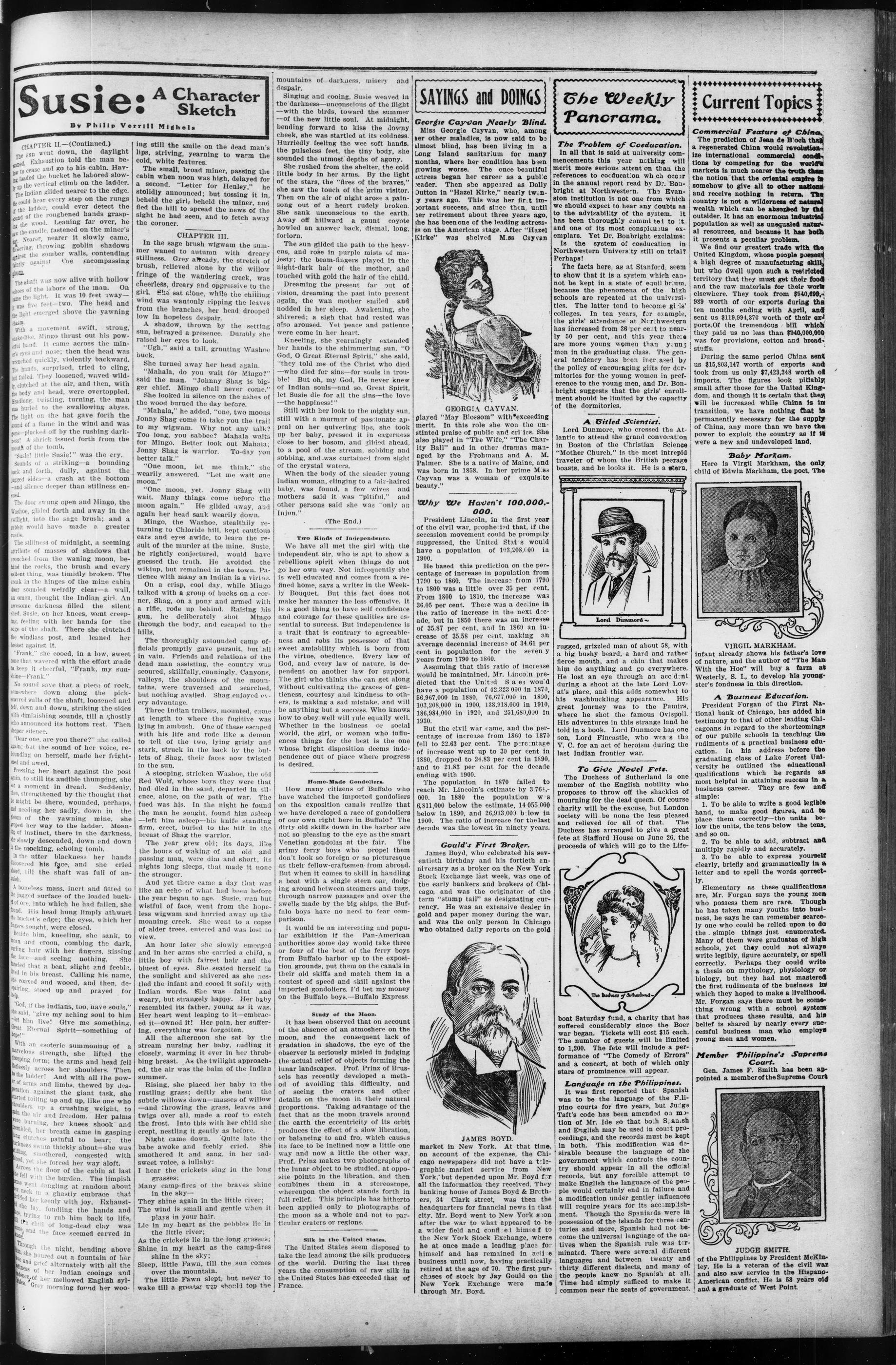
Miss Georgie Cayvan, who, among her other maladies, is now said to be almost blind, has been living in a Long Island sanitarium for many months, where her condition has been growing worse. The once beautiful actress began her career as a public leader. Then she appeared as Dolly Dutton in "Hazel Kirke," nearly twenty years ago. This was her first important success, and since then, until her retirement about three years ago, she has been one of the leading actresses on the American stage. After "Hazel Kirke" was shelved M.ss Cayvan
GEORGIA CAYVAN.
played "May Blossom" with exceeding merit. In this role she won the unstinted praise of public and crilies. She also played in "The Wife," "The Charity Ball" and in other dramas managed by the Frohmans and A. M. Palmer. She is a native of Maine, and was born in 1858. In her prime M.ss Cayvan was a woman of exquisite beauty."
Why We Haven't 100,000.-
000
President Lincoln, in the first year of the civil war, propheted that, if the secession movement could be promptly suppressed, the United States would have a population of 103,208,000 in 1900.
He based this prediction on the percentage of increase in population from 1790 to 1860. The increase from 1790 to 1800 was a little over 35 per cent. From 1800 to 1810, the increase was 36.05 per cent. There was a decline in the ratio of increase in the next decade, but in 1850 there was an increase of 35.87 per cent, and in 1860 an increase of 35.58 per cent, making an average decennial increase of 34.61 per cent in population for the seven y years from 1790 to 1860.
Assuming that this ratio of increase would be maintained, Mr. Lincoln predicted that the United States would have a population of 42,323,000 in 1870, 56,967,000 in 1880, 76,677,000 in 1890, 103,208,000 in 1900, 138,918,000 in 1910, 136,984,000 in 1920, and 251,680,000 in 1930.
But the civil war came, and the percentage of increase from 1860 to 1870 fell to 22.63 per cent. The percentage of increase went up to 30 per cent in 1880, dropped to 24.83 per cent in 1890, and to 21.83 per cent for the decade ending with 1900.
The population in 1870 failed to reach Mr. Lincoln's estimate by 3.761,000. In 1880 the population was 6,811,000 below the estimate, 14,055,000 below in 1890, and 26,913,000 below in 1900. The ratio of increase for the last decade was the lowest in ninety years.
Gould's First Broker.
James Boyd, who celebrated his seventieth birthday and his fortieth anniversary as a broker on the New York Stock Exchange last week, was one of the early bankers and brokers of Chicago, and was the originator of the term "stump tall" as designating currency. He was an extensive dealer in gold and paper money during the war, and was the only person in Chicago who obtained daily reports on the gold
A. B.
JAMES BOYD. market in New York. At that time, on account of the expense, the Chicago newspapers did not have a telegraphic market service from New York,' but depended upon Mr. Boyd for all the information they received. They banking house of James Boyd & Brothers, 34 Clark street, was then the headquarters for financial news in that city. Mr. Boyd went to New York soon after the war to what appeared to be a wider field and confined himself to the New York Stock Exchange, where he at once made a leading place for himself and has remained in active business until now, having practically retired at the age of 70. The first purchases of stock by Jay Gould on the New York Exchange were made through Mr. Boyd.
The Weekly Panorama.
The Problem of Coeducation. In all that is said at university commencements this year nothing will merit more serious attent on than the references to coeducation which occur in the annual report read by Dr. Bonbright at Northwestern. The Evanston institution is not one from which we should expect to hear any doubts as to the advisability of the system. It has been thoroughly commi tel to it, and one of its most conspicuous exemplars. Yet Dr. Bonbright exclaims: Is the system of coeducation in Northwestern University still on trial? Perhaps!
The facts here, as at Stanford, seem to show that it is a system which cannot be kept in a state of equil brum, because the phenomena of the high schools are repeated at the universities. The latter tend to become girls' colleges. In ten years, for example, the girls' attendance at Northwestern has increased from 36 per cent to nearly 50 per cent, and this year there are more young women than young men in the graduating class. The general tendency has been increased by the policy of encouraging gifts for dormitories for the young women in preference to the young men, and Dr. Bonbright suggests that the girls' enrollment should be limited by the capacity of the dormitories.
A. Titled Scientist
Lord Dunmore, who crossed the Atlantic to attend the grand convocation in Boston of the Christian Science "Mother Church," is the most intrepid traveler of whom the British peerage boasts, and he looks it. He is a stern.
Lord Dunmore~
rugged, grizzled man of about 58, with a big bushy beard, a hard and rather fierce mouth, and a chin that makes him do anything and go everywhere. He lost an eye through an accident during a shoot at the late Lord Lovat's place, and this adds somewhat to his washbuckling appearance. His great journey was to the Pamirs, where he shot the famous Ovispill. His adventures in this strange land he told in a book. Lord Dunnmore has one son, Lord Fincastle, who wea's the V. C. for an act of heroism during the last Indian frontier war.
To Give Novel Fets.
The Duchess of Sutherland is one member of the English nobility who proposes to throw off the shackles of mourning for the dead queen. Of course charity will be the excuse, but London society will be none the less pleased and relieved for all of that. The Duchess has arranged to give a great fete at Stafford House on June 26, the proceeds of which will go to the Life-
The Duchess of Sutherland~
boat Saturday fund, a charity that has suffered considerably since the Boer war began. Tickets will cost $15 each. The number of guests will be limited to 1,200. The fete will include a performance of "The Comedy of Errors" and a concert, at both of which only stars of prominence will appear.
Language in the Philippines.
Language in the Philippines.
It was first reported that Spanish was to be the language of the Filipino courts for five years, but Judy Taft's code has been amended on motion of Mr. Ide so that both Spanish and English may be used in court proceedings, and the records must be kept in both. This modification was desirable because the language of the government which controls the country should appear in all the official records, but any forcible attempt to make English the language of the people would certainly end in failure and a modification under gentler influences will require years for its accomplishment. Though the Spaniards were in possession of the islands for three centuries and more, Spanish had not become the universal language of the natives when the Spanish rule was terminated. There were several different languages and between twenty and thirty different dialects, and many of the people knew no Spanish at all. Time had simply sufficed to make it common near the seats of government.
Commercial Feature of China. The prediction of Jean de Bloch that a regenerated China would revolutionize international commercial conditions by competing for the world's markets is much nearer the truth than the notion that the oriental empire is somehow to give all to other nations and receive nothing in return. The country is not a wilderness of natural wealth which can be absorbed by the outsider. It has an enormous industrial population as well as unequaled natural resources, and because it has both it presents a peculiar problem.
We find our greatest trade with the United Kingdom, whose people possess a high degree of manufacturing skill, but who dwell upon such a restricted territory that they must get their food and the raw materials for their work elsewhere. They took from $440,999,999 worth of our exports during the ten months ending with April, and sent us $119,994,370 worth of their exports. Of the tremendous bill which they paid us no less than $340,000,000 was for provisions, cotton and bread-stuffs.
During the same period China send us $15,803,147 worth of exports and took from us only $7,423,348 worth of imports. The figures look pitifully small after those for the United Kingdom, and though it is certain that they will be increased while China is in transition, we have nothing that is permanently necessary for the supply of China, any more than we have the power to exploit the country as if it were a new and undeveloped land.
Baby Markam
Here is Virgil Markham, the only child of Edwin Markham, the poet. The
VIRGIL MARKHAM.
infant already shows his father's love of nature, and the author of "The Man With the Hoe" will buy a farm at Westerly, S. I., to develop his youngster's fondness in this direction.
A Business Education.
President Forgan of the First National bank of Chicago, has added his testimony to that of other leading Chicagoans in regard to the shortcomings of our public schools in teaching the rudiments of a practical business education. In his address before the graduating class of Lake Forest University he outlined the educational qualifications which he regards as most helpful in attaining success in a business career. They are few and simple:
1. To be able to write a good legible hand, to make good figures, and to place them correctly—the units below the units, the tens below the tens, and so on.
2. To be able to add, subtract and multiply rapidly and accurately.
3. To be able to express yourself clearly, briefly and grammatically in a letter and to spell the words correctly.
Elementary as these qualifications are, Mr. Forgan says the young men who possess them are rare. Though he has taken many youths into business, he says he can remember scarcely one who could be relied upon to do the simple things just enumerated. Many of them were graduates of high schools, yet they could not always write legibly, figure accurately, or spell correctly. Perhaps they could write a thesis on mythology, physiology or biology, but they had not mastered the first rudiments of the business in which they hoped to make a livelihood. Mr. Forgan says there must be something wrong with a school system that produces these results, and his belief is shared by nearly every successful business man who employs young men and women.
Member Philippine's Supreme Court
Gen. James F. Smith has been appointed a member of the Supreme Court
JUDGE SMITH.
of the Philippines by President McKinley. He is a veteran of the civil war and also saw service in the Hispano-American conflict. He is 58 years old and a graduate of West Point.
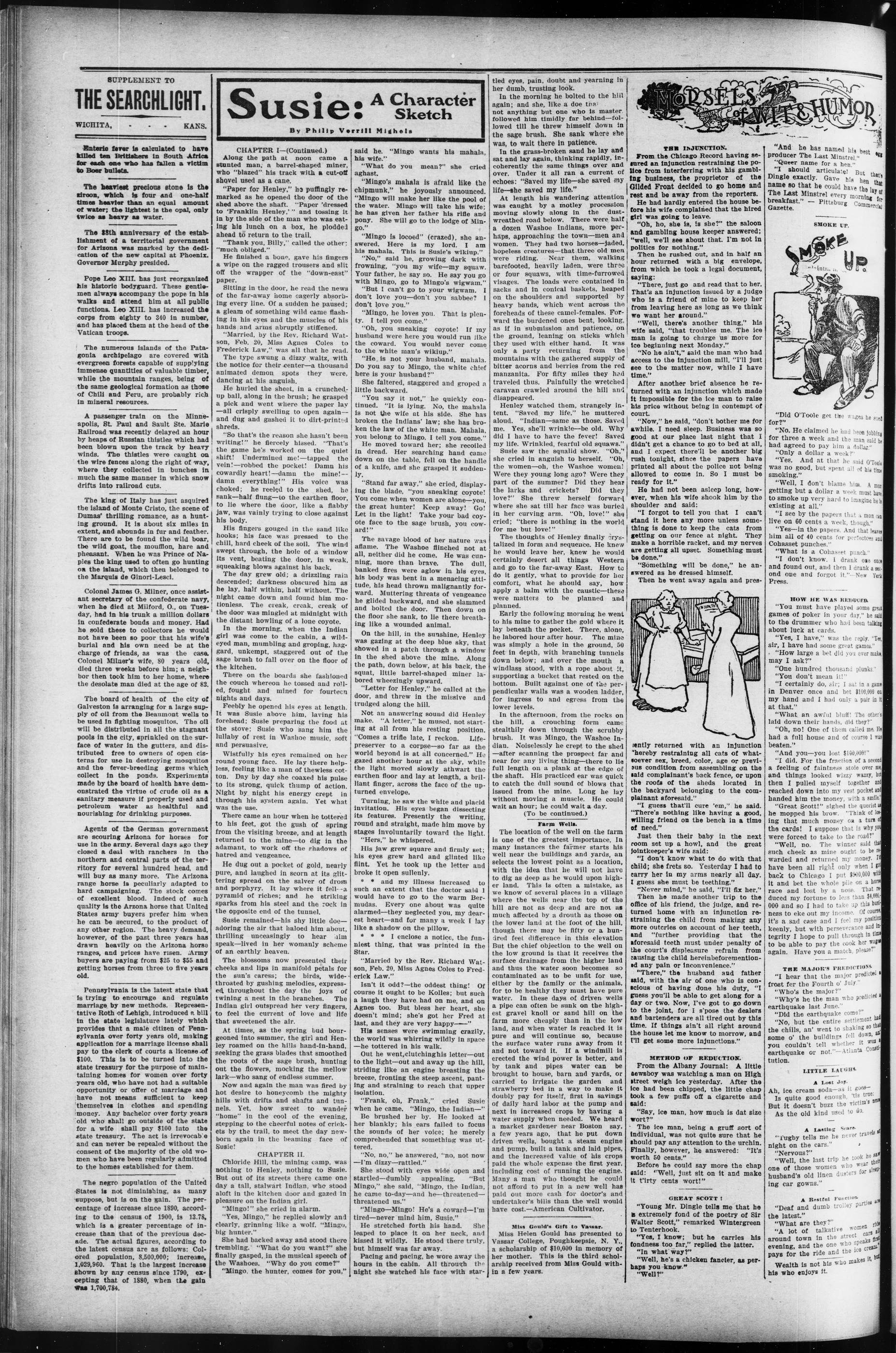
THE SEARCHLIGHT.
Enterio fever is calculated to have killed ten Britishers in South Africa for each one who has fallen a victim to Boer bullets.
The heaviest precious stone is the zircon, which is four and one-half times heavier than an equal amount of water; the lightest is the opal, only twice as heavy as water.
The 88th anniversary of the establishment of a territorial government for Arizona was marked by the dedication of the new capital at Phoenix, Governor Murphy presided.
Pope Leo XIII. has just reorganized his historic bodyguard. These gentlemen always accompany the pope in his walks and attend him at all public functions. Leo XIII. has increased the corps from eighty to 340 in number, and has placed them at the head of the Vatican troops.
The numerous islands of the Patagonia archipelago are covered with evergreen forests capable of supplying immense quantities of valuable timber, while the mountain ranges, being of the same geological formation as those of Chili and Peru, are probably rich in mineral resources.
A passenger train on the Minneapolis, St. Paul and Sault Ste. Marie Railroad was recently delayed an hour by heaps of Russian thistles which had been blown upon the track by heavy winds. The thistles were caught on the wire fences along the right of way, where they collected in bunches in much the same manner in which snow drifts into railroad cuts.
The king of Italy has just acquired the island of Monte Cristo, the scene of Dumas' thrilling romance, as a hunting ground. It is about six miles in extent, and abounds in fur and feather. There are to be found the wild boar, the wild goat, the moufflon, hare and pheasant. When he was Prince of Naples the king used to often go hunting on the island, which then belonged to the Marquis de Ginori-Lesci.
Colonel James G. Milner, once assistant secretary of the confederate navy, when he died at Milford, O., on Tuesday, had in his trunk a million dollars in confederate bonds and money. Had he sold these to collectors he would not have been so poor that his wife's burial and his own need be at the charge of friends, as was the case. Colonel Milner's wife, 80 years old, died three weeks before him; a neighbor then took him to her home, where the desolate man died at the age of 82.
The board of health of the city of Galveston is arranging for a large supply of oil from the Beaumont wells to be used in fighting mosquitos. The oil will be distributed in all the stagnant pools in the city, sprinkled on the surface of water in the gutters, and distributed free to owners of open cisterns for use in destroying mosquitos and the fever-breeding germs which collect in the ponds. Experiments made by the board of health have demonstrated the virtue of crude oil as a sanitary measure if properly used and petroleum water as healthful and nourishing for drinking purposes.
Agents of the German government are scouring Arizona for horses for use in the army. Several days ago they closed a deal with ranchers in the northern and central parts of the territory for several hundred head, and will buy as many more. The Arizona range horse is peculiarly adapted to hard campaigning. The stock comes of excellent blood. Indeed of such quality is the Arizona horse that United States army buyers prefer him when he can be secured, to the product of any other region. The heavy demand, however, of the past three years has drawn heavily on the Arizona horse ranges, and prices have risen. Army buyers are paying from $25 to $55 and getting horses from three to five years old.
Pennsylvania is the latest state that is trying to encourage and regulate marriage by new methods. Representative Roth of Lehigh, introduced a bill in the state legislature lately which provides that a male citizen of Pennsylvania over forty years old, making application for a marriage license shall pay to the clerk of courts a license of $100. This is to be turned into the state treasury for the purpose of maintaining homes for women over forty years old, who have not had a suitable opportunity or offer of marriage and have not means sufficient to keep themselves in clothes and spending money. Any bachelor over forty years old who shall go outside of the state for a wife shall pay $100 into the state treasury. The act is irrevocable and can never be repealed without the consent of the majority of the old women who have been regularly admitted to the homes established for them.
The negro population of the United States is not diminishing, as many suppose, but is on the gain. The percentage of increase since 1880, according to the census of 1900, is 13.78, which is a greater percentage of increase than that of the previous decade. The actual figures, according to the latest census are as follows: Colored population, 5,500,000; increase, 1,029,960. That is the largest increase shown by any census since 1790, excepting that of 1880, when the gain was 1,700,784.
Susie: A Character Sketch
By Philip Vorrill Mighels
CHAPTER I—(Continued.) Along the path at noon came a stunted man, a barrel-shaped miner, who "blazed" his track with a cut-off shovel used as a cane.
"Paper for Henley," he puffingly remarked as he opened the door of the shelf above the shaft. "Paper 'dressed to 'Franklin Henley,'" and tossing it in by the side of the man who was eating his lunch on a box, he plodded ahead to return to the trail.
"Thank you, Billy," called the other; "much obliged."
He finished a bone, gave his fingers a wipe on the ragged trousers and slit off the wrapper of the "down-east" paper.
Sitting in the door, he read the news of the far-away home cagely absorbing every line. Of a sudden he paused; a gleam of something wild came flashing in his eyes and the muscles of his hands and arms abruptly stiffened.
"Married, by the Rev. Richard Watson, Feb. 20, Miss Agnes Coles to Frederick Law," was all that he read.
The type swung a dizzy waltz, with the notice for their center—a thousand animated demon spots they were, dancing at his anguish.
He hurled the sheet, in a crunched-up ball, along in the brush; he grasped a pick and went where the paper lay—all crisply swelling to open again—and dug and gashed it to dirt-printed shreds.
"So that's the reason she hasn't been writing!" he fiercely hissed. "That's the game he's worked on the quiet shift! Undermined me!-tapped the vein!-robbed the pocket! Damn his cowardly heart!-damn the mine!-damn everything!" His voice was choked; he reeled to the shed, he sank—half flung—to the earthen floor, to lie where the door, like a flabby jaw, was vainly trying to close against his body.
His fingers gouged in the sand like hooks; his face was pressed to the chill, hard cheek of the soil. The wind swept through, the hole of a window its vent, beating the door, in weak, squeaking blows against his back.
The day grew old; a drizzling rain descended; darkness obscured him as he lay, half within, half without. The night came down and found him motionless. The creak, creak, creak of the door was mingled at midnight with the distant howling of a lone coyote.
In the morning, when the Indian girl was come to the cabin, a wildeyed man, mumbling and groping, haggard, unkempt, staggered out of the sage brush to fall over on the floor of the kitchen.
There on the boards she fashioned the couch whereon he tossed and rolled, fought and mined for fourteen nights and days.
Feebly he opened his eyes at length. It was Susie above him, laving his forehead; Susie preparing the food at the stove; Susie who sang him the lullaby of rest in Washoe music, soft and persuasive. Wistfully his eyes remained on her round young face. He lay there helpless, feeling like a man of theweless cotton. Day by day she coaxed his pulse to its strong, quick thump of action. Night by night his energy crept in through his system again. Yet what was the use. There came an hour when he toottered to his feet, got the gush of spring from the visiting breeze, and at length returned to the mine—to dig in the adamant, to work off the shadows of hatred and vengeance.
He dug out a pocket of gold, nearly pure, and laughed in scorn at its glittering spread on the salver of dross and porphyry. It lay where it fell—a pyramid of riches; and he striking sparks from his steel and the rock in the opposite end of the tunnel.
Susie remained—his shy little doe—adoring the air that haloed him about, thrilling unceasingly to hear him speak—lived in her womanly scheme of an earthly heaven.
The blossoms now presented their cheeks and lips in manifold petals for the sun's caress; the birds, wide-throated by gushing melodies, expressed throughout the day the joys of twining a nest in the branches. The Indian girl outspread her very fingers, to feel the current of love and life that sweetened the air.
At times, as the spring bud bourgeoned into summer, the girl and Henley roamed on the hills hand-In-hand, seeking the grass blades that smoothed the roots of the sage brush, hunting out the flowers, mocking the mellow lark—who sang of endless summer.
Now and again the man was fired by hot desire to honeycomb the mighty hills with drifts and shafts and tunnels. Yet, how sweet to wander "home" in the cool of the evening, stepping to the cheerful notes of crickets by the trail, to meet the day newborn again in the beaming face of Susie!
CHAPTER II.
Chloride Hill, the mining camp, was nothing to Henley, nothing to Susie. But out of its streets there came one day a tall, stalwart Indian, who stood aloft in the kitchen door and gazed in pleasure on the Indian girl.
"Mingo!" she cried in alarm.
"Yes, Mingo," he replied slowly and clearly, grinning like a wolf. "Mingo, big hunter."
She had backed away and stood there trembling. "What do you want?" she finally gasped, in the musical speech of the Washoes. "Why do you come?" "Mingo, the hunter, comes for you."
CHAPTER II
said he. "Mingo wants his mahala, his wife."
"What do you mean?" she cried agast.
"Mingo's mahala is afraid like the chipmunk," he joyously announced. "Mingo will make her like the pool of the water. Mingo will take his wife; he has given her father his rifle and pony. She will go to the lodge of Mingo."
"Mingo is locoed" (crazed), she answered. Here is my lord. I am his mahala. This is Susie's wikup.
"No," said he, growing dark with frowning, "you my wife—my squaw. Your father, he say so. He say you go with Mingo, go to Mingo's wigwam."
"But I can't go to your wigwam. I don't love you—don't you sabbee? I don't love you."
"Mingo, he loves you. That is plenty. I tell you come."
"Oh, you sneaking coyote! If my husband were here you would run like the coward. You would never come to the white man's wikup."
"He is not your husband, mahala. Do you say to Mingo, the white chief here is your husband?"
She faltered, staggered and groped a little backward.
"You say it not," he quickly continued. "It is lying. No, the mahala is not the wife at his side. She has broken the Indians' law; she has broken the law of the white man. Mahala, you belong to Mingo. I tell you come."
He moved toward her; she recoiled in dread. Her searching hand came down on the table, fell on the handle of a knife, and she grasped it suddenly.
"Stand far away," she cried, displaying the blade, "you sneaking coyote! You come when women are alone—you, the great hunter! Keep away! Go! Let in the light! Take your bad coyote face to the sage brush, you coward!"
The savage blood of her nature was aflaume. The Washoe flinched not at all, neither did he come. He was cunning, more than brave. The dull, banked fires were aglow in his eyes, his body was bent in a menacing attitude, his head thrown malignly forward. Muttering threats of vengeance he glided backward, and she slammed and bolted the door. Then down on the floor she sank, to lie there breathing like a wounded animal.
On the hill, in the sunshine, Henley was gazing at the deep blue sky, that showed in a patch through a window in the shed above the mine. Along the path, down below, at his back, the squat, little barrel-shaped miner labored wheezingly upward. "Letter for Henley," he called at the door, and threw in the missive and trudged along the hill.
Not an answering sound did Henley make. "A letter," he mused, not starting at all from his resting position. "Comes a trifle late, I reckon. Life-preserver to a corpse—so far as the world beyond is at all concerned." He gazed another hour at the sky, while the light moved slowly athwart the earthen floor and lay at length, a brilliant finger, across the face of the upturned envelope.
Turning, he saw the white and placid invitation. His eyes began dissecting its features. Presently the writing, round and straight, made him move by stages involuntarily toward the light. "Hers," he whispered.
His jaw grew square and firmly set; his eyes grew hard and glinted like flint. Yet he took up the letter and broke it open sullenly.
* * and my illness increased to such an extent that the doctor said I would have to go to the warm Bermudas. Every one about was quite alarmed—they neglected you, my dearest heart—and for many a week I lay like a shadow on the pillow.
* * * I enclose a notice, the funniest thing, that was printed in the Star.
"Married by the Rev. Richard Watson, Feb. 20, Miss Agnes Coles to Frederick Law."
Isn't it odd?—the oldest thing! Of course it ought to be Kolles; but such a laugh they have had on me, and on Agnes too. But bless her heart, she doesn't mind; she's got her Fred at last, and they are very happy—" His senses were swimming crazily, the world was whirring wildly in space—he toottered in his walk. Out he went, clutching his letter—out to the light—out and away up the hill, striding like an engine breasting the breeze, fronting the steep ascent, panting and straining to reach that upper isolation. "Frank, oh, Frank," cried Susie when he came. "Mingo, the Indian—"
Be brushed her by. He looked at her blankly; his ears failed to focus the sounds of her voice; he merely comprehended that something was uttered.
"No, no," he answered, "no, not now—I'm dizzy—rattled."
She stood with eyes wide open and startled—dumbly appealing. "But Mingo," she said, "Mingo, the Indian, he came to-day—and he—threatened—threatened us."
"Mingo—Mingo! He's a coward—I'm tired—never mind him, Susie."
He stretched forth his hand. She leaped to place it on her neck, and kissed it wildly. He stood there truly, but himself was far away.
Pacing and pacing, he wore away the hours in the cabin. All through the night she watched his face with star-
tled eyes, pain, doubt and yearning in her dumb, trusting look.
In the morning he bolted to the hill again; and she, like a doe that not anything but one who is master, followed him timidly far behind—followed till he threw himself down in the sage brush. She sank where she was, to wait there in patience.
In the grass-broken sand he lay and sat and lay again, thinking rapidly, in coherently the same things over and over. Under it all ran a current of echoes: "Saved my life—she saved my life—she saved my life."
At length his wandering attention was caught by a motley procession moving slowly along in the dust-wreathed road below. There were half a dozen Washoe Indians, more perhaps, approaching the town—men and women. They had two horses—jaded, hopeless creatures—that three old men were riding. Near them, walking barefooted, heavily laden, were three or four squaws, with time-furrowed visages. The loads were contained in sacks and in conical baskets, heaped on the shoulders and supported by heavy bands, which went across the foreheads of these camel-females. Forward the burdened ones bent, looking, as if in submission and patience, on the ground, leaning on sticks which they used with either hand. It was only a party returning from the mountains with the gathered supply of bitter acorns and berries from the red manzanita. For fifty miles they had traveled thus. Painfully the wretched caravan crawled around the hill and disappeared.
Henley watched them, strangely intent. "Saved my life," he muttered aloud. "Indian—same as those. Saved me. Yes, she'll wrinkle—be old. Why did I have to have the fever! Saved my life. Wrinkled, fearful old squaws." Susle saw the squalfid show. "Oh," she cried in anguish to herself. "Oh, the women—oh, the Washoe women! Were they young long ago? Were they part of the summer? Did they hear the larks and crickets? Did they love?" She threw herself forward where she sat till her face was buried in her curving arm. "Oh, love!" she cried; "there is nothing in the world for me but love!"
The thoughts of Henley finally crystallized in form and sequence. He knew he would leave her, knew he would certainly desert all things Western and go to the far-away East. How to do it gently, what to provide for her comfort, what he should say, how apply a balm with the caustic—these were matters to be planned and planned.
Early the following morning he went to his mine to gather the gold where it lay beneath the pocket. There, alone, he labored hour after hour. The mine was simply a hole in the ground, 50 feet in depth, with branching tunnels down below; and over the mouth a windlass stood, with a rope about it, supporting a bucket that rested on the bottom. Built against one of the perpendicular walls was a wooden ladder, for ingress to and egress from the lower levels.
In the afternoon, from the rocks on the hill, a crouching form came stealthily down through the scrubby brush. It was Mingo, the Washoe Indian. Noiselessly he crept to the shed—after scanning the prospect far and near for any living thing—there to He full length on a plank at the edge of the shaft. His practiced ear was quick to catch the dull sound of blows that issued from the mine. Long he lay without moving a muscle. He could wait an hour; he could wait a day.
Farm Wells.
The location of the well on the farm is one of the greatest importance. In many instances the farmer starts his well near the buildings and yards, an selects the lowest point as a location, with the idea that he will not have to dig as deep as he would upon higher land. This is often a mistake, as we know of several places in a village where the wells near the top of the hill are not as deep and are not as much affected by a drouth as those on the lower land at the foot of the hill, though there may be fifty or a hundred feet difference in this elevation But the chief objection to the well on the low ground is that it receives the surface drainage from the higher land and thus the water soon becomes so contaminated as to be unfit for use, either by the family or the animals, for to be healthy they must have pure water. In these days of driven wells a pipe can often be sunk on the highest gravel knoll or sand hill on the farm more cheaply than in the low land, and when water is reached it is pure and will continue so, because the surface water runs away from it and not toward it. If a windmil is erected the wind power is better, and by tank and pipes water can be brought to house, barn and yards, or carried to irrigate the garden and strawberry bed in a way to make it doubly pay for itself, first in savings of daily hard labor at the pump and next in increased crops by having a water supply when needed. We heard a market gardener near Boston say, a few years ago, that he put down driven wells, bought a steam engine and pump, built a tank and laid pipes, and the increased value of his crops paid the whole expense the first year, including cost of running the engine. Many a man who thought he could not afford to put in a new well has paid out more cash for doctor's and undertaker's bills than the well would have cost—American Cultivator.
Miss Gould's Gift to Vassar
Miss Helen Gould has presented to Vassar College, Poughkeepsie, N. Y., a scholarship of $10,000 in memory of her mother. This is the third scholarship received from Miss Gould within a few years.
MORSELS OF WIT & HUMOR
THE INJUNCTION.
From the Chicago Record having secured an injunction restraining the police from interfering with his gambling business, the proprietor of the Glided Front decided to go home and rest and be away from the reporters.
He had hardly entered the house before his wife complained that the hired girl was going to leave.
"Oh, ho, she is, is she?" the saloon and gambling house keeper answered; "well, we'll see about that. I'm not in politics for nothing."
"And he has named his best producer The Last Minstrel."
"Queer name for a hen."
"I should articulate! But that's Dingle exactly. Gave his hen that name so that he could have the lay of The Last Minstrel every morning for breakfast." — Pittsburg Commercial Gazette.
SMOKE UP.
Then he rushed out, and in half an hour returned with a big envelope, from which he took a legal document, saying:
"There, just go and read that to her. That's an injunction issued by a judge who is a friend of mine to keep her from leaving her as long as we think we want her around."
"Well, there's another thing," his wife said, "that troubles me. The ice man is going to charge us more for ice beginning next Monday."
"No he ain't," said the man who had access to the injunction mill. "I'll just see to the matter now, while I have time."
After another brief absence he returned with an injunction which made it impossible for the ice man to raise his price without being in contempt of court.
"Now," he said, "don't bother me for awhile. I need sleep. Business was so good at our place last night that I didn't get a chance to go to bed at all, and I expect there'll be another big rush tonight, since the papers have printed all about the police not being allowed to come in. So I must be ready for it."
He had not been asleep long, however, when his wife shook him by the shoulder and said:
"I forgot to tell you that I can't stand it here any more unless something is done to keep the cats from getting on our fence at night. They make a horrible racket, and my nerves are getting all upset. Something must be done."
"Something will be done," he answered as he dressed himself.
Then he went away again and pres-
sently returned with an injunction
"hereby restraining all cats of whatsoever sex, breed, color, age or previous condition from assembling on the said complainant's back fence, or upon the roofs of the sheds located in the backyard belonging to the complainant aforesaid.
"I guess that'll cure 'em," he said.
"There's nothing like having a good, willing friend on the bench in a time of need."
Just then their baby in the next room set up a howl, and the great jointkeeper's wife said:
"I don't know what to do with that child; she frets so. Yesterday I had to carry her in my arms nearly all day. I guess she must be teething."
"Never mind," he said, "I'll fix her." Then he made another trip to the office of his friend, the judge, and returned home with an injunction restraining the child from making any more outcries on account of her teeth, and "further providing that the aforesaid teeth must under penalty of the court's displeasure refrain from causing the child hereinbeforementioned any pain or inconvenience."
"There," the husband and father said, with the air of one who is conscious of having done his duty, "I guess you'll be able to get along for a day or two. Now, I've got to go down to the joint, for I s'pose the dealers and bartenders are all tired out by this time. If things ain't all right around the house let me know to morrow, and 'l'll get some more injunctions."
METHOD OF REDUCTION.
From the Albany Journal: A little newsboy was watching a man on High street weigh ice yesterday. After the ice had been chipped, the little chap took a few puffs off a cigarette and said: "Say, ice man, how much is dat size wort?" The ice man, being a gruff sort of individual, was not quite sure that he should pay any attention to the urchin. Finally, however, he answered: "It's worth 50 cents." Before he could say more the chap said: "Well, just sit on it and make it 'tirty cents wort'."
GREAT SCOTT !
"Young Mr. Dingle tells me that he is extremely fond of the poetry of Sir Walter Scott," remarked Wintergreen to Tenterhook.
"Yes, I know; but he carries his fondness too far," replied the latter.
"In what way?"
"Well, he's a chicken fancier, as perhaps you know."
"Well?"
"And he has named his best producer The Last Minstrel." "Queer name for a been."
"I should articulate! But that's Dingle exactly. Give his hien that name so that he could have the lay of The Last Minstrel every morning for breakfast." — Pittsburg Commercial Gazette.
SMOKE UP.
SMOKE UP.
5
"Did O'Toole get the wages he said for?"
"No. He claimed he had been jobbing for three a week and the man said he had agreed to pay him a dollar."
"Only a dollar a week?"
"Yes. And at that he said O'Toole was no good, but spent all of his time smoking."
"Well, I don't blame him. A man getting but a dollar a week must have to smoke up very hard to imagine he is existing at all."
"I see by the papers that a man can live on 60 cents a week, though."
"Yes—in the papers. And that leaves him all of 40 cents for perfectes and Cohasset punches." "What is a Cohasset punch."
"I don't know. I drank one and
and found out, and then I drank a
ond one and forgot it."—New York
Press.
HOW HE WAS REDEUCED
"You must have played some great games of poker in your day," he said to the drummer who had been talking about luck at cards.
"Yes, I have," was the reply. "Yes sir, I have had some great games."
"How large a bet did you ever make may I ask?"
"One hundred thousand plunks."
"You don't mean it!"
"I certainly do, sir; I sat in a game in Denver once and bet $100,000 on my hand and I had only a pair in it at that."
"What an awful bluff! The other laid down their hands, did they?"
"Oh, no! One of them called me he had a full house and of course I was beaten."
"And you—you lost $100,000!"
"I did. For the fraction of a second a feeling of faintness stole over me and things looked wizzy wazzy, but then I pulled myself together and reached down into my vest pocket and handed him the money, with a smile." "Great Scott!" sighed the quest as he mopped his brow. "Think of losing that much money on a turn of the cards! I suppose that is why you were forced to take to the road!"
"Well, no. The winner said that such cheek as mine ought to be rewarded and returned my money. I have been all right only when I got back to Chicago I put $900,000 with it and bet the whole pile on a horse race and lost by a nose. That reduced my fortune to less than $400,000 and so I had to take up this business to eke out my income. Of course, it's a sad case and I feel my position keenly, but with perseverance and integrity I hope to pull through in time to be able to pay the cook her wages again. Have you a match, please?"
THE MAJOR'S PREDICTIONS
"I hear that the major predicted frost for the Fourth o' July."
"Who's the major?"
"Why's he the man who predicted earthquake last June."
"Did the earthquake come?
"No, but the entire settlement had the chills, an' went to shaking so that some o' the buildings fell down, and you couldn't tell whether it was an earthquake or not."—Atlanta Constitution
LITTLE LAUGHS
Ah, ice cream soda—as it goes—
Is quite good enough, this true:
But it doesn't buzz the victim's nose
As the old kind used to do.
A Lasting Scare
"Lugby tells me he never travels a night on the cars."
"Nervous?"
"Well, the last trip he took he saw one of those women who wear their husband's old linen dusters for sleeping car gowns."
A Restful Function
"Deaf and dumb trolley parties are the latest."
"What are they?"
"What are they?
"A lot of talkative women from
around town in the street cars and
evening, and the one who speaks first
pays for the ride and the ice cream."
Wealth is not his who makes it
his, who enjoys it.
Lodge Directory
Knights of Pythias.
Toas LodgeNo.10
KnightsofPythias
WICHITA, KAN.
UNITED STATES OF AMERICA
Castle Hall 338 North Main street.
Regular Meetings Second and Fourth
Monday Night in Each Month.
Visting Knights in good standing Welcomed
S. W. Fleming, Chan. Com.
W. N. Miller, K. of R. & S.
ERIA COURT No.7.
C. A. C. the castle.
Mrs. J. H. Thephs, W.C.
Miss Blencq Alcxander, R. of D.
Mrs. Ida Martin, W. of R. of D.
Meets 1st. and 3rd. Monday each month
ARKANSAS VALLEY Lodge
No.21.
A.F & A.M.
John T. Chinneth, W.M.
W.H.A.Clark, Secretary.
Meets 1st. and 3rd. Tuesday each month.
All Master Masons in good standing are
Cordially Invited.
PALESTINE COMMANDER
No.12.
Wichita Kansas.
J.T.Chinneth,
Emminent Commander
J.A.Roberson,
Generalissimo.
Phil Hyde,
Captain General
Joseph Fine Secretary.
Sylvester Anderson, Trease
Meets the 2nd Monday night each month
MT.ZION CHAPTER No.17.
W.H.A.Clark,
High Priest
J.S.Fauver,
King.
Ben Wilson,
Scribe.
J.T Chinneth,Secretary
Grant Ewing,Treas.
Meets the 4th Monday night each month
PRINCESS CHAPTER No.12
O.of E.S.
Mrs.M.E.Banks,Royal Matron,
Miss Lizzie M.Burnham,Secerty
Meets 1st,and 3rd.Wednesday each month.
Mt.Olive Court No.9,H. of J.
Mrs J. E. Lewis,M. A. M.
Mrs J. S. Anderson,Secretary
Mrs L. Adams,Treasurer
Meets 1 & 3 Wednesday afternoon at 2 p.m.
The Biggest Lot
of Sample Shee we ever had. Six bug shipments just unloaded Buy them now and at wholesale prices, and save the retailer's profit. Get in your work as soon as you can and get the best selection. Groceries cheaper than most
and as cheap as the cheapest.
4 lbs fancy evaporated peaches 25c
9 lbs good prunes 25c
gal New York apples 25c
bbls Imperial flour . 75
canned corn 07c up
8 bars Diamond C soap 25c
Guaranteed Baking Powder, per lb 10c
Tall can salmon 10c
8 bars Clairett soap 25c
8 bars White Russian soap 25c
8 cans Lewis lye 25c
California appricots, can 10c
Tapp Bros. & Hanshaw,
Odd Fellow Lodges.
.....State Officers.....
Grand United Order of Odd Fellows.
J.Harper,
D.G.M, Wichita
W.M.Jackson, D.D.G.M, Topeka
P.Johnson, D.G.S, Emporia
M.W.Jackson D.G.D Kans City
HOME OF THE WE T No.2906.
G.U.O.O.F.
Chas. H. Gordon, N.G.
Major Davis, V.G.
J.A Martin,Secretary
Meets st, 2nd and 3rd Tuesday night.
Barnes & Newcomb
Popular Music House.
Pianos, Organs. Every thing known
in music. Largest stock to select
from and Lowest Prices.
Latest Sheet Music and Books
WANTED. 10,001 men, women,
and children to read The Wichita
Searchlight Only $1.00 per year.
Wichita - Business - Directory
F.M.Jaques & Co.,
Special Prices made on Furniture, Stoves, Carpets, and Matting Either cash or easy payments.
Call in whether you buy or not. we take pleasure in showing goods and giving you prices.
F.M.Jaques & Co., 243 N.Main St.
GUS A. MILLER & CO.
DEALERS IN
Wall Paper, Window Shades and
Picture Mouldings.
Sign and Banner Work a Specialty.
ARTISTIC PICTURE
FRAMING TO ORDER.
119 South Main St.
Trade at FULTON's-It pays. Clothin g,Hats&FurniShing Goods For Men,BoysandChildren. Largest stock,Best selections,Latest styles,Finest assortments, Greatest Values. SEASONABLE GOODS,AT OUT OF SEASON PRICES.
C.R.Fulton
Staple and Fancy
Groceries
Fine Candies, Cigars
AND Tobacco
C. S. Truex's
246 N. Main St. Phone 746
Hardware Store
Screen Door, Screen wire, Ice
Crem Freezers, Rubber Hose,
Lawn Mowers, etc.
116 East Douglas ave.
H. C. DUNBAR,
PIONEER
UNDERTAKER.
235 North Main Street
SCHROEDER &
SCHROEDER & MATTHEWS
256 North Main Street.
Linen carpet at
Ingrain carpet
All wool filled d
Matting .....
Six-foot extens
Linen carpet at..... 28c
Ingrain carpet at..... 30c
All wool filled carpet..... 59c
Matting ..... 15, 18, 20 and 25c
Six-foot extension tables ..... $4.75
Six cane seat dining chairs ..... $5.75
Six wood seat dining chairs ..... $3.50
Screen wire, per square foot ..... 1 1/2c
Iron beds ..... $2.95, $3.75, $4.25 and $5.50
Rubber hose, per foot ..... 7 1/2 10 and 12c
Steel ranges ..... $24.00, $32.00, $37.00
SCHROEDER & MATTHEWS
256 NORTH MAIN
PATRONIZE
Houck
SELL
THE WICHITA SEARCHLIGHT, SATURDAY JULY, 13th.
Vienna Bakery,
250 N. Main
The Only Bakery in the City mak
ing Bread by
Improved Machinery.
J. H. Wildins
HOME MADE CAN
Manufacturer of
DIES ICE CREAM...
ALL KINDS OF FRUITS,
320 EAST DOUGLAS AVE.
Lessons by Mail
...IN...
Bookkeeping.
COMPLETE IN
TWENTY LESSONS.
Write for information to
G. H. CRAIN, Principal.
OITAWA UNIVERSITY
BUSINESS COLLEGE.
Ottawa, Kansas.
MATTHEWS
at ..... 28c
arpet ..... 30c
59c
The New Shop OF
MERCHANT TAILOR
310 North Main Street.
Makes Gowns From the Best Material, at Lowest Prices.
MRS. E. RANKIN,
LADIES' and GENTLEMEN'S SUITS
REPAIRED, CLEANED, FRESSED and DYEE.
ALL WORK GUARANTEED
17 N. Lawrence ave.
217 N. Main st.
A Book Free
THE Story of My Life and Work
IS AN AUTOBIOGRAPHY BY BOCKER T. WASHINGTON, Principal of Tusteegh Normal and Industrial Institute, and the greatest living Negro of our times. The book is published in one large volume of over 100 pages, over 300 photos, pigrayings and original drawings by Frank Beard. In cloth, $1.50. Here indeed is a livestock stranger than fiction. It is a recital of the most thrilling experience, heroic struggle and re-markable achievement ever written. Ask for a free copy of our booklet at www.tusteeghbooks.com. We will immediately forward your free offer of a volume of the $1.50 book. We want you to have a copy to introduce it in your community. We also want Agents in every county and district in the country to sell your book. We will send our magnificent agents' greatest commissions, pay freight and fill orders. J. L. Nichols & Co. Nanaimo, Vancouver.
OUR BUYER, who is at present in Chicago on his way east, visiting all the large manufacturing centers of our great nation, is always on the alert for snaps that he can pick up at a great sacrifice at this season of the year. The opportunity presented itself and we were not slow in taking advantage of this great money-saving event. We close out from one of the most reputable Men's Clothing house in Chicago all of their remaining stock of Men's Summerweight Suits - some only one suit of a kind - some small lots of six to ten Suits of a kind - and have bunched them into two lots, which we place on sale, at less than manufacturer's cost.
WATCH our show windows from day to day. Our buyer, who i now on the ground, will send by every incoming express new novelties worth your investigation. Remember our sale on Straw Hats and Underwear. During these Sales we will sell of our Children's and Boys' Suits at cost.
Greenfield Bros' 112 East Douglas
STAPLE AND FANCY
..... GROCERIES.
P. M, Scott, Prop.
418 E Douglas Phone 772
A. B.
DR.E.MARRISON. Surgical & Medical TREATMENT IN ALL Lungs,Nervous,Chronic, and Private Diseases; also diseases of the EYE,EAR,NOSE,THROAT. Prices Reasonable. All I ask is a treatment. OFFICE 407 North Main St.
PETER
it. If you will enclose only ten cents in stamp-
vassing book. We allow highest commissions.
Write at once!
J. L. Nic
OUR BUYER, who is at presen-
ting all the large manufactu-
always on the alert for snap-
criefice at this season of the year. T
we were not slow in taking advanta
We close out from one of the mo-
n in Chicago all of their remaining s
some only one suit of a kind - some
kind — and have bunched them in
at less than manufacturer's cost.
Lot No. 1
Your Choice Of the Lot
$6,85
Per Suit
WATCH our show windows
now on the ground, will send by ew
worth your investigation. Remember
wear. During these Sales we will s
at cost.
Lot No. 3
Another lot of our regular
$15 and $16.50 Suits
YOUR CHOICE
$9.85
Greenfield
112 East
CHEAPER THAN EVER
TO
COLORADO and UTAH
Daily June 18th to
Sept. 10th 19o1.....
VIA THE
Great
Rock Island
Route
ROUND TRIP RATES
FROM
Missouri River Points to Denver, Colorado
Springs and Pueblo.
$15 July 1 to 9 $19 June 18 to 30
Sept. 1 to 10 July 10-Aug. 31
Similar reduced rates on same dates to other Colorado and Utah points.
Rates from other points on the Rock Island Route proportionately lower on the same dates of sale.
Return Limit October 31, 1901
THE SUPERB TRAIN
THE COLORADO FLYER
Leaves Kansas City daily at 6:30 p.m.,
Omaha 5.20 p.m. St. Joseph, 5.00 p.m.
arriving Denver 11 a.m., Colorado Springs
Manitou, 10.35 a.m., Pueblo 11.50 a.m.
Write for details and Colorado literature
E. W. Thompson, A. G. P. A., Topeka, Ks.
John Sebasian, G. P. A., Chicago
B.F.McLean,
Lumber Dealer
Wichita, Kansas.
Yards at
Wichita, Kas., Clearwater, Kas., Peck
Kas., Cheney, Kas.
Book Free!
Story of My Life and Work
BY BOCKER T. WASHINGTON, Principal of Wood Institute and the greatest living book is published in one large volume of over fifty illustrated with over 50 photo-engravings. Size is 18 inches; index retail price were indexed. Our very strong and rent ever written. Ask for a free copy of our booklet will also send our magnificent about can-you freight and fill orders on thirty days' credit. Books & Co., Naperville, Illinois
at in Chicago on his way east, visiting centers of our great nation, is that he can pick up at a great sale opportunity presented itself and stage of this great money-saving event. Reputable Men's Clothing house of Men's Summerweight Suits - small lots of six to ten Suits of a to two lots, which we place on sale,
Lot No. 2
Your Choice Of the Lot
$7.85
Per Suit
from day to day. Our buyer, who i
very incoming express new novelties
our sale on Straw Hats and Under-
all of our Children's and Boys' Suits
Lot No. 4
A small lot of our regular
$20 Suits
YOUR CHOICE
$12.85
eld Bros'.
t Douglas
Peerless Steam Laundry.
155-159 N.Market St. 'Phone 23g
Office on First Street.
Agents Wanted Everywhere
The Missouri Pacific Ry
Shortest Line To Colorado Points
MISSOURI
PACIFIC
RAILWAY
Mos Direct, Line To
KANSAS CITY
AND
ST.LOUIS.
Reclining Chair Cars on all trains SEATS FREE.
Call at our New Passenger station cor.Douglas ave. and Wichita st for reliable information relative to any trip you may contemplate.
E.E.BLECKLEY P. & T. A
For a Good,First-Class Shave
GO TO
Fisher's shop
Up to Date Hair Cu'& Shampoos.
63S1 E.Douglass Ave.,
Now is the time to make a selection for your season clothes.
The PEERLESS
TAILOR & FURNISHER.
508 E Douglass Ave. 'Phone 51'
ROOMS
GO TO Mrs V.Matthews 239 N. Waterst.
John Braitsch,
THE CASH SHOE DEALER
FINE SHOES
A SPECIALTY.
120 East Douglas
GO TO
RESTAURANT.
FOR FIRST-CLASS MEALS.
Meals, 15 Cents.
715 East Douglass Avenue
Mrs.: Ara Dunn, Proprietor.
For Reliable Rates And Quickest Time Patronize The FRISCO LINE Through reclining chair cars and latest improved Pullman coaches WITHOUT_CHARGE on all Frisco trains between
WICHITA
AND
ST.LOUIS.
FRISCO LINE.
Trains leave Wichita at 1.20 and 10.
45 p.m., arrive at Wichita 8.25 p.m.
and 6.35 a.m.See that your ticket
reads via, the Frisco Line — it will
save you money and time.
Should you desire any information
as to rates, time, routes, maps, etc., call
or write any Frisco Line agent or
the undersigned. It is a great pleasure
for us to answer questions.
CITY TICKET OFFICE
Cor.Main and Douglas.
B.F.DUNN, BRYAN SNYDER,
Dist.Pass.Ag't. Gen.Pass.Ag't.
Wichita, Kan.
St. Louis, Mo.
---
BEAUTIFUL LADIES GIVE VALUABLE ADVICE TO SUFFERING SISTERS.
Dr. S. B. Hartman, President of The Hartman Sanitarium, Columbus, Ohio, a prominent authority on women's catarral diseases will take charge of as many cases of female catarron as make application to him during the summer months. Advice free. Address Dr. S. B. Hartman, Columbus, Ohio.
stock in the United States. Liberal Commissions paid. Cash advanced weekly. Write today for particulars, giving references. Oregon Nursery Co., Salem, Oregon
Peruna the Great Tonic Cures Catarrhal Dyspepsia of Summer.
[Illustration of a woman with a large hairstyle and a high collar, possibly representing a historical figure].
KATHLEEN GRAHAM
Miss Kathleen Graham, 1459 Florida Ave., N. W. Wash., D. C., writes: "At the solicitation of a friend I was advised to use Peruna and after the use of one bottle for dyspepsia I felt almost entirely cured. I take pleasure in recommending your remedy to anyone who needs an invigorating tonic." Kathleen Graham.
Dr. S. B. Hartman, President of The a prominent authority on women's ca many cases of female catarrh as make months. Advice free. Address Dr. S.
WANTED, SALESMEN.
stock in the United States. Liberal Coal today for particulars, giving references. Ore
Typewriter Prints Gaelin
The most recent evidence of the development of the Irish language movement, under the stimulus of the Gaelic league, is the production by a Dublin firm of a typewriter which writes in beautiful neat Irish characters. It is not an uncommon thing now in Dublin to hear in government offices conversation carried on in Irish.
SOZODONT Tooth Powder 25c
STARK
BEST by Test--77 YEARS. We
WANT MORE SALESMEN
Stark Nursery, Louisiana, Mo.; Dansville, N.Y.
DRY
Sawyer's
Pommel
Slickers
Warranted Waterproof.
Sawyer's Excelsior Brand Pommel Slickers afford complete protection to both rider and
adapter. Write for sales and insure a dry seat for rider. Easily converted
into a walking coat. Every garment war-
mated waterproof. Look for England.
His dear does not have Excel-
sor Brand, write for catalogue.
H. M. SAWYER & SON, Sole Mtr.,
East Cambridge, Mass.
A
THE TIRE PROBLEM
is solved for you when you fit your wheel with G & J Tire. Full of life and speed—easy to repair when punctured—durable and always satisfactory. Just the kind to stand hard service on country roads. Ask your local agent or write us for catalogue.
G & J TIRE COMPANY,
Indianapolis, Ind.
IN 3 OR 4 YEARS
AN INDEPENDENCE ASSURED
GOLGRE FARMS IN WESTERN CANADA FREE
If you take up your home in Western Canada, the land of plenty, Illustrated pamphlets, giving experiences of farmers who have become wealthy in growing wheat, reports of delegates, etc., and full information as to reduced railway rates can be laid on application to the Superintendent of immigration, Department of Interior, Ottawa, Canada, or to J. S. Crawford, 214 W. Ninth St. Kansas City, Mo.
IN THE BEGINNING THERE WAS ONLY ONE SLICKER IT BORE THIS TRADE MARK TOWER'S FISH BRAND WHICH IS STILL TO BE FOUND ON THE BEST OILED CLOTHING. ON SALE EVERYWHERE. BEWARE OF INITATIONS. CATALOGUES FREE SHOWING FULL LINE OF GARMENTS AND HATS. A.J.TOWER CO. BOSTON. MASS. 51
W.N. U.WICHITA-NO.-28-1901
When Answering Advertisements Kindly Mention This Paper.
PISO'S CURE FOR
CURES WHERE ALL ELSE FAILS.
Best Cough Syrup. Tastes Good. Use
in time. Sold by druggists.
CONSUMPTION
For Ills Peculiar to Women, Peruna is an Invaluable Remedy.
FLORENCE ALLAN.
Miss Florence Allan, 75 Walton Place, Chicago, Ill., writes: "As a tonic for a worn out system Peruma stands at the head in my estimation. Its effects are truly wonderful in rejuvenating the entire system. I keep it on hand all the time and never have that 'tired feeling' as a few doses always makes me feel like a different woman."—Florence Allan.
An Indian's sarcasm.
A good anecdote is told by the Bishop of Minnesota of the sarcastic powers of the Indian. "I was holding," says Bishop Whipple, "a service near an Indian village camp. My things were scattered about in a lodge, and when I was going out I asked the chief if it was safe to leave them there while I went to the village to hold a service. 'Yes,' he said, 'perfectly safe. There is not a white man within a hundred miles!"
Vesuvius' Dead'r Breath.
The "pine tree" of Scoria, which has continually erupted from the Vesuvius crater, is seriously damaging the harvest in the adjoining districts, writes a Rome correspondent. The weather has been remarkably windy and rainy and the "pine tree," lashed by the elements, has spread an immense quantity of powerful acids on the fields and vineyards of the mountain slopes and the neighboring plains, burning or otherwise drying the growing crops.
EXCURSION TO YELLOWSTONE PARK.
American Tourist Association Will Travel in the West This Year.
An extended tour to the Yellowstone Park has been arranged by the American Tourist Association of which Reau Campbell is general manager. Many people of this vicinity are going as the itinerary is leisurely and there are such long stops at all points of interest that the travelers will be able to make extended explorations of such places as Pike's Peak and Garden of the Gods in Colorado. The itinerary of the tour includes a visit to unique Salt Lake City and long ride in sight of the Rocky Mountains. The same features that have hitherto made these tours so popular will be prominent this year. There will be utmost privacy for small parties in the Fullan's sleeping and dining area and all the coaches used on the drive will be the most effective use of tourists. The American Tourist Association has also arranged a tour to Alaska and if individual members of the Yellowstone party desire to continue further north, the trip will be incorporated in the itinerary. The cost of tickets for these tours includes all expenses everywhere. Full particulars will be furnished upon application to E. E. BLECKLEY.
P. & T. A. Mo. Pac. Ry.
Wichita, Kas
The difference between a comedy and a tragedy is merely in the way it is acted.
If you wish beautiful, clear, white clothes use Red Cross Ball Blue. Large 2 oz. package, 5 cents.
Political success is like the proverbial flea—now you see it and now you don't.
Notre Dame. Indiana.
We call the attention of our readers to the advertisement of Notre Dame University, one of the great educational institutions of the West, which appears in another column of this paper. Those of our readers who may have occasion to look up a college for their sons during the coming year would do well to correspond with the president, who will send them a catalogue free of charge, as well as all particulars regarding terms, courses of studies, etc.
There is a thorough preparatory school in connection with the university, in which students of all grades will have every opportunity of preparing themselves for higher studies. The Commercial Course, intended for young men preparing for business, may be finished in one or two years according to the ability of the student. St. Edward's Hall, for boys under thirteen, is an unique department of the institution. The higher courses are thorough in every respect, and students will find every opportunity of perfecting themselves in any line of work they may choose to select. Thoroughness in class work, exactness in the care of students, and devotion to the beat interests of all, are the distinguishing characteristics of Notre Dame University. Fifty-seven years of active work in the cause of education have made this institution famous all over the country.
VISITORS ON THEIR WAY TO OR FROM THE PAN-AMERICAN EXPOSITION, POLAND SPRING AND THE RESORTS OF NEW YORK AND NEW ENGLAND, WILL FIND EXCELLENT SERVICE ON THE THROUGH TRAINS OF THE NEW YORK CENTRAL LINES.
THIS GREAT CENTRAL RAILWAY SYSTEM OF AMERICA COMPRises THE New York Central & Hudson River, C.C.C. & St. Louis, Big Four, Ridgeman Central, Bellingham, Pittsburgh & Lake Erie, Lake Erie & Western. Aggregating 19,458 MILES of Track in the Possible Territory East of CHICAGO and St. LOUIS.
FOR AMERICAN EXPOSITION
PENNSYLVANIA
Alleghany City
Pittsburg
New Haven
Philadelphia
GERSEY
Baltimore
Washington
DEL
Northeast
TICKETS SOLD POLAND SPRING AND NEW ENGLAND RESORTS BAGGAGE CHECKED POLAND SPRING HOUSE, MAINE.
London's Smoke Cloud
It is estimated that London's smokecloud is fed by an estimated daily waste of 6,000 tons of coal. The cloud is distinguishable at Lockinge, sixty-four miles from London, and in its passage a distinct residuum is left upon the soil.
A Giant Gorilla
Herr Paschen has just presented to the Hamburgmuseum aspendell specimen of a giant gorilla, which he himself shot in the Cameroon hinterland. The gorilla is seven feet long from the crown of the head to the tip of its middle toe, and the span of its arms is slightly greater than its height. The weight is adjudged at about 500 pounds. It is said that this is the largest specimen possessed by any museum in the world.
Ring Edward's Monogram:
The royal monogram which is to be placed upon King Edward's liveries is of the neatest possible style and consists of the letters E. R., with VII. beneath them. The somewhat flamboyant manner in which the royal cipher appeared upon the livery and harness of the previous sovereign now gives place to a severer taste, and this applies not only to the full state trappings, but also to the Ascot and Goodwood liveries, both of which are also in preparation.
Dinners and Gowns
Nothing pleases a woman more than to be asked out to dine at a fashionable hotel, says the Lady's Pictorial. Whatever she may say to the contrary, woman likes to "dress up," as the children say. She likes to feel that she looks nice, and she wants other people to see her; and, finally, she likes to compare herself and her gown with others and their gowns. Where can all these aspirations be better fulfilled than in the gorgeous dining resorts of the present day?
ARE YOUR CLOTHES FADED?
Use Red Cress Ball Blue and make them white again. Large 2 oz. package, 5 cents.
For centuries the world has waited in vain for a perfect man.
It is sometimes a ticklish job to live on tick.
Lawyers' briefs are seldom so short as they sound.
Mrs Winnlow's Soothing Syrup.
For children teething, softens the gums, educes in fammation, allows pain, cures wind colic. See a bottle.
The man whose only claim to sanctity is a long face should dispose of a portion of his cheek.
Speech is silver, silence is golden—and cheek is brass.
If you think some things you are a fool to admit it.
What some people don't know they are forever talking about.
I do not believe Pisso's Cure for Consumption has an equal for coughs and colds.—JOHN F BOYER, Trinity Springs, Ind., Feb. 5, 1900.
The trusting shoemaker is apt to get beaten out of his boots.
Love may be blind, but in financial matters it has a sensitive touch.
When in doubt use Wizard Oil for pain; both suffering and doubt will vanish. Your doctor and druggist know it.
The shorter the ice crop is in winter the longer the bill is in winter.
VISITORS ON THEIR WAY TO OR FROM
Duluth
Marquette
The human body is like a delicately adjusted machine. When a part is worn out, or through abuse becomes rusty, it affects the whole system. The kidneys and liver are among the most important of all the organs in the body. When they get out of order the entire system suffers. Keep them running smoothly and good health follows.
will regulate these organs and keep them in perfect health. Years of use in thousands of families have proved its value in all troubles affecting the liver and kidneys. If your back aches; If your head aches; If you lack ambition; If you are easily tired and worn out; It means your kidneys are out of order. Buy a bottle to-day at your druggist's. It may save you useless suffering.
In speaking of the future of the Spanish navy recently, Admiral Cervera expressed fears that Spain might be broken into a number of small states. "I do not wish," he said, "that the interests of the navy should predominate at the expense of the other interests of the country, but observing: I do what is going on at the present, I am afraid that Spain may become like the Italy of the middle ages."
New Kind of Mouse
On a sand island in Dublin bay a new kind of mouse has been found. It resembles the ordinary mouse in all except its color, which is that of the sand, and the naturalist attribute that to an interposition of nature for its protection from the owls and hawks on the island. It is supposed that they are the descendants of castaway mice, and that the protective coloration is a gradually acquired result of their surroundings.
The Pan-American Exposition.
Will be the greatest this country has ever seen. The entire machinery will be run by power furnished from Niagara Falls. Although the power required is enormous we believe this cataract is equal to the task, the same as Hostetter's Stomach Bitters is equal to the task of supplying it. It is run down. There is no medicine in the world so good for dyspepsia, indigestion, constipation, fatulency and nervousness. Try it.
The weary tramp usually makes tracks for the county seat.
The author's train of thought is a construction train.
FITS permanently closed. No other nervousness after first day's use of Dr. Kline's great New York Restore. Send for FREE $2.00 trial bottle and treatise. Dr. R. H. KLINE, Ltd., 321 St. Auburn St., Philadelphia, Pa.
No man knows what it is to be truly unpopular until he becomes a baseball umpire.
Read the Advertisements.
You will enjoy this publication much better if you will get in the habit of reading the advertisements; they will afford a most interesting study and some excellent bargains. Our advertisers are reliable and send what they advertise.
A really wonderful little remedy is Mitchell's Eye Salve. Its reliability creates a constant demand for it wherever diseases of the eye are most prevalent. Price, 25 cents. Reject substitutes. All Druggists.
You Can't Help Being Satisfied With
Defiance Starch
I has all the qualities you want, there is more of it for the money than you ever got before and will do more with less labor.....
中國大陸
地區
城市
景點
文化
教育
旅遊
購物
購物
購物
Classics, Letters, Economics and History
Journalism, Art, Science, Pharmacy, Law
Civil, Technical and Electrical Engineering
Architecture.
Preparatory and Commissary
Course Excelses Junior Senior
Room Free. Junior or Senior
Room. Moderate charge.
St. Edward's Hall, Galt,
The $16th Year will open on
September 10th.
HAS NO EQUAL
DEFIANCE
TRADE MARK
DEFIANCE IN LABELLING
STARCH
16 oz.
REQUIRES NO COOKING
PREPARED FOR
LAUNDRY PURPOSES ONLY
MANUFACTURED BY
MAGNETIC STARCH MFG.CO.
OMAHA, NE