Wichita Searchlight
Saturday, November 9, 1901
Wichita, Kansas
Page text (machine-generated)
THE WICHITA SEARCHLIGHT
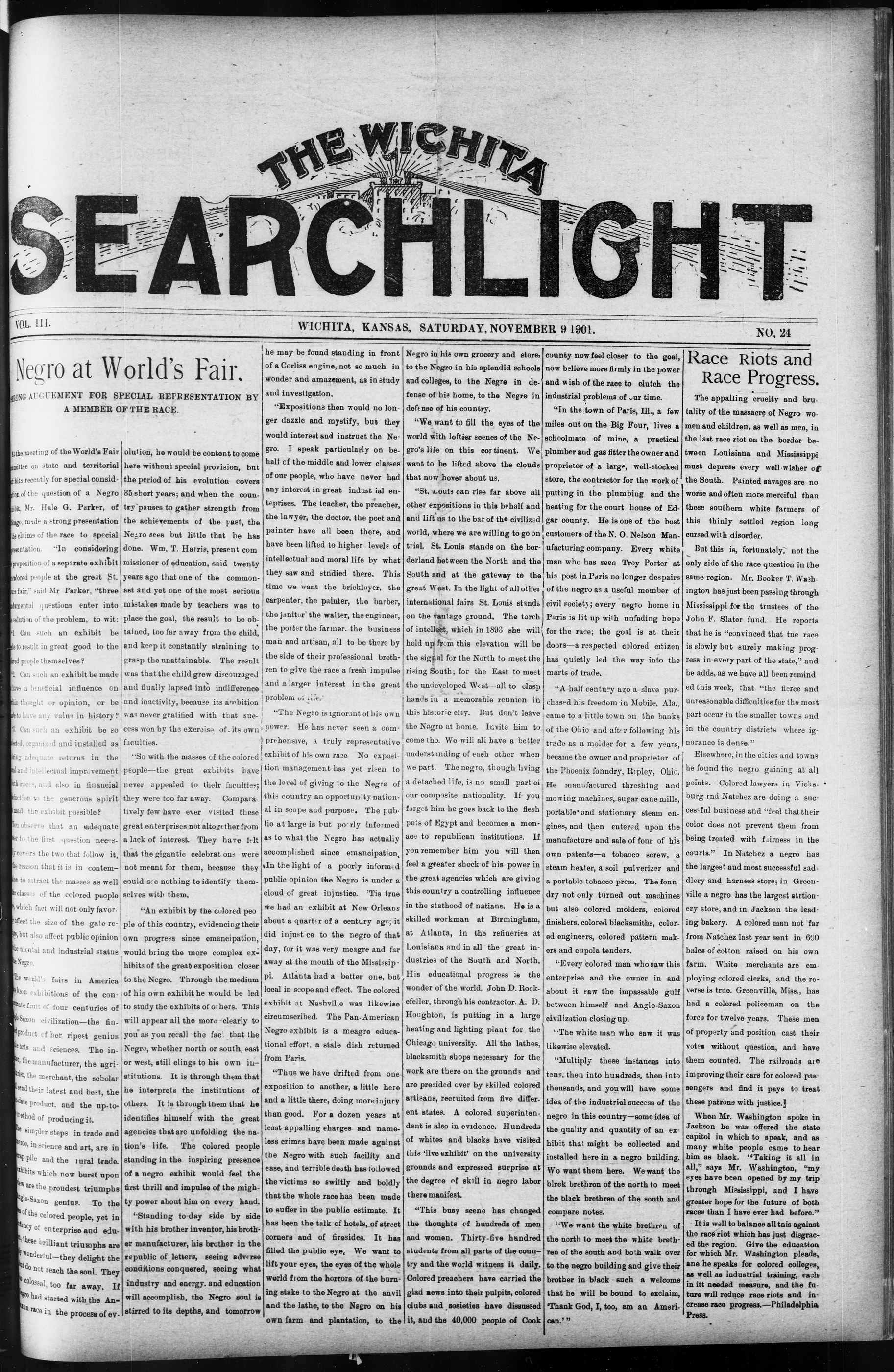
Negro at World's Fair.
STRONG AUGUEMENT FOR SPECIAL REPRESENTATION BY A MEMBER OF THE RACE.
VOL. III.
At the meeting of the World's Fair committee on state and territorial exhibits recently for special consideration of the question of a Negro exhibit, Mr. Hale G. Parker, of Chicago, made a strong presentation the claims of the race to special presentation. "In considering proposition of a separate exhibit colored people at the great St. Louis fair," said Mr. Parker, "three fundamental questions enter into resolution of the problem, to wit: 1. Can such an exhibit be made to result in great good to the tired people themselves?
2. Can such an exhibit be made have a beneficial influence on this thought or opinion, or be able to have any value in history?
3. Can such an exhibit be so selected, organized and installed as being adequate returns in the real and intellectual improvement both races, and also in financial infection to the generous spirit mad, the exhibit possible?
often observe that an adequate answer to the first question necessarily covers the two that follow it, the reason that it is in contemption to attract the masses as well the classes of the colored people which fact will not only favor affect the size of the gate re-but also affect public opinion the mental and industrial status the Negro.
The world's fairs in America has been exhibitions of the commute fruit of four centuries of late Saxon civilization—the finer product of her ripest genius the arts and sciences. The inker, the manufacturer, the agrifisher, the merchant, the scholar send their latest and best, the date product, and the up-to-method of producing it.
the simpler steps in trade and source, in science and art, are in trap pile and the rural trade. exhibits which now burst upon view are the proudest triumphs Anglo-Saxon genius. To the men of the colored people, yet in affinity of enterprise and education, these brilliant triumphs are my wonderful—they delight the man do not reach the soul. They co colossal, too far away. If Negro had started with the An- nixon race in the process of ev-
olution, he would be content to come here without special provision, but the period of his evolution covers 35 short years; and when the country pauses to gather strength from the achievements of the past, the Negro sees but little that he has done. Wm, T. Harris, present commissioner of education, said twenty years ago that one of the commonest and yet one of the most serious mistakes made by teachers was to place the goal, the result to be obtained, too far away from the child, and keep it constantly straining to grasp the unattainable. The result was that the child grew discouraged and finally lapsed into indifference and inactivity, because its ambition was never gratified with that success won by the exercise of its own faculties.
"So with the masses of the colored people—the great exhibits have never appealed to their faculties; they were too far away. Comparatively few have ever visited these great enterprises not altogether from a lack of interest. They have felt that the gigantic celebrations were not meant for them, because they could see nothing to identify themselves with them.
"An exhibit by the colored people of this country, evidencing their own progress since emancipation, would bring the more complex exhibits of the great exposition closer to the Negro. Through the medium of his own exhibit he would be led to study the exhibits of others. This will appear all the more clearly to you as you recall the fact that the Negro, whether north or south, east or west, still clings to his own institutions. It is through them that he interprets the institutions of others. It is through them that he identifies himself with the great agencies that are unfolding the nation's life. The colored people standing in the inspiring presence of a negro exhibit would feel the first thrill and impulse of the mighty power about him on every hand. 'Standing to-day side by side with his brother inventor, his brother manufacturer, his brother in the republic of letters, seeing adverse conditions conquered, seeing what industry and energy. and education will accomplish, the Negro soul is stirred to its depths, and tomorrow
he may be found standing in front of a Corliss engine, not so much in wonder and amazement, as in study and investigation.
"Expositions then would no longer dazzle and mystify, but they would interest and instruct the Negro. I speak particularly on behalf of the middle and lower classes of our people, who have never had any interest in great industrial enterprises. The teacher, the preacher, the lawyer, the doctor, the poet and painter have all been there, and have been lifted to higher levels of intellectual and moral life by what they saw and studied there. This time we want the bricklayer, the carpenter, the painter, the barber, the janitor' the waiter, the engineer, the porter the farmer, the business man and artisan, all to be there by the side of their professional brethren to give the race a fresh impulse and a larger interest in the great problem of life.
"The Negro is ignorant of his own power. He has never seen a comprehensive, a truly representative exhibit of his own race. No exposition management has yet risen to the level of giving to the Negro of this country an opportunity national in scope and purpose. The public at large is but poorly informed as to what the Negro has actually accomplished since emancipation. In the light of a poorly informed public opinion the Negro is under a cloud of great injustice. 'Tis true we had an exhibit at New Orleans about a quarter of a century ago; it did injustice to the negro of that day, for it was very meagre and far away at the mouth of the Mississippi. Atlanta had a better one, but local in scope and effect. The colored exhibit at Nashville was likewise circumscribed. The Pan-American Negro exhibit is a meagre educational effort, a stale dish returned from Paris.
"Thus we have drifted from one exposition to another, a little here and a little there, doing more injury than good. For a dozen years at least appalling charges and nameless crimes have been made against the Negro with such facility and ease, and terrible death has followed the victims so swiftly and boldly that the whole race has been made to suffer in the public estimate. It has been the talk of hotels, of street corners and of firesides. It has filled the public eye. We want to lift your eyes, the eyes of the whole world from the horrors of the burning stake to the Negro at the anvil and the lathe, to the Nsgro on his own farm and plantation, to the
LA
Negro in his own grocery and store, to the Negro in his splendid schools and colleges, to the Negro in defense of his home, to the Negro in defense of his country.
"We want to fill the eyes of the world with loftier scenes of the Negro's life on this cortinent. We want to be lifted above the clouds that now hover about us.
"St. Louis can rise far above all other expositions in this behalf and lift us to the bar of the civilized world, where we are willing to go on trial. St. Louis stands on the borderland between the North and the South and at the gateway to the great West. In the light of all other international fairs St. Louis stands on the vantage ground. The torch of intellect, which in 1893 she will hold up from this elevation will be the signal for the North to meet the rising South; for the East to meet the undeveloped West—all to clasp hands in a memorable reunion in this historic city. But don't leave the Negro at home. Invite him to come tho. We will all have a better understanding of each other when we part. The negro, though living a detached life, is no small part of our composite nationality. If you forget him he goes back to the flesh pots of Egypt and becomes a menace to republican institutions. If you remember him you will then feel a greater shock of his power in the great agencies which are giving this country a controlling influence in the stathood of natians. He is a skilled workman at Birmingham, at Atlanta, in the refineries at Louisiana and in all the great industries of the South and North. His educational progress is the wonder of the world. John D. Rockefeller, through his contractor. A. D. Houghton, is putting in a large heating and lighting plant for the Chicago university. All the lathes, blacksmith shops necessary for the work are there on the grounds and are presided over by skilled colored artisans, recruited from five different states. A colored superintendent is also in evidence. Hundreds of whites and blacks have visited this 'live exhibit' on the university grounds and expressed surprise at the degree of skill in negro labor there manifest.
"This busy scene has changed the thoughts of hundreds of men and women. Thirty-five hundred students from all parts of the country and the world witness it daily. Colored preachers have carried the glad news into their pulpits, colored clubs and societies have discussed it, and the 40,000 people of Cook
county now feel closer to the goal, now believe more firmly in the power and wish of the race to clutch the industrial problems of our time.
"In the town of Paris, Ill., a few miles out on the Big Four, lives a schoolmate of mine, a practical plumber and gas fitter the owner and proprietor of a large, well-stocked store, the contractor for the work of putting in the plumbing and the heating for the court house of Edgar county. He is one of the best customers of the N. O. Nelson Manufacturing company. Every white man who has seen Troy Porter at his post in Paris no longer despairs of the negro as a useful member of civil society; every negro home in Paris is lit up with unfading hope for the race; the goal is at their doors—a respected colored citizen has quietly led the way into the marts of trade.
"A half century ago a slave purchased his freedom in Mobile, Ala., came to a little town on the banks of the Ohio and after following his trade as a molder for a few years, became the owner and proprietor of the Phoenix foundry, Ripley, Ohio. He manufactured threshing and mowing machines, sugar cane mills, portable and stationary steam engines, and then entered upon the manufacture and sale of four of his own patents—a tobacco screw, a steam heater, a soil pulverizer and a portable tobacco press. The foundry not only turned out machines but also colored molders, colored finishers, colored blacksmiths, colored engineers, colored pattern makers and cupola tenders.
"Every colored man who saw this enterprise and the owner in and about it saw the impassable gulf between himself and Anglo-Saxon civilization closing up.
"The white man who saw it was likewise elevated.
"Multiply these instances into ten, then into hundreds, then into thousands, and you will have some idea of the industrial success of the negro in this country—some idea of the quality and quantity of an exhibit that might be collected and installed here in a negro building. Wo want them here. We want the blreck brethron of the north to meet the black brethren of the south and compare notes.
"We want the white brethren of the north to meet the white brethren of the south and both walk over to the negro building and give their brother in black such a welcome that he will be bound to exclaim, "Thank God, I, too, am an American."
NO.24
Race Riots and Race Progress.
The appalling cruelty and brutality of the massacre of Negro women and children, as well as men, in the last race riot on the border between Louisiana and Mississippi must depress every well-wisher of the South. Painted savages are no worse and often more merciful than these southern white farmers of this thinly settled region long cursed with disorder.
But this is, fortunately, not the only side of the race question in the same region. Mr. Booker T. Washington has just been passing through Mississippi for the trustees of the John F. Slater fund. He reports that he is "convinced that the race is slowly but surely making progress in every part of the state," and he adds, as we have all been reminded this week, that "the fierce and unreasonable difficulties for the most part occur in the smaller towns and in the country districts where ignorance is dense."
Elsewhere, in the cities and towns he found the negro gaining at all points. Colored lawyers in Vicksburg rnd Natchez are doing a successful business and "feel that their color does not prevent them from being treated with fairness in the courts." In Natchez a negro has the largest and most successful saddlery and harness store; in Greenville a negro has the largest sttrionery store, and in Jackson the leading bakery. A colored man not far from Natchez last year sent in 600 bales of cotton raised on his own farm. White merchants are employing colored clerks, and the reverse is true. Greenville, Miss., has had a colored policeman on the force for twelve years. These men of property and position cast their votes without question, and have them counted. The railroads are improving their cars for colored passengers and find it pays to treat these patrons with justice.
When Mr. Washington spoke in Jackson he was offered the state capitol in which to speak, and as many white people came to hear him as black. "Taking it all in all," says Mr. Washington, "my eyes have been opened by my trip through Mississippi, and I have greater hope for the future of both races than I have ever had before."
It is well to balance all this against the race riot which has just disgraced the region. Give the education for which Mr. Washington pleads, and he speaks for colored colleges, as well as industrial training, each in itt needed measure, and the future will reduce race riots and increase race progress.—Philadelphia Press.
THE SEARCHLIGHT.
W. N. MILLER, Editor.
Entered the Post-Office at Wichita, Kansas as Second Class Mail Matter.
PUBLISHED EVERY SATURDAY AT
110 NORTH MAIN ST.
RATES OF SUBSCRIPTION:
On year, by mail. $1 66
Six months, by mail. 75
Three months, by mail. 60
Advertising rates made known on application.
Address all communications to "The
Searchlight," Wichita, Kansas.
[All matters to be published must reach this
office not later than Tuesday, to reach publication
in the current issue.]
Correspondents and agents wanted every-
where. Write us for terms.
All matters sent to "The Searchlight" for
publication must be signed by the party or
parties writing.
FREE! FREE!! Saturday, Nov. 2nd
The Big Sale, 238 N. Main. Don't
fail to get one of those lovely Sou-
verniers. Remember with, each pur-
chase of one Pound of coffee or 25c.
worth of Tea, your choice in either
of our windows.
JONES TEA & COFFEE Co.
238 N. Main.
Hutchinson News.
W.. N. Miller, editor of the Searchlight, was in our city Wednesday and introduced his paper here. He got a large list of white and colored people. We all like the Searchlight and think it is the paper we want, as it is close to us, and feels more like a home paper. Let every one subscribe for it.
N. O. Berry, the popular colored baker for the Benedict bakery, is raising Angoria rabbits. He has quite a nice lot of them and sells as fast as they get old enough.
W. E. Owens attended a wedding Wednesday night.
A large crowd of Wichita and Sterling Pythians were in our city Wednesday and set up a new K. of P. lodge.
The boys all felt dreamy Thursday after their experience wi h that K. of P. goat Wednesday night.
The Metropolitan Restaurant, Mrs. M. Smith, prop., did good business Wednesday and Thursday. All the visitors took their meals there. When in Hutchinson go there—No. 13 w 2nd street. The Searchlight is all the rage here.
Iola News
Rev. T. W. Green has been called to pastor the Burlington Church. The G. U. O. O. No] 5190 give a public installation last Thursday eve Mr. E. G. Green has been very sick the past week but is much improved now.
We are glab to learn that Miss Stella Coker of our city, passed the examination at Chandler Oklahoma and has a position there that pays her $38 per month as teacher.
You should visit the colored. Grocery while in our city.
Mrs J. Young came home last Tues. after a long visit with her daughter since conference.
The Iola 2nd Baptist Sunday School is the best in the state. We will hold the banner another year.
Iola soon will have electric cars-
```markdown
```
‡=†† As WE GET IT, So WE GIVE IT. ‡=†
The Jackson House,
343 N.Main Street
MEALS.
Board by the Day or Week.
Jas, Jackson, Prop.
Jno. E. Lewis, J. H. Phelps, S.
W. Fleming, A. T. Glover, S. W.
Jones, J. H. McBride, Henry Gil-
bert, Fred Martin, Jno Phillip, A.
M. Morris, Dr. E. Harrison, W. N.
Miller and Miss Albentha Lewis
went to Hutchinson Wednesday.
Jas. Jackson went to Mt. Hope Wednesday.
Rev. R. N. Countee left Tuesday for Kansas City on business. He will return in a week.
The Hayseed Concert Co. will give a big comical concert at Peerless Hall Wednesday eve, Nov. 27 Those are all home talent and will give you a clean, moral and up to date concert. There will be songs, recitations, speeches, dialogues and comical sketches. In our next issue will appear the full program. Watch for it Wednesday, Nov. 27, 1901,
THEY TOOK THE TOWN.
Wichita and Sterling Knights took the town of Hutchinson Wednesday. They went there in a body and set up a new K. of P. lodge. The boys had a fine time. The Wichita delegation was: Jno. E. Lewis, Grand Chan., J. H. Phelps, deputy G. C., S. W. Fleming, C. C., Toas Lodge No. 10 Wichita, A. T. Glover Fred Martin, S. W. Jones, J. H. McBride, Henry Gilbert, J. Philips, A. M. Morris, Dr. E. Harrison, W. N. Miller, Grand Keeper of Records and Seals; Miss Alberta Lewis.
The Sterling delegation was: Geo Boydston, Leyi Kerns, W. A. Salters, Url Stewart, Albert Kern, W. Rollins, J. S. Fuller. Stant James, L.N, White. The boys certainly initiated that lodge and all agreed o that the members of the new lodge are as follows:
Allen Brown, Samuel Walden, J. M. Jackson, A.G, Gossitt, Nathan Henderson, J. H Dunn, Jas. Gardner, N. O. Berry, J. H. Leonard, H. B. Owens, W. E. Owens
Hon. P. F. Lewis of Emporia, the gentlemanly District Grand Secretary of the District Grand Lodge No.17, G. U. O. O. F., will be in the city Sunday on business. We will be pleased to meet Mr. Lewis He made many warm friends while here last July.
---
I have told you what a wonderful effect The Original OZONIZED OX Marrow has in making the hair grow. My hair was very short and came out by the comb-fall, but since I have used your OZONIZED OX Marrow I can fix it any way I want to. Please send me three bottles more. I enclose money order $1.40. Resp. yours, Miss JESSIE HARRIS, Bristol, R. I
THE ORIGINAL OZONIZED OX MARROW
(copyrighted) also makes kniky or curly hair, maintains and fixes hair. Give dandruff and stops the hair from falling out or breaking off. Never falls. Warranted hairs. Only 50 cents. Sold by clergists and dealers, or send us 50 cents for one bottle or jar. For three bottles. We express charges. Address 600MZM2 OX MARROW Co. 70 Walsh Ave, Chicago, Illinois.
THE WICHITA SEARCHLIGHT, SATURLAY NOVEMBER, 9, 1901
Wichita Tabernacle, No 34 Mrs.
W. N. Miller, C. P.; Miss Lula Covington, C. S. meets 1st and 3rd Thursday eve. at 2 p m each month.
Mrs. H. C. Carr, and Mrs Miller Kelley, were led into the mysteries of the Tabernacle, last Monday, and both are now full fledged members of Wichita Tabernacle No. 34
The, Columbia Index, published at Columbia, Tenn. is the name of a new colored paper which has found its way to our desk. It is a neat, well printed journal, and does credit to the race. We wish Bro. Braxton and Marton much success.
Grand Chan. Jno. E. Lewis made a trip to Sterling, Ks., Saturday night and renistated Hope Lodge No. 19 of that city and initiated four new members. In the initiation he was assisted by the members of that lodge and four white Knights members of the white lodge in Str- ing, every one had a fine time.
Grand Charceller Jno. E. Lewis did some good work for the Searchlight on his recent trip. We thank very much for the same.
Our friend J. W. Thompson, who has been in Danville, Ill. as foreman of the Street Car Co. construction crew returned to the city Sunday to spend the winter, Mr. Thompson represented our home paper the Searchlight during his stay in Danville, and did us yoemans service. On his return he brought in a few names and money, we highly appreciate the grand work done by Mr. Thompson for the Searchlight and thank him to the depth of our heart. Give us a few mere Thonpsons and we will do great work in Wichita. We thank him.
Mr. and Mrs. Chas. Young of Olathe, Kas, entertained a number of friends at their beautiful home ast Thursday eve. Cards, music and dancing were pleasant features of the evening. An elegant lunch was served in the handsomely decorated dining room. The table was a mass of chrysanthemums, carnations and American beauty roses Mr. Russell Miller was chosen toast master and proved his complete efficiency, each guest responding with an appropriate toast or quotation. Those present were: Mr. and Mrs. Ballins, Mr. and Mrs. Jenkins, Mr. and Mrs. Wm. Lewis, Mr. George Rollins, Mr. Ira Hagewood, Mr.
SPECIAL SALE OF SATIN RIBBONS.
On Monday morning at 9 o'clock we place on sale 1800 yard of all Silk Satin Ribbon, in widths of 41/2 and 5 inches. Just these two widths. Every color and Black and White is here. For better idea of their beauty and worth see window display. Worth 25c per yard, special sale price
MONDAY 12c per yd
BOSTON STORE
WALLENSTEIN & COHN
Henry Adams, Henry Jenkins, Miss Georgia Howard, Miss Henrietta Johnson, Miss Emma Howard, Miss Florence Stone.
Kingman News.
Mr. George Milburn, now employed at the Brunswick hotel and Mr. M. E. Woods went to Hutchinson to help with a K. P. lodge They will be joined by some members from Wichita.
Mr. Tharton Johnson of Hutchinson is now working at the Brunswick.
Mr. Dug Turner is on the sick list. Robert Floyd.
Arkansas City,
Rev. Garnett preached at the Baptist church Sunday. His able sermon was enjoyed by all present The celored "400" gave a ball Friday eve, Nov. 1, in Highland hall which was very well attended, and was a success both socially and financially.
Mrs. Mary Huse is reported quite ill at her home on South 3d st.
Rev. Delano is convalescing rathslow. He is not able to be out,yet.
Mrs. Thomas Campbell of Winfield was in the city Sunday the guest of Mrs. P. A. Delano.
Mr. Wm. Burfey was the guest of Mr. and Mrs. W. L. Toms, Sunday.
Mrs. Ashurst of Florence, Kan., is reported quite ill at the home of her daughter Mrs. Huse on S. 3rd Street.
Miss Delano, the eldest daughter of Rev. P. A. Delano, is in the city visiting her father who has been yery sick.
Mrs. Sam Farmer has returned from a short visit to Florence, Kas., her mother returned with her.
The foundation is being laid for the new A. M. E. church, which is to be completed some time this month.
WAS FINE.
The Japanese Banquet given by the ladies of the Wichita Tabernacle No.34 at Peerless Hall last Wednesday night, was indeed one of the grandest affairs ever witened in Wichita. In point of decoration, in entertainment it was unsurpassable. The ladies were greeted by a large crowd and every one had a most enjoyable time. The ladies are doing some good work and have now a good fat treasury.
EMBROIDERED
HANDKERCHIEFS.
At less than half price.
AT THE SAND M 5 and 10
CENTS TORE.
50 Dozen of them in 20 different
dainty designs. Regular 20
The S & M store
McCall Bazar Patterns for D
December Fashion sheet, FREE.
Mail Orders Pro
50 Dozen of them in 20 different styles. All very choice and
dainty designs. Regular 20c and 25c values, at
The S & M store, Choice 10c.
McCall Bazar Patterns for December on Sale 10c & 15c.
December Fashion sheet, FREE. McCall's Monthly Magazine 5c.
Mail Orders Promptly Filled.
SCHMITT & MARTINS
S AND 100
WICHITA.
SM STORE
KANSAS.
NO.408.EAST DOUGLAS AVE.
3rd door East of Topeka Ave.
SM
For Firs-Class Furnished
ROOMS
GO TO
Mrs V.Matthews
239 N. water st
Established 1872
John Braitsch,
THE CASH SHOE DEALER
FINE SHOES
A SPECIALTY.
120 East Douglas
Cherryvale Items
Mrs. Jno. Swaggard made a business trip to our city yesterday.
A bright bouncing baby boy made his home with Mr. and Mrs. G. W. Parker Monday both mother and son are doing well.
Mrs. Oliva Jones is on the sick list.
Quite a lay off is taking place at the Coffeyville brick yard this week.
T. W. Walthall pastor of the A. M. E. Church has organized christian endeavor.
Sterling News.
Geo. Boydston has purchased a nice home in the city and has moved his family here.
Levi Kerns has bought a nice place and moved to the city.
G. C. Jno. E. Lewis was in the city Saturday.
Ed A. Boydston has paid $1 for his second year's subscription to the Searchlight. All the boys like the Searchlight and all should do as our friend Ed has, and pay up. Let the good work on.
W. A. Salters, Errand Salters, Ira White and Rev. W. G. Barneit were made K. of P's last Saturday night.
The colored people are buying homes in Sterling. This is a good move and we hope it will continue.
Quarterly meeting at A. M. E. church tomorrow (Sunday.)
S M
AT THE
S M
5 and 10
CENTS TORE.
nt styles. All very choice and
10c and 25c values, at
re, Choice 10c.
december on Sale 10c & 15c.
McCall's Monthly Magazine 5c.
omptly Filled.
3rd door East of Topeka Ave.
S M
ONE MORE CHANCE
To Visit
EUREKA SPRINGS ARKANSAS
Wednesday, August 15th 1901
THE FRISCO LINE
will have a special excursion at
rate of.
for the round trip, tickets limited
to ten days from date of sale and good
turning on any regular train withid limit.
This is only a gentle hint to give you
an opportunity to make your prepara-
tions. Watch this space for full
particulars or make yourself
known to einker of the un-
derigned by postal
or letter.
B. F. Dunn, Bryan Snyder,
Dis't Pas'gr Ag't. Gen'i Pas'gr Ag't
Wichita Ks. St. Louis, Mo.
The Missouri Pacific Ry
Shortest Line To Colorado Points
MISSOURI
PACIFIC
RAILWAY
Most Direct Line To
KANSAS CITY
AND
ST.LOUIS.
Reclining Chair Cars on all trains
SEATS FREE.
Call at our New Passenger station
cor. Douglas ave. and Wichita st.
for reliable information relative to
any trip you may contemplate.
E.E. BLECKLEY. P. & T. A
CHEAPER THAN EVER
TO
COLORADO and UTAH!
Daily June 18th to
Sept. 10th 1901....
VIA THEC
Great
Rock Island
FROM
Missouri River Points to Denver, Colorado
Springs and Pueblo.
$15 July 1 to 9 $19 June 18 to 30
Sept. 1 to 10 July 10-Aug 31
Similar reduced rates on same dates to other
Colorado and Utah points.
Rates from other points on the Rock Is-
land Route proportionately lower on
the same dates o ale.
Return Limit October 31, 1901
THE SUPERE TRAIN
THE COLORADO FLYER
Leaves Kansas City daily at 6:30 p.m.
Omaha 5.20 p.m., St. Joseph, 5.00 p.m.
arriving Denver 11. a.m., Colorado Springs
Manitou, 10.35 a.m., Pueblo 11.50 a.m.
Write for details and Colorado literature
E. W. Thompson, A. G. P. A., Topela, Ks
John Sebasian, G, P, A., Chicago.
S M
$5.00
Route
THE SEARCHLIGHT
Much excitement prevails among pearl hunters at Taylor's Falls, Minn. John Emery found a shell in the river which contained a large pearl perfectly round and of that peculiar luster which makes it very valuable. Those who claim to know say it is the finest ever found in the west and is worth at least $2,000.
Outbreaks of typhoid and diphtheria of a most serious character have occurred at Belfast. In ten days 89 cases of typhoid, all of a severe type, were admitted to the hospital, the total under treatment being 254; while 19 cases of diphtheria had been admitted in two days. One nurse has died of typhoid and several others are ailing. The number of doctors and nurses is to be increased.
The singing of the favorite hymns of the late president was perhaps the most remarkable feature of the services held in memory of him, across the Atlantic as well as in his own land, in synagogue as well as in church. The dreadnause shows that "Nearer, my God, to Thee' and "Lead, Kindly Light express emotions that are felt in every religious heart, be the body that encloses it Jew or Gentile.
There was quite a sensation in Rutland square, Dublin, recently, when a Boer flag was found floating from the roof of the Orange Hall. How it got there is somewhat a mystery. It is surmised that some of the members, remembering that their patron of "glorious, pious and immortal" memory came of the same stock as the Boers took this method of showing their sympathy with the burghers who are still in the field.
Owing to the incessant rains the river Judrio, which flows along the borders of Italy, Austria, and the district of the Friuli, overflowed its banks one night recently, inundating all the land, the surrounding towns of Romans, Medea and Varsa. Alarm bells were kept ringing, and the country people fled in haste to the towns, but eleven persons are reported to have been drowned, and much damage has been done to property and crops.
Seen Hedin has discovered a second Dead Sea in the Highlands of Thibet—a vast lake so impregnated with salt that indigenous life is out of the question. It was impossible for him to get his boat close to the shore, so that he and his companion had to wade out two boat lengths before she would float and this was sufficient to coat their legs and clothes thickly with salt. The entire bed of the lake appeared to consist of salt, and the density of the lifeless water was, of course, very high.
Jorge de Rochefort, who published in Paris in 1671 an account of his travels in England, tells the following: 'While we were walking about the town (Worcester) he asked me if it was the custom in France as in England that when the children went to school they carried in their satchel with their books a pipe of tobacco, which their mother took care to fill early in the morning, it serving them instead of breakfast, and that at the accustomed hour every one laid aside his book to light his pipe, the master smoking with them and teaching 'them how to hold their pipes and draw in the tobacco.'
Lud Madison, who was to have been hanged at Parkersburg, W. Va., for murder recently, has been respired by Gov. White for sixty days. Madison claims that he has already been legally executed, and that it is not lawful to hang a man twice for the same offense. Two years ago he was sentenced to be hanged, but a stay of execution was granted, and the state supreme court granted him an appeal. Through an error, the records of the court in which he was convicted showed that he was executed instead of respired. Madison's lawyers claim that, according to the records, Madison is dead and cannot be lawfully hanged again. They will appeal the case to the Supreme Court of the United States.
At a regular meeting of Magnolia Lodge Knights of Pythias of Sharpburg, Md., resolutions were adopted denouncing United States Senator Wellington of Maryland, a member of the order for the remarks he is alleged to have made in regard to the assassination of President McKinley, who was also a member of the Knights of Pythias. The resolutions declare that the remarks made by Senator Wellington were most disgraceful, unpatriotic and unbrotherly; that he violated the principles of the order, and that he is no longer fit to be a member. They conclude by demanding the senator's expulsion from the organization. Mountain City lodge, Knights of Pythias of Frederick, Md., passed similar resolutions.
Holding her three-months-old baby by its clothing in her teeth, and with one arm clasped about her four-year-old daughter, Mrs. Theodore Pria, climbed two stories down the fire escape to get away from her insane husband, after he had attacked her and the children with a revolver. Pria is a Cuban barber, and lives at 745 Tinton avenue, in the Bronx, New York. The neighbors say that he was at one time a well-to-do tobacco grower in Cuba, and that the loss of his plantation there had made him insane.
No Longer Wild and Woolly
```markdown
```
Two Worlds and Their Children.
BY ETHEL M. COLSON.
(Copyright, 1901, by Daily Story Pub. Co.)
The trolley car which had been dashing along toward Chicago stopped suddenly, held upon a suburban street corner by the inevitable coal wagon with a tendency to break down. Franklin Atherton gazed idly at the earnest group of Salvation Army workers on the other side of the street. Suddenly in a momentary cessation of the ponderous drum-beats a clear, sweet, feminine voice faltered out softly:
"Ah! I have sighed to rest me Deep in the quiet grave."
Deep in a chapel, the rest of the words were surprising Salvation Army adaptations of the most characteristic type. But Franklin Atherton never heard them. With a bound he had reached the side of the singer—the girl whom he would have asked to become his wife long ago but that he feared to face poverty with her. He had not seen her for nearly two years.
"Margaret! How came you with these people?"
The girl looked at him gravely.
"When your world—the world which was mine also until my father died and left me penniless—found no time or space or attention for me I turned to the world in which men and women work instead of play. Not knowing how to work I went hungry. When I was homeless and seeking death because no other course seemed open the Salvation Army workers found me. They saved my life—and soul. Now I am trying to save others."
The gong of the trolley clanged out at the moment. It seemed like a summons to another world.
"Margaret!!" The words seemed drawn from him. "Leave this life, for God's sake! Come with me."
A
"How came you with these people?"
"As your wife, Franklin?"
The flicker of doubt and uncertainty in his eyes was so short-lived that few would have seen it. But the girl turned away as though she had suffered a blow.
"No—dear," she answered. "Not now. You are not strong enough to take me just yet. But," she called
```markdown
```
```markdown
```
after him as he sprang aboard the trolley, "we may meet again, some time. When we do, perhaps——"
But he was gone.
Three years later Franklin Atherton had also disappeared from the world which had once known him. Excessive haste to be rich, the gambling fever, an unlucky speculation, these were the successive steps by which he had reached starvation and despair.
For a man of his temperament all things seemed ended. He was heading for the river when there smote upon his jaded ear the sound of a flagellated drum the clear note of a silver trum-
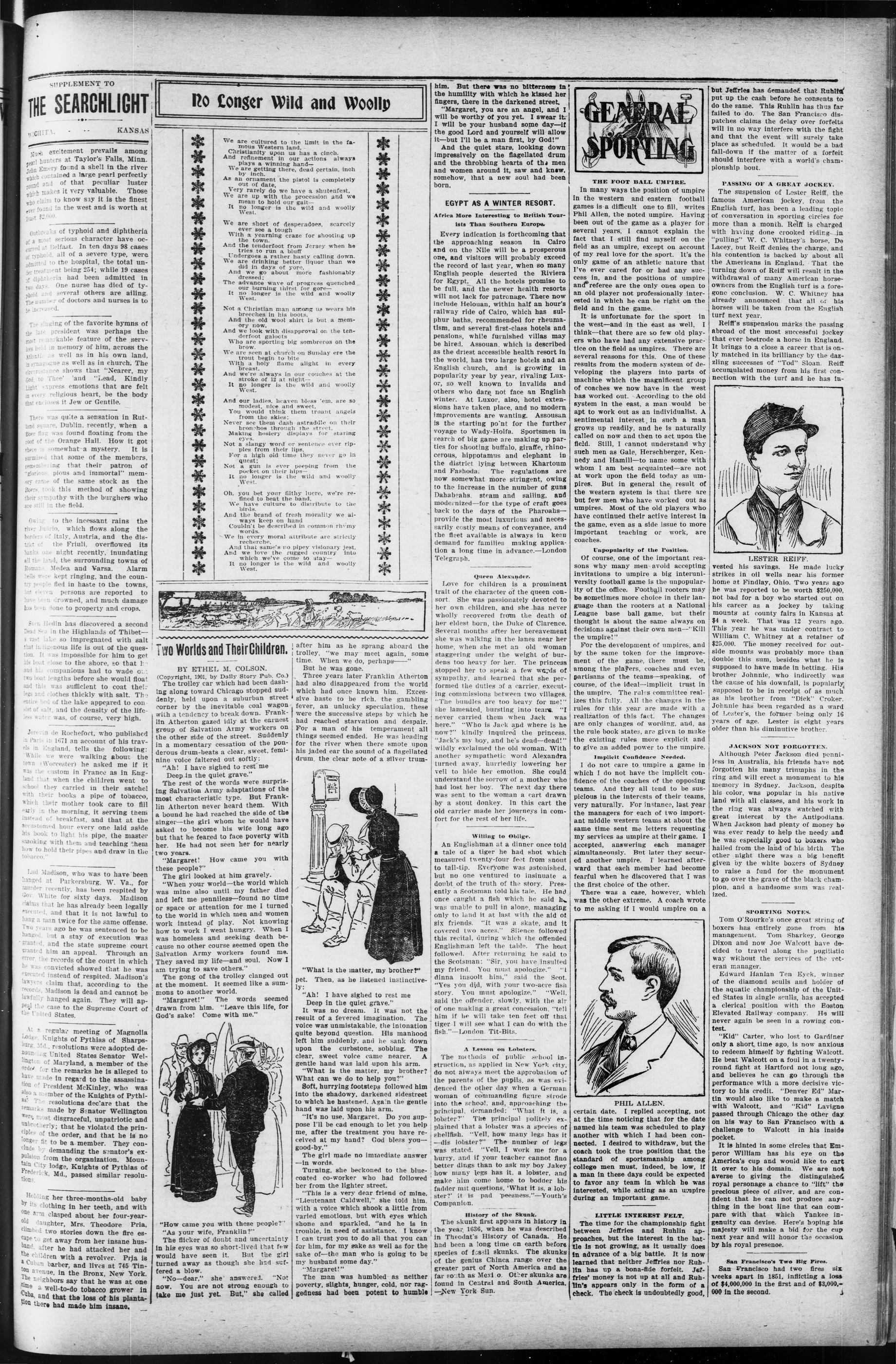
A man and a woman sit in front of a mailbox. The man is holding the woman's head, while the woman is leaning on him. Both are wearing hats.
"What is the matter, my brother?"
pet. Then, as he listened instinctively:
"Ah! I have sighed to rest me
Deep in the quiet grave."
It was no dream. It was not the
result of a fevered imagination. The
voice was unmistakable, the intonation
quite beyond question. His manhood
left him suddenly, and he sank down
upon the curbstone, sobbing. The
clear, sweet voice came nearer. A
gentle hand was laid upon his arm.
"What is the matter, my brother? What can we do to help you?" Soft, hurrying footsteps followed him into the shadowy, darkened sidestreet to which he hastened. Again the gentle hand was laid upon his arm. "It's no use, Margaret. Do you suppose I will be cadd enough to let you help me, after the treatment you have received at my hand? God bless you—good-by." The girl made no immediate answer—in words. Turning, she beckoned to the blue-coated co-worker who had followed her from the lighter street.
"This is a very dear friend of mine,
"Lieutenant Caldwell," she told him,
with a voice which shook a little from
varied emotions, but with eyes which
shone and sparkled, "and he is in
trouble, in need of assistance. I know
I can trust you to do all that you can
for him, for my sake as well as for the
sake of—the man who is going to be
my husband some day."
"Margaret!"
The man was humbled as neither poverty, slights, hunger, cold, nor raggedness had been potent to humble
him. But there was no bitterness in the humility with which he kissed her fingers, there in the darkened street. "Margaret, you are an angel, and I will be worthy of you yet. I swear it. I will be your husband some day—if the good Lord and yourself will allow it—but I'll be a man first, by God!" And the quiet stars, looking down impressively on the flagellated drum and the throbbing hearts of the men and women around it, saw and knew, somehow, that a new soul had been born.
EGYPT AS A WINTER RESORT.
Every indication is forthcoming that the approaching season in Caliro and on the Nile will be a prosperous one, and visitors will probably exceed the record of last year, when so many English people deserted the Riviera for Egypt. All the hotels promise to be full, and the newer health resorts will not lack for patronage. There now include Helouan, within half an hour's railway ride of Cairo, which has sulphur baths, recommended for rheumatism, and several first-class hotels and pensions, while furnished villas may be hired. Assouan, which is described as the driest accessible health resort in the world, has two large hotels and an English church, and is growing in popularity year by year, rivaling Luxor, so well known to invalids and others who darg not face an English winter. At Luxor, also, hotel extensions have taken place, and no modern improvements are wanting. Assousan is the starting point for the further voyage to Wady-Holfa. Sportsmen in search of big game are making up parties for shooting buffalo, giraffe, rhinoceros, hippotamus and elephant in the district lying between Khartoum and Fashoda. The regulations are now somewhat more stringent, owing to the increase in the number of guns Dahabeahs, steam and sailing, and modernized for the type of craft goes back to the days of the Pharoahs—provide the most luxurious and necessarily costly means of conveyance, and the fleet available is always in keen demand for families making application a long time in advance—London Telegraph.
Queen Alexander.
Love for children is a prominent trait of the character of the queen consort. She was passionately devoted to her own children, and she has never wholly recovered from the death of her eldest born, the Duke of Clarence. Several months after her bereavement she was walking in the lanes near her home, when she met an old woman staggering under the weight of burdens too heavy for her. The princess stopped her to speak a few words of sympathy, and learned that she performed the duties of a carrier, executing commissions between two villages. "The bundles are too heavy for me!" she lamented, bursting into tears. "I never carried them when Jack was here." "Who is Jack and where is he now?" kindly inquired the princess, "Jack's my boy, and he's dead—dead!" wildly exclaimed the old woman. With another sympathetic word Alexandra turned away, hurriedly lowering her veil to hide her emotion. She could understand the sorrow of a mother who had lost her boy. The next day there was sent to the woman a cart drawn by a stout donkey. In this cart the old carrier made her journeys in comfort for the rest of her life.
Willing to Oblige.
An Englishman at a dinner once told a tale of a tiger he had shot which measured twenty-four feet from snout to tail-tip. Everyone was astonished, but no one ventured to insinuate a doubt of the truth of the story. Presently a Scotsman told his tale. He had once caught a fish which he said he was unable to pull in alone, managing only to land it at last with the aid of six friends. "It was a skate, and it covered two acces." Silence followed this recital, during which the offended Englishman left the table. The host followed. After returning he said to the Scotsman: "Sir, you have insulted my friend. You must apologize." "I dinnna insoolt him," said the Scot. "Yes you did, with your two-acre fish story. You must apologize." "Well, said the offender, slowly, with the air of one making a great concession, 'tell him if he will take ten feet off that tiger I will see what I can do with the fish."—London Tit-Bits.
A Lesson on Lobsters.
The methods of public school instruction, as applied in New York city, do not always meet the approbation of the parents of the pupils, as was evidenced the other day when a German woman of commanding figure strode into the school, and, approaching the principal, demanded: "What it is, a lobster?" The principal politely explained that a lobster was a species of shellfish. "Vell, how many legs has it—dis lobster?" The number of legs was stated. "Vell, I work me for a hurry, and if your teacher cannot find better dings than to ask my boy Jakey how many legs has it, a lobster, and make him come home to bodder his fadder mit questions. What it is, a lobster?" it is pad 'peesness.'—Youth's Companion.
History of the Skunk.
The skunk first appears in history in the year, 1636, when he was described in Theodat's History of Canada. He had been a long time on earth before species of fossil skunks. The skunks of the genius Chinca range over the greater part of North America and as far south as Mexi o. Other skunks are found in Central and South America.—New York Sun.
GENERAL
SPORTING
THE FOOT BALL UMPIRE.
In many ways the position of umpire in the western and eastern football games is a difficult one to fill, writes Phil Allen, the noted umpire. Having been out of the game as a player for several years, I cannot explain the fact that I still find myself on the field as an umpire, except on account of my real love for the sport. It's the only game of an athletic nature that I've ever cared for or had any success in, and the positions of umpire and referee are the only ones open to an old player not professionally interested in which he can be right on the field and in the game.
It is unfortunate for the sport in the west—and in the east as well. I think—that there are so few old players who have had any extensive practice on the field as umpires. There are several reasons for this. One of these results from the modern system of developing the players into parts of machine which the magnificent group of coaches we now have in the west has worked out. According to the old system in the east, a man would be apt to work out as an individualist. A sentimental interest, in such a man grows up readily, and he is naturally called on now and then to act upon the field. Still, I cannot understand why such men as Gale, Herschberger, Kennedy and Hamill—to name some with whom I am best acquainted—are not at work upon the field today as umpires. But in general the result of the western system is that there are but few men who have worked out as umpires. Most of the old players who have continued their active interest in the game, even as a side issue to more important teaching or work, are coaches.
Unpopularity of the Position.
Of course, one of the important reasons why many men avoid accepting invitations to umpire a big interuniversity football game is the unpopularity of the office. Football rooters may be sometimes more choice in their language than the rooters at a National League base ball game, but their thought is about the same always on decisions against their own men—"Kill the umple!"
For the development of umpires, and by the same token for the improvement of the game, there must be, among the players, coaches and even partisans of the teams—speaking, of course, of the ideal—implicit trust in the umpire. The rules committee realizes this fully. All the changes in the rules for this year are made with a realization of this fact. The changes are only changes of wording, and, as the rule book states, are given to make the existing rules more explicit and to give an added power to the umpire.
Implicit Confidence Needed.
I do not care to umpire a game in which I do not have the implicit confidence of the coaches of the opposing teams. And they all tend to be suspicious in the interests of their teams, very naturally. For instance, last year the managers for each of two important middle western teams at about the same time sent me letters requesting my services as umpire at their game. I accepted, answering each manager simultaneously. But later they secured another umpire. I learned afterward that each member had become fearful when he discovered that I was the first choice of the other. There was a case, however, which was the other extreme. A coach wrote to me asking if I would umpire on a
PHIL ALLEN.
certain date. I replied accepting, not at the time noticing that for the date named his team was scheduled to play another with which I had been connected. I desired to withdraw, but the coach took the true position that the standard of sportsmanship among college men must, indeed, be low, if a man in these days could be expected to favor any team in which he was interested, while acting as an umpire during an important game.
LITTLE INTEREST FELT
The time for the championship fight between Jeffries and Ruhlin approaches, but the interest in the battle is not growing, as it usually does in advance of a big battle. It is now learned that neither Jeffries nor Ruhlin has up a bona-fide forfeit. Jeffries' money is not up at all and Ruhlin's appears only in the form of a check. The check is undoubtedly good.
but Jeffries has demanded that Ruhlin put up the cash before he consents to do the same. This Ruhlin has thus far failed to do. The San Francisco dispatches claims the delay over forfeits will in no way interfere with the fight and that the event will surely take place as scheduled. It would be a bad fall-down if the matter of a forfeit should interfere with a world's championship bout.
PASSING OF A GREAT JOCKEY
The suspension of Lester Reiff, the famous American jockey, from the English turf, has been a leading topic of conversation in sporting circles for more than a month. Reiff is charged with having done crooked riding in "pulling" W. C. Whitney's horse, De Lacey, but Reiff denies the charge, and his contention is backed by about all the Americans in England. That the turning down of Reiff will result in the withdrawal of many American horseowners from the English turf is a foregone conclusion. W. C. Whitney has already announced that all of his horses will be taken from the English turf next year.
Reiff's suspension marks the passing abroad of the most successful jockey that ever bestrode a horse in England. It brings to a close a career that is only matched in its brilliance by the dazzling successes of "Tod" Sloan. Reiff accumulated money from his first connection with the turf and he has in-
LESTER REIFE
vested his savings. He made lucky strikes in oil wells near his former home at Findlay, Ohio. Two years ago he was reported to be worth $250,000, not bad for a boy who started on his career as a jockey by taking mounts at county fairs in Kansas at $4 a week. That was 12 years ago. This year he was under contract to William C. Whitney at a retainer of $25,000. The money received for outside mounts was probably more than double this sum, besides what he is supposed to have made in betting. His brother Johnnie, who indirectly was the cause of his downfall, is popularly supposed to be in receipt of as much as his brother from "Dick" Croker. Johnnie has been regarded as a ward of Lester's, the former being only 16 years of age. Lester is eight years older than his diminutive brother.
JACKSON NOT FORGOTTEN.
BACKSON NOT FORGOTTEN.
Although Peter Jackson died penniless in Australia, his friends have not forgotten his many triumphs in the ring and will erect a monument to his memory in Sydney. Jackson, despite his color, was popular in his native land with all classes, and his work in the ring was always watched with great interest by the Antipodians. When Jackson had plenty of money he was ever ready to help the needy and he was especially good to boxers who hailed from the land of his birth. The other night there was a big benefit given by the white boxers of Sydney to raise a fund for the monument to go over the grave of the black champion, and a handsome sum was realized.
SPORTING NOTES.
Tom O'Rourke's once great string of boxers has entirely gone from his management. Tom Sharkey, George Dixon and now Joe Walcott have decided to travel along the pugilistic way without the services of the veteran manager.
Edward Hanlan Ten Eyck, winner of the diamond sculls and holder of the aquatic championship of the United States in single sculls, has accepted a clerical position with the Boston Elevated Railway company. He will never again be seen in a rowing contest.
"Kid" Carter, who lost to Gardiner only a short time ago, is now anxious to redeem himself by fighting Walcott. He beat Walcott on a foul in a twenty-round fight at Hartford not long ago, and believes he can go through the performance with a more decisive victory to his credit. "Denver Ed" Martin would also like to make a match with Walcott, and "Kid" Lavigne passed through Chicago the other day on his way to San Francisco with a challenge to Walcott in his inside pocket.
It is hinted in some circles that Emperor William has his eye on the America's cup and would like to cart it over to his domain. We are not averse to giving the distinguished royal personage a chance to "lift" the precious piece of silver, and are confident that he can not produce anything in the boat line that can compare with that which Yankee ingenuity can devise. Here's hoping his majesty will make a bid for the cup next year and will honor the occasion by his royal presence.
San Francisco's Two Big Fires
San Francisco had two fires six
weeks apart in 1851, inflicting a loss
of $4,000,000 in the first and of $3,000,-
000 in the second.
SOME SHORT STORIES FOR THE VETERANS.
The Thrilling Rescue of Gilmore and His Party From the Hands of the Filipinos Described by Col. Luthor R. Hare—Many Hardships.
THE INEVITABLE.
I like the man who faces what he must
With step triumphant and with heart
of cheer;
Who fights the daily battle without
fear;
Sees his hopes fail, yet keeps unfalter-
ing trust
That God is good; that somehow, true
and just,
His plans work out for mortals; not
a tear
Is shed when fortune, which the world ho'ds dear,
Falls from his grasp—better with love
a crust
Than living in dishonor—envies not
Nor loses faith in man; but does his
best,
Nor ever murmurs at his humbler
lot;
But, with a smile and words of hope,
gives zest
To every toller; he alone is great
Who by a life heroic conquers fate.
—Sarah K. Bolton.
THE RESCUE OF GILMORE.
"Before I left Texas my father seemed to have his mind set on the rescue of Gilmore and his party," said Colonel Luther R. Hare at Kansas City recently. "Let all other things go, if possible, he would say, 'and get poor G Gilmore out of the Filipinos' hands. Dr. Lieberman of Kansas City, was my chief surgeon, and between the two of us we got 1,300 men, physically fit to go anywhere. Fate and my father seemed to be working together, for soon after reaching Luzon General Wheaton ordered me north to join General Young's command, and Young at once sent me out after Gilmore. We were about in the center of Northern Luzon—at Bingnat, in Arara province—when we made the start with 135 men and some natives. We passed through the district producing the finest tobacco in all Luzon, and breechclout people grew it. Once we came to a doubleful place in the trail, and a piece of blue flannel shirt set us right. But the best guides we had were chalk marks on the cliffs. These generally took the form of 'Drink Blank's Beer', and we knew Americans why they should choose to mark the trails with suggestions of that nature. We had been out eleven days. I think, when we ran onto a party of fifteen insurgents escorting three Americans. We attacked, killing five Filipinos, and the others fled, leaving the prisoners. They were from Gilmore's party, had escaped and been recaptured. Gilmore, they said, was about two days ahead. Early the second day later we came upon the naval officer and his party. Their captors had heard of our coming and fled. Gilmore begged them not to leave him without food or arms, and his men had had little except pony meat for two days before we reached them. Gilmore had been a prisoner nearly eight months when we found him and the seemed dazed. In fact, none of the men were very demonstrative. True Americans, they had never ceased to hope, and the relief came rather as a matter of course Gilmore's authority had always been recognized by his men, and he had made a civilian named Langford his executive officer. And here the beer advertisements on the trail were explained. Langford was agent for an American brewery and was captured while in one out-of-the-way place drumming trade. On the march into the mountains he took some chalk from a school house and with this wrote 'Drink Blank's Beer' along the trail. The Filipino officer in charge caught him at it, and of course remonstrated.
"Oh, I'm only advertising my beer," Langford told him, and the insurgent thought it was a good joke. One of Gilmore's men, a young fellow from San Francisco, had a little monkey which he carried on all the trip, and they made good use of him. In many cases the fruits and berries in the Luzon mountains are poisonous. These hungry men would lead the monkey to the fruit, and if he ate they would eat, otherwise the most tempting growth would go untouched, and the little monkey never abused the trust placed in him. We had no rations and decided it would be nearer to float down the river to the northern coast than to try to go back. Rafts took us out near Apawl, where we found the Princeton, in le's than two weeks. Rice was practically the only food we could find. On the entire trip I lost only one man. He died of small-pox, and we brought his body back on a raft. None of the other men were infected."
A REMARKABLE CASE.
One of the most remarkable cases of a man surviving a severe wound is that of Augustus F. Emery, of Dorchester, Mass., who was wounded in the battle of Gettysburg July 3, 1833, and carried the bullet in the muscles of his back for ten years. The ball entered near the waist line, on the right-hand side, and lodged, no one knew just where, for a long time; but, as was finally determined, about three inches to the right of the spine, about on a line with the point of its original entrance. He lay on the field of battle thirty-one hours, and all the nourishment he received was a drink of
water. He was carried to the field hospital on the night of July 4, but it was not until noon of the next day that an attempt was made to remove the bullet. Its location could not be determined, and he was conveyed to a hospital in Baltimore, and from there to his home at Parkers Head, Me, although the surgeons predicted the journey would kill him. He recovered, however, and within three or four months was back at the front again. About a year later a piece of shell went through his right side, coming out at his back and leaving a hole as big as a half dollar, though, unfortunately, it did not take the encysted bullet along with it. For several months, while he was under treatment, portions of his canteen, leather cartridge box and his clothing, that had been carried into the wound by the shell, periodically came forth into daylight again from the aperture in his back. In a little over three months Mr. Emery was in the ranks again, serving till mustered out, in August, 1865. During the ten years succeeding the close of the war Mr. Emery carried about his leaden memto with periodical seasons of serious suffering, when his wound would appurate continually for months at a time. One day, in 1873, while working on a staging, repairing a ship in Bath, he fell, striking his back, at the point where the bullet was lodged, on the corner of a plank below. He was carried home, and the doctor, who was familiar with his case, discovered that the fall had dislodged the bullet from its old resting place and left it in a place whee it could be easily removed. It did not take long, nor did it require the administering of ether to make an incision in the side and extract the bullet, after which the patient recovered, save for occasional attacks of rheumatism during the years that have followed.
"THE NEGRO SOLDIER."
Col. R. L. Bullard of the subsistence department, late colonel of the Thirtieth Volunteer Infantry, has written a paper to a service journal on "the negro soldier," which is attracting considerable attention in military circles. During the Spanish war Col. Bullard commanded the Third Alabama Volunteer Infantry, the enlisted force of which was composed entirely of negroes, while all the regimental officers, except the chaplains, were white men who had lived in the south. Colonel Bullard says that the negro soldier is a good-natured, happy person who is not worried by climatic discomforts or the irregularities of a soldier's life. He does not find them lazy as soldiers and says that when "in squad" they work well. As individuals, however, they are inclined to trifle, and are not up to the mark as sentinels. Their light-heartedness and good humor makes the negro complainer a rarity. The negro starts, too, with a proper appreciation of the respect due his commissioned officer. It seems to be inborn knowledge, and as a general thing he lives up to this disciplinary quality. He does not, however, readily lend himself to the authority of the noncommissioned officers. A difficulty in punishing negro soldiers comes from their stubbornness, and it is even necessary, in order to make punishment effective, to have it carried out with the ridicule of comrades. On the other hand, says Col. Bullard, the negro is fond of praise and can be made to accomplish much by judicious commendation. The colored soldier is subject readily, to the moods and excitement of his commanding officer. If the captain be a little rattled in drill the effect is seen on his men. If he loses his head and becomes frightened or excited, his followers are imbued with the same spirit. In the same way negroes "take sides" in any row of which they happen to be the observers, according to Colonel Bullard. The negro is a good soldier in the sense that he is obedient and a splendid fighter when he is under intrepid officers who are disciplinarians. The negro regular in Cuba showed he was of the right material, and it must be assumed that he was a type of all his race under arms. "By character more submissive to discipline, by nature more good-humored and happy, from social position more subordinate to superiors, from poverty more used to plain food, fewer clothes and comforts," says Col. Bullard, "the average negro volunteer comes to the colors with more of the first urgently needed qualities of the soldier and readier for service than the white."—Washington Star.
BETTER THAN BULLETS.
It was during one of the preliminary skirmishes at Chickamauga, says the New Orleans Times-Democrat. The federal troops had reached the top of a hill, and the confederates had been forced down on the other side. They hid behind stumps and trees, fell over behind logs and sought other places of concealment in their effort to escape Yankee bullets. One beadless youth fell over behind a log—and the rest of the story is best told in his own words:
I fell with my face down, and I could hear the Yankee bullets whistling over my head or burying themselves in the log behind which I was hiding. In hugging close up to the log I shoved my face into a hornets' nest. The hornets covered my face and head, and I lay there picking them off one at a time until I found an opportunity to escape. Soon after that I met one of my company and he said: "Great goodness, Jim, what on earth is the matter with your face?" "Shoven it into a hornets' nest." "You must have suffered fearfully." "No; I never experienced a more delicious feeling in my life. I pefer the sting of hornets to Yankee bullets!"
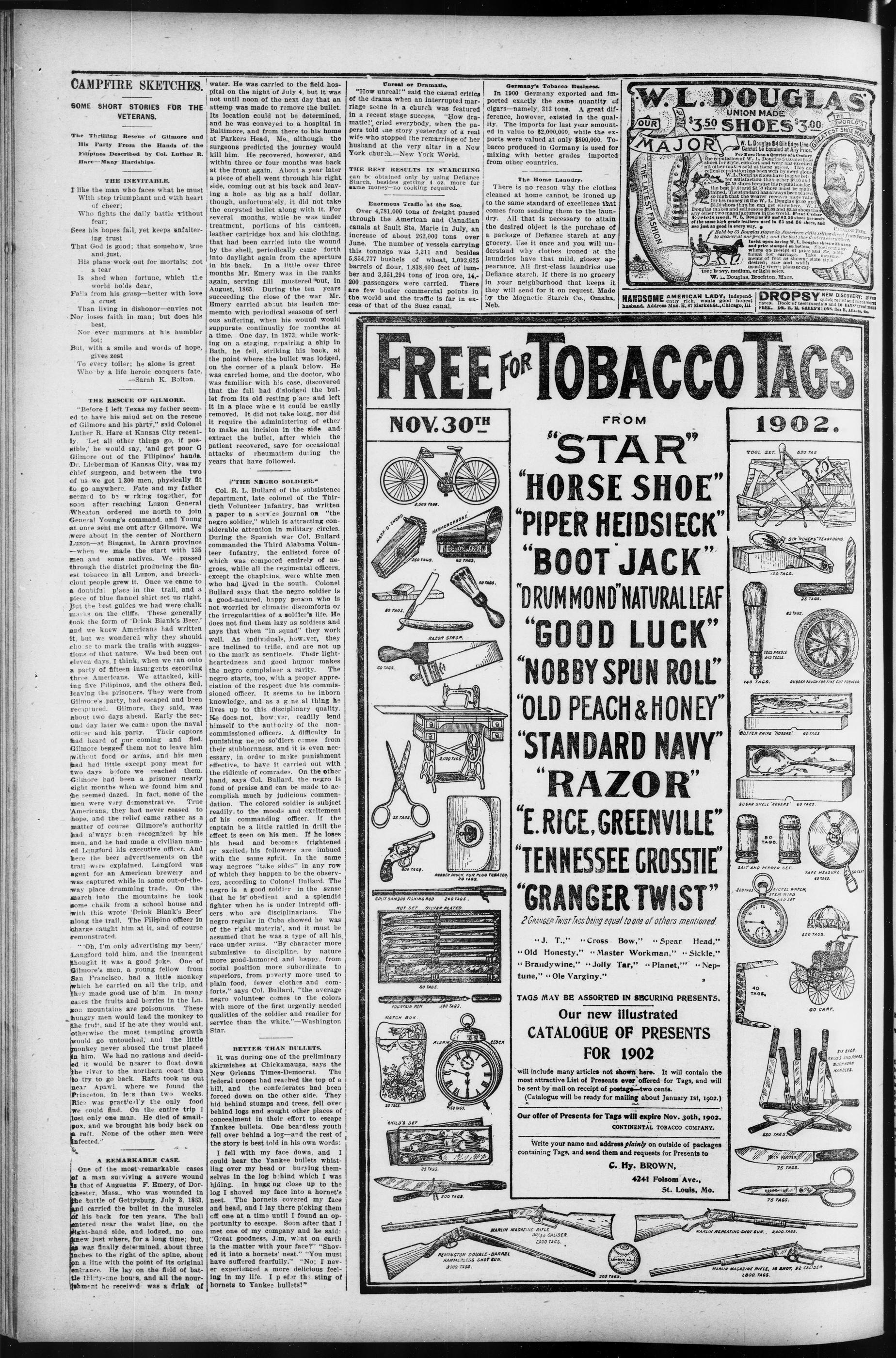
NOV.30TH
2,500 TAGS.
MARP.O. CHORD
230 TAGS.
60 TAGS.
HARMONOPHONE
50 TAGS.
60 TAGS.
RAZOR STROP.
60 TAGS.
2,000 TAGS.
25 TAGS.
600 TAGS.
RUBBER POUCH. FOR PLUG TABACCO.
60 TAGS.
SPLIT BAM200 FISHING ROD
240 TAGS.
NUT SET. SILVER PLATED.
80 TAGS.
FOUNTAIN PEN
100 TAGS.
MATCH BOX.
25 TAGS.
ALARM
450 TAGS.
CLOCK
CHILD'S SET
25 TAGS.
200 TAGS.
MARLIN
REMINGTON DOUBLE - BARREL
HAMMERLESS SHOT GUN.
3,000 TAGS.
Unreal or Dramatic
"How unreal!" said the casual critics of the drama when an interrupted marriage scene in a church was featured in a recent stage success. "How dramatic," cried everybody, when the papers told the story yesterday of a real wife who stopped the remarriage of her husband at the very altar in a New York church.—New York World.
THE BEST RESULTS IN STARCHING can be obtained only by using Defiance Starch, besides getting 4 oz. more for same money—no cooking required.
Enormous Traffic at the Son.
Over 4,781,000 tons of freight passed through the American and Canadian canals at Sault Ste. Marie in July, an increase of about 262,000 tons over June. The number of vessels carrying this tonnage was 3,211 and besides 5,854,777 bushels of wheat, 1,092,625 barrels of flour, 1,838,400 feet of lumber and 3,351,294 tons of iron ore, 14,200 passengers were carried. There are few busier commercial points in the world and the traffic is far in excess of that of the Suez canal.
W. L. DOGLAS
UNION MADE
$3.50 SHOES $3.00
OUR
MAJOR
THE WORLD'S GREATEST SHOE MAKER
W. L. Douglas $4 Glit Edge Line
Cannot be Equaled at Any Price.
For More than a Quarter of Century
the reputation of W. L. Douglas is well known
shoes for style, comfort and wear has exceeded
all other makes sold at these prices. This ex-
cellent reputation has been maintained by
W. L. Douglas shoes have to give bet-
ter satisfaction that other $0.50 and
$2.50 shoes be purchased. The best $0.50 and $2.50 shoes must be main-
tained because has always been placed
so high that the wearer wants to
for his money in the W. L. Douglas $0.50 and
$2.50 shoes. Have you noticed
Douglas makes and sells more $0.50 and $2.50 shoes than
any other two manufacturers in the world. Fast Color
Fetts are worn. W. L. Douglas $0.50 and $2.50 shoes of
the same high grade leather used in $2 and $6 shoes, and
are just as good in every way.
Roll by $2 Douglass shoes in American cities selling direct from factory
to uccer at every store; and the best made for
invest in saving W. L. Douglas shoes with more
and price stamped on bottom. Shoes and may
wear on overridden of plain and multi-
tional for carriages. Take measure
desired: size and down; state style
desired: size and down; state style
usually worn; plain or cap
toe; isavy, medium weight; W. L. Douglas, Brooklyn, Mass.
Germany's Tobacco Business.
In 1000 Germany exported and imported exactly the same quantity of cigars—namely, 313 tons. A great difference, however, existed in the quality. The imports for last year amounted in value to $2,000,000, while the exports were valued at only $800,000. Tobacco produced in Germany is used for mixing with better grades imported from other countries.
The Home Laundry.
There is no reason why the clothes cleaned at home cannot be ironed up to the same standard of excellence that comes from sending them to the laundry. All that is necessary to attain the desired object is the purchase of a package of Defiance starch at any grocery. Use it once and you will understand why clothes ironed at the laundries have that mild, glossy appearance. All first-class laundries use Defiance starch. If there is no grocery in your neighborhood that keeps it they will send for it on request. Made by the Magnetic Starch Co., Omaha, Neb.
FROM
"STAR"
"HORSE SHOE"
"PIPER HEIDSIECK"
"BOOT JACK"
"DRUM MOND" NATURALLEAF
"GOOD LUCK"
"NOBBY SPUN ROLL"
"OLD PEACH & HONEY"
"STANDARD NAVY"
"RAZOR"
"E. RICE, GREENVILLE"
"TENNESSEE GROSSTIE"
"GRANGER TWIST"
2 GRANGER Twist Tacs being equal to one of others mentioned.
"J. T.," "Cross Bow," "Spear Head," "Old Honesty," "Master Workman," "Sickle," "Brandywine," "Jolly Tar," "Planet," "Neptune," "Ole Varginy."
will include many articles not shown here. It will contain the most attractive List of Presents ever offered for Tags, and will be sent by mail on receipt of postage two cents.
Our offer of Presents for Tags will expire Nov. 30th, 1902.
CONTINENTAL TOBACCO COMPANY.
Write your name and address plainly on outside of packages containing Tags, and send them and requests for Presents to
C. Hy. BROWN.
MUSEO DE LA MUSEA
DE LA MUSEA
DE LA MUSEA
Castle Hall 338 North Main street.
Regular Meetings Second and Fourth
Monday Night in Each Month,
Visiting Knights in good standing Welcome
S. W. Fleming, Chan. Com.
W. N. Miller, K. of R. & S.
ARRIA COURT No. 7.
Order of Calanthe.
Mrs. J. E. Lewis, W. C.
Miss Blench Alexander, R.of D.
Mrs. Ida Martin, W.of R. of D.
Mery Ist. and 3rd. Monday each month
ARKANSAS VALLEY Lodge
No.21.
A.F. & A.M.
John T. Chinneth, W. M.
W.H.A. Clark, Secretary.
Meets 1st. and 3rd. Tuesday each month.
All Master Masons in good standing are
Cordially Invited.
PALESTINE COMMANDERY
No.12.
Wichita Kansas.
J.T.Chinneth,
Eminent Commander
J.A.Roberson,
Generalissimo.
Phil Hyde,
Captain General
Joseph Fine Secretary.
Sylvester Anderson,Treas.
Meets the 2nd Monday night each month
MT.ZION CHAPTER No.17.
W.H.A.Clark,
High Priest,
J.S.Fauver,
King.
Ben Wilson,
Scribe.
J.T Chinneth,Secretary
Grant Ewing,Treas.
Meets the 4th Monday night each month
PRINCESS CHAPTER No.12
O.of E.S.
Mrs. M.E. Banks, Royal Matron,
Miss Uizie M. Burnham, Secerty
Meets 1st and 3rd. Wednesday each month.
HOME OF THE WEST No.2906.
G.U.O.O.F.
Mr. H. Gordon, N.G.
Major Davis, V.G.
J.A. Martin, Secretary
Meets 1st, 2nd and 3rd Tuesday night.
WICHITA TABERNACLE No. 34,
Mrs. Mattie Miller, C.P.
Miss Lulu Covington, C.S.
Meets 1st and 3rd Thursday afternoon, 2pm
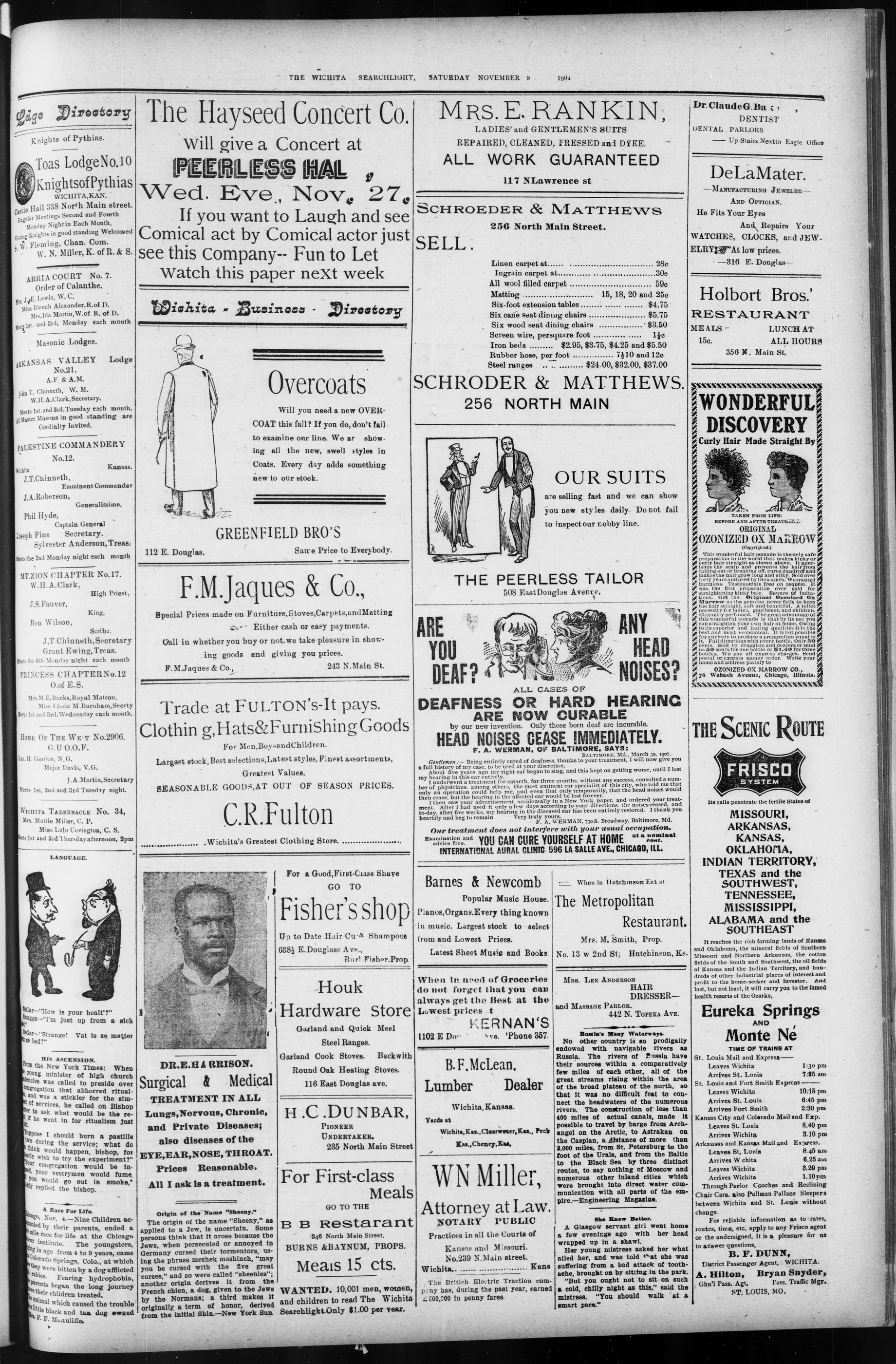
Be Gar—"How is your healt??"
Snaggs—"I'm just up from a sick
and"
Be Gar—"Strange! Vat is ze matter
or se bed?"
HIS ASCENSION.
From the New York Times: When the young minister of high church ordinances was called to preside over congregation that abhorred rituals, and was a stickler for the simet of services, he called on Bishop utter to ask what would be the reason if he went in for ritualism just with Suppose I should burn a pastille two during the service; what do I think would happen, bishop, for early wish to try the experiment?" Your congregation would be insured, your vestrymen would fume, you would go out in smoke," easily replied the bishop.
A Race For Life.
Chicago, Nov. 4.—Nine Children acquired by their parents, ended a mile race for life at the Chicago Institute. The youngsters, living in age from 4 to 9 years, came Colorado Springs, Colo., at which they were bitten by a dog afflicted with rabies. Fearing hydrophobia, the parents began the long journey were their children treated. The animal which caused the trouble a little black and tan dog owned Mrs. F. F. Maulieul.
Wed. Eve. Nov. 27 If you want to Laugh and see Comical act by Comical actor just see this company-- Fun to Let watch this paper next week
Wichita - Business - Directory
GREENFIELD BRO'S
F.M.Jaque
Special Prices made on Furniture
Either
Call in whether you buy or m
ing goods and g
F.M.Jaques & Co.
Trade at FULT
Clothin g,Hats&H
For Men,Boy-
Largest stock,Best selections,L
Greatest
SEASONABLE GOODS,AT C
F.M.Jaques & Co.,
Special Prices made on Furniture, Stoves, Carpets, and Matting Either cash or easy payments.
Call in whether you buy or not. we take pleasure in showing goods and giving you prices.
F.M.Jaques & Co., 243 N.Main St.
Largest stock, Best selections, Latest styles, Finest assortments, Greatest Values. SEASONABLE GOODS,AT OUT OF SEASON PRICES.
C.R.Fulton
Wichita's Greatest Clothing Store.
A. B.
DR.E.HARRISON.
Surgical & Medical TREATMENT IN ALL Lungs,Nervous,Chronic and Private Diseases; also diseases of the EYE,EAR,NOSE,THROAT. Prices Reasonable. All I ask is a treatment.
Origin of the name "Sheeny," as applied to a Jew, is uncertain. Some persons think that it arose because the Jews, when persecuted or annoyed in Germany cursed their tormentors, using the phrase meshek meshineh, "may you be cursed with the five great curses," and so were called "sheenies"; another origin derives it from the French chien, a dog, given to the Jews by the Normans; a third makes it originally a term of honor, derived from the initial Shin—New York Sun.
c.
112 E. Douglas.
THE WICHITA SEARCHLIGHT, SATURDAY NOVEMBER 9 1904
Overcoats
Will you need a new OVERCOAT this fall? If you do, don't fail to examine our line. We are showing all the new, swell styles in Coats. Every day adds something new to our stock.
Same Price to Everybody.
ques & Co.,
Furniture, Stoves, Carpets, and Matting
Either cash or easy payments.
Buy or not, we take pleasure in show-
and giving you prices.
243 N. Main St.
ULTON's-It pays.
FurniShing Goods
en, Boys and Children.
ions, Latest styles, Finest assortments,
greatest Values.
AT OUT OF SEASON PRICES.
For a Good,First-Class Shave
GO TO
Fisher's shop
Up to Date Hair Cut & Shampoos
6381 E.Douglass Ave.,
Burl Fisher.Prop
Houk
Hardware Store
Garland and Quick Meal
Steel Ranges.
Garland Cook Stoves. Backwith
Round Oak Heating Stoves.
116 East Douglas ave.
H.C.DUNBAR,
PIONEER
UNDERTAKER,
235 North Main Street
For First-class Meals
GO TO THE
B B Restarant
846 North Main Street.
BURNS & BAYNUM, PROPS.
Meals 15 cts.
WANTED. 10,001 men, women,
and children to read The Wichita
Searchlight. Only $1.00 per year.
MRS. E. RANKIN,
LADIES' and GENTLEMEN'S SUITS
REPAIRED, CLEANED, FRESSED and DYEE.
ALL WORK GUARANTEED
l17 NLawrence st
SCHROEDER & 256 North M
EDER & MATTHEW
256 North Main Street.
Linen carpet at.....
Ingrain carpet at.....
All wool filled carpet.....
Matting ..... 15,
Six-foot extension tables.....
Six cane seat dining chairs.....
Six wood seat dining chairs.....
Screen wire, persquare foot.....
Iron beds ..... $2.95, $3.75, $
Rubber hose, per foot.....
Steel ranges ..... $24.00,
EDER & MATTHEW
256 NORTH MAIN
Linen carpet at...
Ingrain carpet at...
All wool filled ca...
Matting .....
Six-foot extension
Six cane seat dins
Six wood seat di
Screen wire, pers
Iron beds .....
Rubber hose, pers
Steel ranges ...
SCHRODER & CO.
256 NORT
Linen carpet at..... 28c
Ingrain carpet at..... 30c
All wool filled carpet ..... 59c
Matting ..... 15, 18, 20 and 25c
Six-foot extension tables ..... $4.75
Six cane seat dining chairs ..... $5.75
Six wood seat dining chairs ..... $3.50
Screen wire, persquare foot ..... 1 1/2c
Iron beds ..... $2.95, $3.75, $4.25 and $5.50
Rubber hose, per foot ..... 7 1/210 and 12c
Steel ranges ..... $24.00, $32.00, $37.00
SCHRODER & MATTHEWS.
256 NORTH MAIN
THE PEERLE
508 East Dou
E PEERLESS TAIL 508 East Douglas Avenue.
THE PEERLESS TAILOR 508 East Douglas Avenue.
A man is whispering to a woman.
DEAFNESS OR I ARE NOW
by our new invention. Only the
HEAD NOISES CEASE
F. A. WERMAN, OF
Gentlemen: Being entirely cured of deafness
a full history of my case, to be used at your desire
About five years ago my right ear began to
my hearing in this car entirely.
I underwent a treatment for catarrh, for three
ber of physicians, among others, the most
only an operation could help me, and even this
then cease, but the hearing in the affected ear we
then saw your advertisement accidentally
ment. After I had used it only a few days acces
to-day, after five weeks, my hearing in the ear
heartily and beg to remain
F. A.
Our treatment does not interfere
Examination and
advice free.
YOU CAN CURE YOU
INTERNATIONAL AURAL CLINIC
ALL CASES OF
LESS OR HARD H
HARE NOW CURABLE
new invention. Only those born deaf are
NOISES CEASE IMMEDI-
A. WERMAN, OF BALTIMORE, SAL
eng entirely cured of deafness, thanks to your treat-
ure, to be used at your discretion.
my right ear began to sing, and this kept on
instrument for cataract, for three months, without any
long others, the most eminent specialist of the
help me, and even that only temporarily
during in the affected ear would be lost forever.
advertisement accidentally in a New York paper,
ed it only a few days after going to your direction.
my hearing in the diseased ear has been entire
mainly. Very truly yours.
F. A. WERMAN, 730 S. Broa
does not interfere with your use
YOU CAN CURE YOURSELF AT HOR-
NAL AURAL CLINIC: 596 LA SALLE AVE.
*Gentlemen...* : Being entirely curled of deafness, thanks to your treatment, I will now give you a little lesson. About five years ago my right ear began to sing, and this kept on getting worse, until I lost
my hearing in this car is important for catarh, for three months, without any success, consulted a number of physicians, among others, the most eminent ear specialist of this city, who told me that only an operation could help me, and even that once temporarily, that the head noises would then cease, but the hearing in the affected ear would be long forever. In the paper, and ordered your treatment. After I had used it only a few days according to your directions, the noises ceased, and to-day, after five weeks, my hearing in the diseased ear has been entirely restored. I thank you heartily and beg to remain
F. A. WERMAN, 750 S. Broadway, Baltimore, Md.
Our treatment does not interfere with your usual occupation.
Examination and advice free
YOU CAN CURE YOURSELF AT HOME
at a nominal cost.
INTERNATIONAL AURAL CLINIC: 596 LA SALLE AVE., CHICAGO, ILL.
Barnes & Newcomb
Pianos, Organs.Every thing known in music. Largest stock to select from and Lowest Prices. Latest Sheet Music and Books.
When in need of Groceries do not forget that you can always get the Best at the Lowest prices at
KERNAN'S
1102 E Doe
ave. 'Phone 357
B.F.McLean.
Lumber Dealer
Wichita, Kansas.
Yards at
Wichita, Kas., Clearwater, Kas., Peck
Kas., Cheney, Kas,
WN Miller,
Attorney at Law.
NOTARY PUBLIC
Practices in all the Courts of
Kansas and Missouri.
No.239 N.Main street.
Wichita. ..... Kans
The British Electric Traction company has, during the past year, earned
±600,000 in penny fares.
---
SELL.
MATTHEWS
Main Street.
at ... 28c
at at ... 30c
carpet ... 59c
15, 18, 20 and 25c
vision tables ... $4.75
dining chairs ... $5.75
dining chairs ... $3.50
persquare foot ... 1½c
$2.95, $3.75, $4.25 and $5.50
per foot ... 7½10 and 12c
$24.00, $32.00, $37.00
& MATTHEWS.
TH MAIN
OUR SUITS
are selling fast and we can show you new styles daily. Do not fail to inspect our hobby line.
LESS TAILOR
douglas Avenue.
LEASES OF
HARD HEARING
NEW CURABLE
by those born deaf are incurable.
CASE IMMEDIATELY.
OF BALTIMORE, SAYS:
BALTIMORE, Md., March 30, 1907.
business, thanks to your treatment, I will now give you
selection to sing, and this kept on getting worse, until I lost
three months, without any success, consulted a num-
miment car specialist of this city, who told me that
that only temporarily, that the head noises would
would be lost forever.
in a New York paper, and ordered your treat-
according to your directions, the noises ceased, and
seized ear has been entirely restored. I thank you
yours.
A. WERMAN, 730 S. Broadway, Baltimore, Md.
fere with your usual occupation.
YOURSELF AT HOME
at a nominal
cont.
G. 596 LA SALLE AVE., CHICAGO, ILL.
When in Hutchinson Eat at
The Metropolitan
Restaurant.
Mrs. M. Smith, Prop.
No. 13 w 2nd St; Hutchinson, Ks.
MRS. LEE ANDERSON
HAIR
DRESSER—
and MASSAGE PARLOR.
442 N. TOPEKA AVE.
Bustia's Many Waterways.
No other country is so prodigally endowed with navigable rivers as Russia. The rivers of Russia have their sources within a comparatively few miles of each other, all of the great streams rising within the area of the broad plateau of the north, so that it was no difficult feat to connect the headwaters of the numerous rivers. The construction of less than 400 miles of actual canals, made it possible to travel by barge from Archangel on the Arctic, to Astrakan on the Casplan, a distance of more than 2,000 miles, from St. Petersburg to the foot of the Urals, and from the Baltic to the Black Sea by three distinct routes, to say nothing of Moscow and numerous other inland cities which were brought into direct water communication with all parts of the empire.—Engineering Magazine.
A Glasgow servant girl went home a few evenings ago with her head wrapped up in a shawl.
Her young mistress asked her what alled her, and was told that she was suffering from a bad attack of toothache, brought on by sitting in the park.
"But you ought not to sit on such a cold, chilly night as this," said the mistress. "You should walk at a smart pace."
ANY HEAD NOISES?
She Knew Better.
Dr.Claude G.Ba ;
DENTIST
DENTAL PARLORS
—— Up Stairs Nextto Eagle Office
DeLaMater.
MANUFACTURING JEWELER
AND OPTICIAN.
He Fits Your Eyes
And Repairs Your
WATCHES, CLOCKS, and JEW-
ELRY. At low prices.
—316 E. Douglas—
Holbort Bros.' RESTAURANT MEALS ... LUNCH AT 15c. ALL HOURS 356 N. Main St.
WONDERFUL DISCOVERY
Curly Hair Made Straight By
1.
This wonderful hair pomade is the only safe preparation in the world that makes kinky or oily hair shine. It is designed to the scalp and prevents the hair from falling out or breaking off, cures dandruff and it is also a great gift for forty years and used by the brands. Warranted harmless. Testimonials free on request. It is the original Ozized Ozor X straightening hair. Reward of mutations. Get the Original Ozized Ozor X hair straight, soft and beautiful. A toilet necessity for ladies, gentlemen and children. Eleganly performed. The great advantage of this pomade is that it can straighten your own hair at home. Owing to its best and most economical. It is not possible for anybody to produce a preparation equal to this pomade. Sold by druggists and dealers or send us 50 cents for one bottle or 1.40 for three postal or express money orders. Write your name and address plainly to
OZONIZED OX MARROW CO.,
76 Wabash Avenue, Chicago, Illinois.
THE SCENIC ROUTE
FRISCO SYSTEM
Its rails penetrate the fertile States of
MISSOURI,
ARKANSAS,
KANSAS,
OKLAHOMA,
INDIAN TERRITORY,
TEXAS and the
SOUTHWEST,
TENNESSEE,
MISSISSIPPI,
ALABAMA and the
SOUTHEAST
It reaches the rich farming lands of Kansas and Oklahoma, the mineral fields of Southern Missouri and Northern Arkansas, the cotton fields of the South and Southwest, the oil fields of Kansas and the Indian Territory, and hundreds of other industrial places of interest and profit to the home-seeker and investor. And last, but not least, it will carry you to the famed health resorts of the Ozarks.
Eureka Springs
AND
Monte Né
TIME OF TRAINS AT
St. Louis Mail and Express —
Leaves Wichita 1:30 pm
Arrives St. Louis 7:35 am
St. Louis and Fort Smith Express —
Leaves Wichita 10:15 pm
Arrives St. Louis 6:45 pm
Arrives Fort Smith 2:30 pm
Kansas City and Colorado Mail and Exp.
Leaves St. Louis 8:40 pm
Arrives Wichita 3:10 pm
Arkansas and Kansas Mail and Express.
Leaves St, Louis 8:45 am
Arrives Wichita 6:25 am
Leaves Wichita 3:20 am
Arrives Wichita 1:10 pm
Through Parlor Coaches and Recclining Chair Cars, also Pullman Pallace Sleepers between Wichita and St. Louis without change.
For reliable information as to rates, routes, time, etc. apply to any Frisco agent or the undersigned. It is a pleasure for us to answer questions.
B. F. DUNN,
District Passenger Agent, WICHITA.
A. Hilton, Bryan Snyder,
Ghn'l Pass. Agt.
Pass. Traffic Mgr.
ST. LOUIS, MO.
"Straws Show Which Way the Wind Blows"
and the constantly increasing demand for and steady growth in popularity of St. Jacob's Oil among all classes of people in every part of the civilized world, show conclusively what remedy the people use for their Rheumatism and bodily aches and pains. Facts speak louder than words, and the fact remains undisputed that the sale of St. Jacob's Oil is greater than all other remedies for outward application combined. It acts like magic, cures where everything else fails, conquer pain.
Sometimes before new shoes are broken in they are broken out.
RED CROSS BALL BLUE
Should be in every home. Ask your grocer for it. Large 2 oz. package only 5 cents.
Present of Philippine Products
Present of Philippine Products.
Present Rooseveit was recently presented a handsome cane and several pieces of cloth manufactured in the Philippine islands by A. Abren, a Philippine merchant traveling in this country to get a know.ed of American mercantile methods.
Big Salmon Catch in the Wes
Big salmon catch in the West.
The salmon catchers on the North Pacific coast sometimes catch over 5,000 fish at one haul and are compelled to throw thousands back for want of seine room. Canneries are running at breakneck speed. Labor is very scarce and small girls employed as helpers are making $3 a day.
Few Visits to Denmark.
King Edward is the first King of Great Britain to visit Denmark since the time when England, Denmark and Norway had the same ruler in the person of Canute (Knud), who died 1035, and is buried in Winchester. James VI. of Scotland visited Denmark in 1590, but he was then not yet King of England—New York Post.
"Vaccination Concerts."
There is a smallpox scare in England and an ingenious vicar in Kent has devised "vaccination concerts" for the hop gatherers. A band plays in a big tent, and in a smaller tent are vaccination officers, while the vicar and his assistants go through the audience urging the desirability of vaccination.
Clgarette Legally a Pipe.
A shifter employed by the Lambton collieries was charged with a breach of the colliery rules, which prohibits taking of a tobacco pipe into the mine. It was admitted that defendant had a partly smoked cigarette in his pocket, and on behalf of the prosecution it was contended that a paper charged with tobacco was a pipe within the meaning of the rule. The magistrates upheld this view, and fined defendant twenty shillings and costs.
THE CHAMPION WING SHOT.
Capt. Bogardus Has a Dangerous Experience but Comes Out Unhurt.
Ferris Wheel Park, Chicago, Nov. 4th—Capt. A. H. Bogardus, the champion wing shot of the world, has spent the summer here. His shooting school has been one of the features of the Park during the season. He has given many exhibitions and his skill with the rifle is superb.
The Captain tells of a very close call he once had when living at Elkhart, Ill. He had been a sufferer from Kidney disease for several years and it rapidly developed into Bright's Disease. All his friends told him that this was incurable and that he would never get better.
To say that he was alarmed is to put it very mildly. This plucky man had faced many dangers and it made him sick at heart to think that at last he was to be conquered by such a cruel foe.
At last he heard of a medicine that had cured many such cases—Dodd's Kidney Pills. He used them and was completely restored to good health. He says: "I attribute my present good health to Dodd's Kidney Pills and to nothing else."
Savage Social Modes
In Korea visiting cards measuring a foot square are in vogue. The savages of Dahomey announce their visits to each other by sending in advance a wooden board or the branch of a tree artistically carved. When the visit is paid the "card" returns to the possession of its owner, who probably uses it for many years. The natives of Sumatra use for a visiting card a piece of wood about a foot long, decorated with a bunch of straw and a knife.
KIDDER'S PASTILLES
STOWELL & CO.
A Sure relief for Asthma.
Sold by all Druggists,
or by mail, 45 cents.
Charlestown, Mass.
$8.00 For this
AT YOUR STATION.
Warranted Accurate
Other cases equally low.
GUY OF THE MAKER
Jones (He pays the Freight).
BRUGHAMTON, N. Y.
800 LBS.
PLATFORM
18X25IN
WET WEATHER HATS
MADE BY THE MAKERS OF
ON SALE
EVERYWHERE
FREE
Catalogues
OF
GARMENTS
AND
HATS
TOWER TO
BOSTON
MASS.
TOWER'S
FISH BRAND
SLICKERS
HAVE THE SAME POINTS
OF EXCELLENCE AND GIVE
COMPLETE SATISFACTION.
FOR DAY OF THANKSGIVING.
President Roosevelt Names a Day For Public Thanks.
THURSDAY, NOVEMBER 28Th
Washington, Nov. 5.—President Roosevelt has issued his proclamation fixing Thursday, November 28, as a day of national thanksgiving. It follows:
"The season is nigh when according to the time-honored custom of our people, the president appoints a day as the especial occasion for praise and thanksgiving to God.
"This thanksgiving finds the people still bowed with sorrow for the death of a great and good president. We mourn President McKinley because we so loved and honored him; and the manner of his death should awake in the breasts of our people we keen anxiety for the country and at the same time a resolute purpose not to be driven by any calamity from the path of strong, orderly popular liberty, which as a nation we have thus far safely trod.
"Yet, in spite of this great disaster, it is nevertheless true that no people on earth have such an abundant cause for thanksgiving as we have. The past year in particular has been one of peace and plenty; we have prospered in things material and have been able to work for our own uplifting in things intellectual and spiritual. Let us remember that, as much as has been given us, much will be expected from us; and that true homage comes from the hearts as well as from the lips and shows itself in deeds. We can best prove our thankfulness to the Almighty by the way in which we on this earth and at this time each of us does his duty to his fellow man.
"Now, therefore, I, Theodore Roosevelt, president of the United States, do hereby designate as a day of general thanksgiving, Thursday, the 28th of this present November and do recommend that throughout the land the people cease from their wonted occupations and at their several homes and places of worship reverently thank the giver of all good for the countless blessings of our national life.
"In witness whereof, I have hereunto set my hand and caused the seal of the United States to be affixed.
"Done at the city of Washington this second day of November, in the year of our Lord, One Thousand Nine Hundred and One, and of the Independence of the United States, the One Hundred and Twenty-Sixth.
(Seal.)
(Signed) "THEODORE ROOSEVELT."
"By the president:
"JOHN HAY, Secretary of State."
Gen. Funston Coming Home.
Kansas City, Mo., Nov. 6. It is stated that General Frederick Funston will shortly apply for leave of absence from the Philippines and return to the United States on a visit. It is said that he is recovering rapidly from the operation of appendicitis recently undergone at a Manila hospital. General Frederick D. Grant will, it is stated, likely succeed Gen. Funston in command of the San Fernando district.
French Take Three Ports.
Paris, Nov. 7.—An official dispute announces the arrival of Admiral Callard's squadron at the island of Mitylene. The French commander carried out his instructions which were to occupy the three ports of the island and to seize the customs. One cruiser and three torpedo boats got separated from the squadron, owing to the speed of the latter.
Mail Pouch Thief.
Wichita, Nov. 7.—Some days since a mail pouch was missed from the train between Enid and Lahoma, O. T. Postoffice Inspector Hosford, of Wichita, took the trail and ran down the thief as he was about to leave Chickasha, I. T., for New Orleans with his plunder. He had disposed of certain checks and money orders. The pouch contained in drafts, checks and money orders about $2,000. The thief is a brakeman named George O'Brien, who lives in Caldwell. The evidence against him is conclusive.
Surplus Exceed Capital
Topeka, Nov. 7.—Bank Commissioner Albaugh received a letter from an Eastern financial paper asking him if it were true that there were nine banks in Kansas whose surplus was greater than their capital. It said that it had seen the statement in a newspaper and wanted to confirm it. The bank commissioner replied giving a list of thirty-seven state and private banks in Kansas under his control where the surplus is greater than the capital.
Battle In Jerusalem.
Jerusalem, Nov. 7.—The Church of the Holy Sepulchre, surmounting Christ's tomb, was the scene of a sanguinary affray between Franciscans and Greeks, during which there were a number of casualties on both sides. The dispute arose on the question as to which community had the right to sweep the church. Troops had been posted in the vicinity for several days previous to the outbreak, but they were suddenly overpowered by the contending parties.
FRANCE SEIZES CUSTOMS.
FRANCE SEIZES CUSTOMS.
Turkey Calls On Great Britain To Defend Her.
CLAIM BASED UPON TREATY.
London, Nov. 6.—A Paris correspondent says he understands that dispatches have been received at the French capital announcing that Admiral Caillard's division of the French Mediterranean squadron has arrived at Smyrna and seized the customs. Paris—"The porte hag asked Great Britain," says a correspondent, "to fulfill the terms of the convention of 1878, whereby, in exchange for the island of Cyprus, Great Britain guaranteed the integrity of the sultan's asiatic possession. "The porte holds under this convention that Great Britain should protect Asia-Turkey against attack by France, and suggests that Great Britain should send a squadron to the Levant for that purpose."
The foreign minister, M. Delcasse, said to the chamber of deputies that France's patience was exhausted by the porte's breaking its own promises. France, in the present difficulty, pursued no fresh advantage, but would agree that the effort on the part of France ought to at least serve to put an end to the annoyances and unjust treatment of which French works in the Orient scholastic and hospitable establishments, and commercial and industrial enterprises has been the object.
The chamber then, by 305 to 77, voted, sustaining the government's action towards Turkey and expressed confidence in the government.
Plot to Massacre Garrison.
Manila, Nov. 7.—A plot to massacre the American garrison at Moncada, province of Tarlac, Island of Luzon, has been revealed by the wife of one of the conspirators.
Several of the town officials are implicated in the murderous scheme. The woman who revealed the plot had a detective beneath a house in which the leaders of the conspirators were meeting. Arrests followed and many incriminating papers were seized.
The plan was to set fire to a house, close to the barracks, after dark, and when the soldiers came out to assist in extinguishing the flames, 150 conspirators, armed with bolos, were to rush on the guard, capture their arms and proceed to massacre the garrison.
Largest in the World.
Walter Baker & Co., Ltd, Dorchester, Mass., are the largest manufacturers of cocoa and chocolate in the world. They received a gold medal from the Paris exposition of last year. This year they have received three gold medals from the Pan-American exposition at Buffalo. Their goods are the standard for purity and excellence.
Kltchener "Deeply Regrets" Again.
London, Nov. 4.—Lord Kitehener has reported to the war department a disaster to the British near Bethle, Eastern Transvaal, in which two guns were lost, several officers killed and wounded and 54 men were killed and 100 wounded. Lord Kitehener then gives the names of 13 other officers who were wounded, most of them severely.
State Treasury Has Funds.
Topeka, Nov. 6.—State Treasurer Grimes stated that he would quit stamping warrants "not paid for want of funds" on November 15. Several counties are now turning in delinquent taxes and others will begin turning in new taxes on December 1. The warrants stamped during the past two months will be taken up in January.
For Single Statehood.
Topeka, Nov. 4. -It has been given out here by a close friend of President Roosevelt that, if he made any recommendations whatever in regard to statehood for Oklahoma in his forthcoming message, he would advocate single statehood for both Oklahoma and the Indian territory, and gave it out further that, in his opinion, the president would treat the subject in his message.
Statehood is the all-absorbing topic now in the two territories.
Dr. Fisk at Washburn
Topeka, Nov. 6—Dr. D. M. Fisk, pastor of the First Congregational church, has accepted the position of field secretary at Washburn college. He will also occupy the chair of sociology. The salary of the new position is $2,000 a year. Dr. Fisk has been pastor of the Congregational church here for two years. Under the terms of his employment by the college he will work over the state, raising money and soliciting students in addition to his work as professor.
Labor Scheme Against Courts.
Chicago, Nov. 7.—Labor's scheme for an organization to fight injunctions against strikers has been realized by the founding of the Chicago Anti-Injunction league by the officials of the Chicago Federation of Labor. Provision for starting a vast sinking fund to use the hebeas corpus against the imprisonment of any strikers or pickets under the injunction processes is a feature of the labor body now entering the field heretofore regarded as hopeless.
WHAT THE NAVY ASKS FOR.
Plans Wou'd Make a More Effective Service on the Ocean.
Washington, Nov. 4.—The board of naval construction will renew its recommendations, which were made to the last congress. The board's complete plan is:
Three sea-going battleships of about 16,000 tons displacement.
Two armored cruisers of about 14,500 tons displacement.
Six gunboats of about 6000 tons.
Six gunboats of about 2,000 tons.
Two colliers of about 15,000 tons.
Ohe repair ship of about 7,500 tons.
Six training ships of about 2000 tons.
Four picket boats of about 650 tons.
Four tugboats.
In each case, it is explained, recommendations are but steps necessary to be taken to carry out the general policy of providing the United States with a modern navy of sufficient strength and made up of harmonious units.
This policy was thought out carefully by two boards and if it is carried out as is proposed they declare that the symmetrical navy finally provided would be very much more effective than the more numerous navies of several of the European countries.
Episcopal School Burned.
Denver, Col., Nov. 7.—Jarvis Hall Military academy, at Mount Clair, eight miles from Denver, a school for boys, maintained by the Episcopal church of the diocese of Colorado, has burned to the ground causing a loss estimated at $75,000. Seventy five students roomed in the building, but all escaped without injury. The origin of the fire is unknown. A high wind prevailed and although the Denver fire department responded to a call for help all efforts to save the building were fruitless. It was insured for $40,000. The library of Canon Rogers, rector of the academy, one of the finest in the West, was partially destroyed.
Both Women Still Live.
Sofia, Bulgaria, Nov. 7.—United States Consul General Dickinson, of Constantinople, authorizes the statement that he is satisfied that both Miss Ellen M. Stone and her companion, Mme. Tsilka, and alive and well treated.
Washington.—The state department has received advices from its agents in Turkey and Bulgaria which express the opinion that both Miss Stone and Mme. Tsilka are alive and well, or at least were so several days ago. It requires several days for news to be transmitted through the wild country.
Croker Abdlicates.
New York, Nov. 7.—Richard Croker, Maurice Unter Meyer and Senator T. D. Sullivan were together at dinner, and it is said on good authority that a little later Mr. Croker said this was his last political fight. Mr. Croker asked Senator Sullivan whom he desired as leader. Senator Sullivan answered that John F. Carroll would be pleasing to him. Then and there, it is stated, Richard Croker abdicated his leadership of Tammany Hall and turned it over to John F. Carroll; at least his influence will be given Carroll's election as leader of Tammany Hall.
Cannot Grant a Franchise.
Washington, Nov. 6.—A decision by the secretary of the interior holds that the department has not the authority to grant a franchise in the towns of Sapulpa and Chelsea, I. T., since the Cherokee, Creek and Osage Indian reservations in which they are located have not complied with the requirements of the Curtis bill placing them outside the Indian Territory. The decision was in reply to an application for franchises from the Indian Territory Telephone Company.
Powder Magazine Explodes.
Albuquerque, N. M., Nov. 6.—The powder magazine of the Santa Fe Pacific at Williams, containing 2,000 pounds of powder, exploded, the shock breaking windows and glassware and tearing off doors of houses. The magazine is supposed to have caught fire from sparks from an engine which was switching nearby. The engineer and switching crew escaped injury but the ears were torn into kindling wood and the engine wrecked. The damage will amounts to many thousands of dollars.
Effects all Dentista.
New Ycrk, Nov. 4.—Litigation, which has lasted for 14 years, which involves the payment of $10,000,000 or more by the 17,000 dentists of the United States and which has caused the death of the investor from worry, was brought to a decision in the United States Circuit court. A verdict was rendered that, when enforced through other suits, may make every dentist in the country liable to the International Tooth Crown company for great sums as royalties for "bridge work."
Santa Fe Depot Improvements
Topeka, Nov. 7.—At the meeting of the executive board of the Santa Fe road to be held next January plans and estimates for the rebuilding of the passenger depot and freight depot at Topeka will be submitted. The engineering department of the road, under the direction of Chief Engineer Storey, is at work on the preliminary drawings and plans. It is certain that the present passenger depot will be sufficiently enlarged to give room for a Harvey dining room on the main floor.
E
Miss Lillie Degenkolbe, Treasurer South End Society of Christian Endeavor, 3141 Michigan Ave., Chicago, Ill., Cured by Lydia E. Pinkham's Vegetable Compound.
"DEAR MRS. PINKHAM: — When life looked brightest to me I sustained a hard fall and internal complications were the result. I was considerably inflamed, did not feel that I could walk, and lost my good spirits. I spent money doctoring without any help, when a relative visited our home. She was so enthusiastic over Lydia E. Pinkham's Vegetable Compound, having used it herself, that nothing would satisfy her until I sent for a bottle. I have thanked her a hundred times for it since, for it brought blessed health to me and cured me within seven weeks.
I now wish to thank you, your medicine is a friend to suffering women." — LILLIE DEGENKOLBE.
$5000 FORFEIT IF THE ABOVE LETTER IS NOT GENUINE
When women are troubled with irregular, suppressed or painful menstruation, weakness, leucorrhea, displacement or ulceration of the womb, that bearing-down feeling, inflammation of the ovaries, backache, bloating (or flatulence), general debility, indigestion, and nervous prostration, or are beset with such symptoms as dizziness, faintness, lassitude, excitability, irritability, nervousness, sleeplessness, melancholy, "allgone," and "want-to-be-left-alone" feelings, blues, and lydias, they should remember there is one tried and true remedy. Lydia E. Pinkham's Vegetable Compound at once removes such troubles. Refuse to buy any other medicine, for you need the best.
Mrs. Pinkham invites all sick women to write her for advice. She has guided thousands to health. Address: Lynn, Mass.
WINCHESTER
"NEW RIVAL" FACTORY LOADED SHOTGUN SHELLS
outshoot all other black powder shells, because they are made better and loaded by exact machinery with the standard brands of powder, shot and wadding. Try them and you will be convinced.
ALL • REPUTABLE • DEALERS • KEEP • THEM
SAWYER'S
EXCELSIOR
Keep Out
the Wet
Sawyer's Slickers
Sawyer's "Excellor Brand!" Suits and sliders are the best equipment in the world. Made from the best materials in the world. Warranted waterproof. Made to stand the toughest work and weather. Look for the trade mark. Your dealer does not have them, either for catalogs. Mr. A. SAWYER & 60th, East Cambridge, Mass.
PISO'S CURE FOR
CURES WHERE ALL THE FILLS.
Best Cough Syrup. Tastes Good. Use in time. Sold by druggists.
CONSUMPTION
Kafflicted with sore eyes, use!
Thompson's Eye Water
CLAIMANTS FOR PENSION
write to NATHAN BICKFORD, Washington, D.C. C. thomas will receive quick replies. E. John N. H. Young
Staff 20th Corps. Prosecuting Claims since 1875
I CURE FITS
FREE
A Fall-Size 81 Treated of Dr. O. Philsen from's Great Remedy for Fits. Eoilepys and all Nervous Disorders. O. PHELPS BROWN, 95 Broadway, Newark, K.L.
W. N. U. WICHITA-NO. 45-1901
When Answering Advertisements Kindly Mention This Paper.
A. PRIESMEYER SHOE CO.
SHOES THAT WEAR.
Ask Your Dealer For Them
A Wisconsin Family's Prominence.
Dr. Roswell Park, one of the physicians who attended President McKinley, is a son of the Rev. Roswell Park,
D. D., who founded and was first president of Racine college, Racine, Wis.
Cables in the Philippines.
Our government has concluded that surety and secrecy can only be obtained by a cable ship owned and worked by its insurer, and that the first insured cable vessel will be put in readiness. As necessary as the cable is in times of war, Hostetter's Stomach Bitters is of far more importance, for it makes people well. It ensures indignation, dyspeptic fainteness, constipation, biliousness and nervousness, also prevents malaria, fever and ague. We urge you to try it.
It's queer that people haven't any confidence in confidence men.
Piso's Cure for Consumption is an infallible medicine for coughs and colds. N. W. SAMUEL, Ocean Grove, N. J., Feb. 17, 1900.
An old fool is always more foolish than a young fool.
THOSE WHO HAVE TRIED IT
THOSE WHO HAVE TRIED IT
will use no other. Defiance Cold Water
Starch has no equal in Quantity or Qua-
lity-16 oz for 10 cents. Other brands
contain only 12 oz.
The mariner is always glad to see a
lighthouse, but it's different with an
actor.
Mrs Wainlow's Soothing Syrup.
For children teething, the gums, reduces in inflammation, always pain, cure swamping. 25c a bottle.
The swimming instructor is apt to be immersed in business.
**ALL UP-TO-DATE HOUSEKEEPERS**
Use Red Cross Ball Blue. It makes clothes clean and sweet as when new. All grocers.
The preacher who lasts longest is usually the one who preaches shortest.
Are You Using Allen's Foot-Ease?
Are You Using Allen's Foot-Ease?
It is the only cure for Swollen,
Smarting, Burning, Sweating Feet,
Corns and Bunlons. Ask for Allen's
Foot-Ease, a powder to be shaken into
the shoes. At all Druggists and Shoe
Stores, 25c. Sample sent FREE. Address Allen S. Olmsted, LeHoy, N. Y.
A physician always asks aask what ails him and then proceeds to
charge him $2 for the information.
MORE FLEXIBLE AND LASTING.
won't shake out or blow out; by using Defiance starch you obtain better results than possible with any other brand and one-third more for same money.
The quickest way to convince a man is to agree with him.
A revolver may not be a soi
weapon but it never goes off by itself
If practice makes perfect the average doctor ought to be a paragon.
Hamlin's Blood and Liver Pills cure constipation and all the lilies due to it 25c at your druggists.
As a rule the man who gets in pickle doesn't look well preserved.
PUTNAM FADELESS DYES do not stain the hands or spot the kettle (except green and purple). Sold by druggists, 10c. per package.
The sheriff can't be judged by the company he keeps.
Ladies Can Wear Shoe
One size smaller after wearing Allen's Foot Ease, a powder. It makes tight or new shoes easy. Cures swelling, hot, sweating, aching feet, ingrowing nails, corns and bunions. All drugstores and stores 253. Trial package FREE by mail Address Allen S, Olmsted, LeRoy, N. Y.
It's all right for a man to be a crank if he can be turned to advantage.
WHY IT IS THE BEST
is because made by an entirely different process. Defiance Starch is unlike any other, better and one-third more for 1 cents.
The lawyer doesn't believe that every man is entitled to his opinion.
Brooklyn, N. Y., Oct. 31st.—After investigating Garfield Tea, which is quite universally acknowledged to be the best family remedy, it is not difficult to explain its success—it is the medicine for GOOD RESULTS! It is prepared here by the Garfield Tea Co., in their new and attractive laboratory and is made wholly from simple, sweet and withal. HEALTH GIVING HERBS. Garfield Tea is the ORIGINAL herb cure for constipation and sick headache.
Be sure you are right and then you won't get left.
There is more Catarin in this section of the country than all other diseases put together. The last few years was supposed to be incurable, but the doctors pronounced it a local disease, and prompted remedies, and by constantly failing to treat it, no treatment, pronounced it incurable. Science has shown that it be a constitutional disease, and it must be institutional treatment. Hall's Catarin Care is manufactured by Catarney & Co. Toldea Ohio market. It is taken internally in doses from 10% to a teaspoonful. It acts directly upon the blood and mucous surfaces of the system. They offer mucous and saline saline fallsures. Send for circulars and testimonials. Address: F. J. CHENEY & CO. Toldea Ohio Sold by Druggists, Tac. Hall's Family Pills are the best.
Long sermons are sometimes referred to as clerical errors.