Wichita Searchlight
Saturday, December 31, 1904
Wichita, Kansas
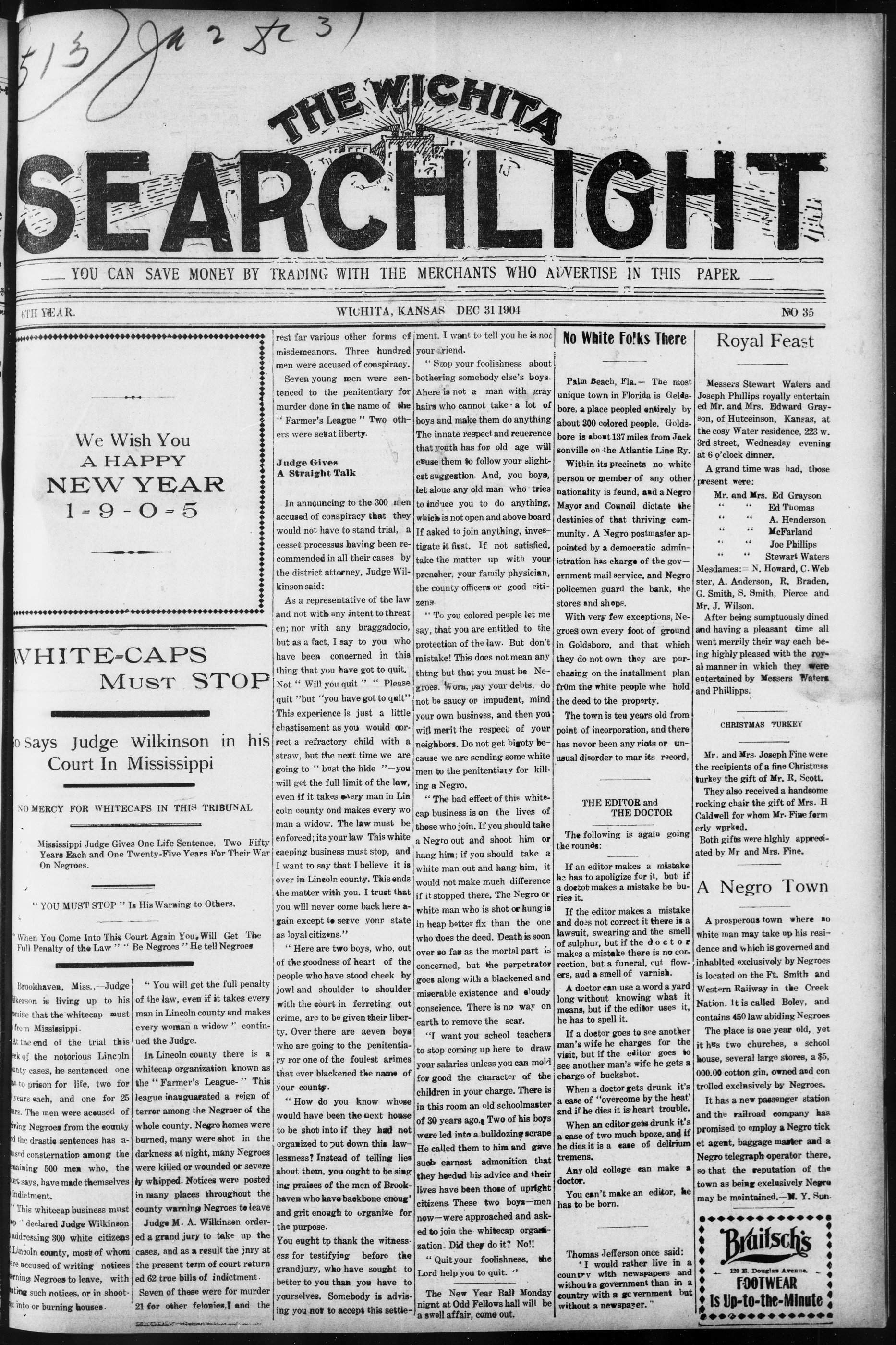
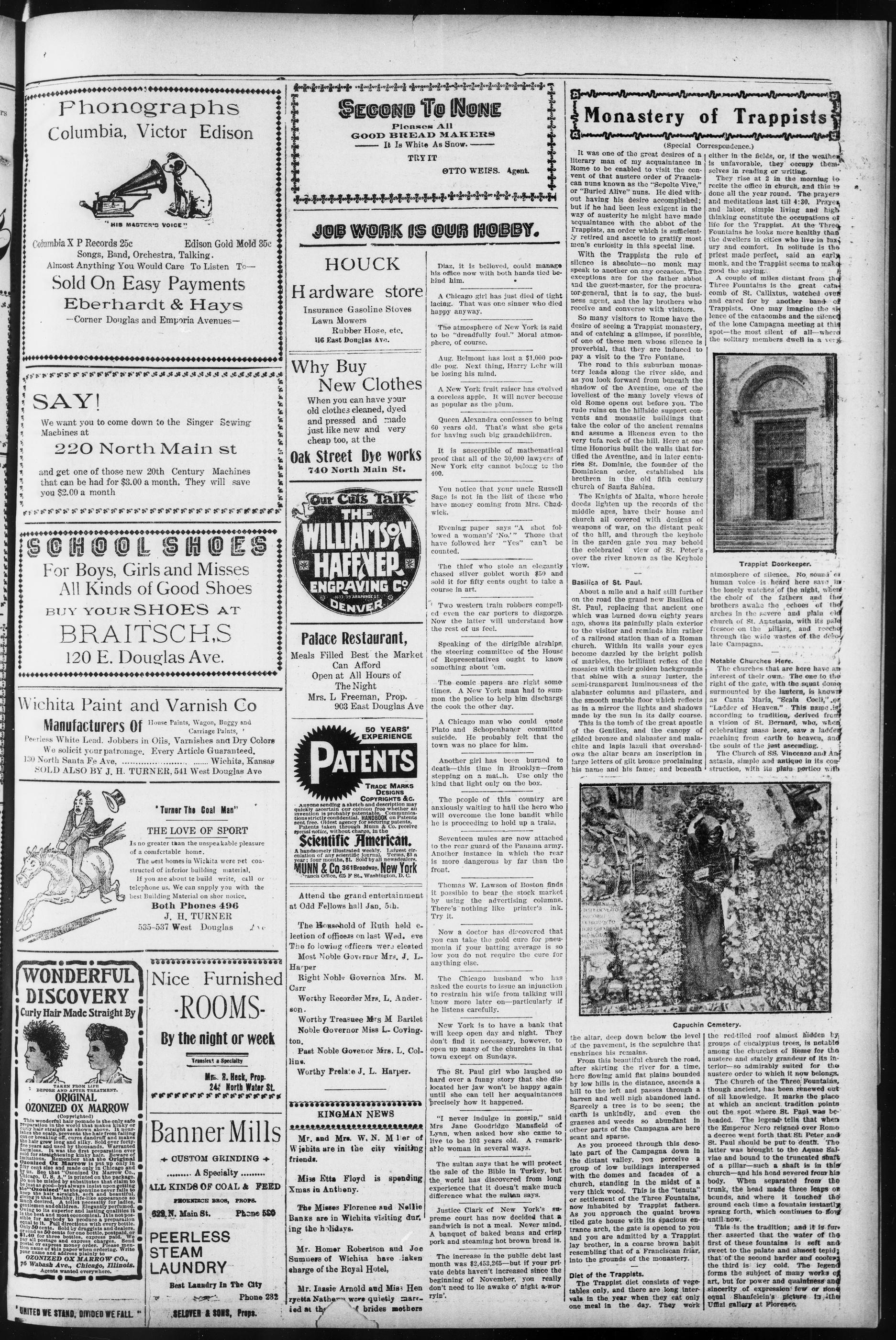
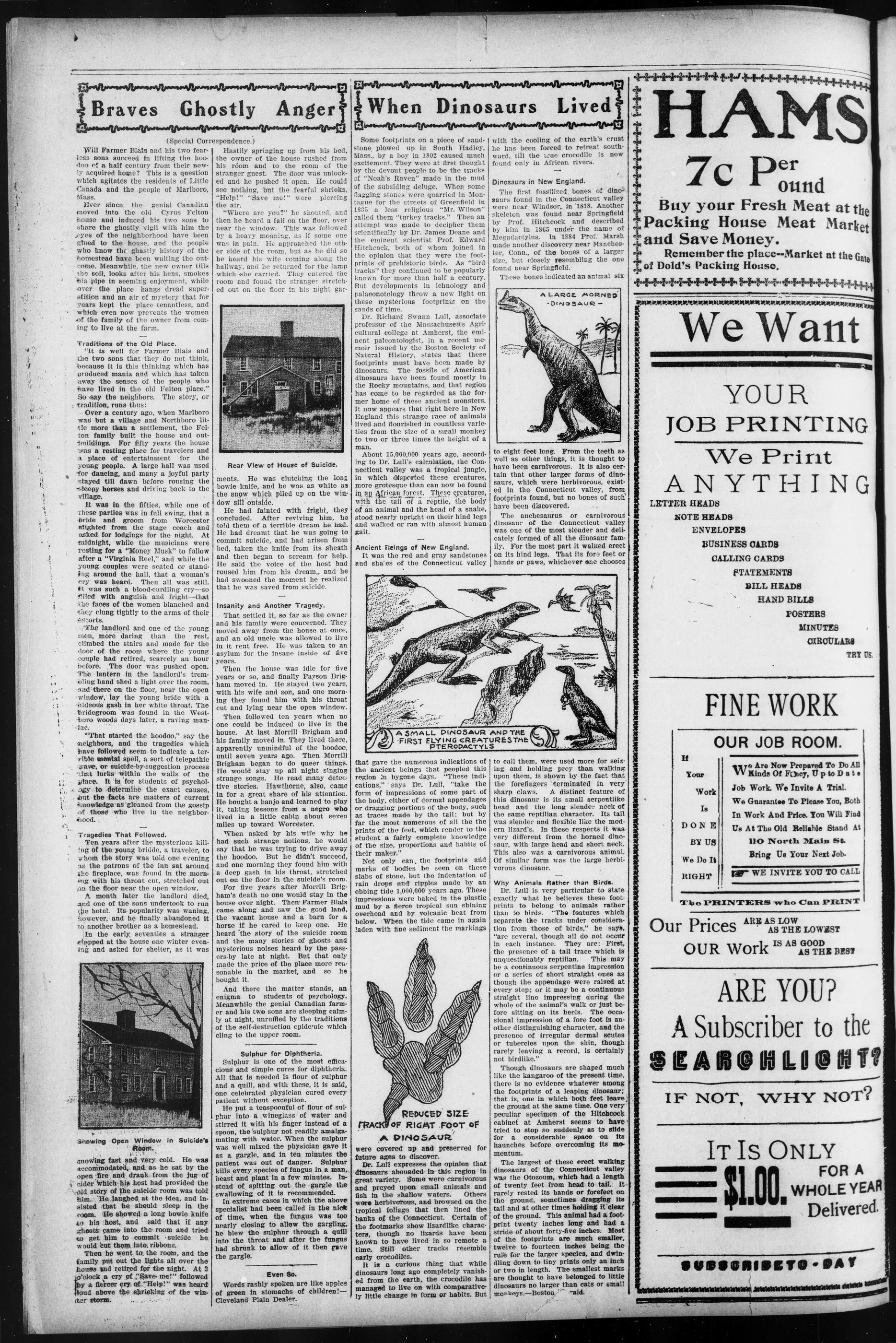
Page text (machine-generated)
THE WICHITA SEARCHLIGHT
We Wish You
A HAPPY
NEW YEAR
1=9-0=5
WHITE=CAPS MUST STOP
says Judge wilkinson in his Court In Mississippi
NO MERCY FOR WHITECAPS IN THIS TRIBUNAL
Mississippi Judge Gives One Life Sentence. Two Fifty Years Each and One Twenty-Five Years For Their War On Negroes.
"YOU MUST STOP" Is His Warning to Others.
When You Come Into This Court Again You, Will Get The Full Penalty of the Law "Be Negroes" He tell Negroes
6TH YEAR.
We W
A HA
NEW
1 = 9 -
WHITE=C
M
60 Says Judge
Court In
NO MERCY FOR WHITE
Mississippi Judge Gives
Years Each and One T
On Negroes.
"YOU MUST STOP"
"When You Come Into This C
Full Penalty of the Law"
Brookhaven, Miss.,-Judge Mikerson is living up to his promise that the whitecap must from Mississippi.
At the end of the trial this week of the notorious Lincoln county cases, he sentenced one man to prison for life, two for 20 years each, and one for 25 years. The men were accused of living Negroes from the county and the drastic sentences has accused consternation among the remaining 500 men who, the court says, have made themselves indictment.
"This whitecap business must top" declared Judge Wilkinson addressing 300 white citizens of Lincoln county, most of whom were accused of writing notices warning Negroes to leave, with rating such notices, or in shooting into or burning houses.
"You will get the full penalty of the law, even if it takes every man in Lincoln county and makes every woman a widow" continued the Judge.
In Linecoln county there is a whitecap organization known as the "Farmer's League-" This league inaugurated a reign of terror among the Negroer of the whole county. Negro homes were burned, many were shot in the darkness at night, many Negroes were killed or wounded or severely whipped. Notices were posted in many places throughout the county warning Negroes to leave
Judge M. A. Wilkinson ordered a grand jury to take up the cases, and as a result the jnry at the present term of court returned 62 true bills of indictment. Seven of these were for murder 21 for other felonies, and the
rest far various other forms of misdemeanors. Three hundred men were accused of conspiracy. Seven young men were sentenced to the penitentiary for murder done in the name of the "Farmer's League" Two others were set at liberty. ment. I want to tell you he your friend. "Stop your foolishness bothering somebody else." Ahere is not a man with hairs who cannot take a boys and make them do an The innate respect and re
Judge Gives
A Straight Talk
In announcing to the 300 n en accused of conspiracy that they would not have to stand trial, a cesset processus having been recommended in all their cases by the district attorney, Judge Wilkinson said:
As a representative of the law and not with any intent to threaten; nor with any braggadocio, but as a fact, I say to you who have been concerned in this thing that you have got to quit. Not "Will you quit" "Please quit"but "you have got to quit" This experience is just a little chastisement as you would correct a refractory child with a straw, but the next time we are going to "bust the hide"—you will get the full limit of the law, even if it takes every man in Lincoln county and makes every woman a widow. The law must be enforced; its your law This white caeping business must stop, and I want to say that I believe it is over in Lincoln county. This ends the matter with you. I trust that you will never come back here again except to serve your state as loyal citizens."
"Here are two boys, who, out of the goodness of heart of the people who have stood cheek by jowl and shoulder to shoulder with the court in ferreting out crime, are to be given their liberty. Over there are aeven boys who are going to the penitentiary ror one of the foulest arimes that ever blackened the name of your county.
"How do you know whose would have been the next house to be shot into if they had not organized to put down this lawlessness? Instead of telling lies about them, you ought to be singing praises of the men of Brookhaven who have backbone enoug' and grit enough to organize for the purpose.
You eight tp thank the witnessess for testifying before the grandjury, who have sought to better to you than you have to yourselves. Somebody is advising you not to accept this settle-
ment. I want to tell you he is not your friend.
"Stop your foolishness about bothering somebody else's boys. Ahere is not a man with gray hairs who cannot take a lot of boys and make them do anything The innate respect and reuerence that youth has for old age will cause them to follow your slightest suggestion. And, you boys, let aloue any old man who tries to induce you to do anything, which is not open and above board If asked to join anything, investigate it first. If not satisfied, take the matter up with your preacher, your family physician, the county officers or good citizens.
"To you colored people let me say, that you are entitled to the protection of the law. But don't mistake! This does not mean any thng but that you must be Negroes. Wor, pay your debts, do not be saucy or impudent, mind your own business, and then you will merit the respect of your neighbors. Do not get bigoty because we are sending some white men to the penitentiary for killing a Negro.
"The bad effect of this white-cap business is on the lives of those who join. If you should take a Negro out and shoot him or hang him; if you should take a white man out and hang him, it would not make much difference if it stopped there. The Negro or white man who is shot or hung is in heap better fix than the one who does the deed. Death is soon over so fast as the mortal part is concerned, but the perpetrator goes along with a blackened and miserable existence and cloudy conscience. There is no way on earth to remove the scar.
"I want you school teachers to stop coming up here to draw your salaries unless you can mold for good the character of the children in your charge. There is in this room an old schoolmaster of 30 years ago. Two of his boys were led into a bulldozing scrape He called them to him and gave such earnest admonition that they heeded his advice and their lives have been those of upright citizens. These two boys—men now—were approached and asked to join the whitecap organization. Did they do it? No!!
"Quit your foolishness, the Lord help you to quit. "
The New Year Ball Monday night at Odd Fellows hall will be a swell affair, come out.
No White Folks There
Palm Beach, Fla. - The most unique town in Florida is Geldsbore, a place peopled entirely by about 300 colored people. Goldsbore is about 137 miles from Jack sonville on the Atlantic Line Ry.
Within its precincts no white person or member of any other nationality is found, and a Negro Msyor and Council dictate the destinies of that thriving community. A Negro postmaster appointed by a democratic administration has charge of the government mail service, and Negro policemen guard the bank, the stores and shops.
With very few exceptions, Negroes own every foot of ground in Goldsboro, and that which they do not own they are purchasing on the installment plan fr0m the white people who hold the deed to the property. The town is teu years old from point of incorporation, and there has never been any riots or unusual disorder to mar its record.
THE EDITOR and
THE DOCTOR
The following is again going the rounds:
If an editor makes a mistake he has to apologize for it, but if a doctot makes a mistake he buries it.
If the editor makes a mistake and does not correct it there is a lawsuit, swearing and the smell of sulphur, but if the doctor makes a mistake there is no correction, but a funeral, cut flowers, and a smell of varnish.
A doctor can use a word a yard long without knowing what it means, but if the editor uses it, he has to spell it.
If a doctor goes to see another man's wife he charges for the visit, but if the editor goes to see another man's wife he gets a charge of buckshot.
When a doctor gets drunk it's a case of "overcome by the heat" and if he dies it is heart trouble.
When an editor gets drunk it's a case of two much bpoze, and if he dies it is a case of delirium tremens.
Any old college can make a doctor.
You can't make an editor, he has to be born.
Thomas Jefferson once said:
'I would rather live in a country with newspapers and without a government than in a country with a government but without a newspaper."
NO 35
Royal Feast
Messers Stewart Waters and Joseph Phillips royally entertained Mr. and Mrs. Edward Grayson, of Hutceinson, Kansas, at the cosy Water residence, 223 w. 3rd street, Wednesday evening at 6 o'clock dinner.
A grand time was had, those present were:
Mr. and Mrs. Ed Grayson
" " " Ed Thomas
" " " A. Henderson
" " " McFarland
" " " Joe Phillips
" " " Stewart Waters
Mesdames:= N. Howard, C. Webster, A. Anderson, R. Braden, G. Smith, S. Smith, Pierce and Mr. J. Wilson.
After being sumptuously dined and having a pleasant time all went merrily their way each being highly pleased with the royal manner in which they were entertained by Messers Waters and Phillipps.
CHRISTMAS TURKEY
Mr. and Mrs. Joseph Fine were the recipients of a fine Christmas turkey the gift of Mr. R. Scott. They also received a handsome rocking chair the gift of Mrs. H Caldwell for whom Mr. Fine formerly wprked. Both gifts were hlghly appreciated by Mr. and Mrs. Fine.
A Negro Town
A prosperous town where no white man may take up his residence and which is governed and inhabited exclusively by Negroes is located on the Ft. Smith and Western Raiway in the Creek Nation. It is called Boley, and contains 450 law abiding Negroes The place is one year old, yet it has two churches, a school house, several large stores, a $5, 000.00 cotton gin, owned and controlled exclusively by Negroes.
It has a new passenger station and the railroad company has promised to employ a Negro tick et agent, baggage master and a Negro telegraph operator there, so that the reputation of the town as being exclusively Negro may be maintained. N. Y. Sum
Braitsch's
120 E. Douglas Avenue.
FOOTWEAR
Is Up-to-the-Minute
THE SEARCHLIGHT.
W. N. MILLER, Editor.
Entered at the Post Office at Wichita,
Kansas, as Second - Class
Mail Matter.
Published Every Saturday at No.
110 NORTH MAIN ST.
One Year [ by mail ] ..... $1.00
Six months [ by mail ] ..... 75c
Three months [ by mail ] ..... 50c
ONE MONTE ..... 15c.
Advertising Rates Made Known On Appl
cation.
NOTICE!! - All matters addressed
TO THE SEARCHLIGHT for publici
tion must be signed by the part
or parties writing.
All matters for publication must
reach this office not later than
TUESDAY to reach publication
in the current issue.
RULES OF THIS OFFICE.
1st. All Subscriptions must be paid in advance strictly. Agents take notice.
2nd. Communications received after Wednesday noon will appear in that week.
3rd. In asking to change your paper from one office or one address to another always give both, the old and new.
4th Send Us all the news from your station of the City, County, State or Country. We publish it FREE OF CHARGE. Write plain, and on one side of the paper only.
5th No Name will be placed on our books without the money. So agents will send the money with subscriber's name.
6th Address all communications to "The Wichita Searchlight" Wichita, Kansas.
7th Any erroneous reflection upon the character, standing or reputation of any person which may appear in this paper, will be gladly corrected if bought to the Editor.
" To Live and Let Live. " is OUR Motto.
OUR NEW YEAR GREETING We are about to plunge into a New Year—what it will bring forth or what it has hidden away in the twelve months yet to be born—no living man can tell—we can but accept—and hope. We know of a certainty the course of events during the year which is now at its close—and we—with fellow humanity—had our ups and downs—our sunshine and our rain—yet we look with fond remembrance of the year 1904—it has been a blessing to us.
In plunging into the New Year 1905, we have no new promises to make to our many readers and patrons, we only renew our promise of six years ago—and each year since then—to give them a decent newspaper each week during the coming year.
We wish to take this opportunity to thank those who have given us their support in 1904, and we trust that we have merited a continuation of their patron age in the New Year, 1905.
Thanking one and all, we are now ready for the labors of the new and untried New Year.
Sheriff Henry Schad has announced the appointment of W.E.Keller as his chief deputy. The appointment gives general satisfaction as he is compliment in every way to fill his new post. For several years W.E. Keller who is known among his friends as; 'Bert' Keller has been in the County Clerks office and few are better or more favorably known than is he.
In The Grocery Line
Your wants need careful attention and our store is the place to get it. We handle the best of Fancy and Staple Groceries and our prices are right. Orders given prompt attention.
Kernan & Co.,
1102 E. Douglas Pone 357
A FINE TRIP
Mr. and Mrs. W. N. Miller spent the Christmas holidays in Kingman Kans the guest of Mr. and Mrs. Robt. Davis of that city. They left Wichita on Frinay afternoon and were met at the dlpot in Kingman by Tr and Mrs Davis and a large delegaion of Kingman people. On Saturday morning Mr. Edward Banks one of Kingman county's prosperous farmers came in from the country and escorted Mr and Mrs. Davis and Mr. and Mrs. Miller to his farm four miles west of Kingman where the party was joined by Mrs. Ed Banks Mr. and Mrs. Joe Banks and daughter.
Mr Banks gave the party a view of his splendid farm and at the dinner hour the guests were seated to a fine dinner consisting of
DINNER.
Homemade Sausage
Spare Ribs,
Caeam Petanoss Corn.
Homemade Kraut
Sweet Pickles Sour Pickles
Apple Jelly
Apple Sauce Mixed Jelly
Head cheese
Citron Preserves Wine
Apple Pie Grape Pie
Watermelon
Tea Coffee milk
Cigars
After partaking of such a splendid dinner the party engaged in conversation until evening when Mr Banks brought the party back to the city.
Sunday, Christmas day, Mr and Mrs Robt Davis gaye a big Christmas dinner at their residence in honor of their gnests from Wichita at which the following persons were present:
Mr and Mrs, Ed Banks
Mr and Mrs Joe Banks
Mr and Mrs C E Floyd,
Mr and Mrs W N Miller
Mr and Mrs Robt Davis
Misses Minnie Floyd, Mable Banks and Mrs Della Willis.
Tuokey oyster dressing
Cream potatoes Peas
Corn
Coldslaw Cranberries
Celery
Blackberry jam Plumb Jelly
Sweet pickles
Mustard pickles Scalloped oyster
Mixed pickles
Hot biscuits corn bread iight bread
Pumpkin pie
Pound cake Ice cream
Nuts Candies Oranges
Bananas
Wine Sherbert Egg-nog
Tea coffee milk coca
CIGARS
To say that every one present had a fine time place the merriment and fun at a low figure.
The Miller carried their big phonegradh with them and after dinner the party went into the large parler where the guests were royally entertained with choice selections on this master piece of musical machinery.
In the evening a reception was tendered Mr. and Mrs. Miller at the Davis home at which the following guests were present:
Mrs. Si-Porter.
Misses Minnie Floyd, Mabel
Banks Ire-Porter.
Messers Hairy and Chester Floyd
Charley Porter' Arthna Lee, Nelson
Martia' Gee. Floyd.
At a reasonable hour the guest de-
parted vowing they had spent a
very pleasant evening.
Mr. and Mrs. W. N. Miller left
Kingman Monday for Wesnita have-
ing' had one of most enjoyable
Christmas of their lives. Mrs.
Miller was the re-soptient of many
useful and valuable presents.
---
Big New Years Ball at Odd FellowsHall Monday Night Jan 2nd 1905.
```markdown
```
Miss Salhe Rawles and Mrs. Thos Glover leit over the Santa Fe Monday morning for Topea where they attended the Annual meeting of the Inter Stats Literary Association Miss Rawles in corresponding Secretary of the Association a position which she fills with much credit.
Mrs. A. M. McBride left Saturday for Independence Kars, to send the holidays as the guest of her brether.
She will return to Wichita about Jan. 4th.
Five little African boys were in the city last week as members of an opera company. They stopped with the company st the Carep hotel.
Mrs. Wash Maxwell of Fi. Scott Kans, passed through Wichita last week on her way to Penca City O. to attend at the bedside of her sick husband in that city. Mr.Maxwell was taken suddenly ill in Penca City at his place of business.
Miss Birdie Alexander entourained a few of her friends on Monday eve in honor of Misses Nellie and Florence Banks of Kingman Kans. those present were: Misses Florence Sanford, Nellie and Florence Banks Lizzie Underwood. Messers Aaron Wharton, Harry Motten of Topska and Mr. Welth. The evaming was spent in music etc. After a late hour refreshmenis were served consisting of nuts candies, eranges, dates applesl wine and cake. All report a fine time.
Mr and Mrs, Edward Grayson came up from Hutchison Sunday to spend the holidays among Wich its friends. Mrs. Grayson is suffering from a severe scar thraa and is having it treated while in the city
---
Remember the Big New Years Ball at Odd Fellow hall next Monday night Jan. 2nd. The best of music and good order.
```markdown
```
Watch meeting will be held at all the churches Saturday night to watch the Old year out and the New Year come in.
They say that the dinner given by Mr. and Mrs. I. J. Porter Sunday was a "hummer" for true. Everything imaginable that was good to eat.
Mrs. Susan Kirk of Kingfisher Gkla, arrived in the city Monday to spend a week visiting her niece Mrs Ella Kyle, 239 N, Water st.
Mrs. Ben Pembleton and baby left Saturday to spend the holidays visiting with parents relatives and friends.'
Jno E. Lowis and his brother-in-law Jas. R. Johnston will leave this week for Apache Okla where they will visit Mr. and Mrs. Johnston parents of James. It has been four years since James has seen his parents and this will be a grand meeting for both.
Mrs. G. M. Smith entertained Mr. and Mrs. Lawson Fines and Nrs Collins at dianer Sunday Christmas Day as her home.
Mrs. Morgret Watson has returned from a trip to Saint Joe. Miss Ethel Anderson of Newton was a visitor in the city last Sunday.
GO TO
GRANT'S
CIGAR and
SHINE PAROR
334 North Main Street
For Cigars, Tobacco and Shines
W. H. H. GRANT, Prop
Mrs. S. W Jones is visiting
friends in Topeka during the
holidays.
A Swell Dinner
Mr. and Mrs. I. J. Porter entertained royally on last Sunday with an Xmas dinner to number of his friends at their home on Sherwood ave, and highly enjoyed by those who were fortunate enough to be present and partook of the bountiful feast that had been so generously prepared for them. Among those present were; Mesdames J. T. Chinneth, A. Adams, W. Bettis, T. Glover, V. Covington, M.Glover N. Fox, J. Bowman. Messers W. A. Bettis, J. E. Farmer, Jas. Johnson of St. Louis, Thos. Clover A. Fox, A. B. Glover, J. T. Chinneth Al Glover and Jerre Chinneth.
W. S. HENRION
DRUGGIST
W. S. HENRION
DRUGGIST
501 N. Main St.
Wichita, Kans.
Everybody is cordially invited to attend the entertainment to be given on thnrsday eve Jan. 5th at Ond Fellows hall at which time a public installation will take place also a nice programme is being arrainged.
Jas. Johnson a well known and popular young man who has lived in Wichita for a number of years but at present resides in St. Louis is visiting his sister Mrs J. E Lewis Cjande Williams a former citizen of Wichita but now of St. Louis passed through the city enroute to Pratt where he received the intellegence of the death of his father
Mr. and Mrs. Chas. Barker of Lawrence revisiting their relatives Mr. and Mrs. West Barker.
Mrs W. H. Tillman wife of Rev. W. H Tillman pastor of New Hope Baptist church arrived in the city Sunday from Cnattiacega Tenn. Mrs Tillman came to j in her family and will make this city her future home.
A PRETTY WEDDING.
Miss Julia Starnes and Mr. Monday Robinson were united in marriage by Rev H. W. King pastor of the A. M. E. church at the bride's parents, Mr, and Mrs. W. Starnes 1149 Piatt ave last Sunday afternoon at 4 o'clock.
Only the family of the bride and intimate friends of the contracting parties were present.
The bride, Miss Julia Starnes now Mrs, Mondap Robinson is the daughter of Mr and Mrs W. Starns two of Wichitas most highly respected citizens and the bride has long been recognized as one of our most prominent and accomplished young ladies.
The groom Mr Monday Robinson is a young man of high standing in one city.
The Searchlight joins the host of friends inwishing Mr and Mrs Robinson a happy and prosperous married life.
A
ANHOLF & M.C.
WHITE FRONT. HAR
ERY THING IN DRINK
Descriptions Filled With Candy
all and see us. Once a customer always
A CUSTOMER
Salman Drug Co.
18 North Main Street
EYRON A. DEA
series, Fruits, Vegeta
and Feed.
115 N. MAIN ST
101-Beth Pho
IMBODEN'S
IMPERIAL
COLOUR
AND
BREAKFAST FOOD
and you will Love good eating
GROCERS
IMBODEN MILK
EASTERN UNIVERS
Warnhall
EVERY TIME
Prescription
Call and see
Salm
228 No.
MYRO
Groceries,
and
815 N
USE
IMBO
IMF
FLOU
BREA
and you
AT YOUR GROCERS
WESTER
Warnhoff & M. Clees
WHITE FRONT. HARDWARE.
Salman Drug Co. 228 North Main Street.
Groceries, Fruits, Vegetables and Feed.
---
and you will Love good eating
AT YOUR GROCERS IMBODEN MILLING CO.
WESTERN UNIVERSITY
The Great Educational Institution for Kansas and the West.....
DEPARTMENTS: Theoic and State Industrial COURSES: Classical, O Normal, Musical, [ piano, oagan and ha Mechanical], Carpe Business Course, Sting, Dressmaking a
NTS: Theoological, College, Normal, Su
Industrial.
Classical, College, Preparatory, Nor
Musical, [ Instrumental and Vocal ],
organ and harmony, Drawing [ Fine
al], Carpentry, Printing snd Book
Course, Stenography and Typewriti
smaking and Plain Sewing, Cooking,
using and Gardening.
N: Splendid Location, Healthful Cllm
s and Thorough Teachers.
N: For terms, prices and all inducem
ate to
Am T. Vernon, A. M
DEPARTMENTS: Theiological, College, Normal, Sub-Normal and State Industrial.
COURSES: Classical, College, Preparatory, Normal, SubNormal, Musical, [ Instrumental and Vocal ], including piano, oagan and harmony, Drawing [ Fine Arts and Mechanical], Carpentry, Printing snd Book-Binding, Business Course, Stenography and Typewriting, Tailoring, Dressmaking and Plain Sewing, Cooking, Launder ing, Farming and Gardening.
ADVANTAGES: Splendid Location, Healthful Cllimate, Good Influences and Thorough Teachers.
INFORMATION: For terms, prices and all inducements offered, write to
William T. Vernon, A. M. D D
PRESIDENT
NANDAPO, KA
ones
Office—Bell "White" 4
Residence—Bell "West"
DEN'S DRUG ST
prescriptions Filled with C
Phone { Office—Bell "White" 4302
Residence—Bell "West" 15
... Drugs of all kinds, Cigars and Tobacco ... Your patronage solicited. + Once a customer, always a customer. Our store is Headquaters for Colored people.
STOVES AT WHOLESALE You pay us the same price dealers pay the manufacturers for RELIABLE STOVES We are Distributing Agents for the Cribben - Sexton Stove Co. Chicago. Investigate this
M. & M. Clees
WHITE FRONT. HARDWARE.
HING IN DRUGS
ions Filled With Care
s. Once a customer always
CUSTOMER
an Drug Co.
th Main Street.
N A. DEAN
Fruits, Vegetables
d Feed.
- MAIN ST
10f-Both Phones - 10f
DEN'S
MERIAL
R
AND
BKFAST FOOD
will Love good eating
IMBODEN MILLING CO.
IN UNIVERSITY
ical, College, Normal, Sub-Normal College, Preparatory, Normal, Sub- Instrumental and Vocal ], including Harmony, Drawing [ Fine Arts and Entry, Printing snd Book-Binding, Photography and Typewriting, Tailor- d Plain Sewing, Cooking, Launder- drening. Location, Healthful Cllmate, Goodough Teachers. s, prices and all inducements of- Vernon, A. M. D D
KANS.
Office-Bell "White" 4302
Residence-Bell "West' 15
DRUG STORE
Lions Filled with Care
PUPPY
"HIS MASTER'S VOICE"
Columbia X P Records 25c
Songs, Band, Or
Almost Anything You W
Sold On Ea
Eberhart
—Corner Douglas
D P Records 25c Edison
Songs, Band, Orehestra, Talking
Anything You Would Care To Lia
d On Easy Paym
berhardt & Ha
Corner Douglas and Emporia Ave
Y!
you to come down to the Singer
at
O North Main
one of those new 20th Century
be had for $3.00 a month. They w
a month
SCHOOL SHOP
Boys, Girls and M
All Kinds of Good S
YOUR SHOES
RAITSCH
20 E. Douglas Ave
Paint and Varnis
racturers Of House Paints, Wagon
Lead. Jobbers in Oils, Varnishes
t your patronage. Every Article G
ta Fe Ave.
SO BY J. H. TURNER, 541 West
Columbia X P Records 25c Edison Gold Mold 35c Songs, Band, Orchestra, Talking.
Almost Anything You Would Care To Listen To—
Sold On Easy Payments
Eberhardt & Hays
-Corner Douglas and Emporia Avenues-
We want you to come do
Machines at
220 North
and get one of those new
that can be had for $3.00
you $2.00 a month
SCHOOL
For Boys, Gi
All Kinds o
BUY YOUR S
BRAIT
120 E. Do
Wichita Paint a
Manufacturers Of
Peerless White Lead. Jobbers
We solicit your patronage
130 North Santa Fe Ave, .....
SOLD ALSO BY J. H. TU
We want you to come down to the Singer Sewing Machines at 220 North Main st and get one of those new 20th Century Machines that can be had for $3.00 a month. They will save you $2.00 a month
Wichita Paint and Varnish Co
Manufacturers Of House Paints, Wagon, Buggy and Carriage Paints,
Peerless White Lead. Jobbers in Oils, Varnishes and Dry Colors
We solicit your patronage. Every Article Guaranteed.
130 North Santa Fe Ave. ..... Wichita, Kansas
SOLD ALSO BY J. H. TURNER, 541 West Douglas Ave
A man riding a horse
WONDERFUL DISCOVERY Curly Hair Made Straight By
WONDERFUL
DISCOVERY
Curly Hair Made Straight By
Nice F
-RO
By the nig
Transies
" UNITED WE STAND, DIVIDED WE FALL. "
SAY!
Edison Gold Mold 35c
Orchestra, Talking.
You Would Care To Listen To—
Easy Payments
Hardt & Hays
Avenues and Emporia Avenues—
down to the Singer Sewing
North Main st
New 20th Century Machines
$3.00 a month. They will save
OIL SHOES
Girls and Misses
of Good Shoes
SHOES AT
ITSCH,S
Douglas Ave.
and Varnish Co
0f House Paints, Wagon, Buggy and
Carriage Paints,'
ers in Oils, Varnishes and Dry Colors
age. Every Article Guaranteed.
Wichita, Kansas
TURNER, 541 West Douglas Ave
"Turner The Coal Man"
THE LOVE OF SPORT
Is no greater than the unspeakable pleasure of a comfortable home.
The best homes in Wichita were net co-constructed of inferior building material.
If you are about to build write, call or telephone us. We can snip you with the best Building Material on shor notice.
Both Phones 496
J. H. TURNER
535-537 West Douglas Ave
Nice Furnished
-ROOMS-
By the night or week
Mrs. R. Hock, Prop.
24 North Water St.
Banner Mills
CUSTOM GRINDING
A Specialty
ALL KINDS OF COAL & FEED
PRONIECH BROS, PROPS.
622 N. Main St. Phone 530
PEERLESS
STEAM
LAUNDRY
Best Laundry In The City
Phone 232
SELOVER & SONS, Props.
Translent a Specialty
SECOND TO NONE
Pleases All
GOOD BREAD MAKERS
It Is White As Snow.
TRY IT
OTTO WEISS
JOB WORK IS OUR HO
JOB WORK IS OUR HOBBY.
HOUCK
Hardware store
Insurance Gasoline Stoves
Lawn Mowers
Rubber Hose, etc.
116 East Douglas Ave.
When you can have your old clothes cleaned, dyed and pressed and made just like new and very cheap too, at the
Oak Street Dye works 740 North Main St.
Our Cuts Talk
THE
WILLIAMSON
HAFFNER
ENGRAVING CO.
1633 39 ARAPARDE ST.
DENVER
Palace Restaurant,
Meals Filled Best the Market
Can Afford
Open at All Hours of
The Night
Mrs. L Freeman, Prop.
903 East Douglas Ave
50 YEARS' EXPERIENCE
PATENTS
TRADE MARKS DESIGNS
COPYRIGHTS & C.
Anyone sending a sketch to the Patent Office may quickly assert our opinion free whether an invention is probably patentable. Communications to the Patent Office on Patents free. Oldest agency for securing patents.
Patents taken through Munn & Co. receive special notice, without charge, in the
Scientific American.
A handsomely illustrated weekly. Largest circulation of any scientific journal. Terms, $3 a year; four months, $1. Sold by all newadresses.
MUNN & Co. 361 Broadway, New York
Branch Office, 625 F St., Washington, D.C.
Attend the grand entertainment at Odd Fellows hall Jan. 5th.
The Household of Ruth held election of officers on last Wed. eve
The following officers were elected
Most Noble Governor Mrs. J. L-Harper
Right Noble Governor Mrs. M. Carr
Worthy Recorder Mrs. L. Anderson.
Worthy Treasuee Mrs M Bartlet Noble Governor Miss L-Covington. Past Noble Govenor Mrs. L. Collins. Worthy Prelate J. L. Harper.
KINGMAN NEWS
Mr. and Mrs. W. N. Miller of Wichita are in the city visiting friends.
Miss Etta Floyd is spending Xmas in Anthony.
The Misses Florence and Nellie Banks are in Wichita visiting during the holidays.
Mr. Homer Robertson and Joe Sumner of Wichita have taken charge of the Royal Hotel.
Mr. Isaie Arnold and Miss Henryryetta Nathena were quietly married at the brides mothers
Why Buy
OTTO WEISS. Agent.
OUR HOBBY.
Diaz, it is believed, could manage his office now with both hands tied behind him.
A Chicago girl has just died of tight lacing. That was one sinner who died happy anyway.
The atmosphere of New York is said to be "dreadfully foul." Moral atmosphere, of course.
Aug. Belmont has lost a $1,000 poode pog. Next thing, Harry Lehr will be losing his mind.
A New York fruit raiser has evolved a coreless apple. It will never become as popular as the plum.
Queen Alexandra confesses to being 60 years old. That's what she gets for having such big grandchildren.
It is susceptible of mathematical proof that all of the 30,000 lawyers of New York city cannot belong to the 400.
You notice that your uncle Russell Sage is not in the list of these who have money coming from Mrs. Chadwick.
Evening paper says "A shot followed a woman's 'No.'" Those that have followed her "Yes" can't be counted.
The thief who stole an elegantly chased silver goblet worth $50 and sold it for fifty cents ought to take a course in art.
Two western train robbers compelled even the car porters to disgorge. Now the latter will understand how the rest of us feel.
Speaking of the dirigible airships, the steering committee of the House of Representatives ought to know something about 'em.
The comic papers are right sometimes. A New York man had to summon the police to help him discharge the cook the other day.
A Chicago man who could quote Plato and Schopenhauer committed suicide. He probably felt that the town was no place for him.
Another girl has been burned to death—this time in Brooklyn—from stepping on a match. Use only the kind that light only on the box.
The people of this country are anxiously waiting to hail the hero who will overcome the lone bandit while he is proceeding to hold up a train.
Seventeen mules are now attached to the rear guard of the Panama army. Another instance in which the rear is more dangerous by far than the front.
Thomas W. Lawson of Boston finds it possible to bear the stock market by using the advertising columns. There's nothing like printer's ink. Try it.
Now a doctor has discovered that you can take the gold cure for pneumonia if your batting average is so low you do not require the cure for anything else.
The Chicago husband who has asked the courts to issue an injunction to restrain his wife from talking will know more later on—particularly if he listens carefully.
New York is to have a bank that will keep open day and night. They don't find it necessary, however, to open up many of the churches in that town except on Sundays.
The St. Paul girl who laughed so hard over a funny story that she discharged her jaw won't be happy again until she can tell her acquaintances precisely how it happened.
"I never indulge in gossip," said Mrs Jane Goodridge Mansfield of Lynn, when asked how she came to live to be 103 years old. A remarkable woman in several ways.
The sultan says that he will protect the sale of the Bible in Turkey, but the world has discovered from long experience that it doesn't make much difference what the sultan says.
Justice Clark of New York's supreme court has now decided that a sandwich is not a meal. Never mind. A banquet of baked beans and crisp pork and steaming hot brown bread is.
The increase in the public debt last month was $2,453,265—but if your private debts haven't increased since the beginning of November, you really don't need to lie awake o' night a-worryin'.
Monastery of Trappists
(Special Correspondence.)
It was one of the great desires of a literary man of my acquaintance in Rome to be enabled to visit the convent of that austere order of Franciscan nuns known as the "Sepolte Vive," or "Buried Alive" nuns. He died without having his desire accomplished; but if he had been less exigent in the way of austerity he might have made acquaintance with the abbot of the Trappists, an order which is sufficiently retired and ascetic to gratify most men's curiosity in this special line.
With the Trappists the rule of silence is absolute—no monk may speak to another on any occasion. The exceptions are for the father abbot and the guest-master, for the procurator-general, that is to say, the business agent, and the lay brothers who receive and converse with visitors.
So many visitors to Rome have the desire of seeing a Trappist monastery, and of catching a glimpse, if possible, of one of these men whose silence is proverbial, that they are induced to pay a visit to the Tre Fontane. The road to this suburban monastery leads along the river side, and as you look forward from beneath the shadow of the Aventine, one of the loveliest of the many lovely views of old Rome opens out before you. The rude ruins on the hillside support convents and monastic buildings that take the color of the ancient remains and assume a likeness even to the very tufa rock of the hill. Here at one time Honorius built the walls that fortified the Aventine, and in later centuries St. Dominic, the founder of the Dominican order, established his brethren in the old fifth century church of Santa Sabina.
The Knights of Malta, whose heroic deeds lighten up the records of the middle ages, have their house and church all covered with designs of weapons of war, on the distant peak of the hill, and through the keyhole in the garden gate you may behold the celebrated view of St. Peter's over the river known as the Keyhole view.
About a mile and a half still further on the road the grand new Basilica of St. Paul, replacing that ancient one which was burned down eighty years ago, shows its painfully plain exterior to the visitor and reminds him rather of a railroad station than of a Roman church. Within its walls your eyes become dazzled by the bright polish of marbles, the brilliant reflex of the mosaics with their golden backgrounds that shine with a sunny luster, the semi-transparent luminousness of the alabaster columns and pilasters, and the smooth marble floor which reflects as in a mirror the lights and shadows made by the sun in its daily course. This is the tomb of the great apostle of the Gentiles, and the canopy of gilded bronze and alabaster and malachite and lapis lazuli that overshows the altar bears an inscription in large letters of gilt bronze proclaiming his name and his fame; and beneath
Capuchin
HISTORY OF VIRGO
AN ANCIENT
BROOKLYN
TO
THE
MIDDLE
EAST
WESTERN
WESTERN
WESTERN
Capuchin Cemetery.
the altar, deep down below the level of the pavement, is the sepulchre that enshrines his remains.
From this beautiful church the road, after skirting the river for a time, here flowing amid flat plains bounded by low hills in the distance, ascends a hill to the left and passes through a barren and well nigh abandoned land. Scarcely a tree is to be seen; the earth is unkindly, and even the grasses and weeds so abundant in other parts of the Campagna are here scant and sparse.
As you proceed through this desolate part of the Campagna down in the distant valley, you perceive a group of low buildings interspersed with the domes and facades of a church, standing in the midst of a very thick wood. This is the "tenuta" or settlement of the Three Fountains, now inhabited by Trappist fathers. As you approach the quaint brown tiled gate house with its spacious entrance arch, the gate is opened to you and you are admitted by a Trappist lay brother, in a coarse brown habit resembling that of a Franciscan friar, into the grounds of the monastery.
Diet of the Trappists.
The Trappist diet consists of vegetables only, and there are long intervals in the year when they eat only one meal in the day. They work
Basilica of St. Paul.
Diet of the Trappists.
either in the fields, or, if the weather is unfavorable, they occupy themselves in reading or writing.
They rise at 2 in the morning to recite the office in church, and this is done all the year round. The prayers and meditations last till 4:30. Prayer and labor, simple living and high thinking constitute the occupations of life for the Trappist. At the Three Fountains he looks more healthy than the dwellers in cities who live in luxury and comfort. In solitude is the priest made perfect, said an early monk, and the Trappist seems to make good the saying.
A couple of miles distant from the Three Fountains is the great catacomb of St. Callistus, watched over and cared for by another band of Trappists. One may imagine the silence of the catacombs and the silence of the lone Campagna meeting at this spot—the most silent of all—where the solitary members dwell in a very
atmosphere of silence. No sound of human voice is heard here save in the lonely watches of the night, where the choir of the fathers and the brothers awake the echoes of the arches in the severe and plain old church of St. Anastasia, with its pale fresco on the pillars, and reecho through the wide wastes of the decorate Campagna.
Notable Churches Here.
The churches that are here have an interest of their own. The one to the right of the gate, with the squat dome surmounted by the latern, is known as Canta Maria, "Scala Coch," or "Ladder of Heaven." This name is, according to tradition, derived from a vision of St. Bernard, who, when celebrating mass here, saw a ladder reaching from earth to heaven, and the souls of the just ascending.
The Church of SS. Vincenzo and Anastasia, simple and antique in its construction, with its plain portico with
Cemetery.
the red-tiled roof almost hidden by groups of eucalyptus trees, is notable among the churches of Rome for the austere and stately grandeur of its interior—so admirably suited for the austere order to which it now belongs. The Church of the Three Fountains, though ancient, has been renewed out of all knowledge. It marks the place at which an ancient tradition points out the spot where St. Paul was beheaded. The legend tells that when the Emperor Nero reigned over Rome a decree went forth that St. Peter and St. Paul should be put to death. The latter was brought to the Aqua Salviae and the truncated shaft of a pillar—such a shaft is in this church—and his head severed from his body. When separated from the trunk, the head made three leaps on bounds, and where it touched the ground each time a fountain instantly sprang forth, which continues to flow until now.
This is the tradition; and it is fur-ther asserted that the water of the first of these fountains is soft and sweet to the palate and almost tepid; that of the second harder and coolest the third is icy cold. The legend forms the subject of many works of art, but for power and quaintness and sincerity of expression few or none equal Shanfelein's picture in the Uffizi gallery at Florence.
Trappist Doorkeeper.
(Special Correspondence.)
Will Farmer Blain and his two fearless sons succeed in lifting the hoodoo of a half century from their newly acquired home? This is a question which agitates the residents of Little Canada and the people of Marlboro, Mass.
Ever since the genial Canadian moved into the old Cyrus Felton house and induced his two sons to share the ghostly vigil with him the eyes of the neighborhood have been glued to the house, and the people who know the ghastly history of the homestead have been waiting the outcome. Meanwhile, the new owner tills the soil, looks after his hens, smokes his pipe in seeming enjoyment, while over the place hangs dread superstition and an air of mystery that for years kept the place tenantless, and which even now prevents the women of the family of the owner from coming to live at the farm.
"It is well for Farmer Blairs and the two sons that they do not think, because it is this thinking which has produced mania and which has taken away the senses of the people who have lived in the old Felton place." So say the neighbors. The story, or tradition, runs thus: Over a century ago, when Marlboro was but a village and Northboro little more than a settlement, the Felton family built the house and outbuildings. For fifty years the house was a resting place for travelers and a place of entertainment for the young people. A large hall was used for dancing, and many a joyful party stayed till dawn before rousing the sleepsy horses and driving back to the village.
It was in the fifties, while one of these parties was in full swing, that a bride and groom from Worcester attighted from the stage coach and asked for lodgings for the night. At midnight, while the musicians were resting for a "Money Musk" to follow after a "Virginia Reel," and while the young couples were seated or standing around the hall, that a woman's cry was heard. Then all was still. It was such a blood-curdling cry—so filled with anguish and fright—that the faces of the women blanched and they clung tightly to the arms of their escorts.
The landlord and one of the young men, more daring than the rest, climbed the stairs and made for the door of the room where the young couple had retired, scarcely an hour before. The door was pushed open. The lantern in the landlord's trembling hand shed a light over the room, and there on the floor, near the open window, lay the young bride with a ridiculous gash in her white throat. The bridegroom was found in the Westboro woods days later, a raving maniac.
"That started the hoodoo," say the neighbors, and the tragedies which have followed seem to indicate a terrible mental spell, a sort of telepathic wave, or suicide-by-suggestion process that lurks within the walls of the place. It is for students of psychology to determine the exact causes, but the facts are matters of current knowledge as gleaned from the gossip of those who live in the neighborhood.
Tragedies That Followed.
Ten years after the mysterious killing of the young bridede, a traveler, to whom the story was told one evening as the patrons of the inn sat around the fireplace, was found in the morning with his throat cut, stretched out on the floor near the open window.
A month later the landlord died, and one of the sons undertook to run the hotel. Its popularity was waning, however, and he finally abandoned it to another brother as a homestead. In the early seventies a stranger stepped at the house one winter evening and asked for shelter, as it was
Showing Open Window in Suicide's Room.
nowing fast and very cold. He was accommodated, and as he sat by the open fire and drank from the jug of elder which his host had provided the old story of the suicide room was told him. He laughed at the idea, and insisted that he should sleep in the room. He showed a long bowie knife to his host, and said that if any ghosts came into the room and tried to get him to commit suicide he would cut them into ribbons. Then he went to the room, and the family put out the lights all over the house and retired for the night. At 2 o'clock a cry of "Save me!" followed by a fierce cry of "Help!" was heard loud above the shrinking of the winter storm.
Traditions of the Old Place.
Tragedies That Followed.
Hastily springing up from his bed, the owner of the house rushed from his room and to the room of the stranger guest. The door was unlocked and he pushed it open. He could see nothing, but the fearful shrieks, "Help!" "Save me!" were piercing the air.
"Where are you?" he shouted, and then he heard a fall on the floor, over near the window. This was followed by a heavy moaning, as if some one was in pain. He approached the other side of the room, but as he did so he heard his wife coming along the hallway, and he returned for the lamp which she carried. They entered the room and found the stranger stretched out on the floor in his night gar
Rear View of House of Suicide.
ments. He was clutching the long bowie knife, and he was as white as the snow which plied up on the window sill outside.
He had fainted with fright, they concluded. After reviving him, he told them of a terrible dream he had. He had dreamt that he was going to commit suicide, and had arisen from bed, taken the knife from its sheath and then began to scream for help. He said the voice of the host had roused him from his dream., and he had swooned the moment he realized that he was saved from suicide.
Insanity and Another Tragedy.
That settled it, so far as the owner and his family were concerned. They moved away from the house at once, and an old uncle was allowed to live in it rent free. He was taken to an asylum for the insane inside of five years.
Then the house was idle for five years or so, and finally Payson Brigham moved in. He stayed two years, with his wife and son, and one morning they found him with his throat cut and lying near the open window.
Then followed ten years when no one could be induced to live in the house. At last Morrill Brigham and his family moved in. They lived there, apparently uninfulind of the hoodoo, until seven years ago. Then Morrill Brigham began to do queer things. He would stay up all night singing strange songs. He read many detective stories. Hawthorne, also, came in for a great share of his attention. He bought a banjo and learned to play it, taking lessons from a negro who lived in a little cabin about seven miles up toward Worcester.
When asked by his wife why he had such strange notions, he would say that he was trying to drive away the hoodoo. But he didn't succeed, and one morning they found him with a deep gash in his throat, stretched out on the floor in the suicide's room.
For five years after Morrill Brigham's death no one would stay in the house over night. Then Farmer Blais came along and saw the good land, the vacant house and a barn for a horse if he cared to keep one. He heard 'the story of the suicide room and the many stories of ghosts and mysterious noises heard by the passers-by late at night. But that only made the price of the place more reasonable in the market, and so he bought it.
And there the matter stands, an enigma to students of psychology. Meanwhile the genial Canadian farmer and his two sons are sleeping calmly at night, unruffled by the traditions of the self-destruction epidemic which cling to the upper room.
Sulphur is one of the most officious and simple cures for diphtheria. All that is needed is flour of sulphur and a quill, and with these, it is said, one celebrated physician cured every patient without exception.
He put a teaspoonful of flour of sulphur into a wineglass of water and stirred it with his finger instead of a spoon, the sulphur not readily amalgamating with water. When the sulphur was well mixed the physician gave it as a gargle, and in ten minutes the patient was out of danger. Sulphur kills every species of fungus in a man, beast and plant in a few minutes. Instead of splitting out the gargle the swallowing of it is recommended.
In extreme cases in which the above specialist had been called in the nick of time, when the fungus was too nearly closing to allow the gargling, he blew the sulphur through a quill into the throat and after the fungus had shrunk to allow of it then gave the gargle.
Words rashly spoken are like apples of green in stomachs of children!— Cleveland Plain Dealer.
Sulphur for Diphtheria.
Even So.
A SMALL DINOSAUR AND THE
FIRST FLYING CREATURES THE
PTERODACTYLS
Some footprints on a piece of sandstone plowed up in South Hadley, Mass., by a boy in 1802 caused much excitement. They were at first thought by the devout people to be the tracks of "Noah's Raven" made in the mud of the subsiding deluge. When some flagging stones were quarried in Montague for the streets of Greenfield in 1835 a less religious "Mr. Wilson" called them "turkey tracks." Then an attempt was made to decipher them scientifically by Dr. James Deane and the eminent scientist Prof. Edward Hitchcock, both of whom joined in the opinion that they were the footprints of prehistoric birds. As "bird tracks" they continued to be popularly known for more than half a century. But developments in technology and palaeontology throw a new light on these mysterious footprints on the sands of time.
Dr. Richard Swann Lull, associate professor of the Massachusetts Agricultural college at Amherst, the eminent paleontologist, in a recent memoir issued by the Boston Society of Natural History, states that these footprints must have been made by dinosaurs. The fossils of American dinosaurs have been found mostly in the Rocky mountains, and that region has come to be regarded as the former home of these ancient monsters. It now appears that right here in New England this strange race of animals lived and flourished in countless varieties from the size of a small monkey to two or three times the height of a man.
About 15,000,000 years ago, according to Dr. Lull's calculation, the Connecticut valley was a tropical jungle, in which deported these creatures, more grotesque than can now be found in an African forest. These creatures, with the tail of a reptile, the body of an animal and the head of a snake, stood nearly upright on their hind legs and walked or ran with almost human gait.
Ancient Fleings of New England.
It was the red and gray sandstones and shaices of the Connecticut valley
A SMALL DINOSAUR
FIRST FLYING CREAT
PTERODACTYL
that gave the numerous indications of the ancient beings that peopled this region in bygone days. "These indications," says Dr. Lull, "take the form of impressions of some part of the body, either of dermal appendages or dragging portions of the body, such as traces made by the tail; but by far the most numerous of all the prints of the feet, which render to the student a fairly complete knowledge of the size, proportions and habits of their maker."
Not only can, the footprints and marks of bodies be seen on these slabs of stone, but the indentation of rain drops and ripples made by an ebbing tide 1,000,000 years ago. These impressions were baked in the plastic mud by a fierce tropical sun shining overhead and by volcanic heat from below. When the tide came in again laden with fine sediment the markings
REDUCED SIZE
CRACK OF RIGHT FOOT OF
DINOSAUR
were covered up and preserved for future ages to discover. Dr. Lull expresses the opinion that dinosaurs abounded in this region in great variety. Some were carnivorous and preyed upon small animals and fish in the shallow waters. Others were herbivorous, and browsed on the tropical foliage that then lined the banks of the Connecticut. Certain of the footmarks show lizardlike characters, though no lizards have been known to have lived in so remote a time. Still other tracks resemble early crocodiles. It is a curious thing that while dinosaurs long ago completely vanished from the earth, the crocodile has managed to live on with comparatively little change in form or habits. But
with the cooling of the earth's crust he has been forced to retreat southward, till the true crocodile is now found only in African rivers.
Dinosaurs in New England.
The first fossilized bones of dinosaurs found in the Connecticut valley were near Windsor, in 1818. Another skeleton was found near Springfield by Prof. Hitchcock and described by him in 1865 under the name of Megadactylus. In 1884 Prof. Marsh made another discovery near Manchester, Conn., of the bones of a larger size, but closely resembling the one found near Springfield. These bones indicated an animal six
A LARGE MORNED
-DINOSAUR-
to eight feet long. From the teeth as well as other things, it is thought to have been carnivorous. It is also certain that other larger forms of dinosaurs, which were herbivorous, existed in the Connecticut valley, from footprints found, but no bones of such have been discovered.
The anchesaurs or carnivorous dinosaurs of the Connecticut valley was one of the most slender and delicately formed of all the dinosaur family. For the most part it walked erect on its hind legs. That its forcet feet or hands or paws, whichever one chooses
AND THE
URESTHE
S
to call them, were used more for seizing and holding prey than walking upon them, is shown by the fact that the forefingers terminated in very sharp claws. A distinct feature of this dinosaur is its small serpentile head and the long slender neck of the same reptilian character. Its tail was slender and flexible like the modern lizard's. In these respects it was very different from the horned dinosaur, with large head and short neck. This also was a carnivorous animal. Of similar form was the large herbivorous dinosaur.
Why Animals Rather than Birds.
Dr. Lull is very particular to state exactly what he believes these footprints to belong to animals rather than to birds. "The features which separate the tracks under consideration from those of birds," he says, "are several, though all do not occur in each instance. They are: First, the presence of a tail trace which is unquestionably reptillan. This may be a continuous serpentine impression or a series of short straight ones as though the appendage were raised at every step; or it may be a continuous straight lino impressing during the whole of the animal's walk or just before sitting on its heels. The occasional impression of a fore foot is another distinguishing character, and the presence of irregular dermal scutes or tubercles upon the skin, though rarely leaving a record, is certainly not birdlike."
Though dinosaurs are shaped much like the kangaroo of the present time, there is no evidence whatever among the footprints of a leaping dinosaur; that is, one in which both feet leave the ground at the same time. One very peculiar specimen of the Hitchcock cabinet at Amherst seems to have tried to stop so suddenly as to slide for a considerable space on its haunches before overcoming its momentum.
The largest of these erect walking dinosaurs of the Connecticut valley was the Otozoum, which had a length of twenty feet from head to tail. It rarely rested its hands or forefeet on the ground, sometimes dragging its tail and at other times holding it clear of the ground. This animal had a footprint twenty inches long and had a stride of about forty-five inches. Most of the footprints are much smaller, twelve to fourteen inches being the rule for the larger species, and dwindling down to tiny prints only an inch or two in length. The smallest marks are thought to have belonged to little dinosaurs no larger than cats or small monkeys.—Boston
Buy your Fresh Meat at the Packing House Meat Market and Save Money. Remember the place--Market at the Gate of Dold's Packing House.
We Want
YOUR
JOB PRINTING
We Print
ANYTHING
LETTER HEADS
NOTE HEADS
ENVELOPES
BUSINESS CARDS
CALLING CARDS
STATEMENTS
BILL HEADS
HAND BILLS
POSTERS
MINUTES
CIRCULARS
TRY US.
FINE WORK
OUR JOB ROOM.
If Your Work Is DONE BY US We Do It RIGHT
We Are Now Prepared To Do All Kinds Of Fancy, Up to Date Job Work. We Invite A Trial. We Guarantee To Please You, Both In Work And Price. You Will Find Us At The Old Reliable Stand At 110 North Main St. Bring Us Your Next Job.
WE INVITE YOU TO CALL
Our Prices ARE AS LOW AS THE LOWEST
OUR Work IS AS GOOD AS THE BEST
ARE YOU?
A Subscriber to the
SEARCHLIGHT?
IF NOT, WHY NOT?
IT IS ONLY
$1.00.
FOR A
WHOLE YEAR
Delivered.
SUBSCRIBETO·DAY
Wichita, Kansas, Saturday Dec.31, 2014
KANSAS COMMENT
New Postmaster.—Chaude W. Miller has been appointed postmaster at Dalton, Sumner county, vice W. Carson, resigned.
Valuable Discovery.—On a farm near Abilene a large deposit of pure umber has been found. Umber is worth seventeen cents a pound.
Dropped Dead in Field.—E. E. Cannady, a farmer in Jefferson county, near Dunavant, dropped dead of heart disease in a corn field while husking corn. His body was not found for several hours, and was frozen stiff.
Ottawa's Natural Gas.—A deal was closed whereby Ottawa will secure a supply of natural gas from the new field opened in Rantoul, which already produces a daily output of 5,000,000 feet.
Award of Merit. — Police Matron Ella Glenn Shields, of Wichita, was the recipient of an elegant star from Chief of Police Frank S. Burt as a mark of appreciation for the splendid service she has rendered in her position the past year.
Second Offence.—John Beyers, who owns a grocery store in Emporia, was fined $200 and given a jail sentence for running a joint in connection with the store. Beyers is a retired farmer and has plenty of money. The police raided his place a few weeks ago and found considerable bottled beer. This is the second time he has been fined in the last two months on the same sort of charge.
Catholic Priest Dies. — The Rev. Francis J. Watron, for thirty years pastor of the Catholic church at Fort Scott, is dead. He was 71 years old and was one of the best known priests in Kansas and Missouri. For several years physical infirmities have prevented him from doing active work. He was held in high esteem by his fellow priests and venerated by the people.
Explosion Inquiry.—A board of artillery officers has been appointed to convene at Fort Riley to inquire into the cause of the explosion that took place near the post when the recruits were at drill. The limber in which the explosion occurred contained forty charges of black powder. The three men most seriously injured were Sergant Kelly, Corporal Smith and Private Ewing.
Pressing Old Claims.—J. C. Nicholson, of Newton, is at Washington pressing some old claims which the state holds against the federal government for property destroyed during the year. These claims amount to a big sum and Judge Nicholson is handling the proposition on a percentage basis. He has worked for several months to get the claims in shape for presentation to congress, and he hopes to secure appropriation covering them.
Dyking the Smoky Hill.-The citizens of the eastern part of Junction City and the farmers living between town and the Smoky Hill river met and went to a place on the Smoky Hill where that stream has twice broken over its banks in the past two or summers. All joined with teams or by hand in throwing up a large dike for the protection of city and farm property that was nearly ruined last summer and the summer before by water. They built a dike about a quarter of a mile long, fifteen feet wide and six feet high.
Robbers' Plans Fail.—An attempt to rob the bank of Mulberry, a little town near Pittsburg, was made. The robbers started a fire in the rear of a store two blocks away from the bank, but it was discovered in time to prevent any damage. While the citizens were running to the fire an explosion was heard in the direction of the bank. Two parties of citizens approached the bank from different directions. A blunder on the part of one of them, however, warned the robbers and they escaped. The outer door of the safe was blown off, but the robbers had taken anything.
To Get Pointers.—A delegation of Kay county farmers came up to Arkansas City to witness the work on the model road now being constructed here by the government road experts. They spent the entire day watching the work. They are getting material to be used in the Oklahoma legislature this winter when an attempt will be made to get a bill through providing for the use of convict labor upon the public roads. This bill is to be introduced from Kay county and these citizens have taken it upon themselves to get all the material they can in relation to the building of good roads.
Lecture on Journalism.—At Lawrence B. B. Herbert, of Chicago, editor of the National Printer-Journalist, lectured to the University of Kansas school of journalism.
Wife Killer Gets 20 Years.—Robert Hinchman, of Severance, was sentenced in the district court to hard labor in the penitentiary for twenty years for the killing of his wife last October in a contest for the possession of an adopted child. His attorneys will take the case to the supreme court.
Annual Meetings. — Secretary Coburn has issued the program for the annual meeting of the Kansas board of agriculture to be held at Topeka on January 11-13. The meeting will open on the afternoon of January 11 with a business session. The Kansas Impoved Stock Breeders' association will hold its regular annual meeting in the Capitol building the same week as the state board of agriculture, Monday, Tuesday and Wednesday, January 9, 10 and 11; the Kansas Swine Breeders' Association will be in session January 9-11; the State Veterinary Medical Association, January 10; the State Be-Keepers' association, January 10-11 and the state poultry association will be holding its annual poultry show during the entire week. Secretary H. A. Heath, Topeka, will furnish program for, and information about the stock-breeders' meeting; Secretary C. M. Irwin, Wichita, about the swine breeders' meeting; Secretary J. H. Maxwell, Salina, about the veterinarians' meeting; Secretary O. A. Keene, Topeka, about the bee keepers' meeting and Secretary J. W. F. Hughes about the Poultry association's meeting and show. All Kansas rollroads have granted for these meetings an open rate of one fare plus 50 cents to everybody for round trip tickets, and no receipts or certificates will be necessary. Tickets will be on sale January 7 to 14, inclusive, and be good for return passage until and including Monday, January 16.
Killed by Train.—When the southbound passenger train on the Santa Fe arrived at Augusta Saturday night the rim of a buggy wheel with one spoke in it was found on the pilot of the engine, and a side curtain on the steam box. The train proceeded on its way and men were sent out up the track on a handcar. They found a man at the crossing nine miles south of Eldorado, lying by the side of the track, terribly mangled and unconscious and tangled up in the running gear of a buggy. The buggy was smashed into splinters but the team was not hurt. He was mangled beyond recognition, but papers and letters in his pockets identified him as F. O. Rucker, a livyman of Augusta, who was on his way home from Eldorado.
Stole Church Collection.-The meanest person in Brown county has been definitely located at Hamlin, where he stole a church collection. A series of revival meetings has been held at that place. At the close a collection was taken to help pay the expenses of the revivalist in charge, after which every one was invited to come forward and enjoy an old fashioned handshaking. In the interval someone made off with the collection. Neither the money nor the thief has been located.
Lost Her Suit. — At Leavenworth after being out just twenty minutes the jury in the $10,000 damage suit of Mrs. Sarah Gish versus the Kansas City-Leavenworth road for injuries she alleged she received by being shoved from a Fifth avenue car by a conductor, returned to the court room with the verdict finding that the plaintiff was not entitled to any damages.
Wanted in Kansas.—James Smith, arrested for disturbing the peace at South McAlester, was identified as James Hardistone, wanted at Scammon, Kansas, on the charge of killing Jerry Stephens in June, 1900, and was taken there by Sheriff Reins of Cherokee county. Hardistone has lived in Arkansas and Indian Territory since the killing.
What They Deserve.—Some of the Oklahoma judges have been sending men to the penitentiary for four years for selling liquor to the Indians. About how many years would they give some of the men who are said to be selling cocaine to the red men?
Cattle to New Mexico.—Two thousand New Mexican cattle are being driven to Wichita County for the winter. The owners are paying seventy-five dollars a night to farmers along the road who furnish them with fields for grazing.
Enterprising Religion.—The farmers in the vicinity of Courtland wanted a church. They went to work, built it and paid for it. Then they wanted it furnished and at the first meeting in the new edifice they raised $500 by subscription. The church is five miles from any town.
Banner Apple County.—Three hundred thousand bushels of apples were shaken from Reno county trees the past season, enough apples for Christmas dumplings for the people of twenty states of the Union.
Violating Game Law.—Officers continue to make it hot for violaters of the territory game law. Most of the infractions come from trying to ship game out of the territory, and the wardens are on the alert to see that none gets away.
Civil Service Examination.—A civil service examination will be held January 10 for the position of clerks and letter carriers in the postoffice at Junction City.
Two Prisoners Escape. — Two unidentified prisoners escaped from the jail at Osawatomie. An accomplice on the outside filled the lock with nitroglycerin and touched it off. Not a fragment of the lock was left. The men had been arrested for selling what was supposed to be stolen goods.
Old Resident Dead.—The body of J. L. McDowell, who died at Elkton, Col., Wednesday, December 21, was buried at Manhattan December 24. Mr. McDowell was well known by all old-time Kansans. He was active in public affairs in the early days. He was the first mayor of Leavenworth and the first United States marshal, being appointed in 1861. He was always spoken of as a fearless and brave officer, never wavering in any of his official duties. He was general superintendent of the first state fair held in Leavenworth in 1863, and took an active part in the state affairs at Topeka for many years. In 1866 he was nominated for governor on the National Union ticket at the state convention held at Lawrence. Mr. McDowell was a civil war veteran. He moved from Leavenworth to a farm near Nortonville, Kan., and in the spring of 1881 came from Nortonville to Manhattan, and was in the employ of E. B. Purceil for many years. He moved with his family in 1901 from here to Elkton, Col., which place he made his home until his death.
Fresh Young Man. — Because he took advantage of the old Christmas custom when one of his girl classmates passed under the mistletoe at the high school yesterday morning, Clele Wright of Wichita has been suspended. Just how long his banishment will last is not known; probably until after the holidays, when all danger of a repetition of the offense will be past. Wright is a sophomore at the high school, and yesterday when passing to one of his classes, he was daring enough and, as the teacher thought, absurd enough to take advantage of one of the prettiest young girls in the class as she passed through the class-room door, in which was suspended an innocent little sprig of mistletoe.
Burglar Captured.—Some ten days ago the Santa Fe depot at Harper was burglarized and four quart bottles of whisky were stolen. A Santa Fe detective appeared on the scene and in a short time discovered the guilty one. Jesse Gerrard, 15 years old, was arrested and plead guilty to the theft. He was put through the process necessary in such cases and will be sent to the reform school to remain until he is 21 years of age. This same boy was sentenced to the reform school about one year ago, but by some means he never went.
Has a Double.—Representative Victor Murdock, of Kansas, and Mr. E. D. Johns, a Western newspaper correspondent, look so much alike that the former could go into the newspaper man's home office and cover assignments, while the latter could go upon the floor of the house and cast a vote for the Kansan. They are being mistaken constantly even by their closest friends.
Mother at Sixteen.—Mrs. J. W. Garrow, of 228 West street, Emporia, is probably the youngest mother in Lyon county. Although less than 16 years old and still in short dresses, she is the mother of a healthy baby born last week. She and her husband eloped when she was 14 years old. They formerly lived in Arkansas, and her husband is in that state now.
Governor's Secretary. — Governor elect Hoch has appointed Tom A. McNeal, of Topeka, editor of the Mail and Breeze, as his private secretary. The appointment of McNeal practically removes him as a candidate for state printer. The only other candidate for printer now in the race is Gomer T. Davies, of Concordia.
More Gas at Winfield.—A good gas well was brought in today by Dong Bourdette, in a hole two miles east of Winfield. The estimated test is 5,000,000 feet. It is the first well of any consequence brought in in this locality. Bourdette is a merchant of that city.
Conductor Robbed.—Conductor Carter, of the Santa Fe east-bound freight train, was held up and robbed of $47 at North Ottawa junction. Carter was in the act of signaling his train out when the men held him up. The highwaymen had their faces covered with handkerchiefs. They are believed to have gone west. Carter took his train out after the robbers let him go.
Joints Starting Up.—District Judge Hazen has knocked out Topeka's search and seizure ordinance. The joints are starting up again.
Robbery is Charged.—The H. D. Lee Mercantile Company, of Salina, recently started an investigation and as a result seven men, some old and trusted employees, did not report for work Monday morning. They are accused of systematic robbery. Some of the men discharged are highly respected.
Mother of Grant Gillett Dies.—Mrs. M. M. J. Gillett, mother of Grant Gillett, died at Woodbine. Her husband died ten years ago. Grant has never been back since his flight to Mexico in 1898.
Course in Farming.—E. W. Albright a farmer living near Goodland has resited his farm and will take a special course in scientific farming at the State Agricultural college. He is 40 years old and has already made a success of farming. When he finishes his course he will return to the farm.
Is An Exception. — John Gilmore, editor of the Citizen at Fredonia, is said to be the only editor in the gas belt who has nerve enough to ridicule the movement to prevent the piping out of gas.
BILLS INTRODUCED AND PASSED.
Important Happenings In the House and Senate During the Week.
Mr. Merrill, of Pennsylvania, on behalf of the committee of the District of Columbia, was directed to move the passage of the senate resolution, which, among other things, provides for holding the inaugural ball in the pension building as heretofore, but Messrs. Underwood, of Alabama, and Mann insisted that a quorum of the house should be present to consider the matter. Immediately after Mr. Mann's objection the house adjourned until January 4, 1904.
Representative Hepburn, of Iowa, introduced two bills, one appropriating $250,000 for the establishment on some abandoned military reservation in the United States of a leprosarium, for the care and treatment of persons in the United States suffering with leprosy; the other appropriating $100,000 for a leprosy hospital in the Hawaiian islands. Both the proposed institutions are placed under the control of the public health and marine hospital service.
Representative Livingston, of Georgia, introduced a joint resolution providing that hereafter electors for president and vice-president and representatives in congress shall be voted for in each state on the first Tuesday after the first Monday in September and that the Fifty-ninth congress shall assemble and hold its first regular session on the first Monday in October, 1905.
The president sent to the senate the following nominations of postmasters: Indian Territory — Lena Winent, Krebs. Missouri—Benjamin C. Nichols, Trenton. Oklahoma — William Thomas, Thomas. Texas—Jerra L. Jackson, Gainesville; James B. Seargeant Orange.
After a session of four minutes' duration the senate adjourned until January 4, next. The proceedings consisted of a prayer by Chaplain Hale, the reading of the journal of Monday's brief session and the receipt of a number of nominations from the president.
---
Giant Sent to Almshouse.
New York, Dec. 28. After having been exhibited for more than forty years, during which time he has visited nearly all the principal cities of the United States and Europe, William Connery, known as "the Irish giant," today was sent to the city almshouse. Connery is seven feet one inch in height.
SURVEYORS ARE BUSY.
They Are Locating Important Lines in the Southwest.
Vinita, I. T., Dec. 28. — The surveyors who are making a preliminary survey of the Missouri, Oklahoma & Gulf railroad, are now located near Pryor Creek, I. T. These surveyors are locating the new railroad about four miles east of the town of Prior Creek. This is the line that is to be built from Muskogee, I. T., up Grand river to Joplin, Mo.
The survey of the line of railroad from Chetopa, Kan., to Tulsa, I. T. is almost completed. This road is to be known as the Kansas City, Tulsa & Southwestern. This line passes through a good country and is said to have easy grades all the way from Chetopa, Kan., to Tulsa, I. T.
It is believed in this country that both of these lines are Missouri Pacific propositions. The Kansas City, Tulsa & Southwestern is intended for a feeder to three lines of the Missouri Pacific; at Chetopa it connects with the Missouri Pacific and between Tulsa and Chetopa it crosses the Iron Mountain road. a Missouri Pacific line, and at Wichita Falls, Tex., it is to connect with the Texas Pacific. On the north it will be protected to Joplin, where the Missouri Pacific will have headquarters for its Southwestern division. The Oklahoma & Cherokee Central is now being surveyed from Dewey, I. T., by way of Nowata, Chelsea and to Pryor Creek, I. T., and passes through the heart of the oil belt of the Cherokee nation.
Fredonia Glass Plant.
Fredonia, Kan., Dec. 28—The Fredonia Window Glass company commenced the manufacturing of window glass here today. The plant has just been completed, is substantially constructed and is not only one of the largest, but the best equipped in the West with a capacity of thirty-six blowers. The principal working promoters are from Pennsylvania, though much Fredonia stock was subscribed and this, like other industries in course of construction, is located here on account of natural gas and recent discovery in this county of a good quality of glass sands.
To Pay No Dividend.
Montreal, Que., Dec. 24.—The directors of the Dominion Coal Company decided to pay no dividend on the common stock because of the large floating debt. The half yearly dividend of four per cent on the preferred was declared.
At Kingston, Jamaica, the United States Fruit company's steamer Admiral Dewey went ashore at the entrance of Port Morant harbor. The wrecking steamer Premier has gone to her assistance.
THIRD OF LEITER GIRLS TO MARRY ENGLISH NOBLE
CHARLTON
HOUSE
Charlton Park will be transformed in to one of the most beautiful places in England when its owner, the earl of Sufolk and Berkshire, and Miss Daisy Letter, or Chicago are married. The old Jacobian mansion, now filled with portraits of the famous and notable inhabitants of the modernized in honor of the progressive American girl, who is to preside over it in future.
Charlton Park will be transformed in to one of the most beautiful places in England when its owner, the earl of Suffolk and Berkshire, and Miss Daisy Letter of Chicago are married. The old Jacobian mansion, now filled with portraits of English royalties and noblemen and noble women of past ages, will be modernized in honor of the progressive American girl who is to preside over it in future.
The engagement of the Earl of Suffolk and Berkshire to Miss Daisy Letter of Chicago was a long-looked-for event to his English friends, for when earlier in the year he proposed and then carried out his trip to the States it was suspected that he intended to bring back an American bride. The Suffolk family is not too well off, and he has family traditions and old properties to keep up out of a very limited income.
Charlton Park is one of the most splendid old Jacobian houses in England, and its great oak-paneled picture gallery, as well as most of the vast state rooms, is crammed from end to end with old family portraits
He is immensely popular. and is
S.
EARL OF SUPFOLK
pronounced by all his chums to be
the best of good fellows, and all that
is needed to make perfect his lovely
ALMOST A NATIVE SON.
Representative Came Very Close to
Being Born in California
Representative Needham of California was born in an immigrant wagon in Carson City, Nev., while his father and mother were on their way across the plains to California. When Needham first ran for congress in California he was opposed by the members of that strong California organization, the Native Sons of the Golden West. It was stated that Needham was not a native Californian and thus not entitled to the support of the Native Sons. "I admit I wasn't born in California," said Needham, in making his reply to the charge, "but it wasn't my fault. I wanted to be born in California and would have been if one of my father's mules drawing als immigrant wagon had not taken sick at Carson City and held the family up there for a week or two."
Barring Out the Women.
The news comes from Pittsburgh that some of the millionaires of that city have established a new rule which excludes women from their inner offices. As some Chadwicking is reported to have been done in that town, the movement is not surprising. It comes pretty late, however, and will not be regarded generally as an adequate protection. The suggestion of wire screens, barred windows, iron shutters and a guard at every door does not meet the demand and to keep women in the outer offices by rules which clerks or office boys must enforce will be impossible. Who is going to guarantee clerks and office boys against hypnotism when millionaires are not immune?—Philadelphia Press.
Duchess Likes "Coon" Songs.
Dutiness Likes Like
When she was Consuelo Vanderbilt the duchess of Marlborough had a sweet voice—not remarkable for its timbre, but pleasing—and she used to shock her musical instructors a little by displaying a decided liking for the quaint melodies of the old plantation darkies. Now, even as a stately and dignified duchess, she loves to sing these old ballads and the more modern "coon" songs for the entertainment of her friends, and she has made the melodies so popular they have become all the rage in the families of the nobility. The duchess of Westminster has taken them up, and so has Princess Henry of Pless.
Cullom's Period of Wealth.
Senator Cullom of Illinois acknowledges that once in his life he was a rich man. "It was last summer," says the senator. "I had a tontine insurance policy that I had been paying on for a long time. It came due. They offered me several plans of settlement, but I decided to take all the cash they would give me. That was a little more than $3,400, and it was more money than I had ever seen all at one time. I was rich for three or four months and then I became poor again."
place, Charlton Park, is a little more hard cash. Hitherto his mother, the countess of Suffolk and Berkshire, with his two sisters, the Ladies Howard, have lived there entirely, doing all his entertaining for him.
Charlton Park is one of the most splendid old Jacobian houses in England, and its great oak-paneled picture gallery, as well as most of the vast state rooms, is crammed from end to end with old family portraits and royal pictures. These include portraits of Queen Elizabeth, Mary of Modena, King George I and Catherine of Braganza. Three old family portraits are in silver frames, a quite unique and long extinct luxury of the days of family property.
The wonderful old kitchens are a feature of Charlton Park. They are at a long distance from the house itself, being connected by an underground tunnel built of stone. These are, however, seldom if ever used.
Lord Suffolk was educated at Winchester; he is a great sportsman, and the kennels of his own pack of hounds are in close proximity to the fine old mansion.
His friends are delighted over his engagement to so fine a girl as Miss Leiter, whose sister, Lady Curzon, is now satisfied with the improved state of her health.
Highcliffe Castle is an ideal home for convalescing, and Lady Curzon's bedroom has splendid views away to the Isle of Wight, and is the same apartment where the king slept during his last visit.
CARNAGE IN THE EAST.
Graphic Description of the Shambles Around Port Arthur.
"The effect of the grenades thrown at close quarters was hideous beyond description. The Russian trenches were filled with masses of shattered flesh and bones which could not be recognized as human bodies. The sight was more sickening than a shameless."
This is a part of a dispatch from London. It declares that the English correspondents with Gen. Nogl's army are horrified at the carnage at 203 Meter Hill. It adds that the dynamite bombs and hand grenades used by both sides are a hundred times worse than dumdum bullets, and that their use ought to be prohibited by the Geneva convention. Well, the Japanese have an idea that they are fighting for life as a nation; it is not to be expected that they will be too fastidious in their choice of implements of war—those who fight for life stand on little ceremony. It must by this time be reasonably clear to Russia that the earl's supremacy in Manchuria is impossible of restoration—the Muscovite is fighting not for life and scarcely even with the hope of regaining anything but lost prestige. However, motives do not count now. One side holds what the other seeks to take. Persistence by both means butchery to both. War is hell. So it will go on until the end—until the fort falls or until the bestiegers sicken of their undertaking. Meanwhile, the civilized world—so called—is reminded that the Port Arthur picture is drawn from life. It is a twentieth century production. And there are senses in which it can be called a masterpiece. It should hang in a gallery of horrors.—Brooklyn Eagle.
Russell Sage Not a "Scorcher."
They say in New York that Russell Sage is about the only rich man of that city who has not in the past month or so been arrested for over-speeding an auto or ignoring the traffic regulations. Mr. Sage comes downtown about three times a week nowadays. Of late he has taken to an auto, but it is not thought probable that he will be bitten by the speed mania. One officer is said to have arrested an even score of millionaire offenders in the past six months and is anxious to hang Mr. Sage's scalp among his collection of trophies.
Sound Teeth Saved Life.
Thomas Quinlan of Waterbury, Conn., has reason to be thankful that nature endowed him with a set of sound teeth. He and a friend were skating on a big pond when both went through the ice. The other man got out immediately, but Quinlan floundered about until he was becoming dangerously weak. Someone threw him the end of long turist coat, but his hands were so cold he could not hold it. In desperation he caught a good mouthful of cloth between his teeth and hang on until hauled to safety.