Wichita Searchlight
Saturday, January 21, 1905
Wichita, Kansas
Page text (machine-generated)
THE WICHITA
SEARCHLIGHT
YOU CAN SAVE MONEY BY TRADING WITH THE MERCHANTS WHO ADVERTISE IN THIS PAPER.
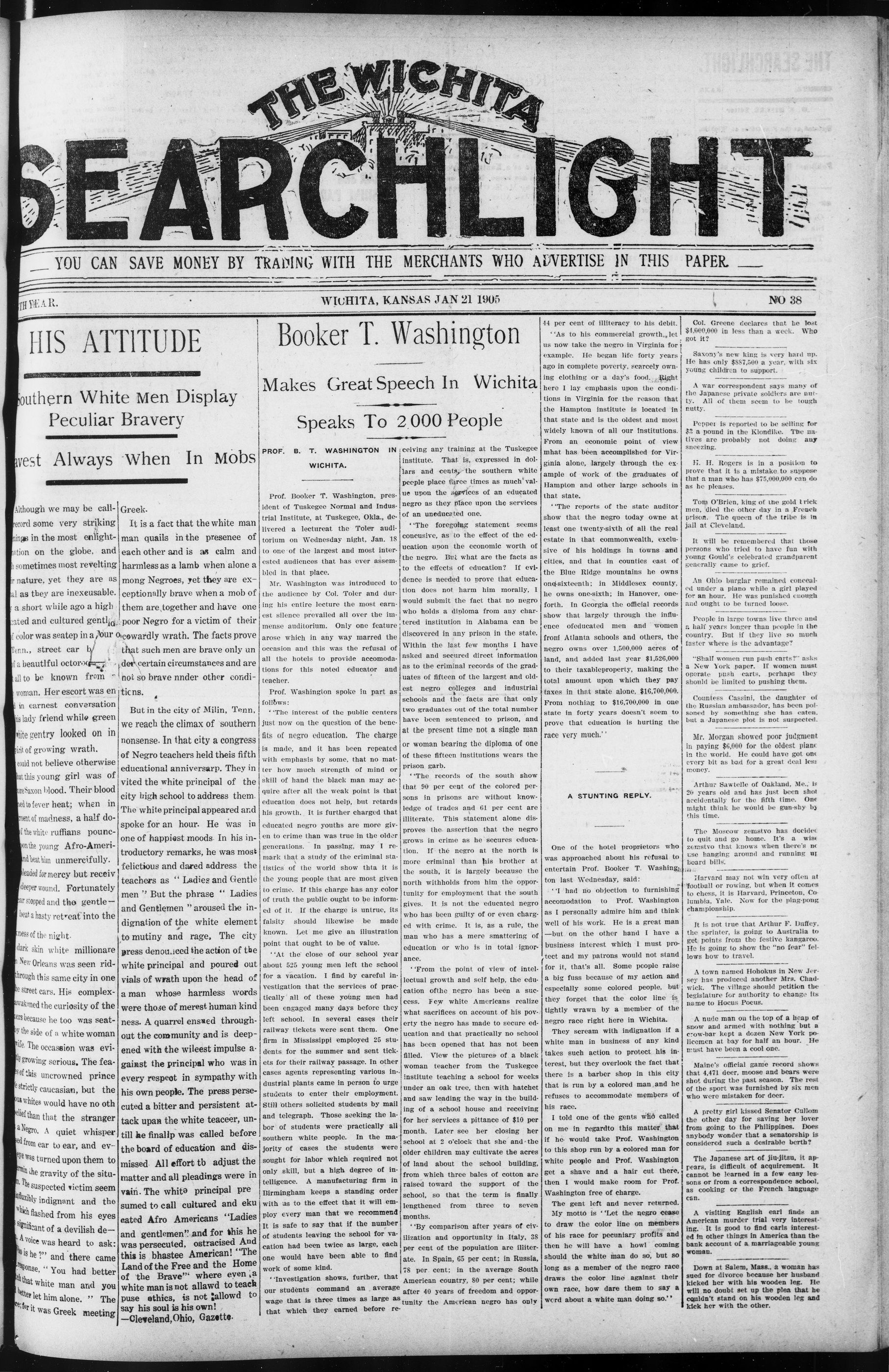
HIS ATTITUDE
Southern White
Peculiar
avest Always
southern White Men Display peculiar Bravery
west Always When In Mobs
Although we may be call-record some very striking things in the most enlightenment on the globe, and in sometimes most revelting nature, yet they are as usual as they are inexeusable. A short while ago a high-rated and cultured gentleman of color was seated in a our Tenn., street car be of a beautiful octoar all to be known from a woman. Her escort was enriched in earnest conversation his lady friend while green white gentry looked on in spirit of growing wrath.
would not believe otherwise that this young girl was of Saxon blood. Their blood need to fever heat; when in ment of madness, a half doof the white ruffians pounce on the young Afro-Ameri- and beat him unmercifully. bleaded for mercy but receiv deeper wound. Fortunately star stopped and the gentle—beat a hasty retreat into theness of the night.
dark skin white millionare in New Orleans was seen ridthrough this same city in one of street cars. His complex-awakened the curiosity of the kers because he too was seatoy the side of a white woman wife. The occassion was eviety growing serious. The feaes of this uncrowned prince he strictly caucasian, but the ous whites would have no oth belief than that the stranger a Negro. A quiet whisper used from ear to ear, and eveye was turned upon them toermine the gravity of the situon. The suspected victim seem influxibly indignant and the which flashed from his eyes is significant of a devilish de—. A voice was heard to ask: Who is he ?" and there came response, "You had better such that white man and you better let him alone." The cee; for it was Greek meeting
---
THE EAR.
e Men Display Bravery When In Mobs Greek.
It is a fact that the white man man quails in the presenee of each other and is as calm and harmless as a lamb when alone a mong Negroes, yet they are exceptionally brave when a mob of them are together and have one poor Negro for a victim of their cowardly wrath. The facts prove that such men are brave only under certain circumstances and are not so brave nnder other conditions.
But in the city of Milin, Tenn, we reach the climax of southern nonsense. In that city a congress of Negro teachers held the fifth educational anniversarp. They invited the white principal of the city high school to address them. The white principal appeared and spoke for an hour. He was in one of happiest moods. In his introductory remarks, he was most felictious and dared address the teachers as "Ladies and Gentlemen" But the phrase "Ladies and Gentlemen" aroused the indignation of the white element to mutiny and rage. The city press denounced the action of the white principal and poured out vials of wrath upon the head of a man whose harmless words were those of merest human kindness. A quarrel ensued throughout the community and is deepened with the wileest impulse against the principal who was in every respect in sympathy with his own people. The press persecuted a bitter and persistent attack upon the white teaceer, until he finally was called before the board of education and dismissed. All effort to adjust the matter and all pleadings were in vain. The white principal presumed to call cultured and educated Afro Americans "Ladies and gentlemen" and for this he was persecuted, ostracised And this is bhastee American! "The Land of the Free and the Home of the Brave" where even a white man is not allawd to teach puse ethics, is not allowd to say his soul is his own! Cleveland Ohio, Gazette.
Cleveland, Ohio
WICHITA, KANSAS JAN 21 1905
Booker T. Washington
Prof. Booker T. Washington, president of Tuskegee Normal and Industrial Institute, at Tuskegee, Okla., delivered a lecture at the Toler auditorium on Wednesday night, Jan. 18 to one of the largest and most interested audiences that has ever assembled in that place.
Mr. Washington was introduced to the audience by Col. Toler and during his entire lecture the most earnest silence prevailed all over the immense auditorium. Only one feature arose which in any way marred the occasion and this was the refusal of all the hotels to provide accommodations for this noted educator and teacher.
Prof. Washington spoke in part as follows:
'The interest of the public centers just now on the question of the benefits of negro education. The charge is made, and it has been repeated with emphasis by some, that no matter how much strength of mind or skill of hand the black man may acquire after all the weak point is that education does not help, but retards his growth. It is further charged that educated negro youths are more given to crime than was true in the older generations. In passing, may I remark that a study of the criminal statistics of the world show tha it is the young people that are most given to crime. If this charge has any color of truth the public ought to be informed of it. If the charge is untrue, its falsity should likewise be made known. Let me give an illustration point that ought to be of value.
"At the close of our school year about 525 young men left the school for a vacation. I find by careful investigation that the services of practically all of these young men had been engaged many days before they left school. In several cases their railway tickets were sent them. One firm in Mississippi employed 25 students for the summer and sent tickets for their railway passage. In other cases agents representing various industrial plants came in person to urge students to enter their employment. Still others solicited students by mail and telegraph. Those seeking the labor of students were practically all southern white people. In the majority of cases the students were sought for labor which required not only skill, but a high degree of intelligence. A manufacturing firm in Birmingham keeps a standing order with us to the effect that it will employ every man that we recommend It is safe to say that if the number of students leaving the school for vacation had been twice as large, each one would have been able to find work of some kind.
'Investigation shows, further, that our students command an average wage that is three times as large as that which they earned before re
celing any training at the Tuskegee institute. That is, expressed in dollars and cents, the southern white people place three times as much value upon the services of an educated negro as they place upon the services of an uneducated one.
"The foregoing statement seems concusive, as to the effect of the education upon the economic worth of the negro. But what are the facts as to the effects of education? If evidence is needed to prove that education does not harm him morally, I would submit the fact that no negro who holds a diploma from any chartered institution in Alabama can be discovered in any prison in the state. Within the last few months I have asked and secured direct information as to the criminal records of the graduates of fifteen of the largest and oldest negro colleges and industrial schools and the facts are that only two graduates out of the total number have been sentenced to prison, and at the present time not a single man or woman bearing the diploma of one of these fifteen institutions wears the prison garb.
"The records of the south show that 90 per cent of the colored persons in prisons are without knowledge of trades and 61 per cent are illiterate. This statement alone disproves the assertion that the negro grows in crime as he secures education. If the negro at the north is more criminal than his brother at the south, it is largely because the north withholds from him the opportunity for employment that the south gives. It is not the educated negro who has been guilty of or even charged with crime. It is, as a rule, the man who has a mere smattering of education or who is in total ignorance.
'From the point of view of intellectual growth and self help, the education of the negro has been a success. Few white Americans realize what sacrifices on account of his poverty the negro has made to secure education and that practically no school has been opened that has not been filled. View the pictures of a black woman teacher from the Tuskegee institute teaching a school for weeks under an oak tree, then with hatchet and saw leading the way in the building of a school house and receiving for her services a pittance of $10 per month. Later see her closing her school at 2 o'clock that she and the older children may cultivate the acres of land about the school building, from which three bales of cotton are raised toward the support of the school, so that the term is finally lengthened from three to seven months.
"By comparison after years of civilization and opportunity in Italy, 38 per cent of the population are illiterate. In Spain, 65 per cent; in Russia, 78 per cent; in the average South American country, 80 per cent; while after 40 years of freedom and opportunity the American negro has only
44 per cent of illiteracy to his debit. "As to his commercial growth, let us now take the negro in Virginia for example. He began life forty years ago in complete poverty, scarcely owning clothing or a day's food. Right here I lay emphasis upon the conditions in Virginia for the reason that the Hampton institute is located in that state and is the oldest and most widely known of all our institutions. From an economic point of view what has been accomplished for Virginia alone, largely through the example of work of the graduates of Hampton and other large schools in that state.
"The reports of the state auditor show that the negro today owne at least one twenty-sixth of all the real estate in that commonwealth, exclusive of his holdings in towns and cities, and that in counties east of the Blue Ridge mountains he owns one-sixteenth; in Middlesex county, he owns one-sixth; in Hanover, one-forth. In Georgia the official records show that largely through the influence of educated men and women from Atlanta schools and others, the negro owns over 1,500,000 acres of land, and added last year $1,526,000 to their taxableproperty, making the total amount upon which they pay taxes in that state alone. $16,700,000. From nothing to $16,700,000 in one state in forty years doesn't seem to prove that education is hurting the race very much."
One of the hotel proprietors who was approached about his refusal to entertain Prof. Booker T. Washington last Wednesday, said:
"I had no objection to furnishing accommodation to Prof. Washington as I personally admire him and think well of his work. He is a great man—but on the other hand I have a business interest which I must protect and my patrons would not stand for it, that's all. Some people raise a big fuss because of my action and especially some colored people, but they forget that the color line is tightly wrawn by a member of the negro race right here in Wichita.
They scream with indignation if a white man in business of any kind takes such action to protect his interest, but they overlook the fact that there is a barber shop in this city that is run by a colored man and he refuses to accommodate members of his race.
I told one of the gents who called on me in regardto this matter that if he would take Prof. Washington to this shop run by a colored man for white people and Prof. Washington get a shave and a hair cut there, then I would make room for Prof. Washington free of charge.
The gent left and never returned.
My motto is 'Let the negro cease to draw the color line on members of his race for pecuniary profits and then he will have a howl coming should the white man do so, but so long as a member of the negro race draws the color line against their own race, how dare them to say a word about a white man doing so.'
Col. Greene declares that he lost $4,000,000 in less than a week. Who got it?
Saxony's new king is very hard up. He has only $887,500 a year, with six young children to support.
A war correspondent says many of the Japanese private soldiers are nutty. All of them seem to be tough nutty.
Pepper is reported to be selling for $3 a pound in the Klondike. The natives are probably not doing any sneezing.
H. H. Rogers is in a position to prove that it is a mistake to suppose that a man who has $75,000,000 can do as he pleases.
Tom O'Brien, king of the gold trick men, died the other day in a French prison. The queen of the tribe is in jail at Cleveland.
It will be remembered that those persons who tried to have fun with young Gould's celebrated grandparent generally came to grief.
An Ohio burglar remained concealed under a piano while a girl played for an hour. He was punished enough and ought to be turned loose.
People in large towns live three and a half years longer than people in the country. But if they live so much faster where is the advantage?
"Shall women run push carts?" asks a New York paper. If women must operate push carts, perhaps they should be limited to pushing them.
Countess Cassini, the daughter of the Russian ambassador, has been poisoned by something she has eaten, but a Japanese plot is not suspected.
Mr. Morgan showed poor judgment in paying $6,000 for the oldest piano in the world. He could have got one every bit as bad for a great deal less money.
Arthur Sawtelle of Oakland, Me., is 20 years old and has just been shot accidentally for the fifth time. One might think he would be gun-shy by this time.
The Moscow zemstvo has decided to quit and go home. It's a wise zemstvo that knows when there's no use hanging around and running up board bills.
Harvard may not win very often at football or rowing, but when it comes to chess, it is Harvard, Princeton, Columbia, Yale. Now for the ping-pong championship.
It is not true that Arthur F. Duffey, the spinner, is going to Australia to get points from the festive kangaroo. He is going to show the "no fear" fellows how to travel.
A town named Hohokus in New Jersey has produced another Mrs. Chadwick. The village should petition the legislature for authority to change its name to Hocus Pocus.
A nude man on the top of a heap of snow and armed with nothing but a crow-bar kept a dozen New York policemen at bay for half an hour. He must have been a cool one.
Maine's official game record shows that 4,471 deer, moose and bears were shot during the past season. The rest of the sport was furnished by six men who were mistaken for deer.
A pretty girl kissed Senator Cullom the other day for saving her lover from going to the Philippines. Does anybody wonder that a senatorship is considered such a desirable berth?
The Japanese art of jiu-jitsu, it appears, is difficult of acquirement. It cannot be learned in a few easy lessons or from a correspondence school, as cooking or the French language can.
A visiting English earl finds an American murder trial very interesting. It is good to find carls interested in other things in America than the bank account of a marriageable young woman.
Down at Salem, Mass., a woman has sued for divorce because her husband kicked her with his wooden leg. He will no doubt set up the plea that he couldn't stand on his wooden leg and kick her with the other.
increasing need for the negro college as well as for the industrial school and the two classes of schools hould and as a matter of fact do, co-operate in the common purpose of elevating the masses.''—Booker T. Washington. After the lecture Prof. Washington left at 10:30 for the north via the Santa Fe.
A bill has been introduced in the state senate to repeal the state barber law. This would be a good thing as the barber law is simply a political graft and while the legislature is economizing why not take a whack at this useless law and end it.
WIGBITA TAPERNACLE No. 24
WIGHITA TABERNAGLE No. 34,
Order of Twelve
Meets First and Third Thursday
Of Each Month
All Daughters In Good Standing Invited
Mrs. Mattie Miller, H. P.
Beatrice Miller. Sec.
Hall 517 North Main Street
Dr. J. E. Farmer,
Physician and Surgeon
—Diseases of—
Women and Children
A Specialty
New Phone 936
Office 517 N. Main St
Wanted;=
An energetic young colored man or womau to travel in the interest of the Wiehita Searchlight. No dreams need apply Call or address.
MR. KNOW IT ALL.
The most miserable creatures of the human family are those persons who insist on being the "big I" and who look upon the rest of humanity as "little you." To them and with them are "all of it" and in their way of thinking "what they don't know is not worth knowine"—as we say, that is their way of thinking—but the truth of the matter is "what they do know really amounts to little-- and is, as a rule known by everybody else.
A great writer once said "I can symp this ewish and to some extent, admire a man what is a fool—and knows it—because he is a food and help it—but—the selfish know it—are fellow is a fool and dont know it—and deserves no sympathy and absolutely is not to be admired
Such persons must learn that in handling out wisdom and knowledge to mankind the GREAT CRE=ATOR did not give all the wisdom to one--but, "he passed it around" and the result is--that every living thing--yes--the plants and all have wisdom--thus--when and one gets to the point when they believe that they are the repository of all the wisdom and knowledge and doubly these is something wrong in the upper story--some room is unceepied.
WHITE MAN RAPES HIS OWN
DAUGHTER
Steve Martin, a white man, is now resting in jail at Birmi gham Ala, charged with criminal assault on his sixteen year old daughter. Mary Martin- yet there seems to be no usual excitement or threats of lynching in the case. Martin is a white man and this fact alone if sufficient guarantee of his continued life and probable liberty. Negroes are not the only ones charged with such crimes as Martin stands accused. Such crimes are said to be barbaaities to which only ignorant black men resort. Martin in addition to being white is also refined and well educated. In all probability the outside world will har no more about the case. For the developments and burid news paSer pesscriptions only occur in cases in which the black men are involved. --Colorado Statesman.
```markdown
```
---
THE SEARCHLIGHT.
W. H. MILLER, Editor.
Entered at the Post Office at Wichita,
Kansas, as Second-Class
Mail Matter.
Published Every Saturday at No.
110 NORTH MAIN ST.
One Year [ by mail ] ..... $1.00
Six months [ by mail ] ..... 75c
Three months [ by mail ] ... 50c
ONE MONTH ..... 150.
Advertising Rates Made Known On Appl
cation.
NOTICE!! - All matters addressed
TO THE SEARCHLIGHT for public
tion must be signed by the part
parties writing.
All matters for publication must
reach this office not later than
TUESDAY to reach publication
in the current issue.
RULES OF THIS OFFICE.
Snd. Communications received after Wednesday noon will appear in that week.
Srd. In asking to change your paper from one office or one address to another always give both, the old and new.
4th Send Us all the news from your section of the City, County, State or Counts We publish it FREE OF CHARGE. Writ plain, and on one side of the paper only.
5th No Name will be placed on our books without the money. So agents will send the money with subscriber's name.
6th Address all communications to "The Wits. Searchlight" Wichita, Kansas.
than searchlight. Written, Rahula.
Th any erroneous reflection upon the
character, standing or reputation of any per-
son which may appear in this paper, will be
gladly corrected if brought to the Editor.
" To Live and Let Liva. " is OUR Motto.
We are very sorry indeedshrdluct We are indeed sorry that anything should have arisen to have marred the visit of Prof. Washington to our city this week. Three things arose which were very unpleasant. 1st. The majority of the colored people did not know till too late that Prof. Washington was to be in our city this month, caused from the fact that they were, seemingly overlooked, therefore there were not nearly so many out as there otherwise would have been. 2nd. The refusal of the hotels to accommodate him cast a dampness over his visit which was and is anything but pleasant.
3rd. The price of admission was raised almost to the prohibitory point of $1.00.
But nevertheless the lecture was great and every negro in Kansas should have heard it.
It seems strange but it is true that in 'bleeding Kansas,' the 'home of the free,' there should be found a spirit of prejudice so strong as to bar so noted a man from the small hotel accommodations of the average Kansas hotel—they are none too good at best—and there, in Kansas, to bar so noted a man because of his color is almost beyond believing.
HIGHER EDUCATION FOR BLACKS
'There are signs at present of one danger which threatens the success of industrial training. A class of people are proclaiming that they favor industrial training for the negro to the exclusion of all other forms of education. If the idea becomes fixed in the minds of the people that industrial education means class education, that it should be offered the negro because he is a negro, and that the negro should be confined to this sort of education then I fear serious injury will be done the cause of hand training. No one understanding the real needs of the race would advocate that industrial education should be given to every negro to the exclusion of the professions and other branches of learning. It is evident that a race so largely segregated as the negro is must have an increasing number of its own professional men and women. There is, then, a place and an
The Wichita Searchlight.
110 N. Main st
Wichita Kans.
Read the great Searchlight,
```markdown
```
Miss Spicy Miller of 925 N. Wichita at entertained eleven of her friends at a Kentucky oyster supper at her home. Music was furnished by Mr H C Gardener assisted by Jas. Allen.
The ladies of the Wichita Tabernacle No 34 had a very enjoyable meeting at their hall Thursday eve After business was transacted the meeting was turned into an experience meeting" and every one had a fine time.
Officer Jeff Thompson is able to sit up in the house—this week.
He says he had a close shave and does not wish other experience of that kind, he hopes to be out in the near future.
The daughters of the Wichit Tavernacle will give a chitterling supper at the resinence of Mrs Richard Heck 855 N. Market st. Wednesday night Jan 25th.
All are cordially invited to come out—the ladies desire your presence.
A Hayseed Ball will be given at Odd Fellows hall on nerr Thursday Jan 26th. See the big Hayseed Grd March at 10 pm led by Uncle Gosh anb Aint Molinda Jand. The Seasons fun.
TOLER AUDITOBIUM
H. D. Ruckers Famius Kora
Wonder Company opened at Tolers
Auditorium for a five weeks run.
This company is headed by some
of the best people of theatrical
profession. A change of bills night
ly and the admission only ten cent
and no seats reserved. There will
be a show for ladies only Friday
afternoon at 2:30. On Saturday eve
at 2:30 is matinee for children on
bill is Rip Van Winkle or the sleep
of twenty years. Saturday night
is "B yond the Rochy's" Monday
night "Black Flag"
Special arraingmouts have been with street car company to hold the cars for the patrons of our shows.
The B. T. W. club met Thursday the 19th the residence of Mrs T. Fines, quite an interesting programme was rendered. Misses Zadie Smith and L. Sannders of Hutchinson were visitor and each favored the club with a selection, the club adjourned after which a deliciobus luncheon day was changed to Wednesday. Mrs Lawson Finnes will entertain the club at her home 1704 S Mosley on Wednesday Jan. 25th.
Miss Ira Porter of Kingman is a pleasant visitor In the city this week.
Mr. and Mrs J R Roberts of Wellington are in the city visiting reatives and friends.
Officer Jeff Thompson is reported resting very easy it writing
The snow of last week is taking its own time in leavsag.
Mrs. Frances Joradn is able to be outafter two weeks of ere illness.
Abe Alexander who has been much indisposed is again on among friends.
Little Miss Wells daughter of Mr. and Mrs. L. W. Wells is reported growing fine.
334 North Main Street
For Cigars, Tobacco and Shines
Phone 658.
W.H. H. GRANT, Prop
REMEMBERED US
Mr. M. M. McKelley of 814 South
Martinson ave. on the West Side
very nicely remembered the Search
light with two of the largest sweet
potatoes we have seen this year.
One of the potatoes weighed 34lb
and the other weighed 23 tbs.
Evidently Mr Me Kelly knew what is our long suit in the potato- line for we go our whole length on sweet potatoes—and sweet potato pie—why dent say a word—that's us. So you see we high-y appreciate the splendid gift.
These potatoes were grown in Mr McKelleys on garden which shows that he is on to his business as a gardener.
These two monster potatoes are specimens of Mr McKelleys splendid crop last year.
Grand time at Odd Fellows hall Thursday night Jan. 26th.
Every one invited to come out.
Miss Sallie Rawles has been re-appeted as copyist in the office of the Register of Deeds. Mr. Appling ons very gentle-manly register of deeds is alright.
Word from ToPeka states that Jas. Jackson and W. M. Martin were the only colored people from Sedgwick who got jobs in ToPeka for the present legislature Session,
Mrs. Edward Grayson of Hutchinson is the guest of Mr. and Mrs. Joe Phillips while she having an operation performed on throat.
The B, T. W. club turned out in a body Wednesday eve to hear the Boeker Washington speech. They were headed by their president Mrs Thos G Fine.
Mrs. L. White entertained a number of her friends on Wednesday of last week at her home 1424 N. Washington ave in honor of Mrs Tillman of Chatanooga Tenn.
Those present were:
Mr. and Mrs. Tillman
" " " " Jefferson
" " " " Love
" " " " Davis
" " " " W M. Martin
" " " " Vance
" " " " Groves
" G. L. Scott and Miss Perry.
At 4 P. M. a dainly luncheon war served and all departed wishing Mrs White many happy returnr of the day.
A WHITE GIRL CRE TES A SENSATION.
In Applying for a Licence to Wed a Colored man—Clerk Has the Shivers.
Miss Dora Young, a white girl, 17 years old who resides with her mother a No. 1336 South Mole st, created quite a sensatron in Clerk Goebel's office Tuesday when she applied for licenle to marry Chas. Kellems, age 28 years, who happened to be a coloured man. The clerk refused to grant the license on the ground that the consent of her fatnes had not been obtained. Mrs. Young, the girls mother made an affidavit that she has not seen
---
Politics for Spring campaign is beginning to warn up at little and soon it will be at the boiling point.
PUEBLO ITEMS.
Littile Mary Hardy is better after a few days illness.
Messers 'Me Gruder and Dr. Grant of Colo. Springs were p.easant visitors in the city last week the guest of Rev. J. P. Ralston.
Mrs. Caulesberry of Golo City was the Suest of Mrs. W. B. Tewasend during the holidayt also Mrs Bunice Thornton.
Elder Bray of St. Paul A. M. E. church closed a fourteen day entertainment last Monday--a neat sum was realized which will go toward paying the debt of the church.
USE
USE
IMBODEN'S IMPERIAL FLOUR
BREAKFA
and you will L
AT YOUR GROCERS
WESTERN
AND
BREAKFAST FOOD
and you will Love good eating
OUR GROCERS
IMBODEN MILLING CO.
EASTERN UNIVERSITY
---
WESTERN UNIVERSITY
The Great Educational Institution for Kansas and the West.....
DEPARTMENTS: Theoiological, C and State Industrial.
COURSES: Classical, College, Normal, Musical, [ Instrum piano, oagan and harmony, Mechanical], Carpentry, P Business Course, Stenogra ing, Dressmaking and Plain ing, Farming and Gardenin
ADVANTAGES: Splendid Location Influences and Thorough Te
INFORMATION: For terms, price offered, write to
William T. Vern
MENTIONS: Theoiogical, College, Normal, Sub-Normal Estate Industrial.
AGES: Classical, College, Preparatory, Normal, Sub- al, Musical, [ Instrumental and Vocal ], including oagan and harmony, Dr [ Fine Arts and anical], Carpentry, Printing, and Book-Binding, less Course, Stenography and, pewriting, Tailor-Dressmaking and Plain Sewing, Cooking, Launder-arming and Gardening.
AGES: Splendid Location, Healthful Cllmate, Good Frances and Thorough Teachers.
ACTION: For terms, prices and all inducements of- write to
Biam T. Vernon, A. M. D D
DEPARTMENTS: Theoiogical, College, Normal, Sub-Normal and State Industrial.
COURSES: Classical, College, Preparatory, Normal, SubNormal, Musical, [ Instrumental and Vocal ], including piano, oagan and harmony, Dr [ Fine Arts and Mechanical], Carpentry, Printing and Book-Binding, Business Course, Stenography and Copywriting, Tailoring, Dressmaking and Plain Sewing, Cooking, Laundering, Farming and Gardening.
ADVANTAGES: Splendid Location, Healthful Cllmate, Good Influences and Thorough Teachers.
INFORMATION: For terms, prices and all inducements offered, write to
PRESIDENT
QUINDARO,
Phones Office
Reside
ONE WE
OF
Great Slau
FUL
QUINDAPO, KANS.
Phones Office—Bell "White" 4302
Residence—Bell "West" 15
ONE WEEK MORE
—OF THE—
Great Slaughter Sale
AT THE
FULTON
QUINDAPO, KANS.
Phones Office—Bell "White" 4302
Residence—Bell "West' 15
ONE WEEK MORE
Great Slaughter Sale AT THE
33 1-3 to 50 per cent saved
Don't Wait Longer
---
her hugband for more than four years and had no knowledge of his whereabouts, and thai he had not contributed any money toward the support of his family. Mrs. Young was perfectly willing foa her daughter to marry Mr. Kellems so the ilcaupe was granted, and now Miss Young is Mrs. Charles Kellems. She resides with her mother, The Tribune, Philadelphia, Jan. 6.
---
---
Mrs. Stewart entertained a number of her friends last Wednesday in honor of Mrs. Cauleeberry Cole, Springs Colo.
Mrs. W. B. Townsend sent thimble party to about 30 of lady frinds last Friday after in honor of her friend Mrs. Cauleezy.
Rev. Jefferson gave a three a enttrtainment during the holiday. All club meetings were postpasted during holidays.
PEERLESS STEAM LAUNDRY
Best Laundry In The City
Phone 2
SELOVER & SONS, Props.
-OF THE---
Sale Closes Next Saturday
Braitsch's
* UNITED WE STAND, DIVIDED WE FALL
Phonographs Columbia, Victor Edison
X P Records 25c Edison G
Songs, Band, Orchestra, Talking.
Just Anything You Would Care To Listen
Old On Easy Payment
Eberhardt & Hay
— Corner Douglas and Emporia Avenue
A Paint and Varnish
Manufacturers Of House Paints, Wagon, Carriage
White Lead. Jobbers in Oils, Varnishes and
licit your patronage. Every Article Gu
Santa Fe Ave, ... W
ALSO BY J. H. TURNER, 541 West De
Columbia X P Records 25c Edison Gold Mold 35c Songs, Band, Orchestra, Talking. Almost Anything You Would Care To Listen To Sold On Easy Payments Eberhardt & Hays Corner Douglas and Emporia Avenues-
Wichita Paint and Varnish Co
Peerless White Lead. Jobbers in Oils, Varnishes and Dry Colors We solicit your patronage. Every Article Guaranteed. 130 North Santa Fe Ave, ..... Wichita, Kansas SOLD ALSO BY J. H. TURNER, 541 West Douglas Ave
Bear In Mind
when you want CO A L we are the or
le all kinds and you will find our pri
Phone your order. Both Phones 496
That when you want CO A L we are the ones to see. We handle all kinds and you will find our prices right. Phone your order. Both Phones 496
BOTH PHONES 496
J.H. TURNER
WICHITA, KANS.
533 to 547 WEST DOUGLAS
SECOND TO NONE
---
JOB WORK IS OUR HOBBY.
Groceries, Fruits, Vegetables and Feed.
... Drugs of all kinds, Cigars and Tobacco . . .
Your patronage solicited. + Once a customer, always a
customer. Our store is Headquaaters for Colored people.
To Hot Springs Hot Springs Special
MISSOURI
PACIFIC
RAILWAY
Passengers from Wichita, leave at Yates Center with the Hotel THE HOT SPRINGS SOLID VESTIBULO CARRIES DINING CAR SLEEPERT TO HOT SPRING
This new service is the quick yet been offered to the great illustrated books, describing undersigned on application E. E. Blackly, T. P. A.
Wtchita
HAYSEED
Odd Fell
Thursday Night
Hayseed Grand
Led by Uncle Gosh Ruben
Usual Admission Only
Passengers from Wichita, leaving on 11. 30 A. M. train, connect at Yates Center with the Hot Springs Special at 2.55 P. M. THE HOT SPRINGS SPECIAL IS A SOLID VESTIBULE, ELECSRIC LIGHTED TRAIN CARRIES DINING CAR AND ELEGANT NEW PULMAN SLEEPERT TO HOT SPRINGSWISH OUT CHANGE. This new service is the quickets and most convenient that has yet been offered to the greatest health resort in America. Illustrated books, describing Hot Springs, may be had from the undersigned on application
Wtchita, Kans.
HAYSEED BALL Odd Fellow Hall Thursday Night. Jan. 26.
Led by Uncle Gosh Ruben and A'nt Melinda Jane
Usual Admission Only 25c
HOUCK
Hardware store
Insurance Gasoline Stoves
Lawn Mowers
Rubber Hose, etc.
116 East Douglas Ave.
Banner Mills
+ CUSTOM GKINDING +
..... A Specialty .....
ALL KINDS OF COAL & FEED
PHORNISCH BROS, PROPS.
922 N. Main St. Phone 580
Nice Furnished
-ROOMS-
By the night or week
Transient a Specialty
Mr. R. Hock, Prop.
24: North Water St.
---
living on 11. 30 A. M. taain, connect
in Springs Special at 2:55 P. M.
SPECIAL IS A
BLE, ELECSRIC LIGHTED TRAIN
AND ELEGANT NEW PULMAN
KINGSWISH OUT CHANGE.
kets and most convenient that has
best health resort in Americs.
Hot Springs, may be had from the
I. R. Sherwin,
P. & T. A.
Kans.
RED BALL
Low Hall
St. Jan. 26.
March
At 10 o'c
P. M.
and A'nt Melinda Jane
25c
=SMOKE=
BLUE SEAL
= CIGARS =
SOLD EVERYWHERE
NEWTON NEWS
Mrs. W. L. Rickman who has been in Colorado for some time has returned reporting a very pleasant time while out of the city.
The N. U. G. club met with Ms. S. Dickers Monday afternoon after rendering a nice programme the club adlourned to meet with Mrs. Chanie Colemon nexr Monday after noon.
Mr. and Mrs. Wm. Mallory will leave for B. C. where they will make their home for a while.
Mrs Wayman Anderson gave a thimble party eo about 22 of her lady friends last Thursday afternoon. The party was grand and will be remembered by Mrs. Andersons friends for a long timer Those present: Mrs. Ford, Faulkner, Tandy Hall, Mallory, Jordan, Miller, J. Anderson, Underweed, Mason, Page, Erame, Collins, Downy, Dickerson, Gress, Petree, Slaughter Payne, Reevley, McGombs and Addie Webb. Many games were played after which a deightful lunch was served.
Mrs. D. Hall has been very sick since she returned heme from Neb. but is some better.
W. S. HENRION
DRUGGIST
501 N. Main St.
Wichita, Kans.
In The
Grocery Line
Your wants need careful attention and our store is the place to get it. We handle the best of Fancy and Staple Groceries and our prices are right. Orders given prompt attention.
1102 E. Douglas Pone 357
JUST BEAR WITH ME.
Just bear with me, my friend,
Full off I've failed to say
The word of cheer that might have
waked
To melody your day.
Just bear with me, where'er
The word I say is wrong.
Think of the love that after all
Beats for you, true and strong.
Just bear with me—and try
To give me of your faith;
The faith that heartens life,
And bridges even death.
—Margaret E. Sangster in Every Where.
The Solace in
Time of Trial
Ino twisted the Masonic emblem on
her father's coat collar thoughtfully,
scrutinizing it apparently with deep
interest.
"You're the dearest old papa," murmured she.
"Well, Ino, what is it?" smilingly inquired the recipient of these endearments. "The indications are I can do you a favor."
"I have heard that great minds are sometimes very suspicious. But papa, dear, do let me stay two weeks longer. There are the charades, the chestnut party, the ball and the——"
"And what would Don and I do all this time? interposed her father.
"Such a little time, papa," relinquishing the badge to his evident relief and making little caressing dabs at his thick gray hair. "As for Don, he treats me with superb indifference when you are near. And you? Why, the moment you alight at the home station, you will be figuratively swallowed. Mrs. O'Flaherty will recount in detail the exploits of her six young hopefuls, and the widow Higgins will persuade you for the nineteenth time to receipt her coal bill. The clubs will banquet you and the church deacons will inquire cautiously but diligently into your spiritual wanderings. With all this and more, I suspect, I should be dreadfully neglected were I to return with you," finished Ino plaintively.
"You are a spoiled child," said her father, with a quiet smile, "and as such must have you own yay."
She watched him walk away. Who was there like her father? So replete with truth and gentleness, yet so capable in strong activity. A great wave of tenderness filled her heart. She was tempted to run after him at this very moment and declare again her admiration and love.
They had come from the far West some weeks before, she and her father, to this little mountain resort, to spend the summer with her sister. Now, unexpected business affairs called him home; hence her urgent request to remain till the close of the season.
The next day she stood with him in the gray light of early morn at the little station in Marsdale, saying those senseless things we all say at moments of parting with dear ones, trying to remember what she would wish said after he was gone. Trivial matters impressed themselves indelibly on her mind. She attended to the careful arrangement of his necktie, from one loop of which a tiny thread was hanging. She pulled the thread off and tiny twisting it nervously in her fingers. She watched him fold his ticket, turning the little green and red colorings inside, and put it into his pocketbook. Then came the moment of departure.
As he held her close in silence, lovingly pressing down the rumpled brown hair, she said brokenly: "Papa, I don't care for the ball—I think I'll just wait for the charades."
"Nonsense," laughingly kissing her, "have a good time; come home and tell me all about it. Mind, I am to have full particulars of every conquest."
The next moment, waiving her a smiling adden from the rear platform of the swiftly-moving Pullman, he vanished in the rushing charge of steam and shrill whistle.
A week of galaxy followed. Ino was this morning deep in the consideration of her ball costume. After the ball—the final event of the season—she was going home. She had written her father the exact minute to expect her, and was now impatiently turning over ribbons and laces when the door opened.
Recognizing her sister's step, she cried: "I'm so glad you've come! Is it not a pity to bother one's head crazy with all this 'fuss and feathers' for a ball? Think of the jack-in-the-pulpits in the woods, the lovely violets and
—and those interesting scarlet things that wiggle through the ferns—lizards! You remember the day papa brought one home in his handkerchief! Dost thou know, sister mine, what is a ball? 'Tis a jumble of music, costumes, glitter and Gas light; interspersed with conventional remarks which were long ago frayed at the elbows and bagged at the knees. Why, one little hour out there," flourishing a gauze bow in the direction of the woods, 'knee deep in those daisies with sturdy old maples towering overhead, and someone you love, is better than a whole season of balls. I wish our lives were more simple. I wish Dame Fashion didn't own us body and soul. Then we might wear a few breadths of drapery and a girdle, as our remote ancestors—why, dear, what is it? Are you ill? tramping recklessly over silks in her toaste to reach her sister's side, for on glancing up she was startled to see her face white and troubled.
"It is probably not so serious as it says," holding forth a bit of yellow paper, "but it calls us home. Papa is—very ill. Now, dear, be brave," added her sister hastily, noting the deadly pallor which crept from lip
brow as Ino mechanically held out her hand for the telegram. "We must take the next train, and there is much to do." Despite the carefully-worded message and her sister's hopeful words an awful tightening came about her heart. "If I had only gone home with him," said she, with infinite pathos.
Three days weary travel brought them to the end of their journey—at an unexpected bour. No one awaited them. Taking a carriage, they soon pulled up in front of the old home—and there was crepe on the door. What do we do in the great crises of our life? Nothing. We stand with silent lips and tearless eyes. In a few moments Inno knelt by the silent form of her father. She saw with impatient pain the closely-folded lips and white carved face of death. When before had he ever failed in happy greeting, were she gone but an hour? She touched the still, cold hands that had always caressed her, and softly spoke to him. Don, the greyhound, stole to her side and thrust his cold nose in her hand and looked inquiringly, eagerly into her face. Her sister spoke—they led her away. It did not matter—he was not there, but where was he? Where now should she look for him, her chum from childhood? The loneliness of her life in the days to come appalled her.
One evening, a week later, Ino crossed the garden to her father's office, unopened since the funeral. There in the uncertain light she saw Don. his nose close pressed to the threshold, his body rigid from hours of patient waiting.
"Don, you torture me," she cried, kneeling down by him. "You'll have to give it up. Poor old Don!" placing a hand on either side of his slim, brown head and gently drawing him away. "You can't find him. Yet—what do I know about it?" Sometimes I think these dumb creatures look into shadow impenetrable to us; and only poor humanity is helpless, in the grip of mystery and silence—a victim of the unsolved problem of death."
She opened the door and entered, closely followed by the expectant greyhound. Drawing her father's chair to the desk, she burned on the light and sat down. After a few moments' quiet thought, she took up a pen and wrote:
"Dear Sister: I am trying to adjust my life to meet this loss. I cannot think of papa as having gone away. I cannot associate him with death. I must make him live. The day we left him sleeping on the hillside they told us, you remember, dear, that he was called to fill a vacancy in heaven; his life work was ended. Who shall say that heaven is not here and his life work just begun? It is a simpler, happier theory. The 'loved voice that was to me both sound and sweetness, suddenly failed,' it is true, but what is there that does not speak for him?
"To night I gathered some jasmine, his favorite flower, as you know. The perfume rose like a low appeal—to find him, not in a remote heaven, but here, in the flowers he loved; in the sunshine lying about the dear old home; in sweet bird melody at twilight; in the drifting cloudshadow and better still and dearer, to find him in doing the simple, kindly deeds to those about me that he once did. No other can miss his actual presence as I do. You understand, dear. I was always with him—his 'little chum' he called me, and truly 'the silence aches round me like a strong disease and new.' Except to bring him back into my every-day life, into conversation and commonplace duty, how else can I make this loss endurable? It is 'the hope, the help, the means that will undo to your sense', the silence of the beyond."—Miss F. Wilkins in Los Angeles Times.
HE SAW TROUBLE AHEAD:
Booker Washington's Innovation Naturally Caused Alarm.
Booker T. Washington tells a good story of his experience in establishing the educational institutions of which he is now the enthusiastic head and heart.
"We found," says he, "that the wreck of a log cabin in which we were doing school work was much too small and otherwise ill fitted. After many searches I found an old deserted hen house of considerable size on the plantation and decided upon that as a future headquarters. There was some cleaning to do preliminary to hearing lessons, so I accompanied by a few students, started early one morning to do what was needed. On the way an old darkey stopped us, and in a friendly manner, asked:
"Whar you goin'?"
"We told him the nature of our errand.
"See here, boss,' said he, with impressive carnestness, 'you sho' gwineter git inter trouble. It am contrary to the habits of people hereabouts to clean out chicken houses in the daytime."
The Smaller the Greater;
Until the Spanish-American war came surgeons in this country knew but little of the effect of gunshot wounds made by a small calibre bullet fired at a high velocity. The almost pinnlike puncture made by a Mauser or a Krag-Jorgensen bullet was somewhat baffling to them. During the Cuban campaign a surgeon was taking Gen. Leonard Wood on a tour of inspection through his hospital ward. "You see," he said, when they came to a soldier whom a Mauser bullet had caught, "this man's wound is serious because it is so small." "Then," replied the General, "I suppose that if he had no wound at all he would be in a very dangerous condition and would probably die."
A Real Bird
Her eyes are as brown as the thrush's garb;
Her neck, like the swan's downy coat.
Is whiter than snow in it's whitest state;
And her voice has the tune of a nightingale's throat.
Her hair is as black as a raven's wings,
Her grace, even when she is still.
Is that of the eagle which soars high above;
And every three months there's a milliner's bill.
She's as proud as a peacock, that rain-bewilde bird.
With dignity often absurd;
With feathers and two little feet pigeon-toed.
My wife would in fact be a consummate bird.
—Philadelphia Press.
A SUNSET'S WOOING
BY EVELYN SINGER
The sunshine seemed unusually pleasant that bright spring morning. How good it was to be out! How the buds were swelling and how busy the birds were, hopping about from place to place choosing sites for their summer cottages. All nature seemed rejoicing that the long, cold winter was past.
Old Mrs. St. Leger stood for a moment in the open doorway, enjoying it all; then she noticed a bit of vine which the wind had loosened from the trellis. She stepped on a chair and stood on tiptoe to put the truant back in its place, when she over-reached and would have fallen had not the strong arm of a passerby caught her and deftly placed her on the veranda floor.
"Lucky thing I happened to be passing or you would have had a nasty fall if not a broken limb."
"It was indeed fortunate for me and I am very grateful to you," she said, as she looked at the tall form bending over her.
"What were you trying to do? Bring me a hammer and some nails and I'll fix that broken trellis for you. It's not the handiest thing in the world for a woman to do that kind of work."
"Seems as though the place needs quite a bit of fixing. I guess I'll have to get a man in for a day or two."
"You're a bit like myself, I see. You miss your partner and I miss mine. But you're better off than I am; you're in your own home, while I've had to give up mine and go and live with my children. None of them want me, so I have to "live round" with them. Do you understand. Stay with this one a while and then with that, always feeling that I'm not wanted and in the way." A mournful tone had crept into his voice and a shade across his kind face.
She sighed in sympathy as she said: "I know, and that's what I'm coming to. The children say that I can't stay here another winter. Last fall I had to sell my cow and through the winter I killed all my chickens. I hate to give up my little home where I've been so comfortable all these years. This living with the children takes away the independent feeling that makes one so contented."
"That it does; I'd rather live on less and have it under my own roof."
They sat awhile in silence. The warm spring sunshine fell on their locks, whitened by the snows of many winter; their toil-worn hands lay idly in their lape. The tabby cat was taking a nap on the old lady's shirt and his dog Rover, which followed him everywhere, lay curled up at his feet. They had spent useful lives and had looked forward to a winter of quiet content, which, alas! seemed to have slipped from the grasp of each.
"Well, I've one more summer in the old place anyway. My tulips and cro
A
A passerby deflyt caught her.
cuses are looking fine. Horace used
to say to me, 'Wife, yours are the
finest and earliest tullips on the
street.' He loved to look at them
as he sat at the south window. Just
around the corner I've a bed of
panies and already the buds are showing."
"You've a clump of daffy-down-dillies, somewhere," he said, catching her spirit. "I always like those for they remind me of England and my childhood's home."
"Listen, do you hear the bluebirds in yonder grove? See that inquisitive robin; I do believe the same robin builds a tree every spring."
They sat enjoying the pleasant spring sunshine, the balmy air and the chorus of song from God's little choirsters. A quiet, restful feeling seemed to take possession of the old man who presently said: "Mrs. St. Leger, this is a pretty and a neat little home; you would hate to leave it as I disliked leaving mine. We are both well-to-do. Both have grown-up children, and both without a home, or nearly so. Now you need a man about the place, and I a woman. I've always liked your looks and believe we could get along pretty com-
"Be ready, Mary, in half an hour." fortably together. What's to prevent us getting married? We could both have a home then and not be shoved from pillar to post, or made to feel that we're in the way," and a great longing crept into his voice while his eyes grew moist.
"There's a good deal of truth in what you say, James Crosby, but—I wonder if we could get along together."
"To be sure we could if we made up our minds to do it. I'd be willing to sacrifice something if I could only sit at my own fireside once more. I'm tired of being shoved around from one child to another and wanted by none."
"I've not come to that yet but I will next winter if something isn't done."
"As I've said, I've always liked your looks. I'm sure you're not hard to get along with."
"Well, I'd do my best to make the home comfortable for you, and, as I rather like your looks, but—what will the children say?"
"They need know nothing about it until it is done. I'd leave you enough when I died so that you wouldn't have to live round. The children ought to be glad that they wouldn't be bothered with us."
"That's so. We could live here, couldn't we."
"Yes, if you like, Mary. I'd buy a cow and some chickens; then I'd look after the garden and provide for the house."
They were silent for some time, thinking of the future; then he reached over and took her hand as he said:
"Think of having a home, Mary, where we could do as we pleased, and not feel in the way. Think of the comfort, the joy of one's own home!" "Yes, it would be nice. I wouldn't have to go and live with the children. I will do it, James, and try to make you so comfortable that you'll never regret it," and she looked up into the kindly face beside her. "I'm sure you will, Mary," he said, as he kissed her. "I, too, will do my best to make your life contented and happy. Now we'd better go to the minister's at once, before the children get knowledge of it, and have a chance to make a fuss." "But, James, I'd like to clean the house up a bit, and—" "You can tidy up the house, Mary, while I clean the yard. Just think of having a home; I feel ten years younger at the thought. Now, I'll go up street and get the license while you get on your bonnet. Then we'll go over to the minister's and get married; we'll come back to our own home for dinner. After dinner I'll get a pony and carriage and we'll drive out into the country and look after a cow and some chickens." He stooped and kissed the bright, cheery face of the old lady, and said, as he walked to the gate: "Be ready, Mary, in half an hour, for I'll be back then."
IT'S WINTER SLEEP BROKEN.
Big Catfish Disturbed by the Intrusion of a Lot of Buffalo Fishes.
The Aquarium's big Mississippi river catfish, which in winter lies on the bottom of its tank motionless for weeks at a time in a state of hibernation, woke up in great shape on Monday last when some other fishes were introduced into its tank.
For years this big catfish has had a tank all to itself; but when the fishes from the St. Louis exhibit, a big lot, were received on Monday, it was no easy to double up the stock here in a few of the tanks, and then the buffalo fishes, which have been in the Aquarium about six months, were placed in the tank with the big cat.
The buffalo fishes came from the same waters as the big catfish, but the catfish regarded their coming into its tank as an intrusion, for all that, and it got up out of bed—out of its bed of sand on the bottom of the tank—to say so, chasing the buffalo fishes about with a liveliness quite unwonted to it at this season. The buffalo fishes are sizable specimens, but not nearly so big as the catfish, and they fled at its approach.
When it had driven the buffalo fishes all into the upper waters of the tank, the big catfish went back to bed again, and once more settled down and went to sleep. And so it has since remained, the buffaloes keeping well away from it.
Apparently it is now sleeping well and soundly again, but when it dreams—if catfish ever do dream—its sleeping visions doubtless take the shape of those unmannerly buffalo fishes, which so rudely broke in upon its long winter slumber.—New York Sun.
CHARITIES OF HELEN GOULD.
Her Glifts Bestowed With Unswerving Business Instincts.
Her law school course illustrates another trait in her character. She is careful, judicious, an excellent business woman even in the bestowal of her charities. The misdirected fervor of the sentimental giver of gifts is not hers. She is fortunate that it is not. Emotional philanthropy would long ago have made her a bankrupt. Her fortune, at a conservative estimate, is about $15,000,000; if she compiled with all the requests for money which she receives it would take her something less than two years to dispose of it. She receives about 100 letters a day asking for sums which make a weekly total of about $150,000. She is asked to buy vessels for old sea captains, to raise mortgages on western farms, to train the voices of embryo Pattis on the prairies, to educate young men for the ministry, to contribute to ladies' aid society fairs in country villages, to endow all sorts of institutions. Herself a strikingly unextravagant woman in matters of dress and all personal expenditure, she is asked by prospective brides to provide sums ranging as high as $2,000 for their modest trousseaux. Parents write her enthusiastic letters describing the charms of young Helen Miller Gould Smiths or Joneses and saying how gratefully a nucleus for these young ladies' future dowries will be received. In one banner week the begging public—including, of course, the respectable beggars for worthy charities, as well as the mere prayers on unsophisticated kindness—asked for a million and a half dollars.—Harner's Bazar.
"My Dog and Me."
When Fate's unkind, and every hope seems vain,
or grief oppress;
When today turning friendships fill my heart
With heaviness—
When, for a few bright hours, from life's dark cares
I would he free.
Some lovely, lonely country walk delights
My dog and me!
To make me smile and notice him, he'll strive
By all he can;
Where should I find more tender sympathy
In any man!
He'll whine, and gaze into my face as if Those cares he knew—
You'd wonder such an ugly sort of dog
Could be so true!
He knows if friends or strangers knock, or trump
Across the yard;
He's getting old—but he's a famous chap
The place to guard;
To growl, and hear the echo of his vote.
He's mighty proud;
You'd wonder such a tiny sort of dog
Could bark so loud.
But soon as little Wilfred strokes his head,
He's quiet at once;
He'll "die" and "beg." or in the corner stand
To play the dunce;
And if that paper fool's cap hides his eyes.
He doesn't mind;
You'd wonder such a savage sort of dog
Could be so kind.
Ah me! from this small, dumb, obedient
bribe
One's lesson's plain;
He gives me all he has—his changeless
love
My own to gain!
His tongue can't tell a lie, nor can his
heart
Deceitful be—
That's what friendship *close and
closer binds*
My dog and me!
—J. Reddie Mallet, in Torquay Times.
Japanese Retort Courteous.
Nagahaki, the celebrated Japanese jugler, was a great favorite wherever he went, and just before the present war broke out he was performing in St. Petersburg.
When hostilities commenced he had to clear out, and his admirers, among whom were many officers of the garrison, gave him a farewell supper.
At the close of the banquet they were wishing him "Goodby" when some of them exclaimed, "Not goodby, but only au revoir, for we shall be drinking your health in champagne in Tokio b'core the year is out."
"I am afraid not," replied Nagahaki, gravely. "Japan is a poor country, remember, and I fear we shall not be able to give our prisoners champagne."
Fatten Your Caives.
It requires about one-half as much grain to produce 100 pounds of gain on calves as on two-year-olds. The work of the Missouri Agricultural college has definitely demonstrated that the most profitable age to fatten cattle is while they are still young. The older the animal the more food is required to produce a given gain. Other stations have investigated the question and arrived at the same result.
One Cause of Nervousness.
A frequent cause of nervousness is tight-fitting shoes, and this is prevalent mostly among ladies. The compression of the foot irritates the nerves and muscles within it; this irritation extends up the legs; it reaches the heart; and so it continues its upward journey until it arrives at the brain, where mischief is wrought.
Full of Business to the End.
Commercial Traveler (wrecked on a desert island) to cannibals: "Well, since you're determined to eat me, kindly do me one last favor: Use our brand of mustard for the sauce. It improves the flavor of all meat; it never molds or absorbs moisture. You'll find a sample box in my right hand coat pocket."
British Soldiers are Vain.
From a British war office order lately issued it appears that the most frequent of Tommy Atkins' minor offenses are wearing his cap on the back of his head, "so as to display effeminate and unsoldierlike curls on the forehead," and carrying a cigarette behind his ear.
Keats' Opinion of Hamlet.
The middle age of Shakespeare was all covered over; his days were not mere happy than Hamlee's, who is, perhaps, more like Shakespeare himself in his common everyday life than any other of his characters.—From a Keats Autograph Letter Sold in London.
World's Postal Employes.
Germany has 242,000 postal employees; the United States, 239,000; Great Britain, 184,000. None of the other states in the postal union possess 100,000 postal employees. France has 81,000, Austria 59,000, Russia 57,962 and Japan 57,965.
A Pessimist at Sea.
He was a pessimistic business man on his first trip to Europe. The third day out, when he was filled with only misery and not much else, he remarked as he leaned over the rail of the ship: "All going out and nothing coming in."
Ban on Salvation Army.
All efforts to establish the Salvation Army in Russia have so far been of no avail, said Gen. Booth, as the Russian government had issued strict injunctions against the general or his followers crossing the frontier.
Shows Japan's Rapid Advance.
It was only in 1866 that the emperor or repealed the law forbidding Japanese subjects to leave their own country. In 1900 there were 124,000 Japanese living abroad, 15 of whom were in Russia.
First American-Built Vessel.
It was 297 years ago that the keel of America's first vessel was laid, it being the little ship Virginia, built by members of Sir George Popham's colony at the mouth of the Kennebec river.
Real Worry.
When a woman can't find anything else to worry about she can do it about whether the baby is going to wear side burn whiskers when he grows up-New York Press.
Bonaparte's House Now a Barn
Bonaparte's House Now a Barn.
Longwood, Bonaparte's house in St.
Helena, is now a barn. The room in
which he died is a stable. On the site
of his former grave is a machine for
grinding corn.
In Pompadour Style.
Wives of Slamese noblemen cut their hair so that it sticks straight up from their heads. The average length of it is about one and a half inches.
Advances Due to Machinery
An engineer declares that 50,000 people now do the work with the aid of machinery which needed 16,000,000 persons to do a few years ago.
The Russian government has established half a dozen model farms for the cultivation of cotton in different parts of Turkestan.
Men Wink Many Times
It is supposed by a scientist of eminence that the average man's eyelids open and shut 4,000,000 times during the year.
New Decorative Stone
Gallalithe, or "milk-stone," is being much used for decorating, and promises to take the place of marble.
Vaulable Oyster.
Vaulable Oyster.
An oyster containing pearls of the value of £250 was found by a fisherman at Neumunster, Germany.
Few Finger Impressions Alike. There are over 70,000 finger impressions at Scotland Yard, no two of which are alike.
J
Buy your Fresh Meat at the Packing House Meat Market and Save Money. Remember the place--Market at the Gate of Dold's Packing House,
FINE WORK
OUR JOB ROOM.
It
Your
Work
Is
DONE
BY US
We Do It
RIGHT
We Are Now Prepared To Do All
Kinds Of FOny, Up to Date
Job Work. We Invite A Trial.
We Guarantee To Please You, Both
In Work And Price. You Will Find
Us At The Old Reliable Stand At
110 North Main St.
Bring Us Your Next Job.
WE INVITE YOU TO CALL
The PRINTERS who Can PRINT
Our Prices ARE AS LOW
AS THE LOWEST
OUR Work IS AS GOOD
AS THE BEST
IF NOT, WHY NOT?