Wichita Searchlight
Saturday, January 6, 1906
Wichita, Kansas
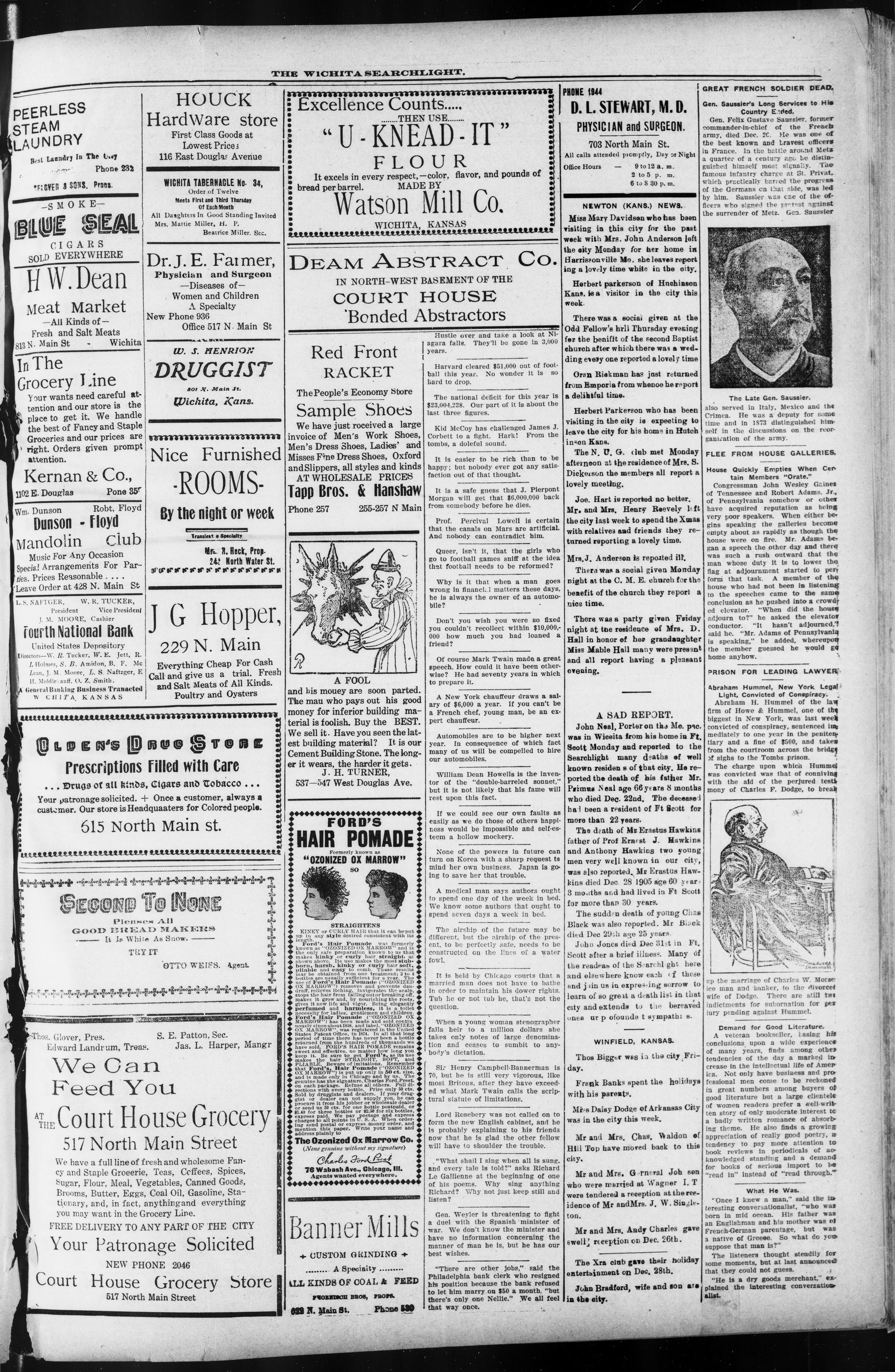
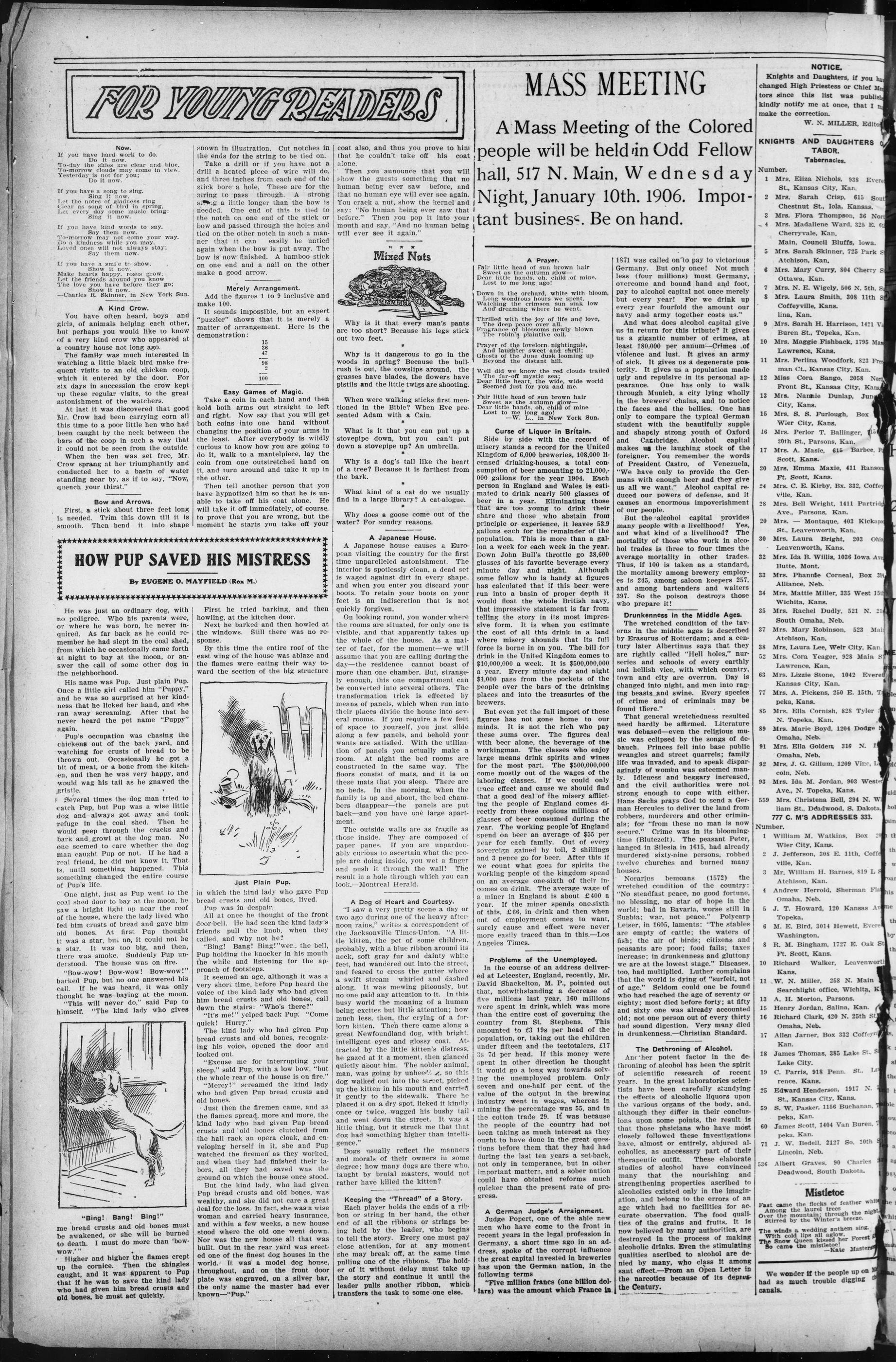
Page text (machine-generated)
Wichita Searchl
THE WICHITA
SEARCHLIGHT
erate Schools For Wichita
VENTH YEAR.
on the Wichita Board of
the day night of this week
the resolution for separate
state and colored children
being rightly condemned
being people of this city
in color. The action of the
only unfair but will work
hardship among the colored
children of this city if permit-
and. The schools in no city in
are progressing more even and
friction of the races than are
the schools of Wichita, and the
the board does not voice the
need sentiment of the major-
ship patrons of this city, but
other hand is the narrow, pre-
mad malicious personal feeling
up who compose the present
education.
Present location of the colored
of Wichita is such that to
with the plan submitted by the
are all the colored children
ended into one school build-
ence some children to walk
day to attend school and
any schools simply because
colored. Shame on the
board of education's sense of
right!
at provocation has been such a measure as the one on the board in its meeting right?
I has put itself on record, some doubt as to the legal act. The present Board of Wichita is operating uncial act of the legislature 1889, and under that act not whether the Board of Wichita can separate the colored school children with seal of this city.
point we cite section iv of 7 Session Laws 1889:
ward of Education shall be a rate under the name of "The Education of the City of and as such shall have the issue and be sued; to elect itsers and make all necessary the government and regulate schools of said city under and control subject to the of this act; to exercise the power the public schools and perty of said city; and shall power to establish and mainh school: Provided, no disn shall be made on account color."
What we can learn Mr. J. L. and Mr. J. F. Kirker, memne Board of Education from ward are the prime movers solution and as the term of expires this year he abstem from the meeting to going on record. However, this the whole Board is responsible insult heaped on the college at this hour.
come to time the Searchlight left the attention of the colored to be on their guard, and at Mr. J. L. Bowdish was a canny years ago, and last spring r. J. F. Kirker was a candidate of our people's attention to this one has come now for the color of Wichita to show their and every effort should be to contest the action of the last resort. Leaders of the Searchlightember that two years ago Bowdish was a candidate for of the School Board the published a true interview was had with Mr. Boddrin Bowdish expressed as in favor of separate In order to disprove our stater, Bowdish came out in a article in the next morning's denying our interview. Many people took Mr. Bowdish's word
for it and whooped it up for Mr. Bowdish. He was elected and we let the matter drop. We were right then and tried to spur our people to action, and now they can all see that just in two years' time Mr. Bowdish has been able to win his point to their detriment.
Last spring many colored men were wrapped up head, feet and soul in Mr. J. F. Kirker, who was a candidate and elected as a member of the School Board, and when we said we thought his selection a bad choice many laughed at us—but now they see their mistake. Mr. Kirker is in the undertaking 'business at the old Dunbar stand, and from his view point he is willing to bury dead colored people, but not willing to give live ones an equal chance to get an education. And yet Mr. Kirker expects the patronage of the colored people. Mr. Kirker has been loud in his praise as a friend of the colored man and now in his first official capacity he proves the contrary to friendship in a most diresome manner.
A FATHER DEAD.
After lingering long and suffering untold palm Mr. John A. Hill died at his late home, 1130 N. Wichita, December 29, 1905, or dropsy and hemorrhages. Mr. Hill had not been a resident of Wichita but about four months and came to this city from Slater, Cooper county, Missouri, where he was born March 28, 1861, and was, therefore, 44 years, 9 months and 1 day old at the time of his death. He was a Christian man and a member of the A. M. E. church. His funeral was held Sunday, December 31, at the A. M. E. church, conducted by Rev. H. W. King, pastor. Mr. Hill leaves a devoted wife, six children, several brothers and sisters, a loving mother and many warm friends.
RUMOR NOT TRUE.
The gossip circulated about town that Oscar Thompson had died in Phoenix, Ariz., is not true. On the other hand, Oscar is greatly improved and is said to be on the road to regain his health.
A lovely New Year's dinner was served at Mr. J. B. H. Fray's home, 518 North Wichita street, at 1:30 p.m., and all the guests: Mrs. Maderson and daughter, Flossie Maderson, Frankie Austin and Mr. and Mrs. Ben Penalton, Mr. and Mrs. G. C. Smith, all of whom report a royal time. Mr. Fray is more than pleased with his wife's cooking, and says that she cannot be beat.
NEW YEAR DINNER
Mr. and Mrs. R. F. Dade served New Year dinner at their cozy home, 620 Riverside, in honor of Mrs. Lucy McKinney, of Chandler, Okla., and Mr. C. P. McMaster, of Bingle, Okla., Mr. A. Clark of Valley Center, and Mr. and Mrs. A. A. Fox and daughter, of this city. A most toothsome repast was served, and all felt highly pleased with the enjoyable New Year day spent as the guests of Mr. and Mrs. Dade.
Mr. and Mrs. A. Griggs served a fine Xmas dinner from 2 until 5 o'clock. Those present were: Mr. and Mrs. Bell, Mr. and Mrs. Ed Laundrum, Mr. and Mrs. Mitchell, Mr. and Mrs. Michael Berry, Mr. and Mrs. S. Griggs and daughter, Mrs. Charlie Giles. Before returning home mixed nuts, candies and cigars were served.
John Coleman and Miss Prevehy Harvey were united in marriage Thursday.
Zella Ratley returned home from Kansas City, Thursday.
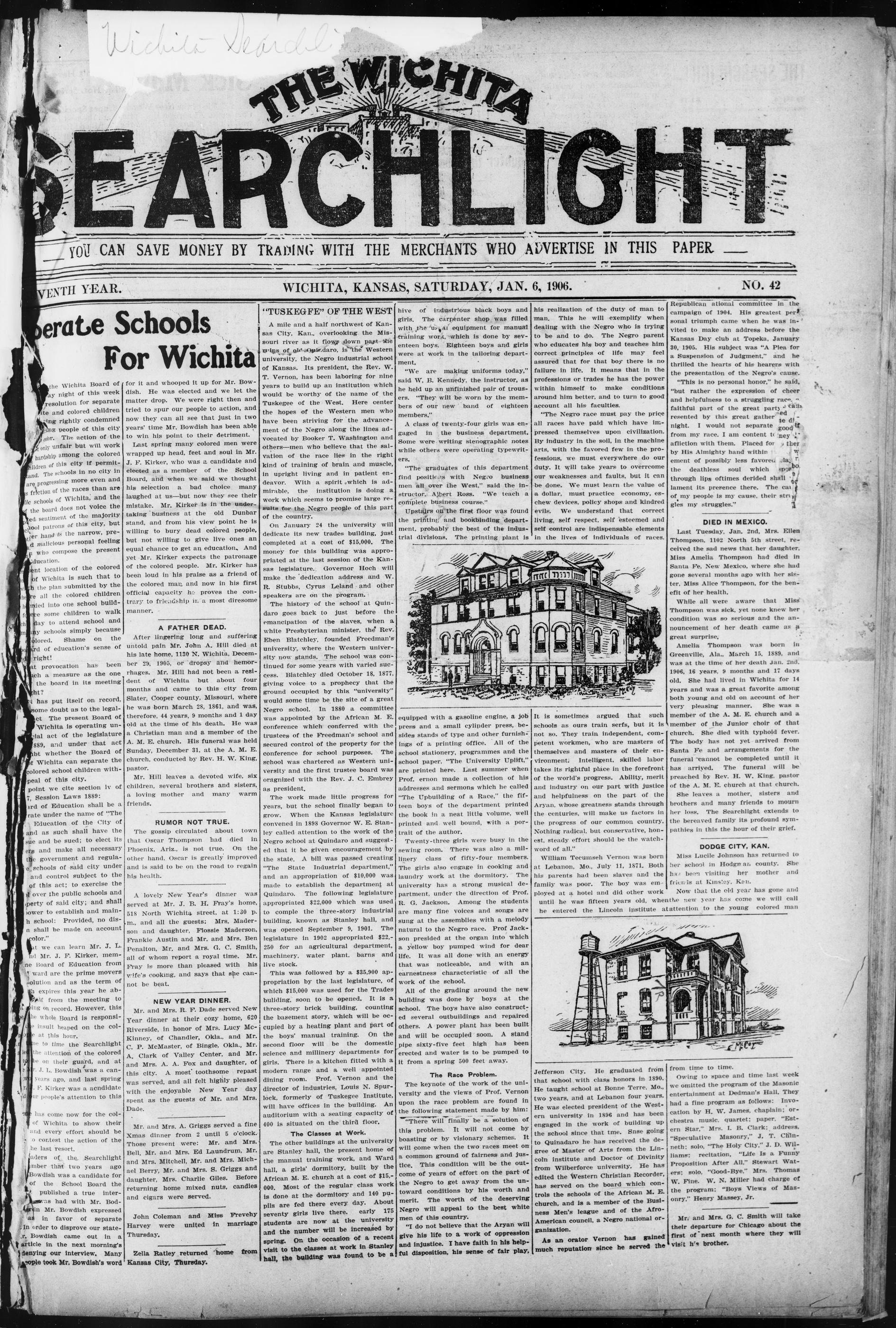
"TUSKEGFE" OF THE WEST
A mile and a half northwest of Kansas City, Kan., overlooking the Missouri river as it flows down past the hills of old Ouirdaro, is the Western university, the Negro industrial school of Kansas. Its president, the Rev. W. T. Vernon, has been laboring for nine years to build up an institution which would be worthy of the name of the Tuskegee of the West. Here center the hopes of the Western men who have been striving for the advancement of the Negro along the lines advocated by Booker T. Washington and others—men who believe that the salvation of the race lies in the right kind of training of brain and muscle, in upright living and in patient endeavor. With a spirit which is admirable, the institution is doing a work which seems to promise large results for the Negro people of this part of the country.
On January 24 the university will dedicate its new trades building, just completed at a cost of $15,000. The money for this building was appropriated at the last session of the Kansas legislature. Governor Hoch will make the dedication address and W. R. Stubbs, Cyrus Leland and other speakers are on the program.
The history of the school at Quindaro goes back to just before the emancipation of the slaves, when a white Presbyterian minister, the Rev. Eben Blatchley, founded Freedman's university, where the Western university now stands. The school was continued for some years with varied success. Blatchley died October 18, 1877, giving voice to a prophecy that the ground occupied by this "university" would some time be the site of a great Negro school. In 1880 a committee was appointed by the African M. E. conference which conferred with the trustees of the Freedman's school and secured control of the property for the conference for school purposes. The school was chartered as Western university and the first trustee board was oragnized with the Rev. J. C. Embrey as president.
The work made little progress for years, but the school finally began to grow. When the Kansas legislature convened in 1898 Governor W. E. Stanley called attention to the work of the Negro school at Quindaro and suggested that it be given encouragement by the state. A bill was passed creating "The State Industrial department," and an appropriation of $10,000 was made to establish the department at Quindaro. The following legislature appropriated $22,000 which was used to comple the three-story industrial building, known as Stanley hall, and was opened September 9, 1901. The legislature in 1902 appropriated $22-250 for an agricultural department, machinery, water plant, barns and live stock.
This was followed by a $35,900 appropriation by the last legislature, of which $15,000 was used for the Trades building, soon to be opened. It is a three-story brick building, counting the basement story, which will be occupied by a heating plant and part of the boys' manual training. On the second floor will be the domestic science and millinery departments for girls. There is a kitchen fitted with a modern range and a well appointed dining room. Prof. Vernon and the director of industries, Louis N. Spurlock, formerly of Tuskegee Institute, will have offices in the building. An auditorium with a seating capacity of 400 is situated on the third floor.
The Classes at Work.
The other buildings at the university are Stanley hall, the present home of the manual training work, and Ward hall, a girls' dormitory, built by the African M. E. church at a cost of $15.000. Most of the regular class work is done at the dormitory and 140 pupils are fed there every day. About seventy girls live there. early 175 students are now at the university and the number will be increased by spring. On the occasion of a recent visit to the classes at work in Stanley hall, the building was found to be a
THE HOSPITAL OF THE UNIVERSITY
hive of industrious black boys and girls. The carpenter shop was filled with the usual equipment for manual training work, which is done by seventeen boys. Eighteen boys and girls were at work in the tailoring department.
"We are making uniforms today," said W. B. Kennedy, the instructor, as he held up an unfinished pair of trousers. "They will be worn by the members of our new band of eighteen members."
A class of twenty-four girls was engaged in the business department. Some were writing stenographic notes while others were operating typewriters.
"The graduates of this department find positions with Negro business men all over the West," said the instructor, Albert Ross. "We teach a complete business course."
Upstairs on the first floor was found the printing, and bookbinding department, probably the best of the industrial divisions. The printing plant is
BROOKLYN HIGH SCHOOL
equipped with a gasoline engine, a job press and a small cylinder press, besides stands of type and other furnishings of a printing office. All of the school stationery, programmes and the school paper, "The University Uplift," are printed here. Last summer when Prof. erron made a collection of his addresses and sermons which he called "The Upbuilding of a Race," the fifteen boys of the department printed the book in a neat little volume, well printed and well bound, with a portrait of the author.
Twenty-three girls were busy in the sewing room. There was also a millinery class of fifty-four members. The girls also engage in cooking and laundry work at the dormitory. The university has a strong musical department, under the direction of Prof. R. G. Jackson. Among the students are many fine voices and songs are sung at the assemblies with a melody natural to the Negro race. Prof Jackson presided at the organ into which a yellow boy pumped wind for dear life. It was all done with an energy that was noticeable, and with an earnestness characteristic of all the work of the school.
All of the grading around the new building was done by boys at the school. The boys have also constructed several outbuildings and repaired others. A power plant has been built and will be occupied soon. A stand pipe sixty-five feet high has been erected and water is to be pumped to it from a spring 500 feet away.
The Race Problem.
The keynote of the work of the university and the views of Prof. Vernon upon the race problem are found in the following statement made by him:
"There will finally be a solution of this problem. It will not come by boasting or by visionary schemes. It will come when the two races meet on a common ground of fairness and justice. This condition will be the outcome of years of effort on the part of the Negro to get away from the untoward conditions by his worth and merit. The worth of the deserving Negro will appeal to the best white men of this country.
"I do not believe that the Aryan will give his life to a work of oppression and injustice. I have faith in his helpful disposition, his sense of fair play,
ployed at a hotel and did other work Now that the old year has gone and until he was fifteen years old, whenthe new year has come we will call he entered the Lincoln institute atattention to the young colored man
his realization of the duty of man to man. This he will exemplify when dealing with the Negro who is trying to be and to do. The Negro parent who educates his boy and teaches him correct principles of life may feel assured that for that boy there is no failure in life. It means that in the professions or trades he has the power within himself to make conditions around him better, and to turn to good account all his faculties.
"The Negro race must pay the price all races have paid which have impressed themselves upon civilization. By industry in the soil, in the machine arts, with the favored few in the professions, we must everywhere do our duty. It will take years to overcome our weaknesses and faults, but it can be done. We must learn the value of a dollar, must practice economy, eschew devices, policy shops and kindred evils. We understand that correct living, self respect, self esteemed and self control are indispensable elements in the lives of individuals of races.
M. C. C.
It is sometimes argued that such schools as ours train serfs, but it is not so. They train independent, competent workmen, who are masters of themselves and masters of their environment; Intelligent, skilled labor takes its rightful place in the forefront of the world's progress. Ability, merit and industry on our part with justice and helpfulness on the part of the Aryan, whose greatness stands through the centuries, will make us factors in the progress of our common country. Nothing radical, but conservative, honest, steady effort should be the watchword of all."
William Tecumseh Vernon was born at Lebanon, Mo., July 11, 1871. Both his parents had been slaves and the family was poor. The boy was employed at a hotel and did other work
until he was fifteen years old, when he entered the Lincoln institute a
Jefferson City. He graduated from that school with class honors in 1890. He taught school at Bonne Terre, Mo., two years, and at Lebanon four years. He was elected president of the Western university in 1896 and has been engaged in the work of building up the school since that time. Snse going to Quinadaro he has received the degree of Master of Arts from the Lincoln institute and Doctor of Divinity from Wilberforce university. He has edited the Western Christian Recorder, has served on the board which controls the schools of the African M. E. church, and is a member of the Business Men's league and of the Afro-American council, a Negro national organization.
As an orator Vernon has gained much reputation since he served the
Republican ational committee in the campaign of 1904. His greatest personal triumph came when he was invited to make an address before the Kansas Day club at Topeka, January 30, 1905. His subject was "A Plea for a Suspension of Judgment," and he thrilled the hearts of his hearers with the presentation of the Negro's cause. "This is no personal honor," he said, "but rather the expression of cheer and helpfulness to a struggling race, faithful part of the great party, causes resented by this great gatherer night. I would not separate good from my race. I am content to affliction with them. Placed for her by His Almighty hand within element of possibly less favored class, the deathless soul which spends through lips oftimes derided shall lament its presence there. The cause of my people is my cause, their struggles my struggles."
DIED IN MEXICO.
Last Tuesday, Jan. 2nd, Mrs. Ellen Thompson, 1102 North 5th street, received the sad news that her daughter, Miss Amelia Thompson had died in Santa Fe, New Mexico, where she had gone several months ago with her sister, Miss Alice Thompson, for the benefit of her health.
While all were aware that Miss Thompson was sick, yet none knew her condition was so serious and the announcement of her death came as a great surprise.
Amelia Thompson was born in Greenville, Ala., March 15, 1889, and was at the time of her death Jan. 2nd, 1906, 16 years, 9 months and 17 days old. She had lived in Wichita for 14 years and was a great favorite among both young and old on account of her very pleasing manner. She was a member of the A. M. E. church and a member of the Junior choir of that church. She died with typhoid fever. The body has not yet arrived from Santa Fe and arrangements for the funeral cannot be completed until it has arrived. The funeral will be preached by Rev. H. W. King, pastor of the A. M. E. church at that church. She leaves a mother, sisters and brothers and many friends to mourn her loss. The Searchlight extends to the bereaved family its profound sympathies in this the hour of their grief.
DODGE CITY, KAN.
Miss Lucile Johnson has returned to her school in Hodgnan county. She has been visiting her mother and friends at Kinstey, Ken.
Now that the old year has gone and the new year has come we will call attention to the young colored man
from time to time.
Owing to space and time last week we omitted the program of the Masonic entertainment at Dedman's Hall. They had a fine program as follows: Invocation by H. W. James, chaplain; orchestra music, quartet; paper, "Eastern Star," Mrs. I. B. Clark; address, "Speculative Masonry," J. T. Chinneth; solo, "The Holy City," J. D. Williams; recitation, "Life Is a Funny Proposition After All." Stewart Waters; solo, "Good-Bye," Mrs. Thomas W. Fine. W. N. Miller had charge of the program; "Boys Views of Masonry," Henry Massey, Jr.
Mr. and Mrs. G. C. Smith will take their departure for Chicago about the first of next month where they will visit his brother.
THE SEARCHLIGHT.
7. N. MILLER, Editor.
Universal at the Post Office at Wichita
Kansas, as Second - Class
Mail Matter.
Publi-her Every Saturday at No.
110 NORTH MAIN St.
-RATES OF SUBSCRIPTION-
STRICTLY IN ADVANCE.
One Year [ by mail ] ..... $1.00
Six months [ by mail ] ..... 75c
Three months [ by mail ] ..... 50c
ONE MONTH ..... 10c
Advertising Rates Made Known On Appl
cation
NOTICE!! - All matters addresser
THE SEARCHLIGHT for publici
tion must be signed by the par
parties writing
All matters for publication must
reach this office not later than
TUESDAY to reach publication
in the current issue.
RULES OF THIS OFFICE.
1st. All Subscriptions must be paid in
advance strictly. Agents take notice
of communications received after Wed-
day and will appear in the week.
2nd. Looking to change your paper from
one order one address to another always
old and new.
send Us all the news from your se
to the City, County, State or Coun-
ry. With it FREE OF CHARGE. Write
and on one side of the paper only.
No Nome will be placed on our books
without the money. So agents will send the
money with subscriber's name.
6th Address all communications to "The
Wichita Searchlight" Wichita, Kansas.
5th Ary erosive reflection upon the
character, standing or reputation of any per-
son which may appear in this paper, will be
gladly corrected if bought to the Editor.
" To Live and Let Live. " is OUR Motto.
WITHOUT EXCUSE
As a bolt of lightning from a clear sky oame the following resolution passed by the board of education at its meeting Tuesday night:
"Whereas, we believe hat the organization and maintenance of the public schools of the city of Wichita so that provision is made for the seperate education of white and colored children, is more in keeping with the ideas and wishes of a majority of its patrons, therefore be it
"Resolved by the board of education of the city of Wichita, that we favor the early organization of our school on that line; and be it further resolved; that immediate steps be taken to procure suitable rooms and supplies, if further rooms and supplies are necessary, and that the schools of the city grading below the high school be organized and maintained in accordance with this resolution from and after September 1st 1906; and that the committee on buildings and grounds be appointed to report upon the feasibility of such organization at the first meeting of the board in February."
No greater surprise has ever been thrust upon any people than was this resolution—as none were expecting it and no aggitation or demand for it from any known source of patrons of the schools on the board for their action and everything in school circles seemed to have been and are working in the greatest harmony
and peace. The effect of the resolution of the board if if not estop ped will be that in Wichita we will witness the enforcement of black laws and after years of harmonious working the splendid school system of our city will be torn from center to cercumfrence and pandemonum will reign where only peace has been known—and the people of Wichita of both raceses must meet the mivitable—a clash of the race on schoo
matters and for several years to come the schools of Wichita will be in an unsettled and unsatisfactory state--all to pacify the grins prejudice of a few men who slipped on the board of education of this city. We aegret to see the peaceful and friendly relations of the two races severed in this city as no man can forsee the end.
A. Jones continues on the sick list at his home 1115 N. Mosely.
Herbert Pergerson of Hutchinson came in the city Saturday evening and spent Sunday visiting friends and was entertained by Miss Lizzie Underwoob Sunday afternoon. He had a royal time in our city and left Monday for his home.
So it is with our desires, anticipations and friends—gone beyond recall—vet this is nature.
The glorious day inspire us with hope, however, and hope it is that binds us to the future; they arouse beliefs in something better, grander and more noble. Let us all resolve to cater more kindness and sunshine, no matter how dreary the day without—let kindness be our motto. Let us not be saving with them but let us lavish them on every hand.
D. E. Douglas and wife entered a few friends.
Mr and Mrs. J. W. Wood served pelecious dinner on Dec. 24th.
NEW YEAR LETTER
W. N. Miller,
Editor Searchlight.
Dear Sir:—
I drop you these few lines on this bright New Year morn when the new, untried year is usher d into existence by father time with all the sublime beauty of nature; but beautiful as the new year morn is—winter seems sad to me. It m ans death to the glorious autumn, the massive trees once flourishing seems to lose their vitality and waste away
Remember that hardness an sweetness of temper are not question of nature, but are habits acquired. The Searchlight has been the weilder of untold joys during the old year and has done marvelous things on her mission for mankind—now wishing you and the Searchlight a happy, prosperous and highly successful new year—.
Ireman.
Martho D. Edwards.
The worries of baking day turn to delight when you use
HOWARD'S
PEERLESS PRINCESS
FLOUR
No other as good
SEARCHLIGHT only $1.
Per Year, Are You A Subscriber?
Any one who thinks there is nothing in the superstition should consult the prisoner who was convicted on the jury's thirteenth ballot.
And now the Prince and Princess of Wales are going to India, where the shawls that Queen Victoria used to give for presents came from.
New Jersey proposes to have a law making it a penitentiary offense for a jag to run an automobile. This is an indirect blow at Jersey lightning.
There are now two vacant seats in the Academie Francaise, but the average American would rather have a seat on the New York stock exchange.
Fifty people were killed in a recent riot at Santiago, Chile. The Chileans should stick to revolutions. They are less likely to be attended by fatalities.
The bishop of London says race suicide is a sin. He must be getting so old that he doesn't care to be invited around to fashionable places any more.
We wish the national purity congress would get after the rascals who spoil our pumpkin pies by selling the baker ground and colored horseradish for ginger.
One of the lady college presidents says educated women have ceased to be frumps. She does not, however. intimate that they regard woman as naturally man's pet.
Sir Thomas Lipton has won some distinction as a mariner, but his recent experience before the king makes it evident that he was never connected with the horse marines.
THE WICH TASEA RCHLIGHT
```markdown
```
Daughter Grayson Dead
Daughter Sadie Grayson, a member of Wichita Tabernacle No. 34, Wichita, Kansas, died at her home, 1703 N. Mostly Wednesday morning January 3rd, of double pneumonia. She was a faithful member and was dearly loved by all the members here. Dt. Grayson was 31 years old at the time of her death and leaves a husband, two children and a host of warm friends. Wichita Tabernacle No. 34 took charge of the body and conducted the funeral ceremony assisted by Taborian Temple No. 11. Funeral services held Saturday afternoon from the 2nd Baptist church, Rev. H. W. King, officiating
Miss Ida Bowman left Friday for Cleveland, Ohio, where she will make her future home. Miss Bowman has been one of the literary sditrs of our city dursng her stay in our city and has made many warm faiends among the best element of peeple in our city. She leaves amid the scencere regret of those who know her and al jein in wishing her unbounded success in her new home.
Mrs. John W. Hall is reported very sick at her home 1041 N Ohio.
Mrs. M. Sherril's is redorce very ill at her home.
The Big Billy Goat for Wichita
Tabercille No. 34 is being fatted
for a coming big feast.
SAD DEATH.
The many friends of Mr and Mrs W. M. Martin, 1135 N. Washington extend to them their profound sympathies at the sad news of the death of their beloved daughter Miss Luvenia Martin, age 14 years, who died at the family home last Saturday after a brief illness of two days. The death of Miss Martin was as sudden as it was shocking as only the Sunday previous to her death and all the week up till Wednesday she was as spry as any of her girl friends. Her funeral was at the New Hope Baptist church Monday January 1st.
The party given by Miss. Sa lie Rawles at the home of her sister Mrs. Edward Landrum, 119 West Pine. Saturday night Dec. 30th 1905, was one of the elite social events of the holiday season. The party was given by Miss Rawles in honor of her many friends and a large number of them were present. At a reasonable hour delicate luncheon was served—and later the guests departed claiming Miss Sa lie Rawles a peasant and charming entertainer.
SMART SET BALL.
The holiday ball given by the "Smart Set" at Redman hall Friday eve., Dec. 29th, 1905, was undoubtedly one of the grandest affairs ever given in this part of the State. The ball was swell in every respect. The "Smart Set" is composed of some of our best young people and a large, intelligent crowd was present at their presentment. The spacious ball was filled with an eager pleasant crowd. All left vowing the "Smart Set' royal entertainers.
Why take your JOB PRINTING to others when a member of your own race can do the work as cheap and as good? Bring your job work to the Searchlight office, Second and Main streets, and we will do the work right. "Promptness and Quality" is our
Mrs L. B. Smith has returned from Newton. She reports that her husband has opened a barbar shop there.
Mrs. Sam Brazil was in Wichita this week.
Chas. Floyd of Kingman spent New Year week in Wichita, Mr. Floyd has the record of paying the first subscription to the Searchlight in 1906.
Mrs. Maggre Coffey lost a fine breastpin at the A. M. E. church Sunday night.
The Daughters of Wichita Tabernacle No. 34, presented their High Priestess Mrs. Mattie Miller with a fine set of decorated china plates of which the lady was very highly pleased.
Mrs. Delila Monts is very si.k
this we.k.
NOTICE CLUB
The B.T. W. club will meet every Thursday afternoon at 3im. here after. The next meeting will be held with Mrs. Henry Massy 507. N. Water. All members are urged to be present.
Mr. and Mrs. Oliver Ellis St. Charles Mo. arrived in the city Saturday to spend few days visiting his sister Mrs. Thos. Glover and her family. Mr. Ellis is one of the pioneer and most highly respected citizens of St. Charles and vicinity and is one of the largest contracting plasters in that part of Missouri. He is one of the leaders in and for the race and is held in highest esteem by his acquanitances both white and colored. This is Mr. Ellis third trip to Wichita the last one pr vious to this, however was fifteen years ago. He is a keen business man and speaks very well of the progress made by our city sence his last visit fifteen years ago.
Mr. Ellis is a great worker in the A. M. E. church of which he is a member. He will remain our city till sometime next week.
Sam C. Collins has returned from Texas where he spent the holidays with relatives and friends.
Peter W White of Independence spent the holidays in our city.
Mrs Walter Bell of Hutchinson, spent the holidays in Wichita as the guest of Mrs Cannie Barker.
Mrs Ella St. Clair, sister in-law of Mrs Tho. W. Fine left Monday for her home in Pleasanton after visiting about four months in our city.
Mrs. Henry W. James left Monday for Oklahoma City to spend a few weeks visiting with her friend Mrs. Illa King of that city.
Mr G. A. Fray and wife returned home Tuesday morning from a short visit in Topeka, and reports a very nice time.
Get a Bottle of the New Wonder Lopez Specific Stu-
Compound. As sure as Hot Springs are the best batha-
world, just as sure is LOPEZ the Best Blood Remedy
to MANKIND. It Never Fail To Cure or materially b
in thirty days, any case of Blood Poison, [ Scrofula,
Silis or Running Sores, ] Rheumatism, Liver, Kidney or
ach troubles, Malaria, Catarrah, Gleet, Sexual weakn
Failing Memory, or Weak eyes, General Decline, etc.
[ No Mercury ] No matter how bad or where you live I
fail to get it. You know you have got to take a good I
Medicine if you get well, so to make matters doubly
Get Lopez and quit experimenting with your life. Ea-
tile will lost 30 to 40 days and retails for only $5 00
Expressed any where. Mail orders a specially. Cal or
Cure to stay from 2 to 4 months or It Costs You Noth
Lopez Remedy Co,
Phone 2004
(Barnes Block)
Wichita,
Office 518½
Central Ave., Hot Springs, Ark
ESTERN UNIVERS
7 313 East Douglas (Barnes Block) Wichita, Ka Branch Office 5183 Central Ave., Hot Springs, Ark.
WESTERN UNIVERS
The Great Educational Institution for Kansas and the West.....
MENTS: Theoiogical, College, Normal, Sub State Industrial.
AGES: Classical, College, Preparatory, Normal, Musical, [ Instrumental and Vocal ], in, oagan and harmony, Drawing [ Fine Art Manual], Carpentry, Printing and Book- Press Course, Stenography and Typewriting, Dressmaking and Plain Sewing, Cooking, Farming and Gardening.
AGES: Splendid Location, Healthful Cllmate Frances and Thorough Teachers.
ATION: For terms, prices and all inducement write to
William T. Vernon, A. M.
DEPARTMENTS: Theoiogical, College, Normal, Sub-Nor and State Industrial.
COURSES: Classical, College, Preparatory, Normal, Normal, Musical, [ Instrumental and Vocal ], incl piano, oagan and harmony, Drawing [ Fine Arts Mechanical], Carpentry, Printing snd Book-Binding Business Course, Stenography and Typewriting, Tailoring, Dressmaking and Plain Sewing, Cooking, laundering, Farming and Gardening.
ADVANTAGES: Splendid Location, Healthful Cllmate, Good Influences and Thorough Teachers.
INFORMATION: For terms, prices and all inducements offered, write to
William T. Vernon, A. M. D
PRESIDENT
QUINDARO, KANSAS
Phones
Office—Bell "White" 430
Residence—Bell "West"
Jackerson, Proprietor.
The Little Annex
STAURANT & C
Open Day and Night
Art Order In Season
Hot
North Main Street
Wichita,
USE
QUINDARO. - - - KANS.
Open Day and Night
Short Order In Season Hot Chile
347 North Main Street Wichita, Kansas
IMBODEN'S
IMPERIAL
FLOUR
AND
BREAKFAST FOOD
and you will Love good eating
OUR GROCERS IMBODEN MILLER
Gardner Coal Co.
Gardner Coal Co.,
.....DEALERS IN.....
HARD COAL SOFT
Feed and Building Material
Office and Yards 1201 to 1245 N. Main St.
Old Phone 146 New Phone 1804
Wichita, Kansas, Saturday Jan 6, 06
Hustle over and take a look at Niagara falls. They'll be gone in 3,000 years.
Harvard cleared $51,000 out of football this year. No wonder it is so hard to drop.
The national deficit for this year is $23,004,235. Our part of it is about the last three figures.
Kid McCoy has challenged James J. Corbett to a fight. Hark! From the tomb, a doleful sound.
It is easier to be rich than to be happy; but nobody ever got any satisfaction out of that thought.
It is a safe guess that J. Pierpont Morgan will get that $6,000,000 back from somebody before he dies.
Prof. Percival Lowell is certain that the canals on Mars are artificial. And nobody can contradict him.
Queer, isn't it, that the girls who go to football games sniff at the idea that football needs to be reformed?
Why is it that when a man goes wrong in financial matters these days, he is always the owner of an automobile?
Don't you wish you were so fixed you couldn't recollect within $10,000,000 how much you had loaned a friend?
Of course Mark Twain made a great speech. How could it have been otherwise? He had seventy years in which to prepare it.
A New York chauffeur draws a salary of $6,000 a year. If you can't be a French chef, young man, be an expert chauffeur.
Automobiles are to be higher next year. In consequence of which fact many of us will be compelled to hire our automobiles.
William Dean Howells is the inventor of the "double-barreled sonnet," but it is not likely that his fame will rest upon this fact.
If we could see our own faults as easily as we do those of others happiness would be impossible and self-esteem a hollow mockery.
None of the powers in future can turn on Korea with a sharp request to mind her own business. Japan is going to save her that trouble.
A medical man says authors ought to spend one day of the week in bed. We know some authors that ought to spend seven days a week in bed.
The airship of the future may be different, but the airship of the present, to be perfectly safe, needs to be constructed on the lines of a water fowl.
It is held by Chicago courts that a married man does not have to bathe in order to maintain his dower rights. Tub he or not tub he, that's not the question.
When a young woman stenographer falls heir to a million dollars she takes only notes of large denomination and ceases to sumbit to anybody's dictation.
Sir Henry Campbell-Bannerman is 70, but he is still very vigorous, like most Britons, after they have exceeded what Mark Twain calls the scriptural statute of limitations.
Lord Rosebery was not called on to form the new English cabinet, and he is probably explaining to his friends now that he is glad the other fellow will have to shoulder the trouble.
"What shall I sing when all is sung, and every tale is told?" asks Richard Le Gallienne at the beginning of one of his poems. Why sing anything Richard? Why not just keep still and listen?
Gen. Weyler is threatening to fight a duel with the Spanish minister of war. We don't know the minister and have no information concerning the manner of man he is, but he has our best wishes.
"There are other jobs," said the Philadelphia bank clerk who resigned his position because the bank refused to let him marry on $50 a month. "but there's only one Nellie." We all feel that way once.
Surgcons opened the stomach of a New York man a few days ago and took out a lead pencil several inches long. Finding no stuffed ballots or other evidences of fraud, they closed the orifice and let the man go.
Editor Harmsworth of London has been raised to the peerage. Editor Astor will, in view of the fact that Editor Harmsworth's fortune amounts to only $20,000,000, find it hard to understand why King Edward didn't look further.
The admission of a phonograph as evidence in a Boston court is an interesting event. It is the first time that a talking machine has ever been admitted to testify in court, in this country, though we have long had women lawyers.
STEADY GROWTH OF TRADE
Phenomenal activity, reaching to every branch of trade and industry, marked the year 1905. During the summer of 1904 the nation began to recover from a prolonged season of business stagnation. As the months of that year progressed, conditions became more and more favorable. Both in speculation and in the lines of actual industry the spirit of revival was extant, and the end of the year witnessed conditions that were gratifying to business interests in the extreme. With the dawn of 1905 this state of affairs continued, and throughout the twelve months growth in all lines of commercial enterprise was maintained.
There was not a month in which the financial position of the nation was not strengthened. The business of the country gained momentum as the year progressed, until in the final weeks the most remarkable state of activity ever displayed in the history of the United States was witnessed.
Remarkable in many respects, the distinctive feature of 1905 in its financial and commercial aspect was its evenness. No machinery ran more easily, more smoothly than the material currents. It was a steady advance in production and consumption; a constant increasing demand for banking accommodations; an accumulation of deposits, the immediate index of expanding wealth. The latter half of the period developed a demand for supplies which taxed the capacity of factories, mills and mines to supply. This was the stimulation of an unprecedented crop of grains upon a market expanded to normal proportions. The earlier activity was the continuation of the previous year, when business revived from a year of stagnation and inactivity, from a year of liquidation and pessimism. The movement gathered force during the winter, and with the open weather the building operations of the people became general, calling every idle hand into use. The indices of material affairs pointed to a strong pressure everywhere, reflect the bounty of Dame Fortune in the ranks of the capitalist and the laborer.
STRENGTH IN MONEY CENTERS
Greatest Fear of All on the Stock Exchanges.
Considered from almost any and every point of view, but gauged particularly by New York stock exchange standards, 1905 has been the greatest year of all. Whereas 1903 brought the stock market deluge for the sins of excessive trust promotion, commercial over-expansion and speculative debacles of immediately previous years, and 1904 brought the moderate afterclap of the upheaval of the exchanges in moderate commercial repression, the year now closed has been tuned to one dominant note—optimistic progress.
The signs are many, but a few stand out so strongly as proof of development that to cite them is conclusive. Briefly, these may be summarized as follows:
Never has the farm wealth of the country equaled that of 1905.
Commercial failure liabilities, in spite of exceptional banking disturbances of sporadic character, have been less actually and relatively than in any period since the panic days of 1893, with the exception of 1899. Total deposits of the national banks of the country are greatest in history, and aggregate loans of the banks likewise at the highest level indicate that money is being closely employed. Using pig iron production as one of the tests of general industry, an estimated increase of about $37\frac{1}{2}$ per cent in both production and consumption indicates unparalleled activity. Railway earnings of the roads of the country roughly exceed all previous records by $7\frac{1}{2}$ per cent. Both imports and exports of merchandise in the foreign trade of the country once more have attained new high records.
Prices of leading securities, both railway and industrial, used to ascertain the mean level of stock market values, during the last month of the year have eclipsed all previous high marks. Speculation of the country, as measured by the sales of stocks on the New York stock exchange, has surpassed even the enormous totals of 1901, when trust financing was at its height. Finally, seats on the New York stock exchange have sold at the phenomenally high price of $95,000, suggesting what the Wall street forecasters think speculation "barometer of trade" will indicate from prosperity's signals in 1906.
When the year opened, progress, delayed enough for a season in the year previous to show temporarily decreased railway traffic, steel and iron depression, dormant speculation and glutted money markets, had been resumed. The success of the crops of 1904, and the very plentifulness of money supplies the world over were the basis on which this resumption started.
Given good harvests progress always is more or less certain, but the factor of cheap money just a year ago and the knowledge that in 1903 liquidation had cleaned out most of the weakest spots in business brought up one pertinent argument before merchant, manufacturer, banker and speculator. That was that, with ever-in-
creasing money wealth to create new and abundant credit on which to build new enterprises, there was no reason why all doubts of the future should not be cast aside. During 1904 demand loans of stock market collateral in New York—usually the best test of money surplus or scarcity in the country—went as low as one-half of 1 per cent, and even in the usually tight month of December did not get above 6 per cent. Time loans in the same market had been placed as low as $1\frac{1}{4}$ per cent and not above 5 per cent. And all the time the increased gold production in the Transvaal, Australia, Alaska and the United States proper added abundantly to the stores of money wealth of the world.
In November of 1904 much stress had been laid on the fact that the total deposits of the national banks of the country had reached the pinnacle of $5,330,639,949. Each recurring report of the comptroller of the currency, however, showed this record surpassed, until that one published last month showed total national bank deposits at $5,554,845,194.
Of the total deposits at the close of 1904 New York held $1,224,206,600, or a little less than one-fifth, and of the total loans of the country New York had accommodations to the extent of $1,145,989,200, or more than one-third.
RAILROADS HAVE MADE MONEY.
Earnings of Lines Go Over Two Billion Dollars
For the first time the steam railroads of the United States have earned more than $2,000,000,000 in one year, the high water mark being reached in 1905. Not only were the gross earnings heavier than in any previous year, but the net earnings were also larger, despite the fact that more money was spent for physical improvements, locomotives, freight and passenger cars than in any former year.
The number of freight cars built in 1905 was 165,455, an increase of 2,000 over any former year, while the number of passenger cars built was 2,551, an increase of over 400. There were 5,491 locomotives built in 1905, an increase of 2,000 over the previous year and of 450 over 1903, the next largest year.
There were 4,979 miles of new railroad built last year, 700 miles more than in 1904, the total mileage of the end of 1905 being 217,328 miles. The greatest activity in railway construction was in the Southwestern and Northwestern states, in these two sections more than half the year a mileage being built. The coming year will see a great amount of new road built in the Northwest, as the St. Paul, Burlington, and Gould lines are trying to rush extensions to the Pacific coast, and the Northwestern is also developing its system.
FARM URICES SLIGHTLY LOWER.
Inevitable When the Enormous Crops Are Considered.
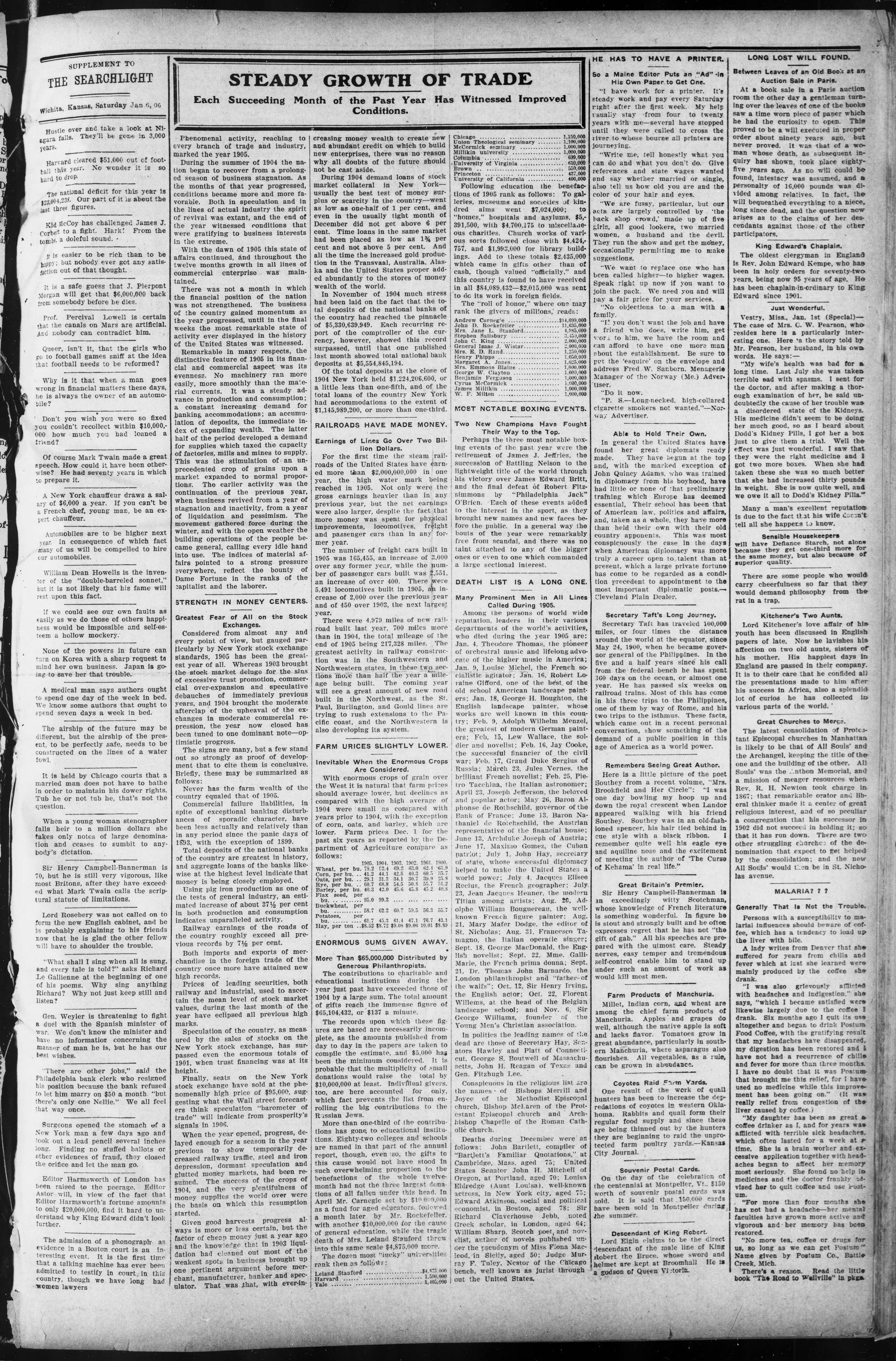
With enormous crops of grain over the West it is natural that farm prices should average lower, but declines as compared with the high average of 1904 were small as compared with years prior to 1904, with the exception of corn, oats, and barley, which are lower. Farm prices Dec. 1 for the past six years as reported by the Department of Agriculture compare as follows:
1905. 1904. 1903. 1902. 1901. 1900.
Wheat, per bu. 78.2 52.4 69.2 63.0 62.4 61.9
Corn, per bu. 41.2 44.1 42.5 40.3 39.7 38.9
Cats, per bu. 35.2 34.1 34.1 30.7 29.0 28.7
Rats, per bu. 60.3 68.8 64.5 50.8 55.7 51.2
Barley, per bu. 40.7 63.0 54.5 45.8 45.2 40.8
Flax seed, per bu. 35.0 99.3
Buckwheat, per bu. 58.7 62.2 60.7 59.5 58.3 55.7
Potatoes, per bu. 61.7 45.3 61.4 47.1 76.7 43.1
Hay, per ton. $5.52 $8.72 $9.08 $9.06 10.01 $8.9
ENORMOUS GUMS GIVEN AWAY.
More Than $65,000,000 Distributed by Generous Philanthropists.
The contributions to charitable and educational institutions during the year just past have exceeded those of 1904 by a large sum. The total amount of gifts reach the immense figure of $65,104,432, or $137 a minute.
The records upon which these figures are based are necessarily incomplete, as the amounts published from day to day in the papers are taken to compile the estimate, and $5,000 has been the minimum considered. It is probable that the multiplicity of small donations would raise the total by $10,000,000 at least. Individual givers, too, are here accounted for only, which fact prevents the list from enrolling the big contributions to the Russian Jews.
More than one-third of the contributions has gone to educational institutions. Eighty-two colleges and schools are named in that part of the annual report, though, even so, the gifts to this cause would not have stood in such overwhelming proportion to the benefactions of the whole twelve-month had not the three largest donations of all fallen under this head. In April Mr. Carnegie set by $10,000,000 as a fund for aged educators, followed a month later by Mr. Rockefeller, with another $10,000,000 for the cause of general education, while the tragic death of Mrs. Leland Stanford threw into this same scale $4,875,000 more. The dozen most "lucky" universities rank then as follows:
Leland Stanford $4,875,000
Harvard $1,500,000
Yale $1,405,000
Chicago 1,150,000
Union Theological seminary 1,100,000
McCormick seminary 1,000,000
Milwaukee university 1,000,000
Columbia 698,000
University of Virginia 610,000
Brown 550,000
Pacificleton 457,000
University of California 400,000
Following education the benefactions of 1905 rank as follows: To galleries, museums and societies of kindred alms went $7,024,000; to "homes," hospitals and asylums, $5,391,500, with $4,700,175 to miscellaneous charities. Church works of various sorts followed close with $4,424,757, and $1,993,000 for library buildings. Add to these totals $2,435,000 which came in gifts other than of cash, though valued "officially," and this country is found to have received in all $4,898,432—$2,015,000 was sent to do its work in foreign fields.
Andrew Caragee's.....11,400,000
John D. Rockefeller.....11,635,000
Mrs. Jane L. Stanford.....4,985,000
Stephen Salisbury.....5,450,000
Walter G. Kline.....2,000,000
General Isaac J. Wistar.....2,000,000
Mrs. E. D. Rand.....1,250,000
Henry Phipps.....1,050,000
Mary K. L. Johnson.....1,000,000
Mrs. Emmao Blaime.....1,000,000
George W. Clayton.....1,000,000
Benjamin Ferguson.....1,000,000
Cyrus N. Cornellk.....1,000,000
Gerhard Millik.....1,000,000
W. F. Milton.....1,000,000
MOST NCTABLE BOXING EVENTS.
Two New Champions Have Fought Their Way to the Top.
Perhaps the three most notable boxing events of the past year were the retirement of James J. Jeffries, the succession of Battling Nelson to the lightweight title of the world through his victory over James Edward Britt, and the final defeat of Robert Fitzsimmons by "Philadelphia Jack" O'Brien. Each of these events added to the interest in the sport, as they brought new names and new faces before the public. In a general way the bouts of the year were remarkably free from scandal, and there was no taint attached to any of the bigger ones or even to one which commanded a large sectional interest.
DEATH LIST IS A LONG ONE.
Many Prominent Men in All Lines Called During 1905.
Among the persons of world wide reputation, leaders in their various departments of the world's activities, who died during the year 1905 are: Jan. 4. Theodore Thomas, the pioneer of orchestral music and lifelong advocate of the higher music in America; Jan. 9. Louise Michel, the French socialistic agitator; Jan. 16. Robert Loraine Gifford, one of the best of the old school American landscape painter, whose works are well known in this country; Feb. 9. Adolph Wilhelm Menzel, the greatest of modern German painters; Feb. 15. Lew Wallace, the soldier and novelist; Feb. 16. Jay Cooke, the successful financier of the civil war; Feb. 17. Grand Duke Sergius of Russia; March 23. Jules Vernes, the brilliant French novelist; Feb. 25. Pietro Tacchina, the Italian astronomer; April 23. Joseph Jefferson, the beloved and popular actor; May 26. Baron Alphonse of Rothschild, governor of the Bank of France; June 13. Baron Nathaniel de Rothschild, the Austrian representative of the financial house; June 13. Archduke Joseph of Austria; June 17. Maximo Gomez, the Cuban patriot; July 1. John Hay, secretary of state, whose successful diplomacy helped to make the United States a world power; July 4. Jacques Elisee Recius, the French geographer; July 23. Jean Jacques Henner, the modern Titian among artists; Aug. 20. Adolphe William Bouguerean, the well-known French figure painter; Aug. 21. Mary Mafer Dodge, the editor of St. Nicholas; Aug. 31. Stefano Tamagno, the Italian operatic singer; Sept. 18. George MacDonald, the English novelist; Sept. 22. Mme. GallMarie, the French prima donna; Sept. 21. Dr. Thomas John Barnardo, the London philanthropist and "father-of the walfs"; Oct. 12. Sir Henry Irving, the English actor; Oct. 22. Florent Willems, at the head of the Belgian landscape school; and Nov. 6. Sir George Williams, founder of the Young Men's Christian association.
In politics the leading names of the dead are those of Secretary Hay, Senators Hawley and Platt of Connecticut, George S. Boutwell of Massachusetts, John H. Reagan of Texas and Gen. Fitzhugh Lee.
Conspicuous in the religious list are the names of Bishops Merrill and Joyce of the Methodist Episcopal church, Bishop McLaren of the Protestant Episcopal church and Archbishop Chapelle of the Roman Catholic church.
Deaths during December were as follows: John Bartlett, compiler of "Bartlett's Familiar Quotations," at Cambridge, Mass. aged 75; United States Senator John H. Mitchell of Oregon, at Portland, aged 70; Louisa Eldredge (Aunt Louisa), well-known actress, in New York city, aged 75; Edward Atkinson, social and political economist, in Boston, aged 78; Sir Richard Claverhouse Jebb, noted Greek scholar, in London, aged 64; William Sharp, Scotch poet, and novelist, author of novels published under the pseudonym of Miss Fiona Macleod, in Sicily, aged 50; Judge Murray F. Tuley, Nestor of the Chicago bench, well known as jurist through out the United States.
HE HAS TO HAVE A PRINTER.
So a Maine Editor Puts an "Ad" in His Own Paper to Get One.
"I have work for a printer. It's steady work and pay every Saturday right after the first week. My help usually stay from four to twenty years with me—several have stopped until they were called to cross the river to whose bourne all printers are journeying.
"Write me, tell honestly what you can do and what you don't do. Give references and state wages wanted and say whether married or single, also tell us how old you are and the color of your hair and eyes.
"We are fussy, particular, but our acts are largely controlled by 'the back shop crowd,' made up of five girls, all good lookers, two married women, a husband and the devil. They run the show and get the money, occasionally permitting me to make suggestions.
"We want to replace one who has been called higher—to higher wages. Speak right up now if you want to join the pack. We need you and will pay a fair price for your services.
"No objections to a man with a family.
"If you don't want the job and have a friend who does, write him, get vort to him, we have the room and can afford to have one more man about the establishment. Be sure to put the 'esquire' on the envelope and address Fred W. Sanborn, Mengenie Manager of the Norway (Me.) Advertiser.
"Do it now.
"P. S.—Long-necked, high-collared cigarette smokers not wanted."—Norway Advertiser.
Able to Hold Their Own.
In general the United States have found her great diplomats ready made. They have begun at the top and, with the marked exception of John Quincy Adams, who was trained in diplomacy from his boyhood, have had little or none of that preliminary training which Europe has deemed essential. Their school has been that of American law, politics and affairs, and, taken as a whole, they have more than held their own with their old country appenants. This was most conspicuously the case in the days when American diplomacy was more truly a career open to talent than at present, which a large private fortune has come to be regarded as a condition precedent to appointment to the most important diplomatic posts.—Cleveland Plain Dealer.
Secretary Taft's Long Journey.
Secretary Taft has traveled 100,000 miles, or four times the distance around the world at the equator, since May 24, 1900, when he became governor general of the Philippines. In the five and a half years since his call from the federal bench he has spent 300 days on the ocean, or almost one year. He has passed six weeks on railroad trains. Most of this has come in his three trips to the Philippines, one of them by way of Rome, and his two trips to the isthmus. These facts, which came out in a recent personal conversation, show something of the demand of a public position in this age of America as a world power.
Remembers Seeing Great Author.
Here is a little picture of the poet Southey from a recent volume, "Mrs. Brookfield and Her Circle": "I was one day bowling my hoop up and down the royal crescent when Landor appeared walking with his friend Southey. Southey was in an old-fashioned spencer, his hair tied behind in cue style with a black ribbon. I remember quite well his eagle eye and aquilline nose and the excitement of meeting the author of 'The Curse of Kehama' in real life."
Great Britain's Premier.
Sir Henry Campbell-Bannerman is an exceedingly witty Scotchman, whose knowledge of French literature is something wonderful. In figure he is stout and strongly built and he often expresses regret that he has not "the gift of gab." All his speeches are prepared with the utmost care. Steady nerves, easy temper and tremendous self-control enable him to stand up under such an amount of work as would kill most men.
Farm Products of Manchuria.
Millet, Indian corn, and wheat are among the chief farm products of Manchuria. Apples and grapes do well, although the native apple is soft and lacks flavor. Tomatoes grow in great abundance, particularly in southern Manchuria, where asparagus also flourishes. All vegetables, as a rule, can be grown in abundance.
Covotes Raid Fourth Yards.
One result of the work of quail hunters has been to increase the depredations of coyotes in western Oklahoma. Rabbits and quail form their regular food supply and since these are being thinned out by the hunters they are beginning to raid the unprotected farm poultry yards.—Kansas City Journal.
Souvenir Postal Cards
Souvenir Postal Card
On the day of the celebration of
the centennial at Montpellier, Vt. $150
worth of souvenir postal cards was
sold. It is said that 150,000 cards
have been sold in Montpellier during
the summer.
Dependant of King Robert
Descendant of King Lord Elgin claims to be the direct descendant of the male line of King Robert the Bruce, whose sword and helmet are kept at Broomhall. He is a godson of Queen Victoria.
Between Leaves of an Old Book at an Auction Sale in Paris.
At a book sale in a Paris auction room the other day a gentleman turning over the leaves of one of the books saw a time worn piece of paper which he had the curiosity to open. This proved to be a will executed in proper order about ninety years ago, but never proved. It was that of a woman whose death, as subsequent inquiry has shown, took place eighty-five years ago. As no will could be found, intestacy was assumed, and a personality of 16,000 pounds was divided among relatives. In fact, the will bequeathed everything to a niece, long since dead, and the question now arises as to the claims of her descendants against those of the other participants.
King Edward's Chaplain.
The oldest clergyman in England is Rev. John Edward Kempe, who has been in holy orders for seventy-two years, being now 95 years of age. He has been chaplain-in-ordinary to King Edward since 1901.
Just Wonderful.
Vestry, Miss., Jan. 1st (Special)—The case of Mrs. C. W. Pearson, who resides here is a particularly interesting one. Here's the story told by Mr. Pearson, her husband, in his own words. He says:—"My wife's health was bad for a long time. Last July she was taken terrible bad with spasms. I sent for the doctor, and after making a thorough examination of her, he said undoubtedly the cause of her trouble was a disordered state of the Kidneys. His medicine didn't seem to be doing her much good, so as I heard about Dodd's Kidney Pills, I got her a box just to give them a trial. Well the effect was just wonderful. I saw that they were the right medicine and I got two more boxes. When she had taken these she was so much better that she had increased thirty pounds in weight. She is now quite well, and we owe it all to Dodd's Kidney Pills."
Many a man's excellent reputation is due to the fact that his wife doesn't tell all she happens to know.
Sensible Housekeepers
Sensible Housekeepers will have Defiance Starch, not alone because they get one-third more for the same money, but also because of superior quality.
There are some people who would carry cheerfulness so far that they would demand philosophy from the rat in a trap.
Kitchener's Two Aunts.
Lord Kitchener's love affair of his youth has been discussed in English papers of late. Now he lavishes his affection on two old aunts, sisters of his mother. His happiest days in England are passed in their company. It is to their care that he confided all the presentations made to him after his success in Africa, also a splendid lot of curios he has collected in various parts of the world.
Great Churches to Merge
The latest consolidation of Protestant Episcopal churches in Manhattan is likely to be that of All Souls' and the Archangel, keeping the title of the one and the building of the other. All Souls' was the Anthon Memorial, and a mission of meager resources when Rev. R. H. Newton took charge in 1867; that remarkable orator and liberal thinker made it a center of great religious interest, and of so peculiar a congregation that his successor in 1902 did not succeed in holding it; so that it has run down. There are two struggling churches of the denomination that expect to get helped by the consolidation; and the new All Souls' would then be in St. Nicholas avenue.
MALARIA???
Generally That Is Not the Trouble.
Persons with a susceptibility to malarial influences should beware of coffee, which has a tendency to load up the liver with bile.
A lady writes from Denver that she suffered for years from chills and fever which at last she learned were mainly produced by the coffee she drank.
"I was also grievously afflicted with headaches and indigestion," she says, "which I became satisfied were likewise largely due to the coffee I drank. Six months ago I quit its use altogether and began to drink Postum Food Coffee, with the gratifying result that my headaches have disappeared, my digestion has been restored and I have not had a recurrence of chills and fever for more than three months. I have no doubt that it was Postum that brought me this relief, for I have used no medicine while this improvement has been going on." (It was really relief from congestion of the liver caused by coffee.)
"My daughter has been as great a coffee drinker as I, and for years was afflicted with terrible sick headaches, which often lasted for a week at time. She is a brain worker and excessive application together with headaches began to affect her memory most seriously. She found no help in medicines and the doctor frankly advised her to quit coffee and use postum.
"For more than four months she has not had a headache—her mental faculties have grown more active and vigorous and her memory has been restored.
"No more tea, coffee or drugs for us, so long as we can get Postum."
Name given by Postum Co., Battle Creek, Mich.
There's a reason. Read the little book "The Road to Wellness" in pkgs
---
... Drugs of all kinds, Cigars and Tobacco . . .
Your patronage solicited. + Once a customer, always a
customer. Our store is Headquaaters for Colored people.
---
We have a full line of fresh and wholesome Fancy and Staple Groerie, Teas, Coffees, Spices, Sugar, Flour, Meal, Vegetables, Canned Goods, Brooms, Butter, Eggs, Coal Oil, Gasoline, Stationary, and, in fact, anything and everything you may want in the Grocery Line.
PEERLESS
STEAM
LAUNDRY
Best Laundry In The U.S.
Phone 232
FREQUENLY 8 SQMS. Prams.
-SMOKE-
BLUE SEAL
CIGARS
SOLD EVERYWHERE
H W.Dean
Meat Market
—All Kinds of—
Fresh and Salt Meats
813 N. Main St Wichita
In The
Grocery Line
Your wants need careful attention and our store is the place to get it. We handle the best of Fancy and Staple Groceries and our prices are right. Orders given prompt attention.
Kernan & Co.,
1102 E. Douglas Pone 35
Wm. Dunson Robt, Floyd
Dunson - Floyd
Mandolin Club
Music For Any Occasion
Special Arrangements For Par-
ties. Prices Reasonable .....
Leave Order at 428 N. Main St
L.S. NAFTGER, W. R. TUCKER,
President Vice President
J. M. MOORE, Cashier
Fourth National Bank
United States Depository
Directors—W. R. Tucker, W. E. Jett, R.
L. Holmes, S. B. Amidon, B. F. Mc
Lean, J. M. Moore, L. S. Naftzger, E
H. Middleauff, O. Z. Smith.
A General Banking Business Tranacted
W. CHITA, KANSAS
OLDEN'S
Prescriptions
... Drugs of all kinds
HOUCK
Hardware store
First Class Goods at
Lowest Prices
116 East Douglas Avenue
WICHITA TABERNAGLE No. 34,
Order of Twelve
Meets First and Third Thursday
Of Each Month
All Daughters In Good Standing Invited
Mrs. Mattie Miller, H. P.
Beatrice Miller. Sec.
Dr.J.E. Farmer,
Physician and Surgeon
—Diseases of—
Women and Children
A Specialty
New Phone 936
Office 517 N. Main St
W. S. HENRION
801 N. Main St.
Wichita, Kans.
Nice Furnished
-ROOMS-
By the night or week
Transient's Specialty
Mrs. R. Hock, Prop.
242 North Water St.
J G Hopper,
229 N. Main
Everything Cheap For Cash
Call and give us a trial. Fresh
and Salt Meats of All Kinds.
Poultry and Oysters
RUGC STORE
Filled with Care
Cigars and Tobacco ...
Once a customer, always a
adquaters for Colored people.
North Main st.
TO NONE
ON ALL
MAKERS
CE As Snow.
IT
OTTO WEIFS. Agent.
S. E. Patton, Sec.
Jas. L. Harper, Mangr
THE WICHITA SEARCHLIGHT.
Red Front RACKET
The People's Economy Store
Sample Shoes
We have just received a large invoice of Men's Work Shoes,
Men's Dress Shoes, Ladies' and
Misses Fine Dress Shoes, Oxford
and Slippers, all styles and kinds
AT WHOLESALE PRICES
Tapp Bros. & Hanshaw
Phone 257 255-257 N Main
R
A FOOL
and his mouey are soon parted. The mau who pays out his good money for inferior building material is foolish. Buy the BEST. We sell it. Have you seen the latest building material? It is our Cement Building Stone. The longer it wears, the harder it gets. J. H. TURNER, 537-547 West Douglas Ave.
FORD'S
HAIR POMADE
Formerly known as
"OZONIZED OX MARROW"
so
The Ozonized Ox Marrow Co.
(None genuine without my signature)
Charles Ford Past
76 Wabash Ave., Chicago, Ill.
Agents wanted everywhere.
Banner Mills
CUSTOM GRINDING
A Specialty
ALL KINDS OF COAL & FEED
FUORIBROH BROS, PROPS.
622 N. Main St. Phone 599
Hustle over and take a look at Niagara falls. They'll be gone in 3,000 years.
Harvard cleared $51,000 out of football this year. No wonder it is so hard to drop.
The national deficit for this year is $23,004,238. Our part of it is about the last three figures.
Kid McCoy has challenged James J. Corbett to a fight. Hark! From the tombs, a doleful sound.
It is easier to be rich than to be happy; but nobody ever got any satisfaction out of that thought.
It is a safe guess that J. Pierpont Morgan will get that $6,000,000 back from somebody before he dies.
Prof. Percival Lowell is certain that the canals on Mars are artificial. And nobody can contradict him.
Queer, isn't it, that the girls who go to football games sniff at the idea that football needs to be reformed?
Why is it that when a man goes wrong in financial matters these days, he is always the owner of an automobile?
Don't you wish you were so fixed you couldn't recollect within $10,000,000 how much you had loaned a friend?
Of course Mark Twain made a great speech. How could it have been otherwise? He had seventy years in which to prepare it.
A New York chauffeur draws a salary of $6,000 a year. If you can't be a French chef, young man, be an expert chauffeur.
Automobiles are to be higher next year. In consequence of which fact many of us will be compelled to hire our automobiles.
William Dean Howells is the inventor of the "double-barreled sonnet," but it is not likely that his fame will rest upon this fact.
If we could see our own faults as easily as we do those of others happiness would be impossible and self-esteem a hollow mockery.
None of the powers in future can turn on Korea with a sharp request to mind her own business. Japan is going to save her that trouble.
A medical man says authors ought to spend one day of the week in bed. We know some authors that ought to spend seven days a week in bed.
The airship of the future may be different, but the airship of the present, to be perfectly safe, needs to be constructed on the lines of a water fowl.
It is held by Chicago courts that a married man does not have to bathe in order to maintain his dower rights. Tub he or not tub he, that's not the question.
When a young woman stenographer falls heir to a million dollars she takes only notes of large denomination and ceases to sumbit to anybody's dictation.
Sir. Henry Campbell-Bannerman is 70, but he is still very vigorous, like most Britons, after they have exceeded what Mark Twain calls the scriptural statute of limitations.
Lord Rosebery was not called on to form the new English cabinet, and he is probably explaining to his friends now that he is glad the other fellow will have to shoulder the trouble.
"What shall I sing when all is sung, and every tale is told?" asks Richard Le Gallienne at the beginning of one of his poems. Why sing anything Richard? Why not just keep still and listen?
Gen. Weyler is threatening to fight a duel with the Spanish minister of war. We don't know the minister and have no information concerning the manner of man he is, but he has our best wishes.
"There are other jobs," said the Philadelphia bank clerk who resigned his position because the bank refused to let him marry on $50 a month. "but there's only one Nellie." We all feel that way once.
D. L. STEWART, M. D. PHYSICIAN and SURGEON.
703 North Main St.
All calls attended promptly, Day or Night
Office Hours — 9 to 12 a. m.
2 to 5 p. m.
6 to 8 30 p. m.
NEWTON (KANS.) NEWS.
Miss Mary Davidson who has been visiting in this city for the past week with Mrs. John Anderson left the city Monday for her home in Harrissonville Mo. she leaves report ing a lovely time white in the city.
Herbert parkerson of Huchinson Kans. is a visitor in the city this week.
There was a social given at the Odd Fellow's hrill Thursday evening for the benifit of the second Baptist church after which there was a wedding every one reported a lovely time
Oran Riekman has just returned from Emporia from whence he report a delihtful time.
Herbert Parkerson who has been visiting in the city is expecting to leave the city for his home in Hutchinson Kans.
The N. U. G. club met Monday afternoon at the residence of Mrs. S. Dickerson the members all report a lovely meeting.
Joe. Hart is reported no better.
Mr. and Mrs. Henry Reevely left the city last week to spend the Xmas with relatives and friends they returned reporting a lovely time.
Mrs. J. Anderson is reported ill.
There was a social given Monday night at the C. M. E. church for the benefit of the church they report a nice time. There was a party given Friday night at the residence of Mrs. D. Hall in honor of her grandaughter Miss Mable Hall many were present and all report having a pleasant evening.
A SAD REPORT.
John Neal, Porter on the Mo. pac. was in Wiceita from his home in Ft. Scott Monday and reported to the Searchlight many deaths of well known residents of that city. He reported the death of his father Mr. Primus Neal age 66 years 8 months who died Dec. 22nd. The deceased had been a resident of Ft Scott for more than 22 years.
The death of Mr Erastus Hawkins father of Prof Erast J. Hawkins and Anthony Hawkins two young men very well known in our city, was also reported. Mr Erastus Hawkins died Dec. 28 1905 age 60 year 3 months and had lived in Ft Scott for more than 30 years.
The sudden death of young Chas Black was also reported. Mr Black died Dec 29th age 25 years. John Jones died Dec 31st in Ft. Scott after a brief illness. Many of the readeas of the Searchlight here and elsewhere know each of these and join us in expressing sorrow to learn of so great a death list in that city and extends to the bereaved ones urp ofoounde t sympathis.
WINFIELD. KANSAS.
Thos Bigger was in the city Friday.
Frank Banks spent the holidays with his parents.
Mrs Daisy Dodge of Arkansas City was in the city this week.
Mr and Mrs. Chas. Waldon of Hill Top have moved back to this city.
Mr and Mrs. Gerneral Joh son who were married at Wagner I. T were tendered a reception at the residence of Mr and Mrs. J. W. Singleton.
Mr and Mrs. Andy Charles gave swell reception on Dec. 26th.
The Xra club gave their holiday entertainment on Dec. 28th. John Bradford, wife and son are in the city.
GREAT FRENCH SOLDIER DEAD.
Gen. Saussier's Long Services to His Country Ended.
Gen. Felix Gustave Saussier, former commander-in-chief of the French army, died Dec. 26. He was one of the best known and bravest officers in France. In the battle around Metz a quarter of a century ago he distinguished himself most signally. The famous infantry charge at St. Privat, which practically barred the progress of the Germans on that side, was led by him. Saussier was one of the officers who signed the protest against the surrender of Metz. Gen. Saussier
The Late Gen. Saussier.
also served in Italy, Mexico and the Crimea. He was a deputy for some time and in 1873 distinguished himself in the discussions on the reorganization of the army.
FLEE FROM HOUSE GALLERIES,
House Quickly Empties When Ceraintain Members "Orate."
Congressman John Wesley Gaines of Tennessee and Robert Adams, Jr. of Pennsylvania somehow or other have acquired reputation as being very poor speakers. When either begins speaking the galleries become empty about as rapidly as though the house were on fire. Mr. Adams began a speech the other day and there was such a rush outward that the man whose duty it is to lower the flag at adjournment started to perform that task. A member of the house who had not been in listening to the speeches came to the same conclusion as he pushed into a crowded elevator. "When did the house adjourn to?" he asked the elevator conductor. "It hasn't adjourned," said he. "Mr. Adams of Pennsylvania is speaking," he added, whereupon the member guessed he would go home anyhow.
PRISON FOR LEADING LAWYER
Abraham Hummel, New York Legal Light, Convicted of Conspiracy.
Abraham H. Hummel of the law firm of Howe & Hummel, one of the biggest in New York, was last week convicted of conspiracy, sentenced immediately to one year in the penitentiary and a fine of $500, and taken from the courtroom across the bridge of sighs to the Tombs prison.
The charge upon which Hummel was convicted was that of conviving with the aid of the perjured testimony of Charles F. Dodge, to break
MEDERDA
LOMMULI
up the marriage of Charles W. Morse ice man and banker, to the divorced wife of Dodge. There are still two indictments for subornation for perjury pending against Hummel.
Demand for Good Literature.
A veteran bookseller, basing his conclusions, upon a wide experience of many years, finds among other tendencies of the day a marked increase in the intellectual life of America. Not only have business and professional men come to be reckoned in great numbers among buyers of good literature but a large clientele of women readers prefer a well-written story of only moderate interest to a badly written romance of absorbing theme. He also finds a growing appreciation of really good poetry, a tendency to pay more attention to book reviews in periodicals of acknowledged standing and a demand for books of serious import to be "read in" instead of "read through."
What He Was.
"Once I knew a man," said the interesting conversationalist, "who was born in mid ocean. His father was an Englishman and his mother was of French-German parentage, but was a native of Greeee. So what do you suppose that man is?" The listeners thought steadily for some moments, but at last announced that they could not guess. "He is a dry goods merchant," explained the interesting conversationalist.
L022 VOUDG READERS
If you have hard work to do.
‘Do it now.
To-day the skies are clear and blue,
To-morrow clouds may come In view
‘Yesterday ts not for you;
Do it now.
If you have a song to sing.
Sing It now.
Let the nates of gladness ring
Clear as song of bird in. spring,
Let every. day some music bring:
‘Sing it now.
Hf you haye kind words to say.
Say them now.
‘Poemorrow may not come your way.
Do a kindness while you may,
Foved ones will not always stay;
Say them now.
If sou haye a smi’e to show.
Show It now.
Make hearts happy. roses grow,
Let the friends around you know
‘he love you have before they go;
fhow it now.
—Charles R. Skinner’ in New York Sur
You have often heard, boys and
girls, of animals helping each other,
but perhaps you would like to know
of a yery kind crow who appeared at
4 country house not long ago.
The family was much interested in
watching a little black bird make fre
quent visits to an old chicken coop,
which it entered by the door. For
six days in succession the crow kept
up these regular visits, to the great
astonishment of the watchers.
At last it was discovered that good
Mr. Crow had been carrying corn all
this time to a poor little hen who had
been caught by the neck between the
bars of the coop in such a way that
it could not be seen from the outside.
When the hen was set free, Mr.
Crow sprang at her triumphantly and
conducted her to a basin of water
standing near by, as if to say, “Now,
quench your thirst.”
nce ond Morons.
First, a stick about three feet long
is needed, ‘Trim this down till it is
smooth. Then bend it into shape
HOW PUP SAVED HIS MISTRESS
He was just an ordinary dog, with
no pedigree. Who his parents were,
‘or where he was born, he never in-
quired. As far back as he could re-
member he had slept in the coal shed,
from which he occasionally came forth
‘at night to bay at the moon, or an-
swer the call of some other dog in
the neighborhood.
His name was Pup. Just plain Pup.
Once a little girl called him “Puppy,”
and he was so surprised at her kind-
ness that he licked her hand, and she
ran away screaming. After that he
never heard the pet name “Puppy”
again.
Pup's occupation was chasing the
chickens out of the back yard, and
watching for erusts of bread to be
thrown out. Occasionally he got a
bit of meat, or a bone from the kitch-
en, and then he was very happy, and
would wag his tail as he gnawed the
gristle. ‘
f Several times the dog man tried to
catch Pup, but Pup was a wise little
dog and always got away and took
refuge in the coal shed. Then he
would peep through the cracks and
bark and growl at the dog man. No
‘one seemed to care whether the dog
maa caught Pup or not. If he had a
real friend, he did not know it. That
fs, until something happened. This
something changed the entire course
of Pup’s life.
One night, just as Pup went to the
coal shed door to bay at the moon, he
saw a bright light up near the roof
‘of the house, where the lady lived who
fed him crusts of bread and gave him
old bones. At first Pup thought
it was a star, bui mo, it could not be
a star. It was too big, and then,
there was smoke, Suddenly Pup un-
derstood. The house was on fire.
“Bow-wow! Bow-wow! Bow-wow!”
barked Pup, but™no one answered his
call. If he was heard, it was only
thought he was baying at the moon.
“This will never do,” said Pup to
himself, “The kind lady who gives
i) | | |
Ee ZW
PC Cage 7
ie Ce i
LED ASS lf
i i) NS
HR, 4
th ih Ue tT, ‘en Ga
Sr il Wd 4
Ne .
Wie Ns
=
a @
“Bing! Bang! Bing!”
me bread crusts and oid bones must
be awakened, or she will be burned
to death. I must do more than ‘bow-
wow.” cat
* Higher and higher the flames crept
up the cornice. ‘Then the shingles
caught, and it was apparent to Pup
that if he was to save the kind lady
who had given him bread crusts and
old bones, he must act quickly.
‘Now.
A Kind Crow.
snown in illustration. Cut notches in
the ends for the string to be tied on.
Take a drill or if you have not a
aril a heated piece of wire will do,
and three inches from each end of the
stick bore a hole, These are for the
suring to pass through. A strong
si™g a little longer than the bow is
needed. One end of this is tied to
the notch on one end of the stick or
bow and passed through the holes and
tied on the other notch in such a man-
ner that it can easily be untied
again when the bow is put away. The
bow is now finished. A bamboo stick
on one end and a nail on the other
make a good arrow.
Merely Arrangement.
Add the figures 1 to 9 inclusive and
make 100.
It sounds impossible, but an expert
“puzzler” shows that it is merely a
matter of arrangement. Here is the
demonstration:
Easy Games of Magic.
‘Take a coin in each hand and then
hold both arms out straight to left
and right. Now say that you will get
doth coins into one hand without
changing the position of your arms in
the least. After everybody is wildly
curious to know how you are going to
do it, walk to a mantelpiece, lay the
coin from one outstretched hand on
it, and turn around and take it up in
the other.
Then tell another person that you
have hypnotized him so that he is un-
able to take off his coat alone. He
will take it off immediately, of course,
to prove that you are wrong, but the
moment he starts you take off your
First he tried barking, and then
howling, at the kitchen door.
Next he barked and then howled at
the windows. Still there was no re-
sponse.
By this time the entire roof of the
east wing of the house was ablaze and
the flames were eating their way to-
ward the section of the big structure
By |
TAKE)
ia —
Zo Hay |! e
eal ia
Se 2
SCALES,
ih,
Pee
We ey
ua
f oxi i poor
es
ah s
Just Plain Pup.
TD) WOR EGS SN BOS ee ae ee
bread crusts and old bones, lived.
Pup was in despair.
All at once he thonght of the front
aoor-bell. He had seen the kind lady’s
friends pull the knob, when they
called, and why not he?
“Bing! Bang! Bing!"wer. the bell,
Pup holding the knocker in his mouth
the while and listening for the ap-
proach of footsteps.
It scemed an age, although it was a
very short time, Lefore Pup heard the
voice of the kind Jady who had given
him bread crusts and old bones, call
‘down the stairs: “Who's there?”
“sts me!” yelped back Pup. “Come
“quick! Hurry.”
"The kind lady who had given Pup
‘bread crusts and old bones, recogniz-
Jing his vole, opened the door and
looked out.
“Excuse me for interrupting your
“sleep,” said Pup, with a low bow, “but
the whole rear of the house is on fire.”
/“Merey!” screamed the Kind lady
who had given Pup bread crusts and
old bones.
"Just then the firemen came, and as
the flames spread, more and more, the
Kind lady who had given Pup bread
crusts and old bones clutched from
the hall rack an opera cloal and en
veloping herself in it, she and Pup
“watched the firemen as they worked,
and when they had Snished thelr la-
bors, all they had saved was the
ground on which the house once stood.
But the kind lady, who had given
Pup bread crusts and old bones, was
“wealthy, and she did not care a great
deal for the ioss. In fact, she was.a wise
woman and carried heavy insurance,
and within a few weeks, a new house
stood where the old one went down.
Nor was the new house all that was
built. Out in the rear yard was erect
ed one of the finest dog houses in the
world, It was a model dog house,
throughout, and on the front door
plate was engraved, on a silver bar,
the only name the master had ever
eo eeser
coat also, and thus you prove to him
that he couldn't take off his coat
alone.
Then you announce that you will
show the guests something that no
human being ever saw before, and
that no human eye will ever see again.
You crack a nut, show the kernel and
say: “No human being ever saw that
before.” Then you pop it into your
mouth and say, “And no human being
will ever see it again.”
Mixed Nots
LES
Gees 6}
PRE,
Se SoHE Ts 5
Why is it that every man’s pants
are too short? Because his legs stick
out two feet,
Why is it dangerous to go in the
woods in spring? Because the bull-
rush is out, the cowslips around, the
grasses have blades, the flowers have
pistils and the little twigs are shooting.
When were walking sticks first men-
tioned in the Bible? When Eve pre-
sented Adam with a Cain.
What is it that you can put up a
stovepipe down, but you can’t put
down a stovepipe up? An umbrella.
Why is a dog's tail like the heart
of a tree? Because it is farthest from
the bark.
What kind of a cat do we usually
find in a large library? A cat-alogue.
Why does a goose come out of the
water? For sundry reasons.
A Japanese House.
A Japanese house causes a Euro-
pean visiting the country for the first
time unparelleled astonishment. The
interior fs spotlessly clean, a dead set
is waged against dirt in every shape,
and when you enter you diseard your
boots. To retain your boots on your
feet. is an indiscretion that is not
quickly forgiven.
On looking round, you wonder where
the rooms are situated, for only one is
visible, and that apparently takes up
the whole of the house. As a mat
ter of fact, for the moment—we will
assume that you are calling during the
day—the residence cannot boast of
more than one chamber. But, strange-
ly enough, this one compartment ean
be converted into several others. The
transformation trick is effected by
means of panels, which when run into
their places divide the house into sev-
eral rooms. If you require a few feet
of space to yourself, you just slide
along a few panels, and behold your
wants are satisfied. With the utiliza-
tion of panels you actually make a
room. At night the bed rooms are
constructed in the same way. The
floors consist of mats, and it is on
these mats that you sleep. There are
no beds. In the morning, when the
family is up and about, the bed cham-
bers disappear—the panels are put
back—and you have one large apart-
ment.
The outside walls are as fragile as
those inside. They are composed of
paper panes. If you are unpardon-
ably curious to ascertain what the peo-
ple are doing inside, you wet a finger
‘and push it through the wall! ‘The
result is a hole through which you can
Jook.—Montreal Herald.
A Dog of Heart and Courtesy.
“[ saw a very pretty scene a day or
two ago during one of the heavy after-
noon rains,” writes a correspondent of
the Jacksonville Times-Union, “A lit-
tle kitten, the pet of some children,
probably, with a blue ribbon around its
neck, soft gray fur and dainty white
feet, had wandered out into the strect,
and feared to cross the gutter where
a swift stream whirled and dashed
along. It was mewing piteously, but
no one paid any attention to it. In this
busy world the moaning of a human
being excites but littlé attention; how
much less, then, the crying of a for-
torn kitten. Then there came along a
great Newfoundland dos, with bright.
intelligent eyes and glossy coat. At-
tracted by the little kitten’s distress,
he gazed at it a moment, then glanced
quietly about him. ‘The nobler animal,
man, was going by unhee 4, so this
dog walked out into the street, picked
up the kitten in his mouth and carrieti
it gently to the sidewalk. There he
placed it on a dry spot, licked it kindly
once or twice, wagged his bushy tail
and went down the street. It was a
little thing, but it struck me that that
dog had something higher than intetli-
gence.”
Dogs usually reflect the manners
and morals of their owners in some
degree; how many dogs are there who,
taught by brutal masters, would not
rather have killed the kitten?
Keeping the “Thread” of a Story.
Each player holds the ends of a rib-
on or string in her hand, the other
end of all the ribbons or strings be-
ing held by the leader, who begins
to tell the story. Every one must pay
close attention, for at any moment
she may break off, at the same time
pulling one of the ribbons. The hold-
er of it without delay must take up
the story and continue it until the
leader pulls another ribbon, which
‘transfers the task to some one else.
~ MASS MEETING
A Mass Meeting of the Colored
people will be heldin Odd Fellow
hall, 517 N. Main, Wednesday
Night, January 10th. 1906. Impor-
tant business. Be on hand.
A Prayer.
Fair little head of sun brown hair
Sweet ax the autumn glow-—
Dear little hands, oh, child of mine,
Hest to ‘me toni ago!
Down in the orchard, white with bloom,
Tong wondrous hours we spent.
Watching the crimson Sun sink low
‘Aud’ dreaming where he went.
‘Thrillea with the joy of life and love,
‘The deep peace over all,
Fragrance of blossoms newly blown
The Tobin's plaintive call.
Praver of the lovelorn nightingale,
‘And laughter sweet and shrill;
Ghosts of the June dusk looming up
Beyond the distant hill,
Well did we know the red clouds trailed
“The farsom mystic seat
Dear little heart, the witle, wide world
‘Seemed just for you and me.
Fair little head of sun brown hair
Steere as the, autumn glow
Dear little hands, oh, child of mine
‘Lost to me long. ago!
“W. Lin "New York Sun.
Curse of Liquor in Britain.
Side by side with the record of
misery stands a record for the United
Kingdom of 6,000 breweries, 108,000 It
censed drinking-houses, a total con-
sumption of beer amounting to 21,000,
000 gallons for the year 1904. Each
person in England and Wales is esti-
mated to drink nearly 500 glasses of
beer in a year. Eliminating those
that are too young to drink their
share and those who abstain from
principle or experience, it leaves 53.9
gallons each for the remainder of the
population. ‘This is more than a gal-
lon a week for each week in the year.
Down John Bull’s throttle go 38,600
glasses of his favorite beverage every
minute day and night, Although
some fellow who is handy at figures
has calculated that if this beer were
run into a basin of proper depth it
would float the whole British navy,
that impressive statement is far from
telling the story in its most impres-
sive form. It is when you estimate
the cost of all this drink in a land
where misery abounds that its full
force 1s borne in on you. The bill for
arink in the United Kingdom comes to
$10,000,000 a week. It is $500,000,000
a year. Every minute day and night
$1,000 pass from the pockets of the
people over the bars of the drinking
places and into the treasuries of the
brewers.
But even yet the full import of these
figures has not gone home to our
minds. It is not the rich who pay
these sums over. The figures deal
with beer alone, the beverage of the
workingman. The classes who enjoy
large means drink spirits and wines
for the most part. The $500,000,000
‘come mostly out of the wages of the
laboring classes. If we could only
‘(race effect and cause we should find
that a good deal of the misery afflict:
‘ing the people of England comes di-
‘rectly from these copious millions of
glasses of beer consumed during the
year. The working people of England
spend on beer an average of $55 per
year for each family. Out of every
‘sovereign gained by toil, 2 shillings
‘and 3 pence go for beer. After this if
we count what goes for spirits the
working people of the kingdom spend
on an average one-sixth of their in-
comes on drink. The average wage of
a miner in England is about £400 a
year. If the miner spends one-sixth
of this, £66, in drink and then when
out of employment comes to want,
surely cause and effect were never
more easily traced than in this—Los
Angeles Times.
Problems of the Unemployed.
In the course of an address deliver-
ed at Leicester, England, recently, Mr.
David Shackelton, M. P., pointed out
that, notwithstanding a decrease of
five millions last year, 160 millions
were spent in drink, which was more
than the entire cost of governing the
country from St. Stephens. This
amounted to £3 19s per head of the
population, or, taking out the children
under fifteen and the teetotalers, £17
ts Td per head, If this money were
spent in other direction he thought
it would go a long way towards solv-
ing the unemployed problem. Only
seven and one-half per cent. of the
value of the output in the brewing
industry went in wages, whereas in
mining the percentage was 55, and in
the cotton trade 29. If was because
the people of the country had not
been taking as much interest as they
ought to have done in the great ques-
tions before them that they had had
during the last ten years a set-back,
not only in temperance, but in other
important matters, and a sober nation
could have obtained reforms much
quicker than the present rate of pro-
gress.
‘A German Judge’s Arraignment.
Judge Popert, one of the able new
men who have come to the front in
recent years in the legal profession in
Germany, a short time ago in an ad-
dress, spoke of the corrupt influence
the great capital invested in breweries
has upon the German nation, in the
following terms
“Five million franes (one billion dol-
Jars) was the amount which France in
1871 was called on’to pay to victorious
Germany. But only once! Not much
less (four millions) must Germany,
overcome and bound hand and foot,
pay to alcohol capital not once merely
but every year! For we drink up
every year fourfold the amount our
navy and army together costs us.”
And what does alcohol capital give
us in return for this tribute? It gives
us a gigantic number of crimes, at
least 180,000 per annum—Crimes .ot
violence and lust. It gives an army
of sick. It gives us a degenerate pos-
terity. It gives us a population made
ugly and repulsive in its personal ap-
pearance. One has only to walk
through Munich, a city lying wholly
in the brewers’ chains, and to notice
the faces and the bellies. One has
only to compare the typical German
student with the beautifully supple
and shapely strong youth of Oxford
and Caxibridge. Alcohol _ capital
makes ug the laughing stock of the
foreigner. You remember the words
of President Castro, of Venezuela,
“We have only to provide the Ger-
mans with enough beer and they give
us all we want.” Alcohol capital re
duced our powers of defense, and it
causes an enormous impoverishment
of our people.
But the alcohol capital provides
many people with a livelihood! Yes,
and what kind of a livelihood? The
mortality of those who work in alco
hol trades is three to four times the
average mortality in other trades.
‘Thus, if 100 is taken as a standard,
the mortality among brewery employ-
es is 245, among saloon keepers 257,
and among bartenders and waiters
397. So the poison destroys those
‘che nose et
Drunkenness in the Middle Aaes.
‘The wretched condition of the tav-
erns in the middle ages is described
by Erasurus of Rotterdam; and a cen-
tury later Albertinus says that they
are rightly called “Hell holes,” nur-
series and schools of every earthly
and hellish vice, with which country,
town and city are overrun. Day is
changed into night, and men into rag-
ing beasts and swine. Every species
of crime and of criminals may be
found tliere.” ‘
That general wretchedness resulted
need hardly be affirmed. Literature
was debased—even the religious mu-
sic was eclipsed by the songs of de-
bauch. Princes fell into base public
wrangles and street quarrels; family
life was invaded, and to speak dispar-
agingly of women was esteemed man-
ly. Idleness and beggary increased,
and the civil authorities were not
‘strong enough to cope with either.
Hans Sachs prays God to send a Ger-
‘man Hercules to deliver the land from
robbers, murderers and other crimin-
als; for “from these no man is now
secure.” Crime was in its blooming:
time (Blutezeit). The peasant Peter,
hanged in Silesia in 1615, had already
murdered sixty-nine persons, robbed
twelve churches and burned many
houses.
Norarius bemoans (1572) _ the
wretched condition of the country:
“No steadfast peace, no good fortune,
no blessing, no star of hope in the
world; bad in Bavaria, worse still in
‘Suabia; war, not peace.” Polycarp
Leiser, in 1605, laments: “The stables
are empty of cattle; the waters of
fish; the air of birds; citizens and
peasants are poor; food fails; taxes
increase; in drunkenness and gluttony
we are at the lowest stage.” Diseases,
too, had multiplied. Luther complains
that the world is dying of “surfeit, not
of age.” Seldom could one be found
who had reached the age of seventy or
eighty; most died before forty; at fifty
and sixty one was already accounted
old; not one person out of every thirty
had sound digestion. Very many died
in drunkenness.—Christian Standard.
The Dethroning of Alcohol.
Ancther potent factor in the de-
throning of alcohol has been the spirit
of scientific research of recent
years, In the great laboratories scien-
tists have been carefully stundying
the effects of aleoholic liquors upon
the various organs of the body, and.
although they differ in their conelus:
fons upon some points, the result is
that those phsicians who have most
closely followed these Investigations
have, almost or entirely, abjured al-
coholics, as anecessary part of thelr
therapentie outfit. These elaborate
siudies of alcohol have convinced
many that the nourishing and
strengthening properties ascribed to
alcoholics existed only in the imagin-
ation, and belong to the errors of an
age which had no facilities for ac-
curate observation. The food quall-
ties of the grains and fruits, It 1s
now believed by many authorities, are
destroyed in the process of making
alcoholic drinks. Even the stimulating
qualities ascribed to alcohol are de-
nied by many, who class {t among
sant effect—From an Open Letter in
the narcotics because of its depres
the Century.
NOTICE.
Knights and Daughters, if you he
changed High Priestess or Chiet At
tors since this list was publish
kindly notify me at once, that I :
make the correction.
W. N. MILLER, Eaitof
Tabernacies,
‘Number.
1 Mrs, Eliza Nichols, 938 Ever
St, Kansas City, Kan,
2 Mrs, Sarah Crisp, 613 Sou
Chestnut St. Iola, Kansas,
3 Mrs. Flora Thompson, 36 Nor
-4 Mrs. Madaliene Ward, 325 E. ¢:
Cherryvale, Kan,
Main, Council Bluffs, lowa.
5 Mrs. Sarah Skinner, 725 Park s
Atchison, Kan,
6 Mrs. Mary Curry, 804 Cherry s
Ottawa, Kan.
7 Mrs. N. BE. Wigely, 506 N. Sth, 5
8 Mrs. Laura Smith, 308 lith s
Pe Coffeyville, Kans.
lina, Kan,
§ Mrs. Sarah H. Harrison, 1421 V;
Buren St., Topeka, Kan.
10 Mrs. Maggie Fishback, 1795 Mas
Lawrence, Kans,
11 Mrs. Perlina Woodfork, $23
man Ct, Kansas City, Kan.
12 Miss Cora Sango, 2058 Ni
Front St., Kansas City, Ka
13 Mrs. Nanmie Dunlap, Jun
City, Kans.
15 Mrs. S. S. Furlough, Box
Wier City, Kans.
46 Mrs. Perlor T. Ballinger, t
20th St., Parsons, Kan,
17 Mrs. A. Masie, 616 Barbee, R
Scott, Kans.
20 Mrs. Emma Maxie, 411 Ranson
Ft. Scott, Kans.
24 Mrs. C. E. Kirby, Bx. 322, Coffe
ville, Kan.
28 Mrs. Bell Wright, 1411 Partridg
Ave, Parsons, Kan.
20 Mrs. — Montaque, 403 Kickaps
St, Leavenworth, Kan.
30 Mrs. Laura Bright, 203 Ohio
~ Leavenworth, Kans,
32 Mrs. Ida B. Willis, 1036 Iowa Ave
Butte, Mont.
33 Mrs. Phannfle Corneal, Box 3
Alliance, Neb.
34 Mrs, Mattie Miller, 335 West 151
Wichita, Kans.
35 Mrs. Rachel Dudly, 521 N. 21
South Omaha, Neb.
37 Mrs. Mary Robinson, 523 Mai
Atchison, Kan,
38 Mrs, Laura Lee, Weir City, Kan.
52 Mrs. Cora Yeager, 928 Main S
Lawrence, Kan,
63 Mrs. Lizzie Stone, 1042 Everet
Kansas City, Kan.
77 Mrs. A. Pickens, 250 E. 15th, Ty
peka, Kans.
85 Mrs, Ella Cornish, 828 Tyler {
N. Topeka, Kan, j
89 Mrs. Marie Boyd, 1204 Dodge
Omaha, Neb.
91 Mrs. Ella Goldem 316 N. 1
Omaha, Neb.
92 Mrs, J. G. Gillum, 1209 Vine, L
coln, Neb.
93. Mrs. Ida M. Jordan, 903 West
Ave., N. Topeka, Kans.
559 Mrs. Christena Bell, 294 N. W!
lam St., Déadwood, S. Dakota,
77 C. M'S ADDRESSES 333.
Number.
1 William M. Watkins, Box 2%
Wier City, Kans.
2 J. Jefferson, 308 E. 11th, Coff
ville, Kan.
3 Mr, William H. Barnes, 819 L$
Atchison, Kan.
4 Andrew Herrold, Sherman Fis
Omaha, Neb.
5 J. T. Howard, 120 Kansas AW
Topeka.
6 M. E, Bird, 3014 Hewett, Ever!
Washington,
8 R. M. Bingham, 1727 E. Oak St
Ft. Scott, Kans.
10 Richard Walker, Leavenwort
Kans.
11 .W. N. Miller, 258 N. Main
Searchlight office, Wichita,
13 A. H. Morton, Parsons.
15 Henry Jordan, Salina, Kan.
16 Richard Clark, 420 N. 25th St
Omaha, Neb.
17 Allen Jarner, Box 232 Coffer
Kan.
18 James Thomas, 385 Lake St. ©
Lake City.
19 C. Parris, 918 Penn. St. 1
rence, Kans,
25 Edward Henderson, 1917 N.
St., Kansas City, Kans.
59S. W. Pasker, 1156 Buchanan,
peka, Kan.
60 James Scott, 1404 Van Buren, 9
peka, Kan.
71 J. W. Bedell, 2127 So, 10th
Lincoln, Neb.
536 Albert Graves, 90 Charles
Meadwood South Dakota.
Fast came, the Socks of feumer wil
mong the laurel trees
Over the mountain; through the nist
‘Stirred by the Winter's breeze.
The winds a wedding anthem sins.
With cold: lips all axiom,
Tyg Saom, Queen, hice, ber Foret
‘came the maistietor!
Kate Mast
We wonder if the people up om
had as much trouble dissing
canals.