Wichita Searchlight
Saturday, March 24, 1906
Wichita, Kansas
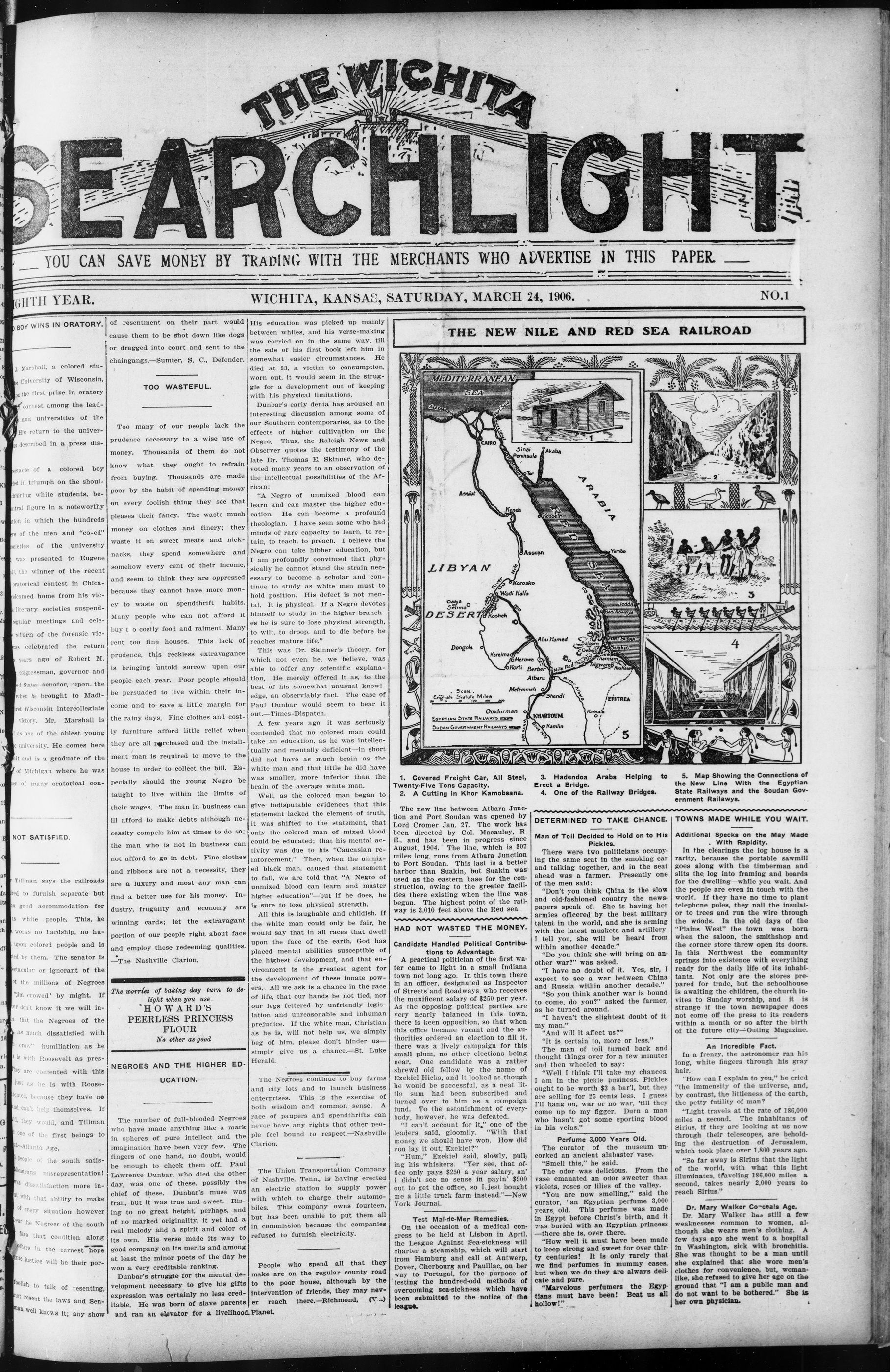
Page text (machine-generated)
THE WICHITA SEARCHLIGHT
NOT SATISFIED.
Tillman says the railroads need to furnish separate but as good accommodation for as white people. This, he works no hardship, no hup upon colored people and is used by them. The senator is spectacular or ignorant of the of the millions of Negroes "lim crowed" by might. If for don't know it we will in that the Negroes of the as much dissatisfied with in crow" humiliation as he is with Roosevelt as pres-They are contented with this just as he is with Roose-ented, because they have no and can't help themselves. If did, they would, and Tillman one of the first beings to act—Atlanta Age.
people of the south satisfies-rous misrepresentation! was dissatisfaction more in-ut with that ability to make of every situation however near the Negroes of the south face that condition along others in the earnest hope true justice will be their por-
foolish to talk of resenting, not resent the laws and Sen-man well knows it; any show
of resentment on their part would cause them to be shot down like dogs or dragged into court and sent to the chaingangs.—Sumter, S. C., Defender.
TOO WASTEFUL.
Too many of our people lack the prudence necessary to a wise use of money. Thousands of them do not know what they ought to refrain from buying. Thousands are made poor by the habit of spending money on every foolish thing they see that pleases their fancy. The waste much money on clothes and finery; they waste it on sweet meats and nicknacks, they spend somewhere and somehow every cent of their income, and seem to think they are oppressed because they cannot have more money to waste on spendthrift habits. Many people who can not afford it buy t o costly food and raiment. Many rent too fine houses. This lack of prudence, this reckless extravagance is bringing untold sorrow upon our people each year. Poor people should be persuaded to live within their income and to save a little margin for the rainy days. Fine clothes and costly furniture afford little relief when they are all purchased and the installment man is required to move to the house in order to collect the bill. Especially should the young Negro be taught to live within the limits of their wages. The man in business can ill afford to make debts although necessity compels him at times to do so; the man who is not in business can not afford to go in debt. Fine clothes and ribbons are not a necessity, they are a luxury and most any man can find a better use for his money. Industry, frugality and economy are winning cards; let the extravagant portion of our people right about face and employ these redeeming qualities.—The Nashville Clarion.
The worries of baking day turn to de
light when you use
HOW WARD'S
PEERLESS PRINCESS
FLOUR
No other as good
NEGROES AND THE HIGHER ED UCATION.
The number of full-blooded Negroes who have made anything like a mark in spheres of pure intellect and the imagination have been very few. The fingers of one hand, no doubt, would be enough to check them off. Paul Lawrence Dunbar, who died the other day, was one of these, possibly the chief of these. Dunbar's muse was frail, but it was true and sweet. Rising to no great height, perhaps, and of no marked originality, it yet had a real melody and a spirit and color of its own. His verse made its way to good company on its merits and among at least the minor poets of the day he won a very creditable ranking.
Dunbar's struggle for the mental development necessary to give his gifts expression was certainly no less creditable. He was born of slave parents and ran an elevator for a livelihood
WICHITA, KANSAS, SATURDAY, MARCH 24, 1906.
His education was picked up mainly between whiles, and his verse-making was carried on in the same way, till the sale of his first book left him in somewhat easier circumstances. He died at 33, a victim to consumption, worn out, it would seem in the struggle for a development out of keeping with his physical limitations.
Dunbar's early denta has aroused an interesting discussion among some of our Southern contemporaries, as to the effects of higher cultivation on the Negro. Thus, the Raleigh News and Observer quotes the testimony of the late Dr. Thomas E. Skinner, who devoted many years to an observation of the intellectual possibilities of the African:
"A Negro of unmixed blood can learn and can master the higher education. He can become a profound theologian. I have seen some who had minds of rare capacity to learn, to retain, to teach, to preach. I believe the Negro can take hibber education, but I am profoundly convinced that physically he cannot stand the strain necessary to become a scholar and continue to study as white men must to hold position. His defect is not mental. It is physical. If a Negro devotes himself to study in the higher branches he is sure to lose physical strength, to wilt, to droop, and to die before he reaches mature life."
This was Dr. Skinner's theory, for which not even he, we believe, was able to offer any scientific explanation. He merely offered it as, to the best of his somewhat unusual knowledge, an observiably fact. The case of Paul Dunbar would seem to bear it out—Times-Dispatch.
A few years ago, it was seriously contended that no colored man could take an education, as he was intellectually and mentally deficient—in short did not have as much brain as the white man and that little he did have was smaller, more inferior than the brain of the average white man.
Well, as the colored man began to give indisputable evidences that this statement lacked the element of truth, it was shifted to the statement, that only the colored man of mixed blood could be educated; that his mental activity was due to his "Caucasian reinforcement." Then, when the unmixed black man, caused that statement to fall, we are told that "A Negro of unmixed blood can learn and master higher education"—but if he does, he is sure to lose physical strength.
All this is laughable and childish. If the white man could only be fair, he would say that in all races that dwell upon the face of the earth, God has placed mental abilities susceptible of the highest development, and that environment is the greatest agent for the development of these innate powers. All we ask is a chance in the race of life, that our hands be not tied, nor our legs fettered by unfriendly legislation and unreasonable and inhuman prejudice. If the white man, Christian as he is, will not help us, we simply beg of him, please don't hinder us—simply give us a chance.—St. Luke Herald.
The Negroes continue to buy farms and city lots and to launch business enterprises. This is the exercise of both wisdom and common sense. A race of paupers and spendthifts can never have any rights that other people feel bound to respect.—Nashville Clarion.
The Union Transportation Company of Nashville, Tenn., is having erected an electric station to supply power with which to charge their automobiles. This company owns fourteen, but has been unable to put them all in commission because the companies refused to furnish electricity.
People who spend all that they make are on the regular county road to the poor house, although by the intervention of friends, they may never reach there.-Richmond, (V.) Plane
THE NEW NILE AND RED SEA RAILROAD
MEDITERRANEAN
SEA
ALEXANDRIA
CAIRO
Sinai
Peninsula
Akaba
Tor
Assiut
Keneh
Kosseir
Assuan
Yambo
LIBYAN
River
Korosko
Wadi Halla
Oasis
Selima
DESERT
Kosheh
Abu Hamed
Dongola
Kareima
Merowe
Norti
Berber
Atbara
Metemmeh
Shendi
ERITREA
Scale
English Statute Miles
Omdurman
Egyptian State Railways
Sudan Government Railways
KHARTOUM
Kamlin
1
2
3
4
5
1. Covered Freight Car, All Steel, Twenty-Five Tons Capacity.
2. A Cutting in Khor Kamobsana.
The new line between Atbara Junction and Port Soudan was opened by Lord Cromer Jan. 27. The work has been directed by Col. Macauley, R. E., and has been in progress since August, 1904. The line, which is 307 miles long, runs at Atbara Junction to Port Soudan. This last is a better harbor than Suakin, but Suakin was used as the eastern base for the construction, owing to the greater facilities there existing when the line was begun. The highest point of the railway is 3.010 feet above the Red sea.
HAD NOT WASTED THE MONEY.
Candidate Handled Political Contributions to Advantage.
A practical politician of the first water came to light in a small Indiana town not long ago. In this town there in an officer, designated as Inspector of Streets and Roadways, who receives the munifficient salary of $250 per year. As the opposing political parties are very nearly balanced in this town, there is keen opposition, so that when this office became vacant and the authorities ordered an election to fill it, there was a lively campaign for this small plum, no other elections being near. One candidate was a rather shrewd old fellow by the name of Ezekiel Hicks, and it looked as though he would be successful, as a neat little sum had been subscribed and turned over to him as a campaign fund. To the astonishment of everybody, however he was defeated. "I can't account for it," one of the leaders said, gloomily. "With that money we should have won. How did you lay it out, Ezekiel?" "Hum," Ezekiel said, slowly, pulling his whiskers. "Yer see, that office only pays $250 a year salary, an' I didn't see no sense in payin' $000 out to get the office, so I jest bought me a little truck farm instead."—New York Journal.
Test Mal-de-Mer Remedies.
On the occasion of a medical congress to be held at Lisbon in April, the League Against Sea-sickness will charter a steamship, which will start from Hamburg and call at Antwerp, Dover, Cherbourg and Paillac, on her way to Portugal, for the purpose of testing the hundred-odd methods of overcoming sea-sickness which have been submitted to the notice of the league.
3. Hadendoa Arabs Helping to
Erect a Bridge.
4. One of the Railway Bridges.
DETERMINED TO TAKE CHANCE.
Man of Toil Decided to Hold on to His Rickles
There were two politicians occupying the same seat in the smoking car and talking together, and in the seat ahead was a farmer. Presently one of the men said:
"Don't you think China is the slow and old-fashioned country the newspapers speak of. She is having her armies officered by the best military talent in the world, and she is arming with the latest muskets and artillery. I tell you, she will be heard from within another decade."
"Do you think she will bring on another war?" was asked.
"I have no doubt of it. Yes, sir, I expect to see a war between China and Russia within another decade."
"So you think another war is bound to come, do you?" asked the farmer, as he turned around.
"I haven't the slightest doubt of it, my man."
"And will it affect us?"
"It is certain to, more or less."
The man of toil turned back and thought things over for a few minutes and then wheeled to say:
"Well I think I'll take my chances. I am in the pickle business. Pickles ought to be worth $3 a bar," but they are selling for 25 cents less. I guess I'll hang on, war or no war, 'till they come up to my figger. Durn a man who hasn't got some sporting blood in his veins."
Perfume 3.000 Years Old.
The curator of the museum uncorked an ancient alabaster vase. "Smell this," he said. The odor was delicious. From the vase emanated an odor sweeter than violets, roses or lilies of the valley. "You are now smelling," said the curator, "an Egyptian perfume 3,000 years old. This perfume was made in Egypt before Christ's birth, and it was buried with an Egyptian princess — there she is, over there. "How well it must have been made to keep strong and sweet for over thirty centuries! It is only rarely that we find perfumes in mummy cases, but when we do they are always delicate and pure. "Marvelous perfumers the Egyptians must have been! Beat us all hollow!"
NO.1
5. Map Showing the Connections of the New Line With the Egyptian State Railways and the Soudan Government Railways.
TOWNS MADE WHILE YOU WAIT.
Additional Specks on the May Made With Rapidity.
In the clearings the log house is a rarity, because the portable sawmill goes along with the timberman and slits the dlog into framing and boards for the dwelling—while you wait. And the people are even in touch with the world. If they have no time to plant telephone poles, they nail the insulator to trees and run the wire through the woods. In the old days of the "Plains West" the town was born when the saloon, the smithshop and the corner store threw open its doors. In this Northwest the community springs into existence with everything ready for the daily life of its inhabitants. Not only are the stores prepared for trade, but the schoolhouse is awaiting the children, the church invites to Sunday worship, and it is strange if the town newspaper does not come off the press to its readers within a month or so after the birth of the future city—Outing Magazine.
An Incredible Fact.
In a frenzy, the astronomer ran his long, white fingers through his gray hair.
"How can I explain to you," he cried "the immensity of the universe, and, by contrast, the littleness of the earth, the petty futility of man?
"Light travels at the rate of 186,000 miles a second. The inhabitants of Sirius, if they are looking at us now through their telescopes, are beholding the destruction of Jerusalem, which took place over 1,800 years ago.
"So far away is Sirius that the light of the world, with what this light illuminates, tfraveling 186,000 miles a second, takes nearly 2,000 years to reach Sirius."
Dr. Mary Walker Conceals Age
Dr. Mary Walker Soears Age.
Dr. Mary Walker has still a few weaknesses common to women, although she wears men's clothing. A few days ago she went to a hospital in Washington, sick with bronchitis. She was thought to be a man until she explained that she wore men's clothes for convenience, but, womanlike, she refused to give her age on the ground that "I am a public man and do not want to be bothered." She is her own physician.
THE SEARCHLIGHT:
eee
wens, . . Kans
‘GmormameR EE
7. N. MILLER, Editer,
Barere2 at the Post Offive at Wishita,
: Kausas, as Second - Claes
Mai) Matter.
Pablichet Every Saturday at No.
110 Nowrs Mary Sr.
“RATES OF SUBSORIPTION-
@® STRICTLY IN ADVANCE.
One Year [ by mail } ...... $1.0
Six months [ by mail ]...... T5¢
Three months [ by mail ] ... 50c
ONE MONTH ce ccecesns be
Gaversteg Rates Made Knowa On Appl
a
ROTICE! — All mattors addressee
te Tue Szarcuicnr for publice
ton must be signed by the part
oe partios writing.
All matters for publication mast
reach this office not later than
TUESDAY to reach publication
ta the ourrent rssue.
RULES OF THM» OFFIOE.
im. All Subscriptions must be pald ir
edvance strictly. Agents take actice
fod. Communications received afiar Wed.
eesday noon will appear in that wack.
rd, In aaking to change your paper fron
‘e08 office or oue address to another elway
re both, the old and new.
4h Send Us all thenews from your sx
da) of the City, County, State or Count
We pablith it FREE GF CHARGE. Wrh
pla. and on one side of the paper only,
6th No Name will be placed on our books
without the money, So agents will send the
feoney with subscriber's name.
Gh Address all wommunications to“ The
Wigu!te Searchlight ” Wichita, Kansas.
Wb Axy erroacous reflection upon the
heracter, standing or reputation of any per
gon which may appear in this paper, will be
Gledly corrected if brought to the Editor,
To Live and Let Live, ” is OUR Motte.
———————
POLITICAL ANNOUNCEMENTS.
the City Court, subject to the Repub- |
S. L. BARRETT.
FRED B. STANLEY.
Republican county convention,
Agent au eee eat rete
date for County Attorney, subject to
fee eee eres
I hereby announce myself a candi-
subject to the Republican convention,
CHAS. F. HORNER.
City Ticket
For GITY ATTORNEY ........ GEO. W. ADAMS.
Councilmen |
Ast ward ...........Geo H Bradtord
2nd ward........s+..-Chas M Ayler
8rd ward........:.. Fred MMeGune
4th ward ...-.+ s+ W M Paugh
5th ward «... -.. JC Dunn
6th ward ........ ....... S C Conners
CHAS. M. AYLER.
For Councilman Second Ward.
For seventeen years Chas. M. Ayler,
republican candidate for counctiman
from the Second ward, has been a
resident in that ward and has taken
a keen interest in every movement
which has had for its object the bet-
terment of his ward and-the city of
Wichita, Reposing special confidence
in Mr. Ayler, his friends and neigh-
ors in the Second ward have chosen
him as the republican candidate for
councilman. If elected, which he
surely will be, Mr. Ayler will prove
worthy of the trust and fonfidence
confided in him and will be a credit-
able representative of his ward and
to the city at large. Mr, Ayler is an
engineer on the Missouri Pacific rail-
way where he has been employed for
the past twenty years.
‘Mr. Ayler is identified with Wich-
ita and her interests and will be a
valuable member of our city council.
Vote for Chas. M. Ayler.
GEO. H. BRADFORD.
Geo, H. Bradford, republican candi-
date for councilman from the First
ward, is making a clean, open and
creditable showing in his contest. Mr.
Bradford has interests In Wichita and
his election to the council wilt be
hailed with much satisfaction. He is
a bridge contractor and for years has
been one of the men who has labored
incessantly to make Wichita a good
place to live in, His election is an
assurity on April 3rd.
FRED G. McCUNE.
‘There is only ‘one ‘logical, proper
and regular candidate before the vot-
ers of the Third ward for councilman,
and that one is Fred G. McCune, who
received the regular republican nom-
ination at the primaries. Mr. McCune
is a contractor and builder “and has
property interests in his ward and
therefore is interested in the welfare
of the tax payers of the whole city
in general and those of the Third ward
in particular, A vote cast for Fred
G. McCune for councilman from the
Third ward is a vote in the interest
of greater Wichita and prosperity in
the Third ward.
Vote for McCune.
Ww. M. PAUGH.
W. M. Paugh as councilman from
the Fourth ward has looked well after
the Interests of the people of that
ward and of Wichita in general and
proven an efficient, capable and pains-
taking counciiman, ‘The people of that
ward, irrespective of party, count Mr.
Paugh as a safe man In the council,
and the republicans have unanimous-
ly re-nominated him and he is a can-
didate for re-election on April 3rd.
Vote for Mr, Paugh for councilman
; the Fourth ward.
Geo, W. Adams for City Attorney
is the man, Vote for him.
In The
Grocery J.ine
Your wants need careful at-
tention and our store is the
place to get it. We handle
the best of Fancy and Staple
Groceries and our prices are
right. Orders given prompt
‘attention.
Kernan & Co.,
1102 E. Douglas * Pone 85”
pansies scene tae Pare
J. W. Owens,
| WORK DDNE WHILE YOU WAIT
\2ndta~ Shoes Bought and Sold
(332 N. Main Stroet Wichita, Kan.
oer ieee ee
LEARN PRINTER'S TRADE.
The Searchlight again opens Its
workshop to some good steady colored
girl or boy who would like to learn
the printer's trade. Any colored girl
or goy who would like to learn this
useful trade will do well to call at
our office. Any girl or boy who learns
the trade will be given regular em-
ployment. Apply to W. N. MILLER,
428 N. Main St, Searchlight office.
DIVIDING SCHOOL TAXES.
Concerning the proposition to di-
vide the school fund between the races
‘on the basis of the taxes paid by each
the Richmond (Va.) News Leader
(white) condemns the proposition and
adds:
So long as Virginia does her duty
in educating the Negro the north will
not meddle, and we will educate the
"Negro in our own way and make him
feel his obligation to his state as
white citizens feel it, But if we neg-
lect this duty, if we serve notice that
the Negro will be thrown upon his
‘own resources and that the children of
the Negro race must be educated Ls
the taxpayers of the Negro race—as
sure as fate, the northern people wil
reise money and send their teacher:
‘down here to take charge of the Ne-
gro schools, The Negro race is going
to have a fair chance to elevate It
self, and if Virginia does not provid
schools for the Negro children withir
her borders, the northern people ‘wil
do it and teach the Negroes fron
their point of view. The Negro i
going to be taught. The question {
whether his education shall be unde
southern or northern supervision.
THE WICH TASEARCHLIGHT
ee
LOCALS | SEARCHLIG
—THE RESUME OF THIS WEEK—
—————————_—_—————
1 Send your news notes and local
heppentngs to 428 North Main Street.
————————————————
/ MARRIED TWENTY YEARS.
Mr. and Mrs. 1. J. Porter Celebrate
the Twentieth Anniversary of
Their Marriage.
On Thursday night, March 22, Mr.
and Mrs. Ike J. Porter celebrated the
twentieth year of their marriage.
‘The affair was one of the most elab-
orate, and one of the swellest func-
tions which has occurred among the
colored people of Wichita for many
@ays. Their home, 1459 Sherwood, at
which the china wedding celebration
was held, was artfully, tastefully, and
beautifully decorated , with plants,
palms and sweet-scented roses, and
was lighted from cellar to attic.
One hundred and fifty guests were
Invited—most of whom were present—
and Mr, and Mrs. Porter received a
large selection of beautiful and useful
presents—appropriate.
Music for the occasion was furnished
by the Clark-Chinneth orchestra com-
posed of W. H, A. Clark, Ed Landrum,
J. T. Chinneth, Fines and Miss Blanch
Alexander, Thelr music was capti-
vating and pleasing.
‘The many guests who filled the
large and spacious Porter home show-
ered mnany warm wishes that Mr. and
Mrs. Porter may continue their mar-
fled life for mary many years to
come, in prosperity and ‘plenty.
FOR SALE—I offer all of my house-
“hold furniture for sale at private
sales at my residence, 355 North
Market. For bargains call. Mrs.|
Richard Heck, 355 N. Market. |
Many Wichita families expect to
move to the Creek nation this spring
and go to farming. This is a good
idea—there ean not be too many col-
ored farmers.
SPLENDID PHYSICIAN.
Many favorable compliments are
bestowed on Dr, J. E. Farmer, one of
‘Wichita’s colored physicians, on the
success with which he cares for the
many complicated and complexed
eases which he is called upon to treat
among both colored and white pa-
tients. Dr. Farmer is a’ thorough
graduate of the Mehara Medical col-
lege, Nashville, Tenn., one of the best
rated medical schools in America and
he is a master of his chosen profes-
sion. During the present winter, es-
pecially, with its variating changes of
climate, Dr. Farmer has most excel-
lently cared for the victims of such
conditions who come under his care,
Dr. Farmer is destined to make a
creditable mark in the medical world.
| One hundred and seven operations
for dropsy of the liver were perform-
‘ed upon Mrs, Mattie Cronin of Spring-
field, Mass., who died a fe wdays ago
‘At each operation about three gallon:
fof fluid were taken from her body
‘The ‘case is one of the most remark-
able ever brought to the attention of
physicians. Mrs, Cronin was 28 years
‘old. a
If you can’t succeed, let the other
fellow go. Victoria Guide.
‘Well said. Perhaps the greatest
hindrance to individual progress
‘among the men of our race is due to
the narrow jealousies existing in some
of the “smaller fellows.” The man
who succeeds Is the man who devotes
all of his energies to one purpose. Di-
vided energy will never accomplish
what unity of action will, and the
man who uses a part of his energy in
attempting to pull down his fellow-
man never accomplishes much or
amounts to anything. If by natural
ability and worth a man succeeds in
securing the recognition always ac-
corded merit he should be encouraged
to go still higher. ‘The unsuccessful
man should endeavor to go up to the
successful and not ask or expect suc-
cessful men to come back to him.—
College Student, Marshall, Tex.
Justain B, Carter, colored, leuten-
ant in the Eighth Regiment, I. N. G.
and a mail carrier at the postoffice
assigned to the Armour station was
held to the federal grand Jury, Chica-
go by United States Commissioner
Foote on a charge of stealing mail.
SEARCHLIGHT only $1.
Per Year. Are You A Subscriber?
Mrs. Mary Edmonson, of Chetopa,
Kan,, arrived in the city last Satur-
day te attend the celebration of the
twentieth year of marriage of Mrs, 1
J. Porter, her sister.
Mrs. J. C. Coffee is able to be out
‘Mrs. Walter Gibbs Is on the sick list
suffering with a°severe cold.
| Miss Anna Dunson ts able to be up
‘again after a very severe spell of sick-
nea
Josh Robinson has the reputation
of being one of the most expert horse
clippers in Kansas, He has an up-
to-date automatic clipping machine
and knows how to use it.
| Mrs. J. A. Martin returned home
‘Thursday morning from an extended
visit of two months among relatives
and friends in Memphis, Tenn. Mrs.
Martin enjoyed her visit to her old
home and was given a royal and most
cordial welcome, Her many Wichita
friends are pleased to have her with
them again.
Mrs. Geo. Daniels is still on the sick
list, but is improving nicely.
Mrs, W. A. Bettis returned Monday
from El Paso, Texas, where she spent
some time visiting among relatives
and friends. Hre husband met her in
Newton and accompanied her home.
She reports a most pleasant time.
Mrs. Mollie Cox and Jno. E. Lewis
went to Iola in the interest of the
Court of Calanthe.
Miss Gertrude Johnson, of Musko-
gee, I. T,, is visiting in the city among
relatives and friends.
Born—To Mr. and Mrs. Joe Bell, a
7% pound baby girl, Monday evening,
March 19th, Dr. St. John attended.
Both mother and daughter are doing
nicely at the Bell home, 609 N. Main
street.
Richard Heck, who went to Seattle
Wash., a few weeks ago, returned to
Wichita Tuesday. He makes a great
report of the western country and
liked it fine, He will rejurn some time
during the summer.
Mrs, Lizzie Madison is quite sick
at her home, 15th and Waco.
Mrs. W. N. Miller is able to be up
again after quite a severe spell of
pneumonia,
| Mrs. G. H. Young is still suffering
with her throat,
W. M. Johnson came down from
Topeka Saturday to take part in the
primaries which were held Thursday
and the convention which was held
Saturday. He was shaking hands
among his many friends and making
himself at home. He spent Tuesday
night with his lodge Home of the
West No. 2106, G. U. 0. 0. F. Mr
Johnson left Sunday for Topeka.
| Rev. A. D. Jamison, pastor of the
‘New Hope Baptist church, St. Joseph,
xe. was a pleasant caller in Wichita
Friday and till Sunday, last week
He preached for the New Hope Bap-
ein = ae te eee
| Westesn Univens
; The Great Educational Institution 1
: for Kansas and the West........ q
DEPARTMENTS: Theoiogica!, College, Normal, Sub-No,
; and State Industrial.
; ROURSES: Classical, College, Preparatory, Norma,
. Normal, Musical, [ Instrumental and Vocal ]. incis,
} piano, oagan and harmony, Drawing [ Fine Aris
Mechanical], Carpentry, Printing snd Book-Bingi
; Business Course, Stenography and Typewriting, Taj
; ing, Dressmaking and Plain Sewing, Cooking, wun
ing, Farming and Gardening.
; ADVANTARES: Splendid Location, Healthful Climate,
Influences and Thorough Teachers.
| IKFORMATION: For terms, prices and all inducement;
fered, write to
; William T. Vernon, A. M.D
PRESIDENT
: QUINDARO, - - - = KANS.
| Phones | Office —Bell " White” 4302
es Residence—Bell ‘* West *4
Bud Hickerson, Proprietor,
The Little Annex
RESTAURANT & CA)
Open Day and Night
Short Order In Season Hot Chi
347 North Main Street Wichita, Ka:
EIEELL EEE EEE
USE
IMBODEN’S
IMPERIAL
E FLOU R———
- BREAKFAST FOOD
———and you will Love good eating —~
AT YOUR GROCERS IMBODEN MILLING
JofofefofoRefefobeteteda The bp ebb bt
: Gardner Coal Co.,
«DEALERS IN......
: sano C @ALsors
Feed and Building Materiz
* Ofsee and Yards 1201 to 1245 N. Main St.
: Old Phone 146 === New Phone 1804
The People’s Cleaning
e People’s Cleaning
For fine Dry and Steam Cleaning, Pressing, Repair-
ing and Dyeing. WORK CALLED FOR AND DELIVERED
New Phone 178 129 N. Lawrence
; Wichita, Kansas
3
000000000000000eeooooeeeoe SOCSeoesooeoooooes:
tist chureh here on Friday and Sun-| snow storm the attendan
day nights. Rev. Jamison seems much| Mr. and Mrs. Alonzo Mo"
pleased with his charge in St. Joe./ entertained the LC. R. eb
Call again. day evening at progres*
‘Are you a politician? Everybody
else is ————()
WINFIELD NEWS.
J. W. Jackson was called to Iola
this week on account of the death of
his brother. He accompanied the re-
mains to Oklahoma where they were
buried.
‘Edgar Franklin and Miss Mary
Foust were recently married at the
residence of the bride's brother, Wm
Foust, Rev. 8 S . Bandy officiating
Presiding Elder Brooks held his
quarterly meeting at the A. M. E
church last Sunday. Owing to th
snow storm the attendance
Mr. and Mrs, Alonzo No"
‘entertained the I. C. R. clu
day evening at progres
‘An excellent two course 10"
served. The leaders of @
were Mrs. J. W. Wood 2
Nichols.
Chas. Clem, of Cofteyvil'e
eral days in the city lost ©
Miss Beatrice Wrisht »>
on the sick list is able t
Rev. S, S. Bandy =v
ty at the residence of bis
J. W. Wood in honor of
Clem, of Coffeyville. AP
was had,
ee
On January 10th the
Ville theatre of Chica
| stroyea by fire. The P
lonty theatre owned by
Nin the West. Robt. ot
"states that he will Im
. pulta a $13,000 theatre oF
Wichita, Kansas, Saturday March 24
KANSAS COMMENT
Orphan's Home Opened. — The Odd Fellows Rebekah Orphan's home at Eureka Lake is now open and is receiving applicants. As no arrangements can be made for the permanent support of the home until after grand lodge meets in October, donations are being sent from all parts of the state.
Paid $1 for Each Penny. — At the rate of a dollar for each penny he stole, M. A. Fredericks, a rural mail carrier of Winfield, Kan., was required by Judge John H. Pollock, in the federal court at Winfield to restore to the government the money he took therefrom. Carrier Fredericks pleaded guilty to opening a letter and taking 25 cents from it.
The Best Eggs. — The Kansas hen lays eggs that sell for about 2 cents more on the dozen than the product of her Dixie sister. The big produce firm claims that the Southern eggs are smaller and inferior keepers when compared to the Northern offerings. In summer the farmers' wives living in the Southern states can hardly find a market for eggs at any price.
Mushroom Cave. — William Imboden, an Elwood man, has a mushroom farm, or rather cave, where he will raise mushrooms for the market. The cave is 10x50 feet and is dark. It contains a stove to furnish the necessary warmth and beds for the fungi are arranged alongside the walls. The spawn or seed was bought in England and he has another shipment coming from France.
Explosion Gave Alarm. — At Mulberry a fire entirely destroyed the Commercial hotel and contents. The loss is $5,000. The fire was caused by a store explosion in the dining room. The inmates were not awakened until a lot of loaded gun shells in the drawer of a dresser in the dining room were exploded by the heat. The guests had barely time to get out with their lives. The hotel was owned by Paul Craft and was the only one in town.
Increases Mill Capacity.—New machinery which is being installed by the Ottawa Milling Company will give its plant a capacity of 350 barrels of flour a day, making it one of the largest mills in the state. Three large gyrators are being put in. A gyrator is a bolting machine, which takes the place of the old dresser and reel. After the wheat is ground it is sun into the gyrators and by their rapidly moving selves is in a short time sifted to the desired fineness.
New Wheat Belt Line. — The new north and south road, the Gulf, Hutchinson & Northwestern, organized to build a line through Kansas, will not miss Wichita as was at first announced. Reliable information to the effect that a new survey for the road will be made from Hutchinson through Wichita and on south has been received here. It was also announced that the survey would be made at as early date and that work on the construction of the road would be commenced some time this summer.
Crook's Handy Palm. — A smooth crook has worked one or two banks in Central Kansas by asking the bankers to give him some bills for gold coin. At one bank he produced $900 in gold. The cashier gave him paper for it. In the exchange the crook "palmed" eight or ten of the $20 gold pieces. At the First National Bank of Manhattan he "palmed" ten but they discovered their loss before he could get out of town and made him dig up $200 in cash under threats of a prosecution. The State Bankers' Association has notified all its members to beware of the crook.
Drove It Out of Kansas—I. L. Dayhoff, state superintendent of public instruction, is having trouble with Willard E. Lyon, a member of the state text-book commission, because Mr. Dayhoff has refused to call the commission together to drive out of the state a concern which is selling charts to the country school boards. Mr. Lyon charges that the people of various counties of the state have been robbed by the chart company, which claims to have the official endorsement of the text-book commission. Superintendent Dayhoff says that he has driven the chart company from the state, and that it has done no business here this year. He says that Mr. Lyon kept quiet while the company unloaded all of the charts there was a market for in Lincoln county, and that he is now clamoring to have the company driven from the state three months after it has quit doing business here. The quarrel has reached the "open" letter stage.
K. U. Student a Suicide. — Robert Holden, 23 years old, committed suicide at Lawrence by drinking carbolic acid. Holden, who has been troubled mentally for some time, returned from a Kansas City sanitarium two weeks ago reported cured.
Winfield Has Militia.—Winfield is to have a company of the National Guard. Advice from the governor has been receives to the effect. John H. O'Connor will be captain of the organization; Dr E. G. Thompson, first lieutenant; Elis Rosecrans, second lieutenant.
Eagles to Build at Lawrence.—The Eagles lodge of this city purchased a building lot in the business section of Lawrence, and will proceed shortly to the erection of a new home for the order.
Horse Bit His Ear Off.—L. E. Berger, a member of the Topeka fire department, lost his ear. While walking alongside of one of the fire horses the animal grabbed Berger by the ear and bit it completely off.
Lecompton Church Burned. — The pretty little church building belonging to the United Brethren (radical) at Lecompton, was totally destroyed by fire. Loss $3,000; insurance $1,500. The origin of the fire is unknown. The snow which covered everything, and the direction of the wind, saved many other buildings.
Famous Residents. — Donlphan county has had some noted citizens in the past. Jim Lane was once a resident of Donlphan and Dr. Gattling, the famous inventor of the Gattling gun, was once a resident of White Cloud. He and his brother were once members of the town company which organized that city.
Teachers to Meet at Hiawatha. — The Northeast Kansas Teachers' Association, composed of the teachers in all the counties in this district, will hold its annual convention here April 5, 6 and 7. Among the prominent speakers will be Superintendent Kern of Rockford, Ill.; Chancellor E. Benjamin Andrews, of Lincoln, Neb., and Edward Amherst Ott, of Chicago.
$1 Apiece for Horses. — The police department of Wichita has began a crusade against traffic in worthless animals. The crusade was started by the arrest of Warren Mulicke, who at admitted that within the past six months he had bought and sold 150 head of horses and mules. The animals were what are known as "canners." Mulicke paid $1 apiece for many of the animals he handled.
Cold Weather Cuts Output. — The price of zinc ore in the Missouri-Kansas district was fixed at the same price paid last week. On account of freezing weather the weekly output will be below the 600 ton average. The basis price for 60 per cent ore ranges from $45 to $46 per ton, making the highest grade ore worth $50 per ton. The market price of lead ore is $69.50, with highest grades selling at $73 per ton.
First Flour Over Midland. — The Arkansas City Milling Company shipped out the first car of flour over the Midland Valley road. The car was a Midland Valley No. 100. It was consigned to McLaughlin & Farrar at Pawhuska. Thus it begins to show what advantage the new road is to the city. Our wholesale houses, mills and packing houses are sending freight to this country, part of which is new to our houses.
Extra Freights Collide—Two Rock Island extra freights came together head-on, at Langdon station. Engineer Mark Hanna, of the west bound train, failed to read all of his orders, and ran by the station, where he was to meet the other train. He and his fireman jumped, but the engineer and fireman of the other train stayed on. No one was injured. Both engines and seven cars were badly wrecked and traffic was delayed twelve hours.
Closed the Lodge Fooms.—An order of the mayor practically closed every lodge room in Arkansas City. The order is to enforce an ordinance passed recently by the council and requiring fire escapes on all buildings over two stories in height. The council at its last meeting gave the mayor power to declare all such buildings unsafe and order them closed against all public gatherings. Some owners have commenced the erection of fire escapes and the others will comply with the ordinance as rapidly as the escapes can be put up.
Iola Man Patents Retort Maker. — Mr. Vennetta, an employee of the east smelters, has applied for a patent on an automatic retort manufacturing device that may revolutionize that part of the smelting business. The method now commonly used is very crude. Although Mr. Vennetta has shown his machine to a very few personal friends, it is understood that it gives every promise of being a valuable addition to the smelting world. He is a smelter man of years of experience and has been working on his machine for a long time.
Accounts for Money Received. — State accountant Gafford has submitted his report on the condition of the secretary of state's office covering the entire administration of J. R. Burrow. It shows that the secretary of state has collected since January, 1903, the sum of $213,666.19 and accounted for it. There was an error of $25 in the charter account. On February 28, last, $25 was turned into the treasury on a charter fee. The amount should have been $50. The mistake was not discovered until the books were closed that night. The next day the other $25 was turned in.
Storm Injures Live Stock. — It has been a week since the sun shone at Mound City, and during that time one of the worst rain, sleet and snow storms has prevailed. Live stock men say the injury to cattle has been severe.
Buy Site for Power House. — The directors of the Hutehinson Interurban Railway Company bought a site for a power house and car barns. Work is to start at once on the construction of the city electric line to be extended later both east and west to the country.
Last Rock Island Institute. — The last of the Rock Island series of farmers' institutes under the auspices of the Kansas agricultural college, was held at Clay Center.
Red Men's Hall at Cherryvale.—The Red Men's hall is now ready for critical inspection. All the art work on the walls is finished. Western Indian life is vividly portrayed on the walls.
Special Rates for the G. A. R. — The railroads have notified Captain P. H. Coney, department commander of the Kansas G. A. R., that they have granted excursion rates for the Salina encampment on June 5-7.
Miners Injured in Explosion.—J. A. Quernoy and A. Mason, two shot fireers employed in Mine No. 5 of the Fleming Coal Company at Skidmore, were badly burned as the result of a premature explosion in the mine.
Church at Lyons Is Dedicated. — The new $15,000 Christian church edifice was dedicated here. Rev. F. M. Rains, of Cincinnati, had charge of the services. About $5,000 was raised, leaving the church free from debt.
Set Fire to Cell.—George Burkhart, a demented Russian, set fire to his padded cell in the county jail at Topeka, and for a time things looked serious. He was removed before the flames reached him, and the fire was put out with but little loss.
Baseball Enthusiasts at Wichita. — The Chicago American Association will play at Wichita Saturday and Sunday, March 24 and 25. Many baseball enthusiasts of Wichita and surrounding towns will fall in line to welcome their old-time sport.
The Baseball Season Opens. —
The approach of spring brings out the announcement of the opening of the baseball season, which is gladly received by all lovers of this game. The St, Paul American Association will play at Exposition Park, Wichita, on Saturday and Sunday, March 31 and April 1.
Found Under Lost Car.—The body of Fireman Hoagland, who lost his life in a Missouri Pacific wreck at Willis, Kan., was recovered from the wreck. Eight loaded freight cars went into the ditch, and his body was found under the last car picked up. It was on the opposite side of the track from where it was looked for.
Twenty-eight prisoners were brought in one bunch to the federal penitentiary by United States Marshal Pritchard and several deputies from Durant, Indian Territory. This is the first big bunch of prisoners that has been received at the prison since the authorities have moved into the new institution.
To Support Brass Band.—The Commercial Club has taken charge of the Arkansas City brass band and will see that it is supported. At a recent meeting A. J. Hunt and J. Mack Love were appointed a committee on band matters. They reported that the committee had visited the business men and had secured monthly contributions to the amount of $58.50 for one year.
"Roughness" Running Short. Farmers in Western counties are becoming alarmed at the lateness of spring, as rough feed is running short. It is reported from Russell county that some farmers have begun to feed straw, as the supply of other "roughness" has been exhausted. The severe weather of the past week has been the hardest of the year on cattle.
Lansing Quarantine Off. — The smallpox quarantine at the state penitentiary has been lifted and the warden is ready to receive any applicants who may apply for quarters. He is also in shape to release convicts whose terms have expired. There were four cases of smallpox within the prison walls and a most rigid quarantine was applied in order to prevent a spread of the disease. The surgeon has been able to stamp it out in short order.
Sue Kearney County.—The state is preparing to bring suit against Kearney county to collect on an issue of county bonds in the state school fund and alleged to be fraudulent by the county commissioners. The suit will be brought for $6,200 and accrued interest bringing the total to about $13,000. The fault with the bonds, according to the contentions of the county, is that they were issued within six months of the organization of the county which is contrary to law.
Burton Carworks Sold.—The American Warehouse Company has purchased the Burton Car Works from J. H. Bartlett, one of the old directors of the company, and the site and buildings are to be remodeled and used by that company for warehouse purposes. Two of the buildings will not be used by the company, but will be occupied by a factory. The other three buildings will be fitted up for the company, giving Wichita the location of the largest broomcoorn warehouse in the United States.
Wamego Catholic Church Burns.—St. Bernard's Catholic church burned recently. The valuation of building and furniture was $6,000; insurance. $4,000. Origin of fire unknown.
137 Ducks in One Day. — Jeff Pennington, Thomas Ryan and Walter and Edward Case killed 137 ducks in one day on the river recently, and it wasn't a very good day for ducks either. The men left Leavenworth a couple of weeks ago and went to Kickapoo Island, which is a regular paradise for duck hunters in duck weather.
CONGRESSIONAL NEWS
PENSION APPROPRIATION BILL
PASSES THE SENATE.
BIG INCREASE OVER LAST YEAR
Forty Million Dollars of the Public Funds Were Voted Away in Less Than Twenty Minutes Newlands Speaks on Philippine Islands.
Thursday. March 22.
Washington.—In less than twenty minutes' time the senate voted away $40,000,000 of the public funds. The sum is carried by the pension appropriation bill, which brief document was made the subject of very little debate.
The railroad rate bill was laid aside for the day and the major portion of the time was devoted to the consideration of the fortifications appropriation bill. In that connection the question of the necessity for seacoast fortifications in the Philippines was discussed at considerable length with the result that all appropriations for such fortifications were eliminated from the bill. The consideration of the measure was not concluded.
While the motion of Mr. Teller was pending Mr. Clark of Wyoming presented the conference report on the bill providing punishment for the premature publication of secret information of the government, explaining that the conference committee had included in the list officials against whom the prohibition is made operative members of congress, notwithstanding they were omitted from the bill as it passed both houses. After a lengthy discussion the matter went over until tomorrow and consideration of the fortifications bill was resumed.
Mr. Newlands spoke in support of the proposal to eliminate the Philippine Islands from the present plans for fortifications. After further debate, the Teller amendment was accepted, 25 to 23, and on motion of Mr. Clay, the appropriation applying to sea coast defenses in the Hawaiian islands was reduced to $260,000 to correspond with the estimate for those islands. The pension appropriation bill was taken up so amended as to dispense with the requirement that pension applicants show continued disability.
Mr. McCumber said the bill carried an increase over the amount carried last year of about $2,000,000, due to the additions on account of the Spanish war and the old age disability order. He said that last year 1,500 private pension bills were enacted into law. They increased the appropriation about $222,000. He added that the old age pension amendment merely makes effective the executive order.
The bill was then passed.
The following bills were passed:
Authorizing the payment of $4,350 to Custer county, Montana, in aid of the construction of a bridge across Tongue river; authorizing the leasing of lands in LaPlata county, Colorado, for experiments in rubber production; consolidating the city of South McAlester and the town of McAlester, L.T.
At 5:05 the senate went into executive session and at 5:20 adjourned. Wednesday. March 21. Washington.—The house reached a compromise on the question of abolishing the grade of lieutenant general in the army, but providing that it shall not become effective until October 12, next, in order that Generals Corbin and MacArthur may be promoted before their retirement. An important bill, declared to be the first step toward a reorganization of the consular service, was passed. The bill already has been acted upon by the senate. It reclassifies the service and increases salaries to the extent of $170,000 a year.
During the completion of the general debate on the legislative bill Mr. Grosvenor, of Ohio, came to the defense of the army in the Mount Dajo battle and was replied to briefly by Mr. Williams, the minority leader, who asserted that all criticism was based on the official reports so far received.
The retirement of aged clerks received the attention of the house for more than an hour, during which the debate was general, while Mr. Tawney, chairman of the appropriations committee, held the floor in advocacy of the 70-year retirement provision in the bill.
There were three speeches on the railroad rate bill in the senate. Messrs. McCreary, Bailey and Heyburn were the orators. Mr. McCreary announced
Chattanooga, Tenn., March 22. The negroes employed in several large factories quit work presumably on account of the lynching of Ed Johnson by a mob. The police commissioner, fearing a race riot, ordered all saloons closed until further or-
Gas Plant Blown Up.
Cedar Falls, Ia., March 22. — The gas plant at this place blew up, killing James Dorris and Gus Seipert and severely injuring William Schroeder.
his determination to vote for the bill, whether amended or not, but said that he would not object to a reasonable provision for the review of the interstate commerce commission's findings.
Mr. Bailey replied to criticisms of his suggestion for a prohibition in the bill against the suspension of the commission's orders by courts below the supreme court. He contended that congress had the absolute power to prescribe limitations for the courts which it creates, and cited a large number of decisions in support of his position.
Mr. Hepburn advocated a review provision, but expressed the opinion that even if it were omitted no person could be deprived of his right to admission to the courts.
The house committee on naval affairs is about ready to finish up the naval appropriation bill which, if the present plans work out, will carry at least one great fighting ship—a battleship of even greater tonnage and heavier armament than the Dreadnought, recently launched by the British navy.
Tuesday, March 20.
Washington. — Railroad legislation will be almost the only subject for consideration in the senate this week. Senator Tillman has given notice that he will insist upon its consideration each day as soon as the routine business is transacted. Senator McCleary is to speak Monday, Senator Foster on Thursday or Friday and later members of the Interstate Commerce committee. In the meantime the Republican conference may end in an agreement on a broad court review amendment. There is strong probability that the Republicans will unite on an amendment which will give the courts full power to review a rate made by the Commerce commission, but will prohibit them from issuing an injunction against the enforcement of that rate for longer than ninety days.
The Panama canal inquiry will be continued on the question of whether a sea-level or a lock canal shall be authorized. Some of the witnesses will be General Davis, former governor of the canal zone, and chairman of the consulting engineers' board; General Peter C. Hayes, member of the canal commission, John F. Wallace, former chief engineer, and probably Secretary Taft.
Statehood will have another inning in the house Wednesday when the amended bill will be taken from the speaker's table so that the house may express itself. The house's action will probably be to send the measure to a conference with the senate. Upon this conference depends the fate of Oklahoma and Indian Territory, to whose admission there is no objection, as well of New Mexico and Arizona whose admission is blocked by the senate amendments, against which Mr. Cannon's ire and that of his following is directed. The appropriations bill will also be considered.
AWAIT GERMAN CONCESSION.
FRANCE WILL YIELD NOTHING
MORE IN MOROCCO.
Paris, March 21.—Officials here say that France's position is absolute and final against placing Casa Blanca under international command. It is maintained that this is not a question of detail but one that involves the entire Franco-German controversy over internationalization of the police. After charges at the various places, officials declare, will show that France was supported by Great Britain, Spain, Portugal and Russia, with Austria doubtful and Italy and the United States abstaining. Austria's doubt is due to Vienna's wavering in the support she has heretofore given to Germany. The current of opinion in official circles that Germany intends to recede from her position is current.
The semi-official Temps says: "We await Germany's final concessions. If we await in vain let Germany say so and let the conference record a failure, of which German diplomacy must bear the responsibility before the world." However, statements in the semi-official press are sometimes designed to satisfy public opinion and the indications are that Foreign Minister Bourgeoise has adopted a less emphatic tone.
Municipal Ownership in Versailles.
Versailles, Mo., March 22. — A special election was held here to determine whether or not city bonds should be issued to the amount of $5,000 to complete and extend the electric lighting system. The proposition carried by more than 10 to 1.
Destruction Is Complete.
Ouray, Col., March 22—Fire broke out early in the ruins of the Camp Bird mill, which was wrecked on Sunday by a snowslide, completing the destruction of the plant. The mill was erected in 1898, at a cost of $500,000.
Most's Body Cremated. Cincinnati, March 22.—The body of Johann Most, the anarchist, was cremated in this city. There was no religious ceremony but some of Most's comrades delivered brief addresses before cremation.
Toledo, March 21.—The special business men's grand jury returned indictments against five of the largest ice companies doing business here. They are charged with entering into a combination to advance the price of ice.
There is no Rochelle Salts, Alum,
Lime or Ammonia in food made with
Calumet Baking Powder
Complies with the Pure Food Laws of all States.
No matter how bad the failure, the optimist always manages to save a few chunks of hope.
Worth Knowing
that Allcock's are the original and only genuine porous plasters; all other so-called porous plasters are imitations.
Some people are as hard to please as a college graduate looking for his first job.
Mrs. Winslow's Soothing Syrup.
For children teething, softens the gums, reduces inflammation, allays pain, curbs wind colic. Soak a bottle.
When a girl begins to ask a fellow about his life insurance the rest ought to be easy.
Lewis' Single Binder Cigar has a rich taste. Your dealer or Lewis' Factory, Peoria, Ill.
Any old cigar tastes good to the man who is trying to quit.
Shake Into Your Shoes
Shake Into Your Shoes
Allen's Foot-Ease, a powder. It cures painful, smarting, nervous feet and ingrowing nails. It's the greatest comfort discovery. It's easy to wear. A certain cure for sweating feet. Sold by all Druggers, 25c. Trial package FREE.
Address A. S. Olmsted, Le Roy, N. Y.
Love is only serious to a girl who is in love for the first time.
NO REST NIGHT OR DAY.
With Irritating Skin Humor—Hair Began to Fall Out—Wonderful Result from Cuticura Remedies
"About the latter part of July my whole body began to itch. I did not take much notice of it at first, but it began to get worse all the time, and then I began to get uneasy and tried all kinds of baths and other remedies that were recommended for skin humors; but I became worse all the time. My hair began to fall out and my scalp itched all the time. Especially at night, just as soon as I would get in bed and get warm, my whole body would begin to itch and my finger nails would keep it irritated, and it was not long before I could not rest night or day. A friend asked me to try the Cuticura Remedies, and I did, and the first application helped me wonderfully. For about four weeks I would take a hot bath every night and then apply the Cuticura Ointment to my whole body; and I kept getting better, and by the time I used four boxes of Cuticura I was entirely cured, and my hair stopped falling out. D. E. Blankenship, 219 N. Del. St., Indianapolis, Ind., Oct. 27, 1905."
Any man can lie, but it requires practice to do it successfully.
HOSPITALS CROWDED
MAJORITY OF PATIENTS WOMEN
Mrs. Pinkham's Advice Saves Many
From this Sad and Costly Experience.
It is a sad but
certain fact that
every year
brings an in-
crease in the
number of oper-
tions performed
upon women in
our hospitals.
More than three-
fourths of the
patients lying
on those snow-
It is a sad but certain fact that every year brings an increase in the number of operations performed upon women in our hospitals. More than three-fourths of the patients lying on those snow-white beds are women and girls who are awaiting or recovering from operations made necessary by neglect.
Every one of these patients had plenty of warning in that bearing down feeling, pain at the left or right of the abdomen, nervous exhaustion, pain in the small of the back, pelvic catarrh, dizziness, flatulency, displacements or irregularities. All of these symptoms are indications of an unhealthy condition of the female organs, and if not heeded the trouble may make headway until the penalty has to be paid by a dangerous operation, and a lifetime of impaired usefulness at best, while in many cases the results are fatal.
Miss Luella Adams, of Seattle, Wash. writes:
Dear Mrs. Pinkham:
"About two years ago I was a great sufferer from a severe female trouble, pains and headaches. The doctor prescribed for me and finally told me that I had a tumor and must undergo an operation if I wanted to treat it. I felt that this was one of dollars for medical help, but the tumor kept growing. Fortunately I corresponded with an aunt in the New England States, and she advised me to take Lydia E. Pinkham's Vegetable Compound, as it was said to cure tumors. Did so and I was entirely began to imitate the tumor disappearing entirely, without an operation. I wish every suffering woman would try this great preparation."
Just as surely as Miss Adams was cured of the troubles enumerated in her letter, just so surely will Lydia E. Pinkham's Vegetable Compound cure other women who suffer from female troubles, inflammation, kidney troubles, nervous excitability or nervous prostration.
Mrs. Pinkham invites all young women who are ill to write her for free advice. She is daughter-in-law of Lydia E. Pinkham and for twenty-five years has been advising sick women free of charge. Address, Lvnn, Mass.
LEGAL ADVICE ANY QUESTION ANY STATE.
Mall $1.00. Law Bureau, People's Institute, Chicago.
[afmitted with] sore eyes, use] Thompson's Eye Water
Coal at Spitzbergen.
According to a recent report coal mining has been commenced on the west coast of Spitzbergen. The discovery of coal is one of the results achieved by the Swedish expedition sent out to study the geology of Spitzbergen. About 200 tons of coal were mined last summer, of which ninety tons were taken by a Spitzbergen whaling company.
You can praise an actress to the skies, but that doesn't make a star of her.
Do You Want to Know
What You Swallow?
There is a growing sentiment in this country in favor of MEDICINES or KNOWN COMPOSITION. It is but natural that one should have some interest in the composition of that which he or she is expected to know, whether it be food, drink or medicine.
Recognizing this growing disposition on the part of the public, and satisfied that the fullest publicity can only add to the well-earned reputation of his medicine, the author has taken time by the forelock" as it were, and is publishing broadcast a list of all the ingredients entering into his leading medicines, the "Golden Medical Discovery" the popular liver invigorator, stomach tonic, blood purifier and heart regulator; also of his Prescription to the fever-worker, broken-down, nervous and invalid women.
This bold and out-spoken movement on the part of Dr. Pierce, has, by showing exactly what his well-known medicines are composed of, completely disarm all harping critics who have heretofore unjustly attacked them. A little pamphlet has been compiled, from the standard books of medicine, to schools of practice, showing the strongest endorsements by leading medical writers of the several ingredients which enter into Dr. Pierce's medicines. A copy of this little book is mailed *free* to any one desiring to learn more concerning the valuable, native, medicinal plants which enter into the composition of Dr. Pierce's medicines. Address Dr. Pierce as above. Dr. Pierce's Pleasant Pellets are tiny, sugar-coated anti-billious granules. They regulate blood pressure and heart rate. Do not beget the "pill habit," but cure constipation. One or two gach day for a laxative and regulator, three or four for an active cathartic. Once tried always in favor. $50,000 The People's Common Sense Medical Adviser the book that sold to the ex
tent of 500,000 copies a few years ago, at $1.50 per copy.
$30,000 we gave away
$40,000 with hardcover
booklets. This year we shall
give away $30,000 worth of
books to our students
benefit? If so, send only 1
one-cent stamps to cover cost
of mailing only for book in
both-bound, address stamps
of both-bound. Address:
R. V. Pierce, Buffalo, N. Y.
PROCESS
MEDICAL
MEDICAL
MEDICAL
Royalty and American Land.
The royal families of Sweden, Spain and Italy all own lots 1. New York. Kalser Wilhelm owns several parcels of New York land and has been for some years a heavy investor in Western property. The King of England inherited from his mother a piece of real estate on Nassau street, in New York, King Edward owns some thousands of acres of Western land.
Census of India.
According to the latest Indian census, that of 1901, the population of India was 294,361,056, and the total number of people employed in various capacities by the government was 1,490,276. Of these, 245,803 were partially agriculturists, and about as many more were employed in occupations not strictly official, thus leaving about a million who could be called government officials.
Emperor William's Daughter.
The only daughter of the German emperor is the youngest of seven children. She is 13 years of age and is "tall, angular and pale." This young lady is called affectionately princess-schen by the people and is said to be the only one of the kaiser's children who ever dares to take any liberties with the august head of the family. It is said that on one occasion the emperor said: "My daughter often forgets that I am German emperor, but she never forgets that she is princess royal."
GRAND TO LIVE.
And the Last Laugh Is Always the Best.
"Six months ago I would have laughed at the idea that there could be anything better for a table beverage than coffee," writes an Ohio woman—"now I laugh to know there is."
"Since childhood I drank coffee as freely as any other member of the family. The result was a puny, sickly girl, and as I grew into womanhood I did not gain in health, but was afflicted with heart trouble, a weak and disordered stomach, wrecked nerves and a general breaking down, till last winter, at the age of 38 I seemed to be on the verge of consumption. My friends greeted me with 'How bad you look! What a terrible color!' and this was not very comforting.
"The doctors and patent medicines did me absolutely no good. I was thoroughly discouraged.
"Then I gave up coffee and commenced Postum Food Coffee. At first I didn't like it, but after a few trials and following the directions exactly, it was grand. It was refreshing and satisfying. In a couple of weeks I noticed a great change. I became stronger, my brain grew clearer, I was not troubled with forgetfulness as in coffee times, my power of endurance was more than doubled. The heart trouble and indigestion disappeared and my nerves became steady and strong.
"I began to take an interest in things about me. Housework and home-making became a pleasure. My friends have marveled at the change and when they inquire what brought it about, I answer 'Postum Food Coffee, and nothing else in the world.'" Name given by Postum Co., Battle Creek, Mich.
There's a reason. Read the little book, "The Road to Wellville," in pkgs.
BIG BANK LOOTED
SECURE NEARLY HALF MILLION FROM MOSCOW BANK.
THE ROBBERS LEFT NO TRACE
Key to the Mystery May be Within the Bank Itself — General Impression Is Left, That Employee of Bank Headed the Band.
Moscow, March 22. — The Credit Mutual, one of the largest banks in Moscow, was mysteriously robbed by masked men, the robbers securing $432,500. It was a daring job. The facts already developed raise the question whether the robbery was committed by or under the direction of some one at present or previously employed in the institution. The bank is situated in Ilinka street, in the heart of the city. The last of the clerks had just departed, leaving an inside guard of three men, while under the porch outside was a policeman and the house porter. The street was crowded with people hurrying homeward. According to the story of the guards, in the twinkling of an eye they were confronted with revolvers in the hands of twenty masked men, who had entered silently by the main door, which had been locked when the office force left. After a command to the guards to hold up their hands not a word was spoken. The guards were quickly bound and gagged and thrown into a dark corner. The robbers then took up positions at all entrances and the curtains of the windows were lowered. The chief of the robbers, who directed the operations of his associates by gestures and without speaking, showed thorough familiarity with the location of the vaults. When all was ready he went to the heavy burglar proof safe and with a few whirls of the knob threw the combination lock, the heavy door swung open and the treasure of the bank was revealed.
The plunder, consisting of gold, silver and notes, was speedily thrust into sacks. When a clean haul of the money had been made, not a kapeck being left, the robbers departed as silently as they came, making their exit through the main entrance and leaving no trace behind them. They had been in the bank less than half an hour. Twenty minutes later one of the guards succeeded in freeing himself and gave the alarm. The dumbfounded policeman and house porter, who had been standing in front of the bank throughout claimed they had seen no one enter or leave it.
An immense crowd was attracted to the scene by the news of the robbery.
M. Vitchiakoff, the managing director of the bank, after a hasty investigation, posted off to consult Governor General Doubsacoff.
It is the general impression that the key to the mystery is within the bank itself.
RUSSIA AGAIN EXCITED.
Rumors of Mutiny and Massacre After Schmidt's Execution.
St. Petersburg, March 22. — Most sensational reports are current that the execution of Former Lieutenant Schmidt, which has made a deep impression throughout Russia, has been followed by an extensive mutiny of sailors at Sebastopol, the massacre of their officers and firing by the fortress upon the city. The truth of the story is doubted, this being the "psychological moment" for the appearance of such wild reports. No press dispatches confirming the story have been received, but if the report should prove to be true the absence of these might be accounted for by the imposition of a censorship.
The alleged news came in the form of two cipher telegrams to a prominent member of the social revolutionary party, such as the revolutionaries have sometimes been able to transmit through accomplices in the telegraph offices when the public and the government have been unable to communicate. The dispatches add that the city of Sebastopol is entirely in flames.
Fined $7.000 for Fraud.
Los Angeles, March 22.—Edward B. Thomas, a former United States forest inspector, was convicted on the charge of having issued fraudulent vouchers, and sentenced to three years in the penitentiary and to pay fines aggregating $7,000.
A hurricane has raged for three days in the Black Sea. Great damage has been done, and in every port shipping has been disabled.
Accused of Bribery.
Chicago, March 22. — Charles M. Carpenter, of Racine, Wis., Wisconsin agent of the Barber Asphalt Company, was arrested here on a charge of bribery and was released on bonds of $1,000.
Accused of Stealing Gas.
Milwaukee, March 22. — Charles Ross, a retired hardware dealer, was arrested charged with stealing $26,000 worth of gas in the past seven years by tapping the Milwaukee Gas Light Company's mains.
WOMAN POLITICIAN.
That is the Part Being Played by an English Woman.
The considerable part which English women play in politics is well expressed by the London Mall in an article upon the death of Lady Gray, wife of Sir Edward Grey, secretary of state for foreign affairs. It said, in part: "Even apart from her devotion to her husband she was the keenest possible Liberal politician, though the daughter on old Tory squire, Major S. F. Widdrington (whose ancestor is mentioned in the Ballad of Chevy Chase), and her personal popularity in the Border county was responsible for much of its liberalism. For Sir Edward, she worked incessantly and brilliantly, from his first political campaign, two months after his marriage in 1885, down to the late battle, from whose triumph she has been so tragically called away." Lady Grey had a large desk at Falloden devoted to political papers, answered many of Sir Edward's letters, and throughout his five campaigns frequently took notes at his opponents' meetings of points in the speeches which she thought needed reply.
HAD HEART PAINS
A Critical Case of Rheumatism Cured By Dr.Williams' Pink Pills.
While Mr. W. S. Geisel, of No. 125 East Coates street, Moberly, Mo., was steadily working at his trade in a foundry at that place, he became the victim of an attack of rheumatism, and his experience is that of thousands who are compelled to work in similar surroundings. He describes his situation as follows:
"I had been at work for a long time in a foundry where I was exposed to dampness. First my feet began to hurt and to swell, then my knees and my shoulder joints began to be affected in the same way. Finally I could not walk without great difficulty and suffering and had to stop work altogether. My appetite was feeble and I grew very pale and weak. I began to have pains about my heart and it fluttered a great deal. I became greatly alarmed about my condition. My mother knew about the virtues of Dr. Williams' Pink Pills, as they had given her back her health when she was nearly wasting to death, and when she found that they were good for rheumatism too, she began to give them to me about a month after I was attacked. That was in the early part of March, 1903, and by June they had driven away the pains and swelling and had restored my appetite and color. Then I felt strong enough to take up a line of outdoor work and now, in October, I regard myself as entirely well and I am about to go into a foundry again at St. Louis."
Dr. Williams' Pink Pills also cure other diseases springing from impure blood or disordered nerves, such as sciatica, locomotor ataxia, partial paralysis and all forms of weakness in male or female. They may be had at all druggists or directly from the Dr. Williams Medicine Company, Schenectady, N.Y.
It is the respectable appearance of most sinners that makes them dangerous.
If it wasn't for the cynic a fellow would never know how happy he isn't.
Smokers have to call for Lewis' Single Binder cigar to get it. Your dealer or Lewis' Factory, Peoria, Ill.
Stopping a Train.
A train traveling at the rate of sixty miles an hour can be brought to a standstill in 400 yards, at fifty-five miles an hour in 340 yards, fifty miles in 275, forty-five in 220, forty in 180, thirty-five in 135, and thirty in 100 yards.
Specialty of Elopements.
Magistrate John Delanty, of Jeffersonville, Ind., announces that hereafter he will marry free of charge every alternate eloping couple. In view of the fact that Jeffersonville is the mecca of all the eloping couples in Southern Illinois, Kentucky, Indiana and part of Ohio, Delanty confidently expects to do a land office business in the matrimonial line. It is stated upon reliable authority that one Jeffersonville justice in the course of the last twenty-three years has married nearly 7,000 eloping couples.
WHY WOMEN NEED STRENG
WHY WOMEN NEED STRENGTH
WRITE US FREELY
and frankly, in strictest confidence, telling all your troubles, and stating your age. We will send you FREE ADVICE, in plain sealed envelope, and a valuable book on "Home Treatment for Women." Address: Ladies' Advisory Department, The Chattanooga Medicine Co., Chattanooga, Tenn. G 67
Broken Down, Like Many Another Woman, with Exhausting Kidney Troubles.
Mrs. A. Taylor, of Wharton, N. J., says: "I had kidney trouble in its most painful and severe form, and the torture I went through now seems to have been almost unbearable. I had backaches, pains in the side and loins, dizzy spells and hot, feverish headaches. There were bearing-down pains, and the kidney secretions passed too frequently and with a
burning sensation. They showed sediment. I became discouraged, weak, languid and depressed, so sick and weak that I could not keep up. As doctors did not cure me I decided to try Doan's Kidney Pills, and with such success that my troubles were all gone after using eight boxes, and my strength, ambition and general health is fine."
Sold by all dealers. 50 cents a box. Foster-Milburn Co., Buffalo, N. Y.
Let a man have his own way about everything and anybody can get along with him.
Many Children are Sickly. Mother Gray's Sweet Powders for Children, used by Mother Gray, a nurse in Children's Home, New York, cure Feverishness, Headache, Stomach Troubles, Teething Disorders, Break up Dusts and Destroy Worms. Atall Drummets' 25c. Sample mailed FREE. Address Allen S. Olmsted, Le Roy, N. Y.
Trust magnate's motto: "Get and forget."
Important to Mothers.
Examine carefully every bottle of CASTORIA, a safe and sure remedy for infants and children, and see that it
The Kind You Have Always Bought.
Baron Joycey, one of the new English peers, is the largest individual producer of coal in the world. The output of the Lampton and Joycey Companies, which he practically owns, amounts to 50,000,000 tons per annum, and he has besides large interests in several other coal companies.
Reasoning of Animals.
In the unending controversy as to the reasoning powers of animals the weight of numbers inclines more and more against the eminent naturalists who hold with John Burroughs that instinct is nearly the sole guide, and reason plays an extremely small part.
By exploding cordite in closed steel cylinders Sir William Crookes has succeeded in producing certain eight-sided microscopic crystals which, so far as examined, resemble diamonds. If further experiments confirm this, a new method of diamond formation will have been discovered. Prof. Crookes estimates that the temperature and pressure attained inside the cylinders at the time of explosion were respectively 5,400 degrees absolute and about 120,000 pounds per square inch.
DODD'S
KIDNEY
PILLS
FOR ALL KIDNEY DISEASES
CURES RHEUMATISM
BRIGHT DISEASES
DIABETES BACKACHE
discontinued the use of our products
The public may rely on
care of hiv/AIDS. Sold only in boxes.
PUTNAM
Color mere goods brighter and faster colors than any
any garment without ripping apart. Write for free book
Y
EN
O
GTH
Wo
leads to much
yourself. If a
out friends an
you and all you
your health, d
recurring pain
WINE
OF
which will prevent
and give you st
Robinson, of Far
from periodical p
PUTNAM FADELESS DYES
Color maps pooels brighter and faster colors than any other dye. One 99c package colors all fibers. They dye in cold water better than any other dye. You can dye garment without riping apart. Write for free booklet—How to Dye, Bleach and Mix Colors. MONROE DRUG CO., Unionville, Missouri.
---
Womanly Weakness
leads to much more wide spread trouble than mere pain and sickness for yourself. If allowed to take hold of you, it will lead to worried and worn out friends and relatives, sickly, ill-developed children, a shorter life for you and all your family. In justice to yourself and children build up your health, drive out the weakness, which is shown by your regularly recurring pain. falling feelings, periodical distress, etc., and take
WINE OF CARDUI Woman's Relief
which will prevent this pain and misery, increase your vitality; regulate your irregularities, and give you strength where you most need it. "Before taking Cardui", writes Eva Robinson, of Farris, I. T., "I just weighed 96 pounds. I was weak, nervous, and suffered from periodical pain and sleeplessness. Since taking five bottles of Cardui, I have greatly improved. I feel like a new person, and weigh 109 pounds." In successful use for over half a century, as a specific remedy for female troubles, Cardui has, in that time, relieved or cured over a million women. Try it.
At Every Drug Store In $1.00 Bottles
torture I went through now seems to have been almost unbearable. I had backaches, pains in the side and loins, dizzy spells and hot, feverish headaches. There were bearing-down pains, and the kidney secretions passed too frequently and with a
Many Children are Sickly.
Important to Mothers
Largest Coal Operator.
Reasoning of Animals.
Cordite Diamonds.
Wanted—A call by you at the Santa Fe depot at Wichita, Kansas, to sell you a ticket to any point on earth, or a railway or steamer, if not for yourself maybe you have a friend that you could send that is interested.
Home is a bower of bliss to some men only when it is the left bower.
Spring!
Time to cleanse the system and purify the blood. Take Garfield Tea Nature's perfect laxative; it is the best blood purifier known. It cures sick headache, regulates the liver, kidneys, stomach and bowels. Send for sample. Garfield Tea Co., Brooklyn, N. Y.
The child who cries for cake may live to beg for bread.
St. Jacobs Oil
We offer One Hundred Dollars Reward for any case of Catarrh that cannot be cured by Hail's
F J. CHENEY & CO., Toledo, O.
We, the undersigned, have known F. J. Cheney
and his family. We are grateful to be able
to manage in all business transactions and financially
able to carry out any obligations made by his firm.
WALDEN, Kyle, MA and
Wholesale Druggists, Toledo, O.
Hall's Catarrh Cure is taken internally, acting
directly upon the blood and mucous surfaces of the
system. Testimonials sent free. Price 75 cents per
person. All services for take Hall's Family Pills for constipation.
The best memory is the kind that
remembers what to forget.
SICK HEADACHE
Positively cured by these Little Pills. They also relieve Dizziness from Dyspepsia, Indigestion and Too Heavy Eating. A perfect remedy for Dizziness, Nausea, Drowsiness, Bad Taste in the Mouth, Coated Tongue, Pain in the Side, TORPID LIVER. They
CARTERS
LITTLE
LIVER
PILLS.
GOPHER
DEATH
TRUST MARK
Genuine Must Bear
Fac-Simile Signature
Brewer Wood
REFUSE SUBSTITUTES.
Kills Prairie Dogs and Gobber
of all kinds. Endorsed by
StateExperimental Stations.
1,400 tablets prepaid for $1.25.
Invited. Holds tablets
$25. Ask drugstor
or send direct. Booklet ree.
F. D. Chemical Co., Fort Dodge, Ia.
When you buy
WET
WEATHER
CLOTHING
you want
complete
protection
and long
service.
These and many
other good points
are combined in
TOWER'S
FISH BRAND
OILED CLOTHING
You can't afford
to buy any other
TOWER'S
FISH BRAND
AJ TOWER CO BOSTON USA
TOWER CAMDAN CO LTD
TORONTO CANADA
PENSIONS. NEW LAWS
SENT FREE.
Write Nathan Bickford, 914 F St. Washington, D. C.
W. N. U.—WICHITA—No. 12—1906
KEY TILL CURED·SEND FOR FREE ISSUES. TREATIE ON PETAL
N & MINOR·1031 OAK ST. KANSAS CITY. MO. (BRANCH OFFICE AT ST. LOUIS)
ANTI-GRIPINE
PILES: NO MONEY TILL CURED. SEND FOR FREE LUX. TREATMENT ON PECIAL
DR. THORNSTEIN & MINOR! 1014 Oak ST. KANSAS CITY, MO. (BRANCH OF FIRE & ST. LOUIS)
IS GUARANTEED TO CURE
GRIP, BAD COLD, HEADACHE AND NEURALGIA.
I won't sell Anti-Gripine to a dealer who won't guarantee
F. W. Diemer, M. D., Manufacturer, Springfield, Mo.
FADELE
other dye. One 10c package colors all fibers. They dye
ticket-How to Dye, Bleach and Mix Colors. MONR
manly We
more wide spread trouble than m
allowed to take hold of you, it will
LESS DYES
bers. They dye in cold water better than any other dye. You can dye
MONROE DRUG CO., Unionville, Missouri.
Weakness
le than mere pain and sickness for
ou, it will lead to worried and worn
Spring!
How's This?
Take Hall's Family Pills for constipation.
CARTER'S
LITTLE
IVER
PILLS.
FREE TO YOU.
We will send FREE SAMPLES of our reliable
plan whereby you can increase
your income. We will send
for us. Sample Household Box to sell
or buy you. Sample Household Box to sell
or buy you. Write today, before territory is
taken. Address Advertising Dept.
John Owens Chemical Co.,
www.owenschemical.com
349-351 W. North Avenue, CHICAGO, IL.
When Answering Advertisements Kindly Mention This Paper.
PRICE. 25 Cts.
TO CURE THE GRIP
IN ONE DAY
ANTI-GRIPINE
HAS NO EQUAL FOR HEADAGE
Nothing knocks out and disables like
Nothing reaches the trouble
as quickly as
TRADE
MARK.
```markdown
```
Known the world over as
The Master Cure
for Pains and Aches
Price, 25c. and 50c.
WHEAT RAISING RANCHING three great pursuits have again shown wonderful results of the
160 ACRE
FARMS IN
WESTERN
CANADA
FREE
WHEAT
RAISING
RANCHING
three great pursuits
have again showa
wonderful results on
the
FREE HOMESTEAD LANDS
OF WESTERN CANADA.
Magnificent climate—farmers plowing in their
shirt sleeves in the middle of November.
"All are bound to be more than pleased with
the final results of the past season's harvest."—
Extract.
Coal, wood, water, hay in abundance—schools,
churches, markets convenient.
This is the era of $1.00 wheat.
Apply for information to Superintendent of
Immigration, Ottawa, Canada, or to authorized
Canadian Government Agent—J. S. Crawford,
No. 123 W. Ninth Street, Kansas City, Missouri.
(Note this paper.)
$3.50 & $3.00 SHOES FOR MEN
W. L. Douglas $4.00 Cilt Edge Line
cannot be equalled at any price.
W.L.DOUGLAS
SHOES
ALL PRICES
BEST
IN THE
WORLD
THE WORLD'S GREATEST SHOESMaker
SOLE AGENTS FOR
W.L.DOUGLAS SHOES
ESTABLISHED
JULY 6, 1876.
CAPITAL $2,500,000
W. L. DOUGLAS MAKES & SELLS MORE
MEN'S $3.50 SHOES THAN ANY OTHER
MANUFACTURER IN THE WORLD.
I could take you into my three large factories at Brockton, Mass., and show you the infinite possibilities of what I would realize why W. L. Douglas $3.50 shoes cost more to make, why they hold their shape, why they are durable, and why the outer intrinsic value than any other $3.50 shoes. W. L. Douglas Strong Made Shoes for Women.
Mon, $2.50, $3.50, $4.50,
$5.50, $6.50, $7.50, $8.50,
CAUTION.—Injust upon having W.L.Douglas shoes. Take no substitute. None genuine without his name and price stamped on bottom.
Fast Color Eyelocks will not wear brass.
Write for the catalog.
W.L.DOUGLAS, Brockton, Mass.
PLANT TREES EARLY
AND SAVE YOUR ORDERS FOR THE
HOME NURSERY
Home Grown Trees, Fresh Dng, The Best, You Know
Wichita Nursery
New Phone 1100 Old Phone 489
We have a full line of fresh and wholesome Fancy and Staple Groerie, Teas, Coffees, Spices, Sugar, Flour, Meal, Vegetables, Canned Goods, Brooms, Butter, Eggs, Coal Oil, Gasoline, Stationary, and, in fact, anything and everything you may want in the Grocery Line.
Court House Grocery Store
517 North Main Street
Prescriptions Filled with Care
... Drugs of all kinds
Your patronage solicited. +
customer. Our store is Hea
615 North
Excellence Cou
THE
"U - KNE
FLO
It excels in every respect,
bread per barrel.
MAD
Watson
WICHITA,
... Drugs of all kinds, Cigars and Tobacco . . .
Your patronage solicited. + Once a customer, always a
customer. Our store is Headquaaters for Colored people.
CIGARS
SOLD EVERYWHERE
Dr.J.E. Farmer
Physician and Surgeon
—Diseases of—
Women and Children
A Specialty
New Phone 936
Office 517 N. Main St
PEERLESS STEAM LAUNDRY
L. S, NAFTGER, W. R. TUCKER,
President Vice President
L. M. MOORE, Cashier
Fourth National Bank
United States Depository
Directors - W. R. Tucker, W. E. Jett, R.
L Holmes, S. B. Amidon, B. F. Me
Lean, J. M. Moore, L. S. Naftzger, E
H, Middlekauff, O. Z. Smith.
A. General Banking Business Tranacted
CHITA, KANSAS
HOUCK
Hardware store
First Class Goods at
Lowest Price
116 East Douglas Avenue
WICHITA TABERNAGLE No. 34,
Order of Twelve
Meets First and Third Thursday
Of Each Month
All Daughters In Good Standing Invited
Mrs. Mattie Miller, H. P.
Bearice Miller. Sec.
801 N. Main St.
Wichita, Kans.
Red Front
RACKET
The People's Economy Store
Sample Shoes
We have just received a large invoice of Men's, Work Shoes,
Men's Dress Shoes, Ladies' and Miss' Fine Shoes, Oxfords a nd
Slippers all styles and kinds.
AT: WHOLESALE PRICES
Tapp & Hanshaw
Phone 257 255-257 N. Main
Your Old Friends Back East
Ought to move Southwe. Send us the names and addresses of any person you think would be interested in the Southwest, and we will mail them interesting land booklets and a copy of our immigration journal, 'The Earth' You send the list and we will send the descriptive matter.
DO IT NOW!!!
Santa Fe
Address
General Colonization Agent,
A. T. & S. F. Ry
Railway Ezchange, Chicago, Ill.
A FOOL
and his money are soon paated. The man who pays out his good money for inferior building material is foolish. Buy the BEST. We sell it. Have you seen the latest building material? It is our Cement Building Stone. The longer it wears, the harder it gets BOTTLE PIPES 496 J.H. TURNER WICHTA, KANS. 333 TO 347 WEST DOUGLAS
BEREA COLLEGE CASE.
Hon, John G. Carlisle, Cleveland's secretary of the treasury, and sometime speaker of the national house of representatives, delivered a masterly argument in defense of Berea College last month before the Kentucky court of appeals. The case came up after many exasperating delays, and a bitter contest ensued, involving the constitutionality of the Day law, which was passed by the Kentucky legislature two or more years ago, for the purpose of separating the colored and white students who had for fifty years been peaceably enjoying the benefits of co-education at Berea College, founded by John G. Fee, an Ohio abolitionist, for the uplift of humanity, regardless of race or color. President Frost, upon the passage of the law, sent the bulk of the colored students to Fisk and other colored schools, but retaining a few, to technically violate the statute, with a view of carrying a test case into the courts. He has followed the litigation persistently, and seems to be in deadly earnest in his efforts to have the law declared unconstitutional, as the exhaustive argument of Mr. Carlisle clearly showed. The eminent counsellor based his objection to the statute upon that clause of the XIVth Amendment to the federal constitution which forbids any state to abridge the rights or privileges of any citizen of that state or the United States. He contended that as a finite corporation, Berea College was to all intents and purposes an individual. He conceded the right of a
state legislature to insist upon separate—and equal—accommodations for the races on railroads operating under a public franchise and in the public schools, maintained out of the general fund, but a private corporation, supporting an institution out of its own resources, possessed all the privileges and immunities inhering in a private citizen. In such relation, it could mix or separate its pupils as it saw fit, and the legislature, in abridging that right, contravened the first section of the XIVth Amendment. The legislature having exceeded its authority in passing the Day law, Mr. Carlisle plead that the act be declared unconstitutional, null and void. The court reserved decision until a later date.
Duty of the Church To its Members
Rev. Washington Writes Ably
To the Editor of the Searchlight.
Dear Sir:—I noticed in the columns of your last issue (March 17, 1906) your article, "Duty of the Member to the Church." It was very gratifying to me, and, I will say further that I never read an article in a newspaper which pleased me more than this one. It reminds me of the ship and the drowning seaman—it happened in the right time—in the right place—and was said by the right man. But there is another great problem which needs our careful attention a little too, and that is the "Duty of the Church to its Members." After careful study of the "Duty of the Members to the Church," I thought I would turn the rule around and see if the same rule will measure the same in both cases. And in so doing I am convinced that the same rule is good both ways.
We would like to refer back a few hundred years and see of the church now is anything to be compared with the church then. We may say—they are not. Because in the olden times we got the light of pure Christianity, while today we get the light of types and shadows.
I was raised as a boy by good Christian parents of the Baptist faith and knew nothing else until I was of age—and all I could hear was—Baptism—to be "buried with Christ in baptism—to rise and walk with him in the newness of life."
Well, this is all right. But we can't walk here a thousand years. Our time is limited to three score and ten years, and before half this time is reached we are almost helpless, almost lifeless, and yet the church demands our duty.
A few years ago the great African Methodist Episcopal (A. M. E.) church was ushered into view, with the law in their hand and says that "every one who dwells under my roof owes the church a duty." They say that sprinkling is baptism—that is all right. But here is a class of men and women who have pulled the church through the valley, over the mountain, across the sea and into the promised land; and old age creeps upon them—ther natural forces are exhausted, years of toil and labor for the church has turned their hair into snowy white, feebleness has impeded their further progress, the eye-sight has failed to perform its function and they are now almost as exiles—so far as the church is concerned. What is the duty of the church to its members? We understand that the church is a body of baptised believers in Christ, and if this be true, we are not only bound to each other by the moral law, but by the law of Christ. The law of Christ says: "Thou shalt love the Lord, thy God, with all thine heart and thy neighbor as thyself."
Now, if the church will keep this law, and do away with predestination, we would have a heaven on earth. Now comes the duty of the church to its members. No man needs a doctor unless he is sick, and no man needs the aid of a church unnecessarily. But when I am naked and need clothes, let my church clothe we, when hungry let my church feed me, thirsty let my church give me to drink, sick let my church come unto me, when I am dead let my church bury me. This is the duty of the church.
Listen to the prayer of David. "Cast me not off in time of old age, and forsake me not when my strength failleth." Here are four things which never says it is not enough: The grave, the barren womb, the fire, the church. I think I am justified in saying that if the church had started off right, the people would not have had to bind themselves into societies for protection, and we as a church should take a firm stand with bowed hearts to Almighty God and say that we will help one another or quit singing.
"Help us to help each other Lord
Each other's cross to bear,
Let each his friendly aid afford,
And feel his brother's care."
Again I might say, if the church will do its duty, we would not have the county commissioners to bury our dead. No city doctor to attend our sick; no pine boxes in which to lay our dead and no potter's field in which we must lay them to rest. But, instead, when one dies the first thing we hear the church say is, we are not able. Count the thousands of dollars which the church raises for "Home and Foreign Missions," and yet we have nothing for the hand that digs the well. Now our eyes are open to the fact that unless we prepare no one will prepare for us. And if you can't shoot, you must give up the gun. Yours for the people, to the people,
At Baton Rouge, La., a few days ago during the annual conference of the African Methodist Episcopal church Rev. Thomas Dixon and his books were centured. Bishop M. B. Saltar of South Carolina said: "Thomas Dixon, who wrote 'The Leopard Spots' and the 'Clansman,' is an agent of the devil, and when he said there is no virtue among the Negroes he promulgated a falsehood as black as hell. I thank God he does not represent the thought of the best white people of the country. He is worse than a murderer."
The colored people from the pulpit down, must learn to emulate the good example of the white man. No matter what may be the misunderstandings or differences between white men, when it comes to spend his money he will walk blocks out of his way to spend it with a white man. But, we are sorry to say, the colored man will not even give his race his patroage when he does not have to walk an inch
Cheap Rate
FRIS
SYST
Will sell daily until May 31st
above point at greatly reduce
May 31st, except tickets so
30 days. For full particulars
Rates to Denver
RISCO
SYSTEM
May 31st. Round trip tickets to the
fully reduced rates. Tickets limited to
tickets sold during May to be limited to
particulars see Frisco Agent or write
Cheap Rates to Denver
FRISCO
SYSTEM
Will sell daily until May 31st. Round trip tickets to the above point at greatly reduced rates. Tickets limited to May 31st, except tickets sold during May to be limited to 30 days. For full particulars see Frisco Agent or write
M. H. RUDOLPH, Agent
F. E. CLARK, D. P.
Chep Rates To California Californians raise gold-they don't mine much now. An easier way has been found than that. It is now obtained by farming.
The alchemy, of nature conve
grapes, wheat, alfalfa and other
clothes, comfortable residence
'Tis being done every day in O
to inquire into this? Better yet
Only
From Wichita to almost all
ny places in Arizona.
L. R, DELANEY, Agent
Special One-Wa
to the North-w
ure converts the oranges, lemons, olives, fa and other products of the soil into good residences, and assuring bank accounts. Day in California. Wouldn't it pay you Better yet, why not go there?
only $25.00
Almost all points in California and to ma- zona. Liberal stop-over privileges.
ent J. R. Moriaty, City Ticket Agt
e-Way Colonist Rates
North-west and California
VIA
The alchemy, of nature converts the oranges, lemons, olives, grapes, wheat, alfalfa and other products of the soil into good clothes, comfortable residences, and assuring bank accounts. 'Tis being done every day in California. Wouldn't it pay you to inquire into this? Better yet, why not go there?
From Wichita to almost all points in California and to many places in Arizona. Liberal stop-over privileges. L. R. DELANEY, Agent J. R. Moriaty, City Ticket Agt-
MISSOURI
PACIFIC
RAILWAY
Tiickets on sale February 18
For rates to points in California
information in regard to route
car rates and literature descri
Oregon etc, call on or write th
EEBLECKLY, T P A
Mo Pae Ry Station, oorn
DEAM ABS
IN NORTH-WEST
COURT
February 15th to April 7th (inclusive)
in California and the Northwest and for
hard to routes, connections, tourist sleeping
secure describing California, Washington,
or write the undersigned
PA IR SHERWIN, P & T
ation, corner Wichita and Douglas Ave
ABSTRACT Co.
H-WEST CORNER OF THE
COURT HOUSE
Tiickets on sale February 15th to April 7th (inclusive) For rates to points in California and the Northwest and for information in regard to routes, connections, tourist sleeping car rates and literature describing California, Washington, Oregon ete, call on or write the undersigned
EEBLECKLY, TPA IR SHERWIN, P & TA Mo Pao Ry Station, oorner Wichita and Douglas Ave
DEAM ABSTRACT Co..
IN NORTH-WEST CORNER OF THE
COURT HOUSE
Bonded Abstractors
Santa Fe
out of the way. On the other hand, too many colored men seek an opportunity to cry down their own enterprises and spend their money building up the other fellow.
NOTICE TABORS.-The new Taborian Constitution is now ready. It is fine and every Knight and every Daughter should have, a copy. Every Temple and Tabernacle should have two copies. Send your order to REV. SIR FRANK WILSON. C. G. M.
REV. SIR FRANK WILSON, C. G. M. 943 Everett, Kansas City, Kan.
To the modern day colored man. Ingalls' phrase, "politics is an irredescendentream," fits smoothly and completely. The big Negro politician (?) is numbered with past history and has no place today.
Arkwright's Gift to Humanity.
An English writer has said of a certain inventive Englishman: "While his inventions have conferred infinitely more real benefit on his own country than she could have derived from the absolute dominion of Mexico and Peru, they have been universally productive of wealth and enjoyment. This genius was Sir Richard Arkwright, and his inventions were in the cotton spinning industry. He was born in 1732, turned from wig-making when the trade fell off, became enormously wealthy, was made a peer, and died in the sixtieth year of his age.
Everything new starts the idea of difficulty, and yet it is often mere novelty that excites the appearance, for on a slight examination of the proposal the difficulty vanishes. When we firmly believe a scheme to be practicable, the work is half accomplished. We are more frequently deterred by fear from making an attack, than repulsed in the encounter.—Noah Webster.
IS NOW READY.
```markdown
```
Strength in Belief.
F. E. CLARK, D. P. A.
As It Often Happens
When our hero did his courting in the golden long ago.
He declared that her small fingers never real telh should know.
He'd protect those daffity digits; he would labor like a Turk.
And he'd never, never let her do a thing that smacked of work.
For some six or seven winters have the twain been married now.
But throughout them all our hero has been faithful to his vow.
True, he lets her tend the furnace, lets her carry in the coal.
But no real work. Good gracious! That would far his tender soul.
—Louisville Courier-Journal.
The REVARD of the TECHONE GIRL
BY RICHARD STRONG
(Copyright, 1906, by Daily Story Pub. Co.)
Many indeed are the sins of the telephone girl—and rightly so. And general indeed is the recognition of these sins by the public. But perhaps telephone girls are aggravated beyond the lot of other mortals, and their good acts are not always recognized as are those which destroy the peace of mind of the telephone public.
For instance, if Marion Eleanor Dodds, an operator at ten per week, had not been full of charity and love for human kind, at least one case of true love would have miscarried and at least two hearts would have gone over the falls.
It became the duty of Marian Eleanor one day to connect Charles Dudley Smythe and Fannie Mayme Kirton on her wires. From the first intonation of Fannie Mayme's voice as she answered Charles Dudley's inquiry as to her health the operator realized that something was wrong. The brief conversation which it was her sad privilege to hear confirmed her first realization. Charles Dudley was all apology and reconciliation; Fannie Mayme was all coldness and reserve. "How mean!" thought Marion Eleanor to herself.
Now the relations of Charles Dudley Smythe and Fannie Mayme Kirton were town gossip—more than town gossip for they were of the very essence of the town life. The twain had mutually fallen in love, literally at first sight. A more attractive pair had seldom met and loved. So the general and spontaneous approval overcame and disarmed whatever of envy and jealousy that naturally would be felt in a community where half the young folks have given their eye teeth for the favor of one or the other. Their courtship thus far had been a dream. He ardent and compelling, she tender and receptive. Both proud of the other.
This was their first quarrel, so judged the telephone girl, and judged correctly. It gave her a distinct shock wnen in answer to Charles Dudley's greeting Fannie Mayme replied in icy tones:
There was evident apprehension in the voice of Charles Dudley as he rejoined:
"I—I beg your pardon for disturbing you, Fannie—"
"Miss Kirton, if you please," came an interruption.
"Yes, exactly, I mean Miss Kirton. Er—I called you up because I wanted to make amends for anything I may have done or said last night which may have seemed offensive. I—I was a trifle pliqued at your attitude toward that matter and—and—well, really, I did not mean to be rude or anything, you know."
His sentence had gradually faded away into an expectant silence.
Her answer came in the same chill tones.
"There is nothing whatever to explain or apologize for, I assure you, Mr. Smythe. I think the less said about our little difference of opinion the better for all concerned. I beg you to excuse me, as I am very busy."
Then both receivers dropped with two very decided chugs.
This episode haunted the telephone girl for the days and weeks which followed, but she spoke no word of it to
M. Meyer
Fannie Mayme was all coldness and reserve.
any human being. Secretly she rather blamed Fannie Mayme for her uncompromising brusqueness, but inasmuch as she did not know the cause of the quarrel she did not feel justified in taking sides. But she hoped for the best.
The days went by and the town began to take notice of the estrangement. It began to be whispered that Charles Dudley and Fannie Mayme were seen together no more. Nobody
"Well Mr. Smythe."
but Marion Eleanor understood the matter at all and she was mum as the traditional church mouse. But she realized that it was bound to come out after awhile and then she feared it would be past repair. And she thought it a pity that so fine a romance should be so pitifully spoiled and that two fond hearts should be kept apart by so mean a trifle—she knew it was a mean trifle, whatever "it" was. Then came her great opportunity. Charles Dudley and a friend were on the wire one day and in answer to some question as to his down-heartedness, Charles Dudley told of his es-
A man speaking on a telephone.
Charles Dudley was all apology. trangement from Fannie Mayme and broke into the most impassioned protestation of love and despair and self-accusation. Now it so happened at the very moment when this flood of Charles Dudley's heart's blood broke loose, Marion Eleanor had Fannie Mayme on the wire waiting for a number. Now the telephone girl, being a woman herself, had a very clear idea of a woman's point of view and she already had figured it out. Fannie Mayme would have been glad of a reconciliation if it could come about in a manner so she would do the pardoning and the man would be properly humbled.
Instantly she recognized her opportunity and with Napoleonic rapidity she grasped it. She cut Fannie Mayme into the conversation between Charles Dudley and his friend and permitted her to hear the eloquent and despairing and self-abnegating wall of her lover.
When it was over she cut out the friend and said sharply to Fannie Mayme:
"There's your number."
There was a preliminary skirmish of questions and answers before Fannie Mayme finally discovered that she was connected with Charles Dudley and the friend was out. Then Fannie Mayme said:
"You're a great goose to talk that sort of thing into a telephone for half the town to hear. If you have anything to say to me would it not be wise to come over and tell it to me. You know how dreadfully inquisitive and gossipy these horrid telephone operators are anyway, and they say that snipy little Dodds girl never misses an opportunity to make trouble is she can get people by the ears."
Both receivers dropped again with two thuds and while Charles Dudley hastened to the side of Fannie Mayme, that the billing and cooling might again begin, Marion Eleanor sighed and muttered into the ear of a waiting telephone:
"Now wouldn't that jar you!"
The pompous gentleman with the $1,000 watch fob was being piloted through the food show by his beautiful daughter. Suddenly one of the demonstrators halted them and said: "I will now show you the process in which I serve—"
The pompous gentleman started and looked as though he was about to run.
"Please don't say anything about serving processes," cautioned the daughter, "it always makes pa nervous. You see, he is a trust magnate."
Rhinelander Waldo, the young society man of New York, who occupies the post of deputy police commissioner, is disappointing his enemies by showing a capacity for hard work in his new post. He arrives at the office at 9 a. m., and sticks to his desk until 5. Then he makes an evening tour of the city to familiarize himself with the actual workings of the department.
Sensitive.
Mme. Patti Criticises America, Which Made. Her Wealthy.
Confirmation of the report that Mme. Adelina Patti has made her final tour in the United States is found in her recent criticisms of the American people. This lady, who once lived down on Grand street West, but now dwells in a castle in Wales, largely owing to the generosity of the citizens of this city, has lately discovered that we haven't any appreciation of art, cookery, music or good manners. This is an ill return for all the complimentary words we have uttered about her, not to mention the dollars we have paid to hear her voice. Although she was born in Madrid in February, 1843, she came here with her parents as a child and grew up among the people of New York. Her brother, Carol, used to lead the orchestra at the Grand Opera House, during the Jim Fisk era of French opera-bouffe.
Mme. Patti's last tour of this country was not financially successful—a circumstance that may account for her change of heart. The lady, however, insisted upon receiving her contract money to the last dollar. The im presario was almost ruined, although the fault was the diva's own. She couldn't sing! Her voice had lost its fine quality. She wasn't a "diva" any longer. The American people found this out and refused to assist in maintaining Craig y Nos castle.—Brooklyn Eagle.
Famous Actors as Negro Minstrels.
Jefferson said he thought he was one of the first men to black his face after the appearance and success of "Jim Crow" (T. D.) Rice.
"I suppose," said Mrs. Drew, "there are very few men in this company who have not at one time or another been associated with minstrel performances."
"I played Brudder Jones," said Mr. Jefferson.
"Everybody knows I was in the minstrel business," Goodwin exclaimed. "Yes," I remarked, "because we were there together. "Well," joined in Crane, "I was on the tambourine end with Campbell's minstrels." I remember telling this at Lawrence Barrett's house at Cohasset, where the rest of the party consisted of Edwin Booth and Stuart Robson. Booth then told how he and J. S. Clarke were minstrels in their younger days, and he followed this up by declaring that he used to "pick a little on the banjo." I laughed, and Booth inquired the reason, and I added, "Oh, nothing much, only Booth and the banjo seemed such an odd combination."—Francis Wilson in Scribner's Magazine.
To God of Justice and of Power we turn
What wrong or devastating blow cuts
curses
Thou knowst the many sorrows of the day;
Wide longing, narrow opportunity—
We bring life's broken toys, as children
may.
To one Compassionate.
We may have blundered grievously and
long.
Darkened Thy world we might have
been so bright.
Still Thou dost heal the heartache and
the wrong
O Thou Compassionate!
—May Athleyn Bourne, in Overland
Month
Of No Importance.
Two men were standing together on an East River ferryboat when one pointed out a third man with the remark:
"I can't recall his name at this moment, but he writes for a number of the magazines."
His friend looked at the stranger with much interest.
"Oh, one of our frenzied finance captains, is he?" he asked.
"No, he—"
"Writes up trusts and things, then?"
"Oh, then he's a prizefighter or an actor—he is rather husky looking."
"No, no! He's just a plain author—writes stories."
"Oh!" the friend exclaimed, the look of interest suddenly dying out of his face—New York Journal.
True to His Promise.
The other boy had called Tommy a liar, an' a fightin' liar, and told him he dassen't take it up.
Tommy's fists were clinched and his eyes were blazing, but he stood there rapidly repeating something to himself, in accordance with a long standing promise he had made to his mother.
"If you just jist wait till I've finished sayin' it," he said, "T'll knock the tar out o' you, Dick Bunker, you pie faced slob! 'But children, you should never let your angry passions—'"
The other boy, however, disappeared around the corner while Tommy's lips were still moving.
Flying Wedge.
"Great Scott!" exclaimed the drummer who had put up in the old farm house over night. "What was that noise down below? Football rush?" "Worse than that, stranger," chuckled the old farmer, as he snuffed out the candle. "Yeou see, I have eight darters an' each one of them has a beau who calls on Thursday nights. Wall, the first couple that gets the parlor can have it. That's why they are running."
Roeskilde Cathedral Burial Place of Danish Royalty
Klosterkirche
The Cathedral of Roeskilde, where the remains of King Charles of Denmark were laid to rest, has been for about nine centuries the regular burial place of Danish monarchs, princes and princesses. From the monuments within its walls it would almost be possible to frame a chronological table of the royal line of Denmark. It might be styled the Westminster abbey of the Danish nation.
The town of Roeskilde, which is only an hour's journey from the capital, is older than Copenhagen itself; how older it is impossible to say. Of Copenhagen nothing is heard prior to the year 1027, and it is certain that Roeskilde existed more than a century before then. Till 1448 it was the capital of Denmark, and its Palace the residence of her Kings.
STOOD BY GENILEMAN
Col. Watson Was for Man Who Dared Give Direct Answer to Direct Question.
Colonel Watson is a man whose life and interests are a strange commingling of the past and present. His chief topic of conversation is the battle of Gettysburg, where he proved his mettle and won his title. Yet in present-day concerns, especially the political ones, of the town where he lives he is always intensely interested. Into these affairs, however, he projects the past which is his and the martial spirit of which he is so proud. For in the western town in which he lives is located the state soldiers' home, and among the veterans Col. Watson is a leader. Whenever the plans for a campaign are outlined by the party leaders, it is left to Col. Watson to swing the "home vote." And swing it he does. Just why Col. Watson has so much influence with the "boys" cannot be said. Adjutant, quartermaster, commandant—all have their coterie of friends and adherents. But when it comes to a momentous question, it is the man with the snow-white beard, the old army cape and—symbol of his devotion and his sacrifice to what he saw as his duty—the wooden leg who is the court of last appeal. Let him whose ambitions may include political honors from that western town first make his standing and election sure with Col. Watson. It is "the only way."
There are those in the camp of his own party who say that of modern political methods Col. Watson knows little and practices less. Once only was his ire aroused when such criticism was passed upon him. It was the first time it was ever said in open meeting.
"I am a soldier," said the old man, "and I know the soldier's methods. I can fight—I have fought. But I will fight in none but an open and a fair fight. I won my spurs upon one of the great battlefields of the world's history. I was not one who lay in ambush or who spied upon the enemy. I am with you, gentlemen of this convention, now and for all time. In the past I have worked with you for our cause. I stand ready to work again. But if it be your wish that a younger man with what has been called modern methods should do the work I have done, it is your right to say so. I have swung the home vote in the past. But it may be some other man can do the work better. I should have liked one more campaign, gentlemen. But I am, as always, a soldier, and I stand ready to take my orders."
He was given his orders—they were to carry the home vote. Soldier that he has always been, he obeyed those orders, and from that day to this there has never been a question of modern methods when Col. Watson and his work have been under consideration.
Years ago there was a most exciting contest on for the nomination for superintendent of the county schools. There were two candidates.
"I don't think any too much of Baker," said Col. Watson; "but I'm for him as against this rebel of a Squires. Of course the war is over—but I say give our positions of trust to the Union men; especially as against these southerners. I don't like this Squires."
If was the day before the primary.
In that year King Charles III established his chief residence at Copenhagen, which he also made the metropolis of his kingdom. The decline of Roeskilde began forthwith, and it is now a sleepy little town, which even the inquisitive globe-trotter seldom visits.
There is a curious fashion in Denmark of laying the coffins of royal personages on the floors of the chapels, so that one may touch actually some of the coffins. Danish sovereigns lie about the pavements of the chapels in the Roeskilde cathedral in profusion. For the most part, the coffins are covered with velvet, and are ornamented with silver repousse work, some of it of much beauty. The more recent oak coffins form a contrast, however, to the more artistic work of an earlier date.
One of the workers for Baker met Col. Watson upon the street. "I have something good—good," he said. "I have just heard that this Squires served a term once in prison in Tennessee. If we spring this story now, we can down him, easy. Eh? "Ye-es," said the colonel, "I suppose we can. I shall look into this." Up and down Main street the colonel marched that day, until at last he met the man whom he was seeking. Then he stopped and touching his old military can, he said:
"Mr. Squires, I have just heard something and I want to know from you and from no one else, whether or not it is true. You know I am fighting you, but"—the pride of Gettysburg shone from his eyes—"I am a soldier, and I fight only a fair fight. That is why I come to you for the answer to my question. Did you ever serve time?"
"Yes, Col. Watson, I did," said the man, and in his eyes was the pride of the man who is brave enough to tell the truth.
With a perplexed face the colonel turned and pegged away up the street to the office which had been turned into headquarters for the Baker faction.
"Well?" asked the man who had given him the information. "Can we beat him?"
"Perhaps you can, gentlemen," said Col. Watson; "but as for me. I am going out to work for Squires." "Then it isn't true?" asked some one with more than a hint of disappointment in his voice.
"Oh, yes, it is true enough."
"And you would have a man who has been a jail bird have charge of our schools and be held up as an ideal to our children—a southerner and an ex-convict? I am surprised at you, Col. Watson."
But the colonel, never heeding the sneer which was hidden in the voice, raised his hand for silence.
"I am for Squires," he said, "because he is a brave man—he is worthy to be a soldier. Southerner he is, ex-convict he is, but he is such a man as any of us might be proud to be. I asked him a direct question, and he gave me a direct answer. I would have believed him if he had said 'No,' and there would have been no time to investigate his records. But he told me the truth. I have no doubt, gentlemen, that there were extenuating circumstances. Yet he did not plead them. He made no excuses. And I say that a man who can tell the truth when it means the surrender of his ambition and his reputation, and who urges no excuse for himself, is just the man to set up before our children."
In that western town the wise chroniclers—those who know the hidden things in men's hearts and lives and who see below the surface—will tell you yet of the way in which Col. Watson in twenty-four hours brought victory from almost certain defeat to a man, whose name—slightly changed in this story—is written high upon the roll of the educators of the country. There were more than extinguing circumstances—there were proofs of the man's innocence.
"But what matters all that?" asks Col. Watson; "so long as he is the soldier that he is—one worthy to have worn the blue at Gettysburg?"—Chicago Post.
Victim of Rice Throwing.
William Reitz, of Duesseldorf, Germany, has lost the sight of his eye from injuries caused by a grain of rice which was thrown into it on the day he was married.
Knights and Daughters, if you changed Priestess or Christs since this list was put kindly notify me at once, that make the correction.
W. N. MILLER, EA
KNIGHTS AND DAUGHTER
TABOR.
Tabernacles.
Number.
1 Mrs. Eliza Nichols, 328 B
St., Kansas City, Kan.
2 Mrs. Sarah Crisp, 615
Chestnut St., Iola, Kansas
3 Mrs. Flora Thompson, 105
7th St., Council Bluffs, Ia
4 Mrs. Madaliene Ward, 325
Cherryvale, Kan.
5 Mrs. Sarah Skinner, 725 P
Atchison, Kan.
6 Mrs. Mary Curry, 804 Che
Ottawa, Kan.
7 Mrs. N. E. Wigely, 506 N.
Lina, Kan.
8 Mrs. Laura Smith, 308 11
Coffeyville, Kans.
9 Mrs. Sarah H. Harrison, 14
Buren St., Topeka, Kan.
10 Mrs. Maggie Fishback, 1735
Lawrence, Kans.
11 Mrs. Perlina Woodfork, 822
man Ct., Kansas City, Kan.
12 Miss Cora Sango, 2058
Front St., Kansas City, K
15 Mrs. S. S. Furlough, Bo
Wier City, Kans.
16 Mrs. Perlor T. Ballinger,
20th St., Parsons, Kan.
17 Mrs. A. Masie, 615 Barb
Scott, Kans.
20 Mrs. Emma Maxie, 411 Ri
Ft. Scott, Kans.
24 Mrs. C. E. Kirby, Bx. 332
Oville, Kan.
28 Mrs. Bell Wright, 1411 Pa
Ave., Parsons, Kan.
20 Mrs. S. Montaque, 403 Ki
St. Leavenworth, Kan.
30 Mrs. Laura Bright, 203
Leavenworth, Kans.
32 Mrs. Ida B. Willis, 1036 Iow
Butte, Mont.
33 Mrs. Phanille Corneal, Bs
Alliance, Neb.
34 Mrs. Mattie Miller, 335 Wer
Wichita, Kans.
35 Mrs. Rachel Dudly, 521 M
South Omaha, Neb.
37 Mrs. Mary Robinson, 523
Atchison, Kan.
38 Mrs. Laura Lee, Welr City,
52 Mrs. Cora Yeager, 928 M
Lawrence, Kan.
63 Mrs. Lizzie Stone, 1042 B
Kansas City, Kan.
77 Mrs. A. Pickens, 250 E. H.
peka, Kan.
85 Mrs. Ella Cornish, 828 T
N. Topeka, Kan.
89 Mrs. Marie Boyd, 1204 Dod
Omaha, Neb.
91 Mrs. Ella Golden, 316 N
Omaha, Neb.
92 Mrs. J. G. Gillum, 1209 Vin
coln, Neb.
93 Mrs. Ida M. Jordan, 903 W
Ave., N. Topeka, Kans.
777 C. M'S ADDRESSES 33
Number.
1 William M. Watkins, Bov
Wier City, Kans.
3 Mr. William H. Barnes, 815
Atchison, Kan.
4 Andrew Herrold, Sherman
Omaha, Neb.
6 M. E. Bird, 3014 Hewett, B
Washington.
8 R. M. Bingham, 1727 E. 0
F. Scott, Kans.
10 Richard Walker, cor. 5th as aware St., Leavenworth, N.
11 W. N. Miller, 258 N. Ma. Searchlight office, Wichita.
13 A. H. Morton, Parsons.
15 Henry Jordan, Salina, Kan.
16 Richard Clark, 420 N. 25th Omaha, Neb.
17 Allen Jarner, Box 332 Coffe Kan.
19 C. Parris, 918 Penn. St, rence, Kans.
25 Edward Henderson, 1917 N St., Kansas City, Kans.
59 S. W. Pasker, 1156 Buchana peka, Kan.
60 James Scott, 1404 Van Burke peka, Kans.
71 J. W. Bedell, 2127 So. 10 Lincoln, Neb.
536 Albert Graves, 90 Charle Deadwood, South Dakota.
Banner Mi
+ CUSTOM GKINDING
..... A Specialty .....
ALL KINDS OF COAL & A
PROBENCH BROS, PROF.
629 N. Main St.
PHONE 1944
D. L. STEWART, M.
PHYSICIAN and SURGEON
703 North Main St.
All calls attended promptly, Day
Office Hours — 9 to 12 a.
2 to 5 p.
6 to 8 30 p.
---