Wichita Searchlight
Saturday, October 16, 1909
Wichita, Kansas
Page text (machine-generated)
THE WICHITA SEARCHLIGHT
B. T. Washington's Annual Report
ELEVENTH YEAR
The editor of the Searchlight is in receipt of the Annual Report of Booker T. Washington, resident of the Tuskegee Normal and industrial Institute of Tuskegee Ala.
The report is filled with many interesting facts about the schol and also the Negro race in general. For the benefit of our readers we a few extracts therefrom. To the Trustees of the Tuskegee Normal and Industrial Institute Gentlemen:
In any large organization or institute where the subject of money, buildings and other material surroundings occupy time and attention it is important that in all our activities we constantly emphasize the fact that the getting of money, buildings and material surroundings are not themselves ends but simply meaus with which to reach a higher end. We should therefore strive constantly to avoid measuring the success of our work by growth in these directions but the one test should be the service of which the men and women whom we are educating are rendering to the world. It those whom we educate fail to render service the institution is a failure no matter how valuable may be its property holdings. Measured by the usefulness of our gratuates and former students, I believe that the closer examination will show that the Tuskegee Normal and Industrial Iustitute is worthy of geuerous support. Never in the history of the school have we kept in such close and constant touch with those whom we educate, so that when we speak of their success our statements are based upon facts. "We are often asked to the extent our gratnate and former students engage in actual farming operations:
First let me say that at the institution itself we keep constantly in mind the fact that th South is an agricultnral country and that at least eighty per cent of the colored people depend upon farming for their living and that the Negro race as a woole is far better off when cultivating the soil than in any other occupation. No pains are spread to im-
Southern States, but in all thirty-five states have been represented and nineteen foreign countries. Practually all of these students have boarded and slept upon the grounds. In all the departments 167 officers, instructors and helpers have been employed In connection with the academic education, training has been given in thirty-eight industries or trade This number does not include the one hundred and fifty children in the training school.
Financial
The Treasurer's report will show our financial condition in detail. My report covers the subject briefly only. During the year the receipts for the current expenses have been $201,483.11. Of this amount $61,618.82 has come from interest on endowments, $26,37500 from the General Education Board, Slater Fund; Peabody Fund and State of Alabama. The remaiuder $113 489.29 has come from students for eutrance fees and from individuals, churches, Sunday Schools and other organizations. We have recieved for special purpose mainly for permanent improvements in the way of buildings, $39,53495; for eudowment $28, 992.35 in the form of inrestricted legacies, $152,927.40. Both the amounts recieved for endowment and through unrestricted legacies have been put in the hands of the Investment Committee There is now in the hands of the Investment Committee legacies and special gifts amounting to $271, 940.94. Of this amount $87,099 59 has been designated for special purposes by the donors or by the Committee. I recomend that the balance, $184,841.35 be used as follows; $23,485.66 for permanent improvements for which no funds have been recieved; $43 297.65 for current expenses; $51 250.00 the legacy of Miss. Alice Byington for permanent Endowment Fund and that the balance $66,S98.04 remain in the General Fund.
The Endowment Fund now amounts to $1,348,345.54. If the addition is made as recommend ep above it will be $1,389,695, 54. We have always adhered to the policy of not ucing for any other purposes money given specifically for endowment. In the Treasurer's report will be found a complete list of legacies and gifts to the Endowment Fund from the foundation the school
prove each year the traiuing giveu in farming and related occupations so as to keep the students close to the soil and lead them to love farm life to the cvent that a larger propotion of them will take up work immediately in the countrg. Duriug this year we have beeu able to produce the best crop on our farm in the history of the school. The farm this year presents a good object lesson. This within itself has done much to deepen the interest of our students in farming The New Agricultural Building
The completion of the new Milbank Agricultural Building, the gilt of Mrs. Elizabeth M. Anderson, of New York, will add new strength and interest to all that we are doing to gt our students to become practical farmers. Often, however in speaking of the value of industrial education, persons lose sight of the fact that the main value of such training is not so much in having individuals follow specific of trades or occupations as it is the teaching of the dignity of one to care for himself as well as for others. Neither the value of the work done at the Tuskegee Institute can be or should be measured by the standard of the usual type of institutions for the colored people. Instead of conducting the school for eight or nine months in the year for a large part of its student body, traiuing in agricultural pursuits being emphasized especially during the three summer months.
Aside from the education given to the immediate student's body iu industrial, educational and religious directious, we carry on constauty what may be called the "Exteusion Work," at considerable cost, but judging by results this service is of great benefit in reaching and showing the masses of Negroes how to help themselves.
Enrollment For 1908 1909
During the past year we have had an attendance of 1,494 students, and while the number enroled is less than last year, the average attendance is higher.
These student's have come mainly from Alabama and other or
all thirtepresen countrie stutle up depart structors employed academic given up to the present time. During the year we have spent for the current work of the school in all of its departments $258,735.08 The permanent plant has been improved during the year to the extent of $196,387.73. Our plant in the way of lands, buildings, and equipment is now worth $1, 117,656.26.
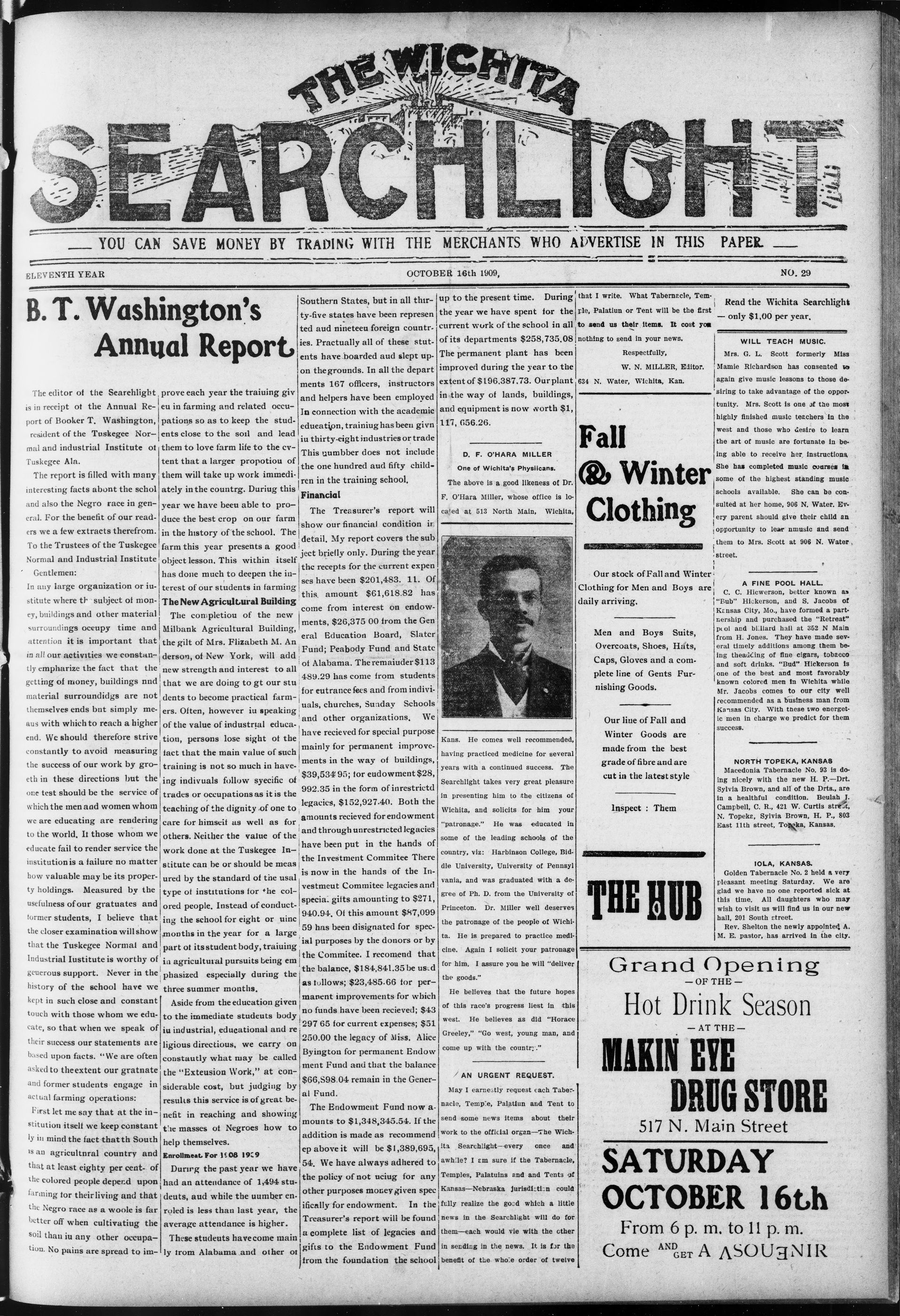
The above is a good likeness of Dr. F. O'Hara Miller, whose office is located at 513 North Main, Wichita.
M. B.
Kans. He comes well recommended, having practiced medicine for several years with a continued success. The Searchlight takes very great pleasure in presenting him to the citizens of Wichita, and solicits for him your "patronage." He was educated in some of the leading schools of the country, viz: Harbinson College, Biddle University, University of Pennsylvania, and was graduated with a degree of Ph. D. from the University of Princeton. Dr. Miller well deserves the patronage of the people of Wichita. He is prepared to practice medicine. Again I solicit your patronage for him. I assure you he will "deliver the goods."
He believes that the future hopes of this race's progress liest in this west. He believes as did "Horace Greeley," "Go west, young man, and come up with the country."
AN URGENT REQUEST.
May I earnestly request each Tabernacle, Temple, Palatium and Tent to send some news items about their work to the official organ—The Wichita Searchlight—every once and awhile? I am sure if the Tabernacle, Temples, Palatuins and Tents of Kansas—Nebraska jurisdiction could fully realize the good which a little news in the Searchlight will do for them—each would vie with the other in sending in the news. It is for the benefit of the whole order of twelve
From 6 p. m. to 11 p. m.
Come $ ^{AND}_{GET} $ A $ \Lambda SOU \exists NIR $
that I write. What Tabernacle, Temple, Palatium or Tent will be the first to send us their items. It cost you nothing to send in your news.
W. N. MILLER, Editor.
634 N. Water, Wichita, Kan.
Fall
@ Winter
Clothing
Our stock of Fall and Winter
Clothing for Men and Boys are
daily arriving.
Men and Boys Suits, Overcoats, Shoes, Hats, Caps, Gloves and a complete line of Gents Furnishing Goods.
Our line of Fall and Winter Goods are made from the best grade of fibre and are cut in the latest style
Inspect : Them
THE HUB
Grand C
OF
Hot Drin
---
NO.29
Read the Wichita Searchlight only $1,00 per year.
WILL TEACH MUSIC.
Mrs. G. L. Scott formerly Miss Mamie Richardson has consented to again give music lessons to those desiring to take advantage of the opportunity. Mrs. Scott is one of the most highly finished music teachers in the west and those who desire to learn the art of music are fortunate in being able to receive her instructions. She has completed music courses in some of the highest standing music schools available. She can be consulted at her home, 906 N. Water. Every parent should give their child an opportunity to learn nmusic and send them to Mrs. Scott at 906 N. Water street.
A FINE POOL HALL.
C. C. Hiewerson, better known as "Bub" Hickerson, and S. Jacobs of Kansas City, Mo., have formed a partnership and purchased the "Retreat" pool and billiard hall at 352 N Main from H. Jones. They have made several timely additions among them being theadding of fine cigars, tobacco and soft drinks. "Bud" Hickerson is one of the best and most favorably known colored men in Wichita while Mr. Jacobs comes to our city well recommended as a business man from Kansas City. With these two energetic men in charge we predict for them success.
NORTH TOPEKA, KANSAS
Macedonia Tabernacle No. 93 is doing nicely with the new H. P.—Drt. Sylvia Brown, and all of the Drts., are in a healthful condition. Beulah J. Campbell, C. R., 421 W. Curtis street, N. Topekz, Sylvia Brown, H. P., 803 East 11th street, Topeka, Kansas.
IOLA. KANSAS.
Golden Tabernacle No. 2 held a very pleasant meeting Saturday. We are glad we have no one reported sick at this time. All daughters who may wish to visit us will find us in our new hall, 201 South street. Rev. Shelton the newly appointed A. M. E. pastor, has arrived in the city.
By WILL, LEVINGTON COMFORT
(Copyright, by J. B. Lippincott Co.)
Let us be commonplace for a minute and begin with a spring night and a college campus, garnished with moonlight, maple-buds—and a man and a maiden standing closely together.
"But, Nettie, if you don't think I'm worth waiting for, I'm sure I don't know just what to do about it," the man said dismally.
"You are worth waiting for, Jim," was the soft answer. "I believe in you and like you—better than anybody I ever knew; but, Jim, you know you are slow."
"Yes, there seems to be a general agreement on that; but you wait two years, Nettle, and I'll go out into the southwest and make a bunch of money and come back and marry you. In two years—"
"But how are you going to make this bunch of money?" she asked, with sweet skepticism.
"Oh, the southwest, you know. They're rushers out there. I'll hustle."
Nettle was silent for a moment. It is possible that she was trying to conjure to her brain a picture of big Jim Quest in the act of hustling.
"Yes, dear," whispered Jim; "I'll think of you always out there while I'm banging about, piling up dollars."
And so it came about that Jim gritted his teeth at the southwest, vowing to manhandle the same out of a competence for two.
After many days he strolled over into Mexico and discovered Corazel, which was concealed like a yellow-brown chameleon on the yellow-brown sand. The day was shaking down her shadows when Jim Quest came and the little people were awake. Because he was a-hungered and very hot and weary, the people ministered unto him—brought him milk and choice portions of goats, fragrant bouquets of red wine and coffee black.
One lithe-fingered, marvel-eyed maiden rolled cigarettes for him, as you would imagine Mother Nature would make roses if she set about doing a half-dozen blossoms a minute. And another girl—so wondrous that Jim thought she must be a mirage at the edge of the sunset, until he heard her voice—swung a hammock for him at the window of the house.
"I knew it—I sure knew it," murred Jim. "If you keep on going, you're bound to find something to do. I think I am going to like this."
It transpired that he was in the house of Quesada, to whom all Corazel bowed. A very old Spaniard was the senor, with some riches, caprices, venoms and affections. When the last century was in its high noon, Quesada had come over from Spain into Mexico. He had found silver, and it was a stately tradition in Corazel and the province that the old man had a paper which pointed out the mouth of the Lost Lode, a tooth of almost solid silver, known to be somewhere among the Diablo peaks, though lost for decades. Senor Quesada also possessed two daughters: Magdalena, who swung Jim's hammock, and whose beauty would have startled Madrid; and Juanita, the little sister, who loved to roll Jim's cigarettes and serve in the shadows.
Quesada and his family treated the American with great deference, until Jim began to believe that he was a Messiah long expected. Without stirring from his hammock, he could learn Spanish. There was infinite peace in the prospect of the wilderness of mountains to the south and east. Plainly Corazel was his destiny; for, as he had proved, there were no fortunes to be made behind.
Jim filled some great need and had not the heart to depart. Weeks elapsed and his Spanish permitted him to learn the manner of his service. Senor Quesada, dim of mind and dismantled of body, bent over the young man's hammock one morning and bade him follow. They mounted horses in silence and rode out into the tinted mountains together, where the old Spaniard showed him his secret silver mine filled with wealth untold.
Now, just here the plot bears down. Jose Costa coveted not only the possessions of Quesada, including the map to the Lost Lode, but he had looked upon the elder daughter, Magdalena, and ridden away with a star in his eyes. In the failing brain of the old Spaniard, the length and breadth and thickness of our Jim were adjusted to a design. He was to act as a moral force to the existing defenders of Corazel in the event of a raid; and also, by his considerable presence, he was to act as a preventive against any extreme measures on the part of Jose Costa.
But, alas, days and weeks of unvarying sunlight and eternal stars faded the realism into a vague, mythical story. The morning ride to the Lost Lode, the ardor of the toil of defense, and even the existence of Jose Costa, partook at last of the hush of dream-stuff. But the wines of Quesada were not dream-stuff, nor the eyes of Magdalena, nor the memory of Nettie in the blowing campus—Nettie, to whom he surely must write presently—nor the smiles of Juanita from the shadows, as she poured his wines and toyed with her miracles of cigarettes. The serenity drew on and on. Then came the morning that Senor Quesada screamed.
The Spaniard was sitting upright in the bed from which he had not moved since Jim placed him there, after the
Special Master E. V. McKeever died
ride from the Lode. Just now, as the American answered the call, the vacant eyes rekindled. The daughters drew back into the midst of the foliage of the court. Quesada picked at his throat, and a paper shook in his hands.
"Listen, big man," came harshly from the gray visage. "All this is yours—only kill Jose Costa when he comes, and you marry my daughter, Magda—"
"But—" Jim began.
The old man fell back and heard, nor was he heard again. Death crept upon him from beneath and silently—as a spring fills its basin in a rock.
From the paper which made him rich, Jim glanced out into the court where the fountain tinkled. He met the eyes of Magdalena there. Somehow, he thought about that breezy night in the campus, and how Nettie's eyes were lit. Presently he dropped into his hammock, and his mind played with the puzzle, until slumber drew on apace. When he awoke he wrote to Nettie. Here is part:
I've got a world of money in a silver mine, but I don't see how I can keep it. The old man who left it to me wasn't right upperly, and I think I'll negate the stuff and turn it over to the daughters. Sit tight, little girl; I'll get a-hold of another fortune somewhere. Don't forget that that I happen in upon you and the St. Mary with a preacher and a coupling-pin; also finances for two. I've been thinking about you every minute. Yours until life's sunset.
After this heavy effort, Jim meditated a long time. The paper covering the possessions of Quesada was made to him, so he couldn't turn it over to the daughters just as it was. He must go to Amadillo and sell the Lode, dividing the proceeds between the Sisters Quesada. He wished that the old man hadn't gone crazy at the last. He didn't see how he could very well reimburse himself for his services as the chief of staff of Corazel's defenders, at the expense of the girls. It would be holding out on the defenseless. But there was no need to hurry. The days were very hot for travel, and so he put off his journey to Amadillo. He was vaguely sorry to keep Nettle waiting. Her answer came at last. Here, in full, is the intelligence it bore:
Why, you dear old Delayer, I'm married and have a baby. Nobody but Evangeline could wait forever without any help from the postal service, I don't mind telling you, Jim (if you'll burn this letter), that I might have waited a bit longer, except that there is no redeemption for a woman who the boyfriend to reflect the glow of "life's sunset." It isn't mean to tell you that I am happy, because I know you are. Jim Quest couldn't help being happy.
Yours on the other side of sunset, NETTIE HOLDING.
Jim drew out his match box, scratched a Vesuvian, and dutifully ignited the letter. "It's a fact," he reflected. "I suppose I should have written to her. After all, Jerry Holding is a good fellow."
Magdalena came with broom and dust-pan and swept up the charred paper from the floor. How simple and restful it would be now, with Nettie dead to him, to carry out the wishes of Senor Quesada! What a gorgeous creature Magdalena was!
The next day he set out upon his journey. Word that the Lost Lode had been found startled the sleepy city An expert and a representative of capital accompanied Jim back to the mountain treasure. All that Quesada had dreamed was true. With a sum of money that would cause certain men to turn a foe to their race, Jim rode into Corazel one jeweled dawn after an absence of four days. It was right good to be home again. The natives gathered about his pony near the edge of the village, and it was gradually borne to Jim that Jose Costa, bandit and son of a bandit, had descended while he was away, and that Magdalena was gone. "Do you mean that you allowed that robber to come in and loot the town of its lady?" Jim questioned reproachfully. Spanish was of course being snoken.
"But, Senor Jim," they told him breathlessly, "Senor Jose did not enter Corazel. He remained with his men out on the mesa and whistled. It was in the dusk, and long after he had ridden away we found that Senorita Magdalena was gone, with her entire torzal."
"Huh—'torzal?' Jim repeated dully. His little Spanish dictionary gave light in the word "trousseau." "I'm afraid I should have done no better than you did, neighbors," he declared at length, spurring on toward the casa of the late Senor Quesada.
"I guess I'll have to go down deeper into Mexico," he muttered. "Corazel is getting too heady and tumultuous for me."
Some one was standing in the doorway of the Quesada house—a figure with which his mind had grown unfamiliar in the late furious days. Since the old Spaniard died, this figure had kept to the farthest shadows. Because there was no other, strange, shy little Juanita came forth to welcome him. She ran to get him wine, as she used to, and swung his hammock in the coolest shadow, giving commands to the servants meanwhile. "It's a terribly hot morning, and I've ridden long, cara milo," he said at last, "but if I put it off until next Sunday, some earthquake or volcanic visitation will get you first. Won't you please go to church with me?" That night they stood together in the moonlit court. Through the gate of the patio they could see the southern mountains, white like the castles of Spain.
"There's only one cloud in the world ahead," Jim said softly. "I've got to find that interesting bandit—"
"But you would not kill poor Magdalena's husband?" Juanita implored.
"Gracious, no!" said Jim; "but half of all this money belongs to Magdela."
JIM.
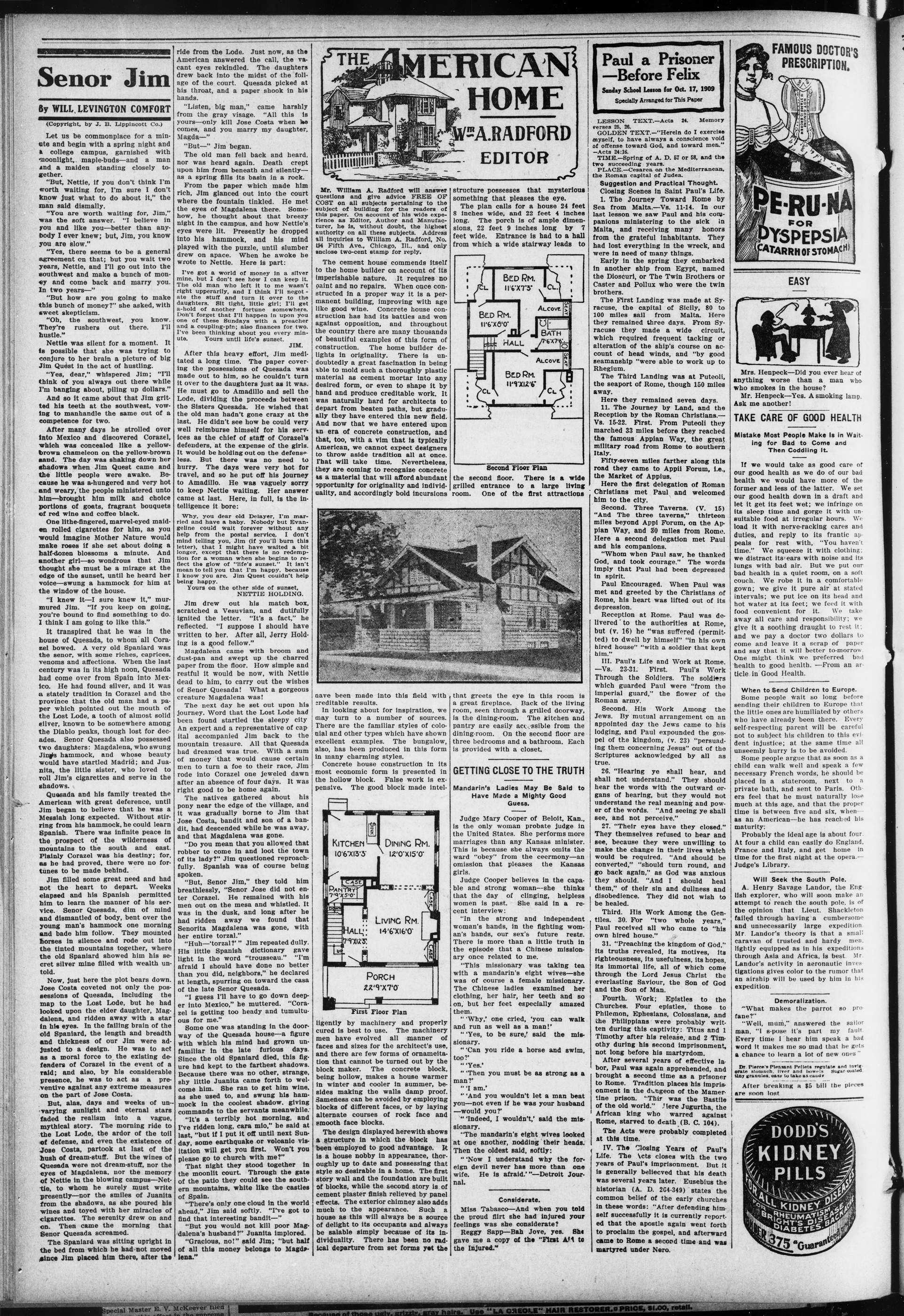
THE AMERICAN HOME W-M.A.RADFORD EDITOR Mr. William A. Radford will answer structure possesses that mysterious questions and give advice FREE OF something that pleases the eye.
The plan calls for a house 24 feet 8 inches wide, and 22 feet 4 inches long. The porch is of ample dimensions, 22 feet 9 inches long by 7 feet wide. Entrance is had to a hall from which a wide stairway leads to
BED RM.
11'6"X7'3"
CL.
BED RM.
11'6"X8'0"
ALCOVE
HALL
BATH
7'6"X7'6"
ALCOVE
BED RM.
11'9"X12'6"
CL
the second floor. There is a wide grilled entrance to a large living room. One of the first attractions
THE HOME OF THE HUNTINGTON HUNTINGTON HUNTINGTON
THE HOME OF THE HERITAGE CENTER
that greets the eye in this room is a great fireplace. Back of the living room, seen through a grilled doorway, is the dining-room. The kitchen and pantry are easily accessible from the dining-room. On the second floor are three bedrooms and a bathroom. Each is provided with a closet.
GETTING CLOSE TO THE TRUTH
Mandarin's Ladies May Be Said to Have Made a Mighty Good Guess.
Judge Mary Cooper of Beloit, Kan., is the only woman probate judge in the United States. She performs more marriages than any Kansas minister. This is because she always omits the ward "obey" from the ceermony—an omission that pleases the Kansas girls.
Judge Cooper believes in the capable and strong woman—she thinks that the day of clinging, helpless women is past. She said in a recent interview:
"In the strong and independent woman's hands, in the fighting woman's hands, our sex's future rests. There is more than a little truth in the episode that a Chinese missionary once related to me.
"This missionary was taking tea with a mandarin's eight wives—she was of course a female missionary. The Chinese ladies examined her clothing, her hair, her teeth and so on, but her feet especially amazed them.
"Why,' one cried, 'you can walk and run as well as a man!'
"Yes, to be sure,' said the missionary.
"Can you ride a horse and swim, too?"
"Yes.'
"Then you must be as strong as a man?"
"I am.'
"And you wouldn't let a man beat you—not even if he was your husband—would you?"
"Indeed, I wouldn't,' said the missionary.
"The mandarin's eight wives looked at one another, nodding their heads. Then the oldest said, softly:
"Now I understand why the foreign devil never has more than one wife. He is afraid."—Detroit Journal.
Miss Tabasco—And when you told the proud flirt she had injured your feelings was she considerate? Reggy Sapp—Bah Jove, yes. She gave me a copy of the "First A'19 to the Injured."
---
Mr. William A. Radford will answer questions and give advice FREE OF COST on all subjects pertaining to the subject of building for the readers of this paper. On account of his wide experience as Editor, Author and Manufacturer, he is authorized authority on all these subjects. Address all inquiries to William A. Radford, No. 194 Fifth Ave., Chicago, Ill., and only onlce two-cent stamp for reply.
The cement house commends itself to the home builder on account of its imperishable nature. It requires no paint and no repairs. When once constructed in a proper way it is a permanent building, improving with age like good wine. Concrete house construction has had its battles and won against opposition, and throughout the country there are many thousands of beautiful examples of this form of construction. The home builder delights in originality. There is undoubtedly a great fascination in being able to mold such a thoroughly plastic material as cement mortar into any desired form, or even to shape it by hand and produce creditable work. It was naturally hard for architects to depart from beaten paths, but gradually they have entered this new field. And now that we have entered upon an era of concrete construction, and that, too, with a vim that is typically American, we cannot expect designers to throw aside tradition all at once. That will take time. Nevertheless, they are coming to recognize concrete as a material that will afford abundant opportunity for originality and individuality, and accordingly bold incursions
have been made into this field with creditable results. In looking about for inspiration, we may turn to a number of sources. There are the familiar styles of colonial and other types which have shown excellent examples. The bungalow, also, has been produced in this form in many charming styles. Concrete house construction in its most economic form is presented in the hollow block. False work is expensive. The good block made intel-
KITCHEN
10'6"X13'3"
DINING RM.
12'0"X15'0"
CASE
PANTRY
7'9"X5'0"
DRAWN
HALL
7'9"X12'3"
LIVING RM.
14'6"X16'0"
UP
PORCH
22'9"X7'0"
First Floor Plan
First Floor Plan ligently by machinery and properly cured is best to use. The machinery men have evolved all manner of faces and sizes for the architect's use, and there are few forms of ornameitation that cannot be turned out by the block maker. The concrete block, being hollow, makes a house warmer in winter and cooler in summer, besides making the walls damp proof. Sameness can be avoided by employing blocks of different faces, or by laying alternate courses of rock face and smooth face blocks.
The design displayed herewith shows a structure in which the block has been employed to good advantage. It is a house nobby in appearance, thoroughly up to date and possessing that style so desirable in a home. The first story wall and the foundation are built of blocks, while the second story is of cement plaster finish relieved by panel effects. The exterior chimney also adds much to the appearance. Such a house as this will always be a source of delight to its occupants and always be salable simply because of its individuality. There has been no radical departure from set forms yet the
" 'I am.'
Considerate.
LESSON TEXT.—Acts 24. Memory verses 25. 26.
GOLDEN TEXT.—"Herein do I exercise myself, to have always a conscience void of offense toward God, and toward men."—Acts 24:16.
TIME.—Spring of A. D. 57 or 58, and the two succeeding years.
PLACE.—Cesarea on the Mediterranean, the Roman capital of Judaea.
Suggestion and Practical Thought.
Closing Scenes in Saint Paul's Life.
1. The Journey Toward Rome by Sea from Malta.—Vs. 11-14. In our last lesson we saw Paul and his companions ministering to the sick in Malta, and receiving many honors from the grateful inhabitants. They had lost everything in the wreck, and were in need of many things.
Early in the spring they embarked in another ship from Egypt, named the Dioscurl, or The Twin Brothers or Caster and Pollux who were the twin brothers.
The First Landing was made at Syracuse, the capital of Sicily, 80 to 100 miles sail from Malta. Here they remained three days. From Syracuse they made a wide circuit, which required frequent tacking or alteration of the ship's course on account of head winds, and "by good seamanship "were able to work up to Rhegium.
The Third Landing was at Puteoli, the seaport of Rome, though 150 miles away.
Here they remained seven days.
11. The Journey by Land, and the Reception by the Roman Christians.—Vs. 15-22. First. From Puteoli they marched 33 miles before they reached the famous Appian Way, the great military road from Rome to southern Italy.
Fifty-seven miles farther along this road they came to Appil Forum, i.e., the Market of Appius.
Here the first delegation of Roman Christians met Paul and welcomed him to the city.
Second. Three Taverns. (V. 15)
"And The three taverns," thirteen miles beyond Appi Forum, on the Appian Way, and 40 miles from Rome. Here a second delegation met Paul and his companions.
"Whom when Paul saw, he thanked God, and took courage." The words imply that Paul had been depressed in spirit.
Paul Encouraged. When Paul was met and greeted by the Christians of Rome, his heart was lifted out of its depression.
Reception at Rome. Paul was delivered to the authorities at Rome, but (v. 16) he "was suffered (permitted) to dwell by himself" "in his own hired house" "with a soldier that kept him."
III. Paul's Life and Work at Rome.
-Vs. 23-31. First. Paul's Work
Through the Soldiers. The soldiers
which guarded Paul were "from the
imperial guard," the flower of the
Roman army.
Second. His Work Among the
Jews. By mutual arrangement on an
appointed day the Jews came to his
lodging, and Paul expounded the gospel
of the kingdom, (v. 23) "persuading
them concerning Jesus" out of the
Scriptures acknowledged by all as
true.
26. "Hearing ye shall hear, and
shall not understand." They should
hear the words with the outward organs
of hearing, but they would not
understand the real meaning and power
of the words. "And seeing ye shall
see, and not perceive."
27. "Their eyes have they closed." They themselves refused to hear and see, because they were unwilling to make the change in their lives which would be required. "And should be converted," "should turn round, and go back again," as God was anxious they should. "And I should heal them," of their sin and dullness and disobedience. They did not wish to be healed.
Third. His Work Among the Gentiles. 30. For "two whole years," Paul received all who came to "his own hired house."
31. "Preaching the kingdom of God," its truths revealed, its motives, its righteousness, its usefulness, its hopes, its immortal life, all of which come through the Lord Jesus Christ the everlasting Saviour, the Son of God and the Son of Man.
Fourth. Work; Epistles to the Churches. Four epistles, those to Philemon, Ephesians, Colossians, and the Philippians were probably written during this captivity: Titus and 1 Timothy after his release, and 2 Timothy during his second imprisonment, not long before his martyrdom.
After several years of effective labor, Paul was again apprehended, and brought a second time as a prisoner to Rome. Tradition places his imprisonment in the dungeon of the Mamertine prison. "Thir was the Bastile of the old world." Here Jugurtha, the African king who warred against Rome, starved to death (B. C. 104).
The Acts were probably completed at this time.
IV. The Closing Years of Paul's Life. The \cts closes with the two years of Paul's imprisonment. But it is generally believed that his death was several years later. Eusebius the historian (A. D. 204-349) states the common belief of the early churches in these words: "After defending himself successfully it is currently reported that the apostle again went forth to proclaim the gospel, and afterward came to Rome a second time and was martyred under Nero.
FAMOUS DOCTOR'S
PRESCRIPTION.
PE·RU·NA
FOR
DYSPEPSIA
(CATARRH OF STOMACH)
Mrs. Henpeck—Did you ever hear of anything worse than a man who who smokes in the house?
Mr. Henpeck—Yes. A smoking lamp. Ask me another!
TAKE CARE OF GOOD HEALTH
Mistake Most People Make Is in Waiting for Bad to Come and Then Codding It.
If we would take as good care of our good health as we do of our bad health we would have more of the former and less of the latter. We set our good health down in a draft and let it get its feet wet; we infringe on its sleep time and gorge it with unsuitable food at irregular hours. We load it with nerve-racking cares and duties, and reply to its frantic appeals for rest with, "You haven't time." We squeeze it with clothing; we distract its ears with noise and its lungs with bad air. But we put our bad health in a quiet room, on a soft couch. We robe it in a comfortable gown; we give it pure air at stated intervals; we put ice on its head and hot water at its feet; we feed it with food convenient for it. We take away all care and responsibility; we give it a soothing draught to rest it; and we pay a doctor two dollars to come and leave it a scrap of paper and say that it will better to-morrow. One might think we preferred bad health to good health. —From an article in Good Health.
When to Send Children to Europe
Some people wait so long before sending their children to Europe that the little ones are humiliated by others who have already been there. Every self-respecting parent will be careful not to subject his children to this evil injustice; at the same time all unseemly hurry is to be avoided.
Some people argue that as soon as a child can walk well and speak a few necessary French words, he should be placed in a stateroom, next to a private bath, and sent to Paris. Others feel that he must naturally lose much at this age, and that the proper time is between five and six, when—as an American—he has reached his maturity.
Probably the ideal age is about four. At four a child can easily do England, France and Italy, and get home in time for the first night at the opera. Judge's Library.
Will Seek the South Pole.
A. Henry Savage Landor, the English explorer, who will soon make an attempt to reach the south pole, is of the opinion that Lieut. Shackleton failed through having a cumbersome and unnecessarily large expedition. Mr. Landor's theory is that a small caravan of trusted and hardy men lightly equipped as in his expeditions through Asia and Africa, is best. Mr. Landor's activity in aeronautic investigations gives color to the rumor that an airship will be used by him in his expedition.
Demoralization.
"What makes the parrot so profane?"
"Well, mum," answered the sailor man. "I s-pose it's part my fault. Every time I hear him speak a bad word it makes me so mad that he gets a chance to learn a lot of new ones"
Dr Pierce's Pleasant Pellets regulate and invigorate stomach, liver and bowels. Sugar coated tiny granules, easy to take as cause
After breaking a $5 bill the pieces are soon lost
DODD'S
KIDNEY
PILLS
FOR ALL KIDNEY DISEASES
FOR RHEUMATISM
BRIGHT'S DISEASE
DIABETES. BACKRUSH
HL375 "Guarantee"
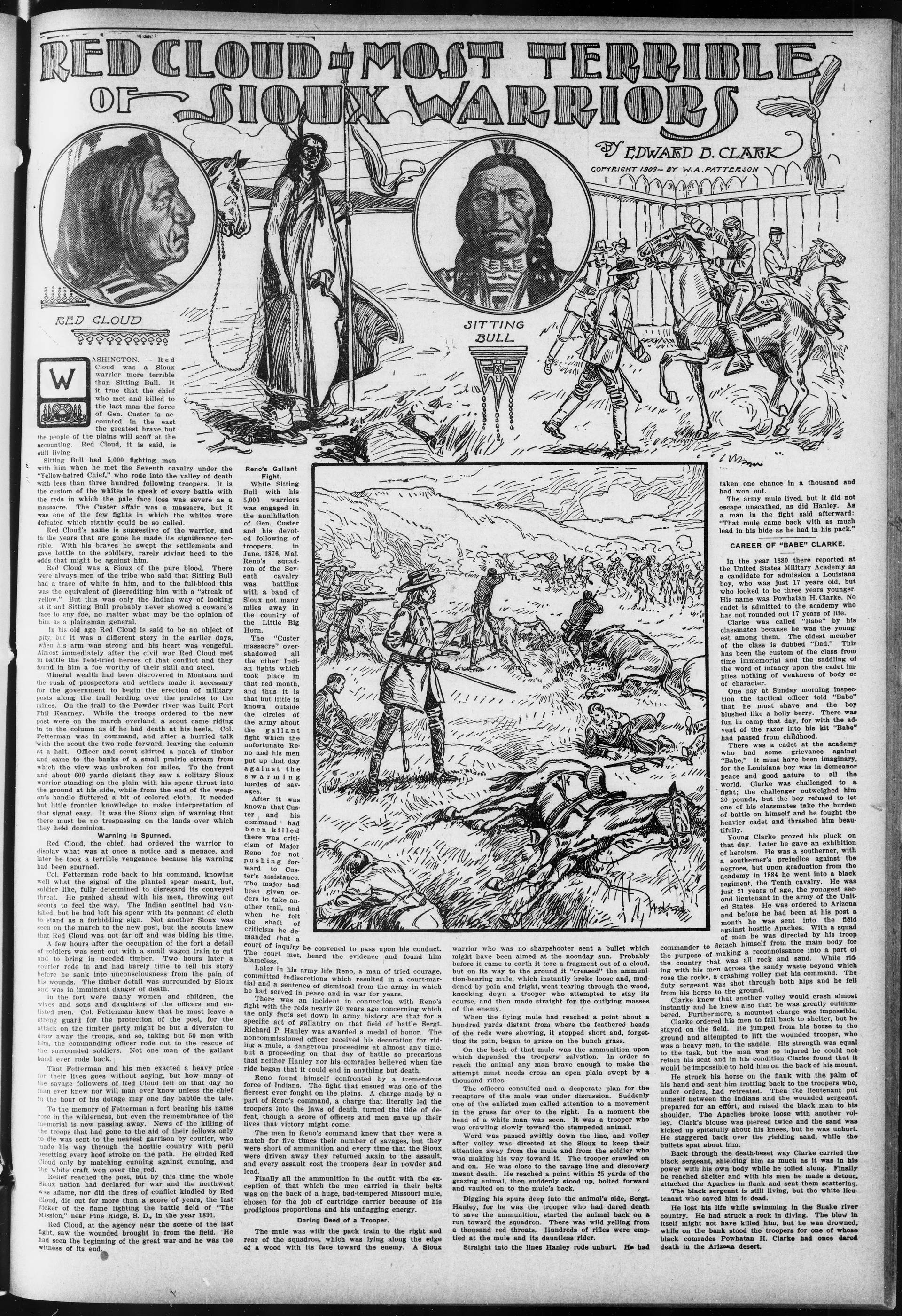
RED CLOUD • MOST TERRIBLE OF SIOUX WARRIORS
BY EDWARD D. CLARK
COPYRIGHT 1909—BY W.A. PATTerson
RED CLOUD
SITTING BULL
ASHINGTON. — Red Cloud was a Sioux warrior more terrible than Sitting Bull. It it true that the chief who met and killed to the last man the force of Gen. Custer is accounted in the east the greatest brave, but the people of the plains will scoff at the accounting. Red Cloud, it is said, is still living.
THE BATTLE OF THE CALIFORNIA CIVIL WAR
Reno's Gallant Fight.
While Sitting Bull with his 5,000 warriors was engaged in the annihilation of Gen. Custer and his devoted following of troopers, in June, 1876, Maj. Reno's squadron of the Seventh cavalry was battling with a band of Sioux not many miles away in the country of the Little Big Horn.
The "Custer massacre" overshadowed all the other Indian fighters which took place in that red month, and thus it is that but little is known outside the circles of the army about the gallant fight which the unfortunate Reno and his men put up that day against the swarming hordes of savages.
After it was known that Custer and his command had been killed there was criticism of Major Reno for not pushing forward to Custer's assistance. The major had been given orders to take another trail, and when he felt the shaft of criticism he demanded that a court of inquiry be convened to pass upon his conduct. The court met, heard the evidence and found him blameless.
Later in his army life Reno, a man of tried courage, committed indiscretions which resulted in a court-martial and a sentence of dismissal from the army in which he had served in peace and in war for years.
There was an incident in connection with Reno's fight with the reds nearly 30 years ago concerning which the only facts set down in army history are that for a specific act of gallantry on that field of battle Sergt. Richard P. Hanley was awarded a medal of honor. The noncommissioned officer received his decoration for riding a mule, a dangerous proceeding at almost any time, but a proceeding on that day of battle so precarious that neither Hanley nor his comrades believed when the ride began that it could end in anything but death.
Reno found himself confronted by a tremendous force of Indians. The fight that ensued was one of the fiercest ever fought on the plains. A charge made by a part of Reno's command, a charge that literally led the troopers into the jaws of death, turned the tide of defeat, though a score of officers and men gave up their lives that victory might come.
The men in Reno's command knew that they were a match for five times their number of savages, but they were short of ammunition and every time that the Sioux were driven away they returned again to the assault, and every assault cost the troopers dear in powder and lead.
Finally all the ammunition in the outfit with the exception of that which the men carried in their belts was on the back of a huge, bad-tempered Missouri mule, chosen for the job of cartridge carrier because of his prodigious proportions and his unflagging energy.
Daring Deed of a Trooper.
The mule was with the pack train to the right and rear of the squadron, which was lying along the edge of a wood with its face toward the enemy. A Sioux
Sitting Bull had 5,000 fighting men
with him when he met the Seventh cavalry under the "Yellow-haired Chief," who rode into the valley of death with less than three hundred following troopers. It is the custom of the whites to speak of every battle with the reds in which the pale face loss was severe as a massacre. The Custer affair was a massacre, but it was one of the few fights in which the whites were defeated which rightly could be so called.
Red Cloud's name is suggestive of the warrior, and in the years that are gone he made its significance terrible. With his braves he swept the settlements and gave battle to the soldierry, rarely giving heed to the odds that might be against him.
Red Cloud was a Sioux of the pure blood. There were always men of the tribe who said that Sitting Bull had a trace of white in him, and to the full-blood this was the equivalent of discrediting him with a "streak of yellow." But this was only the Indian way of looking at it and Sitting Bull probably never showed a coward's face to any foe, no matter what may be the opinion of him as a plainsman general.
In his old age Red Cloud is said to be an object of pity, but it was a different story in the earlier days, when his arm was strong and his heart was vengeful. Almost immediately after the civil war Red Cloud met in battle the field-tried heroes of that conflict and they found in him a foe worthy of their skill and steel.
Mineral wealth had been discovered in Montana and the rush of prospectors and settlers made it necessary for the government to begin the erection of military posts along the trail leading over the prairies to the mines. On the trail to the Powder river was built Fort Phil Kearney. While the troops ordered to the new post were on the march overland, a scout came riding in to the column as if he had death at his heels. Col. Petterman was in command, and after a hurried talk with the scout the two rode forward, leaving the column at a halt. Officer and scout skirted a patch of timber and came to the banks of a small prairie stream from which the view was unbroken for miles. To the front and about 600 yards distant they saw a solitary Sloux warrior standing on the plain with his spear thrust into the ground at his side, while from the end of the weapon's handle fluttered a bit of colored cloth. It needed but little frontier knowledge to make interpretation of that signal easy. It was the Sloux sign of warning that there must be no trespassing on the lands over which they held dominion.
Warning Is Spurned.
Red Cloud, the chief, had ordered the warrior to display what was at once a notice and a menace, and later he took a terrible vengeance because his warning had been spurned.
Col. Fetterman rode back to his command, knowing well what the signal of the planted spear meant, but, soldier like, fully determined to disregard its conveyed threat. He pushed ahead with his men, throwing out scouts to feel the way. The Indian sentinel had vanished, but he had left his spear with its pennant of cloth to stand as a forbidding sign. Not another Sioux was seen on the march to the new post, but the scouts knew that Red Cloud was not far off and was biding his time.
A few hours after the occupation of the fort a detail of soldiers was sent out with a small wagon train to cut and to bring in needed timber. Two hours later a courier rode in and had barely time to tell his story before he sank into unconsciousness from the pain of his wounds. The timber detail was surrounded by Sioux and was in imminent danger of death.
In the fort were many women and children, the wives and sons and daughters of the officers and enlisted men. Col. Fetterman knew that he must leave a strong guard for the protection of the post, for the attack on the timber party might be but a diversion to draw away the troops, and so, taking but 50 men with him, the commanding officer rode out to the rescue of the surrounded soldiers. Not one man of the gallant band ever rode back.
That Fetterman and his men exacted a heavy price for their lives goes without saying, but how many of the savage followers of Red Cloud fell on that day no man ever knew nor will man ever know unless the chief in the hour of his dotage may one day babble the tale.
To the memory of Fetterman a fort bearing his name rose in the wilderness, but even the remembrance of the memorial is now passing away. News of the killing of the troops that had gone to the aid of their fellows only to die was sent to the nearest garrison by courier, who made his way through the hostile country with peril besetting every hoof stroke on the path. He eluded Red Cloud only by matching cunning against cunning, and the white craft won over the red.
Relief reached the post, but by this time the whole Sioux nation had declared for war and the northwest was aflame, nor did the fires of conflict kindled by Red Cloud, die out for more than a score of years, the last flicker of the flame lighting the battle field of "The Mission," near Pine Ridge, S. D., in the year 1891.
Red Cloud, at the agency near the scene of the last fight, saw the wounded brought in from the field. He had seen the beginning of the great war and he was the witness of its end.
Daring Deed of a Trooper.
warrior who was no sharpshooter sent a bullet which might have been aimed at the noonday sun. Probably before it came to earth it tore a fragment out of a cloud, but on its way to the ground it "creased" the ammunition-bearing mule, which instantly broke loose and, maddened by pain and fright, went tearing through the wood, knocking down a trooper who attempted to stay its course, and then made straight for the outlying masses of the enemy.
When the flying mule had reached a point about a hundred yards distant from where the feathered heads of the reds were showing, it stopped short and, forgetting its pain, began to graze on the bunch grass.
On the back of that mule was the ammunition upon which depended the troopers' salvation. In order to reach the animal any man brave enough to make the attempt must needs cross an open plain swept by a thousand rifles.
The officers consulted and a desperate plan for the recapture of the mule was under discussion. Suddenly one of the enlisted men called attention to a movement in the grass far over to the right. In a moment the head of a white man was seen. It was a trooper who was crawling slowly toward the stamped animal.
Word was passed swiftly down the line, and volley after volley was directed at the Sioux to keep their attention away from the mule and from the soldier who was making his way toward it. The trooper crawled on and on. He was close to the savage line and discovery meant death. He reached a point within 25 yards of the grazing animal, then suddenly stood up, bolted forward and vaulted on to the mule's back.
Digging his spurs deep into the animal's side, Sergt. Hanley, for he was the trooper who had dared death to save the ammunition, started the animal back on a run toward the squadron. There was wild yelling from a thousand red throats. Hundreds of rifles were emptied at the mule and its dauntless rider. Straight into the lines Hanley rode unhurt. He had
```markdown
```
taken one chance in a thousand and had won out.
The army mule lived, but it did not escape unscathed, as did Hanley. As a man in the fight said afterward: "That mule came back with as much lead in his hide as he had in his pack."
CAREER OF "BABE" CLARKE.
In the year 1880 there reported at the United States Military Academy as a candidate for admission a Louisiana boy, who was just 17 years old, but who looked to be three years younger. His name was Powhatan H. Clarke. No cadet is admitted to the academy who has not rounded out 17 years of life.
Clarke was called "Babe" by his classmates because he was the youngest among them. The oldest member of the class is dubbed "Dad." This has been the custom of the class from time immemorial and the saddling of the word of infancy upon the cadet implies nothing of weakness of body or of character.
One day at Sunday morning inspection the tactical officer told "Babe" that he must shave and the boy blushed like a holly berry. There was fun in camp that day, for with the advent of the razor into his kit "Babe" had passed from childhood.
There was a cadet at the academy who had some grievance against "Babe," it must have been imaginary, for the Louisiana boy was in demeanor peace and good nature to all the world. Clarke was challenged to a fight; the challenger outweighed him 20 pounds, but the boy refused to let one of his classmates take the burden of battle on himself and he fought the heavier cadet and thrashed him beautifully.
Young Clarke proved his pluck on that day. Later he gave an exhibition of heroism. He was a southerner, with a southerner's prejudice against the negroes, but upon graduation from the academy in 1884 he went into a black regiment, the Tenth cavalry. He was just 21 years of age, the youngest second lieutenant in the army of the United States. He was ordered to Arizona and before he had been at his post a month he was sent into the field against hostile Apaches. With a squad of men he was directed by his troop commander to detach himself from the main body for the purpose of making a reconnoissance into a part of the country that was all rock and sand. While riding with his men across the sandy waste beyond which rose the rocks, a crashing volley met his command. The duty sergeant was shot through both hips and he fell from his horse to the ground.
Clarke knew that another volley would crash almost instantly and he knew also that he was greatly outnumbered. Furthermore, a mounted charge was impossible. Clarke ordered his men to fall back to shelter, but he stayed on the field. He jumped from his horse to the ground and attempted to lift the wounded trooper, who was a heavy man, to the saddle. His strength was equal to the task, but the man was so injured he could not retain his seat and in his condition Clarke found that it would be impossible to hold him on the back of his mount.
He struck his horse on the flank with the palm of his hand and sent him trotting back to the troopers who, under orders, had retreated. Then the lieutenant put himself between the Indians and the wounded sergeant, prepared for an effort, and raised the black man to his shoulder. The Apaches broke loose with another volley. Clark's blouse was pierced twice and the sand was kicked up spitefully about his knees, but he was unhurt. He staggered back over the yielding sand, while the bullets spat about him.
Back through the death-beset way Clarke carried the black sergeant, shielding him as much as it was in his power with his own body while he toiled along. Finally he reached shelter and with his men he made a detour, attacked the Apaches in flank and sent them scattering.
The black sergeant is still living, but the white lieutenant who saved him is dead.
He lost his life while swimming in the Snake river country. He had struck a rock in diving. The blow in itself might not have killed him, but he was drowned, while on the bank stood the troopers for one of whose black comrades Powhatan H. Clarke had once dared death in the Arlzea desert.
AERO VAN CO.
DONCA
MIAMI JOURNAL
PROPERTY HELD FOR FINES
WHERE JOINTKEEPERS FAIL TO PAY IN KANSAS.
Supreme Court Holds Building Where "Joint" is Run is Liable for Fines and Costs.
Topeka, Kansas.—A man who owns property that is used by a jointkeeper in carrying on his illegal trade in Kansas may lose that property if the jointkeeper does not pay the fines and costs assessed against him when he is convicted of violating the law. This was the decision of the Kansas supreme court in a suit of the state against Thomas Karcher from Wilson county. Martin Peters, E. M. De Moss and N. C. Binford ran a joint in Wilson county in a building owned by Peters and Binford. De Moss was arrested, convicted and fined for running the joint. Afterwards Peters and Binford sold the building to Karcher.
Owing to the number of cases against De Moss, an agreement was made by the county officers whereby De Moss paid $750 as part of the costs and fines assessed against him, and was pardoned by Ex-Gov. Hoch. Then, as he had refused to pay any more of the fines and costs assessed against him the state brought suit to recover from the property the amount due on the fines. The court held that this was a proper proceeding and that the property where a joint had been established was always subject to a lien of the state to collect the amount of the fines and costs if the convicted joint-keeper did not pay the bill.
POULTRY AT AMERICAN ROYAL
Fine Birds Form a Notable Part of the Kansas City Live Stock Show.
The poultry show at the American Royal this year is one of the most notable events of the kind ever held either West or East. The farmers and stock raisers of the whole breeding and feeding territory come to Kansas City October 11 to 16, for the great live stock and horse show—and their wives all raise chickens. They will see a poultry exhibition and many of them will enter their choice fowls in it, which will demonstrate what so many farmers say now, that the women of the family are conducting an industry almost as important as those the men conduct. Thomas W. Southard, superintendent of the department, estimates the entries at 2,000 birds.
But the most interesting feature of the poultry department, doubtless, will be the exhibit of Kellerstrass Crystal White Orpingtons, from the Kellerstrass farm near Kansas City. This name is known all over the world, and always, suggests the highest prices ever paid for poultry.
Neither Won the Lahm Cup.
St. Louis, Mo.—Augustus Post, secretary of the Aero Club of America has decided that neither S. L. Von Puhl nor H. E. Honeywell, pilot of the balloons St. Louis No. 3 and the Centennial respectively, are entitled to the Lahm cup. Although each sailed more than 473 miles in the race which started from here last Monday they failed to register for the cup which is now in the possession of Capt. DeForest Chandler.
The Banner Alfaifa Crop.
Topeka, Kansas.—John Tacha, a farmer in Decatur county, threshed 135 bushels of alfalfa seed from 15 acres last week. This was an average of 9 bushels to the acre. He was offered $8 a bushel for it on the ground, or $72 an acre.
An M. K. & T. Wreck in Texas.
Troy, Texas—Running at a high rate of speed, Missouri, Kansas & Texas passenger train No. 3 collided head-on with a fast freight train on a curve near Troy, just out of the Smithville. Three of the crow of the passenger train were Injured.
Chicago Americans Took First Game.
Chicago, Illinois.—The Chicago team of the American league won their first game of the series for the city championship here from the Chicago National league club 2 to 1.
Special Master E. V. McKeever iien report to this effect in the supreme
DEFENDANTS ARE DISCHARGED
Judge Anderson Refused the Request of Government in Panama Libel Case.
Indianapolis, Indiana.—Judge A. B. Anderson, of the United States court of this district dismissed the proceedings against Delavan Smith and Chas. R. Williams, proprietors of the Indianapolis News, who were resisting removal to the District of Columbia for trial under a grand jury indictment charging them with having committed criminal libel in publishing articles alleging there was a corrupt profit of $28,000,000 in the sale of the Panama canal to the United States.
"That man has read the history of our institutions to little purpose," said Judge Anderson, in concluding his decision, "who does not view with apprehension the success of such a proceeding as this to the end that citizens could be dragged from their homes to the District of Columbia, the seat of government for trial under the circumstances of his case. The defendants are discharged."
OKLAHOMA BANK LIQUIDATES
The Columbia Bank & Trust Company Quits and the Central State Bank is Organized.
Oklahoma City, Oklahoma.—With the assets and liabilities of the Columbia Bank & Trust company remaining in the hands of the state banking board, that institution ceases to exist except in name, and its place is taken by the Central State bank with a capital stock of $200,000. The quarters of the Columbia will be occupied jointly by the state board and the new bank temporarily, the board continuing its payment to depositors. According to C. J. Webster, president of the new bank, the institution will not take over of the assets of the Columbia bank.
The refusal of W. I. Norton, after having given the bank board sufficient securities to cancel any questionable indebtedness, to continue in control of the bank was given the board late Saturday night and litigation of the institution was decided upon.
Her German Count Disappointing.
St. Louis, Missouri—Mrs. Elizabeth Rusch, who last Friday married Richard Kuprow, under the impression he was a German count has caused the arrest of her husband on a warrant when she learned he had another wife in Topeka, Kan. Kuprow in jail denied he was married to the woman in Topeka with whom he says he lived for 15 years. Mrs. Rusch married Kuprow after two hours acquaintance. Her husband told her he was a school mate of Emperor William and an heir to an estate in Germany.
Shangahi, China.-The first group of Chinese students, whose education in America schools will be paid for by the Chinese government out of funds derived from that part in the Boxer indemnity that was returned to China by America, left here on the steamer China for San Francisco. The students chosen by the government number 47 and they also are six self supporting students. The group was selected from over 600 candidates.
Infantile Paralysis in New York.
Syracuse, New York. -- Northern New York is alarmed over a disease which is attacking children. Within two days two youngsters have die from the malady, an acute ascending paralysis. In the vicinity of Couver neur there are 40 cases. The dis ease first made its appearance three weeks ago. Physicians are unable to account for the mysterious malady.
Washington, D. C.—The popular idea that the American Indians are decreasing in number is dissipated by Official figures showing that there are more than 300,000 red men in the United State. The increase in population has been about 40,000.
Cholera Threatens Seoul.
Seoul—Cholera threatens to become seriously epidemic here. The authorities are taking every precaution, but Seoul is not a sanitary city and the disease has spread rapidly.
Chinese Students Joming
The Indians Are Increasing.
Cholera Threatens Seoul
The KITCHEN CABINET
AM a great eater of beer and I be
"I protest I do honor a chine of beef,
I do reverence a loin of veal."
Be "Forehanded."
Begin now to prepare the Christmas gifts which there is such pleasure in making. A little work when chatting on the porch these lovely days may be at hand and much accomplished in odd moments. The popular Irish crochet in lace insertion or edge is always acceptable, or the pretty, dainty, little jabots are still much in favor.
One of the prettiest of lunch cloths is made of several rows of double hemstitching with the space between each row filled with the pretty feather-stitching. Then one may have a spray of French embroidery in two corners and the initial just far enough up to lie in sight on the table when the cloth is spread.
Very beautiful effects are made with the lace braid that has a thread which draws up, doing away with the tedious overhanding. A very handsome dolly may be easily made of this kind in two afternoons, the knotted lace thread being used.
The little individual towels embroidered with the initials make a very welcome gift.
The Dutch collar may be easily made, looking much like the expensive ones in the shops. Buy the imitation crochet lace insertion and edge and stitch it on with the machine. It really looks like the real lace and wears well.
Lucanian Eggs.
Slice five hard cooked eggs into eights, lengthwise, lay into a buttered baking dish, alternate layers, with one cupful of cooked macaroni, one and three-fourths cupfuls of white sauce, one-half cupful of grated cheese, salt, pepper and anchovy essence for seasoning. Finish with buttered crumbs and bake in a hot oven until the crumbs are brown.
Ginger Snaps
Take one cupful of sugar, one cupful shortening, one cupful of molasses, one egg, one teaspoonful of soda and ginger, one tablespoonful of vinegar; mix with enough flour to roll them and bake in a quick oven.
HAT will not woman, gentle woman dare.
When strong affection stirs her spirit up?"
—Southey.
"Man may be the head of the family, but far better than that, woman is the heart of it."
Pressed: Beef Flank
Wipe, remove superfluous fat and roll a flank of beef. Put in a kettle, cover with boiling water and add one tablespoonful of salt, one half teaspoonful of pepper corns, a bit of bay leaf and a bone or two which may be at hand. Cook slowly until the meat is in shreds; there should be but a little liquor in the kettle when the meat is done. Arrange the meat in a deep pan, cover and press with a heavy weight. Serve cold, thinly sliced.
Bed Making.
Bed making is an art. One should be as careful and painstaking as possible for an illly-made bed cries out at you in every wrinkle. The metal bed is the most sanitary. They may be expensive or not, as the purse permits. Then have a good, easy spring for we spend one-third of our lives in bed, and let it be a comfortable one. Next, a good, comfortable mattress made in sections, so that it may be easily handled, and turned at least once every other day. The sheets should be long enough to tuck in well at the bottom and turn over a good quarter of a yard, or half is better, at the top of the bedding. The subject of the length of sheets was considered of enough importance to warrant a bill being presented to a state legislature to compel hotels to furnish six-foot sheets. A long sheet, if an under one, may be folded under the mattress at the head and foot, so keeping it from pulling and wrinkling. This is a very important item in the making of a sick bed. A long upper sheet, after being generously tucked in at the bottom, leaves the half yard to fold over the blanket and comforter, thus keeping them clean.
In putting on the blankets in making a bed, when they are double ones in one piece, place the open ends at the head so that one may be thrown back if the covering seems too heavy. Bed making is said to be the best exercise for a sluggish liver, as the stooping and swaying of the body calls into action those unused muscles
Nellie Marwell.
Belated.
"The sting of the bee is behind."
"Just the way with my repartee—I never think of it till the next day."—Puck.
Still Lying.
"By the way, what's become of th.
Ananias club?"
"It's living low."
This $1000 Cup for an ear of Corn
Made by Tiffany. Nearly 3 ft. high—in solid gold and silver. Actual contract price $1,000. To be awarded at the National Corn Exposition, Omaha December 6 to 18, 1909 to the man, woman or child producing the best ear of corn grown this year in the United States.
Open to everybody belonging to the Association—Nothing to buy or sell. The purpose of the donor of this trophy—W. K. Kellogg—is to improve the quality of the millions of bushels of corn used in making Kellogg's Toasted Corn Flakes. Many people think the perfection of corn flavor has been reached in Toasted Corn Flakes. Perhaps it has. If you don't know how good Kellogg's—the genuine Toasted Corn Flakes—is, try it. Then you'll see how hard a task we are giving ourselves to improve it, and the only way we can improve it is by the betterment of the corn itself.
Professor Holden, of the Iowa State College, the greatest authority on corn in the world, will award the prize at the National Corn Exposition, to be held at Omaha, Neb., Dec. 6th to 18th, 1900. Two simple rules will govern the plan, and they are—that you send your best ear of corn to the National Corn Exposition, Omaha, Neb., before November 27, 1909, and that you are a member of the National Corn Association—full particulars regarding which can be had by writing to National Corn Exposition, Omaha, Neb. Tie a tag securely to your specimen and word it. "For the Kellogg Trophy Contest," and write your name and address plainly. If yours is judged the best, you will get the trophy for 1910. If you succeed again next year or the year following, the trophy will become your property for all time.
The contest will be open to every state in the Union. Professor Holden will judge the corn particularly on the basis of quality. The growing of more corn per acre is one object of the award, but the main purpose of the founder of the trophy is for improving the quality of corn used in making KELLOGD TOASTED CORN FLAKES. If you haven't tried this delicious cereal, begin your education in "good things to eat" today. All grocers have it.
V. K. Kellogg
KELLOGG TOASTED CORN FLAKE CO., Battle Creek, Mich.
Young Guest—It seems to me that you don't object to the mosquitoes singing in your room. Old Guest—You bet I don't. Why, when the mosquitoes are singing I can't hear the glee club practicing on the piazza.
True Representative of Race
Dr. Bethmann-Hollweg may claim this distinction, that he is the first German chancellor to wear a beard. Bismarck hastened to shave his off when he entered upon diplomacy, and showed his rivals and enemies a massive jaw and clear-cut chin; and he shaved to the end, with an interval enforced by neuralgia in the early '80s. As a soldier, too Caprivl shaved, all but his mustache, and so did Hohenlohe and Bulow. But Bethmann-Hollweg is gaunt, rugged, hirsute, pan-Germanic.
Reaching Life's Goal.
If you want to be somebody in this world you must assert your individuality and assert it in the right direction, so that it may lead to a goal of honor for yourself and be an example for others. Find out what you ought to do, say to yourself: "I must do it," then begin right at with "I will do it," and keep at it until it is done.
FOOD QUESTION Settled with Perfect Satisfaction by a Dyspeptic.
It's not an easy matter to satisfy all the members of the family at meal time as every housewife knows. And when the husband has dyspepsia and can't eat the simplest ordinary food without causing trouble, the food question becomes doubly annoying.
An Illinois woman writes:
"My husband's health was poor, he had no appetite for anything I could get for him, it seemed.
"He was hardly able to work, was taking medicine continually, and as soon as he would feel better would go to work again only to give up in a few weeks. He suffered severely with stomach trouble.
"Tired of everything I had been able to get for him to eat, one day seeing an advertisement about Grape-Nuts, I got some and tried it for breakfast the next morning.
"We all thought it was pretty good although we had no idea of using it regularly. But when my husband came home at night he asked for Grape-Nuts.
"It was the same next day and I had to get it right along, because when we would get to the table the question, 'Have you any Grape-Nuts' was a regular thing. So I began to buy it by the dozen pkgs.
"My husband's health began to improve right along. I sometimes felt offended when I'd make something I thought he would like for a change, and still hear the same old question, 'Have you any Grape-Nuts?'
"He got so well that for the last two years he has hardly lost a day from his work, and we are still using Grape-Nuts." Read the book, "The Road to Wellville," in pkgs. "There's a reason."
Ever read the above letter! A new one appears from time to time. They are genuine, true, and full of human energy.
Cup
and sil-
l at the
december
18, 1909
ear of
y or sell.
the quality
on Flakes.
stored Corn
the genuine
are giving
the better-
corn in the
at Omaha,
they are—
sha, Neb.,
corn Asso-
ional Corn
it. "For
If yours
next year
will judge
Kellogg
TOASTED
CORN
FLAKES
W. Kellogg
TOASTED CORN FLAKES CO.
BATTLE GREEN, MICH.
Mich.
Food Products
RECEIVED THE ONLY
ND PRIZE
(HIGHEST AWARDS)
Yukon-Pacific Exposition
AT ALL COMPETITORS ON
CALIFORNIA ASPARAGUS—PRESERVES—JELLIES—
MILK-EVAPORATED MILK—CALIFORNIA FRUITS
CANNED MEATS
DRIED BEEF—OX TONGUE—VEAL LOAF—
LOAF-VIENNA SAUSAGE
ITY COUNTS WE LEAD
Them—Insist on Getting Libby's
NEILL & LIBBY
Libby's Food Products RECEIVED THE ONLY
WHERE QUALITY COUNTS WE LEAD Your Grocer Has Them—Insist on Getting Libby's LIBBY, McNEILL & LIBBY
ner, "you
uld stone
---
Definite Location.
Every visitor at the new capitol at Harrisburg, Pa., who gets as far as the registration room, is expected to write his name in a big book, together with his birthplace and present residence, says the Troy Times. Not long ago, when a crowd of excursionists visited the grounds and buildings, a stout girl started to register.
She paused, pen poised in air, and called out to an elderly lady, comfortably seated in a big chair, "Mon, vere vas I borne at?"
"Vat you want to know dat for?"
"Dis man vants to put it in der big book."
"Ach," answered the mother, "you know vell enough—in der old stone house."
Proper Love for Wife.
"When a man really loves his wife he ought to combine all his nicest sentiments toward other women into one big sentiment for her.
"He should show her the respect he feels toward his mother, the politeness he shows other women and the responsibility he feels toward his sister.
"To all of that he should add the great love he should feel for a wife."
How's This?
We offer One Hundred Dollars Reward for any of Catarrh that cannot be cured by Hail's Catarrh Cure.
F. J. CHENEY & CO., Toledo. O.
We, the undersigned, have known F. J. Cheney for the last 10 years. We are unable to or unable in all business transactions and financially able to carry out any obligations made by his firm.
WALDING. Wholesale Drugs, Toledo.
Halle Catarrh Cure is taken internally, acting directly from the manufacturer of the system. Testimonial sent free. Price *2 cents per bottle. Sold by all Drugs.
"Did the father of the bride give her away?"
"Far from it. He told the bride-groom that she had the disposition of an angel."
Answer Wouldn't Do.
"How far is it to Bigtown?"
"Well, as the crow files—"
"I'm not going by air ship."
HAVE YOU CHILELAINS?
If so, you will welcome Perry Davis' Paintkiller, with its soothing and healing effect. Equally good for rheumatism, lumbago or frost bites. In 35c, 38c, 69b bottles.
Young man, beware of the apple of your eye. She may prove to be a lemon.
ARE YOUR CLOTHES FADED?
Use Red Cross Ball Blue and make them white again. Large 2 oz. package, 5 cents
A young widow can make a man believe he is making love to her, when in reality she is making love to him.
Quaker Oats
is the perfectly balanced human food
China for your table in the Family Size Packages
Not posted
Any dealer offering substitutes when Alabastine is called for, either is not posted or is trying to deceive you for his own personal gain.
In this event, remember the Red Cross and you are boss; forget it and you are lost.
In this event, remember the Red Cross and you are boss; forget it and you are lost.
Try it.
Try it. All dealers
Children Like
PISO'S
CURE
THE BEST MEDICINE FOR Coughs AND Colds
It is so pleasant to take—stops the cough so quickly. Absolutely safe too and contains no opiates.
All Druggists, 25 cents.
PACKING COMPANY HAD VIO-
LATED REVENUE LAWS.
A Fine of $5,000 and Payment of all
Avoided Taxes Making Total
of $97,777.50.
Leavenworth, Kansas. — The case
against the Cudahy Packing
company for the violation of the internal
revenue laws by failing to place
stamps of proper denomination on
packages of oleomargarine came to
and here in a compromise. The pack-
ing company was fined $5,000 and
agreed to pay back stamp tax of $82,
777.50 and special tax of $10,000 for
agencies, making the total of $97,
777.50 to be paid by the packing com-
pany to the government.
The Cudahy company was indicted in Topeka in April on 695 counts. Samples of oleomargarine had been collected by the revenue department from every section of the United States. It was asserted that the packing company colored the oleomargarine, which should have subjected the company to a tax of ten cents a pound, upon which the revenue is only a quarter of a cent a pound. H. J. Bone, United States attorney, had a great deal of evidence, being principally analyses of samples seized by the department at Washington. These samples represented 813,000 pounds and it was upon the basis of goods seized by the government that the stamp tax was levied.
A CONSTITUTION FOR CHINA
An Imperial Assembly Meets in Peking to Draft it—Ends Despotic Government.
Mukden, China.-The despotic government of China will terminate. All the legislatures of the self-governing provinces throughout the empire will hold their first meetings preparatory to the drafting of a constitution for the empire.
Each province will be represented in the imperial assembly that will draft the constitution with 50 members publicly elected. The assembly will be held in a palatial auditorium erected in Peking on the site of the ancient hall of examinations.
Numerous rooms have been built as an annex to the auditorium for the purpose of lodging the members during the sessions of the assembly.
In the Grip of the ice
Fairbanks, Alaska.—Navigation of the Tanana river was closed by the freezing of the stream. The unexpected freeze caught a number of steamers in the river and will hold them prisoners until spring, when two of them will be in dangerous positions at the breaking up of the ice. Two steamers crowded with stampeders for the new Iditarod district, are frozen fast. A thousand tons of freight, within a short distance of Fairbanks, will not be available until next May.
President Diaz Leaves Home.
Mexico City, Mexico. — President Diaz left this city on the presidential train. He will proceed to Chihuahua, where he will be entertained for two days. From that city he will go to El Paso to meet President Taft. A salute of 21 guns and all military honors were accorded the president as his train pulled out. A pilot train preceded the president's special. President Diaz was accompanied by his staff and the minister of war and marine.
Carnegie Remembered Switchman.
San Antonio, Texas.—James Fagan, an old railway switchman here has received official word that a Carnegie pension of $40,000 was awaiting his disposition. Fagan worked for the Pennsylvania railroad when Mr. Carnegie was his division superintendent and the $40,000 is the accumulation of a pension put aside for him by Mr. Carnegie years ago when Fagan dropped out of sight.
"Joint" Rent is High There.
Oklahoma City, Oklahoma.—Suit under the prohibition law for $30,000 was brought against Charles F. Colcord, one of the wealthiest men of Oklahoma City, charging that for 20 days he has permitted liquor to be sold in a building he owns. The state law fixes a fine of $1,000 a day for this violation.
Elmed the Railroads
Leavenworth, Kansas.—In the federal court here the Frisco railroad pleaded guilty to the four counts on the charge of violating the law forbidding the keeping without exercise stock in cars more than 48 hours. An fine of $100 was imposed on each count. The Rock Island pleaded guilty on three counts and received the same fine.
Moors Attack Spanish
Melilla, Morocco.—The Moors returned and attacked the Spanish forces near Nador, but were beaten off by artillery with heavy losses.
Receiver for an Oil Company.
Receiver for an Oil Company.
Leavenworth, Kansas—judge Pollock announced that he would appoint a receiver for the Sunflower State Refining company, which is known also as the Woman's Oil company, because a woman, Miss H. Kaessmann, is president.
Kansas Historical Society Meeting.
Topeka, Kansas—The Kansas State Historical society will hold its thirty-fourth annual meeting December 7.
The society now has 189 active and 92 life members.
Taken Country Over Yield This Year is Greater Than the Ten Year Average.
Washington, D. C.—Crop conditions in the United States are slightly more favorable than the average conditions for the last ten years during the month of September, according to reports compiled by the department of agriculture. On October 1 corp conditions were 1.5 percent lower than on that date in 1908
The condition of important crops, in comparison with the 10-year average condition on October 1, which is represented by 100, was: Potatoes, 103.8; grapes, 103.5; flaxseed, 102; tobacco, 97.8; buckwheat, 96.5; sweet potatoes, 94.2; rice, 93.2; corn, 93.2; sorghum, 90.1; cotton, 87.3; sugar cane, 87.2; apples, 81.1; the yield per acre of crops which have been so reported, compared with the 10-year average, in yields were: Winter wheat, 115.5; spring wheat, 117.8; oats, 103.1; barley, 92.6; rye, 101.3; hay, 98.6; hops, 92.8.
KANSAS CITY FAIR A SUCCESS
Thousands of Visitors Agreeably Entertained by the Missouri Valley Association.
Kansas City—The fair and exposition given by the Missouri Valley Fair and Exposition company at Electric Park this year was the leading attraction of the city's annual fall festivities. It seemed to meet the emphatic approval of the people of the city as well as their visitors from out of town. The management deserves great praise for their efforts to get together a show which would not only amuse but instruct as well. To no individual is more credit due than to the energetic and efficient secretary, Mr. A. V. Wilson, of Muncie, Kan. Mr. Wilson has been indefatigable in his efforts to please both exhibitors and the public.
TRIBUTE TO SAMUEL GOMPERS
After an Absence of Several Months in Europe 20,000 People Welcomed Labor Leader.
Washington, D. C.—Organized labor, representing many parts of this country, Canada and Cuba, paid a notable tribute in this city to the home-coming from Europe of Sonuel Gompers, president of the American Federation of Labor, who arrived here from New York. The celebration in honor of his return, after an absence of several months, was probably the most enthusiastic demonstration ever accorded an American labor leader.
There was a monster parade, followed by a big mass meeting at Convention hall. Estimates of the number of men and women in the parade ran as high as 20,000.
To Examine the Pole Records
Washington, D. C.—The National Geographic society, in response to a proposal from the Peary Arctic club, adopted a resolution agreeing to join the American Geographic society and the American Museum of Natural History in requesting Dr. Ira Remsen-president of the National Academy of Sciences, to appoint a commission to examine and report on the Arctic records, observations and data of Commander Robert E. Peary and Dr. Frederick A. Cook.
Killed in Accident at Fort Riley.
Junction City. Kansas.—Two men were killed and three seriously injured on the Fort Riley military reservation by the explosion of a four and seven-eighths inch field piece during the military tests now under way. Sergeant Smith and Private Daniels of Battery A. Sixth field artillery, were killed and Lieut. Ralph M. Pennell of the Sixth, was injured perhaps fatally.
Supreme Court in Session.
Washington, D. C.—After a recess of more than four months and with Chief Justice Fuller and Justices Harlan, Brewer, White, Holmes, McKenna and Day present, the supreme court of the United States began the regular term for the next 12 months, Justices Peckham and Moody were absent on account of illness.
Train Crew Blamed for Wreck
Topeka, Kansas—Blamed for the wreck on the Santa Fe, two miles northeast of here Friday, Oct. 8, in which 16 men were killed, was placed by a coroner's jury on F. C. Brown, conductor and J. McKlennan, engineer of the wrecked work train. The men are charged with "careless reading of their orders."
Infantile Disease Spreads.
Topeka, Kansas.—Reports to the state board of health show that infantile paralysis has spread to four more counties, Shawnee, Reno, Morris and Douglass. This makes 12 counties that have cases of that disease.
Study Infantile Paralysis.
Kansas City, Mo.—That infantile paralysis may be studied and checked a baby suffering from that disease which has almost become an epidemic in Kansas, has been brought to the University of Kansas hospital in Rosedale for treatment.
Vaux of the Land in London.
London.—It is estimated that the present value of the land on which London is built is $3,000,000,000 which will be increased to $3.175,000,000 by 1913.
Because of those ugly, grizzly, gray haire. Use "LA CREOLE" HAIR RESTORER. PRICE, $1.00, retail.
From the Awful Tortures of Kidney Disease.
Mrs. Rachel Ivie, Henrietta, Texas,
says: "I would be ungrateful if I did
not tell what Doan's
Kidney Pills have
done for me. Fifteen
years kidney trouble
clung to me, my existence was one of
misery and for two
whole years I was un-
able to go out of the
not tell what Doan's Kidney Pills have done for me. Fifteen years kidney trouble clung to me, my existence was one of misery and for two whole years I was unable to go out of the house. My back ached all the time and I was utterly weak, unable at times to walk without assistance. The kidney secretions were very irregular. Doan's Kidney Pills restored me to good health, and I am able to do as much work as the average woman, though nearly eighty years old."
Remember the name—Doan's. Sold by all dealers. 50 cents a box. Foster-Milburn Co. Buffalo, N. Y.
LATER REALIZATION
"I don't see why you make such a fuss over every little bill I run up. Before we were married you told me you were well off."
"So I was. But I didn't know it!"
Seemed Imminent—Scalp Was Very Scaly and Hair Came Out by'Handfuls—Scalp Now Clear and
New Hair Grown by Cuticura.
"About two years ago I was troubled with my head being scaly. Shortly after that I had an attack of typhoid fever and I was out of the hospital possibly two months when I first noticed the loss of hair, my scalp being still scaly. I started to use dandruff cures to no effect whatever. I had actually lost hope of saving any hair at all. I could brush it off my coat by the handful. I was afraid to comb it. But after using two cakes of Cuticura Soap and nearly a box of Cuticura Ointment, the change was surprising. My scalp is now clear and healthy as could be and my hair thicker than ever, whereas I had my mind made up to be bald. W. F. Steese, 5812 Broad St., Pittsburg, Penn., May 7 and 21, 1908." Potter Drug & Chem. Corp., Sole Props, Boston.
Something had gone amiss with Bobbie and he had sought the comfort of tears. Noticing his wet cheeks, his mother said in a consolatory tone: "Come here, dear, and let me wipe your eyes." "Tain't no use, muvver," returned Bobbie with a little choke; "I's doin' to cry again in a minute!"—Woman's Home Companion.
The American Cat-Tail
The cat-tail of the American swamps is almost exactly the same plant as the Egyptian bulrush. It is no longer used for making paper, as it once was, but from its root is prepared an astringent medicine, while its stems, when prepared dry, are excellent for the manufacture of mats, chair-bottoms and the like.
The extraordinary popularity of fine white goods this summer makes the choice of Starch a matter or great importance. Defiance Starch, being free from all injurious chemicals, is the only one which is safe to use on fine fabrics. Its great strength as a stiffener makes half the usual quantity of Starch necessary, with the result of perfect finish, equal to that when the goods were new.
Against Pretenses.
Away with all those vain pretenes of making ourselves happy within our selves, of feasting on our own thoughts, of being satisfied with the consciousness of well-doing, and of despising all assistance and all supplies from external objects. This is the voice of pride, not of nature.—Hume.
Rough on Rats, unbeatable exterminator
Rough on Hen Lice, Nest Powder, 25c.
Rough on Bedbugs, Powder or Liq'd, 25c.
Rough on Fleas, Powder or Liquid, 24c.
Rough on Roaches, Pow'd, 15c, Liq'd, 25c.
Rough on Moth and Ants, Powder, 25c.
Rough on Skeeters, agreeable to use, 25c.
E. S. Wells, Chemist, Jersey City, N. J.
Three persons died recently at Marseilles after having been stung by poisonous flies. Several streets are infested by the insects, which are said to have been brought to Marseilles in a cargo of South American wool.—Echo de Paris.
Appropriate.
First Milliner—You have designed the north pole hat?
Second Milliner—Yes, it will be a matter of dispute between the purchaser and her husband.
When You Think
Of the pain which many women experience with month it makes the gentleness and kindness always ated with womanhood seem to be almost a m While in general no woman rebels against what s gards as a natural necessity there is no woman who not gladly be free from this recurring period of pain.
Of the pain which many women experience with every month it makes the gentleness and kindness always associated with womanhood seem to be almost a miracle. While in general no woman rebels against what she regards as a natural necessity there is no woman who would not gladly be free from this recurring period of pain.
Dr. Pierce's Favorite Prescription makes weak women strong and sick women well, and gives them freedom from pain. It establishes regularity, subdues inflammation, heals ulceration and cures female weakness.
Sick women are invited to consult Dr. Pierce by letter, free. All correspondence strictly private and sacredly confidential. Write without fear and without fee to Worldical Association, R. V. Pierce, M. D., President, Buffalo.
If you want a book that tells all about woman's disease them at home, send 21 one-cent stamps to Dr. Pierce to only, and he will send you a free copy of his great thou Common Sense Medical Advisor—revised, up-to-date edit! In handsome cloth-binding, 31 stamps.
Sick women are invited to consult Dr. Pierce by letter, free. All correspondence strictly private and sacredly confidential. Write without fear and without fee to World's Dispensary Medical Association, R. V. Pierce, M. D., President, Buffalo, N. Y.
without fee to World's Dispensary Med-
President, Buffalo, N. Y.
at woman's diseases, and how to cure
to Dr. Pierce to pay cost of mailing
of his great thousand-page illustrated
ed, up-to-date edition, in paper covers.
If you want a book that tells all about woman's diseases, and how to cure them at home, send 21 one-cent stamps to Dr. Pierce to pay cost of mailing only, and he will send you a free copy of his great thousand-page illustrated Common Sense Medical Adviser—revised, up-to-date edition, in paper covers. In handsome cloth-binding, 31 stamps.
If a man's wife cuts his hair he is entitled to a lot more sympathy than he gets.
Many who used to smoke 10c cigars are now smoking Lewis' Single Binder straight 5c.
The only way to get something for nothing is to start a fight about it.
FOR PINK
Cures the sick and the tongue. Safe for bricks and $1.00 a bottle and horse goods house.
SPOHN MEDICAL
Look Prema use ugly, grizzly, gray haire. Use "LA CREOLE"
Ex-Police Commissioner Bingham of New York said of graft at a recent dinner:
"The grafter isn't so easily caught; he isn't quite so naive as an old fellow they used to tell about in Andover.
"This old fellow was suspected of tampering with the church collections. A couple of clumsy traps that were set for him failed to work. Then one day a young deacon walked past his house leading a new horse.
"That's a fine horse, deacon,' the old fellow shouted. 'Did you buy him at the fair?'
"Yes,' said the deacon. Then, as the other came nearer, he added:
"Good gracious!" he said. Tve often taken enough myself to buy a hat or a pair of trousers; but, deacon, in takin' enough to buy a horse ain't ye committin' a positive sin!"
And There Are Others.
The cook had been called away to a sick sister, and so the newly wed mistress of the house undertook, with the aid of the maid, to get the Sunday luncheon. The little maid, who had been struggling in the kitchen with a coffee mill that would not work, confessed that she had forgotten to wash the lettuce.
"Well, never mind, Pearl. Go on with the coffee and I'll do it," said the considerate mistress. "Where do they keep the soap?"
Poverty and Consumption.
That poverty is a friend to consumption is demonstrated by some recent German statistics, which show that of 10,000 well-to-do persons 40 annually die of consumption; of the same number only moderately well-to-do, 66; of the same number of really poor, 77; and of paupers, 97. According to John Burns, the famous English labor leader, 90 per cent. of the consumptives in London receive charitable relief in their homes.
Secret of Happiness
I have lived to know that the great secret of human happiness is this: Never suffer your energies to stagnate. The old adage of "too many irons in the fire" conveys an untruth—you cannot have too many—poker, tongs and all—keep them going.—Adam Clark.
Wholesale and Retail.
"What business did you say Miss Gaddie was in?"
"Oh, she's in everybody's business."
"Wholesale, eh?"
"Yes, except when it comes to a bit of scandal. She retails that."
A Rare Good Thing.
"Am using Allen's Foot-Ease, and can truly say I would not have been without it so long, had I known the relief it would give my aching feet. I think it a rare good thing for anyone having sore or tired feet.—Mrs. Matthia Holwert, Providence, R. I." Sold by all Drugists, 2c. Ask to-day.
Dieting.
Stella—Did the doctor say you shouldn't eat between meals?
Bella—Yes; so I just have more meals.
Instant Relief for All Eyes,
that are irritated from dust, heat, sun or wind, PETTIT'S EYE SALVE, 25c. All druggists or Howard Bros., Buffalo, N. Y.
Never take a mean advantage of anyone in any transaction, and never be hard upon people who are in your power.—Dickens.
If you wish beautiful, clear, white clothes use Red Cross Ball Blue. Large 2 oz. package, 5 cents.
The average man thinks his bump of generosity is at least three times as large as it actually is.
Mrs. Winslow's Soothing Syrup.
For children teething, softens the gums, reduces inflammation, allays pain, cures wind colic. 25c a bottle.
The silent man is more to be feared than the garrulous chap.
BE JUST TO YOURSELF
and keep well if possible. Check that cough with the harmless and efficient remedy, Allen's Lung Balsam. All drugstores, 25c, 50c and 1,000 bottles.
Some people assume that hearing is just as good as seeing.
Lewis' Single Binder, the famous straight 5c cigar—annual sale 9,000,000.
The door of success is marked: "Push."
If a man's wife cuts his hair he is entitled to a lot more sympathy than he gets.
Many who used to smoke 10c cigars are now smoking Lewis' Single Binder straight 5c.
The only way to get something for nothing is to start a fight about it.
Facts For Sick Women
The reason why it is so successful is because it contains ingredients which act directly upon the female organism, restoring it to healthy and normal activity.
Thousands of unsolicited and genuine testimonials such as the following prove the efficiency of this simple remedy.
Minneapolis, Minn.:—"I was a great sufferer from female troubles which caused a weakness and broken down condition of the system. I read so much of what Lydia E. Pinkham's Vegetable Compound had done for other suffering women, I felt sure it would help me, and I must say it did help me wonderfully. Within three months I was a perfectly well woman.
"I want this letter made public to show the benefits to be derived from Lydia E. Pinkham's Vegetable Compound."—Mrs. John G. Moldan, 2115 Second St. North, Minneapolis, Minn.
Women who are suffering from those distressing ills peculiar to their sex should not lose sight of these facts or doubt the ability of Lydia E. Pinkham's Vegetable Compound to restore their health.
Cures the sick and acts as a preventive for others. Liquid given on the tongue. Safe for brood mares and all others. Best Kidney remedy; 100. Safe for horses and 800. Sold by all druggists and horse goods houses, or sold by licensed paid by a veterinarian. SPOON MEDICAL CO. Services: BROOM BRIANDA
NEAR CHICAGO - Six dollars an acre this year only; alfalfa and clover crops, no better land for general farming and growing. Up in the night from Chicago by rail or boat. Easy terms. Write for map and illustrated booklet J. T. MERRITT Manistee, Mich.
W. N. U., WICHITA, NO. 42-1909.
ink
science with every
less always associ-
most a miracle.
must what she re-
woman who would
iod of pain.
mon makes
ink women
from pain.
us inflam-
cures fe-
Pierce by letter,
rate and sacredly
We tell you about how good you'll feel after taking a CASCARET—that millions of people—buy, use and recommend them—But that's talk—you buy a box now—take as directed to night and get the proof in the morning—After you know CASCARETS you'll never be without them.
CASCARETS roc a box for a week's treatment, all druggists, biggest seller in the world. Million boxes a month.
LIVE STOCK AND MISCELLANEOUS
Electrotypes
IN GREAT VARIETY
FOR SALE AT THE
LOWEST PRICES BY
WESTERN NEWSPAPER UNION
Kansas City, Missouri
Readers of this paper desiring to buy anything advertised in its columns should insist upon having what they ask for, refusing all substitutes or imitations.
You Can Shave Yourself With
TRADE Gillette MARK
NO STROPPING NO HONING
KNOWN THE WORLD OVER
PARKER'S
HAIR BALSAM
Cleanse and beautifies the hair
Promotes luxurious growth.
Wear Fails to Blight Grey
Hair to its Youthful Color,
Cures soap diseases and hair falling
800 and $1.00 at Droppigs
DEFIANCE STARCH never stick
to the iron
Fafflicted with} sore eyes, use Thompson's Eye Water
EYE DISTEMPER
CATARRHAL FEVER
AND ALL NOSE
THE WICHITA SEARCHLIGHT PER $1.00 YEAR
One of the Oldest and Best Negro Newspapers In the west
ESTABLSHED IN 1898
Published Every week Fresh, Reliable Race News
Conservative in policy Firm in defense of our race
Our policy of "The Higher Grade of News" has built or the Searchlight the reputation of being distinctly a "Family Newspaper". No slang, trashy or questionable items are found in the columns of the Searchlight
We make no "grand-stand plays" but maintain one even, sane, reliable and solid course in our work of "race up-lift" in dealing with those vital race issues.
IF YOU are in any-wise interested in the Negro race and in aiding in help solving the great questions which to-day confront the American Negro—we solicit your subscription, your patronage, to the Searchlight in our effort for the highest intellectual, christian, moral, financial and physical standard for our race. Your patronage solicited.
TO-DAY is the day TO SUBSCRIBE. Our next issue may contain some information or news item of Vital Interest to you. Our subscription rate-one dollar per year-is within the reach of all. You will never have sons to regret it.
AGENTS WANTED
We want active, wide-awake hustling men, women, boys and girls as Agents for the Searchlight in every city, town village and community.
MONEY can be realized by the right person and Correspondents of the Searchlight.
JOB PRINTING
This Department we m
specialty of High - Gr
commercial Job Printing
all Orders We give prompt attem
nting. No Job Too Small—No Job Too
good Work Guaranteed—First-Class Workn
s all communications to
THE WICHITA
SEARCHLIGHT
W.N. MILLEER, Editor
N. Water St., Wichita, Kan
GOOD MONEY can be realized by the right persons as Agents and Correspondents of the Searchlight.
JOB PRINTING
In this Department we make a specialty of High - Grade Commercial Job Printing...
Mail Orders We give prompt attention to all Orders sent us by mail for Job Printing. No Job Too Small—No Job Too Large. Good Work Guaranteed—First-Class Workmen
Address all communications to
THE WICHITA SEARCHLIGHT
W. N. MILLEER, Editor
634 N. Water St., Wichita, Kansas
Special Master E. V. McKeever filed
against this effect in the supreme
ATTACKS BALLINGER BIG PARADES ENDED
SENATOR LA FOLLETTE'S MAGA
ZINE DEMANDS REMOVAL OF
SECRETARY OF INTERIOR.
AGAINST ROOSEVELT POLICIES
Charge Made That Department Head
Makes War on Reclamation Projects
While President is Making Promises
to Support Them.
Madison, Wis., Oct. 3.—"Secretary
Balinger must go"
That is the burden of Senator La Follett's leading article in this week's issue of La Follette's Magazine. He says:
The reclamation of the arid lands of the west was surely one of the greatest of the Roosevelt policies. Not reclamation by "big business," but reclamation by the people and for the people.
In seven years the reclamation service of the national government has reclaimed and opened up to homestead settlement more than 1,000,000 acres of heretofore arid lands. These lands have been sold to settlers in small tracts, together with water rights, at practically the cost to the government of their reclamation. There was no graft, no "rakeoff" for "big business." Just the people redeeming the deserts for themselves, with their own capital.
In August came the Irrigation Congress at Spokane. The secretary of the interior was there. The burden of his message was that the Roosevelt policy of government irrigation was practically at an end. Meanwhile the president proclaims loyalty to the Roosevelt policies. To the Irrigation Congress he sent a telegram pledging loyalty to irrigation.
We do not question the sincerity of the president's repeated pledges. But we condemn most heartily those whose official conduct places the president under the constant necessity of reassuring the people of his loyalty to these policies.
Chief of these official malefactors is Secretary Ballinger. While the president is pledging loyalty to the Roosevelt policies Ballinger is overturning those policies wherever he has power. While the president is making promises Ballinger is making war. Let the conflict cease. Let us have a secretary of the interior whose administration will comport with the public declarations of the president. If Ballinger will serve the "interests" let him do it in private employment.
SHOT AND THEN TIED TO A TREE
Storkeeper at Bean Lake, Mo., Has Rough Experience With Three Robbers.
St. Joseph, Mo., Oct. 3.—Michael Baker, a storekeeper at Bean Lake, about 20 miles south of here on the Chicago, Burlington & Quincy railroad, was held up in his store by three men, two white and one negro, who robbed him of $40. Baker was then forced to walk with the men to a point near Armour Station, at Sugar Lake, where the robbers-began to strip the clothes from him. He believed they intended to murder him and throw his body into the lake and in resisting he was shot in the forehead by the negro. The robbers then tore his shirt into strips and tied him to a tree near the railroad track, warning him that he would be killed if he attempted to free himself.
The robbers walked up the track toward Armour and half an hour later Baker managed to free himself. He walked back to Bean Lake, arriving about 3 o'clock this morning. His wound 'a' said to be dangerous.
Travelers Paid More Duties.
New York, Oct. 3.—Duties paid by trans-Atlantic travelers at the port of New York, reached a new high water mark during the month of September according to a statement issued by Collector Loeb. The total for the month is almost double the monthly average and is $100,000 greater than ever before collected in a single month. The duties collected in September last amounted to $265,106, while the previous high record for September 1901 was $163,547.
Washington, Oct. 3.—As a result of charges filed against him, Daniel Davies, commissioner of immigration at Chicago has been suspended from duty. The immigration authorities here refuse to disclose the nature of the charges. Mr. Davies has been furnished with a copy of them and it is expected he will make a reply.
Teachers at Topeka in November.
Topeka, Oct. 3.—The annual meeting of the Kansas Teachers' association will be held November 4 and 5 this year, instead of during the Christmas holidays. A larger crowd than usual is expected and the committee in charge has prepared an elaborate program.
The Week's Business Failures.
New York, Oct. 3.—Business failures in the United States for the week ended September 30 were 195 as against 171 last week and 225 in the like week of 1908.
A Nebraskan Killed in Emporia.
Emporia, Kan., Oct. 3.—Arthur Barrons, a stockman of Jensen, Neb., was hit by a freight engine and killed in the Santa Fe yards here.
HUDSON-FULTON CELEBRATION
AT NEW YORK CLOSES WITH
SECOND NAVAL PARADE.
Peary's Arctic Vessel, the Roosevelt,
Was a Feature of the Display—
Clermont and Half Moon Led the
Ships Up the Hudson.
Newburgh, N. Y., Oct. 3.—With the
Half Moon and Clermont swinging at
anchor off shore against a back
ground of illuminated warships and
fire works, Newburgh rounded out one
of the greatest days in her history.
The vessels which have played so
prominent a part in Hudson-Fulton
week were formally turned over to the
keeping of the celebration's "Upper
Hudson Commission," by General
Stewart L. Woodford, president of the
Lower Hudson Commission.
Mayor Benjamin McClung welcomed
the distinguished guests to Newburgh,
and Gov. Hughes paid his tribute in a
brief address.
Lieut. Lam, impersonator of Henry Henry; Charles S. Bullock, the Robert Fulton of the present Clermont; and Representatives from The Netherlands were also introduced during the brief ceremony at the pier. Beside the Clermont, when she came to anchor, in Newburgh Bay, lay the Norwich of Rondout, N. Y., the "oldest steamer in the world," which for 76 years has been in active service. With her low hull no higher above the water than a shingle and her "sawpit" engine, she presented a figure but little less curious than her prototype
It was not until after the second division of the parade had passed the reviewing stand that the Roosevelt, Commander Peary's Arctic exploration ship, put in an appearance far down the river with a tug alongside. She had been delayed by a mishap but finally reached an anchorage unostentatiously not far from where the Clermont and Half Moon were lying. Commander Peary came ashore and returned quietly to New York by train. Thousands later thronged the shore to look at h... famous ship.
New York, Oct. 3.—Henry Hudson has sailed north again, and the waters of Manhattan Harbor, crowded with the navies of eight nations, to do him honor, will mirror no more the crescent stern, the spreading spars and broad orange ensign of his caravel, the Half Moon. With her and her companion, the Clermont, have departed the symbolism and the life of the Hudson-Fulton celebration. They left New York as types and impersonations; they will return after a space, as museum curiosities.
Promptly at 9 o'clock the vessels of the escort squadron carrying 500,000 passengers, fell into line in the North river, noses up-stream. The Dutch cruiser Utrecht, the United States scout cruisers Salem and Birmingham, the submarines and their parent ship, the Castine together with the gunboats and naval auxiliaries, had preceded them, and the only ships of war in the line were the destroyer Worden and the six torpedo boats which followed her at 100 yards intervals.
Behind them came a 15 mile string of Hudson river and Long Sound liners, among the largest inland water passenger ships in the world, converted for the day into excursion steamers. They were as crowded as on the day of the first naval parade and all the way up the river they passed between long files of sight seers ashore.
LIPTON WOULD RACE AGAIN
Willing to Make Another Attempt For America's Cup Under Universal Rules.
London, Oct. 3.—Sir Thomas Lipton, who will sail this month for New York said in an interview that his position in regard to a further attempt to lift the American cup had not changed. The exact date of his departure for New York has not been fixed.
"I am always ready," said Sir Thomas, "to challenge wi... any size boat they like and under the so-called universal rules now existing in the New York Yacht club and all the other clubs in America; but I am unwilling to challenge under the rule of 56 years ago which now is not used in any races in America.
"I am most anxious to arrange a contest and hope that the New York Yacht club will realize that the Universal rules if good enough for all other races, ought to be good enough for this."
German Americans in Convention. Cincinnati, Oct. 3.—The biennial convention of the National German-American alliance opened here to-day, with Dr. C. J. Hexamer of Philadelphia, the president, in the chair. The alliance has a membership of 2,500,000 in 34 states, and the delegates to the convention number more than 300. To-morrow the National German day will be celebrated in Music hall and Gov. Harmon will formally welcome the delegates to the city.
Grand Jury Investigates Graft
Oklahoma City, Ok., Oct. 3.—The
grand jury has convened for the purpose
of investigating alleged graft
cases in which mayor Scales has
charged Chief of Police Hubatka and
others with incompetency and graft in
bootlegging liquors.
KANSAS—NEBRASKA JURISDICTION
KNIGHTS AND DAUGHTERS OF
TABOR.
REV. FRANK WILSON, C. G. M.
Taborian Home, R. F. D. No. 8,
Topeka, Kansas.
MRS. EMMA GAINES, C. G. P.
1170 Filmore avenue, Topeka, Kas
A. W. HOPKINS, C. G. S.
321 Dakota, Leavenworth, Kans.
MRS SARAH FORBES, C. G. R.
717 "C" St., Lincoln, Neb.
WM. CORE, C. G. T.
1210 Lane, Topeka, Kans.
MRS. BESSIE HALL, G. Q. M.
460 Horton, Ft. Scott, Kans
C. M. JONHSON, G. P. P.
1832 N 23rd, Omaha, Neb.
MRS. PAULINE WOODFORD, C.
G. PR.
823 Freeman, K. C., Kan.
REV. M. WOOTEN, C. G. O.
416 E. 3rd, Ft. Scott, Kans.
OFFICIAL ORGAN—The Wichita Searchlight, W. N. Miller, Editor, 634 N. Water St., Wichita, Kan.
NOTICE TABORS.
If your Tabernacle, Temple or Tent is not in this Directory, or if there is any error, please notify me at once.
W. N. MILLER, Editor.
TABERNACLES.
Chief Preceptresses.
Number.
1 Queen of the West, K. C., Kan., Mrs. M. Wilson, 945 Everett.
2 Golden, Iola, Kan., Mrs. S. Crisp, 615 So. Walnut.
3 M. Hope, Wichita, Kan., Mrs. C. Tillman, 802 E. 18th.
4 Helping Hand, Cherryvale, Kan., Mrs. S. Campbell, 616 W. 1st.
5 Cresent, Atchison, Kan., Mrs. C. Brown, 920 N. 10th.
7 Sunbeam, Salina, Kan., Mrs. R.
8 Rebecca Ann, Ottawa, Kan., Mrs. Eva Clayborne, 716 Cypress. Parker, 502 N. 6th.
8 Rebecca May, Coffeyville, Kan., Mrs. L. Smith, 308 E. 11th.
10 St. Maria, Lawrence, Kan., Mrs. I. Wallace, R. R. No. 5.
2 Golden Rule, K. C., Kan., Mrs. B. Johnson, 211 Stewart.
4 Candace, Pittsburg, Kan., Mrs. M. Beasley, 109 W. Washington.
5 America Davis, Weir, Kan., Mrs. E. Lee, Box 25.
16 Silver Leaf, Parsons, Kan., Mrs. L. Morton, 1208 Washington.
17 Western Queen, Ft. Scott, Kan., Mrs. A. Masir, 1817 Wall.
18 St. Maria, Omaha, Neb., Mrs. C. Wade, 22 N. 16th.
20 Maria, Ft. Scott, Kan., Mrs. P. Johnson, 501 Hyman.
24 Charity Rose, Coffeyville, Kan., Mrs. A. Garner, 704 E. 12th.
28 Modern, Parsons, Kan., Mrs. A. Ray, 1412 E. Clark.
29 Crystal, Leavenworth, Kan., Mrs. L. Woods, 935 Cherokee.
30 Victoria, Leavenworth, Kan., Mrs. L. Bright, 714 Fifth.
32 Emma Gaines, B. te, Mont., Mrs. Saline Easter, 334 Dakota St. (rear).
34 Wichitz, Wichita, Kan., Mrs. Sally Hall, 1024 Ohio.
35 Golden Rule, S. Omaha, Neb., Mrs. S. Jones, 819 N. 27th.
37 Eutevator, Atchison, Kan., Mrs. M. Gosby, 108 N. 3rd.
38 Covenant, Weir, Kan., Mrs. L. F. Taylor, Box 1174.
39 Deborah, Abeline, Kan., Mrs. A. Gibson, 411 S. 1st.
52 Mt. Maria, Lawrence, Kan., Mrs. J. Ware, 807 N. Y.
53 Fair West, K. C., Kan., Mrs. R. Saunders, 734 N. J.
57 Pearly Rose, Topeka, Kan., Mrs. S. O'Brien, 1180 Buchanan.
85 Magadalene, Topeka, Kan., Mrs. F.
92 St. Annis, Lincoln, Neb., Mrs. Hardiman, 1801 Kansas.
89 Queen Lizzie, Omaha, Neb., Mrs. B. E. Alton, 2215 Pacific.
91 Golden Sheaf, Omaha, Neb., Mrs. L. Rountree, 1125 N. 19th.
93 Macedonia, N. Topeka, Kan., Mrs. Sylvia Brown, 803 E. 11th St.
Chief Mentors
# NUITURE
1. A. H. Richardson, Weir, Kan., J.
M. Burns, Box 31.
2. R. H. Cane, Atchison, Kan., Win.
Cook, 215 E. Kearpay.
3. Evening Star, Omaha, Neb., S. R.
Jackson, care Frye Shoe Store.
4. St. Luke, N. Topeka, Kan., J.
Walker, 1220 W. Norris.
5. Mt. Nebo, Wichita, Kan., Rev. S.
B. Washington, 1524 N. Washington.
6. St. Peters, Ft. Scott, Kan., A. J.
Beam, 309 Lowman.
7. Mt. Horeb, Leavenworth, Kan., J.
H. McKinnie, 217 Sherman.
TEMPLES
11 Taborian, Wichita, Kan., Wm. Frazier, 708 N. Water.
12 Moses Dickson, Parsons, Kan Wm. Shakespear, 1112 Main.
13 Silver Leaf, Salina, Kan., J. C. Brown, 246 S. Phillips.
17 Golden Gate, Coffeyville, Kan., Rev. A. Garner, 704 E. 12th.
19 Mt. Tabor, Lawrence, Kan., J. E. Hughes, 1220 N. J.
22 Barak, Oswego, Kan., L. R. Wilson.
24 Jas. Bedford, Cherryvale, Kan., Rev. J. W. Warren, 218 E. 7th.
25 Washington, K. C. Kan., J. H. Downs, 422 Haskell.
59 Sunny Side, Topeka, Kan., U. A. Graham, 1160 West.
60 Jeffersonian, Topeka, Kan., U. S. Grant, 1813 W. 6th.
Queen Mothers.
Number.
1 Golden Leaf, Leavenworth, Kan., Mrs. L. Hardin, 900 Fifth.
2 Frank Wilson, Ft. Scott, Kaa., Mrs. F. Goodall, 610 Barbee.
3 Mary E. Dickson, Lincoln, Neb., Mrs. L. Weaver, 1125 Saratoga.
5 Moses Dickson, Wichita, Kan., Mrs. B. Davis, 1135 Washington.
7 Lone Star, Yale, Kan., Mrs. C. Lewis.
9 J. Bruce, Omaha, Neb., Mrs. M. Scott, 1516 Jones.
11 Golden, Atchison, Kan., Mrs. E. Penn, 718 Q.
11 Viola, Lawrence, Kan., Mrs. M. E. Brown, 325 Miss.
14 Busy Bee, Atchison, Kan., Mrs. A. Stone, 823 Main.
15 Louisa May, Cherryvale, Kan., Mrs. M. E. Holt, 517 W. Main.
16 Pearl, Wiehita, Kan., Mrs. A. Jones, 631 N. Wichita.
17 Castle Rock, Weir, Kan., Mrs. H. Adkins.
17 Star of West, Salina, Kan., Mrs. A. G. Murrell, 411 S. 4th.
20 John Wilson, K. C., Kan., Mrs. C. D. Dalton, 1228 Barnett.
21 Crystal, Leavenworth, Kan., Mrs. E. McKinnis, 217 Sherman.
23 Clinging Rose, Lawrence, Kan., Mrs. A. King, 722 N. Y.
25 Silver Star, Parsons, Kan., Mrs. I. Porter, 2017 Morton.
28 20th Century, Parsons, Kan., Mrs. E. A. Tiggs, 2314 Morgan.
36—Pride of Topeka, Nantle Marshall, 900 N. Topeka avenue.
45 Orange Rose, K. C., Kan., Mrs. Henderson, 312 Washington.
46 Mayflower, Omaha, Neb., Mrs. L. Herrold, Sherman Flats.
NEXT PLACE OF METTING—The Grand Temple and Tabernacle Kansas-Nebraska Jurisdiction, will hold its next Session (the 19th annual in Omaha, Neb., on the 2nd Tuesday in July, 1910.
LIKE NOTHING ELSE ON EARTH.
Night Lights of New York Are a Vision of Magnificence.
The sky line of New York is always changing. So, too, the night lights shift and grow in wonderful magnificence, creeping continually further upward toward the stars, until the lower city, grouped around the Singer tower, has become a veritable Chimborazo of glitter and glow. The little lamps the mark the dark wharves barely show. Above them the scant candles of the older city twinkle here and there, but not enough to mar the dark foreground beyond which come the palaces more goregous than any ever coaxed from genil land by slaves of Aladdin's lamp. From the platform towers of the great bridge the picture sets to the best advantage. It begins with the sinking sun. The murky view beyond the bay betcomes dull and dark. The torch in Liberty's hand suddenly gleams starlike in the night and then, like the twinkling in a kaleidoscope, the palaces begin to glitter in the gloom. There is no vision like it elsewhere in the world, yet only now and then does a bridge pedestrian pause in his hurled walk to give the spectacle a momentary glance. The usual New Yorker cares little for the splendor of his town.—N. Y. World.
Strength of Money
When we consider the amount of wear and tear to which a bank note is subjected, we ought to be able to realize its physical strength. In a recent experiment sheets were drawn at random from piles of paper weighing 14 pounds to the ream. Each sheet was halved and weighed, and each half was folded double when tested. One, offering 61 square inches, stood a strain of 100 pounds. The same-sized sheet, 16 pounds to the ream, stood a strain of over 300 pounds. The average results of Crane paper, 14 pounds to the ream, with sizing, were a perpendicular strain of 3 1-3 pounds to the square inch, and a transverse strain of 4% pounds. Pretty nearly as toughas shoe leather.
TENTS.