Wichita Searchlight
Saturday, June 18, 1910
Wichita, Kansas
Page text (machine-generated)
YOU CAN SAVE MONEY BY TRADING WITH THE MERCHANTS WHO ADVERTISE IN THIS PAPER
Kelly Miller On Race Loyalty.
Distinguished Scholar Offers Practical Advice To The Race. EFFICIENCY TEST OF EQUALITY.
The Negro Is Strong as a Unit, but Can Be Made Powerful as a Pack, Education, Industry, Economy and Political Enfranchisement Are Fruits Of Race Loyalty and Faith In God.
TWELTH YEAR
Kelly Miller
On Race
Distinguished Sc
tical Advice
EFFICIENCY TEST
The Negro Is Strong as a
Powerful as a Pack. Ed
omy and Political Enfr
Of Race Loyalty a
"I do not know what the ultimate outcome of the race problem will be. I have prophesied concerning it several times, but my proyhecy failed because I did not put it far enough off. But one thing do know and that is that truth and righteous will triumph in the end?"
Thus spoke Professor Kelly Miller, dean of the College of Arts and Sciences of Howard university, Washington, before a representative audience in Brooklyn, on Thursday evening, Prof. Kelly Miller's subject was "Race Loyalty." The speaker, after giving a brief review of the causes which make the question of the Negro's citizenship a live issue before the American public, gave many reason why the race should take hope and encouragement from the progress which it has made. The question of equality, said the speaker, reduced itself to the success of individual effort What can I do as well or better than any one else? What reason have I to be satisfied that I am the equal of my fellow man in physical prowess, mental caliber or moral stamina? The idea should be to surpass hiw if possible and thus become his benefactor. Do not get it into your head that the Negro is the only race which pulls apart on many of the things by which he might benefit most. This is entirely the opposite. The differences of opinion, but when it comes to putting them in action he first considers the cost and will abandon his views rather than fall in that which is for the benefit of the cause for which he labors.
The Negro must learn this and the sooner the better for all concerned. Pessimism is dangerous. Get out, said the distinguished educator, from under the juniper tree of doubt, gloom and com-
plaining and do something. The race is strong as a unit, but it can be made powerful as a pack. Ten millions of people welded together by race loyalty, ambition perseverence and common sense cannot forever be ostracized and discriminated against without retaliation. We are advancing. We are becoming more and more proficient in every avenue of life. Education industry, economy and political enfranchisement are some of the fruits which must result from race loyalty, faith in God and confidence in ourselves.
FT. SCOTT. KANSAS
Western, Queen, Tabernacle No. 33, will hold their Annual Sermon Sunday June 19th. The sermon will be preached by Rev. Sage pastor of the AME Church visiting members are invited to attend.
Marian Tabernacle No. 20 celebrated there 15th. anniversary May 25th 1910 at the Taborian Hall. The hall was tastily decorated in the colors of white and purple. And 15 years of organization. A splendid program was rendered an enjoyable time was had. After which a two course luncheon was served.
Veal Sandwicks Baked Beans Potatoe Salad Coffee Iee Cream and Cake. Being encouraging to press on and be stronger in the future under our C. P. Mrs. Pracilla Johnson. C. Recorder Lola Culverhouse.
The Annual Sermon of the Knights and Daughters of Tabor will be held at the New Hope Baptist Church next Sunday, of June 19th. The annual sermon will be delivered by Rev. J. T. Smith, pastor of the A. M, E. Church.
A. J. ADAMS FOR COUNTY ATTORNY
A. J. Adams is again in the field for the office of Co. Attorney subject to the will of the republican voters of Sedgwick Co., having announced his candidacy some time ago. Ir will be remembered that he was the republican nominee for this office two years ago, having defeated his opponent at the primary by a vote of about two to one, but owing to the fact that he had for an opponent on the democratic ticket at that time an efficient and popular man who was running for his second term was defeated at the election together with half of the other republican candidates. Adams has the reputation of coming out in the open and squarely announcing what course he intends to pursue and then doing exactly what he promises. His friends declare that he would rather be defeated than to promise to enforce the law before his nomination and election then refuse to enforce it after his election. If he is elected, Sedgwick Co will have a Co., Attorney who will enforce all laws fairly, vigorously and impractically.
Mr. Adams' father was a vetran in the civil war, enlisting from the state of Illinois and served nearly the entire period of the war. Adams comes from a family of patriotic loyal republicans, and is groundid in the right principals, and if elected we believe we will be found fighting toe enemies of civic freedom as vigorously as did his father the enemies of political unity.
When Mr. Adams received the nomination for county attorney two years ago he was the president of the Young Men's Republican Club of Sedgwick Co. which has a membership of eighteen hundred, but after his nomination he resigned from the presidency of the club as he did not think it the proper thing to remain at the head of club and at the same time be a candidate.
JUDGE BUCKNER ENTERS We present the name of Judge W. T. Buckner, who has entered the race for the Republican nomination of Probate Judge of Sedgewick county. Few men enjoy a more wide and exsended acquaintance in this county than does Judge Buekner. He has been a resident of this city and county for the post thirty odn years and has at all times taken an interest in every movement for the up building of this community. He is also an Old Soldier and served with distinction in the late Cival War. At present he is Quartermaster of Garfield Post of this county. As a candidate for the office of Probate Judge he solicits to kind offiees and the uoters of all the voters of this county, at the primary to be held August 2nd, 1910.
JUNE 18 1910.
140 Years Of Age.
The last issue of the Nowata Star tells of an old colored woman in the Childers neighborhood who is nearly 140 years of age. The story was tolc the Star by George Boxler of Coody's Bluff, who claims to have met the old colored woman who has as her companions a daughter, granddaughter and a great granddaughter. In giving in her age to the old colored woman, who was seated on a bed, stated that she did not know her exact age, but certain it was that she was at least 15 years old during the "dark days" meaning the totalclipse of which history tells about. This being in the year 1780 it will be easily figured out that the old woman is nearly 140 of years of age. She has no hair on her head and looks as though she had seen trying days. She relates history which leads one to believe she understands the meaning of the "dark days" and one cannot help but believe her age has been reported correct. On a bed in tee same room her daughter was resting, and when she was asked her age she would reply that she was in her 80th year and that it was her mother who had just been intervieweed. The old lady's granddaughter who was present, gave in her age as 38 years, and the great-granddaughter was given in as 3 months old.
A great many newspapers have reported the ages of people who were in their 100th. year; but Rose Williams, the old colored woman named above, and who has resided at her present abode for some time, can give all them cards and spades and stands at the head of her class in number of years.
GRAND DRILL
The Daughters of Wichita Tabernacle No. 34 will give a Grand Drill at Young's Hall, Thursday night June 30th. All are very cordially invited to attend. Twenty-four daughters will take a part in the drill.
Hon. Alexander Clark, one of the prominent pioneer citizens of Valley Center was a pleasant visitor in Wichita this week and paid the Searchlight office a welcomed call.
Mass Meeting In Interest Of The Children's Home
There will be a Mass Meeting of all the citizens of Wichita next Monday night June 20th. at the A.M.E. Church in the interest of the Helen Gould Children's Home. Everyone has a cordial invitation to attend this meeting
Clerk Diitrict Court
The candidacy of Prof. Chas, D. Fazell, for the Republican nominations for Clerk of the District Court of Sedgwick County is meeting with much favor all over the county. One thing is certain, the Republicans of this county will make no mistake in nominating Prof. Fazell, as he possesses every qualification for the office and if nominated and elected will make efficient, accommodating and painstaking officers ever elected to that office.
For four years Prof. Fazell held the position as Stenogropher of the District court of this county and in that office he made a record of which any man may well feel proud. Absolutely impartial a good, christian man and warm friend of humadity, Prof. Fazell is making a most remarkable and progressive campaign. To know the man is to be his friend It is unhesitatingly and willingly that we recommend Prof. Fazell to our many readers for their suffrage at the Primary Aug. 2d 1910—well knowing that no man will make an error who votes for Prof Fazell.
Hurrah for the Grand Ball Friday night June 24th at Young's Hall, given by the Jubilee Club. Every body invited to attend. Music by Mrs. W. B. Vernon C. R. Robinson, floor Manager, A. Henderson, Manager. Admission - 25cts.
Important Affairs
Is The Primary In August To Name A Candidate
For Governor Wagstaff The Right Man
As the time glides away the people of Kansas are drawn closer and closer to the general primary day Aug. 2nd when each voter will have an opportunity to cast his vote for his choice for
candidates to be placed on the State and County tickets.
The selection of a candidate for governor is always a big important task for any party at any time. To the Republican party of Kansas this is a most important task this year. Every Republican voter should weigh well this matter and vote for the best interest of every citizen in the State, as well as his own. For that past two years Kansas has been under the governorship of man who has assumed a Czarine, dictator and selfish position and has demolished all semblance of a free government and has set up a Rulership most grievous.
Not only that, but in every thing, taxes and burden without number, the people of Kansas are indeed laboring under a hard task master who aims are wholly self, whose rules abilitary:
In the candidacy of Hon. Thos Wagstaff, the giant of Independ-Kansas, the Republican voters has a man around whom they can rally and know that if nominated and elected Governor of Kansas, he will put the interest of the people—tax payers, the citizens first- Wagstaff will not give Kansas institutions a kick send out of the State to get material for the head of our institutions who are at least, not superior, if not inferior to Kansas product. Wagstaff will not find it neccessary to discharge every colored emoloye of the state to "cut dowd" expense and then employ three other men to each colored man discharged. The colored voters of Kansas and the Republican party in Kansas has much at stake to spur them on to work and vote for the success of Thos. Wagstaff for Governor.
Going To Newton? June 26th. Arkansas Valley lodge No. 21, Princess Chapter No. 12 and Mt Olive Court No. 9, have accepted the invitation of the Masons of Newton and will go to that city on Sunday, June 26th. to take part in the big Masonic demonstration on that day. The Masons of Newton are doing some good work in that city and should be encouraged in their effort.
The American Home
WILLIAM A.
RADFORD
Editor
THE HOME OF THE MAYFIELD MUSEUM
Mr. William A. Radford will answer questions and give advice FREE OF COST on all subjects pertaining to the subject of building for the readers of this paper. On account of his wide experience as Editor, Author and Manufacturer, he has without doubt, the highest authority on all these subjects. Address all inquiries to William A. Radford, No. 124 Fifth Ave., Chicago, Ill., and only enclose two-cent stamp for reply.
There is a feeling abroad that nothing is too good for the home. Even when a building project is undertaken with the idea of economizing at every point, the cost is always increased far above what was originally planned. This is not because of faulty estimates or trickery on the part of the building contractor, but because as the work progresses the owners think of many improvements and new features that they would like to add to make the home more complete or more imposing.
This tendency on the part of home builders is perfectly right. It is rarely that a family builds more than one home. With a well-constructed residence, lasting 40, 50 or 60 years, doing duty as the home not only of the parents and their children but also often handed down as a legacy to the grandchildren, a thousand dollars or so added to the original investment seems of little importance, and very often it is that last thousand dollars which makes the difference between a cheap, "pinched" house of few conveniences and scarcely large enough for the needs of the family, and the home that is large enough, equipped with all conveniences to make it permanently satisfying and of such an appearance that it will always be a credit to the neighborhood.
This trait of human nature which forces us to want and finally get the best when it comes to home building in spite of our previous resolutions for economy should be borne in mind before the original plans are drawn. In other words, make the appropriation large enough to start with so that all the conveniences may be incorporated in the original plans. It is the "extras" that cause the price of home building to run up so. If everything that will be finally required
THE HOME OF THE MAYOR
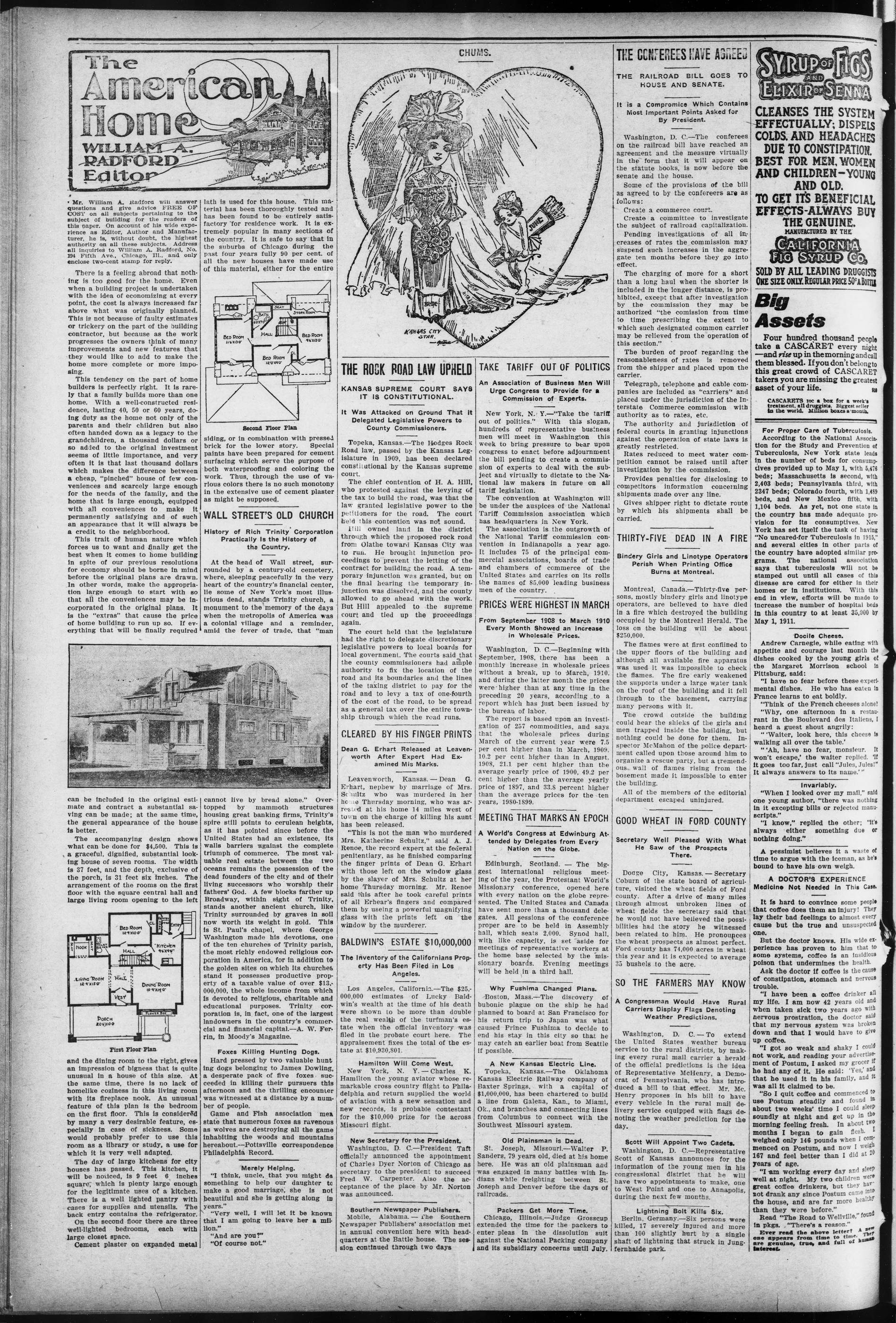
can be included in the original estimate and contract a substantial saving can be made; at the same time, the general appearance of the house is better. The accompanying design shows what can be done for $4,500. This is a graceful, dignified, substantial looking house of seven rooms. The width is 37 feet, and the depth, exclusive of the porch, is 31 feet six inches. The arrangement of the rooms on the first floor with the square central hall and large living room opening to the left
BED ROOM
12'9"10'0"
CL
ENTER
Nook
HALL
KITCHEN
16'9"10'0"
LIVING ROOM
12'9"15'0"
HALL
DINING ROOM
16'9"14'0"
VEST
PORCH
20'4"10'0"
First Floor Plan
and the dining room to the right, gives an impression of bigness that is quite unusual in a house of this size. At the same time, there is no lack of homelike coziness in this living room with its fireplace nook. An unusual feature of this plan is the bedroom on the first floor. This is considered by many a very desirable feature, especially in case of sickness. Some would probably prefer to use this room as a library or study, a use for which it is very well adapted.
The day of large kitchens for city houses has passed. This kitchen, it will be noticed, is 9 feet 6 inches square, which is plenty large enough for the legitimate uses of a kitchen. There is a well lighted pantry with cases for supplies and utensils. The back entry contains the refrigerator. On the second floor there are three well-lighted bedrooms, each with large closet space.
Cement plaster on expanded metal
lath is used for this house. This material has been thoroughly tested and has been found to be entirely satisfactory for residence work. It is extremely popular in many sections of the country. It is safe to say that in the suburbs of Chicago during the past four years fully 90 per cent. of all the new houses have made use of this material, either for the entire
CLOS
BATH
60720
SEAT
STORE ROOM
HALL
BED ROOM
11'4"X13'0"
BED ROOM
9'4"X13'0"
BED ROOM
12'0"X9'0"
Second Floor Plan siding, or in combination with pressed brick for the lower story. Special paints have been prepared for cement surfacing which serve the purpose of both waterproofing and coloring the work. Thus, through the use of various colors there is no such monotony in the extensive use of cement plaster as might be supposed.
WALL STREET'S OLD CHURCH
History of Rich Trinity Corporation Practically Is the History of the Country.
At the head of Wall street, surrounded by a century-old cemetery, where, sleeping peacefully in the very heart of the country's financial center, lie some of New York's most illustrious dead, stands Trinity church, a monument to the memory of the days when the metropolis of America was a colonial village and a reminder, amid the fever of trade, that "man
1
cannot live by bread alone." Overtopped by mammoth structures housing great banking firms, Trinity's spire still points to cerulean heights, as it has pointed since before the United States had an existence, its walls barriers against the complete triumph of commerce. The most valuable real estate between the two oceans remains the possession of the dead founders of the city and of their living successors who worship their fathers' God. A few blocks farther up Broadway, within sight of Trinity, stands another ancient church, like Trinity surrounded by graves in soil now worth its weight in gold. This is St. Paul's chapel, where George Washington made his devotions, one of the ten churches of Trinity parish, the most richly endowed religious corporation in America, for in addition to the golden sites on which its churches stand it possesses productive property of a taxable value of over $13,000,000, the whole income from which is devoted to religious, charitable and educational purposes. Trinity corporation is, in fact, one of the largest landowners in the country's commercial and financial capital—A. W. Ferrin, in Moody's Magazine.
Foxes Killing Hunting Dogs.
Hard pressed by two valuable hunting dogs belonging to James Dowling, a desperate pack of five foxes succeeded in killing their pursuers this afternoon and the thrilling encounter was witnessed at a distance by a number of people. Game and Fish association men state that numerous foxes as ravenous as wolves are destroying all the game inhabiting the woods and mountains hereabout.-Pottsville correspondence Philadelphia Record.
Merely Helping.
"I think, uncle, that you might do something to help our daughter to make a good marriage; she is not beautiful and she is getting along in years."
"Very well, I will let it be known that I am going to leave her a million."
"And are you?"
"Of course not."
CHUMS.
KANSAS CITY
STAR.
THE ROCK ROAD LAW UPHELD
THE ROCK ROAD LAW UPHELD
KANSAS SUPREME COURT SAYS IT IS CONSTITUTIONAL.
It Was Attacked on Ground That It Delegated Legislative Powers to County Commissioners.
Topeka, Kansas.—The Hodges Rock Road law, passed by the Kansas Legislature in 1909, has been declared constitutional by the Kansas supreme court.
The chief contention of H. A. Hill, who protested against the levying of the tax to build the road, was that the law granted legislative power to the petitioners for the road. The court held this contention was not sound.
Hill owned land in the district through which the proposed rock road from Olathe toward Kansas City was to run. He brought injunction proceedings to prevent the letting of the contract for building the road. A temporary injunction was granted, but on the final hearing the temporary injunction was dissolved, and the county allowed to go ahead with the work. But Hill appealed to the supreme court and tied up the proceedings again.
The court held that the legislature had the right to delegate discretionary legislative powers to local boards for local government. The courts said that the county commissioners had anple authority to fix the location of the road and its boundaries and the lines of the taxing district to pay for the road and to levy a tax of one-fourth of the cost of the road, to be spread as a general tax over the entire township through which the road runs.
CLEARED BY HIS FINGER PRINTS
Dean G. Erhart Released at Leavenworth After Expert Had Examined Mis Marks.
Leavenworth, Kansas. — Dean G. Erhart, nephew by marriage of Mrs. Schultz who was murdered in her home Thursday morning, who was arrested at his home 14 miles west of town on the charge of killing his aunt has been released.
“This is not the man who murdered Mrs. Katherine Schultz,” said A. J. Renoe, the record expert at the federal penitentiary, as he finished comparing the finger prints of Dean G. Erhart with those left on the window glass by the slayer of Mrs. Schultz at her home Thursday morning. Mr. Renoe said this after he took careful prints of all Erhear's fingers and compared them by using a powerful magnifying glass with the prints left on the window by the murderer.
BALDWIN'S ESTATE $10,000,000
Los Angeles, California.—The $25,000,000 estimates of Lucky Baldwin's wealth at the time of his death were shown to be more than double the real wealth of the turfman's estate when the official inventory was filed in the probate court here. The appraisement fixes the total of the estate at $10,920,801.
Hamilton Will Come West.
New York, N. Y.—Charles K. Hamilton the young aviator whose remarkable cross country flight to Philadelphia and return supplied the world of aviation with a new sensation and new records, is probable contestant for the $10,000 prize for the across Missouri flight.
New Secretary for the President
Washington, D. C.—President Taft officially announced the appointment of Charles Dyer Norton of Chicago as secretary to the president to succeed Fred W. Carpenter. Also the acceptance of the place by Mr. Norton was announced.
Southern Newspaper Publishers.
Mobile, Alabama. — The Southern Newspaper Publishers' association met in annual convention here with headquarters at the Battle house. The session continued through two days
TAKE TARIFF OUT OF POLITICS
An Association of Business Men Will Urge Congress to Provide for a Commission of Experts.
New York, N. Y.—"Take the tariff out of politics." With this slogan, hundreds of representative business men will meet in Washington this week to bring pressure to bear upon congress to enact before adjournment the bill pending to create a commission of experts to deal with the subject and virtually to dictate to the National law makers in future on all tariff legislation.
The convention at Washington will be under the auspices of the National Tariff Commission association which has headquarters in New York.
The association is the outgrowth of the National Tariff commission convention in Indianapolis a year ago. It includes 75 of the principal commercial associations, boards of trade and chambers of commerce of the United States and carries on its rolls the names of 85,000 leading business men of the country.
PRICES WERE HIGHEST IN MARCH
From September 1908 to March 1910 Every Month Showed an Increase in Wholesale Prices.
Washington, D. C.—Beginning with September, 1908, there has been a monthly increase in wholesale prices without a break, up to March, 1910, and during the latter month the prices were higher than at any time in the preceding 20 years, according to a report which has just been issued by the bureau of labor.
The report is based upon an investigation of 257 commodities, and says that the wholesale prices during March of the current year were 7.5 per cent higher than in March, 1909. 10.2 per cent higher than in August, 1908, 21.1 per cent higher than the average yearly price of 1900. 49.2 per cent higher than the average yearly price of 1897, and 33.8 percent higher than the average prices for the ten years, 1980-1899.
MEETING THAT MARKS AN EPOCH
A World's Congress at Edwinburg Attended by Delegates from Every Nation on the Globe.
Edinburgh, Scotland. — The biggest international religious meeting of the year, the Protestant World's Missionary conference, opened here with every nation on the globe represented. The United States and Canada have sent more than a thousand delegates. All sessions of the conference proper are to be held in Assembly hall, which seats 2,000. Synod hall, with like capacity, is set aside for meetings of representative workers at the home base selected by the missionary boards. Evening meetings will be held in a third hall.
Why Fushima Changed Plans
Boston, Mass.—The discovery of bubonic plague on the ship he had planned to board at San Francisco for his return trip to Japan was what caused Prince Fushima to decide to end his stay in this city so that he may catch an earlier boat from Seattle if possible.
A New Kansas Electric Line.
Topeka, Kansas.—The Oklahoma Kansas Electric Railway company of Baxter Springs, with a capital of $1,000,000, has been chartered to build a line from Galena, Kan., to Miami, Ok., and branches and connecting lines from Columbus to connect with the Southwest Missouri system.
Old Plainsman is Dead
St. Joseph, Missouri—Walter P. Sanders, 79 years old, died at his home here. He was an old plainsman and was engaged in many battles with Indians while freighting between St. Joseph and Denver before the days of railroads.
Packers Get More Time
Chicago, Illinois.-Judge Grosscup extended the time for the packers to enter pleas in the dissolution suit against the National Packing company and its subsidiary concerns until July.
THE CONFEREES HAVE AGREED
THE RAILROAD BILL GOES TO HOUSE AND SENATE.
It is a Compromise Which Contain Most Important Points Asked for By President.
Washington, D. C.-The conferees on the railroad bill have reached an agreement and the measure virtually in the form that it will appear on the statute books, is now before the senate and the house.
Some of the provisions of the bill as agreed to by the conferees are as follows:
Create a commerce court.
Create a committee to investigate the subject of railroad capitalization.
Pending investigations of all increases of rates the commission may suspend such increases in the aggregate ten months before they go into effect.
The charging of more for a short than a long haul when the shorter is included in the longer distance, is prohibited, except that after investigation by the commission they may be authorized "the commission from time to time prescribing the extent to which such designated common carrier may be relieved from the operation of this section."
The burden of proof regarding the reasonableness of rates is removed from the shipper and placed upon the carrier.
Telegraph, telephone and cable companies are included as "carriers" and placed under the jurisdiction of the Interstate Commerce commission with authority as to rates, etc.
The authority and jurisdiction of federal courts in granting injunctions against the operation of state laws is greatly restricted.
Rates reduced to meet water competition cannot be raised until after investigation by the commission.
Provides penalties for disclosing to competitors information concerning shipments made over any line.
Gives shipper right to dictate route by which his shipments shall be carried.
THIRTY-FIVE DEAD IN A FIRE
Bindery Girls and Linotype Operators
Perish When Printing Office
Burns at Montreal.
Montreal, Canada—Thirty-five persons, mostly bindery girls and linotype operators, are believed to have died in a fire which destroyed the building occupied by the Montreal Herald. The loss on the building will be about $250,000.
The flames were at first confined to the upper floors of the building and although all available fire apparatus was used it was impossible to check the flames. The fire early weakened the supports under a large water tank on the roof of the building and it fell through to the basement, carrying many persons with it.
The crowd outside the building could hear the shiaks of the girls and men trapped inside the building, but nothing could be done for them. Inspector McMahon of the police department called upon those around him to organize a rescue party, but a tremendous wall of flames rising from the bosement made it impossible to enter the building.
All of the members of the editorial department escaped uninjured.
GOOD WHEAT IN FORD COUNTY
Secretary Well Pleased With What He Saw of the Prospects There.
Dodge City, Kansas.—Secretary Coburn of the state board of agriculture, visited the wheat fields of Ford county. After a drive of many miles through almost unbroken lines of wheat fields the secretary said that he would not have believed the possibilities had the story he witnessed been related to him. He pronouces the wheat prospects as almost perfect. Ford county has 74,000 acres in wheat this year and it is expected to average 35 bushels to the acre.
SO THE FARMERS MAY KNOW
A Congressman Would Have Rural Carriers Display Flags Denoting Weather Predictions.
Washington, D. C.—To extend the United States weather bureau service to the rural districts, by making every rural mail carrier a herald of the official predictions is the idea of Representative McHenry, a Democrat of Pennsylvania, who has introduced a bill to that effect. Mr. McHenry proposes in his bill to have every vehicle in the rural mail delivery service equipped with flags denoting the weather prediction for the day.
Scott Will Appoint Two Cadets.
Washington, D. C.—Representative Scott of Kansas announces for the information of the young men in his congressional district that he will have two appointments to make, one to West Point and one to Annapolis, during the next few months.
Lightning Bolt Kills Six.
Berlin, Germany.—Six persons were killed, 17 severely injured and more than 100 slightly hurt by a single shaft of lightning that struck in Jung-fernaide park.
SYRUP OF FIGS AND ELIXIR OF SENNA CLEANSSES THE SYSTEM EFFECTUALLY; DISPELS COLDS, AND HEADACHES
DUE TO CONSTIPATION.
BEST FOR MEN, WOMEN
AND CHILDREN-YOUNG
AND OLD.
TO GET ITS BENEFICIAL
EFFECTS-ALWAYS BUY
THE GENUINE.
MANUFACTURED BY THE
CALIFORNIA
FIG SYRUP CO.
SOLD BY ALL LEADING DRUGGISTS
ONE SIZE ONLY. REGULAR PRICE 50^A BOTTLE
Big
Assets
Four hundred thousand people take a CASCARET every night—and rise up in the morning and call them blessed. If you don't belong to this great crowd of CASCARET takers you are missing the greatest asset of your life.
CASCARET9 soc a box for a week's travel in the still air. All it offers is a month in the world. Million boxes a month.
According to the National Association for the Study and Prevention of Tuberculosis, New York state leads in the number of beds for consumptives provided up to May 1, with 5,476 beds; Massachusetts is second, with 2,403 beds; Pennsylvania third, with 2347 beds; Colorado fourth, with 1,469 beds, and New Mexico fifth, with 1,104 beds. As yet, not one state in the country has made adequate provision for its consumptives. New York has set itself the task of having "No uncared-for Tuberculosis in 1915," and several cities in other parts of the country have adopted similar programs. The national association says that tuberculosis will not be stamped out until all cases of this disease are cared for either in their homes or in institutions. With this end in view, efforts will be made to increase the number of hospital beds in this country to at least 35,000 by May 1, 1911.
Docile Cheese.
Andrew Carnegie, while eating with appetite and courage last month the dishes cooked by the young girls of the Margaret Morrison school in Pittsburg, said:
"I have no fear before these experimental dishes. He who has eaten in France learns to eat boldly.
"Think of the French cheeses alone!
"Why, one afternoon in a restaurant in the Boulevard des Italiens, I heard a guest shout angrily:
"Walter, look here, this cheese is walking all over the table."
"Ah, have no fear, monsieur. It won't escape," the waiter replied. "If it goes too far, just call "Jules, Jules!" It always answers to its name."
Invariably.
"When I looked over my malf," said one young author, "there was nothing in it excepting bills or rejected manuscripts."
"I know," replied the other; "it's always either something due or nothing doing."
A pessimist believes it a waste of time to argue with the iceman, as he's bound to have his own weigh.
A DOCTOR'S EXPERIENCE
Medicine Not Needed In This Case.
It is hard to convince some people that coffee does them an injury! They lay their bad feelings to almost every cause but the true and unsuspected one.
But the doctor knows. His wide experience has proven to him that to some systems, coffee is an insidious poison that undermines the health.
Ask the doctor if coffee is the cause of constipation, stomach and nervous trouble.
"I have been a coffee drinker all my life. I am now 42 years old and when taken sick two years ago with nervous prostration, the doctor said that my nervous system was broken down and that I would have to give up coffee.
"I got so weak and shaky I could not work, and reading your advertisement of Postum, I asked my grocer it he had any of it. He said: 'Yes, and that he used it in his family, and it was all it claimed to be.
"So I quit coffee and commenced to use Postum steadily and found in about two weeks' time I could sleep soundly at night and get up in the morning feeling fresh. In about two months I began to gain flesh. I weighed only 146 pounds when I commenced on Postum, and now I weigh 167 and feel better than I did at 20 years of age.
"I am working every day and sleep well at night. My two children were great coffee drinkers, but they have not drank any since Postum came into the house, and are far more healthy than they were before."
Read "The Road to Wellville," found in nkgs. "There's a reason."
Ever read the above letter! A new one appears from time to time. They are genuine, true, and full of human interest.
The WOOL INDUSTRY in THE AMERICAS
AN'S first clothing was an animal pelt, and without doubt a sheep pelt. It may be suggested that the fig leaf antedates the sheepskin as an article of wear. This may be true, but the fig leaf can be considered only as a temporary expedient which was discarded with the first cool winds which swept
M
over the Mesopotamian lowlands. The sheep pelt or the wool plucked or sheared from it was the principal clothing of man from before the dawn of history down almost to the present day. Now cloth made from vegetable fibers, principally cotton, has a more extended use than wool. But this does not mean that cotton and linen are displacing wool as an article of human wear. Far from it; the use of wool constantly advances by enormous urides, and the even greater advance in the use of cotton is due in no small measure to the fact that the supply of wool can not meet the demand for clothing. Mankind must perforce wear the vegetable fibers or go unclothed. The same fact is true of the product of the silkworm; the supply can never equal the demand. Cotton, of course, has compelled for itself a new field, the clothing of the unclothed races of the earth. In addition it has supplied new articles of clothing to civilized man, whose ancestors were but little else than wool. The European or American of today does not wear less wool, in truth he wears more, but he also wears more articles of clothing, and these, for the most part, are cotton. There is a close parallel all over the world between the cattle and the sheep industry, but there are some important differences as well.
It has rarely happened and can scarcely happen again that cattle will anywhere be raised primarily for their horns and hides, but the raising of sheep for their wool is one of the well-recognized steps in the industry. It is the fact that this can be done so as to pay a handsome profit that built up the great sheep industries in the western part of the United States, in Australia and New Zealand, in South Africa, and now is building up a greater industry in South America. Free or very cheap pasturage is the fundamental condition for this kind of sheep raising. Were it not for these new lands, where the cost of feeding the sheep is nominal, the price of wool would advance to a point where wool clothing would be beyond the means of any except the very rich. Sheep raising is a profitable industry in England.
Land, or Germany, or the eastern half of the United States, not because of wool, but because of mutton. The fleece is a by-product, just as the hide of the steer or of the dairy cow is a by-product; the principal value of the animal is its flesh. In the new sheep centers of South America the principal value of the animal is its wool, and fortunes were made from the flocks even when not a pound of mutton was exported or sold.
Wool, as the word is used in commerce, is not a product alone of the sheep. It may be wool, although it comes from the backs of several varieties of goats, from the camel, the alpaca, the guanaco, the vicuna, or the llama, as well as from the sheep. It is the thing itself and not the zoological classification of the animal which determines whether the fiber is wool, hair, or fur. Since the classification is commercial and not scientific the line between these three classes is necessarily vague and indistinct. For instance, the under covering of the camel may be camel's wool or camel's hair, and so we have alpaca hair or alpaca wool. From the sheep there are many varieties of wool, long and short, straight and curly, coarse and fine, and, what is generally more important than any of these, varieties in the serrations or imbrications appearing on the surface of the fibers.
It is important in considering wool as a commercial commodity to keep in mind the three different kinds of cloth made therefrom. These are commercially known in English as felts, woolens, and worsteds. The processes in making these three kinds of cloth are so different as to make them entirely different industries, employing entirely different machinery. Felt is made from the wool or fur in mass, the cloth holding because of the lock clutch of the imbricated fiber. Woolens and worsteds are spun from threads, but the threads in the two kinds of cloth are prepared in a different manner, and the weaving is entirely unlike. Formerly, entirely different kinds of wools were used for making the two kinds of cloths, or rather it is more accurate to say that only certain kinds of wools could be used in making worsteds. Almost any kind of wool could be used for making woolens, although some were much more suitable than others, and, as a rule, those least suitable for woolens were best suitable for worsteds. In effect, therefore, certain wools were used for woolens and certain other wools for worsteds. With the improved modern machinery used in worsted mills these limitations are fading away, so that worsteds can now be made from wools formerly not used for this purpose.
The wool used for making woolens is carded; that for worsteds is combed. The effect of these two processes is that in the first the wool fibers are crossed and interlocked as much as possible, and in the second they are drawn out
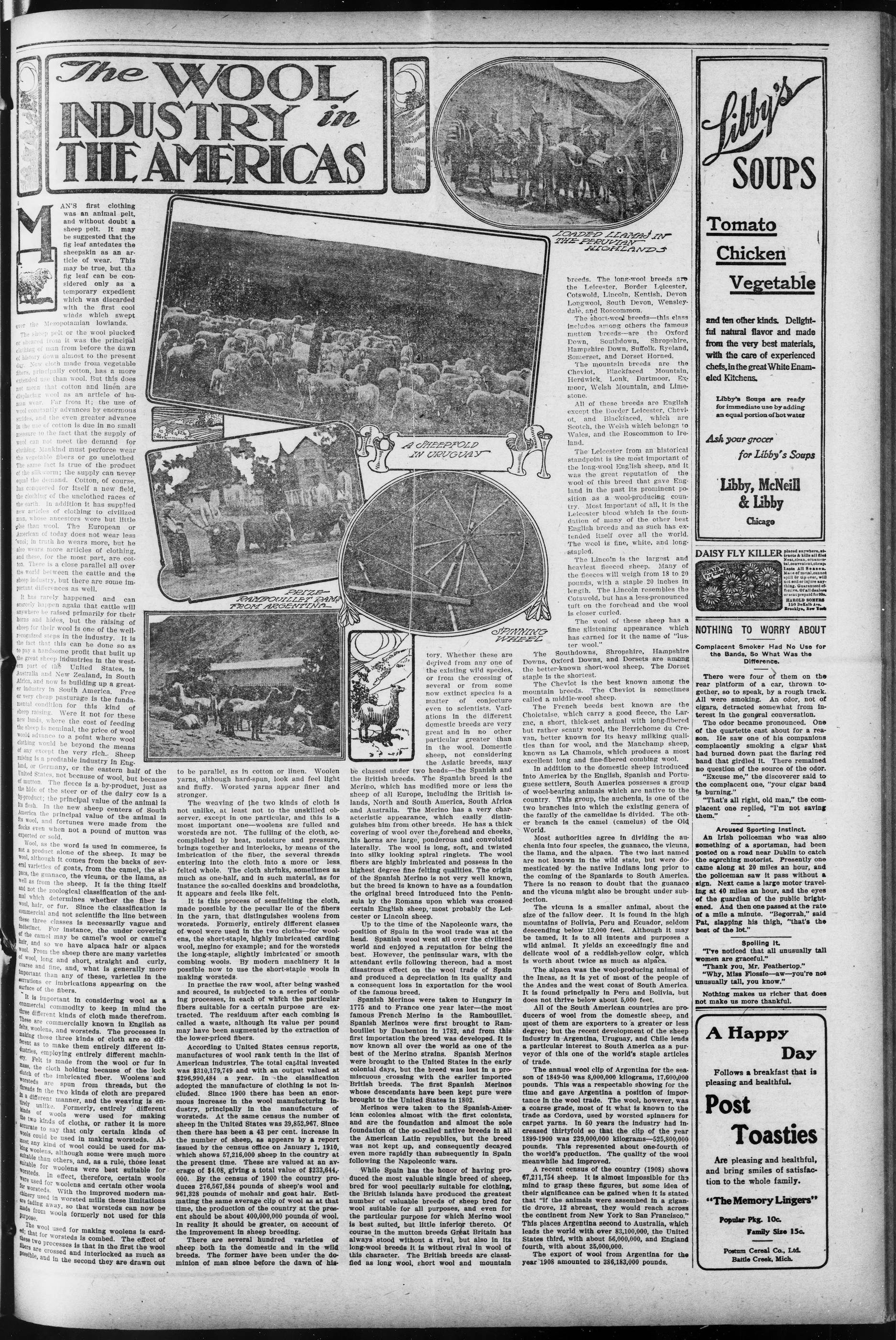
A SHEEPFOLD
IN URUGUAY
PRIZE
RAMBOUILLET RAM
FROM ARGENTINA
SPINNING
WHEEL
of the because just as w is a to be parallel, as in cotton or linen. Woolen yarns, although hard-spun, look and feel light and fluffy. Worsted yarns appear finer and stronger.
The weaving of the two kinds of cloth is not unlike, at least not to the unskilled observer, except in one particular, and this is a most important one—woolens are fulled and worsteds are not. The fulling of the cloth, accomplished by heat, moisture and pressure, brings together and interlocks, by means of the imbrication of the fiber, the several threads entering into the cloth into a more or less felted whole. The cloth shrinks, sometimes as much as one-half, and in such material, as for instance the so-called doeskins and broadcloths, it appears and feels like felt.
It is this process of semifelting the cloth, made possible by the peculiar lie of the fibers in the yarn, that distinguishes woolens from worsteds. Formerly, entirely different classes of wool were used in the two cloths—for woolens, the short-staple, highly imbricated carding wool, megino for example; and for the worsteds the long-staple, slightly imbricated or smooth combing wools. By modern machinery it is possible now to use the short-staple wools in making worsteds.
In practise the raw wool, after being washed and scoured, is subjected to a series of combing processes, in each of which the particular fibers suitable for a certain purpose are extracted. The residuum after each combing is called a waste, although its value per pound may have been augmented by the extraction of the lower-priced fibers.
According to United States census reports, manufactures of wool rank tenth in the list of American industries. The total capital invested was $310,179,749 and with an output valued at $296,990,484 a year. In the classification adopted the manufacture of clothing is not included. Since 1900 there has been an enormous increase in the wool manufacturing industry, principally in the manufacture of worsteds. At the same census the number of sheep in the United States was 39,852,967. Since then there has been a 43 per cent. increase in the number of sheep, as appears by a report issued by the census office on January 1, 1910, which shows 57,216,000 sheep in the country at the present time. These are valued at an average of $4.08, giving a total value of $233,644,000. By the census of 1900 the country produces 276,567,584 pounds of sheep's wool and 961,328 pounds of mohair and goat hair. Estimating the same average clip of wool as at that time, the production of the country at the present should be about 400,000,000 pounds of wool. In reality it should be greater, on account of the improvement in sheep breeding.
There are several hundred varieties of sheep both in the domestic and in the wild breeds. The former have been under the domelion of man since before the dawn of his
COLLEGE OF ARTS
WESTERN
UNIVERSITY
be classed under two heads—the Spanish and the British breeds. The Spanish breed is the Merino, which has modified more or less the sheep of all Europe, including the British islands, North and South America, South Africa and Australia. The Merino has a very characteristic appearance, which easily distinguishes him from other breeds. He has a thick covering of wool over the forehead and cheeks, his horns are large, ponderous and convoluted laterally. The wool is long, soft, and twisted into silky looking spiral ringlets. The wool fibers are highly imbricated and possess in the highest degree fine felting qualities. The origin of the Spanish Merino is not very well known, but the breed is known to have as a foundation the original breed introduced into the Peninsula by the Romans upon which was crossed certain English sheep, most probably the Leicester or Lincoln sheep.
Up to the time of the Napoleonic wars, the position of Spain in the wool trade was at the head. Spanish wool went all over the civilized world and enjoyed a reputation for being the best. However, the peninsular wars, with the attendant evils following thereon, had a most disastrous effect on the wool trade of Spain and produced a depreciation in its quality and a consequent loss in exportation for the wool of the famous breed.
Spanish Merinos were taken to Hungary in 1775 and to France one year later—the most famous French Merino is the Rambouillet. Spanish Merinos were first brought to Rambouillet by Daubenton in 1782, and from this first importation the breed was developed. It is now known all over the world as one of the best of the Merino strains. Spanish Merinos were brought to the United States in the early colonial days, but the breed was lost in a promiscuous crossing with the earlier imported British breeds. The first Spanish Merinos whose descendants have been kept pure were brought to the United States in 1802.
Merinos were taken to the Spanish-American colonies almost with the first colonists, and are the foundation and almost the sole foundation of the so-called native breeds in all the American Latin republics, but the breed was not kept up, and consequently decayed even more rapidly than subsequently in Spain following the Napoleonic wars.
While Spain has the honor of having produced the most valuable single breed of sheep, bred for wool peculiarly suitable for clothing, the British islands have produced the greatest number of valuable breeds of sheep bred for wool suitable for all purposes, and even for the particular purpose for which Merino wool is best suited, but little inferior thereto. Of course in the mutton breeds Great Britain has always stood without a rival, but also in its long-wool breeds it is without rival in wool of this character. The British breeds are classified as long wool, short wool and mountain
4
tory. Whether these are derived from any one of the existing wild species, or from the crossing of several or from some now extinct species is a matter of conjecture even to scientists. Variations in the different domestic breeds are very great and in no other particular greater than in the wool. Domestic sheep, not considering the Aslatic breeds, may
LOADED LLAMA IN
THE PERUVIAN
HIGHLANDS
LOADED LLAMA IN
THE PERUVIAN
HIGHLANDS
breeds. The long-wool breeds are the Leicester, Border Leicester, Cotswold, Lincoln, Kentish, Devon Longwool, South Devon, Wensleydale, and Roscommon.
The short-wool breeds—this class includes among others the famous mutton breeds—are the Oxford Down, Southdown, Shropshire, Hampshire Down, Suffolk, Ryeland, Somerset, and Dorset Horned.
The mountain breeds are the Cheviot, Blackfaced Mountain, Herdwick, Lonk, Dartmoor, Exmoor, Welsh Mountain, and Limestone.
All of these breeds are English except the Border Leicester, Cheviot, and Blackfaced, which are Scotch, the Welsh which belongs to Wales, and the Roscommon to Ireland.
The Leicester from an historical standpoint is the most important of the long-wool English sheep, and it was the great reputation of the wool of this breed that gave England in the past its prominent position as a wool-producing country. Most important of all, it is the Leicester blood which is the foundation of many of the other best English breeds and as such has extended itself over all the world. The wool is fine, white, and long-stapled.
The Lincoln is the largest and heaviest fleeced sheep. Many of the fleeces will weigh from 18 to 20 pounds, with a staple 20 inches in length. The Lincoln resembles the Cotswold, but has a less-pronounced tuft on the forehead and the wool is curled closer.
The wool of these sheep has a fine glistening appearance which has earned for it the name of "luster wool."
The Southdowns, Shropshire, Hampshire Downs, Oxford Downs, and Dorsets are among the better-known short-wool sheep. The Dorset staple is the shortest.
The Cheviot is the best known among the mountain breeds. The Cheviot is sometimes called a middle-wool sheep.
The French beeds best known are the Choletiae, which carry a good fleece, the Larzac, a short, thick-set animal with long-fibered but rather scanty wool, the Berrichome du Crevan, better known for its heavy milking qualities than for wool, and the Manchamp sheep, known as La Chamois, which produces a most excellent long and fine-fibered combing wool.
In addition to the domestic sheep introduced into America by the English, Spanish and Portuguese settlers, South America possesses a group of wool-bearing animals which are native to the country. This group, the auchenia, is one of the two branches into which the existing genera of the family of the camelidae is divided. The other branch is the camel (camelus) of the Old World.
Most authorities agree in dividing the auchenia into four species, the guanaco, the vicuna, the lama, and the alpaca. The two last named are not known in the wild state, but were domesticated by the native Indians long prior to the coming of the Spaniards to South America. There is no reason to doubt that the guanaco and the vicuna might also be brought under subsection.
The vlcuna is a smaller animal, about the size of the fallow deer. It is found in the high mountains of Bolivia, Peru and Ecuador, seldom descending below 13,000 feet. Although it may be tamed, it is to all intents and purposes a wild animal. It yields an exceedingly fine and delicate wool of a reddish-yellow color, which is worth about twice as much as alpaca.
The alpaca was the wool-producing animal of the Incas, as it is yet of most of the people of the Andes and the west coast of South America. It is found principally in Peru and Bolivia, but does not thrive below about 5,000 feet.
All of the South American countries are producers of wool from the domestic sheep, and most of them are exporters to a greater or less degree; but the recent development of the sheep industry in Argentina, Uruguay, and Chile lends a particular interest to South America as a purveyor of this one of the world's staple articles of trade.
The annual wool clip of Argentina for the season of 1849-50 was 8,000,000 kilograms, 17,600,000 pounds. This was a respectable showing for the time and gave Argentina a position of importance in the wool trade. The wool, however, was a coarse grade, most of it what is known to the trade as Cordova, used by worsted spinners for carpet yarns. In 50 years the industry had increased thirtyfold so that the clip of the year 1899-1900 was 239,000,000 kilograms>-525,800,000 pounds. This represented about one-fourth of the world's production. The quality of the wool meanwhile had improved.
A recent census of the country (1908) shows 67,211,754 sheep. It is almost impossible for the mind to grasp these figures, but some idea of their significance can be gained when it is stated that "if the animals were assembled in a gigantic drove, 12 abreast, they would reach across the continent from New York to San Francisco." This places Argentina second to Australia, which leads the world with over 83,100,000, the United States third, with about 56,000,000, and England fourth, with about 35,000,000.
The export of wool from Argentina for the year 1908 amounted to 386,183,000 pounds.
and ten other kinds. Delightful natural flavor and made from the very best materials, with the care of experienced chefs, in the great White Enameled Kitchens.
Libby's Soups are ready for immediate use by adding an equal portion of hot water
Ask your grocer
for Libby's Soups
Libby, McNeill
& Libby
Chicago
DAISY FLY KILLER
placed anywhere, attracts & kills illified
alcohol, ornamental trees,
ornamental grasses.
Lasts All Season.
made of metal, will
will not soil or injure any
thing.
Guaranteed refurbishment
or same prepaid for 80.
HINOLD SONERS
124 W. 10th St.
Brooklyn, New York
NOTHING TO WORRY ABOUT
Complacent Smoker Had No Use for
the Bands, So What Was the
Difference.
There were four of them on the
rear platform of a car, thrown
together, so to speak, by a rough track.
All were smoking. An odor, not of
cigars, detracted somewhat from
interest in the general conversation.
The odor became pronounced. One of the quartette cast about for a reason. He saw one of his companions complacently smoking a cigar that had burned down past the flaring red band that girdled it. There remained no question of the source of the odor. "Excuse me," the discoverer said to the complacent one, "your cigar band is burning." "That's all right, old man," the complacent one replied, "I'm not saving them."
Arused Sporting Instinct.
An Irish policeman who was also something of a sportsman, had been posted on a road near Dublin to catch the sorgching motorist. Presently one came along at 20 miles an hour, and the policeman saw it pass without a sign. Next came a large motor traveling at 40 miles an hour, and the eyes of the guardian of the public brightened. And then one passed at the rate of a mile a minute. "Begorrah," said Pat, slapping his thigh, "that's the best of the lot."
Spoiling it.
"I've noticed that all unusually tall women are graceful."
"Thank you, Mr. Feathertop."
"Why, Miss Flossie—aw—you're not unusually tall, you know."
Nothing makes us richer that does not make us more thankful.
A Happy Day
Follows a breakfast that is pleasing and healthful.
Post Toasties
Are pleasing and healthful, and bring smiles of satisfaction to the whole family.
"The Memory Lingers"
Popular Pkg. 10c.
Family Size 15c.
Postum Cereal Co., Ltd.
Battle Creek, Mich.
---
W. N. MILLER, Editor.
Residence 1401 West 23d Street.
Residence Phone, Bell 1641.
Office Phone Bell, 2458.
Phone your news items to us.
RATES OF SUBSCRIPTION:
One Year (by mail) ..... $1.00
Strictly in Advance.
5x Months (by mail) ..... 7.75
Three Months (by mull) ..... 5.00
Advertising Rates made known on application.
Liberal commission paid to agents.
Entered at the Postoffice at Wichita,
Kansas, as Second-Class
Mail Matter.
Published Every Saturday at 630 N. Main Street
All matters addressed to The Searchlight for publication must be signed by the party or parties writing
All matters for publication must reach this office not later than Thursday noon to reach publication in the current issue.
RULES OF THIS OFFICE:
First. All subscriptions must be paid in advance. Agents take notice.
Second. Communications received after Thursday noon will not be published in the current 'issue.
Third. In asking to change your paper from one address or postoffice to another, give both the new and the old.
Fourth. No new name will be placed on our books unless the money accompanies the name. Write plain.
Fifth. Address all matter for publication to The Wichita Searchlight, 634 N. Water street, Wichita, Kansas.
Sixth. Any erroneous reflection on the character, standing or reputation of any person which may appear in this paper will be gladly corrected if brought to the attention of the editor.
"To Live and Let Live Is Our Motto." SEND YOUR NEWS IN EARLIER.
Hard To Understand
We are at a loss to understand how some colored parents can figure out the consistency of sending their children to school to learn trades and profession by which they hope that these child ren may come up some day and make their living among the race and at the same time those same parents can never see the needed of giving the colored men and women who are now in business their patronage. Of course, they may have some secret process by which they may be able to corrall the patronage for their boy or girl when they have reached maturity and have launched out in the business or professional world. If that be the case then they may be justified and have grounds upon which they may continue this method of race discrimination. But we most seriously doubt this to be the case They should learn to give their patronage to the race.
In the future Dr. Arthur K. Lawrence, physician and surgeon and Dr. H. T. Bolden, dentist, will occupy the office rooms at 517 N. Main St. Bell Phone 4634 will reach ehem. These are two worthy young men and deserve the patronage of the people of our city.
LOCALS
THE RESUME OF THIS WEEK Send your news notes and local happenings to 601 Beach Mala Street.
Pay up! — Pay up!! — Pay up!!!
Bring your news and job work to 630 N. Main—The Searchlight office.
Patronize the Merchants and Business Houses that solicit your trade through "ads" in the columns of your race paper.
Why trade with any other?
Dr. G. G, Brown
Dr. Brown has moved his office from 517 North Main to Youngs hall 601 N. Main, the place now occupied by Dr. Bolden the dentist. The rooms make ideal doctors offices and are being, fitted up new prepared and painted, gas, electric lights and electric ans. Dr. Brown will be pleased to sec all his old customers (sick or well) and many new ones as his new place of business. Telephone connections at both office and residence; his office phone remains the same number 1537. Residnce phone 3259.
Mrs. Ellen Thompson has been quite indisposed during the week
Mrs. Corrine Smith has been quite ill for several days.
Mr. and Mrs. Clarence Page family of Newton, who has been visiting in the city returned to their home Saturday.
Miss. Marguerite Sanford left Tuesday on a visit to Topeka.
Mrs. A. Morris has been qnite indisposed for several days.
Dr. Brown reports a new girl at J. W. Spears on Cleveland Av
Mrs. Lee Anderson of Topeka was a visitor in the city last week.
Robt. Davis has been a suffer for several days, but is much better now.
Mrs. J. L. Harper attended the State Federation of Women's Clubs which is holding its session in Atchison this week.
Rev. M. L. Copeland and wife having returned from Wellington Kansas, report a successful board meeting.
The Sunday School concert at the Tabernacle Baptist Church was a pleasant affair,
Hon. Thomas Glover and several other Wichitans went to Hutchinson Sunday on business matters.
Mrs. Dudly Johnson who has been visiting in Pratt Kansas, returned by the way of Hutchinson Sunday afternoon. Reports having a very nice time,
Peerless Steam Laundry
Wichita's Oldest, Most Reliable and Best Laundry BEST LAUNDRY IN THE CITY Satisfaction Guaranteed Laundry Work Called and Delivered Phones 232 SELOVER & SONS, Props. 245 N. Market St Wichita, Kan
W. S. Henrion Druggist 501 North Main Street Wichita - - - - Kansas
Subscribe and pay for the Wichita Searchlight. It is only $1. for a whole year. Try it.
STIRLING
CLOTHES
MADE IN WICHITA
Material Fit Style Workmanship
GUARANTEED
:- YOUR TRADE SOLICITED :-
we only tailored for a few dozen men, we would have to charge each an exorbitant price. We would have to take large profits from the few, instead of a very small one from each of our mang customers.
This is why we can put into a suit for you at $15,00 to $35. what the other fellows charges you from $25,00 to $60,00 for.
Stirling Woolen Mills Co.
TAILORS
215 N. Main St. Wichita, Kas.
USE
Murray's Reliable Nerve Balm
Murray's Reliable Antiseptic Salve
Murray's Reliable Perfumes
These Goods Have No Equal
They are pleasing hundreds of people ann will please you.
J. H. MURRAY & CO.
Sold By Dealers
Wichita ..... Kansas.
A Few Words To You
Special Prices For A Short Time
Have your teeth cleaned at one half price. Before taking your vacation have a pleasant breath and enjoy food. Cleanliness of the breath maintains an orderly stomach and prevents indigestin H. T. Bolden, Dentist Corner Main and Elm Sts Roll call on the third Sunday [June 19th,] It is hoped that every member will respond to his or her name as it is desired to raise enough to complete paying off the indebtness of the church.
Miss. Lizzie Underwood has been very ill under the care of the doctor; but is much improv-ed at this writing.
Dr.J. E. Farmer,
Physician and Surgeon
—Diseases of—
Women and Children
A Specialty
Bell Phone 2186
Office over 517 N. Main St.
Room 4
Dr. A. K. Lawrence
PHYSICIAN & SURGEON
Office Phones
517 Bell1537
N. Main St. Ind. 1557
DISEASES OF MEN, WOMEN AND
CHILDREN A SPECIALTY
Dr. F. O. Miller Physici'n & Surgeon
Office Hours Bell Phone
9 to 11 2999
2 to 5 Wichita
7 to 8 Kansas.
513 N. Main St.
All calls answered promptly Day
or Night. Obstetrics and Diseases
of women A Specialty
Office Hours 8:30 to 12 a. m.
1 to 6 p. m.
Sunday & nights by appointment.
Dr. H. T. Bolden
Dentist
CROWN AND DRIDGE WORK
ASPECIALTY.
All Bridge Teeth $4.00
All Work Guaranteed
Bell Phone 517 N. Main St. over
4634 Mahin Eye Drug Store.
Ketzler Hardwre
354 North Main Street
—DEALERS IN—
Hardware, Hot Air Furnaces,
Tin Work, Roofing, Guttering,
Copper and Galvanized Iron
Work. Repairing and Painting
Tin Roofs A Specialty.
Send your news in earlier
A. G. MUELLER
UNDERTAKER
BOTH PHONES 325 WICHITA KANS
142 N. MARKET
For Everything In
Building
Material
SEE
BOTH
PHONE: 496--
J.H. TURNER
333 TO 347 WEST DOUGLAS
WICHITA, KANS.
METZ'S LUMBER
IS IT?
Largest yard under shed in the state.
Best grade of lumber to select from.
Choicest finishings, posts, shingles and everything in the lumber line.
OUR PRICES ARE RIGHT
Low and Easy to Meet. Let us figure next Lumber Bill. Yards and Office 3rd and Main Streets.
CULP'S MEAT MARKET
241 N.MAIN ST.
Beef, Pork, Lamb, Mutson, Veal Pig Tail
Bones, Fresh Pigs Feet and Chitterlings,
Fish, Cat Fish, Halibut and Salmon. Fri
ip Oysters, Heinz Pickles, and Baked Beef
P. T. CULP, Prop.
Main St. Both P
Thebest Beef, Pork, Lamb, Mutson, Veal Pig Tails, Chin Bones, Fresh Pigs Feet and Chitterlings, Fresh Fish, Cat Fish, Halibut and Salmon. Fresh Sealship Oysters, Heinz Pickles, and Baked Beans F. T. CULP, Prop.
241 N. Mein St. Both Phone
Grocery Department
WE SELL FLOUR
WE SELL MEAL
WE SELL LARD
WE SELL MEAT
WE SELL POTATOES
fact, we sell everything kept in a First-Class
grocery. WHY CAN'T WE SELL TO YOU?
Makin Eye Drug Co.
N. Main St. — Wichita, Kan — Bell Phone
SECOND TO NONE
PLEASES ALL
FOOD BREAD MAKERS
— AND WILL PLEASE YOU —
IT IS AS WHITE AS SNOW — TRY IT
OTTO WEISS ALFALFA STOCK and POULTRY FOOD
We all guaranteed under the United States
Law, Serial No. 13415 and under the Kansas
State Law, Register No. 1.
The Cheapest and Best Food on the Market
NEW MIRROR FACTORY
741 North Main Street
Old Mirrors Re-Silvered
Made As Good As New By A Gen-
Process - No Better On Earth.
E GLASS WORK
WINDOW GLAZING
PICTURE FRAM
In fact, we sell everything kept in a First-Class Grocery. WHY CAN'T WE SELL TO YOU?
Makin Eye Drug Co. 517 N. Main St. - Wichita, Kan - Bell Phone 239
SECOND TONONE"
PLEASES ALL
GOOD BREAD MAKERS
— AND WILL PLEASE YOU —
IT IS AS WHITE AS SNOW — TRY IT
THE OTTO WEISS ALFALFA STOCK and POULTRY FOOD
are all guaranteed under the United States
Law, Serial No. 13415 and under the Kansas
State Law, Register No. 1.
It Is The Cheapest and Best Food on the Market
NEW MIRROR FACTORY
741 North Main Street
Old Mirrors Re-Silvered
And Made As Good As New By A German Process - No Better On Earth.
PLATE GLASS WORK
WINDOW GLAZING
PICTURE FRAMING
Seventy-five Different Designs
tern Mirror Mfg. Compa
ROCERIES, MEAT
and General Merchandise
Western Mirror Mfg.Company
GROCERIES, MEATS
and General Merchandise
We carry a full, fresh line of Staple and Fancy
Groceries and the choicest Fresh and Salt Meat
Our stock of Dry Goods, Men, Women and
Children's Shoes cannot be excelled in quality
or in price. Free Delivery
GRAHAM - CORN MEAL - BREAKFAST FOOD
With thirty-five years MILLING EXPERIENCE in Wichita, our products are the best that can be produced.
Made from the best selected grain only, put up in Special Packages.
ASK YOUR GROCER See that you get IMPERIAL
THE IMBODEN MILLING CO.
Wichita, Kansas
Excellence Counts
THEN USE
"U-KNEAD-IT"
FLOUR
It exctls in every respect, — color, flavor and
pounds of bread per barrel. MADR BY
WATSON MILL CO.
WICHITA KANSAS
High Class Surgery Special Attention Given to
a Specialty Canine Practice
All Calls Promptly Answered-Day or Night
The Finest Equipped Hospital In the City
Beth Phones Office and Hospital
1730 236 N. Market St., Wichita, Ks.
Central Market
Corner MAIN and CENTRAL
FRESH AND CURED MEATS
Full Line of Groceries -
Bell Phone 4163 FRED C. LOVE, Proprietor
United States Depository
Capital $200,000.00 Surplus $125,000.00
Directors: W R Tucker, W E Jett, R L Holmes, S B Amidon, J M Moore,
L S Naftsger, H W Dailing, A C Houston, EC Sheidon, C W Brown
J W Motz, E T Battin, Henry Lassen, V H Branch
A General Banking Business Transacted
OLDEN'S HOTEL
527-9 N. Wichita St Wichita, Kan
First-Class in every respect. Newly Furnished
Board and Lodging $3.75 and $4.00 per week
Lodging 50c and $1.00 per night
Transient a Specialty. Special Rates to Opera Troupes
Only Regular Meals Served.
Well Heated — Well Lighted — Well Ventilated
Best Accommodations — Prompt Service
James J. OLDEN, Prop.
kind of nutrition. It not merely sustains life, it strengthens and energizes it. PEERLESS PRINCESS FLOUR is guaranteed pure. It contains nothing but the kernels of selected wheat ground under conditions of perfect cleanliness. Try a sack.
Howard Mills
M. O. RUTHRAUFF, Proprietor
Custom Grinding and Corn Shelling cur Specialty — Prompt Delivery
814 North Main
Wichita, Kansas
EAM ABSTRACT NORTH-WEST CORNER OF THE COURT HOUSE Bonded Abstractors
The Searchlight Office is now At 630 N. Main. Give us a call Office Phone, Bell 2458
GOOD
FLOUR
Celebrating
PURPLE
Mother and child
will both be the stronger and healthier for the use of PEERLESS PRINCESS FLOUR Bread baked from it supplies the best It not merely sustains life, it strengthens PEERLESS PRINCESS FLOUR is guaranteed nothing but the kernels of selected wheat editions of perfect cleanliness. Try a sack. ward Mills
it strengthens
is guarantee
of selected wheat
ness. Try a sac
Hills
Phones ...
INDEPENDENT 690
BELL 2135
Rooms by the night or week
Openat all hours of the Day and Night
Your Patronage Solicited
The Leading Educational Institute For Negroes In The West
city of eighteen thoroughly equipped to
from the leading Institutes in America
MAGNIFICENT BUILDINGS
Steam Heated and Electric Lighted
equipped teachers
in America.
WEDINGS
Lighted
Normal, Musi-
courses in Archi-
wing, Printing,
Courses, Dress
ing and Farming
influence
Orchestra
French,
PRESIDENT
KS
office Phone 1423
Up In At
in St
of
ceries
MILTON
A faculty of eighteen thoroughly equipped teachers from the leading Institutes in America. MAGNIFICENT BUILDINGS Steam Heated and Electric Lighted
Artsical, Classical, Normal, Sub-Normal
State Industrial, embracing courses in
Carpentry, Mechanical Drawing, Pl
anding, Tailoring, Business Courses,
Millinery, Cooking, Laundering and
Ethorough discipline, Christian influence
careful supervision
One Military Band and Orchestra
full particulars write to
Prof. Shelton French
ACTING PRESIDENT
Of Western University
QUINDARO, KS
Office Phone No. 15 Office Phone
File In Town Drop In
349 North Main St
For All Kinds of
fats and Groceries
Theological, Classical, Normal, Sub-Normal, Musical, State Industrial, embracing courses in Architecture, Carpentry, Mechanical Drawing, Printing, Book-binding, Tailoring, Business Courses, Dress making, Millinery, Cooking, Laundering and Farming.
Prof. Shelton French,
ACTING PRESIDENT
Of Western University
QUINDARO, KS
Residence Phone No. 15 Office Phone 1423
While In Town Drop In At 349 North Main St For All Kinds of Meats and Groceries Everything Fresh WICHITA CASH GROCERY 349 North Main Street
OUR
TION
Avenue
G WORKS
Avenue
Gloves
REPAIRED
Kansas. A one specialty.
IN OUR NEW LOCATION
211 South Lawrence Avenue PEOPLE'S CLEANING and DYE WORKS 211 South Lawrence Avenue
Clotbes, Hats. Plumes and Gloves DRY CLEANED, PRESSED and REPAIRED
Largest and best equipped plant in Kansas. A $50,000.00 investment devoted to this one specialty.
Bell Phone 175
DEPARTMENTS
FORD'S
HAIR POMADE
THE OLD RELIABLE DRESSING FOR
KINKY OR CURLY HAIR. IT USE MAKES
STUBBORN, HARSH HAIR SOFTER, MORE
PLIABLE AND GLOSSY, EASY TO COMB AND
UP UP IN ANY STYLE THE LENGTH WILL
PERMIT. WRITE FOR TESTIMONIES, TELLING
HOW THIS REMARKABLE REMEDY MAKES
SHORT, KINKY HAIR GROW LONG AND
WAVY, BEST POMADE ON THE MARKET
FOR DANDRUFF, ITCHING OF THE SCALP
AND FALLING OUT OF THE HAIR.
BEWARE OF IMITATIONS, GET THE
GENUINE, PUT UP IN 25*AND 50*BOTTLES
WITH CHARLES FORD'S
NAME ON EVERY PACKAGE.
SOLD BY DRUGGISTS.
IF YOUR DRUGGIST CANNOT SUPPLY
YOU, WE WILL SEND IT TO YOU DIRECT
AT THE FOLLOWING PRICES, SMALL SIZED
BOTTLE, 25+ LARGE SIZED BOTTLE, 50+
THE OZONIZED OX MARROW CO.
216 LAKE ST. DEPT.
CHICAGO, ILL.
AGENTS WANTED.
Sir D. L. Taylor
Designer and Builder of Tent houses, Tabernacle houses and Temple houses. Prices in reach of all. Send your order to-day 829 East Center SALINA, KANSAS
NEWTON KANSAS
Miss. Ethel Anderson of Newton has returned to her home after a very pleasant visit with friends in Last Springs Kansas. Nate Anderson made a business trip to Valley Center Tuesday evening. Little Misses Margurite and Eula Anderson are visiting in Valley Center with their grandparents Mr. and Mrs. A. Clark, this week. Mr. and Mrs. Clarence Paize is in Wichita for a week.
Miss. Letha Underwood attended the Board meeting of the Second Baptist Church at Wellington.
Mrs. Chas. Miller and daughter Bessie will leave in a few days to visit her mother in Colorado.
The N. U. G. and I. R. A. Clubs were finely banquetted by Geo. Payne and Smith MerCombs at the Masonic Temple there was one hundred and twenty ptesent
Mr. M. Works, of Oxford, Ks. one of the very prosperous colored farmers of that section of the state was a pleasant Wichita visitor Satnrday and while in the city paid the Searchlight office a much appreciated call. Mr. Work has more than 100 acres in corn besides a large acreage in oats and other growing crops. He is one of our most substantial men.
Publication Notice
First publication in The Wichita Searchlight June 18th, 1910. State of Kansas, Sedgwick County, ss. Phillip Payne, Plaintiff.
You and each of you, are hereby notified that you have have been sued in the District Court in and for the County of Sedgwick and State of Kansas, by Phillip Payne, plaintiff, and that unless you and each of you answer the petition of the plaintiff (filed in the office of the Clerk of said Court against you) by the 29th day of July, 1910, the said petition will be taken as true and confessed as against each of you, and judgment will be rendered in said action against each of you, separately and respectively, quieting the plaintiff's title, possession and occupancy and right of possession and occupancy in the following described real estate situated in the county of Sedgwick and State of Kansas, to-wit:
Lots number Seventy-three (73), Seventy-five (75), Seventy-seven (77), Seventy-nine (79) on Washington Avenue in Viola Addition to the City of Wichita according to the recorded plat thereof.
Judgment will also be rendered in said action decreeing that plaintiff's title in said lands is good, valid and a perfect title and estate in and to said lands, and also decreeing that the said defendants have no estate in, title to or valid claim to said lands, or any part thereof, or right of possession or occupancy thereof; and also excluding the said defendants in this action, and each and every one of them, from any estate in, title to, or interest in said lands, and barring and enjoining each of said defendants, and all persons claiming under, by or through them or any of them, from ever asserting any claim, title or interest in and to said lands or right of possession or occupancy thereof, and for any other and further relief to which the plaintiff may be entitled and for costs of this action.
Judgment will also be rendered in said action in favor of said plaintiff as though each and every one of the defendants named in this action were alive at the time of the commencement of this action and the date and rendition of the judgment, and judgment will also be rendered in the alternative against the unknown heirs, executives, administrators, devisees, trustees or assigns of the defendants: Robert Hutchinson and Catherine B. or "Catherine B." Hutchinson, his wife; Arthur E. Shoher and Maria C. Shober, his wife; Noah B. Moore and Sarah C. Moore, his wife; W. K. Clifford and Cornelia T. Clifford, his wife; John A. Doran and Priscilla M. Doran, his wife; J. A. Doran and Priscilla M. Doran, his wife; D. N. Baxter and Jennie L. Baxter, his wife; Mrs. M. A. Marriage Allen and — Allen, her husband whose christian name is to this plaintiff unknown;
Smithson, whose christian name is to the plaintiff unknown, doing-business under the firm name of Smithson & Co., his unknown partner or partners, co-partner or co-partners, whose principal office and principal plate of business or under what daws said firm Smithson & Co. are incorporated, if they are incorporated, is to this plaintiff unknown; as though each and every one of said defendants were dead at the date of the commencement of this action and at the date of the rendition of judgment, and judgment will further be rendered in favor of the plaintiff and as against the defendants for costs and general relief.
PHILLIP PAYNE, Plaintiff
(Seal) W. N. MILLER,
Attorney for Plaintiff.
Attest: RAY L. TAYLOR, Clerk Dist.
Court.
For Sale—Five room cottage, 75 feet,
nice fruit trees, close in. Price right.
See S. W. FLEMING, 427 N. Water,
Bell Phone 3901.
TRY 'US
For a Good Job of Lead and Oil.
SUTTON PAINT CO.
PROF. SAMUELS ORIGINATES PECULIAR METHOD OF TREATMENT
HIS PHENOMENAL SUCCESS CAUSES ENMITY OF DOCTORS
But Acquitted By Juries and Judges and Permitted to Continue in a Work that He Alone Can Do, as He Is the Only Man in the World Using His System—Patients Make Startling Statements of His Successful Method of Treating Consumption, Bright's Disease, Kidney Trouble, Blindness, Fits, Catarrh, Heart Disease, Cataracts, Nervous Prostration, Dropsy, Hay Fever and Many Other Diseases that Baffle the Skill of the Ordinary Physician.
WICHITA, Kas.—The almost miraculous cure of hopeless invalids made by Professor Samuels, of Wichita, Kas., have been of such a startling character that they have aroused widespread wonder, admiration and curiosity. Time and again he has taken cases pronounced hopelessly incurable by the medical profession and restored the patients to health in a most phenomenal manner.
Mr. I. W. Shufelberger, living seven miles northeast of Wichita, was at most blind and deaf, was led by his daughter to the office of Professor Samuels, and was suffering a great deal of pain from his eyes. Professor Samuels restored his eyesight after three weeks' treatment. He goes everywhere unattended and transacts his business and writes almost as well as he ever did in his life. After be-
There is considerable mystery attached to Professor Samuel. method of accomplishing these marvels, and it is known that he does not use the drastic drugs and medicines that doctors depend upon. And it is a matter of proof that with the system this discovery gives him, he has made the blind see and the lame walk. He has revived the flickering spark of life in bodies on the very verge of the grave, and restored to health men and women given up to die by doctors and specialists.
Professor Samuels came into note several years ago by his most miraculous cure of "Blind Joe," of Topeks, Kas, who was well known in that city, having sold peanuts and popcorn on the streets there for years. He had been blind for ten years and had exhausted all the means in his power to be cured, but had given up in despair until he fell into the hands of Professor Samuels, who effected a cure.
Professor Samuel has been arrested many times for practicing his system without having a diploma. On being interviewed a few days ago relative to his many arrests, Professor Samuel said:
"Yes, I have been arrested many times for practicing without a license, but in no case have I been convicted. Naturally, the medical profession are jealous of my success, and are fighting me most of the time, but how are they going to convict me? Do you suppose any jury, when my patients come into court, as they did at Alva, Okla, Newkirk, Okla, Ponce City, Okla, and other towns, and tell how they have been cured of all manner of trouble, do you suppose for a minute that any jury hearing these people and seeing with their own eyes what has been accomplished, is going to convict me? My trial at Alva was before a very able judge, Jesse J. Dunn, who is now chief justice of the state of Oklahoma; after hearing the evidence for and against me I was acquitted. At Newkirk I was tried before Judge Hausley, a very able judge. Judge Brown, a noted lawyer, was the prosecuting attorney, and fought the case very hard, but I was acquitted. These persecutions were brought because I have no license. Being the originator and only practitioner of my system of healing, how am I to have a diploma? I can't issue it to myself, and the medical fraternity, trotting along in the same harness for half a century, too blind to accept my discovery, which accomplishes actual results, make it impossible for me to procure a license as a representative of any of the recognized schools. So what am I to do but to proceed in my own way and accomplish results that astound humanity?"
The professor here showed a reprint from the court records showing the proof of his assertions that the court had not convicted him. Professor Samuel is a remarkable man. Bright, alert, progressive and although 60, he is straight and active and gives one the impression that he is much younger. He talks with such an earnest conviction and enthusiasm of his work that the listener must believe him and believe in his work. "What is the nature of your treatment?" was the next question.
"That is a secret that has taken many years of my life to accomplish. I can only say that my results are obtained treating diseases by dropping a colorless liquid, which I prepare, into the eye. Strange as it may seem, so-called incurable cases of consumption. Bright's disease, dropy, epileptic fits, nervous prostration are treated in this apparently miraculous way. My system is based absolutely on scientific principles. The eye is the window of the soul. I have evolved a system of treating other bodily ills based on the relation of the eye to the system as a whole. This may seem strange, but here are the proofs."
Thereupon the professor placed before his interviewer his "Message of Facts," affidavits and letters in great numbers, many of them from responsible and well-known people, all bearing on his statements.
This proved that Mr. Frank Hoff, now in business at 249 North Main street, Wichita, Kas., had been given up to die of consumption. He had been treated by the greatest specialists in Brooklyn, N. Y. It was some seven years ago and when he had tried everything else without avail, that he came to Professor Samuels and was cured. He is a large, strong man and weighs 240 pounds now, and when called upon by the interviewer, stated that he owed his life to Professor Samuels.
Mrs. Minnie B. Tarver, living at Hesterville, Miss., had what was pronounced to be a very bad case of tuberculosis. A large number of her family had died from the same disease, among them her mother, two sisters, one brother and one brother-in-law. She had practically given up hopes when hearing of Professor Samuels and began taking his treatment. She was having fever, a cough and night sweats, and now and then a hemorrhage. She weighed only 120 pounds. After beginning treatment, she noticed an improvement the very first day. She gained in weight until she weighed 150 pounds, her usual weight.
Mr. I. W. Shufelberger, living seven miles northeast of Wichita, was almost blind and deaf, was led by his daughter to the office of Professor Samuels, and was suffering a great deal of pain from his eyes. Professor Samuels restored his eyesight after three weeks' treatment. He goes everywhere unattended and transacts his business and writes almost as well as he ever did in his life. After being entirely deaf in one ear for twenty years, he can hear the tick of a watch. Miss Ida Garrison, who resides at 963 Roberts avenue, Wichita, Kas, was said to be very low with consumption by leading physicians. She tried all sorts of climate and very best doctors on 'lung trouble and was pronounced incurable by all. Miss Garrison took my treatment about seven years ago and she treated about nine months and is still in good health.
Mrs. Josie Townsend of Geary, Okla, writes: "I feel that I owe you my life, for when I commenced treatment with you a few months ago I had been given up to die—I had been sick for twenty-four years and had been treated by some of the best doctors in Kansas and Oklahoma, but they could do me no good. When you commenced to treat me I had one large sore on my leg which was sore to the bone, and several small sores around it, and just the least bit of work would burst a vein and I would almost bleed to death. I was all bloated up with drops and could not sleep; would almost smother at times. Everyone claimed I could not live and I thought so myself, as I could hardly walk around the house. My feet and hands were almost paralyzed and are now so that I can use them again, and God knows I thank you more than I can tell. Professor you are a wonder. All the people here who know me, just look at me and say: 'Is it possible that this can be you and all the medicine you used was the drops in your eyes?'
Mr. P. R. Robey, who resides at 309 North Walnut street, Wichita, Kas, brought his mother, Mrs. P. Spidal, to Wichita to be treated by Professor Samuels. She was unable to move hand or foot; she was even unable to speak. Her case was paralysis. Physicians had given her up and considered her case hopeless. She was taken in an ambulance to the home of her daughter. After using Professor Samuels' treatment a few months she was restored to health.
Mr. Harry Evans, a wholesale lumberman, located at 307 Winne building, Wichita, Kas., had what the best physicians called Bright's disease. The doctors could not give him any hope and he continued to get worse. He was also losing his eyesight from what was said to be paralysis of the optic nerve. He took treatment from Professor Samuels and began to improve from the very start. His eyesight came back, and all symptoms of Bright's disease left. After taking Professor Samuels' treatment he was examined by leading physicians, and they stated he had not the slightest trace of Bright's disease.
Mr. Evans is known all over the country, a leading business man whose word can be relied upon and he would be glad to write or tell anyone of his experience with Professor Samuels.
The young son of W. W. Lyon, located at Augusta, Kas., had been suffering for a long time with a severe case of asthma. He was treated by Prof. Samuels, and is now in good health. In a recent letter, Mr. Lyon writes: "It was the best investment I ever made." Mary A. Stout, who lives at Burlington, Kas., had what was pronounced to be a bad case of diabetes. This disease is pronounced incurable by regular practitioners. This case was treated by Professor Samuels. In a recent letter to Professor Samuels, she writes: "I feel well, and have no marks of diabetes. May God's richest blessing ever be with you."
"Is it necessary for your patients to come to see you to be treated?" was asked. "No, my treatment can be sent by mail. Many of my patients come to see me, but it is not always necessary. My treatment is sent to hundreds, and, in fact, I am as successful in treating that way as though the patients were right here. To people from a distance who write me, an information blank is sent to fill out. In this way I am enabled to send them the treatment with full directions for its use."
"I should think with your ability to cure you would be in a position to demand big money from your patients," remarked the inteviever. "No, I do not do that now. My charges, when the patients used to call on me in person, used to be pretty high. I am getting old, and I feel that it is my duty in my last years to place my treatment in the hands of the poor as well as the rich. I believe that I owe a duty to mankind, and that as many people as possible, no matter what race or nationality, nor where located, should be benefited by my life's work. On this account, I have reduced my charges so they are within reach of all.
"My greatest aim in life from now on will be to relieve the ills of humanity, and when death shall claim me, I have arranged so that my secret will not die with me, but will be known, so that men in all ages to come will reap the reward of my life's work."
Everyone who is sick, no matter what their troubles may be, should write Professor Samuels, room 160, Samuels Bldg, Wichita, Kasra, for his "Message of Facts," and they will find something in it of interest to them.
The KITCHEN CABINET
"A minute's success pays the failure of years."—Robert Browning.
Economical Ideas.
To prepare bread crumbs, dry the bread in the oven and grind through the meat chopper, sift and put away in glass cans.
In washing coarse clothes, soft soap is best, as it goes farther than hard soap.
For those who have plenty of honey, perhaps they would like to try the honey vinegar.
Add a pound and a half of strained honey to a gallon of water. Keep in a warm place for a few months, and a good vinegar will be the result.
Add chopped chives to cream cheese and let stand for a day to ripen.
Bread and Butter Pudding.
Cut a dozen slices of bread one-half inch thick, remove the crust and spread generously with butter. Arrange the slices in a buttered baking dish, buttered side down. Parboll one cup of raisins, shred them and sprinkle between the layers of bread. Beat three eggs slightly, add two-thirds of a cup of sugar, a speck of salt and one quart of milk. Strain and pour over the bread. Let stand one-half hour Bake one hour in a moderate oven, covered the first half hour, then brown. Serve with a hard sauce.
For Bits of Fish
A nice way to utilize pieces of boiled or baked mackerel or indeed any left over fish is to free them from bits of bone and skin, and mince finely. Make a cream sauce, season with onion juice, pepper and salt; add the fish, piping hot, on toast or in mashed potato shells; sprinkle with parsley and serve very hot.
Generalities.
Neyer wash meat, except fowls. They should be scrubbed in soda water and then dried; but meat needs but a simple wiping with a damp cloth to remove bits of bone, hair and foreign matter.
Butter, if added in bits to sauces, prevents the oily appearance which is so objectionable.
T BREAKFAST we have no time to spare, for the duties of the day are clamoring for attention; at the noon-day dining hour some of the family are absent; but at six o'clock in the evening we all come to the tea table for chit-chat, and the recital of adventures. We take our friends in with us, the more friends, the merrier."-T. DeWitt Talmage.
Stuffed Beets.
Have some young, tender beets boiled until tender, then skin. Cut out the centers and trim to make cases one-fourth of an inch in thickness. Reserve the trimmings to be chopped fine to garnish a salad for the next day. Mix chopped cabbage and finely cut pecan meats with boiled or mayonnaise dressing. Serve on lettuce leaves.
This good vegetable is very good chopped after cooking until tender, seasoned with butter, pepper and salt and served piping hot. It is well for the young housekeepers to remember that beets must never be cut either at the root or stalk end too deeply or they will "bleed" in cooking and you lose the flavor.
Asparagus in Crustades.
Remove the centers from small rolls, fry them in deep fat, or butter well and bake until brown in the oven. Fill with asparagus cut in small pieces. Served in white sauce.
Another way is to make the small boxes from thick slices of bread, fry or bake but buttering well, then dip in egg white and chopped parsley to make a fringe on the rim. Fill and serve.
When asparagus is very scarce and one has very little, it may be used cut up and cooked tender and served in white sauce, as a sauce for a plain omelet. Such a dish is not only attractive, but very nourishing as a luncheon dish.
Liquor of Red Beets
This is certainly a new kind of soup to many. Select three beets of dark rich red. Cook until tender, peel and put through a vegetable ricer into six cupfuls of white stock. Season with salt, paprika, two bay leaves, half a teaspoonful of kitchen bouquet and a dash of celery salt. Simmer 20 minutes, strain and serve each portion with a spoonful of whipped cream and a dusting of nutmeg.
Seasonable Dishes.
As each season advances there are some fruits and vegetables that are peculiar to it, and let us not cloy the keen sense of enjoyment of things as they come, by buying them out of season. There are so many good things always in the market that we need not buy strawberries at 50 cents a quart, or mushrooms at a dollar a pound.
NOT what we would, but what
OT what we would, but what we must,
Makes up the sum of living,
Heaven is both more and less than just
In taking and in giving,
Swords cleave to hands that sought the plow,
And laurels miss the soldier's brow."
A Week With the Housekeeper
Circumstances alter household arrangements in such a degree that it is almost an impossible thing to frame any rules by which housework may be done skilfully without many modifications.
The great majority of women prefer to have washday on "blue Monday" instead of Tuesday.
Those who have cut "blue Monday" out of the calendar prefer to use that day for looking over the linen, mending the places that might grow larger in the washing, removing stains and getting ready for wash day or Tuesday. In many homes especially, when there are children or many "grown ups," the house needs a good deal of settling and arranging after a day of rest with all at home, so Monday is a full day, which if well planned makes an easy running week.
On Wednesday the ironing may be done, with something cooked which takes long, slow cooking and baking, like brown bread, beans or stews and soups. Thursday the sweeping and dusting is done upstairs and Friday downstairs, then Saturday is the general baking and cleaning day. This cleaning need not be such a task if a little be done each day. The same thing may be said of silver. Polish a few pieces when washing the silver and the process does not seem half so hard or long. Window washing may be done one or two at a time and the house always kept neat and tidy, with out feeling at all that one's work is drudgery.
N THE seasoning of dishes the American cook, as a rule, uses too much pepper, and English sauces. An overdose of condiments kills the finer tastes."—Chef of St. Regis.
Spring Dishes.
Asparagus is such a favorite vegetable that it should be often on the table, as it is now grown so largely in our home markets, one may always find it in abundance and after the southern and hothouse variety have opened the season, the price is much lower.
Asparagus soup is most delicious. Cook a pint of asparagus in soup stock made from veal, rub through a sleeve and add two tablespoonfuls of butter cooked with two tablespoonfuls of flour. A slice of onion with salt and pepper are used for the seasoning and the asparagus tips are saved to be added to the soup. Two cups of hot milk are added just before serving.
Trim the stalks to remove the tough portion, te them in bundles and stand in a kettle of boiling water to cook. Many like the stalks served with melted butter, and are very nice so served.
Another way much liked for serving asparagus is to cook it in bundles, then remove the string and lay three or four stalks on a piece of well buttered toast.
Prune Dumplings.
Stone and chop one pound or prunes and mix with one cupful of finely chopped suet, one cupful of bread crumbs, one cupful of flour, a cupful of sugar and three-fourths of a teaspoonful of soda, mixing it in one cupful of buttermilk which is added last. Steam, covered with buttered paper, three hours.
Some Tasty Dishes.
A delicious dessert may be made by using stewed prunes chopped, mixed with whipped cream sweetened and covered with a meringue; brown slightly and serve cold. Dates may be used instead of prunes and are equally delicious.
Raisin and Celery Salad
Cut two cupfuls of celery, fine. Seed and halve two-thirds of a cup of large raisins, add one cupful of grated apple, two oranges, cut fine, and one-fourth of a cupful of mayonnaise.
Nellie Marwell.
Fireproof Paper.
In a process of fireproofing which has recently been introduced in America the objects are first covered with paper, fastened by means of suitable adhesive, to a thickness of a tenth of an inch or more. A paste is applied to the paper covering and after drying the surface is painted with a pigment mixed with a solution of water glass. This coating does not peel off even at a bright red heat, a property which is due largely to the impregnation of the paper with various substances before it is applied to the object.
A Necessity.
"Every time the maid feeds the baby she carries on a flirtation with some fellow." "Maybe she finds that she can't feed the child without a spoon." -St. Louis Star.
Dr. Pierce's Favorite Prescription
Is the best of all medicines for the cure of diseases, disorders and weaknesses peculiar to women. It is the only preparation of its kind devised by a regularly graduated physician—an experienced and skilled specialist in the diseases of women.
It is a safe medicine in any condition of the system.
THE ONE REMEDY which contains no alcohol and no injurious habit-forming drugs and which creates no craving for such stimulants.
THE ONE REMEDY so good that its makers are not afraid to print its every ingredient on each outside bottle-wrapper and attest to the truthfulness of the same under oath.
It is sold by medicine dealers everywhere, and any dealer who hasn't it can get it. Don't take a substitute of unknown composition for this medicine or known composition. No countfeit is as good as the genuine and the druggist who says something else is "just as good as Dr. Pierce's" is either mistaken or is trying to deceive you for his own selfish benefit. Such a man is not to be trusted. He is trifling with your most priceless possession—your health—may be your life itself. See that you set what you ask for.
GEORGE BAKER
"Of course I don't. There isn't anybody who can tell you anything."
AT A CRITICAL PERIOD
Of Peculiar Interest to Women.
Mrs. Mary I. Remington, Eigleberry St., Gilroy, Cal., says: "I suffered so severely from pain and soreness over the kidneys that it was a task for me to turn over in bed. My kidneys acted very frequently, but the secretions were retarded and the passages scalded. I was weak and run down. After taking other remedies without benefit, I began using Doan's Kidney Pills
to turn over in bed. My kidneys acted very frequently, but the secretions were retarded and the passages scalded. I was weak and run down. After taking other remedies without benefit, I began using Doan's Kidney Pills and was permanently cured. I was going through the critical period of a woman's life at that time and after using Doan's Kidney Pills there was a miraculous change for the better in my health."
Remember the name—Doan's.
For sale by all dealers. 50 cents a box. Foster-Milburn Co., Buffalo, N. Y.
Why Jones Was Sad.
Jones' rich grandmother died and Jones seemed unnatually depressed and sad. His friends tried to cheer him.
"She left a last will and testament, I suppose," said Jenkins, carelessly.
"Oh, yes," said Jones, raising his head at last, "she left a will and testament."
"Ah," chimed in Brown, "you were always a friend of hers! Of course your name was mentioned."
"Yes," answered Jones, bursting into floods of tears, "my name was mentioned, boys. I—I am to have—"
They hung expectant, while more sobs choked back his words.
"I," he declared at last, "am to have the Testament!"—Scraps.
The Rude Visitor:
There is a story about the secretary of a golf club who was a man of diminutive stature. It was summer time, and the grass had been allowed to grow rather long. The secretary was playing in front of a visitor who was a very long driver, and kept dropping his ball in the neighborhood of the secretary all the way round. At last the little man could stand it no longer and walked back and remonstrated with the visitor on his conduct, but the only reply he got was, "If you would cut the grass, one might be able to see you."
A. Practical Discourse.
One stormy day the children were amusing themselves indoors, playing church. "Now, Florence," said Theodore, "I'll be the minister and tell you what you must do, and you'll be the people, and you must listen and do what I tell you." Climbing up on a chair, he began his sermon. "Florence, you must be a very good girl and do whatever your brother wants you to. If he wants your playthings, you must let him have them, and if you want any of his, you just let 'em alone."—Christian Herald.
Beware of Ointments for Catarrh that Contain Mercury.
as mercury will surely destroy the sense of smell and completely dermine the whole system when entails should through the mucous surfaces. Such substances should destroy it, as appropriate from reputable physicists, as the damage they will do is ten told to the good you can possibly deceive. Hall's General and Manufacturer by F. J. Cheeny & Co., Toledo, O., contains mercury, and is taken internally, acting directly upon the blood and mucous surfaces of the system. In addition, it is known that mercury is genuine. It is taken internally and made in Toledo Ohio, by F. J. Cheeny & Co. Testimonials free. Sold by Drusings. Price, 75c. per bottle. Take Hall's Family Pills for constipation.
If a man who is early to bed and early to rise doesn't get rich, his wife is firmly convinced it's because he is too honest.
The man who improves his talent always gets God's reward for doing it.
MOTHERS WHO HAVE DAUGHTERS
Hudson, Ohio.—"If mothers realised the good your remedies would do delicate girls I believe there would be fewer weak and ailing women. Irregular and painful periods and such troubles would be relieved at once in many cases. Lydia E. Pinkham's Vegetable Compound is fine for ailing girls and run-down women. Their delicate organs need a tonic and the Compound."
tewer weak and siling women. Irregular and painful periods and such troubles would be relieved at once in many cases. Lydia E. Pinkham's Vegetable Compound is fine for ailing girls and run-down women. Their delicate organs need a tonic and the Compound gives new ambition and life from the first dose."—Mrs. GEORGE STRICKLER, Hudson, Ohic, R. No. 5, Box 32.
Hundreds of such letters from mothers expressing their gratitude for what Lydia E. Pinkham's Vegetable Compound has accomplished for them have been received by the Lydia E. Pinkham Medicine Company, Lynn, Mass.
Young Girls. Heed This.
Girls who are troubled with painful or irregular periods, backache, headache, dragging-down sensations, fainting spells or indigestion, should take immediate action to ward off the serious consequences and be restored to health by Lydia E. Pinkham's Vegetable Compound. Thousands have been restored to health by its use.
If you would like special advice about your case write a confidential letter to Mrs. Pinkham, at Lynn, Mass. Her advice is free, and always helpful.
Trial Bottle Free By Mail
If you suffer from Epilepsy, Fits, Failing Sickness, Spaams, or have children that do go, my New discovery will relieve them, and all you are asked to do is send a for Free Trial 2 Bottle of Dr. MAY's Epileptioloide Cure
It has cured thousands where everything is failed. Guaranteed by May Medical Laboratory is used. Guaranteed by May Medical Laboratory is Guaranteed No. 18971. Please write for Special Free 2 Bottle and give AGE and complete address DR. W. H. MAY. 542 Paird Street. New York
Dr. H. n. M.At. 543 Pearl Street, New York.
Please mention this paper. Drugists fill orders.
The Army of Constipation
Is Growing Smaller Every Day.
CARTER'S LITTLE
LIVER PILLS are
responsible—they not
only give relief—
they permanently
care Consti-
tion. Milli-
lions use
them for
Bilions.
Aunt Good
WESTERN CANADA
Senator Doliliver, of Iowa, says:
"The stream of emigrants from the United States
to Canada will continue."
160 ACRE
FARMS IN
WESTERN
CANADA
FREE
J. S. CRAWFORD
No. 125 W. Ninth Street, Kansas City, Ma.
(Too address nearest you.) (3)
LADIES "WASHCLEAN" washer
clothes without rubbing. Write for
a FREE trial package. The greatest labor saver
for the House Wife ever known. Saver time index.
clothes Guaranteed. G. W. XION AO., Boise, Id.
W. N. U., WICHTIA, NO. 25-1910.
A
~~ euautd eat more oatmeal.
| Fe eg en oes le
jpitouge the farmer of today ts able
to boy almost anything he wants to
wear or eat he isn't paying enough
Nation to food values when {t comes
J his ome table.
be has been watehing the exten-
aire researches and experiments on
fe question of the best human food
fo muscle ond brain he will heed the
fico fom all sides to “eat more
quaker Oats.”
ouaker Oats is mentioned because
{js recognized in this country and
fuope es the best of all oatmeals,
poding farm hands on Quaker Oats
pans gettiug more work out of them
fhan if you feed them on anything
se. —
itis packed in regular size pack-
ges, end in. hermetically erie
for bot climates. 61
A HARD BLOW.
hig i /s eae
rie
Cn
£1 tp
peak
The Landlady—Coffee wasn’t known
to the ancient Greeks,
The Boarder—Then, to judge by
(iis brown Iquld fm my cup, I should
say some of them used to board here.
SAVED OLD LADY’S HAIR
“My mother used to have a very bad
tumor on her head which the doctors
called an eczema, and for it I had two
different doctors. Her head was very
tore and her hair nearly all fell out
fn spite of what they both did. One
‘aay ber niece came in and they were
ipesking of how her hair was falling
at and the doctors did {t no good.
She says, ‘Aunt, why don't you try
Cutleura Soap and Cuticura Oint-
nent?” Mother did and they helped
er, In six months’ time the itching,
burning and scaling of her head was
over and her hair began growing, To-
,{ay she feels much in debt to Cutl-
‘ura Soap and Ointment for the fine
tead of hair she has for an old lady
of seventy-four,
"My own case was an eczema in my
feet. As soon as the cold weather
came my feet would itch and burn and
then they would crack open and bleed.
Then I thought I would flee to my
mother’s friends, Cuticura Soap and
Cuticura Ointment, I did for four or
fe winters, and now my feet are as
smooth as any one’s. Ellsworth Dun-
ham, Hiram, Me, Sept, 30, 1909.”
Canny de a ae
‘What's this I hear about Casey?”
asked McGinnis.
“He's been trying to asphyxiate
himself,” sald O'Reilly.
“G'wan! What did he do?”
“He lit, every gas jet in the house
and sat down and waited.”—Every-
body's,
ny rater eet
Use Red Cross Ball Blue and make them
white again. Large 2 oz. package, 6 cents
A diplomat is a person who has ac-
quired the art of declining to take
“no” for an answer to @ request for a
ee
2 Faerie ES ee
Scan ieee
No Alonzo, a silver cup never runs
‘When {t Is chased.
Restore Your Health
Itis the privilege of most
men and women to be
sttong and healthy and if
you are suffering from any
Weakness of the Stomach,
Liver or Bowels take the
Bitters just now. It is
or Poor Appetite, Head-
ache, Indigestion, Dys-
Pepsia, Costiveness, Ma-
aria, Fever and Ague.
Try a bottle today, but be sure
and get the genuine with Pri-
Yate Stamp on neck,
OSTETTER’
CELEBRATED
STOMACH
BITTER
Sno
Wee ie lise
\\ ein es
‘The HONEST.
MAN |
“By Rey. David James Burrell, . D.
ca. Want a definition to begin
with; and let it be as simple as pos-
sible. An honest man is one who
Pays his debts. That covers the whole
case. It,will be seen that this defi-
nition, so simple apparently, is quite
comprehensive, and it cuts deeper
than we think. For when the matter
of life's assets and Mabilities is fully
canvassed, it will appear that it is
no easy matter to live and die with
a clean balance sheet.
| The question at the outset touches
our relations with God. Are we
debtors to God? Yes, by universal
consent. In the bill of particulars
‘there are three items, to-wit: \
| First: Creation. Is there any one
Who does not rejoice in the fact that
he was made “but a little lower than
the angels” and in the likeness of
God? Is it nothing to stand erect,
| sensible of a divine birthright and of
a divine inheritance? Is there no
| occasion for gratitude in the fact that
I am able to dream dreams and see
visions, and, as Kepler said, “think
God’s. thoughts after him?” What
ee We owe in return for these? The
least possible recognition of God's
goodness, thus far, is in keeping our-
‘selves on friendly ‘terms with him.
The second item in the bill of partic-
ulars is Providence. In God we live
and move and have our being. We
slept in his arms last night, cared for
‘As tenderly as children.in thelr moth-
ers arms, He feeds us, clothes us,
and continually cares for us.
What shall we render unto him for
these loving kindnesses? Do they lay
no obligation upon us? The least
that we can do is to bend our knees
in thanksgiving. To the beggar who
stretches out his hand saying: “I am
hungry,” you gave enough to buy him-
self a breakfast and he says: “I
‘thank you.” Could he do less and
bear the semblance of a man? What
‘then of the man who never prays,
who takes God's gilts without a word
of recognition? 1s he an honest man?
| ‘The third item in the bill of particu-
Jars is divine grace. It matters not,
so far as the question at issue is con-
‘cerned, whether a man has accepted
‘the overtures of God’s mercy or not;
it still remains that provision has been
‘made for his deliverance from sin.
You may not have accepted Christ,
By friend; that does not affect the
fact that God gave his only begotten
Son to die in your behalf that you
“might be saved from sin. Here is an
‘immeasurable obligation laid upon
every man, How shall we pay it?
|The answer isin the words af the
|familiar hymn: “Here, Lord, 1 give
[myself to thee, "tis all that 1 can do.”
Would that we might sing it, but once
| with heart and understanding! For it
contains the sum total of the philoso-
phy of duty; that is, of what we owe
| to God.
| It isa startling fact that men are so
| prone to overlook their obligations to
God, for here is the very root of hon-
/esty. “Will a man rob God?” Shall
| we withhold from God that which is
his honest due? Nay, that is clearly
impossible if one would be an honest
| man.
| But the question touches, secondly,
our relations with our fellow men. For
no man liveth unto himself and no
man dieth unto himself. It would ap-
pear that the angels were created one
by one; but men are of one family,
and “blood is thicker than water.”
We are mutually interdependent, as
lenders and borrowers; and each is
| bound, in honesty, to balance his ac-
| count with his fellowmen.
I am debtor to society; that is, to
a fellow men en masse. The liber-
ties, immunities and sanctities of my
daily life come to me through the so-
cial organism; and, so far forth, I am
a debtor to the community in which
I live. How shal I meet that obli-
| gation? ‘To state it as briefly as pos.
| sible, I am bound to put more into the
| common exchequer that I draw out
of it.
‘There are two kinds of people, con-
sumers and producers. The consumer
says: “The world owes me a living,”
and proceeds to exact it. An idler,
rich or poor, living in pursuance of
that dictum, is a dishonest man. The
producer, on the other hand, is one
who adds to the common fund by ma-
king something. He earns livelihood.
and semething more. And when he
makes his exit, he leaves the communi-
ty richer from his having lived in it.
What are you producing, my friend?
Make something, I pray you. Make
‘a plow or a poem, make a house or
a history, dig a well or build a stable;
produce something that will remain as
your memorial, leaving the balance on
the right side when you have gone
your way.
But my indebtedness is not merely
to humanity en masse. “I am debtor
to every man.” The original break
Ii the family circle was made when
eel
LAND IN CANADA
AN INVESTMENT
_ Farm lands in Canada increased in
value this Spring from fifteen to twen-
‘ty per cent, and. as a result of this
increase thousands of those who have
gone there within the past few years
have had that much more value added
‘to their holdings. There is proof here
‘that as a field for investment there
is nowhere to be found a more profit-
‘able one than in purchasing farm
‘lands in Canada, And, as a field for
occupation and working the farms
‘there is nowbere on the continent
where more satisfactory return is
‘given. The crops are always sure and
the prices are always good. With
railroads entering and traversing all
the settled parts, there are very few
districts in which the farmer will be
more than from ten to twelve miles
from a railway station. Roads are
‘good, and big loads are easily handled.
“The price of getting grain to the pri-
mary market is low on this account,
and then in reaching the world’s mar-
kets the railways have their rates con-
trolled by the Government, and what
may be considered a fair deal is cer-
tain, Good prices for all kinds of
grain is the rule, and if the investor
has made good money by the increased
‘value given to his unworked land, it
is not dificult to understand that the
profit to the man who works his land
is just that much more, and there
will be no depreciation. The man
who holds a free homestead of one
hundred and sixty acres of land,
which he got for $10 as an entry fee,
has land which at its lowest estimate
is worth $10 an acre—yes, $15 an acre
—the moment he has completed his
three years’ residence duties. It will
‘continue to increase in value until its
earning power gives a reasonable in-
terest on a certain sum, That fs, if
he takes off the land fifteen to twenty
‘dollars per acre clear profit each year,
his land is worth to him, at a fair rate
of interest, $200 an acre. If he only
realizes $10 an acre clear prefit, it is
worth $100 per acre. Now, theu-
sands of farmers are duplicating these
figures, The price of land in Canada
to-day 1s much less than its realizing
Tana ‘The fact that the fifty thou-
sand Americans who went to Canada
year before last were followed by one
‘hundred thousand last year offers
| some evidence, and good evidence, too,
that there is getting to be a pretty fair
knowledge that money fs to be made in
‘Canada lands. As an investment money
is to be made, but more by living
upon the land, secured either by home-
‘stead or purclvase. The one hundred
| thousand of last year will be one hun-
“dred and fifty thousand this year.
‘Yhese comprise people from every
‘state in the Union, and it is just being
'realized the asset that awaits the
homeseeker in Canada. The large
‘numbers that have gone, though,
makes no appreciable difference in
the supply of land. There is still left
| vast quantities of the best of it. But
| the longer a delay is made in arriving
| at a decision, the price will advance
proportionately, and the more de-
sirable homesteads near the railway
lines become more difficult to secure.
The Government publishes interesting
literature, which may be had on ap-
plication to any of the agents Whose
| offices are located at different points
| through the States, and they (the
| agents) will be pleased to assist in
| any way possible-in the choice of lo
pete
It Was His Turn.
Two weary travelers were compelled
to seek lodging in a country hotel
that was unpromising in looks at
least. Upon conferring with the own-
er the prospects brightened.
“Certainly, gentlemen,” he said, “I
have one spare bed that the two of
you may have—a large feather one.
‘This way, please.”
They followed and were loath to
anticipate much ease, but accepted
the only thing and retired. One was
soon snoring long and loudly; the
other could not sleep. At about two in
the morning the wakeful one nudged
his companion.
“Here, get up! Time's up,” he said.
“What's the matter?” asked the
other; “we are not on duty.”
“No, but it's my turn to sleep on
the feather,” was the reply.
Would Mean a Better Show.
“Johnny,” said the teacher, “here
1s a book. Now, stand up straight
and sing like a little man.”
The song was *Nearer, My God.”
No sooner had the school commenced
to sing than a little girl waved her
hand frantically. Stopping the sing.
ing, the teacher inquired the cause.
“Please, teacher, I think Johnny
will get nearer if he whistles.’—
Iudge.
Natural.
“And did your wife die a natural
death?” ,
“Oh, yes. She was talking when
the end came.”
Circumstances are beyond the con-
trol of man, but his conduct is in his
own power.—Beaumont.
If you wish beautiful, clear, white clothes
use Red Cross Ball ‘Blue,’ Large 2 os.
package, 5 cents.
Does a cow become landed property
when turned into a field?
‘THEORY AND PRACTISE,
e
a4
[S.9 \ae)
So
Ty y
Rs 3. {3
oS Veeees WY
Ba
aw,
Gout rae,
“My motto is ‘The truth, the whole
truth and nothing but the truth.’”
“Yes; but you'd rather have some
body else tell it.”
Children.
Listen to’ this opinion from David
Starr Jordan:
“There is nothing in all the world
so important as children, nothing ‘so
interesting. If you ever wish to go in
for some philanthropy, if you ever
wish to be of any real use in the
world, do something for children. If
you ever yearn to be truly wise, study
children. We can dress the sore,
bandage the wounded, imprison the
criminal, heal the sick and bury the
dead, but there is always a chance
that we can save a child. If the great
army of philanthropists ever exter-
minate sin and pestilence, ever work
out our race's salvation, it will be be-
cause a little child has led them.”—
Nautilus.
‘Try Thie. Thie Summer.
‘The very next time you're hot, tired
or thirsty, step up to a soda fountain
and get a glass of Coca-Cola. It will
cool you off, relleve your bodily and
mental fatigue and quench your thirst
delightfully. At soda fountains or
carbonated in bottles—5e every where.
Delicious, refreshing and wholesome.
Send to the Coca-Cola Co., Atlanta,
Ga., for their free booklet “The Truth
About Coca-Cola.” Tells what Coca-
Cola {s and why it ts so delicious, re-
freshing and thirst-quenching. And
send 2c stamp for the Coca-Cola Base-
ball Record Book for 1910—contains
the famous poem “Casey At The Bat,”
records, schedules for both leagues
and other valuable baseball informa:
tion compiled by authorities.
An Embryo Emancipator,
A little miss riding on a Brooklyn
trolley ear the other day tendered
the conductor half fare. “How old
are you, little girl?” he queried, gin
gerly handling her fare.
She pursed her lips for a moment,
then calmly opened her purse, dropped
two more pennies into the conductor's
extended palm, snapped her purse
and demurely replied: “You have
your fare, sir; my statistics are my
own!”
a aaa a ee
And your shoes pinch, shake into your
shoes Allen's Foot-Hase, the antiseptio
powder for the feet, Cues ted, aching
fect and takes the silng out of Corns an
Bunions, “Always use ft for Breaking in
New shoes and for dancing parties. Sold
everywhere 2c, Sample mailed FREB.
‘Address, Allen 8, Olmsted, Le Roy, N. ¥.
Crude, But Comforting.
“You are having a lot of fun with
that kite of yours,” said the neighbor.
“Yes,” replied Ben Franklin, “there's
a great deal of satisfaction in getting
a little long distance electricity with-
out being told that the line’s busy.”
mn ae neahiinn relia tate: Steen
‘Falling Eyelashes and All Eyes That
Seu'Eare Tey Murine tige Salve, Asep™
Need Gare, ey suming ye Poe Bree
Hegah"Wwae burns ie Remedy Ch,
aif.
Uncle Ezra Says:
Playin’ on one string soon wears out
the string ez well ez the player.—
Bostoa Herald.
Beanie Diem he's Mh mea gla’ Ra
EH (ives onary esas
As soon as we divorce love from the
occupations of life, we find that labor
degenerates into drudgery.—Whipple.
—_—_—a———ee
AES
LESS >
(aE ay x iD
(25 VEG) Vesa
[sees ae el
ZKLUNEY. 2
ens
Ne a Boe
NI Sei a a ey
RUSS Ct aie ae aac (4
| BOERS
| Reeser a7
LL es nuTae PSA TAM
Uh Sea ceeperateleacy ti
ky Rua i
RE ey
——_——
Don’t post as an earthly angel un-
less you want to attract suspicion
your way.
Men, Wiamow’s Soothing Srra
rool eaters ec
Honest politicians are as plentiful
In some places as white blackbirds.
Sea
ec] (GR TES
Hy im For Infants and Children.
a er .
| ee ee
| 2510) 2) The Kind You Have
(-oooees| Always Bought
|| Vegetable PevarainforA-
ig] similatit jula-
Ny inate SomeanRegua: | Bears tho
BN) INEANTS “CHILDREN: | Signature
|| Promotes Digestion Cheerful-
Sy |] nessandRest.Contains neither of
i} || Opium.Morphine nor Mineral
i || Nor NARC OTIC
if Recipe of Olet DrSAMUELPITONER
bis || Almehin Seed =
Be | ate Sod
ce. ;.
i See Fever U
! dy for Constipa-
i anette, , $8
ge pews rene Tete
8] ness at SS OF , F 0
( ae Siaok or ver
‘ Fac Simile Signature o! ;
Mt) cctacem, | Thirty Years
NEW YORK.
Yen rats C)
NG 35 Doses ~ 35 Cents
y,, bnmaiitaniealla DP Doadhie
“Guaranteed under the Foodai
Exact Copy of Wrapper. ‘Ts oewTaun company, mew voRE ory.
a
New Carbide Warehouse
a
a CARBOLITE SALES COMPANY
General Office, Duluth, Minnesota
We are pleased to announce to users of Acetylene that
we have established a Warehouse for the distribution
of Calcium Carbide at
unre Le, °
Wichita, Kansas, 101 North Main St.
We carry a complete stock of all standard sizes, and until
further notice Calcium Carbide will be for sale at our
Wichita address at the following prices:
Standard sizes for use in Generators.
Packed in steel drums containing 100 pounds,
|
$75 per drum of 100-lbs., $ 00 per ton, in ton
3 in less than ton lots. 70 lots or mores
rae es
The above prices are for cash with order, F.O. B. Wichita, Kan.
| Send your order direct to Warehouse. Specify size wanted.
C o k i n You no longer need wear your-
o self out with the weakening
Fi rt heat of an intensely hot kitch-
Oo m o en. You can cook in comfort.
Here is a stove that gives mo outside heat. Allits heat
is concentrated at the burners, An intense blue flame (hotter than
either white or red) is thrown upwards but not around, All the
heat is utilized in cooking — none in outside heating.
Oil Cook-stove
entirely removes the discomfort of cooking. Apply a match and
immediately the stove is ready. Instantly an intense Heat is pro-
jected upwards against the pot, pan, kettle or boiler, and yet there
is no surrounding heat—no smell—no smoke.
_ Ae ‘Why? Because The New Perfection
oe EF APP Oil Cook-Stove is scientifically and
= SS Practically perfect. You cannot uso
R =} too much wick—it is automatically
ee BAY | controlled. You get the maximum heat
ee Zi A\a? | —nosmoke, The burnerissimple. One
| ee: By wipe with a cloth cleans it—conse-
mt} Ee 1 quently there is no smell.
A TE eae ta 7 ak ‘The New Perfection Oil Cook-Stove
(<a a PME AA «is wonderful for year-round use, but
SE especially in summer. Its heat oper-
—————————— ates upward to pan, pot, or kettle, but
te | not beyund or around, "It is useless
i, ) = Taos for beating a room,
hee VE 1s eos It has a Cabinet Top with shelf
ea Se) wale for keeping plates and food hot.
oe, Te it has Jong z, furquolse-blue ‘enamel
peeled . ickel finish, with th
— S71 Bright blue of the series echiad
{ the stove ornamental and attractive,
Made with 1, 2 and 3 burners; the 2
Cautionary Note: Be surc and 3-burner stoves can be had with
CS pane ore aa era atags ttn
reads “New Fesfection.” }} tor Boadeipilve Cirsilarts tho noaroar agency OFS
Standard Oil Company
(Incorporated)
TESTE TEE SI Er
‘The Vocabulary.
Webster was compiling the diction-
ary.
“Getting together a few words to
use in a 50-word telegram,” he ex-
plained.
Herewith the public called him
blessed.
acai
“You have broken your word to
me!” said the heiress, bitterly.
“Yes,” replied Baron Fucash; “being
a foreigner I can’t help using a cer-
tain amount of broken English.”
SS
STOCKERS & FEEDERS
Caldce gusllny seeds’ Gal ate
Gate feet ceca teepeee
Gricts. "Tens" of ‘Thonsaais to
SSSr socket Seslatestion uae
Shiced. "“Ootrespndeuse Invited
Goal sateen te eae
National Live Stock Com. Cos
: ¢ either
Kansas City,Mo. St. Joseph,Mo. S.Omaha,Nebe
Paetan Camere
yemedies have failed, suecialle
| De 0 OONFRELE ue 850 w TNC Te
DEFIANCE STARCH satcs:corork with ane
IF YOU ARE CONSIDERING
Decorating your house, we are prepared to furnish you to best quality of goods at right prices We handle Wall Paper, Burlap, and Lenoleum. For the next 30 days we will give a 10 per ct. discount on all orders taken by us. We furnish the latest patterns and best quality. Call Bell Phone 2246 or at 1537 Wabash W. H. PARKS,
House De
1537 Wabash H
" MOD
CLEANING and
Dry and Steam Cleaning. Dy
and Alterations. Hats Clean
work a Specialty. Suits H
C. G. Hans
1537 Wabash Bell Phone 2246
Dry and Steam Cleaning, Dyeing, Pressing, Repairing,
and Alterations. Hats Cleaned and Blocked. Ladies' fine
work a Specialty. Suits Pressed 50 Cents
C. G. Hanson, Prop.
Independent Phone 1286 Red Bell Phone 2735
110 St. Francis Ave., Wichita, Kansa
BICYCLE
Base Ball, Fishing
Sporting Goods
JON
Bicycle and Sporting
209 Nor
Bell Phone 3641
333
Official
Knights & I
Bicycle and Sporting Goods House
209 North Main
Bell Phone 3641 Ind. Phone 801
Official
Knights & Daughters
OF TABOR
KNIGHTS AND DAUGHTERS OF
TABOR.
REV. W. HANK WILSON, C. G. M.
Taborian Home—Route 8, Topeka, Ks
MRS. EMMA GAINES, C. G. P.
1170 Filmore avenue, Topeka, Kas.
A. W. HOPKINS, C. G. S.
321 Dakota, Leavenworth, Kans.
MRS SARAH FORBES, C. G. R.
717 "C" St., Lincoln, Neb.
WM. CORE, C. G. T.
1210 Lane, Topeka, Kans.
MRS. BESSIE HALL, G. Q. M.,
460 Herton, Ft. Scott, Kans.
J. W. JONHSON, C. G. P.
3330 Maple, Omaha, Neb
RS. PAULINE WOODFORD, C.
G. PR.
623 Freeman, K. C., Kan.
REV. M. WOOTEN, C. G. O.
210 E. West, Hutchison, Kan
TABERNACLES.
Chief Preceptresses.
1 Queen of the West, K. C., Kan.
Mrs. M. Wilson, 945 Everett.
2 Golden, Iola, Kan., Mrs. S. Crisp,
615 So. Walnut.
3 Mt. Hope, Wichita, Kan., Mrs. C.
Tillman, 802 E. 18th.
4 Helping Hand, Cherryvale, Kan.
Mrs. S. Campbell, 616 W. 1st.
5 Cresent, Atchison, Kan., Mrs. Q.
Brown, 920 N. 10th.
6 Rebecca Ann, Ottawa, Kan., Mrs.
Eva Clayborne, 716 Cypress.
7 Golden Rule, S. Omaha, Neb., Mrs.
Jones, 819 N. 27th.
8 Eutevator, Atchison, Kan., Mrs. M.
Gosby, 108 N. 3rd.
9 Covenant, Weir, Kan., Mrs. L. F.
Faylor, Box 1174.
10 Deborah, Abelline, Kan., Mrs. A.
Bibson, 411 S. 1st.
11 Mt. Maria, Lawrence, Kan., Mrs. J.
Ware, 807 N. Y.
12 Fair West, K. C., Kan., Mrs. K.
Saunders, 734 N. J.
13 Pearly Rose, Topeka, Kan., Mrs. S.
Brien, 1180 Buchanan.
14 Magadalene, Topeka, Kan., Mrs. F.
Hardiman, 1801 Kansas.
15 Golden Sheaf, Omaha, Neb., Mrs.
L. Rountree, 1125 N. 19th.
16 St. Annis, Lincoln, Neb.; Mrs.
B. E. Alton, 2215 Pacific.
17 St. Annis, Lincoln, Neb, Mrs. Lucy
Davis, 1029 Ross.
18 Macedonia, N. Topeka, Kan., Mrs.
Sylvia Brown, 803 E. 11th St.
TEMPLE&.
1 A. H. Richardson, Weir, Kar
Chief Mentors
333
TEMPLES
decorator
Bell Phone 2246
MODERN"
IN DYE WORKS
Dyeing, Pressing, Repairing,
Painted and Blocked. Ladies' fine
Pressed 50 Cents
Jenson, Prop.
Bell Phone 2735
Wichita, Kansas
CLES
ing Tackles and
s of all Kinds at
NE'S
ing Goods House
North Main
Ind. Phone 801
777
Directory
3 R. H. Cane, Atchison, Kan., Wm. Cook, 215 E. Kearney.
4 Evening Star, Omaha, Neb., S. R. Jackson, care Frye Shoe Store.
5 St. Luke, N. Topeka, Kan., J Walker, 1220 W. Norris.
7 M. Nebo, Wichita, Kan., Rev. S. Washington, 1524 N. Washington.
8 St. Peters, Ft. Scott, Kan., A. J. Bean, 307 Lowman
9 M. Horeb, Leavenworth, Kan., J H. McKinnis, 21 Sherman.
10 Taborian, Wichita, Kan., Wm. Frazier, 708 N. Water.
12 Moses Dickson, Parsons, Kan, Wm. Shakespear, 1112 Main
15 Silver Leaf, Salina, Kan., J. C. Brown, 246 S. Phillips.
17 Golden Gate, Coffeyville, Kan
Rev. A. Garner, 704 E 12th.
19 Mt. Tabor, Lawrence, Kan., J. E.
Hughes, 1220 N. J.
22 Barak, Oswego, Kan., L. R. Wilson
24 Jas, Bedford, Cherryvale, Kan.
Rev. J. W. Warren, 128 E 7th.
59 Sunny Side, Topeka, Kan., U. A
Graham, 1160 West.
60 Jeffersonlan, Topeka, Kan., V. S
Grant, 1813 W. 6th.
72 Nebraska, Lincoln, Neb., J. G
Wright, First National Bank
OFFICIAL ORGAN—The Wichita
Searchlight, W. N. Miller, Editor, 63
N. Water St., Wichita, Kan.
Queen Mothers.
1 Golden Leaf, Leavenworth, Kau,
Mrs. L. Hardin, 900 Fifth
7 Lone Star, Yale, Kan, Mrs. C
Lewis.
9 J. Bruce, Omaha, Neb., Mrs. M
Scott, 1516 Jones.
11 Golden, Atchison, Kan., Mrs. E
Penn, 718 Q.
11 Viola, Lawrence, Kan., Mrs. M
11 Alice Tucker, So. Omaha, Neb.
Mrs. I. M. Faulkner, 169 So. 31st
E. Brown, 325 Miss.
14 Eusy Bee, Atchison, Kan., Mrs. A
Gone, 823 Main.
17 Star of West, Salina, Kan., Mrs
```markdown
```
TENTS.
A. G. Murrell, 451 So. 4th.
17 Castle Rock, Weir, Kan., Mrs. H.
H. Adkins.
20 John Wilson, K. C., Kan., Mrs.
D. Deaiton, 1228 Barnett.
21 Crystal, Leavenworth, Kan., Mrs.
E. McKinnis, 217 Shermas.
7 Sunbeam, Salina, Kan., Mrs. R.
Parker, 502 N. 6th.
8 Rebecca May, Coffeyville, Kan.
Mrs. L. Smith, 308 E. 11th.
9 Western Sun, Topeka, Kan., Mrs.
Luly Delley, 120 Kansas
10 St. Maria, Lawrence, Kan., Mrs. I.
Wallace, R. R. No. 5.
11 Saba Meroe, K. C., Kan., P. Wood-
ford, 823 Freeman.
2 Golden Rule, K. C., Kan., Mrs. B.
Johnson, 211 Stewart.
4 Candace, Pittsburg, Kan., Mrs. M.
Beasley, 109 W. Washington.
5 America Davis, Weir Kan., Mrs E. Lee, Box 25.
16 Silver Leaf, Parsons, Kan., Mr L. Morton, 1208 Washington.
17 Western Queen, Ft. Scott, Kan. Mrs. A. Masir, 1817 Wan.
18 St. Maria, Omaha, Neb., Mrs. C. Wade, 22 N. 16th.
20 Maria, Ft. Scott, Kan., Mrs. P. Johnson, 501 Hyman.
29 Crystal, Leavenworth, Kan., Mrs
L. Woods, 393 Cherokee.
Emma Gaines, B.ite, Mont, Mrs Clinging Rose, Lawrence, Ka
mrs. A. King, 722 N. Y.
Silver Star, Parsons, Kan., Mrs.
Porrer, 2017 Morton.
Salize Easter, 334 Dakota St.
Wichita, Wichita, Kan., Mrs. Sally
Hall, 1024 Ohio.
—Pride of Topeka, Nanie Marshan,
900 N. Topeka avenue.
37 Pansy Blossom, Atchison, Kansas
Jennie McAdoo, 1501 Logan
45 Orange Rose, K. C., Kan., Mrs.
Henderson, 312 Washington.
46 Mayflower, Omaha, Neb., Mrs.
Herrold, Sherman Flats.
NOTICE TABORS
If your Tabernacle, Temple or Tent is not in this Directory, or if there is any error, please notify me at once. W. N. MILLER, Editor.
NEXT PLACE OF METTING—The Grand Temple and Tabernacle Kansas Nebraska Jurisdiction, will hold the next Session (the 19th annual in Omaha. Neb. 2nd Tuesday, July 1910
REFRIGERATORS
```markdown
```
The above is the cut out of twenty-five different patterns of refrigerators carried in my stock. I bought a car load of them at right prices and will sell them cheap.
Before you buy a Refrigerator come and see my stock and get my low prices.
Alohave a complete line of New and Second Hand Furniture, Rugs, Carpets Mattings, Stoves, etc, and carry a general line Household Goods.
CASH : OR : EASY PAYMENTS
E. D. SOUIRE
Bell Phone 1837 Ind. 1837 Green
245-247 N. Main Wichita, Ks
POLITICAL ANNOUNCEMENTS.
FOR COUNTY ATTORNEY:
I hereby announce myself as a candidate for County Attorney, subject to the Republican primary, August 2nd 1910. I will appreciate your aid.
AUSTIN J. ADAMS.
I desire to announce that I am a candidate for the office of clerk of the District Court of Sedgwick county, Kansas, subject to the decision of the Republican voters at the primary in August. CHAS. D. FAZEL.
Two hundred of these attractive Summer Wash Dresses at a saving of 25 to 33 per cent. Cool and comfortable for afternoons at home. Just the dress for street wear on midsummer days. A word as to styles—
Russian Blouse Two-piece Dresses, in tunic effect; of green and white, blue and white, black and white striped batistes. Regular $7.50 values.
Striped Gingham Dresses in blue and white, black and white; embroidered panel front, belt and tie; $7.00 values at $4.98
An all Linen Dress; embroidered panel front, sleeve and belt. June price $4.98
Linen Street and Auto Coats
Serviceable and Dressy Pure Linen Street Coats; Presto collar, worn either military or roll style; large buttons; patch pockets, large euffs;
$10.00 Coat value, tomorrow ..... $6.98
Boston Store
103.105 107 109 E. DOUGLAS AVE
WISHITA
AYOTHDA, KAN.
LAWRENCE, KAN.
OTTAWA
ETC. KAN.
PARIS, KAN.
REV. PERCY SILVER
Secretary for Foreign Mission and formerly a Chaplain in the U. S. Army in the Phillipines Army will preach to the Colored Episcopal church St. Augustine, next Sunday, June 19, at 4:30 o'clock, p. m. at corner of 9th and Mosley Ave. Everybody invited to Come and hear this noted Speaker.
FOR REGISTER OF DEEDS.
I hereby announce myself as a candidate for re-election to the office of Register of Deeds of Sedgwick County subject to the approval of the Republican primaries.
JOSEPH BOWMAN.
I wish to announce to the public that I will be a candidate for county commissioner in the First district, subject to the decision of the Republican primary election. E. M. BEAR
FOR SHERIFF.
I announce myself as a candidate for
sheriff of Sedgwick county subject to
the decision of the Republican primary
Aug. 2nd, 1910.
ED. E. FITZPATRICK.
FOR PROBATE JUDGE.
I hereby announce myself as a candidate for Probate Judge of Sedgwick county, subject to the decision of the Republican primary, Aug. 2nd, 1910. WALTER T. MATSON
FOR PROBATE JUDGE.
I hereby announce myself a candidate for Probate Judge of Sedgwick county subject to the decision of the Republican primary, Aug. 2nd, 1910.
W. T. BUCKNER.
Attend the Drill the of Wichita Tabernacle No. 34 at Young's hall, Thursday night, June 30th.
There will be a joint session of the Knights and Daughters at Covington's Hall Tuesday night June 21st. All Knights and Daughters should be present.
W. N. Miller
NOTARY PUBLIC.
Office 634 North Water Street
Practices in all the Courts
Of Kansas and Missouri
Residence Phone - Bell 1641
Children's day was very appropriately observed at all the colored churches in the city. At most of which they had most excellent programs befitting for the day. At most of them the evening exercises were in charge of the Sunday School. Each of them are to congratulate upon the splendid exercises.
A. C. Jones of St. Joe, Mo. who visited with his brother S. W. Jones and family has returned to his home.
Mrs. Estella Patton left Tuesday for Atchison to attend the State Federation of Women's Clubs. She will go from there to Kansas City before returning home.
Rev Jas. T. Smith Mesdames J. G. Gaines Ella R. Ewing and Miss. Winnie Ray left Monday for Leavenworth where they will attend the Grand Session of the Heriones of Jerieho.
Floyd Porter and Maylon Hall are at home for the vacation having attend this term at the Western University.
Children's Day was observed on last Sunday at the A. M. E. Church, with appropriate exercises in the afternoon, an excellent program that evening.
Quarterly meeting on Sunday July 3rd. J. T. Smith pastor
```markdown
```
The Sunday School of the Tabernacle Baptist Church gave a splendid Concertat the Church, Wednesday night June 8th. An appreciative crowd was present and enjoyed each number on the program. Mrs. Richard Love, Supt of this Sunday School deserves congratulation on her work as a Sunday School worker and Supt.
Where She'd Wear It.
Somebody sent this to the society editor of the Cleveland Plain Dealer, and made affidavit that it really happened.
Here it is: They were out at an afternoon card party. A stout woman dropped a card to the floor. "Would you be so kind as to pick up that card for me?" she inquired of the little woman at her right.
"Certainly," said the accommodating woman at the right, picking up the card.
"You see," explained the stout woman, "I've got on a brand new $50 corset, and I'm afraid I'll strain it if I lean over."
"Hum!" commented the other woman, enviously. "If I had a $50 corset I wear it on the outside. I really would."
GIGH IN CIVILIZATION'S SCALE.
Jnknown Peoples of America Who Have Perished Utterly.
Between the region occupied of old by the Aztecs and the realm far to the south over which the Incas ruled lies an immense stretch of territory, a thousand miles long and 800 wide, where the remains of unknown and wonderful civilizations are being discovered, says a writer in Van Norfen's Magazine. This region extends from the northern boundaries of Peru to the southern limits of Costa Rica. In one section alone along the coast of Ecuador six entirely unknown civilizations were recently brought to light by Prof. Marshall H. Saville, and a vast collection of relics has been brought to New York. This collection is to be the nucleus of a great American museum, which will represent the history of ancient peoples who attained an extraordinarily high degree of civilization, yet whose very existence has been hitherto lost in antiquity.
at its senith were not more symmetrical or beautifully carved than those of one of these unknown civilizations. No pottery of any other ancient race was more delicately patterned than that found in vast quantitles, as numerous almost as pebbles, on the sites where these extinct peoples dwelt. Their cloth was of truly marvelous weave; in beauty of design richness of color and fineness of texture no fabric of to-day surpasses it.
Her Criticism.
The five-year-old daughter of a Brooklyn man has had such a large experience of dolls that she feels herself to be something of a connoisseur in children, relates Lippincott's. Recently there came a real baby into the house. When it was put into her arms the five-year-old surveyed it with critical eye.
"Isn't it a nice baby?" asked the nurse.
"Yes, it's nice," answered the youngster hesitatingly. "It's nice, but it's head's loose."