Wichita Searchlight
Saturday, August 13, 1910
Wichita, Kansas
Page text (machine-generated)
YOU CAN SAVE MONEY BY TRADING WITH THE MERCHANTS WHO ADVERTISE IN THIS PAPER.
South Changes Front on Negro
Many Converts in South. Fair Play for Negro. Discussion in Atlanta Constitution by Race Leaders and Prominent White Men and Women. A Great Upward Move.
TWELTH YEAR
South Cho
Front
Many Converts in South. H
cussion in Atlanta Const
ers and Prominent
Women. A Great
Atlanta, Ga.—If the voice of the people is the voice of God, the Creator of men is speaking in great volume just how down here in Atlanta. For leaders of Negro thought and education, white club women high in society and white men are growing gray in service, in law courts and legislative bodies have joined the trumpeters playing to the tune of "Betterment of the Negroes here in our midst." All this because of the "Sermon to the Churches" preached from the sanctum of the Atlanta Constitution, a paper that seems bitten these days by the microbe of fair play. The colored brethren are crying "Preach again," and the white people are exclaiming "It's true. Let's see what we can do."
"The voice of God," we say. It was a voice from quite another quarter that some three years ago set the city rampant with blood and lawlessness. But now the needle has turned. Another voice certainly whispers in the breast of those who stand at the helm. astered everywhere by the spirit of good will and of mutual help, the members of these representative bodies, the Negro leaders, the white club women and the leading white men. are speaking out frankly the truth as they see it.
"The Negroes will not receive us," exclaimed a white brother of the cloth some weeks ago, in defending the lethargy of the church toward the Negro. "I do not know of a single instance," modestly replies Rev. J. A. Bush, of the Central Avenue ethodist Church (colored), "where the efforts of Southern white people to help the Negro in his mental, moral or spiritual uplift has been refused. On the contrary every time they have helped a church, a school, a home or an individual, it has been hailed with rejoicing and thanksgiving."
"We hail with delight anything our white friends do for us in a missionary way," answers Rev. E. P. Johnson, of the Reed Street Baptist church.
Suggests a System of Lectures.
As if to silence this excluse forever,
Dr. J. W. E. Bowen, of Gammon Theo-
logical Seminary, invites the white people to plan a system of lectures and the like to be given to the Negroes. "Inquire among us," he writes, "and you will find that the Negro churches and schools and benevolent institutions would welcome the cooperation of the white people in training the young and fitting them for service in any and every capacity. May there not be found in our city a large number of your Christian ladies and gentlemen who would consent to come into the Negro churches and teach Sunday School classes and assist in conducting meetings?"
Tuning his lyre to a sad lay, Benjamin G. Brawley, a songster of some standing, adds his word of melody to soothe maybe and to concentrate the feeling from the black man's point of view. Picturing the black boy as standing bewildered before the bar of justice, Mr. Brawley sings:
How measures he within the whirl of years
The scale of justice and the meed of sin.
Ye men who own the cottonfields and plains,
Who build the whirring factories and the mills,
Weaving the fabric of our common wealth,
What is the heritage ye give this child?
What will ye say in that hereafter day,
When far beyond the systems of the world,
Within the circuit of the Eternal Judge,
His asking eyes once more shall fix on you?
Club Women Take a Hand.
The daughters of slave owners and knowing the Negro at first hand from the servant girl problem, the club women who have shared in the discussion speak with authority of practical experience. "The Negro problem and its solution is essentially a religious movement. But the pulpit cannot do it alone. Our State and Government must lock hands with the pulpit in this burning issue of our country. Religion, reformation and industrial education can solve this problem of problems," says Mrs. Balling Jones.
"The Negro's emigration or extermination seems very improbable as conditions now exist," writes Mrs. W. Woods White. "It seems to me the
immediate point of attack is the home. This is the weakest spot in the life of the race. In the first place we should provide them better homes, better locations, more grounds, better sanitation, constant inspection and helpful visitations."
Thoroughly agreeing with Mrs. White, Mrs. Hamilton Douglas writes: "The great need of the Negro is the development of the home ideal. It is the lack of the home, the primary unit in any civilization, that fills our streets with vagrant Negro children. Among the agencies that may be used are the kindergarten, the playground, industrial education and industrial reformatory."
SOUTH SHOULD FOLLOW EXAMPLE OF NORTH.
"We have a direct personal relation with the Negro," declares Mrs. John E. White. "I fear," she continues, "it is true that Southern women have to share very largely in the blame for the general inattention in the South to the moral abandonment of the Negro people."
Mrs. Victor H. Kreigshaber urges the South to follow the example of the North. "I, myself, coming from the North, know of existing conditions there, where the white people provide ways and means for the colored people. In the North they have long since realized that education and occupation are diametrically opposite to ignorance and idleness, therefore crime. Are they not showing foresight in building schools and colleges instead of jails and reformatories for the improvement of the neglected race?
It is with no uncertainty of sentiment hat the "big men" of the State enter the discussion. "True religion administered by the white man without rejudice" is the remedy offered by Jdge John L. Hopkins.
"Ithe churches," declares Robert S. Quin, "would get together and use as much energy in caring for the heathen at or back doors as they do for the salition of the foreign infidel, we wod soon have a decided change in contions."
In. Seaborn Wright, the evangel of Probition in the State of Georgia, see in the strict enforcement of Prohibition laws the banishment of Negro crie as well as of white crime. "Cue," he declares, "among the Negropopulation of Georgia has decreased 4 per cent since the passing of the probition laws. The saloon is the mar of criminals. It is their rendezvous and visiting place."
A "Catholic Tuskegee."
range, and yet most natural, is
the tribute that occasionally breaks out to Tuskegee. Indeed the whole situation is a sort of compliment to the sage of that institution. More than a year ago Booker T. Washington declared both in New York and in Washington that a change in race feeling was everywhere taking place in the South, that a better relationship was being established. He must smile indeed at this flattering instance of his declaration.
How complimentary it must be to have suggestion after suggestion from both men and women that industrial schools will go far toward the solution of the problem as it exists in the congested city. Finally a white Protestant, seeing that his church owed the Negro fully as much as did the Catholic denomination, suggested that Protestants follow the example of Father Burke, of New York. Wishing as a missionary to establish something for the Negro in the South, Father Burke turned to Tuskegee for a model. Here he found a "civilization works," and the Catholic missionary board at Baltimore favored the establishment of an institution in the heart of the South to be known as the "Catholic Tuskegee."
"Everything," says a British writer, "goes by talk, having its origin at the fireside, around the table, and in the social circles." Let us hope that here in Atlanta something of material help to the Negro will spring from the many kindly discussions arising from the "Sermon to the Churches."—Ex.
NEWTON, KAN
DIED.—Mrs. Jackson Roach died at her late home, 212 E. 11th street Sunday afternoon. Arrangements for the funeral have not been made, waiting for the arrival of her brother from Wisconsin. Mrs. Roach was 37 years of age at the time of her death, and she had been ill for more than a year. Everything had been done for her that the best medical skill and loving hands could do. But God saw fit to claim her to himself. She leaves a husband, six daughters, three sisters, one brother, and a host of friends. She was a member of the Second Baptist church, where the funeral will be preached by Rev. W. H. Garnett, pastor.
Mrs. Bettle Page is on the sick list. Jeff Anderson and family have returned from a visit to Chicago, Ill.
Mason's band gave a concert in Peabody on August 4th. All report a fine time. The C. M. E. S. S. convention has closed one of the best meetings which they ever held. Mrs. J. S. Franklin met with the misfortune of falling from her buggy and spraining her knee. Mrs. S. Frame, son and daughter, were pleasant Newton visitors Thursday. Mrs. Martha Palmer, son and daughter of Hutchinson, visited with Mrs. M. Ridley a few days last week. Mesdames Ridley, Gross, Reevely, and Johnson will leave Wednesday for Wichita to attend the session of the Grand Chapter. Miss Ethel Anderson has returned
to her home after a very pleasant visit in the East. Miss Anderson visited in Chicago, Kokomo, Toledo, Detroit and other cities in the Eastern States and Canada. She reports having a delightful trip.
Grand Chapter Meeting
Prince Hall Grand Chapter, Kansas-Colorado Jurisdiction open their twenty-seventh annual session in the new Masonic hall in this city Wednesday morning, August 10th, with Mrs. Lutie Brown, Worthy Grand Matron, presiding. The session was opened in regular and due form and business begun. This session was one of the most largely attended sessions held by the Grand Chapter for many years.
Delegates and visitors were present from all parts of the Grand Jurisdiction and every delegate and visitor was well pleased with the session.
Wednesday night Princess Chapter No. 12, of Wichita, tendered a reception to the delegates and visitors in the reception parlors of the hall. On Thursday night a grand play was presented including some of the best talent in our city.
Thursday afternoon the delegates and visitors were taken on a sightseeing excursion about the city. The session will close Friday night.
William Foust and family, formerly of Winfield, have moved to this city and will make Wichita their future home.
THAT LITTLE MEASLY FELLOW
THAT LITTLE MEASLY FELLOW.
There is a class of men in this world who make a failure in their own line of business and who never succeed at any thing they undertake. They are always aspiring for the most conspicuous places and would sacrifice all to be called 'leaders" and when put in the lead they prove dismal failures—yet these same molly coddles can always find some harsh words, some criticisms and sarcasms to hurl at the man who is succeeding and marching to the front. This class are "that little measly fellow." Pass him by the road.
WINFIELD, KANSAS
Miss Hazel Waldon entertained quite a number of her young friends at her home on Menor street.
Mrs. Arthur Nichols, Mrs. Jesse Banks, Mrs. Laura Woods, Mrs. Wright and Perry Waldon have returned from Coffeyville where they attended the K. of P. grand lodge.
I. W. Thompson, Henry Braden, Rev. Jas. T. Smith and Mrs. W. N. Miller of Wichita attended the "Feast of the Wilderness" last week.
Arthur Nichols and A. Monroe left for Colorado to spend the summer.
Mr. and Mrs. B. J. Bailey of Arkansas City and eRv. H. W. King of Topeka were in attendance at the "Feast of the Wilderness" last week.
H. Harvey was up from Arkansas City Sunday.
Mr. and Mrs. B. J. Bailey, of Arkansas City, Rev. J. T. Smith and Mrs. W. N. Miller of Wichita and Rev. H. W. King of Topeka were entertained by Mrs. Banks, Charter and Nichols to an enjoyable dinner Sunday.
Nelson C. Crews of Kansas City delivered quite an address here Thursday.
Mrs. Andy Charles and. Mrs. W. N. Miller of Wichita spent Saturday in Arkansas City.While in that city they were the guests of Mrs. Bailey and Mrs. Austin.
APPROVES OF OUR STAND.
J. W. Shearer, a Prominent Whtie
Man Says That The Searchlight
Is Right In Sounding the
Alarm to Our People
I very heartily approve of what you said in the last issue of the Searchlight, August 6th, 1910, warning the colored people not to be too hasty in
NO.18
pledging themselves to men aspiring for political offices and who seek to gain the vote of the colored people by making a lot of flattering, tempting and enticing promises. I wish to say to the Negro people of this city that it is hard to help a man, or a number of men, who will not try to help himself or themselves. When there is a hard task to perform, mankind has learned to combine strength the better and more easily to accomplish their ends. And this is equally as true in politics as in anything else. But the Negro does not seem to do this—at least not to the good advantage which they should. The Negro too often throws his energy away in the interest of some white man aspiring for political office without receiving in return that recognition which other men receive for far less efforts. One great hindrance to the Negroes of this community is, they have too many "would be" leaders in politics—thus the Negrois not able to follow the lead of men of their race who are capable, honest and sincere. The Negro should and must have leaders, but their leaders should be men whose vocation in life, whose daily experience and daily training among men and affairs fit them for leadership. Such men would soon lead the Negro to success—politically and otherwise.
The white man in politics who is the smoothest tongued talker and can make the most tempting promises—is not always the best man to tie to. Let the Negro organize himself—(there is nothing more success than organization)—follow the words of warning of their leaders and cast their 800 or 900 votes this fall where they will bring to the race the greatest recognition and the best results. The Negro voters have a tower of strength in their votes and if properly used there is no reason why the Negro should not be accorded every thing due to him. Do some thing yourselves and you no doubt will find help. If the Negro does not use his ballot in his own defense and in the defense of his race and for the betterment of the community as a whole he has no one to blame but himself and he should not be heard to complain.
Your Reader,
JOHN W. SHEARER,
1003 Cleveland.
GOOD BARGAINS IN SEWING MA CHINES.
One of the most wonderful bargains in Sewing machines, which has come to our knowledge in recent times are those offered by the Wichita Sewing Machine and Repair Co., at 326 N. Main street. We gave their store room at that address a call the other day and we saw good sewing machines which the Company would guarantee at prices from $1.50 up as high as one cared to go. This store fills a long felt want in our city among the average house-wife who needs a sewing machine, yet who is unable to pay the high price and on the stringent terms of the other. Aside from being able to get a good, cheap, sewing machine, this company also makes it a specialty to do all kinds of delicate machine repairing at living prices. They have all expert mechanics and every piece of their job work is thoroughly guaranteed. When down town give their store at 326 N. Main street a call. NEW MASONIC HALL FINISHED. The new Masonic Hall at 615 N. Main street is now finished and is opened to the public. This hall is a great compliment to the colored Masons of our city. Already several entertainments have been billed for that place.
LOOK OUT for the Grad Ball at Young's hall, Friday night, Aug. 19th, given by the Glee Club. Good time for everybody. Admission 25c.
Capt. Sam. W. Jones is highly enjoying a visit fro mhis mother, Mrs. Amanda Jones, of St. Joe.
I
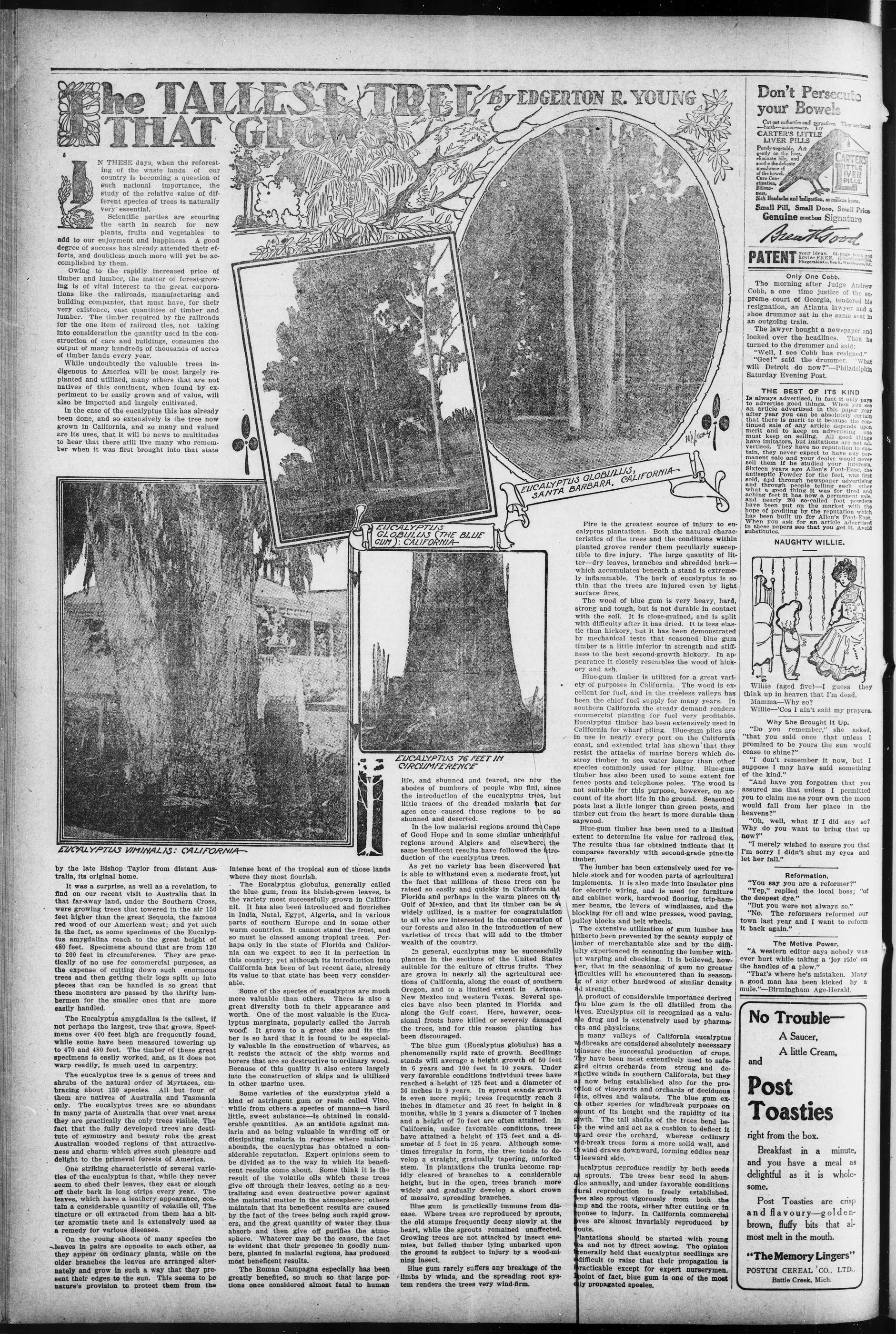
N THESE days, when the reforestation of the waste lands of our country is becoming a question of such national importance, the study of the relative value of different species of trees is naturally very essential.
Scientific parties are scouring the earth in search for new plants, fruits and vegetables to add to our enjoyment and happiness. A good degree of success has already attended their efforts, and doubtless much more will yet be accomplished by them.
Owing to the rapidly increased price of timber and lumber, the matter of forest-growing is of vital interest to the great corporations like the railroads, manufacturing and building companies, that must have, for their very existence, vast quantities of timber and lumber. The timber required by the railroads for the one item of railroad ties, not taking into consideration the quantity used in the construction of cars and buildings, consumes the output of many hundreds of thousands of acres of timber lands every year.
While undoubtedly the valuable trees indigenous to America will be most largely replanted and utilized, many others that are not natives of this continent, when found by experiment to be easily grown and of value, will also be imported and largely cultivated.
In the case of the eucalyptus this has already been done, and so extensively is the tree now grown in California, and so many and valued are its uses, that it will be news to multitudes to hear that there still live many who remember when it was first brought into that state
```markdown
```
by the late Bishop Taylor from distant Australia, its original home.
It was a surprise, as well as a revelation, to find on our recent visit to Australia that in that far-away land, under the Southern Cross, were growing trees that towered in the air 150 feet higher than the great Sequoia, the famous red wood of our American west; and yet such is the fact, as some specimens of the Eucalyptus amygdalina reach to the great height of 480 feet. Specimens abound that are from 120 to 200 feet in circumference. They are practically of no use for commercial purposes, as the expense of cutting down such enormous trees and then getting their logs split up into pieces that can be handled is so great that these monsters are passed by the thrifty lumbermen for the smaller ones that are more easily handled.
intense where
The the b the the v nit. In India parts warm so mu haps in cal this cal California its va able.
So more great
The Eucalyptus amygdalina is the tallest, if not perhaps the largest, tree that grows. Specimens over 400 feet high are frequently found, while some have been measured towering up to 470 and 480 feet. The timber of these great specimens is easily worked, and, as it does not warp readily, is much used in carpentry.
The eucalyptus tree is a genus of trees and shrubs of the natural order of Myrtacea, embracing about 150 species. All but four of them are natives of Australia and Tasmania only. The eucalyptus trees are so abundant in many parts of Australia that over vast areas they are practically the only trees visible. The fact that the fully developed trees are destitute of symmetry and beauty robs the great Australian wooded regions of that attractiveness and charm which gives such pleasure and delight to the primeval forests of America.
One striking characteristic of several varieties of the eucalyptus is that, while they never seem to shed their leaves, they cast or slough off their bark in long strips every year. The leaves, which have a leathery appearance, contain a considerable quantity of volatile oil. The tincture or oil extracted from them has a bitter aromatic taste and is extensively used as a remedy for various diseases.
On the young shoots of many species the leaves in pairs are opposite to each other, as they appear on ordinary plants, while on the older branches the leaves are arranged alternately and grow in such a way that they present their edges to the sun. This seems to be nature's provision to protect them from the
LEST TREE
BY EDGERTON R. YOUNG
EUCALYPTUS GLOBULUS,
SANTA BARBARA, CALIFORNIA
intense heat of the tropical sun of those lands where they most flourish. The Eucalyptus globulus, generally called the blue gum, from its blush-green leaves, is the variety most successfully grown in California. It has also been introduced and flourishes in India, Natal, Egypt, Algeria, and in various parts of southern Europe and in some other warm countries. It cannot stand the frost, and so must be classed among tropical trees. Perhaps only in the state of Florida and California can we expect to see it in perfection in this country; yet although its introduction into California has been of but recent date, already its value to that state has been very considerable.
Some of the species of eucalyptus are much more valuable than others. There is also a great diversity both in their appearance and worth. One of the most valuable is the Eucalyptus marginata, popularly called the Jarrah wood. It grows to a great size and its timber is so hard that it is found to be especially valuable in the construction of wharves, as it resists the attack of the ship worms and borers that are so destructive to ordinary wood. Because of this quality it also enters largely into the construction of ships and is utilized in other marine uses.
Some varieties of the eucalyptus yield a kind of astringent gum or resin called Vino, while from others a species of manna—a hard little, sweet substance—is obtained in considerable quantities. As an antidote against malaria and as being valuable in warding off or dissipating malaria in regions where malaria abounds, the eucalyptus has obtained a considerable reputation. Expert opinions seem to be divided as to the way in which its beneficent results come about. Some think it is the result of the volatile oils which these trees give off through their leaves, acting as a neutralizing and even destructive power against the malarial matter in the atmosphere; others maintain that its beneficent results are caused by the fact of the trees being such rapid growers, and the great quantity of water they thus absorb and then give off purifies the atmosphere. Whatever may be the cause, the fact is evident that their presence in goodly numbers, planted in malarial regions, has produced most beneficent results.
The Roman Campagna especially has been greatly benefited, so much so that large portions once considered almost fatal to human
life, and shunned and feared, are now the abodes of numbers of people who fint, since the introduction of the eucalyptus tries, but little traces of the dreaded malaria that for ages once caused those regions to be so shunned and deserted.
In the low malarial regions around the Cape of Good Hope and in some similar unheathful regions around Algiers and elsewhere, the same benign results have followed the introduction of the eucalyptus trees.
As yet no variety has been discovered that is able to withstand even a moderate frost, but the fact that millions of these trees can be raised so easily and quickly in California and Florida and perhaps in the warm places on the Gulf of Mexico, and that its timber can be so widely utilized, is a matter for congratulation to all who are interested in the conservation of our forests and also in the introduction of new varieties of trees that will add to the timber wealth of the country.
In general, eucalyptus may be successfully planted in the sections of the United States suitable for the culture of citrus fruits. They are grown in nearly all the agricultural sections of California, along the coast of southern Oregon, and to a limited extent in Arizona. New Mexico and western Texas. Several species have also been planted in Florida and along the Gulf coast. Here, however, occasional frosts have killed or severely damaged the trees, and for this reason planting has been discouraged.
The blue gum (Eucalyptus globulus) has a phenomenally rapid rate of growth. Seedlings stands will average a height growth of 50 feet in 6 years and 100 feet in 10 years. Under very favorable conditions individual trees have reached a height of 125 feet and a diameter of 36 inches in 9 years. In sprout stands growth is even rapid; trees frequently reach 3 inches in diameter and 35 feet in height in 8 months, while in 3 years a diameter of 7 inches and a height of 70 feet are often attained. In California, under favorable conditions, trees have attained a height of 175 feet and a diameter of 5 feet in 25 years. Although sometimes irregular in form, the tree tends to develop a straight, gradually tapering, unforked stem. In plantations the trunks become rapidly cleared of branches to a considerable height, but in the open, trees branch more widely and gradually develop a short crown of massive, spreading branches.
Blue gum is practically immune from disease. Where trees are reproduced by sprouts, the old stumps frequently decay slowly at the heart, while the sprouts remained unaffected. Growing trees are not attacked by insect enemies, but felled timber lying unbarked upon the ground is subject to injury by a wood-mining insect. Blue gum rarely suffers any breakage of the limbs by winds, and the spreading root system renders the trees very wind-firm.
Fire is the greatest source of injury to eucalyptus plantations. Both the natural characteristics of the trees and the conditions within planted groves render them peculiarly susceptible to fire injury. The large quantity of litter—dry leaves, branches and shredded bark—which accumulates beneath a stand is extremely inflammable. The bark of eucalyptus is so thin that the trees are injured even by light surface fires.
The wood of blue gum is very heavy, hard, strong and tough, but is not durable in contact with the soil. It is close-grained, and is split with difficulty after it has dried. It is less elastic than hickory, but it has been demonstrated by mechanical tests that seasoned blue gum timber is a little inferior in strength and stiffness to the best second-growth hickory. In appearance it closely resembles the wood of hickory and ash.
Blue-gum timber is utilized for a great variety of purposes in California. The wood is excellent for fuel, and in the treeless valleys has been the chief fuel supply for many years. In southern California the steady demand renders commercial planting for fuel very profitable. Eucalyptus timber has been extensively used in California for wharf piling. Blue-gum piles are in use in nearly every port on the California coast, and extended trial has shown that they resist the attacks of marine borers which destroy timber in sea water longer than other species commonly used for piling. Blue-gum timber has also been used to some extent for fence posts and telephone poles. The wood is not suitable for this purpose, however, on account of its short life in the ground. Seasoned posts last a little longer than green posts, and timber cut from the heart is more durable than sapwood. Blue-gum timber has been used to a limited extent to determine its value for railroad ties. The results thus far obtained indicate that it compares favorably with second-grade pine-tie timber.
The lumber has been extensively used for vehicle stock and for wooden parts of agricultural implements. It is also made into insulator pins for electric wiring, and is used for furniture and cabinet work, hardwood flooring, trp-hammer beams, the levers of windlasses, and the blocking for oil and wine presses, wood paving, pulley blocks and belt wheels.
The extensive utilization of gum lumber hasitherto been prevented by the scanty supply of lumber of merchantable size and by the difficulty experienced in seasoning the lumber without warping and checking. It is believed, however, that in the seasoning of gum no greater difficulties will be encountered than in seasoning of any other hardwood of similar density and strength.
A product of considerable importance derived from blue gum is the oil distilled from the leves. Eucalyptus oil is recognized as a valuable drug and is extensively used by pharmacists and physicians.
in many valleys of California eucalyptus wndbreaks are considered absolutely necessary to ensure the successful production of crops. They have been most extensively used to safeguard citrus orchards from strong and destructive winds in southern California, but they are now being established also for the protection of vineyards and orchards of deciduous fruits, olives and walnuts. The blue gum exces other species for windbreak purposes on account of its height and the rapidity of its growth. The tall shafts of the trees bend before the wind and act as a cushion to deflect itward over the orchard, whereas ordinary wnd-break trees form a more solid wall, and the wind draws downward, forming eddies near the leeward side.
eucalyptus reproduce readily by both seeds or sprouts. The trees bear seed in abundance annually, and under favorable conditions rural reproduction is freely established. Does also sprout vigorously from both the amp and the roots, either after cutting or in response to injury. In California commercial oves are almost invariably reproduced by roots. Plantations should be started with young trees and not by direct sowing. The opinion generally held that eucalyptus seedlings are difficult to raise that their propagation is practicable except for expert nurserymen. Point of fact, blue gum is one of the most ely propagated speeches.
Don't Persecute your Bowels
Cut out cathetics and perforations. They are brand
---harth---unnecessary. Try
CARTER'S LITTLE
LIVER PILLS
Purify vegetable. Act
pulled out of the
eliminate bile, and
soothe the delicate
membrane of
of the bowel.
Core Co-
stipation.
Bilious-
mess.
Sick Headache and Indigestion, as millions know.
Small Pill, Small Dose, Small Price
Genuine must bear Signature
PATENT your ideas. 66-page book and
advice FREE. Established in 1884.
Pipergialate. Box 8, W. Washington, D.C.
The morning after Judge Andrew Cobb, a one time justice of the supreme court of Georgia, tendered his resignation, an Atlanta lawyer and a shoe drummer sat in the same seat in an outgoing train. The lawyer bought a newspaper and looked over the headlines. Then he turned to the drummer and said: "Well, I see Cobb has resigned." "Geel!" said the drummer. "What will Detroit do now?"—Philadelphia Saturday Evening Post.
THE BEST OF ITS KIND
Is always advertised, in fact only pays to advertise good things. An article advertised in this paper year after year you can be absolutely certain that there is merit to it because the continued sale of any article depends upon the success of advertising one must keep on selling. All articles have imitators, but imitations are not vertised. They have no reputation to sustain, they never expect to have any permanent sale and your dealer would never have the money he studied your interests, Sixteen years ago, antiseptic Powder for the feet, was first sold, and through newspaper advertising and through people telling each other a good thing it was for tired and aching feet, and through people telling and nearly 200 so-called foot powders have been put on the market with the hope of profiting by the reputation that has been built up for Allen's Foot-Ease. You can ask for an article advertised in these papers see that you get it. Avoid substitutes.
Willie (aged five)—I guess they think up in heaven that I'm dead. Mamma—Why so? Willie—'Cos I ain't said my prayers. Why She Brought It Up
"Do you remember," she asked. "that you said once that unless I promised to be yours the sun would cease to shine?"
"I don't remember it now, but I suppose I may have said something of the kind."
"And have you forgotten that you assured me that unless I permitted you to claim me as your own the moon would fall from her place in the heavens?"
"Oh, well, what if I did say so? Why do you want to bring that up now?"
"I merely wished to assure you that I'm sorry I didn't shut my eyes and let her fall."
Reformation.
"You say you are a reformer?"
"Yep," replied the local boss; "of the deepest dye."
"But you were not always so."
"No. The reformers reformed our town last year and I want to reform it back again."
The Motive Power
"A western editor says nobody was ever hurt while taking a 'joy ride' on the handles of a plow."
"That's where he's mistaken. Many a good man has been kicked by a mule."—Birmingham Age-Herald.
No Trouble—
A Saucer,
A little Cream,
and
Post
Toasties
right from the box.
Breakfast in a minute,
and you have a meal as
delightful as it is wholesome.
Post Toasties are crisp
and flavour—golden-
brown, fluffy bits that
almost melt in the mouth.
"The Memory Lingers"
POSTUM CEREAL CO., LTD.
Battle Creek, Mich.
---
Discharged Without Notice
By Henry Crider Evans
The slow, drizzling rain which had steadily fallen since the early part of the afternoon and which threatened to continue to fail during the rest of the evening, was not more dismal and dreary than the heart of the girl who shrank back in the corner seat of the elevated train, gazing through the clouded window panes with dull, unseeing eyes.
She was dressed in a shabby black dress and jacket; her shoes were worn and her hat had the look of being made and remade from one dated past years before.
Mollie Orth had left home that morning with but 15 cents in her purse, her hopes raised high, and a feeling in her heart that she would succeed this time. She smiled at the conductor as she handed him her fare, smiled at the little girl sitting in the seat across from her tenderly hugging a boarragled doll in her arms; indeed, smiled at every one she saw, for Mollie was decidedly an optimist, and so surely as failure and worry and heartache laid her spirits low, just so surely would they rise again with the beginning of a new day.
All morning she wandered down street after street, vainly seeking employment. After awhile the smile left her lips and the song died out of her heart. Gradually, her limbs grew more and more tired, until at last her feet refused to carry her farther and, entering the waiting room of a large department store, she sank into a chair and wearily closed her eyes. The matron, a neatly-dressed woman with a kind, motherly face, glanced at the girl with understanding and sympathy in her eyes. The story was so evident and such an old one!
"Wouldn't you care to glance over this paper while you are resting?" asked the matron, handing her a newspaper with a smile that conveyed encouragement and sympathy to the girl's heart. Mollie grasped it eagerly, murmuring her thanks. As the woman expected, she turned at once to the "help wanted" page and hastily scanned its columns. There was but one ad. which she could answer, but even this was a ray of hope which she eagerly seized upon. It was raining when she reached the street, but although she had no umbrella she started all undaunted for the address given in the paper.
It was ten long blocks from the store which she had left and she was thoroughly drenched by the time she reached her destination. Approaching the office boy she inquired for the manager, and was pointed out a large, heavily-built man seated behind a huge desk, his head bent over a heap of papers.
"Well, what can I do for you?" he asked sharply as Mollie stood patiently awaiting his attention.
The girl timidly stated her errand, answering his numerous questions with straightforward honesty.
"Well," he said, at length, "you don't look overstrong, but guess you'll do. We expect good work from our people, and if we can't get it out of them we don't keep 'em—that's all. Where are your references?"
"I haven't any," began Mollie, tremuously. "I never thought to ask for any at the last place I worked in."
The man sowled as he waved her aside with a fat, pudgy hand. "No go, no go. No reference, no job. Why didn't you say so right away instead of wasting all my time?"
"Oh, cried Molly, in dismay. "Only try me, sr! I will work hard, you will see how fast my fingers can fly. Please, please give me just a trial! I need the money so badly."
The man turned resolutely to his desk.
"Can't do it, I tell you. We don't do business that way."
Mollie walked blindly out of the office and was once more on the street. Feeling faint she determined to spend half of her last dime for a cup of coffee. She entered a cozy little restaurant, following the usher to a table near the end of the room.
Mollie paused long over her coffee, drinking in its sweet fragrance and feeling a delicious sense of comfort as the strong liquid sent a flush of warmth through her body. She rose regrettably when her cup was empty, and made for the cashier's desk, which was overcrowded, the people standing in line to pay for their checks and the cashier herself nervous and hurried.
Mollie laid her check, which called for five cents, upon the desk, together with her solitary dime, and was given five brand-new pennies in change. How bright they looked and how they shone, almost as if they were made of gold, she thought, as she walked slowly down the street. Why, one was different from the rest! Surely it was not a common penny! Hastily turning it over in her hand, she saw that she was holding, not a penny, but a $10 gold piece!
"Take it back! It isn't yours, and it will be dishonest to keep it," whispered a voice which seemed so real that she started and glanced apprehensively over her shoulder. What a struggle she had to put that voice in the background. This meant bread and meat to her, food for the little sisters at home and peace to the worried mother, whose hair was fast becoming streaked with gray. She could not give it up, she would not! A feel of fierce exultation possessed her.
Her feet fairly flew up the steps leading to the elevated station, the bit of gold clutched tightly in her hand. The cashier at the turnstile glanced up in surprise as Mollie's trembling fingers dropped the piece of money before her.
"Have you no smaller change than this?" she asked, then as Mollie nodded her head, she carefully counted out the change.
How many times Mollie's resolution weakened and faltered that night! As she met her mother's eager, questioning glance as she entered the door; as she saw the look of blank despair in her eyes as she faltered out her failure, her heart misgave her, and she longed to pour the money into her mother's thin hands, telling her that there was enough for food and clothes, warmth and comfort until she could secure a position. Again, at the supper table, as she helped herself to a dried piece of bread and one small, mealy potato, the temptation to keep the money grew almost too strong to resist.
The next morning found her once more entering the little restaurant. She noticed a new girl in the cashier's place, and her heart sank in shame. She inquired for the manager, and was shown into a little slide room to a man bending over a table figuring up accounts. He was about thirty, tall, broad-shouldered, with the kindest brown eyes in the world, she thought. Timidly she handed him the change she had received from the gold piece and told her story. Then all at once she found herself crying softly, as she poured out the whole story of the struggle and temptation she had endured.
"There, there; don't cry any more. It's all over now and you have won a victory to be proud of. Now listen to my proposition. Miss Johnson, our former cashier, has been suffering from extreme nervousness for a long time and was only waiting for the end of the season to give up work entirely until her health was once more restored. The final straw came last night, when she discovered the shortage in her accounts, and she insisted upon making up the loss to us, although we protested strongly against her doing so. Then she left, and we had to place one of our waitresses temporarily in her place. It will give me much pleasure to return this money to her, and also to offer you her position. We will give you $10 a week to start. Will you take it?"
Mollie mutely nodded her head, her eyes shining with happiness. Ten dollars a week! That was more than she had ever earned before. Eager to prove her gratitude, she bent all her energy to her work, schooling herself to become more rapid and accurate each day.
Often, looking up from her work, she would find Mr. Asher, the manager and owner of the restaurant, watching her with a look in his brown eyes which she could not understand. She could always feel his presence, knew when he entered the room and when he left, a feeling for which she could not account.
On evening, after the last customer had departed, and the doors were closed for the day, as she was making out her report, he came over and stood beside her desk.
"Miss Orth, you have been with us two years now, haven't you?" he asked.
Mollie replied in the affirmative.
"You are receiving a salary of $15 a week now, are you not?" he asked again, and again Mollie nodded.
"Well, Miss Orth," he began hesitatingly, "we feel that you are worth more than we are paying you, although we cannot afford to raise your salary any higher, therefore I am going to ask you to resign your position."
Mollie gasped and stared at him with eyes filled with surprise and dismay. Asked to resign her position! What could she have done to deserve it? Her accounts always balanced evenly; she had supposed her work was giving complete satisfaction, and now, without warning, she was to be discharged.
"Don't feel so badly over it, Miss Orth. I am going to offer you another position, one which I trust you will not refuse. It is that of housekeeper to a lonely, solitary bachelor. Miss Orth, will you be my wife?"
Mollie gazed at him and then, just as she had done two years before, when he had offered her the position, she laid her head down upon her arms and burst into tears.
"Mollie! Little girl, don't you care? If you only knew how I have hoped and prayed that you did. Would you rather keep your position here, and have me give up my 'castle in Spain, and go away. For go away I must, if you refuse me. I could not bear to stay here, to be near you day after day, and know that my hopes could never be realized! Tell me, Mollie, which shall it be? Don't cry any more, little girl, look up and tell me."
Mollie did look up, and the tears in her eyes only made them look brighter with joy and happiness shining through them as the sun behind a cloud.
"Oh, you ask me if I will marry you!" she cried. "If you only knew, if you only knew!"
The words, few as they were, were sufficient for her eyes told the rest
SMILES
HIS GOOD TASTE.
A young man contemplating matr-
monial feelicity took his fair intended
to the home of his parents that she
might be introduced to the old folks.
"This is my future wife," said the
young man proudly, turning to pater-
familias, who was a canny Scot. "Now,
father, tell me candidly what you
think of her."
The old man eyed the blushing
bride-elect critically for fully two min-
utes, and then answered with delib-
eration:
"Well, John, I can only say that you
have shown much better tastes than
she has."
An Ultimatum:
"Let me see, Alice," said the old man to his eldest daughter, "young Blinkers has been calling on you regularly for six or eight months, hasn't he?" "Yes, father," replied the fair Alice "Well," continued the anxious parent, "if he asks you to marry him when he comes tonight, tell him he wants to see me. Understand?" "Yes, father," she rejoined. "And if he doesn't ask you to marry him," added the old man, "just tell him that I want to see him."
A Good Reason:
She—How is it you were not at the West End's reception?
He—I stayed away on account of a personal matter.
She—May I ask you what it was?
He—Will you promise to keep it secret?
She—Yes.
He—Well, they failed to send me an invitation.—Judy.
Only a Partial Loss
Mrs. Northside—Is it true that your littie boy has lost his voice since his recent illness?
Mrs. Crosstown—Not. entirely, but his voice has been reduced considerably. When he is carrying on a conversation with other boys now you can't hear him for more than five blocks.
How to Tell.
"How can you tell a smart man from a fool?"
"Well, when a man is always telling you how wonderfully smart he is that's——"
"The smart man?"
"No, the fool."
WANTED TO WORK IT, TOO.
w.
Swipsey—Say, why wasn't yer at school ter day?
Jimpsy—Cos I had er headache.
Swipsey—Say, how did yer make yer mudder believe it?
Dearer.
Dear heart, you're twice as dear to me. As what you used to be.
Since things have doubled up in price You're twice as dear to me.
Dearer.
Her Dearest Pets.
"I have a heart-rending scene in my new drama."
"How now?"
"The heroine is in such reduced circumstances that she has to cook the canary."
"Sad, sad."
"But the worst is yet to come. She has to build the fire with the rubber plant."
Self-Consciousness.
"Is this silk of the latest style?" asked the man who had been appointed on a reception committee.
"The very latest," replied the obliging salesman.
"Then I don't want it. What I'm after is something new enough not to be shabby and old enough to look as if I were used to wearing it."
She Could Spare One
"Scuse me, ma'am," said the hobo to the lady at the front door, "can you spare a pore beggar a copper?" "Certainly," answered the lady and, turning to a speaking tube, she called: "Jane, send that policeman you have in the kitchen up her at once." But the hobo was beating it up the nearest alley.
Blasted Hopes.
Mr. Stubb—Maria, do you remember that millinery store that had such a great display of fall hats? Well, there has been a fire down there and everything is reduced—
Mrs. Stubb — Gracious, what a chance for bargains! And everything is reduced, John?
Mr. Stubb—Yes, reduced to ashes.
When all my life's unruly ways be trod,
And at Death's gate I stand to render
toll,
When all my body is widowed of the
soul
And this hot heart lies cold beneath the
sod,
Oh, how shall I, uncovered and unshod,
Endure the tale of that recording scroll?
And where's the hyssop that shall make
me whole
To stand unshamed before the face of
God?
Yet, though through devious path and
dark defile
I wander stumbling and with aimless
feet,
Surely I yet shall find a meadow green
Where I may rest and breathe calm air a
while;
Surely I yet shall find a river sweet.
To wash my limbs till ev'ry speck be clean.
-G. H., in the Academy.
A Screw Loose Somewhere.
Professor of Drawing—Miss Hecton, the primary teacher, told her pupils today that she was 22 years old.
Professor of History—Her statement doesn't agree very well with an answer she gave me once.
Professor of Drawing—What answer was that?
Professor of History—Why, she answered "Yes" when I asked her if she remembered the year in which America was discovered.
GENEROUS.
Mrs. Torker—I hear that your husband is very generous.
Mrs. Noowedd—Very! I gave him a box of cigars for a birthday present and he never smoked one of them. He gave them all away to his friends.
His Loss Her Gain
Idiot at the Breakfast Table.
"I hope you are satisfied with our table," Mr. Idiot," said the landlady.
"In the main, yes," replied the idiot.
"But I really think I ought to register a complaint against yesterday's fishballs, madam."
"Why, I'm sorry about that," said the landlady, blushing. "We rather pride ourselves on our fishballs. What was the matter with them, sir?" "Mine had a distinctly fishy taste," returned the Idiot.—Harper's Weekly.
Perhaps He Gives It to Her:
"You husband's business is growing and making more money for him right along, is it not?"
"No, he is losing more and more money every day."
"You astonish me! You must surely be mistaken?"
"No, I'm not; every time I ask him for a dollar, he tells me how he is losing money."
Both Envious.
"There goes a man I envy," remarked Wedderly, "and strange to say, he also envies me."
"What's the explanation?" queried the party of the other part.
"We were both in love with the same woman," answered Wedderly as he permitted an open-faced sigh to escape; "and—and I married her."
TIT FOR TAT.
ITT FOR TAY.
Bookkeeper—This is an awful big bill you are going to send to Mr. Fixemup.
The Dentist—I know—he's the man who fixed the plumbing in my house.
This is the first chance I've had at him.
The Only Deed for Her.
And yet she loved him not;
Far she seems a chap came along one day
Far she seems a chap came along one day.
The KITCHEN CABINET
"A MAN can write a better book, preach a better sermon, or make a better mouse-trap than his neighbor, though he build his house in the woods, the world will make a beaten path to his door." —Emerson.
VERY one must have felt the a cheerful friend is if a sunny day which she its brightness on all around; and most us can, as we choose, make of this world either a palace or a prison." —Sir Jo Lubbock.
WEDDING REFRESHMENTS.
A sunrise marriage, followed by a porch breakfast is particularly adapted to a small company. For this early breakfast, simple Areadian fare is the most appropriate. Fresh berries on the stem, brook trout or fried chicken with water cress and creamed potatoes, waffles or baking powder biscuit with honey, and coffee fragrant and rich with thick country cream, will make a collation satisfying to any.
If a wedding takes place at noon, a wedding breakfast follows. A ceremony at four o'clock is followed by a buffet huncheon, which need be no more elaborate than an afternoon tea and still be in good taste. For a more formal entertainment the guests are seated.
A Wedding Cake Novelty.
If the bride is as fortunate as the one at a recent wedding, she may have a composite wedding cake. The bride's cake contained beside its usual ingredients, small portions of the wedding cake of the bride's parents, her sisters and brothers, as well as the silver and golden wedding cakes of the grand parents.
In the wedding cake which the bride cuts there is often hidden a ring, a thimble, a dime and a saquin. These are wrapped in paraffine paper. The one receiving the ring is properly supposed to be the next bride, the thimble foretells spinisterhood, the dime wealth, in prospect, and the raisin an unannounced engagement.
Aside from the bride's cake, which may be either white or black fruit cake everything is small and made so that it can be handled without soiling fingers or gloves. Usually the cakes are made in sheets, then iceed and cut in squares, triangles or cubes. These may be decorated with candied cherries, rose leaves or violets.
While most brides prefer to cut their own wedding cake as a pretty touch of sentiment, the fashion of distributing small slices of the cake, daintily boxed, is a prevailing one.
HAVE learned that success is to be measured, not so much by the position that one has reached in life as by the obstacles he has overcome while trying to succeed.—Booker T. Washington.
BONNY CLABBER.
Bonny clabber is an old time dish that is worthy of revival, and is good at any meal. Allow good unskimmed milk to sour without disturbing it. After about the second day, dish it out in spoonfuls and serve with sugar and nutmeg dusted over it.
Nothing could be more delicious than Devonshire cream served either on berries or on the breakfast cereal. Scald rich new milk, at least two quarts, put in a cool place for the cream to rise. The next day remove the cream and serve on fruit or cereal.
Fruit omelets make a pleasant change for a breakfast dish. The fruit may be added to, the omelet and cooked in it or served around it as a sauce.
For hygienic reasons it is well to have days throughout the summer when a meal may be omitted entirely or serve something very simple.
A favorite breakfast is composed of rolls torn open and toasted in the oven, then lightly buttered, to be served with coffee and a cold cereal in which some fresh fruit was stirred while hot, this to be eaten with cream. For another breakfast try whole tomatoes that have been peeled the day before and placed on ice, season with salt, pepper and a little sugar and eat with thick cream and toasted bread
Carrot Soup.
Wash young carrots, scrape them free from skin and cook in boiling water until tender. Press through a vegetable ricer, and to a cupful of carrot add two cupfuls of milk. Cook together two tablespoonfuls each of flour and butter, combine the mixtures and cook five minutes. Season with salt and pepper and a little onion juice. Serve with a little finely minced parsley sprinkled over the tops.
Hot Pineapple Compote
Canned sliced pineapple heated in its own sirup and served with the game or meat course is another novelty, but one generally approved. The fresh pineapple may be served, but it should be cooked in a rich sirup and served hot.
Cherry Pie.
Line a pie plate with pastry, fill with sweetened cherries, put strips of pastry across in lattice work fashion, and bake. Just before serving, put little spoonful of sweetened whipped cream on each square and on each mound cream put a fresh cherry.
VERY one must have felt that a cheerful friend is like a sunny day which sheds its brightness on all around; and most of us can, as we choose, make of this world either a palace or a prison."—Sir John Lubbock.
THE FIRELESS COOKER.
The revival of the fireless cooker has passed through its fad, scape and settlee down to a practical necessary article. It hardly seems necessary to describe its construction and merits, yet there are many who have not acquainted themselves with its usefulness, as there are so many queries regarding it. One great beauty of the cooker is that any one may have one, for they may be made very satisfactorily at home. The manufactured cooker is more easily kept sweet, but one in my own kitchen, which has been in use three years is still in good condition. It is packed with crushed paper, and after cooking any odorous vegetable in it, it is taken out of doors and aired on the grass. The earth absorbs all odors in a very few hours.
The cooker above mentioned is made from an old trunk, a small-sized one. It is lined with several layers of newspaper, a partition of thin board put through the center, which makes two compartments. The utensils to be used in each are set in and the paper crushed and packed in by hard pounding. The dishes used should be fitted with tight covers, as the secret of a successful cooker is air-tight dishes. The nests made by packing the paper around the utensils permit their being taken out and put in easily. Cushions of excelior and hay cover each compartment tightly, and the cooker is ready to use.
For the proper cooking of meats there is no better device than this cooker, as it is cooked rapidly for ten to twenty minutes on the stove and then as it is put into the cooker and covered tightly it simmers for hours below the boiling point, the ideal way of cooking meat.
Rice and breakfast cereals which take long cooking, if boiled for ten minutes and put in the cooker are ready in a few hours to reheat and serve. Put the breakfast cereal in the cooker at night for breakfast and the fricassee at breakfast time to be ready for dinner.
As a practical convenience in the army it has been found invaluable, as the men have been provided with hot meals when a fire would reveal their positions to the enemy.
NJOY your goods as if your death were near,
Save them as if 'twere dis-
Sparing or spending, be thy wisdom seen,
In keeling ever to the golden mean."
CHERRIES ARE RIPE.
The delicious cherry is one of our most satisfactory fruits for canning and preserving, as it keeps its color and flavor so well.
A well-tried recipe for preserving them fresh, if carefully followed, keeps them in such good condition that it is hard to tell them from the fresh fruit.
Pit the fruit and mix with equal bulk of sugar, let stand 12 hours, stirring occasionally so that the sugar is completely dissolved before canning. See that the cans are well sterilized and air tight. Fill them with the prepared fruit, seal and put in a cool cellar. The secret of keeping any fruit in this way is the low temperature.
Other fruits keep equally well, currants are especially fine canned in this manner. Any fruit canned without cooking is more desirable for salads and desserts.
Directions for Canning.
Fruit for canning should be fresh and ripe. If over-ripe the fruit is apt to ferment. Allow one-third its weight in sugar for canning, bolling the sugar with water to dissolve, cooking ten minutes before adding the fruit. By so doing the fruit is kept in better shape.
Cook a small quantity of fruit at a time, put into sterilized jars, fill with the bolling sipu to overflowing. If a spoon is inserted between the fruit and the jar the bubbles rise to the top and break. Screw the tops on tight and when cool tighten again.
When filling jars, place them on a cloth wrung out of hot water.
To Sterilize Jars.
Wash the jars and fill them with water (cold). Set them on a trivet, and surround them with cold water. Heat the water gradually to the boiling point and fill the jars while hot. Put the covers into the water and let them scald five minutes. Dip the rubbers into the water before putting on the jars. New rubbers should be used each year. Care should be used that the rims of the covers are not bent, as the jars cannot then be hermetically sealed.
NEW YORK'S MAYOR SHOT
WAS ON SHIP READY TO SAIL
FOR EUROPE.
Assailant a Discharged City Employee
—Ball Entered at Back of Neck
and Lodged Under Tongue.
New York, N. Y.—William J. Gaynor, mayor of the city of New York, while saying the last farewell to a group of his friends on the promenade deck of the North German Lloyd steamer Kaiser Wilhelm der Grosse, was suddenly attacked from behind by an armed man who sent a bullet into his neck and another one into his back before he could be stopped. The mayor was so badly injured that it is not believed he can recover. Its assailant is James J. Gallagher, a discharged New York watchman formerly attached to the department of docks and ferries. He is 58 years old and a man of prodigious strength. It took a dozen men to subdue him after his assault on the mayor, among them "Big Bill" Edwards, commissioner of street cleaning and a former Princeton football player, and Ralph Bloomer, who was as prominent for his football feats at Yale as Edwards was at Princeton. It was Edwards who probably saved the mayor's life. He made a leap at Gallagher immediately after the first shot and landed a smashing blow between his eyes. The man leaped back with Edwards' after him but managed to fire another shot in the direction of the mayor before he went down.
From the first the gravest doubts of the mayor's recovery were expressed at the hospital, although no alarming reports were made public. Specialists summoned from New York held out very little hope. The bullet which entered the back of the mayor's neck, took a downward course and is lodged under the tongue. The physicians had the greatest trouble in cheeking the hemorrhages that followed and the mayor was greatly weakened by his efforts to breathe with his threat full of blood. It is believed that an operation will be necessary and such a course at once is viewed with considerable apprehension owing to the mayor's weakened condition.
PAYNE LAW BRINGS REVENUE
With a Deficit of $58,734,955 in 1909
There Was a Surplus of $20,
000,000 in 1910.
Washington, D. C.-The Payne-Aldrich tariff law has produced in its first year a revenue greater by $15,000,000 than the sum collected in any year in the country's history, according to treasury department figures. The second year of the operations of the new tariff began recently.
In the first full year, ended last Saturday night, the total ordinary receipts, including customs, ordinary internal revenue, corporation tax and miscellaneous, aggregating $678,850,816, exceeded disbursements by $20,214,029.
These ordinary receipts are greater by $15,000,000 approximately than in 1907 and the 1907 receipts exceeded those of any other year of record by almost $60,000,000. While there was a deficit of $58,734,955 in the ordinary operations of the government in the fiscal year ended June 30, 1909, there was a surplus of more than $20,000,000 in the year ended last Saturday.
The corporation tax revenue was $27,090,934, which is only $20,000 less than the amount assessed.
SPRING WHEAT CONDITION POOR
But Winter Variety Yielded 12,000,000 Bushels More Than Last. Year.
Washington, D. C.—A winter wheat crop in the United States of 458,250,000 bushels, 12,000,000 bushels more than last year, is reported by the department of agriculture in its preliminary estimate just published. The figures are 45,000,000 bushels more than were indicated by the percentage condition of the crop reported a month ago. The average yield per acre is 15.8 bushels.
The spring wheat condition is 61, a decline of .6 of one per cent since July 1, and 31 per cent below the condition a year ago.
The corn prospect declined 6.1 per cent in July. The condition August 1 was 79.3, compared with 84.4 a year ago.
Put Off a Rate Increase.
Washington, D. C.—Proposed advances in the freight rate on live stock of 2½ cents a hundred pounds between the Missouri river and Mississippi river points, which were to have become effective August 15, will be suspended pending an inquiry by the Interstate Commerce commission into the reasonableness of the increases.
its the Good Ship Delaware.
Newport, R. I.—The new battle ship Delaware returned from its trial trip along the coast to the Bradford Coaling station with a crew happy because of the showing made by the big fighter.
Another Opium Den Raided.
Kansas City, Mo.—Between $4,000 and $5,000 worth of opium and yenshe were captured in a raid that was made by special detectives. This was the second biggest opium raid that has been made in this country
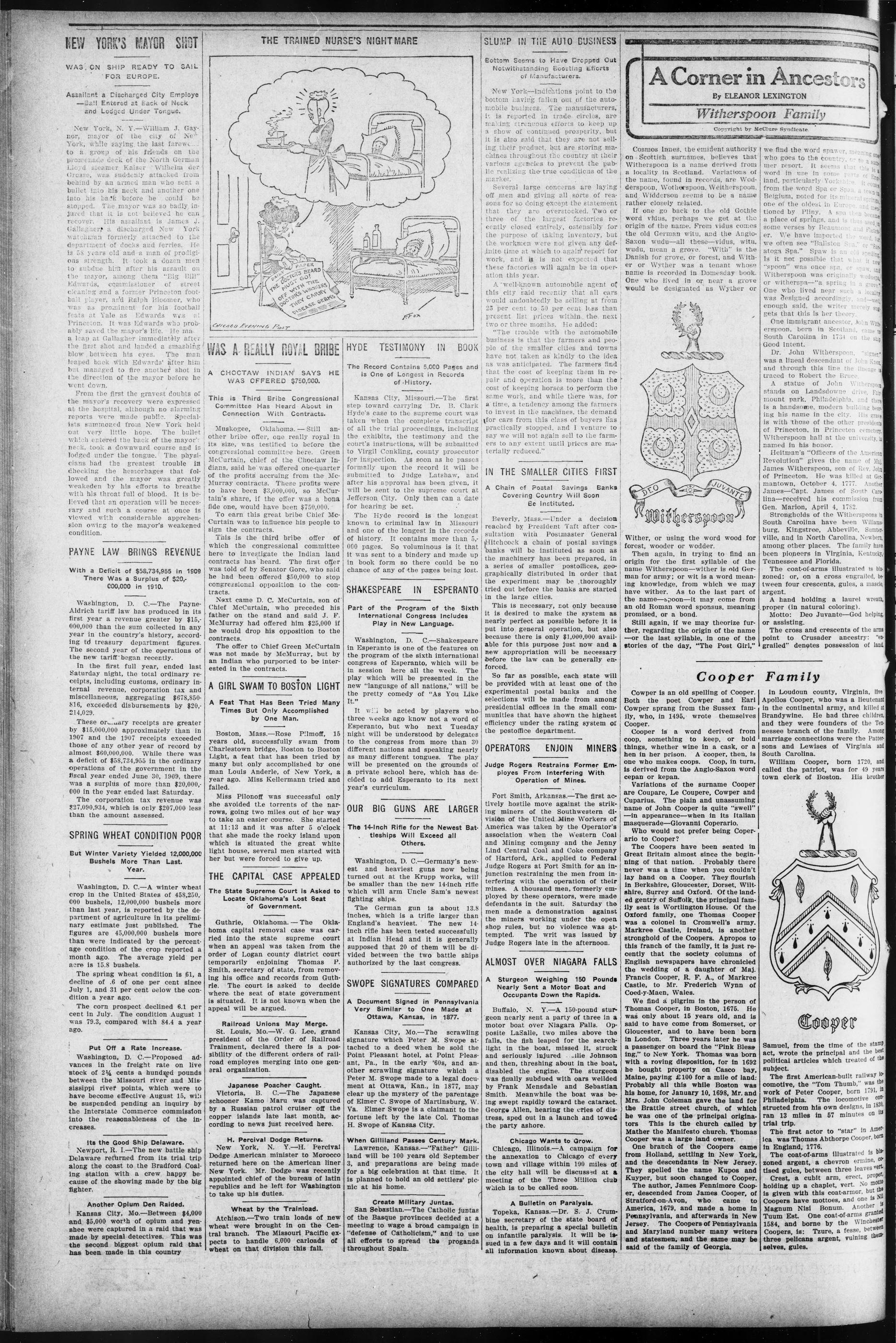
DAILY PAPER
DOCTORS BEARD
THE MUST GET
OFF WITH THE
DOCTORS WHISHERS
THEY CARRY
PLEASE GERMS
CHICARD EVENING POST
FFOX
WAS A REALLY ROYAL BRIBE
A CHOCTAW INDIAN SAYS HE WAS OFFERED $750,000.
This is Third Bribe Congressional Committee Has Heard About in Connection With Contracts.
Muskogee, Oklahoma. — Still another bribe offer, one really royal in its size, was testified to before the congressional committee here. Green McCurtain, chief of the Choctaw Indians, said he was offered one-quarter of the profits accruing from the McMurray contracts. These profits were to have been $3,000,000, so McCurtain's share, if the offer was a bona fide one, would have been $750,000.
To earn this great bribe Chief McCurtain was to influence his people to sign the contracts.
This is the third bribe offer of which the congressional committee here to investigate the Indian land contracts has heard. The first offer was told of by Senator Gore, who said he had been offered $50,000 to stop congressional opposition to the contracts.
Next came D. C. McCurtain, son of Chief McCurtain, who preceded his father on the stand and said J. F. McMurray had offered him $25,000 if he would drop his opposition to the contracts.
The offer to Chief Green McCurtain was not made by McMurray, but by an Indian who purported to be interested in the contracts.
A GIRL SWAM TO BOSTON LIGHT
A Feat That Has Been Tried Many Times But Only Accomplished by One Man.
Boston, Mass.—Rose Pilloff, 15 years old, successfully swam from Charlestown bridge, Boston to Boston Light, a feat that has been tried by many but only accomplished by one man Louis Anderle, of New York, a year ago. Miss Kellermann tried and failed.
Miss Pilonoff was successful only she avoided the torrents of the narrows, going two miles out of her way to take an easier course. She started at 11:13 and it was after 5 o'clock that she made the rocky island upon which is situated the great white light house, several men started with her but were forced to give up.
THE CAPITAL CASE APPEALED
The State Supreme Court is Asked to Locate Oklahoma's Lost Seat of Government.
Guthrie, Oklahoma. — The Oklahoma capital removal case was carried into the state supreme court when an appeal was taken from the order of Logan county district court temporarily enjoining Thomas P. Smith, secretary of state, from removing his office and records from Guthrie. The court is asked to decide where the seat of state government is situated. It is not known when the appeal will be argued.
Bailroad Unions May Merge
St. Louis, Mo.-W. G. Lee, grand president of the Order of Railroad Trainment, declared there is a possibility of the different orders of railroad employees merging into one general organization.
Japanese Poacher Caught.
Victoria, B. C.-The Japanese schooner Kamo Maru was captured by a Russian patrol cruiser off the copper islands late last month, according to news just received here.
H. Percival Dodge Returns.
New York, N. Y.—H. Percival Dodge American minister to Morocco returned here on the American liner New York. Mr. Dodge was recently appointed chief of the bureau of latin republics and he left for Washington to take up his duties.
Wheat by the Trainload.
Atchison.—Two train loads of new wheat were brought in on the Central branch. The Missouri Pacific expects to handle 6,000 carloads of wheat on that division this fall.
HYDE TESTIMONY IN BOOK
The Record Contains 5,000 Pages and is One of Longest in Records of History.
Kansas City, Missouri.—The first step toward carrying Dr. B. Clark Hyde's case to the supreme court was taken when the complete transcript of all the trial proceedings, including the exhibits, the testimony and the court's instructions, will be submitted to Virgil Conkling, county prosecutor for inspection. As soon as he passes formally upon the record it will be submitted to Judge Latshaw, and after his approval has been given, it will be sent to the supreme court at Jefferson City. Only then can a date for hearing be set.
The Hyde record is the longest known to criminal law in Missouri and one of the longest in the records of history. It contains more than 5,000 pages. So voluminous is it that it was sent to a bindery and made up in book form so there could be no chance of any of the pages being lost.
SHAKESPEARE IN ESPERANTO
Part of the Program of the Sixth International Congress Includes Play in New Language.
Washington, D. C.—Shakespeare in Esperanto is one of the features on the program of the sixth international congress of Esperanto, which will be in session here all the week. The play which will be presented in the new "language of all nations," will be the pretty comedy of "As You Like It."
It will be acted by players who three weeks ago know not a word of Esperanto, but who next Tuesday night will be understood by delegates to the congress from more than 30 different nations and speaking nearly as many different tongues. The play will be presented on the grounds of a private school here, which has decided to add Esperanto to its next year's curriculum.
OUR BIG GUNS ARE LARGER
The 14-Inch Rifle for the Newest Battleships Will Exceed all Others.
Washington, D. C.—Germany's newest and heaviest guns now being turned out at the Krupp works, will be smaller than the new 14-inch rifle which will arm Uncle Sam's newest fighting ships.
The German gun is about 13.8 inches, which is a trifle larger than England's heaviest. The new 14-inch rifle has been tested successfully at Indian Head and it is generally supposed that 20 of them will be divided between the two battle ships authorized by the last congress.
SWOPE SIGNATURES COMPARED
A Document Signed in Pennsylvania Very Similar to One Made at Ottawa, Kansas, in 1877.
Kansas City, Mo.—The scrawling signature which Peter M. Swope attached to a deed when he sold the Point Pleasant hotel, at Point Pleasant, Pa., in the early '60s, and another scrawling signature which a Peter M. Swope made to a legal document at Ottawa, Kan., in 1877, may clear up the mystery of the parentage of Elmer C. Swope of Martinsburg, W. Va. Elmer Swope is a claimant to the fortune left by the late Col. Thomas H. Swope of Kansas City.
When Gilliland Passes Century Mark.
Lawrence, Kansas—"Father" Gilliland will be 100 years old September 3, and preparations are being made for a big celebration at that time. It is planned to hold an old settlers' picnic at his home.
Create Military Juntas.
San Sebastian.—The Catholic juntas of the Basque provinces decided at a meeting to wage a broad campaign in "defense of Catholicism," and to use all efforts to spread the proganda throughout Spain.
Bottom Seems to Have Dropped Out Notwithstanding Boosting Efforts of Manufacturers.
New York-Indications point to the bottom having fallen out of the automobile business. The manufacturers, it is reported in trade circles, are making strenuous efforts to keep up a show of continued prosperity, but it is also said that they are not selling their product, but are storing machines throughout the country at their various agencies to prevent the public realizing the true conditions of the market.
Several large concerns are laying off men and giving all sorts of reasons for so doing except the statement that they are overstocked. Two or three of the largest factories recently closed entirely, ostensibly for the purpose of taking inventory, but the workmen were not given any definite time at which to again report for work, and it is not expected that these factories will again be in operation this year.
A well-known automobile agent of this city said recently that all cars would undoubtedly be selling at from 25 per cent to 50 per cent less than present list prices within the next two or three months. He added:
"The trouble with the automobile business is that the farmers and people of the smaller cities and towns have not taken as kindly to the idea as was anticipated. The farmers find that the cost of keeping them in repair and operation is more than the cost of keeping horses to perform the same work, and while there was, for a time, a tendency among the farmers to invest in the machines, the demand for cars from this class of buyers has practically stopped, and I venture to say we will not again sell to the farmers to any extent until prices are materially reduced."
IN THE SMALLER CITIES FIRST
A Chain of Postal Savings Banks Covering Country Will Soon Be Instituted.
Beverly, Mass.—Under a decision reached by President Taft after consultation with Postmaster General Hitchcock a chain of postal savings banks will be instituted as soon as the machinery has been prepared, in a series of smaller postoffices, geographically distributed in order that the experiment may be thoroughly tried out before the banks are started in the large cities.
This is necessary, not only because it is desired to make the system as nearly perfect as possible before it is put into general operation, but also because there is only $1,000,000 available for this purpose just now and a new appropriation will be necessary before the law can be generally enforced.
So far as possible, each state will be provided with at least one of the experimental postal banks and the selections will be made from among presidential offices in the small communities that have shown the highest efficiency under the rating system of the postoffice department.
OPERATORS ENJOIN MINERS
Judge Rogers Restrains Former Employees From Interfering With Operation of Mines.
Fort Smith, Arkansas. The first actively hostile move against the striking miners of the Southwestern division of the United Mine Workers of America was taken by the Operator's association when the Western Coal and Mining company and the Jenny Lind Central Coal and Coke company of Hartford, Ark., applied to Federal Judge Rogers at Fort Smith for an injunction restraining the men from interfering with the operation of their mines. A thousand men, formerly employed by these operators, were made defendants in the suit. Saturday the men made a demonstration against the miners working under the open shop rules, but no violence was attempted. The writ was issued by Judge Rogers late in the afternoon.
ALMOST OVER NIAGARA FALLS
A Sturgeon Weighing 150 Pounds Nearly Sent a Motor Boat and Occupants Down the Rapids.
Buffalo, N. Y.—A 150-pound sturgeon nearly sent a party of three in a motor boat over Niagara Falls. Opposite LaSalle, two miles above the falls, the fish leaped for the searchlight in the boat, missed it, struck and seriously injured Lillie Johnson and then, threshing about in the boat, disabled the engine. The sturgeon was finally subdued with oars weilded by Frank Mensdale and Sebastian Smith. Meanwhile the boat was being swept rapidly toward the cataract. George Allen, hearing the cries of distress, sped out in a launch and towed the party ashore.
Chicago Wants to Grow.
Chicago, Illinois.—A campaign for the annexation to Chicago of every town and village within 100 miles of the city hall will be discussed at a meeting of the Three Million club which is to be called soon.
A Bulletin on Paralysis.
Topeka, Kansas.-Dr. S. J. Crumbine secretary of the state board of health, is preparing a special bulletin on infantile paralysis. It will be issued in a few days and it will contain all information known about disease.
A Corner in Ancestors
By ELEANOR LEXINGTON
Witherspoon Family
Copyright by McClure Syndicate
Cosmos Innes, the eminent authority on Scottish surnames, believes that Witherspoon is a name derived from a locality in Scotland. Variations of the name, found in records, are Wodderspoon, Wotherspoon, Weitherspoon, and Widderson seems to be a name rather closely related.
we find the word spawer, meaning one who goes to the country, or to a summer resort. It seems that this is a word in use in some parts of England, particularly Yorkshire. It comes from the word Spa or Spaa, a town in Belgium, noted for its mineral springs.
If one go back to the old Gothic word vidus, perhaps we get at the origin of the name. From vidus comes the old German witu, and the Angio-Saxon wudu—all these—vidus, witu, wudu, mean a grove. "With" is the Danish for grove, or forest, and Wither or Wyther was a tenant whose name is recorded in Domesday book. One who lived in or near a grove would be designated as Wyther or
DEO JUVANTE
Witherspoon
Wither, or using the word wood for forest, woodier or wodder.
Then again, in trying to find an origin for the first syllable of the name Witherspoon—wither is old German for army; or wit is a word meaning knowledge, from which we may have wither. As to the last part of the name—spoon—it may come from an old Roman word sponsus, meaning promised, or a bond.
Still again, if we may theorize further, regarding the origin of the name—or the last syllable, in one of the stories of the day, "The Post Girl."
Cooper Family
Cooper Family
Cowper is an old spelling of Cooper. Both the poet Cowper and Earl Cowper sprang from the Sussex family, who, in 1495, wrote themselves Cooper. Cowper is a word derived from coop, something to keep, or hold things, whether wine in a cask, or a hen in her prison. A cooper, then, is one who makes coops. Cow, in turn, is derived from the Anglo-Saxon word cepan or kepan.
Variations of the surname Cooper are Coupare, Le Coupere, Cowper and Capurius. The plain and unassuming name of John Cooper is quite "swell"—in appearance—when in its Italian masquerade—Giovanni Coperario. Who would not prefer being Coperario to Cooper?
The Coopers have been seated in Great Britain almost since the beginning of that nation. Probably there never was a time when you couldn't lay hand on a Cooper. They flourish in Berkshire, Gloucester, Dorset, Wiltshire, Surrey and Oxford. Of the landed gentry of Suffolk, the principal family seat is Wortlington House. Of the Oxford family, one Thomas Cooper was a colonel in Cromwell's army. Markree Castle, Ireland, is another stronghold of the Coopers. Apropos to this branch of the family, it is just recently that the society columns of English newspapers have chronicled the wedding of a daughter of Maj. Francis Cooper, R. F. A., of Markree Castle, to Mr. Frederich Wynn of Coed-y-Maen, Wales.
We find a pilgrim in the person of Thomas Cooper, in Boston, 1675. He was only about 15 years old, and is said to have come from Somerset, or Gloucester, and to have been born in London. Three years later he was a passenger on board the "Pink Blessing," to New York. Thomas was born with a roving disposition, for in 1692 he bought property on Casco bay, Maine, paying £100 for a mile of land: Probably all this while Boston was his home, for January 10, 1698, Mr. and Mrs. John Coleman gave the land for the Brattle street church, of which he was one of the principal originators. This is the church called by Mather the Manifesto church. Thomas Cooper was a large land owner.
One branch of the Coopers came from Holland, settling in New York, and the descendants in New Jersey. They spelled the name Kupos and Kuyper, but soon changed to Cooper.
The author, James Fennimore Cooper, descended from James Cooper, of Stratford-on-Avon, who came to America, 1679, and made a home in Pennsylvania, and afterwards in New Jersey. The Coopers of Pennsylvania and Maryland number many writers and statesmen, and the same may be said of the family of Georgia.
we find the word spawer, meaning one who goes to the country, or to a summer resort. It seems that this is a word in use in some parts of England, particularly Yorkshire. It comes from the word Spa or Spa, a town in Belgium, noted for its mineral springs, one of the oldest in Europe, and mentioned by Pliny. A spa then became a place of springs, and is thus used in some verses by Beaumont and Felderer. We have imported the word, for we often see "Balliston Spa." or "Satoga Spa." Spaw is an old spelling. Is it not possible that what it now "spoon" was once spa, or spaw, and Witherspoon was originally wadspea or witherspa—"a spring in a grove." One who lived near such a locality was designed accordingly, and—well enough said, the writer merely suggests that this is her theory.
One immigrant ancestor, John Witherspoon, born in Scotland, and born to South Carolina in 1734 on the ship Good Intent.
Dr. John Witherspoon, "signer" was a lineal descendant of John Knox and through this line the lineage traced to Robert the Bruce.
A statue of John Witherspoon stands on Landsdowne drive, Furniture park, Philadelphia, and there is a handsome, modern building bearing his name in the city. His grave is with those of the other presidents of Princeton, in Princeton cemetery, Witherspoon hall at the university, named in his honor.
Heitman's "Officers of the American Revolution" gives the name of Maj. James Witherspoon, son of Rev. John of Princeton. He was killed at Germantown, October 4, 1777. Another James—Capt. James of South Carolina—received his commission from Gen. Marion, April 4, 1782.
Strongholds of the Witherspoons in South Carolina have been Williamsburg, Kingstree, Abbeville, Sumterville, and in North Carolina, Newbern, among other places. The family have been pioneers in Virginia, Kentucky, Tennessee and Florida.
The coat-of-arms illustrated is blazoned: or, on a cross engrailed, between four crescents, gules, a muscle argent.
A hand holding a laurel wreath, proper (in natural coloring).
Motto: Deo Juvante—God helping or assisting.
The cross and crescents of the arms point to Crusader ancestry: "engrailed" denotes possession of land
In Loudoun county, Virginia, three Apollos Cooper, who was a lieutenant in the continental army, and killed at Brandywine. He had three children and they were founders of the Tessies branch of the family. Among marriage connections were the Patterson and Lewises of Virginia and South Carolina. William Cooper, born 1720, and called the patrolt, was for 49 years town clerk of Boston. His brother
Cooper
Samuel, from the time of the stamp act, wrote the principal and the best political articles which treated of the subject.
The first American-built railway locomotive, the "Tom Thumb," was the work of Peter Cooper, born 1791, in Philadelphia. The locomotive constructed from his own designs, in 1830, ran 13 miles in 57 minutes on its trial trip.
The first actor to "star" in America was Thomas Abthorpe Cooper, born in England, 1776.
The coat-of-arms illustrated is blazed argent, a chevron ermine, confused gules, between three leaves vert.
Crest, a cubit arm, erect, proper holding up a chaplet, vert. No motto is given with this coat-armor, but the Coopers have mottoes, and one is Nil Magnum Nisi Bonum. Another is Tuum Est. One coat-of-arms granted 1584, and borne by the Winchester Coopers, is: Tzure, a fesse, between three pelicans argent, vulning themselves, gules.
you can expect to suffer because the other organs are also affected and the whole system of digestion and assimilation is blocked. You can eat heartily and without fear of distress if you will begin your meals with a dose of Hostetter's Stomach Bitters. It regulates the Appetite, aids digestion and prevents Gas on Stomach, Heartburn, Belching, Indigestion, Cramps, Diarrhoea and Malaria, Fever and Ague. Try it today.
DIDN'T LIKE DARK COLORS.
VOKES.
Johns—I heard you tell that man to never darken your door again. Trying to marry your daughter? Thomas—No; he's a painter and he painted my front door ebony instead of oak.
Oversupply of Alcoholic Stimulants Disturbed Schedule of Funeral Arrangements.
Dean Ramsay's memoirs contain an anecdote of an old woman of Strathay. Just before her death she solemnly instructed her grandnephew: "Willy, I'm dein', and as ye'll hae the charge o' a' I have, mind now that as much whisky is to be used at my funeral as there was at my baptism."
Willy, having no record of the quantity consumed at the baptism, decided to give every mourner as much as he wished, with the result that the funeral procession, having to traverse ten miles to the churchyard on a short November day, arrived only at nightfall.
Then it was discovered that the mourners, halting at a wayside inn, had rested the coffin on a dyke and left it there when they resumed their journey. The corpse was a day late in arriving at the grave.
Fine School.
"Your daughter should attend my school of education."
"She shan't! She's attended one, and she's positively—"
"Ah, but I teach a new system. When my pupils are asked to recite they are trained to refuse."
It's the experience of every man that he wants a lot he doesn't get and gets a lot he doesn't want.
A COOL PROPOSITION
And a Sure One.
The Body Does Not Feel Heat
Unpleasantly if it has
Proper Food—
People can live in a temperature which feels from ten to twenty degrees cooler than their neighbors enjoy, by regulating the diet.
The plan is to avoid meat entirely for breakfast; use a goodly allowance of fruit, either fresh or cooked. Then follow with a saucer containing about four keeping teaspoonfuls of Grape-Nuts, treated with a little rich cream. Add to this about two slices of crisp toast with a peanut amount of butter, and one cup of well-made Postum.
By this selection of food the bodily energy is preserved, while the hot, carbonaceous foods have been left out. The result is a very marked difference in the temperature of the body, and to this comfortable condition is added the certainty of ease and perfect digestion, for the food being partially pregested is quickly assimilated by the digestive machinery.
reference and experiment in food, and its application to the human body has brought out these facts. They can be made use of and add materially to the comfort of the user. Read the little book, "The Road to Wellville," in pkgs. "There's a Reason."
PEANUT TRADE VAST
PEANUT TRADE VAST
INDUSTRY THAT NOW REACHES
SUM OF $36,000,000.
Largest Part of the Crop Is Consumed
From the Street Stand—Most
Nutritious of All Nut
Foods.
The person who buys a nickel's
worth of peanuts to munch at the ball
game, to feed to the squirrels in the
park, or to gladden the hearts of the
kiddies at home, scarcely realizes that
he has contributed to an industry that
last year farmed a $1,000,000 crop, and
which placed on the market in various
forms reached the enormous sum of
$36,000,000. But it is a fact!
This little seductive nut—a resolution to "eat just one" is soon forgotten—whose birthplace is America, was, until comparatively recently, unappreciated either as to the "money in them," or as a really nutritious product. Today the peanut plays an important part in pleasure, from the swell dinner party to the ever-present democracy of the circus, ball game, or picnic. After all, what is a ball game, a picnic, or a circus without the peanut accompaniment?
By far the largest part of the crop is consumed from the peanut stand, the little whistle-sign of the roaster being the signal for the average youngster to suggest to dad or ma that some of them would be very acceptable, and the paternal or maternal parent's willingness—nine times out of ten—to invest. Yet there are millions of bushels that go to the fattening of hogs throughout the south, the feeding of poultry, while the vines often cured as hay, feed thousands of head of cattle, and even old Mother Earth is nourished by the roots of the plant, which furnishes nitrogen to it from the air.
The result of all this is that scientists claim that the peanut, which in the past was not very highly regarded, is the only food staple that will at once nourish man, beast, bird and fields. It is the most nutritious of the entire nut family, rich in tissue building properties, containing glucose and carbohydrates—and is the cheapest. Beyond the shadow of a doubt it is first from both a dietary and economic standpoint.
The fact of the matter is the peanut in about every way is in a class by itself as regards price, average number in pound, edible part, waste, and fat. They average about 350 to a pound at a cost of 10 cents, the edible portion is 73.6, waste 26.4, and the amount of fat is placed at 80 per cent. These are remarkable figures when one stops to consider them, and brought out more clearly when compared with the small Texas pecan, its nearest competitor, which sells for over a third more, averages but 216 to a pound, has a waste of 61.8 per cent, edible part but 38.2, and contains 68 per cent of fat.
The farming of peanuts during the past five years—not longer than this—has become an established industry of this country. At present about five-sixths of the crop comes from Virginia and most of the balance from Tennessee, Georgia, West Virginia and the Carolinas, although most of the southern states contribute some. As the peanut industry has increased so has the use of all nuts grown mightily as an article of food during the last decade, and the entire family now forms a most important part of the diet of the physical culturist and vegetarian.
Bird's Barbed Wire Fences
There may be seen along the road-sides in Central America a brown wren about the size of a canary which builds a nest out of all proportion to its apparent needs. It selects a small tree with horizontal branches growing close together. Across two of its branches it lays sticks fastened together with tough fiber, until a platform about six feet long by two feet wide has been constructed. On the end of this platform nearest the tree trunk it then builds a huge domeshaped rest a foot or so high with thick sides of interwoven thorns. A covered passageway is then made from the nest to the end of the platform in as crooked a manner as possible. Across the outer end, as well as at short intervals along the inside of this tunnel, are placed cunning little fences of thorns with just space enough for the owners to pass through. On going out this opening is closed by the owner by placing thorns across the gateway and thus the safety of the eggs or young is assured.
Selfishness Prevailed.
Sweet little Frances and her mother long have had an understanding that, father being the completing member of the loving trio, he shall never be left alone upon the comparatively few and rare occasions, when business permits him to share the delights of the pretty suburban home. Not long since, however, a neighbor invited mother and child to go motoring with her; father was not included in the invitation lor lack of room. The choice of motoring or staying behind with father was offered Frances, who pondered in silence for some time.
"Course, father's too dear for anything," she said, at last, "and we never do leave him alone on Saturday evenings. But," with a wistful glance at the snorting car, "he wouldn't want us to miss such a pleasure, and," tossing all thoughts of self-denial lightly to the winds, "everything has to have a first time!"
You Look Prematurely Old Because of those ugly, grizzly, gray haires. Use "LA CREOLE" HAIR RESTORER. PRICE, $1.00, retail.
THE IMPORTANCE OF HEALTHY KIDNEYS.
Weak kidneys fail to remove poisons from the blood and are the cause of backache, headache, urinary troubles and dizzy spells.
To insure good health, keep the kidneys well. Doan's Kidney Pills remove all kidney ills. Read what a physician says:
Early American
Tribal Story
PUBLISHED BY
THE WILLIAM H. HARRIS
MUSEUM
Dr. H. Green, 215 N.
9th St., No. Yakima,
Wash., says: "I have
used Doan's Kidney
Pills in my practice
for years and they
have given satisfac
tion. I have taken Doan's Kidney Pills personally and pronounce them the best remedy I have prescribed in my long career as a physician and surgeon."
Remember the name—Doan's. For sale by all dealers. 50 cents a box.
Foster-Milburn Co., Buffalo, N. Y.
NOT QUITE THE SAME THING
Party Tickets Had Changed Somewhat Since the Old Gentleman Handed Out Advice.
Everybody who had known old Henry admired him for the charity of his tongue when he spoke of his neighbors. It was his most marked characteristic—except the independence which he manifested in his political affiliations. It made a young man who was visiting in the neighborhood curious, and one day he managed to lead up to the subject and ask the old man what had taught him to keep such a good watch on his tongue.
"It was my father," replied the old man, quietly. "A splendid man, as I remember him. He always disliked to hear folks gossiping unkindly about each other. I've seen him, when they began it, get on his feet, just like a cow grazing and gradually working toward a hole in the fence, and before any one knew it he'd be out of the room, so's he couldn't hear 'em.
"He talked to me about it. 'Henry,' he'd say, 'when you're of age never say anything about a man if you can't say good of him, and always vote the straight party ticket.'"
"But you don't vote that way."
"Well, sir," said Henry, "you see my father said the straight party ticket; and when I came along to vote, the pesky thing had got so crooked that I don't believe he'd have recognized it."
RAW ECZEMA ON HANDS
"I had eczema on my hands for ten years. I had three good doctors but none of them did any good. I then used one box of Cuticura Ointment and three bottles of Cuticura Resolvent and was completely cured. My hands were raw all over, inside and out, and the eczema was spreading all over my body and limbs. Before I had used one bottle, together with the Cuticura Ointment, my sores were nearly healed over, and by the time I had used the third bottle, I was entirely well. To any one who has any skin or blood disease I would honestly advise them to fool with nothing else, but get Cuticura and get well. My hands have never given me the least bit of trouble up to now.
"My daughter's hands this summer became perfectly raw with eczema. She could get nothing that would do them any good until she tried Cuticura. She used Cuticura Resolvent and Cuticura Ointment and in two weeks they were entirely cured. I have used Cuticura for other members of my family and it always proved successful. Mrs. M. E. Falin, Speers Ferry, Va., Oct. 19, 1909."
It Was the Other Way.
"Mr. Jones," said the senior partner in the wholesale dry goods house to the drummer who stood before him in the private office, "you have been with us for the past ten years."
"Yes, sir."
"And you ought to know the rules of the house. One of them is that no man of ours shall take a side line."
"But I have none, sir."
"But you have lately got married."
"Yes; but can you call that a side line, Mr. Jones?"
"Technically, it may not be."
"You needn't fear that having a wife is going to bring me in off a trip any sooner."
"Oh, I don't. It is the fear that having a wife at home you'll want to stay out on the road altogether."
IF YOU USE BALL BLUE,
Get Red Cross Ball Blue, the best Ball Blue. Large 2 oz. package only 5 cents.
Different Values.
"There's a big difference in men."
"I judge so, by studying the various rates for which Pittsburgh councilmen were bought."
Mrs. Winslow's Soothing Syrup.
For chilien teething, softens the gums, reduces inflammation always pain, curds wind colic. Soa bottle.
A man's argument is nearly always self-convincing.
Condiation causes and aggravates many serious diseases. It is thoroughly dr. Dr. Pierre's Pleasant Pellets. The favorite family laxative.
If a fireman antagonizes you, tell him to go to blazes.
A BLUFFER ALWAYS.
GEORGE BAKER
Ella—A man is as old as he feels.
Stella—How about woman?
Ella—She is as young as she can bluff people into thinking she is.
Casey at the Bat.
This famous poem is contained in the Coca-Cola Baseball Record Book for 1910, together with records, schedules for both leagues and other valuable baseball information compiled by authorities. This interesting book sent by the Coca-Cola Co., of Atlanta, Ga., on receipt of 2c stamp for postage. Also copy of their booklet "The Truth About Coca-Cola" which tells all about this delicious beverage and why it is so pure, wholesome and refreshing. Are you ever hot-tired—thirsty? Drink Coca-Cola—it is cooling, relieves fatigue and quenches the thirst. At soda fountains and carbonated in bottles—5c everywhere.
TOOK A SECOND THOUGHT
Aggrieved Visitor Agrees With Man Who Spoke About the Better Part of Valor.
Bishop William M. McVickar of the Episcopal diocese of Rhode Island has hundreds of Boston friends who will be interested in a story they are telling down in Providence about him. The bishop is as big physically as he is mentally. On a certain occasion some years ago he preached a sermon on the need for missionary work in the back towns of his state, and especially mentioned the town of Foster, which certainly deserved as much as he said about it.
There are a good many fighters in Foster, and the worst of the lot announced to all who cared to hear that when he went to Providence he would make it his business to chastise the bishop. He didn't happen to visit the city until a month or so ago. On his return he joined the crowd about the stove in the village post-office.
"Well, Hi," said one of the gray-boards. "Did yell lick this here Parson Vickery when ye was down to Providence?"
Hi spit deliberately before he replied. "Lick him!" he said. "Say, he's eight foot tall and four foot broad. Lick him? I 'saw' him."—Boston Traveler.
The Wrong Sort
An old Irish peasant was one Sunday sitting in front of his cottage puffing away furiously at his pipe.
Match after match he lighted, pulling hard at the pipe the while, until at last the ground all round his feet was strewed with struck matches.
"Come in to your dinner, Patsy," at length called out his wife.
"Faith, and OI will in a minute, Biddy," said he. "Molke Mulrooney has been a telling me that if OI shmoked a bit av ghlass OI cud see the shpots on the sun. OI don't know whether Molke's been a-fooling me or whether Ol've got hold av the wrong kind of ghlass."—Scraps.
FINE POST CARDS FREE
A Big Package Sent to All of Our
Readers Who Write at Our
To only reader in this paper who writes immediately and incloses 2-cent stamp we will mail a set of five most beautiful post cards you can saw. Or we will send our big magazine trial 3 months and set of eight choiceest Floral Motto, Birthday and Friendship cards, all different, in exquisite colors, silk finish, beautifully embossed, all for only 10 cents; 3 full sets, 24 cards all different, and one year's subscription, 25 cents. Address Household Postcard Dept, 95 Capper Bldg., Topeka, Kan.
Wonder Why.
Said the proprietor of the big drug store with a soda fountain annex, to his white-jacketed dispenser: "Jimmy, you will have to cut out that new drink of yours; I notice that every man who comes in and tries it immediately begins to feel around for the brass rail with his foot."
Man wants more and more of a reward each year. Familiarity breeds contempt, even of a man's own salary.
I have been to feasts of arguments where the only result was a constipation of real original ideas.
Young girls ought to make the most of their birthdays, for in after years they cease to have them.
CASTORIA
For Infants and Children.
The Kind You Have
Always Bought
Bears the
Signature
of
Char. K. Hitchens.
In
Use
For Over
Thirty Years
CASTORIA
The assessor was doing the very best he could, but the farmer was shrewd and wary.
"How many acres of farming land have you?" he inquired warily.
"Bout 20, I guess," said Reuben.
"Twenty! Why, it looks to me like nearer 120. Come, now, can't you increase that a little? There are surely more than 20 acres in that tract. Suppose you stretch that a little."
"Say, feller," said the farmer, "this ain't no rubber plantation."—Harper's Monthly.
Oh! That Awful Gas
Did you hear it? How embarrassing. These stomach noisesmake you wish you could sink through the floor. You imagine everyone hears them. Keep a box of CAS-CARETS in your purse or pocket and take a part of one after eating. It will relieve the stomach of gas. 99
National Live Stock Com. Co.
At either
Kansas City, Mo., St. Joseph, Mo., S. Omuha, Nah
W. N. U., WICHITA, NO. 33-1910.
A Poor Weak Woman
As she is termed, will endure bravely and patiently agonies which a strong man would give way under. The fact is women are more patient than they ought to be under such troubles. Every woman ought to know that she may obtain the most experienced medical advice free of charge and in absolute confidence and privacy by writing to the World's Dispensary Medical Association, R. V. Fierce, M. D., President, Buffalo, N. Y. Dr. Fierce has been chief consulting physician of the Invalids' Hotel and Surgical Institute, of Buffalo, N. Y., for many years and has had a wider practical experience in the treatment of women's diseases than any other His medicines are world famous for their astonishing
in the treatment of women's diseases than any other physician in this country. His medicines are world-famous for their astonishing efficacy.
The most perfect remedy ever devised f cate women is Dr. Pierce's Favorite Presc IT MAKES WEAK WOMEN STRONG SICK WO The many and varied symptoms of woman's peculi forth in Plain English in the People's Medical Adv revised and up-to-date Edition of which, cloth-bound receipt of 31 one-cent stamps to pay cost of mailing
The most perfect remedy ever devised for weak and delicate women is Dr. Pierce's Favorite Prescription.
The many and varied symptoms of woman's peculiar ailments are fully set forth in Plain English in the People's Medical Advisor (1086 pages), a newly revised and up-to-date Edition of which, cloth-bound, will be mailed free on receipt of 31 one-cent stamps to pay cost of mail only. Address as above.
maturely CREOLE" HAIR RESTORER. PRICE, $1.00, ret
The third grade was "having history." Forty youngsters were making guesses about the life and character of the Father of His Country, when the teacher propounded a question that stumped them all.
"Why did Washington cross the Delaware?"
Why, indeed? Not a child could think of anything but the answer to the famous chicken problem: "To get on the other side," and, of course, that wouldn't do. Then little Annie's hand shot into the air. Little Annie crossed the Delaware every summer herself, hence the bright idea.
"Well, Annie?"
"Because he wanted to get to Atlantic City."—Philadelphia Times.
Picturesque Language
"I'm afraid fire has very poor table manners."
"Why so."
"A young reporter says the 'greedy flames devoured everything in reach and then licked the paint off an adjoining building.'"—Birmingham Age-Herald.
TO DRIVE OUT MALARIA
AND BUILD UP THE SYSTEM
You can help protect the Eyelashes CHILL TONIC. You know what you are taking, showing it is some Quinine and Iron in a tasteless form. The Quinine drives out the malaria and the iron builds up the system. Sold by all dealers for 30 years. Price 60 cents.
His Busy Season.
"How's business?"
"Brisk," answered the druggist. "I've bought tickets for two picnics and four excursions this morning, and donated goods for several indoor affairs."
For Red. Itching Eyelids, Cysts, Styes
Falling Eyelashes and All Eyes That Need Care Try Murine Eye Salve. Aseptic Tubes-Trial Size-25c. Ask Your Druggist or Write Murine Eye Remedy Co., Chicago
Some people need only a little hole of observation to take in all the important scandals of the age.
YELLOW CLOTHES ARE UNSIGHTLY. Keep them white with Red Cross Ball Blue. All grocers sell large 2 oz. package, 5 cents.
What's become of the hookworm fake? Gone out of Stiles? When will they get into Stiles again? Eh, Doctor Stiles?
MICA
CASCARETS 10c a box for a week's
treatment. All druggists. Biggest seller
in the world—million boxes a month.
Lewis
Single Binder
52 Cigar
GUARANTEED
WHOLE OR MAINLY MONEY BACKED
BREATHING CORN STYLE
FRANK
P. LEWIS
STRAIGHT FIVE SNORKER
THE BOX FOR THE FIVE FIVE
LEWIS
Single Binder
EXTRA QUALITY
FACTORY FEEDBACK
Choice quality; reds and roams,
face of anger; face of anger on
orders of thousands
select from . Satisfaction Guarantor
comes to you. Meet and greet yourself.
A
Keeps the spindle bright and free from grit. Try a box. Sold by dealers everywhere. STANDARD OIL CO. (Incorporated)
Knights & Daughters
OF TABOR
KANSAS—NEBRASKA JURISDICTION
NIGHTS AND DAUGHTERS OF TABOR.
1910—GRAND OFFICERS—1911
REY. FRANK WILSON, C. G. M.
Taborian Home, Route 8, Topeka, Kan
SIR D. L. TAYLOR V. G. M.
329 E. Center, Salina, Kan.
MRS. EMMA GAINES, C. G. P.
1170 Filmore, Topeka, Kansas.
MRS. LAURA LEE, V. G. P.
Box 394, Weir, Kansas.
SIR A. W. HOPKINS, C. G. S.
321 Dakota, Leavenworth, Kan.
MRS. SARAH W. FORBES, C. G. R.
717 "C" St., Lincoln, Neb.
SIR WILLIAM CORE, C. G. T.
1120 Lane, Topeka, Kan.
MRS. BESSIE HALL, G. Q. M.
460 Horton, Ft. Scott, Kan.
SIR C. M. JOHNSON, G. P. P.
3330 Maple, Omaha, Neb.
REV. M. WOOTEN, C. G. O.
210 E. West, Hutchinson, Kan.
MRS. PAULINE WOODFORK, C.G.Pr.
823 Freeman, Kansas City, Kan.
SIR W. N. MILLER, General Attorney,
630 N. Main St., Wichita, Kansas.
TEMPLES.
TEMPLES.
Rev. Frank Wilson, C. G. M.
1—A. H. Richardson, Weir, Kan., Sir
W. M. Watkins; 1-3 Fri.
2—R. H. Caae, Atchison, Kan., Sir
Jno. N. Davis, 521 "L,"; 1-3
Fri.
4—Evening Star, Omaha, Neb., Sir
S. R. Jackson, care Frye Shoe
Store; 1-3 Mon.
5—St. Luke, N. Topeka, Kan., Sir Joe
Walker, 1220 West (north); 1-3
Thurs.
6—Humphrey, Omaha, Neb., Sir W.
H. Jackson, 2515 N. 17th.
7—Mt. Nebo, Wichita, Kan., Sir. Rev.
S. S. Washington, 1524 N.
Washington; 1-3 Fri.
8—St. Peters, Ft. Scott, Kan., Sir
A. J. Bean, 309 Lowman; 1-3
Tues.
10—Mt. Horeb, Leavenworth, Kan.,
Sir Geo. Walker, 417 Kickapoo.
11—Taborian, Wichita, Kan. Sir W.
N. Miller, 630 N. Main; 1-3
Thurs.
12—Moses Dickson, Parsons, Kan. Sir
W. N. Williams, 220 Corning;
1-3 Thurs.
15—Silver Leaf, Salina, Kan. Sir J.
C. Brown, 246 S. Phillips; 1-3
Thurs.
17—Golden Gate, Coffeyville, Kan.,
Sir G. W. Roberts.
19—Mt. Tabor, Lawrence, Kan. Sir
J. E. Hughes, 1313 N. J.
22—Barak, Oswego, Kan., Sir L. R.
Wilson; 2-4 Mon.
24—Jas. H. Bedford, Cherryvale, Kan.
Sir Rev. J. W. Warren, 218 E.
7th.
25—Washington, Kansas City, Kan.
Sir J. H. Downs, 422 Haskell;
every Friday.
59—Sunnyside, Topeka, Kan., Sir
Peter Davis, 1008 Washington;
1-3 Thurs.
60—Jeffersonian, Topeka, Kan., Sir U.
S. Grant, 120 Kansas; 1-3 Mon.
72—Nebraska, Lincoln, Neb., Sir E.
D. Weaver, 1125 Saratoga.
TABERNACLES
Rev. Frank Wilson, C. G. M.
Mrs. Emma Gaines, C. G. P.
1—Queen of the West, Kansas City,
Kan., Mrs. Marit Wilson, 945
Everett, 1-2 Wed.
2—Golden, Iola, Kan., Mrs. Sarah
Crisp, 615 S. Chestnut; 2-4 Sat.
3—Mt. Hope, Wichita, Kan., Mrs.
Wm. Horton, 1825 N. Mead; 1-3
Fri.
4—Helping Hand, Cherryvale, Kan.,
Mrs. Sadie Campbell, 616 W.
1st; 1-3 Thurs.
5—Crescent, Atchison, Kan., Mrs.
Hattie Montgomery, 115 N.
5th; 2-4 Fri.
6—Brecca Ann, Ottawa, Kan., Mrs.
Catherine Glaspe, 128 N. Wabash; 1-3 Thurs.
7—Sunbeam, Saline, Kan., Mrs. Lillian Shobe, 437 S. 12th; 1-4 Fri.
8—Brecca May, Coffeyville, Kan.,
Mrs. Laura Donnell, 410 E. 5th;
2-4 Fri.
9—Western Sun, Topeka, Kan., Mrs.
Lulu Delley, 120 Kansas Ave; 1-3
Fri.
10—St. Maria, Lawrence, Kan., Mrs.
P. Henderson, 820 N. Y.; 1-3
Wed.
11—Saba Meroe, Kansas City, Kan.,
Mrs. P. Woodfork, 823 Freeman;
1-3 Mon.
12—Golden Rule, Kansas City, Kansas,
Mrs. B. Johnson, 211 Stew-
ar; 1-3 Thurs.
15—America Davis, Weir, Kan., Mrs.
Maggie Stewart, Box 14; 2-4
Mon.
16—Silver Leaf, Parsons, Kan., Mrs.
Lizzle Morton, 1308 Washington;
1-3 Wed.
```markdown
```
17—Western Queen, Ft. Scott, Kan., Mrs. A. Masier, 817 E. Wall; 1-3 Sat.
18—St. Marie, Omaha, Neb., Mrs. E. W. Graham, 2112 Nicholas; 2-4 Thurs.
19—Amelia Levels, Omaha, Neb., Mrs. Ella Golden, 2302 N. 25th.
20—Maria, Ft. Scott, Kan., Mrs. P. Johnson, 501 Hyman; 1-3 Fri.
24—Charity Rose, Coffeyville, Kan.; Mrs. A. Garner, 704 E. 12th; 1-3 Wed.
28—Modern, Parsons, Kan., Mrs. D. Dorsey.
29—Crystal, Leavenworth, Kan., Mrs. H. La Tand, 407 Kickapoo; 1-3 Tue.
30—Victoria, Leavenworth, Kan., Mrs. R. Rivers, 607 Second; 1-3 Fri.
34—Wichita, Wichita, Kan., Mrs. Sal-
He Hall, 1024 Ohio; 1-3 Thurs
35-Golden Rule. So. Omaha. Neb.
37—Eutevator, Atchison, Kan., Mrs.
Mary Grosby, 119 Commercial;
1-3 Fri.
38—Covenant, Weir, Kan., Mrs. L. F.
Taylor, Box 394; 2-4 Wed.
52—Mt. Maria, Lawrence, Kan., Mrs.
Josie Wear, 807 N. Y., 2-4 Thurs.
Mrs. Rosa Saunders, 610 N. J.;
1-3 Fri.
77—Pearly Rose, Topeka, Kan., Mrs.
Susie O'Brien, 1180 Buchanan;
1-3 Wed.
85—Magdalene, Topeka, Kan., Mrs. F.
Hardiman, 1801 Kansas; 2-4
Wed.
91—Golden Sheaf, Omaha, Neb., Mrs.
Lula Rountree.
92—St. Annis, Lincoln, Neb., Mrs. L.
D. Davis, 1029 Rose.
3—Macedonia, N. Topeka, Kan., Mrs.
S. A. Brown, 715 E. 11th; 1-3
Thurs.
Rev. Frank Wilson, C. G. M.
Mrs. Bessie Hall, G. Q. M.
1—Golden Leaf, Leavenworth, Kan.
Mrs. Jennie Nichols, 418 Third;
4th Sat.
2—Frank Wilson, Ft. Scott, Kan.
Miss Emma Maxie, 411 Ransom.
3. Moss Dickson, Wishite, Ken
3—Moses Dickson, Wichita, Kan., Mrs. B. Davis, 1135 N. Washington, 1-3 Sat.
7—Lone Star, Yale, Kan., Mrs. Calie Lewis.
11—Golden, Atchison, Kan., Mrs. Carrie Brown, 920 N. 10th; 2-4 Sat.
11—Alice Tucker, So. Omaha, Neb., Mrs. I. M. Faulkner, 169 N. 31st; 1-3 Sat.
11—Viola, Lawrence, Kan., Mrs. Mary Brown, 325 Miss; 2-4 Sat.
14—Busy Bee, Atchison, Kan., Mrs. Aria Stone, 823 Main; 1-3 Sat.
16—Pearl, Wichita, Kan., Mrs. Anna Jones, 625 N. Wichita; 2-4 Sat.
17—Castle Rock, Weir, Kan., Mrs. H. H. Askins, Box 25.
18—Star cf West, Salina, Kan., O. A. Murrell.
20—John Wilson, K. C., Kan, Mr. C.
D. Dalton, 1228 Barnett; 2-4 Sat
21—Crystal, Leavenworth, Kan.; Mrs. Ella McKennis, 217 Sherman, 24 Sat.
23—Clinging Rose, Lawrence, Kan. Mrs. Ada King, 722 N. Y., 3 sat.
36—Pride of Toneka, N. Toneka, Kan.
36—Pride of Topeka, N. Topeka, Kau.
Mrs. Nannia Shaw, 905 N. Taylor.
37—Pansy Blossom, Topeka, aKn..
Mrs. Jennie McAdoo, 1501 N. Logan; 1-3 Sat.
45—Orange Rose, Kansas City, Kan..
Mrs. P. Henderson, 312 Washington; 1-3 Sat.
46—Mayflower, Omaha, Neb., Mrs. L. Herrold, 2205 N. 25th ;1-3 Sat.
44—Rising Sun, Atchison, Kan., Mrs. Mary Delley, 120 Kansas.
8—Golden Eagle, Iola, Kan, Mrs. Sarah Mayes, 20 Campbell.
5—New Hope, Coffeyville, Mrs. Ada Gilbert, 405 Santa Fe. 2-4 Wed.
PALATIUMS.
Rev, Frank Wilson, C. G. M.
Sir C. M. Johnson, G. P. P.
1—Light of the West, Omaha, Neb.
Fred D. Early; 2-4 Fri.
2—Evening Star, Topeka, Kan., Ransom Taylor, 4th Thrus.
4—Queen City, Parsons, Kan., Lee Halliday.
5—Jewell Wilson, Lawrence, aKn., Chas. H. Kuntz.
NEXT PLACE MEETING.
The Grand Temple and Tabernacle, ansas-Nebraska jurisdiction, will meet next in Coffeyville, Kansas on the second Tuesday in July, 1911.
777
TENTS.
If you do not receive the Searchlight regularly or if the name of your Temple, Tabernacle, Tent or Palatium does not appear in this directory, do not delay, but notify me at once. W. N. Miller, Editor, 630 N. Main, Wichita, Kan.
OFFICIAL ORGAN.
The Wichita Searchlight, 630 N.
Main St., Wichita, Kan. Only $1.00
per year.
LOOK AT YOUR MANUAL.
I lost my Manuel at the Omaha session;
left it in the hall. Had name of
Taberiani Temple No. 11 and W. N.
Miller on front fly leaf. Finder please
return and claim reward. LoLok at
your manuel. W. N. Miller, C. M.
No. 11, 630 N. Main, Wichita, Kan.
PURE DRUGS Carefully Compounded
My reputation for using only the purest, freshest and most wholesome of Drugs and the personal attention which I give in carefully and accurately compounding each prescription, is a guarantee of your safety in sending your prescriptions to me Also carry a full line of Druggist's Sundries Cigars, Tobacco, Stationary, etc Courteous, Prompt Attention FREE DELIVERY
Oscar R. Bissantz
Prescription Druggist
811 N. Main Wichita, Ks
Peerless Steam Laundry
Wichita's Oldest, Most Reliable and Best Laundry BEST LAUNDRY IN THE CITY Satisfaction Guaranteed Laundry Work Called and Delivered Phones 232 SELOVER & SONS, Props. 245 N. Market St Wichita, Kan
STIRLING
CLOTHES
MADE IN WICHITA
Material Fit Style Workmanship
GUARANTEED
:-- YOUR TRADE SOLICITED :--
If we only tailored for a few dozen men, we would have to charge each an exorbitant price. We would have to take large profits from the few, instead of a very small one from each of our mang customers.
This is why we can put into a suit for you at $15,00 to $35, what the other fellows charges you from $25,00 to $60,00 for.
Stirling Woolen Mills Co.
TAILORS
215 N. Main St. Wichita, Kas.
The Wichita Searchlight has a larger circulation, is doing more and better "job printing" at this time, than at any previous time in the history of its career. We are not making a lot of noise, but we are quitely "delivering the goods"—tha counts.
TRY U8
For a Good Job of Lead and Oil.
SUTTON PAINT CO.
WHY NOT PAY what you owe to the Searchlight? It is only a small sum. Cull at our office 630 N Main and save us from bothering you with a collector.
Pay up! — Pay up!! — Pay up!!!
Good Sewing Machines
Sewing Machines From $2. Up
All Repair Work Guaranteed
Cheapest Place in Wichita to Buy Second-Hand
Sewing Machines
---
The Leading Educational Institute For Negroes In The West
A faculty of eighteen th
from the leading H
MAGNIFICEN
Steam Heated a
DEPAR
Theological, Classical, N
cal, State Industrial, em
tecture, Carpentry, Mech
Book-binding, Tailoring,
making, Millinery, Cookin
MIDDLEBURG HIGH SCHOOL
faculty of eighteen thoroughly equipped teachers from the leading Institutes in America. MAGNIFICENT BUILDINGS Steam Heated and Electric Lighted
DEPARTMENTS
Theological, Classical, Normal, Sub-Normal, Musical, State Industrial, embracing courses in Architecture, Carpentry, Mechanical Drawing, Printing, Book-binding, Tailoring, Business Courses, Dress making, Millinery, Cooking, Laundering and Farming. Thorough discipline, Christian influence careful supervision Fine Military Band and Orchestra
For full particulars write
Prof. Shelf
Of Western
QUIND
Residence Phone No. 15
Of Western University
QUINDARO, KS
Residence Phone No. 15 Office Phone 1423
FORD'S
HAIR POMADE
THE OLD RELIABLE DRESSING FOR
KINNY OR CURLY HAIR. IT'S USE MAKES
STUBBORN, HARSH HAIR SOFTER, MORE
PLIABLE AND GLOSSY, EASY TO COMB AND
PUT UP IN ANY STYLE THE LENGTH WILL
PERMIT. WRITE FOR TESTIMONIES, TELLING
HOW THIS REMARKABLE REMEDY MAKES
SHORT, KINNY HAIR GROW LONG AND
WAVY. BEST POMADE ON THE MARKET
FOR DANDRUFF, ITCHING OF THE SCALP
AND FALLING OUT OF THE HAIR.
BEWARE OF IMITATIONS, GET THE
GENUINE, PUT UP IN 25* AND 50* BOTTLES
WITH CHARLES FORD'S
NAME ON EVERY PACKAGE.
* SOLD BY DRUGGISTS.
IF YOUR DRUGGIST CANNOT SUPPLY
YOU, WE WILL SEND IT TO YOU DIRECT
AT THE FOLLOWING PRICES, SMALL SIZED
BOTTLE, 25* LARGE SIZED BOTTLE, 50*
THE OZONIZED OX MARROW CO.
216 LAKE ST. DEPT. 132 CHICAGO, IL.
AGENTS WANTED.
Where She'd Wear It
Somebody sent this to the society editor of the Cleveland Plain Dealer, and made affidavit that it really happened.
Here it is: They were out at an afternoon card party. A stout woman dropped a card to the floor. "Would you be so kind as to pick up that card for me?" she inquired of the little woman at her right.
"Certainly," said the accommodating woman at the right, picking up the card.
"You see," explained the stout woman, "I've got on a brand new $50 corset, and I'm afraid I'll strain it if I lean over."
"Hum!" commented the other woman, enviously. "If I had a $50 corset I'd wear it on the outside. I really would."
---
oroughly equipped teachers
institutes in America.
NT BUILDINGS
and Electric Lighted
TMENTS—
Normal, Sub-Normal, Musi-
bracing courses in Archi-
manical Drawing, Printing,
Business Courses, Dress
ing, Laundering and Farming.
ite to
Boston French,
ACTING PRESIDENT
on University
ARO, KS
Office Phone 1428
One of the most complimentary acts of Chief of Police Frank S. Burt during his term of office was when he demaceded and accepted the registration of one Ftz. Stevens who was a member of the department. Auy police department is better with men who entertain views like those expressed by Stevens off the department than on it.
YOOK UMBRAGE AT ASPERSION.
Citizens Resented Being Voted for as Town's "Meanest Man."
Old Scrooge might be a philanthropic Carnegie alongside certain tight-wads in Mount Vernon, but William Friedberg has no license to determine publicly who are the men who would squeeze a dollar until the eagle yelled: "Help! I'm melting!" For conducting a voting contest to determine the meanest man in Mount Vernon Friedberg, who keeps a cigar store there, was fined five dollars by Judge Platt here. A warning went with the fine.
Friedberg lives in Astoria, but does business in Mount Vernon. He placed in his window a placard: "Come in and vote for the meanest man in Mount Vernon!" This was followed by a list of names. Consplucuous in the lot were the mayor and chief of police. Then came many solid and staid citizens. After every name was a number signifying the votes the owner of the name had received so far. Great was the wrath of the so-called "meanest men." Friedberg was ordered to take the sign out of the window, but he refused to do so. His indictment for libel followed. In court he pleaded guilty, but asserted he did not know he was violating any law. White Plains Cor. New York Sun.
A "Young Mother" asks our opinion of "the alleged injurious effects of rocking on babies."
We must frankly say that we consider it a brutal practice. As the father of a great many babies, of all ages, we never rocked on any of them intentionally, and we would probably be arrested if we expressed our full opinion of any woman who would presume to do so.—Lippincott's Magazine.
St. Paul A. M. E. Church General Class at 11 a.m Preaching 8 p.m by Rev. Dr. W. Tilman Sunday School at 9:45 a.m Trustee Board will meet Monday the 8th at 8 p.m Educational Mass Meeting Aug. 14th. a good program will be rendered. J. T. Smith pastor
Whirlwind Campaign
It has been many years since Sedgwick County witnessed such a strong, clean and aggressive campaign such as Judge Jessis D. Wall put up in his recentrace for Probate Judge. Although Judge Wall was the last to enter the race he won out in flying colors. Indeed, this is a day of pust and energy.
JUMPED AT NATURE'S BIDDING
Would-Be Suicide Not Completely Nerved for Final Parting.
With a groan of despair he made up his mind to die.
Ruined financially, and with not a particle of hope for getting on his feet again, he realized that the only chance for his family escapism and its attendant miseries was to obtain immediate use of his heavy life insurance.
Furthermore, if he lingered on he would be unable to pay the premiums on his policies, which unfortunately were not old enough to carry themselves, so that they would forbish lapse.
Death, therefore, was the only solution to the problem. It was a decision the bitterness of which can only be understood by those forced by circumstances to confront it.
He put on his hat and overcoat and went out of the house, lest the expression on his telltale countenance should betray to his loved ones his fell intention. While he was traversing the crowded streets he would consider the best and least suspicious modes of consummating his purpose. If he could encompass it so that the thing looked to the world like an accident, so much the better. -here would then be no scandal.
As he stepped from the curb to cross the street an automobile, driven by a reckless joy-riding chauffeur came tearing around the corner at the rifying speed.
And the energetic leap which the would-be suicide made back to the sidewalk out of harm's way was a caution.
Fools.
What do you suppose fools were made for? That you might tread upon them, and starve them, and get the better of them in every possible way. By no means. They were made that wise people might take care of them. That is the true and plain fact concerning the relations of every strong and wise man to the world about him. He has his strength given him, not that he may strain the weak, but that he may support and guide them. In his own household he is to be the guide and support of his children; out of his household he is still to be the father, that is, the guide and support of the weak and the poor; not merely of the meritoriously weak and the innocently poor, but of the guilty and punishably poor; of the men who ought to have known better; of the poor who ought to be ashamed of themselves.—John Ruskin
4IGH IN CIVILIZATION'S SCALE
Jnknown Peoples of America WH
Have Perished Utterly.
Between the region occupied of old by the Aztecs and the realm far to the south over which the Incas ruled lies an immense stretch of territory, a thousand miles long and 800 wide, where the remains of unknown and wonderful civilizations are being discovered, says a writer in Van Norlens' Magazine. This region extends from the northern boundaries of Paraguay to the southern limits of Costa Rica in one section along the coast of Ecuador six entirely unknown civilizations were recently brought to light by Prof. Marshall H. Saville, and a vast collection of relics has been brought to New York. This collection is to be the nucleus of a great American museum, which will represent the history of ancient peoples who attained an extraordinarily high degree of civilization, yet whose very existence has been hitherto lost in antiquity.
The famed marble chairs of Rome at its zenith were not more symmetrical or beautifully carved than those of one of these unknown civilizations. No pottery of any other ancient race was more delicately patterned than that found in vast quantifides, as numerous almost as pebbles, on the sites where these extinct peoples dwelt. Their cloth was of truly marvelous weave; in beauty of decorativeness of color and fineness of texture so fabric of to-day surpasses it.