Wichita Searchlight
Saturday, April 8, 1911
Wichita, Kansas
Page text (machine-generated)
YOU CAN SAVE MONEY BY TRADING WITH THE MERCHANTS WHO ADVERTISE IN THIS PAPER
TWELTH YEAR
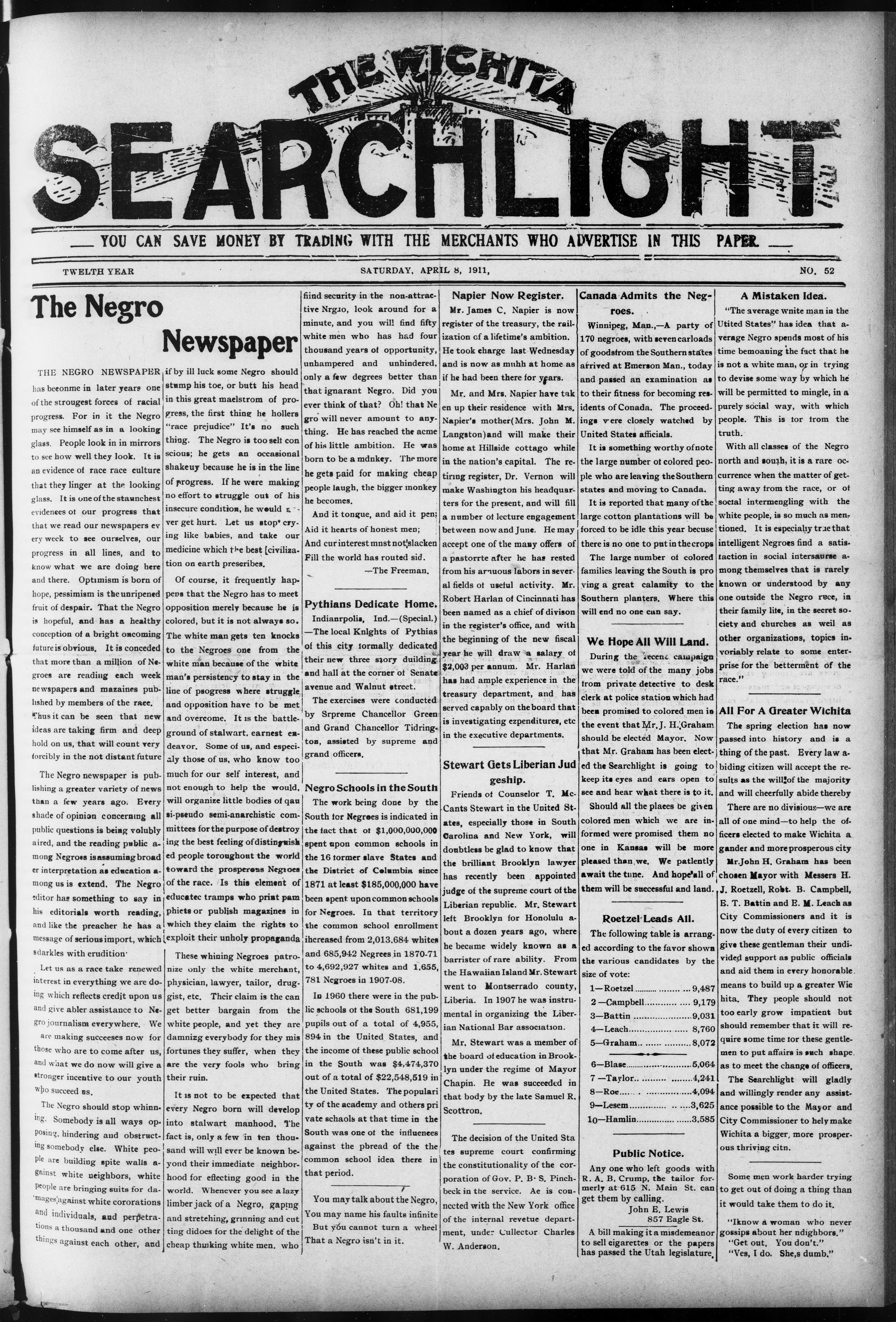
The Negro
has beconme in later years one of the stroughest forces of racial progress. For in it the Negro may see himself as in a looking glass. People look in in mirrors to see how well they look. It is an evidence of race race culture that they linger at the looking glass. It is one of the staunchest evidences of our progress that that we read our newspapers every week to see ourselves, our progress in all lines, and to know what we are doing here and there. Optimism is born of hope, pessimism is the unripened fruit of despair. That the Negro is hopeful, and has a healthy conception of a bright oncoming future is obvious. It is conceded that more than a million of Negroes are reading each week newspapers and mazaines published by members of the race. Thus it can be seen that new ideas are taking firm and deep hold on us, that will count very forcibly in the not distant future
The Negro newspaper is publishing a greater variety of news than a few years ago. Every shade of opinion concerning all public questions is being volubly aired, and the reading public among Negroes is assuming broader interpretation as education among us is extend. The Negro editor has something to say in his editorials worth reading, and like the preacher he has a message of serious import, which darkles with erudition:
Let us as a race take renewed interest in everything we are doing which reflects credit upon us and give abler assistance to Negro journalism everywhere. We are making succeeds now for those who are to come after us, and what we do now will give a stronger incentive to our youth who succeed us.
The Negro should stop whinning. Somebody is all ways opposing, hindering and obstructing somebody else. White people are building spite walls against white neighbors, white people are bringing suits for damages against white cororations and individuals, and perpetrations a thousand and one other things against each other, and
Newspaper
if by ill luck some Negro should stump his toe, or butt his head in this great maelstrom of progress, the first thing he hollers "race prejudice" It's no such thing. The Negro is too sell conscious; he gets an occasional shakeuy because he is in the line of progress. If he were making no effort to struggle out of his insecure condition, he would never get hurt. Let us stop crying like babies, and take our medicine which the best civilization on earth prescribes.
Of course, it frequently happens that the Negro has to meet opposition merely because he is colored, but it is not always so. The white man gets ten knocks to the Negroes one from the white man because of the white man's persistency to stay in the line of psogress where struggle and opposition have to be met and overcome. It is the battleground of stalwart, earnest endeavor. Some of us, and especially those of us, who know too much for our self interest, and not enough to help the would, will organize little bodies of qau si-pseudo semi-anarchistic committees for the purpose of destroying the best feeling of distinguished people toroughout the world toward the prosperous Negroes of the race. Is this element of educatec tramps who print pamphlets or publish magazines in which they claim the rights to exploit their unholy propaganda
These whining Negroes patronize only the white merchant, physician, lawyer, tailor, druggist, etc. Their claim is the can get better bargain from the white people, and yet they are damnizg everybody for they mis fortunes they suffer, when they are the very fools who bring their ruin.
It is not to be expected that every Negro born will develop into stalwart manhood. The fact is, only a few in ten thousand will will ever be known beyond their immediate neighborhood for effecting good in the world. Whenever you see a lazy limber jack of a Negro, gaping and stretehing, grinning and cutting didoes for the delight of the cheap thinking white men. who
SATURDAY, APRIL 8, 1911.
find security in the non-attractive Nrgro, look around for a minute, and you will find fifty white men who has had four thousand years of opportunity, unhampered and unhindered, only a few degrees better than that ignarant Negro. Did you ever think of that? Oh! that Negro will never amount to anything. He has reached the acme of his little ambition. He was born to be a mdnkey. The more he gets paid for making cheap people laugh, the bigger monkey he becomes.
And it tongue, and aid it pen;
Aid it hearts of honest men;
And curinterest mnst notslacken
Fill the world has routed sid.
—The Freeman.
Pythians Dedicate Home.
Pythians Dedicate Home. Indianrpolis, Ind.—(Special.) The local Knights of Pythias of this city formally dedicated their new three story building and hall at the corner of Senate avenue and Walnut street. The exercises were conducted by Srpreme Chancellor Green and Grand Chancellor Tidrington, assisted by supreme and grand officers.
Negro Schools in the South
Negro Schools in the South The work being done by the South for Negroes is indicated in the fact that of $1,000,000,000 spent upon common schools in the 16 former slave States and the District of Columbia since 1871 at least $185,000,000 have been spent upon common schools for Negroes. In that territory the common school enrollment increased from 2,013,684 whites and 685,942 Negrees in 1870-71 to 4,692,927 whites and 1,655, 781 Negrees in 1907-08.
In 1960 there were in the public schools of the South 681,199 pupils out of a total of 4,955,894 in the United States, and the income of these public school in the South was $4,474,370 out of a total of $22,548,519 in the United States. The popularity of the academy and others private schools at that time in the South was one of the influences against the pbread of the the common school idea there in that period.
You may talk about the Negro, You may name his faults infinite But you cannot turn a wheel That a Negro isn't in it.
Napier Now Register. Mr. James C. Napier is now register of the treasury, the railization of a lifetime's ambition. He took charge last Wednesday and is now as muhh at home as if he had been there for years.
Mr. and Mrs. Napier have taken up their residence with Mrs. Napier's mother(Mrs. John M. Langston)and will make their home at Hillside cottago while in the nation's capital. The retiring register, Dr. Vernon will make Washington his headquarters for the present, and will fill a number of lecture engagement between now and June. He may accept one of the many offers of a pastorrte after he has rested from his arduous labors in several fields of useful activity. Mr. Robert Harlan of Cincinnati has been named as a chief of division in the register's office, and with the beginning of the new fiscal year he will draw a salary of $2,000 per annum. Mr. Harlan has had ample experience in the treasury department, and has served capably on the board that is investigating expenditures, etc in the executive departments.
Stewart Gets Liberian Jud geship.
Friends of Counselor T. McCants Stewart in the United States, especially those in South Carolina and New York, will doubtless be glad to know that the brilliant Brooklyn lawyer has recently been appointed judge of the supreme court of the Liberian republic. Mr. Stewart left Brooklyn for Honolulu about a dozen years ago, where he became widely known as a barrister of rare ability. From the Hawaiian Island Mr. Stewart went to Montserrado county, Liberia. In 1907 he was instrumental in organizing the Liberian National Bar association.
Mr. Stewart was a member of the board of education in Brooklyn under the regime of Mayor Chapin. He was succeeded in that body by the late Samuel R. Scottron.
The decision of the United States supreme court confirming the constitutionality of the corporation of Gov. P. B. S. Pinchbeck in the service. Ae is connected with the New York office of the internal revenue department, under Cullector Charles W. Anderson.
Canada Admits the Negroes. Winnipeg, Man.,—A party of 170 negroes, with seven carloads of goods from the Southern states arrived at Emerson Man., today and passed an examination as to their fitness for becoming residents of Conada. The proceedings were closely watched by United States officials.
It is something worthy ofnote the large number of colored people who are leaving the Southern states and moving to Canada. It is reported that many of the large cotton plantations will be forced to be idle this year because there is no one to put in the crops The large number of colored families leaving the South is proving a great calamity to the Southern planters. Where this will end no one can say.
We Hope All Will Land.
During the recent campaign we were told of the many jobs from private detective to desk clerk at police station which had been promised to colored men in the event that Mr.J. H.Graham should be elected Mayor. Now that Mr. Graham has been elected the Searchlight is going to keep its eyes and ears open to see and hear what there is to it. Should all the places be given colored men which we are informed were promised them no one in Kansas will be more pleased than we. We patiently await the tune. And hope all of them will be successful and land.
Roetzel Leads All.
The following table is arranged according to the favor shown
the various candidates by the
size of vote:
1—Roetzel ..... 9,487
2—Campbell ..... 9,179
3—Battin ..... 9,031
4—Leach ..... 8,760
5—Graham ..... 8,072
6—Blase ..... 5,064
7—Taylor ..... 4,241
8—Roe ..... 4,094
9—Lesem ..... 3,625
10—Hamlin ..... 3,585
Public Notice.
Any one who left goods with R. A. B. Crump, the tailor formerly at 615 N. Main St. can get them by calling.
John E. Lewis
857 Eagle St.
A bill making it a misdemeanor to sell cigarettes or the papers has passed the Utah legislature.
NO. 52
A Mistaken Idea.
"The average white man in the United States" has idea that average Negro spends most of his time bemoaning the fact that he is not a white man, or in trying to devise some way by which he will be permitted to mingle, in a purely social way, with which people. This is tor from the truth.
With all classes of the Negro north and south, it is a rare occurrence when the matter of getting away from the race, or of social intermengling with the white people, is so much as mentioned. It is especially true that intelligent Negroes find a satisfaction in social intersaurse among themselves that is rarely known or understood by any one outside the Negro race, in their family life, in the secret society and churches as weil as other organizations, topics invariably relate to some enterprise for the betterment of the race."
All For A Greater Wichita
There are no divisious—we are all of one mind—to help the officers elected to make Wichita a gander and more prosperous city
Mr.John H. Graham has been chosen Mayor with Messers H. J. Roetzell, Robt. B. Campbell, E. T. Battin and E. M. Leach as City Commissioners and it is now the duty of every citizen to give these gentleman their undivided support as public officials and aid them in every honorable means to build up a greater Wichita. They people should not too early grow impatient but should remember that it will require some time for these gentlemen to put affairs is such shape as to meet the change of officers. The Searchlight will gladly and willingly render any assistance possible to the Mayor and City Commissioner to hely make Wichita a bigger, more prosperous thriving citn.
Some men work harder trying to get out of doing a thing than it would take them to do it.
"Iknow a woman who never gossips about her ndighbors."
"Get out. You don't."
"Ves, I do. She,s dumb."
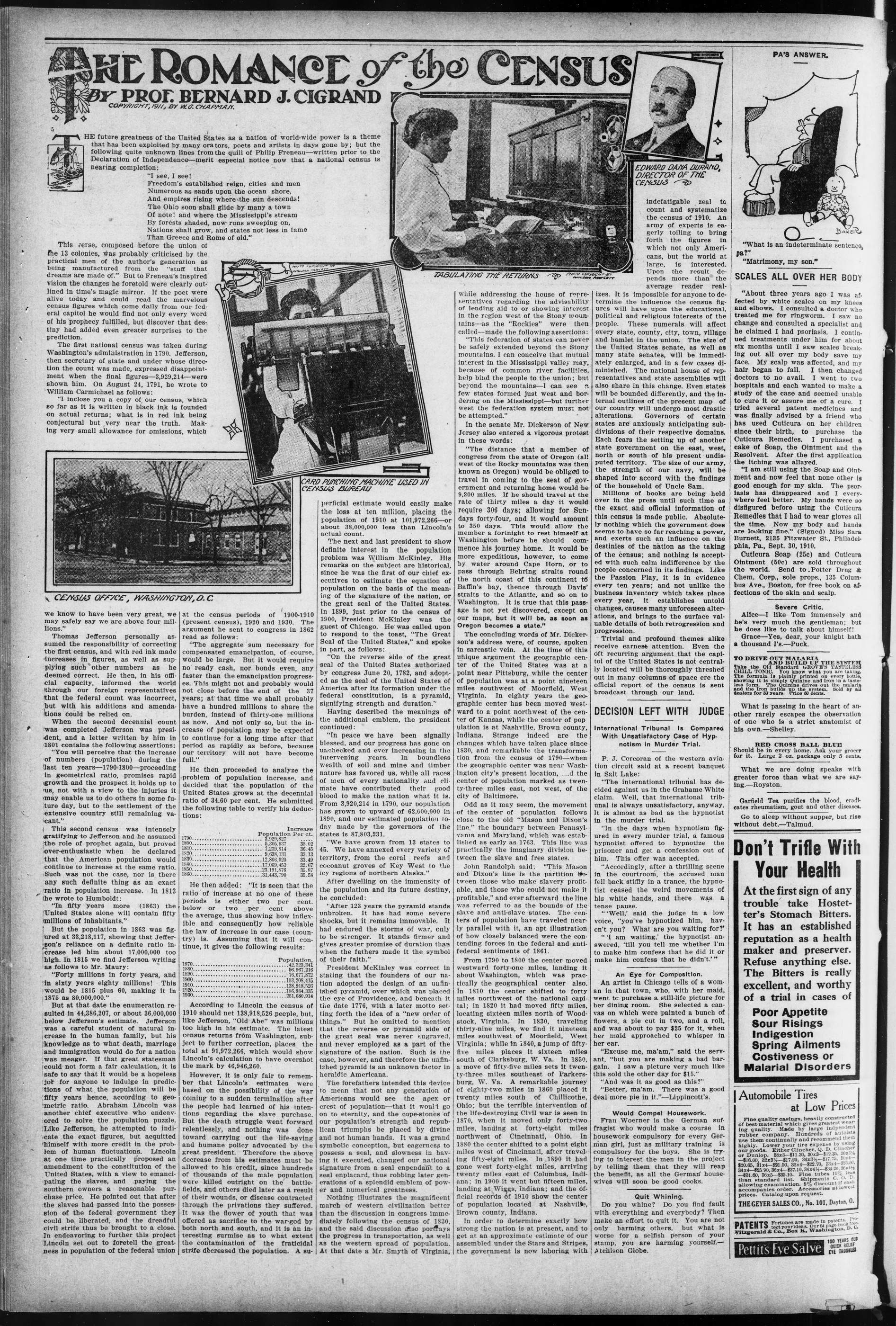
HE ROMANCE of the CENSUS BY PROF. BERNARD J. CIGRAND
HE future greatness of the United States as a nation of world-wide power is a theme that has been exploited by many orators, poets and artists in days gone by; but the following quite unknown lines from the quill of Philip Freneau—written prior to the Declaration of Independence—merit especial notice now that a national census is nearing completion:
"I see, I see!
Freedom's established reign, cities and men
Numerous as sands upon the ocean shore,
And empires rising where the sun descends!
The Ohio soon shall glide by many a town
Of note! and where the Mississippi's stream
By forests shaded, now runs sweeping on,
Nations shall grow, and states not less in fame
Than Greece and Rome of old."
This verse, composed before the union of the 13 colonies, was probably criticised by the practical men of the author's generation as being manufactured from the "stuff that dreams are made of." But to Freneaul's inspired vision the changes he foretold were clearly outlined in time's magic mirror. If the poet were alive today and could read the marvelous census figures which come daily from our federal capitol he would find not only every word of his prophecy fulfilled, but discover that destiny had added even greater surprises to the prediction.
The first national census was taken during Washington's admalisation in 1790. Jefferson, then secretary of state and under whose direction the count was made, expressed disappointment when the final figures—3,929,214—were shown him. On August 24, 1791, he wrote to William Carmichael as follows:
"I inclose you a copy of our census, which so far as it is written in black ink is founded on actual returns; what is in red ink being conjectural but very near the truth. Making very small allowance for omissions, which
THE MUSEUM
CARE
CEN
CENSUS OFFICE. WASHINGTON, D.C.
---
---
5
HI
we know to have been very great, we may safely say we are above four millions."
Thomas Jefferson personally assumed the responsibility of correcting the first census, and with red ink made increases in figures, as well as supplying such other numbers as he deemed correct. He then, in his official capacity, informed the world through our foreign representatives that the federal count was incorrect, but with his additions and amendments could be relied on.
When the second decennial count was completed Jefferson was president, and a letter written by him in 1801 contains the following assertions:
"You will perceive that the increase of numbers (population) during the last ten years—1790-1800—proceeding in geometrical ratio, promises rapid growth and the prospect it holds up to us, not with a view to the injuries it may enable us to do others in some future day, but to the settlement of the extensive country still remaining vacant."
This second census was intensely gratifying to Jefferson and he assumed the role of prophet again, but proved over-enthusiastic when he declared that the American population would continue to increase at the same ratio. Such was not the case, nor is there any such definite thing as an exact ratio in population increase. In 1813 he wrote to Humboldt:
"In fifty years more (1863) the United States alone will contain fifty millions of inhabitants."
But the population in 1863 was figured at 33,218,117, showing that Jefferson's reliance on a definite ratio increase led him about 17,000,000 too high. In 1815 we find Jefferson writing as follows to Mr. Maury: "Forty millions in forty years, and in sixty years eighty millions! This would be 1815 plus 60, making it in 1855 as 80,000,000."
But at that date the enumeration resulted in 44,386,207, or about 36,000,000 below Jefferson's estimate. Jefferson was a careful student of natural increase in the human family, but his knowledge as to what death, marriage and immigration would do for a nation was meager. If that great statesman could not form a fair calculation, it is safe to say that it would be a hopeless job for anyone to indulge in predictions of what the population will be fifty years hence, according to geometric ratio. Abraham Lincoln was another chief executive who endeavored to solve the population puzzle. Like Jefferson, he attempted to indicate the exact figures, but acquitted himself with more credit in the problem of human fluctuations. Lincoln at one time practically proposed an amendment to the constitution of the United States, with a view to emancipating the slaves, and paying the southern owners a reasonable purchase price. He pointed out that after the slaves had passed into the possession of the federal government they could be liberated, and the dreadful civil strife thus be brought to a close. In endeavoring to further this project Lincoln set out to foretell the greatness in population of the federal union
PHOTO COPIED BY
WALDON JAMES
at the census periods of 1900-1910 (present census), 1920 and 1930. The argument he sent to congress in 1862 read as follows:
"The aggregate sum necessary for compensated emancipation, of course, would be large. But it would require no ready cash, nor bonds even, any faster than the emancipation progresses. This might not and probably would not close before the end of the 37 years; at that time we shall probably have a hundred millions to share the burden, instead of thirty-one millions as now. And not only so, but the increase of population may be expected to continue for a long time after that period as rapidly as before, because our territory will not have become full."
He then proceeded to analyze the problem of population increase, and decided that the population of the United States grows at the decennial ratio of 34.60 per cent. He submitted the following table to verify his deductions:
Increase Population Per ct.
1790 3,692,827 35.02
1800 5,306,077 36.45
1810 7,239,814 36.45
1820 9,638,131 33.13
1830 12,866,020 33.49
1840 17,069,453 32.67
1850 23,191,768 35.87
1860 31,443,790 35.58
He then added: "It is seen that the ratio of increase at no one of these periods is either two per cent, below or two per cent above the average, thus showing how inflexible and consequently how reliable the law of increase in our case (country) is. Assuming that it will continue, it gives the following results:
Population.
1870.....42,323,341
1880.....56,967,216
1890.....76,677,872
1900.....103,208,415
1910.....138,918,525
1920.....186,984,335
1930.....251,680,914
According to Lincoln the census of 1910 should net 138,918,526 people, but, like Jefferson, "Old Abe" was millions too high in his estimate. The latest census returns from Washington, subject to further correction, places the total at 91,972,266, which would show Lincoln's calculation to have overshot the mark by 46,946,260.
However, it is only fair to remember that Lincoln's estimates were based on the possibility of the war coming to a sudden termination after the people had learned of his intentions regarding the slave purchase. But the death struggle went forward relentlessly, and nothing was done toward carrying out the life-saving and humane policy advocated by the great president. Therefore the above decrease from his estimates must be allowed to his credit, since hundreds of thousands of the male population were killed outright on the battlefields, and others died later as a result of their wounds, or disease contracted through the privations they suffered. It was the flower of youth that was offered as sacrifice to the war-god by both north and south, and it is an interesting surmise as to what extent the contamination of the fratricidal strife decreased the population. A su-
THE NEW YORK TIMES
perficial estimate would easily make the loss at ten million, placing the population of 1910 at 101,972,266—or about 38,000,000 less than Lincoln's actual count.
The next and last president to show definite interest in the population problem was William McKinley. His remarks on the subject are historical, since he was the first of our chief executives to estimate the equation of population on the basis of the meaning of the signature of the nation, or the great seal of the United States.
In 1899, just prior to the census of 1900, President McKinley was the guest of Chicago. He was called upon to respond to the toast, "The Great Seal of the United States," and spoke in part, as follows:
"On the reverse side of the great seal of the United States authorized by congress June 20, 1782, and adopted as the seal of the United States of America after its formation under the federal constitution, is a pyramid, signifying strength and duration."
Having described the meanings of the additional emblem, the president continued:
"In peace we have been signally blessed, and our progress has gone on unchecked and ever increasing in the intervening years. In boundless wealth of soil and mine and timber nature has favored us, while all races of men of every nationality and climate have contributed their good blood to make the nation what it is. From 3,920,214 in 1790, our population has grown to upward of 62,000,000 in 1890, and our estimated population today made by the governors of the states is 87,803,231.
"We have grown from 13 states to 45. We have annexed every variety of territory, from the coral reefs and coconut groves of Key West to the ice regions of northern Alaska."
After dwelling on the immensity of the population and its future destiny, he concluded:
"After 123 years the pyramid stands unbroken. It has had some severe shocks, but it remains immovable. It had endured the storms of war, only to be stronger. It stands firmer and gives greater promise of duration than when the fathers made it the symbol of their faith."
President McKinley was correct in stating that the founders of our nation adopted the design of an unfinished pyramid, over which was placed the eye of Providence, and beneath it the date 1776, with a later motto setting forth the idea of a "new order of things." But he omitted to mention that the reverse or pyramid side of the great seal was never engraved, and never employed as a part of the signature of the nation. Such is the case, however, and therefore the unfinished pyramid is an unknown factor in heraldic Americana.
The forefathers intended this device to mean that not any generation of Americans would see the apex or crest of population—that it would go on to eternity, and the cope-stones of our population's strength and republican triumphs be placed by divine and not human hands. It was a grand symbolic conception, but eagerness to possess a seal, and slowness in having it executed, changed our national signature from a seal empendant to a seal enplacard, thus robbing later generations of a splendid emblem of power and numerical greatness.
Nothing illustrates the magnificent march of western civilization better than the discussion in congress immediately following the census of 1830, and the said discussion also portrays the progress in transportation, as well as the western spread of population.
At that date a Mr. Smyth of Virginia.
while addressing the house of representatives regarding the advisability of lending aid to or showing interest in the region west of the Stony mountains—as the "Rockies" were then called—made the following assertions: "This federation of states can never be safely extended beyond the Stony mountains. I can conceive that mutual interest in the Mississippi valley may, because of common river facilities, help bind the people to the union; but beyond the mountains—I can see a few states formed just west and bordering on the Mississippi—but further west the federation system must not be attempted."
In the senate Mr. Dickerson of New Jersey also entered a vigorous protest in these words:
"The distance that a member of congress from the state of Oregon (all west of the Rocky mountains was then known as Oregon) would be obliged to travel in coming to the seat of government and returning home would be 9,200 miles. If he should travel at the rate of thirty miles a day it would require 306 days; allowing for Sundays forty-four, and it would amount to 350 days. This would allow the member a fortnight to rest himself at Washington before he should commence his journey home. It would be more expeditious, however, to come by water around Cape Horn, or to pass through Behring straits round the north coast of this continent to Baffin's bay, thence through Davis' straits to the Atlantic, and on to Washington. It is true that this passage is not yet discovered, except on our maps, but it will be, as soon as Oregon becomes a state."
The concluding words of Mr. Dickerson's address were, of course, spoken in sarcastic vein. At the time of this unique argument the geographic center of the United States was at a point near Pittsburg, while the center of population was at a point nineteen miles southwest of Moorfield, West Virginia. In eighty years the geographic center has been moved westward to a point northwest of the center of Kansas, while the center of population is at Nashville, Brown county, Indiana. Strange indeed are the changes which have taken place since 1830, and remarkable the transformation from the census of 1790—when the geographic center was near Washington city's present location, ...d the center of population marked as twenty-three miles east, not west, of the city of Baltimore.
Odd as it may seem, the movement of the center of population follows close to the old "Mason and Dixon's line," the boundary between Pennsylvania and Maryland, which was established as early as 1763. This line was practically the imaginary division between the slave and free states.
John Randolph said: "This Mason and Dixon's line is the partition between those who make slavery profitable, and those who could not make it profitable," and ever afterward the line was referred to as the bounds of the slave and anti-slave states. The centers of population have traveled nearly parallel with it, an apt illustration of how closely balanced were the contending forces in the federal and antifederal sentiments of 1861.
From 1790 to 1800 the center moved westward forty-one miles, landing it about Washington, which was practically the geographical center also. In 1810 the center shifted to forty miles northwest of the national capital; in 1820 it had moved fifty miles, locating sixteen miles north of Woodstock, Virginia. In 1830, traveling thirty-nine miles, we find it nineteen miles southwest of Moorfield, West Virginia; while in 1840, a jump of fifty-five miles places it sixteen miles south of Clarksburg, W. Va. In 1850, a move of fifty-five miles sets it twenty-three miles southeast of Parkersburg, W. Va. A remarkable journey of eighty-two miles in 1860 placed it twenty miles south of Chillicothe, Ohio; but the terrible intervention of the life-destroying Civil war is seen in 1870, when it moved only forty-two miles, landing at forty-eight miles northwest of Cincinnati, Ohio. In 1880 the center shifted to a point eight miles west of Cincinnati, after traveling fifty-eight miles. In 1890 it had gone west forty-eight miles, arriving twenty miles east of Columbus, Indiana; in 1900 it went but fifteen miles, landing at Wiggs, Indiana; and the official records of 1910 show the center of population located at Nashville, Brown county, Indiana.
In order to determine exactly how strong the nation is at present, and to get at an approximate estimate of our assembled under the Stars and Stripes, the government is now laboring with
indefatigable zeal to count and systematize the census of 1910. An army of experts is eagerly toiling to bring forth the figures in which not only Americans, but the world at large, is interested. Upon the result depends more than the average reader real-
izes. It is impossible for anyone to determine the influence the census figures will have upon the educational, political and religious interests of the people. These numerals will affect every state, county, city, town, village and hamlet in the union. The size of the United States senate, as well as many state senates, will be immediately enlarged, and in a few cases diminished. The national house of representatives and state assemblies will also share in this change. Even states will be bound differently, and the internal outlines of the present map of our country will undergo most drastic alterations. Governors of certain states are anxiously anticipating subdivisions of their respective domains. Each fears the setting up of another state government on the east, west, north or south of his present undisputed territory. The size of our army, the strength of our navy, will be shaped into accord with the findings of the household of Uncle Sam.
Millions of books are being held over in the press until such time as the exact and official information of this census is made public. Absolutely nothing which the government does seems to have so far reaching a power, and exerts such an influence on the destinies of the nation as the taking of the census; and nothing is accepted with such calm indifference by the people concerned in its findings. Like the Passion Play, it is in evidence every ten years; and not unlike the business inventory which takes place every year, it establishes untold changes, causes many unforeseen alterations, and brings to the surface valuable details of both retrogression and progression.
Trivial and profound themes alike receive earnest attention. Even the oft recurring argument that the capitol of the United States is not centrally located will be thoroughly threshed out in many columns of space ere the official report of the census is sent broadcast through our land.
DECISION LEFT WITH JUDGE
International Tribunal Is Compared With Unsatisfactory Case of Hypnotism in Murder Trial.
P. J. Corcoran of the western aviation circuit said at a recent banquet in Salt Lake:
"The international tribunal has decided against us in the Grahame White claim. Well, that international tribunal is always unsatisfactory, anyway. It is almost as bad as the hypnotist in the murder trial.
"In the days when hypnotism figured in every murder trial, a famous hypnotist offered to hypnotize the prisoner and get a confession out of him. This offer was accepted.
"Accordingly, after a thrilling scene in the courtroom, the accused man fell back stiffly in a trance, the hypnotist ceased the weird movements of his white hands, and there was a tense pause.
"Well,' said the judge in a low voice, 'you've hypnotized him, haven't you? What are you waiting for?" "I am waiting,' the hypnotist answered, 'till you tell me whether I'm to make him confess that he did it or make him confess that he didn't."
An Eye for Composition.
An artist in Chicago tells of a woman in that town, who, with her maid, went to purchase a still-life picture for her dining room. She selected a canvas on which were painted a bunch of flowers, a pie cut in two, and a roll, and was about to pay $25 for it, when her maid approached to whisper in her ear.
"Excuse me, ma'am," said the servant, "but you are making a bad bargain. I saw a picture very much like this sold the other day for $15." "And was it as good as this?"
"Better, ma'ma. There was a good deal more pie in it."—Lippincott's.
Would Compel Housework.
Frau Woerner is the German suffragist who would make a course in housework compulsory for every German girl, just as military training is compulsory for the boys. She is trying to interest the men in the project by telling them that they will reap the benefit, as all the German housewives will soon be good cooks.
Quit Whining.
Do you whine? Do you find fault with everything and everybody? Then make an effort to quit it. You are not only harming others, but what is worse for a selfish person of your stamp, you are harming yourself.—Atchison Globe.
FA'S ANSWER.
BAKEI
SCALES ALL OVER HER BODY
"About three years ago I was affected by white scales on my knees and elbows. I consulted a doctor who treated me for ringworm. I saw no change and consulted a specialist and he claimed I had psoriasis. I continued treatments under him for about six months until I saw scales breaking out all over my body save my face. My scalp was affected, and my hair began to fall. I then changed doctors to no avail. I went to two hospitals and each wanted to make a study of the case and seemed unable to cure it or assure me of a cure. I tried several patent medicines and was finally advised by a friend who has used Cuticura on her children since their birth, to purchase the Cuticura Remedies. I purchased a cake of Soap, the Ointment and the Resolvent. After the first application the itching was allayed.
"I am still using the Soap and Ointment and now feel that none other is good enough for my skin. The psoriasis has disappeared and I everywhere feel better. My hands were so disfigured before using the Cuticura Remedies that I had to wear gloves all the time. Now my body and hands are looking fine." (Signed) Miss Sara Burnett, 2135 Fitzwater St., Philadelphia, Pa., Sept. 30, 1910.
Cuticura Soap (25c) and Cuticura Ointment (50c) are sold throughout the world. Send to. Potter Drug & Chem. Corp., sole props., 135 Columbus Ave., Boston, for free book on affections of the skin and scab.
Severe Critic.
Alice—I like Tom immensely and he's very much the gentleman; but he does like to talk about himself!
Grace—Yes, dear, your knight hath a thousand I's.—Puck.
TO DRIVE OUT MALARIA AND BUILD UP THE SYSTEM
Take the Old Standard GROVES TASTELESS LUNCH. The formula is plainly printed on every bottle, showing it is simply Quinine and in a tasteless form. The Quinine drives out the malaria from the system, sold by all dealers for 30 years. Prices 60 cents.
What is passing in the heart of another rarely escapes the observation of one who is a strict anatomist of his own.—Shelley.
RED CROSS BALL BLUE
What we are doing speaks with greater force than what we are saying.—Royston.
Garfield Tea purifies the blood, eradicates rheumatism, gout and other diseases.
Go to sleep without supper, but rise without debt.—Talmud.
Don't Trifle With Your Health
At the first sign of any trouble take Hostetter's Stomach Bitters. It has an established reputation as a health maker and preserver. Refuse anything else. The Bitters is really excellent, and worthy of a trial in cases of Poor Appetite Sour Risings Indigestion Spring Ailments Costiveness or Malarial Disorders
Automobile Tires
Fine quality casings, heavily constructed of best material which gives greatest wearing quality. Made by large independent rubber company. Hundreds of autoloists use them continually and recommend them highly. Lower your tire expense by using our goods. Either Clincher, Q. D. Clincher or Dunlop, 28x3—$11.30, 30x3—$12.25, 30x3—$16.00, 32x3—$17.20, 34x3—$17.75, 30x4—$20.65, 31x4—$21.50, 32x4—$22.70, 33x4—$23.50, 34x4—$25.90, 35x4—$27.10, 34x4—$30.20, 36x4—$31.60, 36x5—$35.10. Fine tubes 10% less than standard list. Shipments C. O. D. allowing examination. 5% discount if cash accompanies order. Accessories at lowest prices. Catalog upon request.
THE GEYER SALES CO., No. 101, Dayton, O.
PATENTS Fortunes are made in patents. Protect your ideas. Our 64 page book free
Fitzgerald & Co., Box K, Washington, D. C.
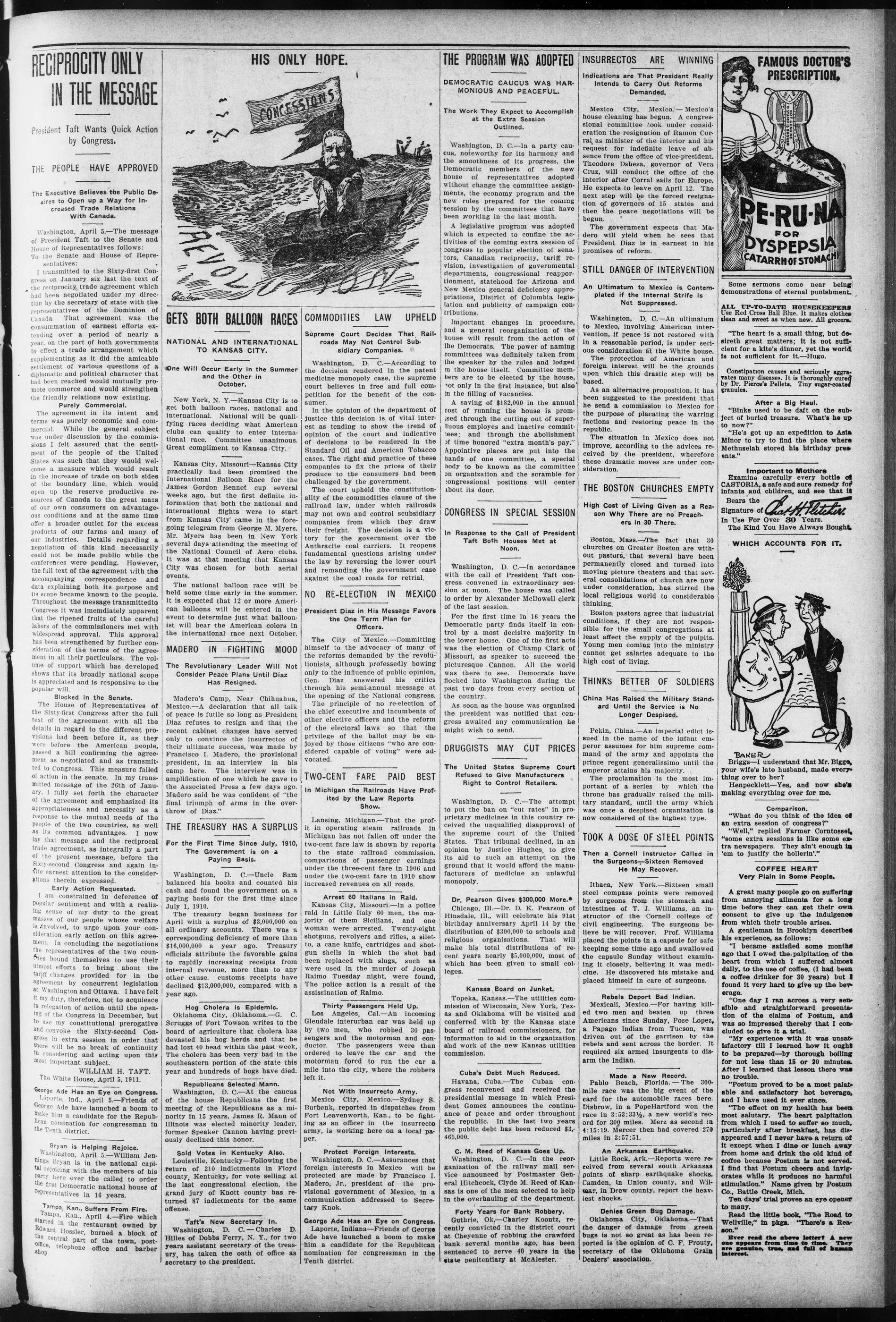
RECIPROCITY ONLY IN THE MESSAGE
President Taft Wants Quick Action by Congress.
THE PEOPLE HAVE APPROVED
The Executive Believes the Public Desires to Open up a Way for Increased Trade Relations With Canada.
Washington, April 5.—The message of President Taft to the Senate and House of Representatives follows:
To the Senate and House of Representatives:
sensitive.
I transmitted to the Sixty-first Congress on January six last the text of the reciprocity, trade agreement which had been negotiated under my direction by the secretary of state with the representatives of the Dominion of Canada. That agreement was the consummation of earnest efforts extending over a period of nearly a year, on the part of both governments to effect a trade arrangement which supplementing as it did the amicable settlement of various questions of a diplomatic and political character that had been reached would mutually promote commerce and would strengthen the friendly relations now existing.
The agreement in its intent and terms was purely economic and commercial. While the general subject was under discussion by the commissions I felt assured that the sentiment of the people of the United States was such that they would welcome a measure which would result in the increase of trade on both sides of the boundary line, which would open up the reserve productive resources of Canada to the great mass of our own consumers on advantageous conditions and at the same time offer a broader outlet for the excess products of our farms and many of our industries. Details regarding a negotiation of this kind necessarily could not be made public while the conferences were pending. However, the full text of the agreement with the accompanying correspondence and data explaining both its purpose and its scope became known to the people. Throughout the message transmitted to Congress it was immediately apparent that the ripened fruits of the careful labors of the commissioners met with widespread approval. This approval has been strengthened by further consideration of the terms of the agreement in all their particulars. The volume of support which has developed shows that its broadly national scope is appreciated and is responsive to the popular will.
Blocked in the Senate.
The House of Representatives of the Sixty-first Congress after the full text of the agreement with all the details in regard to the different provisions had been before it, as they were before the American people, passed a bill confirming the agreement as negotiated and as transmitted to Congress. This measure failed of action in the senate. In my transmitted message of the 26th of January, I fully set forth the character of the agreement and emphasized its appropriateness and necessity as a response to the mutual needs of the people of the two countries, as well as its common advantages. I now lay that message and the reciprocal trade agreement, as integrally a part of the present message, before the Sixty-second Congress and again in earnest attention to the considerations therein expressed.
Early Action Requested.
I am constrained in deference of popular sentiment and with a realizing sense of my duty to the great masses of our people whose welfare is involved, to urge upon your consideration early action on this agreement. In concluding the negotiations the representatives of the two countries bound themselves to use their utmost efforts to bring about the tariff changes provided for in the agreement by concurrent legislation at Washington and Ottawa. I have felt it my duty, therefore, not to acquiesce in relegation of action until the opening of the Congress in December, but to use my constitutional prerogative and convoke the Sixty-second Congress in extra session in order that there will be no break of continuity in considering and acting upon this most important subject.
WILLIAM H. TAFT.
The White House, April 5, 1911.
George Ade Has an Eye on Congress.
Laporte, Ind., April 5.—Friends of
George Ade have launched a boom to
make him a candidate for the Repub-
lican nomination for congressman in
the Tenth district.
Washington, April 5.—William Jennings Bryan is in the national capital rejoicing with the members of his party here over the called to order the first Democratic national house of representatives in 16 years.
Tampa, Kan., Suffers From Fire.
Tampa, Kan., April 4.—Fire which started in the restaurant owned by Edward Hossler, burned a block of the central part of the town, postoffice, telephone office and barber shop.
HIS ONLY HOPE.
CONCESSIONS
REVOLUTION
GETS BOTH BALLOON RAGES
GETS BOTH BALLOON RAGES
NATIONAL AND INTERNATIONAL TO KANSAS CITY.
One Will Occur Early in the Summer and the Other in October.
New York, N. Y.—Kansas City is to get both balloon races, national and international. National will be qualifying races deciding what American clubs can qualify to enter international race. Committee unanimous. Great compliment to Kansas City.
Kansas City, Missouri—Kansas City practically had been promised the International Balloon Race for the James Gordon Bennet cup several weeks ago, but the first definite information that both the national and international flights were to start from Kansas City came in the foregoing telegram from George M. Myers. Mr. Myers has been in New York several days attending the meeting of the National Council of Aero clubs. It was at that meeting Kansas City was chosen for both aerial events. The national balloon race will be held some time early in the summer. It is expected that 12 or more American balloons will be entered in the event to determine just what balloonist will bear the American colors in the international race next October.
MADERO IN FIGHTING MOOD
The Revolutionary Leader Will Not Consider Peace Plans Until Diaz Has Resigned.
Madero's Camp, Near Chihuahua, Mexico.—A declaration that all talk of peace is futile so long as President Diaz refuses to resign and that the recent cabinet changes have served only to convince the insurrectos of their ultimate success, was made by Francisco I. Madero, the provisional president, in an interview in his camp here. The interview was in amplification of one which he gave to the Associated Press a few days ago. Madero said he was confident of "the final triumph of arms in the overthrow of Diaz."
THE TREASURY HAS A SURPLUS
For the First Time Since July, 1910,
The Government is on a
Paying Basis.
Washington, D. C.—Uncle Sam
balanced his books and counted his
cash and found the government on a
paying basis for the first time since
July 1, 1910.
The treasury began business for
April with a surplus of $3,000,000 on
all ordinary accounts. There was a
corresponding deficiency of more than
$16,000,000 a year ago. Treasury
officials attribute the favorable gains
to rapidly increasing receipts from
internal revenue, more than to any
other cause. customs receipts have
declined $13,000,000, compared with a
year ago.
Hog Cholera is Epidemic.
Oklahoma City, Oklahoma.—G. C. Scruggs of Fort Towson writes to the board of agriculture that cholera has devastated his hog herds and that he had lost 40 head within the past week. The cholera has been very bad in the southeastern portion of the state this year and hundreds of hogs have died.
Republicans Selected Mann.
Washington, D. C.—At the caucus of the house Republicans the first meeting of the Republicans as a minority in 15 years, James R. Mann of Illinois was elected minority leader, former Speaker Cannon having previously declined this honor.
Louisville, Kentucky—Following the return of 210 indictments in Floyd county, Kentucky, for vote selling at the last congressional election, the grand jury of Knott county has returned 87 indictments for the same offense.
Taft's New Secretary In.
Washington, D. C.—Charles D. Hilles of Dobbs Ferry, N. Y., for two years assistant secretary of the treasury, has taken the oath of office as secretary to the president.
Supreme Court Decides That Railroads May Not Control Subsidiary Companies.
Washington, D. C.—According to the decision rendered in the patent medicine monopoly case, the supreme court believes in free and full competition for the benefit of the consumer.
In the opinion of the department of justice this decision is of vital interest as tending to show the trend of opinion of the court and indicative of decisions to be rendered in the Standard Oil and American Tobacco cases. The right and practice of these companies to fix the prices of their produce to the consumers had been challenged by the government.
The court upheld the constitutionality of the commodities clause of the railroad law, under which railroads may not own and control subsidiary companies from which they draw their freight. The decision is a victory for the government over the Anthracite coal carriers. It reopens fundamental questions arising under the law by reversing the lower court and remanding the government case against the coal roads for retrial.
NO RE-ELECTION IN MEXICO
President Diaz in His Message Favors the One Term Plan for Officers.
The City of Mexico.—Committing himself to the advocacy of many of the reforms demanded by the revolutionists, although professedly bowing only to the influence of public opinion, Gen. Diaz answered his critics through his semi-annual message at the opening of the National congress. The principle of no re-election of the chief executive and incumbents of other elective officers and the reform of the electoral laws so that the privilege of the ballot may be enjoyed by those citizens "who are considered capable of voting" were advocated.
TWO-CENT FARE PAID BEST
In Michigan the Railroads Have Profited by the Law Reports Show.
Lansing, Michigan.—That the profit in operating steam railroads in Michigan has not fallen off under the two-cent fare law is shown by reports to the state railroad commission. comparisons of passenger earnings under the three-cent fare in 1906 and under the two-cent fare in 1910 show increased revenues on all roads.
Arrest 60 Italians in Raid
Kansas City, Missouri.—In a police raid in Little Italy 60 men, the majority of them Sicillans, and one woman were arrested. Twenty-eight shotguns, revolvers and rifles, a siletto, a cane knife, cartridges and shotgun shells in which the shot had been replaced with slugs, such as were used in the murder of Joseph Ralmo Tuesday night, were found. The police action is a result of the assassination of Ralmo.
Thirty Passengers Held Un
Los Angeles, Cal.—An incoming Glendale interurban car was held up by two men, who robbed 30 passengers and the motorman and conductor. The passengers were than ordered to leave the car and the motorman forced to run the car a mile into the city, where the robbers left it.
Not With Insurrecto Army.
Mexico City, Mexico—Sydney S. Burbank, reported in dispatches from Fort Leavenworth, Kan., to be fighting as an officer in the insurrector army, is working here on a local paper.
Protect Foreign Interests.
Washington, D. C.—Assurances that foreign interests in Mexico will be protected are made by Francisco I. Madero, Jr., president of the provisional government of Mexico, in a communication addressed to Secretary Knok.
George Ade Has an Eye on Congress.
Laporte, Indiana—Friends of George Ade have launched a boom to make him a candidate for the Republican nomination for congressman in the Tenth district.
THE PROGRAM WAS ADOPTED
THE PROGRAM WAS ADOPTED
DEMOCRATIC CAUCUS WAS HARMONIOUS AND PEACEFUL.
The Work They Expect to Accomplish at the Extra Session Outlined.
Washington, D. C.—In a party caucus, noteworthy for its harmony and the smoothness of its progress, the Democratic members of the new house of representatives adopted without change the committee assignments, the economy program and the new rules prepared for the coming session by the committees that have been working in the last month.
A legislative program was adopted which is expected to confine the activities of the coming extra session of congress to popular election of senators, Canadian reciprocity, tariff revision, investigation of governmental departments, congressional reapportionment, statehood for Arizona and New Mexico general deficiency appropriations, District of Columbia legislation and publicity of campaign contributions.
Important changes in procedure, and a general reorganization of the house will result from the action of the Democrats. The power of naming committees was definitely taken from the speaker by the rules and lodged in the house itself. Committee members are to be elected by the house, not only in the first instance, but also in the filling of vacancies.
A saving of $182,000 in the annual post of running the house is promised through the cutting out of superfluous employees and inactive committees; and through the abolishment of time honored "extra month's pay." Appointive places are put into the hands of one committee, a special body to be known as the committee on organization and the scramble for congressional positions will center about its door.
CONGRESS IN SPECIAL SESSION
In Response to the Call of President Taft Both Houses Met at Noon.
Washington, D. C.—In accordance with the call of President Taft congress convened in extraordinary session at noon. The house was called to order by Alexander McDowell clerk of the last session.
For the first time in 16 years the Democratic party finds itself in control by a most decisive majority in the lower house. One of the first acts was the election of Champ Clark of Missouri, as speaker to succeed the picturesque Cannon. All the world was there to see. Democrats have flocked into Washington during the past two days from every section of the country.
As soon as the house was organized the president was notified that congress awaited any communication he might wish to send.
DRUGGISTS MAY CUT PRICES
The United States Supreme Court Refused to Give Manufacturers Right to Control Retailers.
Washington, D. C.—The attempt to put the ban on "cut rates" in proprietary medicines in this country received the unqualified disapproval of the supreme court of the United States. That tribunal declined, in an opinion by Justice Hughes, to give its aid to such an attempt on the ground that it would afford the manufacturers of medicine an unlawful monopoly.
Dr. Pearson Gives $300,000 More.*
Chicago, Ill.—Dr. D. K. Pearson of Hinsdale, ill., will celebrate his 91st birthday anniversary April 14 by the distribution of $300,000 to schools and religious organisations. That will make his total distributions of recent years nearly $5,000,000, most of which has been given to small colleges.
Kansas Board on Junket.
Topeka, Kansas.—The utilities commission of Wisconsin, New York, Texas and Oklahoma will be visited and conferred with by the Kansas state board of railroad commissioners, for information to aid in the organization and work of the new Kansas utilities commission.
Cuba's Debt Much Reduced.
Havana, Cuba—The Cuban congress reconvened and received the presidential message in which President Gomez announces the continuance of peace and order throughout the republic. In the last two years the public debt has been reduced $3,465,000.
C. M. Reed of Kansas Goes Up. Washington, D. C.—In the reorganization of the railway mail service announced by Postmaster General Hitchcock, Clyde M. Reed of Kansas is one of the men selected to help in the overhauling of the department.
Forty Years for Bank Robbery. Guthrie, Ok.—Charley Koontz, recently convicted in the district court at Cheyenne of robbing the crawford bank several months ago, has been sentenced to serve 40 years in the state penitentiary at McAlester.
INSURRECTOS ARE WINNING
Indications are That President Really Intends to Carry Out Reforms Demanded.
Mexico City, Mexico. — Mexico's house cleaning has begun. A congressional committee took under consideration the resignation of Ramon Corral as minister of the interior and his request for indefinite leave of absence from the office of vice-president. Theodore Dshesa, governor of Vera Cruz, will conduct the office of the interior after Corral sails for Europe. He expects to leave on April 12. The next step will be the forced resignation of governors of 15 states and then the peace negotiations will be begun.
The government expects that Madero will yield when he sees that President Diaz is in earnest in his promises of reform.
STILL DANGER OF INTERVENTION
An Ultimatum to Mexico is Contemplated if the Internal Strife is Not Suppressed.
Washington, D. C.—An ultimatum to Mexico, involving American intervention, if peace is not restored with in a reasonable period, is under serious consideration at the White house. The protection of American and foreign interest will be the grounds upon which this drastic step will be based. As an alternative proposition, it has been suggested to the president that he send a commission to Mexico for the purpose of placating the warring factions and restoring peace in the republic. The situation in Mexico does not improve, according to the advices received by the president, wherefore these dramatic moves are under consideration.
THE BOSTON CHURCHES EMPTY
High Cost of Living Given as a Reason Why There are no Preachers in 30 There.
Boston, Mass.—The fact that 30 churches on Greater Boston are without pastors, that several have been permanently closed and turned into moving picture theaters and that several consolidations of church are now under consideration, has stirred the local religious world to considerable thinking.
Boston pastors agree that industrial conditions, if they are not responsible for the small congregations at least affect the supply of the pulpits. Young men coming into the ministry cannot get salaries adequate to the high cost of living.
THINKS BETTER OF SOLDIERS
China Has Raised the Military Standard Until the Service is No Longer Despised.
Pekin, China.—An imperial edict issued in the name of the infant emperor assumes for him supreme command of the army and appoints the prince regent generalissimo until the emperor attains his majority.
The proclamation is the most important of a series by which the throne has gradually raised the military standard, until the army which was once a despised organization is now considered of the highest type.
TOOK A DOSE OF STEEL POINTS
Then a Cornell instructor Called in the Surgeons—Sixteen Removed He May Recover.
Ithaca, New York—Sixteen small steel compass points were removed by surgeons from the stomach and intestines of T. J. Williams, an instructor of the Cornell college of civil engineering. The surgeons believe he will recover. Prof. Williams placed the points in a capsule for safe keeping some time ago and swallowed the capsule Sunday without examining it closely, believing it was medicine. He discovered his mistake and placed himself in care of surgeons.
Rebels Deport Bad Indian.
Rebels Depart Bad Hammond
Mexican, Mexico—For having killed two men and beaten up three Americans since Sunday, Pose Lopez, a Papago Indian from Tucson, was driven out of the garrison by the rebels and sent across the border. It required six armed insurgents to disarm the Indian.
Made a New Record
Pablo Beach, Florida. — The 300-mile race was the big event of the card for the automobile races here. Disbrow, in a PopeHartford won the race in $3.53\%$, a new world's record for 300 miles. Merz as second in 4:15:19. Mercer then had covered 270 miles in 3:57:51.
An Arkansas Earthquake.
Little Rock, Ark.—Reports were received from several south Arkansas points of sharp earthquake shocks. Camden, in Union county, and Wilma, in Drew county, report the heaviest shocks.
Denies Green Bug Damage.
Oklahoma City, Oklahoma.—That the danger of damage from green bugs is not so great as has been reported is the opinion of C. F. Prouty, secretary of the Oklahoma Grain Dealers' association.
FAMOUS DOCTOR'S
PRESCRIPTION.
PE·RU·NA
FOR
DYSPEPSIA
(CATARRH OF STOMACH)
Some sermons come near being demonstrations of eternal punishment.
ALL UP-TO-DATE HOUSEKEEPERS Use Red Cross Ball Blue. It makes clothes clean and sweet as when new. All grocers.
"The heart is a small thing, but desireth great matters; it is not sufficient for a kite's dinner, yet the world is not sufficient for it.—Hugo.
Constipation causes and seriously aggravates many diseases. It is thoroughly cured by Dr. Pierce's Pellets. Tiny sugar-coated granules.
After a Big Haul.
"Binks used to be daft on the subject of buried treasure. What's he up to now?"
"He's got up an expedition to Asia Minor to try to find the place where Methuselah stored his birthday presents."
Examine carefully every bottle of CASTORIA, a safe and sure remedy for infants and children, and see that it
WHICH ACCOUNTS FOR IT.
A
Briggs—I understand that Mr. Bigge your wife's late husband, made everything over to her?
Henpecklett—Yes, and now she's making everything over for me.
"What do you think of the idea of an extra session of congress?" "Well," replied Farmer Corntossel, "some extra sessions is like some extra newspapers. They ain't enough in 'em to justify the hollerin.'"
COFFEE HEART Very Plain In Some People.
A great many people go on suffering from annoying aliments for a long time before they can get their own consent to give up the indulgence from which their trouble arises.
A gentleman in Brooklyn describes his experience, as follows:
"I became satisfied some months ago that I owed the palpitation of the heart from which I suffered almost daily, to the use of coffee, (I had been a coffee drinker for 30 years) but I found it very hard to give up the beverage.
"One day I ran across a very sensible and straightforward presentation of the claims of Postum, and was so impressed thereby that I concluded to give it a trial.
"My experience with it was unsatisfactory till I learned how it ought to be prepared—by thorough boiling for not less than 15 or 20 minutes. After I learned that lesson there was no trouble.
"Postum proved to be a most palatable and satisfactory hot beverage, and I have used it ever since.
"The effect on my health has been most salutary. The heart palpitation from which I used to suffer so much, particularly after breakfast, has disappeared and I never have a return of it except when I dine or lunch away from home and drink the old kind of coffee because Postum is not served.
I find that Postum cheers and invigorates while it produces no harmful stimulation." Name given by Postum Co., Battle Creek, Mich.
Ten days' trial proves an eye opener to many.
Read the little book, "The Road to
Wellville," in pkgs. "There's a Reason."
Ever read the above letter? A new
one appears from time to time. They
are genuine, true, and full of human
interest.
Established in 1898.
W. N. MILLER, Editor.
Residence 1401 West 23d Street.
Office: 630 N. Main Street.
Residence Phone, Market 1641.
Office Phone, Market 243.
Phone your news iteins to us.
"To Live and Let Live" is Our Motto.
RATES OF SUBSCRIPTION:
Strictly in Advance.
One Year (by mail) ..... $1.00
Six Months (by mail) ..... .75
Three Months (by mail) ..... .50
Advertising Rates made known on application.
Liberal commission paid to agents.
Entered at the Postoffice at Wichita,
Kansas, as Second-Class
Mall Matter.
Published Every Saturday at 630 N. Main Street.
All matters addressed to The Searchlight for publication must be signed b ythe party or parties writing.
All matters for publication must reach this office not later than Thursday noon to reach publication in the current issue.
RULES OF THIS OFFICE:
First. All subscriptions must be paid in advance. Agents take notice.
Second. Communications received after Thursday noon will not be published in the current issue.
Third. In asking to change your paper from one address or postoffice to another, give both the new and the old.
Fourth. No new name will be placed on our books unless the money accompanies the name. Write plain.
Fifth. Address all matter for publication into The Wichita Searchlight.
630 N. Main street, Wichita, Kansas.
Sixth. Any erroneous reflection on the character, standing or reputation of any person which may appear in this paper will be gladly corrected if brought to the attention of the editor.
BEND YOUR NEWS IN EARLIER.
Moved To California.
Mr. and Mrs. Sam Isier and family left over the Santa Fe Monday afternoon for Los Angeles, Calif., where they will make their future home. Mr. Isler had been a resident of this city for a long number of years, having come to Wichita in the early eighties from Memphis, Tenn.
He and his family are held in the highest esteen by both white ana colored people and everyone regret very much that he has moved from our city and wish for him and his family unbounded success and prosperity in their new home. For seversl years Mr. Isler was a member of Hose Company No. 3(the colored fire company)and was during his long service both assistant foreman and for a time foreman.
He was one of the first paid colored fireman in Wichita and let the fire cempang of his own accord to engage in business for himself. He has hosts of warm friends in this city and is the owner of several pieces of valueable property here.
W. N. Miller returned Saturday from Topeka where he very successfully engaged in the trial of an important damage case which he won in flying honor last Friday. He is very much pleased with the treatment accorded him while in the Capital City.
DRESS MAKING Call at 1625 Sherwood Ave and get your Easter dressess made fancy or plain. Prices reasonable. Phone Market 1470
LOCAI.S
THE RESUME OF THIS WEEK
Send your news notes and local happenings to CSI North Main Street.
TRADE WITH OUR ADVERTISERS
They'll Treat You Right
All work guaranteed, Ladies
Silk and Wool Suits a specialty.
Mrs. M. W. Trimble
355 N. Market.
FOR RENT—Three nice rooms at 1053 N Main street. Furnished or unfurnished; also rear of a hall. Inquire of W. M. Dent, 1053 N Main.
The Searchlight is still doing business at the same old stand, 630 N Main St. Come up.
Will Open A Colored Undertaking Parlor
J. W. Jones who conducts one of the largest if not the largest undertaking parlor in Kansas City Kansas came to Wichita Thursday morning and is looking over the field and contemplates putting in an Undertaking parlor in this city.
Mr. Jones is one of our most successful business men of Kansas and possessess all the qualifications in experience and financial backing to give Wichita an Undertaking parlor of which all may well feel proud.
Wichita may consider herself as fortunate if Mr. Jones should decide to locate here.
TRADE WITH OUR ADVERTISERS
They'll Treat You Right
Mrs. Lizzie Humphey will be hostess of the W. T. Vernon club Thursday April 13th ae 1212 N. Santa Fe.
The editor while in Topeka last Thursday and Friday was the guest of of Rev. and Mrs. Frank Wilson at the fine Taborian Home. He made the acquaintance of young Mr. Frank Wilson Jr. the four months old bouncing baby boy of Rev. and Mrs. Wilson. The editor who by the way, is a splendid judge of other folk's babies, declares young Mr. Wilson one of the finest he has ever seen. He is a dandy. Rev. Wilson and his excellent wife and his mother gave us a royal welco ne. They fed us plenty and gave us kindly treatment.
We were made to feel like we were at home and we acted accordingly. Rev. Wilson is still pushing forward the work in the interest of the Tabors of the Kansas-Nebraska Jurisdiction.
The Mother's Aid Club will meet with Mrs.J. Jones on Wichita St. Friday April 14th- All members are urged to be present as business of importance is to be transacted. Mrs. M. Miller, Pres Mrs. P. Johnson, Sec.
The daughters of Mysterious Ten No. 12 gave an entertainment at the residence of Mrs. Major Davis, 1135 N. Washington on Monday night and had a big success.
Moses Dickson Tent No. 5 will give a Tableax Convention at the Masonic hall on Tuesday night April 18th at which everyone is cordially invited to attend
Rev. G. T. Wooten left Friday morning for Topeka, Kansas City and other points on a few days of much needed rest atd vacation.
TRADE WITH OUR ADVERTISERS
They'll Treat You Right
ROWLEE'S
Hardware Store
Stoves, Ranges, Garden Hose,
Lawn Mowers, Refrigorators,
and a full line of Hardware, Machanic Tools and Builder's Hard
ware. Give our store a call.
Phone, Market 546
823 N. Main St.
Will Observe Palm Sunday
According to their Ancient Custom. The members of Mount Olive court No. 9 H. of J. will have their annual Sermon preached at the New Hope Baptist church Sunday April the 9th, at 3 o'clock p. m. by Rev. E. T. Fishback. Members of the Princess chapters No. 12 O. E. S. and of Arkansas Valley Lodge No. 21 A. F. & A. M. are invited to observe that day with us. Ella R. Ewing, M. A. M. Beatrice Newkirk, Sec.
Elected Officers.
The members of Mount Olive court No. 9 H. of J. held the annual election of their officers Tuesday April 4th. The officers elected were:
Mrs. Ella R. Ewing.....M. A, M.
Mrs. S. Williams.....S. M.
V. C. Griffin.....Worthy Joshua
Mrs. V. C. Griffin.....Secretary
Mrs. M. Patterson.....Treasurer
Mrs. Ada Bennett.....O. G, K.
Mrs. Mollie Moore.....I. G, K.
Elected Officers
Taborian Temple No. 11 held their regular monthly meeting Thursday night. It was a glorious meeting and one that will long be remembered by everyone who was present. The Temple had as their guests District Deputy Rev. S. S. Washington and Past Chief J. C. Coffee. At the close of the routine of business the Temple went into the annual election of their officers. A very remarkable feature of their election was that every officer was unanimously re-elected and elected by acclamation which demonstrates the great peace and harmony which prevails in No. 11. Chief Mentor W, N. Miller turned the gavel over to District Deputy Washington who nicely conducted the election. The following are the officers chosen.
W. N. Miller, - Chief Mentor
Chas. F. Taylor - Vice Mentor
Dr. F. O. Miller - Chief Scribe
Arthur A. Parish - Asst. Scribe
M. J. Dancy - Chief Treasurer
Rev. G. T. Wooten - Chief Orator
Thos. P. Logan - Drill Master
The Temple will meet next
Thursday night for the special
purpose of initiation. All members
are urged to be present.
Taborian Temple No. 11 is
doing fine and making splendid
progress.
Will Open Up To-day
A. J. Cousar is getting every thing in readiness and on Saturday(today) will open up his restaurant and hotel at 513 N. Main St. He is refitting and refurnishing this large building through out and when completed will be first class in every respect. Mr Cousur needs no introduction to the people of this city who know him as one of the best hotel and restaurant men who ever came to this city.
He has a reputation as a good wholesome cook and his restaurant has always been headquarters for hungry folks who like well-cooked, well-seasoned, good eating. He invites all his former customers and everyone who'delights in first-class service to make him and his hotel and rest aurant at 507 N. Main, their meeting and eating place.
Do you trade with one of our
advertisers?
Dr. A. K. Lawrence
PHYSICIAN & SURGEON
Office Phones
517 N. Main St. Bell4€34
DISEASES OF MEN, WOMEN AND
CHILDREN A SPECIALTY
Dr. F. O. Millez
Physici'n & Surgeon
Office Hours Bell Phone
9 to 11 2999
2 to 5 Wichita
7 to 8 Kansas.
513 N. Main St.
All calls answered promptly Day
or Night. Obstetrics and Diseases
of women A Specialty
Dr. H. T. Bolden
DENTIST
IS E-Z ON YOUR TEETH
AND E-Z-ON YOUR POCKET BOOK
Bridge Teeth $4.00
All Work Guaranteed
Bell Phone 517 N. Main St. over
4634 Mahin Eye Drug Store.
Send your news in earlier
A. G. MUELLER
UNDERTAKER
BOTH PHONES 325 WICHITA KANS
142 N. MARKET
For Everything In
Building
Material
SEE
BOTH PHONES 496
J.H. TURNER
333 TO 347 WEST DOUGLAS
W. S. Henrion
Druggist
501 North Main Street
Wichita - - - - Kansas
Subscribe and pay for the
Wichita Searchlight. It is only
$1. for a whole year. Try it.
METZ'S LUMBER IS IT?
Largest yard under shed in the state.
Best grade of lumber to select from.
Choicest finishings, posts, shingles and everything in the lumber line.
OUR PRICES ARE RIGHT
Low and Easy to Meet. Let us figure next Lumber Bill. Yards and Office 3rd and Main Streets.
Services at the Tabernacle Baptist Church for Sunday April 2
11:00 a. m. Preaching, Subject:
Why we guard against False
Leaders and trust only in Jesus
1:00 p. m. Sunday school
6:30 p. m. B. Y. P. U.
8:00 p. m. Preaching by pastor
Subject:-
as the True.
The love that breeds Evil and endangers Lite.
CULP'S MEAT MARKET
241 N.MAIN ST.
Beef, Pork, Lamb, Mutson, Veal Pig Tails, Cat Bones, Fresh Pigs Feet and Chitterlings.
Fish, Cat Fish, Halibut and Salmon. Fresh Chip Oysters, Heinz Pickles, and Baked Beans.
P. T. CULP, Prop.
Main St. Both Phone
trade with our Advertiser
Thebest Beef, Pork, Lamb, Mutson, Veal Pig Tails, Chin Bones, Fresh Pigs Feet and Chitterlings. Fresh Fish, Cat Fish, Halibut and Salmon. Fresh Sealship Oysters, Heinz Pickles, and Baked Beans P. T. CULP, Prop.
Both Phonc
Trade with our Advertisers
Grocery Department
WE SELL FLOUR
WE SELL MEAL
WE SELL LARD
WE SELL MEAT
WE SELL POTATOES
fact, we sell everything kept in a First-Class grocery. WHY CAN'T WE SELL TO YOU?
Makin Eye Drug Co.
N. Main St. — Wichita, Kan — Bell Phone 239
IMBODEN'S IMPERIAL FLOUR
BREAD — CORN MEAL — BREAKFAST FOOD
With thirty-five years MILLING EXPERIENCE in Wichita, our products are the best that can be produced.
Made from the best selected grain only, put up in Special Packages.
YOUR GROCER: See that you get IMPERIAL IMBODEN MILLING CO.
Wichita, Kansas
PROCERIES, MEATS
and General Merchandise
We carry a full, fresh line of Staple and Fancy groceries and the choicest Fresh and Salt Meat. Our stock of Dry Goods, Men, Women and children's Shoes cannot be excelled in quality in price.
Free Delivery
In fact, we sell everything kept in a First-Class Grocery. WHY CAN'T WE SELL TO YOU?
Makin Eye Drug Co.
517 N. Main St. - Wichita, Kan - Bell Phone 239
IMBODEN'S IMPERIAL FLOUR
GRAHAM - CORN MEAL - BREAKFAST FOOD
With thirty-five years MILLING EXPERIENCE in Wichita, our products are the best that can be produced.
Made from the best selected grain only, put up in Special Packages.
ASK YOUR GROCER: See that you get IMPERIAL
THE IMBODEN MILLING CO.
Wichita, Kansas
---
GROCERIES, MEATS
We carry a full, fresh line of Staple and Fancy Groceries and the choicest Fresh and Salt Meat Our stock of Dry Goods, Men, Women and Children's Shoes cannot be excelled in quality or in price. Free Delivery
Tapp & Hanshaw
255 - 257 North Main Phones 257
A. E. Albright
741 North Main St.
Dealer In
New and Second-Hand Furniture, All kinds of Gas and Coal stoves both for cooking and Heating. Also Tables, Cabinets and a full line of Furniture.
Groceries and Meats Fresh Fish Every Friday and Saturday
Excellence Counts
THEN USE
"U-KNEAD-IT"
FLOUR
It exctls in every respect, — color, flavor and
pounds of bread per barrel. MADR BY
WATSON MILL CO.
WICHITA KANSAS
MY NEW STORE
313 North Main Street I have open my new store at the above numb where I will carry a full line of New and 2nd Hand Furnit
have open my new store at the above number here I will carry a full line of v and 2nd Hand Furniture
I have open my new store at the above number where I will carry a full line of New and 2nd Hand Furniture YOU ARE INVITED TO CALL E. D. SQUIRE
E. D. SQUIRE 313 North Main Street
"SECOND
PARK
GOOD N
IT IS AS W
THE OTTO WEIS
are all guar
Law, Serial
sas State La
It Is The Cheap
Chas
Mer
605 N
First-Class
Cleaning, Pro
Courteous Attention
For Clean B
H y
Resta
507
Short. On
Good S
HILL-
LUMB
318 West Dou
Dealers in
at the lower
Let
SECOND TO NONE"
PLEASES ALL
GOOD BREAD MAKERS
— AND WILL PLEASE YOU —
IT IS AS WHITE AS SNOW — TRY IT
THE OTTO WEISS ALFALFA STOCK and POULTRY FOOD
are all guaranteed under the United States
Law, Serial No. 13415 and under the Kau-
cas State Law, Register No. 1.
Is The Cheapest and Best Food on the Market
Chas. B. PATTON
Merchant Tailor
605 North Main Street
First-Class Making of Men's Garments,
Cleaning, Pressing, and Reparing A Specialty
Pous Attention
Bell Phone 305
For Clean Beds and Good Meals, Call at
THE
Hygienic
Restaurant and Hotel
507 North Main St.
Short Orders Filled At All House
Good Service is Guaranteed
A. J. Cousar, Prop.
HILL-ENGSTROM
LUMBER COMPANY
West Douglas
Phone, Market 4980
Dealers in the best grades of Lumber
at the lowest prices.
Let us estimate your bills
EDS
"SECOND TO NONE"
605 North Main Street
First-Class Making of Men's Garments,
Cleaning, Pressing, and Reparing A Specialty
Courteous Attention Bell Phone 3055
Hygienic Restaurant and Hotel 507 North Main St. Short Orders Filled At All House Good Service is Guaranteed A. J. Cousar, Prop.
HILL-ENGSTROM
SEEDS
INCUBATE
Also Seed Po
Poultry suppli
PET STOCK:— W
P
so Seed Potatoes, Seed Corn, Seed Oats
try supplies.
STOCK:— We have a line of Canaries, Guinea
Pigs, Rabbits and Dog Ferrets.
— SEND FOR CATALOGUE —
Central Seed Co.
N. Main Wichita, Kan
Also Seed Potatoes, Seed Corn, Seed Oats
Poultry supplies.
PET STOCK:— We have a line of Canaries, Guinea
Pigs, Rabbits and Dog Ferrets.
— SEND FOR CATALOGUE —
Now is the time to get them. Ours are tested and the very best.
We have a full line of the best kind. See them before buying.
FORD'S
HAIR POMADE
THE OLD RELIABLE DRESSING FOR KINKY OR CURLY HAIR. IT'S USE MAKES STUBBORN, HARSH HAIR SOFTER, MORE PLIABLE AND GLOSSY, EASY TO COMB AND PUT UP IN ANY LEFT THE LENGTH WILL PERMIT. WRITE FOR TESTIMONIES, TELLING HOW THIS REMARKABLE REMEDY MAKES SHORT, KINKY HAIR GROW LONG AND WAYY. BEST POMADE ON THE MARKET FOR DUMRUFF, ITCHING OF THE SCALP AND FALLING OUT OF THE HAIR. BEWARE OF IMITATIONS, GET THE GENUINE, PUT UP IN 25* AND 50* BOTTLES WITH CHARLES FORD'S NAME ON EVERY PACKAGE.
• SOLD BY DRUGGISTS.
• IF YOUR DRUGGIST CANNOT SUPPLY YOU, WE WILL SEND IT TO YOU DIRECT AT THE FOLLOWING PRICES, SMALL SIZED BOTTLE, 25* LARGE SIZED BOTTLE, 50* THE OZONIZED OX MARROW CO.
216 LAKE ST., DEPT. 132 CHICAGO, ILL.
• AGENTS WANTED.
USE
Murray's Reliable Nerve Balm
Murray's Reliable Antiseptic Salve
Murray,s Reliable Perfumes
They are pleasing hundreds of people and will please you.
J. H. MURRAY & CO.
Sold by Dealers
Wichita — — Kansas
STIRLING
CLOTHES
MADE IN WICHITA
Material Fit Style Workmanship
GUARANTEED
:-: YOUR TRADE SOLICITED :-:
If we only tailored for a few dozen men, we would have to charge each an exorbitant price. We would have to take large profits from the few, instead of a very small one from each or our mang customers.
This is why we can put into a suit for you at $15,00 to $35, what the other fellows charges you from $25,00 to $60,00 for.
Stirling Woolen
215 N. Main St. Wichita, Kas.
Peerless Steam Laundry
Wichita's Oldest, Most Reliable and Best Laundry BEST LAUNDRY IN THE CITY Satisfaction Guaranteed Laundry Work Called and Delivered Phones 232 SELOVER & SONS, Props. 245 N. Market St Wichita, Kan They'll Treat You Right TRADE WITH OUR ADVERTISERS They'll Treat You Right
TRADE WITH OUR ADVERTISERS They'll Treat You Right
Our Big Cash Prize Contest
The big Tabor Prize contest of the Searchlight will Saturday April 1st. This is the first time in the history of the Order of Twelve in this jurisdiction that so elaborate a Cash prize has been offered.
It is to be hoped that each member will take an interest and make this contest worth the while. Every Temple, Tent or Tabernacle in Kansas-Nebraska Jurisdiction is eligible to enter this contest. This contest will close Tuesday, July 4th at 6 p. m. and the prize will be awarded at the next Grand Session to be held in Coffyville Kan. in July.
IMPORTANT NOTICE!
To the Pastor and Members of the A.
M. E. Church throughout the Kansas
Conference:
In some way I mislaid the resolution which had fixed the time and place of holding the Electoral College which in turn shall elect its lay delegates and alternates to the General Conference which will meet in Kansas City, Mo., during the month of May, 1912. Rev J. R. Ransom, who offered the Resolution fixing the time and place, retained a copy of the same and I herewith as Secretary of the Kansas Conference do notify all concerned that the Electoral College will convene in St. James A. M. E. church, North Lawrence, the first Wednesday in May, which is May 3rd, 1911. Each pastor will therefore per Discipline elect and send on the above date to this place one delegate or alternate representing each Quarterly Conference to this said Electoral College. Please notify me by April 28th who your delegate be that I may arrange for his accommodation. Your humble servant.
(Rev.) J. LOGAN CRAW,
482 Maple Street,
Lawrence, Kansas
March 18th, 1911.
Announcement of E. D. Squire.
To my friends and patrons I wish to announce that I have sold out my new and second-hand furniture store at 245-247 North Main street, and have opened up with a new furniture stock up-to-date furniture at 313 North Main street, within a few days, and I would be very glad to see all of my old friends including yourself, at above number. I always figure that it is best, once in a while to sell off the old stock and get in a new and up-to-date line, so as to give my customers the benefits of all the new ideas which are all of the time developing in the furniture business, and I cordially invite you to call on me at my new stand where you will always find the latch-string hanging out.
Thanking you for your past patronage, and soliciting a continuance of the same, I am very truly yours,
From now on I will be found at 313 North Main Street.
E. D. SOUIRE
Tabbo Convention.
The members of Moses Dickson Tent No. 5 will present the Tabbo Convention, one of the most comical ever seen in Wichita, at the Masonic hall Tuesday night April 18th. Much preparations are being made to make this convention full of mirth and pleasure. Aside from the regular Convention the following program be rendered.
1—Opening Address W. N. Miller
2—Song ..... By six girls
3—Cornet Solo.....Dr. A. K. Lawrence
5—Vocal Solo..... Raymond Briley
5-Play ..... "The Orphan Girls
6-Drill... Raymond Briley Capt
7-Farewell Sermon..Verna Hall
Members-Elder W. E Johnston,
Maggie Gardner, Eddie Gardner,
Victoria Broils, Glessner McBee,
Lee Norwood, I, Johnston, Ruth
Bly, Howard Underword.
Everyone is cordially invited
to come out to the Hall Tuesday
night, April 18th.
TRADE WITH OUR ADVERTISERS
They'll Treat You Right
Address all communications to W. N. MILLER, Editor 630 N. Main St., Wichita, Kan.
This Contest is open to any Temple, Table or Tent in the Kansas-Nebraska Jurisdiction — Any member of any Temple, Tabernae Tent can send in subscriptions with the number of your Temple, Tabernacle or Tent will be duly credited.
— Solicitations or subscribers is not to be fined to members of the order alone, but accept the subscription of any person, when they are members of the Order or not and Temple, Tabernacle or Tent will receive due it for said name.
h — In sending in subscription please win plain, legible hand and give the name, and town or city of the new subscriber; to go with your name and the address an name and number of your Temple, Tabernae Tent.
In this contest absolutely no name will be cited unless the money accompanies the name
— A true and accurate account will be key each subscription and upon receipt of the we will forward you a receipt bearing the of subscriber, amount paid and the Temple,�ernacle or Tent to be credited. Keep this reach — This list will be submitted to a disintercommittee of three persons to be chosen late every Temple, Tabernacle and Tent should be interested in this contest.
The prizes of this contest will be awarded to winners at the next session of the Grand T and Tabernacle to be held in Coffeyville, K in July.
Sixth - A true and accurate account will be kept of each subscription and upon receipt of the same we will for ward you a receipt bearing the name of subscriber, amount paid and the Temple, Tabernacle or Tent to be credited. Keep this receipt Seventh - This list will be submitted to a disinterested committee of three persons to be chosen later. Every Temple, Tabernacle and Tent should get interested in this coutest. The prizes of this contest will be awarded to the winners at the next session of the Grand Temple and Tabernacle to be held in Coffeyville, Kansas
This Contest will be conducted under the following Rules and Conditions. Read!!! First — This Contest is open to any Temple, Taberna ce or Tent in the Kansas-Nebraska Jurisdiction Second — Any member of any Temple, Tabernacle or Tent can send in subscriptions with the name, number of your Temple, Tabernacle or Tent and
Read Carefully Our Conditions
WHO WILL BE THE WINNERS?
of paid subscribers for one year each [no than three] we will pay a Two Dollar All Subscriptions Are Strictly = Per Year in Advance =
All Subscriptions Are Strictly
$1. = Per Year in Advance = $1.
$10.00 -- First Prize -- To the Temple, Tabernacle or
Tent that sends us the greatest number of
paid subscriptions for one year each, [ not less
than ten ] we will pay Ten Dollars in GOLD
$3.00 -- Second Prize -- To the Temple, Tabernacle or
Tent that sends us the next greatest number
of paid subscribers for one year each, [ not less
than five ] we pay Three Dollars in SILVER
$2.00 -- Third Prize -- 'To the Temple, Tabernacle or
Tent that sends us the third greatest number
of paid subscribers for one year each [ not less
than three ] we will pay a Two Dollar Bill.
THREE CASH PRIZES
Beginning Saturday, April 1st, 1911, and positively ending Tuesday, July 4th, 1911, at 6 p.m., we will offer three [3] CASH PRIZES to the Temple, Tabernacle or Tent that sends us the greatest number of paid subscribers to The Wichita Searchlight.
Will You Help Us Get Them?
TABOR
CASH PRIZES
$15. To Be Given Away $15
ABSOLUTELY FREE
To Temples, Tabernacles, or
Tents. Kans.=Neb. Jurisdiction
Begins Saturday, April 1st.
Ends Tuesday, July 4th. 6 pm.
Read Our Prize Contest Offer
WE WANT
1000
New Subscribers To The
SEARCHLIGHT
The Brute and the Man
BY GEORGE CARLING
When James Schofield, farmer and
dairyman, drove home from Denton's
Corners that night, he was unquestionably drunk. Hilarious and musical when he left his companions at the village tavern, he became after the first mile tearfully sentimental; muttering much to himself about a certain comrade of his boyhood days, long since deceased.
During the third and last mile, his hungry and eager horse had plunged recklessly over the muddy, uneven road, and Mr. Schofield, after extricating himself several times from among the milk cans in the wagon, had became pugnacious and aggressive.
When he reached his door yard he was fighting drunk.
With many curses and kicks he had ushered his unlucky horse into its stall; had cursed his wife for the door held readily open for him; had ordered her to pull off his boots, and had sworn with vigor and originality at the supper which had been held in readiness for five hours.
Finally, exasperated at finding no available fighting material, he had struck the little woman a cruelly savage blow—felling her to the floor—and had answered her one piteous moan with a comprehensive, though somewhat incoherent, lecture on the duties of a wife and her obligations to love, honor and obey.
Then he stumbled into the side bedroom and flung himself down without wasting any precious moments in disrobing. Five minutes later his heavy breathing indicated his perfect oblivion of all matrimonial trials.
The girl (she was scarcely more) raised her head. There were no tears, nor sobs, but there was a tiny stream of blood trickling from a cruel cut in her cheek and a little pool on the floor where she had lain.
She raised herself wearly to her feet, and staggering to a chair buried her face in her apron—and so sat, thinking—motionless and silent. Presently she arose—took the lamp from the table, and stepping to the looking glass by the window, examined her wounded face.
Three years before no sweeter, daintier face—no more bewitchingly gentle eyes—no merrier dimples around such a smiling mouth had been reflected from any mirror in the township. Even an hour before one would have had to search far for its equal—the pathos of suffering, of untold anguish, had as yet but changed the quality of its prettiness.
At this instant, however, she, herself, was startled at the reflection. She had never seen that face before!—those hard, set, resentful eyes—those tightly compressed lips—that resolute mouth. She had never seen these, although two or three times before she had looked upon a grievously scarred face. But she remembered now, almost with a little wonderment, that she had already decided how she should meet this next assault when it came. She had dismissed, with a bitter laugh—almost a sneer—the thought of appealing to the law—that abortive, rusty engine of justice and correction, which fines a drunken slugger and then sends him back to his wife, to exact bitter reprisal for her complaint.
No! her remedy was to be more effective and lasting; bringing comfort and safety to herself and fair punishment to the Brute.
Lighting a lantern she went to the stable, hearing, as she expected, the eager whinnying of the unfed horse. She threw the welcome oats into the manger, speaking a few caressing words as she rubbed a rough cloth over the grateful animal's wet back. Then climbing to the loft she threw down a liberal supply of hay—leaned her cheek against his for a moment—and went back to the house, picking up at the wood pile a heavy hatchet. Cautiously entering the room where the Brute lay in his drunken stupor, she put on a dark, serviceable dress—her best—collected a small quantity of extra clothing and some little trinkets, bringing them into the kitchen, where she packed them into a rusty traveling bag.
Outside, a steady, drizzling rain was falling, and she thought of the miles of muddy road before her. Packing her shoes in the bag, she pulled on a pair of rubber boots—knee-high and confidence-inspiring. Then she smeared the hatchet with blood from the pool on the floor, and clipping off a few ends of her bright brown hair she sprinkled them on the tool. Next she rolled up her blood-stained apron into a tight bundle, and again taking the lantern went out and threw the hatchet into a thicket of brush near by. The apron she stuffed behind a beam in the woodhouse.
Re-entering the kitchen she picked up her bag, turned out the light, and then—paused. Once more, by the light of the lantern, she went into the bedroom, and after some little search emerged again with a well-worn wallet.
She counted the contents onto the table and stood, considering. There were $74 and some odd cents; the result of a collection of monthly milk bills.
Still she hesitated. For three years, since the Brute had taken to drinking, she had toiled hard and had earned in honest work fully one-half of what had come in—but no money had been given her.
She counted the money into two equal piles—placed one of these back
in the wallet—and taking the owner, she stepped out into the night.
Wearied almost to exhaustion, she climbed into the early mall train at Bursbro, and in two hours she was in Buffalo. Then on again, without a break, to Cleveland. In two days she had answered an advertisement and secured employment as servant to a suburban family.
It was late when the Brute awoke and struggled to his feet, cursing his wife for not having called him. He stumbled out into the kitchen and noted, with rising rage, the disorder of the night before—the uncleared table—an overturned chair—the unlighted fire. Then his eye fell upon the red stain in the floor.
"Gone to those d—d Watson's again!" he growled viciously, as he remembered her refuge on previous similar occasions. "I'll teach her afore night, cress her!"
But before night, Mr. Schofield was under arrest, and in Bursbro jail, on a charge of murdering his wife. Her disappearance and his known abuse of her led to quick suspicion, and a search of the premises easily revealed the blood-stained floor and apron, and the damning hatchet. In time, the grand jury sustained the charge and he was held for trial at the next session—to be held two or three months later.
An exhaustive search for the body of his wife revealed nothing. With the sharper instinct of woman, she had evaded detection as effectively as the most experienced criminal could have done.
So the Brute, in the seclusion of his cell, sobered off. As his mind cleared and his hot blood cooled, perhaps his thoughts ran more on his wife's fate than on his own jeopardy. In his dreams and in his waking moments, he felt an ever-increasing dread of hearing of her—fearing the worst.
He grew strangely apathetic about himself, and when, a week before his trial, word was brought to him that he was a free man—that his wife had made known her existence and whereabouts, he walked from the jail without comment—went to his farm and picked up the thread of his life, alone and soon unnoticed
Over in Cleveland the suburban family were congratulating themselves on the cheerful, never-falling industry—the quiet, thoughtful deftness of their servant. Often they wondered at the tincture of sadness which seemed to overshadow her; and won by their sympathetic kindness, she had told her story.
Then came sickness—severe, but not lasting—and after that a letter from Kitty, her bosom friend. With what delight she tore it open! How hungry she was for news from her old friends and neighbors—perhaps also, she was hungry for news of him.
One paragraph of the letter read: "He (you know who I mean) is back on the farm, doing his own housework. He has sold the cows, so he never comes to the village with milk, and he keeps out of sight when anyone goes along the road, so you see. Molly dear, I can't tell you much of anything about him—and you don't care, I guess!"
Then as she read a big, pearly tear drop rolled down the pretty cheek, and splashed out the "don't care."
Presently came another letter from Kitty, plentifully embellished, as usual, with parentheses and quotation marks, and with a paragraph which brought more tears and a long period of gazing at nothing.
"Bob (the goose still comes to see me) says that he calls in to see Jim (your Jim, I mean) whenever he passes the farm, (you know they used to be great chums before). He says that Jim seems sad and talks very little. But he works like a Trojan! (whatever that is) and he hasn't drank anything since they took him to Bursbro."
A week later the little wife alighted from the stage which journeyed between Bursbro and Denton's Corners. Much to the driver's surprise, she had insisted upon getting off a quarter of a mile before reaching the Schofield farm.
It was after dark, but she trudged along the well known road, carrying her bundle, while the stage disappeared in the gloom. When she came in sight of the house, there was a light in the kitchen, but around the dooryard all was quiet and deserted.
She crept to the corner window and peeped beneath the shade. She noted the cheery fire in the well-cleaned stove, and the tidiness of the room. By the table sat the man—her Jim—holding a big needle up before the lamp; and the tears welled in her eyes and a great sob choked her, as she saw the big hand clumsily jabbing a thread at the eye.
Climbing softly onto the porch, she lifted the latch and stood before him. The man stood up, amazed and doubting. He stretched out his arms appealingly. His eyes were filled with unspeakable pleading—with trembling, expectant joy.
"Molly!—my litt-the Molly! I knew you'd come again, some day—my Molly!"
She stepped close to him, and placing the bundle in his outstretched arms, pulled aside the wrappings.
"Careful, Jim! Be very careful! My dear old Jim!"
And the wondering Jim looked down, into a tiny little face—saw two little blue eyes looking curiously into his—felt a wee hand clutch his great finger—and saw his Molly's dimples in the daintiest, sweetest, prettiest little counterpart—while his Molly wound her arms tenderly around them both, and her happy tears mingled with roguish smiles at his clumsy awkwardness—at his transfigured face—as he slowly grasped the fullness of his great benediction.
THE KITCHEN CABINET
It's wantin' what they dinna get
That mak's fook sair."
A minute's success pays the failure of years. —Robert Browning.
New Dainties for Teas.
Small cookies and tea cakes are always found in the store room of the fore-handed housewife. A dainty and attractive small cake is always acceptable.
Almond Biscuit.—Cream one-half pound of butter, add three-quarters of a pound of flour, the rind of a lemon, four ounces of grated almonds and one egg. Mix all together and roll out, brush with the beaten white of an egg, sprinkle with sugar and more chopped almonds. Cut in diamond-shaped pieces and bake in a moderate oven.
Sugar Drops.—Take a half pound of sugar, add it gradually to three well-beaten eggs, then add a half pound of flour and two teaspoonfuls of vanilla.
Arrange in little rough heaps on a buttered tin, sprinkle with sugar and bake.
Cinnamon Sticks.—Take four egg whites and an ounce of cinnamon, three-quarters of a pound of sugar, 14 ounces of pounded almonds. Whip the eggs and add the sugar, beating 15 minutes; stir in the cinnamon and the almonds and drop on buttered tins in narrow strips. Sprinkle with sugar and pounded almonds.
Nut Squares.—Pound one and a fourth pounds of hickory nut meats, sprinkling a little sugar ever them during the process. Beat this paste with four tablespoonfuls of flour, two tablespoonfuls of sugar and the yolks of four eggs. Then cut and fold in the whites of the eggs. Bake in little buttered paper cases, dusting the tops with powdered sugar and flour. Bake in a slow oven, remove from the cases and ice. Decorate with nut meats and candied cherries.
Spritz-Glasur—Stir Into a table-spoonful of rose water six ounces of powdered sugar and half a teaspoonful of lemon juice. Mix all together, and drop through a paper cone on the top of a cake or cookies. By pressing the cone with the thumb different patterns may be made.
LOVE and smoke are unable to conceal themselves.
He who wants health wants everything.
Soups With Garnishes.
There is such a variety of soups that it is not hard to please the most fastidious. If one objects to meat soups, there are fruit and vegetables that are both refreshing and sustaining.
Olive Green (Myrtle Reed) says: "One who will take the life out of a cabbage need not hesitate at chicken or turkey, for cabbage has life, dominant, triumphant, compelling, penetrating life. Any one who lives in a flat may prove it by cooking a cabbage and listening in the court for remarks made by the other tenants. Anything lifeless could never be so forceful and powerful as cabbage, even in its last moments."
Spring Soup—Cut a carrot and a small turnip into small shreds. Cook until tender in salted water, a half cup of asparagus tips and a half cup of green peas with the carrot and turnip. Drain, add six cupfuls of hot beef stock, simmer until hot, season and serve.
Spanish Chicken Soup—Reheat three cups each of veal and chicken stock. Add a grated onion, a finely-minced carrot and two stalks of celery, chopped very fine. Add a cupful of barley, simmer until the barley is done, season to taste and serve. Rub through a sieve if desired.
Marrow Balls—Take a piece of marrow the size of an egg, mix with one cupful of crumbs, add two unbeaten eggs, shape into small balls and drop to cook in the boiling soup.
German Soup Balls—Roll crackers very fine, mix with melted butter, roll into balls the size of a marble and drop into the soup just before serving.
Egg Custard.—Beat three eggs until light and foamy, add a cupful of beef stock. Butter a small pan and pour in the mixture. Set the pan into another one containing hot water and bake until the custard is firm. When cool cut in squares or any desired shape and serve in the soup. The custard should be seasoned with salt and cayenne before baking.
FOOLISH consistency is the hobgobblin of little minds, adored by little statesmen and philosophers and divines.
We now come to the root of the matter.
The Odoriferous Bulb.
Onions, shallot, leek and chive all belong to the same family of flavor vegetables. The objectionable odor which they impart to the breath are their only bad quality. Onions are rich in flesh-forming elements and soothing to the mucous membranes.
As a vegetable or flavor they may be served in countless ways.
Those who will tolerate the onion are horrified at the mere mention of garlic. The reason that garlic has fallen into such disrepute is because it has been used in such a wholesale manner. The French people know how to use the flavor, which is so delicate when carefully handled.
Onions With Cheese.—Cook onions until tender, put into a buttered baking dish with a cup of white sauce made with a tablespoonful each of butter and flour and a teaspoonful of salt, a cup of milk. Sprinkle with a half cup of grated cheese and cover with a cupful of crumbs. Bake until the buttered crumbs are brown.
Stuffed Onions.—Parboli large-sized onions, remove and cool. Take out the centers, chop and mix with cold cooked chicken and buttered crumbs. Season with salt and pepper and refill the cavities. Place in a buttered baking dish, pour over a little cream or soup stock and bake until tender.
Onion Relish.—Take one large grated onion, one-half a cup of celery juice (grind the celery and press out the juice), one teaspoonful of salt and celery seed, half a teaspoonful of mustard, ten drops of tabasco sauce, the yolks of four eggs beaten and blended with the dry ingredients. Add two tablespoonfuls of olive oil or melted butter, 20 capers and a fourth of a cup of vinegar. Mix all together and use as a relish for game or fish.
Onion sandwiches are fine if the young green ones are chopped and mixed with salt, pepper, a pinch of mustard and a little olive oil and vinegar. Spread the well-blended mixture on buttered white bread and serve. For after church lunch on Sunday night.
E WHO pursues two hares catches neither.
While fools avoid one error they fall
More Ways of Serving Meats.
When cooking lamb or mutton, be careful to trim away the outer thin parchment-like membrane on the skin, as this is the part next to the wool, and if left on gives the disagreeable woolly flavor to the meat when cooked.
Braised Breast of Lamb.—With a sharp-pointed knife remove the bones. Flatten the meat, sprinkle with salt, pepper, then roll and tie up. In a deep kettle put a scant half cupful each of onion, carrot and turnip. Add three tablespoonfuls of fat and cook slowly until lightly colored. Lay in the meat and pour around it a pint of boiling water, cover closely and place in a moderate oven. Allow 45 minutes to the pound, adding more water if necessary. When done strain the gravy and serve with the meat. This dish may be varied by using peas or tomatoes instead of the water.
All the cheaper cuts of meat may with care be served most attractively and be at the same time most nutritious.
**Stuffed Shoulder.**—Have the shoulder boned. Make a stuffing with stale bread, salt, pepper, any sweet herbs, a little grated onion, a grating of lemon peel and fat to molsten. Fill the cavity and skewer. Pour a cup of water in the pan, add a tablespoonful of tomato catsup. Roast in a moderate oven, basting with the gravy.
**Mutton a la Marquise.**—Chop fine cold mutton and mix it with an equal quantity of cold boiled rice. Season with salt, pepper, a little onion juice, chopped parsley and curry powder, and molsten with one or more eggs. Mold in balls, dip in egg and crumbs and fry brown in hot fat.
Barbecued Breast.—Place the meat in a kettle, cover with boiling water and simmer, with salt, pepper and onion, until the bones can be slipped out. Put the meat under pressure and let stand over night. Score both sides with a sharp knife. Mix together half a teaspoonful of mustard, a dash of cayenne and a half teaspoonful of salt, add three tablespoonfuls of Worcestershire sauce, tomato catup and good vinegar. When boiling hot lay in the meat and serve when well heated through.
Nellie Marwell.
Speed of the Teal.
Give a bluewing teal a 40-mile breeze behind him, have the little rascal dropping down with it, and he comes on so fast as to be simply unhittable—some writers have claimed a speed for him of 150 miles an hour or 220 feet a second. The canvasback, redhead and bluebill have a way of driving before a gale, too, that will be found fast enough in all conscience. Much of the fascination of wing shooting comes from the fact that shots will always be afforded quite beyond skill of mortal man.—Charles Askins, in Outing.
As Seen Hereafter.
This earthly life when seen hereafter from heaven, will seem like an hour passed long ago, and dimly remembered; that long, laborious full of joys and sorrows as it is, it will have dwindled down to a mere point, hardly visible to the long-reaching ken of the disembodied spirit—Longfellow.
Sunday School Lesson for April 9, 1911
Specially Arranged for This Paper
LESSON TEXT-2 Kings 6:8-23. Memory Verses 15-17.
GOLDEN TEXT—"For he shall give His angels charge over thee, to keep thee in all thy ways. -Psa. 9:11. TIME—According to most scholars, this event occurred in the reign of Jehoram (B. C. 994 BC) of the Hittite Kings Mrs. Houghton, however, holds that the Syrian king of this story was Hazael and the king of Israel was Jehu. PLACE—Dothan, a small town about ten miles north of Samaria, situated on a remarkable isolated bill, surrounded on all sides by the hilltop, still be seen all around the hill-top. Also Samaria, the capital of the Northern Kingdom.
How did Elisha show himself to be a true patriot? By using for his country his supernatural knowledge, as we should use for our country our lesser knowledge, and all our powers. Assyria was not at the time pressing upon Syria, so that Syria could attack her hereditary enemy to the south. But the plans of Benhadad II. were frustrated over and over. Elisha was then living in Dothan, about ten miles north of Samaria. Dothan was "a small town, of which some ruins and a well still mark the site." The caravan route from beyond Jordan passes, from the Plain of Esdraelon, close to it. Probably Benhadad's route on his predatory expeditions lay through this pass, which was narrow and easily defended. Therefore when the Syrians' coming was revealed to Elisha and told by him to King Jehoram, a comparatively small body of Israelites, posted a little north of Dothan, would effectually check their progress.
How can we apply to ourselves Elsha's advice, "Beware that thou pass not such a place?" By recognizing all places of special temptation, and being on our guard there. "Think of the men who cannot get past any gambling resort to save their souls! There are certain stores and hay-lofts and street corners and vacant lots that are more dangerous to boys than pest houses. There is absolutely no possible safety except in avoiding them." Boys, and men, too, beware!
How did Benhadad plan to circumvent Elisha? Sending spies, and learning that the prophet was living at Dotham, he sent a large body of cavalry and chariots to capture him. To secure such a man was vital. It would at once deprive Jehoram of one who was inspired by the gods and put him at the service of Syria, for it would be assumed that he could be bribed to help either side.
How did Elisha, in the knowledge of his heavenly helpers, meet the Syrians? Our version, the Hebrew, implies that Elisha and his servant boldly went down from Dothan into the valley, and that the leaders of the Syrians came down from the heights on which they were encamped, to parley with the prophet. He prayed; for prayer is the recourse of all the strongest men in the time when they need to be strongest. Prayer is a powerful thing, for God has bound and tied himself thereto. He prayed that blindness might fall upon the Syrians, and at once his prayer was granted. Not literal blindness is meant, probably, for they were able to follow Elisha to Samaria, but a confusion of vision or of mind, so that they were readily deluded. Perhaps only the leaders were affected.
Why did Elisha lead the Syrians ten miles to Samaria? To show them, and also to show the Israelites, how powerless they were before Jehovah. Elisha made the pompous and confident invaders appear ridiculous, which is the most thorough defeat that can be given to any enemy. Besides, one reason why Elisha had led the Syrians to the capital was that they might be kindly treated, feasted and sent back to Benhadad with coals of fire heaped upon their heads.
What is the great teaching of our lesson for modern people. The reality of the invisible world, and its power to help and comfort. To have no sense of the invisible is the ruin of art. It is the ruin of all life also. Many will believe only what their uninstructed eyes can see.
Christians should be continually upheld by the realization of their angelic helpers. The brave man need not see any celestial form with spear and helmet by his side, yet he may know as he goes out to the battle that the spirits of justice everywhere are sympathizing with him and helping him in unknown ways. The mother may not discern an angel bending over the bed on which her child is laid, but still she may know that there are other watchers by its bed beside herself, spirits whom God has sent to see that none of his little ones take any harm. The soul in its bereavement may not look to see here again the very presence and feature of the friend whom God has taken, yet still may be sure that even now, in such unknown ways as soul may present itself to soul, his friend is with him, for encouragement and strength. Pity we cannot now practice Elisha's plan of ending war.
When the comet of October, 1858, appeared, a lecturer made a tour of some country villages in Devonshire with a view to telling the country people some facts about the beautiful object; and among other points he touched upon the calculations which astronomers had made as to the enormous length of the tail of the comet. A countryman treated this part of his lecture with contemptuous incredulity, "I saw the comet myself," said the man, "and its tail was just four feet long; and how are we to believe this man who comes to tell us that it is ever so many millions of miles?"
Preponderous of Evidence.
"Sorry," said the constable, "but I have to arrest ye—you been drivin' along at the rate of 50 miles an hour."
"You are wrong, my friend," said the driver. "I wasn't, and here's a ten-dollar bill that says I wasn't."
"All right," returned the constable, pocketing the money. "With 11 to one against me I don't goin' to subject the county to th' expense of a trial."—Harper's Weekly.
A TRAIN LOAD OF TOBACCO
Twenty-four Carloads Purchased for Lewis' Single Binder Cigar Factory.
What is probably the biggest lot of all fancy grade tobacco held by any factory in the United States has just been purchased by Frank P. Lewis, of Peoria, for the manufacture of Lewis' Single Binder Cigars. The lot will make twenty-four carloads, and is selected from what is considered by experts to be the finest crop raised in many years. The purchase of tobacco is sufficient to last the factory more than two years. An extra price was paid for the selection. Smokers of Lewis' Single Binder Cigars will appreciate this tobacco.
- *Peoria Star*, January 16, 1909.
It is no use running; to set out be times is the main point. -La Fontaine
To Get
Its Beneficial Effects
Always Buy the Genuine
SYRUP of FIGS
and
ELIXIR of SENNA
manufactured by the
CALIFORNIA FIG SYRUP CO.
Sold by all leading
Druggists
One Size Only. 50¢ p Bottle
A
"I wish to say that I have used Sloan's Liniment on a lame leg that has given me much trouble for six months. It was so bad that I couldn't walk sometimes for a week. I tried doctors' medicine and had a rubber bandage for my leg, and bought everything that I heard of, but they all did me no good, until at last I was persuaded to try Sloan's Liniment. The first application helped it, and in two weeks my leg was well."—A. L. HUNTER, of Hunter, Ala.
Good for Athletes.
Mr. K. GILMAN, instructor of athletics, 417 Warren St., Roxbury, Mass., says: "I have used
SLOAN'S LINIMENT
with great success in cases of extreme fatigue after physical exertion, when an ordinary rub-down would not make any impression."
Sloan's Liniment has no equal as a remedy for Rheumatism, Neuralgia or any pain or stiffness in the muscles or joints.
prices, 250., 500. & $1.00
Sloan's book on horses, cattle, sheep and poultry sent free. Address
Dr. Earl S. Sloan, Boston, Mass., U. S. A.
Sloan's Liniment has no equal as a remedy for Rheumatism, Neuralgia or any pain or stiffness in the muscles or joints.
Prices, 25c., 50c. & $1.00
Sloan's book on horses, cattle, sheep and poultry sent free. Address
Dr. Earl S. Sloan, Boston, Mass., U.S.A.
Wichita Directory
TYPEWRITERS ALL
MAKES
15 to 80% discount. Many equal to new. Guar-
anted. Write today. WICHITA TYPEWRITER
EXCHANGE. 108 S. Lawrence, Dept W. Wichita, Kan.
with Means Bros. guaranteed Corn Remover. Mailed anywhere for 150. Means Brothers, Wichita, Kans.
ECLIPSE CEMENT BLOCK MACHINE
The Western Iron & Fdry. Co.
Manufacturers, Wichita, Kansas
Steel and Iron Material for Buildings
```markdown
```
```markdown
```
Knights & Daughters
KANSAS—NEBRASKA JURISDICTION
KNIGHTS AND DAUGHTERS OF TABOR.
1910—GRAND OFFICERS—1911
REV. FRANK WILSON, C. G. M.
Taborian Home, Route 8, Tupeka, Kan
SIR D. L. TAYLOR, V. G. M.
18—St. Marie, Omaha, Neb., Mrs. E.
W. Graham, 2112 Nicholas; 2-4
Thurs.
19—Amelia Levels, Omaha, Neb., Mrs.
Ella Golden, 2302 N. 25th.
20—Maria, Ft. Scott, Kan, Mrs. P.
Johnson, 510 Ryman; 1.9 Fri.
329 E. Center, Saina, Kan.
MRS. 2MMA GAINES, C. G.P.
1170 Filmore, Topeka, Kansas.
MRS. LAURA LEE, V. G.P.
Box 394, Weir, Kansas.
SIR A. W. HOPKINS, C. G.S.
321 Dakota, Leavenworth, Kan.
MRS. SARAH W. FORBES, C. G.R.
717 "C" St., Lincoln, Neb.
SIR WILLIAM CORE, C. G.T.
1120 Lane, Lopea, Kan.
MRS. BESSIE HALL, G. Q.M.
460 Horton, Ft. Scott, Kan.
SIR C. M. JOHNSON, G. P.P.
3330 Mapie, Omaha, Neb.
REV. M. WOOTEN, C. G.O.
210 E. West, Hutchinson, Kan.
MRS. PAULINE WOODFORK, C.G.Pr.
823 Freeman, Kansas City, Kan.
SIR W. N. MILLER, General Attorney,
430 N. Main St., Wichita, Kansas.
TEMPLES.
Rev. Frank Wilson, C. G. M.
1—A. H. Richardson, Weir, Kan., Sir
W. M. Watkins; 1-3 Fri.
3—R. H. Cane, Atchison, Kan., Sir
Jno. N. Davis, 521 “L,”; 1-3
Fri.
4—Evening Star, Omaha, Neb., Sir
S. R. Jackson, care Frye Shoe
Store; 1-3 Mon.
5—St. Luke, N. Topeka, Kan., Sir Joe
Walker, 1220 West (north); 1-3
Thurs.
6—Humphrey, Omaha, Neb., Sir W.
H. Jackson, 2515 N. 17th.
7—Mt. Nebo, Wichita, Kan., Sir. Rev.
S. S. Washington, 1524 N.
Washington; 1-3 Fri.
8—St. Peter Ft. Scott, Kan., Sir
A. J. Bean, 309 Lowman; 1-3
Tues.
10—Mt. Horeb, Leavenworth, Kan,
Sir Gee. Walker, 417 Kickapoo.
11. Tachierin, Wichita, Ken, Sin W.
12—Moses Dickson, Parsons, Kan., Sir W. N. Williams, 220 Corning; 1-3 Thurs.
15—Silver Leaf, Salina, Kan., Sir J. C. Brown, 246 S. Phillips; 1-3 Thurs.
17—Golden Gate, Coffeyville, Kan. Sir G. W. Roberts.
19—Mt. Tabor, Lawrence, Kan., Sir J. E. Hughes, 1313 N. J.
22—Barak, Oswego, Kan., Sir L. R. Wilson; 2-4 Mon.
24—Jas. H. Bedford, Cherryvale, Kan., Sir Rev. J. W. Warren, 218 E. 7th.
25—Washington, Kansas City, Kan., Sir J. H. Downs, 422 Haskell; every Friday.
59—Sunnyside, Topeka, Kan., Sir Peter Davis, 1008 Washburn; 1-3 Thurs.
60—Jeffersonian, Topeka, Kan., Sir U.
S. Grant, 120 Kansas; 1-3 Mon.
72—Nebraska, Lifcoln, Neb., Sir E.
D. Weaver, 1125 Saratoga.
TABERNACLES.
Rev. Frank Wilson, C. G. M.
Mrs. Emma Gaines, C. G. P.
1—Queen of the West, Kansas City,
Kan., Mrs. Marit Wilson, 945
Everett, 1-2 Wed.
2—Golden, Iola, Kan., Mrs. Sarah
Crisp, 615 S. Chestnut; 2-4 Sat.
3—Mt. Hope, Wichita, Kan., Mrs.
Mary Goss, 2423 Jewett 1-3
Fri.
4—Helping Hand, Cherryvale, Kan.,
Mrs. Sadie Campbell, 616 W.
1st; 1-3 Thurs.
5—Crescent, Atchison, Kan., Mrs.
Hattle Mqntgomery, 115 N.
5th; 2-4 Fri.
6—Rebecca Ann, Ottawa, Kan., Mrs.
Catherine Glaspe, 128 N. Wabash; 1-3 Thurs.
7—Sunbeam, Saline, Kan., Mrs. Lilian Shobe, 437 S. 12th; 1-4 Fri.
8—Rebecca May, Coffeyville, Kan., Mrs. Laura Donnell, 410 E. 5th; 2-4 Fri.
9—Western Sun, Topeka, Kan., Mrs. Lulu Delley, 120 Kansas Ave; 1-3 Fri.
10—St. Marla, Lawrence, Kan., Mrs. P. Henderson, 820 N. Y.; 1-3 Wed.
11—Saba Meroe, Kansas City, Kan., Mrs. P. Woodlork, 823 Freeman; 1-3 Mon.
12—Golden Rule, Kansas City, Kansas, Mrs. B. Johnson, 211 Stewar; 1-3 Thurs.
15—America Davis, Weir, Kan., Mrs. Maggie Stewart, Box 14; 2-4 Mon.
16—Silver Leaf, Parsons, Kan., Mrs. Lizzie Morton, 1308 Washington; 1.3 Wed
17—Western Queen, Ft. Scott, Kan., Mrs. A. Masler, 817 E. Wall;
19—Amelia Levels, Omaha, Neb., Mrs.
Ella Golden, 2302 N. 25th.
20—Mt. Fia, FT. Scott, Kan., Mrs. P
Johnson, 501 Hyman; 1.? Fri.
24—Charity Rose, Coffeyville, Kan.;
Mrs. A. Garner, 704 E. 12th; 1-3
Wed.
28—Modern, Parsons, Kan., Mrs. D.
Dorsey.
29—Crystal, Leavenworth, Kan., Mrs.
H. La Tand, 407 Kickapoo; 1-3
Tue.
30—Victoria, Leavenworth, Kan., Mrs.
R. Rivers, 607 Second; 1-3 Fri.
34—Wichita, Wichita, Kan., Mrs. Sall-
le Hall, 1024 Ohio; 1-3 Thurs
35—Golden Rule, So. Omaha, Neb.,
Mrs. Sadie Jones, 819 N. 27th;
1-3 Thurs.
37—Eutevator, Atchison, Kan., Mrs.
Mary Grosby, 119 Commercial;
1-3 Fri.
38—Covenant, Weir, Kan., Mrs. L. F
Taylor, Box 394: 2-4 Wed.
63—Fair West, Kansas City, Kan.,
Mrs. Rosa Saunders, 610 N. J;
1-3 Fri.
77—Pearly Rose, Topeka, Kan., Mrs.
Susie O'Brien, 1180 Buchanan;
1-3 Wed.
85—Magdalene, Topeka, Kan., Mrs. F
Hardiman, 1801 Kansas; 2-4
Wed.
91—Golden Sheaf, Omaha, Neb., Mrs.
Lula Rountree; 112 N. 19th.
92—St. Annis, Lincoln, Neb. Mrs. L
92—St. Annis, Lincoln, Neb., Mrs. L. D. Davis, 1029 Rose.
93—Macedonia, N. Topeka, Kan., Mrs. S. A. Brown, 715 E. 11th; 1-3 Thurs.
Rev. Frank Wilson, C. G. M.
Mrs. Bessie Hall, G. Q. M.
1—Golden Leaf, Leavenworth, Kan.
Mrs. Jennie Nichols, 418 Third;
4th Sat.
2—Frank Wilson, Ft. Scott, Kan.
Miss Emma Maxie, 411 Ransom.
3—Moses Dickson, Wichita, Kan.
Mrs. B. Davis, 1135 N. Washington,
1-3 Sat.
7—Lone Star, Yale, Kan., Mrs. Calle
Lewis.
11—Golden, Atchison, Kan., Mrs. Carrie
Brown, 920 N. 10th; 2-4 Sat.
11—Alice Tucker, So. Omaha, Neb,
Mrs. I. M. Faulkner, 169 N.
31st; 1-3 Sat.
11—Viola, Lawrence, Kan., Mrs. Mary
Brown, 325 Miss; 2-4 Sat.
14—Busy Bee, Atchlson, Kan., Mrs.
Aria Stone, 823 Main; 1-3 Sat.
15—Louisa Mae, Cherryvale, Kan., Mrs. M. E. Holt, 517 West Main.
16—Pearl, Wichita, Kan., Mrs. Anna Jones, 625 N. Wichita; 2-4 Sat.
17—Castle Rock, Weir, Kan., Mrs. H. H. Askins, Box 25.
18—Star of West, Salina, Kan., O. A. Murrell.
20—John Wilson, K. C., Kan., Mr. C. D. Dalton, 1228 Barnett; 2-4 Sat.
21—Crystal, Leavenworth, Kan.; Mrs. Ella McKennis, 217 Sherman, 2-4 Sat.
22—Clinging Rose, Lawrence, Kan., Mrs. Ada King, 722 N. Y., 3 sat.
23—Pride of Topeka, N. Topeka, Kan., Mrs. Nannla Shaw, 905 N. Taylor.
37—Pansy Blossom, Topeka, aKn., Mrs. Jennie McAdoc, 1501 N. Logan; 1-3 Sat.
45—Orange Rose, Kansas City, Kan., Mrs. P. Henderson, 312 Washington; 1-3 Sat.
46—Mayflower, Omaha, Neb., Mrs. L. Herrell, 2205 N. Nest; 1-3 Sat.
44—Rising Sun, Atchison, Kan., Mrs. Mary Delley, 120 Kansas.
8—Golden Eagle, Iola, Kan., Mrs. Sarah Mayes, 20 Campbell.
5—New Hope, Coffeyville, Mrs. Ada Gilbert, 405 Santa Fe, 2-4 Wed.
PALATIUMS.
Rev, Frank Wilson, C. G. M.
Sir C. M. Johnson, G. P. P.
1—Light of the West, Omaha, Neb,
Fred D. Early; 24 Fri.
2—Evening Star, Topeka, Kan., Ransom Taylor, 4th Thrus.
3—Moses Dickson, Auchson, Kan,
W. H. Barnes, 4th Mon.
4—Queen City, Parsons, Kan., Lee Haliday.
5—Jewell Wilson, Lawrence, aK.
Chas. H. Kuntz.
The Wichita Searchlight, 630 N. Main St., Wichita, Kan. Only $1.00 per year.
NEXT PLACE MEETING.
The Grand Temple and Tabernacle, ansas-Nebraska jurisdiction, will meet next in Coffeyville, Kansas on the second Tuesday in July, 1911.
777
TENTS.
DIRECTORY OF COLORED WOM
AN'S CLUBS OF WICHITA, KAS.
AN'S CLUBS OF WICHITA, KAS.
The Mother's Aid Club.
Meets every Friday at 1 p. m.
Ladies invited to meet with us.
Mrs. W. N. Miller, Pres.
Mrs. P. Johnson, Sec.
FOR RENT—Nice three room cottage
on West 23rd St. Only $6.00 per
month. Apply to W. N. Miller, 630
N. Main St. Phone Market 1641.
WAS NOT A BEAUTY LECTURE
Timld Little Woman Found Herself Seeking Dress Hints at Federation of Club Women.
"The conservation of the natural resources of this country is one of the paramount issues before the American people today and—"
The speaker adjusted her nose glasses, raised her eyes confidently from her manuscript to meet the expressions of approval from the thirty or more clubwomen of Iowa, says the Des Moines Register and Leader. It was a stupendous statement and well worth readjustment of one's pose for the dramatic effect. The speaker, who stopped now and then to look up from the script, was neatly but severely tailored, her hear was brushed carefully and not unbecomingly from her high brow. There was not a curl nor a ripple of a marcel wave. Higher education was writ large.
A little woman on the back seat in common clothes, seamed face and hard hands fidgeted and looked startled at such an intellectual outburst.
"Excuse me, mum," she ventured tidily, as she nudged her neighbor, "is this Mme. Xo's beauty lecture?"
"It is not," was the grim rejoinder. "It is the annual meeting of the official board and chairmen of standing committees of the Iowa Federation of Club Women."
"Mercy!" ejaculated the woman out of place. Then she "scooted."
RARE FORMS OF MARINE LIFE
Beaked Whales and West Indian Echinoids Are Described in the Bulletins of the National Museum.
The United States National museum has issued two bulletins in the quarto series.
Of these the first, Bulletin 73 is "An account of the beaked whales of the family Ziphidae in the collection of the United States National museum, with remarks on some specimens in other American museums," by Dr. Frederick W. True, head curator of the department of biology in the United States National museum.
The beaked whales are among the rarest cetaceans and of the three genera only specimens representing about 100 individuals are known. The three genera in the family Ziphidae are Mesoplodon, Ziphius and Beradius, and to the discussions of these with their individual species Doctor True has devoted his attention.
The second of these bulletins, No. 74, is "On Some West Indian Echinoids," by the well known authority, Theodore Mortenson of the Zoological museum of Copenhagen, Denmark.
Of special interest in this bulletin is the list of North American and West Indian Echinoids, which he has carefully compiled from the specimens obtained by the Blake and the Albatross. The bulletin is beautifully illustrated by 16 full-page plates of these interesting forms of marine life.
Roughing It
James J. Hill, at one of the Conservation congress banquets in St. Paul, told a railway story.
"When sleeping cars first came in," he said, "the bedclothes in the berths were very scanty. On one of these early cars one night after everybody had turned in and the lights were low a loud voice called from an upper berth:
"Porter, got a corkscrew!"
"The porter came hurrying down the aisle.
"Boss," he said, in a scandalized tone, 'we don't allow no drinkin' in the berths. It's against the rules."
"Oh, it ain't that, porter," the voice answered. "I just want to dig out a pillow that's sort of worked its way into my car."
The Worm.
"I insist upon an allowance of $500 a month—not a penny less!" he cried.
"Absurd! That's more than I pay my cook," she retorted with curling lip.
"Then get your cook to dance attendance at all manner of boresome affairs; to give you the face to do what an unmarried woman never dares do; to be always at hand yet out of the way; never to mind no matter how you choose to conduct yourself—in short, to be a husband to you in the modern sense of the term!" he flared out defiantly.
She perceived that the worm had turned. "Hush!" she implored, and reached for her checkbook—Puck.
Hard Life of Arctic Sealer.
The Arctic sealer endures a hard life. Sealing does not consist only of hurried scrambling over ice, and fierce breathless battling afterwards. There are many hardships to endure. The most common type of Arctic weather is a dense, lung clogging fog, with a rasp of cold that is enough to freeze a glowing furnace. This fog may be diversified with cruel blizzards of petting snow, borne on the wings of the constant gales. Once the snow passes come sleet and rain—rain that is as cold as ice. Misery prevails greatly among the crews of Arctic sealers, for the dampness and the cold soon sag the stoutest constitutions.
You have tried the rest
Now try the best
THE PEOPLE'S CLEA
AND DYE W
Dry Cleaners, Dyers and Ha
Largest and Best Equipped Plant
Market 175 Phones Dough
PEOPLE'S CLEANING AND DYE WO
Dry Cleaners, Dyers and Hatter
t and Best Equipped Plant in K
ket 175 Phones Douglas
THE PEOPLE'S CLEANING AND DYE WORKS
211 South Lawrence
About the Taborian and The Taborian Home and its rectorian Home Fund, it occupies many of our Chief Mentor Queen Mothers have not should have done. I wi.lans under the one head.
The Law creating the rarian Home fund shall be set month of April of each year changed or altered. So the sent to the C. G. S. in the Tabernacles are to send $.
For full information the Session Laws of 1909, BOARD OF GRAND CURATOR Taborian Home By-Laws pages 118—119 and 120 afficers and members keep the not be so many questions stand as everything is donors of our great order.
Yours
DEAM ABSIDE
IN NORTH-WEST COURT
Bonded A
But the Taborian Home
of The Taborian Home
Leavenworth, Kansas, Feb. 25
FROM OFFICE OF CHIEF GRAND SCH
WHEREAS. I have received quite a numb
the last month making inquiries regar
an Home and its regulation and about
Home Fund, it occurs to my mind that
of our Chief Mentors, Chief Preceptre
Mothers have not read the Session Law
have done. I will answer about fifteen (15)
the one head.
The Law creating the Home says that the
home fund shall be sent to the C. G. S.
of April of each year. That law has not
or altered. So the Home Fund is do
the C. G. S. in the month of April. Ten
accles are to send $5.00 and Tents $3.00.
For full information concerning the Hos-
sion Laws of 1909, page 116 "MEETING
OF GRAND CURATORS", then read on page
Home By-Laws and Constitution, a
118—119 and 120 and I am sure that
and members keep themselves posted to
so many questions of Law they doubt
everything is done in reach of the lea-
our great order.
About the Taborian Home and The Taborian Home Fund
About the Taborian Home and The Taborian Home Fund
Leavenworth, Kansas, Feb. 25th. 1911 FROM OFFICE OF CHIEF GRAND SCRIBE WHEREAS. I have received quite a number of letters in the last month making inquiries regarding the Taborian Home and its regulation and about the Taborian Home Fund, it occurs to my mind that a great many of our Chief Mentors, Chief Preceptresses and Queen Mothers have not read the Session Laws as they should have done. I wi. i answer about fifteen (15) letters under the one head.
The Law creating the Home says that the Taborian Home fund shall be sent to the C. G. S. in the month of April of each year. That law has never been changed or altered. So the Home Fund is due to be sent to the C. G. S. in the month of April. Temples and Tabernacles are to send $5.00 and Tents $3.00 each.
For full information concerning the Home read the Session Laws of 1909, page 116 "METEING OF THE BOARD OF GRAND CURATORS", then read on page 117 Taborian Home By-Laws and Constitution, and read pages 118-119 and 120 and I am sure that if the officers and members keep themselves posted there will not be so many questions of Law they don't understand as everything is done in reach of the least members of our great order.
A. W. HOPKINS, C. O.
321 Dakota St
Leavenworth, Ka
AM ABSTRACT
IN NORTH-WEST CORNER OF THE
COURT HOUSE
Bonded Abstractors
— FOR BREAD AND BISCUITS —
"Wichita's Best" Flour
Kansas Milling Company WICHITA, KANSAS
Wm. I
Paper Hand
Also the latest Picture Fram
Lowest Prices — Pict
517 N. Main St.
Wm. Dunson
Super Hanger
AND PAINT
latest Picture Framing Machine. Best
rest Prices — Picture Framing A Special
Main St. Phone Ma
Wm. Dunson
Also the latest Picture Framing Machine. Best Work
TOOK UMBRAGE AT ASPERSION
Citizens Resented Being Veted for as Town's "Meanest Man."
Old Scrooge might be a philanthropic Carnegie alongside certain tight-wads in Mount Vernon, but William Friedberg has no license to determine publicly who are the men who would squeeze a dollar until the eagle yelled: "Help! I'm melting!" For conducting a voting contest to determine the meanest man in Mount Vernon Friedberg, who keeps a cigar store there, was fined five dollars by Judge Platt here. A warning went with the fine.
Friedberg lives in Astoria, but does business in Mount Vernon. He placed in his window a placard: "Come in and vote for the meanest man in Mount Vernon!" This was followed by a list of names. Consplucous in the lot were the mayor and chief of police. Then came many solid and staid citizens. After every name was a number signifying the votes the owner of the name had received so far. Great was the wrath of the so-called "meanest men." Friedberg was ordered to take the sign out of the window, but he refused to do so. His indictment for libel followed. In court he pleaded guilty, but asserted he did not know he was violating any law. White Plains Cor, New York Sun.
---
---
S CLEANING
DYE WORKS
vers and Hatters
apped Plant in Kansas
es Douglas 178
Wichita, Kansas
BRIAN HOME
Home Fund
In, Kansas, Feb. 25th. 1911
THEF GRAND SCRIBE
received quite a number of letting inquiries regarding the regulation and about the Taws to my mind that a great loss, Chief Preceptresses and read the Session Laws as they answer about fifteen (15) letters.
The Home says that the Taboant to the C. G. S. in the air. That law has never been the Home Fund is due to be month of April. Temples and 5.00 and Tents $3.00 each.
concerning the Home read page 116 "MEETING OF THE", then read on page 117 and Constitution, and read and I am sure that if the of-oneselfs posted there will of Law they don't under- in reach of the least mem-
Yours for success in life,
A. W. HOPKINS, C. G. S.
321 Dakota St
Leavenworth, Kansas
ABSTRACT Co.
WEST CORNER OF THE
ART HOUSE
and Abstractors
Dunson
ger
ND PAINTER
Framing Machine. Best Work
ure Framing A Specialty
Phone Market 239
Took Precautions
"You ran into this man at 30 miles an hour and knocked him 40 feet," said the court.
"That, or a little better, I suppose," answered the chauffeur.
"Why didn't you slow down?"
Why don't you slow down
"Mere precaution, your honor. Once
I shut off speed and hit a man so gent
ly that he was able to climb into the
machine and give me a leaving."
The Guajint Belluga.
Caviare can be made of the roe of any fish; but the principal supply comes from the sturgeon and the belluga. The latter is about the most curious fish in the world. It weighs up to 1,000 pounds and inhabits the waters of the swift-flowing Volga. It is so abundant that the natives of Astracan throw away the flesh—which is whiter than veal and vernality—and preserve only the swaww, of which they sometimes take as much as 200 pounds out of one fish. This belluga lies on the bottom of the river at certain seasons and swallows many large pebbles of great weight to ballast itself against the force of the stream; that is, the pebbles act as an anchor. When the flood subsides and the waters are less violent the belluga disgorges itself; that is, it unballasts, hauls in its anchor and swims about for provender.
---
Wichita Tabernacle No. 34
held the annual election of their
officers Thursday afternoon
The following officers were el-
ected:
rs Sallie Hall..ChiefPreceptss
,, Hattie Bell, Vice Preceptress
,, M. Heck, - Chief Recorder
,, Rena Carrol, Asst. Recorder
,, Maggie Coffee - Chief Treas.
,, C. Martin — Inner Sentinel
,, Lutitia McBride Outer Gid
,, Ella Gibbs, - - Hyrego
Wichita Tabernacle has made
splendid progress during the
past year.
When Tower Loomed
It was while Charlemange Tower was ambassador to Russia that a New York city newspaper "spread itself" upon a fete held at St. Petersburg. A green copy-reader this result: "As pleasing to the eye as was all this decoration there was additional pleasure in the sight, as one stood at the head of the Prospekt Nevska, of Charlemagne Tower, brilliantly illuminated, looming grand and imposing against the winter sky."—Success Magazine.
Send for the S. P. C. C.
A "Young Mother" asks our opinion of "the alleged injurious effects of rocking on babies."
We must frankly say that we consider it a brutal practice. As the father of a great many babies, of all ages, we never rocked on any of them intentionally, and we would probably be arrested if we expressed our full opinion of any woman who would resume to do so. Lippincott's Ma
LEAD THE IDEAL SIMPLE LIFE
Finns Devote Summer Months to Enjoyment and Pursuit of Health.
In Finland everybody lives the simple life in summer time. They camp out on islands, in the forests and always somewhere near the water, for everybody swims and bathes. Almost all classes sleep and eat al fresco at this time of year, and the town councils of the towns in this progressive and altogether delightful little country provide public fireplaces and public bathing sheds in all places where the working classes go in search of fresh air.
But the simple life is by no means dull with the frisky Finns. They combine it with a surprising amount of gayety. They eat, drink and are merry in their picturesque little log cabins outside the cities.
When they are tired of bathing and splashing they dance, they sing, they watch fireworks and practice gymnastics, they all become like children and are the happiest, merriest, most good hatured, most easily pleased and most healthy holiday makers in the world. We might take many leaves from the Finn's book.—Ladies' Pictorial.
BAD NOTES EASILY DETECTER
Almost Impossible to Impose Upon Handlers of Money.
Incidentally it is interesting to note that the skill which enables one to detect a counterfeit comes not from a study of counterfeits, but from a tough and unconscious familiarity with the genuine. If a man were pointed out to you and you were told that some day another one much resembled him would try to impose upon you, you would be pretty apt to fix his features in your mind; you would not spend any time looking at other people who looked something like him, would you? And the moment the impostor appeared you would note that in this, that or the other particular he failed to meet the details of the other man's face and figure. Just so it is in the detection of counterfeits. A skillful teller in a bank, counting money rapidly, will involuntarily throw out a note which in the slightest degree departs from the well-known pattern which is so strongly impressed on his mental vision. That involuntary act will nearly always prove to have been justified, for the bill in 19 cases out of 20 will prove to be a counterfeit. It is because of this fact that when a request is received from some one to loan him a collection of counterfeits for the instruction of his cashiers, he is advised to have the young men study the genuine carefully, and there will be no trouble in detecting the bad notes—National Magazine.
Pecullar African Race.
There is a peculiar sort of people living in northwest Rhodesia. These natives are small of size, with large horns on their heads. The horn springs from the scalp, consists of the native's hair mixed with fat and filth, and is sometimes as much as 18 inches long. For the most part these Kaffirs live on the great oceans, flats to be found on both sides of the Kaffir river. They build their huts on the neat an heaps which appear like hills scattered over the flats. When the Kifue is in flood and the flats are channeled into great lakes these people are safe in their huts on the ant heaps. Their cattle also take refuge on the ant heaps on which corn and peasales are likewise grown.