Wichita Searchlight
Saturday, June 10, 1911
Wichita, Kansas

Page text (machine-generated)
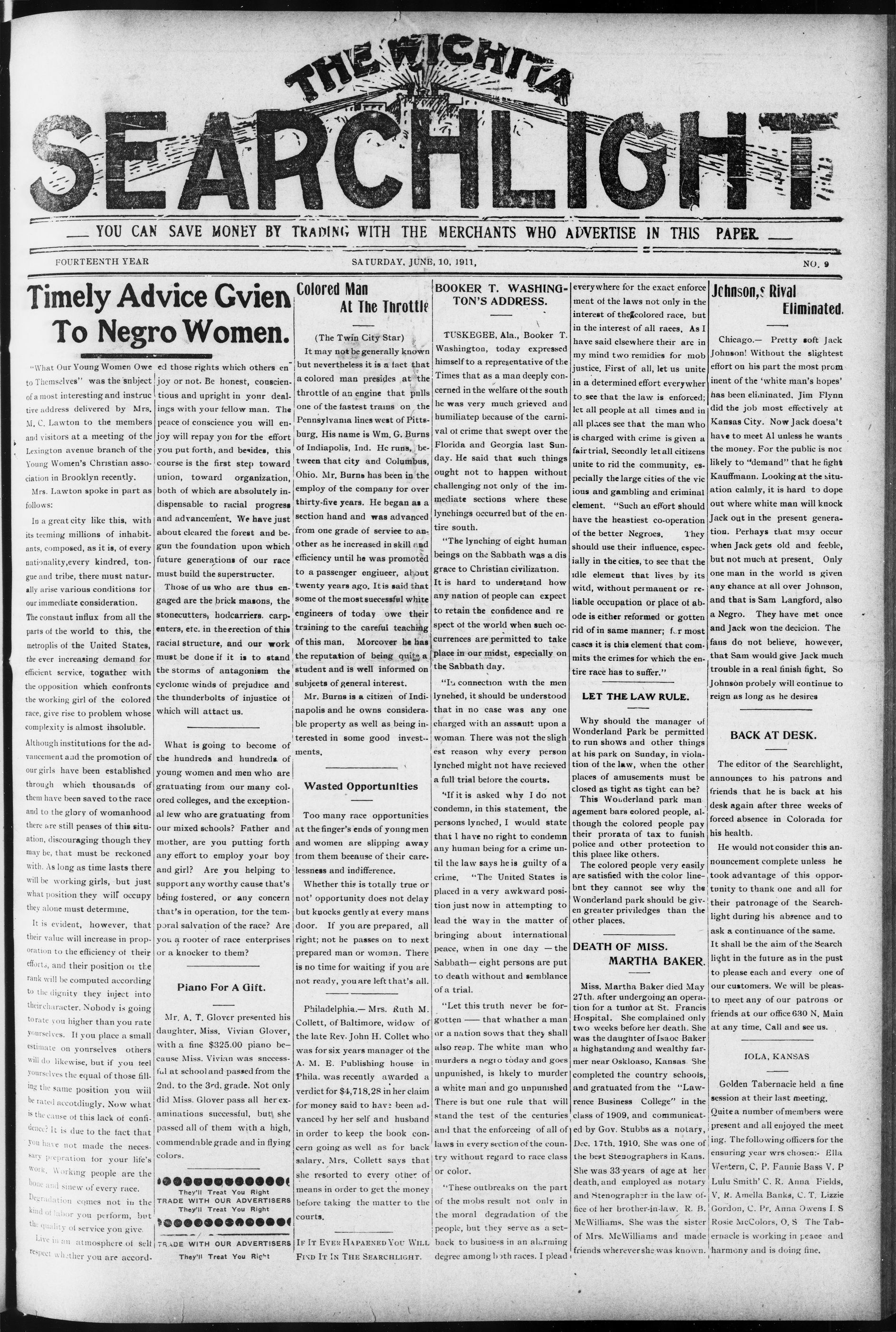
THE WICHITA SEARCHLIGHT
Timely Advice Gvien To Negro Women.
FOURTEENTH YEAR
"What Our Young Women Owe to Themselves" was the snbject of a most interesting and instructive address delivered by Mrs. M. C. Lawton to the members and visitors at a meeting of the Lexington avenue branch of the Young Women's Christian association in Brooklyn recently.
```markdown
```
Mrs. Lawton spoke in part as follows:
In a great city like this, with its teeming millions of inhabitants, composed, as it is, of every nationality, every kindred, tongue and tribe, there must naturally arise various conditions for our immediate consideration.
The constaut influx from all the parts of the world to this, the metroplis of the United States, the ever increasing demand for efficient service, together with the opposition which confronts the working girl of the colored race, give rise to problem whose complexity is almost ihsoluble.
Although institutions for the advancement and the promotion of our girls have been established through which thousands of them have been saved to the race and to the glory of womanhood there are still peases of this situation, discouraging though they may be, that must be reckoned with. As long as time lasts there will be working girls, but just what position they will occupy they alone must determine.
It is evident, however, that their value will increase in proportion to the efficiency of their efforts, and their position or the rank will be computed according to the dignity they inject into their character. Nobody is going to rate you higher than you rate yourselves. If you place a small estimate on yourselves others will do likewise, but if you feel yourselves the equal of those filling the same position you will be rated accordingly. Now what is the cause of this lack of confidence? It is due to the fact that you have not made the necessary preparation for your life's work. Working people are the bone and sinew of every race. Degradation comes not in the kind of labor you perform, but the quality of service you give.
Live in an atmosphere of self respect whether you are accord-
ed those rights which others enjoy or not. Be honest, conscientious and upright in your dealings with your fellow man. The peace of conscience you will enjoy will repay you for the effort you put forth, and besides, this course is the first step toward union, toward organization, both of which are absolutely indispensable to racial progress and advancement. We have just about cleared the forest and begun the foundation upon which future generations of our race must build the superstructer.
Those of us who are thus engaged are the brick masons, the stonecutters, hodcarriers. carpenters, etc. in the erection of this racial structure, and our work must be done if it is to stand the storms of antagonism the cyclonic winds of prejudice and the thunderbolts of injustice of which will attact us.
What is going to become of the hundreds and hundreds of young women and men who are gratuating from our many colored colleges, and the exceptional few who are gratuating from our mixed schools? Father and mother, are you putting forth any effort to employ your boy and girl? Are you helping to support any worthy cause that's being fostered, or any concern that's in operation, for the temporal salvation of the race? Are you a rooter of race enterprises or a knocker to them?
Piano For A Gift.
Mr. A. T. Glover presented his daughter, Miss. Vivian Glover, with a fine $325.00 piano because Miss. Vivian was successful at school and passed from the 2nd. to the 3rd. grade. Not only did Miss. Glover pass all her examinations successful, but she passed all of them with a high, commendable grade and in flying colors.
---
They'll Treat You Right
TRADE WITH OUR ADVERTISERS
They'll Treat You Right
```markdown
```
TRADE WITH OUR ADVERTISERS They'll Treat You Right
SATURDAY, JUNE, 10, 1911.
Colored Man At The Throttle
It may not be generally known but nevertheless it is a fact that a colored man presides at the throttle of an engine that pulls one of the fastest trains on the Pennsylvania lines west of Pittsburg. His name is Wm. G. Burns of Indiapolis, Ind. He runs, between that city and Columbus, Ohio. Mr. Burns has been in the employ of the company for over thirty-five years. He began as a section hand and was advanced from one grade of service to another as he increased in skill and efficiency until he was promoted to a passenger engineer, about twenty years ago. It is said that some of the most successful white engineers of today owe their training to the careful teaching of this man. Morcover he has the reputation of being quite a student and is well informed on subjects of general interest.
Mr. Burns is a citizen of Indianapolis and he owns considerable property as well as being interested in some good investments.
Wasted Opportunities
Too many race opportunities at the finger's ends of young men and women are slipping away from them because of their carelessness and indifference.
Whether this is totally true or not' opportunity does not delay but knocks gently at every mans door. If you are prepared, all right; not he passes on to next prepared man or woman. There is no time for waiting if you are not ready, you are left that's all.
Philadelphia.—Mrs. Ruth M. Collett, of Baltimore, widow of the late Rev. John H. Collet who was for six years manager of the A. M. E. Publishing house in Phila. was recently awarded a verdict for $4,718,28 in her claim for money said to have been advanced by her self and husband in order to keep the book concern going as well as for back salary. Mrs. Collett says that she resorted to every other of means in order to get the money before taking the matter to the courts.
IF IT EVER HAPAENED YOU WILL FIND IT IN THE SEARCHLIGHT.
BOOKER T. WASHINGTON'S ADDRESS.
TUSKEGEE, Ala., Booker T. Washington, today expressed himself to a representative of the Times that as a man deeply concerned in the welfare of the south he was very much grieved and humiliatep because of the carnival of crime that swept over the Florida and Georgia last Sunday. He said that such things ought not to happen without challenging not only of the immediate sections where these lynchings occurred but of the entire south.
"The lynching of eight human beings on the Sabbath was a disgrace to Christian civilization. It is hard to understand how any nation of people can expect to retain the confidence and respect of the world when such occurrences are permitted to take place in our midst, especially on the Sabbath day.
"I connection with the men lynehed, it should be understood that in no case was any one charged with an assault upon a woman. There was not the sligh est reason why every person lynched might not have recieved a full trial before the courts.
"If it is asked why I do not condemn, in this statement, the persons lynched, I would state that I have no right to condemn any human being for a crime until the law says he is guilty of a crime. "The United States is placed in a very awkward position just now in attempting to lead the way in the matter of bringing about international peace, when in one day—the Sabbath—eight persons are put to death without and semblance of a trial.
"Let this truth never be forgotten that whether a man or a nation sows that they shall also reap. The white man who murders a negro today and goes unpunished, is likely to murder a white man and go unpunished There is but one rule that will stand the test of the centuries and that the enforcing of all of laws in every section of the country without regard to race class or color.
"These outbreaks on the part of the mobs result not only in the moral degradation of the people, but they serve as a setback to business in an alarming degree among both races. I plead
IN THIS PAPER
everywhere for the exact enforcement of the laws not only in the interest of the colored race, but in the interest of all races. As I have said elsewhere their arc in my mind two remidies for mob justice. First of all, let us unite in a determined effort everywhere to see that the law is enforced; let all people at all times and in all places see that the man who is charged with crime is given a fair trial. Secondly let all citizens unite to rid the community, especially the large cities of the vicious and gambling and criminal element. "Such an effort should have the heaviest co-operation of the better Negroes. They should use their influence, especially in the cities, to see that the idle element that lives by its witd, without permanent or reliable occupation or place of abode is either reformed or gotten rid of in same manner; for most cases it is this element that commits the crimes for which the entire race has to suffer."
LET THE LAW RULE.
Why should the manager of Wonderland Park be permitted to run shows and other things at his park on Sunday, in violation of the law, when the other places of amusements must be closed as tight as tight can be? This Wonderland park management bars colored people, although the colored people pay their prorata of tax to funish police and other protection to this plaee like others. The colored people very easily are satisfied with the color line-bnt they cannot see why the Wonderland park should be given greater privileges than the other places.
DEATH OF MISS.
MARTHA BAKER.
Miss. Martha Baker died May 27th. after undergoing an operation for a tumor at St. Francis Hospital. She complained only two weeks before her death. She was the daughter of Isaac Baker a highstanding and wealthy farmer near Oskloaso, Kansas. She completed the country schools, and gratuated from the "Lawrence Business College" in the class of 1909, and communicated by Gov. Stubbs as a notary, Dec. 17th, 1910. She was one of the best Stenographers in Kans. She was 33 years of age at her death, and employed as notary and Stenographer in the law office of her brother-in-law. R. B. McWilliams. She was the sister of Mrs. McWilliams and made friends wherever she was known.
Johnson,s Rival Eliminated.
Chicago.—Pretty soft Jack Johnson! Without the slightest effort on his part the most prominent of the 'white man's hopes' has been eliminated. Jim Flynn did the job most effectively at Kansas City. Now Jack doesa't have to meet Al unless he wants the money. For the public is not likely to "demand" that he fight Kauffmann. Looking at the situation calmly, it is hard to dope out where white man will knock Jack out in the present generation. Perhays that may occur when Jack gets old and feeble, but not much at present. Only one man in the world is given any chance at all over Johnson, and that is Sam Langford, also a Negro. They have met once and Jack won the decicion. The fans do not believe, however, that Sam would give Jack much trouble in a real finish fight. So Johnson probely will continue to reign as long as he desires
BACK AT DESK.
The editor of the Searchlight, announces to his patrons and friends that he is back at his desk again after three weeks of forced absence in Colorada for his health.
He would not consider this announcement complete unless he took advantage of this opportunity to thank one and all for their patronage of the Searchlight during his absence and to ask a continuance of the same. It shall be the aim of the Search light in the future as in the pust to please each and every one of our customers. We will be pleas to meet any of our patrons or friends at our office 630 N. Main at any time. Call and see us.
Golden Tabernacle held a fine session at their last meeting. Quite a number of members were present and all enjoyed the meeting. The following officers for the ensuring year wrs chosen: Ella Western, C. P. Fannie Bass V. P Lulu Smith' C. R. Anna Fields, V. R. Amella Banks, C. T. Lizzie Gordon, C. Pr. Anna Owens I. S Rosie McColors, O. S The Tabernacle is working in peace and harmony and is doing fine.
NO.9
IOLA, KANSAS
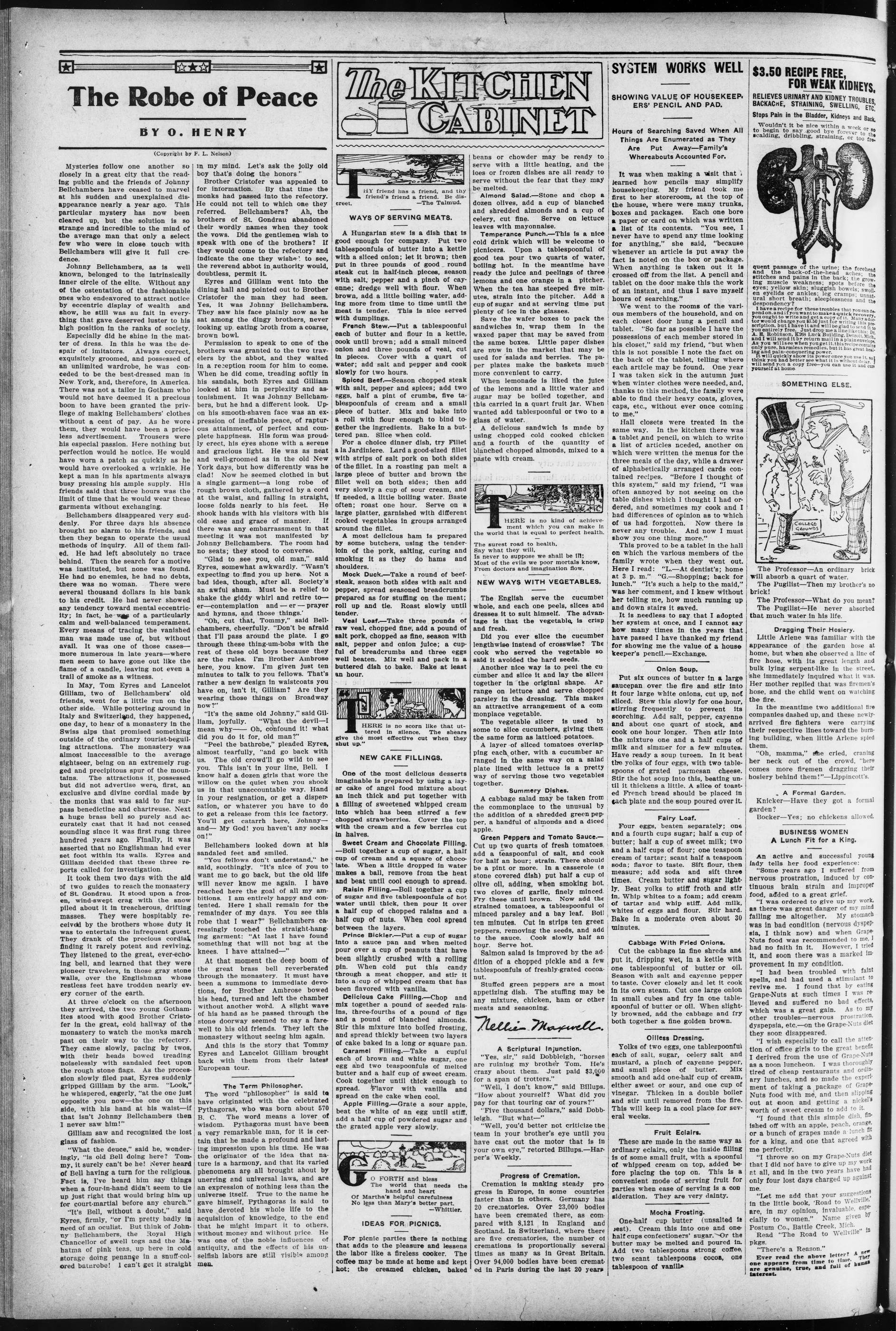
The Robe of Peace
BY O. HENRY
(Copyright by F. L. Nelson)
Mysteries follow one another so closely in a great city that the reading public and the friends of Johnny Bellchambers have ceased to marvel at his sudden and unexplained disappearance nearly a year ago. This particular mystery has now been cleared up, but the solution is so strange and incredible to the mind of the average man that only a select few who were in close touch with Bellchambers will give it full credence.
Johnny Bellchambers, as is well known, belonged to the intrinsically inner circle of the elite. Without any of the ostentation of the fashionable ones who endeavored to attract notice by eccentric display of wealth and show, he still was au fait in everything that gave deserved luster to his high position in the ranks of society.
Especially did he shine in the matter of dress. In this he was the despair of imitators. Always correct, exquisitely groomed, and possessed of an unlimited wardrobe, he was conceded to be the best-dressed man in New York, and, therefore, in America. There was not a tailor in Gotham who would not have deemed it a precious boon to have been granted the privilege of making Bellchambers' clothes without a cent of pay. As he wore them, they would have been a priceless advertisement. Trouwsers were his especial passion. Here nothing but perfection would he notice. He would have worn a patch as quickly as he would have overlooked a wrinkle. He kept a man in his apartments always busy pressing his ample supply. His friends said that three hours was the limit of time that he would wear these garments without exchanging.
Bellchambers disappeared very suddenly. For three days his absence brought no alarm to his friends, and then they began to operate the usual methods of inquiry. All of them failed. He had left absolutely no trace behind. Then the search for a motive was instituted, but none was found. He had no enemies, he had no debts, there was no woman. There were several thousand dollars in his bank to his credit. He had never showed any tendency toward mental eccentricity; in fact, he was of a particularly calm and well-balanced temperament. Every means of tracing the vanished man was made use of, but without avall. It was one of those cases—more numerous in late years—where men seem to have gone out like the flame of a candle, leaving not even a trail of smoke as a witness.
In May, Tom Eyres and Lancelot Gilliam, two of Bellchambers' old friends, went for a little run on the other side. While pottering around in Italy and Switzerland, they happened, one day, to hear of a monastery in the Swiss alps that promised something outside of the ordinary tourist-beguiling attractions. The monastery was almost inaccessible to the average sightseer, being on an extremely rugged and precipitous spur of the mountains. The attractions it, possessed but did not advertise were, first, an exclusive and divine cordial made by the monks that was said to far surpass benedictine and chartreuse. Next a huge brass bell so purely and accurately cast that it had not ceased sounding since it was first rung three hundred years ago. Finally, it was asserted that no Englishman had ever set foot within its walls. Eyres and Gilliam decided that these three reports called for investigation.
It took them two days with the aid of two guides to reach the monastery of St. Gondrau. It stood upon a frozen, wind-swept crag with the snow piled about it in treacherous, drifting masses. They were hospitably received by the brothers whose duty it was to entertain the infrequent guest. They drank of the precious cordial finding it rarely potent and reviving. They listened to the great, ever-echoing bell, and learned that they were pioneer travelers, in those gray stone walls, over the Englishman whose restless feet have trodden nearly every corner of the earth.
At three o'clock on the afternoon they arrived, the two young Gothamites stood with good Brother Cristofer in the great, cold hallway of the monastery to watch the monks march past on their way to the refectory. They came slowly, pacing by twos, with their heads bowed treading noiselessly with sandaled feet upon the rough stone flags. As the procession slowly fled past, Eyres suddenly gripped Gilliam by the arm. "Look," he whispered, eagerly, "at the one just opposite you now—the one on this side, with his hand at his waist—if that isn't Johnny Bellchambers then I never saw him!" Gilliam saw and recognized the lost glass of fashion.
"What the deuce," said he, wonderingly, "is old Bell doing here? Tommy, it surely can't be he! Never heard of Bell having a turn for the religious. Fact is, I've heard him say things when a four-in-hand didn't seem to tie up just right that would bring him up for court-martial before any church." "It's Bell, without a doubt," said Eyres, firmly, "or I'm pretty badly in need of an oculist. But think of Johnny Bellchambers, the Royal High Chancellor of swell togs and the Mahatma of pink teas, up here in cold storage doing penance in a snuff-colored baturobe! I can't get it straight
in my mind. Let's ask the jolly old boy that's doing the honors."
Brother Cristofer was appealed to for information. By that time the monks had passed into the refectory. He could not tell to which one they referred. Bellchambers? Ah, the brothers of St. Gondraun abandoned their wordly names when they took the vows. Did the gentlemen wish to speak with one of the brothers? If they would come to the refectory and indicate the one they wished to see, the reverend abbot in authority would, doubtless, permit it.
Eyres and Gilliam went into the dining hall and pointed out to Brother Cristofer the man they had seen. Yes, it was Johnny Bellchambers. They saw his face plainly now as he sat among the dingy brothers, never looking up, eating broth from a coarse, brown bowl.
Permission to speak to one of the brothers was granted to the two travelers by the abbot, and they waited in a reception room for him to come. When he did come, treading softly in his sandals, both Eyres and Gilliam looked at him in perplexity and astonishment. It was Johnny Bellchambers, but he had a different look. Upon his smooth-shaven face was an expression of ineffable peace, of raptuous attainment, of perfect and complete happiness. His form was proudly erect, his eyes shone with a serene and gracious light. He was as neat and well-groomed as in the old New York days, but how differently was he clad! Now he seemed clothed in but a single garment—a long robe of rough brown cloth, gathered by a cord at the waist, and falling in straight, loose folds nearly to his feet. He shook hands with his visitors with his old ease and grace of manner. If there was any embarrassment in that meeting it was not manifested by Johnny Bellchambers. The room had no seats; they stood to converse.
"Glad to see you, old man," said Eyres, somewhat awkwardly. "Wasn't expecting to find you up here. Not a bad idea, though, after all. Society's an awful sham. Must be a relief to shake the giddy whirl and retire to—er—contemplation and—er—prayer and hymns, and those things."
"Oh, cut that, Tommy," said Bellchambers, cheerfully. "Don't be afraid that I'll pass around the plate. I go through these thing-u-m-bobs with the rest of these old boys because they are the rules. I'm Brother Ambrose here, you know. I'm given just ten minutes to talk to you fellows. That's rather a new design in waistcoats you have on, isn't it, Gilliam? Are they wearing those things on Broadway now?
"It's the same old Johnny," said Gilliam, joyfully. "What the devil—I mean why— Oh, confound it! what did you do it for old man?"
"Peel the bathrobe," pleaded Eyres, almost tearfully, "and go back with us. The old crowd'll go wild to see you. This isn't in your line, Bell. I know half a dozen girls that wore the willow on the quiet when you shook us in that unaccountable way. Hand in your resignation, or get a dispersion, or whatever you have to do to get a release from this ice factory. You'll get catarrh here, Johnny—and My God! you haven't any socks on!" Bellchambers looked down at his sandaled, foot and smiled.
"You fellows don't understand," he said, soothingly. "It's nice of you to want me to go back, but the old life will never know me again. I have reached here the goal of all my ambitions. I am entirely happy and contented. Here I shall remain for the remainder of my days. You see this robe that I wear?" Bellchambers caressingly touched the straight-hanging garment: "At last I have found something that will not bag at the knees. I have attained—"
At that moment the deep boom of the great brass bell reverberated through the monastery. It must have been a summons to immediate devotions, for Brother Ambrose bowed his head, turned and left the chamber without another word. A slight wave of his hand as he passed through the stone doorway seemed to say a farewell to his old friends. They left the monastery without seeing him again.
And this is the story that Tommy Eyres and Lancelot Gilliam brought back with them from their latest European tour.
The Term Philosopher.
The word "philosopher" is said to have originated with the celebrated Pythagoras, who was born about 570 B. C. The word means a lover of wisdom. Pythagoras must have been a very remarkable man, for it is certain that he made a profound and lasting impression upon his time. He was the originator of the idea that nature is a harmony, and that its varied phenomena are all brought about by unerring and universal laws, and are an expression of nothing less than the universe itself. True to the name he gave himself, Pythagoras is said to have devoted his whole life to the acquisition of knowledge, to the end that he might impart it to others, without money and without price. He was one of the noble influences of antiquity, and the effects of his unselfish labors are still visible among men.
The KITCHEN CABINET
HY friend has a friend, and thy friend's friend a friend. Be dis-
The Talmud.
beans or chowder may be ready to serve with a little heating, and the ices or frozen dishes are all ready to serve without the fear that they may be melted.
Almond Salad.—Stone and chop a dozen olives, add a cup of blanched
WAYS OF SERVING MEATS.
A Hungarian stew is a dish that is good enough for company. Put two tablespoonfuls of butter into a kettle with a sliced onion; let it brown; then put in three pounds of good round steak cut in half-inch pieces, season with salt, pepper and a pinch of cayenne; dredge well with flour. When brown, add a little boiling water, adding more from time to time until the meat is tender. This is nice served with dumplings.
French Stew—Put a tablespoonful each of butter and flour in a kettle, cook until brown; add a small minced onion and three pounds of veal, cut in pieces. Cover with a quart of water; add salt and pepper and cook slowly for two hours.
Spiced Beef.—Season chopped steak with salt, pepper and spices; add two eggs, half a pint of crumbs, five tablespoonfuls of cream and a small piece of butter. Mix and bake into a roll with flour enough to bind together the ingredients. Bake in a buttered pan. Slice when cold.
For a choice dinner dish, try Fillet a la Dijardini. Lard a good-sized fillet with strips of salt pork on both sides of the fillet. In a roasting pan melt a large piece of butter and brown the fillet well on both sides; then add very slowly a cup of sour cream, and if needed, a little boiling water. Baste often; roast one hour. Serve on a large platter, garnished with different cooked vegetables in groups arranged around the fillet.
A most delicious ham is prepared by some butchers, using the tenderloin of the pork, salting, curing and smoking it as they do hams and shoulders.
Mock Duck.—Take a round of beef and pepper, season both sides with salt and spread seasoned breadcrumbs prepared as for stuffing on the meat; roll up and tie. Roast slowly until tender.
Veal Loaf.—Take three pounds of raw veal, chopped fine, add a pound of salt pork, chopped as fine, season with salt, pepper and onion juice; a cupful of breadcrumbs and three eggs well beaten. Mix well and pack in a buttered dish to bake. Bake at least an hour.
HERE is no scorn like that uttered in silence. The shears give the most effective cut when they shut up."
NEW CAKE FILLINGS.
One of the most delicious desserts imaginable is prepared by using a layer cake of angel food mixture about an inch thick and put together with a filling of sweetened whipped cream into which has been stirred a few chopped strawberries. Cover the top with the cream and a few berries cut in halves.
Sweet Cream and Chocolate Filling.—Boil together a cup of sugar, a half cup of cream and a square of chocolate. When a little dropped in water makes a ball, remove from the heat and beat until cool enough to spread.
Raisin Filling.—Boil together a cup of sugar and five tablespoonfuls of hot water until thick, then pour it over a half cup of chopped raisins and a half cup of nuts. When cool spread between the lavers.
Prince Bickler—Put a cup of sugar into a sauce pan and when melted pour over a cup of peanuts that have been slightly crushed with a rolling pin. When cold put this candy through a meat chopper, and stir it into a cup of whipped cream that has been flavored with vanilla.
Delicious Cake Filling—Chop and mix together a pound of seeded raisins, three-fourths of a pound of figs and a pound of blanched almonds. Stir this mixture into boiled frosting, and spread thickly between two layers of cake baked in a long or square pan.
Caramel Filling—Take a cupful each of brown and white sugar, one egg and two teaspoonfuls of melted butter and a half cup of sweet cream. Cook together until thick enough to spread. Flavor with vanilla and spread on the cake when cool.
Apple Filling—Grate a sour apple, beat the white of an egg until stiff, add a half cup of powdered sugar and the grated apple very slowly.
G
O FORTH and bless
The world that needs the
IDEAS FOR PICNICS.
For plenic parties there is nothing that adds to the pleasure and lessens the labor like a fireless cooker. The coffee may be made at home and kept hot; the creamed chicken, baked
beans or chowder may be ready to serve with a little heating, and the icees or frozen dishes are all ready to serve without the fear that they may be melted.
Almond Salad.—Stone and chop a dozen olives, add a cup of blanched and shredded almonds and a cup of celery, cut fine. Serve on lettuce leaves with mayonnaise.
Temperance Punch.—This is a nice cold drink which will be welcome to pcnicers. Upon a tablespoonful of good tea pour two quarts of water, boiling hot. In the meantime have ready the juice and peelings of three lemons and one orange in a pitcher. When the tea has steeped five minutes, strain into the pitcher. Add a cup of sugar and at serving time put plenty of ice in the glasses.
Save the wafer boxes to pack the sandwiches in, wrap them in the waxed paper that may be saved from the same boxes. Little paper dishes are now in the market that may be used for salads and berries. The paper plates make the baskets much more convenient to carry.
When lemonade is liked the juice of the lemons and a little water and sugar may be boiled together, and this carried in a quart fruit jar. When wanted add tablespoonful or two to a glass of water.
A delicious sandwich is made by using chopped cold cooked chicken and a fourth of the quantity of blanched chopped almonds, mixed to a paste with cream.
HERE is no kind of achievement which you can make in the world that is equal to perfect health.
The surest road to health.
Say what they will.
Is never to suppose we shall be ill;
Most of the evils we poor mortals know,
From doctors and imagination flow.
NEW WAYS WITH VEGETABLES.
The English serve the cucumber whole, and each one peels, slices and dresses it to suit himself. The advantage is that the vegetable is crisp and fresh.
Did you ever slice the cucumber lengthwise instead of crosswise? The cook who served the vegetable so said it avoided the hard seeds.
Another nice way is to peel the cucumber and slice it and lay the slices together in the original shape. A range on lettuce and serve chopped parsley in the dressing. This makes an attractive arrangement of a commonplace vegetable.
The vegetable slicer is used by some to slice cucumbers, giving them the same form as latticed potatoes.
A layer of sliced tomatoes overlap plng each other, with a cucumber aranged in the same way on a salad plate lined with lettuce is a pretty way of serving those two vegetables together.
Summery Dishes.
A cabbage salad may be taken from the commonplace to the unusual by the addition of a shredded green pepper, a handful of almonds and a diced apple.
Green Peppers and Tomato Sauce. Cut up two quartiles of fresh tomatoes, add a teaspoonful of salt, and cook for half an hour; strain. There should be a pint or more. In a casserole (a stone covered dish) put half a cup of olive oil, adding, when smoking hot, two cloves of garlic, finely minced. Fry these until brown. Now add the strained tomatoes, a tablespoonful of minced parsley and a bay leaf. Boil ten minutes. Cut in strips ten green peppers, removing the seeds, and add to the sauce. Cook slowly half an hour. Serve hot.
Salmon salad is improved by the addition of a chopped pickle and a few tablespoonfuls of freshly-grated cocoanut.
Stuffed green peppers are a most appetizing dish. The stuffing may be any mixture, chicken, ham or other meats and seasoning.
Nellie Maxwell.
"Yes, sir," said Dobbleigh, "horses are ruining my brother Tom. He's crazy about them. Just paid $3,000 for a span of trotters."
"Well, I don't know," said Billups. "How about yourself? What did you pay for that touring car of yours?"
"Five thousand dollars," said Dobbleigh. "But what—"
"Well, you'd better not criticize the team in your brother's eye until you have cast out the motor that is in your own eye," retorted Billups.—Harper's Weekly.
Progress of Cremation.
Cremation is making steady progress in Europe, in some countries faster than in others. Germany has 20 crematories. Over 23,000 bodies have been cremated there, as compared with 8,121 in England and Scotland. In Switzerland, where there are five crematories, the number of cremations is proportionally several times as many as in Great Britain. Over 94,000 bodies have been cremated in Paris during the last 20 years
SYSTEM WORKS WELL
SYSTEM WORKS WELL
SHOWING VALUE OF HOUSEKEEPERS' PENCIL AND PAD.
Hours of Searching Saved When All Things Are Enumerated as They Are Put Away—Family's Whereabouts Accounted For.
It was when making a visit that I learned how pencils may simplify housekeeping. My friend took me first to her storeroom, at the top of the house, where were many trunks, boxes and packages. Each one bore a paper or card on which was written a list of its contents. "You see, I never have to spend any time looking for anything," she said, "because whenever an article is put away the fact is noted on the box or package. When anything is taken out it is crossed off from the list. A pencil and tablet on the door make this the work of an instant, and thus I save myself hours of searching."
We went to the rooms of the various members of the household, and on each closet door hung a pencil and tablet. "So far as possible I have the possessions of each member stored in his closet," said my friend, "but when this is not possible I note the fact on the back of the tablet, telling where each article may be found. One year I was taken sick in the autumn just when winter clothes were needed, and, thanks to this method, the family were able to find their heavy coats, gloves, caps, etc., without ever once coming to me."
Hall closets were treated in the same way. In the kitchen there was a tablet and pencil, on which to write a list of articles needed, another on which were written the menus for the three meals of the day, while a drawer of alphabetically arranged cards contained recipes. "Before I thought of this system," said my friend, "I was often annoyed by not seeing on the table dishes which I thought I had ordered, and sometimes my cook and I had differences of opinion as to which of us had forgotten. Now there is never any trouble. And now I must show you one thing more."
This proved to be a tablet in the hall on which the various members of the family wrote when they went out. Here I read: "L—At dentist's; home at 3 p. m." "G—Shopping; back for lunch." "It's such a help to the maid," was her comment, and I knew without her telling me, how much running up and down stairs it saved.
It is needless to say that I adopted her system at once, and I cannot say how many times in the years that have passed I have thanked my friend for showing me the value of a house keeper's pencl—Exchange.
Onion Soup.
Put six ounces of butter in a large saucepan over the fire and stir into it four large white onions, cut up, not sliced. Stew this slowly for one hour, stirring frequently to prevent its scorching. Add salt, pepper, cayenne and about one quart of stock, and cook one hour longer. Then stir into the mixture one and a half cups of milk and simmer for a few minutes. Have ready a soup tureen. In it beat the yolks of four eggs, with two tablespoons of grated parmesan cheese. Stir the hot soup into this, beating until it thickens a little. A slice of toasted French bread should be placed in each plate and the soup poured over it.
Fairy Loaf.
Four eggs, beaten separately; one and a fourth cups sugar; half a cup of butter; half a cup of sweet milk; two and a half cups of flour; one teaspoon cream of tartar; scant half a teaspoon soda; flavor to taste. Sift flour, then measure; add soda and sift three times. Cream butter and sugar lightly. Beat yolks to stiff froth and stir in. Whip whites to a foam; add cream of tartar and whip stiff. Add milk, whites of eggs and flour. Stir hard. Bake in a moderate oven about 30 minutes.
Cabbage With Fried Onions.
Cut the cabbage in fine shreds and put it, dripping wet, in a kettle with one tablespoonful of butter or oil. Season with salt and cayenne pepper to taste. Cover closely and let it cook in its own steam. Cut one large onion in small cubes and fry in one tablespoonful of butter or oil. When slightly browned, add the cabbage and fry both together a fine golden brown.
Oilless Dressing.
Yolks of two eggs, one tablepoonful each of salt, sugar, celery salt and mustard, a pinch of cayenne pepper, and small piece of butter. Mix smooth and add one-half cup of cream, either sweet or sour, and one cup of vinegar. Thicken in a double boiler and stir until removed from the fire. This will keep in a cool place for several weeks.
Fruit Eclairs.
These are made in the same way as ordinary eclairs, only the inside filling is of some small fruit, with a spoonful of whipped cream on top, added before placing the top on. This is a convenient mode of serving fruit for parties when ease of serving is a consideration. They are very dainty.
Mocha Frosting.
One-half cup butter (unsalted in rest). Cream this into one and one-half cups confectioners' sugar. Or the butter may be melted and poured in. Add two tablespoons strong coffee, two scant tablespoons cocoa, one tablespoon of vanilla
RELIEVEVS URINARY AND KIDNEY TROUBLES,
BACKACHE, STRAINING, SWELLING, ETC.
Stops Pain in the Bladder, Kidneys and Back.
Wouldn't it be nice within a week or so
to begin to say good bye forever to the
scalding, dribbling, straining, or too fre
quent passage of the urine; the forehead and the back-of-the-head aches; the groin and the back of the groin; the growing muscle weakness; spots behind the eyes; yellow skin; sluggish bowels; swollen en eyelids or ankles; leg cramps; unnaturing death; sleeplessness and the despondency $^1$
I have a recipe for these troubles that you can endure and want to make a quick recovery, you ought to write down the instructions for the person who charge you $2.50 just for writing this letter so that you entirely free. Just drop me a line like this: A. B. Robinson, K268 Luck Building, Detroit Mich. and will be given a copy of the envelopa. As you will see when you get it, this recipe is only pure, harmless remedies, but it has great healing power. It will quickly show its power once you use it, so think you and better see what it is without delay, and you can buy free - you can eat and use yourself at home
**THEMING ELSE**
COLLEGE GROUNDS
The Professor—An ordinary brick will absorb a quart of water.
The Puglist—Then my brother's no brick!
The Professor—What do you mean?
The Puglist—He never absorbed that much water in his life.
Dragging Their Hosiery.
Little Arlene was familiar with the appearance of the garden hose at home, but when she observed a line of fire hose, with its great length and bulk lying serpent-like in the street, she immediately inquired what it was. Her mother replied that was firemen's hose, and the child went on watching the fire.
In the meantime two additional fire companies dashed up, and these newly-arrived fire fighters were carrying their respective lines toward the burning building, when little Arlene spied them.
"Oh, mamma," she cried, craning her neck out of the crowd, "here comes more firemen dragging their hosiery behind them!"—Lippincott's.
A Formal Garden.
Knicker—Have they got a formal garden?
Bocker—Yes; no chickens allowed.
BUSINESS WOMEN
A Lunch Fit for a King.
An active and successful young lady tells her food experience:
"Some years ago I suffered from nervous prostration, induced by continuous brain strain and improper food, added to a great grief.
"I was ordered to give up my work, as there was great danger of my mind failing me altogether. My stomach was in bad condition (nervous dyspepsia, I think now) and when Grape-Nuts food was recommended to me, I had no faith in it. However, I tried it, and soon there was a marked improvement in my condition.
"I had been troubled with faint spells, and had used a stimulant to revive me. I found that by eating Grape-Nuts at such times I was relieved and suffered no bad effects, which was a great gain. As to my other troubles—nervous prostration, dyspepsia, etc.—on the Grape-Nuts diet they soon disappeared.
"I wish especially to call the attention of office girls to the great benefit I derived from the use of Grape-Nuts as a noon luncheon. I was thoroughly tired of cheap restaurants and ordinary lunches, and so made the experiment of taking a package of Grape-Nuts food with me, and then slipping out at noon and getting a nickel worth of sweet cream to add to it.
"I found that this simple dish, finished off with an apple, peach, orange, or a bunch of grapes made a lunch fit for a king, and one that agreed with me perfectly.
"I throw so on my Grape-Nuts diet that I did not have to give my work at all, and in the two years have had only four lost days charged up against me."
"Let me add that your suggestions in the little book, 'Road to Wellville,' are, in my opinion, invaluable, especially to women." Name given by Postum Co., Battle Creek, Mich. Read "The Road to Wellville" in pkgs. "There's a Reason."
Ever read the above letter? A new one appears from time to time. They are genuine, true, and full of human
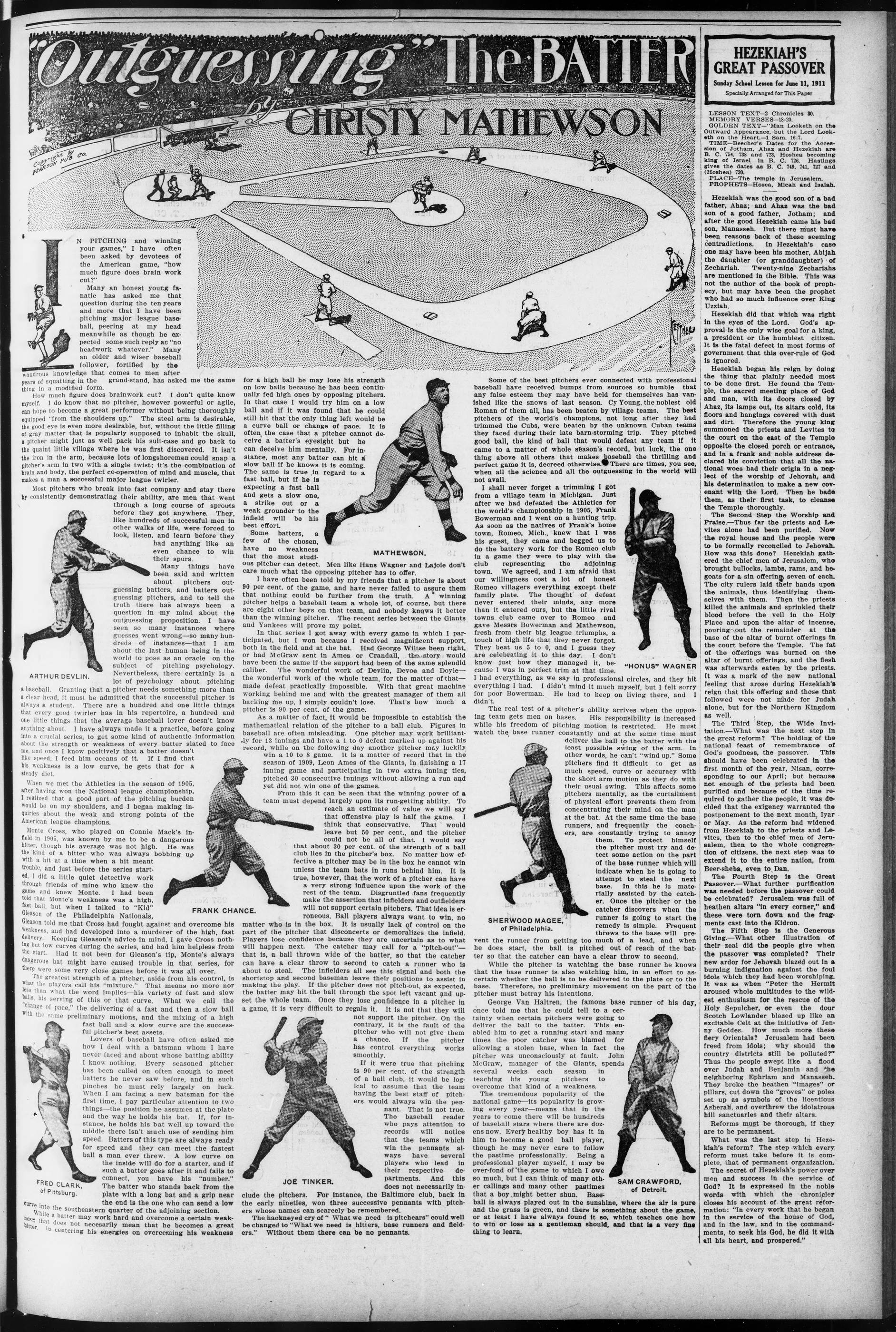
"Outguessing" The BATTER
by CHRISTY MATHEWSON
IN PITCHING and winning your games," I have often been asked by devotees of the American game, "how much figure does brain work cut?"
Many an honest young fanatic has asked me that question during the ten years and more that I have been pitching major league baseball, peering at my head meanwhile as though he expected some such reply as "no headwork whatever." Many an older and wiser baseball follower, fortified by the
wondrous knowledge that comes to men after years of squatting in the grand-stand, has asked me the same thing in a modified form.
How much figure does brainwork cut? I don't quite know myself. I do know that no pitcher, however powerful or agile, can hope to become a great performer without being thoroughly equipped "from the shoulders up." The steel arm is desirable, the good eye is even more desirable, but, without the little filling of gray matter that is popularly supposed to inhabit the skull, a pitcher might just as well pack his suit-case and go back to the quaint little village where he was first discovered. It isn't the iron in the arm, because lots of longshoremen could snap a pitcher's arm in two with a single twist; it's the combination of brain and body, the perfect co-operation of mind and muscle, that makes a man a successful major league twirler.
Most pitchers who break into fast company and stay there by consistently demonstrating their ability, are men that went
through a long course of sprouts before they got anywhere. They, like hundreds of successful men in other walks of life, were forced to look, listen, and learn before they
about pitchers outguessing batters, and batters outguessing pitchers, and to tell the truth there has always been a question in my mind about the outguessing proposition. I have seen so many instances where guesses went wrong—so many hundreds of instances—that I am about the last human being in the world to pose as an oracle on the subject of pitching psychology. Nevertheless, there certainly is a lot of psychology about pitching
a baseball. Granting that a pitcher needs something more than a clear head, it must be admitted that the successful pitcher is always a student. There are a hundred and one little things that every good twirler has in his repertoire, a hundred and one little things that the average baseball lover doesn't know anything about. I have always made it a practice, before going into a crucial series, to get some kind of authentic information about the strength or weakness of every batter slated to face me, and once I know positively that a batter doesn't like speed, I feed him oceans of it. If I find that his weakness is a low curve, he gets that for a steady diet.
When we met the Athletics in the season of 1905, after having won the National league championship, I realized that a good part of the pitching burden would be on my shoulders, and I began making inquiries about the weak and strong points of the American league champions.
Monte Cross, who played on Connie Mack's in-field in 1905, was known by me to be a dangerous hitter, though his average was not high. He was the kind of a hitter who was always bobbing up
with a hit at a time when a hit meant trouble, and just before the series started, I did a little quiet detective work through friends of mine who knew the game and knew Monte. I had been told that Monte's weakness was a high, fast ball, but when I talked to "Kid" Gleason of the Philadelphia Nationals, Gleason told me that Cross had fought against and overcome his weakness, and had developed into a murderer of the high, fast delivery. Keeping Gleason's advice in mind, I gave Cross nothing but low curves during the series, and had him helpless from the start. Had it not been for Gleason's tip, Monte's always dangerous bat might have caused trouble in that series, for there were some very close games before it was all over.
The greatest strength of a pitcher, aside from his control, is what the players call his "mixture." That means no more nor less than what the word implies—his variety of fast and slow balls, his serving of this or that curve. What we call the "change of pace," the delivering of a fast and then a slow ball with the same preliminary motions, and the mixing of a high fast ball and a slow curve are the successful pitcher's best assets.
Lovers of baseball have often asked me how I deal with a batsman whom I have never faced and about whose batting ability I know nothing. Every seasoned pitcher has been called on often enough to meet batters he never saw before, and in such pinches he must rely largely on luck. When I am facing a new batsman for the first time, I pay particular attention to two things—the position he assumes at the plate and the way he holds his bat. If, for instance, he holds his bat well up toward the middle there isn't much use of sending him speed. Batters of this type are always ready for speed and they can meet the fastest ball a man ever threw. A low curve on the inside will do for a starter, and if such a batter goes after it and fails to connect, you have his "number." The batter who stands back from the plate with a long bat and a grip near
While the southeastern quarter of the adjoining section, into a batter may work hard and overcome a certain weakness that does not necessarily mean that he becomes a great bitter. In ceatering his energies on overceaming his weakness
1
ARTHUR DEVLIN.
FRED CLARK,
of Pittsburg.
for a high ball he may lose his strength on low balls because he has been continually fed high ones by opposing pitchers. In that case I would try him on a low ball and if it was found that he could still hit that the only thing left would be a curve ball or change of pace. It is often the case that a pitcher cannot deceive a batter's eyesight but he can deceive him mentally. For instance, most any batter can hit a slow ball if he knows it is coming. The same is true in regard to a
ous pitcher can detect. Men like Hans Wagner and Lajole don't care much what the opposing pitcher has to offer.
I have often been told by my friends that a pitcher is about 90 per cent, of the game, and have never failed to assure them that nothing could be further from the truth. A winning pitcher helps a baseball team a whole lot, of course, but there are eight other boys on that team, and nobody knows it better than the winning pitcher. The recent series between the Giants and Yankees will prove my point.
In that series I got away with every game in which I participated, but I won because I received magnificent support, both in the field and at the bat. Had George Wiltse been right, or had McGraw sent in Ames or Crandall, the story would have been the same if the support had been of the same splendid caller. The wonderful work of Devlin, Devoe and Doyle—the wonderful work of the whole team, for the matter of that—made defeat practically impossible. With that great machine working behind me and with the greatest manager of them all backing me up, I simply couldn't lose. That's how much a pitcher is 90 per cent, of the game.
As a matter of fact, it would be impossible to establish the mathematical relation of the pitcher to a ball club. Figures in baseball are often misleading. One pitcher may work brilliantly for 13 innings and have a 1 to 0 defeat marked up against his record, while on the following day another pitcher may luckily
win a 10 to 8 game. It is a matter of record that in the season of 1909, Leon Ames of the Giants, in finishing a 17 inning game and participating in two extra inning ties, pitched 30 consecutive innings without allowing a run and yet did not win one of the games. From this it can be seen that the winning power of a team must depend largely upon its run-getting ability. To
ust depend largely upon its run-getting ability. To reach an estimate of value we will say that offensive play is half the game. I think that conservative. That would leave but 50 per cent., and the pitcher could not be all of that. I would say that about 30 per cent. of the strength of a ball club lies in the pitcher's box. No matter how effective a pitcher may be in the box he cannot win unless the team bats in runs behind him. It is true, however, that the work of a pitcher can have a very strong influence upon the work of the rest of the team. Disgruntled fans frequently make the assertion that infelders and outfielders will not support certain pitchers. That idea is erroneous. Ball players always want to win no
matter who is in the box. It is usually lack of control on the part of the pitcher that disconcerts or demoralizes the infield. Players lose confidence because they are uncertain as to what will happen next. The catcher may call for a "pitch-out"—that is, a ball thrown wide of the batter, so that the catcher can have a clear throw to second to catch a runner who is about to steal. The infielders all see this signal and both the shortstop and second baseman leave their positions to assist in making the play. If the pitcher does not pitch-out, as expected, the batter may hit the ball through the spot left vacant and upset the whole team. Once they lose confidence in a pitcher in a game, it is very difficult to regain it. It is not that they will
not su
contra
pitche
a ch
has co
smooth
If it
is 90
of a b
ical t
having
ers w
clude the pitchers. For instance, the Baltimore club, back in the early ninies, won three successive pennants with pitchers whose names can scarcely be remembered.
The hackneyed cry of "What we need is pitchears" could well be changed to "What we need is hitters, base runners and fielders." Without them there can be no pennants.
fast ball, but if he is expecting a fast ball and gets a slow one, a strike out or a weak grounder to the infield will be his best effort. Some batters, a few of the chosen, have no weakness that the most studious pitcher can detect
had anything like an even chance to win their spurs. Many things have been said and written about with enthusiasm.
win a 10
season of
inning g
pitched 3
yet did n
From
team mus
in-
us
as
up
FRANK CHANGE.
JOE TINKER.
MATHEWSON.
Jake Hans Wagner and Lajole don't pitcher has to offer.
My friends that a pitcher is about have never failed to assure them from the truth. A winning a whole lot, of course, but there team, and nobody knows it better is recent series between the Giants in with every game in which I par- I received magnificent support. Had George Wiltse been right, or Crandall, the story would had been of the same splendid sort of Devlin, Devoe and Doyle—pole team, for the matter of that—sible. With that manager the greatest manager of them all'll lose. That's how much a game.
It could be impossible to establish the pitcher to a ball club. Figures in One pitcher may work brilliant- to 0 defeat marked up against his day another pitcher may luckily is a matter of record that in the ties of the Giants, in finishing a 17 spating in two extra inning ties, ties without allowing a run and the games.
seen that the winning power of a yup on its run-getting ability. To an estimate of value we will say sensitive play is half the game. I that conservative. That would out 50 per cent., and the pitcher not be all of that. I would say per cent, of the strength of a ball pitcher's box. No matter how eff- may be in the box he cannot win bats in runs behind him. It is that the work of a pitcher can have influence upon the work of the team. Disgruntled fans frequently assertion that infielders and outfielders sort certain pitchers. That idea is er-players always want to win, no its usually lack of control on the accecs or demoralizes the infield. be they are uncertain as to what may call for a "pitch-out"—the batter, so that the catcher to catch a runner who is all see this signal and both the leave their positions to assist in does not pitch-out, as expected, though the spot left vacant and upy lose confidence in a pitcher in again它. It is not that they will
not support the pitcher. On the contrary, it is the fault of the pitcher who will not give them a chance. If the pitcher has control everything works smoothly. If it were true that pitching is 90 per cent. of the strength of a ball club, it would be logical to assume that the team having the best staff of pitchers would always win the pennant. That is not true. The baseball reader who pays attention to records will notice that the teams which win the pennants always have several players who lead in their respective departments. And this does not necessarily in-
once, the Baltimore club, back in successive pennants with pitch- be remembered. we need is pitchears" could well hitters, base runners and field- be no pennants.
Some of the best pitchers ever connected with professional baseball have received bumps from sources so humble that any false esteem they may have held for themselves has vanished like the snows of last season. Cy Young, the noblest old Roman of them all, has been beaten by village teams. The best pitchers of the world's champions, not long after they had trimmed the Cubs, were beaten by the unknown Cuban teams they faced during their late barn-storming trip. They pitched good ball, the kind of ball that would defeat any team if it came to a matter of whole season's record, but luck, the one thing above all others that makes baseball the thrilling and perfect game it is, decreed otherwise. There are times, you see, when all the science and all the outguessing in the world will not avail.
I shall never forget a trimming I got from a village team in Michigan. Just after we had defeated the Athletics for the world's championship in 1905, Frank Bowerman and I went on a hunting trip. As soon as the natives of Frank's home town, Romeo, Mich., knew that I was his guest, they came and begged us to do the battery work for the Romeo club in a game they were to play with the club representing the adjoining town. We agreed, and I am afraid that our willingness cost a lot of honest Romeo villagers everything except their family plate. The thought of defeat never entered their minds, any more than it entered ours, but the little rival towns club came over to Romeo and gave Messrs Bowerman and Mathewson, fresh from their big league triumphs, a touch of high life that they never forgot. They beat us 5 to 0, and I guess they are celebrating it to this day. I don't know just how they managed it, because I was in perfect trim at that time.
I had everything, as we say in professional circles, and they hit everything I had. I didn't mind it much myself, but I felt sorry for poor Bowerman. He had to keep on living there, and I didn't.
The real test of a pitcher's ability arrives when the opposing team gets men on bases. His responsibility is increased while his freedom of pitching motion is restricted. He must watch the base runner constantly and at the same time must deliver the ball to the batter with the least possible swing of the arm. In other words, he can't "wind up." Some pitchers find it difficult to get as much speed, curve or accuracy with the short arm motion as they do with their usual swing. This affects some pitchers mentally, as the curtailment of physical effort prevents them from concentrating their mind on the man at the bat. At the same time the base runners, and frequently the coaches, are constantly trying to annoy
deliver
least p
other w
pitcher
much u
the sho
their u
pitcher
of phys
concen
at the
runners
ers, ar
ers, are constantly trying to annoy them. To protect himself the pitcher must try and detect some action on the part of the base runner which will indicate when he is going to attempt to steal the next base. In this he is materially assisted by the catcher. Once the pitcher or the catcher discovers when the runner is going to start the remedy is simple. Frequent throws to the base will prevent the runner from getting too much of a lead, and when he does start, the ball is pitched out of reach of the batter so that the catcher can have a clear throw to second.
While the pitcher is watching the base runner he knows that the base runner is also watching him, in an effort to ascertain whether the ball is to be delivered to the plate or to the base. Therefore, no preliminary movement on the part of the pitcher must betray his intentions.
George Van Haltren, the famous base once told me that he could tell to a certainty when certain pitchers were going to deliver the ball to the batter. This enabled him to get a running start and many times the poor catcher was blamed for allowing a stolen base, when in fact the pitcher was unconsciously at fault. John McGraw, manager of the Giants, spends several weeks each season in teaching his young pitchers to overcome that kind of a weakness.
The tremendous popularity of the national game—its popularity is growing every year—means that in the years to come there will be hundreds of baseball stars where there are dozens now. Every healthy boy has it in him to become a good ball player, though he may never care to follow the pastime professionally. Being a professional player myself, I may be over-fond of 'the game to which I owe so much, but I can think of many other callings and many other pastimes that a boy might better shun. Baseball is always played out in the sunshine, where the air is pure and the grass is green, and there is something about the game, or at least I have always found it so, which teaches one how to win or lose as a gentleman should, and that is a very fine thing to learn.
SHERWOOD MAGEE, of Philadelphia.
"HONUS" WAGNER
cer-
ing to
en-
nany
for
the
John
ends
SAM CRAWFORD,
of Detroit.
HEZEKIAH'S GREAT PASSOVER Sunday School Lesson for June 11, 1911 Specially Arranged for This Paper
LESSON TEXT-2 Chronicles 30.
MEMORY VERSES-18-20.
GOLDEN TEXT-"Man Looketh on the Outward Appearance, but the Lord Looketh on the Heart.-I Sam. 16:7.
TIME-Beecher's Dates for the Accession of Othman, Ahaz and Hezekiah are B. C. 749, 750, 751, becoming king of Israel in B. C. 726. Hastings gives the dates as B. C. 749, 741, 727 and (Hoshea) 730.
PLACE-The temple in Jerusalem.
PROPHETS-Hosea, Micah and Isaiah.
Hezekiah was the good son of a bad father, Ahaz; and Ahaz was the bad son of a good father, Jotham; and after the good Hezekiah came his bad son, Manasseh. But there must have been reasons back of these seeming contradictions. In Hezekiah's case one may have been his mother, Abijah the daughter (or granddaughter) of Zechariah. Twenty-nine Zechariahs are mentioned in the Bible. This was not the author of the book of prophecy, but may have been the prophet who had so much influence over King Uzziah. Hezekiah did that which was right in the eyes of the Lord. God's approval is the only wise goal for a king, a president or the humblest citizen. It is the fatal defect in most forms of government that this over-rule of God is ignored.
Hezekiah began his reign by doing the thing that plainly needed most to be done first. He found the Temple, the sacred meeting place of God and man, with its doors closed by Ahaz, its lamps out, its altars cold, its floors and hangings covered with dust and dirt. Therefore the young king summoned the priests and Levites to the court on the east of the Temple opposite the closed porch or entrance, and in a frank and noble address declared his conviction that all the national woes had their origin in a neglect of the worship of Jehovah, and his determination to make a new covenant with the Lord. Then he bade them, as their first task, to cleanse the Temple thoroughly.
The Second Step the Worship and Praise.—Thus far the priests and Levites alone had been purified. Now the royal house and the people were to be formally reconciled to Jehovah. How was this done? Hezekiah gathered the chief men of Jerusalem, who brought bullocks, lambs, rams, and hegoats for a sin offering, seven of each. The city rulers laid their hands upon the animals, thus identifying themselves with them. Then the priests killed the animals and sprinkled their blood before the veil in the Holy Place and upon the altar of Incense, pouring out the remainder at the base of the altar of burnt offerings in the court before the Temple. The fat of the offerings was burned on the altar of burnt offerings, and the flesh was afterwards eaten by the priests. It was a mark of the new national feeling that arose during Hezekiah's reign that this offering and those that followed were not made for Judah alone, but for the Northern Kingdom as well.
The Third Step, the Wide Invitation.—What was the next step in the great reform? The holding of the national feast of remembrance of God's goodness, the passover. This should have been celebrated in the first month of the year, Nisan, corresponding to our April; but because not enough of the priests had been purified and because of the time required to gather the people, it was decided that the exigency warranted the postponement to the next month, Iyar or May. As the reform had widened from Hezekiah to the priests and Levites, then to the chief men of Jerusalem, then to the whole congregation of citizens, the next step was to extend it to the entire nation, from Beer-sheba even to Dan.
The Fourth Step is the Great Passover.—What further purification was needed before the passover could be celebrated? Jerusalem was full of heathen altars "in every corner," and these were torn down and the fragments cast into the Kidron.
The Fifth Step is the Generous Giving.—What other illustration of their zeal did the people give when the passover was completed? Their new ardor for Jehovah blazed out in a burning indignation against the foul idols which they had been worshiping. It was as when "Peter the Hermit aroused whole multitudes to the wildest enthusiasm for the rescue of the Holy Sepulchr, or even the dour Scotch Lowlander blazed up like an excitable Celt at the initiative of Jenny Geddes. How much more these fiery Orientals? Jerusalem had been freed from idols; why should the country districts still be polluted?" Thus the people swept like a flood over Judah and Benjamin and the neighboring Ephram and Manasseh. They broke the heathen "images" or pillars, cut down the "groves" or poles set up as symbols of the licentious Asherah, and overthrew the idolatrous hill sanctuaries and their altars.
Reforms must be thorough, if they are to be permanent.
What was the last step in Hezekiah's reform? The step which every reform must take before it is complete, that of permanent organization.
The secret of Hezekiah's power over men and success in the service of God? It is expressed in the noble words with which the chronicler closes his account of the great reformation: "In every work that he began in the service of the house of God, and in the law, and in the commandments, to seek his God, he did it with all his heart, and prospered."
Four
THE SEARCHLIGHT
WICHITA, eveee seen s+-neme KANSAS.
eee
Established in 1898.
W. N. MILLER, Editor,
Residence 1401 West 23d Street.
Office: 630 N. Main Street.
Residence Phone, Marke. 1641.
Office Phone, Market 245<
Phone your news iteins to us,
eS RT
“Te Live and Let Live” is Our Motto,
RATES OF SUBSCRIPTION:
Strictly in Advance.
One Year (by mail) em innnne-$1.00
Bix Months (by mail) oncom 78
‘Three Months (by mail)... .50
Advertising Rates made known on
application.
er
&tberal commission paid to agents.
———
Entered at the Postoffice at Wichita
Kansas, as Secoud-Class
Mail Matter.
Published Every Saturday at 630 N
Main Street.
All matters addressed to The
Searchlight for publication must be
All matters for publication must
reach this office not later than Thurs
ay noon to reach publication in the
current issue.
a
RULES OF THIS OFFICE:
First. All subscriptions must be
paid in advance. Agents take notice.
Second. Communications received
after Thursday noon will not be pub-
Hshed in the current issue.
Third. In asking to change your
paper from one address or postoffice
to another, give both the new and
the old.
Fourth. No new name will be plac-
ed on our books unless the money ac-
companies the name. Write plain.
Fifth. Address all matter for pub-
Meatio nto The Wichita Searchlight,
630 N. Main street, Wichita, Kansas.
Sixth. Any erroneous reflection on
the character, standing or reputation
ef any person which may appear in
this paper will be gladly corrected if
,brought to the attention of the editor.
BEND YOUR NEWS IN EARLIER.
Houses For Rent
For Rent:—
Three room house rents for $8
per month, Phone Market 839}
W.-Starnes, 1149 Piatt Ave.
For Sale:-
8 lots on corner of Mosley and
18th. West front, will sell for a
$1000.00 dollars $200 cash,
Call at 929 St Francis
LOST
Alinen jacket at St. Paul A.
M.E. Church return to Ella R.
Ewing,
Prof. Keliey Miller
will lecture in Wichita June
23rd under auspices of Ar-
kansas Valley lodge No 21
BRE TERT EID SR ee
FAADE WITH OUR ADVERTISERS
Thev'll ‘ire t You Riaht
EBL EL SO AS
Sensation in “Mystery Ship.”
Sydney, Australia, has had a now
elty in the shape of a “mystery ship.”
An American steamer, the Coronet,
arrived by night in the harbor unsig
naled and unannounced, It was peo
pled by a strangelooking crowd of
men, Women, and children, The oft
cers were dressed | ‘erica! attire
long coats and w' way
was allowed on | ¥
ernment medical « 6
or master. The ©... ers
ascertained that the ship is coauected
with the newest American sect, the
“Holy Ghost and Us,” whose head, a
man named Stanford, claiming to be
the reincarnated Elijah, 1s on board.
The Coronet has been cruising. for
some months among the Pacifie
\wlands.
LOCALS
—THE RESUME OF THIS WEEK—
re SS
22 Send your news notes and loca
happiness to 630 North Main Street.
Mrs, Jennie Phillips left Wed
nesday night for her home; in
Kansas City Mo.
J. H. Sayles was chosen asa
Wichita delegate to the Episco-
pal Church convention in Atchi-
son last week,
A. Stevenson, of Pratt spént
several days in the city this week
on business.
Mr and Mrs Dudley Norfleet of
Pratt are in the city and contem
plate making this city their fu-
ture home.
| The Vasti Club met with Miss.
Ida Wilson last Tuesday evenin,
The hostess served a delightful
lunch. ‘The club will meet next
‘Tuesday with Miss. Mae Triplett
e
_ Miss. Madge Phillips of Char-
lestou, W. Va. is visiting with
her uncle and aunt Mrs. J, Bran-
son 641 N, Wichita, aleo J. D,
Bradford of Elmina Texas,
The editor, of this paper feels
much benefited physicially from
his recent health trip to Colora-
da and is now at his desk again
ready for work.
J. T. Chinneth while in Colora
last Sunday paid a visit to the
editor who was at that time in
Manitou, His visit was highly
appreciated.
: W. N, Miller, editor of this pap
er presented N. B, Copeland fore-
man of this office, with a beauti-
ful pair of Colorado Gold Stone,
Cuff Buttons and also a. stick
pin. They are beauties.
Past MasterJohn T, Chinneth
representing Arkansas Valley
lodge No. 21, A. F. A, M. Ema-
nuel Heck, representing the Toas
lodge No. 10 Knights of Aythias
Mrs. Jennie Phillips, wife of the
‘deceased; Mrs. Lizzie Henderson
| secompanied the body of the late
Joseph Phillips to Pueblo, Colo,
for burial.
| Mr. Will Miller of Atchison
was the guest of honor at a re-
cn given at the home of his
brother 1650 S. Topeka Ave.
An elaborate lunch was served,
‘The evening was spent in music
and games. Mrs, Myrtle Letcher
sang a solo; Miss. Irma Clark
gave a piano solo. Thoss present
were:- Mr. and Mrs, Dr. F. O.
Miller, S. W. Jones, O. T, Taylor
Porter Perry, J. Anderson, R.
Leteher, G.G. Brown, Thomas
Fine, Joe Whitted, Miss. I. Clark
How to Get Thin.
‘When one has just begun to acquire
superfluous flesh complete abstinenos
from sweets and starches, a moderate
amount of food at all times, and daily
exercise elthe- “ors or ont will ef.
fect a cure. * however, must
be persisten watchfulness
must continu ec the desired
weight has b d. Spasmodic
efforts either exercise will
be absolutely asting results
When one’s we. s crept far be
yond the normal amunt the rastraint
‘m djet must be more strenuous and
the exerelse more violent-—Harpor's
Weekly.
Sei asi Sk a i Da a a a
| Mr. and Mrs, W. M. Dent have
disposed of their Wichita prop
erty and left Thursday evening
for Los Angeles, Califor. where
they will make their future home
on a fruit farm. They are among
the oldest and most highly re.
spected citizens of our city, and
have a host of warm friends who
regret verp much that they are
leaving, ourcity, Everyone wish
es for them success in their new
home,
A Pioneer Passed Away
in the death of Mr Burl Ander-
son Sr who died Wednesday,
May 25th 1911, this community
lust one, of its best and most
highly respected pioneer citizens
During his residence of 26 yrs
in Wichita the deceased had built
up a large circle of friends among
both white and colored.
Burrell Anderson wos born in
Hoopenville. Ky, Frigg County
May 11th 1835—died at Wichi-
ta, Kans, May 25th. 1911, and
‘was 76 yrs — 14 days old at his
death, In 1889 he moved to Se-
dalia, Mo, where he was uuited
in marriage in 1866 to Miss.
Susan Lilly from this union sev
en boys and one girl was born,
Ris first wife died Sedalia Mo
Feb, 14th. 1884,
In 1885 he moved to Wichita,
and bought his children, all of
whom survive him, save Lake
Anderson, who died June 21st.
1899 here in Wichita.
He was married again to Mrs
Lucinda Adams, March 31 1886
She survives him. He was con-
verted to christianity more than
35 years ago and lived a faith-
ful, consistent christian life, He
a ahost of friends who will
muss his ever sunshine, pleasing
countenance and pleasant words
He is survived by his wife and
his children as follows:- Lee An-
derson, with General Supt. Santa
Fe R. R., Burl Anderson Jr. who
is with the Wichita Street Rail-
way, Charles Anderson, Janitor
at the Park school, Sylvester An
derson, member Hose company
No: 3, Thomas Anderson, Ship-
ping Clerk for Chas. Lawrence
Wholesale Photo Supply House,
Claud Anderson, Chet., Mrs Ma-
ry Collins, Kansas City, Kansas
Babe Adams with Morgan Drug
store. He also leaves one sister,
six sister-in-laws, and 8 grand-
children and one son-in-law.
Funeral services were held at
the family residence 1427 N.
Mead Ave conducted by Rev. G.
T. Wooten, assisted by Revs. M.
L, Copeland, ET Fishback and
J E Edwards.
Mrs Dr ND Briley sang “ A-
sleep in Jesus ” His favorite song
“ There IsA Fountain Filled with
Blood ” was sung by Mesdames
ND Briley and J W Thompson.
“ He is not dead, but sleepeth ”
NOTICE! NOTICE!!
The G. L. A, Clnb will meet at
Mrs. J. L. Harper Thursday af
ternoon Jnne 15instead of Tues
day afternoon, The President de.
Sires that all members be present
Business of importants.
Mrs. Harper Presd.
Mrs, L. C, Carr Sect.
Card Of Thanks
We sincerely wish to extend
our thanks to the Masons, Pal.
estine Commandery, Mt. Olive
Court No. 9 and the many friends
who so kindlp assisted in the
long illness and late death of
our husband and son, Joseph
Phillips and also for the beauti-
fal floral offerings.
Mrs. Genie Phillips.
Mrs, S, Smith.
Pratt Kansas.
241 N.MAIN ST.
Thebest Beef, Pork, Lanib, Mutson, Veal Pig Tafte, Chia
Bones, Fresh Pigs Feet and Chitterlings,
Fresh Fish, Cat Fish, Halibut and Salmon. Fresh
Sealship Oysters, Heing Pickles, and Baked Beans
F.T. CULP, Prop.
941 N. Main St. Both Phone
A Grand Reception was tee af-
fair last Thursday evening given
ie the Ladies Oranna Court of
Pratt Kansas in honor of Miss.
ehel Anderson of Newton, at
the home of Mr, and Mrs. G. S,
James. A very dainty luncheon
was served at a late honr. The
table was handsomely decorated
with beautiful lowers anda de-
High falleveuingewee pent by all
present,
"A party was given Saturday
night at the Fox farm in honor
of Miss, Ethel Anderson of New-
‘ton who is yisiting with her aunt
in Pratt, Quite a number were
arte anda most delightful
evening was spent by all. Lunch
eon was served at a late hour,
and the guests all departed re-
porting a fine time.
Trade with our Advertisers
AOS Oe Aen eae ns
;
’ Grocery Department
‘ ny
;
WE SELL FLOUR
;
WE SELL MEAL
WE SELL LARD
WE SELL MEAT
WE SELL POTATOES
ie
b
} In fact, we sell everything kept ina First-Class
Grocery. B@™ WHY CAN'T WE SELL TO YOU?
;
; =
: |
} Makin Eye Drug Co,
; 617 N. Main St. — Wichita, Kan — Bell Phone 239
)
i cms ik ae da aie asia ie iia aah aah die en en
Prof. Kelley Miller
will lecture in Wichita June
23rd under auspices of Ar-
kansas Valley lodge No 21
——
Dr. H. T. Bolden
1s E-Z on your TEETIV
AND E-Z-oN YOUR POCKET BOOK
Bridge Teeth $4,00
All Work Guaranteed
Bell Phone 517 N. Main St. over
4634 Mahin Eye Drug Store.
W.N. Miller
NOTARY PUBLIC.
Office 630 North Main Street
Practices in all the Gourts
Of Kansas and Missouri
Office Phone, Market 2458
Residence Phone, Market 1641
IMBODEN’S FLOUR
IMPERIAL
@RAHAM — CORN MEAL — BREAKFAST FOOD
‘| With thirty-five years Mittinc Exrz 1
4 RIENCE in Wichita, our produets are 1
1 the best that can be produced, 1
1 { Made from the best selected grain 1
1 only, put up in Special Packages. 1
ASK YOUR GROCER : 5@ See that you get IMPERIAL
THE TMBODEN MILLING Co,
Wichita, Kansas
W. S. Henrion
Druggist
501 North Main Street
Wichita - - - - - Kansas
2228200000000 000000080000%
2 a c
3 GROCERIES MEATS Ԥ
~ and General Merchandise :
> We carry a full, fresh line of Staple and. Fancy (
2 Groceries and the choicest Fresh and Salt Meat (
2 Our stock of Dry Goods, Men, Women and (
> Children’s Shoes cannot be excelled in quality ¢
a or in price. 88° Free Lelivery * t
D cee (
@ (
2 Tapp & Hanshaw r
. 255 - 257 North Main Phones 257 (
9 «
> 2
DOOHOSSOHOHHOSHSSOSOOHEBEE. |
8@" Subscribe and pay tor the
Wichita Searchlight. It is only
$1. for a whole year Try it.
Dr. A. K. Lawrence
PHYSICIAN & SURGEON
Office Phones
517 N. Main St. Bell4e34
DISEASES OF MEN, WOMEN AND
CHILDREN A SPECIALTY
(OSS SE RR SE ROL
Dr. F. O. Miller
Physician & Surgeon
Office Hours Rell Phone
9to lam 2999
2to5pm Wichita
7 to Spm Kansas
513 N Main St
All calls answered promptly
Day or Night. Obstetrics and
Diseases of Women a Specialty.
A. E. Albright
740 North Main St.
Dealer In
New and Second-Hand Furniture, All kinds
of Gas and Coal stoves both for cooking and
Heating. Also Tables, Cabinets and a full
line of Furniture.
MAKES KNOTTY POINT IN LAW,
Owners of Property Have Right to For.
bid Flight of Airships,
A law framed thousands of years
ago by the ancient Romans, and the
only one bearing on the subject, may
have to be amended or wholly nullified
before airships go shooting about
through space at their own sweet will.
‘This important fact was brought out
at a meeting of acronauts in London.
At present nobody as the right to fly
across occupted The world is
governed by th Roman law,
“Usque ad C: : means that
‘very landows «ght to the air
above his heav ar up as he
chooses to go, and can get an injunc-
tion to restrain anyone from flying
through it. So far nobod= has attempt
ed to put the law in force. It would
be most uncomfortable, not to say dis-
astrous, for a farmer suddenly to
emerge from his barn or smokehouse
and pepper one's airship with bullets
The fact that the acronaut from his
lofty perch could not be expected to
see the “No Trespass” sign might not
prove a mitigating circumstance with
the rura] magistrate.
CENTRAL
CASH MARKET
458 N. Main St. Phone 4163
- Full line of
Groceries and Meats
Fresh Fish Every Friday and Saturday
Fred C. Love, Prop. 7" Zz
245 North Main Street
I have open m where I will d New and
have open my new store at the above number where I will carry a full line of new and 2nd Hand Furniture
I have open my new store at the above number where I will carry a full line cf
YOU ARE INVITED TO CALL E. D. SQUIRE
E. D. SQUIRE 245 North Main Street
"SECO
GOOD
IT IS AS
THE OTTO WEIS
are all guard
Law.Serial
sas State L
It Is The Cheap
For Clean B
Little
Restaur
Meals 20c
507
Short O
Good S
Chas
Mer
605 N
First-Class
Cleaning, Pre
Tourteous Attention
Exce
"U-K
It exctls in ev
pounds of bre
WATS
WICHITA
HILL
LUM
318 West Doul
Dealers in
at the lowe
Let
SECOND TO NONE"
PLEASES ALL
GOOD BREAD MAKERS
— AND WILL PLEASE YOU —
IT IS AS WHITE AS SNOW — TRY IT
THE OTTO WEISS ALFALFA STOCK and POULTRY FOOD
are all guaranteed under the United States
Law, Serial No. 13415 and under the Kansas
State Law, Register No. 1.
Is The Cheapest and Best Food on the Market
For Clean Beds and Good Meals, Call at
THE
Little Wonder
Restaurant and Hotel
Meals 20c — Short Order at all Hours
5 0 7 North Main St.
Short Orders Filled At All House
Good Service is Guaranteed
A. J. Cousar, Prop.
Chas. B. PATTON
Merchant Tailor
605 North Main Street
First-Class Making of Men's Garments,
Cleaning, Pressing, and Reparing A Specialty
Gross Attention
Bell Phone 308
Excellence Counts
— THEN USE —
U-KNEAD-IT"
FLOUR
It exctls in every respect, — color, flavor and
sounds of bread per barrel. MADR BY
WATSON MILL CO.
CHITA KANSAS
HILL ENGSTROM
LUMBER COMPANY
West Douglas Phone, Market 4980
Dealers in the best grades of Lumber
at the lowest prices.
Let us estimate your bills
EEDS
Now is the time to get them. Ours
are tested and the very best.
CUBATORS
"SECOND TO NONE"
GOOD BREAD MAKERS
— AND WILL PLEASE YOU —
IT IS AS WHITE AS SNOW — TRY IT
THE OTTO WEISS ALFALFA STOCK AND POULTRY FOOD
are all guaranteed under the United States
Law, Serial No. 13415 and under the Kansas State Law, Register No. 1.
It Is The Cheapest and Best Food on the Market
Little Wonder
Restaurant and Hotel
Meals 20c - Short Order at all Hours
507 North Main St.
Short Orders Filled At All House
Good Service is Guaranteed
A. J. Cousar, Prop.
Merchant Tailor
605 North Main Street
First-Class Making of Men's Garments,
Cleaning, Pressing, and Reparing A Specialty
teous Attention
Bell Phone 3055
Excellence Counts
THEN USE
"U-KNEAD-IT"
FLOUR
It exctls in every respect, — color, flavor and
pounds of bread per barrel. MADE BY
WATSON MILL CO.
WICHITA KANSAS
HILLENGSTROM
LUMBER COMPANY
318 West Douglas Phone, Market 4980
Dealers in the best grades of Lumber
at the lowest prices.
Let us estimate your bills
SEEDS
INCUBAT
Also Seed Po
Poultry suppli
PET STOCK:—V
P
-- SEN
Ce
also Seed Potatoes, Seed Corn, Seed Oats
utry supplies.
STOCK:— We have a line of Canaries, Guinea
Pigs, Rabbits and Dog Ferrets.
-- SEND FOK CATALOGUE —
Central Seed Co.
N. Main Wichita, Kan
Also Seed Potatoes, Seed Corn, Seed Oats Poultry supplies.
We have a full line of the best kind. See them before buying.
USE
Murray's Reliable Nerve Balm
Murray's Reliable Antiseptic Salve
Murray's Reliable Perfumes
These Goods Have No Equal They are pleasing hundreds of people and will please you.
J. H. MURRAY & CO.
Sold by Dealers
Wichita - Kansas
STIRLING
CLOTHES
MADE IN WICHITA
Material Fit Style Workmanship
GUARANTEED
If we only tailored for a few dozen men, we would have to charge each an exorbitant price. We would have to take large profits from the few, instead of a very small one from each or our mang customers.
This is why we can put into a suit for you at $15.00 to $35. what the other fellows charges you from $25.00 to $60.00 for.
Stirling Woolen
Mills Co.
TAILORS
215 N. Main St. Wichita, Kas
Peerless Steam Laundry
Wichita's Oldest, Most Reliable and Best Laundry BEST LAUNDRY IN THE CITY Satisfaction Guaranteed Laundry Work Called and Delivered Phones 232 SELOVER & SONS, Props. 245 N. Market St. Wichita, Kan
Our Big Cash Prize Contest
The big Tabor Prize contest of the Searchlight will Saturday April 1st. This is the first time in the history of the Order or Twelve in this jurisdiction that so elaborate a Cash prize has been offered.
It is to be hoped that each member will take an interest and make this contest worth the while. Every Temple, Tent or Tabernacle in Kansas-Nebraska Jurisdiction is eligible to enter this contest. This contest will close Tuesday, July 4th at 6 p. m. and the prize will be awarded at the next Grand Session to be held in Coffyville Kan in July.
The ice man and the hot weather man has got humanity at their mercy these days.
The deepest religion in the world is that which makes a man pray for others as well as himself.
Would you be refused, made new? Open your heart to your friend.
The Searchlight is still doing business at the same old stand, 630 N. Main St. Come up.
HOW TO MEET A LION
BRITISH SURGEON EXPLAINS ETH QUETTE FOR OCCASION.
If King of Beasts Fails to Realize He is de Trop Tourist Should Walk Away With Becoming Dignity.
The etiquette to be observed when a peacefully inclined tourist or explorer meets a lion in the jungle is described by Sir Frederick Treves, the distinguished British surgeon, in his book, "Uganda for a Holiday," just published in England.
"The tourist coming to British East Africa," he says, "is sure to inquire as to the line of conduct that should be observed when a lion is encountered by the way. In answer to such inquiry I was told that the etiquette suitable for the occasion was the following: If the lion when met with is walking in the opposite direction to the tourist the animal should be allowed to continue his walk without comment. If, however, the lion stops and stares at the tourist it is proper that the tourist should 'Shish' the animal away, as he would an obtrusive goose on a village green. Should the lion be unmoved by this expression of annoyance the tourist is advised to throw lumps of earth at the obtuse creature. If, after this, the lion still falls to realize it is de trop, the tourist is recommand to walk away from the spot with such dignity as the strained position demands."
Sir Frederick Treves has several other things to say about the animals of the wild. "The rhinoceros is the embodiment of blind conservatism," he writes. "Its hide is impenetrable, its vision is weak, while its intellect is weaker. It has, however, two marked qualities—combativeness and a sense of smell. It is aroused to its maximum energy by the presence of anything that is new. This object need not be a thing that is aggressive or inconvenient. Its offensiveness depends upon the fact that it is unfamiliar, and the more unfamiliar the object is the worse the rhinoceros acts.
"When a rhinoceros smells a man he will charge him with maniacal violence, although the man may be merely sitting on a stool reading Milton. The massive beast will dash at him like a torpedo or a runaway locomotive simply because the smell of him is novel. Actuated by this insane hate of whatever saviors of an innovation, the rhinoceros has charged an iron water tank on the outskirts of a camp and has crumpled it up as a blacksmith would an empty meat tin.
"A conservative rhinoceros with a senile dislike of anything new once charged a train on the Uganda railway, but with no more serious results than the tearing away of the footboard of a carriage. As regards the rhinoceros in this case, it appeared surprised that a thing composed, as it had imagined, of flesh and blood, could be so hard. It went off with an additional grievance and an increased swelling of the head."
Tournament on Sea Horses
Rumor has often told us of sea horses, but with amused incredulity we have always waved the tales aside. Faith is, however, no longer called upon, for in the water of Huntington bay, on the north shore of Long island, actual sea horses are daily capering in highly spectacular water sports, even in a quaint revival of the ancient tournament. The strange beasts have been brought to us from France and are ingeniously composed of a barrel, weighted on one side which is under water, and decorated with an expressive head and an aggressive tail. As soon as one mounts upon the rotund back of one of these beasts it shows its temper, for, although tame and mild enough when grazing among the waves by themselves, they are flends incarnate as soon as one attempts to throw a leg over them. They kick and buck in a manner which would appall a Buffalo Bill himself.
One of the daily features of the beach at Huntington is a tournament in which armed knights, each astride of a prancing sea horse, face each other for battle royal. The riders are equipped with long lances, well wadded at the end with "stuffing." With there the knights paddle their course to each other, and then with lances poised the battle begins.
Qualification for Office.
The little trial I have had of public employment has been so much disgust to me; I feel at times temptations toward ambition rising in my soul; but I obstinately oppose them.
"But thou, Catullus, be thou firm to the last."
I am seldom called to it, and as seldom offer myself uncalled; liberty and laziness, the qualities most predominant in me, are qualities diametrically contrary to that trade. We cannot well distinguish the faculties of men; to conclude from the discreet conduct of a private life, a capacity for the management of public affairs, is to conclude ill; a man may govern himself well, who cannot govern others so; and compose essays, who could not work effects; men there may be who can order a siege well, or would ill marshal a battle; who can speak well in private, who would ill harangue a people or a prince; nay, 'tis peradventure rather a testimony in him, who can do the one, that he cannot do the other, than otherwise.—From Montalgue.
R B.
McWILLIAMS
Attorney at Law
Practices in all Courts
Phone Market 1537
Office 601 N. Main St.
Wichita, Kansas
METZ'S LUMBER IS IT?
Largest yard under shed in the state.
Best grade of lumber to select from.
Choicest finishings, posts, shingles and everything in the lumber line.
OUR PRICES ARE RIGHT
Low and Easy to Meet.
Let us figure next Lumber Bill.
Yards and Office 3rd
and Main Streets.
A. C. MUELLER
UNDERTAKER.
BOTH PHONES 325 WICHITA KANS.
142 N. MARKET.
ROWLEE'S
Hardware Store
Stoves, Ranges, Garden Hose,
Lawn Mowers, Refrigorators,
and a full line of Hardware, Machanic Tools and Builder's Hard
ware. Give our store a call.
Phone, Market 546
823 N. Main St.
For Everything In Building Material
SEE
NO. 7TH PHONE 496--
J H TURNER
WIGHITA, KANS.
533 TO 547 WEST DOUGLAS
DONT FORGE T the grand program and bazaar to be given at Masonic hall soon by the W. T. Vernon club. Watch for the date
Rev. Butler, pastor of the 2nd. Baptist Church is doing a great work with his members; is looking forward for a successful financial Rally.
Simply Do Your Duty
A Negro editor has a hard time trying to satisfy all the people. We are doing our best in this office to fulfil our obligations to publish the news. We should not be expected to publish advertisements FREE.
If you want to be the whole thing, you must attend the Monday night dancing academy every Monday night. Managed by Prof. J. H. Sayles.
MAN HAS NO RIGHT TO SCOFF
Not so Many Years Ago He Was Crazy Over Dress Himself.
No, brother, men have not always been so indifferent to dress as they are today. Their raliment, as compared with the darnfoolishness of woman, hasn't always been above reproach.
Consider, if you will, the days when our respected forefathers would draw on their lavender-colored pants with a shoe horn, using a little slippery powder, maybe, to help things along, until people looked at their feet and wondered if the pants hadn't been sewed up after the feet got through
Consider their tight boots—made so tight that they caused the most excruciating agony. And remember that the dandies of that day would carefully polish these burning, blasting, pinching, agonizing boots and then step carefully with the toes in a mud puddle so that the mud drying on the lower part would make the feet seem small. O, yes, they did it. And of course you know that a bootjack wasn't used merely because the boots might soil the hands, but because nobody had invented a stump-puller in those days and applied it to the removal of tight boots.
And remember the bell-crowned hats, and the dingbats and jimcrackes they hung on their watch fobs. And the fancy waistcoats and the frilled shirts.
And going even further back, consider what historical drawings give us of information as to ancient dress—the knee breeches with gorgeous rosettes—the brilliant buckles on the shoes—the cream-colored cloaks with mauve satin linings. And the white silk stockings that the excelsior would show through. Think of the bepowdered and becurled wigs when you rave at rats on women's heads and repent of your scoffling words. Face powder? Perfumes and scents? Sure they had 'em. Patches on their, complexion—yes, and rouge. Thesure were pretty men those days. And going back to the Indian—think of his war paint, of his gandy blanket, his stained arrows, his painted pony, his bear-oiled hair and his colored feathers.
But what's the use? He's not so pretty now. Only he really hadn't oghter scoff so much at hobble skirts and peach-basket 'hats and Chinese hair switches and things. He really hadn't oghter.
As a Buncher.
We is one of the most bothersome words in the language. It is responsible for more misunderstandings than any other ten words put together. An editor will start out conscientiously to give his opinions. He will begin by saying "We think," meaning himself. A latter later he will say "we," meaning his advertisers. A few lines farther down he will use the word again, meaning the class of people who read his paper. Then his heart will soften and expand. He will become eloquent with the use of "we," meaning the whole community or the entire human race. Then suddenly he will bethink himself and reflect that his is a party organ and "we," the party, is paramount after all. Whereupon he will divest himself of opinions in which the people at large have no interest, or at least no profit.
All this is very confusing. The unsuspecting reader struggles along trying in vain to separate the we-goats from the we-sheep. Sometimes that's exactly what the editor is striving for, and sometimes he is the most confused of all.
We was invented to conceal thought. —Life.
Kaiser's Insult to a Courtler.
An incident very reminiscent of such pettiness was told to Tip the other day by an American just returned from Berlin. It seems one of the Kaiser's suite, a noble of high rank, had incurred the imperial displeasure. The Kaiser did not wish to lose this gentleman's services, but apparently desired to humiliate him for the real or fancied offense. At one of the state dinners shortly afterward, the noble was seated half a dozen places from his ruler. Beside him sat a woman of title, whom he had known from the time both could walk. The two conversed animatedly. Suddenly his imperial majesty leaned forward and exclaimed in a harsh voice: "Prince, it is not etiquette to first at my table." The man thus addressed rose to his feet and bowed low. The next day he resigned and retired to his country estate, although it is well known he received a personal letter of apology from Wilhelm II.
Not to Be Fooled:
Proudly young Tomkins displayed the sights of London to his uncle, fresh from the verdant country. They visited St. Paul and the Embankment and the National Gallery and all the places they could get in free, and, as an especial treat, they visited a music hall, where a trombone solo was in progress when they entered.
With rapt attention the old man watched the instrumentalist's facial contortions. At the close the audience applauded thunderously, but the old man sat mute.
"Well," said young Tomkins, "didn't you like it?"
"Verra good, verra good, no doubt," nodded the old man, "but we country folk canna be taken in so easy as all that; I knew all the time he wasn't a swallowin' of it!"—Answera
CLAY COUNTY FOR GOOD ROADS
ELECTION TO VOTE BONDS HAS BEEN ORDERED.
Proposition is to Issue $150,000 in Bonds for a System of Rock Highways.
Excelsior Springs, Missouri.—The county court of Clay county has approved the Excelsior Springs road district and ordered an election to vote bonds. The election will be held July 29 and the proposition to be voted on will be to issue $150,000 bonds to build roads inside of the eight-mile district extending from the Ray county line to within three miles of the city limits of Liberty.
The money to be raised will be used for the construction of macadam roads leading from Excelsior Springs, but the principal road will be toward Liberty and will make a boulevard of what is now the worst part of the road from Kansas City to Excelsior Springs. After it has been finished, all the hard part of the road will be on the Kansas City side of Liberty.
E. L. Morse, who presented the petition to the court was surprised to see, a dozen well-to-do Clay county farmers protesting against the road. Some of them will be benefited directly by having the new road run past their farms, but that fact did not prevent them from protesting.
One farmer in Lafayette county sold his farm because the road district was going to build a rock road in front of it and he did not propose that anybody should compel him to shoe his horses, which he said would be necessary if he was to drive on a rock road. But that did not stop the building of the road.
MERCHANTS FORGET TAXES
List of Nearly 2,000 Mercantile Organizations Sent to Revenue Commissioner for Action.
Topeka, Kansas.—Harry J. Bone, United States district attorney, has been furnished the names of more than 1,800 Kansas mercantile companies, corporations and organizations which have not paid their income tax. These names are being tabulated and arranged for hasty action in case early settlements are not made of the government claims.
The collection of the tax is based on net earnings of $5,000 or more for the previous year. The amount of tax which the 1,800 firms must pay ranges from as low as 16 cents to several thousand dollars. The list will be turned over to the revenue commissioner in Washington. If the taxes are not collected in a short time then the list will again be sent to the district attorney's office and the docket in the federal courts decorated with names of several hundred Kansas business men.
MUST LEAVE GUNS AT HOME
Chief Justice White Appoints a Committee of Supreme Judges to Revise Rules of Equity Practice.
Washington, D. C.—The first step in the first big reform inaugurated by Chief Justice White of the supreme court was taken when announcement was made that the chief justice had appointed a committee to change and revise the rules of practice in the equity courts of the United States. The committee is composed of Justices Lurton and Vandeventer and Chief Justice White ex-officio. It will report to the full court, probably in the fall.
Plan a Large City.
Kansas City, Mo.-A city of 100, 000 population, with industries of every kind to support it, is planned by the Swift-Armour-Burlington interests to be built in Clay county across the river from Kansas City. The city is already surveyed and marked out. It is to have boulevards, parks, playgrounds, street cars and public buildings. The only thing about it not yet agreed upon and decided in advance is its name.
Echo of Flood of 1903.
Topeka, Kansas.—A bill has been introduced in congress to reimburse Mrs. John Mitchell of Topeka for $500 in government bonds lost in the 1903 flood. As none of the interest coupons on the bonds has been presented for payment since 1900, the treasury department has recommended that the reimbursement will be passed.
Rural Letter Carriers Elect Officers.
Rural Letter Carriers Elect Officers.
Kansas City, Mo.—The Rural Letter Carriers' association of Jackson county has elected these officers for the ensuing year: President, Walter Schulenberg of Independence; vicepresident, Charles Betts of Lee's Summit; secretary and treasurer, Daniel Riske of Independence.
Hudson, Kan. Mayor Arrested.
Topeka, Kan.—The mayor of Hudson, a little town in Stafford county, is making the jail his headquarters. Eleven of his fellow citizens are in the same place. And all on account of a discussion of the prohibition law started in the Hudson paper. The trouble began when H. B. Albertson, the editor, began attacking the violators of the prohibitory law. The reform editor was assaulted by four men. Then he was appointed deputy sheriff and helped arrest the men. The mayor ordered their release.
HOLLYWOOD
WEST HARVARD
Chicago Living Post
COULD GET NO MONEY FROM McNAMARA, SEEKS REVENGE.
John Delaney Describes Non-Union Jobs in Detail and Shows Plans for Placing Dynamite Bombs.
Muskogee, Oklahoma. — John Delaney, a structural iron worker, confessed to Harry Hagan, a representative of the Muskogee Phoenix in the presence of witnesses that he had been employed by J. J. McNamara, secretary and treasurer of the International Association of Bridge and Structural Iron Workers of America, to travel throughout the country, carefully inspecting all structures being erected by non-union labor, obtaining carefully made drawings of such structures and marking the spot with a cross where dynamite could be most easily placed and would be most effective. Delaney came to Muskogee two months ago and began work as a cab driver later accepting employment as a "dynamiter" or "nitroglycerin shooter" in the oil fields here.
Delaney, in his confession, declared that it was his duty to forward such drawings to McNamara, and he did forward them. He still has a few of such drawings bearing the cross marks in his possession, together with several letters of instructions addressed to him and purporting to be signed by McNamara.
A representative of William J. Burns was here and immediately left for the East. Delaney's arrest has been delayed so that additional evidence may be obtained. Delaney made the confession of his own free will and signed it.
LONDON CHAUFFEURS DISHONEST
English Taxi Companies Claim to be Losing Money While Chauffeurs Get Rich.
London, England—There are nearly 7,000 motor cabs plying the streets of London and the drivers are engaged in a wrangle with the companies over the question of cnarges.
The owners' chief grievance is the claim that the drivers charge for many extras and do not turn in the money, and as a subsidiary they accuse drivers of habitually tampering with the meters so that fares are not recorded.
The drivers protest strongly against charges of dishonesty. They resist a suggestion made to the parliamentary committee that fares be raised from 16 to 20 cents for the first mile. Many persons with the present tariff always pay a shilling which gives the driver an eight-cent tip. With the tariff at 20 cents passengers would give the same amount, thus cutting the customary tip in half.
Baby McLean Goes to Bar Harbor. Washington, D. C.—Baby Vincent Walsh McLean, the $100,000,000 heir of the McLean's, the most popular young people in Washington society, has just been taken by his parents to Bar Harbor, where they will spend part of the vacation months. Mr. and Mrs. McLean expect to go abroad early in the fall.
Michigan Eclectics Meet
Detroit, Michigan.—The Michigan State Eclectic Medical and Surgical society began a two days' meeting here with President C. H. Murphy of Byron in the chair.
Frats at Baker University.
Baldwin, Kansas—The board of trustees of Baker university early in the spring authorized a committee composed of faculty members of the university to obtain information from the alumni of Baker university regarding secret fraternities. A collaboration of all the answers received will be read before the board at its annual meeting. The outcome of the discussion will be either the arbitrary expulsion of all secret societies from the university or the enforcing of a sophomore pledge rule.
State Board of Health to Urge Utilities Commission to Require Storage Rooms at Railroad Stations.
Topeka, Kansas.—The state public utilities commission has been asked by the state board of health to make an order requiring railroads and express companies to provide facilities at country stations for the protection of milk and other country produce from sun and weather. Many complaints have come to the board that milk, eggs, butter, berries and other produce have been left standing in the hot sun on station platforms, the result being that the produce arrives at its destination unfit for consumption.
A COLONEL IS REPRIMANDED
President Displaced Because Colonel Opposed Promotion of a Jew—Used Harsh Words.
Washington, D. C.—Col. Joseph Garrard, U. S. A., commanding the cavalry post at Fort Myer, Virginia, war, under orders from President Taft, for reporting adversely an application of a soldier for the right to take examinations for promotion to commissioned grade on the ground of Jewish parentage. The president said it was hard to deal with the matter "with patience and without condemnatory words that had better not be written."
Investigating Lumber Trust.
Chicago, Illinois—Investigation of the so-called "lumber trust" with a view to criminal prosecution has been begun in the United States district court here with the impaneling of a special grand jury by Judge K. M. Landis. In the evidence to be presented to the grand jury especial attention will be paid to methods said to have been adopted by the alleged combination to keep Chicago mail orders houses from purchasing lumber directly from manufacturers.
Kansas Sailor Kills Comrade.
Washington, D. C.—James L. Saunders of Cincinnati, a fireman on the cruiser Saratoga, was killed in the naval hospital at Yokohama, Japan, by John E. Atkins of Chetopa, Kan., a seaman on the cruiser New Orleans, according to a cablegram to the navy department from the Asiatic fleet. John E. Atkins enlisted from Chetopa, Kan., four years ago. He has been on the New Orleans all the time.
Triple Wreck on Rock Island.
Peoria, Illinois.—A Chicago, Rock Island & Pacific passenger train of seven coaches ran into an open switch and struck two switch engines. All three engines were wrecked and Robert Atkinson, engineer of the passenger train, was probably fatally injured. None of the passengers on the train was injured.
University Treasurer Robbed.
Minneapolis, Minnesota.—Joseph D. Bren, cashier and accountant of the state university, was held up by three highwaymen on the banks of the Mississippi river near the university and robbed of $13,826 which he was carrying in a satchel. He also lost his watch and his month's salary, $166.
Experts at Work on Cotton Tariff.
Washington, D. C.—Revision of the cotton tariff will probably be undertaken at this session of congress. Experts already are at work and a bill is likely to be drafted soon.
Wichita Park Managers Arrested.
Wichita Park Managers Arrested.
Wichita, Kansas. — Acting under orders from the attorney general, John S. Dawson, the sheriff of Sedgwick county has arrested the managers and 15 employees of Wonderland park. The sheriff waited until a vaudeville program had been finished, then arrested all the performers, the ticket sellers and the managers of the concessions on charges of violating the Sunday labor law. All those arrested gave bonds of $25 and $10 each for appearance. Five women were among those arrested.
KANSAS FARMERS AT HAYS
Five Thousand Expected at Annual Agricultural Convention This Week.
Hays, Kansas.—The second annual convention of the farmers of western Kansas will be held at the state experimental station here this week. The commercial club is making preparations to take care of the large crowd, which, if the weather is good, is expected to number about 5,000 people. A barbecue dinner will be served on the farm at noon each day.
The speakers include E. C. Chilcott, in charge of dry farming investigations for the United States agricultural department; W. H. Campbell, inventor of the dry farming system; Gov. Stubbs; E. M. Cottrell, agricultural commissioner of the Rock Island railroad lines; J. T. Burns, secretary of the dry farming congress; President Waters, Dean E. H. webster and Prof. Flint of the state agricultural college at Manhattan. There will be a special program for the women.
HAS "VARIGATED" WEATHER
Severe Drought in Parts of West Accompanied by Intense Heat—Rain North and South.
Washington, D. C.—In a general summary of weather conditions the weekly bulletin of the weather bureau says.
"In the western portions of the corn and winter wheat growing states moderately cool weather with local showers prevailed. In Missouri severe drought prevails in the southern portion, and the week was generally unfavorable in Oklahoma, Kansas and Nebraska. Considerable rain occurred over the states north of the Ohio and the weather, as a whole was favorable. South of the river, however, intense heat prevailed.
"In the spring wheat growing states the weather was exceptionally favorable.
"In the cotton growing states east of the Mississippi local showers partly relieved the severe drought in portions of South Carolina and adjacent states, but as a whole the weather was hot and dry and rain is much needed. In Texas and states west of the Mississippi there was practically no rainfall. Rain is now much needed in nearly the entire district."
Circulation $34.70 Per Capita
Washington, D. C.—According to the latest official estimates, each one of us should have 15 cents more to jingle in our pockets this month than last. The treasury department estimates there is now a little more than $3,237,000,000 in circulation in the United States. The computations of the experts show each citizen on the average should have $34.70.
Charged With Grand Larceny.
Minneapolis, Minnesota.—Joseph D. Bren, treasurer and accountant of the University of Minnesota has been arraigned in police court here on a charge of grand larceny. He waived examination and was bound over to the grand jury on $2,500 bond, which he furnished. Bren was arrested after he said he had been robbed of $14,000 by highwaymen on the university campus.
Youngest Member of Congress.
Washington, D. C.—William Stuart Reyburn of Philadelphia is only a few days more than .27. He was elected to fill the vacancy made by the death of Joel Cook of the Second Pennsylvania district. His father is Mayor Reyburn of Philadelphia and formerly occupied the seat now held by his son.
Meyers Heirs Get Big Estate.
San Bernardino, Cal.—Judge F. F. Oster of the superior court issued an order directing that the remainder of the estate left by George S. Meyers the St. Louis millionaire tobacco manufacturer who died here, be distributed among the heirs. The value of the estate is estimated at $3,338,870.
Storm Drove Man to Suicide.
Cincinnati, Ohio.—A storm drove George H. Hutton, a clerk, to commit suicide in Madisonville, a suburb of Cincinnati. The storm which broke over this city shortly after midnight centered itself in Madisonville territory, and after hours of terror, Hutton shot himself in the head.
Mobile Adopts Commission Form.
Mobile Adopts Commission Form.
Mobile Alabama.—After one of the most bitter campaigns in the history of the city, mobile has adopted the commission form of government by a substantial majority.
Drowned in Colorado Reservoir.
Glenwood Springs, Col.—Mr. and Mrs. Clyde Lewis of Oklahoma were drowned and two others rescued with difficulty when a skiff capsized on the reservoir of an irrigation company.
Moonshine Fighter Goes North.
Nashville, Tennessee—F. E. Hagler, who attained prominence as a fighter on moonshine whiskey makers in the Tennessee mountains, has been retained by the government to break up the sale of liquor to the Indians in Alaska.
Illinois Bars Public Drinking Cur
Illinois Bars Public Drinking Cup. Springfield, Illinois.-Gov. Deneen has signed the public drinking cup bill, creating a sanitary inspection board to regulate conditions at creameries and food factories.
WESTERN CANADA BEYOND THE PIONEER STAGE
WESTERN CANADA BEYOND THE PIONEER STAGE
Liberty-Loving People Have All the Liberty the Heart Can Desire Under Canadian Laws.
The New York Commercial of April 19th contained an interesting article on conditions in Western Canada. The following extracts will prove instructive reading to those who contemplate moving to Canada. The writer speaks of land at $8 to $18 an acre. As a matter of fact, there is very little land that can be had now at less than $18 per acre, but when one considers the productive qualities of this land it is safe to say that in two years' time there will be little available land to be had at less than $30 an acre. Already the free grant lands in the open prairie districts are becoming exhausted and the homesteader has to go farther back to the partially wooded areas. This is drawback, however. Some prefer this land to the open prairie. A recent publication, issued by the Department of the Interior, Ottawa, Canada, and which is forwarded free to applicants by mail by any of the Canadian government agents throughout the United States, says of the newly-opened districts:
Water is always abundant, wood and fuel are plentiful and the soil that can grow the poplar and the willow as well as the rich grasses that are to be found there can be relied upon to produce all the small varieties of grain with equal success. The New York Commercial article referred to deals more particularly with conditions along the line of the Grand Trunk Pacific, but what is said of one line of railway may with truth be said of the land and the conditions along both the Canadian Northern and the Canadian Pacific. The article says:
"It would be no exaggeration to say that practically all the land along the entire distance traversed by the Grand Trunk Pacific system is capable of furnishing homes to those who engage in farming. The lands are of three classes. They may be designated, first, as having special adaptation to the production of grain; second, as having such adaptation to mixed farming, of which live stock will form an important feature, and third, as being mainly adapted to the production of live stock only. On the third class of lands the area is not very large, of the second it is much larger and of the first it is by far the largest.
"As soon as mixed farming shall be generally adopted, land that may now be obtained for from $8 to $18 per acre, and even lands open now to free homesteads, will sell for $50 to $100 per acre. This is not an extravagant statement. In natural fertility these lands fully equal those of the American corn belt. In variety of production they excel them, and yet the latter sell for $100 to $200 per acre. In addition to the grain crops now grown of wheat, oats, barley and rye, much of the land will grow winter wheat when properly prepared. Eighty per cent, of the land will grow clover and alfalfa. A still larger percentage will grow field peas, and the entire tillable area will grow good crops of the cultivated grasses, timothy, brome grass and western rye grass. With these elements what can prevent this region from becoming the main source of food supply of the Empire and Imperial dominions?"
Special stress is laid upon the educational conditions. The writer says:
"The foundation of the social fabric of the agricultural country may be said to rest on the efficiency of its school system. Liberty-loving people have all the liberty the heart can desire under Canadian laws. In this regard Western Canada has a system of education based upon the best that can be obtained from the United States or Eastern Canada. Its school system and regulations are second to none. Every boy or girl has a school house brought to his or her doorway. The government is most liberal in its support of higher education. In Winnipeg, Saskatoon and Edmonton are to be found excellent colleges and universities, so that the problem of higher education is solved. The provincial agricultural schools, located at Winnipeg and Saskatoon, give practical courses in scientific farming, preparing graduates to take up the responsibilities of farm life.
"The newcomer settling In this favored section will find the social conditions far beyond a pioneer stage. He will find helps on every hand. Instead of his going to the 'jumping-off place,' as is often supposed when thinking of Western Canada, he will find himself surrounded by wonderful opportunities for social advancement in a new country fraught with promise."
And They Adjourned.
The Mutual Admiration society met and was called to order.
"What of all things in this world do you like best?" asked the girl, angling for a compliment.
"Bee'steak!" cried he, taken unawares, and a moment later the society adjourned.
"Well, little boy, did you go to the circus the other day?" "Yes'm. Pa wanted to go, so I had to go with him."
Flattery is praise we hear of others.
Properly Thankful.
Clark Howell of Atlanta tells of the sad case of an elderly darky in Georgia, charged with the theft of some chickens. The negro had the misfortune to be defended by a young and inexperienced attorney, although it is doubtful whether any one could have secured his acquittal, the commission of the crime having been proved beyond all doubt. The darky received a pretty severe sentence, "Thank yo' sah," said he cheerfully, addressing the judge when the sentence had been pronounced. "Dat's mighty hard, sah, but it ain't anything what I expected. I thought, sah, dat between my character and dat speech of my lawyer dat yod hang me, shore!"
THE TRUTH ABOUT BLUING
Talk No. 6
No thoughtful person uses liquid blue. Half cent's worth of blue, a large bottle filled with water and the delusion is complete.
Always buy RED CROSS BALL BLUE. It's all blue. Nothing but blue. Makes beautiful white clothes like new. ASK YOUR GROCER.
An Astonished Boy.
In February of this year a Wisconsin farmer took his twelve-year-old boy to a village for the first time, and there the lad saw a train of cars. He was so astonished at the sight that he lost the power of speech for three weeks.
If that youngster is ever taken to a circus or a zoological garden he'll surely be struck dumb for the rest of his life. His father's farm must be hidden away in a hole in the ground.
An Old Line Life Ins. Co.
Wichita, Kan.—The Farmers and Bankers' Life Insurance Company is a Kansas Home Company, licensed by the State Insurance Department of Kansas, Capital and surplus $120.000. Insurance written since May 1st over $350,000.00. Their motto is "Keep the Insurance Money in Kansas."
Real happiness is cheap enough, yet how dearly we pay for it with counterfeit—Ballon.
SHAKE INTO YOUR SHOES
Allen's Foot Bane, the Antiseptic powder for Tired, aching, swollen, nervous feet, Gives rest and comfort. Makes walking a delight. Sold everywhere. 25c. Don't accept any substitute. For FREE sample, address Allen S. Olmsted. Le Roy, N. Y.
It's difficult to discourage a girl who can't sing.
Start afresh this Spring—cleanse and purify the system by a course of Garfield Tea, Herb laxative and blood-purifier.
Whither a man cannot go his imagination the more fondly travels.
Mrs. Winslow's Soothing Syrup for Children teething, softens the gums, reduces inflammation, allays pain, cures wind colic, 25c a bottle.
Wrath and wine unveil the heart of friend to friend.—Plutarch.
Smokers like Lewis' Single Binder cigar for its rich mellow quality.
A halting speech may be the result of a lame excuse.
MEALTIME!
But
No Appetite
YOU SHOULD TRY
Hostetter's
Stomach Bitters
There is no question
but that the Bitters
will quickly restore
the appetite, aid digest-
tion and prevent Liver
Troubles, Malaria,
Fever and Ague.
Start today.
The Farmer's Son's Great Opportunity
Why wait for the old farm to become your inheritance? Begin now to prepare for your property and independence. A great opportunity awaits you in North Dakota, Saskatchewan or Alberta, where you secured Free Homes, stable and reasonable prices.
Now's the Time
not to buy from now, whichever will be higher.
From the property of Wheat, Oats and Barley, as well as cattle raising, as meat, dairy and agriculture. The price, Government returns show that the number or settlement of the U. S. was 60 per cent larger in 1910 than the
Many farmers have paid for their land out of the Free Homesteads of 160 acres and protected $3.00 an acre. Fine climate, good schools, excellent railway facilities, commercial water and number easily obtained. **Amplifier" Last Best West."** particiars as to suitable location and low settlers' rate, appos. Supt. of immigration, Canada, or Canadian Gov't Agent. **W. R. WOGERS** 125 W. Ninth St., Kansas City, Mo. Please write to the agent nearest you.
**PARKER'S HAIR BALSAM**
Cleanse and beautifies hair. Promotes growth. Fails to Restore Gray Hair to its Youthful Color. Fails to Cause falling hair. $1.00 and $1.00 Drugs.
```markdown
```
Cures all humors, catarrh and rheumatism, relieves that tired feeling, restores the appetite, cures paleness, nervousness, builds up the whole system.
Get it today in usual liquid form or chocolated tablets called Sarsatabs.
Constipation Vanishes Forever
Prompt Relief—Permanent Cure
CARTER'S LITTLE LIVER PILLS never fail. Purely vegetable — act surely but gently on the liver.
Stop after dinner distress—cure indigestion
CARTER'S LITTLE LIVER PILLS.
Brentwood
Your wife, as well as your sins, will find you out.
Tell the dealer you want a Lewis' Single Binder straight 5c cigar.
It is a wise proverb that is able to deliver the goods.
Market Hogs Much Lighter.
The average weight of hogs marketed in recent years is much lighter than in former years; in the decade 1870-1879 the average weight of hogs killed during the winter months in western packing centers was about 275 pounds; in the decade 1880-1889 about 257 pounds; in the decade 1890-1899 about 239 pounds, and in the past decade 1900-1909 about 219 pounds. In other words, hogs marketed between 30 and 40 years ago averaged one-fourth heavier than those marketed in recent years.
The Second Dimension.
It was on a little branch railway in a southern state that the New England woman ventured to refer to the high rates. "It seems to me five cents a mile is extortion," she said, with frankness, to her southern cousin.
"It's a big lot of money to pay if you think of it by the mile," said the southerner, in her soft drawl; "but you just think how cheap it is by the hour. Cousin Annie—only about thirty-five cents."—Youthbv Companion.
Hugging a "Lamb."
Parson Johnson had been *craggle* hugging one of the finest "ewe" lambs of the congregation who happened to be a very popular young lady and it created quite a stir in the church. So "Brudder Johnson" was brought for trial.
"You have seen these great pictures, I suppose, so you know dat de great Sheperd am always pictured wid a lamb in his arms," said "Brudder" Johnson.
"Yes, sah, pahson, dat am so," admitted Deacon Jones.
"Den, Brudder Jones, what am wrong in de shepder of this flock having a lamb in his arms?"
This was too much for Brudder Jones, so he proposed that the people have a called meeting that afternoon. After the point was discussed at the afternoon meeting the following resolution was made:
"Resolved, Dat for the future peace of this congregation, dat de next time Brudder Johnson feels called on to take a lamb ob de flock in his arms, that he pick out a ram-lamb."
Breakfast
A Pleasure
when you have
Post
Toasties
with cream
A food with snap and
zest that wakes up the
appetite.
Sprinkle crisp Post
Toasties over a saucer of
fresh strawberries, add some
cream and a little sugar—
Appetizing
Nourishing
Convenient
"The Memory Lingers"
Sold by Grocers
POSTUM CEREAL CO., Ltd.,
Battle Creek, Mich.
CLOSETS UP TO DATE
8TORAGE PLACES ARE MIRACLES OF CONVENIENCE.
New York Newspaper Describes Receptacles That May Be Envy of Any Housewife — Wonderful Nursery Appurtenance.
Women architects, it is said, resent the association of their names with closets.
"Just as if we couldn't build anything but closets," one of them snapped the other day, "and just as if any sensible man architect couldn't make all the closets that are necessary!"
So the Tribune reporter knew better than to make guesses about the sex of the architect, great as was the temptation, when the mistress of the new house began displaying her closets.
"In every one there are electric lights," she explained proudly, "and they are turned on and off with the opening and shutting of the door. No matches, no candle to blow in the draft and set fire to things, and no waste of electricity. Isn't that a scheme?" Then she showed off her closets for shoes and hats. Each pair of shoes had a separate compartment fitted with shoe trees. The hat compartments were fitted out with millinery standards to keep the hats from being crushed.
The proud mother had a wonderful closet in the nursery. It contained sliding shelves set quite closely together, one above the other. They were very deep, but made of a light wood, so that they were not heavy. An entire shelf, with its contents, can be lifted out easily and carried like a tray to any place where it is needed. The bottom shelf, covered with white rubber, is to be used for a toilet table. On it were a pretty papier mache basin, soap dish and powder boxes. On each of the other shelves complete baby outfits were laid out, ready for use.
The architect who planned the linen closet certainly knew woman's wants. It looked like a row of deep drawers, but instead of pulling out, the front pieces were hinged and let down like a desk cover, supported by chains. Behind were the shelves or recesses, piled with linen. In sorting or arranging the linen the front of the drawer serves as a table.—New York Tribune.
Laurdering Crepe.
To launder a cotton crepe waist soak for an hour in lukewarm soapsuds, using any good soap. Then wash carefully, so as not to stretch. Shake well and pull lengthwise. Hang on a coat hanger and put in the sun to dry. This helps to keep the shape across the shoulders. It is best to cover the coat hanger with a Turkish towel or clean cloth. It is also a good plan to tack a piece of tape from the neck to the armhole. When laundered in this manner crepe waists will retain both their appearance and their shape.
Salad Dressing.
Heat one-half cup vinegar in a double boiler. In a bowl mix two level teaspoons of mustard, two level teaspoons salt, three tablespoons sugar (level), one-fourth teaspoon paprika or little less if you use cayenne. Add three eggs when cheap, two when prices are high. Beat, then add one cup thick cream or one of thin with one tablespoon butter and beat. Add this mixture to the hot vinegar and cook until smooth and thick, not too thick, as it thickens as it cools. After it is cooked strain and cool.
Mustard Greens.
Wash the mustard leaves thoroughly, cut them in shreds or run them through a food chopper and put them over the fire, dripping wet, in a tightly covered saucepan. If necessary, add water very judiciously, in small quantities, so there will be no liquid on the greens when they are done. Season with salt and cayenne pepper, and stir in one tablespoonful of cormmeal, sprinkling it carefully and stirring hard so it will not form lumps. Let the greens cook until they and the meal are thoroughly done.
Baked Bean Rabbit.
One teaspoon of butter, one cup mashed baked beans, one cup boiled rice, one cup milk, two teaspoons grated lemon rind, one teaspoon grated onion, one-half teaspoon pepper, one scant teaspoon salt, one beaten egg. Melt butter in chafing dish, add other ingredients except egg, mix well and heat thoroughly, then stir in the egg and serve hot on crackers with pickles.
Genoa Dish.
Stew one dozen tomatoes until soft, add a little sugar, salt, and cayenne. Put through a colander, return to fire. In a frying pan heat three large tablespoonfuls of butter, break into it rapidly six eggs, stirring all the time. As soon as eggs are broken and mixed add the tomatoes, then add quickly three tablespoonfuls of grated Parmesan cheese. Eat with brown bread.
Deviled Biscuit.
Make a seasoning of cayenne, an chovy paste, salt and curry powder, butter some captain's biscuits or rolls cut in two, lay the mixture and grill, or make a paste of cheese, mustard and salt, and spread over when toasted; butter unsparingly; time from five to ten minutes.
Death Lurks In A Weak Heart If You're is fluttering or weak, use "RENOVINE." Made by Van Vleet-Mansfield Drug Co., Memphis, Tenn. Price $1.00
SHE GOT WHAT SHE WANTED
This Woman Had to Insist Strongly, but it Paid
Chicago, Ill.—"I suffered from a female, weakness and stomach, trouble
I suffered from a frenzied stomach trouble, and I went to the store to get a bottle of Lydia E. Pinkham's Vegetable Compound, but the clerk did not want to let me have it—he said it was no good and wanted me else to try something more. I all about I insisted and finally got it, and I am so as cured me.
and I went to the store to get a bottle of Lyda E. Pinkham's Vegetable Compound, but the clerk did not want to let me have it—he said it was no good and wanted me to try something else, but knowing all about it I insisted and finally got it, and I am so glad I did, for it has cured me.
"I know of so many cases where women have been cured by Lyda E. Pinkham's Vegetable Compound that I can say to every suffering woman if that medicine does not help her, there is nothing that will."—Mrs. JANETZKI, 2063 Arch St., Chicago, Ill.
This is the age of substitution, and women who want a cure should insist upon Lydia E. Pinkham's Vegetable Compound just as this woman did, and not accept something else on which the druggist can make a little more profit. Women who are passing through this critical period or who are suffering from any of those distressing ills peculiar to their sex should not lose sight of the fact that for thirty years Lydia E. Pinkham's Vegetable Compound, which is made from roots and herbs, has been the standard remedy for female ills. In almost every community you will find women who have been restored to health by Lydia E. Pinkham's Vegetable Compound.
ARMY DELAYS.
wm. l.
The Adjutant—Inform Corporal Stripes that his application made some time since for a furlough has been granted by the war department.
Sergeant—I'm sorry to say, sir, that Corporal Stripes died some six weeks ago, sir.
THREE CURED OF ECZEMA
"When a child, I suffered eight years with eczema. I could not sleep at night, and had sores all over my chest. We had doctors and none could do any good, until my mother saw the advertisement of the Cuticura Remedies in the paper. We used the Cuticura Soap, Ointment and Resolvent, and they cured me of eczema. I also used them on my five children. Two of them had eczema very badly. When my children had eczema, I was not worried at all, as I knew the Cuticura Remedies would do their work. They had sores all over their heads, their hair would fall out, and they would scratch all night and day. They had it on their heads, face, and in back of the ears so that I thought their ears would drop off. I washed their heads and bodies with Cuticura Soap and they are as clean as the driven snow. Cuticura Soap and Ointment also cured my children of ringworm. I would not be without the Cuticura Remedies. They are wonderful." (Signed) Mrs. Violet Cole, 26 S. Redfield St., Philadelphia, Pa., Oct. 29, 1910.
Cuticura Soap and Ointment are sold throughout the world. Send to Potter Drug & Chem. Corp., sole props., Boston, for free book on skin and scalp diseases and their treatment.
Test of Social Standing.
Old Porkenlarrd—Sh! My wife has a pearl necklace concealed in her bonnet!
Customs Inspector—Huh?
Old Porkenlarrd—Don't overlook it, that's all! She wants to get her name in the papers as a society leader!—Puck.
Privilege
Visitor—Why don't you get out of this town? You can never make a success in this dull hole.
Native—No, but I can always tell what I could have done elsewhere if I'd ever have gone away.—Puck.
A thing of beauty is a joy forever
Keats.
Kidney troubles are too serious to neglect. Slight ailments are often Every Picture Tells A Story forerunners of dangerous kidney Milness and should be treated without delay.
Every Picture Tells A Story
Obadiah B. Crane, 222 First Av., Watertown, S. Dak, says: "I was taken with rheumatic pains and my left limb was almost paralyzed. I hobbled around with a cane as weak as a child. I was afflicted with a bladder weakness and was compelled to arise several times during the night. Shortly after I commenced to use Doan's Kidney Pills, I could do work, that was before impossible. I am stronger and better than in years." Remember the name—Doan's. For sale by druggists and general storekeepers everywhere. Price 500. Foster-Milburn Co. Buffalo N. Y.
Strange Children.
George Bancroft, the historian, used to relate with gusto a joke that he caught while trotting to school along a Massachusetts country road. It was about old Levi Lincoln, says Percy H. Epler, in "Master Minds at the Commonwealth's Heart."
The old gentleman was nearly blind. A flock of geese was being driven gobbling up Lincoln street. Leaning far out of the carriage, the fine old aristocrat, thinking they were children, threw out a handful of pennies, graciously exclaiming: "God bless you, my children!"
IN THE GOOD OLD SUMMER TIME.
Many a time this summer you're going to be just about done out by the heat—hot, and so thirsty it just seems nothing could quench it. When such moments arrive or when you just want a delicious, palate tickling drink step into the first place you can find where they sell COCA-COLA. It's delicious, refreshing and completely thirst-quenching. At soda-fountains or carbonated in bottles—5c everywhere. Send to the COCA-COLA CO., Atlanta, Ga., for their free booklet "The Truth About COCA-COLA." Tells what COCA-COLA is and why it is so delicious, cooling and wholesome.
Australia Rich In Libraries.
Victoria's (Australia) five hundredth free library was opened lately. One and all of the older libraries are well patronized. The gross revenue received by them in the aggregate from halls, members' subscriptions, and grants is about $340,000. There are about a million books in these libraries and it was claimed that something like 3,500,000 visits are paid to them in a year. While works of fiction are read to the greatest extent, general literature and history receive a good deal of attention.
He Was Innocent.
Johnny Williams had been "bad" again.
"Ah, me, Johnny!" sighed his Sunday school teacher. "I am afraid we shall never meet in heaven."
"What have you been doin'?" asked Johnny, with a grin.—Harper's Monthly.
Important to Mothers
Examine carefully every bottle of CASTORIA, a safe and sure remedy for infants and children, and see that it
Bears the
Signature of
Charles H. Fletcher
In Use For Over 30 Years.
Children Cry for Fletcher's Castoria
Children Cry for Fletcher's Castoria
So Familiar.
"Yes," said Nagget, "a woman usually treats her husband as the average servant treats brite-a-brac."
"Go-ahead," said the wise Mrs. Nagget. "What's the answer?"
"Why, the more he's worth the more she tries to break him."
DISTEMPER
In all its forms among all ages of horses, as well as dogs, cured and others in same stable prevented from having the disease with SPOHN'S DISTEMPER CURE. Every bottle guaranteed. Over 600,000 bottles, or 600,000 good drugstores, or to manufacture Agents wanted. Spohn Medical Co., Spec Contagious Diseases, Goshen, Ind.
The Night Shift.
Positive Wife—John, why do you talk in your sleep? Have you any idea?
Negative Husband—So as not to forget how, I suppose. It's the only chance I get!—Puck.
TO DRIVE OUT MALARIA
TO DRIVE AND BUILD UP THE SYSTEM
Give the Old Standard GROVES TASTELESS
Take the Old Standard GROVES TASTELESS
The formula is plainly printed on every bottle,
showing it is simply Quinine and Iron in a tastes-
less form. The Quinine dress out the malaria
and the iron builds up the system. Sold by all
dealers for 50 years. Price 50 cents.
Health is the greatest gift, content-
edness the best riches.—Dhammana.
Eye Salve in Ascetic Tubes
Prevents Infection—Murine Eye Salve
In tubes for all Eye Ills. No Morphine.
Ask Druggists for New Size 25c. Valu-
able Eye Book in Each Package.
Lots of city farmers make a specialty of sowing wild oats.
If you don't believe honesty is the
best policy, try it.
Woman's Power Over Man
Woman's most glorious endowment is the power to awaken and hold the pure and honest love of a worthy man. When she loses it and still loves on, no one in the wide world can know the heart agony she endures. The woman who suffers from weakness and derangement of her special womanly organism soon loses the power to sway the heart of a man. Her general health suffers and she loses her good looks, her attractiveness, her amiability
and her power and prestige as a woman. Dr. R.V. Pierce, of Buffalo, N.Y., with the assistance of his staff of able physicians, has prescribed for and cured many thousands of women. He has devised a successful remedy for women's ailments. It is known as Dr. Pierce's Favorite Prescription. It is a positive specific for the weaknesses and disorders peculiar to women. It purifies, regulates, strengthens and heals. Medicine dealers sell it. No honest dealer will advise you to accept a substitute in order to make a little larger profit.
Dr. Pierre's Pleasant Pellets regulate and strengthen Stomach, Liver and Bowels.
$75.000 INVESTED IN BUILDINGS and EQUIPMENTS DEVOTED EXCLUSIVELY to MUSIC and DRAMATIC ART Only artists and experienced teachers. All departments complete, Plano, Voice, Violin, Organ, etc., Orchestra, Chorus, etc. ELEGANT BOARDING DEPARTMENT Write today for our FREE 60 page illustrated catalog and information concerning our many free advantages. Address THEODORE LINDBERG, Pres., 213 N. Laurence Avenue, Wichita, Kan.
PULPIT NOT IN THEIR LINE
How Men Now Eminent In Judiciary of Country Disappointed Parents—Fond Expectations.
"There were three boys in our family out in Ashland county, Ohio," said Colonel Fred Paul Grosscup of Charleston, W. Va., at the Willard hotel, "and our good old Lutheran parents decided that one of the three should be a preacher.
"Peter, the first born, was picked for the church, while Ben and myself were allowed to think of some other vocation. Well, when Peter left college he told father and mother that he guessed the church could get along without him, as he preferred the law. Then I was picked for the pulpit, and after a term in college my parents were shocked to learn that I had entered a business house far from home.
"That meant the selection of Ben, the youngest, for the church, and when Ben got through his college course he told the old folks at home that he thought it wisest to follow the example of Peter and enter the legal profession. There were no other boys, so what could father and mother do but exclaim, 'The Lord's will be done,' and give us each a parental blessing.
"Years after, when brother Peter reached the federal bench and Ben achieved distinction on the Pacific coast, our parents seemed reconciled to the loss sustained by the pulpits of the country."
IT DOES ON HOUSES.
Noon
LUNCH
404
Wise—Do you see that striking looking woman with the veil.
Wise—Do you know why she wears
the vell?
Howe—No. Homely?
Wise—No; she's afraid the sun might blister the palmt.
Appalling Excuse.
"This is the fifth time you have been brought before me this term," said the judge, frowning severely upon the prisoner at the bar.
"Yes, your honor," said the prisoner.
"You know a man is judged by the company he keeps, and I like to be seen talkin' to your honor for the sake of me credit."
"All right," said the judge. "Officer, take this man over to the island and tell them to give him a credit of 30 days."-Harper's Weekly.
Hypnotic.
Margaret—I think Mr. Baker could easily hypnotize people.
Katherine—Why do you think so?
Margaret—He often holds my hand till it falls asleep—Puck.
But few novels are written for thinking people; most of them are written for the entertainment of women.
Garfield Tea corrects constipation by arousing the digestive organs to their intended activity. Composed of Herbs.
Isn't it about time to bury the dead languages?
Try This Recipe
To the contents of
one medium size jar of
Libby's Sliced Dried Beef,
add one tablespoonful of
butter, then sprinkle
with one tablespoonful of
flour and add one-half
cup of cream. Cook 5
minutes and serve on
toast.
Ask for Libby's in the
sealed glass jars.
At All Grocers
Libby, McNeill & Libby
Chicago
Lilly's
Sliced
Dried Beer
SECURE A CAN OF THIS
FINE SYRUP MIXTURE
FARMER JONES PRIDE OF BRAIN
PURE COUNTRY SORGHUM AND
CORN SYRUP WITH CANE FLAVOR
The Fort Scott Sorghum Syrup Co. now SANTA
MANUFASTURED BY
Your own Farmer Jones
FOR SALE BY ALL RETAILERS
DAISY FLY KILLER
DAISY FLY KILLER
DAISY FLY KILLER
placed anywhere, ask for
files, Nest, Net, ornamental, conveni-
ent, cheeky, cheerful all
sides. Can tip or tip over, will not soil
or injure anything.
Convenient. Of all dealers or
officials for fire, HAROLD BONKER
150 Do Kah Ava.
Brooklyn, R. K.
Write today for prices and Agents' discounts on
DRY CLEANING
AND HAT WORK
Biggest and Best in the Southwest.
The People's Cleaning and Dye Works
211 S. Lawrence
Wichita, Kansas
W. N. U., WICHITA, NO. 23-1911.
A