Wichita Searchlight
Saturday, July 1, 1911
Wichita, Kansas
Page text (machine-generated)
THE WICHITA SEARCHLIGHT YOU CAN SAVE MONEY BY TRADING WITH THE MERCHANTS WHO ADVERTISE IN THIS PAPER
FOURTEENTH YEAR HAS MARe Rev. Matt S. Jones Is Having Success
HAS MADE GOOD
Rev. Matt S. Jones, Former Wichitan Is Having Success In Colo. Springs.
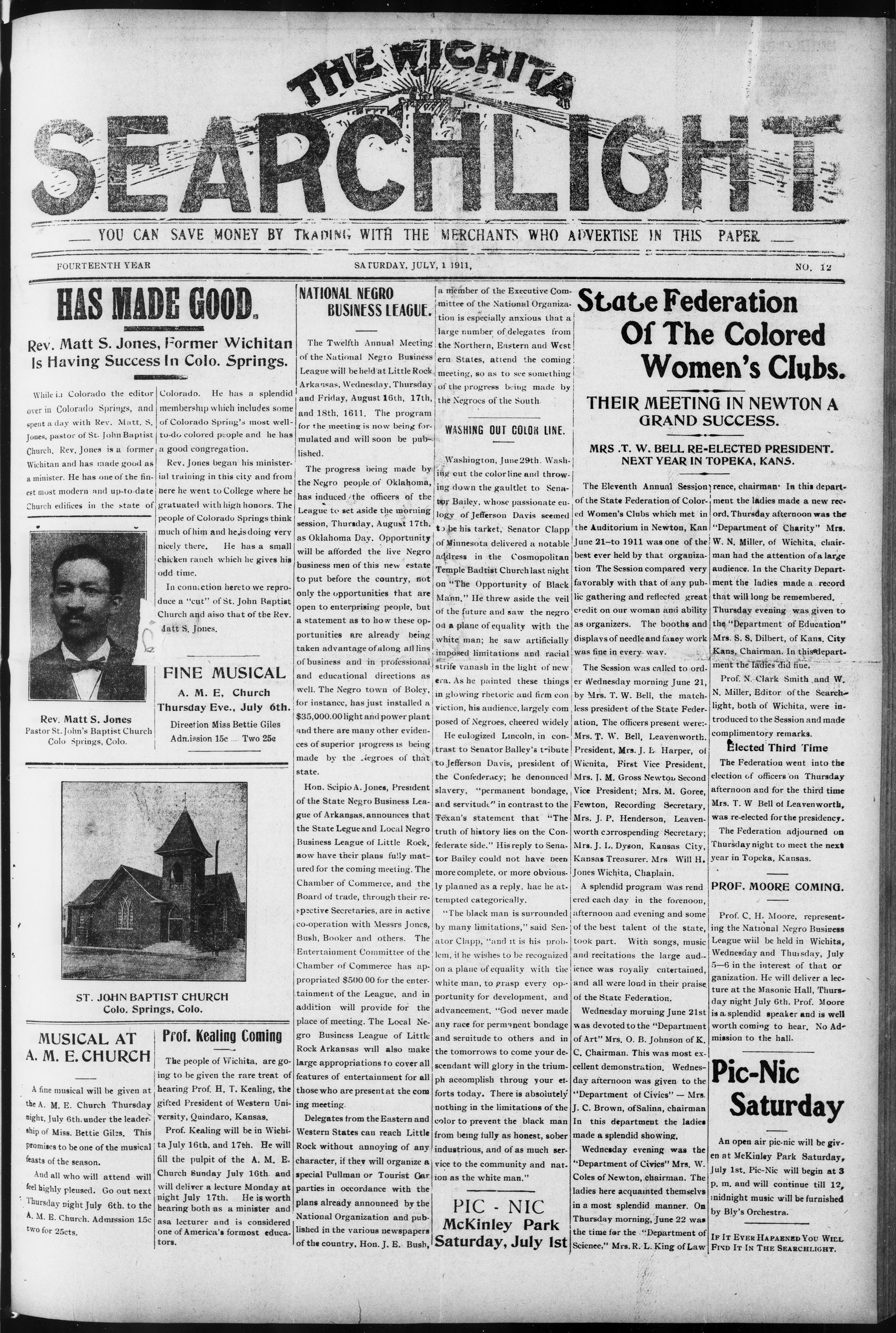
While in Colorado the editor over in Colorado Springs, and spent a day with Rev. Matt. S. Jones, pastor of St. John Baptist Church, Rev. Jones is a former Wichitan and has made good as a minister. He has one of the finest most modern and up-to-date Church edifices in the state of
Rev. Matt S. Jones
Pastor St. John's Baptist Church
Colo. Springs, Colo.
Rev. Matt S. Jones
Pastor St. John's Baptist Church
Colo. Springs, Colo.
ST. JOHN BAPTIST CHURCH
Colo. Springs, Colo.
MUSICAL AT A. M. E. CHURCH
A fine musical will be given at the A. M. E. Church Thursday night, July 6th. under the leadership of Miss. Bettie Gilzs. This promises to be one of the musical feasts of the season.
And all who will attend will feel highly pleused. Go out next Thursday night July 6th. to the A. M. E. Church. Admission 15c two for 25cts.
Colorado. He has a splendid membership which includes some of Colorado Spring's most well-to-do colored people and he has a good congregation.
Rev. Jones began his ministerial training in this city and from here he went to College where he gratuated with high honors. The people of Colorado Springs think much of him and he is doing very nicely there. He has a small chicken ranch which he gives his odd time.
In connection hereto we reproduce a "cut" of St. John Baptist Church and also that of the Rev. Matt S. Jones.
FINE MUSICAL
A. M. E, Church
Thursday Eve., July 6th.
Direction Miss Bettie Giles
Adn.ission 15c ... Two 25c
THE CHURCH OF THE NATIONAL SCHOOL OF CHRISTIANITY
Prof. Kealing Coming
The people of Wichita, are going to be given the rare treat of hearing Prof. H. T. Kealing, the gifted President of Western University, Quindaro, Kansas.
Prof. Kealing will be in Wichita July 16th, and 17th. He will fill the pulpit of the A. M. E. Church Sunday July 16th. and will deliver a lecture Monday at night July 17th. He is worth hearing both as a minister and asa lecturer and is considered one of America's formost educators.
SATURDAY, JULY, 1 1911.
NATIONAL NEGRO BUSINESS LEAGUE.
The Twelfth Annual Meeting of the National Negro Business League will be held at Little Rock Arkansas, Wednesday, Thursday and Friday, August 16th, 17th, and 18th, 1611. The program for the meeting is now being formulated and will soon be published.
The progress being made by the Negro people of Oklahoma, has induced the officers of the League to set aside the morning session, Thursday, August 17th, as Oklahoma Day. Opportunity will be afforded the live Negro business men of this new estate to put before the country, not only the opportunities that are open to enterprising people, but a statement as to how these opportunities are already being taken advantage of along all lins of business and in professional and educational directions as well. The Negro town of Boley, for instance, has just installed a $35,000.00 light and power plant and there are many other evidences of superior progress is being made by the Negroes of that state.
Hon. Scipio A. Jones, President of the State Negro Business League of Arkansas, announces that the State Legue and Local Negro Business League of Little Rock, now have their plans fully matured for the coming meeting. The Chamber of Commerce, and the Board of trade, through their respective Secretaries, are in active co-operation with Messrs Jones, Bush, Booker and others. The Entertainment Committee of the Chamber of Commerce has appropriated $50000 for the entertainment of the League, and in addition will provide for the place of meeting. The Local Negro Business League of Little Rock Arkansas will also make large appropriations to cover all features of entertainment for all those who are present at the coming meeting.
Delegates from the Eastern and Western States can reach Little Rock without annoying of any character, if they will organize a special Pullman or Tourist Car parties in accordance with the plans already announced by the National Organization and published in the various newspapers of the country, Hon. J. E. Bush,
a member of the Executive Committee of the National Organization is especially anxious that a large number of delegates from the Northern, Eastern and Western States, attend the coming meeting, so as to see something of the progress being made by the Negroes of the South.
WASHING OUT COLOR LINE.
Washington, June 29th. Washing out the color line and throwing down the gaullet to Senator Bailey, whose passionate eulogy of Jefferson Davis seemed to be his tarket, Senator Clapp of Minnesota delivered a notable address in the Cosmopolitan Temple Badtist Church last night on "The Opportunity of Black Mann." He threw aside the veil of the future and saw the negro on a plane of equality with the white man; he saw artificially imposed limitations and racial strife vanash in the light of new era. As he painted these things in glowing rhetoric and firm conviction, his audience, largely composed of Negroes, cheered widely
He eulogized Lincoln, in contrast to Senator Bailey's tribute to Jefferson Davis, president of the Confederacy; he denounced slavery, "permanent bondage, and servitude" in contrast to the Texan's statement that "The truth of history lies on the Confederate side." His reply to Senator Bailey could not have been more complete, or more obviously planned as a reply, hae he attempted categorically.
"The black man is surrounded by many limitations," said Senator Clapp, "and it is his problem, if he wishes to be recognized on a plane of equality with the white man, to grasp every opportunity for development, and advancement. "God never made any race for permanent bondage and servitude to others and in the tomorrows to come your descendant will glory in the triumph accomplish through your efforts today. There is absolutely nothing in the limitations of the color to prevent the black man from being fully as honest, sober industrious, and of as much service to the community and nation as the white man."
PIC - NIC McKinley Park Saturday, July 1st
State Federation Of The Colored Women's Clubs.
THEIR MEETING IN NEWTON A GRAND SUCCESS. MRS.T.W.BELL RE-ELECTED PRESIDENT. NEXT YEAR IN TOPEKA, KANS.
The Eleventh Annual Session of the State Federation of Colored Women's Clubs which met in the Auditorium in Newton, Kan June 21-to 1911 was one of the best ever held by that organization The Session compared very favorably with that of any public gathering and reflected great credit on our woman and ability as organizers. The booths and displays of needle and fancy work was fine in every way.
The Session was called to order Wednesday morning June 21, by Mrs. T. W. Bell, the matchless president of the State Federation. The officers present were: Mrs. T. W. Bell, Leavenworth. President, Mrs. J. L. Harper, of Wicnita, First Vice President. Mrs. J. M. Gross Newton Second Vice President; Mrs. M. Goree, Fewton, Recording Secretary, Mrs. J. P. Henderson, Leavenworth corspending Secretary; Mrs. J. L. Dyson, Kansas City, Kansas Treasurer. Mrs. Will H. Jones Wichita, Chaplain.
A splendid program was rendered each day in the forenoon, afternoon and evening and some of the best talent of the state, took part. With songs, music and recitations the large audience was royally entertained, and all were loud in their praise of the State Federation. Wednesday moruing June 21st was devoted to the "Department of Art" Mrs. O. B. Johnson of K. C. Chairman. This was most excellent demonstration. Wednesday afternoon was given to the "Department of Civics" — Mrs. J. C. Brown, ofSalina, chairman In this department the ladies made a splendid showing.
Wednesday evening was the "Department of Civics" Mrs. W. Coles of Newton, chairman. The ladies here acquainted themselves in a most splendid manner. On Thursday morning, June 22 was the time for the "Department of Scienee," Mrs. R. L. King of Law
NO. 12
rence, chairman. In this department the ladies made a new record, Thursday afternoon was the "Department of Charity" Mrs. W. N. Miller, of Wichita, chairman had the attention of a large audience. In the Charity Department the ladies made a record that will long be remembered. Thursday evening was given to the "Department of Education" Mrs. S. S. Dilbert, of Kans. City Kans. Chairman. In this department the ladies did fine. Prof. N. Clark Smith and W. N. Miller, Editor of the Searchlight, both of Wichita, were introduced to the Session and made complimentory remarks.
Elected Third Time
The Federation went into the election of officers on Thursday afternoon and for the third time Mrs. T. W Bell of Leavenworth, was re-elected for the presidency. The Federation adjourned on Thursday night to meet the next year in Topeka, Kansas.
PROF. MOORE COMING.
Prof. C. H. Moore, representing the National Negro Business League will be held in Wichita, Wednesday and Thursday, July 5-6 in the interest of that organization. He will deliver a lecture at the Masonic Hall, Thursday night July 6th. Prof. Moore is a splendid speaker and is well worth coming to hear. No Admission to the hall.
Pic-Nic Saturday
An open air pic-nic will be given at McKinley Park Saturday, July 1st. Pic-Nic will begin at 3 p. m. and will continue till 12, midnight music will be furnished by Bly's Orchestra.
IF IT EVER HAPAENED YOU WILL FIND IT IN THE SEARCHLIGHT.
ROGKEFELLER LEFT IN HURRY
SERVANTS CAUTIONED NOT TO TELL OF HIS DEPARTURE.
The Reorganization of Standard Oil Causes Him to Return to New York After Arriving Home for Season.
Cleveland, Ohio.—The unusual and sudden departure of John D. Rockefeller from this city Saturday was made so that the oil king could be present at conferences at 26 Broadway, New York, which will determine how the Standard Oil company is to be reorganized. His secretary here admitted that Mr. Rockefeller went East for that purpose.
Cleveland men who are close to the richest man in the world assert that it is probable Mr. Rockefeller wants to have a hand personally in the conferences which will determine the future course of the oil trust.
This is the first time in years that Rockefeller has gone East after arriving at his summer home, Forest Hill, for the season. He is averse to taking long journeys in the summer. His friends believe that something unusually important led him to take the journey. Saturday night he slipped out of town, after giving his servants at Forest Hill strict orders not to tell of his departure.
URGED TO PLANT COW PEAS
Kansas Farmers Told of a Crop Chinch Bug and Drought Proof— Will Mature Before Frost.
Manhattan, Kan., June 26.—A great many inquiries on what to plant has been received at the state agricultural college, from farmers whose wheat, eats, barley or other crops have failed because of drought.
"Cow peas, probably, are the best suited to such purposes in eastern Kansas, where moisture conditions are the most favorable," William Jardine, professor of agronomy, says. "Planted any time between now and July 20, provided soil conditions are right, this crop should make seed before frost. Cow peas will make excellent forage and fine pasturage. The New Era variety is the best kind to plant because of its quicker growing.
MAGAZINE PUBLISHERS NEXT
Civil Suit to Be Brought Against Publishers' Association in New York.
Washington, D. C.—A civil antitrust suit against the Periodical Publishers' association, commonly called the magazine trust, will be filed in the United States court at New York according to plans of the department of justice.
The government's suit is the result of a six months' investigation. It has been represented to the department of justice that the defendant association practically controls distribution of magazines and other periodicals through what is known to the jobbers and the trade as a clearing house. It is said that dealers who have not charged the prices prescribed by the clearing house have been discriminated against.
NO SUNDAY LAW ENFORCEMENT
Jury at Leavenworth Acquitted Picture Show Man—Are a Necessity and a Charity.
Leavenworth, Kansas. — Although Carl Mensing, proprietor of four motion picture theaters here, at his trial in the city court admitted violating the Sunday labor law, with several of his employees, the jury, composed of business men, immediately returned a verdict of not guilty. The trial lasted 15 minutes.
Paul Wilson, one of the jurors, speaking of the verdict, said: "We consider the modern theater a necessity and a charity, and, as both are exempted in the law, we were duty-bound to acquit the defendant."
Arizona Must Vote Again.
Washington, June 26.—The senate committee on territories voted 6 to 3 to report favorably the house resolution admitting New Mexico and Arizona to statehood, with the provision that the Arizona constitution containing the judiciary recall shall be resubmitted to the people. Slight amendments to the house resolution were made.
Counterfeiter Jumps From Train.
Bloomington, Ill.—Miles Mandich, who was being taken from Cleveland to the federal prison at Leavenworth, Kan., to serve twelve years for counterfeiting, leaped from a Chicago, Rock Island & Pacific train while it was running at full speed near Fox River and escaped.
Mexico Will Prosper Now
Kansas City, Missouri.—"Mexico is the most hospitable country on the globe. The possibilities in Mexico are just being realized. The United States doesn't want to absorb the country, but it does need to come into a closer relationship with it. Mexico, since the revolution, will be a greater and a more prosperous country than ever before in its history." Those statements were made here by C. M. Wellsford, who for the last 15 years has lived in the state of Sonora, Mexico.
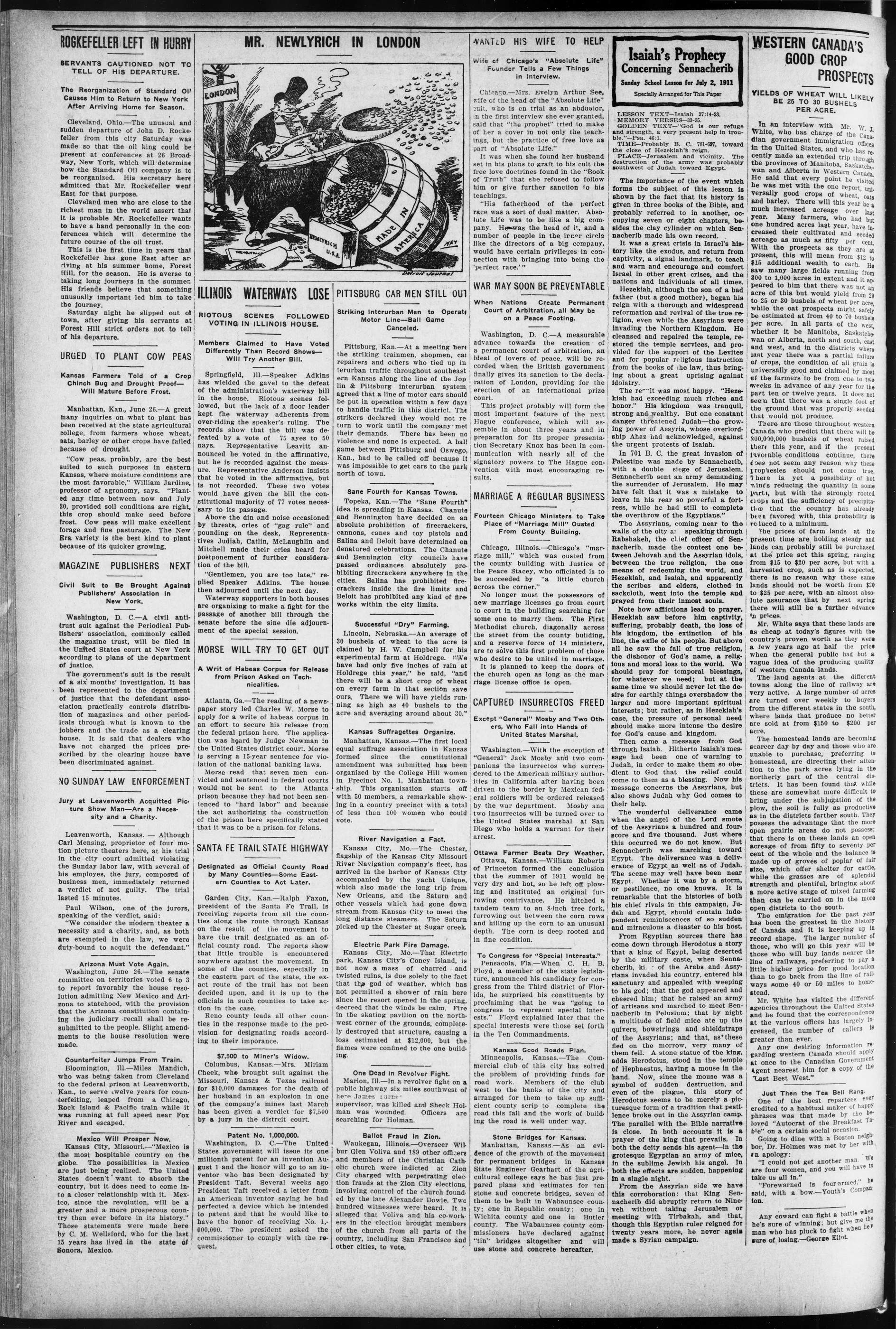
MR. NEWLYRICH IN LONDON
LONDON
MADE IN
AMERICA
NEWLYRICH
U.S.A.
MAY
RIOTOUS SCENES FOLLOWED VOTING IN ILLINOIS HOUSE.
Members Claimed to Have Voted Differently Than Record Shows— Will Try Another Bill.
Springfield, Ill.—Speaker Adkins has wielded the gavel to the defeat of the administration's waterway bill in the house. Riotous scenes followed, but the lack of a floor leader kept the waterway adherents from over-riding the speaker's ruling. The records show that the bill was defeated by a vote of 75 ayes to 50 nays. Representative Leavitt announced he voted in the affirmative, but he is recorded against the measure. Representative Anderson insists that he voted in the affirmative, but is not recorded. These two votes would have given the bill the constitutional majority of 77 votes necessary to its passage.
Above the din and noise occasioned by threats, cries of "gag rule" and pounding on the desk, Representatives Judiah, Catilin, McLaughlin and Mitchell made their cries heard for postponement of further consideration of the bill.
"Gentlemen, you are too late," replied Speaker Adkins. The house then adjourned until the next day.
Waterway supporters in both houses are organizing to make a fight for the passage of another bill through the senate before the sine die adjournment of the special session.
MORSE WILL TRY TO GET OUT
A Writ of Habeas Corpus for Release from Prison Asked on Technicalities.
Atlanta, Ga.—The reading of a newspaper story led Charles W. Morse to apply for a write of habeas corpus in an effort to secure his release from the federal prison here. The application was heard by Judge Newman in the United States district court. Morse is serving a 15-year sentence for violation of the national banking laws. Morse read that seven men convicted and sentenced in federal courts would not be sent to the Atlanta prison because they had not been sentenced to "hard labor" and because the act authorizing the construction of the prison here specifically stated that it was to be a prison for felons.
SANTA FE TRAIL STATE HIGHWAY
Designated as Official County Road by Many Counties—Some Eastern Counties to Act Later.
Garden City, Kan.—Ralph Faxon, president of the Santa Fe Trail, is receiving reports from all the counties along the route through Kansas on the result of the movement to have the trail designated as an official county road. The reports show that little trouble is encountered anywhere against the movement. In some of the counties, especially in the eastern part of the state, the exact route of the trail has not been decided upon, and it is up to the officials in such counties to take action in the case.
Reno county leads all other counties in the response made to the provision for designating roads according to their importance.
$7,500 to Miner's Widow
Columbus, Kansas.—Mrs. Miriam Cheek, who brought suit against the Missouri, Kansas & Texas railroad for $10,000 damages for the death of her husband in an explosion in one of the company's mines last March has been given a verdict for $7,500 by a jury in the district court.
Patent No. 1,000,000.
Washington, D. C.-The United States government will issue its one millionth patent for an invention August 1 and the honor will go to an inventor who has been designated by President Taft. Several weeks ago President Taft received a letter from an American inventor saying he had perfected a device which he intended to patent and that he would like to have the honor of receiving No. 1,000,000. The president asked the commissioner to comply with the request.
PITTSBURG CAR MEN STILL OUT
Striking Interurban Men to Operate Motor Line—Ball Game Canceled.
Pittsburg, Kan.—At a meeting here the striking trainmen, shopmen, car repairers and others who tied up in interurban traffic throughout southeast ern Kansas along the line of the Joplin & Pittsburg interurban system agreed that a line of motor cars should be put in operation within a few days to handle traffic in this district. The strikers declared they would not return to work until the company meet their demands. There has been no violence and none is expected. A ball game between Pittsburg and Oswego, Kan., had to be called off because it was impossible to get cars to the park north of town.
Sane Fourth for Kansas Towns.
Topeka, Kan.—The "Sane Fourth" idea is spreading in Kansas. Chanute and Bennington have decided on an absolute prohibition of firecrackers, cannons, canes and toy pistols and Salina and Beloit have determined on denatured celebrations. The Chanute and Bennington city councils have passed ordinances absolutely prohibiting firecrackers anywhere in the cities. Salina has prohibited firecrackers inside the fire limits and Beloit has prohibited any kind of fireworks within the city limits.
Successful "Dry" Farming.
Lincoln, Nebraska.—An average of 30 bushels of wheat to the acre is claimed by H. W. Campbell for his experimental farm at Holdrege. "We have had only five inches of rain at Holdrege this year," he said, "and there will be a short crop of wheat on every farm in that section save ours. There we will have yields running as high as 40 bushels to the acre and averaging around about 30."
Kansas Suffragettes Organize.
Manhattan, Kansas.—The first local equal suffrage association in Kansas formed since the constitutional amendment was submitted has been organized by the College Hill women in Precinct No. 1, Manhattan township. This organization starts off with 50 members, a remarkable showing in a country precinct with a total of less than 100 women who could vote.
River Navigation a Fact.
Kansas City, Mo.-The Chester, flagship of the Kansas City Missouri River Navigation company's fleet, has arrived in the harbor of Kansas City accompanied by the yacht Unique, which also made the long trip from New Orleans, and the Saturn and other vessels which had gone down stream from Kansas City to meet the long distance steamers. The Saturn picked up the Chester at Sugar creek
Electric Park Fire Damage.
Kansas City, Mo.—That Electric park, Kansas City's Coney Island, is not now a mass of charred and twisted ruins, is due solely to the fact that the god of weather, which has not permitted a shower of rain here since the resort opened in the spring, decreed that the winds be calm. Fire in the skating pavilion on the northwest corner of the grounds, completely destroyed that structure, causing a loss estimated at $12,000, but the flames were confined to the one building.
One Dead in Revolver Eight.
supervisor, was killed and Sheck Holman was wounded. Officers are searching for Holman.
Ballot Fraud in Zion
Waukegan, Illinois.—Overseer Wilbur Glen Voliva and 189 other officers and members of the Christian Catholic church were indicted at Zion City charged with perpetrating election frauds at the Zion City elections, involving control of the church founded by the late Alexander Dowie. Two hundred witnesses were heard. It is alleged that Voliva and his co-workers in the election brought members of the church from all parts of the country, including San Francisco and other cities, to vote.
Wife of Chicago's "Absolute Life"
Founder Tells a Few Things
in Interview.
Chicago.—Mrs. Evelyn Arthur See,
wife of the head of the "Absolute Life"
cult, who is on trial as an abductor,
in the first interview she ever granted,
said that "the prophet" tried to make
of her a cover in not only the teachings,
but the practice of free love as part of "Absolute Life."
It was when she found her husband
set in his plans to graft to his cult the
free love doctrines found in the "Book
of Truth" that she refused to follow
him or give further sanction to his
teachings.
"His fatherhood of the perfect race was a sort of dual matter. Absolute Life was to be like a big company. He was the head of it, and a number of people in the inner circle like the directors of a big company, would have certain privileges in connection with bringing into being the 'perfect race.'"
WAR MAY SOON BE PREVENTABLE
When Nations Create Permanent Court of Arbitration, all May be on a Peace Footing.
Washington, D. C.—A measurable advance towards the creation of a permanent court of arbitration, an ideal of lovers of peace, will be recorded when the British government finally gives its sanction to the declaration of London, providing for the erection of an international prize court.
This project probably will form the most important feature of the next Hague conference, which will assemble in about three years and in preparation for its proper presentation Secretary Knox has been in communication with nearly all of the signatory powers to The Hague convention with most encouraging results.
MARRIAGE A REGULAR BUSINESS
Fourteen Chicago Ministers to Take Place of "Marriage Mill" Ousted From County Building.
Chicago, Illinois.—Chicago's "marriage mill," which was ousted from the county building with Justice of the Peace Stacey, who officiated is to be succeeded by "a little church across the corner."
No longer must the possessors of new marriage licenses go from court to court in the building searching for some one to marry them. The First Methodist church, diagonally across the street from the county building, and a reserve force of 14 ministers, are to solve this first problem of those who desire to be united in marriage.
It is planned to keep the doors of the church open as long as the marriage license office is open.
CAPTURED INSURRECTOS FREED
Except "General" Mosby and Two Others, Who Fall into Hands of United States Marshal.
Washington.—With the exception of "General" Jack Mosby and two companions the insurrects who surrendered to the American military authorities in California after having been driven to the border by Mexican federal soldiers will be ordered released by the war department. Mosby and two insurrects will be turned over to the United States marshal at San Diego who holds a warrant for their arrest.
Ottawa Farmer Beats Dry Weather.
Ottawa, Kansas.—William Roberts of Princeton formed the conclusion that the summer of 1911 would be very dry and hot, so he left off plowing and instituted an original furrowing contrivance. He hitched a tandem team to an 8-inch tree fork, furrowing out between the corn rows and hilling up the corn to an unusual depth. The corn is deep rooted and in fine condition.
To Congress for "Special Interests."
Pensacola, Fla.—When C. H. B. Floyd, a member of the state legislature, announced his candidacy for congress from the Third district of Florida, he surprised his constituents by proclaiming that he was "going to congress to represent special interests." Floyd explained later that the special interests were those set forth in the Ten Commandments.
Kansas Good Roads Plan.
Minneapolis, Kansas.-The Commercial club of this city has solved the problem of providing funds for road work. Members of the club west to the banks of the city and arranged for them to take up sufficient county script to complete the road this fall and the work of building the road is well under way.
Stone Bridges for Kansas.
Manhattan, Kansas.—As an evidence of the growth of the movement for permanent bridges in Kansas State Engineer Gearhart of the agricultural college says he has just prepared plans and estimates for ten stone and concrete bridges, seven of them to be built in Wabaunsee county; one in Republic county; one in Wichita county and one in Butler county. The Wabaunsee county commissioners have declared against "tin" bridges altogether and will use stone and concrete hereafter.
LESSON TEXT -Isaiah 37:14-38.
MEMORY VERSES -33-35.
LESSON TEXT-"God is our refuge and strength. very present help in trouble."-Psa. 46:1.
TIME—Probably B. C. 701-697, toward the close of Hezekiah's reign.
PLACE—Jerusalem and vicinity. The destruction of the army was probably southwest of Judah toward Egypt.
The importance of the event which forms the subject of this lesson is shown by the fact that its history is given in three books of the Bible, and probably referred to in another, occupying seven or eight chapters, besides the clay cylinder on which Senacherib made his own record.
It was a great crisis in Israel's history like the exodus, and return from captivity, a signal landmark, to teach and warn and encourage and comfort Israel in other great crises, and the nations and individuals of all times.
Hezekiah, although the son of a bad father (but a good mother), began his reign with a thorough and widespread reformation and revival of the true religion, even while the Assyrians were invading the Northern Kingdom. He cleansed and repaired the temple, restored the temple services, and provided for the support of the Levites and for popular religious instruction from the books of the law, thus bringing about a great uprising against idolatry. The result was most happy. "Hezekiah had exceeding much riches and honor." His kingdom was tranquil, strong and wealthy. But one constant danger threatened Judah—the growing power of Assyria, whose overlordship Ahaz had acknowledged, against the urgent protests of Isaiah.
In 701 B. C. the great invasion of Palestine was made by Sennacherib, with a double siege of Jerusalem. Sennacherib sent an army demanding the surrender of Jerusalem. He may have felt that it was a mistake to leave in his rear so powerful a fortress, while he had still to complete the overthrow of the Egyptians." The Assyrians, coming near to the walls of the city at speaking through Rabshakeh, the chief officer of Sennacherib, made the contest one between Jehovah and the Assyrian idols, between the true religion, the one means of redeeming the world, and Hezekiah, and Isaiah, and apparently the scribes and elders, clothed in sackcloth, went into the temple and prayed from their inmost souls.
Note how afflictions lead to prayer. Hezekiah saw before him captivity, suffering, probably death, the loss of his kingdom, the extinction of his line, the exile of his people. But above all he saw the fall of true religion, the dishonor of God's name, a religious and moral loss to the world. We should pray for temporal blessings, for whatever we need; but at the same time we should never let the desire for earthly things overshadow the larger and more important spiritual interests; but rather, as in Hezekiah's case, the pressure of personal need should make more intense the desire for God's cause and kingdom.
Then came a message from God through Isaiah. Hitherto Isaiah's message had been one of warning to Judah, in order to make them so obedient to God that the relief could come to them as a blessing. Now his message concerns the Assyrians, but also shows Judah why God comes to their help.
The wonderful deliverance came when the angel of the Lord smote of the Assyrians a hundred and four-score and five thousand. Just where this occurred we do not know. But Sennacherib was marching toward Egypt. The deliverance was a deliverance of Egypt as well as of Judah. The scene may well have been near Egypt. Whether it was by a storm, or pestilence, no one knows. It is remarkable that the histories of both his chief rivals in this campaign, Judah and Egypt, should contain independent reminiscences of so sudden and miraculous a disaster to his host.
From Egyptian sources there has come down through Herodotus a story that a king of Egypt, being deserted by the military caste, when Sennacherib, ki. of the Arabs and Assyrians invaded his country, entered his sanctuary and appealed with weeping to his god; that the god appeared and cheered him; that he raised an army of artisans and marched to meet Sennacherib in Pelusium; that by night a multitude of field mice ate up the quivers, bowstrings and shieldstraps of the Assyrians; and that, as*these fled on the morrow, very many of them fell. A stone statue of the king, adds Herodotus, stood in the temple of Hephaestus, having a mouse in the hand. Now, since the mouse was a symbol of sudden destruction, and even of the plague, this story of Herodotus seems to be merely a picturesque form of a tradition that pestlence broke out in the Assyrian camp. The parallel with the Bible narrative is close. In both accounts it is a prayer of the king that prevails. In both the deity sends his agent—in the grotesque Egyptian an army of mice, in the sublime Jewish his angel. In both the effects are sudden, happening in a single night.
From the Assyrian side we have this corroboration: that King Sennacherib did abruptly return to Nineveh without taking Jerusalem or meeting with Tirbakah, and that, though this Egyptian ruler reigned for twenty years more, he never again made a Syrian campaign.
WESTERN CANADA'S GOOD CROP PROSPECTS
YIELDS OF WHEAT WILL LIKELY
BE 25 TO 30 BUSHELS
PER ACRE.
In an interview with Mr. W. J. White, who has charge of the Canadian government immigration offices in the United States, and who has recently made an extended trip through the provinces of Manitoba, Saskatchewan and Alberta in Western Canada. He said that every point he visited he was met with the one report, universally good crops of wheat, oats and barley. There will this year be a much increased acreage over last year. Many farmers, who had but one hundred acres last year, have increased their cultivated and seeded acreage as much as fifty per cent. With the prospects as they are at present, this will mean from $12 to $15 additional wealth to each. He saw many large fields running from 300 to 1,000 acres in extent and it appeared that this but would yield from 20 to 25 or 30 bushels of wheat per acre, while the oat prospects might safely be estimated at from 40 to 70 bushels per acre. In all parts of the west, whether it be Manitoba, Saskatchewan or Alberta, north and south, east and west, and in the districts where last year there was a partial failure of crops, the condition of all grain is universally good and claimed by most of the farmers to be from one to two weeks in advance of any year for the part ten or twelve years. It does not seem that there was a single foot of the ground that was properly seeded that would not produce.
There are those throughout western Canada who predict that there will be 200,000,000 bushels of wheat raised there this year, and if the present favorable conditions continue, there does not seem any reason why these prophesies should not come true. There is yet a possibility of hot winds reducing the quantity in some parts, but with the strongly rooted crops and the sufficiency of precipitation that the country has already been favored with, this probability is reduced to a minimum.
The prices of farm lands at the present time are holding steady and lands can probably still be purchased at the price set this spring, ranging from $15 to $20 per acre, but with a harvested crop, such as is expected, there is no reason why these same lands should not be worth from $20 to $25 per acre, with an almost absolute assurance that by next spring there will still be a further advance in prices.
Mr. White says that these lands are as cheap at today's figures with the country's proven worth as they were a few years ago at half the price when the general public had but a vague idea of the producing quality of western Canada lands.
The land agents at the different towns along the line of railway are very active. A large number of acres are turned over weekly to buyers from the different states in the south, where lands that produce no better are sold at from $150 to $200 per acre.
The homestead lands are becoming scarcer day by day and those who are unable to purchase, preferring to homestead, are directing their attention to the park acres lying in the northerly part of the central districts. It has been found that while these are somewhat more difficult to bring under the subjugation of the plow, the soil is fully as productive as in the districts farther south. They possess the advantage that the more open prairie areas do not possess; that there is on these lands an open acreage of from fifty to seventy percent of the whole and the balance is made up of groves of poplar of fair size, which offer shelter for cattle, while the grasses are of splendid strength and plentiful, bringing about a more active stage of mixed farming than can be carried on in the more open districts to the south.
The emigration for the past year has been the greatest in the history of Canada and it is keeping up in record shape. The larger number of those, who will go this year will be those who will buy lands nearer the line of railways, preferring to pay a little higher price for good location than to go back from the line of railways some 40 or 50 miles to home-stead.
Mr. White has visited the different agencies throughout the United States and he found that the correspondence at the various offices has largely increased, the number of callers is greater than ever.
Any one desiring information regarding western Canada should apply at once to the Canadian Government Agent nearest him for a copy of the Last Best West."
Just Then the Tea Bell Rang.
One of the best repartees ever
credited to a habitual maker of happy
phrases was that made by the beloved
"Autocrat of the Breakfast Table"
on a certain social occasion.
Going to dine with a Boston neighbor, Dr. Holmes was met by her with an apology:
"I could not get another man. We are four women, and you will have to take us all in."
"Forewarned is four-armed," he said, with a bow.—Youth's Companion.
Any coward can fight a battle when he's sure of winning; but give me the man who has pluck to fight when he's sure of losing—George Eliot
STUPID
TIM
BY NELLIE CRAVEY GILLMORE
Leonora laid down her mandolin and took up a book. Ten minutes later she tossed aside the book and went over to the piano. She played whimistically for a quarter of an hour—and banged down the lid impatiently. Then she crossed the room to a window and, parting the green velvet curtains, peered frowningly out at the snow-blanched air. At last she turned and walked over to the fireplace, her eyes seeking for the fifteenth time the good-natured face of the old clock on the mantel. Only three! Another hour at least, to wait.
The imperative tinkling of the door bell caused her heart to bound foolishly. Perhaps—! But before the conjecture was finished, a maid entered with a note, and handed it to the girl. It was without address or envelope and Leonora opened it a little curiously. The writing inside was familiar enough, and brought the blood spurging into her soft cheeks. The lines were scribbled in haste, apparently, with a pencil, and ran: "Impossible for me to keep engagement this afternoon. Something more important on hand. Will have to see you later, when more at leisure.
"TOM."
The paper slipped to the floor from Leonora's nerveless fingers. The angry crimson slowly dyed her temples. "Something more important!"—"see you when more at leisure!" With a sudden gesture of contempt, she picked up the note and tore it in two; then she threw it into the fire, and with an indescribable look on her face, stood watching it blaze and char and vanish completely.
What a wretched simplemone she had been, to be sure, to have wasted her time and her love on a creature like this. The bitter tears rushed to her eyes and made scalding tracks down her quivering cheeks. What should she do? What could she do? After Bateman's delibrate insult, what was there to do but put him out of her life forever?
When she had gathered up the shattered ends of her self-control, Leonora went slowly upstairs to her room and sat down before her desk. She pulled open a drawer and took out two letters lying there. One was from young Bateman—the last one he had written—and in which he had begged permission to come to her on this very afternoon, hinding openly of the words he intended to speak; that he had spoken, in fact, in a hundred little ways since he had known her. The other letter was from her cousin, Billy Townsend. Billy had been very dear to her ever since the days of pinafores and pigtails; he had never let a month go by without making some allusion to the time when they should be married. And in reality, she would doubtless have consented to share her future with Billy, had it not been for Tom Bateman's sudden appearance on the horizon of her life—growing closer and closer into the very fiber of it till everything in the whole world had seemed transformed.
With a little sobbing catch of her breath, Leonora unfolded her cousin's letter and read:
"Dearest Leo:
'It's no use, I suppose, but I'm not going to quit without one more stagger. If you are sure it's quite hopeless, tell me so, and I'll never bother you any more. But you know, girlie, that my heart is always in the same place—right in the hollow of your own little hand—and if, at any time, you need me, or want me, just say so, and I'll spend my life making you happy.
As ever and always."
Again the tears ran down the girl's cheeks, but this time they were a different sort of tears. Dear, generous Billy! He had seen the perilous path she was treading, had divined the chasm at the end of it, and in his tactful, bighearted way, was offering her the protection of his home and love in her mortification and disappointment. Under the swift influence of her gratitude, she selzed a pen from the rack and wrote rapidly:
"Dear Billy."
I want you—and need you. Meet me at Delcey's at half past five. I am two restless to stay here. "LEO."
She summoned the maid and dispatched her immediately to Townsend's office with the note. Then she dressed herself quickly and went out into the street, to walk herself, if possible, into some semblance of calm. At exactly half-past five, she turned the corner and walked half a block down to Delcey's. The first thing that met her eyes was her cousin's the green car. He was sitting in front, with his cap drawn over his eyes, and his fur-coat buttoned close up to his throat. The girl approached him rapidly, her head bent slightly, against the keen hash of the snow.
"Oh Billy!" was all she could say, when she got up to him.
made room for her, and she sprung in beside him. The next insult they were whirling off down the glistening avenue.
"Why did you send for me, this way?" was the first question he asked her.
"Because," she answered simply, "because I wanted you."
"I'm afraid there's been a mistake somewhere." His voice was grave, but the whir of the machine, and the wind in their faces, drowned all account completely.
Leonora shot a swift query at him.
"A—a mistake?" she questioned sharply.
"Yes. Tom Bateman's wild about you. And—forgive me, Leo, but I believe I was right in supposing that you—that you cared for him."
The girl said nothing, but a little half-sob caught in her throat.
"Was I!" They were going perceptibly slower now, and it was not difficult to catch the tremor in Leonora's tone.
"You—you have no right to ask me such a question, Billy."
The answer was sufficient, and for several minutes they sped on in silence. Presently, the man turned and said:
"At least, dear, I know there has been some sort of trouble. You sent for—for me, to tell me. Now what was it, Leo?"
She hesitated a moment, then told him everything, of Bateman's attention to her, his letter asking permission to come—and the insulting note that followed. When she had finished the man at her side drew a deep breath; but all he said was "Ah!"
Ten minutes later, he ran the machine up to Leonora's door and jumped out, assisting her to the pavement.
The leaden sky had just released a hurricane of snowy feathers and the keen wind was whipping crimson roses into the girl's cheeks. She waited while her companion removed the goggles from his eyes, her heart beating turgidly as she speculated on the possible outcome of her letter.
"Come in for a little while and get warm, Billy," she said, "then we can talk."
He turned. It was Tom Bateman! Theo or did from Leonora's face.
"I beg your pardon," she began, stiffly.
"I beg yours," he interposed, coming toward her, "Miss Winston; what must you thought of me?"
She made no answer, but stood regarding him coldly, a bewildered light in her eyes.
"Where is Billy?" she demanded.
"Where is Billy?" she demanded. "Down at his office, where he's been all afternoon. As luck would have it, I was there with your cousin when your note came to him. I had just confided my intentions to him and was on the eve of going to you. Neither of us could understand your attitude. Billy could not leave his work; he is a very good friend of mine, besides—so he made me go in his place. When I saw that you did not recognize me, I purposely kept up the deception because I wanted to know the truth." "But—that note—" she protested, indignantly, the hot blood circling her cheeks. To Leonora's amazement, Tom Bateman laughed outright. Her head went up with a swift touch of pride.
"All that stupid Tim's doing," he explained as they ascended the steps. "After having been here nine-hundred-and-ninety-nine times with notes for you, it looks as if young Timothy O'Brien would have had better sense than to bring a note intended for Dick Chestnut here to you, doesn't it?"
Leonora dimpled in spite of herself. "It looks as if you might have been a little careful in addressing your communications."
Bateman reddened. "As if a man in my fix had any sense at all, sweetheart!"
"Anyway," said Leonora as they entered the door, "I am glad even Timothy thinks I'm the only one you can write notes to."
She was very close to him now; the corridor was deserted. He closed the door softly and took her in his arms.
Hitchcock's Hungry Raiders.
The evening following the famous raid of the postoffice department on the big brokerage firm of Burr Bros., in New York, Postmaster General Hitchcock received the newspaper men in his hotel room to give them any information they desired about the raid. He paid a high tribute to the ten picked inspectors who had pulled off the job, and then stood leaning against a door for a long time, answering the questions fired at him.
When the reporters had left, he said:
"I haven't had a bite to eat for more than 12 hours."
He stepped into the next room, where the inspectors were waiting.
"You fellows hungry?" he asked.
"A little," replied one of them.
"A lot!" answered another. "None of us has had a mouthful for the past 24 hours."
Whereupon Hitchcock and his ten terrible raiders went to a restaurant, and ate nearly everything the place had in readiness.—Popular Magazine.
Empty Fockets.
"I have a friend who has followed the races for years," said Colonel William Swearer, the Harlem wit, "and he was not happy when the racing bills went into effect, especially as he was a big loser. I asked him how he felt about it and he replied: "I feel like the very young chick looked to the small boy. The kid had never seen chicks before and didn't know the patches at the sides were wings. So when one of the baby fowl tried to spread its wings he cried: "***See! See! He's opening his pockets and there aren't anything in them."***
By Their Smoke.
Uncle Hiram stroked his whiskers and watched the big touring car as it whizzed past him and up the road, emitting a trail of bluish smoke from its oil-choked engine.
"Huh!" he sniffed. "Them may be swell city fellers, but they certainly was a smokin' some durn orful see gars." - "Tit-Bits."
FINE FOR A HOT DAY DISH
Detailed Directions for the Making of Chicken in Aspic That Will Prove Delightful.
Cut up a chicken, with the exception of the breast, which should be left whole. Put the pieces in a stewpan, with the liver, heart and glazed and a small quantity of thyme, parsley and bay leaves and half a lemon. Cover with water, season well with salt and pepper and stew slowly until tender. Take the chicken out of the liquor; cut the meat of the breast into three or four long strips and the rest of the meat into dice. Put the bones back into the saucepan with an ounce of gelatine dissolved in a little water. Boll for 20 minutes, strain through a cloth and pour sufficient of the liquor into a deep dish to cover the bottom. When this has set arrange on top of it a design with sliced hard boiled eggs. Place the largest piece of chicken in the center with smaller pieces around it. Pour in another layer of jelly and when it has set place a design of eggs and chicken as before. Continue the jelly and design alternately until the dish is full, putting a layer of jelly over all. When the jelly is quite firm, dip the dish into warm water and turn out its contents quickly upon a platter. Garnish with parsley, slices of lemon and olives, and serve with mayonnaise.
FOR USE IN THE NURSERY
Small Metal Refrigerator That Keeps Baby's Milk Cold and Supplies Drinking Water.
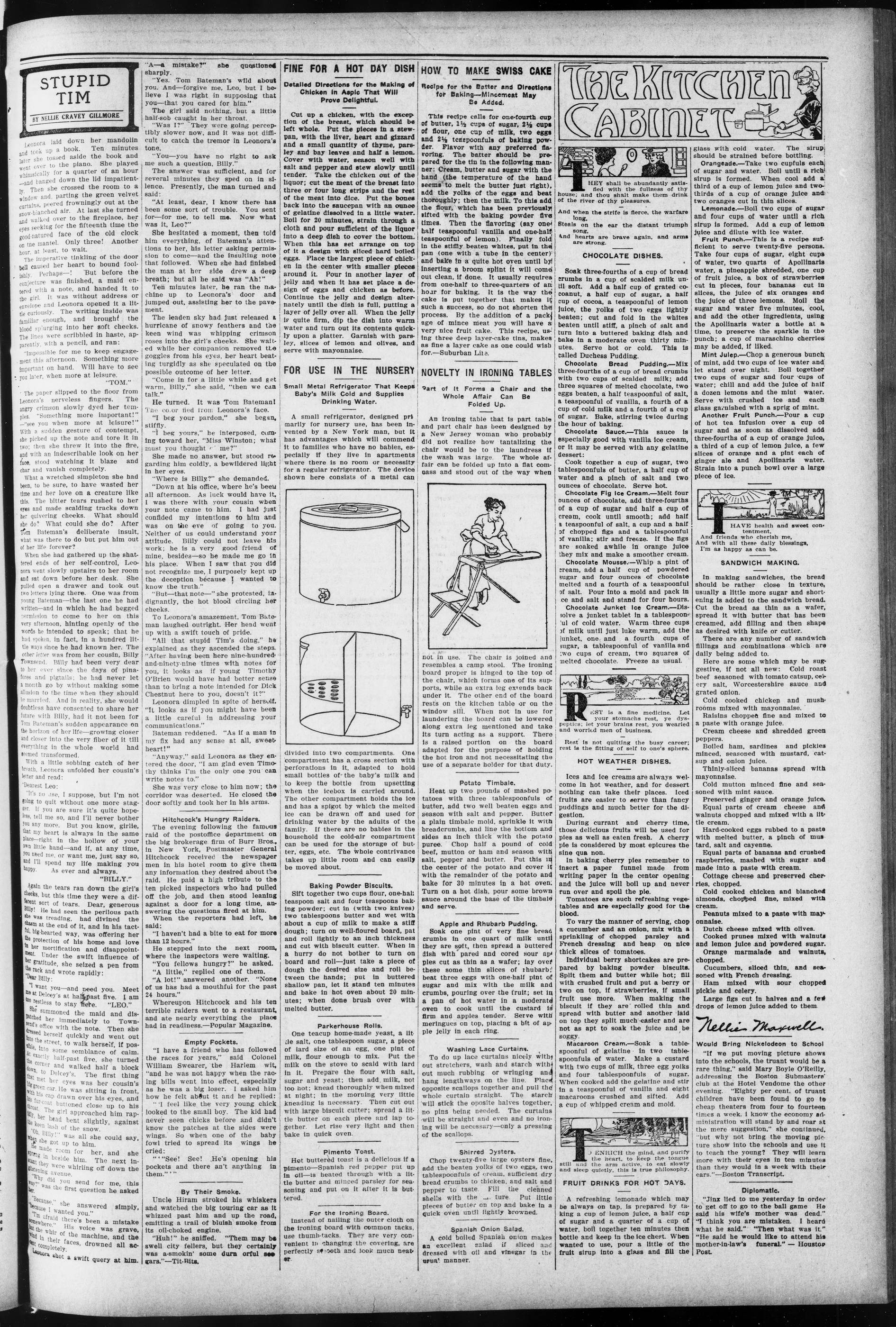
A small refrigerator, designed primarily for nursery use, has been invented by a New York man, but it has advantages which will commend it to families who have no babies, especially if they live in apartments where there is no room or necessity for a regular refrigerator. The device shown here consists of a metal can
```markdown
```
divided into two compartments. One compartment has a cross section with perforations in it, adapted to hold small bottles of the baby's milk and to keep the bottle from upsetting when the icebox is carried around. The other compartment holds the ice and has a spigot by which the melted ice can be drawn off and used for drinking water by the adults of the family. If there are no babies in the household the cold-air compartment can be used for the storage of butter, eggs, etc. The whole contrivance takes up little room and can easily be moved about.
Baking Powder Biscuits
Sift together two cups flour, one-half teaspoon salt and four teaspoons baking powder; cut in (with two knives) two tablespoons butter and wet with about a cup of milk to make a stiff dough; turn on well-floured board, pat and roll lightly to an inch thickness and cut with biscuit cutter. When in a hurry do not bother to turn on board and roll—just take a piece of dough the desired size and roll between the hands; put in buttered shallow pan, let it stand ten minutes and bake in hot oven about 20 minutes; when done brush over with melted butter.
Parkerhouse Rolls.
One teacup home-made yeast, a little salt, one tablespoon sugar, a piece of lard size of an egg, one pint of milk, flour enough to mix. Put the milk on the stove to scald with lard in it. Prepare the flour with salt, sugar and yeast; then add milk, not too hot; knead thoroughly when mixed at night; in the morning very little kneading is necessary. Then cut out with large biscuit cutter; spread a little butter on each piece and lap together. Let rise very light and then bake in quick oven.
Pimento Toast.
Hot buttered toast is a delicious if a pimento-Spanish red pepper put up in oil-is heated through with a little butter and minced parsley for seasoning and put on it after it is buttered.
For the Ironing Board.
Instead of nailing the outer cloth on the troning board with common tacks, use thumb-tacks. They are very convenient in changing the covering, are perfectly smooth and look much neater.
HOW TO MAKE SWISS CAKE
Recipe for the Batter and Directions for Baking—Mincemeat May Be Added.
This recipe calls for one-fourth cup of butter, $1\frac{1}{2}$ cups of sugar, $2\frac{1}{2}$ cups of flour, one cup of milk, two eggs and $2\frac{1}{2}$ teaspoonfuls of baking powder. Flavor with any preferred flavoring. The batter should be prepared for the tin in the following manner: Cream, butter and sugar with the hand (the temperature of the hand seems to melt the butter just right), add the yolks of the eggs and beat thoroughly; then the milk. To this add the flour, which has been previously sifted with the baking powder five times. Then the flavoring (say one-half teaspoonful vanilla and one-half teaspoonful of lemon). Finally fold in the stiffly beaten whites, put in the pan (one with a tube in the center) and bake in a quite hot oven until by inserting a broom splint it will come out clean, if done. It usually requires from one-half to three-quarters of an hour for baking. It is the way the cake is put together that makes it such a success, so do not shorten the process. By the addition of a package of mince meat you will have a very nice fruit cake. This recipe, using three deep-layer cake tins, makes as fine a layer cake as one could wish for.—Suburban Lite.
NOVELTY IN IRONING TABLES
Part of It Forms a Chair and the Whole Affair Can Be Folded Up.
An ironing table that is part table and part chair has been designed by a New Jersey woman who probably did not realize how tantalizing the chair would be to the laundress if the wash was large. The whole affair can be folded up into a flat compass and stood out of the way when
Ironing
not in use. The chair is joined and resembles a camp stool. The froning board proper is hinged to the top of the chair, which forms one of its supports, while an extra leg extends back under it. The other end of the board rests on the kitchen table or on the window sill. When not in use for laundering the board can be lowered along extra leg mentioned and take its turn acting as a support. There is a raised portion on the board adapted for the purpose of holding the hot iron and not necessitating the use of a separate holder for that duty.
Potato Timbale.
Heat up two pounds of mashed potatoes with three tablespoonfuls of butter, add two well beaten eggs and season with salt and pepper. Butter a plain timbale mold, sprinkle it with breadcrumbs, and line the bottom and sides an inch thick with the potato purée. Chop half a pound of cold beef, mutton or ham and season with salt, pepper and butter. Put this in the center of the potato and cover it with the remainder of the potato and bake for 30 minutes in a hot oven. Turn on a hot dish, pour some brown sauce around the base of the timbale and serve.
Apple and Rhubarb Pudding
Soak one pint of very fine bread crumbs in one quart of milk until they are soft, then spread a buttered dish with pared and cored sour apples cut as thin as a wafer; lay over these some thin slices of rhubarb; beat three eggs with one-half pint of sugar and mix with the milk and crumbs, pouring over the fruit; set in a pan of hot water in a moderate oven to cook until the custard is firm and apples tender. Serve with meringues on top, placing a bft of apple jelly in each ring.
Washing Lace Curtain
To do up lace curtains nicely with out stretchers, wash and starch with out much rubbing or wringing and hang lengthways on the line. Place opposite scallops together and pull the whole curtain straight. The starch will stick the opposite halves together, no pins being needed. The curtains will be straight and even and no ironing will be necessary—only a pressing of the scallops.
Shirred Oysters.
Chop twenty-five large oysters fine, add the beaten yolks of two eggs, two tablespoonfuls of cream, sufficient dry bread crumbs to thicken, and salt and pepper to taste. Fill the cleaned shells with the ture. Put little pieces of butter on top and bake in a quick oven until lightly browned.
Spanish Onion Salad.
A cold boiled Spanish onion makes an excellent salad if sliced and dressed with oil and vinegar in the upuat manner.
THE KITCHEN CABINET
glass with cold water. The sirup should be strained before bottling. Orangeade.—Take two cupfuls each of sugar and water. Boil until a rich sirup is formed. When cool add a
HEY shall be abundantly satisfied with the fullness of thy house; and thou shalt make them drink of the river of thy pleasures.
And when the strife is fierce, the warfare long.
Steals on the ear the distant triumph song,
And hearts are brave again, and arms are strong.
CHOCOLATE DISHES.
Soak three-fourths of a cup of bread crumbs in a cup of scalded milk until soft. Add a half cup of grated coconut, a half cup of sugar, a half cup of cocoa, a teaspoonful of lemon juice, the yolks of two eggs lightly beaten; cut and fold in the whites beaten until stiff, a pinch of salt and turn into a buttered baking dish and bake in a moderate oven thirty minutes. Serve hot or cold. This is called Duchess Pudding.
Chocolate Bread Pudding—Mix three-fourths of a cup of bread crumbs with two cups of scalded milk; add three squares of melted chocolate, two eggs beaten, a half teaspoonful of salt, a teaspoonful of vanilla, a fourth of a cup of cold milk and a fourth of a cup of sugar. Bake, stirring twice during the hour of baking.
Chocolate Sauce.—This sauce is especially good with vanilla ice cream, or it may be served with any gelatine dessert:
Cook together a cup of sugar, two tablespoonfuls of butter, a half cup of water and a pinch of salt and two ounces of chocolate. Serve hot.
Chocolate Fig Ice Cream.—Melt four ounces of chocolate, add three-fourths of a cup of sugar and half a cup of cream, cook until smooth; add half a teaspoonful of salt, a cup and a half of chopped figs and a tablespoonful of vanilla; stir and freeze. If the figs are soaked awhile in orange juice they mix and make a smoother cream.
Chocolate Mousse.—Whip a pint of cream, add a half cup of powdered sugar and four ounces of chocolate melted and a fourth of a teaspoonful of salt. Pour into a mold and pack in ice and salt and stand for four hours.
Chocolate Junket Ice Cream.—Disolve a junket tablet in a tablespoonful of cold water. Warm three cups of milk until just luke warm, add the junket, one and a fourth cups of sugar, a tablespoonful of vanilla and two cups of cream, two squares of melted chocolate. Freeze as usual.
RST is a fine medicine. Let
REST is a fine medicine. Let your stomachs rest, ye dyespeptics; let your brains rest, you weared and worried men of business.
Rest is not quitting the busy career; rest is the fitting of self to one's sphere.
HOT WEATHER DISHES.
Ices and ice creams are always welcome in hot weather, and for dessert nothing can take their places. Iced fruits are easier to serve than fancy puddings and much better for the digestion.
During currant and cherry time, those delicious fruits will be used for pies as well as eaten fresh. A cherry pie is considered by most epicures the sine qua non.
In baking cherry pies remember to insert a paper funnel made from writing paper in the center opening and the juice will boll up and never run over and spoil the pie.
Tomatoes are such refreshing vegetables and are especially good for the blood.
To vary the manner of serving, chop a cucumber and an onion, mix with a sprinkling of chopped parsley and French dressing and heap on nice thick slices of tomatoes.
Individual berry shortcakes are prepared by baking powder biscuits. Split them and butter while hot; fill with crushed fruit and put a berry or two on top, if strawberries, if small fruit use more. When making the biscuit if they are rolled thin and spread with butter and another laid on top they split much easier and are not as apt to soak the juice and be soggy.
Macaroon Cream.—Soak a tablespoonful of gelatine in two tablespoonfuls of water. Make a custard with two cups of milk, three egg yolks and four tablespoonfuls of sugar. When cooked add the gelatine and stir in a teaspoonful of vanilla and eight macaroons crushed and sifted. Add a cup of whipped cream and mold.
ENRICH the mind and purify
ENRICH the mind, and purify the heart, to keep the tongue still and the arm active, to eat slowly and sleep quietly, this is true philosophy.
FRUIT DRINKS FOR HOT DAYS.
A refreshing lemonade which may be always on tap, is prepared by taking a cup of lemon juice, a half cup of sugar and a quarter of a cup of water, boil together ten minutes then bottle and keep in the ice chest. When wanted to use, use a little of the fruit sirup into a glass and fill the
glass with cold water. The sirup should be strained before bottling.
Orangeade.—Take two cupfuls each of sugar and water. Boil until a rich sirup is formed. When cool add a third of a cup of lemon juice and two-thirds of a cup of orange juice and two oranges cut in thin slices.
Lemonade.—Boil two cups of sugar and four cups of water until a rich sirup is formed. Add a cup of lemon juice and dilute with ice water.
Fruit Punch.—This is a recipe sufficient to serve twenty-five persons. Take four cups of sugar, eight cups of water, two quarts of Apollinaris water, a pineapple shredded, one cup of fruit juice, a box of strawberries cut in pieces, four bananas cut in slices, the juice of six oranges and the juice of three lemons. Moll the sugar and water five minutes, cool, and add the other ingredients, using the Apollinaris water a bottle at a time, to preserve the sparkle in the punch; a cup of maraschino cherries may be added, if liked.
Mint Julep.—Chop a generous bunch of mint, add two cups of ice water and let stand over night. Boll together two cups of sugar and four cups of water; chill and add the juice of half a dozen lemons and the mint water. Serve with crushed ice and each glass garnished with a sprig of mint.
Another Fruit Punch.—Pour a cup of hot tea Infusion over a cup of sugar and as soon as dissolved add three-fourths of a cup of orange juice, a third of a cup of lemon juice, a few slices of orange and a pint each of ginger ale and Apollinaris water. Strain into a punch bowl over a large piece of ice.
HAVE health and sweet contentment.
And friends who cherish me,
And with all these daily blessings,
I'm as happy as can be.
And friends who cherish me,
And with all these daily blessings,
I'm as happy as can be.
SANDWICH MAKING.
In making sandwiches, the bread should be rather close in texture, usually a little more sugar and shortening is added to the sandwich bread. Cut the bread as thin as a wafer, spread it with butter that has been creamed, add filling and then shape as desired with knife or cutter.
There are any number of sandwich fillings and combinations which are daily being added to.
Here are some which may be suggestive, if not all new: Cold roast beef seasoned with tomato catsup, celery salt, Worcestershire sauce and grated onion.
Cold cooked chicken and mushrooms mixed with mayonnaise.
Raisins chopped fine and mixed to a paste with orange juice.
Cream cheese and shredded green peppers.
Bolled ham, sardines and pickles minced, seasoned with mustard, cat-sup and onion juice.
Thinly-sliced bananas spread with mayonnaise.
Cold mutton minced fine and seasoned with mint sauce.
Preserved ginger and orange juice.
Equal parts of cream cheese and walnuts chopped and mixed with a little cream.
Hard-cooked eggs rubbed to a paste with melted butter, a pinch of mustard, salt and cayenne.
Equal parts of bananas and crushed raspberries, mashed with sugar and made into a paste with cream.
Cottage cheese and preserved cherries, chopped.
Cold cooked chicken and blanched almonds, chopped fine, mixed with cream.
Peanuts mixed to a paste with mayonnaise.
Dutch cheese mixed with olives.
Cooked prunes mixed with walnuts
and lemon juice and powdered sugar.
Orange marmalade and walnuts,
chopped.
Cucumbers, sliced thin, and seasoned with French dressing.
Ham mixed with sour chopped
pickle and celery.
Large figs cut in halves and a few drops of lemon juice added to them.
Nellie Maxwell.
Would Bring Nickelodeon to School
"If we put moving picture shows into the schools, the truant would be a rare thing," said Mary Boyle O'Reilly, addressing the Boston Submasters' club at the Hotel Vendome the other evening. "Eighty per cent. of truant children have been found to go to cheap theaters from four to fourteen times a week. I know the economy administration will stand by and roar at the mere suggestion," she continued, "but why not bring the moving picture show into the schools and use it to teach the young? They will learn more with their eyes in ten minutes than they would in a week with their ears."-Boston Transcript.
Diplomatic.
"Jinx lled to me yesterday in order to get off to go to the ball game. He said his wife's mother was dead." "I think you are mistaken. I heard what he said." "Then what was it?" "He said he would like to attend his mother-in-law's funeral." — Houstop Post.
SEARCHLIGHT PAGE FOUR
THE SEARCHLIGHT
WICHITA. KANSAS.
Established in 1898.
W. N. MILLER, Editor.
Residence 1401 West 23d Street.
Office: 630 N. Main Street.
Residence Phone, Marke. 1641.
Office Phone, Market 2445.
Phone your news items to us.
"To Live and Let Live" is Our Motto.
RATES OF SUBSCRIPTION:
Strictly in Advance.
One Year (by mail).....$1.00
Six Months (by mail).....75
Three Months (by mail).....50
Advertising Rates made known on application.
Liberal commission paid to agents.
Entered at the Postoffice at Wichita,
Kansas, as Second-Class
Mail Matter.
Published Every Saturday at 630 N. Main Street.
All matters addressed to The Searchlight for publication must be signed 'b ythe party or parties writing.
All matters for publication must reach this office not later than Thurs day noon to reach publication in the current issue.
RULES OF THIS OFFICE:
First. All subscriptions must be paid in advance. Agents take notice.
Second. Communications received after Thursday noon will not be published in the current issue.
Third. In asking to change your paper from one address or postoffice to another, give both the new and the old.
Fourth. No new name will be placed on our books unless the money accompanies the name. Write plain.
Fifth. Address all matter for publication into The Wichita Searchlight, 630 N. Main street, Wichita, Kansas.
Sixth. Any erroneous reflection on the character, standing or reputation of any person which may appear in this paper will be gladly corrected if brought to the attention of the editor.
SEND YOUR NEWS IN EARLIER.
LOCALS
THE RESUME OF THIS WEEK
Send your news notes and local happiness to 630 North Main Street.
Mrs. Levi Banks is on the sick list this week.
Mrs. P. Coleman left Tuesday for Kansas, City.
R. Patterson of Newton spent Saturday in the city.
Mrs. M. Mitchell of Anthony,
was in the city last week.
Mrs. G. W. Smith of Topeka,
spent Sunday in the city.
Mrs. V. Motthews who spent the past year in Vermont is back again.
Miss. Mae Caldwell of Arkansas City spent Saturday and Sunday in the city.
Messers Fred Sawer and J. W. West of Arkansas City visited in the city Tuesday.
Misses Mary Jordon and Lulu
B. Harris of Topeka was guests
of Mrs. G. G. Brown, Sunday.
Mrs. Bessie Herron of Loss, Springs, who has been visiting in the city, returned last week to her home.
A Lawn Social was given on Tuesday Evening at the home of Dr. H. T. Bolden, in the interest of Club No. 4 of the A. M. E. Church of which he is Captain,
Mr. and Mrs. L. Prichard of Medicine Lodge have purchased a home in the city and have decided to locate here.
Mrs. Virginia Matthews who has been in Vermont for the past year with her daughter, has returned to Wichita.
Mrs. R, H. Todd has opened up the Cottage Cafe at 603 N. Main where she serves meals and short orders. Call and see her.
A. A. Ross appreciates a call from Mr. and Mrs. A. J. Cousar who visited his ice cream parlor 1126 N. Mosley, Sunday.
Myrtle Gray left Monday for her home in Newton Kansas she was the guest of Isis Brooks while here.
Mrs. A. R. Hightower and the Mrs. H, J. Monroe, Harold azd little Alice of Topeka are visiting Mrs. J. E. Lewis,
Mrs. Rev. Tillman entertained a host of young people at home at 802 E, 18th. St. Tuesday evening June 27th.
Misses. Mary and Bertha Coffey of Itlay, Tex. are visitors in the city, the guests of Mrs. Martha Marshall.
Princess Chapter No. 12 had a splendid meeting last Tuesday afternoon. They are still increasing both in finances and member ship. Mrs. Hill of Salt Lake City was a welcomed visitor.
W. N. Miller, editor of this paper visited the State Federation of Women's Clubs at Newton on last Thursday afternoon and in evening, and was very much impressed with the splendid session which the women held.
Mr. and Mrs. Levi Banks were very agreeably surprised Monday night, June 26th. when a few of their friends and members of the Sisters of Mysterious Ten marched on them singing and presented them with some very beautiful presents.
The members of the W. T. Vernon Club met Thursday afternoon June 29th. in call meeting to complete arrangements about their Annual Picnic. They decided to go by way of the Interuban to Sullivan's dam, Tuesday July 4th.
MUCH JOB WORK.
The Searchlight wishes to thank all their much appreciated orders for job printing. We are able to do all your those who favored us this week with job work in first class style. Prompt service and low prices is our motto.
PUBLICATION NOTICE.
FIRST PUBLICATION IN WICHITA SEARCHLIGHT
JUNE 24th 1911
IN THE DISTRICT COURT OF SEDGWICK
COUNTY KANSAS
Cennie Hawkins, Plaintiff
vs Case No. 20080
Alfred Hawkins, Defendant
THE STATE OF KANSAS, to the said defendant, Alfred Hawkins.
You are hereby notified, that on the 19th day of June A. D. 1911, the said plaintiff filed her petition against you, in the above named Court, praying for a divorce, and all costs of this suit; and that you must answer said petition on or before the 5th day of August 1911, or the same will be taken as true and judgment rendered against you according y for a divorce and costs of this action.
Cennie Hawkins, Plaintiff
R. B. McWilliams, Atty for Plaintiff
ATTESTED
Chas. D. Fazel, Clerk
-BIRTHS-
Dr. A, K. Lawrence reports a fine son born to Mr. and Mrs. Chas. Neely, June 13th. Corner Brown and Harris St.
A nine pound daughter to Mr. and Mrs. Andrew Peterson 1828 N. Wabash Ave June 26th.
A nine pound daughter to Mr. and Mrs, D, C. Butters 1830 N. Sante Fe June 29th.
Born:- To Ed Adams and wife 726 E. 16th. St. Monday, June 26th, a fine baby boy. Dr. F. O. Miller was the attending physician. Mother and son both doing fine.
Mesdames H. T. Bolden, S. W. Jones, J. T. Chinneth, N. C. Smith T. G. Banks, M. Gaines, A. Morris, A. Dickson, Misses, L. Coyington, W. Ray, Pearl Hackley, Prof. N. Clark Smith, Geodfrey Jones, J. H. Sayles, were visitors at the State Federation of Womens Clubs at Newton last week, and reports a fine time.
J. W. Wiley, Secretary of the colored branch of the Y. M. C. A left Friday to attend the Fourth Annual Secretarial Summer Institute to be held at Arundel-On the-Bay-Maryland,July 1st to July 28th. During his absence he will visit St. Louis, Chicago and at his old home in Pittsburg Pa. He will be back about Aug. 10th.
Toas Lodge No 10 K of P held the Semi-Annual election of their officers Monday night, and the following officers were electeb:— W. M Bowers, re-elected Chancelor Commander, Al. Henderson, re-elected Vice Chancellor, Dr. H T, Bolden, K of R&S, J W Thompson M of F. Thos. H. Cox M of Ex, J. W. Bennett, M at A, Fred Oscar, I G J. Watters, O G Trustee, Frank Wilkins S. W. Jones, Grand Representative, A. Henderson Alternate.
Rev. Butler, pastor of the 2nd. Baptist Church is doing a great work with his members is looking forward for a successful financial Rally the second Sunday in July 1911.
If a man would eat he must work. A life of elegant leisure is the life of an unworthycitizen. The republic does not owe him a living. It is he who owes the republic a life of usefulness. Such is the republican idea.
We do all kinds of fancy JOB PRINTING, Satisfaction Guarenteed. Prices Always Right. Bring your Job work to us.
R B.
MCWILLIAMS
Attorney at Law
Practices in all Courts
Phone Market 1537
Office 601 N. Main St.
Wichita, Kansas
Dr. H. T. Bolden DENTIST
IS E-Z ON YOUR TEETH
AND E-Z ON YOUR POCKET BOOK
Bridge Teeth $4.00
All Work Guaranteed
Bell Phone 517 N. Main St. over
4634 Mahin Eye Drug Store.
W. S. Henrion
Druggist
501 North Main Street
Wichita - - - - Kansas
Subscribe and pay for the
Wichita Searchlight. It is only
$1. for a whole year! Try it.
Dr. A. K. Lawrence
PHYSICIAN & SURGEON
Office
517 N. Main St.
Phones
Bell4€34
DISEASES OF MEN, WOMEN AND
CHILDREN A SPECIALTY
Dr. F. O. Miller
Physician & Surgeon
Office Hours Bell Phone
9 to 11 a.m 2999
2 to 5 p.m Wichita
7 to 8 p.m Kansas
513 N Main St
All calls answered promptly
Day or Night. Obstetrics and
Diseases of Women a Specialty.
A. G. MUELLER
UNDERTAKER
BOTH PHONES 325 WICHITA KANS.
142 N. MARKET.
ROWLEE'S
Hardware Store
Stoves, Ranges, Garden Hose,
Lawn Mowers, Refrigorators,
and a full line of Hardware, Mechanic Tools and Builder's Hard
ware. Give our store a call.
Phone, Market 546
823 N. Main St.
Peerless Steam Laundry
Wichita's Oldest, Most Reliable and Best Laundry BEST LAUNDRY IN THE CITY Satisfaction Guaranteed Laundry Work Called and Delivered Phones 232 SELOVER & SONS, Props. 245 N. Market St Wichita, Kan
W. N. Miller
Office 630 North Main Street Practices in all the Courts Of Kansas and Missouri Office Phone, Market 2458
DONT FORGET the grand program and bazaar to be given at Masonic hall soon by the W. T. Vernon club. Watch for thedate
The Searchlight is still doing business at the same old stand, 630 N. Main St. Come up.
CULP'S MEAT MARKET
241 N.MAIN ST.
Beef, Pork, Lamb, Mutson, Veal Pig Tail
Bones, Fresh Pigs Feet and Chitterlings.
Fish, Cat Fish, Halibut and Salmon. Pr
ip Oysters, Heinz Pickles, and Baked Beef
P. T. CULP, Prop.
Main St. Both P
ade with our Advertis
Thebest Beef, Pork, Lamb, Mutson, Veal Pig Talus, Chin
Bones, Fresh Pigs Feet and Chitterlings.
Fresh Fish, Cat Fish, Halibut and Salmon. Fresh
Sealship Oysters, Heinz Pickles, and Baked Beans
P. T. CULP, Prop.
241 N. Main St. Both Phone
Trade with our Advertisers
Grocery Department
WE SELL FLOUR
WE SELL MEAL
WE SELL LARD
WE SELL MEAT
WE SELL POTATOES
Fact, we sell everything kept in a First-Class
Berry. WHY CAN'T WE SELL TO YOU?
Makin Eye Drug Co.
Main St. — Wichita, Kan — Bell Phone
BN'S IMPERIAL FLOUR
CORN MEAL — BREAKFAST FRO
With thirty-five years MILLING EXPERIENCE in Wichita, our products are the best that can be produced.
Made from the best selected grain only, put up in Special Packages.
OUR GROCER: See that you get IMPERIAL MBODEN MILLING CO.
Wichita, Kansas
PROCERIES, MEATS
and General Merchandise
carry a full, fresh line of Staple and Fancyeries and the choicest Fresh and Salt Meats. Our stock of Dry Goods, Men, Women and children's Shoes cannot be excelled in quality at price. Free Delivery
In fact, we sell everything kept in a First-Class Grocery. WHY CAN'T WE SELL TO YOU?
Makin Eye Drug Co.
517 N. Main St. - Wichita, Kan - Bell Phone 229
IMBODEN'S IMPERIAL FLOUR
GRAHAM - CORN MBAL - BREAKFAST FOOD
With thirty-five years MILLING EXPERI
RIENCE in Wichita, our products are
the best that can be produced.
Made from the best selected grain
only, put up in Special Packages.
ASK YOUR GROCER : See that you get IMPERIAL
THE IMBODEN MILLING CO.
Wichita, Kansas
---
GROCERIES, MEATS
We carry a full, fresh line of Staple and Fancy Groceries and the choicest Fresh and Salt Meat Our stock of Dry Goods, Men, Women and Children's Shoes cannot be excelled in quality or in price. Free Delivery
Tapp & Hanshaw
255 - 257 North Main Phones 257
A. E. Albright
740 North Main St.
Dealer In
New and Second-Hand Furniture, All kinds of Gas and Coal stoves both for cooking and Heating. Also Tables, Cabinets and a full line of Furniture.
Groceries and Meats Fresh Fish Every Friday and Saturday
SERACHLIGHT PAGE FIVE
"SECOND"
PLEASE
GOOD BREW
— AND WILL
IT IS AS WHITE
THE OTTO WEISS ALFALFA
are all guaranteed to
Law, Serial No. 134
as State Law, Reg
It Is The Cheapest and
For Clean Beds and
The
Little W
Restaurant
Meals 20c — Sh
507 North
Short Orders F
Good Service
Chas. B.
Mercha
605 North
First-Class Making
Cleaning, Pressing, and
Arteous Attention
HILL EN
LUMBER
8 West Douglas
Dealers in the best
at the lowest price
Let us esti
DR
COX'
The B
e are exclusive bottlers
Golden's Red Tame Cherry,
Rock and Elk Ginger
The Cox Bottle
phone 4726
ade with our
will treat
Excellence
— THE
U-KNIF
FL
It exctls in every respect
pounds of bread per ba
WATSON
ICHITA
SECOND TO NONE
PLEASES ALL
GOOD BREAD MAKER
— AND WILL PLEASE YOU —
IT IS AS WHITE AS SNOW — TRY IT
THE OTTO WEISS ALFALFA STOCK and POULTRY FOOD are all guaranteed under the United States Law, Serial No. 13415 and under the Kansas State Law, Register No. 1.
Is The Cheapest and Best Food on the Market
For Clean Beds and Good Meals, Cali
THE
Little Wonder
Restaurant and Hotel
Meals 20c — Short Order at all Hours
507 North Main St.
Short Orders Filled At All House
Good Service is Guaranteed
A. J. Cousar, Prop
Chas. B. PATTON
Merchant Tailor
605 North Main Street
First-Class Making of Men's Garments, Cleaning, Pressing, and Reparing A Special Attention
Bell Pho
HILL ENGSTRO
LUMBER COMPANY
West Douglas
Phone, Market
Dealers in the best grades of Lumber at the lowest prices,
Let us estimate your bills
DRINK
COX'S
BOTTLE
POP
The Best Made
The exclusive bottlers of Jersey Creme, Dr. P. Red Tame Cherry, Fan Taz, Grape Ball, Rock and Elk Ginger Ale.
The Cox Bottling Company
4726 Wichita
le with our advertisers.
will treat you right.
Excellence Counts
— THEN USE —
U-KNEAD-IT
FLOUR
excels in every respect, — color, flavor and kinds of bread per barrel. MADE BY
WATSON MILL CO
WHITA - - - KAN
GOOD BREAD MAKERS
— AND WILL PLEASE YOU —
IT IS AS WHITE AS SNOW — TRY IT
THE OTTO WEISS ALFALFA STOCK and POULTRY FOOD
are all guaranteed under the United States
Law, Serial No. 13415 and under the Kansas
State Law, Register No. 1.
It Is The Cheapest and Best Food on the Market
For Clean Beds and Good Meals, Call at
Little Wonder
Restaurant and Hotel
Meals 20c - Short Order at all Hours
507 North Main St.
Short Orders Filled At All House
Good Service is Guaranteed
A. J. Cousar, Prop.
Chas. B. PATTON
605 North Main Street
First-Class Making of Men's Garments,
Cleaning, Pressing, and Reparing A Specialty
teous Attention Bell Phone 3055
HILLENGSTROM
LUMBER COMPANY
318 West Douglas Phone, Market 4980
Dealers in the best grades of Lumber
at the lowest prices.
Let us estimate your bills
We are exclusive bottlers of Jersey Creme, Dr. Pepper,
Allen's Red Tame Cherry, Fan Taz, Grape Ball, Hire's
Red Rock and Elk Ginger Ale. ::: ::: :::
Trade with our advertisers. They will treat you right.
Excellence Counts
THEN USE
"U-KNEAD-IT"
FLOUR
It exctls in every respect, — color, flavor and
pounds of bread per barrel. MADR BY
WATSON MILL CO.
WICHITA KANSAS
Subscribe For
Sea
Published
$1.00 P
Searchlig
published Every We
$1.00 PER YEAR
Published Every Week
Only $1.00 PER YEAR Only
USE
Murray's Reliable Nerve Balm
Murray's Reliable Antiseptic Salve
Murray,s Reliable Perfumes
These Goods Have No Equal They are pleasing hundreds of people and will please you.
J. H. MURRAY & CO
Sold by Dealers
Wichita — Kansas
STIRLING
CLOTHES
MADE IN WICHITA
Material Fit Style Workmanship
GUARANTEED
If we only tailored for a few dozen men, we would have to charge each an exorbitant price. We would have to take large profits from the few, instead of a very small one from each or our mang customers.
This is why we can put into a suit for you at $15,00 to $35, what the other fellows charges you from $25,00 to $60,00 for.
Stirling Woolen
TAILORS
215 N. Main St. Wichita, Kas.
For Everything In
Building
Material
SEE
POST: 406
J.H. TURNER
533 TO 547 WEST DOUGLAS
METZ'S
LUMBER
IS IT?
Largest yard under shed in the state.
Best grade of lumber to select from.
Choicest finishings, posts, shingles and everything in the lumber line.
OUR PRICES ARE RIGHT
Low and Easy to Meet.
Let us figure next Lumber Bill.
Yards and Office Srd and Main Streets.
The Negro women of tomorrow must excel the one of yesterday in culture, domestic economy, and ability to do. Will she? Will she? Yes She must or the race must be forever dammed.
The ice man and the hot weather man has got humanity at their mercy these days.
```markdown
```
They'll Treat You Right
TRADE WITH OUR ADVERTISERS
They'll Treat You Right
Send your job work to
our Job Department.
Golden Tabernacle No. 2 met Saturday, June 20th. and had a good, peaceful and harmonious meeting. Dtr. Banks and Dtr. Mayes who has been ill is much improved.
Golden Tabernacle had a splendid Annual Sermon on Sunday, June 25th, Rev. W. P. Green the pastor of First A. M. E. Church preached a sermon that will long be remembered by all. There was about 30 daughters out and the friends of the Order was very much pleased to see the turn out.
PEABODY KANSAS.
Mrs. S. L. Duncan entertained a number of friends to dinner on Sunday June 25th in honor of Mrs. W. N. Miller of Wichita. The guests were Mr. and Mrs. Lemuef Pinchem of Marion, Mrs. M. Ridley and son Clarence of Newton Mrs. Callie Levell and son Frank of Florence and Mr. G. V. Lawrence of Canada.
Little Thelma Duncan who has been visiting Mr. and Mrs. Gus Law of Eldorado for the last 3 weeks rerurned home Sunday on her way home she stopped off at Florence and visited Miss. May Levels for two days. Miss. Beatrice Young Mrs. S. L. Duncan and Miss Mable Hall of Peabody and Mrs. Harvey Patterson and daughter Miss. Gladys and Miss Mae Level of Florence attended the State Federation at Newton
KANSAS CITY, KANSAS.
The Sir. Knights and Daughters met on Friday night June 16 in joint session and have made arrangement for their annual sermon to be held on Sunday of June 18th, at the Taborian hall,
Annual Sermon
The Annual Sermon this year was one of the best ever held in the history of the order in this city. The services were opened by singing "Nearer My God To Thee" prayer was offered by Rev. Dasho. Sir Dr. G. N. Soans was then introduced as Master of Ceremony. Sir. S. H. Thompson was introduced and delivered the opening address. Next Sir. Dr. C H. Hayden delivered an excellent address in memory of our departed dead. A paper was then read by a Daughter subject "If Thou will go with me then I will go." Singing by the congregation subject "Blest be the tie that binds" The audience was then pleased to listen to a vocal solo by one of our little Tent girls. At this point Rev. Moss was introduced as the speaker of the evening. He selected for his text Judges IV-2 Every one is loud in their praise of the Rev. Moss, and says his sermon was fine.
Would you be refused, made new? Open your heart to your friend.
Trade With our Adveatisers, they'll treat you right
Not so Many Years Ago He Was Crazy Over Dress Himself.
No, brother, men have not always been so indifferent to dress as they are today. Their ralment, as compared with the darnfoolishness of woman, hasn't always been above reproach.
Consider, if you will, the days when our respected forefathers would draw on their lavender-colored pants with a shoe horn, using a little slippery powder, maybe, to help things along, until people looked at their feet and wondered if the pants hadn't been sewed up after the feet got through
Consider their tight boots—made so tight that they caused the most excreating agony. And remember that the dandles of that day would carefully polish these burning, blasting, pinching, agonizing boots and then step carefully with the toes in a mud puddle so that the mud drying on the lower part would make the feet seem small. O, yes, they did it. And of course you know that a bootjack wasn't used merely because the boots might soil the hands, but because nobody had invented a stump-puller in those days and applied it to the removal of tight boots.
And remember the bell-crowned hats, and the dingbats and jimcracks they hung on their watch fobs. And the fancy waistcoats and the frilled shirts.
And going even further back, consider what historical drawings give us of information as to ancient dress—the knee breeches with gorgeous rosettes—the brilliant buckles on the shoes—the cream-colored cloaks with mauve satin linings. And the white silk stockings that the exoscelor would show through. Think of the bepowdered and becurled wigs when you rave at rats on women's heads and repent of your scoffoning words.
Face powder? Perfumes and scents? Sure they had 'em. Patches on their complexion—yes, and rouge. They sure were pretty men those days.
And going back to the Indian—think of his war paint, of his gaudy blanket, his stained arrows, his painted pony, his bear-oiled hair and his colored feathers.
But what's the use? He's not so pretty now. Only he really hadn't ughter scoff so much at hobble skirts and peach-basket hats and Chinese hair switches and things. He really hadn't ughter.
As a Buncher.
We is one of the most bothersome words in the language. It is responsible for more misunderstandings than any other ten words put together. An editor will start out conscientiously to give his opinions. He will begin by saying "We think," meaning himself. A latter later he will say "we," meaning his advertisers. A few lines farther down he will use the word again, meaning the class of people who read his paper.
Then his heart will soften and expand. He will become eloquent with the use of "we," meaning the whole community or the entire human race. Then suddenly he will bethink himself and reflect that his is a party organ and "we," the party, is paramount after all. Whereupon he will divest himself of opinions in which the people at large have no interest, or as least no profit.
All this is very confusing. The unsuspecting reader struggles along trying in vain to separate the we-goats from the we-sheep. Sometimes that's exactly what the editor is striving for, and sometimes he is the most confused of all.
We was invented to conceal thoughts—Life.
Kaiser's Insult to a Courtier.
An incident very reminiscent of such pettiness was told to Tip the other day by an American just returned from Berlin. It seems one of the Kaiser's suite, a noble of high rank, had incurred the imperial displeasure. The Kaiser did not wish to lose this gentleman's services, but apparently desired to humiliate him for the real or fancied offense. At one of the state dinners shortly afterward, the noble was seated half a dozen places from his ruler. Besides him set a woman of title, whom he had known from the time both could walk. The two conversed animatedly. Suddenly his imperial majesty leaned forward and exclaimed in a harsh voice: "Prince, it is not etiquette to dirt at my table." The man then addressed rose to his feet and bowed low. The next day he resigned and retired to his country estate, although it is well known he received a personal letter of apology from Wilhelm II.
Not to Be Fooled.
Proudly young Tomkins displayed the sights of London to his uncle fresh from the verdant country. They visited St. Paul and the Embankment and the National Gallery and all the places they could get in free, and, as an especial treat, they visited a music hall, where a trombone solo was in progress when they entered.
With rapt attention the old man watched the instrumentalist's facial contortions. At the close the audience applauded thunderously, but the old man sat mute.
"Well," said young Tomkins, "didn't you like it?"
"Verra good, verra good, no doubt," nodded the old man, "but we country folk canna be taken in so easy as all that; I knew all the time he wasn't a wallowin' of it!"—Answer
KANSAS PRODUCTS
Statiscal Report of the Census
Burea on Animals. Poultry
Products Of Kansas.
An aggregate increase of $61, 925,000. The aggregate value of all domestic animals, poultry, and bees in 1910 was reported as $252,878,000, as compared with $190,952,000 in 1900, the amount of increase being $61, 925,000, and the rate 23.4 per The total value of the domestic animals was reported as $245, 282,000 in 1910, as against 186 317,000 in 1900, the increase is amounting to $58,964,000, or 31.6 per cent. The poultry were valued at $7,377,000 in 1910 as compared with $4,357,000 in 1900, the gain being $3,020,000 or 69.3 per cent. The bees were valued at $218,600 in 1910 and $178,000 in 1900 a increase amounting to $59,400, or 21.4 per cent.
Poultry Statistics The summary on poultry shows that the total number of farms reporting the different kinds in 1910 was 162,163, the total of number of fowls being 15,735, 934, and the total value $7,377, 000.
Of the total number of farms reporting poultry, 162,163 nearly all, or 162,088 reported chickens, numbering 15,266,143, valued at $7,030,000; 22,795 reported turkeys numbering 101, 413, valued at $182,800; 18,417 reported ducks, numbering 114, 932 valued at $51,200, valued at $82,600; 10,0.7 reported guinea fowls, numbering 55,236 valued at $17.200, and 4,975 reported pigeons numbering 99,715 value at $12,600. In addition to the above there were reported peafowls, valued at $688; pheasants valued at $77; and wild geese, valued at $5.
Of the whole number of farms in the state, those returning chickens formed 914 per cent; turkeys, 12.9 per cent; guinea fowls 5.7 ducks 10.4 per cent; geese 9.9 per cent; and pigeons, 2.8 per cent. The reported increase in the value of poultry on Kans, farms in the 10 years 1900 to 1910 was 69.3 per cent; the increase in total number of fowls, 25,3 per cent. The number of farms reporting poultry increased 5,329, and the number of fowls per farm reporting increase from 81 to 97.
Our Big Cash Prize Contest
The big Tabor Prize contest of the Searchlight will Saturday April 1st. This is the first time in the history of the Order o Twelve in this jurisdiction that so elaborate a Cash prize has been offered.
It is to be hoped that each member will take an interest and make this contest worth the while. Every Temple, Tent or Tabernacle in Kansas-Nebraska Jurisdiction is eligible to enter this contest. This contest will close Tuesday, July 4th at 6 p. m. and the prize will be awarded at the next Grand Session to be held in Coffyville Kan. in July.
FOURTH OF JULY
TES
BY
WALDON FAWCETT
READY TO FIRE THE FOURTH OF JULY SALUTE
TYPE OF MODERN FIELD ARTILLERY
USED FOR FIRING SALUTES
ON THE MORNING OF
THE GLORIOUS FOURTH
FIRING FOURTH OF JULY SALUTES BY WALDON FAWCETT
FIRING A FOURTH OF JULY SALUTE
FIRING A FOURTH OF JULY SALUTE
must be admitted that the practice one some changes with the passing. In the days of our grandfathers of the big guns kept up pretty day—indeed in these days the citizens of the new republic liked well that they fired off cannon not the Fourth, but on Thanksgiving mas and New Year's as well. And dence Day if the booming did not up all day at least there was a salute at sunrise, another at noon, sunset and a final thundering along pyrockets and Roman candles in the more decorous generation we have out, most of us, with one salute of the Fourth. At 11:00 a.m. words
gunners grew tired or the powder was exhausted and when the volume of each peal of artificial thunder varied according to the guesswork of the amateurs in measuring out the powder.
In one way, though, it is a pity that there had to be any change in the method of firing
the Fourth of July salutes for noise making was genuine fun for the men who did it years ago, whereas it is no more nor less 'than a detail of the day's work for Uncle Sam's gunners. Indeed it may surprise some of our readers to learn that there are artillerymen in our regular army and men o'war'smen on our naval vessels who thoroughly detest the roar of the big guns. It is not that they are afraid or are lacking in experience, for some of these men have been in the service for years and have repeatedly faced death in a variety of forms and yet many a veteran never gets over his dislike of the din at close range.
But then the enthusiastic crowds that on the Fourth of July hear the echoing salutes in the distance have no idea of the shocks administered to the men behind the gun when a "shooting iron" of any size lets go. The strain of waiting for each report and bracing himself to withstand it is also a severe tax on the nervous system of the gunner, to say nothing of the unpleasant experience that follows the discharge when the gunner is struck in the face as though by a sharp gust of wind and sustains a jarring, particularly of the spine, which may force him to have a memento all the remainder of the day in the form of a severe headache. Of course guns of the largest size are never employed in the
The best-known of all the American heroines of battle is Molly Pitcher, the story of whose adventures, especially on the battlefield at Monmouth, is one of the most picturesque incidents of the revolutionary war. The early life of Molly is somewhat vague. She is supposed to have been born at Carlisle, Pa., October 13, 1744. Her right name was Mary Ludwig, and while the soldiers were only familiar with her first name, calling her Molly, they soon applied the second, because wherever they saw Molly they also saw the pitcher with which she carried water to the sick and wounded in the camps.
Several writers say Molly came to this country from Germany with her parents, who were among the Palatines. The first information we have of her is that she was employed as a maid in the family of General Irvine at Carlisle, and on July 24, 1769, was married to John Hays, a barber. Her husband was commissioned a gunner in Proctor's First Pennsylvania artillery, Continental line, December 1, 1775, and Molly followed him to the field. This was a common thing for the wives of private soldiers to do, their time being passed in laundering for the officers.
At the assault at Fort Clinton she showed much pluck and also the following year in
---
I
HE early morning salute on the Fourth of July is to the celebration of our greatest national holiday much what the gorgeous morning parade, or better yet, the "grand entree" and pageant of all nations, is to a long-awaited circus—that is in the eyes of the average small boy. It is at once the herald and foretaste of the glories to come. And what man, whatever his years or present-day responsibilities, can wholly forget the keen anticipation with which he awaited that early morting summons, if, indeed, he was not down on "the commons" or the vacant field at the edge of town to see with his own eyes the barking of the tamed dog of war.
From time out of mind the firing salutes with cannon has been one of the approved methods of celebrating the Fourth of July and it is likely that it will continue to be the fashion to the end of the chapter, no matter what other changes may be made the approved form of commemorating our stival of independence. The discharge of big guns on the July holiday is simply an elaboration from the noise-making standpoint of young America's practice of exploding firecrackers, and since the average red-blooded citizen is merely a small boy grown tall, there is widespread sympathy with, if not co-operation in, this noisy acknowledgment of the glorious Fourth. Whereas cannonading seems to be a fixed feature of the program of the day we cele-
brate, it must be admitted that the practice has undergone some changes with the passing of the years. In the days of our grandfathers the booming of the big guns kept up pretty much all day—indeed in these days the patriotic citizens of the new republic liked such din so well that they fired off cannon not merely on the Fourth, but on Thanksgiving and Christmas and New Year's as well. And on Independence Day if the booming did not literally keep up all day at least there was a prolonged salute at sunrise, another at noon, a third at sunset and a final thundering along with the skyrockets and Roman candles in the evening.
In this more decorous generation we have to be content, most of us, with one salute of this sort on the Fourth. At U. S. navy vards and military posts and other governmental reservations the salute is fired at noon, but in the average town or city where the civilians must do the firing—especially if these self-same civilians are to participate in a picnic or a parade—the regulation salute is sent echoing over the countryside soon after the break of day. Of course, if there is to be a ceremonial flag raising during the day, or a monument is to be unveiled or some high-up public official is to be given a reception, there may be a salute as a sort of accompaniment for the function, but for the most part nowadays the average American community has to get along on the Fourth with one formal salute.
Another change that has come with the passing of the years is in the matter of the arrangements for the firing of the salutes. The average individual who listens to the reverberation of the distant guns never gives a thought to this part of it, but obviously somebody has to attend to this part of the celebration. In the old days almost anybody who volunteered for the task—and who, mayhap, was willing to contribute for the powder—was considered competent to act as artilleryman for the occasion. Similarly almost anything that would answer the purpose of a cannon was accepted as a vehicle of noise making. How often under such circumstances was a worn old field piece dragged forth to do such duty and loaded nigh to the muzzle by enthusiasts who thought far more of the din than of the danger that lay in an overcharge of ammunition. Sometimes a hollow log or even a length of blue was made to serve as a substitute.
The natural sequel of such a happy-go-lucky scheme of firing Fourth of July salutes came in a constantly increasing record of accidents which finally bestirred public sentiment on the subject. Manifestly a large share of the mishaps of this kind, the chronicle of which filled the newspapers on the day following the Fourth, were due either to inexperience in handling the guns or to the kindred cause of lack of knowledge in measuring powder charges. Well, the upshot of the agitation was that there found favor a scheme for having all Fourth of July salutes fired by "professionals," as it were—that is by men who make a business of setting off large caliber guns and who do it every day of their lives, or at least quite frequently, instead of merely once a year.
Thus it has come about that in most communities where their services are available the official Fourth of July salutes are now fired by enlisted men of the United States army, navy or marine corps or members of the National Guard or Naval Militia of the several states. Accidents have not been eliminated but they have been greatly reduced and the salutes are more accurate—that is, a salute fired by such a gun crew will consist of just the proper number of discharges of uniform volume and with the proper intervals between instead of the hodge-podge that was formerly delivered in many instances when a salute was likely to be prolonged until the
FIGURE 4. FOURTH OF JUNA & SQUARE AT A MAIN WOOD
FIRING A FOURTH OF JULY SALUTE AT A NAVY YARD
MOLLY PITCHER. HEROINE
hiring of salutes. On United States warships, where guns of every caliber are at hand, from which to pick and choose the saluting is usually done with three-pounders and on shore light artillery or field pieces of about the same dimensions are utilized.
A salute should consist of a specific number of discharges having a certain significance, and one or another of these regulation salutes are fired when the noise-making is in the hands of regular or volunteer soldiery, but independent gun crews recruited for the Fourth continue to claim extensive license in this respect. There are several different salutes as prescribed in Uncle Sam's books of regulations that may be adopted for the Fourth of July greeting. Perhaps the most extensively used of all is the American salute of one gun for every state in the Union. By allowing an interval of a minute and a half between discharges this salute can be strung out for more than an hour and at half minute intervals, which is slow enough to suit most persons, it enables an interval of booming that exceeds twenty minutes.
Another salute that is used on this holiday and that is appropriate to the occasion is the old Federal salute of thirteen guns—one for each of the thirteen original states. This salute is no longer used to any great extent on other ceremonial occasions, but it comes
the important battle of Monmouth, N. J. In the latter battle her husband, a gunner, had fallen, when she sprang to his place and fired the cannon. Molly had been carrying water to the soldiers from a spring, the mercury being at 95 degrees in the shade. As no one was able to take his place when he became incapacitated, it is said she dropped her pail, seized the rammer, and vowed that she would avenge his death. She proved an excellent substitute, her courage exciting the admiration of all, and on the following morning, in her soiled garments, General Greene presented her to Washington, who praised her gallantry and commissioned her a sergeant.
It is related she received many presents from the French officers and that she would sometimes pass along the French lines, cocked hat in hand, and would get it almost filled with coins. She is said to have served in the army nearly eight years in all. She was placed on the list of half-pay officers and for many years after the Revolution lived at the Carlisle barracks, cooking and washing for the soldiers.
The house in which she spent her later years in Carlisle was demolished in recent years. She died January 22, 1823, at the age of seventy-nine, and was buried with military
in pat on Independence day. Extensive use is also made on the Fourth of the standard national salute of twenty-one guns. Ordinarily this number of guns is also accepted as the international salute and it is also the special salute of the president of the United States, fired whenever the chief magistrate visits a fort or steps aboard a naval vessel. The salute is popular on the Fourth because it seems to be just about the proper length and its use on this holiday is justified
by the fact that the number twenty-one is formed by the addition of the figures 1, 7, 7, 6 comprising the numerals in Uncle Sam's birthday year.
Every saluting vessel in the United States navy will thunder out a salute to Independence day no matter whether she be at anchor in a foreign port, tied up in one of our navy yards or cruising out of sight of land in the open sea. The national salute is the one used just as it is on Memorial day and on Washington's birthday. The salute of minute guns is prescribed under certain conditions in the navy, but the regulation interval between guns in all salutes including the national salute of twenty-one guns is five seconds. During the firing of the salute all the officers and men stand at attention. It is customary for foreign warships anchored in American harbor to fire a salute in compliment to the United States on the Fourth and the same courtesy is usually shown by foreign forts and warships when Yankee naval craft are spending the eventful holiday in alien waters. Whenever any foreign authorities or ships fire our national salute, the firing is no sooner concluded than an officer from the American ship in port makes an official call upon the foreign officials and extends thanks.
honors, but her grave remained unmarked until 1876, when Peter Spahr of Carlisle conceived the idea of erecting a monument.
A monument on the battlefield of Monmouth further commemorates Molly Pitcher, a bas relief representing her in the act of ramming a cannon. She also figures in George Washington Parke Custis' painting "The Field of Monmouth." So familiar had the heroine of Monmouth become that the name "Molly Pitcher" was applied by the continental soldiers, in their hot and weary march through New Jersey, to any woman who brought them water to drink.
"Molly" is credited with having remarked at a banquet at which there were British soldiers, when she was called upon to toast King George: "When Washington leads his soldierry into battle, God help King George!"
COULDN'T STAND EXPOSURE
The member of the legislature, of whom some graft stories had been circulator, was about to build a house.
"You will want a southern exposure, I sup pose?" asked the architect.
"No, sir!" said the man. "If you can't build this house without any exposure, I'll get an other architect."
The
Every-Day
Cross
HEN Jesus said to his disciples that they must take up their cross daily and follow him, he was borrowing a term from his own
HEN Jesus said to his disciples that they must take up their cross daily and follow him, he was borrowing a term from his own experience and transfer
ring it to ours. "The cross" meant to Jesus the sacrifices demanded by the duties which the will of God laid on him. Jesus came to earth willingly, but not on his own initiative: "The Father sent the Son to be the Saviour of the world." And he came with just one purpose: "I came not to do mine own will, but the will of him that sent me." A part of the will was that he should die, in order that we through his death, might have life. He spoke of himself as the Good Sheep herd who was to lay his life for the sheep, and added: "This commandment have I received of my Father." Therefore he endured the cross, despising the shame. When he speaks to us of the every-day cross, Jesus can only be referring to experiences in daily life which have for us the same significance the cross of Calvary had for him.
Life is a complicated web of relationships. Every one of us is the center of a world. Each individual life is set in the midst of a maze of parents, brothers, sisters, aunts, cousins, husband or wife, sons or daughters, business associates, friends or enemies. And toward each of the persons composing this world of ours we have our duties, laid upon us by the will of God.
There is not one of these duties which does not, sooner or later, involve sacrifice. Sometimes the duties of one of these relationships absorb the whole of life, making it one long agony of sacrifice, lightened only by love. Perhaps a mother is an invalid. Perhaps a father has been unfortunate in business and grown utterly discouraged. Sometimes a brother or sister has gone wrong, or a child turned out a source of disappointment instead of pride. The whole life of some healthy and normal member of the family has to be spent in caring for, encouraging or seeking to reclaim the unfortunate one.
Must Bear Own Burden.
Some try to escape it. But if we could, we should only transfer our burden to somebody else's shoulders. There is just about so much of burden and responsibility in the world. There is just a certain number of shoulders among whom these must be distributed. It is a simple problem of division. If the divisor is lessened the quotient must increase.
There are some who bear the cross bravely, proudly, yet bitterly. That statement makes one think of Dante. He loved Florence as few have ever loved the city of their birth; and yet for nineteen years before his death in 1321 he was compelled to wander from one city of Italy to another, and perhaps as far as Paris and Oxford, with a death sentence registered against him by the city of his love. Such pride and scorn as he was capable of, however, have rarely had residence in a human breast. Rossetti, himself the son of an Italian exile, has given a picture of the wandering poet which may stand for many a burdened soul today, whose cross galls, whose heart hath no rest, whose spirit has grown bitter, but who disdains to try to escape the cross, unless they can do so on their own terms.
We have all known such people. They have never reconciled themselves to their lot. The heart burns continually with a sense of the injustice of life. Complaint arises even against God. The sight of the happiness of others galls like vinegar poured into an open wound. We have found no experience that such lives have no power to help others. Those we have known have been a source of discouragement rather than of inspiration. Here, then, is a case for the application of the Golden Rule. If we would seek light and inspiration from our friends we should give them the same. One ought to be very careful of allowing to grow up in his own heart the spirit which, in others, acts as a kill-joy and a source of disheartment to him.
The Attitude of Jesus.
A third class of people try to bear their cross as Jesus bore his. When he said, "Take up the cross daily, and follow me," he meant "Follow me in the bearing of the cross." The experience of Jesus in the Garden of Gethesemane is the key to his attitude toward the cross. The burden of what was before him seemed heavier than he could bear; but when his vision was cleared from the obscuring clouds of momentary depression and horror, and he saw unmistakably that Calvary was God's will for him, he arose and went cut to meet it. What the cross of Calvary was to Jesus the everyday cross may be made to us, by the simple expedient of taking it up and following Jesus in the bearing of
The cross was to Jesus the gate of glory. Through it he entered into the resurrection life. The everyday cross may become a pathway into a glory of character which we could never otherwise attain. Fire burns, but it purifies. It consumes dross, but it refines gold. The everyday cross is God's purifying baptism of fire.
THE REASON.
J
[724
es “a
& 34
VY |
AW
i ] IY
fs Yy
4 Lh f
fp
i Dry =
\* 2
Qa >
De guiz—Are you in favor of @
safe and sane Fourth of July?
‘be Whiz—No; let the boys have
4) the giant firecrackers they want.
De Quiz—But such things are dan-
qerous
be Whiz—I know ft, I haven't any
2078.
acc en Pienen
Dr. Joseph H. Pratt of Boston, who
sas the founder of the first tubercu-
fosis class In the United States in the
Emmanuel church in Boston, claims
that in the treatment of tuberculosis
absolute rest, often in bed, must be
‘tended over a period of months, be-
fore the consumptive should take any
exercise, He says: “Prolonged rest
in bed out of doors ylelds better re-
sults than any other method of treat-
ing pulmonary tuberculosis. Patients
will have a better appetite and take
more food without discomfort and
gain weight and strength faster than
jutients with aetive disease who are
alowed to exercise. Complications
me much less frequent. When used
fn the Incipient stage recovery 1s
wre rapld and surer.”
TNR TRUTH ABOUT BLUING.
Talk No. 9.
This common article fools many.
Think of it, large hottle, little pinch
of blue, fill it up with water. There
you are. Does it look good to you?
Buy RED CROSS BALL BLUE, 8
gre blue. Makes beautiful, clear,
white clothes... You will like it.
Large package 5 cents. ASK YOUR
GROCER. :
asiaamad
“That felivw cut me out in a very
underhanded way.”
‘Yet you are going to the wed-
ding,
‘Yes; I may get a chance to soak
him with an old shoe.”
Where the Blame Rests.
Mistress—Oh, dear! I'm afraid I'm
hosing my looks, Nora,
Nore—Ye are not, mum, {t's the
nirrors; they don't make them as
good as they used to.—Harper's
Bazar.
Important to Mothers
Examine carefully every bottle of
CASTORIA, a safe and sure remedy for
{infants and children, and see that it
Bears the
Signature of dedi
In Use For Over 30°Years,
Children Cry for Fleteher’s Castoria
Sonidaink:
She (with earnestness)—What do
You consider the most subversive of
comfort in domestic realities?
He (with bitterness) —Pillow shams.
TODRIVEOCT MALARIA.
Ce Lid Standard “GROVES TASTELESS
SLL Roce ee Room: rue Tou ao taking
soy fsie plainly printed’ da “oary ots,
fiver it ple Qeinfng aoa from ta ae
$84he fom botide’ up the apsten, Bold by
Males tor seare Price 40 cont, "
Life Is for the most part but the
sion of our individual selves—Cow-
ae
ce ey ee
G0 0 D 0 SURE
« ITIS
——
- HosterTEr’s
STOMACH
BITTERS
It's Good when the
y stomach is bad.
It's Good when the
bowels are clogged.
It's Good when the
liver is inactive,
Its Good in any
malarial disorder.
TRY A BOTTLE TODAY
AVOID SUBSTITUTES
MEN Kianey trouble __ preys
SN coon tha mine maeatee
AND — ases and ‘Tensens ambi,
tion: Deautye vigor aa
WOMEN cnet riers ant
Meet oe oranePath emen, the Kidney
Fea iis, De. iclimers eamorkene the
Pion rane” Su aeebareo ee
Aare’ OY niall fre, also pamphlet,
So De intuer 8 Ces Bogan a
ii) Siaceepael
HUSMLE Sonn nie fom erertig
Se a aan
PSUCURSaRce, Miata
TENTS ». %
3 Portes ano mace im patna op
Mtnalde Col doek Mea eEe
VICE-PRESIDENT SHERMAN DID
SO THROUGH A PARLIA.
MENTARY TRICK,
OPPONENTS FORGE “BACK-UP”
Senate Off Guard at Critical Moment
Storm Which Raged Over Wash-
inton Stopped Proceedings
and Body Was Forced
to Adjourn.
Washington, D. C.—Vice-President
Sherman slipped one over on the op-
ponents of the reciprocity bill today
when at a critical moment he an-
nounced that the bill was before the
senate for an early vote. Friends of
the bill on the Democratic side, led
by Senators Stone and Bacon, said the
senate had evidently been off guard
and had permitted the Dill to ad-
vance unintentionally, and it was re-
stored to its former status.
The session began with an unsuc-
cessful attempt by Chairman Penrose
of the finance committee to secure an
agreement for a vote on reciprocity
July 24, on the wool bil July 27, and
free list bill July 28. Friends of reck
procity will insist on coupling all three
measures in any agreement to vote.
Alter refusing to permit such an ar-
rangement, the opponents of the rect
procity bill allowed that measure to
advance one important parliamentary
step ‘before they realized what had
happened. For a quarter of an hour
the senate was in executive session.
At its conclusion no one being ready
to speak on the measure, and follow-
ing the parliamentary custom of that
Lody, Vice-President Sherman an-
nounced that he bill would be report-
ed lo the committee of the whole to
the senate. -
sie wis actually passed through all
the stages of being reported to the
senate before members realized what
was goitlg on, While under considera-
tion in committee of the whole, the
measure could be amended, but could
not be voted upon. In the senate it
could be brought toa final vote at any
time. Senators Nelson, Bristow,
Clapp and Bailey joined in the protest
that arose when it was found what
had happened to the bill.
Senator Penrose finally consented
to having it restored to its former
status.
The feeling that deyeloped over this
incident was not so marked, however,
as that which greeted Senator Pen-
rose’s attempt to fix a time for the
vote on the bills. Insurgents objected
to any definite vote for the reciproc-
ity vote.
‘The Penrose request will be renew-
ed from time to time whenever con-
ditions seem favorable. Ultimately
the friends of reciprocity may consent
to change the order, allowing the vote
on the tariff bills to come first, but
they will not do so at present. In
this attitude they have the endorse:
ment of the president, who has ad-
vised them in individual conferences
that while he does not shrink from
consideration of tariff measures at
this time, he thinks that reciprocity
should come first in the natural order.
The senate was compelled to ad:
Journ because of the storm that raged
about the capital late in the afternoon
which made further proceedings im
possible.
AVIOTOR CUTS CAPERS
AROUND NIAGARA FALLS
Sweoped Beneath Arches of Upper
Steel Bridge and Down Gore
Almost to Whirlpool in Pres-
ence of Thousands.
Niagara Falls, N. Y.—With the
whirl of his biplane motor drowned in
the roar of the cataract and man and
machine momentarily obscured in
spray and mist, Lincoln Beachey, the
aviator, today after circling above the
falls, swooped down beneath the
arches of the upper steel bridge and
down the gorge almost to the whirk
pool. His flight was made in the
presence of 150,000 persons.
Rising again between the sides of
the lower river, Beachey soared to the
Canadian side, where he made a suc-
cessful landing. It was the first time
that a bird man had cut through the air
currents and mist clouds and leaping
foam caused by Niagara’s falls and
rapids.
To add to the difficulties of
Beachey’s flight, a light rain began to
fall as he took his seat in the biplane
shortly before 6 o'clock. He mounted
upwards, moving always in the direc-
tion of the cataraét, and when he
crossed the American falls he was
about 2,000 feet in the air. In a great
sweeping circle he swung toward the
north and over Horseshoe Fall.
RISKS LIFE FOR DEAD MAN.
Chicagoan Swims Half Mile With the
Body of Friend.
Chicago, 1.—Swimming for a half
mile with the corpse of his friend
whom he thought he was saving from
drowning, urging “help all you can,”
and when almost to shore becoming
conscious that he was holding a dead
man, is the tragedy told by Edward
Roberts of Chicago,, who was on a
fishing trip with Frederick G. Schret
mer at Camp Lake, Sunday.
OUT FOR BUSINESS. ‘
SS g
[xara 7
eZ 6%
val
Gs . < ;
The Arctic Explorer—Say, can you
tell me where I can find the North
Pole?
The Eskimo—Nix. If I knew I’a
have had it in a museum long ago.
HIRAM CARPENTER’S WONDER-
FUL CURE OF PSORIASIS.
“I have been afflicted for twenty
years with an obstinate skin disease,
called by some M. D's. psoriasis, and
others leprosy, commencing on my
scalp; and in spite of all I could do,
with the help of the most skilful doc-,
tors, it slowly but surely extended un-
til a year ago this winter it eovered
my entire person in the form of dry
scales. For the last three years Ihave
been unable to do any labor, and
suffering intensely all the time. Every
morning there would be nearly a dust-
panful of scales taken from the sheet
‘on my bed, some of them half as large
as the envelope containing this letter.
In the latter part of winter my skin
commenced cracking open. 1 tried
everything, almost, that could be
thought of, without any relief. The
12th of June I started West, in hopes
I could reach the Hot Springs. 1
reached Detroit and was so low I
thought I should have to go to the
hospital, but finally got as far as Lan-
sing, Mich., where I had a sister Iv-
ing. One Dr. —— treated me about
two weeks, but did me no good. All
thought I had but a short time to live.
I earnestly prayed to die. Cracked
through the skin all over my back,
across my ribs, arms, hands, limbs;
feet badly swollen; toenails came off;
fingernails dead and hard as a bone;
hair dead, dry and lifeless as old
straw. O my God! how I did suffer.
“My sister wouldn't give up; said,
‘We will try Cuticura’ Some was ap-
plied to one hand and arm. Eureka!
there was relief; stopped the terrible
burning sensation from the word go.
‘They immediately got Cuticura Re
solvent, Ointment and Soap. I com-
menced by taking Cuticura Resolvent
three times a day after meals; bad a
bath once a day, water about blood
heat; used Cuticura Soap freely; ap-
plied Cuticura Ointment morning and
evening. Result: returned to my
home in just six weeks from the time
{ left, and my skin as smooth as this
sheet of paper. Hiram E. Carpenter,
Henderson, N. Y.”
The above remarkable testimonial
was written January 19, 1880, and is
republished because of the perman-
ency of the cure. Under date of April
22, 1910, Mr, Carpenter wrote from his
present home, 610 Walnut St. So.,
Lansing, Mich.: “I have never suf-
fered a return of the psoriasis and al-
though many years have passed I have
not forgotten the terrible suffering I
endured before using the Cuticura
Remedies.”
Wanted Too Much,
The hansom ordered by a middle-
aged spinster was late, and the cabby
came in for a good rating when he
finally drove up to the door.
“I shall probably miss my train,”
the irate “fare” informed him, “and I
shall hold you responsible. I want to
know your name, my man. Do you
understand? 1—want—your—name!”
The driver clucked up his horse
easily, “You'll make your train ail
right, madam,” he assured the woman
Inside. “And I'll let you have me
number if you ike. But you can't
have me name. That's promised ter
another young lady.”
Explanation.
“That bride across the way 1s the
Jaziest woman I ever saw. She never
floes any work about the house.”
“Why doesn't her husband make
her?”
“Oh, he simply worships her.”
“That accounts, then, for her lead:
ing an idol existence.”
Wichita, Kansas, June 12, 1911.—The
Farmers and Bankers Life Insurance Com-
pany of this city continues its splendid
progress and now already reports that it
fan passed the $600,000.00 mark by a large
margin, ‘The success of this Company. ia
certainly remarkable and also. indicative
of the welcome which Kansans generally
extend to home institutions.
You may have noticed that it costs
a man a good deal to get in line at
the political pie counter in this great
and glorious land of the free.
LADIES CAN WEAR SHOKS
gpg nigummce Site unng eats Sout ace
$82 Shhisepuis poder te be shaken into toe
Se ee
‘Sten alien & Simated, Le Roy, NY
Not many lives, but only one have
Birger ssn Wis te Depend
AS TOMMIE UNDERSTOOD IT
Figure Out for Yourself Just What
Had Been Done With That
Dog Ordinance.
‘One year, in a certain town in
Maine, a tax was levied on dogs for
the first time. It caused quite’an ex-
citement among the dog owners, as
many of them ‘had dogs good for noth-
tng except for pets.
So the fhext year an article was in-
serted in the town warrant to repeal
the dog law. All interested attended
the meeting.
When Mr. W. came home his chil-
dren, who had a pet dog, met him,
eager to hear the result. Mr. W.
sald:
“Well, boys! they have repealed
the-dog law.”
Little Tommie, four years old,
catching the words from his father
and entering into the spirit of the
vccaston, rushed in to where his
grandpa sat reading, and shouted:
“Grandpa, they have peeled the law
dog!”
“Have what?” asked grandpa.
“They have peeled the dog.”
“What did they do with the peel-
ing?” asked grandpa.
“Don't know. ll ask papa,” and
he legged It for the door.
“Papa, what did they do with the
dog-peels?”
“Buried them,” said papa, laughing.
Tommie rushed back.
“They put um on berries, grandpa!”
“What did they do with the ber-
ries?” asked grandpa.
“Et um, I ‘spose!” said Tommie,
thoughtfully,
HAVE YOU TRIED PAXTINE
The Great Toilet Germicide?
You don’t have to pay 50c or $1.00
a pint for listerian antiseptics or per-
oxide. You can make 16 pints of a
more cleansing, germicidal, healing
and deodorizing antiseptic solution
with one 26¢ box of Paxtine,—a sol-
uble antiseptic powder, obtainable at
any drug store.
Paxtine destroys germs that cause
disease, decay and odors,—that is why
it is the best mouth wash and gargle,
and why it purifies the breath,
cleanses and preserves the teeth bet-
ter than ordinary dentifrices, and in
sponge bathing it completely eradi-
cates perspiration and other disagree-
able body odors. Every dainty wom-
an appreciates this and its many other
toilet and hygienic uses.
Paxtine is splendid for sore throat,
inflamed eyes and to purify mouth
and breath after smoking. You can
get Paxtine Tollet Antiseptic at any
drug store, price 25¢ and 50c, or by
mail postpaid from The Paxton Tol-
let Co., Boston, Mass., who will send
you a free sample if you would like
to try It before buying.
Ghureh and State:
“If our government is to be endur-
ing {t must rest on principles of jus.
tiee, truth and righteousness, sanc-
tioned by recognition of a supreme
being whose superintending provi-
dence watches over the affairs of na-
tions and of men. There {s no off
celal union of church and state in that
country, but there {s no antagonism
between the cfvil and religious au-
thorities. Church and state move on
parallel lines. The state holds over
the spiritual rulers the aegis of its
protection without | interfering with
rights of conscience. The church helps
enforce civil laws by moral and re-
ligious sanctions. It is the duty of
us all, churchmen and laymen, to
hold up the hands of our president,
as Aaron and Hur stayed up _ the
hands of Moses.”—Cardinal Gibbons.
Well Domesticated.
Judge Pafry in the course of a
sketch of his judicial duties states
that he has learned to sympathize
with domestic frailties. “I was once
rebuking a man for backing up his
wife in what was not only an absurd
story, but one in which I could see he
had no belief. ‘You should be more
careful,’ 1 said, ‘and I tell you candid-
ly I don't believe a word of your
wife’s story.’ ‘You may do as you
Uke, he said, mournfully, ‘but I've
got to’”
LEWIS’ “SINGLE BINDER.”
A hand-made cigar fresh from the
table, wrapped in foil, thus keeping
fresh until smoked. A fresh cigar
made of good tobacco {s the ideal
smoke/ The old, well cured tobaccos
used are so rich in quality that many
who formerly smoked 10¢ cigars now
smoke Lewis’ Single Binder Straight
5c. Lewis’ Single Binder costs the
dealer some more than other 6c cigars,
but the higher price enables this fac-
tory to use extra quality tobacco.
‘There are many imitations; don't be
fooled. There is no substitute! Tell
the dealer you want a Lewis “Single
Binder.”
Good for a Warning.
Assistant Editor—Here's a poem
from a fellow who is serving a 5-year
term in the eastern penitentiary.
Managing Editor—Well, print it
with a footnote explaining the cir-
cumstance. It may serve as a warn-
ing to other poets.
Mra. Winsiow's Soothing Syrup for Chilérer.
teething, aofvens the gums, reduces inflamma.
on, ailays pain. cures wind colic, 25¢ # bottle.
Most sharp retorts are made in
‘tnd temas
| See a |
Here's Vesey
toYourGood Health and Pleasure AWAY BM,
Come—follow the arrow ’til you join SHEN B Nas
the merry throng of palate pleased men lj ] ih
and women who have quit seeking for ] a be
the one best beverage because they've aT i
found it— ou ek)
oe aN
(CELA y,.
: Real satisfaction in every glase—snap and sparkle—vim ‘
and go. Quenches the thirst—cools like a breeze.
| Dalicious—Refreshing—Wholesome
| es 5c Everywhere
ourloteren- ‘THE COCA-COLA CO. you ter a0
tee, bette ‘ges co oe
‘About Coca-Cola" st Coca-Cola
=
= m ae
2 2
Many Dainty Summer Dishes
Ss which do not require cooking during the
i H hot summer weather can be made from
ay Os HARY ieee ™= COLUMBIA RIVER RED SALMON
A Weteeeen! and it is difficult to name any food of
eset} greater dietary value.
. ree JETT & WOOD GROCER COMPANY, Wichita, U. S.A.
Importers, Wholesale Grocers, Coffee Roasters and Manufacturers.
AN. INVITATION. lr f«ffme.....,
Cpeq Cc
y] o Y 4
Yih fl \
dip Yi )
ATOER
Y y Lo} {WO
a.
eee bene ee eee See
Sam Jones found Eliza Williams
animatedly talking with Jim Lewis
at a colored baptism. Now, Eliza
was Sam's “best girl,” or he reckoned
her thet way; so walking up he
sought to monopolize her attention.
But Eliza, considering the interrup-
tion unwarranted, wheeled upon Sam
with, “Yo’ will have to 'scure me, I
am otherwise at present.”—Frank P.
Fogg, National Magazine.
The time to make the harvest count
is at the time of plowing and seed-
ing.—Bishop Berry.
9
(] LA
Cfe je
When
= want the
t there is, ask
your grocer for_|
Libby's
Pickles #74:
ond
Olives fie
ace ee =
y=
SSS —
‘Wichita Directory
STACK and MACHINE
COVERS and TENTS
FONCA TENT & AWNING COMPANY
200 West Dougan AW Soin sae
WICHITA, KANSAS.
igus Cues york tlle Atseciy ie
Selves ane Gomecdines tocanirins fr
Nee eomeatta poner ioe ecto
yous Sepe is HENEY Ee THAYEN, PRES
fam Stack Covers
eaeerreeeneeee
Hy wenaeaieace
‘i J Scouneneaitat ged
A peso aca
RLL//\ oye
eee
een creat el tet tom
Heart Disease
Diabetes, Brights Disease, Liver Dis-
orders and Bladder Trouble, cause forty
per cent of the deaths in this country.
Nature warns all persons of their ap
proaching danger and if taken in time
you can prevent your ever dying from
heart disease, diabetes, brights disease,
liver and bladder trouble.
Fifty per cent of applicants for life ine
surance are rejected. Why? Disorders
which still can be cured.
‘You insure your life to die. We ine
sure your life to live. We can months
ahead tell you of threatened attacks from
heart disease, etc,
We make a 50% better examination
than any living Doctor or Chemist.
NATIONAL HEALTH BUREAU
311-318 Hartford Bldg, Chicago, IL
PREVENTION ===
dae LN lem ool
Serine, ae
SICK HEADACHE,
Tats Pills
DA FLY KILLER esis ecr'iie ss
et
a Raed es
eS 2 isis" ensice
RA arena ices
Aaa i cp
Cia PAD be ate ree
Broek tee
GRAIN TANKS
For Storing Grain
eg ee> Tanks of all Kinds
Ei eae fo] Write for Catalogue
Frees. uA Columbian Steel Tank Co,
ott mec 1617 W. 12th St, Kansas City, Ma,
THE RESORT OF THE OZARKS
es
‘Yours for health or pleasure. Round
trip tickets on sale daily. A beau-
tifully illustrated booklet free, also
rates and information. Write,
C. D. WHITNEY, Traffic Manager,
Ma NAR. R.
Eureka Springs Arkansas
44 Bu. to the Acre
beryl: bn tats win fhm Reoar
Se eared
eee
PRE ist
oe
DAN. | senses
ry er een ay igh a
ee
Ww! A QE Alberta feidsin isi.
Malaetzal The Silver Cup
Ladalegy BS. Deezisress
eo) teeantistiate anil
Pe) seesticieeen seme
PGES Gis cicttet messin
By ees omas ot 100
Cdl arieete
eam) siti aeustskad
a Pay incherchoicont districts.
Zag /\inih nistowteainaemsnis is
lds] cre ees
RY ssa Breet cts
\ BE ee
AN Bees
ew) Seven tes
ERA eS Rese Beef lena
EAs comune as
aE 5 J. W. ROGE!
ENS i 128 W. Winin'i anos Cty, Mo,
ae rence tenons
W. N. U., WICHITA, NO. 26-1911,
SERACHLIGHT PAGE EIGHT
833
Official
Knights & Dau
OF TADOR
KNIGHTS AND DAUGHTERS OF
TABOR.
1910—GRAND OFFICERS—1911
REY. FRANK WILSON, C. G. M.
Taborian Home, Route 8, Topeka, Kan
SIR D. L. TAVLOR, C. G. M.
229 E. Center, Salina, Kan.
MRS. EMMA GAINES, C. G. P.
1170 Filmore, Topeka, Kansas.
MRS. LAURA LEE, V. G. P.
Box 394, Weir, Kansas.
SIR A. W. HOPKINS, C. G. S.
321 Dakota, Leavenworth, Kan.
WRS. SARAH W FORBES, C. G. R.
717 "C" St. Lincoln, Neb.
SIR WILLIAM CORE, C. G. T.
1120 Lane, Topeka, Kan.
MRS. BESSIE HALL, G. Q. M.
460 Horton, Ft. Scott, Kan.
SIR C. M. JOHNSON, G. P. P.
3330 Maple, Omaha, Neb.
REV. M. WOOTEN, C. G. O.
222 Ave. E. W. Hutchinson, Kans.
MRS. PAULINE WOODFORK, C.G.Pr.
823 Freeman, Kansas City, Kan.
91R W. N. MILLER, General Attorney.
430 N. Main St., Wichita, Kansas.
W. M Watkins; 1-3 Fri.
3—R. H. Lane, Atchison, Kan., Sir Jno. N. Davis, 521 "L"; 1-3 Fri.
4—Evening Star, Omaha, Neb., Sir S. R. Jackson, care Frye Shoe Store; 1-3 Mon.
5—St. Luke, N. Topeka, Kan., Sir Joe Walker, 1220 West (north); 1-3 Thurs.
6—Humphrey, Omaha, Neb., Sir W. H. Jackson, 2515 N. 17th.
7—Mt. Nebo, Wichita, Kan., Sir Rev. S. S. Washington, 1524 N. Washington; 1-3 Fri.
8—St. Peters, Ft. Scott, Kan., Sir A. J. Bean, 309 Lowman; 1-3 Tues.
10—Mt. Horeb, Leavenworth, Kan., Sir Geo. Walker, 417 Kickapoo.
11—Taborian, Wichita, Kan., Sir W. N. Miller, 630 N. Main; 1-3 Thurs.
12—Moses Dickson, Parsons, Kan., Sir W. N. Williams, 220 Corning; 1-3 Thurs.
15—Silver Leaf, Salina, Kan., Sir J. C. Brown, 246 S. Phillips; 1-3 Thurs.
17—Golden Gate, Coffeyville, Kan. Sir G. W. Roberts.
24—Jas. H. Bedford, Cherryvale, Kan.
Sir Rev. J. W. Warren, 218 E
?th.
25—Washington, Kansas City, Kan.
Sir J. H. Downs, 422 Haskell;
every Friday.
60—Jeffersonian, Topeka, Kan., Sir U.
S. Grant, 120 Kansas; 1-3 Mon.
72—Nebraska, Lincoln, Neb., Sir E.
D. Weaver, 1125 Saratoga.
1—Queen of the West, Kansas City, Kan., Mrs. Marit Wilson, 945 Everett, 1-2 Wed.
2—Golden, Iola, Kan., Mrs. Sarah Crisp, 615 S. Chestnut; 2-4 Sat.
3—Mt. Hope, Wichita, Kan., Mrs. Mary Goss, 2423 Jewett 1-3 Fri.
4—Helping Hand, Cherryvale, Kan., Mrs. Sadie Campbell, 616 W. 1st; 1-3 Thurs.
5—Crescent, Atchison, Kan., Mrs. Hattie Mmqtgomery, 115 N. 5th; 2-4 Fri.
6—Rebecca Ann, Ottawa, Kan., Mrs. Catherine Glaspie, 128 N. Wabash; 1-3 Thurs.
7—Sunbeam, Saline, Kan., Mrs. Lillian Shobe, 437 S. 12th; 1-4 Fri.
8—Rebecca May, Coffeyville, Kan., Mrs. Laura Donnell, 410 E. 5th; 2-4 Fri.
9—Western Sun, Topeka, Kan., Mrs. Lulu Deitey, 120 Kansas Ave; 1-3 Fri.
10—St. Marla, Lawrence, Kan., Mrs. P. Henderson, 820 N. Y.; 1-3 Wed.
11—Saba Meroe, Kansas City, Kan., Mrs. P. Wood;ork, 823 Freeman; 1-3 Mon.
12—Goluen Rule, Kansas City, Kansas, Mrs. B. Johnson, 211 Stewar; 1-3 Thurs.
15—America Davis, Weir, Kan., Mrs. Maggie Stewart, Box 14; 2-4 Mon.
16—Silver Leaf, Persons, Kan., Mrs.
Lizzie Morton, 1308 Washington;
1-3 Wed
17—Western Queen, Ft. Scott, Kan.
Mrs. A. Masler, $17 E. Wall;
TEMPLES.
TABERNACLES.
18—St. Marie, Omaha, Neb., Mrs. E
W. Graham, 2112 Nicholas; 2-4
Thurs.
19—Amella Levels, Omaha, Neb., Mrs.
Ella Golden, 2302 N. 25th.
20—Maria, Ft. Scott, Kan., Mrs. P
Johnson, 501 Hyman; 1.2 Frl.
21 Queen Sheba, Oswego, Kan., Mrs.
Nancy Landis, Box 144 2-4 Thul
24—Charity Rose, Coffeyville, Kan;
Mrs. A. Garner, 704 E. 12th; 1-3
Wed.
28—Modern, Parsons, Kan., Mrs. D.
Dorsey.
29—Crystal, Leavenworth, Kan., Mrs.
H. La Tand, 407 Kickapoo; 1-3
Tue.
35—Golden Rule, So. Omaha, Neb., Mrs. Sadie Jones, 819 N. 27th; 1:3 Thurs.
37—Eutevator, Atchison, Kan., Mrs. Mary Grosby, 119 Commercial; 1:3 Fri.
38—Covenant, Weir, Kan., Mrs. L. F Taylor, Box 394; 2:4 Wed.
39 Deborah, Aetishte, Kansas, Mrs. Mable Baskerville 2:4 Thurs.
52—Mt. Maria, Lawrence, Kan., Mrs. Josie Wear, 807 N. Y., 2:4 Thurs.
63—Fair West, Kansas City, Kan., Mrs. Rosa Saunders, 610 N. J: 1:3 Fri.
77—Pearly Rose, Topeka, Kan., Mrs. Susie O'Brien, 1180 Buchanan; 1:3 Wed.
85—Magdalene, Topeka, Kan., Mrs. F. Hardiman, 1801 Kansas; 2:4 Wed.
93—Macedonia, N. Topeka, Kan., Mrs.
S. A. Brown, 715 E. 11th; 1-3
Thurs.
TENTS.
Rev. Frank Wilson, C. G. M.
Mrs. Bessie Hall, G. Q. M.
1—Golden Leaf, Leavenworth, Kan.
Mrs. Jennie Nichols, 418 Third;
4th Sat.
2—Frank Wilson, Ft. Scott, Kan.
Miss Emma Maxie, 411 Ransom.
3—Moses Dickson, Wichita, Kan.
Mrs. B. Davis, 1135 N. Washington,
1-3 Sat.
7—Lone Star, Yale, Kan., Mrs. Calle
Lewis.
11—Golden, Atchison, Kan., Mrs. Carrie Brown, 920 N. 10th; 2-4 Sat.
11—Alice Tucker, So. Omaha, Neb., Mrs. I. M. Favlkner, 169 N. 31st; 1-3 Sat.
11—Viola, Lawrence, Kan., Mrs. Mary Brown, 325 Miss. 4 Sat.
11—Busy Bee, Atchison, Kan., Mrs. Aria Stone, 823 Main; 1-3 Sat.
15—Louisa Mae, Cherryvale, Kan., Mrs. M. E. Holt, 517 West Main.
16—Pearl, Wichita, Kan., Mrs. Anna Jones, 625 N. Wichita; 2-4 Sat.
17—Castle Rock, Weir, Kan., Mrs. H. H. Askins, Box 25.
18—Star of West, Salina, Kan., O. A. Murrell.
20—John Wilson, K. C., Kan., Mr. C. D. Dalton, 1228 Barnett; 2-4 Sat.
21—Crystal, Leavenworth, Kan.; Mrs. Ella McKennis, 217 Sherman. 24 Sat.
23—Clinging Rose, Lawrence, Kan, Mrs. Ada King, 722 N. Y., 3 sat.
26—Pride of Topeka, N. Toneka, Kan, Mrs. Nannla Shaw, 905 N. Tay lor.
37—Pansy Blossom, Topeka, aKn, Mrs. Jennie McAloe, 1501 N. Logan; 1-3 Sat.
45—Orange Rose, Kansas City, Kan, Mrs. P. Henderson, 312 Washington; 1-3 Sat.
46—Mayflower, Omaha, Neb., Mrs. L. Herrold, 2205 N. 25th ;1-3 Sat.
44—Rising Sun, Atchison, Kan., Mrs. Mary Delley, 120 Kansas.
Sarah Mayes, 20 Campuhn.
5-New Hope, Coffeyville, Mrs. Ada
Gilbert, 405 Santa Fe., 2- Wed.
Rev. Frank Wilson, C. G. M.
Sir C. M. Johnson, G. P. P.
1—Light of the West, Omaha, Neb.
Fred D. Early; 24 Fri.
2—Evening Star, Topeka, Kan., Ransom Taylor, 4th Thrus.
3—Moses Dickson, Achfson, Kan.
W. H. Barnes, 4th Mon.
4—Queen City, Parsons, Kan., Lea Haliday.
5—Jewell Wilson, Lawrence, aK.
Chas. H. Kuntz.
OFFICIAL ORGAN.
The Wichita Searchlight, 630 N.
Main St., Wichita, Kan. Only $1.00
per year.
TENTS.
PALATIUMS.
DEAM ABSTRACT CO. NORTH-WEST CORNER OF THE COURT HOUSE Bonded Abstractors
"Wichita's Best " Flour Kansas Milling Company WICHITA, KANSAS
Everything Neat, Fresh and Clean
COTTAG
603 North
Regular Meals 20c
Fresh Pies, Cakes, Pastri
Mrs. R. H.
603 N. Main St
High Class Surgery
A Specialty
All Calls Promptly And
Dr. C. R.
Veterinary Surge
The Finest Equipment
Phone Market
1 7 3 0
COTTAGE CAFE
603 North Main Street
Regular Meals 20c Short Order All Hours
Fresh Pies, Cakes, Pastries All Home Cooking
Mrs. R. H. Todd, Prop
603 N. Main St Wichita, Kan
High Class Surgery Special Attention Given
A Specialty To Canne Practice
All Calls Promptly Answered — Day or Night
Dr. C. R. Wildes
Veterinary Surgeon & Dentist
The Finest Equipped Hospital In the City
Phone Market Office and Hospital
1730 230 N. Market St., Wichita
NEXT PLACE MEETING.
The Grand Temple and Tabernacle, Kansas-Nebraska jurisdiction, will meet next in Coffeyville, Kansas on the second Tuesday in July, 1911.
North End Shoe Shop
Shoe Repairing
Ft. Scott Kansas.
Splendid Turn Out.
On Sunday, June 18th, the Annual Sermon of the Knights and Daughters was held at Mt. Zion Baptist Church under the management of Sir A. J. Bean, D. D. G M. The services were opened with singing and prayer was offered by Rev. H. I. Jones, pastor of Mt. Zion Baptist Church followed by song. A* this juncture Deputy A. J. Bean introduced Sir Rev. Frank Wilson, Chief Grand Mentor, as the speaker of the hour. Rev. Wilson in a highly commendable manner delivered a sermon that held his hearers spell bound. Every one who heard the splendid sermon of the Kev. Frank Wilson complimented him on the fact that he had no word of criticism for any other order and at the same time give the Knights and Daughters that credit to which they are justly entitled. At the conclusion of the services a nice collection was taken up and turned over to the Chief Grand Mentor.
The Knights and Daughters, marched back to the hall where ice-cream, soda pop and cake was served. This is the third visit of our city; each time he finds us in perfect peace and harmony. On his first visit he was accompanied by Dtr. Emma Gaines, C. G. P. at that time the Taborian Band gave them a splendid concert. This is the only Taborian Band in the jurisdiction and is under the leadership of Sir. S. H Beatty, management of Sir A. J. Bean and teachership of Prof Lee Payne. Every member of our order ought to hear this Band and could fully appreciate it. We invite the C. G. M. to our city again. Dtr. A. Masir — Western Queen No. 17 Sir. Robt. Allison, St. Peters No. 29 Sir. A. J. Bean District Deputy.
---
GE CAFE
Main Street
Short Order All Hours
es — All Home Cooking
Todd, Prop
Wichita, Kan
Special Attention Given
To Canine Practice
answered — Day or Night
Wildes
eon & Dentist
Hospital In the City
Office and Hospital
230 N. Market St., Wichita
North End Shoe
Shoe Repairing
Half-Soles, Heel Building
A Specialty
All : Work : Neatly : Finished
Isaac Starnes, Prop
1611 Wabash Wichita, Ks
To Celebrate September 22nd.
Mr. J. H. Sayles will head a committee of colored citizens of who will celebrate Emancipation Day, Friday, September 22nd, 1911. Mr Sayles says this celebration will be purely for colored people and that politics will be entirely eliminated. He says that he will give to the people of Wichita and this community a new and up-to-date attractions and something well worth while He is now planning to bring to this city at that time some noted characters of the race, who will be of wide interest to all. Watch for further announcements in the Searchlight, and for the big posters. They are coming.
Mr Sayles wide reputation to give only the best is a sufficient guarantee of the high tone of his contemplated celebration Sept 22nd, One feature that will particularly de of note will be the absence of all politics in this celebration.
WAS NOT A BEAUTY LECTURE
Timld Little Woman Found Herself
Seeking Dress Hints at Federation of Club Women.
"The conservation of the natural resources of this country is one of the paramount issues before the American people today and—"
The speaker adjusted her nose glasses, raised her eyes confidently from her manuscript to meet the expressions of approval from the thirty or more clubwomen of Iowa, says the Des Moines Register and Leader. It was a stupendous statement and well worth readjustment of one's pose for the dramatic effect. The speaker, who stopped now and then to look up from the script, was neatly but severely tailored, her hear was brushed carefully and not unbecomingly from her high brow. There was not a curl nor a ripple of a marcel wave. Higher education was writ large.
A little woman on the back seat in common clothes, seamed face and hard hands fidgeted and looked startled at such an intellectual outburst.
"Excuse me, mum," she ventured timidly, as she nudged her neighbor, "is this Mine. Ko's beauty lecuret."
"It is not," was the grim rejoinder.
"It is the annual meeting of the official board and chairmen of standing committees of the Iowa Federation of Club Women."
"Mercy!" ejaculated the woman out of place. Then she "scooted."
TABOR CASH PRIZES
$15. To Be Given Away $15 ABSOLUTELY FREE To Temples, Tabernacles, or Tents. Kans.-Neb. Jurisdiction Begins Saturday, April lst. Ends Tuesday, July 4th. 6 pm. Read Our Prize Contest Offer
Will You Help Us Get Them? Beginning Saturday, April 1st, 1911, and positively ending Tuesday, July 4th., 1911, at 6 p. m., we will offer three [ 3 ] CASH PRIZES to the Temple, Tabernacle or Tent that sends us the greatest number of paid subscribers to The Wichita Searchlight.
THREE CASH PRIZES
$10.00 — First Prize — To the Temple, Tabernacle or Tent that sends us the greatest number of paid subscriptions for one year each, [ not less than ten ] we will pay Ten Dollars in GOLD
$8.00 — Second Prize — To the Temple, Tabernacle or Tent that sends us the next greatest number of paid subscribers for one year each, [ not less than five ] we pay Three Dollars in SILVER
$2.00 — Third Prize — To the Temple, Tabernacle or Tent that sends us the third greatest number of paid subscribers for one year each [ not less than three ] we will pay a Two Dollar Bill.
All Subscriptions Are Strictly
$1. - Per Year in Advance - $1.
WHO WILL
BE THE WINNERS?
Read Carefully Our Conditions
This Contest will be conducted under the following Rules and Conditions. Read!!!
First — This Contest is open to any Temple, Tabernacle or Tent in the Kansas-Nebraska Jurisdiction
Second — Any member of any Temple, Tabernacle or Tent can send in subscriptions with the name, number of your Temple, Tabernacle or Tent and it will be duly credited.
Third — Solicitations of subscribers is not to be confined to members of the order alone, but may accept the subscription of any person, whether they are members of the Order or not and your Temple, Tabernacle or Tent will receive due credit itor said name.
Fourth — In sending in subscription please write a plain, legible hand and give the name, address and town or city of the new subscriber; together with with your name and the address and the name and number of your Temple, Tabernacle or Tent.
Fifth — In this contest absolutely no name will be credited unless the money accompanies the name.
Sixth — A true and accurate account will be kept of each subscription and upon receipt of the same we will forward you a receipt bearing the name of subscriber, amount paid and the Temple, Tabernacle or Tent to be credited. Keep this receipt.
Seventh — This list will be submitted to a disinterested committee of three persons to be chosen later. Every Temple, Tabernacle and Tent should get interested in this contest.
The prizes of this contest will be awarded to the winners at the next session of the Grand Temple and Tabernacle to be held in Coffeyville, Kansas in July.
Address all communications to
W. N. MILLER, Editor
630 N. Main St., Wichita, Kan.
Agents $c$ wanted everywhere