Wichita Searchlight
Saturday, July 8, 1911
Wichita, Kansas
Page text (machine-generated)
THE WICHITA SEARCHLIGHT
FOURTEENTH YEAR
ALL HEAD
FOR COF
Knights and Dau
Points In Kansas
Are On Their
Tabor Gra
HEADED
FOR COFFEYVIL
s and Daughters Fre
ts In Kansas and Nebr
re On Their Way To The
Tabor Grand Session
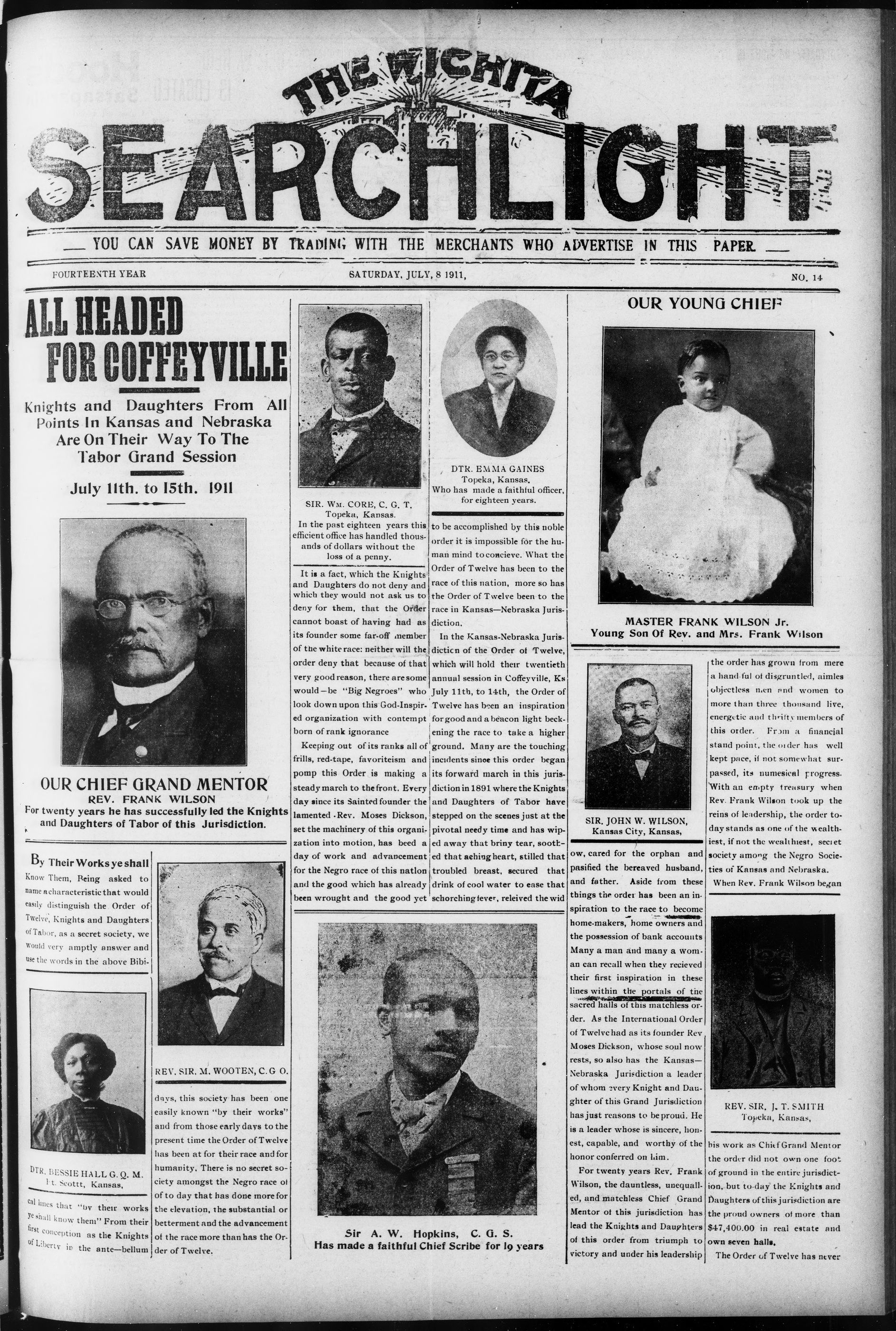
ALL HEADED FOR COFFEYVILLE
Knights and Daughters From All Points In Kansas and Nebraska Are On Their Way To The Tabor Grand Session July 11th. to 15th. 1911
OUR CHIEF GR
REV. FRAN
For twenty years he has s
and Daughters of Tabe
R CHIEF GRAND MEN
REV. FRANK WILSON
ty years he has successfully led the
daughters of Tabor of this Jurisdiction
For twenty years he has successfully led the Knights and Daughters of Tabor of this Jurisdiction.
By Their Works ye shall Know Them, Being asked to name a characteristic that would easily distinguish the Order of Twelve, Knights and Daughters of Tabor, as a secret society, we would very amply answer and use the words in the above Bibi-
DTR. BESSIE HALL G. Q. M.
Lt. Scottt, Kansas.
DTR. BESSIE HALL G. Q. M.
Jt. Scottt, Kansas,
cal lines that "by their works ye shall know them" From their first conception as the Knights of Liberty in the ante-bellum
---
GRAND MENTOR
BINK WILSON
successfully led the Knights
or of this Jurisdiction.
M. B.
REV, SIR, M, WOOTEN, C.G O.
days, this society has been one easily known "by their works" and from those early days to the present time the Order of Twelve has been at for their race and for humanity. There is no secret society amongst the Negro race of of to day that has done more for the elevation, the substantial or betterment and the advancement of the race more than has the Order of Twelve.
SATURDAY, JULY, 8 1911.
JOHN H. HARRIS
In the past eighteen years this efficient office has handled thousands of dollars without the loss of a penny.
It is a fact, which the Knights and Daughters do not deny and which they would not ask us to deny for them, that the Order cannot boast of having had as its founder some far-off member of the white race: neither will the order deny that because of that very good reason, there are some would-be "Big Negroes" who look down upon this God-Inspired organization with contempt born of rank ignorance
Keeping out of its ranks all of frills, red-tape, favoriteism and pomp this Order is making a steady march to the front. Every day since its Sainted founder the lamented Rev. Moses Dickson, set the machinery of this organization into motion, has beed a day of work and advancement for the Negro race of this natlon and the good which has already been wrought and the good yet
M.
Sir A. W. Hopkins, C. G. S. Has made a faithful Chief Scribe for 10 years
DTR. EMMA GAINES
Topeka, Kansas.
Who has made a faithful officer,
for eighteen years.
DTR. EMMA GAINES Topeka, Kansas. Who has made a faithful officer, for eighteen years.
to be accomplished by this noble order it is impossible for the human mind to concieve. What the Order of Twelve has been to the race of this nation, more so has the Order of Twelve been to the race in Kansas—Nebraska Jurisdiction.
In the Kansas-Nebraska Jurisdiction of the Order of Twelve, which will hold their twentieth annual session in Coffeyville, Ks July 11th, to 14th, the Order of Twelve has been an inspiration for good and a beacon light beckening the race to take a higher ground. Many are the touching incidents since this order began its forward march in this jurisdiction in 1891 where the Knights and Daughters of Tabor have stepped on the scenes just at the pivotal needy time and has wiped away that briny tear, soothed that aching heart, stilled that troubled breast, secured that drink of cool water to ease that schorching fever, releived the wid
OUR YOUNG CHIEF
MASTER FRAN
Young Son Of Rev. a
THE BIRTH OF A LITTLE BOY
MASTER FRANK WILSON Jr. Young Son Of Rev. and Mrs. Frank Wilson
SIR. JOHN W. WILSON,
Kansas City, Kansas,
ow, cared for the orphan and pasified the bereaved husband, and father. Aside from these things the order has been an inspiration to the race to become home-makers, home owners and the possession of bank accounts Many a man and many a woman can recall when they recieved their first inspiration in these lines within the portals of the sacred halls of this matchless order. As the International Order of Twelvchad as its founder Rev Moses Dickson, whose soul now rests, so also has the Kansas—Nebraska Jurisdiction a leader of whom every Knight and Daughter of this Grand Jurisdiction has just reasons to be proud. He is a leader whose is sincere, honest, capable, and worthy of the honor conferred on him.
For twenty years Rev. Frank Wilson, the dauntless, unequalled, and matchless Chief Grand Mentor of this jurisdiction has lead the Knights and Daughters of this order from triumph to victory and under his leadership
NK WILSON Jr.
and Mrs. Frank Wilson
the order has grown from mere a handful of disgruntled, aimless objectless men and women to more than three thousand live, energetic and thrifty members of this order. From a financial stand point, the order has well kept pace, if not somewhat surpassed, its numerical progress. With an empty treasury when Rev. Frank Wilson took up the reins of leadership, the order today stands as one of the wealthiest, if not the wealthiest, secret society among the Negro Societies of Kansas and Nebraska. When Rev. Frank Wilson began
REV. SIR. J. T. SMITH
Topeka, Kansas.
his work as Chief Grand Mentor the order did not own one foot of ground in the entire jurisdiction, but today the Knights and Daughters of this jurisdiction are the proud owners of more than $47,400.00 in real estate and own seven halls.
The Order of Twelve has never
NO.14
POLYGAMY NO MORE IN UTAH
PRESIDENT SMITH SAYS PENALTY IS EXCOMMUNICATION.
Monogamy Urged by Husband of Five Women and Father of 48 Children.
Washington, D. C.—Polygamy no longer is practiced by Utah Mormons, and the man who is caught taking a plural wife is promptly excommunicated. So Joseph Smith, venerable president of the Mormon church, stated in an interview.
President Smith said that he supports, but does not live with the wives he married prior to the decision of the supreme court that polygamy was unlawful. He said:
"In these days of the high cost of living there is no doubt that the average man is much better off with one wife. If a man cannot support one wife decently, it would obviously be impossible to support more."
The Utah sect of the Latter Day Saints is the only one that ever has practiced polygamy. The members of the reorganized church, whose headquarters is in Independence, Mo., have always declared the "revelation" promulgated by Brigham Young years after the death of Joseph Smith, the prophet, was a rank forgery.
RECLAIM WET LANDS FOR HOMES
Campaign Instituted by Irrigation Congress to Build up Mississippi Valley.
Chicago, Illinois.—A campaign to induce the government to enter the field of drainage reclamation throughout the Mississippi valley was started at a meeting of the board of control of the national irrigation congress recently. W. L. Parks, vice-president of the Illinois Central railroad, one of the speakers, said:
"If the wet and arid portions of the United States were developed through government aid this Nation would control the feeding of the world. This drainage will affect the North as well as the South. It will add more than $1,000,000 annually to the wealth of the Nation."
NAVY'S FIRST AERIAL BOAT
Hydroplane, First of its Kind in U. S.
Navy, Makes Successful
Flight.
Hammondsport, N. Y.—The newest
craft of the United States navy has
been launched on Lake Keuka and
the first aerial pilot of the Navy qualifi-
ed in his official trial. The new craft
is a hydro-aeroplane constructed on
the lines demanded by the govern-
mance, is larger than the Curtiss mache,
and is equipped with a 70-horse
power motor. Two boats were an-
chored in the lake 1,600 feet apart
and around these Lieut. Ellison, the
pilot, flew four times, rising above 200
feet and describing a figure eight on
each circle.
SAFE CRACKED IN WYANDOTTE
The First Time in Eleven Years— Only Small Amount
Kansas City, Kansas.—The safe of the Minson Lumber company at Ninth street and Northwestern tracks, Kansas City, Kano, was "blown" some time after midnight. An overcharge of nitroglycerine was used and the safe was practically destroyed. Only about $17 was secured. No trace of the burglar has been discovered. Not for 11 years had a safe been "blown" in Kansas City, Kan.
His First Political Talk.
Alma, Kansas.—Arthur Capper, a Republican candidate for governor, made his first political speech here. The big picnic was not in the nature of a political affair and Mr. Capper spent little time with politics. He is an optimist and in discussing the good things of the great West and especially of Kansas it was necessary to inject some political views into his speech.
King Reviews Boy Scouts
Windsor, England.—King George, accompanied by Queen Mary and surrounded by a brilliant staff of officers of the naval and with other members of the royal family, reviewed an army of 35,000 boy scouts gathered from all parts of the United Kingdom and from some of the colonies in Windsor Great Park.
Motor Fire Truck for Atchison.
Atchison, Kan.—As a result of the destructive fire here recently the fire committee will recommend that the department should be equipped with motor cars and will urge an initial appropriation of $13.00. It is also proposed to build a new fire station.
Flew 7,000 Feet Over Wichita.
Wichita, Fan.—Jimmie Ward, flying his Curtiss machine, entertained a crowd of 5,000 spectators at the park north of this city. Among his flights was a spectacular trip over the city, in which he attained a height of more than 7,000 feet.
Eat Prisoners Won't Work
Oklahoma City, Oklahoma.—Fat men in the county jail have rebelled at the order of the county commissioners to put them on the roads to work.
Git up,
Willie an'
run for yer
life!
FROX
CANADA
EVENING POST
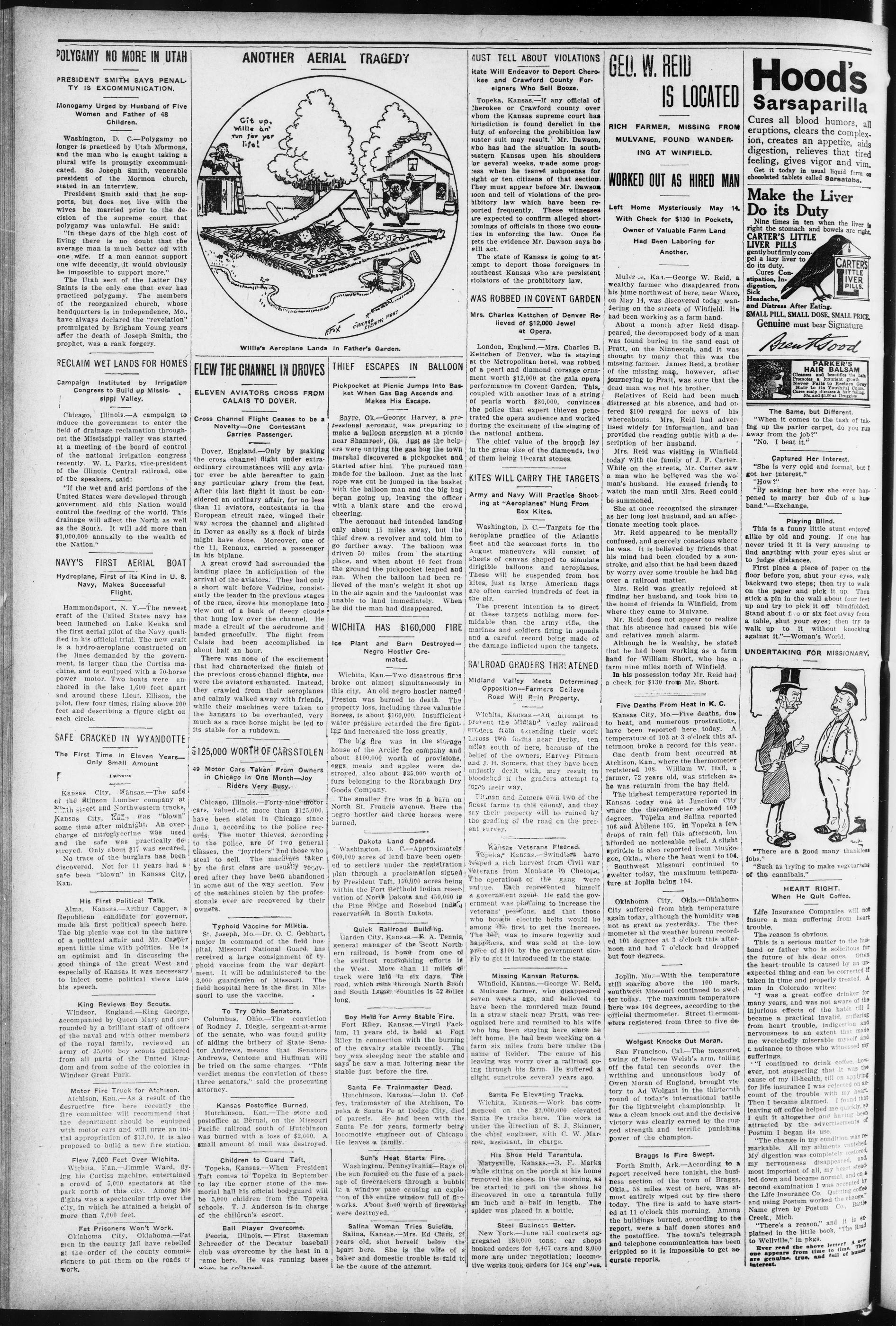
Willie's Aeroplane Lands in Father's Garden.
FLEW THE CHANNEL IN DROVES
ELEVEN AVIATORS CROSS FROM
CALAIS TO DOVER.
Cross Channel Flight Ceases to be a Novelty—One Contestant Carries Passenger.
Dover, England.—Only by making the cross channel flight under extraordinary circumstances will any aviator ever be able hereafter to gain any particular glary from the feat. After this last flight it must be considered an ordinary affair, for no less than 11 aviators, contestants in the European circuit race, winged their way across the channel and alighted in Dover as easily as a flock of birds might have done. Moreover, one of the 11, Renaux, carried a passenger in his biplane.
A great crowd had surrounded the landing place in anticipation of the arrival of the aviators. They had only a short wait before Vedrine, consistently the leader in the previous stages of the race, drove his monoplane into view out of a bank of fleecy clouds that hung low over the channel. He made a circuit of the aerodrome and landed gracefully. The flight from Calais had been accomplished in about half an hour.
There was none of the excitement that had characterized the finish of the previous cross-channel flights, nor were the aviators exhausted. Instead, they crawled from their aeroplanes and calmly walked away with friends, while their machines were taken to the hangars to be overhauled, very much as a race horse might be led to its stable for a rubdown.
$125,000 WORTH OF CARSSTOLEN
49 Motor Cars Taken From Owners in Chicago in One Month—Joy Riders Very Busy.
Chicago, Illinois.—Forty-nine motor cars, valued at more than $125,000, have been stolen in Chicago since June 1, according to the police records. The motor thieves, according to the police, are of two general classes, the "joyriders" and those who steal to sell. The machines taken by the first class are usually recovered after they have been abandoned in some out of the way section. Few of the machines stolen by the professionals ever are recovered by their owners.
Typhoid Vaccine for Militia
St. Joseph, Mo—Dr. O. C. Gebhart, major in command of the field hospital, Missouri National Guard, has received a large consignment of typhoid vaccine from the war department. It will be administered to the 3,000 guardsmen of Missouri. The field hospital here is the first in Missouri to use the vaccine.
To Try Ohio Senators
Columbus, Ohio.—The conviction of Rodney J. Diegle, sergeant-at-arms of the senate, who was found guilty of aiding the bribery of State Senator Andrews, means that Senators Andrews, Centone and Huffman will be tried on the same charges. "This verdict means the conviction of these three senators," said the prosecuting attorney.
Kansas Postoffice Burned
Hutchinson, Kan.—The store and postoffice at Bernal, on the Missouri Pacific railroad south of Hutchinson was burned with a loss of $2,000. A small amount of mail was destroyed.
Children to Guard Taft
Topeka, Kansas.—When President Taft comes to Topeka in September to lay the corner stone of the memorial hall his official bodyguard will be 5,000 children from the Topeka schools. T. J. Anderson is in charge of the children's escort.
Ball Player Overcome
Peoria, Illinois. — First Baseman Schreeder of the Decatur baseball club was overcome by the heat in a game here. He was running bases when he collapsed.
THIEF ESCAPES IN BALLOON
Pickpocket at Picnic Jumps Into Basket When Gas Bag Ascends and Makes His Escape.
Sayre, Ok.—George Harvey, a professional aeronaut, was preparing to make a balloon ascension at a picnic near Shamrock, Ok. Just as the helpers were untying the gas bag the town marshal discovered a pickpocket and started after him. The pursued man made for the balloon. Just as the last rope was cut he jumped in the basket with the balloon man and the big bag began going up, leaving the officer with a blank stare and the crowd cheering.
The aeronaut had intended landing only about 15 miles away, but the thief drew a revolver and told him to go farther away. The balloon was driven 50 miles from the starting place, and when about 10 feet from the ground the pickpocket leaped and ran. When the balloon had been relieved of the man's weight it shot up in the air again and the balloonist was unable to land immediately. When he did the man had disappeared.
WICHITA HAS $160,000 FIRE
Ice Plant and Barn Destroyed— Negro Hostel Cre-
Wichita, Kan.—Two disastrous fires broke out almost simultaneously in this city. An old negro hostler named Preston was burned to death. The property loss, including three valuable horses, is about $160,000. Insufficient water pressure retarded the fire fighting and increased the loss greatly.
The big fire was in the storage house of the Arctic Ice company and about $100,000 worth of provisions, eggs, meats and apples were destroyed, also about $35,000 worth of furs belonging to the Rorabaugh Dry Goods Company.
The smaller fire was in a barn on North St. Francis avenue. Here the negro hostler and three horses were burned.
Dakota Land Opened.
Washington, D. C.—Approximately 600,000 acres of land have been opened to settlers under the registration plan through a proclamation signed by President Taft, 150,000 acres being within the Fort Berthold Indian reservation of North Dakota and 450,000 is the Pine Ridge and Rosebud Indian reservation in South Dakota.
Quick Railroad Building.
Garden City, Kansas.—E. A. Tennis, general manager of the Scott Northern railroad, is born from one of the swiftest roadmaking efforts in the West. More than 11 miles of track were laid in six days. The road, which runs through North Scott and South Laguna counties is 52 miles long.
Boy Held for Army Stable Fire.
Fort Riley, Kansas.—Virgil Facklam, 11 years old, is held at Fort Riley in connection with the burning of the cavalry stable recently. The boy was sleeping near the stable and says he saw a man loitering near the stable just before the fire.
Santa Ec Trainmaster Dead
Hutchinson, Kansas.—John D. Coffey, trainmaster of the Atchison, Topeka & Santa Fe at Dodge City, died of paresis. He had been with the Santa Fe for years, formerly being locomotive engineer out of Chicago He leaves a family.
Sun's Heat Starts Fire.
Washington, Pennsylvania—Rays of the sun focused on the fuse of a package of firecrackers through a bubble in a window pane causing an explosion of the entire window full of fireworks. About $000 worth of fireworks were destroyed.
Salina Woman Tries Suicide.
Salina, Kansas.—Mrs. Ed Clark, 26 years old, shot herself below the heart here. She is the wife of a baker and domestic trouble is said to be the cause of the attempt.
MUST TELL ABOUT VIOLATIONS
state Will Endeavor to Deport Cherokee and Crawford County Foreigners Who Sell Booze.
Topeka, Kansas.—If any official of Cherokee or Crawford county over whom the Kansas supreme court has jurisdiction is found derelict in the duty of enforcing the prohibition law, buster suit may result. Mr. Dawson, who has had the situation in southeastern Kansas upon his shoulders for several weeks, made some progress when he issued subpoenas for sight or ten citizens of that section. They must appear before Mr. Dawson soon and tell of violations of the prohibitory law which have been reported frequently. These witnesses are expected to confirm alleged short-comings of officials in those two counties in enforcing the law. Once he gets the evidence Mr. Dawson says he will act.
The state of Kansas is going to attempt to deport those foreigners in southeast Kansas who are persistent violators of the prohibitory law.
WAS ROBBED IN COVENT GARDEN
Mrs. Charles Kettchen of Denver Relieved of $12,000 Jewel at Opera.
London, England.-Mrs. Charles B. Kettchen of Denver, who is staying at the Metropolitan hotel, was robbed of a pearl and diamond corsage ornament worth $12,000 at the gala opera performance in Covent Garden. This, coupled with another loss of a string of pearls worth $80,000, convinces the police that expert thieves penetrated the opera audience and worked during the excitement of the singing of the national anthem.
The chief value of the brooch lay in the great size of the diamonds, two of them being 10-carat stones.
KITES WILL CARRY THE TARGETS
Army and Navy Will Practice Shooting at "Aeroplanes" Hung From Box Kites.
Washington, D. C.—Targets for the aeroplane practice of the Atlantic fleet and the seacoast forts in the August maneuvers will consist of sheets of canvas shaped to simulate dirigible balloons and aeroplanes. These will be suspended from box kites, just as large American flags are often carried hundreds of feet in the air.
The present intention is to direct at these targets nothing more formidable than the army rifle, the marines and soldiers firing in squads and a careful record being made of the damage inflicted upon the targets.
RAILROAD GRADERS THREATENED
Midland Valley Meets Determined Opposition—Farmers Eelieve Road Will Ruin Property.
Wichita, Kansas.—An attempt to prevent the Midland Valley railroad graders from extending their work across two farms near Derby, ten miles south of here, because of the belief of the owners, Harvey Pitman and J. H. Somers, that they have been unjustly dealt with, may result in bloodshed if the graders attempt to force their way.
Titman and Somers own two of the finest farms in this county, and they say their property will be ruined by the grading of the road on the present survey.
Kausas Veterans Elected
Topeka, Kansas.—Swindlers have reaped a rich harvest from Civil war veterans from Mankato to Chetopa. The operations of the gang were unique. Each represented himself a government agent. He said the government was planning to increase the veterans' pensions, and that those who bought electric belts would be among the first to get the increase. The bill was to insure logevity and happiness, and was sold at the low price of $100 by the government simply to get it introduced in the state.
Missing Kansan Returns.
Winfield, Kansas.—George W. Reid, a Mulvane farmer, who disappeared seven weeks ago, and believed to have been the murdered man found in a straw stack near Pratt, was recognized here and reunited to his wife who has been staying here since he left home. He had been working on a farm six miles from here under the name of Reider. The cause of his leaving was worry over a railroad going through his farm. He suffered a slight stunstroke several years ago.
Santa Fe Elevating Tracks.
Wichita, Kansas.—Work has commenced on the $2,000,000 elevated Santa Fe tracks here. The work is under the direction of S. J. Skinner, the chief engineer, with C. W. Marrow, assistant, in charge.
His Shoe Held Tarantula
Marysville, Kansas.—B. F. Marks while sitting on the porch at his home removed his shoes. In the morning, as he started to put on the shoes he discovered in one a tarantula fully an inch and a half in length. The spider was placed in a bottle.
Steel Business Better.
New York.—June rail contracts aggregated 180,000 tons; car shops booked orders for 4,467 cars and 8,000 more are under negotiation; locomotive works took orders for 164 eng'ers.
GEU. W. REID
IS LOCATED
RICH FARMER, MISSING FROM MULVANE, FOUND WANDERING AT WINFIELD.
WORKED OUT AS HIRED MAN
Left Home Mysteriously May 14,
With Check for $130 in Pockets,
Owner of Valuable Farm Land
Had Been Laboring for
Another.
Mulvaine, Kan.—George W. Reid, a
wealthy farmer who disappeared from
his hime northwest of here, near Waco,
on May 14, was discovered today wander-
ing on the streets of Winfield. He
had been working as a farm hand.
About a month after Reid disap-
peared, the decomposed body of a man
was found buried in the sand east of
Pratt, on the Ninnescah, and it was
thought by many that this was the
missing farmer. James Reid, a brother
of the missing map, however, after
journeying to Pratt, was sure that the
dead man was not his brother.
Relatives of Reid had been much distressed at his absence, and had offered $100 reward for news of his whereabouts. Mrs. Reid had advertised widely for information, and had provided the reading public with a description of her husband.
Mrs. Reid was visiting in Winfield today with the family of J. F. Carter. While on the streets, Mr. Carter saw a man who he believed was the woman's husband. He caused friends to watch the man until Mrs. Reed could be summoned.
She at once recognized the stranger as her long lost husband, and an affectionate meeting took place.
Mr. Reid appeared to he mentally confused, and scercely conscious where he was. It is believed by friends that his mind had been clouded by a sunstroke, and also that he had been dazed by worry over some trouble he had had over a railroad matter.
Mrs. Reid was greatly rejoiced at finding her husband, and took him to the home of friends in Winfield, from where they came to Muvane.
Mr. Reid does not appear to realize that his absence had caused his wife and relatives much alarm.
Although he is wealthy, he stated that he had been working as a farm hand for William Short, who has a farm nine miles north of Winfield.
In his possession today Mr. Reid had a check for $130 from Mr. Short.
Five Deaths From Heat in K. C.
Kansas City, Mo.-Five deaths, due to heat, and numerous prostrations, have been reported here today. A temperature of 103 at 3 o'clock this afternoon broke a record for this year. One death from heat occurred at Atchison, Kan., where the thermometer registered 108. William W. Hall, a farmer, 72 years old, was stricken as he was returnin from the hay field. The highest temperature reported in Kansas today was at Junction City where the thermometer showed 109 degrees. Topeka and Salina reported 106 and Abilene 105. In Topeka a few drops of rain fell this afternoon, but afforded no noticeable relief. A slight sprinkle is also reported from Muskogee, Okla., where the heat went to 104. Southwest Missouri continued to swelter today, the maximum temperature at Toilin being 104.
Oklahoma City. Okla.—Oklahoma City suffered from high temperature again today, although the humidity was not as great as yesterday. The thermometer at the weather bureau recorded 101 degrees at 3 o'clock this afternoon and had 7 o'clock had dropped but four degrees.
---
Joplin, Mo.—With the temperature still soaring above the 100 mark, southwest Missouri continued to swelter today. The maximum temperature here was 104 degrees, according to the official thermometer. Street thermometers registered from three to five de-
Wolgast Knocks Out Moran.
San Francisco, Cal.-The measured swing of Referee Welsh's arm, tolling off the fatal ten seconds over the writhing and unconscious body of Owen Moran of England, brought victory to Ad Wolgast in the thirteenth round of today's international battle for the lightweight championship. It was a clean knock out and the decisive victory was clearly earned by the rugged strength and terrific punishing power of the champion.
Braggs Is Fire Swept.
Forth Smith, Ark.—According to a report received here tonight, the business section of the town of Braggs, Okla., 58 miles west of here, was almost entirely wiped out by fire there today. The fire is said to have started at 11 o'clock this morning. Among the buildings burned, according to the report, were a half dozen stores and the postoffice. The town's telegraph and telephone communication has been crippled so it is impossible to get accurate reports.
Hood's Sarsaparilla
Cures all blood humors, all eruptions, clears the complexion, creates an appetite, aids digestion, relieves that tired feeling, gives vigor and vim. Get it today in usual liquid form or chocolated tablets called Sarataba
Make the Liver Do its Duty
Nine times in ten when the liver is right the stomach and bowels are right.
CARTER'S LITTLE LIVER PILLS gently but firmly compel a lazy liver to do its duty.
Cures Constipation, Indigestion, Sick Headache, and Distress After Eating.
SMALL PILL, SMALL DOSE, SMALL PRICE.
Genuine must bear Signature
A. W. Good
PARKER'S HAIR BALSAM Cleanses and heals the hair Promotes a luxurious growth Newer Fails to Restore Gray Hair to its Youthful Color. Cures scalp disease and hair falling 80c, and $1.00 at Drugs.
"When it comes to the task of taking up the parlor carpet, do you run away from the job?"
"No. I look it."
Captured Her Interest
"She is very cold and formal, but I got her interest."
"How?"
"By asking her how she ever happened to marry her dub of a bus band."—Exchange.
Playing Blind.
This is a funny little stunt enjoyed allike by old and young. If one has never tried it it is very amusing to find anything with your eyes shut or to judge distances.
First place a piece of paper on the floor before you, shut your eyes, walk backward two steps; then try to walk on the paper and pick it up. Then stick a pin in the wall about four feet up and try to pick it off blindfolded. Stand about five or six feet away from a table, shut your eyes; then try to walk up to it without knocking against it."—Woman's World.
UNDERTAKING FOR MISSIONARY
W. L.
"There are a good many thankless jobs."
"Such as trying to make vegetarians of the cannibals."
Life Insurance Companies will not insure a man suffering from heart trouble. The reason is obvious.
This is a serious matter to the husband or father who is solicitous for the future of his dear ones. Often the heart-trouble is caused by an unexpected thing and can be corrected if taken in time and properly treated. A man in Colorado writes: "I was a great coffee drinker for many years, and was not aware of the injurious effects of the habit till I became a practical invalid, suffering from heart trouble, indigestion and nervousness to an extent that made me wretchedly miserable myself and nuisance to those who witnessed my sufferings.
"I continued to drink coffee, however, not suspecting that it was the cause of my ill-health, till on applying for life insurance I was rejected on account of the trouble with my heart. Then I became alarmed. I found that leaving off coffee helped me quickly, so I quit it altogether and having been attracted by the advertisements of Postum I began its use.
Postum I began in "The change in my condition was markable. All my ailments vanished My digestion was completely restored my nervousness disappeared, and most important of all, my heart stood down and became normal, and on a second examination I was accepted by the Life Insurance Co. Quitting coffee and using Postum worked the change." Name given by Postum Co. Battle Creek, Mich.
"There's a reason," and it is explained in the little book, "The Road to Wellville," in pkgs.
Ever read the above letter! A new one appears from time to time. They are genuine, true, and full of human interest.
The
American
Home
WILLIAM A.
RADFORD
Editor
THE BARN
Mr. William A. Radford will answer questions and give advice FREE OF COST on all subjects pertaining to the subject of building, for the readers of this paper. On account of his wide experience as Editor, Author and Manufacturer, he is, without doubt, a leading authority on all inquiries in William A. Radford, No. 178 West Jackson boulevard, Chicago, Ill., and only possesses two-cent stamp for reply.
We will all agree that the bungalow marks a great improvement in summer resort architecture. As a summer cottage, whether located in the mountains, on the edge of a forest or by a lake or river, the graceful, informal lines of the bungalow seem to adapt themselves ideally to their environment. When contrasted with the old-time, box-like, jig-saw ornamented affairs that were known as summer cottages, the improvement is very apparent. Commenting on this matter, the well known architect, Wilson Eyre, brings out some valuable points in a recent number of "Country Life in America." His contention is that the bungalow fad is carrying us to architectural extremes that are not good for domestic architecture in general.
As a style for general suburban use the bungalow appears to be misused and is generally objectionable when so used. As already mentioned, it has its place and purpose; first as a weekend or summer retreat it forms an ideal contrast to our more pretentious, over-luxurious dwellings; second, it is a harmonious building for an informal location; third, when an inexpensive structure is desired the bungalow offers the maximum comfort and beauty for the minimum cost. Because the bungalow is so widely misused and misunderstood, it may be well to try to answer the question, What is a bungalow? and to analyze
its real purpose in the general scheme of American home building.
The term bungalow is one which is variously applied to rustic camps, to one-story seaside cottages, low, broad, extended lines with a low pitch to the roof. It is not, however, properly used when applied, as is so often done, to houses having living rooms in the second story.
This authority does not believe in general in the one-story house for an all-year dwelling. It is a fad which, like mission furniture, is being much overdone. It is supposed to be the up-to-date fashion in many localities; but as with many so-called fashions, there is little reasonable excuse for its prevalence. Like many fads it is bound to run its course, and there is nothing so dismally out of place as a fad that has ceased to be.
There is another fact regarding the bungalow which has become current and that is that a one-story house is
BATH
9'6"X8'0"
BED RM.
13'0"X9'6"
BED RM.
13'0"X11'0"
PORCH
26'6"X6'6"
KITCHEN
12'0"X9'0"
PORCH
NOOK
DINING RM.
16'0"X10'0"
CL.
BATH
9'6"X8'0"
CL.
LIVING RM.
16'0"X13'0"
CL.
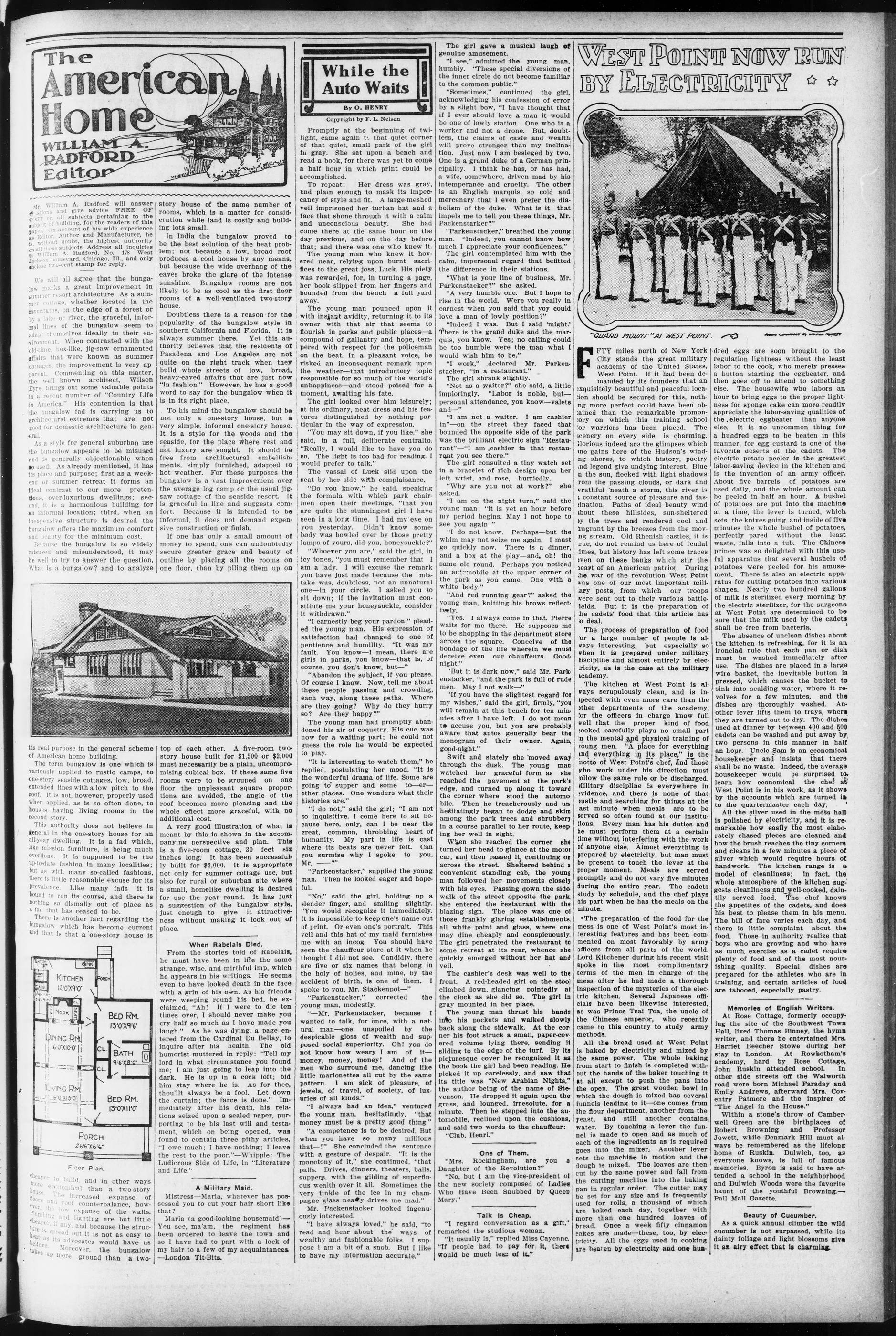
Floor Plan.
cheaper to build, and in other ways more economical than a two-story house. The increased expanse of floors and roof counterbalance, however, the low expanse of the walls. Plumbing and lighting are but little cheaper, if any, and because the structure is spread out it is not as easy to heat as its advocates would have us believe. Moreover, the bungalow takes up more ground than a two-
story house of the same number of rooms, which is a matter for consideration while land is costly and building lots small. In India the bungalow proved to be the best solution of the heat problem; not because a low, broad roof produces a cool house by any means, but because the wide overhang of the eaves broke the glare of the intense sunshine. Bungalow rooms are not likely to be as cool as the first floor rooms of a well-ventilated two-story house.
Doubtless there is a reason for the popularity of the bungalow style in southern California and Florida. It is always summer there. Yet this authority believes that the residents of Pasadena and Los Angeles are not quite on the right track when they build whole streets of low, broad, heavy-eaved affairs that are just now "in fashion." However, he has a good word to say for the bungalow when it is in its right place.
To his mind the bungalow should be not only a one-story house, but a very simple, informal one-story house. It is a style for the woods and the seaside, for the place where rest and not luxury are sought. It should be free from architectural embellishments, simply furnished, adapted to hot weather. For these purposes the bungalow is a vast improvement over the average log camp or the usual jigsaw cottage of the seaside resort. It is graceful in line and suggests comfort. Because it is intended to be informal, it does not demand expensive construction or finish.
If one has only a small amount of money to spend, one can undoubtedly secure greater grace and beauty of outline by placing all the rooms on one floor, than by piling them up on
top of each other. A five-room two-story house built for $1,500 or $2,000 must necessarily be a plain, uncompromising cubical box. If these same five rooms were to be grouped on one floor the unpleasant square proportions are avoided, the angle of the roof becomes more pleasing and the whole effect more graceful, with no additional cost. A very good illustration of what is meant by this is shown in the accompanying perspective and plan. This is a five-room cottage, 30 feet six inches long. It has been successfully built for $2,000. It is appropriate not only for summer cottage use, but also for rural or suburban site where a small, homelike dwelling is desired for use the year round. It has just a suggestion of the bungalow style, just enough to give it attractiveness without making it look out of place.
When Rabelals Died.
From the stories told of Rabelais, he must have been in life the same strange, wise, and mirthful imp, which he appears in his writings. He seems even to have looked death in the face with a grin of his own. As his friends were weeping round his bed, he exclaimed, "Ah! If I were to die ten times over, I should never make you cry half so much as I have made you laugh." As he was dying, a page entered from the Cardinal Du Bellay, to inquire after his health. The old humorist muttered in reply: "Tell my lord in what circumstance you found me; I am just going to leap into the dark. He is up in a cock loap; bid him stay where he is. As for thee, thou'll always be a fool. Let down the curtain; the farce is done." Immediately after his death, his relations seized upon a sealed paper, purporting to be his last will and testament, which on being opened, was found to contain three pithy articles, "I owe much; I have nothing; I leave the rest to the poor."—Whipple: The Ludicrous Side of Life, in "Literature and Life."
A Military Maid.
Mistress—Maria, whatever has possessed you to cut your hair short like that?
Maria (a good-looking housemaid)—You see, ma'am, the regiment has been ordered to leave the town and so I have had to part with a lock of my hair to a few of my acquaintances—London Tit-Bits.
While the Auto Waits
By O. HENRY
Copyright by F. L. Nelson
Promptly at the beginning of twilight, came again t. that quiet corner of that quiet, small park of the girl in gray. She sat upon a bench and read a book, for there was yet to come a half hour in which print could be accomplished.
To repeat: Her dress was gray and plain enough to mask its impecancy of style and fit. A large-meshed vell imprisoned her turban hat and a face that shone through it with a calm and unconscious beauty. She had come there at the same hour on the day previous, and on the day before that; and there was one who knew it. The young man who knew it hovered near, relying upon burnt sacrifices to the great joss, Luck. His piety was rewarded, for, in turning a page, her book slipped from her fingers and bounded from the bench a full yard away.
The young man pounced upon it with instant avidity, returning it to its owner with that air that seems to flourish in parks and public places—a compound of gallantry and hope, tempered with respect for the policeman on the beat. In a pleasant voice, he risked an inconsequent remark upon the weather—that introductory topic responsible for so much of the world's unhappiness—and stood poised for a moment, awaiting his fate.
The girl looked over him leisurely; at his ordinary, neat dress and his features distinguished by nothing particular in the way of expression.
"You may sit down, if you like," she said, in a full, deliberate contralto. "Really, I would like to have you do. The light is too bad for reading. I would prefer to talk."
The vassal of Luck slid upon the seat by her side with complaisance.
"Do you know," he said, speaking the formula with which park chairmen open their meetings, "that you are quite the stunningest girl I have seen in a long time. I had my eye on you yesterday. Didn't know somebody was bowled over by those pretty lamps of yours, did you, honeysuckle?"
"Whoever you are," said the girl, in icy tones, "you must remember that I am a lady. I will excuse the remark you have just made because the mistake was, doubtless, not an unnatural one—in your circle. I asked you to sit down; if the invitation must constitute me your honeysuckle, consider it withdrawn."
"I earnestly beg your pardon," pleaded the young man. His expression of satisfaction had changed to one of patience and humility. "It was my fault. You know—I mean, there are girls in parks, you know—that is, of course, you don't know, but—"
"Abandon the subject, if you please. Of course I know. Now, tell me about these people passing and crowding, each way, along these paths. Where are they going? Why do they hurry so? Are they happy?"
The young man had promptly abandoned his air of coquetry. His cue was now for a waiting part; he could not guess the role he would be expected to play.
"It is interesting to watch them," he replied, postulating her mood. "It is the wonderful drama of life. Some are going to supper and some to—er—other places. One wonders what their histories are."
"I do not," said the girl; "I am not so inquisitive. I come here to sit because here, only, can I be near the great, common, throbbing heart of humanity. My part in life is cast where its beats are never felt. Can you surmise why I spoke to you, Mr. —?" "Parkenstacker," supplied the young man. Then he looked eager and hopeful. "No," said the girl, holding up a slender finger, and smiling slightly. "You would recognize it immediately. It is impossible to keep one's name out of print. Or even one's portrait. This vell and this hat of my mild furnishes me with an incog. You should have seen the chauffeur stare at it when he thought I did not see. Candidly, there are five or six names that belong in the holy of holies, and mine, by the accident of birth, is one of them. I spoke to you, Mr. Stackenpot—"
"Parkenstacker," corrected the young man, modestly.
"—Mr. Parkenstacker, because I wanted to talk, for once, with a natural man—one unspoiled by the despicable gloss of wealth and supposed social superiority. Oh! you do not know how weary I am of it—money, money, money! And of the men who surround me, dancing like little marionettes all cut by the same pattern. I am sick of pleasure, of jewels, of travel, of society, of luxuries of all kinds."
"I always had an idea," ventured the young man, hesitatingly, "that money must be a pretty good thing."
"A competence is to be desired. But when you have so many millions that—!" She concluded the sentence with a gesture of despair. "It is the monotony of it," she continued, "that palls. Drives, dinners, theaters, balls, suppers, with the gilding of superfluous wealth over it all. Sometimes the very tinkle of the ice in my champagne glass nearly drives me mad." Mr. Packenstacker looked ingenuously interested.
"I have always loved," he said, "to read and hear about the ways of wealthy and fashionable folks. I suppose I am a bit of a snob. But I like to have my information accurate."
The girl gave a musical laugh of genuine amusement.
"I see," admitted the young man, humbly. "These special diversions of the inner circle do not become familiar to the common public."
"Sometimes," continued the girl, acknowledging his confession of error by a slight bow. "I have thought that if I ever should love a man it would be one of lowly station. One who is a worker and not a drone. But, doubtless, the claims of caste and wealth will prove stronger than my inclination. Just now I am besieged by two. One is a grand duke of a German principality. I think he has, or has had, a wife, somewhere, driven mad by his intemperance and cruelty. The other is an English marquis, so cold and mercenary that I even prefer the diabolism of the duke. What is it that impels me to tell you these things, Mr. Packenstarker?"
"Parkenstacker," breathed the young man. "Indeed, you cannot know how much I appreciate your confidences." The girl contemplated him with the calm, impersonal regard that befitted the difference in their stations.
"What is your line of business, Mr. Parkenstacker?" she asked.
"A very humble one. But I hope to rise in the world. Were you really in earnest when you said that you could love a man of lowly position?"
"Indeed I was. But I said 'might.' There is the grand duke and the marquis, you know. Yes; no calling could be too humble were the man what I would wish him to be."
"I work," declared Mr. Parkenstacker, "in a restaurant."
The girl shrank slightly.
"Not as a waiter?" she said, a little imploringly. "Labor is noble, but—personal attendance, you know—valets and—"
"I am not a waiter. I am cashier in"—on the street they faced that bounded the opposite side of the park was the brilliant electric sign "Restaurant"—"I am cashier in that restaurant you see there." The girl consulted a tiny watch set in a bracelet of rich design upon her left wrist, and rose, hurriedly. "Why are you not at work?" she asked. "I am on the night turn." said the young man; "it is yet an hour before my period begins. May I not hope to see you again." "I do not know. Perhaps—but the whim may not seize me again. I must go quickly now. There is a dinner, and a box at the play—and, oh! the same old round. Perhaps you noticed an automobile at the upper corner of the park as you came. One with a white body."
"And red running gear?" asked the young man, knitting his brows reflectively.
"Yes. I always come in that. Pierre waits for me there. He supposes me to be shopping in the department store across the square. Conceive of the bondage of the life wherein we must deceive even our chauffeurs. Goodnight."
"But it is dark now," said Mr. Parkenstacker, "and the park is full of rude men. May I not walk—"
"If you have the slightest regard for my wishes," said the girl, firmly, "you will remain at this bench for ten minutes after I have left. I do not mean to accuse you, but you are probably aware that autos generally bear the monogram of their owner. Again good-night."
Swift and stately she moved away through the dusk. The young man watched her graceful form as she reached the pavement at the park's edge, and turned up along it toward the corner where stood the automobile. Then he treacherously and unhesitatingly began to dodge and skim among the park trees and shrubbery in a course parallel to her route, keeping her well in sight.
When she reached the corner she turned her head to glance at the motor car, and then passed it, continuing on across the street. Sheltered behind a convenient standing cab, the young man followed her movements closely with his eyes. Passing down the sidewalk of the street opposite the park she entered the restaurant with the blazing sign. The place was one of those frankly glaring establishments all white paint and glass, where one may dine cheaply and conspicuously. The girl penetrated the restaurant to some retreat at its rear, whence she quickly emerged without her hat and veil.
The cashier's desk was well to the front. A red-headed girl on the stool climbed down, glancing pointedly at the clock as she did so. The girl in gray mounted in her place.
The young man thrust his hands into his pockets and walked slowly back along the sidewalk. At the corner his foot struck a small, paper-covered volume lying there, sending it sliding to the edge of the turf. By its picturesque cover he recognized it as the book the girl had been reading. He picked it up carelessly, and saw that its title was "New Arabian Nights," the author being of the name of Stevenson. He dropped it again upon the grass, and lounged, irresolute, for a minute. Then he stepped into the automobile, reclined upon the cushions, and said two words to the chauffeur: "Club. Henri."
One of Them.
"Mrs. Rockingham, are you a Daughter of the Revolution?" "No, but I am the vice-president of the new society composed of Ladies Who Have Been Snubbed by Queen Mary."
Talk Is Cheap.
"I regard conversation as a gift," remarked the studious woman. "It usually is," replied Miss Cayenne. "If people had to pay for it, there would be much less of it."
WEST POINT NOW RUN BY ELECTRICITY
THE TROOP
"GUARD MOUNT" AT WEST POINT FTY miles north of New York City stands the great military academy of the United States, labor to West Point. If it had been de a button
influenced by its founders that an exquisitely beautiful and peaceful location should be secured for this, nothing more perfect could have been obtained than the remarkable promo-
tory on which this training school or warriors has been placed. The cenery on every side is charming. Horrible indeed are the glimpses which one gains here of the Hudson's wind-
ing shores, to which history, poetry and legend give undying interest. Blue on the sun, flecked with light shadows from the passing clouds, or dark and wrathful 'neath a storm, this river is a constant source of pleasure and fascination. Paths of ideal beauty wind about these hillsides, sun-sheltered by the trees and rendered cool and fragrant by the breezes from the moving stream. Old Rhenish castles, it is true, do not remind us here of feudal times, but history has left some traces even on these banks which stir the heart of an American patriot. During the war of the revolution West Point was one of our most important military posts, from which our troops were sent out to their various battle-
fields. But it is the preparation of the cadets' food that this article has to deal.
The process of preparation of food or a large number of people is always interesting, but especially so when it is prepared under military discipline and almost entirely by electricity, as is the case at the military academy.
The kitchen at West Point is always scrupulously clean, and is inspected with even more care than the other departments of the academy, for the officers in charge know full well that the proper kind of food cooked carefully plays no small part in the mental and physical training of young men. "A place for everything and everything in its place" is the motto of West Point's chef, and those who work under his direction must follow the same rule or be discharged. Military discipline is everywhere in evidence, and there is none of thatustle and searching for things at the last minute when meals are to be served so often found at our institutions. Every man has his duties and he must perform them at a certain time without interfering with the work of anyone else. Almost everything is prepared by electricity, but man must be present to touch the lever at the proper moment. Meals are served promptly and do not vary five minutes during the entire year. The cadets study by schedule, and the chef plays his part when he has the meals on the minute.
*The preparation of the food for the mess is one of West Point's most interesting features and has been commented on most favorably by army officers from all parts of the world. Lord Kitchener during his recent visit spoke in the most complimentary terms of the men in charge of the mess after he had made a thorough inspection of the mysteries of the electric kitchen. Several Japanese officials have been likewise interested, as was Prince Tsai Toa, the uncle of the Chinese emperor, who recently came to this country to study army methods.
All the bread used at West Point is baked by electricity and mixed by the same power. The whole baking from start to finish is completed without the hands of the baker touching it at all except to push the pans into the open. The great wooden bowl in which the dough is mixed has several funnels leading to it—one comes from the flour department, another from the yeast, and still another contains water. By touching a lever the funnel is made to open and as much of each of the ingredients as is required goes into the mixer. Another lever sets the machine in motion and the dough is mixed. The loaves are then cut by the same power and fall from the cutting machine into the baking pan in regular order. The cutter may be set for any size and is frequently used for rolls, a thousand of which are baked each day, together with more than one hundred loaves of bread. Once a week fifty chinnamon cakes are made—these, too, by electricity. All the eggs used in cooking are beaten by electricity and one hun-
dred eggs are soon brought to the regulation lightness without the least labor to the cook, who merely presses a button starting the eggbeater, and then goes off to attend to something else. The housewife who labors an hour to bring eggs to the proper lightness for sponge cake can more readily appreciate the labor-saving qualities of the electric eggbeater than anyone else. It is no uncommon thing for a hundred eggs to be beaten in this manner, for egg custard is one of the favorite deserts of the cadets. The electric potato peeler is the greatest labor-saving device in the kitchen and is the invention of an army officer. About five barrels of potatoes are used dally, and the whole amount can be peeled in half an hour. A bushel of potatoes are put into the machine at a time, the lever is turned, which sets the knives going, and inside of five minutes the whole bushel of potatoes, perfectly pared without the least waste, falls into a tub. The Chinese prince was so delighted with this useful apparatus that several bushels of potatoes were peeled for his amusement. There is also an electric apparatus for cutting potatoes into various shapes. Nearly two hundred gallons of milk is sterilized every morning by the electric sterilizer, for the surgeons at West Point are determined to be sure that the milk used by the cadets shall be free from bacteria.
The absence of unclean dishes about the kitchen is refreshing, for it is an ironclad rule that each pan or dish must be washed immediately after use. The dishes are placed in a large wire basket, the inevitable button is pressed, which causes the bucket to sink into scalding water, where it revolves for a few minutes, and the dishes are thoroughly washed. Another lever lifts them to trays, where they are turned out to dry. The dishes used at dinner by between 400 and 500 cadets can be washed and put away by two persons in this manner in half an hour. Uncle Sam is an economical housekeeper and insists that there shall be no waste. Indeed, the average housekeeper would be surprised to learn how economical the chef at West Point is in his work, as it shows by the accounts which are turned in to the quartermaster each day.
All the silver used in the mess hall is polished by electricity, and it is remarkable how easily the most elaborately chased pieces are cleaned and how the brush reaches the tiny corners and cleans in a few minutes a piece of silver which would require hours of handwork. The kitchen range is a model of cleanliness; in fact, the whole atmosphere of the kitchen suggests cleanliness and well-cooked, dainty served food. The chef knows the appetites of the cadets, and does his best to please them in his menu. The bill of fare varies each day, and there is little complaint about the food. Those in authority realize that boys who are growing and who have as much exercise as a cadet require plenty of food and of the most nourishing quality. Special dishes are prepared for the athletes who are in training, and certain articles of food are tabooed, especially pastry.
Memories of English Writers.
Memories of English Writers.
At Rose Cottage, formerly occupying the site of the Southwest Town Hall, lived Thomas Binney, the hymn writer, and there he entertained Mrs. Harriet Beecher Stowe during her stay in London. At Rowhotham's academy, hard by Rose Cottage, John Rusklin attended school. In other side streets off the Walworth road were born Michael Faraday and Emily Andrews, afterward Mrs. Coventry Patmore and the inspirer of "The Angel in the House."
Within a stone's throw of Camberwell Green are the birthplaces of Robert Browning and Professor Jowett, while Denmark Hill must always be remembered as the lifelong home of Ruskin. Dulwich, too, as everyone knows, is full of famous memories. Byron is said to have attended a school in the neighborhood and Dulwich Woods were the favorite haunt of the youthful Browning. Pall Mall Gazette.
Beauty of Cucumber
As a quick annual climber the wild cucumber is not surpassed, while its dainty foliage and light blossoms give it an airy effect that is charming.
SEARCHLIGHT PAGE FOUR
THE SEARCHLIGHT
WICHITA, ..... KANSAS.
WICHITA,
Established in 1898.
W. N. MILLER, Editor.
Residence 1401 West 23d Street.
Office: 630 N. Main Street.
Residence Phone, Marke. 1641.
Office Phone, Market 2401.
Phone your news items to us.
"To Live and Let Live" is Our Motto.
RATES OF SUBSCRIPTION:
Strictly in Advance.
One Year (by mail) ..... $1.00
Six Months (by mail) ..... .75
Three Months (by mail) ..... .50
Advertising Rates made known on application.
Liberal commission paid to agents.
Entered at the Postoffice at Wichita,
Kansas, as Second-Class
Mail Matter.
Published Every Saturday at 630 N.
Main Street.
All matters addressed to The
Searchlight for publication must be
signed b y the party or parties writing.
All matters for publication must reach this office not later than Thurs day noon to reach publication in the current issue.
First. All subscriptions must be paid in advance. Agents take notice.
Second. Communications received after Thursday noon will not be published in the current issue.
Third. In asking to change your paper from one address or postoffice to another, give both the new and the old.
Fourth. No new name will be placed on our books unless the money accompanies the name. Write plain.
Fifth. Address all matter for publication onto The Wichita Searchlight,
630 N. Main street, Wichita, Kansas.
Sixth. Any erroneous reflection on the character, standing or reputation of any person which may appear in this paper will be gladly corrected if brought to the attention of the editor.
SEND YOUR NEWS IN EARLIER
LOCALS
THE RESUME OF THIS WEEK
Send your news notes and local happiness to 630 North Main Street.
Mrs. M. A. Loyd of Hennessy Okla. was reported ill last week at her home.
J. W. Hamilton of Enid, Okla. is visiting A. A. Fuller and family while enroute to Kans. City.
Mrs. A. A. Fuller contemplates a trip through Missouri and Ks, in the near future.
The K, of P. and the Y. M. C.
A. Band gave a fine joint picnic at McKinley park on July 4th.
Mrs. Anna Jones and Mrs J.
J. Jefferson made a pleasant visit to the home of Mrs. W. N.
Miller on West 23rd, July 4th.
Mrs. Minnis Gosby is in the city visiting with her parents M,
W. Madison and family.
Mrs. Anna Mae Sheppard, in in the city from Memphis, Tenn. visiting Mrs, J. H. VanLeu.
DeWitt Fuller and wife returned last week from a month's visit at the fine farm in Oklahoma. He reported every thing dry and in need of rain at that time.
DeWitt Fuller and wife will leave in a few days on a 60 days trip in Northern Iowa on some business.
Miss. Ethel Stephens is in the city this week from Great Bend, Kansas, visiting her Grandmother at 859 Eagle St. and other friends in the city.
A. J. Cousar has taken charge of the Barber Shod at 513 North Main and will run it in connection with his restaurant.
Mr. C. B. Cyrus, the popular barber, formerly with W. M Majors, has accepted a barber chair and in the future will be with the A. J. Cousar Barber Shop, 513 Main St, where he will be pleased to meet all of his former customers.
Teddy Garth met with quite a painful accident at the McKinley Park Tuesday July 4th, by falling from the limb of a tree. His face and hands were skinned and he was much shaken up by the fall.
A large delegation of Krights and Daughters of Tabor will leave Monday morning, July 10, over the Missouri Pacific at 8:10 for Coffeyville where they will attend the Tabor Grand Session
Watt Morris entertained at his home on N. Wichita St. a large crowd of young people, Friday evening July 6th. All reports having enjoyed themselves to the highest success. The evening was spent with music and sociable games.
A Sane Fourth.
Tuesday, July 4th in Wichita passed off very quiet and without any accidents of note. Every one seemed to have enjoyed them selves. In fact it was one of the most sane forth experienced in this city for many years.
A Jolly Outing
A crowd of jolly young folks, went out Tuesday July 4th. by the way of the Interuban to Sulivan's Dam, where they spent the day Fishing and Pic-Nicing, they also watched the Airoplane make several flights through the air from Walnut Grove Park. They left Wichita about 8:00 a.m. and returned from their spedid outing at 8:30 p.m. All declaring it one of the grandest outings they ever had.
Those who went were:- Miss. Pansy Cox, Miss, Sadie Saunders Miss. Ethel Patton, Mrs. Geo, Patton, Mrs. Anna Mae Sheppard G. Patton, Alfred Matthews Chas. B. Patton and N. B. Copeland.
Pews Should Back Pulpit
The reason our churches have not the strong preachers that they once had is because our pew are filled with the men and women backing up their pastors as they once did. Mark this: The pew has more to do with the pulpit than the pulpit has to do with the pew.— Frank De Witt Talmage. Presbyterian, Pa.
FIRST PUBLICATION IN WICHITA SEARCHLIGHT
JUNE 24th 1911
IN THE DISTRICT COURT OF SEDGWICK
COUNTY KANSAS
Cennie Hawkins, Plaintiff
vs
Case No. 29080
Alfred Hawkins, Defendant
THE STATE OF KANSAS, to the said defendant. Alfred Hawkins.
You are hereby notified, tint on the 19th day of June A. D. 1911, the said plaintiff filed her petition against you, in the above named Court, praying for a divorce, and all costs of this suit; and that you must answer said petition on or before the 5th day of August 1911, or the same will be taken as true and judgment rendered against you according y for a divorce and costs of this action.
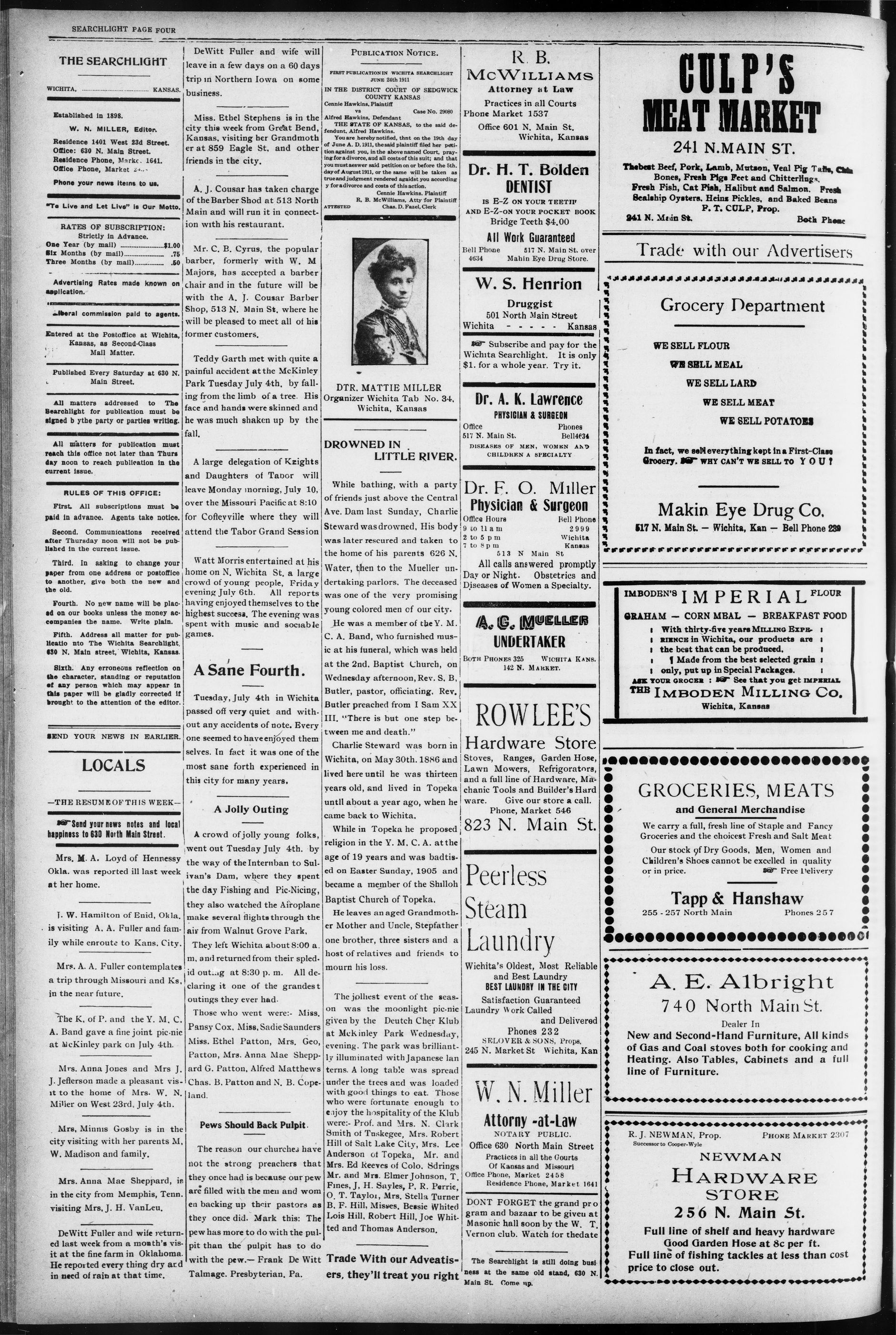
DTR. MATTIE MILLER
Organizer Wichita Tab No. 34,
Wichita, Kansas
DROWNED IN LITTLE RIVER.
While bathing, with a party of friends just above the Central Ave. Dam last Sunday, Charlie Steward was drowned. His body was later rescued and taken to the home of his parents 626 N. Water, then to the Mueller undertaking parlors. The deceased was one of the very promising young colored men of our city.
He was a member of the Y. M. C. A. Band, who furnished music at his funeral, which was held at the 2nd. Baptist Church, on Wednesday afternoon, Rev. S. B, Butler, pastor, officiating. Rev. Butler preached from I Sam XX III. "There is but one step between me and death."
Charlie Steward was born in Wichita, on May 30th.1886 and lived here until he was thirteen years old, and lived in Topeka until about a year ago, when he came back to Wichita. While in Topeka he proposed religion in the Y. M. C. A. at the age of 19 years and was badtised on Easter Sunday, 1905 and became a member of the Shilloh Baptist Church of Topeka.
He leaves an aged Grandmother Mother and Uncle, Stepfather one brother, three sisters and a host of relatives and friends to mourn his loss.
The jollest event of the season was the moonlight picnic given by the Dutch Cher Klub at McKinley Park Wednesday, evening. The park was brilliantly illuminated with Japanese lanterns. A long table was spread under the trees and was loaded with good things to eat. Those who were fortunate enough to enjoy the hospitality of the Klub were: Prof. and Mrs. N. Clark Smith of Tuskegee, Mrs. Robert Hill of Salt Lake City, Mrs. Lee Anderson of Topeka, Mr. and Mrs. Ed Reeves of Colo. Sdrings Mr. and Mrs. Elmer Johnson, T. Fines, J, H. Sayles, P, R. Perrie, O. T. Tayloi, Mrs. Stella Turner B, F. Hill, Misses, Bessie Whited Lois Hill, Robert Hill, Joe Whitted and Thomas Anderson.
Trade With our Adveatisers, they'll treat you right
R.B.
McWILLIAMS
Attorney at Law
Practices in all Courts
Phone Market 1537
Office 601 N. Main St.
Wichita, Kansas
Dr. H. T. Bolden DENTIST
IS E-Z ON YOUR TEETH'
AND E-Z-ON YOUR POCKET BOOK
Bridge Teeth $4,00
All Work Guaranteed
Bell Phone 517 N. Main St. over
4634 Mahin Eye Drug Store.
W. S. Henrion
Druggist
501 North Main Street
Wichita - - - - Kansas
Subscribe and pay for the
Wichita Searchlight. It is only
$1. for a whole year. Try it.
Dr. A. K. Lawrence
PHYSICIAN & SURGEON
Office Phones
517 N. Main St. Bell4634
DISEASES OF MEN, WOMEN AND
CHILDREN A SPECIALTY
Dr. F. O. Miller Physician & Surgeon
Office Hours Bell Phone
9 to 11 a m 2 999
2 to 5 p m Wichita
7 to 8 p m Kansas
513 N Main St
All calls answered promptly
Day or Night. Obstetrics and
Diseases of Women a Specialty.
A. G. MUELLER
UNDERTAKER
BOTH PHONES 325 WICHITA KANS.
142 N. MARKET.
ROWLEE'S
Hardware Store
Stoves, Ranges, Garden Hose,
Lawn Mowers, Refrigorators,
and a full line of Hardware, Ma-
chanic Tools and Builder's Hard
ware. Give our store a call.
823 N. Main St.
Peerless Steam Laundry
Peerless Steam Laundry
Wichita's Oldest, Most Reliable and Best Laundry BEST LAUNDRY IN THE CITY Satisfaction Guaranteed Laundry Work Called and Delivered Phones 232 SELOVER & SONS, Props. 245 N. Market St Wichita, Kan
W. N. Miller
Office 630 North Main Street
Practices in all the Courts
Of Kansas and Missouri
Office Phone, Market 2458
DONT FORGET the grand program and bazaar to be given at Masonic hall soon by the W. T. Vernon club. Watch for thedate
The Searchlight is still doing business at the same old stand, 630 N. Main St. Come up.
CULP'S MEAT MARKET
241 N.MAIN ST.
Thebest Beef, Pork, Lamb, Mutson, Veal
Bones, Fresh Pigs Feet and Chitter
Fresh Fish, Cat Fish, Halibut and Salm
Sealship Oysters, Heinz Pickles, and B
P. T. CULP, Prop.
241 N. Main St.
Trade with our Adv
Beef, Pork, Lamb, Mutson, Veal Pig Talk
Bones, Fresh Pigs Feet and Chitterlings.
Fish, Cat Fish, Halibut and Salmon. F
rip Oysters, Heinz Pickles, and Baked Bee
P. T. CULP, Prop.
Main St. Both P
ade with our Advertis
Thebest Beef, Pork, Lamb, Mutson, Veal Pig Tails, Chin Bones, Fresh Pigs Feet and Chitterlings. Fresh Fish, Cat Fish, Halibut and Salmon. Fresh Sealship Oysters, Heinz Pickles, and Baked Beans P. T. CULP, Prop. 241 N. Main St. Both Phone
Trade with our Advertisers
Grocery Department
WE SELL FLOUR
WE SELL M
WE SELL
WE S
In fact, we sell even
Grocery. WHY o
Makin H
517 N. Main St. - Wich
IMBODEN'S IM P
BRAHAM — CORN M
With thirty-five
RIENCE in Wich
the best that can
Made from
only, put up in
ASK YOUR GROCER : M
THE IMBODEN
Wich
GROCERIES
and Genes
We carry a full, fresh
Groceries and the ch
Our stock of Dry
Children's Shoes can
or in price.
WE SELL FLOUR
WE SELL MEAL
WE SELL LARD
WE SELL MEAT
WE SELL POTATOES
Fact, we sell everything kept in a First-Class grocery. WHY CAN'T WE SELL TO YOU?
Makin Eye Drug Co.
St. Main St. — Wichita, Kan — Bell Phone
GEN'S IMPERIAL FLOUR
MEM — CORN MEAL — BREAKFAST MEAL
With thirty-five years MILLING EXPERIENCE in Wichita, our products are the best that can be produced.
Made from the best selected grain only, put up in Special Packages.
OUR GROCER: See that you get IMPERIAL MBODEN MILLING CO.
Wichita, Kansas
PROCERIES, MEATS
and General Merchandise
carry a full, fresh line of Staple and Fancyeries and the choicest Fresh and Salt Meats. Our stock of Dry Goods, Men, Women and Children's Shoes cannot be excelled in quality at price. Free Delivery
In fact, we sell everything kept in a First-Class Grocery. WHY CAN'T WE SELL TO YOU?
Makin Eye Drug Co.
517 N. Main St. - Wichita, Kan - Bell Phone 289
GRAHAM - CORN MEAL - BREAKFAST FOOD
With thirty-five years MILLING EXPE-
RIENCE in Wichita, our products are
the best that can be produced.
Made from the best selected grain
only, put up in Special Packages.
ASK YOUR GROCER : See that you get IMPERIAL
THE IMBODEN MILLING CO.
Wichita, Kansas
---
We carry a full, fresh line of Staple and Fancy Groceries and the choicest Fresh and Salt Meat Our stock of Dry Goods, Men, Women and Children's Shoes cannot be excelled in quality or in price. Free Delivery
Tapp & Hanshaw
255 - 257 North Ma
A. E.
740 N
New and Second-H
of Gas and Coal sto
Heating. Also Tab
line of Furniture.
A. E. Albrigh
740 North Main St.
Dealer In
Second-Hand Furniture, All kitchens and Coal stoves both for cooking and cooking. Also Tables, Cabinets and all Furniture.
New and Second-Hand Furniture, All kinds of Gas and Coal stoves both for cooking and Heating. Also Tables, Cabinets and a full line of Furniture.
R. J. NEWMAN, Prop.
Successor to Cooper-Wyle
NEW
HAR
ST
256 N
Full line of she
Good Garden
Full line of fishing
price to close out.
NEWMAN
HARDWARE
STORE
256 N. Main St.
All line of shelf and heavy hardware
Good Garden Hose at 8c per ft.
Line of fishing tackles at less than
to close out.
Full line of shelf and heavy hardware Good Garden Hose at 8c per ft. Full line of fishing tackles at less than cost price to close out.
SERACHLIGHT PAGE FIVE
"SECOND
PLEASE
GOOD BREAK
— AND WILL
IT IS AS WHITE
THE OTTO WEISS ALFALFA
are all guaranteed by
Law, Serial No. 134
sas State Law, Reg
It Is The Cheapest and
For Clean Beds and
The
Little W
Restaurant
Meals 20c — S
507 North
Short Orders B
Good Service
Chas. B
Mercha
605 North
First-Class Maki
Cleaning, Pressing, a
ourteous Attention
HILL E
LUMBER
318 West Douglas
Dealers in the best
at the lowest price
Let us est
D
COX
The B
We are exclusive bottlers
Allen's Red Tame Cherry
Red Rock and Elk Ginger
The Cox Bo
Phone 4726
Trade with our
will treat
Excellent
"U-KNIF
FL
It exctls in every resp
pounds of bread per b
WATSON
WICHITA
SECOND TO NONE
PLEASES ALL
GOOD BREAD MAKERS
— AND WILL PLEASE YOU —
IT IS AS WHITE AS SNOW — TRY IT
THE OTTO WEISS ALFALFA STOCK and POULTRY FOR
are all guaranteed under the United States
Law, Serial No. 13415 and under the Kansas
State Law, Register No. 1.
The Cheapest and Best Food on the Mar
Clean Beds and Good Meals, Call
THE
Little Wonder
Restaurant and Hotel
Meals 200 — Short Order at all Hours
507 North Main St.
Short Orders Filled At All House
Good Service is Guaranteed
A. J. Cousar, Prop
Chas. B. PATTON
Merchant Tailor
605 North Main Street
First-Class Making of Men's Garments,
Cleaning, Pressing, and Reparing A Special
Us Attention
Bell Pho
HILL ENGSTRO
LUMBER COMPANY
West Douglas
Phone, Market
Dealers in the best grades of Lumb
at the lowest prices.
Let us estimate your bills
DRINK
COX'S BOTTLE
POP
The Best Made
The exclusive bottlers of Jersey Creme, Dr. P.
Red Tame Cherry, Fan Taz, Grape Ball,
Rock and Elk Ginger Ale.
The Cox Bottling Company
4726 Wichita
me with our advertisers.
will treat you right.
Excellence Counts
THEN USE
U-KNEAD-IT
FLOUR
exctls in every respect, — color, flavor and
sounds of bread per barrel.
MADR BY
WATSON MILL CO
WHITA KAN
GOOD BREAD MAKERS
AND WILL PLEASE YOU
IT IS AS WHITE AS SNOW - TRY IT
THE OTTO WEISS ALFALFA STOCK and POULTRY FOOD
are all guaranteed under the United States
Law, Serial No. 13415 and under the Kansas
State Law, Register No. 1.
It Is The Cheapest and Best Food on the Market
Little Wonder
Restaurant and Hotel
Meals 20c - Short Order at all Hours
507 North Main St.
Short Orders Filled At All House
Good Service is Guaranteed
A. J. Cousar, Prop.
First-Class Making of Men's Garments, Cleaning, Pressing, and Reparing A Specialty
Arteous Attention Bell Phone 3055
HILLENGSTROM
LUMBER COMPANY
318 West Douglas Phone, Market 4980
Dealers in the best grades of Lumber
at the lowest prices.
Let us estimate your bills
We are exclusive bottlers of Jersey Creme, Dr. Pepper,
Allen's Red Tame Cherry, Fan Taz, Grape Ball, Hire's
Red Rock and Elk Ginger Ale. :: :: ::
Trade with our advertisers. They will treat you right.
Excellence Counts
THEN USB
"U-KNEAD-IT"
FLOUR
It exctls in every respect, — color, flavor and
pounds of bread per barrel. MADR BY
WATSON MILL CO.
WICHITA KANSAS
Subscribe For
he Sea
Published
ly $1.00 F
Searchlig
published Every We
$1.00 PER YEAR
Published Every Week
Only $1.00 PER YEAR Only
Murray's Reliable Nerve Balm
Murray's Reliable Antiseptic Salve
Murray, s Reliable Perfumes
These Goods Have No Equal They are pleasing hundreds of people and will please you.
J. H. MURRAY & CO
Sold by Dealers
Wichita — — Kansas
STIRLING
CLOTHES
MADE IN WICHITA
Material Fit Style Workmanship
GUARANTEED
:—: YOUR TRADE SOLICITED :—:
If we only tailored for a few dozen men, we would have to charge each an exorbitant price. We would have to take large profits from the few, instead of a very small one from each or our mang customers.
This is why we can put into a suit for you at $15,00 to $35. what the other fellows charges you from $25,00 to $60,00 for.
Stirling Woolen Mills Co.
TAILORS
215 N. Main St. Wichita, Kas.
For Everything In
Building
Material
SEE
BOTH PHONE 496--
J.H. TURNER
WICHITA, KANS.
533 ro 547 WEST DOUGLAS
METZ'S
LUMBER
IS IT?
Largest yard under shed in the state.
Best grade of lumber to select from.
Choicest finishings, posts, shingles and everything in the lumber line.
OUR PRICES ARE RIGHT
Low and Easy to Meet. Let us figure next Lumber Bill. Yards and Office 3rd and Main Streets.
The Negro women of tomorrow must excel the one of yesterday in culture, domestic economy, and ability to do. Will she? Will she? Yes She must or the race must be forever dammed.
The ice man and the hot weather man has got humanity at their mercy these days.
They'll Treat You Right
TRADE WITH OUR ADVERTISERS
They'll Treat You Right
Send your job work to
our Job Department.
1920
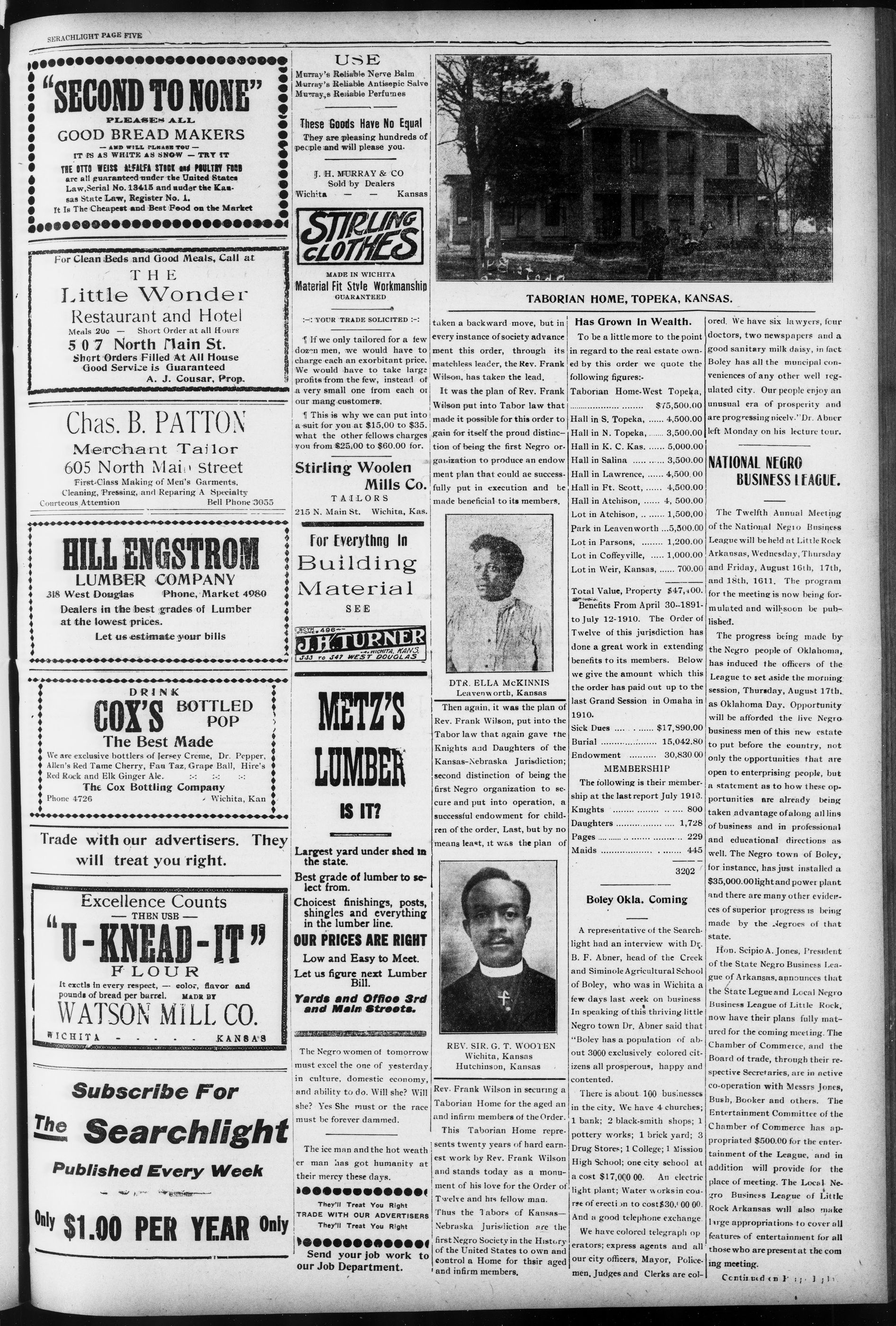
TABORIAN HOME, TOPEKA, KANSAS.
taken a backward move, but in every instance of society advancement this order, through its matchless leader, the Rev. Frank Wilson, has taken the lead. It was the plan of Rev. Frank Wilson put into Tabor law that made it possible for this order to gain for itself the proud distinction of being the first Negro organization to produce an endowment plan that could ae successfully put in execution and be made beneficial to its members.
DTR. ELLA McKINNIS
Leavenworth, Kansas
Then again, it was the plan of Rev. Frank Wilson, put into the Tabor law that again gave the Knights and Daughters of the Kansas-Nebraska Jurisdiction; second distinction of being the first Negro organization to secure and put into operation, a successful endowment for children of the order. Last, but by no means least, it was the plan of
P
REV. SIR. G. T. WOOTEN
Wichita, Kansas
Hutchinson, Kansas
Rev. Frank Wilson in securing a
Taborian Home for the aged an
and infirm members of the Order.
presents twenty years of hard earnest work by Rev. Frank Wilson and stands today as a monument of his love for the Order of Twelve and hrs fellow man. Thus the Labors of Kansas—Nebraska Jurisdiction are the first Negro Society in the History of the United States to own and control a Home for thsir aged and infirm members.
To be a little more to the point in regard to the real estate owned by this order we quote the following figures:-
Taborian Home-West Topeka,
..... $75,500.00
Hall in S. Topeka, ..... 4,500.00
Hall in N. Topeka, ..... 3,500.00
Hall in K. C. Kas. ..... 5,000.00
Hall in Salina ..... 3,500.00
Hall in Lawrence, ..... 4,500.00
Hall in Ft. Scott, ..... 4,500.00
Hall in Atchison, ..... 4, 500.00
Lot in Atchison, ..... 1,500.00
Park in Leavenworth ..5,500.00
Lot in Parsons, ..... 1,200.00
Lot in Coffeyville, ..... 1,000.00
Lot in Weir, Kansas, ..... 700.00
Total Value, Property $47,400.
Benefits From April 30--1891-
to July 12-1910. The Order of
Twelve of this jurisdiction has
done a great work in extending
benefits to its members. Below
we give the amount which this
the order has paid out up to the
last Grand Session in Omaha in
1910.
Sick Dues ..... $17,890.00
Burial ..... 15,042.80
Endowment ..... 30,830.00
MEMBERSHIP
The following is their membership at the last report July 1910.
Knights ..... 800
Daughters ..... 1,728
Pages ..... 229
Maids ..... 445
Boley Okla. Coming
A representative of the Searchlight had an interview with Dr. B. F. Abner, head of the Creek and Siminole Agricultural School of Boley, who was in Wichita a few days last week on business. In speaking of this thriving little Negro town Dr. Abner said that "Boley has a population of about 3000 exclusively colored citizens all prosperous, happy and contented.
There is about 100 businesses in the city. We have 4 churches; 1 bank; 2 black-smith shops; 1 pottery works; 1 brick yard; 3 Drug Stores; 1 College; 1 Mission High School; one city school at a cost $17,000 00. An electric light plant; Water works in course of erection to cost $30,000 00. And a good telephone exchange.
We have colored telegraph operators; express agents and all our city officers, Mayor, Policemen, Judges and Clerks are col-
ored. We have six lawyers, four doctors, two newspapers and a good sanitary milk daisy, in fact Boley has all the municipal conveniences of any other well regulated city. Our people enjoy an unusual era of prosperity and are progressing nicely."Dr. Abner left Monday on his lecture tour.
NATIONAL NEGRO BUSINESS LEAGUE.
The Twelfth Annual Meeting of the National Negro Business League will be held at Little Rock Arkansas, Wednesday, Thursday and Friday, August 16th, 17th, and 18th, 1611. The program for the meeting is now being formulated and will soon be published.
The progress being made by the Negro people of Oklahoma, has induced the officers of the League to set aside the morning session, Thursday, August 17th, as Oklahoma Day. Opportunity will be afforded the live Negro business men of this new estate to put before the country, not only the opportunities that are open to enterprising people, but a statement as to how these opportunities are already being taken advantage of along all lines of business and in professional and educational directions as well. The Negro town of Boley, for instance, has just installed a $35,000.00 light and power plant and there are many other evidences of superior progress is being made by the Negroes of that state.
Hon. Scipio A. Jones, President of the State Negro Business League of Arkansas, announces that the State Legue and Local Negro Business League of Little Rock, now have their plans fully matured for the coming meeting. The Chamber of Commerce, and the Board of trade, through their respective Secretaries, are in active co-operation with Messrs Jones, Bush, Booker and others. The Entertainment Committee of the Chamber of Commerce has appropriated $500.00 for the entertainment of the League, and in addition will provide for the place of meeting. The Local Negro Business League of Little Rock Arkansas will also make large appropriations to cover all features of entertainment for all those who are present at the coming meeting.
Continued on P ; ; I ; ;
CHICHEN ITZA, THE HOLY CITY OF THE ITZAS BY SYLVANUS G. MORLEY
ONG before the discovery of America there flourished in southern Mexico, Guatemala, and parts of Honduras a great civilization, which has been called the Maya. It may be said at the outset without exaggeration that this civilization had reached a height equalled by no other people of the western hemisphere prior to the coming of the white man. In architecture in sculpture, and in printing the Mayas excelled. Their priests were astronomers of no mean ability, hay-
ing observed and recorded without the aid of instruments of precision such as are known to us the lengths of the Solar and Venus years, and probably the lengths of the Mercury and Mars years. In addition to this they had developed a calendar system and perfected a chronology which in some of its characteristics was superior to our own.
The the ancient glory of this people had long since departed when Hernando Cortez first came in contact with them on the coast of Yucatan in 1519. Their star had set. Their greatest cities had been abandoned and lay in ruins, and their country was prostrated by the quarrels of a score or more of petty independent chieftains, each of whom was waging war on the other. Even the memory of the older cities, of their culture, such as Palenque, Copan and Quinquia, for example, seems to have passed from the mind of men, their former existence forgotten. Famine, pestilence and internecine strife are al said to have been contributory causes to the decay and eclipse which overtook this brilliant aboriginal civilization several centuries before the Spanish first set foot in the new world.
ing observed and recorded without the aid of instruments of precision such as are known to us the lengths of the Solar and Venus years, and probably the lengths of the Mercury and Mars years. In addition to this they had developed a calendar system and perfected a chronology which in some of its characteristics was superior to our own.
The ancient glory of this people had long since departed when Hernando Cortez first came in contact with them on the coast of Yucatan in 1519. Their star had set. Their greatest cities had been abandoned and lay in ruins, and their country was prostrated by the quarrels of a score or more of petty independent chieftains, each of whom was waging war on the other. Even the memory of the older cities, of their culture, such as Palenque, Copan and Quinquila, for example, seems to have passed from the mind of men, their former existence forgotten. Famine, pestilence and internecine strife are al said to have been contributory causes to the decay and eclipse which overtook this brilliant aboriginal civilization several centuries before the Span-
THE OLD TOWN OF DART
Yucatan is a vast limestone formation with little or no surface water. One may travel for miles and miles and never cross river or brook, or even chance upon a modest spring. Indeed, in the northern part, where most of the great ruined cities are located, water is fully 70 feet below the surface of the ground. The modern inhabitants overcome this difficulty by means of wells and windmills, which afford the only source of water supply during the dry season (December to June) excepting what little rain water may have been caught during the rainy months and stored in clisterns. But of wells and windmills the ancient Mayas knew nothing, and, generally speaking, had it not been for the great natural reservoirs which nature had scattered here and there over the country. Yucatan never could have been colonized.
These great natural wells, or, as the Mayas call them, cenotes, are found all over Yucatan. They are usually about 150 feet in diameter, or sometimes more, and about 70 feet in depth to the level of the water. Geologists say that these cenotes are places where the limestone crust, which everywhere covers the surface of Yucatan, has become weakened by the washing of subterranean waters and has collapsed of its own weight, forming great sink holes or natural wells on a large scale. And now it is clear why the ancient inhabitants of Chichen Itza so named their city. In the course of their wanderings, the general trend of which was northward, the Itzas, entering Yucatan from the south, finally reached the two cenotes, around which Chichen Itza later was built, but which then was probably nothing but wilderness. Here the striking contrast afforded by such an abundance of water in a country so generally parched could not fail to have attracted their attention. The place must have seemed to the thirsty wanderers a Godgiven site for the location of their new home. Right of discovery they claimed the place, and to the city which grew up around the cenotes they gave the name of Chichen Itza, "The Mouth of the Wells of the Itzas."
The two cenotes at Chichen Itza have been known by the Mayas from time immemorial as the Cenote Grande and the Cenote Sacra or the large Cenote and the Sacren Cenote, respectively. The first of these only in former times was used for the water supply of the city, the Sacred Cenote being reserved for religious use exclusively. It is the latter, however, and the religious observances held in connection with it, which gave the city its holy character. From far and near all over Yucatan, and probably even from points more distant, pilgrimages were made to the Sacred Cenote. It seems to have been the most holy shrine of the Maya people, comparable only in importance to the Mohammed Mecca and the Christian Jerusalem. In time of drought offerings of all kinds were thrown into it—treasures, and in cases of extremity even living human sacrifices.
Chichen Itza today is somewhat changed in appearance from the time when pilgrims came from far and near to appease with human sacrifices the wrath of offended deities. Now the city lies buried in a thick jungle, which has steadily won its way into the very heart of the holy place. Colonnades have been overthrown and pyramids covered with trees to their summit; courts have been lost in a tangle of thorn and creepers; and palaces stripped of their sculptured embellishment. Desolation has spread everywhere in the wake of the encroaching vegetation.
---
6 L
Probably the largest, and certainly the most magnificent, of the ruined cities which the Spanish conquerors found on their arrival in Yucatan was Chichen Itza, around which even in its desolation there still cluster a thousand traditions of former sanctity and splendor. The name Chichen Itza is Maya, and means Chimouth, Chen-wells and Itza, the name of the Maya tribe, who lived in the neighborhood of the place. "The Mouth of the Wells of the Itzas" therefore is the meaning of the name; nor could a more appropriate one have been applied to the place by any people. The whole peninsula of
THE CASTILLO OR CASTLE
To visit the ancient city now, one jolts for 15 long and weary miles in a two-wheeled covered cart drawn by three mules over the roughest kind of a highway imaginable. This present inconvenience fortunately is not to be one of long standing. A new and straight road is about to be built and an automobile service to the ruins probably established, which will shorten the present length of the trip from four hours to about half an hour. Now, how ever, this ride from Citas, the nearest railroad point, seems interminable. The road, so called by courtesy only, winds through the impenetrable bush, which everywhere in the natural state covers northern Yucatan. Through this the creaking cart finds a dubious way mile after mile until every muscle in one's body groans an agonized protest. Finally, when it seems that the limit of physical endurance has been reached, the cart suddenly lurches around a sharp turn in the road and as if by magic the lofty Castillo flashes into view, towering high above the plain and the rest of the city in its lonely magnificence.
This imposing structure, the highest in Yucatan, rises 78 feet above the plain. The pyramid on which the temple stands is 195 feet long on each side at the base and covers about an acre of ground.
The Castillo would seem to have been the center of the ancient city, and probably its chief sanctuary. To the north lies the Sacred Cenote and the causeway, just mentioned, leading to it. On the east is a vast group of buildings, colonnades, courts and pyramids. "The City of a Thousand Columns," as some one has picturesquely described it. Due west is the group of structures known as the Ball Court. To the south for half a mile or more, scattered through the jungle, are pyramids, courts, temples and palaces. The central location of the Castillo with reference to all of these, as well as its great size and commanding height, argue strongly that it was the chief sanctuary of the Holy City.
Another interesting group of structures at Chichen Itza, perhaps slightly less sacred in character than the Castillo, is the so-called "Ball Court," mentioned above as lying just west of the Castillo. This group is composed of two parallel masses of solid masonry, each 272 feet long, 27 feet high and 16 feet wide, placed 119 feet apart from each other. These two great walls, for such they really are, form a court nearly 300 feet long by 119 feet wide. High on the side of each at the middle point from end to end there is attached a stone ring four feet in diameter with a hole through it. These rings are fastened to their respective walls by tenons of stone, and are so placed that the surface of each is perpendicular to the vertical face of the wall. The arrangement is very similar to the baskets in our modern game of basket ball, except that at Chichen Itza the "baskets" have their openings perpendicular to the ground, while in our game the openings in the baskets are parallel with the ground. To make a basket at the Chichen Itza court a somewhat horizontal throw, as in baseball, was necessary, while nowadays it is a toss that wins the goal.
At the open ends of the court formed by these two walls stand temples, which in effect inclose the area, definitely marking its boundaries. On top of the east wall, at its southern end, there is a beautiful temple, which affords a commanding view of the entire court. This has been called "The House of the Tigers," because of a frieze of stalking tigers, which is sculptured in alto-relieve around the
PANORAMA OF THE BUILDS OF CHICHEN ITZA.
outside of the building. This temple contains also on the walls of an interior room, an elaborate mural painting representing an attack by some enemy upon a city, perhaps Chichen Ita itself, and its defense by the inhabitants. Some of the poses taken by the combatants in the conflict are extremely realistic; such as in the throwing of javelins, the swinging of war clubs, and the like. This bit of mural decoration in The House of The Tigers at Chichen Ita probably marks the high-water mark of aboriginal painting in the Western Hemisphere; at least it is superior to everything else that has survived.
The identification of these two great walls and the temples associated with them, as a ball court, rests on firm historic foundation. When the Spanish first came to Mexico they found the natives playing a game of ball, which was of sufficient importance to have a special court or ground set apart for its exclusive use. Several of the early Spanish writers have described the game in some detail, and all agree as to its having played an important part in the life of the people. One chronicler has it that the object of the game was to strike the ball so that it would pass through the opening in the stone ring above mentioned as an important feature of the Chichen Itza court. He adds that the feat was one of considerable dexterity, since the ball could not be hit with the hands, but that the hips or other parts of the body had to be used instead. This rule of the game very materially increased the difficulty in making a "Maya basket;" so much so, in fact, we are told, that the lucky player making this winning stroke had forfeit to him as a reward for his skill all the clothing and ornaments of the spectators. At such times, the chronicler concludes, the spectators were wont to scatter in all directions without loss of time, hoping thus to escape paying the penalty, but that the friends of the lucky player immediately gave chase and endeavored to exact the full forfeit.
Although the name Ball Court has been given to this group of temples at Chichen Itza, it should not be supposed on that account, that this great court was built primarily for sport. Such an explanation of its fundamental purpose is incompatible with any conception which the American aborigine ever seems to have entertained. To the Itza people the chief function of their Ball Court was doubtless a religious one. Games played there, if not actually held in connection with religious festivals, were at least sufficiently religious in their meaning as to completely overshadow the element of sport as we understand the term. That a game was played in which competition and skill entered in cannot be doubted in the face of contemporaneous evidence, and to this extent perhaps the Mexican Ball Courts were athletic fields; but it must not be forgotten for a moment that its true significance was religious, and that the games which were played there probably were held only in connection with religious festivals. It is not improbable, however, that the Aztecs were breaking away from the religious feature of sport at the time of the Spanish Conquest, but that "The Holy Men of the Itzas," as the people of Chichen Itza are sometimes called in the early manuscripts, had taken any such a radical step is little short of inconceivable, so religious in character was the whole Maya civilization.
To the east of the Castillo lie a great group of courts, pyramids and colonnades, "The City of a Thousand Columns," already mentioned.
Here desolation is widespread. It seems as though an earthquake must have shaken the Itza capital at some time.
Row after row of columns have been overturned and now lie prostrate within a foot of their original positions.
Perhaps a capital or a drum here and there is broken, but for the
most part the stones lie just where they fell. In its entirety this section of the city must have presented an imposing appearance, being literally a forest of columns surrounding and connecting the various courts. As to the use of these great colonnades, tradition and history are equally silent. Some think that they were the law courts of the ancient city, where justice was administered and punishment meted out. Others say that they were the market places, where the produce of the surrounding country was bought and sold. This latter explanation has one strong recommendation in its favor in that the descendants of the builders of the ancient city of Yucatan, the present Maya Indians, still hold their markets under the portals surrounding the plazas in the towns and villages throughout the country today.
South of the Cenote Grande there are a number of well-preserved structures, most of them presenting beautifully sculptured facades. To these fanciful names have been given, which probably have little or nothing to do with the original uses of the buildings. One large structure, for example, has been called "The Akabtzib." The name is Maya and means "The House of the Dark Writing." This building was so called, because of the fact that over one of its interior doorways there is a lintel inscribed with hieroglyphs. This lintel is so placed that the hieroglyphics can only be seen by artificial light, hence the name, "The House of the Dark Writing." Nearby is a round tower, with but one exception the only structure of its kind in the Maya area. This is called "The Caraco." Caracol is the Spanish word for small, and since the interior circular corridor and spiral stairway of this structure bear some remote resemblance to the convolutions of a small shell, the name was applied to the building. The Manjos (Spanish for monastery) is perhaps the most beautiful building at Chichen Ita. It is composite, showing three different periods of construction.
The above are only a few of the many structures at Chichen Itza. But in all directions for several miles the brush is strewn with rulns. Crambling walls and jungle-ridden courts are to be encountered on every side; disintegration so far advanced that these once splendid palaces and temples are now but little more than shupeless mounds of fallen masonry. The total area covered by rulns which may be assigned to this center of primitive population has been estimated by some as high as ten square miles. That larger Maya cities yet remain to be discovered now seem highly improbable so thoroughly has the general exploration of the area been done. Consequently we may affirm with but little hesitation that "The Holy City of the Itzas" was the largest and most important of the Maya civilization and probably of aboriginal America as well.
THE SIGH FOR EISURB.
Lives there the man who has not sighed for leisure? And lives there the man who in his more sober moments, has not been honestly glad that he must work? Human nature, which sweetens under toll, sours in leisure. And it is by no means sure that the fall from innocence which first brought work into the world "and all our woe" was not bringing salvation disguised as labor. Faithfulness will dignify and beautify even drudgery; no matter what the work is, provided it is honest, if it is done well it commands our instinctive respect. Besides, if we did not all have to work so hard to keep alive the jails would have standing room only.
The KITCHEN GABINET
ENJOY your goods as if your death were near
Save them as if 'twere distant many
year:
Spain: spending, he thy wished, seen,
In keeping ever to the golden mean.
Breaded Tongue, Tomato Sauce. Cut thick slices of cold boiled corned beef tongue. Season with pepper and salt, if needed. Brush over with beaten egg, roll in fine bread crumbs and saute in hot butter or other fat. Serve with tomato sauce.
Cheese in any form is very nutritious, but is best uncooked, as to digestibility. There are many ways of using cheese in dishes to add to the food content. Grated cheese adds to a dich of creamed potatoes or escaloped dishes of almost any vegetable. It is especially good with creamed celery.
Cheese Cutlets.—Melt three tablespoonfuls of butter in a sauce pan, add two tablespoonfuls of cornstarch mixed with one and a half tablespoonfuls of flour. Cook until smooth; add gradually two-thirds of a cup of milk, stir and cook ten minutes. Add the yolks of two eggs slightly beaten, a cake of cream cheese cut in pieces, half a teaspoonful each of salt and Worcestershire sauce, a dash of tabasco and a half a cup of American cheese. Mix, but do not let it melt. Pour into a deep pie plate to cool When firm, cut in pieces, dip in egg, roll in crumbs and fry in deep fat.
Chipped Beef With Celery.—Pour hot water over half a pound of chipped beef, if too salt, and drain quickly. Melt two tablespoonfuls of butter, add a cup of celery in small pieces; stir until the celery is delicately browned.
Cook a tablespoonful each of flour and cornstarch in a tablespoonful of butter, add a cup of milk, salt and pepper to taste and combine the two mixtures. Serve on triangles of toast. Salted Almond Soup.—Take half a pound of blanched salted almonds. Put them through a meat chopper and grind like coarse meal. Cook two and a half tablespoonfuls of cornstarch and two tablespoonfuls of butter until thick; add a pint of clear veal broth, then add the almonds alternately with a quart of veal broth and a cup of cream. Season with salt and white pepper. Serve in cups with whipped cream on top of each cup.
Nellie Maxwell.
The KITCHEN
CABINET
WHO would long for peach and
pear,
Wealth of grape the hills adorning.
While the cherries, ripe and rare,
Fling their graces to the morning.
Crimson cherries everywhere.
8OME FROZEN DISHES.
There are no desserts that are so universally liked as the frozen one. Here are a few to try:
Raspberry Water Ice.—Take one and a half pints of raspberries, one orange, one lemon and a pound of sugar cooked with two cups of water for ten minutes. Add the grated rind of the lemon and orange and let it remain in the syrup until quite cold, then add the raspberries, also the strained orange and lemon juice. Freeze until firm.
Ginger Bombe.—Prepare a custard with a cupful of milk, three tablespoonfuls of sugar and the rind of a lemon. When the milk boils, pour it over the yolks of four eggs and a teaspoonful of ground ginger, stir until it thickens, add the juice of a lemon and freeze. Add a cup of whipped cream and line the mould with preserved ginger, cut in pieces.
Peach Ice Cream.—Take a quart of cream, add three-quarters of a pound of sugar, one quart of ripe peaches, half a teaspoonful of almond extract. Put half of the cream on to scald, add the sugar, then take from the fire and add the remaining cream; when cold freeze. The peaches are pared and mashed and then put through a steve flavor with a teaspoonful of almond extract and add to the frozen cream, stir for a few minutes, then let stand to ripen.
Strawberry Ice Cream.—There is no more delicious dessert than a strawberry ice cream if carefully strained to remove the seeds. Crush a quart of berries and sweeten with a cup of sugar, strain the juice and pulp through a sieve, then through a cloth, add a pint of cream and freeze. A tablespoonful of lemon juice adds to its palatability as well as making it of a deeper color.
of a deeper con-
Banana Ice Cream—Peel and put
through a sieve six bananas. Make a
custard and add the bananas when it
is cool; add a tablespoonful of each
lemon and orange juice. Stir in a half
cupful of cream, and freeze.
Nellie Marvell.
Some men are like peanuts, the be-
ter for a good roasting.
IN BUGGVILLE.
Willie Fly—Heavens! I'm caught in a cyclone!
A POOR APPETITE
QUICKLY
REGULATED
Loss of Appetite always means—stomach weakness—and this requires
Hostetter's
Stomach Bitters
immediately. It tones, strengthens and invigorates the entire digestive system. Try it and see for yourself.
YOU'LL FIND IT EXCELLENT
A New Sensation.
Little Jean had visited one of the large summer amusement parks for the first time, and with the courage possessed only by those girls whose Playmates are boys and girls older than themselves, she had not hesitated, when invited, to take a ride on one of the "thrillers" that abound in such places.
"To her mother, on her return from the park, she confided the emotions she had experienced as she swept round the curves of the "figure eight" with her elder brothers.
"Mamma," she said, "when I went round those awful turns so fast I felt just as if I had freckles on my "omach!"—Youth's Companion.
Why He Quit.
"Haven't I the privilege of making suggestions to the man fixing the lawn?" she asked, with tears in her voice.
"Why, certainly," he assured me.
"Well, just because I made a suggestion to him he threw all his tools in the wheelbarrow in an angry maner and went away without saying a word."
"Why, what had you said to make him act like that?"
"I just asked him to plant a few nice dandelions in the lawn."
A Quaint Thought
Miss Geraldine Farrar, seated in her deck chair on the George Washington, regarded a half-dozen urchins playing on the sunny deck, and then said with a pensive smile: "I often wonder, considering what charming things children are, where all the queer old men come from!" SPOHN'S DISTEMPER CURE will cure any possible case of DISTEMPER, PINK FINK, and the like among horses of all ages, and prevents all others in the same stance of having the disease. Also cures chicken blood, added to distemper. Any good druggist can supply you, or send to mrs. 50 cents and $1.00 a bottle. Agents wanted. Free book. Spohn Medical Co. Contagious Diseases, Goshen, Ind.
In the Future
"How did you get your start in life?"
"I got a flying start; I was born in an airship."
Smokers find Lewis' Single Binder 50 cigar better quality than most 100 cigars.
Many a man who is his own master might better be serving some other.
To Get
Its Beneficial Effects
Always Buy the Genuine
SYRUP of FIGS
and
ELIXIR of SENNA
manufactured by the
CALIFORNIA FIG SYRUP CO.
Sold by all leading
Druggists
One Size Only, 50¢ a Bottle
---
Jehovah's Suffering Servant
Sunday School Lesson for July 9, 1911
Specially Arranged for This Paper
LESSON TEXT—Isaiah 52:13; 53:12.
MEMORY VERSES—53:4-6.
GOLDEN TEXT—"The Lord hath laid
on him the iniquity of us all."-Isa. 53:6.
The lesson is from the second part of
the Book of Isaiah.
Whenever written it belongs to the time
of the exile, just before the return.
It brought hope, inspiration, instruction,
life, and light in the darkest period in
the history of Israel.
God's peculiar people were in exile among heathen populations. Their homeland, Palestine, had been devastated. Jerusalem lay in ashes. The temple was a heap of ruins. The nation was like the stump of a mighty tree which had been cut down. The tree had been cut down because it refused to bear the good fruit for which God had planted it. But in captivity the people had been learning their lesson, and the time had come when it was possible for a new shoot to spring up from the barren stump, and a renewed nation to take up its appointed mission. But in order to do this, the nation must be made to see clearly what they must be and do, and the deepest motives toward this end be inspired within them. All this is a parable for the world.
It throws no little light on our lesson to realize its relation to the prophecy as a whole. According to all critics the whole lesson really belongs to the fifty-third chapter of Isalah, the fifty-second ending at the twelfth verse. The prophecy consists of 27 chapters, of which the fifty-third is the central one, making the whole prophecy to consist of three sections. First, the first thirteen chapters are a trumpet call to the captive Isrealites who have been "hanging their harps on the willows," unable to "sing the songs of Zion," to awake to faith in God, and obedience and loyalty to him, and to be prepared for their deliverance. Second: Chapter 53 presents the means by which the redemption can be accomplished, the heroic service of his people, and the supreme self-sacrificing love of his son. Third: The succeeding thirteen chapters present the results of the redeeming nation, and the redeemed world.
The service of God was a commission to witness and prophesy for God upon earth." Israel was "elected not to salvation, but to service," or rather as in the case of any individual, the nation was elected to salvation that it might be of service. It was necessary that the "servant" who was to carry out God's purpose of saving the world should be a nation, from the condition of the ancient world. Of all possible combinations of men the nation was the only form which in the ancient world stood a chance of surviving in the struggle for existence." The servant of God was the nation of Israel.
Jesus Christ did God's service for the world's redemption by bearing the sorrows and sins of man. His sufferings were not because he himself had done wrong, but in order that he might save us from them. He bore them on his heart and sympathy. He bore them away by his healing power. He bore them as the martyr and the hero suffers that he may save the oppressed and the wronged and persecuted from their sufferings. He bore them away by transforming them into character. He bore them by giving his life for our sins, so that by removing sin he removed most of the griefs of man. Christianity has been the chief power in removing the griefs and sorrows of mankind.
The prophet foresees these things fulfilled in Jesus Christ. The picture in these verses is almost a photograph of what took place five hundred years later. He was oppressed, his sufferings were unjustly inflicted on him. Read the story of his trial. He opened not his mouth in protest. He submitted to the wrong.
Jesus was put to death with the wicked on the cross, and they thought to bury him in a criminal's grave. They appointed his grave with the wicked, but by a striking providence the same authority gave permission to a rich man, Joseph of Arimathea, who provided him with an honorable burial in his own rock-hewn tomb.
Yet it pleased the Lord because he saw the good to be gained. He shall see his seed, his spiritual descendants, filled with his spirit and carrying out his plans. He shall prolong his days. He rose from the dead, ascended to heaven, and is the everlasting leader and king. Of all kings he is the most glorious. Of all kingdoms his is the largest, noblest, best beyond all compare.
This far-off vision of Jesus, and of the redeemed world, is one of the strongest proofs of a revelation from God. Professor Ramsay declares that the Bible is unique among ancient religions in that "to the Hebrew prophets, and to them alone, the better age lay always in future."
"The best is yet to be,
The last of life for which the first was made."
We see in this lesson the one source of power for saving man, and transforming the world. The path of unselfishness is the path to power. The business of all followers of Jesus is to be servants of Jehovah, to do as far as in them lies the same kind of service that Jesus did.
Those who discourage us the most in an undertaking are the first to tell us "I knew you would succeed," when we have attained success.
Death Lurks In A Weak Heart IF You're is fluttering or weak, use "RENOVINE." Made by Van Vieet-Mansfield Drug Co., Memphis, Tenn. Price $1.00
OWES HER HEALTH
To Lydia E. Pinkham's Vegetable Compound
Scottville, Mich.—"I want to tell you how much good Lydia E. Pinkham's Vegetable Compound and Sanative Wash have done me, I live on a farm and have worked very hard. I am forty-five years old, and am the mother of thirteen children. Many people think it strange that I am not broken down with hard work and the care of my fam-ily, but I tell them of my good friend, your Vegetable Compound, and that there will be no backache and bearing down pains for them if they will take it as I have. I am scarcely ever without it in the house.
"I will say also that I think there is no better medicine to be found for young girls to build them up and make them strong and well. My eldest daughter has taken Lydia E. Pinkham's Vegetable Compound for painful periods and irregularity, and it has always helped her.
"I am always ready and willing to speak a good word for the Lydia E. Pinkham's Remedies. I tell every one I meet that I owe my health and happiness to these wonderful medicines."
—Mrs. J. G. JOENSON, Scottville, Mich., R.F.D. 3.
Lydia E. Pinkham's Vegetable Compound, made from native roots and herbs, contains no narcotics or harmful drugs, and to-day holds the record for the largest number of actual cures of female diseases.
HADN'T SEEN IT SINCE.
She—You ought to see that man in evening clothes.
He—I'd like to; he borrowed my dress suit three months ago.
BABY'S HAIR ALL CAME OUT
"When my first baby was six months old he broke out on his head with little bumps. They would dry up and leave a scale. Then it would break out again and it spread all over his head. All the hair came out and his head was scaly all over. Then his face broke out all over in red bumps and it kept spreading until it was on his hands and arms. I bought several boxes of ointment, gave him blood medicine, and had two doctors to treat him, but he got worse all the time. He had it about six months when a friend told me about Cuticura. I sent and got a bottle of Cuticura Resolvent, a cake of Cuticura Soap and a box of Cuticura Ointment. In three days after using them he began to improve. He began to take long naps and to stop scratching his head. After taking two bottles of Resolvent, two boxes of Ointment and three cakes of Soap he was sound and well, and never had any breaking out of any kind. His hair came out in little curls all over his head. I don't think anything else would have cured him except Cuticura.
"I have bought Cuticura Ointment and Soap several times since to use for cuts and sores and have never known them to fail to cure what I put them on. I think Cuticura is a great remedy and would advise any one to use it. Cuticura Soap is the best that I have ever used for toilet purposes." (Signed) Mrs. F. E. Harmon, R. F. D. 2, Atoka, Tenn., Sept. 10, 1910.
The Urgent Need.
She (flattering with eyes and voice)
—Arthur, dear, I find that we still need a few things to make our little household more serviceable.
He—What one thing, perhaps?
She—Well, for instance, we need a new hat for me.—Harper's Bazar.
TO DRIVE OUT MALARIA AND BUILD UP THE SYSTEM
Take the Old Standard GROVE'S TASTELESS CHILL TONIC. You know what you are taking, and the system is showing it is simply Quinine and iron in a tasteless form. The Quinine drives out the malaria and the builds up the system. Sold by all for $20.
Hopeless.
"Why don't you get in line for Miss Hattle's favor?"
"Humph! That line's busy."
MADE BANK ACCOUNT GOOD
Why Uncle Reuben Could Not Meet Debt He Acknowledged as an Obligation.
Uncle Reuben, the village whitewasher and man of all work, was a frequent borrower of small sums from his neighbor, Colonel Arkwright, and as a rule he repaid these little debts at the appointed time; but on one occasion, when he had been accommodated with a loan of two dollars and a half, which he promised to return in a few days, he allowed two or three weeks to pass without making any mention of his indebtedness, and in fact, seemed to avoid his creditor. But one morning the colonel unexpectedly encountered him at the postoffice.
"Hello, Uncle Rube! Didn't you borrow a little money from me several weeks ago?"
"Dat's right, cunnel," said the old man. "I sholly did."
"You told me you'd pay it back in three or four days. Have you had bad luck?"
"No, suh," responded Uncle Reuben. "T'll tell you how it was, cunnel. I lacked jes' two dollars an' a half o' havin' ten dollars to put in de savin' bank, an' I used it fo' dat. Hit's all right, cunnel. I won't fo'git it."—Youth's Companion.
Important to Mother
Examine carefully every bottle of CASTORIA, a safe and sure remedy for infants and children, and see that it
Bears the
Signature of
Chat H. Fletcher
In Use For Over 30 Years.
Children Cry for Fletcher's Castoria
In Eden.
The Serpent—What's Adam so grouchy about today?
The Ape—Oh, he says that the arrival of woman means that all his plans for universal peace have been knocked in the head for good.—Puck.
In Golf.
"Is your ball over here?"
"Is it in a hole?"
"Yes."
"A deep hole?"
"Yes."
"With slightly overhanging banks so you can't possibly get at it?"
"Yes."
"Then it's my ball, all right."
THE TRUTH ABOUT BLUING.
Talk No. 10.
Be thrifty on this little thing. Don't accept water for bluing. Think of it, a little dab of bluing in a large bottle of water. Give me 10 cents. Well I guess not.
Buy RED CROSS BALL BLUE. Best bluing value in the whole world for the consumer. Makes the whole family smile. Large packages. AT YOUR GROCERS.
Some Aviation Records.
Czar Ferdinand of Bulgaria is the first crowned head who has made an aeroplane flight. The aviator who took him up is the first man who ever was knighted in midair. Prince Henry of Prussia is the first professional aviator of royal rank. Mr. Roosevelt is the first prominent statesman to have made an ascension in an aeroplane. Arthur J. Balfour is the second.
Heathen Nations Invent Nothing.
Bishop Thoburn, who has been a missionary in India for fifty years, and knows India better than any other living American, says: "If you visit the patent office at Washington you will see six hundred improvements on the plow. India has not invented one improvement on the toothpick in two thousand years. The nations without God have no inventive faculty. They are almost universally the savage, unenlightened nations of the earth."
Worrying Happiness
The bishop of Manchester, speaking at a meeting at Church house, Westminster, said the secret of happiness was to have a sufficient multitude of worries. The man who had only one worry, a blind that would not be pulled up straight by the servant, or a coal scuttle the bottom of which was always coming out, found his way to the lunatic asylum, but the man who had no time to dwell upon his worries because he had to go from one to another, and back again and round and round like a squirrel in a cage, could be a perfectly happy man.
With Emphasis.
Mistress (hastily sticking a finger into either ear)—Kittle, for heaven's sake! what does that frightful noise and profanity in the kitchen mean? Kittle—Oh, that's notin', ma'am! It's on'y cook rejectin' a propos' av marrtj from the ashman!—Harper's Bazar.
Bribery.
Mrs. N.—I don't remember his name. He gave me his seat in the street car last week.
Mrs. Winslow's Soothing Syrup for Children teething, softens the gums, reduces inflammation, allays pain, cures wind colic, 25c a bottle.
In being the architect of your own fortune don't indulge in too much fretwork.
Lurks In weak, use "RENOVINE." Made by
Cooling
as an icicle
If you want to think of crisp
winterweather and sparkling frost;
if you want to forget the heat and the
dust and the thirst for real, cool comfort
DRINK
Coca-Cola
As sparkling, wholesome and refreshing as a spring
house icicle. So next time you're hot or tired
or thirsty, if you're anywhere near a place that
sells Coca-Cola, go in and give yourself a
real treat.
DELICIOUS — REFRESHING
THIRST-QUENCHING
5¢ Everywhere
THE COCA-COLA COMPANY
Atlanta, Ga.
523
Send for
our interest-
ing booklet,
"The Truth
About Coca-Cola"
Whenever
you see an
Arrow think
of Coca-Cola
TOO BAD.
Edith—Papa wouldn't let me marry Mr. Stingy because he smokes such cheap cigars.
Edward—He can't say that about me.
Edith—No, he says you smoke too expensive ones.
Ben's Logic.
"Ben," said his friend, waking up from a reverie in which he had been gazing abstractedly at the shiny expanse of Ben's skatin'rink-for-files, "is there nothing you could do for your baldness?"
Ben, by the way, is only forty.
"No, lad!" he replied with decision. "Fifteen years ago I was courting strong, and I tried lots of' o'things. But about that time t' prince of Wales—Edward, you know—came to open t' new hospital, and I said to myself as soon as I saw him liftin' his hat to t' crowd, 'Ben, my lad, that can give it up as a bad job, and save thy brass. If there was no att' at 'ud cure a bald head they'd ha' cured his.'"—Tit-Bits.
FEELS LIKE A BOY.
Since Doan's Kidney Pills Cured Him of Terrible Kidney Trouble.
Sheldon Smith, Prop. Arlington House, Woodland, Cal., says: "Three years I was almost helpless. Kidney secretions scalded terribly and obliged me to arise ten to twelve times a night. My left limb became so stiff and sore I could hardly walk — just hobbled around with a cane. I had almost every complaint that diseased kidneys produce, and Doan's Kid-
years I was almost helpless. Kidney secretions scaled terribly and obliged me to arise ten to twelve times a night. My left limb became so stiff and sore I could hardly walk — just hobbled around with a cane. I had almost every complaint that diseased kidneys produce, and Doan's Kidney Pills removed them all. At the age of 76 I feel like a boy and enjoy health and comfort. Can anyone wonder at my gratitude?
Remember the name—Doan's.
For sale by druggists and general storekeepers everywhere. Price 50c.
Foster-Milburn Co., Buffalo, N. Y.
The Nature-Fake.
"For what?" "I hear one of your exhibits took a prize at the dog and poultry show."
Wichita, Kansas, June 12, 1911.—The Farmers and Bankers Life Insurance Company of this city continues its splendid progress and now already reports that it has passed the $600,000.00 mark by a large margin. The success of this Company is certainly remarkable and also indicative of the welcome which Kansans generally extend to home institutions.
The really great never seek notoriety, neither do they like to have it thrust upon them. They are too busy to want to be taken notice of.
If you make a fool of yourself don't take it too much to heart. The world is full of people who are kicking themselves.
Lewis' Single Binder straight 5c cigar. You pay 10c for cigars not so good.
All mankind loves a lover.—Emerson
Libby,
McNeill
&
Libby
EUREKA SPRINGS
ARKANSAS
Yours for health or pleasure. Round trip tickets on sale daily. A beautifully illustrated booklet free, also rates and information. Write,
C. D. WHITNEY, Traffic Manager,
M. & N. A. R. R.
Eureka Springs Arkansas
DAISY FLY KILLER
placed anywhere, sb
treats all flies. Nest, clean,
ornamental, conveni-
tional, all the time.
Can spill or be
toy if not treated.
Can or should anything.
Guaranteed effect
of treatment or
sent prepaid for 20c.
HAROLD BOMERS
Do. Euth. Brooklyn, B.I.
APPOINTED
Tanks of all Kinds
Write for Catalogue
Columbian Steel Tank Co.
1817 W. 12th S. Kansas City, Mo.
STACK and MACHINE
COVERS and TENTS
Write us
PONCA TENT & AWNING COMPANY
800 West Douglas
Wichita, Kansas
ECLIPSE CEMENT
BLOCK MACHINE
The Western Iron & Fdry. Co.
Manufacturers, Wichita, Kansas
Steel and Iron Material for Buildings
W. N. U., WICHITA, NO. 27-1911.
SERACHLIGHT PAGE EIGH
838.
Official
Knights &
Knights & Daughters
OF TABOR
NIGHTS AND DAUGHTERS
TABOR.
1910-GRAND OFFICERS-1911
REY, FRANK WILSON, C. G. M.
Taborian Home, Route 8, Topeka, Kara
SIR D. L. TAYLOR, V. G. M.
429 E. Center, Salina, Kan.
MRS. EMMA GAINES, C. G. P.
1170 Filmore, Topeka, Kansas.
MRS. LAURA LEE, V. G. P.
Box 394, Weir, Kansas.
SIR A. W. HOPKINS, C. G. S.
321 Dakota, Leavenworth, Kan.
WRS. SARAH W. FORBES, C. G. R.
717 "C" St. Lincoln, Neb.
SIR WILLIAM CORE, C. G. T.
1120 Lane, Popeka, Kan.
MRS. BESSIE HALL, G. Q. M.
460 Horton, Ft. Scott, Kan.
SIR C. M. JOHNSON, G. P. P.
3330 Maple, Omaha, Neb.
REV. M. WOOTEN, C. G. O.
222 Ave. E. W. Hutchinson, Kans.
MRS. PAULINE WOODFORK, C.G.Pr.
823 Freeman, Kansas City, Kan.
SIR W. N. MILLER, General Attorney,
630 N. Main St., Wichita, Kansas.
TEMPLES.
Rev. F.ank Wilson, C. G. M.
1—A. H. R. chardson, Weir, Kan., Sir
W. M Watkins; 1-3 Fri.
3—R. H. Cane, Atchison, Kan., Sir
Jno. N. Davis, 521 "L,"; 1-3
Fri.
4—Evening Star, Omaha, Neb., Sir
S. R. Jackson, care Frye Shoe
Store; 1-3 Mon.
5—St. Luke, N. Topeka, Kan., Sir Joe
Walker, 1220 West (north); 1-3
Thurs.
6—Humphrey, Omaha, Neb., Sir W.
H. Jackson, 2515 N. 17th.
7—Mt. Nebo, Wichita, Kan., Sir. Rev.
S. S. Washington, 1524 N.
Washington; 1-3 Fri.
9—St. Peters, Ft. Scott, Kan., Sir
A. J. Bean, 309 Lowman; 1-3
Tues.
10—Mt. Horeb, Leavenworth, Kan,
Sir Gso. Walker, 417 Kickapoo.
11—Taborian, Wichita, Kan., Sir W.
N. Miller, 630 N. Main; 1-3
Thurs.
12—Moses Dickson, Parsons, Kan., Sir
W. N. Williams, 220 Corning;
1-3 Thurs.
15—Silver Leaf, Salina, Kan., Sir J.
C. Brown, 246 S. Phillips; 1-3
Thurs.
17—Golden Gate, Coffeyville, Kan.
Sir G. W. Roberts.
19—Mt. Tabor, Lawrence, Kan., Sir
J. E. Hughes, 1313 N. J.
22—Barak, Oswego, Kan., Sir L. R.
Wilson; 2-4 Mon.
24—Jas. H. Bedford, Cherryvale, Kan.
Sir Rev. J. W. Warren, 218 E.
7th.
25—Washington, Kansas City, Kan.
Sir J. H. Downs, 422 Haskell;
every Friday.
69—Sunnside, Topeka, Kan., Sir
Peter Davis, 1008 Washburn;
1-3 Thurs.
60—Jeffersonian, Topeka, Kan., Sir U.
S. Grant, 120 Kansas; 1-3 Mon.
72—Nebraska, Lincoln, Neb., Sir E.
D. Weaver, 112s Saratoga.
1—Queen of the West, Kansas City,
Kan., Mrs. Marit Wilson, 945
Everett, 1-2 Wed.
2—Golden, Iola, Kan., Mrs. Sarah
Crisp, 615 S. Chestnut; 2-4 Sat.
3—Mt, Hope, Wichita, Kan., Mrs.
4—Helping Hand, Cherryvale, Kan.,
Mrs. Sadie Campbell, 616 W.
1st; 1-3 Thurs.
5—Crescent, Atchison, Kan., Mrs.
Hattle Montgomery, 115 N.
5th; 2-4 Fri.
6—Rebecca Ann, Ottawa, Kan., Mrs.
Catherline Glaspie, 128 N. Wabash; 1-3 Thurs.
7—Sunbeam, Saline, Kan., Mrs. Lilian Shobe, 437 S. 12th; 1-4 Fri.
8—Rebecca May, Coffeyville, Kan.,
Mrs. Laura Donnell, 410 E. 5th;
2-4 Fri.
9—Western Sun, Topeka, Kan., Mrs.
Lulu Deltey, 120 Kansas Ave; 1-3 Fri.
10—St. Marta, Lawrence, Kan., Mrs.
P. Henderson, 820 N. Y.; 1-3
Wed.
12—Goleen Rule, Kansas City, Kansas, Mrs. B. Johnson, 211 Stewart; 1-3 Thurs.
15—America Davis, Weltr, Kan., Mrs. Maggie Stewart, Box 14; 2-4 Mon.
16—Silver Leaf, Persons, Kan., Mrs. Lizzie Morton, 1308 Washington; 1-3 Wed.
17—Western Queen, Ft. Scott, Kan., Mrs. A. Masler, 117 E. Wall;
TEMPLES.
TABERNACLES.
18—St. Marie, Omaha, Neb., Mrs. E
W. Graham, 2112 Nicholas; 2-4
Thurs.
19—Amelia Levels, Omaha, Neb., Mrs.
Ella Golden, 2302 N. 25th.
20—Maria, Ft. Scott, Kan., Mrs. P
Johnson, 501 Hynaan; 1-2 Fri.
21 Queen Sheba, Oswego, Kan., Mrs.
Nancy Landis, Box 144 2-4 Thu.
24—Charity Rose, Coffeyville, Kan.;
Mrs. A. Garner, 704 E. 12th; 1-3
Wed.
28—Modern, Parsons, Kan., Mrs. D.
Dorsey.
29—Crystal, Leavenworth, Kan., Mrs.
H. La Tand, 407 Kickapoo; 1-3
Tue.
30—Victoria, Leavenworth, Kan., Mrs.
R. Rivers, 607 Second; 1-3 Fri.
31—Wichita, Wichita, Kan., Mrs. Sal
35—Golden Rule, So. Omaha, Neb., Mrs. Sadie Jones, 819 N. 27th; 1-3 Thurs.
37—Eutevator, Atchison, Kan., Mrs. Mary Grosby, 119 Commercial; 1-3 Fri.
38—Covenant, Weir, Kan., Mrs. L. F Taylor, Box 394; 2-4 Wed.
39 Deborah, Abeline, Kansas. Mrs. Mable Baskerville. 2-4 Thurs.
52—Mt. Maria, Lawrence, Kan., Mrs. Josie Wear, 807 N. Y., 2-4 Thurs.
63—Fair West, Kansas City, Kan., Mrs. Rosa Saunders, 610 N. J: 1-3 Fri.
77—Pearly Rose, Topeka, Kan., Mrs. Susie O'Brien, 1180 Buchanan; 1-3 Wed.
85—Magdalene, Topeka, Kan., Mrs. F. Hardiman, 1801 Kansas; 2-4 Wed.
91—Golden Sheaf, Omaha, Neb., Mrs.
Lula Rountree: 112 N. 19th.
93—Macedonia, N. Topeka, Kan., Mrs.
S. A. Brown, 715 E. 11th; 1-3
Thurs.
TENTS.
Rev. Frank Wilson, C. G. M.
Mrs. Bessie Hall, G. Q. M.
1—Golden Leaf, Leavenworth, Kan.
Mrs. Jennie Nichols, 418 Third;
4th Sat.
2—Frank Wilson, Ft. Scott, Kan..
Miss Emma Maxie, 411 Ransom.
3—Moses Dickson, Wichita, Kan.
Mrs. B. Davis, 1135 N. Washington,
1-3 Sat.
7—Lone Star, Yale, Kan., Mrs. Calle
Lewis.
11—Golden, Atchison, Kan., Mrs. Carrie Brown, 920 N. 10th; 2-4 Sat.
11—Alice Tucker, So. Omaha, Neb., Mrs. I. M. Faulkner, 169 N. 31st; 1-3 Sat.
11—Viola, Lawrence, Kan., Mrs. Mary Brown, 325 Mia; 2-4 Sat.
11—Busy Bee, Atchison, Kan., Mrs. Aria Stone, 823 Main; 1-3 Sat.
15—Louisa Mae, Cherryvale, Kan., Mrs. M. E. Holt, 517 West Main.
16—Pearl, Wichita, Kan., Mrs. Anna Jones, 625 N. Wichita; 2-4 Sat.
17—Castle Rock, Weir, Kan., Mrs. H. H. Askins, Box 25.
18—Star of West, Salina, Kan., O. A. Murrell.
20—John Wilson, K. C., Kan., Mr. C.
D. Dalton, 1228 Barnett; 2-4 Sat
21—Crystal, Leavenworth, Kan.; Mrs.
Ella McKennis, 217 Sherman,
2-4 Sat.
23—Clinging Rose, Lawrence, Kan.
Mrs. Ada King, 722 N. Y., 3 sat.
26—Bride of Toneka, Toneka Kan.
37—Pansy Blossom, Topeka, aKn,
Mrs. Jennie McAdoo, 1501 N. Logan;
1-3 Sat.
45—Orange Rose, Kansas City, Kan,
Mrs. P. Henderson, 312 Washington;
1-3 Sat.
46—Mayflower, Omaha, Neb., Mrs. L.
Herrold, 2205 N. 25th; 1-3 Sat.
44—Rising Sun, Atchison, Kan., Mrs.
Mary Delley, 120 Kansas.
8—Golden Eagle, Iola, Kan, Mrs.
Sarah Mayes, 20 Campbell.
Rev. Frank Wilson, C. G. M.
Sir C. M. Johnson, G. P. P.
1—Light of the West, Omaha, Neb,
Fred D. Early; 24 Fri.
2—Evening Star, Topeka, Kan., Ransom Taylor, 4th Thrus.
3—Moses Dickson, AochIson, Kan,
W. H. Barnes, 4th Mon.
4—Queen City, Parsons, Kan., Lea Haliday.
5—Jewell Wilson, Lawrence, aK.
Chas. H. Kuntz.
OFFICIAL ORGAN.
The Wichita Searchlight, 630 N.
Main St., Wichita, Kan. Only $1.00
per year.
```markdown
```
777
TENTS.
PALATIUMS.
DEAM ABSTRACT
NOETH-WEST CORNER OF THE
COURT HOUSE
Bonded Abstractors
— FOR BREAD AND BISCUITS —
"Wichita's Best " Flour Kansas Milling Company WICHITA, KANSAS
"Wichita's
Kansas Mill
WICHITA
Wichita's Best" Flow Kansas Milling Company WICHITA, KANSAS
- Everything Neat, Fresh and Clean
COTTAGE
603 North
Regular Meals 20c
Fresh Pies, Cakes, Pastri
Mrs. R. H.
COTTAGE CAFE
603 North Main Street
Regular Meals 20c Sort Order All H
On Pies, Cakes, Pastries All Home Co
Mrs, R. H. Todd, Prop
Regular Meals 20c S sort Order All Hours Fresh Pies, Cakes, Pastries All Home Cooking Mrs, R. H. Todd, Prop 603 N. Main St Wichita, Kan
Surgery Special A
Utility To Can
Calls Promptly Answered - Day or N
R. C. R. Wilde
Primary Surgeon & Dent
The Finest Equipped Hospital In the C
Market Office and
380 230 N. Market
All Calls Promptly An
Dr. C. R.
Veterinary Surg
The Finest Equipped
Phone Market
1730
NEXT PLACE MEETING.
The Grand Temple and Tabernacle,
ansas-Nebraska jurisdiction, will meet
next in Coffeyville, Kansas on the
second Tuesday in July, 1911.
If a man would eat he must work. A life of elegant leisure is the life of an unworthycitizen. The republic does not owe him a living. It is he who owes the republic a life of usefulness. Such is the republican idea.
Would you be refused, made new? Open your heart to your friend.
[Name]
Sir John Anderson, Topeka, Kansas
Causes of Poverty
Poverty is an economic condition, the product of a selfish industrial policy. It is true that there are some poor who are so by choice, but there are not 10, 000,000 who choose to go to work half fed, half clothed and live half housed. When 10 per ct. of the people of the United States hold 99 per cent of our wealth, how will the remaining 90 per
---
---
High Class Surgery A Specialty
Best " Flour
ing Company
KANSAS
E CAFE
Main Street
S ort Order All Hours
s — All Home Cooking
Todd, Prop
Wichita, Kan
Special Attention Given
To Canine Practice
Powered -- Day or Night
Wildes
Leon & Dentist
Hospital In the City
Office and Hospital
230 N. Market St., Wichita
North End Shoe
Shop
Shoe Repairing
Half-Soles, Heel Building
A Specialty
All : Work : Neatly : Finished
Isaac Starnes, Prop
1611 Wabash Wichita, Ks
We do all kinds of fancy
JOB PRINTING, Satisfaction Guaranteed. Prices
Always Right. Bring your
Job work to us.
---
cent of the people fare woen you divide the remaining 1 per cent of wealth among them? Rev. Ben Wyland, Congregation Brooklyn
Rev. Butler, pastor of the 2nd. Baptist Church is doing a great work with his members is looking forward for a successful financial Rally the second Sunday in July 1911.
Send Your News in early This Week.
ART CRITICISM IN KANSAS
Harvey Parsons Found Much Fault With His Friend's Picture of the Girl and the Cow.
Albert T. Reid and Harvey Parsons, two well known Kansas artists, are very good friends. Reid was one of Parsons' teachers.
Recently Reid drew a handsome water-color picture depicting a very pretty girl dressed in a milkmald's costume. She had one arm thrown lovingly about the neck of a big, fine Holstein cow—the kind they raise in Kansas. In the other hand she carried a milking stool. The girl and the cow were wandering through a field of dales. It is a good piece of work and was accepted readily and gladly by the publishers who ordered it.
Just about the time Reid had it finished Parsons wandered into his studio.
"What are you working on?" asked Parsons. Reid pointed to an easel on which stood the picture of the girl and the cow.
Parsons looked it over for some time and, blowing out a big wreath of pipe smoke, asked:
"What is she doing with her arm around the cow's neck?" asked Parsons.
"Leading the animal to the lot," replied Reld, mixing some paint.
"Well, where is the milk pall?" demanded Parsons.
"She hasn't any milk pail," replied Reld.
"H'm," replied Parsons. "Then maybe she isn't going to milk the cow?"
"Well, maybe she isn't," asserted Reld.
"Well, if she isn't," persisted Parsons, blowing another puff of smoke, "what is the girl going to do with that milkling stool?"
"Oh," snorted Reld, "she is going to hit the darned cow over the head with it!"—Kansas City Journal.
Novels by Weight.
Bernard Shaw's latest contribution to the world's fiction of wisdom is the suggestion that fiction be sold, or bought by weight. This certainly is Mr. Shaw's profoundest utterance. It marks the acme of his greatness as a sage. By all means buy it by weight, then there can be very little ground for complaint at the high price of novels. Moreover, it will be in direct line with this popular movement to buy groceries by weight, as a means of solving the high-cost-of-living problem and getting one's money's worth.
Perhaps, also, this Shaw system will have the desired effect of limiting the output, of bringing the supply somewhere near the demand. The present method of buying it by the yard seems utterly to have failed in this achievement. That means of measurement has not even proved wholly successful with reference to Dr. Elliot's five-foot book shelf, which, of course, no one but Shaw ever would have thought of buying by the pound.
BELIEVING THE WORST OF IT
Sam Bernard's Story of His Intoxicated Friend Illustrates a Common Failing of Humanity.
If Sam Bernard is to be believed, one of the most common sins to which a frail humanity is prone is that of believing the worst in any given case. "There's my friend Jones," said Bernard. "I met Jones wobbling up Broadway the other night. Just before I got to him Jones sought the comparative shelter of a lamppost. He giggled at me weakly when I touched him on the shoulder.
"Come on, Jonesie," said I. "Till take you to the hotel and put you to bed."
"Jonesie looked at me for a moment and then he spoke. 'How far'sh hotel from here?' he asked.
"About five minutes' walk.'
"About five minutes walk.
"Huh,' said Jonesle, nodding his head; 'Fl minutes' walk, huh? 'Fr you or fr me?"
"Now, I know what your conclusion is. You think that Jones was drunk, but how do you know he didn't have a wooden leg? One should always practise the virtue of charity. You remember the time that Admiral Bob Evans, walking down Broadway, came to one of his quartermasters. The sailor straightened up and saluted. Admiral Evans looked down and there lay another quartermaster, asleep in the gutter.
"Drunk, eh?' said Evans.
"Oh, no, shir,' said the erect quartermaster, deprecatingly. 'Ow, I wouldn't call him drunk, sir. I just seen him move his fingers a little.'"—Cincinnati Times-Star.
Strength In Advancing Age.
To Hugo the years that bend and weaken and wrinkle the genius of the master seem but to bring fresh strength and energy and beauty. He ages like the lions. His brow, seamed with August furrows, rises under a mane larger, thicker, more bristling and more disheveled than ever before. His yellow eyes are like suns within caverns; when he roars the other animals are silent. Or, changing the comparison, one might liken him to an oak that dominates the forest; its enormous wrinkled trunk bursting into leaf, its branches might as trees. Its deep-reaching roots drink of the sap of the heart of the earth, its head almost touches heaven. In its vast foliage the stars shine at night, the birds sing at dawn. It braves the sun, the tempest, the wind, the thunder and the rain. The very scars of the thunderbolt have added to its beauty something formidable and superb. Gentier's "Portrait of Victor Hugo."
Delegates from the Eastern and Western States can reach Little Rock without annoying of any character, if they will organize a special Pullman or Tourist Car parties in accordance with the plans already announced by the National Organization and published in the various newspapers of the country, Hon. J. E. Bush, a member of the Executive Committee of the National Organization is especially anxious that a large number of delegates from the Northern, Eastern and Western States, attend the coming meeting, so as to see something of the progress being made by the Negroes of the South.
Prof. Kealing Coming
The people of Wichita, are going to be given the rare treat of hearing Prof. H. T. Kealing, the gifted President of Western University, Quindaro, Kansas.
Prof. Kealing will be in Wichita July 16th, and 17th. He will fill the pulpit of the A. M. E. Church Sunday July 16th and will deliver a lecture Monday at night July 17th. He is worth hearing both as a minister and asa lecturer and is considered one of America's formost educators.
Awakening of Race
The awakened interest in the women of the colored race is as general as it is gratifying. Every where strong men are giving a happy support to the efforts of the women themselves are putting forward in the work of progress. The Durham Reformer makes the following interesting comment:
"A race is no better than its women. The progress that colored women are making in morality and feminine attractiveness is truly remarkable. When the history of the race is considered along with the unrestricted assaults, which the law permitted and public opinion sanctioned upon the chasity of our women, one cannot but be struck by the wonderful efforts which are being put forth to codetract the ingrained traditions of centuries At present there are more colored women than men and in the highest walks of life this is markedly noticeable. This difference is: the number and social equality of the sexes is another hindrance to the disfavor of colored women. There is an added difficulty in that those men who are schoolmen find that it is late in life before the marriage contract can be entered. This is also to the disadvantage of the colored women.
"Every needed step ought to be taken to protect the virtue of our girls and boys and it is possible that early marriages would go far toward eradicating many of the evils which at present burden the moral drogress of the women and men alike."
House For Sale
FOR SALE: Nice four 4 room Cottage on Wich
st. St. on easy payments. See
W. N. MILLER.
630 N. Main St.
IF IT EVER HAPAENED YOU WILL FIND IT IN THE SEARCHLIGHT.