Wichita Searchlight
Saturday, September 2, 1911
Wichita, Kansas
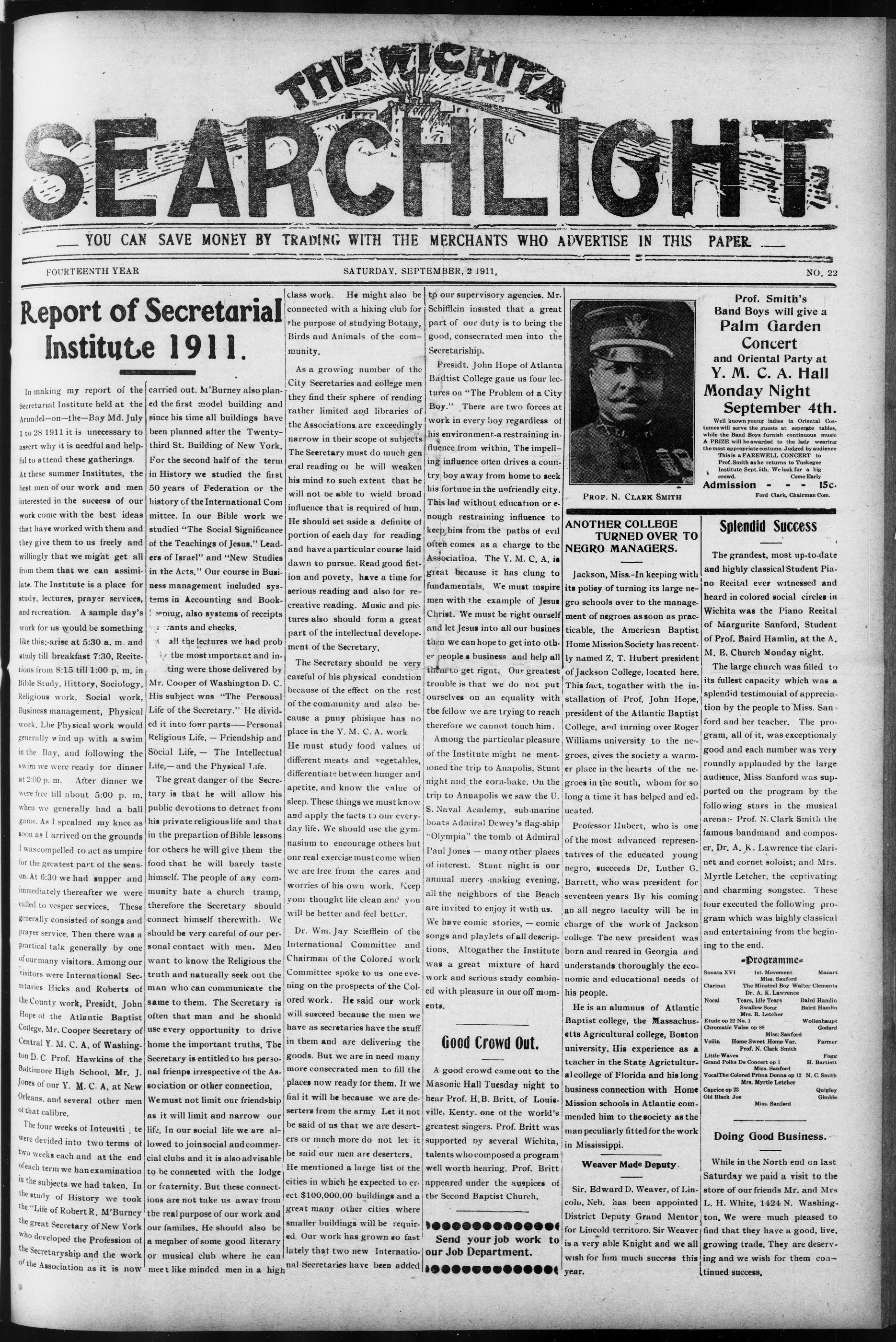
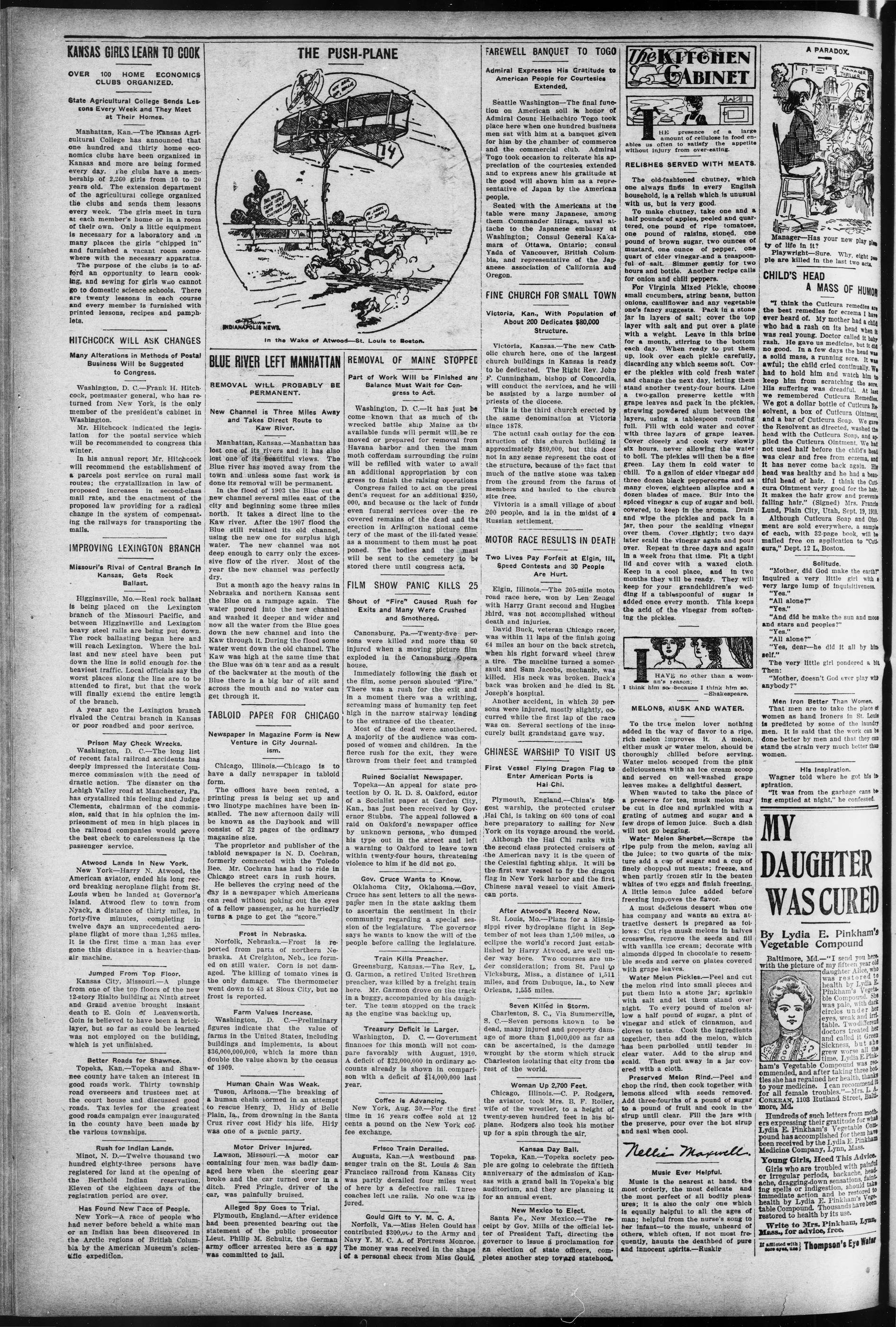
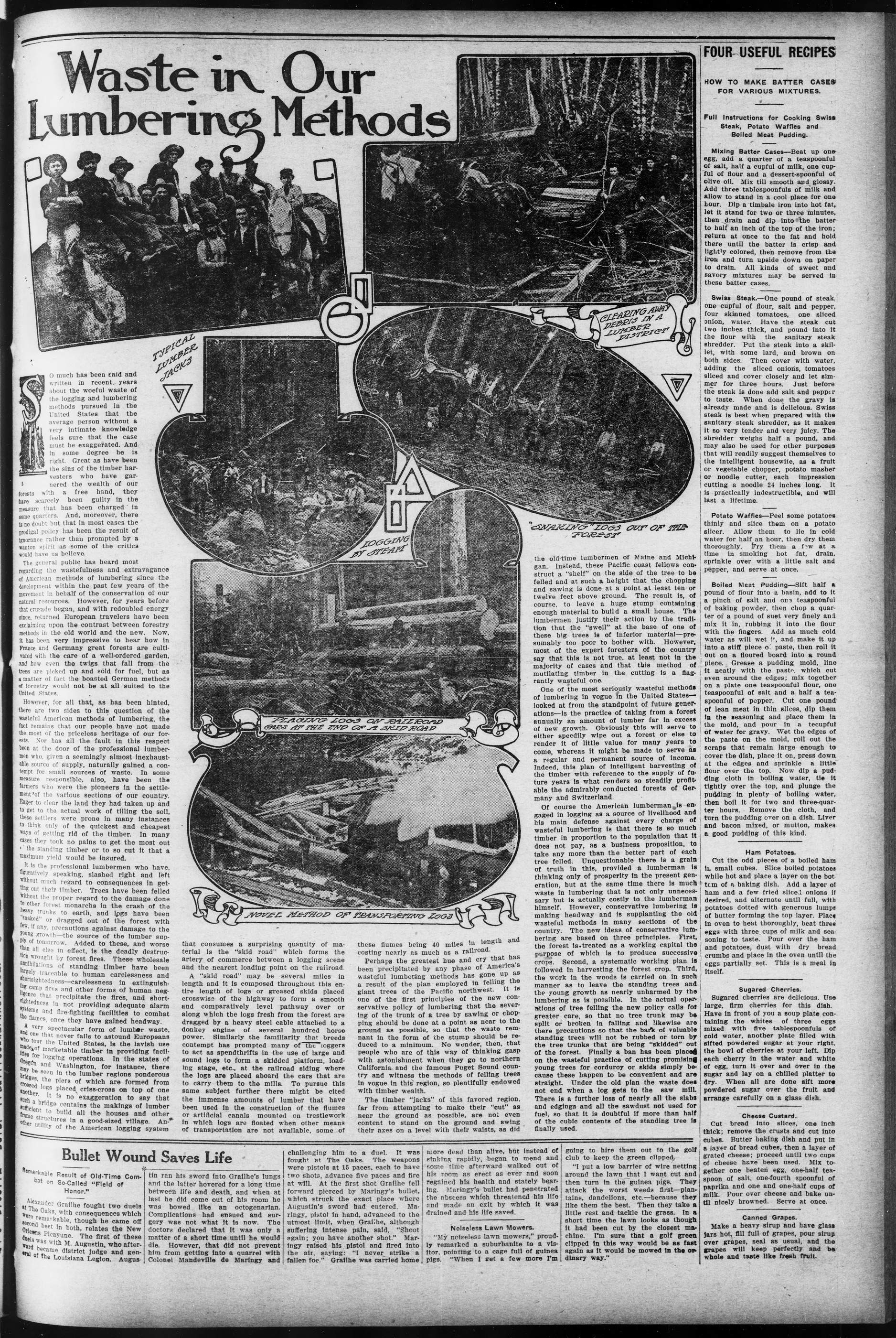
Page text (machine-generated)
THE WICHITA SEARCHLIGHT
Report of Secretarial Institute 1911.
FOURTEENTH YEAR
In making my report of the Secretarial Institute held at the Arundel—on—the—Bay Md. July 1 to 28 1911 it is unnecessary to assert why it is needful and helpful to attend these gatherings. At these summer Institutes, the best men of our work and men interested in the success of our work come with the best ideas that have worked with them and they give them to us freely and willingly that we might get all from them that we can assimilate. The Institute is a place for study, lectures, prayer services, and recreation. A sample day's work for us would be something like this: arise at 5:30 a. m. and study till breakfast 7:30, Recitations from 8:15 till 1:00 p. m. in Bible Study, Hittory, Sociology, Religious work, Social work, Business management, Physical work. The Physical work would generally wind up with a swim in the Bay, and following the swim we were ready for dinner at 2:00 p. m. After dinner we were free till about 5:00 p. m. when we generally had a ball game. As I spiralmed my knee as soon as I arrived on the grounds I was compelled to act as umpire for the greatest part of the season. At 6:30 we had supper and immediately thereafter we were called to vesper services. These generally consisted of songs and prayer service. Then there was a practical talk generally by one of our many visitors. Among our visitors were International Secretaries Hicks and Roberts of the County work, Presidt. John Hope of the Atlantic Baptist College, Mr. Cooper Secretary of Central Y. M. C. A, of Washington D. C. Prof. Hawkins of the Baltimore High School, Mr. J. Jones of our Y. M. C. A, at New Orleans, and several other men of that calibre.
The four weeks of Inteustti te were devided into two terms of two weeks each and at the end of each term we han examination in the subjects we had taken. In the study of History we took the "Life of Robert R. M'Burney the great Secretary of New York who developed the Profession of the Secretaryship and the work of the Association as it is now
carried out. M'Burney also planed the first model building and since his time all buildings have been planned after the Twenty third St. Building of New York. For the second half of the term in History we studied the first 50 years of Federation or the history of the International Committee. In our Bible work we studied "The Social Significance of the Teachings of Jesus," Leaders of Israel" and "New Studies in the Acts," Our course in Business management included systems in Accounting and Book Keeping, also systems of receipts grants and checks. all the lectures we had prob the most important and in-
ting were those delivered by Mr. Cooper of Washington D.C. His subject wns "The Personal Life of the Secretary." He divided it into four parts—Personal Religious Life,—Friendship and Social Life,—The Intellectual Life,—and the Physical Life.
The great danger of the Secretary is that he will allow his public devotions to detract from his private religious life and that in the preparation of Bible lessons for others he will give them the food that he will barely taste himself. The people of any community hate a church tramp, therefore the Secretary should connect himself therewith. We should be very careful of our personal contact with men. Men want to know the Religious the truth and naturally seek out the man who can communicate the same to them. The Secretary is often that man and he should use every opportunity to drive home the important truths. The Secretary is entitled to his personal friend's irrespective of the Association or other connection.
Wemust not limit our friendship as it will limit and narrow our life. In our social life we are allowed to join social and commercial clubs and it is also advisable to be connected with the lodge or fraternity. But these connections are not take us away from the real purpose of our work and our families. He should also be a member of some good literary or musical club where he can meet like minded men in a high
class work. He might also be connected with a hiking club for the purpose of studying Botany, Birds and Animals of the community. to our supervisor Schifflein insisted part of our duty good, consecrate Secretariship.
As a growing number of the City Secretaries and college men they find their sphere of rending rather limited and libraries of the Associations are exceedingly narrow in their scope of subjects The Secretary must do much general reading or he will weaken his mind to such extent that he will not be able to wield broad influence that is required of him. He should set aside a definite of portion of each day for reading and have a particular course laid dawn to pursue. Read good fiction and poverty, have a time for serious reading and also for recreative reading. Music and pictures also should form a great part of the intellectual development of the Secretary.
The Secretary should be very careful of his physical condition because of the effect on the rest of the community and also because a puny phisique has no place in the Y. M. C. A. work. He must study food values of different meats and vegetables, differentiate between hunger and apetite, and know the value of sleep. These things we must know and apply the facts to our everyday life. We should use the gymnasium to encourage others but our real exercise must come when we are free from the cares and worries of his own work. Keep your thought life clean and you will be better and feel better.
Dr. Wm. Jay Sciefflein of the International Committee and Chairman of the Colored work Committee spoke to us one evening on the prospects of the Colored work. He said our work will succeed because the men we have as secretaries have the stuff in them and are delivering the goods. But we are in need many more consecrated men to fill the places now ready for them. If we fial it will be because we are deserters from the army Let it not be said of us that we are deserters or much more do not let it be said our men are deserters. He mentioned a large list of the cities in which he expected to erect $100,000.00 buildings and a great many other cities where smaller buildings will be required. Our work has grown so fast lately that two new International Secretaries have been added
to our supervisory agencies, Mr. Schifflein insisted that a great part of our duty is to bring the good, consecrated men into the Secretarship.
Presidt. John Hope of Atlanta Badtist College gae us four lectures on "The Problem of a City Boy." There are two forces at work in every boy regardless of his environment-a restraining influence from within. The impelling influence often drives a country boy away from home to seek his fortune in the unfriendly city. This lad without education or enough restraining influence to keep him from the paths of evil often comes as a charge to the Association. The Y. M. C. A. is great because it has clung to fundamentals. We must inspire men with the example of Jesus Christ. We must be right ourselves and let Jesus into all our businesses then we can hope to get into other people's business and help all them to get right. Our greatest trouble is that we do not put ourselves on an equality with the fellow we are trying to reach therefore we cannot touch him.
Among the particular pleasure of the Institute might be mentioned the trip to Anapolis, Stunt night and the corn-bake. On the trip to Anapolis we saw the U. S. Naval Academy, sub-marine boats Admiral Dewey's flag-ship "Olympia" the tomb of Admiral Paul Jones many other places of interest. Stunt night is our annual merry-making evening, all the neighbors of the Beach are invited to enjoy it with us. We have comic stories, comic songs and playlets of all descriptions. Altogather the Institute was a great mixture of hard work and serious study combined with pleasure in our off moments.
Good Crowd Out.
A good crowd came out to the Masonic Hall Tuesday night to hear Prof. H,B.Britt, of Louisville, Kenty. one of the world's greatest singers. Prof. Britt was supported by several Wichita, talents who composed a program well worth hearing. Prof. Britt appeared under the auspices of the Second Baptist Church,
---
PROF. N. CLARK SMITH
ANOTHER COLLEGE TURNED OVER TO NEGRO MANAGERS.
Jackson, Miss.-In keeping with its policy of turning its large negro schools over to the management of negroes as soon as practicable, the American Baptist Home Mission Society has recently named Z. T. Hubert president of Jackson College, located here. This fact, together with the installation of Prof. John Hope, president of the Atlantic Baptist College, and turning over Roger Williams university to the negroes, gives the society a warmer place in the hearts of the negroes in the south, whom for so long a time it has helped and educated.
Professor Hubert, who is one of the most advanced representatives of the educated young negro, succeeds Dr. Luther G. Barrett, who was president for seventeen years By his coming an all negro faculty will be in charge of the work of Jackson college. The new president was born and reared in Georgia and understands thoroughly the economic and educational needs of his people.
He is an alumnus of Atlantic Baptist college, the Massachusetts Agricultural college, Boston university. His experience as a teacher in the State Agricultural college of Florida and his long business connection with Home Mission schools in Atlantic commended him to the society as the man peculiarly fitted for the work in Mississippi.
Weaver Made Deputy.
Sir, Edward D. Weaver, of Lincoln, Neb. has been appointed District Deputy Grand Mentor for Lincoln territoro. Sir Weaver is a very able Knight and we all wish for him much success this year.
NO.22
Prof. Smith's Band Boys will give a Palm Garden Concert and Oriental Party at Y. M. C. A. Hall Monday Night
Well known young ladies in Oriental Costumes will serve the guests at assemble tables, while the Band Boys furnish continuous music A PRIZE will be awarded to the lady wearing the most appropriate costume. Judged by audience This is a FAREWELL CONCERT to Prof. Smith as he returns to Tuskegee Institute Sept. 5th. We look for a big crowd. Come Early Admission - 15c.
Splendid Success
The grandest, most up-to-date and highly classical Student Piano Recital ever witnessed and heard in colored social circles in Wichita was the Piano Recital of Margurite Sanford, Student of Prof. Baird Hamlin, at the A. M. E. Church Monday night.
The large church was filled to its fullest capacity which was a splendid testimonial of appreciation by the people to Miss. Sanford and her teacher. The program, all of it, was exceptionally good and each number was very roundly applauded by the large audience. Miss Sanford was supported on the program by the following stars in the musical arena:- Prof. N. Clark Smith the famous bandmand and composer, Dr. A. K. Lawrence the clarinet and cornet soloist; and Mrs. Myrtle Letcher, the ceptivating and charming songstec. These four executed the following program which was highly classical and entertaining from the beginning to the end.
=Programme=
Sonata XVI 1st. Movement Mazart
Miss. Sauford
Clarinet The Minstrel Boy Walter Clements
Dr. A. K. Lawrence
Nocal Tears, Idle Tears Baird Hamlin
Swallow Song Baird Hamlin
Mrs. R. Letcher
Etude op 22 No. 1 Wolllenhaupt
Chromatic Valse op 88 Godard
Miss: Sanford
Voilin Home Sweet Home Var. Farmer
Prof. N. Clark Smith
Little Waves Fogg
Grand Polka De Concert op 1 H. Bartiett
Miss. Sanford
VocalThe Colored Prima Donna op 12 N. C. Smith
Mrs. Myrtle Letcher
Caprice op 23 Quigley
Old Black Joe Gimble
Doing Good Business
While in the North end on last Saturday we paid a visit to the store of our friends Mr. and Mrs L. H. White, 1424 N. Washington. We were much pleased to find that they have a good, live, growing trade. They are deserving and we wish for them continued success.
```markdown
```
KANSAS GIRLS LEARN TO COOK
OVER 100 HOME ECONOMICS CLUBS ORGANIZED.
State Agricultural College Sends Lessons Every Week and They Meet at Their Homes.
Manhattan, Kan.—The Kansas Agricultural College has announced that one hundred and thirty home economics clubs have been organized in Kansas and more are being formed every day. The clubs have a membership of 2,260 girls from 10 to 20 years old. The extension department of the agricultural college organized the clubs and sends them lessons every week. The girls meet in at each member's home or in a room of their own. Only a little equipment is necessary for a laboratory and in many places the girls "chipped in" and furnished a vacant room somewhere with the necessary apparatus.
The purpose of the clubs is to afford an opportunity to learn cooking, and sewing for girls who cannot go to domestic science schools. There are twenty lessons in each course and every member is furnished with printed lessons, recipes and pamphlets.
HITCHCOCK WILL ASK CHANGES
Many Alterations in Methods of Postal Business Will be Suggested
Washington, D. C.—Frank H. Hitchcock, postmaster general, who has returned from New York, is the only member of the president's cabinet in Washington.
Mr. Hitchcock indicated the legislation for the postal service which will be recommended to congress this winter.
In his annual report Mr. Hitchcock will recommend the establishment of a parcels post service on rural mail routes; the crystallization in law of proposed increases in second-class mail rate, and the enactment of the proposed law providing for a radical change in the system of compensating the railways for transporting the mails.
IMPROVING LEXINGTON BRANCH
Missouri's Rival of Central Branch In Kansas, Gets Rock Ballast.
Higginsville, Mo.—Real rock ballast is being placed on the Lexington branch of the Missouri Pacific, and between Higginsville and Lexington heavy steel rails are being put down. The rock ballasting began here and will reach Lexington. Where the ballast and new steel have been put down the line is solid enough for the heaviest traffic. Local officials say the worst places along the line are to be attended to first, but that the work will finally extend the entire length of the branch.
A year ago the Lexington branch rivaled the Central branch in Kansas or poor roadbed and poor service.
Prison May Check Wrecks.
Washington, D. C.—The long list of recent fatal railroad accidents has deeply impressed the Interstate Commerce commission with the need of drastic action. The disaster on the Lehigh Valley road at Manchester, Pa. has crystalized this feeling and Judge Clements, chairman of the commission, said that in his opinion the imprisonment of men in high places in the railroad companies would prove the best check to carelessness in the passenger service.
Atwood Lands In New York.
Atwood Lands in New York.
New York—Harry N. Atwood, the American aviator, ended his long record breaking aeroplane flight from St. Louis when he landed at Governor's Island. Atwood flew to town from Nyack, a distance of thirty miles, in forty-five minutes, completing in twelve days an unprecedented aeroplane flight of more than 1,265 miles. It is the first time a man has ever gone this distance in a heavier-than-air machine.
Jumped From Top Floor.
Kansas City, Missouri.—A plunge from one of the top floors of the new 12-story Rialto building at Ninth street and Grand avenue brought instant death to E. Goin of Leavenworth. Goin is believed to have been a brick-layer, but so far as could be learned was not employed on the building, which is yet unfinished.
Better Roads for Shawnee.
Topeka, Kan.—Topeka and Shawnee county have taken an interest in good roads work. Thirty township road overseers and trustees met at the court house and discussed good roads. Tax levies for the greatest good roads campaign ever inaugurated in the county have been made by the various townships.
Rush for Indian Lands.
Minot, N. D.—Twelve thousand two hundred eighty-three persons have registered for land at the opening of the Berthold Indian reservation. Eleven of the eighteen days of the registration period are over.
Has Found New Face of People.
New York—A race of people who had never before beheld a white man or an Indian has been discovered in the Arctic regions of British Columbia by the American Museum's scientific expedition.
THE PUSH-PLANE
HIT AIR ON WILLE
HIT AIR ON WILLE
HIT AIR ON WILLE
INDIANAPOLIS NEWS.
In the Wake of Atwood—St. Louis to Boston.
BLUE RIVER LEFT MANHATTAN
REMOVAL WILL PROBABLY BE PERMANENT.
New Channel is Three Miles Away and Takes Direct Route to Kaw River.
Manhattan, Kansas.—Manhattan has lost one of its rivers and it has also lost one of its beautiful views. The Blue river has moved away from the town and unless some fast work is done its removal will be permanent.
In the flood of 1903 the Blue cut a new channel several miles east of the city and beginning some three miles north. It takes a direct line to the Kaw river. After the 1907 flood the Blue still retained its old channel, using the new one for surplus high water. The new channel was not deep enough to carry only the excessive flow of the river. Most of the year the new channel was perfectly dry.
But a month ago the heavy rains in Nebraska and northern Kansas sent the Blue on a rampage again. The water poured into the new channel and washed it deeper and wider and now all the water from the Blue goes down the new channel and into the Kaw through it. During the flood some water went down the old channel. The Kaw was high at the same time that the Blue was on a tear and as a result of the backwater at the mouth of the Blue there is a big bar of silt sand across the mouth and no water can get through it.
TABLOID PAPER FOR CHICAGO
Chicago, Illinois.—Chicago is to have a daily newspaper in tabloid form.
The offices have been rented, a printing press is being set up and two linotype machines have been installed. The new afternoon daily will be known as the Daybook and will consist of 32 pages of the ordinary magazine size.
The proprietor and publisher of the tabloid newspaper is N. D. Cochran, formerly connected with the Toledo Bee. Mr. Cochran has had to ride in Chicago street cars in rush hours.
He believes the crying need of the day is a newspaper which Americans can read without poking out the eyes of a fellow passenger, as he hurriedly turns a page to get the "score."
Frost in Nebraska.
Norfolk, Nebraska.-Frost is reported from parts of northern Nebraska. At Creighton, Neb., ice formed on still water. Corn is not damaged. The killing of tomato vines is the only damage. The thermometer went down to 43 at Sioux City, but no frost is reported.
Farm Values Increase.
Washington, D. C.—Preliminary figures indicate that the value of farms in the United States, including buildings and implements, is about $36,000,000,000, which is more than double the value shown by the census of 1909.
Human Chain Was Weak.
Tuson, Arizona—The breaking of a human chain formed in an attempt to rescue Henry D. Hidy of Belle Plain, Ia., from drowning in the Santa Cruz river cost Hidy his life. Hidy was one of a picnic party.
Motor Driver Injured.
Lawson, Missouri.—A motor car containing four men was badly damaged here when the steering gear broke and the car turned over in a ditch. Fred Pringle, driver of the car, was painfully bruised.
Alleged Spy Goes to Trial.
Alleged Spy Goes to Trial.
Plymouth, England.—After evidence had been presented bearing out the statement of the public prosecutor Lieut. Philip M. Schultz, the German army officer arrested here as a spy was committed to jail.
REMOVAL OF MAINE STOPPED
Part of Work Will be Finished and Balance Must Wait for Congress to Act.
Washington, D. C.—It has just be come known that as much of the wrecked battle ship Maine as the available funds will permit will be removed or prepared for removal from Havana harbor and then the mam moth cofferdam surrounding the ruins will be refilled with water to await an additional appropriation by congress to finish the raising operations
Congress failed to act on the presi dent's request for an additional $250, 000, and because or the lack of funds even funeral services over the re covered remains of the dead and the erection in Arlington national cemetery of the mast of the ill-fated vessel as a monument to them must be post poned. The bodies and the mast will be sent to the cemetery to be stored there until congress acts.
FILM SHOW PANIC KILLS 25
Shout of "Fire" Caused Rush for Exits and Many Were Crushed and Smothered.
Canonsburg, Pa.—Twenty-five persons were killed and more than 60 injured when a moving picture film exploded in the Canonsburg Opera house.
Immediately following the flash of the film, some person shouted "Fire." There was a rush for the exit and in a moment there was a writhing, screaming mass of humanity ten feet high in the narrow stairway leading to the entrance of the theater.
Most of the dead were smothered. A majority of the audience was composed of women and children. In the fierce rush for the exit, they were thrown from their feet and trampled
Ruined Socialist Newspaper.
Topeka—An appeal for state protection by O. R. D. S. Oakford, editor of a Socialist paper at Garden City, Kan., has just been received by Governor Stubbs. The appeal followed a raid on Oakford's newspaper office by unknown persons, who dumped his type out in the street and left a warning to Oakford to leave town within twenty-four hours, threatening violence to him if he did not go.
Gov. Cruce Wants to Know
Oklahoma City, Oklahoma—Gov. Cruce has sent letters to all the newspaper men in the state asking them to ascertain the sentiment in their community regarding a special session of the legislature. The governor says he wants to know the will of the people before calling the legislature.
Train Kills Preacher
Greensburg, Kansas.—The Rev. L. G. Garmon, a retired United Brethren preacher, was killed by a freight train here. Mr. Garmon drove on the track in a buggy, accompanied by his daughter. The team stopped on the track as the engine was backing up.
Treasury Deficit is Larger.
Washington, D. C. — Government finances for this month will not compare favorably with August, 1910. A deficit of $22,000,000 in ordinary accounts already is shown in comparison with a deficit of $14,000,000 last year.
Coffee is Advancing
New York, Aug. 30.—For the first time in 16 years coffee sold at 12 cents a pound on the New York coffee exchange.
Frisco Train Derailed.
Augusta, Kan.—A westbound passenger train on the St. Louis & San Francisco railroad from Kansas City was partly derailed four miles west of here by a defective rail. Three coaches left one rails. No one was injured.
Gould Gift to Y. M. C. A.
Norfolk, Va.—Miss Helen Gould has contributed $300,000 to the Army and Navy Y. M. C. A. of Fortress Monroe. The money was received in the shape of a personal check from Miss Gould.
FAREWELL BANQUET TO TOGO
Admiral Expresses His Gratitude to American People for Courtesies Extended.
Seattle Washington—The final function on American soil is honor of Admiral Count Heihachiro Togo took place here when one hundred business men sat with him at a banquet given for him by the chamber of commerce and the commercial club. Admiral Togo took occasion to reiterate his appreciation of the courtesies extended and to express anew his gratitude at the good will shown him as a representative of Japan by the American people.
Seated with the Americans at the table were many Japanese, among them Commander Hiraaga, naval attach to the Japanese embassy at Washington; Consul General Kakamara of Ottawa, Ontario; consul Yada of Vancouver, British Columbia, and representative of the Japanese association of California and Oregon.
FINE CHURCH FOR SMALL TOWN
Victoria, Kansas.—The new Catholic church here, one of the largest church buildings in Kansas is ready to be dedicated. The Right Rev. John F. Cunningham, bishop of Concordia, will conduct the services, and he will be assisted by a large number of priests of the diocese.
This is the third church erected by the same denomination at Victoria since 1878.
The actual cash outlay for the construction of this church building is approximately $80,000, but this does not in any sense represent the cost of the structure, because of the fact that much of the native stone was taken from the ground from the farms of members and hauled to the church site free.
Vivtoria is a small village of about 200 people, and is in the midst of a Russian settlement.
MOTOR RACE RESULTS IN DEATH
Two Lives Pay Forfeit at Elgin, Ill., Speed Contests and 30 People Are Hurt.
Elgin, Illinois.—The 305-mile motor road race here, won by Len Zengel with Harry Grant second and Hughes third, was not accomplished without death and injuries.
David Buck, veteran Chicago racer, was within 11 laps of the finish going 64 miles an hour on the back stretch, when his right forward wheel threw a tire. The machine turned a somersault and Sam Jacobs, mechanic, was killed. His neck was broken. Buck's back was broken and he died in St. Joseph's hospital.
Another accident, in which 30 persons were injured, mostly slightly, occurred while the first lap of the race was on. Several sections of the insecurely built grandstand gave way.
CHINESE WARSHIP TO VISIT US
First Vessel Flying Dragon Flag to Enter American Ports is Hai Chi.
Plymouth, England.—China's biggest warship, the protected cruiser Hai Chi, is taking on 600 tons of coal here preparatory to sailing for New York on its voyage around the world. Although the Hai Chi ranks with the second class protected cruisers of the American navy it is the queen of the Ceiestial fighting ships. It will be the first war vessel to fly the dragon flag in New York harbor and the first Chinese naval vessel to visit American ports.
After Atwood's Record Now.
St. Louis, Mo.—Plans for a Mississippi river hydroplane flight in September of not less than 1,500 miles, eclipse the world's record just established by Harry Atwood, are well under way here. Two courses are under consideration; from St. Paul to Vicksburg, Miss., a distance of 1,511 miles, and from Dubuque, la., to New Orleans, 1,555 miles.
Seven Killed in Storm.
Charleston, S. C., Via Summerville, S. C.—Seven persons known to be dead, many injured and property damage of more than $1,000,000 as far as can be ascertained, is the damage wrought by the storm which struck Charleston isolating that city from the rest of the world.
Woman Up 2,700 Feet.
Chicago, Illinois.-C. P. Rodgers, the aviator, took Mrs. B. F. Roller, wife of the wrestler, to a height of twenty-seven hundred feet in his biplane. Rodgers also took his mother up for a spin through the air.
Kansas Day Ball.
Topeka, Kan.—Topeka society people are going to celebrate the fiftieth anniversary of the admission of Kansas with a grand ball in Topeka's big auditorium, and they are planning it for an annual event.
New Mexico to Elect
Santa Fe., New Mexico.—The receipt by Gov. Mills of the official letter of President Taft, directing the governor to issue a proclamation for an election of state officers, completes another step toward statehood.
The KITCHEN CABINET
THE presence of a large amount of cellulose in food enables us often to satisfy the appetite without injury from over-eating.
RELISHES SERVED WITH MEATS.
The old-fashioned chutney, which one always finds in every English household, is a relish which is unusual with us, but is very good.
To make chutney, take one and a half pounds of apples, peeled and quartered, one pound of ripe tomatoes, one pound of raisins, stoned, one pound of brown sugar, two ounces of mustard, one ounce of pepper, one quart of cider vinegar-and a teaspoonful of salt. Simmer gently for two hours and bottle. Another recipe calls for onion and chili peppers.
For Virginia Mixed Pickle, choose small cucumbers, string beans, button onions, cauliflower and any vegetable one's fancy suggests. Pack in a stone jar in layers of salt; cover the top layer with salt and put over a plate with a weight. Leave in this brine for a month, stirring to the bottom each day. When ready to put them up, look over each pickle carefully, discarding any which seems soft. Cover the pickles with cold fresh water and change the next day, letting them stand another twenty-four hours. Line a two-gallon preserve kettle with grape leaves and pack in the pickles, stewing powdered alum between the layers, using a tablespoon rounding full. Fill with cold water and cover with three layers of grape leaves. Cover closely and cook very slowly six hours, never allowing the water to boil. The pickles will then be a fine green. Lay them in cold water to chill. To a gallon of cider vinegar add three dozen black peppercorns and as many cloves, eighteen allspice and a dozen blades of mace. Stir into the spiced vinegar a cup of sugar and boll, covered, to keep in the aroma. Drain and wipe the pickles and pack in a jar, then pour the scalding vinegar over them. Cover tightly; two days later scald the vinegar again and pour over. Repeat in three days and again in a week from that time. Fit a tight lid and cover with a waxed cloth. Keep in a cool place, and in two months they will be ready. They will keep for your grandchildren's wedding if a tablespoonful of sugar is added once every month. This keeps the acid of the vinegar from softening the pickles.
HAVE no other than a woman's reason;
I think him so-because I think him so.
-Shakespeare.
MELONS, MUSK AND WATER.
To the true melon lover nothing added in the way of flavor to a ripe, rich melon improves it. A melon, either musk or water melon, should be thoroughly chilled before serving. Water melon scooped from the pink deliciousness with an ice cream scoop and served on well-washed grape leaves makes a delightful dessert.
When wanted to take the place of a preserve for tea, musk melon may be cut in dice and sprinkled with a grating of nutmeg and sugar and a few drops of lemon juice. Such a dish will not go begging.
Water Melon Sherbet—Scrape the ripe pulp from the melon, saving all the juice; to two quarts of the mixture add a cup of sugar and a cup of finely chopped nut meats; freeze, and when partly frozen stir in the beaten whites of two eggs and finish freezing. A little lemon juice added before freezing improves the flavor.
A most delicious dessert when one has company and wants an extra attractive dessert is prepared as follows: Cut ripe musk melons in halves crosswise, remove the seeds and fill with vanilla ice cream; decorate with almonds dipped in chocolate to resemble seeds and serve on plates covered with grape leaves.
Water Melon Pickles.—Peel and cut the melon rind into small pieces and put them into a stone jar; sprinkle with salt and let them stand over night. To every pound of melon allow a half pound of sugar, a pint of vinegar and stick of cinnamon, and cloves to taste. Cook the ingredients together, then add the melon, which has been parboiled until tender in clear water. Add to the sirup and scald. Then put away in a jar covered with a cloth.
Preserved Melon Rind.—Peel and chop the rind, then cook together with lemons sliced with seeds removed. Add three-fourths of a pound of sugar to a pound of fruit and cook in the sirup until clear. Fill the jars with the preserve, pour over the hot sirup and seal when cool.
Music Ever Helpful.
Music is the nearest at hand, the most orderly, the most delicate and the most perfect of all bodily pleasures; it is also the only one which is equally helpful to all the ages of man; helpful from the nurse's song to her infant—to the music, unheard of others, which often, if not most frequently, haunts the deathbed of pure and innocent spirits.—Ruskip
MANAGER
THRILLER
Manager—Has your new play ple
ty of life in it?
Playwright—Sure. Why, eight ple
ple are killed in the last two acts.
CHILD'S HEAD
"I think the Cuticura remedies are the best remedies for eczema I have ever heard of. My mother had a child who had a rash on its head when it was real young. Doctor called it baby rash. He gave us medicine, but it did no good. In a few days the head was a solid mass, a running sore. It was awful; the child cried continually. We had to hold him and watch him to keep him from scratching the sore. His suffering was dreadful. At last we remembered Cuticura Remedies. We got a dollar bottle of Cuticura Ointment, and a bar of Cuticura Soap. We gave the Resolvent as directed, washed the head with the Cuticura Soap, and applied the Cuticura Ointment. We had not used half before the child's head was clear and free from eczema, and it has never come back again. His head was healthy and he had a beautiful head of hair. I think the Cuticura Ointment very good for the hair. It makes the hair grow and prevents falling hair." (Signed) Mrs. Frances Lund, Lund City, Utah, Sept. 19, 1910.
Although Cuticura Soap and Ointment are sold everywhere, a sample of each, with 32-page book, will be mailed free on application to "Cuticura," Dept. 12 L, Boston.
Solitude
"Mother, did God make the earth?"
inquired a very little girl with a very large lump of inquisitiveness.
"Yes."
"All alone?"
"Yes."
"And did he make the sun and moon and stars and peoples?"
"Yes."
"All alone?"
"Yes, dear—he did it all by himself."
The very little girl pondered a bit.
Then:
"Mother, doesn't God ever play with anybody?"
Men Iron Better Than Women.
That men are to take the place of women as hand ironers in St. Louis is predicted by some of the laundry men. It is said that the work can be done better by men and that they can stand the strain very much better than women.
HIs Inspiration:
Wagner told where he got his spiration.
"It was from the garbage cans being emptied at night," he confessed.
MY DAUGHTER WAS CURED
By Lydia E. Pinkham's Vegetable Compound
daughter was restored to health by Lydia E. Pinkham's Vegetable Compound. She was pale, with dark circles under her eyes, weak and irritable. Two diplomatic doctors treated her and called it Green Sickness, but she grew worse all the time. Lydia E. Pinkham's Vegetable Compound was recommended, and after taking three bottles she has regained her health, thanks to your medicine. I can recommend it for all female troubles."—Mrs. L. A. CORKRAN, 1103 Rutland Street, Baltimore, Md.
Hundreds of such letters from mothers expressing their gratitude for what Lydia E. Pinkham's Vegetable Compound has accomplished for them have been received by the Lydia E. Pinkham Medicine Company, Lynn, Mass.
Young Girls, Heed This Advice.
Girls who are troubled with painful or irregular periods, backache, headache, dragging-down sensations, fainting spells or indigestion, should take immediate action and be restored to health by Lydia E. Pinkham's Vegetable Compound. Thousands have been restored to health by its use.
Write to Mrs. Pinkham, Lynn, Mass., for advice, free.
Is affiliated with Thompson's Eye Water
#
Waste in Our Lumbering Methods
O much has been said and written in recent, years about the woeful waste of the logging and lumbering methods pursued in the United States that the average person without a very intimate knowledge feels sure that the case must be exaggerated. And in some degree he is right. Great as have been the sins of the timber harvesters who have garnered the wealth of our forests with a free hand, they have scarcely been guilty in the measure that has been charged in some quarters. And, moreover, there is no doubt but that in most cases the prodigal policy has been the result of ignorance rather than prompted by a wanton spirit as some of the critics would have us believe.
The general public has heard most regarding the wastefulness and extravagance of American methods of lumbering since the development within the past few years of the movement in behalf of the conservation of our natural resources. However, for years before that crusade began, and with redoubled energy since, returned European travelers have been exclaiming upon the contrast between forestry methods in the old world and the new. Now, it has been very impressive to hear how in France and Germany great forests are cultivated with the care of a well-ordered garden, and how even the twigs that fall from the trees are picked up and sold for fuel, but as a matter of fact the boasted German methods of forestry would not be at all suited to the United States.
However, for all that, as has been hinted, there are two sides to this question of the wasteful American methods of lumbering, the fact remains that our people have not made the most of the priceless heritage of our forests. Nor has all the fault in this respect been at the door of the professional lumbermen who, given a seemingly almost inexhaustible source of supply, naturally gained a contempt for small sources of waste. In some measure responsible, also, have been the farmers who were the pioneers in the settlement of the various sections of our country. Eagle to clear the land they had taken up and to get to the actual work of tilling the soil, these settlers were prone in many instances to think only of the quickest and cheapest ways of getting rid of the timber. In many cases they took no palms to get the most out of the standing timber or to so cut it that a maximum yield would be insured.
It is the professional lumbermen who have, figuratively speaking, slashed right and left without much regard to consequences in getting out their timber. Trees have been felled without the proper regard to the damage done to other forest monarchs in the crash of the heavy trunks to earth, and lpgs have been "snaked" or dragged out of the forest with few, if any, precautions against damage to the young growth—the source of the lumber supply of tomorrow. Added to these, and worse than all else in effect, is the deadly destruction wrought by forest fires. These wholesale annihilations of standing timber have been largely traceable to human carelessness and shortsightedness—carelessness in extinguishing camp fires and other forms of human negligence that precipitate the fires, and shortsightedness in not providing adequate alarm systems and fire-fighting facilities to combat the flames, once they have gained headway.
A very spectacular form of lumber waste, and one that never fails to astound Europeans who tour the United States, is the lavish use made of marketable timber in providing facilities for logging operations. In the states of Oregon and Washington, for instance, there may be seen in the lumber regions ponderous bridges, the pliers of which are formed from cross logs placed criss-cross on top of one another. It is no exaggeration to say that such a bridge contains the makings of lumber sufficient to build all the houses and other frame structures in a good-sized village. Another utility of the American logging system
Bullet Wound Saves Life
Bullet Wound Saves Life
Remarkable Result of Old-Time Combat on So-Called "Field of Honor."
Alexander Grallhe fought two duels at The Oaks, with consequences which were remarkable, though he came off second best in both, relates the New Orleans Picayune. The first of these duels was with M. Augustin, who afterward became district judge and general of the Louisiana Legion. Augus-
S
that consumes a surprising quantity of material is the "skid road" which forms the artery of commerce between a logging scene and the nearest loading point on the railroad.
A "skid road" may be several miles in length and it is composed throughout this entire length of logs or greased skids placed crosswise of the highway to form a smooth and comparatively level pathway over or along which the logs fresh from the forest are dragged by a heavy steel cable attached to a donkey engine of several hundred horse power. Similarly the familiarity that breeds contempt has prompted many of the loggers to act as spendthifts in the use of large and sound logs to form a skidded platform, loading stage, etc., at the railroad sliding where the logs are placed aboard the cars that are to carry them to the mills. To pursue this same subject further there might be cited the immense amounts of lumber that have been used in the construction of the flumes or artificial canals mounted on trestwork in which logs are floated when other means of transportation are not available, some of
tin ran his sword into Grallhe's lungs and the latter hovered for a long time between life and death, and when at last he did come out of his room he was bowed like an octogenarian. Complications had ensued and surgery was not what it is now. The doctors declared that it was only a matter of a short time until he would die. However, that did not prevent him from getting into a quarrel with Colonel Mandeville de Maringy and
challenging him to a duel. It was fought at The Oaks. The weapons were pistols at 15 paces, each to have two shots, advance five paces and fire at will. At the first shot Graflhe fell forward pierced by Maringy's bullet, which struck the exact place where Augustin's sword had entered. Maringy, pistol in hand, advanced to the utmost limit, when Graflhe, although suffering intense pain, sald, "Shoot again; you have another shot." Maringy raised his pistol and fired into the air, saying: "I never strike a fallen foe." Graflhe was carried home
these flumes being 40 miles in length and costing nearly as much as a railroad.
Perhaps the greatest hue and cry that has been precipitated by any phase of America's wasteful lumbering methods has gone up as a result of the plan employed in felling the giant trees of the Pacific northwest. It is one of the first principles of the new conservative policy of lumbering that the severing of the trunk of a tree by sawing or chopping should be done at a point as near to the ground as possible, so that the waste remnant in the form of the stump should be reduced to a minimum. No wonder, then, that people who are of this way of thinking gasp with astonishment when they go to northern California and the famous Puget Sound country and witness the methods of felling trees in vogue in this region, so plentifully endowed with timber wealth.
The timber "jacks" of this favored region, far from attempting to make their "out" as near the ground as possible, are not even content to stand on the ground and swing their axes on a level with their waists, as did finally
to a duel. It was kicks. The weaponspaces, each to havefive paces and firest shot Grafilhe fellMaringy's bullet,exact place wherehad entered. Maidadvanced to the
more dead than alive, but instead ofsinking rapidly, began to mend andsome time afterward walked out ofhis room as erect as ever and soonregained his health and stately bearing. Maringy's bullet had penetratedthe abscess which threatened his lifeand made an exit by which it wasdrained and his life saved.
Noiseless Lawn Mowers.
"My noteless lawn mowers," proudly remarked a suburbanite to a visitor, pointing to a cage full of guinea ruts. "When I get a few more I'm
the old-time lumbermen of Maine and Michigan. Instead, these Pacific coast fellows construct a "shelf" on the side of the tree to be felled and at such a height that the chopping and sawing is done at a point at least ten or twelve feet above ground. The result is, of course, to leave a huge stump containing enough material to build a small house. The lumbermen justify their action by the tradition that the "swell" at the base of one of these big trees is of inferior material—presumably too poor to bother with. However, most of the expert foresters of the country say that this is not true. at least not in the majority of cases and that this method of mutilating timber in the cutting is a flagrantly wasteful one.
One of the most seriously wasteful methods of lumbering in vogue in the United States—looked at from the standpoint of future generations—is the practice of taking from a forest annually an amount of lumber far in excess of new growth. Obviously this will serve to either speedily wipe out a forest or else to render it of little value for many years to come, whereas it might be made to serve as a regular and permanent source of income. Indeed, this plan of intelligent harvesting of the timber with reference to the supply of future years is what renders so steadily profitable the admirably conducted forests of Germany and Switzerland.
Of course the American lumberman is engaged in logging as a source of livelihood and his main defense against every charge of wasteful lumbering is that there is so much timber in proportion to the population that it does not pay, as a business proposition, to take any more than the better part of each tree felled. Unquestionable there is a grain of truth in this, provided a lumberman is thinking only of prosperity in the present generation, but at the same time there is much waste in lumbering that is not only unnecessary but is actually costly to the lumberman himself. However, conservative lumbering is making headway and is supplanting the old wasteful methods in many sections of the country. The new ideas of conservative lumbering are based on three principles. First, the forest is treated as a working capital the purpose of which is to produce successive crops. Second, a systematic working plan is followed in harvesting the forest crop. Third, the work in the woods is carried on in such manner as to leave the standing trees and the young growth as nearly unharmed by the lumbering as is possible. In the actual operations of tree felling the new policy calls for greater care, so that no tree trunk may be split or broken in falling and likewise are there precautions so that the bark of valuable standing trees will not be rubbed or torn by the tree trunks that are being "skidded" out of the forest. Finally a ban has been placed on the wasteful practice of cutting promising young trees for corduroy or skids simply because these happen to be convenient and are straight. Under the old plan the waste does not end when a log gets to the saw mill. There is a further loss of nearly all the slabs and edgings and all the sawdust not used for fuel, so that it is doubtful if more than half of the cubic contents of the standing tree is finally used.
going to hire them out to the golf club to keep the green clipped.
"I put a low barrier of wire netting around the lawn that I want cut and then turn in the guinea pigs. They attack the worst weeds first—plantains, dandelions, etc.—because they like them the best. Then they take a little rest and tackle the grass. In a short time the lawn looks as though it had been cut by the closest machine. I'm sure that a golf green clipped in this way would be as fast again as it would be mowed in the ordinary way."
HOW TO MAKE BATTER CASES
FOR VARIOUS MIxtures.
Full Instructions for Cooking Swiss Steak, Potato Waffles and Boiled Meat Pudding.
Mixing Batter Cases—Beat up one egg, add a quarter of a teaspoonful of salt, half a cupful of milk, one cupful of flour and a dessert-spoonful of olive oil. Mix till smooth and glossy. Add three tablespoonfuls of milk and allow to stand in a cool place for one hour. Dip a timbale iron into hot fat, let it stand for two or three minutes, then drain and dip into the batter to half an inch of the top of the iron; return at once to the fat and hold there until the batter is crisp and lightly colored, then remove from the iron and turn upside down on paper to drain. All kinds of sweet and savory mixtures may be served in these batter cases.
Swiss Steak.—One pound of steak, one cupful of flour, salt and pepper, four skinned tomatoes, one sliced onion, water. Have the steak cut two inches thick, and pound into it the flour with the sanitary steak shredder. Put the steak into a skillet, with some lard, and brown on both sides. Then cover with water, adding the sliced onions, tomatoes sliced and cover closely and let simmer for three hours. Just before the steak is done add salt and pepper to taste. When done the gravy is already made and is delicious. Swiss steak is best when prepared with the sanitary steak shredder, as it makes it so very tender and very juicy. The shredder weighs half a pound, and may also be used for other purposes that will readily suggest themselves to the intelligent housewife, as a fruit or vegetable chopper, potato masher or noodle cutter, each impression cutting a noodle 24 inches long. It is practically indestructible, and will last a lifetime.
Potato Waffles—Peel some potatoes thinly and slice them on a potato slicer. Allow them to lie in cold water for half an hour, then dry them thoroughly. Fry them a few at a time in smoking hot fat, drain, sprinkle over with a little salt and pepper, and serve at once.
Boiled Meat Pudding—Sift half a pound of flour into a basin, add to it a pinch of salt and one teaspoonful of baking powder, then chop a quarter of a pound of suet very finely and mix it in, rubbing it into the flour with the fingers. Add as much cold water as will wet it, and make it up into a stiff piece of paste, then roll it out on a floured board into a round piece. Grease a pudding mold, line it neatly with the paste, which cut even around the edges; mix together on a plate one teaspoonful flour, one teaspoonful of salt and a half a teaspoonful of popper. Cut one pound of lean meat in thin slices, dip them in the seasoning and place them in the mold, and pour in a tecapulful of water for gravity. Wet the edges of the paste on the mold, roll out the scraps that remain large enough to cover the dish, place it on, press down at the edges and sprinkle a little flour over the top. Now dip a pudding cloth in boiling water, the it tightly over the top, and plunge the pudding in plenty of boiling water, then boil it for two and three-quarter hours. Remove the cloth, and turn the pudding over on a dish. Liver and bacon mixed, or mutton, makes a good pudding of this kind.
Ham Potatoes.
Cut the odd pieces of a boiled ham in small cubes. Slice boiled potatoes while hot and place a layer on the bottom of a baking dish. Add a layer of ham and a few fried sliced onions if desired, and alternate until full, with potatoes dotted with generous lumps of butter forming the top layer. Place in oven to heat thoroughly, beat three eggs with three cups of milk and seasoning to taste. Pour over the ham and potatoes, dust with dry bread crumbs and place in the oven until the eggs partially set. This is a meal in itself.
Sugared Cherries.
Sugared cherries are delicious. Use large, firm cherries for this dish. Have in front of you a soup plate containing the whites of three eggs mixed with five tablespoonfuls of cold water, another plate filled with sifted powdered sugar at your right, the bowl of cherries at your left. Dip each cherry in the water and white of egg, turn it over and over in the sugar and lay on a chilled platter to dry. When all are done sift more powdered sugar over the fruit and arrange carefully on a glass dish.
Cheese Custard.
Cut bread into slices, one inch thick; remove the crusts and cut into cubes. Butter baking dish and put in a layer of bread cubes, then a layer of grated cheese; proceed until two cups of cheese have been used. Mix together one beaten egg, one-half teaspoon of salt, one-fourth spoonful of paprika and one and one-half cups of milk. Pour over cheese and bake until nicely browned. Serve at once.
Canned Grapes.
Make a heavy sirup and have glass jars hot, fill full of grapes, pour sirup over grapes, seal as usual, and the grapes will keep perfectly and be whole and taste like fresh fruit.
SEARCHLIGHT, PAGE FOUR.
THE SEARCHLIGHT
Established in 1898.
W. N. MILLER, Editor.
Residence 1401 West 23d Street.
Office: 630 N. Main Street.
Residence Phone, Market 4090 X
Phone your news items to us.
"To Live and Let Live" is Our Motto.
RATES OF SUBSCRIPTION:
Strictly in Advance.
One Year (by mail) ..... $1.00
Six Months (by mail) ..... .75
Three Months (by mail) ..... .50
Advertising Rates made known on application.
Alberal commission paid to agents.
Entered at the Postoffice at Wichita,
Kansas, as Second-Class
Mail Matter.
Published Every Saturday at 630 N.
Main Street.
All matters addressed to The
Searchlight for publication must be
signed by the party or parties writing.
All matters for publication must
reach this office not later than Thursday
noon to reach publication in the
current issue.
RULES OF THIS OFFICE:
First. All subscriptions must be paid in advance. Agents take notice.
Second. Communications received after Thursday noon will not be published in the current issue.
Third. In asking to change your paper from one address or postoffice to another, give both the new and the old.
Fourth. No new name will be placed on our books unless the money accompanies the name. Write plain.
Fifth. Address all matter for publicatio nto The Wichita Searchlight. $630 N. Main street, Wichita, Kansas.
Sixth. Any erroneous reflection on the character, standing or reputation of any person which may appear in this paper will be gladly corrected if brought to the attention of the editor.
Saturday Sept. 2, 1911.
REMEMBER the "Noble Outcast" which will be presented at Masonic Hall, Wednesday night Sept. 6th. You will highly enjoy the play, go out and see it.
Attend the Palm Garden Concert to be given by the Band Boys at Masonic Hall, Monday night, Sept. 4th. This promises to be one of the season's most novel and entertaining affairs.
Watch for notice of the Rosete Party to be given at the A. M. E. Church Monday Sept. 4th.
Mothers and Fathers should make every preparation to have their child enter school next fall.
We are making great progress Let us not be discouraged. Our day is coming right here in this country.
The work of buying homes and becoming taxpayers should go on without ceasing.
Hold your breath awhile—we've got some thing to tell ye.
A visit to the Wichita Trunk Factory you will find anything you desire in trunds and traveling bags. On South Lawrence.
Send your news notes and local happiness to 630 M Main Street
Mrs. Richard Watson is report ed vesy ill this week.
Mrs. Chas. A. Reed is confined to her home suffering from strok of paralysis.
Fred Ratley has returned home from Nebraska.
Miss. Ida Wilson is out among her friends again after being confined for 2 weeks with a painful ankle.
Mrs. Roe and two children of Enid, Okla is in the city visiting her mother, Mrs. Wright.
Miss. Zeffa Adams returned to her home in Prart Kans. Saturday.
Fred Dillard of Okla. City is the guest of Floyd Porter.
Watch for the date of the "Military Drill" The Vasti Girls will drill against the Band Boys.
Miss. Irene Bettis, Maylon, Eugene Perry will leave soon for Quindaro, Kansas to attend the college there.
Miss. Corine Bettis has return ed from Anthony, Kansas where she syent 2 weeks visiting Mrs. W, S. Pyles.
Miss. Isis Brooks who has been confined to her home for a few days from a boil on her cheek, caused from an insect bite is able to be out.
Miss. Ruth White entertained Wednesday afternoon, a party complimentry to her cousin of Pueblo, Colo. The afternoon was spent in games azd music.
Mrs. Glessner McCollough celebrated her birthday on Aug 24, She received many nice presents. Among ehem was a handsome new piano. A two course lunch was serve l.
Mrs. M. A. Lloyd of Hennesey Okla. is spending a few days in the city.
The John Brown Liteary will hold its meetings every Wednesday evening at A.M.E. Church. The public is most cordially invited to come out.
The Mother's Aid Club was the guests of Mrs. Robt. Davis and Mrs. W. N. Miller last Friday afternoon. The ladies had a most delightful time. Refreshments were served.
All members o the B. T. W. club the requested to meet promptly at 2:30 Thursday, Sept. 7th, at the residence of Mrs. Sam Brazill, 2501 Fairview. Election of officers.
MRS. STELLA BRAZIL, Pres.
MRS. DELILA McADAMS, Sec.
Members of the B. T. W. Club are requested to meet at the residence of Mrs. Wm. Bowers, the first Thursday in September, instead of Mrs. Bolden's, will meet at 2:30 p. m.
MRS. E. BOWERS, Pres.
MRS. G. G. BROWN, sect.
J. H. Sayles and wife left Monday morning for Kansas City, Mo. where Mr. Sayles has accepted an important position for two years with the Baltimore Hotel. The many friends of Mr. and Mrs. Sayles regret very much their departure from our city and wish for the success in their new field.
J. W. Jackson, of Winfield First Lieutenent of Western Star Consistory No. 18, stopped over in in the city Monday enroute to his home from Salira where he attended the Masonic Grand lodge. He was very much pleased with the Grand Seesion.
Dr. Copeland and wife have returned from the Southwestern Baptist District Association that convened at Garden City Kansas While in Garden City, Dr. Copeland preached several acceptable sermons at the Ebenezer Baptist Church; these sermons proved pleasing to the pastor, Rev. G. P. Henderson - his good people.
Mrs. M. Geraldine Williams of Tampa, Fla, is spending some time in the city with her parents Mr. and Mrs, Chas. A. Reed of S. Mosley Ave Mrs. Reed, her mother, who was stricken with paralysis about two weeks ago is some what improved.
The Band boys will tender a Palm Garden Concert in honor of their matchless and splendid instructor, Prof. N. Clark Smith at the Y. M. C. A. Hall, Monday night, Sept. 4th. Prof. Smith will leave for Tuskegee, Sep. 5th
Prof. N. Clark Smith outlined his plan for organizing a chorus and orchestra for the winter. Every person who can sing or play any orchestral instrument should be present at Y. M. C. A. hall, Sunday at 2 o'clock, for instruction and rehearsal.
The Smith Y. M. C. A. Band was present and rendered some of their choice selections. The band has made wonderful progress under Prof. Smith this summer and deserve much credit for their accomplishments.
APRECIATES ELECTION
Mr. Wesley Rawles who was elected president of the John Brown Literary of the A. M. E. church wishes to state to all that he highly appreciates the honor and will do his full duty in making the Literary a success. Mr. Rawles is one of our intelligent, capable and competent young men and we look for great work during his term as president
The Ladies Guild of St. Augustine church, will give their Social Tea Tuesday, Sept. 5th, at the residence of Mrs. P. J. Coleman, 533 N. Main.
Mrs. Mollie Cox and daughter who went to Indianapolis to attend the K. of P. Supreme Lodge, are expected home in a few days.
Union Picnic given by New Hope Baptist S. S. on Tuesday, Aug. 29, at Linwood Park was attended by very large crowd. Everybody had a nice time and a feast of plenty. Ten gallon of ice cream was served to the children by Supt. James, assisted by J. E. Lewis.
MRS. J. E. LEWIS
MRS. E. T. FISHBACK
MRS. B. C. GRIFFIN
MRS. N. BLYE
MRS. M. MAYO
R. B.
MCWILLIAMS
Attorney at Law
Practices in all Courts
Phone Market 1537
Office 601 N, Main St.
Wichita, Kansas
E. P. Blakemore
Attorney at Law
Practices in all State and
Federal Courts of Kansas
and Oklahoma
535 N. Main St., — Room 2
Phone Market 2139
Wichita — Kansas
Dr. H. T. Bolden
DENTIST
IS E-Z ON YOUR TEETH
AND E-Z-ON YOUR POCKET BOOK
Bridge Teeth $4,00
All Work Guaranteed
Bell Phone 517 N. Main St. over
4634 Mahin Eye Drug Store.
W. S. Henrion
Druggist
501 North Main Street
Wichita - - - - Kansas
Subscribe and pay for the
Wichita Searchlight. It is only
$1. for a whole year Try it.
Dr. A. K. Lawrence
PHYSICIAN & SURGEON
Office Phone
517 N. Main St. Bell4634
DISEASES OF MEN, WOMEN AND
CHILDREN A SPECIALTY
Dr. F. O. Miller Physician & Surgeon
Office Hours Bell Phone
9 to 11 a.m 2999
2 to 5 p.m Wichita
7 to 8 p.m Kansas
513 N Main St
All calls answered promptly
Day or Night. Obstetrics and
Diseases of Women a Specialty.
A. G. MUELLER
UNDERTAKER
BOTH PHONES 325. WICHITA KANS
142 N. MARKET.
ROWLEE'S
Hardware Store
Stoves, Ranges, Garden Hose, Lawn Mowers, Refrigorators, and a full line of Hardware, Mechanic Tools and Builder's Hard ware. Give our store a call. Phone, Market 546 823 N. Main St.
Peerless Steam Laundry
Wichita's Oldest, Most Reliable and Best Laundry BEST LAUNDRY IN THE CITY Satisfaction Guaranteed Laundry Work Called and Delivered Phones 232 SELOVER & SONS, Props. 245 N. Market St Wichita, Kan W. N. Miller
Attorney -at-Law
Office 630 North Main Street
Practices in all the Courts
Of Kansas and Missouri
Residence Phone 4090 X
SATURDAY SPECIALS
SATURDAY SPECIALS
Fresh Dressed Spring Chickens
Per Pound 20c
Fat Hens, 15c lb Beef Roast 10c lb
Beef Steak 10c lb
Plenty of Fresh Fish, Home Rendered Lard, Hot
Cooked Meats and Boston Baked Beans every day at
noon.
Culp's Market
241 N. Main St. Phone, Market 1551
Trade with our Advertisers
Grocery Department
In fact, we sell everything kept in a First-Class Grocery. WHY CAN'T WE SELL TO YOU?
Makin Eye Drug Co.
517 N. Main St. - Wichita, Kan - Bell Phone 239
IMBODEN'S IMPERIAL
GRAHAM - CORN MEAL - BREAKFAST FOOD
With thirty-five years MILLING EXPERIENCE in Wichita, our products are the best that can be produced.
Made from the best selected grain only, put up in Special Packages.
ASK YOUR GROCER: See that you get IMPERIAL
THE IMBODEN MILLING CO.
Wichita, Kansas
---
GROCERIES, MEATS
We carry a full, fresh line of Staple and Fancy Groceries and the choicest Fresh and Salt Meat Our stock of Dry Goods, Men, Women and Children's Shoes cannot be excelled in quality or in price. Free Delivery Tapp & Hanshaw 255 - 257 North Main Phones 257
A. E. Albright 740 North Main St.
New and Second-Hand Furniture, All kinds of Gas and Coal stoves both for cooking and Heating. Also Tables, Cabinets and a full line of Furniture.
Full line of shelf and heavy hardware Good Garden Hose at 8c per ft. Full line of fishing tackles at less than cost price to close out.
FARCHLIGHT, PAGE FIVE
THE OTTO WEISS ALFALFA STOCK and POULTRY FOOD are all guaranteed under the United States Law, Serial No. 13415 and under the Kansas State Law, Register No. 1.
Little Wonder
Restaurant and Hotel
Meals 20c — Short Order at all Hours
507 North Main St.
Short Orders Filled At All House
Good Service is Guaranteed
Barber Shop 513 North Main Street
A. J. Cousar, Prop.
First-Class Making of Men's Garments, Cleaning, Pressing, and Reparing A Specialty teous Attention Phone Market 2083
We are exclusive bottlers of Jersey Cream Dr. Pepper, Allen's Red Tame Cherry, Fan Taz, Grape Ball, Hire's Red Rock and Elk Ginger Ale.
Excellence Counts
THEN USE
"U-KNEAD-IT"
FLOUR
It exctls in every respect, — color, flavor and
pounds of bread per barrel. MADE BY
WATSON MILL CO.
WICHITA KANSAS
Trade with our advertisers. They Will treat you right.
Published Every Week
For Everything In
Building
Material
SEE
J. H.
TURNER
535 W. Douglas Phone 496
Phone 496
We do all kinds of fancy JOB PRINTING, Satisfaction Guarenteed. Prices Always Right. Bring your Job work to us.
Murray's Reliable Nerve Balm
Murray's Reliable Antiseptic Salve
Murray's Reliable Perfumes
These Goods Have No Equal
They are pleasing hundreds of
people and will please you.
J. H. MURRAY & CO
Sold by Dealers
Wichita — Kansas
METZ'S LUMBER IS IT?
Largest yard under shed in the state.
Best grade of lumber to select from.
Choicest finishings, posts, shingles and everything in the lumber line.
OUR PRICES ARE RIGHT
Low and Easy to Meet. Let us figure next Lumber Bill. Yards and Office 3rd and Main Streets.
A man to make a good leader must be a good follower.
Try The Searchlight Fine Job Printing.
A Queen's Will.
Queen Adelaide, the wife of William IV., was a woman of great plenty and exceptional humility, which was shown in the directions for her funeral.
"I die in all humility," she wrote, "knowing well we are all alike before the throne of God, and request, therefore, that my mortal remains be conveyed to the grave without any pomp or ceremony. They are to be moved to St George's chapel, Windsor, where I request to have a quiet funeral.
"I particularly desire not to be laid out in state, and the funeral to take place by daylight; no procession, the coffin to be carried by sailors to the chapel. I die in peace, and wish to be carried to the tomb in peace, and free from the vanities and the pomp of the world."—Home Notes.
Whistling Sign of Contempt.
A Moroccan shows his contempt of anything by whistling. A conflict between tribesmen and a battalion of French troops was recently precipitated by the whistling of a locomotive on a railway being constructed near Casablanca. "The giaours are laughing at us." said a chieftain, when the construction engine gave a toot to warn the natives at work on the line to look out. The Arabs went wild, mounted their horses, and rode on the whistling enemy. They had to be calmed with the whistling of rifle balls.
Negre Opportunity In The South.
The Chicago Record--Herold makes the following editorial observation of the Negro's opportunity in the south taking its text from a recent address made by Dr. Washington. We quote:
Figures from South Carolina show the rapidity with which Negroes are taking up the farms of that state. From 1900 to 1910 the number of farms increased by more than 20,000, but the number owned by negroes increased by 11,295, against an increase of but 9,530 in the number owned by whites. Out of a total of 176,180 South Carolina farms 96,696, or considerably of more than one-half, are now owned by colored people.
This increase is creditable and gratifying, yet Dr. Booker T. Washington, in his recent adress at Wilberforce University indicated a still more promising field for the ambitious negroes - the small town. He says that there are openings in the south for at least 8,000 additional grocery stores, for 2,000 shoe stores and 2000 millinery stores, and that there are communities were 2,000 additional negro banks can be opened and supported. He also observes equal opportunities for like numbers of doctors, pharmacists, dentists and veterinary surgeons.
Of one moment still is the Dr. Washington's declaration that "there are places all in the south where at least seventy-five self-governing self-supporting and self directing towns or cities may be established where the colored people can have their own mayor, their own board of aldermen their own self-government from every point of view." Such opportunities as these rightly appropriated and used, would be the most valuable of all; for as Dr. Washington points out, the "local self-government is most precious kind of self-government"—the elementary school of civics in which experience herself is teacher. The idea of trained negroes doing definite social service in the south within restricted districts and co-operating in the details of town and village government holds more positive promise of improved conditions for the southern states and their people than most suggestions proposed for the betterment of that sorely tired section. Ex.
FORD'S HAIR POMADE
MAKES HARSH, KINNY OR CURLY HAIR
HOLDS, SOFTER AND MORE PLABLE,
EASY TO GMB AND PUT UP IN ANY STYLE
THE LENGTH WILL PERMIT UNEXCEELED
FOR PREVENTING HAIR FROM FALLING OUT DANDRUFF AND ICHING
OF SCALE BEWARE OF IMITATIONS, GET THE GENUINE, PUT UP IN
28+ AND 50+ BOTTLES WITH CHARLES FORD'S NAME ON
EVERY PACKAGE
TRY FORD'S ROYAL WHITE
SKIN LOTION FOR THE COMPLEXION.
MAKES THE SKIN WHITER IMmediately
UPON APPLICATION. WILL NOT IRRITATE
THE MOST DELICATE SKIN. UNEXCEELED
FOR ECZEMA, SALT RHEUM, PIMPLES,
ROUGH SKIN AND FRECKLES.
SOLD BY DRUGGISTS. IF YOUR DRUGGIST CANNOT
SUPPLY YOU, WE WILL SEND IT TO YOU DIRECT AT
THE FOLLOWING PRICES, SMALL SIZED BOTTLE, 25+ LARGE BOTTLE,
50+ THE OZONIZED OX MARROW CO.
232 LAKE ST., CHICAGO, IL
GENTS WANTED
They'll Treat You Right
TRADE WITH OUR ADVERTISERS
They'll Treat You Right
TRUNKS
Its A Bad Thing.
It speaks bad for the Negro Business and Professional men of any town when they let their little petty differences and backstabbing of each other reach that point of publicity where people living outside of the town know it. You may say what you please gentlemen, this is a most disgraceful thing and ought to be stopped. The world is big and was not made in one day. Slow down your speed a little. Remember "the other follow" on your toes how would it feel?
More Negro Tribes.
A recent explorer makes the announcement of the discovery of another tribe of African pigmies in Madagascar. Thhse pigmies are from 3 ft. to $ 4 \frac{1}{2} $ ft. in lith and weigh from 45 pounds to 90 pounds. Ordinary this announce would be hailed with delight—but at this time—for God's sake don't any body discover any more African tribes till we get the tribes already discovered some what closer together.
Captain Kendall, the capturer of Orippen, was talking in the smoking room of the Montrose about the horrors of seasickness. "Some men bear it well, though," he said. "I took a Liverpudlian to Canada last month and the poor fellow did have a time! Sick from the first day to the last! "But he bore it well, and when we reached Father Point he said to me: 'Captain, I think I'll go straight back with you.' "Why,' said I, 'I thought you were going to make an extensive tour! 'No, I think I'll go back now,' he said, gulping as a nasty swell lifted our bow. I see by your rate card that you carry "returned empties" at half fare."
Trade With our Adveatisers, they'll treat you right
Took Precautions.
"You ran into this man at 30 miles an hour and knocked him 40 feet," said the court.
"That, or a little better, I suppose," answered the chauffeur.
"Why didn't you slow down?"
"Mere precaution, your honor. Once I shut off speed and hit a man so gently that he was able to climb into the machine and give me a lodging."
TOOK UMBRAGE AT ASPERSION
Citizens Resented Being Voted for as Town's "Meanest Man."
Old Scrooge might be a philanthropic Carnegie alongside certain tight-wads in Mount Vernon, but William Friedberg has no license to determine publicly who are the men who would squeeze a dollar until the eagle yelled: "Help! I'm melting!" For conducting a voting contest to determine the meanest man in Mount Vernon Friedberg, who keeps a clog store there, was fined five dollars by Judge Platt here. A warning went with the fine.
Friedberg lives in Astoria, but does business in Mount Vernon. He placed in his window a placard: "Come iz and vote for the meanest man in Mount Vernon." This was followed by a list of names. Consipuous in the lot were the mayor and chief of police. Then came many solid and staid citizens. After every name was a number signifying the votes the owner of the name had received so far. Great was the wrath of the so-called "meanest men." Friedberg was ordered to take the sign out of the window, but he refused to do so. His indictment for libel followed. In court he pleaded guilty, but asserted he did not know he was violating any law. White Plains Cor, New York Sun.
---
We will save you the Dealer's profit by selling you direct.
The Wichita Trunk Factory Co
Manufacturers
NEXT TO PRINCESS THEATER
HOLDING REVIVAL
Rev. C. L. Wiggins, of Perry Okla. is in the city and is conducting a series of revival meeting at Mt. Zion Baptist Church, 15th, and Wabash Ave. Every one has a cordial invitation to attend each of these meetings.
SPECIAL SALE ON PEROXIDE
25c Bottle for 10c. 3 for 25c
75c Bottle — only 25c
This is a pure medicinaeal Peroxide for Toilet purposes, Cleaning Teeth, Bathing purposes, etc
FREE DELIVERY
Phone, Douglas 6 2 0
811 N. Main St Wichita, Kan
NOTICE OF EXPULSION
Coffeyville, Kansas.
Golden Gate Temple No. 17, of Coffeyville, Kan., hereby notifies the members of the International Order of Twelve, Kansas-Nebraska jurisdiction, and wherever dispersed around the globe, that one Posy Gibson has been expelle dfrom this Temple and the Order for a period of 99 years. Take due notice, and govern yourselves accordingly.
GOLDEN GATE TEMPLE NO.17.
N. N. GILBERT, C. M.
S. SKINNER, C. S.
Has The Right Idea
Arthur W. Giles, son of Mr. and Mrs. Chas, W. Giles, left on Saturday for Salime County, Missouri where he will spend some time with his grandparents and other relatives on their farm Arthur has quite different ideas of life, and life work from most boys; he is a great enthusiasts and believer in the farm and the farm life and it may be possible that he will remain on the big farm of his relatives for some time. He has the right idea and he sticks on the farm, and it will make him a great and wealthy man. It may be said by the way that he spent most the last year farmidg, and likes it.
The Qualt Belluga.
Caviare can be made of the roe of any fish; but the principal supply comes from the sturgeon and the belluga. The latter is about the most curious fish in the world. It weighs up to 1,000 pounds and innabits the waters of the swift-flowing Volga. It is so abundant that the natives of Astracan throw away the flesh—which is whiter than veal and very salty—and preserve only the spawns, of which they sometimes take as much as 200 pounds out of one fish. This belluga, lies on the bottom of the river at certain seasons and swallows many large pebbles of great weight to ballast itself against the force of the stream; that is, the pebbles act as an anchor. When the flood subsides and the waters are less violent the belluga disgorges itself; that is, it unballasts, hauls in its anchor and swims about for provender.
The government is going to lay molasses road in Massachusetts. That is, it will prepare a binder for me cadam roads the basis of which will be the residue of sugar-cane manufacture a by-product for which there is at present no known use. But isn't there some danger that the small boys and girls will carry off the road for all-day suckers or some other terrible things?
THE AMERICAN HOME W·A.RADFORD EDITOR
THE FARM HOUSE
Mr. William A. Radford will answer questions and give advice FREE OF COST on all subjects pertaining to the subject of building, for the readers of this paper. On account of his wide experience as Editor, Author and Manufacturer, he is, without doubt, the highest authority on the subject. A successor to William A. Radford, 138 W. Jackson boulevard, Chicago, IL, and only enclose two-cent stamp for reply.
To my mind, one of the most hopeful signs for the promotion of social welfare and the development of architectural and artistic taste is found in the present-day drift from city to suburban or country life, and in the widespread desire of the people to own instead of renting the places they live in. The word "home" is really a misnomer unless it carries with it the sense of proprietorship. For a man who is wide-awake to the welfare, not only of himself, but of those who are nearest and dearest to him and dependent upon him, there can be no satisfying sense of security or peace of mind unless his resources are kept perpetually ahead of his expenditures. Anyone, if he has the will and determination to do it, has it within his power to reach this delectable state; and the surest, easiest, safest way is to invest in a home. It has always been easy to do if one went about it the right way, but is easier today than it ever was before.
To the lover of nature, a suburban home is a permanent recreation, a
THE HOME OF THE MAYFIELD MUSEUM
PORCH
KITCHEN
10'0"X12'0"
PATRON
6'10"
SIDE DOORS
DINING ROOM
14'0"X18'0"
WEST D.
PARLOR
12'0"X12'0"
PORCH
First Floor Plan
daily vacation from the tiresome stress of city life. What a city worker craves for himself, his wife and his children, is freedom and space to look about and move, leafy trees, the green grass, the blue arch of heaven, the fresh, pure breezes, instead of the stifling atmosphere of city houses and cramped flats. In an attractive home with such surroundings the professional or business man, tradesman, or clerk forgets the worries of the busy day in thorough enjoyment, and takes on new life and vigor.
Fortunately, our improved facilities of modern transportation now make it comparatively easy to live in the suburbs amid nature's surroundings; and modern inventiveness and enterprise have brought to the country or near-country house all the conveniences of the city establishment. Time was when to live in the outlying districts meant oil lamps, well and cistern water and other conveniences at the end of the lot; but not so now. The mud road and the wooden sidewalk are pictures of the past; and so is the eager, gaping throng whose chief occupation was to be at the station when the train "pulled in."
A very attractive cottage suitable for a small family is shown in the accompanying half-tone perspective view, the layout and dimensions of the rooms also being shown in the first and second-floor plans. This little home contains six rooms and bathroom. Its length is 38 feet, in addition to the porch across its entire front; and the width of the house is 19 feet 10 inches, so that it will look well on a lot 25 feet or more in width. The parlor and dining room are directly connected, and may both be entered from the vestibule opening off
the front porch at the left. The dining room has a large built-in sideboard or buffet, and a door at the right leads directly into the kitchen. From the dining room, also, the stairway leads up to the second floor. There we find ourselves in a hallway opening into three commodious bedrooms, each with large closet accommodation. At the front end of the hall is a separate closet, for linen, etc.; and at the rear end a door opens intg
CLOSET
BED ROOM
8'6" X 10'0"
HALL
BED ROOM
11'0" X 14'0"
CLOSET
BED ROOM
12'0" X 14'0"
CLOSET
Second Floor Plan
THE HOME OF THE MAYFIELD MUSEUM
the bathroom, which also is provide with the convenience of a special closet. A home like this can be built, under favorable conditions of labor and material, for about $2,700.
INVENTOR OF T F SANDWICH?
Named for an Earl, but Honor Hag With Reason Been Claimed for Romans.
History dates the sandwich from 1758. In that year the earl of Sandwich—notorious as "Jeremy Twitcher"—rebelled once and for all against the tyranny of meal times, whereby each day the hours of gambling were curtailed.
Therefore, calling to the waiter—who having announced dinner, hovered uneasily around the table—the earl ordered that pieces of meat should be laid between two slices of bread and brought to him as he sat at play. This was done, and the sandwich was born.
History does not relate whether the earl's companions were sufficiently devoted gamblers to acquiesce without demur in the curtailment of their meals, but great must have been the relief of cook and waiter when this simple substitute for a meal of many courses was adopted.
Recent investigation, however has somewhat detracted from Jeremy Twitcher's fame as the inventor of sandwiches. Without doubt he re-introduced and christened the sandwich, but the Romans—those specialists in gastronomy—are credited with its invention, sandwiches, under the name of offula, being a favorite food in Roman days.
Possibly, indeed, the sandwich was introduced into Britain by Roman conquerors, together with the snail. Therefore, during many centuries the sandwich lay dormant, to be resurrected and renamed by the fertile brain of Jeremy Twitcher.
Soon these slices of bread and meat became extremely fashionable especially among gamblers, whose vagaries in the matter of meal time now ceased to embarrass the proprietors of the coffee houses which they frequented.
Sandwiches took the place of more elaborate meal; they were handed around at stated intervals, and, clasping a sandwich in one hand, dice or cards, as the case might be, in the other, the eager gambler continued his play.
Dreaming.
"Our office boy has a far-away look in his eye."
"Don't wake him up. He hears the roar of the bleachers."
```markdown
```
Trifling Telephone Tangles
By CLARA HOLMES
Kittle Smith and John Colson were lovers, but perversity in matters matrimonial have become a proverb, and their case was no exception to the rule.
Kittle lived with a married sister, and as frequently happens, she assumed more authority than the most exacting parent would have done. She most decidedly refused consent to their marriage. "That child," she exclaimed indignantly, and promptly forbade John the house.
But love finds a way, and their trysting place was in the thick shrubbery at the lower end of the garden. John was trying to persuade her to a clandestine marriage, but she lacked courage to assent. Her sister's shrill call from the back porch decided the question.
"Kittle, Kittle Smith! 'Come here this instant and put little Billy to bed.'
"As if you were her servant!" whispered John indignantly. "That settles it, you are going to marry me tomorrow night."
"Oh, John, she'll never let me," breathlessly.
"She won't? Then we'll not ask her. You put those kids to bed as soon as the chickens go to roost, so you can get to the telephone office by 10 o'clock. I'll put in the call with the operator and she'll give you the line so I can tell you where to meet me. Ten o'clock, sharp! I'll be waiting and so will the parson."
"Sister's coming," whispered Kittle tremblingly.
"Let her come, she'll not find me," replied John airily, and leaping the fence, was gone.
Kittle met her sister with demure unconsciousness. "Were you calling?" she asked.
Kittle presented hers. If promptly on time at the telephone office and giving her name, asked, "Is there a call for me?" "Yes, Miss Olsen," was the reply, at the same time indicating her box. Kittle smiled consciously. "Colson! Well, now, or an hour from now will make no great difference," she thought. "Hello, John," she called softly as soon as she had closed the door. "Hello, Het," came the instant reply. "It's all right, come to the corner of Belmont and Main. I have an auto waiting, so hurry up."
"All right," she replied, and hung up the receiver. "Wasn't it funny that he called me Pet? I've heard him say a hundred times that he detested it—but I don't. I think it's just sweet. I suppose it's just the 'phone, but his voice didn't sound a bit natural," she murmured as she wrapped her veil about her head, completely concealing her features.
John, at the appointed place, lifted her to the sea without speaking. As he backed, preparatory to turning, another auto came swiftly down the street, and on the corner swerved toward them.
"Oh, no, you don't, Dave Olsen!" exclaimed John, speeding a r.
"Hi, there! Stop, you idiot, or I'll have you arrested," yelled the driver of the other car.
"Come on, then," shouted John densively. To Kittle he said, "Hold fast, I'm going to let her go."
But go as he would his pursuer kept pace with him, so he began twisting and turning, around one corner swaying ominously, skidding on another sharp turn until Kittle shrieked in affright.
Escape seemed impossible, so he doubled back through dark and narrow streets, the lamps on the pursuing machine gleaming like menacing eyes almost within touch. On a lighted corner a policeman ordered him to halt, and as he failed to obey, fired a shot at him. Kittle screamed and half rose, as if to leap from the car. "Sit down," called John.
"Sit down," called John angrily.
At sound of a second shot she began to sob aloud.
"Oh, shucks," muttered John in exaction. A moment later he remarked, repentantly, "Why, Het, we don't get married every day in the year, but we are going to be married tonight if we have to smash the automobile record. I do believe that fellow's lost himself, or else the cop's got him." He began to slow down.
Kittle inarticulately murmured something about smashing the automobile instead of the record, to which John paid no attention.
As he lifted her down at the parsonage he whispered to her, "I never thought you'd show the white feather." With a laugh, he half pushed her up the steps to where the parson was waiting for them.
Kittle, essaying to untle her vell with trembling fingers, glanced toward John, who stood, hat in hand, speaking to the clergyman. She made a rush and took refuge behind his reverence.
"I don't want to marry this man, I don't even know him, and—and—he's a manlac," she cried hysterically. John turned to look at her "Well, I would be crazy to marry you. Thunder, they'd have me up for baby stealing. Who are you, anyway?
"I'm Kittle Smith" sobbingly, "Lut I don't know who you are."
"Well, I'm John Smith. My tribe is numerous, but it doesn't include grown-up babies," sarcically.
The parson stood rubbing his hands together helplessly. "Well, I do do
clare! My dear, were you expecting to be married?" he asked of Kittle.
"Yes, sir, I was, to John Colson. I don't know this rough man at all," beginning to weep again.
John fidged restlessly. "Miss Smith, can't you shut down the flood gate long enough for explanations? As I understand it, you planned to elope with John Colson. And I, John Smith, had a shiolar arrangement with Hetty Olsen. Now, where were you to meet John Colson?"
"He left a call for me at the public telephone office, and when I talked with him——"
"But you didn't talk to him. That bungling operator gave you to me, and must have given him my party, Hetty Olson. Fine mix-up! I thought that fellow following us was Het's wrathful sire, but it must have been your John. Now, we'll find them in one of three blaces, at the police station, for speeding; at the hospital, because he got in the way of the policeman's bullet; or back at the telephone office waiting for us."
At mention of the first two places Kittle gave another little shriek.
"Oh, stop pulling the whistle. I'll have Het give you a few lessons. You wouldn't catch her doing the weeping act or squealing over anything. She's clear grit. Het is," he concluded with evident pride.
The same officer who hailed John Smith either took ` utter alm or had a lucky accident in the case of John Colson. When his second command to halt seemed likely to be disregarded, as was his first, his bullet just grazed John's elbow, benumbing his arm so that his hand dropped from the steering wheel. Hetty pushed him aside, taking his place before the car had time to swerve.
"Is it broken?" she asked sympathetically.
"I don't know, but that doesn't matter, what does really matter is they have got away from us." ruefully.
"They'll be hunting us when John finds out that he has the wrong girl," said Hetty, laughing confidently.
As they came to a stop the police man came up swinging his club impressively. "And what do you mean, racin' like that?" he demanded.
John laughed infectiously. "I'll tell you, I was trying to catch a ti f. That fellow ahead was running off with my best girl. Wouldn't you chase him?"
"Faith, I think I would, then! Well?" beginnin, to smile.
"It's this way. The old folks object, and—you know how 'tis. Through mistake he got my girl and I have his." The laugh. tone, aided by a little persuader slipped into the brawny hand resting on the car, proved potent.
"Well, g'wan wid ye, but don't ye dare let me catch ye racin' again."
"I'll not let you catch me if I can help it," answered John facetiously.
"I think we better return to the telephone office," said Hetty, turning the car, but as they approached the building, the saw that the office was closed for the night.
"What now?" asked John in a troubled tone.
"I'm sure I don't know," replied Hetty with a laugh. "It wouldn't matter so much to us, only I'm certain father would never let me mix his toddy again. It's once—perhaps, twice—Never! with him."
"And Kittle!; she'll never let me mention elope again," said John. "Hello, what's this?" as a car came rushing toward them.
"That you, John Colson?" came the greeting.
"It certainly is, replied he.
There ensued a rapid fire of questions and answers, an equally rapid exchange of partners, a little weeping on Kittie's part over John's arm, a speedy ride to the waiting clergyman, and in a very short time two happy couples came out again into the night, each man wearing an air of proud proprietorship.
The parson remal ed. standing in the open doorway enjoying the happy termination of the affair, also smiling a little at thought of the two generous gold pieces clasped in his hand.
"We've given you lots of annoyance, parson, take these as a recompense," the two Johns had said.
A cricket club formed a gymnasium for the use of the members during the winter months, and an instructor was engaged to teach jiu-jitsu. Recently one of the cricketers turned up with a bandaged head and said some youth had inflicted the injury.
"What!!" exclaimed the jiu-jitsu instructor. "You mean to say you let a youth knock you about like that? Why didn't you try jiu-jitsu?"
"I couldn't."
"Nonsense! There's no conceivable situation to which jiu-jitsu cannot be successfully applied Show me where he gripped you."
"I'm sorry to say he didn't grip me anywhere. He dropped a brick on my head from a third floor window."--Tit-Bits.
Alas for Human Frailty!
"Crooked weights and measures have been used since the year 869 B. C." "What makes you so positive of the date?" "That's when weights and measures were invented."
Jiu-Jitau No Use
HARVESTER AT WORK
Uncounted Miles of Bountiful Crops Make Glad the Farmers of Western Canada.
YIELD WILL BE RECORD ONE
Practically Beyond Reach of Accident, the Fruit of the Fertile Fields is Being Gathered—Elevators and Railroads Will Be Taxed to Their Capacity.
On a beautiful Saturday afternoon, four weeks ago, the writer started for a twenty-mile drive into the country, from one of the hundred or more new towns that have been well started during the past spring, in the Province of Saskatchewan, in Western Canada. Mile after mile, and mile after mile, was traversed through what was one continuous wheat field, the only relief to the scene being the roadways that led back into other settlements, where would have been repeated the same great vista of wheat.
What a wealth! Here were hundreds and thousands, and millions of bushels of what was declared to be a quality of grain equal to any that has ever been grown in the province. As we drove on and on I thought of those fellows down on the Board of Trade at Chicago, St. Louis, Minneapolis and Duluth. While they were exploiting each others' energies the farmer of Saskatchewan, Ainerta and Manitoba was contemplating how much he would realize out of his crop, now past any danger of accident, over what his anticipations were two months ago. One man said to me: "The profits of that field of wheat will give me sufficient money to purchase 320 acres of land, for which the railway company is asking $6,400, and pay it in cash." Another, with a field of flex—it was only 320 acres—said
Steam Plowing In Western Canada.
We could do the same and still have a balance in the bank. Flax produces wonderfully well, and the current price is about $2.50 per bushel. We then drove over into another township, getting further back from the railway, and the main traveled road. Here we found ourselves in the center of a Swedish settlement. Those forming the settlement were originally from Nebraska. Invited to put up our horses and stay over for dinner, and a dinner that was enjoyed not only on account of the generous appetite created by the exhilarating drive, but also because of the clean linen, the well-prepared dishes of roast fowl, potatoes, cabbage, and a delightful dessert, some of the history of the settlement was learned. The host and hostess were modest in describing their own achievements, and equally modest as to those of their friends, but enough was learned to satisfy us that they had come there about three years ago, in moderate, almost poor, circumstances. Most of them had received their homesteads as a gift from the government, and by careful diligence had purchased and paid for adjoining land. They had plenty of cattle and horses, some sheep and hogs, and large well-kept gardens, showing an abundance of potatoes and cabbage and other vegetables. Their buildings were good. Schools were in the neighborhood and there was evidence of comfort everywhere.
On to the Park Country.
Reluctant to leave these interesting people, the horses thoroughly rested, were "hooked up" and driven on, under a sun still high in the heavens, with the horses pulling on the bit and traveling at a 12-mile an hour gait over a road that would put to shame many of the macadamized streets, we were whirled along a sinuous drive through the woods and then out in the park country.
Here was another scene of beauty, groves of poplar, herds of cattle, fenced fields of wheat and oats and barley and flax. Here was wealth, and happiness and surely contentment. The crops were magnificent. The settlers, most of them, by the way, from Iowa, had selected this location because of its beauty. Its entire charm was wholesome. Fuel was in abundance, the soil was the best, the shelter for the cattle afforded by the groves gave a splendid supply of food, while hay was easy to get. They liked it. Here was a sturdy farmer, with his three boys. He had formerly been a merchant in an Iowa town, his children had been given a college education and one of the boys was about to marry the accomplished daughter of a neighboring farmer.
Through Land of Wealth.
The invitation to remain to supper was accepted, but that given to remain over night was tabled. It was only a 25-mile drive into town over the best of roads, through such a
splendid country, all one beautiful picture, and such an opportunity to use one's imagination in figuring up the amount of the wealth of the crops through which the trip into town took us, was not to be enjoyed every day. And away we started.
It was delightful. We drove and drove through avenues of wheat, which today, having yellowed with the beneficent sun, is being laid low by the reaper, stacked and threshed by the thousands of hands required to do it, and in great wagons is being taken to the elevator.
A night's ride by train took us through 225 miles of this great province of Saskatchewan—into the southwestern part—and from appearances it might have been as though a transfer had been made across a township. There were wheat fields, oat fields, barley fields and flax fields, and many more that could not be seen. Yet there they were, and during the night we had passed through a country similarly cultivated.
It will all secure a market and get its way to ocean or local mill by means of the great railways whose well-arranged systems are penetrating everywhere into the agricultural parts.
Prosperous Alberta.
We afterward went over into Alberta, and here again it was grain and cattle, cattle and grain, comfortable farm homes, splendidly built cities and towns, the best of churches and the most thoroughly equipped schools
While talking with a Southern Saskatchewan farmer he said that the land he was working, and for which he had been offered $60 an acre, had been purchased five years ago for $12 an acre, but he won't sell. He is making a good profit on his land at $60 an acre, and why should he sell? Farther north, land was selling at from $15 to $18 and $20 an acre. It was learned afterward that the soil was similar to that in the south, the price of which today is $60 an acre. The climate was similar and the markets as good. In fact the only difference was that today these northern lands occupy the same position that the more southerly ones did five years ago, and there are found many who
say they will come into a price nearer their legitimate value of $50 or $60 an acre quite as quickly as the southern lands. And I believe it. Throughout all this great country, practically 500 by 800 miles square, there are still a great many homesteads which are given free to actual settlers. Many who have secured patients for their homesteads consider their land worth from $18 to $25 per acre.
Immense Crops Assured.
Throughout the southern portion of Alberta, a district that suffered more or less last year from drought, there will be harvested this year one of the best crops of fall wheat, winter wheat, oats, flax and alfalfa that has ever been taken off these highly productive lands.
In Central Alberta, which comprises the district north of Calgary and east two hundred miles, through Camrose, Sedgewick, Castor, Red Deer, Wetaskiwin, Edmonton, Lacombe, Vegreville, Tofield, Vermillion and a score of other localities, where are settled large numbers of Americans, the wheat, oats and flax, three weeks ago, was standing strong and erect, large heads and promising from 30 to 35 bushels of wheat and as high as 100 bushels of oats on carefully tilled fields, while flax would probably yield from 15 to 18 bushels per acre. In these parts the harvesters are busy today garnering this great crop and it will shortly be known whether the great anticipations are to be realized.
Throughout all parts of Saskatchewan, whether north, south, east or west, the same story was heard, and the evidence was seen of the splendid and beautiful crop.
Bloh Yield In Manitoba.
In Manitoba it was the same. The fields of grain that were passed through in this province promised to give to the growers a bumper yield, and as high as 35 bushels of wheat and 60 bushels of oats was freely discussed. It would appear as if the expectation of an average of 25 bushels of wheat throughout the three provinces would be met.
In a few days the 40,000,000 bush-elevator capacity throughout the country will be taxed, the 25,000,000 bush-els capacity at Fort William and Port Arthur will be taken up, and the railways and their equipment will be called upon for their best. Today the great, broad, yellow fields are industrial haunts, the self-binder is at work in its giant task of reducing into sheaves the standing grain, the harvesters are busy stocking and stacking, the threshing machines are being fed the sheaves, the large-box wagons are taking it to the elevators, and no matter where you go it is the same story and a picture such as can only be seen in the great grain fields of Manitoba, Saskatchewan and Alberta
And Now the Youngster Is Convinced
That Woman Have No Sense
of Humor.
Willie is convinced that women
have no sense of humor. Willie is
seven, and he judges all women by
his mother. What he considered a
splendid joke occurred to him, and
he resolved to make his father its
mute and admiring witness or auditor.
"Mamma," said Willie, "when papa
comes home I'll climb up on the step-
ladder and pretend to be doing something
to the picture. Then you say;
"Willie, what are you up to? Then I'll say: 'Up to date.' Won't papa be surprised?"
Papa came home in due time and was hardly seated before Willie dragged in the step ladder and climbed up to a picture. This was mamma's cue to ask the question that would give Willie the opening for the joke. So mamma hurriedly asked:
"Willie, what are you doing up there?"
Willie turned a look of disgust, chagrin and disappointment upon his mother, climbed down the ladder and left the room without a word.
GOOD IDEA!
CHILL JOICE
Reggy—I wish I knew what char-
acter to assume at the masquerade
party tomorrow night.
Cholly- Put a display head on yourself and go as a society column.
SMILE ON WASH DAY.
The laudress' delight is RED
CROSS BALL BLUE. A neat, handy
package, nothing to break or spill,
and a blue that is all blue.
It is so far superior to any liquid
bluing that there is no comparison.
Always produces snow white clothes.
Large package 5 cents. ASK YOUR
GROCER.
The Brute.
"Men are such rude things," said
the supercilious girl.
"Has any of them dared to address
you without an introduction?"
"No; but in a crowd one got his
face all mixed up with my hatpin and
never even said 'excuse me.'"
Important to Mothers
Examine carefully every bottle of
CASTORIA, a safe and sure remedy for
infants and children, and see that it
Bears the
Signature of
In Use For Over 30 Years.
Children Cry for Fletcher's Castoria
Was He a Bostonian?
"John," shrieked a woman, "don't
go under that ladder."
But under it John went with a
swoon to the pavement.
"My dear," he said, coming up with a dollar bill in his hand, "if I hadn't gone under the ladder that boy would have beaten me to the currency."
Lewis' Single Binder straight 5c cigar. You pay lce for cigars not so good.
Calling people down is not a very unplifting process.
Constipation Vanishes Forever
Prompt Relief—Permanent Cure
CARTER'S LITTLE
LIVER PILLS never
fail. Purely vegeta-
ble—act surely
but gently on
the liver.
Stop after
dinner dis-
tress—cure
indigestion,
improve the complexion, brighten the eyes.
SMALL PILL, SMALL DOSE, SMALL PRICE.
Genuine must bear Signature
Brant Wood
OPPORTUNITIES
for the
FARMER, MANUFACTURER
and MERCHANT
Along the
North Arkansas Line
Very Low Round Trip Rates
Write for descriptive literature
C. D. WHITNEY
Traffic Manager EUREKA SPRINGS, ARK.
PARKER'S
HAIR BALSAM
Cleanes and beautifies the hair.
Washes and nurtures growth.
Never Falls to Restore Gray
Hair to its Youthful Color.
Cures scalp disease with rubbing.
£0.0 and $1.00 at Drugsits
100
Years Old
Pettit's Eve Salve
GOLDEN TEXT.—"Depart from evil and do good; seek peace, and pursue it."—Psa. 34:14.
The principal characters and the leading events of these Bible lessons should be impressed on the memory of all. This should be done in such a way as: To show what were the marked characteristics of each person, the relation of each person to the course of the history, the relation of each event to the movement of the history, the bearing of each person and event on the progress of the world toward the divine Goal, the coming of the kingdom of God, the principles which each one sets forth clearly to shed light upon the path of life and progress today.
Rehoboam. First king, B. C. 982—first year of the kingdom. Bad Advice. Folly. Threw away five-sixths of his kingdom. Event. Division of the kingdom.
Asa. Third king, B. C. 962—twenty-first year of kingdom. Reformer. Prosperous kingdom. Event. Great revival of religion.
Jehoshaphat. Fourth king, B. C. 921—sixty-second year of kingdom. Strong character. General, successful, religious. Events. Intellectual, moral and religious progress. Suffered from bad alliance with Jezebel. Moabite stone.
Several bad rulers. Jehoram, Ahaziah, Athaliah. Introduction of Baal worship. Temple desecrated. Decline in morals and prosperity.
Joash. Eighth king, B. C. 886—ninety-seventh year of kingdom. The bad king. Good so long as under good advisers. Events. Temple restored, and its worship. Black obelisk.
Ahaz. Twelfth king, B. C. 738—two hundred and forty-fifth year of the kingdom. Events. Assyrians come in contact with Palestine. Dial of Ahaz. Isaiah prophesying. Hezekiah. Thirteenth king, B. C. 723—two hundred and sixteenth year of the kingdom. Good, religious, active reformer. Taylor cylinder. Events. Fall of Samaria—end of Israel. Destruction of Sennacherib—wide extended revival. Life prolonged 15 years in answer to prayer. Manasseh. Fourteenth king, B. C. 694—two hundred and eighty-ninth year of the kingdom. The bad king—suffered captivity—changed life. Events. Assyrian domination—partial reformation.
Josiah. Sixteenth king, B. C. 638—three hundred and forty-fifth year of kingdom. Youthful consecration, cleansing of temple, widespread revival. Events. Finding the book of the law. Bible study, Jeremiah.
Jeholakim. Eighteenth king, B. C. 607—three hundred and seventy-sixth year of the kingdom. Weak, wicked, defiant of God. Events. Burns the book of Jeremiah. Beginning of the captivity. Nebuchadnezzar besieges Jerusalem. Daniel carried to Babylon. The second captivity began at the close of his reign when many captives were carried to Babylon, with his son, King Jeholachin.
Zedekiah. Twentieth and last king, B. C. 596-387. Weak and false to his agreements. Events. Jeremiah imprisoned. At the close of his reign Jerusalem and the temple were destroyed by Nebuchadnezzar, and the end of the kingdom of Judah came in B. C. 586, after 397 years of existence. There were three deportations by Nebuchadnezzar: 1. The fourth year of Jeholakim, Daniel, etc. 2. 10,000 at the close of his reign. 3. 4,600 in the three deportations of the final campaign.
Geography. Study the map for the three kingdoms involved. Egypt, Palestine, Assyria, the great routes of travel, and the situation of Palestine between the two world powers; Jerusalem being off one side from the routes between the other two. This is the key to the situation.
Note, in this history, what were the things that urged or attracted the nation to the downward course. What was the essential element that would have enabled the nation to move upward to true success and character, No nation and no individual can attain the highest good from life without supreme consecration to God, a lofty ideal and a holy enthusiasm in the service of God and man. Trace in the history what God did for the people to inspire and move them to the upward course, as prophets, written scriptures, revivals, prosperity, rewards of obedience. What obstacles did God put in the way of the downward course of the nation and puts them in the way of sinners today; as warnings, adversity, losses.
The rise and fall of Israel is a picture of what is going on continually among individuals. The whole course of the history is a magic mirror in which sinners may see themselves.
On the bank of the Niagara river, a sign board bears this startling legend, 'Past Redemption Point,' because it is believed in the neighborhood that nothing can pass that point and escape destruction. One day a vessel was being towed across the river when the hawser broke and she drifted helplessly down stream, in full view of the horrified thousands on the shore. Just as she reached Past Redemption point a breeze sprang up, all sails were set and she escaped. The wind of God's mercy blew upon the Hebrew ship of state, but no sails were set, and she was engulfed.
MUNYON'S WORK TALK OF CITY
Big Success Shown by Numbers of Callers at Philadelphia Headquarters.
LOCAL MAN TELLS OF
REMARKABLE RELIEF
FROM RHEUMATISM
IN YEAR'S TIME
The apparent success with which Professor James M. Munyon, the world-famous health authority, has been meeting with the medical community, the street car brings dozens of callers to his Laboratories at $3d and Jefferson Streets, Philadelphia, Pa., and every mail brings thousands of calls in and out of the Munyon's Famous Health Craft Professor Munyon's corps of expert physicians is kept busy using callers and answering the mail. Peculiar to say, Munyon's corps of callers is at all for 50 per cent. of the callers and mail inquiries; health hints, health advice and rules for right living are given to the callers, health advice and consultation absolutely free.
Munyon's followers seem to be enormous. Those who believe in his theories seem to think he possesses the most knowledge of medicine and most sorts of diseases. Munyon, himself, laughs at this. He says: "The hundreds of cures which you are hearing about every day in Philadelphia are not in any way different from the remedies, which represent the combined brains of the greatest medical specialists science has ever known, that are doing the work. I have paid thousands of dollars for the right to manufacture it. I have paid tens of thousands of dollars for others of my various forms of treatment. This is why I get such remarkable results. I have simply bought the best medicine and placed this knowledge within the reach of the general public."
Write today to Professor James M. Munyon personally. Munyon's Laboratories 53d and Jefferson Sts. Philadelphia, PA 19105. Please contact your case. Your inquiry will be held strictly confidential and answered in a plain envelope. You will be given the best medical advice and ask more questions than you can change of any kind for consultation, or medical advice. The only charge Munyon makes is when his physicians prescribe hisemedical advice. He is not material whether you buy from him or from the nearest drugsist.
Not Impressed.
Mme. Nordica, at a garden party at Deal Beach, said, apropos of her recent European tour:
"Many good people refuse to be impressed by the armless and legless fragments of antique sculpture treasured in the museums of the Old World.
"One day in the British museum a guide was recounting to a little knot of tourists the glories of a battered centaur, when a Chicago meat salesman broke the reverent hush with the question:
"Excuse me, sir, but what would they feed a bloke like that on—ham and eggs or hay?"
To Cheer Her Up.
An old Scotswoman, who had put herself to considerable inconvenience, and gone a long way to see a sick friend, learned on arriving that the alarming symptoms had subsided.
"An' hoo are you the day, Mrs. Crawford?" she inquired in breathless anxiety.
"Oh, I'm quite weel noo, thank ye, Mrs. McGregor," was the cheerful answer.
"Quite weel!" exclaimed the visitor, "an' after me haein' come sae far to see ye!"
Staved Away.
A little boy, says Harper's Magazine, noticing the absence for several days of the little girl next to him in school, inquired of the teacher where she was.
"She was sick," replied the teacher, "and the Lord took her away."
"Hm!" said the boy; "I was sick all last week and he never came near me."
The next time you feel that swallowing sensation gargle Hamilns Wizard Oil immediately with three parts water. It will save you days and perhaps weeks of misery from sore throat.
It isn't difficult to induce the other fellow to compromise when he realizes that you have the best of it.
Mrs. Winstow's Soothing Syrup for Children teething, softens the gums, reduces inflammation, allays pain, cures wind colic, $50 a bottle.
Man might live by bread alone, but woman must have some ice cream.
Smokers find Lewis' Singles Binder 50 cigar better quality than most 100 cigars.
The trouble with giving advice is not many want to take it.
A WONDERFUL CHANGE.
Mrs. R. Crouse, Manchester, Iowa, says: "For two years my back was weak. Rheumatic pains racked my lower limbs day and night. The passages of the kidney secretions were annoyingly irregular. When I started using Doan's Kidney Pills, these troubles soon lessened and the dull backache vanished. My kidneys now act normally and I give Doan's Kidney Pills
sages of the kidney secretions were annoyingly irregular. When I started using Doan's Kidney Pills, these troubles soon lessened and the dull backache vanished. My kidneys now act normally and I give Doan's Kidney Pills credit for this wonderful change." Remember the name—Doan's. For sale by druggists and general storekeepers everywhere. Price 500. Foster-Milburn Co., Buffalo, N. Y.
RIGHT HEAVY.
Novelist—I'm so sleepy I can hardly keep my eyes open, and I must finish this chapter tonight.
His Wife—Wait till I get the butcher's bill; I'm sure that will open your eyes.
Deaths Due to Dust.
A warning against the dangers of dust was issued recently by the National Association for the Study and Prevention of Tuberculosis, in which it is shown that the percentage of deaths caused by tuberculosis in dust trades is more than double that for all employed men in the registration area of the United States. While among males generally in the registration area of the United States 14.5 per cent. of all deaths are from consumption the mortality among grinders from this disease is 49.2 per cent, and in hardly any of the dusty trades is it below 25 per cent. The percentage of deaths from tuberculosis among all those exposed to metallic dust is 36.9 per cent.; to mineral dust, 28.6 per cent.; to vegetable fiber dust, 28.8 per cent.; to mixed animal and other forms of dust, 32.1 per cent.; to street dust, 25.5 per cent., and to organic, or dust coming from the article being manufactured, 23 per cent.
An Equivalent.
"The man in the office with me did not get the advantage of me. I gave him a Roland for his Oliver." "But which is really the better make?"
AND BUILD UP THE SYSTEM
Take the Old Standard GROVES TASTELESS
Coffee cup and pour it over an edible
The formula is plainly printed on every bottle,
showing it is simply Quinine and iron in a fasteless
form, and is the most effectual form. For grown
people and children, 50 cent.
After a man has had a small ambition gratified he is never happy until he can dig up a larger one to center his hopes on.
BEAUTIFUL POST CARDS FREE
And 50 stamps for five samples of the new
Gold Embossed Birthday, Flower and Motto
Post Cards: beautiful colors and loveliest designs.
Art Post Card Club, T31 Jackson St., Topkau, Kansas
Many a man doesn't realize that he
married an angel until she begins to
do the harp act.
THE KEYSTONE
TO HEALTH
IS
HOSTETTER'S
STOMACH
BITTERS
you need the Bitters at once.
Try it. It never disappoints.
Madge—So the place you spent your vacation got to be awfully dull! Marjorie—Just dreadful, dear. Toward the end I had to get engaged again to a young man I was in love with early in the summer.
"Guess I must be a Summer Girl,
For when I walk the beach
With clothes all starched with
Faulless Starch,
They say: 'Gee—Pipe the peach!'"
FAULTLESS STARCH
FREE with Each 10: Package—An Interesting Book for Children
The Worlds Standard
for tea is
LIPTON'S TEA
OVER 2 MILLION PACKAGES SOLD WEEKLY
The most serviceable starch on the market today. Works equally well hot or cold and produces a finish unequaled by any other starch. One trial will prove its merits and make you a confirmed user.
When Building Church, School or Theater or reseating same, write for Catalog X9, mentioning class of building. Dealers, write for agency proposition. Everything in Black-boards and School Supplies. Ask for Catalog S9. AMERICAN SEATING COMPANY, 218 So. Wabash Avenue, Chicago, Ill.
RENEWED INTEREST IN LIFE
The guests at Mrs. Arthur Mize's tea yesterday afternoon detected an odor of something burning. They said: "Poor Mrs. Mize, something is burning up in the kitchen." But the odor grew stronger, and at last one woman said: "It smells as though feathers are burning." Then suddenly one woman screamed: "Mrs. Challiss, look at your hat!" Sure enough, Mrs. Jim Challiss had been standing near a lighted candle, and the algrette on her hat was on fire.
The guests had a great time putting out the fire. The algrette was what the insurance men call a total loss. An Atchison woman who has gone to thousands of receptions says the burning of the algrette yesterday is the first time she ever knew anything to really happen at a reception. She has given up going because nothing ever happened, but now will start in over again.—Atchison Globe.
Mean Man.
"Why don't you speak to Mr. Millyuns any more?" "Aw, he wouldn't let me shoot him in the leg," answered the Florodora girl, "when he knew it would glimme some fine advertising."
"Guess I must be
For when I w
With clothes all a
Faultless
They say: 'Ge
FAULA
STA
FREE with Each 10: Package
W. L. DOUGLA
*2.50, *3.00, *3.50 & *4.00 SHOES
WOMEN wear W.L.Douglas stylish, perfect fitting, easy walking boots, because they give long wear, same as W.L.Douglas Men's shoes.
THE STANDARD OF QUALITY FOR OVER 30 YEARS
The workmanship which has made W.L. Douglas shoes famous the world over is maintained in every pair.
If I could take you into my large factories at Brockton, Mass., and show you how carefully W.L.Douglas shoes are made, you would then understand why they are warranted to hold their shape, fit better and wear longer than any other make for the price.
CAUTION The genuine have W. L. Douglas name and price stamped on bottom
If you cannot obtain W. L. Douglas shoes in your town, write for catalog. Shoes sont direct from factory to wearer, all charges prepaid. W. L. DOUGLAS, 145 Spark St., Brockton, Mast.
The Worlds for tea
Particularly the Ladies.
Not only pleasant and refreshing to the taste, but gently cleansing and sweetening to the system, Syrup of Figs and Elixir of Senna is particularly adapted to ladies and children, and beneficial in all cases in which a wholesome, strengthening and effective laxative should be used. It is perfectly safe at all times and dispels colds, headaches and the pains caused by indigestion and constipation so promptly and effectively that it is the one perfect family laxative which gives satisfaction to all and is recommended by millions of families who have used it and who have personal knowledge of its excellence.
Its wonderful popularity, however, has led unscrupulous dealers to offer imitations which act unsatisfactorily. Therefore, when buying, to get its beneficial effects, always note the full name of the Company--California Fig Syrup Co. plainly printed on the front of every package of the genuine Syrup of Figs and Elixir of Senna.
For sale by all leading druggists. Price 50 cents per bottle.
CARY ACT land and water rights. Open to entry on Big Wood River. Contact Southern Idaho. 500 can serve annual installations. Ample water supply guaranteed. DAHO IRIGATION CO. Richmond, Idaho.
W. N. U., WICHITA, NO. 35-1911.
must be a Summer Girl,
when I walk the beach
themes all starched with
Faultless Starch,
day: 'Gee—Pipe the peach!''
ULTLESS
STARCH
Dc Package—An Interesting Book for Children
AS
S
t
e.
r.
Standard is
N'S TEA
BACKAGES SOLD WEEKLY
Warning Troubles
Using
Balance Starch
Most serviceable starch on
today. Works equally
for cold and produces a
equaled by any other
will prove its merits
you a confirmed user.
See that you get "DEFIANCE" next time. Big 16-ounce package for 10 cents at all grocers.
Manufactured by
Defiance Starch Co.
OMAHA, NEBRASKA
ck, School or Theater
mentioning class of building. Dealers, write for
boardboards and School Supplies. Ask for Catalog S2.
218 So. Wabash Avenue, Chicago, Ill.
SEARCHLIGHT, PAGE EIGHT.
833
Official
Knights &
Official Director
knights & Daughter
OF TABOR
Knights & Daughters
ZANSAS—NEBRASKA JURISDICTION
KNIGHTS AND DAUGHTERS OF
TABOR.
1911—GRAND OFFICERS—1912
NEXT PLACE MEETING.
The Grand Temple and Tabernacle
will meet in Leavenworth, Kansas, the
second Tuesday in July, 1912.
REV. FRANK WILSON, C. G. M.
Taborian Home, Route 8, Topeka, Kan
SIR D. L. TAYLOR, V. G. M.
329 E. Center, Salina, Kan.
MRS. EMMA GAINES, C. G. P.
1170 Filmore, Topeka, Kansas.
MRS. LAURA LEE, V. G. P.
Box 394, Weir, Kansas.
SIR A. W. HOPKINS, C. G. S.
321 Dakota, Leavenworth, Kan.
WRS. SARAH W FORBES, C. G. R.
717 "C" St. Lincoln, Neb.
SIR WILLIAM CORE, C. G. T.
1120 Lane, Topeka, Kan.
MRS. BESSIE HALL, G. Q. M.
460 Horton, Ft. Scott, Kan.
SIR C. M. JOHNSON, G. P. P
3330 Maple, Omaha, Neb.
REV. M. WOOTEN, C. G. O.
222 Ave. E. W. Hutchinson, Kansas.
MRS. PAULINE WOODFORK, C.G.Pr.
823 Freeman, Kansas City, Kan.
SIR W. N. MILLER, General Attorney,
430 N. Main St., Wichita, Kansas.
AND DAUGHTERS OF
TABOR.
AND OFFICERS—1912
PLACE MEETING.
Temple and Tabernacle
leavenworth, Kansas, the
day in July, 1912.
16—America Davis, Wes
Maggie Stewart,
Mon
16—Silver Leaf, Person
K. Shakespear, I
Wed.
17—Western Queen, Fu
Mrs. A. Masir, 31
Sat.
AM CORE, C. G. T.
June, Popeka, Kan.
BIE HALL, G. Q. M.
Don, Ft. Scott, Kan.
JOHNSON, G. P. P
28—Modern, Parsons, I
Dorsey, 716 E. 15
29—Crystal, Leavenwor
H. La Tand, 407
Tue.
NE WOODFORK, C.G.Pr.
in, Kansas City, Kan.
LLER, General Attorney,
St., Wichita, Kansas.
32 Emma Gaines, Butt
Salina Easters, 334
34-Wichita, Wichita,
Ile Hall, 1024 Oh
35-Golden Rule, So.
Mrs. Sadie Jones
TEMPLEB.
TEMPLE6.
Rev. Fank Wilson, C. G. M.
1—A. H. Richardson, Welr, Kan., Sir L. W. Stewart, Box 481; 1:3 Fri.
3—R. H. Cane, Atchison, Kan., Sir Jno. N. Davis, 521 "L,"; 1:3 Fri.
4—Evening Star, Omaha, Neb., Sir S. R. Jackson care Frye Shoe Co.; 1:3 Mon.
5—St. Luke, N. Topeka, Kan., Sir Joe Walker, 1220 West (north); 1:3 Thurs.
6—Humphrey, Omaha, Neb., Sir W. H. Jackson, 2515 N. 17th.
7—Mt. Nebo, Wichita, Kan., Sir. Rev. S. S. Washington, 1524 N. Washington; 1:3 Fri.
8—St. Peters, Ft. Scott, Kan., Sir Robt. Allison; 1:3 Tues.
9—Mt. Horeb, Leavenworth, Kan., Geo. Walker 417 Kiowa.
11—Taborian, Wichita, Kan., Sir W. N. Miller, 630 N. Main; 1:3 Thurs.
12—Moses Dickson, Parsons, Kan., Sir W. N. Williams, 2201 Corning; 1:3 Thurs.
13—Thurs.
16—Silver Leaf, Salina, Kan., Sir J. C. Hudson, care Hudson Grocery Co.
17—Golden Gate, Coffeyville, Kan. Sir N. N. Gilbert, 405 Santa Fe; 1:3 Wed.
19—Mt. Tabor, Lawrence, Kan., Sir W. H. Jones, care Santa Fe Depot; 2:4 Thurs.
22—Barak, Oswego, Kan., Sir L. R. Wilson, Oswego College.
24—Jas. H. Bedford, Cherryvale, Kan., Sir Rev. J. W. Warren, 218 E. 7th.
25—Washington, Kansas City, Kan., Sir J. H. Downs, 422 Haskell; every Friday.
26—Sunnyside, Topeka, Kan., Sir Peter Davis, 1008 Washburn; 1:3 Thurs.
29—Jeffersonian, Topeka, Kan., Sir U. S. Grant, 120 Kansas; 1:3 Mon.
72—Nebraska, Lincoln, Neb., Sir J. L. Wright, 1st Nat'l Bank.
TABERNACLES.
1—Queen of the West, Kansas City,
Kan., Mrs. Malinda George, 603
State Ave.; 1-3 Wed.
2—Golden, Iola, Kan., Mrs. Ella
Weston, 709 Buckeye; 2-4 Sat.
8—Mt. Hope, Wichita, Kan., Mrs.
4—Helping Hand, Cherryvale, Kan.,
Mrs. Ella Jones, 630 W. 4th; 1-3
Thurs.
5—Crescent, Atchison, Kan., Mrs.
Hattie Montgomery, 1115 N. 5th;
2-4 Fri.
6—Rebecca Ann, Ottawa, Kan., Miss
Katherine Glaspie, 128 Mulberry;
1-3 Thurs.
7—Sunbeam, Saline, Kan., Mrs. Lilian
Shope, 437 S. 12th; 1-4 Fri.
8—Rebecca May, Coffeyville, Kan.,
Mrs. Laura Donnell, 410 E. 5th;
2-4 Fri.
9—Western Sun, Topeka, Kan., Mrs.
Lulu Deiley, 120 Kansas Ave; 1-3
Fri.
10—St. Maria, Lawrence, Kan., Mrs.
Carrie Davis, 446 Main; 1-3 Wed.
11—Rebecca Saba Mereo, Kansas City,
Kan., Mrs. J. A. Smith, 847 Freeman;
1-3 Mon.
10—St. Maria. Lawrence, Kan., Mrs. Carrie Davis, 446 Main; 1-3 Wed.
11—Rebecca Saba Mereo, Kansas City, Kan., Mrs. J. A. Smith, 847 Freeman; 1-3 Mon.
12—Goluen Rule, Kansas City, Kansas. Mrs. B. Johnson, 211 Stewar; 1-3 Thurs.
37—Pansy Blossom, 7 Mrs. Sally Lanean an; 1-3 Sat.
44—Rising Sun, Atchis Mary Delley, 120
45—Orange Rose, Kans Mrs. P. Hendersington; 1-3 Sat.
ington; 1-3 Sat.
16-America Davis, Weir, Kan., Mrs.
Maggle Stewart, Box 14; 2-4
Mon
16-Silver Leaf, Persons, Kan., Mrs.
K. Shakespear, 112 Main; 1-3
Wed.
17-Western Queen, Ft. Scott, Kan.
Mrs. A. Masir, 317 E. Wall; 1-3
Sat.
18-St. Marie, Omaha, Neb., Mrs. E
Patterson, 2115 Nicholas; 2-4
Thurs.
19-Amela Levels, Omaha, Neb., Mrs.
Ella Golden, 2302 N. 8th.
20-Maria, Ft. Scott, Kan., Mrs. P
Johnson, 501 Byman; 1-3 Frl.
24—Charity Rose, Coffeyville, Kan.; Mrs. A. Garner, 704 E. 12th; 1-3 Wed.
28—Modern, Parsons, Kan., Mrs. D. Dorsey, 716 E. 15th; 1-3 Thurs.
29—Crystal, Leavenworth, Kan., Mrs. H. La Tand, 407 Kickapoo; 1-3 Tue.
30—Victoria, Leavenworth, Kan., Mrs. Ella McKinnis, 217 Sherman; 1-3 Fri.
32 Emma Gaines, Butte. Mont., Mrs Salina Easters, 334 Dakota [rear]
34—Wichita, Wichita, Kan., Mrs. Sallie Hall, 1024 Ohio; 1-3 Thurs
35—Golden Rule, So. Omaha, Neb., Mrs. Sadie Jones, 819 N. 27th; 1-3 Thurs.
37—Eutevator, Atchison, Kan., Mrs.
Mamie Sloss, 1121 Oak; 1-3 Fri
38—Covenant, Weir, Kan., Mrs. L.
Washington; 2-4 Wed.
39 Deborah, Abetine, Kansas. Mrs.
Mable Baskerville. 2-4 Thurs.
52—Mt. Maria, Lawrence, Kan., Mrs.
Cora Yeager 26 Main; 2-4 Thurs.
63—Fair West, Kansas City, Kan.
Mrs. Rosa Saunders, -716 N. J;
1-3 Fri.
77—Pearly Rose, Topeka, Kan., Mrs.
Jennie B. Taylor, General Deliv.
85—Magdalene, Topeka, Kan., Mrs. M.
Richardson, 1425 Van Buren.
89—Queen Lizzie, Omaha, Neb., Mrs.
N. L. Hibbs, 2805 Cummings.
91—Golden Sheaf, Omaha, Neb., Mrs.
Lulu Rountree, 1125 N. 19th;
1-3 Thurs.
92—St. Annis, Lincoln, Neb., Mrs. L.
D. Davis, 3833 P; 2-4 Fri.
93—Macedonia, N. Topeka, Kan., Mrs.
S. A. Brown, 15th and Washing
ton; 1-3 Thurs.
TENTS.
Rev. Frank Wilson. C. G. M.
Mrs. Bessie Hall, G. Q. M.
1—Golden Leaf, Leavenworth, Kan.
Mrs. Eliza Scott, S. 3rd; 4 Sat.
2—Frank Wilson, Ft. Scott, Kan.
Mrs. Erima Maxey, 411 Ransom.
3—Moses Dickson, Wichita, Kan.
Mrs. B. Brown, 813 N. Wichita.
4—White Rose, Kansas City, Kan.
Mrs. Lulu Ross, 433 Nebraska;
1-3 Sat.
5—New Hope, Coffeyville, Mrs. Ada Gilbert, 405 Santa Fe., 2-4 Wed. ton, 1-3 Sat.
7—Lone Star, Yale, Kan., Mrs. Calle Lewis.
8—Golden Eagle, Iola, Kan., Mrs. Sarah Mayes, 20 Campbell.
10—Washington, Kansas City, Kan,
Mrs. Effie Porter, 1036 Grand-
view Blvd.; 1-3 Sat.
11—Alice Tucker, So. Omaha, Neb,
Mrs. I. M. Faulkner, 169 N.
31st; 1-3 Sat.
11—Viola, Lawrence, Kan., Mrs. Mary
Brown, 325 Miss.; 2-4 Sat.
14—Busy Bee, Atchison Kan., Mrs.
Aria Stone, 823 Main; 1-3 Sat.
15—Louisa Mae, Cherryville, Kan.
Mrs. M. E. Holt, 517 West
Main.
16—Pearl, Wichita, Kan., Mrs. Anna
Jones, 625 N. Wichita; 2-4 Sat.
17—Castle Rock, Weir, Kan., Mrs. H.
H. Haskins, Box 25.
18—Star of West, Salina, Kan. A. O. Murrell, 633 S. 4th; 1-3 Sat.
20—John Wilson, K. C., Kan, Mr. C. D. Dalton, 1228 Barnett; 2-4 Sat.
21—Crystal, Leavenworth, Kan.; Mrs. Priscilla Lee, 419 Kiowa; 3 sat. 2-4 Sat.
23—Clinging Rose, Lawrence, Kan. Mrs. Ada King, 722 N. Y., 3 sat.
26—Emma Gaines, Weir, Kan., Mary Stewart; 1-3 Sat.
28—20th Century, Parsons, Kan., Mrs.
L. Willis, 2215 Morgan; 1 Sat.
36—Pride of Topeka, N. Topeka, Kan.
Mrs. Sarah McElroy, 817 Lin-
coln; 1-3 Sat.
37—Pansy Blossom, Topeka. aKn.
Mrs. Sally Lanear, 1209 Buchan-
an; 1-3 Sat.
44—Rising Sun, Atchison, Kan., Mrs.
Mary Delley, 120 Kansas.
45—Orange Rose, Kansas City, Kan.
Mrs. P. Henderson, 312 Wash-
ington; 1-3 Sat.
```markdown
```
TENTS.
DEAM ABSTRACT
NORTH-WEST CORNER OF THE
COURT HOUSE
Bonded Abstractors
— FOR BREAD AND BISCUITS —
"Wichita's Best" Flour
Kansas Milling Company
WICHITA, KANSAS
Everything Neat
COTTAG
603 North
Regular Meals 20c
Fresh Pies, Cakes, Pastries
Mrs. R. H.
603 N. Main St
All Calls Promptly An Dr. C. R. Veterinary Surg The Finest Equipped
Dr. C. R. Wildes Veterinary Surgeon & Dentist The Finest Equipped Hospital In the City
46—Mayflower, Omaha, Neb., Mrs. L.
Herrold, 2521 N. 17th; 1-3 Sat.
PALATIUMS.
Rev. Frank Wilson, C. G. M.
Sir C. M. Johnson, G. P. P.
1—Light of the West, Omaha, Neb,
Mrs. Sarah Severe, 829 S. 26th.
2—Evening Star, Topeka, Kan., Rans-
son Taylor, 4th Thrus.
3—Moses Dickson, Auchfson, Kan,
W. H. Barnes, 4th Mon.
4—Queen City, Parsons, Kan., L.
Bridgwater, 2430 Appleton.
5—Jewell Wilson, Lawrence, aKn.
Chas. H. Kuntze, 932 E. Adams;
1-3 Mon.
6—Queen of Kansas, K. C., Kan.
6—Pride of Kansas, Kansas City,
Kan., Mrs. Anna Madison, 1309
Ann; 1-3 Fri.
OFFICIAL ORGAN.
The Wichita Searchlight, 630 N.
Main St., Wichita, Kan Only $1.00
per year.
Siuce supporting race enterprises is right, men are coming to the doctrine with their mouths forgeting of the fact that talk is cheap.
The John Brown Literary Society, of St. Paul A. M. E. Church met Wednesday evening, Aug. 30, for reorganization. Dr. H. T. Bouded, the president of last year made a brief address and stated the importance of a good organization for this year owing to the coming of the interstate Literary Society to Wichita in December. The new officers are:
President, Wesley Rowles.
Vice Pres., Mrs. Dr. F. O. Miller.
Secretary, Maurice Jones.
Ass. Seyy., Miss Lucie Thomas.
Treasurer, Edward Landrum.
Critic, R. B. McWilliams.
Chairman of Program Com., Miss Lulu Covington.
ATCHISON, KANSAS
The boys of Cane Spring, Ky., gave a Grand Band Concert at Calvary Baptist church on Aug. 29th, 1911 Atchison highly compliments the children. Next morning they were entertained by the Cluke Brothers. Their visit will be long remembered.
Take This Warning
Listen to us!!!—while the sun is beaming down so hot —lay away a little "nest egg" for this winter. This "good old summer time" will not last always.
Some people's greatest enemy is their tongue.
Send Your news and Job To Us.
High Class Surgery A Specialty
Phone Market
1 7 3 0
Fresh and Clean
E CAFE
Main Street
Short Order All Hours
s - All Home Cooking
Todd, Prop
Wichita, Kan
Special Attention Given
To Canine Practice
Answered -- Day or Night
Wildes
Leon & Dentist
Hospital In the City
Office and Hospital
230 N. Market St., Wichita
IF IT EVER HAPAENED YOU WILL FIND IT IN THE SEARCHLIGHT.
Coffeyville, Kansas
Mrs. Neale, who has been visiting her son, Mr. W N. Neale returned to her home near Shawnee Okla. Saturday.
Elijah Roberts is able to be out again after an illness of over two weeks.
Rev. Jacob Dodd and his wife spent Sunday in Cherryvale.
Miss. Elizabeth Binkley, was called to Warrensburg, Mo. on account of the illness of her bro. The Lawn Social given at the residence of Mrs. Mary Davis for the benefit of the Eastern Star Chapter was a grand success. Mrs. John Johnson is visiting relatives, and friends in Eufala, Okla. The Rainbow Tea, given by the ladies of the Macedonia Baptist Church, at the Odd Fellows Hall was quite a success.
Miss Frankie Haley is on the sick list.
Mrs. K. Roberts and the Mrs. Tnuman spent Sunday with Mr. and Mrs. Watson near Dearing Kansas.
Quite a number of Coffeyville people attended the basket dinner at Sandy Ridge Sunday.
Miss. Anna Carter is having their home on Mulberry St. remodled.
Dave Johnson has returned to his home from a two weeks visit in Kansas City.
W. N. Miller's residence telephone number is now market 4090 X. In calling this number do not forget the X.
Send for the S. P. C. C.
A "Young Mother" asks our opinion of "the alleged injurious effects of rocking on babies."
We must frankly say that we consider it a brutal practice. As the father of a great many babies, of all ages, we never rocked on any of them intentionally, and we would probably be arrested if we expressed our full opinion of any woman who would resume to do so.—Lippincott's misr
Co
MAN HAS NO RIGHT TO SCOFF
Not so Many Years Ago He Was Crazy Over Dress Himself.
No, brother, men have not always been so indifferent to dress as they are today. Their ralment, as compared with the darnfoolishness of woman, hasn't always been above reproach.
Consider, if you will, the days when our respected forefathers would draw on their lavender-colored pants with a shoe horn, using a little slippery powder, maybe, to help things along, until people looked at their feet and wondered if the pants hadn't been sewed up after the feet got through.
Consider their tight boots—made so tight that they caused the most exorciating agony. And remember that the dandles of that day would carefully polish these burning, blasting, pinching, agonizing boots and then step carefully with the toes in a mud puddle so that the mud drying on the lower part would make the feet seem small. O, yes, they did it. And of course you know that a bootjack wasn't used merely because the boots might soil the hands, but because nobody had invented a stump-puller in those days and applied it to the removal of tight boots.
And remember the bell-crowned hats, and the dingbats and jimcracks they hung on their watch fobs. And the fancy waistcoats and the frilled shirts.
And going even further back, consider what historical drawings give us of information as to ancient dress—the knee breeches with gorgeous rosettes—the brilliant buckles on the shoes—the cream-colored cloaks with mauve satin linings. And the white silk stockings that the exclosure would show through. Think of the bepowdered and beourled wigs when you rave at rats on women's heads and repent of your scoffing words. Face powder? Perfumes and scents? Sure they had 'em. Patches on their complexion—yes, and rouge. They sure were pretty men those days.
And going back to the Indian—think of his war paint, of his gaudy blanket, his stained arrows, his painte ed pony, his bear-olled hair and his colored feathers.
But what's the use? He's not so pretty now. Only he really hadn't ogher scoff so much at hobble skirts and peach-basket hats and Chinese hair switches and things. He really hadn't ogher.
As a Buncher.
We is one of the most botherome words in the language. It is responsible for more misunderstandings than any other ten words put together. An editor will start out consciously to give his opinions. He will begin by saying "We think," meaning himself. A latter later he will say "we," meaning his advertisers. A few lines farther down he will use the word again, meaning the class of people who read his paper. Then his heart will soften and expand. He will become eloquent with the use of "we," meaning the whole community or the entire human race. Then suddenly he will bethink himself and reflect that his is a party organ and "we," the party, is paramount after all. Whereupon he will divest himself of opinions in which the people at large have no interest, or at least no profit.
All this is very confusing. The unsuspecting reader struggles along trying in vain to separate the we-goats from the we-sheep. Sometimes that's exactly what the editor is striving for and sometimes he is the most confused of all.
We was invented to conceal thoughts—Life.
Kaiser's Insult to a Courtler
An incident very reminiscent of such pettiness was told to Tip the other day by an American just returned from Berlin. It seems one of the Kaiser's suite, a noble of high rank, had incurred the imperial displeasure. The Kaiser did not wish to lose this gentleman's services, but apparently desired to humiliate him for the real or fancied offense. At one of the state dinners shortly afterward, the noble was seated half a dozen places from his ruler. Beside him sat a woman of title, whom he had known from the time both could walk. The two conversed animatedly suddenly his imperial majesty leaned forward and exclaimed in a harsh voice: "Prince, it is not etiquette toirt at my table." The man thus addressed rose to his feet and bowed low. The next day he resigned and retired to his country estate, although it is well known he received a personal letter of apology from Wilhelm II.
Not to Be Fooled.
Proudly young Tomkins displayed the sights of London to his uncle fresh from the verdant country. They visited St. Paul and the Embankment and the National Gallery and all the places they could get in free, and, as an especial treat, they visited a music hall, where a trombone solo was in progress when they entered.
With rapt attention the old man watched the instrumentalist's facial contortions. At the close the audience applauded thunderously, but the old man sat mute.
"Well," said young Tomkins, "didn't you like it?"
"Verra good, verra good, no doubt," nodded the old man, "but we country folk canna be taken in so easy as all that; I knew all the time he wasn't bewallowin' of P!."—Answer
Houses For Sale
FOR SALE:- Nice four 4 room Cottage on. Wich
ita, St. on easy payments. See
W. N. MILLER,
630 N. Main St.
PUPS FOR SALE:- St. Bernard
pups for sale. Robt. Davis
W. 23rd. St
Pratt, Kansas
WANTED:— Men and women to take orders for large portrait house. Good wages. Apply or write to Rev. M. A. Eilonth, Pratt, Kansas
Try Our Job Printing
Emith Temple No. 30 held a meeting Tuesday night.
The big, new, electrically run Job Printing Press in the Searchlight office is up and running in fine shape. Call and see it at 630 N: Main St.
TOURING PARTY
There will be a big Touring party given from the A. M. E. Church soon. The party will start from the church and return to the church all in the same night. Watch the columns of the Searchlight for further particulars
Searchlight Job Printing
630 N Main St.
Send Your News in early This Week.
REMARKABLE IN THE DOG LINE
Prod Owners of Pets, Listen to This from Flatbush, N. Y.
Zip, a son of Bluff, the big bull terrier, is the most respected dog in Flatbush, N. Y., says a correspondent. He requires every other dog within 40 blocks to walk a chalk line and bow to him as he passes by. He can lick everything on four feet up to twice his size, yet is as mild as Devery at the Pump. His master attributes Zip's prowess to his fondness for the pipe. Like Old King Cole:
He calls for his pipe.
He calls for his fiddlers three. "That is the most remarkable dog in the world," says his master. "He takes my pipe out of my mouth and smokes it, standing on his hind feet. See! The stem is all chewed up! If the tobacco doesn't burn well, Zip will get down on his fours and chase all over the house to create a draught. When the fire is well started again he finishes his smoke and returns me the pipe. Strong? He ought to be named Samson. Why, we have a piano that weighs 600 pounds. The Zip to it with a rope and he will pull it all over the room."
Rata:
A captain on an ocean liner tells the following story: Coming from the old country was a very nervous old lady who complained that she was sure there was a rat in her stateroom. "Keep it there, madam," said the captain. "But do you like rats?" asked she. "I've got a nest in my cabin," reported the brusque seaman, "and I never disturb them. When they leave the ship I do." "Why, you must be superstitious," urged the dame. "Na, ma'am," wounded up the captain. "I'm not, but the rats are."
FEVER DESTROYED
HER HAIR
Two years ago I had fever which took out all my hair, I used your Pomade and now have a nice head of hair, long and thick. I owe it to your Pomade, writes Mrs. L. Garrett, 3619 Dearborn St. Chicago, Ill.
Ford's Hair Pomade is the old time tried remedy for harsh and unruly hair, that has been giving satisfaction for over fifty years. Ford's Royal White Skin Lotion is a highly antiseptic, nonirritant skin remedy. It makes the skin whiter immediately upon application. Ask your druggist about these remedies. Be sure and get Ford's, manufactured by the Ozonized Ox Marrow Company, Chicago, Ill.
---