Wichita Searchlight
Saturday, December 2, 1911
Wichita, Kansas
Page text (machine-generated)
THE WICHITA SEARCHLIGHT
Secure Space at Once for Our Holiday Number, on DEC.23.
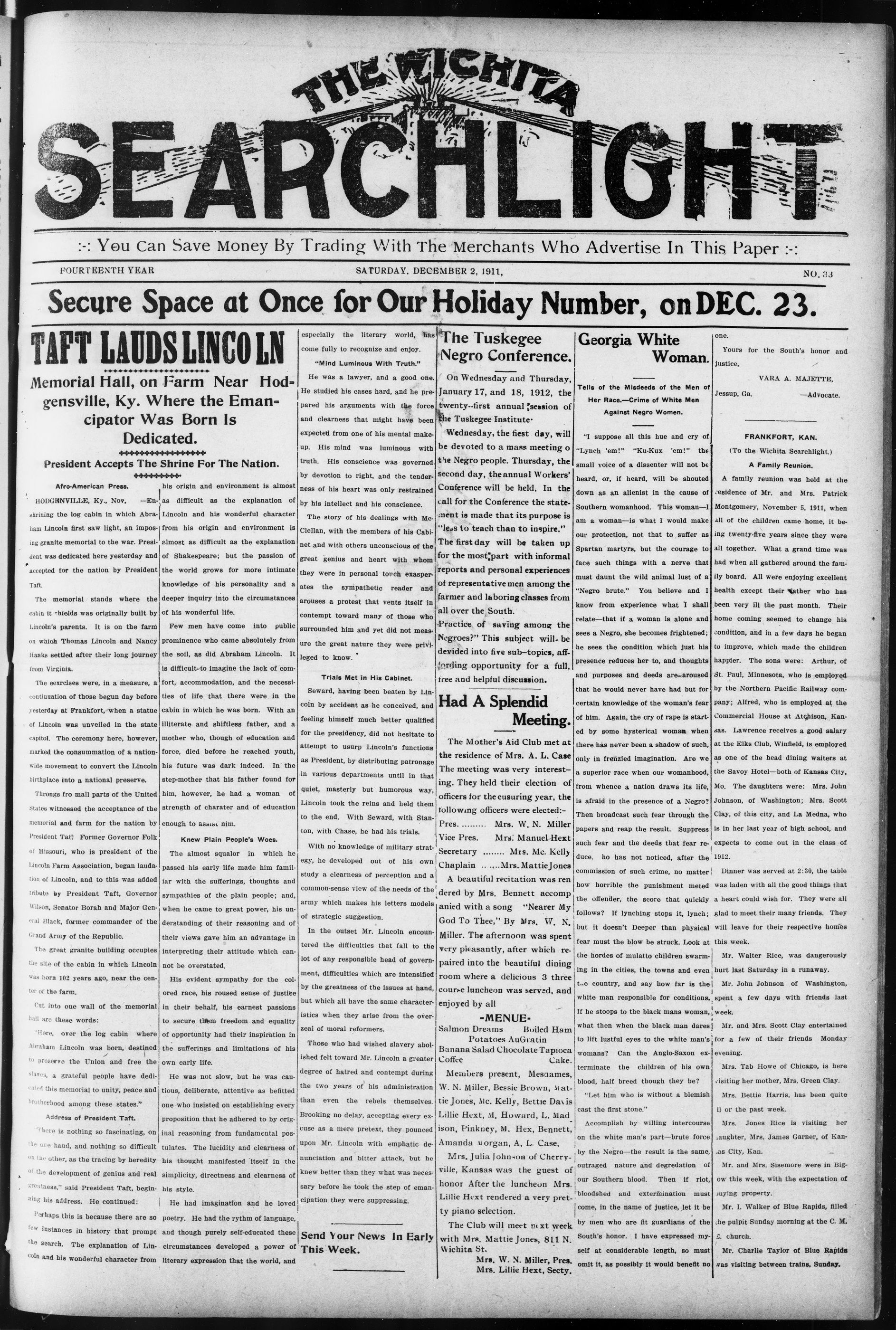
TAFT LAUDSLINCOLN
Memorial Hall, on Farm Near Hodgensville, Ky. Where the Emancipator Was Born Is
President Accepts The Shrine For The Nation.
FOURTEENTH YEAR
Secure S
TAFT LAUD
Memorial Hall, on
gensville, Ky. W
cipator W.
Dedic
President Accepts The
Afro-American Press.
HODGHNVILLE, Ky., Nov. —Enshrining the log cabin in which Abraham Lincoln first saw light, an imposing granite memorial to the war. President was dedicated here yesterday and accepted for the nation by President Taft.
The memorial stands where the cabin it shields was originally built by Lincoln's parents. It is on the farm on which Thomas Lincoln and Nancy Hanks settled after their long journey from Virginia.
The exercises were, in a measure, a continuation of those begun day before yesterday at Frankfort, when a statue of Lincoln was unveiled in the state capitol. The ceremony here, however, marked the consummation of a nationwide movement to convert the Lincoln birthplace into a national preserve.
Throngs fro mall parts of the United States witnessed the acceptance of the memorial and farm for the nation by President Taft. Former Governor Folk of Missouri, who is president of the Lincoln Farm Association, began laudation of Lincoln, and to this was added tribute by President Taft, Governor Wilson, Senator Borah and Major General Black, former commander of the Grand Army of the Republic.
The great granite building occupies the site of the cabin in which Lincoln was born 102 years ago, near the center of the farm.
Cut into one wall of the memorial hall are these words:
"Here, over the log cabin where Abrabam Lincoln was born, destined to preserve the Union and free the slaves, a grateful people have dedicated this memorial to unity, peace and brotherhood among these states."
Address of President Taft.
"There is nothing so fascinating, on the one hand, and nothing so difficult on the other, as the tracing by heredity of the development of genius and real greatness," said President Taft, beginning his address. He continued:
Perhaps this is because there are so few instances in history that prompt the search. The explanation of Lincoln and his wonderful character from
his origin and environment is almost as difficult as the explanation of Lincoln and his wonderful character from his origin and environment is almost as difficult as the explanation of Shakespeare; but the passion of the world grows for more intimate knowledge of his personality and a deeper inquiry into the circumstances of his wonderful life.
Few men have come into public prominence who came absolutely from the soil, as did Abraham Lincoln. It is difficult to imagine the lack of comfort, accommodation, and the necessities of life that there were in the cabin in which he was born. With an illiterate and shiftless father, and a mother who, though of education and force, died before he reached youth, his future was dark indeed. In the step-mother that his father found for him, however, he had a woman of strength of character and of education enough to assist him.
Knew Plain People's Woes.
The almost squalor in which he passed his early life made him familiar with the sufferings, thoughts and sympathies of the plain people; and, when he came to great power, his understanding of their reasoning and of their views gave him an advantage in interpreting their attitude which cannot be overstated.
His evident sympathy for the colored race, his roused sense of justice in their behalf, his earnest passions to secure them freedom and equality of opportunity had their inspiration in the sufferings and limitations of his own early life.
He was not slow, but he was cautious, deliberate, attentive as befitted one who insisted on establishing every proposition that he adhered to by original reasoning from fundamental postulates. The lucidity and clearness of his thought manifested itself in the simplicity, directness and clearness of his style.
He had imagination and he loved poetry. He had the rythm of language, and though purely self-educated these circumstances developed a power of literary expression that the world, and
SATURDAY, DECEMBER 2, 1911.
especially the literary world, has come fully to recognize and enjoy.
"Mind Luminous With Truth."
He was a lawyer, and a good one. He studied his cases hard, and he prepared his arguments with the force and clearness that might have been expected from one of his mental makeup. His mind was luminous with truth. His conscience was governed by devotion to right, and the tenderness of his heart was only restrained by his intellect and his conscience.
The story of his dealings with McClellan, with the members of his Cabinet and with others unconscious of the great genius and heart with whom they were in personal touch exasperates the sympathetic reader and arouses a protest that vents itself in contempt toward many of those who surrounded him and yet did not measure the great nature they were privileged to know.
Trials Met in His Cabinet.
Seward, having been beaten by Lincoln by accident as he conceived, and feeling himself much better qualified for the presidency, did not hesitate to attempt to usurp Lincoln's functions as President, by distributing patronage in various departments until in that quiet, masterly but humorous way, Lincoln took the reins and held them to the end. With Seward, with Stanton, with Chase, he had his trials.
With no knowledge of military strategy, he developed out of his own study a clearness of perception and a common-sense view of the needs of the army which makes his letters models of strategic suggestion.
In the outset Mr. Lincoln encountered the difficulties that fall to the lot of any responsible head of government, difficulties which are intensified by the greatness of the issues at hand, but which all have the same characteristics when they arise from the overzeal of moral reformers.
Those who had wished slavery abolished felt toward Mr. Lincoln a greater degree of hatred and contempt during the two years of his administration than even the rebels themselves. Brooking no delay, accepting every excuse as a mere pretext, they pounced upon Mr. Lincoln with emphatic denunciation and bitter attack, but he knew better than they what was necessary before he took the step of emancipation they were suppressing.
Send Your News In Early This Week.
The Tuskegee Negro Conference.
On Wednesday and Thursday, January 17, and 18, 1912, the twenty-first annual session of the Tuskegee Institute. Wednesday, the fiest day, will be devoted to a mass meeting of the Negro people. Thursday, the second day, the annual Workers' Conference will be held. In the call for the Conference the statement is made that its purpose is "less to teach than to inspire." The first day will be taken up for the most part with informal reports and personal experiences of representative men among the farmer and laboring classes from all over the South.
Practice of saving among the Negroes?" This subject will be devised into five sub-topics, affording opportunity for a full, free and helpful discussion.
Had A Splendid Meeting.
The Mother's Aid Club met at the residence of Mrs. A. L. Case The meeting was very interesting. They held their election of officers for the eusuring year, the following officers were elected:- Pres. ..... Mrs. W. N. Miller Vice Pres. Mrs. Manuel Hext Secretary ..... Mrs. Mc. Kelly Chaplain ..... Mrs. Mattie Jones A beautiful recitation was rendered by Mrs. Bennett accompanied with a song "Nearer My God To Thee," By Mrs. W. N. Miller. The afternoon was spent very pleasantly, after which repaired into the beautiful dining room where a delicious 3 three course luncheon was served, and enjoyed by all
Salmon Dreams Boiled Ham Potatoes AuGratin Banana Salad Chocolate Tapioca Coffee Cake.
Members present, MesaGames, W. N. Miller, Bessie Brown, Mattie Jones, Mc. Kelly, Bettie Davis Lillie Hext, M. Howard, L. Madison, Pinkney, M. Hex, Bennett, Amanda Morgan, A. L. Case.
Mrs. Julia Johnson of Cherryville, Kansas was the guest of honor After the luncheon Mrs. Lillie Hext rendered a very pretty piano selection.
The Club will meet next week with Mrs. Mattie Jones, 811 N. Wichita St.
Mrs. W. N. Miller, Pres. Mrs. Lillie Hext, Secty.
Georgia White Woman.
Tells of the Misdreeds of the Men of Her Race.—Crime of White Men Against Negro Women.
"I suppose all this hue and cry of "Lynch 'em!" "Ku-Kux 'em!" the small voice of a dissenter will not be heard, or, if heard, will be shouted down as an alienist in the cause of Southern womanhood. This woman—I am a woman—is what I would make our protection, not that to suffer as Spartan martyrs, but the courage to face such things with a nerve that must daunt the wild animal lust of a "Negro brute." You believe and I know from experience what I shall relate—that if a woman is alone and sees a Negro, she becomes frightened; he sees the condition which just his presence reduces her to, and thoughts and purposes and deeds are aroused that he would never have had but for certain knowledge of the woman's fear of him. Again, the cry of rape is started by some hysterical woman when there has never been a shadow of such, only in frenzied imagination. Are we a superior race when our womanhood, from whence a nation draws its life, is afraid in the presence of a Negro? Then broadcast such fear through the papers and reap the result. Suppress such fear and the deeds that fear reduce. ho has not noticed, after the commission of such crime, no matter how horrible the punishment meted the offender, the score that quickly follows? If lynching stops it, lynch; but it doesn't Deeper than physical fear must the blow be struck. Look at the hordes of mulatto children swarming in the cities, the towns and even the country, and say how far is the white man responsible for conditions. If he stoops to the black man woman, what then when the black man dares to lift lustful eyes to the white man's womans? Can the Anglo-Saxon exterminate the children of his own blood, half breed though they be?
"Let him who is without a blemish cast the first stone."
Accomplish by willing intercourse on the white man's part—brute force by the Negro—the result is the same, outraged nature and degredation of our Southern blood. Then if riot, bloodshed and extermination must come, in the name of justice, let it be by men who are fit guardians of the South's honor. I have expressed myself at considerable length, so must omit it, as possibly it would benefit no
NO.33
Yours for the South's honor and
justice,
VARA A. MAJETTE,
Jessup, Ga. —Advocate.
FRANKFORT, KAN.
(To the Wichita Searchlight.)
A Family Reunion.
A family reunion was held at the residence of Mr. and Mrs. Patrick Montgomery, November 5, 1911, when all of the children came home, it being twenty-five years since they were all together. What a grand time was had when all gathered around the family board. All were enjoying excellent health except their father who has been very ill the past month. Their home coming seemed to change his condition, and in a few days he began to improve, which made the children happier. The sons were: Arthur, of St. Paul, Minnesota, who is employed by the Northern Pacific Railway company; Alfred, who is employed at the Commercial House at Atchison, Kansas. Lawrence receives a good salary at the Elks Club, Winfield, is employed as one of the head dining waiters at the Savoy Hotel—both of Kansas City, Mo. The daughters were: Mrs. John Johnson, of Washington; Mrs. Scott Clay, of this city, and La Medna, who is in her last year of high school, and expects to come out in the class of 1912.
Dinner was served at 2:30, the table was laden with all the good things that a heart could wish for. They were all glad to meet their many friends. They will leave for their respective homes this week.
Mr. Walter Rice, was dangerously hurt last Saturday in a runaway.
Mr. John Johnson of Washington, spent a few days with friends last week.
Mr. and Mrs. Scott Clay entertained for a few of their friends Monday evening.
Mrs. Tab Howe of Chicago, is here visiting her mother, Mrs. Green Clay.
Mrs. Bettie Harris, has been quite ill or the past week.
Mrs. Jones Rice is visiting her daughter, Mrs. James Garner, of Kansas City, Kan.
Mr. and Mrs. Sisemore were in Bigow this week, with the expectation of buying property.
Mr. I. Walker of Blue Rapids, filled the pulpit Sunday morning at the C. M. E. church.
Mr. Charlie Taylor of Blue Rapids was visiting between trains, Sunday.
THE KITCHEN CABINET
OOLS discover that frailty is not compatible with great men; they wonder and despise; but the discerning find that greatness is not incompatible with frailty, and they admire and indulge.
—Edward Bulwer Lytton.
white, bitter part and cut the peel into narrow strips with the scissors. Simmer one and a half cups of raisins until tender; add the orange peel and the juice and a quart of cranberries. If needed, add more water to make a cupful of liquid. Cover and cook for ten minutes or until the berries are done. Then add two cups of sugar and simmer until thick.
WAYS OF SERVING POTATOES.
There are several hundred ways of serving the pomme de terre so that we need not fear monotony in serving this common vegetable.
Have ready a quart of cold, cooked potatoes chopped to the size of small beans, a half a cup of tomato sifted and reduced to a thick pulp, one large green pepper freed from seeds and minced fine, one small onion minced, three tablespoonfuls of fat in which the onion and pepper is cooked until soft; then add the potato and tomato with salt and pepper to taste. Cook until dry and serve with fish or cold meat.
Hashed Brown Potatoes.—Chop cold cooked potatoes rather fine, dust with salt and pepper. For each pint of potatoes have two tablespoonfuls of butter melted in a hot frying pan; spread the potatoes evenly and shake them over the fire until brown. Add a half cup of thin cream and let stand without stirring until the cream is absorbed. Roll like omelet and serve on a hot platter, garnish with sprigs of parsley. A soup that is very delicious and nourishing is made from potatoes.
Cream of Potato Soup.—Pare and cook until tender four medium-sized potatoes, mash and add to the following ingredients: To a quart of milk add a slice of onion, a stalk of celery and a sprig of parsley, or only the onion may be used as a flavor. When scalding hot remove the onion and add two tablespoonfuls of butter and two of flour that have beet cooked together; strain and add the potato. Serve very hot. For extra occasions a beaten egg added just before serving adds much to the quality of the soup.
Potatoes Baked With Cheese.—Put a layer of cold cooked potatoes in a buttered baking dish, sprinkle with a generous layer of grated cheese; add more potatoes and a cupful of white sauce made with two tablespoonfuls of butter and two of flour cooked until smooth, then add a cup of milk. Cook in a hot oven until the cheese is melted.
O MAN or woman of the humblest sort can really be strong, gentle, pure and good without the world being better for it, without somebody being helped and comforted by the very existence of that goodness.
CHRISTMAS CANDIES.
A most delicious fruit candy that will keep for weeks is called Turkish Sweets.—Take a pound each of dates, figs and walnut meats and put through the meat chopper. Mix well with powdered sugar and a little lemon juice enough to make a paste. Roll out and cut in any desired form or pack in glasses and cover with paraffin paper. This makes a delectable filling for sandwiches or it may be used dipped in fondant or chocolate for choice bon-bons.
Chocolate Caramels.—Put two and a half tablespoonfuls of butter into a kettle and when melted add two cups of molasses, a cup of sugar and a third of a cup of milk. Stir until the sugar is dissolved and when the boiling point is reached add three squares of chocolate, stirring constantly until the chocolate is melted. Boll until when tried in cold water a firm ball is formed. Add a teaspoonful of vanilla just as it is taken from the fire. Wintergreen and peppermint wafers may be made by flavoring and coloring fondant and melting it over hot water so it may be dropped in small teaspoonfuls on waxed paper.
Chicago Nuggets—Boil together until the soft ball stage a cup of brown and a cup of white sugar and a half cup of water, stir in a half teaspoon of soda, a teaspoon of vanilla and pour over the well beaten white of an egg. Beat until it holds its shape when dropped on a buttered sheet, add a half cup of nut meats and drop by teaspoonfuls on a buttered sheet.
E STARVE each other for love's caress;
We take, but we do not give;
It seems so easy some soul to bless.
But we do lose the love grudgingly, less and less,
THE WINTER BERRY.
In cooking cranberries it is well to remember that they should never be put into a tin dish. Either agate or porcelain dishes should be used.
Cranberry Conserve.—Extract the juice from an orange, then cover the peeling with cold water and cook slowly until tender. Scrape out the
white, bitter part and cut the peel into narrow strips with the scissors. Simmer one and a half cups of raisins until tender; add the orange peel and the juice and a quart of cranberries. If needed, add more water to make a cupful of liquid. Cover and cook for ten minutes or until the berries are done. Then add two cups of sugar and simmer until thick.
**Cranberry Trifle.**—Cook a quart of berries with one plint of water until the berries pop open; rub through a sieve, return to the fire and add one pound of sugar. Stir until it is dissolved, then let boll two minutes; cool and beat until light with a wire egg beater, then fold in the stiffly beaten whites of two eggs. Pile in a glass dish and serve. Cranberry shortcake and cranberry pie are old favorites for desserts.
Baked Apples With Cranberries.—Select large, perfect, sweet apples, remove the cores and fill the cavities with thick cranberry jelly. Set the apples in a pan of water in the oven, and bake until the apples are done. Put each apple in a glass sauce dish and serve with whipped cream.
Cranberry Roll.—Cream two tablespoonfuls of butter, add a cup of sugar, a half cup of cold water and two cups of flour sifted with a tablespoonful of baking powder and a dash of nutmeg. Beat until perfectly smooth, then add another cup of flour and roll out the dough to an inch in thickness. Spread thickly with jam or jelly, roll up closely, pressing the ends together. Lay on a plate and steam for three hours. Cut in slices and serve with cream.
RAK
PRAY you with all earnestness to prove, and know within your hearts, that all things lovely and righteous are possible for those who believe in their possibility, and who determine that for their part, they will make every day's work contribute to them. —Ruskin.
SOME COMMON DISHES:
The common vegetables are so often served in the same old ways until we grow tired of the monotony. Let us try:
Cabbage Baked With Cheese.—Chop the cabbage and cook it in boiling salted water for half an hour or until tender; put it in layers in a baking dish, alternating with a white sauce and grated cheese, and bake just long enough to melt the cheese.
Turnip and White Sauce.—Wash and slice the turnips into half-inch slices, pare and cut the slices into cubes; cook in boiling salted water until tender. Make a cup of seasoned white sauce and when the turnips are done pour off the water, turn into a vegetable dish and pour the sauce over them.
Cottage Pie.—Chop cold meat to half fill a baking dish. Over the top of the meat spread mashed potato that has been warmed with a little hot milk. Mix with gravy, season to taste and put into a hot oven to thoroughly heat through.
Sour Milk Gingerbread.—Take a half a cup of molasses, one-half cup of sugar, two teaspoonfuls of shortening, one cup of sour milk, one tablespoonful of ginger, half a teaspoon of salt, one teaspoon of soda, and two cups of flour.
Cream the shortening, add the sugar, molasses, salt and ginger. Dissolve the soda in the milk, which is now added, and lastly the flour. Beat well and bake in a flat loaf thirty to forty minutes.
Carrots in Lemon Butter.-Cut the carrots in long, slender strips and lay in cold water to crisp. Cook in boiling water until tender enough to pierce with a fork. Drain, and to each plint allow a tablespoonful of butter, half a teaspoon of salt, half a teaspoon of sugar, and a dust of cayenne. Simmer until the butter is absorbed, then add two tablespoonfuls of lemon juice and a tablespoon of minced parsley. Boll and serve at once.
Nellie Marwell.
Had Dr. Hopewell-Smith his way he would absolutely prohibit the eating of sweets between meals. He went so far in his address before the British Medical association as to say they should be rigidly tabooed by the young.
Admitting that sweets had their use he emphasized the need of moderation. The abuse of sweets, like that of alcohol, tea, etc., was very widespread. They should be rigidly taooed by the young and parents should not allow their children to eat any and every kind of confectionery. Sweet factories should be under rigid state control and all confectioners shops and their wares should be subject to examination by government inspectors. Only absolutely pure sweets should be sold and those under the most hygienic conditions possible.
The average woman isn't satisfied unless her husband quits loving her long enough to make love to her occasionally.
AT THE WICHITA THEATRES.
"The Melting Pot"—Lyceum
For the week commencing Nov. 27 North Bros. Stock Co. is offering as the attraction at the Lyceum theatre the great dramatic success, "The Melting Pot," as presented here last February by Walker Whiteside and company at the Forum. The production at the Lyceum is guaranteed in every way equal to the production offered at the Forum. No expense has been spared and people who were unable to see the play at the Forum, will see equally as good a production at the Lyceum, and at less than half the price. Regular matinees will be given Wednesday and Saturday with a special matinee Thanksgiving Day.
PICK ODD NOOKS FOR NESTS
Swallows Are Cunning Builders But Sometimes Select Precarious Sites for Homes.
Swallows are diligent and cunning builders of nests, but they are not always wise in their choice of a locality. In proof of this a couple of birds last year chose a secluded corner among the rafters of my barn and managed to hatch and rear their young successfully.
This year a couple, probably the same, repaired the nest and laid their eggs. But one morning both birds were found lying dead on the floor, the windows having been closed and the door locked by a too careful servant. A favorite place for a swallow to build its nest is the upper corner of a window.
This situation is to say the least precarious, as an energetic housemaid has merely unintentionally or otherwise to draw down the sash and the nest is at once in ruins. I remember once quite unintentionally acting the part of the energetic housemaid. I drew down the sash and managed just in time to save the structure from falling to pieces.
Supporting it with my hands, I told one of my boys to bring his schoolbag, and having fastened it securely to the window, deposited therein the remains of the nest and the young family of birds.
The parents were shy at first, but on closer investigation, having satisfied themselves that their little ones were still alive, they accommodated themselves to the situation and brought up their family in the usual way, sending them at length into the world doubtless all the wiser for their nurture in this abode of learning. A similar misfortune happened this summer to a swallow's nest in the window of a cottage in the Cheviot hills.
This time the nest was almost totally destroyed, but help came from a probably unlooked-for quarter. The dismayed cries of the feathered builders attracted their companions, who flocked around in large number and rendered every assistance in repairing the damage. The Scotsman.
Use of Checks In France.
The governor of the Banque de France has just sent to the director of the departmental branch offices a circular instructing them about the use of crossed checks. The Temps in publishing these instructions points out the advantage of the English method of employing checks and then shows how the French system of making payments immobilizes capital unproductively in purse, drawer or bank, whereas these sums converted into checks would be profitable not only to their owner but also for the bank which employs them.
While the Bank of France has to face a bank note circulation of 5,000,000,000 francs and the monetary stock is 214 francs 75 centimes per head of the contributions, England with a greater amount of business has a bank note circulation of 698,000,000 francs and a monetary stock of 84 francs 58 centimes.
BROWNING WAS NOT A SNOB
When a Cook Came to See Some Pictures He Offered Her His Arm.
A trivial anecdote occurs to me which has nothing to do with the "Countesses" who were supposed to absorb Mr. Browning overmuch. It appeared that on one occasion Mr. Browning's son had hired a room in a neighboring house in which to exhibit his pictures. In the temporary absence of the artist, Mr. Browning was doing the honors, the room being half filled with fashionable friends Mr. Browning was standing near the door when a visitor, unannounced, made her appearance; he immediately shook hands with the stranger, or tried to do so, when she exclaimed:
"Oh, I beg your pardon, sir, I'm the cook. Mr. Barrett asked me to come and see his pictures." "And I am very glad to see you," said Mr. Browning, with ready courtesy. "Take my arm and I will show you around." —Mrs. Andress Crossee, "Red Letter Days of My Life."
Uncle Eben.
"Usin' profanity to a mule," said Uncle Eben, "don ginerly accomplish much, 'cep' to give de mule a chance to show off his superior dignity."
Keep in the Valley.
"People who make mountains out of molehills," said the Observer of Events and Things, "never get up on the mountains, so to speak."
NOVEL TOMATO SALAD
NOVEL TOMATO SALAD
SOME SUGGESTIONS THE HOUSE
WIFE WILL APPRECIATE.
Icy Coldness, Careful Skinning and Marinating Are Essentials of Good Salad—Some Recipes Worth One's Consideration.
The essentials of a good tomato salad are ice coldness, careful skinning, and marinating. Prepare early enough in the day to keep in the refrigerator for three hours before using, and for half an hour at the end soak in a thick emulsion of French dressing, though mayonnaise is to be used on the salad proper.
If a tomato skins easily do not put it in hot water. With some varieties this will be possible, especially if the tomato be very cold and a sharp knife is used. The usual custom is to pour boiling water over the tomatoes, let stand a half minute, then peel with blunt silver knife and put at once on the ice.
Tomatoes take the flavor of their dressing so much better when sliced that many salads are prepared in sections, cut in lengthwise pieces, four or six to a tomato, according to size. Serve on a nest of lettuce or arrange as a border around shredded lettuce with a narrow outer border of white lettuce hearts. Dot with mayonnaise.
The whole tomato is so hard to eat that it is more often used as a cup than any other way. The fillings are endless and various odds and ends of vegetables can be utilized.
Especially good is one of cold peas highly seasoned with plenty of butter and mixed with a few capers. Cold corn dressed with plenty of butter, cayenne, salt, and a little whipped cream makes a novel filling and served with rich mayonnaise is excellent.
Cold spaghetti cut into small pieces and dressed with a highly spiced tomato sauce looks pretty and tastes good in a tomato cup, or the paste can be dressed with cream sauce and mixed with grated parmesan and chopped pimolas.
Shrimp and shredded green peppers make an artistic filling, or green peppers and shredded celery. Equally effective are asparagus tips and tiny pearl onions.
Remnants of chicken can be made into a nice salad filling by running it through a chopper, then season highly, and mix to a paste as for sandwich filling with a little whipped cream. Dot the top with anchovies or shredded green peppers.
Minced ham mixed with mayonnaise is as good in tomato cups as it is on croutons or sandwiches. If hard-bolled egg—yolk—is run through a vegetable press and dotted over the top of the cup it makes a pretty coloring.
Another good filling consists of tiny button onions, boiled until soft, made icy cold and mixed with mayonnaise. This is far less painful to the bystander than the shredded onion so often used.
A novel salad is a small tomato, cut almost through in lengthwise sections, with minced cress peeping from the cuts. The tomato is only cut enough so it will hold together and the cress is marinated in French dressing. The tomato is then set on a round of canned pineapple, which rests on a tender lettuce leaf, the whole being garnished with mayonnaise.
A delicious salad is made from sections of tomatoes marinated in French dressing, served on lettuce leaves and sprinkled thickly with very crisp bacon, cut into small shreds. Mayonnaise can be passed.
Carrots Flemish Style.
Wash and scrape a bunch of young carrots and cut each one into quarters. Cook in salted boiling water for ten minutes and then drain. Melt an ounce of butter in a saucepan, put in the carrots, sprinkle them with flour, salt and pepper and a pinch of sugar and toss them about for five minutes. Stir in a half pint of meat stock and let simmer on the back of the stove for 15 minutes, occasionally stirring. As soon as the carrots are cooked draw them away from the fire until they have cooled somewhat. Beat the yolks of two eggs into half a cupful of cream or rich milk. Stir this into the carrots and cook gently until the liquor thickens, but do not allow to boil. Serve in a hot dish and sprinkle over with minced parsley.
Care of House Paint.
Few housewives have the least idea what a little care of the outdoor house paint, such as window sashes, front door and even railings, will do to preserve its beauty and length of life. The simplest plan is to wash this paint at intervals with tepid water to which a little paraffin has been added, with a soft rag. Then to apply a really good, preferably home-made furniture polish, and rub off in the usual way. This quite prevents blistering. Paint that is far gone could be washed in oxalic acid and water, but this is a strenuous remedy and only suitable when a repainting is to be the next move. Below I give a recipe for a polish suitable for both furniture and paint.
Mocha Layer Cake.
The yolks of five eggs, one cupful of powdered sugar, two tablespoonfuls of mocha essence, two tablespoonfuls of strong, hot coffee, one cupful of flour, and one teaspoonful of baking powder. Add the beaten whites of the eggs and bake in three layers for fifteen or twenty minutes. Fill with whipped cream.
WENT TO BLOCK CHEERFULLY
Sir Walter Raleigh Under Sentence of Death, Failed to Win Pardon by Last Voyage.
Fate and justice worked some peculiar pranks in the olden days. Sir Walter Raleigh, with the death sentence hanging over him for 18 years, failing in his final voyage of discovery, returned to England and went cheerfully to the block. He left the Tower without the royal pardon in 1615. The adventurous but still condemned man had received permission to make another voyage to South America. If he should be successful in the outcome of his venture Raleigh knew the king's mercy would be granted him. But this last expedition, undertaken with such a vital interest at stake for Raleigh, was unfortunate in all its respects. At San Tomas, on the Cayenne river in Gulana, his men made a hostile attack upon a Spanish settlement. As England was then at peace with Spain, this act of war against the people of a friendly nation was a most grievous offense against the king. On October 29, 1618, he suffered death by the ax. Having fingered the edge, he returned it and said, smiling to the sheriff: "This is a sharp medicine, but it is a sound cure for all diseases."
Any Distress After Meals?
Have you heartburn?
TRY THE BITTERS
Do you belch or bloat?
TRY THE BITTERS
Digestion weak—bowels clogged?
Turned Laugh on Toastmaster.
Turned Laugh on toastmaster.
Paul D Durant, toastmaster at a beefsteak dinner recently held by the resident alumni of Michigan university, paused as he was about to introduce a speaker of the evening, to recall an escapade of his college career.
"Before I tell this story, he began, "it will be necessary to give you some definite idea of the personal characters. In the class of '95, of which I was a member, there were two of the toughest fellows that ever attended the university—"
Hostetter's Stomach Bitters
"Who was the other one?" was the interrogation from the farther corner of the table. The toastmaster joined in the general laugh which followed.
"I always enjoy going to the first performance of a new play."
"Why the first?"
"Because I'm always sure then that the man who sits behind me hasn't seen it before."
No genuine observer can decide otherwise than that the houses of a nation are the bulwarks of personal and national safety and thrift.—J. G. Holland.
FOR ALL EYE DISEASES Pettits Eye Salve
DEFIANCE Gold Water Starch makes laundry work a pleasure. 16 oz. pkg. 100
DRUG STORES (snake) for sale and trade in all states. F.V. KNEST, Omaha, N.A.
W. N. U., WICHITA, NO. 48-1911.
Mrs. Winslow's Soothing Syrup for Children
teaching, softens the gums, reduces inflammation,
allays pain, cures wint colic, 25c a bottle.
We show how much of the Bible we
believe by the way we trust God.
The great success of Dr. Pierce's Gold covery in curing weak stomachs, was lungs, and obstinate and lingering cough the recognition of the fundamental treat Medical Discovery" supplies Nature ing, tissue-repairing, muscle-making rensed and concentrated form. With supplies the necessary strength to the food, build up the body and thereby the obstinate coughs. The "Discovery" digestive and nutritive organs in sound and enriches the blood, and nourishes short establishes sound vigorous health.
If your dealer offers so it is probably better F. But you are thinking of there's nothing "just as Dr. Pierce's Common Sense Medicine Icine Simplified, 1008 pages, over 700 Edition, paper-bound, sent for 21 one only. Cloth-bound, 31 stamps. Addre
Ray
Scientifically co most light for the co Easy to light. In numerous finish best of its kind.
Ask your dealer to show you Lanterns, or write for to any as Standard C (Incor
The Worlds for tea
LIPTON
OVER 2 MILLION PAC
The great success of Dr. Pierce's Golden Medical Discovery in curing weak stomachs, wasted bodies, weak lungs, and obstinate and lingering coughs, is based on the recognition of the fundamental truth that "Golden Medical Discovery" supplies Nature with body-building, tissue-repairing, muscle-making materials, in condensed and concentrated form. With this help Nature supplies the necessary strength to the stomach to digest food, build up the body and thereby throw off lingering obstinate coughs. The "Discovery" re-establishes the digestive and nutritive organs in sound health, purifies and enriches the blood, and nourishes the nerves—in short establishes sound vigorous health.
older offers something "just as good," probably better FOR HIM...it pays better. Thinking of the cure not the profit, so asking "just as good" for you. Say so.
On Sense Medical Adviser, In Plain English; or, Mediages, over 700 illustrations, newly revised up-to-date present for 21 one-cent stamps, to cover cost of mailing stamps. Address Dr. R. V. Pierce, Buffalo, N. Y.
Rayo Lamps and Lanterns
identifically constructed to give light for the oil they burn.
Easy to light, clean and rewick.
Numerous finishes and styles, each the its kind.
Dedicator to show you his line of Rayo Lamps and lanterns, or write for illustrated booklets direct to any agency of the Standard Oil Company
(Incorporated)
Worlds Standard tea is
TON'S TEA
2 MILLION PACKAGES SOLD WEEKLY
If your dealer offers something "just as good," it is probably better FOR HIM...it pays better. But you are thinking of the cure not the profit, so there's nothing "just as good" for you. Say so.
Dr. Pierce's Common Sense Medical Adviser, In Plain English; or, Medicine Simplified, 1008 pages, over 700 illustrations, newly revised up-to-date Edition, paper-bound, sent for 21 one-cent stamps, to cover cost of mailing only. Cloth-bound, 31 stamps. Address Dr. R. V. Pierce, Buffalo, N. Y.
The Worlds Standard
for tea is
LIPTON'S TEA
OVER 2 MILLION PACKAGE S SOLD WEEKLY
PERFECTION SMOKELESS OIL HEATER
Always ready for use. Safest and most reliable.
The Perfection Smokeless Oil Heater is just like a portable fireplace.
It gives quick, glowing heat wherever, whenever, you want it.
A necessity in fall and spring, when it is not cold enough for the furnace. Invaluable as an auxiliary heater in midwinter.
Drums of blue enamel or plain steel, with nickel trimmings.
Ask your dealer to show you a Perfection Smokeless Oil Heater, or write to any agency of
Standard Oil Company
(Incorporated)
---
Felt Safe.
Country's Safeguard.
Aids Nature
T
DISTEMPER
In all its forms among all ages of horses, as well as dogs, cured and others in same stable prevented from having the disease with SPOHN'S DISTEMPER CURE. Every bottle guaranteed. Over 500,000 bottles last, ever $50 and $1,000. Any good druggist, or sent to manufacturers. Agents Wanted, Spohn Medical Co., Spec. Contagious Diseases, Goshen, Ind.
Takes More Than That.
"Truth" lies at the bottom of a well.
"Yes, and unlike most wells, you can't raise it by hot air."—Baltimore American.
TO DRIVE OUT MALARIA
AND BUILD UP THE SYSTEM
Take the Old Testament and TASTeless
CHILL TONIC. Do no what you want.
The frog is plain, printed o. e ery bells,
most of the stained and iron in a tasteless
form, and the most effectual form. For grown
people and children, 50 cents
What has become of the old-fashioned politician who used to imagine
he was destiny's only son?—Toledo Blade.
It's an ill-timed watch that causes
a man to miss a train.
TRY THE BITTERS
is 58 years old and has helped thousands back to health. It tones—rebuilds—nourishes.
KEYSTONA FOR WALLS AND CELIINGS GOES ON LINE PAINT! LOOKS LIKE WALL PAPER: YOU CAN MISS IT A beautiful illustrated book of 24 colors and Photo-KEYSTONA YARNISH CO., Brooklyn, N.Y.
A
CASHIER TELLS HIS STORY
ARREST OF BANK PRESIDENT QUICKLY FOLLOWS.
Bold Scheme of Fake Banking Exposed in Connection with String of Night and Day Institutions.
Memphis, Tennessee.—Following on the heels of the confession of A. G. Toenges, cashier of the defunct All Night and Day bank, which he made to Sheriff Tate and Receiver D. A. Fraser, E. L. Hendrey, president of the bank and connected in various ways with the All Night and Day banks in Oklahoma City, Little Rock, Kansas City and other points, has been arrested.
He gave bond one hour after he was taken to the county jail, where he was detained in a private office.
Teoenges' confession exposed one of the boldest schemes of fake banking ever brought to light in Memphis. He showed how the American Trust and Banking company, organized with a supposed capital of $50,000, really did not have a cent except that which the Memphis All Night and Day bank loaned it when the date for a showdown came.
Hendrey has been away from Tennessee for three months. He was originally indicted under the Oklahoma laws for being implicated in a loan promulgated for by the All Night and Day bank of Oklahoma City.
The All Night and Day bank of Memphis failed for $30,000 last August and the depositors have never been paid a cent.
The American Bank and Trust company was organized as a holding concern, where money loaned from the All Night and Day bank on fake deposit certificates was deposited and where a number of small banks in Mississippi and Tennessee had arranged to deposit corresponding funds.
DIED IN THEIR HOUSE OF SAND
Three Children Killed and Two Injured While Playing—Boy's Kick Causes Avalanch.
Kansas City, Kan.—Eight children went to play in a bank of sand here and dug a cave back about 20 feet. Then as they contemplated their work from the inside a boy's contemptuous kick shook the sand pit. The 14-foot bank above them fell in, three of the children were killed and two were injured severely.
The dead are: Ethel Hutchinson, 11 years old; Flossie Hutchinson, 14 and Roscoe Sparks, 9.
Lydia Hutchinson, 16 years old, sister of the two girls killed and Harold Hutchings, 10 years old, were seriously injured.
By the efforts of Lizzie Sparks, 16 years old, the two injured children escaped death. She saved their lives and her own, by digging them out, not knowing that her brother Roscoe, 9 years old, also had been buried.
ROCK ISLAND TROUBLE AVERTED
Settlement Made Avoids Strike Con- templated Affecting Eight Thousand Men.
Chicago, Illinois.—The settlement agreed upon by the Chicago, Rock Island & Pacific railway and its shopmen averts a strike which would have affected 8,000 men. The shopmen, after five months of negotiations, in which concessions were made on both sides, have accepted the company's wage scale and signed a contract for another year. The original 34 demands were reduced to six, including an advance of two cents an hour in wages and a change in working conditions. The railroad officials refused these demands, declaring that general business conditions did not warrant any increase in operating expenses. After full consideration, the union officials sent a letter to President Mudge accepting the terms.
Enforcing Fire Laws.
Emporia, Kansas.—Following an inspection of the buildings of Emporia by Owen Doyle, state factory inspector, and his deputy, M. L. O'Brien, prosecutions were begun against H. C. Whitley, Fred R. Corbett and C. C. Concannon for non-compliance with the fire regulation laws. The two first named neglected to observe certain fire escape regulations in the Whitley Opera house and the latter requirements for booths in moving picture houses. The state officers are on a trip over the state, under specific orders from Gov. Stubbs to enforce the fire laws.
Young Hunter Shot
Caney, Kansas.—Earl Overfield, son of Senator Overfield of Independence, was shot in the head accidentally while hunting, six miles west of Caney. He was dangerously, but probably not fatally wounded.
French Train Into River.
Saintau, France.—Sixty passengers lost their lives through the plunging of a train into the River Thouet, owing to the breakdown of a bridge on the state railway at Montreuil-Bellay.
Conductor's Conscience Hurt.
Newark, New Jersey.—The officers of the public service corporation of New Jersey have received a draft for $100 from a conscience-striken college man in Portland, Ore., who stole fares while a conductor here.
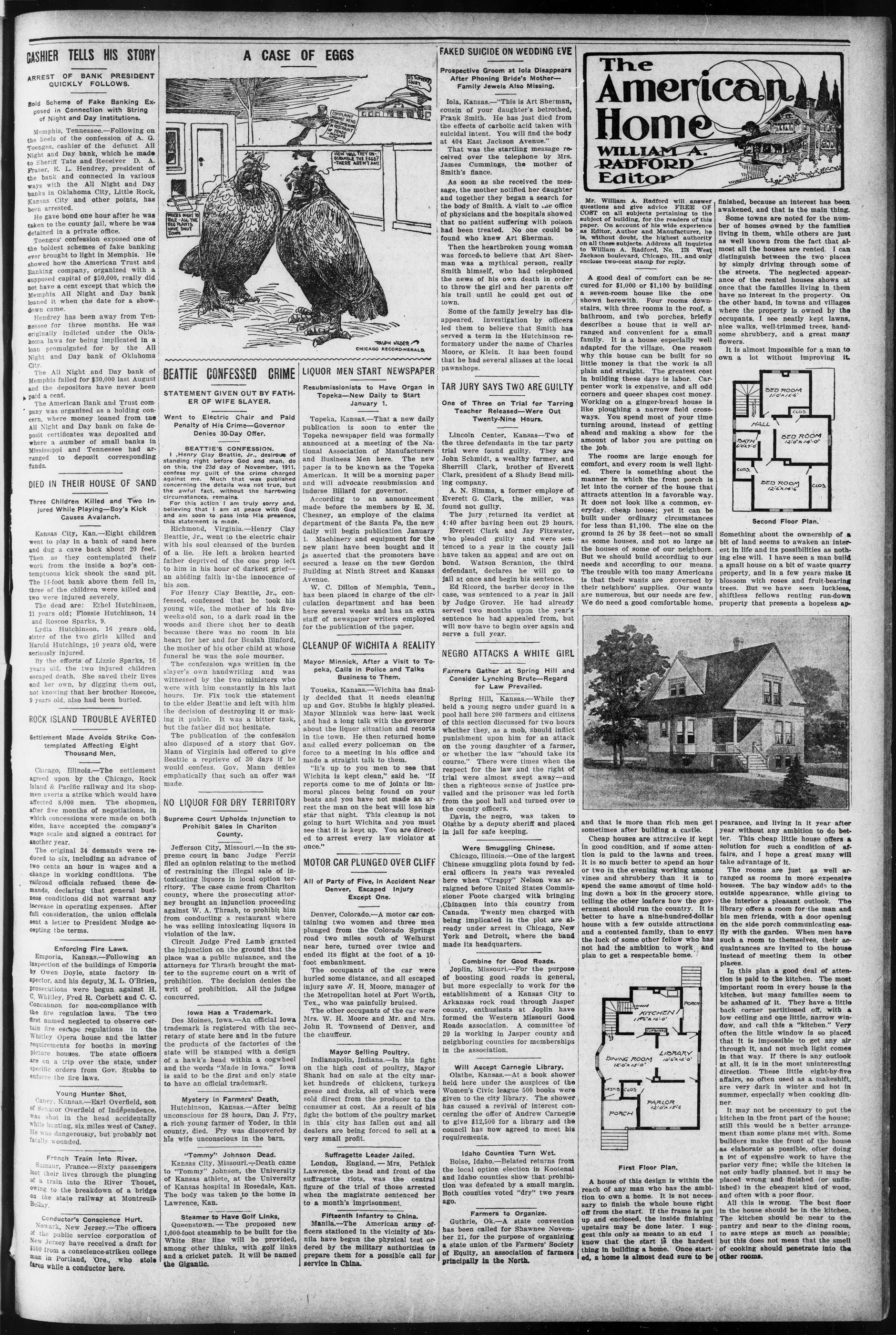
A CASE OF EGGS
PRIZE IS NIGHT TO
TRIKE - ALL THE
RECIPE WANTS
HAVE SHUT
DOWN.
BEATTIE CONFESSED CRIME
THE SUPERIOR COURT.
COMPANY AGAINST KEYS AND COMING IN RESTAURANT OF TRADE MARKS
HOW WILL THEY UN- GORAMBLE THE EGGS? THERE AREN'T ANY!
PROCEEDS MIGHT TO RISE - ALL THE EGG PLANTS HAVE SHUT DOWN.
RALPH WILDER
CHICAGO RECORD-HERALD.
---
STATEMENT GIVEN OUT BY FATH
ER OF WIFE SLAYER.
Went to Electric Chair and Paid Penalty of His Crime—Governor Denies 30-Day Offer.
BEATTIE'S CONFESSION.
I, Henry Clay Beattie, Jr., desirous of standing right before God and man, do on this, the 23d day of November, 1911, confess my guilt of the crime charged against me. That that was published concerning the details was not true, but the awful fact, without the harrowing circumstances, remains.
For this action I am truly sorry and, believing that I am at peace with God and am soon to pass into His presence, this statement is made.
Richmond, Virginia—Henry Clay Beattie, Jr., went to the electric chair with his soul cleansed of the burden of a lie. He left a broken hearted father deprived of the one prop left to him in his hour of darkest grief—an abiding faith in the innocence of his son.
For Henry Clay Beattie, Jr., confessed, confessed that he took his young wife, the mother of his five-weeks-old son, to a dark road in the woods and there shot her to death because there was no room in his heart for her and for Beulah Binford, the mother of his other child at whose funeral he was the sole mourner. The confession was written in the slayer's own handwriting and was witnessed by the two ministers who were with him constantly in his last hours. Dr. Fix took the statement to the elder Beattie and left with him the decision of destroying it or making it public. It was a bitter task, but the father did not hesitate.
The publication of the confession also disposed of a story that Gov. Mann of Virginia had offered to give Beattie a reprieve of 30 days if he would confess. Gov. Mann denies emphatically that such an offer was made.
NO LIQUOR FOR DRY TERRITORY
Supreme Court Upholds Injunction to Prohibit Sales in Chariton County.
Jefferson City, Missouri.—In the supreme court in banc Judge Ferris filed an opinion relating to the method of restraining the illegal sale of intoxicating liquors in local option territory. The case came from Chariton county, where the prosecuting attorney brought an injunction proceeding against W. A. Thrash, to prohibit him from conducting a restaurant where he was selling intoxicating liquors in violation of the law.
Circuit Judge Fred Lamb granted the injunction on the ground that the place was a public nuisance, and the attorneys for Thrash brought the matter to the supreme court on a writ of prohibition. The decision denies the writ of prohibition. All the judges concurred.
Iowa Has a Trademark.
Des Moines, Iowa.—An official Iowa trademark is registered with the secretary of state here and in the future the products of the factories of the state will be stamped with a design of a hawk's head within a cogwheel and the words "Made in Iowa." Iowa is said to be the first and only state to have an official trademark.
Mystery in Farmers' Death.
Hutchinson, Kansas—After being unconscious for 28 hours, Dan J. Fry, a rich young farmer of Yoder, in this county, died. Fry was discovered by his wife unconscious in the barn.
"Tommy" Johnson Dead.
Kansas City, Missouri. Death came to "Tommy" Johnson, the University of Kansas athlete, at the University of Kansas hospital in Rosedale, Kan. The body was taken to the home in Lawrence, Kan.
Steamer to Have Golf Links
Queenstown. — The proposed new 1,000-foot steamship to be built for the White Star line will be provided, among other thinks, with golf links and a cricket patch. It will be named the Gigantic.
US SUPREME COURT.
COMPANY AGAINST NEWS
FOR THE CORRIDORINE
IN RESTAURANT
OF TOWN
HOW WILL THEY UN-
SCROMBLE THE EGGS?
THERE AREN'T ANY.
RALPH WILDER
CHICAGO RECORD-HERALD.
LIQUOR MEN START NEWSPAPER
Resubmissionists to Have Organ In
Tuesday, New Delhi to Start
Topeka, Kansas.—That a new daily publication is soon to enter the Topeka newspaper field was formally announced at a meeting of the National Association of Manufacturers and Business Men here. The new paper is to be known as the Topeka American. It will be a morning paper and will advocate resubmission and indorse Billard for governor. According to an announcement made before the members by E. M. Chesney, an employee of the claims department of the Santa Fe, the new daily will begin publication January 1. Machinery and equipment for the new plant have been bought and it is asserted that the promoters have secured a lease on the new Gordon Building at Ninth Street and Kansas Avenue.
W. C. Dillon of Memphis, Tenn., has been placed in charge of the circulation department and has been here several weeks and has an extra staff of newspaper writers employed for the publication of the paper.
CLEANUP OF WICHITA A REALITY
Mayor Minnick, After a Visit to Topeka, Calls in Police and Talks Business to Them.
Toueka, Kansas.—Wichita has finally decided that it needs cleaning up and Gov. Stubbs is highly pleased. Mayor Minnick was here last week and had a long talk with the governor about the liquor situation and resorts in the town. He then returned home and called every policeman on the force to a meeting in his office and made a straight talk to them.
"It's up to you men to see that Wichita is kept clean," said he. "If reports come to me of joints or immoral places being found on your beats and you have not made an arrest the man on the beat will lose his star that night. This cleanup is not going to hurt Wichita and you must see that it is kept up. You are directed to arrest every law violator at once."
MOTOR CAR PLUNGED OVER CLIFF
All of Party of Five, in Accident Near Denver, Escaped Injury Except One.
Denver, Colorado.—A motor car containing two women and three men plunged from the Colorado Springs road two miles south of Welhurst near here, turned over twice and ended its flight at the foot of a 10-foot embankment.
The occupants of the car were hurled some distance, and all escaped injury save W. H. Moore, manager of the Metropolitan hotel at Fort Worth, Tex., who was painfully bruised.
The other occupants of the car were Mrs. W. H. Moore and Mr. and Mrs. John R. Townsend of Denver, and the chauffeur.
Mayor Selling Poultry.
Indianapolis, Indiana.—In his fight on the high cost of poultry, Mayor Shank had on sale at the city market hundreds of chickens, turkeys geese and ducks, all of which were sold direct from the producer to the consumer at cost. As a result of his fight the bottom of the poultry market in this city has fallen out and all dealers are being forced to sell at a very small profit.
Suffragette Leader Jailed.
London, England.—Mrs. Pethick Lawrence, the head and front of the suffragette riots, was the central figure of the trial of those arrested when the magistrate sentenced her to a month's imprisonment.
Fifteenth Infantry to China
Manila.—The American army officers stationed in the vicinity of Manila have begun the physical test ordered by the military authorities to prepare them for a possible call for service in China.
FAKED SUICIDE ON WEDDING EVE
Prospective Groom at iola Disappears After Phoning Bride's Mother—Family Jewels Also Missing.
Iola, Kansas.—"This is Art Sherman, cousin of your daughter's betrothed, Frank Smith. He has just died from the effects of carbolic acid taken with suicidal intent. You will find the body at 404 East Jackson Avenue."
That was the startling message received over the telephone by Mrs. James Cummings, the mother of Smith's fiance.
As soon as she received the message, the mother notified her daughter and together they began a search for the body of Smith. A visit to the office of physicians and the hospitals showed that no patient suffering with poison had been treated. No one could be found who knew Art Sherman.
Then the heartbroken young woman was forced to believe that Art Sherman was a mythical person, really Smith himself, who had telephoned the news of his own death in order to throw the girl and her parents off his trail until he could get out of town.
Some of the family jewelry has disappeared. Investigation by officers led them to believe that Smith has served a term in the Hutchinson reformatory under the name of Charles Moore, or Klein. It has been found that he had several aliases at the local pawshops.
TAR JURY SAYS TWO ARE GUILTY
One of Three on Trial for Tarring Teacher Released—Were Out Twenty-Nine Hours.
Lincoln Center, Kansas—Two of the three defendants in the tar party trial were found guilty. They are John Schmidt, a wealthy farmer, and Sherrill Clark, brother of Everett Clark, president of a Shady Bend milling company.
A. N. Simms, a former employee of Everett G. Clark, the miller, was found not guilty.
The jury returned its verdict at 4:40 after having been out 29 hours. Everett Clark and Jay Fitzwater, who pleaded guilty and were sentenced to a year in the county jail have taken an appeal and are out on bond. Watson Scranton, the third defendant, declares he will go to jail at once and begin his sentence.
Ed Ricord, the barber decoy in the case, was sentenced to a year in jail by Judge Grover. He had already served two months upon the year's sentence he had appealed from, but will now have to begin over again and serve a full year.
NEGRO ATTACKS A WHITE GIRL
Farmers Gather at Spring Hill and Consider Lynching Brute—Regard for Law Prevailed.
Spring Hill, Kansas. While they held a young negro under guard in a pool hall here 200 farmers and citizens of this section discussed for two hours whether they, as a mob, should inflict punishment upon him for an attack on the young daughter of a farmer, or whether the law "should take its course." There were times when the respect for the law and the right of trial were almost swept away—and then a righteous sense of justice prevailed and the prisoner was led forth from the pool hall and turned over to the county officers.
Davis, the negro, was taken to Olathe by a deputy sheriff and placed in jail for safe keeping.
Were Smuggling Chinese.
Chicago, Illinois.—One of the largest Chinese smuggling plots found by federal officers in years was revealed here when "Crappy" Nelson was arraigned before United States Commissioner Foote charged with bringing Chinamen into this country from Canada. Twenty men charged with being implicated in the plot are already under arrest in Chicago, New York and Detroit, where the band made its headquarters.
Combine for Good Roads.
Joplin, Missouri.—For the purpose of boosting good roads in general, but more especially to work for the establishment of a Kansas City to Arkansas rock road through Jasper county, enthusiasts at Joplin have formed the Western Missouri Good Roads association. A committee of 20 is working in Jasper county and neighboring counties for memberships in the association.
Will Accept Carnegie Library.
Olathe, Kansas.—At a book shower held here under the auspices of the Women's Civic league 500 books were given to the city library. The shower has caused a revival of interest concerning the offer of Andrew Carnegie to give $12,500 for a library and the council has now agreed to meet his requirements.
Idaho Counties Turn Wet. Boise, Idaho.—Belated returns from the local option election in Kootenal and Idaho counties show that prohibition was defeated by a small margin. Both counties voted "dry" two years ago.
Guthrie, Ok.—A state convention has been called for Shawnee November 21, for the purpose of organizing a state union of the Farmers' Society of Equity, an association of farmers principally in the North.
The American Home
WILLIAM A.
RADFORD
Editor
THE HOME OF THE MIDDLE SCHOOL FOR YOUNG PERSONS.
Mr. William A. Radford will answer questions and give advice FREE OF COST on all subjects pertaining to the subject of building, for the readers of this paper. On account of his wide experience as Editor, Author and Manufacturer, he has been the highest judge on all these subjects. Add all his alliances to William A. Radford, No. 178 West Jackson boulevard, Chicago, Ill., and only enclose two-cent stamp for reply.
A good deal of comfort can be secured for $1,000 or $1,100 by building a seven-room house like the one shown herewith. Four rooms downstairs, with three rooms in the roof, a bathroom, and two porches, briefly describes a house that is well arranged and convenient for a small family. It is a house especially well adapted for the village. One reason why this house can be built for so little money is that the work is all plain and straight. The greatest cost in building these days is labor. Carpenter work is expensive, and all old corners and queer shapes cost money. Working on a ginger-bread house is like ploughing a narrow field crossways. You spend most of your time turning around, instead of getting ahead and making a show for the amount of labor you are putting on the job.
The rooms are large enough for comfort, and every room is well lighted. There is something about the manner in which the front porch is let into the corner of the house that attracts attention in a favorable way. It does not look like a common, everyday, cheap house; yet it can be built under ordinary circumstances for less than $1,100. The size on the ground is 26 by 38 feet—not so small as some houses, and not so large as the houses of some of our neighbors. But we should build according to our needs and according to our means. The trouble with too many Americans is that their wants are governed by their neighbors' supplies. Our wants are numerous, but our needs are few. We do need a good comfortable home.
THE HOME OF THE MIDDLE SCHOOL
and that is more than rich men get sometimes after building a castle. Cheap houses are attractive if kept in good condition, and if some attention is paid to the lawns and trees. It is so much better to spend an hour or two in the evening working among vines and shrubbery than it is to spend the same amount of time holding down a box in the grocery store, telling the other loafers how the government should run the country. It is better to have a nine-hundred-dollar house with a few outside attractions and a contented family, than to envy the luck of some other fellow who has not had the ambition to work and plan to get a respectable home.
DOWN
KITCHEN
14'0" x 16'0"
CUPBOARD
DINING ROOM
12'0" x 15'0"
LIBRARY
10'6" x 12'0"
VESTIBULOUS
PARLOR
12'0" x 15'6"
PORCH
First Floor Plan.
A house of this design is within the reach of any man who has the ambition to own a home. It is not necessary to finish the whole house right off from the start. If the frame is put up and enclosed, the inside finishing upstairs may be done later. I suggest this only as means to an end. I know that the start is the hardest thing in building a home. Once started, a home is almost dead sure to be
finished, because an interest has been awakened, and that is the main thing. Some towns are noted for the number of homes owned by the families living in them, while others are just as well known from the fact that almost all the houses are rented. I can distinguish between the two places by simply driving through some of the streets. The neglected appearance of the rented houses shows at once that the families living in them have no interest in the property. On the other hand, in towns and villages where the property is owned by the occupants, I see neatly kept lawns, nice walks, well-trimmed trees, handsome shrubbery, and a great many flowers. It is almost impossible for a man to own a lot without improving it.
DED ROOM
11'0" x 12'6"
CLOS.
HALL
DED ROOM
12'0" x 14'0"
DATH
6'0" x 7'0"
CLOS.
DED ROOM
12'6" x 14'6"
CLOS.
Second Floor Plan.
Something about the ownership of a bit of land seems to awaken an interest in life and its possibilities as nothing else will. I have seen a man build a small house on a bit of waste quarry property, and in a few years make it blossom with roses and fruit-bearing trees. But we have seen luckless, shiftless fellows renting run-down property that presents a hopeless ad-
THE HOME OF THE MIDDLE SCHOOL FOR YOUNG PERSONS
pearance, and living in it year after year without any ambition to do better. This cheap little house offers a solution for such a condition of affairs, and I hope a great many will take advantage of it. The rooms are just as well arranged as rooms in more expensive houses. The bay window adds to the outside appearance, while giving to the interior a pleasant outlook. The library offers a room for the man and his men friends, with a door opening on the side porch communicating easily with the garden. When men have such a room to themselves, their acquaintances are invited to the house instead of meeting them in other places.
In this plan a good deal of attention is paid to the kitchen. The most important room in every house is the kitchen, but many families seem to be ashamed of it. They have a little back corner partitioned off, with a low ceiling and one little, narrow window, and call this a "kitchen." Very often the little window is so placed that it is impossible to get any air through it, and not much light comes in that way. If there is any outlook at all, it is in the most uninteresting direction. These little eight-by-five affairs, so often used as a makeshift, are very dark in winter and hot in summer, especially when cooking dinner.
It may not be necessary to put the kitchen in the front part of the house; still this would be a better arrangement than some plans met with. Some builders make the front of the house as elaborate as possible, after doing a lot of expensive work to have the parlor very fine; while the kitchen is not only badly planned, but it may be placed wrong and finished (or unfinished) in the cheapest kind of wood, and often with a poor floor.
All this is wrong. The best floor in the house should be in the kitchen. The kitchen should be near to the pantry and near to the dining room, to save steps as much as possible; but this does not mean that the smell of cooking should penetrate into the other rooms.
---
MARCHLIGHT, PAGE FIVE
"SECOND PLACE
GOOD BED
IT IS AS WHAT
THE OTTO WEISS A
are all guaranty
Law, Serial No.
sas State Law,
It Is The Cheapest
For Clean Beds
Little
Restaurant
Meals 20c —
507 No
Short Order
Good Service
Barber Shop
Chas.
Merch
605 Nor
First-Class M
Cleaning, Pressing
Courteous Attention
HILL
LUMBER
318 West Douglas
Dealers in the
at the lowest
Let us
THE OTTO WEISS ALFALFA STOCK and POULTHY FOOD are all guaranteed under the United States Law, Serial No. 13415 and under the Kansas State Law, Register No. 1.
Little Wonder
Restaurant and Hotel
Meals 20c — Short Order at all Hours
507 North Main St.
Short Orders Filled At All House
Good Service is Guaranteed
Barber Shop 513 North Main Street
A. J. Cousar, Prop.
Chas. B. PATTON
Merchant Tailor
605 North Main Street
First-Class Making of Men's Garments,
Cleaning, Pressing, and Reparing A Specialty
Courteous Attention Phone Market 2083
HILLENGSTROM
LUMBER COMPANY
318 West Douglas Phone, Market 4980
Dealers in the best grades of Lumber
at the lowest prices.
Let us estimate your bills
COX'S B
The
We are exclusive bottl
Allen's Red Tame Che
Red Rock and Elk Gin
The Cox's
Phone 4726 Mk.
We are exclusive bottlers of Jersey Cream Dr. Pepper, Allen's Red Tame Cherry, Fan Taz, Grape Ball, Hire's Red Rock and Elk Ginger Ale.
Excellence Counts
THEN USB
"U-KNEAD-IT"
FLOUR
It exctls in every respect, — color, flavor and
pounds of bread per barrel. MADE BY
WATSON MILL CO.
WICHITA KANSAS
Trade with our advertisers Tqey Will treat you rlght.
Published Every Week
Only $1.00 PER YEAR Only
J. H. TURNER
USE
Murray's Reliable Nerve Balm
Murray's Reliable Antiseptic Salve
Murray, Reliable Perfumes
These Goods Have No Equal They are pleasing hundreds of people and will please you.
J. H. MURRAY & CO.
Sold by Dealers
Wichita Kansas
METZ'S LUMBER IS IT?
Largest yard under shed in the state.
Best grade of lumber to select from.
Choicest finishings, posts, shingles and everything in the lumber line.
OUR PRICES ARE RIGHT
Low and Easy to Meet.
Let us figure next Lumber Bill.
Yards and Office 3rd and Main Streets.
A man to make a good leader
must be a good follower.
They'll Treat You Right
TRADE WITH OUR ADVERTISER$
They'll Treat You Right
FORD'S
HAIR POMADE
THE OLD RELIABLE DRESSING FOR KINNY OR CURLY HAIR. IT'S USE MAKES STUBBORN, HARSH HAIR SOFTER, MORE PLIABLE AND GLOSSY, EASY TO COMB AND PUT UP IN ANY STYLE THE LENGTH WILL PERMIT. WRITE FOR TESTIMONIES, TELLING HOW THIS REMARKABLE REMEDY MAKES SHORT, KINNY HAIR GROW LONG AND WAY. BEST POMADE ON THE MARKET FOR DUMRUFF, ITCHING OF THE SCALP AND FALLING OUT OF THE HAIR. BEWARE OF IMITATIONS, GET THE GENUINE, PUT UP IN 25* AND 50* BOTTLES WITH CHARLES FORD'S NAME ON EVERY PACKAGE.
SOLD BY DRUGGISTS.
IF YOUR DRUGGIST CANNOT SUPPLY
YOU, WE WILL SEND IT TO YOU DIRECT
AT THE FOLLOWING PRICES, SMALL SIZED
BOTTLE, 25¢ LARGE SIZED BOTTLE, 50¢
THE OZONIZED OX MARROW CO.
216 LAKE ST. DEPT. CHICAGO, ILL.
AGENTS WANTED.
Inter-State Literary Announcement.
To the Presidents and Members of the Literary Societies of Middle West. This comes to inform you that the I. S. L. A. of Kansas and the West will hold its 21st annual session in Wichita, Kan., Christmas week, 1911, opening Wednesday, Dec. 27, and closing Friday, Dec. 29, with an oratorical contest.
Every iterary society that has been regularly organized for a period of three months and has held at least twelve regular meetings this calendar year is entitled to and is hereby invited to send three delegates, one of whom may appear on the program provided there are not more than three such societies in the same city. In cities where there are more than three such societies the delegates from these societies must meet and elect not to exceed three of their number to appear on program.
The membership fee for new societies is $1.50 and for ald societies $1.00. The program will be arranged by a sub-committee Dec. 2, and each society must have in the hands of the corresponding secretary by said date its membership fee, the names and addresses of its delegates together with the manuscripts of its contestants.
Contests in oratory, original music,
original poetry and declamation will
be held. Cash prizes will be awarded
the successful contestants as follows:
Oratory—First prize, $10.00. Second
pride, $5.00.
Music—First prize, $6.00. Second
pride, $4.00.
Poetry—First prize, $6.00. Second
price, $4.00.
Declamation—First prize, $3.00.
Second price, $2.00.
No graduate in any subject will be admitted to that particular contest. No paper or oration will be more than ten minutes in length, so please bear this in mind when writing your production.
A special train will carry delegates from Iowa, Nebraska, Missouri and Kansas, leaving Des Moines, Iowa, some time on Dec. 26, and it is earnestly requested that many will join the party at St. Joseph, Mo., Kansas City, Topeka and other points along the road.
For further particulars address
Attorney S. Joe Brown, President,
507 Mulberry St., Des Moines, Iowa.
Dr. J. R. A. Crossland, 903 Frederick ave., St. Joseph, Mo.
Mrs. W. L. Grant, Cor. Sec., 1964 N.
Fourth St., Kansas City, Kan.
For local information as to Wichita write to Dr. G. G. Brown, 601 North Main St., Wichita, Kan.
MEET EVERY FRIDAY NIGHT.
The Dunbar Lyceum meets every Friday evening at New Hope Baptist church. Everyone is cordially invited to come over and take part with us.
The government is going to lay molasses road in Massachusetts. That is, it will prepare a binder for ma cadam roads the basis of which will be the residue of sugar-cane manufacture a by-product for which there is at present no known use. But isn't there some danger that the small boys and girls will carry off the road for all-day suckers or some other terrible thing?
LEAD THE IDEAL SIMPLE LIFE.
Finna Devote Summer Months to Enjoyment and Pursuit of Health.
In Finland everybody lives the simple life in summer time. They camp out on islands, in the forests and always somewhere near the water, for everybody swims and bathes. Almost all classes sleep and eat al fresco at this time of year, and the town councils of the towns in this progressive and altogether delightful little country provide public fireplaces and public bathing sheds in all places where the working classes go in search of fresh air.
But the simple life is by no means dull with the frisky Finna. They combine it with a surprising amount of gayety. They eat, drink and are merry in their picturesque little log cabins outside the cities.
When they are tired of bathing and splashing they dance, they sing, they catch fireworks and practice gymnastics, they all become like children and are the happiest, merriest, most good matured, most easily pleased and most healthy holiday makers in the world. We might take many leaves from the Plans' book—Ladier' Fictorial.
When Tower Loomed.
It was while Charlemagne Tower was ambassador to Russia that a New York city newspaper "spread itself upon a fete held at St. Petersburg. A green copy-reader produced this result: "As pleasing to the eye as was all this decoration there was additional pleasure in the sight, as one stood at the head of the Prospekt Nevska, or Charlemagne Tower, brilliantly illuminated, looming grand and imposing against the winter sky."—Success Magazine.
Administrators Notice
FIRST PUBLICATION IN THE WICHITA' SEERCHLIGHT, OCT. 21, 1911. STATE OF KANSAS, In the Probate Court, in and for said County, Sedgwick. Ie the matter of the estate of W. N. Miller, Deceased.
Notice is hereby given that Letters of Administration have been granted to the undersigned on the Estate of W. N. Miller, late of said County deceased, by the Probate Court of the County and State aforesaid, dated the 14th day of Oct. A. D. 1911. Now all persons having claim against the said Estate, are heebly notified that they must present the sank to the undersigne for allowance within one year from the date the said letters, or they may be precluded from any benefit of such estate; and that if such claims be not exhibited within two years after date of such letters they shall be forever barred.
Mattie Miller, Administrix Of the Estate of W. N. Miller, Deceased. Oct. 14 ..... 1911.
Took Precautions.
"You ran into this man at 30 mile an hour and knocked him 40 feet, said the court.
"That, or a little better, I suppose, answered the chauffeur.
"Why didn't you slow down?"
"Mere precaution, your honor. Once I shut off speed and hit a man so gently that he was able to climb into the machine and give me a blessing."
IGN IN CIVILIZATION'S SCALE
Unknown Peoples of America Who Have Perished Utterly.
Between the region occupied of old by the Aztecs and the realm far to the south over which the Incas ruled lies an immense stretch of territory, a thousand miles long and 800 wide, where the remains of unknown and wonderful civilizations are being discovered, says a writer in Van Norlen's Magazine. This region extends from the northern boundaries of Peru as the southern limits of Costa Rica in one section alone along the coast of Ecuador six entirely unknown civilizations were recently brought to light by Prof. Marshall H. Saville, and a vast collection of relics has been brought to New York. This collection is to be the nucleus of a great American museum, which will represent the history of ancient peoples who attained an extraordinarily high degree of civilization, yet whose very existence has been hitherto lost in unreliability.
The famed marble chairs of Rome at its zenith were not more symmetrical or beautifully carved than those of one of these unknown civilizations. No pottery of any other ancient race was more delicately patterned than that found in vast quantities, as numerous almost as pebbles, on the sites where these extinct peoples dwelt. Their cloth was of truly marvelous weave; in beauty of design richness of color and finesse of texture no fabric of to-day sustenance is
Title. Blessings to Everyone. JESUS CHRIST
HIS APOSTLES AND THE MEN OF
© OLDEN TIME
How They Received Spiritual Messages,
How They Healed the Sick. How They
Performed the Seemingly Wonders.
All persons interested in the philosophy and Phenomena of Spiritual Manifestations, Divine Healing, Spiritual Influence, Independent Spirit Voices, Spirit Writings, Thought Transference, Curing Diseases by Laying on of Hands, Casting out Evil Influences, Suggestions, Spiritual Healing also White and Black Magic should send for this wonderful book. It is absolutely FREE. A KEY to BIBLICAL HISTORY • With the WONDERS REALIZE, MEMORIZE, PROTECT himself from worries, sickness and evil influences. Every soul on Earth should have one. Written by a Minister for You. YOU need it. Free. A Christian address book OF OCCULT AND DIVINE SCIENCE Toucha, Kansas. Dent, 7 F
TOOK UMBRAGE AT ASPERSION
Citizens Resented Being Voted for as Town's "Meanest Man."
Old Scrooge might be a philanthropic Carnegie alongside certain tight-wads in Mount Vernon, but William Friedberg has no license to determine publicly who are the men who would squeeze a dollar until the eagle yelled: "Help! I'm melting!" For conducting a voting contest to determine the meanest man in Mount Vernon Friedberg, who keeps a clog store there, was fined five dollars by Judge Platt here. A warning went with the fine.
Friedberg lives in Astoria, but does business in Mount Vernon. He placed in his window a placard: "Come in and vote for the meanest man in Mount Vernon!" This was followed by a list of names. Consulcous in the lot were the mayor and chief of police. Then came many solid and staid citizens. After every name was a number signifying the votes the owner of the name had received so far. Great was the wrath of the so-called "meanest men." Friedberg was ordered to take the sign out of the window, but he refused to do so. His indictment for libel followed. In court he pleaded guilty, but asserted he did not know he was violating any law. White Plains Co. New York Sun
His parents are convinced that Clarence will be a great man; the only doubt is whether it will be as a statesman or scientist. He is only four years old, and their confidence is based largely on one incident. The boy never told of it, and it would have been lost to history if a neighbor had not been a chance.
Clarence lives in suburbs, and has a cat and kittens. One day he went into the yard next door with one of the little ones to play. There was a big pile of brushwood here, and he shoved his pet into a hole in this. She crawled so far back that all his efforts to get her out were vain.
Had he been a man he would have pulled the pile of brush apart, but lacking strength for this he resorted to cunning. Running home, he soon returned with the mother cat. He shoved her into the hole after her offspring, and she soon came out with the little one between her teeth. Clarence bore them both home in triumph.
The Value of Negro Business Enterprises.
The Value of Negro Business Enterprises.
After a man's moral rating is made his value to the is Judged by what he has accomplish. And in a final analysis what he has accomplished usually reduces itself to dollars and cents.
With this fact in mind it is well to remind ourselves of what our business enterprise stand for to ourselves and the world at large. By business we speak directly of commercial interchange.Its value is almost mestimable. No man can arise or fall alone, every individual is much too closely interwoven with the general woof. Thus so the development of our business enterprises spells succes or failure for us individually and collectively.
To Be Continued.
Her Criticism.
The five-year-old daughter of a Brooklyn man has had such a large experience of dolls that she feels herself to be something of a connoisseur in children, relates Lippincott's. Recently there came a real baby into the house. When it was put into her arms the five-year-old surveyed it with critical eye.
"Isn't it a nice baby?" asked the nurse.
"Yes, it's nice," answered the youngster hesitatingly. "It's nice, but it's head's loose."
Two years ago I had fever which took out all my hair, I used your Pomade and now have a nice head of hair, long and thick. I owe it to your Pomade, writes Mrs. I. Garrett, 3019 Dearborn St. Chicago, Ill.
Ford's Hair Pomade is the old time tried remedy for harsh and unruly hair, that has been giving satisfaction for over fifty years. Ford's Royal White Skin Lotion is a highly antiseptic, nonirritant skin remedy. It makes the skin whiter immediately upon application. Ask your druggist about these remedies. Be sure and get Ford's, manufactured by the Ozonized Ox Marrow Company, Chicago, Ill.
```markdown
```
1
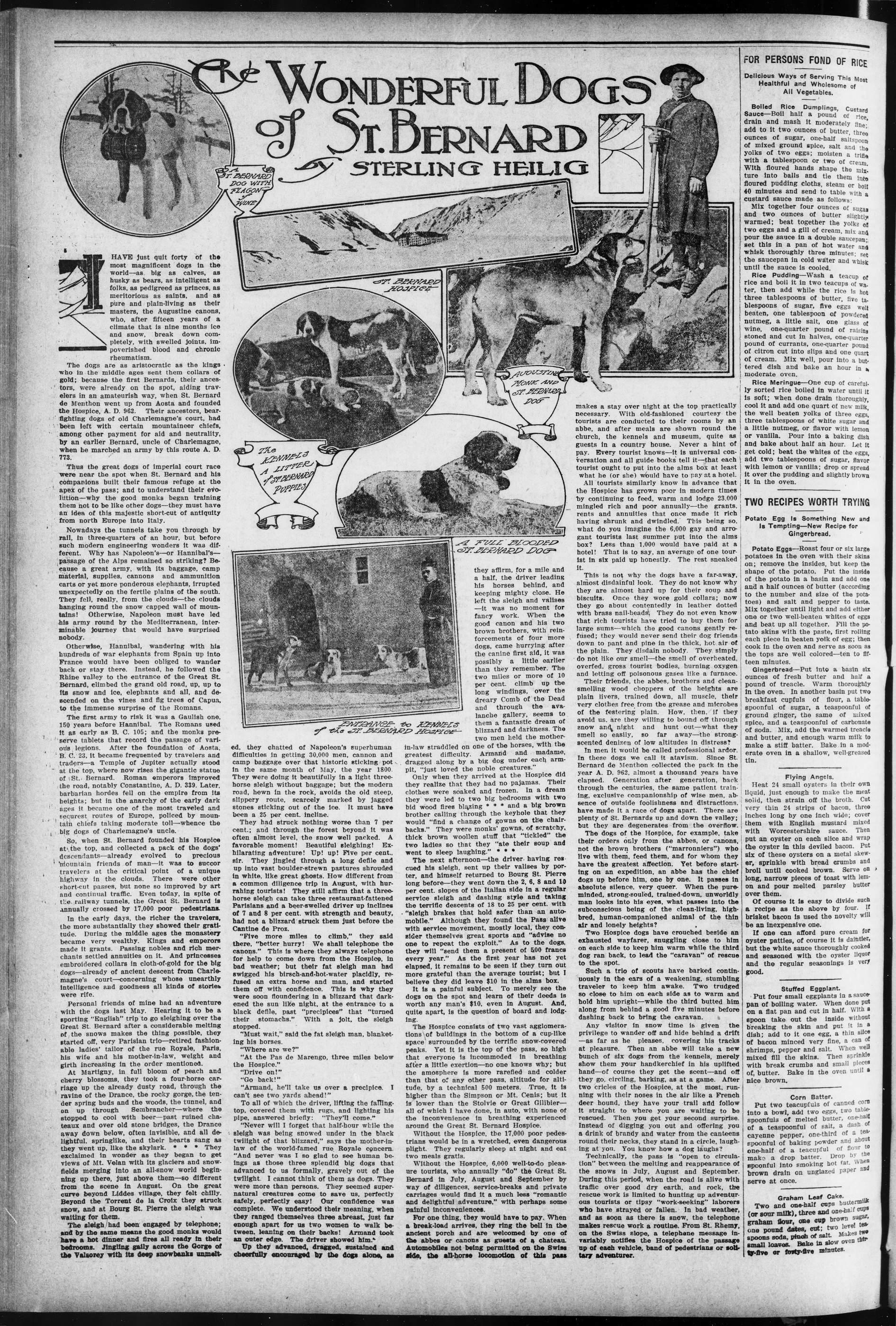
HAVE just quit forty of the most magnificent dogs in the world—as big as calves, as husky as bears, as intelligent as folks, as pedigreed as princes, as meritorious as saints, and as pure and plain-living as their masters, the Augustine canons, who, after fifteen years of a climate that is nine months ice and snow, break down completely, with swelled joints, impoverished blood and chronic rheumatism.
The dogs are as aristocratic as the kings who in the middle ages sent them collars of gold; because the first Bernards, their ancestors, were already on the spot, aiding travelers in an amateurish way, when St. Bernard de Menthon went up from Aosta and founded the Hospice, A.D. 962. Their ancestors, bearfighting dogs of old Charlemagne's court, had been left with certain mountaineer chiefs, among other payment for aid and neutrality, by an earlier Bernard, uncle of Charlemagne, when he marched an army by this route A.D. 773.
Thus the great dogs of imperial court race were near the spot when St. Bernard and his companions built their famous refuge at the apex of the pass; and to understand their evolution—why the good monks began training them not to be like other dogs—they must have an idea of this majestic short-cut of antiquity from north Europe into Italy.
Nowadays the tunnels take you through by rail, in three-quarters of an hour, but before such modern engineering wonders it was different. Why has Napoleon's—or Hannibal's—passage of the Alps remained so striking? Because a great army, with its baggage, camp material, supplies, cannons and ammunition carts or yet more ponderous elephants, irrupted unexpectedly on the fertile plains of the south. They fell, really, from the clouds—the clouds hanging round the snow capped wall of mountains! Otherwise, Napoleon must have led his army round by the Mediterranean, interminable journey that would have surprised nobody.
Otherwise, Hannibal, wandering with his hundreds of war elephants from Spain up into France would have been obliged to wander back or stay there. Instead, he followed the Rhine valley to the entrance of the Great St. Bernard, climbed the grand old road, up, up to its snow and ice, elephants and all, and descended on the vines and fig trees of Capua, to the immense surprise of the Romans.
The first army to risk it was a Gaulish one 150 years before Hannibal. The Romans used it as early as B. C. 105; and the monks preserve tablets that record the passage of various legions. After the foundation of Aosta, B. C. 23, it became frequented by travelers and traders—a Temple of Jupiter actually stood at the top, where now rises the gigantic statue of St. Bernard. Roman emperors improved the road, notably Constantine, A. D. 339. Later, barbarian hordes fell on the empire from its heights; but in the anarchy of the early dark ages it became one of the most traveled and securest routes of Europe, policed by mountain chiefs taking moderate toll—whence the big dogs of Charlemagne's uncle.
So, when St. Bernard founded his Hospice at the top, and collected a pack of the dogs' descendants—already evolved to precious mountain friends of man—it was to succor travelers at the critical point of a unique highway in the clouds. There were other short-cut passes, but none so improved by art and continual traffic. Even today, in spite of the railway tunnels, the Great St. Bernard is annually crossed by 17,000 poor pedestrians.
In the early days, the richer the travelers, the more substantially they showed their gratitude. During the middle ages the monastery became very wealthy. Kings and emperors made it grants. Passing nobles and rich merchants settled annuities on it. And princesses embroidered collars in cloth-of-gold for the big dogs—already of ancient descent from Charle-magne's court—concerning whose unearthly intelligence and goodness all kinds of stories were rife.
Personal friends of mine had an adventure with the dogs last May. Hearing it to be a sporting "English" trip to go sleighing over the Great St. Bernard after a considerable melting of the snows makes the thing possible, they started off, very Parisian tril—retired fashionable ladies' tailor of the rue Royale, Paris, his wife and his mother-in-law, weight and girth increasing in the order mentioned.
At Martigny, in full bloom of peach and cherry blossoms, they took a four-horse carriage up the already dusty road, through the ravine of the Drance, the rocky gorge, the tender spring buds and the woods, the tunnel, and on up through Sembrancher—where the stopped to cool with beer—past ruined chateau and over old stone bridges, the Drance away down below, often invisible, and all delightful, springlike, and their hearts sang as they went up, like the skylark. * * * They exclaimed in wonder as they began to get views of Mt. Velan with its glaciers and snow-fields merging into an all-snow world beginning up there, just above them—so different from the scene in August. On the great curve beyond Liddes village, they felt chilly. Beyond the Torrent de la Croix they struck snow, and at Bourg St. Pierre the sleigh was waiting for them.
The sleigh had been engaged by telephone; and by the same means the good monks would have a hot dinner and fires all ready in their bedrooms. Jingling gals across the Gorge of the Valsorey with its deep snowbanks unmelt-
ENTRANCE TO KENNELS
ed, they chatted of Napoleon's superhuman difficulties in getting 30,000 men, cannon and camp baggage over that historic sticking pot in the same month of May, the year 1800. They were doing it beautifully in a light three-horse sleigh without baggage; but the modern road, hewn in the rock, avoids the old steep, slippery route, scarcely marked by jagged stones sticking out of the ice. It must have been a 25 per cent. incline.
in-law straddled greatest difficult dragged along pit, "just loved Only when the they realize the clothes were so they were led bid wood fires brother calling
They had struck nothing worse than 7 per cent; and through the forest beyond it was often almost level, the snow well packed. A favorable moment! Beautiful sleighing! Exhilarating adventure! Up! up! Five per cent. sir. They jingled through a long defile and up into vast boulder-strewn pastures shrouded in white, like great ghosts. How different from a common diligence trip in August, with hurrahing tourists! They still affirm that a three-horse sleigh can take three restaurant-fattened Parisians and a beer-swelled driver up inclines of 7 and 8 per cent. with strength and beauty, had not a blizzard struck them just before the Cantine de Proz.
"Five more miles to climb," they said there, "better hurry! We shall telephone the canons." This is where they always telephone for help to come down from the Hospice, in bad weather; but their fat sleigh man had swigged his birch-and-hot-water placidly, refused an extra horse and man, and started them off with confidence. This is why they were soon floundering in a blizzard that darkened the sun like night, at the entrance to a black defile, past "precipices" that "turned their stomachs." With a jolt, the sleigh stopped.
"Must wait," said the fat sleigh man, blanketing his horses.
"Where are we?"
"At the Pas de Marengo, three miles below the Hospice."
"Drive on!"
"Go back!"
"Armand, he'll take us over a precipice. I can't see two yards ahead!"
To all of which the driver, lifting the falling-top, covered them with rugs, and lighting his pipe, answered briefly: "They'll come."
"Never will I forget that half-hour while the sleigh was being snowed under in the black twilight of that blizzard," says the mother-in-law of the world-famed rue Royale concern. "And never was I so glad to see human beings as those three splendid big dogs that advanced to us formally, gravely out of the twilight. I cannot think of them as dogs. They were more than persons. They seemed supernatural creatures come to save us, perfectly safely, perfectly easy! Our confidence was complete. We understood their meaning, when they ranged themselves three abreast, just far enough apart for us two women to walk between, leaning on their backs! Armand took an outer edge. The driver showed him."
Up they advanced, dragged, sustained and cheerfully encouraged by the dogs alone as
"Where are we?"
"Go back!"
in-law straddled on one of the horses, with the greatest difficulty. Armand and madame, dragged along by a big dog under each armpit, "just loved the noble creatures."
Only when they arrived at the Hospice did they realize that they had no pajamas. Their clothes were soaked and frozen. In a dream they were led to two big bedrooms with two bid wood fires blazing * * * and a big brown brother calling through the keyhole that they would "find a change of gowns on the chairbacks." They were monks' gowns, of scratchy, thick brown woollen stuff that "tickled" the two ladies so that they "ate their soup and went to sleep laughing." * * *
The next afternoon—the driver having rescued his sleigh, up their valises by porter, and himself returned to Bourg St. Pierre long before—they went down the 2, 6, 8 and 10 per cent. slopes of the Italian side in a regular service sleigh and dashing style and taking the terrific descents of 18 to 25 per cent. with "sleigh brakes that hold safer than an automobile." Although they found the Passive with service movement, mostly local, they consider themselves great sports and "advise no one to repeat the exploit." As to the dogs, they will "send them a present of 500 francs every year." As the first year has not yet elapsed, it remains to be seen if they turn out more grateful than the average tourist; but I believe they did leave $10 in the alms box.
It is a painful subject. To merely see the dogs on the spot and learn of their deeds is worth any man's $10, even in August. And, quite apart, is the question of board and lodging.
The Hospice consists of two vast agglomerations of buildings in the bottom of a cup-like space surrounded by the terrific snow-covered peaks. Yet it is the top of the pass, so high that everyone is incommoded in breathing after a little exertion—no one knows why; but the atmosphere is more rarefied and colder than that of any other pass, altitude for altitude, by a technical 500 meters. True, it is higher than the Simpson or Mt. Cenis; but it is lower than the Stolvie or Great Glibier—all of which I have done, in auto, with none of the inconvenience in breathing experienced around the Great St. Bernard Hospice. Without the Hospice, the 17,000 poor pedestrians would be in a wretched, even dangerous plight. They regularly sleep at night and eat two meals gratis.
Without the Hospice, 6,000 well-to-do pleasure tourists, who annually "do" the Great St. Bernard in July, August and September by way of diligences, service-breaks and private carriages would find it a much less "romantic and delightful adventure," with perhaps some painful inconveniences.
For one thing, they would have to pay. When a break-load arrives, they ring the bell in the ancient porch and are welcomed by one of the abbes or canons as guests of a chateau. Automobiles not being permitted on the Swiss side, the all-horse locomotion of this pass
they affirm, for a mile and a half, the driver leading his horses behind, and keeping mighty close. He left the sleigh and valises—it was no moment for fancy work. When the good canon and his two brown brothers, with reinforcements of four more dogs, came hurrying after the canine first aid, it was possibly a little earlier than they remember. The two miles or more of 10 per cent. climb up the long windings, over the dreary Comb of the Dead and through the avalanche gallery, seems to them a fantastic dream of blizzard and darkness. The two men held the mother-
makes a stay over night at the top practically necessary. With old-fashioned courtesy the tourists are conducted to their rooms by an abbe, and after meals are shown round the church, the kennels and museum, quite as guests in a country house. Never a hint of pay. Every tourist knows—it is universal conversation and all guide books tell it—that each tourist ought to put into the alms box at least what he (or she) would have to pay at a hotel. All tourists similarly know in advance that the Hospice has grown poor in modern times by continuing to feed, warm and lodge 23,000 mingled rich and poor annually—the grants, rents and annuities that once made it rich having shrunk and dwindled. This being so, what do you imagine the 6,000 gay and arrogant tourists last summer put into the alms box? Less than 1,000 would have paid at a hotel! That is to say, an average of one tourist in six paid up honestly. The rest sneaked it.
This is not why the dogs have a far-away, almost disdainful look. They do not know why they are almost hard up for their soup and biscuits. Once they wore gold collars; now they go about contentedly in leather dotted with brass nail-heads. They do not even know that rich tourists have tried to buy them for large sums—which the good canons gently refused; they would never send their dog friends down to pant and pine in the thick, hot air of the plain. They disdain nobody. They simply do not like our smell—the smell of overheated, overfed, gross tourist bodies, burning oxygen and letting off poisonous gases like a furnace. Their friends, the abbes, brothers and clean-smelling wood choppers of the heights are plain livers, trained down, all muscle, their very clothes free from the grease and microbes of the festering plain. How, then, if they avoid us, are they willing to bound off through snow and night and hunt out—what they smell so easily, so far away—the strong-scented denizen of low altitudes in distress.
In men it would be called professional ardor. In these dogs we call it atawism. Since St. Bernard de Menthon collected the pack in the year A. D. 962, almost a thousand years have elapsed. Generation after generation, back through the centuries, the same patient training, exclusive companionship of wise men, absence of outside foolishness and distractions, have made it a race of dogs apart. There are plenty of St. Bernards up and down the valley; but they are degenerates from the overflow. The dogs of the Hospice, for example, take their orders only from the abbes, or canons, not the brown brothers ("marronniers") who live with them, feed them, and for whom they have the greatest affection. Yet before starting on an expedition, an abbe has the chief dogs up before him, one by one. It passes in absolute silence, very queer. When the pure-minded, strong-souled, trained-down, unworldly man looks into his eyes, what passes into the subconscious being of the clean-living, highbred, human-companioned animal of the thin air and lonely heights?
Two Hospice dogs have crouched beside an exhausted wayfarer, snuggling close to him on each side to keep him warm while the third dog ran back, to lead the "caravan" of rescue to the spot.
Such a trio of scouts have barked continuously in the ears of a weakening, stumbling traveler to keep him awake. Two trudged so close to him on each side as to warm and hold him upright—while the third butted him along from behind a good five minutes before dashing back to bring the caravan.
Any visitor in snow time is given the privilege to wander and hide behind a drift—as far as he pleases, covering his tracks at pleasure. Then an abbe will take a new bunch of six dogs from the kennels, merely show them your handkerchief in his uplifted hand—of course they get the scent—and off they go, circling, barking, as at a game. After two cricles of the Hospice, at the most, running with their noses in the air like a French deer hound, they have your trail and follow it straight to where you are waiting to be rescued. Then you get your second surprise. Instead of digging you out and offering you a drink of brandy and water from the canteens round their necks, they stand in a circle, laughing at you. You know how a dog laughs?
Technically, the pass is "open to circulation" between the melting and reappearance of the snows in July, August and September. During this period, when the road is alive with traffic over good dry earth, and rock, the rescue work is limited to hunting up adventurous tourists or tipsy "work-seeking" laborers who have strayed or fallen. In bad weather, and as soon as there is snow, the telephone makes rescue work a routine. From St. Rhemy, on the Swiss slope, a telephone message invariably notifies the Hospice of the passage up of each vehicle, band of pedestrians or solitary adventurer.
FOR PERSONS FOND OF RICE
Delicious Ways of Serving This Most Healthful and Wholesome of All Vegetables.
Boiled Rice Dumplings, Custard Sauce—Boil half a pound of rice, drain and mash it moderately fine; add to it two ounces of butter, three ounces of sugar, one-half saltspoon of mixed ground spice, salt and the yolks of two eggs; moisten a trifle with a tablespoon or two of cream. With floured hands shape the mixture into balls and tie them into floured pudding cloths, steam or boll 40 minutes and send to table with a custard sauce made as follows:
Mix together four ounces of sugar and two ounces of butter slightly warmed; beat together the yolks of two eggs and a gill of cream, mix and pour the sauce in a double saucepan; set this in a pan of hot water and whisk thoroughly three minutes; set the saucepan in cold water and whisk until the sauce is cooled.
Rice Pudding—Wash a teacup of rice and boil it in two teacups of water, then add while the rice is hot three tablespoons of butter, five tablespoons of sugar, five eggs well beaten, one tablespoon of powdered nutmeg, a little salt, one glass of wine, one-quarter pound of raisins stoned and cut in halves, one-quarter pound of currants, one-quarter pound of citron into slips and one quart of cream. Mix well, pour into a buttered dish and bake an hour in a moderate oven.
Rice Meringue—One cup of carefully sorted rice boiled in water until it is soft; when done drain thoroughly, cool it and add one quart of new milk, the well beaten yolks of three eggs, three tablespoons of white sugar and a little nutmeg, or flavor with lemon or vanilla. Pour into a baking dish and bake about half an hour. Let it get cold; beat the whites of the eggs, add two tablespoons of sugar, flavor with lemon or vanilla; drop or spread it over the pudding and slightly brown it in the oven.
TWO RECIPES WORTH TRYING
Potato Egg Is Something New and Is Tempting—New Recipe for Gingerbread.
Potato Eggs—Roast four or six large potatoes in the oven with their skins on; remove the insides, but keep the shape of the potato. Put the inside of the potato in a basin and add one and a half ounces of butter (according to the number and size of the potatoes) and salt and pepper to taste. Mix together until light and add either one or two well-beaten whites of eggs and beat up all together. Fill the potato skins with the paste, first rolling each piece in beaten yolk of egg; then cook in the oven and serve as soon as the tops are well colored—ten to fifteen minutes.
Gingerbread—Put into a basin six ounces of fresh butter and half a pound of treacle. Warm thoroughly in the oven. In another basin put two breakfast cupfuls of flour, a table-spoonful of sugar, a teaspoonful of ground ginger, the same of mixed spice, and a teaspoonful of carbonate of soda. Mix, add the warmed treacle and butter, and enough warm milk to make a stiff batter. Bake in a moderate oven in a shallow, well-greased tin.
Flying Angels.
Heat 24 small oysters in their own liquid, just enough to make the meat solid, then strain off the broth. Cut very thin 24 strips of bacon, three inches long by one inch wide; cover them with English mustard mixed with Worcestershire sauce. Then put an oyster on each slice and wrap the oyster in this deviled bacon. Put six of these oysters on a metal skewer, sprinkle with bread crumbs and broil until cooked brown. Serve on long, narrow pieces of toast with lemon and pour melted parsley butter over them.
Of course it is easy to divide such a recipe as the above by four. If brisket bacon is used the novelty will be an inexpensive one.
If one can afford pure cream for oyster patties, of course it is dainter, but the white sauce thoroughly cooked and seasoned with the oyster liquor and the regular seasonings is very good.
Stuffed Eggplant.
Put four small eggplants in a saucepan of boiling water. When done put on a flat pan and cut in half. With a spoon take out the inside without breaking the skin and put it in a dish; add to it one egg, a thin slice of bacon minced very fine, a can of shrimps, pepper and salt. When well mixed fill the skins. Then sprinkle with break crumbs and small pieces of, butter. Bake in the oven until a nice brown.
Corn Batter.
Put two teacupfuls of canned corn into a bowl, add two eggs, two tablespoonfuls of melted butter, one-half of a teaspoonful of salt, a dash of cayenne pepper, one-third of a teaspoonful of baking powder and about one-half of a teacupful of flour to make a drop batter. Drop by the teacupful into smoking hot fat. When brown drain on unglazed paper and serve at once.
Cotton Leaf Cake
Graham Lear cake
Two and one-half cups buttermilk
(or sour milk), three and one-half cups
graham flour, one cup brown sugar
one pound dates, cut; two level tea
spoons soda, pinch of salt. Makes two
small leaves. Bake in slow oven thre-
tive or forty-five minutes.
DON'T OPEN HUBBY'S LETTERS
A wife is in doubt whether she should open her husband's letters, and implies her willingness to let him open and read hers before they come into her hands. There is no violation of confidence involved in a preference to read one's correspondence before it is so much as glanced over by the eyes of another. A letter is a bit of personal property, and it is a breach of ordinary politeness to break its seal. Wife and husband alike have the privilege of opening their individual correspondence, and of sharing it together if they choose. As no one who is entirely polite opens a closed door without the formality of a knock, though the door belong to a member of the family, and is the entrance to an individual room, so no really polite person opens without leave the correspondence of another. It should be taken for granted that married people are mutually interested in one another's letters, but it is not to be imagined that they shall necessarily always read every written scrap that comes into the house for one or the other. Married happiness is so perplex a thing that it should be guarded with the greatest care, and if either partner in the home discerns on the horizon the smallest hint of a cloud, the duty is at once to take measures to prevent a storm.—The Christian Herald.
Mere Decoy.
A kind hearted man stopped to comfort a small boy who was crying bitterly. "What's the matter, little man?" he inquired. "I-I was a playin' marbles wif limmie F-field," sobbed the lad. "Yes, and what happened?" "I-d-dobbed eighteen commies at a white aggie, an' nen I-I-I—" The lad's emotion seemed to completely overcome him. "Cheer up, son, what happened?" With a mighty effort at self possession, the youngster managed to explain. "After I dobbed eighteen marbles at a white aggie an' hit it, I found it was suffin but a moth ball."
Wednesday Mislaid.
A Broadway actor got carried away by the spirit of the times and remained carried away for several days. He came to himself in his own room without knowing exactly how he got there. A friend sat beside him. "Hello," he said, as he opened his eyes, "what day is this?"
"This," said his friend, "is Thursday."
The invalid thought it over a minute.
"What became of Wednesday?" he asked.—Saturday evening Post.
Crafty Vegetarian
Nebuchadnezzar went on all fours. "Men are mistaken for deer even when they walk upright," he consoled himself—New York Sun.
Diphtheria, Quinsey and Tonsilitis begin with sore throat. How much better to cure a sore throat in a day or two than to be in bed for weeks with Diphtheria. Just keep Hammels Wizard Oil in the house.
The Happiest Man
Happler than the man who thinks that whatever is is right is he who thinks that whatever is his is best.
The man who has a mustard seed grain of faith has all the capital he needs with which to go into a large bushiness for the Lord.
CHRISTMAS POST CARDS FREE
Send 3 stamp for five samples of my very choice.
Post Embossed Christmas and New Year Post Embossed Christmas and love letter Post Art Post Club, TJ Jackson Rd, Topper, Kansas
In Life's Twilight
There is an evening twilight of the heart, when its wild passion-waves are hulled to rest.—Halleck.
Dr. Pierce's Pleasant Pellets cure conspiration. Constipation is the cause of many diseases. Cure the cause and you cure the disease. Easy to take.
Whenever the devil has a minute to spare he sets another trap for the boy.
is from 20 acres
return from a Lloyd-
minster farm in the
season of 1910. Many
of the bushels
other districts yielded
from 25 to 35 bushels of wheat to
other grains in propor-
tion.
FARMS IN WESTERN CANADA FREE
of Western Canada.
This stationary causes prices to advance. Land values show double in two of the Grass growing mixed farming, cattle raising and dairy farming markets. Homesteads of 160 acres are to be bad in the very best district, and prices in certain areas at $3.00 per acre within certain areas. Schools and education, climate unexcelled, soil the richest; water, wood and plentiful.
$9
settlers as to locate low settlers' railway rates and descriptive illustrated pamphlet. Local information, write to Sgt. of immigration, Ottawa, Canada, or to Canadian government agent.
W. H. ROGERS
125 W. Ninth SL., Kansas City, Mo.
Please write to the agent nearest you
PISOS
Best for
COUGHS & COLDS
LESSON TEXT -Nehemiah 4.
MEMORY VERSES-16, 17.
GOLDEN TEXT-"Watch ye, stand fast
in the faith, quit you like men, be strong."
-1 Cor. 16:13.
TIME-Nehemiah heard the bad news
from Jerusalem early in December, B. C.
445.
For four months he prayed, thought
and waited.
The following April (444) he obtained permission to go to Jerusalem.
go to Jerusalem.
The journey of the people months and he arrived at Jerusalem in the first day of the fifth month, Ab = July-Aug. (In 1911 the first day of Ab was August 6; in 1916 it will be July 12.)
PLACE-Shushan and Jerusalem.
RULERS-Artaxerxes, Emperor of Persian Empire; Nehemiah, governor of Judea; Ezra, the scribe, the religious leader of the people in Babylon.
When the right time came, and Nehemiah's heart was burning with sorrow and desire, he found "opportunities concealed in apparent hindrances." It was dangerous to show sorrow in the presence of the king. Even a modern autocrat like Louis XIV, expected everybody's face to shine if he did but appear, and how much more an Artax erxes? What, wear a sorrowful face when he was presiding over joy and gayety, gilding them with his presence? If he had ordered this melan choly visage away to prison or death it would have been justified by precedent. A gloomy face might mean disaffection against the king. The light of his favor ought to be enough to drive all sadness away.
Nehemiah had hitherto been able to keep a smiling face when before the king; but one day at a superb banquet, when the queen was ding with her husband, amid gold plate, gorgeous silk dresses of every hue, marble pillars, fountains, music, lights, sultanas, courtiers resplendent as the sun, and all worshiping their sun Ar taxerxes, smiling when he smiled, his sorrow shone through his face in spite of himself, so that the king noticed it and said:
"Why is thy countenance sad, seeing thou art not sick? this is nothing else but sorrow of heart." Then he was very sore afraid, and said unto the king, "Let the king live for ever: why should not my countenance be sad, when the city, the place of my fathers' sepulchres, leth waste, and the gates thereof are consumed of fire! If it please the king, and if thy servant have found favor in thy sight, that thou wouldest send me unto Judah, unto the city of my fathers' sepulchres, that I may build it."
The kind was pleased to grant his request, made him the Tirshatha, or governor of Judea, "royal agent" or "plenipotentially," with full powers. He traveled to Judea in state, with a military guard of cavalry, and with letters to the rulers o f the neighboring provinces to give him whatever he needed for his work.
Nehemiah was very wise. He lay quiet for three days, doing nothing, but learning everything. He showed no credentials, he proposed no plans, he told no one what he hoped to do. His first business was to learn the whole situation, the feelings of the people, who would oppose, and who would help, how able the people were, what obstacles must be overcome.
Nehemiah met the rulers, nobles, priests and people, and told them of his purpose in coming, how he had learned of their need, how he had wept and fasted and prayed, and how God had heard his prayer and caused the great emperor to favor his plans, give him permission to come, and authority, with orders for the surrounding rulers to give the needed help. He told them of his midnight investigations.
The business side of religion should be done as Nehemiah did it in the most skillful and ideal business manner. Nehemiah had a layman's good sense in religion. Walls were necessary to the safety of the city. They were also necessary to true religion. The division of labor, the noble competition, the interest in their work that kept them from taking time to even put off their clothes, the giving each his own work, and over against his own house, the union of watching and praying and working, the working together of old and young, rich and poor, form a real master-stroke of genius."
The wall was parceled out among 44 working parties. It was like the rebuilding of the walls of Athens after the invasion of Xerxes, like the building of the walls of Edinburgh after the battle of Flodden. This plan made each one more earnest and faithful as he saw what others were doing. It animated the work with a noble emulation, and a personal pride. See how fast my work goes on! See how well my piece is done! Now, my sons, gird up your tunic, or Rephaih the son of Hur will get ahead of us. True emulation is to do better than we have done; to seek, not to get beyond others, but to rise to the best possible for us; and to be inspired to this by seeing what others have done. Besides the hostility of the Samaritans the Jews themselves were becoming worn out with the fatigue of such strenuous work.
No good goes on to success without meeting obstacles. Evil does not fall without a battle. It throws slander, ridicule, treachery, conspiracies, influence, discouragements, every possible hindrance, in the way of reform. Even some of the Jews were arrayed against their brethren. They planned to take Nehemiah and the city by surprise, slay the workers, and thus put a stop to the work, but the answer was watching and prayer.
You Look Prematurely Old
TIRED, SICK AND DISCOURAGED.
Doan's Kidney Pills Brought Health and Cheerfulness.
Mrs. J. P. Pemberton, 854 Lafayette St., Marshall, Mo., says: "For years I suffered with Bright's disease which doctors said was incurable. I grew so weak, I had to take to my bed. Kidney secretions were suppressed, I became terribly bloated, and finally reached the point where I took no interest in life. It was then I began using Doan's Kidney Pills and soon
so weak, I had to take to my bed. Kidney secretions were suppressed, I became terribly bloated, and finally reached the point where I took no interest in life. It was then I began using Doan's Kidney Pills and soon improved. Before long I was without a sign of the trouble that seemed to be carrying me to my grave." "When Your Back Is Lame, Remember the Name—DOAN'S." 50c, all stores. Foster-Milburn Co., Buffalo, N. Y.
A DIFFERENCE.
Tessie—I suppose you won't marry unless you find one girl in a million. Tom—No; with a million.
BABY'S ECZEMA AND BOILS
"My son was about three weeks old when I noticed a breaking-out on his cheeks, from which a watery substance oozed. A short time after, his arms, shoulders and breast broke out also, and in a few days became a solid scab. I became alarmed, and called our family physician at once pronounced the disease eczema. The little fellow was under treatment for about three months. By the end of that time, he seemed no better. I became discouraged. I dropped the doctor's treatment, and commenced the use of Cuticura Soap and Ointment, and in a few days noticed a marked change. The eruption on his cheeks was almost healed, and his shoulders, arms and breast were decidedly better. When he was about seven months old, all trace of the eczema was gone.
"During his teething period, his head and face were broken out in bolls which I cured with Cuticura Soap and Ointment. Surely he must have been a great sufferer. During the time of teething and from the time I dropped the doctor's treatment, I used the Cuticura Soap and Cuticura Ointment, nothing else, and when two years old he was the picture of health. His complexion was soft and beautiful, and his head a mass of silky curls. I had been afraid that he would never be well, and I feel that I owe a great deal to the Cuticura Remedies." (Signed) Mrs. Mary W. Ramsey, 224 E. Jackson St., Colorado Springs, Col., Sept. 24, 1910. Although Cuticura Soap and Ointment are sold by druggists and dealers everywhere, a sample of each, with 32-page book, will be mailed free on application to "Cuticura," Dept. 5 L. Boston.
Knowledge That Wasn't Printed.
Representative McDermott of Chicago, who represents in congress a stock yards district, was discussing how he had been treated by the Democratic organization which appointed men to the various standing committees of the house.
"First," he said, "they wanted to put me on the committee on agriculture and I haven't an acre of cleared ground in my district. Then they tried to shove me into the committee on education, and I never went to school a day in my life."—Popular.
Nothing to Write About
A new reporter on a western paper was assigned to go to a church meeting and get a story of it. He went. When he came back the city editor asked:
"How did it pan out?"
"Oh," said the reporter, as he stuck his foot on the desk and lighted a cigarette, "there was nothing doing. I haven't got anything to write. The meeting broke up in a fist fight between the minister and the deacon, and not a bit of church business was done."—Saturday Evening Post.
Love Note
People may sneer all they please at what is called puppy love; but anybody who has ever had a puppy, and noted the wag of its tall and the look in its eye as it wriggles forth its protestations of undying affection, can hardly deny its actual sincerity.—Judge's Library.
The man in trouble has as much right to believe that God will help him as he has to believe the sun will rise tomorrow.
OFFICIAL INVITATION TO AMERICANS
HOW ROBERT ROGERS, MINISTER OF THE INTERIOR, IN WINNIPEG ADDRESS, ISSUES WELCOME OF AMERICANS TO WESTERN CANADA.
During the course of a reply to an address presented to Hon. Robert Rogers, the newly appointed Minister of the Interior of Canada at a banquet given at Winnipeg in his honor that gentleman spoke on immigration. The tone of his remarks was that he intended to pursue an aggressive and forward policy in the matter of immigration. In part, he said:
"The most important branch perhaps of that department (Interior) is that of immigration.
"If there is anything more than another we want here it is a greater population, and it shall be my duty to present to the people in all parts of the world where desirable emigrants are to be found the advantages and the great possibilities of this country. We have received in the past a reasonably large immigration from south of the international boundary, and in this connection let me say just a word for our American cousins who have found happy homes amongst us, and those whom we hope to welcome in greater numbers in the years to come. There are hundreds of thousands of them in our prairie provinces, happy in the enjoyment of a freedom as great as they ever knew, and all contributing in a material way towards the development of Canada. We are not blind to their value as settlers. They come better equipped with scientific farming knowledge than most of our emigrants, and constitute without doubt the wealthiest class of emigrants any new country has ever known. As head of the immigration department it will be my privilege to offer them a welcome hearty and sincere, and to so contribute to their welfare that under the protecting folds of the Union Jack they will enjoy as great a degree of liberty and happiness as under the Stars and Stripes. The Borden government cherishes nothing but the kindiest feelings for the people of the great republic to the south, and will do all in its power to increase the bonds of kinship and neighborly good feeling that has so long existed. (Hear, hear.)
"While we adopt a vigorous emigration policy in that country, we will also adopt the same vigorous policy in other parts of the world. We will go to England, Ireland and Scotland, and every other country irrespective of race, creed or nationality, where we can find suitable and desirable emigrants for this great country. I think much good work can be done in those countries, and especially perhaps at the present time in England, Ireland and Scotland. Now, then, it will be my duty to stir up that policy in the most vigorous manner possible."
What Brought Him.
Governor Foss of Massachusetts tells of a clergyman who was visiting a state prison, when he came across a prisoner whose features were familiar to him. "What brought you here, my poor fellow?" he asked. "You married me to a new woman a little while ago, sir," the prisoner replied, with a sigh. "Ah, I see," replied the parson, "and she was domineering and extravagant, and she drove you to desperate courses. eh?" "No," said the prisoner, "my old woman turned up."
Was In Real Trouble
A passenger who escaped uninjured from a serious railway smash, seeing a fellow-traveler searching anxiously among the wreckage with a lantern, offered to assist in the search, and, thinking the old man had lost his wife, asked in sympathetic tones: "What part of the train was she in?" Raising his lantern and glaring at the kindly disposed passenger, the old man shouted with indignant distinctness that triumphed over physical infirmity: "She, sir! she! I am looking for my teeth!"
Age of an Egg.
In a glass of water the fresh egg will assume a horizontal position. The egg of three to five days makes with the horizon an angle of 30 degrees. The angle increases to 45 degrees for an egg eight days old, to 75 for one of three weeks, and at 30 days the egg rests on its point.
Important to Mothers
Examine carefully every bottle of CASTORIA, a safe and sure remedy for infants and children, and see that it
Bears the
Signature of
Charles H. Wittcher
In Use For Over 30 Years.
Children Cry for Eflecthorn's Castoric
"Foul tactics," declared the quarterback.
"What's the trouble now?" demanded the referee.
"I tried a kick for the stomach, but this fellow blocked it with his face."
I believe that the borders of our minds are ever shifting, and that many minds can flow into one another, as it were, and create or reveal a single mind.—W. B. Yeats.
HE WAS NEXT.
Katherine—There is never any excuse for ignorance.
Kidder-That's right. There were even knight schools in the dark ages.
A southern farmer was trying to sell a mule to a negro who two years before had been kicked on the head by the animal, says the Popular Magazine.
"Of course," said the farmer, "this mule kicks, but—"
"I don't want him," objected the colored man, emphatically.
"Just because he kicks?" asked the farmer with an air of contempt. "Humph!" grunted the negro. "Dat mule don't kick." He shoots."
Friend—What were your sensations in the wreck?
Victim—Just the same as in football. Three coaches passed over me, and then the doctors came.—Puck.
A sunny spirit will do more to improve the looks than a powder rag.
How Much of Your "Bad Luck" is Due To The Ammunition You're Using?
It's not a matter of luck, old chap. Ten to one, it's the fault of the powder. You're probably shooting one of the "big explosion" varieties that wastes hall its force on your shoulder.
ever-increasing velocity from breech to muzzle.
And take it from me, friend, speed at the muzzle is what counts.
That's why R. H gets there quicker and You don't
miss it. R. H gets there HOD AMMUNITION
Buy Robin Hood loaded shells and metallic cartridges from
your regular dealer, or send to us if it is not supplied. _Write for our
catalogue; it gives valuable information.
Illustrated Catalog Free.
19 Spark St, Brooklyn, Nassau
Defiance Starch
The Best Hot or Cold Water Starch Ever Made. One Trial Will Soon Convince You.
Mule Was a Dead Shot.
Same.
TRADE
MADE
Catarrh
One of the most common of blood diseases, is much aggravated by the sudden changes of weather at this time of year. Begin treatment at once with Hood's Sarsaparilla, which effects radical and permanent cures. This great medicine has received 40,366 Testimonials in two years, which prove its wonderful efficacy in purifying and enriching the blood. Best for all blood diseases. In usual liquid form or chocolated tablets known as Sarsatabs. 100 doses $1.
LEWIS'
SINGLE
BINDER
STRAIGHT 50 CIGAR
You Pay 10c.
for Cigars
Not so Good.
F.P. LEWIS Peoria, Ill
MONEY IN TRAPPING.
We tell you how and pay best prices. Write for weekly price list and references.
M. SABE & SONS
LOUISVILLE, NY.
Dealers in Furs, Hides, Wool
Established 1856.
FURS
Tutt's Pills
enable the dyspeptic to eat whatever he wishes. They cause the food to assimilate and nourish the body, give appetite, and DEVELOP FLESH.
Dr. Tutt Manufacturing Co. New York.
AS
S
ct
re
s.
ONE PAIR of my BOYS® $2, $5.50 or
$3.00 SHOES will positively wear
TWO PAIRS of ordinary boys' shoes
Fast Color Eyelids Used Exclusively.
Knights & Daughters
SEARCHLIGHT, PAGE EIGHT.
833
Official
Knights &
OF TAB
KANSAS—NEBRAS
KNIGHTS AND DAUGHTERS OF
TABOR.
1911—GRAND OFFICERS—1912
NEXT PLACE MEETING.
The Grand Temple and Tabernacle
will meet in Leavenworth, Kansas, the
second Tuesday in July, 1912.
REV. FRANK WILSON, C. G. M.
Taborian Home, Route 8, Topeka, Kan
SIR D. L. TAYLOR, V. G. M.
829 E. Center, Salina, Kan
MRS. EMMA GAINES, C. G. P.
1170 Filmore, Topeka, Kansas.
MRS. LAURA LEE, V. G. P.
Box 394, Weir, Kansas.
SIR A. W. HOPKINS, C. G. S.
327 Dakota, Leavenworth, Kan.
MRS. SARAH W FORBES, C. G. R.
717 "C" St. Lincoln, Neb.
SIR WILLIAM CORE, C. G. T.
1120 Lane, Topeka, Kan.
MRS. BESSIE HALL, G. Q. M.
460 Horton, Ft. Scott, Kan.
SIR C. M. JOHNSON, G. P. P
3330 Maple, Omaha, Neb.
REV. M. WOOTEN, C. G. O.
222 Ave. E. W. Hutchinson, Kans
MRS, PAULINE WOODFORK, C.G.Pr.
823 Freeman, Kansas City, Kan.
SIR W. N. MILLER. General Attorney,
430 N. Main St., Wichita, Kansas.
TEMPLE6.
Rev. F.ank Wilson, C. G. M.
1—A. H. Richardson, Weir, Kan., Sir
L. W. Stewart, Box 481; 1-3 Fri.
2—R. H. Cane, Atchison, Kan., Sir
Jno. N. Davis, 521 "L,"; 1-3
Fri.
4—Evening Star, Omaha, Neb., Sir
S. R. Jackson care Frye Shoe
Co.; 1-3 Mon.
5—St. Luke, N. Topeka, Kan., Sir Joe
Walker, 1220 West (north); 1-3
Thurs.
6—Humphrey, Omaha, Neb., Sir W.
H. Jackson, 2515 N. 17th.
7—Mt. Nebo, Wichita, Kan., Sir Rev.
d. S. Washington, 1524 N.
Washington; 1-3 Fri.
4—St. Peters, Ft. Scott, Kan., Sir
Rebt. Allison; 1-3 Tues.
10—Mt. Horeb, Leavenworth, Kan.
Geo. Walker 417 Kiowa.
11—Taborian, Wichita, Kan., Sir W.
N. Miller, 630 N. Main; 1-3
Thurs.
12—Moses Dickson, Parsons, Kan., Sir
W. N. Williams, 2201 Corning;
1-3 Thurs.
15—Silver Leaf, Salina, Kan., Sir J.
C. Hudson care Hudson Grocery
Co.
17—Golden Gate, Coffeyville, Kan.
Sir N. N. Gilbert, 405 Santa Fe;
1-3 Wed.
19—Mt. Tabor, Lawrence, Kan., Sir
W. H. Jones, care Santa Fe Depot;
2-4 Thurs.
22—Barak, Oswego, Kan., Sir L. R.
Wilson, Oswego College.
24—Jas. H. Bedford, Cherryvale, Kan.
Sir Rev. J. W. Warren, 218 E.
7th.
25—Washington, Kansas City, Kan.
Sir J. H. Downs, 422 Haswell;
every Friday.
69—Sunnyside, Topeka, Kan., Sir
Peter Davis, 1008 Washburn;
1-3 Thurs.
60—Jeffersonlan, Topeka, Kan., Sir U.
S. Grant, 120 Kansas; 1-3 Mon.
72—Nebraska, Lincoln, Neb., Sir J. L.
Wright, 1st Nat'l Bank.
TABERNACLES.
1—Queen of the West, Kansas City,
Kan., Mrs. Malinda George, 603
State Ave.; 1-3 Wed.
2—Golden, Iola, Kan., Mrs. Ella
Weston, 709 Buckeye; 2-4 Sat.
3—Mt. Hope, Wichita, Kan., Mrs.
Mary Gooss, 2423 Jewett 1-3
Fri.
4—Helping Hand, Cherryvale, Kan.
Mrs. Ella Jones, 630 W. 4th; 1-3
Thurs.
5—Crescent, Atchison, Kan., Mrs.
Rattie Montgomery, 1115 N. 5th,
2-4 Fri.
6—Rebecca Ann, Ottawa, Kan., Miss
Katherine Glaspie, 128 Mulberry;
1-3 Thurs.
7—Sunbeam, Saline, Kan., Mrs. Lili
ian Shobe, 437 S. 12th; 1-4 Fri.
8—Rebecca May, Coffeyville, Kan.
mrs. Laura Donnell, 410 E. 5th;
2-4 Fri.
9—Western Sun, Topeka, Kan., Mrs.
Lulu Deltey, 120 Kansas Ave; 1-3
Fri.
10—St. Maria, Lawrence, Kan., Mrs.
Carrie Davis, 446 Main; 1-3 Wed.
12—Rebecca Saba Mereo, Kansas City,
Kan., Mrs. J. A. Smith, 847 Fre
man; 1-3 Mon.
13—toilhan Kite Kansas City, Kan.
cas Mrs. Johnson, 211 Steu
13 Thurs.
16—America Davis, Weir, Kan. Mrs
margaret annnall Box 14; 2-4
71
18—St. Marie, Omaha, Neb., Mrs. E
Patterson, 2115 Nicholas; 24
Thurs.
19—Amelia Levels, Omaha, Neb., Mrs.
Ella Golden, 2302 N. 25th.
20—Maria, Ft. Scott, Kan., Mrs. P
Johnson, 501 Hyman; 1-2 Fri.
21 Queen Sheba, Oswego, Kan., Mrs.
Nancy Landis, Box 144 2-4 Thurs.
24—Charity Rose, Coffeyville, Kan.;
Mrs. A. Garner, 704 E. 12th; 1-3
Wed.
28—Modern, Parsons, Kan., Mrs. D.
Dorsey, 716 E. 15th; 1-3 Thurs.
29—Crystal, Leavenworth, Kan., Mrs.
H. La Tand, 407 Kickapoo; 1-3
Tue.
30—Victoria, Leavenworth, Kan., Mrs.
Ella McKinnis, 217 Sherman; 1-3
Fri.
32 Emma Gaines, Butte, Mont, Mrs
Salina Easters, 334 Dakota [rear]
34—Wichita, Wichita, Kan., Mrs. Sall
le Hall, 1024 Ohio; 1-3 Thurs
35—Golden Rule, So. Omaha, Neb.
Mrs. Sadie Jones, 819 N. 27th;
1-3 Thurs.
37—Eutevate, Atchison, Kan., Mrs.
Mamie Sloss, 1121 Oak; 1-3 Fri.
38—Covenant, Weir, Kan., Mrs. L.
Washington; 2-4 Wed.
39 Deborah, Abetine, Kansas. Mrs.
Mable Baskerville. 2-4 Thurs
52—Mt. Maria, Lawrence, Kan., Mrs.
Cora Yager 26 Main; 2-4 Thurs.
63—Fair West, Kansas City, Kan.
Mrs. Rosa Saunders, 716 N. J;
1-3 Fri.
77—Pearly Rose, Topeka, Kan., Mrs
Jennie B. Taylor, General Delia
85—Magdalene, Topeka, Kan., Mrs. M.
Richardson, 1425, Yank. Buren
91—Golden Sheaf, Omaha, Neb., Mrs
Lulu Rountree, 1125 N. 19th;
1-3 Thurs.
92—St. Annis, Lincoln, Neb., Mrs. L.
D. Davis, 3833 P; 2-4 Fri.
93—Macedonia, N. Topeka, Kan., Mrs.
S. A. Brown, 15th and Wasning
ton; 1-3 Thurs.
TENTS.
Rev. Frank Wilson. C. G. M.
Mrs. Bessie Leah, G. Q. M.
1—Golden Leaf, Leavenworth, Kan.
Mrs. Eliza Scott, S. 3rd; 4 Sat.
2—Frank Wilson, Ft. Scott, Kan.
Mrs. Eunia Maxey, 411 Ransom.
3—Moses Dickson, Wichita, Kan.
Mrs. B. Brown, 813 N. Wichita
4—White Rose, Kansas City, Kan.
Mrs. Lulu Ross, 433 Nebraska;
2-4 Sat.
5—New Hope, Coffeyville, Mrs. Ada
Gilbert, 405 Santa Fe., 2-4 Wed
ton, 1-3 Sat.
7—Lone Star, Yale, Kan., Mrs. Calie
Lewis.
8—Golden Eagle, Iola, Kan., Mrs.
Sarah Mayes, 20 Campbell.
10—Washington, Kansas City, Kan.
Mrs. Effie Porter, 1036 Grand
view Blvd.; 1-3 Sat.
11—Alice Tucker, So. Omaha, Neb.
Mrs. I. M. Fav'kner, 169 N
31st; 1-3 Sat.
11—Viola, Lawrence, Kan., Mrs. Mary Brown, 325 Mts. 4 Sat.
14—Busy Bee, Atch, Kan., Mrs. Aria Stone, 823 Main: 1-3 Sat.
15—Louisa Mae, Cherryvale, Kan. Mrs. M. E. Holt, 517 West Main.
16—Pearl, Wichita, Kan., Mrs. Anna Jones, 1457 Wabash Wichita: 2-4 Sat.
17—Castle Rock, Weir, Kan., Mrs. H. H. Askins, Box 26.
18—Star of West Salina, Kan.
A. O. Murrell, 633 S. 4th: 1-3 Sat.
20—John Wilson, K. C., Kan., Mr. D. Dalton, 1228 Barnett: 2-4 Sat.
21—Crystal, Leavenworth, Kan.: Mr. Priscilla Lee, 419 Klowa: 3 Sat. 2-4 Sat.
23—Clinging Rose, Lawrence, Kan,
Mrs. Ada King, 722 N. Y., 3 sat.
26—Emma Gaines, Weir, Kan., Mary
Stewart; 1-3 Sat.
28—20th Century, Parsons, Kan., A.
L. Willis, 2215 Morgan; 1 Sat.
16—Pride of Topeka, N Toneka, Kan.
Mrs. Sarah McElroy, 817 Lincoln;
1-3 Sat.
7—Pansy Blossom, Torreya, a Kn.
Mrs. Sally Lanear, 1209 Buchan
an; 1-3 Sat.
4—Rising Sun Atchison, Kan., Mrs.
Mary Dellay. 120 Kansas
5—Orange Rose, Kansas City, Kan.
Mrs. P. Henderson. 312 Wash-
ington: 1:3 Sat
6—Mayflower, Omaha, Neb., Mrs. L.
Herrold, 2521 N. 17th; 1-3 Sa
Rev. Frank Wilson, C. G. M.
Sir C. M. Johnson, G. P. P.
1—Light of the West, Omaha, Neb.
Mrs. Sarah Severe, 829 S. 26th.
2—Evening Star, Topeka, Kan., Ransom Taylor, 4th Thrus.
3—Moses Dickson, Ackson, Kan., W. H. Barnes, 4th Mon.
4—Queen City, Parsons Kan., L. Bridgewater, 2430 Appleton.
5—Jewell Wilson, Lawrence, ak.
Chas. H. Kuntze, 932 E. Adams; 1-3 Mon.
6—Queen of Kansas, K. C., Kan.
6—Pride of Kansas, Kansas City, Kan., Mrs. Anna Madison; 1309 Ann; 1-3 Fri.
The Wichita Searchlight, 630 N.
Main St., Wichita, Kan Only $1.00
per year.
DEAM ABS
NORTH-WEST
COURT
Bonded A
— Everything Neat
COTTAG
IN ABSTRACT CO.
NORTH-WEST CORNER OF THE
COURT HOUSE
conded Abstractors
Everything Neat, Fresh and Clean —
COTTAGE CAFE
Everything Neat, Fresh and Clean
603 North Main Street
Regular Meals 20c Short Order A
Fresh Pies, Cakes, Pastries All Home
Mrs. R. H. Todd, Prop
603 N. Main St Wichita
Meals 20c Short Order All Hours
s, Cakes, Pastries All Home Cooking
Mrs. R. H. Todd, Prop
Main St Wichita, Kan
603 N. Main St Wichita, Kan
All Calls Promptly An Dr. C. R. Veterinary Surg The Finest Equipped
C. R. Wildes
Dental Surgeon & Dentist
Finest Equipped Hospital In the City
Office and Hospital
230 N. Market St., Wichita
---
Dr. Grant G. Brown PHYSICIAN and SURGEON
Office
GOI N. MAIN ST.
ST. Phone Market
1537
everythin
size, yet
Pump.
prowess
Like Old
The Clubs.
The W. T. Vernon Club met at the residence of Mrs. Sadie Thomas on last Thursday evening, Nov. 22nd. A very splendid meeting was held, with the Miss. J. White as hostess. The club will meet on next Thursday December the 7th. with Miss. Anderson.
To Arkansas Lodge No 21. A. F. and A. M. Wichita.
I desire to extend to you my appreciation for the prompt payment of the endowment of $125, on my deceased husband W. N. Miller.
Signed Mrs. W. N. Miller.
```markdown
```
We do all kinds of fancy JOB PRINTING, Satisfaction Guarenteed. Prices Always Right. Bring your Job work to us.
Bring your
s.
Telephone Market 3539x.
FORD'S
HAIR POMADE
A
following
country
who co
```markdown
```
Queen Adelaide, the wife of William IV., was a woman of great piety and exceptional humility, which was shown in the directions for her funeral.
"I die in all humility," she wrote, "knowing well we are all alike before the throne of God, and request, therefore, that my mortal remains be conveyed to the grave without any pomp or ceremony. They are to be moved to St. George's chapel, Windsor, where I request to have a quiet funeral.
"I particularly desire not to be laid cut in state, and the funeral to take peace by daylight; no procession, the coffin to be carried by sailors to the chapel. I die in peace, and wish to be carried to the tomb in peace, and free from the vanities and the pomp of the world."—Home Novet.
No. 104.
OFFICIAL ORGAN.
High Class Surgery A Specialty
Phone Market
1 7 3 0
A Queen's WILL.
We'll Some Day Be Your Printer WHY NOT TODAY
630 N. Main St.
---
Send your job work to our Job Department. TRACT CO.
Special Attention Given To Canine Practice
Phone Market
1537
To Readers of the Searchlight.
To the readers of the Searchlight, all those who read the account about Cuba being the Negroe's land of hope, now to bring this great fact closer to you observation and to fix it so you can get information and see the wonderful booklets of Cuba and to learn of their interesting terms, you can call to see Mr. H. H. Neely at their residence at 1447, S River St. or call them by the telephone Market 3539 X.
As they are General agents for the State of Kansas and have purchased a tract of land there come friends and learn something about this wonderful country. 50 W de Awake Agent are wanted. This is something that can make a good living at if you will hustle, we want wide awake Hustlers and thats all. SEE Mr. B. H. Neely
```markdown
```
MAKES HARSH, KINKY OR CURLY HAIR GLOSSY, SOFTER AND MORE PLIABLE, EASY TO COMB AND PUT UP IN ANY STYLE THE LENGTH WILL PERMIT. UNEXCELLED
FOR PREVENTING HAIR FROM FALLING OUT DURHOUSE AND TICING OF SOLF BEWARE OF INITIATING, GET THE GENUINE, UP IN 25 AND 50* BOTTLES WITH CHARLES FORD'S NAME ON EVERY PACKAGE
TRY FORD'S ROYAL WHITE
SKIN LOTION FOR THE COMPLEXION.
MAKES THE SKIN WHITER IMmediately UPON APPLICATION. WILL NOT IRRITATE THE MOST DELICATE SKIN. UNEXCELLED FOR ECZEMA, SALT RHEUM, PIMPLES, ROUGH SKIN AND FRECKLES.
SOLD BY DRUGGISTS. IF YOUR DRUGGIST CANNOT SUPPLY YOU, WE WILL SEND IT TO YOU DIRECTLY ON THE FOLLOWING PICKS, SMALL SNEED BOTTLE, 25* LARGE SNEED BOTTLE, 50* THE OZONIZED OX MARROW CO.
232 LAKE ST. DEPT. 308
CHICAGO,ILL
Almost Impossible to Impose Upon Handlers of Money.
Incidentally it is interesting to note that the skill which enables one to detect a counterfeit comes not from study of counterfeitels, but from a tough and unconscious familiarity with the genuine. If a man were pointed out to you and you were told that some day another who much resembled him would try to impose upon you, you would be pretty apt to fix his features in your mind; you would not spend any time looking at other people who looked something like him, would you? And the moment the impostor appeared you would note that in this that or the other particular he failed to meet the details of the other man's face and figure. Just so it is in the detection of counterfeits. A skillful teller in a bank, counting money rapidly, will involuntarily throw out a note which in the slightest degree departs from the well-known pattern which is so strongly impressed on his mental vision. That involuntary act will nearly always prove to have been justified, for the bill in 19 cases out of 20 will prove to be a counterfeit. It is because of this fact that when a request is received from some one to loan him a collection of counterfeit for the instruction of his cashiers, he is advised to have the young men study the genuine carefully, and then will be no trouble in detecting the bar notes—National Magazine.
REMARKABLE IN THE DOG LINE
Proud Owners of Pets, Listen to This from Flatbush, N. Y.
Zip, a son of Bluff, the big bull terrier, is the most respected dog in Flatbush, N. Y., says a correspondent. He requires every other dog within 40 blocks to walk a chalk line and bow to him as he passes by. He can lick everything on four feet up to twice his size, yet is as mild as Devery-at-the Pump. His master attributes Zip's prowess to his fondness for the pipe Like Old King Cole:
He calls for his pipe.
He calls for his fiddlers three. "That is the most remarkable dog in the world," says his master. "He takes my pipe out of my mouth and smokes it, standing on his hind feet. See! The stem is all chewed up! If the tobacco doesn't burn well, Zip will get down on his fours and chase all over the house to create a draught. When the fire is well started again he finishes his smoke and returns me the pipe Strong? He ought to be named Samson. Why, we have a piano that weighs 600 pounds. Tie Zip to it with a rope and he will pull it all over the room."
Since supporting race enterprises is right, men are coming to the doctrine with their mouths forgeting of the fact that talk is cheap.
A Knowing Dog.
"Now," said the narrator, "I've got a dog here I would not take $100 for You can believe me or not, but what I am going to tell you is the gospel truth. In the early part of last spring I lost about a score of very valuable sheep, until one day I was looking across from my house to the edge of the range opposite about two miles away, I noticed some sheep. I got my telescope, and assured myself that they were mine. I placed the telescope in a suitable position, and made Bob, our best collie, look through it After about a minute the dog wagged his tail and made off. In less than two hours he brought the sheep home safe and sound."
Rater
A captain on an ocean liner tells the following story: Coming from the old country was a very nervous old lady who complained that she was sure there was a rat in her stateroom. "Keep it there, madam," said the captain. "But do you like rats?" asked she. "I've got a nest in my cabin," retorted the brusque seaman, "and I never disturb them. When they leave the ship I do." "Why, you must be superstitious," urged the dame. "No, ma'am, wound up the captain. I'm not, but the rats are."
Send Your News In Early This Week.
HOW TO MEET A LION
BRITISH SURGEON EXPLAINS ETH QUETTE FOR OCCASION.
If King of Beasts Falls to Realize He
Is de Trop Tourist Should Walk
Away With Becoming
The etiquette to be observed when a peacefully inclined tourist or explorer meets a lion in the jungle is described by Sir Frederick Treves, the distinguished British surgeon, in the book, "Uganda for a Holiday," just published in England.
"The tourist coming to British East Africa," he says, "is sure to inquire as to the line of conduct that should be observed when a lion is encountered by the way. In answer to such inquiry I was told that the etiquette suitable for the occasion was the following: If the lion when met with is walking in the opposite direction to the tourist the animal should be allowed to continue his walk without comment. If, however, the lion stop and stares at the tourist it is proper that the tourist should "Shish" the animal away, as he would an obtrusive goose on a village green. Should the lion be unmoved by this expression of annoyance the tourist is advised to throw lumps of earth at the obtuse creature. If, after "bis," the lion still falls to realize that he is de trop, the tourist is recommended to walk away from the spot with such dignity as the strained position demands."
Sir Frederick Treves has several other things to say about the animals of the wild. "The rhinoceros is the embodiment of blind conservatism," he writes. "It hides is impenetrable, its vision is weak, while its intellect is weaker. It has, however, two marked qualities—combativeness and a sense of smell. It is aroused to its maximum energy by the presence of anything that is new. This object need not be a thing that is aggressive or inconvenient. Its offensiveness depends upon the fact that it is unfamiliar, and the more unfamiliar the object is the worse the rhinoceros acts.
"When a rhinoceros smells a man he will charge him with maniacal violence, although the man may be merely sitting on a stool reading Milton. The massive beast will dash at him like a torpedo or a runaway locomotive simply because the smell of him is novel. Actuated by this insane hate of whatever savors of an innovation, the rhinoceros has charged an iron water tank on the outskirts of a camp and has crumpled it up as a blacksmith would an empty meat tain. "A conservative rhinoceros with a smile dislike of anything new once charged a train on the Uganda railway, but with no more serious results than the tearing away of the footboard of a carriage. As regards the rhinoceros in this case, it appeared surprised that a thing composed, as it had imagined, of flesh and blood, could be so hard. It went off with an additional grievance and an increased swelling of the head."
Tournament on Sea Horse
Rumor has often told us of sea horses, but with amused incredulity we have always waved the tales aside. Faith is, however, no longer called upon, for in the water of Huntington bay, on the north shore of Long Island, actual sea horses are daily capering in highly spectacular water sports, even in a quaint revival of the ancient tournament. The strange beasts have been brought to us from France and are ingeniously composed of a barrel, weighted on one side which is under water, and decorated with an expressive head and an aggressive tail. As soon as one mounts upon the rotund back of one of these beasts it shows its temper, for, although tame and mild enough when grazing among the waves by themselves, they are fiends incarnate as soon as one attempts to throw a leg over them. They kick and buck in a manner which would appall a Buffalo Bill himself.
One of the daily features of the beach at Huntington is a tournament in which armed knights, each astride of a prancing sea horse, face each other for battle royal. The riders are equipped with long lances, well wadded at the end with "stuffing." With there the knights paddle their course to each other, and then with lances poised the battle begins.
Qualification for Office.
The little trial I have had of public employment has been so much disgust to me; I feel at times temptations toward ambition rising in my soul; but I obstinately oppose them.
"But thou, Catullus, be thou firm to the last."
I am seldom called to it, and as seldom offer myself uncalled; liberty and laziness, the qualities most predominate in me, are qualities diametrically contrary to that trade. We cannot well distinguish the faculties of men; to conclude from the discreet conduct of a private life, a capacity for the management of public affairs, is to conclude ill; a man may govern himself well, who cannot govern others; and compose essays, who could not work effects; men there may who can order a siege well, or would ill marshrsl a battle: who can speak well in private, who would ill harangue a people or a prince; nay, tie peradventure rather a testimony in him, who can do the one, that he cannot do the other, than otherwien. From Montaigne.