Wichita Searchlight
Saturday, June 29, 1912
Wichita, Kansas
Page text (machine-generated)
THE WICHITA SEARCHLIGHT
*******: An Afro-American Journal For the People of the Great Southwest. :*******
FIFTEENTH YEAR,
Hutchinson, Kansas.
The women's clubs of this city namely Imperial Art Club, Jolly Dozen Club, Grant Art Club, Excelsor Art and Literary Club and the Tousant L'Overture Club, met at the C. M. E. Church to organize a city Federation July 16. The following officers were elected; Mrs. Jennie Bell, Pres. Mrs. Kate Brodus first vice pres. Mrs. Carrie Harrison second vice pres. Mrs. Eunice Allison Seery. Mrs. Bessie Harrison, corresponding secy. Mrs. A. Brady Treas. The City Federation No. 2 held their first meeting at the Second Baptist Church Aug. 5th Several committees were appointed. The meeting was adjourned to meet
Ft, Scott, Kansas.
The Topeka District Conference Epworth League and S. S. Convention convened in Ft. Scott Aug. 21-25 Rev. D. Smith Dist. Supt. Rev. S. E. Smith Pastor. Neosho Valley District Baptist Association. Women's Home and Foreign Mission, Young People's Union and S. S. Convention was held with Shiloh Baptist Church Aug. 12-18 Rev. Gordon moderator Iola. Kansas Rev. L. W. Leonard Pastor. Mrs. Robert Neal of St. Louis Mo. who has been visiting her mother-in-law and friends has returned to her home.
One of the daintiest affairs of the season was a dinner party given by Mrs. Geo Brown & her daughter Jessie on Thursday eve Aug. 15, in honor of the visiting guest of the Baptist Convention The center-piece of handwork being doae with yellow rose and yellow basket filled with salted nuts tied with green tulle bows; and the color prevailed through the dinner. The guest included—Revs. E. A. Wilson, and Geo, McNeal of K. C. K., Rev. and Mrs' J. W. Gordon Iola, Kans Rev. & Mrs. J. W. Brown, Dr. J. Brown Mrs. J. C. Brown, Mrs. Robert Neal, St. Louis Mo.
Mr. and Mrs. Robert Allison was a hostess to a party Thurs. Evening Aug. 22, in honor Mrs. Wallace Mrs. Doss and Mrs. Neal of Mamouth Ill, who has been the guest of their sister and bro.
WANTED!
A Buyer for a First-Class Tailor Shop, with all good fixtures. A good paying business.
WANTED!
Partner wanted with some capital, Trained Newspaper man. AGENTS WANTED EVERYWHERE. We want agents in all sections of the country. Liberal Commission Paid to Agents,
Mr. and Mrs. George Julia.
Mrs. H. C. Caldwell and Mrs. Wm White was hostess to a delightful party in honor of visiting ladies of Mamouth Ill. a very dainty two course luncheon was served. All departed saying they spent a joyous time,
JOURNAL ENTRIES
A barking dog never bites while it is barking.
Confession may be good for the soul, but it is often poor for business.
Few are far between are the people who haven't excellent opinions of thmselves.
other namely are replacing 'Jack' for the hero of moving pictures and the popular songs.
The whereabouts of Joe Mosley has not yet been learned at this writing.
Few men's wants are limited to their needs.
Ahd a few who wants but little here below are seldom disap- pciuted.
Sells Floto the Circus of 1,000 wonders will exhibit at Wichita Saturday September 21. ADVERTISE,-- It Pays.
WANTED
A Buyer for a First-Class
fixtures. A good paying bu
Addr
WANTED
Partner wanted with some
paper man.
AGENTS WANTED
We want agents in all s
Liberal Commission Paid
Addr
We urge upon the many readers of the Searchlight to trade with our advertisers. They are the best and will treat you right.
WICHITA, KANSAS, SATURDAY, AUGUST 31, 1912.
M. B. H.
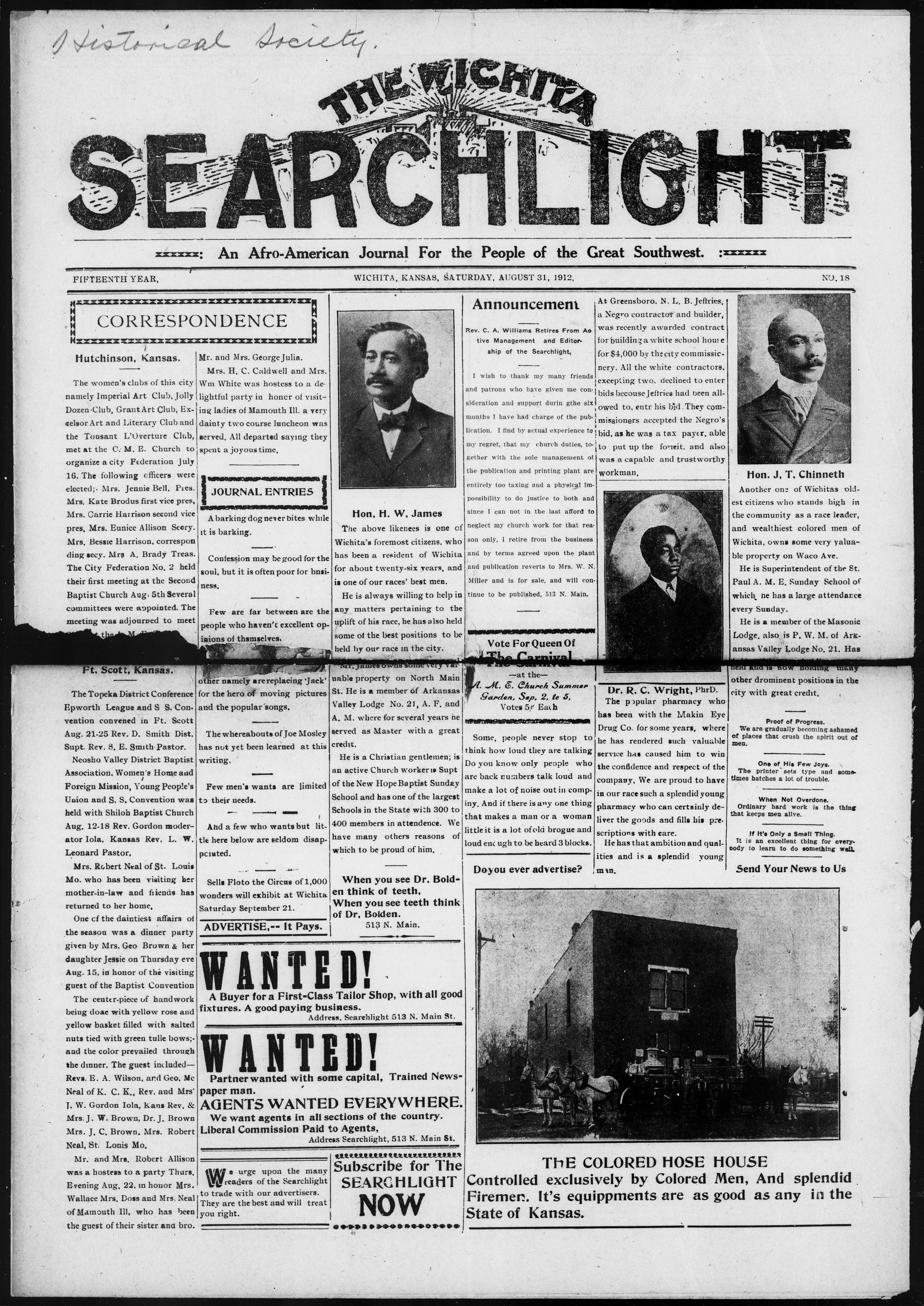
Hon, H. W, James
The above likenees is one of Wichita's foremost citizens, who has been a resident of Wichita for about twenty-six years, and is one of our races' best men.
He is always willing to help in any matters pertaining to the uplift of his race, he has also held some of the best positions to be held by our race in the city.
Mr. James owns some very valuable property on North Main St. He is a member of Arkansas Valley Lodge No. 21, A. F. and A. M. where for several years he served as Master with a great credit.
He is a Christian gentlemen; is an active Church worker Supt of the New Hope Baptist Sunday School and has one of the largest Schools in the State with 300 to 400 members in attendance. We have many others reasons of which to be proud of him.
1,000
Richita
ays.
When you see Dr. Bolden think of teeth,
When you see teeth think of Dr. Bolden.
513 N. Main.
TED!
Class Tailor Shop, with all good
business.
Address, Searchlight 513 N. Main St.
TED!
with some capital, Trained News-
TED EVERYWHERE.
all sections of the country.
Paid to Agents,
Address Searchlight, 513 N. Main St.
Subscribe for The SEARGHLIGHT
---
THE FIRE DEPARTMENT
THE COLORED HOSE HOUSE Controlled exclusively by Colored Men, And splendid Firemen. It's equipments are as good as any in the State of Kansas.
Announcement
Rev. C. A. Williams Retires From Active Management and Editorship of the Searchlight,
I wish to thank my many friends and patrons who have given me consideration and support durin gthe six months I have had charge of the publication. I find by actual experience to my regret, that my church duties, together with the sole management of the publication and printing plant are entirely too taxing and a physical impossibility to do justice to both and since I can not in the last afford to neglect my church work for that reason only, I retire from the business and by terms agreed upon the plant and publication reverts to Mrs. W. N. Miller and is for sale, and will continue to be published, 513 N. Main.
Vote For Queen Of
The Carnival
—at the—
A. M. E. Church Summer
Garden, Sep, 2, te 5,
Votes 5¢ Each
Some, people never stop to think how loud they are talking Do you know only people who are back numbers talk loud and make a lot of noise out in company. And if there is any one thing that makes a man or a woman little it is a lot of old brogue and loud enough to be heard 3 blocks.
Doyou ever advertise?
At Greensboro, N. L. B. Jeffries, a Negro contractor and builder, was recently awarded contract for building a white school house for $4,000 by the city commissionery. All the white contractors, excepting two, declined to enter bids because Jeffries had been allowed to, entr his bid. They commissioners accepted the Negro's bid, as he was a tax payer, able to put up the forfeit, and also was a capable and trustworthy workman.
A. B.
Dr. R. C. Wright, PhrD. The popular pharmacy who has been with the Makin Eye Drug Co. for some years, where he has rendered such valuable service has caused him to win the confidence and respect of the company. We are proud to have in our race such a splendid young pharmacy who can certainly deliver the goods and fills his prescriptions with care. He has that ambition and qualities and is a splendid young man.
NO.18
Hon. J, T, Chinneth
Another one of Wichitas oldest citizens who stands high in the community as a race leader, and wealthiest colored men of Wichita, owns some very valuable property on Waco Ave.
He is Superintendent of the St. Paul A. M. E. Sunday School of which he has a large attendance every Sunday.
He is a member of the Masonic Lodge, also is P. W. M. of Arkansas Valley Lodge No. 21. Has held and is now holding many other drominent positions in the city with great credit.
We are gradually becoming ashamed of places that crush the spirit out of men.
One of His Few Joys.
The printer sets type and sometimes hatches a lot of trouble.
When Not Overdone.
Ordinary hard work is the thing that keeps men alive.
If It's Only a Small Thing.
It is an excellent thing for everybody to learn to do something well.
Send Your News to Us
SIXTY-SECOND CONGRESS ENDS
CLOSE OF LONG SESSION CAME
AT 4:30 P. M.
Within an Hour After Adjournment,
President Taft Was on Way to
Beverly.
Washington, D. C.—Sobered by Sak
urday's all night session of filibusters
and disagreements, congress adjusted
its differences, invited President Taft
up to the capitol once more, and at
4:30 p. m. wrote "finis" after the
proceedings of the second session of the
Sixty-second congress.
The president signed the general defi-
cency bill at 4:10 o'clock, making
certain the payment of the $1,800,000
deficiency in army pay and scores of
other important payments that hinged
on the passage of the bill. The last
measure to which his pen was put was
a bill disposing of lands in the Col-
ville Indian reservation.
The session "just fizzled out" in the senate, to use the words of one observer. A comparative handful of members occupied their seats and a call for a quorum in either the house or senate would have forced a return of the embarrassing situation of last week. Within an hour after adjournment, President Taft was on his private car bound for Beverly and a vacation he expects will not be broken until December. The White house is practically deserted, for most of the office employees left with the president. Summer offices will be opened and probably most of the force will stay in Beverly until late in October.
GREAT MUSKOGEE DAM ASSURED
Contract Let and Construction About to Begin on Million Dollar Structure.
Muskogee, Oklahoma.—After five years of dickering a contract has been signed to build a dam and hydro-electric plant in the Grand river east of Muskogee. It will cost $1,000,000 and generate 20,000 horse power.
The contract was made between the Muskogee Water Power company, which has options for the site, and Samuel P. Brown, Jr., of Chicago. The company is to turn over to Brown all its rights with a franchise to operate for 25 years. Brown is to build the plant and operate it before the franchise is turned over to him. Brown is to pay the company dollar for dollar on all it has expended up to the present time in preliminary work. The bond to do this has already been put up.
MOTOR SLIPPED OFF CULVERT
Accident Near Marshall, Mo., Results in Death of Young
Marshall, Missouri. — Miss Tessie Chaffee, daughter of L. Scott Chaffee of Kansas City, was killed in a motor car accident eight miles east of here. In the car with Miss Chaffee were Miss Nell Darling of this city, whom Miss Chaffee was visiting, and Emlin Kelly and his cousin, both of Independence.
The party left Independence in the morning and arrived here at noon. The accident was caused by two cars crossing a culvert at the same time. Mr. Kelly misjudged the distance and slipped over the embankment. Miss Chaffee's neck was broken.
ASK AID FOR FLOOD SUFFERERS
Relief Committee at Natchez Appeals to American Red Cross for $10,000.
Washington, D. C.—Tales of poverty, sickness and starvation have reached the American Red Cross headquarters from the relief committee at Natchez, Miss. The communication asks $10,000 to alleviate the suffering on the account of the recent Mississippi flood.
The stricken area, it is said, extends through Louisiana and Mississippi. All crops have been destroyed.
England Will Appeal to "The Hague." London, England—The Panama canal law was called a dishonest repudiation of a direct bargain by newspapers representing the views of British political parties. Meanwhile no action by the government in regard to the bill can be framed for nearly all the cabinet ministers are scattered over Europe. It seems certain, however, that the government will propose the reference of the question to The Hague.
Negro Editor Bolts Back.
Chicago, Illinois.—W. T. Andrews of Sumpter, S. C., a negro editor, visited David W. Mulvane, director of the Republican campaign committee. He said he was refused a seat in the Progressive convention, and as a result has decided to champion Mr. Taft's candidacy.
Arm Mangled In Gas Tractor.
Larned, Kansas.—The flesh of his right arm torn in the cogs of a gas tractor, Fred Lamb, a farmer suffered over an hour while rescuers got a jackscrew and lifted the cog wheel from the mangle arm.
East Aeronplanes Arrive
New York, N. Y.-Leon Bernard, widely known in French and English aviation circles, arrived here from France, bringing with him two aeroplanes intended for competition in the international races in Chicago.
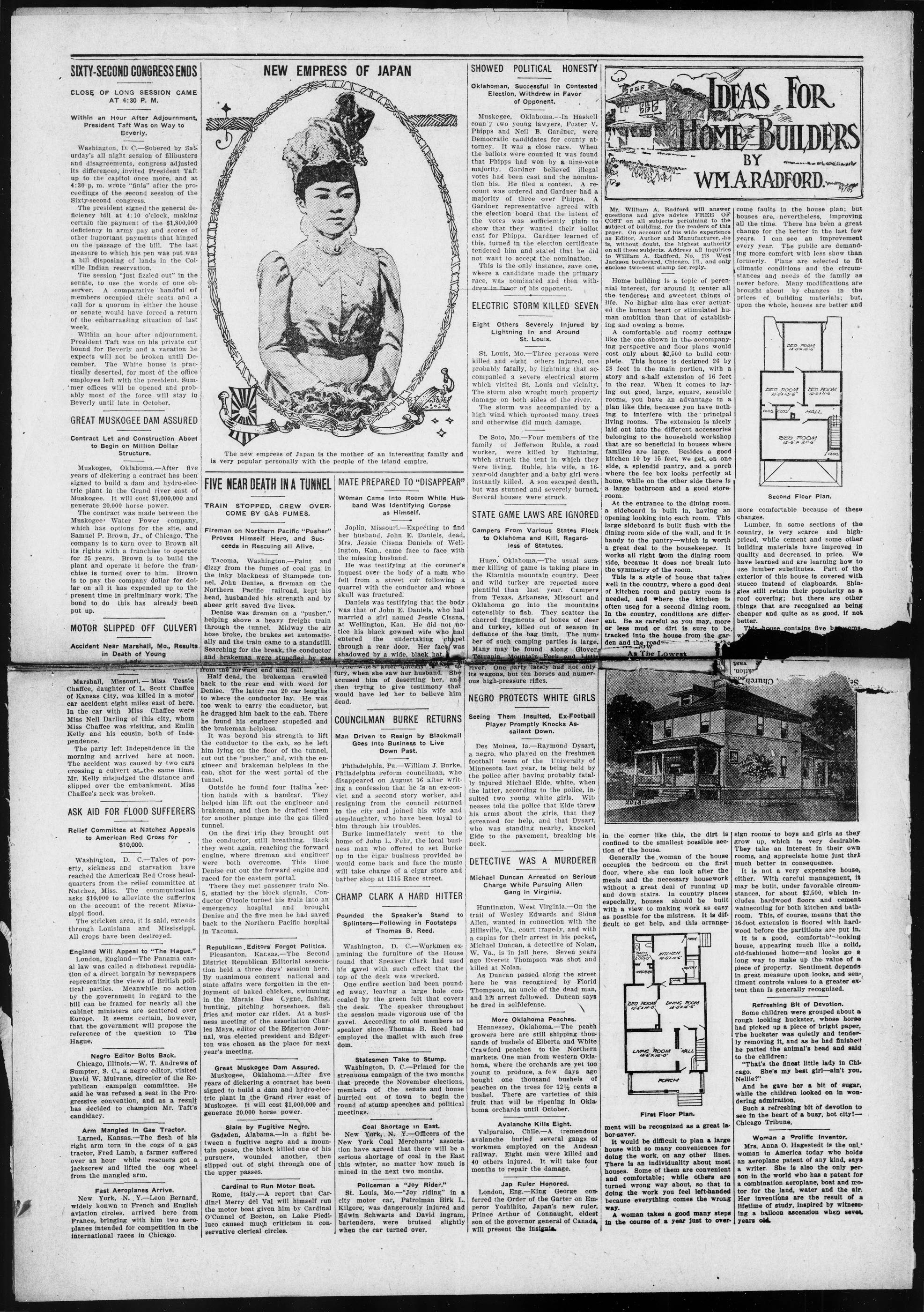
NEW EMPRESS OF JAPAN
The new empress of Japan is the mother of an interesting family and is very popular personally with the people of the island empire.
FIVE NEAR DEATH IN A TUNNEL
TRAIN STOPPED, CREW OVER-COME BY GAS FUMES.
Fireman on Northern Pacific "Pusher" Proves Himself Hero, and Succeeds in Rescuing all Alive.
Tacoma, Washington.—Faint and dizzy from the fumes of coal gas in the inky blackness of Stampede tunnel, John Denise, a fireman on the Northern Pacific railroad, kept his head, husbanded his strength and by sheer grit saved five lives.
Denise was fireman on a "pusher," helping shove a heavy freight train through the tunnel. Midway the air hose broke, the brakes set automatically and the train came to a standstill. Searching for the break, the conductor and brakeman were stumped by gas
from the forward end and fell.
Half dead, the brakeman crawled back to the rear end with word for Denise. The latter ran 20 car lengths to where the conductor lay. He was too weak to carry the conductor, but he dragged him back to the cab. There he found his engineer stupefied and the brakeman helpless.
It was beyond his strength to lift the conductor to the cab, so he left him lying on the floor of the tunnel, cut out the "pusher", and, with the engineer and brakeman helpless in the cab, shot for the west portal of the tunnel.
Outside he found four Italina section hands with a handcar. They helped him lift out the engineer and brakeman, and then he drafted them for another plunge into the gas filled tunnel.
On the first trip they brought out the conductor, still breathing. Back they went again, reaching the forward engine, where fireman and engineer were both overcome. This time Denise cut out the forward engine and raced for the eastern portal. There they met passenger train No 5, stalled by the block signals. Conductor O'toole turned his train into an emergency hospital and brought Denise and the five men he had saved back to the Northern Pacific hospital in Tacoma.
Republican, Editors Forgot Politics. Pleasanton, Karasas.-The Second District Republican Editorial association held a three days' session here. By mananimous consent national and state affairs were forgotten in the enjoyment of baked chicken, swimming in the Marais Des Cygne, fishing, hunting, pitching horseshoes, fish fries and motor car rides. At a business meeting of the association Charles Mays, editor of the Edgerton Journal, was elected president and Edgerton was chosen as the place for next year's meeting.
Great Muskogee Dam Assured.
Muskogee, Oklahoma.—After five years of dickering a contract has been signed to build a dam and hydro-electric plant in the Grand river east of Muskogee. It will cost $1,000,000 and generate 20,000 horse power.
Slain by Fugitive Negro.
Gadsden, Alabama.—In a fight between a fugitive negro and a mountain posse, the black killed one of his pursuers, wounded another, then slipped out of sight through one of the upper passes.
Cardinal to Run Motor Boat.
Rome, Italy.—A report that Cardinal Merry del Val will himself run the motor boat given him by Cardinal O'Connel of Boston, on Lake Piediluco caused much criticism in conservative clerical circles.
MATE PREPARED TO "DISAPPEAR"
Woman Came Into Room While Husband Was Identifying Corpse as Himself.
Joplin, Missouri.—Expecting to find her husband, John E. Daniels, dead, Mrs. Jessie Cissna Daniels of Wellington, Kan., came face to face with the missing husband.
He was testifying at the coroner's inquest over the body of a man who fell from a street car following a quarrel with the conductor and whose skull was fractured.
Daniels was testifying that the body was that of John E. Daniels, who had married a girl named Jessie Cissna, at Wellington, Kan. He did not notice his black gowned wife who had entered the undertaking chapel through a rear door. Her face was shadowed by a wide, black hat.
The wife's anger quickly tended, when she saw her husband. She accused him of deserting her, and then trying to give testimony that would have led her to believe him dead.
COUNCILMAN BURKE RETURNS
Man Driven to Resign by Blackmail Goes Into Business to Live Down Past
Philadelphia, Pa.—William J. Burke, Philadelphia reform councilman, who disappeared on August 16 after writing a confession that he is an ex-convict and a second story worker, and resigning from the council returned to the city and joined his wife and stepdaughter, who have been loyal to him through his troubles. Burke immediately went to the home of John L. Fehr, the local business man who offered to set Burke up in the cigar business provided he would come back and face the music will take charge of a cigar store and barber shop at 1315 Race street.
CHAMP CLARK A HARD HITTER
Pounded the Speaker's Stand to Splinters—Following in Footsteps of Thomas B. Reed.
Washington, D. C.—Workmen examining the furniture of the House found that Speaker Clark had used his gavel with such effect that the top of the desk was wrecked.
One entire section had been pounded away, leaving a large hole concealed by the green felt that covers the desk. The speaker throughout the session made vigorous use of the gavel. According to old members no speaker since Thomas B. Reed had employed the mallet with such freedom.
Statesmen Take to Stump.
Washington, D. C.—Primed for the strenuous campaign of the two months that precede the November elections, members of the senate and house hurried out of town to begin the round of stump speeches and political meetings.
Coal Shortage in East.
New York, N. Y.-Officers of the New York Coal Merchants' association have agreed that there will be a serious shortage of coal in the East this winter, no matter how much is mined in the next two months.
Policeman a "Joy Rider."
St. Louis, Mo.—"Joy riding" in a city motor car, Patrolman Birk L. Kilgore; was dangerously injured and Edwin Schwartz and David Ingram, bartenders, were bruised slightly when the car turned over.
SHOWED POLITICAL HONESTY
Oklahomaan, Successful in Contested Election, Withdrew in Favor of Opponent.
Muskegee, Oklahoma.—In Haskell county two young lawyers, Foster V. Phipps and Neil B. Gardner, were Democratic candidates for county attorney. It was a close race. When the ballots were counted it was found that Phipps had won by a nine-vote majority. Gardner believed illegal votes had been cast and the nomination his. He filed a contest. A recount was ordered and Gardner had a majority of three over Phipps. A Gardner representative agreed with the election board that the intent of the votes was sufficiently plain to show that they wanted their ballot cast for Phipps. Gardner learned of this, turned in the election certificate tendered him and stated that he did not want to accept the nomination.
This is the only instance, save one, where a candidate made the primary race, was nominated and then withdrew in favor of his opponent.
ELECTRIC STORM KILLED SEVEN
Eight Others Severely Injured by Lightning In and Around St. Louis.
St. Louis, Mo.—Three persons were killed and eight others injured, one probably fatally, by lightning that accompanied a severe electrical storm which visited St. Louis and vicinity. The storm also wrought much property damage on both sides of the river.
The storm was accompanied by a high wind which uprooted many trees and otherwise did much damage.
De Soto, Mo.—Four members of the family of Jefferson Ruhle, a road worker, were killed by lightning, which struck the tent in which they were living. Ruhle, his wife, a 16-year-old daughter and a baby girl were instantly killed. A son escaped death, but was stunned and severely burned. Several houses were struck.
STATE GAME LAWS ARE IGNORED
Campers From Various States Flock to Oklahoma and Kill, Regardless of Statutes.
Hugo, Oklahoma.-The usual summer killing of game is taking place in the Klamitia mountain country. Deer and wild turkey are reported more plentiful than last year. Campers from Texas, Arkansas, Missouri and Oklahoma go into the mountains ostensibly to fish. They scatter the charred fragments of bones of deer and turkey, killed out of season in defiance of the bag limit. The number of such camping parties is large. Many may be found along Glover Terrain Mountain Rock and Little river. One party lately had not only its wagons, but ten horses and numerous high-pressure rifles.
NEGRO PROTECTS WHITE GIRLS
Seeing Them Insulted, Ex-Football Player Promptly Knocks Assailant Down.
Des Moines, Ia.—Raymond Dysart, a negro, who played on the freshmen football team of the University of Minnesota last year, is being held by the police after having probably fatally injured Michael Elde, white, when the latter, according to the police, insulted two young white girls. Witnesses told the police that Elde threw his arms about the girls, that they screamed for help, and that Dysart, who was standing nearby, knocked Elde to the pavement, breaking his neck.
DETECTIVE WAS A MURDERER
Michael Duncan Arrested on Serious Charge While Pursuing Allen Gang in Virginia.
Huntington, West Virginia.—On the trail of Wesley Edwards and Sidna Allen, wanted in connection with the Hillsville, Va., court tragedy, and with a capias for their arrest in his pocket, Michael Duncan, a detective of Nolan, W. Va., is in jail here. Seven years ago Everett Thompson was shot and killed at Nolan.
As Duncan passed along the street here he was recognized by Florid Thompson, an uncle of the dead man, and his arrest followed. Duncan says he fired in selfdefense.
More Oklahoma Peaches
Hennessey, Oklahoma.—The peach growers here are still shipping thousands of bushels of Elberta and White Crawford peaches to the Northern markets. One man from western Oklahoma, where the orchards are yet too young to produce, a few days ago bought one thousand bushels of peaches on the trees for $12\frac{1}{2}$ cents a bushel. There are varieties of this fruit that will be ripening in Oklahoma orchards until October.
Avalanche Kills Eight.
Valparaiso, Chile.—A tremendous avanche buried several gangs of workmen employed on the Andean railway. Eight men were killed and 40 others injured. It will take four months to repair the damage.
Jan Ruler Honored.
London, Eng.—King George conferred the Order of the Garter on Emperor Yoshihito, Japan's new ruler, Prince Arthur of Connaught, eldest son of the governor general of Canada, will present the insignia.
IDEAS FOR
HOME BUILDERS
BY
WM.A.RADFORD.
Church
ization
vast
Mr. William A. Radford will answer questions and give advice FREE OF COST on all subjects pertaining to the subject of building, for the readers of this paper. On account of his wide experience as builder, Author and Manufacturer, he is, without doubt, the highest authority on all these subjects. Address all inquiries to William A. Radford, No. 178 West Jackson boulevard, Chicago, Ill., and only enclose two-cent stamp for reply.
Home building is a topic of perennial interest, for around it center all the tenderest and sweetest things of life. No higher aim has ever actuated the human heart or stimulated human ambition than that of establishing and owning a home.
A comfortable and roomy cottage like the one shown in the accompanying perspective and floor plans would cost only about $2,500 to build complete. This house is designed 26 by 28 feet in the main portion, with a story and a half extension of 16 feet in the rear. When it comes to laying out good, large, square, sensible rooms, you have an advantage in a plan like this, because you have nothing to interfere with the principal living rooms. The extension is nicely laid out into the different accessories belonging to the household workshop that are so beneficial in houses where families are large. Besides a good kitchen 10 by 15 feet, we get, on one side, a splendid pantry, and a porch where the ice box looks perfectly at home, while on the other side there is a large bathroom and a good store-room.
At the entrance to the dining room, a sideboard is built in, having an opening looking into each room. This large sideboard is built flush with the dining room side of the wall, and it is handy to the pantry—which is worth a great deal to the housekeeper. It works all right from the dining room side, because it does not break into the symmetry of the room. This is a style of house that takes well in the country, where a good deal of kitchen room and pantry room is needed, and where the kitchen is often used for a second dining room. In the country, conditions are different. Be as careful as you may, more or less mud or dirt is sure to be tracked into the house from the garden and the road.
As The Lowest
in the corner like this, the dirt is confined to the smallest possible section of the house.
Generally the woman of the house occupies the bedroom on the first floor, where she can look after the meals and the necessary housework without a great deal of running up and down stairs. In country places especially, houses should be built with a view to making work as easy as possible for the mistress. It is difficult to get help, and this arrange-
BATH ROOM
60' X 70'
KITCHEN
10' X 12' X 6'
UNITRY
MASTER
DED ROOM
10' X 14' X 0'
DINING ROOM
14' X 10' X 6'
LIVING ROOM
14' X 16' X 0'
WALL
PORCH
First Floor Plan.
ment will be recognized as a great labor-saver.
It would be difficult to plan a large house with so many conveniences for doing the work, on any other lines. There is an individuality about most houses. Some of them are convenient and comfortable; while others are turned wrong way about, so that in doing the work you feel left-handed because everything comes the wrong way.
A woman takes a good many steps in the course of a year just to over-
come faults in the house plan; but houses are, nevertheless, improving all the time. There has been a great change for the better in the last few years. I can see an improvement every year. The public are demanding more comfort with less show than formerly. Plans are selected to fit climatic conditions and the circumstances and needs of the family as never before. Many modifications are brought about by changes in the prices of, building materials; but, upon the whole, houses are better and
BED ROOM
12.0X10.6
BED ROOM
10.0X10.6
BED ROOM
10.0X10.6
CLO3 CLO3 HALL
BED ROOM
12.6X21.6
CLO3
Second Floor Plan.
more comfortable because of these changes. Lumber, in some sections of the country, is very scarce and high-priced, while cement and some other building materials have improved in quality and decreased in price. We have learned and are learning how to use lumber substitutes. Part of the exterior of this house is covered with stucco instead of clapboards. Shingles still retain their popularity as a roof covering; but there are other things that are recognized as being cheaper and quite as as good, if not better.
This house contains five bedrooms.
sign rooms to boys and girls as they grow up, which is very desirable. They take an interest in their own rooms, and appreciate home just that much better in consequence.
It is not a very expensive house, either. With careful management, it may be built, under favorable circumstances, for about $2,500, which includes hardwood floors and cement wainscotting for both kitchen and bathroom. This, of course, means that the 16-foot extension is floored with hardwood before the partitions are put in.
It is a good, comfortable-looking house, appearing much like a solid, old-fashioned home—and looks go a long way to make up the value of a piece of property. Sentiment depends in great measure upon looks, and sentiment controls values to a greater extent than is generally recognized.
Refreshing Bit of Devotion.
Some children were grouped about a rough looking huckster, whose horse had picked up a piece of bright paper. The huckster was quietly and tenderly removing it, and as he had finished) he patted the animal's head and said to the children:
"That's the finest little lady in Chicago. She's my best girl—ain't you, Nellie?"
And he gave her a bit of sugar, while the children looked on in wondering admiration.
Such a refreshing bit of devotion to see in the heart of a busy, hot city!—Chicago Tribune.
Woman a Prolific Inventor.
Mrs. Anna O. Hagestedt is the only woman in America today who holds an aeroplane patent of any kind, says a writer. She is also the only person in the world who has a patent for a combination aeroplane, boat and motor for the land, water and the air. Her inventions are the result of a lifetime of study, inspired by witnessing a balloon ascension when seven years old.
LOST TREASURES OF AMERICA
Gold and Jewels Still Waiting to be Found by Some Modern Adventurer.
THE greatest treasure in the United States, a vast sum that awaits some one's finding, is one concerning which I have sought the exact truth for the several years that I have followed this fad of collecting treasure-trove data. The publication of the story or stories about it may bring to light the men who can say definitely what is what. However any man who cares to set out after it in a business-like manner may turn himself into a multi-millionaire between Christmas and Fourth of July. This much is certain: somewhere on the upper reaches of the Missouri river lie four large barges, lost in 1866, loaded to their utmost capacity with gold estimated in amount from $7,000,000 to $25,000,000.
York City. Certain British laws must be repealed before it can be recovered however. It is in one of the out-of-way places of the world and very little is known by the general public about it. The superstitious French fishermen, unchanged in a hundred and fifty years, still await the return of the fierce pilot to claim his own. The Rock of Perce, named for the adjacent fishing village, is one of the true natural wonders of our continent. When some convulsion of nature rent the coast this rock was split from the nearby mountain and left standing, a grim monument to the caprice of the gods of sea and land. Several humdred feet high, with a comparatively flat top, its sides are beetling and one side is about two hundred feet higher.
Just at the close of the civil war some rumors of the finding of gold in the Black Hills of Dakota and Montana drifted into the towns on the border of civilization in the northwest. It seems odd to think that fifty years ago that region was a frontier, but there are hundreds of old Indians now living on the reservations who then were fighting braves and fifty years ago they had never seen a white man's face.
In the spring of 1866 some old prospectors in the back drift from California found gold in one of the tributaries of the Missouri, said now to be the north fork of the Cheyenne. Why it is no more certain will appear. Others of thier ilk "smelled" the discovery and a band of no more than forty drew into the region, making a wonderful strike, the richest that has ever been made on America soil according to all accounts. The strike was made in what is now called Deadmen's Gulch, named to suit the story, but called in the old records Federation, Desperation and Starvation Gulches. The gold was alluvial, washed down from the northern ledges, now being worked by the rich Caledonia Qaurtz Mine Company near Deadwood. The gravel banks and flats were inexpressibly rich with it and all summer the forty men toiled feverishly, extracting as much as they could before the win
For the Black Hills and the rest of the auriferous region would some public property. When the ground froze and they could work no longer they cut timber and made four large barges of shallow draft and on them laoded the gold in provision boxes, and mule and deer skins made into rawhide sacks. Even then they were compelled to leave some of it behind because the barges would not carry it.
The hostile Indians who had not dared attack so large a party in the mining camp with its excellent defenses and those who were apparently on friendly terms with the miners now took a hand in the game. After the hardy forty had reached the Missouri and had negotiated a portion of its distance they tied up one night, not long before Christmas. They were attacked by a large band of Indians, who massacred every living soul, sank the barges and took all their belongings except the gold, of which they did not know the value. Some accounts hold the Blackfeet responsible, others the Ogalala.
How the news ever got to the world I cannot say, save as the Indians told of it and friends of the dead men traced them into the country from which they never came out. Gradually the story took form and it set the prospectors wild. They ranged the region from the Bad Lands to the Big Horn river for twenty-seven years and then came the great discovery in the Black Hills.
The gold left behind at the point of embarkation was finally found. Old workings which showed the vast quantities taken out by the forty prospectors were discovered and for a few years a torrent of alluvial gold poured out of the Black Hills. Then the whole thing settled down to the staid and regular quartz proposition.
The Kansas City Star some years ago printed a circumstantial story stating that a young Indian student at Haskell had told a professor that his father was one of the braves in the massacre, knew where the barges were sunk and was still living on the reservation. It may be that the river has changed its course and the barges under a thin layer of gravel, easily accessible on dry land. The way to find the treasure is to trace down the stories, locate some of the old Indians and induce them to locate the spot and point it out from memory. It should not be difficult.
In 1759 there was lost in the Bay of Islands, at the mouth of the St. Lawrence river, the good ship Primrose, with a store of gold and silver and jewels aboard her. The exact amount of her treasure is unknown, but it must be vast.
Full of wild romance is the story of the "Devil Duval's Horde" on the top of the Rocks of Perce on the Gaspe peninsula, only about twenty four hours ride by train from New
York City. Certain British laws must be repealed before it can be recovered, however. It is in one of the out-of-way places of the world and very little is known by the general public about it. The superstitious French fishermen, unchanged in a hundred and fifty years, still await the return of the fierce pilot to claim his own.
The Rock of Perce, named for the adjacent fishing village, is one of the true natural wonders of our continent. When some convolution of nature rent the coast this rock was split from the nearby mountain and left standing, a grim monument to the caprice of the gods of sea and land. Several hundred feet high, with a comparatively flat top, its sides are beetling and one side is about two hundred feet higher than the other. Once it was pierced by three arches through any one of which a small ship might sail, but now one of these has collapsed, leaving only the two huge galleries.
Captain Duval was a French privateer who returned only a small portion of his loot from English and other ships to the French authorities, and after the declaration of peace he became an out-and-out pirate. He protected the French fishermen and was generous with them. They, in their turn, protected him as the English peasant protected Dick Turpin. At last he was hard pressed by the English, and having in his service a Micmac Indian who knew a secret trail to the supposedly inaccessible Rock of Perce, he collected all his caches of treasure in the maritime provinces and brought them to Perce. The Indian carried a line to the top of the rock and hauled up a block and fall. Then two prisoners were hauled up, and next Duval himself. Boats containing the great treasure chests stood by below.
The tradition is that they were a day and a moonlight night getting it all up. Then the Indian was sent down and Duval himself was lowered away. His raper was dripping with
A
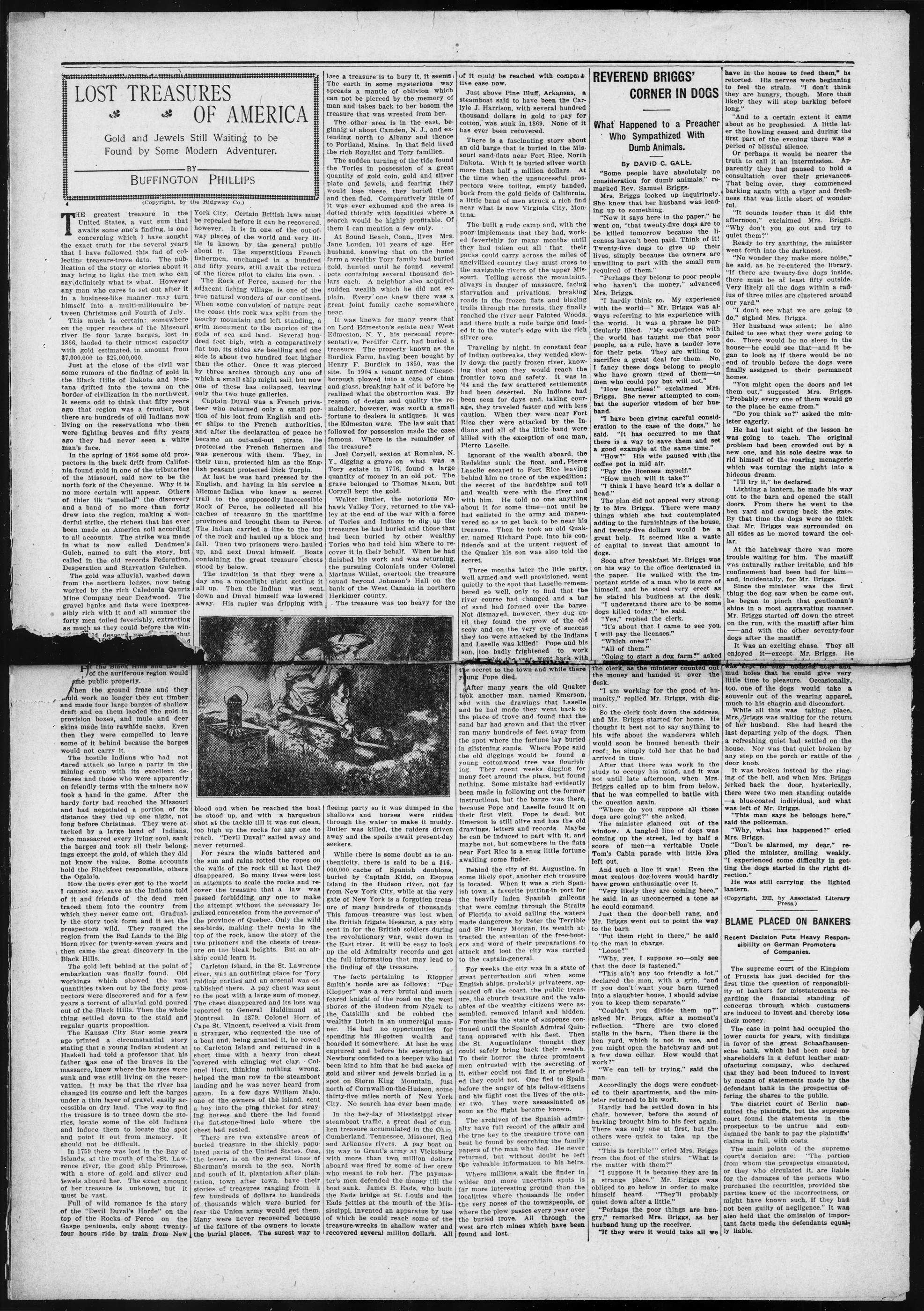
A man is digging a hole in the ground with a shovel. There is a lamp on the side of the hole.
blood and when he reached the boat he stood up, and with a harquebus shot at the tackle till it was cut clean, too high up the rocks for any one to reach. "Devil Duval" sailed away and never returned.
For years the winds battered and the sun and rains rotted the ropes on the walls of the rock till at last they disappeared. So many lives were lost in attempts to scale the rocks and recover the treasure that a law was passed forbidding any one to make the attempt without the necessary legalized concession from the governor of the province of Quebec. Only the wild sea-birds, making their nests in the top of the rock, know the story of the two prisoners and the chests of treasure on the bleak heights. But an airship could learn it.
Carleton Island, in the St. Lawrence river, was an outfitting place for Tory raiding parties and an arsenal was established there. A pay chest was sent to the post with a large sum of money. The chest disappeared and its loss was reported to General Haldimand at Montreal. In 1879, Colonel Horr of Cape St. Vincent, received a visit from a stranger, who requested the use of a boat and, being granted it, he rowed to Carleton Island and returned in a short time with a heavy iron chest covered with clinging wet clay. Colonel Horr, thinking nothing wrong, helped the man row to the steamboat landing and he was never heard from again. In a few days William Majo, one of the owners of the Island, sent a boy into the ping thicket for straying horses and there the lad found the flat-stone-lined hole where the chest had rested.
There are two extensive areas of buried treasure in the thickly populated parts of the United States. One, the lesser, is on the general lines of Sherman's march to the sea. North and south of it, plantation after plantation, town after town, have their stories of treasures ranging from a few hundreds of dollars to hundreds of thousands which were buried for fear the Union army would get them. Many were never recovered because of the failure of the owners to locate the burial places. The surest way to
lose a treasure to bury it, it seems. The earth in some mysterious way spreads a mantle of oblivion which can not be pierced by the memory of man and takes back to her bosom the treasure that was wrested from her. The other area is in the east, beginning at about Camden, N. J., and extending north to Albany and thence to Portland, Maine. In that field lived the rich Royalist and Tory families. The sudden turning of the tide found the Tories in possession of a great quantity of gold coin, gold and silver plate and jewels, and fearing they would lose these, they buried them and then fled. Comparatively little of it was ever exhumed and the area is dotted thickly with localities where a search would be highly profitable. Of them I can mention a few only.
At Sound Beach, Conn., lives Mrs. Jane Louden, 101 years of age. Her husband, knowing that on the home farm a wealthy Tory family had buried gold, hunted until he found several pots containing several thousand dollars each. A neighbor also acquired sudden wealth which he did not explain. Every one knew there was a great joint family cache somewhere near.
It was known for many years that on Lord Edmeston's estate near West Edmeston, N. Y., his personal representative, Perdifer Carr, had buried a treasure. The property known as the Burdick Farm, having been bought by Henry F. Burdick in 1850, was the site. In 1904 a tenant named Cheeseborough plowed into a case of china and glass, breaking half of it before he realized what the obstruction was. By reason of design and quality the remainder, however, was worth a small fortune to dealers in antiques. It was the Edmeston ware. The law suit that followed for possession made the case famous. Where is the remainder of the treasure?
Joel Coryell, sexton at Romulus, N. Y., digging a grave on what was a Tory estate in 1776, found a large quantity of money in an old pot. The grave belonged to Thomas Mann, but Coryell kept the gold.
Walter Butler, the notorious Mohawk Valley Tory, returned to the valley at the end of the war with a force of Tories and Indians to dig, up the treasures he had buried and those that had been buried by other wealthy Tories who had told him where to recover it in their behalf. When he had finished his work and was returning, the pursuing Colonials under Colonel Marinus Willet, overtook the treasure squad beyond Johnson's Hall on the bank of the West Canada in northern Herkimer county.
The treasure was too heavy for the
1
fleeing party so it was dumped in the shallows and horses were ridden through the water to make it muddy. Butler was killed, the raiders driven away and the spoils await present-day seekers.
While there is some doubt as to authenticity, there is said to be a $16,000,000 cache of Spanish doublons, buried by Captain Kidd, on Esopus Island in the Hudson river, not far from New York City, while at the very gate of New York is a forgotten treasure of many hundreds of thousands. This famous treasure was lost when the British frigate Hesarar, a pay ship sent in for the British soldiers during the revolutionary war, went down in the East river. It will be easy to look up the old Admiralty records and get the full information that may lead to the finding of the treasure.
The facts pertaining to Klopper Smith's horde are as follows: "Der Klopper" was a very brutal and much feared knight of the road on the west shores of the Hudson from Nyack to the Catskills and he robbed the wealthy Dutch in an unmerciful manner. He had no opportunities for spending his fill-gotten wealth and hoarded it somewhere. At last he was captured and before his execution at Newburg confided to a keeper who had been kind to him that he had sacks of gold and silver and jewels buried in a spot on Storm King Mountain, just north of Cornwall-on-the-Hudson, some thirty-five miles north of New York City. No search has ever been made.
In the hey-day of Mississippi river steamboat traffic, a great deal of sunken treasure accumulated in the Ohio, Cumberland, Tennessee, Missouri, Red and Arkansas rivers. A pay boat on its way to Grant's army at Vicksburg with more than two million dollars aboard was fired by some of her crew who meant to rob her. The paymaster's men defended the money till the boat sank. James B. Eads, who built the Eads bridge at St. Louis and the Eads jetties at the mouth of the Mississippi, invented an apparatus by use of which he could reach some of the treasure-wrecks in shallow water and recovered several million dollars. All
---
of it could be reached with comparative ease now.
Just above Pine Bluff, Arkansas, a steamboat said to have been the Carlyle J. Harrison, with several hundred thousand dollars in gold to pay for cotton, was sunk in 1869. None of it has ever been recovered.
There is a fascinating story about an old barge that is buried in the Missouri sand-flats near Fort Rice, North Dakota. With it is buried silver worth more than half a million dollars. At the time when the unsuccessful prospectors were toiling, empty handed, back from the gold fields of California, a little band of men struck a rich find near what is now Virginia City, Montana.
The built a rude camp and, with the poor implements that they had, worked feverishly for many months until they had taken out all that their packs could carry across the miles of unvillized country they must cross to the navigable rivers of the upper Missouri. Toiling across the mountains, always in danger of massacre, facing starvation and privations, breaking roads in the frozen flats and blazing trails through the forests, they finally reached the river near Painted Woods, and there built a rude barge and loaded it to the water's edge with the rich silver ore.
Traveling by night, in constant fear of Indian outbreaks, they wended slowly down the partly frozen river, knowing that soon they would reach the frontier town and safety. It was in '64 and the few scattered settlements had been deserted. No Indians had been seen for days and, taking courage, they traveled faster and with less caution. When they were near Fort Rice they were attacked by the Indians and all of the little band were killed with the exception of one man, Pierre Laselle.
Ignorant of the wealth aboard, the Redskins sunk the float, and, Pierre Lasselle escaped to Fort Rice leaving behind him no trace of the expedition; the secret of the hardships and toil and wealth were with the river and with him. He told no one anything about it for some time—not until he had enlisted in the army and maneuvered so as to get back to be near his treasure. Then he took an old Quaker, named Richard Pope, into his confidence and at the urgent request of the Quaker his son was also told the secret.
Three months later the little party, well armed and well provisioned, went quietly to the spot that Laselle remembered so well, only to find that the river course had changed and a bar of sand had formed over the barge. Not dismayed, however, they dug until they found the prow of the old scow and on the very eve of success they too were attacked by the Indians and Laselle was killed! Pope and his son, too badly frightened to work in the year went back with the secret to the town and while there young Pope died.
After many years the old Quaker took another man, named Emerson, and with the drawings that Laselle and he had made they went back to the place of trove and found that the sand bar had grown and that the river ran many hundreds of feet away from the spot where the fortune lay buried in glistening sands. Where Pope said the old diggings would be found a young cottonwood tree was flourishing. They spent weeks digging for many feet around the place, but found nothing. Some mistake had evidently been made in following out the former instructions, but the barge was there, because Pope and Laselle found it on their first visit. Pope is dead, but Emerson is still alive and has the old drawings, letters and records. Maybe he can be induced to part with it, and maybe not, but somewhere in the flats near Fort Rice is a snug little fortune awaiting some finder.
Behind the city of St. Augustine, in some likely spot, another rich treasure is located. When it was a rich Spanish town, a favorite putting-in port for the heavily laden Spanish galleons that were coming through the Straits of Florida to avoid sailing the waters made dangerous by Peter the Terrible and Sir Henry Morgan, its wealth attracted the attention of the free-booters and word of their preparations to attack and loot the city was carried to the captain-general.
For weeks the city was in a state of great perturbation and when some English ships, probably privateers, appeared off the coast, the public treasure, the church treasure and the valuables of the wealthy citizens were assembled, removed inland and hidden. For months the state of suspense continued until the Spanish Admiral Quintana appeared with his fleet. Then the St. Augustinians thought they could safely bring back their wealth. To their horror the three prominent men entrusted with the secreting of it, either could not find it or pretended they could not. One fled to Spain before the anger of his fellow-citizens and his flight cost the lives of the other two. They were assassinated as soon as the flight became known.
The archives of the Spanish admiralty have full record of the affair and the true key to the treasure trove can best be found by searching the family papers of the man who fled. He never returned, but without doubt he left the valuable information to his heirs.
Where millions await the finder in wilder and more uncertain spots is far more interesting ground than the localities where thousands lie under the very noses of the townspeople, or where the plow passes every year over the buried trove. All through the west are rich mines which have been found and lost.
REVEREND BRIGGS'
CORNER IN DOGS
What Happened to a Preacher Who Sympathized With Dumb Animals.
By DAVID C. GALE.
"Some people have absolutely no consideration for dumb animals," remarked Rev. Samuel Briggs.
Mrs. Briggs looked up in inquiringly. She knew that her husband was leading up to something.
"Now it says here in the paper," he went on, "that twenty-five dogs are to be killed tomorrow because the licenses haven't been paid. Think of it. Twenty-five dogs to give up their lives, simply because the owners are unwilling to part with the small sum required of them."
"Perhaps they belong to poor people who haven't the money," advanced Mrs. Briggs.
"I hardly think so. My experience with the world—" Mr. Briggs was always referring to his experience with the world. It was a phrase he particularly liked. "My experience with the world has taught me that poor people, as a rule, have a tender love for their pets. They are willing to sacrifice a great deal for them. No, I fancy these dogs belong to people who have grown tired of them—to men who could pay but will not." "How heartless!" exclaimed Mrs. Briggs. She never attempted to combat the superior wisdom of her husband.
"I have been giving careful consideration to the case of the dogs," he said. "It has occurred to me that there is a way to save them and set a good example at the same time."
"How?" His wife paused with \the coffee pot in mid air.
"Pay the licenses myself."
"How much will it take?"
"I think I have heard it's a dollar a head."
The plan did not appeal very strongly to Mrs. Briggs. There were many things which she had contemplated adding to the furnishings of the house, and twenty-five dollars would be a great help. It seemed like a waste of capital to invest that amount in dogs.
Soon after breakfast Mr. Briggs was on his way to the office designated in the paper. He walked with the important stride of a man who is sure of himself, and he stood very erect as he stated his business at the desk.
"I understand there are to be some dogs killed today," he said.
"Yes," replied the clerk.
"It's about that I came to see you. I will pay the licenses."
the clerk, as the minister counted out the money and handed it over the desk.
"I am working for the good of humanity," replied Mr. Briggs, with dignity.
So the clerk took down the address, and Mr. Briggs started for home. He thought it best not to say anything to his wife about the wanderers which would soon be housed beneath their roof; he simply told her that he had arrived in time.
After that there was work in the study to occupy his mind, and it was not until late afternoon, when Mrs. Briggs called up to him from below, that he was compelled to battle with the question again.
"Where do you suppose all those dogs are going?" she asked.
The minister glanced out of the window. A tangled line of dogs was coming up the street, led by half a score of men—a veritable Uncle Tom's Cabin parade with little Eva left out.
And such a line it was! Even the most zealous dog-lovers would hardly have grown enthusiastic over it.
"Very likely they are coming here," he said, in as unconcerned a tone as he could command.
Just then the door-bell rang, and Mr. Briggs went out to point the way to the barn.
"Put them right in there," he said to the man in charge.
"Loose?"
"Why, yes, I suppose so—only see that the door is fastened."
"This ain't any too friendly a lot," declared the man, with a grin, "and if you don't want your barn turned into a slaughter house, I should advise you to keep them separate."
"Couldn't you divide them up?" asked Mr. Briggs, after a moment's reflection. "There are two closed stalls in the barn. Then there is the hen yard, which is not in use, and you might open the hatchway and put a few down cellar. How would that work?" "We can tell by trying," said the man. Accordingly the dogs were conducted to their apartments, and the minister returned to his work. Hardly had he settled down in his chair, however, before the sound of barking brought him to his feet again. There was only one at first, but the others were quick to take up the cause. "This is terrible!" cried Mrs. Briggs from the foot of the stairs. "What is the matter with them?"
"I suppose it is because they are in a strange place." Mr. Briggs was obliged to go below in order to make himself heard. "They'll probably quiet down after a little."
"Perhaps the poor things are hungry," remarked Mrs. Briggs, as her husband hung up the receiver.
"If they were it would take all we
have in the house to feed them," he retorted. His nerves were beginning to feel the strain. "I don't think they are hungry, though. More than likely they will stop barking before long."
"And to a certain extent it came about as he prophesied. A little later the howling ceased and during the first part of the evening there was a period of blissful silence.
Or perhaps it would be nearer the truth to call it an intermission. Apparently they had paused to hold a consultation over their grievances. That being over, they commenced barking again with a vigor and freshness that was little short of wonderful.
"It sounds louder than it did this afternoon." exclaimed Mrs. Briggs. "Why don't you go out and try to quiet them?"
Ready to try anything, the minister went forth into the darkness.
"No wonder they make more noise," he said, as he re-entered the library. "If there are twenty-five dogs inside, there must be at least fifty outside. Very likely all the dogs within a radius of three miles are clustered around our yard."
"I don't see what we are going to do," sigged Mrs. Briggs.
Her husband was silent; he also failed to see what they were going to do. There would be no sleep in the house—he could see that—and it began to look as if there would be no end of trouble before the dogs were finally assigned to their permanent homes.
"You might open the doors and let them out," suggested Mrs. Briggs. "Probably every one of them would go to the place he came from."
"Do you think so?" asked the minister eagerly.
He had lost sight of the lesson he was going to teach. The original problem had been crowded out by a new one, and his sole desire was to rid himself of the roaring menagerie which was turning the night into a hideous dream.
"I'll try it." he declared.
Lighting a lantem, he made his way out to the barn and opened the stall doors. From there he went to the hen yard and swung back the gate. By that time the dogs were so thick that Mr. Briggs was surrounded on all sides as he moved toward the cellar.
At the hatchway there was more trouble waiting for him. The mastiff was naturally rather irritable, and his confinement had been bad for him—and, incidentally, for Mr. Briggs.
Since the minister was the first thing the dog saw when he came out, he began to pinch that gentleman's shins in a most aggravating manner. Mr. Briggs started off down the street on the run, with the mastiff after him—and with the other seventy-four dogs after the mastiff.
It was an exciting chase. They all enjoyed it—except Mr. Briggs. He
was kept so busy dodging dogs and mud holes that he could give very little time to pleasure. Occasionally, too, one of the dogs would take a souvenir out of the wearing apparel, much to his chagrin and discomfort. While all this was taking place, Mrs. Briggs was waiting for the return of her husband. She had heard the last departing yelp of the dogs. Then a refreshing quiet had settled on the house. Nor was that quiet broken by any step on the porch or rattle of the door knob. It was broken instead by the ringing of the bell, and when Mrs. Briggs jerked back the door, hysterically, there were two men standing outside—a blue-coated individual, and what was left of Mr. Briggs.
"This man says he belongs here," said the policeman.
"Why, what has happened?" cried Mrs. Briggs.
"Don't be alarmed, my dear," replied the minister, smiling weakly. "I experienced some difficulty in getting the dogs started in the right direction." He was still carrying the lighted lantern. (Copyright, 1912, by Associated Literary Press.)
BLAME PLACED ON BANKERS
Recent Decision Puts Heavy Responsibility on German Promoters of Companies.
The supreme court of the Kingdom of Prussia has just decided for the first time the question of responsibility of bankers for misstatements regarding the financial standing of concerns through which customers are induced to invest and thereby lose their money.
The case in point had occupied the lower courts for years, with findings in favor of the great Schaafnause-sche bank, which had been sued by shareholders in a defunt leather manufacturing company, who declared that they had been induced to invest by means of statements made by the defendant bank in the prospectus offering the shares to the public.
The district court of Berlin nansuited the plaintiffs, but the supreme court found the statements in the prospectus to be untrue and condemned the bank to pay the plaintiffs' claims in full, with costs.
The main points of the supreme court's decision are: "The parties from whom the prospectus emanated, or they who circulated it, are liable for the damages of the persons who purchased the securities, provided the parties knew of the incorrectness, or might have known such, if they had not been guilty of negligence." It was also held that the omission of important facts made the defendants equally liable.
THE SEARCHLIGHT
Founded in 1898 by W. N. Miller.
WICHITA. KANSAS.
Mrs. W. N. Miller Prop.
N. B. Copeland, Manager
Phone Market 4090x.
Office 513 N. Main St.
RATES OF SUBSCRIBER:
Strictly in Advance.
One Year (by mail) $1.00
Six Months (by mail) .75
Three Months (by mail) .50
Entered at the Post Office as Second
Class Mail Matter.
ADVERTISING RATES.
Editorial Notes.
Pay up! Pay up!! Pay up!!!
We are still doing business at the same old stand, 513 N. Main St. Give us a call.
Timidity, shyness, and self-consciousness belong to the same family. We usually find all where we find any, one and they are all enemies of peace of mind, happiness and achievement.
Timid, shy people are morbidly self-conscious they them too about themselves, their thoughts are turned inwaad.
Thousands of young people are held back from unpertaking what they long to do, and are kept from trying to make real their great life-dreams, because they are afraid to jostle with the world.
"Desperate, criminals!" The chosen get away from the old get even" idea Imprisonment is not society's revenge upon the offending individual but society's effort to correct and redaim.
Education of course. Every illiterate should be taught to read write and figure. I'm just whipping my school idea into shape, but its wonderful what that hr. a day has accomplished already.
Wichita's stay-at-homes this summer have certainly enjoyed as fine brand of weather as any mountain or lake resort in the world can provide.
Rufus L. Perry, Negro Lawyer of Brooklyn, has embraced the Jewish religion. Perry is said to be the first American Negro to become a Hero. He has given the name of Kalph Lewis.
Automobiles are getting too common for real rich and exclusive folks. They're going back to fancy horses.
Subscribe and pay for the Wichita Searchlight. It is only $1. for a whole year. Try it.
Let us be your Printers
At 917 E. 9th. St, a 700 6 room cottage, Price $1500,
Inquire at 716 Maple St.
For Sale:-
5 and 10 acre tracts, one mile from city. Terms: 10% cash; balance $15.00 a month. Write to
JOHN M. WRIGHT,
623 Western Ave,
Topeka, Kans.
For Sale:
For Sale;-
Nice five room house cheap, at 1125 N. Washington. This is a snap. Call at Gold State Bank.
Wanted;-
At once a first-class dress maker. Call at 507 N. Main St.
Ought to Be Valuable. Cauliflower is said to contain the largest percentage of phosphorus of any of the common vegetables. If its valuable constituent is in any degree comparable with its pungent odor when being cooked, it is worthy of a place in the front ranks of foodstuffs.
Most Abundant of Substances. Oxygen constitutes one-third of the solid earth nine-tenths of water and one-fifth of the atmosphere, and is the most abundant of all substances.
It were not best that we should all think alike; it is difference of opinion that makes horse races.—Pudd'nhead Wilson.
Simone Cainot, a five-year-old girl, fell from a fourth floor window of a building at Havre, France, the other day, without sustaining any injury save a few scratches. The child had been left alone in a locked room, and as she could not open the door, she broke a pane of glass with an umbrella and jumped out of the window. She was taken to a hospital, but after a careful examination was pronounced uninjured.
C A. Williams,
Pastor.
Parsonage 521 N. Water,
Phone market 1215.
Cabbeli M. E. Church
Sunday Services
During a visit she paid to the prison in Marquette, Mich., the other day, a wealthy Cincinnati woman lost two valuable diamond rings. An honest life prisoner in the meantime found the jewels in the prison yard. They were in a chamois bag and probably had been kicked about unconciously by other convicts. The jewels were promptly returned to the owner.
To loosen windows that move hard, melt a tablespoonful of lard and pour a little between the window frame and casing, and on the roller and rope. It works well, says Suburban Life, and is a good thing to know in the spring-time, when frames are swollen from being closed all winter.
Be it resolved by the Legislature of the State of Kansas, two-thirds of the members elected to each House thereof concurring therein:
That the following proposition to mend the constitution of the state of Kansas be hereby submitted to the qualified electors of the state for heir approval of rejection, namely;
SECTION 1. The rights of citizens of the state of Kansas to vote and hold office shall not be denied or abridged on account of sex.
SEC. 2. This proposition shall be submitted to the electors of this state at the election for representatives to the Legislature in the year 1912. The amendment hereby proposed shall be known on the official ballot by the following title: "Amendment to the constitution granting equal rights and privileges to women," and the vote for or against such amendment shall be taken as provided by law
SEC. 3. This amendment: if adopted, shall be known as section 8 of article 5 of the constitution of the state of Kansas.
SEC. 4. This resolution shall take effect and be in force from and after its publication in the statute book.
Passed the House February 7, 1911,
Passed the Senate February 8, 1911,
Approved February 9, 1911.
I hereby certify that the foregoing is a true and correct copy of original House Concurrent Resolution No. 3, now on file in my office.
CHAS. H. SESSIONS,
Secretary of State.
WICHITA KANSAS.
Wm. Bowers C. C.
Dr. H. T. Bolden K. of R. & S.
Address 517 N. Main St.
All Visiting K. of P. Welcome.
Failed With Staff or Life.
The pupils of a girls' high school in a Pennsylvania town had a bread-making contest the other day. It was a great success, for the druggists and doctors of the town did a rushing business the next day. One of the bakers of the town got hold of one of the soggy, sour, half-baked high school loaves and put it in his show window as an awe-inspiring example of what bread should not be like.—Bakers' Weekly.
---
WALK-OVER SHOES AT $2.50
The Head Sample Shoe Parlors third floor the Caldwell-Murdock building, announce the arrival of an immense shipment of the popular $4, $5, and $6 'Walk-Over' men's shoes, all of which will be sold at the customary price of $250 a pair.
This unusual price is but aed indication of the ability of Heads Sample Shos Parlors to bear out every statement they make as to economy of price and the genuine good value. This shipment of "Walk-Over" Shoes will be placed on sale beginning today and will be sold without restriction or reservation whatever.
Men of discriminating tastes and economical inclinations will do well to take time to examine this offer and inspect the shoes, as this unusual opportunity is certainly a very timely one. Head's Sample Shoe Co 3rd.Floor Murdock Bld, Take Elevator, Open Sat. till 11 p.m.
St. Paul A.M.E. Church
523 N. Water
Preaching; 11:00 a,m. & 8:00 p,m
Sunday School 12:30 a.m.
J. T. Chinneth Supt.
Allen Endeavor League 6:30 p m
Hid Week Services
Prayer meeting Wed, 8. p. m.
Class meeting Friday 8 p. m.
Strangers welcome to all these services,
Preaching at 10:45
Sunday School, 12:00 m.
Epworth League 7:00 p. m.
Preaching at 8:00 p. m.
Mid Week Services
S. S. Teachers Meet Tues Eve.
Junior Choir Wednesday Eve.
Aid Society Wednesday 2, p. m.
Class Meeting Thursday Eve.
You are invited to attend these
meetings.
G. T. Wooten Pastor
```markdown
```
Arria Court No. 7, O. O. G.
Holds regular meetings the 1st and 3rd. Mondays at 2:30 p. m. in the Masonic Hall. All visiting financial sisters of the O. O. C., are cordially invited to attend our regular meetings.
Mrs. Mollie Cox W. C.
Mrs. Ida Martin R. of D.
-KNIGHTS of PYTHIAS,--
Toas Lodge No.10, Meets 2nd. and 4th. Monday night of each month, at Masonic Building 615 N. Main St.
Always Business.
Always Business.
"Are you angry because I lost my temper and tried to scratch your eyes out?" asked the repentant prima donna. "No," replied the impressario. "It was a good suggestion. Just remember how you went about it and if grand opera falls maybe we can do something in the moving picture way."
WANT ADDS.
Why Opinions Differ
Fell Far Without Injury
To Loosen Window
HOUSE CONCURRENT RESOLUTION No. 3.
Failed With Staff of Life.
WILL WINTERS
GROCERY & MEAT MKT.
349 North Main St.
We Handle A
Full Lne of Staple & Fancy
GROCERIES.
At Reasonable Prices.
Give us a trial and we will give you the best servicee to be had.
We Deliver to all Parts of the City.
City. Phone Market 3038.
Dr. A. K. Lawrence
Physician & Surgeon
Office Phone
517 N. Main St. Mkt. 4634
Diseases of Men, Women and Children
Aspecialty.
Mrs. W. N. Miller
Madme Papes System Treating the scalp and pressing the hair. I make my own press ing oil and hair preparation. Any information gladly given. Phone MKT, 4090x.
Madame Brown
The Famous Singer is to Appear in Wichita in the near future.
Fred C. Helm
513 N. Main Street.
Phone Market 2699.
908 North Water tS.
Will wash shampoo and strait en hair. Prices very reasonable.
Give her a trial.
UNDERTAKER
142 N. Market Wichita Kas.
Peerless Steam Laundry
BEST LAUNDRY IN THE CITY
Satisfaction Guaranteed
Laundry Work Called
and Delivered
Phones 232
SELOVER & SONS, Props.
245 N. Market St Wichita, Kan
W. S. Henrion
* Druggist
501 North Main Street
Wichita - - - - Kansas
How Taste Is Cultivated.
How Taste Is Cultivated.
people who live in climates where malaria abounds, frequently have to take so much quinine that they get to love the taste of it, and to take it daily, even when they do not need it just because it tastes good to them. And yet quinine is one of the bitterest of drugs and these same people did they move away from the malaria district for a few years, would soon get to detest the taste of it.
The Route.
"Dashington seems to have finally made a conquest of that Scadmore girl. Wonder how it all came about. "The first time she saw him she gave him her eye, the next time they me she gave him her arm, it wasn't long before he was holding both of her hands, soon after that he won he, heart, and she lost her head and gave herself to him completely."—Judge.
Grocery Department
WE SELL FLOUR
WE SELL MEAL
WE SELL LARD
WE SELL MEAT
WE SELL POTATOES
Fact, we sell everything kept in a First-Class grocery. WHY CAN'T WE SELL TO YOU?
Makin Eye Drug Co.
N. Main St. — Wichita, Kan — Bell Phone
Excellence Counts
THEN USB
U-KNEAD-IT
FLOUR
Excelsis in every respect, — color, flavor and kinds of bread per barrel. MADE BY WATSON MILL CO.
WHITA — KAN
SECOND TO NONE
PLEASES ALL
GOOD BREAD MAKERS
— AND WILL PLEASE YOU —
IT IS AS WHITE AS SNOW — TRY IT
OTTO WEISS ALFALFA STORES
are all guaranteed up to
Law, Serial No. 1841
is State Law, Reg. 185A
The Cheapest and Best Served on the Marsh
Clean Beds and Good Meals, Call Little Wonder Restaurant and Hotel
Meals 20c — Short Order at all Hours
607 North Main St.
Short Orders Filled At All House
Good Service is Guaranteed
Barber Shop 513 North Main Street
A. J. Cousar, Prop.
In fact, we see everything kept in a First-Class Grocery. WHY CAN'T WE SELL TO YOU?
Makin Eye Drug Co. 517 N. Main St. - Wichita, Kan - Bell Phone 289
Excellence Counts
THEN USB
"U-KNEAD-IT"
FLOUR
It excels in every respect, — color, flavor and
pounds of bread per barrel. MADE BY
WATSON MILL CO.
WICHITA KANSAS
"SECOND TO NONE"
PLEASES ALL
GOOD BREAD MAKERS
— AND WILL PLEASE YOU —
IT IS AS WHITE AS SNOW — TRY IT
THE OTTO WEISS ALFALFA STORE
are all guaranteed un-
Law, Serial No. 134
as State Law, Reg. 158A
It Is The Cheapest and Best Offered on the Market
---
For Clean Beds and Good Meals, Call at
Little Wonder Restaurant and Hotel Meals 20c - Short Order at all Hours 507 North Main St. Short Orders Filled At All House Good Service is Guaranteed Barber Shop 513 North Main Street A. J. Cousar, Prop.
CULP'S MKT.
BEST PLACE TO DO YOUR SHOP FOR FRESH MEATS. FRESH OAT FISH And SLICED HALIBUT. Dressed Chickens. By a Large Supply of the best of the nicest Veal.
IS THE BEST PLACE TO DO YOUR SHOPPING,
FOR FRESH MEATS.
FRESH OAT FISH
And
SLICED HALIBUT.
Dressed Chickens.
We Carry a Large Supply of the best of Corn-Fed
Beef, and the nicest Veal.
LOWEST PRICES
Culp's Market
241 N. Main St. Phone, Market 1551
IMBODEN'S IMPERIAL FLOUR
GRAHAM - CORN MEAL - BREAKFAST FOOD
With thirty-five years MILLING EXPERIENCE in Wichita, our products are the best that can be produced.
Made from the best selected grain only, put up in Special Packages.
ASK YOUR GROCER: See that you get IMPERIAL THE IMBODEN MILLING CO.
Wichita, Kansas
THE HOME OF THE MAYOR
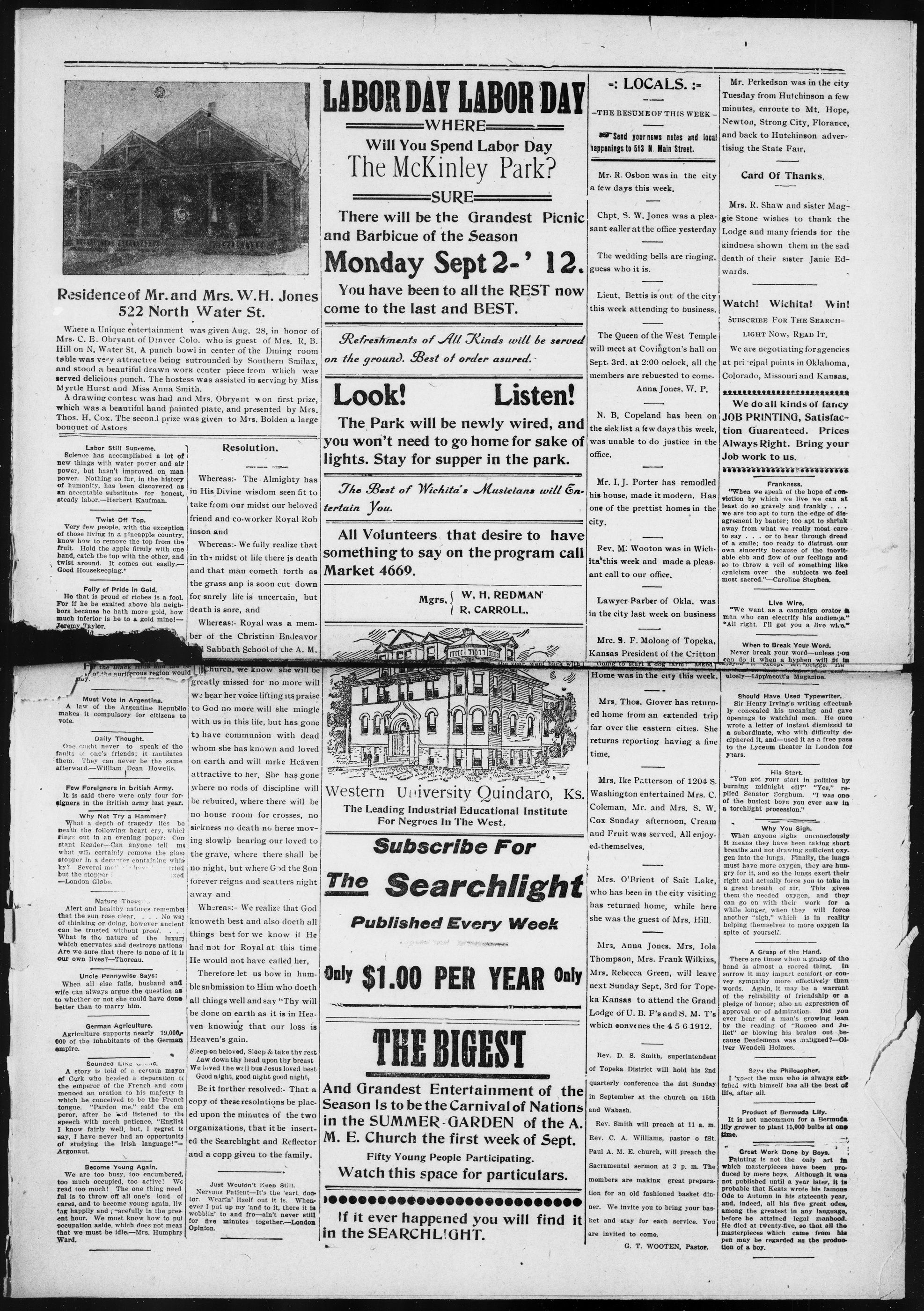
Residence of Mr. and Mrs. W.H. Jones 522 North Water St.
Where a Unique entertainment was given Aug. 28, in honor of Mrs. C. E. Obryant of Denver Colo. who is guest of Mrs. R. B. Hill on N. Water St. A punch bowl in center of the Dining room table was very attractive being surrounded by Southern Smilax, and stood a beautiful drawn work center piece from which was served delicious punch. The hostess was assisted in serving by Miss Myrtle Hurst and Miss Anna Smith.
A drawing contest was had and Mrs. Obryant won first prize, which was a beautiful hand painted plate, and presented by Mrs. Thos. H. Cox. The second prize was given to Mrs. Bolden a large bouquet of Astors
Labor Still Supreme.
Science has accomplished a lot of new things with water power and air power, but hasn't improved on man power. Nothing so far, in the history of humanity, has been discovered as an acceptable substitute for honest, steady labor.—Herbert Kaufman.
Twist Off Top.
Very few people, with the exception of those living in a pineapple country, know how to remove the top from the fruit. Hold the apple firmly with one hand, catch the top with the other, and twist around. It comes out easily. Good housekeeping.*
Folly of Pride in Gold
He that is proud of riches is a fool. For if he be exalted above his neighbors because he hath more gold, how much inferior is he to a gold mine!—Jeremy Taylor.
For the Black Hills and the river of the suriferous region would may.
Must Vote in Argentina.
A law of the Argentine Republic makes it compulsory for citizens to vote.
Daily Thought.
One ought never to speak of the faults of one's friends; it mutilates them. They can never be the same afterward—William Dean Howells.
Few Foreigners in British Army.
It is said there were only four foreigners in the British army last year.
Why Not Try a Hammer?
What a depth of tragedy lies behead the following heart cry, which rings out in an evening paper: Constant Reader—Can anyone tell me what will, certainly remove the glass stopper in a decruster containing whiskey? Several men have tried but the stopper
London Globe
Nature Thou:
Alert and healthy natures remember that the sun rose clear. . . . No war of thinking or doing, however ancient can be trusted without proof. . . .
What is the nature of the luxury which enervates and destroys nations? Are we sure that there is none of it in our own lives?—Thoreau.
Uncle Pennywise Says:
When all else fails, husband and wife can always argue the question as to whether or not she could have done better than to marry him.
German Agriculture.
Agriculture supports nearly 19,000,000 of the inhabitants of the German empire.
Sounded Like Cork.
A story is told of a certain mayor of Cork who headed a deputation to the emperor of the French and commenced an oration to his majesty in which he conceived to be the French tongue. "Pardon me," said the emperor, after he and listened to the speech with much patience. "English I know fairly well, but, I regret to say, I have never had an opportunity of studying the Irish language!"—Argonaut.
Become Young Again
We are too busy, too encumbered, too much occupied, too active! We read too much! The one thing needful is to throw off all one's load of cares, and to become young again, living happily and gracefully in the present hour. We must know how to put occupation aside, which does not mean that we must be idle.—Mrs. Humphry Ward.
Resolution.
Whereas:- The Almighty has in His Divine wisdom seen fit to take from our midst our beloved friend and co-worker Royal Robinson and
Whereas:- We fully realize that in the midst of life there is death and that man cometh forth as the grass anp is soon cut down for snrely life is uncertain, but death is sure, and
Whereas:- Royal was a member of the Christian Endeavor Sabbath School of the A. M.
church, we know she will be greatly missed for no more will we hear her voice lifting its praise to God no more will she mingle with us in this life, but has gone to have communion with dead whom she has known and loved on earth and will mrke Heaven attractive to her. She has gone where no rods of discipline will be rebuired, where there will be
no house room for crosses, no sickness no death no herse moving slowlp bearing our loved to the grave, where there shall be no night, but where God the Son forever reigns and scatters night away and
Whereas:- We realize that God knoweth best and also doeth all things best for we know if He had not for Royal at this time He would not have called her,
Therefore let us bow in humble snbmission to Him who doeth all things well and say "Thy will be done on earth as it is in Heaven knowing that our loss is Heaven's gain.
Sleep on beloved, Sleep & take thy rest Law down thy head upon thy breast We loved the well bus Jesus loved best Good night, good night good night,
Be it further resolved: That a copy of these resolutions be placed upon the minutes of the two organizations, that it be inserted the Searchlight and Reflector and a copp giveu to the family.
Just Wouldn't Keep Still.
Nervous Patient—It's the 'eart, doctor. Wearin' itself out it is. Whenever I put up my 'and to it, there it is wobblin' to and fro—ain't never still for five minutes together.—London Opinion.
LABOR DAY LABOR DAY
Will You Spend Labor Day
the McKinley Park
SURE
we will be the Grandest
arbicue of the Season
Sunday Sept 2-'
have been to all the REST
to the last and BEST.
reshments of All Kinds will be
around. Best of order assured.
Ok! Liste
Park will be newly wired
don't need to go home for sa
Stay for supper in the pa
Best of Wichita's Musicians w
You.
Volunteers that desire to
thing to say on the program
t 4669.
Will You Spend Labor Day The McKinley Park?
There will be the Grandest Picnic and Barbicue of the Season
Monday Sept 2-' 12.
You have been to all the REST now come to the last and BEST.
Refreshments of All Kinds will be served on the ground. Best of order assured.
Look!
The Park
you won't need
rights. Stay
The Best of
certain You.
All Volunt
something to
Market 4669
Western U
The Leading
For N
The Park will be newly wired, and you won't need to go home for sake of lights. Stay for supper in the park.
The Best of Wichita's Musicians will Entertain You.
All Volunteers that desire to have something to say on the program call Market 4669.
Bern University Quindard
Leading Industrial Educational Inst
For Negroes In The West.
Western University Quindaro, Ks.
The Leading Industrial Educational Institute
For Negroes In The West.
Subscribe For
The S
Publis
only $1.00
Searchlight
published Every Week
$1.00 PER YEAR
THE BIGEST
and Grande
season is to
in the SUMA
M. E. Church
Fifty YO
Watch this
grandest Entertainment o
rals to be the Carnival of Na
SUMMER-GARDEN of the
Church the first week of S
Fifty Young People Participating.
ch this space for particula
And Grandest Entertainment of the Season is to be the Carnival of Nations in the SUMMER-GARDEN of the A. M. E. Church the first week of Sept. Fifty Young People Participating. Watch this space for particulars.
---
Listen!
ly wired, and one for sake of the park.
musicians will Es
esire to have program ca
Mgrs, { W, H, REDMAN' R, CARROLL,
the year went back wh
uindaro, K
national Institute
est.
hlight
y Week
YEAR Only
ment of the
val of Nation
EN of the A
week of Sept.
cipating.
WHERE
SURE
Send your news notes and local happenings to 513 N. Main Street.
Mr. R. Osbon was in the city a few days this week.
Chpt. S. W. Jones was a pleasant caller at the office yesterday
The wedding bells are ringing, guess who it is.
Lieut. Bettis is out of the city this week attending to business.
The Queen of the West Temple will meet at Covington's hall on Sept. 3rd. at 2:00 oclock, all the members are rebuested to come.
N. B. Copeland has been on the sick list a few days this week, was unable to do justice in the office.
Mr. I. J. Porter has remodled his house, made it modern. Has one of the prettist homes in the city.
Rev. M. Wooton was in Wiehita this week and made a pleasant call to our office.
Lawyer Barber of Okla. was in the city last week on business
Mrc. 9. F. Molone of Topeka, Kansas President of the Critton
Mrs. Thos, Glover has returned home from an extended trip far over the eastern cities. She returns reporting having a fine time.
Mrs. Ike Patterson of 1204 S. Washington entertained Mrs. C. Coleman, Mr. and Mrs. S. W. Cox Sunday afternoon, Cream and Fruit was served. All enjoyed-themselves.
Mrs. O'Brient of Sait Lake, who has been in the city visiting has returned home, while here she was the guest of Mrs. Hill.
Mrs. Anna Jones. Mrs. Iola Thompson, Mrs. Frank Wilkins, Mrs. Rebecca Green, will leave next Sunday Sept. 3rd for Topeka Kansas to attend the Grand Lodge of U. B. F's and S. M. T's which convenes the 4 5 6 1912.
Rev. D. S. Smith, superintendent of Topeka District will hold his 2nd quarterly conference the 1st Sunday in September at the church on 15th and Wabash.
Rev. Smith will preach at 11 a. m.
Rev. C. A. Williams, pastor o fSt.
Paul A. M. E. church, will preach the Sacramental sermon at 3 p. m. The members are making great preparation for an old fashioned basket dinner. We invite you to bring your basket and stay for each service. You are invited to come.
G. T. WOOTEN, Pastor.
Mr. Perkedson was in the city Tuesday from Hutchinson a few minutes, enroute to Mt. Hope, Newton, Strong City, Florance, and back to Hutchinson advertising the State Fair.
Card Of Thanks.
Mrs. R. Shaw and sister Maggie Stone wishes to thank the Lodge and many friends for the kindness shown them in the sad death of their sister Janie Edwards.
Watch! Wichita! Win!
We are negotiating for agencies at principal points in Oklahoma, Colorado, Missouri and Kansas.
---
We do all kinds of fancy JOB PRINTING, Satisfaction Guarenteed. Prices Always Right. Bring your Job work to us.
Frankness.
"When we speak of the hope of conviction by which we live we can at least do so gravely and frankly . . . we are too apt to turn the edge of disagreement by banter; too apt to shrink away from what we really most care to say . . . or to hear through dread of a smile; too ready to distrust our own sincerity because of the inevitable ebb and flow of our feelings and so to throw a veil of something like cynicism over the subjects we feel most sacred."—Caroline Stephen.
Live Wire.
"We want as a campaign orator man who can electrify his audience." "All right. I'll get you a live who."
When to Break Your Word. Never break your word—unless you can do it when a hyphen will fit in occupied if except the hyphen.
Should Have Used Typewriter.
Sir Henry Irving's writing effectually concealed his meaning and gave openings to watchful men. He once wrote a letter of instant dismissal to a subordinate, who with difficulty deciphered it, and—used it as a free pass to the Lyceum theater in London for years.
His Start.
"You got your start in politics by burning midnight oil?" "Yes," replied Senator Sorghum. "I was one of the busiest boys you ever saw in a torchlight procession."
Why You Sigh.
When anyone sighs unconsciously it means they have been taking short breaths and not drawing sufficient oxygen into the lungs. Finally, the lungs must have more oxygen, they are hungry for it, and so the lungs exert their right and actually force you to take in a great breath of air. This gives them the needed oxygen, and they can go on with their work for a while longer, when they will force another "sigh," which is in reality helping themselves to more oxygen in spite of yourself.
A. Grasp of the Hand.
There are times when a grasp of the hand is almost a sacred thing. In sorrow it may impart comfort or convey sympathy more effectively than words. Again, it may be a warrant of the reliability of friendship or a pledge of honor; also an expression of approval or of admiration. Did you ever hear of a man's growing lean by the reading of "Homeo and Juliet" or blowing his brains out because Desdemona was maligned?—Oliver Wendell Holmes.
Sava the Philosopher.
I expect the man who is always satisfied with himself has all the best of life, after all.
Product of Bermuda Lily
It is not uncommon for a Bermuda lily grower to plant 15,000 bulbs at one time.
Great Work Done by Boys.
Painting is not the only art in which masterpieces have been produced by mere boys. Although it was not published until a year later, it is probable that Keats wrote his famous Ode to Autumn in his sixteenth year, and, indeed, all his five great odes, among the greatest in any language, before he attained legal manhood. He died at twenty-five, so that all the masterpieces which came from his pen may be regarded as the production of a boy.
---
The Corrector of Destinies
Copyright by Edward J. Clode
I was suprised on a morning in early February to find Bishop Simonton's carriage before Randolph Mason's house. I have known churchmen to appeal to Mason in desperate straits, perhaps upon a theory that one should try all temporal doors before knocking on the gates of alabaster. But that the esthetic and venerable Bishop of New York should require profane assistance was quite beyond belief. I pulled up short by my ancient friend, the crossing policeman.
"Scally," I said, "I believe the ravages of age are beginning to mark me. Can it be Bishop Simonton's carriage I see yonder?"
The great Celt rapped himself gently on the belt plate with his club. "Sure," he said, "it's not the ravages of age that's doin' ye any harm this mornin', Mister Parks. 'Tis his nib's wagon, all right."
"Some aldermen must be squatting on the Church lands," I said, "to bring this good man out at a quarter before tea on a winter morning."
"Wist!" replied the Irish king half covering his mouth with his gloved hand; "'tis a woman." Then he crossed the street to stop a line of drays.
The mystery was now beyond conjecture. I walked on slowly to the gate and up the flag-path to the house. Certain airy, nebulous conceptions had, from the pleasantries of early Italian letters and recent scandalous posters along the book stalls, presented themselves with piquant explanations. Within the house a second and greater surprise awaited me. Pietro met me at the door saying that Randolph Mason wished instantly to see me. I gave Pietro my coat and hat and went at once to the private office. My state of mental flippancy had little prepared me for the type of woman who arose as I entered. I have not seen her like in New York. If the word elegant were not so thumbed, I should write it here as descriptive of her—not in a tinseled or bedzened sense, but as the panther is elegant, as the red silken horses of a rajah are elegant. High breeding, down an immemorial line, produces such animals, time, through a hundred generations, carving carefully, like a gem engraver. Tall, supple and straight; the eye steady, calm, reserved, fearless, the nose straight and thin; the lips fine, delicate and resolute; the chin up;
the black, glossy hair parted in the middle and brushed back. She was gowned in well-fitting black. This woman was perhaps fifty years old. I instantly fitted her into the frame of a casemesh window along the battery in Charleston, or the white columns of an estate on the James. I bowed as she turned toward me. I think the statue of Nathan Hale, outside in the flurry of snow, would also have bowed had it been standing in my shoes. She did not speak to me at all, but waited in dignified silence for Mason to say what was necessary to be said.
Mason was standing by his table, tapping it impatiently with the tips of his long, sensitive fingers. I thought the lines along his mouth were broken a blit, his eyes a trifle warmer. But this was certainly a fancy, for when he spoke it was in his usual cold voice.
"Parks," he said, "you must find a certain variety actress, calling herself Madame Versay. She has in her possession a case of pearls belonging to Miss Caroline Pickney. She will demand ten thousand dollars in cash for the return of these jewels. You will say to her that Miss Pickney has finally arranged to pay her this money. That on the tenth day of February at ten o'clock, the vault officer of the Jefferson Trust company, in the city of Richmond, in the presence of Miss Pickney here and you, will deliver to her ten thousand dollars in currency. She must bring with her the case of jewels and hand it over to the vault officer, who, upon the payment of the money, will give it to Miss Pickney. This Madame Versay is said to be under the protection of one Robert Henderson, a police detective of New York. This person may also be present, if Madame Versay wishes him to be. You will arrange for this purchase with Madame Versay. You will then accompany Miss Pickney to Richmond and be present with her at the transfer of the money. Miss Pickney will personally attend to the other details of the matter."
When Randolph Mason had finished speaking, the woman picked up a long coat from her chair and began to put it on. I helped her with the collar of it. She thrust her black-gloved hands in the deep pockets, then she turned to Mason.
"These jewels were brought from India by my great-grandfather," she said, "they were worn by my great-grandmother at her wedding; by my grandmother; by my mother. Their value to me is beyond estimate. Still I do not wish to violate either the laws of Virginia or those of the United States in order to recover them. I do not greatly fear the laws of Virginia. It cannot be that my fathers have made laws that would permit a creature like this actress to retain my inheritance. But I wish to be assured, Mr. Mason, of the entire safety of this plan."
Mason's face showed annoyance. "Madame," he said, "a rubber of whist could not be safer." "Then," said the woman, "I bid you good-morning."
A little snow was falling, and I accompanied Miss Caroline Pickney to Bishop Simonton's carriage, tucked in the skirts of her great coat and closed the door. I think she must have taken me for a sort of upper servant, since she gave no evidence of my presence, except a stately nod at the carriage window.
Here was a fine bundle of mysteries, coupled with the direction of Mason to go out and find Madame Versay. Find an unknown variety actress, only the devil's imps knew where. Such birds had no marked tree to roost in; besides, this person was probably Madame Gladys by now, or Estelle something or other. I could not go back to Mason for further light. He would stare at me and walk away. My directions were accurate; find Madame Versay first and then go to Richmond. I turned up the collar of my great coat, and went down for a conference with the omnisent Scaly. I found him directing commerce with the gestures of a Roman praetor. I darted past the row of cabs to his island of safety and seized his hand. A moment later, when the tide had passed, he took my bill from between the fingers of his glove and held it under his broad thumb; then he smiled benignly.
"Mister Parks," he said, "'tis the speed limit you are after wishin' to exceed?"
"No," I said; "I am the King of the Golden Mountain on the quest of a fairy."
"Go along; you're foolin'," he said.
"By no means," I answered; "I want to find Madame Versay."
He whistled softly. "Madame Versay, is it! 'Tis only the devil that knows where she is now, but where she'll be at one tonight, 'tis Scaly that knows as well as the devil. In a dago cafe on the Bowery, which is next door to Paddy Moran's dance hall, she will be atin' and drinkin' and carryin' on. She's a bad one, this Madame Versay. 'Tis back to the tall weeds your friend Scaly would advise you to be goin'."
At half-past twelve that night, I found Madame Versay, and the cafe called "dago" by my friend Scaly. It was a fragment of Paris, transplanted to the Bowery by Monsieur Popinot.
an oily, obsequious little creature from the Montmartre. He came running out to the curb to bow me in—the coming of a hansom was an event. He enumerated his wares with true Latin enthusiasm. His cavalier had arrived that very day. It was "magnifique," and his wines! ah, monsieur, he alone in all this raw land had wines! His brother Anselem hunted France, nosed it, fingered it, tasted it, that he, Popinot, might have champagne, fragrant like those little meadows nesting at the foothills of the Pyrenees. Burgundy, red like the popples in the wheat fields of the Oise; and absinthe—here language failed him. He clasped his hands, "Ravisante monsieur!"
Madame Popinot, who presided over the cash drawer by the door, beamed upon me as I entered. She was a daughter of the little shops along the Seine, fat and vigilant, knowing instantly if the newcomer had the price of a glass of wine in his pocket. A virtue of the highest order to her; doubtless the only one remaining.
I selected a little table by the wall, and, not wishing to be poisoned, orded a bottle of bass ale and and a plate of dry biscuits, wiping out Popinot's disgust with a generous tip. The place was evidently a Bohemian rendezvous of a low order. The atmosphere was a stench of tobacco and sour wine, the floor was freshly sprinkled with new sawdust. The chairs and tables were of metal. Iron alone could resist large primitive emotions when they got in action. The crash of an elbow, the heave of a heavy boot toe, did not wreck a wire chair. It could be straightened presently in the crack of a door. The place was filling up with jetsam from the undercurrents of New York. Gentlemen going swiftly down to the sill of the world, beasts coming up from it, get somehow into evening clothes, sat well together under Monsieur Popinot's many-colored lights. It was the depravity of Paris without a touch of its seductive esprit. The naive mischievous greeting of the Moulin Rouge and the Folie Bergere, "Je vous aime, donez-moi cinq francs," was not here. This place was an oak for crowds. I wondered on what limb of it perched Madame Versay.
I was about to summon the good Popinot to my assistance, when a young man, very drunk, came in, accompanied by a woman in a superb opera coat. They took the table opposite to mine. The young man wore a soft slouch hat, which he promptly threw on the floor. Then he began to hammer on the table with the ferrule of his walking stick and shout, "Heah, heah, Popinot, you old dog, a bottle of Burgundy for Madame Versay. It's the wine of love and laughter." My eyes went instantly to the woman. She was a medium-size, conspicuous blonde with a rather trim figure,
excellent arms and throat, made the most of by a low gown of black velvet. Her complexion was the usual sort to be had from boxes and paint pots. Her mouth was a perfect cupid's bow, and exquisite. Her nose was bourgeois, but not obtrusive and not bad. Her eyes, however, were utterly bad. They reminded me of cold tailow. Her bright yellow hair was colled on the top of her head to give an effect of height and to lengthen her face. While her companion was unspeakably drunk, this woman was coldly sober. She constantly refilled the man's glass, but scarcely tasted her own. I was evidently spectator at the epilogue of a quarrel which Madame Versay was striving to drown in the mixture of alcohol and claret that Popinot sold for Burgundy. She spoke almost in whispers, but now and then the man broke out in a voice that I could hear.
"No, I won't wait no moah. I want them back. You said you only wanted them to star in. That's what you said; to star in."
Madame Versay patted him on the arm and cooled over him, but her face was as cold as a wedge. The man harped on the one idea. "No; I was drunk. Didn't I tell you I was drunk when I did it? and they've got to go back to her."
Madame Versay suddenly changed her tactics. She leaned over, seized the young man by the collar and shook him. What she said I could not hear, but the effect on the drunken youth was marked. He pleaded in blabbering slobbers: "That's all right, you keep them; they're yours. You dissolve them in vin'ger and drink 'em like Cle-patra. You're good ill' thing, you're a good, ill' sweet thing."
The man's drooling grew gradually inarticulate, his head wobbled. Presently he made an ineffectual effort to pat Madame Versay's porcelain cheek.
Alfred Marin
"Flash your star," he said, "or jar loose from the lady."
and fell forward with his arms outstretched on the table. Popinot's Burgundy was indeed distilled from the poppies of the Oise!
The woman ordered a tumbler of whisky and drank it like water. My hour had arrived. I arose and threaded a way to her table.
"Have I the honor," I said, "to address Madame Versay."
A further light came into the cold, tallow eyes. "Not so loud," she said.
"Are you a plain-clothes Johnnie?" I assured her that I had attained to no such dignity as that. I was merely one coming from a flag of truce with a message from Miss Caroline Pickney.
I said this over several times and in a variety of ways before Madame's suspicions were soothed down. Then I laid before her the offer to pay ten thousand dollars cash for the jewels. A clean cut trade and no questions. The money in her hands for the jewels in ours. I did not go further into the place or details of payment, that would better follow a little later on. "Till stand for that," said Madame Versay, "if it's straight goods; but you will have to show it to Henderson. If he don't flag it, the old hen can have her shiners."
I wondered mildly if we might find Henderson somewhere.
"Sure," and Madame Versay. Then she summoned Popinot. "Call up Henderson's Detective Agency," she directed, "and tell Bobbie to chase in here."
---
While we awaited the chasing-in of Bobbie, I drew the celebrity out a little on the subject of the slumbering youth. He was an only nephew of Miss Caroline Pleckney and her halfbrother, Bishop Simonton of New York. He was an orphan and a very ebon sheep. Having fallen a victim to Madame Versay's charms, he had shouldered the onerous duties of an "angel," "burned his money," and finally "swiped" the jewels from his relative and bestowed them on this Dulcinea. These jewels Madame Versay thought it advisable to retain, since the law could not "take a fall out of her" without "jugging" the youth. She appealed to me to affirm the moral soundness of her attitude in this. A poor girl must look out for herself
I was spared the embarrassment of a decision on so vexed a question by the arrival of Bobbie Henderson. I was also glad of all the people in the Cafe la Lune d'Or when he came bursting in it. He was a person with a variegated waistcoat, many seals and yellow diamonds, and a face that would have convicted him before any jury in America without a word of evidence for the state. He sailed down upon me with the bluster of the east wind.
"Flash your star," he said, "or jar loose from the lady." His language was beyond me, but his manner admitted of no doubt.
Madame Versay sprang up and thrust her elbow vigorously into the region of his diaphragm. "Cut it out, Bobbie" she said, "you ain't wise to the gent. He's no plain-clothes Johnnie. This thing's business."
Mr. Robert Henderson was illumined. He drew up a chair and expressed his desolation at the error. Then the three of us got down to the details of Madame Versay's "business." The offer to pay cash was pleasing to Mr. Henderson. It "sounded good."
WINE LIFT
but he would take no chance on a "double cross" being "handed out." The money must be paid in his presence at a bank. No "meet me under the oak tree" for him. He was "onto" the inquiries of the human family. By gradual, indirect suggestions, I uncovered the plan to pay at the Jefferson Trust company in Richmond under his eye. He took to that. It was "the old hen's nest" to be sure, but doubtless the only place where she could gather up so large a "wad of dough." And thus, after many glasses of vile brandy, which, on my part, I managed to tip out defly into the sawdust, we got the "business" closed. Mr. Robert Henderson nearly crushed my hand at parting. It was so rare a thing, he said, to meet one of his "kind of gentlemen" nowadays. Madame Versay beamed, and we parted in genial fashion.
I had a word with Popinot at the door, after oiling the itching in his palm with a silver dollar. "Poof!" he said, Madame Versay was less French than his cafe cat. She was born in Harlem under a shamrock. She had heard him, Popinot, name the divine Versailles in a flood of longing for his country. The name pleased her; she implored him to say it French and yet again, until she got it and so came "Madame Versay." "Mon Dieu! one's sides split themselves with laughter. A grisette named for a palace. Monsleur Villon never did so excellent a naming. La demi-monde,
Pedifice publique, one saw instantly the fitness of it." He, Popinot, was a genius of the first order. And so I left him, shaking in the door, and calling upon Olympus to send down his meed of bay-leaves. Incomparable Popinot of the Golden Megal
Shortly before ten o'clock on the tenth day of February, I walked from my hotel over to the Jefferson Trust company in the city of Richmond. I was taken at once into the vault of the safety deposit boxes, where I found Miss Caroline Pickney and the vault officer, Mr. Montague Thomas. This young man greeted me courteously, but I had only another stately nod from Miss Pickney. She would never come to understand the social order of a commercial civilization. One who took directions from another, no matter in how exalted a sphere that other sat, was a variety of servant. It was the theory of the master bred in deep, and persisting into commercial age.
Promptly at ten, Mr. Robert Henderson arrived. He wore a large checked ulster, a top hat and astonishingly yellow gloves. He greeted me as a lost neighbor discovered in a distant country, shook vigorously the rather limp hand of Mr. Montague Thomas, but went back on his heels before Miss Caroline Pickney. She did not see him, she never saw him.
I appreciated the need to get the matter speedily over, and requested Mr. Henderson to allow Miss Pickney to examine the jewels. He threw open his ulster, revealing a small leather handbag, secured to his waist by a chain, such as is used by bank messengers. He opened the bag and took out an ancient black leather case, which he also opened and held in his hand. In it, lying coiled up against the lining of old purple velvet was a pyramid pin, two drop earrings and a strand of oriental pearls. Miss Pick-
A
ney expressed satisfaction to Mr. Montague Thomas and directed him to open the safety deposit box. The young man fitted the key into the lock of box number 320, and drew down the door, showing the little steel vault packed with banknotes. He took out the money in packages each enclosed by a printed slip, such as are commonly used by banks, and marked "Two thousand dollars."
Mr. Robert Henderson handed me one end of the jewel-case to hold, and, with his free hand, he stowed these five packs of bills into the little handbag. When he had the last one safely in, he relaxed his grip on the jewel-case, locked his handbag and hurried out of the bank. I handed the case to Miss Caroline Pickney. She opened it and caressed the jewels lovingly. But she said no word, and gave no evidence of the great emotion tugging at her except the trembling of her hands. Then she put the case in her bosom and went down to her carriage in the company of Mr. Montague Thomas.
I went out behind the pair of them.
Not in all my life had I been so thoroughly puzzled. What did this woman need with Randolph Mason if she intended to pay a painted actress the full value of the jewels. Any police-sergeant could have done as well as he. What need was there to send me scouting into the Tenderloin and then here? The thing was idiotic. I had been waiting to see the iron lid of some hidden trap fall swiftly and
crush Madame Versay. Instead, I had carried out Mason's directions to the final letter, only to see the money pald, the incident closed, the thing ended. For Randolph Mason it was not a defeat only, it was a capitulation, a rcut. His standard had been dragged off the field by a variety actress and a red-light detective. I was unspeakably bitter and depressed.
My train to New York left over the Southern at twelve o'clock. I would go to the post office for some letters sent after me, get a little lunch and hurry out of this city. I went into the post office, got my letters, and was coming out when a deputy marshal touched me on the elbow and asked me to come up to the district attorney's office. I knew then that Mason's trap had sprung, and I hurried with the little man up the iron stairway.
Mr. Robert Henderson was boiling in picturesque exploitives when I entered the ante-room of the prosecutor for the government. His collar was wilted down, his wonderful waistcoat crumpled, tiny threads of perspiration lay along the fat folds of his chin. He broke out louder when he saw me. "That's him. That's one of the gang." he shouted. "Now get the other one. Get this Caroline Pickney woman, and we'll land them in the penitentiary."
At this moment, a tall, gracious man with a soft, drawing accent that purred dangerously like a cat's, appeared in the doorway of the district attorney's office. "May I inquire," he said, "who it is that is about to send Miss Caroline Pickney to the penitentiary?"
"It's me," said Henderson. "Her and this yegger have been shovin' the queer."
"Your language is unintelligible," said the man.
"Why, green goods," growled Henderson.
"Passin' counterfeit money, that's what I mean."
It was my turn to be astonished. So the packs were counterfeit! Surely Mason could not have made so dangerous a blunder. He knew the laws of the United States. He could not have opened the doors of the penitentiary wider to us. The mere possession of counterfeit money was a crime. Perhaps he did not believe that Madame Versay would dare come to the officers of the law with it. Perhaps some other arm of his plan had broken down. I was amazed and alarmed. The man in the door looked inquiringly at me. I took out my card and handed it to him. He bowed. "I am the district attorney," he said. Then he spoke to the deputy marshal. "Go outside, close the door and see that I am not interrupted." He turned then to the detective. "Now, my man," he continued, "what is all this furure about?"
of the p is fingers, shook out the bills before the district attorney.
The lawyer had been listening with the closest attention, his face clouded and distressed. Now, it cleared like a summer morning. "Are the others like this?" he said.
"The same," replied Henderson, "a good tenner on the top and bottom and the rest queer."
"Then," said the district attorney, "the laws of the United States have not been violated. These bills are not counterfeit."
Mr. Henderson mopped his wet face. "What!" he ejaculated. "It ain't good money; is it?"
"No," replied the lawyer; "it is not money at all."
Astonishment drove Mr. Henderson to his primal tongue. "Hell, man!" he said. "Taint good! Taint bad! You're stringing in me."
The district attorney was amused. He took the pack of money and spread it out on the table. "These," he said, "are bills of the Confederate States of America. They are in no sense counterfeit. The passing of these bills for money of the United States is no crime against its laws. The Federal courts have time and again so decided, although these bills closely resemble certain bank-note issues of the Federal government and have been more than once complained of by the treasury department."
Then he added, with a courtly bow to Henderson, "My dear sir, you have in your hands the promise of a vanished republic to pay you some ten thousand dollars. Once upon a time, these bills might have purchased you an excellent lunch and perhaps a cigar with it. I doubt it a little, now. You might try Moseby Taylor on the corner below. Mention Jubal Early."
Then he turned to me. "Mr. Parks," he said, "as you have not these potent tokens of a great sentiment to assist you, I must beg the honor of your presence at luncheon with me. I have heard of Randolph Mason."
For the legal principle involved in this story see United Sta's v. Barrett, III, Fed., 369.
This is the conversation we heard at the athletic club the other evening:
"Did you see that motocycle race?"
"I did. It took ten minutes for one machine to pass my house. Slowest race I ever saw."
"Quit kidding! It never took any one motocycle ten minutes to pass your house."
"It's a fact. I could hear the darned thing five minutes before it got there, and I could smell it five minutes after it got br."
s not lim flagging. Older children find shady eal = Much has been heard regarding ful-- | wall, “He is risen” (V. 10). SIStORY)
; antaoead ot MeeenS ast the SE MEE ae aa NS a ~ jer skirts for suits next season, says tells us Herod lost his papal and,
im the water at|where they sew or read, sometimes| ! a >) " the Dry Goods Economist. The skirt | that he and Herodias a ae ova
r the ground at/to the little ones or to the mothera we we \; 3 now being made is a happy medium Let us turn from this awfu aed
» mars the con-| who also find time to get awa> from ef x iE oe between a full skirt and the very naz- | and look at John. How different.
> { > a Oe TL a ce Mw a TM i a gaa al ene eee,
and tbin; me Ups tne, dei-! was a fragment of Paris, transplanted |
ssCU With tilts view few Ne weet See eee eh ee ae ee ee
ro-zeroplane and are doing their! Long before motor boats could re
a a cea
ee eee nn
igh’ wéather.-' +, _govertipt-
® come down the shoré was crowd-
ved with spectators and he was forced
‘to descend on the water. As he was
about to settle a big wave rolled up
and hit the tail of the machine, pitch
ing him out head first. Robinson es-
caped with a drenching.
Two years before John B, Moisant
was killed in just such a fall on land.
While making a flight of 370 miles
along the Mississippi river Robinson's
motor stopped out over the river. He
reached the water, drifted shoreward
nd was towed back to the starting
point by a boat.
It is this margin of safety tbat
makes the hydro-aeroplane popular
with the sportsman, who heretofore
has hesitated about taking up flying
for the reason that the sensation did
not justify the risk. Aeroplane build-
ers both in Europe and America have
awakened to the situation and are
turning out machines fitted with floats
or hydros.
The aeronautical organizations
#hronechout the cauntry have been im-
ro Pee RS ES ee eke ae ee ee eee a
As a consequeiice schools are being
established along water-fronts to sup-
plant the aerodromes on land. This
alone should insure a liberal patron- |
age when it is considered that the.
<a us wy Ee ==
* ee while making these fights
that Coffyn demonstrated the feasibil-
ity of communicating with ships in
case of emergency. He flew down the
harbor and overtook the Italian liner
Axona and landed a passenger with-
out the slightest difficulty. Coffyn aft-
erward said he could have caught the
boat 50 miles outside New York just
as easily.
“It would also seem that the water
machine would be valuable for life-
saving purposes along the coast. Dur-
ing the Chicago aviation meet last
August an aviator lost control while
flying and was pitched into the water.
Three-quarters of a mile away Aviator
Hugh Robinson was performing circles
ix a Curtiss machine. Seeing his fel-
low flier in distress, he flew to the res-
cue at a mile a minute, reached the
spot, landed on the water alongside the
submerged aeroplane and offered to
‘give the plot a lift. All this in less
than one minute.
On another oceasion Naval Aviator
Herbster while carrying a passenger
over San Diego Bay had some mis-
han in alighting and turned over. This
SRO iS: Reeee oes eS Fert ae Pao ee em a
his machine from the beach and in
less than a minute was to the rescue
of Mr. Herbster and his passenger.
Neither was hurt, and both preferred
to stay by their machine, which was
ed W Ube ZA™& Est “sy, TY St) eee — SF EANG LWA i.
1 IAs Ze NN
change, some knowledge being gained bd ed materials of nino, cashmere |late summer 1
from each’ test. Assisting with the ari marquisette, and every class of |common sense if
experiments were Lieut. Theodore yorle or delaine is being made up with | profitable,
Ellyson of the nayy and Lieut. Paul | * border of much originality and| There are ce!
Beck, Lieut. John ©. Walker, Jr., and greater prettiness. All these bordered | buy, others that
the late E. M. Kelly of the army; stuffs are made with an eye to the de- | Ultra styles are
Hugh Robinson and C. C. Witmer, | 88" of the gown and its style and|so perishable |
aviaters of the camp. | purpose, and the result is seen in} weeks of the se
The men wore bathing suits usual- many smart and apparently exclusive | out. Buying th
ly and no one thought anything of | Costumes. : folly. “This i
wet clothing or cold feet. The suc- The skirt may be made in two tiers hats.
cess which came January 26 was a| of spotted material, each tier having Chiffon, marq
surprise even to Mr, Curtiss. On this | @ Wide band of some beautiful pattern, chine frocks tha
day the machine was taken out for| While the same pattern appears to are a safe pure
its usual inspection and much to the|form a corselet, the upper part and valuable for |
delight and surprise of Mr. Curtiss, | sleeves being simply of the spotted | WS.
the pilot, it leaped into the air. | stuff. ‘A taffeta belt gives a finishing| Jf one wears
The success was electrifying. The, touch. The patterned border may ap- kind of shoe ea
Be CORRE Wr ASUS an Be we te en Ad aa Pa iae the skirt and | Sood ume top
ee ears ge een gee Pr ee oe ee ea ee
ing and the ships that caught sight |
of the man gull sent exultant blasts. |
This event marked the success of a |
new flier.
There were daily flights thereafter,
with and without passengers. The
navies of the world were quick to,
recognize its value as an auxiliary. It |
had hardly attained success before |
tha United States navy acquired an |
hydroplane for experimenting and it.
has since added others. An aviation |
section in charge of Capt. Washing,
ton Irving Chambers has since been
established at Annapolis. Other ne
tions failing to develop a_ reliable
aeroplane followed in line and or-
dered machines from America.
b ed materials of nino, cashmere
~marquisette, and every class of
vofle or delaine is being made up with
a border of much originality and
greater prettiness. All these bordered
stuffs are made with an eye to the de-
sign of the gown and its style and
purpose, and the result is seen in
many smart and apparently exclusive
costumes. “
The ekirt mav be made in two tiers
eR ee Oey ee ee ee ee ng me eam
a wide band of some beautiful pattern,
while the same pattern appears to
form a corselet, the upper part and
sleeves being simply of the spotted
stuff. A taffeta belt gives a finishing
touch. The patterned border may ap-
pear around the hem of the skirt and
following the outline of the deep pan-
nier, while the sleeves also are of the
flowered band, the corsage being hid-
den by a fichu of lace,
OF PRETTY DESIGN.
Ai
whan
ae
HN Bh
Aw
a ZB
Sey ae
gm SE
inte ner meet aeffcontrot oma
common sense if bargains are to prove
profitable,
There are certain things safe to
buy, others that are waste of money.
Ultra styles are to be avoided, unlest:
so perishable that the remaining
weeks of the season will wear then
out. Buying them for next year is
folly, This is especially true of
hats,
Chiffon, marquisette and crepe de
chine frocks that are simple in style
are a safe purchase, as they are it
valuable for house and _ theater
gowns.
If one wears the same make and
kind of shoe each season, this is a
good time to buy several pairs of
pumps, tennis shoes and low walking
whoes. They are much reduced and
one’s shoe bill can be cut in half by
buying in off seasons.
Summer dress materials are aiso €
good bargain. There are certain stand
ard materials and designs that aré
never out of style. Irish lace in nar
row widths, Valenciennes by tht
piece and blind embroidery are al-
ways in order and can be picked up
now cheaply,
This is the harvest time of the eco-
nomical housekeeper. Table and bed
linen, kitchen utensils, china, glass.
rugs and carpets are reduced in mid-
summer. To buy now means savirg
nearly half the value.
One woman who has furniture that
Bema ti744 8 GF ob BISELE., Bete Ye 44 £3; &}" «ew
port of statement ‘that would justify.
his Wberation and was perplexed over
the persistence of John, who, though
in prison, never for one moment low-
ered his standard of divine righteous-
ness, nor trimmed his sails so as to
catch the wind of Herod’s popular
favor. That this was John’s attitude
and that it was known to Herodias is
evident from the beginning of the
verse 21, “and when a convenient day
was come.” Herodias was all too
ready and willing to seize her oppors
tunity.
To evidence her depths of depravity
and also her anxiety, note that Hero#
dias was willing to sacrifice the mod
esty of her own daughter to gain hen
end. The use of the word “herself”
v. 22 R. V., is evidence that it was
an unusual thing for this daughter of:
a queen thus to exhibit herself.
Now note the oath of the Hquor and
lust-drunken king. What an appalling
request. What a terrible consequence,
| What lengths men will go to “keep
their word” given thoughtlessly or ut4
| tered in the heat of passion. This is’
one of the blackest pictures of his+
tory. A lust-driven, licentious poten
| tate, a rebuked but vindictive queeny
slave of these same passions.
Not Real Sorrow.
| ‘The child of the home thrust forth,
before the gaze of the court to help se+
cure the ends of a murderous mother.,
| Agodly, fearless saint who hada great
| message from a great God, and with-,
OUR WORK Is As Good As The Best.
ARE YOU A Subscriber To THE WICHITA SEARCHLIGHT
IF NOT: WHY NOT?
It Is Only $1.00 For A Whole Year Delivered.
SUBSCRIBE TO-DAY
Something to Think About.
If a carp can live a century and a half and a pike live to be 267, why shouldn't a piker live to be 1000? Admitting that an elephant deserves to live to be 100, and that one tusker has lived to be 350, and considering that a white-headed vulture has survived captivity almost fifteen decades, and that the cat who keeps you awake at night may not expire for 20 years, did Metkuselah have much to boast of, after all?
Symptom Seldom Seen.
A dietary expert declares there is no such thing as brain food. Even if there is such a thing, few symptoms of being overfed—Providence Journal.
Economy.
One thrifty woman spent a day darning a pillow-slip that was a mass of rips, because, she explained. "It was such a pity to waste the hem."
Today's Winners.
It's the way of the world to show keener interest in the man who is making good, rather than in the man who has made good.
PATRONIZE OUR ADVERTISERS
They will welcome You.
Subscribe for the Searchlight and Read It $1.00 For One Year
DEAM ABSTRACT CO.
IN NORTH-WEST CORNER OF THE COURT HOUSE
Bonded Abstractors.