Wichita Searchlight
Saturday, September 7, 1912
Wichita, Kansas
Page text (machine-generated)
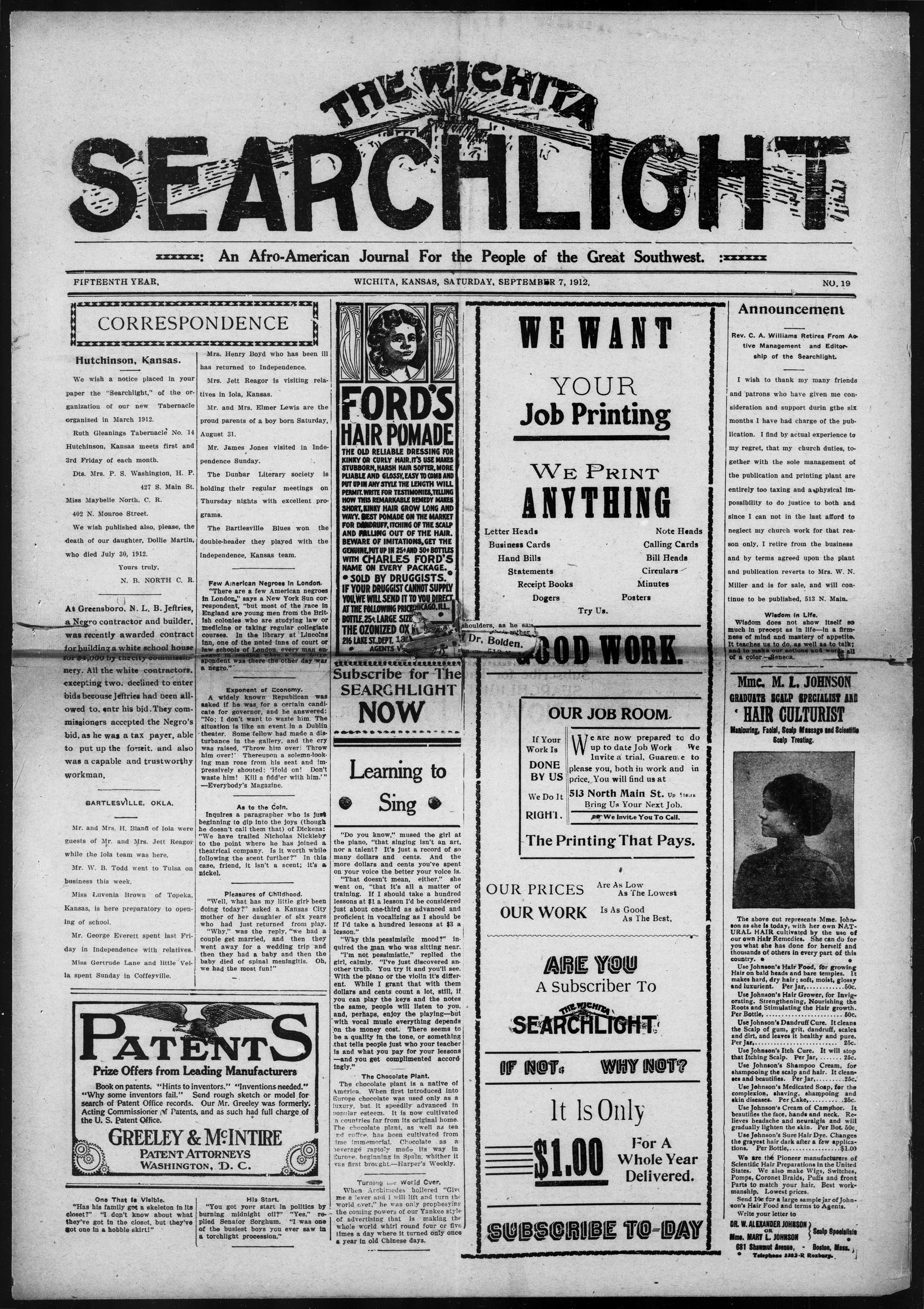
THE WICHITA SEARCHLIGHT
Book on patents. "Hints to inventors." "Inventions needed." "Why some inventors fail." Send rough sketch or model for search of Patent Office records. Our Mr. Greeley was formerly, Acting Commissioner of Patents, and as such had full charge of the U. S. Patent Office.
FIFTEENTH YEAR,
CORRESPO
Hutchinson, Kansas.
We wish a notice placed in your paper the "Searchlight," of the organization of our new Tabernacle organized in March 1912.
Ruth Gleanings Tabernacle No. 14
Hutchinson, Kansas meets first and 3rd Friday of each month.
Dts. Mrs. P. S. Washington, H. P.
427 S. Main St.
Miss Maybelle North, C. R.
402 N. Monroe Street.
We wish published also, please, the death of our daughter, Dollie Martin, who died July 30, 1912.
N. B. NORTH C. R.
At Greensboro. N. L. B. Jeftries, a Negro contractor and builder, was recently awarded contract for building a white school house for $4,000 by the city commissionery. All the white contractors, excepting two, declined to enter bids because Jeftries had been allowed to, entr his bid. They commissioners accepted the Negro's bid, as he was a tax payer, able to put up the forreit, and also was a capable and trustworthy workman.
BARTLESVILLE, OKLA.
Mr. and Mrs. H. Bland of Iola were guests of Mr. and Mrs. Jett Reagor while the Iola team was here.
Mr. W. B. Todd went to Tulsa on business this week.
Miss Luvenia Brown of Topeka, Kansas, is here preparatory to opening of school.
Mr. George Everett spent last Friday in Independence with relatives. Miss Gertrude Lane and little Vella spent Sunday in Coffeyville.
PATE
Prize Offers from Le
Book on patents. "Hints to it
"Why some inventors fail." S
search of Patent Office records.
Acting Commissioner of Patents
the U. S. Patent Office.
GREELEY &
PATENT A
WASHINGT
One That Is Visible.
"Has his family got a skeleton in its closet?" "I don't know about what they've got in the closet, but they've got one in a hobble skirt!"
Mrs. Henry Boyd who has been ill has returned to Independence.
Mrs. Jett Reagor is visiting relatives in Iola, Kansas.
Mr. and Mrs. Elmer Lewis are the proud parents of a boy born Saturday, August 31.
Mr. James Jones visited in Independence Sunday.
The Dunbar Literary society is holding their regular meetings on Thursday nights with excellent programs.
The Bartlesville Blues won the double-header they played with the Independence, Kansas team.
Few American Negroes In London,
"There are a few American negroes in London," says a New York Sun correspondent, "but most of the race in England are young men from the British colonies who are studying law or medicine or taking regular collegiate courses. In the library at Lincoln inn, one of the noted inns of court or law schools of London, every man ennounced in London when correspondent was there the other day was a negro."
Exponent of Economy.
A widely known Republican was saked if he was for a certain candidate for governor, and he answered: "No; I don't want to waste him. The situation is like an event in a Dublin theater. Some fellow had made a disturbance in the gallery, and the cry was raised, 'Throw him over: Throw him over!' Thereupon a solemn-looking man rose from his seat and impressively shouted: 'Hold on! Don't waste him! Kill a fiddler with him.'" —Everybody's Magazine.
As to the Coln.
Inquires a paragrapher who is just beginning to dip into the joys (though he doesn't call them that) of Dickens: "We have trailed Nicholas Nickleby to the point where he has joined a theatrical company. Is it worth while following the scent further?" In this case, friend, it isn't a scent; it's a nickel.
Pleasures of Childhood.
Pleasures of Childhood.
"Well, what has my little girl been doing today?" asked a Kansas City mother of her daughter of six years who had just returned from play. "Why," was the reply, "we had a couple get married, and then they went away for a wedding trip and then they had a baby and then the baby died of spinal meningitis. Oh, we had the most fun!"
ENTS
Reading Manufacturers
inventors." "Inventions needed."
send rough sketch or model for
Our Mr. Greeley was formerly,
and as such had full charge of
& McINTIRE
TORNEYS
ON, D. C.
Gear mechanism
"You got your start in politics by burning midnight oil?" "Yes," replied Senator Sorghum. "I was one of the busiest boys you ever saw in a torchlight procession."
WICHITA, KANSAS, SATURDAY, SEPTEMBER 7, 1912.
FORD'S
HAIR POMADE
THE OLD RELIABLE DRESSING FOR
KINKY OR CURLY HAIR. IT'S USE MAKES
STUBBORN, MARSH HAIR SOFTER, MORE
PLIABLE AND GLOSSY, EASY TO CMB AND
PUT UP IN ANY STYLE THE LENGTH WILL
PERMIT. WRITE FOR TESTIMONIES, TELLING
HOW THIS REMARKABLE REMEDY MAKES
SHORT, KINNY HAIR GROW LONG AND
WAVY. BEST POMADE ON THE MARKET
FOR DUMDRUFF, ITCHING OF THE SCALP
AND FOLLING OUT OF THE HAIR.
BEWARE OF IMITATIONS, GET THE
GENUINE, PUT UP IN 25* AND 50* BOTTLES
WITH CHARLES FORD'S
NAME ON EVERY PACKAGE.
• SOLD BY DRUGGISTS.
IF YOUR DRUGGIST CANNOT SUPPLY
YOU, WE WILL SEND IT TO YOU DIRECT
AT THE FOLLOWING PRICE: CHICAGO, ILL.
BOTTLE, 25* LARGE SIZE
THE OZONIZED OX K
Subscribe for The SEARGHLIGHT NOW
Learning to Sing
"Do you know," mused the girl at the piano, "that singing isn't an art, nor a talent? It's just a record of so many dollars and cents. And the more dollars and cents you've spent on your voice the better your voice is.
"That doesn't mean, either," she went on, "that it's all a matter of training. If I should take a hundred lessons at $1 a lesson I'd be considered just about one-third as advanced and proficient in vocalizing as I should be if I'd take a hundred lessons at $3 a lesson."
"Why this pessimistic mood?" inquired the man who was sitting near. "I'm not pessimistic," replied the girl, calmly. "I've just discovered another truth. You try it and you'll see. With the piano or the violin it's different. While I grant that with them dollars and cents count a lot, still, if you can play the keys and the notes the same, people will listen to you, and, perhaps, enjoy the playing—but with vocal music everything depends on the money cost. There seems to be a quality in the tone, or something that tells people just who your teacher is and what you pay for your lessons—and you get complimented accordingly."
The Chocolate Plant.
The chocolate plant is a native of America. When first introduced into Europe chocolate was used only as a luxury, but it speedily advanced in popular esteem. It is now cultivated in countries far from its original home. The chocolate plant, as well as tea and coffee, has been cultivated from time immemorial. Chocolate as a beverage rapidly made its way in Europe, beginning in Spain, whither it was first brought—Harper's Weekly.
Turning the World Over.
When Archimedes hollered "Give me a lever and I will lift and turn the world over," he was only prophesying the coming powers of our Yankee style of advertising that is making the whole world whirl round four or five times a day where it turned only once a year in old Chinese days.
Try Us. GOD WORK.
ers, as he sa
other
Bolden.
GOOD
OUR JOB ROOM
Do It
513 North Main St. Up St. 108
Bring Us Your Next Job.
H1.
We Invite You To Call.
The Prin
The Printing That Pays.
OUR PRICES
OUR WORK
ARE
SUBSCRIBE TO-DAY
Letter Heads
Business Cards
Hand Bills
Statements
Receipt Books
Dogers
If Your Work Is
DONE
BY US
We Do It
RIGHT.
Note Heads
Calling Cards
Bill Heads
Circulars
Minutes
Posters
We are now prepared to do up to date Job Work We Invite a trial, Guarence to please you, both in work and in price. You will find us at
NO.19
Announcement
Rev. C. A. Williams Retires From Active Management and Editorship of the Searchlight.
I wish to thank my many friends and patrons who have given me consideration and support durin gthe six months I have had charge of the publication. I find by actual experience to my regret, that my church duties, together with the sole management of the publication and printing plant are entirely too taxing and a physical impossibility to do justice to both and since I can not in the last afford to neglect my church work for that reason only, I retire from the business and by terms agreed upon the plant and publication reverts to Mrs. W. N. Miller and is for sale, and will continue to be published, 513 N. Main.
Wisdom does not show itself so much in precept as in life—in a firmness of mind and mastery of appetite. It teaches us to do, as well as to talk; and to make our actions and words all of a color—Seneca.
Use Johnson's Hair Grower, for Invigorating, Strengthening, Nourishing the Roots and Stimulating the Hair growth. Per Bottle, ..... 60c.
Use Johnson's Dandruff Cure. It cleans the Scalp of gum, grit, dandruff, scales and dirt, and leaves it healthy and pure. Per Jar, ..... 25c.
Use Johnson's Itch Cure. It will stop that Itching Scalp. Per Jar, ..... 25c.
Use Johnson's Shampoo Cream, for shampooing the scalp and hair. It cleanses and beautifies. Per Jar, ..... 25c.
Use Johnson's Medicated Soap, for the complexion, shaving, shampooing and skin diseases. Per Cake, ..... 25c.
Use Johnson's Cream of Camphor. It beautifies the face, hand and neck. Relieves headache and neuralgia and will gradually lighten the skin. Per Bot. 50c.
Use Johnson's Sure Hair Dye. Changes the graystair hair dark after a few applications. $1.00
We are the Pioneer manufacturers of Scientific Hair Preparations in the United States. We also make Wigs, Switches, Pomps, Coronet Braids, Puffs and front Parts to match your hair. Best workmanship. Lowest prices.
Send 10c for a large sample jar of Johnson's Hair Food and terms to Agents.
Write your letter to
DR. W. ALEXANDER JOHMSON
OR
Mme. MARY L. JOHNSON
681 Shawmut Avenue, Boston, Mass.
Telephone 3823-R Rexburg.
BOUTLEGGERS ARE DESPERATE
NEGRO PEDDLERS ATTACK OKLA-
HOMA OFFICERS.
Sheriff Learns of Conspiracy to Kill
Off Deputies—Backed by Whole-
sale Dealers.
Muskogee, Oklahoma.—Sheriff John
L. Wisner of Muskogee county has
just obtained definite information that
a conspiracy exists on the part of
negro bootleggers who are operating
on the Iron Mountain railroad
between Fort Smith, Ark., and Muskogee,
to kill every field deputy on the
sheriff's force. The deputy sheriffs
have been armed with riot guns and
instructed to take no chances.
This action follows half a dozen encounters between negro bootleggers coming in from Fort Smith with whisky and officers, the latter having been fired upon repeatedly when they attempted to make arrests. Several bootleggers have been killed.
The sheriff is satisfied the negro bootleggers are acting under instructions from one wholesale dealer who has not only armed the negroes, but instructed them to kill the field deputies in order, if possible, to stop the vigorous efforts being made to catch and prosecute the illicit liquor importers.
The sheriff received word from Fort Smith that 12 negro bootleggers were leaving there on an Iron Mountain train for Muskogee. He placed guards at the Arkansas river bridges, expecting to catch the men as they crossed. But they got off at Haute and crossed the river in skiffs that were waiting for them. All of them had whisky. Judge R. E. Campbell of the federel court has just held that federal prohibition enforcement officers have the right to enter a man's house or place of business without a warrant and search for liquor.
COLORADO TO KANSASON POP-POP
Couple Arrived Safely at Erie, for Visit, After Long Motor Cycle Trip.
Erie, Kansas.—Riding all the way from Colorado Springs, Col., on a motor cycle, Mr. and Mrs. C. C. Barnhardt have just arrived here. They did not have an accident until they reached Chanute where their motor cycle skidded on the wet pavement and threw them. Neither was injured, but a broken pedal resulted. They left Colorado Springs Wednesday morning at 10 o'clock, and the speedometer when they arrived here registered 755 miles. Mrs. Barnhardt rides on a seat behind her husband. "We have had an excellent trip," Mr. Barnhardt said. "We followed the Santa Fe Trail from Colorado to Emporia, and found the roads excellent." They are visiting his uncles, Ed and Ralph Barnhardt, here.
SEEKING DYNAMITE PLOT FACTS
Government Sends Secret Service Man to Investigate Lawrence, Mass., Conspiracy.
Washington, D. C.—A secret service operative of the department of justice has been sent to Lawrence, Mass., and Boston, to aid District Attorney French in investigating the alleged violation of interstate commerce laws last winter by the tying of a big bundle of dynamite to a Philadelphia freight car.
Developments in the alleged dynamite planting conspiracy at Lawrence are being watched closely by department heads.
Heat Kills in Chicago.
Chicago, Illinois.—This was Chicago's hottest day this summer, and it killed four persons. They were: Anton Zoleneczk, a workman; Katharine Condel, an aged spinster; Eugene Howard, a clerk, and an unidentified man about 70 years old, who expired on a street car. At 5 o'clock in the morning the thermometer registered 74 degrees.
New P. O. Rule Unpopular.
Bartlesville, Ok.—Two hundred persons crowded around the postoffice at noon, the usual time for opening and for a time it was thought complications might arise. A sign on the front of the postoffice announcing that no mail would be handed out intensified the situation. A hundred letters probably will be sent to President Taft protesting over the recent ruling of the postoffice department.
Debs on the Stump
Seattle, Washington.—Eugene V. Debs addressed two large meetings here, one at a theater and another in a large hall where several thousand people awaited him. At both meetings Debs declared the working people had nothing to hope for from the Progressive party, which, he said, was thoroughly capitalistic.
Martial Law for Miners
Charleston, West Virginia.—The mine guard rule was suspended and Gov. Glasscock proclaimed martial law in the Palnt creek and Cabin creek mining districts. The state troops have been there for a month
Black Hand After John D.
New York, N. Y.-It is learned that the threatening letters that have terrorized John D. Rockefeller and his son are genuine black hand affairs. The letters threaten kidnaping and murder for the oil king.
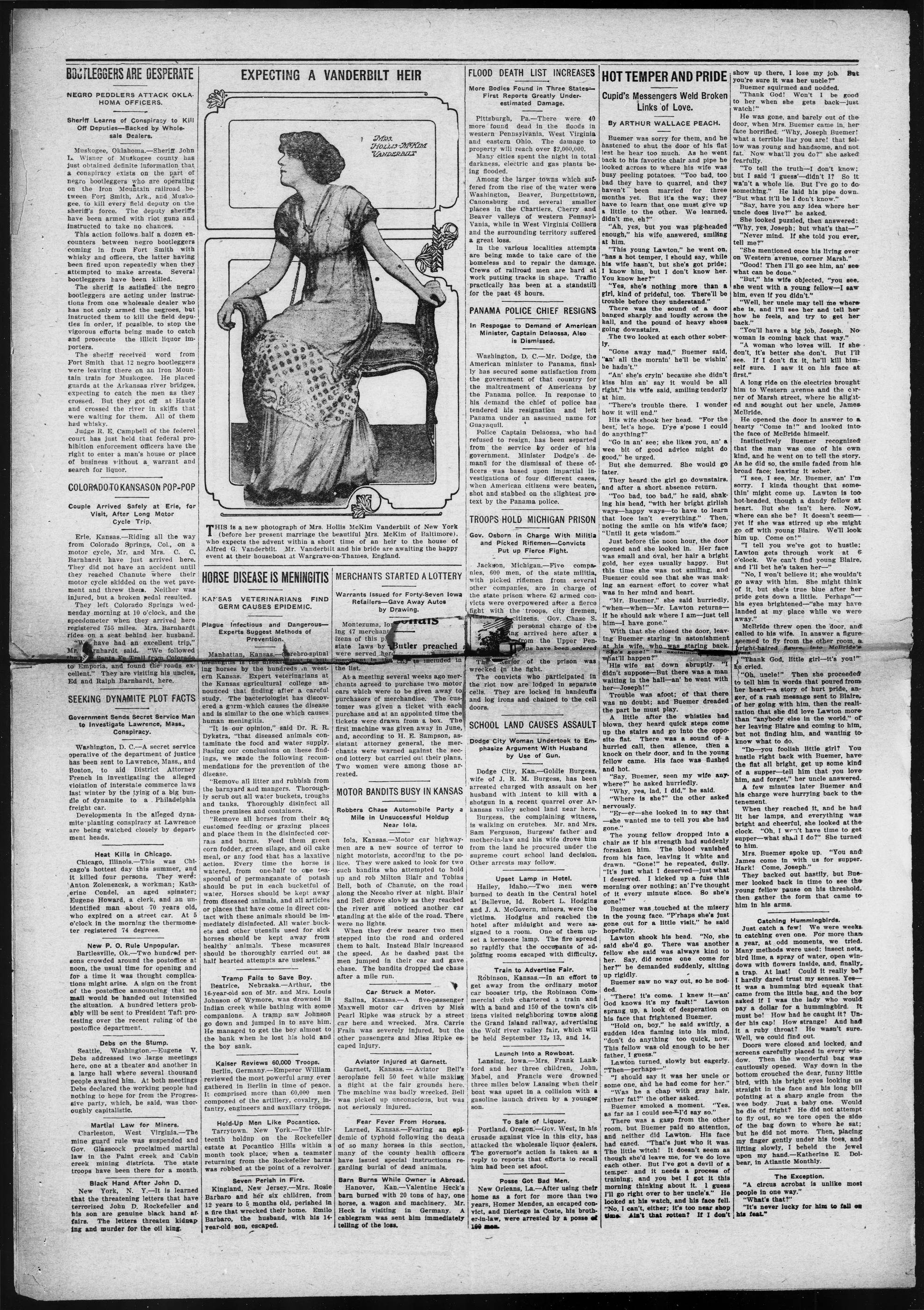
EXPECTING A VANDERBILT HEIR
MRS. HOLLY-MEKIM
VANDERBALT
THIS is a new photograph of Mrs. Hollis McKim Vanderbilt of New York (before her present marriage the beautiful Mrs. McKim of Baltimore), who expects the advent within a short time of an heir to the house of Alfred G. Vanderbilt. Mr. Vanderbilt and his bride are awaiting the happy event at their houseboat at Wargrave-on-Thames, England.
HORSE DISEASE IS MENINGITIS
KANSAS VETERINARIANS FIND GERM CAUSES EPIDEMIC.
Plague Infectious and Dangerous— Experts Suggest Methods of Prevention.
ing horses by the hundreds in western Kansas. Expert veterinarians at the Kansas agricultural college announced that finding after a careful study. The bacteriologist has discovered a gorm-which causes the disease and is similar to the one which causes human meningitis.
"It is our opinion," said Dr. R. R. Dykstra, "that diseased animals contaminate the food and water supply. Basing our conclusions on these findings, we made the following recommendations for the prevention of the disease.
"Remove all litter and rubbish from the barnyard and mangers. Thoroughly scrub out all water buckets, troughs and tanks. Thoroughly disinfect all these premises and containers.
"Remove all horses from their acustomed feeding or grazing places and place them in the disinfected corral and barns. Feed them green corn fodder, green silage, and oil cake meal, or any food that has a laxative action. Every time the horse is watered, from one-half to one teaspoonful of permanganate of potash should be put in each bucketful of water. Horses should be kept away from diseased animals, and all articles or places that have come in direct contact with these animals should be immediately disinfected. All water buckets and other utensils used for sick horses should be kept away from healthy animals. These measures should be thoroughly carried out as half hearted attempts are useless."
Tramp Fails to Save Boy.
Beatrice, Nebraska—Arthur, the 16-year-old son of Mr. and Mrs. Louis Johnson of Wymore, was drowned in Indian creek while bathing with some companions. A tramp saw Johnson go down and jumped in to save him. He managed to get the boy almost to the bank when he lost his hold and the boy sank.
Kaiser Reviews 60,000 Troops.
Berlin, Germany.—Emperor William reviewed the most powerful army ever gathered in Berlin in time of peace. It comprised more than 60,000 men composed of the artillery, cavalry, infantry, engineers and auxiliary troops.
Hold-Up Men Like Pocantico.
Tarrytown, New York.—The thirteenth holdup on the Rockefeller estate at Pocantico Hills within a month took place, when a teamster returning from the Rockefeller barns was robbed at the point of a revolver.
Seven Perish in Fire.
Kingland, New Jersey.-Mrs. Rosie Barbaro and her six children, from 12 years to 5 months old, perished in a fire that wrecked their home. Emilo Barbaro, the husband, with his 14-year-old son, escaped.
MERCHANTS STARTED A LOTTERY
Warrants Issued for Forty-Seven Iowa
Retailers—Gave Away Autos
by Drawing.
Montezuma, Iowa
ing 47 merchant
izens of this p
state laws by Butler preached
were served here
At a meeting several weeks ago merchants agreed to purchase two motor cars which were to be given away to purchasers of merchandise. The customer was given a ticket with each purchase and at an appointed time the tickets were drawn from a box. The first machine was given away in June, and, according to H. E. Sampson, assistant attorney general, the merchants were warned against the second lottery but carried out their plans. Two women were among those arrested.
MOTOR BANDITS BUSY IN KANSAS
Robbers Chase Automobile Party a Mile in Unsuccessful Holdup Near Iola.
Iola, Kansas.—Motor car highwaymen are a new source of terror to night motorists, according to the police. They were asked to look for two such bandits who attempted to hold up and rob Milton Blair and Tobias Bell, both of Chanute, on the road along the Neosho river at night. Blair and Bell drove slowly as they reached the river and noticed another car standing at the side of the road. There were no lights.
When they drew nearer two men stepped into the road and ordered them to halt. Instead Blair increased the speed. As he dashed past the men jumped in their car and gave chase. The bandits dropped the chase after a mile run.
Car Struck a Motor.
Salina, Kansas.—A five-passenger Maxwell motor car driven by Miss Pearl Ripke was struck by a street car here and wrecked. Mrs. Carrie Frain was severely injured, but the other passengers and Miss Ripke escaped injury.
Aviator Injured at Garnett.
Garnett, Kansas.—Aviator Bell's aeroplane fell 50 feet while making a flight at the fair grounds here. The machine was badly wrecked. Bell was picked up unconscious, but was not seriously injured.
Fear Fever From Horses.
Larned, Kansas.—Fearing an epidemic of typhoid following the death of so many horses in this section, many of the county health officers have issued special instructions regarding burial of dead animals.
Barn Burns While Owner is Abroad.
Hanover, Kan.—Valentine Heck's
barn burned with 20 tons of hay, one
horse, a wagon and machinery. Mr.
Heck is visiting in Germany. A
cablegram was sent him immediately
telling of the loss.
FLOOD DEATH LIST INCREASES
More Bodies Found in Three States—First Reports Greatly Under-estimated Damage.
Pittsburgh, Pa.—There were 40 more found dead in the floods in western Pennsylvania, West Virginia and eastern Ohio. The damage to property will reach over $2,000,000.
Many cities spent the night in total darkness, electric and gas plants being flooded.
Among the larger towns which suffered from the rise of the water were Washington, Beaver, Burgettstown, Canonsburg and several smaller places in the Chartiers, Cherry and Beaver valleys of western Pennsylvania, while in West Virginia Colliers and the surrounding territory suffered a great loss.
In the various localities attempts are being made to take care of the homeless and to repair the damage. Crews of railroad men are hard at work putting tracks in shape. Traffic practically has been at a standstill for the past 48 hours.
PANAMA POLICE CHIEF RESIGNS
In Respouse to Demand of American Minister, Captain Delaossa, Also is Dismissed.
Washington, D. C.—Mr. Dodge, the American minister to Panama, finally has secured some satisfaction from the government of that country for the maltreatment of Americans by the Panama police. In response to his demand the chief of police has tendered his resignation and left Panama under an assumed name for Guayaquil.
Police Captain Delaossa, who had refused to resign, has been separted from the service by order of his government. Minister Dodge's demand for the dismissal of these officers was based upon impartial investigations of four different cases, when American citizens were beaten, shot and stabbed on the slightest pretext by the Panama police.
TROOPS HOLD MICHIGAN PRISON
Gov. Osborn in Charge With Militia and Picked Riflemen—Convicts Put up Fierce Fight.
Jackson, Michigan.—Five companies, 600 men, of the state militia, with picked riflemen from several other companies, are in charge of the state prison where 62 armed convicts were overpowered after a fierce fight with the troops, city firemen, militia citizens, Gov. Chase S. in personal charge of the prison arrived here after a fire from the Upper Peninsula have been ordered
citizens. Gov. Chase S. Browne personal charge of the raiding arrived here after a raid from the Upper Peninsula have been ordered. The interior of the prison was wrecked in the fight. The convicts who participated in the riot now are lodged in separate cells. They are locked in handcuffs and log irons and chained to the cell doors.
SCHOOL LAND CAUSES ASSAULT
Dodge City Woman Undertook to Emphasize Argument With Husband by Use of Gun.
Dodge City, Kan.-Goldie Burgess, wife of J. R. M. Burgess, has been arrested charged with assault on her husband with intent to kill with a shotgun in a recent quarrel over Arkansas valley school land near here. Burgess, the complaining witness, is walking on crutches. Mr. and Mrs. Sam Ferguson, Burgess' father and mother-in-law and his wife drove him from the land he procured under the supreme court school land decision. Other arrests may follow.
Unset Lamp In Hotel.
Hailey, Idaho—Two men were burned to death in the Central hotel at 'Bellevue, Id. Robert L. Hodgins and J. A. McGovern, miners, were the victims. Hodgins and reached the hotel after midnight and were assigned to a room. One of them upset a kerosene lamp. The fire spread so rapidly that the occupants of adjoining rooms escaped with difficulty.
Train to Advertise Fair.
Robinson, Kansas.—In an effort to get away from the ordinary motor car booster trip, the Robinson Commercial club chartered a train and with a band and 150 of the town's citizens visited neighboring towns along the Grand Island railway, advertising the Wolf river valley fair, which will be held September 12, 13, and 14.
Launch Into a Rowboat
Lansing, Iowa.—Mrs. Frank Lankford and her three children, John, Mabel, and Francis were drowned three miles below Lansing when their boat was upset in a collision with a gasoline launch driven by a younger son.
To Sale of Liquor.
Portland, Oregon.—Gov. West, in his crusade against vice in this city, has attacked the wholesale liquor dealers. The governor's action is taken as a reply to reports that efforts to recall him had been set afoot.
Posse Got Bad Men
New Orleans, La.—After using their home as a fort for more than two years, Homer Mendes, an escaped convict, and Dierge la Coste, his brother-in-law, were arrested by a posse of 190 men.
HOT TEMPER AND PRIDE
Cupid's Messengers Weld Broken Links of Love.
By ARTHUR WALLACE PEACH.
Buenemer was sorry for them, and he hastened to shut the door of his flat lest he hear too much. As he went back to his favorite chair and pipe he looked across to where his wife was busy peeling potatoes. "Too bad, too bad they have to quarrel, and they haven't been married for three months yet. But it's the way; they have to learn that one must give up a little to the other. We learned, didn't me, eh?" "Ah, yes, but you was pig-headed enough," his wife answered, smiling at him. "This young Lawton," he went on, "has a hot temper, I should say, while his wife hasn't, but she's got pride; I know him, but I don't know her. You know her?" "Yes, she's nothing more than a girl, kind of prideful, too. There'll be trouble before they understand."
There was the sound of a door banged sharply and loudly across the hall, and the pound of heavy shoes going downstairs.
The two looked at each other soberly.
"Gone away mad," Buemer sald, "an' all the mornin' he'll be wishin' he hadn't."
"An' she's cryin' because she didn't kiss him an' say it would be all right," his wife said, smiling tenderly at him.
"There's trouble there. I wonder how it will end."
His wife shook her head. "For the best, let's hope. Dye s'pose I could do anything?
"Go in an' see; she likes you, an' a wee bit of good advice might do good," he urged.
But she demurred. She would go later.
They heard the girl go downstairs, and after a short absence return.
"Too bad, too bad," he said, shaking his head, "with her bright girlish ways—happy ways—to have to learn that lce isn't everything." Then, noting the smile on his wife's face; "Until it gets wisdom."
Just before the noon hour, the door opened and she looked in. Her face was small and oval, her hair a bright gold, her eyes usually happy. But this time she was not smiling, and Buemer could see that she was making an earnest effort to cover what was in her mind and heart.
"Mr. Buemer." she said hurriedly, "when—when—Mr. Lawton returns—if he should ask where I am—just tell him—I have gone."
With that she closed the door, leaving Buemer staring in astonishment at his wife, who was staring back. "She's gone!" he exclaimed, "what! happen!"
His wife sat down abruptly. "I didn't suppose—But there was a man waiting in the hall—an' he went with her—Joseph!"
Trouble was a foot; of that there was no doubt; and Buemer dreaded the part he must play.
A little after the whistles had blown, they heard quick steps come up the stairs and go into the opposite flat. There was a sound of a hurried call, then silence, then a knock on their door, and in the young fellow came. His face was flushed and hot.
"Say, Buemer, seen my wife anywhere?" he asked hurriedly.
"Why, yes, lad, I did," he said.
"Where is she?" the other asked nervously.
"Er—er—she looked in to say that—she wanted me to tell you she had gone."
The young fellow dropped into a chair as if his strength had suddenly forsaken him. The blood vanished from his face, leaving it white and drawn. "Gone!" he repeated, dully. "It's just what I deserved—just what I deserved. I kicked up a fuss this morning over nothing; an' I've thought of it every minute since. So she's gone!"
Buerem was touched at the misery in the young face. "P'rhaps she's just gone out for a little visit," he said hopefully.
Lawton shook his head. "No, she said she'd go. There was another fellow she said was always kind to her. Say, did some one come for her?" he demanded suddenly, sitting up rigidly.
Buerem saw no way out, so he nodded.
"There! it's come. I knew it—an"
God knows it's my fault!" Lawton
sprang up, a look of desperation on
his face that frightened Buemer.
"Hold on, boy," he said swiftly, a
sudden idea flaming into his mind,
"don't do anything too quick, now.
This fellow was old enough to be her
father, I guess."
Lawton turned, slowly but eagerly.
"Then—perhaps—"
"I should say it was her uncle or
some one, and he had come for her."
"Was he a chap with gray hair,
rather fat?" the other asked.
Buemer smoked a moment. "Yes,
as far as I could see—I'd say so."
There was a gasp from the other room, but Buemer paid no attention, and neither did Lawton. His face had eased. "That's just who it was. The little witch! It doesn't seem as though she'd leave me, for we do love each other. But I've got a devil of a temper; and it needs a process of training; and you bet I got it this morning thinking about it. I guess I'll go right over to her uncle's." He looked at his watch, and his face fell. "No, I can't, either; it's too near shop time. Ain't that rotten? If I don't
show up there, I lose my job. But you're sure it was her uncle?" Buemer squirmed and nodded.
"Thank God! Won't I be good to her when she gets back—just watch!"
He was gone, and barely out of the door, when Mrs. Buemer came in, her face horrified. "Why, Joseph Buemer! what a terrible liar you are! that fellow was young and handsome, and not fat. Now what'll you do?" she asked fearfully.
"To tell the truth—I don't know; but I said I guess'—didn't I? So it wa'n a whole lie. But I've go to do something." He laid his pipe down. "But what it'll be I don't know."
"Say, have you any idea where her uncle does live?" he asked.
She looked puzzled, then answered: "Why, yes, Joseph; but what's that—" "Never mind. If she told you ever, tell me?"
"She mentioned once his living over on Western avenue, corner Marsh." "Good! Then I'll go see him, an' see what can be done." "But," his wife objected, "you see, she went with a young fellow—I saw him, even if you didn't." "Well, her uncle may tell me where she is, and I'll see her and tell her how he feels, and try to get her back." "You'll have a big job, Joseph. No woman is coming back that way." "A woman who loves will. If she don't, it's better she don't. But I'll see. If I don't fix it, he'll kill himself sure. I saw it on his face at first." A long ride on the electrics brought him to Western avenue and the corner of Marsh street, where he aligited and sought out her uncle, James McBride.
He opened the door in answer to a hearty "Come in!" and looked into the face of McBride himself.
Instinctively Buemer recognized that the man was one of his own kind, and he went on to tell the story. As he did so, the smile faded from his broad face; leaving it sober.
"I see, I see, Mr. Buemer, an' I'm sorry. I kinda thought that somethin' might come up. Lawton is too hot-headed, though a dandy fellow at heart. But she isn't here. Now, where can she be? It doesn't seem—yet if she was stirred up she might go off with young Blaire. We'll look him up. Come on!"
"I tell you we've got to hustle; Lawton gets through work at 6 o'clock. We can't find young Blaire, and I'll bet he's taken her-"
"No, I won't believe it; she wouldn't go away with him. She might think of it, but she's true blue after her pride gets down a little. Perhaps"—his eyes brightened—"she may have landed at my place while we were away."
McBride threw open the door, and called to his wife. In answer a figure seemed to fly from the other room, a bright-haired figure, into McBride's mouth.
"Thank God, little girl—it's you!" he cried.
"Oh, uncle!" Then she proceeded to tell him in words that poured from her heart—a story of hurt pride, anger, of a rash message sent to Blaire, of her going with him, then the realization that she did love Lawton more than "anybody else in the world," of her leaving Blaire and coming to him, but not finding him, and wanting to know what to do.
"Do—you foolish little girl? You hustle right back with Buemer, have the flat all bright, get up some kind of a supper—tell him that you love him, and forget," her uncle answered. A few minutes later Buemer and his charge were hurrying back to the tenement. When they reached it, and he had lit her lamps, and everything was bright and cheerful, she looked at the clock. "Oh, I won't have time to get supper—what shall I do?" She turned to him. Mrs. Buemer spoke up. "You and James come in with us for supper. Hark! Come, Joseph." They backed out hastily, but Buemer looked back in time to see the young fellow pause on his threshold, then gather the form that came to him in his arms.
Catching Hummingbirds.
Just catch a few! We were weeks in catching even one. For more than a year, at odd moments, we tried. Many methods were used: insect nets, bird lime, a spray of water, open windows with flowers inside, and, finally, a trap. At last! Could it really be? I hardly dared trust my senses. Yes—it was a humming bird squeak that came from the little bag, and the boy asked if I was the lady who would pay a dollar for a hummingbird. It must be! How had he caught it? Under his cap! How strange! And had it a ruby throat? He wasn't sure. Well, we could find out.
Doors were closed and locked, and screens carefully placed in every window. Then the wonderful bag was cautiously opened. Way down in the bottom crouched the dear, funny little bird, with his bright eyes looking us straight in the face and his long bill pointing at a sharp angle from the wee body. Just a baby one. Would he die of fright? He did not attempt to fly out, so we tore open the side of the bag down to where he sat; but he did not move. Then, placing my finger gently under his toes, and lifting slowly, I beheld the jewel upon my hand.-Katherine E. Dolbear, in Atlantic Monthly.
The Exception.
"A circus acrobat is unlike most people in one way."
"What's that?"
"It's never lucky for him to fall on his feat."
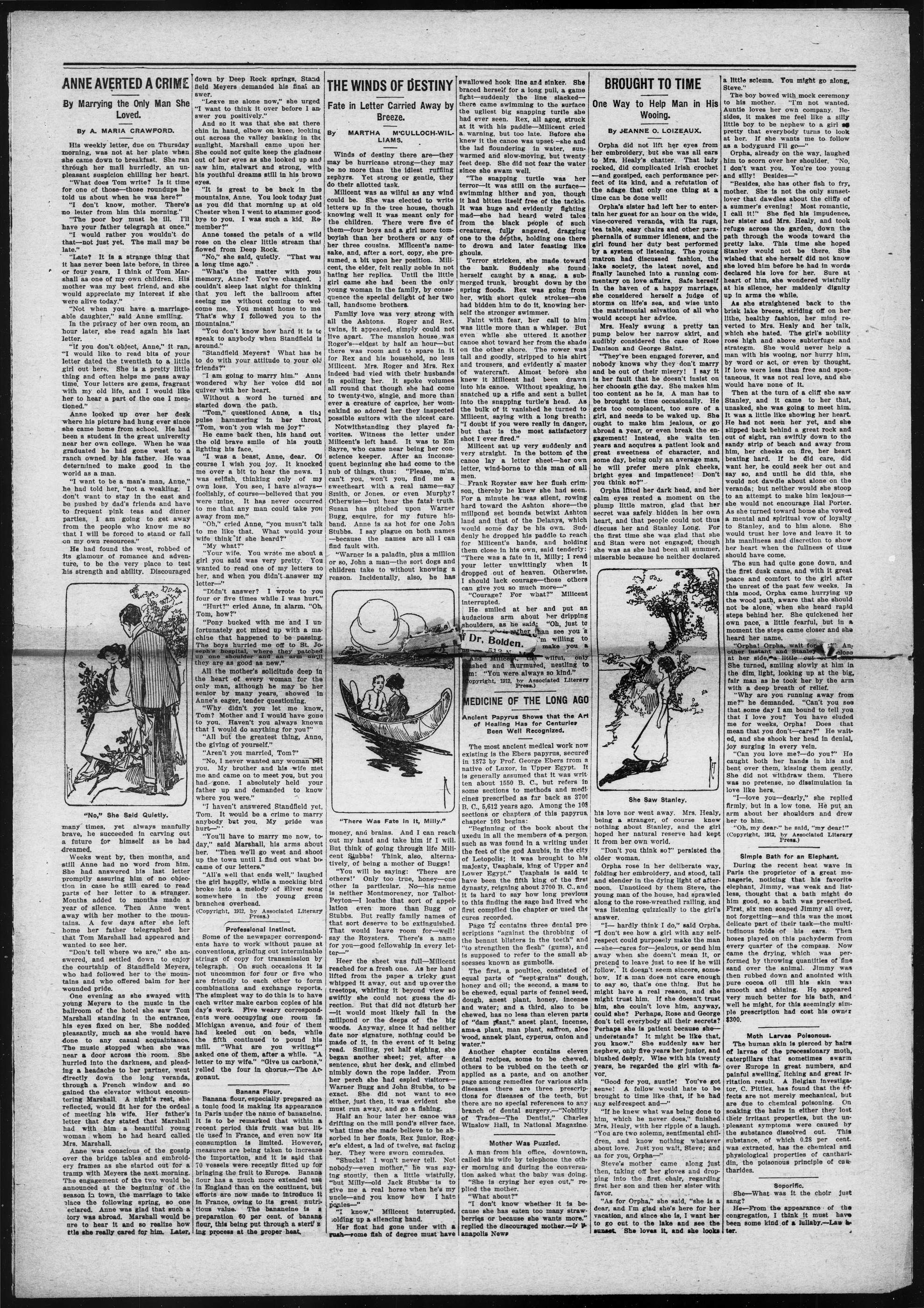
ANNE AVERTED A CRIME
By A. MARIA CRAWFORD.
His weekly letter, due on Thursday morning, was not at her plate when she came down to breakfast. She ran through her mall hurriedly, an unpleasant suspicion chilling her heart.
"What does Tom write? Is it time for one of those—those roundups he told us about when he was here?"
"I don't know, mother. There's no letter from him this morning."
"The poor boy must be ill. I'll have your father telegraph at once."
have your father telegraph at once."
"I would rather you wouldn't do that—not just yet. The mail may be late."
"Late? It is a strange thing that it has never been late before, in three or four years. I think of Tom Marshall as one of my own children. His mother was my best friend, and she would appreciate my interest if she were alive today."
"Not when you have a marriageable daughter," said Anne smiling.
In the privacy of her own room, an hour later, she read again his last letter.
"If you don't object, Anne," it ran.
"I would like to read bits of your letter dated the twenties to a little girl out here. She is a pretty little thing and often helps me pass away time. Your letters are gems, fragrant with my old life, and I would like her to hear a part of the one I mentioned."
Anne looked up over her desk where his picture had hung ever since she came home from school. He had been a student in the great university near her own college. When he was graduated he had gone west to a ranch owned by his father. He was determined to make good in the world as a man.
"I want to be a man's man, Anne," he had told her, "not a weakling. I don't want to stay in the east and be pushed by dad's friends and have to frequent pink teas and dinner parties. I am going to get away from the people who know me so that I will be forced to stand or fall on my own resources."
He had found the west, robbed of its glamour of romance and adventure, to be the very place to test his strength and ability. Discouraged
A
"No," She Said Quietly, many times, yet always manfully brave, he succeeded in carving out a future for himself as he had dreamed.
Weeks went by, then months, and still Anne had no word from him. She had answered his last letter promptly assuring him of no objection in case he still cared to read parts of her letter to a stranger. Months added to months made a year of silence. Then Anne went away with her mother to the mountains. A few days after she left home her father telegraphed her that Tom Marshall had appeared and wanted to see her.
"Don't tell where we are," she answered, and settled down to enjoy the courtship of Standfield Meyers, who had followed her to the mountains and who offered balm for her wounded pride.
One evening as she swayed with young Meyers to the music in the ballroom of the hotel she saw Tom Marshall standing in the entrance, his eyes fixed on her. She nodded pleasantly, much as she would have done to any casual acquaintance. The music stopped when she was near a door across the room. She hurried into the darkness, and pleading a headache to her partner, went directly down the long veranda, through a French window and so galned the elevator without encountering Marshall. A night's rest, she reflected, would fit her for the ordeal of meeting his wife. Her father's letter that day stated that Marshall had with him a beautiful young woman whom he had heard called Mrs. Marshall.
Anne was conscious of the gossip over the bridge tables and embroidery frames as she started out for a tramp with Meyers the next morning. The engagement of the two would be announced at the beginning of the season in town, the marriage to take place the following spring, so one declared. Anne was glad that such a story was abroad. Marshall would be sure to hear it and so realize how title she really cared for him. Later.
down by Deep Rock springs. Stand field Meyers demanded his final answer.
"Leave me alone now," she urged "I want to think it over before I answer you positively."
And so it was that she sat there chin in hand, elbow on knee, looking out across the valley basking in the sunlight, Marshall came upon her She could not quite keep the gladness out of her eyes as she looked up and saw him, stalwart and strong, with his youthful dreams still in his brown eyes.
"It is great to be back in the mountains, Anne. You look today just as you did that morning up at old Chester when I went to stammer goodbye to you. I was such a kid. Remember?"
Anne tossed the petals of a wild rose on the clear little stream that flowed from Deep Rock.
"No," she said, quietly. "That was a long time ago."
"What's the matter with your memory, Anne? You've changed. I couldn't sleep last night for thinking that you left the ballroom after seeing me without coming to welcome me. You meant home to me. That's why I followed you to the mountains."
"You don't know how hard it is to speak to anybody when Standfield is around."
"Standfield Meyers? What has he to do with your attitude to your old friends?"
"I am going to marry him." Anne wondered why her voice did not quiver with her heart.
Without a word he turned and started down the path.
"Tom," questioned Anne, a tiny pulse hammering in her throat. "Tom, won't you wish me joy?"
He came back then, his hand out the old brave smile of his youth lighting his face.
"I was a beast, Anne, dear. Of course I wish you joy. It knocked me over a bit to hear the news. I was selfish, thinking only of my own loss. You see, I have always—foilshily, of course—believed that you were mine. It has never occurred to me that any man could take you away from me."
"Oh," cried Anne, "you mustn't talk to me like that. What would your wife think 'if she heard?'"
"My what?"
"Your wife. You wrote me about a girl you said was very pretty. You wanted to read one of my letters to her, and when you didn't answer my letter—"
"Didn't answer? I wrote to you four or five times while I was hurt."
"Hurt?" cried Anne, in alarm. "Oh, Tom, how?"
"Pony bucked with me and I unfortunately got mixed up with a machine that happened to be passing. The boys hurried me off to St. Joseph's hospital, where they patched up one shoulder and an arm until they are as good as now."
All the mother's solicitude deep in the heart of every woman for the only man, although he may be her senior by many years, showed in Anne's eager, tender questioning.
"Why didn't you let me know, Tom? Mother and I would have gone to you. Haven't you always known that I would do anything for you?"
"All but the greatest thing, Anne, the giving of yourself."
"Aren't you married, Tom?"
"No, I never wanted any woman but you. My brother and his wife met me and came on to meet you, but you had-gone. I absolutely held your father up and demanded to know where you were."
"I haven't answered Standfield yet, Tom. It would be a crime to marry anybody but you. My pride was hurt—"
"You'll have to marry me now, today," said Marshall, his arms about her. "Then we'll go west and shoot up the town until I find out what became of our letters."
"All's well that ends well," laughed the girl happily, while a mocking bird broke into a melody of silver song somewhere in the young green branches overhead.
(Copyright, 1912, by Associated Literary Press.)
Professional Instinct.
Some of the newspaper correspondents have to work without pause at conventions, grinding out interminable strings of copy for transmission by telegraph. On such occasions it is not uncommon for four or five who are friendly to each other to form combinations and exchange reports. The simplest way to do this is to have each writer make carbon copies of his day's work. Five weary correspondents were occupying one room in Michigan avenue, and four of them had keeled out on beds, while the fifth continued to pound his mill. "What are you writing?" asked one of them, after a while. "A letter to my wife." "Give us carbons," yelled the four in chorus.—The Argonaut.
Banana Flour.
Banana flour, especially prepared as a tonic food is making its appearance in Paris under the name of bananeine. It is to be remarked that within a recent period this fruit was but little used in France, and even now its consumption is limited. However, measures are being taken to increase the importation, and it is said that 70 vessels were recently fitted up for bringing the fruit to Europe. Banana flour has a much more extended use in England than on the continent, but efforts are now made to introduce it in France, owing to its great nutritional value. The bananeine is a preparation 60 per cent. of banana flour, this being put through a sterilizing process at the proper heat.
THE WINDS OF DESTINY
Fate in Letter Carried Away by Breeze.
By MARTHA M'CULLOCH-WILLIAMS.
Winds of destiny there are—they may be hurricane strong—they may be no more than the idlest ruffling zephyrs. Yet strong or gentle, they do their allotted task
Milcent was as wilful as any wind could be. She was elected to write letters up in the tree house, though knowing well it was meant only for the children. There were five of them—four boys and a girl more tomboyish than her brothers or any of her three cousins. Milcent's namesake, and, after a sort, copy, she presumed, a bit upon her position. Milcent, the elder, felt really noble in not hating her replica. Until the little girl came she had been the only young woman in the family, by consequence the special delight of her two tall, handsome brothera.
Family love was very strong with all the Ashtons. Roger and Rex, twins, it appeared, simply could not live apart. The mansion house was Roger's-eldest by half an hour—but there was room and to spare in it for Rex and his household, no less Millicent. Mrs. Roger and Mrs. Rex indeed had vied with their husbands in spoiling her. It spoke volumes all round that though she had come to twenty-two, single, and more than ever a creature of caprice, her womenkind so adored her they inspected possible suitors with the nicest care.
Notwithstanding they played favorites. Witness the letter under Milcent's left hand. It was to Em Sayre, who came near being her conscience keeper. After an inconsequent beginning she had come to the nub of things, thus: "Please, m'm, can't you, won't you, find me a sweetheart with a real name—say Smith, or Jones, or even Murphy? Otherwise—but hear the fatak truth. Susan has pitched upon Warner Bugg, esquire, for my future hisband. Anne is as hot for one John Stubbs. I say plague on both names—because the names are all I can find fault with.
"Warner is a paladin, plus a million or so, John a man—the sort dogs and children take to without knowing a reason. Incidentally, also, he has
A
"There Was Fate In It, Milly."
money, and brains. And I can reach out my hand and take him if I will. But think of going through life Milcent Stubbs! Think, also, alternatively, of being a mother of Buggs!
"You will be saying: 'There are others!' Only too true, honey—one other in particular. No—his name is neither Montmorency, nor Talbot-Peyton—I loathe that sort of appellation even more than Bugg or Stubbs. But really family names of that sort deserve to be extinguished. That would leave room for—well! say the Roysters. There's a name for you—good fellowship in every letter—"
Heer the sheet was full—Milicent reached for a fresh one. As her hand lifted from the paper a tricky gust whipped it away, out and up over the treetops, whirling it beyond view so swiftly she could not guess the direction. But that did not disturb her—it would most likely fall in the millpond or the deeps of the big woods. Anyway, since it had neither date nor signature, nothing could be made of it, in the event of it being read. Smiling, yet half sighing, she began another sheet; yet, after a sentence, shut her desk, and climbed nimbly down the rope ladder. From her perch she had espied visitors—Warner Bugg and John Stubbs, to be exact. She did not want to see either, just then, it was evident she must run away, and go a fishing.
Half an hour later her canoe was drifting on the mill pond's silver face, what time she made believe to be absorbed in her floats, Rex junior, Roger's eldest, a lad of twelve, sat facing her. They were sworn comrades.
"Shucks! I won't never tell. Not nobody—even mother," he was saying stoutly, then a little wistfully, "but Milly—old Jack Stubbs is to give me a real horse when he's my uncle—and you know how I hate piles—"
"I know," Millicent interrupted, holding up a silencing hand.
Her float had gone under with a rush—some fish of degree must have
swallowed hook line and sinker. She braced herself for a long pull, a game fight—suddenly the line slacked—there came swimming to the surface the ugliest big snapping turtle she had ever seen. Rex, all agog, struck at it with his paddle—Milicent cried a warning, but too late. Before she knew it the canoe was upset—she and the lad floundering in water, sunwarmed and slow-moving, but twenty feet deep. She did not fear the water since she swam well.
"The snapping turtle was her terror—it was still on the surface—swimming hither and yon, though it had bitten itself free of the tackle. It was huge and evidently fighting mad—she had heard weird tales from the black people of such creatures, fully angered, dragging one to the depths, holding one there to drown and later feasting like ghouls.
Terror stricken, she made toward the bank. Suddenly she found herself caught by a snag, a submerged trunk, brought down by the spring floods. Rex was going from her, with short quick strokes—she had hadden him to do it, knowing herself the stronger swimmer.
Faint with fear, her call to him was little more than a whisper. But even while she uttered it another canoe shot toward her from the shade on the other shore. The rower was tall and goodly, stripped to his shirt and trousers, and evidently a master of watercraft. Almost before she knew it Milicent had been drawn into his canoe. Without speaking, he snatched up a rifle and sent a bullet into the snapping turtle's head. As the bulk of it vanished he turned to Milicent, saying with a long breath: "I doubt if you were really in danger, but that is the most satisfactory shot I ever fired."
Milicent sat up very suddenly and very straight. In the bottom of the canoe lay a letter sheet—her own letter, wind-borne to this man of all men.
Frank Royster saw her flush crimson, thereby he knew she had seen. For a minute he was silent, rowing hard toward the Ashton shore—the millpond sets bounds betwixt Ashton land and that of the Delanys, which would some day be his own. Suddenly he dropped his paddle to reach for Milicent's hands, and holding them close in his own, said tenderly: "There was a fate in it, Milly; I read your letter unwittingly when it dropped out of heaven. Otherwise, I should lack courage—those others can give you so much more—"
"Courage? For what?" Milicent intergrunted
He smiled at her and put an audacious arm about her dripping shoulders, as he said: "Oh, just to rather than see you a m willing to make you a And Milneart, the wilful, only finished and murmured, nestling to him: "You were always so kind." copyright, 1912, by Associated Literary Press.)
MEDICINE OF THE LONG AGO
Ancient Papyrus Shows that the Art of Healing Has for Centuries Been Well Recognized.
The most ancient medical work now existing is the Ebers papyrus, secured in 1873 by Prof. George Ebers from a native of Luxor, in Upper Egypt. It is generally assumed that it was written about 1550 B. C., but refers in some sections to methods and medicines prescribed as far back as 3700 B. C., 5,612 years ago. Among the 108 sections or chapters of this papyrus, chapter 103 begins:
"Beginning of the book about the uxedu in all the members of a person, such as was found in a writing under the feet of the god Anubis, in the city of Letopolis; it was brought to his majesty, Usaphais, king of Upper and Lower Egypt." Usaphais is said to have been the fifth king of the first dynasty, reigning about 3700 B. C., and it is hard to say how long previous to this finding the sage had lived who first compiled the chapter or used the cures recorded.
Page 72 contains three dental prescriptions "against the throbbing of the bennut blisters in the teeth" and "to strengthen the flesh" (gums), and is supposed to refer to the small abscesses known as gumbolls.
The first, a poulice, consisted of equal parts of "septra-gains" dough, honey and oil; the second, a mass to be chewed, equal parts of fennel seed, dough, anest plant, honey, incense and water; and a third, also to be chewed, has no less than eleven parts of "dam plant," anest plant, incense, ama-a plant, man plant, saffron, aloe wood, annek plant, cyperus, onion and water."
Another chapter contains eleven dental recipes, some to be chewed, others to be rubbed on the teeth or applied as a paste, and on another page among remedies for various skin diseases there are three prescriptions for diseases of the teeth, but there are no special references to any branch of dental surgery—"Nobility of Trades—The Dentist," Charles Winslow Hall, in National Magazine.
Mother Was Puzzled.
A man from his office, downtown, called his wife by telephone the other morning and during the conversation asked what the baby was doing. "She is crying her eyes out," replied the mother. "What about?" "I don't know whether it is because she has eaten too many strawberries or because she wants more." replied the discouraged mother. "I am anapolis News
BROUGHT TO TIME
By JEANNE O. LOIZEAUX.
Orpha did not lift her eyes from her embroidery, but she was all ears to Mrs. Healy's chatter. That lady rocked, did complicated Irish crochet—and gossiped, each performance perfect of its kind, and a refutation of the adage that only one thing at a time can be done well!
Orpha's sister had left her to entertain her guest for an hour on the wide, vine-covered veranda, with its rugs, tea table, easy chairs and other paraphernalia of summer idleness, and the girl found her duty best performed by a system of listening. The young matron had discussed fashion, the lake society, the latest novel, and finally launched into a running commentary on love affairs. Safe herself in the haven of a happy marriage, she considered herself a judge of storms on life's sea, and wise unto the matrimonial salvation of all who would accept her advice.
Mrs. Healy swung a pretty tan pump below her narrow skirt, and audibly considered the case of Rose Danison and George Saint.
"They've been engaged forever, and nobody knows why they don't marry and be out of their misery! I say it is her fault that he doesn't insist on her choosin gthe day. She makes him too content as he is. A man has to be brought to time occasionally. He gets too complacent, too sure of a girl, and needs to be waked up. She ought to make him jealous, or go abroad a year, or even break the engagement! Instead, she waits ten years and acquires a patient look and great sweetness of character, and some day, being only an average man, he will prefer mere pink cheeks, bright eyes and impatience! Don't you think so?"
Orpha lifted her dark head, and her calm eyes rested a moment on the plump little matron, glad that her secret was safely hidden in her own heart, and that people could not thus discuss her and Stanley Long. For the first time she was glad that she and Stan were not engaged, though she was as she had been all summer, miserable because he neither declared
N.
She Saw Stanley.
his love nor went away. Mrs. Healy, being a stranger, of course knew nothing about Stanley, and the girl hoped her natural reserve had kept it from her own world.
"Don't you think so?" persisted the older woman.
Orpha rose in her deliberate way, folding her embroidery, and stood, tall and slender in the dying light of afternoon. Unnoticed by them Steve, the young man of the house, had sprawled along to the rose-wreathed railing, and was listening quizzically to the girl's answer.
"I—hardly think I do," said Orpha. "I don't see how a girl with any self-respect could purposely make the man—she cares for—jealous, or send him away when she doesn't mean it, or pretend to leave just to see if he will follow. It doesn't seem sincere, somehow. If a man does not care enough to say so, that's one thing. But he might have a real reason, and she might trust him. If she doesn't trust him, she couldn't love him, anyway, could she? Perhaps, Rose and George don't tell everybody all their secrets? Perhaps she is patient because she—understands? It might be like that, you know." She suddenly saw her nephew, only five years her junior, and blushed deeply. Wise with his twenty years, he regarded the girl with favor.
"Good for you, auntie! You've got sense! A fellow would hate to be brought to time like that, if he had any self-respect and—"
"If he knew what was being done to him, which he never does," finished Mrs. Healy, with her ripple of a laugh. "You are two solemn, sentimental children, and know nothing whatever about love. Just you wait, Steve; and as for you, Orpha—"
Steve's mother came along just then, taking off her gloves and dropping into the first chair, regarding first her son and then her sister with favor.
"As for Orpha," she said, "she is a dear, and I'm glad she's here for her vacation, and since she is, I want her to go out to the lake and see the sunset. She loves it, and she looks
a little scienn. You might go along, Steve."
The boy bowed with mock ceremony to his mother. "I'm not wanted. Auntie loves her own company. Besides, it makes me feel like a silly little boy to be nephew to a girl pretty that everybody turns to look at her. If she wants me to follow as a bodyguard I'll go—"
Orpha, already on the way, laughed him to scorn over her shoulder. "No, I don't want you. You're too young and silly! Besides—"
"Besides, she has other fish to fry, mother. She is not the only sunset-lover that dawdles about the cliffs of a summer's evening! Most romantic, I call it!" She sied his impudence, her sister and Mrs. Healy, and took refuge across the garden, down the path through the woods toward the pretty lake. This time she hoped Stanley would not be there. She wished that she herself did not know she loved him before he had in words declared his love for her. Sure at heart of him, she wondered wistfully at his silence, her maidly dignity up in arms the while.
As she straightened back to the brisk lake breeze, striding off on her lilth, healthy fashion, her mind reverted to Mrs. Healy and her talk, which she hated. The girl's nobility rose high and above subterfuge and strategm. She would never help a man with his wooing, nor hurry him, by word or act, or even by thought. If love were less than free and spontaneous, it was not real love, and she would have none of it.
Then at the turn of a cliff she saw Stanley, and it came to her that, unasked, she was going to meet him. It was a little like showing her heart. He had not seen her yet, and she slipped back behind a great rock and out of sight, ran swiftly down to the sandy strip of beach and away from him, her cheeks on fire, her heart beating hard. If he did care, did want her, he could seek her out and say so, and until he did this, she would not dawdle about alone on the veranda; but neither would she stoop to an attempt to make him lea-jous—she would not encourage Hal Porter. As she turned toward home she vowed a mental and spiritual vow of loyalty to Stanley, and to him alone. She would trust her love and leave it to his manliness and discretion to show her heart when the fullness of time should have come.
The sun had quite gone down, and the first dusk came, and with it great peace and comfort to the girl after the unrest of the past few weeks. In this mood, Orpha came hurrying up the wood path, aware that she should not be alone, when she heard rapid steps behind her. She quickened her own pace, a little fearful, but in a moment the steps came closer and she heard her name.
"Orpha! Orpha, wait for me!" An other instant and Stanley close at her side, a little out of closet. She turned, smiling slowly at him in the dim light, looking up at the big, fair man as he took her by the arm with a deep breath of relief.
"Why are you running away from me?" he demanded. "Can't you see that some day I am bound to tell you that I love you? You have eluded me for weeks, Orpha! Does that mean that you don't—care?" He waited, and she shook her head in denial, joy surging in every vein.
"Can you love me?—do you?" He caught both her hands in his and bent over them, kissing them gently. She did not withdraw them. There was no pretense, no dissimulation in love like hers.
"I—love you—dearly," she replied firmly, but in a low tone. He put an arm about her shoulders and drew her to him.
"Oh, my dear." he said, "my dear!" (Copyright, 1912, associated Literary Press)
Simple Bath for an Elephant.
During the recent heat wave in Paris the proprietor of a great managerle, noticing that his favorite elephant, Jimmy, was weak and listless, thought that a bath might do him good, so a bath was prescribed. First, six men soaped Jimmy all over, not forgetting—and this was the most delicate part of their task—the multitudinous folds of his ears. Then hoses played on this pachyderm from every quarter of the compass. Now came the drying, which was performed by throwing quantities of fine sand over the animal. Jimmy was then rubbed down and anointed with pure cocoa oil till his skin was smooth and shining. He appeared very much better for his bath, and well he might, for this seemingly simple prescription had cost his owner $300.
Moth Larvae Poisonous.
The human skin is pierced by hairs of larvae of the precessionary moth, caterpillars that sometimes swarm over Europe in great numbers, and painful swelling, itching and great irritation result. A Belgian investigator, C. Pittiez, has found that the effects are not merely mechanical, but are due to chemical poisoning. On soaking the hairs in either they lost their irritant properties, but the unpleasant symptoms were caused by the substance dissolved out. This substance, of which 0.28 per cent. was extracted, has the chemical and physiological properties of cantharidin, the poisonous principle of cantharides.
Soporific.
She—What was it the choir just sang?
He—From the appearance of the congregation, I think it must have been some kind of a lullaby—Law harter.
THE SEARCHLIGHT
Founded in 1898 by W. N. Miller.
WICHITA. KANSAS.
Mrs. W. N. Miller Prop.
Office 513 N. Main St.
RATES OF SUBSCRIBION:
Strictly in Advance.
One Year (by mail).....$1.00
Six Months (by mail)......75
Three Months (by mail)......50
Entered at the Post Office as Second
Class Mail Matter.
ADVERTISING RATES.
We are still doing business at the same old stand, 513 N. Main St. Give us a call.
Timidity, shyness, and self-consciousness belong to the same family. We usually find all where we find any, one and they are all enemies of peace of mind, happiness and achievement,
Timid, shy people are morbidly self-conscious they them too about themselves, their thoughts are turned inwaad,
Thousands of young people are held back from unpertaking what they long to do, and are kept from trying to make fear their great life-dreams, because they are afraid to jostle with the world.
Let men have Equal Rights—California is now agitated by a proposal to permit women voters to swear to their age as "over twentyone," instead of giving the exact number of years of their lives. Why not equal rights in this matter? There are many men who prefer to generalize about their ages.
"Desperate criminals!" The chosen get away from the old "get even" idea Imprisonment is not society's revenge upon the offending individual but society's effort to correct and redaim.
Education of course. Every illiterate should be taught to read write and figure. I'm just whipping my school idea into shape, but its wonderful what that hr. a day has accomplished already.
Wichita's stay-at-homes this summer have certainly enjoyed as fine brand of weather as any mountain or lake resort in the world can provide.
Rufus L. Perry, Negro Lawyer of Brooklyn, has embraced the Jewish religion. Perry is said to be the first American Negro to become a Hero. He has given the name of Ralph Lewis.
Automobiles are getting too common for real rich and exclusive folks. They're going back to fancy horses;
At 917 E. 9th. St, a 700 6 room cottage, Price $1500, Inquire at 716 Maple St,
For Sale:-
5 and 10 acre tracts, one mile from city. Terms: 10% cash; balance $15.00 a month. Write to
JOHN M. WRIGHT,
623 Western Ave,
Topeka, Kans.
For Sale;-
Nice five room house cheap, at 1125 N. Washington This is a snap. Call at Gold State Bank.
At once a first-class dress maker. Call at 507 N. Mair St.
Ought to Be Valuable.
Cauliflower is said to contain the largest percentage of phosphorus of any of the common vegetables. If its valuable constituent is in any degrees comparable with its pungent odor when being cooked, it is worthy of a place in the front ranks of foodstuffs.
Most Abundant of Substances.
Oxygen constitutes one-third of the solid earth, nine-tenths of water and one-fifth of the atmosphere, and is the most abundant of all substances.
St. Paul A.M.E. Church
523 N. Water
SUNDAY SERVICES.
Preaching; 11:00 a.m. & 8:00 p.m
Sunday School 12:30 a. m.
J. T. Chinneth Supt.
Allen Endeavor League 6:30 p.m
Thos. Glover, Pres.
Mid Week Services
Why Opinions Differ.
It were not best that we should all think alike; it is difference of opinion that makes horse races.—Pudd'nhead Wilson.
Simone Catinot, a five-year-old girl, fell from a fourth floor window of a building at Havre, France, the other day, without sustaining any injury save a few scratches. The child had been left alone in a locked room, and as she could not open the door, she broke a pane of glass with an umbrella and jumped out of the window. She was taken to a hospital, but after a careful examination war presen- minured.
Pastor.
Parsonage 521 N. Water,
Phone market 1215.
Cabbeli M. E. Church
Sunday Services
During a visit in Marquette, wealthy Cinco valuable diarize life prisoner the jewels in were in a chap had been kick by other cont promptly retu
During a visit she paid to the prison in Marquette, Mich., the other day, a wealthy Cincinnati woman lost two valuable diamond rings. An honest life prisoner in the meantime found the jewels in the prison yard. They were in a chamois bag and probably had been kicked about unconsciously by other convicts. The jewels were promptly returned to the owner.
To Loosen Window.
To loosen windows that move hard, melt a tablespoonful of lard and pour a little between the window frame and casing, and on the roller and rope. It works well, says Suburban Life, and is a good thing to know in the springtime, when frames are swollen from being closed all winter.
Granting equal rights and privileges to wo
Be it resolved by the Legislature of the State of Kansas, two-thirds of the members elected to each House thereof concurring therein:
That the following proposition to mend the constitution of the state of Kansas be hereby submitted to the qualified electors of the state for heir approval of rejection, namely;
SECTION 1. The rights of citizens of the state of Kansas to vote and hold office shall not be denied or abridged on account of sex.
SEC. 2. This proposition shall be submitted to the electors of this state at the election for representatives to the Legislature in the year 1912. The amenment hereby proposed shall be known on the official ballot by the following title: "Amendment to the constitution granting equal rights and privileges to women," and the vote for or against such amendment shall be takee as provided by law
SEC. 3. This amendment: if adopted, shall be known as section 8 of article 5 of the constitution of the state of Kansas.
SEC. 4. This resolution shall take effect and be in force from and after its publication in the statute book.
I hereby certify that the foregoing is a true and correct copy of original House Concurrent Resolution No. 3, now on file in my office.
WICHITA KANSAS.
Wm. Bowers C. C.
Dr. H. T. Bolden K. of R. & S.
Address 517 N. Main St.
All Visiting K. of P. Welcome.
Fallel With Star of Lines.
The pupils of a girls' high school in a Pennsylvania town had a bread-making contest the other day. It was a great success, for the druggists and doctors of the town did a rushing business the next day. One of the bakers of the town got hold of one of the soggy, sour, half-baked high school loaves and put it in his show window as an awe-inspiring example of what bread should not be like.—Bakers' Weekly.
---
WALK-OVER SHOES AT $2,50
The Head Sample Shoe Parlors third floor the Caldwell-Murdock building, announce the arrival of an immense shipment of the popular $4, $5, and $6 'Walk-Over' men's shoes, all of which will be sold at the customary price of $250 a pair.
This unusual price is but aded indication of the ability of Heads Sample Shos Parlors to bear out every statement they make as to economy of price and the genuine good value. This shipment of "Walk-Over" Shoes will be placed on sale beginning today and will be sold withour restriction or reservation whatever.
Men of discriminating tastes and economical inelinations will do well to take time to examine this offer and inspect the shoes, as this unusual opportunity is certainly a very timely one. Head's/Sample Shoe Co 3rd. Floor Murdock Bld, Take Elevator, Open Sat. till 11 p.m.
Friday Services
Prayer meeting Wed, 8. p. m.
Class meeting Friday 8 p. m.
Strangers welcome to all these services,
C. A. Williams
Preaching at 10:45
Sunday School, 12:00 m.
Epworth League 7:00 p. m.
Preaching at 8:00 p. m.
Mid Week Services
S. S. Teachers Meet Tues Eve.
Junior Choir Wednesday Eve.
Aid Society Wednesday 2. p. m.
Class Meeting Thursnay Eve.
You are invited to attend these
meetings.
G. T. Wooten Pastor
---
Arria Court No. 7, O. O.G.
Holds regular meetings the 1st and 3rd. Mondays at 2:30 p. m. in the Masonic Hall. All visiting financial sisters of the O. O.C., are cordially invited to attend our regular meetirgs.
Mrs. Mollie Cox W. C.
Mrs. Ida Martin R. of D,
-KNIGHTS of PYTHIAS,
Toas Lodge No.10, Meets 2nd. and 4th. Monday night of each month, at Masonic Building 615 N. Main St.
Always Business.
"Are you angry because I lost my temper and tried to scratch your eyes out?" asked the repentant prima donna. "No," replied the impresario. "It was a good suggestion. Just remember how you went about it and if grand opera falls maybe we can do something in the moving picture way."
WANT ADDS.
Ought to Be Valuable.
Why Opinions Differ
Fell Far Without Injury.
To Loosen Window.
HOUSE CONCURRENT RESOLUTION No. 3.
Failed With Staff of Life.
WILL WINTERS'
GROCERY & MEAT MKT,
349 North Main St.
We Handle A
Full Lne of Staple & Fancy
GROCERIES.
At Reasonable Prices.
Give us a trial and we will give you the best servicee to be had.
We Deliver to all Parts of the City.
City. Phone Market 3038.
Dr. A. K. Lawrence
Physician & Surgeon
Office Phone
517 N. Main St Mkt. 4634
Diseases of Men, Women and Children
Aspecialty.
Mrs. W. N. Miller
Madme Papes System
Treating the scalp and pressing
the hair. I make my own press.
ing oil and hair preparation.
Any information gladly given.
Phone MKT, 4090x.
Madame Brown
The Famous Singer is to
Appear in Wichita in the
near future.
Fred C. Helm
Lawyer
513 N. Main Street.
Phone Market 2999.
908. South Water ts.
Will wash shampoo and straiten hair. Prices very reasonable.
Give her a trial.
A. G. Mueller
UNDERTAKER
142 N. Market Wichita Kas.
Peerless Steam Laundry
Satisfaction Guaranteed
Laundry Work Called
and Delivered
Phones 232
SELOVER & SONS, Props.
245 N. Market St Wichita, Kan
W. S. Henrion
Druggist
501 North Main Street
Wichita - - - - Kansas
How Taste Is Cultivated.
How Taste Is Cultivated.
People who live in climates where malaria abounds, frequently have it take so much quinine that they get to love the taste of it, and to take it daily, even when they do not need it just because it tastes good to them. And yet quinine is one of the bitterest of drugs and these same people did they move away from the malaria district for a few years, would soon get to detest the taste of it.
The Route.
"Dashington seems to have finally made a conquest of that Scadmor girl. Wonder how it all came about. 'The first time she saw him she gave him her eye, the next time they me she gave him her arm, it wasn't long before he was holding both of her hands, soon after that he won he heart, and she lost her head and gave herself to him completely."—Judge.
In fact, we so everything kept in a First-Class Grocery, WHY CAN'T WE SELL TO YOU?
Makin Eye Drug Co.
517 N. Main St. - Wichita, Kan - Bell Phone 220
Excellence Counts
THEN USE
"U-KNEAD-IT"
FLOUR
It excels in every respect, — color, flavor and
pounds of bread per barrel. MADE BY
WATSON MILL CO.
WICHITA KANSAS
GOOD BREAD MAKERS
— AND WILL PLEASE YOU —
IT IS AS WHITE AS SNOW — TRY IT
THE OTTO WEISS ALFALFA STOCK and POULTRY FOOD
are all guaranteed under the United States
Little Wonder Restaurant and Hotel Meals 20c - Short Order at all Hours 507 North Main St. Short Orders Filled At All House Good Service is Guaranteed Barber Shop 513 North Main Street A. J. Cousar, Prop.
CULP'S MKT.
IS THE BEST PLACE TO DO YOUR SHOPPING,
FOR FRESH MEATS.
FRESH OAT FISH
And
SLICED HALIBUT.
Dressed Chickens.
We Garry a Large Supply of the best of Corn-Fed
Beef, and the nicest Veal.
LOWEST PRICES
Culp's Market
241 N. Main St. Phone, Market 1551
IMBODEN'S IMPERIAL FLOUR
GRAHAM - CORN MEAL - BREAKFAST FOOD
With thirty-five years MILLING EXP.
RIENCE in Wichita, our products are
the best that can be produced.
Made from the best selected grain
only, put up in Special Packages.
ASK YOUR GROCER : See that you get IMPERIAL
THE IMBODEN MILLING CO.
Wichita, Kansas
THE BOSTON EDITOR
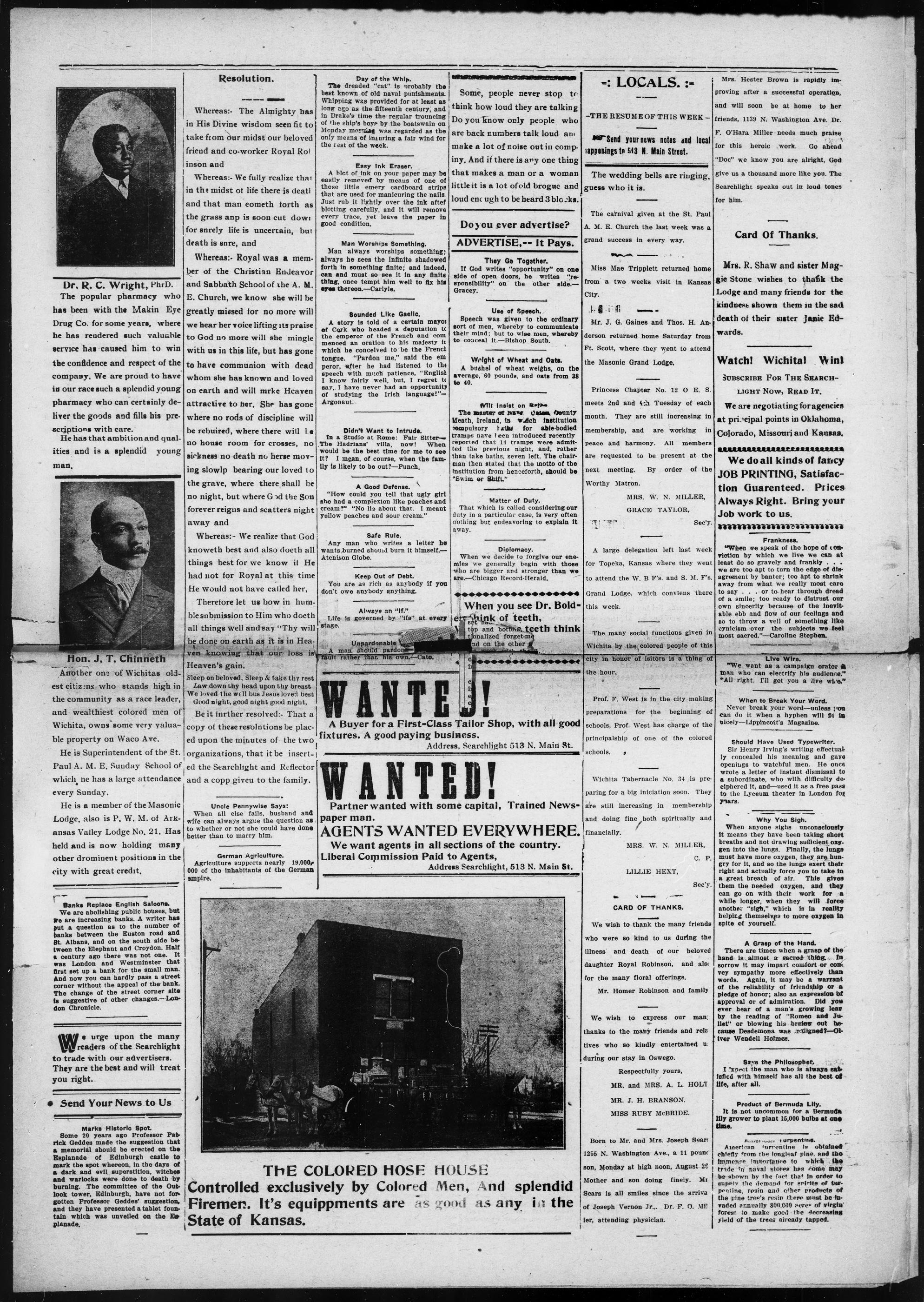
Dr. R. C. Wright, PhD.
The popular pharmacy who has been with the Makin Eye Drug Co. for some years, where he has rendered such valuable service has caused him to win the confidence and respect of the company. We are proud to have in our race such a splendid young pharmacy who can certainly deliver the goods and fills his prescriptions with care.
He has that ambition and qualities and is a splendid young man.
Hon. J, T, Chinneth
Another one of Wichitas oldest citizens who stands high in the community as a race leader, and wealthiest colored men of Wichita, owns some very valuable property on Waco Ave. He is Superintendent of the St. Paul A. M. E. Sunday School of which he has a large attendance every Sunday.
He is a member of the Masonic Lodge, also is P, W. M. of Arkansas Valley Lodge No. 21. Has held and is now holding many other drominent positions in the city with great credit.
Banke Replace English Saloons.
We are abolishing public houses, but
we are increasing banks. A writer has
put a question as to the number of
banks between the Euston road and
St. Albans, and on the south side
between the Elephant and Croydon. Half
a century ago there was not one. It
was London and Westminster that
first set up a bank for the small man.
And now you can hardly pass a street
corner without the appeal of the bank.
The change of the street corner site
is suggestive of other changes.—London
Chronicle.
We urge upon the many readers of the Searchlight to trade with our advertisers. They are the best and will treat you right.
- Send Your News to Us
Marks Historic Spot.
Some 20 years ago Professor Patrick Geddes made the suggestion that a memorial should be erected on the Esplanade of Edinburgh castle to mark the spot whereon, in the days of a dark and evil superstition, witches and warlocks were done to death by burning. The committee of the Outlook tower, Edinburgh, have not forgotten Professor Geddes' suggestion, and they have presented a tablet fountain which was unveiled on the Esplanade.
THE MOTOR MACHINE COMPANY
Controlled exclusively by Colored Men, And splendid Firemen. It's equipments are as good as any in the State of Kansas.
Resolution.
Whereas:- The Almighty has in His Divine wisdom seen fit to take from our midst our beloved friend and co-worker Royal Robinson and
Whereas:- We fully realize that in the midst of life there is death and that man cometh forth as the grass anp is soon cut down for snrely life is uncertain, but death is snre, and
Whereas:- Royal was a member of the Christian Endeavor and Sabbath School of the A. M. E. Church, we know she will be greatly missed for no more will we hear her voice lifting its praise to God no more will she mingle with us in this life, but has gone to have communion with dead whom she has known and loved on earth and will mrke Hcaven attractive to her. She has gone where no rods of discipline will be rebuired, where there will be no house room for crosses, no sickness no death no herse moving slowlp bearing our loved to the grave, where there shall be no night, but where God the Son forever reigns and scatters night away and
Whereas:- We realize that God knoweth best and also doeth all things best for we know it He had not for Royal at this time He would not have called her,
Therefore let us bow in humble snbmission to Him who doeth all things well and say "Thy will be done on earth as it is in Heaven knowing that our loss is
Sleep on beloved, Sleep & take thy rest Law down thy head upon thy breast We loved the well bus Jesus loved best Good night, good night good night.
Be it inrther resolved:- That a copy of these resolutions be placed upon the minutes of the two organizations, that it be inserted the Searchlight and Reflector and a copp giveu to the family.
Uncle Pennywise Says:
Uncle Pennywise Says:
When all else fails, husband and wife can always argue the question as to whether or not she could have done better than to marry him.
German Agriculture.
Agriculture supports nearly 19,000, 000 of the inhabitants of the German empire.
A Buyer for a First-Class Tailor Shop, with all good fixtures. A good paying business.
WANTED!
Partner wanted with some capital, Trained Newspaper man.
Day of the Whip.
The dreaded "cat" is probably the best known of old naval punishments. Whipping was provided for at least as long ago as the fifteenth century, and in Drake's time the regular trouncing of the ship's boye by the boatswain on Monday morning was regarded as the only means of inauring a fair wind for the rest of the week.
Easy Ink Eraser.
A blot of ink on your paper may be easily removed by meaus of one of those little emery cardboard strips that are used for manicuring the nails. Just rub it lightly over the ink after blotting carefully, and it will remove every trace, yet leave the paper in good condition.
Man Worships Something
Man always worships something;
always he sees the Infinite shadowed
forth in something finite; and indeed,
can and must so see it in any finite
thing, once tempt him well to fix his
eyes thereon—Carlyle.
Sounded Like Gaellic.
A story is told of a certain mayor of Cork who headed a deputation to the emperor of the French and commenced an oration to his majesty it which he conceived to be the French tongue. "Pardon me," said the emperor, after he had listened to the speech with much patience, "English I know fairly well, but, I regret to say, I have never had an opportunity of studying the Irish language!"—Argonaut.
Didn't Want to Intrude.
In a Studio at Rome: Fair Slitter—The Hadrians' villa, now! When would be the best time for me to see it? I mean, of course, when the family is likely to be out?—Punch.
A Good Defense.
"How could you tell that ugly girl she had a complexion like peaches and cream?" "No I am about that. I meant yellow peaches and sour cream."
Safe Rule.
Safe Rule.
Any man who writes a letter he wants burned should burn it himself.—Atchison Globe.
Keep Out of Debt.
You are as rich as anybody if you don't owe anybody anything.
Always an "if."
Life is governed by "ife" at every stage.
Unpardonable.
A man should pardon fault rather than his own.—Cato.
Some, people never stop to think how loud they are talking Do you know only people who are back numbers talk loud and make a lot of noise out in company. And if there is any one thing that makes a man or a woman little it is a lot of old brogue and loud enough to be heard 3 blocks.
Doyou ever advertise?
ADVERTISE,-- It Pays.
They Go Together.
If God writes "opportunity" on one side of open doors, he writes "responsibility" on the other side.— Gracey.
Use of Speech.
Speech was given to the ordinary sort of men, whereby to communicate their mind; but to wise men, whereby to conceal it.-Bishop South.
Weight of Wheat and Oats.
Weight of Wheat and Oats.
A bushel of wheat weighs, on the average, 60 pounds, and oats from 28 to 40.
Will Insist on
The master of New Osage County Meath, Ireland, in which institution compulsory baths for able-bodied tramps have been introduced recently reported that 14 tramps were admitted the previous night, and, rather than take baths, seven left. The chairman then stated that the motto of the institution from henceforth, should be "Swim or Shift."
Matter of Duty:
Matter of Duty.
That which is called considering our duty in a particular case, is very often nothing but endeavoring to explain it away.
Diplomacy.
When we decide to forgive our enemies we generally begin with those who are bigger and stronger than we are.—Chicago Record-Herald.
When you see Dr. Bold-
er think of teeth,
set the top and bottom teeth think
personalized forget-me
and on the other
work with them.
EJ!
Class Tailor Shop, with all good
business.
Address, Searchlight 513 N. Main St.
TED! With some capital, Trained News- TED EVERYWHERE. all sections of the country.
Send your news notes and local happenings to 513 N. Main Street.
The wedding bells are ringing. guess who it is.
The carnival given at the St. Paul A. M. E. Church the last week was a grand success in every way.
Miss Mae Tripplett returned home from a two weeks visit in Kansas City.
Mr. J. G. Gaines and Thos. H. Anderson returned home Saturday from Ft. Scott, where they went to attend the Masonic Grand Lodge.
Princess Chapter No. 12 O E. S. meets 2nd and 4th Tuesday of each month. They are still increasing in membership, and are working in peace and harmony. All members are requested to be present at the next meeting. By order of the Worthy Matron.
MRS. W. N. MILLER,
GRACE TAYLOR,
A large delegation left last week for Topeka, Kansas where they went to attend the W. B F's. and S. M. F's. Grand Lodge, which conviens there this week.
The many social functions given in Wichita by the colored people of this city in honor of isitors is a thing of the hour.
Prof. F. West is in the city making preparations for the beginning of schools, Prof. West has charge of the principalship of one of the colored schools.
Wichita Tabernacle No. 34 is preparing for a big inciation soon. They are still increasing in membership and doing fine both spiritually and financially.
MRS. W. N. MILLER,
C. P.
LILLIE HEXT,
CARD OF THANKS.
We wish to thank the many friends who were so kind to us during the illness and death of our beloved daughter Royal Robinson, and also for the many floral offerings.
We wish to express our many thanks to the many friends and relatives who so kindly entertained us during our stay in Oswego.
Respectfully yours,
MR. and MRS. A. L. HOLT
MR. J. H. BRANSON.
MISS RUBY McBRIDE.
Born to Mr. and Mrs. Joseph Sears 1255 N. Washington Ave., a 11 pound son, Monday at high noon, August 26 Mother and son doing finely. Mr Sears is all smiles since the arriva of Joseph Vernon Jr., Dr. F. O. Miller, attending physician.
Mrs. Hester Brown is rapidly improving after a successful operation, and will soon be at home to her friends, 1139 N. Washington Ave. Dr. F. O'Hara Miller needs much praise for this heroic work. Go ahead "Doc" we know you are alright, God give us a thousand more like you. The Searchlight speaks out in loud tones for him.
Card Of Thanks
Mrs. R. Shaw and sister Maggie Stone wishes to thank the Lodge and many friends for the kindness shown them in the sad death of their sister Janie Edwards.
Watch! Wichital Win!
SUBSCRIBE FOR THE SEARCHLIGHT NOW, READ IT.
We are negotiating for agencies at principal points in Oklahoma, Colorado, Missouri and Kansas.
We do all kinds of fancy JOB PRINTING, Satisfaction Guaranteed. Prices Always Right. Bring your Job work to us.
---
"When we speak of the hope of conviction by which we live we can at least do so gravely and frankly . . . we are too apt to turn the edge of disagreement by banter; too apt to shrink away from what we really most care to say . . . or to hear through dread of a smile; too ready to distrust our own sincerity because of the inevitable ebb and flow of our feelings and so to throw a veil of something like cynicism over the subjects we feel most sacred." -Caroline Stephen.
Live Wire.
LIVE WIRE.
"We want as a campaign orator
man who can electrify his audience."
"All right. I'll get you a live who."
When to Break Your Word.
Never break your word—unless you
can do it when a hyphen will fit
in nicely—Lippincott's Magazine.
Sir Henry Irving's writing effectually concealed his meaning and gave openings to watchful men. He once wrote a letter of instant dismissal to a subordinate, who with difficulty deciphered it, and—used it as a free pass to the Lyceum theater in London for years.
Why You Sigh.
When anyone sighs unconsciously it means they have been taking short breaths and not drawing sufficient oxygen into the lungs. Finally, the lungs must have more oxygen, they are hungry for it, and so the lungs exert their right and actually force you to take in a great breath of air. This gives them the needed oxygen, and they can go on with their work for a while longer, when they will force another, "sigh," which is in reality helping themselves to more oxygen in spite of yourself.
A Grasp of the Hand.
There are times when a grasp of the hand is almost a sacred thing. In sorrow it may impart comfort or convey sympathy more effectively than words. Again, it may be a warrant of the reliability of friendship or a pledge of honor; also an expression of approval or of admiration. Did you ever hear of a man's growing lean by the reading of "Romeo and Juliet" or blowing his brains out because Desdemona was mutilated?—Oliver Wendell Holmes.
Says the Philosopher.
I expect the man who is always satisfied with himself has all the best of life, after all.
Product of Bermuda Lily.
It is not uncommon for a Bermuda lily grower to plant 15,000 bulbs at one time.
American Turpentine.
American turpentine is obtained chiefly from the longleaf pine, and the immense importance to which the trade in naval stores has come may be shown by the fact that in order to supply the demand for spirits of turpentine, rosin and other products of the pine tree's resin there must be invaded annually 800,000 acres of virgin forest to make good the decreasing yield of the trees already tapped.
---
COLUMBUS IN STATUARY
COLUMBUS in CHAINS
COLUMBUS STATUE
in BUEVOS AIDES
HRISTOPHER COLUMBUS was a Latin, whether he be considered as a native of Italy, where undoubtedly he spent his early boyhood, or serving under the flag of Portugal, where his maturing manhood years prepared his for the in-
HRISTOPHER COLUMBUS was a Latin, whether he be considered as a native of Italy, where undoubtedly he spent his early boyhood, or serving under the flag of Portugal, where his maturing manhood years prepared his for the comparable triumphs he secured for the home of his final adoption, Spain. Latin America, too, was the area over which his discoveries were extended, for it is a fact that he had no knowledge of the existence of the vast continent to the north of the Caribbean sea and the West India Islands. He had been to England and at one time in despair had applied to the court of England to help him in his great ambition, but his experience and his fame were Latin.
Perhaps on this account the name of Columbus is incorporated more prominently in the nomenclature of Latin America than in that of Anglo-Saxon America. The Republic of Colombia bears witness to the honor with which he was held from the beginnings of independence in the western world. Today the one-time insignificant little port in Panama, Colon, at the northern entrance to the canal, indicates another attempt to perpetuate the name of Columbus in a geographical way. Other countries have districts or rivers, public parks and theaters, with the name of Colon, and it would seem to be in Spanish, as its equivalent, Colombo, in Portuguese, a mark of affection as well as of honor for the discoverer of America.
The United States has given his name to the District of Columbia as soon as the founders of this Republic could consider designations apart from those inherited from provincial days. As the country grew in area, towns were named Columbus, and the designation of the federal district, which was to be the seat of government, shows that the discoverer was not forgotten, on the continent that once might have been his. Perhaps, however, the greatest compliment to the memory of Columbus is that implied in the poetical appellation "Columbia," the allegorical name given to the United States.
There can be no denying the fact that the recognition of the great achievement of the admiral has been tardy. It is well known, however, that often the delayed judgment of history alone awards to great men the honor they deserved. We are all so familiar with the story of Colum-
THE STATUE OF THE MAYOR OF BROOKLYN
us, that there is no need here to recount the many injustices which he suffered at the hands of his contemporaries. The salient fact that he was shorn of his honors and returned laden with chains, proves conclusively the cruel contempt with which the fearless navigator was treated in his own day. Time rectifies many misjudgments, and it has done so in the case of the discoverer of America. The wonder of his achievement is universally recognized and the worlds, both old and new, have testified in many monuments to the respect and honor in which they hold Columbus.
The custom of preparing effigies in stone, so that the names and achievements of a nation's heroes may be passed on to posterity, finds its origin in most ancient times. It is but natural that this custom should have been followed in the case of Columbus. Today we find statues erected tti the discoverer in Italy, Spain and France, and in nearly all of the countries of the new world.
At Genoa, which city claims the honor of being the birthplace of Columbus, there has been erected a very magnificent statue, which overlooks the bay. It was completed and deli-
Butler preached
COLUMBUS STATUE in WASHINGTON
cated on November 9, 1862, although the foundation had been laid as far back as 1846. The inscription it bears is: "To Christopher Columbus, the Fatherland." Spain, which untry failed the Genoese during his lifetime, has been more generous to his memory, and here are many shafts raised to record the greatness of his deed.
Perhaps the noblest monument yet erected to the memory of Columbus is that which stands in Barcelona. It was in this city that King Ferdinand and his consort, Isabella, received the admiral on the return from his first voyage. It is most appropriate situation. Much care was taken in the selection of the design of the Barcelona monument, and the result is artistic in every sense of the word.
In the new world nearly every country has testified in recognition of the deed of Columbus by the erection of some character of monument. From the magnificent effigy which graces the center of Columbus circle in New York to the simple shaft
COLUMBUS STATUE
in BURNOs AIBES
which marks the spot of the supposed first landing on Wattings island, we find a great number of statues erected in honor of the discoverer. Even the English have done honor to the navigator at Nassau in the Bahama islands and at Trinidad; and the people of Santo Domingo have also raised splendid monuments; while in Cuba, where, in the cathedral at Havana, the bones of Columbus were so long interred, there are a great many representations of this historic figure. The statue which is now placed in the president's palace, Havana, is an artistic piece of work, but the most striking effigy of all in Cuba is Vallmitjana's sculpture depicting Columbus in chains. It is to be regretted that this beautiful_work is only a clay model. The representation is that of Columbus in his old age. He is seated on a coil of rope on the deck of the ship which is carrying him to Spain. He reclines against a capstan, his fettered hands held before him. The artist has caught a striking expression of resignation combined with melancholy. The work is a masterpiece of sentiment and expression.
Another historical group is that which was presented by Empress Eugenie of France to the Republic of Colombia. It now stands at Cristobal, the Canal Zone.
Throughout Latin America the veneration of Columbus is universal, and we find his memory honored in cities of Mexico, Colombia, Peru, Chile and other Pan-American states.
It is curious to note that it was also a Latin, a Frenchman, who erected the first monument in the United States in honor of the achievement of Columbus. In Baltimore there still stands a monument erected over a century ago in honor of
Original "Old Oaken Bucket"
the first discoverer. It is said to be the original monument erected on this continent to commemorate the achievement of Columbus. It is unfortunate that there is no contemporaneous painting or likeness of Columbus extant. For this reason artists who have attempted to reproduce his lineaments in marble have been at a great disadvantage.
As a matter of fact the accepted likeness of the admiral is after the manner of being an idealistic conception. All are familiar with the strong, clean-shaven face from which deep, expressive eyes look out under a broad brow. The deep lines from the nose to the corners of the mouth are also characteristic of the popular portraits of Columbus. Who would recognize the discoverer depicted with a gray beard? Yet it is more than probable that he wore one when he planted the banner of Spain on the shores of the New World.
The few descriptions of the personal appearance of the admiral which we have from those who knew him well tell us "He was a man of sturdy stature, rather above the average height, of a very ruddy complexion, with freckles and red hair when he was young. The latter soon turned white, which was also the color of his beard." Beards were the fashion of his day in Spain, and it is easy to
BUS STATUE in WASHINGTON
believe that sailors wore them for protection.
The representations which we see today of Columbus can nearly all be traced back to an engraving called the Paulus Jovius cut, which was made from a painting that has been lost.
Even the lost painting was not an original likeness, for it was painted on what the lawyers would call "hearsay evidence." But as it was executed some time in the early years of the sixteenth century the features may be taken as fairly correct.
In this cut Columbus is drawn without a beard, thus he is always
Original "Old
Was Stolen Shortly After the Well Known Poem of Samuel Woodworth Became Famous.
Not far from Boston is located the well which inspired the familiar lines of Samuel Woodworth to the "Old Oaken Bucket." Every time the place is visited many new traditions are told concerning the famous old bucket, about which people have been singing these many years. Having drunk deep of the sparkling waters, between whistled snatches of the familiar refrain, how disconcerting it was to have the charm broken by learning that the original "Old Oaken Bucket" was stolen shortly after his well-known poem became famous.
The youngest daughter of Samuel Woodworth, the author, died recently in Berkeley, Cal., and she often used to tell about the real old oaken bucket and of the sadness which came
---
clean shaken in effigy. So it is with the new Columbus statue unveiled in Washington on June 8. This marks the first great memorial which the United States government has erected to Christopher Columbus.
There has long been a feeling that this country has not had a really worthy monument to the man who is primarily responsible for the existence of the nation.
The feeling took concrete shape when, in 1906, Representative James A. Goulden of New York introduced a bill appropriating the sum of $100,000 to be used for a Columbus memorial. Congress passed the bill and it was signed in 1907 by President Roosevelt.
The design is a combination of fountain, shaft and statue.
The fountain is semi-circular, 70 feet wide and 65 feet from front to rear. The balustrade which half encircles it bears the effigy of a heroic lion at either extremity. The salient feature of the memorial is a splendid stone shaft surmounted by a globe. Before this shaft, which rises in the center of the fountain circle, is a statue of Columbus. The globe which surmounts the shaft indicates the contribution the discovery of Columbus was to the science of geography. This globe is supported by four massive eagles
CAPUS in CHALKS
with outstretched wings. Upon it, in high relief, are cut the topographical features of the new world. At either side of the shaft there appear figures portraying the sculptor's conception of representative types of the new and old world. The figure of an American Indian, energetic in pose, one hand reaching over his shoulder and grasping an arrow from a quiver, represents the new world, while the statue of a patriarchal Caucasian of heroic proportions and thoughtful mlen, typifies the old world.
On the mace at the hear of the shaft is placed a medallion representing Ferdinand and Isabella of Spain.
Oaken Bucket"
over the household on the day it was stolen. It seemed as if one of the family were missing. In this age of souvenir collection, who knows but that some day the real old "moss-covered bucket that hung in the well" may turn up in a museum or serve as a water tank in the show windows of some enterprising advertiser? There is no other water bucket in the world so enshrined in homely, genuine romance as this one. Even the golden goblets of royalty, and the treasured challices of the Crusaders have never awakened the universal and popular interest attained by the "old oaken bucket that hung in the well," until it was stolen and carried away in the zenith of its fame.—"Afairs at Washington," Joe Mitchell Chapple, in National Magazine.
Riches have wings, especially if those who have them lack common sense.
---
IDEAS FOR HOME BUILDERS BY WM.A.RADFORD.
2019X
Mr. William A. Radford will answer questions and give advice FREE OF COST on all subjects pertaining to the subject of building, for the readers of this paper. On account of his wide experience as Editor, Author and Manufacturer, he without doubt the highest authority on all these subjects. Address all inquiries to William A. Radford, No. 137 West Jackson boulevard, Chicago, Ill., and only enclose two-cent stamp for reply.
The house here illustrated is built on a plan that many might say belongs to the "old school;" but it has a good deal to recommend it. Those who appreciate plenty of light and air like to have rooms built on this plan, because they can have all the windows they want, and have them so placed that sunlight can penetrate into every room.
The first houses, built when the country was new to white folks, were square or nearly so. Then, as more room was needed, they were extended in one direction, keeping generally to one room in width. When the limit in this form was reached, some bright, intelligent fellow branched off at right angles, and built a room on the side of his house. This must have been considered a great innovation, as well as a great invention; and so it was, for it has been handed down from one generation to the next, and we still find the idea worth adopting.
There is no record of the original house built on this plan; so we do not know whether it had an upstairs or not; but there is a good second story to this house, and there is also a good collar—another feature that the original architect didn't understand. It is necessary to "hike" back to those "good old times" when luxuries approached closely to what we call privations, in order to appreciate what we now have.
We could live as the early ploneers did, in one-room houses built with an ax; but we should rather not do it in the winter time. There are, however, a few principles that were worked into those early habitations that we cannot get away from, and we do not want to. One is the open-air freedom, the light and cheerful setting of trees and clearing, and the open fire
2019X
place, the cheerful warmth of which still lingers in our hearts as a heritage from primeval days.
As this house is 30 feet wide and the projections at the roof gables are extra, it needs considerable room. The law has decided that you must not hang your roof over your neighbor's ground, so it would be impossible to put this house on a narrow-minded
DINING ROOM
140X150'
KITCHEN
110X150'
LIVING ROOM
PORCH
First Floor Plan.
city lot. If you want to build on this
plan, you must have room enough to
look out in every direction.
There is another advantage in a plan of this kind, and that is the possibility of extending it at the back without interfering with the original plan. Some houses may be enlarged when the family increases, while other plans cannot be altered without tearing the whole house to pieces. There are only six rooms in the plan as designed, but the rooms are all large. If an eight-room house is wanted in the years to come, the only thing necessary is to add a wing at the back similar to the one in front, and make two rooms that can be reached without any objectionable features and with no alteration in the original plan except the cutting of two doors. it is not desirable, as, a general thing, to build a house smaller than you really want, with the expectation of making it larger afterwards; but there are a great many different exist-
---
ing circumstances, and changes in families are continually taking place. It is customary, under certain conditions, to build a house larger than necessary, and to leave some rooms unfinished to save expense at the time of building; but it is quite unusual to select a plan with the expectation of making alterations. In fact, it usually is very undesirable to do so. One feature about this plan that will strike everybody favorably is the possibility of building it for about $1,600. In these times of advancing prices, no one expects much of a house for any such price. A man
Second Floor Plan.
would have to manage very carefully to get this house for that amount of money; but it can be done in localities where building materials and labor can be had at reasonable prices, and provided the owner understands how to take advantage of such conditions.
FAMOUS RELIC OF THE PAST
Iron Pillar of Delhi, Made of Welded Metal, Was Wrought Some 1,500 Years Ago.
The famous "Iron Pillar" of Delhi, which stands in the inner courtyard of the "Quth" mosque, about nine miles south of the modern city, has always excited the interest of metalurgists and engineers as well as historians. It was probably made about 413 A. D.
cates
nature, figure, into Mebride
rms.
and moved to its present site in 1052. As it is between 23 and 24 feet high, 16 inches in diameter at the base, and 12 at the tip, and probably weighs over six tons, its manufacture at so early a period as the fifth century partakes somewhat of the marvelous. And it was rendered even more of a manufacturing wonder when the discovery was made some years ago that it was a solid piece of welded wrought iron. The curious yellowish tinge of the upper part had led to the belief that it consisted of brass or bronze. The welding together of such a mass of metal in those primitive days, centuries before the era of modern forges and drop hammers, must have been a mighty troublesome job for King Candra's iron workers.
Some years ago Sir Alexander Cunningham had a rough analysis of the metal in the Pillar made, which finally proved it to be wrought iron. Sir Robert Haddfield, a past president of the British Iron and Steel Institute, recently obtained new samples of the column and subjected them to a careful and very thorough analysis—"the first thorough analysis," he believes. The result was as follows: "Carbon, 0.08; silicon, 0.046; sulphur, 0.006; phosphorus, 0.114; iron, 99.72; total 99.966." Plainly a really excellent type of wrought iron, says Sir Robert, and much to be wondered at when the date of its manufacture is borne in mind. The small quantity of sulphur indicates the use of unusually pure fuel, probably charcoal. The absence of manganese, an element usually present in wrought iron, is also of interest. The specific gravity of the metal was found to be 7.81.
The hand-made lace industry is important in Belgium, but has been injured by the advent of the machine-made product. There are about 50,000 women, mostly working women, in East and West Flanders, peasants in the country districts, who produce lace valued at about $4,825,000 yearly. The wages of these workers are only 20 to 30 cents a daw
TURKS FEEL THE - PINCH OF WAR -
THE SUMMER QUARTER ON UPPER BOSPHORUS
TURKISH TROOPS
WHAT IS DENATURED ALCOHOL?
URKEY in war times is apparently a cheerful and carefree land, but one has to dive under the surface at times to find an undercurrent like that of the Bosphorus itself. Old globe trotters are well aware that the surface cur-
rent of the Bosphorus flows merrily from the Black sea down past the Golden Horn and into the Sea of Marmora, while far below there is a countercurrent going the other way and carrying the salter waters of the Mediterranean up to the doors of Costanza and Odessa.
In the city of Constantinople one would suppose that was war unknown. Doubtless the heads that are under a million red fezzes have some inklings of it, but they do not think very hard. "You see," said a member of the Young Turk party, "this war is about the unluckiest thing that could have happened to the government. It was only a short time ago, as history is written, since the revolutionists came over from Macedonia and with very little ceremony lifted the sultan out of the chair of his fathers and deposited him in the provincial city of Salonica, where he remains even unto this day.
"They did not let him take even his wives or his beautiful pair of
THE SUMMER
white horses. He is an exile and a prisoner. So they put his brother in his place, and started a new regime.
"Now the new sultan is hardly more than settled in the Yildiz Kiosk when Italy declares war at 24 hours' notice and put up to the young government a most momentous situation. The young government cannot afford to be beaten. It must fight to the bitter end. To be beaten means to be destroyed. The people of Turkey would trample it under foot."
But of all this one cannot find a sign in Constantinople—that is, not on the surface. Every Friday, for example, the sultan goes to a mosque to worship. The brass band from the barracks near by takes up a position just west of the entrance to the mosque. Across the street in front of the military guardhouse privileged spectators assemble. The officer of the guard, cheerful and smiling, bustles about with a cigarette in his
Denatured alcohol is also known as industrial alcohol, that is, is made to be used in the industries, in manufactures and the arts, and in the production of light, heat or power. It was first known in Europe a number of years ago, and came to be very extensively used there. Its manufacture and use in this country are comparatively recent, though its chemical nature has been long known. It can
mouth and handles visitors and intruders with consummate sang froid. A company of gendarmes, very badly drilled and extremely awkward in appearance, lines up at the curb, while an officer walks along and kicks their feet into some sort of position. Presently there is a clatter of horses' hoofs and three closed carriages roll up from the west. In them are women wearing white veils. There are also some children. These are from the imperial harem. The horses are unharnessed and led away, and then the carriages are trundled by hand to positions against the curb east of the mosque. This important operation is supervised by the chief eunuch, a coal black Ethiopian over six feet tall, clothed in the black broadcloth of an undertaker, but wearing the inevitable fez.
Meanwhile the minister of war is lounging in front of the mosque entrance and apparently cracking jokes with another brilliantly bedeked officer. At any rate both are laughing, and so are most of the other military dignitaries. In a few minutes these officers are lined up in a diagonal direction from the mosque steps. The music of a military band is heard coming from the east. Then the sultan's bodyguard, a finely mounted and well set up body of cavalry, comes up in a column of fours. When they pass the sultan's carriage drives
ER QUARTER ON UPPER BOX
TURKISH TROOPS
up—an open carriage, containing a somewhat portly, white bearded man, whose salute to the line of officers is something of the sloveniest. He humbers out and into the mosque, while the band from the barracks blows as hard as it can and makes a shocking series of discords with the infantry band at the head of the small column of foot soldiers following the sultan's carriage.
At the same time the muezzin pops out of his little hole away up in the minaret and intones the customary summons to the faithful to go to prayer. The faithful, however, remain outside, because no one is allowed to go into the mosque while the sultan is there.
The whole ceremony is carried out in a cheerful and careless way. There appears to be no attempt to make any special parade of good humor. The thing just goes off as it might in the piping times of peace.
be made from the fermentation of any substance containing starch or sugar, and as these elements exist throughout the vegetable world, this alcohol can be made from an innumerable number of things. The main reason why the use of industrial alcohol developed slowly in this country was because of the heavy tax on all kinds of alcohol. But in 1906 congress passed a "denatured alcohol
If you ask a Turkish business man, he will tell you at once that the war is ruinous. He will tell you that there is positively no business at all. In the Grand Bazar the merchants sit cross-legged and smoke cigarettes. They leap at a stranger like so many hungry wolves and almost drag him into their shops.
We left Constantinople at 5 p.m. on Sunday. The regular sailing hour is noon, but the vessels are compelled to start now at an hour which will bring them to the Dafardanelles in the early morning. They cannot pass at night on account of the mines. It is at the ancient gateway of the Hellespont that one first realizes that grim war is not far away from Constantinople. The forts are all fully garrisoned and the quiet discipline of military routine is in evidence.
A 24-hour run from Constantinople brings us to Smyrna, the key to Asia Minor, the queen city of Turkey's Asiatic possessions, situated in a place almost ideally planned for attack from the sea. The gulf runs inland 34 miles. It is bounded by bold mountainous headlands. Off its shores lie large islands, Mitylene and Chios, behind which an enemy's fleets can assemble unseen and make sudden descents.
"There is no business at all," said a Smyrna merchant. "It is true that Constantinople has been affected, but it is very little. People continue to go there. But here everything has stopped. Why, you can buy our best rugs at your own price. We can't sell anything. We give things away. What can we do?"
"We don't have the big caravans," said a Smyrna man, "and there is no business for them. The little caravans carry necessities to the places
SPHORUS
not on the railway line. That's all. There is no business in Smyrna any more. I this war does not end we shall all be bankrupt."
Behind Smyrna are many great ravines in the hills. In all of them are the tents of soldiers. Driving along the roads in the mountains one occasionally meets a wagon loaded with wooden boxes. On the top of the boxes perches a soldier with rifle in hand and filled cartridge belt slung around his body. One realizes that he is passing a load of munitions of war. But everywhere there is a dead silence. One hears no martial bugles blowing, no jangling of arms, no curt words of command.
Only the squeaking siren of the little brown boat in the mine fields advertises the fact that fear hovers over Smyrna. Yet her business is paralyzed, and in the hollows of her hills are camped 60,000 Turkish troops.
law." This declared that any kind of alcohol might be made free from tax, for any industrial purpose, provided that it was denatured in such a way as to destroy its character as a beverage, and render it unfit for liquid medicinal purposes.—Uncle Remus' Home Magazine.
Mutual Satisfaction.
"I understand Doem's marriage to Miss Mix was one of convenience."
"Yes. He couldn't keep a cook, and she couldn't afford a chauffeur."
J
The gown is built of an underskirt of white crape and an overdress in the peplum style, the edges of which are trimmed with small pearls. A chiffon draped waist completes the costume. This gown is very effective for afternoon teas and garden parties.
They May Be Made of Lace, Eyelet Embroidery and Chintz With Silk Linings.
Keep the lace covers on candle shades separate from the lining so they can be laundered easily. They are quickly tacked to the linen or silk lining, with bead fringe and mica lined, that comes in various shades of green, white, pink, blue, red and yellow, and costs about forty cents apiece.
Another cover for these linings is the lingerie one made of sheer white linen, embroidered in mercerized cotton in eyelet designs. A distinctive set has a fine buttonholed scallop at top and bottom, a bunch of conventionalized forget-me-nots at one side and on the other a medallion in eye
Even newer is the white candlestick cover of thin white linen crash worked in punch work background, with raised design. This is finished with pivot edge or a knotted cotton fringe. The girl who likes raffia work can weave fancy covers in the natural or tinted raffia and use it over the beaded linings in tint to harmonize. A popular shade is made of overlapping silk petals with bead fringe. These come in green, yellow, red, old rose, blue and pink. The same shades can be found in the electric shade made to fit 16-candle power bulbs. For bedroom use a pretty candle shade is made of the quaint English chintz or a rather thin cretonne. The heading at top and bottom is of gulme in harmonizing tone or the gulme may be used at the top only and a cotton ball fringe at the bottom.
New Medici Collars.
The new Medic collars, distinguished by extended ruff effects in the back, are gaining wider representation and will no doubt be welcomed on all sides, says the Dry Goods Economist. The Medicls have the advantage of being more generally becoming than many of the Robespierre styles. The general effect is softer and more youthful, while the extended ruff in the back affords a delightful finish. Fine fancy nets and batistes in combination with shadow laces and hand embroidery are favored in the development of some of the most striking novelties. Great individuality is given to this style by the cut of the jabot or vest effect with which it is finished.
Leather Collars.
Leather collar and cuff sets of Dutch style are, possibly, the newest of all the generous host of novelties at the neckwear counter. The collars are made of kid, with bands of suede outlining them, and the fronts, left slightly open, are fastened across with two buckled straps. The cuffs are of the same style fastened with straps and buckles. There are collars and cuffs of white kid, with outside bands and straps of suede in white, gray, green, or blue, and there are black suede sets with bands and straps of white. These latter have white pearl buckles. The leather sets are used with little silk frocks, with heavy linens, gowns, tailored coats.
Pearls and Laces.
An original head dress is a simple mob cap of lace, encircled with a string of priceless pearls, and with one of the new straight feather aligrettes standing erect in the front. For the girl whose hair is not one of her best points these caps are a godsend; but it always seems to me a pity to cover up so completely a really pretty head of hair.
Burden of Feminine Headgear If Placed on Animals Would Cause Protest.
Grant Ramsay believes that if dum animals were forced to carry such burdens as the large hats now affected by some women, protests would be made in the name of humanity. Women were even more overburdened in mid-Victorian days.
According to Herr Otto Fischel, whose "Costume in the Nineteenth Century" is written with German thoroughness, "about 1856 a woman of fashion wore a flannel petticoat, an underpetticoat three and one-half yards wide, a petticoat wadded to the knees and stiffened in the upper part with whalebones, a petticoat with three stiffly starched flounces, two muslin petticoats and then a skirt.
"Even if all these were made of light stuff, the weight and discomfort of such a quantity of material was so great that the idea of a steel crinoline was greeted enthusiastically, and the inventor cleared $150,000 out of it in a fortnight—London Chronicle.
VISITING DRESS
Golden brown Shantung is employed for our simple and effective model, which has the skirt made with a wide front set on with wrapped seams and trimmed at foot by two lace revers with a button and loop sewn at the points; small buttons trim the sides.
The Magyar bodice has a yoke and collar of plaited lawn; the sleeves are also edged with it; pieces of the lace trim the sleeves, also the front of bodice, and form revers.
Hat of Tagal to match, trimmer with an algrette.
Materials required: 5 yards Shantung 34 inches wide, 1 yard lace 18 inches wide, 2 dozen buttons, 1 yard plaited net.
INTERNATIONAL
SUNDAY SCHOOL
LESSON
(By E. O. SELLERS, Director of Evening Department, The Moody Bible Institute, Chicago.)
LESSON FOR SEPT. 8
THE MISSION OF THE TWELVE.
LESSON TEXT—Matt. 9:35 to 10:15 and
10:40 to 11:1.
GOLDEN TEXT-"He that receiveth you receiveth me, and he that receiveth me receiveth him that sent me."—Matt. 10:40.
The first verse of our lesson is a vivid picture of the life of our Lord. Going about from village to village, he taught, healed and preached the good tidings of his new kingdom. Why? Not only because of his compassionate heart as revealed in the second verse of the lesson, but also as a proof of his claims and, "that believing ye might have life through his name," John 20:30, 31. This does not, however, lessen the force of this second verse, for Jesus as the true Shepherd was indeed "touched with a feeling of our infirmities." Seeing the multitude thus without a shepherd, so faint and weary as to lay down and knowing that his great work was to be carried on by others after he had "finished" it upon Calvary, he makes special provision by choosing the twelve and telling them definitely how to carry on his ministry.
Jesus realized that no one man can minister to all others except as he multiplies his personality in the lives of others. So it is that he gives the church of today a powerful example of how to answer the prayer of verse 38 by his practical method suggested in verse 1 of chapter 10. His vision of verse 36 is the passion of his life and he intends it to be the passion of our lives.
Disciples Restricted.
Following this introduction we find a list of the peculiarly chosen ones who are to be his vice-gerents after his passing, and from verse 5 on we find the charge he delivers to them. There is in this charge, first, the note of limitation, verses 5 to 15; secondly, the note of warning, verses 16 to 23, and thirdly the note of comparison, verse 24 to the end of this chapter and including 10.1. True, in this lesson we have only the first section, the limitation together with the final words of the charge which in reality amounts to a complete identification of his apostles with himself and his life of ministry.
of these disciples. First the three who formed that inner circle, Peter, James and John, and with them Andrew, who first brought Peter to Jesus (John 1:41). After these the names are in groups of two, and it was as such they were afterwards sent out, Mark 6:7. So we today are not alone, Matt. 28:20, Acts 1:8. Let us observe the restriction placed upon these disciples. They are to minister not to the Gentiles nor even the Samaritans, though Jesus did both during his life, John 4:4 and Matt. 15:22, but not so these whom he now is sending, at least not till his work is complete and Israel has had its day of opportunity. After Calvary this restriction is removed, as we can see from the book of Acts.
Another restriction is in the message and the method. The message is to be the good news of the kingdom. They are to "herald forth" that it is at hand. That the Messiah has come. We are told that they are not to force the acceptance of their message. That in its proclamation they shall receive all sorts of opposition. That they must look well to their own character, they are to be as sheep amidst wolves, they shall be haled before courts and potentates, but such persecution shall be a witness against their persecutors for "his sake."
Bearing of Disciples.
What is to be their method? First, it is to be that of absolute dependence upon the Father. It is true that Paul labored with his own hands, but at the same time he accepted the bounty of the churches and urged that such fruit might abound. Phil. 4:10, 15, 17. Jesus is here teaching us the other lesson that the "laborer is worthy of his hire." The disciple is to heal. The ministry of hospital, nursing and godly physicians is a marvelous fulfillment of this command. Observe well the ministry of medical missions. There is no greater inspiration to the Christian church. What is to be the bearing of these disciples? It is to be that of dignity and self-respect. See Luke 10:5.
While it is true the disciple is to offer and not to force his message upon the people, yet for Israel to reject was indeed a worse state than that of Sodom and Gomorrah. The overthrow and scattering of the Jewish nation is a byword in history. As to the note of compassion, we should read all of this chapter.
Remember the dignity of our work. Remember that we go in the name of One who came to "shew forth the Father." Remember that as we thus "forth-tell" and shew forth our Father and that as we receive others and others receive us we honor the Father. Social service is good, but let it be done in the name of a disciple and to the glory of God the Father Such, indeed, is the practical life of the called ones who follow in the steps him who came to minister-and not be ministered unto
Knights & Daughters
1911—GRAND OFFICER$—1912
NEXT PLACE MEETING.
The Grand Temple and Tubernacle
will meet in Leavenworth, Kansas, the
second Tuesday in July, 1912.
REV. FRANK WILSON, C. G. M.
Taborian Home, Route 8, Topeka, Kan
SIR D. L. TAYLOR, V. G. M.
829 E. Center, Salina, Kan
MRS. DMMA GAINES, C. G. P.
1170 Filmore, Topeka, Kansas.
MRS. LAURA LEE, V. G. P.
Box 394, Weir, Kansas.
SIR A. W. HOPKINS, C. G. S.
321 Dakota, Leavenworth, Kan.
MRS. SARAH W FORBES, C. G. R.
717 "C" St., Lincoln, Neb.
SIR WILLIAM CORE, C. G. T.
1120 Lane, Topeka, Kan.
MRS. BESSIE HALL, G. Q. M.
460 Horton, Ft. Scott, Kan.
SIR C. M. JOHNSON, G. P. P
3220 Charles Omaha, Neb.
REV. M. WOOTEN, C. G. O.
222 Ave. E. W. Hutchinson, Kans.
MRS. PAULINE WOOFORK, C.G.Pr.
823 Freeman, Kansas City, Kan.
SIR W. N. MILLER, General Attorney,
430 N. Main St., Wichita, Kansas.
TEMPLE6.
Rev. Fank Wilson, C. G. M.
4—A. H. Richardson, Weir, K. n., Sir
L. W. Stewart, Box 481; 1-3 Fri.
3—R. H. Cane, Atchison, Kan., Sir
Jno. N. Davis, 521 "I,"; 1-3
Fri.
4—Evening Star, Omaha, Neo., Sir
S. R. Jackson care Frye Shoe
Co.; 1-3 Mon.
6—St. Luke, N. Topeka, Kan., Sir Joe
Walker, 1220 West (north); 1-3
Thurs.
6—Humphrey, Omaha, Neb., Sir W.
H. Jackson, 2515 N. 17th.
7—Mt. Nebo, Wichita, Kan., Sir. Rev.
J. S. Washington, 1524 N.
Washington; 1-3 Fri.
←St. Peters, Ft. Scott, Kan., Sir
Robt. Allison; 1-3 Tues.
10—Mt. Horeb, Leavenworth, Kan,
Geo. Walker 417 Kiowa.
11—Taboril, Wichita, Kan., Sir
Chas Taylor, 1027 N. Mosley, 1-3 Thurs.
12—Mosses Dickson, Parsons, Kan., Sir
the hoopper, and found the roads ex-
familiar." They are
C. Hudson, care Hudson Grocery Co.
17—Golden Gate, Coffeyville, Kan.
Sir N. N. Gilbert, 405 Santa Fe;
1-3 Wed.
19—Mt. Tabor, Lawrence, Kan., Str.
W. H. Jones, care Sarta Fe Depor;
2-4 Thurs.
82—Barak, Oswego, Kan., Sir L. R.
Wilson, Oswego College.
84—Jas. H. Bedford, Cherryvale, Kan.
Sir Rev. J. W. Warren, 218 E.
7th.
85—Washington, Karsas City, Kan.
Sir J. H. Dowas, 422 Hassell;
every Friday.
89—Sunnyside, Topeka, Kan., Sir
Peter Davis, 1008 Washburn;
1-3 Thurs.
60—Jeffersonian, Topeka, Kan., Sir U.
S. Grant, 120 Kansas; 1-3 Mon.
72—Nobraska, Lincoln, Neb., Sir J. L.
Wright, 1st Nat'l Bank.
TABERNACLES.
1-Queen of the West, Kansas City,
Kan., Mrs. Malinda George, 603
State Ave.; 1-3 Wed.
4—Helping Hand, Cherryvale, Kan.
Mrs. Ella Jones, 630 W. 4th; 1-3
Thurs.
6—Crescent, Atchison, Kan., Mrs.
Hattie Montgomery, 1115 N. 5th;
4 Fri.
8—Western Sun, Topeka, Kan., Mrs.
Lulu Delley, 120 Kansas A-1; 1-3
Fri.
9—St. Maria, Lawrence, Kan., Mrs.
Rebecca Ann, Ottawa, Kan., Miss
Katherine Glaspie, 128 Mulberry;
1-3 Thurs.
7—Sunbeam, Salline, Kan., Mrs. Lilian Shobe, 437 S. 12th; 1-4 Fri.
8—Rebecca May, Coffeyville, Kan.
Carlo Davis, 446 Main; 1:3 Wed.
:Rebecca Saba Mereo, Kansas City,
Han., Mrs J. A. Smith, 847 Free-
nur; 1:3 Mon.
:Lohne Rule, Kansas City, Kan.
Mrs. B. Johnson, 211 Stew-
n.; 1:3 Churs.
16—Silver Leaf, Parsons, Kan., Mrs.
17—Western Queen, Ft. Scott, Kan.
K. Shakespear, 112 Main; 1-
777
28—Modern, Parsons, Kan., Mrs. D. Dorsey, 716 E. 15th; 1-3 Thurs
29—Crystal, Leavenworth, Kan., Mrs. H. La Tand, 407 Kickapoo; 1-3 Tue.
30—Victoria, Leavenworth, Kan., Mrs. Ella McKinnis, 217 Sherman; 1-3 Fri.
32 Emma Gaines, Butte, Mont., Mrs.
Salina Easters, 334 Dakota [rear]
34—Wichita, Wichita, Kan., Mrs. Sal-
lie Hall, 1024 Ohio; 1-3 Thurs
35—Golden Rule, So. Omaha, Neb.
Mrs. Sadie Jones, 819 N. 27th;
1-3 Thurs.
37—Eutevator, Atchison, Kan., Mrs.
Mamie Sloss, 1121 Oak; 1-3 Fri.
38—Covenant, Weir, Kan., Mrs. L.
Washington; 2-4 Wed.
39 Dbeline, Kans
Mable Baskerville. 2-4 Thurs
62—Mt. Maria, Lawrence, Kan., Mrs.
Cora Yeager 26 Main; 2-4 Thurs
63—Fair West, Kansas City, Kan.
Mrs. Rosa Saunders, 716 N. J;
1-3 Fri.
77—Pearly Rose, Topeka, Kan., Mrs.
Jennie B. Taylor, General Deliv.
85—Magdalene, Topeka, Kan., Mrs. M
Richardson, 1425 Van Buren.
89—Queen Lizzie, Omaha, Neb., Mrs.
91—Golden Shear, Omaha, Neb., Mrs.
Lulu Rountree, 1125 N. 19th;
1-3 Thurs.
92—St. Annis, Lincoln, Neb., Mrs.
D. Weaver, 1125 Saratoga Ave, 2-4 Fri
93—Macedonia, N. Topeka, Kan., Mrs.
S. A. Brown, 15th and Washing
ton; 1-3 Thurs.
TENTS.
Rev. Frank Wilson, C. G. M.
Mrs. Bessie Hall, G. Q. M.
1—Golden Leaf, Leavenworth, Kan.
Mrs. Eliza Scott, S. 3rd; 4 Sat.
meningitis is the disease.
ing horses by the hundreds a week.
Mrs. Erama Maxey, 411 Ransom.
3—Moses Dickson, Wichita, Kan.
Mrs. B. Brown, 813 N. Wichita
4—White Rose, Kansas City, Kan.
Mrs. Lulu Ross, 433 Nebraska;
2-4 Sat.
5—New Hope, Coffeyville, Mrs. Ada Gilbert, 405 Santa Fe., 2-4 Wed. ton, 1-3 Sat.
7—Lone Star, Yale, Kan., Mrs. Calle
Lewis.
8—Golden Eagle, Iola, Kan., Mrs.
Sarah Mayes, 20 Campbell.
11—Golden, Atchison, Kan., Mrs. Carr
rie Brown, 920 N. 10th; 2-4 Sat.
10—Washington, Kansas City, Kan.
Mrs. Effie Porter, 1036 Grand-
view Blvd.; 1-3 Sat.
11—Alice Tucker, So. Omaha, Neb.
Mrs. I. M. Faukner, 169 N.
31st; 1-3 Sat.
11—Viola, Lawrence, Kan., Mrs. Mary
Brown, 325 Miss; 2-4 Sat.
14—Busy Bee, Atchison, Kan., Mrs.
Aria Stone, 823 Main; 1-3 Sat.
15—Louisa Mae, Cherryvale, Kan.
Mrs. M. E. Holt, 517 West
Main.
16—Pearl, Wichita, Kan., Mrs. Anna
Jones, 1457 Wabash Wichita; 2-4 Sat,
17—Castle Rock, Weir, Kan., Mrs. H.
H. Askins, Box 25.
18—Star of West, Salina, Kan,
A. O. Murrell, 633 S. 4th; 1-3 Sat.
20—John Wilson, K. C., Kan., Mr. C.
D. Dalton, 1228 Barnett; 2-4 Sat
21—Crystal, Leavenworth, Kan.; Mrs.
Priscilla Lee, 419 Kiowa; 3 Sat.
2-4 Sat.
23—Clinging Rose, Lawrence, Kan.
Mrs. Ada King, 722 N. Y., 3 sat.
26—Emma Galnes, Weir, Kan., Mary
Stewart; 1-3 Sat.
28—20th Century, Parsons, Kan., AKA
L. Willis, 2215 Morgan; 1 Sat.
36—Pride of Topeka, N. Topeka, Kan.
Mrs. Sarah McElroy, 817 Lincoln; 1-3 Sat.
37—Pansy Blossom, Topeka, aKn.
Mrs. Sally Lanear, 1209 Buchan
Herrold, 2521 N. 17th; 1-3 Sat.
44—Rising Sun, Atchison, Kan., Mrs.
Mary Delley, 120 Kansas.
45—Orange Rose, Kansas City, Kan.
Mrs. P. Henderson, 312 Washington; 1-3 Sat.
46—Mayflower, Omaha, Neb., Mrs. L.
OFFICIAL ORGAN.
The Wichita Searchlight, 513 N.
Main St., Wichita. Kan. Only $1.00
per year.
Locals To late to clasify
Mr. D, L. Tayler of Salina Ks. Past C.G.M of the Knights and Daughters of Tabor was in the city this week and made a visit at the Searchlight office. Mr. D. L. Taylor is one of the wealtest colored men in Kansas.
At the home of Mrs, J. C. Cow an 817 Indiana, one of the swellest affairs of the season was given in honor of Mrs. D. H. Harper of Chicago Ill. Mrs. F. West of Leavenworth, Kansas and Miss Hereford, of Kansas City. The color scheme of green and white was beautiful carried out in the decoration of the house also the dainty refreshments which were presided over with style and grace by Miss Stella Turner,
By the many social functions given in honor of the visiting ladies of this city shows that Wichita is a verp hospitable city
Personals
Rev. S. B. Butler preached a
city is included in
spendthreat and only night.
Robt. Davis is breaking one of
his fine colts.
Dr. H. T. Bolden, denist
is now enjoying a good practice
at 517 N. Main.
Dr. F. O. Miller is still enjoying a lucrative practice at 513 N. Main St.
Sam Brizille is breaking a fine colt for driving.
Mr. Wm. Frazier was a pleasant caller at this office Thursday afternoon.
Go to the Makin Eye Drug and Confectionery for a cool refreshing soda, also cary away a supply of groceries.
We are glad to note the success that lawyer Helm is enjoying in his law practice.
Ike Patton is still serving them good home cooked meals like mother use to cook at 605 North Main St.
Worse Still.
"Did you hear about the awful affliction which has befallen Mrs. Talktif?" "Don't tell me she has lost her voice!" "No, her husband has lost his hearing."—Houston Post.
Mrs. Lillie Hex is established to do plain sewing an dressmaking at 915 N. Mead street. Prices reasonable. Satisfaction guaranteed. Give her a trial.
Pocke tBook.
A barking dog never bites while it is barking.
Confession may be good for the soul, but it is often poor for business.
Few are far between are the people who haven't excellent opinions of thsmselves.
Thus does the world progress, other namely are replacing 'Jack' for the hero of moving pictures and the popular songs.
The whereabouts of Joe Mosley has not yet been learned at this writing.
Few men's wants are limited to their needs.
And a few who wants but little here below are seldom disappciuted.
Sells Floto the Circus of 1,000 wonders will exhibit at Wichita Saturday September 21.
Subscribe and pay for the Wichita Searchlight. It is only $1. for a whole year. Try it.
Let us be your Printers
Western University
The Leading Industrial
For Negroes In
המוצא המשפטי המשפטי
Western University Quindaro, Ks
The Leading Industrial Educational Institute
For Negroes In The West.
Subscribe For
The Sea Published
The Searchlight
Published Every Week
Only $1.00 PER YEAR Only
If it ever happened you will find it in the SEARCHLIGHT.
PATRONIZE OUR ADVERTISERS
They Will welcome You.
Subscribe for the Searchlight and Read It $1.00 For One Year
DEAM ABSTRACT CO. IN NORTH-WEST CORNER OF THE COURT HOUSE Bonded Abstractors.
Labor Still Supreme.
Science has accomplished a lot of new things with water power and air power, but hasn't improved on man power. Nothing so far, in the history of humanity, has been discovered as an acceptable substitute for honest, steady labor.-Herbert Kaufman.
Twist Off Top.
Very few people, with the exception of those living in a pineapple country, know how to remove the top from the fruit. Hold the apple firmly with one hand, catch the top with the other, and twist around. It comes out easily. Good Housekeeping.
Folly of Pride In Gold.
He that is proud of riches is a fool. For if he be exalted above his neighbors because he hath more gold, how much inferior is he to a gold mine!—Jeremy Taylor.
Proof of Progress.
We are gradually becoming ashamed of places that crush the spirit out of men.
One of His Few Joys.
The printer sets type and sometimes hatches a lot of trouble.
When Not Overdone.
When Not Overdone.
Ordinary hard work is the thing
that keeps men alive.
If It's Only a Small Thing.
It is an excellent thing for every-
body to learn to do something well.
Chlef Users of Plg Iron.
Chief Users of Pig Iron.
About one-third of the world's product of pig iron is accounted for in the United Klingdom, United States and Germany.
Must Vote in Argentina.
A law of the Argentine Republic makes it compulsory for citizens to vote.
One Family of 20,000,000.
The rapidity with which rats multiply is the main reason why man appears to make so little headway in their destruction. It is calculated that a single pair of rats and their progeny, breeding without interruption and suffering no losses, would in three years increase to more than 20,000,000. -Baker's Weekly.
ty Quindaro, Ks.
Educational Institute
The West.
rchlight Every Week
535 W. Douglas Phone 496
J. B. H.
Hon, H. W. James
The above likenees is one of Wichita's foremost citizens, who has been a resident of Wichita for about twenty-six years, and is one of our races' best men.
He is always willing to help in any matters pertaining to the uplift of his race, he has also held some of the best positions to be held by our race in the city.
Mr. James owns some very val
St. He is a member of Arkansas Valley Lodge No. 21, A. F. and A. M. where for several years he served as Master with a great credit.
He is a Christian gentlemen; is an active Church worker; Supt of the New Hope Baptist Sunday School and has one of the largest Schools in the State with 300 to 400 members in attendance. We have many others reasons of which to be proud of him.
Knowledge Through Zeal.
Knowledge knowledge is gotten
through zeal knowledge is gotten;
through lack of zeal knowledge is lost;
let a man who knows this double path
of gain and loss thus place himself
that knowledge may grow—Buddha.
METZ'S LUMBER IS IT?
Largest yard under shed in the state. Best grade of lumber to select from. Choicest finishings, posts, shingles and everything in the lumber line.
OUR PRICES ARE RIGHT
Low and Easy to Meet.
Let us figure next Lumber Bill.
Yards and Office Grd
and Main Streets.