Wichita Searchlight
Saturday, September 28, 1912
Wichita, Kansas
Page text (machine-generated)
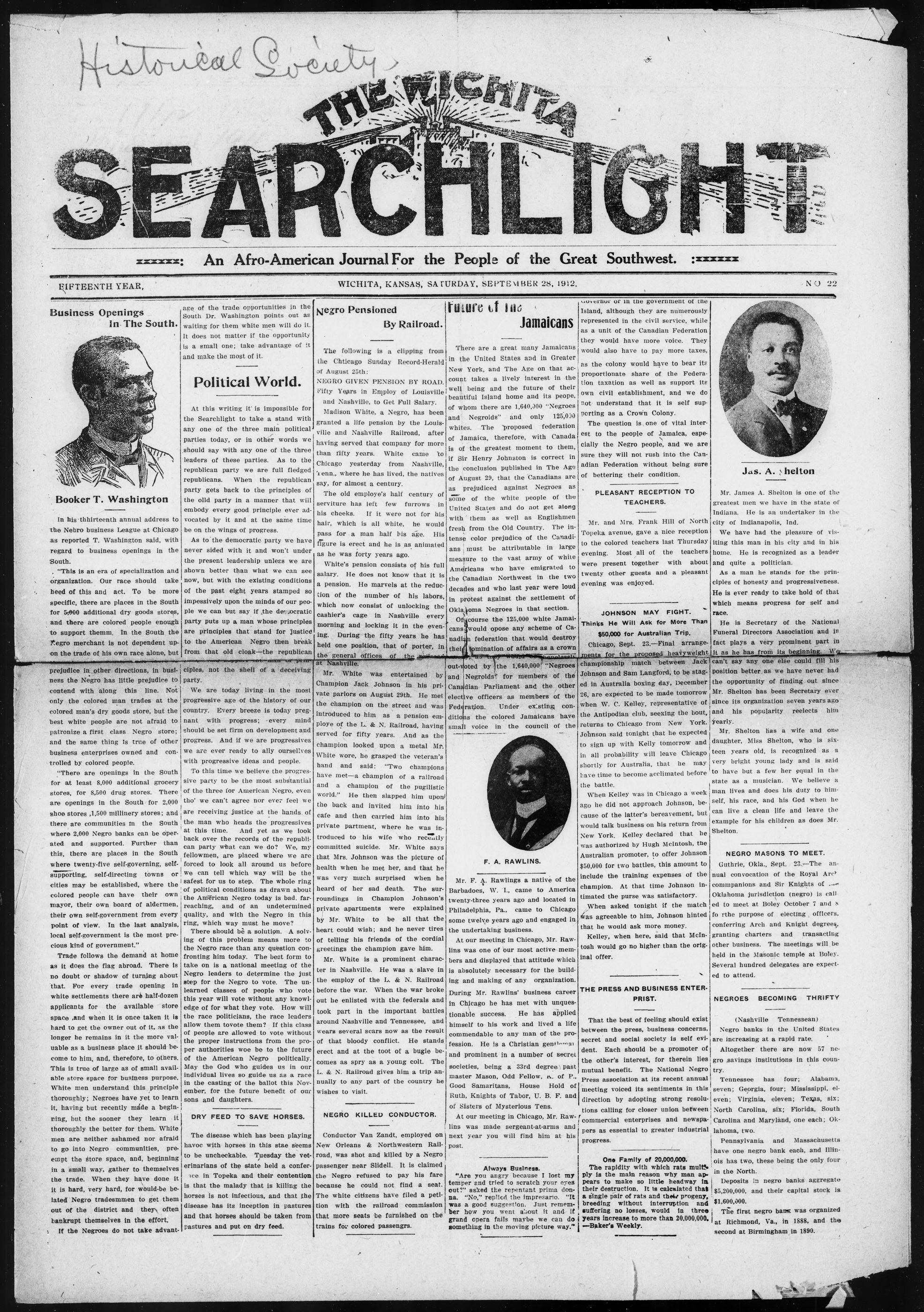
Historical Society THE WICHITA SEARCHLIGHT
EIFTEENTH YEAR,
A.
Booker T. Washington
In his thirteenth annual address to the Nebro business League at Chicago as reported T. Washington said, with regard to business openings in the South.
"This is an era of specialization and organization. Our race should take heed of this and act. To be more specific, there are places in the South for 5,000 additional dry goods stores, and there are colored people enough to support themm. In the South the Negro merchant is not dependent upon the trade of his own race alone, but prejudice in other directions, in business the Negro has little prejudice to contend with along this line. Not only the colored man trades at the colored man's dry goods store, but the best white people are not afraid to patronize a first class Negro store; and the same thing is true of other business enterprises owned and controlled by colored people.
"There are openings in the South for at least 8,000 additional grocery stores, for 8,500 drug stores. There are openings in the South for 2,000 shoe stores,1,500 millinery stores; and there are communities in the South where 2,000 Negro banks can be operated and supported. Further than this, there are places in the South where twenty-five self-governing, self-supporting, self-directing towns or cities may be established, where the colored people can have their own mayor, their own board of aldermen, their own self-government from every point of view. In the last analysis, local self-government is the most precious kind of government."
Trade follows the demand at home as it does the flag abroad. There is no doubt or shadow of turning about that. For every trade opening in white settlements there are half-dozen applicants for the available store space and when it is once taken it is hard to get the owner out of it, as the longer he remains in it the more valuable as a business place it should become to him, and, therefore, to others. This is true of large as of small available store space for business purpose. White men understand this principle thoroughly; Negroes have yet to learn it, having but recently made a beginning, but the sooner they learn it thoroughly the better for them. White men are neither ashamed nor afraid to go into Negro communities, preempt the store space, and, beginning in a small way, gather to themselves the trade. When they have done it it is hard, very hard, for would-be belated Negro tradesmen to get them out of the district and they often bankrupt themselves in the effort. If the Negroes do not take advant-
age of the trade opportunities in the South Dr. Washington points out as waiting for them white men will do it. It does not matter if the opportunity is a small one; take advantage of it and make the most of it.
Political World.
At this writing it is impossible for the Searchlight to take a stand with any one of the three main political parties today, or in other words we should say with any one of the three leaders of these parties. As to the republican party we are full fledged republicans. When the republican party gets back to the principles of the old party in a manner that will embody every good principle ever advocated by it and at the same time be on the wings of progress.
As to the democratic party we have never sided with it and won't under the present leadership unless we are shown better than what we can see now, but with the existing conditions of the past eight years stamped so impassively upon the minds of our people we can but say if the democratic party puts up a man whose principles are principles that stand for Justice to the American Negro then break from that old cloak—the republican
We are today living in the most progressive age of the history of our country. Every breeze is today pregnant with progress; every mind should be set firm on development and progress. And if we are progressives we are ever ready to ally ourselves with progressive ideas and people.
To this time we believe the progressive party to be the most substantial of the three for American Negro, even tho' we can't agree nor ever feel we are receiving justice at the hands of the man who heads the progressives at this time. And yet as we look back over the records of the republican party what can we do? We, my fellowmen, are placed where we are forced to look all around us before we can tell which way will be the safest for us to step. The whole ring of political conditions as drawn about the American Negro today is bad, far reaching, and of an undetermined quality, and with the Negro in this ring, which way must he move?
There should be a solution. A solving of this problem means more to the Negro race than any question confronting him today. The best form to take on is a national meeting of the Negro leaders to determine the just step for the Negro to vote. The unlearned classes of people who vote this year will vote without any knowledge of for what they vote. How will the race politicians, the race leaders allow them tovote them? If this class of people are allowed to vote without the proper instructions from the proper authorities woe be to the future of the American Negro politically. May the God who guides us in our individual lives so guide us as a race in the casting of the ballot this November, for the future benefit of our sons and daughters.
DRY FEED TO SAVE HORSES.
The disease which has been playing havoc with horses in this stae seems to be uncheckable. Tuesday the veterinarians of the state held a conference in Topeka and their contention is that the malady that is killing the horses is not infectious, and that the disease has its inception in pastures and that horses should be taken from pastures and put on dry feed.
WICHITA, KANSAS, SATURDAY, SEPTEMBER 28, 1912.
Negro Pensioned By Railroad!
The following is a clipping from the Chticago Sunday Record-Herald of August 25th:
NEGRO GIVEN PENSION BY ROAD.
Fifty Years in Employ of Louisville and Nashville, to Get Full Salary.
Madison White, a Negro, has been granted a life pension by the Louisville and Nashville Railroad, after having served that company for more than fifty years. White came to Chicago yesterday from Nashville, Ienn., where he has lived, the natives say, for almost a century.
The old employee's half century of servitude has left few furrows in his cheeks. If it were not for his hair, which is all white, he would pass for a man half his age. His figure is erect and he is as animated as he was forty years ago.
White's pension consists of his full salary. He does not know that it is a pension. He marvels at the reduction of the number of his labors, which now consist of unlocking the cashier's cage in Nashville every morning and locking it in the evening. During the fifty years he has held one position, that of porter, in the general offices of the government.
Mr. White was entertained by Champion Jack Johnson in his private parlors on August 29th. He met the champion on the street and was introduced to him as a pension employee of the L. & N. Railroad, having served for fifty years. And as the champion looked upon a metal Mr. White wore, he grasped the veteran's hand and said: "Two champions have met—a champion of a railroad and a champion of the pugilistic world." He then slapped him upon the back and invited him into his cafe and then carried him into his private partment, where he was introduced to his wife who recently committed suicide. Mr. White says that Mrs. Johnson was the picture of health when he met her, and that he was very much surprised when he heard of her sad death. The surroundings in Champion Johnson's private apartments were explained by Mr. White to be all that the heart could wish; and he never tires of telling his friends of the cordial greetings the champion gave him.
Mr. White is a prominent character in Nashville. He was a slave in the employ of the L. & N. Railroad before the war. When the war broke out he enlisted with the federals and took part in the important battles around Nashville and Tennessee, and wears several scars now as the result of that bloody conflict. He stands erect and at the toot of a bugle becomes as spry as a young colt. The L. & N. Railroad gives him a trip annually to any part of the country he wishes to visit.
NEGRO KILLED CONDUCTOR.
Conductor Van Zandt, employed on New Orleans & Northwestern Railroad, was shot and killed by a Negro passenger near Slidell. It is claimed the Negro refused to pay his fare because he could not find a seat. The white citizens have filed a petition with the railroad commission that more seats be furnished on the trains for colored passengers.
Future of the Jamaicans
There are a great many Jamaicans in the United States and in Greater New York, and The Age on that account takes a lively interest in the well being and the future of their beautiful Island home and its people, of whom there are 1,640,000 "Negroes and Negroids" and only 125,000 whites. The proposed federation of Jamaica, therefore, with Canada is of the greatest moment to them, if Sir Henry Johnston is correct in the conclusion published in The Age of August 29, that the Canadians are as prejudiced against Negroes as some of the white people of the United States and do not get along with them as well as Englishmen fresh from the Old Country. The intense color prejudice of the Canadians must be attributable in large measure to the vast army of white Americans who have emigrated to the Canadian Northwest in the two decades and who last year were loud in protest against the settlement of Oklahoma Negroes in that section.
Offcourse the 125,000 white Jamaicans would opose any scheme of Canadian federation that would destroy their domination of affairs as a crown court, as they would be nonetheless out-voted by the 1,640,000 "Negroes and Negroids" for members of the Canadian Parliament and the other elective officers as members of the Federation. Under existing conditions the colored Jamaicans have small voice in the council of the
F. A. RAWLINS.
Mr. F. A. Rawlings a native of the Barbadoes, W. I., came to America twenty-three years ago and located in Philadelphia, Pa., came to Chicago some twelve years ago and engaged in the undertaking business. At our meeting in Chicago, Mr. Rawlins was one of our most active members and displayed that attitude which is absolutely necessary for the building and making of any organization. During Mr. Rawlins' business career in Chicago he has met with unquestionable success. He has applied himself to his work and lived a life commendable to any man of the profession. He is a Christian gentleman and prominent in a number of secret societies, being a 33rd degree past master Mason, Odd Fellow, A. of P., Good Samaritans, House Hold of Ruth, Knights of Tabor, U. B. F. and of Sisters of Mysterious Tens. At our meeting in Chicago, Mr. Rawlins was made sergeant-at-arms and next year you will find him at his post.
Always Business.
"Are you angry because I lost my temper and tried to scratch your eyes out?" asked the repentant prima donna. "No," replied the impresario. "It was a good suggestion. Just remember how you went about it and if grand opera fails maybe we can do something in the moving picture way."
Governor or in the government of the Island, although they are numerously represented in the civil service, while as a unit of the Canadian Federation they would have more voice. They would also have to pay more taxes, as the colony would have to bear its proportionate share of the Federation taxation as well as support its own civil establishment, and we do not understand that it is self supporting as a Crown Colony.
The question is one of vital interest to the people of Jamaica, especially the Negro people, and we are sure they will not rush into the Canadian Federation without being sure of bettering their condition.
PLEASANT RECEPTION TO TEACHERS.
Mr. and Mrs. Frank Hill of North Topeka avenue, gave a nice reception to the colored teachers last Thursday evening. Most all of the teachers were present together with about twenty other guests and a pleasant evening was enjoyed.
JOHNSON MAY FIGHT.
Thinks He Will Ask for More Than $50,000 for Australian Trip.
Chicago, Sept. 23.—Final arrangements for the proposed heavyweight championship match between Jack Johnson and Sam Langford, to be staged in Australia boxing day, December 26, are expected to be made tomorrow when W. C. Kelley, representative of the Antipodian club, seeking the bout, returns to Chicago from New York. Johnson said tonight that he expected to sign up with Kelly tomorrow and in all probability will leave Chicago shortly for Australia, that he may have time to become acclimated before the battle.
When Kelley was in Chicago a week ago he did not approach Johnson, because of the latter's bereavement, but would talk business on his return from New York. Kelley declared that he was authorized by Hugh McIntosh, the Australian promoter, to offer Johnson $50,000 for two battles, this amount to include the training expenses of the champion. At that time Johnson intimated the purse was satisfactory.
When asked tonight if the match was agreeable to him, Johnson hinted that he would ask more money.
Kelley, when here, said that McIntosh would go no higher than the original offer.
THE PRESS AND BUSINESS ENTER- PRIST.
That the best of feeling should exist between the press, business concerns, secret and social society is self evident. Each should be a promoter of the other's interest, for therein lies mutual benefit. The National Negro Press association at its recent annual meeting voiced its sentiments in this direction by adopting strong resolutions calling for closer union between commercial enterprises and newspapers as essential to greater industrial progress.
One Family of 20,000,000.
The rapidity with which rats multiply is the main reason why man appears to make so little headway in their destruction. It is calculated that a single pair of rats and their progeny, breeding without interruption and suffering no losses, would in three years increase to more than 20,000,000. —Baker's Weekly.
Jas. A. Shelton
Mr. James A. Shelton is one of the greatest men we have in the state of Indiana. He is an undertaker in the city of Indianapolis, Ind.
We have had the pleasure of visiting this man in his city and in his home. He is recognized as a leader and quite a politician.
As a man he stands for the principles of honesty and progressiveness. He is ever ready to take hold of that which means progress for self and race.
He is Secretary of the National Funeral Directors Association and in fact plays a very prominent part in it as he has from its beginning. We can't say any one else could fill his position better as we have never had the opportunity of finding out since Mr. Shelton has been Secretary ever since its organization seven years ago and his popularity reelects him yearly.
Mr. Shelton has a wife and one daughter, Miss Shelton, who is sixteen years old, is recognized as a very bright young lady and is said to have but a few her equal in the state as a musician. We believe a man lives and does his duty to himself, his race, and his God when he can live a clean life and leave the example for his children as does Mr. Shelton.
NEGRO MASONS TO MEET.
Guthrie, Okla., Sept. 23.—The annual convocation of the Royal Arch companions and Sir Knights of Oklahoma jurisdiction (negro) is called to meet at Boley October 7 and 8 for the purpose of electing officers, conferring Arch and Knight degrees, granting charters and transacting other business. The meetings will be held in the Masonic temple at Boley. Several hundred delegates are expected to attend.
(Nashville Tennessee)
Negro banks in the United States are increasing at a rapid rate.
Altogether there are now 57 negro savings institutions in this country.
Tennessee has four; Alabama, seven; Georgia, four; Mississippi, eleven; Virginia, eleven; Texas, six; North Carolina, six; Florida, South Carolina and Maryland, one each; Oklahoma, two.
Pennsylvania and Massachusetts have one negro bank each, and Illinois has two, these being the only four in the North.
Deposits in negro banks aggregate $5,200,000, and their capital stock is $1,600,000.
The first negro bank was organized at Richmond, Va., in 1888, and the second at Birmingham in 1890.
---
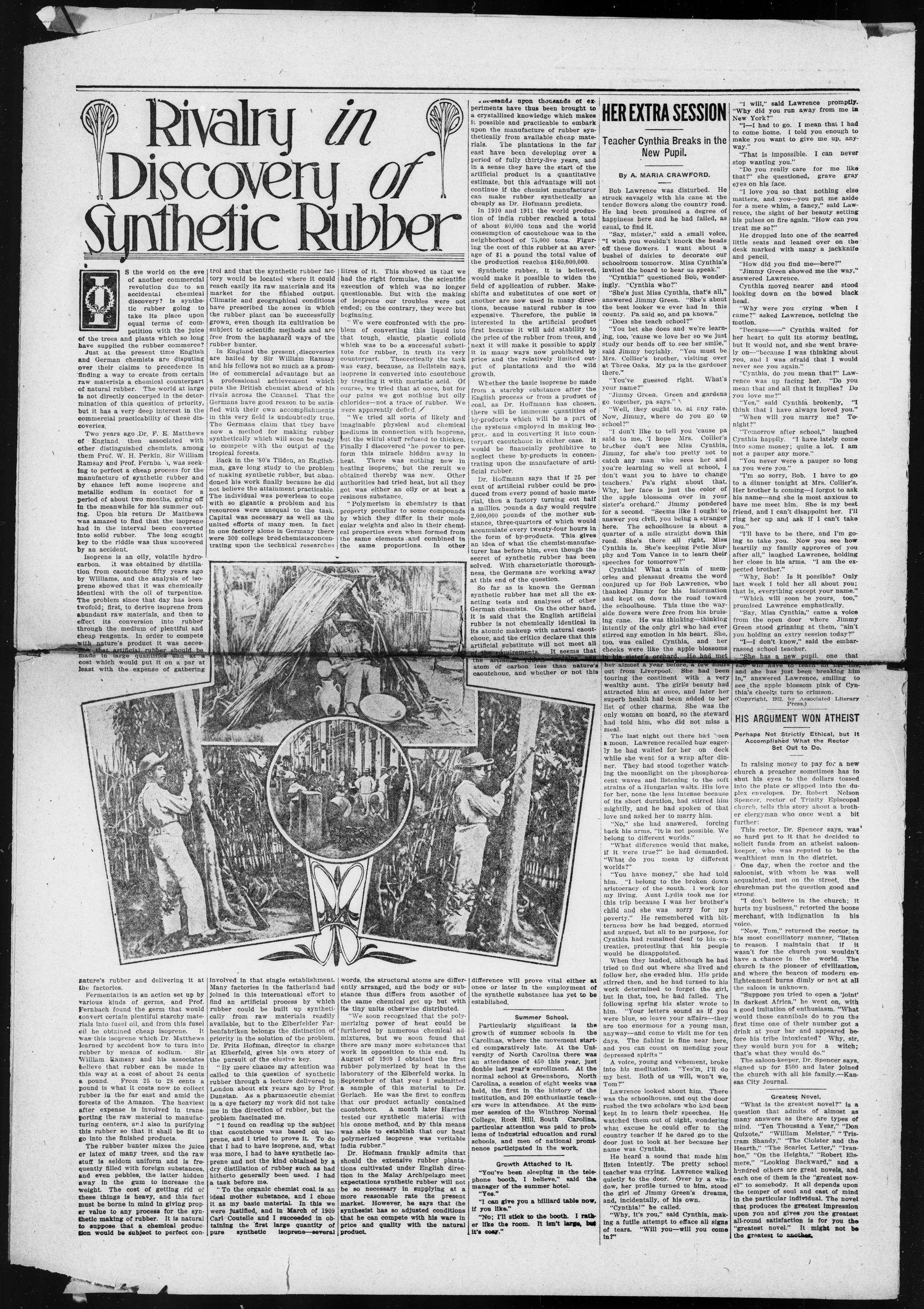
Rivalry in Discovery of Synthetic Rubber
I
S the world on the eve of another commercial revolution due to an accidental chemical discovery? Is synthetic rubber going to take its place upon equal terms of competition with the juice of the trees and plants which so long have supplied the rubber commerce?
have supplied the rubber Just at the present time English and German chemists are disputing over their claims to precedence in finding a way to create from certain raw materials a chemical counterpart of natural rubber. The world at large is not directly concerned in the determination of this question of priority, but it has a very deep interest in the commercial practicability of these discoveries.
Two years ago Dr. F. E. Matthews of England, then associated with other distinguished chemists, among them Prof. W. H. Perkin, Sir William Ramsay and Prof. Fernba'h, was seeking to perfect a cheap process for the manufacture of synthetic rubber and by chance left some isoprene and metallic sodium in contact for a period of about two months, going off in the meanwhile for his summer outing. Upon his return Dr Matthews was amazed to find that the isoprene had in the interval been converted into solid rubber. The long sought key to the riddle was thus uncovered by an accident.
isoprene is an oily, volatile hydrocarbon. It was obtained by distillation from caoutchouc fifty years ago by Williams, and the analysis of isoprene showed that it was chemically identical with the oil of turpentine. The problem since that day has been twofold; first, to derive isoprene from abundant raw materials, and then to effect its conversion into rubber through the medium of plentiful and cheap reagents. In order to compete with nature's product it was necessary that artificial rubber should be made in large quantities and at a cost which would put it on a par at least with the expense of gathering
A
nature's rubber and delivering it at the factories.
Fermentation is an action set up by various kinds of germs, and Prof. Fernbach found the germ that would convert certain plentiful starchy materials into fusel oil, and from this fusel oil he obtained cheap isoprene. It was this isoprene which Dr. Matthews learned by accident how to turn into rubber by means of sodium. Sir William Ramsay and his associates believe that rubber can be made in this way at a cost of about 24 cents a pound. From 25 to 28 cents a pound is what it costs now to collect rubber in the far east and amid the forests of the Amazon. The heaviest after expense is involved in transporting the raw material to manufacturing centers, and also in purifying this rubber so that it shall be fit to go into the finished products.
The rubber hunter mixes the juice or latex of many trees, and the raw stuff is seldom uniform and is frequently filled with foreign substances, and even pebbles, the latter hidden away in the gum to increase the weight. The cost of getting rid of these things is heavy, and this fact must be borne in mind in giving proper value to any process for the synthetic making of rubber. It is natural to suppose that a chemical production would be subject to perfect con-
trol and that the synthetic rubber factory would be located where it could reach easily its raw materials and its market for the flished output. Climatic and geographical conditions have prescribed the zones in which the rubber plant can be successfully grown, even though its cultivation be subject to scientific methods and are free from the haphazard ways of the rubber hunter.
In England the present, discoveries are hailed by Sir William Ramsay and his fellows not so much as a promise of commercial advantage but as a professional achievement which puts the British chemist ahead of his rivals across the Channel. That the Germans have good reason to be satisfied with their own accomplishments in this very field is undoubtedly true. The Germans claim that they have now a method for making rubber synthetically which will soon be ready to compete with the output of the tropical forests.
Back in the 80's Tilden, an Englishman, gave long study to the problem of making synthetic rubber, but abandoned his work finally because he did not believe the attainment practicable. The individual was powerless to cope with so gigantic a problem and his resources were unequal to the task. Capital was necessary as well as the united efforts of many men. In fact in one factory alone in Germany there were 300 college chemists concentrating upon the technical researches
THE WORLD'S FINEST ARTIST
involved in that single establishment. Many factories in the fatherland had joined in this international effort to find an artificial process by which rubber could be built up synthetically from raw materials readily available, but to the Elberfelder Farbenfabriken belongs the distinction of priority in the solution of the problem. Dr. Fritz Hofman, director in charge at Elberfeld, gives his own story of the pursuit of the elusive key.
"By mere chance my attention was called to this question of synthetic rubber through a lecture delivered in London about six years ago by Prof. Dunstan. As a pharmaceutical chemist in a dye factory my work did not take me in the direction of rubber, but the problem fascinated me.
"I found on reading up the subject that cacoutchouc was based on isoprene, and I tried to prove it. To do that I had to have isoprene, and, what was more, I had to have synthetic isoprene and not the kind obtained by a dry distillation of rubber such as had hitherto generally been used. I had a task before me.
"To the organic chemist coal, is an ideal mother substance, and I chose it as my basic material. In this we were justified, and in March of 1909 Carl Coutelle and I succeeded in obtaining the first large quantity of pure synthetic isoprene—several
litres of it. This showed us that we had the right formulae, the scientific execution of which was no longer questionable. But with the making of isoprene our troubles were not ended; on the contrary, they were but beginning.
"We were confronted with the problem of converting this liquid into that tough, elastic, plastic colloid which was to be a successful substitute for rubber, in truth its very counterpart. Theoretically the task was easy, because, as Bellstein says, isoprene is converted into caoutchouc by treating it with muriatic acid. Of course, we tried that at once, but for our pains we got nothing but oily chlorides—not a trace of rubber. We were apparently defied.
"We tried all sorts of likely and imaginable physical and chemical mediums in connection with isoprene, but the wilful stuff refused to thicken. Finally I discovered 'the power to perform this miracle hidden away in heat. There was nothing new in heating isoprene, but the result we obtained thereby was new. Other authorities had tried heat, but all they got was either an ally or at best a resinous substance.
"Polymerism in chemistry is that property peculiar to some compounds by which they differ in their molecular weights and also in their chemical properties even when formed from the same elements and combined in the same proportions. In other
words, the structural atoms are differently arranged, and the body or substance thus differs from another of the same chemical get up but with its tiny units otherwise distributed.
"We soon recognized that the polymerizing power of heat could be furthered by numerous chemical admixtures, but we soon found that there are many more substances that work in opposition to this end. In August of 1909 I obtained the first rubber polymerized by heat in the laboratory of the Elberfeld works. In September of that year I submitted a sample of this material to Dr. Gerlach. He was the first to confirm that our product actually contained cauchochuc. A month later Harries tested our synthetic material with his ozone method, and by this means was able to establish that our heat polymerized isoprene was veritable india rubber."
Dr. Hofmann frankly admits that should the extensive rubber plantations cultivated under English direction in the Malay Archipelago meet expectations synthetic rubber will not be so necessary in supplying at a more reasonable rate the present market. However, he says that the synthesist has so adjusted conditions that he can compete with his ware in price and quality with the natural product.
thousands upon thousands of experiments have thus been brought to a crystallized knowledge which makes it possible and practicable to embark upon the manufacture of rubber synthetically from available cheap materials. The plantations in the far east have been developing over a period of fully thirty-five years, and in a sense they have the start of the artificial product in a quantitative estimate, but this advantage will not continue if the chemist manufacturer can make rubber synthetically as cheaply as Dr. Hofmann predicts. In 1910 and 1911 the world production of india rubber reached a total of about 80,000 tons and the world consumption of caoutchouc was in the neighborhood of 75,000 tons. Figuring the cost of this rubber at an average of $1 a pound the total value of the production reaches $160,000,000.
Synthetic rubber, it is believed, would make it possible to widen the field of application of rubber. Makeshifts and substitutes of one sort or another are now used in many directions, because natural rubber is too expensive. Therefore, the public is interested in the artificial product first because it will add stability to the price of the rubber from trees, and next it will make it possible to apply it in many ways now prohibited by price and the relatively limited output of plantations and the wild growth.
Whether the basic isoprene be made from a starchy substance after the English process or from a product of coal, as Dr. Hoffmann has chosen, there will be immense quantities of by-products which will be a part of the systems employed in making isoprop. and in converting it into counterpart caoutchouc in either case. It would be financially prohibitive to neglect these by-products in concentrating upon the manufacture of artificial rubber.
Dr. Hoffmann says that if 25 per cent of artificial rubber could be produced from every pound of basic material, then a factory turning out half a million pounds a day would require 2,000,000 pounds of the mother substance, three-quarters of which would accumulate every twenty-four hours in the form of by-products. This gives an idea of what the chemist-manufacturer has before him, even though the secret of synthetic rubber has been solved. With characteristic thoroughness, the Germans are working away at this end of the question.
So far as is known the German synthetic rubber has met all the exacting tests and analyses of other German chemists. On the other hand, it is said that the English artificial rubber is not chemically identical in its atomic makeup with natural caoutchouc, and the critics declare that this artificial substitute will not meet all of the requirements. It seems that
the artifact, rather, contains one atom of carbon less than nature's caoutchouc, and whether or not this
difference will prove vital either at once or later in the employment of the synthetic substance has yet to be established.
Summer School.
Particularly significant is the growth of summer schools in the Carolinas, where the movement started comparatively late. At the University of North Carolina there was an attendance of 450 this year, just double last year's enrollment. At the normal school at Greensboro, North Carolina, a session of eight weeks was held, the first in the history of the institution, and 200 enthusiastic teachers were in attendance. At the summer session of the Winthrop Normal College, Rock Hill, South Carolina, particular attention was paid to problems of industrial education and rural schools, and men of national prominence participated in the work.
Growth Attached to It
"You've been sleeping in the telephone booth, I believe," said the manager of the summer hotel.
"Yes."
"I can give you a billiard table now, if you like."
"No; I'll stick to the booth. I rather like the room. It isn't large, but it's cozy."
HEREXTRASESSION
HEREXTRASESSION
Teacher Cynthia Breaks in the New Pupil.
Bob Lawrence was disturbed. He struck savagely with his cane at the tender flowers along the country road. He had been promised a degree of happiness here and he had failed, as usual, to find it.
"Say, mister," said a small voice, "I wish you wouldn't knock the heads off these flowers. I want about a bushel of daisies to decorate our schoolroom tomorrow. Miss Cynthia's invited the board to hear us speak." "Cynthia?" questioned Bob, wonderingly. "Cynthia who?" "She's just Miss Cynthia, that's all," answered Jimmy Green. "She's about the best looker we ever had in this county. Pa said so, and pa knocks." "Doe she teach school?"
"You bet she does and we're learning, too, 'cause we love her so we just study our heads off to see her smile," said Jimmy boyishly. "You must be Mrs. Collier's brother, visiting over at Three Oaks. My pa is the gardener there."
"You've guessed right. What's your name?"
"Jimmy Green. Green and gardens go together, pa says." \
"Well, they ought to, at any rate. Now, Jimmy, where do you go to school?"
"I don't like to tell you 'cause pa said to me, I hope Mrs. Collier's brother don't see Miss Cynthia, Jimmy, for she's too pretty not to catch any man who sees her and you're learning so well at school, I don't want you to have to change teachers." Pa's right about that. Why, her face is just the color of the apple blossoms over in your sister's orchard." Jimmy pondered for a second. "Seems like I ought to answer you civil, you being a stranger here. The schoolhouse is about a quarter of a mile straight down this road. She's there all right, Miss Cynthia is. She's keeping Petie Murphy and Tom Vance in to learn their squeeches for tomorrow?"
Cynthia! What a train of memories and pleasant dreams the word conjured up for Bob Lawrence, who thanked Jimmy for his information and kept on down the road toward the schoolhouse. This time the way-side flowers were free from his bruising cane. He was thinking—thinking intently of the only girl who had ever stirred any emotion in his heart. She, too, was called Cynthia, and her cheeks were like the apple blossoms in his sister's orchard. He had met her almost a year before, a few hours out from Liverpool. She had been touring the continent with a very wealthy aunt. The girls beauty had attracted him at once, and later her superb health had been added to her list of other charms. She was the only woman on board, so the steward had told him, who did not miss a meal.
The last night out there had been a moon. Lawrence recalled how eagerly he had waited for her on deck while she went for a wrap after dinner. They had stood together watching the moonlight on the phosphorescent waves and listening to the soft strains of a Hungarian waltz. His love for her, none the less intense because of its short duration, had stirred him mightily, and he had spoken of that love and asked her to marry him.
"No," she had answered, forcing back his arms, "it is not possible. We belong to different worlds."
"What difference would that make, if it were true?" he had demanded.
"What do you mean by different worlds?"
"You have money," she had told him. "I belong to the broken down aristocracy of the south. I work for my living. Aunt Lydia took me for this trip because I was her brother's child and she was sorry for my poverty." He remembered with bitterness how he had begged, stormed and argued, but all to no purpose, for Cynthia had remained deaf to his entreaties, protecting that his people would be disappointed.
When they landed, although he had tried to find out where she lived and follow her, she evaded him. His pride stirred then, and he had turned to his work determined to forget the girl, but in that, too, he had failed. The following spring his sister wrote to him. "Your letters sound as if you were blue, so leave your affairs—the are too enormous for a young man, anyway—and come to visit me for ten days. The fishing is fine near here, and you can count on mending your depressed spirits." A voice, young and vehement, broke into his meditation. "Yes'm, I'll do my best. Both of us will, won't we, Tom?"
Lawrence looked about him. There was the schoolhouse, and out the door rushed the two scholars who had been kept in to learn their speeches. He watched them out of sight, wondering what excuse he could offer to the country teacher if he dared go to the door just to look at her because her name was Cynthia.
He heard a sound that made him listen intently. The pretty school teacher was crying. Lawrence walked quietly to the door. Over by a window, her profile turned to him, stood the girl of Jimmy Green's dreams, and, incidentally, of his own.
"Cynthia!" he called.
"Why, it's you," said Cynthia, making a futile attempt to efface all signs of tears. "Will you—will you come in?"
"I will," said Lawrence promptly.
"Why did you run away from me in New York?"
"I—I had to go. I mean that I had to come home. I told you enough to make you want to give me up, anyway."
"That is impossible. I can never stop wanting you."
"Do you really care for me like that?" she questioned, grave gray eyes on his face.
"I love you so that nothing else matters, and you—you put me aside for a mere whim, a fancy," said Lawrence, the sight of her beauty setting his pulses on fire again. "How can you treat me so?"
He dropped into one of the scarred little seats and leaned over on the desk marked with many a jackknife and pencil.
"How did you find me—here?"
"Jimmy Green showed me the way," answered Lawrence.
Cynthia moved nearer and stood looking down on the bowed black head.
"Why were you crying when I came?" asked Lawrence, noticing the motion.
"Because——" Cynthia waited for her heart to quit its stormy beating, but it would not, and she went bravely on—"because I was thinking about you, and I was afraid that I would never see you again."
"Cynthia, do you mean that?" Lawrence was up facing her. "Do you mean that and all that it implies? Do you love me?"
"Yes," said Cynthia brokenly, "I think that I have always loved you."
"When will you marry me? Tonight?"
"Tomorrow after school," laughed Cynthia happily. "I have lately come into some money; quite a lot. I am not a pauper any more."
"You never were a pauper so long as you were you."
"I'm so sorry, Bob. I have to go to a dinner tonight at Mrs. Collier's. Her brother is coming—I forgot to ask his name—and she is most anxious to have me meet him. She is my best friend, and I can't disappoint her. I'll ring her up and ask if I can't take you."
"I'll have to be there, and I'm going to take you. Now you see how heartily my family approves of you after all," laughed Lawrenee, holding her close in his arms. "I am the expected brother."
"Why, Bob! Is it possible? Only last week I told her all about you; that is, everything except your name."
"Which will soon be yours, too," promised Lawrence emphatically.
"Say, Miss Cynthia," came a voice from the open door where Jimmy Green stood grinning at them, "ain't you holding an entry session today?"
"I—I don't know," said the embarrassed school teacher.
"She has a new pupil, one that she will have to teach an art life, and she has just been breaking him in," answered Lawrence, smiling to see the apple blossom pink of Cynthia's cheeks' turn to crimson.
(Copyright, 1912, by Associated Literary
HIS ARGUMENT WON ATHEIST
Perhaps Not Strictly Ethical, but It Accomplished What the Rector Set Out to Do.
In raising money to pay for a new church a preacher sometimes has to shut his eyes to the dollars tossed into the plate or slipped into the duplex envelopes. Dr. Robert Nelson Spencer, rector of Trinity Episcopal church, tells this story about a brother clergyman who once went a bit further:
This rector, Dr. Spencer says, was so hard put to it that he decided to solicit funds from an atheist saloon-keeper, who was reputed to be the wealthiest man in the district.
One day, when the rector and the saloonist, with whom he was well acquainted, met on the street, the churchman put the question good and strong.
"I don't believe in the church; it hurts my business," retorted the booze merchant, with indignation in his voice.
"Now, Tom," returned the rector, in his most conciliatory manner, "listen to reason. I maintain that if it wasn't for the church you wouldn't have a chance in the world. The church is the pioneer of civilization, and where the beacon of modern enlightenment burns dimly or not at all the saloon is unknown.
"Suppose you tried to open a 'joint' in darkest Africa," he went on, with a good imitation of enthusiasm. "What would those cannibals do to you the first time one of their number got a drink at your bar and appeared before his tribe intoxicated? Why, sir, they would burn you for a witch; that's what they would do."
The saloon-keeper, Dr. Spencer says, signed up for $500 and later joined the church with all his family.—Kansas City Journal.
Greatest Novel.
"What is the greatest novel?" is a question that admits of almost as many answers as there are types of mind. "Ten Thousand a Year," "Don Quikote," "William Melster," "Tristram Shandy," "The Cloister and the Hearth," "The Scarlet Letter," "Ivanhoe," "On the Heights," "Robert Elsere," "Looking Backward," and a hundred others are great novels, and each one of them is the "greatest novel" to somebody. It all depends upon the temper of soul and cast of mind in the particular individual. The novel that produces the greatest impression upon you and gives you the greatest all-round satisfaction is for you the "greatest novel." It might not be the greatest to another.
THE SEARCHLIGHT
Founded in 1898 by W. N. Miller.
WICHITA. KAN: A
A. L. Garrett
Office 535 N. Main St.
RATES OF SUBSCRIPTION:
Strictly in Advance.
One Year (by mail) ..... $1.00
Six Months (by mail)..... .75
Three Months (by mail)..... .50
Entered at the Post Office as Second
Class Mail Mail
Pay up! Pay up!! Pay up!!!
Because a man has lived in a town a number of years or has lived there all his life, does not mean that other men should not come into the town and do for self and race. Let us think a little.
Why not have a big meeting of the Wichita Business League soon then a larger public meeting.
Get ready to root for the Y. M. C. A. football team. Topeka is expected here October 10th and other teams later.
We wonder if our Y. M. C. A. has scheduled a course of lectures and entertainments for this winter and spring. There is intellect and money for you.
A BIG Y. M. C. A. CAMPAIGN.
Why not have a big rally among the Y. M. C. A. people. A thousand dollars should run the Y. M. C. A. this winter; then this coming spring why not a big rally for a building—why not bring Taylor from Indianapolis, a man of experience, to assist us in a spring rally. But let us start a $1,000 campaign, all money to be in by December 25th. Y. M. C. A. peo that what do you say lets have a two weeks contest in a campaign now. Don't stop to josh—but lets spend the time in planning them, get to work—don't fear it can be done.
The Editor wishes to thank the Plane Dealer Editor for his compliments as bestowed up on us last week and assures him we will try and prove our worth in the face of our enemies. We will also join hands in a war against the wrongs of our people.
CAPPER AND LABOR.
Republican Candidate for Governor Always Square With His Men.
From the Leavenworth County News. Arthur Capper's candidacy for governor is especially pleasing to the wage earners of Kansas. Capper is one of the largest employers of labor in the state. Now we have a number of very humane industrial employers, but none have shown more active and intelligent regard for the needs of their employees than has Capper. He pays the highest wages, arranges comfortable places for the people to work in, is liberal with vacations and holiday recreations, is a thorough believer in the benefits of the eight-hour work day, which prevails throughout every department of his large establishment. Capper knows every phase of the industrial problem from both sides—that of the employee and employer. He makes the welfare of his employees as much a part of his business management as any factor in it. There are many other reasons why Capper will make an admirable governor, but none is of more importance than a comprehensive knowledge of industrial problems, and a just and sympathetic purpose to see that the wage earner is given an even break in the struggle for a livelihood. Capper does not have to be trusted because of what he might say. He has proven his ability and worth by his acts. Everyone in the industrial field can vote for Capper with the utmost confidence that their interests will be carefully guarded.
---
AFTER AND HIS PRINCIPALS.
Arthur Capper said in a talk at the old soldiers' reunion at Winfield the other day: "I am a candidate for Governor because I believe th estate wants for the next two years a clean-cut business administration and a Governor who believes in an absolutely square deal, and who has the nerve to see that the people get it. I come before the people of the state absolutely free. I am carrying no political incumbrances or obligations, and I don't propose to assume any. I am not mixed up in any deals, trades, cliques, or bargains of any description.'
Over 3,500 voters have already joined the Capper-for-Governor Club in Topeka and it is claimed that the club will have a membership of over 5,000 before the end of the month. That Mr. Capper is popular among his home people is shown by the fact that in the recent primary he received a majority of 3,103, the largest ever given in Shawnee county to a candidate on the state ticket, and he ran ahead o this fellow townsman Mayor Billard, by nearly 2,500 votes.
Arthur Capper, Republican nominee for Governor, says: "I am in favor of wipping out the school-book graft. Not only should Kansas children have the best school books, but the frequent changing of books should be stopped. I favor publication of school books by the state and distribution to the people at actual cost."
BRYAN HERE OCTOBER 4.
"Peerless One" to Help Peerless Princess Hold Jubilee.
A new attraction has been announced for the Fall Festivities week in Wichita. William Jennings Bryan, the Democrat, "Peerless Leader," will be in the city the evening of the third day of festivities week, Friday, October t. Announcement of the date of Mr. Bryan's coming was made Monday by Chairman A. E. Jacques of the Democratic central committee of Sedgwick county.
Mr. Jacques said arrangements have not yet been made for a place in which Mr. Bryan will speak. The Democratic orator will be in the city between the hours of 7:30 and 9:30 o'clock, Friday evening, October 4. He will leave Wichita at 9:30 on a Rock Island train.
NEGRO INDEPENDENT LEAGUE.
The colored men of Eldorado and Butler county met in the colored church there Tuesday evening and organized forces throughout the county into an Independent Political League to cast their vote in a unit.
A NON-PARELL CLUB ORGANIZED.
A number of ladies met at the residence of Mrs. R. B. Hills on North Water street and organized what is to be known as a Non-Parell club. Those present were Mrs. Hill, Mrs. Dr. Miller, Mrs. Dr. Brown, Mrs. Cowens, Mrs. W. H. Jones, Mrs. Dr. Bolden, Mrs. McWilliams, Mrs. Finds, Mrs. Grace Taylor, Mrs. Claton, Mrs. C. W. Garrett. Officers were elected as follows:
President, Mrs. R. B. Hill.
Vice President, Mrs. C. W. Garrett.
Secretary, Mrs. Grace Taylor.
Assistant Secretary, Mrs. Dr. Bolden.
When in Wichita eat at Chub by' he will treat you right 6.0 N
d
t
WANT ADDS. Wanted:- Boarders by the day or week C. Brandon 623 North Main Street.
Wanted;- Furnished rooms for rent by the week or month by Mrs, McGee 413 N, Wichita,
Wanted:= Boarders by the day or week by Mrs, Steward 541 N, Water St, the home of good eats served family style,
Wanted:- Agents, We pay our agents cash.
Write Garrett's News Agency
535 N. Main St
Wichita, Kansas
WANTER ROOMERS—For single rooms with or without board, or rooms to rent for light housekeeping.—Mrs. Mattie Reed, 1015 E. 14th street.
MARRIED IN AN ELEVATOR.
"Going Up," Said a Texas Groom as a Justice Said the Word.
Fort Worth, Tex., Sept. 23.—"Going up," said George A. Carpenter to the elevator operator at the Tarrant county court house, and he and his bride-to-be, Miss Anna Lewis, and a justice o fthe peace entered the cage. The car was stopped between the third and four floors, where the justice performed the ceremony.
While the operator was the only witness in the car, there was a crowd of spectators on the third floor looking up at the wedding and another crowd on the fourth floor looking down at the ceremony.
"We wanted to be married in some novel way, and not have a crowd biting in," said Carpenter in explanation afterwards. He is a rich farmer.
MEN TO WEAR EARRINGS.
Earrings May Be Next, if the London
New York.—Walter Creighton, son of the late Bishop of London, arrived yesterday on the steamship Majestic, bringing with him, free of duty, a sample of the whiskers which have become all the rage in England and which threaten to sprout on this side of the Atlantic. Creighton is tall and willowy and his hirsute growth on the sides of his face is distinctly aesthetic.
By the same vessel arrived a letter from a London correspondent, describing the London fashion in whiskers. These same men are becoming wearers of jewelry, he says, and they carry their money in small chain purses of fine gold mesh.
The soft silk collars that grace their necks are held together by brooches decorated with a pearl or twisted love knot. A wrist watch on one arm is balanced by a close fitting bracelet on the other. Quite recently one of the whiskerettes appeared in London with a locket pendant hanging about his neck.
A new gold knobbed stick chased and embossed and carried in a dainty fashion and perfectly nicety; a gold ring on the first finger of one hand and another on the third finger of the other hand each with a sparkling diamond, are also features of the modern male display.
It is suggested the male evening dress of the near future will include the tiara and earrings.
A. G. MUELLER
UNDERTAKER
142 N. Market Wichita Kas.
Myers Furniture Co.
246 North Main New and Second Hand Furniture Exchanged, Bought and Sold, phone douglas 1903,
Cush for Poultry
Eggs and Hides
Dunn and Almond,
741 N. Main Phone Mkt 3537,
Wards Bakery
446 North Main
---
A. A. ROSS
The Grocer
Groceries-Fresh Meats-Notions
A new stock of School Supplies
1126 N. Mosley Phone Mk. 6028
Mrs. J. H. Sayles
908 North Water St. Will wash shampoo and strait en hair. Prices very reasonable. Give her a trial.
Fred C. Helm
Lawyer
513 N. Main Street.
Phone Market 2999.
Oscar R, Bissantz
PRESCRIPTION
Specials for T
School Books F
25¢ Elite Promade 20c, 2
25¢ Poudre DeRiz F
Owl and Tom Keen
S. W. Corner Main
Phone Doug. 620
PRESCRIPTION DRUGGEST
Specials For This Week.
School Books For All Grades
25¢ Elite Promade 20c. 25¢ Nelsons Promade 22c.
25¢ Poudre DeRiz Face Powder 10¢.
Owl and Tom Keen Cigars 3 for 10¢.
S. W. Corner Main & Murdock Street
Phone Doug. 620 We Deliver.
Grocery Department
WE SELL FLOUR
WE SELL MEAL
WE SELL LARD
WE SELL MEAT
WE SELL POTATOES
In fact, we sell everything kept in a First-Class Grocery. WHY CAN'T WE SELL TO YOU!
Makin Eye Drug Co.
617 N. Main St. - Wichita, Kan - Bell Phone 239
IMBODEN'S IMPERIAL FLOUR
GRAHAM — CORN MEAL — BREAKFAST FOOD
With thirty-five years MILLING EXPERI-
RIENCE in Wichita, our products are
the best that can be produced.
Made from the best selected grain
only, put up in Special Packages.
ASK YOUR GROCER ! See that you get IMPERIAL,
THE IMBODEN MILLING CO.
Wichita, Kansas
W. S. Henrion
Druggist
501 North Main Street
Wichita - - - - Kansas
Corzine Furniture Co.
New and Second Hand
Furniture Stoves Rugs
Cush or Payments
337 North Main Wichita, Kas.
Bargains
big cut in wall paper paint brushes and
Wall Paper almost 1/2
Latest Styles Good Work-
350 North Main St.
Wall Paper and Paint Co.
Phone Market 1690.
Mrs. W. N. Miller
Madme Papes System
Treating the scalp and pressing
the hair. I make my own press-
ing oil and hair preparation.
Any information gladly given.
Phonc MKT, 4090x.
When you see Dr. Bolden think of teeth,
When you see teeth think
of Dr. Bolden.
513 N. Main.
IN DRUGGEST
This Week.
For All Grades
25¢ Nelsons Promade 22c.
Face Powder 10¢.
Cigars 3 for 10¢.
& Murdock Street
We Deliver.
RD
MEAT
ELL POTATOES
In Staple and Fancy Groceries,
A full line of School Supplies,
1431 N. Washington St.
Phone Mkt. 2302.
Rowlee Hardware Go.
823 North Main Cheapest Hardware & Store House in Wishita. Cook Stoves Heating Stoves etc We have the celebrated German Heater.
Complete House Furnishers Newand Second-Hand Furniture
D. F. MARSHALL
236 North Main Phone Mk. 2413
Courteous Treatment To All.
Bunnell Company
Second Hand Goods Bought And Sold.
238 North Main Street
Phone Douglas 1121,
Dr. A. K. Lawrence
Physician & Surgeon
Office Phone
517 N. Main St Mkt. 4634
Diseases of Men, Women and Children
Aspecialty.
Peerless
Steam Laundry
BEST LAUNDRY IN THE CITY satisfaction Guaranteed Laundry Work Called and Delivered Phones 232 SELOVER & SONS, Props. 245 N. Market St Wichita, Kan
Madame Brown
The Famous Singer is to Appear in Wichita in the near future.
METZ'S
LUMBER
IS IT?
Largest yard under shed is the state.
Best grade of lumber to select from.
Choicest finishings, posts, shingles and everything in the lumber line.
OUR PRICES ARE RIGHT
Low and Easy to Meet.
Let us figure next Lumber Bill.
Yards and Ofnoo 3rd and Main Streets.
```markdown
```
These are Genuine Sample garments bought for spot cash at one-third less than regular PRICE. The materials are Whipcord, Serge and mixtures in the New Styles of this season The price? The smallest part of the showing Suits $10.75 to $25.00
These are Genuine Sample garments bought for spot cash at one-third less than regular PRICE. The materials are Whipcord, Serge and mixtures in the New Styles of this season The price? The smallest part of the showing Suits $10.75 to $25.00 Dresses$5.00' to $16.75 Coats $7.50 to $19.75
es Sample
DOOR: CALW
tor. Open Till 11 p.m. Saturday
CULP'S MKT.
IS THE BEST PLACE TO
FOR FRESH OAT
SLICED
Dressed
We Garry a Large Supply
Beef, and the nicest Veal.
LOWEST
Culp's
241 N. Main St.
Deam Absent
IN NORTH-WEST
COURT
Bonded A
"SECOND"
PLEASE
GOOD BREA
— AND WILL P
IT IS AS WHITE AS
THE OTTO WEISS ALFALFA
are all guaranteed under
Law, Serial No. 13415
sas State Law, Register
It Is The Cheapest and B
BEST PLACE TO DO YOUR SHOPPING,
FOR FRESH MEATS.
FRESH OAT FISH
And
SLICED HALIBUT.
Dressed Chickens.
A Large Supply of the best of Corn-Fe
the nicest Veal.
LOWEST PRICES
Gulp's Market
in St. Phone, Market 1551
FROM ABSTRACT CO.
NORTH-WEST CORNER OF THE
COURT HOUSE
conded Abstractors.
"COND TO NONE"
PLEASES ALL
FOD BREAD MAKERS
— AND WILL PLEASE YOU —
IS AS WHITE AS SNOW — TRY IT
TO WEISS ALFALFA STOCK AND POULTRY FOOD
All guaranteed under the United States
Serial No. 13415 and under the Kan-
State Law, Register No. 1.
The Cheapest and Best Food on the Market
IS THE BEST PLACE TO DO YOUR SHOPPING FOR FRESH MEATS. FRESH OAT FISH
Culp's Market
241 N. Main St. Phone, Market 1551
DEAM ABSTRACT CO. IN NORTH-WEST CORNER OF THE COURT HOUSE Bonded Abstractors.
"SECOND TO NONE"
THE OTTG WEISS ALFALFA STOCK AND POULTRY FOOD are all guaranteed under the United States Law, Serial No. 13415 and under the Kansas State Law, Register No. 1. It Is the Cheapest and Best Food on the Market
M. B.
CHAS, D. FAZEL
Republican Candidate For
CLERK DISTRICT COURT.
If it ever happen
in the SEARCHL!
PATRONIZE OUR
They will a
er happened you will find it
SEARCHLIGHT.
NIZE OUR ADVERTISERS
They Will welcome You.
If it ever happened you will find it in the SEARCHLIGHT.
"YOU SAVE What We Save!!" New Sample Suits Coats and Dresses
MY RECORD
As Clerk of District Court is MY PLATFORM
Made Good
Vote For Me For A
SECOND TERM
Chas, D, Fazel
Present Clerk of District Court Mr. Fazel has make good, Give him a second term.—E, WEBB.
Mrs. Perry, of Topeka, Kan., was the guest of Mrs. Carr, North Ohio street, Sunday and Monday.
Mr. Wm. Crouch died at his residence on North Wichita street, Mon day morning.
The Searchlight will put in new presses soon and there is some talk of a prototype machine. Can't say yet.
Mrs. Burns, South Washington street, was run into by a motorcycle and had her hand painfully injured.
Mr. Mayland Hall returned from a summer's visit to his uncle in Asberry Park, N. Y.
We had the pleasure of meeting Mrs. Frome of K. K. No. 1 in Dr. Bolden's office. She paid us her subscription.
Mr. Sam Oliver, of Carlton, Mo. was the pleasant guest of his sister, Mrs. Ada Neny, Blaine avenue, returned home.
We are glad to note Mr. Strarnes on 1611 Wabash avenue is much improved.
Mr. W. B. Loydd returned Friday from Hennessey, Okla., where he went on business.
Mr. Chas. Price left Tuesday night for Me-Harry, where he will finish his senior year in dentistry.
Our schools are now in full operation and all reports are of the best. In our next week's issue we shall give special space to our schools and their first teachers.
Mr. Smith, a wealthy farmer from Great Bend, Kans., was in the city to have some dental work done by our competent dentist Dr. Bolden.
Dr. Bolden, the dentist says, if this cold air gets in your teeth and makes them ache they need attention, come in and he'll do the rest.
Dr. G. G. Brown made a trip to Chicago last week on political affairs. We have no report from the doctor as yet.
Rev. Fishback and Mr. John Lewis gave a glowing account of their trip to Houston, at the Sunday morning services at New Hope Baptist church
Mr. Lee Dickerson of Washington street, who was bitten a few days ago while taking his bull dog home, it getting along nicely. ised.
Mr. Scrogans, of 1615 North Topeka who was taken to the hospital a few days ago, is getting along very nicely
Mr. Sam Jones, who was called to St. Joseph, Mo., last week to attend the funeral of his brother, has returned.
Attorney Helm reports business brisk. We hope all our professional and business men are able to give the same report.
Mrs. Walter Williams, Blaire avenue, entertained Mr. John Collins, on Kansas City, Kan., and Mrs. Thomas Anderson at breakfast last Sunday.
The G. L. A. club will meet at the residence of Mrs. J. L. Harper at regular meeting. All members are requested to be present.
Mrs. W. M. Parker, North Ohio street, returned home Monday evening from Lawrence where she attended conference.
There will be a Sunday school entertainment at the residence of Mrs. Joseph Jones, 14th and Wabash, Monday evening. Chittlens will be served.
Don't forget Mr. Ross on North Mosley and Mr. White on North Washington, carry a full line of school supplies for your children.
Rev. Williams, pastor of the A. M. E. church, has just returned from Lawrence, Kan., where he attended the conference. Rev. Williams was returned for another year.
The Searchlight next week will be a special home edition in which a number of cuts of local people will be run. One page will be given up to pictures of our new schools and cuts of the teachers who have prom-
The ladies of the Mothers Aid club are requested to meet Thur.
noon at three o'clock at the parsonage 521 North Water street. Business of importance. By order of the president.
MRS. LILLY HEX, Sec.
Dr. Lawrence says he wants a strong man for his office. We can't say what the work is unless he gets alarmed when Attorney Bllakemore begins to roar at the medicine man, Dr. Lawrence, and the tooth man, Dr. Bolden.
Attorney E. P. Blakemore left Tuesday night for Bartlesville, where he will represent Mr. Dewitt Fuller in a law suit in the district court. Mr. Fuller is suing to cancel an oil lease on his property there.
Mrs. Cora Garrett, who came to this state for the improvement of her health, has greatly improved and is highly pleased with the Peerless Princess of the Plains.
Mr. Geo. W. Upsau is expected in the city soon from Detroit, Mich. Mr. Upsau will take the embalmer's examination in Topeka, October 14th and be located in Wichita, where he will work with Mr. Garrett.
Attorney Blakemore was called to Bartlesville, Oklahoma last Thursday night to look after the interest of Mr. D. W. Fuller, in a law suit in the district court. The case being an effort to break a lease on some oil land owned by Mr. Fuller, in which thousands of dollars are involved. He will return to Bartlesville Sunday night and argue the case Monday. Mr. Blakemore is one of our progressive
attorneys and able to care for himself in all cases and perfectly at home in the courts where ever employed.
MONTANA'S BIG FALL STATE LAND SALE.
Thousands of settlers have moved into Montana from the Middle West during the past five years. Most of them have secured free homes by filing on unappropriated government homestead land, which is located in almost every county in the state. There are still over ten million acres of this land open to settlement under the new three-year homestead law and many colonists are going in this fall. The state of montana has over three million acres of first class agricultural land scattered throughout the different counties, the first and thirty-sixth sections of each township having been donated to the state by the government for the development and maintenance of its public schools and other institutions of learning. Most of it is choice agricultural land, spendidly located near thriving communities. Three hundred thousand acres of this land will be placed on sale in various counties this fall. The following list indicates the places and dates on which these sales will take place:
Teton county 26,000 acres, September 18th, Chouteau.
Cascade county, 48,000 acres, September 20th, Great Falls.
Valley county, 9,000 acres, October 3rd, Glasgow.
Hill county, 9,000 acres, October 5th
Chouteau county, 54,000, October 7th Ft. Benton.
Fergus, 75,000, October 23rd, Lewistown.
This land will be sold at auction, the minimum selling price being $10,00.
The land comprises some of the finest agricultural areas in the state and is very valuable for grain raising and general farming purposes.
The poor man and man of moderate means will find this a nexcellent opportunity to lay the foundation for an independent farm home in this great treasure state. The terms of sale are most liberal. Fifteen percent of the purchase price is payable down, the balance in twenty annual payments, bearing five percent interest per annum. Only citizens of the United States or those who have declared themselves to become such can purchase this land.
The young men of the Y. M. C. A. met at their quarters Wednesday evening and organized a foot ball team for the season. They expect to play several games at home as well as abroad and count on the support of the citizens of this city. Efforts are now on to have the Y. M. C. A. team of Topeka here October 10th. These young men have planned an entertainment for September 2nd at which time they hope to earn enough money to purchase the number of suits they are now short of. Mr. A. L. Garrett has consented to be the business manager for this year and he is now putting forth efforts to get a first class man to coach the team. The team consists of the following parties: J. B. Tynes, R. Brown, W. Burks, W. J. Groomer, A. Woodard, F. Clark, J. Jones, C. Green, N. Martin, H. Thompson, E. Wells, B. Avery, M. Griggs, L. Payne, M. Jones.
For Everythina in
Building Material
J. H.
TURNER
535 W. Douglas Phone 496
RUMPS
Sample Shoe Store
242 North Main
$3.50 and 4.00 Men's Shoes
$2.50
$3.50 and 4.00 Ladies Shoes
$2.50
$2.00 and 2.50 Children's Shoes
$1.50
Remember we can
save you 30% on
your shoes.
BUMPS
242 North Main
A man was lynched two weeks ago in West Virginia. The news went out over the country that a black brute had been lynched for assaulting a beautiful young white girl. Next day it was discovered that the wrong man had been lynched.
This sort of thing is all too common. Yet what is the remedy? A lynching is a disgrace to any community, but a lynching of the "wrong person" is more than a double disgrace. The State and county suffer in any lynching, but doubly so when its citizens take the life of a wrong man. And what of the wrong man's family? It is bad enough to thus take any man's life without due process of law, even though under stress the man confesses; but to take an innocent man's life! Here is a father taken away, or a brother killed for no cause but being black and suspicious. Ought not the state and county be held liable? Ought not the law give such protection to law-abiding citizens that they will be free from arrest for unjust reasons, to say nothing of lynching? There ought to be a penalty of $10,000 levied by the State on every county permitting a lynching the said amount being paid to the estate of the man lynched. If the man is innocent of the crime the amount ought to be $20,000. Not only this, but the sheriff's office ought to be made vacant by the fact that a lynching occurs in his county.
His Start.
"You got your start in politics by burning midnight oil?" "Yes," replied Senator Sorghum. "I was one of the busiest boys you ever saw in a torchlight procession."
PREACHER STONED TO DEATH
WEST VIRGINIA MOUNTAINEERS
RESENTED SERMONS.
Series of Talks on Dishonesty Results
In Attack From Ambush With
Fatal Result.
Charleston, W. Va.—Stoned as were
Stephen and Paul because of their
efforts to carry the gospel to those
who would not receive it, the Rev. S.
H. Green, pastor of the Blue Sulphur
Springs Circuit Methodist Episcopal
church South, died a martyr to his
calling.
A series of sermons on "Dishonesty," in which he prayed for the evil-doers, were not well received by the uncutth mountain folk. The truth hurt.
At first there were angry protests
against the text. Then there were
threats. The minister held to his duty.
He held a circuit meeting at Fry's schoolhouse in the mountains. He laid especial stress upon his subject. There were mutterings at the meeting and faithful parishioners sought to warn the pastor. He struck out for home alone in the dusk.
When he reached a lonely pass near Muddy creek mountain the shower of stones began. There was no shelter, so the pastor took his persecution calmly. After he had been felled the mountainers used clubs and left him for dead.
The attack was not the first. During the campaign against dishonesty he had been struck by missiles frequently, but without severe consequences. Each attack was from ambush, the heavy shrubbery along the mountain roads shielding the assailants.
The last assault was the direct cause of his death at his home at Ausbury, Greenhier county. A heavy stone crushed his skull and since the attack his death has been only a matter of hours. The identity of the assailants is in doubt. A parishioner overheard the threats of a rough crowd in front of the schoolhouse and may be able to identify its members if apprehended.
ANOTHER NOTCH IN SNEED'S GUN
Texas Banker Kills Al Boyce at Amarillo—Was Bond for Former Murder.
Amarillo, Texas.—John Beall Sneed of Fort Worth, whose wife eloped to Canada last January with Al Boyce, shot and killed Boyce in front of the Methodist church. Sneed shot and killed Boyce's aged father in a hotel in Fort Worth last spring.
Sneed shot the older Boyce without warning. He killed the son the same way. Sneed, disguised in old overalls and a hunting coat, lay in wait with a shotgun at the church. As Boyce passed Sneed stepped out and shot that artificial rubber should be amm. He was immediately arrested and placed in jail.
Sneed was tried at Fort Worth for the murder of the elder Boyce, but the jury could not agree. Pending a new trial he was out on bond. No one knew that Boyce was in this city. One rumor is that he had communicated with Mrs. Sneed and that he was decoyed back from Canada by a note from her.
LAST OF ALLEN GANG CAPTURED
Wesley Edwards Taken on a Street Car at Des Moines—Now on Way to Virginia.
Des Moines, Iowa.—With the spectacular capture of Wesley Edwards on a street car here, the last of the notorious Allen gang of Hillsville, Va., was under arrest.
Earlier in the afternoon Sidna Allen, the leader of the gang, had been trapped in his boarding house. Officers immediately went on a search for Edwards, who was working with a paving gang. Just as he boarded a street car to return home the officers saw him. Edwards tried to crawl through the front of the car, but was headed off and arrested.
Both men now are on the way back to Virginia.
Rate Increase Suspended
Washington.—Proposed increases, ranging from one-half cent to two cents a hundred pounds, in the transportation rates on cattle and calves from points in New Mexico to Kansas City and Eastern destinations were suspended by the Interstate Commerce Commission from September 26, until January 24. The advances were filed by the A. T. & S. F. railway and would affect all of its affiliated lines.
Woman Flyer Gets License
Westbury, New York.—The awarding of an aviator's license by the Aero Club of America to Miss Bernetta Adams of Canton, O., calls attention to the fact that she is now the only woman in this country holding that honor. The license was awarded for a series of flights on the motordrome here, on one of which she attained a speed of 60 miles an hour and reached a height of 1,600 feet.
Sea Looked Like Fire
Atlantic Highlands, New Jersey.—A phosphorescent sea, rarely seen in this latitude, was noted all along the New Jersey coast. The gleam cast a circle of light above the water and reached far up the shore.
Cigar Men Meet.
Baltimore. Md.—The first convention of the Cigarmakers' International union since 1896 is now assembled here. Among other matters to be considered, the constitution will be taken up for drafting.
MEMORY OF WISE IS HONORED
UNDERWOOD &
UNDERWOOD PHOTO
THE memory of Lieut. Lucen Bonaparte Wise, U. S. N., promoter of the isthmian canal as it is being constructed, has just been fittingly honored by the erection of a bust at Panama city facing the Pacific ocean entrance to the canal. Lieutenant Wise was born in 1844 and died in 1809.
SUPREME COURT WILL BE BUSY
TWENTY-ONE IMPORTANT CASES
FIRST DAY.
Fall Term of Highest Tribunal Holds
Unusual Interest for Entire
Business World.
Washington.—The supreme court
will begin its fall term with the
consideration of many important cases.
Already 21 cases of unusual consec
October 14, the opening day. To this list probably will be added the Kansas election case, which involves the right of Roosevelt electors to remain on the Republican ticket. The business world is particularly interested in the second argument of the cotton corner case and the intermountain rate cases, both assigned for re-argument early in the term. The bath tub trust suit will call for a determination of the relation of the Sherman Anti-Trust Law to the present statutes. The principal question is whether the owner of a patent on a tool used in the manufacture of an unpatented article may, by a process of licensing manufacturers, fix the prices under which the tub may be sold wholesale and retail.
The Louisville & Nashville rate case, indirectly the basis for one of the charges in the impeachment of Judge Archbald of the commerce court, is important because it involves the power of the commerce court to weigh evidence presented to the Interstate Commerce Commission. Litigation involving the jurisdiction of the Interstate Commerce Commission over railways in stock yards, such as those at Chicago, and the power of the commission to compel railroads to grant switching facilities to interurban electric roads also will be taken up.
Five Young Sailors Drown.
Chicago, Ill.—Five naval apprentices were drowned and five are missing as the result of the capsizing of a cutter from the United States naval training station at North Chicago. The cutter in which 24 apprentices went for a practice sail, was struck by a squall, and capsized within 200 feet of shore.
Tornado Killed Three
Syracuse, N. Y., Sept. 16.—Three persons were killed and many injured by a tornado, which worked a 10-mile trail of destruction across the northern part of Onondaga county. The property loss is estimated at $250,000.
London Wreck Killed 13.
London, England.—Thirteen persons were killed and 50 injured when the Liverpool and London Express jumped the track at Ditton Junction, two miles from Widnes.
Boys Attempt Lynching
Butte, Montana.-Fifteen boys from 12 to 15 years old confessed in the juvenile court that they attempted to lynch Joseph Meyers, a chicken farmer, after having set fire to the Meyers home.
Plague Delays Court.
Norton, Kansas.—The fall term of court in Norton county, which opens Monday next, will be postponed owing to the horse plague. The regular jury which was summoned has been excused for a week.
Thirty-Three Cunningham Entries Declared Fraudulent and Ordered Cancelled.
Washington, D. C.—All 33 so-called Cunningham Alaska coal land claims involving alleged fraudulent blanket patents, which contributed to the Ballinger-Plinchot controversy, have adversely decided and Secretary Fisher has directed the immediate exit. We the decision of Commissioner
the upper claims were fraudulent and that the entries should be canceled. Secretary Fisher took this final action on his second review of the cases.
No more of the real Cunningham claims are pending, though the interior department is regularly passing upon other Alaskan claims somewhat similar to those of the Cunningham group. Of a thousand or more such, 300 already have been disallowed.
FIRE MAY HIDE KANSAS MURDER
Body of Aged Man Discovered on Bee in Burned Farmhouse Near Ransomville.
Ottawa, Kansas.—When three neighbors reached the stone farmhouse of William Marks, near Ransomville, at 1:30 o'clock in the morning to check a fire which they had discovered there the body of Mr. Marks was found on the bare bedsprings, the bed clothing having been burned from under it, Mr. Mr. Marks, who was 76 years old lived in the house. 'A son and a daughter live within a few miles on other farms. The son, William Marks, Jr., called on his father early in the evening and was the last one known to have seen his father.
The body was so badly burned that it is impossible to determine whether Mr. Marks may have been shot and the house set fire to cover the crime.
Newshoy Strike Ends
Chicago, Illinois.-The newbys who went out in sympathy with striking pressmen here have decided to return to work immediately. Several of the boys said they had been misled. It was also said the "newsies" received no part of the fund collected at a recent "tag day" for their benefit. About 400 boys attended the meeting and asked for their old stands.
Corn Into Mexico Free
Washington, D. C.—Farmers in the Southwest will be able to ship corn into Mexico free of duty until the end of this year. The state department received word from Ambassador Wilson saying the decree by virtue of which the duty on corn imported was suspended had been extended until December 30, 1912.
Emporia Demands a Subway
Emporia, Kansas—The city of Emporia brought suit against the Atchlson, Topeka & Santa Fe Railroad company to compel the company to construct a subway where it crosses Congress street.
Newspaper Man Killed.
Guthrie, Oklahoma—Frank Merrick, 42 years old, a newspaper man here for 12 years, was shot from ambush and killed. Four bullets out of five took effect. The assassin stood behind a telegraph pole.
BRUTAL EXHIBITION WAS FATAL
Mexican Bull Fighter Is Killed By Infuriated Animal at Los Angeles.
Los Angeles, Cal.,—Francisco Del Valle Frasquito, a bull fighter, was the first victim of the celebration of Mexican Independence day. Frasquito is dying, gored through by a bull which he attempted to throw by the horns.
With thousands of Mexicans gallered about the enclosure at a park here, Frasquito sprang over the wall, roused the bull to rage by waving a red flag and, as it dashed at him, caught its horns. His hands, damp with perspiration, slipped, and the bull, threw him into the air, catching him on its horns. Then it dropped him to the ground, pawed him and gored him. Before attendants with pitchforks could reach the spot, the bull apparently satisfied, trotted away.
AGED MAN GOES BACK TO SCHOOL
Kansas University to Have Student Who Was 26 When Institution Was Organized.
Lawrence, Kansas.—With the hundreds of youthful high school graduates who will seek admission to the University of Kansas next week will come one applicant who was 26 years old at the time the university was organized in 1864. William Munson of Mound City is the student. A graduate of Wesleyan university in the class of 1867, he received his master of arts degree from the same institution in 1870 and in 1882 two divinity degrees from Yale. Mr. Munson says he desires to continue his education in spite of his 74 years in order "to be busy in the very best way and to keep the mind awake and active."
DULUTH MAY BUY STREET CARS
Strike Riots and Refusal of Managers to Arbitrate Causes Move for City Ownership.
Duluth, Minnesota—Steps are now well under way for the cities of Duluth and Superior to buy the street car company which operates in both cities. The action of the city council of Duluth instructing the city legal department to begin action to take over the street railway property followed the strike which has been on here for a week attended by serious rioting, and the refusal of the management of the company to arbitrate. A special election will be called in Duluth under the present plans to vote upon the municipal ownership of the company's property.
United States Government Arranging to Supply its Own Fuel for Warships.
Washington.—The navy is taking no chances on being without fuel oil after having practically decided to discard coal as a steam maker in future battle ships and cruisers. Therefore, the Navy Department has caused the Department of Justice to institute suit against some of the California railroad companies to vacate their patents to about 37,000 acres of oil land in the Elk Hills region in order that the tract may be used as a source of oil supply for the navy.
WHY SECRET SHOE TRUST TRIAL?
Attorney General Disgusted With Action of Judge Putnam—To Go Deeper.
Boston, Mass.—"Nothing short of star chamber proceedings" and an "unheard of action" was the way Attorney General Wickersham expressed himself to District Attorney French regarding Judge Putnam's agreement to the United Shoe Machinery company's request that the government suit against the trust he held in secret, He said before he left Beverly for home that he intended to go deeply into the shoe case when he returns.
A $150,000 School Burned.
Fort Smith, Arkansas.—Defective wiring caused fire that totally destroyed the $150,000 high school annex here. The board of education met immediately and decided to arrange at once for a new and modern fireproof building. William T. Ittner, architect for the public schools in St. Louis, was requested to come here to advise as to the construction of the new building.
No Gold in the Arctics
St. Johns, Newfoundland.—After great hardships in the frozen North Capt. J. Bartlett returned here, reporting the loss of one of his ships and the discovery of extensive coal deposits, but no gold.
Seek Cure for Horse Plague
Topeka—A third experiment station to try to work out a cure for the horse plague that has killed 20,000 Kansas horses in the last six weeks will be established immediately in Kansas City.
Try Bride for Murder
Pittsburgh, Pa.-Charged with the murder of her father, John Rockey, Mrs. Mary Muir, 17 years old, pleaded not guilty when placed on trial here. The killing followed immediately after the girl's marriage.
IDEAS FOR
HOME BUILDERS
BY
WM.A.RADFORD.
2022*
Mr. William A. Radford will answer questions and give advice FREE OF COST on all subjects pertaining to the subject of building, for the readers of this paper. On account of his wide experience as Exor, Author and Manufacturer, he will address the readers of all on these subjects. Address all Inquiries to William A. Radford, No. 178 West Jackson boulevard, Chicago, Ill., and only enclose two-cent stamp for reply.
The rooms in this house are oldfashioned in regard to size, as there are only five, and they use up the available space in a building 24 feet wide by 43 feet long, without measuring the front porch. The design is attractive, and it is very easy to build a house of this style. For a family there are rooms enough, and they will suit those persons who feel cramped in rooms of smaller size. A dining room 15 by 23 feet is unusual, except in the very largest houses; and a kitchen that is 11 feet 6 inches by 15 feet also is unusual. This arrangement of dining room and kitchen is well adapted to farm houses, where kitchen and pantry space is an object. There is only one chimney, but the chimney has three flues. There is economy in building a chimney like this; but not every house is designed so that the kitchen chimney will answer for cooking and also for the fireplace and heating the house.
This style of house, moreover, is very good for a comfortable summer home; and there are more such houses being built every year, both at summer resorts and in farm districts. A good many people are obliged to live in the city in the winter time, but they like to get out into the country as soon as spring opens. They usually have a good deal of company to meals, and this is another reason why a dining room of this size is preferred. For such a purpose a house must be built without a cellar—which will save a good deal in first cost. The range in the kitchen and the fireplace in the dining room will answer for heating until severe cold weather comes late in the fall. Where fireplace heat is depended upon, a good big room is necessary so that the heat may be gently diffused instead of burning one's face.
almost a year before, a few hours | the
2022×
This dining room will serve as a pleasant sitting and reception room during the day, and it answers for a reading room and general living room in the evening.
The bathroom is over the kitchen, where it may be kept warm enough in moderate weather by means of a drum through which the kitchen smoke pipe passes. Water may be supplied with a force pump from a cistern at the back of the house, without going to a great deal of expense.
In building a house of this kind, it
PORCH
KITCHEN
14A18
PURCH
6A1
DINING AND LIVING ROOM
14A23
VESTHOUSE
WBLOOM
6A23
PORCH
First Floor Plan.
is well to look into the newest mechanical devices for supplying water to the bathrooms in the country. The most satisfactory arrangement is a tank in the ground, which may be a large, discarded boiler shell; and it may be filled from the eaves by opening a valve before each shower and closing it afterwards. There must be sufficient air pressure to drive the water up to the second floor, but this is easily supplied with a bicycle foot pump. By having two tanks, it is not necessary to let the air eut, but the water is pumped into the second or pressure tank as needed.
The air pressure system is a good one, when you become accustomed to it, as it will not freeze in winter, and you have the advantage of high pressure if you want it. Soft water is always appreciated by city people, because ordinary tap water is usually too hard for comfort; but soft water, like every other luxury, cannot be had without some effort, and it always requires attention at certain seasons of the year.
A good filter is one necessity, but a
Second Floor Plan.
filter need not be expensive or bothersome. A hogshead partly filled with sand, charcoal and gravel stones in layers, makes one of the best filters, and it is one of the cheapest. But you cannot use it year after year without emptying and re-filling. When the premises are fixed up early in the spring, it is the time to empty out the old filtering material and put in new, clean stuff. The tank should be cleaned out at the same time, and the whole water system put in thorough repair. It will then go along for another year with very little attention. It is a great nuisance to keep house in the country without a satisfactory water supply. It is astonishing to see
g will have to teach mi her life.
how many houses are occupied year after year with an old pump that is out of order most of the time, and, when it does work, needs a horse to run it. A man, to live comfortably in the country, must have some mechanical skill and some business ability to keep everything in proper order. Excuses are perfectly useless, and they mean nothing. It is cheaper, as well as much better, to have a good water supply properly put in so that the pipes may be drained to prevent freezing and an abundant supply of water will be ready at all times for use just by opening a faucet, than it is to depend on a pump and to carry water in a bucket each time that necessity demands it.
The cost of this house depends very much on the manner in which it is built; but it is better, probably, to build it well, even for a summer house. Under favorable circumstances, from $1,800 to $2,000 should build it complete, with the exception, perhaps, of heating apparatus, gas, and electric wiring and fixtures.
Women German Army "Officers."
Women German Army "Officers."
With the appointment of Princess August Wilhelm, the consort of the kaiser's fourth son, to the colonelcy of the Fourteenth regiment of dragoons, the number of women colonels in the German army has risen to 19. The German empress and the drandduchess of Mecklenburg-Schwerin each command a German regiment. The kaiser's four sisters are chiefs of infantry regiments, his three daughters-in-law each lead a dragoon regiment, while his only daughter, Princess Louise, is second in command a regiment of hussars. The queens of England, Holland and Sweden, the duchess of Connaught and the empress of Russia are among the foreign women "commanding" German regiments.
Native-Judge, how do you like our lake front?
Visitor-Oh, the view from it is splendid!
Monarch of Blood and Song
[Picture of a man in a military uniform with a crown and medals. The uniform is white with red and gold accents. The man has a bald head and a full beard. He is wearing a crown and medals. The background is black. There is a crown at the bottom of the image.]
KING NICHOLAS
AT Czar Nicholas of Montenegro, aged seventy-one, lately sprained his ankle, and lay three days under a fig tree, in the Dvorska Ulica, and scrawled mysterious symbols.
Under the fig tree Nicholas sometimes administers, or as Montenegrins say, "inflicts," justice. When a mountaineer, beautifully dressed in knives and revolvers, came to Nicholas and asked for justice, Nicholas lost his temper. The mountaineer demanded that a next door neighbor should be hanged for stealing his pipe, which petition Nicholas rejected, not because hanging is too severe, but because, said he, "I am writing a poem."
This reply astonished the brave Montenegrin, who believed that real poetry was never written down. A
real poem is learnt by heart and chanted by a bearded hard to the deafening music of the gusla, to the clashing of yataghans and swords, and to the explosion of precious gunpowder. But now Nicholas is not only writing a poem; he is preparing a complete edition of all his poems in the Servian language. It will be printed at Agram and read throughout the vast territory in which the Servians live; in Montenegro itself (when anyone can read), in Macedonia to the south, as far east as Roumania, and as far north as Styria. For the Serbs are Europe's most scattered race, numbering the Hungarians and many other nations that cut a figure in the world.
Fat old Nicholas is a genuine poet. His verse is full of the primitive, heroic, epic spirit. Compared with it the effusions of his royal neighbor, Carmen Sylva, are the thinnest of skim milk. The old man comes of a stock which always splint ink as fast as blood. Nearly all the Peters, Danilos, Mirkos and Tomos who preceded him as "Vladikas" of Montenegro were masters of the goosequill His great-uncle, Peter II., was the best of Servian poets, and also a tolerable warrior, for he wrote his first ode on a mud wall in Rijeka with the blood of a butchered Turk Fat old Nicholas maintains the heroic strain. Poetry and war, he holds, are but branches of the same sovereign profession. You can even
This the Age of Concrete
Comparatively New Material Pushing Into Popularity for an Infinitude of Uses.
At present a comparatively new material is pushing its way into popularity, and that for an infinitude of uses. Portland cement, as it was first called, was first made known to the world about 1824 at Portland, England, where it was first manufactured, and came into favorable notice in connection with submarine construction where ordinary stone work had utterly failed. It was not until 1895, however, that it was manufactured in the United States, and it was only within the last decade that it has begun to supplant brick and stone as a building material. Made by the calcination of
Great Mistake Made in Waiting Until Exhausted Nature Makes Imperative Demand for Relief.
A few weeks' vacation is the wisest investment for anyone who has voluntarily or involuntarily overtaxed his bodily or mental capacity. It is absolutely essential for the preservation of health that we get out of harness and change the monotony of our daily surroundings from time to time.
F
POETER
combine the two; for when Nicholas was busy besieging Niksie, in 1878, he spent part of the day writing songs about the defending Turks. He agrees with Homer that slaying and plundering enemies and carrying off beautiful maids are the fit recreations of a poet, and the fit recreation of a warrior is the celebration of his own exploits.
Nicholas' muse is limited in scope. In fact, he rejects all the muses except Caiolo, Clio and Terpsichore who stand respectively for the epic, history and the dance. Terpsichore is tolerated by rough Nicholas because a warrior has a right to dance on his enemies' praes. Nicholas has composed some lively "kolas," or round dances, for men and maids. For such a swashbuckling sovereign he is tolerant of women; indeed, his best political poem, "Balkanska Carica,"
dicated to Montenegro's fair. If there were a muse of drink, she also would be permitted, for the warrior-king has written tolerable drinking songs, with admirable precepts. One is that while there are Turks in sight you should keep warily sober; but that when you have cut off the heads of a dozen Turks and bagged your weapons and money you have a right to drink to their shades. Pursuing this line of thought he bursts out again:
"Drink! drink, and you'll be sound and holy."
Drink brave landsmen, for in wine is red blood; and when then drinkest—if enough—the world is thine!"
Nicholas is a newspaper man. He runs a poetical journal named the Dove, which was founded by his poetical cutthroat ancestor, Peter II. In this Nicholas printed his first poem, "Vukassin," which describes an incident in the fall of the medieval Servian empire. There, too, he printed his "O Namo, O Namo!" a political confession, which has risen to be the national song of the Pan-Servians in Montenegro, Servia, Turkey, and Austria. Turks, pashas, "bussurmans" and padishas are the objective of Nicholas' best poems. They inspire many dainty and sonorous lines, such as "Drink ye blood from the black Turk's skull," "When fifty Moslems fell from Vuka's hand," "Our emerald valley's blossom red; It is the
marl, clay, slag and other materials it absorbs water freely and is mixed with sand and broken rock in varying proportions, the strongest being one part of cement to two of sand and four of "aggregate." It sets almost as soon as mixed; continues to absorb water and to harden for many days, and gains strength for many years. Millions of bags have been used in constructing the Panama canal; no fortification is considered complete without it; great hulks and lighthters are built of steel skeletons coated with concrete, and the belief is very common that it must soon replace both wood and brick in house construction. Indeed, the high price of lumber, the greater cost of brick, owing to higher fuel and wages, with
Do not wait until some incurable disease has developed, but do something to avoid it. This is the most pleasant way as well as the wisest. A stitch in time saves nine.
Go back to nature, and, for awhile at least, live the simple life as you were meant to. Listen to the song of the birds and caress the picturesque flowers and everything that is beautiful in creation.
If people would only recognize how much suffering and how many unnecessary expenses they would save by
A.
PRINCESS XENIA OF MONTENEGRO
blood the Turk has shed;" "the glorious slaughter of the Moslem captives;" and so on.
Like Homer and other true epic poets, Nicholas ignores the moral conventions of war. He exalts equally Montenegrins who have died for their country and Montenegrins who have merely tortured Turks, butchered them in their sleep or dropped poison into their drink. The Hague convention plays but a small role in the poetry of Cettigne. There is a touching Montenegrin poem describing Holy Night, 1702, when the brave hillmen rose and butchered in cold blood defenseless Turks. When you read Nicholas' verses you conclude that a hero needs only two qualifications—first, he should be superhumanly courageous, and secondly, he should be endowed with a fine equipment of rascality.
Yet this adipose literary prince has a real warrior's chivalry. He is a knight and a gentleman. He hates the Turks as Turks; but as warriors and blood-lovers he welcomes them, and he is grateful to them for supplying the potentialities of combat. That explains many queer inconsistencies in his verse.
On one page he extols massacre and treachery against the Turk; on the next he writes poetical praise of Suleiman Pasha, with whom he crossed swords in 1878. Then a little further on is a touching poem, "The Lament of Osman Pasha," which describes the Turkish defense of Plevaa against a Russian army five times as strong.
With this brave spirit in him, Nicholas permits no man to offend the few turks who live in this barren land. This motive inspires one of his finest poems. A white-bearded Podgoritza Turk limped to the Dvorska Ulica fig tree and complained to Nicholas that two chieftains had reviled him and called him "old carrion." He demanded justice.
"Return," said Nicholas, "tonight and you will get it." When the Turk returned he found Nicholas under the fig tree by the light of a torch. Behind sat the two insulters, looking uncomfortable and abased. "You shall have justice!" said Nicholas, whereupon he took up a copybook and declared to the Turk and to the prosecutors an ode running something like this:
"Thee, old lion, they insult; they laugh at thee; they deride thee; they call the cearrion! Thou carrion! Thou? Thou that has conquered half the world; thou that hast watered they Arab steed in the Mincio and challenged under Vienna's white walls the emperors of the west.
"Yes, old lion! We that on battlefields have met and measured words, we love one another as only enemies love! And we shall meet again on battlefields, old lion, and slay and love one another."
And here, at the thought that he might some day slay the Turk, fat Nicholas embraced his racial enemy and sent him on his way with the echo: "Old lion, old lion," ringing in his ears.
the resultant use of inferior timber and brick weakened by modern processes which hasten the burning but leave the product much more porous and softer than those made in the old way, must tend to increase the use of concrete for dwellings and small buildings of all kinds. Immense areas of sidewalk and pavement are laid yearly and swiftly increasing, and in the stupendous tunnels, sewers., bridges, dams, sea-walls and other public structures, concrete has largely replaced brick and stone. National Magazine.
Financier
"He's one of our most successful financiers."
"That so? I didn't know he was rich."
"He isn't. But he's supporting a family of five on $12 a week."—Detroit Free Press.
allowing themselves a short vacation every summer, there would not be as much sickness and suffering as there is.
A few weeks spent on Nature's bosom will heal many an ill which unfavorable conditions have inflicted upon you and fortify you for another year's struggle.—The Naturopath.
He who flatters women most pleases them best, and they are most in love with him who they think is most in love with them—Lord Chesterfield.
T
Garden Party Dress.
The bodice is edged with insertion, which is taken round the neck, straps of this trim right front, also the outside of sleeves, a fold of material terminating in a rosette forms the trimming of the waist.
Hat of Pedal straw to match, trimmed with satin ribbon, rucked round the crown and arranged in a bow at the right side.
Materials required: $4\frac{1}{2}$ yards crepe
STYLES FOR THE ELDERLY
Once More Modistes and Designers Appear to Recognize Their Claims to Some Thought.
Is it possible that elderly ladies and matrons are coming into fashion and that still more need no longer preen themselves in the gay feathers of lately escaped nestlings? Certain details of the fashion point in this direction, and among these I need only indicate the trailing gown, the small toque, the mantle coat and the popular lace wrap, all of which make for at least an appearance of maturity which is something quite different from the young girl airs of a recent time.
Now, of course, most women of 40 regard themselves as quite young and sportive creatures, but there has always been an exception to this frisky rule, and some of them have never cared for "going out in their figure," as it so expressively phrased. In summer, however, it has always been admittedly difficult to find anything to wear that was loose and cool without being dowdy.
Some of the new wraps seem at least to be just what we have been looking for and to take the place with older women of the ruffles which in reality are only suited to the youthful wearer. Little fuchsia of black lace are edged with a riffle of silk and a flounce of kilted chiffon with a ribbon finish, and tied in front with loops of satin, and these give a decorative finish to a gown. A simple fuchsia of fine silk lace is bordered with satin and fringed on the lower end, a chou and loops of ribbon catching it in front.
Some of the capes have deep stole ends in front and others affect the form of the bolero. Mostly if chantilly or lace, there are others which are more practical and are made of face cloth arranged to fall full over the shoulders and pointed toward the waist at the back, while the fronts also meet in a point.
Make Smelling Salts.
Smelling salts can be made at home, or, if one has already purchased a bottle, the strength can be kept up and so make the salts last much longer. To prepare a salts bottle, put in carbonate of ammonia, adding one part of any desired perfume to eight of the carbonate of ammonia. Another method is to put into a wide mouthed glass stoppered bottle small bits of fine sponge, fill with common liquid ammonia, adding a few drops of any perfume desired. As the bits of sponge dry they can be moistened time and again.
Lemons for the Face.
A few drops of lemon juice in the water in which the face is washed removes all greasiness and leaves the skin fresh and satiny, as well as making it fairer and clearer. A little lemon juice rubbed over the cheeks before retiring and allowed to dry will remove summer freckles and whiten the skin, and, if persisted in, will eventually carry off all blemishes of the complexion that are not caused by impure blood or other internal trouble
Walking Costume.
de chine 40 inches wide,4 yards insertion.
We show on the right a costume, made of coffee-colored eponge cloth.
The skirt is trimmed at sides from the foot upwards with a strap of black satin, with other straps ending in a button branching off from it.
The coat is trimmed to match, and has a collar of the satin; the sleeves are short, and trimmed to correspond.
FADS.
Some new upright collars taper to points behind the ears.
Never were there so many white shoes, or so many kinds.
A great use of lace is now the feature in lingerie gowns. Colored parasols with wide bordersents for the proposed heavyweight fit of black velvet are smart.
Plain shoulder cape flicchus on coats are often of light-toned silk.
The popular combination for street wear is blue and cafe-au-lait.
Streamers are added to some of the big bows set at the back of large hats.
Bordered chiffon and marquisette are used for many lovely dance frocks.
The present tendency is for big hats to grow bigger and small hats smaller.
Amber has for the time being given place to the modern vogue for cutjet beads.
SASH ARRANGEMENT.
-
The clever lines and odd sash arrangement mark this little pink linen frock for a child as Parisian. The frock is scalloped by hand at the neck and sleeve edges and fastens along one shoulder with pearl buttons. The black silk sash passes through slashes at the front of the waist and may be drown out when the frock is laundered.
The Butterfly Craze.
There is at present a craze for butterfly effects. The design flutters on parasol tops, on smart vellings, and is worked in wonderful, iridescent effects on the new trimmings. The winged favorite is used also as shoe buckles, brooches, coiffure ornaments and beautiful designs are seen in enamels and simuli diamonds. Black satin and velvet butterfly bows edged with brilliants or colored stones are lively. The material is slipped into a frame, and thus any color can be added to the diamond's rimmed bow.
INTERNATIONAL
SUNDAY SCHOOL
LESSON
(By E. O. SELLERS, Director of Evening
Invent, The Moody Bible Institute,
Chicago.)
LESSON FOR SEPT. 22.
FEEDING THE FIVE THOUSAND.
LESSON TEXT—Mark 6:30-44.
GOLDEN TEXT—"Jesus sald unto them, I am the bread of life."—John 6:35.
This parable marks the high level of the year of popularity in the life of our Lord. It is such an important miracle as to be the only one recorded by all four gospel writers.
The returning disciples (v. 30) are urged by the Master to come with him into a desert place that they might rest, and also that he might comfort their hearts over the death of John the Baptist. "They had no leisure." Jesus knew the need and also the proper use of leisure. But the multitude would not grant this and flocked to his retreat in the desert. They saw and followed that they might listen to his gracious words or behold some new wonder, but Jesus also saw and ministered, v. 24. Carlisle said he saw in England "forty millions, mostly fools." Not so with Jesus. He saw and was moved, not with sarcasm, but with compassion, which compassion took a tangable form of service. It is interesting to note in verse 34 that the compassion of Jesus led him first of all to teach. It is better to teach a man how to help himself than to help the man. We also infer from this verse that the soul of a man is of more value than his body. It is not enough, however, to say, "God bless you, be fed and warm," when a man is hungry. So it is that Jesus listened to his disciples when they saw the physical need of the multitude.
A Great Task.
St. John tells us in this connection of the conversation with Philip. Philip lived in Betshaida near by, yet to feed this multitude was for him too great a task, even with his knowledge of the resources at hand, John 6:5-7. Yet we need not be surprised at Philp's slowness of faith. Moses in like manner was once nonplussed how to feed six thousand in the wilderness, see Num. 11:21-23. It is not so much as to how great the need nor how little we possess, but rather is the little given to God. Another disciple, Andrew, who had discovered the Saviour unto Peter, dis
as he has from its beginning covers as though in desperation a boy whose mother had thoughtfully provided him with a lunch consisting of five barley biscuits and two small dried herring (John 6:9), at least that much remained. It is a great commentary upon the tide of interest at this time that this boy should not have eaten his lunch, for a boy's hunger is proverbial. It seems as though Jesus emphasizes the helplessness of the dicibles in order that he may show his power. His command, "give ye them," (v. 37) teaches us that we are to give such as we have, not look to others, nor do our charity by proxy. Prov. 11:24, 25.
Again the Saviour asks his disciples to see (v. 38) as though he would teach them the boundless resources of his kingdom. Give what you have and he will bless and increase it to the supplying of the needs of the multitude. The secret of success was when he took the loaves and "looking up" for God also saw on that day, and blessed it.
We need to observe the systematic procedure. The people seated or reclining upon the ground in ranks or by companies. The Master blessing and breaking the boy's cakes and giving first to the disciples, for God only works such miracles through human agencies, and then giving to the people. The result of this systematic procedure was that "all did eat," and further, they were satisfied, v. 42. Not alone, however, was there Divine order and lavishness, but there was economy and thrift as well, for Jesus gave careful directions as to the fragments. The lavishness is shown by the fact that the baskets into which the fragments were gathered were each large enough in which to sleep.
Living Bread.
The conversation process was a stinging rebuke to the improvident orientals, and to the present day prodigals of that wonderful bounty with which God has blessed our land.
God gives to us that we may use. Joy dies unless it is shared. Jesus, the living bread (John 6:48) will satisfy hunger, and life, as bread, generates in the human body heat, energy, vitality, power, etc., so he would feed the hungry souls of mankind. We have at hand the Word; it is for lack of it that man die in the deepest sense of that word.
The poverty and perplexity of the disciples in his presence and the presence of this great need is being repeated over and over today and yet it is absurd. We have not enough to feed the multitude. Our few loaves amusements, mental activities, etc., will not feed them, but when we break into them the Living Bread they have enough and to spare. The words of the late Maltble Babcock are appropriate in this connection:
Back of the loaf is the snowy flour,
And back of the flour the mill,
And back of the mill is the wheat and
the shower
And the sun, and the Father's will
THE RESUME OF THIS WEEK
Sand your news notes and local happenings to 585 N. Main Street.
Send us your society news we will give good clear reports of it.
Watch the V. M. C.A. foot ball team this year, under new management we expect to have a winning team.
We urge upon the many readers of the Searchlight to trade with our advertisers. They are the best and will treat you right.
Don't forget to send your subscriptions if you want the Searchlight, We surely will stop it other wise.
At Will Owens Confectionery chubby and his up-to-date 15% lunches, regular supper, All boys remember chubby from last win ter at Coleman's pool hall.
"ILL SEND BECKER TO CHAIR," SAID SCHEPPS
Hot Springs Postmaster Says Suspect Told Him He Was "Keynote."
Hot Springs, Ark., Sept. 23—"My evidence will send Becker to the chair. Don't I know it?
This in effect was one of the declarations of Sam Schepps, Rosenthal murder case witness, to Postmaster Fred E. Johnson of Hot Sprnigs, according to the testimony of Mr. Johnson tonight before Special Com-
Another declaration of Schepps, according to the postmaster, was in substance:
"If Rosenthal had not been such a 'poacher' he would not have got himself in so bad. I don't want you follows to think we killed a man of some account. Rosenthal deserved to be killed."
Johnson, who arrested Schepp's here said he talked to him almost five hours on August 10. Schepps, he said, first begged not to be delivered to the New York police; then discussed graft, public officials, the cause leading up to the killing or Rosenthal and declared: "I am the keynote of the whole situation. Becker, Johnson testified, was described by Schepps as a "grafter," one never satisfied and always urging an increased donation if a gambler showed prosperity.
The hearing was finally adjourned late tonight. Gilbert Hogaboon and Michael Berkholtz were the last witnesses heard. District Attorney Whitman will leave tomorrow afternoon for New York. John W. Hart, counsel for Becker, also will leave tomorrow.
The testimony of Hogaboom was as follows:
"Schepps said that Rosenthal would turn his best friend down and that he ought to have been bumped off long ago, and would have if something had not happened. He did not say what this something was. He said the gamblers did not like Rosenthal because he would turn his best friend."
"I asked him why did they kill that poor fellow Herman Rosenthel and he said: 'Mike, you have no idea what a dirty dog he turned out to be at the last of it;' that he had a place on Second avenue and had a bunch of gunmen hanging around there and the gang wanted to kill most anyone around there. Sam said that Rosenthal wanted to have Louie Kaufman killed."—Beacon.
ETAOINN ...N...N... ...N...
Publication Notices.
In t he Disetrict Court of Sedgwick County, Kansas.
Chas. P. Edwards, Plaintiff.
Sylvester J. Edwards, Defendant.
State of Kansas to Sylvester J. Edwards, defendant:
You are hereby notified that you have been sued in an action in the district court of Sedgwick County, Kansas, whereby Chas. P. Edwards is plaintiff and Sylvester J. Edwards is defendant, and that said action was filed in the clerk's office of said court on the 6th day of September, 1912, and that unless you answer said petition on or before the 23d day of October, 1912, judgment will be rendered against you in said action, granting the plaintiff a divorce.
FRED C. HELM,
Attorney for Plaintiff
Deputy Clerk of Court. (First published in the Searchligiilh on the 13th day of September,
First Citation of Notice, Sept. 14th.
In the District Court of Sedgwick
County, Kansas.
State of Kansas, Sedgwick County,
ss,
Service by Publication.
Maymie Wreen, Plaintiff,
vs.
Sam Wreen, Defendant.
Said defendant, Sam Wreen, reet-
ing:
tice that he has been sued in the above named court, by the plaintiff Maymie Wreen, for a divorce, and must answer the petition filed therein by said plaintiff on or before the 31st day of October, 1912; said petition of plaintiff having been filed on the 21st day of August, 1912.
That upon the failure of the said defendant to answer said petition, as above set forth, said petition will be taken as true and judgment will be rendered accordingly.
E. P. Blakemore,
Attorney for Plaintiff.
Attest:
J. L. GILCHRIST,
Deputy Clerk of District Court.
HOUSE CONCURRENT RESOLUTION No. 3.
Granting equal rights and privileges to women.
Be it resolved by the Legislature of the State of Kansas, two-thirds of the members elected to each House thereof concurring therein:
That the following proposition to mend the constitution of the state of Kansas be hereby submitted to the qualified lectors of the state for their approval of rejection, namely;
SECTION 1. The rights of citizens of the state of Kansas to vote and hold office shall not be denied or abridged on account of sex.
SEC. 2. This proprsition shall be submitted to the electors of this state at the election for representatives to the Legislature in the year 1912. The amendment hereby proposed shall be known on the official ballot by the following title: "Amendment to the constitution granting equal rights and privileges to women," and the vote for or against such amendment shall be take as provided by law.
SEC. 3. This amendment: if adopted, shall be known as section 8 of article 5 of the constitution of the state of Kansas.
SEC. 4. This resolution shall take effect and be in force from and after its publication in the statute book.
Passed the House February 7, 1911.
Passed the Senate February 8, 1911.
Approved February 9, 1911.
I hereby certify that the foregoing is a true and correct copy of original House Concurrent Resolution No. 3, now on file in my office.
CHAS. H. SESSIONS,
Secretary of State
LOANS
On Furniture and Pianos
or live stock. Don't let the coal or gas blime worry you. We will help you take care of them or any others that worry you and allow you to repay us in weekly or monthly payments to suit you.
If you can not call, phone or write and we will call and explain our dlan. No charges made unless you negotiate a loan.
PIONEER LOAN COMPANY
Editorials.
Less We Forget
I wonder if we ever stop to think of what your race enterprises are and what they could be. Let us take our groceries, our drug stores, our tailors, our restaurants, our professional men and our newspapers, what would they be if you would make them what they should be? We ask again, do you ever stop and think of it? Well then, let's try once, just to see what they will, and can be and do. Here is the way: Here in Wichita our business league is going to take on new life and the league stands for the advancement of race enterprises, then if you Mr. Leader, Mr. Professional Man, Mr. Laborer and Mr. Business Man want to see these enterprises built up, if you have them at heart, when you go to our drug store, our grocery, our barber shops, our tailors, our tradesmen, or when you read our papers, if you want anything and they substitute another, if your work is not done right, if your orders are mixed. if there is a misunderstanding, now don't fly up in the air and decry those negroes this and that, and negroes
can't can guarantee that, but hold your temper and make the complaint in a business-like way to the parties with whom you are dealing, then if he or she in a becoming manner does not make all redress to your satisfaction, still don't blow up—but make your further complaint to the secretary of our local Business League and we will take it up with our fellow member and endeavor to satisfy the customer. In our next issue we will give a list of the local officials for your benefit. In this way we can, as a people, correct our errors and profit by the other party's mistakes. You will then begin the building up of your race enterprises and the results will be each negro enterprise will be enabled to employ from one to five more of your young men and women. It is the duty of every negro citizen regardless of class or clan to see that these enterprises are built up.
Stoopirg To Conquer.
There is much principle in the act of often knowing we are being wronged and yet contenting ourselves with the fact of knowing we are being persecuted in order to conquer in the end. The negro is a peculiar, curious, prejudiced kind of being by nature, it does seem. He is all right so long as he has his way and can run things to suit himself, but let him have a partner or some one else in his line of work or business, then the trouble begins. If he has any advantage over you at that time rest assured, with few exceptions, he will exert it. Not because you could not get the better of him often if you wanted to test
their acts, but for the sake of peace and harmony you "stoop to conquer." In the end it will pay you for the other fellow will feel whipped every time. You may not think it, but there is a God who judges and there is in man that which whips him for his acts of injustice. We believe in a Christian spirit in all men. We believe in men acting the part of Christians, but if men would ever act the part of Christians there would be a greater race harmony than what now exists. We believe in right, not wrong for sin is a reproach to any people and will keep any man or race of men down, but righteousness builds up and exhalts any individual or race. Let us think lest we forget.
AFRO-AMERICANS IN THE POST OFFICE DEPARTMENT
Where they are Located and What Their Salaries Aggregate
There are 3,957 Afro-Americans serving the government in the post office department, whose annual salaries aggregate $3,099,907. Among these are included postmasters, assistants, postmasters, clerks, rural carriers and rail way mail clerks.
There are about 280 Afro American
Postmasters. Among the presidential offices are: Mound Bayou, Miss. Mrs. Mary A. Booze, postmaster: F. Leufort. H. C., George W. Reed, postmaster; Boley, Okla., William L. Jones, postmaster; Tuskogee Institute, Ala., J. B. Washington, postmaster.
In many of the southern cities all of the letter carriers are Afro-American This is rue of Jackson, Miss. and Clarksville, Tenn. There are 417 Afro-American employees in the Uew York city postoffice, drawing annual-salaries aggregating in round numbers $396,300. One hundred and seventy-three Afro-American employed in the St. Louis (Mo.) postoffice draw salaries aggregating $152,000 annually. In the Richmond (Va.) postoffice there are eihty-seven Afro-American employees, whose salaries aggregate $78,500 anually. Sixty-six Afro-Americans are employed in the Louisville, (Ky.) postoffice, and they are paid salaries amounting to $59,440 annually. There are thirty-six colored empolyees in the Cleveland (O.) post office, who draw salaries aggregating $35,500 annually. There are fifty-seven in the Mobile (Ala) post office who receive annually $56,533.
In the Chicago postoffice there are 505 Afro-American employees whose annual salaries aggregate $554,300 The forty-three railway postal clerks in Louisiana, running out of New Orleans, receive $49,800 in annual salaries. The forty-four colored employees in the Cincinnati (O.) postoffice are paid $41,500 in salaries annually. There are sixty-seven Afro-Americans employed in the postoffice at Boston and their annual salaries aggregate
CORRESPONDENCE
Subscribe for the Searchlight and Read It $1.00 For One Year
Excellence Counts
THEN USB
"U-KNEAD-IT"
FLOUR
It exerts in every respect, — color, flavor and
pounds of bread per barrel. MADE BY
WATSON MILL CO.
WICHITA KANSAS
NEWTON ITEMS.
Miss Ethel Anderson from near Amelly is visiting relatives in Newton. Mr. Ed James from Pratt is visitng in Newton. He and Miss Ethel Anderson were welcome visitors at the home of Mrs. A. L. Luver last evening. The Newton Odd Fellows gave a social at the new Ramey Hall last night, September 17, which was largely attended and was a financial success.
Mr. J. M. Gross returned from a visit to Hutchinson.
Mr. Carl Gross has left to attend school again. He was a scholar at the Western Tuskegee, Prof. Carter's school at Topeka last season.
Debney, the infant son of Mr. and Mrs. Morris Harris, has been on the sick list, but we are glad he is improving.
Mrs. Dave Smith has returned from a prolonged visit to Oklahoma, where she was attending her sister, Mrs. E. H. Hamilton, who was seriously ill, but she is reported to be recovering from her illness. Mr. Ed James will leave for his home in Pratt today, after a visit to his best girl, one of Newton's fairest flowers. When will the wedding be? Mattie Ridley is on the sick list.
THE FAREWELL FOR MRS. HAR PER OF CHICAGO.
Mrs. Grant Ewing entertained in honor of Mrs. F. C. West, Mrs. N. Clark Smith and Mrs. D. H. Harper of Chicago, who was the guest of Mrs. J. C. Cowan, with a pink and green luncheon. The guests were served at the table in banquet style. The
and looked very pretty with its pink and green decorations. The rooms were darkened and lighted up with electric lights. The guests found their places with placed cards decorated with pink carnations. A game guessing of the roses was played and Miss Stella Turner won first prize, a box of linen stationery. The booby prize was won by Mrs. J. T. Chineth, a box of bon bons. The guests present were: Mrs. F. C. West, Mrs. N. Clark Smith, Mrs. D. H. Harper, Mrs. R. B. McWilliams, Mrs. G. G. Brown, Mrs. O. T. Taylor, Mrs. James Humphrey, Miss Stella Turner, Mrs. J. T. Chineth, Mrs. H. T. Bolden, Mrs. Amanda Dixon, Mrs. M. A. Loyd, Walter Williams, H. L. Neely, Wm. Frazier, J. C. Cowan, F. O. Miller.
Exponent of Economy.
A widely known Republican was asked if he was for a certain candidate for governor, and he answered: "No; I don't want to waste him. The situation is like an event in a Dublin theater. Some fellow had made a disturbance in the gallery, and the cry was raised, 'Throw him over!' Throw him over!' Thereupon a solemn-looking man rose from his seat and impressively shouted: 'Hold on!' Don't waste him! Kill a fiddler with him.' "Everybody's Magazine.
Negro Assailant of White Girl Gives Warning in Death Chain—Pleads for Life.
Auburn, N. Y.—James Williams, a Negro murderer, died in the electric chair early today at the state prison here, delivering a rambling valedictory.
"Gentlemen, don't kill me," he pleaded as he entered the chamber at 6 o'clock, the priests and guards gently urging him. He wore his old worknig clothes and a soft cap.
After taking his seat he said:
"Gentlemen, don't kill me. I want to warn you about the women. Keep away from the women. That's what got me here."
Williams killed an aged farmer, James Duffy, with a club near Honeoye, N. Y., in 1911, and later attempted to assault his victim's granddaughter.
M.
Chicago
Mr. Venie is a man unassuming in his disposition and of that class who believes in doing and less talk. For loyalty to those who patroule him there should be none to excel. Honestly and fair dealings are his polices.
He is competent and capable of carrying on his work as a professional only can. He believes there is more in life than the mere dollar. Liue and let live he says
He is a member of a number of secret societies among them being the Odd Fellows North Star A. F. and A. M.; Masons and K. of P. Mr. Venie has been in the business only one year but has made very good success and continues to improve his business. We can only hope to see nim win the success he merits.
in Kansas. He is known as a very considerate and generous man towards the colored people. This is said to ever been his attitude toward the Negro and we see no reason now why if elected governor he should be any other way. From all appearance Mr. Capper is to be our next governor and we shall nave more to say of this native son of the state later.
-KNIGHTS of PYTHIAS,- Toas Lodge No.10,
Meets 2nd. and 4th. Mondays night of each month, at Masonic Building 615 N. Main St.
Wm. Bowers C. C.
Dr. H. T. Bolden K. of R. & S
Address 517 N. Main St.
All Visiting K. of P. Welcome.