Wichita Searchlight
Saturday, October 26, 1912
Wichita, Kansas
Page text (machine-generated)
Make vol. 1
Dec 17/12
Consolated with National Reflector
Bird count 1911
THE WICHITA
SEARCHLIGHT
UNDERWOOD & UNDERWOOD
UNDERWOOD E.
UNDERWOOD.
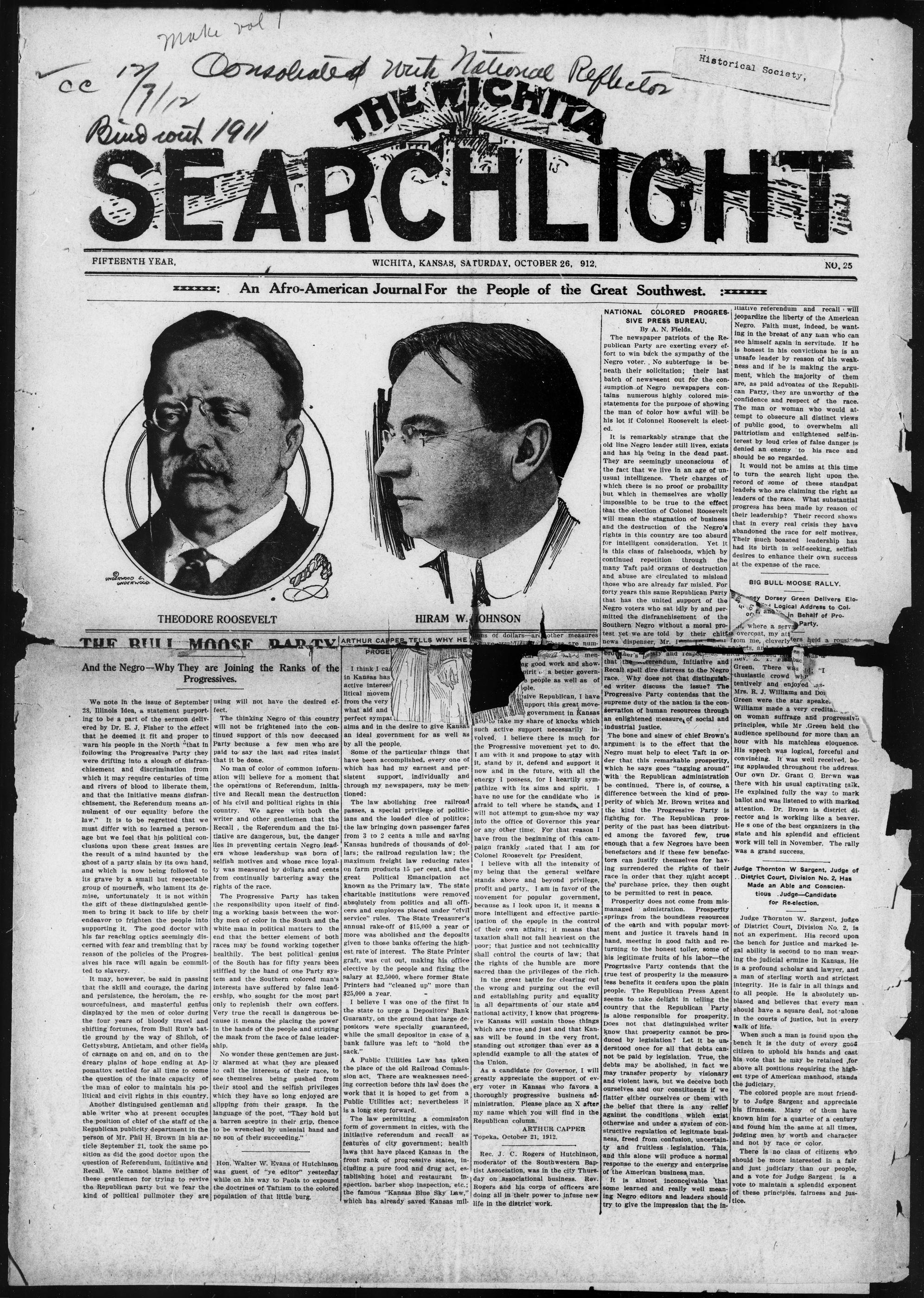
THEODORE ROOSEVELT
And the Negro-Why They a Progr
We note in the issue of September 28, Illinois Idea, a statement purporting to be a part of the sermon delivered by Dr. E. J. Fisher to the effect that he deemed it fit and proper to warn his people in the North "that in following the Progressive Party they were drifting into a slough of disfranchisement and discrimination from which it may require centuries of time and rivers of blood to liberate them, and that the Initiative means disfranchisement, the Referendum means annulment of our equality before the law." It is to be regretted that we must differ with so learned a personage but we feel that his political conclusions upon these great issues are the result of a mind haunted by the ghost of a party slain by its own hand, and which is now being followed to its grave by a small but respectable group of mourners, who lament its demise, unfortunately it is not within the gift of these distinguished gentlemen to bring it back to life by their endeavor to frighten the people into supporting it. The good doctor with his far reaching optics seemingly discerned with fear and trembling that by reason of the policies of the Progressives his race will again be committed to slavery.
It may, however, be said in passing that the skill and courage, the daring and persistence, the heroism, the resourcefulness, and masterful genius displayed by the men of color during the four years of bloody travel and shifting fortunes, from Bull Run's battle ground by the way of Shiloh, of Gettysburg, Antietam, and other fields of carnage on and on, and on to the dreary plains of hope ending at Appomattox settled for all time to come the question of the inate capacity of the man of color to maintain his political and civil rights in this country. Another distinguished gentleman and able writer who at present occupies the position of chief of the staff of the Republican publicity department in the person of Mr. Phil H. Brown in his article September 21, took the same position as did the good doctor upon the question of Referendum, Initiative and Recall. We cannot blame neither of these gentlemen for trying to revive the Republican party but we fear the kind of political pulmotor they are
```markdown
```
FIFTEENTH YEAR.
using will not have the desired effect.
The thinking Negro of this country will not be frightened into the continued support of this now deceased Party because a few men who are paid to say the last sad rites insist that it be done.
No man of color of common information will believe for a moment that the operations of Referendum, Initiative and Recall mean the destruction of his civil and political rights in this country. We agree with both the writer and other gentlemen that the Recall, the Referendum and the Initiative are dangerous, but, the danger lies in preventing certain Negro leaders whose leadership was born of selfish motives and whose race loyalty was measured by dollars and cents from continually bartering away the rights of the race.
The Progressive Party has taken the responsibility upon itself of finding a working basis between the worthy men of color in the South and the white man in political matters to the end that the better element of both races may be found working together healthily. The best political genius of the South has for fifty years been stiffled by the hand of one Party system and the Southern colored man's interests have suffered by false leadership, who sought for the most part only to replenish their own coffers. Very true the recall is dangerous because it means the placing the power in the hands of the people and striping the mask from the face of false leadership.
No wonder these gentlemen are justly alarmed at what they are pleased to call the interests of their race, to see themselves being pushed from their stool and the selfish privileges which they have so long enjoyed are slipping from their grasps. In the language of the poet, "They hold but a barren sceptre in their grip, thence to be wrenched by unlenial hand and no son of their succeeding."
Hon. Walter W. Evans of Hutchinson was guest of "ye editor" yesterday while on his way to Paola to expound the doctrines of Taftism to the colored population of that little burg.
WICHITA, KANSAS, SATURDAY, OCTOBER 26, 912.
HIRAM W. JOHNSON
PROGEL
I think I can in Kansas has active interest lital movement from the very what aid and perfect sympat alms and in the desire to give Kansas an ideal government for as well as by all the people.
Some of the particular things that have been accomplished, every one of which has had my earnest and persistent support, individually and through my newspapers, may be mentioned:
The law abolishing free railroad passes, a special privilege of politicians and the loaded dice of politics; the law bringing down passenger fares from 3 to 2 cents a mile and saving Kansas hundreds of thousands of dollars; the railroad regulation law; the maximum freight law reducing rates on farm products 15 per cent, and the great Political Emancipation act known as the Primary law. The state charitable institutions were removed absolutely from politics and all officers and employees placed under "civil service" rules. The State Treasurer's annual rake-off of $15,000 a year or more was abolished and the deposits given to those banks offering the highest rate of interest. The State Printer graft, was cut out, making his office elective by the people and fixing the salary at $2,5000, where former State Printers had "cleaned up" more than $25,000 a year.
I believe I was one of the first in the state to urge a Depositors' Bank Guaranty, on the ground that large depositors were specially guaranteed, while the small depositor in case of a bank failure was left to "hold the sack."
A Public Utilities Law has taken the place of the old Railroad Commission act. There are weaknesses needing correction before this law does the work that it is hoped to get from a Public Utilities act; nevertheless it is a long step forward. The law permitting a commission form of government in cities, with the initiative referendum and recall as features of city government; health laws that have placed Kansas in the front rank of progressive states, including a pure food and drug act, establishing hotel and restaurant inspection, barber shop inspection, etc.; the famous "Kansas Blue Sky Law," which has already saved Kansas mill
men- ing good work and show- spirit a better govern- er people as well as of people. Iasive Republican, I have support this great move- ing government in Kansas to take my share of knocks which such active support necessarily involved. I believe there is much for the Progressive movement yet to do. I am with it and propose to stay with it, stand by it, defend and support it now and in the future, with all the energy I possess, for I heartily sympathize with its aims and spirit. I have no use for the candidate who is afraid to tell where he stands, and I will not attempt to gum-shoe my way into the office of Governor this year or any other time. For that reason I have from the beginning of this campaign frankly stated that I am for Colonel Roosevelt for President.
I believe with all the intensity of my being that the general welfare stands above and beyond privilege, profit and party. I am in favor of the movement for popular government; because as I look upon it, it means a more intelligent and effective participation of the eople in the control of their own affairs; it means that taxation shall not fall heaviest on the poor; that justice and not technicality shall control the courts of law; that the rights of the humble are more sacred than the privileges of the rich. In the great battle for clearing out the wrong and purging out the evil and establishing purity and equality in all departments of our state and national activity, I know that progressive Kansas will sustain those things which are true and just and that Kansas will be found in the very front, standing out stronger than ever as a splendid example to all the states of the Union.
As a candidate for Governor, I will greatly appreciate the support of every voter in Kansas who favors a thoroughly progressive business administration. Please place an X after my name which you will find in the Republican column.
Rec. J. C. Rogers of Hutchinson, moderator of the Southwestern Baptist Association, was in the city Thursday on associational business. Rev. Rogers and his corps of officers are doing all in their power to infuse new life in the district work.
By A. N. Fields.
The newspaper patriots of the Republican Party are exerting every effort to win back the sympathy of the Negro voter. No subterfuge is beneath their solicitation; their last batch of news sent out for the consumption of Negro newspapers contains numerous highly colored misstatements for the purpose of showing the man of color how awful will be his lot if Colonnel Roosevelt is elected.
It is remarkably strange that the old line Negro leader still lives, exists and has his being in the dead past. They are seemingly unconscious of the fact that we live in an age of unusual intelligence. Their charges of which there is no proof or probability but which in themselves are wholly impossible to be true to the effect that the election of Colonel Roosevelt will mean the stagnation of business and the destruction of the Negro's rights in this country are too absurd for intelligent consideration. Yet it is this class of falsehoods, which by continued repetition through the many Taft paid organs of destruction and abuse are circulated to mislead those who are already far misled. For forty years this same Republican Party that has the united support of the Negro voters who sat idly and permitted the disfranchisement of the Southern Negro without a moral protest yet we are told by their chief news dispenser, Mr. L
brother's bessy and responding that the延缓um, Initiative and Recall spell dire distress to the Negro race. Why does not that distinguished writer discuss the issue? The Progressive Party contends that the supreme duty of the nation is the conservation of human resources through an enlightened measure of social and industrial justice.
The bone and sinew of chief Brown's argument is to the effect that the Negro must help to elect Taft in order that this remarkable prosperity, which he says goes "tagging around" with the Republican administration be continued. There is, of course, a difference between the kind of prosperity of which Mr. Brown writes and the kind the Progressive Party is fighting for. The Republican prosperity of the past has been distributed among the favored few, true enough that a few Negroes have been benefactors and if these few benefactors can justify themselves for having surrendered the rights of their race in order that they might accept the purchase price, they then ought to be permitted to rest in peace.
Prosperity does not come from mismanaged admistration. Prosperity springs from the boundless resources of the earth and with popular movement and justice it travels hand in hand, meeting in good faith and returning to the honest toller, some of his legitimate fruits of his labor—the Progrtissive Party contends that the true test of prosperity is the measureless benefits it confers upon the plain people. The Republican Press Agent seems to take delight in telling the country that the Republican Party is alone responsible for prosperity. Does not that distinguished writer know that prosperity cannot be produced by legislation? Let it be understood once for all that debts cannot be paid by legislation. True, the debts may be abolished, in fact we may transfer property by visionary and violent laws, but we deceive both ourselves and our constituents if we flatter either ourselves or them with the belief that there is any relief against the conditions which exist otherwise and under a system of constructive regulation of legitimate business, freed from confusion, uncertainty and fruitless legislation. This, and this alone will produce a normal response to the energy and enterprise of the American business man.
It is almost inconceivable that some learned and really well meaning Negro editors and leaders should try to give the impression that the in-
NO.25
intative referendum and recall will jeopardize the liberty of the American Negro. Faith must, indeed, be wanting in the breast of any man who can see himself again in servitude. If he is honest in his convictions he is an unsafe leader by reason of his weakness and if he is making the argument, which the majority of them are, as paid advocates of the Republican Party, they are unworthy of the confidence and respect of the race. The man or woman who would attempt to obsecure all distinct views of public good, to overwhelm all patriotism and enlightened self-interest by loud cries of false danger is denied an enemy to his race and should be so regarded. It would not be amiss at this time to turn the search light upon the record of some of these standpat leaders who are claiming the right as leaders of the race. What substantial progress has been made by reason of their leadership? Their record shows that in every real crisis they have abandoned the race for self motives. Their much boasted leadership has had its birth in self-seeking, selfish desires to enhance their own success at the expense of the race.
any Dorsey Green Delivers Elo-
gant Logical Address to Colo-
rists and in Behalf of Pro-
Green. There was id. "I thuslastic crowd whi tentively and enjoyed as-Mrs. R. J. Williams and Do. Green were the star speaker. Williams made a very credita on woman suffrage and progressive principles, while Mr. Green held the audience spellbound for more than an hour with his matchless eloquence. His speech was logical, forceful and convincing. It was well received, being applauded throughout the address. Our own Dr. Grant G. Brown was there with his usual captivating talk. He explained fully the way to mark ballot and was listened to with marked attention. Dr. Brown is district director and is working like a beaver. He's one of the best organizers in the state and his splendid and efficient work will tell in November. The rally was a grand success.
Judge Thornton W Sargent, Judge of . District Court, Division No. 2, Has
Judge Thornton W. Sargent, judge of District Court, Division No. 2, is not an experiment. His record upon the bench for justice and marked legal ability is second to no man wearing the judicial ermine in Kansas. He is a profound scholar and lawyer, and a man of sterling worth and strictest integrity. He is fair in all things and to all people. He is absolutely unbiased and believes that every man should have a square deal, not alone in the courts of justice, but in every walk of life.
When such a man is found upon the bench it is the duty of every good citizen to uphold his hands and cast his vote that he may be retained for above all positions requiring the highest type of American manhood, stands the judiciary.
The colored people are most friendly to Judge Sargent and appreciate his firmness. Many of them have known him for a quarter of a century and found him the same at all times, judging men by worth and character and not by race or color.
There is no class of citizens who should be more interested in a fair and just judiciary than our people, and a vote for Judge Sargent, is a vote to maintain a splendid exponent of these principles, fairness and justice.
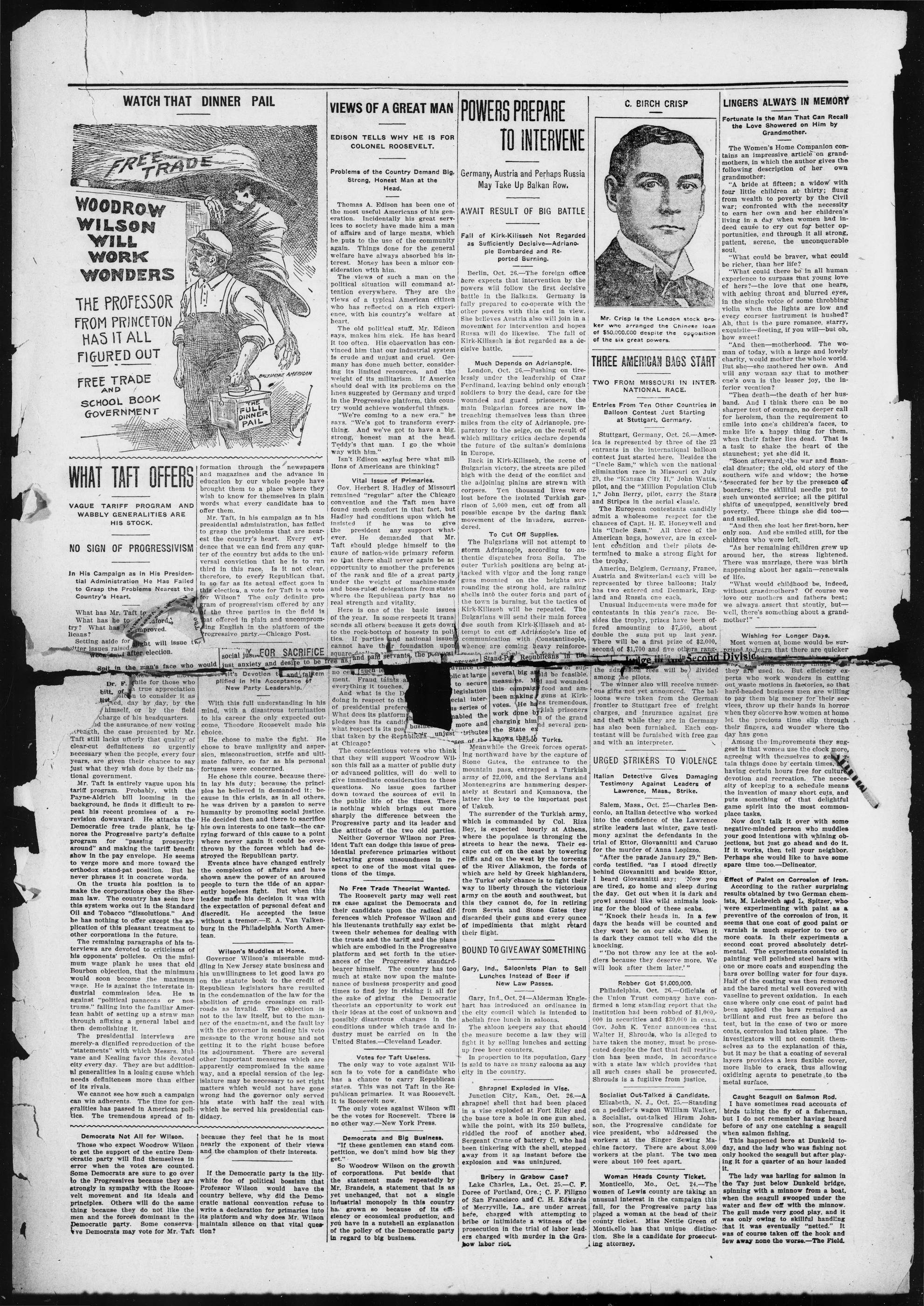
FREE TRADE
WOODROW
WILSON
WILL
WORK
WONDERS
THE PROFESSOR
FROM PRINCETON
HAS IT ALL
FIGURED OUT
FREE TRADE
AND
SCHOOL BOOK
GOVERNMENT
BALTHORNE AMERICAN
THE FULL
DINNER
PAIL
VAGUE TARIFF PROGRAM AND WABBLY GENERALITIES ARE HIS STOCK.
NO SIGN OF PROGRESSIVISM
In His Campaign as In His Presidential Administration He Has Failed to Grasp the Problems Nearest the Country's Heart.
Setting aside for light will issue
after issues raise after election.
Dr. F. guile for those who bitt, alown to appreciate appreciation as list, sed, day by day, by the himself, or by the field charge of his headquarters.
And the assurance of new voting strength, the case presented by Mr. Taft still lacks utterly that quality of clear-cut definiteness so urgently necessary when the people, every four years, are given their chance to say just what they wish done by their national government.
Mr. Taft is entirely vague upon his tariff program. Probably, with the Payne-Aldrich bill looming in the background, he finds it difficult to repeat his recent promises of a reevision downward. He attacks the Democratic free trade plank, he ignores the Progressive party's definite program for "passing prosperity and" making the tariff benefit show in the pay envelope. He seems to verge more and more toward the orthodox stand-pat position. But he never phrases it in concrete words.
On the trusts his position is to make the corporations obey the Sherman law. The country has seen how this system works out in the Standard Oil and Tobacco "dissolutions." And he has nothing to offer except the application of this pleasant treatment to other corporations in the future.
The remaining paragraphs of his interviews are devoted to criticisms of his opponents' policies. On the minimum wage plank he uses that old Bourbon objection, that the minimum would soon become the maximum wage. He is against the interstate industrial commission idea. He is against "political panaceas or nostrums," falling into the familiar American habit of setting up a straw man through affixing a general label and then demolishing it.
The presidential interviews are merely-a dignified reproduction of the "statements" with which Messrs. Mulvane and Kealing favor this devoted city every day. They are but additional generalities in a losing cause which needs definiteness more than either of its rivals.
We cannot see how such a campaign can win adherents. The time for generalities has passed in American politics. The tremendous spread of in-
Democrats Not All for Wilson.
Democrats Not All for Wilson.
Those who expect Woodrow Wilson to get the support of the entire Democratic party will find themselves in error when the votes are counted.
Some Democrats are sure to go over to the Progressives because they are strongly in sympathy with the Roosevelt movement and its ideals and principles. Others will do the same thing because they do not like the men and the forces dominant in the Democratic party. Some conservative Democrats may vote for Mr. Taft
formation through the newspapers and magazines and the advance in education by our whole people have brought them to a place where they wish to know for themselves in plain words what every candidate has to offer them.
Mr. Taft, in his campaign as in his presidential administration, has failed to grasp the problems that are nearest the country's heart. Every evidence that we can find from any quarter of the country but adds to the universal conviction that he is to run third in this race. Is it not clear, therefore, to every Republican that, in so far as its actual effect goes in this election, a vote for Taft is a vote for Wilson? The only definite program of progressivism offered by any of the three parties in the field is not offered in plain and uncompromising English in the platform of the progressive party—Chicago Post.
It's Devotion to and fallem
plified in His Acceptance of
New Party Leadership.
With this full understanding in his
mind, with a disastrous termination
to his career the only expected outc
come, Theodore Roosevelt made his
choice.
He chose to make the fight. He
chose to brave malignity and asper-
sion, misconstruction, strife and ulti-
mate failure, so far as his personal
fortunes were concerned.
He chose this course, because there in lay his duty; because, the principles he believed in demanded it; because in this crisis, as in all others, he was driven by a passion to serve humanity by promoting social justice. He decided then and there to sacrifice his own interests to one task—the carrying forward of this cause to a point where never again it could be overthrown by the forces which had destroyed the Republican party.
Events since have changed entirely the complexion of affairs and have shown anew the power of an aroused people to turn the tide of an apparently hopeless fight. But when this leader made his decision it was with the expectation of personal defeat and discredit. He accepted the issue without a tremor—E. A. Van Valkenburg in the Philadelphia North American.
Wilson's Muddles at Home
Wilson's Muddies at Home.
Governor Wilson's miserable muddling in New Jersey state business and his unwillingness to let good laws go on the statute book to the credit of Republican legislators have resulted in the condemnation of the law for the abolition of grade crossings on railroads as Invalid. The objection is not to the law itself, but to the manner of the enactment, and the fault lay with the governor in sending his veto message to the wrong house and not getting it to the right house before its adjournment. There are several other important measures which are apparently compromised in the same way, and a special session of the legislature may be necessary to set right matters which would not have gone wrong had the governor only served his state with half the zeal with which he served his presidential candidacy.
because they feel that he is most nearly the exponent of their views and the champion of their interests.
If the Democratic party is the lily-white foe of political bossism that Professor Wilson would have the country believe, why did the Democratic national convention refuse to write a declaration for primaries into its platform and why does Mr. Wilson maintain silence on that vital question?
VIEWS OF A GREAT MAN
EDISON TELLS WHY HE IS FOR
COLONEL ROOSEVELT.
Problems of the Country Demand Bigi Strong, Honest Man at the
Thomas A. Edison has been one of the most useful Americans of his generation. Incidentally his great services to society have made him a man of affairs and of large means, which he puts to the use of the community again. Things done for the general welfare have always absorbed his interest. Money has been a minor consideration with him. The views of such a man on the political situation will command attention everywhere. They are the views of a typical American citizen who has reflected on a rich experience, with his country's welfare at heart.
The old political stuff, Mr. Edison says, makes him sick. He has heard it too often. His observation has convinced him that our industrial system is crude and unjust and cruel. Germany has done much better, considering its limited resources, and the weight of its militarism. If America should deal with its problems on the lines suggested by Germany and urged in the Progressive platform, this country would achieve wonderful things. "We're coming to a new era," he says. "We's got to transform everything. And we've got to have a big, strong, honest man at the head. Teddy's that man. I go the whole way with him." Isn't Edison saying here what millions of Americans are thinking?
Vital Issue of Primaries.
Gov. Herbert S. Hadley of Missouri remained "regular" after the Chicago convention and the Taft men have found much comfort in that fact, but Hadley had conditions upon which he insisted if he was to give the president any support whatever. He demanded that Mr. Taft should pledge himself to the cause of nation-wide primary reform so that there shall never again be an opportunity to smother the preference of the rank and file of a great party under the weight of machine-made and boss-rules delegations from states where the Republican party has no real strength and vitality.
Here is one of the basic issues of the year. In some respects it transcends all others because it gets down to the rock-bottom of honesty in politics. If parties and national issues cannot have their foundation upon square and pain servants, the provincial
ment. Fraud taints all
everything it touches.
And what is the D
doing in respect to the
of presidential prefer
What does its platform
pledges has its candy
what respect is its nose
The conscientious voters who think that they will support Woodrow Wilson this fall as a matter of public duty or advanced politics, will do well to give immediate consideration to these questions. No issue goes farther down toward the sources of evil in the public life of the times. There is nothing which brings out more sharply the difference between the Progressive party and its leader and the attitude of the two old parties. Neither Governor Wilson nor President Taft can dodge this issue of presidential preference primaries without betraying gross unsoundness in respect to one of the most vital questions of the times.
No Free Trade Theorist Wanted.
The Roosevelt party may well rest its case against the Democrats and their candidate upon the radical differences which Professor Wilson and his lieutenants truthfully say exist between their schemes for dealing with the trusts and the tariff and the plans which are embodied in the Progressive platform and set forth in the utterances of the Progressive standard-bearer himself. The country has too much at stake now upon the maintenance of business prosperity and good times to find joy in risking it all for the sake of giving the Democratic theorists an opportunity to work out their ideas at the cost of unknown and possibly disastrous changes in the conditions under which trade and industry must be carried on in the United States.—Cleveland Leader.
Votes for Taft Useless
The only way to vote against Wilson is to vote for a candidate who has a chance to carry Republican states. This was not Taft in the Republican primaries. It was Roosevelt. It is Roosevelt now.
The only votes against Wilson will be the votes for Roosevelt. There is no other way.—New York Press.
Democrats and Big Business.
"If these gentlemen can stand competition, we don't mind how big they get."
So Woodrow Wilson on the growth of corporations. Put beside that the statement made repeatedly by Mr. Brandels, a statement that is as yet unchanged, that not a single industrial monopoly in this country has grown so because of its efficiency or economical production, and you have in a nutshell an explanation of the policy of the Democratic party in regard to big business.
POWERS PREPARE TO INTERVENE
Germany, Austria and Perhaps Russia May Take Up Balkan Row.
AWAIT RESULT OF BIG BATTLE
Fall of Kirk-Killisshe Not Regarded as Sufficiently Decisive—Adriano-ple Bombarded and Reported Burning.
Berlin, Oct. 26.—The foreign office here expects that intervention by the powers will follow the first decisive battle in the Balkans. Germany is fully prepared to co-operate with the other powers with this end in view. She believes Austria also will join in a movement for intervention and hopes Russia will do likewise. The fall of Kirk-Killisshe is not regarded as a decisive battle.
Much Depends on Adrianople.
London, Oct. 26.—Pushing on tirelessly under the leadership of Czar Ferdinand, leaving behind only enough soldiers to bury the dead, care for the wounded and guard prisoners, the main Bulgarian forces are now intrenching themselves less than three miles from the city of Adrianople, preparatory to the seige, on the result of which military critics declare depends the future of the sultan's dominions in Europe.
Back in Kirk-Killisseh, the scene of Bulgarian victory, the streets are piled high with the dead of the conflict and the adjoining plains are strewn with corpses. Ten thousand lives were lost before the isolated Turkish garrison of 5,000 men, cut off from all possible escape by the daring flank movement of the invaders, surrendered.
To Cut Off Supplies.
10 Cut On Supplies.
The Bulgarians will not attempt to storm Adrianople, according to authentic dispatches from Sofia. The outer Turkish positions are being attacked with vigor and the long range guns mounted on the heights surrounding the strong hold, are raining shells into the outer forts and part of the town is burning, but the tactics of Kirk-Killisseh will be repeated. The Bulgarians will send their main forces due south from Kirk-Killisseh and attempt to cut off Adrianople's line of communication with Constantinople, whence are coming heavy reinforcements.
or sup several big and old be feasible, measures. Melt and wounded this campaign food and ambeen making a guns at Kirk votes. He has tremendous, work done by kishish prisoners charging him of the grand State ex
advance the public at large to secure legislation special interests series of enabled the more and just attributes of the think Will-ful to these other in here meanwhile the Greek forces operating northward have by the capture of Stone Gates, the entrance to the mountain pass, entrapped a Turkish army of 22,000, and the Servians and Montenegrins are hammering desperately at Scutari and Kumanova, the latter the key to the important post of Uskub.
The surrender of the Turkish army, which is commanded by Col. Riza Bey, is expected hourly at Athens, where the populace is thronging the streets to hear the news. Their escape cut off on the east by towering cliffs and on the west by the torrents of the River Aliakmon, the fords of which are held by Greek highlanders, the Turks' only chance is to fight their way to liberty through the victorious army on the south and southwest, but this they cannot do, for in retiring from Servia and Stone Gates they discarded their guns and every ounce of impediments that might retard their flight.
BOUND TO GIVEAWAY SOMETHING
Gary, Ind., Saloonists Plan to Sell Lunches instead of Beer if New Law Passes.
Gary, Ind., Oct. 24—Alderman Englehart has introduced an ordinance in the city council which is intended to abolish free lunch in saloons.
The saloon keepers say that should the measure become a law they will fight it by selling lunches and setting up free beer counters.
In proportion to its population, Gary is said to have as many saloons as any city in the country.
Shrapnel Exploded in Vise.
Junction City, Kan., Oct. 26—A shrapnel shell that had been placed in a vise exploded at Fort Riley and the base tore a hole in one gun shell, while the point, with its 250 bullets, riddled the roof of another shed. Sergeant Crane of battery C, who had been tinkering with the shell, stepped away from it an instant before the explosion and was uninjured.
Bribery in Grabow Case?
Lake Charles, La., Oct. 25—C. F. Doree of Portland, Ore.; C. F. Filligno of San Francisco and C. H. Edwards of Merryville, La., are under arrest here, charged with attempting to bribe or intimidate a witness of the prosecution in the trial of labor leaders charged with murder in the Grabow labor riot
J. B.
Mr. Crisp is the London stock broker who arranged the Chinese loan of $50,000,000 despite the opposition of the six great powers.
THREE AMERICAN BAGS START
TWO FROM MISSOURI IN INTERNATIONAL RACE.
Entries From Ten Other Countries in Balloon Contest Just Starting at Stuttgart, Germany.
Stuttgart, Germany, Oct. 26.—America is represented by three of the 23 entrants in the international balloon contest just started here. Besides the "Uncle Sam," which won the national elimination race in Missouri on July 29, the "Kansas City II," John Watts, pilot, and the "Million Population Club 1," John Berry, pilot, carry the Stars and Stripes in the aerial classic.
The European contestants candidly admit a wholesome respect for the chances of Capt. H. E. Honeywell and his "Uncle Sam." All three of the American bags, however, are in excellent condition and their pilots determined to make a strong flight for the trophy.
America, Belgium, Germany, France, Austria and Switzerland each will be represented by three balloons; Italy has two entered and Denmark, England and Russia one each. Unusual inducements were made for contestants in this year's race. Besides the trophy, prizes have been offered amounting to $7,500, about double the sum put up last year. There will be a first prize of $2,000, second of $1,700 and five others rang-
[Lodge $250] In Second the admission fees will be] divided among the pilots.
The winner also will receive numerous gifts not yet announced. The balloons were taken from the German frontier to Stuttgart free of freight charges, and insurance against fire and theft while they are in Germany has also been furnished. Each contestant will be furnished with free gas and with an interpreter.
URGED STRIKERS TO VIOLENCE
Italian Detective Gives Damaging Testimony Against Leaders of Lawrence, Mass., Strike.
Salem, Mass., Oct. 25—Charles Bencordo, an Italian detective who worked into the confidence of the Lawrence strike leaders last winter, gave testimony against the defendants in the trial of Ettor, Glovannitti and Caruso for the murder of Anna Lopizzo.
"After the parade January 29," Bencordo testified, "as I stood directly behind Glovannitti and beside Ettor, I heard Glovannitti say: Now you are tired, go home and sleep during the day. Get out when it is dark and prowl around like wild animals looking for the blood of these scabs.
"Knock their heads in. In a few days the heads will be counted and they won't be on our side. When it is dark they cannot tell who did the knocking.
"Do not throw any ice at the soldiers because they deserve more. We will look after them later!"
Robber Got $1,000,000.
Philadelphia, Oct. 26.—Officials of the Union Trust company have confirmed a long standing report that the institution had been robbed of $1,000,000 in securities and $20,000 in cash. Gov. John K. Tener announces that Walter H. Shrouds, who is alleged to have taken the money, must be prosecuted despite the fact that full restitution has been made, in accordance with a state law which provides that all such cases shall be prosecuted. Shrouds is a fugitive from justice.
Socialist Out-Talked a Candidate
Elizabeth, N. J., Oct. 25.—Standing on a peddler's wagon William Walker, a Socialist, out-talked Hiram Johnson, the Progressive candidate for vice president, who addressed the workers at the Singer Sewing Machine factory. There are about 8,000 workers at the plant. The two men were about 100 feet apart.
Woman Heads County Ticket
Monticello, Mo., Oct. 24.—The women of Lewis county are taking an unusual interest in the campaign this fall, for the Progressive party has placed a woman at the head of their county ticket. Miss Nettle Green of Monticello has that unique distinction. She is a candidate for prosecuting attorney.
LINGERS ALWAYS IN MEMORY
Fortunate Is the Man That Can Recall the Love Showered on Him by Grandmother.
The Women's Home Companion contains an impressive article on grandmothers, in which the author gives the following description of her own grandmother:
"A bride at fifteen; a widow with four little children at thirty; flung from wealth to poverty by the Civil war; confronted with the necessity to earn her own and her children's living in a day when women had indeed cause to cry out for better opportunities, and through it all strong, patient, serene, the unconquerable soul.
"What could be braver, what could be richer than her life?"
"What could there be in all human experience to surpass that young love of hers?—the love that one hears, with aching throat and blurred eyes, in the single voice of some throbbing violin when the lights are low and every coarser instrument is hushed? Ah, that is the pure romance, starry, exquisite—fleeting, if you will—but oh, how sweet!
"And then—motherhood. The woman of today, with a large and lovely charity, would mother the whole world. But she—she mothered her own. And will any woman say that to mother one's own is the lesser joy, the inferior vocation?
"Then death—the death of her husband. And I think there can be no sharper test of courage, no deeper call for heroism, than the requirement to smile into one's children's faces, to make life a happy thing for them, when their father lies dead. That is a task to shake the heart of the staunchest; yet she did it.
"Soon afterward, the war and financial disaster; the old, old story of the southern wife and widow; the home desecrated for her by the presence of boarders; the skillful needle put to such unwonted service; all the pitiful shifts of unequipped, sensitively bred poverty. These things she did too—and smiled.
"And then she lost her first-born, her only son. And she smiled still, for the children who were left
"As her remaining children grew up around her, the stress lightened. There was marriage, there was birth happening about her again—renewals of life.
"What would childhood be, indeed, without grandmothers? Of course we love our mothers and fathers best; we always assert that stoutly, but—well, there's something about a grandmother!"
Wishing for Longer Days.
Most women at home would be surprised to learn that there are quicker Divisional
they are used to. But efficiency experts who work wonders in cutting out waste motions in factories, so that hard-headed business men are willing to pay them big money for their services, throw up their hands in horror when they observe how women at home let the precious time slip through their fingers, and wonder where the day has gone.
Among the improvements they suggest is that women use the clock more, agreeing with themselves to get certain things done by certain times, having certain hours free for culture, devotion and recreation. The necessity of keeping to a schedule means the invention of many short cuts, and puts something of that delightful game spirit into the most common-place tasks.
Now don't talk it over with some negative-minded person who muddles your good intentions with whining objections, but just go ahead and do it. If it works, then tell your neighbor. Perhaps she would like to have some spare time too—Delineator.
Effect of Paint on Corrosion of Iron.
Effect of Paint on Corrosion of Iron. According to the rather surprising results obtained by two German chemists, M. Liebreich and L. Spitzer, who were experimenting with paint as a preventive of the corrosion of iron, it seems that one coat of good paint or varnish is much superior to two or more coats. In their experiments a second coat proved absolutely detrimental. The experiments consisted in painting well polished steel bars with one or more coats and suspending the bars over boiling water for four days. Half of the coating was then removed and the bared metal well covered with vaseline to prevent oxidation. In each case where only one coat of paint had been applied the bars remained as brilliant and rust free as before the test, but in the case of two or more coats, corrosion had taken place. The investigators will not commit themselves as to the explanation of this, but it may be that a coating of several layers provides a less flexible cover, more liable to crack, thus allowing oxidizing agents to penetrate to the metal surface.
Caught Seagull on Salmon Rod.
I have sometimes read accounts of birds taking the fly of a fisherman, but I do not remember having heard before of any one catching a seagull when salmon fishing.
This happened here at Dunkeld today, and the lady who was fishing not only hooked the seagull but after playing it for a quarter of an hour landed it.
The lady was harling for salmon in the Tay just below Dunkeld bridge, spinning with a minnow from a boat, when the seagull swooped under the water and flew off with the minnow.
The gull made very good play, and it was only owing to skillful handling that it was eventually "netted." It was of course taken off the hook and flew away none the worse.—The Field.
The TRUTH ABOUT THE CASE
The Experiences of M. F. Goron, Ex-Chief
of the Paris Detective Police
Edited by Albert Keyzer
NUMBER NINETY-FOUR
(Copyright by J. B. Lippincott Co.)
(Editor's Note.—I made M. Goron's acquaintance some years ago, and was at once struck with his extraordinary power from killing his companion
I took all the papers relating to the Simon case with me, and gathered from them an interesting fact. While under remand, Simon—probably to curry favor with the authorities—had denounced a youth named Berger, as having been concerned in a burglary in the Rue des Saints-Peres, in connection with which three men had been sentenced to long terms of imprisonment. Berger was arrested, but, as it was proved that he had thus far borne an excellent character, and had been fooled by his companions, he got off very lightly.
I had reason to suppose that Berger, knowing it was Simon who had betrayed him, would not be sorry to get even with his enemy, and I therefore decided to have a talk with him, without, of course, letting him know more than was strictly necessary. In fact, I had to be very careful how I went to work.
So far, everything was only supposition. The official report about Simon's death might have been true, and my theory about the likeness between the two men—the financier and the convict—altogether wrong. In that case a mistake would have proved disastrous.
Twelve years had elapsed since the trial of Simon, and it was possible that Berger had disappeared. Fortunately I had a clue. Berger at the time of his arrest, was courting a woman who kept a tobacco-shop in the Latin Quarter, the widow of a man called Samson, for which reason the students had christened her "Delliah."
When I called at the little shop in the Rue Saint-Andre-des-Arts, I found it had changed hands, and in the place of the buxom Madame Delliah was a thin, good-natured looking little woman, fond of gossip. I bought some cigarettes, and she was soon giving me the biography of every member of her family. Then I deflected our talk to Madame Delliah, whereupon the lady-tobacconist looked severe.
"Did you know that person?" she asked.
"No, no," I hurriedly replied, "I have her once or twice.
Why They are Injoining the Bear was engaged to a man—a man—I can't remember his name."
The lady-tobaccoist continued to look severe and, with scorn in her voice, remarked:
"Engaged, engaged—who do you think would have engaged himself to Delilah?"
"I fancy I heard she was going to marry somebody called Burger or Berger."
"Berger, you mean. That jailbird?"
"Yes. What has become of him?"
"When he was discharged from prison he took up photography, and migrated to Belleville; but that's several years ago."
In Belleville, the populous quarter, there are several establishments where the Paris workmen celebrate their weddings, and, according to custom, have themselves photographed on the important day. The restaurant of the Las Saint-Fargeau, at the top of the steep Rue de Belleville, is the most famous place for this kind of entertainments, and I decided to go there first. When I reached the establishment, at two in the afternoon, several wedding-parties had taken position of the garden, and a photographer was busy with his apparatus, while his assistant arranged the groups.
"What is the name of the artist?" I inquired of the proprietor.
"Masson," he replied.
At that moment the assistant passed us to fetch a chair from the house. I stopped him, and asked whether he knew a photographer named Berger.
He eyed me curiously.
"My name is Berger."
I had reason to congratulate myself on my luck. And, looking at the man, I detected a likeness to his portrait I had seen at the Prefecture.
I waited till the rush of work was over, and then beckoned to him. When I told him who I was, he frowned.
"M. Goron," he exclaimed, "I hoped this horrible affair was forgotten. I am earning my living honestly. Why am I again to be troubled?"
"You have nothing to fear, my good fellow. Your affair, as you call it, is dead and buried. All I ask you is to call on me, to-morrow at half-past ten. I have a question to put to you."
"All right, sir," he sighed.
On my return to the office I sent a note to Charles Vernet, with the request to come to me the next morning at eleven, as I wanted some more information from him regarding the Belgian swindler.
At half-past ten, punctually, Berger was announced.
"Berger," I began, "you need not look so miserable. I give you my word nobody will hurt you."
He smiled faintly.
"I want you to go into the adjoining room and wait for me."
A few minutes past eleven Vernet was introduced. I apologized for troubling him again, and handed him a
(Editor's Note.—I made M. Goron's acquaintance some years ago, and was at once struck with his extraordinary powers of observation, his keen-wittedness, and his devouring energy in the discharge of his difficult duties. For it must be remembered that the Chief of the Paris Detective Police possessed power and is allowed a certain discretion—except of course, when a crime has been committed—to save innocent persons the disgrace of a public scandal.
A few months ago I was smoking a pipe in his study, a room hung with trophies—a museum of crime. I saw him take up cover with their bound volume, the pages covered with their photographs, the portraits and curious-looking drawings. "This is my diary," he began, but suddenly stopped when he saw me start.
"Yes, it is my diary," he repeated; "but—what's the trouble?"
Your diary? And you never thought of it. "No," he corrupted with a smile; "the fact is, here are all my impressions, and certain facts—"
I did not even know the end of the sentence; I took up the book and began reading at once; and the more I read the more I marveled. The next morning we commenced work, and this series is the result.—A. K.)
HE BELGIAN Government had demanded the extradition of the swindler Karstens, and, for purposes of identification, I had asked the people who had dealings with him to
IE BELGIAN Government had demanded the extradition of the swindler Karstens, and, for purposes of identification, I had asked the people who had dealings with him to
come to my office.
Among those who called upon me was Charles Vernet, a financier, and, while I listened to the evidence he gave in a clear, concise manner, the conviction stole upon me that I had met him before under different circumstances. But where?—when? Although I have an excellent memory for faces, his features were not familiar to me; yet his general appearance, the way he raised his right hand when he spoke, roused old recollections.
"Who is he?" I inquired the next day of the police commissary in M. Charles Vernet's district.
"Who is he?" repeated my friend, with a touch of surprise in his voice. "My dear Goron, don't you really know Charles Vernet?"
And the Negro—
he is a kinder, with plenty
of money; but I know nothing about
him."
He shrugged his shoulders.
He shrugged his shoulders.
"Look here, Coron, I never know when you are making fun of anybody; but if you put the question to me seriously, let me tell you that Charles Vernet is not only rich, but bears a good reputation on the Bourse, and is received everywhere."
"How long has he been in Paris?" "About ten years. He came here with a large fortune made at the Cape, and has doubled it since."
"Who is he?" I again asked myself when I went to bed.
For days and days the man's face seemed to follow me. I mentally passed in review the various persons I had met in the course of my career, without being able to locate him. Yet I felt certain I had seen him when his name was not Charles Vernet.
I took out my journal, looking over the cases with which I had been connected since I became chief of the detective police. And still no trace of him.
I worked my way back to the days when I was assistant to M. Clement, at the Prefecture, and police commission in the Pantin Quarter, until I came upon the murder of Moullin, the notary's clerk, by a fellow called Simon. And then I paused; for it suddenly dawned upon me that Simon was the man I must have had in my mind when I saw Charles Vernet.
Moulin lived in the Rue des Abbesses, and he and Simon were friends. One night a lodger, occupying a room below Moulin's, was awakened by the noise of a scuffle overhead, and, going to the rescue, met a man hurrying past him. Moulin was lying on his bed stabbed to the heart. When Simon was arrested the next day, the lodger recognized him as the man he had seen on the stairs. Simon, who had already been implicated in several unpleasant affairs, never admitted his guilt; and, in the absence of direct proofs, the jury brought in a verdict by which he escaped the guillotine, but was sentenced to twenty years' penal servitude.
I inquired at the Prefecture, where I learned that Simon and a man called Aymard had planned to escape from Cayenne. Aymard had succeeded in getting away, while Simon, his face battered in and his body covered with wounds, was found in a ditch. His identity had been disclosed by his jacket, which bore the number "94." The report of Simon's death did not remove my doubts. But, as in the face of the official statement I could not well apply to the authorities for assistance, I determined to try to solve the problem myself.
If my theory was right—that Charle Vernet and Simon were the same person—it must have been Simon who placed the telltale jacket with the number 94 on the body of Aymard, no doubt, he had murdered to insure his own safety. This trick had been performed several
Is This meant for a Joke, he remarked.
few documents relative to the Karstens affair. While he was reading them I went to Berger.
The small room where I had left him, and to which nobody had access, opened into my office. In the door was a little hole.
"You see that hole?" I asked.
"Yes, sir."
"Put your eye to it, and look carefully at the gentleman inside. When he is gone I shall call you."
My conversation with Charles Vernet did not last many minutes; and the moment he had left I went to Berger.
He stared at me like one in a dream.
"Well, Berger"
He remained silent for a while, and then shook his head.
"Who is he?" he said at last.
"That is the very question I wanted to put to you."
He sat, deep in thought, one hand playing with his hat, turning it mechanically around.
"Who is he, and why did you show him to me?" he asked again.
I remained silent.
"M. Goron," he cried excitedly, "you have awakened in me a feeling I had managed to smother. You know my history. You know how I was dragged into the affair, and you know the name of the villain who brought the trouble on my head. When I was charged from Gailon I had but one idea—to be avenged on Simon. And when I heard his body had been found in Cayenne, I thought he still might have escaped—he is so artful. Then I looked at every man in the streets, and I fancied I saw Simon. At last it became such an obsession that I felt I was growing mad under the strain, and I fought hard against it, until Simon's face ceased to haunt me. And, now, to-day, this feeling has returned in all its intensity. Why?"
"Yes—why?"
"It is the sight of the man that did it. He is not Simon. He looks quite different. Yet, something in his man-
"Is this meant for a J
ner, in the way he holds himself, reminds me of him. Who is he?
"That is none of your business. Now, go home and think no more about it. I will give you an introduction to one of my friends who can put a lot of work in your way."
Berger's face brightened.
"Thank you, M. Goron; you don't know the struggle I am having."
"You will get on better now. Here is my card. And—not a word about this interview."
Berger had strengthened my suspicions, and the moment had arrived for the decisive trial. I had a difficult part to play, but I felt equal to it.
Charles Vernet entertained frequently in his tastefully furnished apartment in the Rue de la Faianderie. He also went much into society, and was a constant guest at the house of Madame S——, the well-known sculptor, at whose receptions the elite of the artistic and literary world congregated.
Madame S——, a charming hostess, and one of the most fascinating of women, had often invited me to these gatherings, but I never found the time to attend them. Now, however, I made up my mind to go to the soiree she was giving at the end of the month, and I called on my friend, Camille L——, who, I knew, helped her with them.
"Camille," I said, "I want you to ask me to luncheon with Madame S——, and also to secure me an invitation to her reception on the 28th."
---
"Nothing easier," said Camille.
Two days later I received an invitation to lunch with him and Madame S——, at Durand's. When coffee was served, Camille turned the conversation to the soiree.
"I suppose," he said, "you will, as usual, have an 'All Paris' assembly, including the financial swells?"
"Oh, the financial swells," laughed Madame S——, "are always eager to meet celebrities."
And she mentioned the names of her guests. Charles Vernet was among them.
"Why don't you invite our friend here?" asked Camille.
"What is the good?" pouted the lady. "He never comes."
"Try him again."
"Very well. M. Goron, will you give me the pleasure of your company?"
"It will be an honor to me, madame."
Madame S—— clapped her hands with joy.
"I am much obliged to you, M. Goron. And I want you to contribute your share to the night's entertainment. Cannot you tell us something interesting?"
"A lecture?"
"Why not? That would be splendid."
"I doubt whether it would amuse your guests; but possibly I may find something else to suit their jaded palates. And, if it is not indiscreet on my part, will you allow me to bring my young nephew? He is here on a visit."
"By all means; I shall be delighted."
The eventful evening arrived, and I drove up to Madame S—'s with a parcel carefully wrapped in brown paper, which I left down-stairs in charge of one of the servants. As to my nephew, nobody would have guessed that the good-looking, well-dressed young man, with the gardenia in his buttonhole, was a smart de-
Joke, he remarked.
tective in whom I placed absolute reliance.
When I entered the salons the guests had nearly all arrived. I recognized Pailleron, Lucien March of the illustration, Alphonse Daudet, Melissonier, Puvis de Chavannes, Lamoureaux, Francisque Sarcey, Benjamin Constant, Sardon, actors and actresses from the leading theaters, famous scientists—a brilliant crowd.
There was some excellent music, and then a long-haired gentleman unfolded the mysteries of the cinematograph—at that time quite a novelty. A professor from the Sorbonne showed us a new e'cctrometer; and a Societaire from the Comedie-Française gave some recitations.
I was sitting in a quiet corner, watching Charles Vernet deep in conversation with three or four Stock Exchange men, when Madame came toward me, both hands extended.
"Dear M. Goron," she cried, "it is now your turn."
And, taking my arm, she led me to the center of the room. My friend Camille asked for silence for the hostess, who said:
"M. Goron, whom we are all glad to welcome here, has promised to give us some of his experiences. It is a surprise I kept in store for you."
Loud applause followed. A small table with the traditional glass of water was brought for me; the ladies sat in a semicircle, the gentlemen formed the background.
"Ladies and gentlemen," I began, when silence was restored, "our charm-
---
ing hostess has told you I would relate some of my experiences. I have no such intention, for the simple reason that you all know more about them than I do myself. Newspaper reporting has become one of the fine arts, and no sooner is a crime committed than the papers bring the fullest details. Nay, the up-to-date journalist seems even to have the gift of prophecy; for many a time I read of burglaries and attempted murders that have not yet occurred. I therefore, thought that instead of giving you narratives offering but little interest, I would draw your attention to the curious evolution which the detective's profession, like everything nowadays, has undergone.
"Years ago, the man whose duty it is to fight the enemies of society had his own powers to rely upon. Between him and the criminal it was skill against skill, art against art. Then came the modern inventions—railways, steamers, the telegraph, the telephone—and matters grew worse for the detective. Alas! it was the murderers, the forgers, who had the advantage, inashnuch as they could steal a long march upon Nemesis, and get their accomplices to use the telegraph and the telephone for their benefit.
"The question, therefore, was to discover a system by which society, and not its foes, would reap the advantage. Ladies and gentlemen, this system has been found, and the man to whom we owe it, and whose name will go down to posterity, is M. Bertillon."
I undid the parcel which my "nephew," at my request, had brought upstairs.
"This box," I continued, "contains the instruments used in the anthropometrical department for the identification of those who, having previously fallen into the hands of the police, expect to escape detection by changing their names, or altering, as they think, their appearance."
num- news dispenser, mr. men- bro desty and
Having explained to the company the practical working of the system, and how the little Instruments are applied to the head and fingers, I said: "With your kind permission, I will now conclude with a practical demonstration, which will leave to some of you a little souvenir of my lecture. As I had already the honor to explain, the measurements of the incriminated person are put down on a card, to which his photograph is affixed, and thus we possess the infallible means of discovering, at a moment's notice, the identity of the person arrested. It is a net through whose meshes nothing can slip. I have brought some of these cards with me, and shall be happy to take the measurement of any lady or gentlemen, and present them with the card."
I never saw such excitement. Dozens of charming women made a rush for me, and sweet voices cried.
"Measure me, please, M. Gordon.
"One moment, ladies," I called out,
"the mistress of the house first."
Madame S—— came promptly forward, and, after I had attended to her and a number of ladies, my "nephew" filling up the cards, I raised my hand.
"And now the gentlemen!"
Sarcey was the first to present himself. Then came Daudet, and other distinguished personages.
All along I had kept my eye on Charles Vernet, who had remained in the background, and now slowly moved toward the door.
"M. Vernet," I said, "don't go away. Have your measurements taken."
---
He hesitated a moment, and then said, with what appeared to me a forced smile:
"No, thank you, I have seen the thing done before."
"Well, I have set my mind upon measuring you. Ladies," I cried, to a couple of American girls, who had been among the first to be operated upon, "please take him into custody and bring him to me."
Amid shouts of laughter they seized him and pulled him toward the table. This time he scowled.
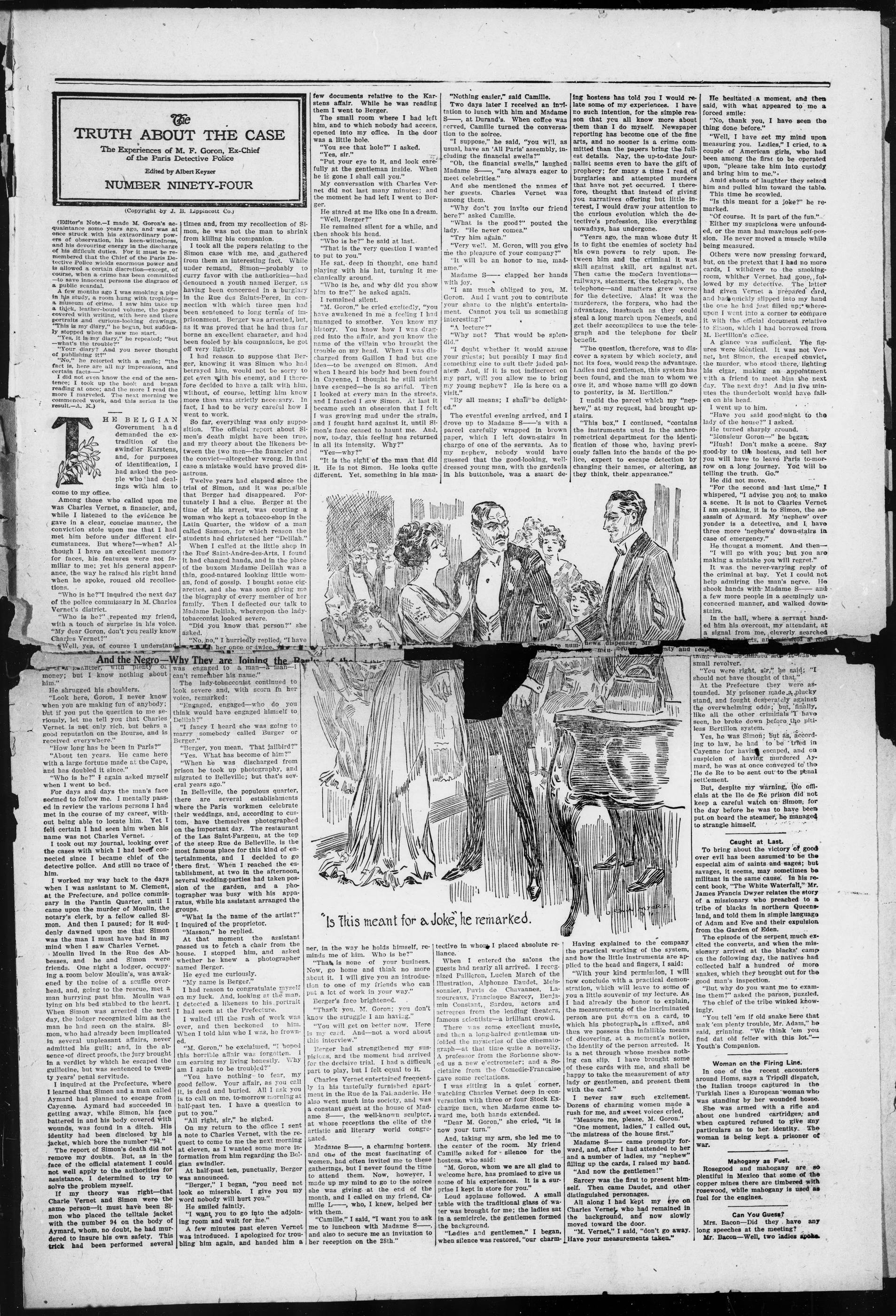
"Is this meant for a joke?" he remarked.
"Of course. It is part of the fun."
Either my suspicions were unfounded, or the man had mavelous self-passion. He never moved a muscle while being measured.
Others were now pressing forward, but, on the pretext that I had no more cards, I withdrew to the smoking room, whither Vernet, had gone, followed by my detective. The letter had given Vernet a prepared card, and had quickly slipped into my hand the one he had just filled up; whereupon I went into a corner to compare it with the official document relative to Simon, which I had borrowed from M. Bertillon's office.
A glance was sufficient. The figures were identical. It was not Vernet, but Simon, the escaped convict, the murder, who stood there, lighting his cigar, making an appointment with a friend to meet him the next day. The next day! And in five minutes the thunderbolt would have fallen on his head.
I went up to him.
"Have you said good-night to the lady of the house?" I asked.
"Monsieur Goron—" he began:
"Hush! Don't make a scene. Say good-by to the hostess, and tell her you will have to leave Paris to-morrow on a long journey. You will be telling the truth. Go."
He did not move.
"For the second and last time," I whispered, "I advise you not to make a scene. It is not to Charles Vernet I am speaking, it is to Simon, the assassin of Aymard. My 'nephew' over yonder is a detective, and I have three more 'nephews' down-stairs in case of emergency."
He thought a moment. And then—"I will go with you; but you are making a mistake you will regret."
It was the never-varying reply of the criminal at bay. Yet I could not help admiring the man's nerve. He shook hands with Madame S—and a few more people in a seemingly unconcerned manner, and walked down-stairs.
In the hall, where a servant handed him his overcoat, my attendant, at a signal from me, cleverly searched
thing which he inflicted it. It was small revolver.
"You were right, sir," he said, "I should not have thought of that."
At the Prefecture they were astounded. My prisoner made a plucky stand, and fought desperately against the overwhelming odds; but, finally, like all the other criminals I have seen, he broke down before the pitiless Bertillon system.
Yes, he was Simon; but as, according to law, he had to be tired in Cayenne for having escaped, and on suspicion of having murdered Aymard, he was at once conveyed to the Ile de Re to be sent out to the penal settlement.
But, despite my warning, the officials at the Ile de Re prison did not keep a careful watch on Simon, for the day before he was to have been put on board the steamer, he managed to strangle himself.
Caught at Last.
To bring about the victory of good over evil has been assumed to be the special aim of saints and sages; but savages, it seems, may sometimes be militant in the same cause. In his recent book, "The White Waterfall," Mr. James Francis Dwyer relates the story of a missionary who preached to a tribe of blacks in northern Queensland, and told them in simple language of Adam and Eve and their expulsion from the Garden of Eden.
The episode of the serpent much excited the converts, and when the missionary arrived at the blacks' camp on the following day, the natives had collected half a hundred or more snakes, which they brought out for the good man's inspection.
"But why do you want me to examine them?" asked the parson, puzzled.
The chief of the tribe winked knowingly.
"You tell 'em if old snake here that mak 'em plenty trouble, Mr. Adam," he said, grinning. "We think 'em you find dat old feller with this lot."—Youth's Companion.
Woman on the Firing Line.
Woman on the
In one of the recent encounters around Homs, says a Tripoll dispatch, the Italian troops captured in the Turkish lines a European woman who was standing by her wounded horse. She was armed with a rifle and about one hundred cartridges; and when captured refused to give any particulars as to her identity. The woman is being kept a prisoner of war.
Mahogany as Fuel.
Rosegood and mahogany are so plentiful in Mexico that some of the copper mines there are timbered with rosewood, while mahogany is used as fuel for the engines.
Can You Guess?
Mrs. Bacon—Did they have any long speeches at the meeting?
Mr. Bacon—Well, two ladies spoke.
RATES OF SUBSCRIPTION:
Strictly in Advance.
One Year (by mail) ..... $1.00
Six Months (by mail) ..... .75
Three Months (by mail) ..... .50
Entered at the Post Office as Second
Glass Mail Matter.
LOCALS
For President.....Theodore Roosevelt
For Vice Pres.....Hiram Johnson
Victor Murdock—Congress.
Thos. C. Wilson, Judge. Div. No. 1.
Thornton W. Sargent, Judge Div.
No. 2.
John W Adams, State Senator.
I. N. Williams, Rep. 66th Dist.
S. T. Jocelyn, Rep. 67th Dist.
J W Anderson, Re. 68th Dist
W E Keller, County Clerk.
J M Chain, County Treasurer
R N Dorr, Reg. of Deeds.
S. S. Hawks, County Attorney.
G. W. C Jones,—Probate Judge.
C. W. Root, Sheriff.
M. M McCollister, Coroner.
J. T. Easter, County Assessor.
D. S. Pence, Supt. Pub Inst.
C. A. Messer, Surveyor.
Chas. D Fazel, Clerk District Court.
S. B. Kernan, County Com. 2nd Dist.
John T. Hessel, County Com. 3rd Dist.
James L Dyer, Judge City Court
J. B. Fishback, Clerk City Court
O. P. Hicklin, Marshal City Court.
Read and reflect over the Searchlight.
Mr. Salis Cox, 610 N. Erie, is much improved at this writing.
Mrs. Vergie Brown, who has been ill, is able to be out again.
Mr. and Mrs. Radford, of 1624 Shersick, is much improved.
The Searchlight will issue twice a week until after election.
Dr. F. O. Miller reports Mrs. Hibbitt, of 1647 N. Mosley, on the sick list.
Don't be ashamed to ask assistance if you don't understand how to mark your ballot.
Mrs. Harvey, of 1565 N. Washington, who has been very sick, is able to be up and about.
The Searchlight reaches three-fourths of the homes of the colored people in Wichita.
Even a common tallow candle can cast "reflections" but—look at the size of the reflector.
We believe Mr. A. Lee Garratt will be able to recover his nerves in his business relation in a few days.
Mrs. Tom Martin of 219 West Ninth, who has been very sick, is now up attending to her household duties.
Read the stand the Progressive party takes in reference to the Negro in this and the subsequent issues of the Searchlight.
Mrs. A. A. Fuller received a telegram yesterday calling her to the bedside of her sister, Mrs. Sam Bledso, of Coffeyville. She left on first train.
Born, to Mr. and Mrs. Levi Shane, of 1705 N. Emporia, October 18, a twelve pound boy. Mother and son doing nice and Mr. Shane is all smiles.
Born, to Mr. and Mrs. Fair, of 415 N. Wichita, a fourteen pound boy, October 8. Mother doing fine. Dr. V. O. Miller attended both.
By the new order of regulations in the Taft cohort, the lieutenant ranks the captain, now someone would say that was backward, but remember that's a Taft cohort.
Mrs. R. J. Williams, of Kansas City, Mo. was in the city in the interest of women's rights. She addressed a large crowd at Masonic hall.
We believe in "Votes for Women." Don't forget to vote "yes" on the little ballot handed you on November 5.
Visit the Progressive Reading room at 615 North Main street, and get some good literature on the "reason why."
Hon. Dorsey Green, one of Kansas City's foremost colored attorneys, was in the city. Thursday on behalf of the Progressive party. He addressed a large crowd of men and women at Masonic hall. He was guest of Dr. G. G. Brown, district manager of the Hall Moose party.
THE NEGRO, REFERENDUM AND RECALL.
By A. N. Fields.
Issued From Colored Western Progressive Press Bureau.
The colored citizens occupy a peplotic. Although in a free country they are not free as other itizens, yet they are forced by circumstances to work out their future and their destiny at the disadvantage of being in competition with free men. They are still to obtain many of the natural and civil rights long ago won and secured by other men. And because of this peculiar struggle for fundamental rights denied to Negroes, the colored citizens are placed in a position in American politics entirely different from that of any other citizen. While the Negro is interested in common with other citizens with the eradication of the evils growing out of the dissipation of our natural and human resources, the problems clustering about the tariff, the trusts, great urban centers, labor and finance, he is more interested and should be in opportunities to obtain more and more for himself those natural and common rights of life and property, which are denied now to him alone. Because of this anomalous position of the Negro in American life, the colored voter has been loyal to party labels, party platforms and party traditions, long after any of them have ceased to be of service to either the Negro or his country. Out of this untoward and unfortunate situation have grown up two classes of so-called Negro leaders, one influenced by money and the other by petty office, but both exist and are supported and forced upon the race, in order that the interests which support their leadership may continue to enjoy the political benefits of the Negro's misplaced confidence and loyalty.
Dual Interest of the Negro in Politics.
Because therefore of the foregoing considerations, the Negro is interested in any new proposition brought before the country as a remedy for any existing evil, more than any other citizen. He not only must ask the question, "How will this proposition affect my countrymen?" but he must ask and decide in addition thereto, "How will this proposition affect me in my efforts for larger liberty and social justice?" Because of the Negro's just anxiety and desire to be free as
of false friends and false leadership, both of whom have advised him against his self and against his interests for more than thirty odd years. One of the important things in this campaign is the phenomenal effort on the part of the Negro's false friends and leaders to continue the old practice, by false alarms, of frightening the colored voters to continue their support to certain interests, by setting forth what will happen to the few rights the Negro now has if he dare to change or alter his political allegiance or policy. To the detriment of the colored people this alarm racket has been successful for a long time. But alas! its days seem numbered now.
The Reason for the Initiative.
One of the things which sound the death knell of the old regime of false leaders and false friends is the principle of the initiative proposed and advocated by the Progressive party in this campaign. The principle of the initiative applies to legislation and is offered by the most advanced political thought of the day for certain evils which now infest our system of legislation. In recent times our State and national politics have fallen under the control of a sinister alliance between crooked "big business" and corrupted political bosses. This alliance has destroyed the system of representative government in the interest of the people as conceived by Washington, Jefferson and Hamilton—the great founders of the nation—and has substituted therefore a government by the bosses and for the bosses and certain favored interests. The real friends and representatives of the people have been helpless and unable to secure such legislation as would be in the interests of the general welfare where these special interests are concerned, because the bosses and representatives of special interests would always either defeat such legislation on the floor or kill it in the tyrannies of the committees.
The Meaning of the Initiative.
The State and National legislative bodies have shown their betrayal of the public welfare in so many instances that it has become necessary in order to subserve the public good and restore the government from its perverted functions to its representative capacity, that the people resume and take into their own hands some of the legislative power which the people originally delegated to legislative bodies, if they would protect themselves in the future from unjust taxations, exactions and financial burdens
which have attended the government of the bosses and the interests. So far the best means suggested of doing this is through the principle of initiative, which proposes to give the people the right and power to start such legislation as the people require in the interest of the general welfare.
The Initiative As An Alarm to the Negro.
One of the ridiculous and absurd features of this campaign is an effort on the part of certain politicians, assisted by misguided and paid advocates whose convictions are handed down or made for this occasion, to mislead the Negro voters of the North to believe that the restoration of the rights of the people in general to protect themselves against the specific evils injected into our politics by crooked "big business" and corrupted bosses, means the disfranchisement of all the colored people of the North. The answers to this argument are numerous. It is sufficient to point out that under the present system of pretended representative government, so stoutly defended in vain by those so resourceful in the manufacture of Negro alarms, the Negroes of the South have been stripped of one constitutional right after another, and under this very sacred system the colored people did not have an opportunity to exercise the power they had in their own defense. So that if there is any system which ought to be repulsive to the Negro as a system, it should be the one under which he has suffered so much throughout the South. It might be well to call attention to the fact that in the States where he Principle of the Initiative is in operation, the Negro has not been disfranchised because of its existence. Moreover, under the present system, theficially, is able to get before any legislative committee upon matters affecting his interest. On the other hand under the initiative the Negro will have the equal power of any citizen of initiating legislation in his own behalf, and of using his increased power to protect himself, at the same time throwing off the race's dependence upon false friends and upon false leaders.
. . .
The Principle of the Referendum.
The Principle of the Referendum is offered as the best solution of another phase of the same problem which has attended the legislative evils. The special interests, through their hired and paid servants, the political bosses, have their "foundation" upon prevent such leeches, to advance the general public at large but the public to secure from time to time legislation as would enable special interests to secure the unseries of enactments which enabled the crooked "big business" more and
crooked big business more than enlarge their unjust tributes levied upon the toiling masses of the people through the machineries of the State and National governments. The people in vain have groaned under their increasing burdens, but they have continued to increase. They have changed one after another their supposed representatives, but one by one they have fallen under the malevolent influence of these same special interests, until finally the people have become convinced that the only way to prevent in the future a continuation of special legislation in the interest of the few and against the many, is to resume and to take unto themselves another phase of the legislative power, formerly delegated to their representatives, through the Principle of the Referendum, which requires that before any law shall become binding it shall be first approved by reference to the people, the rightful source of all political power. Like the initiative, the referendum, instead of disfranchising the Negro or any class of citizens, it greatly enhances the power of all the great body of American citizenship and makes it more and more difficult for any one class to prey upon another.
JUDGE D. A McCANDLESS.
Capable Judge of Probate Court and
Court of Second Tern
Candidate for Second Term. Judge D. A McCandless, the capable and painstaking probate judge of Sedgwick county, is candidate for a second term. He is making his campaign upon his past record which is a good one. He has made a good judge, he has guarded the interests of the widows and orphans whose estates and rights have been before his court for adjudication and probate. He has carefully and judiciously conserved the interests of the tax payers of Sedgwick county. The records of his office are always open for inspection and he courts the closest scrutiny. He is fair and square to everybody. He makes no distinction on account of race or color, he has made good in every way, he is honest, capable and deserving, he has made good and deserves a second term and the voters will not forget to show their appreciation of his splendid record and give him a handsome majority on November 5.
PUBLICATION NOTICE.
In the District Court of .Sedgwick County, Kansas.
Georgia Anderson, Plaintiff,
vs.
Adolphus Anderson, Plaintiff,
PUBLICATION NOTICE.
State of Kansas to Adolphus Anderson,
Defendant:
You are hereby notified that you
have been sued in an action in the
District Court of Sedgwick county,
Kansas, whereby Georgia Anderson is
plaintiff and Adolphus Anderson is
defendant, and that said action was
filed in the clerk's office of said court
on the 22nd day of October, 1912, and
that unless you answer said petition
on or before the 6th day of December,
1912, judgment will be rendered
against you in said action, granting
the plaintiff a divorce.
FRED C. HELM,
Attorney for Plaintiff.
Clerk of Court. First published in the Searchlight on the 26th day of October. 1912.
AN OPEN LETTER From William Allen White.
Emporia, Kan., Oct. 19th. My Dear Sir: Unexpectedly I find that a determined fight is being made upon Arthur Capper. I have known Arthur Capper for thirty years. I have known him and associated with him politically with a great degree of intimacy during these years. He is not a turnover or dodged. He came out squarely for Roosevelt long before the Republican National Convention, and in the primary campaign, after the Republican National Convention, he still reiterated his declaration for Roosevelt, and has given generously to the Roosevelt State campaign. His paper stands openly for Roosevelt and the Progressive movement. He has lent all the strength of his paper and his personal influence to the Progressive cause in this State.
On the other hand Senator Hodges, who made a good Progressive record in the Senate after he ran for Governor, lined up with the reactionaries and took away from the Progressives the organization of the Senate, which carried with it the control of the Senate and thereby defeated many important Progressive measures. Hodges was careful to vote for these good measures himself, but when he lined up the Democrats against the Progressive Republicans and with the Stand-Pod Republicans in the State
seventh big and important Progressive measures. More than that, during all this campaign, Senator Hodges has been making an open bid for stand-pat votes. He has been ridiculing all the work done by Governor Stubbs, and charging him falsely with increasing the State expenditures. Every one knows that the Governor cannot spend one single penny of the State money for State purposes, or that no officer can spend a single penny for any purpose without being authorized by law. And Hodges, as a member of the Ways and Means Committee in the Senate, voted upon every item of increased expenditure, of which he is now complaining. Moreover, if he had voted against these items of increased expenditures, he would be trotting up and down Kansas with the pages of the records showing where he had voted against them.
His plea is an appeal to the ignorant, and it should not deceive Progressive Republicans. It seems to me there is no equal choice for Progressive republicans in this State between Hodges and Capper. Capper is supporting Roosevelt and standing upon the Republican platform which endorses the Progressive work of Kansas during the last eight years. Hodges on the other hand, who claims in one breath to have written many of the Progressive laws, is making a bid for the stand-pat votes, and in the next breath proclaiming that these laws which he made have incerased the taxes
Capper endorses the Progressive National candidate, and the Progressive movement in this state. Hodges is fighting Colonel Rooseveil with all the bitterness he can use, and is trying to destroy the Progressive movement in this State. No good Progressive in either party should vote for Mr. Hodges. He will get the standpat vote in both parties and Mr. Capper is entitled to the Progressive vote in both parties. Truly and sincerely yours.
The Searchlight occupies an uncompromising position on the Bull Moose ticket. Mr. Roosevelt was the logical candidate of the rank and file of the Republican party, the common people of that party gave him a popular decision over Taft and LaFollette; the boss ridden machine, manipulated by the National Committee at Chicago, proceeded to reverse this decision by stealing enough votes from Roosevelt and giving them to Taft. The whole nation is now repudiating this piece of embezzleemnt and on November 5 Mr. Taft will go down for the count.
M. B. H.
Judge Thornton W. Sargent
Judge of the Second Division of the District Co and Republican Candidate for same Office at the Election on November 5. Judge Sargent is Fair, Firm and Fiarless. He Believes in a Square Deal for all Mankind.
Sedgwick county in point of population and resources is one of the most important in the state. Her vast shipping, manufacturing and agricultural interests should be ably protected in the next legislature. The voters of Sedgwick county should see to it that clean, honest and capable men are chosen to guard and conserve the interests of the county in the making and passing of laws next winter. John W. Adams, who aspires to the state senatorship, is no experiment. He is an able attorney, and a man ripe with legislative experience and thoroughly capable of conserving the interests of Sedgwick county in the future, as he has in the past. He is broad-minded and has no pet hobbies.
Judge Thornton
or Judge of the Second
and Republican Candidate
Election on November 5.
Judge Sargent is Fair, he
lives in a Square Deal for
Your Suppo
M. K. T.
SAM J. NOLAN.
Democratic Candidate for County Treasurer.
The candidacy of Sam Nolan for county treasurer is being most favorably received by the voters of Sedgwick county. The office is one of the most important within the gift of county voters Mr. Nolan has lived in Sedgwick county for more than thirty years, and has never held a public office. He is an honest, conscientious business man, fair and square at all times and the highest type of American citizenship. The fact that he is a candidate for office makes no difference to him and adds nothing to his regular courtesy and good fellowship. He is the same genial Sam Nolan at all times. He has many friends among our people, and is the decided favorite and justly so. His forty years' residence has won him an enviable reputation for business acumen and sterling integrity. The people in the county are demanding for such offices as county treasurer, business men who have made a success in their own private business, men who are not continually seeking the public trough. Mr. Nolan is just such a man and no voter will ever have occasion to regret casting his ballot for him, for county treasurer of Sedgwick County.
---
the greatest good to the greatest number is his motto. The people know him and can trust him, he has many friends among all classes. The colored voters feel very kindly towards him, on account of his absolute fairness in all things. He serves alike the whole people, and color or creed make no difference with him. He judges people by their worth and character alone.
While there is really no fear entertained by his friends as to his ultimate success and election, but they are leaving nothing undone toward polling a tremendous majority. John W. Adams is the man for state senator; let our people stand together for a man who has stood by us.
Bron W. Sargent
Division of the District Co-
tate for same Office at the
Firm and Fiarless. He Be-
er all Mankind.
Port Solicited
CLERK of District Court, Republican Candidate for Second Term
"Mr. Fazel hss made good. Give him a second term."—E. Webb, Ex. County Treasurer.
RANSOM BROWN.
County Surveyor and Candidate for Re-Election.
Everybody in Sedgwick county knows Ransom Brown and he knows nearly everybody. There is no question about his knowing more about property-corners, both city and farm, than any other man in the county. He knows his business and executes it well. He is without doubt the best and most proficient county surveyor we ever had. Let us re-elect him.
The colored voters throughout the Southwest are enthusiastic in their support of the Progressive ticket; of the big vote in Wichita Teddy will poll four-fifths of it.
Among the great number of men employed by Arthur Capper are ten colored men. They say Mr. Capper has always been fair and considerate to them. Strains tell which way the wind is blowing.
Congressman Victor Murdock is the type of man we admire. He does not mince words; he's a scrapepr to be admired; he's the embodiment of progressive principles. Let's give Mr. Murdock the biggest majority he ever had. Mr. Murdock, here's to yo'; we are for you stronger than horse radfli.
---