Wisconsin Weekly Advocate
Thursday, January 4, 1900
Milwaukee, Wisconsin
Page text (machine-generated)
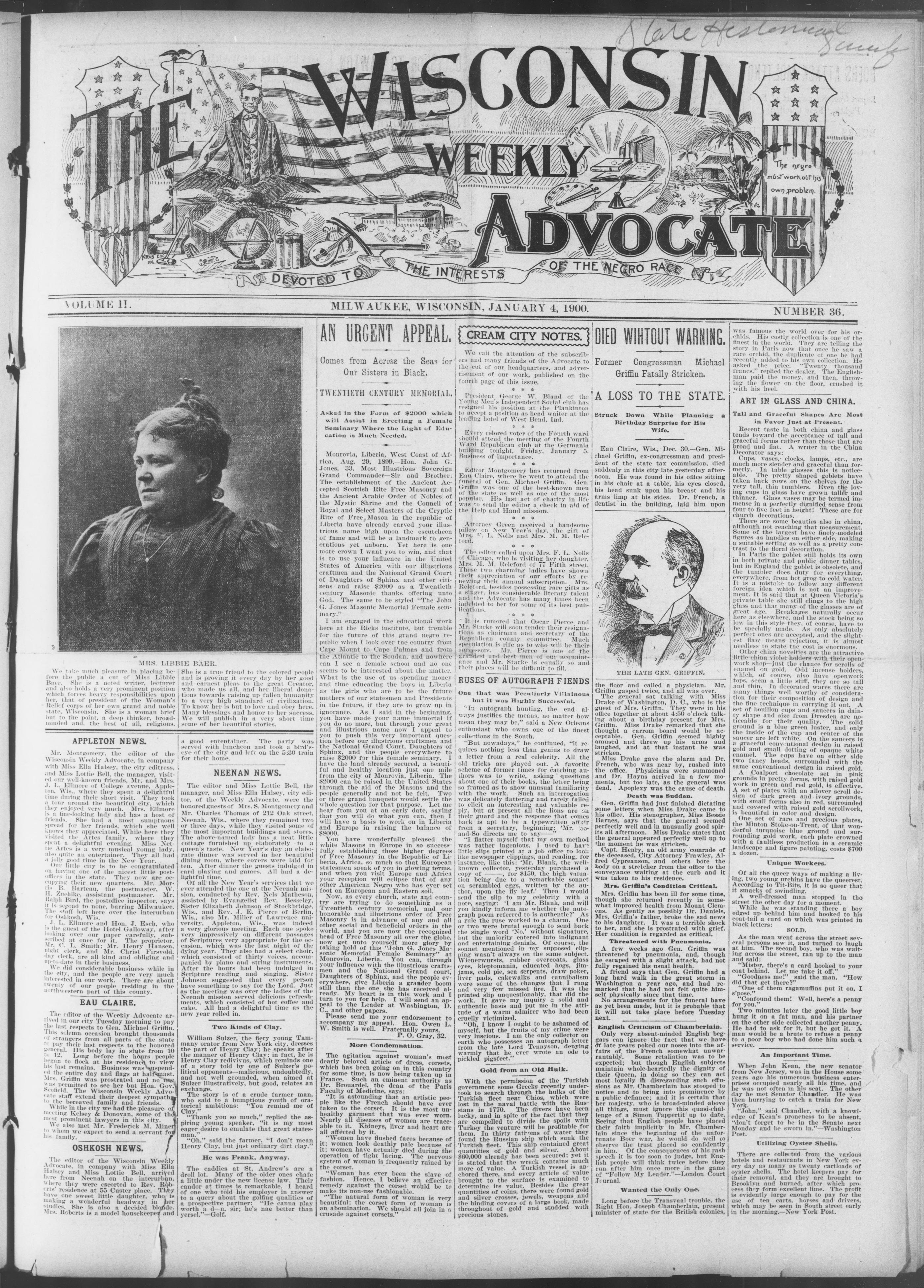
WISCONSIN
WEEKLY
ADVOCATE
DEVOTED TO THE INTERESTS OF THE NEGRO RACE
3
Mary Ann
We take much pleasure in placing before the public a cut of Miss Libbie Baer. She is a noted writer, lecturer and also holds a very prominent position which forces heavy responsibilities upon her, that of president of the Woman's Relief corps of her own grand and noble state, Wisconsin. She is a woman brief but to the point, a deep thinker, broadminded and, the best of all, religious. She is a tru and is prov and earnes who made tions to a very To know he Many bless We will p some of he
Mr. Montgomery, the editor of the Wisconsin Weekly Advocate, in company with Miss Ella Halsey, the city editress, and Miss Lottie Bell, the manager, visited our well-known friends, Mr. and Mrs. J. L. Ellmore of College avenue, Appleton. Wis., where they spent a delightful time during their short visit. They took a tour around the beautiful city, which they enjoyed very much. Mrs. Ellmore is a fine-looking lady and has a host of friends. She had a most sumptuous spread for her friends, which she well knows they appreciated. While here they visited the Artes family, where they spent a delightful evening. Miss Nettie Artes is a very musical young lady, also quite an entertainer. They all had a jolly good time in the New Year.
Our little city is to be congratulated on having one of the nicest little post-offices in the state. They now are occupying their new quarters. Mr. Morris B. Barteau, the postmaster, W. H. Zaehlke, assistant postmaster. Mr. Ralph Bird, the postoffice inspector, says it is second to none, barring Milwaukee. The staff left here over the interurban for Oshkosh, Wis.
J. L. Ellmore and Hon. J. Esch, who is the guest of the Hotel Galloway, after booking over our paper carefully, subscribed at once for it. The proprietor, Mr. C. L. Smith; Mr. Henry Hansen, night clerk, and Mr. Christ Firsvold, day clerk, are all kind and obliging and up-to-date in their business.
We did considerable business while in the city, and the people are very much interested in our work. There are about twenty of our people residing in the northwestern part of this county.
The editor of the Weekly Advocate arrived in our city Tuesday morning to pay the last respects to Gen. Michael Griffin. This solemn occasion brought thousands of strangers from all parts of the state to pay their last respects to the honored general. His body lay in state from 10 to 12. Long before the hours people began to flock at his residence to view his last remains. Business was suspended the entire day and flags at half mast. Mrs. Griffin was prostrated and no one was permitted to see her but Hon. Gov. Scofield. The Wisconsin Weekly Advocate staff extend their deepest sympathy to the bereaved family and friends. While in the city we had the pleasure of meeting Kelsey & Donovan, some of the most prominent lawyers in this city. We also met Mr. Frederick M. Miner to whom we expect to send a servant for his family.
The editor of the Wisconsin Weekly Advocate, in company with Miss Ella Halsey and Miss Lottie Bell, arrived here from Neenah on the interurban, where they were escorted to Rev. Roberts' residence at 55 Custer place. They have one sweet little daughter, who is making a wonderful headway in her studies. She is also a decided blonde. Mrs. Roberts is a model housekeeper and
VOLUME II.
APPLETON NEWS.
EAU CLAIRE.
OSHKOSH NEWS.
She is a true friend to the colored people and is proving it every day by her good and earnest pleas to the great Creator, who made us all, and her liberal donations towards raising up fallen humanity to a very high standard of civilization. To know her is but to love and obey here. Many blessings and honor to her success. We will publish in a very short time some of her beautiful stories.
a good entainer. The party was served with luncheon and took a bird'seye of the city and left on the 5:30 train for their home.
The editor and Miss Lottie Bell, the manager, and Miss Ella Halsey, city editor, of the Weekly Advocate, were the honored guests of Mrs. S. Montgomery and Mr. Charles Thomas of 212 Oak street, Neenah, Wis., where they remained two or three days, while they visited some of the most important buildings and stores. The above-named lady has a neat little cottage furnished up elaborately to a queen's taste. New Year's day an elaborate dinner was served in her beautiful dining room, where covers were laid for ten. After dinner the guests indulged in card playing and games. All had a delightful time.
Of all the New Year's services that we ever attended the one at the Neenah mission, conducted by Rev. Nels Matheson, assisted by Evangelist Rev. Bessley, Sister Elizabeth Johnson of Stockbridge, Wis., and Rev. J. E. Pierce of Berlin, Wis., also Mr. Miller of Lawrence university, Appleton, Wis., was indeed a very glorious meeting. Each one spoke very impressively on different passages of Scriptures very appropriate for the occasion, which was the last night of the dying year. They also had a select choir, which consisted of thirty voices, accompanied by piano and string instruments. After the hours had been indulged in Scripture reading and singing, Sister Johnson suggested that every person have something to say for the Lord. Just as the meeting was over the ladies of the Neenah mission served delicious refreshments, which consisted of hot coffee and cake. All had a delightful time as the new year rolled in.
William Sulzer, the fiery young Tammany orator from New York city, dresses the part of Henry Clay; he speaks after the manner of Henry Clay; in fact, he is Henry Clay redivivus, which reminds one of a story told by one of Sulzer's political opponents—malicious, undoubtedly, and not well grounded, when aimed at Sulzer illustratively, but good, relates an exchange.
The story is of a crude farmer man, who said to a bumptious youth of oratorical ambitions: "You remind me of Clay."
"Thank you so much," replied the aspiring young speaker, "it is my most eager desire to emulate that great statesman."
"Oh." said the farmer. "I don't mean Henry Clay, but just ordinary dirt clay."
The caddies at St. Andrew's are a droll lot. Many of the older ones chafe a little under the new license law. Their candor at times is remarkable. I heard of one who told his employer in answer to a query about the golfing qualities of a prospective partner: "He canna play worth a d—n. sir; he's nae better than versel."—Golf.
NEENAN NEWS.
Two Kinds of Clay.
He was Frank. Anyway.
AN URGENT APPEAL.
AN URGENT APPEAL.
Comes from Across the Seas for Our Sisters in Black.
TWENTIETH CENTURY MEMORIAL.
Asked in the Form of $2000 which will Assist in Erecting a Female Seminary Where the Light of Education is Much Needed.
Monrovia, Liberia, West Coast of Africa, Aug. 29, 1899.—Hon. John G. Jones, 33, Most Illustrious Sovereign Grand Commander—Sir and Brother: The establishment of the Ancient Accepted Scottish Rite Free Masonry and the Ancient Arabic Order of Nobles of the Mystic Shrine and the Council of Royal and Select Masters of the Cryptic Rite of Free Mason in the republic of Liberia have already carved your illustrious name high upon the escutcheon of fame and will be a landmark to generations yet unborn. Yet here is one more crown I want you to win, and that is to use your influence in the United States of America with our illustrious craftmen and the National Grand Court of Daughters of Sphinx and other citizens and raise $2000 as a Twentieth century Masonic thanks offering unto God. The same to be styled "The John G. Jones Masonic Memorial Female seminary."
I am engaged in the educational work here at the Ricks institute, but tremble for the future of this grand negro republic when I look over the country from Cape Mount to Cape Palmas and from the Atlantic to the Soudan, and nowhere can I see a female school and no one seems to be interested about the matter. What is the use of us spending money and time educating the boys in Liberia as the girls who are to be the future mothers of our statesmen and Presidents in the future, if they are to grow up in ignorance. As I said in the beginning, you have made your name immortal if you do no more, but through your great and illustrious name now I appeal to you to push this very important question before our illustrious craftsmen and the National Grand Court, Daughters of Sphinx, and the people everywhere to raise $2000 for this female seminary. I have the land already secured, a beautiful and healthy location just one mile from the city of Monrovia, Liberia. The $2000 can be raised in the United States through the aid of the Masons and the people generally and not be felt. Two or three grand banquets would settle the whole question for that purpose. Let me hear from you at an early date, saying that you will do what you can, then I will have a basis to work on in Liberia and Europe in raising the balance of $8000.
You have wonderfully pleased the white Masons in Europe in so successfully establishing those higher degrees of Free Masonry in the Republic of Liberia, Africa, so much so that European statesmen speak of you in glowing terms, and when you visit Europe and Africa your reception will eclipse that of any other American Negro who has ever set foot on European and Eastern soil.
Now, as every church, state and country are trying to do something as a Twentieth century memorial, and our honorable and illustrious order of Free Masonry is in advance of any and all other social and beneficial orders in the world, and you are now the recognized head of Free Masonry all over the globe, now get unto yourself more glory by taking hold of this "John G. Jones Masonic Memorial Female Seminary" at Monrovia, Liberia. You can, through your influence with the illustrious craftsmen and the National Grand court, Daughters of Sphinx, and the people everywhere, give Liberia a grander boom still than the one she has received already. My heart is in this work and I turn to you for help. I will send an appeal to the Leader at Washington, D. C., and other papers.
Please send me your endorsement to accompany my appeal. Hon. Owen L. W. Smith is well. Fraternally yours.
More Condemnation
The agitation against woman's most dearly beloved article of dress, corsets, which has been going on in this country for some time, is now being taken up in France. Such an eminent authority as Dr. Brouardel, the dean of the Paris Faculty of Medicine, says:
"It is astounding that an artistic people like the French should have ever taken to the corset. It is the most unhealthy garment that was ever worn. Nearly all diseases of women are traceable to it. Kidneys, liver and heart are all affected by it.
"Women have flushed faces because of it; women look deathly pale because of it; women have actually died during the operation of tight lacing. The nervous system of woman is frequently ruined by the corset.
"Woman has ever been the slave of fashion. Hence, I believe an effective remedy against the corset would be to make its non-use fashionable.
"The natural form of woman is very beautiful; the corset form of woman is an abomination. We should all join in a crusade against corsets."
CREAM CITY NOTES.
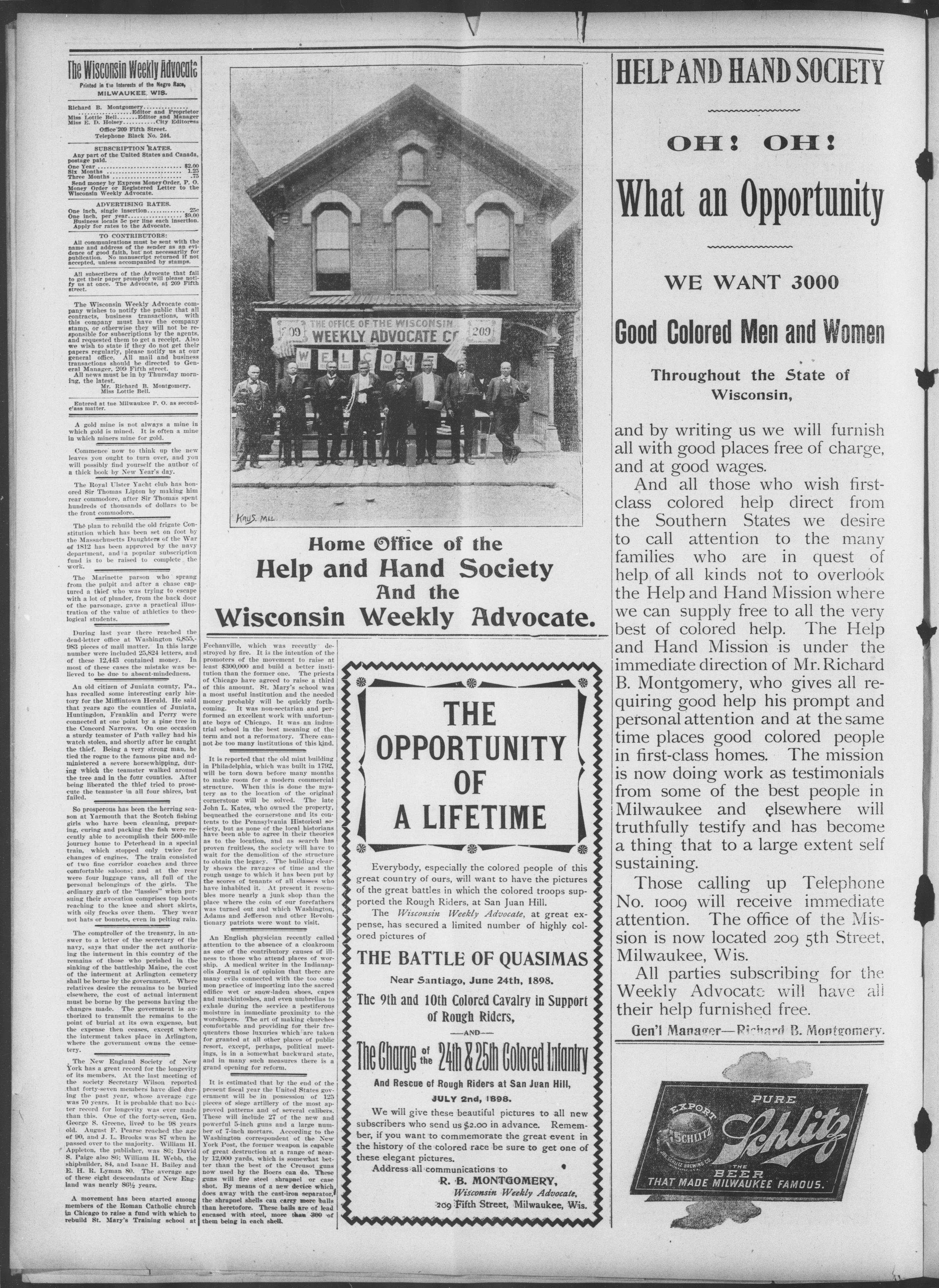
We call the attention of the subscribers and many friends of the Advocate to the cut of our headquarters, and advertisement of our work, published on the fourth page of this issue.
* * *
President George W. Bland of the Young Men's Independent Social club has resigned his position at the Plankinton to accept a position as head waiter at the leading hotel of West Bend, Ind.
* * *
Every colored voter of the Fourth ward should attend the meeting of the Fourth Ward Republican club at the Germania building tonight. Friday, January 5. Business of importance.
* * *
Editor Montgomery has returned from Eau Claire, where he went to attend the funeral of Gen. Michael Griffin. Gen. Griffin was one of the best-known men of the state as well as one of the most popular. His last act of charity in life was to send the editor a check in aid of the Help and Hand mission.
* * *
Attorney Green received a handsome pillow on New Year's day, the gift of Mrs. F. L. Nolls and Mrs. M. M. Releford.
* * *
The editor called upon Mrs. F. L. Nolls of Chicago, who is visiting her daughter, Mrs. M. M. Releford of 77 Fifth street. These two charming ladies have shown their appreciation of our efforts by renewing their annual subscription. Mrs. Releford, besides possessing rare gifts as a singer, has considerable literary talent and the Advocate has many times been indebted to her for some of its best publications.
It is rumored that Oscar Pierce, and Mr. Starke will soon tender their resignations as chairman and secretary of the Republican county committee. Much speculation is rife as to who will be their successors. Mr. Pierce is one of the grandest and best men of our acquaintance and Mr. Starke is equally so and their places will be difficult to fill.
RUSES OF AUTOGRAPH FIENDS
One that was Peculiarly Villainous but it was Highly Successful.
"In autograph hunting, the end always justifies the means, no matter how mean they may be," said a New Orleans enthusiast who owns one of the finest collections in the South.
"But nowadays," he continued, "it requires nothing less than genius to draw a letter from a real celebrity. All the old tricks are played out. A favorite scheme of former times for catching authors was to write, asking questions about one of their books, the letter being so framed as to show unusual familiarity with the work. Such an interrogation was delicately flattering and rarely failed to elicit an interesting and valuable reply, but at present all the lions are on their guard and the response that comes back is apt to be a typewritten affair from a secretary, beginning: 'Mr. So and-So directs me to say—'
"I flatter myself that my own method was rather ingenious. I used to have little slips printed at a job office to look like newspaper clippings, and reading, for instance, like this: 'Mr. Blank, the well-known collector, yesterday purchased a copy of ____, for $150, the high valuation being due to a remarkable sonnet on scrambled eggs, written by the author, upon the fly leaf.' Then I would send the slip to my celebrity with a note, saying: 'I am Mr. Blank, and will you kindly inform me whether the autograph poem referred to is authentic?' As a rule the ruse worked to a charm. One or two were brutal enough to send back the single word 'No.' without signature, but the majority entered into indignant and entertaining denials. Of course, the sonnet mentioned in my supposed clipping wasn't always on the same subject. Wienerwursts, rubber overcoats, glass eyes, kleptomania, educated hogs, jimjams, cold pie, sea serpents, draw poker, liver pads, cakewalks and cannibalism were some of the changes that I rung and very few missed fire. It was the printed slip unquestionably, that did the work. It gave my inquiry a solid and authentic basis and put me in the attitude of a warm admirer who had been cruelly victimized.
"Oh, I know I ought to be ashamed of myself, but the fruits of my crime were very luscious. I am the only collector on earth who possesses an autograph letter from the late Lord Tennyson, denying warmly that he ever wrote an ode to pickled pigseet."
Gold from an Old Hulk
With the permission of the Turkish government some Greeks recently undertook to search through the hulks of the Turkish fleet near Chios, which were lost in the naval battle with the Russians in 1770. The divers have been lucky, and in spite of the fact that they are compelled to divide the spoils with Turkey the venture will be profitable for them. In thirty fatoms of water they found the Russian ship which sunk the Turkish fleet. This ship contained great quantities of gold and silver. About $60,000 already has been secured; yet it is stated that the wreck contains much more of value. A Turkish vessel is anchored there, and every article of value brought to the surface is examined to determine its value. Besides the great quantities of coins, there were found gold and silver crosses, jewels, weapons and the binding covers of a large book, made throughout of gold and studded with precious stones.
DIED WIHTOUT WARNING.
Struck Down While Planning a Birthday Surprise for His Wife
Eau Claire, Wis., Dec. 30.—Gen. Michael Griffin, ex-congressman and president of the state tax commission, died suddenly in this city late yesterday afternoon. He was found in his office sitting in his chair at a table, his eyes closed, his head sunk upon his breast and his arms limp at his sides. Dr. French, a dentist in the building, laid him upon
D
THE LATE GEN. GRIFFIN.
the floor and called a physician. Mr.
Griffin gained trust, and all was over.
Griffin gasped twice, and all was over.
The general sat talking with Miss Drake of Washington, D. C., who is the guest of Mrs. Griffin. They were in his office together at about 4:50 o'clock talking about a birthday present for Mrs. Griffin. Miss Drake remarked that she thought a carrom board would be acceptable. Gen. Griffin seemed highly amused and threw up his arms and laughed, and at that instant he was stricken.
Miss Drake gave the alarm and Dr. French, who was near by, rushed into the office. Physicians were summoned and Dr. Hayns arrived in a few moments, but too late, as the general was dead. Apoplexy was the cause of death.
Death was Sudden.
Gen. Griffin had just finished dictating some letters when Miss Drake came to his office. His stenographer, Miss Bessie Barnes, says that the general seemed perfectly well and in unusually good spirits all afternoon. Miss Drake states that the general appeared perfectly well up to the moment he was stricken.
Capt. Henry, an old army comrade of the deceased, City Attorney Frawley, Alfred Cypreanson, and others bore the body on a stretcher from the office to the conveyance waiting at the curb and it was taken to his residence.
Mrs. Griffin's Condition Critical.
Mrs. Griffin has been ill for some time, though she returned recently in somewhat improved health from Mount Clemens. As gently as possibly Dr. Daniels, Mrs. Griffin's father, broke the sad news to his daughter. It was a terrible shock to her, and she is prostrated with grief. Her condition is regarded as critical.
Threatened with Pneumonia.
A few weeks ago Gen. Griffin was threatened by pneumonia, and, though he escaped with a slight attack, had not fully regained his usual health. A friend says that Gen. Griffin had a long hard walk in the great storm in Washington a year ago, and had remarked that he had not felt quite himself physically since that time. No arrangements for the funeral have as yet been made, but it is probable that it will not take place before Tuesday next.
English Criticism of Chamberlain.
Only very absent-minded English beggars can ignore the fact that we have of late years poked our noses into the affairs of the French somewhat unwarrantably. Some retaliation was to be expected; but though English subjects maintain whole-heartedly the dignity of their Queen, in doing so they can act most loyally if disregarding such effusions as Mr. Chamberlain has stooped to notice and to bring into prominence by a public defiance; and it is certain that her majesty, who is broad-minded above all things, must ignore this quasi-challenge of a Simon Tappertit up to date. Seeing that English people have placed their faith implicitly in Mr. Chamberlain since the beginning of the unfortunate Boer war, he would do well to observe the trust placed so confidently in him. Of the consequences of his rash speech it is too soon to judge, but English people will think twice before they run after him once more in the game of "Follow My Leader."—London Court Journal.
Wanted the Only One.
Long before the Transvaal trouble, the Right Hon. Joseph Chamberlain, present minister of state for the British colonies,
was famous the world over for his orchids. His costly collection is one of the finest in the world. They are telling the story in Paris now that once he saw a rare orchid, the duplicate or one he had recently added to his own collection. He asked the price. "Twenty thousand franes," replied the dealer. The Englishman paid the money, and then, throwing the flower on the floor, crushed it with his heel.
ART IN GLASS AND CHINA.
Tall and Graceful Shapes Are Most in Favor Just at Present.
Recent taste in both china and glass tends toward the acceptance of tall and graceful forms rather than those that are broad and flat. A writer in the China Decorator says:
Cups, vases, clocks, lamps, etc., are much more slender and graceful than formerly. In table glasses this is noticeable. The pretty shaped goblets have taken back rows on the shelves for the very tall, thin tumblers. Even the loving cups in glass have grown taller and thinner. Glass vases may be termed immense in a perfectly dignified sense from four to five feet in height! These are for church decorations.
There are some beauties also in china, although not reaching that measurement. Some of the largest have finely-modeled figures as handles on either side, making a suitable setting as well as a pretty contrast to the floral decoration.
In Paris the goblet still holds its own in both private and public dinner tables, but in England the goblet is obsolete, and the tumbler does duty for everything, everywhere, from hot grog to cold water. It is a mistake to follow any different foreign idea which is not an improvement. It is said that at Queen Victoria's private table she still clings to the high glass and that many of the glasses are of great age. Breakages naturally occur here as elsewhere, and the stock being so low in this style they, of course, have to be specially made. As only absolutely perfect ones are accepted, and the slightest flaw means rejection, it is almost needless to state the cost is enormous.
Other china novelties are the attractive little china violet holders with their openwork shop—just the chance for scrolls of enamel on gold. Odd incense holders, which, of course, also have openwork tops, seem a little stiff, they are so tall and thin. In decorated wares there are many things well worthy of consideration for their composition of design and the fine technique in carrying it out. A set of bouillon cups and saucers in dainty shape and size from Dresden are noticeable for their quality. The solid ground is a blue green luster, and only the inside of the cup and center of the saucer are left white. On the saucers is a graceful conventional design in raised gold and small dotting of opaque white enamel. The cups have on either side two fancy heads, surrounded with the same conventional design in raised gold.
A Coalport chocolate set in pink grounds in pretty forms, with raised gold work in green and red gold, is effective. A set of plates with an allover scroll design of dark green and ivory grounds, with small forms also in red, surrounded and covered with raised gold scrollwork, is beautiful in color and design. One set of rare and precious plates, the Minton Stoke-on-Trent, of that wonderful turquoise blue ground and surrounding gold work, each plate crowned with a faultless production in a ceramic landscape and figure painting, costs $700 a dozen.
Unique Workers
Of all the queer ways of making a living, two young urchins have the queerest. According to Tit-Bits, it is so queer that it smacks of swindling. A well-dressed man stopped in the street the other day for a moment.
While he was standing there a boy edged up behind him and hooked to his coat-tail a card on which was printed in black letters:
SOLD.
As the man went across the street several persons saw it, and turned to laugh at him. The second boy, who was waiting across the street, ran up to the man and said:
"Mister, there's a card hooked to your coat behind. Let me take it off."
"Goodness me!" said the man. "How did that get there?"
did that get there?"
"One of them ragamuffins put it on, I'spose."
"Confound them! Well, here's a penny for you."
Two minutes later the good little boy hung it on a fat man, and his partner on the other side collected another penny. He had to ask for it, but he got it. A man would be a brute to refuse a penny to a poor boy who had done him such a service.
An Important Time.
When John Kean, the new senator from New Jersey, was in the House some years ago his numerous business enterprises occupied nearly all his time, and he was not often in his seat. The other day he met Senator Chandler. He was then hurrying to catch a train for New York. "John," said Chandler, with a knowledge of Kean's proneness to be absent, "don't forget to be in the Senate next Monday and be sworn in."—Washington Post.
Utilizing Oyster Shells
There are collected from the various hotels and restaurants in New York every day as many as twenty cartloads of oyster shells. The hotel keepers pay for their removal, and they are brought to Brooklyn and burned, after which process they form excellent lime. The profit is evidently large enough to pay for the use of ten carts, horses and drivers, which may be seen in South street early in the morning.—New York Post.
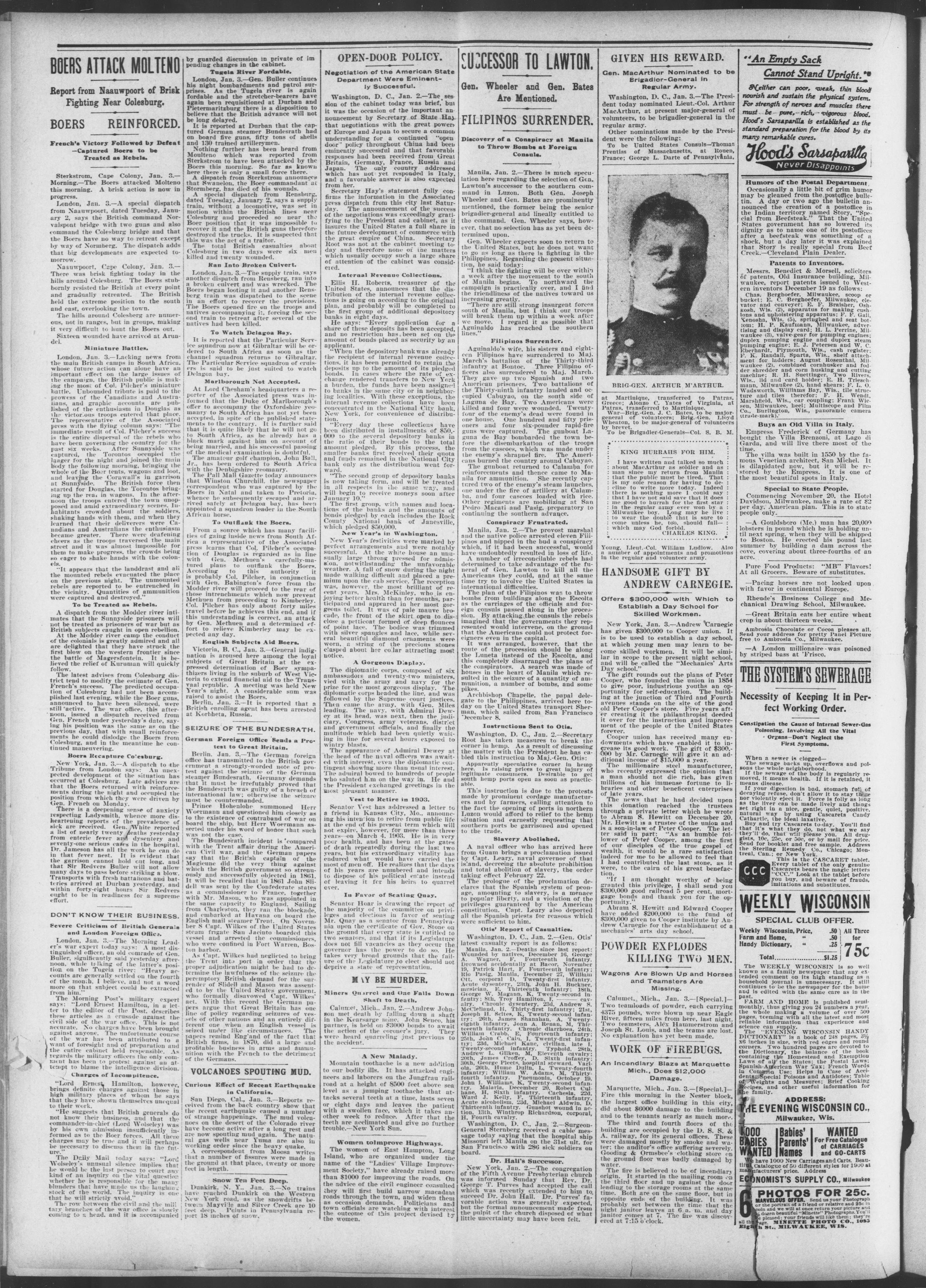
BOERS ATTACK MOLTENO
Report from Naauwpoort of Brisk
Fighting Near Colesburg.
BOERS REINFORCED.
French’s Victory Followed by Defeat
—Captured Boers to be
Treated ae Kebels,
Sterkstrom, Cape Colony, Jan. 3.—
Morning.—The Boers attacked Molteno
this morning. A brisk action is now in
progress.
London, Jan. 3.—A special dispatch
from Naauwpoort, dated Tuesday, Janu-
ary 2, says the British command Nor-
valspont bridge with two guns and also
command the Colesburg bridge and that
the Boers have no way to retreat except
by way of Normberg. The dispatch adds
that big developments are expected to-
morrow.
Naauwpoort, Cape Colony, Jan. 3.—
‘There was brisk fighting today in the
hills around Colesburg. ‘The Boers stub-
bornly resisted the British at every point
and gradually retreated. ‘The British
held the extreme position to the south
and east, overlooking the town.
The hills around Colesberg are numer-
ous, not in ranges, but in groups, making
it very difficult to hunt the Boers out.
7 cpa wounded have arrived at Arun-
el,
Miniature Battles.
London, Jan. 3—Lacking news from
the main British camps in South Africa,
whose future action can alone bave an
important effect on the large issues of
the campaign, the British public is mak-
ing the most of Col. Pilcher’s miniature
hattle. Unbounded tribute is paid to the
prowess of the Canadians and Austra-
Hans, and graphic accounts. are pub-
Jished of the enthusiasm in Douglas as
ihe victor.ous troops entered that place.
‘The representative of the Axsociated
press with the flying column says: “The
jmmediate result of Col. Pilcher’s success
is the entire dispersal of the rebels who
have been governing the country for the
past six weeks. After Sunnyside was
captured, the Torontos occupied the
laager for the night and joined the main
body the foilowing morning, bringing the
whole of the Boer tents, wagons and Joot,
and leayng the Corawall’s in garrison
ut Sunnyside. The British force then
started for Douglas, the Torontos bring-
ing up the reas in wagons. In the after-
noon the troops entered the town unop-
sed and amid extraordinary scenes. Iu-
Rabitants crowded about the soldiers,
shaking hands with them, and when they
learned that their deliverers were Ca-
nadians and Australians the enthusiasm
became greater. There were deafening
cheers as the troops traversed the main
street and it was almost impossible for
them to make progress, the crowds being
xo eager to shake hands with the colon-
els.
“It appears that the landdrast and ali
the mounted rebels evacuated the place
on the previous night. The unmounted
rebels are reported to be entrenched in
the vicinity. Quantities of ammunition
were captured and destroyed.” |
To be Treated as Rebels.
A dispatch from the Modder river inti- |
mates that the Sunnyside prisoners will
not be treated as prisoners of war but as
British subjects caught in open rebellion.
At the Modder river camp the conduct
of the colonials is greatly admired and al!
are delighted that they have struck the
first blow on the western frontier since
the battle of Magersfontein, It is be-
lieved the relief of Kuruman wil! quickly
follow.
‘The latest advises from Colesburg dis-
trict tend to modify the estimate of Gen.
French's success. ‘The predicted oceupa-
tion of Colesburg hai not been accom-
plished last evening, while the Boer guns,
announced to have been silenced, were |
still ‘active. The war office, this after-
‘hoon, issued a dispatch received from
Gen. French under yesterday's date, say-
ing his position was the same as on the
previous day, that with small_reinforce-
ments he could dislodge the Boers from
Colesburg, and in the meantime he con-
tinued maneuvering.
Boers Recapture Co'esburg.
New York, Jan, 3—A dispatch to the
‘Tribune from London says: An unex-
pected development of the situation has’
occurred at Colesburg. Late advices are
that the Boers returned with reinforce-
ments during the night and occupied the
position from which they were driven by
Gen. French on Monday. -
There is a deepening sense of anxiety
respecting Ladysmith, whence more dis-
heartening reports of the prevalence of.
sick are received. Gen. White reported
a list of nearly twenty Aeaths yesterday
from enteric fever awd dysentery and.
seventy-one serious cages in the hospital.
Dr. Jameson has all the work he ean do
in that fever nest. It is evident that
the garrison cannot hold cnt long, and.
that Sir Redvers Buller will not allow.
many days to pass before striking a blow.
‘Transports with fresh battalions and bat-
teries arrived at Durban yesterday. and
within forty-eight hours Sir Redvers |
ought to be in readiness for a supreme
effort.
DON’T KNOW THEIR BUSINESc |
Severe Criticiem of British Generals
and London Forcign Offic:.
London, Jan. 3.-The Morning Lead-
er’s war expert today says: A most dis-
tinguished officer, an old comrade of Gen.
Buller, significantly said yesterday after-
noon, while trIking of the latter's posi-
tion on the Tugela river: “Heavy ac-
counts are generally settled on the fourth
of the month, [ believe, and not a word
more on that subject could be extracted
from him.”
The Morning Post's military expert
says: “Lord Ernest Hamilton, in a let-
ter to the editor of the Post. describes
these articles as a crusade against the
civil side of the war office. This is not
accurate, No charges have been brought
ugainst anyone. The unfortunate course
of the war hus been attributed to a
want of foresight and of preparation and
the eutire cabinet held respensible, As
regards the military officers the only eom-
nient has been to protest against un at-
tempt to blame the intelligence division.
. Charges of Incompitence.
“Lord ‘tier 3 Hamilton, however,
brings detinite charges against those in
high military places of whom he says
that they have shown themselves unequal
to their werk.
“He suggests that British generals do
not know their business, and that the
commander-in-chiet (Lord Wolseley) was
by his own admission insufficiently in-
formed as to the Boer forces. All these
charges may be truv and it will perhaps
be necessary to diseuss them in the fut-
ure.
The Deily Mail today says: “Lord
Wolseley’s unusual silence implies that
he would be the last person to court any
kind of an inquiry on the vital question
whether he is responsible for the many
blunders that have made us the laughin =
stock of the world. The inquiry is one
that he will strictly avoid.”
The row between the civil and the mil!
tary branches of the war office is slowly
coming to a head, and it is xccompanicd
by diseussion in private of im
ing changes in the cabinet,
Tugela River Fordable.
London, Jan. 3.—Gen. Buller continues
his night bombardments and patrol sur-
prises. As the Tugela river is again
fordable and the stretcher-bearers have
bs calle requisitioned at Durban and
itzburg there is a disposition to
believe that the British advance will not
be long delayed.
It is reported at Durban that the cap-
tured German steamer Bundesrath had
on board five guns, fifty tons of shells
and 130 trained artillerymen.
Nothing further has been heard from
Moulteno which was reported from
Sterkstrom to have been attacked by the
Boers this morning. So far as known
here there is only a small force there.
A dispatch from Sterkstrom announccs
that Swanelon, the Boer commandant at
Stormberg, has died of his wounds.
A ge dispatch from Renseie.
dated Tuesday, January 2, says a supply
train, without a locomotive, was set in
motion within the British lines near
Colesburg and proceeded so near the
Boer position that it was impossible tu
recover it and the British guns therefore
destroyed the trucks. It is suspected that
this was the act of a traitor.
The total British casualties about
Colesburg in two days were six men
killed and twenty wounded.
Ran Into Broken Culvert.
London, Jan. 3.—The supply train, says
another dispatch from Rensberg, ran into
a broken culvert and was wrecked. The
Boers began looting it and another Rens-
berg train was dispatched to the scene
in an effort to recover the provisions.
‘The Boers opened fire on the proces and
natives accompanying it, foreing the sec-
ond train to retreat after several of the
natives had been killed.
To Watch Delagoa Bay.
It is reported that the Particular Serv-
ice squadron now at Gibraltar will be or-
dered to South Africa as soon as the
channel squadron returns to Gibraltar.
The Particular Service squadron of eruis-
ers is said to be just suited to watch
Delagoa bay.
Marlborouzh Not Accepted.
At Lord Chesham’s headquarters a re-
porter of the Associated press was in-
formed that the Duke of Marlborough’s
offer to accompany the Oxfordshire yeo-
manry to South Africa has not yet been
accepted, in spite of the published state-
ments to the contrary. It is further said
that it is quite likely that he will not go
to South Africa, as he already has a
black mark against him on account of
being married, and his successful passing
of the medical examination is doubtful.
The amateur golf champion, John Batl,
Jr. has been ordered to South Africa
with the Denbigshire yeomanry.
‘The Pall Mail Gazette today announces
that Winston Churchill, the newspaper
correspondent who was captured by the
Boers in Natal and taken to Pretoria,
whence he subsequently escaped and ar-
rived safely at Delagoa bay, has been
appointed a squadron leader in the South
African horse.
To Outfiank the Boers.
Frem 2 source which has many facili-
ties of gaing inside news from South Af-
rica a representative of the Associated
press learns that Col. Pilcher’s occupa-
tion of Douglas is regarded as in line
with Gen. Methuen’s — carefully-ma-
tured plans to outflank the Boers.
According to this — authority —_ it
is probably Col. Pilcher, in conjunction
with Gen. Babington’s force from the
Modder river will proceed to the rear of
those intrenchments which now prevent
Methuen from proceeding to Kimberley.
Col. Pilcher has only about forty miles
travel before he achieves this end, and if
this understanding is correct, an attack
by Gen. Methuen and a determined ef-
fort to relieve Kimberley may be ex-
pected any day.
English Subjects Aid Boers,
Victoria, B. C., Jan. 3.—General indig-
nation is aroused here among the loyal
subjeets of Great Britain at the ex-
pressed determination of Boer sympa-
thizers living in the suburb of West Vic~
toria to extend financial aid to the Trans-
yaal republic. A meeting was held New
Year's night. A considerable sum was
raised to assist the Boers,
Berlin, Jan. 3.—It is reported that a
British enrolling agent has been arrested
at Korbheta, Russia.
SEIZURE OF THE BUNDESRATH.
German Foreign Office Sends a Pro-
test to Great Britain.
Berlin, Jan. 6.—The German foreign
office has transmitted to the British gov-
ernment a strongly-worded note of pro-
test against the seizure of the German
steamer Bundesrath. Germany demands
that it must be irrefutably proved that
the Bundesrath was guilty of a breach of
international law; otherwise the seizure
must be countermanded.
Prince Hohenlohe summoned Herr
Woermann aud questioned him closely as
to the existence of contraband of war on
board the ship, but Herr Woermann as-
serted under his word of honor that such
was not the case.
‘The Bundesrath incident is ‘compared
with the Trent affair during the Ameri-
can Civil war, and the German papers
say that the British captain of the
Magicune did the very thing against
which the British government so strenu-
ously and suecessfully objected in 1861,
It will be recalled that in 1861 John Sli-
dell was sent by the Confederate states
as a commissioner to France, together
with Mr. Mason, who was appointed in
the same capacity to England. Sailing
from Charleston, they ran the blockade,
and embarked at Havana on board the
English mail steamer Trent. On Novem-
ber 8 Capt. Wilkes of the United States
steam fngate San Jacinto boarded this
vessel and arrested the coumissioners,
who were confined in Fort Warren, Bos-
ton harbor,
As Capt. Wilkes had neglicted to bring
the Trent into port in order that the
proper adjudication might be had to de-
termine the lawfulness of the seizure the
peremptory British demand for the sur-
render of Slidell and Mason was assent-
ed to by the United States government,
whe formally disavowed Capt. Wilkes’
act. Witb this record the German pa-
pers argue that Great Britain has one
line of policy regarding seizures of ves-
sels of other nations and an entirely dif-
ferent one when an English vessel is
seized under like circumstances. The
papers remind Eng'and of the fact that
Butish firms, in 1870, did a large and
profitable business in ‘arms and ammu-
nition with the French to the detriment
of the Germans.
VOLCANOES SPOUTING MUD.
Curious Effect of Recent Earthquake
in California,
San Diego, Cal., Jan. See re-
ceived from the back country show that
the recent earthquake caused a number
of strange happenings. The mud volea-
noes on the desert of the Colorado river
have become active after a long rest and
are now spouting mud again. The natu-
ral gas wells near Yuma are also in
working order since the heayy quake.
A correspondest from Moosa writes
that a number of fissures were made in
the ground at that place, twenty or more
feet in length.
Snow Ten Feet Deep.
Dunkirk, N. Y.. Jan. 3.—No_ trains
have reached Dunkirk on the Western
New York road, as the snowdrifts be-
tween Mayville and Silver Creek are 10
feet deep. Peints in Penusylvania re-
port 18 inches of snow.
OPEN-DUOR POLICY.
Negotiation of the American State
Department Were Eminent-
Iv Successful.
ly Successtu'.
Washington, D. C., Jan. 2.—The_ ses:
sion of the cabinet today was brief, bui
it was the occasion of the important an-
nouncement by Secretary.of State Ha.
that negotiations with the great power:
of Europe and Japan to secure a common
understanding for a continued “open
door” policy throughout China had been
eminently successful and that favorable
responses had been received from Great
Britain, Germany, France, Russia and
Japan. The only country addressed
which has not: yet responded is Italy,
and a favorable answer is also expected
from her.
Secretary Hay’s statement fully con-
firms the information in the Associated
press dispatch from this city last Satur-
day. The announcement of the success
ot the negotiations was exceedingly grati-
fying to the President and cabinet, as it
insures the United States a full share in
the future development of commerce with
the great empire of China. Secretary
Root was not at the cabinet meeting to-
day and therefore none of ine matters
which usually occupy such a large share
of attention of the cabinet was consid-
ered.
Internal Revenue Collections.
Ellis H. Roberts, treasurer of the
United States, announces that the dis-
tribution of the internal revenue collec-
tions is going on according to the original
plan, and probably will be completed to
the first group of additional depository
banks in eight days. :
He says: “Every application for a
share of these deposits has been accepted,
and no restriction has.been set on the
amount of bonds placed as security by an
applicant.
“When the depository hank was already
the recipient of internal revenue coilec-
tions, it has been permitted to retain the
deposits up to the amount of its pledged
bonds. In cases where the rate of ex-
change rendered transfers to New York
a burden, the funds have been assigned
to banks in the same city or in neighbor-
ing lecalities. With these exceptions, the
internal revenue collections have been
concentrated in the National City bank,
New York, for convenience of distribu-
tion.
“Every day these collections have
been distributed in installments of $50,-
000 to the several depository banks in
the ratio of their bonds to the total
amount pledged. By this process, the
smaller banks first received their quota
and funds remained in the National City
bank enly as the distribution went for-
ward.
“The second group of depository banks
is now taking form, and will be treated
in all respects in ihe same way, and
will begin to receive moneys soon after
Jannary 10.”
The first group. with names and loca-
tions of the banks and the amounts of
bonds pledged by each includes the Rock
County National bank of Janesville,
which pledged $50,000,
New Year's in Washington.
New Year's festivities were marked by
perfect arrangements and were notably
successful, At the white house an unu-
sually large throng pressed for admis-
sion, notwithstanding the unfavorable
weather. A fall of snow during the night
made walking difficult and placed a pre-
minum upon the cab service. The reception
was, however, the most brilliant of re-
cent years. Mrs. McKinley, whois en-
joying better health than for months, par-
ticipated and appeared in her most gor-
geous toilet. It was of pale mauve bro-
cade, the front of the skirt open to dis-:
close a petticoat formed of deep fiounces
of point lace. The bodice was trimmed
with silver spangles and lace, while sey-
eral beautiful diamond ornaments were
worn, 2 string of the precious stones
clasped about her colar attracting most
notice,
A Gorgeous Display.
The diplomatic corps, composed of six
ambassadors and twenty-two ministers,
vied with the army and navy for the
prize for the most gorgeous display. ‘The
Pe haalge corps headed the line, and was
followed by ine Supreme court justices,
Then came the army, with Gen. Miles
leading. The navy, with Admiral Dew-
ey at its head, was next, then the judi-
ciary, Congress, army veterans, district
and gevernment officials, and finally the
multitude which had been quietly waii-
ing in line for several hours exposed to
wintry blasts.
The appearance of Admiral Dewey at
the head of the nayal officers was await-
ed with interest, even the diplomatic con-
tingent showing more than usual interest.
‘The admiral bowed to hundreds of people
who saluted him on the way in. He and
the President exchanged greetings in the
most pleasant manner.
Vest to Retire in 1903.
Senator Vest has addressed a letter to
a friend in Kansas City, Mo., announe-
ing his inten‘ion to retire from public life
at the end of his present term which will
not expire, however, for mere than three
years—on March 4, 1908. He is in very
pocr health, and has been at the gates
of death repeatedly during the last two
Years, but his extraordinary vitality has
endured what would have carried the
most of men off. He realizes that the days
of his years are numbered and intends
to dispose of his political es‘ate instead
of leaving it fer his heirs to quarrel
ever,
In Favor of Seating Quay.
Senator Hoar is drawing the report of
the majority of the committee on privi-
leges and elections in favor of seating
Mr. Quay as a senator from Pennsylva-
nia upon the certificate of Gov. Stone on
the ground that every state is entitled to
two senators, and that if its Legislature
does not fill vacancies as they oceur the
governor has the power to do so. He
takes very broad grounds that the fail-
ure of the Legislature to elect should not
deprive a state of representation.
M\Y BE MURDER,
Miners Quarrel end Gane Vatie Dawx:
Calumet, Mich. Jan. 2.—Andrew John-
son met death hy falling down a shaft
in the Kearsarge mine. John Senco, his
partner, is held on $3000 bonds to await
the action of the coroner's jury. They
ywere heard quarreling just previous to
the accident.
A New Malady.
Mountain toothache is a new addition
to our bodily ills. It has attacked engi-
neers and laborers on the Jungfrau rail-
road at a height of 8500 feet above sea
level as a jumping toothache that at-
tacks several teeth at a time, lasts seven
or eight days and leaves the patient
with a swollen face, which it takes an-
other week to reduce. After that the
teeth are acclimated and give no further
trouble.—New York Sun.
Women tolmprove Hichwavr<.
The women of East Hampton, Long
Island, who are organized under tie
name of the “Ladies’ Village Improve-
ment Society,” have already raised more
than $1000 for improving the roads. On
the advice of the civil engineer consulted
they will first build narrow macadam
roads through the town, and widen them
as oceasion demands. Politicians and
town officials are watching with interest
the outcome of this project devised by
the women.
SUCCESSOR TO LAWTON,
: Wheeler and Gen. Bates
Are Mentioned.
Be SURRENDER.
ae eee Bombe at Foreign 28
ee
| Manila, Jan. 2.—There is much specu-
lation here regarding the selection of Gen,
Lawton’s successor to the southern com-
mand in Luzon. Both Gen. Joseph
Wheeler and Gen. Bates are prominently
mentioned, the former being the senior
brigadier-general and lineally entitled to
the command, Gen, Wheeler says, how-
ever, that no selection has as yet been de-
termined upon.
| Gen. Wheeler expects soon to return to
the United States, but he does not want
to go as long as there is fighting in the
Philippines. Nepacaing the present situa-
tion, he said today: Aas
“I think the fighting will be over within
a week after the movement to the south
of Manila begins. ‘To northward the
campaign is practically over, and I find
the friendliness of the natives toward us
increasing greatly.
“There are still strong insurgent forces
south of Manila, but I think our troops
will break them up within a week after
we move, I regard it as meee that
Aguinaldo has reached the southern
lines.”
Filipinos Surrender.
Aguinaldo's wife, his sisters and eight-
een Filipinos have surrendered to Maj.
March’s battalion of the Thirty-third
infantry at Bontoc. Three Filipino of-
ficers also surrendered to Maj. March.
They gave up two Spanish and two
American prisoners. ‘lwo battalions of
the Thirty-ninth infantry landed and oc:
cupied Cabuyao, on the south side of
Laguna de Bay. Two Americans were
killed and four were wounded. ‘Twenty-
four of the enemy's dead were found in
one house. One hundred and fifty pris-
oners and four six-pounder rapid-fire
guns were captured. The gunboat La-
guna de Bay bombarded the town be-
fore the disembarkation of the troops
from the cascoes, which was made under
the enemy's shrapnel fire. The Ameri-
cans burned the country around Cabuyao.
The gunboat returned to Calamba_for
reinforcements and thence came to Ma-
nila for ammunition. She recently cap-
tured two of the enemy’s steam launches,
one under the fire of artillery at Calam-
ba. and four cascoes loaded with rice.
Other regiments are mobilizing at San
Pedro Macati and Pasig, preparatory to
continuing the southern advance.
Conspiracy Frustrated,
Manila, Jan. 2.—The provost marshal
and the native police arrested eleven Fiii-
pinos and nipped in the bud a conspiracy
which, if it had been successful, would
have undoubtedly resulted in loss of life.
A number of irreconcilable rebels had
determined to take advantage of the fu-
neral of Gen. Lawton to kill all the
Americans they could, and at the same
time try to involve the United States in
international difficulties.
The plan of the Filipinos was to throw
bombs from buildings along the Escolta
as the carriages of the officials and for-
eign consuls passed along in the proces-
sion. By attacking the consuls the rebels
imagined that the governments they rep-
resented would intervene, on the ground
that the Americans could not protect for-
eigners even in the eeyitat.
It was arranged, however, that the
route of the procession should be along
the Luneta instead of the Escolta, and
this completely disarranged the plans of
the conspirators. A search was made of
houses in the heart of Manila which re-
sulted in the seizure of a quantity of am-
Bison, a number of bombs, and some
pikes. *
Archbishop Chapelle, the papal dele-
gate to the Philippines, arrived here to-
day on the United. States transport Sher-
man, which sailed from San Francisco
“december 8.
Iustructiona Sent to Otis.
Washington, D. C., Jan. 2.—Secretary
Root has taken measures to break the
corner in hemp. As a result of discussing
the matter with the President he has ca-
bled this instruction to Maj.-Gen. Otis:
Apparently speculative corner in hemp
here. Is raising prices to great injury of
legitimate consumers. Desirable to get
south hemp ports open as soon us practic-
able.
This instruction is due to the protests
made by prominent cordage manufactur-
ers and by farmers, calling attention to
the fact the opening of ports in northern
Luzen would afford to relief to the hemp
situation and earnestly requesting that
southern ports be garrisoned and opened
to the trade.
Slavery Abolished.
A naval officer who has arrived here
from Guam brings a proclamation issued
by Capt. Leary, naval governor of that
is!and, decreeing the absolute prohibition
and total abolition of slavery, the order
taking effect February 22.
The prologue of the proclamation de-
clares that the Spanish system of peon-
age, amounting to slavery, is a menace
to popular liberty, and a violation of the
privileges guaranteed by the American
constitution. Capt. Leary also deported
all the Spanish priests for reasons which
were sufficient to him.
Otis’ Report of Casualties.
Washington, D. C., Jan. 2.—Gen. Otis’
latest casualty report is as follows:
Manila, Jan. 2.—Deaths since last report:
Wounded by natives, December 16, George
A. Wagner, F, ‘Fourteenth infantry.
Drowned accidentally at Bacor, November
19, Patrick Hart, F, Fourteenth infantry;
Rio Pasig, Manila, December 27, William
Ott, corporal D, Twenty-first infantry.
‘Acute dysentery, ‘23th, Join HH. Buckner,
musician, E, Thirteenth infantry; 18th,
George W. Magann, K, Twenty-second in-
fantry; Sth, Troy Hamilton, I, ——— ecav-
alry. Chronic dysentery, 23d, Andrew 8.
MeCletand, H, Phirty-Arst infantry; 21st,
Joseph H. Seites, K, "Twenty-necond infan-
try: 26th, James Shanahan, A, ‘Twenty-
eighth infantry, Jonn A. Renan, M, Thir-
teeenth infantry. Chronie diarrhoea, 24th,
William Crabb, E, Fourteenth infantry;
25th, Joann C. Cain, I, Twenty-first infan-
tiy; 23d, Michael ‘Kane, civilian, late 1,
ER mc tay rh Rae A an, scr OR aay PEP
Dr. Hall's Successor.
New York, Jan. 2.—The congregation
of the Fifth Avenue Presbyterian church
was informed Sunday that Rev. Dr.
George T. Purves had accepted the eall
which was recently extended to him to
sueceed Dr. John Hall. Dr. Purves’ fa-
yorable action was generally expected,
but the formal announcement made from
the pulpit of the church disposed of what
little uncertainty may have been felt.
GIVEN HIS REWARD.
——_>—_——_
Gen. MacArthur Nominated to be
Brigadier-General in
Regular Army.
Washington, D. C., Jan. 3.—The Presi-
dent today nominated Lieut.-Col. Arthur
MacArthur, at present major-general of
volunteers, to be brigadier-general in the
regular army.
Other nominations made by the Presi-
dent were the following:
To be United States Consuls—Thomas
Prentiss of Massachusetts, at Rouen,
France; George L. Darte of Pennsylvania,
be I TL : : e Oe
te.
i“ |
BRIG-GEN. ARTHUR M'ARTHUR.
at Martinique, transferred to Patras,
Greece; Alonzo C. Yates of Virginia, at
Patras, transferred to Martinique.
War—Brig.-Gen. J. C. Bates, to be major-
general of yoluateers; Brig. Gen. Lloyd
Wheaton, to be major-general of volunteers
by brevet.
‘Yo be Brigadier-Generals—Col. 8. B, M.
3 KING HURRAHS FOR HIM, 3
: JT have written and talked so much :
: about MacArthur as soldier and as :
:man since my return from Manila :
: that the yp must be tired. That :
! is my sole reason for having to de- :
: cline to write more today. Indeed :
; there is nothing more I could say :
: that I have not said save that it does :
: me good to hurrah for the first star :
: in the regular army ever won by a:
: Milwaukee boy. Long may he live :
: to wear the doublé that is sure to :
: come unless he, too, should fall— :
: which may God forbid. z
: CHARLES KING. =:
Young, Vieut.-Col. Wiliiam Ludlow. Also
a number of ‘appointments and promotions
fm the regular and volunteer army.
HANDSOME GIFT BY
ANDREW CARNEGIE.
Offers $300,000 with, Which to
Establish a Day School for
Sxilled Workmen.
New York, Jan. 3.—Andrew ‘Carnegie
has given $300,000 to Cooper union. It
is to be used to establish a day school,
at which young men may learn to be-
come skilled workmen. It will be simi-
lar in scope to the eee night school,
and will be called the “Mechanies’ Arts
Day school.”
The gift rounds out the plans of Peter
Cooper, who founded the union in 1854
to give poor, industrious youths an op-
Pettey: for self-education. The build-
ing at the junction of Third and Fourth
avenues stands on the site of the good
old Peter Cooper’s store. Five years aft-
er creating it the philanthropist deeded
it over for the instruction and ape
ment of the people of the United States
forever.
Cooper union has received many en-
dowments which have enabled it to in-
grease its good work. The gift of $300,-
600 by Mr. Cerne, will give it an ad-
ditional income of $15,000 a year.
The millionaire steel manufacturer,
who recently expressed the opinion that
a man should not die rich, has given
millions of his immense fortune to_ li-
braries and other beneficent enterprises
of late years.
The news that he had decided upon
this donation reached the — trustees
through a private letter which he wrote
to Abram 8. Hewitt on December 20.
Mr. Hewitt is a trustee of the union and
is a son-in-law of Peter Cooper. he let-
ter said in part: “As an humble foil-
lower of Pete Cooper, among the first
of our disciples of the true gospel of
wealth, it would be a rare satisfaction
indeed for me to be allowed to feel that
I had contributed the last stone, as it
were, to the cairn of his great benefac-
tion.
“If I am thought worthy of being
granted this privilege, I shall send you
$300,000 good railroad 5 per cent, mort-
gage bonds and thank you for the op-
portunity.”
Abram S. Hewitt and Edward Cooper
have added $200,000 to the fund of
$300,000 given to Cooper institute by An-
drew Carnegie for the establishment of a
mechanics’ arts day school,
POWDER EXPLODES
KILLING TWO MEN.
—-__
Wagons Are Blown Up and Horses
and Teamsters Are
Missing.
Calumet, Mich., Jan. 3.—[Special.J—
‘Two teamloads of powder, each carrying
4375 pounds, were blown up near Eagle
River, fifteen miles from here, last night.
‘Two teamsters, Aléx Hammerstrom and
Joseph St. Louis, and the teams are lost.
No explanation has yet been made.
WORK OF FIREBUGS.
———+-___
An Incendiary Blaze at Marquette
Mich., Does $12,000
Damage.
Marquette, Mich., Jan. 3.—[Special.J—
Fire this morning in the Nester block,
the largest office building in this city,
did about $6000 damage to the building
and to the tenants nearly as much more.
The third and fourth floors of the
building are occupied by the D. 8. S. &
A. railway, for its general offices. These
were Sates mostly by smoke and wa-
ter; the anditor’s office suffering severely.
Gooding & Ormsbee's ‘clothing store én
the ground floor was badly damaged by
water.
The fire is believed to be of incendiary
origin, It started in the mailing room on
the third flocr and up against the door
leading to the storage rooms at the same
time. Both are on the same floor, but in
opposite ends ef the building. It was
probably set between the time that the
night janitor leaves at G.a. m. and day
janitor comes at 7. The fire was discoy-
ered at 7:15 o'clock.
*‘An Empty Sack
Cannot Stand Upright. *®
Neither can poor, weak, thin blood
nourish and sustain the physical system.
For strength of nerves and muscles there
must .. be pure,~ rich, vigorous — blood.
Hood's Sarsaparilla is established as the
standard preparation for the blood by its
many remarkable cures.
Hoods Udapaiitla
Never Disappoints il
—————
Humors of the Postal Department:
Occasionally a little bit of grim humor
may be alesed from thie postaiGice bulle-
tin. A day or two ago the bulletin an-
nounced the creation of a postofiice in
the Indian territory named Story, “Spe.
cial from Beefsteak.” That the United
States government has so lowered its
dignity as to name one of its postofiices
after a beefsteak was something of a
shock, but a day later it was explained
that Story is really special from Bect
Creek.—Cleveland Plain Dealer.
Patents to Inventors.
, Messrs. Benedict & Morsell, solicitors
of patents, Old Insurance building, Mil-
waukee, report patents issued to West-
ern inventors December 19 as follows:
Chas. ae cage ve Milwaukee, scoop or
bucket; E. C, Berghoefer, Milwaukee, cle-
vator and conveyer; E. FP. Brasher, Osh.
Kosh, Wis. (2), apparatus for making’ cush-
lons and upholstering apparatus; I". 1. Gall,
Xenosha, Wis, G sp) eee and seat bot-
rom; H, P. Kaufmann, Milwaukee, adver-
tising and display card: H. L. Perrine, Mil-
waukee (3), valve-gear for pumping engines:
duplex pumping engine and duplex steam
‘pomplng, a pal FE. J. Petersen and W. Cc.
berhardt, Plymouth, Wis., cash register:
F. K. Randall, Sparta, Wis., shelf attach:
ment for ladders; August Rosenthal, Mii
waukee (2), combined cornhusker and fod
der shredder and corn husking and cutting
machine; R. H. Suettinger, Two Rivers,
Wis., lid and card holder; E. H. Triesch-
mann, Milwaukee (2), hand shears; F. L. 0.
Wadsworth, Williams Bay, Wis., tile struc-
ture and tiles therefor; F. H. Wendt,
Marshfield, Wis., car coupling; Frank Wic-
sen, Milwaukee, heel; Multiscope and Film
Co., Burlington, Wis., panoramic camera
ttrade-mark).’
Burs an Old Villa in Italy.
Empress Wrederick of Germany has
bought the Villa Brenzoni, at Lago di
Garda, and will live there most of the
time.
The villa was built in 1550 by the fa-
mous Venetian architect, San Michel. It
is dilapidated now, but it. will be re-
stored by the Empress. It is one of
the most beautiful spots in Italy.
Special to State People.
Commencing November 20, the Hotel
Davidson, Milwaukee, make a rate of $2
per day, American plan. This is to state
people only.
—A Gouldsboro (Me.) man has 20,009
lobsters in pound which he is holding un-
til next spring, when they will be shipped
to Boston. He erected his pound last
summer by building a dam across the
cove, covering about three-fourths of an
acre.
Pure Food Products: “MB” Flavors!
At all Grocers. Beware of substitutes.
—Pacing horses are not_looked upon
with favor in continental Europe.
Rheude’s Business College and Me-
chanical Drawing School, Milwaukee.
—Great Britain eats her entire wheat
crep in about thirteen weeks. i
Ambrosia Chocolate or Cocoa pleases all.
Send your address for pretty Panel Picture
free to Ambrosia Co., ilwaukee.
—A London millionaire -was poisoned
by striped bass at ’Frisco,
TT
THE SYSTEM'S SEWERAGE
Necessity of Keeping It in Per-
fect Working Order.
Constipation the Cause of Internal Sewer-Gas
Poisoning, Involving All the Vital
« Organs—Don’t Neglect the
First Symptoms.
When a sewer is clogged—
‘The sewage backs up, overflows and pol-
sons the whole neighborbood.
If the sewage of the body is regularly re-
moved, it means health. If it is retained, it
means disease.
If your digestion is bad, stomach futi of
decaying refuse, don’t allow it to stay thige
hor violently eject it. Force is folly as long
as the liver can be made lively and things
set right in a nice, gentle, quiet, positive,
natural way by using Cascarets Candy
Cathartic, the Ideal laxative.
Buy and try Cascarets to-day. You'll find
that it's what they do, not what we say
they'll’ do, that will please you. All drug-
a le, 25¢, or 0c, or by mail for price.
end for booklet and free sample. Address
the Sterling Remedy Co., Chicago; Mon-
treal, Can.; or New York.
‘This is the CASCARET tablet.
Every tablet of the only genuine
94 ie Cc Cascarets bears the magic letters
“CCC.” Look at the tablet before
nd you buy, and beware of frauds,
imitations and substitutes.
SPECIAL CLUB OFFER.
Weekly Wisconsin, Price, 50) All Three
Farm and Home, “ 50| for
“ Hi
Handy Dictionary, « 25 (7 5c
Total...........0s0s0s0: 02.5025 J
The WEEKLY WISCONSIN is so well
known as a family newspaper that any ex-
tended comment on its high standing as 2
household journal is unnecessary. {t still
continues to be the newspaper for the home
and is edited with the same care us in the
past.
FARM AND HOME is_ published semi-
monthly, thus giving you 24 numbers a year.
the whole making a volume of over 500
pages, teeming with all the latest and most
reliable information that experience and
selence can supply. sae
The “EVENING WISCONSIN HANDY
DICTIONARY” is a book of 248 pages, 3%
x6 inches in size, with red edges and round
corners. ‘Two hundred pages are devoted to
the Dictionary, the balance of the book
containing the’ Homestead and Exemption
Laws of alf the States: the Postal Laws;
Spanish-Amferican War Zax; French Words
in Congnon Use; Helps in Case of Acci-
dentss#Special Poisons and Antidotes; Table
eights and Measures; Brief Cooking
fecipes, and other useful information for
pig oo ey,
4 HE ADDRESS:
: EVENING WISCONSIN CO.,
Milwaukee, Wis.
od Babies’ | WANTED
‘or Free logue
S Parents of CARRIAGES
TED {Names | and Go-caats
have 1000 New Carriagesand Carts. Beau-
tif@E Catalogue of 5U different styles for 1900 at
facturers’ price. Address
EGDNOMIST’S SUPPLY CO., mitwaukee
PHOTOS FOR 25c.
MARVELOUS OFFER. Send ue yout Photograp!:
or the portrait of a friend or relative and 25c |
in and we will at once return your picture and
‘dagen beautifai “Minette” Photographs. You'!!
pleased: your friends will like them ; they're
alt age. MINETTE PHOTO CO., 1085
Eight, st.. MILWAUKEE, W1S8.
THE DYING CENTURY.
Gazes the century.
Lo, how the shadows fall!
Soon now the solemn call;
Soon bier and hearse and pall—
Hall and farewell to thee!
Last of the pilgrims gray,
Holding their measured way
Into the dim for aye,
Honored thy passing be,
Age of earth-girdling power,
Age of fair freedom's dower,
Age of life's bloom and flower,
Thou hast reigned graciously!
James Buckham in Leslie's Weekly.
ONE PAGE FROM LIFE.
He hadn't slept soundly. He rarely slept soundly now. It wasn't his age, surely—he was only 57, and it couldn't be his business affairs, for all his investments were sound and highly remunerative, and his large income was rapidly increasing. No, he must look for the cause elsewhere. Perhaps it would be well to consult a doctor.
He arose and lighting the gas looked at his watch. It was half-past 4. He went to a window that faced the east and raised the sash. The air came in cool and fragrant. Low down by the faraway ridge streaks of pale light were showing
As he faced the east and moved slowly along the avenue he snuffed the air and found it good. He even took off his hat and let it cool his head.
"It certainly seems to me that this is better than tossing on that comfortless mattress," he muttered. "Wonder why I never thought of it before?"
The pale streaks in the east grew broader, a pink flush rose behind the wooded crest, the clouds became hazy. Swiftly the flush deepened, spokes of light were flung upward, and then came the sun.
Amos Brandon walked slowly onward, eagerly watching these magic changes.
"Oh," said he, "that's fine! It's worth the trouble. How many people know anything about it? Precious few. Look at the present audience. One restless, lonely old man and a night watchman or two. What a shame!"
He came to a street intersection and paused and looked at his watch.
"Quarter after five," he muttered.
"No, I'll not go home. I feel like a runaway boy. I'll stroll down to the lake. I don't believe I've really seen the lake in a dozen years."
He walked at a leisurely gait, breathing in the tonicky air and ever and anon turning his gaze on the sun-tinted clouds. His eyes were brighter and his step more elastic. He seemed to grow younger as he advanced. Laboring man, swinging their dinner boxes, looked around as they passed him. His was an unusual figure at that early hour. Once he heard a man repeat his name to his companions and they all stared curiously at him as they passed.
As he came within sight of the lake's blue ripples a girl came across the avenue and turned in on the sidewalk just ahead of him. She was a girl of perhaps 14, rather slender, with a clear olive complexion and thick dark hair. She was neatly dressed, save her shoes, which were dingy and frayed, and in her hand she carried a basket whose contents were concealed beneath a white paper. Amos Brandon quickened his steps a little.
"You are an early riser," he said to the girl. At the moment he was interested in early risers.
"Yes, sir," said the girl, who showed no surprise at his abrupt remark. "I have to rise early to carry my father's breakfast to him. He is a helper at the nails over there." She pointed to a long row of dingy buildings not far ahead.
She spoke well and with a lack of con
"He goes to work at midnight and quits at noon," she answered.
"And how far do you come?"
"About a mile and a half."
She gave him a little nod and turned to cross a vacant field that would save her a few steps. Amos watched her for a moment as she sturdily stepped forward.
"A good little woman, and her father should be proud of her. I hope he is." He sighed softly as he plodded on.
He enjoyed the lake with its dimly surface and the swash of the little waves as they struck the piling, and the black banner of smoke trailing after a faraway steamer. Presently he turned and strolled over toward the iron mills. Almost in a moment he came upon the girl of the lunch basket. She was sitting on a low pile of boards and close beside sat a workingman, bare armed and sinewy; a swarthy man, with small black eyes and a short black beard. He was eatie with evident enjoyment, the breakfast/the girl had brought him. Amos Brandon paused at the picture. It pleased him. He nodded smilingly at the girl, who nodded back, and when the swarthy man looked up he nodded to him, too. Amos leaned against a pile of lumber.
"Your load will be lighter on the way back," he said to the girl.
"Yes," she answered, "father always has a good appetite." The swarthy man looked up. He nodded gravely to Amos. "She good girl," he slowly said.
"She good girl," he slowly said. "Come long way." "Yes," said Amos. "I'm sure she's a good girl." The swarthy man looked around at the object of his praise. There was fondness in his glance. "Smart girl, too," he said. "Teacher say smartest girl in English school." He said this with some difficulty, but with evident gratification. "Oh, father," cried the child with a swift little blush.
Then the swarthy man's rough voice grew softer.
"She all I got," he said.
"I see," said Amos Brandon.
"Mutter dead, bruder dead, sister dead. Only Lena left." He turned a little and softly stroked the girl's hand.
Something rose in the rich man's throat and a mist swam before his eyes.
The swarthy man smilingly looked his child over from hat to shoes. When he reached the shoes he scowled.
"Bad shoes," said he. "Bad shoes."
The girl turned to Amos Brandon.
"Father thinks I should wear my best shoes," she explained. He doesn't know how fast this walk would wear them out.
"Best shoes," echoed the swarthy man; "yes, yes, best shoes." He looked at Amos Brandon. Then he softly touched the girl's shoulder with a forefinger and struck himself sharply on the forearm and chest.
"She what I work for," he smilingly said.
"I must go," remarked Amos Brandon, hurriedly. He paused and stepped forward. "I would like to shake hands with you," he said to the swarthy man, who met the advancing fingers with a warm grasp. Amos nodded to the girl and strode away.
There was a cross-town car waiting for the signal to start. He caught it and twenty minutes later opened the front door of his home. The housekeeper met
him in the hall. Her anxious face cleared.
"Glad you have returned, Mr. Brandon," she said. "We were beginning to worry, a little over your unusual absence."
"Out for an early stroll, Mrs. Emerson," he said. "Kindly have breakfast ready in half an hour."
He stepped into the library and opened his desk. For a moment he sat in deep thought. Then he rapidly indited this letter:
"My Dear Mary: I find it is quite impossible to hold out any longer. I am growing old and I need you, dear child. The door from which I turned you two long, long years ago is open for you and yours. You are all I have in the world, dear. Without you the house is cold and desolate. For what have I been toiling all these years but for you? Come back to me, daughter, and all will be forgiven and forgotten. Tell your husband that a hearty hand clasp awaits him. Say to him that I confess that I sorely misjudged him.
"Write to me, dear, as soon as you receive this and tell me when to expect you and George. Your affectionate father. AMOS BRANDON."
He looked at the letter when he had finished it and shook his head. Then he carefully read it through. Again he showed his disapproval. After a moment or two he raised the sheet and deliberately tore it to bits of jagged paper and tossed them into the waste basket.
"Pshaw!" he smilingly muttered, "that's too slow. I'll hurry down and telegraph Mary that I'm coming for them, and then I'll follow by the first train."
The housekeeper stood in the doorway, "Breakfast is ready, Mr. Brandon," she announced.
The rich man whirled toward her.
The rich man whirred toward her. "Mrs. Emerson," he said. "I want you to put Mary's rooms into the nicest possible shape at once." The housekeeper started. "Is Mary coming home, sir?" she eagerly asked. "Yes." said Amos Brandon, "she's coming home."—Cleveland Plain Dealer.
"BOBS."
Rudyard Kipling's Verses on Lord Robrts.
There's a little red-faced man, Which is Bobs.
Rides the tallest 'orse 'e can— Our Bobs.
If it bucks or kicks or rears, 'E can sit for twenty years.
With a smile round both 'is ears— Can't yer, Bobs?
Then 'ere's to Bobs Bahadur— Little Bobs, Bobs, Bobs!
'E's our pukka Kandahader— Fightin' Bobs, Bobs, Bobs!
'E's the Dook of Aggy Chel,* 'E's the man that done us well, An' we'll follow 'im to 'ell— Won't we' Bobs?
If a limber's slipped a trace, 'Ook on Bobs
If a marker's lost 'is place Dress by Bobs
For 'e's eyes all up 'is coat, An' a bugle in 'is throat, An' you will not play the goat Under Bobs.
What 'e does not know of war, Gen'ral Bobs,
You can arst the shop next deer— Can't they, Bobs?
O 'e's little, but 'e's wise; 'E's a terror for 'is size, An'—'e—does—not—advertise— Do yer, Bobs?
Now they've made a bloomin' lord Outer Bobs
Which was but 'is fair reward— Weren't it, Bobs?
An' 'e'll wear a coronet Where 'is 'elmet used to set;
But we know you won't forget— Will yer, Bobs?
Then 'ere's to Bobs Bahadur— Little Bobs, Bobs, Bobs!
Pocket-Wellin'ton an' 'arder?— Fightin' Bobs, Bobs, Bobs!
This ain't no bloomin' ode, But you've 'elped the soldier's load, An' for benefits bestowed, Bless yer, Bobs!
"BOBS."
*Go ahead. †And a half.
Regarding a Proper social status. "Only think, my dear," said a well-preserved woman of society, "when I was a young girl I knew everyone in New York who kept a carriage."
Such a remark emphasizes more than anything else the immense social changes of the last fifty years—a growth which may be likened to the transformation of a slender sapling to a mighty tree, spreading forth its branches and roots in every direction. The increase in the numbers and the complexity of the interests of the new fashionable aspirants have called for a new adjustment of matters social. It is for this reason that the formation of sets has become in New York as in London an inevitable consequence, for it would be almost impossible for any private house, however palatial in its extent, to accommodate all those who feel that they have the right, either inherited or acquired, of being considered fashionably eligible.
But it is precisely this process of disintegration that is causing a great deal of present dissatisfaction, for until now the members of the social artistocracy have been, so to speak, on a plane, and any attempt, therefore, on the part of the so-called leaders to discriminate among them is resented. Unfortunately in society the natural laws of propinquity or mutual interests most likely have nothing apparently to do with causing certain people to associate with one another. In this country there is a preeminent set to which all who consider themselves in the "swim" wish to belong, and that it must necessarily comprise only a small portion of those who aspire to become its members, causes a vast amount of jealousies, heartburnings, and, it is necessary to add, meannesses. Even children catch the infection, and in their eagerness to associate with those they deem sociably desirable, become as snobbish as their elders.
"It seems an absurd thing to admit," remarked a woman of the world recently, who had the courage and sense of humor to acknowledge that she was more or less of a time-server, "but we care more nowadays about the social status of our children's fellow students than we do about their education itself."—New York Tribune.
A Familiar Letter.
A 4-year-old Cleveland boy has a strong talent along the line of comparisons. He is a bright little fellow, and learns rapidly. His parents, however, are not at all anxious to push him forward, and have made no effort to teach him the names of the letters of the alphabet, something in which he is much interested.
The other day he brought a book to his father and pointed to a capital "B."
"I know what letter that is," he said.
"Well, what is it?"
The little fellow looked at it sharply, tracing its shape with a chubby forefinger.
"I guess it's the letter wiz two tummies," he said.
No More Charity Students.
Indiscriminate eleemosynary aid to theological students must be stopped, says William DeWitt Hyde in the Atlantic. If any other profession, like law or medicine, held out the opportunity of board and room, heat and light, clothing and furniture, instruction, and all the comforts and refinements of civilized life to anybody who could raise $50 a year, these professions would soon be swamped by the horde of idlers and degenerates who would apply. It is one of the highest testimonials to the Christian ministry that it has suffered so little harm
---
from these pauperizing processes which would have been the utter ruin of any other profession. Wise educators are already beginning to tremble for the future of college professorships, now that such a host of fellowships for graduate students have been founded, and in many places these fellowships can be obtained and held on such easy terms. Under these eleemosynary conditions natural selection does not get a fair chance to do its wholesome work of toning up the manhood of the ministry.
WOMEN POLITICIANS.
Successful in the Details of Practical Politics.
"When Colorado gave women the right of suffrage six years ago the whole country became interested in what was regarded as rather an amusing experiment on the part of the Centennial state," says Mary H. Kinkaid in Ainslee's. "The first campaign under equal suffrage conditions developed as many ridiculous complications as a comic opera, and none was quicker to laugh at them than the woman with a vote. Perplexing problems had to be met and odd methods had to be adapted to changed demands. There had been a great number of men who bitterly opposed equal suffrage, but they accepted defeat philosophically and helped women prepare to assume their new responsibilities. Democratic, Republican and Populist headquarters were removed from their old haunts and established in the leading hotels. Afternoon at-homes and evening receptions were substituted for ward rallies. The pink tea took the place of the bar-room as a factor in politics. Women attended primaries, sat in conventions and served on all committees.
Party leaders are quick to recognize the executive ability possessed by the women, to whom they apportioned enough offices to stimulate interest in the results of the election. Women of all classes took an active part in campaign work, and social distinctions were obliterated. While there had been a conservative element opposed to the reform movement, it became a conscientious duty to prove that the gift of citizenship had not been misplaced. It was soon demonstrated that women are earnest partisans and tireless workers. From the beginning of the equal suffrage agitation in the United States, there have been advocates of a woman's party that shall be a perpetual menace to all forms of political corruption. If these advocates had hope of seeing such a party started in Colorado they were disappointed, for the moment that women knew they had the right to vote, they allied themselves with Democrats, Republicans or Populists.
"When the votes were counted after the momentous campaign of 1894, three of the sixty-five seats in the House of Representatives of Colorado belonged to women. It had been claimed on the stump that the home-maker would prove herself well qualified as a lawmaker, but most persons were skeptical of statements made in ante-election flights of oratory. Within the first thirty days of the session it was clear, however, that in some mysterious manner the women had prepared themselves for their wider duties. They understood parliamentary law. They could make speeches. They introduced important bills, and they pleaded eloquently for needed reforms.
"These pioneer women legislators were compelled to surmount many obstacles; but, after all, the trivial things often presented the most serious difficulties. All the tact at their command was needed. There were critics on every side, and it would have been worse to be ridiculous than to be unscrupulous, so far as the world's judgment was concerned. At the end of the session it was acknowledged that the women legislators had made remarkable records. The most implacable enemy of equal suffrage could bring no damaging charge against the three women who had the right to use 'Honorable' before their names. To be sure, it was said that once, when a member from the mountain county had been so unchivalrous as to refer ironically to a bill introduced by one of the lady members from Arapahoe,' there had been a sudden retreat from the House and tears in the cloakroom. Further than that, no one dared to go in the line of criticism."
A Wonderful Hundred Years.
No one, except the few committed by fanatical belief or false philosophy to the doctrines of pessimism and despair, will undertake to deny that the world is a vastly better and happier place today than it was 100 years ago; that virtue, charity, love and brotherliness are far more prevalent now than when the century began, and that there has been in these hundred years a vast and most wonderful enlargement of the bounds of human knowledge, and of the agents and instrumentalities conducive to the comfort, prosperity and general well-being of mankind. Greater progress has been made along the lines indicated during this single century than during all the ages preceding since the history of civilization began. We have marched farther along the way in wisdom, power and glorious achievement during the hundred years just past than we had advanced during all the 3000 or 4000 years which went before.
A brief and partial enumeration of the great things accomplished during the century will be sufficient. Among these we may name the abolition of serfdom in Russia and of slavery in America; the successful struggle for the preservation of our Union of states; the creation of the German empire; the letting in of light upon the Dark continent; the opening of China to international intercourse; the rise of Japan as a great power among the nations; the laying of ocean cables; the opening of the Suez canal; the discoveries of gold in California, South Africa and the Yukon valley; the expulsion of Spain from the Western continent; the general adoption of arbitration in the settlement of disputes; the growth of a more tolerant spirit in religion, and the development and extension of democratic ideas of government. If to these we add the less material but no less positive and glorious advancement of world-wide philanthropic endeavor, of popular education, and the spirit of fraternity and goodwill among men, we shall begin to realize how incomparable is the sum of them to what had been achieved in all the ages before.—Leslie's Weekly.
SacredWhite Peacocks at the Zoo
Sacred White Peacocks at the Zoo Sacred white peacocks are the star attraction at the Central park menagerie. The long-armed gibbon, known as the missing link, which for more than two weeks has held the place of honor at the park zoo, will take a back seat. It is said there are only two white peacocks in America. The strange peacocks have been a part of a circus in Cincinnati. Supt. Smith heard of them and arranged for an exchange. Cape buffaloes are a rarity in this country, but the menagerie has several of them and no freak peacocks. The circus man finally consented to let the peacocks come to New York and to take in exchange one of the Cape buffaloes. The white peacock is the albino of the peacock family, and only a very few of them are found outside of their native country, India, where they are considered sacred.—New York Letter.
Russell Sage Gives Advice
Uncle Russell Sage gives this advice: "The best way for a young man to begin who is without friends or influence is first, by getting a position; second, keeping his mouth shut; third, observing; fourth, being faithful; fifth, making his employer think he would be lost in a fog without him, and sixth, being polite."
Attacked from the Rear by Artillery the Boers Are Thrown Into Disorder.
London, Jan. 2.—The success of Gen. French's column is at length confirmed officially, the war office this afternoon issuing a dispatch from Gen. French at Coleskop, by heliograph, as follows:
Leaving at Rensburg, holding the enemy in front, half of the First Suffoks and a section of the Royal Horse artillery, I started thence at 5 in the afternoon, December 31, taking with me five squadrons of cavalry, half of the Second Berks and eighty mounted infantry carried in wagons, and ten guns. I halted for four hours at Maldor's farm and at 3:30 this morning occupied the kopje overlooking and westward of Colesberg. The enemy's outposts were taken completely by surprise. At daylight we shelled the laager and enfiladed the right of the enemy's position. The artillery fire in reply was very hot from a 15-pounder using royal laboratory ammunition, and other guns. We silenced the guns on the enemy's right flank, demonstrating with cavalry and guns to the north of Colesburg, towards the junction, where a strong laager of the enemy was holding a hill, and a position southeast of Colesberg, as far as the junction. Our opposition cut the line of retreat via the road and bridges. Some thousands of Boers with two guns are reported to be retiring towards Norvalspont. All Remington's scouts proceeded toward Achterland yesterday morning. Slight casualties, about three killed and few
Expect to Enter Colesburg.
Brief independent messages from Rensburg filed the evening of January 1, supplemented Gen. French's dispatches but slightly. According to them the British were still shelling the Boer position at 5 o'clock Monday evening and expected to enter Colesberg today. The British losses were three men killed and seven wounded. No officers were killed or wounded. The Boers are supposed to have suffered heavily from the accuracy of the British artillery fire. Gen. French's statement that the Boers were using a 15-pounder and Woolwich ammunition evidently refers to one of the British guns captured at Stormberg. The Boer strength in the engagement with Gen. French was estimated at from 5000 to 7000 men.
The anxious crowd of bulletin readers at the war office were overjoyed when it was learned that a substantial victory had been gained by Gen. French in Cape Colony. The brief particulars were eagerly read and by many were hailed as a good omen for the new year.
Following up his advantage reported yesterday, when the Boers were forced to quit Rensburg and retreat to Colesberg, French moved in the night with his whole force from Rensburg, and, arriving in front of the Boers' position in the early morning, made a pretense to attack them in front.
Thrown Into Disorder.
The real attack, however, was made by the cavalry and the light artillery, which succeeded in flanking the enemy. The Boers were taken by surprise, and when they saw their rear threatened were thrown into disorder and retreated eastward, abandoning Colesberg to the victors.
Cape Town, Jan. 2.—A report has reached here from Colesberg that Gen. French has occupied the town, having gained a complete victory over the Boers, whom he took by surprise on Sunday morning, turning their flank and driving them in precipitate flight toward Rhenosterfontein and the Oorlogs river.
e.gned Frontal Attack.
About daybreak French's forces came within range of the Boers, and a feint was made by the infantry and field batteries, who made a pretended attack on the enemy's front. In the meanwhile, the cavalry and light artillery executed a successful flank movement, completely surprising the Boers and threatening to take them in the rear. This threw the enemy into confusion, and they fled in disorder, taking an eastward direction toward Rhenosterfontein and the river Oorlogs.
An Advantage Gained.
While the afternoon newspapers are disposed to over-rate the brilliancy of Gen. French's success it will doubtless have a good moral effect, and, if promptly followed up, as seems likely from the fact that Remington's guides are already advancing on Achterlang, it may result in securing Norvalspont bridge, thus gaining an important strategic advantage, as thence Gen. French will probably be able to threaten Bethlie bridge, which is the main line of retreat facing Gen. Gatacre.
Official dispatches dated January 1 say Gen. Methuen's position is unchanged.
Pulcher Gains a Victory.
The war office has received the following from Col. Pilcher through the officer commanding at the Orange river:
Have completely defeated a hostile command at the Sunnyside laager, this day, January 1, taking the laager and forty prisoners, besides the killed and wounded. Our casualties are two privates killed and Lient. Adie wounded. Am encamped at Dover farm, twenty miles northwest of Belmont and ten miles from Sunnyside.
A dispatch from Dordrecht, Cape Colony, dated December 31, says that 2000 Boers are advancing on the British position there. It will be remembered that a war office dispatch from Cape Town the other day stated that Maj. Dalgety with 150 Cape police had occupied Dordrecht, which was regarded as a place of considerable strategic importance.
A Complete Success.
Belmont, Cape Colony, Jan. 2.—A dispatch from the Associated press representative at Dover farm dated January 1, says: A mounted force consisting of 100 Canadians of the Toronto company and 200 Queenlanders, commanded by Col. Rickards, two guns and a horse battery under Maj. Derougemount; 40 mounted infantry under Lieut. Ryan and 200 of the Cornwall light infantry, the whole commanded by Col. Pilcher, left Belmont yesterday at noon on a march westward, covering twenty miles before sunset. The force encamped at Cook's farm, where the troops were welcomed enthusiastically. At 6 o'clock this morning the force approached a spot where a laager of the Boers was reported. Col. Pilcher, on approaching the position, which was a line of strong kopies, detached Maj. Derougement with the guns, Torontos and mounted infantry to work towards the right, making a turning movement himself with the Queenslanders, toward the south position. The maneuver was a complete success. The British shells were the first indication of the presence of the troops. The Boers left their laager and charged fire, but the Queenslands, completing the movement, the laager was captured with forty prisoners. The British casualties were two men killed, three wounded and one missing. The whole force worked admirably. The two killed belonged to the Queensland contingent."
Feyer at Ladysmith.
Sir Charles Howard Vincent, colonel of the Westminster volunteers, has failed to pass the medical examination necessary to qualify him to command the city of London infantry division bound for South
Africa. The command of this corps must, therefore, be given to another. Harry McCalmont, the sportsman, has been ordered to South Africa, with the Warwickshire militia. George Lynch, the newspaper correspondent, who was captured outside of Ladysmith, and imprisoned at Pretoria, has been released and has arrived at Lorenco Marques. Sir William Thompson has been appointed consulting surgeon to the British forces in South Africa. Gen. White reported, under date of Dec. 31, that the number of cases of dysentery and fever is increasing.
Struck the Mass Tent.
The following heliograph message has been received by way of Weenen from Ladysmith, dated Wednesday, December 27: "The Boers are actively bombarding the town. One shell struck the Devonshire mess tent, killing Capt Dalzell and wounding seven lieutenants, Dent, Twiss, Tringham, Caffyn, Byrne, Scafe and Kane."
Plot to Seize Cape Town.
Cape Town, Jan. 2.—Rumors are in circulation of a Dutch uprising with the object of seizing Cape Town and the docks and capturing the governor of Cape Colony, Sir Alfred Milner.
The center of the movement is said to be Pearl, a village about thirty miles from Cape Town, where a meeting of the Afrikander bund was held.
A similar meeting was held at Richmond, December 28, and it is reported that the members of the bund in these two towns are acting in concert. The members of the bund at Willington and the Dutch in Clanwilliam district are said to be armed with Mauers and to be anxious to use them in behalf of the Boers.
A private letter from Kimberley states that Cecil Rhodes is living in luxuriously-appointed underground chambers in the Kimberley diamond mine, secure from shot and shell. His rooms are boarded all over, hung with carpets, lit by electricity, and heated by hot air. The writer states that Rhodes would never surrender alive, though friends of the colossus here consider him of far too practical a turn to sacrifice his life for sentiment.
Cession of Delazoa Bay.
New York, Jan. 2.—The New York Herald prints the following special cablegram from Lisbon: "The minister of finance declared to a friend that no treaty for the alienation of Delagoa bay existed, nor would the government propose to the cortes any sale of Portuguese colonies." Berlin, Jan. 2.—The German second-class cruiser Schwalbe has left Dar-es-Salaam, a seaport of Africa, twenty-five miles south of Zanzibar, for Lourenco Marques.
Summoned to Berlin.
Hamburg, Jan. 2.—The papers here announce that the German foreign office has summoned the managing director of the Great East African line, Herr Woermann, to Berlin, in connection with the seizure of the company's steamer Bundesrath by the British cruiser Magicienne, December 29, off Delagoa bay, on the ground that she had contraband of war on board.
BIG DITCH OPENED.
Water Turned Into Chicago Drainage Canal-Great Public Work Completed.
Chicago, Ill., Jan. 2.-At 9 o'clock this morning the fifteen-foot wall separating the collateral channel from the Chicago drainage canal, a small portion of which was removed last night, was completely cut away by a steam dredge, and water was turned into the immense new canal.
Probably no greater public work has ever been undertaken by any other state or municipality. The requirement of law which compelled the construction of rock sections to meet the demands of the next generation was wise, for it has laid the foundation of a mammoth ship canal, connecting the great lakes with the Mississippi river and the Gulf. The canal begins at the south branch of the Chicago river at Bovey street and continues southward as an entirely artificial channel until it reaches the controlling works at Lockport, a distance of twenty-eight miles, of entirely artificial construction. It is by means of these controlling works that the water was turned down the valley by the simple opening of the great gates or valves, and it is also by means of the controlling works that the waters down the valley can be turned off in case of emergencies.
The first work in this great enterprise was begun September 3, 1892, so that a little over seven years have been consumed in the entire work involving an outlay of about $33,000,000. Over 80 per cent. of the entire work was done during the so-called panic period and, owing to this fact, the entire cost of construction was reduced about $8,000,000.
Up to the present time, and, indeed, for the past fifteen years, the entire sewage of the city of Chicago river has, as a matter of fact, been flowing down the Desplaines valley and into the Illinois and Mississippi rivers. Immediately it has passed down the Illinois and Michigan canal, into which it was dumped by the Bridgeport pumping works from the south fork of the south branch in a volume of only about 40,000 cubic feet per minute. The flow of sewage is diluted by a tremendous flow of water from Lake Michigan increasing the total volume to 300,000 cubic feet per minute, or nearly eight times the past flow: and, by the rapid process of oxidation that takes place in surging and flowing water, this sewage will be rendered innocuous and harmless, if the contention of the most eminent chemists and bacteriologists is correct.
BABY'S LIFE LOST.
New York, Jan. 2.—A baby's life was lost and eleven persons were injured in a fire which destroyed a five-story tenement on First avenue, shortly after 1 o'clock this morning. Three of the injured may die. The dead child is Losetta Leonard, 6 months old, daughter of Edward Leonard. The fire is believed to have started from a Christmas tree on the first floor. Candles on the tree had been lighted about midnight and it is supposed that some of these candles set the tree afire. There were over fifty people sleeping in the house when the fire started.
The body of the little Leonard baby was found after the fire had been controlled, on the floor where its mother had dropped it. The child had been suffocated. The loss from the flames is estimated at $15,000.
THE CUBAN CABINET.
Swear Allegiance for Time Being to the United States.
Havana, Jan. 2.—The president of the Supreme court, Senor Mendoza, in the throne room of the palace, at 10 a.m., today, administered the oath of office to members of the new cabinet, with the exception of Senator Villalon, the secretary of public works, who is unable to reach here before next Sunday. The witnesses of the ceremony were Gens. Wood and Chaffee, and Cols. Richards, Dudley and Black, all in full uniform. The oath was the ordinary one administered to all Cuban officials taking office under the present authority, swearing allegiance for the time being to the military authorities of the United States.
WORK OF CONGRESS
Senate.
Wednesday, Jan. 3.—The Senate decided to take up financial bill at 2 p. m. Thursday, January 4. Mr. Chandler offered bimetallic amendment to financial bill, and Republican finance committee agreed on changes affecting greenbacks and gold reserve. Mr. Hoar indicated purpose to demand consideration of Mr. Pettigrew's Philippine war resolution, even at expense of financial bill. January 10 set apart for enigles of the late Vice-President Hobart, Mr. Allen offered resolution calling on Secretary Gage for correspondence with National City bank and Hanover National bank of New York concerning deposits of government funds. Mr. Aldrich objected and resolution went over to Thursday, January 4. Like disposition was made of resolution by Mr. Pettigrew, calling upon the secretary of war for information concerning Gen. Otis' negotiations with heads of Philippine insurrection. Mr. Foraker offered bill providing a civil government for Porto Rico. Adjourned to Thursday, January 4.
House
Wednesday, Jan. 3.—Mr. Sulzer offered resolution calling on Secretary Gage for correspondence with National City bank and Hanover National bank of New York; resolution referred. Joint resolutions were offered: By Mr. Snodgrass for a constitutional amendment authorizing an income tax; by Mr. Shafroth for return of capained Mexican cannon, flags and banners; by Mr. Bromwell, for a constitutional amendment authorizing Congress to define and regulate trusts; by Mr. McRae, declaring the purpose of the United States to give Philippines independent government and guaranteeing against foreign invasion. Mr. Lewis offered a bill to repeal the stamp tax. Adjourned to Thursday, January 4.
MARKET REPORTS.
Milwaukee, Jan. 3, 1900.
AND DAIRY PRODUCTS.
EGG AND DAIRY PRODUCTS.
MILWAUKEE—Eggs—Market firm at 17¾
@18c per doz for strictly fresh; storage eggs,
13@14c, with occasionly ½¾ more for fancy
stock. The receipts were 59 cases.
Butter—Market firm. The receipts were
12,000 lb sagainst 8625 lbs yesterday. Fancy
or extra creamery, per lb, 27c; first, 24
@26c; 1-lb prints, fancy creamers, 27½@
28½c; best dairy selections, 21@23c; lines,
fair to choice, do, 20@22c; roll butter,
17@20c; packing stock, do, 13@14c; imitation
creamers, 20@22c; grease, 4@6c. Dairy
butter is firm and wanted here. There
seems to be a wide range, as such goods
that nearly grade extra are scarce, but
many substitutes are given. This causes a
wide range. Prints were offered on the
board at 27½c and firsts at 26c. Extras
were offered at 27c. Fancy extras sold on
the street as high as 27½c and 28c, but
only in a small way.
Cheese—Steady. The receipts today were 160 lbs against 2400 lbs yesterday. Full cream flats, per lb, new, 12@13c; New York full cream, 18%@14c; Young Americans, 13@13%c; brick, 11@12c; limburger, new, 12%@13c; imported Swiss, 24c; Block Swiss, domestic, new, 13%@13c; Loaf Swiss, 13%@14%c; Sapsago, 20c; farmers', 11@12c. There were quite a number of packages offered today, with few takers.
NEW YORK — Butter — Receipts, 7304 pkgs; firm; June creamy, 22@26%c; Western do, 23@29c; factory, 16@21c. Cheese—Receipts, 3300 pkgs; firm; fall-made fancy, small, 12%@13c; fall-made fancy, large, 12%@13c; late-made, small, 12@12%c; large late-made, 11%@12c. Eggs—Receipts, 5025 pkgs; firm and higher; Western ungraded at mark, 14@23c; Western, 24@25c, 'loss off. Sugar—Raw steady; refined steady. Coffee — Firm; No. 7 Rio, 7%c. Molasses—Qulet, firm.
CHICAGO—Butter—Firm; creameries, 18@27%c; dalries, 17@23c. Eggs—Firm; fresh, 19c. Dressed poultry—Firm; turkeys, 9%@10c; chickens, 8c.
MILWAUKEE LIVESTOCK MARKET
HOGS—Receipts, 54 cars; market 5e to 10c lower; light, 4.20@4.35; mixed and medium weights, 4.25@4.40; fair to good heavy, 4.30@4.40; rough packers, 4.10@4.20; fancy selected hogs, 4.40@4.45.
CATTLE—Receipts, 12 cars; firm; butcher steers, medium to good, 1050@1300 lbs, 4.50@5.25; fair to medium, 950 to 1050, 4.25@4.75; helfers, good to choice, 3.50@4.25; cows, fair to good, 2.85@3.40; canners, 2.40@2.75, bulls, common to choice, 2.75@3.50; feeders, 800 to 950 lbs, 3.65@4.00; stockers, 500 to 750 lbs, 3.353@7.75; real calves, 5.50@6.75; milkers and springers, common, 20.00@30.00; choice heavy cows, 35.00@45.00.
SHEEP—Receipts, 1 car; market steady, 3.25@4.00; bucks, 2.50@3.00; lambs, common to choice, 4.25@5.00.
Chicago receipts: Hogs, 20,000; cattle, 3500; sheep, 17,000.
CHICAGO POTATO MARKET
The market is firm and advancing, potatoes selling freely and from 2@4c over Saturday's top prices. A great many potatoes have been frozen. Burbanks, choice to fancy, 49c; do common to fair, 45@48c; Rurals, round white, 44@48c; Hebrons, common to choice, 44@47c; Rose, common to choice, 44@47c; Peerless, poor to fancy round white, 44@47c; Kings, common to choice, 44@47c; mixed, red and white, 42@45c; do white, 43@46c.
MARKETS BY TELEGRAPH
MILWAUKEE—Flour—Steady. Wheat — Firm; No. 2 spring, on track, 67½¢; No. 1 Northern, on track, 67½¢; Corn—Steady; No. 3 on track, 31¢. Oats—Steady; No. 2 white, on track, 25½¢; No. 3 white, on track, 24½¢@24½¢. Barley—Steady; No. 2 on track, 44½¢; sample on track, 36@44½¢. Rye—Steady; No. 1 on track, 55¢. Provisions—Easier; pork, 10.37; lard, 5.77.
Floor is steady at 3.75@3.85 for patents; bakers', 2.75@2.85, and 2.95@3.10 for rye. Millstuffs are firm and quoted at 13.00@13.25 for bran, 12.25@12.50 for standard middlings, and 11.00 for Milwaukee flour middlings.
CHICAGO—Close — Wheat — January, 66%c; May, 69%@69%c; July, 70%c; Corn—January, 30%c; May, 33%@33%c; July, 33%c. Oats—January, 22c; May, 23%c. Pork—January, 10.32%c; May, 10.65. Lard—January, 5.72%@5.75; May, 5.00. Ribs—January, 5.55; May, 5.65. Flax-Cash N. W., 1.48. S. W., 1.48. May, 1.46%. Rye—May, 52%c. Barley—Cash, 35%@45c. Timothy—February, 2.52; March, 2.57. Clover—March, 8.50.
NEW YORK — Wheat—January, 73%c; March, 75%c; May, 75%c; July, 75%c. Corn—January, 39%c; May, 39%c.
MINNEAPOLIS—Close—Wheat—In store,
No. 1 Northern, 65%c; May, 65%c; July,
68%c; on track, No. 1 hard, 67%c; No. 1
Northern, 65%c; No. 2 Northern, 63%c.
DULUTH—Close—Wheat — Cash. No. 1
hard, 67%c; No. 1 Northern, 65%c; No. 2
Northern, 63%c; No. 1 hard, to arrive, 67%c;
No. 1 Northern, to arrive, 65%c; May, 65%c;
July, 69%c.
ST. LOUIS—Wheat—No. 2 red cash elevator,
70; track, 72@72%c; January, 70; May, 70%@70%c; July, 69%@69%c; No. 2
hard, 65%@65%c; Corn—No. 2 cash, 30%c; track, 31%@31%c; January, 30; May, 32; Oats—No. 2 cash, 24c; track, 24%c; January, 24; May, 25%c; No. 2 white, 206%26%c; Rye—53c; Flax—1.45. Lead—4.65. Spelter
-5.35.
LIVERPOOL—Wheat—Quiet, 1/4d higher;
March, 5511%d; May, 5511%d. Corn—Quiet,
unchanged to 1/4d higher; January, 3s5%d;
May, 3s5%d.
ST. LOUIS—Cattle—Receipts, 2500; market steady to strong; native steers, 3.80@6.80; stockers and feeders, 3.40@4.60; cows and heifers, 2.00@5.00; Texas and Indian steers, 3.45@5.10. Hogs—Receipts, 10,000; 5@10c lower; pigs and lights, 4.30@4.35; packers, 4.25@4.40; butchers, 4.40@4.55. Sheep—Receipts, 1200; steady; muttons, 3.75@4.50; lambs, 4.55@6.00.
KANSAS CITY—Cattle—Receipts, 10,000; steady to 10c lower; native steers, 4.10@6.20; Texas steers, 3.85@5.00; cows and heifers, 2.55@4.60; stockers and feeders, 3.00@5.00. Hogs—Receipts, 15,000; 5c lower; bulk of sales, 4.45@4.24%; heavy, 4.35@4.47%; mixed, 4.30@4.42%; light, 4.00@4.40; pigs, 4.40@4.35. Sheep—Receipts, 3000; steady; lambs, 4.00@5.75; muttons, 3.25@4.75.
SOUTH OMAHA—Cattle—Receipts, 3000; steady; native steers, 4.25@5.35; Western steers, 4.00@4.85; Texas steers, 3.75@4.25; cows and heifers, 3.25@4.40; stockers and feeders, 3.50@5.10. Hogs—Receipts, 5700; shade to 5c lower; heavy, 4.15@4.30; mixed, 4.27½@4.30; light, 4.30@4.37½; plugs, 4°5; bulk of sales, 4.27½@4.30. Sheep—Receipts, 2400; market stronger; nuttons, 4.35@4.65; lambs, 4.25@5.50.
—Under the corner of a room in the House of the Vestal, which is being excavated in the Roman Forum, a workman lately turned up a spadeful of gold coins. They are 370 in number, all stamped with the head of the Emperor Authemius, who was killed by the Emperor-maker Ricimer when he plundered Rome in A. D. 472.
THE OFFICE OF THE WISCONSIN
WEEKLY ADVOCATE CO
WELCOME
KRUS. MLL
Home Office of the Help and Hand Society And the Wisconsin Weekly Advocate.
The Wisconsin Weekly Advocate
Printed in the Interests of the Negro Race,
MILWAUKEE, WIS.
Richard B. Montgomery.....
Editor and Proprietor
Miss Lottie Bell....Editor and Manager
Miss E. D. Holsey....City Editoress
SUBSCRIPTION RATES. Any part of the United States and Canada, postage paid.
postage pald.
One Year ..... $2.00
Six Months ..... 1.25
Three Months ..... .75
Send money by Express Money Order, P. O.
Money Order or Registered Letter to the
Wisconsin Weekly Advocate.
ADVERTISING RATES.
One inch, single insertion ..... 25c
One inch, per year ..... $9.00
Business locals 5c per line each insertion.
Apply for rates to the Advocate.
TO CONTRIBUTORS:
All communications must be sent with the
name and address of the sender as an evidence
of good faith, but not necessarily for
publication. No manuscript returned if not
accepted, unless accompanied by stamps.
All subscribers of the Advocate that fail
to get their paper promptly will please notify
us at once. The Advocate, at 209 Fifth
street.
The Wisconsin Weekly Advocate company wishes to notify the public that all contracts, business transactions, with this company must have the company stamp, or otherwise they will not be responsible for subscriptions by the agents, and requested them to get a receipt. Also we wish to state if they do not get their papers regularly, please notify us at our general office. All mail and business transactions should be directed to General Manager, 209 Fifth street. All news must be in by Thursday morning, the latest.
Mr. Richard B. Montgomery.
Miss Lottie Bell.
Entered at the Milwaukee P. O. as second-class matter.
A gold mine is not always a mine in which gold is mined. It is often a mine in which miners mine for gold.
Commence now to think up the new leaves you ought to turn over, and you will possibly find yourself the author of a thick book by New Year's day.
The Royal Ulster Yacht club has honored Sir Thomas Lipton by making him rear commodore, after Sir Thomas spent hundreds of thousands of dollars to be the front commodore.
The plan to rebuild the old frigate Constitution which has been set on foot by the Massachusetts Daughters of the War of 1812 has been approved by the navy department, and a popular subscription fund is to be raised to complete the work.
The Marinette parson who sprang from the pulpit and after a chase captured a thief who was trying to escape with a lot of plunder, from the back door of the parsonage, gave a practical illustration of the value of athletics to theological students.
During last year there reached the dead-letter office at Washington 6,855, 983 pieces of mail matter. In this large number were included 25,824 letters, and of these 12,443 contained money. In most of these cases the mistake was believed to be due to absent-mindedness.
An old citizen of Juniata county, Pa., has recalled some interesting early history for the Mifflintown Herald. He said that years ago the counties of Juniata, Huntingdon, Franklin and Perry were connected at one point by a pine tree in the Concord Narrows. On one occasion a sturdy teamster of Path valley had his watch stolen, and shortly after he caught the thief. Being a very strong man, he tied the rogue to the famous pine and administered a severe horsewhipping, during which the teamster walked around the tree and in the four counties. After being liberated the thief tried to prosecute the teamster in all four shires, but failed.
So prosperous has been the herring season at Yarmouth that the Scotch fishing girls who have been cleaning, preparing, curing and packing the fish were recently able to accomplish their 500-mile journey home to Peterhead in a special train, which stopped only twice for changes of engines. The train consisted of two fine corridor coaches and three comfortable saloons; and at the rear were four luggage vans, all full of the personal belongings of the girls. The ordinary garb of the "lassies" when pursuing their avocation comprises top boots reaching to the knee and short skirts, with oily frocks over them. They wear not hats or bonnets, even in pelting rain.
The comptroller of the treasury, in answer to a letter of the secretary of the navy, says that under the act authorizing the interment in this country of the remains of those who perished in the sinking of the battleship Maine, the cost of the interment at Arlington cemetery shall be borne by the government. Where relatives desire the remains to be buried elsewhere, the cost of actual interment must be borne by the persons having the changes made. The government is authorized to transmit the remains to the point of burial at its own expense, but the expense then ceases, except where the interment takes place in Arlington, where the government owns the cemetery.
The New England Society of New York has a great record for the longevity of its members. At the last meeting of the society Secretary Wilson reported that forty-seven members have died during the past year, whose average age was 70 years. It is probable that no better record for longevity was ever made than this. One of the forty-seven, Gen. George S. Greene, lived to be 98 years old. August F. Pearse reached the age of 90, and J. L. Brooks was 87 when he passed over to the majority. William H. Appleton, the publisher, was 86; David S. Paige also 86; William H. Webb, the shipbuilder, 84, and Isaac H. Bailey and E. H. R. Lyman 80. The average age of these eight descendants of New England was nearly $86\frac{1}{2}$ years.
A movement has been started among members of the Roman Catholic church in Chicago to raise a fund with which to rebuild St. Mary's Training school at
Feehanville, which was recently destroyed by fire. It is the intention of the promoters of the movement to raise at least $300,000 and build a better institution than the former one. The priests of Chicago have agreed to raise a third of this amount. St. Mary's school was a most useful institution and the needed money probably will be quickly forthcoming. It was non-sectarian and performed an excellent work with unfortunate boys of Chicago. It was an industrial school in the best meaning of the term and not a reformatory. There cannot be too many institutions of this kind.
It is reported that the old mint building in Philadelphia, which was built in 1792, will be torn down before many months to make room for a modern commercial structure. When this is done the mystery as to the location of the original cornerstone will be solved. The late John L. Kates, who owned the property, bequeathed the cornerstone and its contents to the Pennsylvania Historical society, but as none of the local historians have been able to agree in their theories as to the location, and as search has proven fruitless, the society will have to wait for the demolition of the structure to obtain the legacy. The building clearly shows the ravages of time and the rough usage to which it has been put by the scores of tenants of all classes who have inhabited it. At present it resembles more nearly a junk shop than the place where the coin of our forefathers was turned out and which Washington, Adams and Jefferson and other Revolutionary patriots were wont to visit.
An English physician recently called attention to the absence of a cloakroom as one of the contributory causes of illness to those who attend places of worship. A medical writer in the Indianapolis Journal is of opinion that there are many evils connected with the too common practice of importing into the sacred edifice wet or snow-laden shoes, capes and mackintoshes, and even umbrellas to exhale during the service a pestiferous moisture in immediate proximity to the worshipers. The art of making churches comfortable and providing for their frequenters those luxuries which are taken for granted at all other places of public resort, except, perhaps, political meetings, is in a somewhat backward state, and in many such measures there is a grand opening for reform.
It is estimated that by the end of the present fiscal year the United States government will be in possession of 125 pieces of siege artillery of the most approved patterns and of several calibers. These will include 27 of the new and powerful 5-inch guns and a large number of 7-inch mortars. According to the Washington correspondent of the New York Post, the former weapon is capable of great destruction at a range of nearly 12,000 yards, which is somewhat better than the best of the Creusot guns now used by the Boers can do. These guns will fire steel shrapnel or case shot. By means of a new device which does away with the cast-iron separator, the shrapnel shells can carry more balls than heretofore. These balls are of lead encased with steel, more than 300 of them being in each shell.
OH! OH! What an Opportunity
WE WANT 3000
Throughout the State of Wisconsin.
and by writing us we will furnish all with good places free of charge, and at good wages.
And all those who wish firstclass colored help direct from the Southern States we desire to call attention to the many families who are in quest of help of all kinds not to overlook the Help and Hand Mission where we can supply free to all the very best of colored help. The Help and Hand Mission is under the immediate direction of Mr. Richard B. Montgomery, who gives all requiring good help his prompt and personal attention and at the same time places good colored people in first-class homes. The mission is now doing work as testimonials from some of the best people in Milwaukee and elsewhere will truthfully testify and has become a thing that to a large extent self sustaining.
Everybody, especially the colored people of this great country of ours, will want to have the pictures of the great battles in which the colored troops supported the Rough Riders, at San Juan Hill.
Those calling up Telephone No.1009 will receive immediate attention. The office of the Mission is now located 209 5th Street Milwaukee, Wis.
The Wisconsin Weekly Advocate, at great expense, has secured a limited number of highly colored pictures of
THE BATTLE OF QUASIMAS
All parties subscribing for the Weekly Advocate will have all their help furnished free.
Near Santiago, June 24th, 1898. The 9th and 10th Colored Cavalry in Support of Rough Riders,
Gen'l Manager—Richard B. Montgomery.
PURE
EXPORT
SCHLITZ
JOS. SCHLITZ BREWING CO.
MILWAUKEE, U.S.A.
THE
BEER
THAT MADE MILWAUKEE FAMOUS.
We will give these beautiful pictures to all new subscribers who send us $2.00 in advance. Remember, if you want to commemorate the great event in the history of the colored race be sure to get one of these elegant pictures.
R. B. MONTGOMERY, Wisconsin Weekly Advocate. 209 Fifth Street, Milwaukee, Wis.
W.T. GREEN,
Lawyer,
Notary Public.
Dificas (7-18 Birchard Block.
105 Grand Averue.
Telephone 193 Black.
s. L. MARSH
Alorrey and Couselt-O+-Low
If you want a Suit or
Overcoat made to order
at the lowest price
Cleaning and Repairing
Done Promptly
OTL
NEA) YORK TAILORING Gt
322 Wells Street
TONEY isrier
FIRE ART
s a
Shining Parlor
2163 GRAND AVENUE
Opposite Fianner’s Music Store
Aree ——__ MILWAUKEE, WIS.
“WHEN IN MADISON
Call at the
Avenue
Hotel eee
M. J. REGAN, Prop.
$2.00 Rate......-
aa_—— Free ’Bus.
Curly Hair Made Straight By!
rea Ge
‘on sas Ee cas pron x
2 if A SEP
= oi Sa ee
aS =
ZF rn Y ve
‘Dig thi GM iy hy
SGM LY WG
TAKEN (FROM LIFE:
BEFORE AND AFTER TREATMENT.
1 i} 7
QZONIZED OX MARROW
THE ORIGINAL—COPYRIGHTED.
This wonderful hair pomade ts the only safe
Preparation in the worla that makes kinky hair
straiggt as shown above, It nourishes the scalp,
prevents the hair from failing out aud makes 4¢
grow. Sold over 40 years and used by thousauds,
Warranted harmless, ‘Testimonials free on. ye:
quest. Tt was the frat preparation. ever oid for
straightening kinky halr, Beware of imitations.
Get the Original Qzenized Ox Marrow,
us the gentiinennever eniteto Keep, the hale phiabe
and beautiful, “A toilet necessity for ladles and
gentlemen. Liegantly pevtumed, ‘The great a:
Fantagoof this wonderful pomade ts that Dy its
use you can straighten your own hair at home.
Owiliyg to its superior and lasting quality itis the
most economical. It is not possible for anybody
fo proouce'a preparation ential to tte Ful direc
lichs wintery bettie? "Gils ee cet.” old by
dealers or send Ux i, Postal or Expres
Money Order for 8 bottles, express paid. Write
your name anc address plainly to
OZONIZED OX MARROW CO.,
76 Wabash Ave., Chicago, Hil.
Our Friends Should Call on
AUG. H. GEIER,
FRESH, SALTED and SMOKED
MEATS OF ALL KINDS
Also Fresh Fish and Oysters in Season
A Full Line of Vegetables.
son
Northwestern House
JOHN A. BRILL, - Proprietor.
Terms 81.00 Per Day.
NORTHWESTERN ~
THE
BEST
les ome]
Eo,
ee
FOR THE LEAST MONEY
Can be bought at
373-305 East Water St.,
| GEO. ee
~| MUSIC HOUSE |
ps ON coin eiked
Emerson,
Lindeman & Sons,
Schaff Bros. Co., -
Cramer and Schiller
..PIANOS..
GEO. GERBER,
373-375 East Water St.
PUL PESL-UlddS MUU
im Watt's
ee) Military
es Band
a eet / and
See” “CO rchestra
579% SEVENTH STREET,
ST. MARKS A.M. E. CHURCH
Corner Fourth and Cedar Sts.
REV. N. KNIGHT, PASTOR.
Local Preacher, Gilbert Hamilton.
Residence, 256 Seventh Street,
MILWAUKEE, WIS.
SERVICES SUNDAY 10:45 and 7:45
SUNDAY SCHOOL 3 P. M.
CHRISTIAN ENDEAVOR 7 P, M.
ALL ARE WELCOME.
The ‘Bes¥ Tonic
Builds up both the body
and nerves; brings refresh-
ing sleep, insures a healthy
appetite, aids
fi = digestion and
Be feeds blood,
v2t% = brainand bone
eet It cannot fail
Bezea to benefit in
| dima every case
| (faa M where more
peg strength is re-
Pars cured Once
ee tried. you will
| PRR never take a
ees substitute.
+ (sSeaunce 9 AT YOUR DRUGGIST
oie... inn ss a
When in the Capitol City Cail on
CHAS. ELVER.
Best Accommodations for the Traveling Public.
‘Ail Modera Improvements Including Steam Heat.
This Hotel is Located Opposite the
C. & N.W. and One Block from
C., M. & St. P. Depots. —
CHAS. ELVER, Prop.,
MADISON, WIS.
Rates $1.25 Per Day. ___ em
Union Laundry ©
and News Co.
328 Wells Street
GEO. W. SAYLES.
All Work Carefully Done.
Lowest Prices and Satis-
faction Guaranteed,
EXUONERATED.
White folks, dey keeps busy wid de workin’
an’ de’ worry;
Ben’ = nuffin’ ‘tall excep’ to hustle an’ to
arry.
at = is lucky, ‘case he's happy all
je day;
He hub so many ‘complishments to pass de
time away.
He can’t play de fiddle an" he can’t shoot
craps;
He can’t pick de banjo—he might learn it,
perhaps.
He keeps on workin’, jes’ as busy as he
can.
I's feelin’ mighty sorry foh de po’ white
man.
He's a-schemin’ an’ a-toilin’ to git money
f'um his neighbor;
He knows he’s gotter hab it so’s to pay
us foh our labor;
He puts It in de bank, so’s he'll know it
kin be found
‘Case cullud folks "Nl want it bad when
pay day comes around.
Ob, he can't go ‘possum an’ he's tired of
chicken pie;
He couldn't do a eake walk, though I's
knowed him foh to ay.
Jes’ what he fin’s to live foh, I could neb-
ber understan’—
I's feelin’ mighty sorry fob de po’ white
man. —Washington Star.
—_—_——_
q ATH GQIUIPTS
TO EDUCATE GIRLS.
James M. Munyon’s Proposed Co!-
lege Near George's Hili will
Cost Two Millions.
As a direct result of the princely gen-
erosity of James M. Munyon another
will shortly be added to Philadelphia's
many charitable institutions, which will
do for orphaned girls of the city exactly
what Girard college is doing for the
boys. It will educate them along prac-
tical lines to such a degvee as to fit them
for self-supporting positions upon gradu-
ation.
The site of the proposed college lies
between the old Lancaster roxd and
Geurge’s hill in Fairmount park, and in-
ciedes about thirty acres of | relling
ground, all of which has recently been
purchased by Mr. Munyon for the pur-
pose of constructing thereon a number
of buildings, which, grouped around one
large central structure, will in future be
known as “The Munyon College | for
Girls.” It is understood that within a
few months ground will be broken pre-
paratory to beginning the work of con-
structing the new buildings, plans for
which have already been drawn by some
of the most eminent architects in town,
According to the present plans of Mr.
Munyon the college is to cost him as a
starter just $2,000,000 to build. In addi-
tion to this he has further announced
his intention of providing for the perma-
nent maintenance of the college at his
personal expense, and, it is understood,
will endow it heavily. A board of trus-
tees will be appointed for the purpose
of conducting the business of the col-
lege on much the same plan on which
other similar institutions have been so
successfully managed.
The college is to be entirely for the
benefit of native-born American girls,
cither orphaned or fatherless, who have
no Telatives to depend upon for support
and are thus thrown upon their own
resources. Girls will be taken into this
school at the age of 10 and’ will be grad-
uated at the age of 18, thoroughly
equipped in a number of branches and
useful accomplishments that will make
them self-supporting women. After a
thorough rudimentary training in. Eng-
lish and common branches the pupils will
be carefully instructed in dressmaking,
millinery, glove making, designing and
making of coats, china decoration, in-
cluding the practical details of firing and
modeling, stenography, typewriting,
book-keeping, telegraphy and various oth-
er practical trades or professions that
will thoroughly equip them for the bat-
tle of life.
Particular attention will be paid to se-
curing a thorough knowledge of cooking
and domestic economy, so that when a
girl marries she will be prepared to man-
age the household as a woman should.
Skilled and expert instructors will be se-
cured in every branch and the girls will
be taught in the most thorough and efli-
cient manner. They will be taught, for
instance, in the glove department how to
make the very best gloves that can be
made, and in the cloak department the
most stylish and up-to-date garments.
This department, as well as the milli-
nery, will be kept in touch with the Eu-
ropean fashion centers, so that the latest
styles will always be at the command
of the pupils.
Music and art will be taught those who
display an aptitude for those branches,
but the mere painting of pictures wili
not be encouraged; the pupil will be rath-
er taught designing for wallpaper and
textile fabric, thus giving her talent a
more ready outlet to secure dollars and
cents.—Philadelphia Inquirer.
Was Queen Bess Good-Lookinge ?
Sir Horace Walpole’s description of the
maiden Queen, drawn from her portraits
and from contemporary accounts, is not
a very attractive one. “A pale Roman
nose, a head of hair loaded with crowns
and powdered with diamonds, a yast ruff,
a vaster farthingale, and a bushel of
pearls are,” he says, “the features by
which everybody knows at a glance the
picture of Queen Elizabeth.” But not-
withstanding that she did not care for
art, and that, knowing her lack of it,
she affected to despise bodily comeliness,
still she loved to multiply’ portraits of
herself, “In them she could appear real-
ly handsome.” Yet, if she has been flat-
tered in the existing likenesses of her.
she must have been not merely plain, but
a remarkably-ugly woman. Perhaps the
truth is that, with the most courtly in-
tentions, the painters of the time did not
know how to prevaricate.
“The Queen,” says a foreign observer.
“is fair, but wrinkled. Her nose is a
little hooked, her lips thin, and her teeth
black. Her bosom was uncovered, as all
the English ladies have it until they mar-
ry.” That the painters flattered her in
some degree we must infer from the fact
that she was fond of sitting to them,
though she could not bear the sight of a
mirror, which so enraged her that her
attendants were obliged to hide theirs
when she was present.—London Art
Amatenr.
Borrowed Wedding Gift<.
“The presents exhibited at fashionable
weddings are not always Jezitunate
gifts,” exclaimed the silversmith.
“Far from it. An English lady of ti-
tle, recently married, borrowed goods of
the value of $2500 to decorate the wed-
ding present table, and much of the
furniture used on the morn of festivity
was leaned
“Some years ago a statue of Hercules
in solid silver, worth $1250 at least, was
lent o a lady whose daughter was to
be married shortly afterward. Of course.
the lovely figure posed as a wedding
present. Willingly the borrower gave $5
for the three days’ possession
“Many as were the gifts bestowed on
a recent bride. her august papa deemed
them insufficient and elaborate jewelry
was borrowed from every respectable
silversmith. Salvers. sabinets, toilet ar-
ticles, etc., all of solid silver, diamonds
and trinkets, huge bronze figures, marbie
timekeepers, ete., were obtained, and, ac-
cording to the press, the wedding was
a success. A list of the presents (?) was
given. 2
“Poverty stricken genteel people are
the chief patrons of the jeweler willing
to lend. I could give you names of
many actresses and celebrities who, up
to the eyes in debt, wish to maintain no-
tice. A lady in the ‘profession’ gave a
grand*party in honor of her son’s wed-
ding day, and we lent her goods to the
tune of 52600 to pose as wedding pres-
ents. We are still awaiting payment,
and she is reported to be earning $250
weekly,
“Silver cruets, salvers, spoons, ete.,
are often borrowed on festive occasions.
You would be surprised to see grand
dames in elegant silks float in to in-
pect our stock; more surprised to learn
that the majority are merely coming to
assume. Does the lending of property
fa Yes, fairly; but there are draw-
acks of which Vas not wish to speak.”
ea a ee a |
“et - |
| SS oe ae ro.
ae Invern Pape East
ee | aa ae LL LU
Be te ke hoo ie eh back :
3 GU i Sree aaa
e ee deg Aa Pa MO ee ia! | Gs
eae J GEELRESICLLE TT
Paty Ou Le) BALE aa 217
re ee Saga) |
fret SSR aEA eee) |S)
Extra This Week
Closing Out Overcoats and Heavy Weight Suits—
prices guaranteed 25 per cent. less than any
store in this city—also workmanship to be as
good and better than any other store in this
city. An example of our prices:
$30 Overcoats for $20
$25 Overcoats for $15
$20 Overcoats for $13
$15 Overcoats for $10 ana
$12 Overcoats for $8
Also Heavy Weight Suits 25 percent. less than
we have been selling them before. Seeing is
convincing. At the
213-217 West Water Street, | door south of News Building
and Opposite Barrett’s
NUNS WHO ARE BLACKSMITHS.
et a ee eee ee ee ee a 1
Sombine industry and Religion.
Far away, out in South Africa, where
the din of' conflict between Briton and
Boer is poner is a band of nuns who
not only pass their lives in religious de-
votion, but have adopted the role of new
Women in a strange character. Eager
to sow the seeds of religion in South
Africa, they turned their backs on the
time-honored convents of Europe and es-
tablished themselves under the name of
the Sisters of St. Dominic, near King
Williams’ Town, Cape Colony.
But in the new country where the nuns
set up their habitation the Boer neigh-
bors looked upon their work with sus-
picion and resentment, and even the
HLnglish looked with/ disfavor upon the
convent. The consequence was that the
sisters bought an extensive farm and,
finding that farm laborers were scarce
in a land where most of the digging was
for gold and diamonds solely as a means
of self-support the nuns put their hands
to the plow. But accidents will happen,
even in a conyent, and in time the plow-
share became broken.
There being no blacksmith in that re-
gion the nuns sent to Cape Town and
got the machinery to build and the tools
and implements to supply a smithy. A
Llacksmith as a tutor was found and the
nuns learned how to become blacksmiths.
‘They have thus far proved not only their
equality with man, but their superiority
to him, for, when the biacksmith, disre-
garding his religious environments, went
on a prolonged spree, the auns speedily
forced him out ef the settlement and de-
termined henceforth to do all their own
work, s
But the nuns went even further. They
found that blacksmithing among the
Boer and English residents was protit-
able work, and they built a smithy with
a brick forge, a strong, capacious bel-
lows of oxhide and add the customary
paraphernalia incidental to the vocation
of the votaries of Vulcan, and estab-
lished themselves as a convent of female
blacksmiths.
‘The visitor who rides to the conyent
from King William's Town comes upon
the nuns, brown clad and busy, hoeing,
plowing and shoeing. Tethered to the
strong oaken rack in the center of the
shop stands a horse. With a nailbox be-
side her, a nun bends over the hind foot,
with a foot resting in her lap, and with
a pair of tongs fits a red-hot shoe to the
scorching hoof, Beside her stands an-
other nun, who is busy making hinges,
hooks and staples, ringbolts and other
articles of builders’ hardware out of
small rod and hard iron.
The feminine blacksmiths $f the Do-
minican convent are experts. The pres-
ence of the hammer-swinging nuns
seems to exercise a sort of fascina-
tion over the rest of the neighborhood,
for they will go out of their way on their
daily tasks to gaze at the hard-working
sisters of the smithy.
At close range the most striking effect
in the appearance of a sister of St. Do-
minic, as seen in South Africa, is her
rosy, tanned face, so different from the
bloodless, white complexion of the nun
under ordinary conditions, This natural
bronze is well earned. Day ‘after day,
week after week, the nuns toil at the
forge, exposed to the rays of the African
sun and the fierce heat of the furnace.
> ESTABLISHED 1877.
(eo) THE OLD RELIABLE
Ne y THE OLD RELIABLE
Soa THE OLD RELIABLE
fo ae Se Y
a, AICHARD SEIDEL
eS ad = a fe ee, IAMONDS, WATCHES,
Be SNE I FINE JEWELRY
BS Can and SILVERWARE
Ca ye 200 GRAND AVENUE
Pee si Cor. of Second St. Loan & Trust Bldg.
: MILWAUKEE, WIS.
“The White Plague.”
Russia still remains the land, as one
might say, of mystery and melodrama.
‘Two bits of Slav grewsomeness are float-
ing about on this side of the world, and
may not yet have drifted overseas. One
emanates from a certain Dr. Bryanzeff.
He writes to a journal in Siberia de-
seribing the horrors of insanity which
exist there. Diseases of the brain are
yery prevalent in that vast section of
Russia. This, he claims, is partly owing
to the great number of criminals and ec-
centric-natured people who are annually
brought thither, and partly owing to the
large consumption of aicoholie drink,
which is always vile. In the immense
region of Tomsk there is only one luna-
tie asylum; elsewhere it is often much
worse. The government cares little for
these poor victims of dementia, and
clothes them in rags while lodging them
in filth. Dr. Bryanzeff states that, in
the municipal hospital of Krasnayarsk,
he saw a crowd of wretched madmen
who reminded him of the pictures in
Dante’s “Inferno.”
Another Russian “item” deals with
leprosy. The East is never free from it,
and Russia is always dreading that the
sly white pest may.cross her borders. Oc-
casionally, though not often, it creeps in-
to the homes of the aristocracy. A cer-
tain grand ball was given at St. Peters-
burg during the spring of 1898. Among
the guests was a young and beautiful un-
married countess. A gentleman asked
one of her relatives to introduce him, re-
ceived an assent, and danced with the
lady several times. Later, as they stood
in an exposed portion of the ballroom, the
gentleman said: ‘This draught is injuri-
ous. You should be careful of yourself,
for I see there is a slight eruption on one
of your shoulders. Oh, it isn’t marked
enough to spoil your beauty. But I, you
know, am a physician. Have you, by the
way, any other little spots like this else-
where on your lovely skin?” “Yes,” re-
plied the lady, “I have a few. And I
wish, doctor, that you could give me
some medicine for them.” “It would af-
ford me great happiness to do so,” was
the gallant reply. That night the coun-
tess did not return to her home. All
search for her resulted vainly. It was
not until many weeks afterward that her
agonized parents received a letter which
told them that their daughter was in the
X—— Leper asylum, and that all at-
tempts to see her must prove futile. The
parents begged piteously to have her im-
mured, at her own home, in a tower
which she alone would occupy. Anything
was preferable for them to the living
death which they felt now to be her
doom. But no entreaties availed. The
gentleman who had danced with the
young ‘countess at the ball had been a
disguised police agent, and she will end
her days in the terrible lazar-howse
whither he had her conveyed. among «th-
ers accursed like herself—Edgar Faw-
cett in Collier's Weekly.
The Emerson Shoe Co.
CORNER GRAND AVENUE AND THIRD STREET,
MILWAUKEE, WIS. :
M*-. GEORGE A. SCHECK, the man-
= ager of R. B. Grover & Co., manu-
facturers of the Celebrated Comfortable Custone
Made Shoes, begs leave to announce to. the
many citizens of Milwaukee and vicinity that
they have opened a new store in this city in
the new building on the northeast corner of
Third St. and Grand Ave. and carry a full
line of goods. This makes 31 stores run by
the firm at the present time.
A Goodyear Welt costs $3.50 and a Handsewed
a. The goods are honest all through and inspection is
solicited.
ia SF RSS
. SS pins Vis IN
oon >
Sa ae ae /-.. i aay.
Va na, Me
{| ORY |e, Goes Ss
— mememie <<
P S only in Fond du Lae, but
Son in the Northwest. He is
Cr ——— one of the most courteous
who desire to hire stylish] | and accommodating gen-
and nobby rigs for a drive tlemen in the business. A
will do well to patronize specialty made of travel-
ing men’s trade. Remem.
GEO. W. SEITZ, ber the place,
who has one of the best 34 Forest Ave. Telephone 119q.
assorted livery stables, not Fond du Lac, Wis.
Snubbed.
Senator Mason met Senator Bev
eridge of Indiana in the Senate corridor
the other morning, and thinking to be
jocose, he went up to the young senator
from the Hoosier state and said:
“T hear you are known as the infant of
the Senate.”
Senator Beveridge looked at Mr. Mason
for a moment and replied:
“No. sir; I am known as the senator
from Indiana,” and then turned on his
heel and walked into the Senate cham-
ber.—New York Mail ard Express.
—Trooper Wolseley, who fell at the
battle of Elandslaagte, belonged to the
family of which the commander-in-chiet
of the British army is a cadet. The sec-
ond son of Edward Wolseley of Wey-
bridge, he was the nephew of Sir Charles
Wolseley of Wolseley, ninth baronet, who
holds today the deer park his ancestor en-
closed in the reign of Edward IV.
Mrs. David B. Cheney Tells Her Story of Shooting.
PRISONER IDENTIFIED.
Great Crowds Pack the Racine Courtroom and Throng the Corridors.
Racine, Wis., Jan. 3.—[Special.]—There was great excitement in the city today over the preliminary hearing of Henry J. Corbett of Milwaukee, who is held here charged with shooting Rev. and Mrs. David B. Cheney with intent to kill.
Long before the hour set for the hearing the streets around the courthouse were thronged with people eager to catch a glimpse of the accused man. The courtroom was packed with spectators and the corridors of the building were filled to overflowing. The crowd was a good natured one and only assembled through curiosity. It was nearly half-past 9 o'clock when Policeman Bassinger with the prisoner left the jail for the courthouse. When Corbett reached the street and saw the immense crowd he tried to draw back and grew very pale. There was a rush at him, those behind in the crowd eager to get to the front to get a better view of Corbett. Corbett, thoroughly frightened, begged the policeman for protection and trembled and shook with fear. No violence was offered and he arrived in safety at the courthouse.
Corbett was taken to Judge Belden's private room, where he waited until court was called, when he was taken to the prisoners' dock. He complained of being cold. Judge Belden called the case at twenty minutes to 10, after all the witnesses for the state and defense had been seated and the lawyers had notified the court that they were ready to proceed with the
Rev. and Mrs. Cheney Arrive.
A few moments before this Rev. and Mrs. David B. Cheney had arrived at the court. They came in a hack and were let into the courtroom by the back way. Mrs. Cheney looked very pale and from her face it could be seen that she had been a terrible sufferer. Mr. Cheney walked with crutches, the bullet which entered his abdomen having lodged in the joint of the hip, paralyzing the main cord of the leg and making it impossible for him to step on one of his feet. It is not known whether or not he will be permanently lame.
The crowd evinced great interest in the first appearance of the Cheneys after the shooting. A nurse and William M. Lewis attended them.
The witnesses were all given seats within the railing. There were twenty for the state and twenty-seven for the defense. District Attorney Lukes handled the case for the prosecution and Mortimer Walker, assisted by Peter B. Nelson, appeared for Corbett.
Mrs. Cheney's Story.
Mrs. Cheney was the first witness called. She was very weak and feeble, but bore the ordeal remarkably well and gave her testimony in a clear, concise manner.
She said that she was called to the back door of her house on the morning of December 6 by a man who wanted to have her place an order with him for a portrait. She says that the man was not like Corbett. He was an entirely different looking person. She dismissed the man and started to go upstairs to finish the work in the bedrooms before starting to get dinner. Before going upstairs she looked at the clock to see if she had time to do the work and found that it was exactly 9:50 o'clock.
She went upstairs to her room. Opening the door she was startled to see a man leaning over the open drawer of her dresser. At the moment she saw the man he saw her. Not a word was spoken, but the man in an instant fired his revolver at her, the bullet entering her shoulder. For a moment she lost consciousness. The man ran out to the hall. She rushed after him calling, "David, David!" Her husband came out of his library and grappled with the man. They grappled together for some moments before the man shot him. The first shot was fired while both were standing, the second while Mr. Cheney was lying on the ground. The man then turned and ran out of the house. She crept downstairs onto the front porch, calling for help.
Corbett is Identified.
At the end of this testimony the district attorney told Corbett to stand up. Corbett's hat was put on him and he was made to look as nearly as possible as he did on the day on which he was arrested. Mrs. Cheney looked at him and then after a moment she said:
"There is no doubt in my mind but he is the man. I could never forget those piercing eyes nor the expression of his mouth."
After this Mrs. Cheney was excused and she was taken from the courtroom in an exhausted condition. Corbett sat unmoved during the whole of her testimony and during the identification he was perfectly listless.
krs. Arthur Hugunin, a neighbor, testified as to the time of the shooting, saying that she was told at between seven and ten minutes of 10 of the crime. Dr. Walter S. Haven testified as to the wounds that the burglar had inflicted. The court then adjourned until afternoon.
Mr. Chency is Positive.
This afternoon Mr. Cheney was put on the stand. He says that on the morning of December 6 he was sitting in his study reading. He heard his wife scream. Rushing out into the hall he saw a man coming out of his wife's bedroom. Thinking the man a burglar he grabbed him. Then followed a struggle. The man fired his revolver at him, the shot entering his abdomen. He fell against the railing of the stairs.
The man pressed the pistol against Mr. Cheney's breast and fired. Mr. Cheney crawled downstairs and called for help after the man had made his escape.
"I am positive that that man," said Mr. Cheney, pointing to Corbett, "was the man who shot me."
FELL ON HIS HEAD.
Driver Falls Off Load of Hay and is Fatally Injured
Manawa, Wis., Jan. 3.—[Special.]—August Mathias, employed in the lumber camp of August Clapps, was thrown from a load of hay, which he was driving, and fell on his head, producing a fracture of the lower part of the skull. He is unconscious and still imagines he is driving his team. The doctor gives no hopes of his recovery. Portage, Wis., Jan. 3.—[Special.]—Miss Rhea Ketchim accidentally spilled boiling water over her limbs. She was badly scalded from the knees to the ankles, much of the cuticle coming off with the stocking.
Horticulturalists Meet.
Green Bay, Wis., Jan. 3.—[Special.] The next meeting of the Brown County Horticultural and Agricultural society will be held on Friday, January 12. The meeting will be held at the home of H. Dickey, in the town of Ashwaubonon.
GOLD IN WISCONSIN.
A Former Milwaukee Man Finds Very Valuable Ore Near Rouse.
Hurley, Wis., Jan. 3.—[Special.]—Zenos Maxin, formerly of Milwaukee, now connected with the Golden Fate mine at Rouse, Wis., who is prospecting for copper, has struck rock-carrying gold at $4 a ton with native silver and quite noticeable traces of copper. L. P. Vlven of Gile is prospecting for copper in an adjoining claim with favorable indications. Joseph Cover of Ashland will also examine the mineral deposits on land in the immediate vicinity. These prospectors are going down on a genuine business foundation. William Walters of Hurley is sinking a shaft for copper at Kimball, with as good indications as can be found in the state.
EXPLOSIVES IN MAIL.
Postmaster at Kenosha Meets with Accident While Stampling a Package.
Kenosha, Wis., Jan. 3.—[Special.]—A peculiar accident occurred yesterday afternoon in the postoffice in this city which resulted in Postmaster T. J. Burg being badly burned about the face by an explosion of powder. The mailing clerk was not in the office at the time and the postmaster had assumed the duties of canceling the stamps and stamping the mail. While going through with the work he found a large, bulky package which was exceedingly hard to stamp. He placed it on a piece of iron on the counter and brought down the iron stamp with considerable force. An explosion followed, in which the stamp was blown from the postmaster's hand and his face was filled with powder and small pieces of copper. The assistants in the office rushed to the stamping counter and discovered the postmaster wiping away the blood which was trickling from his face. An investigation showed that the package, which was blown to all parts of the room by the force of the explosion, had contained a number of percussion caps and the stamp had exploded one of them.
The letter was mailed at one of the boxes in Kenosha and an effort is being made to discover by whom it was sent. Postmaster T. J. Burg was not seriously injured, and he is at his desk again this morning.
BENEFIT EMPLOYES.
A Kenosha Concern Makes Extensive P.ans for a Modle Factory.
Kenosha, Wis., Jan. 3.—[Special.]—The Chicago & Rockford Hosiery works of this city this morning opened a cafe in connection with their factory and with the opening the cafe it is announced that the managers have decided to place all departments of the factory on a profit-sharing basis in the next year. A large number of bathrooms will be put in and each employee will allowed thirty minutes of the company's time each week for baths. As soon as possible a dormitory will be opened for the use of the employees. In connection with it night and day schools for the use of the employees will be arranged. A music and concert hall in which regular entertainments will be given, will be built. The plant employs over 800 people, a large proportion of which are girls. Until the system is fully established the company will furnish noonday lunch and all other privileges to the employees free of charge.
FOUR AGAINST THIRTY-FIVE.
Frenchmen Routed the Polacks in Battle Near Marinette.
Marinette, Wis., Jan. 3.—[Special.]—Cota, Ceyr and Porter, the three Frenchmen who were arrested in the woods on a charge of assaulting one Frank Warwoski, a Pole, with intent to do great bodily harm and starting a general riot in a camp, near Pembine, were brought before Judge Bird for a hearing. There were about twenty Polacks in the court as witnesses, nearly all of whom swore that Ceyr used Warwoski in a very humane manner. Ceyr and Porter were held for trial in the next term of circuit court and Cota was released. As near as can be learned, there were about thirty-five Polacks in the camp and only four Frenchmen. The Polacks were very much humiliated for having been "done up" by only four Frenchmen, and left the camp.
GIRL WON'T STAY HOME.
Young Woman of Green Bay Returns to Jail
Green Bay, Wis., Jan. 3.—[Special.]—Helen J. Edwards is a girl temporarily without a home. She was sentenced for lurceny upon the complaint of her mother, to the House of the Good Shepherd at Milwaukee. Superintendent F. M. Loftus of the county insane asylum took an interest in the matter and secured the girl's release on a writ of habeas corpus. Helen returned home with her mother, but returned afterwards to the county jail. She alleges that her surroundings at home were unpleasant and refuses to stay there. At present she is a guest of Sheriff Prust's family and the officers are sorely puzzled to know what to do with her. The girl is 15 years old and is bright and pretty.
TRAIN WRECK AT APPLETON.
Passenger is Injured and Car Burned Up.
Appleton, Wis., Jan. 3.—[Special.]—A wreck occurred at the Junction which resulted in the injury of a passenger, the destruction by fire of a caboose, and a badly-damaged locomotive. While climbing the grade a heavy freight train got stalled, whereupon the trainmen cut the train in two and took part of it to the Junction. During their absence another train ran into the rear end of the cars that were left behind. The caboose was badly damaged, and immediately caught fire. Byron Parker, a fruit commissioner of Michigan, was in the caboose at the time of the accident, and had his head and back quite seriously injured.
WANTED TO SCARE HIM.
Men Who Hanged Marinette Man Let Off with Fines.
Marquette, Mich., Jan. 3.—[Special.]—Bob Fitzgerald and Owen Goodman were assessed $97.25 for their rough handling of Moses Peterson of Marinette at B. J. Goodman's lumber camp near Champion last week. The men hung Peterson for fun and nearly killed him. No evidence could be produced to show that the men had any more serious intent than to scare Peterson and that a number of other men in the camp side with the defendants in their statement that the affair was a "joke." Peterson still continues to get better but is not yet in his right mind.
La Crosse Man n Trouble
Cleveland, O.. Jan. 3.—Edward Harting, a car repairer, aged 21 years, formerly of La Crosse, was arrested on the charge of bigamy. Several weeks ago he was married to Miss Lola Perry. The warrant for his arrest was sworn to by his wife's mother, who declares he has another wife living at La Crosse.
PRIEST'S SILVER JUBILEE
OBSERVEANNIVERSARY
Marinette, Wis., Jan. 3.—[Special.]—With pomp and ceremony the silver jubiless of the ordination of Rev. Father Richard was celebrated here today. Archbishop Katzer of Milwaukee, Bishop Messmer of Green Bay, Vicar-General Fox of Green Bay and Bishop Eis of the Upper peninsula of Michigan were in attendance. At 9 o'clock this morning, in the Church of Our Lady of Lourdes, mass was celebrated by Father Richard, assisted by a large number of priests. The archbishop and the bishops occupied thrones in the sanctuary, each attended by a chaplain. The sermon was preached by Bishop Messmer.
This afternoon a banquet was tendered to the visiting priests and Father Richard at St. Mary's institute by the Sisters of Notre Dame.
The celebration will conclude in the evening with the public reception in honor of Father Richard at the Scott Opera house. The children of the parochial school will render a programme in his honor and the Catholic societies and people of the city will present him with testimonials.
Rev. Theodore J. Richard was born in Arlesheim, Switzerland, on December 17, 1851, and graduated, when he was 20, from the University of Freiburg, Germany. He came to Wisconsin in 1872 and entered the St. Francis Theological seminary, near Milwaukee, going from there to and completing his course at the University of Our Lady of Angels at Suspension Bridge, N. Y.
In January, 1875, he was ordained priest by Bishop Foley in Chicago and the same year was appointed to the pastorate of St. Mary's church at Wausau, where he remained nineteen years. Largely through his efforts the present church of St. Mary's at Wausau, which is one of the finest church structures in northern Wisconsin, was built. In 1894 he assumed charge of Our Lady of Lourdes' parish in this city.
BUELL MURDER CASE.
Effort Being Made to Get Accused Man Off on a Technicality.
Ashland, Wis., Jan. 3.—[Special.]—The famous Buell murder case, which comes here from Hayward, on change of venue, being sent back from the Supreme court for new trial, began at 11 o'clock this morning. The defendant's attorneys claim that he should be released and argued the motion all afternoon, on the grounds that he, having been once tried at Hayward, a second trial would be placing him in jeopardy twice.
Buell was first convicted on purely circumstantial evidence. The history of the case tells of one Peter F. Nelson, an unmarried man of 24 years of age, who had resided for a considerable length of time prior to the 17th day of September, 1896, with Eugene Buell, near the Indian reservation, in a thinly-settled district in Sawyer county, nine miles from Hayward. In August, 1896, Nelson fled to escape prosecution. On September 16, Nelson met Buell by appointment at a railway station near Hayward to draw about $400 of Nelson's from the Sawyer county bank, and then to leave secretly. Nelson secured the money. The understanding was that Nelson was to go to Chicago. The last that was seen of Nelson alive he was in the company of Buell, a few miles distant from the latter's home, on this day. Later in the day, Buell was seen going home on the way from Hayward alone, carrying a satchel.
Buell was a very poor man, but after Nelson's disappearance, there was a significant change in that regard, such as the purchase of a tract of land by Buell for $200, and various articles of personal property. He took possession of all of Nelson's personal effects and treated them as his own.
In July, 1897, the remains of a human being were found lying in a bunch of thick bushes a few miles from where Nelson was last seen with Buell, and within about one-half mile from an unoccupied homestead of Buell. The fragments of the skull showed that either before or after death, it had been crushed by blows.
Buell was arrested in Sawyer county, found guilty of murder in the first degree and was sent up for life.
WOMEN'S CLUBS MEET.
Sixth District Federation Convention at the Twin Cities.
Neenah, Wis., Jan. 3.—[Special.]—An important gathering in Neenah is booked for January 19 and 20, 1900. The local Federation of Women's clubs and the Tuesday club have extended invitations to all the similar clubs in this the Sixth district, to meet in convention here on those days. Nine cities are included in the list. The session will be in the Presbyterian church on Friday and at Library in Menasha on Saturday, and each club will report on its financial, social, enumerative and prospective condition. Miss Jane Addams of "Hull House" fame is expected to deliver an address at the Friday evening session on "Social Settlements." The arrangement committee is composed of the president of the local federation and the president and one delegate from each of the local Women's clubs. It has been arranged that entertainment will be furnished the visiting delegates and visitors. Mrs. W. Z. Stuart, chairman of the entertainment committee, is at the head of this portion of the entertainment.
DENNIS IS IN CUBA.
Marinette Man Says He will Return and Pay His Debts.
Marinette, Wis., Jan. 3.—[Special.]—Letters received here by relatives are to the effect that W. A. Dennis, formerly a cedar dealer here and manager of the firm of Kerby-Dennis company, now defunct, is at present in Cuba. He left here just about the time of the failure of the concern. He writes home that he is interested in promoting an iron mine and also a mahogany timber deal in Cuba. He also states that he has been very successful and expects to return to Marinette and pay off all his indebtedness, over $50,000.
Plumer is Booming.
Plumer, Wis., Jan. 3.—[Special.]—This village is experiencing a wonderful growth. Normang brothers have their shingle and sawmill in operation and a large crew in the woods getting out logs. F. H. Vogel of Michigan is operating his sawmill on hardwood timber and hemlock and he is soon to erect a dry kiln. Hardwood timber land is becoming scarce and prices are advancing. Men for work in the woods are hard to find. Wages average from $30 to $35 a month.
GEN. GRIFFIN AT REST.
Funeral at Eau Claire Attended by the Governor and Other Officials.
Eau Claire, Wis., Jan. 2.—[Special.]—The funeral of Gen. Michael Griffin took place this afternoon from the family residence in this city. The house was crowded by the many friends of Gen. Griffin, who came to pay their respects to the dead.
On the casket was draped the flag he gave the Griffin rifles. There were beautiful floral tributes from the Bar association, the Loyal Legion, the Royal Arcanum, and from other societies and also from scores of individuals.
Shortly after 2 o'clock the funeral services began. They were conducted by Dr. Frizzell of the Congregational church and Rev. Joseph Moran of the Episcopal church. The Masons attended in a body and the services at the grave were according to the Masonic ritual.
The active pallbearers were G. Tabor Thompson. John Ure, Sr., George B. Wheeler, C. H. Henry, C. A. Chamberlain and David Drummond. Maj. Ballard selected the honorary pallbearers from the list of members of the Griffin rifles. They are Capt. Cousin, Percy Atkinson, Frank Bartlett, E. B. Farr, Robert E. Parkinson, Maj. Ballard also acting with them.
The Grand Army, the Bar association, the common council and other bodies and organizations were in the funeral cortege. Flags were at half-mast and banks and other business houses and public offices closed during the funeral. Among the mourners were John Griffin of Lyndon, Wis., and Mrs. Murphy of Wabasha, brother and sister of the general. The remains of Gen. Griffin lay in state this morning and were viewed by a large number of friends. Gov. Scofield and party, including ex-Gov. Hoard, the lieutenant-governor, secretary of state, state superintendent, attorney-general, state treasurer, railroad commissioner, Col. E. B. Gray, Department Commander Harden, Judge Gilson, Col. and Mrs. Keyes and Col. Anderson, went to the residence at 10 o'clock to view the remains. Congressman Esch, Senators Whelan and McGillivray were also present.
Gov. Scofield was the only one who saw Mrs. Griffin, who is in a serious state. The governor addressed to the general's widow tender words of consolation. Mrs. Griffin's condition was such that she was unable to leave her bed, and fears are entertained for her recovery. The governor and party went to the cemetery and after the funeral to their hotel. Their special car will be attached to the train leaving at 8:40 o'clock for Madison.
Titus G. Fish.
Racine, Wis., Jan. 2.—[Special.]—The funeral of Titus G. Fish took place at 2 o'clock this afternoon. The services were under the auspices of the Masons.
Mr. Fish died at Clinton, Ia., Saturday after a long illness. He was born in Cayuga county, New York, sixty-six years ago, and came West in 1847. He located at Janesville, and came to Racine about 1859. He was the founder of the Fish Bros.' Wagon company, and was at its head for many years. From Racine Mr. Fish went to Fort Wayne, Ind., where he manufactured wagons. Later he became owner of the La Belle Wagon works at Fond du Lac, and then of a large factory at West Superior. From there he went to Clinton, Ia., where an immense wagon factory was established. Mr. Fish served as alderman of this city for fourteen years, was president of the council six years and served as mayor
S. F. Bowers.
Fond du Lac, Wis., Jan. 2.—[Special]
—Ex-Mayor S. F. Bowers died at 9:40
clock this morning. Two weeks ago
he suffered a stroke of paralysis. He
was 63 years of age and was born in
Ontario. He had been a practicing physician in this city for the past thirty-four years. He was a graduate of two medical colleges in Ontario and of one in New York. From 1879 to 1881 Dr. Bowers was mayor of this city. He was chairman of the county, board for four years and also an alderman. He leaves a wife and four children.
Charles F. Brainard.
Janesville, Wis.. Jan. 2.—Charles F. Brainard, a former resident of Janesville, died in Manila on Thursday, December 28. He was first sergeant of Co. E, Fourth regiment. He leaves a widow.
A. M. Pierce.
Plainfield, Wis., Jan. 2.—[Special.]—The funeral of A. M. Pierce, one of the early pioneers of Plainfield, was held yesterday under the auspices of Walter Waterman post, G. A. R., of which he had been a member for years. He was born in Strafford, Orange county, Vt., in April, 1823, and has been a continuous resident of Wisconsin for just fifty years. He settled at Oshkosh in 1849 and later lived in Berlin. He has resided in Plainfield since 1866 and was widely known.
Mrs. H. E. Stanton
Omro. Wis., Jan. 2.—[Special.]—Mrs. H. E. Stanton died at her home yesterday, age 64 years. She is survived by her husband and four children. Mrs. C. B. Root and E. P. Stanton of Omro and District Attorney E. M. Stanton and Dr. Leon Stanton of Argyle, Minn.
James Evans.
Racine, Wis., Jan. 2.—[Special.] James Evans, an old Welshman, aged 76, died here today. He had lived here since the early 50s.
Alfred W. Wilson.
Sparta, Wis., Jan. 2.—[Special.]—Alfred W. Wilson, aged 66 years, died last night. Mr. Wilson has been local agent for the Chicago, Milwaukee & St. Paul road for over 25 years.
Mrs. Benjamin Sellers.
Waukesha, Wis., Jan. 2.—[Special.]—Mrs. Benjamin Sellers, aged 84, died at her home on lower Main street Saturday evening. The funeral was held at 2 o'clock this afternoon, Rcv. I. L. Cory officiting.
Other Deaths in the State.
Whitehall, Wis., Jan. 2.—E. N. Trowbridge, aged 65, died yesterday of pneumonia. He was assistant cashier of the bank, an insurance agent, ex-county clerk and was prominent in G. A. R. circles. Racine, Wis., Jan. 2.—Mrs. A. Smith, a pioneer of Racine, died yesterday, aged 70 years. Whitewater, Wis., Jan. 2.—Miss Alma Alrick, daughter of A. K. Alrick, died yesterday. She was 20 years old. She had been teaching at Sank City, Wis.
Delavan, Wis., Jan. 2.—Wallace W. Bradley, a pioneer merchant of this city, died yesterday. He came to Delavan in 1848.
Madison, Wis., Jan. 2.—Maj. F. H. Couse, a well-known veteran, died here yesterday.
Janesville, Wis., Jan. 2.—Mrs. Martin Garvin died, aged 60 years. She leaves a husband and seven children.
La Crosse, Wis., Jan. 2.—[Special.]—Charles Moldenhauer, an old German resident, died this morning, aged 70 years.
Portage, Wis., Jan. 2.—Jacob Bauer died last night, aged 66.
Hudson, Wis., Jan. 2.—William S. Evans, aged 71, died of paralysis. For more than twenty years he was police judge of this city.
Mrs. William Ross, aged 90 years, died Sunday. She was the mother of Judge Alex Ross.
Portage, Wis., Jan. 2.-Mrs. Julie Shannon, a resident since 1857, dropped dead, aged 69. Miss Sophie Dietrich died of consumption, aged 20.
GIRLS TALK TOO MUCH.
A Janesville Firm Discharges Gossiping Women.
PEOPLE TALKED ABOUT
Twenty Females Are Out of Work Because of Too Free Use of Tongue.
Janesville, Wis., Jan. 2.—[Special.] Twenty girls, employed by the Isabel Manufacturing company of this city, have received notice of discharge because they talked too much. The girls are indignant and say that the management never notified them that they were not allowed to talk during business hours.
The Isabel company manufactures skirts and waists and gives work to seventy-five women. The company started here a month ago. The manager who ordered the discharge said: "The average Janesville girl talks too much for her own good. The girls that I refer to are the working class. The girls that I was obliged to discharge would talk nothing but gossip from the time they entered the factory till it was time to leave for home. They just raked everybody over the coals. Such gossip not only hurts our business but, in just such a way, many a bad story starts that in time ruins some innocent person. I think that every manager should dispense with the services of just this class of women."
The action taken by the Isabel company has caused no end of talk among the laboring class of women in Janesville. Business men and society leaders say it is a move in the right direction and that it will do away with much of the gossip now going the rounds every day in the year.
BAD FIRE AT CHAMPION
Flames Destroy $15,000 Worth of Property in the Upper Peninsula Village.
Marquette, Mich., Jan. 2.—[Special.]— The two best business buildings on Main street of the little village of Champion, in the north end of Marquette county, were burned last night and are almost a total loss. The loss is estimated at $15,000, with but little insurance. The burned buildings are the Co-operative company's store, Gill's drug store, the postoffice and one dwelling and one barn. The fire started in the Co-operative store, the cause being unknown. The village has no fire protection and for a time it looked as if the entire town would go, but the villagers finally checked the fire by fighting it with buckets and shoveling snow.
Eau Claire, Wis., Jan. 2.—[Special.]—Nelson Stokes hung his lantern on a peg in the barn last night while feeding the horses. The lantern fell down and set fire to the barn, which was burned. The horses were burned to death. Martin Picket's house, nearby, caught fire, but was saved.
Marinette, Wis., Jan. 2.—The boiler shop of Lawrence Hunt was burned. The loss is about $1500. The thermometer was 10 below zero and the firemen suffered considerably, a number of them freezing fingers and toes.
Mazomanie, Wis., Jan. 2.—The Arcade mills, 200 barrels capacity, was totally destroyed by fire yesterday. The mills were owned by Clarence Waterhouse of San Francisco, Cal. They are run by S. O. Rabb. The loss is $30,000 on the property and $1000 on the stock. No insurance. The fire was incendiary.
Sturgeon Bay, Wis., Jan. 2.—[Special.]
—The Park hotel and saloon at Bayley's harbor was totally destroyed by fire yesterday. The loss will reach $3000, with $2000 insurance.
AT MONROE NEXT.
Christian Union of Universalists Church Elects Officers.
La Crosse, Wis., Jan. 2.—[Special.]—The tenth annual convention of the Young People's Christian union of the Universalist church of Wisconsin closed here today after four-days' session. The meetings, though not largely attended, being less than fifty out-of-town delegates, many of them from Minnesota, were enthusiastic and the convention on the whole was successful. The following officers were elected: President, Carlton A. Grier of Racine; vice-president, Miss Kusat of Oshkosh; secretary, May Ludlog of Monroe; treasurer, Florence Schellinger of La Crosse; superintendent of junior work, Lottie Boyce of Lodi. The convention will be held next time in Monroe.
F. & P. M. APPOINTMENTS.
Harry Dean is State Agent and F. W. Fellenz Traveling Freight Agent.
Milwaukee, Wis., Jan. 2.—[Special.]—Traffic Manager A. Patriarche of the Pere Marquette Railroad company has appointed Harry Dean Wisconsin state agent and F. W. Fellenz traveling freight agent. Mr. Dean and Mr. Fellenz occupied similar positions with the F. & P. M. Railroad company. This will place under Mr. Dean's charge all the freight traffic in Wisconsin outside of Milwaukee of the consolidated interests embraced in the old F. & P. M., C. & W. M. and D. G. R. & W. roads via car ferries operating from Milwaukee and Manitowoc.
MARINETTE WILL ACT.
Will Insist Upon Construction. of Filtering Plant.
Maxinette, Wis., Jan. 2.—[Special!] This evening the water question will come up before the common council for consideration. The mayor thinks it is very likely that unless the water company has said some.hing by that time, that the council will proceed to take action to compel the construction of a filtering plant here. Typhoid fever is raging as much as ever and the health department thinks that there ought to be no further delay in the establishment of a filter here.
FELL FROM BUILDING.
Albert Pennings Narrowly Escapes Death at Kankanna.
Kaukauna, Wis., Jan. 2.—[Special.]—Albert Pennings, an employee of the Hackworthy Construction company, engaged in building the new addition to the Union Bag and Paper company's mill, was seriously injured yesterday by falling from the staging, a distance of eighteen feet, to the roof below. His shoulder was broken and one hip dislocated, and it is thought he is suffering from internal injuries.
BISHOPS AT MARINETTE.
Many Priests will Celebrate Father Richard's Silver Jubiles
Marinette, Wis., Jan. 2.—[Special.]—Bishop Eis and the priests from the Upper Peninsula of Michigan arrived this afternoon to attend the silver jubilee of the ordination of Rev. Father Richard tomorrow. Archbishop Katzer of Milwaukee, Bishop Messmer of Green Bay and Wisconsin priests will arrive here tomorrow morning. Great preparations have been made for the event.
FORM OF GOVERNMENT FOR PORTO RICO.
FORM OF GOVERNMENT FOR PORTO RICO.
sland to Have Delegate in Congress—Provision of Senator Foraker's Bill.
Washington, D. C., Jan. 3.—Senator Foraker today introduced a bill providing a form of government for the island of Porto Rico. The bill provides for the continuance of the laws and municipal ordinances now in force in the island until the legislature provided for shall supplant them. The President is empowered to appoint a governor and a Supreme court and also seven heads of departments to have charge of the various interests of the government and also five native citizens, who together with the government and heads of departments are to constitute the upper branch of the insular legislature.
A lower house of thirty-five members, to be elected by citizens of the island, is also provided for and all inhabitants of the island are made citizens of the United States. The citizens are also to elect a delegate to Congress who is to have a seat but no vote. The island is to be divided into five districts for judicial and legislative purposes and each district is to have a local court to consist of such a number of judges as the legislature may provide for.
The constitution and laws of the United States are extended to the island, so far as the latter are locally applicable. Export duties are prohibited and free trade is provided for between the island and the United States proper. Articles imported into Porto Rico from other countries than the United States are to pay the same duties as those imposed in the ports of this country.
The money thus collected is to go into the island treasury, but money realized from the internal revenue collections is to be covered into the national treasury of the United States. A commission of five members, two of whom are to be natives, are provided for to revise the system of laws and of judicial procedure in the island. For the present no franchises are to be provided except upon the approval both of the governor of the island and the President of the United States.
Speaking of the bill, Senator Foraker said it did not create a territory out of the island nor undertake to give the island a territorial form of government in the ordinary understanding of that phase, adding that it merely provided a simple form of government, which it was believed would answer the purpose until a more matured form could be devised. The senator also said that the bill was intended only as a basis for the committee on Forto Rico to act upon.
MANILA NATIVES ILL WITH BUBONIC PLAGUE.
MANILA NATIVES ILL WITH BUBONIC PLAGUE.
Every Precaution Taken to Prevent Spread of the Dreaded Disease. Manila, Jan., 3.—5:50 p.m.—The health officers have found a native with all the symptoms of bubonic plague, in a house in the walled city, where two suspicious deaths have occurred. The patient has been isolated and every precaution has been taken to prevent a spread of disease.
San Francisco, Cal., Jan. 3.—The following soldiers, declared to be insane, have been sent to Washington, D. C., from the Presidio military reservation: Sergt. Thomas F. Collins, Co. G, Sixth infantry; Sergt. Owen H. Wissmann, hospital corps; Privates Thomas F. Barry, hospital corps; Anton Barber, Fourth infantry; Michael Gallagher, Co. C, Twenty-third infantry; George M. Barton, Troop C, Fourth cavalry; Walter A. O'Neill, Battery F. Sixth artillery; Louis Ford, Co. L, Fourth infantry; Emerick Mulner, Co. B, Sixth infantry; David E. Young, Co. A, Seventeenth infantry; Frank Thayer, Co. I, Seventeenth infantry; George W. Decker, Co. E, Eighteenth infantry; Joseph Hoffman, Co. E, Twenty-second infantry; George J. Nixon, Co. I, Twelfth infantry. Nearly all of these men lost their minds as a result of campaigning in the Philippines.
Washington, D. C., Jan. 3:The war department is taking steps to prevent the introduction of the plague into the Philippines. Secretary Root called into consultation Surgeon-General Wyman of the marine-hospital service to discuss the establishment of the quarantine system for the Philippines. It was decided that the war department should adopt towards the Philippines a policy like it pursued towards Cuba in the matter of the protection of health, namely, confine the maintenance of a quarantine system to the marine hospital service.
Washington, D. C., Jan. 3.—The navy department has been advised of the death of Commander James L. Carlin on board the Curgoa from an attack of peritonitis. He was on his way to the naval hospital at Yokohama for treatment when he died, December 30 last. The message also reported the death of Capt. C. L. A. Ingate of the marine corps at Guam, where he was stationed, on December 24. His death followed a surgical operation.
PUBLIC DEBT STATEMENT.
Decrease of More than $5,000,000
During December.
Washington, D. C., Jan. 3.—The monthly statement of the public debt issued yesterday shows that at the close of business December 30, 1899, the debt, less cash in the treasury, amounted to $1,134,300,007, a decrease for the month of $5,791,824. This decrease is largely accounted for by the purchase of bonds during the month.
The cash in the treasury is classified as follows:
Gold ..... $398,032,027
Silver ..... 497,200,730
Paper ..... 64,588,670
Deposits in national bank depositories, disbursing officers' balances, etc. ..... 88,184,695
Against this there are demand liabilities outstanding amounting to $764,410,588, which leaves a net cash balance on hand of $283,595,453.
The comparative statement of the government receipts and expenditures shows that for the month of December, 1899, the receipts were $46,759,104, as against $41,404,793 for December, 1898. The expenditures during last month were $30,145,559, as against $41,864,807 for December, 1898.
The disbursements charged to the war department during the last month amount to $11,009,110, as against $18,184,676 for the corresponding month in 1898.
Navy department, $4,684,374. as compared with $4,373,729 for December, 1898. Or the $4,408,688 paid out on account of interest during the month about $4,000,000 was anticipated January interest.
Plans of Northern Normal School.
Marquette, Mich., Jan. 3.—[Special.]—The new Northern normal at Marquette will open its doors for its second term tomorrow and the prospect is that when that day's enrollments are concluded the school lists will show not less than seventy-five pupils in attendance. Principal Waldo will lay out this term about $2000 in scientific instruments and books. An extra six weeks' summer session during July and August has been announced.
900 DROPS
CASTORIA
A Vegetable Preparation for Assimilating the Food and Regulating the Stomachs and Bowels of
INFANTS & CHILDREN
Promotes Digestion, Cheerfulness and Rest. Contains neither Opium, Morphine nor Mineral. NOT NARCOTIC.
Recipe of Old Dr. SAMUEL PITCHER
Pumpkin Seed -
Aix. Semin.
Rockall Salts -
Anise Seed +
Poppyine -
Bit Carbamate Salts +
Worm Seed -
Clarified Sugar
Wintergreen Flavor.
Aperfect Remedy for Constipation, Sour Stomach, Diarrhoea Worms, Convulsions, Feverishness and LOSS OF SLEEP.
Fac Simile Signature of
Char. H. Flitcher
NEW YORK.
46 months old
35 DOSIS - 35 CINIS
EXACT COPY OF WRAPPER.
CASTORIA
For Infants and Children.
The Kind You Have Always Bought
Bears the Signature of
Char. H. Flitcher.
In Use For Over Thirty Years
CASTORIA
THE CENTAUR COMPANY, NEW YORK CITY.
return this coupon and three one cent stamps to the J. C. Ayer Co., Lowell, Mass., you will receive in return a copy of the 20th Century Year Book.
This is not an ordinary almanac, but a handsome book, copiously illustrated, and sold for 5 cents on all news-stands. (We simply allow you the two cents you spend in postage for sending.)
Great men have written for the Year Book. In it is summed up the progress of the 19th century. In each important line of work and thought the greatest living specialist has recounted the events and advances of the past century and has prophesied what we may expect of the next. Among the most noted of our contributors are:
Secretary of Agriculture Wilson, on Agriculture; Senator Chauncey M. Depew, on Politics; Russell Sage, on Finance; Thomas Edison, on Electricity; Dr. Madison Peters, on Religion; General Merritt, on Land Warfare; Admiral Hichborn, on Naval Warfare; "Al" Smith, on Sports, etc.; making a complete review of the whole field of human endeavor and progress.
Each article is beautifully and appropriately illustrated, and the whole makes an invaluable book of reference, unequaled anywhere for the money. Address J. C. AVER Co., Lowell, Mass.
About Rugs.
In buying an Oriental rug one can distinguish between the imitation and genuine, not only by the color and pattern, which may be copied, but by a careful examination to see if each stitch is knotted. If the stitch is knotted, and it is impossible to pull it out, the rug is genuine Turkish, whether the warp is cotton or wool, but if one can pull the stitch out it is imitation, no matter how closely color and pattern follow the original. The manner of testing the quality of the rug is as follows: A live coal is dropped on the rug and allowed to burn a little. When it is removed a yellowish mark will be left. If this can be brushed off with the fingers, leaving the original colors unaltered, it is sure proof of the genuineness of the rug.
Try Grain-O! Try Grain-O!
Ask your Grocer today to show you a package of GRAIN-O, the new food drink that takes the place of coffee. The children may drink it without injury as well as the adult. All who try it like it. GRAIN-O has that rich seal brown of Mocha or Java, but it is made from pure grains, and the most delicate stomach receives it without distress. $ \frac{1}{4} $ the price of coffee. 15c and 25c per package. Sold by all grocers.
The Emperor's Gold Cannon.
Not only the kings of farther India have golden cannon, but the Emperor William takes great pride in his engine of war, a cannon of solid gold, inlaid with precious stones. Its value, purely as a piece of jewelry, is set at $25,000, and a special guard watches over it. The trustees of the Hamburg museum, who had cherished it for two centuries, gave it to the German government a while ago.—New York Press.
—Muskrats caused a break in the bank of the Delaware and Raritan canal, near Trenton, N. J., which made necessary the emptying of the canal in order to repair the damage.
"WHEAT STIFFS."
Men Who Make a Business of Following Western Harvest Fields
With June the wheat harvest in the United States begins in earnest, and from that time until the 1st of September, when the last harvester has passed northward out of the Red River valley, there is not an hour of daylight when the click of the reapers cannot be heard. July and August are the harvest months of Northern civilization
In the United States the harvest time succession has developed its own typical harvester. He appears with the ripening of crops in Oklahoma, ragged, unkempt and penniless, but ready to do a man's full work for double wages. As soon as the Oklahoma grain is safely in shock he marches northward. Somewhere in Nebraska or Kansas he acquires a blanket, possibly a black tin tea pail, and a little money. He is then known as a "wheat stiff," or sometimes as a "blanket stiff." If he is industrious he can make a year's wages in two months. By the time he reaches the Dakotas he is one of the army of more than 50,000 men, many of whom have been drawn from St. Paul, Chicago and even farther East, tempted by low railroad fares, large wages and bountiful board.
In September the harvester, now no longer penniless, disappears from the knowledge of men; where he goes no one can say, but with another June he will be found waiting in Oklahoma ready for the ripening wheat. And he is the first, and not the least interesting, of the movers of wheat.—Ray Stannard Baker in McClure's Magazine
FRENCH DELICACIES.
Some of the Table Luxuries Imported for American Consumption. From France comes the longest list of oddities, the oddest of all perhaps being pickled cockscombs. Usually they are put up half-cooked and are then pickled and spiced. There is to the American palate nothing appetizing about pickled cockscombs, which are as tough as "boarding-house steak." Another French dish of rare flavor is blood pudding, which is commonly made from the blood of beeves and horses. During the siege of Paris the blood of dogs, cats, rats and birds was served into puddings, and the French people have ever since had a fondness for blood pudding, which is imported into this country for French consumption only, and has not as yet met with any favor among Americans.
We import more table delicacies from France than from any other country. Bordeaux is the great exporting port. It has been estimated that the number and variety of table delicacies imported by the United States from this city alone is as much again as from all other parts of the world. From Bordeaux come the finest sardines, canned peas, marcedoines, truffles, rognons, olives and olive oils, and any quantity of different kinds of cheese.—Washington Star.
An American Tolstoi.
J. Eads How of St. Louis, who has refused to accept $1,000,000 inherited from his relatives because he has not earned it by his own labors, has given $2000 to be expended "for the public welfare." This represents the interest on a sum he keeps in bank to enable him to prosecute his work of relieving distress among the poorer classes. It is "unearned increment," he says, and therefore he refuses to use it himself. As a matter of fact, it is very seldom that he spends any money on his own account. He left his mansion in Lindell boulevard to live among the poorest classes in St. Louis.—New York Tribune.
Character in Chins.
A strong, projecting chin is an indication of an iron will and no small intelligence. Men and women so endowed usually succeed in all of their undertakings. A small, well-rounded chin, covered with moving pads of flesh, is an indication of a pleasure-loving disposition. If the chin is dimpled, it is a sign of coquetry, levity and untrustworthiness. But such persons are generally blessed with a healthy constitution and are apt to live to a good old age. A full, broad chin points to noble characteristics; if rather square and bony, it indicates an open, honorable, but determined person, who can hate as fiercely as he can love.
Coughing Leads to Consumption. Kemp's Balsam will stop the cough at once. Go to your druggist today and get a sample bottle free. Sold in 25 and 50-cent bottles. Go at once; delays are dangerous.
Down to 1820 the "waits" were officially recognized in London, and the post of chief of waits was purchased by some band leader who expected to reap a rich harvest during Christmas week.
The bubonic plague spreads with astonishing rapidity. In two years after it first appeared in Hong Kong it had traveled 3000 miles to the westward.
The junior class of Wesleyan university decided to omit mention of women students in the college annual as a part of a campaign against co-education.
MEXICO
The armored train with which Lord Methuen's patrols are trying to keep the line of communication open is being constantly attacked and the Boers seem to be getting more and more aggressive in the rear of the British. The hurrying up of the newly-landed reinforcements show that the situation is regarded as perilous.
NO ABATEMENT IS SHOWN.
Great Britain Not Likely to Offend United States by Making Food Stuffs Contraband of War.
London, Dec. 30.—The death of the Duke of Westminster, combined with the mourning already prevalent on account of the war losses, left few of the titled families of Great Britain free to celebrate Christmas week with the usual festivities. The Grosvenor family has so many ramifications among the nobility, and such a large number of other titled people have recently died, that one would almost think the court was in mourning. To this condition of affairs a pathetic paradox is found in the society news columns, which daily announce a long list of forthcoming marriages, the bridegrooms, in a majority of the cases, being soldiers. It is a season of short engagements and sudden deaths. Momentarily expecting orders to sail for South Africa, the British officers have apparently taken the opportunity of "striking while the iron is hot," and many a quiet marriage is now followed within a few days by a farewell at Southampton. For instance, Maj. Maxse, who took part in the recent defeat of the Khalifa, returned to England, married Lord Leconfield's daughter and is now on his way to the Cape.
Food from America.
"The states may be counted on to fill our larder in both peace and war, but so essential have American supplies become to our safety that we must take no step likely to lead to an interruption of the enormous supply of foodstuffs. Our enemies on the continent would rejoice if we intercepted the foodstuffs now passing into the Transvaal via Delagoa bay. A dangerous precedent would thus be created, which would be used against England at the first opportunity. Princess Christian of Schleswig-Holstein (Princess Helena of England) for the first time in twenty years is sitting for a portrait, and to an American painter—W. H. Funk
During the recent visit to Windsor of Conyngham Greene, former British agent at Pretoria, Queen Victoria asked him a lot of questions regarding Mrs. Kruger, her housekeeping and personal characteristics. Mr. Greene entertained her majesty with incidents showing the simplicity of Mrs. Kruger's home life and her personal attention to kitchen duties, detailing with special zest upon the excellence of a certain dessert which Mrs. Kruger makes.
Rumors recurred this week of Lord Salisbury's retirement at the end of the present Parliament and the succession of the Duke of Devonshire to the Conservative leadership. These seem founded on nothing stronger than deduction from his age and recent bereavement. From one of the premier's intimates a representative of the Associated press learns he has not mentioned any inclination to retire.
A Waiting Campaign.
The impression continues today that Gen. Buller and his subordinates have been instructed to undertake no important movement until the arrival of Gen. Roberts, and Roberts will amalgamate the guns under Gens. Gatacre, Warren and French, subsequently marching upon Bloemfontein, to capture that place and draw off the Boers from Ladysmith. To accomplish this, it is believed that Kimberley and Mafeking may be sacrificed. Whether Gen. Buller will acquiesce in this arrangement is seriously doubted by many who know him, and they are rather inclined to believe he will attempt to emulate Gen. Gourgh, who, under similar circumstances, retrieved his reverses in India while Sir Charles Napier was coming out to supersede him.
The seizures of cargoes of American flour off Delagoa bay fail to excite much popular interest in England. It is generally looked upon as a fine point of international law that will be amicably settled. So far no official steps in the matter have been taken, owing to the non-arrival of the necessary papers from Washington. The military and international law authorities are almost unanimous in declaring that Great Britain should not declare foodstuffs contraband of war. The Naval and Military Record, under this head, says today: "Fully 50 per cent. of our food comes from America, the colonies and other countries. We
have ceased to make any effort to be self-supporting. This condition constitutes a danger only bearable because of our confidence in the strength of the British navy and in the friendship and self-interest of the United States.
Martial Spirit Keeps Up.
The martial spirit and universal desire to serve the country at the front shows no signs of abatement. The action of England's premier duke, the Duke of Norfolk, who is postmaster-general, and by no means a young man (he was born in 1847) in volunteering for active service is the latest example of the spirit which pervades all classes. The Duke of Norfolk's position in the cabinet and his tremendous business interests, to say nothing of his power as lay head of the Catholic church in England, will probably prevent the acceptance of his offer. The Duke of Connaught, whose ardent requests to be allowed to go to South Africa have been refused, is mentioned as likely to succeed Gen. Roberts in command of the British forces in Ireland.
No little comment has been caused by the war office's tardy recognition of the engineers and artillery. Until Gen. Warren of the engineers was sent out all the general officers in the field were cavalrymen or infantrymen. The country howled for Gen. Warren's appointment, and at last the man who knows South African topography better than any other general received recognition. Then followed, in quick succession, Gen. Roberts, an artilleryman, and Gens. Kitchener and Chermside, engineers, until the campaign now bids fair to be chiefly directed by the hitherto neglected "gunners and sappers." _____
BRIEF NOTES OF NOTABLES.
Stacy Marks, R. A., goes so often to the London Zoological gardens to watch the eagles and some other birds, in order to reproduce them in his paintings, that the birds know him quite well, and show their recognition in a way that cannot be mistaken.
William McKinley Osborne, consulgeneral at London is a cousin of President McKinley, and in 1896 was secretary of the Republican National committee. He is in this country on leave of absence from his post of duty and will visit relatives in Ohio.
Theodore C. Hurd, chief clerk of all the courts of Middlesex county, Mass., has been celebrating his achievement of the prophetic age of "three score years and ten," with every faculty unimpaired and able to do as hard a day's work as when he was a lad of 16.
Since his inauguration as President Mr. McKinley has never seen a play. Each of the Washington theaters has placed a box at his disposal. The mistress of the white house, however, is rather fond of the play and frequently visits the theater with friends.
The anonymous "Australian" who gave £10,000 to the Mansion house Transvaal war fund is said to be Sir Daniel Cooper, Bart., one of the richest Australian merchants and landowners, a prominent subscriber to the Crimean fund and later to that for the relief of the Lancashire cotton famine.
Sir Henry Irving makes a good point in the Ladies' Home Journal. "Through a study of Shakespeare," he says, "the taste of the nation will benefit, the language will become more exact without losing its elasticity and the priceless heritage of our English tongue will be preserved to the world in its purity."
Walter Shanly, the well-known civil engineer, died recently at St. Lawrence hall, Montreal, where he resided. He constructed the Hoosac tunnel and was general manager of the Grand Trunk for four years. He was associated with the development of the St. Lawrence canal system. He was in his eighty-first year.
Obson H. Sakurai, an influential and highly-cultivated Japanese, is in this country to study the condition of American workingmen. He is an officer of the leading educational institution for women in Japan, and the outcome of his investigations in this country may be a sweeping change in methods of life among his countrywomen.
Representative F. W. Cushman of Washington state made his maiden speech in the House the other day. He afterward expressed himself as very much disappointed with it. He says he found it quite different making a speech in the House from making one on the stump, and fears that he did not make the serious impression he wished to.
It is said that Dom Antonio Barroso, the recently-consecrated Bishop of Oporto, is the only Roman Catholic bishop in Europe who is allowed to wear a beard. While acting as missionary in Africa his life was crowded with adventures. On his return to Italy he had an audience with the Pope, who spoke highly of his good work. Dom Antonio Barroso begged one favor—to be allowed, for the sake of his health, to cultivate a beard. The Pope readily granted the permission.
The spangle craze is still with us. And the latest spangled dresses are wonderful to behold. They are not only a mass of glistening black spangles which fit the figure like a coat of mail, but they are now seen with colored spangles, forming different designs. For example, a black spangled gown will here and there show in place of the black ones—spangles in violet, pink or yellow, which are so wrought that they form large, striking butterflies. Then there are other black spangled robes, scattered with violets worked in spangles or yellow buttercups or pink wild roses. Such a gown, made up with a yoke and long sleeves of velvet matching in color the spangled design, would be extremely effective, says the Pittsburg Dispatch.
Entire dresses of silver and black sequins are also the vogue.
There is no mark of breeding so distinctive as good manners at table. You may dress up to the latest fashion, carry your clothes as if born to them, stand the test of almost every trying position, and come to grief at the table simply because eating and drinking are ungraceful acts at their best. The process of conveying, pieces of food to the mouth and washing them down with liquid requires all one's care and thought to prevent it from raising disgust in the minds of observers.
by local applications, as they cannot reach the diseased portion of the ear. There is only one way to cure Deafness, and that is by constitutional remedies. Deafness is caused by an inflamed condition of the mucous lining of the Eustachian Tube. When this tube gets inflamed you have a rumbling sound or imperfect hearing, and when it is entirely closed Deafness is the result, and unless the inflammation can be taken out and this tube restored to its normal condition, hearing will be destroyed forever; nine cases out of ten are caused by catarrh, which is nothing but an inflamed condition of the mucous surfaces.
We will give One Hundred Dollars for any case of Deafness (caused by catarrh) that cannot be cured by Hall's Catarrh Cure. Send for circulars, free.
F. J. CHENEY & CO., Toledo, O.
Sold by Druggists, 75c.
Auctions at Home and Abroad.
The ways of auctioneers in different parts of the world vary greatly. In England and America the seller bears the expense of the sale, but in France the purchaser bears the cost, 5 per cent. being added to his purchase. In Holland it is still worse, the buyer being required to pay 10 per cent. additional for the expense of the sale.
Don't give them tea or coffee. Have you tried the new food drink called GRAIN-O? It is delicious and nourishing, and takes the place of coffee. The more Grain-O you give the children the more health you distribute through their systems. Grain-O is made of pure grains, and when properly prepared tastes like the choice grades of coffee, but cests about $ \frac{1}{4} $ as much. All grocers sell it. 15c and 25c.
The oldest Woman's club is the Philadelphia Female Society for the Relief and Employment of the Poor. It was organized in 1795.
Moves the bowels each day. In order to be healthy this is necessary. Acts gently on the liver and kidneys. Cures sick headache. Price 25 and 50c.
—The latest fad in German postcards is to have an embossed head of Kruger in one corner.
Take Laxative Bromo Quinine Tablets. All druggists refund the money if it fails to cure. 25c. E. W. Grove's signature is on each box.
—The four great wheat elevator centers are Minneapolis, Duluth, Chicago and Buffalo.
In a great many cases of Asthma, Piso's Cure for Consumption will give relief that is almost equal to a cure. 25 cents.
—Columbia university has received a total of $32,000 as anonymous Christmas gifts.
VITALITY low, debilitated or exhausted cured by Dr. Kline's Invigorating Tonic. FREE $1. Trial Bottle containing 2 weeks' treatment, Dr. Kline's Institute, 831 Arch Street, Philadelphia. Founded 1871.
PENSIONS Get Your Pension DOUBLE QUICK! Write Capt. O'FARBELL, Pension Agent, Washington, D.C.
Birmingham, Ala., prohibited street preaching by Mormons.
Mrs. Winslow's Soothing Syrup for children teething, softens the gums, reduces inflammation, allays pain, cures wind colic. 250 a bottle.
The Wisconsin tobacco crop for 1899 is valued at $5,000,000.
SAVE YOUR ST
“Star” tin tags (showing sm
of tag), “Horse Shoe,” “J. T.
and “Drummond” Natural Lea
securing presents mentioned
Every man, woman and child o
that they would like to have, and
TAGS.
1 Watch Box.....25
2 Knife, one blade, good steel.....25
3 Scissors, 4½ inches.....25
4 Child’s Set, Knife, Fork and Spoon 25
5 Salt and Pepper Set, one each, quad-
ruple plate on white metal.....50
6 French Briar Wood Pipe.....26
7 Razor, hollow ground, fine English
steel.....50
8 Butter Knife, triple plate, best
quality.....60
9 Sugar Shell, triple plate, best qual. 60
10 Stamp Box, sterling silver.....70
11 Knife, “Keen Kutter,” two blades.....75
12 Butcher Knife, “Keen Kutter,” 8-in
blade.....75
13 Shears, “Keen Kutter,” 8-inch.....75
14 Nut Set, Cracker and 6 Picks, silver
plated.....80
15 Base Ball, “Association,” best qual. 100
16 Alarm Clock, nickel.....160
17 Six Genuine Rogers’ Teaspoons, best
plated goods.....150
18 Watch, nickel, stem wind and set.....200
19 Carvers, good steel, buckhorn
handles.....200
20 Six Genuine Rogers’ Table Spoons,
best plated goods.....250
21 Six each, Knives and Forks, buck-
horn handles.....250
22 Six each, Genuine Rogers’ Knives
and Forks, best plated goods.....500
THE ABOVE OFFER EXPIR
Special Notice!
Plain “Star” Tin
stars printed on us
but will be paid for
hundred, if received by us on or before M
BEAR IN MIND that a dime?
STAR PLUG
will last longer and afford more ple
other brand.
MAKE THE
Send tags to CONTINENTAL
STAR TIN TAGS
(showing small stars printed on under side ooe," "J. T.,"" "Good Luck,""" Cross Bow," Natural Leaf Tin Tags are of equal value in mentioned below, and may be assorted. and child can find something on the list to have, and can have
SAVE YOUR STAR TIN TAGS
"Star" tin tags (showing small stars printed on under side of tag), "Horse Shoe," "J.T.," "Good Luck," "Cross Bow," and "Drummond" Natural Leaf Tin Tags are of equal value in securing presents mentioned below, and may be assorted. Every man, woman and child can find something on the list that they would like to have, and can have
FREE!
TAGS.
25
steel
25
k and Spoon
e each, quad-
metal
25
fine English
plate, best
60
e, best qual.
70
silver
75
two blades.
75
Kutter," 8-in
75
8-inch
Picks, silver
80
"best qual.
100
aspoons, best
150
and set.
200
buckhorn
200
table Spoons.
250
works, buck-
ers' Knives
goods. 500
TAGS.
23 Clock, 8-day, Calendar, Thermometer,
eter, Barometer. 500
24 Gun case, leather, no better made. 500
25 Revolver, automatic, double action,
32 or 38 caliber. 600
26 Tool Set, not playthings, but real
tools. 650
27 Toilet Set, decorated porcelain,
very handsome. 800
28 Remington Rifle No. 4, 22 or 32 cal. 800
29 Watch, sterling silver, full jeweled 1000
30 Dress Suit Case, leather, handsome
and durable. 1000
31 Sewing Machine, first class, with
all attachments. 1500
32 Revolver, Colt's, 28-caliber, blued
steel. 1500
33 Rifle, Colt's, 16-shot, 22-caliber. 1500
34 Guitar (Washburn), rosewood, in-
laid. 2000
35 Mandolin, very handsome. 2000
36 Winchester Repeating Shot Gun,
12 gauge. 2000
37 Remington, double-barrel, ham-
mer Shot Gun, 10 or 12 gauge. 2000
38 Bicycle, standard make, ladies or
gents. 2500
39 Shot Gun, Remington, double bar-
rel, hammerless. 3000
40 Regina Music Box, 15¼ inch Disc. 5000
OFFER EXPIRES NOVEMBER 30TH, 1900.
Main "Star" Tin Tags (that is, Star tin tags, with no small
ars printed on under side of tag), are not good for presents,
but will be paid for in CASH on the basis of twenty cents per
on or before March 1st, 1900.
that a dime's worth of
PLUG TOBACCO
Ford more pleasure than a dime's worth of any
MAKE THE TEST!
NENTAL TOBACCO CO., St. Louis, Mo.
Special Notice! Plain "Star" Tin Tags (that is, Star tin tags, with no small stars printed on under side of tag), are not good for presents, but will be paid for in CASH on the basis of twenty cents per hundred, if received by us on or before March 1st, 1900. BEAR IN MIND that a dime's worth of
A GENUINE BARGAIN—A beautiful California Home. 127 acres well improved, furnished house, outhouses, winery, apiary, horses, cows, wagons. $2600. L. MARNO, Escondido, Cal.
If afflicted with sore eyes, use Thompson's Eye Water
---
All Sorts of Spangla.
Good Manners
Deafness Cannot be Cured
Auctions at Home and Abroad
What Do the Children Drink ?
Lane's Family Medicine
To Cure a Cold in One Day
★★★★★★★★★★★★★★★★★★★★★★★★★★★★★★★★
CARTER'S INK Can't be beat.
How Mrs. Pinkham HELPED MRS. GOODEN.
"I am very grateful to you for your kindness and the interest you have taken in me, and truly believe your medicines and advice are worth more to a woman than all the doctors in the world. For years I had female troubles and did nothing for them. Of course I became no better and finally broke down entirely. My troubles began with inflammation and hemorrhages from the kidneys, then inflammation, congestion and falling of the womb and inflammation of ovaries.
"I underwent local treatment every day for some time; then after nearly two months the doctor gave me permission to go back to work. I went back, but in less than a week was compelled to give up and go to bed. On breaking down the second time, I decided to let doctors and their medicine alone and try your remedies. Before the first bottle was gone I felt the effects of it. Three bottles of Lydia E. Pinkham's Vegetable Compound and a package of her Sanative Wash did me more good than all the doctors' treatments and medicine.
"The first remark that greets me now is 'How much better you look!' and you may be sure I never hesitate to tell the cause of my health."—Mrs. E. J. GOODEN, ACKLEY, IA.
FOR 14 CENTS
We wish to gain this year 200,000 new customers, and hence offer 1 Pkg. City Garden Beet, 11c
1 Pkg. Early Emerald Cucumber Bee
1 " La Crosse Market Lettuce, 15c
1 " Strawberry Melon, 15c
1 " 13 Day Radish, 10c
1 " Early Ripe Cabbage, 10c
1 " Early Dinner Onion, 10c
3 " Brilliant Flower Seeds, 15c
Worth $1.00, for 14 cents.
Above 10 Pkg., worth $1.00, we will mail you free, together with our great Catalog, telling all about SALZER'S MILLION DOLLAR POTATO upon receipt of this notice & 14c. stamps. We invite your trade, and know when you once try Salzer's seeds you will never do without. $200 Prizes on Salzer's 1900-rarest earliest Tomato Giant on earth, C.N.—
JOHN A. SALZER SEED CO., LA CROSSE, WIS.
Of Choice Agricultural Lands now opened for settlement in Western Canada. Here is grown the celebrated No.1 Hard Wheat, which brings the highest price in the markets of the world. Thousands of cattle are fat-
FARMS IN WESTERN CANADA FREE
Of Choice Agricultural Lands now opened for settlement in Western Canada. Here is grown the celebrated No. 1 Hard Wheat, which brings the highest price in the markets of the world. Thousands of cattle are fat-tened for market without being fed grain, and without a day's shelter. Send for information and secure a free home in Western Canada. Write to F. Pedley, Supt. Immigration, Ottawa, Canada, or the undersigned, who will mail you atlases, pamphlets, etc., free of cost: C. J. Broughton, 1223 Monadnock Blvd., Chicago, Ill.; T. O. Currie, Stevens Point, Wis., Agts, for Gov't of Canada.
DrBull's
Cures all Throat and Lung Affections.
COUGH SYRUP
Get the genuine. Refuse substitutes.
IS SURE
Dr. Bull's Pills cure Dyspepsia. Trial, 20 for 50.
ELLY'S CREAM BALM
Cures CATARRH.
It is placed into the nostrils,
spreads over the membrane
and is aborbed. Relief is im-
mediate. It is not drying, does
not produce sneezing.
Druggists, 50 cts. or by mail.
ELY BROS. 56 Warren St. N.Y.
ELY'S CREAM BALM
Cures CATARRH.
It is placed into the nostrils, spreads over the membrane and is absorbed. Relief is immediate. It is not drying, does not produce sneezing.
Druggists, 50 cts. or by mail.
ELY BROS., 56 Warren St., N.Y.
DOCTOR with thirty years practice in New York City, treats nervous debility and kindred diseases. Diagnosis free, by mail or at office. If you have such troubles write at once, mentioning all symptoms. Dr. Charles L. Clamant, 194 Broadway, New York.
Fifty-seven new cotton mills have been built in the South during the past twelve months.
WHEN WRITING TO ADVERTISERS please say you saw the Advertisement in this paper.
PISO'S OURE FOR
CURES WHERE ALL ELSE FAILS.
Best Cough Syrup. Teetes Good. Use in time. Sold by druggists.
CONSUMPTION
F BETTER BARGAINS THAN EVER FOR FRIDAYS SELLING AT OUR MILL-END-SALE
MORMONISM IN CHICAGO.
- i a doe
Whege the Second Largest Mormon
iefeoninrs Society Has Its Seat.
Chicago is the headquarters for the
second largest Mormon missionary so-
ciety'!in the world. As a proselyting
center for the Mormon Church it ranks
pext to Salt Lake City. From Chicago
the disciples of polygamy direct more
extensive and’ thorough missionary
operations than those carried on by any
orthodox church society in the city.
wo hundred and thirty Mormon el-
ders of “The Northern States’ Mission
of the Church of Jesus Christ of Lat-
; : fi A :
: INN 1 Be (=)
Pi PO ee 9.
a My ee
Rd att Aa ey
gery (NS!
io ee
Ne Rei (NG feler
ey
MORMON LITERARY BUREAT.
fer Day Saints” receive their orders
from az office at No. 143 Le Moyne
street. Thirty of these elders are sta-
sioned in Chicago, and are distributing
over a thousand tracts a day among
the poorer classes and the foreign ele-
ment of the city. They have three reg-
ularly organized churches, in which
their doctrines are preached twice ev-
ery Sunday. Forty thousand dollars a
year is about the sum which the Mor-
mon Church is paying out to extend
fits prestige in Chicago, and over a
quarter of a million dollars to convert
the people of the surrounding country.
Whe eleven States in which Chicago's
Mormon missionaries work are Ilinois,
Jowa, Michigan, Minnesota, Missouri,
Nebraska, Indiana, Wisconsin, North
Dakota and South Dakota and Ken-
tucky.
The Mormon Church in Chicago was
founded by Brigham H. Roberts. He
®aw that Chicago, with its hetero-
geneous elements, its foreign slum pop-
Be ial Wh
ms > ‘i Wp.
PN me leat
dy FS AR
figs Oi
il vi on — \
ELDER CURING THE SICK.
ulation of nearly 200,000, its liberal at-
Gtude foward apostles of all strange
sects, and its central position, was by
Yong odds the most available center
from which the Mormon Church might
carry‘on its proselyting operations.
The story of his first visit to Chicago
gives a curious insight into the work-
ings of the church of the Latter Day
Saints.
When Roberts first decided to enter
national politics he did so without con-
suliing the chief council of Mormon
elders. He ran for Congress and was
defeated by the votes of his own people.
This was not from any dislike of Mr.
Roberts himself or of his practices.
‘The Mormon Council at Salt Lake City
requires its elders to obtain permission
ef the church before taking an active
part in politics. Roberts ignored the
rule of the church, and all the ecclesi-
astical machinery of that body was set
4n motion against him. He was beaten
by his own party, and after that was
‘compelled to make an abject apology to
‘the president and the council. They
fixed his penance at a year’s missionary
work In the interest of Mormonism.
He went to Chicago in the winter of
*94 and '95 and preached for six months
and founded the main Mormon Church.
Etiquette of Golf.
Here are some things which you will
do well to remember when you go on
to the golf links, either as a player or
as an onlooker: Standing so that a
shadow falls upon your partner's ball
idstaot only impolite, but detrimental to
\th esuceess of his “drive.” Standing
‘om the putting green after you have
“holed out,” whether it is to gaze at the
scenery or write down your score, will
wxasperate your best friend on earth
if he or she happens to be playing be-
hind you. To play first and to shout
“fore!” afterward is apt to add insult
to actual injury. “Fore” is called as a
warning that a “drive” is about to be
made. It is not an expression of con-
solation after one has been hit. If you
‘choose as a partner a woman who
keeps you back by slow play, don’t
‘quarrel with her on this account. Abide
by your choice and do what you can
to help her to enjoy the game.
Awful Depth.
The depth of the Atlantic between
the Canary Islands and the West Indies
is something awful. A pretty level bot-
tom runs right away from the African
islands to the American ones, gradu-
ally deepening to nearly 19,000 feet.
Scent of Lobsters.
Lobsters can smell as well as animals
that live upon the land. A piece of de-
eayed meat suspended in the water in
the locality where lobsters are abun-
dant will soon be surrounded by a
greedy, fighting crowd.
Alcohol in Lemon Extract.
Lemon extract has become a favorite
beverage with the Poncha Indians,
wing to the quantity of alcohol which
it contains, and it is said that they
have been able te get roaring drunk on
a fifty-cent bottle.
‘The up-to-date man has no time for
ancient history.
65ce Ladies’ Black Silk Mittens, double knitted and
fancy open back. Mill End Sale Price, 29¢
10c Ladies’ and Children’s Seumless Cotton 3c
Hose, Mill End Sale Price, per pair.......-+.++++
50c Ladies’ Black Feather Boas. Mill End 17c
Sale Price, each.........2....sccceesenesseee-coceeeree Mt
39c Men’s Black and White Striped Cheviot Work-
ing Shirts, extra well made. Mill End 12c
Sale Price, each...............s0sseceses-epeeeveeesens
25e¢ Nickel Plated Scissors, large size, 10c¢
Mill End Sale Price, each.............seceeseeeeeee
25c¢ Ladies’ Black All-Wool Ribbed and — 15¢
Plain Hose. Mill End Sale Price, per pair...
49c Ladies’ Fleece Lined Gray Ribbed Union 5c
Suits, Mill End Sale Price..............:202e+0
| 19¢ Children’s All-Wool Black Ribbed Hose. ¢
| Mill End Sale Price, per pair..........s:0-ssees+
| 150 Gingham Aprons, brown and blue,checked 9
with border, Mill End+Sale Price, each...,....- Cc
| 35¢ Boys’ Heavy Ribbed Gray Undershirts and
| Drawers, all sizes. Mill End . 19
PRES RTI 50a os conf capacnunslcsaesvecsacserom Cc
45c¢ Children’s Silk and Eiderdown Hoods, trimmed
with fur and lace, while they last. Mill 19
Had GalesPrica, each iccz...-<ouscsescccaceatesewass Cc
50c Infants’ Soft Sole Shoes, 20 different styles to
select from. Mill End Sale Price,
25c Ladies’ and Children’s Side Elastics, sewed on
sateen belt, slightly soiled. Mill 9
End Sale Price, per pair........c.cocecssrrosearaese Cc
4c Skein of Heminway’s Embroidery Silk, all
colors. Mill End Sale 1
BEIGE) POE SMBUG o 502 5 ccdisss vaevaciecendccdeesmitecsereed Cc
$1.00 Bottle Celery Compound. Mill End Sale
| Price,
| per i ee
4c Clark’s and Willimantic Machine Thread. Mill
End Sale Price, per
ie ee Le
25¢ Box of Mennen’s Borated Taleum 12!
Powder. Mill End Sale Price.............- Wc
Te Quality Corduroy Skirt Binding, all 4
colors. Mill End Sale Price, per yard...... ..... Cc
3c Cake of Buttermilk and Tar Soap. I
Mill End Sale Price, per cae onsen BC
$1.00 Vegetable Compound. Mill End
Sale Price, per OO SNE DESIR
39c Black German Cashmere, 40 inches wide, fast
black. Mull End Sale Price,
per Pad Nondetoctiecr seus tee
65c Taffeta Brocades, Plaid and Novelty Silks,
also lot of plain colored Surah silks, while they
last. Mill End Sale Price,
per Gd
All Tangled Up,
Contrary wind currents stopped te
dally with the smoke-laden atmosphere ot
St. Louis on Monday and produced
condition of almost total darkness be
tween the hours of 10:30 and 12 m.
Mothers gathered their children about
them and indulged in thoughts of the end
of the world, the business portion of the
town turned on all the electric lights
and tried to appear phiiosephieal, mean-
while sending a message up to Dr. R.
J. Hyatt, lord of the weather-bureau
tower, to learn what it was all about.
The best information he could give them
was that winds blowing from half a
dozen points at once had penned in all
the smoke of the city chimneys.
During this cimmerian condition of
things two bibulous gentlemen, who had
fallen asleep under a hotel table about
midnight, roused themselves and quietly
slipped out of different doors, neither
having seen the other. They met on the
side street and one said: “G’mornin’.”
“G'evenin’,”” replied the other. “You
mishtaken,” said the first; “it's mornin’.”
“No,” replied No, 2, “it’s evenin’.”
“Leave it to shat gentleman over share,”
said No. 1. “S'll right,” said the sec-
ond,
They approached an individual hanging
limply on a lamp-post and said: “I shay,
m’ fren’, ish that shun or the noon up
there?” pointing to a dim-looking disk up
above. He of the lamp-post straightened
up with a visible effort, looked up long
and earnestly, then replied solemnly:
“You'll have to scush me, gentl’men;
I'm a stranger in St. Lowis m’self.”
Good Ad, tor the Lehigh.
A certain Cleveland Sunday school
teacher was questioning her class.
“Where was Christ born?” she asked
of Willie.
Willie pcndered awhile, and finaily an-
swered, “Mauch Chunk.”
“Mauch Chunk!” exclaimed the aston-
ished teacher. ‘‘You ought to know bet-
ter than that. Why, little Georgie knows
where Christ was born. Where was
Christ born, Georgie?”
And the treble of the 4-year-eld an-
swered:
“Beth-le-hem.””
“That's right,” said the teacher,
“Well.” said Willie, pouting, “I_know
“twas somewhere on the Lehigh Valley
toad.”
—_—_—_——_—_—_—_—_—_—_—_—_—_—!=
OF OSHKOSH, WIS.
Protects your time against Accident,
Sickness or Death for
ONE DOLLAR A MONTH
Good agents wanted. Apply 209 Fifth
‘Street or 1227 Viiet St.
SF DEAGOGK & SOM
Funeral Directors
EMBALMERS
}431 Broadway, MILWAUKEE, WIS.
|
Boston STro i
=——=THIRD & PRAIRIE STREETS
Sn ea aap nD pair cane aoe pp apna
35c¢ Ladies’ Black Jersey Fleece-lined Gloves, also lot of
Ladies’ Fine Scotch Plaid Jersey Gloves. i l/c
Mill End Sale Price, per pair.............ssce-cesesseceesenneeneceseees
29¢ fine Worsted Pulse Warmers, in black with red and blue
silk stitching, also lot of plain black Worsted Pulse Warm- 12¢
ers. Mill Sind Sale Prics,- pur paits. 02. 3h scesssess cos havseccde se
19c Children’s Ribbed Corset Waists,
with patent button band, Mill End Sale 10
PICO SENG ys. ssc d <tasa cid en ipeananuetens Hllsoc aber cs ais wens oasuacbes
Jackets, Suits, Capes and Collarettes
Jac the great Auction Sale of F. Siegel & Bros. of Chicago, to
be cleared out at Mill End Sale Prices. 2% & & % % &%
$6.50 Jackets for 98c
Ladies’ Fine Black Kersey Tailor-Made Jackets, velvet
collar, strapped front seams, fly button, extra well made, 98c
worth $6.00. «Mill End Sate: Pree iii... csecs..ce.cscsecsenrascabec sestsdons
$12.00 Ladies’ Coats, $4.00 ;
Ladies’ Black Kersey Coats, satin lined, scalloped bottom,
double-breasted, strictly tailor-made, fully worth $12.0).
WATS RRS PYi CG coos ooo es chs nececncp case vesndeg dis estantabeuasndcibeon °
$5.00 Ladies’ Suits at $1.48 |
Lot of Ladies’ Tailor-Made Suits, in navy or black, made of heavy ladies’
cloth, coats trimmed with black satin folds and lined with silk. the $1 48
skirt is trimmed with soutache braid, faced with velveteen and extra
well made, well worth $5.00. Mill End Sale Price. ...........ssssse ssssessee cessee covees e
| $1.75 Children’s Jackets 50c
. Children’s Novelty Worsted 3-Button Reefer with 4 rows of black soutache, Cc
braid trimming, double-breasted, worth up to $1.75, Mill End Sale Price. .........
$8.50 Plush Capes at $3.39
Ladies’ Fine Crushed Plush Capes, 28 inches long, lined with good
quality farmer satin, extra sweep. edged with bear or marten fur, large
storm collar, well worth $8.50. Mill End Sale Price.....csesssescssnsssennes cecenees 9
$2.00 Ladies’ and Misses’ Capes at 29c
Lot of Ladies’ and Misses’ Black Cloth Capes, trimmed with steel
buckles and braid, worth up to $2.00, .
Mill End Sale Price Cc
$3.50 Ladies’ Collarettes $1.69
Ladies’ Electric Seal Collarettes, with extra large storm collar,
lined with fancy colored silk, well worth $3.50,
Mill End Sale Price A
e e
Millinery Department
10c Feathers, Quills, 85c Natural Birds, all
Aigrettes, choice Mill Ic colors, Mill End Sale 5c
Had Bales co scc.s..<sssesseetess DRRCB ieiey sous savecusoces <vens
29c Felt Shapes, all 5¢ Steel Ornaments .
styles, Mill End Sale Ic and Pins, Mili End 5c
PUB eres so) ads nen ca piea aint Male EP RLOGes. 5.0 5s. tassawvesers
Big assortment of Mourning Hats—some may
be rented at reasonable prices.
Before Starting on Your Travels
Geo. Burroughs & Sons
MANUFACTURERS OF
PREMIUM TRUNKS
VALISES, SAMPLE CASES, Etc.
424 & 426 East Water St, Milwaukee,
iy r
NN ‘
So
eg es '
GI
Pr eo A ee
WE ae WO By
a CO aie
oe PU ae no
Do i . Y ai %a5} (
ad Oe ea JS.
aS ence ‘
ARE STRICTLY FIRST-CLASS. |
Seld by ali reliable deaters.
If your dealer does not keep them, write |
er call on ‘
BRAND STOVE SO.
Corner Sixth and Prairie Sts. |
MILW*UKEE, wis,
PRPPRARAAAAARAAA AAA Anns
FOR RENT—Furnished rooms 31% Vliet Strect.
Ast flat. Morning before 10; evening after 7.
REV. G, W. MUGGAGE,
Pastor A. M. E. Zion Church,
a8 ‘Morris st., FOnd du Lac, Wis.
REGULAR SERVICES—SUNDAYS:
a. -seee+e+10:45 a. m. and 7:30 p, m.
Sunday School... ..2...... ee... -3 Pe
Prayer Meeting. ........0.2+......9:90 & mm.
Class Meeting.............ccccccce.-. 12
K.P. G. Bowes cccee ccs sseeeseees 6:80 D. m
WEEK DAYS:
@hursday Night Prayer Meeting, 7:30 p. m.
Sacraments Quarterly Meeting, 24 Sunday
every 3d month.
Baptism of Infants, Special Day.
Baptism of Adults’ Hesves Day
SPECIAL SERVICES—HASTER DAY.
Missionary Collections.
CHILDREN’S DAY.
Endowment Collection. 50cents Money—Now.
BOARD MEETINGS.
Saree and third Monday in each
moni
‘Trustees—Monday after second and fourth
Sunday.
S. 8S. Board—Call of Pastor.
| Quarterly Conference—Call of P. B
MILWAUKEE...
GAS STOVE CO.,
MANUFACTURERS OF
ra oer cae A |
Nntgdu cetisseqae f#
PERFECTION GAS RANGES
AND SPECIALTIES
Instantaneous Cleanabie Star Burners,
Adjustable Needle Valve,
For Natural, Artificial'or Gasoline Gas.
139 Burrell St., Milwaukee, Wis.
GEO. W. DEWEY,
Furniture, Stoves, Carpets,
Cenerat House Furnisher,
230-232 West Water St.,
MILWAUKEE, - - WIS,
Cash or Easy Payments.
Established in 1881. Furniture Exchanged.
GEORGE HAYS,
Nos. 228 & 230 Fifth St.,
MILWAUKEE, WIS.
Packing Boxes, Tea Caddies,
Hitching Posts, Butcher Blocks,
Posts for Clothes Lines,
Turning, Planing,
Resawing, Scroll Sawing.
whstspach'sn sare Maranature ae
Extension, Long, Step and
Fire Ladders, Trestels, Swing-
ing Scaffolds.
Rockers and all kinds of Restaurant Blocks
Kept Constantly on Hand and Made to Order.
“AU Kinds of Rocker Blocks and Ladders Re-
paired on Short Notice.
BEFORE PLACING ———xum.
FIRE AND BURGLAR ALARMS
in your residence you would do well
to call on
CHAS. DB. MILNE Etcctrical Contractor
And Generali Repairwork. The best in the elty.
Tel. Main 527. uo MASON, ST.
$3.00 Black Silk Taffeta Waists for ladies,
they are badly damaged, while they last,
Mill End Sale fee eB
de Sewin: Silk, odd shades, while they ¥,
last, Mill End Sale Price, spo0l...-e.-ccseeseeeee/ BO
5¢ Skirt Linin,:. come in short lengths,
while they last, Cel eee ae eck
25c¢ Plaid Dress Goods, vari8ty of new
colorings, Mill End Sale Pie the 2C
29c Colored Serges, slightly soiled on
edges, Mill End Sale Price, oe an
79c Corded Velveteen, suitable for waists, etc., in
navy, brown, black, royal and cardinal, 39
“Mill End Sale Price, per yard........01ce00-O FO
35¢ Men’s Heavy Cotton Undershirts, in gray,
. slightly soiled, Mill End Sale ee 19¢
15c Men’s Heavy Wool Mixed Mittens, in
blue and black, Mill End Sale Price, per mae OC
/19¢ Suspenders for men, with patent clasp,
made of extra good web, Mill End
| Sale Price, per ee BC
10c Men’s extra heavy cotton brown and blue
}mixed Half Hose, Mill End Sale Price, per eA
, $1.50 All-Wool Undershirts for men, in 10 different
colors, this garment is pure Australian
lambswool, Mill End Sale fe SC
$1.75 Men’s All-Wool Flannel Overshirts, single and
double-breasted, made of all-wool trico, ladies’
cloth, ete., pearl-button trimmed,
Mill End Sale oe OB
$1.00 Men’s Fancy Dress Shirts, in stripes and
‘checks, made of best quality percale and
madras cloth, euffs to match, broken sizes, 25
while they last, Mili End Sale Price............ c
10c Dark Colored Dress Ginghams,
Mill End Sale Price, per ne GE
6c Honeycomb Towels, while they last,
nl Und aula Bisee 2eC
/6e Dark Colored Outing Flannel
Mil Bod Sale PRO OC
.10c Heavy Unbleached Drilling, slightly 4
‘soiled, Mill End Sale Price, yard....c..sseseee- 40
| $1.75 Ladies’ Fine Calf or Dongola Shoes,
while they last, Mill End Sale Price, per pair 59¢
. $3.00 Ladies’ Bluck or Blue Cloth Jackets, some
with mohair braid trimming and fancy but- 50
tons, while they last, Mill End Sale Price.....037C
6c Black Calico, solid color, Mill End
Sale Price, oe ee
$1.50 Ladies’ Colored Flannel Waists, with 5 rows
. braid trimming, tight-fitting lining, stock col-
lars, extra well made, Mill End
Sale Price. ee ee
$1.25 Ladies’ Fine Percale Petticoats, in navy or
cardinal, eee ae oe or bears and
lined double flounce, Mi nd Sale
| 98c Ladies’ Fine Percale Wrappers, in light or
dark colors, ruffles over shoulder and braid
trimmings, tight-Stting back, extra well 39
| made, Mill End Sale Price. .........05.-.2s..060! Cc
P. G. LECHER,
Photographer..
296 West Water Street,
RED JACKET
Marquette prire
Houghton (on™
ou gi LANSE
NESTORIA
Calumet ISHPEMING
MARQUETTE
Via INEGAUNEE
WEST
Sab GLADSTONE
Fe ESCANABA
MENOMINEE,
MARINETTE
Through Sleepers lOCONTO
To THE
COPPER GREEN BAY
COUNTRY fine”
Leave Milwaukee meres
| 12.35 a.m OSHKOSH
Daily, and oo
| cBim FOND DULAC
Daily Except Sunday.
Same Excelleat Service g MILWAUKEE
South Bound. RACINE
TICKET OFFICES, KENOSHA
Chicago & North-Western Ry.
epmemactete’ Pscaao
|
Has Changed Hands, and
LOUIS GASS
Has Stocked His Store with
CHOICE GOODS
Fresh Bread, Rolls, Pies,
Cakes and Candies, and
Choice Family Groceries,
Milk and Cream,
Tobacco and Cigars.
510 Wells St., Milwaukee, Wis,
‘The wise poor man who bought a farm
on easy payments, and the wise manu-
facturer who erected a factory in North-
ern Wisconsin a few years ago, when
times were not as prosperous as they are
now, are reaping their reward. Northern
Wisconsin is feeling expansion in the
truest sense of the word. Opportunities
have not passed, by any means, There
are still thousands of acres of rich hard-
| Wood timber lands awaiting the_ settler
-as well as the manufacturer, which can
be obtained at low figures and on easy
| terms. Good roads, fine schoolhouses
and other improvements are increasing
and civilization is progressing. ‘The plen-
| itude of iron ore, clay, kaolin, marl and
timber lands supplies the wants of every-
| body.
are unexcelled. The Wisconsin Central
Railway, a strictly Badger State road,
pierces the rich northern portion of the
state, offering excellent transit, service
to the markets of the world. Those in-
terested can obtain maps, illustrated
pamphlets, ete., by applying to
W. H. KILLEN,
Land and Industrial Commissioner.
Colby & Abbot Bldg., Milwaukee, Wis.
Burton Johnson, G. F. A.
Jas. C. Pond, G. P. A.
Milwaukee, Wis.
WHEN IN WAUKESHA
Don't forget to go to the
VALENTINE HOUSE
Where you will be well taken care of.
It has all modern improvements and
is only ashort distance from the depot.
W. H. HALSEY,
Successor to Halsey Bros.,
Plumber «Gas Fitter
STEAM HEATING, VENTILATING
—AND—
FINE BATHROOM FIXTURES
460 JEFFERSON ST.
Telephone 873. MILWAUKEE.