Wisconsin Weekly Advocate
Thursday, January 11, 1900
Milwaukee, Wisconsin
Page text (machine-generated)
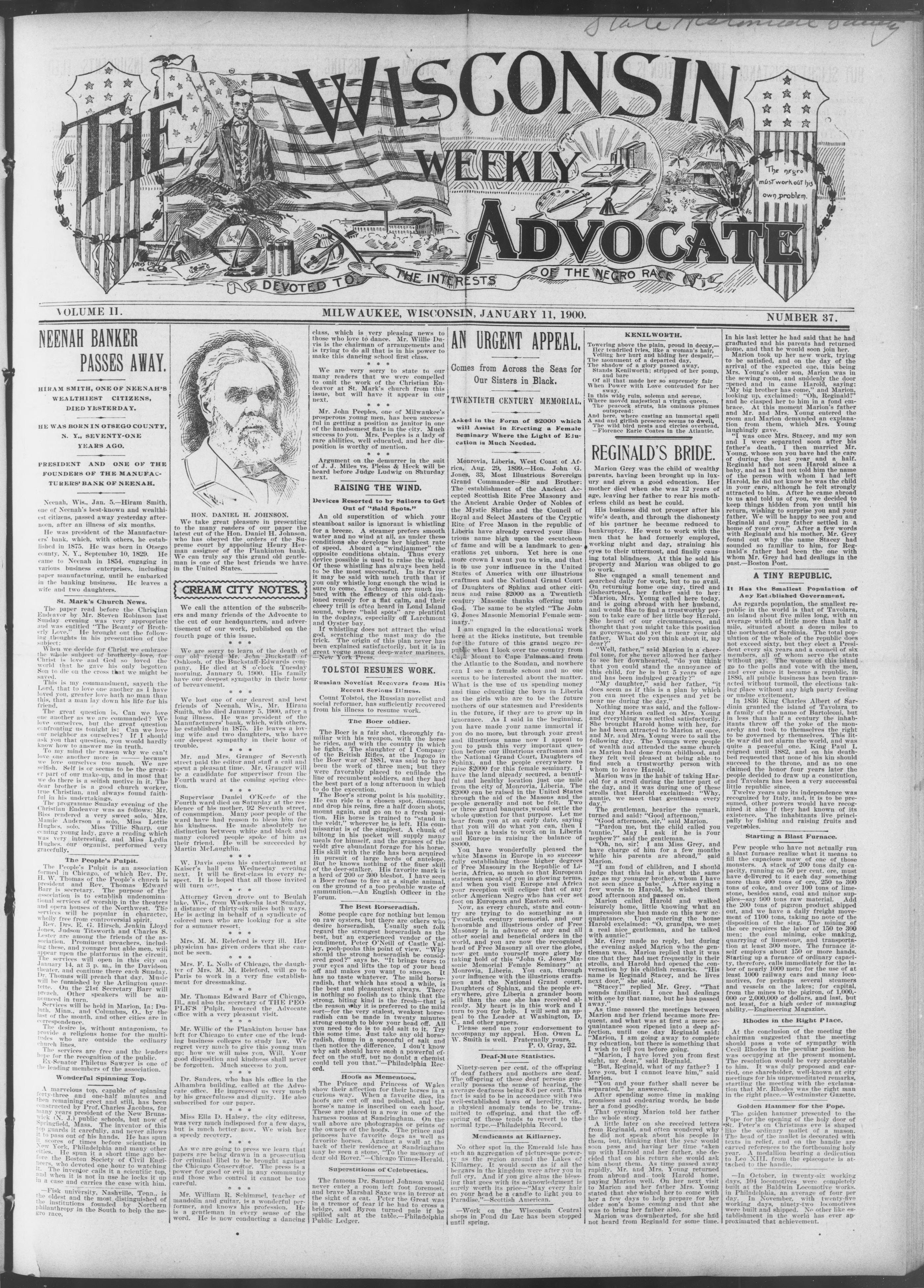
WISCONSIN
WEEKLY
ADVOCATE
DEVOTED TO THE INTERESTS OF THE NEGRO RACE
VOLUME II.
NEENAH BANKER PASSES AWAY.
HIRAM SMITH, ONE OF NEENAH'S WEALTHIEST CITIZENS, DIED YESTERDAY.
HE WAS BORN IN OTSEGO COUNTY, N. Y., SEVENTY-ONE
PRESIDENT AND ONE OF THE FOUNDERS OF THE MANUFACTURERS' BANK OF NEENAH.
Neenah, Wis., Jan. 5.—Hiram Smith, one of Neenah's best-known and wealthiest citizens, passed away yesterday afternoon, after an illness of six months. He was president of the Manufacturers' bank, which, with others, he established in 1875. He was born in Otsego county, N. Y., September 10, 1829. He came to Neenah in 1854, engaging in various business enterprises, including paper manufacturing, until he embarked in the banking business. He leaves a wife and two daughters.
St. Mark's Church News
The paper read before the Christian Endeavor by Mr. Steven Robinson last Sunday evening was very appropriate and was entitled "The Beauty of Brotherly Love." He brought out the following thoughts in his presentation of the subject:
When we decide for Christ we embrace the whole subject of brotherly love, for Christ is love and God so loved the world that he gave his only begotten Son to die on the cross that we might be saved.
This is my commandment, sayeth the Lord, that to love one another as I have loved you, greater love hath no man than this, that a man lay down his life for his friend.
The great question is, Can we love one another as we are commanded? We love ourselves, but the great question confronting us tonight is: Can we love our neighbor as ourselves? If I should ask you that question, you would hardly know how to answer me in truth.
To my mind the reason why we can't love one another more is —— because we love ourselves too much. We are selfish. Self is or seems to be the greater part of our make-up, and in most that we do there is a selfish motive in it. The dear brother is a good church worker, true Christian, and always found faithful in his undertakings.
The programme Sunday evening of the Christian Endeavor was as follows: Mr. Biss rendered a very sweet solo, Mrs. Manie Anderson a solo, Miss Lottie Hughes, solo. Miss Tillie Sharp, our coming young lady, gave a reading which was very interesting, and Miss Lydia Hughes, our organist, performed very gracefully.
The People's Pulpit.
The People's Pulpit is an association formed in Chicago, of which Rev. Dr. H.W. Thomas of the People's church is president and Rev. Thomas Edward Barr is secretary. The purpose of the association is to establish undenominational services of worship in the theaters and opera houses of the Northwest. The services will be popular in character, wholly free from controversial spirit.
Rev. Drs. E. G. Hirsch, Jenkin Lloyd Jones, Judson Titsworth and Charles S. Lester are among the friends of the association. Prominent preachers, including these, and younger but able men, will appear upon the platforms in the circuit. The services will open in this city on January 14, at 3 p. m., in the Davidson theater, and continue there each Sunday. Dr. Thomas will preach that day. Music will be furnished by the Arlington quartette. On the 21st Secretary Barr will preach. Other speakers will be announced in turn. Services will be held in Marion, Ia; Duluth, Minn., and Columbus, O., by the last of the month, and other cities are in correspondence. The desire is, without antagonism, to provide a religious home for the multitudes who are outside the ordinary church lines.
The services are free and the leaders hope for the recognition of the public. Ex-Senator Philetus Sawyer is one of the leading members of the association.
Wonderful Spinning Top.
A marvelous top, capable of spinning forty-three and one-half minutes and then remaining erect and still, has been constructed by Prof. Charles Jacobus, for many years president of the New Brunswick (N. J.) public schools, but now of Springfield, Mass. The inventor of this top guards it carefully, and never allows it to pass out of his hands. He has spun it scores of times before scientists in New York, Philadelphia and many other cities. He spun it a short time ago before the Boston Society of Civil Engineers, who devoted one hour to watching it. The inventor calls it a scientific top, and when it is not in use he locks it up in a case and carries the case with him.
—Fisk university, Nashville, Tenn., is the oldest and the most distinguished of the institutions founded by Northern philanthropy in the South to help the negro race.
J. W.
HON. DANIEL H. JOHNSON.
We take great pleasure in presenting to the many readers of our paper the latest cut of the Hon. Daniel H. Johnson, who has obeyed the orders of the Supreme court by appointing Henry Herman assignee of the Plankinton bank. We can truly say this grand old gentleman is one of the best friends we have in the United States.
CREAM CITY NOTES.
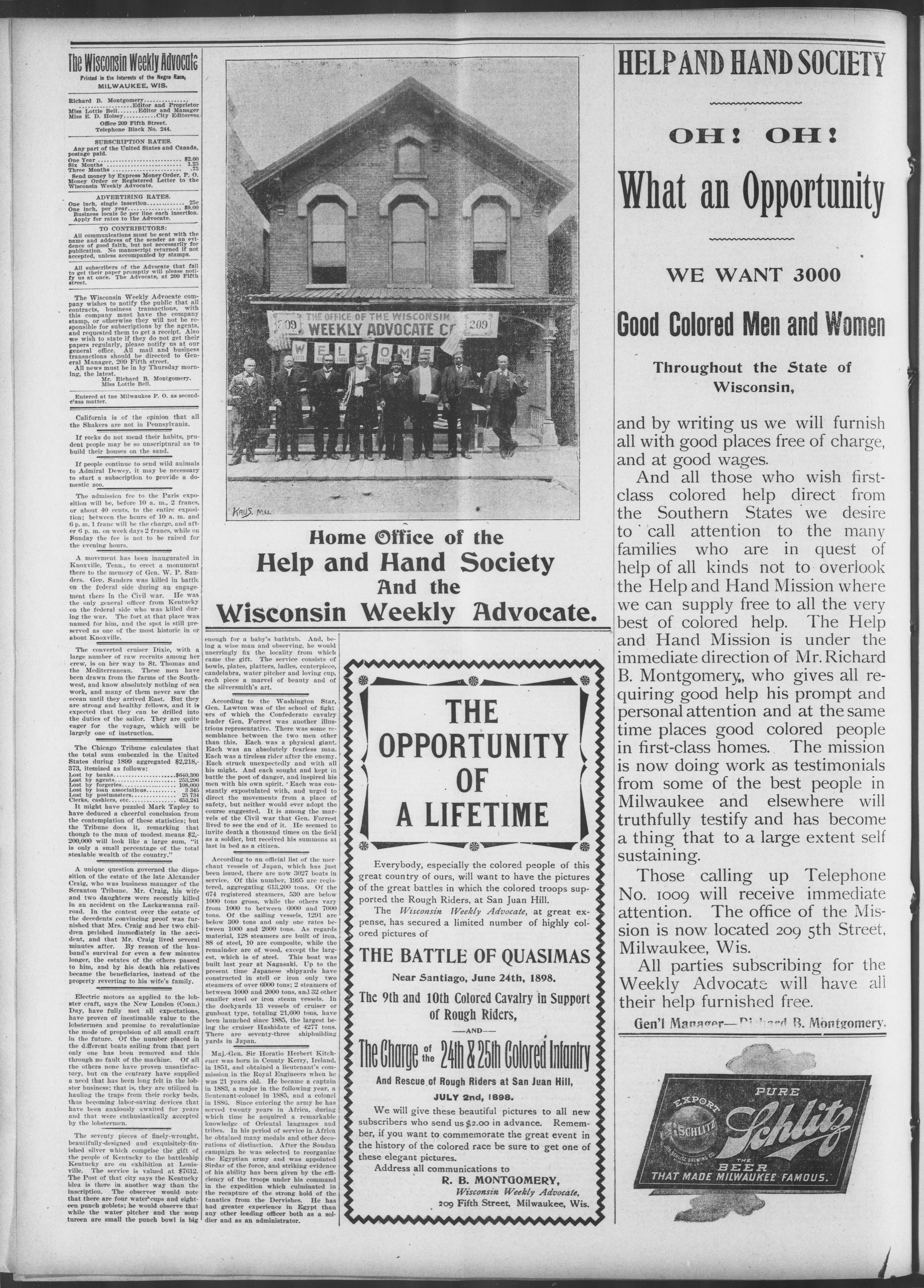
We call the attention of the subscribers and many friends of the Advocate to the cut of our headquarters, and advertisement of our work, published on the fourth page of this issue.
***
We are sorry to learn of the death of our old friend Mr. John Buckstaff of Oshkosh, of the Buckstaff-Edwards company. He died at 8 o'clock Tuesday morning, January 9, 1900. His family have our deepest sympathy in their hour of bereavement.
\* \* \*
We lost one of our dearest and best friends of Neenah, Wis. Mr. Hiram Smith, who died January 5, 1900, after a long illness. He was president of the Manufacturers' bank, which, with others, he established in 1875. He leaves a loving wife and two daughters, who have our deepest sympathy in their hour of trouble.
* * *
Mr. and Mrs. Granger of Seventh street paid the editor and staff a call and spent a pleasant time. Mr. Granger will be a candidate for supervisor from the Fourth ward at the coming spring election.
***
Supervisor Daniel O'Keefe of the Fourth ward died on Saturday at the residence of his mother, 92 Seventh street, of consumption. Many poor people of the ward have had reason to bless him for his kindness. He made absolutely no distinction between white and black and many colored people spoke of him as their friend. He will be succeeded by Martin McLaughlin.
* * *
W. Davis opens his entertainment at Kaiser's hall on Wednesday evening next. It will be first-class in every respect. It is hoped that all those invited will turn out.
* *
Attorney Green drove out to Beulah lake, Wis., from Waukesha last Sunday, a distance of thirty-six miles both ways. He is acting in behalf of a syndicate of colored men who are looking for a site for a summer resort.
* * *
Mrs. M. M. Releford is very ill. Her physician has given orders that she cannot be seen.
* * *
Mrs. F. L. Nolls of Chicago, the daughter of Mrs. M. M. Releford, will go to Paris to work in a very fine establishment for dressmaking.
☆ ☆ ☆
Mr. Thomas Edward Barr of Chicago, Ill., and also the secretary of THE PEOPLE'S Pulpit, honored the Advocate office with a very pleasant visit.
☆ ☆ ☆
Mr. Willie of the Plankinton house has left for Chicago to enter one of the leading business colleges to study law. We regret very much to give this young man up; how we will miss you. Will. Your good disposition and kindness shall never be forgotten. Much success to you.
☆ ☆ ☆
Dr. Sanders, who has his office in the Alhambra building, called at the Advocate office. He impressed us very much by his gracefulness and dignity. He also subscribed for our paper.
☆ ☆ ☆
Miss Ella D. Halsey, the city editress, was very much indisposed for a few days, but is much better now. We wish her a speedy recovery.
***
As we are going to press we learn that papers are being drawn in a prosecution for criminal libel to be brought against the Chicago Conservator. The press is a power for good or evil in any community and those who control it cannot be too careful.
* * *
Mr. William R. Schimmel, teacher of mandolin and guitar, is a wonderful performer, and knows his profession. He is a gentleman in every sense of the word. He is now conducting a dancing
MILWAUKEE, WISCONSIN, JANUARY 11, 1900.
class, which is very pleasing news to those who love to dance. Mr. Willie Davis is the chairman of arrangements and is trying to do all that is in his power to make this dancing school first class.
* * *
We are very sorry to state to our many readers that we were compelled to omit the work of the Christian Endeavor at St. Mark's church from this issue, but will have it appear in our next.
***
Mr. John Peeples, one of Milwaukee's prosperous young men, has been successful in getting a position as janitor in one of the handsomest flats in the city. Much success to you. Mrs. Peeples is a lady of rare abilities, well educated, and her disposition is worthy of mention.
***
Argument on the demurrer in the suit of J. J. Miles vs. Pleiss & Heck will be heard before Judge Ludwig on Saturday next.
RAISING THE WIND.
Devices Resorted to by Sailors to Get Out of "Bald Spots."
An old superstition of which your steamboat sailor is ignorant is whistling for a breeze. A steamer prefers smooth water and no wind at all, as under these conditions she develops her highest rate of speed. Aboard a "windjammer" the opposite conditions obtain. Thus every device possible is used to raise the wind. Of these whistling has always been held to be the most successful. In its favor it may be said with much truth that if you only whistle long enough the wind is sure to come. Yachtsmen are much imbued with the efficacy of this old-fashioned remedy for a flat calm, and their cheery trill is often heard in Lond Island sound, where "bald spots" are plentiful in the dogdays, especially off Larchmont and Oyster bay.
If whistling does not attract the wind god, scratching the mast may do the trick. The origin of this plan never has been explained satisfactorily, but it is in great vogue among deep-water mariners. New York Press.
TOLSTOI RESUMES WORK.
Russian Novelist Recovers from His Recent Serious Illness.
Count Tolstoi, the Russian novelist and social reformer, has sufficiently recovered from his illness to resume work.
The Boer oldier.
The Boer is a fair shot, thoroughly familiar with his weapon, with the horse he rides, and with the country in which he fights. The slaughter of I Company of the British Rifles, at the Ingogo in the Boer war of 1881, was said to have been the work of three men; but they were favorably placed to enfilade the line of recumbent soldiers, and they had the best part of a long afternoon in which to do the execution.
The Boer's strong point is his mobility. He can ride to a chosen spot, dismount and drop his reins, fire a half dozen shots, mount again, and go on to a fresh position. His horse is trained to "stand in the veldt," wherever he is left. His commissariat is of the simplest. A chunk of biltong in his pocket will supply many meals for himself, and the grasses of the veldt give abundant forage for his horse. His skill with the rifle has been acquired in pursuit of large herds of antelope. But he knows nothing of the finer skill of the deer-stalker. His favorite mark is a herd of 200 or 300 blesbot. I have seen a Boer refuse to fire at a single animal, on the ground of a too probable waste of ammunition.—An English Officer in the Forum.
The Best Rorseradish.
Some people care for nothing but lemon on raw oysters, but there are others who desire horseradish. Usually such folk regard the strongest horseradish as the best, but an experienced vendor of the condiment, Peter O'Neill of Castle Valley, pooh-poohs this point of view. "Why should the strong horseradish be considered good?" says he. "It brings tears to your eyes and lifts the top of your head off and makes you want to sneeze. It has no taste whatever. The mild horseradish, that which has stood a while, is the best and pleasantest always. There is nothing so foolish as to think that the strong, biting kind is the fresh—that is the reason why it is preferred to the mild sort—for the very stalest, weakest horseradish can be made in twenty minutes strong enough to blow your head off. All you need to do is to add salt to it. Try this some time. Just take any old horseradish, dump in a spoonful of salt and then notice the difference. I don't know why salt should have such a powerful effect on the stuff, but no doubt a chemist could tell you that."—Philadelphia Record.
Hoofs as Mementoes
The Prince and Princess of Wales show their affection for their horses in a curious way. When a favorite die, its hoofs are cut off and polished, and the horse's name is inscribed on each hoof. These are placed in a row in one of the harness rooms at Sandringham. On the wall above are photographs or prints of the owners of the hoofs. The prince and princess have favorite dogs as well as favorite horses. Against a wall at the back of their residence at Sandringham may be seen a stone. "To the memory of dear old Rover."—Chicago Times-Herald.
Superstitions of Celebrities
The famous Dr. Samuel Johnson would never enter a room left foot foremost, and brave Marshal Saxe was in terror at the sight of a cat. Peter the Great was in a tremor of fear if he had to cross a bridge, and Byron turned pale if he spilled salt at the table.—Philadelphia Public Ledger.
AN URGENT APPEAL.
TWENTIETH CENTURY MEMORIAL
Asked in the Form of $2000 which will Assist in Erecting a Female Seminary Where the Light of Education is Much Needed.
Monrovia, Liberia, West Coast of Africa, Aug. 29, 1899.—Hon. John G. Jones, 33, Most Illustrious Sovereign Grand Commander—Sir and Brother: The establishment of the Ancient Accepted Scottish Rite Free Masonry and the Ancient Arabic Order of Nobles of the Mystic Shrine and the Council of Royal and Select Masters of the Cryptic Rite of Free Mason in the republic of Liberia have already carved your illustrious name high upon the escutcheon of fame and will be a landmark to generations yet unborn. Yet here is one more crown I want you to win, and that is to use your influence in the United States of America with our illustrious craftmen and the National Grand Court of Daughters of Sphinx and other citizens and raise $2000 as a Twentieth century Masonic thanks offering unto God. The same to be styled "The John G. Jones Masonic Memorial Female seminary."
I am engaged in the educational work here at the Ricks institute, but tremble for the future of this grand negro republic when I look over the country from Cape Mount to Cape Palmas and from the Atlantic to the Soudan, and nowhere can I see a female school and no one seems to be interested about the matter. What is the use of us spending money and time educating the boys in Liberia as the girls who are to be the future mothers of our statesmen and Presidents in the future, if they are to grow up in ignorance. As I said in the beginning, you have made your name immortal if you do no more, but through your great and illustrious name now I appeal to you to push this very important question before our illustrious craftsmen and the National Grand Court, Daughters of Sphinx, and the people everywhere to raise $2000 for this female seminary. I have the land already secured, a beautiful and healthy location just one mile from the city of Monrovia, Liberia. The $2000 can be raised in the United States through the aid of the Masons and the people generally and not be felt. Two or three grand banquets would settle the whole question for that purpose. Let me hear from you at an early date, saying that you will do what you can, then I will have a basis to work on in Liberia and Europe in raising the balance of $8000.
You have wonderfully pleased the white Masons in Europe in so successfully establishing those higher degrees of Free Masonry in the Republic of Liberia, Africa, so much so that European statesmen speak of you in glowing terms, and when you visit Europe and Africa your reception will eclipse that of any other American Negro who has ever set foot on European and Eastern soil.
Now, as every church, state and country are trying to do something as a Twentieth century memorial, and our honorable and illustrious order of Free Masonry is in advance of any and all other social and beneficial orders in the world, and you are now the recognized head of Free Masonry all over the globe, now get unto yourself more glory by taking hold of this "John G. Jones Masonic Memorial Female Seminary" at Monrovia, Liberia. You can, through your influence with the illustrious craftsmen and the National Grand court, Daughters of Sphinx, and the people everywhere, give Liberia a grander boom still than the one she has received already. My heart is in this work and I turn to you for help. I will send an appeal to the Leader at Washington, D. C., and other papers.
Please send me your endorsement to accompany my appeal. Hon. Owen L. W. Smith is well. Fraternally yours.
Deaf-Mute Statistics
Ninety-seven per cent. of the offspring of deaf fathers and mothers are deaf. The offspring of these deaf persons generally possess the sense of hearing, the average deafness being 8.6 per cent. This fact is said to be in accordance with two well-established laws of heredity, viz., a physical anomaly tends to be transmitted to offspring, and that the offspring of these tends to revert to the normal type.—Philadelphia Record.
Mendicants at Killarney.
No other spot in the Emerald isle has such an aggregation of picturesque poverty as the region around the Lakes of Killarney. It would seem as if all the beggars in the kingdom were after you in full cry. And if you give alms the blessing that goes with its acknowledgment is surely worth its price—"May every hair on your head be a candle to light you to Paradise."—Scottish American.
Work on the Wisconsin Central shops in Fond du Lac has been stopped until spring.
KENILWORTH.
Towering above the plain, proud in decay,—
Her tendrilled lvies, like a woman's hair,
Velling her hurt and hiding her despair,
The monument of a departed day,
The shadow of a glory passed away,
Stands Kenilworth; stripped of her pomp,
and bare
Of all that made her so supremely fair
When Power with Love contended for her sway,
In this wide ruin, solemn and serene,
Where moved majestical a virgin queen,
The peacock struts, his ominous plumes
outspread:
And here, where casting an immortal spell A sad and girlish presence seems to dwell. The wild bird nests and circles overhead. —Florence Earle Coates in the Atlantic.
REGINALD'S BRIDE.
REGINALD'S BRIDE.
Marion Grey was the child of wealthy parents, having been brought up in luxury and given a good education. Her mother died when she was 12 years of age, leaving her father to rear his motherless child as best he could.
His business did not prosper after his wife's death, and through the dishonesty of his partner he became reduced to bankruptcy. He went to work with the men that he had formerly employed, working night and day, straining his eyes to their uttermost, and finally causing total blindness. At this he sold his property and Marion was obliged to go to work.
She engaged a small tenement and searched daily for work, but to no avail. On returning home one day, tired and disheartened, her father said to her: "Marion, Mrs. Young called here today, and is going abroad with her husband, and would like to find a trustworthy person to take care of her little boy Harold. She heard of our circumstances, and thought that you might take this position as governess, and yet be near your old father. What do you think about it, my dear?"
"Well, father," said Marion in a cheerful tone, for she never allowed her father to see her downhearted, "do you think that you could stand the annoyance of this child, for he is but 5 years of age and has been indulged greatly?"
"My daughter," said her father, "it does seem as if this is a plan by which you can meet the expenses and yet be near me during the day."
Nothing more was said, and the following day Marion called on Mrs. Young and everything was settled satisfactorily. She brought Harold home with her, for he had been attracted to Marion at once, and Mr. and Mrs. Young were to sail the following day. The Youngs were people of wealth and attended the same church as Marion had done from childhood, and they felt well pleased at being able to find such a trustworthy person with whom to leave Harold.
Marion was in the habit of taking Harold for a stroll during the latter part of the day, and it was during one of these strolls that Harold exclaimed: "Why, auntie, we meet that gentleman every day."
The gentleman, hearing the remark, turned and said: "Good afternoon."
"Pardon me, but the child called you 'auntie.' May I ask if he is your nephew?" said the gentleman.
"Oh, no, sir! I am Miss Grey, and have charge of him for a few months while his parents are abroad," said Marion.
"I am fond of children, and I should judge that this lad is about the same age as my younger brother, whom I have not seen since a babe." After saying a few words to Harold, he wished them good afternoon and passed on.
Marion called Harold and walked leisurely home, little knowing what an impression she had made on this new acquaintance. Upon entering the house Harold exclaimed: "O, grandpa, we met a real nice gentleman, and he talked with auntie!"
Mr. Grey made no reply, but during the evening asked Marion who the gentleman was. Marion replied that it was one that they had met frequently in their strolls, and Harold had opened the conversation by his childish remarks. "His name is Reginald Stacey, and he lives next door," she said.
"Stacey!" replied Mr. Grey. "That sounds familiar. I once had dealings with one by that name, but he has passed away."
As time passed the meetings between Marion and her friend became more frequent, and what was at first a mere acquaintance soon ripened into a deep affection, until one day Reginald said: "Marion, I am going away to complete my education, but there is something that I wish to tell you before going.
"Marion, I have loved you from first sight, my dear," said Reginald.
"But, Reginald, what of my father? I love you, but I cannot leave him," said Marion.
"You and your father shall never be separated," he answered.
separated, he answered.
After spending some time in making promises and endearing words, he bade her a fond goodby.
That evening Marion told her father the whole story.
A little later on she received letters from Reginald, and often wondered why he did not speak about his people in them, but, thinking that the year would soon pass and having her time taken up with Harold and her father, she decided that on his return she would ask him about them. As time passed away rapidly, Mr. and Mrs. Young returned from abroad and took Harold home, paying Marion well. On her next visit to Marion and her father Mrs. Young stated that she wished her to come with her a few days to help prepare for her older son's home coming and that she was to bring her father also.
Marion was downhearted, for she had not heard from Reginald for some time.
NUMBER 37.
In his last letter he had said that he had graduated and his parents had returned home, and that he would soon join her.
Marion took up her new work, trying to be satisfied, and on the day of the arrival of the expected one, this being Mrs. Young's older son, Marion was in the sewing room, and suddenly the door opened and in came Harold, saying: "My big brother has come," and Marion, looking up, exclaimed: "Oh, Reginald!" and he clasped her to him in a fond embrace. At this moment Marion's father and Mr. and Mrs. Young entered the room and Marion demanded an explanation from them, which Mrs. Young laughingly gave.
"I was once Mrs. Stacey, and my son and I were separated soon after his father's death. I then married Mr. Young, whose son you have had the care of during the last year and a half. Reginald had not seen Harold since a baby, and as I had not told him the name of the person with whom I had left Harold, he did not know he was the child in your care, although he felt strongly attracted to him. After he came abroad to us and told us of you, we decided to keep things hidden from you until his return, wishing to surprise you and your father. We will be happy to see you and Reginald and your father settled in a home of your own." After a few words with Reginald and his mother, Mr. Grey found out why the name Stacey had sounded so familiar to him, for Reginald's father had been the one with whom Mr. Grey had had dealings in the past.—Boston Post.
A TINY REPUBLIC.
It Has the Smallest Population of Any Established Government.
As regards population, the smallest republic in the world is that of Tavolara, an island about five miles long, with an average width of little more than half a mile, situated about a dozen miles to the northeast of Sardinia. The total population of the whole of the republic does not exceed sixty, but they elect a President every six years and a council of six members, all of whom serve the state without pay. The women of this island go to the polls and vote with the men, and ever since it became a republic, in 1886, all public business has been transacted without turmoil, the elections taking place without any high party feeling or undue excitement.
In 1836 King Charles Albert of Sardinia granted the island of Tavolara to a family of the name of Bartoleoni, but in less than half a century the inhabitants threw off the yoke of the monarchy and took to themselves the right to be governed by themselves. This little war did not alarm the world, and was quite a peaceful one. King Paul I. reigned until 1882, and on his deathbed requested that none of his kin should succeed to the throne, and as no one claimed the honor four years later the people decided to draw up a constitution, and Tavolara has been a very successful little republic since. Twelve years ago its independence was recognized by Italy, and, it is to be presumed, other powers would have recognized it also if they had known of its existence. The inhabitants live principally by fishing and raising fruits and vegetables.
Starting a Blast Furnace
Few people who have not actually run a blast furnace realize what it means to fill the capacious maw of one of those monsters. A stack of 200 tons daily capacity, running on 50 per cent. ore, must have delivered to it each day something more than 400 tons of ore, 250 to 300 tons of coke, and over 100 tons of limestone, besides sand, coal and minor supplies—say 900 tons raw material. Add the 200 tons of pigiron product shipped out, and we have a daily freight movement of 1100 tons, taking no note of the disposition of the slag. The mining of the ore requires the labor of 150 to 300 men; the coal mining, coke making, quarrying of limestone, and transportation at least 300 more. The furnace itself employs about 150 or more hands. Starting up a furnace of ordinary capacity, therefore, calls immediately for the labor of nearly 1000 men; for the use of at least 1000 railway cars and many locomotives, for perhaps several steamers and vessels on the lakes; for capital, from the mines to the pigiron, of 1,000,000 or 2,000,000 of dollars, and last, but not least, for a high order of managing ability.—Engineering Magazine.
Rhodes in the Right Place.
At the conclusion of the meeting the chairman suggested that the meeting should pass a vote of sympathy with Cecil Rhodes in the peculiar position he was occupying at the present moment. The resolution would be very acceptable to him. It was duly proposed and carried, one shareholder, well-known at city meetings for his unpremeditated remarks, startling the meeting with the exclamation that Mr. Rhodes was the right man in the right place.—Westminster Gazette.
Golden Hammer for the Pope
The golden hammer presented to the Pope for the opening of the holy door of St. Peter's on Christmas eve is shaped like the ordinary mallet of a mason. The head of the mallet is decorated with texts in relief, and on the handle are carved references to the forthcoming holy year. A medallion bearing a dedication to Leo XIII, from the episcopate is attached to the handle.
—In October, in twenty-six working days, 104 locomotives were completely built at the Baldwin Locomotive works, in Philadelphia, an average of four per day. In November, with twenty-five working days, ninety-two locomotives were built and shipped. No other like establishment in the world has ever approximated that achievement.
Two Reports from Gen. Otis Showing Lists of Killed and Wounded.
Manila, Jan. 9.—Gen. Schwan has occupied Silang and Indang, Cavite province, meeting with but slight resistance. He captured three guns and a quantity of ammunition. The roads in that section are very heavy. The bubonic plague is yet sporadic. There have been six cases and four deaths. Preparations are being made to establish hospitals and for disinfecting and quarantining. Great numbers of provincial natives are coming to Manila with the result that the city is overcrowded, the increase in accommodations being inadequate, and the rice necessary for foodstuffs is more expensive than at any period during the last twelve years. The plague is dangerous to the overcrowded, underfed and unwashed natives and Chinamen. Americans avoiding direct contact with the disease are safe.
A force of Filipinos charged twelve men of the Third cavalry who were scouting behind San Fernando de Laubon. One trooper and three horses and carbines were captured. The enemy fled.
Otis' List of Casualties.
Washington, D. C., Jan. 9.—Gen. Otis cabled the war department this morning two casualty reports from Manila. The first embraces the losses incurred during the pursuit of Gen. Tino's command which effected the release of Lieut. Gillmore and the other American prisoners. It is as follows:
Manila, Jan. 8.—Deaths: Drowned, Rioagno, November 15, Newton W. Reese, Albert E. Holton, I, Fourth cavalry; Rio Grande, November 7, Clarence W. Crites, D, Third cavalry; Rio Pasig, accidentally, January 2, Anton M. Bong, Thirtieth infantry; Rio Zapote, accidentally, January 1, Elli Lorrimore. A, Thirty-eighth infantry; Gamilining, accidentally, December 29, Wm. C. Bryant, corporal, G. Twelfth infantry; typhoid, December 27, George Lehfepd, C. Twenty-second infantry; 26th, Aug. Gruelher, M. Nineteenth infantry; January 3, George M. Dubley, F, Fourteenth infantry; Sixth, Edward I. Derry, E, Sixth artillery; Second, Charles Harrison, H, Twenty-eighth infantry; fourth, Jefferson M. Stirwalt, E, Elighteenth infantry; H, third, W. A. Rundy; H, Twenty-sixth infantry. Dysentery, December 26, Jack Whitney, corporal, E, Sixth infantry; January 1, Arthur J. Edgerton, L, Thirty-second infantry; Second, James Kelly, G, Third artillery; Fifth, John W. McGee, corporal G, Fourteenth infantry. Pneumonia, January 1, Theodore Gehring, C, Fourth infantry; Thomas J. Lyons, D, Third cavalry; Fourth, Wm. Maloney, corporal, L, Nineteenth infantry, malaria; December 29, Reuben Waether, L, Twenty-fifth infantry; 30th, George Burchall, B, engineer; January 5, Patrick Fallon, H, Twelfth infantry, pernicious malarial fever; November 25, Wm. Dance, K, Twenty-fourth infantry, chronic diarrhoea; January 3, Peter H. Kean, sergeant H, Fourth cavalry, inflammation of bowels; January 1, Wm. Crabtree, D, Thirty-second infantry, aortic stenosis of heart; January 3, Edward Brown, musician, K. Sixth infantry.
OT18.
The second is a list of the casualties sustained in the campaign opened in the South and is as follows:
Manila, Jan. 9, 1900.—Casualties: Killed in action, engagement near Imus, January 7. Fourth infantry, Second Lieut. Ward Cheney; Twenty-eighth infantry, L. Robert Shuman, sergeant Fourth infantry, C. August Horsley, August Erickson. Near Bacoor, January 2, Twenty-eighth infantry, C. Michael E. Kane; wounded, engagement near Imus, January 7. Fourth infantry, C. Stanley Millard, leg, slight: Twenty-eighth infantry, C. John Corbit, hand, moderate; A, John Barry, arm, moderate; Henry J. Flood, sergeant, arm, moderate, Eleventh cavalry, C. Ridgeway Griscom, neck, severe; Thirtieth infantry, F. Charles Cawetzka, both thighs, severe; Fifth artillery, F. Terrence Money, thigh, moderate; William Protze, chest, severe; action Cabatuan, November 9, Ernst B. Barjaron, civilian, in Lows scouts, chest, severe. OTIS.
500 Recruits for Otis.
San Francisco, Cal., Jan. 9.—The transports Tartar and Aztec will sail for Manila tomorrow. The Tartar will go to the Philippines direct with the 500 recruits and a large quantity of commissary stores. Col. Freeman of the Fifth artillery will be a passenger. The Aztec will carry cavalry horses and will stop at Hilo.
MME. BAZAINE DEAD.
Succumbs to Effects of Operation for Cancer-A Famous French Woman.
City of Mexico, Jan. 9.—Mme. Bazaine, widow of the famous French marshal, died at a private hospital in the suburbs of this city, where she had gone for an operation for cancer. The case was a critical one and there was hardly a chance in a thousand of preserving her life and she succumbed. Her maiden name was De La Pena and she was allied to many aristocratic families here. Her marriage to Marshal Bazaine added to her social prestige and she received by her alliance the title of excellency. For a time after her husband's return to France she was one of the ornaments of the court of Napoleon III., where her beauty and exquisite taste made her famous. When Marshal Bazaine fell into disgrace she adhered to his fortunes and on his imprisonment she plotted successfully for his escape. During recent years she had resided in this city with her daughter Eugenia, who has inherited her mother's beauty. There were also two sons by this marriage, the oldest dying in Cuba of yellow fever.
From a brilliant position Mme. Bazaine came to occupy a comparatively obscure one, although held in respect for her noble qualities and her distinctly aristocratic lineage. The funeral was private and attended by only a few friends.
Frederick Hainsworth Dead
Frederick Hainsworth, a resident of Chicago since 1864, died suddenly of heart disease at the home of his daughter. The remains were today brought to Milwaukee for interment. Mr. Hainsworth was born in England seventy-eight years ago. He came to America in 1864, settling in Rhode Island, but removed to Chicago ten years later and engaged in the sale of architectural iron. He leaves a son, Joseph Hainsworth of 905 Warren avenue, and a daughter, Mrs. Clara Wright.
—There are 7,000,000 postal savings depositors in Great Britain, who have accumulated $55,000,000, on which in 1895 a dividend of $2½ per cent. was paid, leaving a surplus of $3,500,000. The cost of the management was 0.44 per cent. of the mean amount of deposit.
—In 1897 the herring fisheries of Germany yielded 67,652 tons, but under the encouragement of the government, in 1898, 128,758 tons were gathered, eighty-five sailing and five steam vessels being engaged in the industry.
—Last year the income tax yielded Great Britain a revenue of £4,500,000
Fears that Beleagured Ladysmith Cannot Hold Out.
Lack of Ammunition, Disease, and Boer Bombardment Make White's Position Perilous.
London, Jan. 9.—Despite the fact that Gen. White repulsed the Boers in the attack on Ladysmith Saturday, the alarm felt in London for the safety of the beleaguered town has abated little. Gen. White reported that after fourteen hours of most desperate fighting the enemy retired, but the fact that British positions were several times occupied by the burghers, who were dislodged with difficulty, indicates that the defenses may not stand before another such determined assault.
The serious drain on the garrison's ammunition, which was known to be low, the reducing of the number of able men and the addition of the wounded to the town's already-crowded hospitals; the presence of disease and the lack of proper medical stores; the shortage of fresh provisions and the deadly peril from the continued bombardment, all combine to make the situation most grave. Gen. Buller is still helpless, south of the Tugela river and with his army in three camps ten miles apart, it seems improbable that he can give the garrison any hope of early relief.
London, Jan. 9.—The remarkable revolution in Boer tactics has been a complete surprise to the British, who had not reckoned on the weakened garrison of Ladysmith being subjected to such a courageous assault and it is realized that Gen. White's troops cannot be expected to greatly prolong such an arduous defense. In some quarters it is considered unaccountable that Gen. Buller did not press his attempt to effect a passage of the Tugela river while the Boers were engaged northwards, and the comment on his apparent supineness are nowise complimentary.
From the Boer headquarters is reported that Gen. Buller is constructing a subsidiary railroad from the main line to Colenso westwardly in the direction of Potgieter drift.
Advices from the Modder river say the Boers continue to extend their works and it is estimated that 30,000 men are required to defend them.
Captured British Subjects.
The prisoners captured by the Canadians and Queenslanders at Sunnyside are going to Cape Town for trial as rebels. The Canadians expressed intense indignation on learning that the prisoners were British subjects.
The Colonial troops continue to earn warm praise on all sides, the latest example of their effective work being recorded in the dispatch to the London Times, dated January 6, from the Modder river, cabled to the Associated press last night, which reported that the news from Belmont showed that the Canadians and Queenslanders had been so energetic in that vicinity that the Boers had been compelled to desert a large belt of the Orange Free State territory across the border.
Little change is apparent in the position at Colesberg. Gen. French reported to the war office Sunday morning, January 7. that he had reconnoitered with a squadron of the household cavalry on the Boers' east flak, two miles from Achtertang and a considerable force from the burghers, who, being anxious for communication with Norvalspont, withdrew.
Casualties at Colesberg.
The casualties of the Suffolks near Colesberg were:
Killed—Col. Watson and Lieuts. Wilkins, Carey and White and 23 men.
Missing—Capt. Brett. Thomson and Brown and Lieuts. Rants. Allen, Wood-Martin and Butler, and 107 men.
Wounded—Twenty-one men.
Gen. French further reports that the casualties of the other regiments to January 4 were twelve men killed and forty-four wounded.
The Queen has telegraphed her congratulations and thanks to Gen. White and his troops of Ladysmith.
A dispatch from Frere Camp, last Sunday night, said all was quiet there, thus dispelling the widespread hopes that Gen. Buller had followed up his demonstration before Colenso with an effective move elsewhere.
The London Times correspondent at Laurenco Marques cables that although there is no guarantee that Transvaal gold is of standard value, the Portuguese government compels the local banks to accept it as legal tender at the same rate as British sovereigns, "thus giving the republics every facility for extensive transactions here and remitting money to Europe."
Continuing, the correspondent says: "It is a question whether the Portuguese order is not a breach of neutrality."
The latest news from Bloemfontein says the officials there recognize that they must evacuate the town at an early date and are securing houses at Pretoria.
It is also announced that the hospitals at Bloemfontein and elsewhere are packed with wounded men.
No British Representative Wanted.
New York, Jan. 9.—A special from Washington says: The Transvaal government has informed the United States that W. Stanley Hollis, American consul at Pretoria, will not be permitted to represent British interests in the republic during the war, it being against the Transvaal's policy to permit any British representative in its territory. Consul Hollis, however, will be permitted to care for British prisoners of war confined in Pretoria, in his personal capacity.
Prisoners in a Stockade.
A dispatch to the Herald from Brussels says: A private letter from Pretoria says that in order to accommodate the prisoners of war who are crowding into Pretoria an immense enclosure has been constructed to the north of the town in three long streets named Ladysmith, Kimberley and Mafeking streets.
KILLED AN OFFICER.
British Fire Upon the Dutch Cruiser Friesland.
London, Jan. 9.—A special dispatch from Amsterdam today says that an uncredited rumor is current there that a British cruiser has fired upon the Dutch cruiser Friesland, near Delagoa bay and that a Dutch officer was killed.
Durban, Jan. 9.—The seized German steamer Herzog has been handed over to the prize court. The Portuguese governor of Zambesa was among her passengers. The British naval authorities have offered him a ship to convey him to Delagoa bay. The steamer Bundesrath is discharging.
London, Jan. 9.—The Berlin correspondent of the Daily News, in a dispatch dealing at some length with the question of the seizures of German vessels by British warships, says:
"It cannot be denied that the idea of an anti-British coalition is very popular here. Hopes are now placed in Russia. Without being pessimistic, I must say
that the present juncture is extremely critical. As matters stand, only the fact that no power wishes to take the initiative prevents such a coalition from being brought about." Hamburg, Jan. 9.—The owners of the German steamer Bundesrath, which was seized by the British, have been informed that the European passengers aboard the vessel have been released and will go to Delagoa bay at the first opportunity. The Bundesrath's mail will be sent forward on the German cruiser Condor.
London, Jan. 9. There is some reason to believe that the United States and German embassies are trying to find a common basis on which they can operate in pressing their respective demands against Great Britain for the Delagoa bay seizures. A high official of the German embassy had a long conference today at the American embassy and the diplomats are believed to have discussed the steps each country has already taken and the best future procedure.
WANTED RECOGNITION.
Secret of Transvaal's Attitude Toward Consul Macrum.
Washington, D. C., Jan. 9.—Mail advises are just coming to hand from United States Consul Macrum, explaining in detail the situation at Pretoria at the outbreak of the war and his own conduct respecting the representation of British interests in the Transvaal. It appears that Mr. Macrum, like his successor at Pretoria, Mr. Hollis, was placed under a technical limitation in the exercise of his functions by the Boer government and while he was permitted to disburse the funds sent him by the British government for the comfort of the British prisoners in Pretoria he did so under the distinct stipulation that he was acting unofficially. Possibly the motive of the Boer government in refusing to allow the American consul to act officially was a desire on its part to force the British government into some official recognition of the status of the South African republics. If so, the effort failed, and Mr. Macrum and his successor, Mr. Hollis, have gone on in their work of mercy without molestation from the Boer government. This object being secured and there being little else at present in the nature of business touching British interests in Pretoria that requires the attention of a representative of that government, the state department here is disposed to allow the situation to go along without change or protest because the Boer government has not seen fit to allow the American consul to act in an official manner.
There is nothing in Mr. Macrum's report to throw the faintest light upon his inexplicable action in leaving his post in the middle of the war.
The state department has heard, indirectly, from Webster Davis, assistant secretary of the interior. Mr. Davis is now at Capt Town and his appearance at that place gave rise to all sorts of rumors to the effect that he was charged with some weighty diplomatic mission, and especially with a purpose to mediate between the belligerents in South Africa. As a matter of fact, Mr. Davis went to South Africa solely for his health, seizing upon the opportunity to pay a visit to United States Consul-General Stowe at Cape Town, who is his near relative. Unfortunately, the gentleman gave some foundation for the rumors referred to, by projecting a journey to Pretoria, in company with Mr. Stowe, but this trip was abandoned as soon as it appeared that its purpose might be misconstrued.
Refused to Contribute.
Springfield, Mo., Jan. 9.—The Springfield division of the Ancient Order of Hibernians, which had been solicited by the national president to contribute to the fund for the relief of the Boers, decided by an almost unanimous vote not to comply with the request. The reply sent to John T. Keating at Washington says: "We beg to say that while we extend our heartfelt sympathy to the Boers in South Africa and wish them a great and glorious victory in this war, yet we are opposed as members of the Ancient Order of Hibernians to extending to them any financial aid whatever. We believe that there are more worthy causes in which we can expend our money. We are opposed to doing anything that is against the neutrality laws of our country, which must be respected above all things.
AN APOLOGY REQUIRED.
Gunboat Arrives at San Domingo to Enforce the Demands of France.
New York, Jan. 9.—A special to the Herald, from Washington, says: Besides the payment of the money remaining due in the Boismare-Caccavelli claim, the French government has demanded an apology from San Domingo.
An official dispatch to this effect was received by Secretary Hay from the American representative at San Domingo. Under orders issued several days ago, without reference to the French incident, the gunboat Machias will return to San Domingo from San Juan, where she went for coal. Upon her arrival Commander L. C. Logan will consult with the American minister for the protection of American interests. Minister Powell will receive, in a few days, an instruction to vigorously press the Dominican government for the payment of the remaining installments due to the McKay claim, and with the Machias in the harbor the representation may be effective.
A dispatch from the Herald from San Domingo says: President Jiminez, who has been at Macori since Saturday superintending the raising of the popular subscription to pay the Boismare-Caccavelli claim to the French government, returned this afternoon with 300,000 francs. The claim amounts to 260,000 francs. As the popular subscription is larger than the claim the Dominicans are rejoicing.
The return of the President under such suspicious circumstances was marked by patriotic enthusiasm and a general flag display. The French cruiser Cecille saluted the gunboat on which President Jiminez returned. The gunboat answered the salute.
No steps have been taken by the French consul further than intrusting the case to Admiral Richard. No disorders have occurred, but the popular sentiment is against apologizing to France.
The arrival of the French cruiser Cecille created considerable excitement. She reached San Domingo yesterday afternoon, but did not salute as she entered the harbor. The situation here is tranquil and the government has urged the people to show no hostility to France. It is said that France will send two additional warships to this island.
It is reported here that the Americans of this place have asked the government of the United States not to allow France to dictate terms of the Dominican government. An American warship is expected here today. The French admiral and his staff were officially received by President Jiminez today.
TWO MURDERERS HANGED
Both Men Made Confessions Prior to Their Trial.
Montrose, Pa., Jan. 9.—Cornelius Shew and James J. Eagan, the murders of Jackson Pepper, an aged and wealthy farmer of Rush township, Susquehanna county, was hanged here today.
London, Jan. 10.--The plight of British arms in South Africa is overshadowed at present by the storm which is bursting over the head of the home government. The Manchester speeches of Mr. Balfour, the government leader, in the House of Commons, has loosened such a torrent of comment from the press and individuals of his own party that was Parliament to reassemble today it is doubtful if the Conservatives would retain power, in spite of their tremendous majority of the past session. The pent-up dissatisfaction of the government's lack of energy in waging the war is no longer concealed. When such ardent Conservative papers as the Times and Globe come out boldly with reproof there is no knowing where the agitation will end. The provincial press has already taken the cry. For the moment Mr. Balfour is the scapegoat, but there is a terrible rod in pickle for the Marquis of Lansdowne, while Lord Salisbury and other cabinet ministers will not escape unless a wonderful change comes over the war situation.
The Popular Clamor.
A reporter of the Associated press learns that the Conservative leaders privately admit the gravity of their position, but fail to see what can be done. In the meanwhile the success in the field will abate the papular clamor. Some of the Conservative papers go so far as to regret the extreme age of the cabinet ministers and refer to the cabinet as a body of patriarchs. Under these remarks, it is doubtful whether events transpiring before the reassembling of Parliament would be powerful enough to restore confidence in the government and maintain its majority. There is the important alternative that Lord Lansdowne or Lord Wolseley may be sacrificed. A representative of the Associated press learns that Lord Wolseley not only disapproved of Lord Roberts' appointment to the chief command of the British troops in South Africa, but allowed his disapproval to be generally known. It is the fact that Lord Wolseley knew nothing of the government's intention in this respect until he saw the announcement of the appointment in the newspapers. Whatever ensued, the immediate future will doubtless see attacks on the government such as Lord Salisbury has not had to withstand during all the course of his political career.
Money for the War.
The borrowing powers conferred on the government at the last session of Parliament are almost exhausted. About seven and a half out of the eight millions of treasury bills authorized have already been issued. The large revenues coming in will, however, probably furnish ample funds until Parliament meets.
Accusation Repudiated.
A. J. Balfour, the government leader in the House of Commons, at a luncheon given in Manchester this afternoon, made a speech in which he repudiated the accusation that he was a "thick and thin supporter of the war office"
He declared that even if an angel from heaven told him it was possible in a great war to carry out everything written on paper he would know that the angel was drawing upon his imagination. It was true, he added, that the war office had sent the British army into the field with guns which placed them at a hopeless disadvantage with their enemies. He did not claim that the army system was perfect, but the critics ought not to ignore the extraordinary military problems of the present war, between which and the problems with which continental headquarters staffs had to deal there was no parallel. For the first time in the history of the world the country had to meet an enemy entirely mounted, and it was true that if Great Britain had entered into the war with a vast number of mounted soldiers it would have long before been concluded. Hereafter, also, it would be recognized that guns were not as mobile as horse soldiers and that field artillery must be made part of the regular equipment of every army. But, seeing that the war office had not lagged behind the best military opinion of today it was ludicrous to charge it with want of prescience. He was sure justice would be done in due time to the administrative system of the army. The last thing the government desired was any undue concealment of unpleasant facts.
There was a singular dearth of news this morning from all parts of the theater of war. Gen. French supplements his advices of yesterday by reporting that Capt. Ricardo and four troopers of the Life guards are missing, showing that his reconnoitering party met with opposition.
Gen. Gataere dispatched a strong force Monday, January 8, to reconnoiter Stormberg, which the Boers were reported to have evacuated. The British found the burghers strongly entrenched and returned to Sterkstroom. The sailors and firemen's union of Glasgow is trying to block the sailing of the transport City of Rome, by demanding an increase of wages.
JOUBERT DISABLED.
Report that He will Take No Further Part in the War.
Glasgow, Jan. 10.—The Daily Mail's Estcourt, Natal, correspondent states that Commandant Joubert has been seriously injured and will take no further part in the war. His horse was shot from under the general and rolled over him, causing a rupture and serious injury to the spine.
London, Jan. 10.—No list of casualties has yet been received from Gen. White, but it is not questioned that he must have lost heavily, both in officers and men. The thrice-repeated capture and recapture of the entrenchments on Wagon hill suggest a hand-to-hand conflict of the most desperate kind and in addition a loss of life which means depletion of the garrisons of the British outworks. The ammunition, especially that of the naval guns, must have been brought low, and, as for the report that 400 prisoners were taken, if true, it means simply an additional embarrassment for Gen. White; for prisoners must be fed.
White May Make a Dash.
It was eagerly debated here whether Gen. White will remain on the defensive behind his intrenchments or will boldly dash through or into the iron circle in an endeavor to join the relieving force. It is thought that the moral effect on the British garrison of the repulse of the Boers may be sufficient to give them additional nerve. Great Britain's losses since the war began are fast approaching 8000 men. A war office compilation of casualties shows a total of 7213-1027 killed, 3675 wounded, and 2511 missing. These do not include 140 who have succumbed to disease
nor the casualties at Ladysmith last Saturday.
Boere Claim a Victory.
Pretoria, Jan.6 (via Lourenco Marques, Jan. 9).—Gen. Joubert last night stormed the famous Platrand ridge overhanging Ladysmith. This will introduce the final act in the siege of the town, which now lies open on all sides to the rifle fire of the beleaguered commandos.
The operations at Colesberg, after five days' fighting, were successfully decided yesterday when the British stormed the Boer trenches and lost 100 killed and 120 captured.
Our losses were eight killed and 20 wounded, the British attack being repulsed on all sides.
MAY SEND YOUNG HAY HOME.
Bocrs Object to Outsiders Caring for British Intercests.
New York, Jan. 10.—A special to the Tribune from Washington says: The state department has no information indicating that Consul Hollis, at Pretoria, is receiving from the Boer government any more recognition as representative of British interests than was vouchsafed to Consul Macrum. The state department officials are disposed to believe that President Kruger does not intend to permit the United States consul to represent any other interests than those of a strictly American commercial character. Whether there will be any modification of this attitude when Consul Hay reaches his post at Pretoria, about the last of this month, is problematical, but in the meantime no question of the Boers' conduct of the affair is likely to come to an issue.
That the treatment accorded to the efforts of the United States representative, who is presumed to maintain his strict neutrality, causes chagrin to this government is undeniable. The good offices exercised in behalf of the Prussians at Paris by Minister Washburne and for the French at Berlin by Minister Bancroft were above the suspicion of either belligerent, and what they accomplished was of inestimable value to the civilized world. When China and Japan fought each welcomed the assumption of responsibility in the other's territory by American diplomats and consular officials, and in the recent war with Spain the impartial devotion shown by British officials on both sides mitigated many of the horrors of conflict, especially at Santiago de Cuba. It is possible that the long residence of Consul Hollis in British Africa may be at the bottom of the Boer attitude. He lived for some time in Cape Town, where his father was consul, and in the last ten years has held consular positions at Durban, Mozambique and Lourenco Marques.
Chicago, Ill., Jan. 10.—A special to the Chronicle from Washington says: "When young Adelbert Hay, son of the secretary of state, reaches Pretoria to assume charge of the United States consulate at the capital of the South African republic he will be informed by President Kruger that he is persona non grata."
Guilty of Treason.
Victoria, B. C., Jan. 10.—In the Legislature today it was brought to the attention of Attorney-General Henderson that a British flag and portrait of the Queen had been trampled under foot in a city saloon. The attorney-general said he had no evidence as to this being a fact, but that if possible to do so he would prosecute any parties guilty of treason
Time Not Arrived.
King Leopold, according to the Brussels correspondent of the Daily Mail, recently inquired of Queen Victoria whether an opportune moment for mediation had arrived, but received a reply in the negative.
Maj.-Gen. Prior, commanding the Fifteenth brigade, under orders to proceed to South Africa, died on Monday.
An incredible rumor comes from Cape Town that the Boers have withdrawn from Magersfontein. Probably this is an embellishment of the native reports that Gen. Cronje is sending reinforcements to Colesberg.
CRUSHED A BABY'S FACE
Insane Doctor, Laboring Under Religious Excitement, Kills a Little Child.
Hampton, Ia., Jan. 10.—Dr. G. W. Appleby, for several years the leading physician at Bristow, Butler county, in a fit of insanity, killed a child of Henry Wearly of this place, which was 10 months old. The parents had brought the child to Dr. Hobson's office to be treated for some trifling ailment, and before he had time to attend to it was called out. Dr. Hobson suggested that Dr. Appleby, who was in the office, should make the examination, which as soon as Dr. Hobson had left the office he proceeded to do.
He took the child in his arms and handled it so roughly that the parents protested, but to no avail. Suddenly he put his thumbs under the child's chin and with his fingers on top of its head crushed its face in so that blood gushed out of its nose and mouth. Then jumping up, he seized the child by one foot and began swinging it around his head, resisting all efforts of the terror-stricken parents to stop him, and it was not until help was gotten that the child was taken from him. It was dead, and when Dr. Rich, who had been called in, prepared a stimulant to administer to the child Dr. Appleby knocked the spoon on the floor, declaring that God had taken the child.
The insane commission was immediately convened, and at midnight Dr. Appleby was on his way to the hospital for insane at Independence. Three or four hours after the occurrence he seemed comparatively rational, and said he knew what he was doing when he killed the child, but could not help it. The cause of his insanity is supposed to be religious excitement.
PRECIPITATED A BIOT.
Farmer Run Dowa by Street Car in Cleveland, O.
Cleveland, O., Jan. 10.—A Broadway street car of the Big Consolidated company today struck Edward Addis, a farmer, dragging him for sixty feet. He was badly injured.
A crowd of several hundred people quickly gathered, several claiming the motorman made no effort to stop the car when it struck Addis. Threats were made of lynching the crew and a number of men attempted to drag the conductor and motorman from the car. The latter resisted and with the aid of crews of other cars which had come up, held the crowd at bay with revolvers.
Meantime a riot call was turned in and a patrol wagon full of policemen was dispatched to the scene. When the police arrived the motorman of the Broadway car had succeeded in running his car away from the crowd.
HALF MILLION FOR MISSIONS
Aunual Report of American Board is Made Public.
Boston, Mass., Jan. 10.—The eighty-ninth annual report of the American board of foreign missions was made public yesterday. The following figures are taken from the summary for the year: Donations, $291,820; legacies, $102,219; donations for school fund, $6745; donations for Micronesian navy, $2587; donations for young missionaries' fund, $3146; donations for debt of September 1, 1898, $13,000; donations for mission work for women, $206,002; income of funds, $7491; total, $633,016.
The Americans Advance Under Fire and Compel the Enemy to Fall Back.
New York, Jan. 10.—A special to the Herald from Manila says: After a long and tiresome march from San Pedro Macate, Gen. Schwan's brigade reached Muntinlupa on Friday evening. The enemy left a half-hour prior to the arrival of the Macabebe scouts. They were then retreating to the south. The cavalry scouting party were sent southward, and reported that the insurgents were a short distance off. The insurgents opened fire and the cavalry returned to camp, having had orders not to engage the enemy
Gen. Schwan, early on the morning of January 6, divided his command, sending two battalions of the Thirteenth and Forty-sixth regiments with a wagon train along the coast toward Binang. The general himself proceeded along with the Macabebe scouts and Steele's battalion of the Twentieth regiment, Col. Hayes' cavalry and three mounted guns. He took the trail towards Binang. When a short distance from the town the Macabebe scouts and Hayes' fifth cavalry scouts encountered the enemy. The insurgents were soon routed. Two Americans were wounded. The enemy retreated across the mountain region of Silam, Maj. Nolan's squadron of the Eleventh cavalry went several miles to the westward, but failed to develop anything.
Found in a Rice Field.
San Pedro Tunacan was deserted and three gun carriages, found in the cane field, were evidence that the guns had been recently removed. After our troops had reached the broad rice field near Benan the enemy were discovered calmly watching the advancing troops. They then occupied a position with the protection of a low stone wall along the creek a quarter of a mile long. The Macabebe scouts deployed, followed by Steele's battalion of the Thirtieth regiment. The enemy was in plain view, a formation was effected and the Americans were soon within range. When they were about 100 yards distant the enemy opened fire, killing Corporal Johnson, Co. E, and wounding two men of Co. E of the Thirtieth regiment.
Advanced Under Fire.
The men were never before under fire, but advanced cheering. The insurgents retreated to the town. When our troops reached the outskirts they observed the enemy down the road in the plaza. Hayes' fifty cavalry scouts charged, and were received with only a few shots. The enemy disappeared, but the presence of many Amigos indicated that they were resorting to the old tactics.
Several natives who had discarded their uniforms were found and arrested. The natives here say that the insurgents had six companies of 500 men, under Gen. Noriol. They occupied the town yesterday and sent a wagon train toward Silin, or Carmono. When they heard of Gen. Schwan's advance they left approximately 200 men as a rear guard. The insurgents' loss today is unknown. Four bodies were found and also one wounded man. Several rifles were captured.
Col. Bullard of the Thirty-ninth regiment entered the town of Raiding three days ago and drove out the insurgents. The latter returned subsequently. A scouting party tonight reports that the enemy is two miles outside of the Silin road. It is believed that the American advance will be hotly contested.
Honoring Lawton'a Memory.
Washington, D. C., Jan. 10.—The orders which have been issued from the war department for the reception and transfer of the remains of Gen. Lawton from San Francisco to Washington show that the government intends to do its part toward honoring the memory of the gallant soldier. Gen. Shafter, in command at San Francisco, has been directed to accompany the remains, and it is expected that the funeral cortex across the continent will be received with the deepest feeling by the citizens of the different states. When the remains reach Washington and the ceremonies at the national cemetery at Arlington, which will be attended by the President, members of the cabinet and Congress, will be made impressive.
Gen. Otis informed the war department today that First. Lieut. Daniel Bowman of the Thirty-seventh Volunteer infantry, while temporarily deranged, committed suicide yesterday morning by shooting himself.
OVERCOME BY SMOKE.
Number of Firemen Prostrated by a New York Fire.
New York, Jan. 10.—During a fire which today destroyed a five-story building, occupied by bowling alleys and a gymnasium at 308 and 310 Fifty-ninth street, a number of firemen were overcome by smoke. Three engine company crews who responded to the first alarm of fire, were with few exceptions overcome by the smoke, though nearly all of the men returned to work. Many had to be dragged out of the smoking apartments.
Charles Netzel of engine 23 breathed flames and was the most seriously affected.
Altogether about forty men were overcome by the dense smoke.
EPIDEMIC SPREADING.
Royal Household at Osborne Afflicted with Influenza.
London, Jan. 10.—The epidemic of influenza is spreading throughout the whole country. The newspapers contain long lists of notable sufferers from the disease and the death lists are abnormally long. The royal household at Osborne house. Isle of Wight, has not escaped. Many of its members have been removed to a sanitarium.
BLACKBURN ELECTED.
Chosen United States Senator by Ken- Jucky Legislature.
Frankfort, Ky., Jan. 10.-The two houses met in joint session at noon to compare the ballots for United States senator taken by each house in separate session yesterday. Speaker Trimble announced that comparison of the journals showed that Mr. Blackburn had received a majority and declared him elected.
Two Miners Killed.
Minneapolis, Minn., Jan. 10.—A Journal dispatch from Spokane, Wash., says that William J. Borden was instantly killed and Mike Sarsfield fatally wounded by a premature explosion at Flagstaff mine. Republic: Several other miners were more or less injured.
Ohio Village Davastated.
Fostoria, O., Jan. 10.—Prairie Depot, an oil village, twelve miles north of here, was visited by a disastrous fire, entailing a loss of from $100,000 to $150,000. Eleven business houses and one dwelling were totally destroyed.
NEW YEAR'S, 1900.
One greeting more to one of noble fame,
Our comrade since our birth; our
fathers', too;
Into whose springtime hopes our grand-
sires came,
Whose promises to them for us came true.
What struggles and what gains have filled
his day!
What triumphs of a mind set
What peerless triumphs of a mind see free!
Free:
What stubborn shrinking, oftentimes, to pay
The woful birth-price of the is-to-be.
Hoary, sublime, deathless yet doomed to
Vouchsafe him, Time, such end that men shall crx—
"Grand was thy passing, Nineteenth Century!"
—E. S. Martin in Scribner's.
THE GOOD IT WROUGHT.
"My darling, it is entirely out of the question."
Ernest Rodney parted the yellow, clustering curls from his young wife's brow as he spoke, and looked down at her heaven-blue eyes with a troubled light in his own.
"But, Ernest, why? She is a woman, this aunt of yours, with all a woman's tender and feminine influences," pleaded Lucy Rodney.
"She is an old maid, Lulu, with all an old maid's unaccountable whims and caprices. And I tell you she would never forgive me if she were to know of my marriage."
Lucy's brown eyes glittered through momentary tears.
"Ernest, I am sometimes tempted to wish that you had never seen me."
wish that you had never seen me."
"Lucy! My darling! Are you so soon beginning to lose hope and courage?" he asked, almost reproachfully.
"Only for your sake, Ernest. I am happy, just as we are."
happy, just as we are.
"Then, dearest, dismiss the one shadow from your heart. We will struggle along for the present, anyway—and when my aunt's property becomes ours—"
"Oh, Ernest! it seems so wrong thus to look forward to the death of one's fellow creatures!"
He smiled and shrugged his shoulders.
"It is the way of the world, my love. And I have certainly nothing to expect from Aunt Esther during her lifetime. Now, little one, give me a kiss, and wish me Godspeed. If I succeed in selling my picture I will be back by noon. If not—why, then, I shall just try again."
And so the young artist parted from his pretty wife.
Lucy ran after him to the steps.
"Ernest! Ernest! You'll be sure and not forget to order the little cradle! Baby came so near falling off the sofa last night!"
"I'll remember," said Ernest Rodney. He would have liked to spring into an omnibus instead of walking on that sultry June morning; he would have enjoyed a cigar—but he remembered Lucy's darned gown and mended gloves, and resolutely buttoned up his slender purse.
"No." he said to himself, "it is these indulgences that drain away a fellow's income; I must not give way to a single one—not until I am richer than at present."
While pretty Lucy sat down by the window, its seat filled in with roses and geraniums, to sing her blue-eyed baby to sleep, and contrive how she could best turn her only black silk dress upside down and inside out, to make it seem like new again.
The clock in the warroooms of Messrs. Newell & Moulding, furniture dealers and upholsterers, had just struck 2, and Mr. Moulding entered with a brisk step. "Boy," cried he, breathlessly, to an overgrown specimen of the genus home, who was polishing a bedstead back, "where is this cradle to go?" "Name of E. Rodney," the boy speedily made answer. "Where?" The boy scratched his head. "I—I forget, sir," he reluctantly replied. "But I know the name was Rodney." "You're a blundering-headed dolt," Mr. Moulding barked impatiently out. "Do you expect an article is to stand here all day after being bought and paid for? Give me the directory quick."
He whirled the pages over with his finger and presently came to a meditative pause.
"Rodney, E." he muttered between his teeth, "No. — General street. Take it around there at once, Martin. None of your loafing around, now.
And Martin, shouldering the cradle, started with promptitude.
Miss Esther Rodney sat at her worsted work by the front window when Martin toiled up the steps, his brow beaded with perspiration. Now, Miss Esther was a tall, thin old maid, with a brown face, angular jaws and irregular teeth.
"Bless my soul alive!" cried Miss Esther, dropping the worsted needle which was about to finish a dog's nose in gray and white zephyr, "what's that thing coming here for?" and she jerked up the window. "Boy! boy! there is some mistake."
"Name of E. Rodney, mem!" said he, glancing dubiously at the door-plate, which bore a similar legend.
"Hunuh!" sniffed Miss Rodney, "what on earth do you suppose I want with such an article as that? Who ordered it?"
"Your husband, mem, I s'pose," answered Martin, hopelessly.
"Never had such a thing in my life," retorted the spinster, sharply.
"It's my nephew, Ernest," cried she. "As true as I live and breathe, it's my nephew Ernest. A cradle! Then he he's been and gone and married that artist's daughter, after all. But I'll be at the bottom of the mystery, or I'll know the reason why."
"What be I a-goin' to do with the cradle?" vacantly demanded the unsuccessful embassy of Messrs. Newell & Moulding, after waiting in vain for some further advice.
"Take it to Jericho, for what I care," said Miss Esther sharply. "Only don't bring it here. We want no cradles in this house."
Jericho being manifestly out of the question, Martin took the cradle back to the warehouse, where Mr. Newell swore at him until he was out of breath.
And Miss Rodney, whisking on her bonnet and shawl, hurried round to the quarter of the city where she knew her nephew had secured lodgings.
"Married! and never to tell me." said she to herself. "A cradle, and never to let me know. I wouldn't have believed it of Ernest. Some fine lady with folded hands and rings on her fingers, and a nurse to take care of her baby. I'll go bail. Poor Ernest; he never did have common sense about those things."
It was a pretty, one-story cottage, just on the edge of the suburbs, on whose door Miss Rodney knocked—a cottage where, as her quick eye at once perceived, the window glass was faultlessly clear, and the muslin curtains daintily white. No one answered the sound and, pushing the door open, Miss Rodney entered.
In a little room, at the end of the hall, Mrs. Ernest Rodney stood, her sleeves rolled up, her pretty arms immersed in soapsuds, while with one foot
she gently agitated the bread tray on the floor (in which lay a blue-eyed baby, wide awake and smiling). Miss Esther stood still and gazed at the fair, cherry-cheeked little woman in her gingham dress and checked apron, her curls pinned back and her energies devoted so earnestly to the task of washing Ernest's collars and wristbands.
"Not such a helpless fine lady as I thought," said Miss Esther. "A pretty baby, too, and the very image of poor, dear Ernest when he was a child."
Suddenly Mrs. Ernest, thrilled by the unconscious electricity with which one's presence, however unsuspected, will inspire another, turned around.
"Who are you?" she asked, with a slight start. "How came you here?"
"I am your husband's aunt, my dear," said Miss Esther, quite gently. "Will you come here and kiss me? Yes, yes, you are pretty—and you have a sweet, truthful look. I do not believe that it was through your fault that Ernest has kept me in ignorance of all this."
"Indeed—indeed, it was not," sobbed Lucy. "Oh, Aunt Esther, I have dreamed about seeing you so many times—but you never folded me in your arms like this. And you'll kiss the baby, won't you?"
"I shouldn't wonder," said Aunt Esther.
And when Ernest came home, he found Lucy all smiles and radiance, and Aunt Esther tending baby as if she had served a life apprenticeship at the business.
Aunt Esther: he cried, starting back. "Nephew Ernest!" she retorted.
Nephew Ernest: she retorted.
"You have discovered my secret!" cried he.
"I have."
"And who told you?"
"The cradle," answered Aunt Esther, with a laugh, as she pointed down to that useful article of household furniture which, having at last blundered into the right place, stood at her feet.
"God bless the cradle, then—that is all I have to say," said Ernest, reverently.—New York Daily News.
HUMOROUS ITEMS.
It is stated that a large number of Boers had no idea of the significance of the Red Cross, believing it was part of the British flag!
Miss Readum—"Do you like "The Man With the Hoe?"
Miss Yellowleaf.—"Oh, I like any man."—Baltimore American.
Young Physician—"When you have a case which baffles you, whom do you call in?"
Old Doctor (gruffly)—"The undertaker."—Life.
Maud—"Tell me all about it." Mabel—"Well, when it began he was on his knees." Maud—"And how did it end?"
Mabel—"In the end—er—I was on his knees."—Town Topics.
Mrs. Lash—"What did you get baby for a birthday present?" Mrs. Rash—"I took $4.99 out of the little darling's bank and bought him this lovely lamp for the drawing room."—Boston Beacon.
A Safe Thing.—Millyuns—"Why do you think he would make a good cashier?" Confidential Man—"Ever hear him tell a story?" "No." "He couldn't possibly be short in his accounts."—New York Press.
"Pa," said Willie, "won't you double my allowance?" "Why should I, sonny?" "Oh, I thought if it was bigger it would be more on your mind, and you might remember to give it to me sometimes."—Harper's Bazar.
Cannibal Chief—"Is the missionary about fat enough for the pot, slave?"
Chief—"No, your imperial majesty, the fellow simply will not fatten. Do you know—I believe he's secretly worrying about something!"—Fidele Blatter.
To get her poor dog a sir-
"My wife seldom eats breakfast with me."
"Why is that?"
"By the time she has succeeded in making me get up she is so worn out she has to go back to bed."—Indianapolis Journal.
Husband—"Please to hurry, or we shall be late again! I wonder how many years of your life you have wasted in asking whether your hat was on straight?"
Wife—"Hush! I have never wasted a moment. Is my hat on straight now?"—Town Topics.
Painter—"How do you like the picture?"
Critic (sardonically)—"H'm; it might be worse."
Painter (offended)—"Sir, I hope you will withdraw that statement."
"Critic—"All right, then; it couldn't be worse!"—Tit-Bits.
Ethel (rummaging in grandma's drawer)—"Oh, grandma, what a curious key this is!"
Grandma—"Yes, my dear. That was your grandfather's latchkey."
"And you keep it in memory of old days?"
"No, my dear, old nights."—Tit-Bits.
Mrs. Dix—"When my husband and I quarrel we never allow the children to witness it." Mrs. Hix—"Why, how in the world do you manage it?" Mrs. Dix—"We always send them out of doors, so they can hear nothing." Mrs. Hix—"Oh, now I understand. I've often wondered why your children were in the street all the time."
"Methinks, doctor," quoth Boswell, at the end of a merry drinking bout, "that it's up to you to settle the score."
"I wot not: this time the beer is on you," retorted Johnson, as he playfully emptied his tankard over the head of his faithful follower. Boswell laughed heartily at this witty sally, and made a note of it for his "Life of Johnson."—Life.
Mrs. Billings (aside)—"Goodness me! Here comes Mrs. Spruce with her smart-looking husband, and here John goes along by my side slopping and shuffling. What shall I do to brace him up? Ah! I know! (Aloud) John! John! Did you see that handsome girl looking at you?" Mr. Billings (with alacrity)—"No! Where? Where?"—Weekly Telegraph.
On the gate of the cemetery in Rio de Janeiro is a notice in Spanish, French and English that no dogs are admitted unless led by their owner. This is how the announcement is made in "English:" "Noble mesdames and gentlemen who may desire a dog follow in his tombyard will not be permission unless him drawn by a cable round him throttle."
Could Find Many Such.
"Hello!" said Police Sergeant Sandford in answer to a violent ring of the telephone bell in the Covington police headquarters.
"Is this the police office?" came in an excited feminine voice.
"Yes, what can we do for you?" answered the sergeant
swept the sergeant.
"My baby is lost. I want you to find it."
"All right. Please describe."
"It is 3 years old, has light hair, is wearing a gingham apron and has a dirty face."
"But what is its name and where—"
(The 'phone bell rang off.)
The sergeant walked back to his desk and remarked: "If I was to start out to find a baby with light hair, 3 years old, with a dirty face and wearing a gingham apron, I wonder how many I could find before I got to Twelfth street?"—Coxington Post.
ANSWER IS EVASIVE.
New York, Jan. 10.—A special to the Journal and Advertiser from Washington says: The essential points in the tentative answer of Lord Salisbury to the demand made on him by Ambassador Choate for a declaration of policy and a concession of liability in the matter of the seizures of American flour in cargoes on the Mashona, the Beatrice and the Maria are:
First—Great Britain offers to pay an indemnity to the American citizens whose cornmeal and flour were seized by the British cruisers near Delagoa bay, the extent of the claims to be determined by a commission.
Second—Great Britain will not declare cornmeal and flour to be contraband when proof is not positive that the foodstuffs are intended for the camp of the enemy.
Third—Great Britain contends that she has not violated the rights of a neutral power by the seizure of this cornmeal and flour, but that, on the contrary, under her old common law, she has a right to seize food supplies absolutely necessary for the maintenance of her soldiers and sailors in time of war, her right being subject to the equities of indemnity.
The attitude of this government on the three propositions submitted in justification by Lord Salisbury is as follows:
The United States accepts Great Britain's offer to pay the American citizens in interest the face value of the cargoes, with a reasonable profit.
England's Plea Evasive.
Great Britain's plea in justification is regarded as inadequate and evasive in that it avoids a general declaration as to whether cornmeal and flour are contraband of war, but the answer is reasonably sufficient because it declares specifically that the articles on the vessels named were not contraband of war, as they were not destined for the camp of the enemy, and that was one important contention of the state department.
As to the third proposition, the United States accepts in good faith the plea that the goods were seized as a military necessity for the supply of the British army and navy and that such necessity justified the act of seizure without prejudice to any other international questions involved.
A high state department official said that there was no doubt that Great Britain's inability to supply her army and navy actually engaged in the Boer war could be demonstrated. That condition, he said, is fairly inferable from the fact of the immense army in the field, the constant drain on the home base of supplies, the distance of the local South Africa bases of supply from the armies in the field, the danger in the transportation of them great distances inland and the practically-isolated position of her cruisers off Delagoa bay beyond the international limit from shore.
Specific Declaration Desired.
The United States, he said, had agreed to this contention of Great Britain because it was defensible by international law, by British local law and by the facts as submitted.
The state department, notwithstanding this tentative reply, which precludes any chance of serious friction, is still anxious to obtain a specific declaration as to whether Great Britain will maintain the general proposition that flour, corn and meal are contraband of war. It is probable, in view of the present amicable adjustment, that the United States will not insist on an immediate reply to her demands for a comprehensive declaration of policy.
It is thought, however, that, inasmuch as Germany, Holland and France have asked Great Britain for a definition of contraband as applies to foodstuffs, the scope of the answer to the United States may be enlarged in the near future.
The Flour Released.
London, Jan. 10.—The American flour seized off Delagoa bay has been released. United States Ambassador Choate had an interview with the Marquis of Salisbury this afternoon and received a verbal reply to the representations of the Washington government. The British note on this subject was sent later to the United States embassy. The gist of it was cabled to Washington. In brief, foodstuffs are not considered contraband of war unless intended for the enemy.
Answer to Germany.
London, Jan. 10.—The Daily Graphic makes the following statement regarding the seizures of German vessels by British warships:
"Germany has addressed two notes to the British foreign office challenging Great Britain's right to detain any vessels traveling between two neutral ports. These notes have been duly answered.
"The Queen's government finds itself wholly unable to acquiesce in German's contention. Germany cited a case in support of her contention, but on examination this so-called precedent proved to be quite inapplicable to the seizures under discussion.
"The correspondence between the two governments rests there, pending a decision by the prize court."
The Hague, Jan. 10.—The minister of marine, J. C. Jansen, has instructed the commander of the Dutch cruiser Friesland, now at Loureco Marques, to proceed to Durban and take on board the Dutch ambulance intended for the Transvaal and the stores sent out for the Friesland herself, which form a part of the cargo of the Herzog.
Senator Hale Calls for Report.
Washington, D. C., Jan. 10.—Mr. Hale (Me.) offered a resolution calling upon the state department for information as to what had been done regarding the seizure by Great Britain of American products in Delagoa bay. The resolution declared the property was now detained unjustly and without warrant. To the statement that the property was unjustly detained, Mr. Platt (Conn.) took exception, believing it ought to be modified. Mr. Hale said the resolution presented a matter of vital importance and believed Great Britain ought to be informed of the sentiment in this country. On objection by Mr. Lodge the resolution went over.
MANY FINNS TO IMMIGRATE.
About 55,000 will Come to America This Year. Calumet, Mich., Jan. 10.—The Finnish junta, which is agitating for American and in restraining the Czar force from oppressing Finland, has headquarters here. Its members estimate that as many as 55,000 Finns will immigrate this year and that practicaly yall of them will come to the Northwest. It is figured that a third of them will come into the copper district.
Chartered the St. Paul
New York, Jan. 10.—James A. Wright, the second vice-president of the American line, said today that the steamship St. Paul had not been chartered by the British government for use as a troop ship.
Probate Judge Assassinated
Florence, Ala., Jan. 10.—Judge W. B. McClure, judge of the probate court of Lauderale county, was shot down by an unknown assassin some time last night. Today his body was found in the street, riddled with buckshot.
Gen. Greely Slightly Improved
Washington, D. C., Jan. 10.—The condition of Gen. A. W. Greely was reported at his home today to be slightly improved.
DEATH OF A PIONEER.
John Buckstaff of Oshkosh, a Wealthy Lumberman, Passes Away.
Oshkosh, Wis., Jan. 9.—[Special.]—John Buckstaff, a pioneer lumberman and president of the Buckstaff-Edwards company, died this morning at 8 o'clock. He was ill but a short time.
Mr. Buckstaff was worth $300,000 and carried life insurance for $40,000. He was a generous helper of the unfortunate and it is said of him that he endorsed $1,000,000 worth of paper in his time, of which over $30,000 he was compelled to pay.
He was 76 years at the time of his death and leaves five children. They are ex-Speaker George Augus Buckstaff, D. C. Buckstaff, Mrs. Will Rogge and Aaron and Allen Buckstaff of Lincoln, Neb.
The funeral will take place Thursday afternoon at 2 o'clock.
Mrs. Hannah Pratt.
Richland Center, Wis., Jan. 9.—[Special.]—Mrs. Hannah Pratt, one of the oldest settlers in this county, died at her home in this city on Sunday morning last. She was 73 years of age and had resided in this county for forty-five years. She was the mother of F. H. Pratt, president of the State Undertakers' association.
Pearl Dondna.
Richland Center, Wis., Jan. 9.—[Special.]—Word has been received here of the death of Pearl Doudna at Colorado Springs, Col. Mr. Doudna was a graduate of the University of Wisconsin and at one time an instructor in mathematics in that institution
Other Deaths in the State.
Kaukauna, Wis., Jan. 9.—[Special.]—Mrs. Barney Jacobs, aged 63 years, one of the early settlers in this section, was buried from St. Mary's church in this city at 9 o'clock this morning, Rev. Steinbrecher officiating. Her husband and several married children survive. Mr. and Mrs. Jacobs have resided here over forty years. Tanner's addition to South Kaukauna was a part of the original Jacobs farm, lying in the town of Buchanan and which is now a part of the Fourth ward of Kaukauna.
Elgin, Ill., Jan. 9.—[Special.]—George Plummer, a wealthy resident of South Elgin, died this morning of paralysis. Mrs. Mary Babcock of Milton Junction, Wis., was a sister.
Mrs. Evaline C. Nutt, wife of Edwin A. Nutt, who died here yesterday after a long illness, was born September 11, 1864, in Vernon county, Wis.
Sparta, Wis., Jan. 9.—[Special.]—Mrs. William Hermann, aged 60 years, died last night.
WOMAN IN POLITICS.
Dr. Mary F. Barry, Formerly of La Crosse, a Leader in Colorado Legislature.
La Crosse, Wis., Jan. 9.—[Special.]—A former La Crosse woman has recently been brought prominently to the front by the active part she is taking in the House of Representatives of the Colorado Legislature, of which she is a regularly-elected member. She is Dr. Mary F. Barry of Pueblo, a silver Republican and one of the leaders in the house of that party. Dr. Barry practiced medicine in this city for several years, and then, owing to her failing health, she went to Colorado. Soon after that she went into politics and soon became a leader among the women as well as the men politicians and voters. Dr. Barry was born in Millburn, Ill. Her parents were New Englanders. She was one of a family of eight children. She attended the Oshkosh Normal school, and after her graduation from that institution she taught school for a year. But her ambition was to become a physician. She began her studies with Dr. Carter of Waukegan, Ill. Later she graduated from a Chicago medical school with high honors in 1887. As the result of a successful competitive examination she received the appointment of interne in the Mary Thompson Hospital for Women and Children in Chicago, and then, some time afterwards, she began the practice of medicine in La Crosse, leaving this city some years ago for the West.
Her political career began when United States Senator Teller organized the silver wing of the Republican party. She espoused that cause and has succeeded thus far in her every political ambition. She is not married, but quite oddly enough, the principal bills that she has introduced but never succeeded in passing have had to do with the property rights of married women.
CRUSHED TO DEATH.
Bad Accident on Milwaukee Road Near Merrill
Merrill, Wis., Jan. 9.—[Special.]—A shocking accident occurred last night at Irma station, about thirteen miles north of here, on the Milwaukee road. Daniel Gittens of La Crosse, a brakeman, was instantly killed and crushed between two trains. An extra train, Roy Pennywell, conductor, had become stuck and a local freight had pulled in behind it to push it upon a siding, which was done. Gittens then went to uncouple the freight engine from the extra's caboose, but found it impossible, and signaled the engineer on the extra to back; but the engineer on the freight had all the air on and the concussion was so great that the engine of one train and the caboose of the other came together with a crash. Gittens, being between them, was instantly killed. He was a married man.
Easton, Wis., Jan. 9.—[Special.]—A farmer by the name of Dana Pishon, who lives at this place, was going to market when his team became frightened and ran away. They ran down a steep hill, throwing Mr. Pishon off the wagon, and the load ran over him. Green Bay, Wis., Jan. 9.—While playing, Joe Lamczyk, a 13-year-old boy, was run over by a North-Western work train at Big Suamico yesterday afternoon. He was brought to this city last night and died at the hospital this morning.
Kaukauna, Wis., Jan. 9.—[Special.]—John Kramer, the 13-year-old son of John Kramer of this city, was terribly bitten yesterday by a savage dog kept on the premises. Young Kramer was reaching into a barrel for a piece of meat with which to feed the dog, when the animal became enraged and seized him by one of his cheeks, tearing it open from near one of the lad's eyes to the corner of his mouth. T. O'Connell, while engaged in lifting off a heavy roll of paper at the mill of Union Bag and Paper company, got one of his hands caught under the shaft and badly mashed.
KEMPTON IS INDIGNANT.
Janesville Pastor Doesn't Like Way
His Petition was Treated.
Janesville, Wis., Jan. 9.—[Special.]—The council committee on police last night summarily turned down Rev. A. C. Kempton and 800 petitioners to reform Janesville and pigeonholed the matter. Rev. Mr. Kempton is out today in a vigorous protest over the way his petition was treated and promises to be heard from later.
---
WORK OF CONGRESS
WORK OF CONGRESS
Thursday, Jan. 4.—Received resolution from Mr. Beveridge declaring for American retention of Philippines, with notice that he will speak thereon Tuesday, January 9. Received from committee on foreign relations amended bill for government of Hawaiian islands. Received from President McKinley copy of testimony before and findings by war investigating commission. Adopted resolution by Mr. Hoar reducing fees of witnesses in Senate cases to actual traveling expenses and $3 a day while in attendance at hearings. Adopted modified Allen resolution calling upon Secretary Gage for information on government deposits in banks. Postponed consideration of Mr. Pettigrew's Philippine resolution to Monday, January 8. Adjourned to that day after listening to speech by Mr. Aldrich opening debate on currency reform bill.
Monday, January 8.—Passed resolution by Mr. Allen calling upon each cabinet officer for itemized statement of amount of $50,000,000 defense fund each department expended. Passed Mr. Pettigrew's resolution calling for Admiral Devey's report, in which he said he could take Manila at any time. After debate postponed until Wednesday Mr. Pettigrew's resolution calling on the secretary of war for information as to alleged interview between Gen. Torres of the Filipino army and Gen. Otis, also Mr. Lodge's substitute therefor simply calling for general Philippine information, Democrats wishing to speak on the financial bill, it went over for a day. Mr. Morgan made speech on racial question in South. General pension debate on bill amending fependant act of June 27, 1890.
Tuesday, Jan. 9.-Adopted resolution by Mr. Allen calling upon secretary of war for data on purchase of transports. Listened to speech by Mr. Beveridge in favor of American retention of the Philippines and by Mr. Hoar in opposition thereto. Adjourned to Wednesday, January 10.
Wednesday, Jan. 10.-Day devoted to speeches of tribute to memory of late Vice-President Hobart. The speakers were Degew, Sowell, Lodge, Daniel and others.
House.
Thursday, Jan. 4.--Adopted Sulzer resolution calling upon Secretary Gage for information regarding treasury deposits in New York banks, after making it general in its scope. Listened to speech thereon by Mr. Levy (Dem., N. Y.). Received resolution on same subject from Mr. Lentz (Dem., N. Y.) and then adjourned to Monday, January 8.
Monday, January 8.—Passed resolution introduced by Mr. Lentz for investigation of charges that John C. Graham, postmaster of Provo, Utah, and Orson Smith, postmaster of Logan, Utah, were guilty of polygamous practices, investigation to be made by committee on postoffices and post roads, Passed resolution introduced by Mr. Lentz for investigation of action of Gen. Merriam and militia in Wardner, Idaho, mining riots in spring of 1899, and their course in preventing employment of union miners, investigation to be made by military committee. Thursday next, after 1 o'clock, was set apart for eulogies upon life and character of late Representative Danford of Ohio. Wednesday for eulogies upon late Representative Greene of Nebraska, and Friday, after 2 o'clock, upon late Vice-President Hobart. Adjourned till Wednesday.
Wednesday, Jan. 10.—Adopted resolution offered by Mr. Tawney (Minn.) calling upon secretary of treasury for information as to states in which oleomargarine is shipped and distributed, amount in pounds and number of licenses for its manufacture. Buligues upon life and public services of ate Representative Greene of Nebraska. Adjourned until Friday.
SPORTING ITEMS.
The dates for six big athletic meets for the Wisconsin university have practically been decided upon. The first of the indoor meets will be held in the armory at Madison on January 27; the second on February 24; the third on March 17. The home field meet will probably be held on May 5. The indoor meet with Notre Dame (Ind.) university will be held on March 29; on May 19 the Wisconsin athletes will go to Champaign to try for laurels against the Illinois university and on June 2 the great intercollegiate contests, including all of the big Western state universities and colleges will take place.
This is a series of athletic events which, together with the interest manifested in the work, gives promise of one of the liveliest seasons known at the university for some years. A larger number are preparing for athletic work for the indoor meets in spring than had been expected and the gymnasium presents a busy scene every day of the week after school hours. Men of all classes are putting in long hours laboring at the various appliances to develop muscles for the approaching contests. The events of the indoor meets at the Madison gymnasium will consist of 35- yard dash, half-mile run, relay race between the four classes of students, running high jump, hop, step and jump, pole vault and shot-put. Trial races will be run between the under-classmen to determine who will enter the relay race between the four classes.
There will probably be as many as thirty-five or forty students who will go to Champaign, Ill., for the big meet to be held there. Ten men will be selected from the preliminary contests who will go to Notre Dame on March 29. The expenses of the men will be paid by the Notre Dame students. This university has a huge gymnasium with a dirt floor, which will make it possible to have all of the events which can be held on the field. About seventy-five men have entered for track work under Coach Kilpatrick, the star half-mile runner, who was recently engaged by the Athletic association. This is the largest number of candidates that have gone onto track in years. Mr. Kilpatrick thinks the outlook a bright one for developing some speedy runners to represent Wisconsin abroad.
An effort will be made to get Kilpatrick to give an exhibition half-mile run at the first of the indoor meets. Kilpatrick has the world's record for this and it was his wide reputation as a speedy runner that secured for him the position as coach of the track team at Madison.
* * *
Freddie Green of Cleveland was knocked out in the ninth round of what was to have been a twenty-round fight at Wheeling, W. Va., Monday by Eddie Gardner, a younger brother of Oscar Gardner.
* * *
Orlando Stevens defeated John Lawson in a match bicycle contest at Los Angeles. It was a mile-heat race, two out of three, motor-paced. Stevens won the first heat and third heat. Time of heats
2:06 3:5, 2:12 3:5, 2:12
* * *
Jimmy Callahan and Clark Griffith, the two crack pitchers of the Chicago Rough Riders, have signed their contracts for next season.
* * *
Jim Whalen, who recently met Bert Tate in a six-round go here, states that he has been matched to meet the colored man again for a side wager. Whalen would like to arrange a match with John Sonnenberg in case the latter wins from Jim Barnes.
* * *
Bech Olsen, the Copenhagen wrestler, who has defeated everyone except the successor of the "Terrible Turk," is due in America in about two weeks. His manager, John J. Schmidt, has posted $1000 to meet all comers. His match with Ernest Roeer probably will be held in Madison Square garden, New York.
Trapshooters are looking forward to the grand American handicap of the In-
terstate association, to take place at Interstate park, borough of Queens, New York city, the week beginning April 2. The annual indoor championship meet of the central association of the A. A. U. probably will be held in the Milwaukee Exposition building February 24. A meeting of the directors will be held soon in Chicago and a definite decision will be reached.
***
Jimmy Hart, whom Charley Comiskey secured for the St. Paul team a while last fall, announces that he will not play with Comiskey the coming season unless he draws just as much salary as the rest of the infielders. Hart claims that he never signed a contract with Comiskey and that he is free to sign anywhere. However, Connie Mack had him on his list, but discovered that Comiskey had a prior claim. Hart says he will play in Duluth rather than go with the St. Paul magnate at the old salary.
A compiler of statistics has taken it upon himself to find out how dangerous bicyling is, with the following result: In the past year there have been 2051 cycling accidents, three proving fatal, against 10,348 of other vehicles, of which number 142 proved fatal. With motor cycles there were no accidents.
There may be a disagreement before some of Chicago's players sign with Hart's club for next season. Neither Griffith nor Callahan has signed, it is said, and there is a possibility that they will not. Both players are said to be holding off in the hope that Anson will be able to show something tangible in the way of a second club in Chicago next spring. Bill Lange, the big fielder, has sent his terms to President Hart and he will no doubt be signed again.
Col. Rogers of the Philadelphia club intimates that the circuit committee is waiting for the minor leagues to bid for the franchise and players of the Washington, Louisville, Baltimore and Cleveland clubs. The minors have not yet opened up on the bidding.
MARKET REPORTS
Milwaukee, Jan. 10, 1900. EGG AND DAIRY PRODUCTS. MILWAUKEE—Eggs—Market weaker at 17c for strictly fresh; held fresh, 12@14c; storage, 12@13c; seconds, 9@10c. The receipts were 207 cases.
Butter—Market steady. The receipts were 25,485 Ibs against 10,370 yesterday. Fancy or extra creamery, per lb, 28½½20c; first, 26½27c; seconds, 20½23c; extra dairy, 20½23c; lines, 18½20c; packing stock, 17c; roll butter, 17½18c; whey butter, 12½14c; imitation creamery, 20½22c; grease, 4½6c. There was considerable trading on the board today. Creamery, fancy, was steady at 28½½29c and firsts were offered at 27c. Roll butter sold at 19c and considerable was offered at 17c. Bids of 17c were freely made on fresh dairy, but there were no offerings. The merchants have awakened to a realization of the fact that official quotations on the various grades of butter is a good thing, and in consequence they were made today. It seems the high prices on high grade butter curtails the consumption and the local demand is not what it should be.
Cheese—Steady. The receipts today were 740 lbs against 3180 yesterday. Full cream flats, per lb, 12½¼¾c; New York full cream, 13¼¾c; Young Americas, 12¼¾c; brick, fancy, 12½¼¾c; inferior, 11¼¾c; limburger, fancy, 12½¼¾c; imported Swiss, 24c; Block Swiss, domestic, new, 14¼¾¾c; Loaf Swiss, 13½¼¾c; Sapsago, 20c; farmers', 11½¾c. There were offerings on the board today, but no blids.
NEW YORK—Butter—Receipts, 5051 pkgs; steady; June creamery, 24½¾c; Western creamery, 25½¾c; factory, 17½¾c. Cheese—Receipts, 1934 pkgs; firm; fall-made fancy, small, 12½¼¾c; fall-made fancy, large, 12½¼¾c; large late-made, 11½¼¾c; small late-made, 12½¼¾c. Eggs—Receipts, 12,518 pkgs; weak and lower; Western, 20c; ungraded at mark, 14½¾c. Sugar—Raw strong; refined firm. Coffee—No. 7, 7½¾c. Molasses—Steady.
CHICAGO—Butter—Firm; creameries, 22½¾c; dairies, 17½¾c. Eggs—Easy; fresh, 18c. Dressed Poultry—Firm; turkeys, 9c; chickens, 7½¾c.
MILWAUKEE LIVESTOCK MARKET.
HOGS-Recelpts, 22 cars; market weaker; light, 4.25@4.40; mixed and medium weights, 4.35@4.45; fair to good heavy, 4.35@4.45; rough packers, 4.10@4.20; fancy selected hogs, 4.45@4.50.
CATTLE-Recelpts, 8 cars; dull; butcher steers, medium to good, 1050 to 1300 lbs, 4.50@5.25; fair to medium, 950 to 1050, 4.00@4.50; heifers, good to choice, 3.50@4.50; cows, fair to good, 3.15@3.50; canners, 2.50@2.85; bulls, common, 2.75@3.25; choice, 3.40@3.75; feeders, 800 to 950 lbs, 3.65@4.00; stockers, 500 to 750 lbs, 3.25@3.75; veal calves, 5.50@6.25; milkers and springers, common, 25.00@35.00; choice heavy cows, 40.00@50.00.
SHEEP-Recelpts, 1 car; market steady, 3.25@4.25; bucks, 2.50@3.00; lambs, common to choice, 4.50@5.50.
Chicago receipts: Hogs, 42,000; cattle, 14,000; sheep, 17,000.
CHICAGO POTATO MARKET
Burbanks, choice to fancy, 45@48c; common to fair, 43@44c; Rurals, round white, 45@47c; Hebrons, common to choice, 45@46c; Kose, common to choice, 45@46c; Peerless, poor to fancy, round white, 45@46c; Kings, common to choice, 44@45c; mixed, red and white, 42@44c; white, 43@45c.
MARKETS BY TELEGRAPH.
MILWAUKEE—Flour—Steady. Wheat —
Lower; No. 2 spring, on track, 69c; No. 1
Northern, on track, 65½c. Corn—Steady;
No. 3 on track, 31c. Oats—Steady; No. 2
white, on track, 25½c; No. 3 white, on
track, 24½@25½c. Barley—Easy; No. 2 on
track, 44c; sample on track, 36@44½c. Rye
—Steady; No. 1 on track, 55½c. Provisions
—Easier; pork, 10.50; lard, 5.75.
Flour is steady at 3.75@3.85 for patents;
bakers' 2.75@2.85 and 2.95@3.10 for rye.
Millstuffs are firm and quoted at 13.00@
13.25 for bran, 12.25@12.50 for standard
middlings, and 14.00 for Milwaukee flour
middlings.
CHICAGO—Close—Wheat—January, 64%c;
May, 67%c; July, 68%c; Corn—January,
30%@30%c; May, 33%c; July, 33%c; Oats—
January, 22%c; May, 24c; Pork—January,
10.52%; May, 10.82%; Lard—January, 5.75;
May, 5.90@5.92%; Ribs—January, 5.60;
May, 5.70; Flax-Cash Northwest, 1.51;
Southwest, 1.51; May, 1.49; Rye—May, 52%
@53c; Butley-Cash, 34@44c; Timothy
January, 2.50; February, 2.55; March, 2.60.
Clover—January, 8.25; March, 8.50.
ST. LOUISE—Close-Wheat-No. 2 red
cash, elevator, 68%c; track, 71@71%c; January,
68%c; May, 69%c; July, 67%c; No.
2 hard, 61%@66%c; Corn-No. 2 cash, 30%c;
track, 31%c; January, 30%c; May, 317%@32c;
Oats-No. 2 cash, 24c; track, 24%c; January,
24c; May, 24%c; No. 2 white, 20@26%c;
Ryc-52c. Flax-1.49. Lead-4.60. Spelter
-4.35
LIVERPOOL—Wheat—Quiet, 1/4d lower; Murch and May, 59/1d; Corn—Quiet, 1/4d higher; January and May, 38/5d.
MINNEAPOLIS—Close — Wheat — In store, No. 1 Northern, January, 63/1c; May, 65/1c; July, 66/1c@66%; on track, No. 1 hard, 65/1c; No. 1 Northern, 63/1c; No. 2 Northern, 60/1c.
DULUTH—Close — Wheat — Cash No. 1 hard, 65/1c; No. 1 Northern, 64/1c; No. 2 Northern, 61/1c; No. 3, 58/1c; No. 1 hard to arrive, 65/1c; No. 1 Northern, to arrive, 64/1c; No. 2, 67/1c; July, 68c.
NEW YORK—Close — Wheat — March, 74/1c; May, 73/1c; July, 73/1c; September, 74c; Corn—May, 39/1c.
ST. LOUIS—Cattle—Receipts, 2000; market steady to lower; stockers and feeders, 3.40@4.75; cows and heifers, 2.00@4.50; Texas and Indian steers, 3.55@4.50. Hogs—Receipts, 9000; steady; pligs and lights, 4.30@4.45; packers, 4.25@4.50; butchers, 4.50@4.57½; Sheep—Receipts, 1000; strong; muttors, 4.25@4.75; lambs, 5.00@4.00.
KANSAS CITY—Cattle—Receipts, 10,000;
5@10@c higher; native steers, 4.00@5.85; Texas steers, 3.80@4.70; cows and heifers, 2.35@4.15; stockers and feeders, 2.75@4.15; Hogs—Receipts, 16,000; weak to 5c lower; bulk of sales, 4.35@4.40; heavy, 4.32%@4.42%; mixed, 4.30@4.40; light, 4.20@4.37%; pigs, 3.85@4.32%; Sheep—Receipts, 2000; strong; lambs, 4.25@6.00; muttons, 3.60@4.75.
SOUTH OMAHA—Cattle—Receipts, 2700; market steady; native steers, 4.15@5.75; Western steers, 4.00@4.85; Texas steers, 3.75@4.30; cows and heifers, 3.20@4.25; stockers and feeders, 3.50@4.90; Hogs—Receipts, 9700; shade lower; heavy, 4.35@4.40; mixed, 4.32%@4.35; light, 4.05@4.37%; pigs, 3.85@4.65; bulk of sales, 4.32%@4.37%; Sheep—Receipts, 1300; strong; muttons, 4.25@4.80; lambs, 4.50@6.10.
THE OFFICE OF THE WISCONSIN
WEEKLY ADVOCATE CO
WELCOME
KRUS. MLL
Home Office of the Help and Hand Society And the Wisconsin Weekly Advocate.
The Wisconsin Weekly Advocate
Richard B. Montgomery.....Editor and Proprietor
Miss Lottie Bell.....Editor and Manager
Miss E. D. Holsey.....City Editoress
Office 209 Fifth Street.
Telephone Black No. 244.
SUBSCRIPTION RATES.
One Year . . . $2.00
Six Months . . . 1.25
Three Months . . . 1.75
Send money by Express Money Order, P. O.
Money Order or Registered Letter to the
Wisconsin Weekly Advocate.
ADVERTISING RATES.
One inch, single insertion . . . 25c
One inch, per year . . . $9.00
Business locals 5c per line each insertion.
Apply for rates to the Advocate.
TO CONTRIBUTORS:
All communications must be sent with the
name and address of the sender as an evidence
of good faith, but not necessarily for
publication. No manuscript returned if not
accepted, unless accompanied by stamps.
All subscribers of the Advocate that fail
to get their paper promptly will please notify
us at once. The Advocate, at 200 Fifth
street.
The Wisconsin Weekly Advocate company wishes to notify the public that all contracts, business transactions, with this company must have the company stamp, or otherwise they will not be responsible for subscriptions by the agents, and requested them to get a receipt. Also we wish to state if they do not get their papers regularly, please notify us at our general office. All mail and business transactions should be directed to General Manager, 209 Fifth street.
All news must be in by Thursday morn ing, the latest.
Mr. Richard B. Montgomery. Miss Lottle Bell.
Entered at the Milwaukee P. O. as second-class matter.
California is of the opinion that all the Shakers are not in Pennsylvania.
If rocks do not mend their habits, prudent people may be so unscriptural as to build their houses on the sand.
If people continue to send wild animals to Admiral Dewey, it may be necessary to start a subscription to provide a domestic zoo.
The admission fee to the Paris exposition will be, before 10 a. m., 2 frances, or about 40 cents, to the entire exposition; between the hours of 10 a. m. and 6 p. m. 1 franc will be the charge, and after 6 p. m. on week days 2 frances, while on Sunday the fee is not to be raised for the evening hours.
A movement has been inaugurated in Knoxville, Tenn., to erect a monument there to the memory of Gen. W. P. Sanders. Gen. Sanders was killed in battle on the federal side during an engagement there in the Civil war. He was the only general officer from Kentucky on the federal side who was killed during the war. The fort at that place was named for him, and the spot is still preserved as one of the most historic in or about Knoxville.
The converted cruiser Dixie, with a large number of raw recruits among her crew, is on her way to St. Thomas and the Mediterranean. These men have been drawn from the farms of the Southwest, and know absolutely nothing of sea work, and many of them never saw the ocean until they arrived East. But they are strong and healthy fellows, and it is expected that they can be drilled into the duties of the sailor. They are quite eager for the voyage, which will be largely one of instruction.
The Chicago Tribune calculates that the total sum embezzled in the United States during 1899 aggregated $2,218,373, itemized as follows:
Lost by banks.....$640,300
Lost by agents.....253,296
Lost by forgeries.....108,000
Lost by loan associations.....3 345
Lost by postmasters.....25 734
Clerks, cashiers, etc.....653,241
It might have puzzled Mark Tapley to have deduced a cheerful conclusion from the contemplation of these statistics; but the Tribune does it, remarking that though to the man of modest means $2,200,000 will look like a large sum, "it is only a small percentage of the total stealable wealth of the country."
A unique question governed the disposition of the estate of the late Alexander Craig, who was business manager of the Scranton Tribune. Mr. Craig, his wife and two daughters were recently killed in an accident on the Lackawanna railroad. In the contest over the estate of the decedents convincing proof was furnished that Mrs. Craig and her two children perished immediately in the accident, and that Mr. Craig lived several minutes after. By reason of the husband's survival for even a few minutes longer, the estates of the others passed to him, and by his death his relatives became the beneficiaries, instead of the property reverting to his wife's family.
Electric motors as applied to the lobster craft, says the New London (Conn.) Day, have fully met all expectations, have proven of inestimable value to the lobstermen and promise to revolutionize the mode of propulsion of all small craft in the future. Of the number placed in the different boats sailing from that port only one has been removed and this through no fault of the machine. Of all the others none have proven unsatisfactory, but on the contrary have supplied a need that has been long felt in the lobster business; that is, they are utilized in hauling the traps from their rocky beds, thus becoming labor-saving devices that have been anxiously awaited for years and that were enthusiastically accepted by the lobstermen.
The seventy pieces of finely-wrought, beautifully-designed and exquisitely-finished silver which comprise the gift of the people of Kentucky to the battleship Kentucky are on exhibition at Louisville. The service is valued at $7612. The Post of that city says the Kentucky idea is there in another way than the inscription. The observer would note that there are four water cups and eighteen punch goblets; he would observe that while the water pitcher and the soup tureen are small the punch bowl is big
enough for a baby's bathtub. And, being a wise man and observing, he would unerringly fix the locality from which came the gift. The service consists of bowls, plates, platters, ladles, centerpiece, candelabra, water pitcher and loving cup, each piece a marvel of beauty and of the silversmith's art.
According to the Washington Star, Gen. Lawton was of the school of fighters of which the Confederate cavalry leader Gen. Forrest was another illustrious representative. There was some resemblance between the two men other than this. Each was a physical giant. Each was an absolutely fearless man. Each was a tireless rider after the enemy. Each struck unexpectedly and with all his might. And each sought and kept in battle the post of danger, and inspired his men with his own spirit. Each was constantly expostulated with, and urged to direct the movements from a place of safety, but neither would ever adopt the course suggested. It is among the marvels of the Civil war that Gen. Forrest lived to see the end of it. He seemed to invite death a thousand times on the field as a soldier, but received his summons at last in bed as a citizen.
According to an official list of the merchant vessels of Japan, which has just been issued, there are now 3027 boats in service. Of this number, 1995 are registered, aggregating 613,200 tons. Of the 674 registered steamers, 530 are below 1000 tons gross, while the others vary from 1000 to between 6000 and 7000 tons. Of the sailing vessels, 1291 are below 300 tons and only one rates between 1000 and 2000 tons. As regards material, 128 steamers are built of iron, 88 of steel, 10 are composite, while the remainder are of wood, except the largest, which is of steel. This boat was built last year at Nagasaki. Up to the present time Japanese shipyards have constructed in stell or iron only two steamers of over 6000 tons; 2 steamers of between 1000 and 2000 tons, and 32 other smaller steel or iron steam vessels. In the dockyards 13 vessels of cruiser or gunboat type, totaling 21,600 tons, have been launched since 1885, the largest being the cruiser Hashidate of 4277 tons. There are seventy-three shipbuilding yards in Japan.
Maj.-Gen. Sir Horatio Herbert Kitchener was born in County Kerry, Ireland, in 1851, and obtained a lieutenant's commission in the Royal Engineers when he was 21 years old. He became a captain in 1883, a major in the following year, a lieutenant-colonel in 1885, and a colonel in 1886. Since entering the army he has served twenty years in Africa, during which time he acquired a remarkable knowledge of Oriental languages and tribes. In his period of service in Africa he obtained many medals and other decorations of distinction. After the Soudan campaign he was selected to reorganize the Egyptian army and was appointed Sirdar of the force, and striking evidence of his ability has been given by the efficiency of the troops under his command in the expedition which culminated in the recapture of the strong hold of the fanatics from the Dervishes. He has had greater experience in Egypt than any other leading officer both as a soldier and as an administrator.
OH! OH! What an Opportunity
WE WANT 3000
Good Colored Men and Women
Throughout the State of Wisconsin,
and by writing us we will furnish all with good places free of charge, and at good wages.
And all those who wish first-class colored help direct from the Southern States we desire to call attention to the many families who are in quest of help of all kinds not to overlook the Help and Hand Mission where we can supply free to all the very best of colored help. The Help and Hand Mission is under the immediate direction of Mr. Richard B. Montgomery, who gives all requiring good help his prompt and personal attention and at the same time places good colored people in first-class homes. The mission is now doing work as testimonials from some of the best people in Milwaukee and elsewhere will truthfully testify and has become a thing that to a large extent self sustaining.
Everybody, especially the colored people of this great country of ours, will want to have the pictures of the great battles in which the colored troops supported the Rough Riders, at San Juan Hill.
Those calling up Telephone No.1009 will receive immediate attention. The office of the Mission is now located 209 5th Street Milwaukee. Wis.
The Wisconsin Weekly Advocate, at great expense, has secured a limited number of highly colored pictures of
All parties subscribing for the Weekly Advocate will have all their help furnished free.
The 9th and 10th Colored Cavalry in Support of Rough Riders.
Gen'l Manager—Richard B. Montgomery.
PURE
EXPORT
SCHLITZ
JOS SCHLITZ BREWING CO.
MILWAUKEE, U.S.A.
THE
BEER
THAT MADE MILWAUKEE FAMOUS.
We will give these beautiful pictures to all new subscribers who send us $2.00 in advance. Remember, if you want to commemorate the great event in the history of the colored race be sure to get one of these elegant pictures.
Address all communications to
R. B. MONTGOMERY,
Wisconsin Weekly Advocate,
209 Fifth Street, Milwaukee, Wis.
EMERSON
FOR THE LEAST MONEY
Can be bought at
373-375 East Water St.,
GEO. GERBER'S
MUSIC HOUSE
Sole Agent for the
World-Renouned
Emerson,
Lindeman & Sons,
Schaff Bros. Co.,
Cramer and Schiller
..PIANOS..
GEO. GERBER,
373-375 East Water St.
For First-Class Music
M. B.
Ward's Military Band and Orchestra
579½ SEVENTH STREET,
MILWAUKEE, WIS.
ST. MARK'S A. M. E. CHURCH
Corner Fourth and Cedar Sts.
REV. N. KNIGHT, PASTOR.
Local Preacher, Gilbert Hamilton.
Residence, 256 Seventh Street,
MILWAUKEE, WIS.
SERVICES SUNDAY 10:45 and 7:45
SUNDAY SCHOOL 3 P. M.
CHRISTIAN ENDEAVOR 7 P. M.
ALL ARE WELCOME.
Pabst
MaltExtract
The 'Best Tonic'
Builds up both the body
and nerves; brings refresh-
ing sleep, insures a healthy
appetite, aids
digestion and
feeds blood,
brain and bone
It cannot fail
to benefit in
every case
where more
strength is re-
quired Once
tried, you will
never take a
substitute.
AT YOUR DRUGGIST
When in the Capitol City Call on CHAS. ELVER.
Best Accommodations for the Traveling Public.
All Modern Improvements Including Steam Heat.
ELVER HOUSE
This Hotel is Located Opposite the C. & N. W. and One Block from C., M. & St. P. Depots.
CHAS. ELVER, Prop.,
MADISON, WIS.
Rates $1.25 Per Day.
Union Laundry
and News Co.
328 Wells Street
GEO. W. SAYLES.
All Work Carefully Done.
Lowest Prices and Satis-
faction Guaranteed.
Offices 17-18 Birchard Block.
105 Grand Avenue.
Telephone 193 Black.
TELEPHONE NO. 1885.
S. L. MARSH
Attorney and Counselor-at-Law
ROOM 26, CAWKER BUILDING.
PRACTICING IN
..ALL COURTS...
Milwaukee, Wis.
THIS IS THE PLACE
If you want a Suit or
Overcoat made to order
at the lowest price
Cleaning and Repairing Done Promptly
NEW YORK TAILORING CO.
322 Wells Street
TONEY THE ARTIST FINE ART Shining Parlor
216½ GRAND AVENUE
Opposite Flanner's Music Store
MILWAUKEE, WIS.
WHEN IN MADISON Call at the
Avenue Hotel...
M. J. REGAN, Prop.
$2.00 Rate . . . .
Free 'Bus. WONDERFUL DISCOVERY
Free 'Bus
Curly Hair Made Straight By
TAKEN FROM LIFE:
BEFORE AND AFTER TREATMENT.
OZONIZED OX MARROW
This wonderful hair pomade is the only safe preparation in the world that allows hair to straight as shown above. It nourishes the scalp, prevents the hair from falling out and makes it grow. Sold over 40 years and used by thousands. Warranted harmless. Testimonials free on request. It was the first preparation ever sold for straightening kinky hair. Beware of imitations. As the genuine never fails to keep the hair pliable and beautiful. A toilet necessity for ladies and gentlemen. Elegantly perfumed. The great advantage of this wonderful pomade is that by its use you can straighten your own hair at home. It is the most quality if the most economical. It is not possible for anybody to produce a preparation equal to it. Full directions with every bottle. Only 50 cents. Sold by dealers or send us $1.40 Postal or Express Money Order for 3 bottles, express paid. Write your name and address plainly to
OZONIZED OX MARROW CO., 76 Wabash Ave., Chicago, Ill.
Our Friends Should Call on
AUG. H. GEIER,
DEALER IN
FRESH, SALTED and SMOKED
MEATS OF ALL KINDS
Also Fresh Fish and Oysters in Season
A Full Line of Vegetables.
502 WELLS STREET.
Telephone Main 1009.
NEWS OF THE COURTS.
Judge Williams this morning refused to grant a decree of divorce because a husband, although abundantly able, apparently, had declined to support his wife for four months, and directed the wife to apply to Judge Neelen for relief. The woman complained that her husband was a poet; he wrote poetry, she said, and threatened to compose a drama treating of his marital troubles, but Judge Williams dismissed it with the remark that he thought Judge Neelen would be able to make him write prose for a while.
Jacob Kurtz, a cutter and a stockholder in a Grand avenue clothing establishment, is the man charged by his wife with writing poetry and failing to support her, and from whom she sought to secure a divorce. More than this, Mrs. Kurtz charged that another woman had come between her and her husband, the complaint asserting that the defendant "said that he fell in love with a young girl and would stick to her." That is the statement he is accused of making on September 18, 1899, when he is charged to have deserted plaintiff.
The defendant is claimed to be possessed of real estate valued at about $15,000, while he has stock in the establishment where he is employed to the value of $7000. Although enjoying rents amounting from $25 to $35 per month and receiving a salary of $35 per week, Mrs. Kurtz said her husband had contributed nothing to her support since September 18, when he left her.
Judge Williams thought the cause was not sufficient to warrant the granting of a decree, as he believed proceedings before Judge Necelen might rectify matters and so advised Mrs. Kurtz. In the complaint Mrs. Kurtz, who was Emmy Sheid, says she was married May 27, 1888.
Settles the Zilimer Case.
The Supreme court this morning sustained the decision of Judge Johnson in the suit of Mrs. Hannah Lessel against her brother-in-law, Theodore Zillmer, by which Mrs. Lessel received judgment for an amount approximating $3200. The suit grows out of the failure of Herman S. Mack, to whom Mrs. Lessel had loaned $4000. After the failure Mrs. Lessel placed her interests in the hands of her brother-in-law, who afterwards purchased the stock of Mr. Mack. Mr. Zillmer, after disposing of the major portion of the stock, turned about $900 over to Mrs. Lessel, that being the profit made by him out of the transaction and due her. Mrs. Lessel brought suit for the balance of her claim and after a stubborn contest secured judgment, the decision of the court commissioner who tried the case being reversed by the court.
The Richardson Divorce Case. The divorce suit of Mrs. Anna Elizabeth Mathews-Richardson against Rev. Henry Lewis Richardson, pastor of the Racine Congregational church, will not be tried until some time in March. A stipulation has been filed by the parties wherein it is agreed that the suit is not to be called for trial until after March 1. Mrs. Richardson is residing with her father, Rev. S. S. Mathews, at Danielson, Conn. It is stated that she has fully recovered her health.
Sues to Foreclose.
Annie W. P. Phillips has brought suit against Joseph G. Donnelly, Mrs. Donnelly and Mrs. Kate Pier to foreclose a mortgage given to secure a note for $3000. The mortgage encumbers property in the Eighteenth ward. The complaint says Mrs. Pier, who was the guardian of Mrs. Phillips prior to her marriage, claims to have some lien against the property.
Tries to Set Aside a Deed.
Rip Reukema, as trustee for the creditors of Charles Pittelkow, is endeavoring, before Judge Elliott, to set aside a deed executed by Pittelkow to George Brumder, twenty-eight days before Mr. Pittelkow filed his petition in bankruptcy. It is claimed the deed was executed in payment of a debt of long standing. Mr. Brumder says he did not know that Pittelkow was insolvent at the time the instrument was executed.
Mary Fitch has instituted suit for divorce against her husband, William L. Fitch. They were married in Milwaukee July 25, 1883, and up to November 25, 1898, resided at Medford. The defendant is charged to have deserted plaintiff and her five children on the last-mentioned date.
Divorce Cases.
After thirty-three years of married life Anna Latasinski has instituted divorce proceedings against John Latasinski. The marriage took place in Skulsk, Russia, in 1867. The parties have eleven children and reside in South Milwaukee. Cruel treatment is charged. Judge Williams this morning ordered the payment of alimony, attorneys' fees and suit money in the divorce action instituted by Blanche E. Douglas against Earl J. Douglas. The parties will agree between themselves as to the amount of the alimony.
Keeps His Wausau Home.
Conrad Schmidt received his discharge in bankruptcy from Judge Seaman yesterday. While Mr. Schmidt has resided in Milwaukee since 1895 his claim of homestead in Wausau was allowed. Mr. Schmidt said he had not made Milwaukee his legal residence and he intended to return to Wausau.
Opposes Change of Grade.
The Murray Hill Land company is suing to secure an injunction, in Judge Williams court, to restrain the Milwaukee Heat, Light & Traction company from changing the grade in the town of Wauwatosa. The company complains that the street railway company established the grade in 1891. Since then the land company incorporated and platted a great deal of property to conform to this grade. The changing of the grade at this time, the land company alleges, will cause a loss of $30,000.
Other Divorce Cases.
The late Judge Sutherland, before his departure for Europe, declined to grant Joseph Kleir a divorce from Alwina Kleir because the plaintiff had not resided in the state for one year. This morning the mother of plaintiff appeared in court and testified to her son's residence. Judge Williams granted the decree on this testimony, in connection with that introduced before Judge Sutherland.
Richard A. Dix, an electrician employed in the county buildings in Wauwatosa, secured a divorce in Judge Williams' court from Emma S. Dix, who was accused of being an habitual drunkard. Judge Williams also granted Helen Klein a divorce from George Klein, desertion being charged.
Judge Ludwig granted Arthur J. McDonald a divorce from Beatrice Helen McDonald, and also divorced Theodore A. Jorsch from Julia Jorsch. The defendant in each case was in default.
C r o t t r b a l l.
Henry P. Knebel, who conducted a carpet establishment on Fourth street, today filed a petition in voluntary bankruptcy, asking for a discharge from his debts. Mr. Knebel had considerable trouble with his employes a short time ago, which ended by their being discharged. In his petition Mr. Knebel shows he has debts amounting to $17,129.82. His assets he estimates are valued at about $7000, the principal asset being his stock
in trade, which is figured at $5045.22. He has also outstanding accounts amounting to $2001.76. The heaviest creditors are E. J. Ludwig & Co., $1788.83; Mrs. H. Segall, 120 Harmon street, $1155.20; Joseph F. Knebel, 120 Harmon street, $3408.25; F. A. Bauch & Co., Chicago, $1505.18, and P. Schneider & Son, New York, $1072.
Federal Grand Jury.
The United States grand jury for the January term of court has been summoned to appear before Judge Seaman next Monday. Aside from Indian cases and two postoffice burglaries there are few matters to occupy the attention of the jury.
Court Notes.
The will of the late Albert Voss was filed for probate today, the petition being made by Dr. H. H. Voss of Grafton. The estate, a small one, is divided between brothers and sisters, there being no widow or children. Petition was filed in the probate court this morning for the administration of the estate of the late Edward Hogan. The estate is valued at $4000. The heirs are the widow and seven children, all of age. Judge Elliott this morning admitted William J. Becker to practice in his branch of the circuit court. The motion was granted on application of Judge Pereles. Judge Williams has issued a temporary restraining order enjoining the Chicago & North-Western Railway company from extending a sidewalk across property claimed by Kate Eaton, in Cudahy.
C. T. McElroy was given judgment for $1182.45 in his suit against the Washington Life Insurance company. This is the value of a non-participating paid-up policy which he claimed was due him under his contract.
SOME WHEAT ADVICE.
The Sphinx Tells How to Operate
Upring the Present Month.
The latest "official organ" to call for attention is the Sphinx, which caters to the tastes of the astrologists. It contains many strange things, and among them is the following under the heading, "Wheat Forecast for December:"
"The new moon for December occurs on the 2d, at 7:39 p. m. standard time. The sun has passed a conjunction of Herschel and is approaching a conjunction of Saturn and a parallel of Neptune, with Neptune in evil aspect to Saturn. The first half of the month looks weak with few pronounced fluctuations. It can therefore be safely scalped for small profits, but caution should be used. Don't sell short after the market has had a break of a cent or two. I advise those who have patience and money to buy on the long side and wait from one to six weeks. There are good indications that the market will advance from 15 to 25 cents or more early in the year. Therefore, take advantage of a good opportunity which does not come often, and pay no attention to 'tips.' Buy May wheat and hold it for 80 cents a bushel, and you will surely get it. As the sun approaches Saturn, the market will probably show signs of strength. The conjunction occurs on the 18th, but as the sun leaves this aspect, the action of the market will reverse. About the 26th Herschel begins the transit of the new moon's radix. From this time on, and on all slight breaks during January, 1900. I advise operating only on the long side."
ENGLISH SCHOOL TEACHERS.
Their Salaries Have Increased During the Past Thirty Years. Salaries among masters in elementary schools are gradually rising, and are approaching the standard which a curate hopes to attain in the church. According to the report of the committee of council on education, the average salary of a certificated master, which in 1870 was £94 2s 1d, is now £124 4s 11d; that of a schoolmistress was £57 11s 1d in 1870, and is now £83 1s 1d. In addition to their other emoluments 6014 out of 22,545 masters and 4494 out of 35,396 mistress are provided with residences free of rent.
But these figures hardly show the augmentation which has really taken place, because while in 1870 nearly all the certificated teachers were then in charge of schools, about half of them are now teaching as assistants. In order to show the rise in the salaries of principal teachers a comparison must be made between the salaries of all certificated teachers in say 1874, with principal teachers only in 1898.
Thus, from £106 18s 4d in the first-mentioned year, the average salary of a certificated master has risen to £142 0s 7d, an increase of 32.7 per cent. in twenty-four years; and the £63 12s 8d, the average salary of a certificated mistress in 1874, has risen to £91 15s, an increase of 44.4 per cent.—London Telegraph.
Her Comb Blew Up.
Mrs. Noah Brown, residing in Colorado avenue, met with a peculiar accident recently. Mrs. Brown was waiting on her husband, who was in bed suffering with a sprained ankle. She had occasion to stoop down in front of an open grate fire, and as she did so a celluloid comb worn in her hair exploded with sufficient force to throw her to the floor some distance away. Following the explosion the comb ignited. Most of Mrs. Brown's hair was burned off, her eyebrows and lashes were scorched and she was severely burned about the face and neck. Considerable effort was required to prevent the carpets and other furnishings from catching fire, as it was found impossible to extinguish the blazing comb after it had been pulled from her hair. The explosion was accompanied by a report similar to that of a blank cartridge discharged in a pistol and was heard by several people.—Cincinnati Commercial Tribune.
Francis Joseph and the Jew.
The Emperor of Austria has added to his many good services to his subjects an emphatic condemnation of the crusade against the Jews. The Emperor yesterday received Dr. Kisch, the chief rabbi at Prague, and permitted him to pronounce a blessing upon his Sovereign in the Hebrew form. Dr. Kisch expressed his thanks, and went on to bespeak the Emperor's compassion for his persecuted co-religionists. The imperial reply was significant. "Yes," said his majesty, "your brothers in the Jewish faith in Bohemia have had hard times to go through, and I will say that I am indignant at so much brutality." The chief rabbi asked if he might repeat these words. "Yes," said the Emperor, "I specially request you to do so."—London Globe.
England's Enormous Debt.
England's national debt will probably be increased $100,000,000 by the war with the Boers. The debt at present is nearly $3,000,000,000. In the year 1816 it was $4,500,000,000. Since 1883 the reduction has been $640,000,000. If the British win, the gold mines will furnish an indemnity.—St. Louis Globe-Democrat.
—The seventeenth annual convention of the Women's Christian Temperance union in New South Wales took place at Sidney recently. It is said to have been a great success, and lasted over four days. The report of the secretary shows a membership of 1354 active and 112 honorary members, working in ten departments.
BARGAINS IN
FINE CLOTHING
ONE PRICE
TO ALL
WITH
SIZES
MEN
FASHIONABLE MISFIT
ARE UNCALLLED FOR
CUSTOM TAILOR MADE
213 WHOLESALE RETAIL 217
Extra This Week
Closing Out Overcoats and Heavy Weight Suits prices guaranteed 25 per cent. less than any store in this city also workmanship to be as good and better than any other store in this city. An example of our prices:
Also Heavy Weight Suits 25 per cent. less than we have been selling them before. Seeing is convincing. At the
The Fashionable Misfit Clothing House
213-217 West Water Street, I door south of News Building and Opposite Barrett's
The Emerson Shoe Co.
CORNER GRAND AVENUE AND THIRD STREET MILWAUKEE, WIS.
MR. GEORGE A. SCHECK, the manager of R. B. Grover & Co., manufacturers of the Celebrated Comfortable Custom Made Shoes, begs leave to announce to the many citizens of Milwaukee and vicinity that they have opened a new store in this city in the new building on the northeast corner of Third St. and Grand Ave. and carry a full line of goods. This makes 31 stores run by the firm at the present time.
A Goodyear Welt costs $3.50 and a Handsewed $5.00. The goods are honest all through and inspection is solicited.
A man driving a horse-drawn carriage.
THE POCKET WATCH
The Emerson
CORNER GRAND AVENUE
MILWAU
MR. GEORGE A.
ager of R. B.
facturers of the Celebrate
Made Shoes, begs leave
many citizens of Milwaukee have opened a new building on the Third St. and Grand
line of goods. This m
the firm at the present
A Goodyear Welt costs
$5.00. The goods are honest
solicited.
Persons
who desire to hire stylish and nobby rigs for a drive will do well to patronize GEO. W. SEITZ, who has one of the best assorted livery stables, not
---
ESTABLISHED 1877.
THE OLD RELIABLE
THE OLD RELIABLE
THE OLD RELIABLE
RICHARD SEIDEL
DIAMONDS, WATCHES,
FINE JEWELRY
and SILVERWARE
200 GRAND AVENUE
Cor. of Second St. Loan & Trust Bldg,
MILWAUKEE, WIS.
on Shoe Co.
QUE AND THIRD STREET,
KEE, WIS.
SCHECK, the man-
Grover & Co., manu-
ted Comfortable Custom
to announce to the
Milwaukee and vicinity that
new store in this city in
the northeast corner of
Ave. and carry a full
makes 31 stores run by
time.
$3.50 and a Handsewed
at all through and inspection is
only in Fond du Lac, but in the Northwest. He is one of the most courteous and accommodating gentlemen in the business. A specialty made of traveling men's trade. Remember the place,
34 Forest Ave. Telephone 19.
Fond du Lac, Wis.
```markdown
```
SUED BY AN UNDERTAKER.
Claims There Are Too Many Extras and Too Expensive a Casket Provided.
Janesville, Wis., Jan. 10.—[Special.]—Frank Moses and Levi Moses, proprietors of the local undertaking firm of Moses Brothers, have commenced action in the circuit court of Rock county against Mrs. Alice Williams for the collection of a $239 funeral bill.
Ezra Williams, husband of the defendant, died at his home in this city a year ago as the result of an accident, it is alleged. Moses Brothers took charge of the body and buried it in a metallic casket that cost $175. The other expenses, including carriages and fees to the singers, footed the bill up to $239.
Now the widow, Mrs. Williams, will not settle on the grounds that there was too much extra expense not only in the coffin itself but in the number of carriages that followed the remains to the cemetery. Mrs. Williams alleges that when her husband died his father, Alonzo Williams, a wealthy retired farmer residing in the city of Janesville, came to her home to render her what assistance he could. Mrs. Williams says that she then put all the funeral arrangements in his charge. Mrs. Williams further charges that her father-in-law, instead of showing good judgment in the selection of a moderate-priced casket, picked out a costly metallic one and was altogether too liberal when it came to hiring carriages.
The body, when taken to Oak Hill cemetery in this city, was placed in a vault. Now it is claimed that the casket being a metallic one the damage is not great and that with little repair it could again be put in condition for sale. Moses Brothers state that rather than take any such steps they will bring suit against the interested father-in-law as he personally ordered the coffin and made all necessary funeral arrangements.
The interested parties are all well-known in Rock county. Ezra Williams, the deceased, was a railroad fireman at the time of his death. It is alleged that while rounding a curve near Caledonia, Ill., he was thrown from his engine receiving injuries which caused his death.
CORBETT NEARLY DIES.
Doubtful If He Can Live Until March in Racine Jail
Racine, Wis., Jan. 10.—Henry F. Corbett, who is being held at the county jail for trial on the charge of assault with intent to kill the Rev. David B. Cheney, came near dying yesterday afternoon. He was taken with a fit of coughing, fell from the chair to the cell floor. An effort was made to hold him down, but two men failed to subdue him. Dts. Nott and Simms were hastily summoned and pronounced the prisoner in a dangerous condition. He was given a hypodermic injection which quieted him for a time, but he was taken with another spell later and his struggles were frightful. The doctors state that asthma is the cause of the trouble and that if Corbett is not allowed fresh air and exercise it will be only a few weeks before he will have to be taken to an asylum. Confined in the jail until next March it is doubtful if he will survive.
VALUATION REDUCED.
Commission Reduces Marinette's $443,000 and Increases All Towns in County.
Marinette, Wis., Jan. 10.—[Special.]—The equalization commission appointed by Judge Hastings to equalize the apportionment of Marinette county filed its report today. The city's valuation is reduced $443,000 and all the towns in the county are increased. This is the second victory of the city, the city having her tax reduced a similar amount in the equalization for 1897. The city has applied for another commission to equalize the valuation of 1899.
The town of Peshtigo is contesting the equalization of 1897 and the matter is now before Judge Hastings in circuit court. All the towns in the county are arraying themselves against the city.
CRANBERRY GROWERS MEET.
Annual Session of State Association at Grand Rapids.
Grand Rapids, Wis., Jan. 10.—The annual meeting of the Wisconsin State Cranberry Growers association was held in the council rooms in this city yesterday. The reports from the different sections of the cranberry-growing districts disclosed a revival of the industry that was gratifying in the extreme. The matter of a cranberry exhibit at the Paris exposition was referred to the executive committee with power to make a creditable showing. All old officers were re-elected, as follows: President, Charles Briere, Centralia; vice-president, S. I. Whittlesey, Cranmoor; secretary, W. H. Fitch, Cranmoor; treasurer, M. O. Poster, Centralia; members of executive committee, A. A. Bennett, Grand Rapids
PROF. FISK BESIGNS.
Former Instructor at Beloit Leaves Chicago Seminary.
Beloit, Wis., Jan. 10.—[Special.]—President Franklin W. Fisk of the Chicago Theological seminary, and at one time professor of rhetoric in Beloit college, has handed to the board of trustees his resignation as professor and head of the faculty to take effect in May at the fiftieth triennial convention of the Congregational church of the Western states. "I shall then have reached my eighteenth year," said President Fisk, "and the fortieth year of my work in the seminary. I am giving up active work simply on account of advancing age."
GROOM IS VERY ILL.
Fred M. Hanchett of Janeville, Recently Married, Has Lung Trouble. Janesville, Wis., Jan. 10.—[Special.] Fred M. Hanchett, a well-known former resident of this city, whose marriage to Miss Emma Cargill was recently solemnized at the home of the bride's parents at La Crosse, is now dangerously ill as the result of lung trouble. Mr. Hanchett has been at Eureka Springs, Ark., and last week moved to California. Mr. Hanchett attended the State university and is well known.
Answer to the Law.
Green Bay, Wis., Jan. 10.—[Special.]—John Dennis, an Oneida Indian, will have to answer to the law for shooting George House, a fellow Oneida, Saturday evening. A warrant for the arrest of Dennis was sworn out by the father of the injured man. The warrant charges Dennis with assault with latent to kill.
SISTER AUGUSTA WAS DESPONDENT.
Coroner's Jury Hold Inquest Over Dead Sister at Kemper Hall.
Kenosha, Wis., Jan. 10.—[Special.]—The last chapter in the tragic death of Sister Augusta, a minor sister in the sisterhood of St. Mary, was written last night when the remains were placed on board the train to be carried to their last resting place in the Henderson family plat in the city cemetery at St. Louis. The coroner's jury completed the work of the inquest yesterday evening, bringing in a verdict that the deceased had come to her death by throwing herself into the waters of Lake Michigan during a fit of despondency. Several witnesses were introduced at the inquest and from the testimony it seems barely possible that the drowning of the sister might have been accidental. Several children testified that they saw one of the sisters walking along the breakwater shortly before 7 o'clock on the evening of the disappearance, but there was no evidence to show that the sister seen was the missing sister.
At the examination a letter was given to the coroner from a person signing herself Estelle. The writer had made arrangements to receive the sister at her home in Lathrop, Mo., and had sent her a railway ticket. This letter was evidently in answer to a letter written by Sister Augusta, for the writer asks her what her trouble is and what is the cause of her unhappiness. "Is your trouble," says she, "mental or bodily? I do not know what you want me to do." Another letter to the sister superior from Mrs. Smith, a sister of the dead nun, shows that Sister Augusta was expected to visit St. Louis. She had thus made arrangements to visit two places at the same time. G. W. Smith, a brother-in-law of the nun, was present at the inquest. In speaking of the sad fate of his sister-in-law he said:
"I cannot yet understand the meaning of this suicide. There was no cause for despondency. Augusta was always welcome at our house and we had frequently offered her a home. She visited us last summer and seemed very happy. Ten years ago she made up her mind to enter the sisterhood. For two years she was on probation in Peekskill and then she was transferred to Memphis and thence to Chicago. Her full name was Augusta Pauline Henderson and she was 40 years of age. She was born in England, came to the states when she was 12 years old and was educated in St. Louis.
"My wife and I feel under deep obligations to the Sisters of St. Mary for their unceasing kindness to our sister and especially under obligation to the sister superior, who has helped us with all her love and devotion since the disappearance of Sister Augusta a week ago."
The sisters had hoped that the jury would find that the sister had died as the result of accident and if such a finding had been made she would have been buried with all the rites of the order. As yet no one has been appointed to take the place of the sister in the work at St. Mary's home.
ATTENDANTS STRIKE.
Supt. Andrews and Wife Left Alone with One Hundred In-sane Patients
Baraboo, Wis., Jan. 10.—[Special.]—Matters are in a desperate condition at the Sauk county poor farm and insane asylum at Reedsburg. This morning all of the employees of the institution walked out and left Supt. Andrews and his wife alone. The strikers left the grounds and refuse to return to work.
The attendants struck as there was a quarrel among themselves.
There are 100 insane persons in the asylum, some of whom are violent, and seventy-five paupers in the poor farm. The superintendent and his wife are alone in the big institution with the inmates, and it is feared that trouble may result.
The superintendent of poor of Sauk county has been summoned and it is expected that he will adjust matters so that the striking attendants will return to work.
A DOUBLE FUNERAL.
The Shock of Daughter's Death Kills Her Mother.
Darlington, Wis., Jan. 10.—[Special.]
—The double funeral of Mrs. Barney
Short and her daughter Maggie took
place today. The daughter died Saturday
and her mother, overcome by the
shock of her death, died the following
day.
Mr3. Harriett C. Tarbish.
Kenosha, Wis., Jan. 10.—[Special.]—The death of Mrs. Harriet C. Turbish, widow of Friar Turbish of Racine, occurred in this city this morning at the residence of her daughter, Mrs. R. O. Gottfredson. She was 80 years of age and an English lady by birth. At the age of 16 she came to this country and settled with her parents in Racine county.
Prudent Dugal.
Chippewa Falls, Wis., Jan. 10.—[Special.]—Prudent Dugal, aged 90 years, a resident of Chippewa county for sixty-six years, died last night. He was the first blacksmith by trade to arrive here.
Other Deaths in the State.
Oconomowoc, Wis., Jan. 10.—[Special.]—Mrs. Frederick Meyer, aged 60 years, died at the family home last evening. The deceased leaves a husband and seven living children. Dr. L. A., Dr. George, Louisa, Rosa, Ella, Frank and Henry Meyer.
Elgin, Ill., Jan. 10.—[Special.]—Mrs. Anna Boon, a resident of Beloit, Wis., seventeen years ago, has just died at the home of a daughter at Wood River, Neb., aged 76 years. A son in Elgin. R. R. Parkin. is superintendent of waterworks here.
Janesville, Wis., Jan. 10.—Mrs. Horn, wife of ex-Street Commissioner Charles Horn, died of heart disease.
PROSPECTS IN THE KLONDIKE.
Chippewa Falls Man Looks for a Great Summer's Work.
Chippewa Falls, Wis., Jan. 10.—[Special.]—Romeo Hoyt of this city who is in Alaska writes under date of December 25 that Lake Bennett and other lakes between Skagnay and the Yukon river have not frozen sufficiently to make safe traveling, something unusual at that time of the year. He says the people have gone wild over the Cape Nome country and predict that during the coming summer it will be the greatest mine camp the world has ever seen.
His Silver Jubilee.
Green Bay, Wis., Jan. 10.—[Special.]
—Rev. J. A. Abb, chaplain at St. Vincent's hospital, celebrated his silver jubilee today. The celebration was held at the chapel at the Good Shepherd's monastery. The services began at 9 o'clock. Father Abb celebrated solemn high mass at that hour. He was assisted by Revs. A. Belle, Sprangers and Huak and priests from the city.
Loggers Are Blue.
Tomahawk, Wis., Jan. 10.—[Special.]
—The weather has turned very mild and warm rain has been falling for several hours, making the loggers look blue.
A PHYSICAL WRECK.
Mrs. Mary Butterfield Sanderson is at Kenosha Trying to Rebuild Broken Health.
Kenosha, Wis., Jan. 9.—[Special!.]—Mrs. Mary Butterfield Sanderson, formerly of Baraboo, Wis., and recently acquitted of the crime of killing her aged husband at Battle Creek, Mich., has come to Kenosha to make a long visit with her sister, Mrs. Charles Hess. She
Mary
MRS. MARY B. SANDERSON. (Photo by J. M. Brigham, Battle Creek, Mich.) arrived yesterday, and as she is almost a complete physical wreck she has arranged to spend her time here in absolute seclusion, making an effort to rebuild her health broken down by the long strain of the trial. This morning, however, the barriers of her seclusion were broken down and she consented to see a newspaper man for a short time and told a little in regard to the recent stories which have been circulated in regard to her future life. Mrs. Sanderson greeted the reporter in the little hall of her sister's home on Prairie avenue. She was in a neat silk dressing gown and seemed to be in the best of spirits.
aries to Forget the Trial.
The little woman was willing to talk of all subjects except the trial which has just passed. In speaking of this she said: "I had hoped to banish all those awful scenes from my life forever. It is a thing of the past and I do not care to speak of it again. All my connection with it is buried so deep that it can never be resurrected. I came to Kenosha to get away from the horrors of the memory of it all, and here, before I have been here a day, someone comes to rake it up again. Why won't people let me forget it all?
"It has been the hardest struggle that any woman has ever borne, and yet every one was so kind to me. I wish I could tell all the people how much I do thank them for their kindness. Everyone has been fair with me. I can't say too much of the way the newspaper men have treated me. They were my allies all through the trial. But the newspapers in the East were not so kind. The New York Journal published stories against me which were as far from the facts as it was possible for them to be. I have notified my attorneys to at once begin action for libel against the Journal, and while I do not want their money, I do think that they should pay for the shameful way in which they have used me. I wish you would just say that you couldn't find me at all. I am so sick of it all that I never want to see my name in print again."
Will Collect Husband's Insurance.
In speaking of the stories recently published in regard to the collection of the life insurance on her husband's life, Mrs. Sanderson said that she had made no statements in this regard and that all stories were absolutely false. She said that she had left the matter entirely with her attorneys, and as far as she knew the money due her would be collected as soon as possible.
In regard to the statement that she had expended her fortune on her defense Mrs. Sanderson said: "Well it may be that the reporters know more about my financial affairs than I do, but really I can't talk of that matter. It is all in the hands of my attorneys and they alone can tell anything of my financial condition. But I really can't see why the people are in any way interested in these questions and I wish they would bury the subject as I have done."
In regard to her actions in the future, Mrs. Sanderson stated that as soon as her visit in Kenosha was completed she would return to her old home in Battle Creek. Whether she would remain there was to be settled in the future and must be entirely settled with her plans, which where still in a very embryotic condition. Mrs. Sanderson is well known in this city, but she had not visited at the home of her sister since she removed from Chicago to Battle Creek at the time of her marriage. Time has wrought a terrible change in her appearance and her friends of other days would scarcely recognize her if they should see her on the streets of the city. She will remain in this city for two weeks and she has positively refused to see anyone.
BOYCE OUT OF TROUBLE
Madison Student Effects a Settlement with His Creditors.
Madison, Wis., Jan. 9.—[Special.]—A. H. Boyce, the student from Sturgeon Bay who, by representing that he was steward of a students' boarding club, obtained credit for about $500 worth of groceries and meat from local merchants, resulting in his arrest for obtaining goods under false pretenses, effected a settlement with his creditors late yesterday afternoon. The complaint against him was withdrawn and the case dismissed upon his paying the costs, $15.55. He paid all of his creditors 65 per cent. of their claims, and gave a note for the balance, payable in a year. Boyce's sister and brother have been here since his arrest to help him out of his trouble, and his sister will take charge of the boarding table which he was running independently, and not as a steward, the difference being that if he were merely steward each member of the club would be liable for the debts. His sister promised the creditors that they would be paid every cent in full.
CHARGED WITH MURDER
A Lumberjack Held for the Killing of Abraham Carlson.
West Superior, Wis., Jan. 9.—[Special.]—Nels Johnson, a lumberjack making this city his headquarters, has been arrested by the authorities here charged with the murder of Abraham Carlson on December 23. There are now six persons being held for a preliminary hearing on the same charge. It is claimed that Johnson was heard to remark that night that he had just fixed another man and since that time he has kept out of town so far as could be learned. He was located by the sheriff in a lumber camp near Toy... Minn.
HEIRS TOREINOLD FORTUNE FOUND.
HEIRS TOREINOLD FORTUNE FOUND.
Fred Reinold of Kenosha will Receive Over a Million from Germany.
Kenosha, Wis., Jan. 10.—[Special.]— It is reported today that the German consul in Chicago has succeeded in locating in this city the long-lost heir to the famous Reinold fortune which has been held in trust in the courts of Germany for so many years. The heirs to the fortune are Fred Reinhold of this city and his brother, Herman Reinold of St. Paul. The search for the heirs has been going on for many years. A short time ago, however, it was learned that Herman Reinold, one of the original heirs to the fortune, had come to Wisconsin many years ago and the search has resulted in the locating of the Kenosha man as the only surviving heir.
The Reinolds were at one time a powerful political family in Germany and one of the uncles of Herman Reinold was the owner of a large amount of land in one of the northern provinces in the empire. In a political revolution this land was taken by the state. The Reinold family were separated and two of the brothers emigrated to the United States. Herman Reinold settled in this county. He died leaving a son Fred, the present heir. The exact value of the fortune is not known, but it it said to amount to over $2,000,000. Fred Reinold is one of the most popular young men of this city. For several years he has been employed at the Sterling factory. He is a member of the Knights of Pythias and well-known in society.
TRAIN WRECK AT CHIPPEWA FALLS.
Chippewa Falls, Wis., Jan. 10.—[Special.]—A logging train southbound on the Omaha road ran into a freight train this morning on the bridge in this city. No one was hurt. The engine on the logging train went through the caboose on the freight, demolishing four cars. The logging train was running slow and was only slightly damaged.
TEMPERANCE MAN SENT TO PRISON.
TEMPERANCE MAN SENT TO PRISON.
Insurance Policy Forger Gets Light Sentence as He Had Bad Luck. Waukesha. Wis.. Jan. 10.—[Special.] This morning Willis Wilton came into the municipal court and pleaded guilty to a charge of forgery. Attorney T. W. Parkinson made a strong plea for clemency and Judge Tullar imposed a sentence of two years in Waupun
Wilton has had an interesting career. He was born in the town of Eagle and is 37 years old. He was born a cripple and his people were poor. He has been obliged to earn his own living as best he could. He has been active in temperance work and was at one time district secretary. He went into newspaper work and for some time edited the Eagle Quill. Several years ago he was left $10,000 in the will of an old lady whom he had once befriended in a railroad depot. The will, however, was contested and he did not receive any money. His latest venture was in insurance and getting into financial difficulties he forged a policy. Wilton had always been considered a good citizen and his struggle for a living against adverse circumstances was a strong factor in securing for him a light sentence at the hands of the court.
BRONCHITIS EPIDEMIC.
Many Children at Marinette Have Disease Which is Prov ing Fatal. Marinette, Wis., Jan. 10.—[Special.] There is an epidemic of bronchitis among the little children in the city and the unusual prevalence of the disease is puzzling physicians. It seems to be contagious and as high as four or five in one family have been taken ill. It has also proven fatal in a great many cases and it is causing considerable alarm.
WILL APPOINT DARK HORSE.
Neither Contestant will be Appointed Postmaster at Kaukauna.
Kaukauna, Wis., Jan. 10.—[Special.] The two principal contestants in the postoffice fight were nearly paralyzed here today when they heard, through sources which are considered reliable, that neither of them is to win. The plum is to fall into the hands of John A. Watson, a clothier on Wisconsin avenue. Mr. Watson commenced at an early period as one of three contestants, and after a few weeks dropped out, it was said, on account of business reasons. When Congressman Minor found the contest so close between the two men who remained in the fight and that their petitions and letters had been written and signed by the same parties, it proved Mr. Watson's opportunity, whose appointment, it is said, is now assured.
'PHONE SERVICE IMPROVED.
Merrill Company will Build Several Toll Lines.
Merrill, Wis., Jan. 10.—[Special.]—At the annual meeting of the Merrill Telephone company matters were considered which will greatly benefit Lincoln county. It was decided to build a toll line to different points throughout the county, including one to Dudley and Bloomville. The advisability was considered of constructing a line from Wausan to Marshfield, which would connect with the Wausau-Merrill toll line and also with the lines of the Wood County Telephone company and thus the whole Wisconsin valley would be well equipped with the best of telephone service.
SHOCK CAUSED DEATH.
Accident to a Young Man at Reedsville Proves Fatal.
Reedsville, Wis., Jan. 10.—[Special.]
Dan O'Keefe of Morristown, a young man 21 years of age, who mangled his hand and arm so badly by getting it caught in a feed-cutter while cutting feed about two weeks ago that he had to have it amputated, died this morning, it is supposed from the shock.
Wisconsin Weddings.
La Crosse, Wis., Jan. 10.—[Special.]— Charles B. Miller, one of the leading members of the La Crosse bar, and Miss Mary E. Keevin were married this morning.
Frank W. Reise of Elmwood, Kas., and Miss Grace O. Denniston were married last evening.
Miss Minnie Behling and Louis Zable were married last evening. Merrill, Wis., Jan. 10.—[Special.]—Miss Georgia Prudence Coon of this city and Andrew Eibridge Stevens of Milwaukee were married here today. Eau Claire, Wis., Jan. 10.—[Special.]—Percy C. Atkinson and Miss Grace Kidder will be married this evening.
AN APPEAL TO HUMANITY GENERALLY
We need your assistance in announcing to the world the GREATEST REMEDY that Science has ever produced, and you need our assistance to secure relief for yourself and friends through SWANSON'S "5 DROPS."
AREMEDY SUPREME As surely as the American Navy has conquered and will conquer all that opposes it, so will "5 DROPS" untillingly conquer all diseases like Rheumatism, Sciatica, Neuralgia, Lumbago, Catarch of all kinds, ASTHMA, Dysmenia, Barkease, Stealthness, Neurogen
of all kinds, ASTHMA, Dyspepsia, Backache, Sleeplessness, Nervousness, Heart Weakness, Toothache, Earache, Creeping Numbness, Bronchitis, Liver and Kidney Troubles, etc., etc., or any disease for which we recommend it. "g DROPS" is the name and the dose. "5 DROPS" is perfectly harmless. It does not contain Salicylate of Soda nor Opiates in any form. The Child can use it as well as the Adult.
Read carefully what Mr. L. R. Smith, of El Dorado Springs, Mo. writes us under date of Nov. 27, 1899, also Martan Bowers, of Caraghagh, Ohio, under date of Dec. 16th, 1899: NEURALGIA
RHEUMATISM Your "5 DROPS" came to hand on the 11th of last month with untold agonies. The first dose helped me out of my pain on short notice. Bless the name of God for it. It will do all you say it will and more too. I had severe pains all over my body, when night came I could not sleep. The worst pain was in my left leg. I could not put my foot to the floor without suffering great pain. Have used four different kinds of medicine for RHEUMATISM and got no relief until I got your "5 DROPS," which gave me immediate relief as above stated.
MARTAN BOWERS, Box 83, Caraghair, Ohio, Dec. 16, 1809.
30 DAYS to enable sufferers to give "5 DROPS" at least a trial, we will send a sample bottle, prepaid by mail for 25c. A sample bottle will convince you. Also, large bottles (300 doses) $1.00, 6 bottles for $5. Sold by us and agents. AGENTS WANTED in New Territory. Don't wait. W. we now!
SWANSON RHEUMATIC CURE CO. 190, 160 in 14th Lake St., CHICAGO, ILL.
THE ORGANIST AN AUTOCRAT.
No One Must Dare to Criticise His
Part of the Church Service.
"If there ever is any trouble in the congregation about the music, and if the minister ever worries himself, it is admitted at once that the congregation and the minister are alone to blame," writes Ian Maclaren in Ladies' Home Journal. "But there are other difficulties, and they may be mentioned in a spirit of becoming humility. For one thing, the organist is an artist, and every artist has a nature of special refinement which cannot bear the rough and tumble ordinary methods of life. With a man of common clay you deal in a practical, straightforward and even brutal fashion, arguing with him, complaining to him, and putting him right when he is wrong. But no man must handle precious porcelain in such fashion, or the artist will be instantly wounded and will resign and carry his pathetic story to every quarter, for, as a rule, the organist thinks that he is lifted above criticism and public opinion. It is impossible to teach him anything; it is an insult to suppose that anything could be better than the music he provides."
A Favorite Writer.
"Mrs. Burton Kingsland" is a pen name which masks the identity of a wealthy and socially prominent New York authoress. "Mrs. Kingsland" confines herself almost exclusively to matters of etiquette, and is an authority on correct social usages. In her own magnificent home she is the ideal hostess, and in the exclusive social circles of New York a great favorite. She writes more as a diversion than anything else, although she earns a goodly sum with her pen. At present she is writing on "Good Form for All Occasions," for the Ladies' Home Journal.
Evolution of the Cranberry.
The cranberry is a product of the country's development, coming forward in the last fifty years from a small, hard, bitter berry to a handsomely-shaped and good-sized fruit. As the quality has improved the berries have increased in popularity with consumers, until supplies are hardly sufficient to satisfy normal demands. Rhode Island was the first state to apply scientific methods to cultivation, and the system adopted there has extended to other states, notably Massachusetts, New Jersey and Wisconsin.
Insects on Plants.
A good and simple method of driving insects from plants was accidentally discovered by a Frenchman. He found that the leaves of the tomato plant would drive away the insects. He covered the shrub or plant he wished to rid of insects with leaves of the tomato plant and soon the odor drove them away. Then to make a simple process he made a decoction of the fresh tomato leaves as a spray, which is just as effective and costs hardly anything.
What Do the Children Drink ?
What Do the Children Drink?
Don't give them tea or coffee. Have you tried the new food drink called GRAIN-O? It is delicious and nourishing, and takes the place of coffee. The more Grain-O you give the children the more health you distribute through their systems. Grain-O is made of pure grains, and when properly prepared tastes like the choice grades of coffee, but costs about $ \frac{1}{4} $ as much. All grocers sell it. 15c and 25c.
Practical Charity.
A home for destitute children has been opened by the W. C. T. U. at Port Elizabeth. Efforts are being made to make the lives of the little ones as natural and home-like as possible. The home has been built chiefly out of the profits from the sale of temperance drinks at sports and agricultural shows, where the W. C. T. U. booth is very popular.—Philadelphia Record.
There is more Catarrh in this section of the country than all other diseases put together, and until the last few years was supposed to be incurable. For a great many years doctors pronounced it a local disease, and prescribed local remedies, and by constantly failing to cure with local treatment, pronounced it incurable. Science has proven catarrh to be a constitutional disease and therefore requires constitutional treatment. Hall's Catarrh Cure, manufactured by F. J. Cheney & Co., Toledo, Ohio, is the only constitutional cure on the market. It is taken internally in doses from 10 drops to a teaspoonful. It acts directly on the blood and mucous surfaces of the system. They offer one hundred dollars for any case it fails to cure. Send for circulars and testimonials. Address,
F. J. CHENEY & Co., Toledo, O.
Sold by Druggists, 75c.
The Lesser of the Two Terrors.
"Rev. Goodly was saved from a horrible fate."
"He had willed his body after death to a medical society, and now the news has arrived that he has been killed and eaten by cannibals""—Life.
Lane's Family Medicine
Moves the bowels each day. In order to be healthy this is necessary. Acts gently on the liver and kidneys. Cures sick headache. Price 25 and 50c.
—The American board of missions of the Congregational churches offers $550 in prizes to pastors and Sunday school scholars for the best essay on foreign mission topics.
To Cure a Cold in One Day
Take Laxative Bromo Quinine Tablets.
All druggists refund the money if it fails to cure. 25c. E. W. Grove's signature is on each box.
—Electrically operated dredges are now used on rivers and harbors where immense quantities of material have to be handled quickly.
Piso's Remedy for Catarrh gives immediate relief, allays inflammation, restores taste and smell, heals the sores and cures the disease.
—Sixteen co-operative bakeries in Scotland have a capital of over $350,000 and a business of over $3,000,000 a year.
Mrs. Winslow's Soothing Syrup for children teething, softens the gums, reduces inflammation, allays pain, cures wind colic. 25c's bottle.
—The great national games of Venezuela are chess and checkers.
5 DROPS
I Use It
"I have used Ayer's Hair Vigor for a great many years and it has been very satisfactory to me in every way. I have recommended it to a great many of my friends and they have all been perfectly satisfied with it." Mrs. A. Edwards, San Francisco, Cal., Feb. 9, 1899.
Talk About It
That's always the way with our Hair Vigor. When persons use it they are always so highly pleased with it that they tell their friends about it.
If your hair is short, too thin, splits at the ends, is rough, or is falling out, our Hair Vigor will perfectly satisfy you.
If your hair is just a little gray, or perfectly white, Ayer's Hair Vigor will bring back to it all the dark, rich color it had years and years ago. $1.00 a bottle. All druggists.
Write the Doctor
If you do not obtain all the benefits you desire from the use of the Vigor, write the Doctor about it. He will tell you just the right thing to do, and will send you his book on the Hair and Scalp if you request it. Address,
Dr. J. C. AYER, Lowell, Mass.
DO YOU
COUGH
DON'T DELAY
TAKE
KEMP'S
BALSAM
THE BEST
COUGH
CURE
It Cures Colds, Coughs, Sore Throat, Croup, Influenza, Whooping Cough, Bronchitis and Asthma. A certain cure for Consumption in first stages, and a sure relief in advanced stages. Use at once. You will see the excellent effect after taking the first dose. Sold by dealers everywhere. Large bottles 25 cents and 50 cents.
WINCHESTER
GUN CATALOGUE
FREE
Send your name and address on a
postal, and we will send you our 156-
page illustrated catalogue free.
WINCHESTER REPEATING ARMS CO.
180 Winchester Avenue, New Haven, Conn.
Of Choice Agricultura Lands now opened for settlement in Western Canada. Here is grown the celebrated No.1 Hard Wheat, which brings the highest price in the markets of the world. Thousands of cattle are fat
60 ACRE
FARMS IN
WESTERN
CANADA
FREE
Of Choice Agricultural
Lands now opened for
settlement in Western
Canada. Here is grower
the celebrated No.1 Hard
Wheat, which brings the
highest price in the mark-
ets of the world. Thousands of cattle are fat-
tened for market without being fed grain, and
without a day's shelter. Send for information and
secure a free home in Western Canada. Write to
F. Pedley, Supt. Immigration, Ottawa, Canada, or
the undersigned, who will mail you atlases, pam-
phlets, etc., free of cost: C. J. Broughton, 122
Monadnock Bldg., Chicago, Ill.; T. O. Currie
Stevens Point, Wis., Agts. for Gov't of Canada.
Dr.Bull's
COUCH SYRUP
Cures Group and Whooping-Cough Unexcelled for Consumptives. Gives quick, sure results. Refuse substitutes. Dr. Bulls's Pills cure Biliousness. Trial, 20 for 5c.
VALUED AT $400,000.
The Ruler of Persia Owns the World's Most Expensive Pipe.
The Shah-in-Shah, of Padishah (King of Kings), the present ruler of Persia, owns the world's costliest pipe. It is the Kallian, or state pipe, and is used on special occasions. It is valued at $400,-000, and is ornamented with diamonds, rubies and smaragdites. The long, snake-like stem and the bowl are of pure gold
The Sultan of Turkey also possesses pipes of great value. In 1862, when the Prince of Wales was on a visit to Turkey, he was invited by the Sultan to smoke a narghila, an Oriental pipe, in which the smoke passes through water. The pipe was studded with diamonds and was worth $15,000. It was given to the prince as a memento of his visit to Constantinople. Another pipe, made entirely of meerschaum and amber and belonging to Prince Ferdinand of Bulgaria, is reported as costing $3000.—New York Press.
Patents to Inventors.
Messrs. Benedict & Morsell, solicitors of patents, Old Insurance building, Milwaukee, report patents issued to Western inventors December 26 as follows:
E. D. Bangs, Milwaukee, lubricator; H. M. Dalzall, Muscatine, Ia., tubular crown saw; J. E. Doze, Humeston, Ia., carbureter; Ed. Fowler, Kansas City, Kas., paper-file; Isaac Jansen, Shebogan, Wis., warning last; Jos. Koenig, Two Rivers, Wis., grinding, polishing or buffing machine; Talbot Lennox, Ames, Ia., portable forge; D. H. Lentz, Milwaukee, charging machine; Michael Nashberg, Florence, Wis., cleaning device; Mathilda Rietzke, Milwaukee, kitchen stove utensil; J. E. Rinker, Burlington, Ia., retoning machine; Wm. Romuender, Milwaukee, roller thrust-frame; G. L. Scoville, West Superior, Wis., weatherstrip; W. C. Wilka, Rock Rapids, Ia., threshing machine; J. N. & N. P. Zech, Milwaukee, brake for cars.
Biographies of Famous Women.
A German statistician has been counting up the books that have been written about famous women. He finds that Marie Antoinette, Joan of Arc, Mary Stuart and Pope Joan head the list, with over 100 books each. They are followed in order by Maria Theresa, Queen Elizabeth, Catharine II. of Russia, Marie de Medici, Mme. de Maintenon and Christina of Sweden, then at a considerable interval by Mme. de Stael, Queen Louise of Prussia, Mines. de Sevigne, de Pompard and du Barry, the Duchesse de Berri, Helfise, Charlotte Corday, Ninon de Lenclos and Queen Caroline of Brunswick—New York Sun.
Smoking a Crime
It is curious to find that there is a country in the world in which it is considered a crime to smoke. Abyssinia is the region, and the law forbidding tobacco dates from the year 1642. It was at first merely intended to prevent priests from smoking in the churches, but it was taken too literally, and nowadays even foreigners have to smoke sub rosa, as if they were still schoolboys.
Try Grain-O! Try Grain-O!
Ask your Grecer today to show you a package of GRAIN-O, the new food drink that takes the place of coffee. The children may drink it without injury as well as the adult. All who try it like it. GRAIN-O has that rich seal brown of Mocha or Java, but it is made from pure grains, and the most delicate stomach receives it without distress. $ \frac{1}{4} $ the price of coffee. 15c and 25c per package. Sold by all grocers.
A Fine Point.
Statue of Liberty—"What on earth has driven you to wearing spectacles? Your good eyesight has always been proverbial."
American Eagle—"I strained my eyes trying to see the point to this war with the Filipinos."
"Beware, and stop in time, as I did, or even you will go stone blind."—Life.
Coughing Leads to Consumption.
Kemp's Balsam will stop the cough at once. Go to your druggist today and get a sample bottle free. Sold in 25 and 50-cent bottles. Go at once; delays are dangerous.
—The French peasants who live near the sewage farms of Paris have entered a protest because of the contamination of their wells.
Pure Food Products: "MB" Flavors! At all Grocers. Beware of substitutes.
—A Methodist church in Terre Haute has barred out two evangelists because they would not promise to refrain from teaching socialism.
Rheude's Business College and Mechanical Drawing School, Milwaukee.
—Out in St. Joseph, Mo., a bounty of $600 has been offered to the police for every highwayman that is killed.
You get a pretty souvenir free if you send your address to Ambrosia Choc. Co., Milwaukee. Write today.
—London enjoys a greater area of open space than any other capital in the world.
Fisher's Flavoring Extracts are endorsed by pure food laws and the U. S. government for their PURITY and STRENGTH. A. J. Hilbert Co., Milw.
— Greater New York proposes to expend $30,000,000 on two bridges.
It is not what we say, but what Hood's Sarsaparilla does, that tells the story. Thousands of people give the proof by telling of remarkable cures by Hood's Sarsaparilla of Scrofula, Salt Rheum, Dyspepsia, Catarrh, Rheumatism, and all other blood diseases and debility.
THE MILLION DOLLARPOTATO
Most talked of potato on earth! Our
Catalog tells-so also about Salzer's Earliest Six Weeks' Potato.
Largest farm and vegetable seed growers in U.S. Potatoes, $1.20 and up a bbl. Send this notice and Sc.
stamp for Big Catalog. C.N.
JOHN A. SALZER SEED @-LA CROSSEWIS.
We have 1000 New Carriages and Carts. Beautiful Catalogue of 50 different styles for 1950 at manufacturers' price.
FUR COAT & STOVE Catalogue Free!
ECONOMIST'S SUPPLY CO., Milwaukee.
"CRUMBS OF COMFORT"
is the name of the new medical book that
is having such an enormous sale throughout
the state. It is up to date, 413 pages, treats
300 diseases, gives about 4000 prescriptions.
Agents wanted everywhere. Largest salary
paid. Price by mail $2.15. BADGER MEDICAL BOOK CO., Room 3 Mack Block, Milwaukee, Wis.
ARTIFICIAL LIMBS.
Latest Patented Improved Legs
Braces for All Deformities—Catalogus Free
The Doerflinger Artificial Limb Co. Milwaukee Wisconsin.
THE TRAIN
With Old Glory covering each coffin the remains of the hero dead of the battleship Maine were laid out in long rows ready to be lowered at the word of command. It was a touching and yet an ennobling sight which took place the other day in Arlington cemetery, Washington.
WROTE CHURCH SONGS.
An Interesting Talk by Pastor Grant at Kingsley Methodist Church, Milwaukee. During a song service at the Kingsley Methodist Episcopal church the other night, Rev. A. R. Grant gave a very interesting talk on some of the best-known and most popular sacred hymns.
First he spoke of "Rock of Ages." Toplady, the author of this popular hymn, he said, was a Calvinist and a sad polemist, who was very much outraged by the Armenianism of the Wesleys. When, in 1776, he wrote what he termed "A living and dying prayer for the holiest believer in the world," he little dreamed that he was composing what was destined to become the most popular hymn in the English language. Although he devoted much of his time and energy to the composition of controversial pamphlets, of which he was very proud, he is known today only as the writer of the four verses which constitute this hymn.
The unfortunate Armenians who were massacred in Constantinople sang a translation of "Rock of Ages," which, indeed, has made the tour of the world, side by side with the Bible and "Pilgrim's Progress."
Among the passengers of the ill-fated steamer Seawanhaka was one of the Fish university singers. Before leaving the burning vessel, he fastened life-preservers upon himself and his wife. In a moment of desperation, someone in the water tore the life-preserver from his wife, leaving her to the mercy of the waves. She placed her hands on her husband's shoulders and rested there until, her strength gradually giving out, she exclaimed: "I can hold on no longer." "Try a little while longer," said the agonized husband; "iet us sing 'Rock of Ages.'" They did so, and as the strains of the beautiful hymn floated out over the water, reaching the ears of the sinking people, one after another they raised their heads above the angry billows, joining, as well as their exhausted condition would permit, in the sweet song. Presently a boat was seen to approach. Could they hold out a little longer? Still singing, they tried, and when the lifeboat came up, with an almost superhuman effort they climbed into it and were borne to the shore. This story was told by the singer himself, who verily believed that "Rock of Ages" had saved many others besides himself and his wife.
Next Mr. Grant spoke of "Blest be the Tie that Binds." This hymn, he said, was composed by Rev. John Fawcett, an English Baptist. In 1872, after a few years spent in pastoral work, he was called to London to succeed Rev. Dr. Gill. His farewell sermon had been preached near Wainsgate, in Yorkshire. Six or seven wagons stood loaded with his household goods and books, and all was ready for departure; but his loving people were loth to have him go. They—men, women and children—gathered around and clung to him and his family in perfect agony of soul. Finally, overwhelmed with sorrow for those they were about to leave, the doctor and his wife sat down and wept bitterly. Looking up, Mrs. Fawcett said: "I cannot bear this. I know not how to go." "Nor I, either," said the doctor, "nor will we go! Unload the wagons and, put everything where it was before." A dispatch, explaining the case, was at once sent to London. Dr. Fawcett then returned to his old place, where he continued to work at a salary of less than $200 a year! This hymn is said to have been written in commemoration of the event.
Referring to the song called "Depths of Mercy," which was written by Charles Wesley and published in 1742, Mr. Grant related a remarkable incident in the life of an actress. An actress in one of the provincial towns was one day passing by a cottage when her attention was arrested by singing. Curiosity prompted her to look in at the open door, from which had issued the strains of the song, when she saw several poor people sitting together, one of whom was giving out the hymn: "Depths of Mercy, Can There Be Mercy Still Reserved for Me." They all joined in singing. The tune was sweet and simple, but she heeded it not. The words riveted her attention, and she stood motionless until invited to enter. After a prayer which, though uncouth in language, carried with it the conviction of sincerity, she left the cottage, but the words of the hymn followed her and she resolved to secure a copy of the book which contained it. She began to attend divine services and for a time excused herself from the stage. Her manager called upon her one day and told her that unless she would resume her place in his company and play a part in a play in a certain town where she was advertised, he would sustain great loss. After much hesitation she agreed to comply with his request. The character which she assumed required her, in "going on," to sing a song, and as the curtain rose, the orchestra began the accompaniment. She stood like one lost in thought, the music ceased, but she did not sing. A second and a third time the band played, and when the musicians stopped, with clasped hands and eyes suffused with tears, she sang, not the song of the play, but—
Depths of mercy, can there be
The performance came to an abrupt end. Many ridiculed, though some reflected on the power which had so singularly influenced the actress. The change in her life was permanent and she finally became the wife of a minister of the Gospel.
The annual carnival and masquerade ball of the Cercle Francais de l'Harmonie
(the French ball), which is New York's greatest and merriest midwinter event, takes place at Madison Square garden on January 15. The spectacular feature of the ball this year will be a ballet in which 300 women will participate. This will be followed by special exhibition dances by professionals, such as French quadrilles, old-fashioned minuets and reels and national dances. President Dirval announces that the ball will be a great success this year, as a great many parties have been arranged from out of the city, Chicago, St. Louis, Boston and Philadelphia having ordered boxes for the event.
CRUMBS OF COMFORT.
London's Winter of Discontent Somewhat Modified by Isolated War Success.
London. Jan. 6.—The winter of discontent to which Great Britain has settled down has been somewhat modified by the isolated success which marked the past week, though the seizure of foreign ships and unfounded rumors regarding Delagoa bay threatened to bring out a crop of rumors of European interference.
The doings of Gen. French and Col. Pilcher have been made the most of by correspondents and are rather magnified editorially by the British press. How- ever anything is acceptable in these days.
The appointment of the Duke of Connaught to command the British forces in Ireland has led to a lot of speculation as to whether he will succeed Lord Wolseley, whose term expires in November, as commander-in-chief. Lord Roberts is his logical successor, but until he was chosen to command in South Africa the general impression was that he would be too old to be selected for the office when it became vacant. Gen. Buller was a hot favorite but his defeat near Colenso seems to have irrevocably ruined his chances. It is more than probable that Roberts, if successful in South Africa, will fill the office of commander-in-chief for a short period and that he will then be succeeded by the Duke of Connaught, whose popularity and military knowledge are strong enough to overcome the prejudice against a member of the royal family holding that office.
Abuse of the War Office.
The abuse of the war office and Lord Lansdowne, the secretary of state for war, and Lord Wolseley, continues unabated in the press and among the public. By the time Parliament reassembles it promises to have gathered such force that it is more than likely that most stormy scenes will mark the debates, while many people declare that unless Lord Lansdowne resigns or exculpates himself the Conservative party will be seriously menaced. So far the criticism emanates chiefly from the patriotic Britisher whose pride is hurt at the reverses and from those whose heart-strings have been touched by death. But when the solid British taxpayer begins to be drained to support the war, then, truly, the criticism of the military officials will begin to show its true volume.
The Times, which, with the rest of the British press, has been under the impression that America was unanimously supporting Great Britain, today prints a letter from Toronto saying the anti-English press in the United States is enjoying itself over the reverses the empire is at present enduring, and adding: "It screams its delight and it speaks sneeringly and tauntingly of Great Britain's decadence and the uselessness of her colonial sons."
Extra Premium on War Risks.
The action of the English insurance companies in charging an extra 5 per cent, for war risks has created no little unfavorable comment and uncomplimentary comparison of their action with that of the American concerns. Today says: "In answer to the protests the companies say sentiment cannot enter into business transactions. The best answer to the English companies is that the American officers are making no such demands, and if the Americans see their way to dispense with an extra premium it might be thought that the enormously-wealthy English officers could safely do the same. Their refusal is as shortsighted from a business point of view as it is unpatriotic. Unfortunately it is in keeping with the general trend of English insurance management."
Much interest is exhibited in the new Duke of Westminster, who has decided to remain at the Cape during the war. It appears that he has a keen taste for racing horses and his father's splendid stable is not likely to be broken up. "Ben d'Or," as the young man is nicknamed, after the famous horse, though not yet 21, is said to have selected a wife which disappoints society, for he is the most eligible party in the matrimonial market. The decision of Edward Corrigan to bring over a great string of American horses is hailed here with interest and pleasure. Both the theatrical and book worlds are in a bad way on account of the war. Not more than three theaters in London are making money, and the publishers are alarmed at the absolute stagnation of their business.
Kyrle Bellew is seriously ill and has been ordered abroad.
Ready for Emergencies
Every British soldier's kit on active service has a field dressing outfit sewed into a pocket on the inside of the jacket. The outfit consists of gauze, gauze bandage, compressed charpie, safety pins and a piece of mackintosh. Directions for use are printed on the inside and outside covers.—Army and Naval Journal.
How Are Your Bowels?
A
Now what you want is Cascarets. Go and get them today--Cascarets--in metal box with the long-tailed "C" on the lid--cost 10c. Be sure you get the genuine! Cascarets are never sold in bulk. Take one! Eat it like candy, and it will work gently--while you sleep. It cures, that means it strengthens the muscular walls of the bowels, gives them new life. Then they act regularly and naturally. That's what you want. It's guaranteed to be found in
THE IDEAL LAXATIVE
Cascarets
Get the genuine if you want results! Tablet is marked "CCC." Cascarets are never sold in bulk, but only and always in the light blue metal box with the long-tailed "C." Look for the trade-mark—the C with a long tail—on the lid!
BEST FOR THE BOWELS
10c.
25c. 50c.
ALL DRUGGISTS
This is the genuine tablet. never sold in bulk.
To any needy mortal, suffering from bowel troubles and too poor to buy CASCARETS, we will send a box free.
Address Sterling Remedy Co., Chicago or New York, mentioning advertisement and paper.
WHITTIER'S LOVE OF FRIENDS.
"I Seem to Have Outlived the World," He Wrote at Eighty. "No lapse of years dimmed Whittier's steady friendships," writes Samuel T. Pickard, who contributes the second installment of a series of letters that passed between Gail Hamilton and the poet, in the Ladies' Home Journal. One of the letters that Whittier wrote to Gail Hamilton is dated September, 1887, when the poet was in his eightieth year:
"I was gladdened last evening by the sight of thy handwriting. If I do not see my dear old friends often, I never forget them. In these lonely latter days I love to recall thy pleasant visits to our Amesbury home when Elizabeth was with me. I am getting to be an antiquity. I seem to have pretty much outlived the world. The last year has gone hard with me. I have, as usual, spent some weeks in New Hampshire, but have returned without the usual benefit. Why will thee not drive over here [to Danvers]; or, better still, come to Amesbury, and spend a night as in the old time? I expect to be there the first week in October. God bless thee! 'Think of me always as thy affectionate friend.'
A Jackass Who Prospected.
"Mining is the most fascinating business under the sun," said Joseph H. Keep of Spokane, Wash., at the Hotel Imperial recently. "Once the fever of it gets into a man's bones, he never lets go until advancing years, death, or, in some few cases, the actual making of a strike, puts an end to his labors as a prospector. The stories of some of the finds and the fortunes made thereby are really wonderful. For instance, take that of 'Harry' Baire and 'Dutch' Jake, who are running a variety house in Spokane today. Together they grub-staked N. S. Kellogg and 'Phil' O'Rourke to a miner's outfit, and a man named Peck staked them to a jackass. The tales differ as to how the discovery was actually made. The jackass, in any event, got lost, and one story is to the effect that when found he was pawing the earth and had uncovered the mines. The other and more probable story is that in hunting for the jackass they came across the outcrop of these mines that are today the greatest lead mines in the world; or, rather, lead mine, since they have been consolidated. Kellogg, however, allowed the time for filing the record of the location to lapse, and then he and O'Rourke located anew, calling one the Bunker Hill and the other the O'Sullivan mine. They tried to freeze out Peck, who had grub-staked them to the jackass, and Peck brought suit, claiming that he was entitled to an interest in the mines. Peck won his suit, and the decision handed down by the court in his favor is famous throughout the West. It reads something as follows: Inasmuch as the jackass, "Phil" O'Rourke and N. S. Kellogg discovered the Bunker Hill and O'Sullivan mines, we find that the plaintiff is entitled to the proportion belonging to the jackass.' The defendants compromised with Peck for $80,000, and later sold the mines for $700,000, and today they are worth millions.
"To his honor it is held in memory in the West that Kellogg immediately retired the jackass from further work, and he lived to a good and fat old age, grazing on the finest meadow lands of Oregon, at a monthly expense of $20 to Kellogg."—New York Tribune.
—Bielfeld, in Westphalia, has a special institution for epileptics, founded in 1868, which now has about 1500 patients.
Now what you want is with the long-tailed "C" on never sold in bulk. Take sleep. It cures, that means life. Then they act regularly be found in
Get the genuine sold in bulk, but for the best
10c.
25c. 50c.
This is the genuine tablet. never sold in bulk.
To any needy m
Addr
LOCAL and CATARRH
ELY'S
CREAM BALM
CATARRH
ROSE COLD
HEAD
HAY-FEVER
DEEPNESS
HEADCHE
ELY BROS.
NEW YORK
TRADE MARK
It is quickly Absorbed. Gives Relief at once. Opens and cleanses the Nasal Passages. Allays Inflammation. Heals and Protects the Membrane. Restores the Senses of Taste and Smell. No Mercury, No Injurious drug. Regular Size, 50 cents; Family Size, $1.00 at Druggists or by mail. ELY BROTHERS, 56 Warren Street, New York.
—London is to spend $15,000,000 on new drainage works.
U. S. SENATOR ROACH Says Peruna, the Catarrh Cure, Gives Strength and Appetite.
Hon. W. N. Roach, United States Senator from North Dakota. Hon. W. N. Roach, United States Senator from North Dakota, personally endorses Peruna, the great catarrh cure and tonic. In a recent letter to The Peruna Medical Company, at Columbus, Ohio, written from Washington, D. C., Senator Roach says: "Persuaded by a friend I have used Peruna as a tonic, and I am glad to testify that it has greatly helped me in strength, vigor and appetite. I have been advised by friends that it is remarkably efficacious as a cure for the almost universal complaint of catarrh."
Senator Roach's home address is Larimore, South Dakota.
Peruna is not a guess, nor an experiment; it is an absolute, scientific certainty. Peruna cures catarrh wherever located. Peruna has no substitutes—no rivals. Insist upon having Peruna. Let no one persuade you that some other remedy will do nearly as well. There is no other systematic remedy for catarrh but Peruna. Address the Peruna Medicine Company, Columbus, Ohio, for a free book on catarrh, written by Dr. Hartman.
About the first thing the doctor says-- Then. "Let's see your tongue."
Because bowels go the bowels. We all know to keep an you can healthy and or bird-sh you with you're woo Cascarets. Go and get them the lid--cost 10c. Be sure you get one! Eat it like candy, and it strengthens the muscular walls early and naturally. That's what
THE IDEAL LAXAT
If you want results! Tablet is marked "CCC." Only and always in the light blue metal box with the long trade-mark—the C with a long tail—on the lid!
FOR THE B
ortal, suffering from bowel troubles and too poorness Sterling Remedy Co., Chicago or New York,
FOR 14 CENTS
We wish to gain this year 200,000 new customers, and hence offer 1 Pkg. City Garden Beet, 1 Pkg. Earllet Emerald Cucumber, 1 La Grosse Market Lettuce, 1 Strawberry Melon, 1 Strawberry Melon, 1 I3 Day Radish, 1 Early Ripe Cabbage, 1 Early Dinner Onion, 1 Brilliant Flower Seeds, Worth $1.00, for 14 cents. $1.00
Because bad tongue and bad bowels go together. Regulate bowels, clean up the tongue. We all know that this is the way to keep and look well.
You can't keep the bowels healthy and regular with purges and bird-shot pills. They move you with awful gripes, then you're worse than ever.
I get them today--Cascarets--in metal box. Sure you get the genuine! Cascarets are handy, and it will work gently--while you circular walls of the bowels, gives them new what's what you want. It's guaranteed to
LAXATIVE
Cascarets
ked "CCC." Cascarets are never box with the long-tailed "C." Look on the lid!
E BOWELS
ALL DRUGGISTS
oles and too poor to buy CASCARETS, we will send a box free. or New York, mentioning advertisement and paper.
419
CENTS
this year 200,000
and hence offer
Beef, 10c
Cucumber 15c
Lettuce, 15c
Lemon, 15c
CARTER'S INK
Is food for thought.
Because bad tongue and bad bowels go together. Regulate the bowels, clean up the tongue. We all know that this is the way to keep and look well.
You can't keep the bowels healthy and regular with purges or bird-shot pills. They move you with awful gripes, then you're worse than ever.
Above 10 Pkgs. worth $1.00, we will
mail you free, together with our
great Catalog, telling all about
SALZER'S MILLION DOLLAR POTATO
upon receipt of this notice & 14c.
know when you once try Salzer's
needs you will never do without.
$200 Prizes on Salzer's 1900-rar-
DOCTOR with thirty years practice in New York City, treats nervous debility and kindred diseases. Diagnosis free, by mail or at office. If you have such troubles write at once, mentioning all symptoms Dr. Charles L. Chamant, 184 Broadway, New York.
---
PENSION JOHN W. MORRIS
Washington, D.C.
Successfully Prosecutes Claims.
Late Principal Examiner U.S. Pension Bureau.
3yrs in civil war, 15 adjudicating claims, atty since.
M. N. U..... No 2, 1900.
WHEN WRITING TO ADVERTISERS
please say you saw the Advertisement
in this paper.
PISO'S QURE FOR
QURES WHERE ALL ELSE FAILS.
Best Cough Syrup. Tastes Good. Use
in time. Sold by druggists.
CONSUMPTION
Oh, my brain is topsy-turvy, and my senses all awry
And my arithmetic calculus is jumbled into pi.
By the strange, haphazard method which prevails, of setting pins.
With which to mark the point where our next century begins.
The professors and philosophers, and editors, and those
Who are information bureaus, as we common folks suppose.
Are giving us two dates, which lack a year of being twins.
On each of which some say that our next century begins.
Then there is good Pope Leo, who is wise as man can be.
The church's high pontificate, St. Peter's legatee;
He can excommunicate us, or absolve us of our sins.
But some say he's missed it as to when the century begins.
In the solving of this riddle I have taken such a pride
That I am almost resolved that I will die of suicide;
And when my spirit wings its way into the future state;
And halts before the guardian of heaven's pearly gate,
I won't ask for golden harps and crowns, or anything like that.
But I'll walk up to St. Peter, and I'll put the question pat—
O. thou who surely knowest all creation's outs and ins,
Pray tell me truly when the Twentieth century begins. —Atlanta Constitution.
NOTES OF INTEREST.
A special from Norfolk, Va., states that what is said to be the first of a number of shipments of Pocahontas coal for the Japanese navy began recently, when 5000 tons were consigned on the British collier Needle to Nagasaki.
One of nature's occasional out-of-the-common arrangements is three Jonathan apples growing on the same twig, their stems starting together at its apex. They came from the town of Greenport, Columbia county, New York.
Sedalia, Mo., has a negro restaurant keeper who paid $2200 for himself and agreed to pay $4000 for his wife and children, all of which with the exception of $1200 was paid when the emancipation proclamation was issued.
There are sixty separate and independent postoffices within New York city—not counting stations, substations or branches of any kind. Sixty independent postmasters draw salaries ranging from $1000 to $8000 a year.
Two Minnesota men have patented an inflatable tube for insertion in a chair rocker, the underside of the latter being hollowed out for the insertion of the empty tube, which is then inflated and bulges out beneath the rocker to form a cushion for the chair.
Girard college, Philadelphia, suffers from the nocturnal visitations of a myriad of bats. They have built in great numbers under the eaves of the central hall and about the chapel. Men have been digging them out and killing scores and scores of the creatures.
A Missouri farmer announces (as a result of a series of experiments) that with corn at 25 cents a bushel the first 100 pounds of a hog cost the breeder $2; the second 100 cost $2.75; the third, $3.50, and the last 100 pounds of a porker weighing 400 cost $4.25.
In northern Minnesota an army of 15,000 men will attack the standing pine this winter, assisted by thousands of horses and oxen. These men will receive an aggregate monthly wage of about $400,000, and they will be employed till the spring break-up.
Manufacturers of structural iron say that within a short time all the more costly private houses, at least in the cities, will abandon wood, excepting for the most trivial use, and will make use of structural iron for the framework and the beams that support the flooring.
—Maine stands second among the states in the daily output of pulp and paper. Including the product of the three plants now building it is estimated that the daily output will be 2165 tons and the total investment in this class of property will be $30,000,000.
—A combined light-increasing device and smoke bell for incandescent gaslights is formed of two conical sections of mica joined together by braces, the under one being open at the center and resting on the top of the chimney to obstruct the passage of the heat and increase the combustion.
Maiwatchin, on the borders of Russia, is the only town in the world exclusively inhabited by men. The Chinese women are not allowed to live in this territory, and are even forbidden to pass the great wall of Kalkan and to enter Mongolia. All the Chinese of this border town are traders.
Old Roman Gold.
The excavations on the site of the ancient Forum at Rome still continue to be successfully prosecuted. Last week, for instance, two of the workmen engaged in the search of antiquities laid open a sewer dating from the time of Nero, and suddenly became aware of the presence of a glittering substance. They proceeded to the discovery of a quantity of gold coins imbedded in the sediment of the sewer. They filled a vat with these coins, which, when washed, enumerated and classified, proved to be gold pieces of the Fourth and Fifth centuries that had evidently been thrown where they were found for concealment at the time of an incursion of the barbarians, their owners having had no opportunity of recovering them. They are all beautifully preserved, and many of them were evidently fresh from the mint. They are 379 in number and belong to seven different reigns.—London Daily News.
Food Elements in Fruit.
Sugar, starch, gum, dextrine, pectine, saccharifiable cellulose, organic acids and other extractive matters are, together with water, the chief elements in pulp fruits. The sugar is assimilable, and is a food. Fruits which contain most of it, as bananas, dates and figs, are true hydro-carbonated foods. Extractive matters are also nourishing, but in a less degree, as they are not so digestible. With these and other rare exceptions, however, fruits, in the opinion of M. Balland, are little nutritive and cannot be considered as foods. Their juices which please us by their smell or acidity are condiments rather than foods.-London Globe.
How Shrapnel Operates
Shrapnel shell is a beautiful and ingenious missile. It consists of a hollow, elongated shell, with a bursting charge of powder at the base, and filled with from 200 to 600 half-inch bullets, according to the size of the gun. It is fitted with a time fuse, which is "set" to fire the bursting charge at a given number of seconds after the shell has left the gun. The bursting charge in turn blows the head off the shell, and sends forward the 200 to 600 bullets, which continue their course in a conical shower on to the ground.—London Telegraph.
Not an Original Golf Term.
An authority on the language of golf says that the term "caddie" is akin to "cad" and "cadet," and means messengers or unattached male servants. Caddies, in fact, were originally a class of
men, found in every Scottish town of any size, who were at the beck and call of everybody who wanted an odd job done. Hence, they were at the beck and call of everybody who was starting for a game of golf, and now, thanks to the organization of labor, they are employed solely by the golfer.—New York Tribune.
WEDDING SAVED HIS LIFE.
Married White Apparently Dying, Tueo. S. Thorsen at Once Rallied.
Theodore S. Thorsen was worrying himself to death because he was ill with typhoid fever and thought he could not keep an engagement he made many months ago to marry Miss Mary Wilson on Christmas eve.
Both are Swedes and live at New Brighton, Staten Island. He is 28 years old and his sweetheart four years younger. They had been engaged twelve months and were enthusiastically getting together articles for housekeeping when a sudden attack of typhoid fever sent the man to the Smith infirmary and threw them both into despair.
It was a bad case and the doctors thought Thorsen had no chance. There was something that weighed on his mind, the hospital people said, and it made it even less likely that he would pull through. He was worrying about the marriage that he believed could never be. The thought seemed to rob him of all his courage. He grew weaker and sank gradually until Monday last the doctors told him he surely would not live.
"If I am to die," he said to them, "I shall die much happier as a married man. It is my dying wish, the last I shall ever make, that the ceremony be performed."
Miss Wilson, when she called at the hospital, was told of her dying sweetheart's wish. "We've got to be married," he said to her, feebly. "It isn't quite the sort of a wedding we expected—marriage one day and funeral the next—but it isn't my fault. little woman." The girl was flurried at the suggestion, but consented. She sent for her sister Tillie, who approved her wish to gratify the whim of the dying man. They were married at Thorsen's bedside, at the hospital, by the venerable Archdeacon George D. Johnson of Christ church. The bride held the sick man's emaciated hand. He made the responses feebly, and everyone thought their honeymoon would be a short one.
Immediately after the ceremony the fever-stricken bridegroom seemed much brighter. The weight that had been dragging him down was off his mind. He sat up a little and took food and it did him good. The doctors had looked for his death within twelve hours, but he lived on. It was the influence of mind over matter. He will recover, they think now. The sadness of the bride has changed to joyful hope, and both will have a calmer Christmas. "I mean to live," Thorsen said last night. "I feel younger, healthier, better. It was that wedding service that did it."—New York Journal.
Military Pigeon Posts.
The carrier pigeons which are being used in South Africa were carried out to the Cape by Col. Hassard of the engineers and trained there by him. They are of the breed known as "Homing Antwerps." When Gen. White took the field a pigeon post was organized to accompany his expedition, and by it he has been able to communicate several times with the outside world from Ladysmith. —New York Press.
THE HOME BAKERY
Has Changed Hands, and
Has Stocked His Store with
Fresh Bread, Rolls, Pies,
Cakes and Candies, and
Choice Family Groceries,
Milk and Cream,
Tobacco and Cigars.
510 Wells St., Milwaukee, Wis.
Before Starting on Your Travels
CALL ON
Geo. Burroughs & Sons
MANUFACTURERS OF
PREMIUM TRUNKS
VALISES, SAMPLE CASES, Etc.
424 & 426 East Water St., Milwaukee.
GEO. W. DEWEY.
Furniture, Stoves, Carpets,
General House Furnisher,
230-232 West Water St.,
MILWAUKEE. WIS.
Cash or Easy Payments. Established in 1881. Furniture Exchanged.
WESTERN RELIEF Association
OF OSHKOSH, WIS. Protects your time against Accident Sickness or Death for ONE DOLLAR A MONTH Good agents wanted. Apply 209 Fifth Street or 1227 Vliet St.
W. H. HALSEY,
Successor to Halsey Bros.,
Plumber and Gas Fitter
STEAM HEATING, VENTILATING
—AND—
FINE BATHROOM FIXTURES
460 JEFFERSON ST.
Telephone 873. MILWAUKEE.
General Clearing Out
Dress Skirts
Novelty Worsted
50c
$4.25 Black Brilliantine
Dress
Skirts.....$1.69
$5.00 two-piece
Wool Suits
at.....
Fancy Plaid
98c
$5.00 Black Crepon
Dress Skirts,
Price.....$2.49
$5.00 Misses'
Jackets
at.....
Black Brocaded
$1.25
$7.00 Rainy
Day Skirts.....$3.98
$9.00 Ladies'
Jackets
at.....
Quality Ice
black and
ice, Mill
Sale Price,
ball,
8c
White Pine for
Coughs and Colds,
Mill End Sale
Price, bottle,
9c
Clark's and Willi-
mantic Machine
Thread, Mill End
Sale Price, spool,
2c
$1.00 Bottle Co-
ery Compound
Mill End Sale
Price,
59c
Black Dress Goods
yard
2½c
54-inch All-wool Black
these goods are absolutely
shrunk, well worth $1.75
Heavy Bleached
Muslims, 36-in.wide,
sold regularly at 6c.
Mill End Sale Price,
2½c
Mill End Sale Price .....
Black Imported Silk Cre
patterns, never sold for le
yard, Mill End Sale Price
All-Linen Huck
Towels, slightly
soiled, regular ice
kind. Mill End Sale Price, each
3c
Simpson Black and Gray Figured Prints, regular 6c quality.
Mill End Sale Price,
2½c
Dark Colored Lawn, figured, 12½c quality. Mill End Sale Price,
5c
5-inch All-wool Black
these goods are absolutely
shrunk, well worth $1.75
Mill End Sale Price .....
Castile
Lily Bo
Mill End Sale Price
15c
Prints, 6c quality.
All-wool Black Unfinished Worsted Suiting;
goods are absolutely fast black and steam
well worth $1.75 yard,
and Sale Price.....98c
Imported Silk Crepons, all new and desirable
ties, never sold for less than $3.00
Mill End Sale Price.....$1.98
Silks
Taffeta Silks, in checks, brocades, stripes,
and fancies, worth up to 75c yard,
and Sale Price.....25c
Satin, Black Brocaded Silks, Black Japanese
Black Bayadere Stripe Silks, Black
worth up to 85c, Mill End Sale Price.....29c
Mile Witch
Mill End
Price
15c
Castile and White
Lily Bouquet Soap
Mill End Sale
Price, bar
1c
Toilet Paper, 5c
kind, Mill End
Sale Price,
roll
1c
Imported Spanish
Knitting Yarn,
regular 15c quality,
Mill End Sale
Price, skein
10c
Bar of fine Brussels
Curtains, in
scroll designs, 3½
long and 60 inches
these curtains are
worth $5.00 pair,
home are slightly
BEDSPREAK
LOT 1—Extra Heavy White Crochet Bedspreads, worth up to
Mill End Sale Price.
LOT 2—Fine White Crochet Bedspreads, neat patterns and g
worth up to 85c, Mill End Sale Price.
LOT 3—Large size Marseilles pattern White Crochet Bedspread
worth up to 98c, Mill End Sale Price.
135 pair of fine Brussels Net Lace Curtains, in neat scroll designs, 31 yards long and 60 inches wide; these curtains are well worth $5.00 pair, but some are slightly soiled on edges, to sell them quick, Mill End Sale Price
1.98 Ladies' Black All-Wool Ribbed Hose, double heels and toes, 25c pair, Mill End Sale Price.... Children's Heavy Black Ribbed Cotton Hose, fast black, all worth 15c, two pair to a customer, Mill End Sale Price, per pair Ladies' Fast Black Heavy Cotton Hose, worth 10c, Mill End Sale Price, per pair....
121/2c. Mill
End Sale Price,
yard.
6c $1.98
assortment of new Oriental colors, worth up to $1.00, slightly imperfect, while they last. Mill End Sale Price
$2.50 Trimmed Hats, Turbans, Bonnets, Pompadours and Velvet Hats, while they last, Mill End Sale Price...
Elegant Assortment of Mourning Hats at very reasonable prices.
9c $1.29
WHEN IN WAUKESHA
Don't forget to go to the
Marquette Houghton AND Calumet
RED JACKET
CALUMET
LAKE LINDEN
HANCOCK
HOUGHTON
L'ANSE
NESTORIA
ISHPEMING
MARQUETTE
Preaching... Sunday School... Prayer Meeting... Class Meeting... Y. P. C. E.
WEE
Thursday Night P
Sacraments Quartet every 3d month.
Baptism of Infant Baptism of Adults
GEORGE HAYS,
Nos. 228 & 230 Fifth St.,
MILWAUKEE, WIS.
Packing Boxes, Tea Caddies,
Hitching Posts, Butcher Blocks,
Posts for Clothes Lines,
Turning, Planing,
Resawing, Scroll Sawing.
Repairing promptly attended to all work done
with dispatch and care. Manufacturer of
Through Sleepers
TO THE
COPPER
COUNTRY
Leave Milwaukee
12.35 a.m.
Daily, and
5.15 a.m.
Daily Except Sunday.
Same Excellent Service
South Bound.
TICKET OFFICES,
Chicago & North-Western Ry.
102 Wisconsin Street and
Depot on Lake Front.
OCONTO
GREEN BAY
APPLETON
NEENAH-MENASHA
OSHKOSH
FOND DU LAC
MILWAUKEE
RACINE
KENOSHA
CHICAGO
month.
Trustees—Monday
Sunday.
S. S. Board—Call
Quarterly Conferee
S. F. PEA
Funeral
EMBA
431 Broadway,
---
Bleached cotton
Toweling, sold
reg. at 6c, Mill
End Sale Price
Extra heavy wool fleeced Blankets, in white, gray and tan. 11-4 size, 5-lb. weight, with neat colored borders, worth $2 pair, Mill End Sale Price $1.29
MILWAUKEE..
CONFECTION
PERFECTION GAS RANGES
AND SPECIALTIES
Instantaneous Cleanable Star Burners,
Adjustable Needle Valve,
For Natural, Artificial or Gasoline Gas.
139 Burrell St., Milwaukee, Wis.
VALENTINE HOUSE
Where you will be well taken care of. It has all modern improvements and is only a short distance from the depot.
Extension, Long, Step and Fire Ladders, Trestels, Swinging Scaffolds.
Rockers and all kinds of Restaurant Blocks
Kept Constantly on Hand and Made to Order.
All Kinds of Rocker Blocks and Ladders Repaired on Short Notice.
Come early and get the Choice Dargains.
Children's Fine Box
Calf Shoes, black
lace, sizes 9 to 11,
worth up to 90c,
Mill End Sale Price
STORE
THIRD AND PRAIRIE.
65c
Tan Colored Linen
Lawn, 10c quality,
Mill End Sale Price,
yard
Jackets, Suits and Capes
3c
3-4 size Bleached
Linen Napkins, sold
regularly at $1.25,
Mill End Sale Prices
per doz.,
$5.00 two-piece Ladies’ Wool Suits at.....$1.48
$12.00 Ladies’ Jackets at.....$5.25
$6.00 Ladies’
$5.00 Misses’ Jackets at.....$1.98
$12.00 Lضم’s Kersey Capes at.....$1.98
$12.00 Crushed Plush Capes at.....$4.25
$1.00 Bottle Colery Compound, Mill End Sale Price,
59c
Saxony Yarn, black and colors, regular 7c kind, Mill End Sale Price, skein,
3c
Carter's Little Liver Pills, Mill End Sale Price,
2 for 25c
Melp End Sale Price,
3c
Dark Colored Outing
Flannel, fancy stipe,
sold regularly at 6c,
Mill End Sale Price, yard
3c
Misses' Fine Black Fleece-lined Jersey Gloves, sold regular-
ly at 25c, Mill End Sale Price, pair
9c
Men's Wool Mixed
Mittens in black
and blue, worth up to 15c a pair—
Mill End Sale Price,
pair
3c
Jackets, Suits and Capes
40-inch German Silk and Wool Plaid Suiting, 15 different combinations, worth 60c yard, Mill End Sale Price.....35c
BEDSPREADS
LOT 1—Extra Heavy White Crochet Bedspreads, worth up to 60c,
Mill End Sale Price..... 39c
LOT 2—Fine White Crochet Bedspreads, neat patterns and good size,
worth up to 85c, Mill End Sale Price..... 49c
LOT 3—Large size Marseilles pattern White Crochet Bedspreads,
worth up to 98c, Mill End Sale Price..... 59c
HOSIERY
Ladies' Black All-Wool Ribbed Hose, double heels and toes, worth 25c pair, Mill End Sale Price......
Children's Heavy Black Ribbed Cotton Hose, fast black, all sizes, worth 15c, two pair to a customer, Mill End Sale Price, per pair......
Ladies' Fast Black Heavy Cotton Hose, worth 10c, Mill End Sale Price, per pair.....
Millinery Dep't
Photographer..
Photographer..
Opp. Second Ward Bank Bldg.
REV. G. W. MUGGAGE Pastor A. M. E. Zion Church.
Residence: 218 Morris St., Fond du Lac, Wis.
Preaching.....10:45 a. m. and 7:30 p. m.
Sunday School.....3 p. m.
Prayer Meeting.....9:30 a. m.
Class Meeting.....12 m.
Y. P. C. E.....6:30 p. m.
WEEK DAYS:
Thursday Night Prayer Meeting, 7:30 p. m.
Sacraments Quarterly Meeting, 2d Sunday
every 3d month.
Baptism of Infants, Special Day.
Baptism of Adults, Easter Day.
SPECIAL SERVICES—EASTER DAY.
Missionary Collections.
CHILDREN'S DAY.
Official—First and third Monday in each month.
EMBALMERS
431 Broadway, MILWAUKEE, WIS
Burton Johnson, G. P. A.
Jas. C. Pond, G. P. A.
Milwaukee, Wis.
Silks
6-4 size Chenille
Table Covers, pretty
assortment of new
Oriental colors, worth
up to $1.00, slightly
imperfect, while they
last. Mill End Sale Price
BRANDS
STOVES
AND
RANGES
ARE STRICTLY FIRST-CLASS.
Sold by all reliable dealers.
If your dealer does not keep them, write
MILWAUKEE, WIS.
RED JACKET
CALUMET
LAKE LINDEN
HANCOCK
HOUGHTON
L'ANSE
NESTORIA
ISHPEMING
MARQUETTE
NEGAUNEE
NORTH WESTERN
LINE
MENOMINEE
MARINETTE
Through Sleepers TO THE
OCONTO
Of all Odd Lots, Remnants, Sample Lines, Etc., from our Great Mill End Sale at prices never heard of before. Some
THIRD AND PRAIRIE.
Colored Dress Goods
Mixed lot of Men's fine white Muslin Dress Shirts, 4-ply linen bosom and cuff bands, broken sizes, worth up to $1.25. Mill End Sale Price
P. G. LECHER.
296 West Water Street.
FOR RENT—Furnished rooms 315 Vict Street
1st flat. Morning before 10; evening after 7.
BEFORE PLACING
FIRE AND BURGLAR ALARMS
in your residence you would do well
to call on
CHAS. D. MILNE Electrical Contractor
And General Repairwork. The best in the city.
Tel. Main 527
IO MASON ST.
EXPANSION IN
NORTHERN WISCONSIN
The wise poor man who bought a farm on easy payments, and the wise manufacturer who erected a factory in Northern Wisconsin a few years ago, when times were not as prosperous as they are now, are reaping their reward. Northern Wisconsin is feeling expansion in the truest sense of the word. Opportunities have not passed, by any means. There are still thousands of acres of rich hardwood timber lands awaiting the settler as well as the manufacturer, which can be obtained at low figures and on easy terms. Good roads, fine schoolhouses and other improvements are increasing and civilization is progressing. The plenitude of iron ore, clay, kaolin, marl and timber lands supplies the wants of everybody.
Transportation Facilities
are unexcelled. The Wisconsin Central Railway, a strictly Badger State road, pierces the rich northern portion of the state, offering excellent transit service to the markets of the world. Those interested can obtain maps, illustrated pamphlets, etc., by applying to W. H. KILLEN, Land and Industrial Commissioner. Colby & Abbot Bldg., Milwaukee, Wis. Burton Johnson, G. F. A.
Jas. C. Pond, G. P. A. Milwaukee, Wis.