Wisconsin Weekly Advocate
Thursday, January 18, 1900
Milwaukee, Wisconsin
Page text (machine-generated)
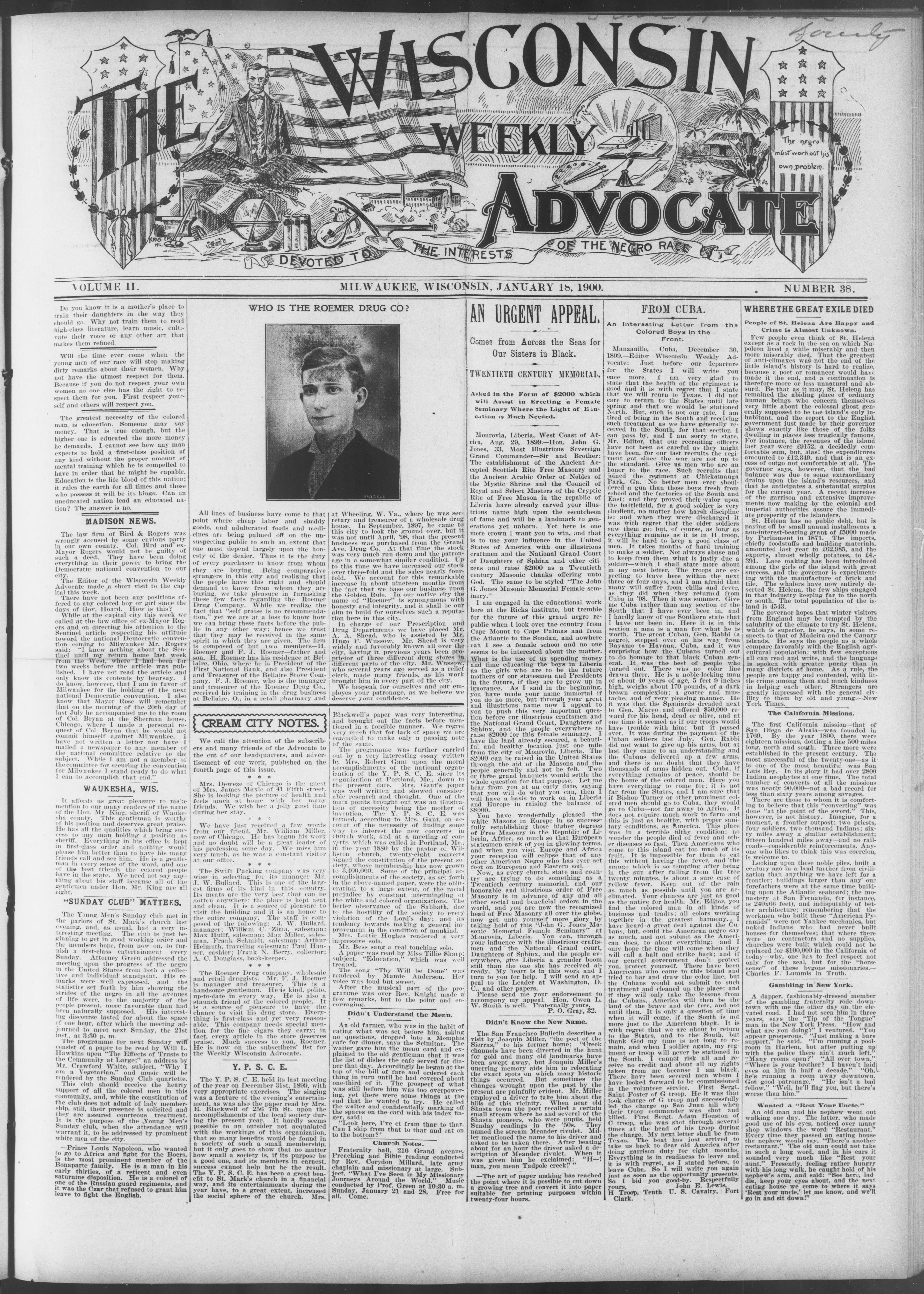
WISCONSIN
WEEKLY
ADVOCATE
DEVOTED TO THE INTERESTS OF THE NEGRO RACE
Do you know it is a mother's place to train their daughters in the way they should go. Why not train them to read high-class literature, learn music, cultivate their voice or any other art that makes them refined.
Will the time ever come when the young men of our race will stop making dirty remarks about their women. Why not have the utmost respect for them. Because if you do not respect your own women no one else has the right to respect them for you. First respect yourself and others will respect you.
The greatest necessity of the colored man is education. Someone may say money. That is true enough, but the higher one is educated the more money he demands. I cannot see how any man expects to hold a first-class position of any kind without the proper amount of mental training which he is compelled to have in order that he might be capable. Education is the life blood of this nation; it rules the earth for all times and those who possess it will be its kings. Can an uneducated nation lead an educated nation? The answer is no.
MADISON NEWS.
The law firm of Bird & Rogers was wrongly accused by some envious party in our own county. Col. Bird and ex-Mayor Rogers would not be guilty of such a deed. They have been doing everything in their power to bring the Democratic national convention to our city. The Editor of the Wisconsin Weekly Advocate made a short visit to the capital this week. There have not been any positions offered to any colored boy or girl since the days of Gov. Hoard. How is this?
While at the capital city this week we called at the law office of ex-Mayor Rogers and on directing his attention to the Sentinel article respecting his attitude toward the national Democratic convention coming to Milwaukee Mr. Rogers said: "I knew nothing about the Sentinel until my return home last week from the West, where I had been for two weeks before the article was published. I have not read the article and only know its contents by hearsay. I do know, however, that I am in favor of Milwaukee for the holding of the next national Democratic convention. I also know that Mayor Rose will remember that on the morning of the 20th day of last July he accompanied me to the room of Col. Bryan at the Sherman house, Chicago, where I made a personal request of Col. Bryan that he would not commit himself against Milwaukee. I have not written a letter nor have I mailed a newspaper to any member of the national committee relative to the subject. While I am not a member of the committee for securing the convention for Milwaukee I stand ready to do what I can to accomplish that end."
WAUKESHA. WIS.
It affords us great pleasure to make mention to our many readers of the name of the Hon. Mr. King, sheriff of Waukesha county. This gentleman is worthy of his position and deserves great praise. He has all the qualities which bring success to any man holding a position as sheriff. Everything in his office is kept in first-class order and nothing would please him better than to have his many friends call and see him. He is a gentleman in every sense of the word, and one of the best friends the colored people have in the state. We need not say anything about his staff because all of the gentlemen under Hon. Mr. King are all right.
"SUNDAY CLUB" MATTEES.
The Young Men's Sunday club met in the parlors of St. Mark's church last evening, and, as usual, had a very interesting meeting. The club is just beginning to get in good working order and the members hope, from now on, to furnish a first-class entertainment every Sunday. Attorney Green addressed the meeting upon the progress of the negro in the United States from both a collective and individual standpoint. His remarks were well expressed, and the statistics set forth by him showing the strides of the negro in all the avenues of life were, to the majority of the people present, more favorable than had been naturally supposed. His interesting discourse lasted for about the space of one hour, after which the meeting adjourned to meet next Sunday, the 21st inst., at 3:30 p. m.
The programme for next Sunday will consist of a paper to be read by Will L. Hawkins upon "The Effects of Trusts to the Community at Large;" an address by Mr. Crawford White, subject, "Why I am a Vegetarian," and music will be rendered by the Sunday Club quartette. This club should receive the hearty support of all the colored men in this community, and, while the constitution of the club does not admit of lady membership, still, their presence is solicited and they are assured courteous treatment. It is the purpose of the Young Men's Sunday club, when the attendance will warrant it, to be addressed by prominent white men of the city.
—Prince Louis Napoleon, who wanted to go to Africa and fight for the Boers, is the most prominent member of the Bonaparte family. He is a man in his early thirties, of a reticent and even saturnine disposition. He is a colonel of one of the Russian guard regiments, and it was the Czar that refused to grant him leave to fight the English.
WHO IS THE ROEMER DRUG CO?
BRASELL
All lines of business have come to that point where cheap labor and shoddy goods, and adulterated foods and medicines are being palmed off on the unsuspecting public to such an extent that one must depend largely upon the honesty of the dealer. Thus it is the duty of every purchaser to know from whom they are buying. Being comparative strangers in this city and realizing that the people have this right and should demand to know from whom they are buying, we take pleasure in furnishing these few facts regarding the Roemer Drug Company. While we realize the fact that "self praise is no recommendation," yet we are at a loss to know how we can bring these facts before the public in any other way; hence we trust that they may be received in the same spirit in which they are given. The firm is composed of but two members—H. Roemer and F. J. Roemer—father and son. H. Roemer has his residence at Bellaire, Ohio, where he is President of the First National Bank, and also President and Treasurer of the Bellaire Stove Company. F. J. Roemer, who is the manager and treasurer of the Roemer Drug Co., received his training in the drug business at Bellaire, O., in a retail pharmacy and
CREAM CITY NOTES.
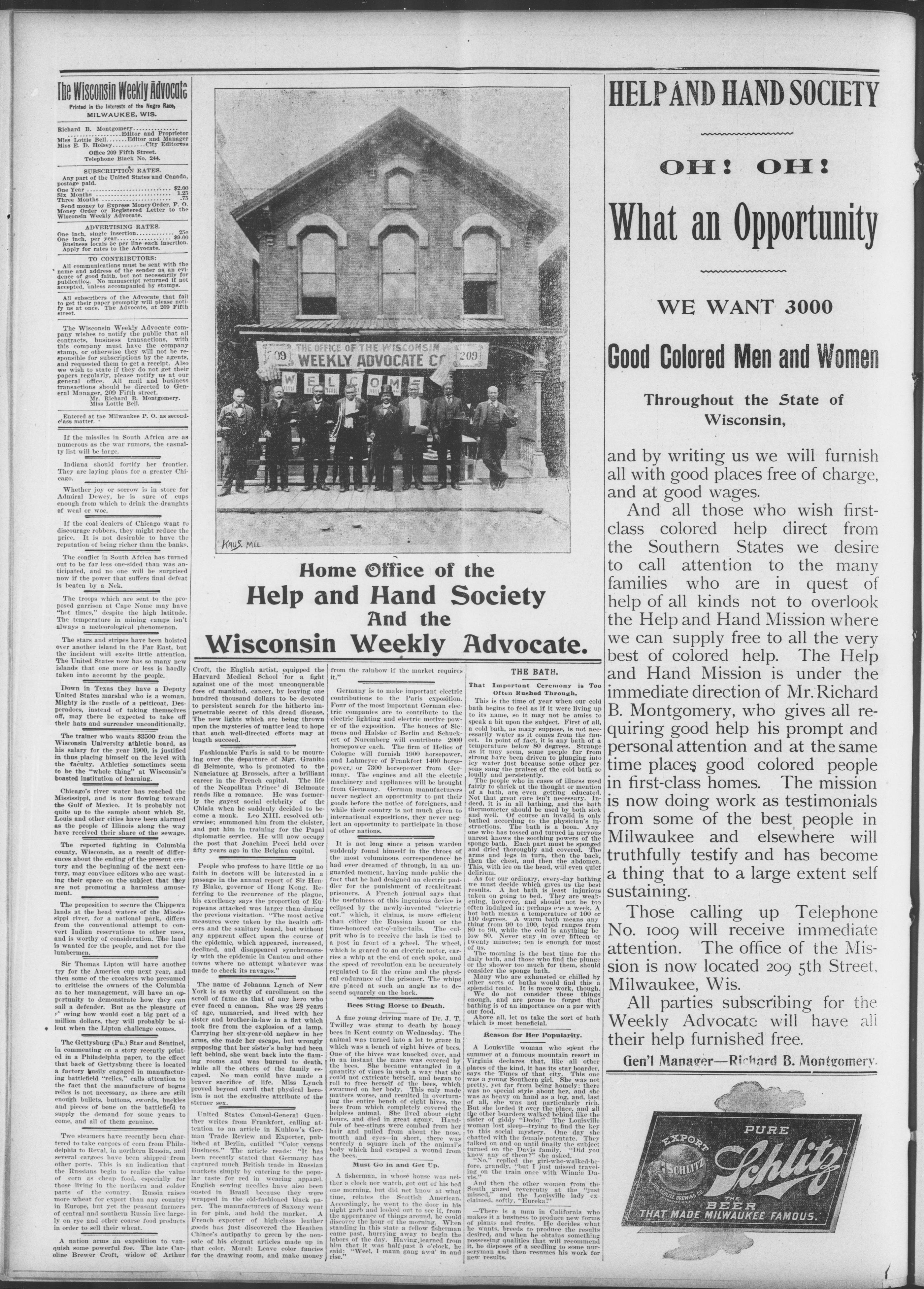
We call the attention of the subscribers and many friends of the Advocate to the cut of our headquarters, and advertisement of our work, published on the fourth page of this issue.
* * *
Mrs. Deweze of Chicago is the guest of Mrs. James Maxie of 41 Fifth street. She is looking the picture of health and feels much at home with her many friends. We wish her a jolly good time during her stay.
* * *
We have just received a few words from our friend, Mr. William Miller, now of Chicago. He has begun his work and no doubt will be a great leader of his profession some day. We miss him very much, as he was a constant visitor at our office.
The Swift Packing company was very wise in selecting for its manager Mr. J. W. Bullard. This is one of the largest firms of its kind in this country. Its meats are the very best that can be gotten anywhere; the place is kept neat and clean. It is a source of pleasure to visit the building and it is an honor to the entire company. The staff is composed of the following: J. W. Bullard, manager; William C. Zima, salesman; Max Huilf, salesman; Max Miller, salesman, Frank Schmidt, salesman; Arthur Helmuth, traveling salesman; Paul Hauser, cashier; Frank N. Berry, collector; A. C. Douglass, book-keeper.
The Roemer Drug company, wholesale and retail druggists. Mr. F. J. Roemer is manager and treasurer. This is a handsome gentleman. He is kind, polite, up-to-date in every way. He is also a staunch friend of the colored people. It is a source of pleasure to have the chance to visit his drug store. Everything is first-class and yet very reasonable. This company needs special mention for the fine cigars they carry; in fact, every article in the store deserves praise. Much success to you. Roemer. He is now on the subscribers' list for the Weekly Wisconsin Advocate.
Y. P. S. C. E.
The Y. P. S. C. E. held its last meeting of the year on December 31st, 1899, with very appropriate exercises. The singing was a feature of the evening's entertainment, as was also the paper read by Mrs. E. Blackwell of 256 7th St. upon the accomplishments of the local society during the present year. It hardly seems possible to an outsider not acquainted with the workings of this organization, that so many benefits would be found in a society of such a small membership, but it only goes to show that no matter how small a society is, if its purpose be a good one, and its members in earnest, success cannot help but be the result. The Y. P. S. C. E. has been a great benefit to St. Mark's church in a financial way, and its entertainments during the year have, to a great extent, increased the social sphere of the church. Mrs.
* * *
```markdown
```
***
MILWAUKEE, WISCONSIN, JANUARY 18, 1900.
at Wheeling, W. Va., where he was secretary and treasurer of a wholesale drug house. In September, 1897, he came to this city to look the ground over, but it was not until April, '98, that the present business was purchased from the Grand Ave. Drug Co. At that time the stock was very much run down and the patronage in a somewhat similar condition. Up to this time we have increased our stock over three-fold and the sales nearly four-fold. We account for this remarkable increase in about nineteen months from the fact that we base our business upon the Golden Rule. In our native city the name of "Roemer" is synonymous with honesty and integrity, and it shall be our aim to build for ourselves such a reputation here in this city.
In charge of our Prescription and Drug Departments we have placed Mr. A. A. Shead, who is assisted by Mr. Hugo F. Wussow. Mr. Shead is very widely and favorably known all over the city, having in previous years been proprietor of three different drug stores in different parts of the city. Mr. Wussow, who several years ago served as a relief clerk, made many friends, as his work brought him in every part of the city. We bespeak for ourselves and our employes your patronage, as we believe we deserve your confidence.
Blackwell's paper was very interesting, and brought out the facts before mentioned in a forcible manner. We regret very much that for lack of space we are compelled to make only a passing note of the same.
The programme was further carried out by a very interesting essay written by Mrs. Robert Gant upon the moral accomplishments of the national organization of the Y. P. S. C. E. since its organization at Portland, Me., down to the present date. Mrs. Gant's paper was well written and showed considerable research and thought. One of the main points brought out was an illustration of necessity being the mother of invention. The Y. P. S. C. E. was termed, according to Mrs. Gant, on account of the necessity of finding some way to interest the new converts in church work, and at a meeting of converts, which was called in Portland, Me., in the year 1880 by the pastor of Williston church, twenty-eight converts signed the constitution of the present society, whose membership has now grown to 3,400,000. Some of the principal accomplishments of the society, as set forth in the above-named paper, were the obliterating, to a large extent, of the racial prejudice by constant intermingling of the white and colored organizations. The better observance of the Sabbath, due to the hostility of the society to every violation of the Lord's day; and its tendency towards making a general improvement in the condition of mankind. Mrs. Lottie Hughes rendered a very impressive solo.
Mr. Bess sang a real touching solo. A paper was read by Miss Tillie Sharp: subject, "Education," which was well treated. The song "Thy Will be Done" was rendered by Mamie Anderson. Her voice was loud but sweet. After the musical part of the programme was over Rev. Knight made a few remarks, but to the point and encouraging.
Didn't Understand the Menu.
An old farmer, who was in the habit of cating what was set before him, asking no questions, dropped into a Memphis cafe for dinner, says the Scimitar. The waiter gave him the menu card and explained to the old gentleman that it was the list of dishes the cafe served for dinner that day. Accordingly he began at the top of the bill of fare and ordered each thing in turn until he had covered about one-third of it. The prospect of what was still before him was too overpowering, yet there were some things at the end that he wanted to try. He called the waiter and confidentially marking off the spaces on the card with his index finger, said:
"Look here, I've et frum thar to thar. Can I skip from that to thar and eat on to the bottom?"
Church Notes
Fraternity hall, 216 Grand avenue. Preaching and Bible reading conducted by Rev. Corydon Millard, late army chaplain and missionary at large. Subject, "What I've Seen in My Missionary Journeys Around the World." Music conducted by Prof. Green at 10:30 a.m. Sunday, January 21 and 28. Free for all. Come.
AN URGENT APPEAL.
AN URGENT APPEAL.
TWENTIETH CENTURY MEMORIAL:
Asked in the Form of $2000 which will Assist in Erecting a Female Seminary Where the Light of Education is Much Needed.
Monrovia, Liberia, West Coast of Africa, Aug. 29, 1899.—Hon. John G. Jones, 33, Most Illustrious Sovereign Grand Commander—Sir and Brother: The establishment of the Ancient Accepted Scottish Rite Free Masonry and the Ancient Arabic Order of Nobles of the Mystic Shrine and the Council of Royal and Select Masters of the Cryptic Rite of Free Mason in the republic of Liberia have already carved your illustrious name high upon the escutcheon of fame and will be a landmark to generations yet unborn. Yet here is one more crown I want you to win, and that is to use your influence in the United States of America with our illustrious craftmen and the National Grand Court of Daughters of Sphinx and other citizens and raise $2000 as a Twentieth century Masonic thanks offering unto God. The same to be styled "The John G. Jones Masonic Memorial Female seminary."
I am engaged in the educational work here at the Ricks institute, but tremble for the future of this grand negro republic when I look over the country from Cape Mount to Cape Palmas and from the Atlantic to the Soudan, and nowhere can I see a female school and no one seems to be interested about the matter. What is the use of us spending money and time educating the boys in Liberia as the girls who are to be the future mothers of our statesmen and Presidents in the future, if they are to grow up in ignorance. As I said in the beginning, you have made your name immortal if you do no more, but through your great and illustrious name now I appeal to you to push this very important question before our illustrious craftsmen and the National Grand Court, Daughters of Sphinx, and the people everywhere to raise $2000 for this female seminary. I have the land already secured, a beautiful and healthy location just one mile from the city of Monrovia, Liberia. The $2000 can be raised in the United States through the aid of the Masons and the people generally and not be felt. Two or three grand banquets would settle the whole question for that purpose. Let me hear from you at an early date, saying that you will do what you can, then I will have a basis to work on in Liberia and Europe in raising the balance of $8000.
You have wonderfully pleased the white Masons in Europe in so successfully establishing those higher degrees of Free Masonry in the Republic of Liberia, Africa, so much so that European statesmen speak of you in glowing terms, and when you visit Europe and Africa your reception will eclipse that of any other American Negro who has ever set foot on European and Eastern soil.
Now, as every church, state and country are trying to do something as a Twentieth century memorial, and our honorable and illustrious order of Free Masonry is in advance of any and all other social and beneficial orders in the world, and you are now the recognized head of Free Masonry all over the globe, now get unto yourself more glory by taking hold of this "John G. Jones Masonic Memorial Female Seminary" at Monrovia, Liberia. You can, through your influence with the illustrious craftsmen and the National Grand court, Daughters of Sphinx, and the people everywhere, give Liberia a grander boom still than the one she has received already. My heart is in this work and I turn to you for help. I will send an appeal to the Leader at Washington, D.C., and other papers.
Please send me your endorsement to accompany my appeal. Hon. Owen L. W. Smith is well. Fraternally yours. R. O. Gray. 32
Didn't Know the New Name.
The San Francisco Bulletin describes a visit by Joaquin Miller, "the poet of the Sierras," to his former home: "Creek channels have been diverted in the hunt for gold and many old landmarks have been swept away, but Joaquin Miller's unerring memory aids him in relocating the exact spots on which many historic things occurred. But sometimes the changes wrought upon the past by the present are painfully evident. Mr. Miller employed a driver to take him about the hills of this vicinity. When near old Shasta town the poet recalled a certain small stream where he and several of the Shasta pioneers, who were pupils, held Sunday readings in the '50s. They named the stream Meander rivulet. Miller mentioned the name to his driver and asked to be taken there. After beating about for an hour the driver asked a description of Meander rivulet. When it was given him he exclaimed: "H--! man, you mean Tadpole creek!"
The art of paper making has reached the point where it is possible to cut down a growing tree and convert it into paper suitable for printing purposes within twenty-four hours.
FROM CUBA.
WHERE THE GREAT EXILE DIED
People of St. Helena Are Happy and Crime is Almost Unknown.
Few people even think of St. Helena except as a rock in the sea on which Napoleon lived a while miserably and then more miserably died. That the greatest of anti-climaxes was not the end of the little island's history is hard to realize, because a poet or romancer would have made it the end, and a continuation is therefore more or less unnatural and absurd. Be that as it may, St. Helena has remained the abiding place of ordinary human beings who concern themselves very little about the colossal ghost generally supposed to be the island's only inhabitant, and the report to the English government just made by their governor shows exactly like those of the folks dwelling in places less tragically famous. For instance, the revenues of the island last year were £9152, a decidedly comfortable sum, but alas! the expenditures amounted to £12,349, and that is an excess of outgo not comfortable at all. The governor says, however, that the bad balance was due to some extraordinary drains upon the island's resources, and that he anticipates a substantial surplus for the current year. A recent increase of the garrison and extensive improvements now making by the colonial and imperial authorities assure the immediate prosperity of the islanders.
St. Helena has no public debt, but is paying off by small annual installments a non-interest-bearing grant of £5000 made by Parliament in 1871. The imports, chiefly foodstuffs and building materials, amounted last year to £62,985, and the exports, almost wholly potatoes, to £4.391. Lace making has been introduced among the girls of the island with great success, and the governor is experimenting with the manufacture of brick and tile. The whalers have now entirely deserted St. Helena, the few ships engaged in that industry keeping far to the north or south. The total population of the island is 4543.
The governor hopes that winter visitors from England may be tempted by the salubrity of the climate to try St. Helena, which is superior, he says, in some respects to that of Madeira and the Canary islands. He says the people as a whole compare favorably with the English agricultural population; with few exceptions all can read and write, and the language is spoken with greater purity than in many districts at home. As a rule, the people are happy and contented, with little crime among them and much kindness in helping each other. Strangers are greatly impressed with the general civility to them by old and young.—New York Times.
The California Missions
The first California mission—that of San Diego de Alcala—was founded in 1769. By the year 1800, there were eighteen missions, dotting a line 500 miles long, north and south. Three more were established in the present century. The most successful of the twenty-one—as it is one of the most beautiful—was San Luis Rey. In its glory it had over 2800 Indian neophytes at one time. The total number of converts of all the missions was nearly 90,000—not a bad record for less than sixty years among savages.
There are those to whom it is comforting to believe that this "converting" was done "at the point of the sword." This, however, is not history. Imagine, for a moment, a frontier outpost; two priests, four soldiers, two thousand Indians; sixty miles away a similar establishment; fifteen hundred miles away—and no railroads—considerable reinforcements. Anyone who likes to think this was coercion, is welcome to.
Looking upon these noble piles, built a century ago in a land farther from civilization than anything we have left for a frontier; buildings larger than any our forefathers were at the same time building upon the Atlantic seaboard; the monastery at San Fernando, for instance, is 240x66 feet), and indisputably of better architecture; remembering that the workmen who built these "American Pyramids" were not Yankee mechanics, but naked Indians who had never built houses for themselves; that where there were no contractors and no supplies, churches were built which could not be replaced for $100,000 in the California of today—why, one has to feel respect not only for the zeal, but for the "horse sense" of these bygone missionaries.—Charles F. Lummis in Truth.
Gambling in New York.
A dapper, fashionably-dressed member of the gambling fraternity rode downtown with me the other day on the elevated road. I had not seen him in three years, says the "Tip of the Tongue" man in the New York Press. "How and what are you doing?" I ventured. "You appear prosperous." "Just making a bare support," he said. "I'm running a poolroom in Harlem, but after putting up with the police there ain't much left." "Many rooms open?" "All over town." "Where is your brother? I haven't laid eyes on him in half a decade." "Oh, he's running a room away downtown. Got good patronage." "He isn't a bad fellow." "Well, he'll flag you, but there's worse than him."
Wanted, a "Best Your Uncle."
An old man and his nephew went out walking one day. The latter, who made good use of his eyes, noticed over many shop windows the word "Restaurant." Every time they passed an eating house the nephew would say, "There's another restaurant." The old man could not take in such a long word, and in his ears it sounded very much like "Rest your aunt." Presently, feeling rather hungry with his long walk, he caught hold of his nephew's arm, and said: "See here, ladie, keep your eyes about, and the next eating house we come to where it says 'Rest your uncle,' let me know, and we'll go in and sit down."
THE BRITISH RETIRED. CARNEGIE AND HOAR STATE OF ANARCHY AIDED AGUINALDO. IN VENEZUE
Their Entrenchments Shelled with Precision-Boers Returned the Compliment.
Modder River, Cape Colony, Jan. 17. There was a demonstration in force under Gen. Methuen yesterday, a division being engaged, with the object of ascertaining the strength and disposition of the Boer force and also in order to try to draw the Boers from Kimberley, where, laterly, they have been active. The British discovered the -Boers in great force and being reinforced from the direction of Jacobsfal.
At 4:30 the artillery opened fire, the shells dropping in the Boer entrenchments with great precision. The attack was directed against the Boer left. The firing continued until sunset, mostly with artillery, although the guards, on the right, fired some long-range volleys. The Boers reserved their fire until the British were returning to camp in the darkness, when six shells followed them. There were no casualties among the British troops.
Kensburg, Cape Colony, Tuesday, Jan. 16.—The Boers opened an artillery duel this morning, using a captured British 15-pounder, which the British gunners ultimately silenced. The British kept up a searching fire all day long on the Boer kopjes and also dragged up another gun to the summit of Coleskop.
CABLEGRAM FROM BULLER.
He Reports to a Relative that He Occupies a Strong Position.
London, Jan. 17. A relative of Gen. Buller is reported to have received a cablegram from the general yesteryday to the effect that his force is occupying a very strong position. This report lacks confirmation.
A special dispatch from Cape Town, dated today, says Gen. Gataere has protested to the Boer commandant at Stormberg against allowing the wives and daughters of the Boer soldiers to reside in or near the camp.
PUBLIC ANXIETY IN LONDON.
London, Jan. 17.—2:32 p. m.—Public anxiety regarding the advance on Lady-smith remains unappeased, and the vague rumors that a general engagement is progressing, purporting to emanate from Durbar, and Pietermaritzburg, are based solely on the belief that Gen. Buller's arrangements to advance would be completed Monday or Tuesday at the latest.
The war office this afternoon posted this notice: "The following telegram is the only news which has been received in regard to Gen. Buller's operations near Springfield." The telegram then proceeds to report the death of a private from dysentery at Springfield bridge camp, January 13, and the wounding of another private in a reconnaissance towards the Tugela river, January 15.
Gen. French's success, though consoling to the British, is recognized as being only a side issue. The country is grateful to learn that the British losses in this engagement were only six men killed and five wounded. The news that two transports with troops have been ordered from Cape Town to Port Elizabeth indicates that substantial reinforcements are on their way to Gen. French.
Prices on the stock exchange today advanced on the report that Ladysmith had been relieved. There is nothing else with which to corroborate the report, however.
WILL RELEASE BUNDESRATH.
British Admit that They Found No Contraband Goods on Her.
Berlin, Jan. 17.—An official telegram from London says the British government has declared that now the inquiry into the seizure of the Bundesrath is concluded her release may be expected immediately and a satisfactory settlement of the difficulties may be regarded as certain. Measures, it is added, will also be taken to prevent a recurrence of similar incidents.
The foreign office officials informed the correspondent of the Associated press that Great Britain admits that no contraband of war was found on the Bundesrath and promises that the steamer will be released today or tomorrow.
Hamburg, Jan. 17.—A cablegram received by the owners of the Bundesrath, at Hamburg, says all of the cargo of that steamer has been discharged and entirely agrees with the manifest. The prize court has not yet rendered a decision.
BRITISH WARSHIPS ON HAND.
Will Protect the Mule Transports Which will Leave New Orleans
New Orleans, La., Jan. 17.—It is stated here that there are British warships within easy reach of the Mississippi assigned to the duty of escorting the mule transports when they shall have been loaded with animals from New Orleans for South Africa. The presence of the warships in the Gulf waters is said to have been brought about by advices received at the British war office in London to the effect that two old hulks had been fitted out by American sympathizers with the Boers with the avowed intention of capturing and sinking the mule transports as soon as they left the mouth of the river on their voyage across the Atlantic. These advices, it is said, were cabled from London to Capt. Marshall, in charge of the buying of mules in this country for the British army. Capt. marshall today admitted that there were British warships within easy call of the river's mouth and while not absolutely denying the fact that he had received information of the alleged Boer expedition in the seas, he offered a strong argument against the possibility of the expedition being in existence.
NINE MEN SCALDED.
Explosion of a Boiler of a Government Yacht.
Wilmington, Del., Jan. 17.—A tube in the boiler of the government yacht Capeton exploded today, scalding nine men, three of them so seriously that they may die. These three are: Capt. George A. Cleaver, burned about the face and body; Engineer Swan; Assistant Engineer Weaver. The other six men sustained only slight burns and bruises.
Dewey at the Mardi Gras.
New Orleans, La., Jan. 17.—A telegram has been received from Congressman Adolph Mayer to the effect that Admiral Dewey will attend Mardi G-as this spring with his wife. The message stated that the distinguished couple would arrive on February 24.
Dresden, Jan. 17.—The condition of the Empress' mother, Dowager Duchess of Schleswig-Holstein, is worse today. A bulletin says her sleep is irregular and her breathing difficult.
Charged that Steel Manufacturer Stood Expense of Sending Hoar's Speech to Aguinaldo.
Washington, D. C., Jan. 16.—Senator Hoar is preparing a speech in answer to the charge by Former Minister Barrett that the senator's speech, cabled to Hong Kong and then mailed to Luzon, precipitated the outbreak by Aguinaldo. Who paid the bill of $4000 for cable calls to Paris and then to Hong Kong? Republican members of the House say it was Andrew Carnegie.
friends. Incidental to this disclosure, it is intimated still further exposures may be expected. Some time ago the American forces captured a large part of the official records of Aguinaldo's so-called government. These records are now on their way to Washington. That they contain matters implicating other prominent American Filipinos besides Mr. Carnegie and Senator Hoar is to be expected. What course the administration will pursue when these documents reach Washington cannot be learned. Constitution, statutes, and a long line of judicial decisions have defined treason as giving aid and comfort to the enemies of the government.
MIND UPSET BY SEVERE DISCIPLINE.
Letters from Seamen Ascribe Suicide of Lieut. Greene to Severe Discipline.
Atlanta, Ga., Jan. 16. Letters received from Buenos Ayres tell of the suicide of Lieut.-Commander Greene of the United States cruiser Montgomery. The letters, written by seamen, indicate that Lieut. Greene killed himself because of discontent and the severe discipline maintained under Commander J. P. Merrill of the Montgomery. The letters declare Merrill, having under him eighteen men, who were accidentally left by the Marblehead at Montevideo, did his best to make life miserable not only for them but for his entire ship's company.
NINETEEN PEOPLE
The Building Collapses During the Progress of Services-A Big List of Wounded.
St. Petersburg, Jan. 16: A church collapsed today during the celebration of a mass in Maloousene township, Sumara district. Nineteen persons were killed and sixty-eight were wounded.
TRAGEDY IN A BANK.
Cashier of the Third National at Columbus, Ga., Kills the Teller.
Columbus, Ga., Jan. 16.—Capt. J. W. Murphey, cashier of the Third National bank, shot and instantly killed Teller T. P. Schutze today and then committed suicide. The murder and suicide occurred while the bank was full of customers and the full corps of clerks.
Capt. Murphey, who did the shooting, was one of the most prominent business men of the city for a number of years, but of recent months he had been in ill-health and suffered two strokes of paralysis.
It is believed that he was temporarily insane when the shooting was done, as he and Schutze had long been the closest of friends, having been associated with each other in the business affairs of the bank.
The evidence before the coroner's jury this afternoon shows that Murphey, presumably insane, placed the pistol close to the temple of Mr. Schutze and fired. He then placed the pistol in his own mouth and fired twice, both balls penetrating his brain.
Capt. Murphey fell several feet from his private desk, the blood was streaming from his mouth and he died instantly.
Assistant Cashier Schutze was found sitting in the chair he occupied when the shot was fired. His head was lying far back and from a hole in his right temple the blood was running to the floor.
OCEAN PASSAGE IS HIGHER.
All the Transatlantic Lines Announce Increase in Rates.
New York, Jan. 16.—The transatlantic steamship lines have increased their passenger rates between New York and Europe, owing to unexpected heavy travel during the Paris exposition.
The Holland-American line specified a general 10 per cent. increase on its principal steamers. For the staterooms on the saloon decks there is an increase of $35, whether occupied by two or three persons. In rooms intended for three persons half a fare extra is charged when the room is taken by two. On slower steamers carrying only one class the increase is $10 and $15 a berth.
The Atlantic Transport will charge $15 more from the middle of March to the middle of April; for the summer season an increase of $25 a berth.
The Camard line will restore the summer rate which existed before the rate war of last year. The White Star line also increased its rates. The Hamburg-American company increases the price for deck staterooms, some as high, as $50, with no discount on round-trip fares during the Paris exposition. The North German Lloyd, American and the French lines contemplate making slight advances in their rates. Some of the companies extend the summer season one month.
When Henry Clay was stumping Kentucky for re-election, at one of his mass meetings an old hunter of wide political influence said: "Well, Harry, I've always been for you, but because of that vote" (which he named), "I'm goin' agin you." "Let me see your rifle," said Clay. It was handed up to him. "Is she a good rifle?" "Yes." "Did she ever miss fire?" "Well, yes, once." "Why didn't you throw her away?" The old hunter thought a moment and then said: "Harry, I'll try you agin." And Harry was elected.
MACRUM AND THE PLUM.
Fee, fie, toe, fun.
Consul Macrum, Consul Macrum.
What is the reason you throw up the plum,
Consul Macrum, Consul Macrum.
Were you arrand of the coming dumdum,
Or was it because of a star-spangled bum,
That you borrowed your glad heels,
And kited for hum,
Consul Macrum, Consul Macrum?
—Memphis Appeal.
About $15,000 is needed to fix up the Brown county insane asylum.
Members of French Colony Demand the Presence of a War Vessel at Caracas.
Paris, Jan. 17.—A dispatch from Caracas is published here saying anarchy prevails in Venezuela. Owing to their refusal to advance the government money, the directors of the banks of Caracas and Venezuela, including a Frenchman M. Montaubin, and other foreign notabilities, have been arrested and thrown into the fortress. The representations of the French charge d'affaires, it is added, have been disregarded and the French colony at Caracas energetically demands that the French Atlantic squadron be dispatched to the coast of Venezuela.
A BIG HAUL BY
BANK ROEBERS.
One Hundred Thousand Dollars
Secured from Philippe, W.
Va. Bank.
One Hundred Thousand Dollars Secured from Philippe, W Va., Bank.
Phillippi, W. Va., Jan. 17.—Robbers forced an entrance into the Tygart Valley bank of this place, some time last night, and blowing open the safe secured between $5000 and $6000. It was first reported that they had taken $100,000. There is no clue to the robbers. The bank will be open tomorrow for business as usual.
AGAINST ROBERTS.
Special Committee of the House Finds Against the Utah Member.
Washington, D. C., Jan. 17.—The special committee of the House of Representatives to investigate the case of Brigham H. Roberts of Utah today reached a final conclusion. On the polygamous status of Mr. Roberts the committee was unanimous and agreed upon a formal statement of facts. On the question of procedure to be adopted, the committee was divided.
The majority, consisting of all the members except Littlefield of Maine and De Armond of Missouri, favored exclusion at the outset. Messrs. Littlefield and De Armond will make a minority report favorable to seating Roberts on his prima facie rights, and then expelling him.
The statement of facts found by the committee is as follows:
We find that B. H. Roberts was elected as a representative to the Fifty-sixth Congress from the state of Utah and was at the date of his election above the age of 25 years; that he had been for more than seven years a naturalized citizen of the United States and was an inhabitant of the state of Utah.
We further find that about 1878 he married Louisa Smith, his first and lawful wife, with whom he has ever since lived as such, and who, since the marriage, has borne him six children.
About 1885 he married, as his plural wife, Celia Dibble, with whom he has ever since lived as such, and who, since such marriage, has borne him six children, of which the last were twins, born August 11, 1897.
That some years after his said marriage to Celie Dibble he contracted another plural marriage with Margaret C. Shipp, with whom he has ever since lived in the habit and repute of marriage.
Your committee is unable to fix the exact date of this marriage. It does not appear that he held her out as his wife before January 1, 1897, or that before that date she held him out as her husband, or that before that date they were reputed to be husband and wife.
That these facts were generally known in Utah, publicly charged against him during his campaign for election and were not denied by him.
That the testimony bearing on these facts was taken in the presence of Mr. Roberts and that he fully cross-examined the witnesses, but declined to place himself on the witness stand.
The culminating session of the committee today followed many prolonged executive sessions, which left no doubt as to the attitude of the several members with the exception of Mr. Miers of Indiana, who had been out of the city. He returned today and it was determined to bring the matter to a direct issue. Accordingly when the committee met Mr. McPherson of Iowa offered a resolution for the exclusion of Roberts. Mr. De Armond proposed a substitute, recognizing the constitutional rights of Roberts to take his seat on his credentials, and providing for his expulsion.
There was no discussion beyond informal remarks and the vote was first taken on Mr. De Armond's substitute, Mr. Littlefield joining him in the affirmative and the others voting in opposition. The vote was then taken on Mr. McPherson's motion to exclude, resulting as follows: Yeas-Taylor (Ohio), Frear, Morris, and McPherson.
Year—Taylor (Ohio). Frear, Morris and McPherson. Republicans; Lanham and Miers. Democrats.
Nays-Littlefield, Republican; De Armond, Democrat.
Chairman Taylor was authorized to prepare the majority report. It will be ready in a few days and the prospects are that the subject will be brought before the House early next week. Mr. De Armond will submit the views of the minority. He will include the exhaustive review of the law, covering about seventy typewritten pages, prepared by Mr. Littlefield. The main point of this is that the House cannot add to the requirements provided by the constitution for admission to the House and that the only constitutional remedy is to admit and then expel on the findings of the facts.
Chairman Tayler says the report of the committed will be made on Saturday and that the subject will be taken up in the House next Tuesday.
Did Not Furnish the Money to
New York, Jan. 17.—"There is not a word of truth in the report," said Andrew Carnegie, at his home in West Fifty-first street, when shown a dispatch from Philadelphia which stated that he had paid $4000 for cabling Senator Hoar's anti-expansion speech to Agninaldo in Luzon, Mr. Carnegie continued: "But I might have given the $4000 to distribute copies of Senator Hoar's speech among our people if I had been called upon. It is such speeches as his the American people need today, in my humble opinion, to keep them worthy of their past."
RETAIL LUMBERMEN.
Their Association is Saving Them a
Large Amount of Money Annually.
Minneapolis, Minn., Jan. 17. -The Retail Lumbermen's Insurance association met this morning and listened to reports by President D. R. Ewing of Des Moines, In., and Secretary W. G. Holds of Minneapolis. The financial statement showed a material reduction to the members in the cost of insurance. The total receipts were, $61,390; losses, $8692; expenses, $7459; loans, $21,500; balance in bank, $9075. It was claimed that the association was saving its members $100,000 a year in insurance premiums. D. R. Ewing, Des Moines; H. E. Bacon, Minneapolis, and S. H. Bowman, Minneapolis, were re-elected directors.
Washington, D. C., Jan. 17. Gen. Joseph Wheeler of Alabama has resigned his position in the army and will return to resume his seat in Congress. It is expected that he will start from Manila this week.
He represents the Eighth district of Alabama, and is especially interested in the bill to dispose of the government's mineral lands. In a letter written at Ma-
M
and received by W. J. Ala., yesterday. Gen. the hopes to help pass e have got our school
nila December 2 and received by W. J. Wood of Florence, Ala., yesterday, Gen. Wheeler says that he hopes to help pass the bill "after we have got our school lands out of it." He explains his resignation at this time by saying that he could not have left the army while the campaign was on without subjecting himself to severe criticism. Officials of the war department have little information as to the reasons for the general's retirement, but it is gathered in a general way that Gen. Otis was unable to give him a satisfactory field assignment, and that he was unwilling to remain on duty in Manila.
surgents.
Washington, D. C., Jan. 17. -The following cablegrams were received by the war department from Gen. Otis today:
with departures from Gen. Otis today.
Manila, Jan. 17.—Schwan's troops are in possession of Batangas province and are about to move eastward into the provinces of Tayabas and Luguna. Wheaton is moving on Lemerk and Taal and has navy cooperating. Casualties slight. Insurgent loss considerable in men and property, as they keep up constant opposition. Expedition under Kobbe leaves for hemp ports tonight.
OTIS.
Manila, Jan. 17.—Gen. Hughes is absent on the western coast of Panay, policing that section. A band of eighty-six Tagalos which landed at Negros in December was struck by Byrne in the Negros mountains, who killed nineteen and captured twenty-eight rifles and ammunition. No casualties. Troops in northern Luzon are busy pursuing robber bands, with good results.
Manila, Jan. 17, 7:05 p. m.—Col. Kobbe, with the Forty-eighth infantry, sailed on board the transport Hancock today, with gunboats escorting. The objective of the force is probably the important islands of Samar and Leyte, which the insurgents hold. The American blockade and the levies of the Tagal army have caused great suffering among the people and hundreds of persons are in an almost starving condition.
The Tagal general, Mauricio, recently landed at Negros from the island of Panay and requested a conference with Col. Byrne. He proposed that the insurgents be let alone and permitted to wear side arms and uniforms in the towns until the war in Luzon was ended, when they would surrender.
Col. Byrne refused to agree to this, however, and said they would be considered as bandits and shot if they were found armed. Col. Byrne surprised the insurgent camp the same night and scattered the Filipinos, killing thirty of them, including a general.
DAWSON SCORCHED.
Kloudike Metropolis Visited by a Disastrous Fire. Seattle, Wash., Jan. 17.—The steamer Danube, at Victoria, from Skaguay, brings news that a large part of the business portion of Dawson was destroyed by fire last Wednesday night. The loss will exceed half a million dollars. There are no names of the buildings or losses. The Skaguay operator says great suffering would undoubtedly follow the fire, as the temperature at Dawson was 40 degrees below zero, with the wind blowing. The city is entirely without the regulation water supply.
CARBOLIC ACID HIGHER.
Its Use in Lyddite Shells Causes an Advance of 100 Per Cent.
New York, Jan. 17.—Wholesale druggists here have been notified by their London agents that the British government has forbidden the further export of carbolic acid, as all of the output of the English manufacturers is needed in the making of Lyddite shells. As soon as the news was received here the wholesale druggists advanced the price of carbolic acid 100 per cent. This action was taken to prevent the present supply, which is limited, from running out.
RETURNS PAY CHECK.
William A. English Refuses Money for His Services in War.
New York, Jan. 17.—William A. English, a son of the former Democratic vice presidential candidate from Indiana and a captain of volunteers in the war with Spain, has returned to the treasury a check for $1172, sent him for pay for his army services, with the statement that he would not accept pay for service to his country in time of danger. It is the only case of the kind in the Spanish war.
JOAQUIN MILLER IS ILL
Confined to His Home Near Oakland by a Severe Cold.
San Francisco, Cal., Jan. 17.—Joaquin Miller, poet of the Sleirias, has been confined to his home on the heights back of Oakland for several days by a severe cold that threatens to develop into pneumonia.
A Desperate Burglan Shot.
Kalamazoo, Mich., Jan. 17.—Albert L. Hodge, in colored burglar, had a desperate fight with Sheriff Snow and two deputies at the residence of Mrs. Nathan Coleman in Texas township, early today. Hodge was hit twice, and seriously, though not fatally, wounded. He is 67 years of age and a Civil war veteran. He has served time for burglary.
New York, Jan. 17.—A special to the Herald from Washington says the government has been taking account of the experience as well as the political aspirations of the Filipinos, to devise a form of government adapted to them, so as to secure on the one hand good government, and on the other to satisfy their aspirations for self-government.
This statement relative to the Philippine commission's report was made by Jacob Gohl Schurman, president of the commission. All that Mr. Schurman cared to state further was that the report would consist of four or more volumes, the first of which would be devoted to the character of government to be established in the Philippines after peace and order are restored. These are understood to be the principal features of the government to be recommended:
An American governor, who will control of affairs of the entire archipelago, and who will be appointed by the President.
A council, comprising Americans and natives, who will be advisors to the governor.
A legislative assembly, partly appointive and partly elective, the acts of which shall be subject to the qualified veto of the governor, and the absolute veto of Congress. Governors of provinces to be appointed.
Subdivision of the islands into small sections, over which Americans or education matters shall preside.
The scheme of government has been made sufficiently elastic to enable the substitution of natives for Americans when it becomes apparent that they are sufficiently educated in self-government to administer public affairs. No glittering promises are to be held out to the natives, but as they develop under American tuition it is proposed to gradually introduce them into positions of responsibility.
Expect Spooner's Bill to Pass.
Washington, D. C., Jan. 17.—The bill which Senator Spooner recently introduced for the government of the Philippines and which provides that after the suppression of the insurrection "all military, civil and judiciary powers necessary to govern the said islands shall until otherwise provided by Congress be rested in such person or persons as the President of the United States shall direct, meets with the hearty approval of the administration and a number of senators, and will, it is expected by those prominent in framing the measure, be admitted in preference to the Beveridge and other resolutions.
DON'T WANT FRIARS.
Catholics in the Philippines Stirred Up by a Wrong Impression.
Manila, Jan. 17, 7:05 p.m. The presence here of Archbishop Chapelle, the apostolic delegate to the Philippines, is greatly stirring the Catholics of all nationalities. The Filipinos have gained the impression that Mgr. Chapelle came as the joint agent of President McKinley and the Pope to reinstate the friars in their former power.
One cause of the excitement is a statement which the Dominicans furnished to the Spanish press, that Mgr. Chappelle, in visiting the heads of the order, told them he favored the retention of the brotherhoods and that President McKinley shared his views, which were that "if the friars returned to their parishes they would be considered elements of good order, and, therefore, American agents."
Mgr. Chapelle denies the accuracy of these statements, and Catholics of all sections are petitioning Mgr. Chapelle and Maj.-Gen. Otis against the friars returning to their parishes, repeating the charges of oppressions, extortions and immoralities which, they assert, caused the revolution of 1896. The Catholics request that they be given priests not connected with the brotherhoods. Delegations from many of the towns are visiting the provincial governors for the purpose of making the same request, and prominent Manila Catholics are cabling the Pope on the subject. The people say the friars will be driven out if they return to their parishes and there will be continual trouble if the administration attempts to protect them.
To quell the excitement Maj.-Gen. Otis consented to the publication in the local newspapers of a statement which he had made to a delegation of Filipinos, as follows:
"If the church authorities assign friars to curacies, who are obnoxious to the people, they will not be compelled to accept them. The individual liberty guaranteed by the American constitution will not be denied the Filipines, and the government will not force on them any ecclesiastical denomination contrary to their wishes."
KNEW HER FEARFUL PERIL.
Woman Who Awoke on an Embalmer's Table Tells Her Story. St. Louis, Jan. 17.-Mrs. Christina Hirt of East St. Louis, who was in a trance for seven hours and awoke to find an undertaker making preparations to bury her, has recovered sufficiently to tell of the terrible ordeal through which she passed.
To the sister superfor at St. Mary's hospital, where she is a patient, Mrs. Hirt yesterday told her story. She said she had a distinct recollection of all that transpired while she was in the so-called trance and had an idea that a conspiracy had been formed to murder her. She heard the weeping of relatives and the minister's prayer and recalls that her husband was near her before she lapsed into the lifeless condition, and that she murmured to him something about going away. She seemed conscious that though not dead she could not awaken. She did not suffer, but no gladder sight than the sunlight streaming through the blinds when she awoke ever greeted her vision.
The hospital physician says that Mrs. Hirt's condition is extremely critical, but he has hopes that she will recover.
IN TROUBLE AGAIN.
Chicago. Ill., Jan. 17.—[Special.]—Jack Burke, ex-prize fighter and ex-saloonkeeper, was arrested today by Detectives McKune and Riffle, charged with forgery. Burke is said to have passed checks upon storekeepers on the north side and Capt. Haas has received many complaints against him. Detective-Sergeant A. M. Andrews of Chief Kipley's office also has a warrant for Burke. He is charged with larceny as bailie in Milwaukee, the amount involved being $200. Burke was released from the Milwaukee bridewell three weeks ago after being incarcerated on a charge of larceny.
Advance in Wages.
Plattsburgh, N. Y., Jun. 17. The American Steel & Wire company has advanced the wages of its employees in the iron mines at Crown Point. Essex county, N. Y., 10 per cent., to take effect at once. Two and one-half per cent. will be retained by the company and deposited as a benefit fund.
Libby, McNeill & Libby.
The visitor passing through the plant of Messrs. Libby, McNeill & Libby, Chicago, is not only deeply interested in the cutting rooms, cooking kitchens, canning department and the wonderful mechanical contrivances for accomplishing the work speedily, but is greatly surprised by the vastness of their industry of packing and preserving干面 meats and specialties for consumers all over the world. Some idea of the enormous business of this firm can be obtained from the fact that they require capacity for 300,000 cattle and 100,000 sheep per annum, manufacture forty millions of cans a year or an average of 140,000 cans a day, and require 2,000 employees to meet the demands of their trade. Send a postal card for a booklet, "How to Make Good Things to Eat."
One Can be Omnipresent.
Eli Perkins is lecturing in Kansas, relates the Kansas City Journal. One of his stories is about a Kansas soldier boy who served in Cuba, and this is the way Eli tells it:
"What did you learn down there?" I asked.
"I learned a darned sight,' said the soldier, sadly.
"Well, what is one thing you learned?"
"I learned that a man could be in two places at once."
"Oh, come off,' I said. 'No man could be in two places at once—omnipresent.'
"Well I was,' said the soldier. 'I was down there fighting the Spaniards and—home sick.'"
Patents to Inventors.
Messrs. Benedict & Morsell, solicitors of patents, Old Insurance building, Milwaukee, report patents issued to Western inventors January 2, as follows:
H. W. Bolens, Pt. Washington, Wis., footstool; J. F. Brock, Sparta, Wis., garment-hanger; D. E. Ford, West Superior, Wis., mooring and towing chock; Chas Lane, Alma, Wis., machine for sharpening sickles; C. L. Merkel, Milwaukee, means for supporting frames or bodies to vehicles; J. M. Metcalf, Glen Hayen, Wis., lightnin-arrester; A. E. Miller, Baraboo, Wis., swinging shelf; W. W. Miller, Saxman, Kas, grain-drill; A. Q. Muguel and C. Farner, Milwaukee, bung-stopper; Erik Noren, Bo-loft, Wis., ironing machine; G. D. Rowell, Appleton, Wis., car starter or mover; Evert Schmidt, Waupun, Wis., window; John Stoveken, Milwaukee, vertical automatic drying and roasting furnace; W. H. Wusso, Oshkosh, Wis., box-machine; A. C. Fox, Madison, Wis., metal castings (trademark).
An American lady who was in the Highlands shooting with her husband, attended the local kirk one Sunday morning, but left it with scandulous precipitation. For an hour the good minister had been fiercely raging at his benighted congregation and wound up: "And pairhans" (with pious cunning) "you'll be thinkin', ye wairstless waistrels, that ye can daddle intae Paradise by clootchin' tae my coat-tails! Dipna be deceivit, for mark weel" (a pause of stern and holy joy), "when the Trump of Gabriel soonds, I'll sneck them aff!"
Reward for Honesty.
When you ask for CASCARETS, Candy Cathartic, and the man offers you tablets in bulk or "something just as good," he is trying to swindle you. We are looking for dishonest dealers like that, for they not only steal our reputation and business, but endanger your health with cheap, unreliable and fraudulent substitutes in order to make a few more cents at your expense. Write us and furnish us with the evidence to convict such frauds and receive a liberal reward, at once. Address Sterling Remedy Co., Chicago or New York
It is doubtful whether any nicotine ever reaches the mouth of the smoker except that present in the moistened tobacco which is in contact with the lips. The smoke products of tobacco do not contain any important quantity of nicotine, the chief toxic bodies being related to that interesting series of organic bases known to chemists as pyridines—Lancet.
Try Grain-O! Try Grain-O!
Ask your Grocer today to show you a package of GRAIN-O, the new food drink that takes the place of coffee. The children may drink it without injury as well as the adult. All who try it like it. GRAIN-O has that rich seal brown of Mocha or Java, but it is made from pure grains, and the most delicate stomach receives it without distress. 1/4 the price of coffee. 15c and 25c per package. Sold by all grocers.
Englishmen Prefer Country Life.
Figures recently produced to show a comparatively small per cent. of English living in Chicago has led an observer to remark that English immigration to this country generally avoids the large cities. The English people prefer to live in the country, and generally when coming to this country settle in the smaller places.
-Baltimore American.
What is Speltz ?
Salzer's catalog tells all about this wonder, also Million Dollar Potato. If you farm you need it. Largest Vegetable Seed Growers in America. Send this notice and 10c in stamps for 10 Rare Farm Samples and Catalog to John A. Salzer Seed Co., La Crosse, Wis.
—Years ago the word "idiot" meant simply a private person as distinguished from a public official. A "clown" was only a farmer.
Coughing Leads to Consumption. Kemp's Balsam will stop the cough at once. Go to your druggist today and get a sample bottle free. Sold in 25 and 50-cent bottles. Go at once; delays are dangerous.
The length of the world's railways is more than seventeen times the circumference of the earth at the equator.
Special to State People.
Commencing November 20, the Hotel Davidson, Milwaukee, make a rate of $2 per day, American plan. This is to state people only.
The black jaguar of Central America will attack any man by night or day whom he finds lying down.
Pure Food Products: "MB" Flavors! At all Grocers. Beware of substitutes.
During 1899 Brockton (Mass.) shipped 529,277 cases of shoes, a gain of 37,303 cases over 1898.
Rheude's Business College and Mechanical Drawing School, Milwaukee.
France has more persons over 60 years of age than any other country; Ireland comes next.
Ambrosia Chocolate or Cocoa pleases all. Send your address for pretty Panel Picture free to Ambrosia Co., Milwaukee.
—Berlin, Germany, is to construct an underground railway costing $25,000,000.
1000 BABIES WANTED Babies' Parents' Names WANTED For Free Catalogue of CARRIAGES and GO-CARTS
We have 1000 New Carriages and Carts. Beautiful Catalogue of 50 different styles for 1900 at manufacturers' price.
FUR COAT & STOVE Catalogue Free!
ECONOMIST'S SUPPLY CO., Milwaukee.
A WIFE'S DILEMMA.
Just four short weeks ago today she was a happy bride:
The one man of all others, to her for life, was tled.
But tonight a queer sensation fills her loving heart.
As she wonders if her husband's tree or acting but a part.
If he has spoken falsely, then her feeling's one of pain;
But if his statement is sincere, joyous tears she can't restrain.
Twas at the dinner table—he into her eyes did look.
And said: "My dear, you doubly discount my mother as a cook." Chicago News
-Chicago News.
THE STORY OF A SHIELD PIN.
I do not like to take up personal cases, as we detectives call a certain class of work, so when Miss Angell of Broadside street sent for me to take up a "small personal mystery" I responded with a poor grace.
Scarcely had she begun to tell her story, however, than I became so interested that I begged her to continue and tell me the details as far as possible.
Miss Angell was engaged to Mr. Cloud—a peculiar combination of names to begin with, and was devotedly attached to him. In fact, she confessed with tears in her eyes that his love was more, or had been more, than life to her.
The rest of the story I will let her tell in her own words.
"Mr. Cloud," she said, "is in the habit of calling on me almost every evening. About a week ago he came to dinner, invited by mamma. He was to attend a supper of the Phoenix club at 10 o'clock, and wore evening dress.
"At the table we noticed an exquisite shield pin he wore. It shone so brilliantly that it caught the eye at once. Mr. Cloud took the pin off and it was passed around the table for us all to examine.
"It was a shield as large as a quarter with the outside edge bordered with pure rubies, blood red, all of a size and without a flaw. The center of the shield consisted of a large diamond cut not very deep, yet too deep to be sunken, so it was elevated in a wire setting. Around the diamonds were perfectly matched black pearls. The combination was so unusual that we exclaimed as we danced the jewel and I remarked that I had never seen it before.
"When we had finished examining it Mr. Cloud said: 'That is my Phoenix club badge. tI belongs to the president. When I was elected the badge was presented to me by the members and when I resign, and a new president comes in, I must give up the badge to him. It is the president's badge, to be owned by him during his term of office. Of course, it is only to be worn at the meetings.'
"Mamma spoke of its great value. Yes, said Mr. Cloud, 'it is indeed very valuable. It is worth thousands. If I were to lose it I should feel ruined, as I could never hope to replace it."
"As he spoke Mr. Cloud's face became very serious. 'We once had a case of that kind,' said he—a most curious case. The president lost his badge and committed suicide next day. You see he was suspected of having sold it.' "After we had looked at the badge and talked about it, I very foolishly asked to wear it, and in a fit of waywardness I reached across the table, took it up and put it in the bow of ribbon at my throat. "At the close of the meal, Mr. Cloud asked me for it, but I, to tease him, said I meant to keep it, and ran up stairs with it on. "After they were seated in the parlor I stole quietly down the stairs and placed the pin in the lining of Mr. Cloud's overgait, directly under the lane.
"I went back up to my room and came down stairs again. I found mamma and my sister seated alone in the parlor. Mr. Cloud had gone out to send a telegram. He would be back in a minute.
"When he returned, which was after half an hour, he came in for only a minute, to say goodbye, he said, and to ask for his pin: 'Come, Mazie,' he said, 'you have teased me long enough. Let me have the pin now. I must go.'
"I gave it back to you,' I said, 'and you have it now.
Then I stood up and running my fingers along the lapel of his coat felt for the pin. It was gone!
felt the color leaving my face, I said: 'I gave it back.'
"My mother looked up surprised and Mr. Cloud stared at me, 'Yes, I gave it back. I put it on your coat. You must have it.'
"Why, Mazie,' said Mr. Cloud, 'how can you say so.'
I passed over the disagreeable scene which followed. I will not mention Mr. Cloud's chagrin or my mother's amazement, even as I explained how I had stolen down the stairs and had fastened the precious pin in the lapel of the coat, just for fun and how I intended after teasing him to tell him that it was there. As I talked I could see my mother's incredulous looks and Mr. Cloud's absolute dismay. They did not believe me."
"After the most painful quarter of an hour which I ever expect to spend Mr. Cloud left, shaking hands cordially with my mother and saying a cold goodnight to me.
"After he had gone my mother said: 'Mazie, my darling girl, tell the truth. It is not too late.'
"There is nothing more to tell, mother.' I said. 'I have told you the whole truth.'
"After a while my mother saw that I was in earnest and she believed me. But as next day came and passed, and no word came from Mr. Cloud, I saw that he doubted me. The third day there came a formal note saying that if I would return the pin he would give me its value in money, paying me as rapidly as his circumstances would permit. As it was valued at many thousands, it was then beyond his means.
"I tore the note into bits and did not reply.
"That was a week ago. For the first three days I was too much overcome by mortification to take any steps toward establishing my innocence. But now that I am in a soberer mind I wish to learn, if possible, what became of the pin after I placed it in the lining of the lapel of Mr. Cloud's coat and where it now is."
The recital took some time, for the young lady's emotion overcame her more than once. And I must confess that I, too, felt indignant for her. First that fate should have played so unkind a trick upon so beautiful a young girl; and secondly, that her lover, Mr. Cloud, should have doubted her so easily.
"I am willing," she said, "to spend any amount to clear myself of this disgraceful suspicion, and hope, with your assistance, to solve the mystery."
"It is so long a time," I began, "if you—"
"Yes, I know," said she, impatiently. "Still," I said, "I will do my best. But you must allow me to talk with Mr. Cloud. That will be absolutely necessary."
At this she became greatly alarmed, but finally consented.
That same day I called on Mr. Cloud and was received by him in his private office. He was not cordial, and I soon saw that, while he would not accuse the young lady, he thought she had kept the pin. He told me that, on leaving the parlor, he had put on his overcoat and had gone to the nearest telegraph office to send a message. There, meeting an old friend, he had gone into a cafe and taken a drink, after which he had returned to
the house of his fiancee, having been gone about half an hour.
"Tell me the name of the cafe," I said. Having carefully noted the names and addresses of all concerned during that half hour, I left Mr. Cloud and I will do him the justice to say that I think he was half-convinced that he might have made a mistake.
Going first to the telegraph office, I waked from there to the cafe. At that moment a wagon stood in front of the door and they were bringing out the soiled table linen.
An inspiration came to me, and I said to the driver: "How often do you take away the linen?"
"Twice a week," said he. "But this week we had a breakdown and we are late, and it's almost eight days."
As the driver started away I said: "I want to search that load of napkins and if you will drive them into that vacant lot I will pay you well for your trouble."
Once in the lot I overhauled the contents of the wagon thoroughly; and was finally rewarded by feeling a hard jump of something which hurt my hand as I pinched it.
Looking closer I saw tangled in the fringe a glittering jewel, which, as I extricated it, proved to be the diamond set in the gorgeous pin which had been so accurately described to me by Miss Angell.
I did not let the driver know of my booty, but making an excuse that I could not find what I wanted. I walked away, nor did I stop until I had telegraphed to Mr. Cloud. A few minutes later I sat in the parlor of Miss Angell's residence talking to her. When I had told my story and laid the pin in her lap her joy knew no bounds. Just at that moment Mr. Cloud was announced, and Miss Angell then and there gave him the pin. I never saw a girl so happy. She almost hugged me.
As soon as Mr. Cloud saw his mistake he was humbly apologetic and tried to fall at her feet, but she waved him away, and Mrs. Angell delicately suggested that as his presence would always remind them of a painful character it would be better if he were to go away and stay away!
I may add that when Mr. Cloud went into the cafe the pin was in the lapel of the coat, but, becoming entangled in the fringe of his napkin, was pulled out and would have been lost forever had it not been for the perseverance of the plucky Miss Angell.—New Orleans Times-Democrat
FLOWERS OF THE VELDT.
Varied and Remarkable Flora-A Place Where Everything Grows.
It is an old disproved libel on South Africa to say that her birds are without song, and her flowers without smell. Neither statement is true. The flora and fauna of the Cape Colony, Natal and the Transvaal are various and fascinating. Many of the birds sing and many of the flowers have perfumes peculiarly their own.
The gigantic Cape disa and the glorious Table Mountain heaths, of hundreds of varieties, have certainly no heavy perfume, but, on the other hand, the thousands of quaint little peeping veldt flowers, from pimpernel to orchid, have subtle suggestive odors which are exquisite and refreshing.
In the Cape Colony for many miles between the Peaarl and Cape Town the line is bordered with so-called "pig lilies." These are none other than our carefully tended and garden-produced arums. But in South Africa they grow wild and in luxurious profusion. Near Ceres there are great fields full of these snowy-white blooms with their orange-yellow pistils; and to see a couple of little nigger children playing about in this amplitude of whiteness is a delightful study in black and white.
Up in the Transvaal, if a farmer cultivates flowers at all—and all Boers are not unappreciative of beauty as their detractors suggest—he almost always has on his stoop, or veranda, a couple of tubs containing plants of keitje perring. This is the gardenia of the commercial London buttonhole. It is smaller, certainly, but equally exquisite in scent, and with a little care it flowers in great profusion. The tuberose also flourishes amazingly in the open air with but the smallest attention and cultivation. The bulbs, shoot up their three-foot or four-foot stems, each bearing very sweet-smelling flowers, in an incredibly short space of time.
In Pretoria roses are prolific—in fact, most of the streets are bounded by rose hedges throughout their length, and they bloom with a frail pink monthly rose blossom for three quarters of the year. In public places, such as the Burghers park, the profusion of roses, lilies, carnations and tuberoses is bewilderingly beautiful.
The wild orchids of Swaziland are famous. They are of at least twenty different kinds, and, although now no longer rare or valuable, they are extremely curious, and with a little care and extra heat they can be induced to develop into very wonderful plants.
Everything grows in the Transvaal, if the trouble is taken to plant it. The soil being all practically virgin and naturally rich, the very smallest amount of attention is required, and the results obtained in only a few months are simply marvelous.
The blue gum, or common chalcyptus tree, flourishes amazingly, and from a tiny seedling grows to twenty feet height within three years. This seems surprising, but it is hard, solemn fact. A well-known English tenor who was traveling in the Transvaal once remarked that he verily believed that if you planted walking sticks you could reap umbrellas in a fortnight.
On nearly every veranda in Johannesburg grows the easily-trained and useful grenadilla. This is a species of passion flower, with a pretty little feathery starred flower and a very delicious egg-shaped, crinkled-up brownish-green fruit, containing a yellow pulp with many flat black seeds. It has a cooling, slightly acid, flavor, which must be tried to be appreciated. The grenadilla grows easily and quickly, and in flower, in fruit and in foliage is very beautiful. London Mail.
Story of a Brave Girl.
A novel sight was enjoyed by a large crowd, which for nearly an hour surrounded the platform of the West Somerville depot of the Boston & Maine railroad on Thursday afternoon.
An express was ordered to take a trunk from a Francesca avenue residence for transportation by train to Boston. About 1:30 o'clock the expressman left the trunk on the platform. In white paint on the front side appeared in large letters the legend: "Bride's Trunk. To be Married Dec. 14." As might be expected, the curious sight attracted a large number of people. They laughed, joked and wondered, and then their curiosity was increased a hundredfold by the sudden appearance of a handsome young woman armed with a quantity of cloths and a bottle of naphtha. Not in the least abashed by the inquisitive throng of "rubbernecks," she at once got upon her knees and set to work washing off the unwelcome lettering. It was a slow task, but for half an hour she stuck to the work until it was completed, never once paying any attention to the good-natured bantering of the onlookers.
After the lettering had been removed she remained twenty-five minutes at the depot window, keeping close watch for the possible reappearance of the practical joker. He discreetly kept out of sight. The lady saw the trunk checked and started to Boston on the 2:30 train, after which, with a smile of satisfaction, she quietly walked up Elm street in the direction of her home.-Boston Journal.
BAYONETED THE BOERS.
Enemy Forced to Retire with a Loss
Rensberg, Cape Colony, Monday, Jan. 15.—The Boers this morning attempted to rush a hill held by a company of the Yorkshires and the New Zealanders, but they were repulsed at the point of the bayonet. The Boers had twenty-one men killed and about fifty wounded.
CINCHED BY THE CENSOR.
No News of the Moving Armies will be Allowed to Pass.
London, Jan. 16.—2:50 p. m.—The complete absence of news from Natal up to this hour proves that the censorship will allow nothing to pass until Gen. Buller's plans are executed or have failed. Even Gen. Roberts in his report of yesterday evening refrained from mentioning a word about Natal or Gen. Buller. From the other columns there is little news of moment. Modder river advises of yesterday's date only report daily long-range shelling, from which the Boers are supposed to have suffered severely. A dispatch from Sterketroom dated Monday, January 15, reports that Gen. Garacre's troops had made a demonstration beyond Molteno, in the direction of Stormberg, in the belief that the Boers intended to seize Molteno. The burghers were not sighted and the British remained at Molteno. Arrivals from Stormberg estimate that there are 4500 Boers at that place, mostly revolted colonists and Free Staters. President Steyn's brother is in the landdrost.
Gen. French continues to shell the Boer positions, but nothing decisive has taken place.
LADYSMITH IN SORE STRAITS.
The Last Attack was Disastrous to the British
Pretoria, Saturday, Jan. 13. As a result of the bombardment of Mateking yesterday the British fort at Eastward was demolished and the British retired. One Boer was wounded. Advices from the head laager at Ladysmith report that the attack on that place January 6 was disastrous to the British and that Ladysmith appears to be in sore straits.
GEN. BULLER'S PLANS.
Report that Warren is Across the Tugela 1s Discredited.
New York, Jan. 16.—A dispatch to the World from London says: Mr. Williams, the war expert of the Morning Leader, writing for this morning's paper with the best information obtainable says this regarding the report that Gen. Warren had crossed the Tugela river; "Gen. Warren, with his division and something more, was yesterday five miles to the northwest of Springfield, where Gen. Buller then had his headquarters. Consequently the censor at Durban has been having a little amusement with the local press for the purpose of deceiving any spies the enemy may have and then confusing them.
"All the inferences drawn from any telegrams which have so far runched us must be erroneous." One and for all Buller's movement is by the left. There he has his strength. His plan is to turn the heights north and northwest of Colenso and thus compel their evacuation, and then to attack any Boers left between him and Gen. White and make connection with Gen. White's force. After that he may keep the Transvaalers on the run through Natal to Laing's Nek or Charlestown; or he may decide on separating the Free Staters from the strong men of war and make with his main force for Harrismith and Bloemfontein. News of the first success of these operations should reach us about Wednesday or Thursday. "All that can be said actually is that Gen. Buller up to yesterday was still at Springfield. Gen. Warren was on a hill nearly midway between Springfield and Bethnay, and Gen. Buller had assuredly one, and it is believed two, passages of the river on his hands.
"Gen. Buller can spare a sufficient number of irregulars to send a flying column or them into Zululand, nominally to check the Boer cattle raiders, but really to work around the extreme eastern flank and head for the Utrecht and Vryheid districts, unless they can cut in on the Transvaal communication and find themselves at or near the Ladysmith & Newcastle railway." The attacks on the war office and the information bureau have been renewed in several quarters.
It is declared, here that, when Winston Churchill first arrived in Natal he had maps of the northern portion of the colony procured from foreign sources, which were better than any possessed by the generals there, and he loaned them to the commanders. The newspapers now say that experts in the war office have been operating with a large scale map of northern Natal, printed upon seventy sheets, which was borrowed from the German war department after the situation about Glencoe and Ladysmith became critical.
GEN. METHUEN'S BLUNDER
Magensfortein Disaater Has Alien-
ated His Entire Force.
London, Jan. 16. Evidence accumulates that Gen. Methuen's blunder at Magersfontein has lost him the confidence of his entire force to such an extent that, it is declared, it is doubtful if the troops would follow him in another attack on the Boers. The war office is understood to be in possession of a letter written by Gen. Wauchope the night before the battle saying that would be the last letter he would ever write, as he had been asked to perform an impossible task and he had either to obey or surrender his sword. An immediate change in the command of the force may, therefore, be expected. It is anticipated in some quarters that Lieut.-Gen. Tucker will succeed Gen. Methuen.
BOER DEAD AT LADYSMITH.
British Guns Seem to Have Worked Hayes Among the Bodies
Ladysmith, Monday, Jan. 8.—(By messenger to Weenen, Jan. 16.)—A representative of the Associated press visited Saturday's battlefield this morning and saw large numbers of Boer dead. The British guns seemed to have worked great havoc. One Boer was completely disembowled, another had his head clean shot off and a couple of others were killed by the same shell, evidently while eating their luncheon, as half eaten hard-boiled eggs lay beside them. Some Natal Dutchmen were recognized among the dead. A number of Boer bodies and carcasses of horses have been washed down Intombi sprout, which became a raging torrent during a heavy thunderstorm. The British while digging graves were fired on by the Boer artillery and several of them were hit. Soft-nosed bullets and dum-dum cartridges have been found on
wounded prisoners. Volunteers carried the Boer dead off the hill and handed the bodies over to their comrades at the bottom. Over ninety were thus carried off Wagon hill alone.
SPECIAL SERVICE SQUADRON.
Some of the Warships will Go from Gibraltar to South Africa.
London, Jan. 16.—The Associated press learns that while it is still uncertain that the entire special service squadron is going to South Africa, when relieved at Gibraltar by the channel squadron, a portion of it will be detailed to convey the new naval brigade being formed for service at the front in Cape Colony. This brigade, consisting of 720 men, eight 4.7-inch guns, 24 Maxims and 8 10-pounders, will be taken to Gibraltar by the channel squadron when it sails January 30.
VACCINATE MULES.
England Has Lost Too Many Animals from Glanders.
New. Orleans, La., Jan. 16.—The American mule must be vaccinated before he can be enlisted in the British army service in South Africa in the future. The admiralty has passed upon his case and the decree is final. Seventy-five or a hundred, possibly more, of the mules died of glanders or a kindred disease after they were landed on African soil. The animals are separated, temperature taken, and virus injected. The vaccination of the mule is what has caused the delay in loading the transport company in them.
Honolulu, Jan. 9 (via San Francisco, Cal., Jan. 15). The plague situation grows worse and worse. New cases are constantly appearing, and at points distant and scattered from the original center of infection.
Up to date twenty-two deaths have occurred from the bubonic plague. Practically every case so far has proved fatal. There have been no recoveries, but hopes are entertained of four cases now in hospital.
About 2000 people have been removed from the infected quarter and are now herded in quarantine camps. The council of state has appropriated $20,000 for a garbage crematory and $250,000 with which to put the city in sanitary condition and guard against the spread of the plague.
No vessel, steam or sailing, will take any passengers from here to the States. the Orient or Australia, for fear that if it does it will be put in quarantine on arriving at a point in any of these countries. Nor are through passengers or members of the crews allowed to leave the vessels while in this harbor, and the vessels themselves do not come up to the wharves. Many tourists who are here are thus unable to get away. Manila, P. L. Jan. 16.—Three additional cases of the bubonic plague have been reported.
REBELS GOING SOUTH.
Gen. Bates! Men Continue to Drive Insurgents Before Them Two Soldiers Killed.
Manila Jan. 16.—Part of Gen. John C. Bates troops are operating about Lake Taal. The insurgents continue to retreat south.
Col. Hayes, with the Fourth cavalry, is supposed to have reached Lapa, where many Spanish prisoners are held. Col. Anderson, with the Thirty-eighth infantry, took Talisay, on the north shore of the lake, with but little opposition. Maj. Cheatham, with a battalion of the Thirty-seventh, on his way to San Pablo, dispersed 400 insurgents, whom the cavalry are pursuing toward Alaminos.
A troop of the Third cavalry lost two men killed and three wounded in an encounter with the insurgents near San Fernando de la Union January 12. Washington, D. C., Jan. 16- Gen. Otis has cabled the war department the following list of casualties:
Memphis, Tenn., Jan. 16.—Anderson Gause, colored, was today found hanging to a limb of a tree near Henning, Tenn. It is supposed he was lynched for aiding in the escape of the Ginerly brothers, colored, who recently murdered two officers near Ripley, Tenn.
Negro Murderer Hanged.
Pittsburg, Pa., Jan. 16.—William Newman, a negro, was hanged in the yard of the county courthouse at 10:30 o'clock this morning. Death resulted from strangulation. The crime for which he was hanged was the murder of his mistress, Alice Warner.
Gen. Wheeler Coming Home.
Manila, Jan. 16.—Gen. Wheeler will
return to the United States this week,
making a stop at Guam on his way
thither.
The Lawton Fund.
Washington, D. C., Jan. 16.—The total
of the Lawton fund is now $90,909.
WORK OF CONGRESS.
Thursday, Jan. 11.—Listened to a debate on the Philippines between Mr. Lodge and Mr. Pettigrew, the former urging full publicity on all matters connected with the issue and the latter bitterly attacking the administration. Heard Mr. Stewart in opposition to the currency reform bill. Passed the bill conferring additional authority upon the director of the census. Passed the bill increasing to $2,500,000 the limit of cost of the new Indianapolis public building. Adjourned to Monday, January 15.
Monday, Jun. 15.—Spent most of the day in debate on various Philippine resolutions. Opening speech made by Mr. Bacon. Mr. Pettigrew concluded his speech begun last week, vigorously attacking the administration. Mr. Walcott replied, scoring Dakota senator. Consideration of financial bill then resumed. Mr. Rawlins spoke in opposition to measure.
Tuesday, Jan. 16.—Received a petition from Mr. Culliom, signed by 3200 colored persons in Illinois, asking congressional action to protect negroes from lynching. By a vote of 41 to 20 laid on the table Mr. Pettigrew's amendment to Mr. Hoat's Philippine resolution calling for the instructions to the peace commission. Heard Mr. McLaurin in opposition to the financial bill and in advocacy of conferring authority upon state banks to issue circulating notes.
Wednesday, Jan. 17.—Agreed to take final vote on gold standard bill February 15. Passed Mr. Hoat's resolution of inquiry regarding conduct of Philippine war as substitute for similar pending resolutions. Adopted resolution offered by Mr. Hale as to seizure of flour by British authorities, but only after spirited debate and after resolution had been materially amended.
House
Friday, Jan. 12.-Mr. Sulzer (Dem., N. Y.) presented for immediate consideration a resolution for the appointment of a special committee of nine members to investigate the relations of the secretary of the treasury with certain New York national banks and the transactions relative to the sale of the New York custom house. Mr. Dalzell (Rep., Pa.) objected on the ground that the resolution should go through the box in the regular way. He then asked unanimous consent, but Mr. Hopkins (Rep., Ill.) objected. Adjourned until Monday, January 15.
Monday, Jan. 15.—Mr. Cannon (IL), from committee on appropriations, reported urgent deficiency appropriation bill and gave notice he would call it up for consideration Tuesday. Resolution adopted calling upon secretary of state for information relative to status of the agreement between Great Britain and United States which prevented United States from building, arming or maintaining more than one war vessel upon great lakes. Rest of day devoted to consideration of District of Columbia business. Tuesday, Jan. 16.—Devoted the day to debate on the item appropriating $150,000 for rural free mail delivery contained in the urgent deficiency bill, and listened to an attack on Secretary Gage by Mr. Richardson of Tennessee and his defense by Mr. Hopkins of Illinois.
Wednesday, Jan. 17.—Decided by vote of 174 to 138 that census bill reported by Mr. Hopkins (ill.) was privileged. Mr. Barney (Wls.), from the committee on appropriations, reported pension appropriation bill. Passed urgency deficiency bill.
SPORTING ITEMS.
Baltimore has at last fallen in line with other Eastern cities and has decided to cast its lot with the association instead of the National league. This evidently means that John McGraw and Wilbur Robinson have decided to cut away from Hanlon et al., and try their fortune alone in the new venture. If such is the case it is a good bet that they have done so owing to the fact that John T. Brush tried to force Baltimore into the Eastern league in order to open the way for a reduction to eight clubs. McGraw and Robinson have especially stated that they would not enter a league which was considered in the minor class, and as the Eastern league is a minor, they have no doubt decided to join the American association, being convinced that it was the only course left open to them.
George August Banker, the well-known international professional cyclist, who has been racing abroad for the past eighteen months with such good success, returned to his home in Pittsburgh last week for a short visit. Banker is one of the few American cyclists who have been successful as an all-ground racing man in Europe, having repeatedly won the blue-ribbon events of all the European countries and the only rider in the world who has competed in and twice won the professional championship of the world. He will remain at home only a few weeks before he will again sail for Europe with the foreign riders, at present in the South, and the greatest aggregation of American speed merchants that has ever crossed the Atlantic. The party, will include the old-time champion of champions, Augustus Zimmerman, with whom Banker went to Europe in 1894; Harry Elkes, the boy from Glens Falls, who, by his fine work, just season, placed himself in the lead of American middle-distance men; Herbert Ross, the little New Yorker, who has been dubbed the second Michael, and, in all probabilities, Maj. Taylor, the colored rider, who is without doubt one of the most-talked-of riders in European cycling circles today. Besides these the pick of the N. C. A. champions of last season will no doubt follow in quick succession, and will include Tom Cooper, Earl Kiser, Owen Kimble, Stevens and others.
Tim Hurst has matched Gus Rubin to fight Jack Finnegan, who recently beat Jim McCormick and fought a twenty-round draw with Jack Bonner. Rubin and Finnegan will box before the Utica club. Finnegan 31, for twentysounds
Jack Daly and Eddie Connelly, lightweights, have signed articles of agreement to box twenty-five rounds before the Olympic Athletic club of Buffalo on January 25.
Frank Childs of Chicago, colored heavyweight, says he is anxious to meet McCoy in a six- to twenty-round fight before club offering largest purse.
Matters are progressing favorably toward an eight-club circuit for the National league, the latest evidence that such a state of affairs will exist next season being the announcement of N. E. Young, president of the league, that he has just been instructed to prepare an eight-club schedule. His orders previously were to make up two schedules, one of ten clubs and one of twelve.—Dispatch from Philadelphia.
Interest in baseball in Two Rivers for the coming season is already manifesting itself. The indications are that the city will put on the diamond one of the fastest teams it has ever sent forth. This statement is based upon the fact that several very fast players from last season's team have again signified their intention of playing there. These include Al Buege, pitcher, formerly of the Milwaukee City league; Ed Dillon and "Red" Simon, formerly with the Chicago Edgars; and Hy Wendt, formerly of Berlin.
Tom West and Jack Root, who recently contested six rounds at Tattersalls in which Root was declared the winner, may meet in a twenty-round contest at San Francisco.
Harry Forbes and Walter Bloom will meet in a catchweights' contest at the Chicago Athletic association gymnasium Saturday night.
At the Olympia club, Grand Rapids,
Jack Bain of Cincinnati succeeded in knocking out "Scotty" Cross of Detroit with a right-hand swing on the jaw. Emil Sanchez, known as the "Cuban wonder," fought sixteen rounds to a draw with "Buck" Stelzer of Columbus.
What promised to be an excellent pugilistic exhibition at Baltimore was spoiled by the hotheadedness of Referee George Mantz. The principals were George McFadden of New York and Jimmie Murray of Cincinnati. The contest, while it lasted, was a hot one. Both men forced matters from the jump. Murray was by far the cleverer and outpointed McFadden two to one. McFadden then started to rough it, and because Murray tried to protect himself from McFadden's rough tactics by clinching, he was disqualified by Mantz in the fifth round.
Tommy Dixon's seconds threw up the sponge in the fifteenth round in the match with Billy Ryan at Ulen, N. Y.
A telegram from Kid McCoy, who is now at his home at White Plains, N. Y., says he has canceled all engagements outside of New York in order to at once prepare for his coming meeting with Chornski, his last meeting with whom resulted so unsatisfactorily.
C. A. Samson, the strong man, who recently beat a record for weight lifting in England, has arrived in New York. Samson is out with a challenge to any of the other strong men to meet him in trials of strength.
The annual meeting of the National Cycling association is announced for February 6 in New York. The annual convention of the League of American Wheelmen will be held a week later in Philadelphia.
The Lake Geneva Yacht club has set aside $4000 for the annual regatta of the Inland Lakes Yachtting association, which will be held under the auspices of the Lake Geneva club next August.
Milwaukee, Jan. 17, 1900.
EGG AND DAIRY PRODUCTS.
EGG AND DAIRY PRODUCTS.
MILWAUKEE—Eggs—Market dull and weak at 16½%17c for strictly fresh; held fresh, 12½14c; storage, 10½12½c; seconds, 8½0c. The receipts were 100 cases.
Butter—Market lower. The receipts were 20,300 lbs against 7810 yesterday. Fancy or extra creamery, per lb, 24c; firsts, 22c; seconds, 17½19c; extra dairy, 20½21c; lines, 17½19c; packing stock, 15½16c; roll butter, 16½18c; whey butter, 10½12c; limitation creamery, 18½20c; grease, 4½6c. The offerings were large again today with light sales.
Cheese—Steady. The receipts today were 1060 lbs against 1400 yesterday. Full cream flats, per lb, 12½½13c; New York full cream, 13½14c; Young Americans, 12½½13c; brick, fancy, 12½½12c; inferlor, 11½11c; limburger, fancy, 12½½12c; imported Swiss, 24c; Block Swiss, domestic, new, 14½14½c; Lonf Swiss, 13½14½c; Sapsago, 17½19c; farmers' 11½12c. The trading was light today on the board.
NEW YORK — Butter — Receipts 4995
pkgs; steady; June creamy, 20@23%c;
Western do, 21@25c; factory, 17@22c;
Cheese — Receipts, 1437 pkgs; firm; fall
made, fancy, large, 12@13c; fall made,
fancy large, 12@13c; large late made,
11@12c; small late made, 12@12c; Eggs
—Receipts, 6761 pkgs; firm; Western, 20c
loss off; Western ungraded at mark, 14@18c;
Sugar — Raw firm, refined steady, Coffee—
Steady; No, 7, Rio, 8½c.
CHICAGO — Butter — Weak; creameries, 19@
@24%c; dairyes, 18@22c; Eggs — Steady;
fresh, 16@17c; Dressed poultry — Easy; turkeys,
8@9c; Chickens, -7@8½c.
HOGS-Recelpts, 20 cars; market steady; light, 4.40@4.55; mixed and medium weights, 4.45@4.60; fair to good heavy, 4.45@4.60; fancy selected hogs, 4.60@4.65.
CATTLE-Recelpts, 6 cars; lower; butcher steers, medium to good, 1050 to 1300 lbs, 4.25@5.00; fair to medium, 950 to 1050, 4.00@4.50; heffers, good to choice, 3.50@4.25; cows, fair to good, 3.15@3.40; canners, 2.40@2.75; bulls, common, 2.75@3.25; choice, 3.40@3.75; feeders, 800 to 950 lbs, 3.65@4.00; stockers, 500 to 750 lbs, 3.25@3.75; veal calves, 5.50@6.50; millers and springers, common, 25.00@35.00; choice heavy cows, 40.00@50.00.
SHEEP—Receipts, 1 car; market steady, 3.25@4.25; bucks, 2.50@3.00; lambs, common to choice, 4.75@5.50.
Chicago receipts; Hogs, 30,000; cattle, 18,000; sheep, 15,000.
CHICAGO POTATO MARKET
Burbanks, choice to fancy, 46@47c; common to fair, 43@46c; Rurals, round white, 44@46c; Hebrons, common to choice, 43@45c; Rose, common to choice, 43@45c; Peerless, poor to fancy, round white, 43@45c; Kings, common to choice, 42@45c; mixed, red and white, 41@44n; white, 43@45o.
MARKETS BY LARKITH
MILWAUKEE-Flour-Steady, Wheat
Steady, No. 2 spring, on track, 82e, No. 1
Northern, on track, 65c, Corn-Steady, No. 3
on track, 32c, Oats-Steady, No. 2
white, on track, 251e, No. 3, white, on
track, 241e@25c, Barley-Easy, No. 2 on
track, 46c; sample on track, 37@41c, Rye
-Steady, No. 1 on track, 56c, Provisions-
Steady, pork, 10.30, lard, 5.82.
Floor is steady at 3.65@2.75 for parents; bikers, 2.65@2.75 and 2.95@3.10 for rye; Millstuffs are firm and quoted at 12.00@13.25 for bran 2.25@12.50 for standard middlings, and 14.00 for Milwaukee floor middlings.
CHICAGO—Close—Wheat—January, 62%@62%c; May, 65%c; July, 66%@66%c; Corn—January, 31%c; May, 33%c; July, 34%c; Oats—January, 22%c; May, 29%c; July, 23%c; Pork—January, 10.70; May, 10.92@10.95; July, 11.02%c; Lard—January, 5.85; May, 6.02%c; July, 6.07%c; Ribs—January, 5.70; May, 5.77%@5.80; Flax—Cash Northwest, 1.50; Southwest, 1.50; May, 1.49; September, 1.05; Rye—May, 52%c; Barley—Cosh, 35%@35c; Timothy—January, 2.50; February, 2.55; May, 2.60; Clover—January, 8.25; March, 8.50
ST. LOUIS — Close — Wheat — No. 2 red cash,
elevator, 66%c; track, 70%@18%c; January,
66%c; May, 68%@18%c; July, 65%c; No. 2
hrard, 64@16c; Corn — Higher; No. 2 cash,
31%c; track, 32%c; January, 31%c; May,
35%c; Outs, No. 2 cash, 24%c; track, 24%@
24%c; January, 24c; May, 24%@24%c; No. 2
white, 26c; Rye, 52c; Flax, 148, Lead
4.62%@4.05. Speller, 4.37%
MINNEAPOLIS — Close — Wheat — In store,
No. 1 Northern. January, 62c; May, 63%@
63%c; July, 64%@64%c; on — track. No. 1
hard, 64c; No. 1 Northern, 62%c; No. 2
Northern, 60c.
DULUTH — Close — Wheat — Cash. No. 1
hard, 64%c; No. 1 Northern, 62%c; No. 2
Northern, 60%c; No. 3, 56%c; No. 1 hard
to arrive, 64%c; No. 1 Northern to arrive,
63c; May, 65%c; July, 66%c.
NEW YORK — Close — Wheat — March, 73%c;
May, 72%c; July, 72%c; Corn — May, 39%c;
LIVERPOOL — Wheat — Quiet, 4%c lower;
March, 57%d; May, 5s7%d; Corn — Firm, 1%
@%c higher; January, 35%d; February, 3s
60; May, 35%d
ST. LOUIS—Cattle—Receipts, 1800; slow to lower; native steers, 3.70@6.50; stockers and feeders, 3.40@4.65; cows and heifers, 2.00@4.75; Texas and Indian steers, 3.20@4.65; Hogs—Receipts, 8000; steady; plugs and lights, 4.40@4.50; packers, 4.45@4.60; butchers, 4.60@4.70; Sheep—Receipts, 700; strong; muttons, 4.50@5.10; lambs, 5.00@6.35.
KANSAS CITY—Cattle—Receipts, 6000; weak to 10c lower; native steers, 4.25@5.90; Texas steers, 3.90@4.90; cows and heifers, 2.00@4.75; stockers and feeders, 3.75@5.00; Hogs—Receipts, 17,000; steady to slow and weak; bulk of sales, 4.50@4.57%; heavy, 4.45@4.62%; mixed, 4.45@4.55; light, 4.25@4.52%; light, 3.90@4.30; Sheep—Receipts, 3000; strong; lambs, 4.25@6.00; muttons, 2.75@4.75.
SOUTH OMAHA—Cattle—Receipts, 2900; market slow to 10c lower; native steers, 4.25@5.90; Western steers, 4.00@4.85; Texas steers, 3.70@4.20; cows and heifers, 3.15@4.25; stockers and feeders, 3.55@4.85. Hogs—Receipts, 11,200; shade to 5c lower; heavy, 4.47½@4.55; mixed, 4.47½@4.50; light, 4.40@4.47½; pigs, 4.40@4.45; bulk of sales, 4.47½@4.50. Sheep—Receipts, 2100; active; stronger; muttons, 4.25@4.80; lambs, 4.50@6.00.
Mrs. Kelly (1 a. m.)—“How could you get droonk widout a cint in your pockets?” Mr. Kelly—“Whoi. Rooney was talkin’ war, Casey was talkin’ politics, and Hogan was talkin’ baby! All I hod to do was to kape me mouth shut!”—Puck.
-
-
-
THE OFFICE OF THE WISCONSIN
WEEKLY ADVOCATE CO
WELCOME
KAUS. MILL
Home Office of the Help and Hand Society And the Wisconsin Weekly Advocate.
The Wisconsin Weekly Advocate
Printed in the Interests of the Negro Race,
MILWAUKEE, WIS.
Richard B. Montgomery.....
.....Editor and Proprietor
Miss Lottie Bell.....Editor and Manager
Miss E. D. Holsey.....City Editoress
Office 209 Fifth Street.
Telephone Black No. 244.
One Year ..... $2.00
Six Months ..... 1.25
Three Months ..... .75
Send money by Express Money Order, P. O.
Money Order or Registered Letter to the
Wisconsin Weekly Advocate.
ADVERTISING RATES.
One inch, single insertion..... 25c
One inch, per year..... $9.00
Business locals 5c per line each insertion.
Apply for rates to the Advocate.
All communications must be sent with the name and address of the sender as an evidence of good faith, but not necessarily for publication. No manuscript returned if not accepted, unless accompanied by stamps.
All subscribers of the Advocate that fail to get their paper promptly will please notify us at once. The Advocate, at 209 Fifth street.
The Wisconsin Weekly Advocate company wishes to notify the public that all contracts, business transactions, with this company must have the company stamp, or otherwise they will not be responsible for subscriptions by the agents, and requested them to get a receipt. Also we wish to state if they do not get their papers regularly, please notify us at our general office. All mail and business transactions should be directed to General Manager, 209 Fifth street.
Mr. Richard B. Montgomery.
Miss Lottle Bell.
Entered at the Milwaukee P. O. as second-class matter.
If the missiles in South Africa are as numerous as the war rumors, the casualty list will be large.
Indiana should fortify her frontier. They are laying plans for a greater Chicago.
Whether joy or sorrow is in store for Admiral Dewey, he is sure of cups enough from which to drink the draughts of weal or woe.
If the coal dealers of Chicago want to discourage robbers, they might reduce the price. It is not desirable to have the reputation of being richer than the banks.
The conflict in South Africa has turned out to be far less one-sided than was anticipated, and no one will be surprised now if the power that suffers final defeat is beaten by a Nek.
The troops which are sent to the proposed garrison at Cape Nome may have "hot times," despite the high latitude. The temperature in mining camps isn't always a meteorological phenomenon.
The stars and stripes have been hoisted over another island in the Far East, but the incident will excite little attention. The United States now has so many new islands that one more or less is hardly taken into account by the people.
Down in Texas they have a Deputy United States marshal who is a woman. Mighty is the rustle of a petticoat. Desperadoes, instead of taking themselves off, may there be expected to take off their hats and surrender unconditionally.
The trainer who wants $3500 from the Wisconsin University athletic board, as his salary for the year 1900, is justified in thus placing himself on the level with the faculty. Athletics sometimes seem to be the "whole thing" at Wisconsin's boasted institution of learning.
Chicago's river water has reached the Mississippi, and is now flowing toward the Gulf of Mexico. It is probably not quite up to the sample about which St. Louis and other cities have been alarmed as the people of Illinois along the way have received their share of the sewage. The reported fighting in Columbia county, Wisconsin, as a result of differences about the ending of the present century and the beginning of the next century, may convince editors who are wasting their space on the subject that they are not promoting a harmless amusement.
The proposition to secure the Chippewa lands at the head waters of the Mississippi river, for a national park, differs from the conventional attempt to convert Indian reservations to other uses, and is worthy of consideration. The land is wanted for the people, and not for the lumbermen.
Sir Thomas Lipton will have another try for the America cup next year, and then some of the croakers who presumed to criticise the owners of the Columbia as to her management, will have an opportunity to demonstrate how they can sail a defender. But as the pleasure of showing how would cost a big part of a million dollars, they will probably be silent when the Lipton challenge comes.
The Gettysburg (Pa.) Star and Sentinel, in commenting on a story recently printed in a Philadelphia paper, to the effect that back of Gettysburg there is located a factory busily engaged in manufacturing battlefield "relics," calls attention to the fact that the manufacture of bogus relics is not necessary, as there are still enough bullets, buttons, swords, buckles and pieces of bone on the battlefield to supply the demand for some years to come, and all of them genuine.
Two steamers have recently been chartered to take cargoes of corn from Philadelphia to Reval, in northern Russia, and several cargoes have been shipped from other ports. This is an indication that the Russians begin to realize the value of corn as cheap food, especially for those living in the northern and colder parts of the country. Russia raises more wheat for export than any country in Europe, but yet the peasant farmers of central and southern Russia live largely on rye and other coarse food products in order to sell their wheat.
A nation arms an expedition to vanquish some powerful foe. The late Caroline Brewer Croft, widow of Arthur
Croft, the English artist, equipped the Harvard Medical School for a fight against one of the most unconquerable foes of mankind, cancer, by leaving one hundred thousand dollars to be devoted to persistent search for the hitherto impenetrable secret of this dread disease. The new lights which are being thrown upon the mysteries of matter lead to hope that such well-directed efforts may at length succeed.
Fashionable Paris is said to be mourning over the departure of Mgr. Granito di Belmonte, who is promoted to the Nunciature at Brussels, after a brilliant career in the French capital. The life of the Neapolitan Prince di Belmonte reads like a romance. He was formerly the gayest social celebrity of the Chiaia when he suddenly decided to become a monk. Leo XIII. resolved otherwise; summoned him from the cloister, and put him in training for the Papal diplomatic service. He will now occupy the post that Joachim Pecci held over fifty years ago in the Belgian capital.
People who profess to have little or no faith in doctors will be interested in a passage in the annual report of Sir Henry Blake, governor of Hong Kong. Referring to the recurrence of the plague, his excellency says the proportion of Europeans attacked was larger than during the previous visitation. "The most active measures were taken by the health officers and the sanitary board, but without any apparent effect upon the course of the epidemic, which appeared, increased, declined, and disappeared synchronously with the epidemic in Canton and other towns where no attempt whatever was made to check its ravages."
The name of Johanna Lynch of New York is as worthy of enrollment on the scroll of fame as that of any hero who ever faced a cannon. She was 28 years of age, unmarried, and lived with her sister and brother-in-law in a flat which took fire from the explosion of a lamp. Carrying her six-year-old nephew in her arms, she made her escape, but wrongly supposing that her sister's baby had been left behind, she went back into the flaming rooms and was burned to death, while all the others of the family escaped. No man could have made a braver sacrifice of life. Miss Lynch proved beyond cavil that physical heroism is not the exclusive attribute of the sterner sex.
United States Consul-General Guenther writes from Frankfort, calling attention to an article in Kuhlow's German Trade Review and Exporter, published at Berlin, entitled "Color versus Business." The article reads: "It has been recently stated that Germany has captured much British trade in Russian markets simply by catering to the popular taste for red in wearing apparel. English sewing needles have also been ousted in Brazil because they were wrapped in the old-fashioned black paper. The manufacturers of Saxony went in for pink, and hold the market. A French exporter of high-class leather goods has just discovered the Heathen Chinee's antipathy to green by the non-sale of his elegant articles made up in that color. Moral: Leave color fancies for the drawing room, and make money
from the rainbow if the market requires it." ____
Germany is to make important electric contributions to the Paris exposition. Four of the most important German electric companies are to contribute to the electric lighting and electric motive power of the exposition. The houses of Siemens and Halske of Berlin and Schuckert of Nuremberg will contribute 2000 horsepower each. The firm of Helios of Cologne will furnish 1900 horsepower, and Lahmeyer of Frankfort 1400 horsepower, or 7300 horsepower from Germany. The engines and all the electric machinery and appliances will be brought from Germany. German manufacturers never neglect an opportunity to put their goods before the notice of foreigners, and while their country is not much given to international expositions, they never neglect an opportunity to participate in those of other nations.
It is not long since a prison warden suddenly found himself in the throes of the most voluminous correspondence he had ever dreamed of through, in an unguarded moment, having made public the fact that he had designed an electric paddler for the punishment of recalcitrant prisoners. A French journal says that the usefulness of this ingenious device is eclipsed by the newly-invented "electric cat," which, it claims, is more efficient than either the Russian knout or the time-honored cat-o'-nine-tails. The culprit who is to receive the lash is tied to a post in front of a wheel. The wheel, which is geared to an electric motor, carries a whip at the end of each spoke, and the speed of revolution can be accurately regulated to fit the crime and the physical endurance of the prisoner. The whips are placed at such an angle as to descend squarely on the back.
Bees Sting Horse to Death.
A fine young driving mare of Dr. J. T. Twilley was stung to death by honey bees in Kent county on Wednesday. The animal was turned into a lot to graze in which was a bench of eight hives of bees. One of the hives was knocked over, and in an instant the mare was covered by the bees. She became entangled in a quantity of vines in such a way that she could not extricate herself, and began to roll to free herself of the bees, which swarmed on her body. This only made matters worse, and resulted in overturning the entire bench of eight hives, the bees from which completely covered the helpless animal. She lived about eight hours, and died in great agony. Handfuls of bee-stings were combed from her hair and pulled from about the nose, mouth and eyes—in short, there was scarcely a square inch of the animal's body which had escaped a wound from the bees.
Must Go in and Get Up.
A fisherman, in whose house was neither a clock nor watch, got out of his bed one morning, but did not know at what time, relates the Scottish American. Accordingly, he went to the door in his night garb and looked out to see if, from the appearance of things around, he could discover the hour of the morning. When standing in this state a fellow fisherman came past, hurrying away to begin the labors of the day. Having learned from him that it was half-past 5 o'clock, he said: "Weel, I maun gang awa' in and rise."
OH! OH! What an Opportunity
WE WANT 3000
Throughout the State of Wisconsin.
and by writing us we will furnish all with good places free of charge, and at good wages.
And all those who wish first-class colored help direct from the Southern States we desire to call attention to the many families who are in quest of help of all kinds not to overlook the Help and Hand Mission where we can supply free to all the very best of colored help. The Help and Hand Mission is under the immediate direction of Mr. Richard B. Montgomery, who gives all requiring good help his prompt and personal attention and at the same time places good colored people in first-class homes. The mission is now doing work as testimonials from some of the best people in Milwaukee and elsewhere will truthfully testify and has become a thing that to a large extent self sustaining.
THE BATH.
That Important Ceremony is Too Often Rushed Through. This is the time of year when our cold bath begins to feel as if it were living up to its name, so it may not be amiss to speak a bit upon the subject. First of all, a cold bath, as many suppose, is not necessarily water as it comes from the faucet. In point of fact, it is any bath of a temperature below 80 degrees. Strange as it may seem, some people far from strong have been driven to plunging into icy water just because some other persons sang the praises of the cold bath so loudly and persistently.
The people who in cases of illness used fairly to shriek at the thought or mention of a bath, are even getting educated. Not that great care isn't necessary. Indeed, it is in all bathing, and the bath thermometer should be used by both sick and well. Of course an invalid is only bathed according to the physician's instructions. The bath is a boon. Any one who has tossed and turned in nervous unrest knows the soothing powers of the sponge bath. Each part must be sponged and dried thoroughly and covered. The arms and legs in turn, then the back, then the chest, and then the abdomen. This, with ice on the head, will even quiet delirium.
As for our ordinary, every-day bathing we must decide which gives us the best results. A hot bath is least injurious taken on going to bed. They are weakening, however, and should not be too often indulged in; perhaps one a week. A hot bath means a temperature of 100 or 110 degrees. A warm bath means anything from 90 to 100, tepid ranges from 80 to 90, while the cold is anything below 80. Never stay in over fifteen or twenty minutes; ten is enough for most of us.
Those calling up Telephone No. 1009 will receive immediate attention. The office of the Mission is now located 209 5th Street Milwaukee. Wis.
The morning is the best time for the daily bath, and those who find the plunge or the shower too much for them, should consider the sponge bath.
Many who are exhausted or chilled by other sorts of baths would find this a splendid tonic. It is more work, though.
We do not consider these things enough, and are prone to forget that bathing is of an importance on a par with our food.
All parties subscribing for the Weekly Advocate will have all their help furnished free.
Above all, let us take the sort of bath which is most beneficial.
Reason for Her Popularity.
A Louisville woman who spent the summer at a famous mountain resort in Virginia declares that, like all other places of the kind, it has its star boarder, says the Times of that city. This one was a young Southern girl. She was not pretty, yet far from being homely: there was no special style about her, and she was as heavy on hand as a log, and, last of all, she was not particularly rich. But she lorded it over the place, and all the other boarders walked behind like the sister of giddy "Dodo." The Louisville woman lost sleep—trying to find the key to this social mystery. One day she chatted with the female potentate. They talked on and on until finally the subject turned on the Davis family. "Did you know any of them?" she asked.
Gen'l Manager—Richard B. Montgomery.
PURE
EXPORT
SCHLITZ
JAS SCHLITZ BREWING CO.
MILWAUKEE, U.S.A.
THE
BEER
THAT MADE MILWAUKEE FAMOUS.
"No," replied the girl-who-walked-before, grandly, "but I just missed traveling on the train once with Winnie Davis."
And then the other women from the South gazed reverently at the "just missed," and the Louisville lady exclaimed, softly, "Eureka."
There is a man in California who makes it a business to produce new forms of plants and fruits. He decides what he wants, breeds to produce the results desired, and when he obtains something possessing qualities that will recommend it, he disposes of a seedling to some nurseryman and then resumes his work for new results.
EMERSON
FOR THE LEAST MONEY
Can be bought at
373-375 East Water St.,
GEO. GERBER'S
MUSIC HOUSE
Sole Agent for the
Emerson, Lindeman & Sons, Schaff Bros. Co., Cramer and Schiller
..PIANOS..
GEO. GERBER,
373-375 East Water St.
For First-Class Music
MARB
MARB
APPLY TO Ward's Military Band and
PEMBROKE WARD, Director.
5791/2 SEVENTH STREET, MILWAUKEE, WIS.
ST. MARK'S A. M. E. CHURCH
Corner Fourth and Cedar Sts.
REV. N. KNIGHT, PASTOR.
Local Preacher, Gilbert Hamilton.
Residence, 256 Seventh Street,
MILWAUKEE, WIS.
SERVICES SUNDAY 10:45 and 7:45
SUNDAY SCHOOL 3 P. M.
CHRISTIAN ENDEAVOR 7 P. M.
ALL ARE WELCOME.
Pabst
MaltExtract
The Best Tonic
Builds up both the body
and nerves; brings refresh-
ing sleep, insures a healthy
appetite, aids
digestion and
feeds blood,
brain and bone
It cannot fail
to benefit in
every case
where more
strength is re-
quired Once
tried, you will
never take a
substitute.
AT YOUR DRUGGIST
When in the Capitol City Call on CHAS. ELVER.
Best Accommodations for the Traveling Public.
All Modern Improvements Including Steam Heat.
ELVER HOUSE
This Hotel is Located Opposite the
C. & N. W. and One Block from
C., M. & St. P. Depots.
CHAS. ELVER, Prop.,
MADISON, WIS.
Rates $1.25 Per Day.
Union Laundry and News Co.
328 Wells Street
GEO. W. SAYLES.
All Work Carefully Done. Lowest Prices and Satisfaction Guaranteed.
1830
(Copyright, Louis Klopsch, 1900.) IN this discourse Dr. Talmage, in his own way, calls attention to that part of the human body never perhaps discoursed upon in the pulpit and challenges all to the study of omniscience; text, Psalm xciv., 9, "He that formed the eye, shall he not see?"
The imperial organ of the human system is the eye. All up and down the Bible God honors it, extols it, illustrates it or arraigns it. Five hundred and thirty-four times is it mentioned in the Bible. Omnipresence—"the eyes of the Lord are in every place." Divine care—"as the apple of the eye." The clouds—"the eye-lids of the morning." Irreverence—"the eye that mocketh at its father." Pride—"oh, how lofty are their eyes." Inattention—"the fool's eye in the ends of the earth." Divine inspection—"wheels full of eyes." Suddenness—"in the twinkling of an eye at the last trump." Olivetic sermon—"the light of the body is the eye." This morning's text, "He that formed the eye, shall he not see?"
The surgeons, the doctors, the anatomists and the physiologists understand much of the glories of the two great lights of the human race, but the vast multitudes go on from cradle to grave without any appreciation of the two great masterpieces of the Lord God Almighty. If God had lacked anything of infinite wisdom, he would have failed in creating the human eye. We wander through the earth trying to see wonderful sights, but the most wonderful sight we ever see is not so wonderful as the instruments through which we see it.
It has been a strange thing to me for thirty years that some scientist with enough eloquence and magnetism did not go through the country with illustrated lecture on canvas thirty feet square to startle and thrill and overwhelm Christendom with the marvels of the human eye. We want the eye taken from all its technicalities and some one who shall lay aside all talk about the pterygomaxillary fissures, the sclerotic and the chiasma of the optic nerve and in plain, common parlance which you and I and everybody can understand present the subject. We have learned men who have been telling us what our origin is and what we were. Oh, if some one should come forth from the dissecting table and from the class room of the university and take the platform and, asking the help of the Creator, demonstrate the wonders of what we are! If I refer to the physiological facts suggested by the former part of my text, it is only to bring out in plainer way the theological lessons of the latter part of my text, 'He that formed the eye, shall he not see?'
The Window of the Soul.
I suppose my text referred to the human eye, since it excels all others in structure and adaptation. The eyes of fish and reptiles and moles and bats are very simple things because they have not much to do. There are insects with a hundred eyes, but the hundred eyes have less faculty than the two human eyes. The black beetle swimming the summer pond has two eyes under the water and two eyes above the water, but the four insectile are not equal to the two human. Man placed at the head of all living creatures must have supreme equipment, while the blind fish in the Mammoth cave of Kentucky have only an undeveloped organ of sight, an apology for the eye, which if through some crevice of the mountain they should go into the sunlight might be developed into positive eyesight.
In the first chapter of Genesis we find that God without any consultation created the light, created the trees, created the fish, created the fowl, but when he was about to make man he called a convention of divinity, as though to imply that all the powers of Godhead were to be enlisted in the achievement. "Let us make man." Put a whole ton of emphasis on that word "us." "Let us make man." And if God called a convention of divinity to create man, I think the two great questions in that conference were how to create a soul and how to make an appropriate window for that emperor to look out of.
See how God honored the eye before he created it. He cried until chaos was irradiated with the utterance. "Let there be light!" In other words, before he introduced man into this temple of the world he illumined it, prepared it for the eyesight. And so after the last human eye has been destroyed in the final demolition of the world, stars are to fall and the sun is to cease its shining and the moon is to turn into blood. In other words, after the human eyes are no more to be profited by their shining the chandeliers of heaven are to be turned out. God, to educate and to bless and to help the human eye, set on the mantel of heaven two lamps—a gold lamp and a silver lamp—the one for the day and the other for the night.
How God Honors the Eye.
To show how God honors the eye, look at the two halls built for the residence of the eyes. Seven bones making the wall for each eye, the seven bones curiously wrought together. Kingly palace of ivory is considered rich, but the halls for the residence of the human eyes are richer by so much as human bone is more sacred than elephantine tusk. See how God honored the eyes when he made a roof for them, so that the sweat of toil should not smart them and the rain dashing against the forehead might not drip into them; the eyebrows not bending over the eye, but reaching to the right and to the left so that the rain and the sweat should be compelled to drop upon the cheek instead of falling into this divinely protected human eyesight.
See how God honored the eye in the fact presented by anatomists and physiologists that there are 800 contrivances in every eye. For window shutters, the eyelids opening and closing 30,000 times a day. The eyelashes so constructed that they have their selection as to what shall be admitted, saying to the dust, "Stay out," and saying to the light, "Come in." For inside curtain, the iris or pupil of the
eye, according as the light is greater or less, contracting or dilating. The eye of the owl is blind in the daytime, the eyes of some creatures are blind at night, but the human eye so marvelously constructed it can see both by day and by night. Many of the other creatures of God can move the eye only from side to side, but the human eye, so marvelously constructed, has one muscle to lift the eye and another muscle to lower the eye and another muscle to roll it to the right and another muscle to roll it to the left and another muscle passing through a pulley to turn it round and round, an elaborate gearing of six muscles as perfect as God could make them.
There is also the retina gathering the rays of light and passing the visual impression along the optic nerve about the thickness of the lamp wick, passing the visual impression on to the sensorium and on into the soul. What a delicate lens, what an exquisite screen, what soft cushions, what wonderful chemistry of the human eye! The eye washed by a slow stream of moisture whether we sleep or wake, rolling imperceptibly over the pebble of the eye and emptying into a bone of the nostril, a contrivance so wonderful that it can see the sun 95,000,000 of miles away and the point of a pin. Telescope and microscope in the same contrivance. The astronomer swings and moves this way and that and adjusts and readjusts the telescope until he gets it to the right focus. The microscopist moves this way and that and adjusts and readjusts the magnifying glass until it is prepared to do its work, but the human eye without a touch beholds the star and the smallest insect. The traveler along the Alps with one glance taking in Mont Blanc and the face of his watch to see whether he has time to climb it. Oh, this wonderful camera obscura which you and I carry about with us so from the top of Mount Washington we can take in New England, so at night we can sweep into our vision the constellations from horizon to horizon. So delicate, so semi-infinite, and yet the light coming 95,000,000 of miles at the rate of 200,000 miles a second is obliged to halt at the gate of the eye, waiting until the portcullis be lifted. Something hurled 95,000,000 of miles and striking an instrument which has not the agitation of even winking under the power of the stroke.
An Anthem of Praise.
There also is the merciful arrangement of the tear gland by which the eye is washed and through which rolls the tide which brings relief that comes in tears when some bereavement or great loss strikes us. The tear not an augmentation of sorrow, but the breaking up of the arctic of frozen grief in the warm gulf stream of consolation. Incapacity to weep is madness or death. Thank God for the tear glands and that the crystal gates are so easily opened. Oh, the wonderful hydraulic apparatus of the human eye! Divinely constructed vision. Two lighthouses at the harbor of the immortal soul under the shining of which the world sails in and drops anchor.
What an anthem of praise to God is the human eye! The tongue is speechless and a clumsy instrument of expression as compared with it. Have you not seen the eye flash with indignation, or kindle with enthusiasm, or expand with devotion, or melt with sympathy, or stare with fright, or leer with villainy, or droop with sadness, or pale with envy, or fire with revenge, or twinkle with mirth, or beam with love? It is tragedy and comedy and pastoral and lyric in turn. Have you not seen its uplifted brow of surprise, or its frown of wrath, or its contraction of pain? If the eye say one thing and the lips say another thing, you believe the eye rather than the lips. The eye of Archibald Alexander and Charles G. Finney were the mightiest part of their sermons. George Whitefield enthralled great assemblages with his eyes, though they were crippled with strabismus. Many a military chieftain has with a look hurled a regiment to victory or to death. Martin Luther turned his great eye on an assasin who came to take his life, and the villain fled. Under the glance of the human eye the tiger, with five times a man's strength, snarls back into the African jungle.
But those best appreciate the value of the eye who have lost it. The Emperor Adrian by accident put out the eye of his servant, and he said to his servant, "What shall I pay you in money or in lands—anything you ask me? I am so sorry I put your eye out." But the servant refused to put any financial estimate on the value of the eye, and when the emperor urged and urged again the matter he said, "O emperor, I want nothing but my lost eye." Alas for those for whom a thick and impenetrable wall is drawn across the face of the heavens and the face of one's own kindred. That was a pathetic scene when a blind man lighted a torch at night and was found passing along the highway and some one said, "Why do you carry that torch when you can't see?" "Ah," said he, "I can't see, but I carry this torch that others may see me and pity my helplessness and not run me down." Samson, the giant, with his eyes put out by the Philistines, is more helpless than the smallest dwarf with vision undamaged. All the sympathies of Christ were stirred when he saw Bartimeus with darkened retina, and the only salve he ever made that we read of was a mixture of dust and saliva and a prayer with which he cured the eyes of a man blind from his nativity. The value of the eye shown as much by its catastrophe as by its healthful action. Ask the man who for twenty years has not seen the sun rise. Ask the man who for half a century has not seen the face of a friend. Ask in the hospital the victim of ophthalmia. Ask the man whose eyesight perished in a powder blast. Ask the Bartimeus who never met a Christ or the man born blind who is to die blind. Ask him.
How it adds to John Milton's sublimity of character when we find him at the call of duty sacrificing his eyesight. Through studying at late hours and trying all kinds of medicament to preserve his sight he had for 12 years been coming toward blindness, and after awhile one eye was entirely gone. His physician warned him that if he continued reading and writing he would lose the other eye. But he kept on with his work and said after sitting in total darkness: "The choice lay before me between dereliction of a supreme duty and loss of eyesight. In such a case I could not listen to the physician, not if Aesculapius himself had spoken from his sanctuary. I could not but obey that in-
ward monitor. I know not what spoke to me from heaven." Who of us would have grace enough to sacrifice our eyes at the call of duty?
But, thank God, some have been enabled to see without very good eyes. Gen Havelock, the son of the more famous Gen. Havelock, told me this concerning his father: In India, while his father and himself, with the army, were encamped one evening time after a long march, Gen. Havelock called up his soldiers and addressed them, saying in words as near as I can recollect: "Soldiers, there are two or three hundred women, children and men at Cawnpur at the mercy of Nana Sahib and his butchers. Those poor people may any hour be sacrificed. How many of you will go with me for the rescue of those women and children? I know you are all worn out, and so am I, but all those who will march with me to save those women and children hold up your hand." Then Havelock said: "It is almost dark, and my eyesight is very poor, and I cannot see your raised hands, but I know they are all up. Forward to Cawnpur!" That hero's eyes, though almost extinguished in the service of God and his country, could see across India and across the centuries. But let anybody who has one good eye be thankful, and all who have two good eyes be twice as thankful. Take care of your eyes and thank God every morning when you open them for capacity to see the light. I do not wonder at the behavior of a poor man in France. He had been born blind, but was a skillful groom in the stables.
A surgeon, riding up one evening, gave his horses into the care of the blind groom. Late at night the traveling surgeon went to the stables and found the groom still at work upon the horses, and the grateful and sympathetic surgeon resolved in the morning to reward the blind groom with money. But in the night the surgeon bethought himself that perhaps he could give the groom something better than money. In the morning he said to the blind groom, "Step out into the sunshine! You are forty years of age. I could surely have cured your blindness if I had seen you sooner, but come to Paris, and I will give you sight if you do not die under the operation." Paying the poor man's way to Paris, the operation was successful. For the first time the man saw his wife and children, and having taken a good look at them he turned and said, "Let me look on my friend the surgeon, who has opened all this beautiful world to me and shown me my loved ones." Was not that glorious? Only those who have been restored from utter blindness can appreciate the omnipotent blessing of eyesight.
The All-Seeing Eye.
The Earl of Bridgewater, in his last will and testament, bequeathed $40,000 for essays to be written on the power and wisdom and goodness of God as manifested in creation, and Sir Charles Bell, the British surgeon, fresh from Coruna and Waterloo, where he had been tending the wounded and studying the formation of the human body amid the amputating horrors of the battlefield, accepted the invitation to write one of those Bridgewater treatises, and he wrote his book on the human hand, a book that will live as long as the world lives. To-day I have only hinted at the splendors, the glories, the wonders, the divine revelations, the apocalypses, of the human eye, and I stagger back from the awful portals of the physiologist miracle which must have taxed the ingenuity of a God to cry out in your ears the words of my text, "He that formed the eye, shall he not see?" Shall Herschel not know as much as his telescope? Shall Fraunhofer not know as much as his spectroscope? Shall Swammerdam not know as much as his microscope? Shall Dr. Hooke not know as much as his micrometer? Shall the thing formed know more than its maker? "He that formed the eye, shall he not see?"
The recoil of this question is tremendous. We stand at the center of a vast circumference of observation. No privacy. On us eyes of cherubim, eyes of seraphim, eyes of archangel, eyes of God. We may not be able to see the inhabitants of other worlds, but perhaps they may be able to see us. We have not optical instruments strong enough to descrry them. Perhaps they have optical instruments strong enough to descrry us. The mole cannot see the eagle midair, but the eagle midsky can see the mole midgrass. We are able to see mountains and caverns of another world, but perhaps the inhabitants of other worlds can see the towers of our cities, the flash of our seas, the marching of our processions, the white robes of our weddings, the black scarfs of our obsequies. It passes out from the guess into the positivé when we are told in the Bible that the inhabitants of other worlds do come to this. Are they not all ministering spirits sent forth to minister to those who shall be heirs of salvation?
The Eye of God.
But human inspection and angelic inspection and stellar inspection and lunar inspection and solar inspection are tame as compared with the thought of divine inspection. "The eyes of the Lord are in every place." "His eyelids try the children of men." "His eyes were as a flame of fire." "I will guide thee with mine eye." Oh, the eye of God, so full of pity, so full of power, so full of love, so full of indignation, so full of compassion, so full of mercy! How it peers through the darkness! How it outshines the day! How it glares upon the offender! How it beams on the penitent soul! Talk about the human eye as being indescribably wonderful—how much more wonderful the great, searching, overwhelming eye of God! All eternity past and all eternity to come on that retina. Oh, my friends, our most hidden sin is under the burning eye of God.
He is not a blind giant stumbling through the heavens. He is not a blind monarch feeling for the step of his chariot. Are you wronged? He sees it. Are you poor? He sees it. Have you domestic perturbation of which the world knows nothing? He sees it. "Oh," you say, "my affairs are so insignificant I can't realize that God sees me and sees my affairs!" Can you see the point of a pin? Can you see the eye of a needle? Can you see a mote in the sunbeam? And has God given you that power of minute observation and does he not possess it himself? "He that formed the eye, shall he not see?"
Tom—Harry told me recently that Miss Gotrox had kindled the fire of love in his bosom.
Jack—Yes; and I heard yesterday that her father had fired the rest of him.
It is said by naturalists that the story of vipers swallowing their young, when in danger, has a foundation in fact.
BARGAINS IN
FINE CLOTHING
ONE PRICE TO ALL
WEFT STOCK MEN
FASHIONABLE MISFIT AND UNCALLLED FOR
CUSTOM TAILOR MADE CLOTHING
213 WHOLESALE RETAIL 217
Extra This Week
Closing Out Overcoats and Heavy Weight Suits prices guaranteed 25 per cent. less than any store in this city also workmanship to be as good and better than any other store in this city. An example of our prices:
$30 Overcoats for $20
$25 Overcoats for $15
$20 Overcoats for $13
$15 Overcoats for $10 and
$12 Overcoats for $8
Also Heavy Weight Suits 25 per cent. less than we have been selling them before. Seeing is convincing. At the
The Fashionable Misfit Clothing House 213-217 West Water Street, I door south of News Building and Opposite Barrett's
Photograph
otograph
Photographer..
296 West Water Street.
Opp. Second Ward Bank Bldg.
The Emerss
CORNER GRAND AVENUE
MILWAU
MR. GEORGE A.
ager of R. B.
facturers of the Celebr
Made Shoes, begs lea
many citizens of Milw
they have opened a n
the new building on t
Third St. and Grand
line of goods. This n
the firm at the present
A Goodyear Welt cost
$5.00. The goods are hone
solicited.
Persons
Emerson Shoe
NER GRAND AVENUE AND THIRD ST
MILWAUKEE, WIS.
GEORGE A. SCHECK
mer of R. B. Grover & Co.
of the Celebrated Comforta
oes, begs leave to announ
izens of Milwaukee and v
e opened a new store in t
building on the northeast
. and Grand Ave. and co
oods. This makes 31 stoo
at the present time.
Year Welt costs $3.50 and a
goods are honest all through an
Opp. Second Ward Bank Bldg. MILWAUKEE, WIS.
MR. GEORGE A. SCHECK, the manager of R. B. Grover & Co., manufacturers of the Celebrated Comfortable Custom Made Shoes, begs leave to announce to the many citizens of Milwaukee and vicinity that they have opened a new store in this city in the new building on the northeast corner of Third St. and Grand Ave. and carry a full line of goods. This makes 31 stores run by the firm at the present time.
A Goodyear Welt costs $3.50 and a Handsewed $5.00. The goods are honest all through and inspection is solicited.
A horse and carriage
who desire to hire stylish and nobby rigs for a drive will do well to patronize GEO. W. SEITZ, who has one of the best assorted livery stables, not
WHEN IN WAUKESHA
Don't forget to go to the
VALENTINE HOUSE
Where you will be well taken care of.
It has all modern improvements and
is only a short distance from the depot.
---
apher..
on Shoe Co.
QUE AND THIRD STREET,
KEE, WIS.
I. SCHECK, the man-
Grover & Co., manu-
tured Comfortable Custom
ave to announce to the
waukee and vicinity that
new store in this city in
the northeast corner of
Ave. and carry a full
makes 31 stores run by
t time.
Is $3.50 and a Handsewed
at all through and inspection is
only in Fond du Lac, but in the Northwest. He is one of the most courteous and accommodating gentlemen in the business. A specialty made of traveling men's trade. Remember the place,
34 Forest Ave. Telephone 119.
Fond du Lac, Wis.
WESTERN RELIEF Association
OF OSHKOSH, WIS.
Protects your time against Accident
Sickness or Death for
ONE DOLLAR A MONTH
Good agents wanted. Apply 209 Fifth
Street or 1227 Vliet St.
Madison Saloonkeepers Get an Order from Chief of Police.
KEEP A LIGHT BURNING
So that Officers Can See that No Business is Being Done—Hotels the Worst Offenders.
Madison, Wise, Jan. 17—Madison saloons must hereafter be closed promptly at midnight. Not only this, but they must have the front curtains or screens drawn back and a light burning inside, so that the police and other passers-by can see that no business is being done. An ordinance requiring this has been on the books for some years past, but some of the saloon men have grown lax in its observance. Chief of Police Baker today sent each saloonkeeper in the city a notice containing the main provisions of the ordinance with the injunction that it must be lived up to, and has instructed the officers to see to it that it is observed. The chief says that the hotels are the worst violators of the ordinance.
DEMAND FOR FARMERS
A Total of 251 Students Taking the University Short Course in Agriculture.
Madison, Wis., Jan. 17. [Special.] The largest number of students which has ever attended the winter school of the agricultural department of the university is enrolled this year, there being 251 taking the course. A considerable percentage of the students comes from other states, there being men present from states as far east as New York and as far west as California. Illinois has thirty-six representatives. This course is intended only for the winter months and gives the students chance to get back to the farms before the spring work begins on the fields. There is a demand for men who have taken the short-course agricultural school certificates in excess of the number available.
TANNING INDUSTRY.
Extensive Operations of Fayette Shaw & Co. at Mellen and Other Places.
Mellen, Wiss. Jan. 17. [Special.] Fayette Shaw & Co., who conduct tanneries at this place, Medford, Rib Lyke, Phillips, Westboro and Perkinstown, operate more extensively from this point than at any of the other towns where they have plants. From May to August they employ from 300 to 500 men peeling hemlock bark, and from August in every year until the middle of January their skidding is done. When snow comes they commence to haul the bark to the tannery—150 cords per day. The firm buys the bark or hemlock timber scattered over several sections and the owner of the timber sells the logs. When the tannery people purchase the land they sell the logs to the George E. Foster Lumber company, a Wausan concern which has located here, leasing the sawmill owned by Fayette Shaw & Co. The hides used in the tannery here come from China and India, about 200,-000 a year. The manufactured leather goes into the Chicago and Boston markets at an advance of 8 to 4 cents over prices of last year at this time. In 1899 there was a curtailed output among all tanneries in the United States. A scarcity of product has caused a brisk market.
The George E. Foster Lumber company is sawing hemlock, hardwood and basswood and expects to manufacture 12,000,000 this year. The mill is running day and night and sawing 100,000 feet a day.
REV. MR. WINTER RETIRES.
Madison, Wis., Jan. 17. Rev. Henry A. Winter, for twenty-five years pastor of St. Paul's German Presbyterian church on this city, has resigned and will pass the remainder of his years in private life. He is now 74 years of age, and says that the duties of his pastorate are too onerous for one of his advanced age. He has served in the ministry in Wisconsin since 1853, during which period he built twelve churches and served eightteen. His church here was built in 1846 and was the first house of worship erected for white people west of Milwaukee. For years it was the leading church of Madison and included among its congregation many men since grown prominent in politics.
ENGINEER BADLY BURNED
Kenosha, Wis., Jan. 17.—[Special.] Edward Donnell, an engineer on the North West Coast railroad, was terribly burned by the explosion of a valve in one of the oilcups on his engine this morning when the train was at Winnetka, Ill. Donnell was badly disabled, but as it was impossible for him to secure a substitute he remained in his cab and brought the engine and train into this city on time. The sufferings of the man were most intense. He was taken to the office of Dr. Farr when the train arrived here and later he was sent to a hospital in Chicago.
RETURNED FROM ALASKA.
La Crosse Man Says There Are 5000 Cases of Typhoid at Cape Nome.
La Crosse, Wis., Jan. 17.—[Special.]—Thomas Kelley has returned to his home in this city, after an absence of several months, direct from the Alaskan gold fields in and about Dawson. Both coming and going he had exceedingly rough passages on the Pacific. He made the trip from Skagway to Lake Bennett by rail. He has in possession a number of valuable gold nuggets, but he does not expect to return, neither does he advise anyone to go to Alaska in search of gold or a fortune. When he left for home there were over 5000 cases of typhoid fever at Cape Nome.
CAUGHT IN A FROG.
Rance White, of Chinpewa Falls, Killed by a Freight Train.
Chinpewa Falls, Wis., Jan 17. [Special]—Rance White of this city was killed at Emerald yesterday. His foot caught in a "frog" and an entire freight train passed over him. He leaves a wife and two children.
High Price for Old Rails.
La Crosse, Wis., Jan. 17. [Special.] The La Crosse City Railway company recently took up the old steel that has been doing service on the trolley lines in the city, replaced it with heavier rails and threw the old rails into the rubbish heap. The Little Rock (Ark.) Street Railway company heard of it and sent on a representative, who bought up the old rails at almost the original purchase price of some years ago. The rails will be shipped to Little Rock.
44B1 605 v1qhA baggraw slam board
22 koll VSSL 79 1007
M. C. Ring and His Friends Acquitted of the Charge of Voiating Game Laws.
Medford, Wis., Jan. 17.—[Special.]—Some weeks ago dispatches to the St. Paul and Milwaukee papers, purporting to have been sent from here and from Barron, were published, announcing that five of the most prominent citizens of Clark county, and giving their names as ex-Senator M. C. Ring, ex-Sheriff J. W. Page, ex-District Attorney George B. Parkhill, ex-Undersheriff James Connors and L. O. Garrison, merchant and banker, all being members of the Thorp Gun club, had been arrested upon a charge of hunting deer with dogs, contrary to law, upon complaint of Special Deputy Game Warden J. W. Stone of Barron. All the dispatches emphasized the prominence of the men charged, and stated that the warden had spent four or five weeks in getting the testimony to make their conviction sure. When the time came for a hearing the parties voluntarily appeared, ready to meet the charge and prove its falsity, but neither the warden nor his witnesses appeared and the case was dismissed.
This was on January 3. About a week later the warden instituted a new suit, this time taking it before Justice S. C. Miles of Stetsonville. January 16 was agreed upon as the date for trial and the parties voluntarily appeared. The case was prosecuted by District Attorney Buckley and Second Assistant Attorney-General Hamilton and defended by Attorney E. H. Schweppe of this place. The much-heralded testimony was submitted to the court and it so utterly failed to make out any case against any of the parties charged that the court promptly found there had been no violation of the law and dismissed the case.
EIGHT ARRESTS MADE.
Authorities at West Superior Have Difficulty in Securing Evidence in Carison Case.
West Superior, Wis., Jan. 17.—Eight different persons have now been arrested charged with the murder of Abraham Carlson in this city on December 23. Richard Rehnstrand, the eighth suspect, was taken in custody today. At the same time, however, Peter Lesman, another charged with being implicated in that crime, was discharged. The evidence against him, it was decided, was not sufficient to warrant his being held. Rehnstrand is the son of the proprietor of the saloon over which the affair is said to have occurred. There have been many different sets of witnesses found and none of them can agree as to particulars. The district attorney has not had to deal with such a difficult case during his term. Almost every day a different story turns up to implicate new parties.
FOR $10,000 DAMAGES.
La Crosse, Wis., Jan. 17.—[Special.]—The first of two sensational breach-of-promise cases that are to be tried at this term of the circuit court was taken up last evening by Judge Wyman. The plaintiff in this action is Annie Jacobs of Leon, Monroe county, who seeks to recover $10,000 damages from Henry Poelling, a hardware merchant of West Salem, La Crosse county. Last evening the jury was selected and the case opened by the attorneys, but it is not expected that the first day's proceedings will develop anything that has not already been printed. The case is being bitterly contested, and a quite unusual feature of the action is that the principal attorney for the defense, E. C. Higbee, is himself defendant in an even more sensational breach-of-promise case that is to be tried at this term of the court.
Defendant Poelling was the first witness sworn by the plaintiff. The plaintiff next testified. Three other witnesses were sworn. Developments proved highly sensational. Defendant was sworn in his own behalf.
LUMBERING OPERATIONS
Recent Fall of Snow Aids Loggers in Rushing Their Contracts.
Ashland, Wis., Jan. 17.—[Special.]—The Northern Pacific Railroad company has closed contracts with loggers for over 500,000 feet of logs. Ashland will receive about two-thirds of the stock and Duluth the remainder.
The D. J. Murray, Manufacturing company of Wausau has the contract for building the Murray Lumber company's sawmill, which will be ready to saw logs by the time navigation opens. W. H. Gilbert is the principal owner. He controls large holdings of timber tributary to Ashland.
The recent snow has aided loggers materially in rushing their contracts. The late fall of snow in the woods will average a foot in depth.
FELL OFF A FENCE.
Wautoma, Wis., Jan. 17.—[Special.]—J. J. Richardson, a well-known farmer residing near Poysippi, went out hunting. In climbing over a fence he fell and his shotgun went off and sent the entire charge through his heel. The result was the complete shattering of the bones, the back part of the foot. The heel all torn to pieces and the wound will leave the victim more or less crippled for life. Richardson has held the office of chairman of his town for a number of years and was quite prominent in politics.
Calumet, Mich., Jan. 17.—[Special.] Three hundred and fifty miners and surface employees at the Arcadian mine were paid off today. They claim the showing underground is so poor that this action was necessary. Two hundred surface employees were discharged two weeks ago, reducing the working force to 400 men. John Limbact, a miner, married, was crushed to death last night, having been caught in a mill runway in South Hecla mine.
Baraboo. Wis., Jan. 17.—[Special.]— There is a smallpox scare at Mauston. A short time ago a man from the Southern states stopped at a farmhouse four miles from Mauston, where he was taken sick and the disease has proven to be the one above mentioned. The house has been quarantined and all of the people in that vicinity are being vaccinated.
Sentenced for Burglary.
Madison, Wis., Jan. 17.—[Special.]—Ed Ross, who pleaded guilty in the municipal court yesterday afternoon to burglarizing Dick Smith's saloon January 8, was today sentenced to two years and a half in state prison.
HOW THE LAW WORKS.
Increased Collections Shown by the Annual Report of Revenue Collector Wells.
La Crosse, Wis., Jan. 16.—[Special.] The anti-pass law has borne further fruits here. The first city official to retire from office owing to the fact that he is a railroad employee stepped down and out, when E. G. Perkins, trainmaster of the Chicago, Milwaukee & St. Paul on the Southern Minnesota division, and a commissioner of the board of education, tendered his resignation to the common council. The regulations of the railroads on the point of transportation for employees and a conflict of the anti-pass law brought about this action on the part of Mr. Perkins. S. Y. Hyde, grain commission and banker, was elected to succeed Mr. Perkins. J. W. Losey, who is president of the city police and fire civil service commission and also is attorney for the C., B. & Q. and the Chicago, Milwaukee & St. Paul railroads, still retains his position in the city government and uses his passes.
Prof. E. W. Guenther of Rochester N. Y., one of the foremost turning teachers of the country, has arrived in the city and taken charge of the turning classes of the Deutscher Vercin, the leading German society of the city.
Deputy Internal Revenue Collector W. N. Wells of Sparta has completed his yearly report of business done in this, the Fourth division of the Second collection district of Wisconsin, which comprises the counties of Pepin, Pierce, Buffalo, Trempealeau, La Crosse, Monroe, Vernon, Jackson, Juneau and Adams. It shows that during the year 1899 there was collected in this division over $500,000 in internal revenue taxes of all kinds, stamps, special licenses, etc. The total amount of beer brewed in the entire district was 169,621 barrels, against 160,350½ in 1898; 6,662,063 cigars were manufactured, as against 5,690,469 the year previous; tobacco manufactured shows an increased production also of over 3000 pounds. The tax collected on beer and tobacco in the city of La Crosse in 1899 was $298,078.42, as against $223,019.51 in 1898 and $85,381.13 in 1889.
W. W. Cargill, recently elected president of the Sawyer & Austin Lumber company, has purchased the stock held in that company by Mrs. L. J. Sawyer, Mrs. M. B. Austin and Mrs. Mollie S. Austin. This leaves Mr. Cargill in possession of a majority of the stock of one of the largest lumber companies now operating in the South. The company has just completed and started in operation another big sawmill at Pine Bluff, Ark. Prof. George P. Perry, principal of the Seventh district of the city schools, died last evening. About two months ago a small pimple formed on his left hand from the prick of a needle, it grew worse gradually and resulted in blood poisoning which was the cause of his death. Deceased was born fifty years ago at Richmond, Va.
Mrs. Elizabeth Sonkup died last evening, aged 54. Deceased was born in Spoli, Bohemia, and had been a resident of La Crosse for many years.
Burt S. Harrison, a young architect of this city, is to go East and take a position in the office of Architect Cass Gilbert, formerly of St. Paul. Mr. Harrison will be employed by Mr. Gilbert on the Minnesota state capitol job in St. Paul and on the new custom house and postoffice in New York, which Mr. Gilbert has designed and will superintend. Wolves in large numbers are reported to be devastating the sheep herds in Hamilton and other towns of La Crosse county. A general wolf hunt is being organized.
BOUNDARY DISPUTE.
Two Janesville Men Quarrel and One Strikes the Other with an Axe.
Jamesville, Wis., Jan. 16.—[Special.]—Before Judge C. L. Field of the Rock county municipal court was today called the case of the state of Wisconsin vs. James, T. Robey. The parties reside in the city of Evansville, Robey is charged with assault with intent to do great bodily harm. Byron Babbitt, a prominent business man of Evansville, is the complaining witness. Robey and Babbitt had a row over the boundary line between their residence property. It is alleged that Babbitt made an attack on Robey, with a club. Robey then stepped back on his own land and when Babbitt followed him up Robey dealt him a terrible blow on the head with the flat side of an ax that he was carrying at the time. The blow knocked Babbitt insensible and made a bad hole in his head. Both men have their numerous friends in the present trial and on account of the prominence of the interested parties, the outcome of the trial is awaited with much interest. Many witnesses have been subpoenaed at Evansville and vicinity.
ORATORICAL CONTEST.
Mr. Slauson and Miss Merrick Win the Honors at Platteville. Platteville, Wis., Jan. 16.—[Special.]—A spirited preliminary oratorical contest took place at the normal school last night. There were five contestants. D. R. Slauson of Platteville won the first place on the subject, "The Conquest of Liberty," a plea for woman's rights. Miss Jessie Bee Merrick of Lodi won second place with an oration on "The Spirit of Science of the Nineteenth Century." The judges were: George Beck, Platteville; Prof. Steyens, Darlington; Mrs. Lowrey, Lancaster. The successful contestants are to enter the state oratorical contest at Milwaukee.
SUSTAINED THE WILL.
Unsuccessful Contest Over Estate of Andrew E. Opdale.
Racine, Wis., Jan. 16.—[Special.]—In the circuit court this morning Judge Belden handed down a decision in the matter of the last will of Andrew E. Opdale, who died last February, leaving to one daughter the larger share of an estate of $15,000. The other two children brought suit to set aside the will, claiming that the testator was of unsound mind. The decision of Judge Belden sustains the will which is admitted to probate.
Man Killed at Washburn was Peter
Falkner, Not John Rosites.
Washburn, Wis., Jan. 16.—A man supposed to have been John Rossiter of Dolarville, Mich., was run over and killed by an engine on the W. B. & I. railroad Saturday night. He was identified by a number of friends and acquaintances and his brother was sent for. At the inquest today it was discovered that the dead man was Peter Falkner, a resident of this city.
notice and read attaining the Gloss of
newly unveiled roads get wollows simply to
just of nothabout a and second in
GOVERNOR CLOSES BIG LUMBER DEAL.
Secures the McCord Mill at Superior with Timber to Last Ten Years.
Marinette, Wis., Jan. 17.—[Special.]—Gov. Seofield has formally closed his big contract for sawing over 300,000,000 feet of pine for the Edward Hines Lumber company of Chicago. The McCord mill at Superior has been purchased and George Seofield, the governor's son, announced today that he would leave Marinette this week to reside at Superior and look after the governor's interests there. The mill will start about Aphil I and will run alight and day. The intention is to cut about 40,000,000 a year and the contract is expected to last about ten years. A crew from here will be taken up to put the mill in shape for operation.
The deal is a very large one but the governor and his son decline to say what the consideration was
CONVICT'S CONFESSION.
Kenosha, Wis., Jan. 17.—[Special.]—The apprehension of Fred La Felle as the alleged slayer of William J. Tulis at Burlington on the night of October 14 last, is the one topic in police circles today. Sheriff Timine returned last evening and the story connected with the apprehension of La Felle was made public. The arrest of La Felle is based on a confession of Frank Smith, recently sent to the state prison at Waupun from this city. Smith told a strange story of the murder of Tulis. He said that he was one of the men who had knowledge of the crime and that there were five others implicated. The other two whose names were given were La Felle and John Raymond. Two of the others are confined in the state reformatory at Green Bay, while the sixth one and Raymond are still at large. Smith stated to the sheriff that the men went to steal some liquor and when they saw the watchman it appeared he was about to shoot and they fired, killing the old man instantly. Smith refused to tell who had fired the shot. After the crime was committed, Smith said, the men escaped to this county. Smith and La Felle were arrested for committing a series of burglaries in the western part of the county. Raymond escaped on a technicality, but the other two were arrested and committed. Some trace has been found of Raymond and an attempt will be made to secure his arrest.
FINAL PAYMENT NEXT MONTH
Beloit People to Celebrate Liquidation of Bonded Indebtedness.
Beloit, Wis., Jan. 17. Next month the city of Beloit will make the final payment of its bonded indebtedness, a debt that has hung over the city for forty-four years. It was incurred by the building of the Great Western & Mississippi railroad, now a portion of the Chicago, Milwaukee & St. Paul system, and when the town voted to bond itself to assist in the building of the road, years of litigation followed. The city was defeated, thousands of dollars of back interest being added to the principal. Then the city began a systematic payment and at last the obligations have been met. At the meeting of the common council last night arrangements were made for a public meeting in celebration of the event. For a generation the city has paid a sum in liquidation of this debt equal to its municipal expenses, and the release from the tax burden is a thing of great congratulation.
DESIGN FOR BABCOCK MEDAL.
Spink & Son of London, Eng., the Successful Competitors.
Madison, Wis.. J&n. 17.—The design for the $300, medal voted to Prof. S, M. Babcock of the state university by the Legislature last winter was selected yesterday afternoon by the special committee appointed by Gov. Seofeld some months ago. Spink & Son of 17 and 18 Piccadilly, London, submitted the successful design, which is an unusually pretty piece of art and one that quite surprised the expectations of the committee.
Eleven designs in all were submitted to the committee. They came from artists in Italy, Holland, England and the United States.
Regent Ogden H. Fethers of Janesville Senator John W. Whelan of Mondovi and Secretary John M. True of the state board of agriculture composed the committee which selected the design.
AFFLICTED WITH BLACK-LEG.
A Form of D sease More to be Dreaded than Lumpy Jaw.
Janesville, Wis., Jan. 17. [Special.]—Dr. E. D. Roberts of this city was recently called to several farms in the vicinity of Stougaton to inspect several head of valuable cattle. A close inspection soon convinced the doctor that the animals were suffering with what is known as black-leg. This disease is most generally found in calves and sheep. It is characterized by a settling of gelatinous matter in the legs and sometimes in the neck. It is more dreaded than lumpy jaw. After being taken ill the afflicted animal lives but a short time. The disease soon works its way from the legs to the loin portion of the back. The whole system is then soon involved and death follows.
DEGREES CONFERRED.
Semi-Annual Meeting of Trustees of Beloit College.
Beloit, Wis., Jan. 17.—[Special.]—The trustees of Beloit college held their semi-annual meeting last night and today. The meeting was chiefly of a private business nature. The degree of D. D. was conferred on Henry Burton, class of '62, a prominent preacher of England, and that of doctor of literary on Prof. William M. Whitney, formerly of the college, now librarian in an Eastern city. There was great expectation that something would be announced concerning the new gymnasium, but in this the athletic contingent of the school were disappointed.
Baraboo, Wis., Jan. 17.—[Special.]—For some time the Chicago & North-Western has been trying the experiment of running their freight trains all the way from Chicago to Elmo without changing crews. The distance is 215 miles and often the men were on the road twenty-four hours, which has proven to be more than they can endure. Hereafter the crews will change at Baraboo, which is 175 miles from Chicago.
Farmers Alarmed.
La Crosse, Wis., Jan. 17.—[Special.] Considerable alarm has been manifested lately over the reported presence among the cattle in this vicinity of lumpy jaw. Dr. Clute of Marinette, the state veterinarian, has been notified to come here.
Creditors Receive a Dividend.
Stoughton, Wis., Jan. 17.—Receiver B. E. Waite paid $50,628.75 to the creditors of the Dane County bank, being a dividend of 30 per cent. This is the first payment made.
SNOW NEEDED VERY MUCH
Chippewa Falls, Wis., Jan. 15—Not only the loggers throughout this section, but those all through Wisconsin, Minnesota and Michigan are praying for snow. Throughout the entire white pine country there is as yet practically no snow. While logging has gone on at a very good gait thus far, the time when cutting and skidding must be stopped for lack of snow is near at hand. Ice roads are being built wherever good grading has been done, but even these are not in the best of form. In the location where snow is necessary for the building of ice roads hauling has not yet begun, and the getting of logs in scattered tracts is almost blocked by lack of snow. Thirty new piers will be built in the river this winter by the Chippewa Lumber & Boom company.
Appleton, Wis., Jan. 15.—The order adopted in the Canadian council at Toronto, prohibiting the exportation of spruce, pulpwood cut from crown lands, will have no effect on the Wisconsin paper mills supply of pulpwood from Canada.
Marquette, Mich.; Jan. 15. Twenty million feet is the estimate placed by well-posted lumbermen on the quantity of hemlock which will be cut this winter along the line of the Duluth, South Shore & Atlantic railroad between Marquette and Bessemer. The leather trust is suspected of designs on Lake Superior hemlock. The Pennsylvania forests are nearly exhausted and the trust has had cruisers all through the region between Sault Ste. Marie and Duluth making careful estimates. On these will be based its bids for the hemlock lands. As a result the tanning industry is likely to become centered in the Upper Peninsula. It is estimated that 20,000,000 feet of hemlock will be cut this season. Many owners are holding their timber until there is a market for the bark.
Wausaukee, Wis. Jan. 15. [Special.] Four inches of snow fell here last night, which is a boon to the loggers. Teams are scarce, while men are plenty.
La Crosse, Wis., Jan. 15.—[Special.]—The figures of the 1890 lumber cut in the La Crosse district have just been completed. The total cut of the ten mills operated is as follows; Lumber, 138,172,000; shingles, 60,195,000; lath, 20,992,000. This is somewhat under the 1898 figures and probably represents the last big cut of lumber at this point, as several firms have quit business here, the supply of logs tributary to La Crosse having become exhausted. The stock on hand December 15 last aggregated as follows; Lumber, 73,243,000; lath, 6,322,000; shingles, 25,063,000.
Marinette, Wis., Jan. 15. The annual convention of the Northwestern Cedar men's association was held here Saturday. Over fifty members from Wisconsin, Michigan, Minnesota and Illinois attended.
Cedar dealers generally report prosperity. The association decided to advance the price of shingles 10 cents a thousand on all grades. An advance of 10 per cent, was made in the price of posts and a slight advance in poles.
a slight advance in poles.
The following officers were elected: H. S. Gilkey, Janesville, Wis., president; C. H. Worecester, Fisher, Mich., vice-president; F. E. J. Lang, Hermansville, secretary, and H. W. Reade, Escanaba, treasurer.
Menominee, Mich., Jan. 15.—[Special]—Four carloads of bird's-eye maple logs, aggregating 20,000 feet, were shipped from Bark River, Mich., to London, Eng. The shipment was valued at $2,000.
Manawa, Wis., Jan. 15.—[Special.]—Lumbermen and others who have a large amount of hauling to do this winter are much encouraged over the snow which this section of the state has received.
—Mrs. Charles V. Gridley of Erie, Pa., widow of Capt. Gridley of the Olympia, will attend the Dewey reception at the Brooklyn Union League club on Thursday, February 8.
POSTPONED UNTIL SPRING.
Elaborate Programme for Installation of White Buffalo.
Black River Falls, Wis., Jan. 15.—[Special.] The installation of Thomas R. Roddy, Chief "White Buffalo" of the Winnebago Indians, will not take place until spring, according to a letter received from Mr. Roddy. (The reason for the postponement of the big event is the fact that the tribe are all in their winter quarters and are badly scattered at this season of the year. Many of the Sionx, Chippewa and various other tribes desire to be present, which would be difficult and inconvenient for them during cold weather.
White Buffalo writes that the ceremonies will be carried out to the letter as soon as the weather will permit. He expects the feast which he will give to the assembled tribes will cost $1000, and the interesting ceremonies will take place, illustrating historic battles when the question of supremacy was fought to a finish between the Winnebago and the northern tribe many years ago. The festivities will last for a week, and White Buffalo will pay the freight for the honors.
Incorporation of Wisconsin Valley
Advancement Association.
Madison, Wis., Jan. 15. [Special.]—The Wisconsin Valley Advancement association, with headquarters at Tomahawk, filed articles of association with the secretary of state today, its purpose being the advancement and development of the agricultural, manufacturing and mineral interests of Wood, Portage, Marathon, Lincoln, Oneida and Vilas counties. The association is organized without capital. The incorporators are ex-Senator Neal Brown, ex-Attorney-General W. H. Mylrea and John Barnes. The officers are; President, W. H. Bradley of Tomahawk; vice-president, W. E. Brown of Rhinelander; secretary, L. A. Rose of Wausau; treasurer, F. Oberbeck of Centralia. The board of directors includes ex-Senators Riordan and Kreutzer and ex-Assemblyman Yawkey.
HOLD COMPANY RESPONSIBLE.
Verdict of Coroner's Jury in the Ritterbush Accident. Madison, Wis., Jan. 15.—A coroner's jury investigated the accident by which Brakeman Louis Ritterbush lost his life and returned a verdict that Ritterbush was killed while coupling cars; that the coupling was defective on the side opposite the platform, and he was compelled to make the coupling on the side next the platform; that the platform was wrongly constructed, being only from three to twelve inches from the edge of the cars, and that after making the coupling Ritterbush was caught between the car and platform and carried a distance of about forty feet, crushed between the two. The verdict holds the railroad company responsible for the death.
fidus hominem esse solitum sed et
dada radii or an omnibus virithi sed
vates" leaph sit or passus de plausum
of
"in esse" leaph sit or passus de plausum
of
"in esse" leaph sit or passus de plausum
Snowfall Creates Demand for Men and Teams to Go to the
West Superior, Wis., Jan. 16. [Special] On account of the snowfall of last Saturday there is a big demand for teams and teamsters to go to the woods. All season there has been a larger supply of horses than the demand called for and horseflesh had taken a slump. The prospects now are, however, that the demand will be fully as great as the supply. One team with a teamster is paid from $00 to $75 per month with board for horses and man and it is expected that there will be an increase in this if the snow does not melt. The logging camps in this county are presenting scenes of great activity. Logging sleds have been hustled out and everywhere the loggers are preparing to rush big consignments of logs to the railroads and streams. The city has made contracts with two of the banks here for banking the city's money. The banks pay interest at the rate of 1 1/2 per cent. per annum on the city's daily balances.
The Elks of this city have sent to Roland Reed, the actor, a beautiful floral tribute. Mr. Reed played last year the only benefit ever given by the Elks of this city and while here he made many warm friends in that lodge and out.
Hairfield, Wis., Jan. 16.—[Special.]
The first heavy snowstorm of the winter prevailed furiously over central Wisconsin yesterday and made the first leighing of the season. The snow will be a great blessing, as winter grain fields were bare and exposed.
Dodgeville, Wis., Jan. 16.—[Special.]
—It has been snowing here, since S o'clock yesterday morning and is still snowing about six inches having fallen, which is very encouraging for the farming community, which has hundreds of cords of wood to be brought to this market.
MOVING THE CAR SHOPS
Twenty Car Loads of Material
Transferred from Waukesha
and Stevens Point.
Fond du Lac, Wis. Jun. 16.—[Special]
The work or moving the division to North Fond du Lac from Waukesha and Stevens Point has been commenced, Monday witnessing the arrival of some twenty carloads of material. The balance of the week will be taken up in transferring coal from these two points and on Sunday next the division headquarters will be transferred. On that day street cars will be in operation between this city and the "Model Town" and it is safe to say that scores of people will visit the site of the proposed car shops on that day. A track scale was put in Monday and the coaling platform is being fitted out with a hoist to be used for the present or until a more convenient device can be attached.
The new time table for the change of the division will go into effect at 12:02 o'clock next Sunday morning. The annual meeting of the Fond du Lac Canning company was held last evening, at which time the annual election of officers took place and a dividend of 10 per cent. was declared. It is the institution of the stockholders to add considerable machinery this spring.
CORBETT IMPROVED. TERMS HYMERED NOTE Attendants Not Permitted to Attempt to Control His Spells
Racine. Wis., Jan. 16. [Special J.
The condition of Henry T. Corbett, now
at St. Luke's hospital, is somewhat
improved today. The physicians have
ordered that hereafter attendants will not
attempt to control Corbett when he has
his insane spells; but rather let him get
out of them himself. By so doing it is
expected that he may recover.
WILL OFFER A BONUS.
Cedarburg Taking Steps to Secure Removal of County Seat from Port Washington
Cedarburg, Wis., Jan. 16. [Special]—A mass meeting of citizens was called last night for the purpose of discussing ways and means for the removal of the county seat from Port Washington to this city. A large bonus will be offered by Cedarburg, and it is expected that the new courthouse will be expected here.
PLACE FOR FRED LINCOLN.
Appointed Lieutenant of the Capitol Police in Washington, D. C. Marinette, Wis., Jan. 16.—Word has been received here that Fred T. Lincoln has been appointed a lieutenant on the capitol police force in Washington. The appointment was made on the recommendation of Congressman Stewart. The position is said to be a good one, and the duties are such as will give him an opportunity to act as correspondent for a large Eastern daily—an assignment which was tendered him some time ago. Mr. Lincoln has been with the Daily North Star here for the past two years, and has made a good record as a newspaper man with progressive ideas and an ability to put them in practical force. He will leave in a few days for Washington.
NOTES FROM GREEN BAY.
Supt. Kraege's Appointment—Placing Call-Box Circuits.
Green Bay, Wis., Jan. 16.—[Special.]
—Superintendent Kraege of this city has been appointed secretary for Green Bay of the International Reform bureau of Washington, D. C. His paper, "Shall Curfew Ring to Save the Children?" which was read before the Oshkosh meeting of the Wisconsin Federation of Reform, has been published by this bureau as a supplement to the Twentieth Century Quarterly.
Work will be started this week by both the Postal Telegraph company and the American District Telegraph company on call-box circuits in this city. Both companies will put in about 100 boxes each. Large crews of men will be put on. Miss Blanche A. Church of Atlanta, HL., has been engaged as assistant in the high school in this city. She will commence her new duties tomorrow.
NEAT JOB BY BURGLARS.
Residence of Samuel Barlow of Menasha Entered by Robbers.
Neenah, Wis., Jan. 16. Burglarls entered the residence of Samuel Barlow, agent of the American Express company in Menasha, last night, and stole $600 which he had left in his clothes. The money belonged to the American Express company.
Operators Laid Off.
Baraboo. Wis. Jan. 16.—[Special.]—On the Madison division of the Chicago & North-Western railway fifteen telegraph operators have been relieved in order to reduce expenses during the winter months. Five towers in the block system between Baraboo and Madison have been closed. All the section men except the foremen have been relieved.
res tery VAF «BE Q
priscqaniy? D660! .£. oP » a AF tz
we Se, oe ER & 8 Pang
: a, §£S J e4araes VY 5
Keeps
My Hair
SRE
“I have used your Hair
Vigor for five years and am
greatly pleased with it. It cer-
tainly restores the original color
to gray-heir. It ar my hair
soft and smooth. It quickly”
cured me of some kind of humor
of the scalp. My ‘ikother: used:
yout. Hair Vigor for some”
twenty, years. and liked: it very:
much.’ —Mrs. Helen Kitkenny,
) New Portland, Me., Jan, 4.°99.
Used: 2 |
Twenty Years:
A LST SO
We do not know of any other
hait preparation that~ has’ been
used in one family for twenty
years, do you?
But Ayer’s Hair--Vigor—-has.
been restoring color to gray air
for fifty years, and At imeyer
fails to do this work, either,
You can rely upon it” for
stopping your’ hair from: falling
out, for Keeping yout ‘scalp
clean and “healthy, anid for mak’
ing the hair grow rich and long.
$1.02 bottle, AN druggtsts. |:
Write the Doctor
If you do not obtainail the benefits you
ddsire from the use of the, Vigor, write
tue Doctor about it. Address,
Dr. J. C. AYER, Lowell; Mass,
EORTC AAP
TOOL-MAKING. —
The Limit Has Never Been, Reached
sin Any Particular Case. |
Hf ‘tlie human race ‘coritinués: to -éxist
and to adyance in, morals, comfort and
vlegauce of living, ‘tool-making must be-
xin and must be Carried to Whit ‘iow
appears to be a high developmetit. ‘What
isthe limit .of the tool-maker’s. art, sand
when and where should or must. tool-
making stop?” ERM Ee 3
Commercially» speaking, (it must oe
in-any .particnlax. case! when- more, :too!
making, cannot aoe. the total time
cost’ of préduetion; if the’ deninnd ‘for
the product is imlimited, then the only
limitation, in tool-making jis ‘the: limit. of
human-anderstanding; and mechanical re;
SOULECES.- pit x
“Broadly speaking, it is conceivable that
in some speciat procs fie tosses ae
anay be carried to_apoint. where ne, fur-
ther profitable advance can be. made,
a ¥ is also seucerane oe may
y things. useful and desirable , ta, the
407 Jygnee) EARnot by imptoverent °6f
quality’ and Jowering of cost be ade
useful and desirable to the many, Speak-
ing ‘narrowly .fronp existing. Pngtg and
conditions» if seems probable that the
limit of tool-making has never _ been
yeached sii any, pattieular, case! = eugi-
neering Magazine, - ,
Gasoline Drunkards. _
Gasoline drunkards are becoming com-
qon-among the sthull’ boys:in’ the Mei ity
of North Penn village “and, the district
known as. “Swampoodle.” »- Ber some
time past. the police of the Twventy-second
district have,-been petites by finding
youngsters fast asleep and in. a mni~
conscious condition,” Howe" awiy ‘ifitra.
vant, houses, woodsheds and. brickygrds.
Tt was’ fifally discovered: that ‘he ays
had become beastly drunk from inhaling
the fumes.of: gasoline, and: some. of them
have developed into juvenile-debauekees,
—Philadelphia Record.
ELSA eT TT IO
—In German) cities, merchants ‘are not
allowed taput up. jcrding ont” signs un-
Jess they are honest.’ In ‘Mhyence a fipe
of 500 marks is infli¢ted for every trits-
gression of this law.
Sac sean
~The Italian railways have prétitsed
the. Rope a 70 per. cent, reduction in) pail-
Way Tures for the jubilee 'year- jt’ they
are assured 250,000. visiters;. .~"°> “os
h3 . FOR 14 CENTS}
5 We wit jain this year 200,00
Bet med canegec ans Cencpeiee
Tas 2 Fike, Oity Garden Beet, de
WRNGEEEA 1 Pix Earl’at Emerald Cucumber!
AA) 4 1 La Grosse Morket Lettuce, lic
WY, I“ Steawberry: Melon, le
AWD 1“: 12 Day Radish, We
rs NY i Early Ripe Gabbage, — _
aN 1) Early Dinger Odom I
a 3 Brilliant FlowerSeeds,
» ‘Worth $1.00, for 14cents. Bi:
% Above 10 Pkgs, worth $1.00, we will
7 niall you free; together: pith our
, sreat Catalog telling ail sont
a 1
aie wll alas Fea
z ‘Camps. We invite pourtrads.
. 4 know when you once try Natzeres.
BP scod9 you will never do without.
3 300 Prizes on Salzer'e ivbo—ran
est carliont Tomato Giknt om earth.c.8.—
JON 4, BALZER GEED CO., LA CROSME, WIS.
Millions ofAcres
ery 3 Ot; Choice Agricultural
z ve N ‘Latde "how opened for
iis settlement in Western
's res Catiada. Here is grown
$ ig thevelebrated No. 1 Hard
Bi Qq Wheat, which brings the
Aedes:
ig Menus of emtle tie fat.
tened for market without being fed grain, aud
without a day's shelter. Send for information and
secure a free home in Western-Canada. -Write to
F. Pedley, Supt, Immigtatiob, Ottawa, Canada, or
the unde lee who will mai} you atlases, pam-
plete, eta. treésof costs, C.J. Beouetiton, 1223
Monadnock, Blag. Chicago, T.; 3 Q.-Currie,
Stevens Point, Wis., Agts. for Gov't of Canada.
Alera ese Sh Aste
Cures a Cough or Colf at dace;
ww Conquers Croup without fail. un
yk ieewnenepean oy” Ee
Fed scofor me cureotcoseamption... Bed
(7) Motherspraiseit. Doctors ‘it. Baal
‘Small doses ; quick, sure results.
AUS eRe aU Caste
wet Your Pension
NS DOUBLE
————eee > QUICK!
rite Capt, O' FARRELL, Pensicn Agect, Washington, D.C
‘Cleaning’ Up the Battlefield of Stormberg.
1 a Pet oe ee ~~.
Fe ] “ eo HRS ees
y ade if Ce),
Fess 4 3 #, s PEA 3 Sh es Ce |
Fi Ere a ns Poe \
2 oe ’ (awe 4.
Ny 1) ws? +f ee
ge ae Coo Ue
os j oot a Ey
ae sh Ue
ih —_ ee
IN a a
Rae §F PRESETS Bee zi Ey & Feng F Si ee, B
Los ¥ ¥ RS dnd Dds A BY wef BS A Lath i té i ¥
Gen, Gatacre’s retreat after his failure to take the Boer position left the
plaih sevewi with’ wounded und: deta men.’ (Vie |ambulance brigades were out
for many hours gathering up the wounded and burying the dead, The scene pie
turddiabove: is likely to'be-repdated hundreds of tittes: beforé many days are: vers
2! SCIENTIFIC MURDER. | nefte’ Rha horde inbwelare aa "Bia ks tie
Feartut’ Death-Dealing Machines in
Use in the South African. War,
‘iThbere haxe, been parked, improvements
in field and naval gunk} in the past stive
years «ud:thére ha¥e also been marked
ndyances — made “ih | projectiles: 2 'Phe
shrapnel swhich. the eigen and» Boers
aver using jn. South Africa, js. regarded
a5 ahead of any. shrapnel which has. been
ruped in ot eat Cay ae
Meargy pi yards was deemed >
Ghax mat 4smge ‘at which ‘er an
gffective. In South Afriga und at;:Om-
durian’ the British Shpapael bias heen
mused effectively, at rahges”of 3500 yards.
The shrapnel shell A506) Pecuints esis
‘projectile filled ‘with 4 snumber..of_ small
balls:'Phe~ majorityof--field—-guns~ of
2.95-inch caliber use shrapnel, coptaining
about pe sapitll bates: dn: the Tenter of
the shelfis a’ charge” of ‘Mlatk powder,
and in.the. head. of the shell: atime fuse.
This. time tnse_ resembles in. its working
the eowbination méchanisin 6f a. sdfe:
door todk. There’ isa graduuted are cut
to séconds.-and’ fractions” of sé¢onds.
Now, knowing: thesdistance away, of the
enemy and the time required for, the shell
to.teayel that distance, the fuse is cut
accordingly; ,j..e, a puncture. is made
throtigh the walls of thetase at ‘tlie de-
sired numberof isecdndsi2» The discharge
a the gun. ignites, through the. ees
of,.a..pereussion. arrangement, the ful-
mitate, and at the” Marea tate SaeeE kd
elapsed “time the fame” dashes into~the
powder chamber. and the discharge fol-
lows. The effectsof the burst is t6 ‘re-
lease the small ‘balls within. As tlie
shell had a downward trend, it being
near the en@d.:of, its flight at the
time of ue Agurst,- the small balls
are carri¢d forward and downward.
At the same time ‘there is a slight-
ly-seatteting ¢fiect. In geheral the
trend @f-the shrapnel “balls, following «a
burst, i8'that of a ¢éne inverted,
The artillerist-endeayors ta burst his
shrapnel-in the air at a point about 30
yards short of the enemy's position. The
effeet is very mych akin to that)of 180
sharp-shooters ‘stddenly opening. fire on
one head not over 30 yards away. In ex-
periments made with the shrapnel for the
United States field-guns of 3.2-inch cali-
ber it was-found that at range of 1000
yards the cone of dispersion is about 16
degrees, which “will cover a circle about
23 feet in diameter at a distance of 27
yards. \-The number: of. balls..and frag-
ments of. the shrapnel. contained within
this cone of dispersion is about 260 for
the.13.5-pound and 280 for. the 1G.5-pound
shrapnel. The shells used in the United
States field-guns are heavier. as in rule,
then those employed in Enrope, The
ISG pone American shell contains 200
— balls and the 16.5-pound shell 256
alls,
At Omdurman. Lord Kitchener's force
opened on the advancing dervishes with
shrapnel at Tangpesn-execes ¥ BOP sas.
The ote je shrapned or attcg
the. dervish lines, it-is, reported, was to
ow, dowrr reg y ie thirty {men bat
hake Orr a sean
The | shell “proper as acd in aah
guns is _nsed,,powadays. almost wholly
in onerafions ggg ae Sale orale
protected» positions: )« = Sex poser
bodies of by game! sa th enemy
lying behind®mtten Sitgoshrapnel is
brought inte play, -So important is shrap-
nel considesed today. What the ammunition
supply for tna Natteries in Europe
consists df Ba per “Shrapnel and 45
per cent. shelleand canister. The high
velocities Sbtafpable- by" reason of the
ince welow of4 el fpowder and the
ttiie at: Pao: nn have yielded
greater FARRER, £0) sigepee While 6500
yards “4 ir rded™ id guns son
using shell, a range of 38 yards. is
deemed aniex ing rah eapmaa uy a
mire ot fed emu. | rappel
Its ‘depend on“that vetocity-ot-the shell
proper eniaindg) jUSe. Hefore the burst
for theinoxn, .yelocity,..md,, (his: cemain-
ing velocity must che, vutucleniiy: perat to.
afford power 19 inflict. davgerous wounds
upon horses, ‘The Teast energy éssenfial
in vince a 2B twp moda | He
average run_of small balls cniploye Say,
42 to the pound, an energy of 282 foot-
pounds ee a remaining
velocity) of falout.874 feo per ‘erand.
The Réoeespanua fo a abate . velit.
of 1600 foot-seconds, and_affords an ef-
ficient shrapnel effect at 8500-yards. |
The French, however, in their endeavor
tosinerépse shrapnel powers have ed
io'th vague « nuibbet Gt hipavitarrs
ORM ca Ha a
~ st clastvefy for * “sliraymel Sw
ey; ga en) Y j-
caliber ildepiccat Ran AE ae
French field artillery is to be reduced
to four guns-per/battery it is surmised
saat the oe be cupred i
ie ritis
dave teccmig cdma ched fad South AF
ica tl i tteries, the
but aa a of Sig Wind Sone
British. service. These howitzers a
conatdtiupin to do ver§ Séfiicionesivérk.—
Lieut. Godfrey L. Carden in Collier's
Weekly.
What's in a Horse's Name ?
The horsewoman likes to give her pets
odd names, and her entries at country
~~ bt teh ee * a,
Tafts and horse shows-are as ‘oda: ta the
éar as ‘a 'list-of rage Horses: “Fancy t
beautiful bays being called: Brandy a
Soda” and -a “saperb. team. of. jet-blae
beautiessbeing known, as Spice. and, Al
apive! Others pairs>.df prantig ‘hors
whose names appedtt “in u--recent: lorge
list are Drew and Goodwin, Miller. anu
Faversham. they are four-in-hand horses
and ‘céttahily innst have been -nanied by
a pestle ei oars and ‘Figit, Ag
miral and. Lientenant, . Newport) ane
-Lenex, se AO PAGE -Cat.and Kite
Qak and Walnpt, .Vulean. and Thavege
Die ands Py ing fand Sun: and Herald =~
‘New York *Commetcial Advertiser.
a es eri I
Resplendent Gowns ata. New York
O82 gy Opera tpg ite act &
oy By the magnificence of the costumes
4nd the brilliance of the jewels worn, the
‘New York opera’ ‘season of 1899-1900
Seenis destined to be meémorable. Nar
{does thé ‘rule “that.to pes ‘opera ‘oie
must be well ‘dresséd Apply only to ‘the
few in wealthy or‘exclusive society, Tt
Sechus as if every woman in the yast
audienée is a living fashion plhite. °° ©
. pte, Stepreeks 20: in the sinter’ of
Mrs, Almerig Paget, was in Wiliam C.
Whitney's dx. | Her gowh fi pale-
Mite aN bes oudtear Se Ae A Gera Da:
that Jooked like-diamonds, It was ade,
rer’ pile-hlne Satin ond. tnd a deep hiue
fringe about the skit and doyeir one side
of the'corsnge.—New York World. °°! :
pease I ee ONS aks |
‘The’ Greatest Banguet of the, Wosld.
The greatest »bangact:.in history: zoak
plavé, Aimeust a8, “isbo, when the 10.00
suavors:of France satrat!a,tabletin’ the
Pa leis! de, PIndustrie sin Paris. /.Fhers
be varee relays: of alswat. Bc. 000) mts 5
cack <Tdhprepare the feast required sey-
enty-five Shia? cookis.:42.000 waiters. seu)-
lions, cellarmen and helpers; 80,060
plates, 52,000 glasses, knives, forks and
spoons in proportion: 40,000 rolls and fish,
meat and fowl by the ton. The banqnet
was part of the centenary celebration of
the events of 1789.
ii
Don’t ar them tea:or coffee. Have
you tried the new. food drink called
GRAIN-@? It is delicious and nourixh-
ing, and takes the place of coffee. The
more Grain-O you give the children the
more health you distribute through their
systems. Grain-O is made of pure grains,
and when properly prepared tastes like
the choice grades of coffee, but~ costs
about %4 as much. All grocers sell it. 15¢
and 25¢.
—The woman's branch of the Church
of England Temperance society will pro-
vide a reformatory, available for all Eng-
a for women inebriates, to cost $50,-
‘To Cure a Cold in One Day
Take Laxative Bromo, Quinine Tablets,
All druggists refund the money if it fails
to cure. 25c, E. W. Grove’s signature
AB 0m, COCR DORE fa a
As a'rule, tears do not accompany
a baby’s-cries, until it-is 3-months old.
Piso’s Cure for Cousumption cured a
case of, Pneumonia after the family doc-
tor gave np_all. hope.—M.. FP. McDoweées,
Conewingo, Md.
—Italians* Gonstitute’ offe-fourth of Ar-
gentine’s inhabitants.
Peta ey ee, ccghimaiee SE Gphansted “cared
by Dr. Kies Invigorating Teale. PREV $1 Trin
te ing 2 swweeke’ treatment, Dre Kline:
Tnsticutes Sot Arch streent Puiiadeiphia. Founded 1st.
_—In Mexico 110-distinet languages and
dialects are spoken:! .-' .
Fisher's Flav obtng Extracts are endorsed
by pute food lawe and the ULS8, geveruiment for thelr
PURITY and STRENGTUL: Av. Hilbert Co,, Mitw,
—Germany, has 23 boats of over 17,000
tons’ capacity. a
Mrs. Winslow's Soornixe Sy nur forjchidres
teething. softens. the gums,, reduces inflammation,
alldys pain, cures wind colle. 25¢ a bottle.
Birmingham, Ata} has a co-operative
clothing: mill. j
For Infants ‘and Children.
“Bears ‘the .
Signature of aX SP TLELEA
ese SoS es a
TN a TISIT 2 est
re , Maes oll A i S ik
rat SW tee fesiivety toe erenent cereal and irs food on eurth. Patner says no. Qn
lf AI es) gm Bie Vou bane cor nal craeuse eas eaias BUY cae
PN. Ble Four att Srers oat eee Ne eg ed Gomi
Pg ais BR 'B-Eared Earliest Corn will revelusiontzs cor crowing. Saver eayeee! Qa
| ayy BN sean Bronmun Aiermie-Sircaent gouge on earth. tio 6 tome gieema ||
HANNAN: cnsnetioln ta aaa“ en QM
LAAN BAM Bates v'Stcscciice: anieeene Bunatbee amc Snare | ga
fiN\\ Paes Pits. Enric: Veet tables, pastonia,s'.00. SESS Toa
u; AS: 3 BOY oi THE MILLION GOLCAR POTATO 1 ry
ANAM) Ne Sunlight; che esriien prrate on euribe, Nupe dy 69 deve, . aia
] a Rp, Ror 10e. Ktampe gud this Nake dermal Piisysyasl » ||
MGSO BUS.ERAC RAD terssii ser ates ite lnrsat aes AEN) Bh
LY Crop ‘perry, Miller: Velvet anil Cow Deans, tosis; eta CN ae |)
‘Ok; 2 ~~
[| eenrem7 OK ASA ZER SEED © ROSSE wisi
an ee ieee tee eee
t ‘ 4 are ick away in your Sisides and eet be kept clean,
sQ B 2 ry in order and doing businesss, abi ener we
% /; se % It’s.a long way, with many turns and pitfalls to catch © |
(3 CY a y the’ refuse and clog the channel. if, not most, carefully
‘2g: Ss > cleaned out every ey: Bese: ;
Pe << When this long canal” is “blockaded, look “out for
ee: Fe), trouble—furred tongue, bad. breath, belching of gases,
(¥ lla 2 Pir ss) N. — spots, pimples and boils, headaches spitting up.of
9 (ag YY cree Wl site saae\ TN food after eating—an all-around disgusting nuisance.
SBS Mainaantphisec acca TA 3. wil» ie ‘ :
ar Exrmreren mers > ea Violent pill poisons or griping salts are danger-
WH tee aaal pres lic Yi 2
Bd Payiayusuilige ieee Ses ous to use for cleaning out the bowels. They
‘at Sens a () oy il force out the obstraction by causing violent |
Si gt hes) Lg spasms of the bowels, but they leave the in-
(3 (uy Das gen geal Zw testines weak and even less able to keep up |
TS) ue ge regular movements than before, and make a |
* (ay Wea, CS
$ ‘ alec eel 12 larger dose necessary next time. , |
7 SI i Ro cS . Then you have the pill habit, which kills more people |
2 woe « \ eg : than the morphine and whiskey habits combined. !
Qa” \ Ny” The only safe, gentle but certain bowel cleansers are
6 RX S43 sweet, fragrant CASCARETS, because they don’t force
toe out the foecal matter with violence, but act as a tonic on
4s oo the whole 30 feet of bowel wall, strengthen the muscles
: NS ae and restore healthy, natural action. Buy and try them!
ecpongangogetpipergniek toners food trom the tagcat (Look out for imitations and substitutes or you can’t get
Homachy anuodenti & Gall iadaer: 6 6.¢ Anaitinwes. results. Cascarets ate never sold in bulk. Look for the
I0'SFrinaverse colon at Deseenting colon: ie Bigmeid: dex trade-mark, the long-tailed “C” on the box.) You will
tite’ emallintgnituens The Finell intpesing, simptlen' inwe'the find that in an entirely natural way your bowels will be
| theldiretion WWleh the congas of the bowels mustiake 1) promptly and permanently
" is ‘5 * i
WICALOVI
ie Oak cre kroarct roma rae “CE,” aenretae nee pres
o 8 for the trade-mark—the C with a long tall—on the Tid!” L S fa oy
ioe a
25c. 50c. 0) )/DRUGGISTS
tte 1 Rie te ‘To arly needy mortal, who can't afford to buy, we will mall @/\b0x' fre, |
K 4 irae Address Sterling Remedy Company, Chicago or New York: °° |
salen ip a e :
Bn
’s Cream B
Ely’s Cream Balm (Aa;
QUICKLY CURES , JRCogmi?
COLD WHEAD¢ "24
Druggists, 50 Cts. ee a
she retisoe Sah pone: PSE
IPOTATOES 2uer;
} POT. TO Gi: 2Bbl. i
b| Lareest: rowers | i
feria Gish tao, Eeormongeigtte or orany |
irae CLOVER
}SEE D SAMPLES. it
y OUR A. BALZER SEEB CO., 18 CROSSE ‘e. np
RPCTETTE Tere ree reretrt tts
DOCTOR reer re renin anak saved aistaees:
Diaghosis frée, by mall or at ‘oftives If you have such
troubles wgite at once, menthéniig all eympioris, Dr.
Charles L. Clamant, 194 Broadway, New York.
Tacoeswse ¢ LHOMpSON'SEye Water:
Fit La sii
An Appeal to Humanity Generally.
‘We need your assistance in announc-
ing to the world the greatest remedy
that Science has ever produced, and you
need our assistance to secure relief for
yourself and friends through Swanson’s
“5-DROPS.”
A REMEDY SUPREME.
As surely as the American Navy has
conquered and will conquer all that op-
poses it, so will “S-DROPS” unfailingly
conquer all diseases like Rheumatism,
Sciatica, Neuralgia, Kidney - ‘Troubles,
Lumbago, Catarrh of all kinds, Asthma,
Dyspepsia, Baekache, | Sleeplessness,
Nervousness, Heart-Weakness, Tooth-
athe, Earache, Creeping Numbness,
Bronchitis, etc., ete., or any disease for
which we recommend it. “5-DROPS” is
the name and the dose, Trial bottles
See Large bottles, containing 300 doses,
1,00 prepaid by mail or express... Six
bottles for $5.00.
Why suffer pain and agony when for
such a@ small ameunt-you:can obtain the
relief for which you have been so long
waiting? Don’t wait! Write now, ‘and
the Swanson’ Rheumatié Cure (Co., 164
Lake ‘St., Chicago, Il, will immediately
give your order. attention.
A Humble Kequest.
aay! May: TD. goxsout: tors play?”
“No; :you must -. sit still where
you \ are.” Pause, 9 Ma, may. I
go down into. the .kitehen?”.. “No: 1
want you to sit. perfectly quiet.” .. Pause.
“Ma, mayn't I sit on the floor and play
marbles?” “I have told you twice shat
T want you to sit just: where you are,
and be quiet, and I mean exactly what
I-say.”) Panse,: “Ma, may, ¥. grow ?’—
Collier's Weekly... ‘
$100 Reward, $100.
The readers-of this paper will. be pleased
to: learn that there,ie at least one dreaded
Giseause that science bas been able to cure
Tn all dts stages, andsthat Is Catarrh. Hall's
Catarrh Cure is the only’ positive cure
known ‘to the ‘medical’ fraternity. Catarrh
being a constitutional’ disease, | requires a
constitutional treatment. ; Mate Onvarrh
(Cure is taken. internally, acting, directly on
‘the blood sand mucous ‘surfaces. of the. sys-
tem, thereby desttoying the foundation of
the disease, and giving the patient strength
by building up the constitution and assist-
ing: uitture in’ doing its sworks. The” pre-
prietors have so much faith im its curative
powers, that they offer-One- Hundred Dol-
lars for auy case that) it, fails.tg gure. Send
for bps of testimontale ENEY & CO
Address, PY. J. CHENEY & CO,,
: Toledo, O.
| Sold by Druggtstigy 756) 0 9° B
—An editor in a'Tennesste: town, ‘who,
stated in his paper that the new century
would begin January: 1, 1901, vas ridden
out of town om a-rail. SITU I wan
Lane's famity Medicine - ’
Moves the bowels each day. “In order
to be healthy this’ is nécessary.. “Acts
gently ‘on the liver and kidneys. Cures
sick headache. Price 25°and 50¢e.
nea eens aeaenean cea s
—Khartoum may now be reached from
Cairo by boat, and rail, and w hetel with
yoom for sixty guests' has just been com-
nicted at Khartoum:
MSA AF Chebas ie peed 3a
P Onébn Ctane. -
WilliamoH Crane tellx:one on himself:
“John. McCullongh, the tragedian, was a
za ie ning,” and ayers it this
BS Mabe end etaace ts i
of s ;One As phe et
on him, and he being out I Te Shs teste,
upon which, underneath myname. by
way of -acjoke, F wrote in large: letters
the word ‘Actor,’ The next day 1 was
assing, McCullough “on the street when
Jie sted. ie iting” sar Billy, vat
do you mean by leaving a card ih® my
“hox with such a —— lie #s-that written
on it?”
the Tagalog is a “More ‘Wily Foe
J) | /than ‘ste Asiteri¢an! Pndiap, |)
The hunted, one is. a paretepted little
Boe man, in, cotton. shi re and oe
who, equally courageous, has more s!
“than the Ord feat ur, hte Hie, Aitier-
jeanIndian. Without infusion ©: ii Mn
“hlood, the Tagalog mind is’'simp! ool
ft the whithinan who looks: wpors the
smiling Tagalog face ror the first time.
—So far this an about 80,000 boxes
of oranges have n shipped from Man-
atee ceunty, Fla.
€TAUGS SHT 4G 2wan
What Do the Children Drint ?
Thompson’sEye Water
*
“A Miss is As
fs a?
Good as a Mile.
If you are not entirely well, you are ill.
Ziness does not mean death’s door. Ht is
2.sense of seariniess,a “tired feeling’ a
life filled with nameless pains and suffer-
ing. In 90% of cases the. blood is to blame.
Hood's Sarsaparilla is Nature’s corrective
for disorders of the blood: ‘Remiember *
1?
Hocds:Sa daparilia
BEES pyres
WIZE IZE WE W
= (ae THIN tity ee
ie MY Gi ae ESS
CPF She oe @
y 0 ys VW
ogee omy
4, Mince. 2
Meat! i
=e ; Us
WW) o} Fresh.and frujty —.made WZ
NY from the pick of the choic- a
@ ey sea- wy
Maze ap in, par
> ‘packages, enough for two Pe
CD) erieciscrt soo
abby Mien Linn, chiens
iy ELE Sie wear
Sy Ss — f We?
NY o9n oag oor
ARTERSINK
C Grow up with Tt
’ , an
PURE:BRED CLYDESDALES suxgeem™
'\) A Mafeb in Faal, Yeatlings and Two-YearOuis:
Acclimated and registered stock at $300 Io
$600. Olgent and lorgest establishment in the
Northwést. 100 nillesnorth 6f Chfeago. Write tor
particulars and get the best, Established 1869.
GEORGE: KLEIN: Fett Atkinson; :wis.
IMPORTER AND BREEDER.
MoNSME. 2854S. 22Kk2 NOES, 1900.
Be WHEN werrixa To ADVERTISERS
: please sey you ssw the Advertisment
in this paper.. ‘ A
oe PON gts vio gt
CATO 1s els!
a CORES | FRE ALL EL! is - ~
faeces
2 in time. Sold by drugj pt
% CONSUMPTION ~%
W.T. GREEN,
Lawyer,
Notary Public.
Ditices 17-18 Birchard Block.
105 Grand Averue.
s. LL. occmasiex
Attorney and Counselor-Ol-LoW
ROOM 26, CAWKER BUILDING,
Pat cours, =| Milwaukee, Wis.
If you want a Suit or
Overcoat made to order
at the lowest price
Cleaning and Repairing
Done Promptly
322 Wells Street
TONEY iersr
FINE ART
Shining Parlor
2163 GRAND AVENUE
‘Opposite Fianner’s Music Store
| WHEN IN MADISON
| Call at the
|
| Avenue
Hotel...
_M, J. REGAN, Prop.
| $2.00 Rate.......
| Free "Bus.
Curly Hair Made Straight By
fice Dies |
art, ese
OS Me | Paes Se |
[Sree Rigs
a Reo 3 Eee
=e Se CT
== = |
SS e Pe
=: =
Bb de>
e b hug Y ge % :
BEFORE AND AFTER“(REATIENT. |
it T WAR ar
OZONIZED OX MARROW
THE ORIGINAL—COPYRIGHTED.
TMis wenderful hair pomade is the only safe
preparation in the worla that makes kinky buir!
straight as shown above. Ibnourianes the ~calp |
prevents the hair from falling out and makes ity
J Grow. Sold over 40 yoars and used by thousands.
Warranted harmless. Testimonials free on re-
Meret. [twas the first preparation ever sold for
raightoning kiaky halr. ‘eware of imitations |
Gct the Original Ozonized Ox Marrox,,
aa the gemying navee tatie ts Peep tae nets peels
land boautiful, A totlet necessity for ladles sana
igentiemen. Elegantly perfumed. The creat ad-
Wantage of this Sondertal pemade ts that by. its
mse you cam straighten peur own haar of Rome, |
\Crwing to its superior and lasting quality itis the!
most economical. It is Not possible ior anybody
fo produce a preparation eqtial to it. Full tree.
Gons with every bottle. Only &@ cents. Sold by
deaiers or send us #®1.40 Postel or Express
Money Order for 3 bottles, express paid. Write
pour hame and address plainiy to
OZONIZED OX MARROW CO.,
76 Wabash Ave., Chicago, Ill.
Our Friends Should Call on
AUG. H. GEIER,
FRESH, SALTED and SMOKED
MEATS OF ALL KINDS
Also Fresh Fish and Oysters in Season
A Full Line of Vegetables.
502 WELLS STREET.
Northwestern House
JOHN A. BRILL, - Proprietor.
Terms $1.00 Per Day.
NORTHWESTERN ~
NEWS OF THE COURTS.
ae See ee ee
The manner in which James K. P.
Hiles was led to attach his signature to
three checks drawn on the Marine bank,
calling for the payment of $2000 in the
aggregate, forms an important factor in
a suit on trial before Judge Johnson in
which Byron M. Evans is the plaintiff
and Mr. Hiles is defending. Mr. Evans
seeks to recover $2000 on the checks, the
payment of which was stopped the day
after they were drawn.
The checks were signed July 1, 1897.
In his answer Mr. Hiles alleges that the
plaintiff and A. J. MeCabe were etgaged
in the operation of a gambling room
known as the Oriental saloon, at 128
Third street. While he was under the
influence of liquor, Mr. Hiles charges, he
was induced to sign his name to the
checks, which were to be used in gam-
bling and were taken for gambling pur-
}poses. Mr, Hiles states further that
plaintiff, with Mr, McCabe, institated
snit on August 9, 1897, against him for
the purpose of reeovering on the checks.
Upon the service of an answer, he as-
serts, the suit was discontinued.
Say. orink Wrecked Thiir Home.
Mrs. Martha. Wheelock, who was prom-
inent in west side German social circles
before her marriage to William G. Whee-
lock, today instituted suit for divorce.
The marriage of the couple took place in
Oshkoshe March 18, 1897. The complaint
tells a tale of cruel treatment, resulting
largely from the use of intoxicating liq-
uors by the defendant.
| At the time of the marriage the de-
fendant was employed as a traveling man
for the Jewell Belting company of Hart-
ford, Conn., and had a salary of $250
a month and expenses. According to the
complaint he lost his position on July 1,
1898. A few days later, plaintiff charges,
defendant began to treat her cruelly and
began to drink. From that time until
August 1, 1899, plaintiff charges defend-
ant was under the influence of Hager
more or less. The couple resided at Pot-
tawomb, Rhode Island.
Not Sent to Sparta.
Judge Pereles today declined to send
13-year-old Thomas Welch to the state
school at Sparta. The lad is an ort
phan and a sister with whom he resided
was unable to care for him longer, ac-
cording to the statement made to the
court. The application was made by
Supt. Whitehead of the Humane socie-
‘ty. A brother of the lad, however,
“agreed to pay $2 a week for his support
and the court agreed to his being taken
into a private family and cared for in
that way.
McGuckin Will Contest.
The contest over the estate of the late
Isabella McGuckin will come before
Judge Sawyer of Hartland, sitting in the
county court, tomorrow. Mrs. Me-
Guckin, some time before her death, ex-
ecuted a will devising her property to
children and grandchildren. Shortly be-
fore she died she executed another will
devising the property to a son. The
estate is valued at about $4000. An ef-
fort is being made to have the second
will set aside.
Granted Two Divorces.
Judge Elliott had his first experience
with divorce cases this morning and freed
Mamie Connor and William V. Wight.
from matrimonial alliances which were |
asserted to be burdensome. Mrs. Connor
charged her husband, W. H. Conner,
with having treated her cruelly. - They
lived together but one year. Wight is a
musician at the Soldiers’ home and said
his wife, Catherine E. Wight, had treat-
ed him cruelly.
Court Notes.
Judge Johnson has signed an order di-
recting A. E. Fletcher, receiver for the
stockholders of the Plankinton bank, to
turn over the assets in his hands to Re-
ceiver Herman. Mr. Fletcher is to re-
ceive $100 for his services.
Replying to the suit of the assignee of
F. T. Day to recover for alleged services
and expenditures, Judge Jenkins has tiled
answer denying the indebtedness. Judge
Jenkins says Day acted not as his agent,
but speculated for his own benefit.
Judge Ludwig this morning granted
Oscar Heinrich a divorce from Henrietta
Heinrich. Ella M. Duffas was divorced
from Edward Duffus. The defendants
were in default.
Henry Herman applied to Judge John-
son this murning for leave, as receiver of
the Plankinton bank, to sell five shares
of stock of $100 each in the Manistique
bank of Manistique, Mich., to the bank |
for $500, and to pay a claim of $364.80
out of the proceeds. Mr. Herman said
the claim was preferred. Permission was
given if Mr. Herman deemed the sale
for the best interests of the creditors. —
Milton S. Mack today released claim
to a legacy of $2500 contained in the
will of Mrs. Bertha Mack. The release
is a part of a contract between Mr.
Mack and his sister Alma, in considera-_
tion of her discharging the estate and
the executors, himself and M. R. Engel, |
of such claims as she might have against
them arising out of their conduct as her
guardian,
Joseph Le Roy, fireman of the fast
mail train on the Milwaukee road run-
ning between Chicago find this city, was
ordered by Judge Ludwig this morning
to pay his wife $5 per week alimony and
her attorneys $25, in a.diveree suit which
she has instituted.
Martha Bennhold received an allow-
ance of $3 per week from Herman Benn-
hold, by_order of the court, until the di-
vorce suit is settled.
Judge Johnson went to Madison this
morning, necessitating a continuance of
all matters in his branch of the circuit
court.
_ All of the answers in the suit of the
county et Mrs. Mary Pettit, save
that of Mrs. Pettit, have been filed. All
of the defendants, who have been gar-
-nisheed, say they have no funds or prop-
/erty belonging to Mrs. Pettit.
A Pension System for the British
Army.
The duty of the state seems to be to
consider the whole subject of providing an
ample pension system for its soldiers at a
time when the public have before it the
fact that it is only by charity that the
deficiency is supplied. Either by some
insurance scheme of its own or by the or-
dinary method of insurance in accident
and life assurance societies, the state
should place the soldier who suffers dis-
ablement or death in its service in the
same legal position as the ordinary _in-
surer against accident or death. ~ The
mode of insurance and the amount of the
policies are precisely the matters which
would be disputable; but whatever the
amount of his policy might be the soldier
would have the legal right to recover it
or, in the case of a policy payable on
death, to dispose of it by will, or to leave
it upon intestacy to become part of his
estate going to his family in the usual
course of law. Consider the proportion
of peace time to war time and the pro-
portion of soldiers killed or disabled to
the whole number in active service. and
it is reasonable to expect that actual cal-
culation would show that no high pre-
mium would be necessary to secure a sum
large enough to provide a working man’s
competency.—London Saturday Review.
“Women and cats.” said the youthful
boarder, “are alike.” “Wrong. young
man,” said the cheerful idiot. “A wom-
an can’t run up a telegraph pole and a
eat can’t run up a millinery bill.”—In-
dianapolis Press. ae:
SOMETHING ABOUT KIMBERLEY
Diamonds Dug Outside of South Afri-
ca Would Not Supply Philadelphia.
| “Kimberley proper is built around a
hole big enough to hold the entire white
populaticn of South Africa,” writes Al-
lon Sangree in Ainslee’s. “This is the
excavation above the Kimberley mine,
made when diamonds were mined from
the surface. Nowadays shafts are sunk
and levels formed, whence the blue
ground is blasted out and hauled to the
surface in elevators. The diamond is
different from other precious stones in
that it is found in soft clay, while the
amethyst, ruby and emerald are embed-
ded in quartz. This makes the diamond
easy to conceal in the mouth, nose, and
by swallowing, and every year the De
Beers company gets from the workmen
$2,000,000 worth of stolen goods. The
inclination to pilfer these precious stones
is so intense that the crime is severely
punished. In South Africa the first com-
mandment is ‘Thou shalt not steal dia-
monds.’ What rape is to Georgia is I.
D. B. (illicit diamond brigand) to South
Africa. For murder a man may get ten
years; for having a diamond found on
his person that is not registered, twenty
years. At Cape Town is a great convict
station called the ‘Breakwater,’ where
sons ef prominent American families and
English’ aristocrats join in lockstep with
Lascars and Kaffirs. They have all vio-
lated the first commandment. In Kim-
berley 1000 negro convicts sort the dia-
monds under the muzzle of Martini ri-
fles. They are kept in a separate place.
The other black boys live in a five-acre
enclosure known as the ‘Compound.’
“The De Beers company controls the
diamond market of the world. Of the
five mines, Kimberley, De Beers, Du
Torts, Pan. Bullfontein and Premier, the
first two are situated in Kimberley and
are the only ones worked now. The dia-
monds produced in other parts of the
world would not supply the city of Phila-
delphia. The value of the South Afri-
can product thus far has been $600,000,-
000. The supply seems inexhaustible.
“Two other localities are rich in dia-
monds—Joegersfontein and Koffyfontein
—both ia Orange Free State. At the
former the famous Joegersfontein Ex-
celsior, weighing 900 carats, was found
in May, 1893, and the output of that field
last January was 15,189 carats, valued
at $150,000. The corresponding output
at Koffyfontein was $11,000 worth, The
proportion of diamonds to earth extracted
is far greater at Joegersfontein than at
Wietinetnsn 3
A Child's Idea of Life.
Worcester defines the word “hotel” as
a “superior lodging-house,” but a little
Boston girl evolved quite a different deti-
nition, says Harper's Bazar.
Mrs. Blank, who is greatly interested
in the sewing-school connected with
Trinity church, was one day addressed
by a new pupil to this effect:
“Teacher, where do you live?”
“At the ——,” mentioning one of Bos-
ton’s big hotels.
“Oh, an’ what do you do?”
“Well, I read and write and sew,” was
the amused answer,
The child Jeaned forward, gazing at
Mrs. Blank with great earnestness. Fi-
nally she said:
_ “Don't cher do no serubbin’ nor noth-
in’?”
Counterquestioning resulted in the dis-
covery that the mother of her little
scholar was employed as charwoman in
the hotel, and the child concluded it was
simply a place where “scrubbin’ or some-
thin’ ” was the order of the day.
A Government Clockmaster.
Col. E. F. Fleming, who was appointed
under ex-President Cleveland as clock-
master of the treasury department, still
holds that position. He has over 500
clocks in his care and is familiarly known
in department circles as “Father Time.”
He starts on his round of winding his
family of eight-day clocks on Monday
and gets around to the last one on Sat-
urday night.—Baltimore News.
FOR RENT—Furnished rooms 815 Vliet Street.
1st fiat. Morning before 10; evening after 7.
GEORGE HAYS,
Nos. 228 & 230 Fifth St.,
MILWAUKEE, WIS.
Packing Boxes, Tea Caddies,
Hitching Posts, Butcher Blocks,
Posts for Clothes Lines,
Turning, Planing,
Resawing, Scroli Sawing.
winaebh cadet Manumenrer
Extension, Long, Step and
Fire Ladders, Trestels, Swing-
ing Scaffolds.
Rockers and all kinds of Restaurant Blocks
Kept Constantly on Hand and Made to Order.
All Kinds of Rocker Blocks and Ladders Re-
paired on Short Notice.
GEO. W. DEWEY,
Furniture, Stoves, Carpets,
Cenerai House Furnisher,
230-232 West Water St.,
MILWAUKEE, - = Wis.
| Cash or Easy Payments.
: Established in 1881. Furniture Exchanged,
Before Starting on Your Travels
, CALL ON
Geo. Burroughs & Sons
MANUFACTURERS OF
VALISES, SAMPLE CASES, Etc.
404 & 426 East Water St., Milwankes.
BEFORE PLACING —— seem
FIRE AND BURGLAR ALARMS
in your residence zou. would do well
CHAS. D. MILNE Electrical Contractor
And General Repairwork. The best in the city.
Tel. Main $27, iO MASON ST.
a a W
. — Gigantic Wrapper Sale a
Seeeretlins ines ————————————————————————————————
AP
) ee a8 Just received over 300 dozen Ladies’ Fine Flannelette Wrappers
di ) Sy » from well-known manufacturer at our own price. They go on oe
Cet fey sale Friday at less than cost of material. We are positive that i)
aH Rl i ) u never before have we offered you sich Wrapper bargains. These ee
y NH wrappers are made of good quality flannelettes in light, dark and Ry HTPyay
CO gers medium colors, figured and striped, trimmed with 1 and 2 rows UA
A i of braid around the yoke, ruffle over shoulder, tight-fitting back, Baro
by j i collar and cuffs trimmed with colored braid, all sizes, lengths and fo} qe
ie yi > widths, they are considered cheap at 98c. For this sale, choice 13 Ay
fUhoe 2 8 q RAY oO he
fg SB tee ey oie
Op eee SSG) MAS
Mo es a erty
ae ONLY ONE TO EACH CUSTOMER.
act taca aa oe ea cae ae a TOT
THIRD AND oO La T re] | T: Oo = Ee THIRD AND
PRAIRIE. ; : , PRAIRIE.
aca tae aa ea aa OOOO TCT
from Lee, Tweedy & Co.,
ac an 0) ore ress 00 8 continues with better
bargains than ever..
per yard for 49-inch black brocaded Mohair Suit- er yard for 36-inch all-wool Novelty Suiting,
25c ing, worth 49c yard, 39c tercetoted effect, worth 55c. oe
12 per yard for 36-inch Wool Serge, in all the lead- 08 per yard for 54-inch all-wool reversible Granite
C ing shades, worth 20 yard. C Cioth, well worth $1.59.
58c ean be aneh all-wool black figured Cre- 39c perpen toe Sees sue soe mixed Novelty
, Wi 85c. ' ig, Variety w combinations.
yard for 50-inch all-wool Fancy Novelty Seaweaye Suiting, in all the wanted shades,
75c sold regularly at $1.25 yard.
eat ator a aa a Oa ORO CTT
Special Sale of Small Wares and Noti
AT SMALL PRICES TO SUIT ANY ECONOMICAL SHOPPER.
Uncovered Dress } White Wax Box of fine Sta- ¢ Lily Bouqnet Tack Hammer Best gual. Nick-
Steels, 15c qual-? Tapers, 30 ina tionery, contain- ) Toilet Soap, lar 10 i el Plated Safety
ity, per 3c box, 2 boxes 5c ing 24 sheetsand 2 at Ic a ar ave 4 Pins, large size
OZED........5-.5 SOBs x tet oe per cake....... as) card of 1
24 1- asses actresses e
Double Action 3 Gas Lighters, pace toe Oe Faney Frilled WE C § dozen at..... BC
Wire Egg Beater, ial oles 108 Elastic 10¢ kind _ Large size box
| actual value 19¢, ¢ 5 package sew- § at 3c Go ties Hair Pin in Cabi-
BOP sscesscsesere Cc a 5c ing needles, I per yard....... Cc t. 10c nets, 10c
Polished Adze Good quality Lisle
ave Hammer, ara Sexony yarn, all Elastic, black and § 35¢ Clothes ee Bich of Wire
de size colo: white, at Brush Hair Pins
Dorn OC) se AC Sekai OO a ae eke Rae Ic
; * °
Special Drug Bargains Extra Underwear Bargains
Littie Liver Pills, Eau de Quinine, reg- + ’ . . > R
bottle DIC ular Sve kind, bottle. LOC § Gents’ extra Heavy Fleece Lined Derby Ribbed
ie Milas east $1.00 bottle Celery Underwear, in 10 different colors and all 39
Mie CMOOe Compound .......-...9C ¢ sizes, worth up to 75c. Special at... OIC
Camphor Cream for chapped 9 See ee ne. Ladian? Jersey Ribbed Ecru Vests and
Mahe. Dattle css; sc ecesss caesar soso Cc Millinery Dep’t ate ee Heesy aiSebing, sold regu-
Pitcher’s ‘Carholic i ° larly at 29¢. Special for
Cine TG fare. OE $2.50 Trimmed Hats, Bonnets, Rie tea erscrontnter aimed AC
a urbans, Pompa tour and Velvet § Children’s Natural Wool Vests, pants
oe 8 Baby Powder 12)c fete 80 long as they 98c and drawers, all sizes, worth up abe
SE ene re ees ee eee Ee RGES BE Got reste cvaseaasstcverh ovesax to 50c. Special ata.......c.ccocseesese
Col, ’s Tooth Powd 8 Walki
Beer nrsecirsreetrtinesnamek LC § $198 Walking Hats and Tam = 3 seus Pure Wool and Steam Shrunk
Syrup of Figs mG anters, each 19c Underwear, 8 tan, scarlet, and gray,
s v3, fie cee cacti sod eae reeeea eave is L button tri Acasa: ailt
edibles alias NO eae Mourning Hats at Most $ Siichel women. ~—s
2100 Rattle of Sareanarilia_ ae Bi ieee ee PERT Se SIS SRN ey
Marquette
Houghton
Calumet
Through Sleepers
COPPER
COUNTRY
Leave Milwaukee
oe
5.15 a.m.
Daily Except Sunday.
Same Excellent Service
South Bound.
Cnteaze & North-Western fy.
PRED JACKET
CALUMET.
LAKE LINDEN
HANCOCK
HOUGHTON
L'ANSE
NESTORIA
ISHPEMING
MARQUETTE
INEGAUNEE
WEST
GLADSTONE
ESCANABA
MENOMINEE
MARINETTE
IOCONTO
GREEN BAY
APPLETON
NEENAH-
MENASHA
OSHKOSH
FOND DULAC
MILWAUKEE
RACINE
KENOSHA
CHICAGO
‘The wise poor man who bought a farm
on easy payments, and the wise manu
facturer who erected a factory in North-
ern Wisconsin a few years ago, when
times were not as prosperous as they are
now, are reaping their reward. Northern
Wisconsin is feeling expansion in the
truest sense of the word. Opportunities
have not passed, by any means. There
are still thousands of acres of rich hard-
wood timber lands awaiting the settler
as well as the manufacturer, which can
be obtained at low figures and on easy
terms. Good roads, fine schoolhouses
and other improvements are increasing
and civilization is progressing. The plen-
itude of iron ore, clay, kaolin, marl and
— lands supplies the wants of every-
iy.
are unexcelled, The Wisconsin Central
Railway, a strictly Badger State road,
pierces the rich northern portion of the
state, offering excellent transit service
to the markets of the world. Those in-
beter can Sita seeo: illustrated
pamphlets, etc., by applying to
W. KILLEN,
Land and Industrial Commissioner.
Colby & Abbot Bide, Milwaukee, Wis.
Burton Johnson, G. F.’A.
Jas. C. Pond, G. P. A.
Milwaukee, Wis.
a a a a ne ene eee Se, eee
iY ,
| im ?
; Sy ;
CS Tae ‘
ip ee
: ‘Digit » .
7 Jean Tye
SRO aN yt by eins 4
eo
| RSCTA
Q \ uf Af Sy ‘
eI ay
1S Uae
: 3 4 Sh eal qa r
ek Oe LA Ay r
: EE GoD ‘
eae
ARE STRICTLY FIRST-CLASS.
) Sold by all reliable dealers.
) If your dealer does not keep them, write ,
7 or callon
BRAND STOVE 60.
Corner Sixth and Prairie Sts. |
MILWAUKEE, wis,
pipes pncrnnine me aio cpa taninti
MILWAUKEE...
GAS STOVE Co.,
MANUFACTURERS OF
et
Wetec &
PERFECTION GAS RANGES
AND SPECIALTIES
Instantaneous Cleanable Star Burners,
Adjustable Needie Valve,
For Natural, Artificial or Gasoline Gas.
139 Burrell St., Milwaukee, Wis.
W. H. HALSEY,
Successor to Halsey Bros.,
Plumber = Gas Fitter
STEAM HEATING, VENTILATING
—AND—
FINE BATHROOM FIXTURES
460 JEFFERSON ST.
Telephone 873. MILWAUKEE.
REV, G, W. MUGGAGE,
Pastor A. M. E. Zion Church,
Resid: 3 7
218 Morris st., Fond du Lac, Wis.
REGULAR SERVICES—SUNDAYS:
Preaching.........10:45 a. m. and 7:20 p. m. ,
Sunday Being eee cee 8 p.m
Prayer Meeting. ..2220..00000511219:30 a. m
Class Meeting.......-+.sseeseeeees-- 12 m
HP. G. Bees. cscs cee eeeeee ees 6:30 P.M.
WEEK DAYS:
Thursday Night Prayer Meeting, 7:30 p. m.
Sacraments Quarterly Meeting, 2d Sunday
every 3d month.
Baptism of Infants, Special Day.
Baptism of Adults, Easter Day.
SPECIAL SERVICES—HASTER DAY.
Missionary Collections.
CHILDREN’S DAY.
Endowment Collection. 50cents Money—Now.
BOARD MEETINGS.
Official—First and third Monday in each
month.
‘Trustees—Monday after second and fourth
®unday.
8. S. Board—Call of Pastor.
| Quarterly Conference—Call of P. B.
THE HOME BAKERY
LOUIS GASS
CHOICE GOODS
Fresh Bread, Rolls, Pies,
Cakes and Candies, and
Choice Family Groceries,
Milk and Cream,
Tobacco and Cigars.
510 Wells St., Milwaukee, Wis.
§, F PEACOCK & SUN
Funeral Directors
EMBALMERS