Wisconsin Weekly Advocate
Thursday, February 1, 1900
Milwaukee, Wisconsin
Page text (machine-generated)
State Historical Society
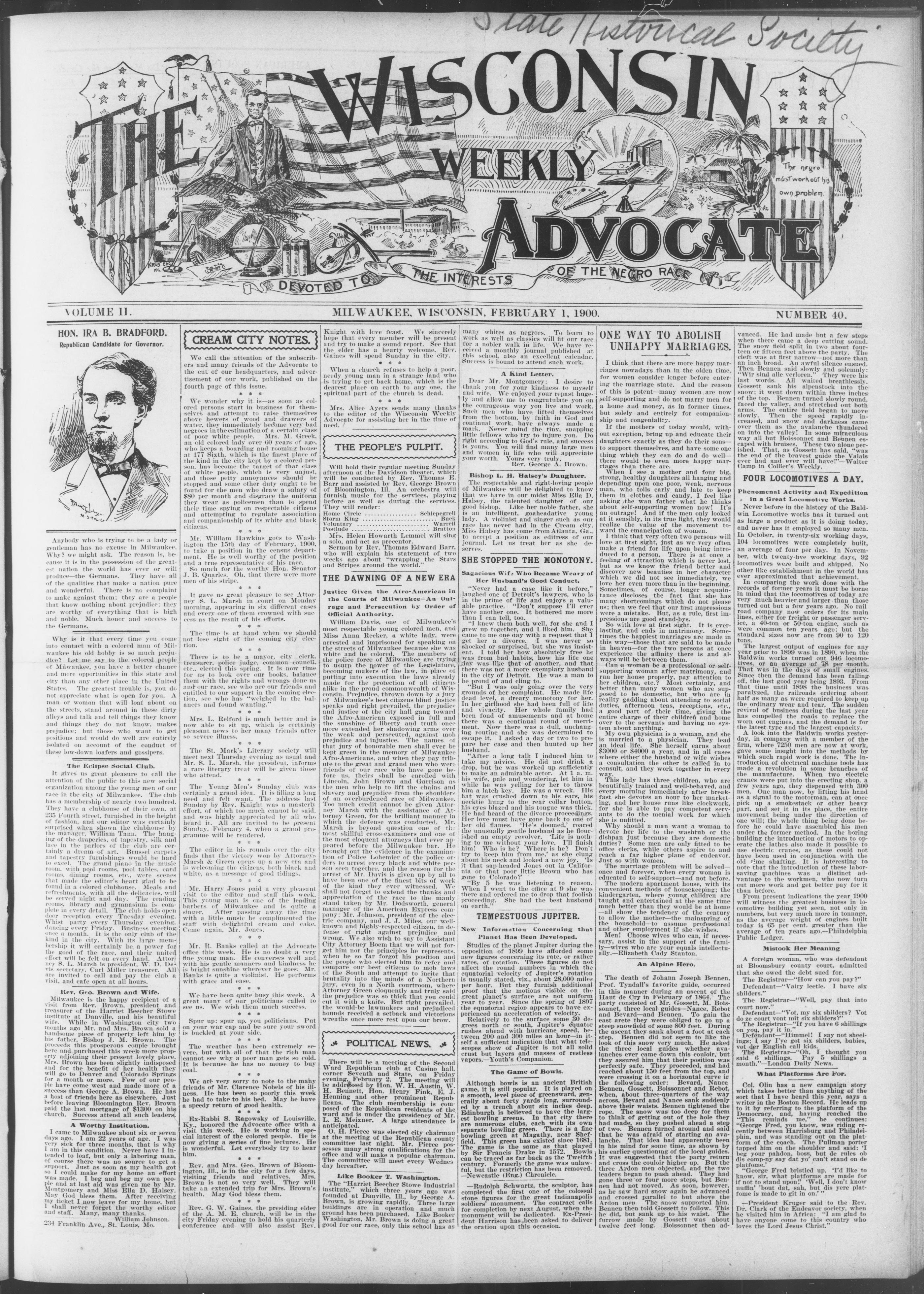
WISCONSIN
WEEKLY
The negro must work out his own problem.
ADVOCATE
DEVOTED TO THE INTERESTS OF THE NEGRO RACE
M. S. BROOKS
Anybody who is trying to be a lady or gentleman has no excuse in Milwaukee. Why? we might ask. The reason is, because it is in the possession of the greatest nation the world has ever or will produce—the Germans. They have all of the qualities that make a nation pure and wonderful. There is no complaint to make against them; they are a people that know nothing about prejudice; they are worthy of everything that is high and noble. Much honor and success to the Germans.
Why is it that every time you come into contact with a colored man of Milwaukee his old hobby is so much prejudice? Let me say to the colored people of Milwaukee, you have a better chance and more opportunities in this state and city than any other place in the United States. The greatest trouble is, you do not appreciate what is open for you. A man or woman that will loaf about on the streets, stand around in these dirty alleys and talk and tell things they know and things they do not know, makes prejudice; but those who want to get positions and would do well are entirely isolated on account of the conduct of these low-down loafers and gossipers.
The Eclipse Social Club
It gives us great pleasure to call the attention of the public to this new social organization among the young men of our race in the city of Milwaukee. The club has a membership of nearly two hundred. They have a clubhouse of their own, at 235 Fourth street, furnished in the height of fashion, and our editor was certainly surprised when shown the clubhouse by the manager, William Tann. The hanging of the draperies, of tapestry, silk and lace in the parlors of the club are certainly a dream of art. Brussel carpets and tapestry furnishings would be hard to excel. The grand piano in the music room, with pool rooms, pool tables, card rooms, dining rooms, etc., were scenes that made the editor's heart glad to be found in a colored clubhouse. Meals and refreshments, with all the delicacies, will be served night and day. The reading rooms, library and gymnasium is complete in every detail. The club holds open door reception every Tuesday evening. Whist party every Thursday evening, dancing every Friday. Business meeting once a month. It is the only club of the kind in the city. With its large membership it will certainly be a power for the good of the race, and their united effort will be felt on every hand. Attorney S. L. Marsh is president, W. D. Davis secretary, Carl Miller treasurer. All are invited to call and pay the club a visit, and cafe open at all hours.
Rey, Geo. Brown and Wife.
Milwaukee is the happy recipient of a visit from Rev. Brown, president and treasurer of the Harriet Beecher Stowe institute at Danville, and his beautiful wife. While in Washington city two months ago Mr. and Mrs. Brown sold a handsome piece of property left him by his father, Bishop J. M. Brown. The proceeds this prosperous couple brought here and purchased this week more property adjoining their present lovely place. Mrs. Brown has been slightly indisposed and for the benefit of her health they will go to Denver and Colorado Springs for a month or more. Few of our people have come west and made more of a success than George A. Brown. He has a host of friends here as elsewhere. Just before leaving Bloomington Rev. Brown paid the last mortgage of $1300 on his church. Success attend all such leaders.
A Worthy Institution.
I came to Milwaukee about six or seven days ago. I am 22 years of age. I was very sick for three months, that is why I am in this condition. Never have I intended to loaf, but only a laboring man, of course there was no source to get a support. Just as soon as my health got so I could make for my home an effort was made. I beg and beg my own people and at last aid was given me by Mr. Montgomery and Miss Ella D. Halsey. May God bless them. After receiving my ticket I now leave for my home, but I shall never forget the worthy editor and staff. Many, many thanks.
William Johnson.
234 Franklin Ave. St. Louis, Mo.
CREAM CITY NOTES.
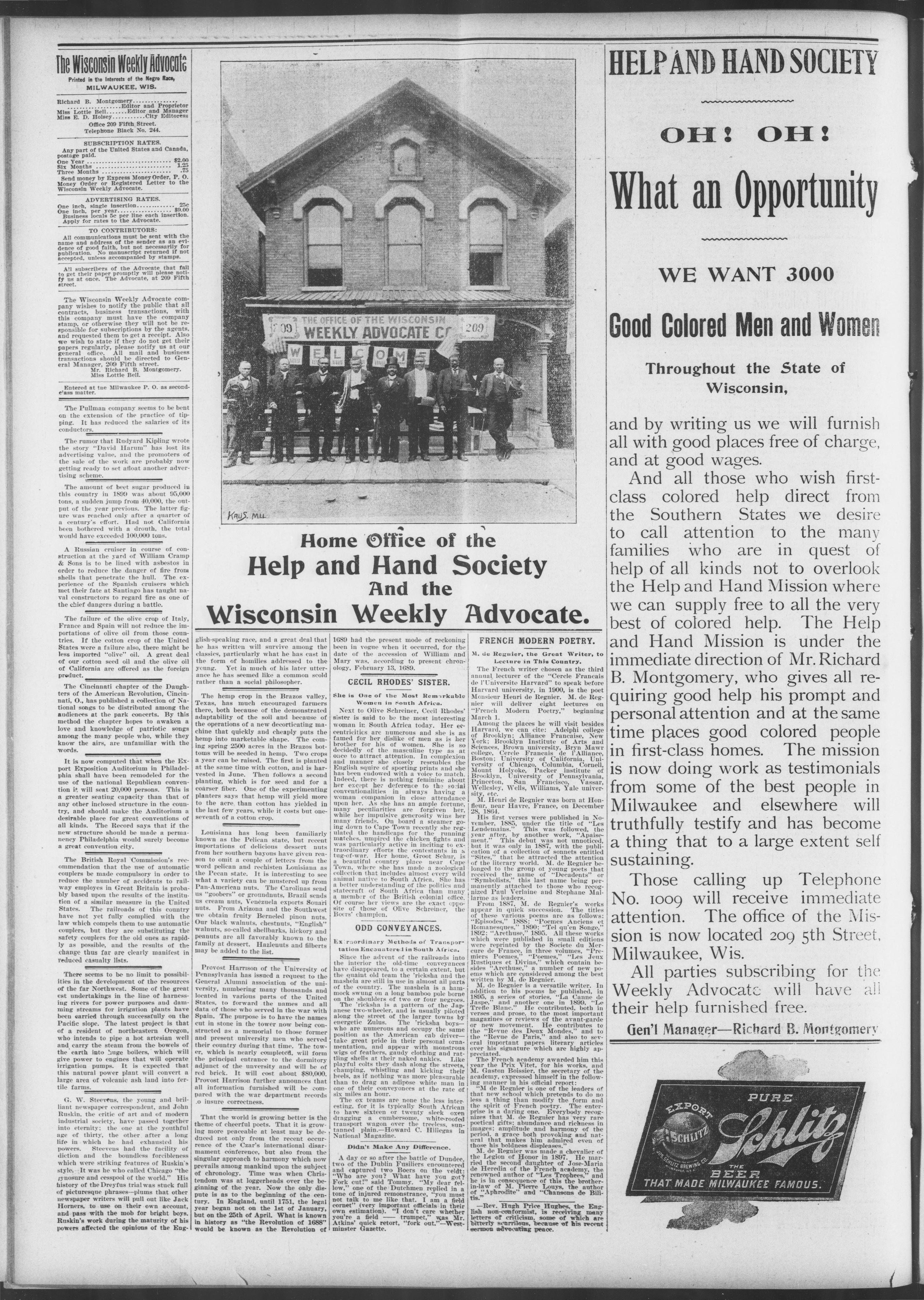
We call the attention of the subscribers and many friends of the Advocate to the cut of our headquarters, and advertisement of our work, published on the fourth page of this issue.
* * *
We wonder why it is—as soon as colored persons start in business for themselves and attempt to raise themselves above hewers of wood and drawers of water, they immediately become very bad negroes in the estimation of a certain class of poor white people. Mrs. M. Greek, an old colored lady over 60 years of age, who keeps a boarding and rooming house at 177 Sixth, which is the finest place of the kind in the city kept by a colored person, has become the target of that class of white people, which is very unjust, and those petty annoyances should be stopped and some other duty ought to be found for the men who draw a salary of $80 per month and disgrace the uniform they wear as policemen than to spend their time spying on respectable citizens and attempting to regulate association and companionship of its white and black citizens.
* * *
Mr. William Hawkins goes to Washington the 15th day of February, 1900, to take a position in the census department. He is well worthy of the position and a true representative of his race. So much for the worthy Hon. Senator J. B. Quarles. Oh, that there were more men of his stripe.
* * *
It gave us great pleasure to see Attorney S. L. Marsh in court on Monday morning, appearing in six different cases and every one of them crowned with success as the result of his efforts.
* * *
The time is at hand when we should not lose sight of the coming city election.
```markdown
```
There is to be a mayor, city clerk, treasurer, police judge, common council, etc., elected this spring. It is now time for us to look over our books, balance them with the rights and wrongs done us and our race, see who are our friends and entitled to our support in the coming election, see who has "weighed in the balances and found wanting."
\* \* \*
Mrs. L. Relford is much better and is now able to sit up, which is certainly pleasant news to her many friends after so severe illness.
* * *
The St. Mark's Literary society will meet next Thursday evening as usual and Mr. S. L. Marsh, the president, informs a rare literary treat will be given those who attend.
* * *
The Young Men's Sunday club was certainly a grand idea. It is filling a long need and felt want. The address last Sunday by Rev. Knight was a masterly effort, of which too much cannot be said, and was highly appreciated by all who heard it. All are invited to be present Sunday, February 4, when a grand programme will be rendered.
☆ ☆ ☆
The editor in his rounds over the city finds that the victory won by Attorneys Marsh & Green opens up a new era and is welcoming the citizens, both black and white, as a message of good tidings.
* * *
Mr. Harry Jones paid a very pleasant visit to the editor and staff this week. This young man is one of the leading barbers of Milwaukee and is quite a singer. After passing away the time with a little music he complimented the staff with delightful cream and cake. Come again, Mr. Jones.
点 准 虚
Mr. R. Banks called at the Advocate office this week. He is no doubt a very fine young man. He converses well and with his gentle manners and kindness he is bright sunshine wherever he goes. Mr. Banks is quite a violinist. He performs with grace and ease.
* * *
We have been quite busy this week. A great many of our politicians called to see us. We wish them much success.
* * *
Spur up: spur up, you politicians. Put on your war cap and be sure your sword is buckled at your side.
☆ ☆ ☆
The weather has been extremely severe, but with all of that the rich man cannot see why a poor man gets so cold. It is because he has no money to buy coal.
* * *
We are very sorry to note to the many friends of Mr. Clarence Nobels of his illness. He has been so poorly this week he had to take to his bed. May he have a speedy return of good health.
---
Ex-Rabbi S. Ragowsky of Louisville, Ky., honored the Advocate office with a visit this week. He is working in special interest of the colored people. He is now giving a series of fine lectures. He is wonderful. Let everybody try to hear him.
***
Rev. and Mrs. Geo. Brown of Bloomington, Ill., is in the city for a few days, visiting friends and relatives. Mrs. Brown is not so very well. They will take an extended trip for Mrs. Brown's health. May God bless them.
***
Rev. G. W. Gaines, the presiding elder of the A. M. E. church, will be in the city Friday evening to hold his quarterly conference and will also assist Rev.
MILWAUKEE, WISCONSIN, FEBRUARY 1, 1900.
Knight with love feast. We sincerely hope that every member will be present and try to make a sound report. See that the elder has a hearty welcome. Rev Gaines will spend Sunday in the city.
```markdown
```
When a church refuses to help a poor, needy young man in a strange land who is trying to get back home, which is the dearest place on earth to any one, the spiritual part of the church is dead.
***
Mrs. Alice Ayers sends many thanks to the editor of the Wisconsin Weekly Advocate for assisting her in the time of need.
THE PEOPLE'S PULPIT.
Will hold their regular meeting Sunday afternoon at the Davidson theater, which will be conducted by Rev. Thomas E. Barr and assisted by Rev. George Brown of Bloomington, Ill. An orchestra will furnish music for the services, playing before as well as during the services. They will render:
Home Circle Schlepegrell
Storm King Buck
Voluntary Warrell
Postlude Bratton
Mrs. Helen Howarth Lemmel will sing a solo, and act as precentor.
Sermon by Rev. Thomas Edward Barr, who will explain his statement of two weeks ago about "wrapping the Stars and Stripes around the world."
THE DAWNING OF A NEW ERA
Justice Given the Afro-American in the Courts of Milwaukee-An Outrage and Persecution by Order of Official Authority.
William Davis, one of Milwaukee's most respectable young colored men, and Miss Anna Recker, a white lady, were arrested and imprisoned for speaking on the streets of Milwaukee because she was white and he colored. The members of the police force of Milwaukee are trying to usurp the power of the Legislature, becoming makers of the law, in place of putting into execution the laws already made for the protection of all citizens alike in the proud commonwealth of Wisconsin. Prejudice, thrown down by a jury of Milwaukee's best citizens blind justice speaks and right prevailed, the prejudice and justice of the city hall gang toward the Afro-American exposed in full and the sunshine of liberty and truth once more extended her shadowing arms over the weak and persecuted, against mob prejudice and injustice. The names of that jury of honorable men shall ever be kept green in the memory of Milwaukee Afro-Americans, and when they pay tribute to the great and grand men who were friends of our race who have gone before us, theirs shall be enrolled with Lincoln, John Brown and Garrison as the men who help to lift the chains and slavery and prejudice from the shoulders of an overburdened race of Milwaukee. Too much credit cannot be given Attorney Marsh with the assistance of Attorney Green, for the brilliant manner in which the defense was conducted. Mr. Marsh is beyond question one of the most skillful cross-examiners and one of the most eloquent attorneys that ever appeared before the Milwaukee bar. He brought out the evidence in the examination of Police Lohemier of the police orders to arrest every black and white person seen together, and the reason for the arrest of Mr. Davis is given up by all to have been one of the finest bits of work of the kind they ever witnessed. We shall not forget to extend the thanks and appreciation of the race to the manly stand taken by Mr. Dodsworth, general manager of the American Express company: Mr. Johnson, president of the electric company, and J. J. Miles, our well-known and highly-respected citizen, in defense of right against prejudice and wrong. We also wish to say to Assistant City Attorney Boem that we will not forget him nor the principles he represents, when he so far forgot his position and the people who elected him to refer and compare our best citizens to mob laws of the South and attempt to incite that brutality into the minds of a Northern jury, even in a North courtroom, where Attorney Green eloquently and truly said the prejudice was so thick that you could cut it with a knife. But right prevailed, the would-be lawmakers and prejudiced hounds received a setback and victorious wreaths once more rest upon our brow.
There will be a meeting of the Second Ward Republican club at Casino hall, corner Seventh and State, on Friday evening, February 2. The meeting will be addressed by Hon. W. H. Austin, W. H. Bennett, Hon. Henry Fink, E. J. Henning and other prominent Republicans. The club membership is composed of the Republican residents of the ward and is under the presidency of Mr. L. E. Meixner. A large attendance is anticipated. O. H. Pierce was elected city chairman at the meeting of the Republican county committee last night. Mr. Pierce possesses many strong qualifications for the office and will make a popular chairman. The committee will meet every Wednes day hereafter.
Like Booker T. Washington
The "Harriet Beecher Stowe Industrial institute," which three years ago was founded at Danville, Ill., by George A. Brown, is growing rapidly. Three large buildings are in operation and much ground has been purchased. Like Booker Washington, Mr. Brown is doing a great good for our race, only this school has as
many whites as negroes. To learn to work as well as classics will fit our race for a nobler walk in life. We have received a monthly journal published at this school, also an excellent calendar. Success is bound to attend such work.
A Kind Letter.
Dear Mr. Montgomery: I desire to thank you for your kindness to myself and wife. We enjoyed your repast hugely and allow me to congratulate you on the courageous way you live and work. Such men who have lifted themselves from the bottom, by faith in God and continual work, have always made a mark. Never mind the tiny, snapping little fellows who try to injure you. Do right according to God's rule, and success is yours. You will find many large men and women in life who will appreciate your worth. Yours very truly,
Bishop L. H. Halsey's Daughter
The respectable and right-loving people of Milwaukee will be delighted to know that we have in our midst Miss Ella D. Halsey, the talented daughter of our good bishop. Like her noble father, she is an intelligent, goaheadative young lady. A violinist and singer such as our race has never had in the Cream city. Miss Halsey has come from Atlanta, Ga., to accept a position as editress of our journal. Let us treat her as she deserves.
SHE STOPPED THE MONOTONY.
Sagacious Wife Who Became Weary of Her Husband's Good Conduct.
"Never had a case like it before," laughed one of Detroit's lawyers, who is in the prime of life and enjoys a valuable practice. "Don't suppose I'll ever have another one. It bothered me more than I can tell, too.
"I knew them both well, for she and I grew up together, and I liked him. She came to me one day with a request that I get her a divorce. I was never so shocked or surprised, but she was insistent. I told her how absolutely free he was from bad habits, how his life one day was like that of another, and that there was not a more exemplary husband in the city of Detroit. He was a man to be proud of and cling to.
"But I was only going over the very grounds of her complaint. He made life dead level, a dreary monotony for her. In her girlhood she had been full of life and vivacity. Her whole family had been fond of amusements and at home there was a continual round of merriment. Now there was a dull, unchanging routine and she was determined to escape it. I asked a day or two to prepare her case and then hunted up her husband.
"After a long talk I induced him to take my advice. He did not drink a drop, but he was worked up sufficiently to make an admirable actor. At 1 a. m. his wife, pale and wondering, let him in while he was yelling for her to throw him a latch key. He was a wreck. His hat was crushed down to his ears, his necktie hung to the rear collar button, his eyes blazed and his tongue was thick. He had heard of the divorce proceedings. Her love must have gone back to one of her old flames. 'He's doomed,' roared the unusually gentle husband as he flourished an empty revolver. 'Life is nothing to me without your love. I'll finish him! Who is he? Where is he? Don't try to keep him from me,' as she clung about his neck and looked a new joy. 'Is it that sap-headed Jones out in California or that poor little Brown who has gone to Colorado?'
"By 5 he was listening to reason. When I went to the office at 9 she was there and ordered me to drop that foolish proceeding. She had the best husband on earth."
TEMPESTUOUS JUPITER.
New Information Concerning that Planet Has Been Developed.
Studies of the planet Jupiter during the opposition of 1899 have afforded some new figures concerning its rate, or rather rates, of rotation. These figures do not affect the round numbers in which the equatorial velocity of Jupiter's rotation is usually stated, viz., about 28,000 miles per hour. But they furnish additional proof that the motions visible on the great planet's surface are not uniform year to year. Since the spring of 1897 the equatorial region appears to have experienced an acceleration of velocity. Relatively to the surface some 30 degrees north or south, Jupiter's equator rushes ahead with hurricane speed, between 200 and 300 miles an hour—in itself a sufficient indication that what telescopes show of Jupiter is not all solid crust but layers and masses of restless vapors.—Youth's Companion.
The Game of Bowls.
Although bowls is an ancient British game, it is still popular. It is played on a smooth, level piece of greensward, generally about forty yards long, surrounded by a trench about six inches deep. Edinburgh is believed to have the largest bowling greens. In that city there are numerous clubs, each with its own separate bowling green. There is a fine bowling green at Magathy, near Sheffield. This green has existed since 1681. The game is the same as that played by Sir Francis Drake in 1572. Bowls can be traced as far back as the Twelfth century. Formerly the game was unlawful, but the restriction has been removed.—Newcastle (Eng.) Chronicle.
—Rudolph Schwartz, the sculptor, has completed the first one of the colossal stone figures for the great Indianapolis soldiers' monument. The contract calls for completion by next August, when the monument will be dedicated. Ex-President Harrison has been asked to deliver the oration upon this occasion.
ONE WAY TO ABOLISH UNHAPPY MARRIAGES.
I think that there are more happy marriages nowadays than in the olden time, for women consider longer before entering the marriage state. And the reason of this is potent—many women are now self-supporting and do not marry men for a home and money, as in former times, but solely and entirely for companionship and congeniality.
If the mothers of today would, without exception, bring up and educate their daughters exactly as they do their sons—to support themselves, and have some one thing which they can do and do well—there would be even more happy marriages than there are.
When I see a mother and four big, strong, healthy daughters all hanging and depending upon one poor, weak, nervous man, who toils early and late to keep them in clothes and candy, I feel like asking, the wan father what he thinks about self-supporting women now! It's an outrage! And if the men only looked at it sensibly, in its true light, they would realize the value of the movement toward the emancipation of women.
I think that very often two persons will love at first sight, just as we very often make a friend for life upon being introduced to a person. There is at once a feeling of attraction which is never lost, but as we know the friend better and discover new beauties in her character which we did not see immediately, we love her even more than in the beginning. Sometimes, of course, longer acquaintance discloses the fact that she has many shortcomings which do not please us; then we feel that our first impressions were a mistake. But, as a rule, first impressions are good stand-bys.
So with love at first sight. It is everlasting, and ends in matrimony. Sometimes the happiest marriages are made in this way—those that are said to be made in heaven—for the two persons at once experience the affinity there is and always will be between them.
Can a woman be a professional or self-supporting woman after matrimony, and run her house properly, pay attention to her children, etc.? Most certainly, and better than many women who are supposed to be domestic, but who are in reality gadding about attending to social duties, afternoon teas, receptions, etc., a good part of their time, giving the entire charge of their children and home over to the servants and having no system about anything.
My own physician is a woman, and she is married to a physician. They lead an ideal life. She herself earns about $3000 or $4000 a year, and in all cases where either the husband or wife wishes a consultation the other is called in to consult, and they work together in every way.
This lady has three children, who are beautifully trained and well-behaved, and every morning immediately after breakfast she devotes an hour to her marketing, and her house runs like clockwork, for she is able to pay competent servants to do the menial work for which she is unfitted.
Why should a man want a woman to devote her life to the washtub or the dishpan just because they are domestic duties? Some men are only fitted to be office clerks, while others aspire to and reach a far higher plane of endeavor. Just so with women.
The marriage problem will be solved once and forever, when every woman is educated to self-support—and not before
educated to self-support—and not before. The modern apartment house, with its convenient methods of housekeeping; the kindergarten, where young children are taught and entertained at the same time much better than they would be at home
all show the tendency of the century to allow the mother—the mainspring of the household—to assume professional and other employment if she wishes. Men! Choose wives who can, if necessary, assist in the support of the family—wives who are your equals intellectually. Elizabeth Cady Stanton.
An Alpine Hero.
The death of Johann Joseph Bennen, Prof. Tyndall's favorite guide, occurred in this manner during an ascent of the Haut de Cry in February of 1864. The party consisted of Mr. Gossett, M. Boissonnet, three local guides—Nance, Rebot and Bevard—and Bennen. To gain the east arete they were obliged to go up a steep snowfield of some 800 feet. During the ascent they sank about a foot at each step. Bennen did not seem to like the look of this snow very much. He asked the three local guides whether avalanches ever came down this couloir, but they assured him that their position was perfectly safe. They proceeded, and had reached about 150 feet from the top, and were crossing it on a horizontal curve in the following order: Bevard, Nance, Bennen, Gossett, Boissonnet and Rebot, when, about three-quarters of the way across, Bevard and Nance sank suddenly above their waists. Bennen tightened the rope. The snow was too deep for them to think of getting out of the hole they had made, so they pushed ahead a step of two. Bennen turned around and said that he was afraid of starting an avalanche. That idea had apparently been in his mind for some time, as shown by his earlier questioning of the local guides. It was suggested that the party return and cross the couloir higher up. But the three Ardon men objected, and the two leaders began to push ahead. They had gone three or four more steps, but Bennen had not moved. As soon, however, as he saw hard snow again he advanced and crossed parallel to but above the Ardon men. The snow supported him. Bennen then told Gossett to follow. He did, but sank up to his waist. The furrow made by Gossett was about twelve feet long. Boissonnet then ad-
NUMBER 40.
vanced. He had made but a few steps when there came a deep cutting sound. The snow field split in two about fourteen or fifteen feet above the party. The cleft was at first narrow—not more than an inch broad. An awful silence ensued. Then Bennen said slowly and solemnly: "Wir sind alle verloren." They were his last words. All waited breathlessly. Gossett sank his alpenstock into the snow; it went down within three inches of the top. Bennen turned slowly round, faced the valley, and stretched out both arms. The entire field began to move slowly. Then the speed rapidly increased, and snow and darkness came over them as the avalanche thundered on into the valley! In some miraculous way all but Boissonnet and Bennen escaped with bruises. These two alone perished. That, as Gossett has said, "was the end of the bravest guide the Valais ever had and ever will have"—Walter Camp in Collier's Weekly.
FOUR LOCOMOTIVES A DAY.
Phenomenal Activity and Expedition in a Great Locomotive Works. Never before in the history of the Baldwin Locomotive works has it turned out as large a product as it is doing today, and never has it employed so many men. In October, in twenty-six working days, 104 locomotives were completely built, an average of four per day. In November, with twenty-hive working days, 92 locomotives were built and shipped. No other like establishment in the world has ever approximated that achievement
In comparing the work done with the records of former years it must be borne in mind that the locomotives of today are very much heavier and larger than those turned out but a few years ago. No rail road company now orders for its main lines, either for freight or passenger service, a 40-ton or 50-ton engine, such as were common ten years ago; but the standard sizes now are from 90 to 120 tons.
The largest output of engines for any year prior to 1899 was in 1890, when the Baldwin works turned out 946 locomotives, or an average of 78 per month. That was in the days of small engines. Since then the demand has been falling off, the last good year being 1893. From that time until 1898 the business was paralyzed, the railroads ordering about half as many as were required to keep up the ordinary wear and tear. The sudden revival of business during the last year has compelled the roads to replace the worn out engines, and the demand is for the latest type and the largest capacity.
A look into the Baldwin works yesterday, in company with a member of the firm, where 7250 men are now at work, gave some insight into the methods by which such rapid work is done. The introduction of electrical machine tools has made a revolution in some branches of the manufacture. When two electric cranes were put into the erecting shop, a few years ago, they dispensed with 300 men. One man now, by lifting his hand as a signal to the motorman, can at once pick up a smokestack or other heavy part, and set it in its place, the entire movement being under the direction of one will; the whole thing being done before he could have assembled his men under the former method. In the boring building the introduction of motors to operate the lathes also made it possible to use electric cranes, as these could not have been used in conjunction with the old time shafting. It is interesting to note that the introduction of these labor-saving machines was a distinct advantage to the workmen, who now turn out more work and get better pay for it than before.
From present indications the year 1900 will witness the greatest business in locomotive building yet seen, not only in numbers, but very much more in tonnage, as the average weight of engines built today is 65 per cent. greater than the average of ten years ago.—Philadelphia Public Ledger.
Mistook Her Meaning
A foreign woman, who was defendant at Bloomsbury county court, admitted that she owed the debt sued for.
The Registrar—"How can you pay?"
Defendant—"Vairy leetle. I have six shilders."
The Registrar—"Well, pay that into court now."
Defendant—"Vot, my six shilders? Vot do ze court vont mit six shilders?"
doze court vont mit six shillers:
The Registrar: "If you have 6 shillings
in your account."
on you, pay it in.
Defendant—"Himmel! I say not sheeledings; I say I've got six shilders, babies, vot der English call kids.
The Registrar—"Oh, I thought you said 6 shillings. Pay 5 shillings a month."—London Daily News.
What Platforms Are For.
Col. Olin has a new campaign story which takes better than anything of the sort that I have heard this year, says a writer in the Boston Record. He leads up to it by referring to the platform of the Democracy, and, having reached the "This reminds me," he continues: "George Fred, you know, was riding recently between Harrisburg and Philadelphia, and was standing out on the platform of the coach. The Pullman porter tapped him on the shoulder and said: 'I beg your pahdon, boss, but de rules ob dis comp-ny say dat yo' can't stand on de platface.' "George Fred bristled up. 'I'd like to know, sir, what platforms are made for if not to stand upon!' 'Well, I don't know nuffin' 'bout dat, sah, but dis yere platface is made to git in on.'"
—President Kruger said to the Rev. Dr. Clark of the Endeavor society, when he visited him in Africa: "I am glad to have anyone come to this country who loves the Lord Jesus Christ."
BULLER WILL TRY AGAIN
LADYSMITH HOLDS OUT
British Subjects Ordered to Take Up Arms for the Republic Un-
Cape Town, Tuesday, Jan. 30.—Gen. Buller still holds the Tugela drifts and will possibly renew his attempt to force his way through the Boer defense before long. In any case, Ladysmith is capable of holding out for a considerable time.
London, Jan. 31.—When the nation has almost resigned itself to the fall of Ladysmith, there comes from all quarters today an indication that Gen. Buller will make another attempt to relieve the besieged place. If the Daily Mail's report of Gen. Buller's statement, that he hoped to be in Ladysmith within a week, could be implicitly relied on, news of further serious nighting would be expected shortly. But the papers are slow to believe what the St. James Gazette characterizes as "unwarrantable boasting," if true. Moreover, the war office throws cold water on the dispatch this afternoon by issuing a statement that it has no news confirmatory of such a move as Gen. Buller's reported speech indicates. Yet today's dispatches from Ladysmith and Cape Town give a strong impression that there is something more than rumor in all these reports. So, white all definite opinion must await further news it does not seem at all unlikely that another desperate effort will be made to succor Gen. White.
Filed Down Sadly but in Order.
A dispatch from the Associated press representative at Spearman's farm, dated January 25, Thursday, describing the fight and retirement from Sponkop, says:
"We filed down sadly, but in perfect order. The King's Royal Rifles' colonel was struck down at the moment a heliograph message ordering the retirement was handed to him. The enemy is holding thanksgiving services tonight.
"The surgeons who ascended the hill were allowed to remove our wounded. The scene at the top was a fearful and terrible witness to the destructiveness of the artillery.
"All day our stretcher-bearers were busy carrying down men."
Impressing British Subjects.
Cape Town, Jan. 31.—Kimberley has holographed to the Modder river Friday, January 26, that all the British subjects in the Barkley West district had been ordered by the Boers to take up arms for the republic under a penalty of £37 or three months at hard labor. About 300 men are affected by this order.
Cavalry to Embark.
London, Jan. 31. Sudden orders were received at Aldershot this afternoon for the immediate embarkation of the Fourth cavalry brigade for the Cape.
Will Hold on Longer.
Ladysmith, Sunday, Jan. 28.—(Heliographed to Swartzkop, north of Tugela river.)—The news of the prolongation of the siege, resulting from Gen. Buller's failure, is received with fortitude. We can hold on. The garrison is healthier, cheery and confident. Disease is disappearing and there is no horse sickness. The rains give plenty of grass: We can hear Gen. Buller's guns still working and it is rumored in camp that he is advancing along another line. The Boer lancers around are again full of men, who have returned from the upper Tugela. The Boers have also taken up a new position on the hills near Culenso, where they are in great force. Reinforcements are apparently arriving from the Transvaal. Large bodies of Boers are also visible between here and Potgieter's drift.
In the House of Commons.
London, Jan. 31.—The House of Commons today resumed the debate on the amendment of Lord Edmund Fitzmaurice, Liberal, to the address in reply to the Queen's speech.
Replying to the criticism of Francis S. Stevenson, Liberal member for the Eye division of Suffolk, government leader, A. J. Balfour, said that nothing had thus far occurred to convince him that the information given by the intelligence department regarding the Boer guns was erroneous.
Sydney Charles Buxton, Liberal member for the Middle division of Lanarkshire, referred to the charges brought against the chancellor of the exchequer and treasury, whereupon the chancellor of the exchequer, Sir Michael Hicks-Beach, hotly interrupted, saying: "From the very beginning neither the treasury nor the chancellor has, in any way stinted any preparations or expenditure the cabinet thought necessary."
McKinley will Not Interfere.
New York, Jan. 31.—A special to the Herald from Washington says: "All the information which has reached the President is to the effect that Great Britain does not desire mediation, and though it is understood that the Boer government is anxious for peace, the statements made by Dr. Leyds, its representative in Europe, seem to favor a continuance of the war. The President certainly will not interfere unless both governments request the use of his good offices."
This statement, made by an official of the administration after the meeting of the cabinet, may be regarded as authoritative.
NO HARSH CRITICISM
Opposition Supports the Government in Time of Peril.
London, Jan. 31.—Those who expected that the opening session of parliament would be the occasion for abusive criticism of the conduct of the war were disappointed. So far from showing any disposition to comment upon the blunders of the campaign, the tone of Sir Henry Campbell Bannerman and of Lord Kimberley was decidedly sympathetic and evinced a determination to sink all party differences and do all in their power to uphold the hands of the government in its determination to prosecute the war to a successful issue.
Opposition Promises Support.
Sir Henry Campbell Bannerman, indeed, promised that the opposition would vote "unstinted means" in order that the integrity of the empire should be preserved. He commented severely, however, on the lack of preparedness shown by the war office, and demanded that the position of Gen. Buller, who was said to have early advised the government of the need of a large army, should be thoroughly ventilated. He also wanted to know many things concerning the alleged interference of the authorities at home—for political reasons—with the generals in the field.
The Earl of Kimberley, in his turn, blamed the government for permitting the Transvaal to stock up during several years with munitions of war, and, in fact, prepare itself at every point for the conflict which it was now manifest had been long foreseen by the South African republic.
Lord Salisbury very ably turned the
tables on the opposition when he pointed out that the permission to make an agreement with Portugal that all munitions of war should freely enter the country by Lourenco Marques had been conceded by the Gladstone cabinet, of which Lord Kimberley was a member. He added that ignorance of the Boers' movements was largely ascribable to the fact that Great Britain spent comparatively little money for secret information.
Lausdowne Speaks.
The Marquis of Lansdowne, secretary of state for war, stated that he would be ready at an early date to explain the military measures the government had in contemplation. During the debate on the address did not seem to the government a proper time for making a full statement. He pointed to the fact that within a few weeks the government had been able to send 170,000 troops 6000 miles as proof that Great Britain was not unprepared for war. He maintained that the intelligence department had not greatly erred as to the number of combatants or the quantity of armaments at the disposal of the republics. He frankly owned that what they had underrated was the value of the Boers as fighting men. They had shown, he added, an amount of resource, mobility and fenacity in fighting for which the government was not prepared.
FORCES AT ROBERTS' DISPOSAL
Probability of an Invasion of the Free State.
London, Jan. 31.—With the troops due to arrive next month Lord Roberts may think himself strong enough to try two large operations. Combining the forces under Gen. Methuen, French and Gatacre and adding to them the arriving troops, he would have 70,000 for the invasion of the Free State, with 40,000 to 50,000 guarding communications and 40,-000 trying to rescue Ladysmith.
Twenty thousand two hundred and twenty-two men and 155 guns are at sea. Eleven thousand infantry and 9000 cavalry, including 5000 yeomen, are practically ready to embark. Therefore the government, without doing more, can place at the disposal of Lord Roberts 40,060 additional men and 155 guns. The further purposes of the war office officials are supposed to embrace somewhere in the neighborhood of 50,000 more men. As the indication is that candidates will be rather scarce, the war office will issue orders for those reservists who were found unfit at the previous mobilization examinations to report for further examination. Applicants for cavalry service are still freely offering as yeomanry.
A Gallant Retreat.
Gen. Buller telegraphs from Spearman's camp under today's date that Col. Thornycroft was the officer who ordered the retirement from Spionkop. Gen. Buller adds: "It is due to him to say that I believe his gallantry saved a difficult situation and that under a loss of at least 40 per cent, he directed the defense with conspicuous courage and ability throughout the day. No blame whatever for the withdrawal is, in my opinion, attributable to him, and I think his conduct throughout was admirable."
THE BATTLE OF SPIONKOP.
Winston Churchill's Account of Gen. Warren's Disastrous Movement.
New York, Jan. 31.—Winston Spencer Churchill has cabled, and the Evening World copyrights, an account of the battle of Spoonkop. The dispatch, which is dated Spearman's camp, Jan. 27, says the fight on the summit of the kop was one of the fiercest and most furious conflicts in British military history. Guided by Thornycroft, the troops surprised the Boers there, and carried the trenches with the bayonet at 3 o'clock in the morning. There was little loss.
At once the troops entrenched hastily, but the ground was broken by large rocks and unsuited for entrenchments. At dawn heavy Boer shelling began. Gen. Woodgate was seriously wounded at the beginning. Urgent demands for reinforcements were sent by the commander who succeeded Woodgate. The reinforcements were sent strengthening the defense. Thornycroft was appointed brigadier, commanding the whole force on top of the bill.
Too Hot to Hold.
A bitter and bloody struggle followed throughout the day, the Boers concentrating every man and gun on the summit of the hill and attacking with the greatest spirit. The British artillery was unable to cope with the superior long-range guns, and during the afternoon it became evident the infantry could not endure another day. It was impossible to drag guns to the summit of Spion without elaborate preparations or to fortify the hill strongly enough to protect the defenders from unassailed artillery. Therefore Thornycroft's decision to abandon it was both wise and necessary. Troops, still stubborn and formidable, marched back to the camps in regular order. Every effort is now being made to succor the wounded, of whom many still lie on the summit. The official lists will give the losses. The defense of the hill by the English infantry, particularly the Lancashire regiments, was a glorious episode. The whole army is proud of it.
Will Try Again.
The Boer positions before Ladysmith are perhaps impregnable to 25,000 men, but the troops are resolved to have another try. The public must imitate the equanimity of the troops.
Spionkop is not a disaster. Neither guns were lost nor unwounded prisoners made. It was simply a bloody action in which lodgment in the enemy's entrenchments was effected, but which proved untenable.
The Boers were sometimes within thirty yards of the British line. They have also suffered. Their loss must be greater, compared to their strength, than ours.
The process of attrition must ultimately settle the war. The troops bear the worst cheerfully and the nation must remain calm, dignified and determined.
SOUTH OF THE TUGELA.
Dundonald's Brigade Reaches a Place of Safety.
London, Jan. 31. A dispatch from Spearman's camp states that Lord Dundonald's mounted brigade reached the south bank of the Tugela river on Saturday. Gen. Lyttelton's brigade remains in its original position
Those Chocolate Boxes.
The Queen's chocolate boxes were distributed in the regimental camps on January 25. They were received with three cheers for the Queen. The postoffice here has been crowded by soldiers since this morning, all of them being desirous of mailing to friends at home the boxes which had contained the Queen's gift of chocolate. A large number of civilians are paying a pound or more for each of the empty boxes they can obtain.
Withdrew in an Orderly Manner.
The following dispatch, while admitting that the position on Spionkop was untenable, denies that the British were driven from the hill:
Spearman's Camp, Jan. 27.—Last night the British troops took the heights of Spionkop, but the position was considered untenable and the troops were withdrawn under cover of darkness. There was much surprise in the morning when it was discovered that there were no troops on the hill.
The various rumors of defeat are quite untrue. The withdrawal was conducted in an orderly manner, the troops being withdrawn to Spearman's camp, the flank movement being abortive.
The British loss was heavy. The actual
numbers are not known. The greatest loss was owing to a cross fire of shrapnel and lyddite.
SMALL CHANCE FOR WHITE.
Boers Expect Ladysmith to Fall and will Then Ask Mediation.
New York, Jan. 31.—The dispatch from Cape Town which quotes Gen. Buller as saying he hoped to be in Ladysmith in a week, is discredited in London. The report of fighting at Crocodile pool disposes of the rumor that the British had relieved Mafeking. There is no great enthusiasm in London over the expected invasion of the Orange Free State by a third British army, for it is considered likely that the Boers have planned a good defense. Col. Villebois-Mareuil, the French strategist, has started for Colesberg to assist in repelling the British advance. Confirmation has been received of the report that the chief Boer shell factory in Johannesburg has been blown up. For the present the British can do nothing to help Ladysmith. Some of the reports believe that Gen. White will try to his way out. He must either do the surrender, for his food supply is almost exhausted.
When Ladysmith Falld.
It is said that, upon the fall of Ladysmith, Dr. Leyds, in Europe, and Montagu White, in Washington, will appeal for mediation.
The British public seems to have totally lost confidence in Gen. Buller. The next big news is expected to be furnished by the Boers. They have doubled their energy in the siege in Kimberley, and may be expected to close in on Ladysmith.
There is no sign, except the anxiety of the British cabinet, that any hostile demonstration against England is contemplated. Russia and France are sure to take advantage of England's helplessness by grabbing territory in Asia, but the Czar is living up to his reputation as the foe of war.
Long Train of Ambulances.
A special to the Herald from Spearman's camp, Saturday, says: There has been a long train of ambulances arriving at the Spearman's camp field hospitals with wounded. The Lancashire brigade sustained the heaviest losses. There was no panic. The troops retired from the hill in good order. This morning several men were shot in returning to the positions held before they carried Spionkop. Thornycroft's mounted infantry and the Third battalion of the King's Royal rifles lost heavily. The men of the Imperial Light infantry received their baptism of fire shooting and killing the Boer marksmen and snippers.
Mason a Good Shot
Sergeant Mason of Thornycroft's mounted infantry had a duel with Boers, who drilled five holes through his helmet. Sergt. Mason caught three Boers creeping up behind him yesterday evening with fixed sights. One he instantly killed, and then another. The third took shelter, and for an hour they exchanged shots. The Boer hit him in the shoulder, but Mason returned the compliment, and at the next shot killed his antagonist.
Cables Suspended.
Capetown, Jan. 26, 12:05 p. m. The government of the Transvaal has notified the Cape government that all cable communications will be suspended during the continuance of the censorship. Pretoria, Monday, Jan. 29. It is officially announced that the Boer casualties at Spionkop were 53 men killed and 120 wounded.
CRIED LIKE A CHILD.
Mrs. Lawton Learns of the Fund Raised for Her and Her Children by American People.
San Francisco, Cal., Jan. 31.—Until she reached this city Mrs. Lawton knew nothing of the fund raised by the American people. The news was taken aboard by Pilot Reed and communicated to Mrs. Lawton by Lieut.-Col Edwards, the dead soldier's adjutant-general.
"Oh. how kind, how kind," she sobbed and completely overcome she sank down upon a divan and cried like a child.
"It had always been Henry's ambition and mine," she said, presently, "to have a home for the children, but I had despaired of it." More she could not say. Everybody in the cabin came forward and congratulated Mrs. Lawton in turn.
Flags at Half-Mast.
The big transport Thomas, having on board the remains of Maj.-Gen. Lawten, Maj. John A. Logan of the Thirty-third volunteers. Lieut. Edward Taylor and Surgeon-Maj. Frank C. Armstrong, came to anchor off the quarantine grounds just inside the harbor. The flag on the vessel was at half-mast, as were those over Fort Baker, the Presidio, Angel island and Aleatraz, and on every vessel in the harbor. Minute guns boomed from the artillery stationed on either side of the entrance to the bay, and the vessels of all nations dropped their colors as the transport bearing the honored dead passed slowly to its anchorage.
Gen. Lawton's body was accompanied by the wife and four children, Manley, Frances, Catherine and Louise Lawton. The escort of honor is composed of Lieut. Col. C. E. Edwards, Forty-seventh volunteers, adjutant-general of Lawton's division; Chaplain Pierce; Capt. E. L. King, who was with Gen. Lawton when he was killed, and Maj. H. L. Haskell of the Twelfth infantry, the officer who led the famous charge at El Caney, Cuba.
Gen. Lawton's Bodyguard.
The bodyguard consists of Sergt. Joseph Simon, troop B; Trumpeter Haberkam, troop I; Private Charles L. Okum, troop F, all of Lawton's Fourth cavalry, and Private John H. Mohrhusen, CoD. Fourteenth infantry. Maj.-Gen. Shafter, who is to accompany the remains to Washington, boarded the Thomas as it entered the harbor, accompanied by officers of his staff.
The tug Fearless took out to the Thomas Maj. William F. Tucker of the pay department, a brother-in-law of Maj. Logan. The bodies of the dead officers were lying in state in a large room on the main deck. The four caskets were in a row, all heavily draped with American flags. In a stateroom adjoining were tributes to Gen. Lawton from his native admirers in the Philippines. They consisted for the most part of beautiful wreaths of paper, feather and fine-wire flowers, beautiful specimens of the artistic handiwork of the Filipinos. Some of these wreaths were from six to eight feet in circumference, and the favorite flowers were violets, passion flowers and imortelles.
According to those on the transport Gen. Lawton's funeral was the most impressive ever witnessed in Manila. As the vessel steamed away from Manila the flags of all vessels were at half-mast.
DISASTROUS FIRE.
Business Portion of Winfield, Kas. Wiped Out.
Chicago, Ill., Jan. 31.—A special to the Tribune from Wichita, Kas., says: Fire destroyed the business portion of Winfield, a town of 6000 inhabitants, forty miles south of here last night and threatened the city building and county jail. The Hackney block, a three-story building erected at a cost of $125,000, and its entire contents were burned, and 100 people were made homeless. The Arlington hotel was destroyed, and the Rutter livery barn was burned with all the horses.
WHITE TO ESCAPE FROM LADYSMITH.
British Commander will Make a Desperate Attempt to Break Through the Boer Lines.
New York, Jan. 30.—Advices from London indicate that military associates of Gen. White are of the opinion that he will make a desperate attempt to break through the Boer lines and escape from Ladysmith; that though such a movement would cost a tremendous sacrifice of life it would be preferable to surrender to the Boers. The statement that Lord Roberts advised the abandonment of Ladysmith is not generally credited in London, but in view of the fact that the supply of provisions will not hold out for more than a week longer, it is not probable that any aid can be rendered to Gen. White inside of that time and he will have but two courses open—surrender, or cut his way out. Several military experts in London are of the opinion that the British in Kimberley at Modder river and on the Tugela will also be left to work out their own salvation. One critic says: "As to an advance northward through the Free State, if as appears probable, the British commander has to keep nearly all of Buller's army on the line of the Tugela, a new army will have to make the advance on Bloemfontein. There is no use disguising the fact that the imperial forces in South Africa are not strong enough at present to undertake this advance with safety.
A Terrible Alternative.
The Daily Telegraph says: "It is a terrible alternative when we have to balance against each other the safety of the brave men in the beleaguered camp and the only rational policy of carrying on the war. It has to be faced without sentiment or unavailing regret."
The Daily Mail says: "Such a move could not be made with sufficient speed to save Ladysmith. It would seem that the soundest military principles dictate the reinforcement of our army in Natal and a fresh advance, this time in ample force. There are two dangers to be guarded against—foreign intervention and further military disaster in South Africa. To meet the first the whole navy should be mobilized and the naval reserves called out. Our squadrons should be distributed in the proper position for war. The volunteers should be put under arms and provided with transport and artillery. The remnant of militia should be embodied. A force of at least 100,000 men over and above the volunteers and militia is required to supply our generals' needs in South Africa. If it cannot be raised on terms of voluntary service we must have drafting as in the United States during the Civil war."
Move Against Orange Free State.
The London Post says: "There is a rumor that Gen. Kitchener or Lord Roberts has left Cape Town already to take command of a movement by Gen. Gatacre's and Gen. French's combined forces with heavy additions of fresh troops against the Orange Free State. The defeat is bitter, but it is right to face it, while it is wrong to conceal from ourselves. The meeting of the defense convention on Saturday probably was caused by a knowledge of Gen. Buller's retreat, though the fact was kept from the public until Sunday. The measures now urgently needed are development of the military resources of the country, with 100,000 men in the field and 50,000 to follow. The moment has come to push on the training of all the troops left at home."
The Leader says: "The enemy has beaten us at the sticking game; he has beaten us in strategy tactics, and he has induced us to give up the first plan where he would have hardly had a show, and to conform to this plan where naturally everything is against us. Is there a single soldier who can justify what we have done on other than political pleas? Not one. We know from his own men that Gen. White was induced by one of Mr. Chamberlain's deputies to disastrously change his plan. We know that Gen. Buller, after working up to the original plan of marching on Bloemfontein, was persuaded by somebody to give it up, and he was persuaded within three days. That is a pretty problem for Parliament to whet its wits on for the opening day."
News Held Back.
The war office continues to hold back definite news in regard to the casualties at Spionkop resulting from Wednesday's battle, but reports from various sources state the British losses were even greater than indicated in the Boer dispatches of Sunday night. One report stated the British casualties exceeded 1300 dead and 1000 wounded. In view of the large number of officers reported killed, twice as many as at Magersfontein, and four times as many as at Coienso, there is reason to fear that the Boer report of British losses will prove nearly accurate
Several special dispatches from London state that owing to some blunder the British soldiers were short of ammunition on Spionkop and they were forced to meet a rain of shot and shell from the Boers with bayonets. The authorities at the war office strongly deny these stories, averring that if bayonets were used it was because the commanders considered that weapon would under the circumstances be more effective.
Accounts from Pretoria and from Spearman's camp, while in conflict on many points, agree in rendering a hearty tribute to the gallantry and stubborn courage displayed on both sides. Both the British and the Dutch had foemen worthy of their steel.
WRECKED THE BUILDING
Two Men Were Extracting Powder from Old Spanish Cartridges.
Philadelphia, Pa., Jan. 30.—Two men, William Stafford and Peter Drexler, were probably fatally injured by an explosion of powder at the Frankford arsenal today. The men, who are employed at the arsenal, had purchased from the government a lot of cartridges captured from the Spanish at Santiago. These they had placed in a small ante-building on the grounds and during their leisure moments extracted the powder. While thus engaged the powder exploded, wrecking the building and probably fatally burning them.
The Coati.
Devil's island, made famous as the prison of Dreyfus, has a strange species of animal found nowhere else on earth. This odd creature, it is said, has been called the coati, and is a peculiar combination of animal characteristics. It is about the size of a cat when full grown, with a long head shaped like a pyramid, and a tremendous nose. The jaws are long, like those of the young alligator, and it uses its forepaws to carry its food to its mouth, as monkeys and squirrels do.—Newcastle (England) Chronicle.
—Mayor Ernest Girardot of Sandwich, Mich., has served ten terms in the office. Several times he was elected by acclamation, but of late has had to go through a contest, usually getting about two-thirds of a vote of 300.
—The fireplace in the dining room of Capt. Sigsbee's Washington house is decorated with carved wood from the wreck of the battleship Maine.
—The President of Switzerland only gets $2700 per year, and the law forbids him to succeed himself.
—The Century exhibition, to be held in South Australia in March and April next, is practically assured of success.
AMERICAN SCOUTS KILLED IN AMBUSH.
Lieut. Schenck's Men Encounter Large Force of Insurgents in Mountain Defile.
Manila, Jan. 31.—A lieutenant and four men of the Twenty-fifth infantry, acting as advance scouts, were killed near Subig. Reinforcements, which were two miles distant, chased the enemy and recovered the bodies, which were stripped of clothing, but were not mutilated. A company some distance in the rear, on hearing the firing, hurried to the scene and recovered the bodies. The local papers assert, although the statement is not confirmed, that the insurgents lost forty in killed and wounded.
The affair near Subig resembled the recent pack-train ambush. Lieut. Schenck, with a scouting party of forty men of the Twenty-fifth infantry, ran into a large force of insurgents in a mountain defile. Schenck fell at the first volley, shot in the head. Sergt. Singleton and three privates were killed and five men were wounded. The Americans then retreated. Afterwards a stronger force was sent to the scene of the fighting and the insurgents departed. Washington, D. C., Jan. 31.—Capt. Wilde, the senior naval officer at Cavite, in the absence of Admiral Watson, today reported upon the accident on board the Wheeling whereby one sailor was killed and several wounded at Hong Kong while firing a salute in honor of Emperor William's birthday anniversary. His statement that the accident resulted from the explosion of blank cartridges does not throw much light upon the cause, but it has confirmed the ordance officers in their original contention that the gun did not burst.
CHASING ROBBERS WITH BLOODHOUNDS.
They Hold a Crowd at Bay with Revolvers and Make Their Escape.
Edwardsville, Ill., Jan. 31.—Three robbers were arrested today by Chief of Police Barnsboeck, while dividing their spoils. One felled him with a revolver and all escaped, holding a crowd at bay with their revolvers. Later one robber was captured.
Posses and bloodhounds traced the others to the Madison mines, where twenty or more shots were exchanged without effect. The two robbers finally eluded their pursuers.
MORE TROUBLE FOR JOHN BULL.
Soudanese Troops in Khartoum Reported in Rebellion-Small British Force. Paris, Jan. 31. There is a rumor in official circles, but not traceable to authoritative sources, that a rebellion has occurred among the Soudanese troops in Khartoum. There are only 150 white British soldiers there under command of a major. The Soudanese force consists of two battalions with a total of 1500 men.
OFFER CHILD AS A SACRIFICE
Iowa Parents Are Driven to Insanity Through Religious Zeal.
Ottumwa, Ia., Jan. 31.—Driven to insanity by religious zeal, Mr. and Mrs. Charles Spencer, residing on a farm six miles northwest of Lovilla, in Monroe county, yesterday became imbued with the idea that they had been called upon by God to sacrifice their infant child. They accordingly removed its clothing, and in its nude condition held the infant out in the yard until it was frozen to death. The father's hands and feet were badly frozen. The sheriff was notified, and after a hard struggle Spencer was overpowered, four men being necessary to manage him. He is a prosperous farmer, and has always been regarded as one of the prominent men in the community. There are three other children in the family.
BILL TO CHECK MARRIAGES.
Provides that Candidates for Wedlock Must Pass Physical Examinations.
Denver. Col., Jan. 31.—Gov. Thomas is giving some attention to a bill that will, if passed, place the granting of marriage licenses in the hands of a board of medical examiners. The governor looks favorably upon the measure, which was prepared by a personal friend, and is expected to embody its salient points in his message to the Assembly. In brief, the bill provides for a board of medical examiners in each county to consist of three physicians, no two to come of the same school, and where possible the board is to have one or more female members. The board shall have power to examine all persons seeking to marry, and refuse permission to all who are not mentally and physically equipped to enter the marriage state.
THROTTLE WORKED OPEN.
Locomotive, Without Engineer, Starts Itself and Causes Bad Wreck.
Peru, Ind., Jan. 31. While a live Mogul locomotive with a dead engine ahead of it was being coaled here early today the throttle worked open and it started forward, pushing the dead engine and running onto the main line. Two miles west of the city the two locomotives, running at a speed of fifty miles an hour, crashed into fast freight No. 64, east-bound. Engineer Becket and Fireman Brumfield jumped and was seriously injured. The three engines and seven cars were wrecked. Two of the cars were loaded with whisky. The rolling stock loss is estimated at $10,000 and the whisky $12,000.
BUYS WINTHROP MINE.
The Property Has Not Been Worked Since 1852.
Calumet, Mich., Jan. 31.—[Special.] The mineral lands of the Winthrop Mining company, comprising some 900 acres in Keweenaw county, have been sold to L. C. Palmer of Marquette for a consideration of $4850. The sale is the outcome of an action brought in the Keweenaw courts to settle up the affairs of the company. The Winthrop mine has not been operated since 1852. The land is south of the Arnold mine and west of the Central Mining company's property.
BIG WHITE PINE DEAL
Sawyer & Austin Co. Sells 8,000,000
Feet to C. H. Nichols Co.
La Crosse, Wis., Jan. 31.—[Special.]—
W. W. Cargill, for the Sawyer & Austin
Lumber company, has sold to the C. H.
Nichols Lumber company in Onalaska
the last of their white pine logs on the
Black river of over 8,000,000 feet. The
consideration of the transaction has not
been made public.
Officially Denied.
Washington, D.C., Jan. 31.—The statement that six Americans had been shot by Gen. Torres' order near Guayimas because they had been found in the vicinity of a hostile Yaqui encampment is officially denied.
Don't think you can go on drawing vitality from the blood for nerves, stomach, brain and muscles, without doing something to replace it. Hood's Sarsaparilla gives nerve, mental and digestive strength by enriching and vitalizing the blood. Thus it helps overworked and tired people. Hood's Sarsaparilla Never Disappoints.
Patents to Inventors.
Messrs. Benedict & Morsell, solicitors of patents, Old Insurance building, Milwaukee, report patents issued to Western inventors January 23 as follows:
E. C. Blundell, Sioux City, Ia., weeding-hoe; J. D. Hendrickson and W. E. Klimball, Madison, Wis., cream separator; D. D. Hill, Logan, Kas., device for hoisting grain; H. Hoeschen, Omaha, Neb., centrifugal machine; O. B. Jacobs, Roland, Ia., gate; J. J. Kizler, Hillsborough, Kas., lemon-squeezer; Margaret A. Koenig, Milwaukee, fire-escape; F. Kosthan, Tracer, Ia., wrench; W. W. Miller, Saxman, Kas., grain-drill; S. J. Morgan, Albany, Wis., combined door-hanger track and weather-shed; W. L. Muender, Montford, Wis., attachment for binders; S. Otis, Omaha, Neb., multiple aermotor; F. Robertson and C. Matson, Racine, Wis., gasoline engine; A. C. and H. Rutzen, Milwaukee, motor; H. W. Theis, Milwaukee, tire for vehicle wheels.
Free to Rheumatic Sufferers
John A. Smith of Milwaukee has 25,000 packages of a simple rheumatic remedy which he desires to distribute free of charge to every person afflicted with this disease. Mr. Smith had been a sufferer for years from rheumatism. He studied the causes and then experimented until a combination of well-known herbs speedily and effectively drove every rheumatic pain from his system. He called his discovery Gloria Tonic. Friends, relatives and neighbors were given samples of the newly-found remedy and the results were remarkable. That every reader of this paper may have a fair trial of Gloria Tonic, the discoverer will send free of charge a trial package. Address John A. Smith. No. 6 Summerfield Church building, Milwaukee, Wis.
Special to State People
Commencing November 20, the Hotel Davidson, Milwaukee, make a rate of $2 per day, American plan. This is to state people only.
—A. C. Swinburne, the poet, is leading a very retired life. His health has suffered severely of late and he is rarely seen on the streets.
Rheude's Business College and Mechanical Drawing School, Milwaukee.
—The venerable part of the Tower of London known as the Bloody Tower is undergoing considerable repairs.
Pure Food Products: "MB" Flavors! At all Grocers. Beware of substitutes.
—The collar-bone is more frequently broken than any other bone in the body.
Ambrosia Chocolate or Cocoa pleases all. Send your address for pretty Panel Picture free to Ambrosia Co., Milwaukee.
—Express trains pass each other at a velocity of ninety yards a second.
Fisher's Flavoring Extracts are endorsed by pure food laws and the U. S. government for their PURTY and STEENGTH. A. J. Hilbert Co. Milwaukee.
Facts For Sick Women
First-the medicine that holds the record for the largest number of absolute Cures of female ills is Lydia E. Pinkham's Vegetable Compound. Second-Mrs. Pinkham can show by her letter files in Lynn that a million women have been restored to health by her medicine and advice.
Third-All letter to Mrs. Pinkham are received, opened, read and answered by women only. This fact is certified to by the mayor and postmaster of Lynn and others of Mrs. Pinkham's own city. Write for free book containing these certificates. Every ailing woman is invited to write to Mrs. Pinkham and get her advice free of charge.
Lvdia E. Pinkham Med. Co., Lynn, Mass.
FOR 14 CENTS
We wish to gain this year $200,000
new customers, and hence offer
1 Pkg. City Garden Beet,
1 I Pkg Earliest Emerald Cucumber
1 1 " La Grosse Market Lettuce, 15c
1 1 " Strawberry Melon, 15c
1 1 " 13 Day Radish, 15c
1 1 " Early Ripe cabbage, 10c
1 1 " Easy Water Onion, 10c
3 " Brilliant Flower Seeds, 15c
Worth $1.00, for 14 cents.
Above 10 Pkgs. worth $1.00, we will
mail you free, together with our
great Catalog, telling all about
SALZER S MILLION DOLLAR POTATO
upon receipt of this notice & 14c.
stamp. We invite your trade, and
know when you once try Salzer's
seeds you will never do without.
$200 Prizes on Salzer's 1900—rarest earliest Tomato Giant on earth. C.N.—
JOHN A. SALZER SEED CO., LA CROSSE, WIS.
ECONOMISTS' SUPPLY CO., Milwaukee
BABIES' PARENTS' NAMES WANTED
for Free Catalogue of Carriages and Go-
Carts, illustrating 30 new styles for 1900—to be
sent C. O. D. on approval at manufacturers' prices.
Also Catalogue of stoves, Iron and Brass Beds, Mattresses, Beading—all kind, Oil Heaters, FUR COATS, Granite Ware, Druggists' Rubber Goods.
ECONOMISTS' SUPPLY CD., Milwaukee
M. N. U. No 8, 1900 WHEN WRITING TO ADVERTISERS please say you saw the Advertisement in this paper.
25 CTS
PISO'S CURE FOR
CURSES WHERE ALL ELSE FAILS.
Best Cough Syrup. Tastes Good. Use
in time. Sold by druggists.
CONSUMPTION
A NAVAJO INDIAN WEAVER.
[In the Kansas City Times appeared not long ago a poem by Frank Markwood on the Navajo Indian weaver. It was dedicated to Capt. C. W. Riggs, who had perished Mr. Markwood to examine his magnificent collection of Navajo rugs and blankets, rare examples of Indian art. The verses are as follows:]
No guide out at all
And the wealth of Nature's bloom,
As the weaving skeins twine and wind
In the rude barbaric loom.
Before it sat the sibyl brown,
And guided each shining strand,
The mystic shuttle up and down
Invoked the spell of her hand.
And with each touch the story grew,
Tho' it spoke in an unknown tongue
A tale the white man never knew,
A song that his heart ne'er sung.
Bright as the thunderbolt of God.
That leaps from the heaven's height.
These were the thoughts that mazed and strove
Into an unknown tongue;
These were the songs the sibyl wove
That never a white man sung.
For her soul is bound to a sphere
Where the lost years ebb and flow.
Nor logic nor reason can clear
The art of the Navajo.
A MATTER OF CONSCIENCE
A MATTER OF CONSCIENCE
The garden was ablaze with May sunshine and white with May blossoms; but the old stone house at the end of the straight path that led from the gate looked somber and melancholy. Agnarled apple tree tapped playfully at the closed shutters of one of the upper rooms, and even went so far, under extreme provocation from the wind, as to poke some of its blossom-laden twigs between the ramshackle slats.
Dr. Eaton, who walked up the straight path through the sunshine, could not restrain a sigh of pleasure at the beauty of the scene. Young and strong and healthy, life to him was good and delightful, though at that very moment he might be hurrying into the presence of death.
A pale young woman opened the door in response to his knock, and without any form of greeting ushered him into the chilly hall and went before him up the stairs to the floor above.
"He is very ill, my poor little boy," she said as she opened the door of a bed chamber. "Very, very ill, I fear."
The doctor stepped into the room. He stopped for an instant, until he could accustom himself to the general dimness. The woman caught his arm.
"Here," she whispered, and drew him toward the bed.
The young man took the child's tiny wrist between his fingers. Then he leaned over and laid his ear against the child's heart.
"You think—" she asked breathlessly.
"I think," he replied, looking at her pitifully, "that your little boy—"
"Doctor!"
"But we will do what we can."
Then he issued some hasty directions and the two began to work silently over the little creature, who lay motionless and impassive under their hands. After an hour the doctor ceased.
"Mrs. Grafton, you must send for your husband."
"He is no better?" she asked, a look of agony creeping into her great dark eyes.
"No better," he answered. "But he does not suffer. Take comfort from that."
She covered her face with her hands for an instant and then said in a dull, quiet tone:
"I am a stranger in Ellisville, and have no friend or acquaintance here. When Mr. Grafton went away this morning the baby did not seem so very ill, but he said he would ask you to call. I have no one to send for him now."
"Where is he?" asked the doctor.
Where is he? asked the doctor. "He has an office on Front street. He is trying to establish an insurance agency here." "I will go for him," said the doctor, and turned away. Late that afternoon the tiny spark of life that flickered in the child's breast went out. Afterward there were weeks of illness in the old stone house, and when the garden had discarded its blossoms and become a very bower of green Marion Grafton, a shadowy creature, with the saddest of dark eyes, walked down the straight path beside her husband, and the gate of the old garden closed upon them forever.
Years sped away. The doctor, who had never married, still lived on the same street and his housekeeper was fretting and fuming, partly because there was a lady waiting to see him, and partly—and more particularly—because his dinner was growing crisp and dry in the oven. She went to the front office door and peeped in at the dehate-looking little woman who had sat patiently waiting for the last half hour.
"The doctor's late," she said, "but p'raps you don't mind waitin'. How far did you say you'd come?"
"From Grimby," replied the woman. "Did you say Dr. Eaton was quite a middle-aged man?" she added, anxiously.
"I didn't say, ma'am; but I s'pose you'd call him so in p'int of age. Ah, here he is now!"
From the window the lady could see a doctor's gig draw up at the curb and a tall, dark man with grizzled beard descend from it.
The doctor entered and looked inquiringly at his visitor with keen, kindly eyes. She rose and said a little uncertainly:
"I—I am afraid I have made a mistake, and that you are not the doctor I'm looking for."
Somehow the face and manner of the woman brought to Dr. Eaton's mind an elusive memory of a May morning and a darkened room with the scent of apple blossoms wafted through closed blinds, but the impression was vague and transitory, and was gone before he could attach any meaning to it.
"You are not looking for me, then?" he asked. "If you will tell me the name of the man you want to find, perhaps I can help you."
"I—don't know his name—I—don't remember it," she said, with a flush and a little deprecatory smile. "I've been to a great many doctors in Ellisville and have not found him—I'm afraid he must have gone away—or be dead."
Dr. Eaton looked puzzled and sat for a moment, his eyes narrowed in thought and his fingers beating a noiseless tattoo on his knee. The woman watched him silently, the color coming and going in her pale face.
"You—you don't remember a Mrs. Grafton?" she asked at last with some eagerness.
"Mrs. Grafton—Mrs. Grafton," he repeated, shaking his head. "She is not a patient of mine."
"Not now, but—somehow, I feel as if you must be the man I am looking for. Is there any way you can find out whether you had a patient named Grafton twenty years ago? Oh, it is very important that I should know," she concluded earnestly.
"I will consult my books of that time," he said kindly, and arose.
As he walked across to the closet where he kept these records of his early struggles the woman's eyes followed him with eager intentness. Suddenly she got up and ran to his side.
"Ah, I know it is you! The moment
you walked away, I knew beyond a doubt. It was just as if I were back again in the room where my baby died and saw you leave me to go for my husband! Oh, you must remember me! You tried so hard to save my dear little boy. I lived in an old stone house that stood in a big garden. I was ill after my baby died and you attended me—so kindly—so well! and then we went away and did not pay your bill. It is twenty years ago, and you are changed, but I know you now."
Dr. Eaton had turned and was looking thoughtfully down into her eager face. At last he said slowly:
"I think I do remember you—yes, I know I do. Is there anything I can do to serve you, Mrs. Grafton?"
"Yes," she answered. "When we went away from here we were very poor. We could not pay you, nor pay for the burial of the baby"—her eyes dropped and she clasped and unclasped her hands nervously. "But oh, how I wanted to. For a time my husband was very fortunate, and made a great deal of money; but the debts I speak of, while the thought of them drove me almost wild, did not seem to trouble him. When I urged their payment he always grew impatient and said they belonged to a time he could not bear to think of. He thought I was heartless to remind him of them. You see," she added hastily, "the loss of our little boy preyed upon his mind and made him depressed and morbid. So at last I ceased altogether to speak of the matter, and made up my mind that somehow—some time—I would pay them myself. I never relinquished my purpose, and in all the years after, whether we prospered or whether we struggled for a bare existence. I never touched the sum I had put by as a nucleus, but added to it, little by little. And now I think I have enough. It has taken a long time and only God knows what a haunting horror has been to me the thought that my little child's funeral expenses—that I felt to be a sacred debt—were still unpaid and lay like a blemish on his innocent memory. And now, will you tell me how much I am to pay you, and do what you can to help me find the undertaker?"
The doctor sat thoughtfully for a moment. Then he glanced up and flashed a smile at his visitor—a smile of such surpassing sweetness that she felt herself smiling, too, half tearfully, in sympathy.
"Twenty years is a long time to remember a little bill like mine," he said.
"It cannot be a little bill."
"You came here from—"
"Grimby," she replied.
"And you have dined?"
"No—o."
"Then you must be my guest, and afterward I will help you find that man to whom you owe—the other bill. I think I remember who it was. Are you and Mr. Grafton living in Grimby?"
"Mr. Grafton has been dead some years," she said. "I am teaching school there."
It was well on in the afternoon when the doctor and Mrs. Grafton returned from their interview with the undertaker.
"I cannot tell you how much I thank you for helping me," she said. "And now please tell me how much yours was."
"I assure you I never gave the matter a thought after the first. Let it rest," he said earnestly, and some time—"Oh, no," she interrupted, "it must be today; indeed it must. I shall always remember you with the greatest gratitude; but don't you understand how I feel about this?"
"Very well, as it is a matter of conscience with you," he replied.
In one of the old ledgers he found the name of Grafton, and making a quick calculation, announced that the indebtedness amounted to $15, which she handed over to him, with a look that showed how important she deemed the matter.
"And now," she said, holding out her little shabbily-gloved hand, "goodby. I will never be able to thank you."
"I'm not your physician," said Dr. Eaton, "but I'll take the liberty of prescribing a seat in my gig for you. I have a patient to visit near the town road."
He spoke as one unaccustomed to having his directions disputed, and Mrs. Grafton submitted smilingly to his decree. So they drove away together in the late afternoon sunshine. As he glanced at her from time to time the doctor saw the look of relief in her face deepen to one of quiet content
When they had reached her lodgings he said: "I come to Grimby sometimes"—he had always hated Grimby and avoided it on a principle—"and I shall call and see you if I may." She smiled her assent. The doctor held the slender hand in his for a moment and then let go with a smile. He watched her walk up the path in the setting sun.
"A good little thing—a pretty little thing," he said to himself. "And it was a matter of conscience with her." Then he got thoughtfully into his gig and drove away.—San Francisco Call.
YOUNG A TOR KEPT FROM WAR
London Publisher Refuses to Allow His son to Enter Army.
William Waldorf Astor's eldest son ardently desired to volunteer for service in South Africa with the imperial yeomanry in company with several of his companions, but his father refused to allow him to do so. Young Astor is said to feel his position keenly, as it is quite the cult among his college comrades to volunteer, and those who stay behind lose caste.
Astor's friends regard his refusal as a mistake, for service in this war by his eldest son would establish his position as an English citizen in a way that even the handsomest donation to war funds cannot do.
In one direction or another Mr. Astor has already given nearly $70,000 to war charities. Alfred Beit, however, heads the list of millionaire donors with $250,000 to the imperial yeomanry and $25,000 to other funds.—New York Journal.
The Countess Castellane Has Gone into Horticulture.
The Countess Castellane has gone into horticulture, not with a trowel and a hired vassal to weed, but in a truly sentimental way. In one corner of this Eden of sweet-smelling posies she has set out what she is charmed to term her "Garden of Friendship." I am not in a position at the moment to describe accurately either the species or distribution of the exhibits displayed in this poetic fancy, but what a world of suggestion the idea conveys! Certainly, we should all like to hear how the garden flourishes, particularly when it is imparted to us that each flower represents the memory of some one past or present. Strangely enough, many of the exhibits seem to run wild. I wonder why?—New York Journal.
A Terrific Tumble.
Most marvelous of all the stories of great falls is the account of Charles Woolcot's terrific tumble from a height of no less than 3000 feet. It was in Venezuela, and he was making a parachute descent. The parachute refused to open till within 100 or 200 feet from the ground. Then it spread out suddenly and split.
The unfortunate man crushed both ankles and both knees, broke his right thigh and hip, dislocated his spinal column and suffered other injuries. Yet after a year in a hospital he recovered sufficiently to write an account of what was probably the most fearful accident mortal man ever survived.
The arrests for drunkenness in Boston last year averaged sixty-five per day, or 4 per cent, of the population.
SHOT DOWN ON SIDEWALK
The Victim of the Shooting is Still Alive, but is Seemingly Very Seriously Wounded.
Frankfort, Ky., Jan. 30.—1:30 p. m.—Goebel's condition not so good, and grave fears are entertained. He himself is calm and insists that he will not die.
Frankfort, Ky., Jan. 30.—Senator Goebel was shot and seriously wounded at 10 minutes after 11 o'clock this morning. Mr. Goebel was passing through the statchouse yard on his way to the capitol building. Two shots were fired from a rifle, only one of which took effect. It struck Mr. Goebel in the right side, one-third of the distance down from the armpit to the hip. The ball passed entirely through the body, coming out below the right shoulder blade. It is not thought by the physicians in charge that the wound will prove fatal, unless complications set in.
Approaching the Capitol.
Mr. Goebel, in company with Col. Jack Chinn and Warden Eph Lillard of the Frankfort penitentiary, was walking up the sidewalk leading from the street to the capitol building, Goebel being on the right of the three. When the three men were two-thirds of the distance from the street to the capitol, a shot was fired from the third story of the building occupied by the offices of the governor, secretary of state, and other leading officials of the state. The ball struck Mr. Goebel in the side and he instantly dropped to the pavement. Chinn and Lillard instantly seized him, Chinn saying as he did so: "I guess they have got you, Goebel."
"Yes," replied the wounded man, "I guess they have got me for sure."
Five Shots Were Fired.
While Chinn was holding the wounded man, supporting his head in his arms, four shots were fired at both men. All of them struck close, making the dust fly from the brick pavement. Both Chinn and Lillard stuck to their friend, neither of them moving from his side until the firing ceased, when Lillard ran for help. He had not far to go, as there is always a crowd around the gates of the capitol building. A crowd of men were around Mr. Goebel in less than a minute and he was carried to the office of Dr. E. E. Hume in the basement of the Capitol hotel, about 1000 feet from the spot where the shooting occurred. Dr. Hume made a superficial examination of the wound. He declared the ball had penetrated the right lung and would in all probability prove fatal. Mr. Goebel was then hastily taken from the office of Dr. Hume to his own room on the second floor of the Capitol hotel. Guards were stationed at the foot of every staircase leading to the second floor and nobody, not even the guests of the hotel, were allowed to pass.
Not Necessarily Fatal.
A more extended examination made by Dr. Hume and several other physicians who had been called resulted in the announcement that the wound was not necessarily fatal and that the wounded man would in all probability recover. The ball, it was found, had inflicted a wound which was somewhat of a glancing nature and had not gone through the lung in a direct line, as Dr. Hume had thought upon the first examination. Had the bail struck the chest one-half inch to the right it would have caused certain death.
Wild Excitement Prevails.
The wildest excitement was instantly created in the town and within ten minutes after Mr. Goebel had been shot the streets were filled with men carrying rifles and revolvers. A guard was instantly thrown around the building from which shots were fired in order to prevent the escape of the assassin. A force of men dashed into the building and up to the room from which the shots were fired, but could find no one.
Guards Redoubled.
The guard was redoubled and Atty. Gen. Collier, an ardent political opponent of Goebel, took charge of it, leading the work of finding the man who fired the shots. The wildest excitement prevails all over the town. "They have assassinated Senator Goebel," was shouted into the house door an instant after the shots rang out. The members rushed pell-mell over one another down the steps to the front of the building, coatless and hattless. In five minutes words had flown, and hundreds poured into the statehouse yard and it looked as if a riot would result. Cooler heads advised the surrounding of the building from which the shots came and in less than three minutes fifty special police surrounded it and a detail began a search of the interior for the assassins.
House Members Frantic.
The House was in session when the shooting occurred and the Senate was to have met within twenty minutes. The capitol building was, therefore, filled with members of the Legislature and to say that excitement followed is putting it very mildly. From both halls men ran wildly down the steps without hats on coats and one member of the House came out carrying in his hand a bill on which he had been arguing when the shooting occurred.
By the time the members of the Legislature had reached the lower floor, however, Goebel was on his way to the office of Dr. Hume. The members hastily rushed back to their rooms, adjourned with the most unceremonious haste and poured down into the streets again. The news that Goebel had been shot spread through the streets with lightning-like rapidity and in a few minutes crowds were hastening toward the capitol from every direction.
Kireman with a Winchester.
Down St. Clair street came a dense crowd of wildly excited men, headed by two members of the city fire department. One of them carried a Winchester rifle and the other was telling him to "put down that thing and go back." He finally agreed to this, and the crowd under his leadership melted away.
John W. Miles, an aged citizen of Frankfort, was standing at the foot of the stairway leading from the first floor of the office building to the west, when a man, evidently a mountaineer, came rushing down the steps. Miles instantly threw his arms around the man and held him, calling loudly for help. It was close at hand, and no escape was possible for the prisoner, even had he attempted to make the effort. Men stood around him on every side with drawn revolvers in their hands and the slightest attempt at resistance would have resulted in his instant death.
Protests Innocence.
He submitted to arrest very quietly, claiming again and again that he had nothing to do with the shooting. He gave his name as Harland Whittaker, and said that he was in the state office building when he heard the shots and believing that the long-predicted battle in the streets of Frankfort had come at last, hastened out to see what was going on. He was searched at once and
three large revolvers, all fully loaded, were taken from him. None of the cartridges had been exploded and there was no sign of any of the weapons having been in use. He was hurried to jail, three blocks away, with all possible haste, it being feared that an attempt might be made to lynch him if the crowd only was able to lay hands upon him. He was very quiet and did not lose his composure for an instant, notwithstanding the excitement around him.
The Prisoner's Statement.
"I don't know no more about it than any of you all," he remarked. "I was in there on the first floor, I heard the shots and heard somebody say somebody was shot. I thought maybe that all this trouble they have been talking about had just commenced and as I ran down the steps to see what was going on, a man grabbed me and other men got around me, and here I am, and that's all I know, and that's a fact."
That the attempt to kill Mr. Goebel was deliberate admits of no doubt whatever, and the only wonder is that it failed. There was no reason why it should have failed, except for poor marksmanship. The window from which the shots were fired was raised about eight inches from the bottom and the man who fired at him had a perfect range of not over 500 feet, with Goebel's tall figure in a black overcoat in sharp relief against the white snow-covered ground behind him. It is claimed by many judges of good shooting who abound in Frankfort at the present time, that the would-be assassin was misled by the looseness of the overcoat and fired too much to one side.
Resting Easily.
At noon a report from Senator Goebel's room is that the wounded man is resting easily. Dr. McMurtray and other Louisville specialists have been telegraphed for and will arrive at 4:35 o'clock to assist in caring for the wounded man.
Ex-Mayor Ira Julian was early on the scene, advising the crowd to disperse. "Let the blood be on the head of the assassins. They have openly boasted for months that Senator Goebel would never be governor of the state. They always intended to prevent it in this way. Let us have no rioting, if we do they are prepared to rush in the federal bayonets."
Bare Possibility of Recovery.
At 11:30 o'clock Senator Goebel was taken to his room at the Capitol hotel and a dozen physicians are making an examination of his wounds. The report from the room is that but one of the bullets struck him and that in the right breast. Senator McChord says there is a bare possibility of recovery. Murray Woodson said: "The senator is conscious but speechless. Dr. Hume informs me that he will recover. The bullet struck the right side just a few inches below the shoulder joint and came out under the shoulder blade." A heavy guard of police surrounded him on the way to the county jail followed by hundreds. Cries of "Mob the assassin," and "Let's take him away from the police and hang him," were heard all along the route from enraged people. Whittaker begged for protection, declaring that if given an opportunity he could prove himself innocent
Guarding Mr. Beckham.
The Democrats are keeping exceedingly close watch over the person of J. C. W. Beckham, the contestant for the position of lieutenant-governor. In the event of the death of Goebel, he is their only hope, and they declare with earnestness that if Goebel dies there will be no governor but Beckham. He is kept in his room at the Capitol hotel and will be guarded very closely until the trouble is over. He declares that he needs no guard, but the Democrats pay no attention to his remonstrances. It was reported at 1 o'clock that Speaker Trimble of the House had declared that the Legislature would be moved to Covington and that Goebel would there be declared governor.
Another Shooting.
Thirty minutes after the shooting at the statehouse another took place a half square away, in which Ike Williams, colored, was shot, it is thought fatally, Craig Ireland of Louisville, a white man, did the shooting. It happened in the saloon of Charles Matthews. In the rush to get to the statehouse, Ireland and Williams collided. The negro, it is said, struck Ireland, who drew his pistol and fired. He was promptly locked in jail. The soldiers who have been on duty for two weeks are at noon in charge of the state capitol buildings. They rushed from the arsenal already uniformed within a very few minutes after the attempt at assassination was made and in double-quick time proceeded to the statehouse. Guards were placed at all the entrances and no one allowed to pass in.
THE OHIO LAW IS SUSTAINED.
Action Against Standard Oil Company Under the Antl- Trust Statute. Columbus, O., Jan. 30.—The Supreme court today handed down a decision which sustains what is generally known as the Valentine-Stewart anti-trust law, which prohibits the combination of companies or firms for illegal purposes which are therein outlined. The decision is given in a demurrer filed by the Standard Oil company, on the ground that the law was unconstitutional. The litigation was that instituted by Attorney-Gen. Monnett against the Standard Oil, Buckeye Pipe Line and Solar Refining companies.
EXPLOSION OF DYNAMITE
Detroit People Thought it was an Earthquake-One Man Killed.
Detroit, Mich., Jan. 30.—Police and fire headquarters and the newspaper offices were besieged with inquiries as to the cause of a shock or tremor felt simultaneously in all sections of the city this morning. It was determined that a slight earthquake shock had occurred, as the disturbance could not be accounted for otherwise.
It was subsequently learned that the jar was caused by an explosion of dynamite in a stone quarry near Wyandotte, twelve miles down the river. One man is reported to have been killed.
GERMAN STEAMER WRECKED.
Captain and Thirteen of the Crew Were Drowned. London, Jan. 30.—The German steamer Bemus from Philadelphia, January 4, via Dartmouth, January 22, has been wrecked at Hormsriff, near Aarabus, Denmark, where she was bound. Her cargo is a total loss. Fourteen of the crew were saved, the captain and thirteen men were drowned.
NEARING SAN FRANCISCO.
Transport Bearing Remains of Gen.
Lawton and Maj. Logan.
San Francisco, Cal., Jan. 30.—The
transport Thomas, bearing the bodies of
Gen. Lawton and Maj. Logan, has been
sighted off Point Reyes. She will arrive
here about noon.
—The lighting of the Red sea seems
at first sound to be a too practical
infringement upon an ancient fairyland.
But $400,000 is already set aside for the
new towers of safety for the travelers
over that mysterious main.
WORK OF CONGRESS.
Senate.
Thursday, Jan. 25.—Passed urgency de-proportion bill carrying $9,000,000; also a number of minor resolutions and bills. Adjourned until Monday, January 29.
Monday, Jan. 29.—Mr. Mason arose to a question of privilege and sharply attacked the British government and the British vice-consul at New Orleans because of an interview in which the vice-consul had assailed Mr. Mason for the position he had taken in behalf of the Transvaal republic in its war with Great Britain. Mr. Hoar thought the consul's purported remarks so serious that it ought to be investigated by the government, but he deprecated any attack upon Great Britain. Mr. Lodge sharply arraigned the British consul for his utterances against a United States senator, and believed it ought not lightly to be passed. Mr. Tillman delivered a forceful and characteristic speech on the Philippine question, in which he maintained that this government ought to extend to the Filipinos the right to govern themselves, the United States guarding them against the aggression of other nations. Twenty-three pension bills were passed.
Tuesday, Jan. 30.—Bill passed giving cannon from gunboat Nashville to City of Nashville. Mr. Hoar's resolution directing rules committee to consider plan for enlargement of capitol or for transacting other than legislative business elsewhere was agreed to. Mr. Pettigrew's resolution concerning Samoa treaty was referred to committee on foreign relations. Mr. Bacon spoke three hours in support of his Philippine resolutions. Bill granting pension of $50 a month to mother of late Flag Lleut. Brumby was passed. W. V. Sullivan, senator from Mississippi, was sworn in.
Wednesday. Jan. 31.-Debate, ordinarily calm and dignified, burst into passionate utterances and bitter recriminations. Senators hurled denunciation at one another until the audience quivered with excitement. Mr. Pettigrew sought to have read a resolution embodying a document written by Emilio Aguinaldo upon the Filipino insurrection and containing his version of the alleged recognition of the Filipino Republic by Admiral Dewey. Senator Lodge protested against printing the document in any form, and read a letter from Admiral Dewey, in which that portion of Aguinaldo's statement relating to the admiral was denounced as a tissue of falsehoods. Mr. Lodge said he preferred accepting Dewey's word to that of Aguinaldo, and was satisfied the American people would also. In a passionate reply Mr. Pettigrew declared that Admiral Dewey had recognized the Filipino republic, and, although afforded an opportunity heretofore to deny Aguinaldo's statement, had not done so. In an instant half a dozen senators were on their feet. Mr. Hawley denounced Mr. Pettigrew's action as treason. In rapid succession Senator Pettigrew was made the target of stinging arraignments by Senators Spooner, Hawley, Sewell and Gallinger. Mr. Jones (Dem. Ark.) and Mr. Teller endeavored to stem the tide of protest and deep feeling by conciliatory speeches. At the conclusion of the scene the financial bill was taken up and discussed by Mr. Berry. Mr. Allen offered a resolution, which went over, discharging the committee on finance from further consideration of the resolution he offered on January 23 regarding the National City Bank of New York.
House.
Thursday, Jan. 25.—Adopted majority resolution denying a seat in the House to Brigham H. Roberts, member-elect from Utah, by a vote of 288 to 50.
Friday, Jan. 26.—Spent most of the day hearing tribute to the memory of the late Vice-President Hobart. The conference report on the census bill was adopted and an attempt was made to pass a bill to pay the cost of repairing the Manila cable, which Dewey cut just prior to his great victory. Oposition developed, however, and it went over.
Saturday, Jan. 27.—Gave an hour to enologies on the late Representative Baird of Louisiana and transacted no business of importance.
Monday, Jan. 29.-- Passed the Sulzer resolution to investigate Secretary Gage, which the committee on rules recommended should be seat to the ways and means committee, as the latter committee has the response of the secretary in its possession. There was no opposition to the proposed action, but Mr. Richardson (Tenn.) and Mr. Sulzer (N, Y.) used it as a text for renewing their attacks upon the secretary. Mr. Gage was defended by Mr. Hopkins (Ill.), Mr. Hill (Conn.) and Mr. Dalzell (Pa.). Passed bill to appropriate $60,000 for a military hospital at Fort Leavenworth, Kas., and also a bill to require officers and pilots of steam vessels to make oath to their applications for licenses. The House considered the bill for the reorganization and improvement of the United States weather bureau, and considerable opposition developing to several features of the measure the House was forced to adjourn, leaving it the unfinished business.
Tuesday. Jan. 30.—Resolutions calling on secretaries of war and navy for report of expenditures on account of transportation of troops to Philippines from May 1, 1898, to November 1, 1899, were adopted. Bill authorizing acceptance of site for military post near Des Moines, Ia., was passed. Committee decided to report no river and harbor bill this session.
Wednesday, January 31.—The Indian appropriation bill was made the occasion for the discussion of a wide range of public questions. Our policy in the Philippine islands, the government of Porto Rico, the leasing of our arid lands and election methods in the South were in turn brought into the arena. A bill was passed for the payment of the salaries of certain retired officers of the marine corps.
SPORTING ITEMS.
---
There is a probability that the Fox River Valley Baseball league, which was formed last year, but which did not start owing to the inability of Appleton to secure grounds at that time, will be set in motion the coming season. Many of the baseball men in the district mentioned have expressed themselves as favorable to such a move and are anxious to give the project a trial. The league was formed last year with Henry Fitzgibbons as president and Thomas S. Andrews, secretary. Fond du Lac, Oshkosh, Waupun, Sheboygan, Neenah and Menasha, Appleton, Manitowoc and Green Bay were represented. The intention now is to start the league with an eight-club circuit if possible, taking in the cities of Fond du Lac, Oshkosh, Neenah and Menasha, Appleton, Green Bay, Manitowoc, Marinette, Menominee and Eiscanaba. Then there is Sheboygan and Waupun to consider. Both are good ball towns and would no doubt support teams, but the idea is to get the most compact circuit possible. With a circuit of cities on a direct line and not far apart the expenses would be greatly reduced, thus enabling the clubs to do a little better in salaries. A salary limit of either $40 or $50 can be enforced, as there are any number of young players anxious to get a start in the business. There are several players in each town who would no doubt join the club and work on a percentage of the profits and in this way the expenses would not be great. The idea is, too, to place the league under the National agreement, so that players who would be developed during the season for faster company would bring a little revenue to the owners of the clubs. At the same time it would give the league prestige and protection. It is likely that a meeting will be called at either Oshkosh or Green Bay early next month to consider the question of reorganizing. There are two well-known managers who are anxious to take hold of clubs in Green Bay and Escanaba and possibly Marinette, should the home people prefer to remain out of the breastworks. There is plenty of room for such a league and it is hoped that the promoters will be able to swing the league into line.
```markdown
```
The famous old champion pacer Hall Pointer, which Geers drove to the then famous record of 2:041/2, has been shipped back to East Aurora, N. Y., and will spend the rest of his days at the Village farm, a pensioner of his former owners, the Hamlins. Jim Hall, the Australian heavyweight, and Tommy Dixon, an Illinois heavy-
weight, fought twenty rounds to a draw at Murphysboro, Ill.
Dan Creedon has a match with Al Weinig, the cycling pugilist, at Buffalo, N. Y., March 5, for a $2000 purse.
Mike Reilly of Glasgow died from a blow received while fighting Matt Precious of Birmingham at the National Sporting club of London.
Al. Buckenberger has signed Frank McPartland, a pitcher who was tried by New York last season, for his Rochester team.
Frank, the youngest of the Delehanty brothers, has signed to play with Allentown. This will make four brothers on the same team next season, the others being Tom, Joe and Jim.
George W. Orton, the famous long-distance runner, has announced his decision to compete in the Olympian games at the Paris exposition. He will probably represent either the New York Athletic club or the Toronto Athletic club. Ray Elliott Clarke, Jr., has been elected captain of the Brown baseball team. He is considered one of the best center fielders in the college teams. At a meeting of the stockholders of the Youngstown (O.) Interstate club it was unanimously decided to dispose of the franchise to the highest bidder. Pitcher Kennedy of the Brooklyns is for trade. Yeager and Kennedy, too, can be had by any club offering money or players in return.
How Edison "Electrocuted" Cockroaches.
Edison's early wanderings brought him at 17 years of age to the Cincinnati office of the Western Union Telegraph company, where his absorption in electricity and predictions of its future power confirmed the sobriquet "Luny," which clung to him even until his fame was established. "We have the craziest chap in our office," said the telegraph manager to the editor of the Cincinnati Commercial Gazette; "he does all sorts of queer things. I wouldn't be surprised if he should turn out a genius some day. Let me tell you his last prank. We have been annoyed for some time by cockroaches. They infested the sink. They don't now. 'Luny' fixed them. He just ran two parallel wires round the sink, and charged one with negative and the other with positive electricity. Breadcrumbs were then scattered, and when Mr. Cockroach appeared and put his little feet on the wires, ashes were all that were left to tell the tale." In this cockroach "annihilator" was the germ of the incandescent light.—Jollier's Weekly.
MARKET REPORTS.
Milwaukee, Jan. 31, 1900.
EGG AND DAIRY MARKETS.
MILWAUKEE—Eggs—Market steady at 15c for strictly fresh; held fresh, 10@11c; storage, 9@10c; seconds, 5@6c. The receipts were 180 cases.
Butter—Market steady. The receipts were 15,365 lbs against 11,305 yesterday. Fancy or extra creamery, per lb, 24c; firsts, 20c; seconds, 18c; extra dairy, 19c; lines, 15@17c; packing stock, 14@15c; roll butter, 15@16c; whey butter, 9@11c; imitation creamery, 18@20c; grease, 4@6c. There is very little change in the butter situation. The demand is fairly good at present prices and a continued steady market is looked for. The cold weather is not having any great effect on the market here. Prints sold on the board for 23%c in a small way and 23c was bid for extras, but no offerings. Bids of 15%c were made for roll.
Cheese—Weak. The receipts today were 21,100 lbs against 2400 yesterday. Full cream flats, per lb, 11½@12c; New York, full cream, 12½@13c; Young Americas, 12½@13c; brick, fancy, 10½@11½c; inferior, 9½@10½c; lumburger, fancy, 11@11½c; imported Swiss, 24c; Block Swiss, domestic, 12@12½c; Loaf Swiss, 12½@13c; Sapsago, 17@19c; farmers', 11@12c. The market is dull and little doing.
NEW YORK — Butter — Receipts, 1786 pkgs; firm; June creamery, 20@23c; Western do, 21@25c; factory, 16@18½c. Cheese—Receipts, 1845 pkgs; steady; fall made, fancy large, 12½@13c; fall made, fancy small, 12½@13c; large late made, 11½@12½c; small late made, 12@12½c. Eggs—Receipts, 8008 pkgs; firm; Western, 18c; loss off; Western ungraded at mark, 14@17½c. Sugar—Raw, strong; refined, firm. Coffee—Firm; No. 7, Rlo, 8½c, held higher. Molasses—Steady.
CHICAGO — Butter—Steady; creameries, 19@24c; dalries, 19@22c. Eggs—Firm; fresh, 15@15½c. Dressed poultry—Steady; turkeys, 8½@19c; chickens, 7½@8½c.
MILWAUKEE LIVESTOCK MARKET.
HOGS—Receipts, 12 cars; market steady; light, 4.50@4.60; mixed and medium weights, 4.55@4.70; fair to good heavy, 4.55@4.70; fancy selected hogs, 4.70@4.75.
CATTLE—Receipts, 1 car; steady; butcher steers, medium to good, 1050 to 1300 lbs, 4.25@5.00; fair to medium, 950 to 1050, 3.85@4.40; heifers, good to choice, 3.50@4.25; cows, fair to good, 3.15@3.40; canners, 2.25@2.65; bulls, common, 2.75@3.15; choice, 3.25@3.75; feeders, 800 to 950 lbs, 3.65@4.00; stockers, 500 to 750 lbs, 3.65@4.00; calves, 6.00@7.00; milkers and springers, common, 25.00@35.00; choice heavy cows, 45.00@50.00.
SHEEP—Receipts, none; market steady, 3.25@4.25; bucks, 2.50@3.00; lambs, common to choice, 5.50@6.25.
Chicago receipts: Hogs, 30,000; cattle, 15,500; sheep, 20,000.
MILWAUKEE—Flour—Steady. Wheat—
Easier; No. 2 spring, on track, 67c; No. 1
Northern, on track, 68c. Corn—Steady; No.
3 on track, 31¼c. Oats—Steady; No. 2
white, on track, 25½c; No. 3 white, on
track, 24¾c@25c. Barley—Quiet; No. 2 on
track, 46c; sample on track, 37¼c@46c. Rye—
Steady; No. 1 on track, 55½c. Provisions—
Steady; pork, 10.65; lard, 5.90.
Flour is steady at 3.80@3.90 for patents;
bakers', 2.80@2.90, and 2.95@3.10 for rye.
Millstuffs are firm and quoted at 13.00@
13.25@13.50 for bran, 12.25@12.50 for stand-
ard middlings, and 14.00 for Milwaukee flour
middlings.
CHICAGO—Close—Wheat—January, 65%; May, 68%;@84%; July, 68%;Corn—January, 30%;@72%; February, 30%;@72%; May, 32%;@32%; July, 33%;@33%; Oats—January, 22%;@72%; February, 22%;@72%; May, 23%;@72%; July, 22%;@22%; Pork—January, 10.42%; May, 10.67%; July, 10.72%; Lard—January, 5.71%; May, 5.90; July, 5.97%; Ribs—January, 5.67%; May, 5.75; July, 5.77%; Flax—Cash Northwest, 1.56; Southwest, 1.56; May, 1.58; September, 1.10; Rye—May, 53%; Barley—Cash, 35%;@45c; Timothy—January, 2.50; February, 2.55; May, 2.60; Clover—January, 8.40; March, 8.50.
DULUTH—Close—Wheat—Cash No. 1 hard, 67%;c No. 1 Northern, 65%;c No. 2 Northern, 63%;c No. 3, 59%;c No. 1 hard to arrive, 67%;c No. 1 Northern to arrive, 65%;c May, 67%;c July, 68%;c
MINNEAPOLIS—Close—Wheat—In store, No. 1, January, 65%;c May, 65%;@65%;c July, 66%;c on track, No. 1 hard, 66%;c No. 1 Northern, 65%;c No. 2 Northern, 63%;c
ST. LOUIS—Close — Wheat — No. 2 red elevator, 70%c; track, 71c; January, 70%c; May, 70%c@70%c; July, 68%c; No. 2 hard, 63@67c; Corn-No. 2 cash, 30c; track, 31%c; January, 30c; May, 31%c; July, 32%c; Oats-No. 2 cash, 24%c; track, 24%c; January, 24%c; May, 24c; No. 2 white, 25%c@25%c; Kye, 52%c; Flax-1.53. Lead-4.62%@4.65. Spelter-4.65.
NEW YORK—Close—Wheat—March, 75%c; May, 74%c; July, 74%c; Corn-May, 38%c.
LIVERPOOL—Wheat—Easler, %d lower; May, 581d. Corn—Quiet, %d higher to %d lower; February, 3s6%d; May, 3s6%d; July, 3s6%d.
KANSAS CITY—Cattle—Receipts, 8000; steady; native steers, 3.30%5.70; Texas steers, 3.00%5.10; cows and heifers, 2.00%4.85; stockers and feeders, 3.25%5.15. H gs—Receipts, 12,000; stendy; bulk of sales, 4.50%4.60; heavy, 4.52%4.62; packers, 4.55@4.62%; mixed, 4.50%4.60; light, 4.37%4.55; pigs, 3.70%4.30. Sheep—Receipts, 3000; strong; lambs, 5.50%6.50; muttons, 3.75@5.10.
ST. LOUIS—Cattle—Receipts, 2700; market steady; native steers, 3.80@6.60; stockers and feeders, 3.00@4.75; cows and heifers, 2.25@4.75; Texas and Indian steers, 3.55@4.85. Hogs—Receipts, 7000; strong; pigs and lights, 4.55@4.65; packers, 4.50@4.70; butchers, 4.70@4.80. Sheep—Receipts, 500; strong; muttons, 4.50@5.35; lambs, 5.40@7.00.
—Vienna's great municipal street railway system is now in perfect running order. It cost $40,000,000, and it is estimated that it will pay for itself within ten years.
THE OFFICE OF THE WISCONSIN
WEEKLY ADVOCATE CO
WELCOME
KRUS. MLL
Home Office of the Help and Hand Society And the Wisconsin Weekly Advocate.
The Wisconsin Weekly Advocate
Richard B. Montgomery
..... Editor and Proprietor
Miss Lottie Bell..... Editor and Manager
Miss E. D. Holsey..... City Editorex
Any part of the United States and Canada, postage paid.
postage paid.
One Year ..... $2.00
Six Months ..... 1.25
Three Months ..... 75
Send money by Express Money Order, P. O.
Money Order or Registered Letter to the
Wisconsin Weekly Advocate.
ADVERTISING RATES
One inch, single insertion..... 25c
One inch, per year..... $9.00
Business locals 5c per line each insertion.
Apply for rates to the Advocate.
TO CONTRIBUTORS:
All communications must be sent with the name and address of the sender as an evidence of good faith, but not necessarily for publication. No manuscript returned if not accepted, unless accompanied by stamps.
All subscribers of the Advocate that fall to get their paper promptly will please notify us at once. The Advocate, at 209 Fifth street.
The Wisconsin Weekly Advocate company wishes to notify the public that all contracts, business transactions, with this company must have the company stamp, or otherwise they will not be responsible for subscriptions by the agents, and requested them to get a receipt. Also we wish to state if they do not get their papers regularly, please notify us at our general office. All mail and business transactions should be directed to General Manager. 209 Fifth street.
Mr. Richard B. Montgomery. Miss Lottie Bell.
Entered at the Milwaukee P. O. as second-class matter.
The Pullman company seems to be bent on the extension of the practice of tipping. It has reduced the salaries of its conductors.
The rumor that Rudyard Kipling wrote the story "David Harum" has lost its advertising value, and the promoters of the sale of the work are probably now getting ready to set afloat another advertising scheme.
The amount of beet sugar produced in this country in 1899 was about 95,000 tons, a sudden jump from 40,000, the output of the year previous. The latter figure was reached only after a quarter of a century's effort. Had not California been bothered with a drouth, the total would have exceeded 100,000 tons.
A Russian cruiser in course of construction at the yard of William Cramp & Sons is to be lined with asbestos in order to reduce the danger of fire from shells that penetrate the hull. The experience of the Spanish cruisers which met their fate at Santiago has taught naval constructors to regard fire as one of the chief dangers during a battle.
The failure of the olive crop of Italy, France and Spain will not reduce the importations of olive oil from those countries. If the cotton crop of the United States were a failure also, there might be less imported "olive" oil. A great deal of our cotton seed oil and the olive oil of California are offered as the foreign product.
The Cincinnati chapter of the Daughters of the American Revolution, Cincinnati, O., has published a collection of National songs to be distributed among the audiences at the park concerts. By this method the chapter hopes to awaken a love and knowledge of patriotic songs among the many people who, while they know the airs, are unfamiliar with the words.
It is now computed that when the Export Exposition Auditorium in Philadelphia shall have been remodeled for the use of the national Republican convention it will seat 20,000 persons. This is a greater seating capacity than that of any other inclosed structure in the country, and should make the Auditorium a desirable place for great conventions of all kinds. The Record says that if the new structure should be made a permanency Philadelphia would surely become a great convention city.
The British Royal Commission's recommendation that the use of automatic couplers be made compulsory in order to reduce the number of accidents to railway employees in Great Britain is probably based upon the results of the institution of a similar measure in the United States. The railroads of this country have not yet fully complied with the law which compels them to use automatic couplers, but they are substituting the safety couplers for the old ones as rapidly as possible, and the results of the change thus far are clearly manifest in reduced casualty lists.
There seems to be no limit to possibilities in the development of the resources of the far Northwest. Some of the greatest undertakings in the line of harnessing rivers for power purposes and damming streams for irrigation plants have been carried through successfully on the Pacific slope. The latest project is that of a resident of northeastern Oregon, who intends to pipe a hot artesian well and carry the steam from the bowels of the earth into huge boilers, which will give power to engines that will operate irrigation pumps. It is expected that this natural power plant will convert a large area of volcanic ash land into fertile farms.
G. W. Steevens, the young and brilliant newspaper correspondent, and John Ruskin, the critic of art and of modern industrial society, have passed together into eternity; the one at the youthful age of thirty, the other after a long life in which he had exhausted his powers. Steevens had the facility of diction and the boundless forcibleness which were striking features of Ruskin's style. It was he who called Chicago "the pynosure and cesspool of the world." His history of the Dreyfus trial was stuck full of picturesque phrases—plums that other newspaper writers will pull out like Jack Horners, to use on their own account, and pass with the mob for bright boys. Ruskin's work during the maturity of his powers affected the opinions of the Eng-
glish-speaking race, and a great deal that he has written will survive among the classics, particularly what he has cast in the form of homilies addressed to the yung. Yet in much of his later utterance he has seemed like a common scold rather than a social philosopher.
The hemp crop in the Brazos valley, Texas, has much encouraged farmers there, both because of the demonstrated adaptability of the soil and because of the operations of a new decorticating machine that quickly and cheaply puts the hemp into marketable shape. The coming spring 2500 acres in the Brazos bottoms will be seeded in hemp. Two crops a year can be raised. The first is planted at the same time with cotton, and is harvested in June. Then follows a second planting, which is for seed and for a coarser fiber. One of the experimenting planters says that hemp will yield more to the acre than cotton has yielded in the last few years, while it costs but one-seventh of a cotton crop.
Louisiana has long been familiarly known as the Pelican state, but recent importations of delicious dessert nuts from her southern bayous have given reason to omit a couple of letters from the word pelican and rechisten Louisiana as the Pecan state. It is interesting to see what a variety can be mustered up from Pan-American nuts. The Carolinas send us "goobers" or groundnuts, Brazil sends us cream nuts, Venezuela exports Souari nuts. From Arizona and the Southwest we obtain fruity Berneled pinon nuts. Our black walnuts, chestnuts, "English" walnuts, so-called shellbarks, hickory and peanuts are all favorably known to the family at dessert. Hazlenuts and filberts may be added to the list.
Provost Harrison of the University of Pennsylvania has issued a request to the General Alumni association of the university, numbering many thousands and located in various parts of the United States, to forward the names and all data of those who served in the war with Spain. The purpose is to have the names cut in stone in the tower now being constructed as a memorial to those former and present university men who served their country during that time. The tower, which is nearly completed, will form the principal entrance to the dormitory adjunct of the university and will be of red brick. It will cost about $80,000. Provost Harrison further announces that all information furnished will be compared with the war department records o insure correctness.
That the world is growing better is the theme of cheerful poets. That it is growing more peaceable at least may be deduced not only from the recent occurrence of the Czar's international disarmament conference, but also from the singular approach to harmony which now prevails among mankind upon the subject of chronology. Time was when Christendom was at loggerheads over the beginning of the year. Now the only dispute is as to the beginning of the century. In England, until 1751, the legal year began not on the 1st of January, but on the 25th of April. What is known in history as "the Revolution of 1688" would be known as the Revolution of
1689 had the present mode of reckoning been in vogue when it occurred, for the date of the accession of William and Mary was, according to present chronology, February 13, 1689.
CECIL RHODES' SISTER.
She is One of the Most Remarkable Women in South Africa.
Next to Olive Schreiner, Cecil Rhodes' sister is said to be the most interesting woman in South Africa today. Her eccentricities are numerous and she is as famed for her dislike of men as is her brother for his of women. She is so decidedly of the masculine type as at once to attract attention. In complexion and manner she closely resembles the English squire of sporting prints and she has been endowed with a voice to match. Indeed, there is nothing feminine about her except her deference to the social conventionalities in always having a woman companion in close attendance upon her. As she has an ample fortune, many peculiarities are forgiven her, while her impulsive generosity wins her many friends. On board a steamer going down to Cape Town recently she regulated the handicaps for the running matches, umpired the chicken fights and was particularly active in inciting to extraordinary efforts the contestants in a tug-of-war. Her home, Groot Schur, is a beautiful country place near Cape Town, where she has made a zoological collection that includes almost every wild animal native to South Africa. She has a better understanding of the politics and statecraft of South Africa than many a member of the British colonial office. Of course her views are the exact opposite of those of Olive Schreiner, the Boers' champion.
ODD CONVEYANCES.
Extraordinary Methods of Transportation Encounters in South Africa
Since the advent of the railreads into the interior the old-time conveyances have disappeared, to a certain extent, but the quaint old team the 'ricksha and the mashela are still in use in almost all parts of the country. The mashela is a hammock swung on a long bamboo pole borne on the shoulders of two or four negroes.
The 'ricksha is a pattern of the Japanese two-wheeler, and is usually piloted along the street of the larger towns by energetic Zulus. The 'ricksha boys—who are numerous and occupy the same position as the American cab driver—take great pride in their personal ornamentation, and appear with monstrous wigs of feathers, gaudy clothing and rattling shells at their naked ankles. Like playful colts they dash along the streets, champing, whistling and kicking their heels, as if nothing was more pleasurable than to drag an adipose white man in one of their conveyances at the rate of six miles an hour.
The ox teams are none the less interesting, for it is typically South African to have sixteen or twenty sleek oxen dragging a cumbersome, white-roofed transport wagon over the treeless, sun-tanned plain.—Howard C. Hillegas in National Magazine.
Didn't Make Any Difference.
A day or so after the battle of Dundee, two of the Dublin Fusiliers encountered and captured two Boers on the veldt: "Who are you? What have you got? Fork out!" said Tommy. "My dear fellow," one of the Dutchmen replied in a tone of injured remonstrance, "you must not talk to me like that. I am a field cornet" (very important officials in their own estimation). "I don't care whether you're a field — trumpet," was Mr. Atkins' quick retort, "fork out."—Westminster Gazette.
HELP AND HAND SOCIETY
OH! OH! What an Opportunity
WE WANT 3000
Good Colored Men and Women
Throughout the State of Wisconsin.
and by writing us we will furnish all with good places free of charge, and at good wages.
And all those who wish first-class colored help direct from the Southern States we desire to call attention to the many families who are in quest of help of all kinds not to overlook the Help and Hand Mission where we can supply free to all the very best of colored help. The Help and Hand Mission is under the immediate direction of Mr. Richard B. Montgomery, who gives all requiring good help his prompt and personal attention and at the same time places good colored people in first-class homes. The mission is now doing work as testimonials from some of the best people in Milwaukee and elsewhere will truthfully testify and has become a thing that to a large extent self sustaining.
FRENCH MODERN POETRY. M. de Regnier, the Great Writer, to Lecture in This Country.
The French writer chosen as the third annual lecturer of the "Cercle Francais de l'Universite Harvard" to speak before Harvard university, in 1900, is the poet Monsieur Henri de Regnier. M. de Regnier will deliver eight lectures on "French Modern Poetry," beginning March 1.
Among the places he will visit besides Harvard, we can cite: Adelphi college of Brooklyn; Alliance Francaise, New York; Brooklyn Institute of Arts and Sciences, Brown university, Bryn Mawr college, Cercle Francais de l'Alliance, Boston; University of California, University of Chicago, Columbia, Cornell, Mount Holyoke, Packer institute of Brooklyn, University of Pennsylvania, Princeton, San Francisco, Vassar, Wellesley, Wells, Williams, Yale university, etc.
M. Henri de Regnier was born at Honfleur, near Havre, France, on December 28, 1864.
His first verses were published in November, 1885, under the title of "Les Lendemains." This was followed, the year after, by another work, "Apaisement." This debut was not unnoticed, but it was only in 1887, with the publication of a collection of sonnets entitled "Sites," that he attracted the attention of the literary world. M. de Regnier belonged to the group of young poets that received the name of "Decadents" or "Symbolists," this last name being permanently attached to those who recognized Paul Verlaine and Stephane Mallarme as leaders.
Those calling up Telephone No.1009 will receive immediate attention. The office of the Mission is now located 209 5th Street Milwaukee. Wis.
From 1887, M. de Regnier's works appear in quick succession. The titles of these various poems are as follows: "Episodes," 1888; "Poesmes Anciens et Romanesques," 1890; "Tel qu'en Songe," 1892; "Arethuse," 1895. All these works which were published in small editions were reprinted by the Societe du Mercure de France, in three volumes, "Premiers Poemes," "Poemes," "Les Jeux Rustiques et Divins," which contain besides "Arethuse," a number of new poems which are considered among the best written by M. de Regnier.
All parties subscribing for the Weekly Advocate will have all their help furnished free.
M. de Regnier is a versatile writer. In addition to his poems he published, in 1895, a series of stories, "La Canne de Jaspe," and another one in 1899, "Le Trefle Blanc." He contributed, both in verses and prose, to the most important magazines or reviews of the avant-garde or new movement. He contributes to the "Revue des Deux Mondes," and to the "Revue de Paris," and also to several important papers literary articles over his signature which are highly appreciated.
Gen'l Manager—Richard B. Montgomery
PURE
EXPORT
SCHLITZ
J05 SCHLITZ BREWING CO.
MILWAUKEE, U.S.
THE
BEER
THAT MADE MILWAUKEE FAMOUS.
The French academy awarded him this year the Prix Vitet, for his works, and M. Gaston Boissier, the secretary of the academy, expressed himself in the following manner in his official report: "M de Regnier is one of the leaders of that new school which pretends to do no less a thing than modify the form and the spirit of French poetry. The enterprise is a daring one. Everybody recognizes that M. de Regnier has very rare poetical gifts; abundance and richness in images; amplitude and harmony of the period, a grace both provoking and natural that makes him admired even of those his boldness displeases."
M. de Regnier was made a chevalier of the Legion of Honor in 1897. He married the second daughter of Jose-Maria de Heredia of the French academy, the renowned author of "Les Trophees," and he is in consequence of this brother-in-law of M. Pierre Louys, the author of "Aphrodite" and "Chansons de Bilitis."
—Rev. Hugh Price Hughes, the English non-conformist, is receiving many letters of criticism, some of which are bitterly scurrilous, because of his recent sermon advocating peace.
W. T. GREEN, Lawyer, Notary Public.
Offices 17-18 Birchard Block.
105 Grand Avenue.
Telephone 193 Black.
TELEPHONE NO. 1885.
S. L. MARSH
Attorney and Counselor-at-Law
ROOM 26, CAWKER BUILDING,
PRACTICING IN
..ALL COURTS.. Milwaukee, Wis.
THIS IS THE PLACE
If you want a Suit or Overcoat made to order at the lowest price
Cleaning and Repairing Done Promptly
NEW YORK TAILORING CO
322 Wells Street
TONEY THE ARTIST
FINE ART
Shining Parlor
2161 GRAND AVENUE
Opposite Flanner's Music Store
MILWAUKEE, WIS.
WHEN IN MADISON
Call at the
Avenue
Hotel...
M. J. REGAN, Prop.
$2.00 Rate .....
Free 'Bus.
WONDERFUL
DISCOVERY
Curly Hair Made Straight By
TAKEN FROM THE
This wonderful hair pomade is the only safe preparation in the world that makes kinky hair straight as shown above. It nourishes the scalp, prevents the hair from falling out and makes it grow. Sold over 40 years and used by thousands, Warranted harmless. Testimonials free on request. It was the first preparation ever sold for straightening kinky hair. Beware of mitations. Original Ozonized Ox Marrow, as the gentleman promises to keep the hair pliable and beautiful. A toilet of gentlemen. Elegantly perfumed. The most advantage of this wonderful pomade is that by its use you can straighten your own hair at home. Owing to its superior and lasting quality it is the most economical. It is not possible for anybody to produce a preparation equal to it. Full directions with every bottle. Only 50 cents. Sold by dealers or send us $1.40 Postal or Express Money Order for 3 bottles, express paid. Write your name and address plainly to
OZONIZED OX MARROW CO. 76 Wabash Ave., Chicago, Ill.
Our Friends Should Call on
AUG. H. GEIER,
DEALER IN
FRESH, SALTED and SMOKED
MEATS OF ALL KINDS
Also Fresh Fish and Oysters in Season
A Full Line of Vegetables.
502 WELLS STREET.
Telephone Main 1009.
Northwestern House
APPLETON, WIS.
JOHN A. BRILL, - Proprietor.
Terms $1.00 Per Day.
Accommodations the best in the State. When in Appleton stop at the NORTHWESTERN
```markdown
```
(Copyright, Louis Klopsch, 1900.) THIS discourse of Dr. Talmage is a lesson of gratitude for that which none of us fully appreciate and shows the divine meaning in our physical structure; text, I. Corinthians xii., 21, "The eye cannot say unto the hand, I have no need of thee."
These words suggest that some time two very important parts of the human body got into controversy, and the eye became insolent and full of braggadocio and said: "I am an independent part of the human system. How far I can see, taking in spring morning and midnight aurora! Compared with myself, what an insignificant thing is the human hand. I look down upon it. There it hangs, swinging at the side, a clump of muscles and nerves, and it cannot see an inch either way. It has no luster compared with that which I beam forth." "What senseless talk," responds the hand. "You, the eye, would have been put out long ago but for me. Without the food I have earned you would have been sightless and starved to death years ago. You cannot do without me any better than I can do without you." At this part of the disputation Paul of my text breaks in and ends the controversy by declaring, "The eye cannot say unto the hand, I have no need of thee."
Fourteen hundred and thirty-five times, as nearly as I can count by aid of concordance, does the Bible speak of the human hand. We are all familiar with the hand, but the man has yet to be born who can fully understand this wondrous instrument. The whole anatomy of your hand as complex, as intricate, as symmetrical, as useful as God could make it. What can it not do? It can climb, it can lift, it can push, it can repel, it can menace, it can clutch, it can deny, it can affirm, it can extend, it can weave, it can bathe, it can smite, it can humble, it can exalt, it can soothe, it can throw, it can defy, it can wave, it can imprecate, it can pray.
Illustrates Divine Wisdom.
A skeleton of the hand traced on blackboard, or unrolled in diagram, or hung in medical museum, is mightily illustrative of the divine wisdom and goodness, but how much more pleasing when in living action all its nerves and muscles and bones and tendons and tissues and phalanges display what God invented when he invented the human hand. Two specimens of it we carry at our side from the time when in infancy we open them to take a toy till in the last hour of a long life we extend them in bitter farewell.
With the divine help I shall speak of the hand as the chief executive officer of the soul, whether lifted for defense, or extend for help, or busied in the arts, or offered in salutation, or wrung in despair, or spread abroad in benediction. God evidently intended all the lower orders of living beings should have weapons of defense, and hence the elephant's tusk, and the horse's hoof, and the cow's horn, and the lion's tooth, and the insect's sting. Having given weapons of defense to the lower orders of living beings, of course he would not leave man, the highest order of living beings on earth, defenseless and at the mercy of brutal or ruffian attack. The right, yea, the duty of self-defense is so evident it needs no argumentation. The hand is the divinely fashioned weapon of defense. We may seldom have to use it for such purposes, but the fact that we are so equipped insures safety. The hand is a weapon sooner loaded than any gun, sooner drawn than any sword. Its fingers bent into the palm, it becomes a bolt of demolition. Solomon speaks of the hands as the "keepers of the house," or the defenders. Surely such a castle as the human body needs such protection as the hand alone can offer.
Soul's Executive Officer.
Again, the hand is the chief executive officer of the soul for affording help. Just see how that hand is constructed. How easily you can lower it to raise the fallen. How easily it is extended to feel the invalid's pulse, or gently wipe away the tear of orphanage, or contribute alms, or smooth the excited brow, or beckon into safety. O the helping hands! There are hundreds of thousands of them, and the world wants at least 1,600,000,000 of them. Hands to bless others, hands to rescue others, hands to save others. What are all these schools and churches and asylums of mercy? Outstretched hands. What are all those hands distributing tracts and carrying medicines and trying to cure blind eyes and deaf ears and broken bones and disordered intellects and wayward sons? Helping hands. Let each one of us add two to that number if we have two, or, if through casualty only one, add that one. If these hands which we have so long kept thrust into pockets through indolence or folded in indifference or employed in writing wrong things or doing mean things or heaving up obstacles in the way of righteous progress might from this hour be consecrated to helping others out and up and on, they would be hands worth being raised on the resurrection morn and worth clapping in eternal gladness over a world redeemed.
The great artists of the ages—Raphael and Leonardo da Vinci and Quentin Matsys and Rembrandt and Albert Durer and Titian—have done their best picturing the face of Christ, but none except Ary Scheffer seems to have put much stress upon the hand of Christ. Indeed the mercy of that hand, the gentleness of that hand, is beyond all artistic portrayal. Some of his miracles he performed by word of mouth and without touching the subject before him, but most of them he performed through the hand. Was the dead damsel to be raised to life? "He took her by the hand." Was the blind man to have optic nerve restored? "He took him by the hand." Was the demon to be exorcised from a suffering man? "He took him by the hand." The people saw this and besought him to put his hand on their afflicted ones.
His own hands free, see how the Lord
sympathized with the man who had lost the use of his hand. It was a case of atrophy, a wasting away until the arm and hand had been reduced in size beyond any medical or surgical restoration. Moreover, it was his right hand, the most important of the two, for the left side in all its parts is weaker than the right side, and we involuntarily, in any exigency, put out the right hand because we know it is the best hand. So that poor man had lost more than half of his physical armament. It would not have been so bad if it had been the left hand. But Christ looked at that shriveled up right hand dangling uselessly at the man's side and then cried out with a voice that had omnipotence in it, "Stretch forth thy hand!" and the record is "he stretched it forth whole as the other." The blood rushed through the shrunken veins, and the shortened muscles lengthened, and the dead nerves thrilled, and the lifeless fingers tingled with resumed circulation, and the restored man held up in the presence of the skeptical Pharisees one of Jehovah's masterpieces—a perfect hand.
The Hand of Destiny
How often has the hand decided a destiny! Mary, queen of Scots, was escaping from imprisonment at Lochlever in the dress of a laundress and had her face thickly veiled. When a boatman attempted to remove the veil, she put up her hand to defend it and so revealed the white and fair hand of a queen, and so the boatman took her back to captivity. Again and again it has been demonstrated that the hand hath a language as certinly as the mouth. Palmistry, or the science by which character and destiny are read in the lines of the hand, is yet crude and uncertain and unsatisfactory, but as astrology was the mother of astronomy and alchemy was the mother of chemistry, it may be that palmistry will result in a science yet to be born.
Again, as the chief executive officer of the soul, behold the hand busy in the arts! What a comparatively dull place this world would be without pictures, without statuary, without music, without architecture. Have you ever realized what fifty seeming miracles are in the five minutes' fingering of piano or harp or flute? Who but the eternal God could make a hand capable of that swift sweep of the keys, or that quick feeling of the pulses of a flute, or the twirl of the fingers amid the strings of the harp? All the composers of music who dreamed out the oratorios and the cantatas of the ages would have had their work dropped flat and useless but for the translations of the hand. Under the deft fingers of the performer, what cavalries gallop, and what batteries boom, and what birds carol, and what tempests march, and what oceans billow! The great architects of the earth might have thought out the Alhambras and the Parthenons and the St. Sophias and the Taj Mahals, but all those visions would have vanished had it not been for the hand on hammer, on plummet, on trowel, on wall, on arch, on pillar, on stairs, on dome.
On two discourses, one concerning the ear and the other concerning the eye, I spoke from the potent text in the Psalms, "He that planted the ear, shall he not hear," and "He that formed the eye, shall he not see," but what use in the eye and what use in the ear if the hand had not been strung with all its nerves, and moved with all its muscles, and reticulated with all its joints, and strengthened with all its bones, and contrived with all its ingenuities. The hand hath forwarded all the arts, and tumbled the mountains through which the rail train thunders, and launched all the shipping, and fought all the battles, and built all the temples, and swung all the cables under the sea, as well as lifted to mid air the wire tracks on which whole trains of thought rush across the continents, and built all the cities and hoisted the pyramids.
Do not eulogize the eye and ear at the expense of the hand, for the eye may be blotted out, as in the case of Milton, and yet his hand writes a "Paradise Lost" or a "Samson Agonistes;" as in the case of William H. Prescott, and yet his hand may write the enchanting "Conquest of Peru." Or the ear may be silenced forever, as in the case of Beethoven, and yet his hand may put into immortal cadences the "Ninth Symphony." Oh, the hand! The God fashioned hand! The triumphant hand! It is an open Bible of divine revelation, and the five fingers are the Isaiah, and the Ezekiel, and the David, and the Micah, and the Paul of that almighty inspiration.
Value of the Hand.
A pastor in his sermon told how a little child appreciated the value of his hand when he was told that on the morrow it must be amputated in order to save his life. Hearing that, he went to a quiet place and prayed that God would spare his hand. The surgeon, coming the next day to do his work, found the hand so much better that amputation was postponed, and the hand got well. The pastor, telling of this in a sermon, concluded by holding up his hand and saying, "That is the very hand that was spared in answer to prayer, and I hold it up, a monument of divine mercy."
Again, the hand is the chief executive officer of the soul when wrung in agony. Tears of relief are sometimes denied to trouble. The eyelids at such time are as hot and parched and burning as the brow. At such time even the voice is suppressed, and there is no sob or outcry. Then the wringing of the hand tells the story. At the close of a life wasted in sin sometimes comes that expression of the twisted fingers—the memory of years that will never return, of opportunities the like of which will never again occur and conscience in its wrath pouncing upon the soul and all the past a horror, only to be surpassed by the approaching horror. So a man wrings his hands over the casket of a dead wife whom he has cruelly treated. So a man wrings his hands at the fate of sons and daughters whose prospects have been ruined by his inebriety and neglect and deprivation. So the sinner wrings his hands when after a life full of offers of pardon and peace and heaven he does without hope. When there are sorrows too poignant for lamentation on the lip and too hot for the tear glands to write in letters of crystal on the cheek, the hand recites the tragedy with more emphasis than anything in "Macbeth" and "King Lear."
Again, the hand is the chief executive officer of the soul in salutation. A former President of the United States said: "I think handshaking is a great nuisance, and it should be abolished. It not only
makes the right arm sore, but shocks the whole system and unfits a man for writing or attending to other duties. It demoralizes the entire nervous and muscular system." But while this exercise may be fatiguing, it is also an opportunity. He who knows how heartily to shake hands has one of the mightiest arts for conveying happiness and good cheer and life eternal. After you have shaken hands with one, a line of communication is opened that was not open before. Two hands clasped in greeting are a bridge on which all sympathies and kindnesses and encouragements and blessings cross over. To shake hands with some persons does us more than a good sermon—aye, it is a sermon. To shake hands with a good doctor when we are sick is an anodyne, a tonic, a febrifuge, before he feels the pulse or writes the prescription. To shake hands with a* cheerful man when we are discouraged fills us with faith to try again what we have failed in doing. To shake hands with some consecrated man, clerical or lay, after we have wandered away into sin, is to feel the grasp of a father—God welcoming home the prodigal. Shake hands, O ye stolid and exclusive and cold-blooded and precise and conventional Christians! Jehu cried out to Jehonadab: "Is thine heart right? If it be, give me thine hand."
The Christian Handshake.
Of course there is a wicked shaking of hands, and Solomon refers to it when he says, "Though hand join in hand, the wicked shall not be unpunished." Shake hands in conspiracy to damage individual or community or nation, shake hands to defraud, shake hands to stand by each other in wrong doing. You help me stuff this ballot box, and I will see that when I am in power you shall have promotion. You help me in my infamy, and I will help you in your infamy. Oh, that is profanation of a holy rite; that is sacrilege against a divine arrangement; that is gripping your own destruction. Pilate and Herod, though antagonists before, shook hands over Christ's projected assassination.
Expressive of Good Will.
But it is not always in such glad greeting that we can employ our right hand. Alas, that so often we have to employ the hand in farewell salutation! If your right hand retained some impress of all such uses, it would be a volume of bereavements. Oh, the good-bys in which your right hand has participated! Good-by at the steamboat wharf. Good-by at the rail train window. Good-by before the opening of the battle. Good-by at the dying pillow. We all needed grace for such handshaking, though our hand was strong and their hand was weak, and we will need grace for the coming good-bys, and that grace we had better seek while amid the felicities of health and homes unbroken. Thank God, there will be no good-by in heaven.
Again, the hand is the chief executive of the soul when employed in benediction. No gesture of the human hand means more than that outstretched gesture. In many of our religious denominations we are not permitted to pronounce an apostolic benediction until we have been regularly ordained as ministers of the gospel, but there are kinds of benediction that you may all pronounce without especial permission from presbytery or conference or convention. You have a right to spread abroad both right and left hand in bestowing a blessing of kindness and good will upon all you meet. With both hands bless the children. Take them in your arms and kiss their fair cheek. Take with them a round of merriment in the room before you leave it, and by prayer put them in the arms of that Christ, to go to whom in olden time they struggled to get out of the arms of their mothers. God bless the cradles and high chairs and nurseries all around the world. Extend your hands in benediction for the aged. Take their counsel and ask their prayers, and smooth the path down the declivities.
And what better use can I make of my hands, which are the chief executive officer of my soul, than now to spread them abroad in the apostolic benediction which has been pronounced for centuries, and over hundreds of thousands of assemblages, at coronations and obsequies, at harvest homes and on fast days, by all the ministers of the gospel in the past as it will be by all the ministers of the gospel until the church militant reaches up its right hand to take the right hand of the church triumphant; a benediction which, when it has full sway, will leave nothing for our world to want or heaven to bestow: "May the grace of our Lord Jesus Christ, and the love of God, and the communion of the Holy Ghost, be with you all forever. Amen."
The greatest desert is called Life and it hath many oases. These are called Hope and Ambition, and Love and Charity, and Home. And of them all the last is the most beautiful. Besides these there are many others smaller in extent, whence the traveler obtaineth refreshment during the weary journey through life
BARGAINS IN
FINE CLOTHING
OME PRICE TO ALL
MEN
FASHIONABLE MISFIT
AND UNCALLLED FOR
CUSTOM TAILOR MARK
CLOTHING
213 WHOLESALE RETAIL 217
Extra This Week
Closing Out Overcoats and Heavy Weight Suits prices guaranteed 25 per cent. less than any store in this city also workmanship to be as good and better than any other store in this city. An example of our prices:
Also Heavy Weight Suits 25 per cent. less than we have been selling them before. Seeing is convincing. At the The Fashionable Misfit Clothing House 213-217 West Water Street, I door south of News Building and Opposite Barrett's
Photographer..
296 West Water Street.
Opp. Second Ward Bank Bldg.
The Emerss
CORNER GRAND AVENUE
MILWAU
MR. GEORGE A.
ager of R. B.
facturers of the Celebr
Made Shoes, begs leav
many citizens of Milw
they have opened a n
the new building on t
Third St. and Grand
line of goods. This n
the firm at the present
A Goodyear Welt cost
$5.00. The goods are hones
solicited.
Persons
Emerson Shops
ER GRAND AVENUE AND THIRD ST
MILWAUKEE, WIS.
GEORGE A. SCHECH
or of R. B. Grover & Co.
of the Celebrated Comfort
es, begs leave to announce
ens of Milwaukee and w
opened a new store in
building on the northeast
and Grand Ave. and o
oods. This makes 31 st
the present time.
Year Welt costs $3.50 and a
goods are honest all through an
Opp. Second Ward Bank Bldg. MILWAUKEE, WIS.
The Emerson Shoe Co.
CORNER GRAND AVENUE AND THIRD STREET MILWAUKEE, WIS.
MR. GEORGE A. SCHECK, the manager of R. B. Grover & Co., manufacturers of the Celebrated Comfortable Custom Made Shoes, begs leave to announce to the many citizens of Milwaukee and vicinity that they have opened a new store in this city in the new building on the northeast corner of Third St. and Grand Ave. and carry a full line of goods. This makes 31 stores run by the firm at the present time.
A Goodyear Welt costs $3.50 and a Handsewed $5.00. The goods are honest all through and inspection is solicited.
A
who desire to hire stylish and nobby rigs for a drive will do well to patronize GEO. W. SEITZ, who has one of the best assorted livery stables, not
WHEN IN WAUKESHA
Don't forget to go to the
VALENTINE HOUSE
Where you will be well taken care of.
It has all modern improvements and
is only a short distance from the depot.
```markdown
```
---
on Shoe Co.
QUE AND THIRD STREET,
KEE, WIS.
I. SCHECK, the man-
Grover & Co., manu-
ated Comfortable Custom
ave to announce to the
Milwaukee and vicinity that
new store in this city in
the northeast corner of
Ave. and carry a full
makes 31 stores run by
time.
is $3.50 and a Handsewed
at all through and inspection is
only in Fond du Lac, but in the Northwest. He is one of the most courteous and accommodating gentlemen in the business. A specialty made of traveling men's trade. Remember the place,
34 Forest Ave. Telephone 199.
Fond du Lac. Wis.
WESTERN RELIEF Association
OF OSHKOSH, WIS.
Protects your time against Accident
Sickness or Death for
ONE DOLLAR A MONTH
Good agents wanted. Apply 209 Fifth
Street or 1227 Violet St.
Masonic Block at Stevens Point Totally Destroyed.
The Masonic Societies Are Heavy Losers-$25,250 Insurance is Carried.
Stevens Point, Wis., Jan. 31.—[Special.]—The Masonic block was totally destroyed by fire at 12:30 o'clock this morning. The cause of the fire is unknown. The building was a three-story brick structure prominently located on Main street, erected in 1880. The present owners were Max Newald, the Howard estate, Mrs. Eva Clements and the local Masonic lodges. There were three sections of two stories each, owned by the first three parties. These three sections supported a third story owned by the Masonic lodges and used by all the local Masonic societies. Newald occupied his section with a large store with a residence flat on the second floor. The Howard building was vacant save for a suite of offices in the second floor occupied by J. H. Jeffers & Co., architects. The Clements' section was occupied by the Boston Furniture and Undertaking company, one of the largest furniture dealers in the state.
The loss amounts to upwards of $40,000, protected by an insurance of $25,250, which will be a total loss to the insurance companies. The insurance was carried as follows:
Max Newald, $9800; Boston, $4000; Howard, $2500; Clements, $2400; Masonic, $7550.
The fire was discovered by Miss Amelia Newald, who, in her excitement, ran a block to give the alarm attired only in a light nightgown and barefooted. The thermometer was 20 degrees below zero and she suffered terribly with the cold.
Village Wiped Out.
Neilsville, Wis., Jan. 31.—[Special.]—Word is received here that Lynn, a small village on the Milwaukee road nine miles east of here, is on fire with prospects, owing to the high winds prevailing and absence of fire protection, of being wholly wiped out. Lynn has a population of 150 people and is an active little village. There are two small sawmills in the village and two hotels and several stores.
MONEY IS ALL RAISED.
The Y. M. C. A. will Soon Have a New Building at
Kenosha, Wis., Jan. 31.—[Special.]— The Y. M. C. A. conference which has been in session in this city for the past three days closed last evening, when a public praise meeting was held at the Congregational church. At this meeting it was announced that the local association, with the assistance of the state and national officers, had succeeded in raising the $20,000 needed for the erection of the new association building in this city. It was also announced that Z. G. Simmons had presented the building committee with $2500 to be used for fitting up the building. The contract for the building will be let at once and work will begin as soon as the weather permits.
DIDN'T HIT THE CHICKEN.
While Killing Eirds, Wautoma Boy Meets with Painful Accident.
Wautoma, Wis., Jan. 31.—[Special.]—Ed. Fry, living about four miles west of this village, met with a serious accident while assisting his elder brother to kill chickens for market. He was holding the chicken and as his brother struck the head of one the axe, which he was using, accidentally glanced off the block, striking him on the knee of his left leg and splitting the knuckcap for a number of inches. E. A. Sperbeck of the two of Marion, while doing his chores Monday, met with a serious accident, which is liable to prove fatal. He went up into the hay mow to pitch down some hay for his stock and accidentally feel through a hole, falling a distance of about ten feet to the plank floor below, striking on his back and shoulder. He sustained internal injuries.
Reedsville, Wis., Jan. 3.—[Special.]—William Brandt, while cutting wood about five miles from this village, cut his foot, nearly severing the great toe.
Elgin, Ill., Jan. 31.—[Special.]—Postmaster Frank Seaver of Simcoe, Wis., formerly of Elgin, lost his right arm in an accident recently. A heavy machine fell upon it.
Chippewa Falls, Wis., Jan. 31.—A. S. Stiles, a well-known logger fell down the stairway of a business block, sustaining what is thought to be fatal injuries.
Eau Claire, Wis., Jan. 31.—The 5-year-old daughter of Mr. Amborn, a farmer of Truxie Prairie, was terribly burned this morning. She may die.
DID NOT CATCH THEM.
Undersheriff Returns from Chase After Bank Robbers.
Madison. Wis., Jan. 31.—[Special.]—Undersheriff Burmeister returned last night from his chase after the Deerfield robbers. They got too great a start, however, and he did not succeed in trailing them beyond Waukesha, where a night watchman saw the three men behind a brewery near the railway track Saturday morning, dividing the money, as is now believed, but it did not appear to strike him as anything unusual then, and he failed to do anything about it on notify the officers.
From Waukesha Burmeister followed several clues of men who had left Waukesha early Saturday, one leading him as far north as Appleton. He found all the men he started after, but none of them wore the robbers. He has now left the chase to Detective Wise of the Pinkerton agency and an agent of the burglar insurance company, who joined him yesterday.
Burmeister has telegraphed a description of the Deerfield robbers to Quincy, Ill., to see if it tallies with the men shot there by officers Saturday night, but has received no answer yet.
PLEADS SELF-DEFENSE.
Defense in the Kehr Murder Casc Shows Its Hand.
La Crosse, Wis., Jan. 31.—[Special.]—The jury in the Kehr murder case has been secured. The defense has divulged at least part of their case. From the questions put to the candidates for the jury box it may be inferred that Miller will plead self-defense and that the others will attempt to show that they took no active part in the affray and so ought not to be held guilty even though Miller is. The question put to the jurymen regarding drunkenness, shows that the defense will endeavor to prove that one or all were under the influence of liquor at the time. No intimation has been made of any plea of insanity for Miller.
MANY VIOLATE LAW.
Insurance Commissioner Giljohann Issues a Letter of Warning to Agen's.
Madison, Wis., Jan. 31.—[Special.] Insurance Commissioner Emil Giljohann has issued the following letter of warning to fire insurance agents, many of whom he believes are violating the statutes:
Dear Sir: I wish to call the attention of fire insurance agents to the provisions of section 1, ch. 190, laws of 1899; also to section 1926, statutes of 1898, which I understand are repeatedly violated. It has come to my knowledge that policies are being signed in blank by local agents, and sent to the general agents residing outside of this state, who issue the policies so signed and receive the premium therefor. This is a violation of section 1, ch. 190, which provides that policies may be issued at the companies' department offices, but upon applications procured and submitted to the company by the local agent, and that he shall enter such policy and the payment of the premium upon his records, which I am led to believe is not done where a policy is signed in blank by an agent. The state is the loser to the extent of the tax on these premiums, and other agents are deprived of their commissions on this business when written outside of the state.
Section 1926, statutes of 1898, provides that any agent that procures any insurance in any city or village that has a regularly organized fire department must file a bond in the sum of one thousand dollars with the treasurer of such city or village, and on failure so to do, he is liable to a fine of one hundred dollars. Any agent that signs a blank policy does not know in what part of the state the risk covered by this policy is placed by the general agent; it may be placed in some city or village that has an organized fire department, wherein the agent has filed no bond, which would make him liable by reason of having countersigned the policy. It will be my earnest endeavor to put a stop to this violation, and any agent that is not conversant with the law relating to the above sections, will be furnished a copy of the insurance laws on applying to this office.
TEACHERS AT RACINE.
Southern Wisconsin Association will Ho'd Its Tenth Annual Meeting April 6 and 7.
Racine, Wis., Jan. 31.—[Special.] Extensive arrangements are under way at Racine for the entertainment of the hundreds of school teachers who will assemble in this city April 6-7 to attend the tenth annual meeting of the Southern Wisconsin Teachers' association. An interesting programme is being prepared. As usual at educational conventions the meeting, after the first day, will be divided into sections for the discussion of different phases of the public school problems.
Among the new features of the meeting will be a school board section in charge of William George Bruce of Milwaukee, publisher of the American School Board Journal. It is expected that many school board members from the southern half of the state will attend the meetings of this section to discuss educational questions from the school board point of view. The other sections of Saturday's meeting will be a high school section in charge of F. E. Converse of Beloit; a graded school section, H. L. Terry of Waukesha leader; a common school section, William Griffith of Wilmot leader.
In place of the usually dry and prosaic discourse along some absturse line of pedagogic thought which at past educational conventions have overwhelmed, or, as was oftener the case, put to sleep those pedagogues so guileless as to attend the evening "lecture." President Nattrass has secured the services of Booker T. Washington, who will deliver his live, popular lecture on the "Negro Problem in the South." The lecture will be free to all members of the association.
The officers of the association are: President, J. H. Nattrass, Shullsburg; vice-presidents, H. C. Buell, Whitewater, and Agnes Hebard, Lake Mills; secretary, G. H. Landgraf, Menasha; treasurer, C. D. Kipp, Elkhorn.
FALL WAS FATAL.
Prominent Chippewa Falls May Succumbs to Injuries Received in an Accident.
Chippewa Falls, Wis., Jan. 31.—[Special.]—Amos S. Stiles, a prominent logger in this city, fell down a flight of stairs last night and received fatal injuries. He died five hours later without having regained consciousness. He was county supervisor from the Third ward until his removal from the ward. He was 74 years old and a Mason and Knight Templar.
OLD SETTLER DIES.
Milton B. Persons of Iowa County Passes Away.
Dodgeville, Wis., Jan. 31.—[Special.]—Milton B. Persons, one of the oldest settlers in southwestern Wisconsin, died at his home near this city of old age, being nearly 92 years old. He came here when this country was but a wilderness. He was one of Iowa county's prominent citi-
Mrs. C. W. Hudson.
Waukegan, Ill., Jan. 31.—[Special.]—Mrs. C. W. Hudson, a lady well known in northeastern Illinois and southeastern Wisconsin, was buried from East Benton church this afternoon. She died Saturday evening at her home near the Wisconsin line, after a six weeks' illness. She was a native of Piperville, Jefferson county. Wis., where she was born in 1848. A sad feature of her death is the fact that during her illness her daughter, Gladys, aged 9 years, took sick and died and the news was kept from the mother for fear of hastening her own demise.
Other Deaths in the State.
Janesville, Wis., Jan. 31.—E. Andrew Carlson died at his home in this city yesterday of typhoid pneumonia, aged 38 years.
Nathan O. Clark, a resident of Janesville for forty-two years and one of her pioneer citizens, died yesterday, aged 65 years.
Oshkosh, Wis., Jan. 31.—Jeremiah Vosburg, one of the pioneer settlers, of this county, died at the age of 93.
Portage, Wis., Jan. 31.—William Cummings, aged 35, died in Lewiston of pneumonia.
Mrs. Philip Brookins, aged 70, dropped dead at Pardeeville.
Viroqua, Wis., Jan. 31.—Mrs. John C. Spellum, aged 70 years, died yesterday.
Sparta, Wis., Jan. 31.—George Kidney of this city died of consumption.
Plainfield, Wis., Jan. 31.—[Special.]—The funeral of Mrs. Johnson, mother of Mrs. M. S. Harris of this town, was held held today. She was born November 14, 1816, and was 83 years old, and was one of the early settlers and well-known pioneers of this town.
Depere, Wis., Jan. 31.—[Special.]—Miss Celia Gottschalk, aged 18 years, died of blood-poisoning.
Ashland, Wis., Jan. 31.—[Special.]—Alexander Thompson, a prominent citizen of Washburn, died at the Sisters' hospital in Ashland. Bright's disease was the cause of death.
Gets a Good Position.
Fond du Lac, Wis., Jan. 31.----[Special.]
Arthur Hamilton, son of the late W. C.
Hamilton who recently graduated from
the Boston School of Technology, has
accepted a position with the Boston Iron
and Copper Mining company with head-
quarters at Great Falls, Mont.
LAST OF THE HALES.
A Leader in Temperance Work and One of the Original Crusaders Against Liquor Evil.
Ashland, Wis, Jan. 29.—[Special.]—The death of Mrs. Abigail Hale Calef at Ashland last week removes one of the last surviving members of the original Hale family of the Revolutionary war fame. Her two sisters are now the sole survivors of a family of eight children. Mrs. Calef was a daughter of Royal Hale, one of the pioneers of New Hampshire, a grand-daughter of Joseph Hale and a great-grand-daughter of Capt. John Hale. Nathan and Enoch Hale were her great uncles. Mrs. Calef was born at Boscawen, N. H., January 17, 1814. At the age of 23 she was married to Ebenezer N. Calef
1
of Lowell, Mass., one of the prominent young men of that city. He was a descendant of Gen. Warren, who fell at Bunker Hill. Her husband died at Manistee, Mich., in 1880, being one of Michigan's prominent lumbermen. Their five children were born in Lowell, Mass.
Mr. Calef and his wife moved to Michigan in 1861 with their five children, all of whom grew up and were married. Two of them, Mrs. Gruper and Mrs. Hopkins, have passed away, leaving Mrs. Emma Warren Shores, wife of Gen. E. A. Shores, Mrs. Isham and E. N. Calef, Jr., all of whom reside in Ashland.
Mrs. Calef, after the death of her husband, made her home with Mrs. E. A. Shores.
Mrs. Calef was a woman of unusual intelligence, keeping thoroughly posted on all topics of the day, and was in good health up to within a few days of her death. She was an active temperance worker and was one of the original crusaders against the liquor evil. None knew her but to love her, and the influence of her Christian character will live to bless her memory.
Her remains will be taken to Manistee, Mich., and placed beside her husband in the family lot.
Janesville, Wis., Jan. 29.—The remains of Mrs. Dora Pollock Wright, wife of John Wright and well-known in Rock county, arrived here yesterday from Las Vegas, N. M., where she died of bronchial consumption. She was 28 years old and leaves a husband and one daughter. Janesville, Wis., Jan. 29.—Mrs. Charles W. Wisch died at her home in this city of consumption.
James Coleman.
Waupun, Wis., Jan. 29.—[Special.]—James Coleman, an old resident of Fond du Lac county who resides about two miles north of this city with his daughter, Mrs. Andrew Corrigan, was found lying out in the yard dead.
It was at first thought that the old man had been frozen to death but he had been seen walking around the yard an hour or so before found so it is thought he died from heart disease.
Other Deaths in the State.
Genesee, Wis., Jan. 29.—[Special.]—Roy Finney, aged 19 years, died here Saturday.
Stevens Point, Wis., Jan. 29.—[Special.]—Jacob Schall, aged 40 years, a well-known fireman on the Wisconsin Central road, died at his home in this city. He leaves a wife and one daughter.
Depere, Wis., Jan. 29.—William Workman, aged 77, died last night. He was a native of Scotland and for several years a resident of Ripon, Wis. John Brockman, an old settler, aged 75, died this morning.
IMPROVING DUDLEY.
The Prairie River will be Restocked with Trout.
Merrill. Wis., Jan. 29.—[Special.]—Dudley, the popular fishing resort in the northern part of this county, situated on the banks of the Prairie river, is about to receive a new impetus in several different ways, which will not only increase its ever-growing popularity with Milwaukee and Chicago sportsmen, but will make it a very desirable place to spend a summer. Henry Dudley, the proprietor, will depart in the near future for Madison, where he will secure an enormous number of brook trout with which he will replenish the now abundant stream. Arrangements are being made between the telephone companies in the city of Merrill and Rhinelander to connect by way of Dudley and consequently its conveniences will be much increased.
ENLARGING COAL DOCK.
Extensive Improvements on Green Bay's Water Front. Green Bay, Wis., Jan. 29.—[Special.] The contract has been let to Greiling Bros. for a large extension of W. E. Duncan's coal dock, which will make it one of the largest docks in the city, having a dock frontage of over 800 feet. The material is now being put on the site and the work will be started early in the spring.
SAFE ROBBED AT ASHLAND.
Only $50 was Secured by the Cracksmen. Ashland, Wis., Jan. 29.—The Keystone Lumber company's office was broken into Saturday night and the safe was blown open. The burglars got only $50 from the cash drawer. Several hundred dollars in envelopes was overlooked by the safe breakers.
Mrs. B. Locklam Falls and Breaks Her Thigh Bone.
One of the Pioneer Residents of Waukesha-May Not Survive Shock.
Waukesha, Wis., Jan. 30.—[Special.]—Mrs. B. Locklam, an old and well-known resident of this city, was seriously injured this morning, the result of a fall. It is feared that the injuries will prove d.
as Mrs. Locklam, who is past 70 years of age, left her home on College avenue shortly after 11:30 o'clock, she slipped on the ice on the sidewalk and fell to the ground. Her thighbone was broken and she was severely bruised.
Beloit, Wis., Jan. 30.—A. O. Ferris, a workman at the Beloit iron works, had his leg crushed and sustained other injuries from a great casting falling on him. William Waffles, a horse trainer, was seriously hurt and his horse was killed in a runaway accident.
PARDON GRANTED TO BEN WHEELER.
Waukesha Boy is Let Out of Waupun by Gov. Scofield.
Madison, Wis., Jan. 30.--[Special.]—A pardon has been granted by Gov. Scofield to Ben Wheeler, a youth sent to Waupun for two years from Waukesha for forging a check for $10. He has served fifteen months of his sentence. His mother, who lives in Chicago, made a personal appeal to the governor backed by several influential citizens, one of whom promised the young man a position
MAY NOT BE DEAD.
Letter from Philippines Which Leads People to Believe Charles Singeman Still Lives.
Manitowoc, Wis., Jan. 30.—[Special.]—A letter has been received here by Mr. and Mrs. Peter Singleman of this city, whose son, Charles Singleman, is reported to have been killed in an engagement in the Philippines January 18, 1900, and it may be that the young soldier is still alive. The letter is from Charles Singleman himself, dated at the hospital in Santemesa, December 27, 1899. The letter states that the writer had just undergone the amputation of his right leg and was improving and that it was very likely that he would leave for the United States in about two weeks from the date of the letter. The letter is in his own handwriting, clear and legible, apparently without the tremor of a man on his death bed. If such is the fact that he was in the hospital on December 27 last and had his leg amputated it would have been impossible for him to have participated in an engagement on January 18, as stated in the dispatch. The parents here are hopeful that their son is still alive and will soon be home.
FISHERMEN RESCUED.
They Are Taken Off Ice Floe Just Before it Breaks Up.
Marinette, Wis., Jan. 30.—[Special.]—The four fishermen who were carried out on the ice yesterday were rescued and brought safely to shore. They were Andrew Neilson and son, Hans Peterson and another fisherman, all of Menominee. They were carried out eight or ten miles, but fortunately the ice did not break up until they were taken off all right. They lost leds, nets and other fishing material.
PLANT AT STEVENS POINT.
New Furniture Factory will be Completed by March 15.
Steveas Point, Wis., Jan. 30.—[Special]—An institution which is destined to become an important factor among the manufacturing interests of this city and will go along way towards filling the gap caused by the contemplated removal of the Wisconsin Central shops and division is the Coye Furniture company. The stockholders in this plant, all of whom are residents of Stevens Point, are now building an immense plant near the southwest corner of town on a large tract of land purchased from and formerly occupied by the John Week Lumber company. The new plant is expected to be in running order by March 15. The company will manufacture chamber suits, chiffoniers, sideboards and other articles of furniture.
FARMERS ORGANIZE.
Fight Plans to Raise Muskego Lake to High Water Level. Racine, Wis., Jan. 30.—[Special.]—Former Senator Adam Apple of Norway, in company with Ole Hanson, Henry Johnson and Edwin Jacobson, were in the city for the purpose of forming an incorporation of Muskego lake land owners and have the circuit court appoint commissioners whose duty it shall be to preserve the drainage work done on the Muskego lake canal and frustrate the plans of the Milwaukee hunters who want the lake restored to its former high water level.
CORBETT HAS A RELAPSE.
He Probably Never will Regain His Health Again.
Racine, Wis., Jan. 30.—[Special.]—The condition of Henry Corbett has changed and he is steadily growing weaker, while the pains in his head are increasing. The attendants at St. Luke's hospital state that the change was noticeable last Friday, when he had another bad asthmatic spell. It is doubtful if he will ever regain his health again, and it is probable that he will end up in an insane asylum, as the strain on him is so great that his reason may snap at any moment.
CLOSE MARINETTE MILL
Scofield May Stop Lumber Operations on the Menominee. Marinette, Wis., Jan. 30.—[Special.] Gov. Scofield is in the city looking after his lumber operations here. He may decide not to operate the mill in Marinette this coming season. The matter is still under consideration. The mill at Superior will be ready to begin sawing the middle of March.
Dane Printing Co. Dissolves
Madison, Wis., Jan. 30.—[Special.]— The Old Dane Printing company, which has been the owner of the State, the La Follette organ in this city, has dissolved. The paper was recently purchased by H. C. Winter.
NEW STEWARD AT NORTHERN ASYLUM.
NEW STEWARD AT NORTHERN ASYLUM.
Arthur Aller of Janesville will Assume His New Duties at Oshkosh Aylum.
Janesville, Wis., Jan. 31.—[Special.]
—Arthur Aller, who has received the appointment of steward at the Northern hospital for the insane at Oshkosh, will assume control of his new position on February 1. Mr. Aller for the last thirteen years has been interested with his father in the management of the Rock
M.
ARTHUR ALLER.
(New Steward at Northern Hospital for the Insane.)
county insane asylum and poor farm. He is 35 years of age. He was born in Johnstown, Rock county, Wis., and is the only son of Peter Aller, an old settler. Two years ago he was married to Miss Ella Barker, daughter of Supervisor Barker. His work in connection with the Rock county institution has been of the highest order.
DISAPPEARANCE OF A KENOSHA MAN.
DISAPPEARANCE OF A KENOSHA MAN.
John Borry Left Home Last Friday with $200-Not Seen
Kenosha, Wis., Jan. 31.—[Special.]—John Berry has mysteriously disappeared from his home in this city. Last Friday he left his home and since that time no trace of him can be found. His wifft is of the opinion that he has been murdered. When he left home he had more than $200 on his person. The police are investigating the case.
NEWS OF THE LOGGERS.
A $65,000 Lumber Deal is Consummated at Ashland.
Ashland, Wis., Jan. 31.—[Special.]—The National Lumber company of North Tonawanda today purchased 4,000,000 feet of lumber there, 3,000,000 from Rittinghause & Embree and 1,000,000 from the O'Brien Lumber company. The consideration was about $65,000.
Three Lakes, Wis., Jan. 31.—[Special.]—Keenan & Co. of Sheboygan Falls are building a sawmill two miles south of here, putting in stock from their own timber and buying logs of farmers.
Woodruff, McGuire & Co. of Rockford, Ill., who purchased the former mill site of the Lave Lumber company of Milwaukee, are erecting a new mill of 60,000 daily capacity.
C. W. Stafford will put in 50,000 feet of pine for the above concern and haul to the bank of Planting Ground lake. David Houle, on Long lake, will log 1, 500,000 feet for that company and Daniel Gagen, 1,000,000. F. S. Campbell is cutting $100 worth of spruce pulpwood a day, hauling it eight miles to Three Lakes, and John Grandy contemplates getting out 400 cords of pulpwood during the winter. An Appleton paper manufacturer will take all of the pulpwood which W. T. Price & Co. expect to get out this season—probably 2000 cords; price for the low- grade $5 per cord.
Parish, Wis., Jan. 3.1-[Special.]—The Winter & Bissell Lumber company which now controls the Brocks & Ross mill at this point, will have about 1,000,000 feet of hardwood logs hauled to the plant over the North-Western road and 2,000,000 by teams. The mill had been idle five years. It was shut down after the pine tributary to the plant had all been cut away. Antigo, Wis., Jan. 31.—[Special.] The Brooks & Ross Lumber company of Scofield is railing out of the territory between Antigo and Ironwood about 20,000,000 feet of pine logs this winter, and the Paine Lumber company of Oshkosh 5,000,000 of hardwood and pine.
INDIANS ARE ANGRY.
Don't Like Location of Government Boarding School.
Ashland, Wis., Jan. 31.—[Special.]—Maj. Campbell, who has charge of the government reservations in northern Minnesota and Wisconsin, left this morning for Vermillion Lake to try to calm down some belligerent Indians there. This government built a fine boarding school for the Indians, located sixty miles from the reservation. The Indians were very much aroused over the action of the government in not building the school on the reservation and are now refusing to allow their children to attend the school. The result is the government has a fully-equipped boarding school capable of taking care of 200 pupils and only a score or so are there.
PICNIC AT WEST SALEM.
Western Wisconsin Modern Woodmen Meet at La Crossse.
La Crosse, Wis., Jan. 31.—[Special.] The Western Wisconsin Modern Woodmen's Picnic association met in this city last evening. Delegates were present from West Salem, Bangor, Tomah, Mindoro, Onalaska and Viroqua. Sparta and Black River Falls and other towns were represented by proxies. The annual picnic for 1900 will be held June 12 in West Salem. The following officers were elected: President, B. B. Mercereau, West Salem; vice-president, Edward Wallace, La Crosse; secretary-treasurer, L. Kleeber, La Crosse.
Lectures at University.
Madison, Wis.. Jan. 31.—President C. K. Adams of the State university announced four exceptionally fine courses of lectures for the next semester. Profs. W. H. Trent of the University of the South and Hiram Carson of Cornell university, will lecture on English literature and J. R. Jewett of the University of Minnesota and H. Morse Stephens of Cornell university on European history.
WESTERN CANADA.
One of the Choice Spots on the Continent for Settlement.
The following extracts from an interesting letter to the Mason City (Iowa) Republican, written by Mrs. S. A. Brigham, late of that place, but now of Ross Creek, Alberta, Canada, so nearly describes most of the districts of Western Canada that we take pleasure in presenting same to the attention of our readers:
Ross Creek, Alberta, N. W. T.,
Canada, Aug. 7, 1899.
Editor Mason City Republican:
Dear Sir—We are located in the Beaver Hills, thirty miles from Fort Saskatchewan and fifty miles from Edmonton. To the east of these is an immense area of bottom lands, which furnishes abundance of hay for the settlers. It is dotted with small lakes, the largest of which is called Beaver Lake, sixteen miles in length. There is fine shelter for the cattle and horses now feeding there.
The Beaver Hills are covered with small green willows which are easily gotten rid of before breaking up the land. Here and there poplar, birch and tamarack trees abound. Small meadows are numerous. The soil in these hills is much richer than the bottom lands, being a kind of black leaf mold. There is no tough sod to break, and it is very productive. Wheat, oats and barley do finely, and vegetables are the finest that can be grown. Potatoes especially are large and solid, easily producing from 200 to 300 bushels per acre, and best of all, never a "taty bug" to wrestle with. Wild fruit, strawberries, gooseberries, saskatoons (or pine berries), raspberries and cranberries are found in the hills. Small tame fruit does finely, the red and white currants in my garden being as large again as common sized ones.
We have long days during the months of June and July; one can see to read many evenings until 10 o'clock in the twilight. Some nights less than three hours of darkness, and the birds are singing at 2 o'clock. Then again, it rains so easily. You look toward the west and see a little cloud coming up, a gentle shower follows, the sun shines forth again, and in a little while you forget it has rained. Cyclones are unknown here and the thunder and lightning is very light. We had two storms this summer accompanied with wind and hail, but nothing to lodge the grain. The average heat is about 78 degrees. We had three or four days in July at 90. The nights are always cool.
The winter season is one of great activity. All the fencing is gotten out then and logs for the farm buildings. By paying 25 cents you are granted a permit at the land office to cut logs upon vacant lands. The roads are good and smooth, for the snow never drifts, not even around the buildings, and this is a great saving of time to the farmer. Hay is hauled from the bottom lands all winter long, and a man can work outside every day as far as the weather is concerned. There are cold snaps when it reaches 40 and 48 below zero, but the lack of wind prevents one realizing it and the mountains 150 miles west of us are a great protection.
Our neighbors are mostly Canadian, Scotch, Swede, and we have a nice sprinkling of people from the States. The creek abounds in small fish. We are now in the midst of haymaking (Aug. 7). Wheat will not be cut until early September, this being a little later season than common, but the crop will be immense. I send you a sample of wheat and barley. Its height is almost even with my shoulders, average 50 inches. Newcomers lacking binders can hire their grain cut for 75 cents per acre. Prairie chickens are here by the thousands. The water is good. We have a fine well fifteen feet deep. In the creeks the water is soft and of a yellowish color.
Then again we are surrounded with bachelors; we have no less than eighteen single men in this neighborhood, on matrimony bent. When a feminine gender of any age between 14 and 40 visits these hills we pity her, so great is the demand for her company. Can you aid us?
In conclusion, if the remainder of our loved ones were here with us, we should better enjoy life on Ross Creek, and unless the unexpected develops, consider this will be a pretty fair place to end our days.
MRS. S. A. BRIGHAM.
Of Choice - Agr cultural Lands now opened for settlement in Western Canada. Here is grow the celebrated No.1 Hard Wheat which brings the highest price in the markets of the world. Thou
sands of cattle are far-
tened for market without being fed grain, and without a day's shelter. Send for information and secure a free home in Western Canada. Write t.
F. Pedley, Supt. Immigration, Ottawa, Canada, or th. und. rsgined, who will mail you atumes, pamphlets, etc., free of cost: T. O. Currie, Steve.
Point, Wis. Agent for Government t. Canada.
The par-excellence of superior fresh beef extra condensed — the very maximum of concentrated nutriment.
Deep postal for our book "How to Make Good Things to Eat."
Libby, McNeill & Libby, Chicago
CARTER'S INK Has the endorsement of the U. S. Governor and all the Leading Railroads.
DROPSY NEW DISCOVERY; gives quick relief & cures worst cases. Book of testimonials and 16 DAYS' treatment FREE. Dr. H. H. Green's Sons. Rex S. Atlanta, Ga.
40 YEARS OF SUFFERING!
NEURALGIA Gentlemen. I have been sending to you for your "5 DROPS" for several parties who have used it and who say it is the best they ever used. One old lady has had NEURALGIA FOR 40 YEARS, has tried nearly everything she could hear of without relief until she commenced using "5 DROPS" and now she is not troubled with the disease. Each one that has used it says it is the best remedy, and all join in praise of "5 DROPS." For the enclosed money please send me three large bottles of "5 DROPS," one package of Pills and one Plaster, and hurry them forward without delay. Jan. 11, 1909. SAMUEL, SPEEGLE, Falkville, Ala Gentlemen: My mother, Mrs. Eliza Austin, of Fremont, Wis., has been almost an invalid for years with RHEUMATISM and for the past five years has not been able to walk 40 rods until she began to use "5 DROPS," about two months ago. She now walks a mile at a time and is doing all her own work in
40 rods until she began to use 5 DROPS, about two now walks a mile at a time and is doing all her own work in the house, a thing she has not done for years. You are at liberty to publish this testimonial, with my name and also my mother's. Dec. 27, 1899. MRS. C. H. PURDY, Waupaca, Wis. Is the most powerful specific known. Free from opiates and perfectly harmless. It gives almost instantaneous relief, and is a positive cure for Rheumatism, Sciatica, Neuralgia, Dyspepsia, Backache, Asthma, Hay Fever, Catarrch, La Grippe, Group, Sleepepsies, Nervousness, Nervous and Nervousness, Heart, Weakness, Dropsy, Malaria, Creeping Numbness, etc., etc.
30 DAYS to enable sufferers to give "5 DROPS" at least a trial we will send a 25c sample bottle prepaid by mail for 100c A
30 DAYS to enable sufferers to give "5 DROPS" at least a trial, we will send a 25c sample bottle, prepaid by mail for 10c. A sample bottle will be sent to you for delivery. We offer 5. Sold by us and agents. AGENTS WANTED in New Territory. Write us to-day.
SWANSON RHEUMATIC CURE CO., 160 to 164 Lake St., CHICAGO, IL.
PELITZ-WHAT IS IT?
It's positively the greatest cereal and straw food on earth. Palzer says so. Yields 80 bus. richer grain than corn and 4 tons straw hay, better than timothy. Big Four Outs—Sworn yield 250 bus. and you, sir, farmer, can beat that! It's the best oats on earth. Palzer says so! 5-Eared Earliest Corn will revolutionize corn growing. Palzer says so! Bumble Bee Invasion—Greatest grass with 36 tons hay per acre. Will flourish everywhere. Palzer says so. Rape—Cheapest food on earth for sheep, hogs and cattle. Will fatten sheep at 34c. a lb. Coats but 25c. a ton to grow. Palzer says so! Vegetables—Largest growers. Onion seed only 80c. a lb. 35 Pkgs. Earliest Vegetables, postpaid, $1.00.
THE MILLION DOLLAR POTATO
Greatest potato wonder on earth; enormously prolific also Sunlight, the earliest potato on earth. Ripe in 85 days.
For 10c. Stamps and this Notice we send 10 pigs. Grain, Grass and Borage Farm seeds worth $1.90 to get a start, and great seed Catalog, telling you all about above Rare Seeds also over 50 kinds clovers and grasses. Tootsie, Spurry, Millet, Velvet and Cow beans, tools, etc. C.N.
JOHN A. SALZER SEED C. LACROSSE. WIS
25,000 PACKAGES FREE.
Rheumatism Cured by a Simple Remedy That You May Try Without Spending a Cent-Cured Many Cases of 30 and 40 Years' Standing.
82 Years of Age. Entirely Cured of Rheumatism After Having Suffered 42 Years.
BROKEN BRAINS.
When the Brain Tissue Is Clogged You Can't Think.
Serious Effects of Dyspepsia, Torpid Liver Constipation and Billiousness on the Mind, Causing Despondency, Insanity and Death.
There's close sympathy between the brain and the stomach.
A sick stomach means a sick headache, nausea relieved.
unless renewed. Mental worry causes indigestion, and dyspepsia causes irritability, worries, fears and petties without any apparent cause.
Bother the stomach and you bother the brain
Biliousness, Irritability, dissatisfaction, sleeplessness, are the first serious symptoms. If a man gets up in the morning feeling as if he'd like to kick a cripple, or kill the canary bird, he had better look out for his liver.
The first sign is a warning to take Cascarets Candy Cathartic, the ideal laxative, which tone up the bowels, make the liver lively, prevent sour stomach, purify the blood, brace the brain, and make all things right as they should be.
Go buy and try Cascarets to day. It's what they do, not what we say they do, that will please you. All druggists, 10c, 25c, 50c, or mailed for price. Send for booklet and free sample. Address, Sterling Remedy Co., Chicago; Montreal, Can.; or New York.
This is the CASCARET tablet. Every tablet of the only genuine Cascarets bears the magic letters "CCC." Look at the tablet before you buy, and beware of frauds, imitations and substitutes.
This is the CASCARET tablet. Every tablet of the only genuine Cascarets bears the magic letters "CCC." Look at the tablet before you buy, and beware of frauds, imitations and substitutes.
PENSIONS
Get Your Pension DOUBLE QUICK!
Writa Capt. O'FARRELL, Pension Agent, Washington, D.C.
40 YEARS OLD
NEURALGIA
Gentlemen: I have
DROPS" for seve
say it is the be
NEURALGIA FOR 40 YEARS, has tr
without relief until she commenced u
troubled with the disease. Each one t
dy, and all join in praise of "5 DRO
send me three large bottles of "5 D
Plaster, and hurry them forward with
Jan. 11.
Gentlemen: My mother, Mrs. Eli
Fremont, Wis., has been almost an inu
with RHEUMATISM and for the past
not been able to walk 40 rods until she
months ago. She now walks a mile at
5
DROPS
SPELTZ
It's positively the greatest Yields 80 bus. richer grain Big Four Grain can beat that 8-Eared Earliest Cove Bromus Inermis hay per acre. Will Rapeseed clearest food on sheep at 30c. in lb. Costs but Vegetables—Largest price 35 Pkgs. Earliest V
THE MILLION Greatest potato wonder Sunlight, the earliest p
For 10c. Stamps 10 pkgs. Grain, Grass and get a start, and great seed Rare Seeds also over 50 kg Spurry, Millet, Velvet and
JOHN A. SAL
25,000 PAC
Rheumatism Cured by a Simple Without Spending a Cee of 30 and 40
82 Years of Age. Entirely Cured of Rhe
On the theory "that seeing is believing." John A. Smith, of Milwaukee, wants everyone to try his remedy for the cure of rheumatism at his expense. For that reason he proposes to distribute 25,000 free sample packages among all persons sending him their address. Mr. Smith had suffered all the agony and torture from rheumatism, tried all the remedies known and yet utterly failed to find relief.
At times he was so helpless that he had to take to morphine and after considerable doctoring he gave up in despair. He began studying into the causes of rheumatism, and after much experimenting he finally hit upon a combination of drugs which completely cured him. The result was so beneficial to his entire system that he called his new-found remedy "Gloria Tonic." Those of his friends and relatives and neighbors suffering from rheumatism were next cured, and Mr. Smith concluded to offer his remedy to the world. But he found the task a difficult one, as nearly everybody had tried a hundred or more remedies and they couldn't be made to believe that there was such a thing as a cure for rheumatism. But an old gentleman from Seguin, Tex., wrote him, saying if Mr. Smith would send him a sample he would try it, but as he had suffered forty-one years and wasted a fortune with doctors and advertised remedies, he wouldn't buy anything more until he knew it was worth something. The sample was sent, he purchased more, and the result was astonishing. He was completely cured. This gave Mr. Smith a new idea, and ever
```markdown
```
A Great Grazing Country.
The natural pasturage of the uncultivated lands in Cuba is going to be the readiest means of revivifying this country by those who have a little capital. Grass and other forage is rich, succulent and constantly self-renewing. Many cattle are now being brought in from the states. Those who have witnessed their transition say that in a short time they are in an ideal condition. Of course, such a thing as the preservation of hay is unnecessary in a country like this where forage is produced fresh every month in the year.—Indianapolis Press.
Try Grain-Q! Try Grain-Q!
Ask your grocer today to show you a package of GRAIN-O, the new food drink that takes the place of coffee. The children may drink it without injury as well as the adult. All who try it like it. GRAIN-O has that rich seal brown of Mocha or Java, but it is made from pure grains, and the most delicate stomach receives it without distress. One-fourth the price of coffee. 15c and 25c per package. Sold by all grocers.
Canada's Small Immigration.
Though Canada has been making special efforts to increase her population by means of immigration they seem to be in vain. The last census showed that emigration for the period covered by the enumeration exceeded immigration by 300,000, and the papers are inclined to admit that the next census will not show much improvement.—Philadelphia Times.
Rane, 25 Cents a Ton.
Greatest food on earth for sheep, cattle and swine. Salzer's catalogue tells also about Million Dollar Potato, and is mailed you with 10 Farm Seed Samples for 10c postage. John A. Salzer Seed Co., La Crosse, Wis.
There are 54,000,000 people in Germany, and the population increases at the rate of 700,000 or 800,000 every twelve months.
OF SUFFERING!
en: I have been sending to you for your "5 for several parties who have used it and who the best they ever used. One old lady has had, has tried nearly everything she could hear of enced using "5 DROPS" and now she is not such one that has used it says it is the best reme- 5 DROPS." For the enclosed money please if "5 DROPS," one package of Pills and one used without delay. Jan. 11, 1908. SAMUEL, SPEEGLE, Falkville, Ala
since that time he has been sending out free sample packages to all who apply. It cured Miss Emma Callender, at No. 130 Oak street, Vincennes, Ind., who, after spending over 500 dollars with doctors, had been given up to die. In Prosser, Neb., it cured Mrs. Carl Moritz, a lady of 67, who had suffered 52 years. In Fountain City, Wis., it cured Hon. Jacob Sexauer, a gentleman of 70, who suffered for 33 years. In Perrysburg, O., it cured Mr. Mich. Muth, a gentleman of 70. In Heron Lake, Minn., it cured Mrs. John Geehr, who had suffered for 30 years. Rev. C. Sund, of Harrisville, Wis., tested this remarkable cure on two members of his congregation, one who had suffered 15 and the other 25 years; both were completely cured. Even prominent physicians had to admit that "Gloria Tonic" is a positive success, among them Dr. Quintero, of the University of Venezuela, to whom it was recommended by the United States Consul. In thousands of other instances the result has been the same. It cured many cases which defied Hospitals, Drugs, Electricity and Medical Skill, among them persons over 75 years old.
Mr. Smith will send a trial package absolutely free of charge to any reader of this paper, for he is anxious that everybody should profit by his good fortune. It is a remarkable remedy, and there is no doubt but that it will cure any case of rheumatism, no matter how severe it may be. Mr. Smith's address in full is JOHN A. SMITH, NO. 6 SUMMERFIELD CHURCH BUILDING, MILWAUKEE, WIS.
THE CANNON
The confidence of the British in the ultimate success of the Queen's forces in South Africa is shown by the shipment there of a siege train of howitzer guns for the reduction of the immensely-strong fortifications at Pretoria. These siege guns throw lyddite shells at short intervals in a constant stream.
The confidence of the British in the ultimate success of the Queen's forces in South Africa is shown by the shipment there of a siege train of howitzer guns for the reduction of the immensely-strong fortifications at Pretoria. These siege guns throw lyddite shells at short intervals in a constant stream.
DEEP GLOOM IN LONDON
England Fully Engrossed by the Boer War and Unmindful of Other Complications.
London, Jan. 27. The week, which opened full of high hopes, is closing gloomily. The result of Gen. Warren's Spionkop action has had almost a more depressing effect than would an out and out reverse, so keen is the revulsion of feeling after the short-lived jubilation. Death, too, has been very busy in high places at home. It is seldom that one week adds such names as John Ruskin, the Duke of Teck and Richard D. Blackmore to the obituary list. The papers teem with expressions of sorrow, anecdotes and panegyrics of the great apostle of art, who, it is said, though he inherited a fortune, died a comparatively poor man, living on £1 ($5) a day, which, he characteristically remarked, was enough for any man. His dwindling fortune was undoubtedly due to Ruskin's indiscriminate generosity.
England's Cup is Full.
From the English point of view there is not a cloud on the sky of international relations. The war is far too engrossing to permit people to pause and consider the effect on Great Britain of the apparent change of regime in China, while congressional action on the Nicaragua canal or the proposed increase in the armament in the United States scarcely causes a ripple of interest. The foreign office, apparently, has not the slightest belief that the Clayton-Bulwer treaty is in danger of violation, and so far has taken no steps in the matter. Neither do the proBoer or other meetings in the United States any longer attract serious attention or comment, for the majority of the British have made up their minds that the United States is friendly to them, and they put aside any manifestations to the contrary as due to local political causes which cannot be taken as in any way representing national opinion.
The Beatrice's cargo is still held, pending the arrival of details by the South African mail. But as the Beatrice is a British ship, and apparently only a small percentage of her cargo is American, the delay is not considered important.
Expansion of Business.
Reviewing the business of 1899, the Times says: "The fact that in the United States the expansion of business commenced about a year later than elsewhere, seems to explain the fact, which must be admitted, that American expansion is not so far advanced, relatively, as that of the United Kingdom and Germany, and may consequently be expected to continue for a while after the business of the two latter countries shows signs of contracting. That advantage, however, may be conceivably nullified by the occurrence this year of another presidential election."
A curious exception to the general patriotism which prevails among the mobility of all classes occurred the other day. When the Gloucestershire volunteers respectfully asked Lord Sherborne for a rifle range on his estates, they received the reply that if the people of England wanted rifle ranges they must pay for them.
According to a private letter from Sir William MacCormick, president of the Royal College of Surgeons, there is excessive ill-feeling between the army medical officers in South Africa and the female nurses at the hospitals, some of the former urging the sole employment of male orderlies. On the whole, however, especially at the front, the medical arrangements seem to be giving the greatest satisfaction.
Two Women Speculators Posted.
A sensation has been caused in society and Stock exchange circles by the recent posting on the Stock exchange of the names of two women, clients of well-known bankers. The brokers requested other brokers to communicate with them before carrying out any transactions with these women, who were declared to be unreliable. One of these is Lady Elizabeth Bertie, sister of the Earl of Lindsey, one of the oldest peers in England, while the other is a Mrs. Manby, whose antecedents are little known. It appears they speculated heavily, especially in Rands, and when the slump came they were unable to meet their losses. Mrs. Manby is said to be the instigator of the business. Neither of the women had any large amount of money, but they were dazzled by the prospects of making a fortune easily, and succeeded in getting introduced to some brokers, who on the strength of the ancient name of Lindsey, gave them a free hand without making any investigations. The subsequent action of posting their clients' names has given rise to considerable criticism, as it is an unprecedented action, and in the street the brokers are almost as much blamed as the women for allowing matters to reach such a stage.
New Rapid-Fire Gun.
A new 14-pounder semi-automatic rapid-fire gun, made by the Vickers-Maxim company for the navy department, was tested this week in the presence of the United States naval attache, Lieut-Com
mander Colwell, and the admiralty officials. Twelve rounds were fired satisfactorily and 2500 feet initial velocity was secured with 17 tons pressure. The weapon will now be shipped to the United States.
Sporting circles continue agitated lest Flying Fox should go out of the country. The Man of the World says: "The only chance, so far as I can see, of Flying Fox running into a very fancy price is that an American society man may desire to win the Ascot gold cup. I do not suppose, for a moment, that Sir J. Blundell Maple would want him for such a purpose. Mr. Whitney is said to be much richer than Sir J. Blundell Maple, and is connected by marriage with the Paget family here. As it happens, however, the sporting sections of the Pagets will not be seen at Ascot, as most of them are out at the war. With another buyer than Mr. Whitney, or with the reserve reached, we may take it that Flying Fox will not run for the Ascot cup. For that reason I hope the reserve will be a very stiff one, as it ought to be. Such a horse ought to belong only to a Westminster."
Sidney Low is editing the Anglo-Saxon Review during Lady Randolph Churchill's absence in South Africa.
TEA-TABLE SALAD.
Mrs. McCanty—"An' ye've raised quoite a big family, Mrs. Murphy?" Mrs. Murphy (with pride)—"Seven polacemin, Mrs. McCanty."—Tit-Bits.
Mrs. J. Brassey Pushe—"I confess I'm dying to get my daughter married."
The Brute—"Er—what other inducements do you offer."—Life.
"Do you think a man has a right to open his wife's letters?" "Well, he may have the right, but I don't see how he could have the courage."—Household Words.
Mrs. Youngling (going out)—"John, do you suppose you can hear the baby from where you are if he wakes up and cries?" John (who is reading the newspaper)—"I dunno; I hope not."—Tit-Bits.
"How is your brother, Tommy?"
"Sick in bed, miss; he's hurt himself."
"How did he do that?"
"We were playing at who could lean farthest out of the window, and he won."—Tit-Bits.
"Papa," inquired the littlest lady in the family, "what do you call it when you write the name on an envelope?"
"That is called addressing the letter."
Well, papa, when you open the envelope, do you call it undressing the letter?—Memphis Scimitar.
"The door is open," cried the owner of the house adjoining the fire. "You needn't smash the window."
"Sir," cried the foreman of the fire company, sending his axe through the glass, "we know our business."—Philadelphia North American.
The Moral.—Sunday School Teacher—"When the bad children called the old man 'baldhead' the bears came out of the woods and ate them up! What does that teach us?" Scholar—"To always climb a tree before calling names!"—Puck.
A simple village worthy of mature years not long ago went to the village shop to buy candles, and was astonished to find that owing to the war "candles was riz." "Get along!" she exclaimed indignantly. "Don't tell me they fights by candle light!"—Tit-Bits.
"I thought Miss Gotrox loved me, but I was undeceived this afternoon."
"You don't mean to tell me she refused you?"
"No, but she would if I proposed. I took her skating today and she skated off like an expert. She didn't even pretend that she did not know how to skate."—Omaha World.
"We are now in the Twentieth century," said the Emperor, sternly. "But, your majesty, there is almost a year yet—" "Bother the year. I'm a very hard-working emperor, am I not?" "Yes, your majesty." "Well, when I feel like killing a little time now and then, I don't want to be interfered with."—Washington Star.
O'Brien (the Fenian, in a stage whisper)—"Are yez in favor av invadm' Canady?"
Casey—"Oi am that; but there's wan thing that's botherin' me."
Casey—“How the divil will we be able t' git our a'rms pasht th' coostoom officials widout payin' dooty?"—Puck.
Salesman—"What's the boss so mad about this morning?"
Confidential Clerk—"He overslept himself."
Salesman—"Why, yesterday he got here very early, and he was just as mad then."
Confidential Clerk—"Yes. The alarm clock woke him up."—Philadelphia Press.
Dampness in Dwelling uses.
Dampness in Dwelling uses. The dampness of dwelling houses is pronounced by a writer in the Scientific American dangerous from a twofold point of view-first and primarily in itself, and, second, because of the long life which it gives to the elements of contagion and infection. It is ascertained that the microbe of typhoid fever remains alive for three days, that of diphtheria a month, and that pneumonia from fifteen days to three weeks. Contrary to the traditions of the "elegance" of dwellings, which causes the walls to be covered with tapestry or paper in imitation of it, scientific experience would now advise the employment of stucco or good varnish as being best from a bacteriological point of view, both because they are easily washed and because they possess the property of cleansing themselves promptly and spontaneously of pathogenic germs which became lodged in them.
—England is reported to have bought 250 Kraum cannon from Italy.
900 DROPS
CASTORIA
A Vegetable Preparation for Assimilating the Food and Regulating the Stomachs and Bowels of
INFANTS CHILDREN
Promotes Digestion, Cheerfulness and Rest. Contains neither Optimum, Morphine nor Mineral.
NOT NARCOTIC.
Recipe of Old Dr. SAMUEL PITCHER
Pumpkin Seed
Aix Sanna
Richelle Salts
Anise Seed
Peppermint
Si Carbonate Soda
Warm Seed
Clarified Sugar
Wintergreen Flavor.
A perfect Remedy for Constipation, Sour Stomach, Diarrhoea, Worms, Convulsions, Feverishness and LOSS OF SLEEP.
Fecal Simile Signature of
Cha. H. Flitcher
NEW YORK.
At 6 months old
35 Doses - 35 CENTS
EXACT COPY OF WRAPPER.
CASTORIA
For Infants and Children.
The Kind You Have Always Bought
Bears the Signature of
Cha. H. Flitcher
In Use For Over Thirty Years
CASTORIA
THE CENTAUR COMPANY, NEW YORK CITY.
Coughing Leads to Consumption:
Kemp's Balsam will stop the cough at once. Go to your druggist today and get a sample bottle free. Sold in 25 and 50 cent bottles. Go at once; delays are dangerous.
Secret Drawers in Furniture
"Most people seem to think," said a maker of furniture, "that secret drawers and hidden receptacles in furniture only exist in novels and plays, but this is by no means so. I very frequently take orders for such items and I employ a clever woman designer, who shows positive genius in planning places of concealment which no amount of tapping or measuring could reveal. In most cases even were the hollow receptacle discovered the woodwork around would have to be cut away, so complex are the fastenings. Most of the orders come from women—and rich people, of course—and I have no doubt that a desire to hide articles from too curious servants dictates the orders."
Deafness Cannot be Cured
by local applications, as they cannot reach the diseased portion of the ear. There is only one way to cure deafness, and that is by constitutional remedies. Deafness is caused by an inflamed condition of the mucous lining of the Eustachian Tube. When this tube is inflamed you have a rumbling sound or imperfect hearing, and when it is entirely closed, Deafness is the result, and unless the inflammation can be taken out and this tube restored to its normal condition, hearing will be destroyed forever; nine cases out of ten are caused by catarrh, which is nothing but an inflamed condition of the mucous surfaces.
We will give One Hundred Dollars for any case of Deafness (caused by catarrh) that cannot be cured by Hall's Catarrh Cure. Send for circulars; free.
F. J. CHENEY & CO., Toledo, O.
Sold by Druggists, 75c.
Soap as a Germ Killer
It has been shown by Koch and others that soap is a microbicide, or germ-killer, and, according to Prof. Serafini, soda or potash soap is quite a good disinfectant, not only because of the alkalis, but the combination itself. Heating the water favors the effect. Resinous soaps are not the best disinfectants. Marseilles sap is very good; a solution of 3 or 4 per cent. kills the most resisting microbes.—Washington Times.
What Do the Children Drink 2
Don't give them tea or coffee. Have you tried the new food drink called GRAIN-O? It is delicious and nourishing, and takes the place of coffee. The more Grain-O you give the children the more health you distribute through their systems. Grain-O is made of pure grains, and when properly prepared tastes like the choice grades of coffee, but costs about $ \frac{1}{4} $ as much. All grocers sell it. 15c and 25c.
Nutmeg Gardens.
The fruit of the nutmeg tree is pear-shaped. It consists of four parts, a fleshy outer part, a red network within this, known to commerce as mace, the shell covered by the mace, and the kernel, or nutmeg proper. The nutmeg groves, called "nutmeg gardens," are singularly beautiful. The nutmeg trees blossom, and bear fruit continuously, so that the harvest season lasts the year round. New York Post.
Lane's Family Medicine
Moves the bowels each day. In order to be healthy this is necessary. Acts gently on the liver and kidneys. Cures sick headache. Price 25 and 50c.
There are at present about 517,000,000 bread eaters in the world, nearly eight times the population of the United States.
To Cure a Cold in One Day
Take Laxative Bromo Quinine Tablets.
All drugugists refund the money if it fails to cure. 25c. E. W. Grove's signature is on each box.
The net bonded debt of New York city on November 1 reached the extraordinary sum of $256,078,379.69.
Dropsy treated free by Dr. H. H. Green's Sons of Atlanta, Ga. The greatest dropsy specialists in the world. Read their ad, in another column of this paper.
—Dewey's former flagship, the Olympia, is to be repaired and strengthened at a cost of $500,000.
Only a trial of Piso's Cure for Consumption is needed to convince you that it is a good remedy for Coughs, Asthma and Bronchitis.
—The New York postoffice did a business of $143,200,000 in 1899—an increase of 5 per cent, over 1898.
VITALITY low, debilitated or exhausted cured by Dr. Kline's invigorating Tonic. FREE $1. Trial Bottle containing 2 weeks' treatment. Dr. Kline's Institute, 931 Arch Street, Philadelphia. Founded 1871.
Whales are never found in the gulf stream.
Mrs. Winslow's Soothing Syrup for children
toothing, soothes the gums, reduces inflammation,
always pain, cures wind colic. 25c a bottle.
June will be the convention month of
1900.
All except bad ones!
There are hundreds of cough medicines which relieve coughs, all coughs, except bad ones! The medicine which has been curing the worst of bad coughs for 60 years is Ayer's Cherry Pectoral.
"My wife was troubled with a deep-seated cough on her lungs for three years. One day I thought of how Ayer's Cherry Pectoral saved the life of my sister after the doctors had all given her up to die. So I purchased two bottles, and it cured my wife completely. It took only one bottle to cure my sister. So you see that three bottles (one dollar each) saved two lives. We all send you our heartfelt thanks for what you have done for us."—J. H. Burge, Macon, Col., Jan. 13, 1899.
Now, for the first time you can get a trial bottle of Cherry Pectoral for 25 cents. Ask your druggist.
Dr.Bull's
Cures all Throat and Lung Affections.
COUGH SYRUP
Get the genuine. Refuse substitutes.
IS SURE
Dr. Bull's Pills cure Dyspepsia. Trial, 20 for 50.
Ely's Cream Balm
WILL CURE
CATARRH
Druggists, 50 Cts.
Apply Balm into each nostril.
ELY BROS., 56 Warren St., N.Y.
Druggists, 50 Cts.
Apply肥 into each nostril.
ELY BROS., 56 Warren St., N.Y.
THE MILLION DOLLAR POTATO
Most talked of potato on earth! Our
Catalog tells—so also about Salzer's Bainless Six Weeks' Potato.
Largest farm and vegetable seed
growers in U.S. Potatoes, $1.20 and
up a bbl. Send this notice and 5c.
stamp for Big Catalog, C.N.
JOHN A. SALZER SEED @-LA CROSSEWIS.
PURE-BRED CLYDESDALES, NORMANS
and GERMAN COACHERS
Mares in Foal, Yearlings and Two-Year-
Olds of All Breeds
Acclimated and registered stock from $300 upward, also Shetland ponies. Oldest and largest establishment in the Northwest. 100 miles north of Chicago. Write for particulars and get the best. Established 1869.
GEORGE KLEIN, Ft. Atkinson, Wis.
Importer and Breeder.
RELIABLE HELP WANTED [Either Sex]
The Humanitarian Home and Sanitarium for Invalids and Health Soekers; incorporated. Send 120 in stamps for full information. Address J. H. TEXTLER-
BAUM, Treasurer, East Las Vegas, New Mexico.
If afflicted with
sore eyes, use
Thompson's Eye Water
EMERSON
FOR THE LEAST MONEY
Can be bought at
373-375 East Water St.,
GEO. GERBER'S
MUSIC HOUSE
Sole Agent for the
World-Renouned
Emerson,
Lindeman & Sons,
Schaff Bros. Co.,
Cramer and Schiller
..PIANOS..
373-375 East Water St.
APPLY TO Ward's Military Band and
PEMBROKE WARD, Director.
579% SEVENTH STREET, MILWAUKEE, WIS.
ST. MARK'S A. M. E. CHURCH
Corner Fourth and Cedar Sts.
REV. N. KNIGHT, PASTOR.
Local Preacher, Gilbert Hamilton.
Residence, 256 Seventh Street,
MILWAUKEE, WIS.
SERVICES SUNDAY 10:45 and 7:45
SUNDAY SCHOOL 3 P. M.
CHRISTIAN ENDEAVOR 7 P. M.
ALL ARE WELCOME.
Pabst MaltExtract The Best Tonic Builds up both the body and nerves; brings refreshing sleep, insures a healthy
appetite, aids digestion and feeds blood brain and bone It cannot fail to benefit in every case where more strength is required Once tried, you will never take a substitute.
MALT CIDER
The Bottle
PABST BREWING CO.
MILWAUKEE, WIS.
When in the Capitol City Call on CHAS. ELVER.
Seat Accommodations for the Traveling Public.
All Modern Improvements Including Steam Heat.
This Hotel is Located Opposite the C. & N. W. and One Block from C., M. & St. P. Depots.
CHAS. ELVER, Prop.,
MADISON, WIS.
328 Wells Street GEO. W. SAYLES.
Lowest Prices and Satisfaction Guaranteed.
TEMPERANCE TALKS.
THE RUM TRAFFIC SHOULD BE SUPPRESSED.
Dangers that Always Lurk in the Flowing Bowl - How Bright and Influential Men Have Been Dragged Down by the Demon Drink.
The Rumseller's Song.
He does all the work, friends, but I get the yield.
He's drinking the fruits of his lands and his kine,
If I wait a few years his whole farm will be mine.
He's working for me. He's working for me.
My wife and my children he feeds, don't you see?
Both houses and lands he is earning for me,
He's working for me; yes, working for me.
Do you hear that mechanic complain of his fate?
Cursing trusts and monopolies early and late?
Yet though wages are low and prices are dear.
He still can find money to buy him his beer.
My wife and my daughters wear satins, while he
Then see that poor washwoman, wrinkled and gray;
She works and her husband soon drinks all her pay.
He once worked himself; then I used to get more,
But a half loaf is better than none, to be sure.
My wife and daughters have jewels, but she
Is washing to help pay my servants for me.
Then there's that policeman with uniform gay,
He's paid by the town, but the work well, now say,
Were it not for my business he'd soon lose his job.
There'd be few to "pull in" for this blue-coated "bob."
I make the men drunk and he "pulls them," you see.
Not a man on the "force" but is "solid" with me.
But I know it can't last; folks won't always be fools.
Politicians, 'tis true, are the rumseller's tools.
But the voters will some day "get onto" my scheme,
And then—well, till then, friends, that's just a bad dream.
They're working for me; yes, working for me.
The people are fools who are working for me.
Some day they'll know better; then who will there be
That is working for me; yes, working for me?
National Advocate.
"The noble lord has been pleased kindly to inform us that the trade of distilling is very extensive, that it employs great numbers, and that they have arrived at exquisite skill, and therefore, he says, the trade of distilling is not to be discouraged.
"It appears to me that since the spirit which the distillers produce is allowed to enfeeble the limbs, vitiate the blood, pervert the heart, and obscure the intellect, the number of distillers should be no argument in their favor, for I never heard that a law against theft was repealed or delayed because thieves were numerous.
"So little, my lords, am I affected by the merit of that wonderful skill which distillers are said to have attained, that it is, in my opinion, no faculty of great use to mankind to prepare palatable poison, nor shall I ever contribute my interest for the reprieve of a murderer because he has, by long practice, obtained dexterity in his trade. If their liquors are so delicious that the people are tempted to their own destruction, let us, at leas$^4$, secure them from their fatal draught by bursting the vials that contain them. Let us crush at once these artists in human slaughter, who have reconciled their countrymen to sickness and ruin, and spread over the pitfalls of debauchery such a bait as cannot be resisted."—Lord Chesterfield, in House of Lords, A. D. 1749.
Thousands Could Say the Same.
Doomed to death, standing on the scaffold with only a moment and a step between him and eternity, poor Tom Wright, down at Stephensville, Texas, said these awful words:
"Boys, you little fellows out there, I want all of you that will do so to hold up your hands and promise me that you will let liquor alone. It's the cause of my death; it's the cause of poor old John Adams' death. Nothing in the world but liquor caused my death and his death. I have got to pay the death penalty for violating the local option law. If it hadn't been for that, John Adams wouldn't be dead; nor would I." —Sling.
Archbishop Ireland's Opinion. At the meeting of the Catholic Total Abstinence Union of America Archbishop Ireland, who has been a total abstainer for twenty-eight years, said that it is evident more and more every day that alcohol is a poison; that the use of alcohol, even in the smallest quantities, does harm, and as the years go by the intelligence of the world is awakening to the evils of alcohol. Total abstinence, he declared, is the price of longevity, good health, of business success and of self-respect.
BANKRUPT SHOE SALE
Ladies' finest Vici Kid or Box Calf Shoes in lace or button, black, tan or ox-blood, handturned, Goodyear welt or McKay sewed soles, all leather or cloth tops, in sizes from $1/2 to 8, and all desirable widths, not a pair in this lot worth less than $3.0). Choice pair.....98c
Ladies' Fine Dongola Kid Button Shoes in black, hand-turned or McKay sewed soles, broken sizes, well worth up to $2 pair, special pair at..... 49c
Men's Fine C ent Leather Sho e new style toes, s double soles, all up to $3, special
BOSTON
THIRD & PR
8c Handkerchiefs 3c
10c 98c for choice of our $2.50 Hats, Bonnets, Turba
Repairing promptly attended to all work done with dispatch and care. Manufacturer of Extension, Long, Step and Fire Ladders, Trestels, Swinging Scaffolds.
BRAND STOVE CO.
Corner Sixth and Prairie Sts.
MILWUK E. W.
BEFORE PLACING
FIRE AND BURGLAR ALARMS
in your residence you would do well
to call on
---
```markdown
```
39c Underwear 19c
Men's Heavy Random Shirts and Drawers,
also lot of Jersey Ribbed Fleece-lined
Shirts and Drawers, broken sizes,
worth up to 39c, special at..... 19c
5c Embroidery Thread 1c
Satinua, the new Embroidery Thread,
in all colors, regular 5c
spool, for..... 1c
25c Ingrain Carpets 17c
Extra Heavy Ingrain Carpets,slightly soiled on edges,sold regularly at 17c 25c yard, special at.
$1.25 Blankets at 75c
Extra Heavy Wool-Fleeced Blankets,
11-4 size, in gray and tan, sold
regularly at $1.25, but slightly
imperfect on edges, special, pair at... 75c
$1.00 Overshirts 42c
Men's heavy jersey ribbed fleece-lined
Overshirts in dark colors, lace front,
all sizes. 36 inches long, sold regularly
at $1.00, special at ..... 42c
25c Paper Patterns Ic
Mixed lot of Paper Patterns, consisting of Ladies', Children's and Misses' Dresses, Cloaks, Waists, Suits, Underwear, etc., worth up to 25c, while they last, each at.....lc
19c Hair Brushes 10c
Best Quality Wire Hair Brushes,
sold regularly at 19c,
special at.....
NEWS OF THE COURTS.
Ald. Chase's Libel Suit.
George H. Chase, one of the aldermen of the Seventeenth ward and one of the supporters of the street railway ordinance in the common council has followed the action of Ald. Henry Hase of the Eleventh ward in bringing suit against the Sentinel company, Managing Editor Myrick and Directors Tweedy, Ilsley and Rublee. Mr. Chase's attorneys are Somers & Somers with Dorr & Gregory and Hugh Ryan of counsel. Like Mr. Hase, Mr. Chase places his alleged damages at $100,000 and his complaint is almost a duplicate of that filed by Ald. Hase.
Too Cold for the Court.
It was so cold in Judge Elliott's courtroom this morning that the court declined to sit and adjourned all proceedings until tomorrow morning in the hope that the weather will either moderate or the engineer will be able to send more steam to his room. It was cool in the circuit courtroom, but not uncomfortable so. Judge Ludwig's courtroom has been fitted with a double set of radiators and was comfortably warm.
Holds as Trustee.
Judge Pereles yesterday afternoon entered an order holding that the property of the late Mrs. Mathilda O. Abbey is held by John E. Winn as trustee. Mr. Winn holds nothing in his capacity as executor of the estate. One of the heirs is endeavoring to secure payment of a bequest of $3000 and the question to be determined is whether Mr. Winn shall pay the money as trustee. The will of Mrs. Abbey was executed June 30, 1897. The same day she executed a trust deed conveying her property to Mr. Winn, she to receive the interests and profits until her death, when the property was to go to meet bequests made in the will. As executor Mr. Winn informed the court he had no property; as trustee he had it all, amounting to more than $100,000. A proceeding is to be instituted, directed against Mr. Winn as trustee, as a result of which it is likely that the bequest will be paid.
Court Notes.
Charles Schuster of Milwaukee filed petition in bankruptcy yesterday afternoon. His liabilities are $21,235.59 and his assets, including exemptions claimed, amount to $10,000. Joseph L. Levy schedules in bankruptcy proceedings liabilities amounting to $7201.05 and assets of $696.90.
The suit of Ella Wright against Gen. Bragg as executor of the Farnsworth estate went to the jury in the United States court this afternoon. Eleven jurors will determine the issues, one of the jurors having been excused yesterday afternoon by reason of illness, the lawyers agreeing to submit the case to the eleven jurors rather than adjourn the trial.
Donald Fraser, a resident of the Eighteenth ward, filed petition in bankruptcy today. The liabilities presented by the petition amount to $5358 while the assets are $1935 and are claimed to be exempt. The heaviest unsecured creditor is John Barth as receiver for the South Side bank, the amount being $1013.55 due on an overdraft.
Mary Cline has filed a claim for $5200 damages against the estate of the late Abner S. Brandt, for services rendered by her as housekeeper for the deceased since 1878. Miss Cline asks an allowance of $5 per week. She says Brandt, in 1878, when the agreement was entered into, agreed to provide for her in his will, but he failed to do so.
Commissioner Harper has decided that the claim of the Glendale Investment association for $9845 against the Home Building and Loan association is a valid claim and should be paid.
An Object-Lesson.
An object-lesson in civilization is more potent in compelling people to act right than a law compelling them to do so. Some years ago a colored woman who had graduated at Tuskegee began her life-work in a Southern community where the force of white public sentiment was opposed to the starting of what was termed a "nigger school." At first this girl was tempted to abuse her white sister, but she remembered that perhaps the white woman had been taught from her earliest childhood, through reading and conversation, that education was not
Ladies' Finest Quality Vici Kid
Front Gore or Lace Oxfords in black or
colored, hand-turned soles, all sizes and
good widths, considered a
bargain at $2.50, special,
per pair at..... 79c
LOT 4-
$2.00 Ladies' Oxfords 25c
$2.00 Ladies Oxford Ties 25c
Ladies' Fine French Oxford Ties,
in black or colored, hand turned
soles, broken sizes, worth up
to $2.00, special pair at..... 25c
LOT 5-
$3.00 Men's Shoes $1.39
Men's Fine Calf, Dongola or Pat-
ent Leather Shoes, in black or colored
new style toes, single or
double soles, all sizes, worth
up to $3, special, pair at..... $1.39
BOSTON STORE
Ladies fine white lawn hemstitched Handkerchiefs, sold regularly at 8c, special for..... 3c
Narrow Black Satin Gros Grain Ribbons for trimmings, sold reg. at 39c, special 10 yards for..... 25c
$1.75 Children's Jackets 50c
Children's Fancy Novelty Worsted Jackets, trimmed with 4 rows of black Soutache braid, double-breasted, broken sizes, well worth $1.75, choice each.
10c Corset Steels 3c
Good Quality Corset Steels, in black, 4 or 5-hook, sold regularly at 10c, special at ...
35c Beef, Iron and Wine 9c
Beef, Iron and Wine, the best blood purifier, sold regularly at 35c bottle, special at ...
9c
Heavy Quality Bleached Muslins, sold regularly a 6c, special at ...
6c Calico 2½c
Plain Colored Oil Calico, sold regularly at 6c yd. special at ...
12½c Bath Towels 7c
Large Size Turkish Bath Towels, sold regularly at 12½c, special at ...
98c for choice of our $2.50, $3.00 and $3.50 trimmed Velvet Hats, Bonnets, Turbans and Pompadour Hats.
magistrate recently decid was not obliged to return had received as a present whom she subsequently
FOR RENT - Furnished rooms 315 Villet Street
1st flat. Morning before 10; evening after 7.
GEORGE HAYS.
Nos. 228 & 230 Fifth St.,
MILWAUKEE, WIS.
Packing Boxes, Tea Caddies,
Hitching Posts, Butcher Blocks,
Posts for Clothes Lines,
Turning, Planing, Resawing, Scroll Sawing.
Rockers and all kinds of Restaurant Blocks Kept Constantly on Hand and Made to Order.
All Kinds of Rocker Blocks and Ladders Repaired on Short Notice.
PERFECTION
MADE IN THE USA
PERFECTION GAS RANGES
AND SPECIALTIES
Instantaneous Cleanable Star Burners,
Adjustable Needle Valve,
For Natural, Artificial or Gasoline Gas.
139 Burrell St., Milwaukee, Wis.
BRANDS
STOVES
AND
RANGES
ARE STRICTLY FIRST-CLASS.
Sold by all reliable dealers.
If your dealer does not keep them, write
or call on
CHAS. D. MILNE Electrical Contractor And General Repairwork. The best in the city. Tel. Main 527. IO MASON ST.
$3.00 Ladies' Shoes 98c
39c Ribbons 25c
—A London ed that a girl a bicycle she from a man jilted.
MILWAUKEE...
STORE
AIRIE STREETS
2c
Ladies' and Blue Mixed
Heavy Cotton Seamless Hose,
sold regularly at 10c pair,
special at.....2c
$1 Celery Compound 59c
Large Bottle Celery Compound,
sold regularly $1.00),
special at.....59c
6c Muslin 2 1/2c
Heavy Quality Bleached Muslins,
sold regularly a 6c,
special at.....2 1/2c
6c Calico 2 1/2c
Plain Colored Oil Calico, sold
regulatory at 6c yd. special at.....2 1/2c
12 1/2c Bath Towels 7c
Large Size Turkish Bath Towels,
sold regularly at 12 1/2c,
special at.....7c
$3.00 and $3.50 trimmed Velvet Hats and Pompadour Hats.
REV. G. W. MUGGAGE,
Residence: 218 Morris St., Fond du Lac, Wis.
Preaching. 10:45 a. m. and 7:30 p. m.
Sunday School. 3 p. m.
Prayer Meeting. 9:30 a. m.
Class Meeting. 12 m.
Y. P. C. E. 6:30 p. m.
WEEK DAYS:
Thursday Night Prayer Meeting, 7:30 p. m.
Sacraments Quarterly Meeting, 2d Sunday every 3d month.
Baptism of Infants, Special Day.
Baptism of Adults, Easter Day.
SPECIAL SERVICES—EASTER DAY.
Missionary Collections.
CHILDREN'S DAY.
BOARD MEETINGS.
Official—First and third Monday in each month.
Trustees—Monday after second and fourth Sunday.
S. S. Board—Call of Pastor.
Quarterly Conference—Call of P. B.
Before Starting on Your Travels
CALL ON
Geo. Burroughs & Sons
MANUFACTURERS OF
PREMIUM TRUNKS
VALISES, SAMPLE CASES, Etc.
424 & 426 East Water St., Milwaukee.
GEO. W. DEWEY,
Furniture, Stoves, Carpets,
General House Furnisher,
230-232 West Water St.,
MILWAUKEE - WIS
Cash or Easy Payments.
Established in 1881. Furniture Exchanged.
W. H. HALSEY,
Successor to Halsey Bros..
Plumber and Gas Fitter
STEAM HEATING, VENTILATING
AND
FINE BATHROOM FIXTURES
460 JEFFERSON ST.
Telephone 873. MILWAUKEE.
S. F. PEACOCK & SON
Funeral Directors AND
EMBALMERS
431 Broadway, MILWAUKEE, WIS.
The lot consists of ladies' high grade lace or but-Shoes and men's fine Shoes, also lot of ladies', slaughter them at sacrificing Bankrupt Sale Prices.
LOT 6
$1.50 Boys' Shoes 98c
Boys' and Youths' Fine Satin
Calf Shoes, in black lace,all sizes,
worth up to $1.50—
special pair at.....98c
50c Rubbers at 9c
Men's First Quality Rubbers, broken sizes, worth up to 50c, special, pair at.....9c
60c Rubbers at 15c
Ladies' Best Quality Rubbers broken sizes, 5 different styles, worth up to 60c, special, pair at.....15c
Linen Torchon Laces, insertions and edges,
from ½ to 3 inches wide, well worth
up to 12c per yard, special
at ..... 5c
Cord Edge Skirt Binding, sold regularly at 7c per yard,
special at..... 2c
Mennen's Borated Talcum Powder, sold regularly at 25c, special,
per can
at. $ 1 2 \frac{1}{2} c $
19c Dress Goods 12¼c
36-inch Fancy Novelty Worsted Suiting, in all the leading shades, sold regularly at 19c per yard. 12 $ \frac{1}{2} $ c special at .....
Armour's Milady Toilet Soap, sold regularly at 25c, special,
3 cakes for..... 10c
Heminway's Embroidery Silk, all colors, sold regularly at 4c per skein, special at.....1c
Gents' Wool Mixed Mittens, sold regularly at 15c per pair,
special at ..... 2c
THE HOME BAKERY
THE HOME BAKERY
LOUIS GASS
CHOICE GOODS Fresh Bread, Rolls, Pies, Cakes and Candies, and Choice Family Groceries, Milk and Cream, Tobacco and Cigars. 510 Wells St.. Milwaukee. Wis.
VIA
THE
NORTH WESTERN
LINE
C & N WRY
Through Sleepers
TO THE
COPPER
COUNTRY
TICKET OFFICES,
Chicago & North-Western Ry.
102 Wisconsin Street and
Depot on Lake Front.
NORTHERN WISCONSIN
The wise poor man who bought a farm on easy payments, and the wise manufacturer who erected a factory in Northern Wisconsin a few years ago, when times were not as prosperous as they are now, are reaping their reward. Northern Wisconsin is feeling expansion in the truest sense of the word. Opportunities have not passed, by any means. There are still thousands of acres of rich hardwood timber lands awaiting the settler as well as the manufacturer, which can be obtained at low figures and on easy terms. Good roads, fine schoolhouses and other improvements are increasing and civilization is progressing. The plenitude of iron ore, clay, kaolin, marl and timber lands supplies the wants of everybody.
Transportation Facilities
are unexcelled. The Wisconsin Central Railway, a strictly Badger State road, pierces the rich northern portion of the state, offering excellent transit service to the markets of the world. Those interested can obtain maps, illustrated pamphlets, etc., by applying to W. H. KILLEN, Land and Industrial Commissioner. Colby & Abbot Bldg., Milwaukee, Wis. Burton Johnson, G. F. A.
```markdown
```
15c Mittens 2c
NESTORIA
ISHPEMING
MARQUETTE
NEGAUNEE
OCONTO
GREEN BAY
APPLETON
NEENAH-
MENASHA
OSHKOSH
FOND DU LAC
MILWAUKEE
RACINE
KENOSHA
CHICAGO
EXPANSION IN
Jas. C. Pond, G. P. A. Milwaukee, Wis.